Total return exceeding the rate of inflation.
This table describes the fees and expenses that you may pay if you buy, hold, and sell Fund shares. You may pay other fees, such as brokerage commissions and other fees to financial intermediaries, which are not reflected in this table and examples below.
(expenses that you pay each year as a percentage of the value of your investment) | Class A Shares | ||||
Management Fees (of the Fund and Subsidiary) | |||||
Management Fees of the Fund | 0.55% | ||||
Management Fees of the Subsidiary | None | ||||
Total Management Fees | 0.55% | ||||
Distribution (12b‑1) Fees | None | ||||
Other Expenses (of the Fund and Subsidiary) | |||||
Other Expenses of the Fund | 0.08% | ||||
Other Expenses of the Subsidiary | None | ||||
Dividends on Shorts | 0.03% | ||||
Interest Expense on Reverse Repurchase Agreements | 0.00% | ||||
Total Other Expenses | 0.11% | ||||
Total Annual Fund Operating Expenses | 0.66% | ||||
This Example is intended to help you compare the cost of investing in the Fund with the cost of investing in other mutual funds. The Example assumes that you invest $10,000 in the Fund for the time periods indicated and then redeem or hold all of your shares at the end of those periods. The Example also assumes that your investment has a 5% return each year and that the Fund’s operating expenses remain the same.
1 Year | 3 Years | 5 Years | 10 Years | |
Multi-Asset Real Return Fund — Class A Shares | $67 | $211 | $368 | $822 |
The Fund will pay transaction costs, such as commissions, when it buys and sells securities (or “turns over” its portfolio). A higher portfolio turnover rate may indicate higher transaction costs and may result in higher
taxes when Fund shares are held in a taxable account. These costs, which are not reflected in annual Fund operating expenses or in the Example, affect the Fund’s performance. During the most recent fiscal year, the Fund’s portfolio turnover rate was 55% of the average value of its portfolio.
The Fund uses a multi-manager approach under the general supervision of SEI Investments Management Corporation (SIMC or the Adviser), allocating its assets among one or more sub-advisers (each, a Sub-Adviser and collectively, the Sub-Advisers) using different investment strategies designed to produce a total return that exceeds the rate of inflation in the U.S. Assets of the Fund not allocated to Sub-Advisers are managed directly by SIMC.
Under normal circumstances, the Fund will pursue its investment goal by selecting investments from a broad range of asset classes, including fixed income and equity securities and commodity linked instruments. The Fund seeks “real return” (i.e., total returns that exceed the rate of inflation over a full market cycle, regardless of market conditions). The Fund may invest in U.S. and non-U.S. dollar-denominated securities.
Fixed income securities may include: (i) securities issued or guaranteed by the U.S. Government and its agencies and instrumentalities and obligations of U.S. and foreign commercial banks, such as certificates of deposit, time deposits, bankers’ acceptances and bank notes; (ii) obligations of foreign governments; (iii) Treasury Inflation-Protected Securities (TIPS) and other inflation-linked debt securities; (iv) U.S. and foreign (including emerging markets) corporate debt securities, including commercial paper, and fully-collateralized repurchase and reverse repurchase agreements with highly rated counterparties (those rated A or better); and (v) securitized issues such as residential and commercial mortgage-backed securities, asset‑backed securities and collateralized debt obligations. The Fund may invest in debt securities of any credit quality, including those rated below investment grade (junk bonds) or, if unrated, of equivalent credit quality, as determined by the Fund’s managers. The Fund may invest in securities with a broad range of maturities. The Fund may also enter into reverse repurchase agreements with respect to its investment in TIPS. In an attempt to generate excess returns, when the Fund enters into such a TIPS reverse repurchase agreement it will use the cash received to enter into a short position on U.S. Treasury bonds.
Equity securities may include common or preferred stocks, warrants, rights, depositary receipts, equity-linked securities and other equity interests. The Fund may invest in securities of issuers of any market capitalization and may invest in both foreign and domestic equity securities. In addition to direct investment in securities and other instruments, the Fund may invest in exchange-traded funds (ETFs). The Fund may also invest in real estate investment trusts (REITs) and U.S. and non-U.S. real estate companies.
A portion of the Fund’s assets may also be invested in commodity-linked securities to provide exposure to the investment returns of the commodities markets without investing directly in physical commodities. Commodity-linked securities include notes with interest payments that are tied to an underlying commodity or commodity index, ETFs or other exchange-traded products that are tied to the performance of a commodity or commodity index or other types of investment vehicles or instruments that provide returns that are tied to commodities or commodity indexes. The Fund may also invest in equity and debt securities of issuers in commodity-related industries. The Fund may also seek to gain long and short exposure to the commodity markets, in whole or in part, through investments in a wholly-owned subsidiary of the Fund organized under the laws of the Cayman Islands (Subsidiary). The Subsidiary, unlike the Fund, may invest to a significant extent in long and short positions in commodities, commodity contracts, commodity investments and derivative instruments. The Subsidiary may also invest in other instruments in which the Fund is permitted to invest,
either as investments or to serve as margin or collateral for its derivative positions. The Fund may invest up to 25% of its total assets in the Subsidiary. The Subsidiary is advised by SIMC.
The Fund may also purchase or sell futures contracts, options, forward contracts and swaps (including swaptions) for return enhancement or hedging purposes. Futures contracts, forward contracts and swaps are used to synthetically obtain exposure to securities or baskets of securities and to manage the Fund’s interest rate duration and yield curve exposure. These derivatives are also used to mitigate the Fund’s overall level of risk and/or the Fund’s risk to particular types of securities or market segments. The Fund may purchase or sell futures contracts and options on U.S. Government securities for return enhancement.
Interest rate swaps are further used to manage the Fund’s interest rate risk. Swaps on indexes are used to manage the inflation-adjusted return of the Fund. The Fund may buy credit default swaps in an attempt to manage credit risk where the Fund has credit exposure to an issuer, and the Fund may sell credit default swaps to more efficiently gain credit exposure to a security or basket of securities.
The Sub-Adviser(s) may seek to enhance the Fund’s return by actively managing the Fund’s currency exposure. In managing the Fund’s currency exposure, the Sub-Adviser(s) may buy and sell currencies (i.e., take long or short positions) through the use of cash, securities and/or currency-related derivatives, including, without limitation, currency forward contracts, futures contracts, swaps and options. The Fund may take long and short positions in foreign currencies in excess of the value of the Fund’s assets denominated in a particular currency or when the Fund does not own assets denominated in that currency. The Fund may also engage in currency transactions in an attempt to take advantage of certain inefficiencies in the currency exchange market, to increase their exposure to a foreign currency or to shift exposure to foreign currency fluctuations from one currency to another.
The Sub-Adviser(s) may engage in short sales in an attempt to capitalize on equity securities that they believe will underperform the market or their peers. When a Sub-Adviser(s) sells securities short, it may invest the proceeds from the short sales in an attempt to enhance returns. This strategy may effectively result in the Fund having a leveraged investment portfolio, which results in greater potential for loss.
The bar chart and the performance table below provide some indication of the risks of investing in the Fund by showing changes in the Fund’s performance from year to year for the past ten calendar years, and by showing how the Fund’s average annual returns for 1, 5 and 10 years and since the Fund’s inception, compare with those of a broad measure of market performance. The Fund’s past performance (before and after taxes) is not necessarily an indication of how the Fund will perform in the future. For current performance information, please call 1‑800-DIAL-SEI.
Best Quarter: 8.43% (3/31/22) Worst Quarter: ‑9.92% (3/31/20) The Fund’s total return from January 1, 2026 to June 30, 2026 was 5.40%. |
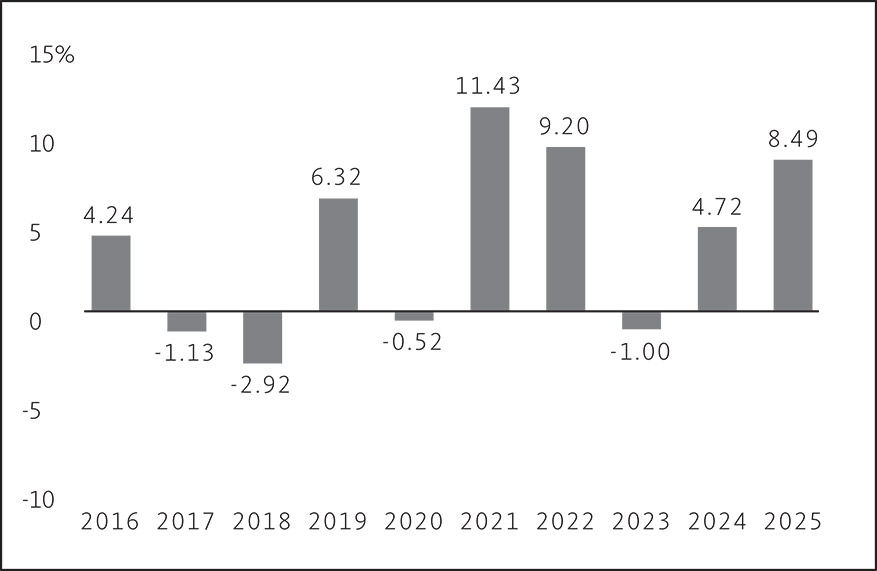
Best Quarter: 8.43% (3/31/22)
Worst Quarter: -9.92% (3/31/20)
The Fund's total return from January 1, 2026 to June 30, 2026 was 5.40%.
This table compares the Fund’s average annual total returns to those of the Bloomberg U.S. Aggregate Bond Index (a broad-based securities market index) as well as a blended benchmark that is composed of the Bloomberg 1‑5 Year U.S. TIPS Index, the Bloomberg Commodity Total Return Index and the S&P 500 Index weighted 70%/20%/10%.
After-tax returns are calculated using the historical highest individual federal marginal income tax rates and do not reflect the impact of state and local taxes. Your actual after-tax returns will depend on your tax situation and may differ from those shown. After-tax returns shown are not relevant to investors who hold their Fund shares through tax-deferred arrangements, such as 401(k) plans or individual retirement accounts.
Multi-Asset Real Return Fund | 1 Year | 5 Years | 10 Years | Since | |||
Return Before Taxes | 8.49 | % | 6.48 | % | 3.77 | % | 1.37% |
Return After Taxes on Distributions | 7.33 | % | 3.69 | % | 1.97 | % | 0.05% |
Return After Taxes on Distributions and Sale of Fund Shares | 5.13 | % | 3.81 | % | 2.14 | % | 0.47% |
Bloomberg U.S. Aggregate Bond Index Return (reflects no deductions for fees, | 7.30 | % | ‑0.36 | % | 2.01 | % | 2.25% |
The Fund’s Blended Benchmark Return (reflects no deductions for fees, | 9.57 | % | 6.04 | % | 4.99 | % | 2.58% |