N-4
Sep. 25, 2026
USD ($)
Index
Options. You may allocate your Purchase Payments to any
or all of the Index Options available under your Contract. The
Contract currently offers Index Options with different types of Crediting Methods, including Index Precision Strategy, Index Dual Precision
Strategy, and Index Performance Strategy.
We credit positive, zero, or negative
Performance Credits (i.e.,
positive, zero, or negative interest) at the end of a Term for amounts allocated to an Index Option based, in part, on the performance
of the applicable Index (the Index Return).
Each Index Option offers a certain
level of protection from negative Index Returns.
Each Index Option offers a certain
level of protection from negative Index Returns.
−
Each
available Index Option includes a Buffer that provides limited protection from negative Index Returns. You may lose a significant amount
of money if an Index declines in value.
○
Buffer
– A Buffer is the maximum amount of negative Index Return that we
absorb before applying a negative Performance Credit. For example, if at the end of a Term, the Index Return is -25% and the Buffer is
10%, we apply a Performance Credit of -15%, meaning your Contract Value allocated to that Index Option will decrease by 15% since the
Term Start Date. This reflects the negative Index Return that exceeds the protection of the 10% Buffer.
−
The
current limit on Index loss for an Index Option will not change for the life of that Index Option. However, we reserve the right to add
new Index Options. As such, the limits on Index loss offered under the Contract may change from one Term to the next if we add an Index
Option.
−
If
we offer a new Index Option with a Buffer in the future, the Buffer will be no lower than 5%.
The
current limit on Index loss for an Index Option will not change for the life of that Index Option. However, we reserve the right to add
new Index Options. As such, the limits on Index loss offered under the Contract may change from one Term to the next if we add an Index
Option.
Each
Index Option also has an upside feature, either a Trigger Rate, Cap, and/or Participation Rate, used in the calculation of positive Performance
Credits, if any, that may be credited to your investment at the end of a Term. We may limit the amount you can earn on
an Index Option based on the Trigger Rate, Cap or Participation Rate, as applicable.
−
Trigger
Rate – A Trigger Rate represents the positive Performance
Credit, if any, that may apply on the Term End Date. The Index Precision Strategy and Index Dual Precision Strategy offer Index Options
with a Trigger Rate.
○
For
the Index Precision Strategy, the Trigger Rate will apply if the Index Return is positive or zero. For example, if at the end of a Term,
the Index Return is 6% and the Trigger Rate is 3%, we apply a Performance Credit of 3%, meaning your Contract Value allocated to that
Index Option will increase by 3% since the Term Start Date.
○
For
the Index Dual Precision Strategy, the Trigger Rate will apply if the Index Return is positive, zero, or to a limited extent, negative.
For example, assume a Trigger Rate of 3% and a Buffer of 10%. If at the end of a Term, the Index Return is positive, zero, or negative
but no lower than -10% (i.e.,
not in excess of the Buffer), we apply a positive Performance Credit of 3%, meaning your Contract Value allocated to that Index Option
will increase by 3% since the Term Start Date. However, if the negative Index Return were lower than -10% (i.e.,
in excess of the Buffer), we apply a negative Performance Credit equal to the negative Index Return plus the Buffer, as previously summarized
above.
−
Cap
– A Cap represents the maximum positive Performance Credit, if any, applied on a Term End Date. For example, if at the end of a
Term, the Index Return is 12% and the Cap is 10%, we apply a Performance Credit of 10%, meaning your Contract Value allocated to that
Index Option will increase by 10% since the Term Start Date. The Index Performance Strategy offers Index Options with a Cap. Index Performance
Strategy multi-year Term Index Options have both a Cap and a Participation Rate (as described below).
−
Participation
Rate – A Participation Rate is the percentage that
is multiplied by a positive Index Return in calculating a positive Performance Credit, if any, subject to any applicable Cap. For example,
if at the end of a Term, the Participation Rate is 100%, the Cap is 15%, and the Index Return is 12% (which is lower than the Cap), we
apply a Performance Credit of 12% (i.e.,
100% x 12%). However, if the Index Return were instead 20% (which is higher than the Cap), we would apply the Cap and a Performance Credit
of 15% would be applied. Index Performance Strategy multi-year Term Index Options have both a Participation Rate and a Cap.
−
The
Trigger Rate, Cap, and/or Participation Rate for an Index Option will change from Term to Term, subject to a specified guaranteed minimum
that will not change for the life of that Index Option. Guaranteed minimum Trigger Rates, Caps, and/or Participation Rates vary by Index
Option.
−
If
we add a new Index Option to the Contract in the future, the lowest Trigger Rate, Cap, and Participation Rate that we may establish are
3%, 3%, and 100%, respectively. For example, if the Trigger Rate or Cap for a new Index Option is 3% and the Index Return is 10%, a 3%
Performance Credit would be applied. Similarly, if the Participation Rate for a new Index Option is 100%, the Index Option is uncapped,
and the Index Return is 10%, a 10% Performance Credit would be applied.
Subject to the following parameters,
with at least seven days’ notice, we may make certain Index Options temporarily unavailable for a year or more if we are unable
to support the minimum Trigger Rate or Cap due to yield on investments or the availability or cost of hedging. We cannot make an Index
Option temporarily unavailable for any other reason. This period of temporary unavailability could last a year or more. The Temporarily
Unavailable Identifier column in the table below indicates the Index Option groups that can be made temporarily unavailable on the Index
Effective Date or an Index Anniversary (or both):
−
We
cannot
make Group A Index Options temporarily unavailable on the Index Effective Date or an Index Anniversary.
−
We
can make Group B Index Options temporarily unavailable on the Index Effective Date or an Index Anniversary (or both).
−
We
can make Group C Index Options temporarily unavailable on an Index Anniversary occurring on or after the sixth Index Anniversary.
We can make all Index Options temporarily
unavailable for Early Reallocation at any time, which
means there may be times when Early Reallocation is unavailable to you.
|
Currently
Available Crediting Methods,
Term
Lengths and Buffers |
Temporarily
Unavailable Identifier |
|
Index
Dual Precision Strategy
1-year
Term with 10% Buffer |
• Group
B |
|
Index
Precision Strategy
1-year
Term with 10% Buffer |
• Group
C |
|
Index
Performance Strategy
1-year
Term with 10%, 20%, or 30% Buffer |
• Group
A for 10% Buffer
• Group
C for 20% or 30% Buffer |
|
Index
Performance Strategy
3-year
Term with 10%, 20%, or 30% Buffer |
• Group
A for 10% Buffer
• Group
C for 20% or 30% Buffer |
|
Index
Performance Strategy
6-year
Term with 10%, 20%, or 30% Buffer |
• Group
A for 10% Buffer
• Group
C for 20% or 30% Buffer |
Once we make an Index Option temporarily
unavailable, it may continue to be unavailable so long as we are unable to support its minimum Trigger Rate or Cap. However, we cannot
make an Index Option permanently unavailable, remove it after we issue your Contract, or make an Index Option to which you are currently
allocated temporarily unavailable during its Term. A temporarily unavailable Index Option will become available once we can support its
minimum Trigger Rate or Cap. The minimum Early Reallocation Trigger Rate or Cap will be at least equal to the minimums stated above, but
could be higher. (For more information see the examples in section 6, Valuing Your Contract – Early Reallocations.)
may
be no time that any such transaction can be performed without the application of at least one Daily Adjustment. Additionally,
if within six years after we receive a Purchase Payment, you take a full or partial withdrawal, such transactions are subject to a withdrawal
charge, which may cause you to lose a significant amount of money.
|
|
FEES,
EXPENSES, AND ADJUSTMENTS |
Prospectus
Location
| ||
|
Are
There
Charges
or
Adjustments
for
Early
Withdrawals?
|
Yes,
your Contract is subject to charges for early withdrawals. If you withdraw money from
the
Contract within six
years of your last Purchase Payment, you will be assessed a
withdrawal
charge of up to 8%
of the Purchase Payment withdrawn, declining to 0% over
that
time period. For example, if you invest $100,000 in the Contract and make an early
withdrawal,
you could pay a withdrawal charge of up to $8,000.
This loss will be greater if
there
is a negative Daily Adjustment, income taxes, or tax penalties.
In
addition, if you take a full or partial withdrawal from an Index Option on a date other than
the
Term End Date, a Daily Adjustment will apply to the Index Option Value available for
withdrawal.
The Daily Adjustment also applies if before the Term End Date you execute a
Performance
Lock, you annuitize the Contract, we pay a death benefit, or we deduct
Contract
fees and expenses. The Daily Adjustment may be positive, negative, or equal to
zero.
A negative Daily Adjustment will result in a loss, and could result in a loss beyond the
protection
of the 10%, 20%, or 30% Buffer, as applicable. The maximum potential loss from
a
negative Daily Adjustment is -99%. For example, if you allocate $100,000 to a 1-year
Term
Index Option with 10% Buffer and later withdraw the entire amount before the Term
has
ended, you could lose up to $99,000 of your investment. This loss will be greater if you
also
have to pay a withdrawal charge, income taxes, and tax penalties. |
Fee
Tables
7.
Expenses and
Adjustments
Appendix
C –
Daily
Adjustment
| ||
|
Are
There
Transaction
Charges?
|
No.
Other than withdrawal charges and Daily Adjustments that may apply to withdrawals
and
other transactions under the Contract, there are no other transaction charges. |
Not
Applicable | ||
|
Are
There
Ongoing
Fees
and
Expenses?
|
Yes,
there are ongoing fees and expenses. The table below describes the fees and
expenses
that you may pay each
year, depending on the options you choose.
Please refer
to
your Contract specifications page for information about the specific fees you will pay
each
year based on the options you have elected.
There
is an implicit ongoing fee on Index Options to the extent that your participation
in
Index gains is limited by us through a Cap or Trigger Rate.
This means that your
returns
may be lower than the Index’s returns. In return for accepting this limit on Index
gains,
you will receive some protection from Index losses. This implicit ongoing fee is not
reflected
in the tables below.
|
Fee
Tables
7.
Expenses and
Adjustments
Appendix
A –
Investment
Options
Available
Under
the
Contract
| ||
|
Annual
Fee |
Minimum
|
Maximum
| ||
|
Base
Contract(1)
|
1.26%
|
1.26%
| ||
|
Investment
Options (2)
(Fund
fees and expenses) |
0.66%
|
0.66%
| ||
|
|
Optional
benefits available for an additional
charge
(for
a single optional benefit, if elected) |
Not
Applicable |
Not
Applicable |
|
|
|
(1)
As
a percentage of the Variable Option’s average net assets, plus an amount attributable to the contract
maintenance
charge based on expected Contract sales. |
| ||
|
|
(2)
As a percentage
of the AZL Government Money Market Fund's average daily net assets. |
| ||
FEES,
EXPENSES, AND ADJUSTMENTS
Prospectus
Location
Because
your Contract is customizable, the choices you make affect how much you will
pay.
To help you understand the cost of owning your Contract, the following table shows the
lowest
and highest cost you could pay each
year, based on current charges. This estimate
assumes
that you do not take withdrawals from the Contract, which
could add a
withdrawal
charge and a negative Daily Adjustment that substantially increase costs.
Lowest
Annual Cost:
$1,761
Highest
Annual Cost:
$1,761
Assumes:
●Investment
of $100,000 in the Variable
Option
●5%
annual appreciation
●No
additional Purchase Payments,
transfers,
or withdrawals
●No
Daily Adjustment
Assumes:
●Investment
of $100,000 in the Variable
Option
●5%
annual appreciation
●No
additional Purchase Payments,
transfers,
or withdrawals
●No
Daily Adjustment
Are
There
Charges
or
Adjustments
for
Early
Withdrawals?
Yes,
your Contract is subject to charges for early withdrawals. If you withdraw money from
the
Contract within six
years of your last Purchase Payment, you will be assessed a
withdrawal
charge of up to 8%
of the Purchase Payment withdrawn, declining to 0% over
that
time period. For example, if you invest $100,000 in the Contract and make an early
withdrawal,
you could pay a withdrawal charge of up to $8,000.
This loss will be greater if
there
is a negative Daily Adjustment, income taxes, or tax penalties.
In
addition, if you take a full or partial withdrawal from an Index Option on a date other than
the
Term End Date, a Daily Adjustment will apply to the Index Option Value available for
withdrawal.
The Daily Adjustment also applies if before the Term End Date you execute a
Performance
Lock, you annuitize the Contract, we pay a death benefit, or we deduct
Contract
fees and expenses. The Daily Adjustment may be positive, negative, or equal to
zero.
A negative Daily Adjustment will result in a loss, and could result in a loss beyond the
protection
of the 10%, 20%, or 30% Buffer, as applicable. The maximum potential loss from
a
negative Daily Adjustment is -99%. For example, if you allocate $100,000 to a 1-year
Term
Index Option with 10% Buffer and later withdraw the entire amount before the Term
has
ended, you could lose up to $99,000 of your investment. This loss will be greater if you
also
have to pay a withdrawal charge, income taxes, and tax penalties.
Fee
Tables
7.
Expenses and
Adjustments
Appendix
C –
Daily
Adjustment
Are
There
Transaction
Charges?
No.
Other than withdrawal charges and Daily Adjustments that may apply to withdrawals
and
other transactions under the Contract, there are no other transaction charges.
Not
Applicable
Are
There
Ongoing
Fees
and
Expenses?
Yes,
there are ongoing fees and expenses. The table below describes the fees and
expenses
that you may pay each
year, depending on the options you choose.
Please refer
to
your Contract specifications page for information about the specific fees you will pay
each
year based on the options you have elected.
There
is an implicit ongoing fee on Index Options to the extent that your participation
in
Index gains is limited by us through a Cap or Trigger Rate.
This means that your
returns
may be lower than the Index’s returns. In return for accepting this limit on Index
gains,
you will receive some protection from Index losses. This implicit ongoing fee is not
reflected
in the tables below.
Fee
Tables
7.
Expenses and
Adjustments
Appendix
A –
Investment
Options
Available
Under
the
Contract
Annual
Fee
Minimum
Maximum
Base
Contract(1)
1.26%
1.26%
Investment
Options (2)
(Fund
fees and expenses)
0.66%
0.66%
Optional
benefits available for an additional
charge
(for
a single optional benefit, if elected)
Not
Applicable
Not
Applicable
(1)
As
a percentage of the Variable Option’s average net assets, plus an amount attributable to the contract
maintenance
charge based on expected Contract sales.
(2)
As a percentage
of the AZL Government Money Market Fund's average daily net assets.
FEES,
EXPENSES, AND ADJUSTMENTS
Prospectus
Location
Because
your Contract is customizable, the choices you make affect how much you will
pay.
To help you understand the cost of owning your Contract, the following table shows the
lowest
and highest cost you could pay each
year, based on current charges. This estimate
assumes
that you do not take withdrawals from the Contract, which
could add a
withdrawal
charge and a negative Daily Adjustment that substantially increase costs.
Lowest
Annual Cost:
$1,761
Highest
Annual Cost:
$1,761
Assumes:
●Investment
of $100,000 in the Variable
Option
●5%
annual appreciation
●No
additional Purchase Payments,
transfers,
or withdrawals
●No
Daily Adjustment
Assumes:
●Investment
of $100,000 in the Variable
Option
●5%
annual appreciation
●No
additional Purchase Payments,
transfers,
or withdrawals
●No
Daily Adjustment
As
a percentage of the Variable Option’s average net assets, plus an amount attributable to the contract
maintenance
charge based on expected Contract sales.
Because
your Contract is customizable, the choices you make affect how much you will
pay.
To help you understand the cost of owning your Contract, the following table shows the
lowest
and highest cost you could pay each
year, based on current charges. This estimate
assumes
that you do not take withdrawals from the Contract, which
could add a
withdrawal
charge and a negative Daily Adjustment that substantially increase costs.
Lowest
Annual Cost:
$1,761
Highest
Annual Cost:
$1,761
Assumes:
●Investment
of $100,000 in the Variable
Option
●5%
annual appreciation
●No
additional Purchase Payments,
transfers,
or withdrawals
●No
Daily Adjustment
Assumes:
●Investment
of $100,000 in the Variable
Option
●5%
annual appreciation
●No
additional Purchase Payments,
transfers,
or withdrawals
●No
Daily Adjustment
|
|
RISKS
|
| ||
|
Is
There a Risk
of
Loss from
Poor
Performance?
|
Yes,
you can lose money by investing in the Contract, including loss of principal and
previous
earnings.
The
maximum amount of loss that you could experience from negative Index Return,
after
taking into account the current limits on Index loss provided under the
Contract,
is: -90% with a 10% Buffer; -80% with a 20% Buffer; and -70% with a 30%
Buffer.
The
limits on Index loss offered under the Contract may change from one Term to the
next
if we add an Index Option. |
Principal
Risks of
Investing
In the
Contract
4.
Index Options
6.
Valuing Your
Contract
–
Calculating
Performance
Credits
| ||
|
Is
This a
Short-Term
Investment?
|
No,
this Contract is not a short-term investment and is not appropriate if you need ready
access
to cash.
• Considering
the benefits of tax deferral and long-term income, the Contract is generally
more
beneficial to investors with a long investment time horizon.
• Withdrawals
are subject to income taxes, and may also be subject to a 10% additional
federal
tax for amounts withdrawn before age 59 1∕2.
• If,
within six years after we receive a Purchase Payment, you take a full or partial
withdrawal,
withdrawal charges will apply. A withdrawal charge will reduce your Contract
Value
or the amount of money that you actually receive. Withdrawals may reduce or end
Contract
guarantees.
• Amounts
invested in an Index Option must be held in the Index Option for the full Term
before
they can receive a Performance Credit. We apply a Daily Adjustment, if before the
Term
End Date, you take a full or partial withdrawal, you execute a Performance Lock,
you
annuitize the Contract, we pay a death benefit, or we deduct Contract fees and
expenses.
• The
Daily Adjustment may be negative. You will lose money if the Daily Adjustment is
negative.
• Withdrawals
and other deductions from an Index Option prior to a Term End Date will
result
in a proportionate reduction to your Index Option Base. The proportionate reduction
could
be greater than the amount withdrawn or deducted. Reductions to your Index
Option
Base will result in lower Index Option Values for the remainder of the Term and
lower
gains (if any) on the Term End Date.
• On
the Term End Date, you can transfer assets invested in an Index Option by changing
your
allocation instructions. If you do not change your allocation instructions, you will
continue
to be invested in the same Index Option with a new Term Start Date. The new
Term
will be subject to the applicable renewal Trigger Rate, Cap, and/or Participation
Rate.
|
Principal
Risks of
Investing
In the
Contract
4.
Index Options
6.
Valuing Your
Contract
7.
Expenses and
Adjustments
Appendix
C –
Daily
Adjustment | ||
|
|
RISKS
|
Prospectus
Location
| ||
|
What
are the
Risks
Associated
with
the
Investment
Options?
|
• An
investment in the Contract is subject to the risk of poor investment performance and
can
vary depending on the performance of the Variable Option and the Index Options
available
under the Contract.
• The
Variable Option and each Index Option have their own unique risks.
• You
should review the Fund’s prospectus and disclosures, including risk factors, before
making
an investment decision.
• Caps
and Trigger Rates will limit positive Performance Credits (e.g., limited upside). This
may
result in earning less than the Index Return.
– For
example, if at the end of a 1-year Term, the Index Return is 25% and the Cap is
15%,
we apply a Performance Credit of 15%, meaning your Contract Value allocated
to
that Index Option will increase by 15% since the Term Start Date. If at the end of the
Term,
the Index Return is 6% and the Trigger Rate is 10%, we apply a Performance
Credit
of 10%, meaning your Contract Value allocated to that Index Option will
increase
by 10% since the Term Start Date.
• The
Buffer will limit negative Performance Credits (e.g., limited protection in the case of
Index
decline). However, you
bear the risk for all Index losses that exceed the
Buffer.
– For
example, if at the end of a Term, the Index Return is -25% and the Buffer is 10%,
we
apply a Performance Credit of -15%, meaning your Contract Value allocated to that
Index
Option will decrease by 15% since the Term Start Date.
• The
Indexes are price return indexes, not total return indexes. This means that the Index
Options
do not receive any dividends payable on these securities. The Index Options also
do
not directly participate in the returns of the Indexes or the Indexes' component
securities.
This will reduce the Index Return and may cause the Index to underperform a
direct
investment in the securities composing the Index. |
Principal
Risks of
Investing
In the
Contract
| ||
|
What
are the
Risks
Related
to
the
Insurance
Company?
|
An
investment in the Contract is subject to the risks related to us. All obligations,
guarantees
or benefits of the Contract, including those relating to the Index Options, are the
obligations
of Allianz Life of New York and are subject to our claims-paying ability and
financial
strength. More information about Allianz Life of New York, including our financial
strength
ratings, is available upon request by visiting
https://www.allianzlife.com/new-york/about/why-allianz-life-of-ny,
or contacting us at (800)
624-0197.
|
Principal
Risks of
Investing
In the
Contract
| ||
Yes,
there are limits on the Investment Options.
• We
can add new Index Options to your Contract in the future.
• We
restrict additional Purchase Payments during the Accumulation Phase. Each Index
Year,
you cannot add more than your initial amount (i.e., the total of all Purchase
Payments
received before the first Quarterly Contract Anniversary of the first Contract
Year).
• We
do not accept additional Purchase Payments during the Annuity Phase.
• We
typically only allow assets to move into the Index Options on the Index Effective Date
and
on subsequent Index Anniversaries as discussed in section 3, Purchasing the
Contract
– Allocation of Purchase Payments and Contract Value Transfers. However,
Early
Reallocation allows you to transfer assets to the Index Options before the next
Index
Anniversary subject to certain restrictions. If you execute an Early Reallocation, we
will
move assets into the Index Options on the Business Day we receive your Early
Reallocation
request in Good Order. The Index Performance Strategy 6-year Term Index
Options
are not available as a destination for Early Reallocation, but they can be a
source.
• You
can typically transfer Index Option Value only on Term End Dates. However, you can
transfer
all assets out of an Index Option before the Term End Date by first executing a
Performance
Lock and then either requesting an Early Reallocation with new allocation
instructions
or changing your allocation instructions before the next Index Anniversary.
For
more information, see “Performance Locks” and “Early Reallocation” in section 6,
Valuing
Your Contract.
• We
do not allow assets to move into an established Index Option until the Term End Date.
If
you request to allocate a Purchase Payment into an established Index Option on an
Index
Anniversary that is not a Term End Date, we will allocate those assets to the same
Index
Option with a new Term Start Date.
• With
notice, we may make certain Index Options temporarily unavailable for a year or
more
if we are unable to support the minimum Trigger Rate or Cap on that Index Option.
– We
cannot
make Group A Index Options temporarily unavailable on the Index
Effective
Date or an Index Anniversary.
– We
can make Group B Index Options temporarily unavailable on the Index Effective
Date
or an Index Anniversary.
– We
can make Group C Index Options temporarily unavailable on an Index Anniversary
occurring
on or after the sixth Index Anniversary.
(For
more information on an Index Option’s temporary unavailability group, please see
Overview
of the Contract – What are the Phases of the Contract?) Once we make an
Index
Option temporarily unavailable, it may continue to be unavailable so long as we
are
unable to support its minimum Trigger Rate or Cap due to yield on investments or
the
availability or cost of hedging. We cannot make an Index Option temporarily
unavailable
for any reason other than being unable to support its minimum Trigger
Rate
or Cap. We also cannot make an Index Option permanently unavailable, remove
it
from the Contract after issue, or make an Index Option to which you are currently
allocated
temporarily unavailable during its Term. A temporarily unavailable Index
Option
will become available once we can support its minimum Trigger Rate or Cap.
Although
we cannot eliminate an Index Option from your Contract, we reserve the right
to
substitute Indexes either on a Term Start Date or during a Term.
– We
can make all Index Options temporarily unavailable for Early Reallocation at any
time,
which means there may be times when Early Reallocation is unavailable to you.
• We
reserve the right to substitute the Fund in which the Variable Option invests.
• We
can also decline a Purchase Payment if it does not meet the requirements set out in
section
3, Purchasing the Contract – Purchase Requirements.
• Caps,
Trigger Rates, and Participation Rates will change from one Term to the next
subject
to their contractual minimum guarantees.
• The
10%, 20%, and 30% Buffers for the currently available Index Options do not change.
However,
if we add a new Index Option to your Contract after the Issue Date, we
establish
the Buffer for it on the date we add the Index Option to your Contract. For a new
Index
Option, the minimum Buffer is 5%.
Yes,
there are restrictions on Contract benefits.
• We
do not allow Performance Locks to occur on Term End Dates.
• We
do not accept Early Reallocation requests before the Index Effective Date, or within
14
calendar days before an Index Anniversary. On October 13, 2026, the limit for Early
Reallocations
increases from 12 each Index Year to 24. Index Performance Strategy
6-year
Term Index Options and the Variable Option are not available as a destination for
Early
Reallocation, but they can be a source.
• We
reserve the right to discontinue or modify the Minimum Distribution Program.
• The
Traditional Death Benefit is only available during the Accumulation Phase. Upon
annuitization,
this benefit will end.
• The
Traditional Death Benefit may not be modified, but it will terminate if you take
withdrawals
that reduce both the Contract Value and Guaranteed Death Benefit Value to
zero.
Withdrawals may reduce the Traditional Death Benefit’s Guaranteed Death Benefit
Value
by more than the value withdrawn and could end the Traditional Death Benefit.
• Consult
with a tax professional to determine the tax implications of an investment in and
withdrawals
from or payments received under the Contract.
• If
you purchased the Contract as an individual retirement annuity or through a custodial
individual
retirement account, you do not get any additional tax benefit under the
Contract.
• Generally,
earnings under a Non-Qualified Contract are taxed at ordinary income rates
when
withdrawn, and may also be subject to a 10% additional federal tax for amounts
withdrawn
before age 59 1∕2.
• Generally,
distributions from Qualified Contracts are taxed at ordinary income tax rates
when
withdrawn, and may also be subject to a 10% additional federal tax for amounts
withdrawn
before age 59 1∕2.
Your
Financial Professional may receive compensation for selling this Contract to you, in
the
form of commissions, additional cash benefits (e.g., cash bonuses), and non-cash
compensation.
We and/or our wholly owned subsidiary distributor may also make marketing
support
payments to certain selling firms for marketing services and costs associated with
Contract
sales. This conflict of interest may influence your Financial Professional to
recommend
this Contract over another investment for which the Financial Professional is
not
compensated or compensated less.
Whether
to exchange your existing Contract for a new contract is a decision that each
investor
should make based on their personal circumstances and financial objectives.
However,
in making this decision you should be aware that some Financial Professionals
may
have a financial incentive to offer you a new contract in place of one you already own.
You
should only exchange your Contract if you determine, after comparing the features,
risks,
and fees of both contracts, including any fees or penalties to terminate your existing
Contract,
that it is better for you to purchase the new contract rather than continue to own
your
existing Contract.
Fee Tables
The following tables
describe the fees, expenses, and adjustments that you will pay when buying, owning, and surrendering or making withdrawals from an Investment
Option or from the Contract. Please refer to your Contract specifications page for information about the specific fees you will pay each
year.
The first table
describes the fees and expenses that you will pay at the time that you buy the Contract, surrender or make withdrawals from an Investment
Option or from the Contract, or transfer Contract Value between Investment Options. State premium taxes may also be deducted.
Transaction
Expenses
Withdrawal Charge During
Your Contract’s First Phase, the Accumulation Phase(1)
(as a percentage of each Purchase Payment withdrawn)(2)
(as a percentage of each Purchase Payment withdrawn)(2)
|
Number
of Complete Years
Since
Purchase Payment |
Withdrawal
Charge Amount |
|
0
|
8%
|
|
1
|
7%
|
|
2
|
6%
|
|
3
|
5%
|
|
4
|
3%
|
|
5
|
1%
|
|
6
years or more |
0%
|
(1)
The
Contract provides a free withdrawal privilege that allows you to withdraw 10% of your total Purchase Payments annually without incurring
a withdrawal charge, as discussed in section 8, Access to Your Money – Free Withdrawal Privilege.
(2)
The Withdrawal Charge Basis is the total amount under
your Contract that is subject to a withdrawal charge, as discussed in section 7, Expenses and Adjustments – Withdrawal Charge.
The next table describes
the Daily Adjustment, in addition to any transaction expenses, that applies if all or a portion of the Contract Value is removed from
an Index Option before the end of a Term.
Adjustments
|
|
Index
Dual Precision Strategy, Index Precision Strategy, and
Index
Performance Strategy |
|
Daily
Adjustment Maximum Potential Loss |
99%
|
|
(as
a percentage of Index Option Value, applies for distributions
from
an Index Option before any Term End Date)(1)
|
|
(1)
This table shows the maximum potential loss due to
the application of the Daily Adjustment (e.g., maximum loss could occur if there is a total distribution within a Term at a time when
the Index price has declined to zero). The Daily Adjustment could result in a loss beyond the protection of the 10%, 20%, or 30% Buffer.
The Daily Adjustment applies if, before the Term End Date, you take a full or partial withdrawal, you execute a Performance Lock, you
annuitize the Contract, we pay a death benefit, or we deduct Contract fees or expenses. The actual Daily Adjustment calculation is determined
by a formula described in Appendix C.
The next table describes
the fees and expenses that you will pay each year during the time that you own the Contract (not including Fund fees and expenses).
Annual
Contract Expenses
|
Administrative
Expenses (or contract maintenance charge)(1)
(per
year) |
$50
|
|
Base
Contract Expenses(2)
(as
a percentage of the Variable Option’s average net assets)(3)
|
1.25%
|
(1)
Referred
to as the “contract maintenance charge” in the Contract and elsewhere in this prospectus. Waived if the Contract Value is
at least $100,000. Also waived during the Annuity Phase. See section 7, Expenses and Adjustments – Contract Maintenance Charge
(Administrative Expenses).
(2)
Referred
to as the “mortality and expense risk charge” in the Contract, or "M&E charge" elsewhere in this prospectus. See section
7, Expenses and Adjustments – Base Contract Expenses (Mortality and Expense Risk (M&E) Charge).
(3)
Referred to as “a percentage of the Variable
Option’s net asset value” in the Contract.
In addition to the
fees described above, we may limit the amount you can earn on the Index Options. This means your returns may be lower than the Index’s
returns. In return for accepting a limit on Index gains, you will receive some protection from Index losses.
The next item shows
the total operating expenses charged by the Fund that you may pay periodically during the time that you own the Contract. Expenses shown
may change over time and may be higher or lower in the future. More information about the Fund, including its annual expenses, may be
found in Appendix A – Investment Options Available Under the Contract.
Annual
Fund Expenses
|
(expenses
that are deducted from Fund assets, including management fees,
distribution
and/or service (12b-1) fees, and other expenses) |
0.66%
|
Example
This Example is
intended to help you compare the cost of investing in the Variable Option with the cost of investing in other annuity contracts that offer
variable options. These costs include transaction expenses, annual Contract expenses, and annual Fund expenses.
The Example assumes
all Contract Value is allocated to the Variable Option. The Example does not reflect the Daily Adjustment. Your costs could
differ from those shown below when you invest in the Index Options.
The Example assumes
that you invest $100,000 in the Variable Option for the time periods indicated. The Example also assumes that your investment has a 5%
return each year. Although your actual costs may be higher or lower, based on these assumptions, your costs would be:
|
|
1
Year |
3
Years |
5
Years |
10
Years |
|
the
applicable time period: |
$9,134
|
$11,383
|
$12,982
|
$22,233
|
|
period.
|
N/A*
|
$5,983
|
$10,282
|
$22,233
|
|
|
$1,934
|
$5,983
|
$10,282
|
$22,233
|
*
The first table
describes the fees and expenses that you will pay at the time that you buy the Contract, surrender or make withdrawals from an Investment
Option or from the Contract, or transfer Contract Value between Investment Options. State premium taxes may also be deducted.
Transaction
Expenses
Withdrawal Charge During
Your Contract’s First Phase, the Accumulation Phase(1)
(as a percentage of each Purchase Payment withdrawn)(2)
(as a percentage of each Purchase Payment withdrawn)(2)
|
Number
of Complete Years
Since
Purchase Payment |
Withdrawal
Charge Amount |
|
0
|
8%
|
|
1
|
7%
|
|
2
|
6%
|
|
3
|
5%
|
|
4
|
3%
|
|
5
|
1%
|
|
6
years or more |
0%
|
(1)
The
Contract provides a free withdrawal privilege that allows you to withdraw 10% of your total Purchase Payments annually without incurring
a withdrawal charge, as discussed in section 8, Access to Your Money – Free Withdrawal Privilege.
(2)
The Withdrawal Charge Basis is the total amount under
your Contract that is subject to a withdrawal charge, as discussed in section 7, Expenses and Adjustments – Withdrawal Charge.
The next table describes
the Daily Adjustment, in addition to any transaction expenses, that applies if all or a portion of the Contract Value is removed from
an Index Option before the end of a Term.
Adjustments
|
|
Index
Dual Precision Strategy, Index Precision Strategy, and
Index
Performance Strategy |
|
Daily
Adjustment Maximum Potential Loss |
99%
|
|
(as
a percentage of Index Option Value, applies for distributions
from
an Index Option before any Term End Date)(1)
|
|
(1)
This table shows the maximum potential loss due to
the application of the Daily Adjustment (e.g., maximum loss could occur if there is a total distribution within a Term at a time when
the Index price has declined to zero). The Daily Adjustment could result in a loss beyond the protection of the 10%, 20%, or 30% Buffer.
The Daily Adjustment applies if, before the Term End Date, you take a full or partial withdrawal, you execute a Performance Lock, you
annuitize the Contract, we pay a death benefit, or we deduct Contract fees or expenses. The actual Daily Adjustment calculation is determined
by a formula described in Appendix C.
(2)
The Withdrawal Charge Basis is the total amount under
your Contract that is subject to a withdrawal charge, as discussed in section 7, Expenses and Adjustments – Withdrawal Charge.
Adjustments
|
|
Index
Dual Precision Strategy, Index Precision Strategy, and
Index
Performance Strategy |
|
Daily
Adjustment Maximum Potential Loss |
99%
|
|
(as
a percentage of Index Option Value, applies for distributions
from
an Index Option before any Term End Date)(1)
|
|
The next table describes
the fees and expenses that you will pay each year during the time that you own the Contract (not including Fund fees and expenses).
Annual
Contract Expenses
|
Administrative
Expenses (or contract maintenance charge)(1)
(per
year) |
$50
|
|
Base
Contract Expenses(2)
(as
a percentage of the Variable Option’s average net assets)(3)
|
1.25%
|
(1)
Referred
to as the “contract maintenance charge” in the Contract and elsewhere in this prospectus. Waived if the Contract Value is
at least $100,000. Also waived during the Annuity Phase. See section 7, Expenses and Adjustments – Contract Maintenance Charge
(Administrative Expenses).
(2)
Referred
to as the “mortality and expense risk charge” in the Contract, or "M&E charge" elsewhere in this prospectus. See section
7, Expenses and Adjustments – Base Contract Expenses (Mortality and Expense Risk (M&E) Charge).
(3)
Referred to as “a percentage of the Variable
Option’s net asset value” in the Contract.
(3)
Referred to as “a percentage of the Variable
Option’s net asset value” in the Contract.
The next item shows
the total operating expenses charged by the Fund that you may pay periodically during the time that you own the Contract. Expenses shown
may change over time and may be higher or lower in the future. More information about the Fund, including its annual expenses, may be
found in Appendix A – Investment Options Available Under the Contract.
Annual
Fund Expenses
|
(expenses
that are deducted from Fund assets, including management fees,
distribution
and/or service (12b-1) fees, and other expenses) |
0.66%
|
(expenses
that are deducted from Fund assets, including management fees,
distribution
and/or service (12b-1) fees, and other expenses)
the
applicable time period:
$9,134
$11,383
$12,982
$22,233
period.
N/A*
$5,983
$10,282
$22,233
$1,934
$5,983
$10,282
$22,233
Principal Risks of Investing In the Contract
The Contract involves certain risks
that you should understand before investing. You should carefully consider your income needs and risk tolerance to determine whether the
Contract is appropriate for you. The level of risk you bear and your potential investment performance will differ depending on the Investment
Options you choose.
Risk
of Loss
Returns on securities and securities
Indexes can vary substantially, which may result in investment losses. The historical performance of the Investment Options does not guarantee
future results. It is impossible to predict whether underlying investment values will fall or rise. Securities markets are influenced
by economic, financial, regulatory, geographic, judicial, political and other complex and interrelated factors. Depending on your individual
circumstances (e.g.,
your selected Investment Options and the timing of any Purchase Payments, transfers, or withdrawals), you may experience (perhaps significant)
negative returns under the Contract. You should consult with a Financial Professional.
The Variable Option does not provide
any protection against loss of principal. You
can lose principal and previous earnings on assets in the Variable Option and such losses could be significant.
You should consider whether investing
in an Index Option is consistent with your financial needs. If you allocate Purchase Payments or transfer Contract Value to an Index Option,
negative Index Returns may cause Performance Credits to be negative after application of the Buffer. For the Index Performance Strategy,
we apply the Buffer for the entire Term length; we do not apply the Buffer annually on a 3-year or 6-year Term Index Option. Ongoing
deductions we make for Contract fees and expenses could also cause amounts available for withdrawal to be less than what you invested
even if Index performance has been positive. You
can lose principal and previous earnings if you allocate Purchase Payments or transfer Contract Value to the Index Options, and such losses
could be significant.
The maximum potential
negative Performance Credit is based on the Buffer. If the Buffer is 10%, the maximum negative Performance Credit is -90%; if the Buffer
is 20%, the maximum negative Performance Credit is -80%; and if the Buffer is 30%, the maximum negative Performance Credit is -70%.
In addition to any losses from negative
investment performance, you may experience losses under the Contract due to any applicable withdrawal charges, other Contract fees and
charges, negative Daily Adjustments, taxes, and tax penalties.
Early
Withdrawal and Liquidity Risk
We designed the Contract to be a
long-term investment that you can use to help build and provide income for retirement. The Contract is not suitable for short-term investment.
Withdrawals under the Contract may be subject to withdrawal charges, other Contract fees and charges, negative Daily Adjustments, taxes,
and tax penalties.
If you take a full or partial withdrawal
during the withdrawal charge period we deduct a withdrawal charge unless the withdrawal is a Penalty-Free Withdrawal. While Penalty-Free
Withdrawals provide some liquidity, they are permitted in only limited amounts or in special circumstances. If you need to withdraw most
or all of your Contract Value in a short period, you will likely exceed the Penalty-Free Withdrawal amounts available to you and incur
withdrawal charges. For more information on the withdrawal charge, see the Fee Tables and section 7, Expenses and Adjustments –
Withdrawal Charge.
We calculate the withdrawal charge
as a percentage of your Purchase Payments, not Contract Value. Consequently, if the Contract Value has declined since you made a Purchase
Payment, it is possible the percentage of Contract Value withdrawn to cover the withdrawal charge would be greater than if the withdrawal
charge were deducted as a percentage of Contract Value. For example, assume you buy the Contract with a single Purchase Payment of $10,000.
If your Contract Value in the fifth year is $8,000 and you take a full withdrawal a 3% withdrawal charge applies. The total withdrawal
charge would be $300 (3% of $10,000). As your Contract Value is less than $100,000, we will also deduct the $50 contract maintenance charge.
This results in you receiving $7,650. This example does not include the impact of income tax withholding which will reduce the amount
you receive.
On a full withdrawal, the free withdrawal
privilege is not available to you, and we apply a withdrawal charge against Purchase Payments that are still within their withdrawal charge
period, including amounts previously withdrawn under the free withdrawal privilege. On
a full withdrawal, your Withdrawal Charge Basis may be greater than your Contract Value because the following reduce your Contract Value,
but do not reduce your Withdrawal Charge Basis: deductions we make for Contract fees or expenses; and/or poor performance.
Amounts withdrawn from this Contract
are subject to income taxes and may also be subject to a 10% additional federal tax for amounts withdrawn before age 59 1∕2.
We only apply Performance Credits
to the Index Options once each Term on the Term End Date, rather than daily. In the interim, we calculate Index Option Values based on
the Daily Adjustment. For more information, see “Risks Associated with the Daily Adjustment” later in this section. The
Variable Option is not subject to the Daily Adjustment. Any assets removed from an Index Option during the Term for withdrawals you take
(including Penalty-Free Withdrawals), Annuity Payments, or deductions we make for Contract fees and expenses, or if we pay a death benefit,
will not be eligible to receive a Performance Credit on the Term End Date. You will receive a Performance Credit only on any unlocked
Index Option Value remaining in an Index Option on the Term End Date.
You can typically transfer Variable
Account Value to the Index Options only on an Index Anniversary. You can typically transfer Index Option Value to the Variable Option,
or among the available Index Options, only on Term End Dates. Additionally, you may transfer all assets out of a 3-year or 6-year Term
Index Option before the Term End Date by executing a Performance Lock on or before the second Index Anniversary of a 3-year Term, or on
or before the fifth Index Anniversary of a 6-year Term. However, Early Reallocation allows you to transfer these assets to the Index Options
before the next Index Anniversary subject to certain restrictions. In addition, effective October 13, 2026, the maximum number of
Early Reallocations allowed each Index Year increases from 12 to 24, but each request can involve multiple locked Index Options. These
transfer restrictions may limit your ability to respond to changing market conditions.
Index
Risks
If you allocate Purchase Payments
or transfer Contract Value to an Index Option, your returns depend, in part, on the performance of an Index although you are not directly
invested in the Index or in the securities tracked by the Index. You will have no voting rights, no rights to receive cash dividends or
other distributions, and no other rights with respect to the companies that make up the Indexes. Because the S&P 500®
Index, Russell 2000®
Index, Nasdaq-100®
Index and EURO STOXX 50®
are each comprised of a collection of equity securities, in each case the value of the component securities is subject to market risk,
or the risk that market fluctuations may cause the value of the component securities to go up or down, sometimes rapidly and unpredictably.
In addition, the value of equity securities may decline for reasons directly related to the issuers of the securities.
The S&P 500®
Index, Russell 2000®
Index, Nasdaq-100®
Index, and EURO STOXX 50®
are all “price return indexes,” not “total return indexes,” and therefore do not reflect dividends paid on
the securities composing the Index. This will
reduce the Index
Return and may cause the Index to underperform a direct investment in the securities composing the Index. For the EURO STOXX 50®,
this Index is a euro “price return index” and Index Returns are determined without any exchange rate adjustment.
In addition to the foregoing, each
Index has its own unique risks, as follows:
●
S&P
500®
Index: This Index is comprised of equity securities issued
by large-capitalization (“large cap”) U.S. companies. In general, large capitalization companies may be unable to respond
quickly to new competitive challenges or changes in their industries, and may not be able to attain the high growth rate of successful
smaller companies.
●
Russell
2000®
Index: This Index is comprised of equity securities of
small-capitalization (“small-cap”) U.S. companies. Generally, the securities of small-cap companies are more volatile and
riskier than the securities of large-cap companies.
●
Nasdaq-100®
Index: This Index is comprised of equity securities of
the largest U.S. and non-U.S. companies listed on the Nasdaq Stock Market, including companies across all major industry groups except
financial companies. In general, large-capitalization companies may be unable to respond quickly to new competitive challenges or changes
in their industries, and may not be able to attain the high growth rate of successful smaller companies. To the extent that the Index
is comprised of securities issued by companies in a particular sector, those securities may not perform as well as the securities of companies
in other sectors or the market as a whole. Also, any securities issued by non-U.S. companies are subject to the risks related to investments
in foreign markets (e.g.,
increased volatility; changing currency exchange rates; and greater political, regulatory, and economic uncertainty).
●
EURO
STOXX 50®:
This Index is comprised of the equity securities of large-capitalization companies in the Eurozone. In general, large-capitalization companies
may be unable to respond quickly to new competitive challenges or changes in their industries, and may not be able to attain the high
growth rate of successful smaller companies. Securities issued by non-U.S. companies are subject to the risks related to investments in
foreign markets (e.g.,
increased volatility; changing currency exchange rates; and greater political, regulatory, and economic uncertainty).
Risks
Associated with the Daily Adjustment
The Daily Adjustment is how we calculate
Index Option Values on Business Days other than the Term Start Date or Term End Date. The
Variable Option is not subject to the Daily Adjustment.
The Daily Adjustment can affect the amounts available for withdrawal, Performance Locks, annuitization, payment of the death benefit,
and the Contract Value used to determine the contract maintenance charge. The Daily Adjustment can be less than the Trigger Rate or Cap
even if the current Index return during the Term is greater than the Trigger Rate or Cap. In addition, even if the Index has performed
positively since the beginning of the Term, the Daily Adjustment may be negative. The Daily Adjustment is generally negatively affected
by:
●
interest
rate decreases,
●
dividend
rate increases,
●
poor
market performance, and
●
the
expected volatility of Index prices. Generally, increases in the expected volatility of Index prices negatively affect the Index Dual
Precision Strategy, Index Precision Strategy, and Index Performance Strategy 1-year Term Index Options. For the Index Performance Strategy
3-year and 6-year Term Index Options, the impact of changes in the expected volatility of Index prices is dependent on the market environment
and the applicable Caps and Participation Rates.
The Daily Adjustment for Index Options
with a Term length of more than 1 year (3-year and 6-year Term Index Options and Early Reallocation to a 1-year Term Index Option) may
be more negatively impacted by changes in the expected volatility of Index prices than 1-year Term Index Options due to the difference
in Term length. Also, the risk of a negative Daily Adjustment is generally greater for Index Options with a Term length of more than 1
year than for 1-year Term Index Options due to the Term length. 3-year and 6-year Term Index Options with a Participation Rate above 100%
may also have larger fluctuations in the Daily Adjustment than Index Options either without a Participation Rate, or with a Participation
Rate equal to 100%. For shorter Term lengths, there is more certainty in both the final Index Values and how Trigger Rates, Caps, and
Buffers determine Performance Credits. This means there may be less fluctuation in the Daily Adjustment due to changes in Index return
for Index Options with shorter Term lengths.
If amounts are withdrawn or otherwise
removed from an Index Option before the Term End Date, you
could lose principal and previous earnings due to a negative Daily Adjustment. A negative Daily Adjustment could result in losses greater
than the protection provided by the applicable Buffer, which applies only on the Term End Date.
The
maximum
potential loss from a negative Daily Adjustment is -99%. Such
a loss will be greater if withdrawal charges, other Contract fees or charges, taxes, or tax penalties also apply.
Risks
Associated with Calculation of Performance Credits
We calculate Performance Credits
each Term on the Term End Date. Because we calculate Index Returns only on a single date in time, you may experience negative or flat
performance even though the Index you selected for a given Crediting Method may have experienced gains through some, or most, of the Term.
The Trigger Rates on the Index Dual Precision Strategy and Index Precision Strategy Index Options, and the Caps on Index Performance Strategy
Index Options limit positive returns, and for these Index Options, you may be subject to potential negative Performance Credits. Trigger
Rates and Caps could cause performance to be lower than it would otherwise have been if you invested in a mutual fund designed to track
the performance of the applicable Index, or the Variable Option.
For the Index Performance Strategy,
we apply the Cap and any Participation Rate for the entire Term length; we do not
apply the Cap and any Participation Rate annually on a
3-year or 6-year Term Index Option. See “Risk of Loss” above for information about risks associated with Buffers when calculating
Performance Credits.
The Index Options do not receive
any dividends payable on these securities. The Index Options also do not directly participate in the returns of the Indexes or the Indexes’
component securities. Index Returns would be higher if they included the dividends from the component securities.
Trigger Rates, Caps, and Participation
Rates may be adjusted on the next Term Start Date and may vary significantly from Term to Term. For more information, see the “Risks
Associated with Changes to Trigger Rates, Caps, and Participation Rates, and Temporary Unavailability of Index Options” discussion
later in this section.
The Crediting Methods only capture
Index Values on the Term Start Date and Term End Date, so you will bear the risk that the Index Value might be abnormally high on a Term
Start Date or low on a Term End Date, which in either case could negatively impact your Performance Credits at the end of the Term.
Risks
Associated with Performance Locks
If a Performance Lock is executed:
●
You
will no longer participate in Index performance, positive or negative, for the remainder of the Term for the locked Index Option. This
means that under no circumstances will your Index Option Value increase during the remainder of the Term for a locked Index Option, and
you will begin a new Index Option with a new Term Start Date on the next Index Anniversary that occurs on or immediately after the Lock
Date unless you execute an Early Reallocation (if available to you). If you decide to execute an Early Reallocation, you can execute a
Performance Lock and then, at the earliest, execute an Early Reallocation on the same Business Day. When executing both the Performance
Lock and Early Reallocation on the same Business Day, your Lock Date is also the Term Start Date for the new Index Option.
●
You
will not receive a Performance Credit on any locked Index Option on the Term End Date.
●
We
use the Daily Adjustment calculated at the end of the current
Business Day on the Lock Date to determine your locked Index Option Value. This means that, if you request a Performance Lock, your Index
Option Value will lock at an unknown future value which may be higher or lower than it was at the point in time you requested a Performance
Lock. In addition, if you set a lower target, your Index Option Value may lock at a lower value than the target you set.
●
If
a Performance Lock is executed when your Daily Adjustment has declined, you will lock in any loss. It is possible that you would have
realized less of a loss or no loss if the Performance Lock occurred at a later time, or if the Index Option was not locked.
|
We
will not provide advice or notify you regarding whether you should execute a Performance Lock or the optimal
time
for doing so, if any. We will not warn you if you execute a Performance Lock at a sub-optimal time. We are not
responsible
for any losses related to your decision whether or not to execute a Performance Lock. |
Risks
Associated with Early Reallocations
Early Reallocation allows you to
transfer assets to an available Index Option earlier than would otherwise be allowed (i.e., before the next Index Anniversary). Subject
to the following restrictions, you can transfer all assets from one or more of these categories: assets you allocate to the Variable Option,
assets we hold in the Variable Option on an interim basis, and/or assets in a locked Index Option.
●
We
do not accept Early Reallocation requests before the Index Effective Date, or within 14 calendar days before an Index Anniversary.
●
Index
Performance Strategy 6-year Term Index Options and the Variable Option are not available as destinations for an Early Reallocation transfer.
●
On
October 13, 2026, the limit for Early Reallocations increases from 12 each Index Year to 24. Each Early Reallocation request can involve
multiple locked Index Options.
●
After
you reach the Early Reallocation request limit in an Index Year, any locked Index Options will remain locked until the next Index Anniversary.
●
There
may be times when Early Reallocation is temporarily unavailable to you, possibly for an extended period of time. However, we cannot permanently
eliminate Early Reallocation, and a temporarily unavailable Index Option will become available once we can support its minimum Early Reallocation
Trigger Rate or Cap.
These limitations mean you may not
be able to take advantage of any increases to Early Reallocation rates, or any advantageous changes to Index values that may become available
at the optimal time. Also, Early Reallocation Trigger Rates, Caps, and Participation Rates you receive may be less than the Early Reallocation
rates that become available later in the Index Year, or the renewal rates available on the next Index Anniversary. This may limit your
return potential.
|
We
will not provide advice or notify you regarding whether you should execute an Early Reallocation or the optimal
time
for doing so, if any. We will not warn you if you execute an Early Reallocation at a sub-optimal time. We are not
responsible
for any losses related to your decision whether or not to execute an Early Reallocation. |
Risks
Associated with Substitution of an Index
There is no guarantee that the Indexes
will be available during the entire time that you own your Contract. Once we add an Index to your Contract, we cannot remove it without
simultaneously substituting it. For the Index Options, if we substitute a new Index for an existing Index, the performance of the new
Index may be different, and this may affect your ability to receive positive Performance Credits.
Depending on the constitution of
the substituted Index, the volatility of its investments, and our ability to hedge the Index’s performance, we may determine, in
our discretion, to increase or decrease renewal Trigger Rates, Caps, and Participation Rates associated with the new Index, subject to
their respective minimums. However, we would not implement any change to reflect this difference until the next Term Start Date after
the substitution. The substitution of an Index during a Term may result in an abnormally large change in the Daily Adjustment on the day
we substitute the Index due to changes in Proxy Value inputs (such as volatility, dividend yield, and interest rate). However, you would
only be affected by this change in the Daily Adjustment if a transaction to which the Daily Adjustment applies (such as a withdrawal you
take) occurs on the substitution date.
Risks
Associated with Changes to Trigger Rates, Caps, and Participation Rates, and Temporary Unavailability of Index Options
Subject to their respective minimums,
we establish the initial Trigger Rates, Caps, and Participation Rates for a newly issued Contract on the Index Effective Date and they
cannot change until the next Term Start Date. You select the Index Effective Date when you purchase your Contract. It can be any Business
Day from the Issue Date up to and including the first Quarterly Contract Anniversary, but it cannot be the 29th,
30th,
or 31st
of a month.
You should be aware
that, generally, initial Trigger Rates, Caps, and Participation Rates could change every seven calendar days. However, these rates are
guaranteed to be available during the period stated on our website at https://www.allianzlife.com/RILANYRates
and cannot be superseded until that period ends. If you select an Index Effective Date that is within the guaranteed period for the initial
rates that are available for review on the date you signed your application, you will receive the initial rates that were available on
the date you signed your application. However, if you select an Index Effective Date that is after this guaranteed period, you are subject
to the risk that initial Trigger Rates, Caps, and Participation Rates may change and be less advantageous to you. You are responsible
for reviewing the initial rates before your Index Effective Date to ensure your allocations and the product still meet your needs. Furthermore,
if your Index Effective Date is after the end of the free look period and you cancel the Contract, you will receive the Cash Value. On
or before the Index Effective Date, the Daily Adjustment does not apply.
You may review future rates at least seven calendar days before their effectiveness at https://www.allianzlife.com/RILANYRates,
or you can call (800) 624-0197 to obtain the rates. Subject to the limitations related to designating the Index Effective Date, you (or
your Financial Professional, if authorized) can change your Index Effective Date at any time before it occurs to be an earlier or later
date by submitting a request.
We can change
the renewal and Early Reallocation Trigger Rates, Caps, and Participation Rates for an existing Contract on each new Term Start Date subject
to the guaranteed minimums, in our discretion. You risk the possibility that renewal Trigger Rates, Caps, and Participation Rates will
be as low as the applicable guaranteed minimums.
We will send you a letter at least
30 days before each Index Anniversary. This letter advises you that current Trigger Rates, Caps, and Participation Rates are expiring,
and that renewal rates for the next Term Start Date will be available for your review. The Index Anniversary letter also reminds you of
your opportunity to transfer Variable Account Value and Index Option Values on the upcoming Term End Date. On each Term End Date,
you have the option of remaining allocated to your current Index Options (if available) at the renewal Trigger Rates, Caps, and Participation
Rates that we set on the next Term Start Date, or transferring to another permitted Investment Option, subject to the limitations
on transfers from an Index Option to the Variable Option. At least seven calendar days before each Index Anniversary, we publish renewal
rates for the next Term Start Date for your review in your account on our website, and on our public website at https://www.allianzlife.com/RILANYRates,
or you can call (800) 624-0197 to obtain the rates. If you do not review renewal change information when it is published or take no action
to transfer to another permitted Investment Option, you will remain allocated to your current Index Options (if available) and will
automatically become subject to the renewal Trigger Rates, Caps, and Participation Rates until the next Term End Date.
You also risk the possibility that
we may make Index Options temporarily unavailable if we are unable to support the minimum Trigger Rate or Cap on that Index Option. When
your renewal rates change, or Index Options become temporarily unavailable, if you do not want to remain invested in the same Index Option
for a new Term (if available), you can either transfer Index Option Value to the Variable Option or to other available Index Options by
changing your allocation instructions, or take a full withdrawal of the Index Option Value (which may be subject to a withdrawal
charge, is subject to income taxes, and may be subject to tax penalties).
If we temporarily
make an Index Option unavailable, on the next Term Start Date we will transfer assets held in the temporarily unavailable Index Option
or destined for the temporarily unavailable Index Option to the Variable Option and the assets will remain there until either, (1) we
receive a change to allocation instructions that results in a transfer of these assets to available Index Option(s) on the next Index
Anniversary, or (2) the Business Day we execute your Early Reallocation request to transfer these assets. If you transfer these assets
to an available Index Option, they will not be eligible to receive a Performance Credit until at least the second Index Anniversary after
an Index Option becomes temporarily unavailable. To
avoid having Index Option Value transferred to the Variable Option when an Index Option becomes temporarily unavailable, you must change
your allocation instructions and select Index Options that are available. Such a change will result in a transfer of this Index Option
Value to another available Index Option. We must receive this change before the end of the Business Day on the Term Start Date (or the
next Business Day if the Term Start Date is a non-Business Day).
For any amount invested in the Variable Option for
which allocation instructions direct us to transfer assets to a temporarily unavailable Index Option, such assets will remain in the Variable
Option. These assets will remain in the Variable Option until either, (1) the next Index Anniversary where the Index Option, which
had been temporarily unavailable, becomes available; (2) we receive a change in allocation instructions that directs us to allocate the
assets to available Index Option(s) on the next Index Anniversary; or (3) the Business Day we execute your Early Reallocation request
to transfer these assets to an available Index Option(s).
For example, on an Index Anniversary, your allocation
instructions direct us to transfer amounts from the Variable Option to a temporarily unavailable Index Option. Instead of transferring
amounts to the unavailable Index Option, such amounts will remain allocated to the Variable Option. Two months later, we execute your
Early Reallocation request that directs us to transfer amounts from the Variable Option to an available 1-year Term Index Option.
We will transfer such amounts (adjusted for Fund performance and fees) to the newly selected 1-year Term Index Option. The remaining
ten months of the Index Year will be added to the new 1-year Term for the newly selected Index Option, making the new Term length 22
months. These assets will not receive a Performance Credit
associated with this Term until the Term End Date that occurs 22 months after execution of the Early Reallocation.
You can transfer from the Variable
Option and/or locked Index Options and begin a new Index Option with a new Term Start Date and a new Trigger Rate, Cap, or Participation
Rate before the next Index Anniversary by requesting an Early Reallocation. We can change Early Reallocation Trigger Rates, Caps, and
Participation Rates subject to the guaranteed minimums, in our discretion. We publish Early Reallocation rates at least seven calendar
days before the end of the current Early Reallocation offering period for your review in your account on our website. If you do not execute
an Early Reallocation, you will remain allocated to the Variable Option, and/or your current locked Index Options, until the Index
Anniversary that
occurs on or immediately after the Lock Date. However, we can make all Index Options temporarily unavailable for Early Reallocation at
any time, which means
there may be times when Early Reallocation is unavailable to you.
Initial, renewal, and Early Reallocation
Trigger Rates, Caps, and Participation Rates may vary significantly depending upon a variety of factors, including, but not limited to:
●
Term
length,
●
level
of downside protection,
●
market
volatility,
●
our
hedging strategies and investment performance,
●
the
availability of hedging instruments,
●
the
amount of money available to us through Contract fees and expenses to purchase hedging instruments,
●
expenses
incurred by the Company,
●
your
Index Effective Date,
●
the
level of interest rates,
●
utilization
of Contract benefits by Owners, and
●
our
profitability goals.
These factors also impact any new
Buffer Index Options that become available under the Contract. Due to a combination of factors, including potential changes in interest
rates and other market conditions (e.g. rising inflation), the current economic environment is evolving. The future impact on initial,
renewal, and Early Reallocation Trigger Rates, Caps, and Participation Rates cannot be predicted with certainty. The effect of a change
in interest rates or other market conditions may not be direct or immediate. There may be a lag in changes to Trigger Rates, Caps, and
Participation Rates. Interest rates could increase. In a rising interest rate environment, increases in initial Trigger Rates, Caps, and
Participation Rates, if any, may be substantially slower than increases in interest rates. However, a rising interest rate environment
may have the opposite effect on renewal rates and cause renewal Trigger Rates, Caps, and Participation Rates to decrease.
We manage our obligation to provide
Performance Credits in part by trading call and put options, and other derivatives on the available Indexes. The costs of the call and
put options and other derivatives vary based on market conditions, and we may adjust future renewal and Early Reallocation Trigger Rates,
Caps, and Participation Rates to reflect these cost changes. The primary factor affecting the differences in the initial Trigger Rates,
Caps, and Participation Rates for newly issued Contracts and renewal and Early Reallocation rates for existing Contracts is the difference
in what we can earn from these investments for newly issued Contracts versus what we are earning on the investments that were made for
existing Contracts. In some instances, we may need to reduce initial, renewal, and Early Reallocation Trigger Rates, Caps, and Participation
Rates, or we may need to substitute an Index. You bear the risk that we may reduce Trigger Rates, Caps, and Participation Rates, which
reduces your opportunity to receive positive Performance Credits.
On the Issue Date, we establish for
each Index Option whether we can make the Index Option temporarily unavailable on the Index Effective Date or an Index Anniversary (or
both) and, if so, when. Similarly, for any new Index Option we add to your Contract after the Issue Date, we establish whether we can
make the new Index Option temporarily unavailable on an Index Anniversary and, if so, when. Once we establish this rule for a given Index
Option, we cannot change it. With notice we may make Index Options in Group B temporarily unavailable for a year or more on the Index
Effective Date or an Index Anniversary (or both), and Index Options in Group C temporarily unavailable for a year or more on an Index
Anniversary occurring on or after the sixth Index Anniversary. We
can also make all Index Options temporarily unavailable for Early Reallocation at any time.
We can make Index Options temporarily unavailable if, due to yield on investments or the availability or cost of hedging, we are unable
to support the minimum Trigger Rate or Cap. We cannot make an Index Option temporarily unavailable for any reason other than being able
to support the minimum Trigger Rate or Cap. We
cannot make Group A Index Options temporarily unavailable on the Index Effective Date or an Index Anniversary.
Temporary unavailability
of an Index Option may:
●
last
for more than one Index Year,
●
reoccur
periodically during the time you own your Contract,
●
result
in all Index Options within Group B or Group C being unavailable, and
●
result
in the Early Reallocation feature being unavailable for one or more Index Options.
Once
we make an Index Option temporarily unavailable, it may continue to be unavailable so long as we are unable to support its minimum Trigger
Rate or Cap. However, we cannot make an Index Option permanently unavailable, remove it from the Contract after issue, or make an
Index Option to which you are currently allocated temporarily unavailable during its Term. A temporarily unavailable Index Option will
become available once we can support its minimum Trigger Rate or Cap. Although we cannot make an Index Option permanently unavailable
or remove it from your Contract after the Issue Date, we can substitute an Index as discussed under “Substitution of an Index”
in this section. You bear the risk that the Group B and/or Group C Index Options may be periodically unavailable, possibly for an extended
period of time, which reduces your opportunity to receive positive Performance Credits, and may also increase your risk of loss because
the increased protection provided by the 20% and 30% Buffers is not available. You also bear the risk that there may be times when Early
Reallocation is temporarily unavailable to you, possibly for an extended period of time, which reduces your opportunity to take advantage
of any increases to Early Reallocation rates, or any advantageous changes to Index values that may become available at the optimal time.
This may limit your return potential.
Other
Contract Changes Risk
We reserve the right to modify or
restrict several benefits or features of the Contract. We restrict additional Purchase Payments. Each Index Year during the Accumulation
Phase, you cannot add more than your initial amount without our prior approval. Your initial amount is the total of all Purchase payments
received before the first Quarterly Contract Anniversary of the first Contract Year. We allow you to add up to the initial amount in the
remainder of the first Index Year. For further information regarding Purchase Payment restrictions, see section 3, Purchasing the Contract
– Purchase Requirements.
We reserve the right to substitute
the Fund in which the Variable Option invests. We reserve the right to add or eliminate additional variable investment options, subject
to applicable law.
We do not currently deduct premium
tax from the Contract, although we reserve the right to do so in the future.
Lastly, we will treat a partial withdrawal
that reduces Contract Value below $2,000 as a full withdrawal unless you submitted a Purchase Payment in the last three years. If Annuity
Payments would be less than $20, we reserve the right to require you to take a full withdrawal and your Contract will then terminate.
However, we do not assess a withdrawal charge on this full withdrawal.
Risks
Associated with Our Financial Strength and Claims-Paying Ability
All payments and financial guarantees
under the Contract are subject to our financial strength and claims-paying ability. We make Annuity Payments, and pay death benefits from
our general account. Our general account assets are subject to claims by our creditors. We apply Performance Credits from an unregistered,
non-unitized, non-insulated separate account (Separate
Account IANY). Like our general account, the assets in
Separate Account IANY are subject to our general business operation liabilities and the claims of our creditors. For more information
on Separate Account IANY, see The Insurance Company, Separate Accounts, and General Account – Our Unregistered Separate Account.
Business
and Operational Risks Relevant to the Contract
Business Disruption
and Cybersecurity Risks. Our business relies on technology
systems and networks, including systems and networks managed by third parties, to process, transmit and store information; perform transactions
related to the Contract; and conduct other business activities. Maintaining the integrity of our systems is critical to our business operations
and to the protection of our clients’ personal information. Any cybersecurity breaches or interference that may in the future occur
could have a material adverse impact on our business operations and our financial condition.
Publicly-reported cybersecurity threats
and incidents have dramatically increased in recent years, and financial services companies and their third-party service providers are
increasingly the targets of cyberattacks. We have implemented and maintain security measures designed to protect against breaches of security
and other interference with systems and networks, and require third party vendors to meet certain information security standards; however,
we cannot ensure that our systems and networks will not be subject to breaches or interference, or that we will always be able to readily
detect a cybersecurity incident. Any such event may result in operational disruptions as well as unauthorized access to or the disclosure
or loss of our proprietary information or our clients’ personal information. Any such event may interfere with, impede or cause
delays in our calculation of values, processing of transactions and making of payments under the Contract. Although we maintain cybersecurity
insurance coverage against costs resulting from cybersecurity incidents, it is possible losses will exceed the amount available under
our coverage. We cannot be certain that advances in criminal capabilities, discovery of new vulnerabilities, attempts to exploit vulnerabilities
in our systems, data thefts, physical system or network
break-ins or
inappropriate access, or other developments will not compromise or breach the technology or other security measures protecting our networks
and systems used in connection with our products and services.
Natural or Man-made
Disasters. The occurrence of natural or man-made disasters
(e.g.,
extreme weather events, acts of terrorism, public health crises, industrial accidents, blackouts, military actions) could adversely affect
our business operations, particularly if those events affect our computer-based data processing, transmission, storage, and retrieval
systems or destroy data. Such disasters may damage our facilities, preventing our employees from performing their roles, otherwise disturbing
our ordinary business operations, and impacting claims processing. We rely on certain third-parties to provide certain services important
to our business operations. While we monitor the business continuity planning of such third-parties, successful implementation and execution
of their business continuity plans are largely outside of our control. Weaknesses or failures within a vendor’s business continuity
plan in light of a natural or man-made disaster could materially disrupt our business operations.
1. The Contract
An annuity is a contract between
you as the Owner, and an insurance company (in this case Allianz Life of New York), where you make payments to us and we invest that money
in the Investment Options you select. Depending on market conditions and the returns of your selected Investment Options, your Contract
may gain or lose value. When you are ready to take money out, we make payments to you according to your instructions and any restrictions
associated with the payment option you select that is described in this prospectus. Other than to add benefits that are beneficial to
you, we do not make any changes to your Contract without your permission except as may be required by law.
The Contract has an Accumulation
Phase and an Annuity Phase.
The
Accumulation Phase
The Accumulation
Phase is the first phase of your Contract, and it begins
on the Issue Date. During the Accumulation Phase, we invest your money in the Investment Options you select on a tax-deferred basis. Tax
deferral may not be available for certain non-individually owned contracts. Tax deferral means you are not taxed on any earnings or appreciation
on the assets in your Contract until you take money out of your Contract. For more information, see section 12, Taxes.
During the Accumulation Phase, you
can take withdrawals (subject to any withdrawal charge) and you can make additional Purchase Payments subject to the restrictions set
out in section 3, Purchasing the Contract – Purchase Requirements.
When
the Accumulation Phase Ends
The Accumulation Phase ends upon
the earliest of the following:
●
The
Business Day before the Annuity Date.
●
The
Business Day we process your request for a full withdrawal.
●
Upon
the death of any Owner (or the Annuitant if the Owner is a non-individual), the Business Day we first receive a Valid Claim from any one
Beneficiary, unless the surviving spouse/Beneficiary continues the Contract. If there are multiple Beneficiaries, the remaining Contract
Value continues to fluctuate with the performance of the Investment Options until the complete distribution of the death benefit. A Valid
Claim is the documents we require to be received in Good
Order at our Service Center before we pay any death claim.
The
Annuity Phase
If you request Annuity Payments,
the Accumulation Phase of your Contract ends and you enter the Annuity
Phase. During the Annuity Phase, we make regular fixed
periodic Annuity Payments based on a guaranteed period, life, life with a guaranteed period, joint and last survivor, or joint and 2/3
survivor. We send Annuity Payments to the Payee
(the person or entity who receives Annuity Payments during the Annuity Phase). You can choose when Annuity Payments begin, subject to
certain restrictions. We base Annuity Payments on the Contract Value and the payout rates for the Annuity Option you select. Your Annuity
Payments do not change unless an Annuitant dies. The Annuity Phase ends when we make the last Annuity Payment under your selected Annuity
Option. For more information, see section 9, The Annuity Phase.
When
the Contract Ends
The Contract ends
when:
●
all
applicable phases of the Contract (Accumulation Phase and/or Annuity Phase) have ended, and/or
●
if
we received a Valid Claim, all applicable death benefit payments have been made.
For example, if you take a full withdrawal of
the Cash Value, both the Accumulation Phase and the Contract end even though the Annuity Phase never began and we did not make any death
benefit payments.
2. Ownership, Annuitant, Determining Life, Beneficiary, and Payee
Owner
The Owner designated at Contract
issue has all the rights under the Contract. The Owner may be an individual, or a non-individual (such as a trust or other entity acting
as an agent for a natural person). Qualified Contracts and non-individually owned Contracts can only have one Owner. A Qualified
Contract qualifies for special tax treatment under sections
of the Code.
Joint
Owner
A Non-Qualified Contract can be owned
by up to two individual Owners (Joint
Owners). Joint Owners must be spouses within the meaning
of federal tax law. We generally require the signature of both Joint Owners on any forms that are submitted to our Service Center.
Annuitant
The Annuitant is the individual on
whose life we base Annuity Payments. Subject to our approval, you designate an Annuitant when you purchase a Contract. For Qualified Contracts,
before the Annuity Date, the Owner must be the Annuitant unless the Contract is part of a custodial arrangement. You can change the Annuitant
on an individually owned Non-Qualified Contract at any time before the Annuity Date. You
cannot change the Annuitant if the Owner is a non-individual.
Subject to our approval, you can add a joint Annuitant on the Annuity Date. For individually owned Contracts, if the Annuitant who is
not an Owner dies before the Annuity Date, the sole Owner (or younger Joint Owner) automatically becomes the new Annuitant, but the Owner
can subsequently name another Annuitant.
Designating different
persons as Owner(s) and Annuitant(s) can have important impacts on whether a death benefit is paid, and on who receives it as indicated
below. For more examples, please see the Appendix A to
the Statement of Additional Information (SAI).
Use care when designating Owner(s) and
Annuitant(s), and consult your Financial Professional if you have questions.
|
UPON
THE DEATH OF A SOLE OWNER | |
|
Action
if the Contract is in the Accumulation Phase |
Action
if the Contract is in the Annuity Phase |
|
• If
this is an Inherited IRA Contract, the death benefit options for
the
Beneficiary of the Inherited IRA (successor beneficiary, i.e.
beneficiary
of the original Beneficiary) depend on several
factors.
For specific information regarding these Contracts,
please
see section 12, Taxes – Distributions Upon the Owner’s
Death
(or Annuitant’s Death if the Owner is a Non-Individual).
• For
all other Contracts, we pay a death benefit to the
Beneficiary
unless the Beneficiary is the surviving spouse and
continues
the Contract.
• If
the deceased Owner was a Determining Life and the
surviving
spouse Beneficiary continues the Contract:
– we
increase the Contract Value to equal the Guaranteed
Death
Benefit Value if greater and available, and the
death
benefit ends,
– the
surviving spouse becomes the new Owner,
– the
Accumulation Phase continues, and
– upon
the surviving spouse’s death, his or her
Beneficiary(ies)
receives the Contract Value.
• If
the deceased Owner was not a Determining Life, the
Traditional
Death Benefit is not available and the
Beneficiary(ies)
receives the Contract Value. |
• The
Beneficiary becomes the Payee. If we are still required to
make
Annuity Payments under the selected Annuity Option, the
Beneficiary
also becomes the new Owner.
• If
the deceased was not an Annuitant, Annuity Payments to the
Payee
continue. No death benefit is payable.
• If
the deceased was the only surviving Annuitant, Annuity
Payments
end or continue as follows.
– Annuity
Option A or C, payments end when the
guaranteed
period ends.
– Annuity
Option B, F, or G, payments end.
– For
more information on the Annuity Options, please see
section
9.
• If
the deceased was an Annuitant and there is a surviving joint
Annuitant,
Annuity Payments to the Payee continue during the
lifetime
of the surviving joint Annuitant. No death benefit is
payable.
• For
a Qualified Contract, the Annuity Payments generally must
end
no later than the end of the year containing the 10th
anniversary
of the Owner's death. However, in certain
situations,
payments may need to end earlier. |
Determining
Life (Lives)
The Determining Life (Lives) are
the individuals on whose life we base the Guaranteed Death Benefit Value provided by the Traditional Death Benefit. We establish the Determining
Life (Lives) at Contract issue. For an individually owned Contract, the Determining Life (Lives) are the Owner(s). For a non-individually
owned Contract, the Determining Life is the Annuitant. After the Issue Date, the Determining Life (Lives) only change if:
●
you
remove a Joint Owner due to divorce, then we also remove that person as a Determining Life, or
●
you
establish a jointly owned Non-Qualified Contract and change ownership to a Trust, then we remove the prior Owner who is not the Annuitant
as a Determining Life.
Beneficiary
The Beneficiary is the person(s)
or entity you designate to receive any death benefit. You can change the Beneficiary or contingent Beneficiary at any time before your
death unless you name an irrevocable Beneficiary. If a Beneficiary dies before you, or you and a Beneficiary die simultaneously, that
Beneficiary’s interest in this Contract ends unless your Beneficiary designation specifies otherwise. You and a Beneficiary are
deemed to have died simultaneously if it is not established by clear and convincing evidence that either you or the Beneficiary survived
the other by 120 hours. If there are no surviving Beneficiaries or if there is no named Beneficiary, we pay the death benefit to your
estate or the Owner if the Owner is a non-individual.
|
● FOR
JOINTLY OWNED CONTRACTS: The sole primary
Beneficiary is the surviving Joint Owner regardless of
any
other named primary Beneficiaries. If both Joint Owners die simultaneously, we pay the death benefit to the
named
surviving primary Beneficiaries. If there are no named surviving primary Beneficiaries, we pay the death
benefit
to the named surviving contingent Beneficiaries, or equally to the estate of the Joint Owners if there are no
named
surviving contingent Beneficiaries. |
|
● NAMING
AN ESTATE AS A BENEFICIARY: If an estate
is the Beneficiary, the estate must be the sole primary
Beneficiary,
unless the Spouse is the sole primary Beneficiary. If the Spouse is the sole primary Beneficiary, then an
estate
can be a contingent Beneficiary. |
Payee
The Payee is the person or entity
who receives Annuity Payments during the Annuity Phase. The Owner receives tax reporting on those payments. Generally, we require the
Payee to be an Owner. However, you can name a charitable trust, financial institution, or an individual specified in a court order as
a Payee.
Assignments,
Changes of Ownership and Other Transfers of Contract Rights
You can assign your rights under
this Contract to someone else during the Accumulation Phase. An assignment may be absolute or limited, and includes changes of ownership,
collateral assignments, or any other transfer of specific Contract rights. After an assignment, you may need the consent of the assignee
of record to exercise certain Contract rights depending on the type of assignment and the rights assigned.
You must submit your request to assign
the Contract in writing to our Service Center. Upon receipt of your request in Good Order, we record the assignment. We are not responsible
for the validity or effect of the assignment. We are not liable for any actions we take or payments we make before we receive your request
in Good Order and record it. Assigning the Contract does not change, revoke or replace the originally named Annuitant or Beneficiary;
if you also want to change the Annuitant or Beneficiary, you must make a separate request.
|
● An
assignment may be a taxable event. In
addition, there are other restrictions on changing the ownership of a
Qualified
Contract and Qualified Contracts generally cannot be assigned absolutely or on a limited basis. You
should
consult
with your tax adviser before assigning this Contract.
|
|
● An
assignment will only change the Determining Life (Lives) if it involves removing a Joint Owner due to
divorce,
or replacing Joint Owners with a Trust. |
3. Purchasing the Contract
Purchase
Requirements
To purchase this Contract, on the
Issue Date, all Owners (or the Annuitant if the Owner is a non-individual) must be age 85 or younger.
The Purchase Payment requirements
for this Contract are as follows.
●
The
minimum initial Purchase Payment due on the Issue Date is $10,000.
●
We
restrict additional Purchase Payments. Each Index Year
during the Accumulation Phase, you cannot add more than your initial amount without our prior approval. Your initial amount is the total
of all Purchase Payments received before the first Quarterly Contract Anniversary of the first Contract Year. We allow you to add up to
the initial amount in the remainder of the first Index Year. The minimum additional Purchase Payment we will accept is $50.
●
We
do not accept additional Purchase Payments on or after the Annuity Date.
●
If
this is an Inherited IRA or Inherited Roth IRA Contract, the death benefit proceeds of the previous tax-qualified investment were directly
transferred into this Contract, and we do not accept additional Purchase Payments (see section 12, Taxes – Qualified Contracts
– Inherited IRA).
●
The
maximum total Purchase Payments we accept is $10 million.
We may, at our sole discretion, waive
the minimum Purchase Payment requirements.
Once we receive your initial Purchase
Payment and all necessary information in Good Order at our Service Center, we issue the Contract within two Business Days and allocate
your payment to your selected Investment Options. If the Issue Date is the same as the Index Effective Date, we apply any part of your
initial Purchase Payment you allocate to the Index Options directly to the Index Options. If the Issue Date is not the Index Effective
Date, we hold any part of your initial Purchase Payment you allocate to the Index Options in the Variable Option before we transfer it
to your selected Index Options. If you do not give us all the information we need, we contact you or your Financial Professional. If for
some reason we are unable to complete this process within five Business Days, we either send back your Purchase Payment or get your permission
to keep it until we get all the necessary information. If you make additional Purchase Payments, we add this money to your Contract on
the Business Day we receive it in Good Order.
If you submit a Purchase Payment
and/or application to your Financial Professional, we do not begin processing the payment and/or application until we receive it.
We can only decline
a Purchase Payment if it is less than $50, would cause total Purchase Payments to be more than $10 million, or if we receive it on or
after the Annuity Date. If mandated under applicable law, we may be required to reject a Purchase Payment.
Applications
Sent Electronically
We accept manually signed applications
that are in Good Order and are sent by fax, or email, or uploaded to our website. It is important to verify receipt of any faxed application,
or to receive a confirmation number when using email or the web. We are not liable for applications that we do not receive. A manually
signed application sent by fax, email or over the web is considered the same as an application delivered by mail. Our electronic systems
(fax, email or website) may not always be available; any electronic system can experience outages or slowdowns which may delay application
processing. Although we have taken precautions to help our system handle heavy use, we cannot promise complete reliability. If you experience
problems, please submit your written application by mail to our Service Center. We reserve the right to discontinue or modify our electronic
application policy at any time and for any reason.
Allocation
of Purchase Payments and Contract Value Transfers
|
We
do not accept additional Purchase Payments if you have an Inherited IRA, or Inherited Roth IRA Contract. |
The allocation instructions you provide
on your application automatically become your default allocation instructions. We use these allocation instructions for all Purchase Payments
we receive unless you change them. Any change to allocation instructions will replace any existing allocation instructions and will be
used as the basis for transfers between and among the Index Options and Variable Option.
We
only allow Purchase Payments to move into the Index Options on the Index Effective Date and on subsequent Index Anniversaries.
As a result, we hold Purchase Payments in the Variable Option on an interim basis when we receive them on days other than the Index Effective
Date or Index Anniversaries. We then transfer them to the Index Options on the next Index Anniversary according to your allocation instructions.
However, for Purchase Payments we hold in the Variable Option on an interim basis, you can make an Early Reallocation request, which will
result in a transfer from the Variable Option to the applicable Index Option(s) before the next Index Anniversary.
We apply any Purchase Payments allocated
to the Index Options we receive on the Index Effective Date or on an Index Anniversary directly to the Index Options (if available) on
that day; these Purchase Payments are generally not held in the Variable Option. However, if your allocation instructions include any
Index Options that are temporarily unavailable on the Index Effective Date or an Index Anniversary, we
will transfer the assets destined for the temporarily unavailable Index Options to the Variable Option and those assets will remain there
until either, (1) we receive a change to allocation instructions that results in a transfer of these assets to available Index Option(s),
or (2) you execute an Early Reallocation. To avoid having
Index Option Value transferred to the Variable Option when an Index Option becomes temporarily unavailable, you must change your allocation
instructions to transfer this Index Option Value to another available Index Option. We must receive this change before the end of the
Business Day on the Term Start Date (or the next Business Day if the Term Start Date is a non-Business Day).
We
only allow Variable Account Value transfers into Index Options on an Index Anniversary unless you execute an Early Reallocation. By
executing an Early Reallocation, you can choose to transfer the following assets from the Variable Option:
●
Purchase
Payments you allocate to the Variable Option,
Purchase
Payments you allocate to the Index Options that we hold in the Variable Option on an interim basis,
●
a
Contract Value increase to equal the Guaranteed Death Benefit Value due to the death of a Determining Life that we hold in the Variable
Option on an interim basis, or
●
assets
we hold in the Variable Option on an interim basis due to an Index Option becoming temporarily unavailable.
We
typically only allow Index Option Value transfers between Index Options, or into the Variable Option, on Term End Dates. However, you
can transfer Index Option Value between Index Options before the Term End Date by executing a Performance Lock and an Early Reallocation.
For multi-year Term Index Options, you can also transfer Index Option Value between Index Options before the Term End Date by executing
a Performance Lock before the last year of the Term and changing your allocation instructions before the next Index Anniversary. We do
not allow assets to move into an established Index Option until the Term End Date. If you request to transfer into an established Index
Option on an Index Anniversary that is not a Term End Date, we will transfer those assets into the same Index Option (if available) with
a new Term Start Date.
You select the
Index Effective Date when you purchase your Contract. It can be any Business Day up to and including the first Quarterly Contract Anniversary,
but it cannot be the 29th,
30th,
or 31st
of a month.
|
On
your application if you select… |
Your
Index Effective Date will be either… |
|
the
earliest Index Effective Date |
• your
Issue Date, or
• the
first Business Day of the next month if the Issue Date is the 29th,
30th,
or 31st
of a
month
|
|
the
deferred Index Effective Date |
• your
first Quarterly Contract Anniversary, or
• the
next Business Day if the first Quarterly Contract Anniversary occurs on a non-Business
Day,
or the first Business Day of the next month if the first Quarterly Contract Anniversary
is
the 29th,
30th,
or 31st
of a month |
You should be aware
that, generally, initial Trigger Rates, Caps, and Participation Rates could change every seven calendar days. However, these rates are
guaranteed to be available during the period stated on our website at https://www.allianzlife.com/RILANYRates
and cannot be superseded until that period ends. If you select an Index Effective Date that is within the guaranteed period for the initial
rates that are available for review on the date you signed your application, you will receive the initial rates that were available on
the date you signed your application. However, if you select an Index Effective Date that is after this guaranteed period, you are subject
to the risk that initial Trigger Rates, Caps, and Participation Rates may change and be less advantageous to you. Furthermore, if your
Index Effective Date is after the end of the free look period and you cancel your Contract, you will receive the Cash Value. On or before
the Index Effective Date, the Daily Adjustment does not apply.
You may review future rates at least seven
calendar days before their effectiveness at https://www.allianzlife.com/RILANYRates.
Subject to the limitations related to designating the Index Effective Date, you (or your Financial Professional, if authorized) can change
your Index Effective Date at any time before it occurs to be an earlier or later date by submitting a request. However,
your new Index Effective Date cannot be later than the deferred Index Effective Date listed above. We must receive your request in Good
Order at our Service Center before the end of the Business Day on which you want the Index Effective Date to occur. Once your Index Effective
Date occurs, all Index Options for your Contract will have the same Index Anniversary.
You can change your allocation instructions
at any time without fee or penalty. These changes are effective on the Business Day we receive them in Good Order at our Service Center.
We accept changes to allocation instructions from any Owner unless you instruct otherwise. We may allow you to authorize someone else
to change these allocation instructions on your behalf. However, we must receive allocation instruction changes (which will transfer your
Index Option Values) in Good Order at our Service Center before the end of the Business Day on the Term End Date (or the next Business
Day if the Term End Date is a non-Business Day). Changes
to your allocation instructions will transfer existing Variable Account Value and Index Option Values on the Term End Date.
We notify you at least 30 days in
advance of each Index Anniversary as a reminder that on the upcoming anniversary you may transfer Variable Account Value to the Index
Options, or you may transfer Index Option Value between Index Options or to the Variable Option. In order to make a transfer between Investment
Options, you must provide us with allocation instruction changes in Good Order. On each Term End Date, if we have not received allocation
instruction changes from you, all assets invested continue to be invested in the same Index Options with new Term Start Dates (if available)
subject to the renewal Trigger Rates, Caps, and Participation Rates for the new Term.
We can add new Crediting Methods,
Terms, and Indexes to your Contract in the future, and you can allocate Purchase Payments or transfer Contract Value to them on the Term
Start Date after we make them available to you. Once we add a Crediting Method to your Contract we cannot remove it, or change how it
calculates Performance Credits. Any new Index Option we add to your Contract after issue will indicate whether it can be made temporarily
unavailable and, if so, when. If we add a new Index Option to your Contract, we cannot change its Buffer after it is established. For
a new Index Option, the minimum Buffer is 5%. However, we can change the renewal and Early Reallocation Trigger Rates, Caps, and Participation
Rates associated with any Index Option on each Term Start Date subject to the guaranteed minimums.
With notice we may make Index Options
temporarily unavailable if we are unable to support the minimum Trigger Rate or Cap on that Index Option. If we make an Index Option temporarily
unavailable, we do not change your allocation instructions. We will transfer any assets held in or destined for a temporarily unavailable
Index Option to the Variable Option if you do not change your allocation instructions to transfer to another available Index Option before
the end of the Business Day on the Term Start Date (or the next Business Day if the Term Start Date is a non-Business Day). These
assets will remain there until either, (1)
we receive a change
to allocation instructions that results in a transfer of these
assets
to available Index Option(s), or (2) you execute an Early Reallocation.
If you transfer these
assets to an available Index Option, they will not be eligible to receive a Performance Credit until at least the second Index Anniversary
after an Index Option becomes temporarily unavailable.
|
● In
order to apply Purchase Payments we receive after
the Index Effective Date to your selected Index Option(s) on
the
next Index Anniversary, we must receive them before
the end of the Business Day on the Index Anniversary (or
before
the end of the prior
Business Day if the anniversary is a non-Business Day). |
|
● The
Variable Option is subject to Contract fees and expenses (e.g. M&E charge, contract maintenance charge) and
market
risk. Assets in the
Variable Option may lose value, including
any Purchase Payments or other assets we
hold
in the Variable Option on an interim basis before transferring them to your selected Index Options.
|
Electronic
Allocation Instructions
We use reasonable procedures to confirm
that electronic allocation instructions given to us are genuine. If we do not use such procedures, we may be liable for any losses due
to unauthorized or fraudulent instructions. We record telephone instructions and log all fax, email and website instructions. We reserve
the right to deny any allocation instruction change, and to discontinue or modify our electronic instruction privileges at any time for
any reason.
Please note that telephone, fax,
email and/or the website may not always be available. Any electronic system, whether it is ours, yours, your service provider’s,
or your Financial Professional’s, can experience outages or slowdowns for a variety of reasons, which may delay or prevent our
processing of your allocation instruction change. Although we have taken precautions to help our systems handle heavy use, we cannot promise
complete reliability. If you are experiencing problems, you should submit your instructions in writing to our Service Center.
By authorizing electronic instructions,
you authorize us to accept and act upon these instructions for your Contract. There are risks associated with electronic communications
that do not occur with a written request. Anyone authorizing or making such requests bears those risks. You should protect your website
password, because the website is available to anyone with your password; we cannot verify that the person providing instructions on the
website is you, or is authorized by you.
Free
Look/Right to Examine Period
If you change your mind about owning
the Contract, you can cancel it within ten days after receiving it. We return your Contract Value as of the Business Day we receive your
cancellation request in Good Order. This may be more or less than your initial Purchase Payment. If your cancellation request occurs after
the Index Effective Date, your Contract Value will include the Daily Adjustment, which may be negative for amounts allocated to the Index
Options. If you have an IRA Contract, we refund your Purchase Payments less withdrawals, or Contract Value, if greater. For IRA Contracts,
we reserve the right to hold your initial Purchase Payment in the Variable Option until the free look period ends, and then re-allocate
your money, less fees and expenses, according to your allocation instructions. If we exercise this right, the Contract Value we use to
determine your refund amount on a cancellation request will not include the Daily Adjustment as the Index Effective Date will not yet
have occurred. We do not assess a withdrawal charge or deduct any Contract fees or expenses other than the M&E charge if you cancel
your Contract during the free look period. If you take a withdrawal that is subject to a withdrawal charge and then cancel your Contract
during the free look period, we will refund any previously deducted withdrawal charge upon cancellation. In the Contract, the free look
provision is also called the right to examine.
4. Index Options
Overview
of the Index Options
We apply positive, zero, or negative
Performance Credits at the end of a Term to amounts allocated to an Index Option based, in part, on the performance of the applicable
Index. An investment in an Index Option is not an investment in the Index or in any Index fund.
The Index Options provide limited
protection against negative Index Returns at the end of a Term through a Buffer. Despite the Buffer, you could lose a significant amount
of money if the Index declines in value. You may also lose a significant amount of money due to a negative Daily Adjustment if amounts
are removed from such other Index Options prior to the end of a Term.
The Contract currently offers Index
Options with different types of Crediting Methods, including the Index Dual Precision Strategy, Index Precision Strategy, and
Index Performance Strategy. We can add new Index Options to your Contract in
the future. We
can change certain features of an Index Option from one Term to the next, including the Index and the current limit on Index gains (subject
to minimum guarantees). We cannot change an existing Index Option’s limit on Index losses (the Buffer) or how it calculates Performance
Credits.
The Contract typically only allows
Index Option Value transfers between Index Options, or into the Variable Option, on Term End Dates unless you execute a Performance Lock
and an Early Reallocation. The Contract only allows Variable Account Value transfers into Index Options on an Index Anniversary unless
you execute an Early Reallocation. For multi-year Term Index Options, you can also transfer between Index Options and from the Index Options
to the Variable Option before the Term End Date by executing a Performance Lock before the last year of the Term and changing your allocation
instructions before the next Index Anniversary. For more information, see section 3, Purchasing the Contract – Allocation of Purchase
Payments and Contract Value Transfers.
Information regarding the features
of each currently offered Index Option, including (i) the Index’s name, (ii) a brief statement describing the assets that the Index
seeks to track (e.g.,
U.S. large-cap equities), (iii) the Term length, (iv) the Index Option’s Crediting Methodology, (v) the current limit on Index
loss, and (vi) the minimum limit on Index gain, is available in Appendix A – Investment Options Available Under the Contract.
Limits
on Index Losses
Each Index Option offers a certain
level of protection from negative Index Returns through the Buffer, which limits the amount of negative Index Return used in calculating
Performance Credits for an Index Option at the end of a Term.
●
A
Buffer is the maximum amount of negative Index Return that we
absorb before applying a negative Performance Credit. For example, if at the end of a Term, the Index Return is -25% and the Buffer is
10%, we apply a Performance Credit of -15%, meaning your Contract Value allocated to that Index Option will decrease by 15% since the
Term Start Date. This reflects the negative Index Return that exceeds the protection of the 10% Buffer.
●
We
currently offer Index Options with 10%, 20%, and 30% Buffers.
The current limit on Index loss for
an Index Option will not change for the life of that Index Option. However,
we reserve the right to add new Index Options. As such, the limits on Index loss offered under the Contract may change from one Term to
the next if we add an Index Option.
Prior to selecting an Index Option,
you should evaluate the protection from negative Index Returns offered by an Index Option. See “Comparing Crediting Methods”
later in this section for additional factors that you should consider when comparing Index Options. Also, see “How We Set Limits
on Index Gains and Losses” below for a description of the factors that we consider when setting rates for the Index Options.
For detailed information on how we
calculate Index Option Values and Performance Credits, see “Determining Index Option Values” and “Calculating Performance
Credits” in section 6, Valuing Your Contract later in this prospectus.
Limits
on Index Gains
Each Index Option also has an upside
feature, either a Trigger Rate, Cap, and/or Participation Rate, used in the calculation of positive Performance Credits, if any,
that may be credited to your investment at the end of a Term. We may limit the amount you can earn on an Index Option based on the Trigger Rate,
Cap, or Participation Rate, as applicable.
●
A
Trigger Rate represents the positive Performance Credit, if any, that may apply on the Term End Date. The Index Precision Strategy and
Index Dual Precision Strategy offer Index Options with a Trigger Rate.
−
For
the Index Precision Strategy, the Trigger Rate will apply if the Index Return is positive or zero. For example, if at the end of a Term,
the Index Return is 6% and the Trigger Rate is 3%, we apply a Performance Credit of 3%, meaning your Contract Value allocated to that
Index Option will increase by 3% since the Term Start Date.
−
For
the Index Dual Precision Strategy, the Trigger Rate will apply if the Index Return is positive, zero, or to a limited extent, negative.
For example, assume a Trigger Rate of 3% and a Buffer of 10%. If at the end of a Term, the Index Return is positive, zero, or negative
but no lower than -10% (i.e.,
not in excess of the Buffer), we apply a positive Performance Credit of 3%, meaning your Contract Value allocated to that Index Option
will increase by 3% since the Term Start Date. However, if the negative Index Return were lower than -10% (i.e.,
in excess of the Buffer), we apply a negative Performance Credit equal to the negative Index Return plus the Buffer.
●
A
Cap represents the maximum positive Performance Credit, if any, applied on a Term End Date. For example, if at the end of a Term, the
Index Return is 12% and the Cap is 10%, we apply a Performance Credit of 10%, meaning your Contract Value allocated to that Index Option
will increase by 10% since the Term Start Date. The Index Performance Strategy offers Index Options with a Cap. Index Performance Strategy
multi-year Term Index Options have both a Cap and a Participation Rate (as described below).
●
A
Participation Rate is the percentage that is multiplied by a positive Index Return in calculating a positive Performance Credit, if any,
subject to any applicable Cap. For example, if at the end of a Term, the Participation Rate is 100%, the Cap is 15%, and the Index Return
is 12% (which is lower than the Cap), we apply a Performance Credit of 12% (i.e.,
100% x 12%). However, if the Index Return were instead 20% (which is higher than the Cap), we would apply the Cap and a Performance Credit
of 15%. Index Performance Strategy multi-year Term Index Options have both a Cap and a Participation Rate.
The Trigger Rate, Cap, and/or
Participation Rate for an Index Option will change from Term to Term, subject to a specified guaranteed minimum that will not change for
the life of that Index Option. Guaranteed minimum Trigger Rates, Caps, and/or Participation Rates vary by Index Option.
The lowest Trigger Rate,
Cap, and Participation Rate that we may establish if we add a new Index Option to the Contract are 3%, 3%, and 100%, respectively.
The current Trigger Rates, Caps,
and Participation Rates being offered for new Terms of the available Index Options can be located at the following publicly accessible
website: https://www.allianzlife.com/RILANYRates.
The Trigger Rates, Caps, and Participation Rates posted on that website address are incorporated by reference into this prospectus.
Prior to selecting an Index Option,
you should evaluate the Trigger Rates, Caps, and Participation Rates that we are offering. See “Comparing Crediting Methods”
later in this section for additional factors that you should consider when comparing Index Options. Also, see “How We Set Limits
on Index Gains and Losses” below for a description of the factors that we consider when setting rates for the Index Options.
For detailed information on how we
calculate Index Option Values and Performance Credits, see “Determining Index Option Values” and “Calculating Performance
Credits” in section 6, Valuing Your Contract later in this prospectus.
How
We Set Limits on Index Gains and Losses
We set Trigger Rates, Caps, and Participation
Rates in our discretion, subject to applicable guaranteed minimums. The rates applicable to new terms may differ for initial Terms, renewal
Terms, and Early Reallocations. When setting these limits on Index gains, we consider a variety of factors, including, but not limited
to:
●
Term
length,
●
level
of downside protection,
●
market
volatility,
●
our
hedging strategies and investment performance,
●
the
availability of hedging instruments,
●
the
amount of money available to us through Contract fees and expenses to purchase hedging instruments,
●
expenses
incurred by the Company,
●
your
Index Effective Date,
●
the
level of interest rates,
●
utilization
of Contract benefits by Owners, and
●
our
profitability goals.
We also set the limits on Index losses
for new Index Options (e.g.,
Buffers) in our discretion, but the Buffer will be no lower than 5%. When setting limits on Index losses, we consider many of the factors
listed above, as well as the fact that an Index Option’s limit on Index loss will not change for the life of the Index Option.
Due to a combination
of factors, including potential changes in interest rates and other market conditions (e.g.
rising inflation), the current economic environment is evolving. The future impact on the rates we declare cannot be predicted with certainty.
The effect of a change in interest rates or other market conditions may not be direct or immediate. There may be a lag in changes to Trigger
Rates, Caps, and Participation Rates. Interest rates could increase. In a rising interest rate environment, increases in initial Trigger
Rates, Caps, and Participation Rates, if any, may be substantially slower than increases in interest rates. However, a rising interest
rate environment may have the opposite effect on renewal rates and cause renewal Trigger Rates, Caps, and Participation Rates to decrease.
We manage our obligation to provide
Performance Credits in part by trading call and put options, and other derivatives on the available Indexes. The costs of the call and
put options and other derivatives vary based on market conditions, and we may adjust future renewal and Early Reallocation Trigger Rates,
Caps, and Participation Rates to reflect these cost changes. The primary factor affecting the differences in the initial Trigger Rates,
Caps, and Participation Rates for newly issued Contracts and renewal and Early Reallocation rates for existing Contracts is the difference
in what we can earn from these investments for newly issued Contracts versus what we are earning on the investments that were made for
existing Contracts. In some instances, we may need to reduce initial, renewal, and Early Reallocation Trigger Rates, Caps, and Participation
Rates, or we may need to substitute an Index. You bear the risk that we may reduce Trigger Rates, Caps, and Participation Rates, which
reduces your opportunity to receive positive Performance Credits.
Terms
We currently offer Index Options
with 1-year, 3-year, and 6-year Terms. Not all Term lengths are available for all types of Crediting Methods. Each Crediting Method offers
1-year Terms. The Index Performance Strategy also offers 3-year and 6-year Terms.
Prior to selecting an Index Option,
you should evaluate the various Term lengths. You should consider which Term lengths may be appropriate for you based on your liquidity
needs, investment time horizon, and financial goals. Investing in Index Options with shorter Terms will provide more opportunities for
Performance Credits and transferring Contract Value; however, assuming the same Index and limit on Index loss, Index Options with shorter
Terms generally tend to have less potential for Index gains. Conversely, investing in Index Options with longer Terms will provide fewer
opportunities for Performance Credits and transferring Contract Value; however, assuming the same Index and limit on Index loss, Index
Options with longer Terms generally tend to have more potential for gain. Some of the other factors to consider include:
●
How
long you intend to hold the Contract.
●
The
Daily Adjustment for Index Options with Term lengths of more than 1-year (including multi-year Terms or extended Term lengths resulting
from Early Reallocation) may be more negatively impacted by changes in the expected volatility of Index prices than 1-year Term Index
Options due to the difference in Term length.
●
The
risk of a negative Daily Adjustment is generally greater for Index Options with a Term length of more than 1 year than for 1-year
Term Index Options due to the Term length.
●
3-year
and 6-year Term Index Options with a Participation Rate above 100% may also have larger fluctuations in the Daily Adjustment than Index
Options either without a Participation Rate, or with a Participation Rate equal to 100%.
●
For
shorter Term lengths, there is more certainty in both the final Index Values and how Trigger Rates, Caps, and Buffers determine Performance
Credits. This means there may be less fluctuation in the Daily Adjustment due to changes in Index return for Index Options with shorter
Term lengths.
Amounts must remain
in an Index Option until the end of its Term to receive a Performance Credit and to avoid a possible negative Daily Adjustment, potential
withdrawal charges, and any applicable tax consequences.
The Daily Adjustment applies to full or partial withdrawals taken from an Index Option before the end of a Term. The Daily Adjustment
also applies if, before the Term End Date, you execute a Performance Lock, you annuitize the Contract, we pay a death benefit, or we deduct
Contract fees and expenses. For more information, see section 7, Expenses and Adjustments – Daily Adjustment.
Maturity
We will send you a letter at least
30 days before each Index Anniversary. This letter advises you that current Trigger Rates, Caps, and Participation Rates are expiring,
and that renewal rates for the next Term Start Date will be available for your review. The Index Anniversary letter also reminds you of
your opportunity to transfer Variable Account Value and Index Option Values on the upcoming Term End Date. Renewal rates could be
higher or lower than your current Trigger Rates, Caps, and Participation Rates, subject to the guaranteed minimums. On each Term End Date,
you have the option of
remaining allocated
to your current Index Options (if available) at the renewal Trigger Rates, Caps, and Participation Rates that we set on the next
Term Start Date, or transferring to another permitted Investment Option, subject to the limitations on transfers from an Index Option
to the Variable Option.
At least seven calendar days before
each Index Anniversary, we publish renewal rates for the next Term Start Date for your review in your account on our website, and on our
public website at https://www.allianzlife.com/RILANYRates,
or you can call (800) 624-0197 to obtain the rates. If you do not review renewal rate change information when it is published or take
no action to transfer to another permitted Investment Option, you will remain allocated to your current Index Options (if available)
and will automatically become subject to the renewal Trigger Rates, Caps, and Participation Rates until the next Term End Date.
For more information regarding your
availability to transfer into new Index Options, see section 3, Purchasing the Contract – Allocation of Purchase Payments and Contract
Value Transfers.
Indexes
The Contract currently offers Index
Options using the following Indexes. For more information on the Indexes, please see Appendix B – Available Indexes. Please note
that Index Values used to calculate Performance Credits are based on the Index’s closing value (for an Index that is a market
index) or closing share price (for an Index that is an ETF).
The S&P 500®
Index, Russell 2000®
Index, Nasdaq-100®
Index, and EURO STOXX 50®
are all “price return indexes,” not “total return indexes,” and therefore do not reflect dividends paid on
the securities composing the Index. This will reduce the Index Return and may cause the Index to underperform a direct investment in the
securities composing the Index. For the EURO STOXX 50®,
this Index is a euro “price return index” and Index Returns are determined without any exchange rate adjustment.
S&P 500®
Index. The S&P 500®
Index is comprised of equity securities issued by large-capitalization U.S. companies.
Russell 2000®
Index. The Russell 2000®
Index is comprised of equity securities of small-capitalization U.S. companies.
Nasdaq-100®
Index. The Nasdaq-100®
Index is comprised of equity securities of the largest U.S. and non-U.S. companies listed on The Nasdaq Stock Market, including companies
across all major industry groups except the financial industry.
EURO STOXX 50®.
The EURO STOXX 50®
is comprised of the equity securities of large-capitalization companies in the Eurozone.
Index
Substitutions and Additions
We may substitute a new Index for
an existing Index if:
●
the
Index is discontinued,
●
we
are unable to use the Index because, for example, changes to an Index make it impractical or expensive to purchase derivative hedging
instruments to hedge the Index, or we are not licensed to use the Index, or
●
the
method of calculation of the Index Values changes substantially, resulting in significantly different Index Values and performance results.
This could occur, for example, if an Index altered the types of securities tracked, or the weighting of different categories of securities.
If we add or substitute an Index,
we first seek any required regulatory approval from the New York Department of Financial Services and then provide you with written notice.
We also provide you with written notice if an Index changes its name. Index substitutions can occur either on a Term Start Date or during
a Term. If we substitute an Index during a Term, we will combine the return of the previously available substituted Index from the Term
Start Date to the substitution date with the return of the new Index from the substitution date to the Term End Date. If we substitute
an Index during a Term, the Buffers, Trigger Rates, Caps, and Participation Rates for the substituted Index will apply to the new
Index. We do not
change the Buffers, Trigger Rates, Caps, or Participation Rates that were in effect on the Term Start Date.
Similarly, if we substitute an Index
on a Term Start Date, the applicable Buffer, and minimum Trigger Rate, Cap, or Participation Rate will not change.
Changes to Trigger Rates, Caps, and
Participation Rates associated with the new Index, if any, may occur at the next regularly scheduled Term Start Date, subject to their
respective minimums.
The selection of a substitution Index
is in our discretion; however, it is anticipated that any substitute Index will be substantially similar to the Index it is replacing
and we will substitute any equity Index with a broad-based equity index. In
the event a suitable
replacement Index is not available, after seeking any required regulatory approval, we will provide you written notice and information
regarding the remaining available Index Options.
Index
Historical Returns
The bar charts shown below provide
each Index’s annual returns for the last 10 calendar years, as well as the Index returns after applying a hypothetical 5% Cap and
a hypothetical 10% Buffer. The charts illustrate the variability of the returns from year to year and show how hypothetical limits on
Index gains and losses may affect these returns. Past performance is not necessarily an indication of future performance.
The performance
below is NOT the performance of any Index Option. Your performance under the Contract will differ, perhaps significantly. The performance
below may reflect a different return calculation, time period, and limit on Index gains and losses than the Index Options, and does not
reflect Contract fees and expenses, including the withdrawal charge and Daily Adjustment, which may reduce performance.
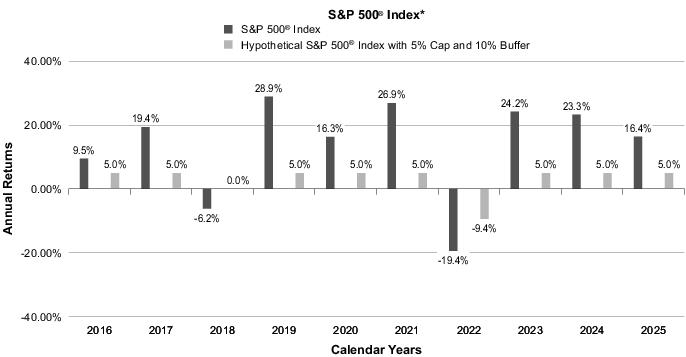
*
This
Index is a “price return index,” not a “total return index,” and therefore does not reflect the dividends
paid on the securities composing the Index, which will reduce the Index Return and may cause the Index to underperform a direct investment
in the securities composing the Index.
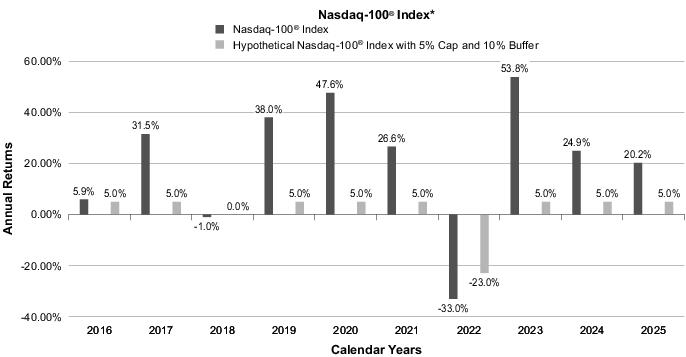
*
This
Index is a “price return index,” not a “total return index,” and therefore does not reflect the dividends
paid on the securities composing the Index, which will reduce the Index Return and may cause the Index to underperform a direct investment
in the securities composing the Index.
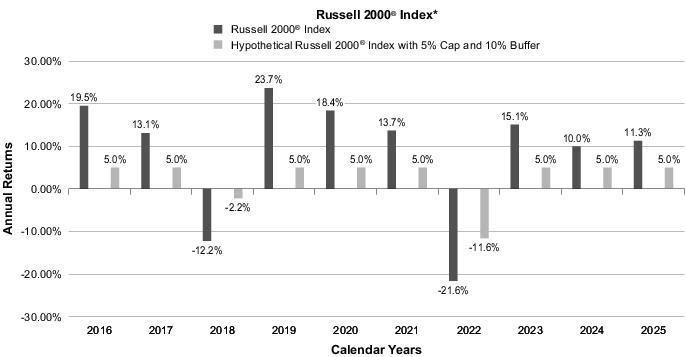
*
This
Index is a “price return index,” not a “total return index,” and therefore does not reflect the dividends
paid on the securities composing the Index, which will reduce the Index Return and may cause the Index to underperform a direct investment
in the securities composing the Index.
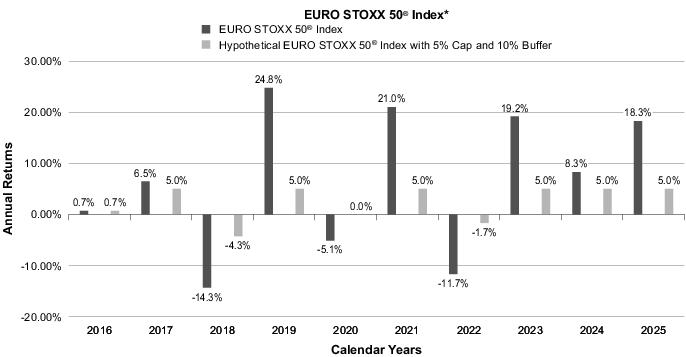
*
This
Index is a “price return index,” not a “total return index,” and therefore does not reflect the dividends
paid on the securities composing the Index, which will reduce the Index Return and may cause the Index to underperform a direct investment
in the securities composing the Index. This Index is a euro “price return index” and Index Returns are determined without
any exchange rate adjustment.
How
the Crediting Methods Work
The Index
Dual Precision Strategy provides a Performance Credit using
the “point-to-point with step-up” method of calculation.
●
You
receive a Performance Credit equal to the Trigger Rate if the Index Value on the Term End Date is:
−
equal
to or greater than the Index Value on the Term Start Date, regardless of the amount of actual Index Return, or
−
less
than the Index Value on the Term Start Date and the loss is less than or equal to the 10% Buffer.
●
If
the Index Return is negative and extends beyond the 10% Buffer, the negative Performance Credit is equal to the negative Index Return
plus the 10% Buffer. You participate in any losses in excess of the 10% Buffer.
The Index
Precision Strategy provides a Performance Credit using
the “point-to-point with step-up” method of calculation.
●
If
the Index Value on the Term End Date is equal to or greater than the Index Value on the Term Start Date, regardless of the amount of actual
Index Return, the Performance Credit is equal to the Trigger Rate.
●
If
the Index Return is negative and the loss:
−
is
less than or equal to the 10% Buffer, the Performance Credit is zero. We absorb any loss up to the 10% Buffer.
−
extends
beyond the 10% Buffer, the negative Performance Credit is equal to the negative Index Return plus the 10% Buffer. You participate in any
losses in excess of the 10% Buffer.
The Index
Performance Strategy provides a Performance Credit. The
1-year Term Index Options use the “point-to-point with Cap” method of calculation. The 3-year and 6-year Term Index Options
use the “point-to-point with Cap and enhanced upside” method of calculation.
●
If
the Index Return is positive, the Performance Credit is equal to:
−
the
Index Return up to the Cap for a 1-year Term. If the 1-year Term is uncapped, the Performance Credit is equal to the Index Return.
−
the
Index Return multiplied by the Participation Rate, up to the Cap for a 3-year or 6-year Term. If the 3-year or 6-year Term is
uncapped, the Performance Credit is equal to the Index Return multiplied by the Participation Rate. We apply the Participation Rate
and Cap for the entire Term length; we do not
apply the Participation Rate and Cap annually on a 3-year or 6-year Term.
●
If
the Index Value on the Term End Date is equal to the Index Value on the Term Start Date, the Performance Credit is zero.
●
If
the Index Return is negative and the loss:
−
is
less than or equal to the 10%, 20%, or 30% Buffer, the Performance Credit is zero. We absorb any loss up to the 10%, 20%, or 30% Buffer.
We apply the Buffer for the entire Term length; we do not
apply the Buffer annually on a 3-year or 6-year Term Index Option.
−
extends
beyond the 10%, 20%, or 30% Buffer, the negative Performance Credit is equal to the negative Index Return plus the 10%, 20%, or 30% Buffer.
You participate in any losses in excess of the 10%, 20%, or 30% Buffer.
|
● The
Index Dual Precision Strategy, Index Precision Strategy, and Index Performance Strategy allow negative
Performance
Credits. As a result, you could lose a significant amount of money in the form of negative
Performance
Credits if an Index declines in value. The
maximum potential negative Performance Credit is:
-90%
with a 10% Buffer, -80% with a 20% Buffer, and -70% with a 30% Buffer. |
|
● Because
we calculate Index Returns only on a single date in time, you may experience negative or flat
performance
even though the Index you selected for a given Crediting Method experienced gains through
some,
or most, of the Term. |
|
● If
an Index Performance
Strategy Index Option is “uncapped” for one Term (i.e., we do not declare a Cap for
that
Term) it does not mean that we will not declare a Cap for it on future Term Start Dates.
On the next Term
Start
Date we can declare a Cap for the next Term, or declare it to be uncapped. |
Comparing
Crediting Methods
The Crediting Methods have different
risk and return potentials.
|
What
is the asset protection? | |
|
Index
Dual Precision
Strategy
|
• Protection
is equal to what is available with the Index Precision Strategy. Protection may be equal to
or
less than what is available with the Index Performance Strategy depending on the Index Option.
• Buffer
absorbs 10% of loss, but you receive a negative Performance Credit for losses greater than
10%.
• Potential
for large losses in any Term.
• More
sensitive to large negative market movements because small negative market movements
within
the 10% Buffer result in a positive Performance Credit. |
|
Index
Precision Strategy |
• Protection
is equal to what is available with the Index Dual Precision Strategy. Protection may be
equal
to or less than what is available with the Index Performance Strategy depending on the Index
Option.
• Buffer
absorbs 10% of loss, but you receive a negative Performance Credit for losses greater than
10%.
• Potential
for large losses in any Term.
• More
sensitive to large negative market movements because small negative market movements are
absorbed
by the 10% Buffer. |
|
Index
Performance
Strategy
|
• Index
Options with a 10% Buffer provide the same protection as the Index Dual Precision Strategy
and
Index Precision Strategy. Index Options with a 20% or 30% Buffer have more protection than
what
is available with the Index Dual Precision Strategy and Index Precision Strategy.
• Buffer
absorbs 10%, 20%, or 30% of loss depending on the Index Option you select, but you receive
a
negative Performance Credit for losses greater than the Buffer.
• Potential
for large losses in any Term.
• More
sensitive to large negative market movements because small or moderate negative market
movements
are absorbed by the Buffer.
• In
extended periods of moderate to large negative market performance, 3-year and 6-year Terms may
provide
less protection than the 1-year Terms because, in part, the Buffer is applied over a longer
period
of time. |
|
What
is the growth opportunity? | |
|
Index
Dual Precision
Strategy
|
• Growth
opportunity limited by the Trigger Rates.
• May
perform best in periods of small negative market movements as it provides a positive
Performance
Credit in these environments while other Crediting Methods do not.
• Generally
less growth opportunity than the Index Precision Strategy and Index Performance Strategy. |
|
Index
Precision Strategy |
• Growth
opportunity limited by the Trigger Rates.
• May
perform best in periods of small positive market movements.
• Generally
more growth opportunity than the Index Dual Precision Strategy. However, less growth
opportunity
than the Index Dual Precision Strategy during periods of small negative market
movements.
• Growth
opportunity may be more or less than the Index Performance Strategy depending on Caps. |
|
Index
Performance
Strategy
|
• Growth
opportunity limited by the Caps and/or Participation Rates. We do not
apply the Cap annually
on
3-year and 6-year Term Index Options. If
we do not declare a Cap for an Index Option, there is
no
maximum limit on the positive Index Return for that Index Option. In addition, you can
receive
more than the positive Index Return if the Participation Rate applies and is greater
than
its 100% minimum. However, the Participation Rate cannot boost Index Returns beyond a
declared
Cap.
• May
perform best in a strong market.
• 1-year
Term with 10% Buffer Index Options, 3-year Term with 10% or 20% Buffer Index Options, and
6-year
Term with 10% or 20% Buffer Index Options have the most growth opportunity.
• Growth
opportunity for the 1-year Term with 20% or 30% Buffer may be less than the Index Dual
Precision
Strategy and Index Precision Strategy depending on Trigger Rates and Caps. |
|
What
can change within a Crediting Method? | |
|
Index
Dual Precision
Strategy
|
• Renewal
and Early Reallocation Trigger Rates for existing Contracts can change on each Term Start
Date.
– 1-year
Term has a 5% minimum Trigger Rate.
• The
10% Buffers for the currently available Index Options cannot change. However, if we add a new
Index
Option to your Contract after the Issue Date, we establish the Buffer for it on the date we add
the
Index Option to your Contract. The minimum Buffer is 5% for a new Index Option. |
|
Index
Precision Strategy |
• Renewal
and Early Reallocation Trigger Rates for existing Contracts can change on each Term Start
Date.
– 1-year
Term has a 5% minimum Trigger Rate.
• The
10% Buffers for the currently available Index Options cannot change. However, if we add a new
Index
Option to your Contract after the Issue Date, we establish the Buffer for it on the date we add
the
Index Option to your Contract. The minimum Buffer is 5% for a new Index Option. |
|
Index
Performance
Strategy
|
• Renewal
and Early Reallocation Caps and/or Participation Rates for existing Contracts can change on
each
Term Start Date.
– 1-year
Term with 30% Buffer has a 3% minimum Cap.
– 1-year
Term with 20% Buffer has a 4% minimum Cap.
– 1-year
Term with 10% Buffer has a 5% minimum Cap.
– 3-year
Term with 30% Buffer has a 9% minimum Cap, and 100% minimum Participation Rate.
– 3-year
Term with 20% Buffer has a 12% minimum Cap, and 100% minimum Participation Rate.
– 3-year
Term with 10% Buffer has a 15% minimum Cap, and 100% minimum Participation Rate.
– 6-year
Term with 30% Buffer has a 18% minimum Cap, and 100% minimum Participation Rate.
– 6-year
Term with 20% Buffer has a 24% minimum Cap, and 100% minimum Participation Rate.
– 6-year
Term with 10% Buffer has a 30% minimum Cap, and 100% minimum Participation Rate.
• The
10%, 20%, and 30% Buffers for the currently available Index Options cannot change. However, if
we
add a new Index Option to your Contract after the Issue Date, we establish the Buffer for it on the
date
we add the Index Option to your Contract. The minimum Buffer is 5% for a new Index Option. |
|
• You
participate in any negative Index Return in excess of the Buffer,
which reduces your Contract Value. For
example,
for a 10% Buffer we absorb the first -10% of Index Return and you could lose up to 90% of the Index Option
Value.
|
|
• Trigger
Rates, Caps, and Participation Rates as set by us from time-to-time may vary substantially based on market
conditions.
However,
in extreme market environments, it is possible that all Trigger Rates, Caps, and Participation
Rates
will be reduced to their respective minimums of 3%, 4%, 5%, 9%, 12%, 15%, 18%, 24%, 30%, or 100% as
stated
in the table above.
Note that the minimum Early Reallocation Trigger Rates or Caps will be at least equal to
these
minimums, but could be higher as discussed in section 6, Valuing Your Contract – Early Reallocation. |
|
• If
your Contract is within its free look period you may be able to take advantage of any increase in initial Trigger
Rates,
Caps, and/or Participation Rates by cancelling your Contract and purchasing a new Contract. |
|
• If
the initial Trigger Rates, Caps, and/or Participation Rates available on the Index Effective Date are not acceptable
you
have the following options: |
|
– Cancel
your Contract if you are still within the free look period. If you took a withdrawal that was subject to a
withdrawal
charge, we will refund any previously deducted withdrawal charge upon a free look cancellation. |
|
– Request
to extend your Index Effective Date if you have not reached your first Quarterly Contract Anniversary. |
|
– If
the free look period has expired, request a full withdrawal and receive the Cash Value. This withdrawal is subject
to
withdrawal charges, income taxes, and may also be subject to a 10% additional federal tax for amounts
withdrawn
before age 59 1∕2.
If this occurs on or
before the Index Effective Date, the
Daily
Adjustment does not apply.
If this occurs after
the Index Effective Date, you are
subject to the Daily Adjustment. |
|
• Trigger
Rates, Caps, and Participation Rates can be different from Index Option to Index Option.
For example,
Caps
for the Index Performance Strategy 1-year Terms can be different between the S&P 500® Index and the
Nasdaq-100®
Index; and Caps for the S&P 500® Index can be different between 1-year, 3-year, and 6-year Terms on
the
Index Performance Strategy. Initial,
renewal, and Early Reallocation rates may also be different from
Contract-to-Contract.
For example, assume that on May 1, 2026 we set Caps for the Index Performance Strategy
1-year
Term with 10% Buffer using the S&P 500® Index as follows: |
|
– 13%
initial rate and 12% Early Reallocation rate for new Contracts issued in 2026, |
|
– 14%
renewal rate and 14% Early Reallocation rate for existing Contracts issued in 2025, and |
|
– 12%
renewal rate and 13% Early Reallocation rate for existing Contracts issued in 2024. |
We apply positive, zero, or negative
Performance Credits at the end of a Term to amounts allocated to an Index Option based, in part, on the performance of the applicable
Index. An investment in an Index Option is not an investment in the Index or in any Index fund.
Performance
Credits. As a result, you could lose a significant amount of money in the form of negative
Performance
Credits if an Index declines in value. The
maximum potential negative Performance Credit is:
-90%
with a 10% Buffer, -80% with a 20% Buffer, and -70% with a 30% Buffer.
Limits
on Index Losses
Each Index Option offers a certain
level of protection from negative Index Returns through the Buffer, which limits the amount of negative Index Return used in calculating
Performance Credits for an Index Option at the end of a Term.
●
A
Buffer is the maximum amount of negative Index Return that we
absorb before applying a negative Performance Credit. For example, if at the end of a Term, the Index Return is -25% and the Buffer is
10%, we apply a Performance Credit of -15%, meaning your Contract Value allocated to that Index Option will decrease by 15% since the
Term Start Date. This reflects the negative Index Return that exceeds the protection of the 10% Buffer.
●
We
currently offer Index Options with 10%, 20%, and 30% Buffers.
The current limit on Index loss for
an Index Option will not change for the life of that Index Option. However,
we reserve the right to add new Index Options. As such, the limits on Index loss offered under the Contract may change from one Term to
the next if we add an Index Option.
Prior to selecting an Index Option,
you should evaluate the protection from negative Index Returns offered by an Index Option. See “Comparing Crediting Methods”
later in this section for additional factors that you should consider when comparing Index Options. Also, see “How We Set Limits
on Index Gains and Losses” below for a description of the factors that we consider when setting rates for the Index Options.
For detailed information on how we
calculate Index Option Values and Performance Credits, see “Determining Index Option Values” and “Calculating Performance
Credits” in section 6, Valuing Your Contract later in this prospectus.
Limits
on Index Gains
Each Index Option also has an upside
feature, either a Trigger Rate, Cap, and/or Participation Rate, used in the calculation of positive Performance Credits, if any,
that may be credited to your investment at the end of a Term. We may limit the amount you can earn on an Index Option based on the Trigger Rate,
Cap, or Participation Rate, as applicable.
●
A
Trigger Rate represents the positive Performance Credit, if any, that may apply on the Term End Date. The Index Precision Strategy and
Index Dual Precision Strategy offer Index Options with a Trigger Rate.
−
For
the Index Precision Strategy, the Trigger Rate will apply if the Index Return is positive or zero. For example, if at the end of a Term,
the Index Return is 6% and the Trigger Rate is 3%, we apply a Performance Credit of 3%, meaning your Contract Value allocated to that
Index Option will increase by 3% since the Term Start Date.
−
For
the Index Dual Precision Strategy, the Trigger Rate will apply if the Index Return is positive, zero, or to a limited extent, negative.
For example, assume a Trigger Rate of 3% and a Buffer of 10%. If at the end of a Term, the Index Return is positive, zero, or negative
but no lower than -10% (i.e.,
not in excess of the Buffer), we apply a positive Performance Credit of 3%, meaning your Contract Value allocated to that Index Option
will increase by 3% since the Term Start Date. However, if the negative Index Return were lower than -10% (i.e.,
in excess of the Buffer), we apply a negative Performance Credit equal to the negative Index Return plus the Buffer.
●
A
Cap represents the maximum positive Performance Credit, if any, applied on a Term End Date. For example, if at the end of a Term, the
Index Return is 12% and the Cap is 10%, we apply a Performance Credit of 10%, meaning your Contract Value allocated to that Index Option
will increase by 10% since the Term Start Date. The Index Performance Strategy offers Index Options with a Cap. Index Performance Strategy
multi-year Term Index Options have both a Cap and a Participation Rate (as described below).
●
A
Participation Rate is the percentage that is multiplied by a positive Index Return in calculating a positive Performance Credit, if any,
subject to any applicable Cap. For example, if at the end of a Term, the Participation Rate is 100%, the Cap is 15%, and the Index Return
is 12% (which is lower than the Cap), we apply a Performance Credit of 12% (i.e.,
100% x 12%). However, if the Index Return were instead 20% (which is higher than the Cap), we would apply the Cap and a Performance Credit
of 15%. Index Performance Strategy multi-year Term Index Options have both a Cap and a Participation Rate.
The Trigger Rate, Cap, and/or
Participation Rate for an Index Option will change from Term to Term, subject to a specified guaranteed minimum that will not change for
the life of that Index Option. Guaranteed minimum Trigger Rates, Caps, and/or Participation Rates vary by Index Option.
*
This
Index is a “price return index,” not a “total return index,” and therefore does not reflect the dividends
paid on the securities composing the Index, which will reduce the Index Return and may cause the Index to underperform a direct investment
in the securities composing the Index.
*
This
Index is a “price return index,” not a “total return index,” and therefore does not reflect the dividends
paid on the securities composing the Index, which will reduce the Index Return and may cause the Index to underperform a direct investment
in the securities composing the Index.
*
This
Index is a “price return index,” not a “total return index,” and therefore does not reflect the dividends
paid on the securities composing the Index, which will reduce the Index Return and may cause the Index to underperform a direct investment
in the securities composing the Index.
*
This
Index is a “price return index,” not a “total return index,” and therefore does not reflect the dividends
paid on the securities composing the Index, which will reduce the Index Return and may cause the Index to underperform a direct investment
in the securities composing the Index. This Index is a euro “price return index” and Index Returns are determined without
any exchange rate adjustment.
The Daily Adjustment approximates
the Index Option Value that will be available on the Term End Date. It is the estimated present value of the future Performance Credit
that we will apply on the Term End Date. The Daily Adjustment primarily takes into account:
(i)
any
Index gains during the Term subject to the applicable Trigger Rate, Cap, and/or Participation Rate,
(ii)
for
the Index Dual Precision Strategy, any Index losses less than or equal to the 10% Buffer,
(iii)
any
Index losses greater than the 10%, 20%, or 30% Buffer, and
(iv)
the
number of days until the Term End Date.
A withdrawal taken during the Term
may not receive the full benefit of the Buffer because the Daily Adjustment takes into account what may potentially happen between the
withdrawal date and the Term End Date. All other factors being equal, even if the current Index return during the Term is greater than
the Trigger Rate or Cap, the Daily Adjustment will usually be lower than the Cap or Trigger Rate. For the Index Precision Strategy,
even if the current Index return during the Term is greater than or equal to zero, the Daily Adjustment will usually be lower than the
Trigger Rate. For the Index Dual Precision Strategy, even if the Index return is greater than -10%, the Daily Adjustment will usually
be lower than the Trigger Rate. This is because there is a possibility that the Index return could decrease before the Term End Date.
Similarly, even though a negative Index return may be within the 10%, 20%, or 30% Buffer, you still may receive a negative Daily Adjustment
because there is a possibility that the Index Return could decrease before the Term End Date. The Daily Adjustment for Index Options with
a Term length of more than 1 year may be more negatively impacted by changes in the expected volatility of Index prices than 1-year Term
Index Options due to the difference in Term length. Also, the risk of a negative Daily Adjustment is generally greater for Index
Options with a Term length of more than 1 year than for 1-year Term Index Options due to the Term length. 3-year and 6-year Term Index
Options with a Participation Rate above 100% may also have larger fluctuations in the Daily Adjustment than Index Options either without
a Participation Rate, or with a Participation Rate equal to 100%. A
negative Daily Adjustment may cause you to realize loss of principal and previous earnings.
Such
losses will be greater if the amount withdrawn is also subject to a withdrawal charge, or is a deduction of Contract fees and expenses.
10. Benefits Available Under the Contract
The following tables summarize information
about the benefits available under the Contract.
|
Standard
Benefits (No Additional Charge) | ||
|
Name
of
Benefit
|
Purpose
|
Brief
Description of Restrictions/Limitations |
|
Free
Withdrawal
Privilege
|
Allows
you to withdraw up to 10% of your total
Purchase
Payments each Contract Year without
incurring
a withdrawal charge. |
• Only
available during the Accumulation Phase.
• Not
available upon a full withdrawal.
• Unused
free withdrawal amounts not available in
future
years.
• Program
withdrawals may be subject to negative
Daily
Adjustments.
• Program
withdrawals are subject to income taxes,
and
may also be subject to a 10% additional
federal
tax for amounts withdrawn before age
59 1∕2.
|
|
Minimum
Distribution
Program
|
Allows
you to automatically take withdrawals to
satisfy
the required minimum distribution
requirements
(RMD) imposed by the Internal
Revenue
Code. |
• Only
available during the Accumulation Phase.
• Only
available to IRA or SEP IRA Contracts.
• Generally
required for Inherited IRA and Inherited
Roth
IRA Contracts.
• Program
withdrawals count against the free
withdrawal
privilege.
• Program
withdrawals may be subject to negative
Daily
Adjustments.
• Program
withdrawals are subject to income taxes.
• Program
withdrawals may be monthly, quarterly,
semi-annual
or annual, unless you have less than
$25,000
in Contract Value, in which case only
annual
payments are available.
• We
reserve the right to discontinue or modify the
program
subject to the requirements of law. |
|
Waiver
of
Withdrawal
Charge
Benefit
|
Waives
withdrawal charges if you are confined for
care
or are unable to perform at least two out of six
activities
of daily living (ADLs). |
• Only
available during the Accumulation Phase.
• Confinement
must begin after the first Contract
Anniversary,
be for at least 90 days in a 120-day
period,
and requires proof of stay. We require
additional
proof of qualification for this benefit
annually.
• Inability
to perform two ADLs must be for at least
90
continuous days and may require an exam or
tests
by a physician.
• Not
available if, on the Issue Date, any Owner was
confined
to an eligible facility, or unable to perform
all
six ADLs.
• Program
withdrawals count against the free
withdrawal
privilege.
• Program
withdrawals may be subject to negative
Daily
Adjustments.
• Program
withdrawals are not subject to withdrawal
charges,
but are subject to income taxes, and may
also
be subject to a 10% additional federal tax for
amounts
withdrawn before age 59 1∕2.
• State
variations may apply. |
|
Standard
Benefits (No Additional Charge) | ||
|
Name
of
Benefit
|
Purpose
|
Brief
Description of Restrictions/Limitations |
|
Traditional
Death
Benefit |
Provides
a death benefit equal to the greater of the
Contract
Value, or Guaranteed Death Benefit Value.
The
Guaranteed Death Benefit Value is total
Purchase
Payments adjusted for withdrawals.
Examples
of the death benefit provided by the
Traditional
Death Benefit, and how withdrawals
impact
this benefit, are included in section 11, Death
Benefit.
|
• Benefit
only available during the Accumulation
Phase.
• Withdrawals,
including any negative Daily
Adjustments,
may significantly reduce the benefit
as
indicated in section 11, Death Benefit.
• Restrictions
on Purchase Payments may limit the
benefit.
• Annuitizing
the Contract will end the benefit. |
|
Performance
Lock |
Allows
you to capture the current Index Option Value
during
the Term for an Index Option. Can help
eliminate
doubt about future Index performance and
possibly
limit the impact of negative performance.
Can
allow you to transfer out of an Index Option
before
the Term End Date.
A
Performance Lock example is included in section
6,
Valuing Your Contract — Performance Locks. |
• Available
during the Accumulation Phase.
•
Performance Locks must be executed before the
Term
End Date.
• If
a Performance Lock is executed, the locked
Index
Option will no longer participate in Index
performance
(positive or negative) for the
remainder
of the Term, and will not receive a
Performance
Credit on the Term End Date.
• You
will not know your locked Index Option Value
in
advance.
• The
locked Index Option Value will reflect a Daily
Adjustment.
• If
a Performance Lock is executed when the Daily
Adjustment
has declined, it will lock in any loss.
• A
Performance Lock can be executed only once
each
Term for each Index Option.
• Cannot
execute a Performance Lock for only a
portion
of the Index Option Value.
• Deductions
(e.g. withdrawals, fees) decrease the
locked
Index Option Value.
• Cannot
transfer locked Index Option Value until the
next
Index Anniversary that occurs on or
immediately
after the Lock Date unless you
execute
an Early Reallocation.
• We
will not provide advice or notify you
regarding
whether you should execute a
Performance
Lock or the optimal time for doing
so,
if any.
• We
will not warn you if you execute a
Performance
Lock at a sub-optimal time.
• We
are not responsible for any losses related
to
your decision whether or not to execute a
Performance
Lock. |
|
Standard
Benefits (No Additional Charge) | ||
|
Name
of
Benefit
|
Purpose
|
Brief
Description of Restrictions/Limitations |
|
Early
Reallocation |
Allows
you to transfer out all assets you allocate to
the
Variable Option, and/or that we hold in the
Variable
Option on an interim basis, and/or all assets
in
locked Index Options on days other than an Index
Anniversary.
An
Early Reallocation Request example is included
in
section 6, Valuing Your Contract — Early
Reallocation.
|
• Available
during the Accumulation Phase.
• Early
Reallocation requests are not accepted
before
the Index Effective Date, or within 14
calendar
days before an Index Anniversary.
• Index
Performance Strategy 6-year Term Index
Options
and the Variable Option are not available
as
destinations for an Early Reallocation transfer.
• On
October 13, 2026, the limit for Early
Reallocations
increases from 12 each Index Year
to
24.
• All
Index Options can be temporarily unavailable
for
Early Reallocation at any time, which
means
there
may be times when Early Reallocation is
unavailable
to you.
• We
will not provide advice or notify you
regarding
whether you should execute an Early
Reallocation
or the optimal time for doing so, if
any.
• We
will not warn you if you execute an Early
Reallocation
at a sub-optimal time.
• We
are not responsible for any losses related
to
your decision whether or not to execute an
Early
Reallocation. |
11. Death Benefit
“You” in this section
refers to the Owner, or the Annuitant if the Contract is owned by a non-individual.
The Contract provides the Traditional
Death Benefit for no additional charge. The death benefit is the greater of the Contract Value, or Guaranteed Death Benefit Value. The
Traditional Death Benefit’s Guaranteed Death Benefit Value is total Purchase Payments reduced proportionately for withdrawals you
take (including any withdrawal charge).
The death benefit
is only available during the Accumulation Phase. If you
or the Determining Life (Lives) die during the Accumulation Phase, we process the death benefit using prices determined after we receive
the required information, which is either a Valid Claim or due proof of death as stated here. (For information on due proof of death see
the Glossary – Valid Claim). If we receive this information at or after the end of the current Business Day, we use the next Business
Day’s prices.
If there are multiple Beneficiaries,
each Beneficiary receives the portion of the death benefit he or she is entitled to when we receive his or her Valid Claim. If a Beneficiary
dies before you or the Designated Life, that Beneficiary’s interest in this Contract ends unless your Beneficiary designation specifies
otherwise. If there are no remaining Beneficiaries, or no named Beneficiaries, we pay the death benefit to your estate, or if the Owner
is a non-individual, to the Owner. Unless you instruct us to pay Beneficiaries a specific percentage of the death benefit, each Beneficiary
receives an equal share.
Each Beneficiary’s portion
of the death benefit remains in the Investment Options based on the allocation instructions that were in effect on the date of death until
we receive his or her Valid Claim and we either pay the claim or the Beneficiary provides alternate allocation instructions. If there
is Variable Account Value in the Variable Option awaiting transfer to the Index Options on the date of death, it remains there
until the next Index Anniversary. If an Index Anniversary occurs before we receive a Valid Claim, we will transfer that Beneficiary’s
portion of the Variable Account Value destined for the Index Options based on the allocation instructions that were in effect on the date
of death.
From the time we determine the death
benefit until we make a complete distribution, any amount in the Investment Options continues to be subject to investment risk that is
borne by the recipient(s). Once we receive notification of death, we may
no longer accept
or process transfer requests. After we receive the first Valid Claim from any Beneficiary, we also will not accept additional Purchase
Payments or allow any partial or full withdrawals unless the withdrawal is required to comply with federal tax law.
On the first death of a Determining
Life during the Accumulation Phase, if the Traditional Death Benefit is in effect, your Beneficiary(ies) will receive the greater of the
Contract Value or Guaranteed Death Benefit Value. The Guaranteed Death Benefit Value is total Purchase Payments reduced proportionately
for withdrawals you take (including any withdrawal charge). For example, assume total Purchase Payments are $90,000, you take no
withdrawals, and the current Contract Value is $100,000. The death benefit for the Traditional Death Benefit is the $100,000 Contract
Value.
If the date we are determining the
death benefit is not the Term End Date, the Contract Value reflects the Daily Adjustment. Withdrawals you take reduce your Guaranteed
Death Benefit Value by the percentage of Contract Value withdrawn (including any withdrawal charge), determined at the end of each Business
Day. All withdrawals
you take reduce the Guaranteed Death Benefit Value and Contract Value, even Penalty-Free Withdrawals. However,
we do not reduce the Guaranteed Death Benefit Value for deductions we make for Contract fees and expenses. Deductions
for Contract fees and expenses will, however, decrease the Contract Value by the dollar amount withdrawn. In addition, because
the death benefit is the greater of Contract Value or the Guaranteed Death Benefit Value, deductions we make for Contract fees and expenses
may reduce the death benefit available to your Beneficiaries.
Withdrawal
Example
These calculations show the effects
of taking a withdrawal on the Contract Value and available Guaranteed Death Benefit Value. Withdrawals (including any withdrawal charges)
immediately reduce the Contract Value on a dollar for dollar basis, and reduce the Traditional Death Benefit’s Guaranteed Death
Benefit Value by the percentage of Contract Value withdrawn.
The example assumes a withdrawal
of $5,000 once per year on days that are not Term End Dates starting when the Contract Value is $100,000, and the Guaranteed Death Benefit
Value under the Traditional Death Benefit is $90,000. The first withdrawal assumes that there is no amount remaining under the free withdrawal
privilege for that year, so that withdrawal is subject to an 8% withdrawal charge. Subsequent withdrawals are all taken under the free
withdrawal privilege. All fractional numbers in these examples have been rounded up to the next whole number. All Contract Value figures
reflect the Daily Adjustment.
|
Withdrawal
|
Contract
Value
|
Traditional
Death Benefit’s Guaranteed Death Benefit |
|
Prior
to 1st
year’s withdrawal |
$
100,000 |
$
90,000 |
|
$5,000
withdrawal (subject to an 8% |
|
|
|
withdrawal
charge) |
–
[$5,000 ÷ (1 – 8%)] |
–
[($5,435 ÷ 100,000) x 90,000] |
|
Amount
withdrawn |
–
$5,435 |
=
- $4,892 |
|
After
1st
year’s withdrawal |
$
94,565 |
$
85,108 |
|
|
|
|
|
Prior
to 2nd
year’s withdrawal |
$
97,000 |
$
85,108 |
|
$5,000
withdrawal (not subject to a |
|
|
|
withdrawal
charge) |
–
$5,000 |
–
[($5,000 ÷ 97,000) x 85,108] |
|
Amount
withdrawn |
=
- $5,000 |
=
- $4,388 |
|
After
2nd
year’s withdrawal |
$
92,000 |
$
80,720 |
|
|
|
|
|
Prior
to 3rd
year’s withdrawal |
$
80,000 |
$
80,720 |
|
$5,000
withdrawal (not subject to a |
|
|
|
withdrawal
charge) |
–
$5,000 |
–
[($5,000 ÷ 80,000) x 80,720] |
|
Amount
withdrawn |
=
- $5,000 |
=
- $5,045 |
|
After
3rd
year’s withdrawal |
$
75,000 |
$
75,675 |
The death benefit is the greater
of the Contract Value, or the Guaranteed Death Benefit Value, so the death benefit would be:
●
$94,565
Contract Value after the first withdrawal.
●
$92,000
Contract Value after the second withdrawal.
●
$75,675
Guaranteed Death Benefit Value after the third withdrawal.
What Happens Upon Death?
If you are the Determining Life,
or if you and the Determining Life (Lives) are different individuals and die simultaneously as described in the discussion of Beneficiaries
in section 2, Ownership, Annuitants, Determining Life, Beneficiaries and Payees, we determine the Traditional Death Benefit at the end
of the Business Day we receive a Valid Claim. For multiple Beneficiaries, each surviving Beneficiary receives the greater of their portion
of the:
●
Guaranteed
Death Benefit Value determined at the end of the Business Day we receive the first Valid Claim from any one Beneficiary, or
●
Contract
Value determined at the end of the Business Day during which we receive his or her Valid Claim.
In this instance, if the Beneficiary:
−
is
a surviving spouse and chooses to continue the Contract;
−
selects
death benefit payment Option B; or
−
selects
death benefit payment Option C and takes payment over a period not extending beyond the Beneficiary’s life expectancy;
we increase the Contract Value to
equal the Guaranteed Death Benefit Value if greater when we receive a Valid Claim.
If you and the Determining Life (Lives)
are different individuals and do not die simultaneously, the death benefit is as follows. This
can only occur if you change the Owner after the Issue Date.
●
If
a Determining Life dies before you, we do not pay a death benefit to the Beneficiary(ies), but we may increase the Contract Value if the
Traditional Death Benefit is still in effect. At the end
of the Business Day we receive due proof of a Determining Life’s death, we increase the Contract Value to equal the Guaranteed
Death Benefit Value if greater, and
the Traditional Death Benefit ends.
●
Upon
your death, your Beneficiary(ies) receive the Contract Value determined at the end of the Business Day during which we receive each Beneficiary’s
Valid Claim.
Upon the death of a Determining Life,
if we increase the Contract Value to equal the Guaranteed Death Benefit Value, we allocate this increase to the Variable Option. On the
next Index Anniversary, we transfer these assets according to the allocation instructions. However, if the allocation instructions include
any temporarily unavailable Index Option(s), those assets will remain in the Variable Option until either, (1) we receive a change to
allocation instructions that transfer these assets to available Index Option(s), or (2) an Early Reallocation is executed. Executing
an Early Reallocation will result in the remaining time prior to your next Index Anniversary being added to your new Term length. For
example, assume your next Index Anniversary is in four months. At this point, you elect an Early Reallocation and choose a new 3-Year
term Index Option. The remaining four months prior to the next Index Anniversary will be added to the new 3-year Term for your newly selected
Index Option, extending the new Term length to 40
months.
The Traditional
Death Benefit ends upon the earliest of the following:
●
The
Business Day before the Annuity Date.
●
The
Business Day that the Guaranteed Death Benefit Value and Contract Value are both zero.
●
Upon
the death of a Determining Life, the end of the Business Day we receive a Valid Claim from all Beneficiaries if you and the Determining
Life are the same individual, or if you and the Determining Life (Lives) are different individuals and die simultaneously.
●
Upon
the death of a Determining Life, the end of the Business Day we receive due proof of the Determining Life’s death if you and the
Determining Life (Lives) are different individuals and do not die simultaneously.
●
Upon
the death of an Owner (or Annuitant if the Owner is a non-individual), the end of the Business Day we receive the first Valid Claim from
any one Beneficiary, if the Owner (or Annuitant) is no longer a Determining Life.
●
The
Business Day the Contract ends.
|
We
base the Guaranteed Death Benefit Value on the first death of a Determining Life (or Lives). This means that upon
the
death of an Owner (or Annuitant if the Owner is a non-individual), if
a surviving spouse continues
the
Contract, the
Guaranteed
Death Benefit Value is no longer available.
Also,
if you and the Determining Life (Lives) are different
individuals
and you die first, the Guaranteed Death Benefit Value is not available to your Beneficiary(ies). |
Death
of the Owner and/or Annuitant
The SAI includes tables that are
intended to help you better understand what happens upon the death of any Owner and/or Annuitant under the different phases of the Contract.
Death
Benefit Payment Options During the Accumulation Phase
Each Beneficiary must select one
of the death benefit payment options listed below.
If a Beneficiary requests a lump
sum payment under Option A, we pay that Beneficiary within seven days of receipt of his or her Valid Claim, unless the suspension of payments
or transfers provision is in effect. Payment of the death benefit may be delayed, pending receipt of any state forms.
Spousal Continuation:
If the Beneficiary is the deceased Owner’s spouse, he or she can choose to continue the Contract with the portion of the death
benefit the spouse is entitled to in his or her own name. However, spousal continuation is not available if this is an Inherited IRA,
or Inherited Roth IRA (i.e., spousal continuation is not available to a successor beneficiary - the spouse of the original Beneficiary).
For an IRA, Roth IRA, or SEP IRA Contract, spousal continuation can only occur if the surviving spouse is the Contract’s sole primary
Beneficiary. For Qualified Contracts purchased
through a qualified
plan, spousal continuation is only available through a direct rollover to an IRA. Spouses
must qualify as such under federal law to continue the Contract.
Individuals who have entered into a registered domestic partnership, civil union, or other similar relationship that is not considered
to be a marriage under state law are also not considered to be married under federal law. An election by the spouse to continue the Contract
must be made on the death claim form before we pay the death benefit. If the deceased Owner was a Determining Life and the surviving spouse
Beneficiary continues the Contract, at the end of the Business Day we receive his or her Valid Claim, we increase the Contract Value to
equal the Guaranteed Death Benefit Value if greater and available, and the Traditional Death Benefit ends. If the surviving spouse continues
the Contract:
●
he
or she becomes the new Owner and may exercise all of the Owner’s rights, including naming a new Beneficiary or Beneficiaries;
●
he
or she is subject to any remaining withdrawal charge period; and
●
upon
the surviving spouse’s death, their Beneficiary(ies) receive the Contract Value determined at the end of the Business Day during
which we receive a Valid Claim from each Beneficiary.
Death
Benefit Payment Options
The following applies to Non-Qualified
Contracts. Different rules may apply to Qualified Contracts. For more information, please see section 12, Taxes – Distributions
Upon the Owner’s Death (or Annuitant’s Death if the Owner is a Non-Individual).
Option A:
Lump sum payment of the death benefit.
Option B:
Payment of the entire death benefit within five years of the date of any Owner’s death. The Beneficiary can continue to make transfers
between Investment Options and is subject to a 1.25% M&E charge for any amounts allocated to the Variable Option.
Option C:
If the Beneficiary is an individual, payment of the death benefit as Annuity Payments under Annuity Options A, B, or C. If you take the
death benefit as Annuity Payments, we do not require that the Annuity Date occur on an Index Anniversary. With our written consent other
options may be available for payment over a period not extending beyond the Beneficiary’s life expectancy under which the Beneficiary
can continue to make transfers between Investment Options and is subject to a 1.25% M&E charge for any amounts allocated to the Variable
Option.
Distribution from Non-Qualified Contracts
under Option C must begin within one year of the date of the Owner’s death. Any portion of the death benefit from Non-Qualified
Contracts not applied to Annuity Payments within one year of the date of the Owner’s death must be distributed within five years
of the date of death.
If a Non-Qualified Contract is owned
by a non-individual, then we treat the death of an Annuitant as the death of an Owner for purposes of the Code’s distribution at
death rules, which are set forth in Section 72(s) of the Code.
In all events, notwithstanding any
provision to the contrary in the Contract or this prospectus, a Non-Qualified Contract is interpreted and administered in accordance with
Section 72(s) of the Code.
|
Standard
Benefits (No Additional Charge) | ||
|
Name
of
Benefit
|
Purpose
|
Brief
Description of Restrictions/Limitations |
|
Free
Withdrawal
Privilege
|
Allows
you to withdraw up to 10% of your total
Purchase
Payments each Contract Year without
incurring
a withdrawal charge. |
• Only
available during the Accumulation Phase.
• Not
available upon a full withdrawal.
• Unused
free withdrawal amounts not available in
future
years.
• Program
withdrawals may be subject to negative
Daily
Adjustments.
• Program
withdrawals are subject to income taxes,
and
may also be subject to a 10% additional
federal
tax for amounts withdrawn before age
59 1∕2.
|
|
Minimum
Distribution
Program
|
Allows
you to automatically take withdrawals to
satisfy
the required minimum distribution
requirements
(RMD) imposed by the Internal
Revenue
Code. |
• Only
available during the Accumulation Phase.
• Only
available to IRA or SEP IRA Contracts.
• Generally
required for Inherited IRA and Inherited
Roth
IRA Contracts.
• Program
withdrawals count against the free
withdrawal
privilege.
• Program
withdrawals may be subject to negative
Daily
Adjustments.
• Program
withdrawals are subject to income taxes.
• Program
withdrawals may be monthly, quarterly,
semi-annual
or annual, unless you have less than
$25,000
in Contract Value, in which case only
annual
payments are available.
• We
reserve the right to discontinue or modify the
program
subject to the requirements of law. |
|
Waiver
of
Withdrawal
Charge
Benefit
|
Waives
withdrawal charges if you are confined for
care
or are unable to perform at least two out of six
activities
of daily living (ADLs). |
• Only
available during the Accumulation Phase.
• Confinement
must begin after the first Contract
Anniversary,
be for at least 90 days in a 120-day
period,
and requires proof of stay. We require
additional
proof of qualification for this benefit
annually.
• Inability
to perform two ADLs must be for at least
90
continuous days and may require an exam or
tests
by a physician.
• Not
available if, on the Issue Date, any Owner was
confined
to an eligible facility, or unable to perform
all
six ADLs.
• Program
withdrawals count against the free
withdrawal
privilege.
• Program
withdrawals may be subject to negative
Daily
Adjustments.
• Program
withdrawals are not subject to withdrawal
charges,
but are subject to income taxes, and may
also
be subject to a 10% additional federal tax for
amounts
withdrawn before age 59 1∕2.
• State
variations may apply. |
|
Standard
Benefits (No Additional Charge) | ||
|
Name
of
Benefit
|
Purpose
|
Brief
Description of Restrictions/Limitations |
|
Traditional
Death
Benefit |
Provides
a death benefit equal to the greater of the
Contract
Value, or Guaranteed Death Benefit Value.
The
Guaranteed Death Benefit Value is total
Purchase
Payments adjusted for withdrawals.
Examples
of the death benefit provided by the
Traditional
Death Benefit, and how withdrawals
impact
this benefit, are included in section 11, Death
Benefit.
|
• Benefit
only available during the Accumulation
Phase.
• Withdrawals,
including any negative Daily
Adjustments,
may significantly reduce the benefit
as
indicated in section 11, Death Benefit.
• Restrictions
on Purchase Payments may limit the
benefit.
• Annuitizing
the Contract will end the benefit. |
|
Performance
Lock |
Allows
you to capture the current Index Option Value
during
the Term for an Index Option. Can help
eliminate
doubt about future Index performance and
possibly
limit the impact of negative performance.
Can
allow you to transfer out of an Index Option
before
the Term End Date.
A
Performance Lock example is included in section
6,
Valuing Your Contract — Performance Locks. |
• Available
during the Accumulation Phase.
•
Performance Locks must be executed before the
Term
End Date.
• If
a Performance Lock is executed, the locked
Index
Option will no longer participate in Index
performance
(positive or negative) for the
remainder
of the Term, and will not receive a
Performance
Credit on the Term End Date.
• You
will not know your locked Index Option Value
in
advance.
• The
locked Index Option Value will reflect a Daily
Adjustment.
• If
a Performance Lock is executed when the Daily
Adjustment
has declined, it will lock in any loss.
• A
Performance Lock can be executed only once
each
Term for each Index Option.
• Cannot
execute a Performance Lock for only a
portion
of the Index Option Value.
• Deductions
(e.g. withdrawals, fees) decrease the
locked
Index Option Value.
• Cannot
transfer locked Index Option Value until the
next
Index Anniversary that occurs on or
immediately
after the Lock Date unless you
execute
an Early Reallocation.
• We
will not provide advice or notify you
regarding
whether you should execute a
Performance
Lock or the optimal time for doing
so,
if any.
• We
will not warn you if you execute a
Performance
Lock at a sub-optimal time.
• We
are not responsible for any losses related
to
your decision whether or not to execute a
Performance
Lock. |
|
Standard
Benefits (No Additional Charge) | ||
|
Name
of
Benefit
|
Purpose
|
Brief
Description of Restrictions/Limitations |
|
Early
Reallocation |
Allows
you to transfer out all assets you allocate to
the
Variable Option, and/or that we hold in the
Variable
Option on an interim basis, and/or all assets
in
locked Index Options on days other than an Index
Anniversary.
An
Early Reallocation Request example is included
in
section 6, Valuing Your Contract — Early
Reallocation.
|
• Available
during the Accumulation Phase.
• Early
Reallocation requests are not accepted
before
the Index Effective Date, or within 14
calendar
days before an Index Anniversary.
• Index
Performance Strategy 6-year Term Index
Options
and the Variable Option are not available
as
destinations for an Early Reallocation transfer.
• On
October 13, 2026, the limit for Early
Reallocations
increases from 12 each Index Year
to
24.
• All
Index Options can be temporarily unavailable
for
Early Reallocation at any time, which
means
there
may be times when Early Reallocation is
unavailable
to you.
• We
will not provide advice or notify you
regarding
whether you should execute an Early
Reallocation
or the optimal time for doing so, if
any.
• We
will not warn you if you execute an Early
Reallocation
at a sub-optimal time.
• We
are not responsible for any losses related
to
your decision whether or not to execute an
Early
Reallocation. |
Appendix A – Investment Options Available Under the Contract
Variable
Option
The following includes information
about the Fund available under the Contract. More information about the Fund is available in the Fund’s prospectus, which may be
amended from time to time and can be found online at https://www.allianzlife.com/variableoptions. You can also request this information
at no cost by calling (800) 624-0197, or by sending an email request to prospectus.request@allianzlife.com.
The current expenses and performance
information below reflects fees and expenses of the Fund, but do not reflect the other fees and expenses that your Contract may charge.
Expenses would be higher and performance would be lower if these other charges were included. The Fund’s past performance is not
necessarily an indication of future performance.
|
Investment
Objective |
Fund
and
Adviser/Subadviser
|
Current
Expenses
|
Average
Annual Total Returns
(as
of December 31, 2025) | ||
|
1
Year |
5
Years |
10
Years | |||
|
Current
income consistent with
stability
of principal |
AZL®
Government Money
Market
Fund(1)
Adviser:
Allianz
Investment
Management
LLC
Subadviser:
BlackRock
Advisors,
LLC |
0.65%
|
3.70%
|
2.62%
|
1.57%
|
(1)
The
AZL®
Government Money Market Fund’s annual expenses reflect a temporary fee reduction. Please see the AZL®
Government Money Market Fund’s prospectus for information regarding the expense reimbursement or fee waiver arrangement.
Index
Options
The following is a list of Index
Options currently available under the Contract. We may change certain features of the Index Options listed below (including the Index
and the current limits on Index gains) and offer new Index Options. We will provide you with written notice before making any changes
other than changes to current limits on Index gains. Information about current limits on Index gains is available at https://www.allianzlife.com/RILANYRates.
Note: If amounts
are removed from an Index Option before the Term End Date, we will apply a Daily Adjustment. This may result in a significant reduction
in your Contract Value that could exceed any protection from Index loss that would be in place if such amounts were not removed from the
Index Option until the Term End Date.
For more information about the Index
Options’ features, see section 4, Index Options, and section 6, Valuing Your Contract. For more information about Daily Adjustment,
see section 7, Expenses and Adjustments – Daily Adjustment.
|
Index
|
Index
Type |
Crediting
Period
(Term
Length)
|
Index
Crediting
Methodology
|
Current
Limit on
Index
Loss
(if
held until
Term
End Date) |
Minimum
Limit on Index Gain
(for
the life of the Index
Option)
|
|
Index
Dual Precision Strategy | |||||
|
S&P
500® Index(1)
|
U.S.
large-cap equities |
1-year
Term |
Point-to-point
with
step-up |
10%
Buffer
|
5%
minimum Trigger Rate |
|
Russell
2000® Index(1)
|
U.S.
small-cap equities | ||||
|
Nasdaq-100®
Index(1)
|
U.S.
& international
non-financial
large-cap
equities
| ||||
|
EURO
STOXX 50®(1)
|
Eurozone
large-cap equities | ||||
|
Index
|
Index
Type |
Crediting
Period
(Term
Length)
|
Index
Crediting
Methodology
|
Current
Limit on
Index
Loss
(if
held until
Term
End Date) |
Minimum
Limit on Index Gain
(for
the life of the Index
Option)
|
|
Index
Precision Strategy | |||||
|
S&P
500® Index(1)
|
U.S.
large-cap equities |
1-year
Term |
Point-to-point
with
step-up |
10%
Buffer
|
5%
minimum Trigger Rate |
|
Russell
2000® Index(1)
|
U.S.
small-cap equities | ||||
|
Nasdaq-100®
Index(1)
|
U.S.
& international
non-financial
large-cap
equities
| ||||
|
EURO
STOXX 50®(1)
|
Eurozone
large-cap equities | ||||
|
Index
Performance Strategy
• For
Contracts issued before October 13, 2026, all 1-year Term Index Options listed below are available. Additionally, only the 3-year Term
with 10%, 20%,
and
30% Buffers for the S&P 500® Index and Russell 2000® Index are available; and only the 6-year Term with 10%, 20%, and 30%
Buffers for the S&P
500®
Index and Russell 2000® Index are available.
• For
Contracts issued since October 13, 2026, all 1-year, 3-year, and 6-year Term Index Options listed below are available. | |||||
|
S&P
500® Index(1)
|
U.S.
large-cap equities |
1-year
Term |
Point-to-point
with
Cap |
• 10%
Buffer
• 20%
Buffer
• 30%
Buffer
|
• 3%
minimum Cap(2)
for 30%
Buffer
• 4%
minimum Cap(2)
for 20%
Buffer
• 5%
minimum Cap(2)
for 10%
Buffer
|
|
Russell
2000® Index(1)
|
U.S.
small-cap equities | ||||
|
Nasdaq-100®
Index(1)
|
U.S.
& international
non-financial
large-cap
equities
| ||||
|
EURO
STOXX 50®(1)
|
Eurozone
large-cap equities | ||||
|
S&P
500® Index(1)
|
U.S.
large-cap equities |
3-year
Term |
Point-to-point
with
Cap and
enhanced
upside
|
• 10%
Buffer
• 20%
Buffer
• 30%
Buffer
|
• 9%
minimum Cap(2)
for 30%
Buffer
• 12%
minimum Cap(2)
for
20%
Buffer
• 15%
minimum Cap(2)
for
10%
Buffer
• 100%
minimum Participation
Rate
|
|
Russell
2000® Index(1)
|
U.S.
small-cap equities | ||||
|
Nasdaq-100®
Index(1)
|
U.S.
& international
non-financial
large-cap
equities
| ||||
|
S&P
500® Index(1)
|
U.S.
large-cap equities |
6-year
Term |
Point-to-point
with
Cap and
enhanced
upside
|
• 10%
Buffer
• 20%
Buffer
• 30%
Buffer
|
• 18%
minimum Cap(2)
for
30%
Buffer
• 24%
minimum Cap(2)
for
20%
Buffer
• 30%
minimum Cap(2)
for
10%
Buffer
• 100%
minimum Participation
Rate
|
|
Russell
2000® Index(1)
|
U.S.
small-cap equities | ||||
|
Nasdaq-100®
Index(1)
|
U.S.
& international
non-financial
large-cap
equities
| ||||
(1)
This
Index is a “price return index,” not a “total return index,” and therefore does not reflect the dividends
paid on the securities composing the Index, which will reduce the Index Return and may cause the Index to underperform a direct investment
in the securities composing the Index. For the EURO STOXX 50®,
this Index is a euro “price return index” and Index Returns are determined without any exchange rate adjustment.
(2)
May be uncapped for a Term.
The current limit
on Index loss for an Index Option will not change for the life of that Index Option. However, we reserve the right to add new Index Options.
As such, the limits on Index loss offered under the Contract may change from one Term to the next if we add an Index Option.
If we offer a new
Index Option with a Buffer in the future, the Buffer will be no lower than 5%. The lowest Trigger Rate, Cap, and Participation Rate
that we may establish if we add a new Index Option to the Contract are 3%, 3%, and 100%, respectively.
The following includes information
about the Fund available under the Contract. More information about the Fund is available in the Fund’s prospectus, which may be
amended from time to time and can be found online at https://www.allianzlife.com/variableoptions. You can also request this information
at no cost by calling (800) 624-0197, or by sending an email request to prospectus.request@allianzlife.com.
The current expenses and performance
information below reflects fees and expenses of the Fund, but do not reflect the other fees and expenses that your Contract may charge.
Expenses would be higher and performance would be lower if these other charges were included. The Fund’s past performance is not
necessarily an indication of future performance.
|
Investment
Objective |
Fund
and
Adviser/Subadviser
|
Current
Expenses
|
Average
Annual Total Returns
(as
of December 31, 2025) | ||
|
1
Year |
5
Years |
10
Years | |||
|
Current
income consistent with
stability
of principal |
AZL®
Government Money
Market
Fund(1)
Adviser:
Allianz
Investment
Management
LLC
Subadviser:
BlackRock
Advisors,
LLC |
0.65%
|
3.70%
|
2.62%
|
1.57%
|
The
AZL®
Government Money Market Fund’s annual expenses reflect a temporary fee reduction. Please see the AZL®
Government Money Market Fund’s prospectus for information regarding the expense reimbursement or fee waiver arrangement.
The following is a list of Index
Options currently available under the Contract. We may change certain features of the Index Options listed below (including the Index
and the current limits on Index gains) and offer new Index Options. We will provide you with written notice before making any changes
other than changes to current limits on Index gains. Information about current limits on Index gains is available at https://www.allianzlife.com/RILANYRates.
Note: If amounts
are removed from an Index Option before the Term End Date, we will apply a Daily Adjustment. This may result in a significant reduction
in your Contract Value that could exceed any protection from Index loss that would be in place if such amounts were not removed from the
Index Option until the Term End Date.
|
Index
|
Index
Type |
Crediting
Period
(Term
Length)
|
Index
Crediting
Methodology
|
Current
Limit on
Index
Loss
(if
held until
Term
End Date) |
Minimum
Limit on Index Gain
(for
the life of the Index
Option)
|
|
Index
Dual Precision Strategy | |||||
|
S&P
500® Index(1)
|
U.S.
large-cap equities |
1-year
Term |
Point-to-point
with
step-up |
10%
Buffer
|
5%
minimum Trigger Rate |
|
Russell
2000® Index(1)
|
U.S.
small-cap equities | ||||
|
Nasdaq-100®
Index(1)
|
U.S.
& international
non-financial
large-cap
equities
| ||||
|
EURO
STOXX 50®(1)
|
Eurozone
large-cap equities | ||||
|
Index
|
Index
Type |
Crediting
Period
(Term
Length)
|
Index
Crediting
Methodology
|
Current
Limit on
Index
Loss
(if
held until
Term
End Date) |
Minimum
Limit on Index Gain
(for
the life of the Index
Option)
|
|
Index
Precision Strategy | |||||
|
S&P
500® Index(1)
|
U.S.
large-cap equities |
1-year
Term |
Point-to-point
with
step-up |
10%
Buffer
|
5%
minimum Trigger Rate |
|
Russell
2000® Index(1)
|
U.S.
small-cap equities | ||||
|
Nasdaq-100®
Index(1)
|
U.S.
& international
non-financial
large-cap
equities
| ||||
|
EURO
STOXX 50®(1)
|
Eurozone
large-cap equities | ||||
|
Index
Performance Strategy
• For
Contracts issued before October 13, 2026, all 1-year Term Index Options listed below are available. Additionally, only the 3-year Term
with 10%, 20%,
and
30% Buffers for the S&P 500® Index and Russell 2000® Index are available; and only the 6-year Term with 10%, 20%, and 30%
Buffers for the S&P
500®
Index and Russell 2000® Index are available.
• For
Contracts issued since October 13, 2026, all 1-year, 3-year, and 6-year Term Index Options listed below are available. | |||||
|
S&P
500® Index(1)
|
U.S.
large-cap equities |
1-year
Term |
Point-to-point
with
Cap |
• 10%
Buffer
• 20%
Buffer
• 30%
Buffer
|
• 3%
minimum Cap(2)
for 30%
Buffer
• 4%
minimum Cap(2)
for 20%
Buffer
• 5%
minimum Cap(2)
for 10%
Buffer
|
|
Russell
2000® Index(1)
|
U.S.
small-cap equities | ||||
|
Nasdaq-100®
Index(1)
|
U.S.
& international
non-financial
large-cap
equities
| ||||
|
EURO
STOXX 50®(1)
|
Eurozone
large-cap equities | ||||
|
S&P
500® Index(1)
|
U.S.
large-cap equities |
3-year
Term |
Point-to-point
with
Cap and
enhanced
upside
|
• 10%
Buffer
• 20%
Buffer
• 30%
Buffer
|
• 9%
minimum Cap(2)
for 30%
Buffer
• 12%
minimum Cap(2)
for
20%
Buffer
• 15%
minimum Cap(2)
for
10%
Buffer
• 100%
minimum Participation
Rate
|
|
Russell
2000® Index(1)
|
U.S.
small-cap equities | ||||
|
Nasdaq-100®
Index(1)
|
U.S.
& international
non-financial
large-cap
equities
| ||||
|
S&P
500® Index(1)
|
U.S.
large-cap equities |
6-year
Term |
Point-to-point
with
Cap and
enhanced
upside
|
• 10%
Buffer
• 20%
Buffer
• 30%
Buffer
|
• 18%
minimum Cap(2)
for
30%
Buffer
• 24%
minimum Cap(2)
for
20%
Buffer
• 30%
minimum Cap(2)
for
10%
Buffer
• 100%
minimum Participation
Rate
|
|
Russell
2000® Index(1)
|
U.S.
small-cap equities | ||||
|
Nasdaq-100®
Index(1)
|
U.S.
& international
non-financial
large-cap
equities
| ||||
ITEM 31A. INFORMATION ABOUT CONTRACTS WITH INDEX-LINKED OPTIONS AND FIXED OPTIONS SUBJECT TO A CONTRACT ADJUSTMENT
(a) For the calendar year ended December 31, 2025:
| Name of the Contract | Number of Contracts outstanding | Total value attributable to the Index-Linked Option and/or Fixed Option subject to a Contract Adjustment | Number of Contracts sold during the prior calendar year | Gross premiums received during the prior calendar year | Amount of Contract value redeemed during the prior calendar year | Combination Contract (Yes/No) |
| Allianz Index Advantage+ New York | 7,890 | $1,679,100,755 | 7,502 | $1,195,127,514 | $21,873 | Yes |
Current
income consistent with
stability
of principal
AZL®
Government Money
Market
Fund
Management
LLC
Advisors,
LLC
Allows
you to transfer out all assets you allocate to
the
Variable Option, and/or that we hold in the
Variable
Option on an interim basis, and/or all assets
in
locked Index Options on days other than an Index
Anniversary.
An
Early Reallocation Request example is included
in
section 6, Valuing Your Contract — Early
Reallocation.
• Available
during the Accumulation Phase.
• Early
Reallocation requests are not accepted
before
the Index Effective Date, or within 14
calendar
days before an Index Anniversary.
• Index
Performance Strategy 6-year Term Index
Options
and the Variable Option are not available
as
destinations for an Early Reallocation transfer.
• On
October 13, 2026, the limit for Early
Reallocations
increases from 12 each Index Year
to
24.
• All
Index Options can be temporarily unavailable
for
Early Reallocation at any time, which
means
there
may be times when Early Reallocation is
unavailable
to you.
• We
will not provide advice or notify you
regarding
whether you should execute an Early
Reallocation
or the optimal time for doing so, if
any.
• We
will not warn you if you execute an Early
Reallocation
at a sub-optimal time.
• We
are not responsible for any losses related
to
your decision whether or not to execute an
Early
Reallocation.
Free
Withdrawal
Privilege
Allows
you to withdraw up to 10% of your total
Purchase
Payments each Contract Year without
incurring
a withdrawal charge.
• Only
available during the Accumulation Phase.
• Not
available upon a full withdrawal.
• Unused
free withdrawal amounts not available in
future
years.
• Program
withdrawals may be subject to negative
Daily
Adjustments.
• Program
withdrawals are subject to income taxes,
and
may also be subject to a 10% additional
federal
tax for amounts withdrawn before age
59 1∕2.
Free
Withdrawal
Privilege
Minimum
Distribution
Program
Allows
you to automatically take withdrawals to
satisfy
the required minimum distribution
requirements
(RMD) imposed by the Internal
Revenue
Code.
• Only
available during the Accumulation Phase.
• Only
available to IRA or SEP IRA Contracts.
• Generally
required for Inherited IRA and Inherited
Roth
IRA Contracts.
• Program
withdrawals count against the free
withdrawal
privilege.
• Program
withdrawals may be subject to negative
Daily
Adjustments.
• Program
withdrawals are subject to income taxes.
• Program
withdrawals may be monthly, quarterly,
semi-annual
or annual, unless you have less than
$25,000
in Contract Value, in which case only
annual
payments are available.
• We
reserve the right to discontinue or modify the
program
subject to the requirements of law.
Minimum
Distribution
Program
Allows
you to capture the current Index Option Value
during
the Term for an Index Option. Can help
eliminate
doubt about future Index performance and
possibly
limit the impact of negative performance.
Can
allow you to transfer out of an Index Option
before
the Term End Date.
A
Performance Lock example is included in section
6,
Valuing Your Contract — Performance Locks.
• Available
during the Accumulation Phase.
•
Performance Locks must be executed before the
Term
End Date.
• If
a Performance Lock is executed, the locked
Index
Option will no longer participate in Index
performance
(positive or negative) for the
remainder
of the Term, and will not receive a
Performance
Credit on the Term End Date.
• You
will not know your locked Index Option Value
in
advance.
• The
locked Index Option Value will reflect a Daily
Adjustment.
• If
a Performance Lock is executed when the Daily
Adjustment
has declined, it will lock in any loss.
• A
Performance Lock can be executed only once
each
Term for each Index Option.
• Cannot
execute a Performance Lock for only a
portion
of the Index Option Value.
• Deductions
(e.g. withdrawals, fees) decrease the
locked
Index Option Value.
• Cannot
transfer locked Index Option Value until the
next
Index Anniversary that occurs on or
immediately
after the Lock Date unless you
execute
an Early Reallocation.
• We
will not provide advice or notify you
regarding
whether you should execute a
Performance
Lock or the optimal time for doing
so,
if any.
• We
will not warn you if you execute a
Performance
Lock at a sub-optimal time.
• We
are not responsible for any losses related
to
your decision whether or not to execute a
Performance
Lock.
Traditional
Death
Benefit
Traditional
Death
Benefit
Provides
a death benefit equal to the greater of the
Contract
Value, or Guaranteed Death Benefit Value.
The
Guaranteed Death Benefit Value is total
Purchase
Payments adjusted for withdrawals.
Examples
of the death benefit provided by the
Traditional
Death Benefit, and how withdrawals
impact
this benefit, are included in section 11, Death
Benefit.
• Benefit
only available during the Accumulation
Phase.
• Withdrawals,
including any negative Daily
Adjustments,
may significantly reduce the benefit
as
indicated in section 11, Death Benefit.
• Restrictions
on Purchase Payments may limit the
benefit.
• Annuitizing
the Contract will end the benefit.
Traditional
Death
Benefit
11. Death Benefit
“You” in this section
refers to the Owner, or the Annuitant if the Contract is owned by a non-individual.
The Contract provides the Traditional
Death Benefit for no additional charge. The death benefit is the greater of the Contract Value, or Guaranteed Death Benefit Value. The
Traditional Death Benefit’s Guaranteed Death Benefit Value is total Purchase Payments reduced proportionately for withdrawals you
take (including any withdrawal charge).
The death benefit
is only available during the Accumulation Phase. If you
or the Determining Life (Lives) die during the Accumulation Phase, we process the death benefit using prices determined after we receive
the required information, which is either a Valid Claim or due proof of death as stated here. (For information on due proof of death see
the Glossary – Valid Claim). If we receive this information at or after the end of the current Business Day, we use the next Business
Day’s prices.
If there are multiple Beneficiaries,
each Beneficiary receives the portion of the death benefit he or she is entitled to when we receive his or her Valid Claim. If a Beneficiary
dies before you or the Designated Life, that Beneficiary’s interest in this Contract ends unless your Beneficiary designation specifies
otherwise. If there are no remaining Beneficiaries, or no named Beneficiaries, we pay the death benefit to your estate, or if the Owner
is a non-individual, to the Owner. Unless you instruct us to pay Beneficiaries a specific percentage of the death benefit, each Beneficiary
receives an equal share.
Each Beneficiary’s portion
of the death benefit remains in the Investment Options based on the allocation instructions that were in effect on the date of death until
we receive his or her Valid Claim and we either pay the claim or the Beneficiary provides alternate allocation instructions. If there
is Variable Account Value in the Variable Option awaiting transfer to the Index Options on the date of death, it remains there
until the next Index Anniversary. If an Index Anniversary occurs before we receive a Valid Claim, we will transfer that Beneficiary’s
portion of the Variable Account Value destined for the Index Options based on the allocation instructions that were in effect on the date
of death.
From the time we determine the death
benefit until we make a complete distribution, any amount in the Investment Options continues to be subject to investment risk that is
borne by the recipient(s). Once we receive notification of death, we may
no longer accept
or process transfer requests. After we receive the first Valid Claim from any Beneficiary, we also will not accept additional Purchase
Payments or allow any partial or full withdrawals unless the withdrawal is required to comply with federal tax law.
On the first death of a Determining
Life during the Accumulation Phase, if the Traditional Death Benefit is in effect, your Beneficiary(ies) will receive the greater of the
Contract Value or Guaranteed Death Benefit Value. The Guaranteed Death Benefit Value is total Purchase Payments reduced proportionately
for withdrawals you take (including any withdrawal charge). For example, assume total Purchase Payments are $90,000, you take no
withdrawals, and the current Contract Value is $100,000. The death benefit for the Traditional Death Benefit is the $100,000 Contract
Value.
If the date we are determining the
death benefit is not the Term End Date, the Contract Value reflects the Daily Adjustment. Withdrawals you take reduce your Guaranteed
Death Benefit Value by the percentage of Contract Value withdrawn (including any withdrawal charge), determined at the end of each Business
Day. All withdrawals
you take reduce the Guaranteed Death Benefit Value and Contract Value, even Penalty-Free Withdrawals. However,
we do not reduce the Guaranteed Death Benefit Value for deductions we make for Contract fees and expenses. Deductions
for Contract fees and expenses will, however, decrease the Contract Value by the dollar amount withdrawn. In addition, because
the death benefit is the greater of Contract Value or the Guaranteed Death Benefit Value, deductions we make for Contract fees and expenses
may reduce the death benefit available to your Beneficiaries.
Withdrawal
Example
These calculations show the effects
of taking a withdrawal on the Contract Value and available Guaranteed Death Benefit Value. Withdrawals (including any withdrawal charges)
immediately reduce the Contract Value on a dollar for dollar basis, and reduce the Traditional Death Benefit’s Guaranteed Death
Benefit Value by the percentage of Contract Value withdrawn.
The example assumes a withdrawal
of $5,000 once per year on days that are not Term End Dates starting when the Contract Value is $100,000, and the Guaranteed Death Benefit
Value under the Traditional Death Benefit is $90,000. The first withdrawal assumes that there is no amount remaining under the free withdrawal
privilege for that year, so that withdrawal is subject to an 8% withdrawal charge. Subsequent withdrawals are all taken under the free
withdrawal privilege. All fractional numbers in these examples have been rounded up to the next whole number. All Contract Value figures
reflect the Daily Adjustment.
|
Withdrawal
|
Contract
Value
|
Traditional
Death Benefit’s Guaranteed Death Benefit |
|
Prior
to 1st
year’s withdrawal |
$
100,000 |
$
90,000 |
|
$5,000
withdrawal (subject to an 8% |
|
|
|
withdrawal
charge) |
–
[$5,000 ÷ (1 – 8%)] |
–
[($5,435 ÷ 100,000) x 90,000] |
|
Amount
withdrawn |
–
$5,435 |
=
- $4,892 |
|
After
1st
year’s withdrawal |
$
94,565 |
$
85,108 |
|
|
|
|
|
Prior
to 2nd
year’s withdrawal |
$
97,000 |
$
85,108 |
|
$5,000
withdrawal (not subject to a |
|
|
|
withdrawal
charge) |
–
$5,000 |
–
[($5,000 ÷ 97,000) x 85,108] |
|
Amount
withdrawn |
=
- $5,000 |
=
- $4,388 |
|
After
2nd
year’s withdrawal |
$
92,000 |
$
80,720 |
|
|
|
|
|
Prior
to 3rd
year’s withdrawal |
$
80,000 |
$
80,720 |
|
$5,000
withdrawal (not subject to a |
|
|
|
withdrawal
charge) |
–
$5,000 |
–
[($5,000 ÷ 80,000) x 80,720] |
|
Amount
withdrawn |
=
- $5,000 |
=
- $5,045 |
|
After
3rd
year’s withdrawal |
$
75,000 |
$
75,675 |
The death benefit is the greater
of the Contract Value, or the Guaranteed Death Benefit Value, so the death benefit would be:
●
$94,565
Contract Value after the first withdrawal.
●
$92,000
Contract Value after the second withdrawal.
●
$75,675
Guaranteed Death Benefit Value after the third withdrawal.
What Happens Upon Death?
If you are the Determining Life,
or if you and the Determining Life (Lives) are different individuals and die simultaneously as described in the discussion of Beneficiaries
in section 2, Ownership, Annuitants, Determining Life, Beneficiaries and Payees, we determine the Traditional Death Benefit at the end
of the Business Day we receive a Valid Claim. For multiple Beneficiaries, each surviving Beneficiary receives the greater of their portion
of the:
●
Guaranteed
Death Benefit Value determined at the end of the Business Day we receive the first Valid Claim from any one Beneficiary, or
●
Contract
Value determined at the end of the Business Day during which we receive his or her Valid Claim.
In this instance, if the Beneficiary:
−
is
a surviving spouse and chooses to continue the Contract;
−
selects
death benefit payment Option B; or
−
selects
death benefit payment Option C and takes payment over a period not extending beyond the Beneficiary’s life expectancy;
we increase the Contract Value to
equal the Guaranteed Death Benefit Value if greater when we receive a Valid Claim.
If you and the Determining Life (Lives)
are different individuals and do not die simultaneously, the death benefit is as follows. This
can only occur if you change the Owner after the Issue Date.
●
If
a Determining Life dies before you, we do not pay a death benefit to the Beneficiary(ies), but we may increase the Contract Value if the
Traditional Death Benefit is still in effect. At the end
of the Business Day we receive due proof of a Determining Life’s death, we increase the Contract Value to equal the Guaranteed
Death Benefit Value if greater, and
the Traditional Death Benefit ends.
●
Upon
your death, your Beneficiary(ies) receive the Contract Value determined at the end of the Business Day during which we receive each Beneficiary’s
Valid Claim.
Upon the death of a Determining Life,
if we increase the Contract Value to equal the Guaranteed Death Benefit Value, we allocate this increase to the Variable Option. On the
next Index Anniversary, we transfer these assets according to the allocation instructions. However, if the allocation instructions include
any temporarily unavailable Index Option(s), those assets will remain in the Variable Option until either, (1) we receive a change to
allocation instructions that transfer these assets to available Index Option(s), or (2) an Early Reallocation is executed. Executing
an Early Reallocation will result in the remaining time prior to your next Index Anniversary being added to your new Term length. For
example, assume your next Index Anniversary is in four months. At this point, you elect an Early Reallocation and choose a new 3-Year
term Index Option. The remaining four months prior to the next Index Anniversary will be added to the new 3-year Term for your newly selected
Index Option, extending the new Term length to 40
months.
The Traditional
Death Benefit ends upon the earliest of the following:
●
The
Business Day before the Annuity Date.
●
The
Business Day that the Guaranteed Death Benefit Value and Contract Value are both zero.
●
Upon
the death of a Determining Life, the end of the Business Day we receive a Valid Claim from all Beneficiaries if you and the Determining
Life are the same individual, or if you and the Determining Life (Lives) are different individuals and die simultaneously.
●
Upon
the death of a Determining Life, the end of the Business Day we receive due proof of the Determining Life’s death if you and the
Determining Life (Lives) are different individuals and do not die simultaneously.
●
Upon
the death of an Owner (or Annuitant if the Owner is a non-individual), the end of the Business Day we receive the first Valid Claim from
any one Beneficiary, if the Owner (or Annuitant) is no longer a Determining Life.
●
The
Business Day the Contract ends.
|
We
base the Guaranteed Death Benefit Value on the first death of a Determining Life (or Lives). This means that upon
the
death of an Owner (or Annuitant if the Owner is a non-individual), if
a surviving spouse continues
the
Contract, the
Guaranteed
Death Benefit Value is no longer available.
Also,
if you and the Determining Life (Lives) are different
individuals
and you die first, the Guaranteed Death Benefit Value is not available to your Beneficiary(ies). |
Death
of the Owner and/or Annuitant
The SAI includes tables that are
intended to help you better understand what happens upon the death of any Owner and/or Annuitant under the different phases of the Contract.
Death
Benefit Payment Options During the Accumulation Phase
Each Beneficiary must select one
of the death benefit payment options listed below.
If a Beneficiary requests a lump
sum payment under Option A, we pay that Beneficiary within seven days of receipt of his or her Valid Claim, unless the suspension of payments
or transfers provision is in effect. Payment of the death benefit may be delayed, pending receipt of any state forms.
Spousal Continuation:
If the Beneficiary is the deceased Owner’s spouse, he or she can choose to continue the Contract with the portion of the death
benefit the spouse is entitled to in his or her own name. However, spousal continuation is not available if this is an Inherited IRA,
or Inherited Roth IRA (i.e., spousal continuation is not available to a successor beneficiary - the spouse of the original Beneficiary).
For an IRA, Roth IRA, or SEP IRA Contract, spousal continuation can only occur if the surviving spouse is the Contract’s sole primary
Beneficiary. For Qualified Contracts purchased
through a qualified
plan, spousal continuation is only available through a direct rollover to an IRA. Spouses
must qualify as such under federal law to continue the Contract.
Individuals who have entered into a registered domestic partnership, civil union, or other similar relationship that is not considered
to be a marriage under state law are also not considered to be married under federal law. An election by the spouse to continue the Contract
must be made on the death claim form before we pay the death benefit. If the deceased Owner was a Determining Life and the surviving spouse
Beneficiary continues the Contract, at the end of the Business Day we receive his or her Valid Claim, we increase the Contract Value to
equal the Guaranteed Death Benefit Value if greater and available, and the Traditional Death Benefit ends. If the surviving spouse continues
the Contract:
●
he
or she becomes the new Owner and may exercise all of the Owner’s rights, including naming a new Beneficiary or Beneficiaries;
●
he
or she is subject to any remaining withdrawal charge period; and
●
upon
the surviving spouse’s death, their Beneficiary(ies) receive the Contract Value determined at the end of the Business Day during
which we receive a Valid Claim from each Beneficiary.
Death
Benefit Payment Options
The following applies to Non-Qualified
Contracts. Different rules may apply to Qualified Contracts. For more information, please see section 12, Taxes – Distributions
Upon the Owner’s Death (or Annuitant’s Death if the Owner is a Non-Individual).
Option A:
Lump sum payment of the death benefit.
Option B:
Payment of the entire death benefit within five years of the date of any Owner’s death. The Beneficiary can continue to make transfers
between Investment Options and is subject to a 1.25% M&E charge for any amounts allocated to the Variable Option.
Option C:
If the Beneficiary is an individual, payment of the death benefit as Annuity Payments under Annuity Options A, B, or C. If you take the
death benefit as Annuity Payments, we do not require that the Annuity Date occur on an Index Anniversary. With our written consent other
options may be available for payment over a period not extending beyond the Beneficiary’s life expectancy under which the Beneficiary
can continue to make transfers between Investment Options and is subject to a 1.25% M&E charge for any amounts allocated to the Variable
Option.
Distribution from Non-Qualified Contracts
under Option C must begin within one year of the date of the Owner’s death. Any portion of the death benefit from Non-Qualified
Contracts not applied to Annuity Payments within one year of the date of the Owner’s death must be distributed within five years
of the date of death.
If a Non-Qualified Contract is owned
by a non-individual, then we treat the death of an Annuitant as the death of an Owner for purposes of the Code’s distribution at
death rules, which are set forth in Section 72(s) of the Code.
In all events, notwithstanding any
provision to the contrary in the Contract or this prospectus, a Non-Qualified Contract is interpreted and administered in accordance with
Section 72(s) of the Code.
On the first death of a Determining
Life during the Accumulation Phase, if the Traditional Death Benefit is in effect, your Beneficiary(ies) will receive the greater of the
Contract Value or Guaranteed Death Benefit Value. The Guaranteed Death Benefit Value is total Purchase Payments reduced proportionately
for withdrawals you take (including any withdrawal charge). For example, assume total Purchase Payments are $90,000, you take no
withdrawals, and the current Contract Value is $100,000. The death benefit for the Traditional Death Benefit is the $100,000 Contract
Value.
If the date we are determining the
death benefit is not the Term End Date, the Contract Value reflects the Daily Adjustment. Withdrawals you take reduce your Guaranteed
Death Benefit Value by the percentage of Contract Value withdrawn (including any withdrawal charge), determined at the end of each Business
Day. All withdrawals
you take reduce the Guaranteed Death Benefit Value and Contract Value, even Penalty-Free Withdrawals. However,
we do not reduce the Guaranteed Death Benefit Value for deductions we make for Contract fees and expenses. Deductions
for Contract fees and expenses will, however, decrease the Contract Value by the dollar amount withdrawn. In addition, because
the death benefit is the greater of Contract Value or the Guaranteed Death Benefit Value, deductions we make for Contract fees and expenses
may reduce the death benefit available to your Beneficiaries.
Waiver
of
Withdrawal
Charge
Benefit
Waives
withdrawal charges if you are confined for
care
or are unable to perform at least two out of six
activities
of daily living (ADLs).
• Only
available during the Accumulation Phase.
• Confinement
must begin after the first Contract
Anniversary,
be for at least 90 days in a 120-day
period,
and requires proof of stay. We require
additional
proof of qualification for this benefit
annually.
• Inability
to perform two ADLs must be for at least
90
continuous days and may require an exam or
tests
by a physician.
• Not
available if, on the Issue Date, any Owner was
confined
to an eligible facility, or unable to perform
all
six ADLs.
• Program
withdrawals count against the free
withdrawal
privilege.
• Program
withdrawals may be subject to negative
Daily
Adjustments.
• Program
withdrawals are not subject to withdrawal
charges,
but are subject to income taxes, and may
also
be subject to a 10% additional federal tax for
amounts
withdrawn before age 59 1∕2.
• State
variations may apply.
Waiver
of
Withdrawal
Charge
Benefit
Yes,
you can lose money by investing in the Contract, including loss of principal and
previous
earnings.
The
maximum amount of loss that you could experience from negative Index Return,
after
taking into account the current limits on Index loss provided under the
Contract,
is: -90% with a 10% Buffer; -80% with a 20% Buffer; and -70% with a 30%
Buffer.
The
limits on Index loss offered under the Contract may change from one Term to the
next
if we add an Index Option.
Risk
of Loss
Returns on securities and securities
Indexes can vary substantially, which may result in investment losses. The historical performance of the Investment Options does not guarantee
future results. It is impossible to predict whether underlying investment values will fall or rise. Securities markets are influenced
by economic, financial, regulatory, geographic, judicial, political and other complex and interrelated factors. Depending on your individual
circumstances (e.g.,
your selected Investment Options and the timing of any Purchase Payments, transfers, or withdrawals), you may experience (perhaps significant)
negative returns under the Contract. You should consult with a Financial Professional.
The Variable Option does not provide
any protection against loss of principal. You
can lose principal and previous earnings on assets in the Variable Option and such losses could be significant.
You should consider whether investing
in an Index Option is consistent with your financial needs. If you allocate Purchase Payments or transfer Contract Value to an Index Option,
negative Index Returns may cause Performance Credits to be negative after application of the Buffer. For the Index Performance Strategy,
we apply the Buffer for the entire Term length; we do not apply the Buffer annually on a 3-year or 6-year Term Index Option. Ongoing
deductions we make for Contract fees and expenses could also cause amounts available for withdrawal to be less than what you invested
even if Index performance has been positive. You
can lose principal and previous earnings if you allocate Purchase Payments or transfer Contract Value to the Index Options, and such losses
could be significant.
The maximum potential
negative Performance Credit is based on the Buffer. If the Buffer is 10%, the maximum negative Performance Credit is -90%; if the Buffer
is 20%, the maximum negative Performance Credit is -80%; and if the Buffer is 30%, the maximum negative Performance Credit is -70%.
In addition to any losses from negative
investment performance, you may experience losses under the Contract due to any applicable withdrawal charges, other Contract fees and
charges, negative Daily Adjustments, taxes, and tax penalties.
No,
this Contract is not a short-term investment and is not appropriate if you need ready
access
to cash.
• Considering
the benefits of tax deferral and long-term income, the Contract is generally
more
beneficial to investors with a long investment time horizon.
• Withdrawals
are subject to income taxes, and may also be subject to a 10% additional
federal
tax for amounts withdrawn before age 59 1∕2.
• If,
within six years after we receive a Purchase Payment, you take a full or partial
withdrawal,
withdrawal charges will apply. A withdrawal charge will reduce your Contract
Value
or the amount of money that you actually receive. Withdrawals may reduce or end
Contract
guarantees.
• Amounts
invested in an Index Option must be held in the Index Option for the full Term
before
they can receive a Performance Credit. We apply a Daily Adjustment, if before the
Term
End Date, you take a full or partial withdrawal, you execute a Performance Lock,
you
annuitize the Contract, we pay a death benefit, or we deduct Contract fees and
expenses.
• The
Daily Adjustment may be negative. You will lose money if the Daily Adjustment is
negative.
• Withdrawals
and other deductions from an Index Option prior to a Term End Date will
result
in a proportionate reduction to your Index Option Base. The proportionate reduction
could
be greater than the amount withdrawn or deducted. Reductions to your Index
Option
Base will result in lower Index Option Values for the remainder of the Term and
lower
gains (if any) on the Term End Date.
• On
the Term End Date, you can transfer assets invested in an Index Option by changing
your
allocation instructions. If you do not change your allocation instructions, you will
continue
to be invested in the same Index Option with a new Term Start Date. The new
Term
will be subject to the applicable renewal Trigger Rate, Cap, and/or Participation
Rate.
• An
investment in the Contract is subject to the risk of poor investment performance and
can
vary depending on the performance of the Variable Option and the Index Options
available
under the Contract.
• The
Variable Option and each Index Option have their own unique risks.
• You
should review the Fund’s prospectus and disclosures, including risk factors, before
making
an investment decision.
• Caps
and Trigger Rates will limit positive Performance Credits (e.g., limited upside). This
may
result in earning less than the Index Return.
– For
example, if at the end of a 1-year Term, the Index Return is 25% and the Cap is
15%,
we apply a Performance Credit of 15%, meaning your Contract Value allocated
to
that Index Option will increase by 15% since the Term Start Date. If at the end of the
Term,
the Index Return is 6% and the Trigger Rate is 10%, we apply a Performance
Credit
of 10%, meaning your Contract Value allocated to that Index Option will
increase
by 10% since the Term Start Date.
• The
Buffer will limit negative Performance Credits (e.g., limited protection in the case of
Index
decline). However, you
bear the risk for all Index losses that exceed the
Buffer.
– For
example, if at the end of a Term, the Index Return is -25% and the Buffer is 10%,
we
apply a Performance Credit of -15%, meaning your Contract Value allocated to that
Index
Option will decrease by 15% since the Term Start Date.
• The
Indexes are price return indexes, not total return indexes. This means that the Index
Options
do not receive any dividends payable on these securities. The Index Options also
do
not directly participate in the returns of the Indexes or the Indexes' component
securities.
This will reduce the Index Return and may cause the Index to underperform a
direct
investment in the securities composing the Index.
An
investment in the Contract is subject to the risks related to us. All obligations,
guarantees
or benefits of the Contract, including those relating to the Index Options, are the
obligations
of Allianz Life of New York and are subject to our claims-paying ability and
financial
strength. More information about Allianz Life of New York, including our financial
strength
ratings, is available upon request by visiting
https://www.allianzlife.com/new-york/about/why-allianz-life-of-ny,
or contacting us at (800)
624-0197.
Business
and Operational Risks Relevant to the Contract
Business Disruption
and Cybersecurity Risks. Our business relies on technology
systems and networks, including systems and networks managed by third parties, to process, transmit and store information; perform transactions
related to the Contract; and conduct other business activities. Maintaining the integrity of our systems is critical to our business operations
and to the protection of our clients’ personal information. Any cybersecurity breaches or interference that may in the future occur
could have a material adverse impact on our business operations and our financial condition.
Publicly-reported cybersecurity threats
and incidents have dramatically increased in recent years, and financial services companies and their third-party service providers are
increasingly the targets of cyberattacks. We have implemented and maintain security measures designed to protect against breaches of security
and other interference with systems and networks, and require third party vendors to meet certain information security standards; however,
we cannot ensure that our systems and networks will not be subject to breaches or interference, or that we will always be able to readily
detect a cybersecurity incident. Any such event may result in operational disruptions as well as unauthorized access to or the disclosure
or loss of our proprietary information or our clients’ personal information. Any such event may interfere with, impede or cause
delays in our calculation of values, processing of transactions and making of payments under the Contract. Although we maintain cybersecurity
insurance coverage against costs resulting from cybersecurity incidents, it is possible losses will exceed the amount available under
our coverage. We cannot be certain that advances in criminal capabilities, discovery of new vulnerabilities, attempts to exploit vulnerabilities
in our systems, data thefts, physical system or network
break-ins or
inappropriate access, or other developments will not compromise or breach the technology or other security measures protecting our networks
and systems used in connection with our products and services.
Natural or Man-made
Disasters. The occurrence of natural or man-made disasters
(e.g.,
extreme weather events, acts of terrorism, public health crises, industrial accidents, blackouts, military actions) could adversely affect
our business operations, particularly if those events affect our computer-based data processing, transmission, storage, and retrieval
systems or destroy data. Such disasters may damage our facilities, preventing our employees from performing their roles, otherwise disturbing
our ordinary business operations, and impacting claims processing. We rely on certain third-parties to provide certain services important
to our business operations. While we monitor the business continuity planning of such third-parties, successful implementation and execution
of their business continuity plans are largely outside of our control. Weaknesses or failures within a vendor’s business continuity
plan in light of a natural or man-made disaster could materially disrupt our business operations.
Early
Withdrawal and Liquidity Risk
We designed the Contract to be a
long-term investment that you can use to help build and provide income for retirement. The Contract is not suitable for short-term investment.
Withdrawals under the Contract may be subject to withdrawal charges, other Contract fees and charges, negative Daily Adjustments, taxes,
and tax penalties.
If you take a full or partial withdrawal
during the withdrawal charge period we deduct a withdrawal charge unless the withdrawal is a Penalty-Free Withdrawal. While Penalty-Free
Withdrawals provide some liquidity, they are permitted in only limited amounts or in special circumstances. If you need to withdraw most
or all of your Contract Value in a short period, you will likely exceed the Penalty-Free Withdrawal amounts available to you and incur
withdrawal charges. For more information on the withdrawal charge, see the Fee Tables and section 7, Expenses and Adjustments –
Withdrawal Charge.
We calculate the withdrawal charge
as a percentage of your Purchase Payments, not Contract Value. Consequently, if the Contract Value has declined since you made a Purchase
Payment, it is possible the percentage of Contract Value withdrawn to cover the withdrawal charge would be greater than if the withdrawal
charge were deducted as a percentage of Contract Value. For example, assume you buy the Contract with a single Purchase Payment of $10,000.
If your Contract Value in the fifth year is $8,000 and you take a full withdrawal a 3% withdrawal charge applies. The total withdrawal
charge would be $300 (3% of $10,000). As your Contract Value is less than $100,000, we will also deduct the $50 contract maintenance charge.
This results in you receiving $7,650. This example does not include the impact of income tax withholding which will reduce the amount
you receive.
On a full withdrawal, the free withdrawal
privilege is not available to you, and we apply a withdrawal charge against Purchase Payments that are still within their withdrawal charge
period, including amounts previously withdrawn under the free withdrawal privilege. On
a full withdrawal, your Withdrawal Charge Basis may be greater than your Contract Value because the following reduce your Contract Value,
but do not reduce your Withdrawal Charge Basis: deductions we make for Contract fees or expenses; and/or poor performance.
Amounts withdrawn from this Contract
are subject to income taxes and may also be subject to a 10% additional federal tax for amounts withdrawn before age 59 1∕2.
We only apply Performance Credits
to the Index Options once each Term on the Term End Date, rather than daily. In the interim, we calculate Index Option Values based on
the Daily Adjustment. For more information, see “Risks Associated with the Daily Adjustment” later in this section. The
Variable Option is not subject to the Daily Adjustment. Any assets removed from an Index Option during the Term for withdrawals you take
(including Penalty-Free Withdrawals), Annuity Payments, or deductions we make for Contract fees and expenses, or if we pay a death benefit,
will not be eligible to receive a Performance Credit on the Term End Date. You will receive a Performance Credit only on any unlocked
Index Option Value remaining in an Index Option on the Term End Date.
You can typically transfer Variable
Account Value to the Index Options only on an Index Anniversary. You can typically transfer Index Option Value to the Variable Option,
or among the available Index Options, only on Term End Dates. Additionally, you may transfer all assets out of a 3-year or 6-year Term
Index Option before the Term End Date by executing a Performance Lock on or before the second Index Anniversary of a 3-year Term, or on
or before the fifth Index Anniversary of a 6-year Term. However, Early Reallocation allows you to transfer these assets to the Index Options
before the next Index Anniversary subject to certain restrictions. In addition, effective October 13, 2026, the maximum number of
Early Reallocations allowed each Index Year increases from 12 to 24, but each request can involve multiple locked Index Options. These
transfer restrictions may limit your ability to respond to changing market conditions.
Index
Risks
If you allocate Purchase Payments
or transfer Contract Value to an Index Option, your returns depend, in part, on the performance of an Index although you are not directly
invested in the Index or in the securities tracked by the Index. You will have no voting rights, no rights to receive cash dividends or
other distributions, and no other rights with respect to the companies that make up the Indexes. Because the S&P 500®
Index, Russell 2000®
Index, Nasdaq-100®
Index and EURO STOXX 50®
are each comprised of a collection of equity securities, in each case the value of the component securities is subject to market risk,
or the risk that market fluctuations may cause the value of the component securities to go up or down, sometimes rapidly and unpredictably.
In addition, the value of equity securities may decline for reasons directly related to the issuers of the securities.
The S&P 500®
Index, Russell 2000®
Index, Nasdaq-100®
Index, and EURO STOXX 50®
are all “price return indexes,” not “total return indexes,” and therefore do not reflect dividends paid on
the securities composing the Index. This will
reduce the Index
Return and may cause the Index to underperform a direct investment in the securities composing the Index. For the EURO STOXX 50®,
this Index is a euro “price return index” and Index Returns are determined without any exchange rate adjustment.
In addition to the foregoing, each
Index has its own unique risks, as follows:
●
S&P
500®
Index: This Index is comprised of equity securities issued
by large-capitalization (“large cap”) U.S. companies. In general, large capitalization companies may be unable to respond
quickly to new competitive challenges or changes in their industries, and may not be able to attain the high growth rate of successful
smaller companies.
●
Russell
2000®
Index: This Index is comprised of equity securities of
small-capitalization (“small-cap”) U.S. companies. Generally, the securities of small-cap companies are more volatile and
riskier than the securities of large-cap companies.
●
Nasdaq-100®
Index: This Index is comprised of equity securities of
the largest U.S. and non-U.S. companies listed on the Nasdaq Stock Market, including companies across all major industry groups except
financial companies. In general, large-capitalization companies may be unable to respond quickly to new competitive challenges or changes
in their industries, and may not be able to attain the high growth rate of successful smaller companies. To the extent that the Index
is comprised of securities issued by companies in a particular sector, those securities may not perform as well as the securities of companies
in other sectors or the market as a whole. Also, any securities issued by non-U.S. companies are subject to the risks related to investments
in foreign markets (e.g.,
increased volatility; changing currency exchange rates; and greater political, regulatory, and economic uncertainty).
●
EURO
STOXX 50®:
This Index is comprised of the equity securities of large-capitalization companies in the Eurozone. In general, large-capitalization companies
may be unable to respond quickly to new competitive challenges or changes in their industries, and may not be able to attain the high
growth rate of successful smaller companies. Securities issued by non-U.S. companies are subject to the risks related to investments in
foreign markets (e.g.,
increased volatility; changing currency exchange rates; and greater political, regulatory, and economic uncertainty).
Other
Contract Changes Risk
We reserve the right to modify or
restrict several benefits or features of the Contract. We restrict additional Purchase Payments. Each Index Year during the Accumulation
Phase, you cannot add more than your initial amount without our prior approval. Your initial amount is the total of all Purchase payments
received before the first Quarterly Contract Anniversary of the first Contract Year. We allow you to add up to the initial amount in the
remainder of the first Index Year. For further information regarding Purchase Payment restrictions, see section 3, Purchasing the Contract
– Purchase Requirements.
We reserve the right to substitute
the Fund in which the Variable Option invests. We reserve the right to add or eliminate additional variable investment options, subject
to applicable law.
We do not currently deduct premium
tax from the Contract, although we reserve the right to do so in the future.
Lastly, we will treat a partial withdrawal
that reduces Contract Value below $2,000 as a full withdrawal unless you submitted a Purchase Payment in the last three years. If Annuity
Payments would be less than $20, we reserve the right to require you to take a full withdrawal and your Contract will then terminate.
However, we do not assess a withdrawal charge on this full withdrawal.
Risks
Associated with Calculation of Performance Credits
We calculate Performance Credits
each Term on the Term End Date. Because we calculate Index Returns only on a single date in time, you may experience negative or flat
performance even though the Index you selected for a given Crediting Method may have experienced gains through some, or most, of the Term.
The Trigger Rates on the Index Dual Precision Strategy and Index Precision Strategy Index Options, and the Caps on Index Performance Strategy
Index Options limit positive returns, and for these Index Options, you may be subject to potential negative Performance Credits. Trigger
Rates and Caps could cause performance to be lower than it would otherwise have been if you invested in a mutual fund designed to track
the performance of the applicable Index, or the Variable Option.
For the Index Performance Strategy,
we apply the Cap and any Participation Rate for the entire Term length; we do not
apply the Cap and any Participation Rate annually on a
3-year or 6-year Term Index Option. See “Risk of Loss” above for information about risks associated with Buffers when calculating
Performance Credits.
The Index Options do not receive
any dividends payable on these securities. The Index Options also do not directly participate in the returns of the Indexes or the Indexes’
component securities. Index Returns would be higher if they included the dividends from the component securities.
Trigger Rates, Caps, and Participation
Rates may be adjusted on the next Term Start Date and may vary significantly from Term to Term. For more information, see the “Risks
Associated with Changes to Trigger Rates, Caps, and Participation Rates, and Temporary Unavailability of Index Options” discussion
later in this section.
The Crediting Methods only capture
Index Values on the Term Start Date and Term End Date, so you will bear the risk that the Index Value might be abnormally high on a Term
Start Date or low on a Term End Date, which in either case could negatively impact your Performance Credits at the end of the Term.
Risks
Associated with Changes to Trigger Rates, Caps, and Participation Rates, and Temporary Unavailability of Index Options
Subject to their respective minimums,
we establish the initial Trigger Rates, Caps, and Participation Rates for a newly issued Contract on the Index Effective Date and they
cannot change until the next Term Start Date. You select the Index Effective Date when you purchase your Contract. It can be any Business
Day from the Issue Date up to and including the first Quarterly Contract Anniversary, but it cannot be the 29th,
30th,
or 31st
of a month.
You should be aware
that, generally, initial Trigger Rates, Caps, and Participation Rates could change every seven calendar days. However, these rates are
guaranteed to be available during the period stated on our website at https://www.allianzlife.com/RILANYRates
and cannot be superseded until that period ends. If you select an Index Effective Date that is within the guaranteed period for the initial
rates that are available for review on the date you signed your application, you will receive the initial rates that were available on
the date you signed your application. However, if you select an Index Effective Date that is after this guaranteed period, you are subject
to the risk that initial Trigger Rates, Caps, and Participation Rates may change and be less advantageous to you. You are responsible
for reviewing the initial rates before your Index Effective Date to ensure your allocations and the product still meet your needs. Furthermore,
if your Index Effective Date is after the end of the free look period and you cancel the Contract, you will receive the Cash Value. On
or before the Index Effective Date, the Daily Adjustment does not apply.
You may review future rates at least seven calendar days before their effectiveness at https://www.allianzlife.com/RILANYRates,
or you can call (800) 624-0197 to obtain the rates. Subject to the limitations related to designating the Index Effective Date, you (or
your Financial Professional, if authorized) can change your Index Effective Date at any time before it occurs to be an earlier or later
date by submitting a request.
We can change
the renewal and Early Reallocation Trigger Rates, Caps, and Participation Rates for an existing Contract on each new Term Start Date subject
to the guaranteed minimums, in our discretion. You risk the possibility that renewal Trigger Rates, Caps, and Participation Rates will
be as low as the applicable guaranteed minimums.
We will send you a letter at least
30 days before each Index Anniversary. This letter advises you that current Trigger Rates, Caps, and Participation Rates are expiring,
and that renewal rates for the next Term Start Date will be available for your review. The Index Anniversary letter also reminds you of
your opportunity to transfer Variable Account Value and Index Option Values on the upcoming Term End Date. On each Term End Date,
you have the option of remaining allocated to your current Index Options (if available) at the renewal Trigger Rates, Caps, and Participation
Rates that we set on the next Term Start Date, or transferring to another permitted Investment Option, subject to the limitations
on transfers from an Index Option to the Variable Option. At least seven calendar days before each Index Anniversary, we publish renewal
rates for the next Term Start Date for your review in your account on our website, and on our public website at https://www.allianzlife.com/RILANYRates,
or you can call (800) 624-0197 to obtain the rates. If you do not review renewal change information when it is published or take no action
to transfer to another permitted Investment Option, you will remain allocated to your current Index Options (if available) and will
automatically become subject to the renewal Trigger Rates, Caps, and Participation Rates until the next Term End Date.
You also risk the possibility that
we may make Index Options temporarily unavailable if we are unable to support the minimum Trigger Rate or Cap on that Index Option. When
your renewal rates change, or Index Options become temporarily unavailable, if you do not want to remain invested in the same Index Option
for a new Term (if available), you can either transfer Index Option Value to the Variable Option or to other available Index Options by
changing your allocation instructions, or take a full withdrawal of the Index Option Value (which may be subject to a withdrawal
charge, is subject to income taxes, and may be subject to tax penalties).
If we temporarily
make an Index Option unavailable, on the next Term Start Date we will transfer assets held in the temporarily unavailable Index Option
or destined for the temporarily unavailable Index Option to the Variable Option and the assets will remain there until either, (1) we
receive a change to allocation instructions that results in a transfer of these assets to available Index Option(s) on the next Index
Anniversary, or (2) the Business Day we execute your Early Reallocation request to transfer these assets. If you transfer these assets
to an available Index Option, they will not be eligible to receive a Performance Credit until at least the second Index Anniversary after
an Index Option becomes temporarily unavailable. To
avoid having Index Option Value transferred to the Variable Option when an Index Option becomes temporarily unavailable, you must change
your allocation instructions and select Index Options that are available. Such a change will result in a transfer of this Index Option
Value to another available Index Option. We must receive this change before the end of the Business Day on the Term Start Date (or the
next Business Day if the Term Start Date is a non-Business Day).
For any amount invested in the Variable Option for
which allocation instructions direct us to transfer assets to a temporarily unavailable Index Option, such assets will remain in the Variable
Option. These assets will remain in the Variable Option until either, (1) the next Index Anniversary where the Index Option, which
had been temporarily unavailable, becomes available; (2) we receive a change in allocation instructions that directs us to allocate the
assets to available Index Option(s) on the next Index Anniversary; or (3) the Business Day we execute your Early Reallocation request
to transfer these assets to an available Index Option(s).
For example, on an Index Anniversary, your allocation
instructions direct us to transfer amounts from the Variable Option to a temporarily unavailable Index Option. Instead of transferring
amounts to the unavailable Index Option, such amounts will remain allocated to the Variable Option. Two months later, we execute your
Early Reallocation request that directs us to transfer amounts from the Variable Option to an available 1-year Term Index Option.
We will transfer such amounts (adjusted for Fund performance and fees) to the newly selected 1-year Term Index Option. The remaining
ten months of the Index Year will be added to the new 1-year Term for the newly selected Index Option, making the new Term length 22
months. These assets will not receive a Performance Credit
associated with this Term until the Term End Date that occurs 22 months after execution of the Early Reallocation.
You can transfer from the Variable
Option and/or locked Index Options and begin a new Index Option with a new Term Start Date and a new Trigger Rate, Cap, or Participation
Rate before the next Index Anniversary by requesting an Early Reallocation. We can change Early Reallocation Trigger Rates, Caps, and
Participation Rates subject to the guaranteed minimums, in our discretion. We publish Early Reallocation rates at least seven calendar
days before the end of the current Early Reallocation offering period for your review in your account on our website. If you do not execute
an Early Reallocation, you will remain allocated to the Variable Option, and/or your current locked Index Options, until the Index
Anniversary that
occurs on or immediately after the Lock Date. However, we can make all Index Options temporarily unavailable for Early Reallocation at
any time, which means
there may be times when Early Reallocation is unavailable to you.
Initial, renewal, and Early Reallocation
Trigger Rates, Caps, and Participation Rates may vary significantly depending upon a variety of factors, including, but not limited to:
●
Term
length,
●
level
of downside protection,
●
market
volatility,
●
our
hedging strategies and investment performance,
●
the
availability of hedging instruments,
●
the
amount of money available to us through Contract fees and expenses to purchase hedging instruments,
●
expenses
incurred by the Company,
●
your
Index Effective Date,
●
the
level of interest rates,
●
utilization
of Contract benefits by Owners, and
●
our
profitability goals.
These factors also impact any new
Buffer Index Options that become available under the Contract. Due to a combination of factors, including potential changes in interest
rates and other market conditions (e.g. rising inflation), the current economic environment is evolving. The future impact on initial,
renewal, and Early Reallocation Trigger Rates, Caps, and Participation Rates cannot be predicted with certainty. The effect of a change
in interest rates or other market conditions may not be direct or immediate. There may be a lag in changes to Trigger Rates, Caps, and
Participation Rates. Interest rates could increase. In a rising interest rate environment, increases in initial Trigger Rates, Caps, and
Participation Rates, if any, may be substantially slower than increases in interest rates. However, a rising interest rate environment
may have the opposite effect on renewal rates and cause renewal Trigger Rates, Caps, and Participation Rates to decrease.
We manage our obligation to provide
Performance Credits in part by trading call and put options, and other derivatives on the available Indexes. The costs of the call and
put options and other derivatives vary based on market conditions, and we may adjust future renewal and Early Reallocation Trigger Rates,
Caps, and Participation Rates to reflect these cost changes. The primary factor affecting the differences in the initial Trigger Rates,
Caps, and Participation Rates for newly issued Contracts and renewal and Early Reallocation rates for existing Contracts is the difference
in what we can earn from these investments for newly issued Contracts versus what we are earning on the investments that were made for
existing Contracts. In some instances, we may need to reduce initial, renewal, and Early Reallocation Trigger Rates, Caps, and Participation
Rates, or we may need to substitute an Index. You bear the risk that we may reduce Trigger Rates, Caps, and Participation Rates, which
reduces your opportunity to receive positive Performance Credits.
On the Issue Date, we establish for
each Index Option whether we can make the Index Option temporarily unavailable on the Index Effective Date or an Index Anniversary (or
both) and, if so, when. Similarly, for any new Index Option we add to your Contract after the Issue Date, we establish whether we can
make the new Index Option temporarily unavailable on an Index Anniversary and, if so, when. Once we establish this rule for a given Index
Option, we cannot change it. With notice we may make Index Options in Group B temporarily unavailable for a year or more on the Index
Effective Date or an Index Anniversary (or both), and Index Options in Group C temporarily unavailable for a year or more on an Index
Anniversary occurring on or after the sixth Index Anniversary. We
can also make all Index Options temporarily unavailable for Early Reallocation at any time.
We can make Index Options temporarily unavailable if, due to yield on investments or the availability or cost of hedging, we are unable
to support the minimum Trigger Rate or Cap. We cannot make an Index Option temporarily unavailable for any reason other than being able
to support the minimum Trigger Rate or Cap. We
cannot make Group A Index Options temporarily unavailable on the Index Effective Date or an Index Anniversary.
Temporary unavailability
of an Index Option may:
●
last
for more than one Index Year,
●
reoccur
periodically during the time you own your Contract,
●
result
in all Index Options within Group B or Group C being unavailable, and
●
result
in the Early Reallocation feature being unavailable for one or more Index Options.
Once
we make an Index Option temporarily unavailable, it may continue to be unavailable so long as we are unable to support its minimum Trigger
Rate or Cap. However, we cannot make an Index Option permanently unavailable, remove it from the Contract after issue, or make an
Index Option to which you are currently allocated temporarily unavailable during its Term. A temporarily unavailable Index Option will
become available once we can support its minimum Trigger Rate or Cap. Although we cannot make an Index Option permanently unavailable
or remove it from your Contract after the Issue Date, we can substitute an Index as discussed under “Substitution of an Index”
in this section. You bear the risk that the Group B and/or Group C Index Options may be periodically unavailable, possibly for an extended
period of time, which reduces your opportunity to receive positive Performance Credits, and may also increase your risk of loss because
the increased protection provided by the 20% and 30% Buffers is not available. You also bear the risk that there may be times when Early
Reallocation is temporarily unavailable to you, possibly for an extended period of time, which reduces your opportunity to take advantage
of any increases to Early Reallocation rates, or any advantageous changes to Index values that may become available at the optimal time.This may limit your return potential.
Risks
Associated with Early Reallocations
Early Reallocation allows you to
transfer assets to an available Index Option earlier than would otherwise be allowed (i.e., before the next Index Anniversary). Subject
to the following restrictions, you can transfer all assets from one or more of these categories: assets you allocate to the Variable Option,
assets we hold in the Variable Option on an interim basis, and/or assets in a locked Index Option.
●
We
do not accept Early Reallocation requests before the Index Effective Date, or within 14 calendar days before an Index Anniversary.
●
Index
Performance Strategy 6-year Term Index Options and the Variable Option are not available as destinations for an Early Reallocation transfer.
●
On
October 13, 2026, the limit for Early Reallocations increases from 12 each Index Year to 24. Each Early Reallocation request can involve
multiple locked Index Options.
●
After
you reach the Early Reallocation request limit in an Index Year, any locked Index Options will remain locked until the next Index Anniversary.
●
There
may be times when Early Reallocation is temporarily unavailable to you, possibly for an extended period of time. However, we cannot permanently
eliminate Early Reallocation, and a temporarily unavailable Index Option will become available once we can support its minimum Early Reallocation
Trigger Rate or Cap.
These limitations mean you may not
be able to take advantage of any increases to Early Reallocation rates, or any advantageous changes to Index values that may become available
at the optimal time. Also, Early Reallocation Trigger Rates, Caps, and Participation Rates you receive may be less than the Early Reallocation
rates that become available later in the Index Year, or the renewal rates available on the next Index Anniversary. This may limit your
return potential.
|
We
will not provide advice or notify you regarding whether you should execute an Early Reallocation or the optimal
time
for doing so, if any. We will not warn you if you execute an Early Reallocation at a sub-optimal time. We are not
responsible
for any losses related to your decision whether or not to execute an Early Reallocation. |
Risks
Associated with Our Financial Strength and Claims-Paying Ability
All payments and financial guarantees
under the Contract are subject to our financial strength and claims-paying ability. We make Annuity Payments, and pay death benefits from
our general account. Our general account assets are subject to claims by our creditors. We apply Performance Credits from an unregistered,
non-unitized, non-insulated separate account (Separate
Account IANY). Like our general account, the assets in
Separate Account IANY are subject to our general business operation liabilities and the claims of our creditors. For more information
on Separate Account IANY, see The Insurance Company, Separate Accounts, and General Account – Our Unregistered Separate Account.
Risks
Associated with Performance Locks
If a Performance Lock is executed:
●
You
will no longer participate in Index performance, positive or negative, for the remainder of the Term for the locked Index Option. This
means that under no circumstances will your Index Option Value increase during the remainder of the Term for a locked Index Option, and
you will begin a new Index Option with a new Term Start Date on the next Index Anniversary that occurs on or immediately after the Lock
Date unless you execute an Early Reallocation (if available to you). If you decide to execute an Early Reallocation, you can execute a
Performance Lock and then, at the earliest, execute an Early Reallocation on the same Business Day. When executing both the Performance
Lock and Early Reallocation on the same Business Day, your Lock Date is also the Term Start Date for the new Index Option.
●
You
will not receive a Performance Credit on any locked Index Option on the Term End Date.
●
We
use the Daily Adjustment calculated at the end of the current
Business Day on the Lock Date to determine your locked Index Option Value. This means that, if you request a Performance Lock, your Index
Option Value will lock at an unknown future value which may be higher or lower than it was at the point in time you requested a Performance
Lock. In addition, if you set a lower target, your Index Option Value may lock at a lower value than the target you set.
●
If
a Performance Lock is executed when your Daily Adjustment has declined, you will lock in any loss. It is possible that you would have
realized less of a loss or no loss if the Performance Lock occurred at a later time, or if the Index Option was not locked.
|
We
will not provide advice or notify you regarding whether you should execute a Performance Lock or the optimal
time
for doing so, if any. We will not warn you if you execute a Performance Lock at a sub-optimal time. We are not
responsible
for any losses related to your decision whether or not to execute a Performance Lock. |
Risks
Associated with Substitution of an Index
There is no guarantee that the Indexes
will be available during the entire time that you own your Contract. Once we add an Index to your Contract, we cannot remove it without
simultaneously substituting it. For the Index Options, if we substitute a new Index for an existing Index, the performance of the new
Index may be different, and this may affect your ability to receive positive Performance Credits.
Depending on the constitution of
the substituted Index, the volatility of its investments, and our ability to hedge the Index’s performance, we may determine, in
our discretion, to increase or decrease renewal Trigger Rates, Caps, and Participation Rates associated with the new Index, subject to
their respective minimums. However, we would not implement any change to reflect this difference until the next Term Start Date after
the substitution. The substitution of an Index during a Term may result in an abnormally large change in the Daily Adjustment on the day
we substitute the Index due to changes in Proxy Value inputs (such as volatility, dividend yield, and interest rate). However, you would
only be affected by this change in the Daily Adjustment if a transaction to which the Daily Adjustment applies (such as a withdrawal you
take) occurs on the substitution date.
Risks
Associated with the Daily Adjustment
The Daily Adjustment is how we calculate
Index Option Values on Business Days other than the Term Start Date or Term End Date. The
Variable Option is not subject to the Daily Adjustment.
The Daily Adjustment can affect the amounts available for withdrawal, Performance Locks, annuitization, payment of the death benefit,
and the Contract Value used to determine the contract maintenance charge. The Daily Adjustment can be less than the Trigger Rate or Cap
even if the current Index return during the Term is greater than the Trigger Rate or Cap. In addition, even if the Index has performed
positively since the beginning of the Term, the Daily Adjustment may be negative. The Daily Adjustment is generally negatively affected
by:
●
interest
rate decreases,
●
dividend
rate increases,
●
poor
market performance, and
●
the
expected volatility of Index prices. Generally, increases in the expected volatility of Index prices negatively affect the Index Dual
Precision Strategy, Index Precision Strategy, and Index Performance Strategy 1-year Term Index Options. For the Index Performance Strategy
3-year and 6-year Term Index Options, the impact of changes in the expected volatility of Index prices is dependent on the market environment
and the applicable Caps and Participation Rates.
The Daily Adjustment for Index Options
with a Term length of more than 1 year (3-year and 6-year Term Index Options and Early Reallocation to a 1-year Term Index Option) may
be more negatively impacted by changes in the expected volatility of Index prices than 1-year Term Index Options due to the difference
in Term length. Also, the risk of a negative Daily Adjustment is generally greater for Index Options with a Term length of more than 1
year than for 1-year Term Index Options due to the Term length. 3-year and 6-year Term Index Options with a Participation Rate above 100%
may also have larger fluctuations in the Daily Adjustment than Index Options either without a Participation Rate, or with a Participation
Rate equal to 100%. For shorter Term lengths, there is more certainty in both the final Index Values and how Trigger Rates, Caps, and
Buffers determine Performance Credits. This means there may be less fluctuation in the Daily Adjustment due to changes in Index return
for Index Options with shorter Term lengths.
If amounts are withdrawn or otherwise
removed from an Index Option before the Term End Date, you
could lose principal and previous earnings due to a negative Daily Adjustment. A negative Daily Adjustment could result in losses greater
than the protection provided by the applicable Buffer, which applies only on the Term End Date.
The
maximum
potential loss from a negative Daily Adjustment is -99%. Such
a loss will be greater if withdrawal charges, other Contract fees or charges, taxes, or tax penalties also apply.
| [1] | As
a percentage of the Variable Option’s average net assets, plus an amount attributable to the contract
maintenance
charge based on expected Contract sales. |
| [2] | As a percentage of the AZL Government Money Market Fund's average daily net assets. |