Exhibit 99.3
OPERATING AND FINANCIAL REVIEW AND PROSPECTS
You should read the following selected financial data and discussion of our operating and financial condition and prospects in conjunction with the financial statements and the notes thereto included elsewhere in this 6-K. Our financial statements are prepared in in conformity with United States of America, or U.S. GAAP. Unless otherwise indicated or the context otherwise requires, all references herein to the terms “NeuroSense,” “NeuroSense Therapeutics,” the “Company,” “we,” “us” and “our” refer to NeuroSense Therapeutics Ltd. The term “NIS” refers to New Israeli Shekels, the lawful currency of the State of Israel, and the terms “dollar” or “$” refer to U.S. dollars, the lawful currency of the United States. Unless derived from our financial statements or otherwise indicated, U.S. dollar translations of NIS amounts presented in this exhibit are translated using the rate of NIS 2.9780 to $1.00, based on the representative exchange rate reported by the Bank of Israel on June 30, 2026.
Forward Looking Statements
This exhibit contains forward-looking statements concerning among other things, our ongoing and planned product development and clinical trials; the timing of, and our ability to make, regulatory filings and obtain and maintain regulatory approvals for our product candidates; our ability to enter into and maintain strategic collaborations, our intellectual property position; our results of operations, cash needs; financial condition, liquidity, prospects, growth and strategies; the industry in which we operate; and the trends that may affect the industry or us. Many of the forward-looking statements contained in this exhibit can be identified by the use of forward-looking words such as “anticipate,” “believe,” “could,” “estimate,” “expect,” “intend,” “may,” “might,” “plan,” “potential,” “should,” “target,” “would” and other similar expressions that are predictions of or indicate future events and future trends, although not all forward-looking statements contain these identifying words.
Forward-looking statements are based on our management’s beliefs and assumptions and on information currently available to our management. Such statements are subject to substantial risks and uncertainties, and actual results may differ materially from those expressed or implied in the forward-looking statements due to a variety of factors, including, but not limited to, those identified under the section titled “Risk Factors” in our Annual Report on Form 20-F, filed with the SEC on March 31, 2026, or the Annual Report, and our other filings with the SEC from time to time. These risks and uncertainties include factors relating to:
| ● | the going concern reference in our financial statements and our need for substantial additional financing to achieve our goals; |
| ● | our limited operating history and history of incurring significant losses and negative cash flows since our inception, which we anticipate will continue for the foreseeable future; |
| ● | our dependence on the success of our lead product candidate, PrimeC, including our obtaining of regulatory approval to market PrimeC in the United States (the “U.S.”); |
| ● | our limited experience in conducting clinical trials and reliance on clinical research organizations and others to conduct them; |
| ● | our ability to advance our preclinical product candidates into clinical development and through regulatory approval; |
| ● | the results of our clinical trials, which may fail to adequately demonstrate the safety and efficacy of our product candidates; |
| ● | our ability to achieve the broad degree of physician adoption and use and market acceptance necessary for commercial success; |
| ● | our reliance on third parties in marketing, producing or distributing products and research materials for certain raw materials, compounds and components necessary to produce PrimeC for clinical trials and to support commercial scale production of PrimeC, if approved; |
| ● | our receipt of regulatory clarity and approvals for our therapeutic candidates and the timing of such regulatory clarity and approvals and of other regulatory filings and approvals; |
| ● | estimates of our expenses, revenues, capital requirements and our needs for additional financing; |
| ● | our efforts to obtain, protect or enforce our patents and other intellectual property rights related to our product candidates and technologies; |
| ● | our ability to maintain the listing of our ordinary shares on Nasdaq; |
| ● | the impact of the public health, political and security situation in Israel, the U.S. and other countries in which we may obtain approvals for our products or our business; |
| ● | the impacts on our ongoing and planned trials and manufacturing as a result of the war in Israel; and |
| ● | those factors referred to in our most recent Annual Report on Form 20-F in “Item 3. Key Information — D. Risk Factors,” “Item 4. Information on the Company,” and “Item 5. Operating and Financial Review and Prospects,” as well as in our most recent Annual Report on Form 20-F generally. |
The preceding list is not intended to be an exhaustive list of all of our risks and uncertainties. As a result of these factors, we cannot assure you that the forward-looking statements in this exhibit will prove to be accurate. Furthermore, if our forward-looking statements prove to be inaccurate, the inaccuracy may be material. In light of the significant uncertainties in these forward-looking statements, you should not regard these statements as a representation or warranty by us or any other person that we will achieve our objectives and plans in any specified time frame, or at all.
In addition, statements that “we believe” and similar statements reflect our beliefs and opinions on the relevant subject. These statements are based upon information available to us as of the date of the 6-K that accompanies this exhibit, and while we believe such information forms a reasonable basis for such statements, such information may be limited or incomplete, and our statements should not be read to indicate that we have conducted an exhaustive inquiry into, or review of, all relevant information.
The forward-looking statements and opinions contained in this exhibit are based upon information available to us as of the date of the 6-K that accompanies this exhibit and, while we believe such information forms a reasonable basis for such statements, such information may be limited or incomplete, and our statements should not be read to indicate that we have conducted an exhaustive inquiry into, or review of, all potentially available relevant information. The forward-looking statements contained in this exhibit speak only as of the date of the 6-K that accompanies this exhibit, and unless otherwise required by law, we do not undertake any obligation to update them in light of new information or future developments or to release publicly any revisions to these statements in order to reflect later events or circumstances or to reflect the occurrence of unanticipated events.
You should read this exhibit, and the documents that we reference herein, completely and with the understanding that our actual future results may be materially different from what we expect. We qualify all of our forward-looking statements by these cautionary statements.
| 2 |
General
On September 14, 2026, we effected a reverse share split of our issued and outstanding ordinary shares at a ratio of 1-for-20. All references in this exhibit to our share capital, including the number of ordinary shares outstanding and per-share data for periods prior to the effective date of the reverse split have been retroactively adjusted to give effect to the reverse split.
Overview
We are a clinical-stage biotechnology company focused on discovering and developing treatments for people living with neurodegenerative diseases, including Amyotrophic Lateral Sclerosis (ALS), Alzheimer’s disease (AD) and Parkinson’s disease (PD). We believe these diseases represent some of the most significant unmet medical needs of our time, with limited effective therapeutic options available. The burden of these diseases on both patients and society is substantial. For example, the average annual cost of ALS alone is $180,000 per patient, and its estimated annual burden on the U.S. healthcare system is greater than $1 billion. Due to the complexity of neurodegenerative diseases, our strategy is utilizing a combined therapeutic approach to target multiple disease-related pathways.
Our lead therapeutic candidate, PrimeC, is a novel extended-release oral formulation, fixed-dose combination of two FDA-approved drugs, ciprofloxacin and celecoxib. PrimeC is designed to treat ALS by modulating microRNA synthesis, iron accumulation, and neuroinflammation, all of which are hallmarks of ALS pathology. The U.S. Food and Drug Administration, or the FDA and the European Medicines Agency, or the EMA have granted PrimeC orphan drug designation for the treatment of ALS. In addition, the EMA has granted PrimeC the Small and Medium-Sized Enterprise, or SME, status, which offers significant potential benefits leading up to and following drug regulatory approval. We believe PrimeC’s multifunctional mechanism of action has the potential to significantly prolong lifespan and improve ALS patients’ quality of life, thereby reducing the burden of this debilitating disease on both patients and healthcare systems.
PrimeC was evaluated in PARADIGM, a Phase 2b randomized, multi-center, multinational, prospective, double-blind, placebo-controlled study, to evaluate safety, tolerability, and efficacy of PrimeC in 68 people living with ALS. Participants were being administered PrimeC or placebo at a 2:1 ratio, respectively, for the six-month double-blind part, followed by a 12-month open-label extension. Study participants were allowed to continue standard of care treatment of approved products. The primary endpoints of the study were an evaluation of ALS-biomarkers as well as safety and tolerability assessment. Secondary and exploratory endpoints were the evaluation of clinical efficacy (ALS Functional Rating Scale — Revised, or ALSFRS-R, and slow vital capacity), survival, and improvement in quality of life. All subjects who completed the six-month double-blind, placebo-controlled dosing period had the opportunity to be transferred to the PrimeC active arm for a 12-month open label extension. The study completed enrollment in May 2023, with 68 people that are living with ALS in the ITT (Intent to Treat population). Four ALS clinical centers participated in the study in three territories: Israel, Italy, and Canada. In December 2023, we reported that we met the primary safety and tolerability endpoints and achieved secondary clinical efficacy endpoints in the top-line results of our 6-month double-blind phase of PARADIGM. In May 2024, we announced new positive data analysis from PARADIGM clinical trial demonstrating statistically significant slowing of disease progression in high-risk ALS patients. In July 2024, we announced results from the 12-month analysis of the PARADIGM clinical trial which demonstrated significant iron-related target engagement with PrimeC Ferritin levels decreased post-treatment, indicating reduced iron stores Transferrin levels increased post-treatment, consistent with lower iron accumulation and oxidative stress The ferritin–ALSFRS-R correlation seen in placebo was abolished with PrimeC, and iron-related pathology was stabilized.
In October 2024, we reported Phase 2b PARADIGM analyses demonstrating significant modulation of key ALS-related miRNAs, with clear differentiation from placebo, supporting target engagement and reinforcing PrimeC’s multi-target mechanism and biomarker strategy.
| 3 |
Later in October 2024, we reported completion of the full 18-month dosing in the phase 2b PARADIGM trial, and in December 2024 announced statistically significant positive results from the 18-month analysis, evaluating the efficacy of PrimeC in the treatment of ALS. In February 2025, we announced additional findings from an 18-month analysis of the PARADIGM clinical trial showing improvements in two additional endpoints, complication-free survival (analysis which includes death from any cause or respiratory insufficiency or hospitalization due to ALS-related complications) and Slow Vital Capacity (SVC), measuring respiratory function. In September 2025, we announced a new analysis of 18-month data of the PARADIGM clinical confirming that the observed benefit of initiating PrimeC early in disease progression is consistent after accounting for patient variability. Such results highlighted the potential of PrimeC to meaningfully extend survival in ALS.
In February 2026, we communicated results from a long-term follow-up of patients who completed the 18-month PARADIGM study, with an observation period of up to 18 months post-PARADIGM. Patients receiving continuous PrimeC treatment demonstrated a median survival of 36.3 months compared to 21.4 months in patients who initially received placebo and later switched to active treatment, representing an improvement of over 14 months. This corresponded to an approximate 70% increase in median survival and a substantial reduction in the risk of death. These results were statistically significant. The survival benefit was sustained over time, with consistent separation between treatment groups throughout the follow-up period.
In June 2026, we communicated that PARADIGM has successfully met its primary efficacy endpoint, demonstrating a statistically significant reduction in TDP-43 levels compared to placebo. At Day 180, the pre-specified primary endpoint timepoint, PrimeC produced a statistically significant reduction in TDP-43 versus placebo (p=0.0421). The effect was sustained and deepened over the full 18 months of the study, with continuously treated PrimeC participants maintaining lower TDP-43 levels than the placebo arm at Day 540 (p<0.001).
In June 2026, we communicated that we recently held a constructive meeting with Health Canada regarding potential regulatory pathways for PrimeC for treating ALS. As previously requested by Health Canada, in order to support a New Drug Submission (NDS) the Company presented additional data, and the discussion focused on the Company’s proposed NDS strategy and the clinical, biomarker, and long-term outcome data supporting a potential NDS filing. In July 2026 we announced that we intend to proceed with the filing of a NDS to Health Canada in the coming months.
Following the FDA’s recommendation for additional non-clinical data to support long term use of Ciprofloxacin (as PrimeC is intended for long-term administration in treating ALS) a long-term tox study was initiated.
In September 2024, we announced the successful completion of the in-life phase of the study, as we move towards the initiation of a Phase 3 study in the U.S.
In December 2024, we concluded a productive Type C meeting with the FDA. The purpose of the meeting was to discuss the design of a proposed Phase 3 clinical study and the plan for submission of an eventual 505(b)(2) marketing application. In light of the FDA’s feedback, we submitted the final study protocol to the FDA, and the FDA subsequently cleared the initiation of PARAGON, our planned Phase 3 randomized, multi-center, double-blind, placebo-controlled study, followed by an open-label extension, to evaluate the efficacy and safety of PrimeC in approximately 300 people living with ALS, primarily in the United States.
We are pursuing non-dilutive funding for PARAGON, and an application for grant funding is currently in the final stage, with a decision expected in February 2027. However, there can be no assurance that we will obtain such funding, that the grant will be awarded, or as to the amount, timing or terms of any such funding or grant.
We continue to evaluate certain elements of the study design, including the study population, sample size and duration of the double-blind period, and any such changes may require further interaction with the FDA.
In September 2026, we announced a three-part development program for PrimeC, consisting of an AI-enabled characterization of PrimeC’s formulation advantage, an active-comparator trial against edaravone, and a streamlined pivotal pathway. The program, complemented by a parallel regulatory pathway in Canada, is intended to strengthen PrimeC’s differentiation, shorten the time to potential commercialization and reduce overall development costs.
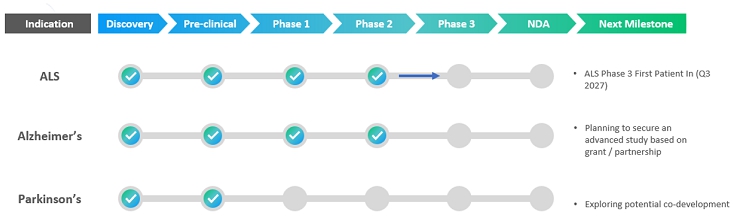
Subject to obtaining the required funding, we currently anticipate enrolling the first participant in PARAGON in the third quarter of 2027. There can be no assurance that we will obtain such funding, or that we will initiate the study within this timeframe or at all.
| 4 |
In light of our limited cash resources and ongoing capital requirements, in June 2026 we implemented cost-reduction measures, including a reduction in workforce and other reductions in operating expenses. We continue to evaluate additional financing opportunities and strategic alternatives to support our operations and the continued development of PrimeC and our other product candidates.
PrimeC was previously evaluated in a Phase 2a clinical trial, or NST002, in 15 people living with ALS, conducted at the Tel Aviv Sourasky Medical Center, Israel. The primary endpoint of the NST002 trial, which was safety and tolerability, was met. In this trial, the safety profile observed was consistent with known safety profiles of ciprofloxacin and celecoxib. Side effects were mild and transient in nature. There were no new or unexpected safety signals detected during the trial.
Additionally, we observed positive clinical signals in comparison to virtual controls, and a serum biomarker analysis showed significant changes following treatment, demonstrated significant changes following treatment, supporting target engagement of the drug relative to untreated matched controls. All 12 patients who completed the NST002 trial elected to continue into an extension study with PrimeC, that was conducted as an Investigator Initiated Study. To date, we are still supporting the drug supply for a few of the participants in this study, which is over than 40 months since NST002 was initiated.
We completed three additional studies in 2022 as part of our drug development program to further support our future regulatory submissions. In April 2022, we initiated a pharmacokinetic, or PK, study, or NCT05232461, of PrimeC. The PK open-label, randomized, single-dose, three-treatment, three-period crossover study evaluated the effect of food on the bioavailability of PrimeC as compared to the bioavailability of co-administered ciprofloxacin tablets and celecoxib capsules in adult subjects in the U.S. under an FDA cleared IND protocol.
In August 2022, we completed enrollment and dosing of all subjects in a multi-dose PK study, or NCT05436678. On September 28, 2022, we released the results of the NCT05436678 study. Based on results, we believe the PK profile of PrimeC supports the formulation’s extended-release properties, as the concentrations of the active components have been synchronized, aiming to potentially maximize the synergism between the two compounds. In June 2022, we reported the successful completion of the “in-life” phase of its 90-day GLP toxicology study. In this study, the components of PrimeC, celecoxib and ciprofloxacin, were administered to rodents at doses 4x the maximal clinical dose. All animals appeared normal, with no significant findings observed.
We believe we have a strong patent estate, including patents on methods of use, combination, and formulation. We have secured U.S. Patent 10,980,780 relating to methods for treatment of ALS using ciprofloxacin and celecoxib, the components of PrimeC, which expires in 2038. Equivalent patents have also been issued in the European Patent Office, Canada, Australia, Israel and Japan. The patent estate also includes U.S. Patent 12,097,185, which relates to PrimeC formulations. This patent will expire in December 2042. Equivalent applications are pending in many jurisdictions worldwide. We also expect to take advantage of orphan drug exclusivity for PrimeC, if approved, for seven years in the United States and ten years in the European Union. In addition, U.S. patent 12,527,768, which relates to methods for treatment of Alzheimer’s disease using combinations of ciprofloxacin and celecoxib, has been granted. This patent will expire on January 4, 2043.
| 5 |
Our organization is built around a management team with extensive experience in the pharmaceutical industry, with a particular focus on ALS research and clinical trials. We believe that our leadership team is well-positioned to lead us through clinical development, regulatory approval and commercialization of our product candidates. Furthermore, we maintain steadfast and extensive communication and collaboration with patient advocacy groups and associations, underscoring the importance of patient perspectives in advancing therapeutic strategies.
In addition to PrimeC, we extended our pipeline and conducted research and development efforts for AD and PD, with a similar strategy of combined products. The following chart represents our current product development pipeline:
We have incurred operating losses in each year since our inception. We incurred net losses of $3.6 million and $4.71 million for the six months ended June 30, 2026 and 2025, respectively. As of June 30, 2026, we had an accumulated deficit of $51.3 million. We expect to incur significant expenses and operating losses for the foreseeable future as we advance our product candidates from formulation development through preclinical development and clinical trials, seek regulatory approval and pursue commercialization of any approved product candidate. In addition, we expect that our expenses will increase substantially in connection with our ongoing activities as we:
| ● | continue the clinical development of PrimeC; |
| ● | continue the preclinical development of our other product candidates; |
| ● | file an NDA seeking regulatory approval for any product candidates; |
| ● | establish a sales, marketing and distribution infrastructure and scale up external manufacturing capabilities to commercialize any products for which we obtain manufacturing approval; |
| ● | maintain, expand and protect our intellectual property portfolio; |
| ● | add equipment and physical infrastructure to support our research and development; |
| ● | hire additional clinical development, quality control and manufacturing personnel; |
| ● | incur additional expenses associated with operating as a U.S. public company, including significant legal, accounting, investor relations and other expenses that we did not incur as a private company; and |
| ● | add operational, financial and management information systems and personnel, including personnel to support our product development and planned future commercialization. |
| 6 |
Operating Results
Revenue
We have not recognized any revenue to date and we do not expect to generate revenue from the sale of products in the near future.
Operating Expenses
Our current operating expenses consist primarily of research and development as well as general and administrative expenses.
Research and Development Expenses
Research and development expenses consist primarily of:
| ● | salaries for research and development staff and related expenses, including employee benefits and share-based compensation expenses; |
| ● | expenses for production of our product candidates by contract manufacturers; |
| ● | expenses paid to contract research organizations and other third parties in connection with the performance of preclinical studies, clinical trials and related expenses; |
| ● | expenses incurred under agreements with other third parties, including subcontractors, suppliers and consultants that conduct formulation development, regulatory activities and preclinical studies; and |
| ● | expenses incurred to acquire, develop and manufacture preclinical study and clinical trial materials. |
Expenses on research activities are recognized in profit or loss when incurred. Development expenditures, including patent registration costs, are capitalized only if development costs can be measured reliably, the product or process is technically and commercially feasible, future economic benefits are probable, and we intend to and have sufficient resources to complete development and to use or sell the asset. As of June 30, 2026, no development expenditures have met the recognition criteria and thus we have expensed all of our development expenditures as incurred.
We remain focused on advancing our product candidates. In June 2026, in light of our limited cash resources, we implemented cost-reduction measures that may affect the timing and pace of our development activities. The level of our future research and development expenses will depend on the availability of additional financing and the scope and timing of the studies and clinical trials we are able to undertake. If we secure sufficient funding and advance our planned programs, we expect these expenses to increase. However, there can be no assurance that we will obtain additional financing on acceptable terms, or at all, and any failure to obtain such financing could require us to further delay, reduce or discontinue certain development activities and programs.
We do not believe that it is possible at this time to accurately project total expenses required for us to reach commercialization of our product candidates. Due to the inherently unpredictable nature of preclinical and clinical development, we are unable to estimate with certainty the costs we will incur and the timelines that will be required in the continued development and approval of our product candidates. Clinical and preclinical development timelines, the probability of success and development costs can differ materially from expectations. See “Risk Factors—Risks Related to Our Business and Strategy” in our Annual Report. In addition, we cannot forecast which product candidates may be subject to future collaborations, if and when such arrangements will be entered into, if at all, and to what degree such arrangements would affect our development plans and capital requirements.
| 7 |
General and Administrative Expenses
General and administrative expenses consist primarily of personnel costs, including share-based compensation, related to directors, executive, finance, and human resource functions, insurance costs, facility costs and external professional service costs, including legal, accounting, marketing and audit services and other consulting fees.
We expect to continue to incur general and administrative expenses associated with operating as a public company, including legal, accounting, regulatory, tax, insurance and other professional costs. In light of the cost-reduction measures implemented in June 2026, we do not currently anticipate expanding our administrative headcount and infrastructure unless we obtain sufficient additional financing and increase the scope of our development activities. If we do so, our general and administrative expenses may increase.
In addition, if any of our product candidates receives regulatory approval and if we determine to invest in building a commercial infrastructure to support the marketing of our products, we expect to incur greater expenses.
Financing income (Expenses), net
Our net financing expenses (income), net consist primarily of fair value revaluation of warrants, issuance costs, interest income on deposits, interest expenses on lease liability and differences in the exchange rate between NIS and the U.S. Dollar.
Income Taxes
We have yet to generate taxable income in Israel, as we have historically incurred operating losses resulting in carry forward tax losses totaling approximately $38.1 million as of June 30, 2026. We anticipate that we will continue to generate tax losses for the foreseeable future and that we will be able to carry forward these tax losses indefinitely to future taxable years. Accordingly, we do not expect to pay taxes in Israel until we have taxable income after the full utilization of our carry forward tax losses.
Results of Operations
Our results of operations for the six months ended June 30, 2026 and 2025 were as follows:
| For the Six Months Ended June 30, | ||||||||
| (U.S. dollars in thousands except share and per share data) | 2026 | 2025 | ||||||
| Statement of Operations: | ||||||||
| Research and Development Expenses | (2,102 | ) | (2,503 | ) | ||||
| General and Administrative Expenses | (1,345 | ) | (2,189 | ) | ||||
| Operating Loss | (3,447 | ) | (4,692 | ) | ||||
| Financing expense, net | (116 | ) | (17 | ) | ||||
| Net Loss and Comprehensive Loss | (3,563 | ) | (4,709 | ) | ||||
| Basic and Diluted Net Loss per Share (*) | (2.1 | ) | (3.7 | ) | ||||
| Weighted average number of shares outstanding used in computing basic and diluted net loss per share | 1,731,255 | 1,270,132 | ||||||
| (*) | After giving effect to the share splits and the reverse share splits we effected on September 14, 2026 at a ratio of 1-for-20. |
| 8 |
Research and Development Expenses
The following table describes the breakdown of our research and development expenses for the indicated periods:
| For the Six Months Ended June 30, | ||||||||
| (U.S. dollars in thousands except share and per share data) | 2026 | 2025 | ||||||
| Subcontractors and consultants | $ | 338 | 1,547 | |||||
| Share-based compensation | 768 | 18 | ||||||
| Salaries and social benefits | 996 | 938 | ||||||
| Total research and development expenses | $ | 2,102 | 2,503 | |||||
Our research and development expenses for the six months ended June 30, 2026 and 2025 were $2,102 thousand and $2,503 thousand, respectively. The decrease of $401 thousand, or 16%, was mainly attributed to decrease in our subcontractors and consultants which was offset by an increase in share-based payment expense.
General and Administrative Expenses
The following table describes the breakdown of our general and administrative expenses for the indicated periods:
| For the Six Months Ended June 30, | ||||||||
| 2026 | 2025 | |||||||
| U.S. dollars in thousands | ||||||||
| Professional services | $ | 406 | 1,034 | |||||
| Share-based compensation | 131 | 288 | ||||||
| Salaries and social benefits | 353 | 316 | ||||||
| Insurance | 101 | 160 | ||||||
| Traveling abroad | 161 | 110 | ||||||
| Others | 193 | 281 | ||||||
| $ | 1,345 | 2,189 | ||||||
Our general and administrative expenses for the six months ended June 30, 2026 and 2025 were $1,345 thousand and $2,189 thousand, respectively. The decrease of $844 thousand, or 38.6%, was mainly attributed to decrease in professional services.
Financing Expenses, net
Our financing expenses, net for the six months ended June 30, 2026 and 2025, were $116 thousand and $17 thousand, respectively. The increase of $99 thousand, or 582%, was mainly attributed to exchange rate differences.
| 9 |
Liquidity and Capital Resources
Overview
Since our inception, we have incurred losses and negative cash flows from our operations. For the six months ended June 30, 2026, we incurred a net loss of $3.6 million while net cash of $1.99 million was used in our operating activities. As of June 30, 2026, we had a negative working capital of $2.2 million, and an accumulated deficit of $51.3 million. As of June 30, 2026, our cash totaled approximately $0.2 million.
Our financial statements have been prepared on a going concern basis under which an entity is considered to be able to realize its assets and satisfy its liabilities in the ordinary course of business, and our financial status raise substantial doubt whether we will continue as a going concern. Our future operations are dependent upon the identification and successful completion of equity or debt financing and the achievement of profitable operations at an indeterminate time in the future. There can be no assurances that we will be successful in completing an equity or debt financing or in achieving or maintaining profitability. The financial statements do not give effect to any adjustments relating to the carrying values and classification of assets and liabilities that would be necessary should we be unable to continue as a going concern.
Through June 30, 2026, we have financed our operations primarily through our initial public offering, public and private offerings of our equity securities, proceeds from the exercise of warrants and options, and crowd funding of equity securities. Total gross invested capital as of June 30, 2026 was approximately $42.4 million, which included ordinary shares, SAFE agreements, options and warrants to purchase ordinary shares.
In April 2026, we completed a private placement of ordinary shares for gross proceeds of approximately $0.6 million. In addition, we maintained access to our existing at-the-market offering program and, in July 2026, filed a prospectus supplement relating to the potential sale of up to approximately $3.8 million of our ordinary shares thereunder.
Cash flows
The following table summarizes our statement of cash flows for the six months ended June 30, 2026 and 2025:
| For the Six Months Ended June 30, | ||||||||
| (U.S. dollars in thousands except share and per share data) | 2026 | 2025 | ||||||
| Net cash used in operating activities and exchange rates | $ | (1,990 | ) | (4,000 | ) | |||
| Net cash used in investing activities | (6 | ) | (13 | ) | ||||
| Net cash provided by financing activities | 2,066 | 1,301 | ||||||
| Effects of exchange rate changes on cash and cash equivalents | (5 | ) | - | |||||
| (Decrease) increase in cash and cash equivalents | $ | 65 | (2,712 | ) | ||||
Net cash used in operating activities
Net cash used in operating activities was $1,990 thousand and $4,000 thousand for the six months ended June 30, 2026 and 2025, respectively. The decrease of $2,010 thousand was mainly attributed to change in account payables and stock based compensation.
Net cash provided by (used in) investing activities
Net cash provided by (used in) investing activities was $(6) thousand and $(13) thousand for the six months ended June 30, 2026 and 2025, respectively. The decrease of $7 thousand was mainly attributed to change in restricted deposits.
Net cash provided by financing activities
Net cash provided by financing activities was $2,066 thousand and $1,301 thousand for the six months ended June 30, 2026 and 2025, respectively. The increase of $765 thousand was mainly attributed to higher proceeds from issuance of shares.
| 10 |
Funding Requirements
Since our inception, almost all of our resources have been dedicated to the preclinical and clinical development of our lead product candidate, PrimeC. As of June 30, 2026, we had cash of $0.2 million. Our existing cash will not be sufficient to fund our operations.
Our present and future funding requirements will depend on many factors, including, among other things:
| ● | the progress, timing and completion of clinical trials for PrimeC; |
| ● | preclinical studies and clinical trials for our other product candidates; |
| ● | the costs related to obtaining regulatory approval for PrimeC and any of our other product candidates, and any delays we may encounter as a result of regulatory requirements or adverse clinical trial results with respect to any of these product candidates; |
| ● | selling, marketing and patent-related activities undertaken in connection with the commercialization of PrimeC and any of our other product candidates, and costs involved in the development of an effective sales and marketing organization; |
| ● | the costs involved in filing and prosecuting patent applications and obtaining, maintaining and enforcing patents or defending against claims or infringements raised by third parties, and license royalties or other amounts we may be required to pay to obtain rights to third party intellectual property rights; |
| ● | potential new product candidates we identify and attempt to develop; and |
| ● | revenues we may derive either directly or in the form of royalty payments from future sales of PrimeC and any other product candidates. |
For more information as to the risks associated with our future funding needs, see “Risk Factors — Our financial statements include a going concern reference. We will require substantial additional financing to achieve our goals, and a failure to obtain this capital when needed and on acceptable terms, or at all, could force us to delay, limit, reduce or terminate our product development, commercialization efforts or other operations.” in our Annual Report.
Contractual Obligations and Commitments
As of June 30, 2026, we did not have any material contractual obligation and commitments.
Off-Balance Sheet Arrangements
We did not have during the periods presented, and we do not currently have, any off-balance sheet arrangements that have or are reasonably likely to have a current or future effect on our financial condition, revenues or expenses, results of operations, liquidity, capital expenditures or capital resources.
| 11 |