The Fund seeks to provide current income and capital growth.
This table describes the fees and expenses that you may pay if you buy, hold, and sell shares of the Fund. You may also pay other fees, such as brokerage commissions and other fees to financial intermediaries, which are not reflected in the table and example below. You may qualify for sales charge discounts on Class A Shares if you and your family invest, or agree to invest in the future, at least $100,000 in the Fund. More information about these and other discounts is available from your financial professional and in “How to Purchase Shares” beginning on page 43 of the statutory prospectus and in Appendix A to the prospectus, titled “Intermediary-Specific Sales Charge Reductions and Waivers.”
|
|
|
| Class R |
| Class I |
| Class A |
Maximum Sales Charge (Load) Imposed on Purchases |
|
|
| None |
| None |
| 3.25% |
Maximum Deferred Sales Charge (Load) |
|
|
| None |
| None |
| 1.00%(1) |
|
|
|
| Class R |
| Class I |
| Class A |
|
Management Fees |
|
|
| 0.95% |
| 0.95% |
| 0.95% |
|
Distribution and/or Service (12b‑1) Fees |
|
|
| 0.25% |
| None |
| 0.25% |
|
Other Expenses: |
|
|
| 0.49% |
| 0.49% |
| 0.49% |
|
Dividends on Short Positions and Interest |
|
|
| 0.10% |
| 0.10% |
| 0.10% |
|
All Remaining Other Expenses |
|
|
| 0.39% |
| 0.39% |
| 0.39% |
|
Acquired Fund Fees and Expenses(2) |
|
|
| 0.01% |
| 0.01% |
| 0.01% |
|
Total Annual Fund Operating Expenses |
|
|
| 1.70% |
| 1.45% |
| 1.70% |
|
Fee Waiver(3) |
|
|
| 0.36% |
| 0.36% |
| 0.36% |
|
Total Annual Fund Operating Expenses After Fee Waiver |
|
|
| 1.34% |
| 1.09% |
| 1.34% |
|
(1) | A deferred sales charge of up to 1.00% may be imposed on purchases of $250,000 or more of Class A shares purchased without a front-end sales charge that are redeemed within 18 months of purchase. |
(2) | Acquired Fund Fees and Expenses are expenses incurred indirectly by the Fund through its ownership of shares in other investment companies. |
(3) | The Fund has entered into an Amended and Restated Expense Waiver and Reimbursement Agreement with the Fund’s Adviser pursuant to which the Adviser has contractually agreed to waive advisory fees and/or reimburse the Fund’s other expenses to the extent that total operating expenses (exclusive of taxes, interest, dividends on short positions, brokerage commissions, acquired fund fees and expenses and other costs incurred in connection with the purchase or sale of portfolio securities) so that they do not exceed 1.23% of the Fund’s average daily net assets allocable to the Class R shares, 0.98% of the Fund’s average daily net assets allocable to the Class I shares, and 1.23% of the Fund’s average daily net assets allocable to the Class A shares. The agreement remains in effect until September 30, 2027 unless terminated at an earlier time by the Fund’s Board of Trustees. The Adviser may recoup any waived amount from the Fund pursuant to the agreement, if such recoupment does not cause the Fund to exceed expense limitations in effect at the time the amounts were waived, the recoupment does not cause the Fund to exceed the current expense limitation and the recoupment is done within three years after the date of the expense waiver. |
This Example is intended to help you compare the cost of investing in the Fund with the cost of investing in other mutual funds. It assumes that you invest $10,000 in the Fund for the time periods indicated and then redeem or hold all of your shares at the end of those periods. The Example also assumes that your investment has a 5% return each year and that the Fund’s expenses are equal to the Total Annual Fund Operating Expenses After Fee Waiver for the first year and equal to the Total Annual Fund Operating Expenses for the remaining years. Although your actual costs may be higher or lower, based on these assumptions your costs would be:
|
|
| 1 Year |
| 3 Years |
| 5 Years |
| 10 Years | |||||||
| Class R Shares |
| $ | 136 |
|
| $ | 501 |
|
| $ | 889 |
|
| $ | 1,979 |
| Class I Shares |
| $ | 111 |
|
| $ | 423 |
|
| $ | 758 |
|
| $ | 1,704 |
| Class A Shares |
| $ | 457 |
|
| $ | 809 |
|
| $ | 1,185 |
|
| $ | 2,239 |
The Fund pays transaction costs, such as commissions, when it buys and sells securities (or “turns over” its portfolio). A higher portfolio turnover rate may indicate higher transaction costs and may result in higher taxes when Fund shares are held in a taxable account. These costs, which are not reflected in annual fund operating expenses or in the Example, affect the Fund’s performance. During the most recent fiscal year, the Fund’s portfolio turnover rate was 141% of the average value of its portfolio.
Under normal market conditions, the Fund will invest at least 80% of the value of its net assets (including the amount of any borrowings for investment purposes) in debt securities and other credit-related instruments. The Fund invests primarily in a portfolio of debt securities including corporate bonds and debentures (including high yield bonds commonly known as “junk bonds”), bank loans, convertible and preferred securities, credit default swaps and other debt instruments and derivatives that the Fund’s investment adviser (the “Adviser”) believes have debt-like characteristics. The Fund invests in both U.S. and foreign debt securities. The principal types of derivatives in which the Fund may invest are credit default swaps, interest rate swaps, equity swaps, futures, and options.
The Fund invests primarily in debt securities whose returns the Adviser believes will be more correlated with the outcome of specific catalysts or events rather than overall market direction. These catalysts and events include mergers, acquisitions, debt maturities, refinancings, regulatory changes, recapitalizations, reorganizations, restructurings, and other special situations. The Fund also uses a relative value approach and may express positive views on specific issuers by taking long positions in cash bonds and/or derivatives and negative views on specific issuers by taking short positions in cash bonds and/or derivatives. The Fund uses fundamental research to identify mispricings or inefficiencies in these situations and assesses their potential impact on security prices.
The Fund may engage in short-term trading strategies and may engage in short sales and invest in derivatives. The principal short-term trading strategies may at times include convertible arbitrage, merger arbitrage, and capital structure arbitrage, which are discussed below. The Fund may seek to mitigate the risk of volatility (the appreciation or depreciation of the value of a security over a period of time) and duration (the impact of interest rate changes on fixed-income securities) by engaging in short sales and/or investing in derivatives, including credit default swaps, interest rate swaps, futures, and options. The Fund may purchase or sell short equity securities or derivatives as part of a hedging strategy or hold equity positions or other assets that the Fund receives as part of a reorganization process. The Fund may, but is not required to, seek to reduce currency risk by hedging part or all of its exposure to various foreign currencies. Furthermore, the Fund may invest in exchange traded funds (“ETFs”).
The Fund is not limited with respect to its portfolio maturity or duration. The Fund may invest in debt securities without regard to their credit ratings, including securities that are unrated, and in debt securities with a wide variety of terms that may vary from security to security, including but not limited to optional and mandatory prepayment provisions, fixed, variable, semi-variable, and resettable interest rates and conversion options, as well as various combinations of these terms. The Fund may hold a significant portion of its assets in cash, money market or similar cash management funds, or short-term investments for defensive purposes, to preserve the Fund’s ability to capitalize quickly on new market opportunities, or for other reasons, such as because the Adviser has determined to obtain investment exposure through derivative instruments instead of direct cash investments. The Fund may also hold a significant amount of cash or short-term investments immediately after a period in which several transactions in which the Fund has invested close in a similar timeframe, yet before capital is redeployed to other opportunities.
Merger Arbitrage: Merger arbitrage is a highly specialized investment approach designed to profit from the successful completion of mergers, takeovers, tender offers, leveraged buyouts, spin-offs, liquidations, and other corporate reorganizations. The most common merger arbitrage activity, and the approach the Fund generally uses, involves purchasing debt securities of an announced acquisition target company at a discount to their expected value upon completion of the acquisition. The Fund may engage in selling securities short when the terms of a proposed acquisition call for the exchange of common stock and/or other securities. In such a case, the securities of the company to be acquired may be purchased and, at approximately the same time, an amount of the acquiring company’s common stock and/or other securities as per the terms of the transaction may be sold short.
Convertible Arbitrage: Convertible arbitrage is a specialized strategy that seeks to profit from pricing inefficiencies between a firm’s convertible securities and its underlying equity. The most common convertible arbitrage approach, and the strategy the Fund generally uses, matches a long position in the convertible security with a short position in the underlying common stock. The Fund seeks to purchase convertible securities at discounts to their expected future values and sell short shares of the underlying common stock in order to mitigate equity market movements. As stock prices rise and the convertible security becomes more equity sensitive, the Fund may sell short additional common shares in order to maintain the relationship between the convertible and the underlying common stock. As stock prices fall, the Fund will typically buy back a portion of shares which it had sold short. Positions are typically designed to earn income from coupon or dividend payments and net gains from the purchase and sale of the convertible securities’ positions and the underlying common stocks.
Capital Structure Arbitrage: Capital structure arbitrage seeks to profit from relative pricing discrepancies between related debt and/or equity securities. For example, when the Fund believes that unsecured securities are overvalued in relation to senior secured securities, the Fund may purchase a senior secured security of an issuer and sell short an unsecured security of the same issuer. In this example the trade would be profitable if credit quality spreads widened or if the issuer went bankrupt and the recovery rate for the senior debt was higher than anticipated. It is expected that, over time, the relative mispricing of the securities may decline, at which point the position will be liquidated.
The following information provides some indication of the risks and variability of investing in the Fund by showing how the Fund’s performance has varied from year to year and by showing how the Fund’s average annual returns for the past one-, five-, ten-year and since inception periods compare with those of the Bloomberg U.S. Aggregate Bond Index and the Bloomberg U.S. Treasury Bill Index.
The bar chart presents the calendar year total returns of the Fund’s Class R Shares before taxes. Returns shown in the bar chart do not reflect sales charges applicable to other share classes, which would reduce performance results. The performance table reflects the performance of the Fund’s Class R shares before and after taxes and the Fund’s Class I and Class A shares before taxes. How the Fund has performed in the past (before and after taxes) is not necessarily an indication of how the Fund will perform in the future. Performance reflects fee waivers in effect. If fee waivers were not in place, the Fund’s performance would be reduced. Updated information on the Fund’s performance can be obtained by visiting www.arbitragefunds.com.
| Year-by-Year Annual Total Returns through December 31, 2025 – Class R Shares During the period shown in the bar chart, the highest return for a quarter was 7.81% during the quarter ended June 30, 2020 and the lowest return for a quarter was ‑5.56% during the quarter ended March 31, 2020. The year-to-date return of the Fund’s Class R shares through June 30, 2026 is 2.22%. While the Class I shares and Class A shares would have substantially similar annual returns to the Class R shares because the shares are invested in the same portfolio of securities, the performance of Class I and Class A shares will differ from that shown since the Classes do not have the same expenses or inception dates. |
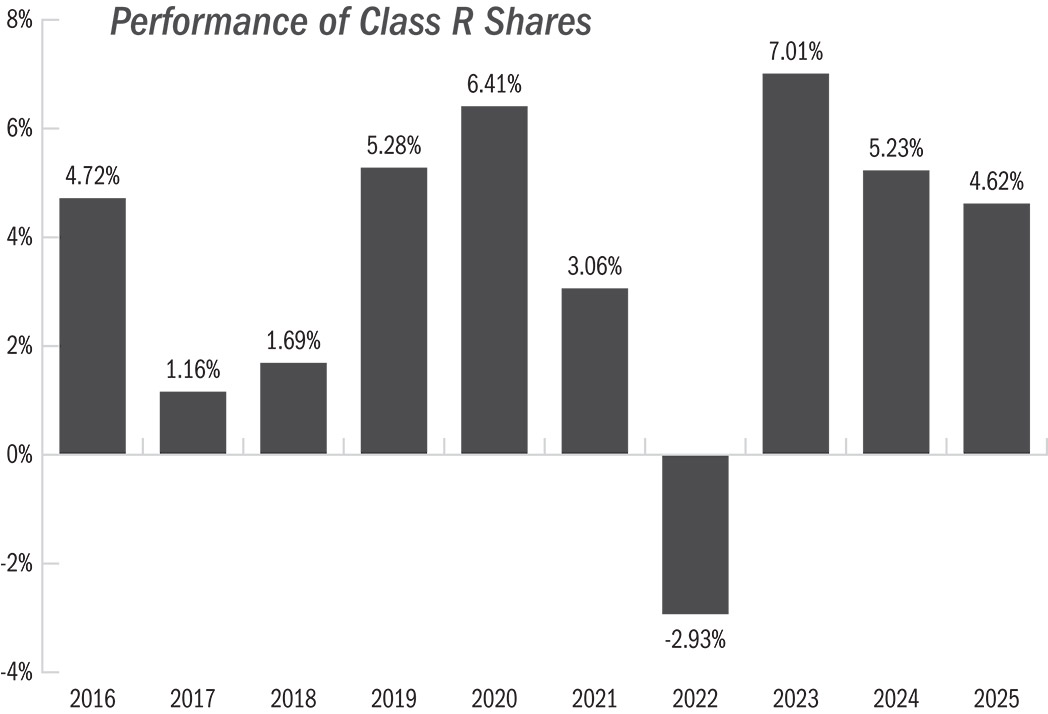
During the period shown in the bar chart, the highest return for a quarter was 7.81% during the quarter ended June 30, 2020 and the lowest return for a quarter was ‑5.56% during the quarter ended March 31, 2020.
The year-to-date return of the Fund’s Class R shares through June 30, 2026 is 2.22%.
While the Class I shares and Class A shares would have substantially similar annual returns to the Class R shares because the shares are invested in the same portfolio of securities, the performance of Class I and Class A shares will differ from that shown since the Classes do not have the same expenses or inception dates.
The table below shows the Fund’s average annual total returns for Class R shares, Class I shares, and Class A shares compared with those of the Bloomberg U.S. Aggregate Bond Index and the Bloomberg U.S. Treasury Bill Index. The returns in the table below reflect the maximum applicable sales charges for the relevant share class. The table also presents the impact of taxes on the returns of the Fund’s Class R shares. After-tax returns are shown for Class R shares only, and after-tax returns for Class I and Class A shares will vary. After-tax returns are calculated using the historical highest individual federal marginal income tax rates and do not reflect the impact of state and local taxes. Actual after-tax returns depend on an investor’s tax situation and may differ from those shown, and after-tax returns shown are not relevant to investors who hold their Fund shares through tax-deferred arrangements, such as 401(k) plans or individual retirement accounts. Return after taxes on distributions measures the effect of taxable distributions, but assumes the underlying shares are held for the entire period. Return after taxes on distributions and sale of Fund shares shows the effect of both taxable distributions and any taxable gain or loss that would be realized if the underlying shares were purchased at the beginning and sold at the end of the period (for purposes of the calculation, it is assumed that income dividends and capital gain distributions are reinvested at NAV and that the entire account is redeemed at the end of the period, including reinvested amounts).
WATER ISLAND CREDIT OPPORTUNITIES FUND | One Year |
|
| Five Years |
| Ten Years |
| Since |
| |||||||||
Class R Return Before Taxes |
|
| 4.62 | % |
|
|
| 3.34 | % |
|
| 3.59 | % |
|
| 3.09 | % |
|
Class R Return After Taxes on Distributions |
|
| 2.97 | % |
|
|
| 1.79 | % |
|
| 2.24 | % |
|
| 1.75 | % |
|
Class R Return After Taxes on Distributions and Sale of Fund Shares |
|
| 2.72 | % |
|
|
| 1.88 | % |
|
| 2.17 | % |
|
| 1.77 | % |
|
Class I Return Before Taxes |
|
| 4.79 | % |
|
|
| 3.58 | % |
|
| 3.84 | % |
|
| 3.33 | % |
|
Class A Return Before Taxes |
|
| 1.11 | % |
|
|
| 2.64 | % |
|
| 3.23 | % |
|
| 2.78 | % |
|
Bloomberg U.S. Aggregate Bond Index** |
|
| 7.30 | % |
|
|
| ‑0.36 | % |
|
| 2.01 | % |
|
| 1.86 | % |
|
Bloomberg U.S. Treasury Bill Index*** |
|
| 4.30 | % |
|
|
| 3.19 | % |
|
| 2.20 | % |
|
| 1.68 | % |
|
* | The inception date for Class R shares and Class I shares is October 1, 2012. The inception date for the Class A shares is June 1, 2013. The “Since Inception” returns reflected for the Bloomberg U.S. Aggregate Bond Index and the Bloomberg U.S. Treasury Bill Index are based on the inception date for Class R and Class I shares. |
** | To meet regulatory requirements, the Bloomberg U.S. Aggregate Bond Index serves as the Fund’s broad-based securities market index, providing a broad measure of market performance. The Bloomberg U.S. Aggregate Bond Index is a market value-weighted index of investment grade fixed-rated debt issues, including government, corporate, asset-backed and mortgage-backed securities with a maturity of one year or more. |
*** | Bloomberg U.S. Treasury Bill Index tracks the market for treasury bills issued by the US government with at least one month and up to, but not including, twelve months remaining to maturity. |
The indexes are calculated on a total-return basis, are unmanaged and are not available for direct investment. The indexes reflect no deduction for fees, expenses, or taxes. The indexes are not intended to, and do not, parallel the risk or investment style of the Fund’s investment strategy. |
In calculating the federal income taxes due on redemptions, capital gains taxes resulting from redemptions are subtracted from the redemption proceeds and the tax benefits from capital losses resulting from the redemptions are added to the redemption proceeds. Under certain circumstances, the addition of the tax benefits from capital losses resulting from redemptions may cause the Return After Taxes on Distributions and Sale of Fund Shares to be greater than the Return After Taxes on Distributions or even the Return Before Taxes. |