From the desk of... Highwater Ethanol, LLC CEO Brian Kletscher Highwater Ethanol, LLC September 2026 Volume 2 | Issue 4 Ethanol In This Issue... 1-2 Brian Kletscher 3 Election of Governors 4 Luke Schneider 5 Plant Photos 6 Dillon Imker & Derek Trapp 7 Tom Streifel Our spring started with great planting conditions; we have had enough rain in the area to anticipate a decent crop. Crops in the area continue to mature, and we anticipate an average corn harvest in our corn procurement area. Our first three quarters of fiscal year 2026 have been strong. Current demand for renewable fuels remains strong and robust as we head into fall and winter. We are excited about the demand now and into the future. We expect that E15 will continue to drive demand in the United States and are encouraged recently by action taken by the California Fire Marshall potentially increasing E15 usage. We encourage you to do your part by using a higher blend of ethanol! Seventeen years of operation have continued to provide a different opportunity every year! Ethanol, dried distillers grain, modified distillers grain and corn oil demand remain strong. We filed our Form 10-Q for the third quarter on September 11, 2026. We reported net income of $10,836,354 for the three month period which includes operating income of $5,661,285 and $5,175,069 of other income, mainly 45Z Tax Credits, which are sold at a discount and are subject to broker fees and other fees. The proceeds from the sale of our 2025 45Z Tax Credits was equal to approximately $.20 per gallon produced in calendar year 2025. With the change in the GREET calculator removing Indirect Land Use, we anticipate our 2026 45Z Tax Credits will bring approximately $.30 per gallon produced. The 45Z tax credits are federal tax credits which were updated and extended by the One Big Beautiful Bill which passed in July 2025. The fourth quarter of fiscal year 2026 is off to a promising start. The board will discuss if there will be a distribution for the 2026 Fiscal Year in the November/December timeframe. We will strive to return money to our investors while maintaining the facility that you can be extremely proud to be part of! We have always focused on operations to ensure the best efficiencies we can get at your facility. During the third quarter, we produced an average of approximately 3.07 gallons of denatured ethanol per bushel of corn ground or approximately 3.0 gallons undenatured ethanol per bushel of corn ground. We have maintained these efficiencies since August 2019 due to several factors. We review enzymes, yeast, and production process items to ensure the best efficiencies, and we are proud of our team for maintaining this production rate! Our efficiencies in corn oil production have improved with adjustments made in the process to boost our production to over 1.21 pounds per bushel ground. We will be adding a sixth fermenter, which we expect will push our efficiencies to a higher level. This project is anticipated to come online in July of 2027. We will also strive to enhance our efficiencies with the addition of Dryer Exhaust Energy Recovery System {DEER} which should be operational in July 2027 Both of these projects are expected to drive our efficiencies resulting in more ethanol per bushel while utilizing less natural gas to produce each gallon. Highwater submitted an Air Emissions permit application to the Minnesota Pollution Control Agency in January 2026 which we are hoping will be approved in October 2026. With this permit, we anticipate increasing our production to approximately 87 million gallons of denatured ethanol per year. We plan to step up production while monitoring our efficiencies and maintaining the
production efficiency that you have all come to expect at Highwater. The one new sieve bottle and the Evap Zero projects completed last year have operated to designed capability and have provided us with the better efficiencies that we desire. Highwater Ethanol continues to monitor the following technologies: Sustainable Aviation Fuel {SAF}, Renewable Diesel, Carbon Capture technologies, Solar electrical production, and others. Weighing each technology, improving efficiencies, and lowering our Carbon Index score in the future will be important for Highwater and the ethanol industry. Utilizing the corn that is produced by our area producers remains very important. For the past nine months, we have been operating at an ethanol production level of approximately 69.7 million gallons per year which is near permitted rates and comparable to 2025. Demand for ethanol keeps increasing domestically and export demand has remained stable to slightly improved. We believe that our 2026/2027 Fiscal Years will likely be very interesting for renewable ethanol and renewable biofuels, and we will continue to work towards obtaining additional market share for our products. Highwater continues to review opportunities for diversifying our product lines. We market approximately 3.5% - 5.2% of our production as cellulosic ethanol due to our receipt of approval in March 2021 from the California Air Resources Board {CARB} and D3 RINS by the EPA in 2025. Highwater Ethanol also monitors movement for ethanol in California, which recently approved the sale of E15, Canada and nationally. Highwater continues to purchase corn from our area producers. The 2026 corn crop quality and bushels is anticipated to be good. Good quality corn certainly helps us maintain our efficiency. Industry Information. E15 and Exports should remain a continued priority in 2026. Exports are needed to support a very efficient U.S ethanol industry. As production capacity is available in the U.S., we expect exports, and domestic use will be the key for the industry in the future. We anticipate and look forward to increased interest from countries including Mexico, Canada, China, and Japan, as well as continued interest from Vietnam, Philippines, India, and many others. We encourage you to use a higher blend such as E15, E30 or E85! We believe that use of higher blends will reduce our dependence on crude oil and contribute to cleaner air!! Highwater Ethanol supports E10 blend, E15 blend for 2001 and newer vehicles and higher blends if you have a flex fuel vehicle. We believe the ethanol industry can respond to meeting the higher blend rates. Highwater Ethanol has worked with the Minnesota Biofuels Association for many years to promote ethanol use and move E15 forward in the State of Minnesota. Minnesota currently has over 500 - E15 pumps available as well as many blend pumps to ensure the consumer has a choice. As owners in the ethanol industry, each member should be doing his or her part in using a higher blend of ethanol and asking for the higher blends of ethanol if it is currently not available in your area. We are members of the Renewable Fuels Association and American Coalition for Ethanol. These entities do a great job in representing the ethanol industry at the federal level. Our Mission Statement: “To successfully operate a bio – energy facility, which will be profitable to our investor owners while contributing to the economic growth in the region. Highwater Ethanol is committed to the present while focusing on the future.” Highwater Ethanol’s Vision Statement: Highwater Ethanol will identify opportunities that position the business to provide sustainable competitive advantages through short and long - term core investments. A few core priorities that were identified include: 1) Remain a low cost, efficient and high-quality producer; 2) Review new technology opportunities; 3) Review all opportunities within our core business; and 4) Continue long-term distributions when appropriate. We encourage you to visit our web page at highwaterethanol.com, we are in the process of updating our website and hope to have this completed by October 1. This website will give you markets, weather, investor information, and related items. Like us on Facebook! If you are ever passing through the area and would like a tour of your facility, please stop by as we would be very happy to walk you through the facility. Our management team consists of: Luke Schneider, CFO, Kimberly Frank, Controller, Derek Trapp Co-Plant/ Production Manager, Dillon Imker Co-Plant/Production Manager, Tom Streifel, Risk/Commodity, Casey Klein, Maintenance Manager, Lisa Landkammer, EHS Manager and Mandy Bosacker, Lab Manager. We have positioned our team to be successful in the ethanol industry. Have a safe fall harvest!! We will take care of the present as we focus on the future!!! Brian Kletscher, CEO Highwater Ethanol, LLC 2
Election of Governors At the Company’s 2026 Annual Meeting, the terms of the Company’s Group I Governors concluded and the Company’s Members elected three incumbent Group I Governors, David Eis, William Garth and David Moldan to serve additional three-year terms. At the 2027 Annual Meeting, the Members of the Company will elect three Governors for the expiring terms of the Group II Governors. The Governors elected at the 2027 Annual Meeting will serve three-year terms, expiring at the Company’s 2030 Annual Meeting. The three Group II Governors are currently – George Goblish, Luke Spalj and Dan Tauer. Nominations Nominees for elected Governors must be named by: a) the current Governors; b) a Nominating Committee established by the Governors; or c) through nomination by a Member entitled to vote in the election of Governors. The Company has established a Nominating Committee, which operates under a charter adopted by the Board of Governors in November 2009. Pursuant to the Nominating Committee’s charter, the Nominating Committee’s role is to recommend candidates for election to the Company’s Board of Governors. The Nominating Committee meets in December and/or January to identify and recommend candidates to the full Board of Governors at the January Board meeting. The charter sets forth the process for the Nominating Committee to use in recommending nominees. The Nominating Committee may solicit names of candidates for their consideration from Members. As mentioned above, Members may also nominate persons to be elected Governors of the Company by following the procedures explained in Section 5.3(b) of the Third Amended and Restated Operating Agreement. Section 5.3(b) requires that written notice of a Member’s intent to nominate an individual for governor must be given not less than 120 calendar days before the anniversary date of the release of the Company’s proxy materials to Members in connection with the previous year’s annual meeting. However, if the date of the current year’s meeting is changed by more than 30 days form the anniversary date of the previous year’s meeting, then the deadline is a reasonable time, as determined by the Board of Governors, before the Company releases its proxy materials for the annual meeting of the Company. Therefore, if the 2027 Annual Meeting is held on March 11, 2027, Governor nominations must be submitted by Members by October 2, 2026. Each notice submitted by a Member must include the following: 1) the name and address of record of the Member who intends to make the nomination; 2) a representation that the Member is a holder of record of Units of the Company entitled to vote at such meeting and intends to appear in person or by proxy at the meeting to nominate the person or persons specified in the notice; 3) the name, age, business and residence addresses, and principal occupation or employment of each nominee; 4) a description of all arrangements or understandings between the Member and each nominee; 5) such other information regarding each nominee proposed by such Member as would be required to be included in a proxy statement filed pursuant to the proxy rules of the Securities and Exchange Commission; and 6) the consent of each nominee to serve as a Governor of the Company if so elected. 3
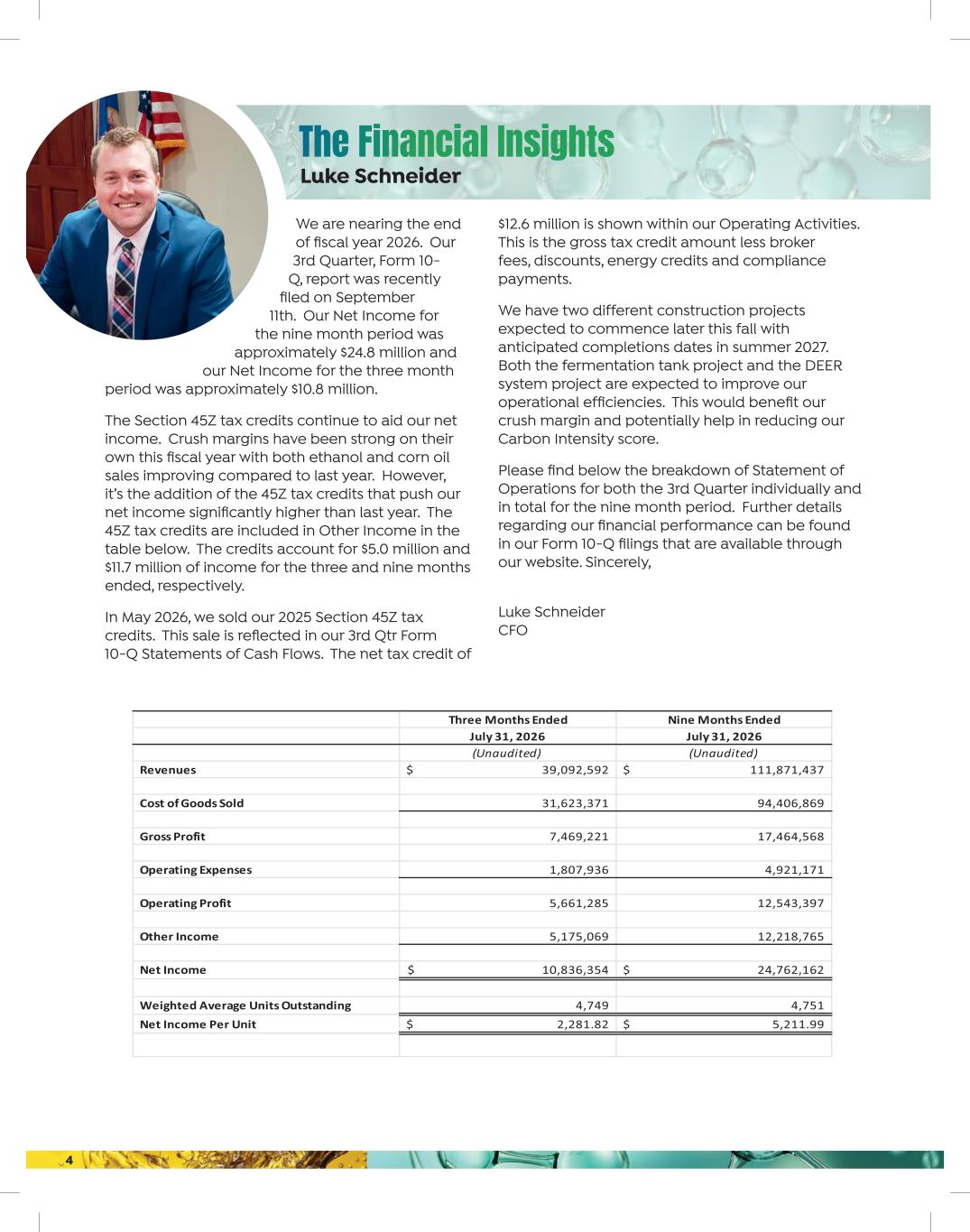
We are nearing the end of fiscal year 2026. Our 3rd Quarter, Form 10- Q, report was recently filed on September 11th. Our Net Income for the nine month period was approximately $24.8 million and our Net Income for the three month period was approximately $10.8 million. The Section 45Z tax credits continue to aid our net income. Crush margins have been strong on their own this fiscal year with both ethanol and corn oil sales improving compared to last year. However, it’s the addition of the 45Z tax credits that push our net income significantly higher than last year. The 45Z tax credits are included in Other Income in the table below. The credits account for $5.0 million and $11.7 million of income for the three and nine months ended, respectively. In May 2026, we sold our 2025 Section 45Z tax credits. This sale is reflected in our 3rd Qtr Form 10-Q Statements of Cash Flows. The net tax credit of $12.6 million is shown within our Operating Activities. This is the gross tax credit amount less broker fees, discounts, energy credits and compliance payments. We have two different construction projects expected to commence later this fall with anticipated completions dates in summer 2027. Both the fermentation tank project and the DEER system project are expected to improve our operational efficiencies. This would benefit our crush margin and potentially help in reducing our Carbon Intensity score. Please find below the breakdown of Statement of Operations for both the 3rd Quarter individually and in total for the nine month period. Further details regarding our financial performance can be found in our Form 10-Q filings that are available through our website. Sincerely, Luke Schneider CFO The Financial Insights Luke Schneider 4
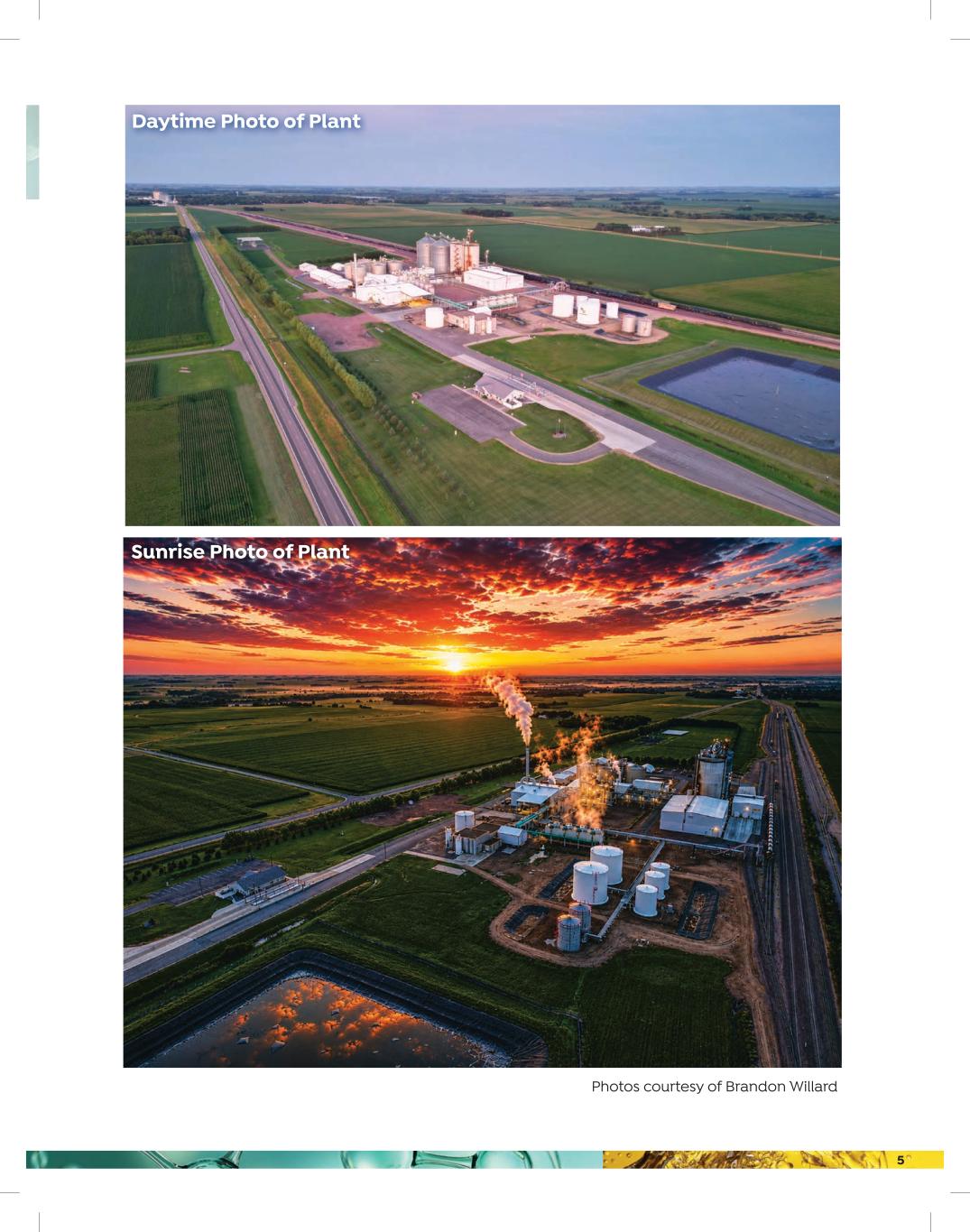
Photos courtesy of Brandon Willard Sunrise Photo of Plant Daytime Photo of Plant 5
Co-Plant Managers Dillon Imker & Derek Trapp This year is flying by and before long the crops will be coming out and preparations for winter will start. Our team remains focused on operations, maintaining a strong commitment to efficiency. Corn oil has seen some nice gains throughout the year. We started the year recovering 1 lb of oil per bushel of corn. We closed out August with a recovery of 1.21 lbs per bushel of corn. This seems like a small increase but in today’s market and our current corn grind this is an additional 300 thousand dollars per month. We continue to produce close to our permit limit of 68.5 million gallons of undenatured ethanol per year. Maximizing gallons and doing it efficiently is what we continue to strive for. With the warm temperatures this summer the Highwater team has done a great job maintaining, making the correct moves to manage fermentation temperatures. This has helped us maintain our yield of 3.07 gallons of denatured ethanol per bushel of corn for August. Since January 2026 we have been working with the MPCA on a new permit. We are targeting a permit to produce 85 million gallons of undenatured ethanol per year. With roughly a 24% increase from our current permit and a 70% increase from design of our plant we intend to increase our gallons slowly. We have been able to do some beneficial projects across the plant over the last few years that we believe will get us close to a rate of 75 million gallons. As we look to ramp up, we will evaluate the plant and make the right moves to produce more gallons. A few projects we will be adding are an additional fermenter and Dryer Exhaust Energy Recovery (DEER). Fermentation time has been key to ethanol yield. Increasing our gallons per year and being able to have adequate fermentation time should lead to positive results for Highwater. This additional ferm will bring our total to 6 ferms and set us up for increased plant rates. DEER will give us more steam capacity and reduce our BTUs per gallon. We are optimistic this project will give us a return year after year but also help us reduce our Carbon intensity (CI). With the guidelines on 45Z, CI reduction can add significant value to Highwater Ethanol by increasing the value of each gallon produced. Increased ethanol production while maintaining yield and efficiencies through projects gives Highwater the tools to remain a leader in the ethanol industry. During the week of August 17th Highwater was shut down for cleaning, maintenance and inspections. During the shutdown we need to cover a lot of areas in a short amount of time, so we had over 90 contractors onsite helping complete all tasks. It was a safe and successful shutdown. Our next outage is scheduled for April 2027. As we continue to work through 2026, we look forward to the opportunities this year brings. Dillon Imker & Derek Trapp 6
Commodity Manager Tom Streifel Usually when Labor Day comes around, the trade has a pretty good idea what the US corn crop size is and prices settle into a respective range. This is not the case this year as we are scheduled for a USDA crop report this Friday and the private yield estimates have a huge range. All these private companies claim to be right, they use similar methods to make their determination, but the results have significant implications on where prices should be. For example, last month the Pro Farmer tour came up with a yield estimate of 192 BPA for the state of Iowa. A few days later Pioneer supposedly using the same methods concluded IA yield was 32 BPA higher than PF. Trend yield for the US would be around 184 BPA. The year started out with expectations for trend or better again, but as I have come to learn over the years; it doesn’t rain much in southern MN in August. The trade guess for the next crop report pegs the yield at 178. The range of estimates is 174-183, which has implications of plus or minus 60-80 cents. A yield on the low end implies prices need to seek demand rationing levels, which usually implies $6.00. The high end yield implies supplies are adequate and prices can hover around $4.50. Next we add in a couple other variables such as the war in the Black Sea potentially disrupting grain flow as well as the conflict with Iran jerking the crude oil market around by $30-40 per barrel. Rising energy and other commodity prices tends to propel inflation, which has inspired commodity fund managers to buy. Funds went on a buying spree the last three weeks of August, which elevated corn by 75 cents, which also happened to be a record price performance for the month of August. So, funds are about as long as they get, harvest is dead ahead and wars and tariffs are still a daily issue meaning don’t get too comfortable thinking prices have found that respective trade range. Photo courtesy of Brandon Willard Nighttime Photo of Plant 7
Highwater Ethanol, LLC 24500 US Highway 14 Lamberton, Minnesota 56152 info@highwaterethanol.com www.highwaterethanol.com 507.752.6160 PRST STD U.S. POSTAGE PAID MN MAIL This newsletter contains forward-looking statements that involve future events, our future performance and our expected future operations and actions. In some cases, you can identify forward-looking statements by the use of words such as “may,” “will,” “should,” “anticipate,” “believe,” “expect,” “plant,” “future,” “intend,” “could,” “estimate,” “predict,” “hope,” “potential,” “continue,” or the negative of these terms or other similar expressions. These forward-looking statements are only our predictions and involve numerous assumptions, risks and uncertainties, including, but not limited to those listed below and those business risks and factors described in our filings with the Securities and Exchange Commission (“SEC”). Changes in our business strategy, capital improvements or development plans; Changes in plant production capacity or technical difficulties in operating the plant; Changes in the environmental regulations that apply to our plant site and operations; Changes in general economic conditions or the occurrence of certain events causing an economic impact in the agriculture, oil or grains; Changes in federal and/or state laws (including the elimination of any federal and/or state ethanol tax incentives); Overcapacity within the ethanol industry; Changes and advances in ethanol production technology; Competition in the ethanol industry and from alternative fuel additives; Lack of transportation, storage and blending infrastructure preventing ethanol from reaching high demand markets; Volatile commodity and financial markets; and the results of our hedging transactions and other risk management strategies. Our actual results or actions could and likely will differ materially from those anticipated in the forward-looking statements for many reasons, including the reasons described in these communications. We are not under any duty to update the forward-looking statements contained in this newsletter. We cannot guarantee future results, levels of activity, performance or achievements. We caution you not to put undue reliance on any forward-looking statements, which speak only as of the date of this communication. You should read this newsletter with the understanding that our actual results may be materially different from what we currently expect. We qualify all of our forward-looking statements by these cautionary statements