Exhibit 99.1
FINANCIAL STATEMENTS
December 31, 2025 and 2024
NOMAD TRANSPORTABLE POWER SYSTEMS, INC.
INDEX TO FINANCIAL STATEMENTS
| Financial Statements | ||
| Report of Independent Registered Public Accounting Firm (PCAOB ID: 572) | F-1 | |
| Financial Statements as of December 31, 2025 and December 31, 2024 | ||
| Balance Sheets | F-2 | |
| Statements of Operations | F-3 | |
| Statements of Stockholders’ Deficit | F-4 | |
| Statements of Cash Flows | F-5 | |
| Notes to the Financial Statements | F-6 |
REPORT OF INDEPENDENT REGISTERED PUBLIC ACCOUNTING FIRM
To the Stockholders and Board of Directors of NOMAD Transportable Power Systems, Inc.
Opinion on the Financial Statements
We have audited the accompanying balance sheets of NOMAD Transportable Power Systems, Inc. (the “Company”) as of December 31, 2025 and 2024, the related statements of operations, stockholders’ equity, and cash flows for the years then ended, and the related notes (collectively referred to as the “financial statements”). In our opinion, the financial statements present fairly, in all material respects, the financial position of the Company at December 31, 2025 and 2024, and the results of its operations and its cash flows for the years then ended in conformity with accounting principles generally accepted in the United States of America.
Going Concern
The accompanying financial statements have been prepared assuming that the Company will continue as a going concern. As discussed in Note 1 to the financial statements, the Company has a history of reporting net losses and negative cash flows from operations. These factors raise substantial doubt about the Company’s ability to continue as a going concern. Management’s plans in regard to these matters are also described in Note 1. The financial statements do not include any adjustments that might result from the outcome of this uncertainty.
Basis for Opinion
These financial statements are the responsibility of the Company’s management. Our responsibility is to express an opinion on the Company’s financial statements based on our audits. We are a public accounting firm registered with the Public Company Accounting Oversight Board (United States) (PCAOB) and are required to be independent with respect to the Company in accordance with the U.S. federal securities laws and the applicable rules and regulations of the Securities and Exchange Commission and the PCAOB.
We conducted our audits in accordance with the standards of the PCAOB. Those standards require that we plan and perform the audit to obtain reasonable assurance about whether the financial statements are free of material misstatement, whether due to error or fraud. The Company is not required to have, nor were we engaged to perform, an audit of its internal control over financial reporting. As part of our audits we are required to obtain an understanding of internal control over financial reporting but not for the purpose of expressing an opinion on the effectiveness of the Company’s internal control over financial reporting. Accordingly, we express no such opinion.
Our audits included performing procedures to assess the risks of material misstatement of the financial statements, whether due to error or fraud, and performing procedures that respond to those risks. Such procedures included examining, on a test basis, evidence regarding the amounts and disclosures in the financial statements. Our audits also included evaluating the accounting principles used and significant estimates made by management, as well as evaluating the overall presentation of the financial statements. We believe that our audits provide a reasonable basis for our opinion.
We have served as the Company’s auditor since 2026.
Weinberg & Company, P.A.
September 15, 2026
Los Angeles, CA
| F-1 |
NOMAD TRANSPORTABLE POWER SYSTEMS, INC.
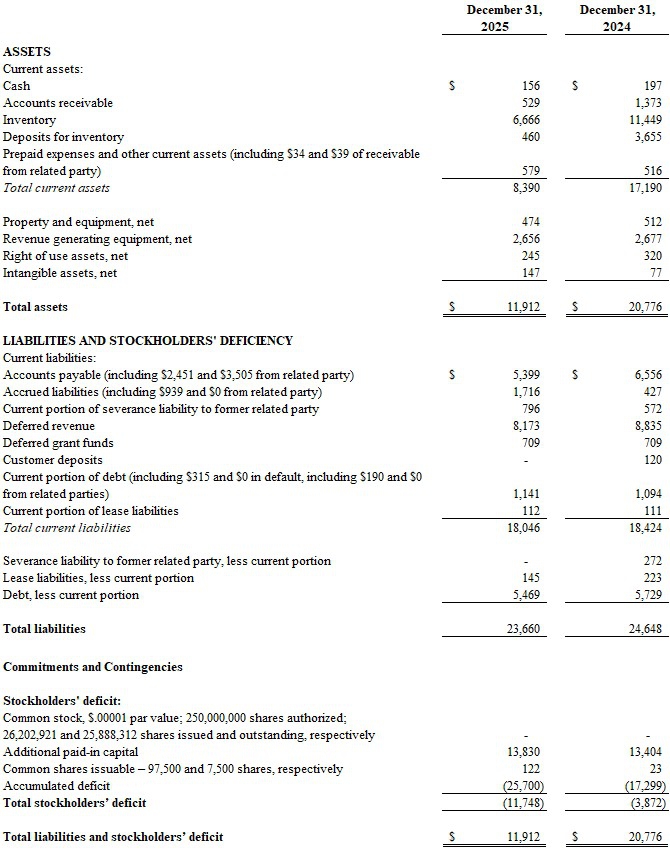
BALANCE SHEETS
(Amounts in thousands, except share amounts)
The accompanying notes are an integral part of these financial statements.
| F-2 |
NOMAD TRANSPORTABLE POWER SYSTEMS, INC.
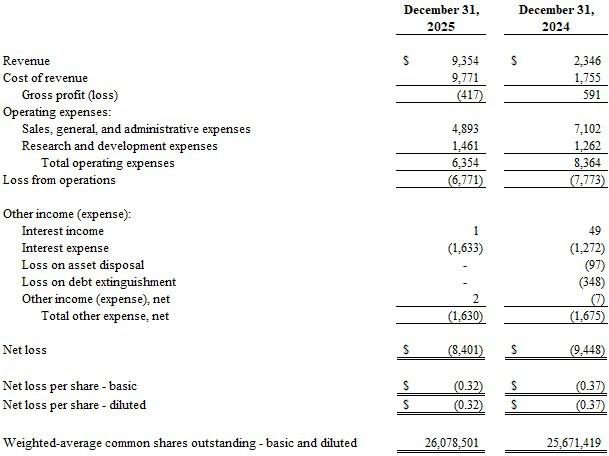
STATEMENTS OF OPERATIONS
(In thousands, except share and per share amounts)
The accompanying notes are an integral part of these financial statements.
| F-3 |
NOMAD TRANSPORTABLE POWER SYSTEMS, INC.
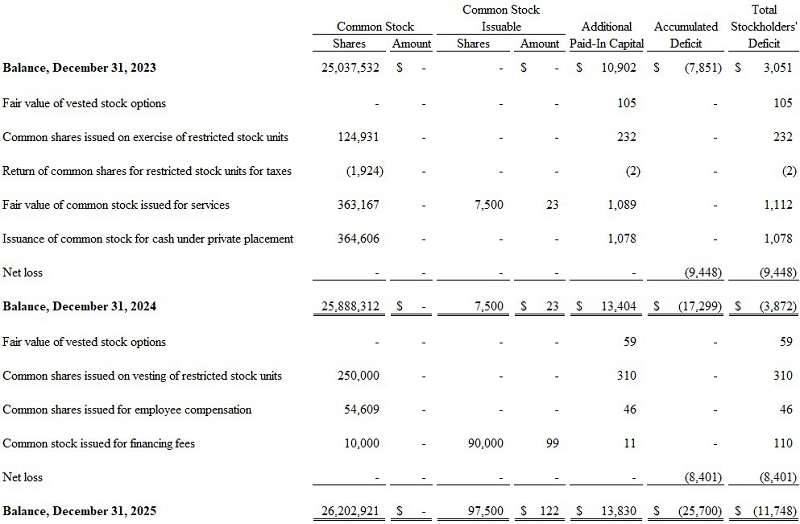
STATEMENTS OF CHANGES IN STOCKHOLDERS’ DEFICIT
For the Years Ended December 31, 2025 and 2024
(Amounts in thousands except share amounts)
The accompanying notes are an integral part of these financial statements.
| F-4 |
NOMAD TRANSPORTABLE POWER SYSTEMS, INC.
STATEMENTS OF CASH FLOWS
For the Years Ended December 31, 2025 and 2024
(Amounts in thousands)
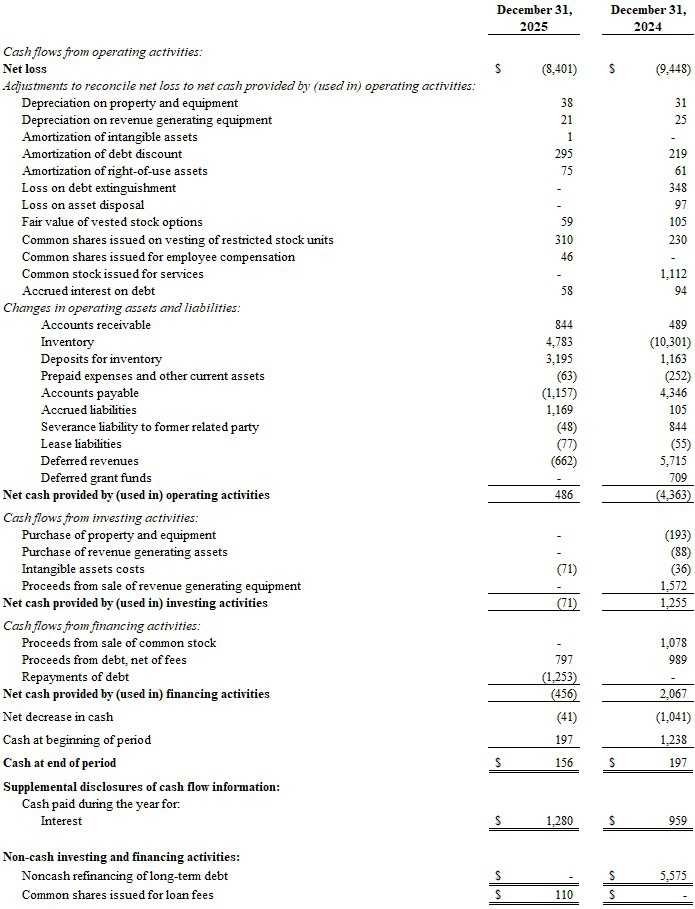
The accompanying notes are an integral part of these financial statements.
| F-5 |
NOMAD TRANSPORTABLE POWER SYSTEMS, INC.
NOTES TO FINANCIAL STATEMENTS
For the Years Ended December 31, 2025 and 2024
(In thousands, except share and per share amounts)
1. ORGANIZATION AND BASIS OF PRESENTATION
NOMAD Transportable Power Systems, Inc. (“NOMAD”, the “Company”) is a privately-held development-stage company incorporated in the United States, with its head office located in Waterbury, Vermont. It also has an office in Boise, Idaho.
The Company develops and sells utility-scale mobile energy storage systems focused on providing transportable solutions. It specializes in plug-and-play battery storage systems integrated into specially designed mobile energy storage systems and docking systems, thereby helping customers in multiple industry segments to access a flexible, reliable, and affordable way to incorporate storage for varying use cases.
Substantial Doubt about the Company’s Ability to Continue as a Going Concern
The accompanying financial statements have been prepared under the assumption that the Company will continue as a going concern. In accordance with the Financial Accounting Standards Board (“FASB”) Accounting Standards Codification (“ASC”) 205-40, Going Concern, the Company’s management has evaluated whether there are conditions or events that raise substantial doubt about its ability to continue as a going concern within one year after the date the accompanying financial statements were issued. For the year ended December 31, 2025, the Company incurred a net loss of $8,401 and has a stockholders’ deficit of $11,748. As of December 31, 2025, the Company had $156 in cash available to fund its operations. The Company has a history of reporting net losses and negative operating cash flows. These factors raise substantial doubt about the Company’s ability to continue as a going concern within one year of the date that the financial statements are issued. The financial statements do not include any adjustments that might be necessary if the Company is unable to continue as a going concern.
On June 16, 2026, in connection with its merger with Lixte Biotechnology Holdings, Inc. (see Note 20), the Company received an advance of $6,500 under a secured promissory note, the proceeds of which were used primarily to repay the Company’s existing bank loan. The note bore interest at 15% per annum (not accruing until the merger closed or terminated), matured 30 days after issuance with automatic 30-day renewals while the merger remained pending, and was secured by a first-priority lien on substantially all of the Company’s assets. The merger closed on July 1, 2026, at which point the $6,500 principal balance of the note was applied against the Company’s post-closing working capital advance obligation to the Company (see Note 20), and the note was cancelled, and the remaining unfunded commitment of $9,000 was paid to the Company.
The Company’s ability to continue as a going concern depends on its ability to raise additional debt or equity capital to fund its business activities and ultimately achieve sustainable operating revenues and profitability. The Company has financed its working capital requirements through borrowings from various sources and the sale of its equity securities.
Because market conditions create uncertainty about the Company’s ability to secure additional funds, there can be no assurance that the Company will be able to secure additional financing on acceptable terms, as and when necessary to continue operations. If the Company is unable to obtain the cash resources necessary to satisfy the Company’s ongoing cash requirements, the Company could be required to scale back its business activities or to discontinue its operations entirely.
| F-6 |
2. SUMMARY OF SIGNIFICANT ACCOUNTING POLICIES
Basis of Presentation
This summary of significant accounting policies is presented to assist in understanding the financial statements. The financial statements and notes are representations of the Company’s management, which is responsible for their integrity and objectivity. These financial statements and related notes are presented in accordance with accounting principles generally accepted in the United States of America (“GAAP”).
Use of Estimates
The preparation of financial statements in accordance with GAAP requires the use of estimates and assumptions that affect the reported amounts of assets and liabilities at the dates of the financial statements, and the reported amounts of revenues and expenses during the reporting period. Significant areas requiring the use of management assumptions and estimates relate to stock-based compensation, including the fair value of common stock and share purchase warrants, as further described below. Macroeconomic factors, including but not limited to geopolitical issues between the U.S. and China, may create volatility, uncertainty, and economic disruption to the Company’s supply chain. Management has considered the impact of macroeconomic factors on its estimates, where relevant, in the preparation of the financial statements. Actual results could differ from these estimates and assumptions and could have a material effect on the Company’s reported financial position and results of operations.
Revenue Recognition
The Company recognizes Sales of Product revenue in accordance with FASB ASC 606, Revenue from Contracts with Customers. Lease revenue is recognized in accordance with FASB ASC 842, Leases.
The Company generates revenue from the sale of its mobile energy storage systems and related products, including mobile battery energy storage systems (“MBESS”), mobile transformer docking stations (“mobile docks”), and trailers for mounting and transportation of the MBESS. Revenue is recognized when control of the related products is transferred to the customer, in an amount that reflects the transaction price consideration that is expected to be received. Revenue associated with any unsatisfied performance obligation is deferred until the performance obligation is satisfied, i.e., when control of the related products is transferred to the customer. In some cases, the Company generates revenue from the short-term lease of its mobile energy storage systems. In these instances, revenue from the lease is recognized on a straight-line basis over the term of the lease.
To determine the proper revenue recognition method for contracts, the Company evaluates whether two or more contracts should be combined and accounted for as one contract and whether a single contract should be accounted for as more than one performance obligation. ASC 606 defines a performance obligation as a contractual promise to transfer a distinct good or service to a customer. A contract’s transaction price is allocated to each distinct performance obligation based on the relative standalone selling prices of the goods and services promised in the contract and recognized when, or as, the performance obligation is satisfied. The Company’s evaluation requires significant judgment, and the decision to combine a group of contracts or separate a contract into multiple performance obligations could change the amount of revenue and profit recorded in a given period.
The Company’s supply agreements and purchase orders may include multiple product deliverables, including MBESS, mobile docks, and trailers. The Company evaluates each promised good or service to determine whether it represents a distinct performance obligation under ASC 606. If a promised good or service is distinct, it is accounted for as a separate performance obligation. If the promised goods or services are not separately identifiable from other promises in the contract and are not distinct within the context of the contract, they are combined and accounted for as a single performance obligation.
The Company also evaluates whether it is the principal or agent in arrangements involving products manufactured by third parties. The Company is generally the principal when it controls the specified products before they are transferred to the customer. In making this determination, the Company considers indicators of control, including whether it is primarily responsible for fulfilling the promise to provide the specified products, whether it has inventory risk before the products are transferred to the customer, and whether it has discretion in establishing the price for the products. Based on these considerations, the Company generally concludes that it controls the products before transfer to the customer and is the principal in these arrangements. Accordingly, revenue is recognized on a gross basis for the amount of consideration to which the Company expects to be entitled.
| F-7 |
As the Company’s contracts may include multiple product deliverables, the timing of revenue recognition depends on when control of each related performance obligation transfers to the customer. Control is transferred when the customer has the ability to direct the use of, and obtain substantially all of the remaining benefits from, the related products. The Company considers the contractual terms, including applicable shipping Incoterms, customer acceptance provisions, transfer of ownership, and other relevant contract terms, in determining when control transfers.
For certain Ex-Works (“EXW”) arrangements, the customer may take ownership and control of products prior to physical shipment from the Company’s facility. In these situations, the Company evaluates whether the customer has obtained control of the products in accordance with ASC 606. When products have been specifically identified to the customer, are no longer available for use by the Company, and the customer has accepted ownership and assumed the associated risks related to the products, control may transfer prior to physical shipment. For EXW transactions where the customer obtains control at the Company’s facility, revenue is recognized when the customer assumes ownership and control of the goods. For other EXW transactions where control has not transferred, revenue is recognized when the applicable transfer criteria have been met.
For Delivered Duties Paid (“DDP”) arrangements, revenue is recognized when the goods are delivered to the customer’s specified destination and the Company has satisfied its remaining delivery obligations.
The Company’s contracts give rise to several types of variable consideration, including contract modifications (change orders) and other terms that can either increase or decrease the transaction price. The Company estimates variable consideration as the most likely amount to which it expects to be entitled. The Company includes estimated amounts in the transaction price to the extent it believes it has an enforceable right and it is probable that a significant reversal of cumulative revenue recognized will not occur. The estimates of variable consideration and the determination as to whether to include estimated amounts in the transaction price are based largely on an assessment of the Company’s anticipated performance and all information (historical, current, and forecasted) that is reasonably available at the time. Change orders and incentives are evaluated to determine whether they represent separate performance obligations or modifications to existing performance obligations. When change orders are not distinct from the existing contract due to the significant integration services provided in the context of the contract, they are accounted for as a modification to the existing contract and performance obligation. The effect of contract modification on the transaction price, and the Company’s measure of progress for the performance obligation to which it relates, is recognized as an adjustment to revenue on a cumulative catch-up basis, when applicable. In some cases, settlement of contract modifications may not occur until after completion of work under the contract.
The Company generally provides limited assurance-type warranties for work performed under its contracts. Product and installation warranties are provided by the equipment manufacturers and the Company within the context of each customer contract. In certain cases, the Company may be liable for re-installation costs resulting from faulty hardware. The warranty periods typically extend for a limited duration after control of the mobile energy storage system is transferred to the customer. Historically, assurance-type warranty claims have not resulted in material costs being incurred.
Certain contracts include extended service-type warranties. The Company offers extended warranties to customers for a period of up to ten years. Such warranties are considered to be separate performance obligations to which the related consideration is appropriately allocated based on the relative standalone selling price and recognized over the term of the warranty. There was no revenue related to extended warranties during the years ended December 31, 2025 and 2024.
Certain contracts include performance-type warranties. The Company offers performance warranties to customers for a period of up to ten years. Such warranties are evaluated to determine whether they represent separate performance obligations under ASC 606. When such warranties are considered to be separate performance obligations, the related consideration is appropriately allocated based on the relative standalone selling price and recognized over the term of the warranty. Related to performance-type warranties during the years ended December 31, 2025 and 2024 was de minimis.
| F-8 |
The timing of revenue recognition, billings, and cash collections results in billed accounts receivable, unbilled revenue, deferred revenue, and customer deposits. Amounts are billed in accordance with agreed-upon contractual terms. Generally, billings and customer deposits occur prior to revenue recognition, resulting in contract liabilities presented in the balance sheet as deferred revenue and customer deposits. Deferred revenue represents the unearned revenue on cash receipts for consideration the Company has received on contracts for which the related performance obligation has not been satisfied. The Company expects deferred revenue at December 31, 2025 to be recognized as the related performance obligations are satisfied in accordance with the terms of the underlying contracts.
Revenue consisted of the following:
| December 31, 2025 | December 31, 2024 | |||||||
| Sales of products | $ | 9,153 | $ | 1,918 | ||||
| Lease revenue | 104 | 321 | ||||||
| Other revenue | 97 | 107 | ||||||
| $ | 9,354 | $ | 2,346 | |||||
Cost of Revenues
Cost of revenue consists primarily of costs of sold units and ancillary equipment, delivery and freight costs, expenses related to employee trips to customer sites for training, on-site acceptance testing (“OSAT”), and service work on deployed units.
Accounts Receivable
The Company records trade accounts receivable at the amounts billed to customers and presents them on the balance sheet, net of any allowance for estimated credit losses, if required. Management determines the allowance based on a variety of factors, including the age of the receivables, current economic conditions, historical losses, and other information management obtains regarding customers’ financial condition. The Company charges off receivables when they are deemed uncollectible. As of December 31, 2025 and 2024, the Company determined that no allowance for credit losses was needed. Included in accounts receivable at December 31, 2025 and 2024, is an advance on taxes owed on issuances of Restricted Stock Units (RSUs) from an officer of $34 and $39, respectively (see Note 4).
Inventories
Inventories consist of equipment on hand that is available for sale. Inventories are stated at the lower of cost or net realizable value, with cost determined on a first-in, first-out basis. Adjustments, if required, reduce inventory to its net realizable value, reflecting estimated excess, obsolescence, or impairment balances. Factors influencing these adjustments include changes in customer demand, rapid technological changes, and merchant bankruptcy. As of December 31, 2025 and 2024, the Company recorded no reserve for slow-moving inventory.
The Company regularly reviews the cost of inventories against their estimated net realizable value and records write-downs if any Work-in-Progress or Finished inventories have costs in excess of their net realizable values. As of December 31, 2025 and 2024, the Company recorded write-downs of $154 and $0, respectively.
Deposits for Inventory
The Company utilizes multiple vendors and manufacturers to produce its mobile energy storage systems. At times, prepayments are required to begin production of critical elements in the systems. These prepayments are recorded as deposits for inventory and are moved to inventory or work in progress when the Company takes possession of the items as applicable. Deposits for inventory are stated at cost. Based on current demand for the Company’s mobile energy storage systems, these systems are expected to be sold at a profit once completed.
Property and Equipment
Property and equipment are stated at cost, which includes the acquisition price and any direct costs to bring the asset into use at its intended location, less accumulated depreciation. Depreciation is computed using the straight-line method over the assets’ estimated useful lives. The useful lives for depreciation purposes range from three to twenty years. The Company expenses repairs and maintenance charges as incurred.
| F-9 |
Upon disposal of assets, the cost of the assets and the related accumulated depreciation are removed from the accounts, and gains or losses are reflected in the accompanying statements of operations for the respective period.
Depreciation and amortization are computed using the straight-line method over the estimated useful lives of the related assets. The Company provides for depreciation, as follows:

Revenue Generating Equipment
Revenue generating equipment is comprised of mobile energy storage systems that are leased to customers on a short-term basis and are stated at cost, which includes the acquisition price and any direct costs to bring the asset into use at its intended location, less accumulated depreciation. Depreciation is computed using either the straight-line method over the assets’ estimated useful lives or the units-of-production method based on the expected utilization and operating cycles of the assets’ battery systems. For assets depreciated using the units-of-production method, depreciation is based on the actual utilization of the assets relative to the estimated total production cycles of the battery systems. Based on an expected utilization of approximately 365 operating cycles per year over an estimated useful life of 17 years, the battery systems are expected to operate for approximately 6,205 total operating cycles. The Company has determined that 70.8% of Beginning-of-Life (“BOL”) capacity represents the estimated end-of-life threshold for the battery systems. Repairs and maintenance charges are expensed as incurred.
Upon disposal of assets, the cost of the assets and the related accumulated depreciation are removed from the accounts, and gains or losses are reflected in the accompanying statements of operations for the respective period.
Intangible Assets
Intangible assets consist of patents. Patent costs are stated at cost and consist primarily of legal fees incurred to obtain the patents. Costs associated with patents that are not yet available for their intended use are capitalized until the patents are issued and available for their intended use. The Company does not capitalize research and development costs associated with the development of the underlying technology unless specifically permitted under applicable GAAP.
Patents are amortized on a straight-line basis over their estimated useful lives, beginning when the patents are issued and available for their intended use. The estimated useful life of each patent is based on the period over which the Company expects to receive economic benefits from the patent, subject to the legal life of the patent. The Company evaluates the useful lives and carrying amounts of its patents for potential impairment when events or changes in circumstances indicate that the carrying amount may not be recoverable.
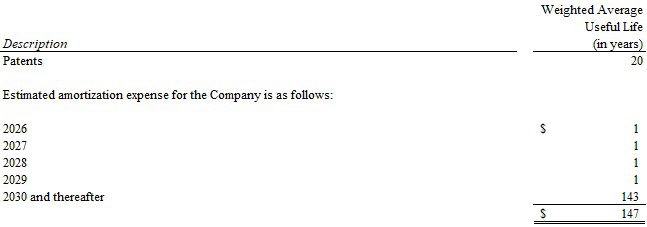
During the year ended December 31, 2025, two patents were completed and became available for their intended use. The remaining patents were in process and had not yet become available for their intended use as of December 31, 2025.
Long-Lived Assets
The Company evaluates long-lived assets, other than goodwill and indefinite-lived intangible assets, for impairment whenever events or changes in circumstances (“triggering events”) indicate that their net book value may not be recoverable. The measurement of possible impairment is based upon the ability to recover the carrying value of the asset through the expected future undiscounted cash flows from the use of the asset and its eventual disposition. An impairment loss, equal to the difference between the asset’s fair value and its carrying value, is recognized when the estimated future undiscounted cash flows are less than its carrying amount. No impairment indicators were identified as of December 31, 2025 and 2024.
| F-10 |
Leases
The Company leases certain corporate office space under lease agreements. The Company determines whether a contract contains a lease at contract inception. A contract is a lease if it conveys the right to control the use of the identified asset for a period in exchange for consideration. Control is determined based on the right to obtain all of the economic benefits from use of the identified asset and the right to direct the use of the identified asset. Operating lease right-of-use assets (“ROU”) represent the right to use an underlying asset for the lease term, and operating lease liabilities represent the obligation to make lease payments. Lease liabilities are recognized at the present value of the future minimum lease payments over the lease term at the commencement date. Operating lease expense is recognized on a straight-line basis over the lease term and is included in the sales, general and administrative expense in the statements of operations.
Income Taxes
The Company accounts for income taxes using the liability method. The liability method requires the recognition of deferred tax assets and liabilities for the expected future tax consequences of (i) temporary differences between financial statement carrying amounts of assets and liabilities and their basis for tax purposes and (ii) operating loss and tax credit carryforwards for tax purposes. The Company recognizes deferred tax assets to the extent the assets are more likely than not to be realized. At December 31, 2025 and 2024, the Company recorded a full valuation allowance to reduce deferred tax assets to zero.
The Company adheres to the provisions of FASB ASC 740-10, Income Taxes, relating to accounting for uncertain tax positions. The Company recognizes the tax benefit from uncertain tax positions only if it is more likely than not the tax positions will be sustained on examination by the tax authorities, based on the technical merits of the position. The tax benefit is measured based on the largest benefit that has a greater than 50% likelihood of being realized upon ultimate settlement. The Company recognizes interest and penalties related to income tax matters in income tax expense. No income tax expense or interest and penalties related to income tax matters were recognized for the years ended December 31, 2025 and 2024.
Loss per Common Share
Basic earnings (loss) per share is computed by dividing the net income (loss) applicable to common stockholders by the weighted average number of shares of common stock outstanding during the year. Diluted earnings (loss) per share is computed by dividing the net income applicable to common stockholders by the weighted average number of common shares outstanding plus the number of additional common shares that would have been outstanding if all dilutive potential common shares had been issued, using the treasury stock method. Potential common shares are excluded from the computation when their effect is antidilutive.
For the years ended December 31, 2025 and 2024, the calculations of basic and diluted loss per share are the same because potential dilutive securities would have had an anti-dilutive effect. The potentially dilutive securities consisted of the following:

| F-11 |
Advertising Costs
Advertising costs are expensed as incurred and are included in sales, general, and administrative expenses on the statement of operations. Total advertising expense was approximately $176 and $662 for the years ended December 31, 2025 and 2024, respectively.
Research and Development Costs
Research and development costs are expensed as incurred and are included in research and development expenses on the statements of operations. Costs mostly consist of engineering, testing fees, and related product costs. Total research and development expense was approximately $1,461 and $1,262 for the years ended December 31, 2025 and 2024, respectively.
Stock-Based Compensation
The Company accounts for stock-based compensation in accordance with ASC 718, Compensation—Stock Compensation, which establishes the accounting treatment for transactions in which an entity exchanges its equity instruments for goods or services. Under the provisions of ASC 718, the measurement of the value of employee services received in exchange for an award of an equity instrument is based on the grant-date fair value of the award. Prior to issuance of the awards, the Company is not under any obligation to issue stock options or restricted stock units (“RSUs”). The award vests over a specified period determined by the Company’s Board of Directors. The measurement date of the grant is also the date of the award. The fair value of options is expensed ratably during the specified vesting period.
The Company accounts for stock-based payments to non-employees in accordance with FASB Accounting Standards Update (“ASU”) 2018-07—Compensation—Stock Compensation (topic 718): improvements to nonemployee share-based payment accounting. Non-employee stock-based compensation is granted at the Board of Director’s discretion to select individuals.
The Company estimates the fair value of stock awards on the date of grant using a Black-Scholes valuation model, which requires management to make certain assumptions that are complex, subjective, and generally require significant judgment to determine regarding: (i) the expected volatility in the market price of the Company’s common stock; (ii) dividend yield; (iii) risk-free interest rates; and (iv) the period of time employees are expected to hold the award prior to exercised (referred to as the expected holding period).
There is no trading activity in the Company’s stock, therefore management uses its best estimate of future volatility based on reviewing the average volatility of stock prices for similar publicly traded companies. The Company has not declared or paid dividends in the past and does not currently expect to do so in the foreseeable future. The risk-free interest rate is based on the U.S. Treasury yield curve in effect at the time of the grant for bonds with maturities ranging from one month to five years.
The expected term represents the period that the stock options are expected to be outstanding. The expected term of options granted to employees and non-employee directors is determined using the “simplified” method, as illustrated in ASC 718, as the Company does not have sufficient exercise history to determine a better estimate of expected term. Under this approach, the expected term is based on the midpoint between the vesting date and the end of the contractual term of the option. Forfeitures are recognized as they occur.
Stock Granted to Employees and Non-Employees in Lieu of Cash Payments
The Company periodically issues share-based awards to employees, non-employees, and consultants for services rendered. Stock options vest and expire according to the terms established at the grant’s issuance date. Stock grants are measured at the grant date fair value. Stock-based compensation cost is measured at fair value on the grant date and is generally recognized as an expense in the statement of operations ratably over the requisite service period or vesting period. Recognition of compensation expense for non-employees occurs in the same period and in the same manner as if the Company had paid cash for the services.
| F-12 |
Related Parties
In accordance with ASC 850, Related Party Disclosures, a party is considered to be related to the Company if the party directly or indirectly or through one or more intermediaries, controls, is controlled by, or is under common control with the Company. Related parties also include principal owners of the Company, its management, members of the immediate families of principal owners of the Company and its management, and other parties with which the Company may deal with if one party controls or can significantly influence the management or operating policies of the other to an extent that one of the transacting parties might be prevented from fully pursuing its own separate interests.
Fair Value of Financial Instruments
Fair value of financial and non-financial assets and liabilities is defined as an exit price, which is the price that would be received to sell an asset or paid to transfer a liability in an orderly transaction between market participants at the measurement date. The three-tier hierarchy for inputs used to measure fair value, which prioritizes the inputs to valuation techniques used to measure fair value, is as follows:
Level 1 – quoted prices (unadjusted) in active markets for identical assets or liabilities.
Level 2 – quoted prices for similar assets and liabilities in active markets or inputs that are observable for the asset or liability, either directly or indirectly through market corroboration, for substantially the full term of the financial instrument.
Level 3 – unobservable inputs based on the Company’s assumptions used to measure assets and liabilities at fair value.
A financial asset or liability’s classification within the hierarchy is determined based on the lowest level input that is significant to the fair value measurement. The assessment of the significance of a particular input to the fair value measurement requires judgment and may affect the valuation of the assets and liabilities being measured and their placement within the fair value hierarchy.
The carrying value of the Company’s financial instruments (consisting of cash, accounts receivables, inventory, deposit on inventory, prepaid expense and other current assets, accounts payable, accrued liabilities, deferred revenue, customer deposits, and debt) are considered to be representative of their respective fair values due to the short-term nature of those instruments.
Concentration of Risk
Supply Risk – The Company is dependent on its suppliers, some of which are single source suppliers, and the inability of these suppliers to deliver necessary components of the Company’s products in a timely manner at prices, quality levels, and volumes acceptable to the Company, or the Company’s inability to efficiently manage these components from these suppliers, could have a material adverse effect on the Company’s business, prospects, financial conditions, and operating results.
Although all of the Company’s contract manufacturers’ current manufacturing facilities are operational, and the Company continues to increase output and add additional capacity and is working with each supplier on meeting, ramping, and sustaining production, the ability to sustain this trajectory depends, among other things, on the readiness and solvency of suppliers amid macroeconomic factors.
Credit Risk – At various times during the year, the amount of cash on deposit may exceed the insured limit by the U.S. Federal Deposit Insurance Corporation, which potentially subjects the Company to credit risk. The Company maintains its cash at high-quality institutions.
Major Customers – 99% of deferred revenue for the year ended December 31, 2025 was from five customers. 98% of deferred revenue for the year ended December 31, 2024 was from four customers.
| F-13 |
Segment Information
The Company’s Chief Executive Officer (“CEO”) is our chief operating decision maker (“CODM”) and evaluates performance and makes operating decisions regarding resource allocation based on financial data presented as a whole, as there are no separate operating entities. Because our CODM evaluates financial performance on the Company as a whole, the Company has determined that it operates as a single reportable segment, comprising the financial results of Nomad Transportable Power Systems, Inc.
Recent Accounting Pronouncements
In November 2024, the FASB issued ASU No. 2024-03, Income Statement—Reporting Comprehensive Income—Expense Disaggregation Disclosures (Subtopic 220-40): Disaggregation of Income Statement Expenses which includes amendments that require disclosure in the notes to financial statements of specified information about certain costs and expenses, including purchases of inventory; employee compensation; and depreciation, amortization and depletion expenses for each caption on the income statement where such expenses are included. The amendments are effective for the Company’s annual periods beginning January 1, 2027, with early adoption permitted, and should be applied either prospectively or retrospectively. The Company is evaluating this ASU to determine its impact on the Company’s disclosures.
Other recent accounting pronouncements issued by the FASB, its Emerging Issues Task Force, the American Institute of Certified Public Accountants, and the Securities and Exchange Commission did not or are not believed by management to have a material impact on the Company’s present or future financial statements.
3. INVENTORY
Inventory by category consisted of the following:

4. PREPAID EXPENSES AND OTHER CURRENT ASSETS
Prepaid expenses and other current assets consisted of the following:
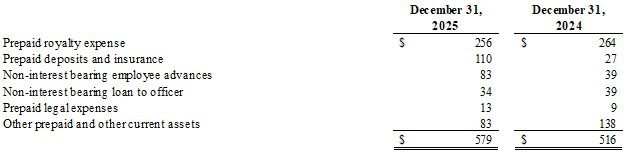
The non-interest bearing loan to officer was fully repaid on August 21, 2026. Included in prepaid expenses and other current assets are advances on taxes owed on issuances of RSUs from an officer of $34 and $39, respectively.
| F-14 |
5. PROPERTY AND EQUIPMENT
Property and equipment, net, consisted of the following:

Depreciation expense totaled approximately $38 and $31 for the years ended December 31, 2025 and 2024, respectively.
6. REVENUE GENERATING EQUIPMENT
Revenue-generating equipment, net, consisted of the following:

Revenue generating depreciation expense totaled approximately $21 and $25 for the years ended December 31, 2025 and 2024, respectively.
During the year ended December 31, 2024, the Company sold two revenue generating assets. Both assets were originally acquired in August 2023 for approximately $1,698. During 2024, the assets had additions of approximately $88 and during the sale of the units, six racks of batteries were removed and returned to inventory with a total cost of approximately $110 (net of accumulated depreciation of approximately $2), resulting in a carrying value of approximately $1,670 (net of accumulated depreciation of approximately $6 for the assets at the time of sale). The assets were sold for total consideration of $1,572, resulting in a loss of approximately $97, which is included in the accompanying statements of operations under “Loss on asset disposal.”
There were no disposals of revenue generating equipment in 2025.
7. INTANGIBLE ASSETS
Intangible assets consisted of the following (in thousands, except as noted):

During the years ended December 31, 2025 and 2024, the Company capitalized costs of $71 and $36, respectively, pertaining to patents.
| F-15 |
Identifiable intangibles are amortized over their estimated remaining useful lives, which are as follows:
8. ACCRUED EXPENSES
Accrued liabilities consisted of the following:

9. SEVERANCE LIABILITY
On July 11, 2024, the Company entered into a Transition Agreement and General Release (the “Transition Agreement”) with former CEO, Paul Coombs, in connection with the termination of his employment with the Company effective July 11, 2024. Pursuant to the Transition Agreement, and in consideration for a general release of claims and Mr. Coombs’ compliance with certain continuing obligations, the Company agreed to pay Mr. Coombs an aggregate of $1,012, less applicable deductions and withholdings, in equal installments over a 24-month period in accordance with the Company’s regular payroll practices. Mr. Coombs also continued to receive Company benefits through July 31, 2024. The Company may discontinue any remaining payments under the Transition Agreement in the event Mr. Coombs breaches the agreement. In July 2025, the Company agreed with Mr. Coombs to make reduced payments under his severance agreement, depending on available cash flow.
In connection with the Transition Agreement, the Company and Mr. Coombs also entered into a Consulting Services Agreement pursuant to which Mr. Coombs agreed to provide consulting, promotional and brand ambassador services to the Company. The consulting agreement commenced on July 10, 2024 and continued through July 9, 2026. Under the consulting agreement, the Company paid Mr. Coombs a nominal monthly fee for a minimum of five hours of consulting services per month whereby he served as an independent contractor and was generally responsible for his own expenses unless the Company approved them in advance.
| F-16 |
The severance liability consists of the following:

For the year ended December 31, 2025, the Company recognized $48 of expense associated with the Transition Agreement and $2 of consulting expenses. As of December 31, 2025, $796 remained payable under the Transition Agreement, all of which was classified as a current liability.
10. DEFERRED GRANT
In 2024, the Company received a cooperative agreement of approximately $9.5 million from the U.S. Department of Energy (“DOE”), which is designated for the Vermont Long Duration Energy Storage Demonstration Project. The agreement funds are provided on a reimbursable basis, meaning the Company incurs eligible expenses related to the project or program and submits them for reimbursement to the grantor.
For the year ended December 31, 2024, the Company incurred costs totaling approximately $275 related to this project. Approximately $984 of the grant had been reimbursed to the Company, of which approximately $709 remained recorded as deferred grant revenue at December 31, 2024. The remaining balance of the grant is expected to be reimbursed once the corresponding eligible expenses are incurred and submitted for approval.
For the year ending December 31, 2025, the Company incurred costs totaling approximately $510 related to this project. Approximately $2,499 of the grant had been reimbursed to the Company. Of these costs, approximately $1,989 was allocated to GMP, a subrecipient of the project. Approximately $709 remained recorded as deferred grant revenue at December 31, 2025.
The remaining balance of the grant is expected to be reimbursed once the corresponding eligible expenses are incurred and submitted for approval.
The cooperative agreement funds are recognized in the period in which eligible expenses are incurred and are recorded as an offset to the related expenses. The application of the funds is based on the nature of the underlying eligible expenditures. Funds related to GMP activities reduce the cash amount owed to the subrecipient for the purchase of units, while the remaining cooperative agreement funds are applied as an offset to eligible research and development expenses.
The Company is in compliance with the terms and conditions of the cooperative agreement, and management believes that all expenditures incurred are in alignment with the objectives and guidelines set forth by the DOE.
| F-17 |
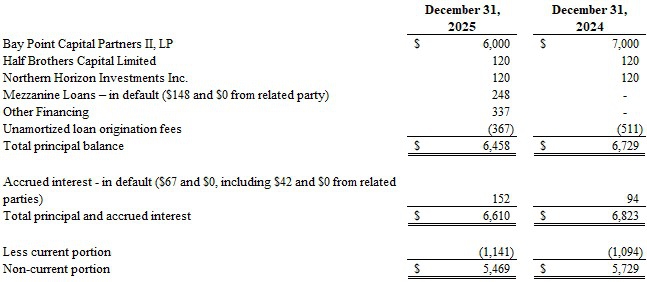
11. DEBT
Debt consists of the following at December 31, 2025 and 2024:
Bay Point Capital Partners II, LP
On February 12, 2024, the Company entered into a financing arrangement with Bay Point Capital Partners II, LP (“Bay Point Loan”) for $7,000. A portion of the proceeds, approximately $5,575, was paid directly to RE Royalties Ltd. (“RER”) to settle the Company’s outstanding obligation to RER. The Company recorded a loss on debt extinguishment of $348 related to the unamortized portion of the loan origination fee, which is included in other expenses in the accompanying statement of operations. The Company received proceeds of $1,259, net of loan fees and expenses. The total proceeds from the Bay Point financing exceeded the amount used to settle the RER obligation. The portion of the transaction related to the direct settlement of the RER obligation did not involve cash received or disbursed by the Company and was therefore presented as a noncash financing activity in the accompanying statements of cash flows.
The Bay Point Loan bears interest annually at 15%, and accrued interest is due monthly. $500 of principal is due on each of February 12, 2025, August 12, 2025, and February 12, 2026. The remaining principal is due on February 12, 2027. However, upon an issuance of indebtedness, the outstanding balance of the loan is due upon receipt, and upon an issuance of Equity, a portion of the loan is due based on a percentage of proceeds earned. The loan is secured by substantially all business assets.
Half Brothers Capital Limited
On February 12, 2024, the Company entered into a loan and security agreement with Half Brothers Capital Limited (the “HBCL Loan”). The HBCL Loan bears interest annually at 15% and accrued interest is due monthly. All principal is due in May 2027. However, upon an issuance of indebtedness the outstanding balance of the loan is due upon receipt and upon an issuance of Equity a portion of the loan is due based on a percentage of proceeds earned. The loan is secured by substantially all business assets.
Northern Horizon Investments Inc.
On February 12, 2024, the Company entered into a loan and security agreement with Northern Horizon Investments, Inc. (the “NHI Loan”). The NHI Loan bears interest annually at 15% and accrued interest is due monthly. All principal is due in May 2027. However, upon an issuance of indebtedness the outstanding balance of the loan is due upon receipt and upon an issuance of Equity a portion of the loan is due based on a percentage of proceeds earned. The loan is secured by substantially all business assets.
| F-18 |
Mezzanine Loans – Related Parties – In Default
During 2025, the Company received approximately $250 in short-term financing from related parties pursuant to mezzanine loan agreements. The loans were issued to provide working capital for materials and production-related expenses and are generally unsecured.
The Mezzanine loans generally bear interest at rates of 20% per annum and have short-term maturities. The loan agreements generally provide for a minimum interest period and equity-based loan fees. Upon an event of default, including failure to repay amounts due within the applicable period following maturity, the lender may, if permitted by applicable law, increase the interest rate to 30% per annum. The agreements may also provide for additional equity-based fees upon default.
During 2025, the Company repaid approximately $102 of principal and paid approximately $16 of interest related to these loans. As of December 31, 2025, approximately $148 of principal remained outstanding and approximately $42 of accrued interest was payable. The Company also incurred approximately $28 of loan origination fees related to these loans and $27 of penalties related to the default of the loans, which were issuable through 55,000 common shares and are included in common stock payable to related parties.
The loans were in default as of December 31, 2025 and were accruing interest at the applicable default rate of 30% per annum.
Mezzanine Loans – Non-Related Parties – In Default
During 2025, the Company received approximately $250 in short-term financing from non-related parties pursuant to mezzanine loan agreements. The loans were issued to provide working capital for materials and production-related expenses and are generally unsecured.
The Mezzanine loans generally bear interest at rates of 20% per annum and have short-term maturities. The loan agreements generally provide for a minimum interest period and equity-based loan fees. Upon an event of default, including failure to repay amounts due within the applicable period following maturity, the lender may, if permitted by applicable law, increase the interest rate to 30% per annum. The agreements may also provide for additional equity-based fees upon default.
During 2025, the Company repaid approximately $150 of principal and paid approximately $21 of interest related to these loans. The Company also incurred approximately $28 of loan origination fees related to these loans and $27 of penalties related to the default of the loans, $44 which were issuable through 44,000 common shares, which is included in common stock issuable, and $11 which were settled through the issuance of 11,000 of common shares. As of December 31, 2025, approximately $100 of principal remained outstanding and approximately $25 of accrued interest was payable.
The loans were in default as of December 31, 2025 and were accruing interest at the applicable default rate of 30% per annum.
Other Financing
On December 24, 2025, the Company entered into an agreement pursuant to which the Company received $250 in exchange for a specified percentage of the Company’s future receivables. The agreement provides for a total purchased amount of $338 to be remitted to the purchaser from future receivables. The Company received net proceeds of approximately $242 after processing and application fees were applied.
Under the agreement, the Company is required to remit a specified percentage of deposits into its designated bank account to satisfy the amount purchased. The difference between the net proceeds received and the total contractual repayment amount, including applicable fees, is accounted for as a discount and financing costs and is recognized as interest expense over the term of the financing using the effective interest method.
As of December 31, 2025, the Company had approximately $337 recorded as a short-term financing obligation related to this arrangement. Repayments under the agreement commenced in January 2026.
| F-19 |
Future minimum payments are due as follows during the years ended December 31:

12. LEASES
The Company determines whether a contract is, or contains, a lease at inception. Right-of-use assets represent the Company’s right to use an underlying asset during the lease term, and lease liabilities represent the Company’s obligation to make lease payments arising from the lease. Right-of-use assets and lease liabilities are recognized at lease commencement based upon the estimated present value of unpaid lease payments over the lease term. Leases with an initial term of 12 months or less are not included on the balance sheets.
During 2023, the Company entered into two new operating lease agreements for office space in Idaho and Vermont. The Idaho lease requires monthly payments of approximately $2 beginning on January 1, 2024, and will escalate 3% annually until the end of the initial lease term on February 28, 2027. The Vermont lease requires monthly payments of approximately $6 beginning on January 1, 2024, and will escalate 2.5% annually until the end of the initial lease term on December 31, 2028. During 2024, the Company entered into one new operating lease agreement for additional office space in Vermont. The Vermont lease requires additional monthly payments of approximately $1 beginning on October 1, 2024, and will escalate 2.5% annually until the end of the initial lease term on December 31, 2028.
Operating lease expense was approximately $128 and $111 for the years ended December 31, 2025 and 2024, respectively, which includes short-term leases and variable lease costs, which are immaterial.
As of December 31, 2025, the weighted-average remaining lease term was approximately 2.62 years, and the weighted-average discount rate was 12.45%.
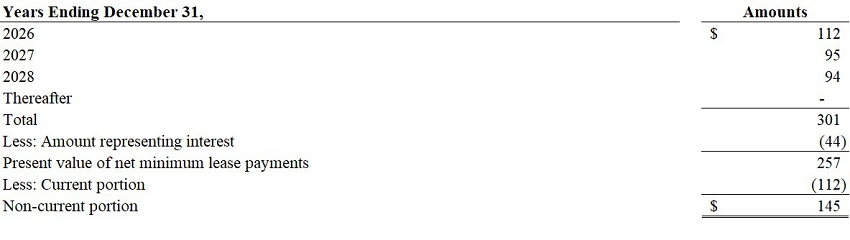
During the year ended December 31, 2024, the Company made aggregate payments of $55 towards its operating lease liability. As of December 31, 2024, operating lease liabilities totaled $334, of which $111 was current. During the year ended December 31, 2025, the Company made payments of $77 towards its operating lease liability. As of December 31, 2025, operating lease liabilities totaled $257, of which $112 was current.
Future minimum lease payments under the leases are as follows (in thousands):
| F-20 |
13. COMMITMENT AND CONTINGENCIES
Legal Proceedings
The Company is subject to claims and assessments from time to time in the ordinary course of business. The Company will accrue a liability for such matters when it is probable that a liability has been incurred and the amount can be reasonably estimated. When only a range of possible loss can be established, the most probable amount in the range is accrued. If no amount within this range is a better estimate than any other amount within the range, the minimum amount in the range is accrued. The Company was not party to any material legal proceedings as of December 31, 2024.
On December 2, 2025, Green Mountain Electric Supply, Inc. (“GMES”) filed a Civil Complaint against the Company for nonpayment of outstanding invoices related to industrial products ordered and received by the Company. The Company does not dispute the $225 amount owed to GMES, which is included in accounts payable, and has communicated the intention to settle the debt owed to GMES and have the action filed against the Company dismissed. On August 13, 2026, GMES filed a Satisfaction of Judgment for dismissal of the action filed.
Royalty Agreement
On April 1, 2022, the Company entered into a royalty agreement with RER. Under the royalty agreement, the Company was required to pay RER 3.5% of the gross proceeds from the sale of the first six NOMAD units as well as any new units produced from the remaining gross proceeds during the term of the note. The Company is subject to paying the royalty upon receipt of cash from the customer. The Company paid approximately $0 and $44 in royalties to RER in accordance with the royalty agreement during the years ended December 31, 2025 and 2024, respectively. Royalty expense is recognized as the related revenue is recognized and is included in selling, general, and administrative expenses in the statements of operations. During the year ended December 31, 2025 and 2024, the Company recorded royalty expense of $324 and $91, respectively. At December 31, 2025 and 2024, the Company had outstanding royalty payables due to RER of approximately $629 and $311, respectively, and is a component of accounts payable on the accompanying balance sheet.
As of December 31, 2025, the remaining royalty obligation under the royalty agreement was 14.9 MWh with an expected royalty expense of $228.
14. STOCKHOLDERS’ EQUITY
In 2025, the Company issued 10,000 shares of common stock in exchange for financing fees of $11, or $1.10 per share. The Company also issued 304,609 shares of common stock as stock-based compensation, of which 250,000 shares were issued in connection with RSUs and 54,609 shares were issued as employee bonuses. In addition, the Company agreed to issue 90,000 shares of common stock in exchange for financing fees. These shares were unissued and recorded as common shares issuable as of December 31, 2025.
In 2024, the Company issued 364,606 shares of common stock for cash at an issue price of $3.00 per share. The Company also issued 363,167 shares of common stock for services with a fair value of $1,089, or $3.00 per share, and 124,931 shares of common stock as stock-based compensation in lieu of cash for employee bonuses, of which 1,924 shares were returned to the Company for taxes. In addition, the Company agreed to issue 7,500 shares of common stock for services received. These shares were unissued and recorded as common shares issuable as of December 31, 2024.
15. SHARE BASED COMPENSATION
2022 Equity Incentive Plan
The 2022 Equity Incentive Plan (the “Plan”) provides for the grant of options, restricted stock purchase rights, restricted stock bonuses, restricted stock unit awards, or other stock-based awards to the Company’s directors, officers, employees, and consultants. Pursuant to the Plan, the maximum number of shares issuable pursuant to the exercise of stock options shall not exceed 10% of the number shares issued and outstanding.
| F-21 |
Pursuant to the Plan, in the event of a change in control of the Company, all outstanding awards will be subject to the definitive agreement entered into by the Company in connection with the change in control or as otherwise determined by the Board. A change in control of the Company constitutes an acceleration of vesting. The Plan also provides that the exercise price for stock options: (i) may not be less than 100% of the fair market value of a share of common stock on the effective date of grant of the option; and (ii) in the case of a grant made to a stockholder holding at least 10% of the shares of the Company, may not be less than 110% of the fair market value of a share of common stock on the effective date of the grant of the option.
On July 10, 2023, the Board of Directors of the Company approved an amendment of the Plan to increase the maximum numbers of shares issuable pursuant to the exercise of stock options shall not exceed 15% of the number shares issued and outstanding.
Restricted Stock Units
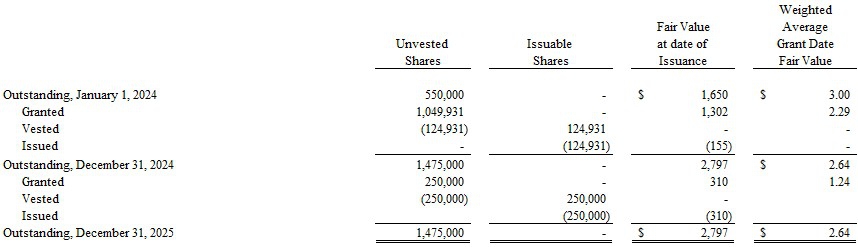
A summary of the Company’s restricted stock unit (“RSU”) activity for the years ended December 31, 2025 and 2024 is presented below:
The granting of RSUs under the Plan entitles recipients to receive shares of the Company’s common stock upon satisfaction of the applicable vesting conditions. Vesting conditions may include immediate vesting, a three-year time-based vesting schedule, an eighteen-month time-based vesting schedule, or vesting upon liquidation.
The liquidity event condition will be satisfied upon the first to occur of 1) the declaration that an Initial Public Offering (“IPO”) is effective and 2) the time immediately prior to the consummation of a Change in Control. As of December 31, 2025, management has determined that it cannot determine when, or if, a liquidity event will occur.
During 2024, the Company granted 1,049,931 RSUs with an aggregate fair value of $1,302 or $2.29 per share. 124,931 of the RSUs vested immediately, 625,000 RSUs vest upon a Liquidity Event as defined by the plan, 150,000 RSUs vest at a rate of 33% per year over 3 years, and 150,000 RSUs vest at a rate of 33% per 6 months over 18 months. In 2024, RSUs were issued with a value of approximately $155 in lieu of cash bonuses.
During 2025, the Company granted 250,000 RSUs with an aggregate fair value of $310, or $1.24 per share. The RSUs vest as follows: 100,000 RSUs vested immediately, and 150,000 RSUs vest upon a Liquidity Event as defined by the plan.
During the years ended December 31, 2025 and 2024, the Company recognized stock-based compensation expense of $356 and $230, respectively, and issued 250,000 and 124,931 shares of restricted stock based on the vesting terms of the grants, respectively. Of the 124,931 shares issued for vesting of restricted stock units in 2024, 1,924 were relinquished back to the Company to cover employee taxes, for a net amount of 123,007 shares of common stock. As of December 31, 2025, the unamortized stock compensation expense for restricted stock amounted to $3,820, to be expensed upon vesting in future periods through February 2028.
| F-22 |
Stock Options
A summary of the Company’s stock option activity for the years ended December 31, 2025 and 2024 is presented below:
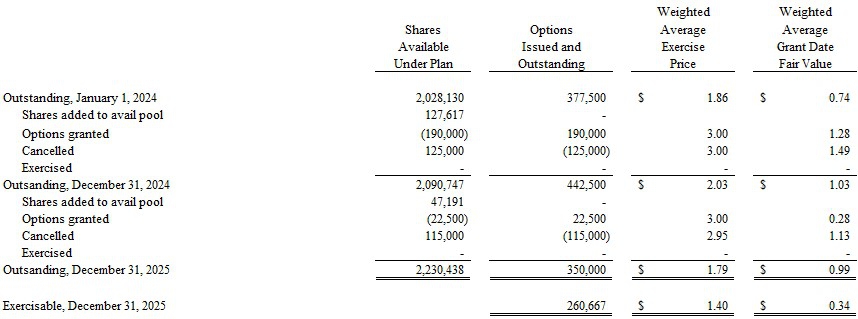
During the years ended December 31, 2025 and 2024, the Company recognized $59 and $105 of stock compensation expense relating to vested stock options, respectively. As of December 31, 2025, the aggregate amount of unvested compensation related to stock options was approximately $69, which will be recognized as an expense as the options vest in future periods through March 2028.
For the year ended December 31, 2025, there were an aggregate of 22,500 options issued at an exercise price of $3.00 per share that expire by March 3, 2030.
For the year ended December 31, 2024, there were an aggregate of 190,000 options issued at an exercise price of $3.00 per share that expire by December 2, 2029.
In determining the fair value of stock options granted, the following assumptions were used in the Black-Scholes option pricing model:

Options outstanding totaled 350,000 on December 31, 2025, of which 260,667 options are fully vested and exercisable. As of December 31, 2025, the remaining weighted average term of the option grants was 1.88 years. As of December 31, 2025, the weighted average exercise price of the option grants was $1.79 per share. During the year ended December 31, 2025, 115,000 options were cancelled.
Options outstanding totaled 442,500 on December 31, 2024, of which 224,167 options are fully vested and exercisable. As of December 31, 2024, the remaining weighted average term of the option grants was 3.16 years. As of December 31, 2024, the weighted average exercise price of the option grants was $2.03 per share. During the year ended December 31, 2024, 125,000 options were cancelled.
| F-23 |
The exercise prices of common stock options outstanding and exercisable at December 31, 2025 are as follows:

Warrants
A summary of the Company’s warrant activity for the years ended December 31, 2025 and 2024 is presented below:
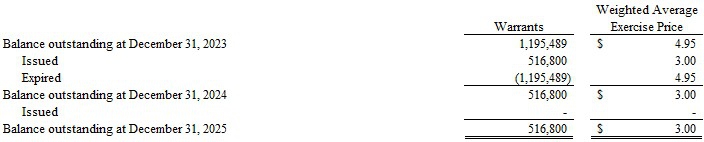
During the year ended December 31, 2025, the Company issued no warrants.
During the year ended December 31, 2024, the Company issued 500,000 warrants in connection with the sale of common stock, which expire in February 2028, and 16,800 warrants in connection with the sale of common stock, which expire in February 2027. The Company also had 1,195,489 warrants with a weighted-average exercise price of $4.95 expire during the year ended December 31, 2024 in accordance with their terms.
The warrants are transferable and exercisable separately from the underlying common stock and were accounted for as freestanding instruments.
The exercise prices of warrants outstanding and exercisable at December 31, 2025 are as follows:
| Exercise Prices | Warrants Outstanding (Shares) | Warrants Exercisable (Shares) | ||||||||
| $ | 3.00 | 516,800 | 516,800 | |||||||
16. DEFINED CONTRIBUTION PLAN
The Company has 401(k) savings plans that are intended to qualify as deferred salary arrangements under Section 401(k) of the Internal Revenue Code. Under the 401(k) savings plans, participating employees may elect to contribute up to 100% of their eligible compensation, subject to certain limitations. Participants are fully vested in their contributions. NOMAD matches up to 4% of each participating employee’s eligible compensation in the NOMAD 401(k) Plan. During the years ended December 31, 2025 and 2024, the Company incurred approximately $76 and $88, respectively, in employer matching contributions 401(k) plans.
| F-24 |
17. RELATED PARTY TRANSACTIONS
Offtake Agreements
The Company had signed an Offtake Agreement for batteries with KORE Power, Inc. (“KORE Power”) a stockholder of NOMAD, effective January 31, 2022. Under the agreement, KORE Power was to supply batteries according to NOMAD’s production schedule. The purchase of the batteries is facilitated through KORE Solutions, Inc. (“KORE Solutions”), a stockholder of NOMAD and wholly-owned subsidiary of KORE Power, collectively (“KORE”).
The Company signed a Master Supply Amendment with KORE Power, effective December 1, 2023, to amend and replace the Offtake Agreement previously entered into between NOMAD and KORE Power. Under the agreement, KORE Power will supply batteries according to NOMAD’s production schedule.
The Company signed a Master Equipment Supply and EPC (Engineer/Procure/Construct) Agreement with KORE Solutions (formerly Northern Reliability, Inc.), effective as of May 1, 2021 and amended effective April 11, 2022. The agreement is for the exclusive fabrication and supply of mobile energy storage systems, inclusive of associated KORE Power batteries, power docking stations, and related services. The purchase price for equipment and related services is KORE Solutions’ cost plus 25%.
The Company also entered into a management services and lease agreement with KORE Power, effective January 1, 2022, amended effective March 3, 2023, and amended effective October 1, 2023. Under the terms of the agreement, NOMAD will pay KORE Power for certain management services including accounting, secretarial, administration, marketing, and human resources, as well as the sub-lease of office space in Waterbury, Vermont. The agreement also specifies that KORE Power will be reimbursed for all third-party expenses reasonably incurred by KORE Power for the benefit of NOMAD in connection with the performance of these services. NOMAD will be invoiced by KORE Power monthly or quarterly, at KORE Power’s discretion.
On October 1, 2023, the agreement was amended and restated decreasing the payment to $15,000 per month. The term of the agreement was also amended to continue in three-month periods until terminated by either party upon 30-days notice. During 2024, a portion of the agreement was amended with an ending rate of $5,000 per month. During 2025, a portion of the agreement was amended with an ending rate of $3,000 per month.
At December 31, 2025 and 2024, the Company had outstanding payables due to KORE of approximately $2,451 and $3,505, respectively.
At December 31, 2025 and 2024, the Company had accrued expenses to KORE of approximately $939 and $0, respectively.
| F-25 |
18. INCOME TAXES
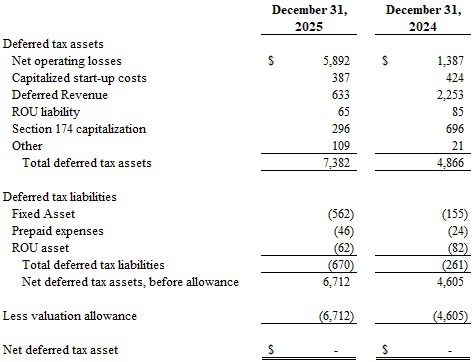
The significant components of deferred tax assets and liabilities are as follows:
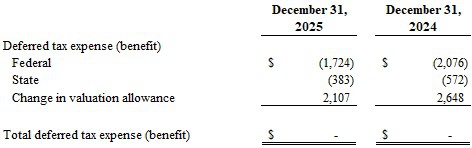
The components of income tax expense (benefit) consist of the following:
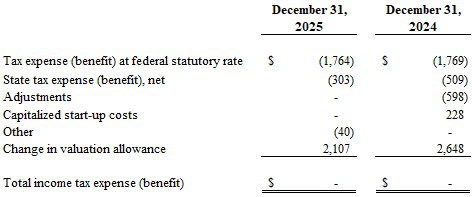
The effective tax rate differs from the statutory rate primarily as a result of certain permanent differences and the impact of certain state income taxes by category were as follows:
| F-26 |
At December 31, 2025, the Company had net operating loss carryforwards as follows:

While the U.S. Federal net operating loss carryforwards can be carried forward indefinitely, they are subject to annual 80% limitations under the 2017 Tax Cuts and Jobs Act. These limitations were applicable starting in 2021 as discussed further below.
The Company assessed the available positive and negative evidence to estimate whether sufficient future taxable income will be generated to permit use of the existing deferred tax assets, primarily the operating loss carryforwards. Due to the Company’s development stage status and cumulative losses, the Company has recorded a full valuation allowance against its deferred tax assets as of December 31, 2025 and 2024.
The Company files income tax returns in the U.S. federal jurisdiction, Arizona, California, Idaho, Texas, and Vermont. The Company does not have any uncertain tax positions. As of December 31, 2025 and 2024, there was no accrued interest or penalties recorded in the financial statements.
19. SEGMENT INFORMATION
The Company operates and manages its business as one reportable and operating segment concentrating on the sale of mobile energy storage systems to our customers. The measure of segment assets is reported on the balance sheet as total assets. The Company derives revenue primarily in the United States of America and manages its business activities on a company-wide basis.
The Company’s chief operating decision maker (“CODM”), its Chief Executive Officer, reviews financial information presented on a company-wide basis and decides how to allocate resources based on net loss. Net loss is used for evaluating financial performance. The monitoring of budgeted versus actual results is used in assessing the performance of the Company and in establishing management’s compensation.
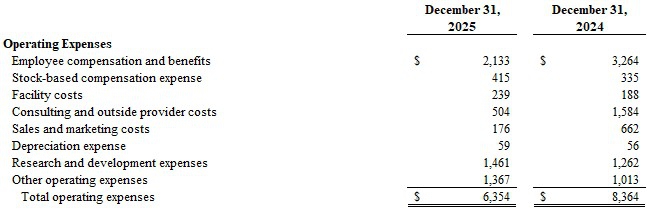
Significant segment expenses include employee compensation, stock-based compensation, merchant fees, and consulting and outside provider costs. Other operating expenses include all remaining costs necessary to operate our business and primarily include advertising, corporate compliance, and overhead expenses. The following table presents the significant segment expenses and other segment items regularly reviewed by our CODM:
| F-27 |
20. SUBSEQUENT EVENTS
On July 1, 2026, the Company closed a merger transaction with Lixte Biotechnology Holdings, Inc. (“Lixte”). As consideration for the transaction, the Company received $16,500 in cash, funded in various tranches, and became a wholly owned subsidiary of Lixte.
Although Lixte was the legal acquirer, NOMAD was determined to be the accounting acquirer for financial reporting purposes. Accordingly, the merger will be accounted for as a reverse acquisition under ASC 805, Business Combinations, with NOMAD considered the accounting acquirer and Lixte as the accounting acquiree.
Prior to the closing of the merger, in June 2026, the Company received an advance of $6,500 from Lixte under a secured promissory note. The proceeds were used primarily to repay the Company’s existing bank loan. The note bore interest at 15% per annum, did not accrue interest until the merger closed or terminated, matured 30 days after issuance with automatic 30-day renewals while the merger remained pending, and was secured by a first-priority lien on substantially all of the Company’s assets. Upon closing of the merger on July 1, 2026, the $6,500 principal balance was applied against the Company’s post-closing working capital advance obligation to the Company (see Note 1), the note was cancelled, and the remaining unfunded commitment of $9,000 was paid to the Company.
In July 2026, the Company repaid in full its loan balances to Half Brothers Capital Limited, Northern Horizon Investments Inc., all mezzanine loans, and the future receivables financing. The aggregate amount paid was approximately $1,028.
Subsequent to June 30, 2026, the Company received a non-interest-bearing loan of $115 from an officer to fund the purchase of key supply chain components.
On August 13, 2026, Green Mountain Electric Supply, Inc. (GMES) filed a Satisfaction of Judgment for dismissal of the action filed on December 2, 2025 against the Company for nonpayment of outstanding invoices related to industrial products ordered and received by the Company (see Note 13).
On September 10, 2026, the Company entered into a binding agreement with Mr. Paul Coombs to modify the terms of his Transition Agreement. Under the modified terms, the Company is obligated to pay Mr. Coombs $758,313 pursuant to the agreement, with the remaining consideration to be paid in equal monthly payments of $10,000, subject to applicable deductions and withholdings, commencing September 10, 2026. The monthly payments are subject to adjustment based on certain financing and cash balance conditions specified in the agreement. The Company may prepay all or any portion of the unpaid remaining consideration at its sole discretion, without penalty.
| F-28 |