Exhibit 99.2
TransAct Technologies activism highlights best micro-cap opportunity setin decades - IDWR Office02 Sep 202612:48 PDTUnited StatesMachinery-Printing TradeProprietaryby Mark Andress and Izaz Ansari?Activist urges TransAct to sell its two businesses?Small-cap activism hits highest share since 2020?AI slashes proxy contest costs by 90%IDWR Office has called on TransAct Technologies to sell both of its operating businesses, in a campaignthat comes during the strongest environment for micro-cap activism in decades, said ChuckGillman, IDWR?s executive managing director.Gillman, who disclosed a 5.1% stake in TransAct on 28 August, said the company is undervalued andshould engage an investment bank to sell its slot-machine printer business and a separate investmentbank to sell its BOHA! restaurant technology software business. The demands effectively mean the entirecompany should be sold, with all cash given to shareholders, he said.TransAct is a current example of the type of company Gillman targets ? one with a small marketcapitalization and strategic assets that could sell for a big premium if evaluated independently.The campaign comes at a time when opportunities for activists are greater today than at any point in his30-year career running proxy contests, according to Gillman. He cites three main factors for this: strongfirepower among potential acquirors; a legal environment he believes is increasingly supportive ofshareholder-led governance change; and sharply lower campaign costs driven by artificial intelligence.Using AI to prepare initial drafts of campaign materials has reduced proxy-contest costs by as much as90%, Gillman said. Campaigns that cost around USD 2m a decade ago can now be executed forapproximately USD 200,000, making activism economically viable at much smaller companies.IDWR's activist strategy focuses on companies with market capitalizations of USD 200m orless. TransAct?s market cap is only USD 53m.The single-family office manages only its own capital and has no external investors. Activism is one ofits three investment strategies, alongside investing in outside fund managers and investing in early-stageventure-backed startups.Gillman seeks what he calls "lopsided" situations in which shareholder support for change is likely to beoverwhelming."I'm trying to find situations where I can get 80%, 90% of the shareholders to vote for change," he said.He typically targets companies where misaligned executive compensation, weak governance, flawedbusiness models, or missed strategic opportunities have suppressed shareholder value. Small-cap activism risesGillman's focus on micro-caps comes as activists increasingly target smaller public companies.According to ActivistMonitor data, the proportion of activist campaigns targeting companies withmarket capitalizations below USD 500m has reached its highest level since 2020. In the year through 13August, activists launched 51 campaigns against companies in that category out of 125 total campaigns,representing 40.8% of overall activity.Gillman argues that lower campaign costs, combined with the availability of buyers with large cashpositions and strong stock valuations, have made smaller companies attractive targets for activist9/2/26, 2:03 PM2026-09-02 - TransAct Technologies activism highlights best micro-cap opportunity set in decades - IDWR Office_Mergermarkethttps://mergermarket.ionanalytics.com/company/720867?selectedContentId=10045353901/4
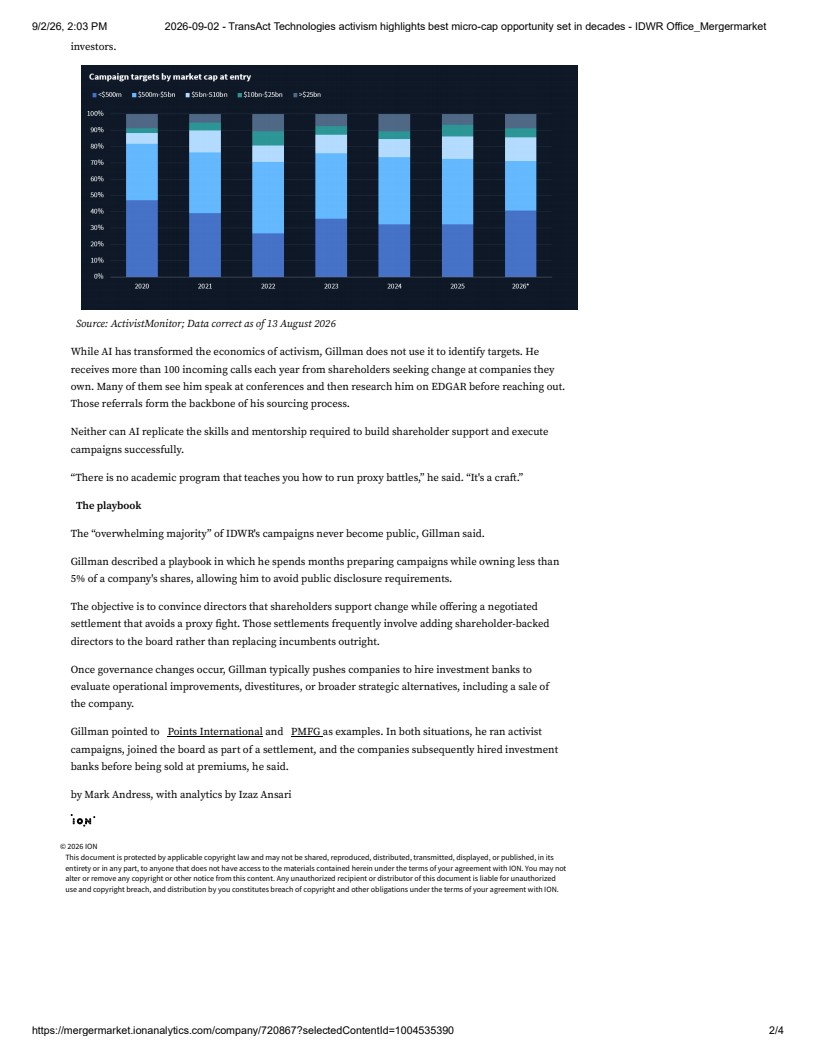
investors.Source: ActivistMonitor; Data correct as of 13 August 2026While AI has transformed the economics of activism, Gillman does not use it to identify targets. Hereceives more than 100 incoming calls each year from shareholders seeking change at companies theyown. Many of them see him speak at conferences and then research him on EDGAR before reaching out.Those referrals form the backbone of his sourcing process. Neither can AI replicate the skills and mentorship required to build shareholder support and executecampaigns successfully. "There is no academic program that teaches you how to run proxy battles," he said. "It's a craft."The playbookThe "overwhelming majority" of IDWR's campaigns never become public, Gillman said.Gillman described a playbook in which he spends months preparing campaigns while owning less than5% of a company's shares, allowing him to avoid public disclosure requirements.The objective is to convince directors that shareholders support change while offering a negotiatedsettlement that avoids a proxy fight. Those settlements frequently involve adding shareholder-backeddirectors to the board rather than replacing incumbents outright.Once governance changes occur, Gillman typically pushes companies to hire investment banks toevaluate operational improvements, divestitures, or broader strategic alternatives, including a sale ofthe company.Gillman pointed to Points International and PMFG as examples. In both situations, he ran activistcampaigns, joined the board as part of a settlement, and the companies subsequently hired investmentbanks before being sold at premiums, he said.by Mark Andress, with analytics by Izaz Ansari© 2026 IONThis document is protected by applicable copyright law and may not be shared, reproduced, distributed, transmitted, displayed, or published, in itsentirety or in any part, to anyone that does not have access to the materials contained herein under the terms of your agreement with ION. You may notalter or remove any copyright or other notice from this content. Any unauthorized recipient or distributor of this document is liable for unauthorizeduse and copyright breach, and distribution by you constitutes breach of copyright and other obligations under the terms of your agreement with ION.9/2/26, 2:03 PM2026-09-02 - TransAct Technologies activism highlights best micro-cap opportunity set in decades - IDWR Office_Mergermarkethttps://mergermarket.ionanalytics.com/company/720867?selectedContentId=10045353902/4