© Copyright 2022 Cycle 3 Nonstandardized PS/401(k) Plan #01-001 Page CS-1 PRE-APPROVED CYCLE 3 DEFINED CONTRIBUTION PLAN CARES/SECURE ACTS INTERIM AMENDMENT ARTICLE I PURPOSE OF INTERIM AMENDMENT 1.01 Adoption by Pre-Approved Plan Provider. Pursuant to Revenue Procedure 2017-41 and Section 14.01(a) of the Plan (Section 11.01(a) in the Cycle 3 Pre-Approved Owners-Only Profit Sharing/401(k) Defined Contribution Plan), the Pre-Approved Plan Provider (“Provider”) is amending the Plan on behalf of all adopting Employers. This Pre-Approved Cycle 3 Defined Contribution Plan CARES/SECURE Acts Interim Amendment (“Interim Amendment” or “IA”) is intended to qualify as a “good- faith” amendment to document the Plan's compliance with various laws, as listed under Article II, and other guidance issued by the Internal Revenue Service. The Plan Administrator will interpret the provisions consistent with any current or future guidance related to the applicable provisions. A copy of this amendment will be provided to all adopting Employers and made a part of their Plans. 1.02 Application. To the extent that this Interim Amendment applies to a Plan, it supersedes any contrary provisions under the Plan, except as provided under IA §1.03. Unless the Employer wishes to override the pre-selected elections (defaults), if any, made by the Provider as elected under the Interim Amendment Elective Provisions (“Elective Provisions”) in Article VI, no signature is required by the Employer to adopt this Interim Amendment. This Interim Amendment applies to the Employer and any Participating Employers of the Plan. 1.03 Prior Amendments. If the Employer previously amended the Plan to implement one or more of the provisions addressed by this Interim Amendment, such amendment(s) shall remain in effect and shall not be superseded, unless otherwise provided under the Elective Provisions. The Employer may use the Elective Provisions of this Interim Amendment to memorialize prior amendments. If a Provider previously adopted the Provider-level CARES/Disaster Interim Amendment, the provisions of such amendment are also incorporated into this CARES/SECURE Acts Interim Amendment. ARTICLE II APPLICABLE LAWS AND PLANS COVERED BY INTERIM AMENDMENT 2.01 Applicable Laws. This Interim Amendment includes provisions that are required or allowed under the following laws: (a) Bipartisan American Miners Act of 2019 (“Miners Act”) (b) Consolidated Appropriations Act, 2021 (“CAA”) (c) Coronavirus Aid, Relief, and Economic Security Act (“CARES Act”) (d) COVID-Related Tax Relief Act of 2020 (“CRTRA”) (e) Setting Every Community Up for Retirement Enhancement Act of 2019 (“SECURE Act”) (f) Taxpayer Certainty and Disaster Tax Relief Act of 2019 (“Disaster Tax Relief Act of 2019”) (g) Taxpayer Certainty and Disaster Tax Relief Act of 2020 (“Disaster Tax Relief Act of 2020”) 2.02 Application to Cycle 3 Defined Contribution Plans. The Interim Amendment applies to the following types of ASC Institute Cycle 3 Pre-Approved Plans: the Defined Contribution Plan, the Governmental Defined Contribution Plan (“Governmental Plan”), the Employee Stock Ownership Plan (“ESOP”), the Church Defined Contribution Plan (“Church Plan”) and the Owners- Only Profit Sharing/401(k) Defined Contribution Plan (“Owners-Only Plan”). Certain provisions of this Interim Amendment may not be applicable to all types of Plans or a specific adopting Employer. ARTICLE III AMENDMENT RELATING TO THE CORONAVIRUS AID, RELIEF, AND ECONOMIC SECURITY ACT 3.01 In General. On March 27, 2020, the CARES Act became law. Provisions of the CARES Act may have affected certain Plan provisions. The provisions of the CARES Act were effective at various times, as reflected in the provisions under this Article III. The Plan Administrator administered the provisions of this Article III consistent with a “good-faith” interpretation of the CARES Act. To the extent this Article III applies to the Plan, the provisions of this Article III supersede any inconsistent provisions of the Plan. Docusign Envelope ID: 043B59A7-682A-8A17-8283-1BA3F703C3A6
© Copyright 2022 Cycle 3 Nonstandardized PS/401(k) Plan #01-001 Page CS-2 3.02 Coronavirus-Related Distributions and Loans from the Plan. This IA §3.02 incorporates CARES Act §2202 relating to special disaster-related rules for retirement plans. The provisions of this IA §3.02 apply only to the extent a distribution or loan was made to a qualified individual as provided under CARES Act §2202. If the Plan did not operationally apply the rules under this IA §3.02, such provisions do not apply to the Plan. The Plan Administrator documented through administrative procedures (including designating accounts from which Coronavirus-Related Distributions and loans could have been taken) or otherwise the manner in which the Plan operationally applied the rules under this IA §3.02. To the extent this IA §3.02 applies to the Plan, the provisions supersede any inconsistent provisions of the Plan or loan program. The Plan administered this IA §3.02 consistent with the guidance provided under IRS Notice 2020-50. (a) Coronavirus-Related Distributions. As provided under CARES Act §2202(a), and as amended by CRTRA §280, the Plan (including a money purchase pension plan) could (but was not required to) make Coronavirus-Related Distributions, subject to the limits under IA §3.02(a)(4), without regard to certain distribution restrictions otherwise applicable under the Plan. (1) Definition of Coronavirus-Related Distribution. The term Coronavirus-Related Distribution means a distribution from the Plan made: (i) on or after January 1, 2020, and before December 31, 2020, (ii) to an individual: (A) who was diagnosed with the virus SARS-CoV-2 or with coronavirus disease 2019 (collectively referred to herein as “COVID-19”) by a test approved by the Centers for Disease Control and Prevention, including a test authorized under the Federal Food, Drug, and Cosmetic Act; or (B) whose spouse or dependent (as defined in Code §152) was diagnosed with COVID-19 by such a test; and (C) who experienced adverse financial consequences as a result of: (I) the individual being quarantined, being furloughed or laid off or having work hours reduced due to COVID-19; (II) the individual being unable to work due to lack of childcare due to COVID-19; (III) closing or reducing hours of a business owned or operated by the individual due to COVID- 19; (IV) the individual having pay or self-employment income reduced due to COVID-19; (V) the individual having a job offer rescinded or start date for a job delayed due to COVID-19; (VI) the individual’s spouse or a member of the individual’s household (i.e., someone who shares the individual’s principal residence) being quarantined, being furloughed or laid off or having work hours reduced due to COVID-19, being unable to work due to lack of childcare due to COVID-19, having pay or self-employment income reduced due to COVID-19, or having a job offer rescinded or start date for a job delayed due to COVID-19; or (VII) closing or reducing hours of a business owned or operated by the individual’s spouse or a member of the individual’s household due to COVID-19. (2) Amounts not treated as Coronavirus-Related Distributions. The following amounts were not treated as Coronavirus-Related Distributions: (i) corrective distributions of Elective Deferrals and After-Tax Employee Contributions that were returned to the Employee (together with the income allocable thereto) in order to comply with the Code §415 limitations; (ii) Excess Deferrals under Code §402(g); (iii) Excess Contributions and Excess Aggregate Contributions; (iv) loans that were treated as deemed distributions pursuant to Code §72(p); (v) dividends paid on applicable employer securities under Code §404(k); Docusign Envelope ID: 043B59A7-682A-8A17-8283-1BA3F703C3A6
© Copyright 2022 Cycle 3 Nonstandardized PS/401(k) Plan #01-001 Page CS-3 (vi) the costs of current life insurance protection; (vii) prohibited allocations that were treated as deemed distributions pursuant to §409(p); (viii) distributions that were permissible withdrawals from an Eligible Automatic Contribution Arrangement within the meaning of Code §414(w); and (ix) distributions of premiums for accident or health insurance under Treas. Reg. §1.402(a)-1(e)(1)(i). (3) Employee certification. The Plan Administrator could have relied on an Employee’s certification that the Employee satisfied the conditions of IA §3.02(a)(1) in determining whether any distribution was a Coronavirus- Related Distribution unless the Plan Administrator had actual knowledge to the contrary. The Plan Administrator had no obligation to inquire into whether an individual had satisfied the conditions for a Coronavirus-Related Distribution. (4) Limit on amount of Coronavirus-Related Distributions. The aggregate amount of Coronavirus-Related Distributions received by an individual for any taxable year (from all plans maintained by the Employer and any member of a controlled group under Code §§414(b), (c), (m) or (o) which included the Employer) could not exceed $100,000. (5) Repayment of Coronavirus-Related Distribution. A Participant who received a Coronavirus-Related Distribution from the Plan may, at any time during the three-year period beginning on the day after the receipt of such distribution, make one or more Rollover Contributions to an Eligible Retirement Plan (including this Plan, if the Participant is otherwise eligible to make Rollover Contributions) in an aggregate amount that does not exceed the amount of such Coronavirus-Related Distribution. In accepting a Rollover Contribution under this IA §3.02(a)(5), the Plan Administrator is entitled to the relief under Q&A-14 of Treas. Reg. §1.401(a)(31)-1. The Plan Administrator in accepting the Rollover Contribution must reasonably conclude that the recontribution is eligible for direct rollover treatment under CARES Act §2202(a)(3). The Plan Administrator may rely on an Employee’s certification that the Employee satisfies the conditions for making such a Rollover Contribution unless the Plan Administrator has actual knowledge to the contrary. (6) Exemption from certain transfer and withholding rules. For purposes of the Direct Rollover rules of Code §401(a)(31), the notice requirements of Code §402(f) and withholding rules of Code §3405, a Coronavirus-Related Distribution was not treated as an Eligible Rollover Distribution. (b) Special Loan Rules. As provided under CARES Act §2202(b), the Plan Administrator was authorized (but not required) to revise the applicable loan requirements under the Plan to reflect (1) and/or (2) below. For purposes of this IA §3.02(b), a Qualified Individual means any individual who is described in IA §3.02(a)(1)(ii) above. (1) Increased Participant loan limits. Notwithstanding the Participant loan limitations under the Plan, for purposes of determining the permissible Participant loans for Qualified Individuals made during the 180-day period beginning on March 27, 2020, the loan limit under Code §72(p)(2)(A) could have been applied by substituting “$100,000” for “$50,000” and the adequate security requirement under Code §72(p)(2)(A)(ii) could have been applied using “the Participant’s vested Account Balance” rather than “one-half (½) of the Participant’s vested Account Balance.” (2) Delayed loan repayment date. If a Qualified Individual had an outstanding Participant loan on or after March 27, 2020: (i) if the due date pursuant to Code §§72(p)(2)(B) or (C) for any repayment with respect to such loan occurred during the period beginning on March 27, 2020 and ending on December 31, 2020, such due date could have been delayed for one year; (ii) any subsequent repayments with respect to such loan could have been appropriately adjusted to reflect the delay in the due date under IA §3.02(b)(2)(i) above and any interest accrued during such delay; and (iii) in determining the five-year period and the term of the loan under Code §72(p)(2)(B) and (C), the one-year delay period described in IA §3.02(b)(2)(i) above could have been disregarded. Docusign Envelope ID: 043B59A7-682A-8A17-8283-1BA3F703C3A6
© Copyright 2022 Cycle 3 Nonstandardized PS/401(k) Plan #01-001 Page CS-4 3.03 Required Minimum Distributions for 2020. (a) Temporary waiver of required minimum distribution rules for 2020. As provided under Code §401(a)(9)(I), added by CARES Act §2203 and effective as of January 1, 2020 (or such later date designated under the Elective Provisions), the applicable required minimum distribution rules of the Plan did not apply for the 2020 calendar year. A Participant or beneficiary who would have been required to receive a required minimum distribution for the 2020 calendar year (or a Participant with a Required Beginning Date of April 1, 2021 who would have received a required minimum distribution in 2021 for the 2020 calendar year) (“2020 RMD”), but for the enactment of Code §401(a)(9)(I), and who would have satisfied that requirement by receiving a distribution that is either (1) equal to the 2020 RMD, or (2) one or more payments (that include the 2020 RMD) in a series of substantially equal periodic payments made at least annually and expected to last for the life (or life expectancy) of the Participant, the joint lives (or joint life expectancies) of the Participant and the Participant’s Designated Beneficiary, or for a period of at least 10 years (“2020 Extended RMD”), may have elected whether to receive the 2020 RMD or the 2020 Extended RMD. If a Participant did not specifically elect to take the 2020 RMD or 2020 Extended RMD from the Plan, such distribution was not made for the 2020 calendar year. The Employer may modify this default rule under the Elective Provisions, provided such modification satisfies the requirements under Code §401(a)(9)(I) and any applicable IRS guidance. In addition, solely for purposes of applying the Direct Rollover provisions of the Plan, certain additional distributions in 2020, as elected by the Employer under the Elective Provisions, were treated as Eligible Rollover Distributions. If no election is made by the Employer in the Elective Provisions, the Plan offered a Direct Rollover only for distributions that were Eligible Rollover Distributions in the absence of Code §401(a)(9)(I). If all or any portion of a distribution made during 2020 was treated as an Eligible Rollover Distribution, but would not have been treated as such if the applicable required minimum distribution requirements of the Plan had applied during 2020, such distribution could not be treated as an Eligible Rollover Distribution for purposes of the Direct Rollover rules under Code §401(a)(31), Code §402(f) and Code §3405(c). (b) Special rules regarding the temporary waiver of required minimum distribution rules for 2020. In applying the provisions of the applicable section of the Plan for the 2020 calendar year, the following special rules apply: (1) The Required Beginning Date with respect to any individual shall be determined without regard to this IA §3.03 for purposes of applying Section 8.12 of the Plan (Section 8 of the Governmental Plan; Section 6.10 of the Owners-Only Plan) for calendar years after 2020; (2) If Code §401(a)(9)(B)(ii) applies, the five-year period described in such provision was determined without regard to the 2020 calendar year; (3) If the Plan permitted a Participant or beneficiary to elect whether the 5-year rule or the life expectancy rule applied in determining required minimum distributions and the election period ended in the 2020 calendar year, the Plan Administrator could have extended the election deadline to the end of 2021; (4) The Plan Administrator and Participants could have applied the transitional relief and special rules under Code §401(a)(9)(I) and IRS Notice 2020-51 relating to the temporary waiver of required minimum distributions for 2020 in any reasonable and consistent manner; and (5) The Employer may describe any special rules that were applicable to the temporary waiver of the required minimum distribution rules for 2020 under the Elective Provisions, provided such special rules are consistent with CARES Act §2203, Code §401(a)(9)(I) and IRS Notice 2020-51. ARTICLE IV AMENDMENT RELATING TO THE CONSOLIDATED APPROPRIATIONS ACT, 2021 4.01 In General. On December 27, 2020, the Disaster Tax Relief Act of 2020 and the CRTRA, which were enacted as part of the Consolidated Appropriations Act, 2021, became law. Provisions of the Disaster Tax Relief Act of 2020 and CRTRA may have affected certain Plan provisions. The provisions of the Disaster Tax Relief Act of 2020 and CRTRA are effective as reflected in the provisions under this Article IV. The Plan Administrator administered the provisions of this Article IV consistent with a “good-faith” interpretation of the Disaster Tax Relief Act of 2020 and CRTRA. To the extent this Article IV applies to the Plan, these provisions supersede any inconsistent provisions of the Plan. 4.02 Special Disaster-Related Rules. This IA §4.02 incorporates the provisions of the Disaster Tax Relief Act of 2020 §302 relating to special disaster-related rules for retirement plans. The provisions of this IA §4.02 apply only to the extent a distribution or loan was made to a qualified individual as provided under the Disaster Tax Relief Act of 2020 §302. If the Plan did not operationally apply the rules under this IA §4.02, such provisions do not apply to the Plan. The Plan Administrator documented through administrative procedures (including designating accounts from which special disaster-related distributions and loans could have Docusign Envelope ID: 043B59A7-682A-8A17-8283-1BA3F703C3A6
© Copyright 2022 Cycle 3 Nonstandardized PS/401(k) Plan #01-001 Page CS-5 been taken) or otherwise the manner in which the Plan operationally applied the rules under this IA §4.02. To the extent this IA §4.02 applies to the Plan, these provisions supersede any inconsistent provisions of the Plan or loan program. (a) Eligibility for Qualified Disaster Distribution. If administratively permitted by the Plan Administrator, a Participant could have taken a Qualified Disaster Distribution without regard to any distribution restrictions otherwise applicable under the Plan. (1) Definitions. (i) Qualified Disaster Distribution. A Qualified Disaster Distribution (as defined under the Disaster Tax Relief Act of 2020 §302(a)(4)(A)) is a distribution from the Plan made: (A) on or after the first day of the Incident Period of a Qualified Disaster and before June 25, 2021; and (B) to an individual whose principal place of abode at any time during the Incident Period of such Qualified Disaster was located in the Qualified Disaster Area with respect to such Qualified Disaster and who had sustained an economic loss by reason of such Qualified Disaster. (ii) Qualified Disaster Area. A Qualified Disaster Area is any area with respect to which a major disaster was declared, during the period that began on January 1, 2020, and ended on February 25, 2021, by the President under Robert T. Stafford Disaster Relief and Emergency Assistance Act §401 if the Incident Period of the disaster with respect to which such declaration was made began on or after December 28, 2019, and ended on or before December 27, 2020. Such term did not include any area with respect to which such a major disaster had been so declared only by reason of COVID–19. (iii) Qualified Disaster. A Qualified Disaster is, with respect to any Qualified Disaster Area, the disaster by reason of which a major disaster was declared with respect to such area. (iv) Incident Period. An Incident Period is, with respect to any Qualified Disaster, the period specified by the Federal Emergency Management Agency as the period during which such disaster occurred (except that such period shall not be treated as ending after January 26, 2021). (2) Limit on amount of Qualified Disaster Distributions. The aggregate amount of Qualified Disaster Distributions received by an individual for any taxable year (from all plans maintained by the Employer and any member of a controlled group which included the Employer) could not have exceeded the excess (if any) of $100,000, over the aggregate amounts treated as Qualified Disaster Distributions received by such individual for all prior taxable years. (3) Qualified Disaster Distributions treated as meeting certain Plan distribution requirements. A Qualified Disaster Distribution is treated as meeting the requirements of Code §401(k)(2)(B)(i) and, in the case of a money purchase pension plan, a Qualified Disaster Distribution which was an in-service withdrawal is treated as meeting the distribution rules under Code §401(a). (b) Repayment of Qualified Disaster Distribution. As provided under the Disaster Tax Relief Act of 2020 §302(a)(3), a Participant who received a Qualified Disaster Distribution from the Plan or another Eligible Retirement Plan (as defined in Code §402(c)(8)(B)) may, at any time during the three-year period beginning on the day after the receipt of such distribution, make one or more Rollover Contributions to the Plan in an aggregate amount that does not exceed the amount of such Qualified Disaster Distribution. This IA §4.02(b) only applies if the Plan permits Rollover Contributions. (c) Recontributions of Withdrawals for Home Purchases. As provided under the Disaster Tax Relief Act of 2020 §302(b), a Participant who received a Qualified Disaster Distribution may make one or more Rollover Contributions to the Plan during the applicable period in an aggregate amount not to exceed the amount of such Qualified Disaster Distribution. For this purpose, a Qualified Disaster Distribution is any Hardship Distribution which was to be used to purchase or construct a principal residence in a Qualified Disaster Area, but which was not so used on account of the Qualified Disaster with respect to such area, and which was received during the period beginning on the date which is 180 days before the first day of the Incident Period of such Qualified Disaster and ending on the date which is 30 days after the last day of such Incident Period. This IA §4.02(c) only applies if the Plan permits Rollover Contributions. (d) Special Loan Rules. As provided under the Disaster Tax Relief Act of 2020 §302(c), the Plan Administrator could (but was not required to) revise the applicable loan requirements under the Plan to reflect IA §4.02(d)(1) and §4.02(d)(2). (1) Increased Participant loan limits. Notwithstanding the Participant loan limitations under the Plan, for purposes of determining the permissible Participant loans for a Qualified Individual during the 180-day period beginning on December 27, 2020, the loan limit under Code §72(p)(2)(A) could have been applied by substituting “$100,000” for “$50,000” and the adequate security requirement under Code §72(p)(2)(A)(ii) could have been applied using “the Participant’s vested Account Balance” rather than “one-half (½) of the Participant’s vested Account Balance.” Docusign Envelope ID: 043B59A7-682A-8A17-8283-1BA3F703C3A6
© Copyright 2022 Cycle 3 Nonstandardized PS/401(k) Plan #01-001 Page CS-6 A Qualified Individual for this purpose was any Participant whose principal place of abode at any time during the Incident Period of any Qualified Disaster was located in the Qualified Disaster Area with respect to such Qualified Disaster, and who had sustained an economic loss by reason of such Qualified Disaster. (2) Delayed loan repayment date. If a Qualified Individual (as defined in IA §4.02(d)(1) above) had an outstanding Participant loan on or after the first day of the Incident Period of a Qualified Disaster and ending on the date which is 180 days after the last day of the Incident Period: (i) the due date for repayment of the Participant loan could have been delayed for one year; (ii) any subsequent repayments with respect to such loan could have been appropriately adjusted to reflect the delay in the due date under IA §4.02(d)(2)(i) and any interest accruing during such delay; and (iii) in determining the five-year period and the term of the loan under Code §72(p)(2)(B) and (C), the one-year delay period described in IA §4.02(d)(2)(i) could have been disregarded. 4.03 Temporary Rule Preventing Partial Plan Termination. Under the Disaster Tax Relief Act of 2020 §209, the Plan was not treated as having a partial termination (within the meaning of Code §411(d)(3)) during any Plan Year which included the period that began on March 13, 2020, and ended on March 31, 2021, if the number of active Participants covered by the Plan on March 31, 2021 was at least 80% of the number of active Participants covered by the Plan on March 13, 2020. This IA §4.03 does not apply to Governmental Plans or non-electing church plans, which are exempt from the requirements of Code §411. In applying this temporary rule, the following special rules apply: (a) A reasonable, good-faith interpretation of the term “active participant covered by the plan,” applied in a consistent manner, was used when determining the number of active participants covered by a plan on March 13, 2020 and on March 31, 2021. (b) If any part of the Plan Year fell within the period that began on March 13, 2020, and ended on March 31, 2021, then the temporary rules preventing partial plan termination applied to any partial plan termination determination for that entire plan year. For example, if the Plan had a calendar year Plan Year, the 80% partial termination test under the temporary rule applied to both the January 1 to December 31, 2020 Plan Year and the January 1 to December 31, 2021 Plan Year, because both Plan Years included a part of the statutory determination period of March 13, 2020 to March 31, 2021. (c) The number of active participants covered by the Plan who were counted on March 31, 2021, included all individuals who were active Participants covered by the Plan on that date, regardless of whether those same individuals were active Participants covered by the Plan on March 13, 2020. (d) The Plan Administrator could reasonably interpret the application of this IA §4.03 to the Plan. 4.04 Coronavirus-Related Distributions in Money Purchase Pension Plans and Money Purchase Pension Assets. Under CRTRA §280, a Coronavirus-Related Distribution as described in IA §3.02, if made from a money purchase pension plan or related assets, and which is an in-service withdrawal, is treated as meeting the distribution rules under Code §401(a). If the Plan Administrator allowed Coronavirus-Related Distributions, the rules under IA §3.02 apply. ARTICLE V AMENDMENT RELATING TO THE SECURE ACT, MINERS ACT AND DISASTER TAX RELIEF ACT OF 2019 5.01 In General. On December 20, 2019, the Further Consolidated Appropriations Act, 2020, which includes the SECURE Act, the Miners Act and the Disaster Tax Relief Act of 2019 became law. The provisions of these three Acts are effective at various times, as reflected in the provisions under this Article V. The Plan Administrator shall administer the provisions of this Article V consistent with a “good-faith” interpretation of these laws. 5.02 Modification of required minimum distribution rules. (a) Increase in age for Required Beginning Date for mandatory distributions. As provided under Code §401(a)(9)(C)(i)(I) as amended by SECURE Act §114, effective for distributions required to be made after December 31, 2019, with respect to Participants who attain age 70½ after such date, all references to “age 70½” under the applicable required minimum distribution provisions of the Plan are replaced with “age 72.” For purposes of determining required minimum distributions for calendar years beginning on or after January 1, 2022 (or such later date as specified in applicable regulations or guidance), the Plan Administrator must apply the provisions of this IA §5.02(a) consistent with proposed Treas. Reg §§1.401(a)(9)-1 through 1.401(a)(9)-9 issued on February 24, 2022 (or subsequent applicable final regulations). (b) Modifications of required minimum distribution rules for Designated Beneficiaries. As provided under Code §401(a)(9)(H) as amended by SECURE Act §401, effective for distributions with respect to Participants who die after Docusign Envelope ID: 043B59A7-682A-8A17-8283-1BA3F703C3A6
© Copyright 2022 Cycle 3 Nonstandardized PS/401(k) Plan #01-001 Page CS-7 December 31, 2019 (or such later effective date applicable to the Plan), the required minimum distribution rules of the Plan must be administered consistent with the following rules as provided under SECURE Act §401. (See IA §5.02(b)(1)(v) for effective date rules applicable to plans maintained pursuant to a collective bargaining agreement and for Governmental Plans.) For purposes of determining required minimum distributions for calendar years beginning on or after January 1, 2022 (or such later date as specified in applicable final regulations or guidance), the Plan Administrator must apply the provisions of this IA §5.02(b) consistent with proposed Treas. Reg §§1.401(a)(9)-1 through 1.401(a)(9)-9 issued on February 24, 2022 (or subsequent applicable final regulations or guidance). (1) 10-year rule. As provided under Code §401(a)(9)(H)(i), if a Participant dies before the distribution of the Participant’s entire vested Account Balance (regardless of whether the Participant dies before, on or after beginning required minimum distributions under the Plan), the entire vested Account Balance of the Participant will be distributed by the end of the calendar year that includes the 10th anniversary of the date of the Participant’s death. This is referred to as the “10-year rule.” (i) Exception to 10-year rule for Eligible Designated Beneficiaries. As provided under Code §401(a)(9)(H)(ii) and Code §401(a)(9)(B)(iii), if any portion of the Participant’s interest is payable to an Eligible Designated Beneficiary, such portion may be distributed (in accordance with applicable regulations) over the life of such Eligible Designated Beneficiary (or over a period not extending beyond the life expectancy of such Eligible Designated Beneficiary), provided such distribution begins not later than one year after the date of the Participant’s death (except as provided under Code §401(a)(9)(B)(iv) relating to a surviving spouse) or such later date as the Secretary of Treasury may prescribe by regulations. This is referred to as the “life expectancy rule.” If the conditions of this exception are not satisfied, the 10- year rule under IA §5.02(b)(1) applies. (ii) Elective provisions for Eligible Designated Beneficiaries. Unless the Employer elects otherwise under the Elective Provisions, required minimum distributions under the Plan to an Eligible Designated Beneficiary when the Participant dies prior to the Required Beginning Date shall be made by applying the pre-SECURE Act elections under the Cycle 3 plan document (including the default election if the Employer made no actual elections in the Cycle 3 plan document), except that the 10-year rule under IA §3.02(b)(1) shall be substituted for the pre-SECURE Act 5-year rule as appropriate. For example, if the pre-SECURE Act Plan allowed the Participant or Designated Beneficiary to elect between the life expectancy rule and the 5-year rule prior to the SECURE Act effective date, then the Plan allows the Eligible Designated Beneficiary to elect between the life expectancy rule and the 10-year rule on or after the SECURE Act effective date. Alternatively, the Employer may elect under the Elective Provisions to (1) apply the life expectancy rule, (2) apply the 10-year rule (including a fixed number of years than less than 10), or (3) allow the Participant or the Eligible Designated Beneficiary to elect whether the 10-year rule or the life expectancy rule applies. If the Participant or Eligible Designated Beneficiary is allowed to elect whether the life expectancy rule or the 10-year rule applies and such Participant or Eligible Designated Beneficiary does not timely make such an election, then the Employer must elect under the Elective Provisions whether the life expectancy rule or the 10-year rule applies. (A) Timing of election. Any Participant or Eligible Designated Beneficiary election permitted under this IA §5.02(b)(1)(ii) must be made no later than the end of the earlier of the calendar year by which distributions must be made in order to satisfy the 10-year rule and the calendar year in which distributions would be required to begin in order to satisfy the requirements of the life expectancy rule or, if applicable, by the time of the permitted delay if the surviving Spouse is the sole beneficiary as provided under Code §401(a)(9)(B)(iv). (B) Irrevocable election. If a Participant or Eligible Designated Beneficiary elects under this IA §5.02(b)(1)(ii) to apply either the 10-year rule or the life expectancy rule, then, as of the last date the election may be made, the election is irrevocable with respect to the Eligible Designated Beneficiary (and all subsequent Designated Beneficiaries) and applies to all subsequent calendar years. (iii) Rules upon death of an Eligible Designated Beneficiary. Generally, if an Eligible Designated Beneficiary dies before the Participant’s entire vested Account Balance is distributed, the exception under IA §5.02(b)(1)(i) above shall not apply to any beneficiary of such Eligible Designated Beneficiary and the remainder of such portion shall be distributed by the end of the 10th calendar year following the calendar year of the death of such Eligible Designated Beneficiary. (iv) Special rule in case of certain trusts for disabled or chronically ill Eligible Designated Beneficiary. The Plan may apply the special rules for certain “applicable multi-beneficiary trusts” as described under Code §§401(a)(9)(H)(iv) and (v), as added by SECURE Act §401. Docusign Envelope ID: 043B59A7-682A-8A17-8283-1BA3F703C3A6
© Copyright 2022 Cycle 3 Nonstandardized PS/401(k) Plan #01-001 Page CS-8 (v) Special effective date rules. (A) Collective bargaining agreements. In the case of a Plan maintained pursuant to one or more collective bargaining agreements between employee representatives and one or more Employers that were ratified before December 20, 2019, the amendments to Code §§401(a)(9)(E) and (H) and under this IA §5.02(b) apply to distributions with respect to Employees who die in calendar years beginning after December 31, 2021, or if earlier, the later of: (1) the date on which the last of the collective bargaining agreements terminated (without regard to any extension of the agreement to which the parties agree) on or after December 20, 2019, or (2) December 31, 2019. (B) Governmental Plans. In the case of a Governmental Plan, the amendments to Code §§401(a)(9)(E) and (H) and this IA §5.02(b) apply to distributions with respect to Employees who die after December 31, 2021. (2) Definitions for purposes of this IA §5.02(b). (i) Designated Beneficiary. The term Designated Beneficiary means any individual designated as a beneficiary by the Participant or under the terms of the Plan. (ii) Eligible Designated Beneficiary. The term Eligible Designated Beneficiary means, with respect to any Participant, any Designated Beneficiary who is: (A) the surviving Spouse of the Participant; (B) subject to IA §5.02(b)(2)(iii) below, a child of the Participant who has not reached age 21; (C) disabled (within the meaning of Code §72(m)(7)); (D) a chronically ill individual (within the meaning of Code §7702B(c)(2), except that the requirements of Code §7702B(c)(2)(A)(i) thereof shall only be treated as met if there is a certification that, as of such date, the period of inability described in such subparagraph with respect to the individual is an indefinite one which is reasonably expected to be lengthy in nature); (E) an individual not described in any of the preceding subclauses who is not more than 10 years younger than the Participant; or (F) a Designated Beneficiary of a Participant if the Participant died before the effective date of Code §401(a)(9)(H) described in Prop. Treas. Reg. §1.401(a)(9)-1(b)(2)(i) and (ii), whichever applies to the Plan (or as provided under applicable final regulations). The determination of whether a Designated Beneficiary is an Eligible Designated Beneficiary shall be made as of the date of death of the Participant. (iii) Special rules for children. An individual described in IA §5.02(b)(2)(ii)(B) above shall cease to be an Eligible Designated Beneficiary as of the date the individual reaches age 21 and any remainder of the portion of the individual’s interest to which Code §401(a)(9)(H)(ii) applies shall be distributed under the 10-year rule. 5.03 Prohibition from making loans through credit cards. As provided under SECURE Act §108, effective for Participant loans made after December 20, 2019, a Plan may not make any Participant loan through any credit card or any other similar arrangement. 5.04 Special disaster-related distributions and loans. This IA §5.04 incorporates the provisions of the Disaster Tax Relief Act of 2019 §202 relating to special disaster-related rules for retirement plans. The provisions of this IA §5.04 apply only to the extent a distribution or loan was made to a qualified individual as provided under the Disaster Tax Relief Act of 2019 §202. If the Plan did not operationally apply the rules under this IA §5.04, such provisions do not apply to the Plan. The Plan Administrator documented through administrative procedures (including designating accounts from which special disaster-related distributions and loans could have been taken) or otherwise the manner in which the Plan operationally applied the rules under this IA §5.04. To the extent this IA §5.04 applies to the Plan, these provisions supersede any inconsistent provisions of the Plan or loan program. (a) Eligibility for a Qualified Disaster Distribution. If administratively permitted by the Plan Administrator, a Participant could have taken a Qualified Disaster Distribution without regard to any distribution restrictions otherwise applicable under the Plan. (1) Definitions. Docusign Envelope ID: 043B59A7-682A-8A17-8283-1BA3F703C3A6
© Copyright 2022 Cycle 3 Nonstandardized PS/401(k) Plan #01-001 Page CS-9 (i) Qualified Disaster Distribution. A Qualified Disaster Distribution (as defined under the Disaster Tax Relief Act of 2019 §202(a)(4)(A)) is a distribution from the Plan made: (A) on or after the first day of the Incident Period of a Qualified Disaster and before June 17, 2020; and (B) to an individual whose principal place of abode at any time during the Incident Period of such Qualified Disaster was located in the Qualified Disaster Area with respect to such Qualified Disaster and who had sustained an economic loss by reason of such Qualified Disaster. (ii) Qualified Disaster Area. A Qualified Disaster Area is any area with respect to which a major disaster was declared, during the period that began on January 1, 2018, and ended on February 18, 2020, by the President under Robert T. Stafford Disaster Relief and Emergency Assistance Act §401 if the Incident Period of the disaster with respect to which such declaration was made began on or before December 20, 2019. Such term did not include the California wildfire disaster (as defined in §20101 of subdivision 2 of division B of the Bipartisan Budget Act of 2018). (iii) Qualified Disaster. A Qualified Disaster is, with respect to any Qualified Disaster Area, the disaster by reason for which a major disaster was declared with respect to such area. (iv) Incident Period. An Incident Period is, with respect to any Qualified Disaster, the period specified by the Federal Emergency Management Agency as the period during which such disaster occurred (except that such period shall not be treated as ending after January 19, 2020). (2) Limit on amount of Qualified Disaster Distributions. The aggregate amount of Qualified Disaster Distributions received by an individual for any taxable year (from all plans maintained by the Employer and any member of a controlled group which included the Employer) could not have exceeded the excess (if any) of $100,000, over the aggregate amounts treated as Qualified Disaster Distributions received by such individual for all prior taxable years. This limitation was applied separately with respect to distributions made due to each Qualified Disaster. (3) Qualified Disaster Distributions treated as meeting certain Plan distribution requirements. A Qualified Disaster Distribution under the Plan is treated as meeting the requirements of Code §401(k)(2)(B)(i). (b) Repayment of a Qualified Disaster Distribution. As provided under the Disaster Tax Relief Act of 2019 §202(a)(3), a Participant who received a Qualified Disaster Distribution from the Plan or another Eligible Retirement Plan (as defined in Code §402(c)(8)(B)) may, at any time during the three-year period beginning on the day after the receipt of such distribution, make one or more Rollover Contributions to the Plan in an aggregate amount that does not exceed the amount of such Qualified Disaster Distribution. This IA §5.04(b) only applies if the Plan permits Rollover Contributions. (c) Recontributions of Withdrawals for Home Purchases. As provided under the Disaster Tax Relief Act of 2019 §202(b), a Participant who received a Qualified Disaster Distribution may make one or more Rollover Contributions to the Plan during the applicable period in an aggregate amount not to exceed the amount of such Qualified Disaster Distribution. For this purpose, a Qualified Disaster Distribution is any Hardship Distribution which (1) was to be used to purchase or construct a principal residence in a Qualified Disaster Area, but was not so used on account of the Qualified Disaster with respect to such area, and (2) was received during the period beginning on the date which is 180 days before the first day of the Incident Period of such Qualified Disaster and ending on the date which is 30 days after the last day of such Incident Period. This IA §5.04(c) only applies if the Plan permits Rollover Contributions. (d) Special Loan Rules. As provided under the Disaster Tax Relief Act of 2019 §202(c), the Plan Administrator could (but was not required to) revise the applicable loan requirements under the Plan to reflect IA §5.04(d)(1) and/or IA §5.04(d)(2). (1) Increased Participant loan limits. Notwithstanding the Participant loan limitations under the Plan, for purposes of determining the permissible Participant loans for a Qualified Individual during the 180-day period beginning on December 20, 2019, the loan limit under Code §72(p)(2)(A) could have been applied by substituting “$100,000” for “$50,000” and the adequate security requirement under Code §72(p)(2)(A)(ii) could have been applied using “the Participant’s vested Account Balance” rather than “one-half (½) of the Participant’s vested Account Balance.” A Qualified Individual for this purpose was any Participant whose principal place of abode at any time during the Incident Period of any Qualified Disaster was located in the Qualified Disaster Area with respect to such Qualified Disaster, and who had sustained an economic loss by reason of such Qualified Disaster. (2) Delayed loan repayment date. If a Qualified Individual (as defined in IA §5.04(d)(1)) had an outstanding Participant loan on or after the first day of the Incident Period of a Qualified Disaster and that ended on the date which was 180 days after the last day of the Incident Period: (i) the due date for repayment of the Participant loan could have been delayed for one year; Docusign Envelope ID: 043B59A7-682A-8A17-8283-1BA3F703C3A6
© Copyright 2022 Cycle 3 Nonstandardized PS/401(k) Plan #01-001 Page CS-10 (ii) any subsequent repayments with respect to such loan could have been appropriately adjusted to reflect the delay in the due date under IA §5.04(d)(2)(i) and any interest accruing during such delay; and (iii) in determining the five-year period and the term of the loan under Code §§72(p)(2)(B) and (C), the one- year delay period described in §5.04(d)(2)(i) could have been disregarded. 5.05 Elimination of notice requirement for nonelective Safe Harbor 401(k) Plans. As provided under SECURE Act §103(a) and consistent with IRS Notice 2020-86, effective for Plan Years beginning after December 31, 2019, the annual safe harbor notice requirements of the Plan do not apply to a Safe Harbor 401(k) Plan that satisfies the requirements of Code §401(k)(12) by providing Traditional Safe Harbor Employer Contributions (as defined under Section 1.144 of the Plan) or the requirements of Code §401(k)(13) by providing QACA Safe Harbor Employer Contributions (as defined under Section 1.109). However, a Safe Harbor 401(k) Plan must provide each Eligible Employee with an effective opportunity to make or change an election to make Salary Deferrals at least once each Plan Year. (a) Special rules applicable to the elimination of the notice requirement if the Plan provides for Traditional Safe Harbor Employer Contributions. If the Plan provides for Traditional Safe Harbor Employer Contributions, the following special rules apply: (1) If the Plan intends to satisfy the deemed compliance with the ACP test rules under Section 6.04(i) of the Plan and Code §401(m)(11)(A), the Plan must continue to satisfy the annual notice requirements under Section 6.04(a)(4) of the Plan. However, if the Plan does not intend to satisfy the deemed compliance with the ACP test rules (and thus performs the ACP test), then the annual notice requirements under Section 6.04(a)(4) of the Plan do not apply. (2) All other applicable notice requirements under the Plan continue to apply; (3) The notice requirements under Treas. Reg. §§1.401(k)-3(g)(1)(ii)(A)(2) and 1.401(m)-3(h)(1)(ii)(A)(2) relating to the possible mid-year reduction or suspension of Traditional Safe Harbor Employer Contributions continue to apply; (4) If the Plan adopts an amendment to reduce or suspend Traditional Safe Harbor Employer Contributions during a Plan Year and later readopts an amendment to provide the Traditional Safe Harbor Employer Contributions for the entirety of such Plan Year, the Plan is not required to satisfy the ADP test or the ACP test (as applicable) for the Plan Year and is not subject to the top-heavy rules under Code §416 for such Plan Year; and (5) The contingent and supplemental notice requirements under the retroactive plans amendment requirements of Code §401(k)(12)(F) and as discussed under Section 6.04(a)(4)(iii) do not apply, unless the Plan intends to qualify as a safe harbor design as set forth under Code §401(m)(11) (i.e., deemed compliance with the ACP test). (b) Special rules applicable to the elimination of the notice requirement if the Plan provides for QACA Safe Harbor Employer Contributions. If the Plan provides for QACA Safe Harbor Employer Contributions, the following special rules apply: (1) Even if the Plan intends to satisfy the deemed compliance with the ACP test rules under Section 6.04(i) of the Plan and Code §401(m)(11)(A), the Plan is not required to satisfy the annual notice requirements under Section 6.04(b)(5) of the Plan. If the Plan does not intend to satisfy the deemed compliance with the ACP test rules (and thus performs the ACP test), then the annual notice requirements under Section 6.04(a)(4) of the Plan do not apply. (2) All other applicable notice requirements under the Plan continue to apply. (3) The notice requirements under Treas. Reg. §§1.401(k)-3(g)(1)(ii)(A)(2) and 1.401(m)-3(h)(1)(ii)(A)(2) relating to the possible mid-year reduction or suspension of QACA Safe Harbor Employer Contributions continue to apply. (4) If the Plan adopts an amendment to reduce or suspend QACA Safe Harbor Employer Contributions during a Plan Year and later readopts an amendment to provide the QACA Safe Harbor Employer Contributions for the entirety of such Plan Year, the Plan is not required to satisfy the ADP test or the ACP test (as applicable) for the Plan Year and is not subject to the top-heavy rules under Code §416 for such Plan Year. (5) The contingent and supplemental notice requirements under the retroactive plans amendment rules of Treas. Reg. §1.401(k)-3(f) do not apply. 5.06 Delay in adopting provisions for nonelective Safe Harbor 401(k) Plan as provided under SECURE Act §§103(b) and (c). (a) Amendment into a 3% nonelective Safe Harbor 401(k) Plan. Effective for Plan Years beginning after December 31, 2019, an Employer may amend the Plan at any time before the 30th day before the close of the Plan Year to satisfy the Docusign Envelope ID: 043B59A7-682A-8A17-8283-1BA3F703C3A6
© Copyright 2022 Cycle 3 Nonstandardized PS/401(k) Plan #01-001 Page CS-11 requirements of a Safe Harbor 401(k) Plan by making a Traditional Safe Harbor Employer Contribution of at least 3% of Plan Compensation or a QACA Safe Harbor Employer Contribution of at least 3% of Plan Compensation, as applicable. The Employer may designate the percentage of Plan Compensation and the Plan Year for which the Plan is intended to be a Safe Harbor 401(k) Plan under the Elective Provisions. (b) Amendment into a 4% nonelective Safe Harbor 401(k) Plan. Effective for Plan Years beginning after December 31, 2019, an Employer may amend the Plan to satisfy the requirements of a Safe Harbor 401(k) Plan by making Traditional Safe Harbor Employer Contributions or QACA Safe Harbor Employer Contributions, as applicable, after the 30th day before the close of the Plan Year if (1) the Plan is amended to provide for a Traditional Safe Harbor Employer Contribution of at least 4% of Plan Compensation or a QACA Safe Harbor Employer Contribution of at least 4% of Plan Compensation, as applicable for all Eligible Employees for that Plan Year and (2) the Plan is amended no later than the last day for distributing Excess Contributions for the Plan Year. The Employer may designate the percentage of Plan Compensation and the Plan Year for which the Plan is intended to be a Safe Harbor 401(k) Plan under the Elective Provisions. 5.07 Portability of lifetime income options. Effective for Plan Years beginning after December 31, 2019 and as provided under Code §401(a)(38), the Plan may allow a Qualified Distribution of a Lifetime Income Investment and a distribution of a Lifetime Income Investment in the form of a Qualified Plan Distribution Annuity Contract, provided such distribution is made within the 90-day period ending on the date when the Lifetime Income Investment is no longer authorized to be held as an investment option under the Plan. The Plan Administrator may administratively apply the rules of Code §401(a)(38) to any applicable Plan investment meeting the definition of a Lifetime Income Investment. The Plan Administrator will separately document the manner of application of rules under this IA §5.07 and apply the rules in a consistent and nondiscriminatory manner. (a) Definitions. (1) Qualified Distribution. A Qualified Distribution is a direct trustee-to-trustee transfer to another Eligible Retirement Plan. (2) Lifetime Income Investment. A Lifetime Income Investment is an investment option designed to provide an Employee with election rights that (1) are not uniformly available with respect to other investment options under the Plan; and (2) are rights to a Lifetime Income Feature available through a contract or other arrangement offered under the Plan, as defined under Code §401(a)(38)(B)(ii). The Plan Administrator will determine whether an investment option under the Plan is a Lifetime Income Investment. (3) Lifetime Income Feature. A Lifetime Income Feature is (1) a feature that guarantees a minimum level of income annually (or more frequently) for at least the remainder of the life of the Employee or the joint lives of the Employee and the Employee’s Designated Beneficiary, or (2) an annuity payable on behalf of the Employee under which payments are made in substantially equal periodic payments (not less frequently than annually) over the life of the Employee or the joint lives of the Employee and the Employee’s Designated Beneficiary, as defined under Code §401(a)(38)(B)(iii). (4) Qualified Plan Distribution Annuity Contract. A Qualified Plan Distribution Annuity Contract is an annuity contract purchased for a Participant and distributed to the Participant by the Plan, as defined under Code §401(a)(38)(B)(iv). (b) Restrictions on in-service distributions. Effective no earlier than for Plan Years beginning after December 31, 2019, to the extent that the Plan Administrator applies the rules under subparagraph (a) above, the Plan does not violate the in- service distribution restrictions relating to Salary Deferrals, QNECs, QMACs, and Traditional Safe Harbor/QACA Safe Harbor Contributions described under the applicable section of the Plan. 5.08 Qualified Birth or Adoption Distributions (“QBADs”). As provided for under SECURE Act §113, effective no earlier than for Plan Years beginning after December 31, 2019, if elected under the Elective Provisions, the permissible distribution events may include QBADs. The Employer may restrict in a nondiscriminatory manner the availability of QBADs to terminated Participants or certain active Participants under the Elective Provisions. If the Plan is a money purchase pension plan, a Participant may not receive a QBAD prior to the earlier of the attainment of Normal Retirement Age or age 59½. If the Plan holds assets transferred from a money purchase pension plan, a Participant may not receive a QBAD with respect to such assets prior to the earlier of the attainment of Normal Retirement Age or age 59½. The Plan Administrator may use the guidance provided under IRS Notice 2020-68 in applying the rules under this IA §5.08. (a) Definitions. (1) Qualified Birth or Adoption Distribution (“QBAD”). A QBAD (as defined under Code §72(t)(2)(H)(iii)(I)) is a distribution from the Plan to a Participant made during the one-year period beginning on the date on which a child of the Participant is born or on which the legal adoption by the individual of an Eligible Adoptee is finalized. Docusign Envelope ID: 043B59A7-682A-8A17-8283-1BA3F703C3A6
© Copyright 2022 Cycle 3 Nonstandardized PS/401(k) Plan #01-001 Page CS-12 (2) Eligible Adoptee. An Eligible Adoptee (as defined under Code §72(t)(2)(H)(iii)(II)) is any individual (other than a child of the Participant’s spouse) who has not attained age 18 or is physically or mentally incapable of self-support. The determination of whether an individual is physically or mentally incapable of self-support is made in the same manner as the determination of whether an individual is disabled under Code §72(m)(7), which defines when an individual is disabled for purposes of the exception to the 10% additional tax under Code §72(t)(2)(A)(iii). (b) $5,000 limitation. The Plan is not treated as violating any Code requirement merely because it treats a distribution (that would otherwise be a QBAD) to an individual as a QBAD, provided the aggregate amount of such distributions to that Participant from all plans maintained by the Employer does not exceed $5,000. (1) Each parent may receive a QBAD of up to $5,000 with respect to the same child or Eligible Adoptee. (2) An individual is permitted to receive a QBAD with respect to the birth of more than one child or the adoption of more than one Eligible Adoptee if the distributions are made during the one-year period following the date on which the children are born or the legal adoption for the Eligible Adoptees is finalized. (c) Recontributions to applicable Eligible Retirement Plans. Any portion of a QBAD may, at any time after the date on which the distribution was received, be recontributed to an applicable Eligible Retirement Plan to which an Eligible Rollover Distribution can be made. If the Employer adds the ability for Plan Participants to receive QBADs to the Plan, a Participant who has received a QBAD may recontribute, up to the amount that was distributed from the Plan to the Participant, provided the Participant otherwise is eligible to make Rollover Contributions to the Plan at the time the Participant wishes to recontribute the QBAD. In the case of a recontribution made with respect to a QBAD from an applicable Eligible Retirement Plan other than an IRA, an individual is treated as having received the distribution as an Eligible Rollover Distribution (as defined in Code §402(c)(4)) and as having transferred the amount to an applicable Eligible Retirement Plan in a direct trustee-to-trustee transfer within 60 days of the distribution. (d) Other applicable rules. The following rules apply to QBADs: (1) A distribution to an individual will not be treated as a QBAD with respect to any child or Eligible Adoptee unless the individual includes the name, age, and the Taxpayer Identification Number (TIN) of the child or Eligible Adoptee on the individual’s tax return; (2) A QBAD is includible in gross income, but it is not subject to the 10% additional tax under Code §72(t)(1); (3) In making a determination whether an individual is eligible for a QBAD, the Employer or Plan Administrator is permitted to rely on reasonable representations from the individual, unless the Employer or Plan Administrator has actual knowledge to the contrary; and (4) A QBAD is not treated as an Eligible Rollover Distribution for purposes of the direct rollover rules of Code §401(a)(31), the notice requirement under Code §402(f), and the mandatory withholding rules under Code §3405. 5.09 Increase of cap for QACA Safe Harbor 401(k) Plan. As provided for under SECURE Act §102, effective for Plan Years beginning after December 31, 2019 and as elected under the Elective Provisions, the Employer may increase the limitation on the default rates under a QACA Safe Harbor 401(k) Plan up to 15% after the initial period that a Participant’s deemed election applies. The automatic deferral percentage in a QACA Safe Harbor 401(k) Plan may not exceed 10% during the initial period. The initial period begins when the Employee first begins making automatic deferrals under the QACA Safe Harbor 401(k) Plan and ends on the last day of the following Plan Year, unless otherwise indicated in the Adoption Agreement. 5.10 Including Difficulty of Care Payments in Total Compensation. Effective for Plan Years beginning after December 31, 2015, as provided under Code §415(c)(8) the following paragraph (f) is added to the definition of Total Compensation in Section 1.142 of the Plan (Section 1.94 of the Governmental Plan): “(f) Special rules for difficulty of care payments. In the case of a Participant who for a taxable year excludes from gross income under Code §131 a qualified foster care payment which is a difficulty of care payment, the Participant’s Total Compensation shall be increased by the amount of the excludable difficulty of care payments made by the Employer. Any contribution that is allowable due to such increase shall be treated as an After-Tax Employee Contribution and shall not cause the Plan to be treated as failing applicable plan qualification requirements under Code §401(a).” 5.11 In-service Distributions for Money Purchase Pension Plans and Transferred Pension Assets. Effective for Plan Years beginning after December 31, 2019, if the Plan is a money purchase pension plan, the Employer may allow in-service distributions from the Plan upon the attainment of age 59½, if elected under the Elective Provisions. If the Plan holds assets transferred from a money purchase plan, the Employer may allow in-service distributions of amounts attributable to such transferred assets upon the attainment of age 59½ as provided for under Miners Act §104. 5.12 Participation of Long-Term Part-Time Employees in 401(k) Plan. As provided for under SECURE Act §112, effective for Plan Years beginning after December 31, 2020 (except that 12-month periods beginning before January 1, 2021 shall not be taken Docusign Envelope ID: 043B59A7-682A-8A17-8283-1BA3F703C3A6
© Copyright 2022 Cycle 3 Nonstandardized PS/401(k) Plan #01-001 Page CS-13 into account for purposes of determining an Employee’s eligibility to participate under Code §401(k)(2)(D)(ii)), a cash or deferred arrangement may not require as a condition of participation in the arrangement, an Employee to complete a period of service with the Employer that extends beyond the close of the earlier of: (i) the period permitted under Code §410(a)(1) (disregarding Code §410(a)(1)(B)(i)); or (ii) subject to Code §401(k)(15), the first period of three consecutive 12-month periods (i.e., Eligibility Computation Periods) during each of which the Employee has completed at least 500 Hours of Service. Employees who must participate in the Plan under this IA §5.12 are referred to as “Long-Term Part-Time (“LTPT”) Employees.” (a) Special rules. The following special rules for determining participation of LTPT Employees under the requirements under this IA §5.12 apply: (1) Age requirement must be met. The participation requirement under this IA §5.12 does not apply to an Employee unless the Employee has attained age 21 by the close of the three consecutive 12-month periods; (2) Nondiscrimination rules. In the case of LTPT Employees who are eligible to participate in the arrangement solely by reason of Code §401(k)(2)(D)(ii), notwithstanding the requirements of Code §401(a)(4), an Employer shall not be required to make Employer Contributions or Matching Contributions on behalf of such Employees even if such contributions are made on behalf of other Employees eligible to participate in the arrangement. In addition, an Employer may elect to exclude such LTPT Employees from the application of the requirements of Code §401(a)(4), Code §401(k)(3), Code §401(k)(12), Code §401(k)(13), Code §401(m)(2), and Code §410(b); (3) Top-heavy rules. An Employer may elect to exclude all LTPT Employees who are eligible to participate in the Plan solely by reason of Code §401(k)(2)(D)(ii) from the application of the vesting and benefit requirements under the top-heavy rules of Code §§416(b) and (c); (4) Vesting. For purposes of determining whether a LTPT Employee who is eligible to participate in the Plan solely by reason of Code §401(k)(2)(D)(ii) has a nonforfeitable right to Employer Contributions or Matching Contributions (if the Plan provides such LTPT Employees with Employer Contributions or Matching Contributions), each 12-month period (i.e., Vesting Computation Period) for which the Employee has at least 500 Hours of Service shall be treated as a Year of Service, and Code §411(a)(6) shall be applied by substituting ‘at least 500 Hours of Service’ for ‘more than 500 hours of service’ in Code §411(a)(6)(A). Subject to guidance by the Internal Revenue Service, all Years of Service with the Employer must be taken into account in determining an Employee’s vesting rights under the Plan, including periods before January 1, 2021; (5) Employees who become full-time Employees. The special rules under subparagraphs (2) and (3) above shall cease to apply to any LTPT Employee as of the first Plan Year beginning after the Plan Year in which the Employee meets the requirements of Code §410(a)(1)(A)(ii) without regard to Code §401(k)(2)(D)(ii); (6) Exception for Collectively Bargained Employees. The rules under this IA §5.12 do not apply to Collectively Bargained Employees as described in Code §410(b)(3); and (7) Time of participation. The rules of Code §410(a)(4) relating to the timing of entry into the Plan apply to an Employee eligible to participate in the Plan solely by reason of Code §401(k)(2)(D)(ii). In no event will a LTPT Employee’s entry into the Plan exceed the maximum delay in participation specified in Code §410(a)(4). (b) IRS guidance. To the extent that the IRS issues guidance with respect to the requirements of this IA §5.12, the Employer or Plan Administrator may administer the Plan consistent with such guidance. Until such guidance is issued, the Plan Administrator may apply the requirements of this IA §5.12 consistent with a “good-faith” interpretation of SECURE Act §112. 5.13 Plan adopted by filing due date. As provided for under SECURE Act §201, effective for Plans adopted for taxable years beginning after December 31, 2019, if the Employer adopts the Plan after the close of a taxable year but before the time prescribed by law for filing the return of the Employer for the taxable year (including extensions thereof), the Employer may elect to treat the Plan as having been adopted as of the last day of the taxable year. 5.14 Multiple Employer Plans – application of qualification requirements. As provided under SECURE Act §101 and Code §413(e)(1), a defined contribution Multiple Employer Plan, except as provided under Code §413(e)(2) as reflected in IA §5.14(a) below, that (A) is maintained by Employers (including Participating Employers), which have a common interest other than having adopted the Plan or, in the case of a Plan not described in (A), has a Pooled Plan Provider (as defined in Code §413(e)(3)) then the Plan shall not be treated as failing to meet the requirements under Code §401(a) applicable to the Plan, merely because one or more Participating Employers of Employees covered by the Plan fail to take such actions as are required of such Participating Employers for the Plan to meet such requirements. (a) Limitations. In applying this IA §5.14, in the case of any Participating Employer in the Plan failing to take the actions required of such Participating Employer for the Plan to meet the requirements under §401(a) applicable to the Plan: Docusign Envelope ID: 043B59A7-682A-8A17-8283-1BA3F703C3A6
© Copyright 2022 Cycle 3 Nonstandardized PS/401(k) Plan #01-001 Page CS-14 (1) the assets of the Plan attributable to Employees of such Participating Employer (or beneficiaries of such Employees) will be transferred to a plan maintained only by such Participating Employer (or its successor), to an Eligible Retirement Plan for each individual whose account is transferred, or to any other arrangement that the Secretary of the Treasury determines is appropriate, unless the Secretary of the Treasury determines it is in the best interests of the Employees of such Employer (and the beneficiaries of such Employees) to retain the assets in the Plan; and (2) such Participating Employer (and not the Plan with respect to which the failure occurred or any other Participating Employer in such Plan) shall, except to the extent provided by the Secretary of the Treasury, be liable for any liabilities with respect to such Plan attributable to Employees of such Participating Employer (or beneficiaries of such Employees). (b) “Good faith” interpretation. The Lead Employer (or Pooled Plan Provider) and Plan Administrator may apply a “good- faith” interpretation of the rules under this IA §5.14. In determining a good-faith interpretation, the Lead Employer (or Pooled Plan Provider) and Plan Administrator may use Proposed Regulation §1.413-2 issued on March 28, 2022 as a guide for such interpretation. Additionally, the Lead Employer (or Pooled Plan Provider) may add clarifying provisions under IA Elective Provisions #9 – Special Provisions or in a separate addendum to the Plan relating to this IA §5.14. The Employer and Plan Administrator also may develop separate written administrative procedures relating to this §5.14. Docusign Envelope ID: 043B59A7-682A-8A17-8283-1BA3F703C3A6
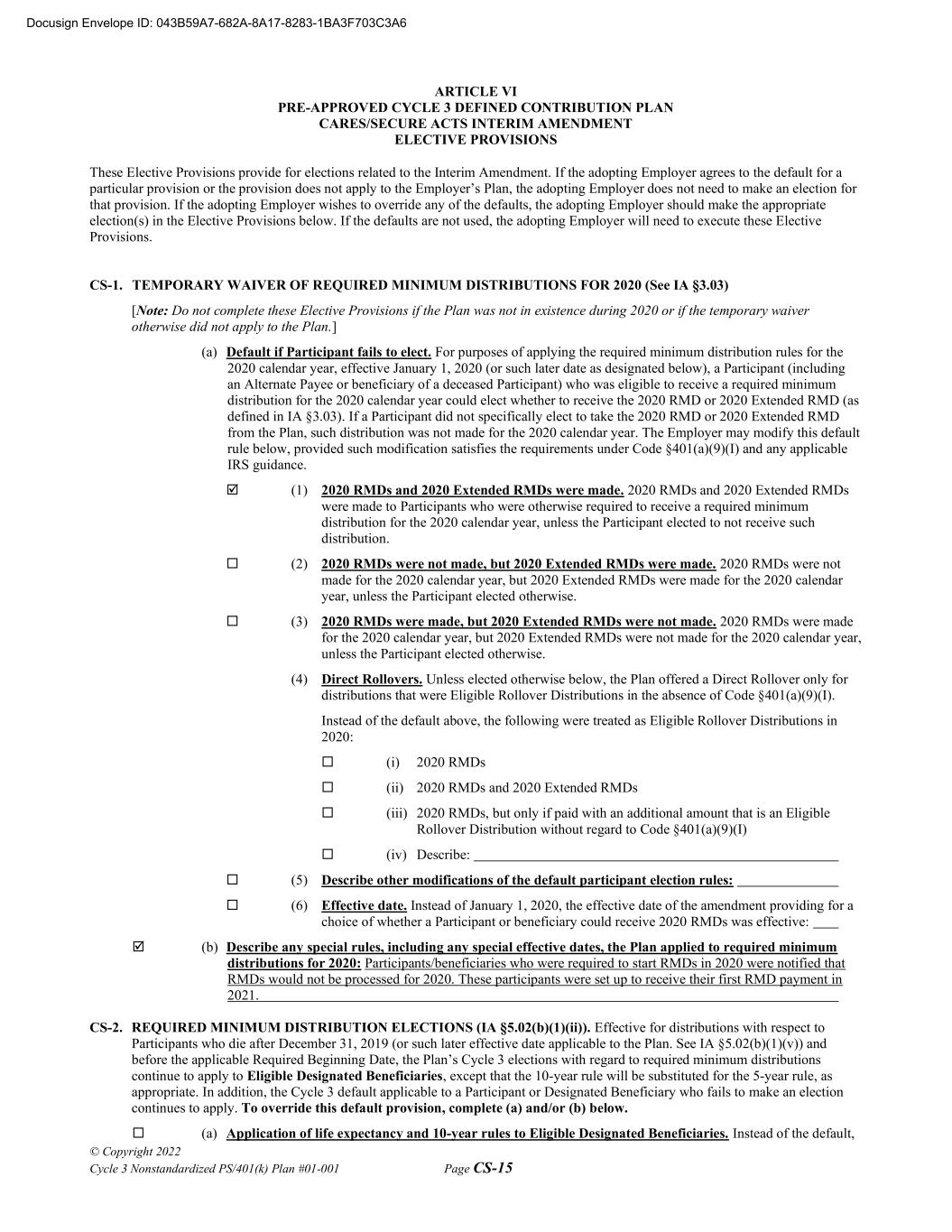
© Copyright 2022 Cycle 3 Nonstandardized PS/401(k) Plan #01-001 Page CS-15 ARTICLE VI PRE-APPROVED CYCLE 3 DEFINED CONTRIBUTION PLAN CARES/SECURE ACTS INTERIM AMENDMENT ELECTIVE PROVISIONS These Elective Provisions provide for elections related to the Interim Amendment. If the adopting Employer agrees to the default for a particular provision or the provision does not apply to the Employer’s Plan, the adopting Employer does not need to make an election for that provision. If the adopting Employer wishes to override any of the defaults, the adopting Employer should make the appropriate election(s) in the Elective Provisions below. If the defaults are not used, the adopting Employer will need to execute these Elective Provisions. CS-1. TEMPORARY WAIVER OF REQUIRED MINIMUM DISTRIBUTIONS FOR 2020 (See IA §3.03) [Note: Do not complete these Elective Provisions if the Plan was not in existence during 2020 or if the temporary waiver otherwise did not apply to the Plan.] (a) Default if Participant fails to elect. For purposes of applying the required minimum distribution rules for the 2020 calendar year, effective January 1, 2020 (or such later date as designated below), a Participant (including an Alternate Payee or beneficiary of a deceased Participant) who was eligible to receive a required minimum distribution for the 2020 calendar year could elect whether to receive the 2020 RMD or 2020 Extended RMD (as defined in IA §3.03). If a Participant did not specifically elect to take the 2020 RMD or 2020 Extended RMD from the Plan, such distribution was not made for the 2020 calendar year. The Employer may modify this default rule below, provided such modification satisfies the requirements under Code §401(a)(9)(I) and any applicable IRS guidance. (1) 2020 RMDs and 2020 Extended RMDs were made. 2020 RMDs and 2020 Extended RMDs were made to Participants who were otherwise required to receive a required minimum distribution for the 2020 calendar year, unless the Participant elected to not receive such distribution. (2) 2020 RMDs were not made, but 2020 Extended RMDs were made. 2020 RMDs were not made for the 2020 calendar year, but 2020 Extended RMDs were made for the 2020 calendar year, unless the Participant elected otherwise. (3) 2020 RMDs were made, but 2020 Extended RMDs were not made. 2020 RMDs were made for the 2020 calendar year, but 2020 Extended RMDs were not made for the 2020 calendar year, unless the Participant elected otherwise. (4) Direct Rollovers. Unless elected otherwise below, the Plan offered a Direct Rollover only for distributions that were Eligible Rollover Distributions in the absence of Code §401(a)(9)(I). Instead of the default above, the following were treated as Eligible Rollover Distributions in 2020: (i) 2020 RMDs (ii)2020 RMDs and 2020 Extended RMDs (iii)2020 RMDs, but only if paid with an additional amount that is an Eligible Rollover Distribution without regard to Code §401(a)(9)(I) (iv)Describe: (5) Describe other modifications of the default participant election rules: (6) Effective date. Instead of January 1, 2020, the effective date of the amendment providing for a choice of whether a Participant or beneficiary could receive 2020 RMDs was effective: (b) Describe any special rules, including any special effective dates, the Plan applied to required minimum distributions for 2020: Participants/beneficiaries who were required to start RMDs in 2020 were notified that RMDs would not be processed for 2020. These participants were set up to receive their first RMD payment in 2021. CS-2. REQUIRED MINIMUM DISTRIBUTION ELECTIONS (IA §5.02(b)(1)(ii)). Effective for distributions with respect to Participants who die after December 31, 2019 (or such later effective date applicable to the Plan. See IA §5.02(b)(1)(v)) and before the applicable Required Beginning Date, the Plan’s Cycle 3 elections with regard to required minimum distributions continue to apply to Eligible Designated Beneficiaries, except that the 10-year rule will be substituted for the 5-year rule, as appropriate. In addition, the Cycle 3 default applicable to a Participant or Designated Beneficiary who fails to make an election continues to apply. To override this default provision, complete (a) and/or (b) below. (a) Application of life expectancy and 10-year rules to Eligible Designated Beneficiaries. Instead of the default, Docusign Envelope ID: 043B59A7-682A-8A17-8283-1BA3F703C3A6
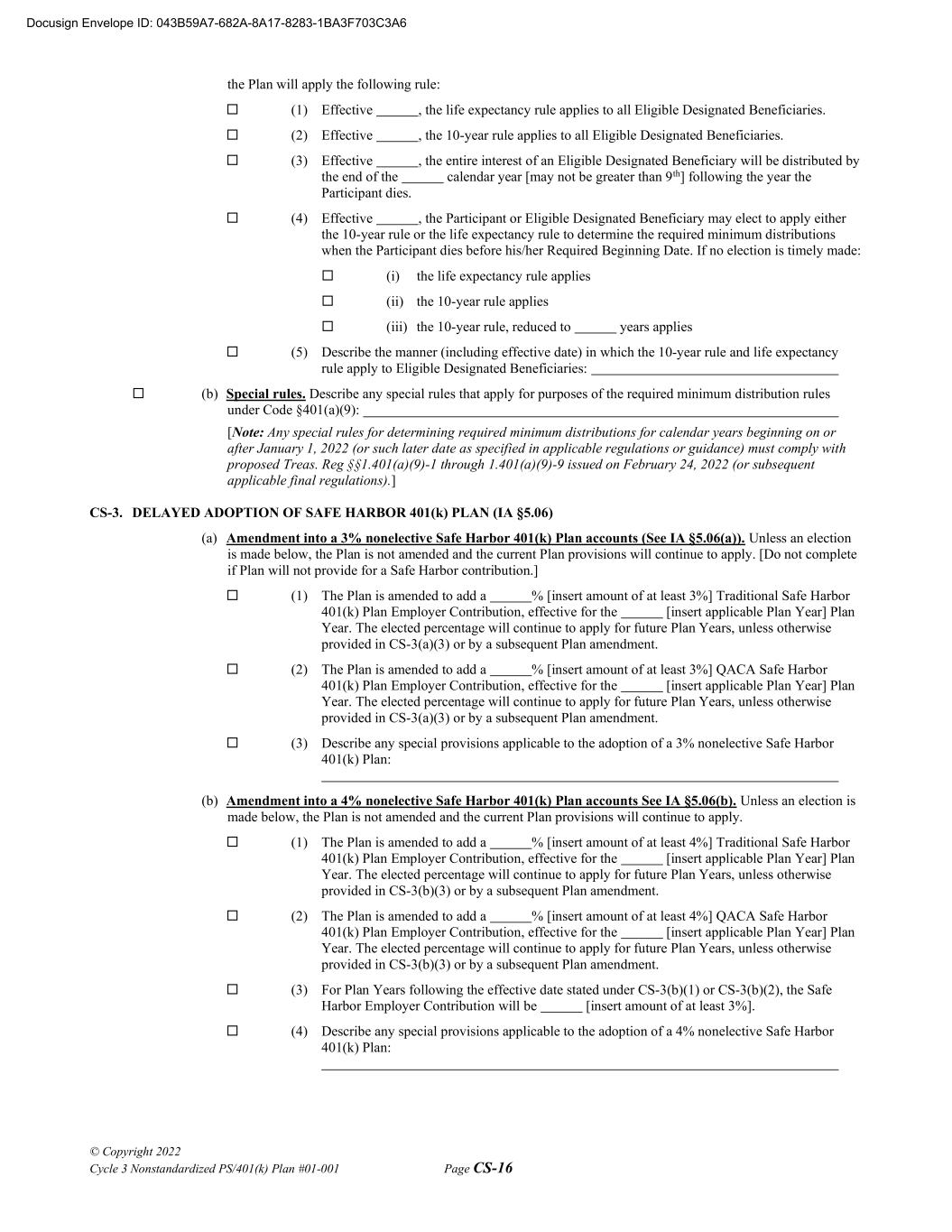
© Copyright 2022 Cycle 3 Nonstandardized PS/401(k) Plan #01-001 Page CS-16 the Plan will apply the following rule: (1) Effective , the life expectancy rule applies to all Eligible Designated Beneficiaries. (2) Effective , the 10-year rule applies to all Eligible Designated Beneficiaries. (3) Effective , the entire interest of an Eligible Designated Beneficiary will be distributed by the end of the calendar year [may not be greater than 9th] following the year the Participant dies. (4) Effective , the Participant or Eligible Designated Beneficiary may elect to apply either the 10-year rule or the life expectancy rule to determine the required minimum distributions when the Participant dies before his/her Required Beginning Date. If no election is timely made: (i) the life expectancy rule applies (ii) the 10-year rule applies (iii) the 10-year rule, reduced to years applies (5) Describe the manner (including effective date) in which the 10-year rule and life expectancy rule apply to Eligible Designated Beneficiaries: (b) Special rules. Describe any special rules that apply for purposes of the required minimum distribution rules under Code §401(a)(9): [Note: Any special rules for determining required minimum distributions for calendar years beginning on or after January 1, 2022 (or such later date as specified in applicable regulations or guidance) must comply with proposed Treas. Reg §§1.401(a)(9)-1 through 1.401(a)(9)-9 issued on February 24, 2022 (or subsequent applicable final regulations).] CS-3. DELAYED ADOPTION OF SAFE HARBOR 401(k) PLAN (IA §5.06) (a) Amendment into a 3% nonelective Safe Harbor 401(k) Plan accounts (See IA §5.06(a)). Unless an election is made below, the Plan is not amended and the current Plan provisions will continue to apply. [Do not complete if Plan will not provide for a Safe Harbor contribution.] (1) The Plan is amended to add a % [insert amount of at least 3%] Traditional Safe Harbor 401(k) Plan Employer Contribution, effective for the [insert applicable Plan Year] Plan Year. The elected percentage will continue to apply for future Plan Years, unless otherwise provided in CS-3(a)(3) or by a subsequent Plan amendment. (2) The Plan is amended to add a % [insert amount of at least 3%] QACA Safe Harbor 401(k) Plan Employer Contribution, effective for the [insert applicable Plan Year] Plan Year. The elected percentage will continue to apply for future Plan Years, unless otherwise provided in CS-3(a)(3) or by a subsequent Plan amendment. (3) Describe any special provisions applicable to the adoption of a 3% nonelective Safe Harbor 401(k) Plan: (b) Amendment into a 4% nonelective Safe Harbor 401(k) Plan accounts See IA §5.06(b). Unless an election is made below, the Plan is not amended and the current Plan provisions will continue to apply. (1) The Plan is amended to add a % [insert amount of at least 4%] Traditional Safe Harbor 401(k) Plan Employer Contribution, effective for the [insert applicable Plan Year] Plan Year. The elected percentage will continue to apply for future Plan Years, unless otherwise provided in CS-3(b)(3) or by a subsequent Plan amendment. (2) The Plan is amended to add a % [insert amount of at least 4%] QACA Safe Harbor 401(k) Plan Employer Contribution, effective for the [insert applicable Plan Year] Plan Year. The elected percentage will continue to apply for future Plan Years, unless otherwise provided in CS-3(b)(3) or by a subsequent Plan amendment. (3) For Plan Years following the effective date stated under CS-3(b)(1) or CS-3(b)(2), the Safe Harbor Employer Contribution will be [insert amount of at least 3%]. (4) Describe any special provisions applicable to the adoption of a 4% nonelective Safe Harbor 401(k) Plan: Docusign Envelope ID: 043B59A7-682A-8A17-8283-1BA3F703C3A6
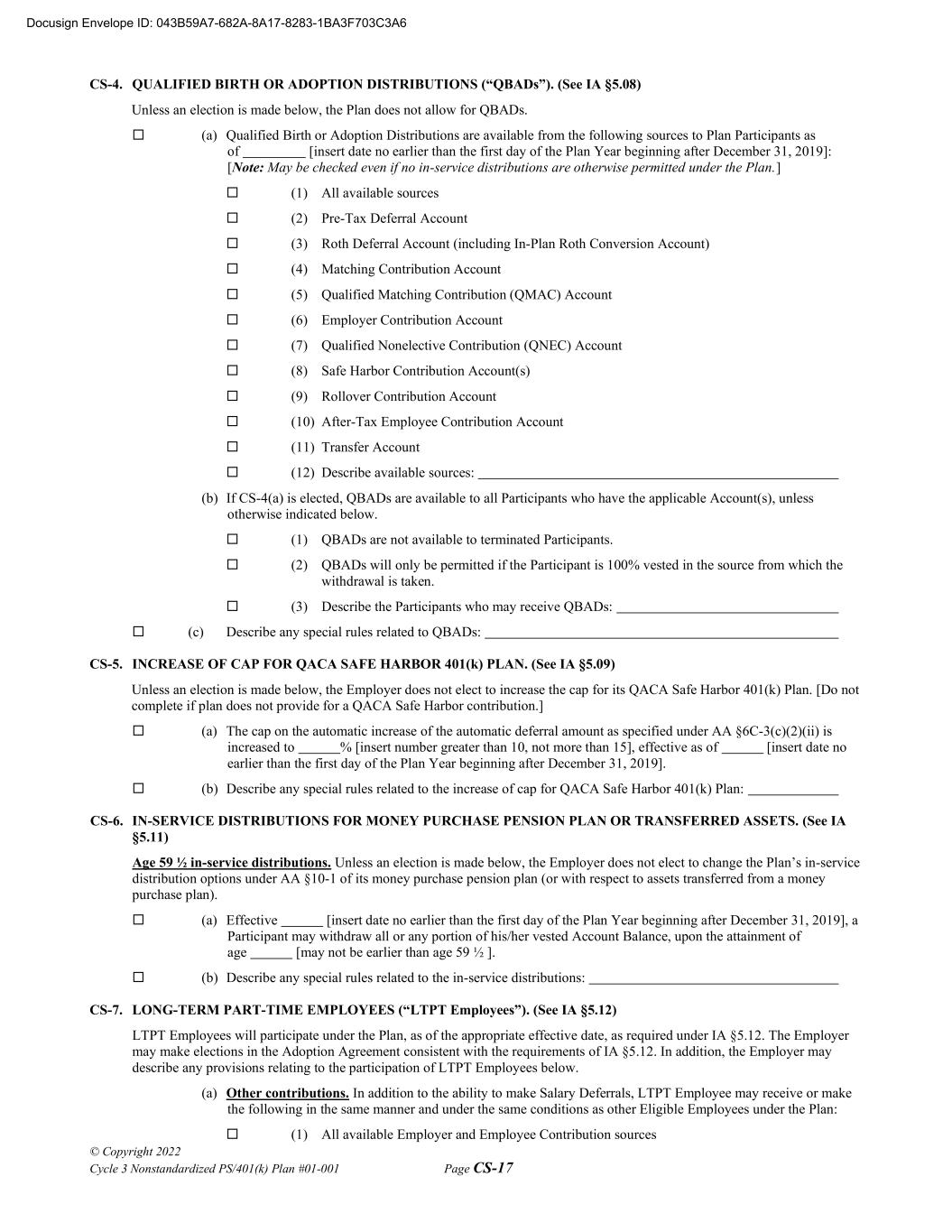
© Copyright 2022 Cycle 3 Nonstandardized PS/401(k) Plan #01-001 Page CS-17 CS-4. QUALIFIED BIRTH OR ADOPTION DISTRIBUTIONS (“QBADs”). (See IA §5.08) Unless an election is made below, the Plan does not allow for QBADs. (a) Qualified Birth or Adoption Distributions are available from the following sources to Plan Participants as of [insert date no earlier than the first day of the Plan Year beginning after December 31, 2019]: [Note: May be checked even if no in-service distributions are otherwise permitted under the Plan.] (1) All available sources (2) Pre-Tax Deferral Account (3) Roth Deferral Account (including In-Plan Roth Conversion Account) (4) Matching Contribution Account (5) Qualified Matching Contribution (QMAC) Account (6) Employer Contribution Account (7) Qualified Nonelective Contribution (QNEC) Account (8) Safe Harbor Contribution Account(s) (9) Rollover Contribution Account (10) After-Tax Employee Contribution Account (11) Transfer Account (12) Describe available sources: (b) If CS-4(a) is elected, QBADs are available to all Participants who have the applicable Account(s), unless otherwise indicated below. (1) QBADs are not available to terminated Participants. (2) QBADs will only be permitted if the Participant is 100% vested in the source from which the withdrawal is taken. (3) Describe the Participants who may receive QBADs: (c) Describe any special rules related to QBADs: CS-5. INCREASE OF CAP FOR QACA SAFE HARBOR 401(k) PLAN. (See IA §5.09) Unless an election is made below, the Employer does not elect to increase the cap for its QACA Safe Harbor 401(k) Plan. [Do not complete if plan does not provide for a QACA Safe Harbor contribution.] (a) The cap on the automatic increase of the automatic deferral amount as specified under AA §6C-3(c)(2)(ii) is increased to % [insert number greater than 10, not more than 15], effective as of [insert date no earlier than the first day of the Plan Year beginning after December 31, 2019]. (b) Describe any special rules related to the increase of cap for QACA Safe Harbor 401(k) Plan: CS-6. IN-SERVICE DISTRIBUTIONS FOR MONEY PURCHASE PENSION PLAN OR TRANSFERRED ASSETS. (See IA §5.11) Age 59 ½ in-service distributions. Unless an election is made below, the Employer does not elect to change the Plan’s in-service distribution options under AA §10-1 of its money purchase pension plan (or with respect to assets transferred from a money purchase plan). (a) Effective [insert date no earlier than the first day of the Plan Year beginning after December 31, 2019], a Participant may withdraw all or any portion of his/her vested Account Balance, upon the attainment of age [may not be earlier than age 59 ½ ]. (b) Describe any special rules related to the in-service distributions: CS-7. LONG-TERM PART-TIME EMPLOYEES (“LTPT Employees”). (See IA §5.12) LTPT Employees will participate under the Plan, as of the appropriate effective date, as required under IA §5.12. The Employer may make elections in the Adoption Agreement consistent with the requirements of IA §5.12. In addition, the Employer may describe any provisions relating to the participation of LTPT Employees below. (a) Other contributions. In addition to the ability to make Salary Deferrals, LTPT Employee may receive or make the following in the same manner and under the same conditions as other Eligible Employees under the Plan: (1) All available Employer and Employee Contribution sources Docusign Envelope ID: 043B59A7-682A-8A17-8283-1BA3F703C3A6
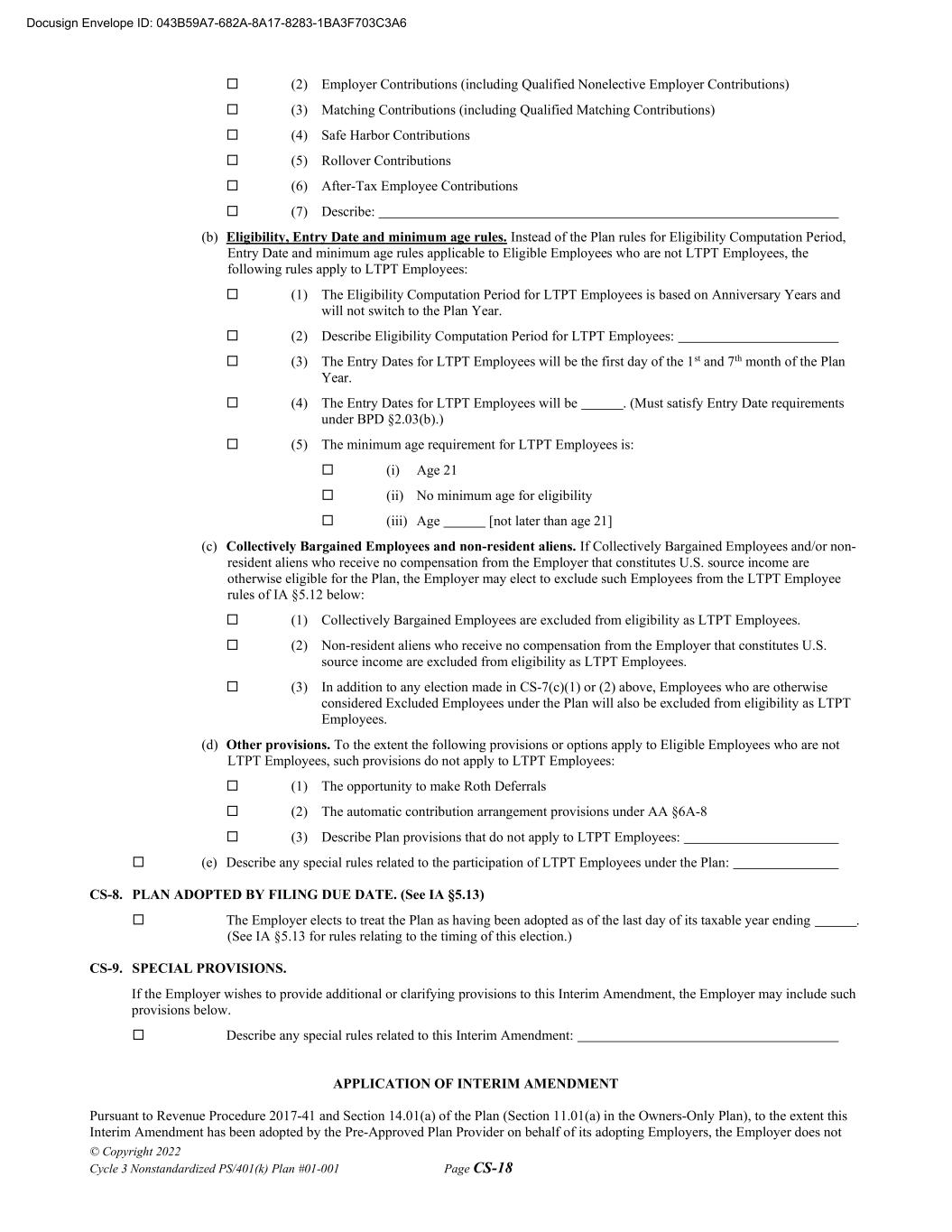
© Copyright 2022 Cycle 3 Nonstandardized PS/401(k) Plan #01-001 Page CS-18 (2) Employer Contributions (including Qualified Nonelective Employer Contributions) (3) Matching Contributions (including Qualified Matching Contributions) (4) Safe Harbor Contributions (5) Rollover Contributions (6) After-Tax Employee Contributions (7) Describe: (b) Eligibility, Entry Date and minimum age rules. Instead of the Plan rules for Eligibility Computation Period, Entry Date and minimum age rules applicable to Eligible Employees who are not LTPT Employees, the following rules apply to LTPT Employees: (1) The Eligibility Computation Period for LTPT Employees is based on Anniversary Years and will not switch to the Plan Year. (2) Describe Eligibility Computation Period for LTPT Employees: (3) The Entry Dates for LTPT Employees will be the first day of the 1st and 7th month of the Plan Year. (4) The Entry Dates for LTPT Employees will be . (Must satisfy Entry Date requirements under BPD §2.03(b).) (5) The minimum age requirement for LTPT Employees is: (i) Age 21 (ii) No minimum age for eligibility (iii) Age [not later than age 21] (c) Collectively Bargained Employees and non-resident aliens. If Collectively Bargained Employees and/or non- resident aliens who receive no compensation from the Employer that constitutes U.S. source income are otherwise eligible for the Plan, the Employer may elect to exclude such Employees from the LTPT Employee rules of IA §5.12 below: (1) Collectively Bargained Employees are excluded from eligibility as LTPT Employees. (2) Non-resident aliens who receive no compensation from the Employer that constitutes U.S. source income are excluded from eligibility as LTPT Employees. (3) In addition to any election made in CS-7(c)(1) or (2) above, Employees who are otherwise considered Excluded Employees under the Plan will also be excluded from eligibility as LTPT Employees. (d) Other provisions. To the extent the following provisions or options apply to Eligible Employees who are not LTPT Employees, such provisions do not apply to LTPT Employees: (1) The opportunity to make Roth Deferrals (2) The automatic contribution arrangement provisions under AA §6A-8 (3) Describe Plan provisions that do not apply to LTPT Employees: (e) Describe any special rules related to the participation of LTPT Employees under the Plan: CS-8. PLAN ADOPTED BY FILING DUE DATE. (See IA §5.13) The Employer elects to treat the Plan as having been adopted as of the last day of its taxable year ending . (See IA §5.13 for rules relating to the timing of this election.) CS-9. SPECIAL PROVISIONS. If the Employer wishes to provide additional or clarifying provisions to this Interim Amendment, the Employer may include such provisions below. Describe any special rules related to this Interim Amendment: APPLICATION OF INTERIM AMENDMENT Pursuant to Revenue Procedure 2017-41 and Section 14.01(a) of the Plan (Section 11.01(a) in the Owners-Only Plan), to the extent this Interim Amendment has been adopted by the Pre-Approved Plan Provider on behalf of its adopting Employers, the Employer does not Docusign Envelope ID: 043B59A7-682A-8A17-8283-1BA3F703C3A6
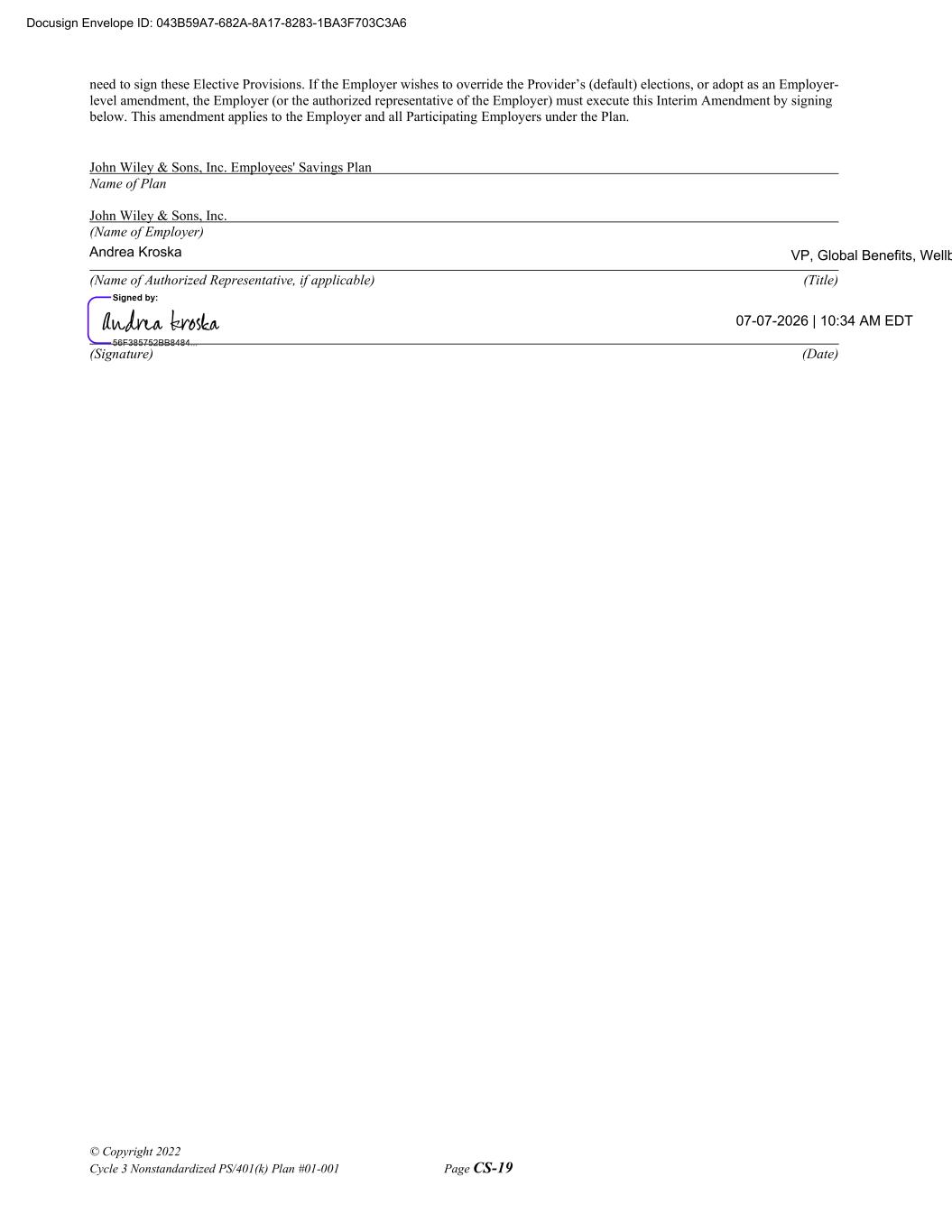
© Copyright 2022 Cycle 3 Nonstandardized PS/401(k) Plan #01-001 Page CS-19 need to sign these Elective Provisions. If the Employer wishes to override the Provider’s (default) elections, or adopt as an Employer- level amendment, the Employer (or the authorized representative of the Employer) must execute this Interim Amendment by signing below. This amendment applies to the Employer and all Participating Employers under the Plan. John Wiley & Sons, Inc. Employees' Savings Plan Name of Plan John Wiley & Sons, Inc. (Name of Employer) (Name of Authorized Representative, if applicable) (Title) (Signature) (Date) Docusign Envelope ID: 043B59A7-682A-8A17-8283-1BA3F703C3A6 07-07-2026 | 10:34 AM EDT VP, Global Benefits, Wellbeing, Safety and M&AAndrea Kroska