Interim Amendment –SECURE 2.0 Elective Provisions © Copyright 2026 Nonstandardized PS/401(k) Plan #01-001 Page S2IA-1 PRE-APPROVED CYCLE 3 DEFINED CONTRIBUTION PLAN SECURE 2.0 ACT INTERIM AMENDMENT [For Plans not restated for Cycle 4 by December 31, 2026] ARTICLE I PURPOSE OF INTERIM AMENDMENT 1.01 Adoption by Pre-Approved Plan Provider. Pursuant to Revenue Procedure 2023-37 and Section 14.01(a) of the Basic Plan Document (BPD), the Pre-Approved Plan Provider (hereinafter referred to as the “Provider”) is amending the Plan on behalf of all adopting Employers. This Pre-Approved Cycle 3 Defined Contribution Plan SECURE 2.0 Act Interim Amendment (“SECURE 2.0 Act Interim Amendment” or “S2IA”) is intended to qualify as a “good-faith” amendment to document the Plan's compliance with the SECURE 2.0 Act of 2022 and other guidance issued by the Internal Revenue Service. The Plan Administrator will interpret the provisions in a reasonable and good-faith manner consistent with the SECURE 2.0 Act and any current or future guidance related to the applicable provisions. A copy of this amendment will be provided to all adopting Employers and made a part of their Plans. 1.02 Application. To the extent that this SECURE 2.0 Act Interim Amendment applies to a Plan, it supersedes any contrary provisions under the Plan, except as provided under S2IA §1.03 below. Unless the Employer wishes to override the pre-selected elections (defaults), if any, made by the Provider as elected under the Interim Amendment Elective Provisions (Elective Provisions) in Article IX, no signature is required by the Employer to adopt this SECURE 2.0 Act Interim Amendment. This SECURE 2.0 Act Interim Amendment applies to the signatory Employer and any other Participating Employers of the Plan. 1.03 Prior Amendments. If the Employer previously amended the Plan to implement one or more of the provisions addressed by this SECURE 2.0 Act Interim Amendment, such amendment(s) shall remain in effect and shall not be superseded, unless otherwise provided under the Elective Provisions. The Employer may use the Elective Provisions of this SECURE 2.0 Act Interim Amendment to memorialize prior amendments. ARTICLE II APPLICABLE LAWS AND PLANS COVERED BY INTERIM AMENDMENT 2.01 Applicable Laws. This SECURE 2.0 Act Interim Amendment includes provisions that are required or allowed under the SECURE 2.0 Act of 2022 (SECURE 2.0 Act). 2.02 Application to Cycle 3 Defined Contribution Plans. The SECURE 2.0 Interim Amendment applies to the following types of ASC Institute Cycle 3 Pre-Approved Plans: the Defined Contribution Plan (#01) (DC Plan), the Owners-Only Profit Sharing/401(k) Defined Contribution Plan (#02) (Owners-Only Plan), the Governmental Defined Contribution Plan (#03) (Governmental Plan), the Employee Stock Ownership Plan (#04) (ESOP), and the Church Defined Contribution Plan (#05) (Church Plan). Certain provisions of this Interim Amendment may not be applicable to all types of Plans or a specific adopting Employer. ARTICLE III PROVISIONS RELATING TO EMPLOYER CONTRIBUTIONS 3.01 Optional treatment of Employer Contributions as Designated Roth Nonelective Contributions. [Applies to all Plans with 401(k) provisions.] As provided under §402A(a)(2) and §604 of the SECURE 2.0 Act and effective for Employer Contributions made on or after December 30, 2022, if elected by the Employer under Elective Provision §S2-1, a Participant may elect to treat a nonforfeitable Employer Contribution as a Designated Roth Nonelective Contribution, as defined under IRS Notice 2024-2. The Plan Administrator may adopt administrative procedures consistent with Code §402A(a)(2), IRS Notice 2024-2, Q&As L-1 through L-11, and other IRS guidance. (a) Roth Deferral rules generally apply. Rules similar to the requirements under Treas. Reg. §1.401(k)-1(f) (other than Treas. Reg. §§1.401(k)-1(f)(4)(i) and (6)) apply to Designated Roth Nonelective Contributions. Contribution and distribution restrictions applicable to Roth Deferrals do not apply to Designated Roth Nonelective Contributions. (b) Taxable year of inclusion. A Designated Roth Nonelective Contribution is includible in a Participant’s gross income for the taxable year in which the contribution is allocated to the Participant’s Account (even if the Designated Roth Nonelective Contribution is deemed to have been made on the last day of the prior taxable year of the Employer under Code §404(a)(6)). (c) Employer Contribution must be fully vested. An Employer Contribution may be designated as a Designated Roth Nonelective Contribution only if the Participant is fully vested in such Employer Contribution at the time the contribution is allocated to the Participant’s Account. As provided under IRS Notice 2024-2, Q&A L-4, the Plan will not be treated as Docusign Envelope ID: 043B59A7-682A-8A17-8283-1BA3F703C3A6
Interim Amendment –SECURE 2.0 Elective Provisions © Copyright 2026 Nonstandardized PS/401(k) Plan #01-001 Page S2IA-2 failing to satisfy Code §401(a)(4) as applicable to rights and features merely because of this requirement. (d) Designated Roth Nonelective Contributions not treated as wages. Designated Roth Nonelective Contributions that are made to the Plan are excluded from wages under Code §3401(a) (withholding wages), under Code §§3121(a)(5)(A) and (B) (FICA wages) and under Code §§3306(b)(5)(A) and (B) (FUTA wages). (e) Designated Roth Nonelective Contributions not included under safe harbor definition of Plan Compensation. Designated Roth Nonelective Contributions that are made to the Plan are not included under any Code §414(s) safe harbor definition of Plan Compensation under the Plan. 3.02 Exclusion of “otherwise excludable employees” for Top-Heavy Plan purposes. [Applies to all Plans with 401(k) provisions, except the Owner’s Only (Solo k) Plan and the Governmental Plan.] As provided under Code §416(c)(2)(C) and §310 of the SECURE 2.0 Act, effective for Plan Years beginning on or after January 1, 2024, the Plan excludes Employees who do not meet the minimum age and service requirements under Code §410(a)(1) (i.e., “otherwise excludable Employees”) from consideration in determining whether the Plan satisfies the Top-Heavy Plan requirements under Section 4 of the BPD. Such otherwise excludable Employees will not receive a Top-Heavy Plan minimum allocation unless the Employer elects otherwise under Elective Provision §S2-2. The Employer may elect under Elective Provision §S2-2 to provide, in the Employer’s discretion on an annual basis, the otherwise applicable Top-Heavy minimum allocation to “otherwise excludable Employees.” This discretion includes the inclusion or exclusion of “otherwise excludable Employees” under any permitted disparity formula under the Plan. ARTICLE IV PROVISIONS RELATED TO SALARY DEFERRALS 4.01 Mandatory automatic enrollment. [Applies to all Plans with 401(k) provisions, except the Governmental Plan and the Church Plan.] Unless the Plan is otherwise exempt as described in S2IA §4.01(e) below, if the Plan includes a cash or deferred arrangement (CODA) under Code §401(k) (including a QACA Safe Harbor 401(k) Plan), the Plan must satisfy the automatic enrollment requirements under Code §414A and §101 of the SECURE 2.0 Act, effective for Plan Years beginning on or after January 1, 2025. The Plan Administrator may apply a reasonable, good faith interpretation of the requirements under Code §414A until Plan Years that begin more than 6 months after the date that the IRS issues final regulations under Code §414A. The Plan Administrator may use proposed Treas. Reg. §1.414A-1 and proposed Treas. Reg. §1.414(w)-1 to assist in the interpretation of the Code §414A requirements. If the IRS issues final regulations under Code §414A that modify the rules under proposed Treas. Reg. §1.414A-1 or proposed Treas. Reg. §1.414(w)-1, the Employer and/or Plan Administrator may revise its operation and administration of this S2IA §4.01 in conformance with those final regulations. (a) Arrangement must be an Eligible Automatic Contribution Arrangement (EACA). The Plan must include an EACA (as defined under Code §414(w)(3)) that covers all Employees (including Long-Term Part-Time Employees) who are eligible to make Salary Deferrals under the Plan and that satisfies the additional requirements under S2IA §§4.01(b)-(d) below. (b) Arrangement must permit permissible withdrawals. The EACA must permit any Employee who has default Salary Deferrals made to the Plan to elect permissible withdrawals (as defined in Code §414(w)(2) and described in Treas. Reg. §1.414(w)-1(c)). (c) Contribution requirements. The EACA must provide that the default Salary Deferral on behalf of an Eligible Employee must equal a uniform percentage of such Employee’s Plan Compensation, unless the Employee affirmatively elects to have a different amount (including no Salary Deferrals) under such Employee’s Salary Reduction Agreement. The contribution requirements are not required to apply to an Employee who, on the date the Code §414A requirements are effective for the Plan, had an affirmative Salary Deferral election in effect (and that remains in effect) to make Salary Deferrals (in a specified amount or percentage of Plan Compensation), or to not make Salary Deferrals to the Plan. (1) Uniform percentage for initial period. The contribution percentage under the default Salary Deferral for each Employee’s initial period must be a uniform percentage that is not less than 3 percent and not more than 10 percent of such Employee’s Plan Compensation. An Employee’s initial period begins when the Employee is first eligible to elect to make Salary Deferrals under the Plan. An Employee’s initial period ends on the last day of the Plan Year that follows the Plan Year that includes the date the initial period begins. (2) Subsequent Plan Years. For each Plan Year beginning after an Employee’s initial period under the arrangement, the percentage of the default Salary Deferral must be increased by 1 percentage point until the percentage is at least 10 percent. However, the percentage may not exceed 15 percent (or the lower percentage specified in Code §414A(b)(3)(B), if applicable). (3) Exception to uniform percentage requirement. The EACA does not fail to satisfy the uniform percentage requirement merely because: Docusign Envelope ID: 043B59A7-682A-8A17-8283-1BA3F703C3A6
Interim Amendment –SECURE 2.0 Elective Provisions © Copyright 2026 Nonstandardized PS/401(k) Plan #01-001 Page S2IA-3 (i) The percentage used for the default Salary Deferral varies based on the number of years (or portions of years) since the beginning of the initial period for an Employee; (ii) The rate of contributions under a Salary Reduction Agreement that is in effect for an Employee immediately prior to the date that the default Salary Deferral under S2IA §4.01(c)(1) above first applies to the Employee is not reduced; (iii) The rate of contributions under a Salary Reduction Agreement is limited so as not to exceed the applicable limits of Code §§401(a)(17), 401(k)(16), 402(g) (determined with or without Catch-Up Contributions), 403(b)(16), and 415; or (iv) The default Salary Deferral provided under this S2IA §4.01(c) is not applied during the period an Employee is not eligible to make Salary Deferrals under the Plan as required under the six-month suspension rule of Code §414(u)(12)(B)(ii). (4) Treatment of periods without default Salary Deferrals. Generally, the uniform percentages described in S2IA §§4.01(c)(1) and (2) above are based on the date an Employee’s initial period begins. However, if, after the Employee’s initial period began, the Employee did not have default Salary Deferrals made for an entire Plan Year, then the Plan may provide that the Employee’s initial period is redetermined as follows: (i) Redetermination for Employee who became ineligible. If, for an entire Plan Year, no default Salary Deferrals were made solely because the Employee was not eligible to make Salary Deferrals under the Plan for that Plan Year, then the Plan is permitted to provide that the Employee’s initial period is redetermined so that it begins on the date the Employee is again eligible to make Salary Deferrals under the Plan. (ii) Redetermination for Employee who remained eligible and made an affirmative Salary Deferral election. If, for an entire Plan Year, no default Salary Deferrals were made solely because the Employee made an affirmative Salary Deferral election (including an election to not make Salary Deferrals) and the Employee’s affirmative Salary Deferral election expires pursuant to an election under §S2-3(c)(2), then the Plan may provide that the initial period is redetermined so that it begins on any specified date that is later than the last day of the Plan Year following the Plan Year in which the initial period began. (d) Investment requirements. The EACA must provide that amounts contributed pursuant to the EACA, and for which no investment is elected by the Employee, will be invested in accordance with the qualified default investment arrangement (QDIA) requirements under 29 CFR 2550.404c-5 (or any successor regulations). (e) Exemptions for certain types of plans and employers. The following types of plans and employers are exempt from the requirements under Code §414A and this S2IA §4.01: (1) Governmental plans (within the meaning of Code §414(d)); (2) Church plans (within the meaning of Code §414(e)); (3) Employers that normally employ 10 or fewer Employees. The Plan Administrator and Employer may use the rules under proposed Treas. Reg. §1.414A-1(d)(4) (or subsequent final regulations) to assist in applying this exception; (4) Employers that have been in existence for less than three (3) years. The Plan Administrator and Employer may use the rules under proposed Treas. Reg. §1.414A-1(d)(4) (or subsequent final regulations) to assist in applying this exception; and (5) Any Plan that included a cash or deferred arrangement and that was established before December 29, 2022. (The Plan Administrator and Employer may apply guidance provided under proposed Treas. Reg. §1.414A-1(d) (or subsequent final regulations) to assist in applying this exception.) 4.02 Catch-Up Contributions. [Applies to all Plans with 401(k) provisions.] As provided under §109 of the SECURE 2.0 Act, effective for taxable years beginning on or after January 1, 2025, this S2IA §4.02 applies in place of Section 3.03(d) of the BPD. If permitted under AA §6A-4 or the Elective Provisions, a Participant who is age 50 or over by the end of such Participant’s taxable year beginning in the calendar year may make Catch-Up Contributions under the Plan, provided such Catch-Up Contributions are in excess of an otherwise applicable limit under the Plan. For this purpose, an otherwise applicable Plan limit is a limit in the Plan that applies to Salary Deferrals without regard to Catch-Up Contributions, such as a Plan-imposed Salary Deferral limit under AA §6A-2, the Code §415 Limitation, and the Elective Deferral Dollar Limit. In administering the Catch-Up Contribution rules under the Plan, the Plan Administrator may develop administrative procedures consistent with the requirements under Treas. Reg. §1.401(k)-1, 1.414(v)-1 and 1.414(v)-2, effective with respect to contributions in taxable years beginning on or after January 1, 2027. (Later effective dates apply to governmental plans under Code §414(d) and collectively bargained plans.) For periods before the applicable regulatory effective date, the Plan Administrator may apply a reasonable, good faith standard with respect to other applicable statutory provisions. Docusign Envelope ID: 043B59A7-682A-8A17-8283-1BA3F703C3A6
Interim Amendment –SECURE 2.0 Elective Provisions © Copyright 2026 Nonstandardized PS/401(k) Plan #01-001 Page S2IA-4 (a) Catch-Up Contribution Limit. Catch-Up Contributions for a Participant for a calendar year may not exceed the Catch- Up Contribution Limit. The Catch-Up Contribution Limit for 2026 is $8,000 (regular Catch-Up Contribution Limit). The Catch-Up Contribution Limit will be adjusted for cost-of-living increases under Code §414(v)(2)(C). Effective for calendar years beginning on or after January 1, 2025, the Plan’s Catch-Up Contribution Limit increases to the greater of $10,000 (as adjusted for cost of living changes under Code §414(v)(2)(C)) or 150% of the regular Catch-Up Contribution Limit starting in the 2025 calendar year for Participants who have attained ages 60 - 63 by the end of the Participant’s taxable year, as provided under Code §414(v)(2)(E) (higher Catch-Up Contribution Limit). The higher Catch-Up Contribution Limit for 2026 is $11,250. The Employer may operationally limit Catch-Up Contributions so that a Participant’s total Catch-Up Contributions, when added to other Salary Deferrals, may not exceed 75 percent of the Participant’s Plan Compensation for the taxable year. The Employer may elect to not permit this higher Catch-Up Contribution under the Elective Provision §S2-4. (b) Special treatment of Catch-Up Contributions. Catch-Up Contributions are not subject to the Elective Deferral Dollar Limit or the Code §415 Limitation, are not counted in the ADP test, and are not counted in determining the minimum allocation under Code §416. However, Catch-Up Contributions made in prior years are counted in determining whether the Plan is a Top-Heavy Plan. (c) Universal availability of Catch-Up Contributions. As provided under Treas. Reg. §1.414(v)-1(e), the Plan generally may only offer Catch-Up Contributions if all applicable employer plans (as defined under Treas. Reg. §1.414(v)-1(g)) maintained by the Employer or Related Employers allow all eligible Participants an effective opportunity to make the same dollar amount of Catch-Up Contributions. This universal availability of Catch-Up Contributions requirement may be administered consistent with the rules under Treas. Reg. §§1.414(v)-1 and 1.414(v)-2. The Plan will not fail the universal availability requirement merely because Employees described in Code §410(b)(3) are not provided the opportunity to make Catch-Up Contributions (or are provided the opportunity to make Catch-Up Contributions to a lesser extent than other Employees). (d) Certain Catch-Up Contributions must be Roth Deferrals. As provided under §603 of the SECURE 2.0 Act, effective for calendar years on or after January 1, 2026, any eligible Participant whose wages (as defined in Code §3121(a)) for the preceding calendar year from the employer sponsoring the Plan exceeded $150,000 (as adjusted) (i.e., a “Highly Paid Individual” or “HPI”) may make such Catch-Up Contributions only as a Roth Deferral, as provided under Code §414(v)(7) and applicable regulations. In any event, a Participant must be permitted to make Pre-Tax Salary Deferrals in order for the Participant to designate such Pre-Tax Salary Deferrals as Roth Deferrals. The Plan Administrator may use Treas. Reg. §1.414(v)-2 as guidance to administer this S2IA §4.02. (1) Determination of employer sponsoring the Plan. The “employer sponsoring the Plan” generally refers only to the Participant’s common law employer, as described in Treas. Reg.§1.414(v)-2(b)(4)(i). However, in determining the employer sponsoring the Plan for HPI purposes, the Employer may apply the optional rules under Treas. Reg. §1.414(v)-(2)(b)(4)(ii) (relating to employers using a common paymaster), Treas. Reg. §1.414(v)-(2)(b)(4)(iii) (relating to aggregation for other controlled group members), Treas. Reg. §1.414(v)-(2)(b)(4)(iv) (relating to aggregation in the year of an asset purchase). For this purpose, the Employer may list the aggregated employers under the Elective Provision §S2-4(e) or in a separate written administrative procedure.) In the case of an Employee who receives wages from an entity that is disregarded as an entity separate from its owner, the owner is treated as the employer sponsoring the Plan for purposes of determining the employer sponsoring the Plan. In such a case, the Employee’s wages from the employer sponsoring the Plan include the Employee’s wages from the disregarded entity and from its owner. (2) Plans that allow Catch-Up Contributions but not Roth Deferrals. For any particular Plan Year, if a Plan allows Participants to make Catch-Up Contributions but does not allow Participants to make Roth Deferrals, any HPI is precluded from making any Catch-Up Contributions to the Plan for such Plan Year. (3) Deemed Roth Catch-Up Contribution election. The Plan may deem a Participant who is subject to the Roth Catch-Up Contribution requirement to have irrevocably designated any Catch-Up Contributions as a Roth Deferral. If the Plan provides for such a deemed Roth Catch-Up Contribution election, the Plan must treat Catch- Up Contributions subject to the deemed Roth Catch-Up Contribution election as not excludible from the Participant’s gross income and maintain the Catch-Up Contributions in a designated Roth Deferral Account. The Plan may provide for a deemed Roth Catch-Up Contribution election without regard to whether administrative policies or a salary Reduction Agreement requires separate elections for Salary Deferrals that are not Catch-Up Contributions and for additional Salary Deferrals that are Catch-Up Contributions or uses a so-called “spillover design.” The Employer may elect not to provide for a deemed Roth Catch-Up Contribution election under Elective Provision §S2-4(d). (i) Conditions for application of deemed Roth Catch-Up Contribution election. The application of a deemed Roth Catch-Up Contribution election to a Participant is conditioned on the Participant having an effective opportunity (determined based on all of the relevant facts and circumstances) to make a new Salary Deferral election that is different than the deemed Roth Catch-Up Contribution election. The deemed Roth Catch-Up Contribution election ceases to apply to an Employee within a reasonable period of Docusign Envelope ID: 043B59A7-682A-8A17-8283-1BA3F703C3A6
Interim Amendment –SECURE 2.0 Elective Provisions © Copyright 2026 Nonstandardized PS/401(k) Plan #01-001 Page S2IA-5 time following the date the Employee ceases to be subject to the requirement under Code §414(v)(7) to make any Catch-Up Contributions as designated Roth contributions, or an amended Form W-2 (Wage and Tax Statement) is filed or furnished to the Employee indicating that the Employee is not subject to the requirement under Code §414(v)(7) to make any Catch-Up Contributions as Roth Deferrals. (ii) Plans that do not provide for deemed Roth Catch-Up Contribution election. If the Plan does not provide for a deemed Roth Catch-Up Contribution election, the Plan will not accept Salary Deferrals that exceeds an applicable limit on Salary Deferrals and the Plan will automatically stop Salary Deferrals for an eligible Participant who is subject to the Roth Catch-Up Contribution requirements after the Participant’s Salary Deferrals reach an applicable limit (unless the Participant has designated the additional Salary Deferrals as Roth Deferrals). If the Plan does not provide for a deemed Roth Catch-Up Contribution election, the Plan may be precluded from using certain correction methods under Treas. Reg.§1.414(v)- 2(c)(2). (4) Rules of operation. The Employer and/or Plan Administrator may utilize the rules of operation, including the correction principles, under Treas. Reg. §1.414(v)-2(b) in administering this S2IA §4.02(d). 4.03 Long-Term Part-Time Employees (LTPT Employees). [Applies to all Plans with 401(k) provisions.] Effective for Plan Years beginning on or after January 1, 2021, to satisfy the rules under Code §401(k), the Plan must permit LTPT Employees to make Salary Deferrals into the Plan, as required under Code §§401(k)(2)(D)(ii)) and 401(k)(15) and applicable regulations. An Employer is not required to make Employer Contributions or Matching Contributions on behalf of LTPT Employees. If no Employees are eligible to make Salary Deferrals solely because of the LTPT Employee requirements under Code §§401(k)(2)(D)(ii)) and 401(k)(15), then the Employer has no LTPT Employees and the requirements under this S2IA §4.03 do not apply. The Employer may make elections relating to LTPT Employees under Elective Provision §S2-5. (a) Definition of an LTPT Employee. An Employee who is eligible to make Salary Deferrals into the Plan solely by reason of having: (1) Completed two consecutive Eligibility Computation Periods during each of which the Employee is credited with at least 500 Hours of Service (or for Plan Years beginning on or before December 31, 2024, three consecutive Eligibility Computation Periods rather than two consecutive Eligibility Computation Periods); and (2) Attained age 21 by the close of the last of the Eligibility Computation Periods described in subsection (1). LTPT Employees do not include: (a) Employees who are Collectively Bargained Employees; (b) Employees who are nonresident aliens and who receive no earned income (within the meaning of Code §911(d)(2)) from the Employer that constitutes income from sources within the United States (within the meaning of Code §861(a)(3)); or (c) any other Employees described in Code §410(b)(3). (b) Participation rules applicable to LTPT Employees. (1) In general. An LTPT Employee must become eligible to make Salary Deferrals into the Plan no later than the earlier of: (i) The first day of the first Plan Year beginning after becoming an LTPT Employee; or (ii) The date 6 months after becoming an LTPT Employee. (2) Employees who terminate employment. The time of participation rule in (1) does not apply to an LTPT Employee who terminates employment and is not reemployed by the Employer before such LTPT Employee’s applicable Entry Date. However, if an LTPT Employee described in the prior sentence returns to employment with the Employer after such LTPT Employee’s applicable Entry Date and is otherwise eligible to make Salary Deferrals, the LTPT Employee must be eligible to make Salary Deferrals immediately upon reemployment with the Employer. (3) Change in status. If an Employee who would otherwise be eligible to make Salary Deferrals as an LTPT Employee does not participate solely because the Employee does not satisfy the Plan’s eligibility conditions that are not based on age or service as of the Employee’s applicable Entry Date, and the Employee satisfies those conditions after that date, the Employee must be eligible to make Salary Deferrals immediately upon satisfying those conditions. (4) Crediting of service. Except for any Eligibility Computation Period beginning before January 1, 2021, all Eligibility Computation Periods during which an Employee is credited with at least 500 Hours of Service with the Employer must be taken into account for purposes of determining whether an Employee has satisfied the time of participation requirements under S2IA §4.03(a)(1). Eligibility Computation Periods are determined under the rules set forth under Section 2.03(a)(3) of the BPD or under Elective Provision §S2-5(b). Docusign Envelope ID: 043B59A7-682A-8A17-8283-1BA3F703C3A6
Interim Amendment –SECURE 2.0 Elective Provisions © Copyright 2026 Nonstandardized PS/401(k) Plan #01-001 Page S2IA-6 (c) Eligibility conditions not based on age or service. The Plan may establish an eligibility condition that an LTPT Employee must satisfy in order to make Salary Deferrals under the Plan, provided that the condition is not a proxy for imposing an impermissible age or service requirement. (d) Restrictions on the right to make Salary Deferrals by LTPT Employees. The Plan may not restrict the right to make Salary Deferrals by LTPT Employees who are eligible Nonhighly Compensated Employees (NHCEs) in a manner that would not be permitted for an NHCE under Treas. Reg. §1.401(k)–3(c)(6). However, a SIMPLE 401(k) plan may limit the amount of Salary Deferrals made by LTPT Employees to the extent needed to satisfy the Salary Deferral limitation applicable to SIMPLE 401(k) plans. (e) Employer Contributions and Matching Contributions. Notwithstanding the nondiscrimination rules under Code §401(a)(4), an Employer is not required to make Employer Contributions or Matching Contributions on behalf of LTPT Employees, even if such contributions are made on behalf of other Eligible Employees. (1) Safe Harbor 401(k) Plans. A Safe Harbor 401(k) Plan will not fail to satisfy the Safe Harbor 401(k) Plan requirements merely because the Employer does not make an Employer Contribution or Matching Contribution on behalf of an eligible NHCE who is a LTPT Employee (or makes an Employer Contribution or Matching Contribution that does not satisfy the safe harbor contribution requirements of Treas. Reg. §1.401(k)–3 on behalf of the eligible NHCE), provided that LTPT Employees are excluded for purposes of determining whether the Plan satisfies the ADP safe harbor provisions of Code §§401(k)(12) or (13) pursuant to the election under Elective Provision §S2-5(j). Similarly, a Safe Harbor 401(k) Plan that is intended to satisfy the ACP safe harbor provisions of Code §§401(m)(11) or (12) will not fail to satisfy those provisions merely because the Employer does not make an Employer Contribution or Matching Contribution on behalf of an eligible NHCE who is a LTPT Employee (or makes an Employer Contribution or Matching Contribution that does not satisfy the safe harbor contribution requirements of Treas. Reg. §1.401(m)–3 on behalf of the eligible NHCEs, provided that LTPT Employees are excluded for purposes of determining whether the Plan satisfies the ADP safe harbor provisions of Code §§401(m)(11) or (12) pursuant to the election under Elective Provision §S2-5(j). (2) Top-Heavy Plan minimum allocation. The Plan will not fail to satisfy the minimum allocation requirements of Code §416(c) merely because the Employer Contribution (if any) made for the Plan Year on behalf of a Non-Key Employee who is a LTPT Employee does not satisfy those requirements, provided that LTPT Employees are excluded for purposes of determining whether the Plan satisfies the minimum allocation requirements of Code §416(c) for the Plan Year pursuant to an election under Elective Provision §S2-5(k). (3) SIMPLE 401(k) Plans. The Employer may not elect to exclude LTPT Employees from the application of the SIMPLE 401(k) provisions of Code §§401(k)(11) and (m)(10). (f) Employer elections relating to nondiscrimination, coverage and top-heavy. (1) Nondiscrimination and coverage election. (i) General rule. The Employer may elect to exclude LTPT Employees for purposes of determining whether the Plan satisfies the following provisions: (A) The nondiscrimination requirements of Code §401(a)(4); (B) The ADP test of Code §401(k)(3); (C) The ADP safe harbor provisions of Code §§401(k)(12) and (13); (D) The ACP test of Code §401(m)(2); (E) The ACP safe harbor provisions of Code §§401(m)(11) and (12); and (F) The minimum coverage requirements of Code §410(b). (ii) Additional rules. (A) The Employer’s nondiscrimination and coverage election applies for purposes of every provision listed in subsection (i). (B) The Employer’s nondiscrimination and coverage election applies with respect to all LTPT Employees who are able to participate under the Plan. (C) The Employer may administratively make a nondiscrimination and coverage election on an annual basis, unless the Plan is a Safe Harbor 401(k) Plan that intends to satisfy the ADP safe harbor Docusign Envelope ID: 043B59A7-682A-8A17-8283-1BA3F703C3A6
Interim Amendment –SECURE 2.0 Elective Provisions © Copyright 2026 Nonstandardized PS/401(k) Plan #01-001 Page S2IA-7 provisions of Code §§401(k)(12) or (13) and/or the ACP safe harbor provisions of Code §§401(m)(11) or (12), as set forth in subsections (D) and (E) below. (D) If the Plan is a Safe Harbor 401(k) Plan intended to satisfy the ADP safe harbor provisions of Code §§401(k)(12) or (13), the Employer must make the nondiscrimination and coverage election under Elective Provision §S2-5(j) before the beginning of the applicable Plan Year. (E) If the Plan is a Safe Harbor 401(k) Plan intended to satisfy the ACP safe harbor provisions of Code §§401(m)(11) or (12), the Employer must make the nondiscrimination and coverage election under Elective Provision §S2-5(j) before the beginning of the applicable Plan Year. (2) Top-Heavy Plan election. (i) General rules. LTPT Employees (but not former LTPT Employees) will not receive a Top-Heavy minimum contribution, unless otherwise elected under Elective Provision §S2-5(k). The exclusion of LTPT Employees does not apply for purposes of determining whether the Plan is a Top-Heavy Plan. (ii) Election applies to all LTPT Employees. The Top-Heavy Plan election under subsection (i) applies with respect to all LTPT Employees. (g) Vesting. An LTPT Employee is always fully vested in such LTPT Employee’s Pre-Tax Deferral Account and Roth Deferral Account. If the Employer makes Employer Contributions or Matching Contributions on behalf of LTPT Employees, the following rules apply for purposes of determining the vested (i.e., nonforfeitable) interest of an LTPT Employee (or former LTPT Employee) in such Employee’s Employer Contribution Account and Matching Contribution Account: (1) Year of vesting service. Each Vesting Computation Period during which an LTPT Employee (or former LTPT Employee) is credited with at least 500 Hours of Service is treated as a Year of Service for vesting purposes. (2) Vesting Computation Periods. Except for any Vesting Computation Period beginning before January 1, 2021, all Vesting Computation Periods with the Employer are taken into account for determining an LTPT Employee’s vested percentage, except for periods the Employer excludes under AA §8-3. The Employer may elect under Elective Provision §S2-5(i) to include Vesting Computation Periods beginning before January 1, 2021 for determining an LTPT Employee’s vested percentage. (3) Break in Service rules. For purposes of determining whether an LTPT Employee has a Break in Service (if the Employer applies the Break in Service rules), the definition of Break in Service is revised by substituting “at least 500 Hours of Service” for “more than 500 Hours of Service.” (4) Plan’s other vesting rules apply. Unless otherwise provided under this S2IA §4.03 or in the Adoption Agreement, the Plan’s rules relating to vesting apply to LTPT Employees. (h) Other rules applicable to LTPT Employees. (1) Elapsed Time Method. If the Plan uses the Elapsed Time Method for crediting eligibility service, no Employees are considered LTPT Employees and the rules under this S2IA §4.03 do not apply. (2) Equivalency Methods. The Plan may use the Equivalency Methods described under Section 2.03(a)(5) of the BPD for eligibility purposes and Section 7.05(a)(2) of the BPD for vesting purposes. A Plan may not prorate the applicable Equivalency Method hours for determining Years of Service for LTPT Employees (or former LTPT Employees). (3) Catch-Up Contributions. LTPT Employees may make Catch-Up Contributions if Catch-Up Contributions are permitted under the Plan. (4) Roth Deferrals. LTPT Employees may make Roth Deferrals if Roth Deferrals are permitted under the Plan, unless the Employer elects to prohibit LTPT Employees from making Roth Deferrals under Elective Provision §S2-5(e). (5) After-Tax Employee Contributions. LTPT Employees may make After-Tax Employee Contributions if After- Tax Employee Contributions are permitted under the Plan, unless the Employer elects to prohibit LTPT Employees from making After-Tax Employee Contributions under Elective Provision §S2-5(f). (6) Rollover Contributions. LTPT Employees may make Rollover Contributions if Rollover Contributions are permitted under the Plan, unless the Employer elects to prohibit LTPT Employees from making Rollover Contributions under Elective Provision §S2-5(g). (7) Automatic Contribution Arrangements. LTPT Employees are subject to the Plan’s Automatic Contribution Arrangement provisions, unless the Employer elects otherwise under Elective Provision §S2-5(h). Docusign Envelope ID: 043B59A7-682A-8A17-8283-1BA3F703C3A6
Interim Amendment –SECURE 2.0 Elective Provisions © Copyright 2026 Nonstandardized PS/401(k) Plan #01-001 Page S2IA-8 (8) Plan’s other rules apply. Unless otherwise specifically provided under this S2IA §4.03, other provisions in the BPD or in the Adoption Agreement (including Eligible Employee class exclusions that are not a proxy for imposing an impermissible age or service requirement), the Plan’s provisions apply to LTPT Employees. The Plan Administrator may apply the Plan’s provisions to LTPT Employees consistent with a “good-faith” interpretation of the Plan’s requirements. (i) IRS guidance. To the extent that the IRS issues additional guidance with respect to the requirements applicable to LTPT Employees, the Employer or Plan Administrator may administer the Plan consistent with such guidance. 4.04 De minimis immediate financial incentives for contributing to the Plan. [Applies to all Plans with 401(k) provisions.] As provided under §113 of the SECURE 2.0 Act, Code §401(k)(4)(A) and applicable IRS guidance, effective for Plan Years beginning on or after December 30, 2022, the Employer may provide Employees with de minimis financial incentives (such as gift cards) to encourage such Employees to make Salary Deferrals into the Plan. The Employer may not pay for such de minimis financial incentives with Plan assets. 4.05 Starter 401(k) Salary Deferral-Only Plan. [Applies to all Plans with 401(k) provisions, except the Governmental Plan and the Church Plan.] As provided under §121 of the SECURE 2.0 Act, effective for Plan Years beginning on or after January 1, 2024, an Eligible Employer, as defined in S2IA §4.05(e)(1) below, may designate in Elective Provision §S2-6 to treat the Plan as a Starter 401(k) Salary Deferral-Only Plan under Code §401(k)(16) with respect to Eligible Employees, as defined in S2IA §4.05(e)(2) below. A Starter 401(k) Salary Deferral-Only Plan is deemed to satisfy the ADP Test applicable to Code §401(k) plans. A Starter 401(k) Salary Deferral-Only Plan is subject to the automatic enrollment requirements under Code §414A for years on or after January 1, 2025. A Starter 401(k) Salary Deferral-Only Plan is subject to the requirements under this S2IA §4.05. A Starter 401(k) Salary-Deferral Only Plan is not subject to the Top-Heavy Plan rules of Code §416. An Eligible Employer adopting a Starter 401(k) Plan should complete the Adoption Agreement consistent with the requirements applicable to a Starter 401(k) Plan, as described under this S2IA §4.05. (a) Automatic deferral. The Employer will automatically withhold the “qualified percentage,” as required under Code §401(k)(16), and as designated under the Adoption Agreement from each Eligible Employee’s Plan Compensation, unless the Participant completes a Salary Reduction Agreement electing a different Salary Deferral amount (including a zero- Salary Deferral amount). The “qualified percentage” must be applied uniformly for all Eligible Employees and may not be less than 3 percent or more than 15 percent of Plan Compensation. (b) Salary Deferrals only. The only contributions that may be made to the Starter 401(k) Salary Deferral-Only Plan are Salary Deferrals. The Employer may not make any Employer Contributions or Matching Contributions to the Plan. (c) Salary Deferral limitations. The aggregate amount of Salary Deferrals that may be made on behalf of any Eligible Employee in any calendar year may not exceed $6,000 (as adjusted for cost of living increases under Code§401(k)(16)(D)(iii)). (d) Catch-Up Contribution limitation. In the case of an Eligible Employee who has attained the age of 50 before the close of the taxable year, the limitation under (c) above shall be increased by the applicable amount determined under Code §219(b)(5)(B)(ii) (after the application of Code §219(b)(5)(C)(iii)). (e) Definitions. (1) Eligible Employer. An “Eligible Employer” with respect to this S2IA §4.05 is any Employer that may maintain a qualified plan under Code §401(a) but does not maintain such a qualified plan with respect to which contributions are made, or benefits are accrued, for service in the year for which the determination is being made. If only Employees other than Employees described in Code §410(b)(3)(A) are eligible to participate in such arrangement, then the preceding sentence shall be applied without regard to any qualified plan in which only Employees described in such subparagraph are eligible to participate. The Eligible Employer may utilize the relief provided under Code §408(p)(10). (2) Eligible Employee. An “Eligible Employee” with respect to this S2IA §4.05 is any Employee who meets the minimum age and service conditions under Code §410(a)(1). The Eligible Employer may elect to exclude from the definition of Eligible Employee any Employee described in Code §§410(b)(3) and (4). Docusign Envelope ID: 043B59A7-682A-8A17-8283-1BA3F703C3A6
Interim Amendment –SECURE 2.0 Elective Provisions © Copyright 2026 Nonstandardized PS/401(k) Plan #01-001 Page S2IA-9 4.06 Pension-Linked Emergency Savings Accounts (PLESAs). [Applies to all Plans with 401(k) provisions.] As provided under §127 of the SECURE 2.0 Act, effective for Plan Years beginning on or after January 1, 2024 and pursuant to Code §402A(e), the Plan may include a PLESA established pursuant to ERISA §801, which, except as otherwise provided in this S2IA §4.06, shall be treated as a Roth Deferral Account. The Plan may either offer to enroll an eligible participant in a PLESA or automatically enroll an eligible participant in a PLESA pursuant to an automatic contribution arrangement (described in S2IA §4.06(d) below). The Plan must separately account for contributions to the PLESA (and any earnings properly allocable to the contributions), maintain separate recordkeeping with respect to each PLESA, and allow withdrawals from the PLESA in accordance with distribution rules described in S2IA §4.06(h) below. The Employer may elect to establish a PLESA and make other related elections under Elective Provision §S2-7. (a) Eligible Participants. For purposes of this S2IA §4.06, an eligible Participant means an individual, without regard to whether the individual otherwise participates in the Plan, who meets any age, service, and other eligibility requirements of the Plan and is not a Highly Compensated Employee. An eligible Participant on whose behalf a PLESA is established who thereafter becomes a Highly Compensated Employee may not make further contributions to the PLESA but retains the right to withdraw any Account Balance in accordance with the rules in Code §§402A(e)(7) and (8). (b) Contribution limitations. The Plan will not accept contributions to a PLESA to the extent such contribution would cause the portion of the PLESA Account Balance attributable to Participant contributions to exceed the lesser of (i) $2,500 (as indexed) or (ii) an amount elected by the Employer under Elective Provision §S2-7(b). In applying the PLESA $2,500 contribution limits, a Plan may administratively use an “exclusion approach” (under which the Plan would cap Participant contributions at $2,500, with earnings excluded from the calculation of the limitation) or an “inclusion approach” (under which the Plan considers the entire PLESA Account Balance (including contributions and earnings) in applying the $2,500 limit). The Plan does not impose a minimum requirement on the amount required to open a PLESA or a minimum balance to be maintained in a PLESA. However, the Plan’s administrative procedures may require that PLESA contributions be made in whole dollars. The Plan’s administrative procedures also may require that percentage-based contributions be no less than one percent (1%) or be made in whole percent increments if such requirements are applied uniformly to other Participant contributions to the plan and Participants are allowed to elect to have contributions made in whole dollar amounts as an alternative. (c) Excess PLESA contributions. To the extent any contribution to the PLESA of a Participant for a taxable year would exceed the limitation of S2IA §4.06(b) in the case of an eligible Participant with another Roth Deferral Account under the Plan, the Plan may provide under a Salary Reduction Agreement or administrative procedures that the Participant may elect to increase the Participant’s contribution to such other account, or, in the absence of such a Participant election, deem the Participant to have elected to increase the Participant’s contributions to such account at the rate at which contributions were being made to the PLESA. In any other case, the Plan will not accept any excess PLESA contributions. (d) PLESA automatic contribution arrangement. For purposes of this S2IA §4.06, a PLESA automatic contribution arrangement is an arrangement under which an eligible Participant is treated as having elected to have the Employer make Salary Deferrals to a PLESA at a Participant contribution rate that is not more than 3 percent of Plan Compensation of the eligible Participant, unless the eligible Participant, at any time (subject to such reasonable advance notice as is required by the plan administrator), affirmatively elects to make contributions at a different rate, or to opt out of such contributions. The Employer may elect the PLESA contribution rate under Elective Provision §S2-7(b). The Employer may amend the PLESA Contribution rate prior to the Plan Year for which such amendment would take effect) but not more than once annually. (e) Investment of PLESA contributions. The Plan will hold PLESA contributions as cash, in an interest-bearing deposit account, or in an investment product designed to maintain over the term of the investment the dollar value that is equal to the amount invested in the product and preserve principal and provide a reasonable rate of return, whether or not such return is guaranteed, consistent with the need for liquidity. The investment product also must be offered by a state- regulated or federally-regulated financial institution. (f) Disclosures by Plan Administrator. (1) In general. The Plan Administrator, not less than 30 days and not more than 90 days prior to the date of the first contribution to the PLESA, including any contribution under a PLESA automatic contribution arrangement, or the date of any adjustment to the Participant contribution rate, and not less than annually thereafter, shall furnish to the Participant a notice describing: (i) the purpose of the PLESA, which is for short-term, emergency savings; (ii) the limits on, and tax treatment of, contributions to the PLESA of the Participant; (iii) any fees, expenses, restrictions, or charges associated with such PLESA; (iv) procedures for electing to make contributions or opting out of the PLESA, changing Participant Docusign Envelope ID: 043B59A7-682A-8A17-8283-1BA3F703C3A6
Interim Amendment –SECURE 2.0 Elective Provisions © Copyright 2026 Nonstandardized PS/401(k) Plan #01-001 Page S2IA-10 contribution rates for such PLESA, and making Participant withdrawals from such PLESA, including any limits on frequency; (v) the amount of the intended contribution or the change in the percentage of the Plan Compensation of the Participant of such contribution, if applicable; (vi) the amount in the PLESA and the amount or percentage of Plan Compensation that a Participant has contributed to such account; (vii) the designated investment option under ERISA §801(c)(1)(A)(iii) for amounts contributed to the PLESA; (viii) the options under ERISA §801(e) for the Account Balance of the PLESA after termination from employment of the Participant; and (ix) the ability of a Participant who becomes a Highly Compensated Employee to withdraw any Account Balance from a PLESA and the restriction on the ability of such a Participant to make further contributions to the PLESA. (2) Notice requirements. The notice furnished to a Participant under S2IA §4.06(f)(1) shall be sufficiently accurate and comprehensive to apprise the Participant of the rights and obligations of the Participant with regard to the PLESA of the Participant and be written in a manner calculated to be understood by the average Participant. The notice may be consolidated with other notices as allowed under ERISA or IRS guidance. (g) Matching Contribution requirements. If the Employer makes any Matching Contributions to the Plan of which a PLESA is part, subject to the limitations of S2IA §4.06(b) above, the Employer shall make Matching Contributions on behalf of an eligible Participant on account of the Participant’s contributions to the PLESA at the same rate as any other Matching Contribution on account of a Salary Deferral by such Participant. The Matching Contributions shall be made to the Participant’s account under the Plan which is not the PLESA. Such Matching contributions on account of contributions to the PLESA shall not exceed the maximum Account Balance under S2IA §4.06(b) for such Plan Year. (h) Distributions. (1) In general. A Participant may withdraw amounts in such Participant’s PLESA, in whole or in part at the discretion of the Participant, at least once per calendar month. The Plan shall distribute such withdrawal amount as soon as practicable after the date on which the Participant elects to make such withdrawal. (2) Treatment of distributions. Any distribution from a PLESA account in accordance with subsection (1) shall be treated as a qualified distribution for purposes of Code §402(A)(d), and shall be treated as meeting the requirements of Code §§401(k)(2)(B)(i), 403(b)(7)(A)(i), 403(b)(11), and 457(d)(1)(A), as applicable. (3) Imposition of fees. The Plan may not assess any fees or charges, direct or indirect, solely on the basis of a withdrawal of funds from the PLESA for the first four withdrawals in a Plan Year. However, the Plan may assess reasonable fees or charges in connection with any subsequent withdrawals. The Plan may charge reasonable fees, expenses, or other charges associated with administration of the PLESA, including imposing such fees, expenses or other charges against Participant Accounts. (4) Exemption from 10% additional tax. PLESA distributions are includible in gross income, but are not subject to the 10% additional tax under Code §72(t)(1). (i) Terminations and Transfers. Upon the termination of employment of the Participant, or termination by the Employer of the PLESA, the Employer or Plan Administrator may elect to transfer such Participant’s PLESA balance, in whole or in part, into another Roth Deferral Account of the Participant under the Plan; and, for any amounts in such PLESA not transferred, make such amounts available within a reasonable time to the Participant. No amounts shall be transferred by the Participant from another account of the Participant under any plan of the Employer into the PLESA of the Participant. (j) Coordination with distributions of Excess Deferrals. If any Excess Deferrals are distributed to a Participant under the Plan, such amounts shall be distributed first from any PLESA of the Participant to the extent contributions were made to such account for the taxable year. (k) Treatment of PLESA Account Balances. A distribution from a PLESA shall not be treated as an Eligible Rollover Distribution for purposes of Code §§401(a)(31), 402(f), and 3405. However, in the case of the termination of employment of the Participant, or termination by the Employer of the PLESA, except for purposes of Code §401(a)(31)(B), a distribution from a PLESA which the Participant elects to transfer, in whole or in part, into another Roth Deferral Account of the Participant under the Plan shall be treated as an Eligible Rollover Distribution. (l) Cessation of PLESA. Notwithstanding Code §411(d)(6), the Employer may cease to offer the PLESA under the Plan any time. Docusign Envelope ID: 043B59A7-682A-8A17-8283-1BA3F703C3A6
Interim Amendment –SECURE 2.0 Elective Provisions © Copyright 2026 Nonstandardized PS/401(k) Plan #01-001 Page S2IA-11 (m) Anti-abuse rules. The Plan may employ reasonable procedures to limit the frequency or amount of Matching Contributions with respect to contributions to such account, solely to the extent necessary to prevent manipulation of the rules of the Plan to cause Matching Contributions to exceed the intended amounts or frequency, and shall not be required to suspend Matching Contributions following any Participant withdrawal of contributions, including Salary Deferrals and After-Tax Employee Contributions, whether or not matched and whether or not made pursuant to a PLESA automatic contribution arrangement. (n) Administrative procedures. The Employer and Plan Administrator may develop administrative procedures, consistent with the statutory requirements under Code §414A(e) and ERISA §801, to assist in providing PLESAs under the Plan. 4.07 SIMPLE 401(k) Plans. [Applies to the DC Plan if used as a SIMPLE 401(k) Plan. New SIMPLE 401(k) Plans must also complete AA §6A-10.] Effective for taxable years beginning after December 31, 2023, Section 6.05 of the BPD is replaced by this S2IA §4.07. [Note: If no elections are made under Elective Provision §S2-8 relating to SIMPLE 401(k) Plans, the current elections in the Adoption Agreement will remain in effect, subject to the increased limits described under subsections (b) and (c) below.] The Employer may designate in Elective Provision §S2-8 to treat the Plan as a SIMPLE 401(k) Plan under Code §401(k)(11). To treat the Plan as a SIMPLE 401(k) Plan for a Plan Year, the Employer must be an Eligible Employer (as defined in subsection (a)(1) below) and no contributions may be made, or benefits accrued, for services during the calendar year, on behalf of any Eligible Employee under any other plan, contract, pension, or trust described in Code §219(g)(5)(A) or (B), maintained by the Employer. If the Plan is designated as a SIMPLE 401(k) Plan, the provisions of this S2IA §4.07 will apply even if inconsistent with any other provisions under the Plan. (a) Definitions. (1) Eligible Employer. An Eligible Employer means, with respect to any calendar year, an Employer that had no more than 100 employees who received at least $5,000 of SIMPLE Compensation from the Employer for the preceding calendar year. In applying the preceding sentence, all Employees of Related Employers and Leased Employees are taken into account. See S2IA §4.07(b) and (c) for contribution rules that apply depending on whether the Employer employs 25 or fewer Employees or more than 25 Employees. See the rules set forth in Q&A B-1 of IRS Notice 98-4 for purposes of calculating the number of Employees. An Eligible Employer that elects to have the SIMPLE 401(k) Plan provisions apply to the Plan and that fails to be an Eligible Employer for any subsequent calendar year is treated as an Eligible Employer for the 2 calendar years following the last calendar year the Employer was an Eligible Employer. If the failure is due to any acquisition, disposition, or similar transaction involving an Eligible Employer, the preceding sentence applies only if the provisions of Code §410(b)(6)(C)(i) are satisfied. (2) Eligible Employee. An Eligible Employee means, for purposes of the SIMPLE 401(k) Plan provisions, any Employee who is entitled to make Salary Deferrals under the terms of the Plan. (3) SIMPLE 401(k) Compensation. SIMPLE 401(k) Compensation for purposes of this S2IA §4.07 means the sum of wages, tips, and other compensation from the Eligible Employer subject to federal income tax withholding (as described in Code §6051(a)(3)) and the Employee’s Salary Deferrals made under any other plan, and if applicable, Elective Deferrals under a SIMPLE IRA (as defined under Code §408(p), a SARSEP (as defined in Code §408(a)(6), or a plan or contract that satisfies the requirements of Code §403(b), and compensation deferred under a Code §457 plan, required to be reported by the employer on Form W-2 (as described in Code §6051(a)(8)). For self-employed individuals, SIMPLE 401(k) Compensation means net earnings from self-employment determined under Code §1402(a) prior to subtracting any contributions made under the SIMPLE 401(k) plan on behalf of the individual. Compensation also includes amounts paid for domestic service (as described in Code §3401(a)(3). SIMPLE 401(k) Compensation taken into account under the Plan is subject to the Compensation Limit. (b) SIMPLE 401(k) Plan Contributions for Employers with 25 or fewer Employees. The following SIMPLE 401(k) Plan contribution rules apply to Employers with 25 or fewer Employees who received at least $5,000 of compensation for the preceding year. (See IRS Notice 2024-2 for guidance on the application of these rules.) (1) Salary Deferrals. Effective for taxable years beginning on or after January 1, 2024, the otherwise applicable Salary Deferral limit is automatically increased by 10%. No Employer election is necessary to implement the increased limits. Each Eligible Employee may make Salary Deferrals in an amount not to exceed $18,100 for 2026. The Salary Deferral limit will be adjusted for cost-of -living increases under Code §408(p)(2)(E). Any such adjustments will be in multiples of $500. (2) SIMPLE 401(k) Catch-Up Contributions. The amount of an Employee's Salary Deferrals permitted for a calendar year is increased for Employees aged 50 or over by the end of the calendar year by the amount of allowable SIMPLE 401(k) Catch-up Contributions. Effective for taxable years beginning on or after January 1, Docusign Envelope ID: 043B59A7-682A-8A17-8283-1BA3F703C3A6
Interim Amendment –SECURE 2.0 Elective Provisions © Copyright 2026 Nonstandardized PS/401(k) Plan #01-001 Page S2IA-12 2024, the otherwise applicable limit on SIMPLE 401(k) Catch-up Contribution at age 50 (adjusted for COLAs) is automatically increased by 10%. The allowable SIMPLE 401(k) Catch-up Contribution is $4,000 for 2026. The SIMPLE 401(k) Catch-up Contribution limit will be adjusted for cost-of-living increases under Code §414(v)(2)(C). No Employer election is necessary to implement the increased limits. Any such adjustments will be in multiples of $500. SIMPLE 401(k) Catch-up Contributions are otherwise treated the same as other Salary Deferrals. Effective for calendar years beginning on or after January 1, 2025, the Plan’s Catch-Up Contribution Limit increases to the greater of $5,000 (as adjusted for cost of living changes under Code §414(v)(2)(C)) or 150% of the regular Catch-Up Contribution Limit starting in the 2025 calendar year for Participants who have attained ages 60 - 63 by the end of the Participant’s taxable year, as provided under Code §414(v)(2)(E) (higher Catch-Up Contribution Limit). The higher Catch-Up Contribution Limit for 2026 is $5,250. The Employer may operationally limit Catch- Up Contributions so that a Participant’s total Catch-Up Contributions, when added to other Salary Deferrals, may not exceed 75 percent of the Participant’s Plan Compensation for the taxable year. The Employer may elect to not permit this higher Catch-Up Contribution under the Elective Provision §S2-4. (3) Matching Contributions. Each calendar year, the Employer will contribute a Matching Contribution to the Plan on behalf of each Employee who makes Salary Deferrals. The amount of the Matching Contribution will be equal to the Employee's Salary Deferrals up to a limit of 3 percent of the Employee's SIMPLE Compensation for the full calendar year. (4) Employer Contributions. For any calendar year, in lieu of a Matching Contribution as described in (3) above, the Employer may elect to contribute an Employer Contribution of 2 percent of SIMPLE Compensation for the full calendar year for each Eligible Employee who received at least $5,000 of SIMPLE 401(k) Compensation for the calendar year. Effective for taxable years beginning after December 31, 2023, the Employer may make additional discretionary Employer Contributions for each Eligible Employee in a uniform manner, provided that such Employer Contribution may not exceed the lesser of up to 10% of compensation or $5,000 (indexed for inflation). The Employer may elect under Elective Provision §S2-8(c) to make the additional Employer Contribution as a fixed contribution to the Plan. (5) Rollover Contributions. The SIMPLE 401(k) Plan may accept Rollover Contributions as allowed under Treas. Reg. §1.402(c)-2, Q&A-1(a). (6) Code §415 limits apply. The Code §415 limits described under Section 5.03 of the BPD apply to SIMPLE 401(k) Plans. (c) SIMPLE 401(k) Plan Contributions for Employers with more than 25 Employees. The following SIMPLE 401(k) Plan contribution rules apply to Employers with more than 25 Employees who received at least $5,000 of compensation for the preceding year. (See IRS Notice 2024-2 for guidance on the application of these rules.) (1) Salary Deferrals. Each Eligible Employee may make Salary Deferrals in an amount not to exceed $17,000 for 2026. The Salary Deferral limit will be adjusted for cost-of-living increases under Code §408(p)(2)(E). Any such adjustments will be in multiples of $500. Effective for taxable years beginning on or after January 1, 2024, the otherwise applicable Salary Deferral limit is automatically increased by 10%, if the Employer elects to either provide for a 4% Matching Contribution or a 3% Employer contribution under Elective Provision §S2-8(d). If applicable, the increased Salary Deferral limit is $18,100 for 2026. (2) SIMPLE 401(k) Catch-Up Contributions. The amount of an Employee's Salary Deferrals permitted for a calendar year is increased for Employees aged 50 or over by the end of the calendar year by the amount of allowable SIMPLE 401(k) Catch-up Contributions. The allowable SIMPLE 401(k) Catch-up Contribution is $4,000 for 2026. The SIMPLE 401(k) Catch-up Contribution limit will be adjusted for cost-of-living increases under Code §414(v)(2)(C). Any such adjustments will be in multiples of $500. SIMPLE 401(k) Catch-up Contributions are otherwise treated the same as other Salary Deferrals. Effective for taxable years beginning on or after January 1, 2024, the otherwise applicable limit on SIMPLE 401(k) Catch-Up Contribution at age 50 (adjusted for COLAs) is automatically increased by 10% if the Employer elects to either provide for a 4% Matching Contribution or a 3% Employer Contribution under Elective Provision §S2-8(d). This election will continue to apply unless revoked by the Employer. If applicable, the increased Catch- Up Contribution limit is $3,850 for 2026. Effective for calendar years beginning on or after January 1, 2025, the Plan’s Catch-Up Contribution Limit increases to the greater of $5,000 (as adjusted for cost of living changes under Code §414(v)(2)(C)) or 150% of the regular Catch-Up Contribution Limit starting in the 2025 calendar year for Participants who have attained ages 60 - 63 by the end of the Participant’s taxable year, as provided under Code §414(v)(2)(E) (higher Catch-Up Docusign Envelope ID: 043B59A7-682A-8A17-8283-1BA3F703C3A6
Interim Amendment –SECURE 2.0 Elective Provisions © Copyright 2026 Nonstandardized PS/401(k) Plan #01-001 Page S2IA-13 Contribution Limit). The higher Catch-Up Contribution Limit for 2026 is $5,250. The Employer may operationally limit Catch-Up Contributions so that a Participant’s total Catch-Up Contributions, when added to other Salary Deferrals, may not exceed 75 percent of the Participant’s Plan Compensation for the taxable year. The Employer may elect to not permit this higher Catch-Up Contribution under the Elective Provision §S2-4. (3) Matching Contributions. Each calendar year, the Employer will contribute a Matching Contribution to the Plan on behalf of each Employee who makes Salary Deferrals. The amount of the Matching Contribution will be equal to the Employee's Salary Deferrals up to a limit of 3 percent of the Employee's SIMPLE Compensation for the full calendar year (or 4 percent of the Employee's SIMPLE Compensation for the full calendar year, if the Employer elects to allow for the increased limits as described in (1) and (2) above). This election will continue to apply unless revoked by the Employer. (4) Employer Contributions. For any calendar year, in lieu of a Matching Contribution as described in (3) above, the Employer may elect to contribute an Employer Contribution of 2 percent of SIMPLE Compensation for the full calendar year for each Eligible Employee who received at least $5,000 of SIMPLE Compensation for the calendar year (or 3 percent of SIMPLE Compensation for the full calendar year, if the Employer elects to allow for the increased limits as described in (1) and (2) above). Effective for taxable years beginning on or after January 1, 2024, the Employer may make additional discretionary Employer Contributions for each Eligible Employee in a uniform manner, provided that such Employer Contribution may not exceed the lesser of up to 10% of compensation or $5,000 (indexed for inflation). The Employer may elect under Elective Provision §S2-8(c) to make the additional Employer Contribution as a fixed contribution to the Plan. (5) Rollover Contributions. The SIMPLE 401(k) Plan may accept Rollover Contributions as allowed under Treas. Reg. §1.402(c)-2, Q&A-1(a). (6) Code §415 limits apply. The Code §415 limits described under Section 5.03 of the BPD apply to SIMPLE 401(k) Plans. (d) Election and notice requirements. (1) Election period. (i) In addition to any other election periods provided under the Plan, each Eligible Employee may make or modify Salary Reduction Agreements during the 60-day period immediately preceding each January 1. (ii) For the calendar year an Employee becomes eligible to make Salary Deferrals under the SIMPLE 401(k) provisions, the 60-day election period requirement under subsection (i) is deemed satisfied if the Employee may make or modify a Salary Reduction Agreement during a 60-day period that includes either the date the Employee becomes eligible or the day before. (iii) Each Employee may terminate a Salary Reduction Agreement at any time during the calendar year. (2) Notice requirements. (i) The Employer will notify each Eligible Employee prior to the 60-day election period described in subsection (1) that such Employee can make a Salary Reduction Agreement or modify a prior election during that period. (ii) The notification described in subsection (i) will indicate whether the Employer will provide a 3 percent Matching Contribution described in subsection (b)(3) or a 2 percent Employer Contribution described in subsection (b)(4). (iii) If the Employer employs more than 25 Employees and wishes to increase the limits on Salary Deferrals and SIMPLE 401(k) Catch-Up Contributions as described in S2IA §§4.07(c)(1) and (2) above, the Employer also must notify Employees of the increased Matching Contribution or increased Employer Contribution. (e) Vesting requirements. All contributions made to the SIMPLE 401(k) Plan are fully vested at all times., and all previous contributions made under the Plan are fully vested as of the beginning of the calendar year the SIMPLE 401(k) provisions apply. (f) Top-Heavy Plan rules. The Plan is not treated as a Top-Heavy Plan under Code §416 for any calendar year for which this S2IA §4.07 applies. (g) Nondiscrimination tests. The ADP and ACP Tests described in Sections 6.01 and 6.02 of the BPD are treated as satisfied for any calendar year for which this S2IA §4.07 applies. Docusign Envelope ID: 043B59A7-682A-8A17-8283-1BA3F703C3A6
Interim Amendment –SECURE 2.0 Elective Provisions © Copyright 2026 Nonstandardized PS/401(k) Plan #01-001 Page S2IA-14 4.08 Retroactive first year Salary Deferrals for sole proprietors. [Applies to all Plans with 401(k) provisions, except the Governmental Plan and the Church Plan.] In the case of an individual who owns the entire interest in an unincorporated trade or business, and who is the only Employee of such trade or business, any Salary Deferrals under the Plan, which are made by such individual before the time for filing the tax return of such individual for the taxable year (determined without regard to any extensions) ending after or with the end of the Plan’s first Plan Year, shall be treated as having been made before the end of such first Plan Year. This provision allows such sole proprietor to adopt a 401(k) plan and make Salary Deferrals retroactive to the preceding Plan Year. The sole proprietor will reflect the retroactive adoption of the 401(k) plan by designating the applicable effective date for the Plan under Elective Provision §S2-9. Such sole proprietor may designate the Plan Year for which Salary Deferrals apply. 4.09 Proration of Elective Deferral Dollar Limit for Safe Harbor 401(k) Plan replacing SIMPLE IRA plan. [Applies to all Plans with 401(k) provisions, except the Owners Only (Solo k) Plan, the Governmental Plan and the Church Plan.] Effective for Plan Years beginning on or after January 1, 2024, if this Plan is a Safe Harbor 401(k) Plan that replaces a SIMPLE IRA plan during a Plan Year, the total amount that a Participant may contribute for such Plan Year as Elective Deferrals to this Plan combined with the Elective Deferrals and Catch-up Contributions made to the terminated SIMPLE IRA plan may not exceed the weighted average of the applicable Elective Deferral limits for each of those plans over the number of days in the transition year during which each plan was in effect. Thus, the total amount that may be contributed as Elective Deferrals to a Safe Harbor 401(k) Plan is equal to: (a) The Elective Deferral Dollar Limit on Elective Deferrals under the SIMPLE IRA plan for the year (taking into account Catch-Up Contributions, multiplied by a fraction equal to the number of days the SIMPLE IRA plan was in effect for that year divided by 365, plus (b) The Elective Deferral Dollar Limits under the Safe Harbor 401(k) Plan for the year under Code §402(g), multiplied by a fraction equal to the number of days the Safe Harbor 401(k) Plan was in effect for that year divided by 365, minus (c) Any Elective Deferrals made under the SIMPLE IRA plan for the year. ARTICLE V PROVISIONS RELATED TO MATCHING CONTRIBUTIONS 5.01 Optional treatment of Matching Contributions as Designated Roth Matching Contributions. [Applies to all Plans with 401(k) provisions.] As provided under Code §402A(a)(2) and §604 of the SECURE 2.0 Act and effective for Matching Contributions made on or after December 30, 2022, if elected by the Employer under Elective Provision §S2-10, a Participant may elect to treat a nonforfeitable Matching Contribution as a Designated Roth Matching Contribution, as defined under IRS Notice 2024-2. The Plan Administrator may adopt administrative procedures consistent with Code §402A(a)(2), IRS Notice 2024- 2, Q&As L-1 through-11, or other IRS guidance. (a) Roth Deferral rules generally apply. Rules similar to the requirements under Treas. Reg. §1.401(k)-1(f) (other than Treas. Reg. §§1.401(k)-1(f)(4)(i) and (6)) apply to Designated Roth Matching Contributions. Contribution and distribution restrictions applicable to Roth Deferrals do not apply to Designated Roth Matching Contributions. (b) Taxable year of inclusion. A Designated Roth Matching Contribution is includible in a Participant’s gross income for the taxable year in which the contribution is allocated to the Participant’s Account (even if the Designated Roth Matching Contribution is deemed to have been made on the last day of the prior taxable year of the Employer under Code §404(a)(6)). (c) Matching Contribution must be fully vested. A Matching Contribution may be designated as a Designated Roth Matching Contribution only if the Participant is fully vested in Matching Contributions at the time the contribution is allocated to the Participant’s Account. As provided under IRS Notice 2024-2, Q&A L-4, the Plan will not be treated as failing to satisfy Code §401(a)(4) as applicable to rights and features merely because of this requirement. (d) Designated Roth Matching Contributions not treated as wages. Designated Roth Matching Contributions that are made to the Plan are excluded from wages under Code §3401(a) (withholding wages), under Code §§3121(a)(5)(A) and (B) (FICA wages) and under Code §§3306(b)(5)(A) and (B) (FUTA wages). (e) Designated Roth Matching Contributions not included in safe harbor definition of Plan Compensation. Designated Roth Matching Contributions that are made to the Plan are not included under any safe harbor definition of Plan Compensation under the Plan. 5.02 Treatment of Qualified Student Loan Payments as Salary Deferrals for purposes of Matching Contributions. [Applies to all Plans with 401(k) provisions.] As provided under §110 of the SECURE 2.0 Act, effective for Plan Years beginning on or after January 1, 2024, the Plan may elect under Elective Provision §S2-11 to treat Qualified Student Loan Payments as Salary Deferrals (or After-Tax Employee Contributions, if applicable) for purposes of Matching Contributions. The Employer may use IRS Notice 2024-63 in applying the Qualified Student Loan Payment rules under the Plan. Docusign Envelope ID: 043B59A7-682A-8A17-8283-1BA3F703C3A6
Interim Amendment –SECURE 2.0 Elective Provisions © Copyright 2026 Nonstandardized PS/401(k) Plan #01-001 Page S2IA-15 (a) Conditions. The Plan may only treat Qualified Student Loan Payments as Salary Deferrals (or After-Tax Employee Contributions, if applicable) for purposes of Matching Contributions if: (1) the Plan provides Matching Contributions on account of Salary Deferrals (or After-Tax Employee Contributions, if applicable) at the same rate as Matching Contributions on account of Qualified Student Loan Payments; (2) the Plan provides Matching Contributions on account of Qualified Student Loan Payments only on behalf of Employees otherwise eligible to receive Matching Contributions on account of Salary Deferrals (or After-Tax Employee Contributions, if applicable); (3) all Employees eligible to receive Matching Contributions on account of Salary Deferrals (or After-Tax Employee Contributions, if applicable) are eligible to receive Matching Contributions on account of Qualified Student Loan Payments; and (4) the Plan provides that Matching Contributions on account of Qualified Student Loan Payments vest in the same manner as Matching Contributions on account of Salary Deferrals (or After-Tax Employee Contributions, if applicable). (b) Definitions. (1) Qualified Student Loan Payment. A payment made by an Eligible Employee in repayment of a Qualified Education Loan (as defined in Code §221(d)(1)) incurred by such Employee to pay Qualified Higher Education Expenses, but only to the extent such payments in the aggregate for the year do not exceed an amount equal to the Elective Deferral Dollar Limit under Section 5.02 of the BPD for the year, reduced by the Salary Deferrals made by the Employee for such year. (2) Qualified Higher Education Expenses. The cost of attendance (as defined in §472 of the Higher Education Act of 1965, as in effect on the day before the date of the enactment of the Taxpayer Relief Act of 1997) at an Eligible Educational Institution (as defined in Code §221(d)(2)). Qualified Higher Education Expenses may be incurred on behalf of the Eligible Employee, the Eligible Employee’s Spouse or any dependent of the Eligible Employee as of the time the indebtedness was incurred. (c) Special rules relating to the treatment of Qualified Student Loan Payments as Salary Deferrals for purposes of Matching Contributions. (1) Employee certification. The Employee must certify annually that such Employee has made Qualified Student Loan Payments and the amount of such payments. The Employer may rely on such Employee certification. The Employee certification must include (i) the amount of the loan payment; (ii) the date of the loan payment; (iii) that the payment was made by the Participant; (iv) that the loan being repaid is a Qualified Education Loan and was used to pay for qualified higher education expenses of the Participant, the Participant’s Spouse, or the Participant’s dependent; and (v) that the loan was incurred by the Participant. The Employer may use the certification methods described under IRS Notice 2024-63. (2) Nondiscrimination and coverage rules. For purposes of Code §§401(a)(4) and 410(b), Matching Contributions described in this S2IA §5.02 shall not fail to be treated as available to an Employee solely because such Employee does not have debt incurred under a Qualified Education Loan. (3) Treatment as a Plan contribution. A Qualified Student Loan Payment generally shall not be treated as a contribution to the Plan. However, the Plan may treat a Qualified Student Loan Payment as a Salary Deferral (or After-Tax Employee Contribution, if appropriate) for purposes of requirements of Code §§401(m)(11)(B), 401(m)(12), or 401(m)(13). (4) Reasonable administrative procedures. The Employer or Plan Administrator may establish any reasonable administrative procedures, including establishing a reasonable claim deadline, to implement the Qualified Student Loan Payments feature under this S2IA §5.02. (5) Allocation of Matching Contribution attributable to Qualified Student Loan Payments. The Plan may allocate Matching Contributions attributable to Qualified Student Loan Payments on an annual or more frequent basis. Such allocations may differ from the frequency of allocations for other Matching Contributions. 5.03 Federal saver’s matching contributions. [Applies to all Plans with 401(k) provisions. Note, an Owners Only (Solo k) Plan may accept federal saver’s matching contributions to the extent allowed under applicable IRS guidance.] Pursuant to Code §6433 and §103 of the SECURE 2.0 Act, effective no earlier than for calendar years beginning on or after January 1, 2027, if elected under Elective Provision §S2-12, the Plan may accept on behalf of an eligible Participant a federal saver’s matching contribution. Neither the Employer nor Plan Administrator has a responsibility for determining whether a Participant is entitled to receive a federal saver’s matching contribution. The Plan shall not be treated as violating any requirement under Code §401(a) solely by reason of accepting such federal saver’s matching contribution. Docusign Envelope ID: 043B59A7-682A-8A17-8283-1BA3F703C3A6
Interim Amendment –SECURE 2.0 Elective Provisions © Copyright 2026 Nonstandardized PS/401(k) Plan #01-001 Page S2IA-16 (a) Treatment of federal saver’s matching contribution. The Plan shall treat a federal saver’s matching contribution as a Salary Deferral by the Participant under the Plan. However, such federal saver’s matching contribution will not be taken into account with respect to any limitation under Code §§402(g)(1), 403(b), 414(v)(2), or 415(c) and shall be disregarded for purposes of Code §401(a)(4). (b) Distribution of erroneous federal saver’s matching contribution. Notwithstanding any distribution restrictions or other requirements of Code §401(a) under the Plan, the Plan Administrator may distribute amounts attributable to a federal saver’s matching contribution which is determined to be an erroneous federal saver’s matching contribution. (c) Administrative procedures. The Employer and/or the Plan Administrator may develop procedures to assist in administering the receipt and retention of federal saver’s matching contributions. Such procedures shall be consistent with the requirements under Code §6433 and IRS guidance as applicable to the Plan. ARTICLE VI PROVISIONS RELATED TO DISTRIBUTIONS 6.01 Dollar limitations for Involuntary Cash-Out Distributions and other $5,000 thresholds. [Applies to all Plans.] As provided under §304 of the SECURE 2.0 Act, effective for distributions made on or after January 1, 2024 (or as soon as administratively feasible after such date), the Involuntary Cash-Out Distribution threshold and certain other thresholds under the Plan (as listed below) are increased from $5,000 to $7,000. The Employer may designate a threshold other than $7,000 for purposes of Involuntary Cash-Out Distributions in Elective Provision §S2-13(d) or under separate administrative procedures. (a) Basic Plan Document (BPD) References to $5,000 increased to $7,000. For purposes of the following BPD sections, the $5,000 threshold referenced in the section is increased to $7,000: [For Cycle 3 Defined Contribution Plan – BPD #01] Sections 3.03(f)(1)(iii); 8.04(a); 8.07(a) and (b); 8.08(b); 9.01(c); 13.08; and 14.03(b)(1). [For Cycle 3 Owners Only Plan – BPD #02] Sections 6.04(a); and 6.07(a) and (b). [For Cycle 3 Governmental Defined Contribution Plan – BPD #03] Sections 3.02(c)(2)(vi)(A)(III); 7.03(a); 7.06(a) and (b); and 7.07(b). [For Cycle 3 ESOP Plan – BPD #04] Sections 8.04(a); 8.07(a) and (b); 8.08(b); 9.01(b); 13.08; and 14.03(b)(1). [For Cycle 3 Church Plan – BPD #05] Sections 8.04(a); 8.07(a) and (b); and 8.08(b). (b) AA References to $5,000 increased to $7,000. For purposes of the following Adoption Agreement sections, the $5,000 threshold referenced in the section is increased to $7,000: [For Cycle 3 Defined Contribution Nonstandardized Plan – AA #01-001 and -002] Sections 9-3(a) and (b); and 9-6(a). [For Cycle 3 Defined Contribution Standardized Plan – AA #01-003 and -004] Sections 9-3; 9-4; and 9-6(a). [For Cycle 3 Governmental Defined Contribution Plan – AA #03-001 and -002] Sections 9-2(a), 9-3(a), (b) and (c). [For Cycle 3 ESOP Plan – AA #04-001] Sections 9-3(a) and (b); and 9-6(a). [For Cycle 3 Church Plan – AA #05-001 and -002] Sections 9-2(a)(1); 9-3(a) and (b); and 9-6(a). 6.02 Participant certification for Hardship distributions. [Applies to all Plans, except the Money Purchase Plan.] As provided under §312 of the SECURE 2.0 Act, notwithstanding any other conditions for receiving a Hardship distribution under the Plan, effective for Plan Years beginning on or after December 30, 2022, the Plan Administrator may, but is not required to, rely on a written certification by a Participant that: (i) a requested Hardship distribution is on account of a financial need of a type which is deemed to be an immediate and heavy financial need; (ii) a requested Hardship is not in excess of the amount necessary to satisfy such financial need; and (iii) the Participant has no alternative means reasonably available to satisfy such financial need. The acceptance of a Participant’s written certification is an administrative decision by the Plan Administrator. 6.03 Emergency Personal Expense Distributions. [Applies to all Plans, except the Money Purchase Plan.] As provided under §115 of the SECURE 2.0 Act, effective for distributions made on or after January 1, 2024, the Plan may permit a Participant to receive an Emergency Personal Expense Distribution from the contribution sources as designated in Elective Provision §S2-14. An Emergency Personal Expense Distribution will meet the distribution requirements under Code §401(k). The Employer may use IRS Notice 2024-55 in applying the Emergency Personal Expense Distribution rules under the Plan. (a) Definition of Emergency Personal Expense Distribution. An Emergency Personal Expense Distribution (as defined Docusign Envelope ID: 043B59A7-682A-8A17-8283-1BA3F703C3A6
Interim Amendment –SECURE 2.0 Elective Provisions © Copyright 2026 Nonstandardized PS/401(k) Plan #01-001 Page S2IA-17 under Code §72(t)(2)(I)(iv)) is a distribution to an individual for purposes of meeting unforeseeable or immediate financial needs relating to necessary personal or family emergency expenses, subject to the limitations under (b) below. Whether an individual has an unforeseeable or immediate financial need relating to necessary personal or family emergency expenses is determined by the relevant facts and circumstances for each individual. Factors to be considered include, but are not limited to, whether the individual (or a family member of the individual) has expenses relating to: (1) medical care (including the cost of medicine or treatment that would be deductible under Code §213(d), determined without regard to the limitations in Code §213(a)); (2) accident or loss of property due to casualty; (3) imminent foreclosure or eviction from a primary residence; (4) the need to pay for burial or funeral expenses; (5) auto repairs, or (6) any other necessary emergency personal expenses. (b) Limitations. Emergency Personal Expense Distributions are subject to the following limitations, as provided under Code §72(t)(2)(I); (1) Annual limitation. A Participant may not receive more than one distribution per calendar year as an Emergency Personal Expense Distribution. (2) Dollar limitation. The amount that a Participant may receive as Emergency Personal Expense Distribution in any calendar year may not exceed the lesser of $1,000 or an amount equal to the excess of (I) the individual’s total nonforfeitable Account Balance under the Plan, determined as of the date of each such distribution, over (II) $1,000. (3) Aggregation of Emergency Personal Expense Distributions. Emergency Personal Expense Distributions from all plans maintained by the Employer are aggregated for annual and dollar limitation purposes. (4) Limitation on subsequent Emergency Personal Expense Distributions. If a distribution is treated as an emergency personal expense distribution, then no amount may be treated as such a distribution during the immediately following three (3) calendar years unless the previous Emergency Personal Expense Distribution is fully recontributed, or the aggregate of the Salary Deferrals and After-Tax Employee Contributions to the Plan subsequent to such previous Emergency Personal Expense Distribution is at least equal to the amount of such previous distribution which has not been recontributed. (c) Self-certification of Emergency Personal Expense Distribution. The Plan Administrator may reasonably rely on an Employee's written certification that the Employee satisfies the conditions for receiving an Emergency Personal Expense Distribution. (d) Recontributions to applicable Eligible Retirement Plans. A Participant who received one or more Emergency Personal Expense Distributions under the Plan is entitled to recontribute the distribution(s) (not to exceed the amount of the distributions) at any time during the 3-year period beginning on the day after the date on which such distribution was received if the Participant is eligible to make a rollover contribution to the Plan at the time of recontribution. A Participant who makes a recontribution to the Plan will be treated as having received the Emergency Personal Expense Distribution in an Eligible Rollover Distribution and as having transferred the amount to the Plan in a direct trustee-to-trustee transfer within 60 days of the distribution. (e) Exemption from 10% additional tax. An Emergency Personal Expense Distribution is includible in gross income, but it is not subject to the 10% additional tax under Code §72(t)(1). 6.04 Domestic Abuse Distributions. [Applies to all Plans, except the Money Purchase Plan.] As provided under §314 of the SECURE 2.0 Act, effective for distributions made on or after January 1, 2024, the Plan may permit a Participant to receive a Domestic Abuse Distribution from the contribution sources as designated in Elective Provision §S2-14(b). Domestic Abuse Distributions may not be made from the portion of any plan to which the qualified joint and survivor annuity rules of Code §§401(a)(11) and 417 apply. A Domestic Abuse Distribution will meet the distribution requirements under Code §401(k). The Employer may use IRS Notice 2024-55 in applying the Domestic Abuse Distribution rules under the Plan. (a) Definition of Domestic Abuse Distribution. A Domestic Abuse Distribution is a distribution to a Domestic Abuse victim which is made during the 1-year period beginning on any date on which the Participant is a victim of Domestic Abuse by a Spouse or domestic partner and that meets the following conditions and definitions. (1) Definition of Domestic Abuse. Domestic abuse is physical, psychological, sexual, emotional, or economic abuse, Docusign Envelope ID: 043B59A7-682A-8A17-8283-1BA3F703C3A6
Interim Amendment –SECURE 2.0 Elective Provisions © Copyright 2026 Nonstandardized PS/401(k) Plan #01-001 Page S2IA-18 including efforts to control, isolate, humiliate, or intimidate the victim, or to undermine the victim’s ability to reason independently, including by means of abuse of the victim’s child or another family member living in the household. (2) Limitation. The aggregate amount which the Plan may treat as a Domestic Abuse Distribution to a Domestic Abuse victim shall not exceed an amount equal to the lesser of (i) $10,000 (indexed for inflation), or (ii) 50 percent of the value of the nonforfeitable Account Balances of the Domestic Abuse victim under all plans of the Employer. (3) Aggregation of Domestic Abuse Distributions. Domestic Abuse Distributions from all plans maintained by the Employer, including any Related Employer, are aggregated for limitation purposes. (b) Recontributions to applicable Eligible Retirement Plans. Any portion of a Domestic Abuse Distribution may, at any time during the 3-year period beginning on the day after the date on which the Participant received such distribution, be recontributed to an applicable Eligible Retirement Plan to which an Eligible Rollover Distribution can be made. In the case of a recontribution made with respect to a Domestic Abuse Distribution, an individual is treated as having received the Domestic Abuse Distribution as an Eligible Rollover Distribution (as defined in Code §402(c)(4)) and as having transferred the amount to an applicable Eligible Retirement Plan in a direct trustee-to-trustee transfer within 60 days of the distribution. (c) Other applicable rules. The following rules apply to Domestic Abuse Distributions: (1) A Domestic Abuse Distribution is includible in the Domestic Abuse victim’s gross income, but it is not subject to the 10% additional tax under Code §72(t)(1). (2) The Plan Administrator may rely on a Participant's written certification that the Employee satisfies the conditions of the preceding sentence in determining whether any distribution is a Domestic Abuse Victim Distribution. 6.05 Terminally Ill Individual Distributions. [Applies to all Plans, except the Money Purchase Plan.] [Terminally Ill Individual Distributions are not available with respect to Salary Deferrals, Traditional Safe Harbor Contributions, QACA Safe Harbor Contributions, QNECs and QMACs, unless legislation amends Code §72(t)(2)(L) to allow a Terminally Ill Individual Distribution as a permissible distribution event under Code §401(k).] The Employer may elect under Elective Provision §S2-14(d) to allow Terminally Ill Individual Distributions. (a) Definition of Terminally Ill Individual Distribution. A Terminally Ill Individual Distribution is any distribution from the Plan to a Participant who is a terminally ill individual that is made on or after the date on which the Participant has been certified by a physician as having a terminal illness. A terminally ill individual means an individual who has been certified by a physician as having an illness or physical condition that can reasonably be expected to result in death in 84 months or less after the date of the certification. (b) Certification for a Terminally Ill Individual Distribution. A certification of terminal illness from a physician must include the following: (1) A statement that the individual’s illness or physical condition can be reasonably expected to result in death in 84 months or less after the date of certification; (2) A narrative description of the evidence that was used to support the statement of illness or physical condition; (3) The name and contact information of the physician making the statement; (4) The date the physician examined the individual or reviewed the evidence provided by the individual, and the date that the certification is signed by the physician; and (5) The signature of the physician making the statement, and an attestation from the physician that, by signing the form, the physician confirms that the physician composed the narrative description based on the physician’s examination of the individual or the physician’s review of the evidence provided by the individual. (c) Recontributions of Terminally Ill Individual Distributions. A Participant who received a Terminally Ill Individual Distribution (including any other in-service distribution to a Participant who qualifies for a Terminally Ill Individual Distribution under the Plan), may recontribute the distribution(s) not to exceed the amount of the distribution(s) at any time during the 3-year period beginning on the day after the date on which such distribution was received if the Participant is eligible to make a Rollover Contribution to the Plan at the time of recontribution. The Plan Administrator may develop procedures and conditions for accepting recontributions of Terminally Ill Individual Distributions. A Participant who makes a recontribution to the Plan will be treated as having received the Terminally Ill Individual Distribution in an Eligible Rollover Distribution and as having transferred the amount to the Plan in a direct trustee-to-trustee transfer within 60 days of the distribution. (d) Exemption from 10% additional tax. A Terminally Ill Individual Distribution is includible in gross income, but it is not subject to the 10% additional tax under Code §72(t)(1). Docusign Envelope ID: 043B59A7-682A-8A17-8283-1BA3F703C3A6
Interim Amendment –SECURE 2.0 Elective Provisions © Copyright 2026 Nonstandardized PS/401(k) Plan #01-001 Page S2IA-19 6.06 Qualified Disaster Recovery Distributions and loans from the Plan. [Applies to all Plans, except the Money Purchase Plan.] This S2IA §6.06 incorporates §331 of the SECURE 2.0 Act relating to special disaster-related rules for retirement plans. The provisions of this S2IA §6.06 will apply only to the extent a distribution or loan has been made to a qualified individual as provided under the SECURE 2.0 Act. If the Plan does not operationally apply the rules under this S2IA §6.06, such provisions do not apply to the Plan. The Plan Administrator must document under administrative procedures the operational application of this S2IA §6.06. To the extent this S2IA §6.06 applies to the Plan, these provisions supersede any inconsistent provisions of the Plan or loan program. (a) Eligibility for Qualified Disaster Recovery Distribution. A qualified individual (as determined under S2IA §6.06(a)(1)(i) below) may, if permitted by the Plan Administrator, take a Qualified Disaster Recovery Distribution without regard to certain distribution restrictions otherwise applicable under the Plan. (1) Definitions (i) Qualified Disaster Recovery Distribution. A Qualified Disaster Recovery Distribution is a distribution made (1) on or after the first day of the Incident Period of the applicable Qualified Disaster and before 180 days after the Applicable Date with respect to such disaster, and (2) to an individual whose principal place of abode at any time during the incident period of such Qualified Disaster is located in the Qualified Disaster Area with respect to such Qualified Disaster and who has sustained an economic loss by reason of such Qualified Disaster (i.e., a qualified individual). (ii) Qualified Disaster. A Qualified Disaster is any disaster with respect to which a major disaster has been declared by the President under §401 of the Robert T. Stafford Disaster Relief and Emergency Assistance Act on or after December 28, 2020. (iii) Qualified Disaster Area. A Qualified Disaster Area is, with respect to any Qualified Disaster, the area with respect to which the major disaster was declared under the Robert T. Stafford Disaster Relief and Emergency Assistance Act. (iv) Incident Period. The Incident Period is, with respect to any Qualified Disaster, the period specified by the Federal Emergency Management Agency as the period during which such disaster occurred. (v) Applicable Date. The Applicable Date is the latest of: (1) December 29, 2022; (2) the first day of the Incident Period with respect to the Qualified Disaster, or (3) the date of the disaster declaration with respect to the Qualified Disaster. (2) Limit on amount of Qualified Disaster Recovery Distributions. The aggregate amount of Qualified Disaster Recovery Distributions received by an individual (from all plans maintained by the Employer, including any Related Employer) may not exceed $22,000 with respect to the same Qualified Disaster. (b) Repayment of Qualified Disaster Recovery Distribution. A Participant who received a Qualified Disaster Recovery Distribution from the Plan may, at any time during the 3-year period beginning on the day after the receipt of such distribution, make one or more Rollover Contributions to an Eligible Retirement Plan (including this Plan) in an aggregate amount that does not exceed the amount of such Qualified Disaster Recovery Distribution. This subsection (b) only applies if the Eligible Retirement Plan permits Rollover Contributions. (c) Recontributions of Withdrawals for Home Purchases. As provided under Code §402(c)(13) as added by §331 of the SECURE 2.0 Act, a Participant who received a Qualified Disaster Distribution may make one or more Rollover Contributions to the Plan during the applicable period (as defined in Code §72(t)(8)(F)) in an aggregate amount not to exceed the amount of such Qualified Disaster Distribution. For this purpose, a Qualified Disaster Distribution is any Hardship distribution which (1) was to be used to purchase or construct a principal residence in a Qualified Disaster Area, but was not so used on account of the Qualified Disaster with respect to such area, and (2) was received during the period beginning on the date which is 180 days before the first day of the Incident Period of such Qualified Disaster and ending on the date which is 30 days after the last day of such Incident Period. This S2IA §6.06(c) only applies if the Plan permits Rollover Contributions. (d) Other applicable rules. The following rules apply to Qualified Disaster Recovery Distributions: (1) A Qualified Disaster Recovery Distribution is includible in the Participant’s gross income, but it is not subject to the 10% additional tax under Code §72(t)(1). (2) In making a determination whether an individual is eligible for a Qualified Disaster Recovery Distribution, the Employer or Plan Administrator is permitted to rely on reasonable representations from the individual, unless the Employer or Plan Administrator has actual knowledge to the contrary. (e) Special Loan Rules. As provided under Code §72(p)(6) as added by §331(c) of the SECURE 2.0 Act, the Plan Administrator is authorized (but not required) to revise the applicable loan requirements under the Plan to reflect (1) and Docusign Envelope ID: 043B59A7-682A-8A17-8283-1BA3F703C3A6
Interim Amendment –SECURE 2.0 Elective Provisions © Copyright 2026 Nonstandardized PS/401(k) Plan #01-001 Page S2IA-20 (2) below. (1) Increased Participant loan limits. Notwithstanding the Participant loan limitations under the Plan, for purposes of determining the permissible Participant loans for qualified individuals during the applicable periods (as defined under Code §72(p)(6)(C)(ii)), the loan limit under Code §72(p)(2)(A) shall be applied by substituting “$100,000” for “$50,000” and the adequate security requirement under Code §72(p)(2)(A) (ii) may be applied using “the Participant’s vested Account Balance” rather than “one-half (½) of the Participant’s vested Account Balance.” (2) Delayed loan repayment date. If a qualified individual has an outstanding Participant loan on or after the qualified beginning date (as provided under Code §72(p)(6)(B)), and the due date for repayment of such loan occurs during the applicable period beginning on the qualified beginning date (as described under the applicable disaster relief law): (i) the due date for repayment of the Participant loan shall be delayed for one year; (ii) any subsequent repayments with respect to such loan shall be appropriately adjusted to reflect the delay in the due date under subsection (i) and any interest accruing during such delay; and (iii) in determining the five-year period and the term of the loan under Code §72(p)(2)(B) and (C), the one-year delay period described in subsection (i) shall be disregarded. 6.07 Qualified Long-Term Care Distributions. [Applies to all Plans, except the Money Purchase Plan.] Pursuant to Code §401(a)(39) and §334 of the SECURE 2.0 Act, effective no earlier than for distributions made on or after December 30, 2025, if elected under Elective Provision §S2-14, the permissible in-service distribution events may include Qualified Long-Term Care Distributions. A Qualified Long-Term Care Distribution will meet the distribution requirements under Code §401(k). (a) Definition of Qualified Long-Term Care Distribution. A Qualified Long-Term Care Distribution is any distribution that is the least of the following: (1) the amount paid by or assessed to the Employee receiving the distribution during the taxable year for certified long-term care insurance for the Employee, the Employee’s spouse or other family member of the Employee (as provided by the Secretary of the Treasury); (2) an amount equal to 10% of the Employee’s vested Account Balance; or (3) $2,500 (adjusted for cost of living adjustments) (b) Certified long-term care insurance. Certified long-term care insurance is a qualified long-term care insurance contract (as defined in Code §7702B(b)) covering qualified long-term care services (as defined in Code §7702B(c)), coverage of the risk that an insured individual would become a chronically ill individual (within the meaning of Code §101(g)(4)(B)) under a rider or other provision of a life insurance contract which satisfies the requirements of Code §101(g)(3) (determined without regard to subparagraph (D) thereof), or coverage of qualified long-term care services (as so defined) under a rider or other provision of an insurance or annuity contract which is treated as a separate contract under Code §7702B(e) and satisfies the requirements of Code §7702B(g), if such coverage provides meaningful financial assistance in the event the insured needs home-based or nursing home care. For purposes of the preceding sentence, coverage shall not be deemed to provide meaningful financial assistance unless benefits are adjusted for inflation and consumer protections are provided, including protection in the event the coverage is terminated. (c) Distributions must otherwise be includible in income. To be considered a Qualified Long-Term Care Distribution, such distribution must otherwise be includible in the Employee’s income under rules similar to the rules of Code §402(l)(3). Such distributions are not subject to the 10% additional tax under Code §72(t)(1). (d) Long-term care premium statement. No distribution shall be treated as a Qualified Long-Term Care Distribution unless a long-term care premium statement with respect to the Employee has been filed with the Plan. A long-term care premium statement is a statement provided by the issuer of the longer-term care coverage, which includes, but is not limited to: (1) the name and taxpayer identification number of such issuer; (2) a statement that the coverage is certified long-term care insurance; (3) identification of the Employee as the owner of such coverage; (4) identification of the individual covered and such individual’s relationship to the Employee; and (5) the premiums owed for the coverage for the calendar year. The Plan will accept a long-term care premium statement only if the issuer has completed a disclosure to the Secretary of the Treasury for the specific coverage product to which the statement relates. Such disclosure shall identify the issuer, type Docusign Envelope ID: 043B59A7-682A-8A17-8283-1BA3F703C3A6
Interim Amendment –SECURE 2.0 Elective Provisions © Copyright 2026 Nonstandardized PS/401(k) Plan #01-001 Page S2IA-21 of coverage, and such other information as the Secretary may require which is included in the filing of the product with the applicable State authority. 6.08 Required minimum distributions. [Applies to all Plans.] (a) General rules. (1) Application of S2IA §6.08. Subject to the Joint and Survivor Annuity rules under Section 9, the requirements of this S2IA §6.08 shall apply to any distribution of a Participant's interest and will take precedence over any inconsistent provisions of this Plan. (2) Compliance with regulations and incidental benefit requirements. All distributions required under this S2IA §6.08 will be determined and made in accordance with the Treas. Reg. §§1.401(a)(9)-1 through 1.401(a)(9)-9 and the minimum distribution incidental benefit requirement of Code §401(a)(9)(G). (3) Periods of distribution. As of the first Distribution Calendar Year, any distribution made in a form other than a lump sum must be made over one of the following periods (or a combination thereof): (i) the life of the Participant; (ii) the life of the Participant and a Designated Beneficiary; (iii) a period certain not extending beyond the life expectancy of the Participant; or (iv) a period certain not extending beyond the joint and last survivor life expectancy of the Participant and a Designated Beneficiary. (b) Time and manner of distribution. (1) Time of distribution. The Participant’s entire interest will be distributed, or begin to be distributed, to the Participant no later than the Participant’s Required Beginning Date. (2) Death of Participant before required distributions begin. If the Participant dies before required distributions begin, the Participant's entire interest will be distributed, or begin to be distributed, no later than as follows: (i) Surviving Spouse is sole Designated Beneficiary. Unless designated otherwise under AA §10-4, if the Participant’s surviving Spouse is the Participant’s sole Designated Beneficiary, distributions to the surviving Spouse will begin by December 31 of the calendar year immediately following the calendar year in which the Participant died, or by December 31 of the calendar year in which the Participant would have attained the Applicable Age, if later. (ii) Surviving Spouse is not the sole Designated Beneficiary. Unless designated otherwise under AA §10-4, if the Participant’s surviving Spouse is not the Participant’s sole Designated Beneficiary, then, distributions to the Designated Beneficiary will begin by December 31 of the calendar year immediately following the calendar year in which the Participant died. (iii) No Designated Beneficiary. If there is no Designated Beneficiary as of the date of the Participant’s death who remains a Beneficiary as of September 30 of the year immediately following the year of the Participant’s death, the Participant’s entire interest will be distributed by December 31 of the calendar year containing the fifth anniversary of the Participant’s death. (iv) Death of surviving Spouse. If the Participant’s surviving Spouse is the Participant’s sole Designated Beneficiary, and the surviving Spouse dies after the Participant but before distributions to the surviving Spouse begin, this subsection (b) (other than subsection (1) above) will apply as if the surviving Spouse were the Participant. For purposes of this S2IA §6.08(b)(2) and S2IA §6.08(e), unless subsection (iv) above applies, distributions are considered to begin on the Participant’s Required Beginning Date. If subsection (iv) above applies, distributions are considered to begin on the date distributions are required to begin to the surviving Spouse under subsection (i) above. If distributions under an annuity purchased from an insurance company irrevocably commence to the participant before the Participant’s Required Beginning Date (or to the Participant’s surviving Spouse before the date distributions are required to begin to the surviving Spouse under subsection (i) above), the date distributions are considered to begin is the date distributions actually commence. (3) Forms of Distribution. Unless the Participant’s interest is distributed in the form of an annuity purchased from an insurance company or in a single sum on or before the Required Beginning Date, as of the first Distribution Calendar Year distributions will be made in accordance with S2IA §6.08(e) and (f). If the Participant’s interest is distributed in the form of an annuity purchased from an insurance company, distributions thereunder will be made Docusign Envelope ID: 043B59A7-682A-8A17-8283-1BA3F703C3A6
Interim Amendment –SECURE 2.0 Elective Provisions © Copyright 2026 Nonstandardized PS/401(k) Plan #01-001 Page S2IA-22 in accordance with the requirements of Code §401(a)(9) and Treas. Reg.§§1.401(a)(9)-1 through 1.401(a)(9)-9. (c) Required minimum distributions during Participant’s lifetime. (1) Amount of required minimum distribution for each Distribution Calendar Year. During the Participant’s lifetime, the minimum amount that will be distributed for each Distribution Calendar Year is the lesser of: (i) the quotient obtained by dividing the Participant’s Account Balance by the distribution period set forth in the Uniform Lifetime Table found in Treas. Reg. §1.401(a)(9)-9, Q&A-2, using the Participant’s age as of the Participant’s birthday in the Distribution Calendar Year; or (ii) if the Participant’s sole Designated Beneficiary for the Distribution Calendar Year is the Participant’s Spouse, the quotient obtained by dividing the Participant’s Account Balance by the number in the Joint and Last Survivor Table set forth in Treas. Reg. §1.401(a)(9)-9, Q&A-3, using the Participant’s and Spouse’s attained ages as of the Participant’s and Spouse’s birthdays in the Distribution Calendar Year. (2) Lifetime required minimum distributions continue through year of Participant’s death. Required Minimum Distributions will be determined under this subsection (c) beginning with the first Distribution Calendar Year and continuing up to, and including, the Distribution Calendar Year that includes the Participant’s date of death. (d) Required minimum distributions after Participant’s death. (1) Death prior to January 1, 2020 and on or after date required distributions begin. (i) Participant survived by Designated Beneficiary. If the Participant dies prior to January 1, 2020, on or after the date required distributions begin and there is a Designated Beneficiary, the minimum amount that will be distributed for each Distribution Calendar Year after the year of the Participant’s death is the quotient obtained by dividing the Participant’s Account Balance by the longer of the remaining life expectancy of the Participant or the remaining life expectancy of the Participant’s Designated Beneficiary, determined as follows: (A) The Participant’s remaining life expectancy is calculated using the age of the Participant in the year of death, reduced by one for each subsequent year. (B) If the Participant’s surviving Spouse is the Participant’s sole Designated Beneficiary, the remaining life expectancy of the surviving Spouse is calculated for each Distribution Calendar Year after the year of the Participant’s death using the surviving Spouse’s age as of the Spouse’s birthday in that year. For Distribution Calendar Years after the year of the surviving Spouse’s death, the remaining life expectancy of the surviving Spouse is calculated using the age of the surviving Spouse as of the Spouse’s birthday in the calendar year of the Spouse’s death, reduced by one for each subsequent calendar year. (C) If the Participant’s surviving Spouse is not the Participant’s sole Designated Beneficiary, the Designated Beneficiary’s remaining life expectancy is calculated using the age of the Designated Beneficiary in the year following the year of the Participant’s death, reduced by one for each subsequent year. (ii) No Designated Beneficiary. If the Participant dies on or after the date required distributions begin and there is no Designated Beneficiary as of September 30 of the year after the year of the Participant’s death, the minimum amount that will be distributed for each Distribution Calendar Year after the year of the Participant’s death is the quotient obtained by dividing the Participant’s Account Balance by the Participant’s remaining life expectancy under the Single Life Table calculated using the age of the Participant in the year of death, reduced by one for each subsequent year. (2) Death on or after January 1, 2020 and on or after date required distributions begin. (i) Participant survived by Designated Beneficiary. If the Participant dies on or after January 1, 2020, on or after the date distributions begin and there is a Designated Beneficiary, the minimum amount that will be distributed for each Distribution Calendar Year after the year of the Participant’s death is the quotient obtained by dividing the Participant’s Account Balance by the longer of the remaining life expectancy of the Participant or the remaining life expectancy of the participant’s designated beneficiary, determined as follows: (A) The Participant’s remaining life expectancy is calculated using the age of the Participant in the year of death, reduced by one for each subsequent year. (B) If the Participant’s surviving Spouse is the Participant’s sole Designated Beneficiary, the applicable distribution period is measured by the surviving Spouse’s life expectancy using the surviving Docusign Envelope ID: 043B59A7-682A-8A17-8283-1BA3F703C3A6
Interim Amendment –SECURE 2.0 Elective Provisions © Copyright 2026 Nonstandardized PS/401(k) Plan #01-001 Page S2IA-23 Spouse’s birthday for each Distribution Calendar Year after the calendar year of the Participant’s death. The surviving Spouse’s remaining life expectancy is redetermined each Distribution Calendar Year using the surviving Spouse’s age as of the surviving Spouse’s birthday in that Distribution Calendar Year. For Distribution Calendar Years after the year of the surviving Spouse’s death, the remaining life expectancy of the surviving Spouse is calculated using the age of the surviving Spouse as of the Spouse’s birthday in the calendar year of the Spouse’s death, reduced by one for each subsequent calendar year. (C) If the Participant’s surviving Spouse is not the Participant’s sole Designated Beneficiary and there is an Eligible Designated Beneficiary, the Eligible Designated Beneficiary’s remaining life expectancy is calculated using the age of the Eligible Designated Beneficiary in the year following the year of the Participant’s death, reduced by one for each subsequent year. (D) If the Participant’s surviving Spouse is not the Participant’s sole Designated Beneficiary and there is no Eligible Designated Beneficiary, the entire interest must be distributed by the end of the calendar year that includes the tenth anniversary of the date of the Participant’s death. In addition, if there is a Designated Beneficiary but not an Eligible Designated Beneficiary, distributions must begin by December 31st of the calendar year immediately following the calendar year in which the Participant died based on the longer of the life expectancy of the Designated Beneficiary or the deceased Participant. However, for the 2021 through 2024 calendar years, distributions are not required under IRS Notices 2022-53, 2023-54 and 2024-35. (ii) No Designated Beneficiary. If the Participant dies on or after the date distributions begin and there is no Designated Beneficiary as of the September 30 of the year after the year of the Participant’s death, such as where no individual is named as the Designated Beneficiary, the minimum amount that will be distributed for each Distribution Calendar Year after the year of the Participant’s death is the quotient obtained by dividing the Participant’s Account Balance by the Participant’s remaining life expectancy calculated using the age of the Participant in the year of death, reduced by one for each subsequent year. (3) Death prior to January 1, 2020 and before date required distributions begin. (i) Participant survived by Designated Beneficiary. Except as provided under AA §10-4, if the Participant dies before the date distributions begin and there is a Designated Beneficiary, the minimum amount that will be distributed for each Distribution Calendar Year after the year of the Participant’s death is the quotient obtained by dividing the Participant’s Account Balance by the remaining life expectancy of the Participant’s Designated Beneficiary, determined as provided in S2IA §6.08(d)(1). (ii) No Designated Beneficiary. If the Participant dies before the date distributions begin and there is no Designated Beneficiary as of September 30 of the year following the year of the Participant’s death, distribution of the Participant’s entire interest will be completed by December 31 of the calendar year containing the fifth anniversary of the Participant’s death. (iii) Death of surviving Spouse before distributions to surviving Spouse are required to begin. If the Participant dies before the date distributions begin, the Participant’s surviving Spouse is the Participant’s sole Designated Beneficiary, and the surviving Spouse dies before distributions are required to begin to the surviving Spouse under S2IA §6.08(b)(2)(i), this S2IA §6.08(d)(3) will apply as if the surviving Spouse were the Participant. (4) Death on or after January 1, 2020 and before distributions begin. (i) Surviving Spouse is sole Designated Beneficiary. Except as provided under AA §10-4, if the Participant dies before the date distribution begins and the Participant’s surviving Spouse is the sole Designated Beneficiary, distribution must begin by December 31 of the calendar year immediately following the calendar year in which the Participant died, or by December 31 of the calendar year in which the Participant would have attained the Applicable Age, if later. If such surviving Spouse dies before distributions are required to begin to such surviving Spouse under the previous sentence, this S2IA §6.08(d)(4) will apply as if the surviving Spouse were the Participant. (ii) Participant survived by Eligible Designated Beneficiary. Except as provided under AA §10-4, if the Participant dies before the date distributions begin and there is an Eligible Designated Beneficiary, the minimum amount that will be distributed for each Distribution Calendar Year after the year of the Participant’s death is determined initially using the Eligible Designated Beneficiary’s age as of such Eligible Designated Beneficiary’s birthday in the calendar year following the calendar year of the Participant’s death. For subsequent calendar years, the Eligible Designated Beneficiary’s remaining life expectancy is determined by reducing that initial life expectancy by one for each calendar year that has elapsed after the first calendar year. If the Participant dies before the date distributions begin and is Docusign Envelope ID: 043B59A7-682A-8A17-8283-1BA3F703C3A6
Interim Amendment –SECURE 2.0 Elective Provisions © Copyright 2026 Nonstandardized PS/401(k) Plan #01-001 Page S2IA-24 survived by an Eligible Designated Beneficiary and the surviving Eligible Designated Beneficiary dies or reaches the age of majority before distributions are required to begin to the Eligible Designated Beneficiary under the previous paragraph, distribution of the Participant’s entire interest will be completed by December 31 of the calendar year containing the tenth anniversary of the Participant’s death. (iii) Participant survived by Designated Beneficiary. Except as provided under AA §10-4, if the Participant dies before the date distributions begin and there is a Designated Beneficiary, distribution of the Participant’s entire interest will be completed by December 31 of the calendar year containing the tenth anniversary of the Participant’s death. (iv) No Designated Beneficiary. If the Participant dies before the date distributions begin and there is no Designated Beneficiary as of September 30 of the year following the year of the Participant’s death, distribution of the Participant’s entire interest will be completed by December 31 of the calendar year containing the fifth anniversary of the Participant’s death. (e) Definitions. (1) Applicable Age. (i) In the case of an individual who attains age 70 before July 1, 2019, the Applicable Age is 70 ½. (ii) In the case of an individual who attains age 70 on or after July 1, 2019, the Applicable Age is 72. (iii) In the case of an individual who attains age 72 after December 31, 2022, and age 73 before January 1, 2033, the Applicable Age is 73. (2) Designated Beneficiary. The individual who is designated by the Participant (or the Participant’s surviving Spouse) as the beneficiary of the Participant’s interest under the Plan and who is the designated beneficiary under Code §401(a)(9) of the Code and Treas. Reg. §1.401(a)(9)-4. (3) Distribution Calendar Year. A calendar year for which a minimum distribution is required. For distributions beginning before the Participant’s death, the first Distribution Calendar Year is the calendar year immediately preceding the calendar year that contains the Participant’s Required Beginning Date. For distributions beginning after the Participant’s death, the first Distribution Calendar Year is the calendar year in which distributions are required to begin pursuant to subsection (d) above. The Required Minimum Distribution for the Participant’s first Distribution Calendar Year will be made on or before the Participant’s Required Beginning Date. The Required Minimum Distribution for other Distribution Calendar Years, including the Required Minimum Distribution for the Distribution Calendar Year in which the Participant’s Required Beginning Date occurs, will be made on or before December 31 of that Distribution Calendar Year. (4) Eligible Designated Beneficiary. The individual designated by the Participant (or the Participant’s surviving Spouse) and who will receive the Participant’s interest under the Plan and who is: (i) The surviving Spouse of the Participant, (ii) A child of the Participant who has not reached majority, (iii) Disabled, (iv) A chronically ill individual, or (v) An individual not described above who is not more than 10 years younger than the Participant. (5) Life expectancy. For purposes of determining a Participant’s required minimum distribution amount, life expectancy is computed using one of the following tables, as appropriate: (i) Single Life Table; (ii) Uniform Life Table; or (iii) Joint and Last Survivor Table found in Treas. Reg. §1.401(a)(9)-9. (6) Account Balance. For purposes of determining a Participant’s Required Minimum Distribution, the Participant’s Account Balance is determined based on the Account Balance as of the last Valuation Date in the calendar year immediately preceding the Distribution Calendar Year (the “valuation calendar year”) increased by the amount of any contributions or forfeitures allocated to the Account Balance as of dates in the calendar year after the Valuation Date and decreased by distributions made in the calendar year after the Valuation Date. The Account Balance for the valuation calendar year includes any amounts rolled over or transferred to the Plan either in the valuation calendar year or in the Distribution Calendar Year if distributed or transferred in the valuation calendar Docusign Envelope ID: 043B59A7-682A-8A17-8283-1BA3F703C3A6
Interim Amendment –SECURE 2.0 Elective Provisions © Copyright 2026 Nonstandardized PS/401(k) Plan #01-001 Page S2IA-25 year. (7) Required Beginning Date. Unless designated otherwise under AA §10-4, a Participant’s Required Beginning Date under the Plan is: (i) For Five-Percent Owners. April 1 that follows the end of the calendar year in which the Participant attains the Applicable Age. (ii) For Participants other than Five-Percent Owners. April 1 that follows the end of the calendar year in which the later of the following two events occurs: (A) the Participant attains the Applicable Age; or (B) the Participant terminates employment. If a Participant is not a Five-Percent Owner for the Plan Year that ends with or within the calendar year in which the Participant attains the Applicable Age, and the Participant has not retired by the end of such calendar year, such Participant’s Required Beginning Date is April 1 that follows the end of the first subsequent calendar year in which the Participant becomes a Five-Percent Owner or retires. A Participant may begin in-service distributions prior to such Participant’s Required Beginning Date only to the extent authorized under this Article 6 and Elective Provision §S-14, BPD Section 8.10 and AA Section 10. (iii) Alternative Required Beginning Date for Participants other than Five-Percent Owners. The Employer may designate under AA §10-4 to determine the Required Beginning Date for Participants other than Five- Percent Owners without regard to the rule in subsection (ii) above. If so designated under AA §10-4, the Required Beginning Date for all Participants under the Plan will be April 1 of the calendar year following attainment of the Applicable Age. (iv) Five-Percent Owner. A Participant is a Five-Percent Owner for purposes of this Section if such Participant is a Five-Percent Owner (as defined in Code §416) at any time during the Plan Year ending with or within the calendar year in which the Participant attains the Applicable Age. Once distributions have begun to a Five-Percent Owner under this Section 6.08, they must continue to be distributed, even if the Participant ceases to be a Five-Percent Owner in a subsequent year. (f) Special Rules. (1) Treatment of trust beneficiaries as Designated Beneficiaries. The Plan will apply the rules under Treas. Reg. §1.401(a)(9)-4 relating to the treatment of trust beneficiaries as Designated Beneficiaries when a trust is named as the beneficiary of a Participant’s interest in the Plan. (2) Increases in payments under a commercial annuity. Effective for calendar years beginning after December 29, 2022, the Plan may apply the rules under Code §401(a)(9)(J), as added by §201 of the SECURE 2.0 Act, relating to certain increases in payments under a commercial annuity. As provided under Code §401(a)(9)(J), the required minimum distribution rules applicable to the Plan shall not prohibit a commercial annuity (within the meaning of Code §3405(e)(6)) from providing one or more of the following types of payments on or after the Annuity Starting Date: (i) annuity payments that increase by a constant percentage, applied not less frequently than annually, at a rate that is less than 5 percent per year; (ii) a lump sum payment that: (I) results in a shortening of the payment period with respect to an annuity or a full or partial commutation of the future annuity payments, provided that such lump sum is determined using reasonable actuarial methods and assumptions, as determined in good faith by the issuer of the contract, or (II) accelerates the receipt of annuity payments that are scheduled to be received within the ensuing 12 months, regardless of whether such acceleration shortens the payment period with respect to the annuity, reduces the dollar amount of benefits to be paid under the contract, or results in a suspension of annuity payments during the period being accelerated; (iii) an amount which is in the nature of a dividend or similar distribution, provided that the issuer of the contract determines such amount using reasonable actuarial methods and assumptions, as determined in good faith by the issuer of the contract, when calculating the initial annuity payments and the issuer’s experience with respect to those factors; or (iv) a final payment upon death that does not exceed the excess of the total amount of the consideration paid for the annuity payments, less the aggregate amount of prior distributions or payments from or under the contract. Docusign Envelope ID: 043B59A7-682A-8A17-8283-1BA3F703C3A6
Interim Amendment –SECURE 2.0 Elective Provisions © Copyright 2026 Nonstandardized PS/401(k) Plan #01-001 Page S2IA-26 (3) Partial annuitization. As provided under §204 of the SECURE 2.0 Act, effective as December 29, 2022 and subject to a reasonable good faith interpretation until IRS issues applicable regulations, an Employee may elect to receive the required minimum distribution amount for a Distribution Calendar Year to be calculated as the excess of the Total Required Amount (as defined below) for such Distribution Calendar Year over the Annuity Amount (as defined below) for such year. (i) Total Required Amount. The term Total Required Amount, with respect to a Distribution Calendar Year means the amount which would be required to be distributed under Treas. Reg. §1.401(a)(9)–5 (or any successor regulation) for such year, determined by treating the Account Balance as of the last valuation date in the immediately preceding calendar year as including the value on that date of all annuity contracts which were purchased with a portion of the Account and from which payments are made in accordance with Treas. Reg. §1.401(a)(9)–6. (ii) Annuity Amount. The term Annuity Amount, with respect to a Distribution Calendar Year, is the total amount distributed in such year from all annuity contracts described in subparagraph (i) above. (4) Modification of required minimum distribution rules for special needs trusts. Effective for calendar years beginning after December 29, 2022, for purposes of complying with the required minimum distribution rules under Code §401(a)(9), the Plan may apply the provisions of §337 of the SECURE 2.0 Act relating to special needs trusts. (5) Pre-death required minimum distribution rules do not apply to Designated Roth Accounts (within the meaning of Code §402). Generally, effective for taxable years beginning after December 31, 2023, the pre-death required minimum distribution rules under Code §401(a)(9)(A) and the incidental death benefit requirements under Code §401(a) do not apply to Designated Roth Accounts. This subsection (f) does not apply to distributions which are required with respect to years beginning before January 1, 2024, but are permitted to be paid on or after that date. (6) Surviving Spouse treated as Employee. Effective for calendar years beginning after December 31, 2023, in the case of an Employee who dies before a required minimum distribution has begun under the Plan, and who has designated a Spouse as the sole Designated Beneficiary, such Spouse may elect to be treated as the Employee for purposes of determining the required minimum distribution period and the required minimum distribution period is determined using the Uniform Life Table under Treas. Reg. §1.401(a)(9)–5, Q&A 5(a), as provided under Prop. Reg. §1.401(a)(9)-5(g)(3) or any successor regulation. The spousal election described in this S2IA §6.08(f)(6) applies only if the first year for which annual required minimum distributions to the surviving Spouse must be made in 2024 or later. (i) Participant dies before Required Beginning Date. If the Participant dies before the Participant’s Required Beginning Date, the Spouse is automatically treated as having made an election under this S2IA §6.08(f)(6). (ii) Participant dies on or after Required Beginning Date. If the Participant dies on or after the Participant’s Required Beginning Date, the Spouse, unless such Spouse timely elects otherwise, is treated as having made the election. The Plan Administrator may develop administrative procedures for the timely election by the Spouse to not have this S2IA §6.08(f)(6) apply. (g) Qualified Longevity Annuity Contracts. (1) Modification of minimum distribution rules. The following provisions modify the required minimum distribution rules under this S2IA §6.08 of the Plan to conform the rules to final Treasury Regulation §1.401(a)(9)- 6 relating to the purchase of Qualifying Longevity Annuity Contracts (QLACs). The Plan will apply the provisions consistent with the requirements under the Treas. Reg. §§1.401(a)(9)-5 and 1.401(a)(9)-6, as amended. (2) Account Balance for Determining Minimum Distributions. For purposes of determining a Participant’s Required Minimum Distribution as described under this S2IA §6.08, the Participant’s Account Balance, as defined under S2IA §6.08(e)(6), does not include the value of any Qualifying Longevity Annuity Contract (QLAC), described under this subsection (g) and Treas. Reg. §1.401(a)(9)–6(q), that is held under the Plan. (3) Rules Applicable to Qualifying Longevity Annuity Contracts. (i) Definition of Qualifying Longevity Annuity Contracts. A Qualifying Longevity Annuity Contract (QLAC) is an annuity contract that is purchased from an insurance company for an Employee and that, in accordance with the rules of application of this subsection (4) and Treas. Reg. §1.401(a)(9)-6(q), satisfies each of the following requirements: (A) Premiums for the contract satisfy the requirements of subsection (ii) below; Docusign Envelope ID: 043B59A7-682A-8A17-8283-1BA3F703C3A6
Interim Amendment –SECURE 2.0 Elective Provisions © Copyright 2026 Nonstandardized PS/401(k) Plan #01-001 Page S2IA-27 (B) The contract provides that distributions under the contract must commence not later than a specified Annuity Starting Date that is no later than the first day of the month next following the 85th anniversary of the Employee’s birth; (C) The contract provides that, after distributions under the contract commence, those distributions must satisfy the requirements of this Article and Treas. Reg. §1.401(a)(9) (other than the requirement that annuity payments commence on or before the Required Beginning Date); (D) The contract does not make available any commutation benefit, cash surrender right, or other similar feature; (E) No benefits are provided under the contract after the death of the employee other than the benefits described in subsection (iii) below; (F) When the contract is issued, the contract (or a rider or endorsement with respect to that contract) states that the contract is intended to be a QLAC; and (G) The contract is not a variable contract under Code §817, an indexed contract, or a similar contract, except to the extent provided by the Commissioner of the Internal Revenue Service in revenue rulings, notices, or other guidance published in the Internal Revenue Bulletin. (ii) Limitations on premiums. (A) In general. The premiums paid with respect to the contract on a date satisfy the requirements of this subsection (ii) if they do not exceed the lesser of the dollar limitation in subsection (B) below or the percentage limitation in subsection (C) below. (B) Dollar limitation. The dollar limitation is an amount equal to the excess of: (I) $135,000 (or $200,000 for contracts purchased on or after December 29, 2022) and as adjusted under Treas. Reg. §1.401(a)(9)-6, Q&A–17(d)(2); over (II) The sum of: (a) The premiums paid before that date with respect to the contract; and (b) The premiums paid on or before that date with respect to any other contract that is intended to be a QLAC and that is purchased for the Employee under the Plan, or any other plan, annuity, or account described in Code §§401(a), 403(a), 403(b), or 408 or eligible governmental plan under Code §457(b). (C) Percentage limitation. For contracts purchased or received in an exchange before December 29, 2022, the percentage limitation is an amount equal to the excess of: (I) 25 percent of the Employee’s Account Balance under the Plan (including the value of any QLAC held under the plan for the Employee) as of that date, determined in accordance with Treas. Reg. §1.401(a)(9)-6, Q&A–17(d)(1)(iii); over (II) The sum of: (a) The premiums paid before that date with respect to the contract; and (b) The premiums paid on or before that date with respect to any other contract that is intended to be a QLAC and that is held or was purchased for the employee under the plan. (iii) Payments after death of the Employee. (A) Surviving Spouse is sole beneficiary. (I) Death on or after Annuity Starting Date. If the Employee dies on or after the Annuity Starting Date for the contract and the Employee’s surviving Spouse is the sole beneficiary under the contract, then except as provided in Treas. Reg. §1.401(a)(9)-6, Q&A-17(c)(4), the only benefit permitted to be paid after the Employee’s death is a life annuity payable to the surviving Spouse where the periodic annuity payment is not in excess of 100 percent of the periodic annuity payment that is payable to the Employee. (II) Death before Annuity Starting Date. Docusign Envelope ID: 043B59A7-682A-8A17-8283-1BA3F703C3A6
Interim Amendment –SECURE 2.0 Elective Provisions © Copyright 2026 Nonstandardized PS/401(k) Plan #01-001 Page S2IA-28 (a) Amount of annuity. If the Employee dies before the Annuity Starting Date and the Employee’s surviving Spouse is the sole beneficiary under the contract then except as provided in paragraph in Treas. Reg. §1.401(a)(9)-6, Q&A-17(c)(4), the only benefit permitted to be paid after the Employee’s death is a life annuity payable to the surviving Spouse where the periodic annuity payment is not in excess of 100 percent of the periodic annuity payment that would have been payable to the Employee as of the date that benefits to the surviving Spouse commence. However, the annuity is permitted to exceed 100 percent of the periodic annuity payment that would have been payable to the employee to the extent necessary to satisfy the requirement to provide a Qualified Preretirement Survivor Annuity. (b) Commencement date for annuity. Any life annuity payable to the surviving Spouse under subsection (a) above must commence no later than the date on which the annuity payable to the Employee would have commenced under the contract if the Employee had not died. (B) Surviving Spouse is not sole beneficiary. (I) Death on or after Annuity Starting Date. If the Employee dies on or after the Annuity Starting Date for the contract and the Employee’s surviving Spouse is not the sole beneficiary under the contract, then except as provided in Treas. Reg. §1.401(a)(9)-6, Q&A- 17(c)(4), the only benefit permitted to be paid after the Employee’s death is a life annuity payable to the Designated Beneficiary where the periodic annuity payment is not in excess of the applicable percentage (determined under paragraph Treas. Reg. §1.401(a)(9)-6, Q&A- 17(c)(2)(iii)) of the periodic annuity payment that is payable to the Employee. (II) Death before Annuity Starting Date. (a) Amount of annuity. If the Employee dies before the Annuity Starting Date and the Employee’s surviving Spouse is not the sole beneficiary under the contract, then except as provided in Treas. Reg. §1.401(a)(9)-6, Q&A–17(c)(4), the only benefit permitted to be paid after the Employee’s death is a life annuity payable to the Designated Beneficiary where the periodic annuity payment is not in excess of the applicable percentage (determined under Treas. Reg. §1.401(a)(9)-6, Q&A– 17(c)(2)(iii) of the periodic annuity payment that would have been payable to the Employee as of the date that benefits to the Designated Beneficiary commence under this subsection (a). (b) Commencement date for annuity. In any case in which the Employee dies before the Annuity Starting Date, any life annuity payable to a Designated Beneficiary under this subsection (b) must commence by the last day of the calendar year immediately following the calendar year of the Employee’s death. (iv) Rules of application. (A) Rules relating to premiums. (I) Reliance on representations. For purposes of the limitation on premiums described in subsections (ii)(B) and (ii)(C) above, unless the Plan Administrator has actual knowledge to the contrary, the Plan Administrator may rely on an Employee’s representation (made in writing or such other form as may be prescribed by the Commissioner of the Internal revenue Service) of the amount of the premiums described in subsections (ii)(B)(II)(b) and (ii)(C)(II)(b) above, but only with respect to premiums that are not paid under a plan, annuity, or contract that is maintained by the Employer or Related Employer. (II) Consequences of excess premiums. (a) General Rule. If an annuity contract fails to be a QLAC solely because a premium for the contract exceeds the limits under Subsection (b) below, then the contract is not a QLAC beginning on the date that premium payment is made unless the excess premium is returned to the non-QLAC portion of the Employee’s account in accordance with Treas. Reg. §1.401(a)(9)-6, Q&A–17(d)(1)(ii)(B). If the contract fails to be a QLAC, then the value of the contract may not be disregarded under A– 3(d) of Treas. Reg. §1.401(a)(9)–5 as of the date on which the contract ceases to be a QLAC. Docusign Envelope ID: 043B59A7-682A-8A17-8283-1BA3F703C3A6
Interim Amendment –SECURE 2.0 Elective Provisions © Copyright 2026 Nonstandardized PS/401(k) Plan #01-001 Page S2IA-29 (b) Correction in year following year of excess. If the excess premium is returned (either in cash or in the form of a contract that is not intended to be a QLAC) to the non-QLAC portion of the Employee’s account by the end of the calendar year following the calendar year in which the excess premium was originally paid, then the contract will not be treated as exceeding the limits under this subsection (b) at any time, and the value of the contract will not be included in the Employee’s Account Balance. If the excess premium (including the fair market value of an annuity contract that is not intended to be a QLAC, if applicable) is returned to the non-QLAC portion of the Employee’s account after the last valuation date for the calendar year in which the excess premium was originally paid, then the Employee’s account balance for that calendar year must be increased to reflect that excess premium in the same manner as an Employee’s Account Balance is increased under Treas. Reg. §1.401(a)(9)–7, A–2 to reflect a rollover received after the last valuation date. (c) Return of excess premium not a commutation benefit. If the excess premium is returned to the non-QLAC portion of the Employee’s account as described in Treas. Reg. §1.401(a)(9)-6, Q&A-17(d)(1)(ii)(B), it will not be treated as a violation of the requirement in subsection (3)(i)(D) above that the contract not provide a commutation benefit. (III) Application of 25-percent limit. For purposes of the 25 percent limit under subsection (ii)(C) above, an Employee’s Account Balance on the date on which premiums for a contract are paid is the account balance as of the last valuation date preceding the date of the premium payment, adjusted as follows. The Account Balance is increased for contributions allocated to the account during the period that begins after the valuation date and ends before the date the premium is paid and decreased for distributions made from the account during that period. (B) Dollar and age limitations subject to adjustments. (I) Dollar limitation. The dollar limitation under subsection (ii)(B)(I) will be adjusted at the same time and in the same manner as the limits are adjusted under Code §415(d), except that any increase under this subsection that is not a multiple of $10,000 will be rounded to the next lowest multiple of $10,000. (II) Age limitation. The maximum age set forth in subsection (i)(B) above may be adjusted to reflect changes in mortality, with any such adjusted age to be prescribed by the Commissioner of the Internal Revenue Service in revenue rulings, notices, or other guidance published in the Internal Revenue Bulletin. (III) Prospective application of adjustments. If a contract fails to be a QLAC because it does not satisfy the dollar limitation in subsection (ii)(B) above or the age limitation in subsection (i)(B) above, any subsequent adjustment that is made pursuant to subsections (iv)(B)(I) or (iv)(B)(II) above will not cause the contract to become a QLAC. (C) Determination of whether contract is intended to be a QLAC. If a contract fails to be a QLAC at any time for a reason other than an excess premium described in Treas. Reg. §1.401(a)(9)-6, Q&A- 17(d)(1)(ii), then as of the date of purchase the contract will not be treated as a QLAC (for purposes of A–3(d) of Treas. Reg. §1.401(a)(9)–5 or as a contract that is intended to be a QLAC as of the date of purchase. (D) Group annuity contract certificates. The requirement under subsection (i)(F) above that the contract state that it is intended to be a QLAC when issued is satisfied if a certificate is issued under a group annuity contract and the certificate, when issued, states that the Employee’s interest under the group annuity contract is intended to be a QLAC. 6.09 Qualified Distributions for Retired Public Safety Officers. [Applies to the Governmental Plan.] Subject to the Plan’s administrative policies, a Participant who is an eligible retired public safety officer may elect, after termination of employment, to have qualified health insurance premiums deducted from amounts to be distributed from the Plan. As provided under Code §402(l)(5)(A) and §328 of the SECURE 2.0 Act, effective for distributions made on or after December 30, 2022, the exclusion from income for such distributions under Code §402(l)(5) applies without regard to whether payment of the premiums is made directly to the provider of the accident or health plan or qualified long-term care insurance contract by deduction from a distribution from the Plan, or is made to the Participant. Docusign Envelope ID: 043B59A7-682A-8A17-8283-1BA3F703C3A6
Interim Amendment –SECURE 2.0 Elective Provisions © Copyright 2026 Nonstandardized PS/401(k) Plan #01-001 Page S2IA-30 6.10 Recontributions of QBADs. [Applies to all Plans, except the Money Purchase Plan.] As provided under §311 of the SECURE 2.0 Act and Code §72(t)(2)(H)(v)(I), a Participant who received one or more Qualified Birth or Adoption Distributions (QBADs) under the Plan is entitled to recontribute the distributions (not to exceed the amount of the distributions) at any time during the 3- year period beginning on the day after the date on which such distribution was received, in the case of distributions made on or after December 30, 2022, or at any time after such distribution and before January 1, 2026, in the case of distributions made on or before December 29, 2022, if the Participant is eligible to make a Rollover Contribution to the Plan at the time of recontribution. A Participant who makes a recontribution to the Plan will be treated as having received the distributions in an Eligible Rollover Distribution and as having transferred the amount to the Plan in a direct trustee-to-trustee transfer within 60 days of the distribution. ARTICLE VII MISCELLANEOUS PROVISIONS 7.01 Elimination of unnecessary plan requirements related to unenrolled Participants. [Applies to all Plans.] Pursuant to Code §414(bb) and §320 of the SECURE 2.0 Act, effective for Plan Years beginning on or after January 1, 2023, notwithstanding any other provision of the Plan, law or regulations, the Plan Administrator is not required to provide any disclosure, notice, or other plan-related document (other than the notices and documents described in subsections (a) and (b) below) to any unenrolled Participant if the unenrolled Participant receives: (a) an annual reminder notice (as described under ERISA §111(c)) of such Participant's eligibility to participate in the Plan and any applicable election deadlines under the Plan, and (b) any document requested by such Participant that the Participant would be entitled to receive notwithstanding Code §414(bb). For purposes of this S2IA §7.01, an unenrolled Participant is any Employee that is eligible to participate in the Plan, has been furnished the summary plan description for the Plan and any other required notices related to eligibility under the Plan in connection with such Participant's initial eligibility to participate in the Plan, is not participating in the Plan, and satisfies such other criteria as the Secretary of the Treasury may determine appropriate, as prescribed in guidance issued in consultation with the Secretary of Labor. For purposes of this S2IA §7.01, any eligibility to participate in the Plan following any period for which an Employee was not eligible to participate shall be treated as initial eligibility. 7.02 Special rules applicable to inadvertent benefit overpayments. [Applies to all Plans.] Effective as of December 29, 2022 (and with respect to certain actions before December 29, 2022, the provisions of Code §414(aa) – Special Rules Applicable to Benefit Overpayments (as added under §301 of the SECURE 2.0 Act) apply to the Plan. The Employer may use IRS Notice 2024-77 in applying the inadvertent benefit overpayment rules. (a) Impact on Plan qualification. The Plan shall not fail to be treated as satisfying the requirements of Code §401(a) merely because: (i) the Plan fails to obtain payment from any Participant, Beneficiary, employer, plan sponsor, fiduciary, or other party on account of any inadvertent benefit overpayment made by the Plan, or (ii) the Employer amends the Plan to increase past, or decrease future, benefit payments to affected Participants and Beneficiaries in order to adjust for prior inadvertent benefit overpayments. (b) Reduction in future benefit payments and recovery from responsible party. This S2IA §7.02 shall not fail to apply to the Plan merely because, after discovering a benefit overpayment, the Plan: (i) reduces future benefit payments to the correct amount provided for under the terms of the Plan, or (ii) seeks recovery from the person or persons responsible for such overpayment. (c) Prevention and restoration of impermissible forfeitures. Nothing in this S2IA §7.02 shall relieve the Employer of any obligation imposed on it to prevent or restore an impermissible forfeiture in accordance with Code §411. (d) Observance of benefit limitations. Notwithstanding the provisions of this S2IA §7.02, the Plan shall observe any limitations imposed on it by Code §§401(a)(17) or 415. The Plan may enforce such limitations using any method approved by the IRS for recouping benefits previously paid or allocations previously made in excess of such limitations. (e) Coordination with other Code §401(a) requirements. The Plan shall comply with any regulations or other guidance of general applicability issued by the IRS specifying how benefit overpayments and their recoupment or non-recoupment from a Participant or Beneficiary shall be taken into account for purposes of satisfying any requirement applicable to the Plan. (f) Rollovers. As provided for under Code §402(c)(12), as added by §301(b)(2) of the SECURE 2.0 Act, in the case of an inadvertent benefit overpayment from the Plan to which Code §414(aa)(1) applies that is transferred to an Eligible Retirement Plan by or on behalf of a Participant or Beneficiary: (1) the portion of such overpayment with respect to which recoupment is not sought on behalf of the Plan shall be treated as having been paid in an Eligible Rollover Distribution if the payment would have been an Eligible Docusign Envelope ID: 043B59A7-682A-8A17-8283-1BA3F703C3A6
Interim Amendment –SECURE 2.0 Elective Provisions © Copyright 2026 Nonstandardized PS/401(k) Plan #01-001 Page S2IA-31 Rollover Distribution but for being an overpayment, and (2) the portion of such overpayment with respect to which recoupment is sought on behalf of the Plan shall be permitted to be returned to such Plan and in such case shall be treated as an Eligible Rollover Distribution transferred to such Plan by the Participant or Beneficiary who received such overpayment (and the plans making and receiving such transfer shall be treated as permitting such transfer). 7.03 Automatic portability transactions. [Applies to all Plans.] Effective for transactions occurring on or after December 29, 2023, the Plan Administrator may, in its discretion, accept transfers of assets into the Plan on behalf of an active Participant pursuant to an automatic portability transaction, as described under §120 of the SECURE 2.0 Act and Code §4975(f)(12). 7.04 Recognition of Indian tribal government domestic relations orders. [Applies to all Plans.] As provided under §339 of the SECURE 2.0 Act, effective for domestic relations orders received by the Plan Administrator after December 31, 2022, including any such order which is submitted for reconsideration after such date, a qualified domestic relations order under Section 11.06 of the BPD includes a domestic relations order issued by or under the laws of an Indian tribal government, a subdivision of such an Indian tribal government, or an agency or instrumentality of either. 7.05 Reform of family attribution rules. [Generally, applies to all Plans, except the Governmental Plan and the Church Plan. (Note, there may be certain situations where this rule may also be applicable to a Church Plan.)] Effective for Plan Years beginning after December 31, 2023, the Employer may apply the family attribution rules consistent with the reforms made under §315 of the SECURE 2.0 Act. (a) Application of Code §1563. For purposes of applying the applicable attribution rules under Code §1563 with respect to Code §414(b), the following rules apply. (1) Community property laws shall be disregarded for purposes of determining ownership. (2) Except as provided by the IRS, stock of an individual not attributed under Code §1563(e)(5) to such individual's Spouse shall not be attributed to such Spouse by reason of the combined application of paragraphs (1) and (6)(A) of Code §1563(e). (3) Except as provided by the IRS, in the case of stock in different corporations that is attributed to a child under Code §1563(e)(6)(A) from each parent, and is not attributed to such parents as Spouses under Code §1563(e)(5), such attribution to the child shall not by itself result in such corporations being members of the same controlled group. (4) If application of the above rules causes 2 or more entities to be a controlled group or to no longer be in a controlled group, such change shall be treated as a transaction to which Code §410(b)(6)(C) applies. (b) Application of Code §318. For purposes of applying the applicable attribution rules under Code §318 with respect to Code §414(m), the following rules apply. (1) Community property laws shall be disregarded for purposes of determining ownership. (2) Except as provided by the IRS, stock of an individual not attributed under Code §318(a)(1)(A)(i) to such individual’s Spouse shall not be attributed by reason of the combined application of Code §318(a)(1)(A)(ii) and (4) to such Spouse from a child who has not attained the age of 21 years. (3) Except as provided by the IRS, in the case of stock in different organizations which is attributed under Code §318(a)(1)(A)(ii) from each parent to a child who has not attained the age of 21 years, and is not attributed to such parents as Spouses under Code §318(a)(1)(A)(i), such attribution to the child shall not by itself result in such organizations being members of the same affiliated service group. (4) If the application of the above rules causes two or more entities to be an affiliated service group, or to no longer be in an affiliated service group, such change shall be treated as a transaction to which Code §410(b)(6)(C) applies. 7.06 Plan amendments increasing Employer Contributions for previous Plan Year. [Applies to all Plans.] As provided under Code §401(b)(3) and §316 of the SECURE 2.0 Act, the Employer may amend the Plan to increase Employer Contributions (but not Matching Contributions) effective as of any date during the immediately preceding Plan Year, provided the amendment satisfies the conditions under subsection (a) below: (a) Conditions. (1) Such amendment would not otherwise cause the Plan to fail to meet any of the requirements of Code §401(a); and (2) Such amendment is adopted before the time prescribed by law for filing the Employer’s tax return for the taxable year (including extensions thereof) which includes the specified effective date for the increase in Employer Contributions. Docusign Envelope ID: 043B59A7-682A-8A17-8283-1BA3F703C3A6
Interim Amendment –SECURE 2.0 Elective Provisions © Copyright 2026 Nonstandardized PS/401(k) Plan #01-001 Page S2IA-32 (b) Employer election. The Employer may elect to treat such amendment as having been adopted as of the last day of the Plan Year in which the amendment is effective. 7.07 Military Spouse Plan eligibility. [Applies to all DC Plans, except the Owners Only (Solo k) Plan, the Governmental Plan and the Church Plan.] Effective for taxable years beginning after December 29, 2022, if the Employer is an Eligible Small Employer that meets the requirements of Code §45AA and §112 of the SECURE 2.0 Act, such Employer may be entitled to a tax credit with respect to each Military Spouse Employee who participates in the Plan. Although Code §45AA is not a qualification requirement under Code §401(a), the Employer may want to design the Plan to satisfy the applicable requirements. The Employer may design the Plan to meet the Code §45AA requirements under the terms of the Adoption Agreement or under Elective Provision §S2-17. (a) Definitions. (1) Eligible Small Employer. For purposes of Code §45AA, an Eligible Small Employer is an eligible employer as defined in Code §408(p)(2)(C)(i)(I). (2) Military Spouse. Any Employee who is married (within the meaning of Code §7703 as of the first date that the Employee is employed by the Employer) to an individual who is a member of the uniformed services (as defined in §101(a)(5) of Title 10, United States Code) serving on active duty. For purposes of this section, the Employer may rely on an Employee's certification that such Employee's Spouse is a member of the uniformed services if such certification provides the name, rank, and service branch of such Spouse. The term Military Spouse does not include any Highly Compensated Employees. (b) Requirements to receive tax credit. (1) Vesting. All Employer Contributions and Matching Contributions made on behalf of an eligible Military Spouse must be immediately 100% vested. (2) Eligibility. Military Spouses must be eligible to participate in the Plan not later than the date which is 2 months after the date on which such individual begins employment with the Employer, and Military Spouses who are eligible to participate in the Plan must be immediately eligible to receive an amount of Employer Contributions and Matching Contributions under the Plan which is not less the amount of such contributions that a similarly situated Participant who is not a Military Spouse would be eligible to receive under the Plan after 2 Years of Service for eligibility purposes. (3) Aggregation. The Employer (including Related Employers) is treated as one employer for purposes of Code §45AA. ARTICLE VIII POOLED EMPLOYER PLAN PROVISIONS 8.01 Pooled Employer Plans (PEPs). [Applies to all Plans.] If elected under AA §2-6, the Plan is treated as a PEP consistent with the rules under Code §413(c), Code §413(e), ERISA §3(43) and applicable regulations or guidance. To the extent the IRS or the Department of Labor has not issued guidance with respect to provisions applicable to PEPs, a PEP Participating Employer, the Pooled Plan Provider (PPP) and the PEP Trustee for the Plan may reasonably and in good faith interpret the requirements of Code §413(c), Code §413(e) and ERISA §3(43) as applicable to PEPs. (a) Application of qualification rules to PEPs. If the Plan is a PEP, the following qualification rules apply, unless the IRS issues guidance indicating that one or more qualification rules are applied differently or are not applicable to PEPs. (1) Eligibility requirements. The eligibility rules under Section 2 of the BPD are applied as if the Employees of all the Employers participating in the PEP are employed by a single Employer. (2) Vesting rules. The vesting rules under Section 7 of the BPD are applied as if the Employees of all the Employers participating in the PEP are employed by a single Employer. (3) Code §415 Limit. The Code §415 Limit under Section 5.03 of the BPD is applied as if the Employees of all the Employers participating in the PEP are employed by a single Employer. Thus, if a Participant receives contributions from more than one PEP Participating Employer within the PEP, such contributions must be aggregated for purposes of applying the Code §415 Limit. For this purpose, Total Compensation from all PEP Participating Employers may be considered in applying the Code §415 Limit. (4) Top Heavy rules. The determination of whether the Plan is Top Heavy under Section 4 of the BPD is made separately with respect to each Employer that participates in the PEP, taking into account only the Account Balances of Employees of that Employer. If the Plan is a Top Heavy Plan with respect to a PEP Participating Employer, the minimum benefit required under Section 4.04 of the BPD is determined based solely on the Docusign Envelope ID: 043B59A7-682A-8A17-8283-1BA3F703C3A6
Interim Amendment –SECURE 2.0 Elective Provisions © Copyright 2026 Nonstandardized PS/401(k) Plan #01-001 Page S2IA-33 Employees of the Top Heavy PEP Participating Employer. (5) Minimum coverage and nondiscrimination testing. Each Employer that participates in a PEP must separately satisfy the minimum coverage requirements under Code §410(b) and the nondiscrimination requirements under Code §401(a)(4) (including the ADP and ACP Tests if the Plan is a 401(k) Plan) taking into account only Employees of that PEP Participating Employer. (6) Other rules applicable to PEPs. To the extent not addressed in this S2IA §8.01, the rules under Code §401(a), Code §413(c), Code §413(e) and applicable regulations and guidance will apply to the PEP, as provided by the IRS and the Department of Labor. (b) Definitions that apply to PEPs. (1) Pooled Employer Plan (PEP). A PEP is a tax qualified plan under Code §401(a) which is established and maintained for the purpose of providing benefits to the Employees of two or more PEP Participating Employers. A PEP shall not include a Plan maintained by employers which have a common interest other than having adopted the Plan. The PEP shall be treated as a single employee pension benefit plan or single pension plan for purposes of ERISA. ERISA §210(a) applies to the Plan. PEPs are subject to the following rules and requirements: (i) The PEP must designate the Pooled Plan Provider (PPP) under the Pooled Employer Plan Adoption Page. (ii) The PEP must designate one or more named fiduciaries (or other entity allowed by law or regulation) to be responsible for collecting contributions to the PEP. Such named fiduciary may not be a PEP Participating Employer and must implement written procedures for collecting contributions that are reasonable, diligent and systematic. Unless otherwise designed under Elective Provision §S2-18, the fiduciary responsible for collecting contributions is the PPP. (iii) Each PEP Participating Employer retains fiduciary responsibility under ERISA §404(a) for: (A) the selection and monitoring of the PPP and any other person, designated as a Named Fiduciary of the PEP and (B) to the extent not otherwise delegated to another fiduciary (such as a 3(38) investment manager) by the PPP and subject to the provisions of ERISA §404(c), the investment and management of the portion of the PEP’s assets attributable to the Employees of the PEP Participating Employer (or beneficiaries of such Employees). (iv) PEP Participating Employers, Participants and beneficiaries will not be subject to unreasonable restrictions, fees, or penalties with regard to ceasing participation, receipt of distributions, or otherwise transferring assets of the Plan in accordance with ERISA §208 or ERISA §3(44)(C)(i)(II). (v) The PPP must provide the PEP Participating Employers with any disclosures or other information which the IRS or Department of Labor may require, including any disclosures or other information to facilitate the selection or any monitoring of the PPP by the PEP Participating Employers. (vi) Each PEP Participating Employer must take such actions as the IRS, the Department of Labor or the PPP determines are necessary to administer the Plan or for the Plan to meet any requirement applicable under ERISA or the Code. (vii) The PEP or the PPP may provide any disclosure or other information required to be provided by the IRS or Department of Labor in electronic form. Such disclosures or other information will be designed to ensure only reasonable costs are imposed on PPPs and PEP Participating Employers. (viii) The PEP may not be a multiemployer plan. (ix) A Plan established before January 1, 2021 may not be a PEP unless the Plan Administrator or Employer elects that the Plan will be treated as a PEP and the Plan meets the requirements applicable to a PEP established on or after such date. (2) PEP Participating Employer. An Employer which executes a Pooled Employer Plan Adoption Page. Except with respect to the administrative duties assumed by the PPP, each PEP Participating Employer in the Plan is the Plan sponsor with respect to the portion of the Plan attributable to Employees (or beneficiaries) of such PEP Participating Employer. (3) Pooled Plan Provider (PPP). A PPP is the person who is identified as the Pooled Plan Provider on the Pooled Employer Plan Adoption Page. Docusign Envelope ID: 043B59A7-682A-8A17-8283-1BA3F703C3A6
Interim Amendment –SECURE 2.0 Elective Provisions © Copyright 2026 Nonstandardized PS/401(k) Plan #01-001 Page S2IA-34 (i) The PPP must register as a PPP with the Department of Labor before beginning operations as a PPP. (ii) The PPP is a Named Fiduciary, is the Plan Administrator and is responsible for performing all administrative duties, including conducting proper testing with respect to the Plan and the Participants of each PEP Participating Employer which are reasonably necessary to ensure that: (A) the Plan meets any applicable requirements under ERISA and Code §401(a); and (B) each PEP Participating Employer in the Plan takes such actions as the IRS, the Department of Labor or the PPP determines are necessary under ERISA or the Code, including providing an applicable disclosure or other information. (iii) The PPP must acknowledge it is a Named Fiduciary under the Pooled Employer Plan Adoption Page. (iv) The PPP will ensure that all persons who handle assets of, or who are fiduciaries of the Plan are bonded in accordance with ERISA §412. (v) The PPP includes all persons and entities aggregated under the related employer rules of Code §§414(b), (c), (m), or (o). (vi) The PPP must choose the elective provisions of the Adoption Agreement for each Lead PEP and assumes the appropriate duties otherwise required of an Employer, as defined under the Plan. The PPP may reasonably interpret the terms of the Plan as such terms apply to a PEP. (4) Lead PEP. The Lead PEP is the PEP identified on the Pooled Employer Plan Adoption Page that includes the Adoption Agreement elections made by the PPP. To the extent permitted by the PPP, a PEP Participating Employer may modify the Adoption Agreement selections made in the Lead PEP. Any modifications made by a PEP Participating Employer may be described under the Pooled Employer Plan Adoption Page or in an attachment to the Pooled Employer Plan Adoption Page for that PEP Participating Employer. (5) PEP Trustee(s). The PEP Trustee(s), as designated under the Pooled Employer Plan Adoption Page, is responsible for holding assets of the PEP. (c) Special rules for PEPs. (1) Allocation of contributions. Any contributions (and forfeitures relating to such contributions) made by a PEP Participating Employer will be allocated only to the Participants employed by the PEP Participating Employer making such contributions. By adopting the Plan, a PEP Participating Employer agrees to make any contributions required under the Plan to maintain the qualified status of the Plan. If a PEP Participating Employer elects to separately apply the Safe Harbor 401(k) Plan provisions, such provisions will be applied solely with respect to the PEP Participating Employer electing Safe Harbor 401(k) status. Thus, Traditional Safe Harbor/QACA Safe Harbor Contributions only need to be made for Participants of the PEP Participating Employer and the Plan of the PEP Participating Employer will qualify as a Safe Harbor 401(k) Plan if it separately satisfies the requirements for a Safe Harbor 401(k) Plan. (2) Failures by PEP Participating Employer. If a PEP Participating Employer fails to take actions required under Code §413(e), the assets of the Plan attributable to Employees (and their beneficiaries) of such PEP Participating Employer will be transferred to a plan maintained only by such PEP Participating Employer (or its successor), to an Eligible Retirement Plan for each individual whose account is transferred, or to any other arrangement that the IRS or Department of Labor determines is appropriate, unless the IRS or the Department of Labor determines that it is in the best interest of the Employees (and their beneficiaries) of such PEP Participating Employer to retain the assets in the Plan. Furthermore, if a PEP Participating Employer fails to take actions required under Code §413(e), such PEP Participating Employer (and not the PEP or any other PEP Participating Employer under the Plan) shall, except to the extent provided by the IRS or the Department of Labor, be liable for any liabilities with respect to the PEP attributable to Employees (or their beneficiaries) of such PEP Participating Employer. (3) Failures by PPP. If the PPP for the Plan does not perform substantially all of the administrative duties which are required of the PPP under subsection (b)(3) above for any Plan Year, the IRS may provide that the determination as to whether the Plan meets the requirements applicable to a PEP shall be made in the same manner as would be made without regard to whether the Plan is a PEP. (4) Other special rules applicable to the PEP. The PEP Participating Employer and/or PPP for the Plan may describe any modification, clarification, or revision to a specific PEP in the PEP Participating Employer’s Adoption Agreement or List of Modifications. Any special rules must satisfy the nondiscrimination requirements under Code §401(a)(4) as applicable to PEPs and must satisfy the rules applicable to PEPs under Code §413(e). (5) Administrative procedures. The PEP Participating Employer, PPP and the PEP Trustee may develop separate Docusign Envelope ID: 043B59A7-682A-8A17-8283-1BA3F703C3A6

Interim Amendment –SECURE 2.0 Elective Provisions © Copyright 2026 Nonstandardized PS/401(k) Plan #01-001 Page S2IA-35 written procedures deemed necessary to properly administer the PEP. Such administrative procedures must satisfy the nondiscrimination requirements under Code §401(a)(4) as applicable to the PEP and must satisfy the rules applicable to PEPs under Code §413(e). Docusign Envelope ID: 043B59A7-682A-8A17-8283-1BA3F703C3A6
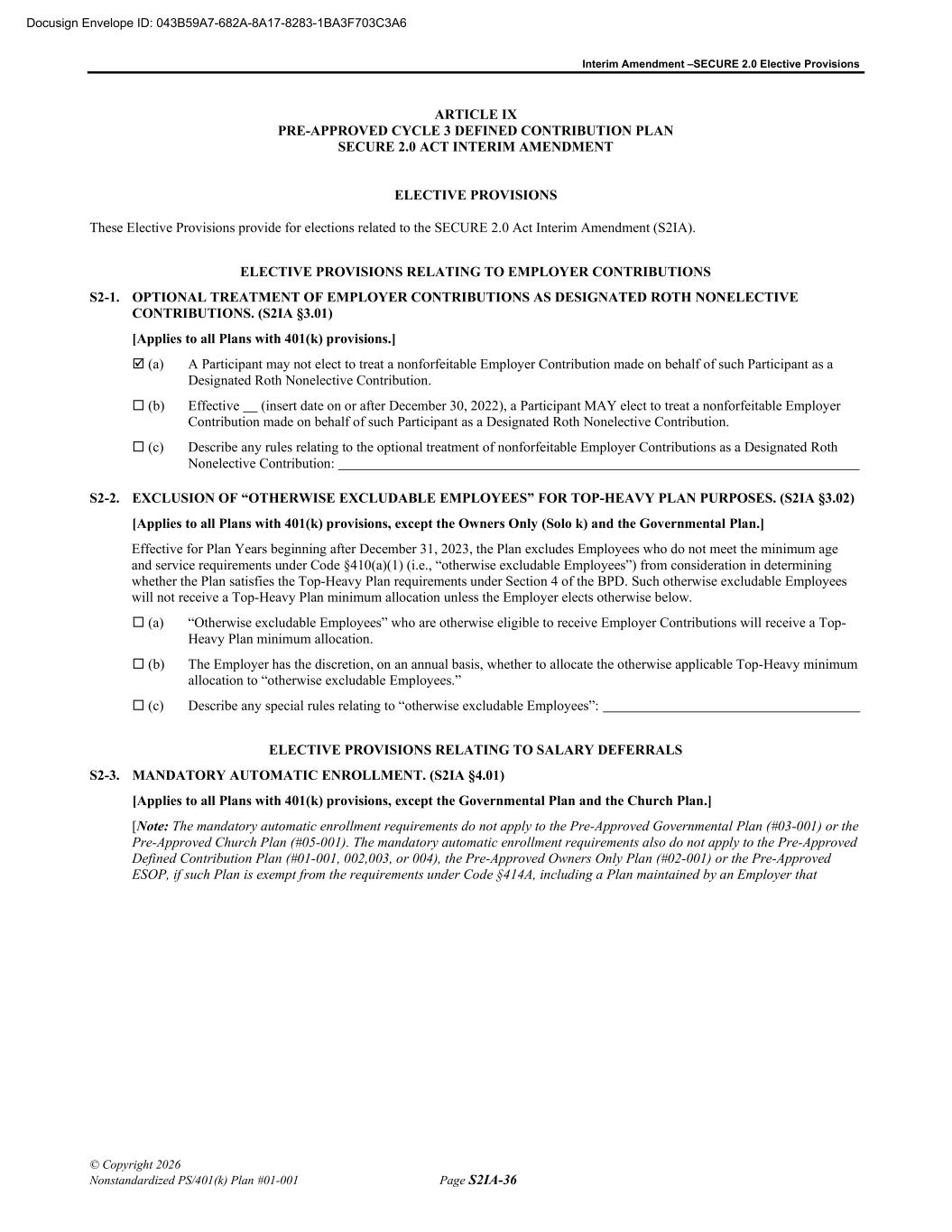
Interim Amendment –SECURE 2.0 Elective Provisions © Copyright 2026 Nonstandardized PS/401(k) Plan #01-001 Page S2IA-36 ARTICLE IX PRE-APPROVED CYCLE 3 DEFINED CONTRIBUTION PLAN SECURE 2.0 ACT INTERIM AMENDMENT ELECTIVE PROVISIONS These Elective Provisions provide for elections related to the SECURE 2.0 Act Interim Amendment (S2IA). ELECTIVE PROVISIONS RELATING TO EMPLOYER CONTRIBUTIONS S2-1. OPTIONAL TREATMENT OF EMPLOYER CONTRIBUTIONS AS DESIGNATED ROTH NONELECTIVE CONTRIBUTIONS. (S2IA §3.01) [Applies to all Plans with 401(k) provisions.] (a) A Participant may not elect to treat a nonforfeitable Employer Contribution made on behalf of such Participant as a Designated Roth Nonelective Contribution. (b) Effective (insert date on or after December 30, 2022), a Participant MAY elect to treat a nonforfeitable Employer Contribution made on behalf of such Participant as a Designated Roth Nonelective Contribution. (c) Describe any rules relating to the optional treatment of nonforfeitable Employer Contributions as a Designated Roth Nonelective Contribution: S2-2. EXCLUSION OF “OTHERWISE EXCLUDABLE EMPLOYEES” FOR TOP-HEAVY PLAN PURPOSES. (S2IA §3.02) [Applies to all Plans with 401(k) provisions, except the Owners Only (Solo k) and the Governmental Plan.] Effective for Plan Years beginning after December 31, 2023, the Plan excludes Employees who do not meet the minimum age and service requirements under Code §410(a)(1) (i.e., “otherwise excludable Employees”) from consideration in determining whether the Plan satisfies the Top-Heavy Plan requirements under Section 4 of the BPD. Such otherwise excludable Employees will not receive a Top-Heavy Plan minimum allocation unless the Employer elects otherwise below. (a) “Otherwise excludable Employees” who are otherwise eligible to receive Employer Contributions will receive a Top- Heavy Plan minimum allocation. (b) The Employer has the discretion, on an annual basis, whether to allocate the otherwise applicable Top-Heavy minimum allocation to “otherwise excludable Employees.” (c) Describe any special rules relating to “otherwise excludable Employees”: ELECTIVE PROVISIONS RELATING TO SALARY DEFERRALS S2-3. MANDATORY AUTOMATIC ENROLLMENT. (S2IA §4.01) [Applies to all Plans with 401(k) provisions, except the Governmental Plan and the Church Plan.] [Note: The mandatory automatic enrollment requirements do not apply to the Pre-Approved Governmental Plan (#03-001) or the Pre-Approved Church Plan (#05-001). The mandatory automatic enrollment requirements also do not apply to the Pre-Approved Defined Contribution Plan (#01-001, 002,003, or 004), the Pre-Approved Owners Only Plan (#02-001) or the Pre-Approved ESOP, if such Plan is exempt from the requirements under Code §414A, including a Plan maintained by an Employer that Docusign Envelope ID: 043B59A7-682A-8A17-8283-1BA3F703C3A6
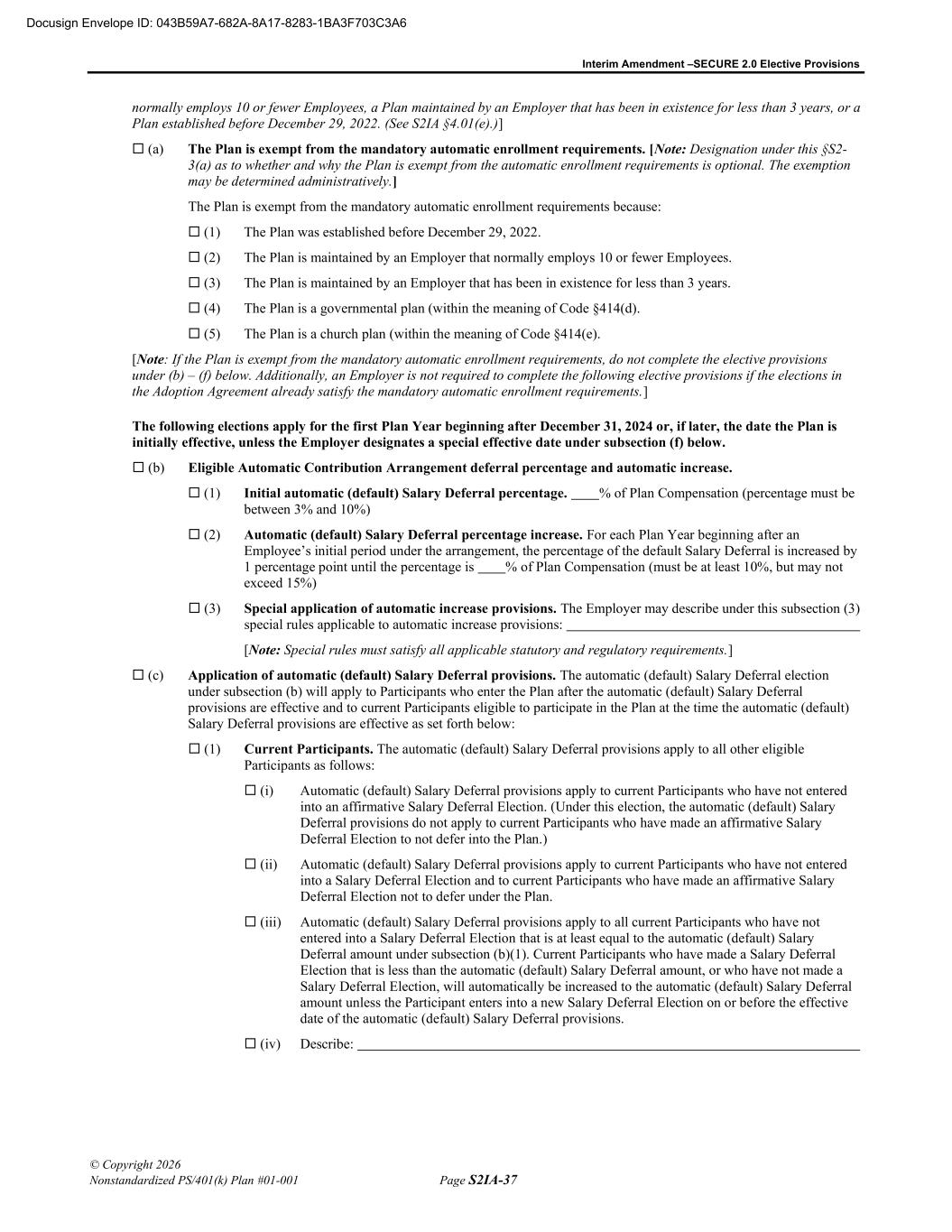
Interim Amendment –SECURE 2.0 Elective Provisions © Copyright 2026 Nonstandardized PS/401(k) Plan #01-001 Page S2IA-37 normally employs 10 or fewer Employees, a Plan maintained by an Employer that has been in existence for less than 3 years, or a Plan established before December 29, 2022. (See S2IA §4.01(e).)] (a) The Plan is exempt from the mandatory automatic enrollment requirements. [Note: Designation under this §S2- 3(a) as to whether and why the Plan is exempt from the automatic enrollment requirements is optional. The exemption may be determined administratively.] The Plan is exempt from the mandatory automatic enrollment requirements because: (1) The Plan was established before December 29, 2022. (2) The Plan is maintained by an Employer that normally employs 10 or fewer Employees. (3) The Plan is maintained by an Employer that has been in existence for less than 3 years. (4) The Plan is a governmental plan (within the meaning of Code §414(d). (5) The Plan is a church plan (within the meaning of Code §414(e). [Note: If the Plan is exempt from the mandatory automatic enrollment requirements, do not complete the elective provisions under (b) – (f) below. Additionally, an Employer is not required to complete the following elective provisions if the elections in the Adoption Agreement already satisfy the mandatory automatic enrollment requirements.] The following elections apply for the first Plan Year beginning after December 31, 2024 or, if later, the date the Plan is initially effective, unless the Employer designates a special effective date under subsection (f) below. (b) Eligible Automatic Contribution Arrangement deferral percentage and automatic increase. (1) Initial automatic (default) Salary Deferral percentage. % of Plan Compensation (percentage must be between 3% and 10%) (2) Automatic (default) Salary Deferral percentage increase. For each Plan Year beginning after an Employee’s initial period under the arrangement, the percentage of the default Salary Deferral is increased by 1 percentage point until the percentage is % of Plan Compensation (must be at least 10%, but may not exceed 15%) (3) Special application of automatic increase provisions. The Employer may describe under this subsection (3) special rules applicable to automatic increase provisions: [Note: Special rules must satisfy all applicable statutory and regulatory requirements.] (c) Application of automatic (default) Salary Deferral provisions. The automatic (default) Salary Deferral election under subsection (b) will apply to Participants who enter the Plan after the automatic (default) Salary Deferral provisions are effective and to current Participants eligible to participate in the Plan at the time the automatic (default) Salary Deferral provisions are effective as set forth below: (1) Current Participants. The automatic (default) Salary Deferral provisions apply to all other eligible Participants as follows: (i) Automatic (default) Salary Deferral provisions apply to current Participants who have not entered into an affirmative Salary Deferral Election. (Under this election, the automatic (default) Salary Deferral provisions do not apply to current Participants who have made an affirmative Salary Deferral Election to not defer into the Plan.) (ii) Automatic (default) Salary Deferral provisions apply to current Participants who have not entered into a Salary Deferral Election and to current Participants who have made an affirmative Salary Deferral Election not to defer under the Plan. (iii) Automatic (default) Salary Deferral provisions apply to all current Participants who have not entered into a Salary Deferral Election that is at least equal to the automatic (default) Salary Deferral amount under subsection (b)(1). Current Participants who have made a Salary Deferral Election that is less than the automatic (default) Salary Deferral amount, or who have not made a Salary Deferral Election, will automatically be increased to the automatic (default) Salary Deferral amount unless the Participant enters into a new Salary Deferral Election on or before the effective date of the automatic (default) Salary Deferral provisions. (iv) Describe: Docusign Envelope ID: 043B59A7-682A-8A17-8283-1BA3F703C3A6
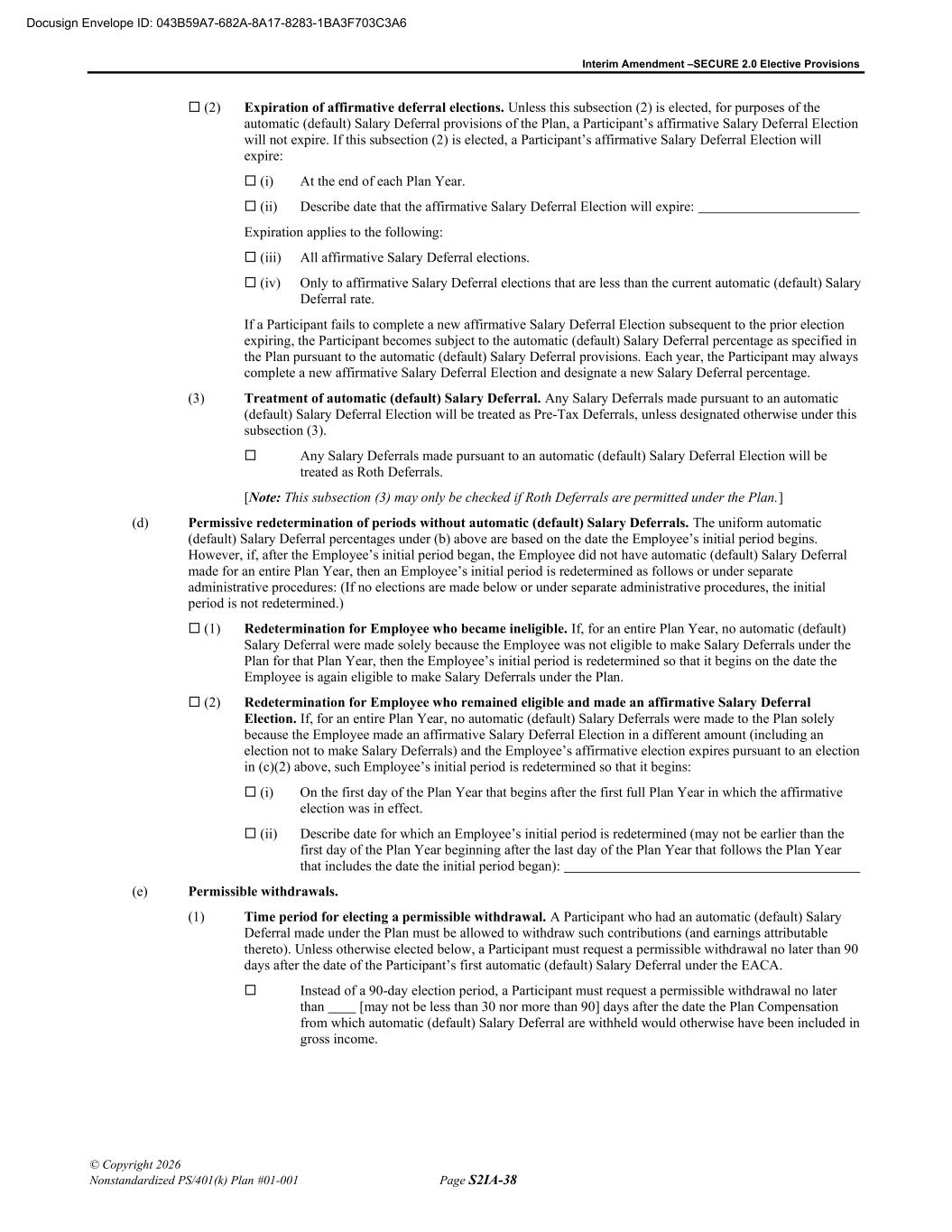
Interim Amendment –SECURE 2.0 Elective Provisions © Copyright 2026 Nonstandardized PS/401(k) Plan #01-001 Page S2IA-38 (2) Expiration of affirmative deferral elections. Unless this subsection (2) is elected, for purposes of the automatic (default) Salary Deferral provisions of the Plan, a Participant’s affirmative Salary Deferral Election will not expire. If this subsection (2) is elected, a Participant’s affirmative Salary Deferral Election will expire: (i) At the end of each Plan Year. (ii) Describe date that the affirmative Salary Deferral Election will expire: Expiration applies to the following: (iii) All affirmative Salary Deferral elections. (iv) Only to affirmative Salary Deferral elections that are less than the current automatic (default) Salary Deferral rate. If a Participant fails to complete a new affirmative Salary Deferral Election subsequent to the prior election expiring, the Participant becomes subject to the automatic (default) Salary Deferral percentage as specified in the Plan pursuant to the automatic (default) Salary Deferral provisions. Each year, the Participant may always complete a new affirmative Salary Deferral Election and designate a new Salary Deferral percentage. (3) Treatment of automatic (default) Salary Deferral. Any Salary Deferrals made pursuant to an automatic (default) Salary Deferral Election will be treated as Pre-Tax Deferrals, unless designated otherwise under this subsection (3). Any Salary Deferrals made pursuant to an automatic (default) Salary Deferral Election will be treated as Roth Deferrals. [Note: This subsection (3) may only be checked if Roth Deferrals are permitted under the Plan.] (d) Permissive redetermination of periods without automatic (default) Salary Deferrals. The uniform automatic (default) Salary Deferral percentages under (b) above are based on the date the Employee’s initial period begins. However, if, after the Employee’s initial period began, the Employee did not have automatic (default) Salary Deferral made for an entire Plan Year, then an Employee’s initial period is redetermined as follows or under separate administrative procedures: (If no elections are made below or under separate administrative procedures, the initial period is not redetermined.) (1) Redetermination for Employee who became ineligible. If, for an entire Plan Year, no automatic (default) Salary Deferral were made solely because the Employee was not eligible to make Salary Deferrals under the Plan for that Plan Year, then the Employee’s initial period is redetermined so that it begins on the date the Employee is again eligible to make Salary Deferrals under the Plan. (2) Redetermination for Employee who remained eligible and made an affirmative Salary Deferral Election. If, for an entire Plan Year, no automatic (default) Salary Deferrals were made to the Plan solely because the Employee made an affirmative Salary Deferral Election in a different amount (including an election not to make Salary Deferrals) and the Employee’s affirmative election expires pursuant to an election in (c)(2) above, such Employee’s initial period is redetermined so that it begins: (i) On the first day of the Plan Year that begins after the first full Plan Year in which the affirmative election was in effect. (ii) Describe date for which an Employee’s initial period is redetermined (may not be earlier than the first day of the Plan Year beginning after the last day of the Plan Year that follows the Plan Year that includes the date the initial period began): (e) Permissible withdrawals. (1) Time period for electing a permissible withdrawal. A Participant who had an automatic (default) Salary Deferral made under the Plan must be allowed to withdraw such contributions (and earnings attributable thereto). Unless otherwise elected below, a Participant must request a permissible withdrawal no later than 90 days after the date of the Participant’s first automatic (default) Salary Deferral under the EACA. Instead of a 90-day election period, a Participant must request a permissible withdrawal no later than [may not be less than 30 nor more than 90] days after the date the Plan Compensation from which automatic (default) Salary Deferral are withheld would otherwise have been included in gross income. Docusign Envelope ID: 043B59A7-682A-8A17-8283-1BA3F703C3A6
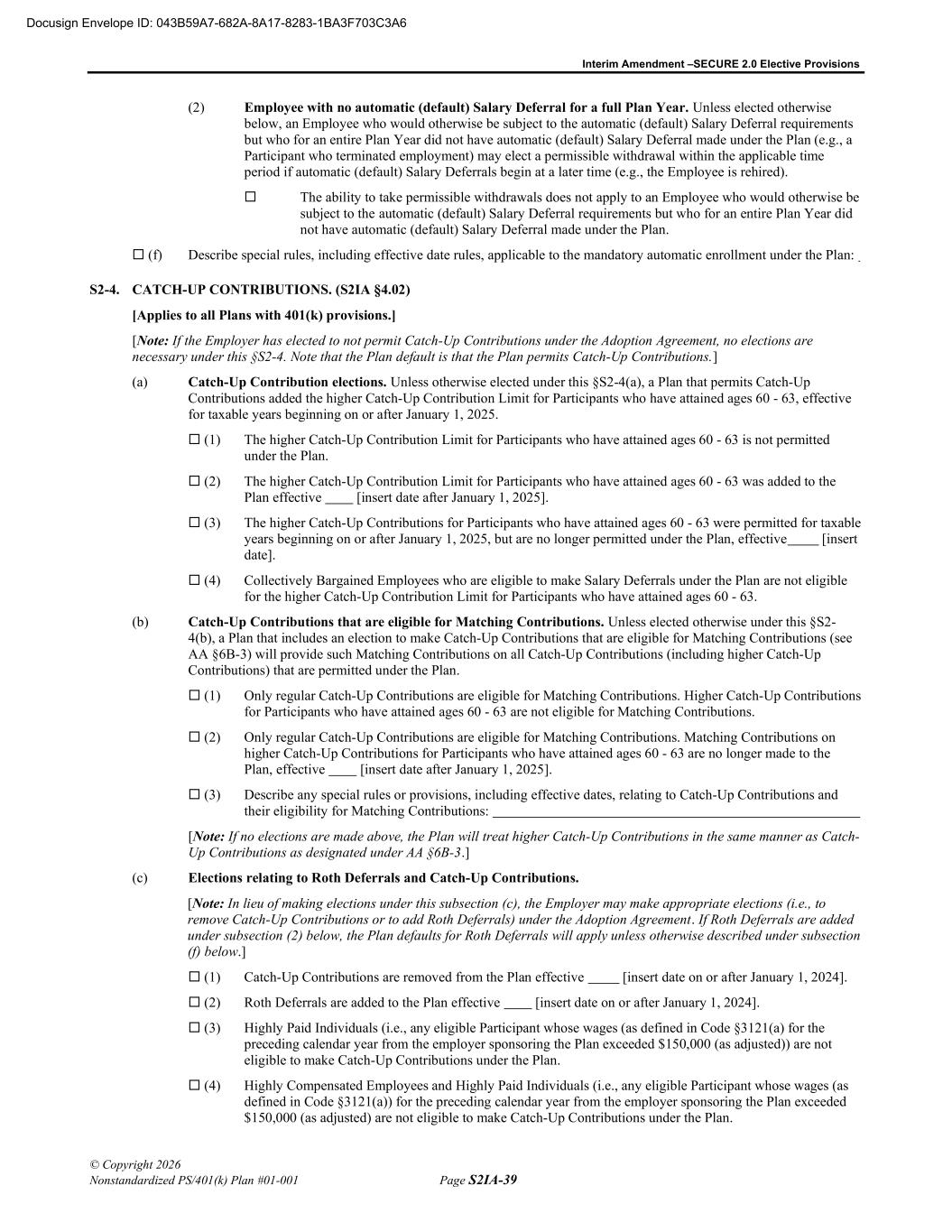
Interim Amendment –SECURE 2.0 Elective Provisions © Copyright 2026 Nonstandardized PS/401(k) Plan #01-001 Page S2IA-39 (2) Employee with no automatic (default) Salary Deferral for a full Plan Year. Unless elected otherwise below, an Employee who would otherwise be subject to the automatic (default) Salary Deferral requirements but who for an entire Plan Year did not have automatic (default) Salary Deferral made under the Plan (e.g., a Participant who terminated employment) may elect a permissible withdrawal within the applicable time period if automatic (default) Salary Deferrals begin at a later time (e.g., the Employee is rehired). The ability to take permissible withdrawals does not apply to an Employee who would otherwise be subject to the automatic (default) Salary Deferral requirements but who for an entire Plan Year did not have automatic (default) Salary Deferral made under the Plan. (f) Describe special rules, including effective date rules, applicable to the mandatory automatic enrollment under the Plan: S2-4. CATCH-UP CONTRIBUTIONS. (S2IA §4.02) [Applies to all Plans with 401(k) provisions.] [Note: If the Employer has elected to not permit Catch-Up Contributions under the Adoption Agreement, no elections are necessary under this §S2-4. Note that the Plan default is that the Plan permits Catch-Up Contributions.] (a) Catch-Up Contribution elections. Unless otherwise elected under this §S2-4(a), a Plan that permits Catch-Up Contributions added the higher Catch-Up Contribution Limit for Participants who have attained ages 60 - 63, effective for taxable years beginning on or after January 1, 2025. (1) The higher Catch-Up Contribution Limit for Participants who have attained ages 60 - 63 is not permitted under the Plan. (2) The higher Catch-Up Contribution Limit for Participants who have attained ages 60 - 63 was added to the Plan effective [insert date after January 1, 2025]. (3) The higher Catch-Up Contributions for Participants who have attained ages 60 - 63 were permitted for taxable years beginning on or after January 1, 2025, but are no longer permitted under the Plan, effective [insert date]. (4) Collectively Bargained Employees who are eligible to make Salary Deferrals under the Plan are not eligible for the higher Catch-Up Contribution Limit for Participants who have attained ages 60 - 63. (b) Catch-Up Contributions that are eligible for Matching Contributions. Unless elected otherwise under this §S2- 4(b), a Plan that includes an election to make Catch-Up Contributions that are eligible for Matching Contributions (see AA §6B-3) will provide such Matching Contributions on all Catch-Up Contributions (including higher Catch-Up Contributions) that are permitted under the Plan. (1) Only regular Catch-Up Contributions are eligible for Matching Contributions. Higher Catch-Up Contributions for Participants who have attained ages 60 - 63 are not eligible for Matching Contributions. (2) Only regular Catch-Up Contributions are eligible for Matching Contributions. Matching Contributions on higher Catch-Up Contributions for Participants who have attained ages 60 - 63 are no longer made to the Plan, effective [insert date after January 1, 2025]. (3) Describe any special rules or provisions, including effective dates, relating to Catch-Up Contributions and their eligibility for Matching Contributions: [Note: If no elections are made above, the Plan will treat higher Catch-Up Contributions in the same manner as Catch- Up Contributions as designated under AA §6B-3.] (c) Elections relating to Roth Deferrals and Catch-Up Contributions. [Note: In lieu of making elections under this subsection (c), the Employer may make appropriate elections (i.e., to remove Catch-Up Contributions or to add Roth Deferrals) under the Adoption Agreement. If Roth Deferrals are added under subsection (2) below, the Plan defaults for Roth Deferrals will apply unless otherwise described under subsection (f) below.] (1) Catch-Up Contributions are removed from the Plan effective [insert date on or after January 1, 2024]. (2) Roth Deferrals are added to the Plan effective [insert date on or after January 1, 2024]. (3) Highly Paid Individuals (i.e., any eligible Participant whose wages (as defined in Code §3121(a) for the preceding calendar year from the employer sponsoring the Plan exceeded $150,000 (as adjusted)) are not eligible to make Catch-Up Contributions under the Plan. (4) Highly Compensated Employees and Highly Paid Individuals (i.e., any eligible Participant whose wages (as defined in Code §3121(a)) for the preceding calendar year from the employer sponsoring the Plan exceeded $150,000 (as adjusted) are not eligible to make Catch-Up Contributions under the Plan. Docusign Envelope ID: 043B59A7-682A-8A17-8283-1BA3F703C3A6
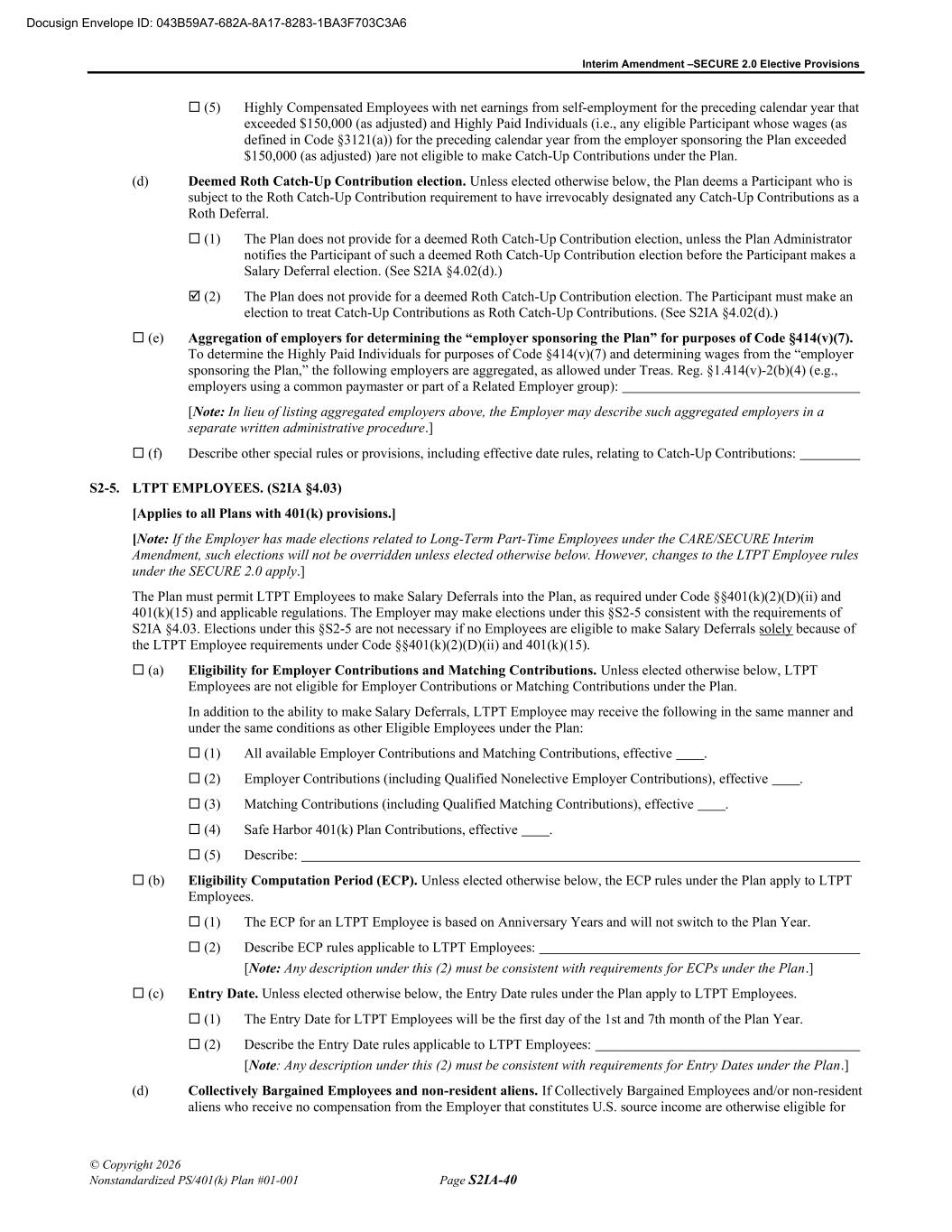
Interim Amendment –SECURE 2.0 Elective Provisions © Copyright 2026 Nonstandardized PS/401(k) Plan #01-001 Page S2IA-40 (5) Highly Compensated Employees with net earnings from self-employment for the preceding calendar year that exceeded $150,000 (as adjusted) and Highly Paid Individuals (i.e., any eligible Participant whose wages (as defined in Code §3121(a)) for the preceding calendar year from the employer sponsoring the Plan exceeded $150,000 (as adjusted) )are not eligible to make Catch-Up Contributions under the Plan. (d) Deemed Roth Catch-Up Contribution election. Unless elected otherwise below, the Plan deems a Participant who is subject to the Roth Catch-Up Contribution requirement to have irrevocably designated any Catch-Up Contributions as a Roth Deferral. (1) The Plan does not provide for a deemed Roth Catch-Up Contribution election, unless the Plan Administrator notifies the Participant of such a deemed Roth Catch-Up Contribution election before the Participant makes a Salary Deferral election. (See S2IA §4.02(d).) (2) The Plan does not provide for a deemed Roth Catch-Up Contribution election. The Participant must make an election to treat Catch-Up Contributions as Roth Catch-Up Contributions. (See S2IA §4.02(d).) (e) Aggregation of employers for determining the “employer sponsoring the Plan” for purposes of Code §414(v)(7). To determine the Highly Paid Individuals for purposes of Code §414(v)(7) and determining wages from the “employer sponsoring the Plan,” the following employers are aggregated, as allowed under Treas. Reg. §1.414(v)-2(b)(4) (e.g., employers using a common paymaster or part of a Related Employer group): [Note: In lieu of listing aggregated employers above, the Employer may describe such aggregated employers in a separate written administrative procedure.] (f) Describe other special rules or provisions, including effective date rules, relating to Catch-Up Contributions: S2-5. LTPT EMPLOYEES. (S2IA §4.03) [Applies to all Plans with 401(k) provisions.] [Note: If the Employer has made elections related to Long-Term Part-Time Employees under the CARE/SECURE Interim Amendment, such elections will not be overridden unless elected otherwise below. However, changes to the LTPT Employee rules under the SECURE 2.0 apply.] The Plan must permit LTPT Employees to make Salary Deferrals into the Plan, as required under Code §§401(k)(2)(D)(ii) and 401(k)(15) and applicable regulations. The Employer may make elections under this §S2-5 consistent with the requirements of S2IA §4.03. Elections under this §S2-5 are not necessary if no Employees are eligible to make Salary Deferrals solely because of the LTPT Employee requirements under Code §§401(k)(2)(D)(ii) and 401(k)(15). (a) Eligibility for Employer Contributions and Matching Contributions. Unless elected otherwise below, LTPT Employees are not eligible for Employer Contributions or Matching Contributions under the Plan. In addition to the ability to make Salary Deferrals, LTPT Employee may receive the following in the same manner and under the same conditions as other Eligible Employees under the Plan: (1) All available Employer Contributions and Matching Contributions, effective . (2) Employer Contributions (including Qualified Nonelective Employer Contributions), effective . (3) Matching Contributions (including Qualified Matching Contributions), effective . (4) Safe Harbor 401(k) Plan Contributions, effective . (5) Describe: (b) Eligibility Computation Period (ECP). Unless elected otherwise below, the ECP rules under the Plan apply to LTPT Employees. (1) The ECP for an LTPT Employee is based on Anniversary Years and will not switch to the Plan Year. (2) Describe ECP rules applicable to LTPT Employees: [Note: Any description under this (2) must be consistent with requirements for ECPs under the Plan.] (c) Entry Date. Unless elected otherwise below, the Entry Date rules under the Plan apply to LTPT Employees. (1) The Entry Date for LTPT Employees will be the first day of the 1st and 7th month of the Plan Year. (2) Describe the Entry Date rules applicable to LTPT Employees: [Note: Any description under this (2) must be consistent with requirements for Entry Dates under the Plan.] (d) Collectively Bargained Employees and non-resident aliens. If Collectively Bargained Employees and/or non-resident aliens who receive no compensation from the Employer that constitutes U.S. source income are otherwise eligible for Docusign Envelope ID: 043B59A7-682A-8A17-8283-1BA3F703C3A6
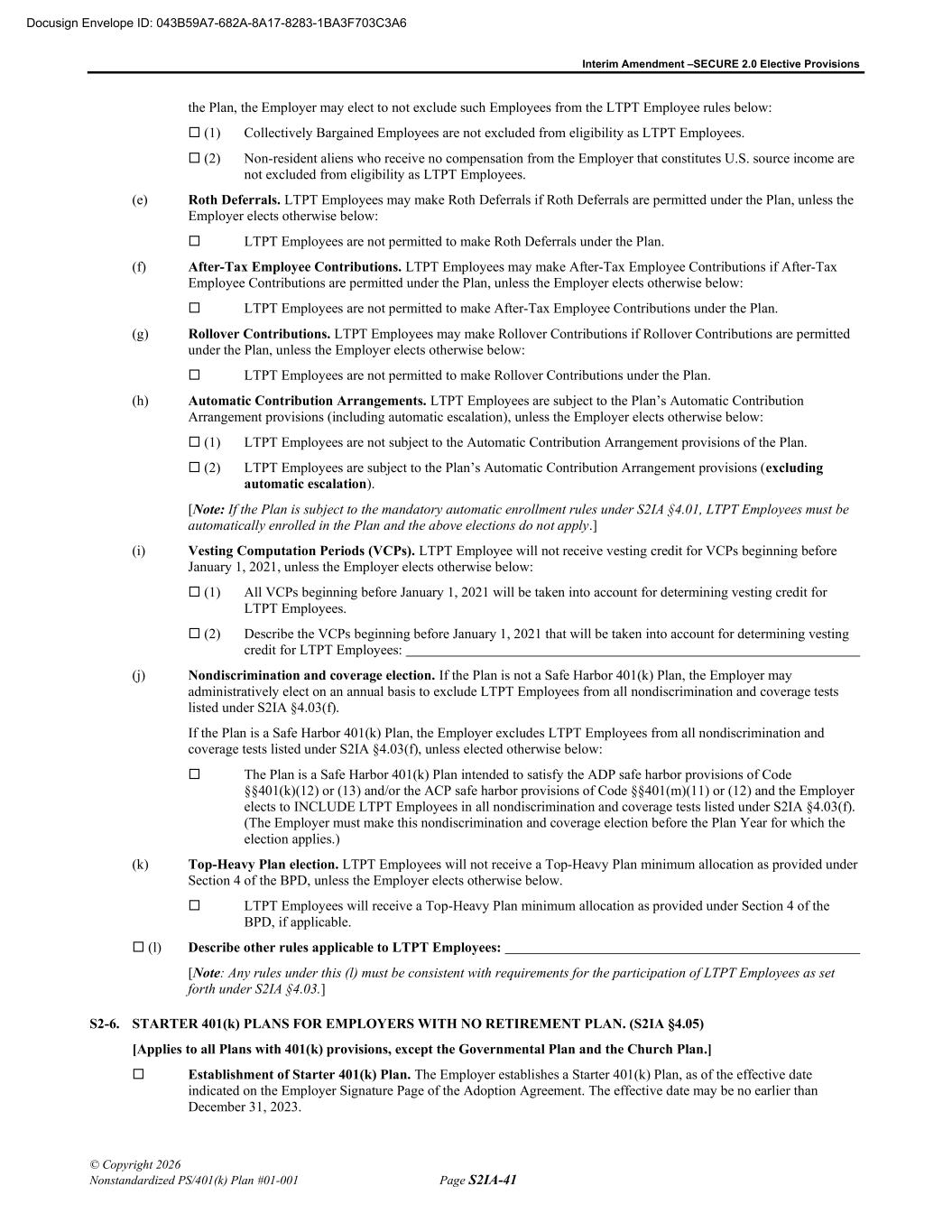
Interim Amendment –SECURE 2.0 Elective Provisions © Copyright 2026 Nonstandardized PS/401(k) Plan #01-001 Page S2IA-41 the Plan, the Employer may elect to not exclude such Employees from the LTPT Employee rules below: (1) Collectively Bargained Employees are not excluded from eligibility as LTPT Employees. (2) Non-resident aliens who receive no compensation from the Employer that constitutes U.S. source income are not excluded from eligibility as LTPT Employees. (e) Roth Deferrals. LTPT Employees may make Roth Deferrals if Roth Deferrals are permitted under the Plan, unless the Employer elects otherwise below: LTPT Employees are not permitted to make Roth Deferrals under the Plan. (f) After-Tax Employee Contributions. LTPT Employees may make After-Tax Employee Contributions if After-Tax Employee Contributions are permitted under the Plan, unless the Employer elects otherwise below: LTPT Employees are not permitted to make After-Tax Employee Contributions under the Plan. (g) Rollover Contributions. LTPT Employees may make Rollover Contributions if Rollover Contributions are permitted under the Plan, unless the Employer elects otherwise below: LTPT Employees are not permitted to make Rollover Contributions under the Plan. (h) Automatic Contribution Arrangements. LTPT Employees are subject to the Plan’s Automatic Contribution Arrangement provisions (including automatic escalation), unless the Employer elects otherwise below: (1) LTPT Employees are not subject to the Automatic Contribution Arrangement provisions of the Plan. (2) LTPT Employees are subject to the Plan’s Automatic Contribution Arrangement provisions (excluding automatic escalation). [Note: If the Plan is subject to the mandatory automatic enrollment rules under S2IA §4.01, LTPT Employees must be automatically enrolled in the Plan and the above elections do not apply.] (i) Vesting Computation Periods (VCPs). LTPT Employee will not receive vesting credit for VCPs beginning before January 1, 2021, unless the Employer elects otherwise below: (1) All VCPs beginning before January 1, 2021 will be taken into account for determining vesting credit for LTPT Employees. (2) Describe the VCPs beginning before January 1, 2021 that will be taken into account for determining vesting credit for LTPT Employees: (j) Nondiscrimination and coverage election. If the Plan is not a Safe Harbor 401(k) Plan, the Employer may administratively elect on an annual basis to exclude LTPT Employees from all nondiscrimination and coverage tests listed under S2IA §4.03(f). If the Plan is a Safe Harbor 401(k) Plan, the Employer excludes LTPT Employees from all nondiscrimination and coverage tests listed under S2IA §4.03(f), unless elected otherwise below: The Plan is a Safe Harbor 401(k) Plan intended to satisfy the ADP safe harbor provisions of Code §§401(k)(12) or (13) and/or the ACP safe harbor provisions of Code §§401(m)(11) or (12) and the Employer elects to INCLUDE LTPT Employees in all nondiscrimination and coverage tests listed under S2IA §4.03(f). (The Employer must make this nondiscrimination and coverage election before the Plan Year for which the election applies.) (k) Top-Heavy Plan election. LTPT Employees will not receive a Top-Heavy Plan minimum allocation as provided under Section 4 of the BPD, unless the Employer elects otherwise below. LTPT Employees will receive a Top-Heavy Plan minimum allocation as provided under Section 4 of the BPD, if applicable. (l) Describe other rules applicable to LTPT Employees: [Note: Any rules under this (l) must be consistent with requirements for the participation of LTPT Employees as set forth under S2IA §4.03.] S2-6. STARTER 401(k) PLANS FOR EMPLOYERS WITH NO RETIREMENT PLAN. (S2IA §4.05) [Applies to all Plans with 401(k) provisions, except the Governmental Plan and the Church Plan.] Establishment of Starter 401(k) Plan. The Employer establishes a Starter 401(k) Plan, as of the effective date indicated on the Employer Signature Page of the Adoption Agreement. The effective date may be no earlier than December 31, 2023. Docusign Envelope ID: 043B59A7-682A-8A17-8283-1BA3F703C3A6
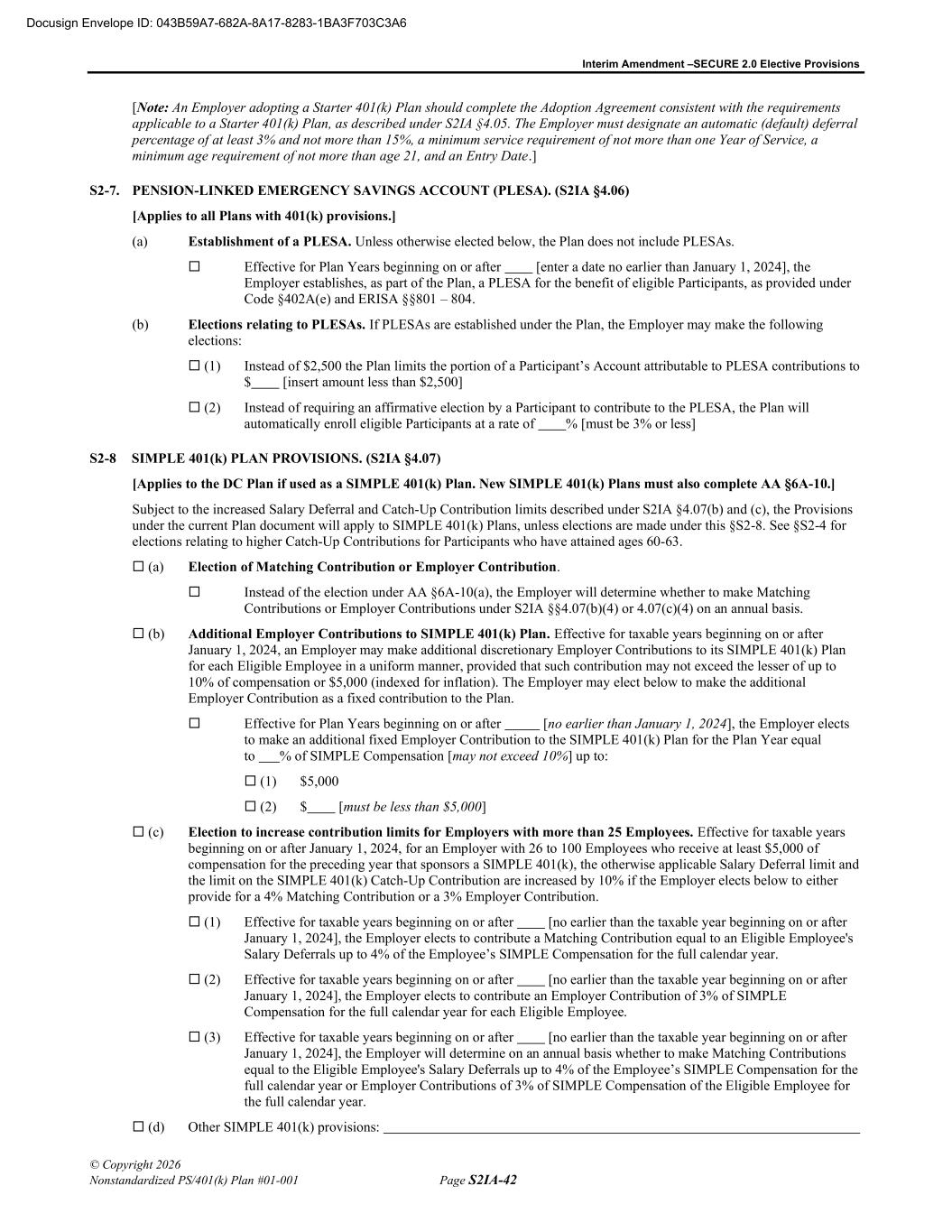
Interim Amendment –SECURE 2.0 Elective Provisions © Copyright 2026 Nonstandardized PS/401(k) Plan #01-001 Page S2IA-42 [Note: An Employer adopting a Starter 401(k) Plan should complete the Adoption Agreement consistent with the requirements applicable to a Starter 401(k) Plan, as described under S2IA §4.05. The Employer must designate an automatic (default) deferral percentage of at least 3% and not more than 15%, a minimum service requirement of not more than one Year of Service, a minimum age requirement of not more than age 21, and an Entry Date.] S2-7. PENSION-LINKED EMERGENCY SAVINGS ACCOUNT (PLESA). (S2IA §4.06) [Applies to all Plans with 401(k) provisions.] (a) Establishment of a PLESA. Unless otherwise elected below, the Plan does not include PLESAs. Effective for Plan Years beginning on or after [enter a date no earlier than January 1, 2024], the Employer establishes, as part of the Plan, a PLESA for the benefit of eligible Participants, as provided under Code §402A(e) and ERISA §§801 – 804. (b) Elections relating to PLESAs. If PLESAs are established under the Plan, the Employer may make the following elections: (1) Instead of $2,500 the Plan limits the portion of a Participant’s Account attributable to PLESA contributions to $ [insert amount less than $2,500] (2) Instead of requiring an affirmative election by a Participant to contribute to the PLESA, the Plan will automatically enroll eligible Participants at a rate of % [must be 3% or less] S2-8 SIMPLE 401(k) PLAN PROVISIONS. (S2IA §4.07) [Applies to the DC Plan if used as a SIMPLE 401(k) Plan. New SIMPLE 401(k) Plans must also complete AA §6A-10.] Subject to the increased Salary Deferral and Catch-Up Contribution limits described under S2IA §4.07(b) and (c), the Provisions under the current Plan document will apply to SIMPLE 401(k) Plans, unless elections are made under this §S2-8. See §S2-4 for elections relating to higher Catch-Up Contributions for Participants who have attained ages 60-63. (a) Election of Matching Contribution or Employer Contribution. Instead of the election under AA §6A-10(a), the Employer will determine whether to make Matching Contributions or Employer Contributions under S2IA §§4.07(b)(4) or 4.07(c)(4) on an annual basis. (b) Additional Employer Contributions to SIMPLE 401(k) Plan. Effective for taxable years beginning on or after January 1, 2024, an Employer may make additional discretionary Employer Contributions to its SIMPLE 401(k) Plan for each Eligible Employee in a uniform manner, provided that such contribution may not exceed the lesser of up to 10% of compensation or $5,000 (indexed for inflation). The Employer may elect below to make the additional Employer Contribution as a fixed contribution to the Plan. Effective for Plan Years beginning on or after [no earlier than January 1, 2024], the Employer elects to make an additional fixed Employer Contribution to the SIMPLE 401(k) Plan for the Plan Year equal to % of SIMPLE Compensation [may not exceed 10%] up to: (1) $5,000 (2) $ [must be less than $5,000] (c) Election to increase contribution limits for Employers with more than 25 Employees. Effective for taxable years beginning on or after January 1, 2024, for an Employer with 26 to 100 Employees who receive at least $5,000 of compensation for the preceding year that sponsors a SIMPLE 401(k), the otherwise applicable Salary Deferral limit and the limit on the SIMPLE 401(k) Catch-Up Contribution are increased by 10% if the Employer elects below to either provide for a 4% Matching Contribution or a 3% Employer Contribution. (1) Effective for taxable years beginning on or after [no earlier than the taxable year beginning on or after January 1, 2024], the Employer elects to contribute a Matching Contribution equal to an Eligible Employee's Salary Deferrals up to 4% of the Employee’s SIMPLE Compensation for the full calendar year. (2) Effective for taxable years beginning on or after [no earlier than the taxable year beginning on or after January 1, 2024], the Employer elects to contribute an Employer Contribution of 3% of SIMPLE Compensation for the full calendar year for each Eligible Employee. (3) Effective for taxable years beginning on or after [no earlier than the taxable year beginning on or after January 1, 2024], the Employer will determine on an annual basis whether to make Matching Contributions equal to the Eligible Employee's Salary Deferrals up to 4% of the Employee’s SIMPLE Compensation for the full calendar year or Employer Contributions of 3% of SIMPLE Compensation of the Eligible Employee for the full calendar year. (d) Other SIMPLE 401(k) provisions: Docusign Envelope ID: 043B59A7-682A-8A17-8283-1BA3F703C3A6
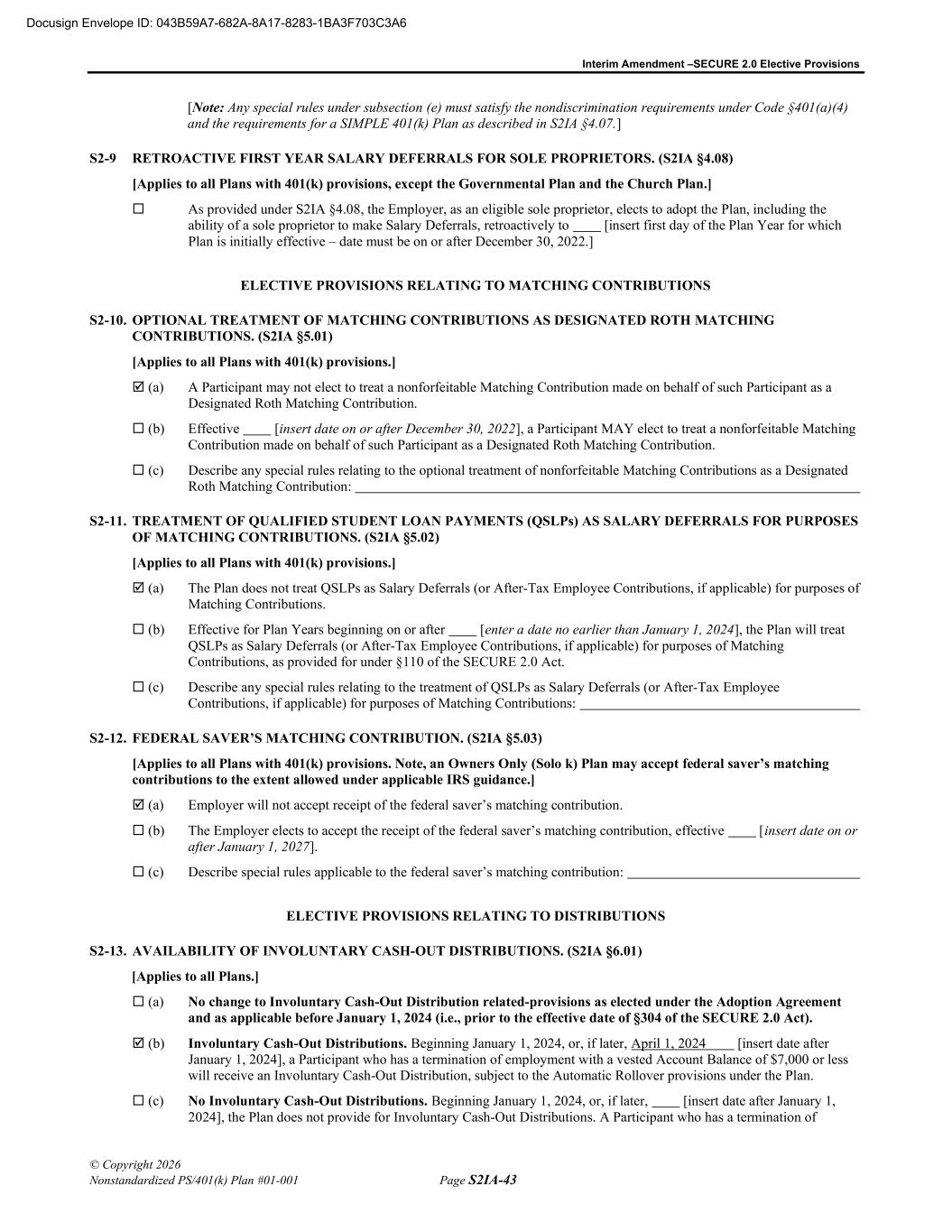
Interim Amendment –SECURE 2.0 Elective Provisions © Copyright 2026 Nonstandardized PS/401(k) Plan #01-001 Page S2IA-43 [Note: Any special rules under subsection (e) must satisfy the nondiscrimination requirements under Code §401(a)(4) and the requirements for a SIMPLE 401(k) Plan as described in S2IA §4.07.] S2-9 RETROACTIVE FIRST YEAR SALARY DEFERRALS FOR SOLE PROPRIETORS. (S2IA §4.08) [Applies to all Plans with 401(k) provisions, except the Governmental Plan and the Church Plan.] As provided under S2IA §4.08, the Employer, as an eligible sole proprietor, elects to adopt the Plan, including the ability of a sole proprietor to make Salary Deferrals, retroactively to [insert first day of the Plan Year for which Plan is initially effective – date must be on or after December 30, 2022.] ELECTIVE PROVISIONS RELATING TO MATCHING CONTRIBUTIONS S2-10. OPTIONAL TREATMENT OF MATCHING CONTRIBUTIONS AS DESIGNATED ROTH MATCHING CONTRIBUTIONS. (S2IA §5.01) [Applies to all Plans with 401(k) provisions.] (a) A Participant may not elect to treat a nonforfeitable Matching Contribution made on behalf of such Participant as a Designated Roth Matching Contribution. (b) Effective [insert date on or after December 30, 2022], a Participant MAY elect to treat a nonforfeitable Matching Contribution made on behalf of such Participant as a Designated Roth Matching Contribution. (c) Describe any special rules relating to the optional treatment of nonforfeitable Matching Contributions as a Designated Roth Matching Contribution: S2-11. TREATMENT OF QUALIFIED STUDENT LOAN PAYMENTS (QSLPs) AS SALARY DEFERRALS FOR PURPOSES OF MATCHING CONTRIBUTIONS. (S2IA §5.02) [Applies to all Plans with 401(k) provisions.] (a) The Plan does not treat QSLPs as Salary Deferrals (or After-Tax Employee Contributions, if applicable) for purposes of Matching Contributions. (b) Effective for Plan Years beginning on or after [enter a date no earlier than January 1, 2024], the Plan will treat QSLPs as Salary Deferrals (or After-Tax Employee Contributions, if applicable) for purposes of Matching Contributions, as provided for under §110 of the SECURE 2.0 Act. (c) Describe any special rules relating to the treatment of QSLPs as Salary Deferrals (or After-Tax Employee Contributions, if applicable) for purposes of Matching Contributions: S2-12. FEDERAL SAVER’S MATCHING CONTRIBUTION. (S2IA §5.03) [Applies to all Plans with 401(k) provisions. Note, an Owners Only (Solo k) Plan may accept federal saver’s matching contributions to the extent allowed under applicable IRS guidance.] (a) Employer will not accept receipt of the federal saver’s matching contribution. (b) The Employer elects to accept the receipt of the federal saver’s matching contribution, effective [insert date on or after January 1, 2027]. (c) Describe special rules applicable to the federal saver’s matching contribution: ELECTIVE PROVISIONS RELATING TO DISTRIBUTIONS S2-13. AVAILABILITY OF INVOLUNTARY CASH-OUT DISTRIBUTIONS. (S2IA §6.01) [Applies to all Plans.] (a) No change to Involuntary Cash-Out Distribution related-provisions as elected under the Adoption Agreement and as applicable before January 1, 2024 (i.e., prior to the effective date of §304 of the SECURE 2.0 Act). (b) Involuntary Cash-Out Distributions. Beginning January 1, 2024, or, if later, April 1, 2024 [insert date after January 1, 2024], a Participant who has a termination of employment with a vested Account Balance of $7,000 or less will receive an Involuntary Cash-Out Distribution, subject to the Automatic Rollover provisions under the Plan. (c) No Involuntary Cash-Out Distributions. Beginning January 1, 2024, or, if later, [insert date after January 1, 2024], the Plan does not provide for Involuntary Cash-Out Distributions. A Participant who has a termination of Docusign Envelope ID: 043B59A7-682A-8A17-8283-1BA3F703C3A6
Interim Amendment –SECURE 2.0 Elective Provisions © Copyright 2026 Nonstandardized PS/401(k) Plan #01-001 Page S2IA-44 employment must consent to any distribution from the Plan. (d) Lower Involuntary Cash-Out Distribution threshold. Beginning January 1, 2024, or, if later, [insert date after January 1, 2024], a Participant who has a termination of employment will receive an Involuntary Cash-Out Distribution only if the Participant’s vested Account Balance is less than or equal to: (1) $1,000 (2) $5,000 (3) $ (must be less than $7,000) (e) Application to spousal consent requirements. Beginning January 1, 2024, or, if later, [insert date after January 1, 2024], if the Plan is subject to the Qualified Joint and Survivor Annuity rules and this subsection (e) is elected, the elections in subsections (a) - (d) do not apply in determining the dollar threshold for spousal consent under the Plan and instead the spousal consent threshold is $7,000 or such lower amount as selected below: (1) $1,000 (2) $5,000 (3) $ (must be less than $7,000) (f) Describe any special rules relating to Involuntary Cash Out Distributions and/or spousal consent requirements: S2-14. AVAILABILITY OF IN-SERVICE DISTRIBUTIONS. (S2IA §§6.03, 6.04, 6.05 and 6.07) [Applies to all Plans, except the Money Purchase Plan.] A Participant may withdraw all or any portion of such Participant’s vested Account Balance, to the extent designated, upon the occurrence of any of the event(s) selected under this §S2-14. If more than one option is selected for a particular contribution type under this §S2-14, a Participant may take an in-service distribution upon the occurrence of any of the selected events, unless designated otherwise under this §S2-14. If the Plan allows for Rollover Contributions under AA §C-2 or After-Tax Employee Contributions under AA §6D, unless elected otherwise under this §S2-14, a Participant may take an in-service distribution from such Participant’s Rollover Account and After-Tax Employee Contribution Account at any time. If the Plan provides for Safe Harbor Contributions (SH) under AA §6C, unless elected otherwise under this §S2-14, a Participant may take an in-service distribution from such Participant’s Safe Harbor Contribution Account at the same time as elected for Salary Deferrals under §S2-14. Unless otherwise described under §S2-14(e), a Participant may take an in-service distribution from a Transfer Account as allowed for the underlying contribution source. Docusign Envelope ID: 043B59A7-682A-8A17-8283-1BA3F703C3A6
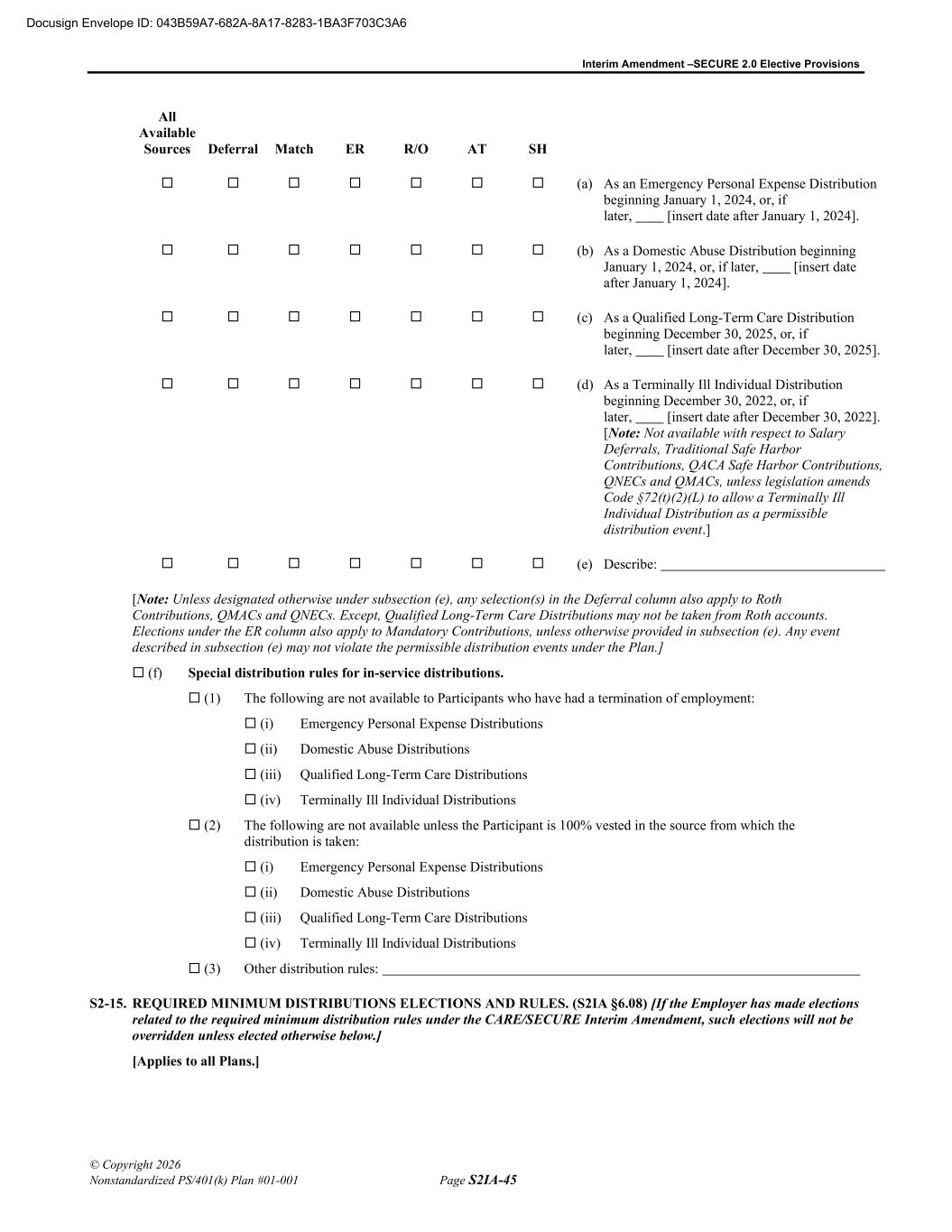
Interim Amendment –SECURE 2.0 Elective Provisions © Copyright 2026 Nonstandardized PS/401(k) Plan #01-001 Page S2IA-45 All Available Sources Deferral Match ER R/O AT SH (a) As an Emergency Personal Expense Distribution beginning January 1, 2024, or, if later, [insert date after January 1, 2024]. (b) As a Domestic Abuse Distribution beginning January 1, 2024, or, if later, [insert date after January 1, 2024]. (c) As a Qualified Long-Term Care Distribution beginning December 30, 2025, or, if later, [insert date after December 30, 2025]. (d) As a Terminally Ill Individual Distribution beginning December 30, 2022, or, if later, [insert date after December 30, 2022]. [Note: Not available with respect to Salary Deferrals, Traditional Safe Harbor Contributions, QACA Safe Harbor Contributions, QNECs and QMACs, unless legislation amends Code §72(t)(2)(L) to allow a Terminally Ill Individual Distribution as a permissible distribution event.] (e) Describe: [Note: Unless designated otherwise under subsection (e), any selection(s) in the Deferral column also apply to Roth Contributions, QMACs and QNECs. Except, Qualified Long-Term Care Distributions may not be taken from Roth accounts. Elections under the ER column also apply to Mandatory Contributions, unless otherwise provided in subsection (e). Any event described in subsection (e) may not violate the permissible distribution events under the Plan.] (f) Special distribution rules for in-service distributions. (1) The following are not available to Participants who have had a termination of employment: (i) Emergency Personal Expense Distributions (ii) Domestic Abuse Distributions (iii) Qualified Long-Term Care Distributions (iv) Terminally Ill Individual Distributions (2) The following are not available unless the Participant is 100% vested in the source from which the distribution is taken: (i) Emergency Personal Expense Distributions (ii) Domestic Abuse Distributions (iii) Qualified Long-Term Care Distributions (iv) Terminally Ill Individual Distributions (3) Other distribution rules: S2-15. REQUIRED MINIMUM DISTRIBUTIONS ELECTIONS AND RULES. (S2IA §6.08) [If the Employer has made elections related to the required minimum distribution rules under the CARE/SECURE Interim Amendment, such elections will not be overridden unless elected otherwise below.] [Applies to all Plans.] Docusign Envelope ID: 043B59A7-682A-8A17-8283-1BA3F703C3A6
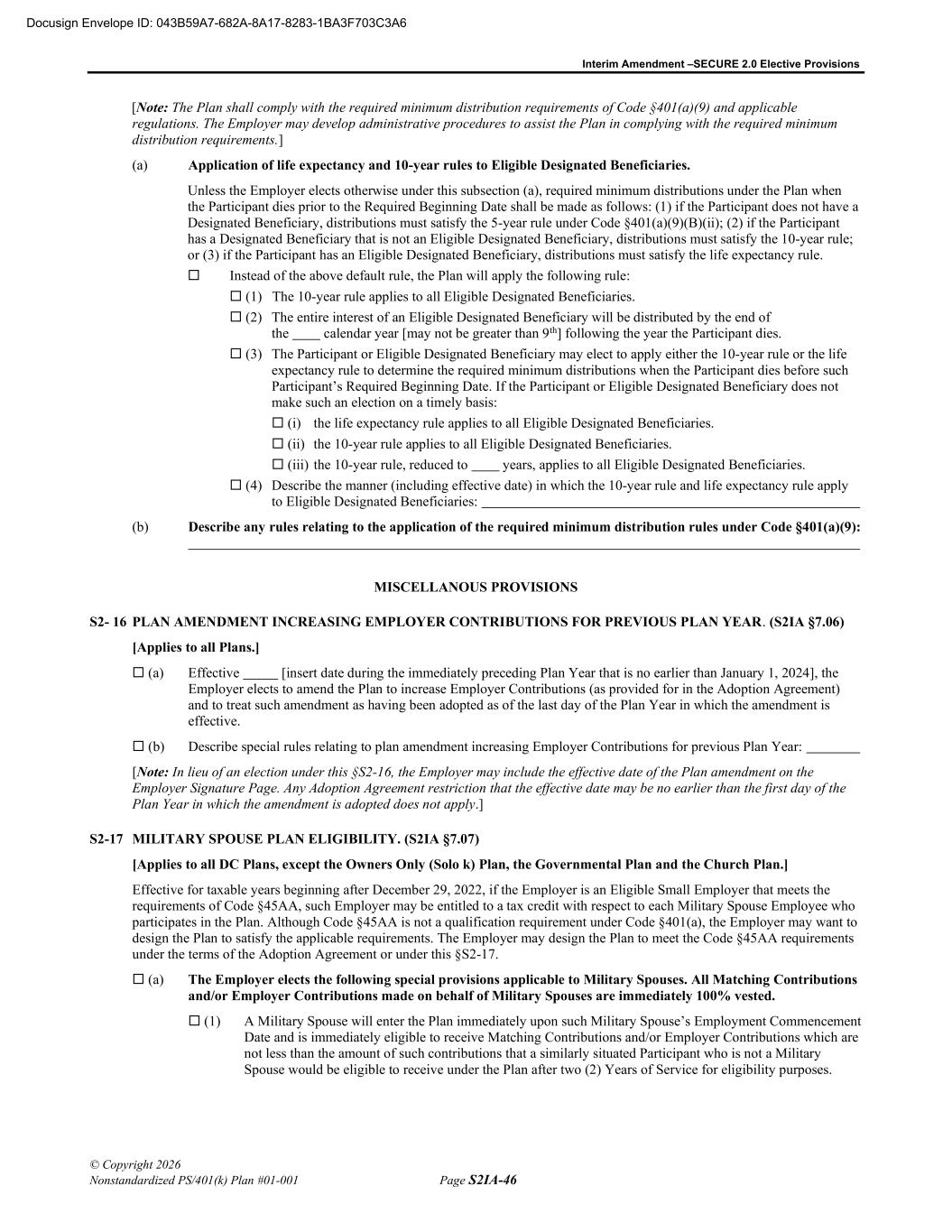
Interim Amendment –SECURE 2.0 Elective Provisions © Copyright 2026 Nonstandardized PS/401(k) Plan #01-001 Page S2IA-46 [Note: The Plan shall comply with the required minimum distribution requirements of Code §401(a)(9) and applicable regulations. The Employer may develop administrative procedures to assist the Plan in complying with the required minimum distribution requirements.] (a) Application of life expectancy and 10-year rules to Eligible Designated Beneficiaries. Unless the Employer elects otherwise under this subsection (a), required minimum distributions under the Plan when the Participant dies prior to the Required Beginning Date shall be made as follows: (1) if the Participant does not have a Designated Beneficiary, distributions must satisfy the 5-year rule under Code §401(a)(9)(B)(ii); (2) if the Participant has a Designated Beneficiary that is not an Eligible Designated Beneficiary, distributions must satisfy the 10-year rule; or (3) if the Participant has an Eligible Designated Beneficiary, distributions must satisfy the life expectancy rule. Instead of the above default rule, the Plan will apply the following rule: (1) The 10-year rule applies to all Eligible Designated Beneficiaries. (2) The entire interest of an Eligible Designated Beneficiary will be distributed by the end of the calendar year [may not be greater than 9th] following the year the Participant dies. (3) The Participant or Eligible Designated Beneficiary may elect to apply either the 10-year rule or the life expectancy rule to determine the required minimum distributions when the Participant dies before such Participant’s Required Beginning Date. If the Participant or Eligible Designated Beneficiary does not make such an election on a timely basis: (i) the life expectancy rule applies to all Eligible Designated Beneficiaries. (ii) the 10-year rule applies to all Eligible Designated Beneficiaries. (iii) the 10-year rule, reduced to years, applies to all Eligible Designated Beneficiaries. (4) Describe the manner (including effective date) in which the 10-year rule and life expectancy rule apply to Eligible Designated Beneficiaries: (b) Describe any rules relating to the application of the required minimum distribution rules under Code §401(a)(9): MISCELLANOUS PROVISIONS S2- 16 PLAN AMENDMENT INCREASING EMPLOYER CONTRIBUTIONS FOR PREVIOUS PLAN YEAR. (S2IA §7.06) [Applies to all Plans.] (a) Effective [insert date during the immediately preceding Plan Year that is no earlier than January 1, 2024], the Employer elects to amend the Plan to increase Employer Contributions (as provided for in the Adoption Agreement) and to treat such amendment as having been adopted as of the last day of the Plan Year in which the amendment is effective. (b) Describe special rules relating to plan amendment increasing Employer Contributions for previous Plan Year: [Note: In lieu of an election under this §S2-16, the Employer may include the effective date of the Plan amendment on the Employer Signature Page. Any Adoption Agreement restriction that the effective date may be no earlier than the first day of the Plan Year in which the amendment is adopted does not apply.] S2-17 MILITARY SPOUSE PLAN ELIGIBILITY. (S2IA §7.07) [Applies to all DC Plans, except the Owners Only (Solo k) Plan, the Governmental Plan and the Church Plan.] Effective for taxable years beginning after December 29, 2022, if the Employer is an Eligible Small Employer that meets the requirements of Code §45AA, such Employer may be entitled to a tax credit with respect to each Military Spouse Employee who participates in the Plan. Although Code §45AA is not a qualification requirement under Code §401(a), the Employer may want to design the Plan to satisfy the applicable requirements. The Employer may design the Plan to meet the Code §45AA requirements under the terms of the Adoption Agreement or under this §S2-17. (a) The Employer elects the following special provisions applicable to Military Spouses. All Matching Contributions and/or Employer Contributions made on behalf of Military Spouses are immediately 100% vested. (1) A Military Spouse will enter the Plan immediately upon such Military Spouse’s Employment Commencement Date and is immediately eligible to receive Matching Contributions and/or Employer Contributions which are not less than the amount of such contributions that a similarly situated Participant who is not a Military Spouse would be eligible to receive under the Plan after two (2) Years of Service for eligibility purposes. Docusign Envelope ID: 043B59A7-682A-8A17-8283-1BA3F703C3A6
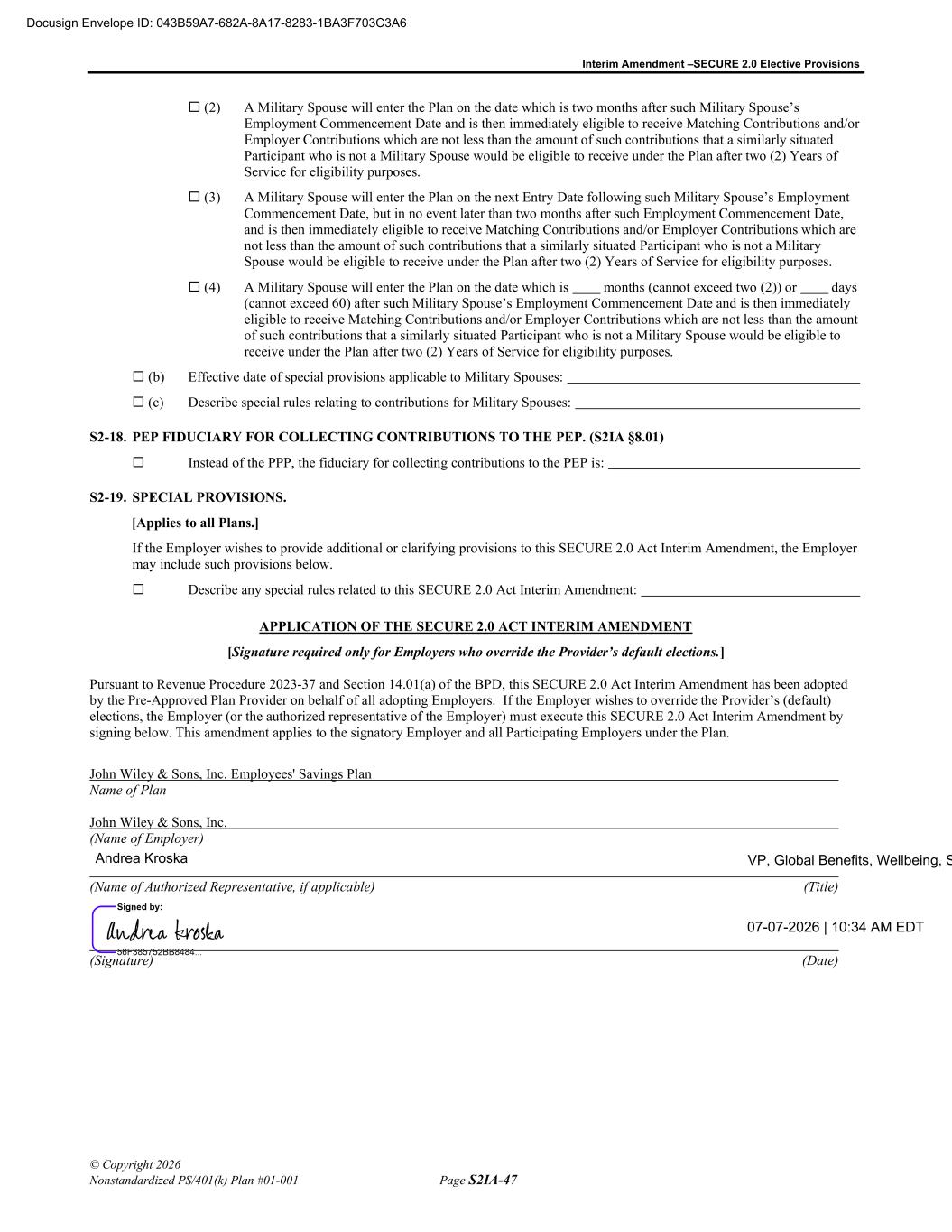
Interim Amendment –SECURE 2.0 Elective Provisions © Copyright 2026 Nonstandardized PS/401(k) Plan #01-001 Page S2IA-47 (2) A Military Spouse will enter the Plan on the date which is two months after such Military Spouse’s Employment Commencement Date and is then immediately eligible to receive Matching Contributions and/or Employer Contributions which are not less than the amount of such contributions that a similarly situated Participant who is not a Military Spouse would be eligible to receive under the Plan after two (2) Years of Service for eligibility purposes. (3) A Military Spouse will enter the Plan on the next Entry Date following such Military Spouse’s Employment Commencement Date, but in no event later than two months after such Employment Commencement Date, and is then immediately eligible to receive Matching Contributions and/or Employer Contributions which are not less than the amount of such contributions that a similarly situated Participant who is not a Military Spouse would be eligible to receive under the Plan after two (2) Years of Service for eligibility purposes. (4) A Military Spouse will enter the Plan on the date which is months (cannot exceed two (2)) or days (cannot exceed 60) after such Military Spouse’s Employment Commencement Date and is then immediately eligible to receive Matching Contributions and/or Employer Contributions which are not less than the amount of such contributions that a similarly situated Participant who is not a Military Spouse would be eligible to receive under the Plan after two (2) Years of Service for eligibility purposes. (b) Effective date of special provisions applicable to Military Spouses: (c) Describe special rules relating to contributions for Military Spouses: S2-18. PEP FIDUCIARY FOR COLLECTING CONTRIBUTIONS TO THE PEP. (S2IA §8.01) Instead of the PPP, the fiduciary for collecting contributions to the PEP is: S2-19. SPECIAL PROVISIONS. [Applies to all Plans.] If the Employer wishes to provide additional or clarifying provisions to this SECURE 2.0 Act Interim Amendment, the Employer may include such provisions below. Describe any special rules related to this SECURE 2.0 Act Interim Amendment: APPLICATION OF THE SECURE 2.0 ACT INTERIM AMENDMENT [Signature required only for Employers who override the Provider’s default elections.] Pursuant to Revenue Procedure 2023-37 and Section 14.01(a) of the BPD, this SECURE 2.0 Act Interim Amendment has been adopted by the Pre-Approved Plan Provider on behalf of all adopting Employers. If the Employer wishes to override the Provider’s (default) elections, the Employer (or the authorized representative of the Employer) must execute this SECURE 2.0 Act Interim Amendment by signing below. This amendment applies to the signatory Employer and all Participating Employers under the Plan. John Wiley & Sons, Inc. Employees' Savings Plan Name of Plan John Wiley & Sons, Inc. (Name of Employer) (Name of Authorized Representative, if applicable) (Title) (Signature) (Date) Docusign Envelope ID: 043B59A7-682A-8A17-8283-1BA3F703C3A6 VP, Global Benefits, Wellbeing, Safety and M&AAndrea Kroska 07-07-2026 | 10:34 AM EDT