AN OFFERING STATEMENT PURSUANT TO REGULATION A RELATING TO THESE SECURITIES HAS BEEN FILED WITH THE SECURITIES AND EXCHANGE COMMISSION. INFORMATION CONTAINED IN THIS PRELIMINARY OFFERING CIRCULAR IS SUBJECT TO COMPLETION OR AMENDMENT. THESE SECURITIES MAY NOT BE SOLD NOR MAY OFFERS TO BUY BE ACCEPTED BEFORE THE OFFERING STATEMENT FILED WITH THE COMMISSION IS QUALIFIED. THIS PRELIMINARY OFFERING CIRCULAR SHALL NOT CONSTITUTE AN OFFER TO SELL OR THE SOLICITATION OF AN OFFER TO BUY NOR MAY THERE BE ANY SALES OF THESE SECURITIES IN ANY STATE IN WHICH SUCH OFFER, SOLICITATION OR SALE WOULD BE UNLAWFUL BEFORE REGISTRATION OR QUALIFICATION UNDER THE LAWS OF SUCH STATE. THE COMPANY MAY ELECT TO SATISFY ITS OBLIGATION TO DELIVER A FINAL OFFERING CIRCULAR BY SENDING YOU A NOTICE WITHIN TWO BUSINESS DAYS AFTER THE COMPLETION OF THE COMPANY’S SALE TO YOU THAT CONTAINS THE URL WHERE THE FINAL OFFERING CIRCULAR OR THE OFFERING STATEMENT IN WHICH SUCH FINAL OFFERING CIRCULAR WAS FILED MAY BE OBTAINED.
Amended Preliminary Offering Circular Dated September 3, 2026
Compound Real Estate Bonds II, Inc.
1185 Avenue of the Americas, 3rd floor
New York, NY 10036
1-800-560-5215
Compound Real Estate Bonds II, Inc. (“we,” “our,” “us,” and the “Company”) is offering up to $75,000,000 (“Maximum Offering Amount”) of our unsecured promissory notes (each a “Bond” and collectively as, “Bonds”) in $10.00 increments. Of such Maximum Offering Amount, we are offering up to (i) 7,480,000 of our $10 Bonds for cash and (ii) 20,000 of our $10 Bonds as rewards under our “Rewards Program” (as described below) for eligible referrals (not for cash). The minimum initial investment amount for any investor is $1,000 in Bonds, investors who have previously purchased Bonds may make additional purchases of any amount. There is no minimum offering amount and no provision to return or escrow investor funds if any minimum amount of Bonds is not sold.
We will offer and sell our Bonds described in this offering circular on a continuous basis directly through the Compound Website accessible at https://www.compoundrealestatebonds.com or though the Compound App which may be downloaded for free from the Apple Store or from Google Play (collectively referred to as the “Compound Fintech Platform”). The Compound Fintech Platform is developed and owned by our parent, Compound Real Estate Holdings, Inc., a Florida corporation, (“CH” or “Parent”) and licensed to us by CH in exchange for 2% of the value of the total Bonds sold on the Compound Fintech Platform each year. The Compound Fintech Platform interfaces with certain back-end computer software and database infrastructure developed and owned by the Company that processes and manages data provided by investors via the Compound Fintech Platform.
The Company is offering demand Bonds with a fixed interest rate of 8.5% per annum, with interest compounding daily. Upon request for repayment in writing (including any electronic requests made through the Compound Fintech Platform) the Company will pay principal and interest to the bondholder within 30 Business Days of the request for repayment if the investor has requested repayment of Bonds in the aggregate principal amount greater than $50,000 within the past 30 days, or if not, within 5 Business Days of the written request for such repayment, subject to the terms of the Repayment at Holder’s Demand clause in the Bond (“Maturity”). “Business Day” shall mean any day except any Saturday, any Sunday, any day which is a federal legal holiday in the United States or any day on which banking institutions in the State of Florida are authorized or required by law or other governmental action to close. All interest and principal will be due at Maturity, with unpaid interest compounding daily. Bonds may be prepaid by the Company at any time.
The Bonds may be modified, amended, or otherwise adjusted upon the written consent (including electronic consent given through the Compound Fintech Platform) of a majority of the outstanding principal amount of Bonds purchased by investors pursuant to this offering circular. Any such modification, amendment, or adjustment shall be binding upon all Holders, whether or not such Holder has consented to such change. In the event the proposed modification includes an increase to the interest rate, the Company may designate a specific retroactive effective date for such increase, and all interest accrued from that date forward shall be recalculated accordingly.
As of July 31, 2026, through this offering, 2,712,110 Compound Bonds have been sold for $10 each, and 598,021 of the Compound Bonds have been redeemed by investors, leaving 2,114,089 Compound Bonds outstanding (representing a total liability of $21,870,885 when compounded interest is included) and 5,385,911 Compound Bonds remaining to be sold for cash in this offering. However, we only had $16,767,293 in liquid assets (consisting of $14,253,112 in cash and cash equivalents, $2,421,510 in U.S. government bonds, and $92,671 in readily tradable real estate related securities) with which to satisfy potential redemptions, and total assets of $19,972,293. As of the date of this offering circular, we have no employees and are dependent upon the services provided under the Administrative Services Agreement with our affiliate, Compound Administrative Services LLC (“Compound Administrative Services”), for our operations.
We have also created a Rewards Program (“Rewards Program”) to provide (i) investors (each a “Referrer”) who meet eligibility standards set forth in this offering circular the opportunity to receive Bonds as a thank you for referring a friend or family member to open an account on the Compound Fintech Platform and (ii) new members of the Compound Fintech Platform (each a “Referee”) who meet eligibility standards set forth in this offering circular the opportunity to receive Bonds as a thank you for opening an account on the Compound Fintech Platform as a result of an eligible referral. Each eligible Referrer and eligible Referee will be entitled to receive an award of one Bond valued at $10.00 each (each a “Bond Reward”) per eligible referral, subject to a limitation of 50 Bonds per Referrer account per calendar year. Bond Rewards will be fulfilled through Bonds issued under the offering statement of which this offering circular forms a part. As of the date of this offering circular, no Bond Rewards have been issued. For more information on the terms and conditions of the Bond Rewards Program, please see “Plan of Distribution – Bond Rewards Program.”
Bonds will be offered on a “best-efforts” basis. Bond purchasers receive one $10 bond per $10 invested and are not charged any investor processing or similar fees by the Company or any of its affiliates. We may undertake one or more closings on a “rolling” basis. Closings will occur promptly after receiving investor funds, but in no case less frequently than every 30 days. This offering will terminate on the earlier to occur of (i) the date that all Bonds hereby offered have been sold, (ii) September 18, 2028 (the date three years from the date this offering circular was initially qualified by the SEC), although the offering may be extended by an additional 180 days if the Company files a new offering statement covering these securities pursuant to SEC Rule 251 (d)(3)(i)(F) (notwithstanding the foregoing, the Company reasonably expects to sell all Bonds within two years from qualification), or (iii) such earlier date as terminated by the Company.
| Price of Bonds |
Price to Public [1] |
Proceeds to Issuer [2] |
||||||
| Per Bond | $ | 10.00 | $ | 10.00 | ||||
| Per Rewards Program Bond | $ | 0.00 | $ | 0.00 | ||||
| Total Maximum | $ | 74,800,000.00 | $ | 74,800,000 | ||||
| (1) | All amounts in this chart and circular are in U.S. dollars unless otherwise indicated. All investor funds will be held in a segregated processing account until an investor’s subscription is accepted by the Company, after which time such funds will become available for the Company’s use. |
| (2) | This amount does not include expenses of this offering or a license fee in the amount of 2% of the value of the total Bonds sold through our Compound Fintech Platform, which will be paid to our Parent. The Company’s parent has not yet, and does not intend to collect this license fee until at least 2027 in order to give the Company time to generate sufficient cash flow to pay the licensing fee. If CH had collected this license fee as of July 31, 2026, the total licensing fee would have been $542,422. |
No public market has developed nor is expected to develop for our Bonds, and we do not intend to list Bonds on a national securities exchange or interdealer quotational system. While the outstanding Bonds are repayable with 5 Business Days’ notice (or 30 Business Days’ notice, in the event and investor has requested a repayment of Bonds in the aggregate principal amount greater than $50,000 over the previous 30 days), we would not be able to satisfy investor redemption requests if all our investors were to simultaneously seek to redeem their bonds.
Generally, no sale may be made to you in this offering if the aggregate purchase price you pay is more than 10% of the greater of your annual income or net worth. Different rules apply to accredited investors and non-natural persons. Before making any representation that your investment does not exceed applicable thresholds, we encourage you to review Rule 251(d)(2)(i)(C) of Regulation A. For general information on investing, we encourage you to refer to www.investor.gov.
The Company is following the “offering circular” format of disclosure under Regulation A.
Investing in our securities involves a high degree of risk, including the risk that you could lose all of your investment. Please read the section entitled “Risk Factors” beginning on page 7 of this offering circular about the risks you should consider before investing.
THE SEC DOES NOT PASS UPON THE MERITS OF OR GIVE ITS APPROVAL TO ANY SECURITIES OFFERED OR THE TERMS OF THE OFFERING, NOR DOES IT PASS UPON THE ACCURACY OR COMPLETENESS OF ANY OFFERING CIRCULAR OR OTHER SOLICITATION MATERIALS. THESE SECURITIES ARE OFFERED PURSUANT TO AN EXEMPTION FROM THE REGISTRATION REQUIREMENTS OF THE SECURITIES ACT OF 1933, AS AMENDED (THE “SECURITIES ACT”); HOWEVER, THE SEC HAS NOT MADE AN INDEPENDENT DETERMINATION THAT THE SECURITIES OFFERED ARE EXEMPT FROM REGISTRATION.
TABLE OF CONTENTS
i
This summary highlights certain information about us and this offering contained elsewhere in this offering circular. Because it is only a summary, it does not contain all the information that you should consider before investing in our securities and it is qualified in its entirety by, and should be read in conjunction with, the more detailed information appearing elsewhere in this offering circular. Before you decide to invest in our securities, you should read the entire offering circular carefully, including “Risk Factors” and our financial statements and the accompanying notes included in this offering circular. Unless the context otherwise indicates, when used in this offering circular, the terms “the Company,” “we,” “us,” “our” and similar terms refer to Compound Real Estate Bonds II, Inc., a Florida limited liability company, and our subsidiaries.
Our Company
Compound Real Estate Bonds II, Inc. was incorporated under the laws of the State of Florida on June 18, 2025. We have been formed to purchase or otherwise acquire mortgages and other liens on and interests in real estate. Our investments will be primarily secured by properties located in high-growth metropolitan areas across the United States and Canada, with particular focus on the Sunbelt region, Southern California, and the Greater Toronto Area. These assets may include multi-family housing, single-family rental portfolios, industrial buildings, and select office properties. We anticipate that (i) at least 55% of our assets will consist of “mortgages and other liens on and interests in real estate” (“Qualifying Interests”), (ii) up to an additional 25% of our assets will consist of “real estate-type interests” (subject to proportionate reduction if greater than 55% of our assets are Qualifying Interests), and (iii) not more than 20% of our total assets consist of assets that have no relationship to real estate provided the amount and nature of such activities do not cause us to lose our exemption from regulations as an investment company pursuant to the Investment Company Act of 1940 (“Investment Company Act”). Qualifying Interests are assets that represent an actual interest in real estate or are loans or liens “fully secured by real estate” but exclude securities in other issuers engaged in the real estate business. Real estate-type interests include certain mortgage-related instruments including loans where 55% of the fair market value of the loan is secured by real property at the time the issuer acquired the loan and agency partial-pool certificates. The proceeds from the sale of Bonds in this offering will provide the capital for these activities.
Contact
Our address is 1185 Avenue of the Americas, 3rd floor, New York, NY 10036. Our telephone number is 1-800-560-5215.
Ownership Information
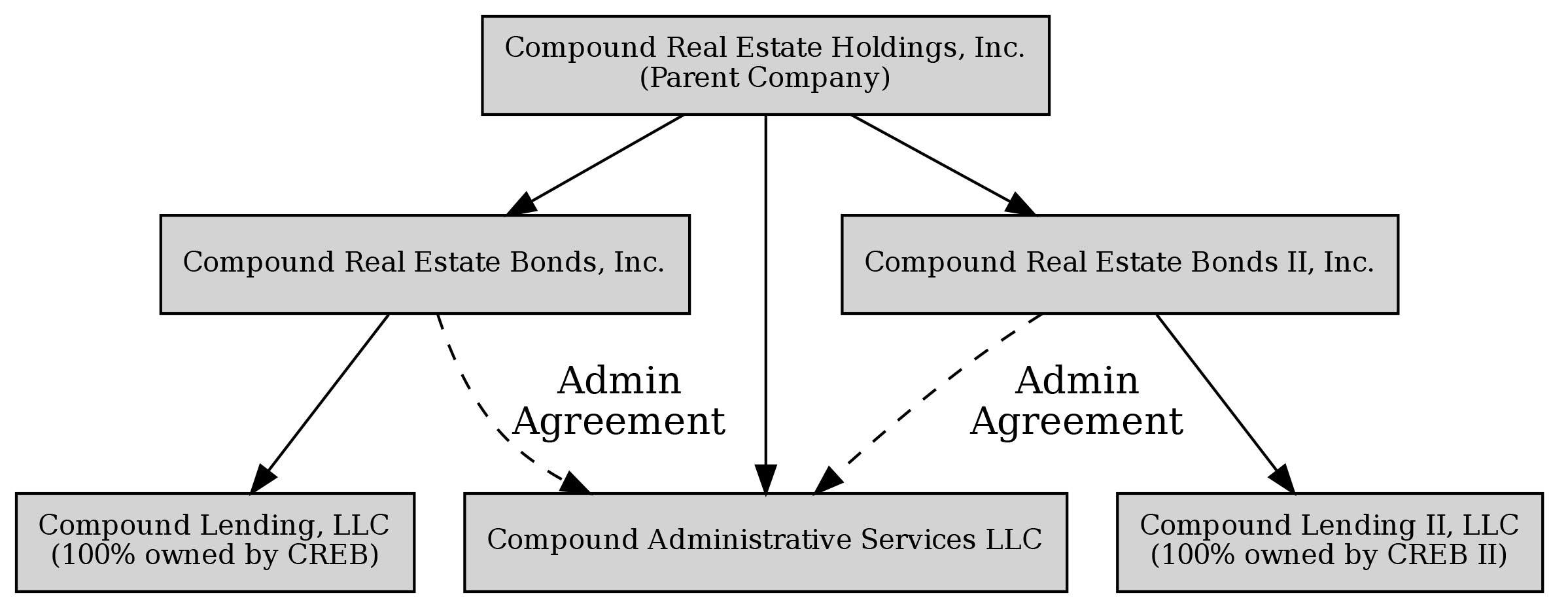
Compound Real Estate Bonds, Inc., is a wholly-owned subsidiary of Compound Real Estate Holdings, Inc. (“CH”), which was incorporated under the laws of the State of Florida on September 28, 2021. CH owns all of our membership interests. CH will oversee and direct the management of the Company, evaluate and monitor the financial performance of the Company’s assets, and undertake strategic planning in the effort to achieve the goals and objectives of the Company. CH will be entitled to receive all Company profits after payment currently due Bond payments.
The Bonds
| ● | Sold in $10.00 increments with a minimum opening investment amount of $1,000, investors who have previously purchased Bonds may make additional purchases of any amount; |
| ● | Bear interest at 8.5% per annum, compounded daily; |
| ● | Payable within 30 Business Days from demand by holder (if repayment of Bonds in the aggregate principal amount greater than $50,000 has been requested over the last 30 days), or 5 Business Days from demand by the holder (if not); |
1
| ● | Bear interest at 8.5% per annum, compounded daily; |
| ● | Can be modified, amended, or otherwise adjusted upon the written consent (including electronic consent given through the Compound Fintech Platform) of a majority of the outstanding principal amount of Bonds purchased by investors pursuant to this offering circular; |
| ● | Can by prepaid by us at any time; |
| ● | Are not transferable without Company approval; |
| ● | Are unsecured. |
For more information on the terms of Bonds being offered, please see the “Securities Being Offered” section of this offering circular.
2
The Offering
| Securities offered by us: | Up to $75,000,000 of Bonds on a “best efforts” basis. We are offering up to (i) $74,800,000 of our Bonds for cash and (ii) $200,000 of our Bonds as rewards under our Bond Rewards Program for eligible referrals (not for cash). Bond purchasers receive one $10 bond per $10 invested and are not charged any investor processing or similar fees by the Company or any of its affiliates. As of July 31, 2026, through this offering, 2,712,110 Compound Bonds have been sold for $10 each, and 598,021 of the Compound Bonds have been redeemed by investors, leaving 2,114,089 Compound Bonds outstanding (representing a total liability of $21,870,885 when compounded interest is included) and 5,385,911 Compound Bonds remaining to be sold for cash in this offering. | |
| Manner of offering: | Bonds are being offered on a best-efforts basis. We will offer and sell our Bonds described in this offering circular on a continuous basis directly through the Compound Website accessible at https://www.compoundrealestatebonds.com (the “Compound Website”) or though the Compound App which may be downloaded for free from the Apple Store or from Google Play (collectively referred to as the “Compound Fintech Platform”). We reserve the right to engage the services of a registered broker-dealer who will offer, sell and process the subscriptions for the Bonds, although we do not presently expect to engage such selling agent. If any broker-dealer or other agent/person is engaged to sell our Bonds, we will file a post-qualification amendment to the offering statement of which this offering circular forms a part disclosing the names and compensation arrangements prior to any sales by such persons. To the extent that the Company’s officers and directors make any communications in connection with this offering they intend to conduct such efforts in accordance with an exemption from registration contained in Rule 3a4-1 under the Exchange Act, and, therefore, none of them is required to register as a broker-dealer. Please see the “Plan of Distribution” section of this offering circular. | |
| Rewards Program | We have also created a Rewards Program (“Rewards Program”) to provide (i) investors (each a “Referrer”) who meet eligibility standards set forth in this offering circular the opportunity to receive Bonds as a thank you for referring a friend or family member to open an account on the Compound Fintech Platform and (ii) new members of the Compound Fintech Platform (each a “Referee”) who meet eligibility standards set forth in this offering circular the opportunity to receive Bonds as a thank you for opening an account on the Compound Fintech Platform as a result of an eligible referral. Each eligible Referrer and eligible Referee will be entitled to receive an award of one Bond valued at $10.00 each (each a “Bond Reward”) per eligible referral, subject to a limitation of 50 Bonds per Referrer account per calendar year. Bond Rewards will be fulfilled through Bonds issued under the offering statement of which this offering circular forms a part. As of the date of this offering circular, no Bond Rewards have been issued. For more information on the terms and conditions of the Bond Rewards Program, please see “Plan of Distribution – Bond Rewards Program.” | |
| Investment Amount Restrictions | Generally, no sale may be made to an investor in this offering if the aggregate purchase price the investor pays is more than 10% of the greater of the investor’s annual income or net worth. Different rules apply to accredited investors and non-natural persons. Investors are encouraged to review Rule 251(d)(2)(i)(c) of Regulation A. | |
| Voting Rights | The Bonds do not have any voting rights with regards to the Company. However, the Bonds may be modified, amended, or otherwise adjusted upon the written consent (including electronic consent given through the Compound Fintech Platform) of a majority of the outstanding principal amount of Bonds purchased by investors pursuant to this offering circular. Any such modification, amendment, or adjustment shall be binding upon all Holders, whether or not such Holder has consented to such change. In the event the proposed modification includes an increase to the interest rate, the Company may designate a specific retroactive effective date for such increase, and all interest accrued from that date forward shall be recalculated accordingly. |
3
| Risk Factors | Purchasing the Bonds and our business in general is subject to numerous risks and uncertainties, including those highlighted in the section titled “Risk Factors” beginning on page 7. | |
| How to invest: | Please visit the Compound Website at https://www.compoundrealestatebonds.com and click the “Get Started” link at the top of the home page. You may also download the Compound App and use it to invest. | |
| Use of proceeds: | We intend to use the net proceeds from this offering to implement the business model described herein and for general corporate purposes including the costs of this offering. CH has the discretion to impose a license fee of 2% of the value of Compound Bonds sold through the platform. The license fee does not become due or payable unless CH elects the fee. parent has not yet, and does not intend to declare this fee due and payable until at least 2027 in order to give the Company time to generate sufficient cash flow to pay the licensing fee. If CH had collected this license fee as of July 31, 2026, the total licensing fee would have been $542,422 (2% of the total value of the Compound Bonds sold as of July 31, 2026). Proceeds from this offering may be used to reimburse our Parent and its affiliates for organizational and offering expenses incurred on our behalf. See “Use of Proceeds.” | |
| Termination of the offering | The termination of the offering will occur on the earlier of (i) the date that all Bonds hereby offered have been sold (ii) September 18, 2028, that being three years from the date our offering circular, as amended, was initially qualified by the SEC (unless extended for an additional 180 days pursuant to SEC Rule 251 (d)(3)(i)(F)), or (iii) such time as earlier terminated by the Company. |
4
ABOUT THIS CIRCULAR
We have prepared this offering circular to be filed with the SEC for our offering of securities. The offering circular includes exhibits that provide more detailed descriptions of the matters discussed in this offering circular.
You should rely only on the information contained in this offering circular and its exhibits. We have not authorized any person to provide you with any information different from that contained in this offering circular. The information contained in this offering circular is complete and accurate only as of the date of this offering circular, regardless of the time of delivery of this offering circular or sale of Bonds. This offering circular contains summaries of certain other documents, but reference is hereby made to the full text of the actual documents for complete information concerning the rights and obligations of the parties thereto. All documents relating to this offering and related documents and agreements will be made available to a prospective investor or its representatives upon request.
5
TAX CONSIDERATIONS
No information contained herein, nor in any prior, contemporaneous or subsequent communication should be construed by a prospective investor as legal or tax advice. We are not providing any tax advice as to the acquisition, holding or disposition of the securities offered herein. In making an investment decision, investors are strongly encouraged to consult their own tax advisor to determine the U.S. Federal, state and any applicable foreign tax consequences relating to their investment in our securities. This written communication is not intended to be “written advice,” as defined in Circular 230 published by the U.S. Treasury Department
6
Any investment in our Bonds involves a high degree of risk. Investors should carefully consider the risks described below and all of the information contained in this offering circular before deciding whether to purchase our Bonds. Our business, financial condition or results of operations could be materially adversely affected by these risks if any of them actually occur. This offering circular also contains forward-looking statements that involve risks and uncertainties. Our actual results could differ materially from those anticipated in these forward-looking statements as a result of certain factors, including the risks described below and elsewhere in this offering circular. In addition to the other information provided in this offering circular, you should carefully consider the following risk factors in evaluating our business before purchasing our Bonds. Material risks identified by the Company are discussed in this section; however, discussion may not include all risks applicable to an investment in Bonds to the extent such risks have not been contemplated by the Company.
Risks Related to the Company
We are an early-stage startup with limited operating history.
We are newly formed with only limited operations, which makes an investment in us speculative. The Company is not yet profitable, and we do not expect to be profitable for the next 12 months. If we are unable to obtain or maintain profitability, we may not be able to attract investments, compete, or maintain operations or repay the Bonds or the interest due thereon.
As of the date of this offering circular, we have not yet generated revenue sufficient to cover the interest of Compound Bonds because we have not yet deployed any of the Capital we’ve raised to originate or acquire mortgages or other real estate assets.
As of July 31, 2026, through this offering, 2,712,110 Compound Bonds have been sold for $10 each, and 598,021 of the Compound Bonds have been redeemed by investors, leaving 2,114,089 Compound Bonds outstanding (representing a total liability of $21,870,885 when compounded interest is included) and 5,385,911 Compound Bonds remaining to be sold for cash in this offering. However, we only had $16,767,293 in liquid assets (consisting of $14,253,112 in cash and cash equivalents, $2,421,510 in U.S. government bonds, and $92,671 in readily tradable real estate related securities) with which to satisfy potential redemptions, and total assets of $19,972,293. We have not yet generated sufficient revenue to pay off the Compound Bonds or cover all of the interest on existing and newly issued Compound Bonds. If we cannot generate sufficient revenue to cover the interest on the Compound Bonds then bond holders may lose some or all of their investment.
Our management has raised substantial doubt about our ability to continue as a going concern and our independent public accounting firm has included an explanatory paragraph relating to our ability to continue as a going concern in its audit report with respect to our audited consolidated financial statements for the period ended June 30, 2026.
We are an early-stage startup with limited operating history, and we may never become profitable. Our management has raised substantial doubt about our ability to continue as a going concern and our independent public accounting firm has included an explanatory paragraph in their opinion on our audited consolidated financial statements for the period ended June 30, 2026, that states that there is a substantial doubt about our ability to continue as a going concern. The accompanying consolidated financial statements have been prepared assuming that we will continue as a going concern. There is substantial doubt about our ability to continue as a going concern. We cannot assure you that we will generate sufficient revenue or obtain necessary financing to continue as a going concern. We cannot assure you that we will achieve success in selling the Bonds.
We are dependent on the funds to be raised in this offering in order to be able to implement our business plan.
We have not generated any revenues and we are dependent on the proceeds from this offering to provide funds to implement our business model. Given the uncertainty of the amount of Bonds that we will sell, it is difficult to predict our planned operations. If we do not raise sufficient funds in this offering, we will not be able to fully implement our business plan, or may have to cease operations altogether, and bond holders may lose some or all of their investment in the Compound Bonds.
7
We may need additional capital, which may be on terms more or less favorable than those offered in this offering.
We may require additional capital and may require additional cash resources due to changed business conditions or other future developments. If our resources are insufficient to satisfy our cash requirements, we may seek to sell additional equity or debt securities or incur debt. The incurrence of additional indebtedness would result in increased debt service obligations and could result in operating and financing covenants that would restrict our operations. We cannot assure you that financing will be available in amounts or on terms acceptable to us, if at all, or that the terms provided won’t be more or less favorable than those hereby offered.
We have limited operating history, which makes it difficult to evaluate our future prospects and may increase the risk that we will not be successful.
We have limited operating history and are still in the process of raising and deploying capital. Assessing our business and future prospects is challenging in light of the risks and difficulties we may encounter. These risks and difficulties include our ability to:
| ● | Acquire assets; |
| ● | Sell our assets at a profit; |
| ● | Favorably compete with other companies that may have more resources and recognition than the Company; |
| ● | Successfully navigate economic conditions and fluctuations in the market; and |
| ● | Effectively manage the growth of our business. |
We may not be able to successfully address these risks and difficulties, which could harm our business and cause our operating results to suffer. If we cannot generate sufficient revenue to cover the cost of our operations and pay the interest on the Compound Bonds, then bond holders may lose some or all of their investment in the Compound Bonds.
The Company, our Parent and our lending subsidiary, Compound Lending II, LLC, have limited experience in mortgage loan acquisition or underwriting.
The Company and our lending subsidiary have limited experience in mortgage loan acquisition or underwriting. Compound Lending II only commenced operations in April 2026, and Compound Lending (a wholly owned subsidiary of an affiliated fund) did not commence operations until October 26, 2024. If the method adopted by the Company for evaluating real estate property related to a potential real estate loan and for establishing interest rates for the corresponding real estate loan proves flawed, then bond holders may lose some or all of their investment in the Compound Bonds.
The Company and our Parent have minimal experience in managing real estate investments or developing real estate projects.
The Company and our Parent have no prior history of investing in or managing multifamily, commercial, and industrial real estate, and there is no guarantee that the real estate we acquire will be acquired on favorable terms or managed profitably. Additionally, if the borrower is unable to repay its obligations under a loan from us, we may foreclose on the real estate property. Although we will seek out purchasers for the property, we or experienced third parties engaged by us may have to take an active role in the management of the real estate or the project. Prospective investors should consider that the members of our management have limited experience in managing real estate or developing real estate projects. We cannot assure you that we or third parties engaged by us can manage real estate or operate real estate projects profitably, which will impact our ability to generate revenue. If we cannot generate sufficient revenue to cover the cost of our operations and pay the interest rate on the Bonds, then bond holders may lose some or all of their investment in the Bonds.
8
The Officers of the Company have limited experience raising money from third-party investors to invest in real estate and limited experience with mortgage loan acquisition, underwriting, and acquiring/managing real estate investments.
Inderjit Tuli & Michael Burmi have limited direct experience making real estate investments, and thus are relying on the advice and guidance of others as they acquire and manage the Company’s portfolio. We cannot assure you that these third parties will provide all of the needed guidance, and any mistakes made by the Company’s officers due to inexperience may impact our ability to generate revenue. If we cannot generate sufficient revenue to cover the cost of our operations and pay the interest rate on the Bonds, then bond holders may lose some or all of their investment in the Bonds.
Competition for employees is intense, and we may not be able to attract and retain the employees whom we need to support our business.
Competition for personnel is extremely intense, and we or our Parent could face difficulty identifying and hiring qualified individuals in many areas of our business. We or our Parent may not be able to hire and retain such personnel. Many of the companies with which we or our Parent will compete for experienced employees have greater resources than we have and may be able to offer more attractive terms of employment. In addition, we or our Parent may invest significant time and expense in training our employees, which increases their value to competitors who may seek to recruit them.
We operate in a competitive market which may intensify, and competition may limit our ability to implement our business model and have a material adverse effect on our business, financial condition, and results of operations.
We operate in a competitive market which may intensify, and competition may limit our ability to implement our business model and have a material adverse effect on our business, financial condition, and results of operations. Our competitors may be able to have a lower cost for their services which would lead to borrowers choosing such other competitors over the Company. In addition, some of our competitors may have higher risk tolerances or different risk assessments, which could allow them to consider a wider variety of loans and investments, offer more attractive pricing or other terms and establish more relationships than us.
The amount of repayments to Bond holders at a given time may exceed the amount of funds we have available to make such payments, which may result in a delay in repayment or loss of investment to the Bond holders.
We will use our commercially reasonable efforts to maintain sufficient cash and cash equivalents on hand to honor repayment of Bonds, but we will not create a “sinking fund” from which to repay bonds. In the event there is more requirement for repayment than our cash and cash equivalents on hand available, we may be required to (i) liquidate some of investments, (ii) seek commercial banks and non-bank lending sources, such as insurance companies, private equity funds and private lending organizations, for the provision of credit facilities, including, but not limited to, lines of credit, pursuant to which funds would be advanced to us, or (iii) seek capital contributions from our Parent. But note, there is no agreement with our Parent to provide additional capital contributions in such circumstances, and our Parent may not have sufficient financial resources to do so. If the above sources of funds to honor repayments cannot be realized within the time frame of the repayment requirements, Bond holders might have to wait for repayment until the above sources are realized. Although the Bonds will continue accruing interest, if the above sources do not generate enough funds for repayment, there is a risk that the Bond holders may lose some or all of their investment in the Bonds. By failing to make timely payment, the Company will be in default on the Bonds. As a result, there is also the risk that one or more investors will sue us. If one or more investors sue us and are successful in obtaining a judgment, the investors may have the ability to foreclose on our assets. The Company may not have enough assets to support all judgments and/or ongoing operations, and we may have to file bankruptcy.
Our risk management efforts may not be effective.
We could incur substantial losses, and our business operations could be disrupted if we are unable to effectively identify, manage, monitor, and mitigate financial risks as well as operational risks related to our business, assets, and liabilities. Our risk management policies, procedures, and techniques may not be sufficient to identify all of the risks we are exposed to, mitigate the risks that we have identified, or identify concentrations of risk or additional risks to which we may become subject in the future.
9
A significant disruption in our computer systems or a cybersecurity breach could adversely affect our operations.
We rely extensively on our computer systems to manage our loan origination and other processes. Our systems are subject to damage or interruption from power outages, computer and telecommunications failures, computer viruses, cyber security breaches, vandalism, severe weather conditions, catastrophic events and human error, and our disaster recovery planning cannot account for all eventualities. If our systems are damaged, fail to function properly or otherwise become unavailable, we may incur substantial costs to repair or replace them, and may experience loss of critical data and interruptions or delays in our ability to perform critical functions, which could adversely affect our business and results of operations. Any compromise of our security could also result in a violation of applicable privacy and other laws, significant legal and financial exposure, damage to our reputation, loss or misuse of the information and a loss of confidence in our security measures, which could harm our business.
Our ability to protect the confidential information of our investors may be adversely affected by cyber-attacks, computer viruses, physical or electronic break-ins or similar disruptions.
We process certain sensitive data from our investors. While we have taken steps to protect confidential information that we receive or have access to, our security measures could be breached. Any accidental or willful security breaches or other unauthorized access to our or our service providers’ systems could cause confidential borrower and investor information to be stolen and used for criminal purposes. Security breaches or unauthorized access to confidential information could also expose us to liability related to the loss of the information, time-consuming and expensive litigation and negative publicity. If security measures are breached because of third-party action, employee error, malfeasance or otherwise, or if design flaws in our software are exposed and exploited, our relationships with investors could be severely damaged, and we could incur significant liability.
Because techniques used to sabotage or obtain unauthorized access to systems change frequently and generally are not recognized until they are launched against a target, we may be unable to anticipate these techniques or to implement adequate preventative measures. In addition, federal regulators and many federal and state laws and regulations require companies to notify individuals of data security breaches involving their personal data. These mandatory disclosures regarding a security breach are costly to implement and often lead to widespread negative publicity, which may cause borrowers and investors to lose confidence in the effectiveness of our data security measures. Any security breach, whether actual or perceived, would harm our reputation, we could lose borrowers and investors and our business and operations could be adversely affected.
Any significant disruption in our computer systems, including events beyond our control, could result in a loss of investors. The satisfactory performance, reliability and availability of our technology are critical to our reputation and our ability to attract new and retain existing investors.
Any interruptions or delays in our service, whether as a result of third-party error, our error, natural disasters or security breaches, whether accidental or willful, could harm our relationships with our investors and our reputation. Additionally, in the event of damage or interruption, our insurance policies may not adequately compensate us for any losses that we may incur. We may not have sufficient capacity to recover all data and services in the event of an outage.
We are reliant on the efforts of the officers and directors of our Parent.
We rely on our management team and need additional key personnel to grow our business, and the loss of key employees or inability to hire key personnel could harm our business. We believe our success will depend on the efforts and talents of our Parent’s officers and directors, whose expertise could not be easily replaced if we were to lose their services.
Compliance with Regulation A and reporting to the SEC could be costly.
Compliance with Regulation A could be costly and will require legal and accounting expertise. We are required to file an annual report on Form 1-K, a semiannual report on Form 1-SA, and current reports on Form 1-U.
10
Our legal and financial staff may need to be increased in order to comply with Regulation A. Compliance with Regulation A will also require greater expenditures on outside counsel, outside auditors, and financial printers in order to remain in compliance. Failure to remain in compliance with Regulation A may subject us to sanctions, penalties, and reputational damage and would adversely affect our results of operations.
We will be required to publicly report on an ongoing basis under the reporting rules set forth in Regulation A for Tier 2 issuers. Therefore, we will be subject to ongoing public reporting requirements that are less rigorous than Exchange Act rules for companies that are not “emerging growth companies,” and our investors could receive less information than they might expect to receive from exchange traded public companies.
We will be required to publicly report on an ongoing basis under the reporting rules set forth in Regulation A for Tier 2 issuers. The ongoing reporting requirements under Regulation A are more relaxed than for “emerging growth companies” under the Exchange Act. The differences include, but are not limited to, being required to file only annual and semiannual reports, rather than annual and quarterly reports. Annual reports are due within 120 calendar days after the end of the issuer’s fiscal year, and semiannual reports are due within 90 calendar days after the end of the first six months of the issuer’s fiscal year. Therefore, our investors could receive less information than they might expect to receive from exchange traded public companies.
The profitability of our investments is uncertain.
Investment in real estate entails risks that investments will fail to perform in accordance with expectations. In undertaking these investments, we will incur certain risks, including the expenditure of funds on, and the devotion of management’s time to, transactions that may not come to fruition. Additional risks inherent in real estate investments include risks that the properties will not achieve anticipated sales price and that estimated operating expenses and costs of construction may prove inaccurate.
Our investments will not be diversified.
Our investments may not be diversified by type and/or geographic location. Our performance is therefore linked to economic conditions affecting assets and the regions in which we will invest and in the market for real estate loans and properties generally. Such conditions could result in a reduction of our income.
If we fail to comply with government laws and regulations it could have a materially adverse effect on our business.
We may be subject to federal, state and local laws and regulations that are extremely complex. We will exercise care in structuring our operations to comply in all material respects with applicable laws to the extent possible. The laws, rules and regulations applicable to our operations are complex and subject to interpretation. In the event of a determination that we are in violation of such laws, rules or regulations, or if further changes in the regulatory framework occur, any such determination or changes could have a material adverse effect on our business. There can be no assurance however that we will not be found in noncompliance in any particular situation.
We may not maintain sufficient business insurance coverage for the risks associated with our business operations.
Risks associated with our business and operations include, but are not limited to, claims for wrongful acts committed by our officers, directors, and other representatives, loss from unpaid Loans and foreclosures, damage to properties, the loss of key personnel, risks posed by natural disasters, and risks of lawsuits from our employees. Any of these risks may result in significant losses. We cannot provide any assurance that our insurance coverage is sufficient to cover any losses that we may sustain, or that we will be able to successfully claim our losses under our insurance policies on a timely basis or at all. If we incur any loss not covered by our insurance policies, or the compensated amount is significantly less than our actual loss or is not timely paid, our business, financial condition and results of operations could be materially and adversely affected.
11
We might obtain lines of credit and other borrowings, which increases our risk of loss due to potential foreclosure.
We may obtain lines of credit or other financing that may be secured or unsecured by our assets. As with any liability, there is a risk that we may be unable to repay our obligations from the cash flow or sale of our assets. Therefore, with borrowing and securing such borrowing with our assets, we risk losing such assets in the event we are unable to repay such obligations or meet such demands. If we lose these assets, it could materially affect our ability to pay amounts owed to investors.
We may change our investment strategy without Bond holder consent, which may result in riskier investments than our current investments.
We may change our investment strategy and guidelines at any time without the consent of our Bond holders, which could result in our making investments that are different from, and possibly riskier than, the investments described in this offering circular. A change in our investment strategy or guidelines may increase our exposure to interest rate and real estate market fluctuations.
Current global financial conditions have been characterized by increased volatility which could negatively impact our business, prospects, liquidity and financial condition.
Current global financial conditions and recent market events have been characterized by increased volatility and the resulting tightening of the credit and capital markets has reduced the amount of available liquidity and overall economic activity. We cannot guaranty that debt or equity financing, the ability to borrow funds or cash generated by our investments will be available or sufficient to meet or satisfy our initiatives, objectives or requirements.
We intend to grow the size of our organization, and we may experience difficulties in managing any growth we may achieve.
As our development and commercialization plans and strategies develop, we expect to need additional managerial, operational, financial, accounting, legal, and other resources. Future growth would impose significant added responsibilities on members of management. Our management may not be able to accommodate those added responsibilities, and our failure to do so could prevent us from effectively managing future growth, if any, and successfully growing our company.
We engage in transactions with related parties and such transactions present possible conflicts of interest that could have an adverse effect on us.
We have entered, and may continue to enter, into transactions with related parties for financing, corporate, business development and operational services, as detailed herein. Related party transactions may not have been entered into on an arm’s-length basis, and we may have achieved more or less favorable terms because such transactions were entered into with our related parties. Such conflicts could cause an individual in our management to seek to advance his or her economic interests or the economic interests of certain related parties above ours. Further, the appearance of conflicts of interest created by related party transactions could impair the confidence of our investors, which could have a material adverse effect on our liquidity, results of operations and financial condition.
Our ability to service our indebtedness will depend on our ability to generate cash in the future.
Our ability to make payments on our indebtedness, if any, will depend on our ability to generate cash in the future. If we are unable to service our debt obligations, fund our other liquidity needs and maintain compliance with our financial and other covenants, we could be forced to curtail our operations, our creditors could accelerate our indebtedness and exercise other remedies and we could be required to pursue one or more alternative strategies, such as selling assets or refinancing or restructuring our indebtedness. However, such alternatives may not be feasible or adequate.
12
Risks Related to Bonds and this Offering
The characteristics of the Bonds, including interest rate, maturity date, lack of collateral security or guarantee, and lack of liquidity, may not satisfy your investment objectives.
The Bonds may not be a suitable investment for you, and we advise you to consult your investment, tax and other professional financial advisors prior to purchasing Bonds. The characteristics of the Bonds, including maturity date, redeemable by us, interest rate, lack of collateral security or guarantee, and lack of liquidity, may not satisfy your investment objectives. The Bonds may not be a suitable investment for you based on your ability to withstand a loss of interest or principal or other aspects of your financial situation, including your income, net worth, financial needs, investment risk profile, return objectives, investment experience and other factors. Prior to purchasing any Bonds, you should consider your investment allocation with respect to the amount of your contemplated investment in the Bonds in relation to your other investment holdings and the diversity of those holdings.
Holders of Bonds are exposed to the credit risk of the Company.
Bonds are our full and unconditional obligations. If we are unable to make payments required by the terms of the Bonds, you will have an unsecured claim against us. Bonds are therefore subject to non-payment by us in the event of our bankruptcy or insolvency. In an insolvency proceeding, we cannot assure you that you will recover any remaining funds. Moreover, your claim may be subordinate to that of any senior creditors and any secured creditors to the extent of the value of their security.
The Bonds are unsecured obligations.
The Bonds do not represent an ownership interest in any specific assets or their proceeds. The Bonds are unsecured general obligations of the Company. The Bonds will rank equally with all of our other unsecured debt unless such debt is senior to or subordinate to the Bonds by their terms. We may issue secured debt in our sole discretion without notice to or consent from the holders of Bonds. Therefore, as unsecured obligations, there is no security to be provided to the holders of the Bonds.
There is no public market for Bonds, and none is expected to develop.
Bonds are newly issued securities. Although under Regulation A the securities are not “restricted securities,” Bonds are still highly illiquid securities. No public market has developed nor is expected to develop for Bonds, and we do not intend to list Bonds on a national securities exchange or interdealer quotational system. You should be prepared to hold your Bonds until at least Maturity, as Bonds are expected to be highly illiquid investments.
Holders of the Bonds will have no voting rights.
Holders of the Bonds will have no voting rights and therefore will have no ability to control the Company. The Bonds do not carry any voting rights and therefore the holders of the Bonds will not be able to vote on any matters regarding the operation of the Company. As a bondholder purchaser in this offering will have no right to vote upon or receive notice of any corporate actions we may undertake which you might otherwise have if you owned equity in our Company.
The Bonds may be modified, amended, or otherwise adjusted without your consent.
The Bonds may be modified, amended, or otherwise adjusted upon the written consent (including electronic consent given through the Compound Fintech Platform) of a majority of the outstanding principal amount of Bonds purchased by investors pursuant to this offering circular. Any such modification, amendment, or adjustment shall be binding upon all Holders, whether or not such Holder has consented to such change.
13
There is no limit on the amount of leverage the Company may utilize.
While management intends to operate the Company in a responsible manner, there is no limit on the amount of leverage the Company may incur. If the Company takes on significant amounts of debt, it could reduce or eliminate the Company’s ability to make timely payments on the Bonds, if at all. You may lose your investment.
Because the Bonds will have no sinking fund, insurance, nor guarantee, you could lose all or a part of your investment if we do not have enough cash to pay.
There is no sinking fund, insurance, nor guarantee of our obligation to make payments on the Bonds. We will not contribute funds to a separate account, commonly known as a sinking fund, to make interest or principal payments on the Bonds. The Bonds are not certificates of deposit or similar obligations of, and are not guaranteed or insured by, any depository institution, the Federal Deposit Insurance Corporation, the Securities Investor Protection Corporation, or any other governmental or private fund or entity. Therefore, if you invest in the Bonds, you will have to rely only on our cash flow from operations for repayment of principal and interest. There is significant risk that our cash flow from operations may not be sufficient to pay any amounts owed under the Bonds. If this occurs and we are unable to generate additional revenue through the sale of assets, then you may lose all or part of your investment.
Any Bond Rewards you receive as a result of the Bond Rewards Program could have adverse tax consequences to you.
There is some uncertainty about the appropriate treatment of these Bond Rewards for income purposes. You may be subject to tax on the value of your Bond Rewards. If you receive Compound Bonds under the Bond Rewards Program, upon receipt you will generally realize taxable income equal to the fair market value of the Compound Bonds. Your participation in the Bond Rewards Program may increase the complexity of your tax filings and may cause you to be ineligible to file Internal Revenue Service Form 1040-EZ, if you would otherwise be eligible to file such form.
There are a number of risks associated with our having a verbal agreement (rather than a written agreement) with CH governing our ability to utilize CH’s Fintech Platform and the Compound App including misunderstanding of the terms of the verbal agreement, dispute as to what was agreed to, as well as unwillingness of a court to enforce the agreement because we and CH may not be able to prove the existence of the agreement or its terms, which could adversely affect our business, results of operations, financial condition and future growth.
Verbal agreements can lead to uncertainty about each party’s rights and obligations. A dispute may arise if there is nothing in writing explaining what both parties to the contract agreed to do.
On June 30, 2025, we entered into a verbal agreement with CH to pay a license fee to CH in the amount of 2% of the value of the total Compound Bonds sold on the Compound Fintech Platform per year. In exchange, CH allows us along with current and potential bondholders to use the Compound Fintech Platform. Under the arrangement, CH has the discretion to impose a license fee of 2% of the value of Compound Bonds sold through the platform. The license fee does not become due or payable unless CH elects the fee. There are no other terms to such verbal agreement. In light of the fact that our agreement with CH is a verbal contract (rather than a written contract), we and CH are exposed to the following risks:
| ● | the risk that we and CH misunderstood an important term or terms of the contract, such as how much was to be paid or what services were to be performed; |
| ● | the risk that we and CH will have a dispute regarding what was agreed to because we and CH are only relying on memory; |
| ● | the risk that a court will not enforce the contract because we and CH may not be able to prove the existence of the contract or its terms; and |
| ● | the risk that CH could prevent us from utilizing the Fintech Platform and Compound App, which we rely on sell and Redeem Compound Bonds |
14
The Company’s parent has not yet, and does not intend to declare this fee due and payable until at least 2027 in order to give the Company time to generate sufficient cash flow to pay the licensing fee. If CH had collected this license fee as of July 31, 2026, the total licensing fee would have been $542,422 (2% of the total value of the Compound Bonds sold as of July 31, 2026). If a dispute arises under our verbal agreement with CH and a court is not willing to enforce the terms of such verbal agreement in our favor, this outcome could adversely affect our business, results of operations, financial condition, and future growth.
If we lost access to the Fintech Platform and Compound App, investors who purchase Compound Bonds in this offering would have difficulty purchasing additional Compound Bonds and/or redeeming their existing Compound Bonds. This would also have a materially adverse effect on our reputation, which may undermine our ability to generate sufficient revenue to repay the Compound Bonds being issued in this offering.
By purchasing Bonds in this Offering, you are bound by the arbitration provisions contained in our Bond Purchase Agreement and Bond Reward Subscription Agreement to be used for subscriptions in this offering which limits your ability to bring class action lawsuits or seek remedies on a class basis and waives the right a trial by jury.
By purchasing Bonds in this offering, you agree to be bound by the arbitration, jury waiver and class action waiver provisions contained in our Bond Purchase Agreement and Bond Reward Subscription Agreement to be used for subscriptions on this offering. Pursuant to the terms of the Bond Purchase Agreement and Bond Reward Subscription Agreement, the holders of Bonds and the Company will agree to (i) resolve disputes of the holders of Bonds through binding arbitration, instead of through courts of general jurisdiction or through a class action and (ii) waive the right to a trial by jury and to participate in any class action. Pursuant to the terms of the Bond Purchase Agreement and Bond Reward Subscription Agreement, if a holder of Bonds does not agree to the terms of the arbitration provision, the holder of Bonds may opt-out of the arbitration provision by sending an arbitration opt-out notice to the Company within thirty (30) days of the holder’s first electronic acceptance of the Bond Purchase Agreement and Bond Reward Subscription Agreement. If the opt-out notice is not received within thirty (30) days, the holder of Bonds will be deemed to have accepted all terms of the arbitration provision, including the class action and jury waiver. If the investor opts out of the arbitration provision, the investor has also opted out of the jury trial and class action waivers.
The Bond Purchase Agreement and Bond Reward Subscription Agreement provide that, to the extent permitted by law, each party to the Bond Purchase Agreement and Bond Reward Subscription Agreement waive the right to a jury trial or class action of any claim they may have against us arising out of or relating to our Bonds, the Bond Purchase Agreement, or the Bond Reward Subscription Agreement. If we were to oppose a jury trial or class action demand based on such waiver, the court would determine whether the waiver was enforceable based upon the facts and circumstances of that case in accordance with applicable state and federal law, including whether a party knowingly, intelligently and voluntarily waived the right to a jury trial or class action. The bondholders of Bonds will be subject to these provisions of the Bond Purchase Agreement or Bond Reward Subscription Agreement to the extent permitted by applicable law.
THE ARBITRATION PROVISION OF THE BOND PURCHASE AGREEMENT AND BOND REWARD SUBSCRIPTION AGREEMENT ARE NOT INTENDED TO BE DEEMED A WAIVER BY ANY HOLDER OF BONDS OF THE COMPANY’S COMPLIANCE WITH THE U.S. FEDERAL SECURITIES LAWS AND THE RULES AND REGULATIONS PROMULGATED THEREUNDER.THE WAIVER OF THE RIGHT TO A JURY TRIAL AND CLASS ACTION CONTAINED IN THE BOND PURCHASE AGREEMENT AND BOND REWARD SUBSCRIPTION AGREEMENT ARE NOT INTENDED TO BE DEEMED A WAIVER BY ANY HOLDER OF BONDS OF THE COMPANY’S COMPLIANCE WITH THE U.S. FEDERAL SECURITIES LAWS AND THE RULES AND REGULATIONS PROMULGATED THEREUNDER.
If the investor opts out of the arbitration provision, the investor has also opted out of the jury trial and class action waivers. If an investor does not opt-out, as described above, the rights of the adverse Bond holder to seek redress in court would be severely limited. These restrictions on the ability to bring a class action lawsuit may result in increased costs and/or reduced remedies, to individual investors who wish to pursue claims against the Company.
15
Risks Related to Loans
The lending industry is highly regulated. Changes in regulations or in the way regulations are applied to our business could adversely affect our business.
Changes in laws or regulations or the regulatory application or judicial interpretation of the laws and regulations applicable to us could adversely affect our ability to operate in the manner in which we intend to conduct business or make it more difficult or costly for us to participate in or otherwise make loans. A material failure to comply with any such laws or regulations could result in regulatory actions, lawsuits, and damage to our reputation, which could have a material adverse effect on our business and financial condition and our ability to participate in and perform our obligations to investors and other constituents.
The initiation of a proceeding relating to one or more allegations or findings of any violation of such laws could result in modifications in our methods of doing business that could impair our ability to collect payments on our loans or to acquire additional loans or could result in the requirement that we pay damages and/or cancel the balance or other amounts owing under loans associated with such violation. We cannot assure you that such claims will not be asserted against us in the future.
Worsening economic conditions may result in decreased demand for loans, cause borrowers’ default rates to increase, and harm our operating results.
Uncertainty and negative trends in general economic conditions in the United States and abroad, including significant tightening of credit markets, historically have created a difficult environment for companies in the lending industry. Many factors, including factors that are beyond our control, may have a detrimental impact on our operating performance. These factors include general economic conditions, unemployment levels, energy costs and interest rates, as well as events such as natural disasters, acts of war, terrorism, pandemic like the recent coronavirus (COVID-19) and catastrophes.
We intend to make some of our loans to sub-prime real estate borrowers. Accordingly, our borrowers have historically been, and may in the future remain, more likely to be affected or more severely affected than large enterprises by adverse economic conditions. These conditions may result in a decline in the demand for loans by potential borrowers or higher default rates by borrowers.
We cannot assure you that economic conditions will remain favorable for our business or that demand for loans in which we participate or default rates by borrowers will remain at current levels. Reduced demand for loans would negatively impact our growth and revenue, while increased default rates by borrowers may inhibit our access to capital and negatively impact our profitability. Further, if an insufficient number of qualified borrowers apply for loans, our growth and revenue would be negatively impacted.
If we cannot generate sufficient revenue to cover the cost of our operations and pay the interest on the Compound Bonds, then bond holders may lose some or all of their investment in the Compound Bonds.
We will be impacted by interest rates. Changes in prevailing interest rates may have an adverse effect on our financial results.
The financial performance of our Loans will be directly affected by changes in prevailing interest rates. The financial performance of our Loans may be adversely affected or be subject to substantial volatility because of changes in prevailing interest rates, which may be impacted by a number of factors. For example, due to the COVID-19 pandemic and associated government and market responses, there is an increased degree of uncertainty and unpredictability concerning current interest rates, future interest rates and potential negative interest rates, which may have an adverse effect on the results of our operations.
We will be materially negatively impacted if any borrower files bankruptcy.
Upon discharge of Chapter 7 bankruptcy, a borrower will no longer be held personally liable for the obligations of a note held by the Company, unless the borrower reaffirms the debt while in bankruptcy. However, in any case, the Company will retain the right to foreclose on the collateral, as granted in the mortgage or deed of trust, in the event a mutually acceptable alternative cannot be worked out between the Company and the borrower.
16
Foreclosure by a senior lienholder could materially impact our collateral for that loan.
In the event a senior lienholder forecloses on the subject real estate before the Company, the Company’s interest in the subject real estate may be eliminated. If a borrower’s performance on a first lien fails, the Company can begin foreclosure ahead of the first lien, which may result in taking the property subject to the first lien. If the first lien starts foreclosure ahead of the Company, the Company, as junior lienholder, has the right to protect its secured interest in the property by bringing the payments current on the first lien, and then may elect to foreclose ahead of the first lien. In some instances, it may not be profitable for the Company to expend additional funds to enforce such protections, in which case the Company’s lien would be removed from the property, leaving the Company with an unsecured debt worth significantly less than when it was secured.
Inadequate property insurance could materially impact our collateral for our loans.
In the event there is damage to, or losses involving properties that secure our loans, such properties may not be fully covered by insurance. While the collateral properties have property insurance policies with customary coverage features and insured limits, market forces beyond our control may limit the scope of the insurance coverage the SPE can obtain. Certain types of losses, generally of a catastrophic nature, such as wildfires, earthquakes, hurricanes and floods, or terrorist acts, may be uninsurable or too expensive to warrant obtaining insurance. As a result, in the event of a substantial loss, the insurance coverage may not be sufficient to pay the full market value of any lost property or in some cases could result in certain losses being totally uninsured and as a result, we could lose the value of that collateral for our loans.
Failure of the Company and/or our servicer to comply with regulations could have a material negative impact on our business.
Our business is subject to multiple laws including regulations applicable to mortgage lenders and note servicers. The lending industry is heavily regulated by laws governing lending practices at the federal, state, and local levels. In addition, changes in these laws, regulations and policies, as well as proposals for new laws, regulations and policies proposals for further regulating of the financial services industry are continually being introduced. Failure of the Company or our servicer to comply with these laws could lead to loss of the property, legal fees, and other unexpected costs that could adversely affect investments. Some of the laws and regulations to which the Company and its Servicer are subject include those pertaining to:
| ● | real estate settlement procedures; |
| ● | fair lending, mortgage disclosures, and lender licenses; |
| ● | compliance with federal and state disclosure requirements; |
| ● | fair debt collection and credit reporting requirements; |
| ● | the establishment of maximum interest rates, finance charges, and other charges; |
| ● | secured transactions and foreclosure proceedings; and |
| ● | private regulations providing for the use and safeguarding of non-public personal financial information of borrowers. |
We are subject to the risk of loan defaults and foreclosures.
Our borrowers may default on our loans. We will also be subject to other risks that lenders typically face, many of which are detailed in this offering circular. Loans may generally provide for a monthly payment from the borrower followed by a “balloon” payment at the loan’s maturity. Borrowers may be unable to pay such a balloon payment and are compelled to refinance the balloon amount into a new loan. Fluctuations in the interest rates, unavailability of mortgage funds, and a decrease in the value of the real property securing the loan could adversely affect the borrower’s ability to refinance their loans at maturity.
17
The Company will generally look to the underlying property securing the loan to determine whether to make the loan to the borrower. To determine the fair market value of the property securing the loan, the Company will primarily rely on an appraisal, management’s opinion of value of the property, or other similar opinion. Appraisals are a judgment of an individual appraiser’s interpretation of a property’s value. Due to the differences in individual opinions, values may vary from one appraiser to another. Furthermore, the appraisal is merely the value of the real property at the time the loan is originated. Market fluctuations and other conditions could cause the value of real property to decline over time.
If the borrower defaults on the loan, the Company may be forced to purchase the property at a foreclosure sale. If the Company cannot quickly sell the real property and the property does not produce significant income, the Company’s profitability will be adversely affected.
Due to certain provisions of state law that may apply to all real estate loans, if real property security proves insufficient to repay amounts owed to the Company, it is unlikely that the Company will be able to recover any deficiency from the borrower.
Finally, the recovery of sums advanced by the Company in making or investing in mortgage loans and protecting its security may also be delayed or impaired by the operation of the federal bankruptcy laws or by irregularities in the manner in which the loan was made. Any borrower may delay a foreclosure sale for a period ranging from several months to several years by filing a petition in bankruptcy which automatically stays any actions to enforce the terms of the loan. It can be assumed that such delays and the costs associated therewith will reduce the Company’s profitability.
If the information provided by borrowers is incorrect or fraudulent, we may misjudge a customer’s qualification to receive a loan, and our operating results may be harmed.
Although a significant part of our loan participation or loan decisions is based on appraisals of the real estate underlying the loans, our decisions are based partly on information provided to us by loan applicants. To the extent that these applicants provide information to us in a manner that we are unable to verify, we may not be able to accurately assess the associated risk. In addition, data provided by third-party sources is a significant component of our underwriting process, and this data may contain inaccuracies. Inaccurate analysis of credit data that could result from false loan application information could harm our reputation, business, and operating results.
We will be subject to risks associated with borrowers’ activities.
In the event that borrowers or their owners are found to have been out of conformity with the pertinent laws, including those affecting the use of a property and sale of interests in the borrower, they could be subject to government actions, including, without limitation, fines or forfeiture of the underlying properties. In such an event, the Company could be adversely impacted, leading to loss of capital and/or returns.
We may experience an increase in loss rates.
Loss rates on loans may be significantly affected by economic downturns or general economic conditions beyond the Company’s control, and beyond the control of individual borrowers. In particular, loss rates on corresponding loans may increase due to factors such as (among other things) local real estate market conditions, prevailing interest rates, the rate of unemployment, the level of consumer confidence, the value of the U.S. dollar, energy prices, changes in consumer spending, the number of personal bankruptcies, disruptions in the credit markets, and other factors.
The Company’s Loans may not be diversified.
The Company’s lending activities may not be widely diversified. As a consequence, the Company’s aggregate return may be substantially adversely affected by the unfavorable performance of even a single investment. The ability of the Company to diversify the risks of making investments will depend upon a variety of factors, including the size, characteristics, type and class of the investments being made, and with regard to loans, the number and quality of borrowers in need of financing. The Company may not be able to make investments that would provide a desired level of diversification.
18
The Company may experience risks if it elects to sell its loans.
The Company may participate in the sale of loans with affiliates or third-parties, including institutions. In certain sales contracts there may be a buy-back clause which may be enforced by the purchaser of the loans in the event that the Company has breached a representation or warranty contained in such sale agreement. In that instance, the Company may be forced to repurchase one or more loans sold to the purchaser. The breach of a representation or warranty by the Company may impact the Company’s ability to originate new loans, collect fees, and strip interest income which the Company use to fund its operations and distribute returns to the investors.
Prepayment rates can increase, thus adversely affecting yields.
The value of our assets may be affected by prepayment rates on mortgage loans. Prepayment rates on loans are influenced by changes in current interest rates and a variety of economic, geographic and other factors beyond our control, and consequently, such prepayment rates cannot be predicted with certainty. In periods of declining interest rates, prepayments on loans generally increase. If general interest rates decline as well, the proceeds of such prepayments received during such periods are likely to be reinvested by us in assets yielding less than the yields on the assets that were prepaid.
The geographic concentration of the properties underlying our investments may increase our risk of loss.
We have not established any limit upon the geographic concentration of properties underlying our loans and investments. As a result, properties underlying our loans and investments may be overly concentrated in certain geographic areas, and we may experience losses as a result. A worsening of economic conditions in these states could have an adverse effect on our business, limiting the ability of borrowers to pay financed amounts and impairing the value of our collateral.
Possible repeal of usury exemptions could negatively impact us.
Depending on the state, loans arranged by or through a mortgage lending licensee are generally exempt from the otherwise applicable state’s usury limitation. Should this exemption be repealed, the Company would not be able to originate loans in excess of the usury limit, potentially reducing its return on investment or forcing it to limit its lending or investing activities. In addition, some states have maximum interest rates that may be charged on a loan by a lender. If the Company were to exceed the maximum interest rate allowed by law in any of those states, it could become subject to penalties and fees, thus potentially reducing the Company’s return on its investment on a Loan, or forcing the Company to limit its lending or investing activities.
We may be subject to Dodd-Frank Wall Street Reform and Consumer Protection Act (amending the Federal Truth in Lending, Real Estate Settlement Procedures, and Equal Credit Opportunity Acts).
Title X of the Dodd-Frank Wall Street Reform and Consumer Protection Act (“Dodd-Frank”) created the Consumer Financial Protection Bureau (“CFPB”) and transferred regulatory and rulemaking authority for the federal laws regulating consumer mortgage lending to the CFPB. Title XIV of Dodd-Frank, the Mortgage Reform and Anti-Predatory Lending Act, provides for substantial amendments to the statutes and regulations which govern consumer-purpose loans secured by one to four residential properties.
Many of the final rules implementing the Dodd-Frank amendments took effect in January 2014. In part, the new rules require creditors to document and verify a consumer’s ability to repay the mortgage loan; require appraisals for all higher-cost and high cost loan transactions; restrict prepayment penalties on higher-cost loans and prohibit them on high-cost loans; require creditors to establish escrow accounts for all higher-cost and high-cost loan transactions; and require creditors to obtain written certification that a consumer has received homeownership counseling prior to closing a high-cost mortgage loan. Failure to comply with the new rules implemented in Regulation Z may subject the Company to, among other things, rescission of the loan and a loss of all finance charges and fees paid by the consumer.
19
Risks Related to Real Estate
To the extent that we acquire real property assets, through foreclosure or direct investment, which is not guaranteed, we would be subject to, inter alia, the following risks:
We will experience general risks of real estate investing.
Factors which could affect the Company’s ownership of real property might include, but are not limited to any or all of the following: changing environmental regulations, adverse use of adjacent or neighboring real estate, changes in the demand for or supply of competing property, local economic factors which could result in the reduction of the fair market value of a property, uninsured losses, significant unforeseen changes in general or local economic conditions, inability of the Company to obtain any required permits or entitlements for a reasonable cost or on reasonable conditions or within a reasonable time frame or at all, inability of the Company to obtain the services of appropriate consultants at the proposed cost, changes in legal requirements for any needed permits or entitlements, problems caused by the presence of environmental hazards on a property, changes in federal or state regulations applicable to real property, failure of a lender to approve a loan on terms and conditions acceptable to the Company, lack of adequate availability of liability insurance or all-risk or other types of required insurance at a commercially-reasonable price, shortages or reductions in available energy, acts of God or other calamities, inflation or deflation, inability to control future operating costs, inability to attract tenants, vandalism, rent strikes, collection difficulties, uncertainty of cash flow, the availability and costs of borrowed funds, the general level of real estate values, competition from other properties, residential patterns and uses, general economic conditions (national, regional, and local), the general suitability of a property to its market area, governmental rules and fiscal policies, and other factors beyond the control of the Company. Furthermore, there could be a loss of liquidity in the capital markets such that a refinance or sale of a property may be hindered.
We may not have control over costs arising from construction on our properties.
We may retain general contractors to renovate our properties and will be subject to risks in connection with a contractor’s ability to control construction costs, the timing of completion of construction, and a contractor’s ability to build in conformity with plans and specification.
Inventory or available properties might not be sufficient to realize our investment goals.
We may not be successful in identifying suitable real estate properties or other assets that meet our investment criteria, or consummating acquisitions or investments on satisfactory terms. Failures in identifying or consummating acquisitions or investments would impair the pursuit of our business plan. Moreover, our investment strategy could involve significant risks that could inhibit our growth and negatively impact our operating results, including the following: increases in asking prices by acquisition candidates to levels beyond our financial capability or to levels that would not result in the returns required by our investment criteria; diversion of management’s attention to expansion efforts; unanticipated costs and contingent or undisclosed liabilities associated with investments; failure of the assets we invest in to achieve expected results; and difficulties entering markets in which we have no or limited experience.
The consideration paid for our investments may exceed fair market value, which may harm our financial condition and operating results.
The consideration that we pay will be based upon numerous factors, and the assets may be purchased in a negotiated transaction rather than through a competitive bidding process. We cannot assure anyone that the purchase price that we pay for an asset, or its appraised value will be a fair price, that we will be able to generate an acceptable return on such property.
20
Illiquidity of real estate investments could significantly impede our ability to respond to adverse conditions.
Because real estate investments are relatively illiquid, our ability to promptly sell one or more properties or investments in our portfolio in response to changing economic, financial and investment conditions may be limited. These risks could arise from weakness in or even the lack of an established market for a property, changes in the financial condition or prospects of prospective purchasers, changes in national or international economic conditions, and changes in laws, regulations, or fiscal policies of jurisdictions in which the property is located. We may be unable to realize our investment objectives by sale, other disposition, or refinance at attractive prices within any given period of time or may otherwise be unable to complete any exit strategy. An exit event is not guaranteed and is subject to our Parent’s discretion.
We may experience uninsured or underinsured losses.
Our properties may be located throughout the United States. Depending on the location of a specific property, that geographic area may be at risk for damage to property due to certain weather-related and environmental events, including hurricanes, severe thunderstorms, wildfires, tornados, earthquakes, and flooding. To the extent possible, our Parent will attempt to acquire insurance against fire or environmental hazards. However, such insurance may not be available in all areas, nor are all hazards insurable as some may be deemed acts of God or be subject to other policy exclusions.
All decisions relating to the type, quality, and amount of insurance to be placed on each property are made exclusively by our Parent. Certain types of losses, generally of a catastrophic nature (such as hurricanes, earthquakes, and floods) may be uninsurable, not fully insured or not economically insurable. Additionally, a property may now contain or come to contain mold, which may not be covered by insurance and has been linked to health issues. This may result in insurance coverage that, in the event of a substantial loss, would not be sufficient to pay the full prevailing market value or prevailing replacement cost of each property. Inflation, changes in building codes and ordinances, environmental considerations, and other factors also might make it unfeasible to use insurance proceeds to replace a property after the property has been damaged or destroyed. Under such circumstances, the insurance proceeds received might not be adequate to restore that property.
Recently, the cost of certain types of extraordinary insurance coverage for such things as hurricanes, floods and earthquake has risen substantially. These types of losses are not generally covered in a standard hazard and liability insurance policy. In certain locations, this type of insurance may be unavailable or cost prohibitive. The Company may proceed without insurance coverage for certain extraordinary risks if it cannot secure an appropriate policy or if our Parent believes that the cost of the policy is too high with respect to the risks to be insured.
Furthermore, an insurance company may deny coverage for certain claims, and/or determine that the value of the claim is less than the cost to restore a property, and a lawsuit could have to be initiated to force them to provide coverage, resulting in further losses in income to the Company. Additionally, a property may now contain or come to contain mold, which may not be covered by insurance and has been linked to health issues.
We may experience liability for environmental issues.
Under various federal, state and local environmental and public health laws, regulations and ordinances, the Company may be required, regardless of knowledge or responsibility, to investigate and remediate the effects of hazardous or toxic substances or petroleum product releases (including in some cases natural substances such as methane or radon gas) and may be held liable under these laws or common law to a governmental entity or to third-parties for property, personal injury or natural resources damages and for investigation and remediation costs incurred as a result of the real or suspected presence of these substances in soil or groundwater beneath a property. These damages and costs may be substantial and may exceed insurance coverage the Company has for such events.
21
Buildings and structures on a property may have contained hazardous or toxic substances or have released pollutants into the environment; or may have known or suspected asbestos-containing building materials, lead based paint, mold, or insect infestations (such as roaches or bed bugs), that the Company may be required to mitigate. Undetected or unmitigated conditions such as these may cause (or be suspected to cause) personal injury and/or property damage, which could subject the properties, our Parent, and/or the Company to litigation with and liability to third parties.
We will attempt to limit exposure to such conditions by conducting due diligence on a property, however, all or some of these conditions may not be discovered or occur until after that property has been acquired by the Company.
Federal, state, and local regulations may change.
There is a risk of a change in the current federal, state and local regulations as it may relate to the operations of a property in the area of fuel or energy requirements or regulations, construction and building code regulations, approved property use, zoning and environmental regulations, or property taxes, among other regulations.
Title insurance may not cover all title defects.
We intend to acquire title insurance on each property, but it is possible that uninsured title defects could arise in the future, which the Company may have to defend or otherwise resolve, the cost of which may impact the profitability of each property and/or the Company as a whole.
Due diligence may not uncover all material facts.
We will endeavor to obtain and verify material facts regarding the properties. It is possible, however, that we will not discover certain material facts about a property, because information presented by the sellers may have been prepared in an incomplete or misleading fashion, and material facts related to such property may not yet have been discovered.
22
Risks Related to the Investment Company Act
We intend to avoid being classified as an investment company.
Under the Investment Company Act, an “investment company” is defined as an issuer which is or holds itself out as being engaged primarily, or proposes to engage primarily, in the business of investing, reinvesting, or trading in securities; is engaged or proposes to engage in the business of issuing face-amount certificates of the installment type, or has been engaged in such business and has any such certificate outstanding; or is engaged or proposes to engage in the business of investing, reinvesting, owning, holding, or trading in securities, and owns or proposes to acquire investment securities having a value exceeding 40% of the value of such issuer’s total assets (exclusive of Government securities and cash items) on an unconsolidated basis. Under the Investment Advisers Act of 1940, an “investment adviser” is defined, in relevant part, as any person who, for compensation, engages in the business of advising others, either directly or through publications or writings, as to the value of securities or as to the advisability of investing in, purchasing, or selling securities, or who, for compensation and as part of a regular business, issues or promulgates analyses or reports concerning securities.
We intend to operate in such manner as not to be classified as an “investment company” within the meaning of the Investment Company Act of 1940 as we intend to acquire mortgages and other liens on and interests in real estate. In addition, our Parent is not an investment adviser registered with the SEC, will not be governed by the Investment Advisers Act of 1940, and will not be acting in such capacity with respect to the Company because the Company will not be investing in assets which fall within the definition of a security under U.S. federal securities laws. Our management and our investment practices and policies are not supervised or regulated by any federal or state authority. As a result, investors will be exposed to certain risks that would not be present if we were subjected to a more restrictive regulatory situation.
If we are deemed to be an investment company, we may be required to register as an investment company, dispose of disqualifying assets on disadvantageous terms, or to cease operations. Any of these outcomes would have a material adverse effect on the Company which may result in the Company not having, and not being able to acquire, the funds to repay the Bonds being issued in this offering.
We could be materially and adversely affected if we are deemed to be an investment company under the Investment Company Act.
Our intent is that at any time we will not be deemed an “investment company” under the Investment Company Act. However, if at any time we may be deemed an “investment company,” we intend to rely on the exception set forth in Section 3(c)(5)(C) of the Investment Company Act, which excludes from the definition of investment company “any person who is not engaged in the business of issuing redeemable securities, face-amount certificates of the installment type or periodic payment plan certificates, and who is primarily engaged in one or more of the following businesses… (C) purchasing or otherwise acquiring mortgages and other liens on and interests in real estate.” The SEC Staff generally requires that, for the exception provided by Section 3(c)(5)(C) to be available, at least 55% of an entity’s assets be comprised of mortgages and other liens on and interests in real estate, also known as “qualifying interests,” and at least another 25% of the entity’s assets must be comprised of additional qualifying interests or real estate-type interests (with no more than 20% of the entity’s assets comprised of miscellaneous assets). We intend to acquire assets with the proceeds of this offering in satisfaction of such SEC requirements to fall within the exception provided by Section 3(c)(5)(C) and limit our non-real estate assets in accordance with the foregoing. Notwithstanding, the staff of the SEC could possibly disagree with any of our determinations. If the staff of the SEC were to disagree with our analysis under the Investment Company Act, we would need to adjust our investment strategy. Any such adjustment in our strategy could have a material adverse effect on us. If we are deemed to be an investment company, we may be required to register as an investment company if we are unable to dispose of the disqualifying assets, which could have a material adverse effect on us, which may result in the Company not having, and not being able to acquire, the funds to repay the Bonds being issued in this offering.
23
Registration under the Investment Company Act would require us to comply with a variety of substantive requirements that impose, among other things:
| ● | limitations on capital structure; |
| ● | restrictions on specified investments; |
| ● | restrictions on leverage or senior securities; |
| ● | restrictions on unsecured borrowings; |
| ● | prohibitions on transactions with affiliates; and |
| ● | compliance with reporting, record keeping, voting, proxy disclosure and other rules and regulations that would significantly increase our operating expenses. |
If we were required to register as an investment company but failed to do so, we could be prohibited from engaging in our business, and criminal and civil actions could be brought against us. Registration with the SEC as an investment company would be costly, would subject us to a host of complex regulations and would divert attention from the conduct of our business, which could materially and adversely affect us. In addition, we would no longer be eligible to offer our securities under Regulation A of the Securities Act of 1933, as amended (the “Securities Act”) if we were required to register as an investment company.
If we are deemed to be an investment company under the Investment Company Act and are therefore ineligible to rely on Regulation A to sell securities, the unregistered issuance of our securities to investors pursuant to this Offering would be considered in violation of Section 5 of the Securities Act if there was no other available exemption from registration for this issuance giving the investors a right of rescission.
We rely on the exception set forth in Section 3(c)(5)(C) of the Investment Company Act, however, if the Company is deemed to be an investment company under the Investment Company Act, we would no longer be eligible to offer our securities under Regulation A of the Securities Act in this Offering, or at all. If this occurs, the Company will have to immediately terminate this Offering. The unregistered issuance of our securities to investors pursuant to this Offering would be considered in violation of Section 5 of the Securities Act if there was no other available exemption from registration for this issuance. The securities sold in this Offering prior to such termination would be subject to a private right of action for rescission or damages by the purchasing investors. Additionally, the Company may not have the funds required to address all rescissions if a large number of investors seek rescission at the same time, and as a result, we may be delayed in the delivery of funds for such rescissions and may be required to sell some of our assets, which may take significant amounts of time and may yield less than is needed to meet our rescission obligations. Additionally, the Company would not be able to raise funds in any other offering pursuant to Regulation A to meet such rescission obligations, as the Company would not be eligible to do so.
If we are deemed to be an investment company under the Investment Company Act and are therefore ineligible to rely on Regulation A for this Offering, it could result in a large number of investors demanding repayment in a short period of time, and the Company may not have funds to satisfy those demands.
We rely on the exception set forth in Section 3(c)(5)(C) of the Investment Company Act, however, in the event that the Company is deemed to be an investment company under the Investment Company Act, we would no longer be eligible to offer our Bonds under Regulation A of the Securities Act in this Offering, or at all. If this occurs, it could result in a large number of investors demanding repayment in a short period of time, and the Company may not have funds to satisfy those demands. As a result, we may be delayed in the delivery of funds and may be required to sell some of our assets, which may take significant amounts of time and may yield less than is needed to meet our obligations. Additionally, the Company would not be able to raise funds in any other offering pursuant to Regulation A to meet such demands, as the Company would not be eligible to do so.
24
If we are deemed to be an investment company under the Investment Company Act and sell securities in reliance on Regulation A and operate as an unregistered investment company, we could be subject to liability under Section 5 of the Securities Act.
If the Company is deemed to be an investment company under the Investment Company Act, and if we sell securities in reliance on Regulation A and operate as an unregistered investment company due to a failure to qualify for the Section (3)(c)(5)(C) exception of the Investment Company Act, for any Bonds sold by us in reliance on Regulation A, the Company could be liable for violating Section 5 of the Securities Act if any of the securities issued in this offering would be considered to be an unregistered issuance of securities if no other exemption from registration is available. Section 5 allows purchasers to sue the Company for selling a non-exempt security without registering it; the purchasers may seek rescission with interest, or damages if the purchaser sold his securities for less than he purchased them. The Company could also be subject to enforcement action by the SEC that claims a violation of Section 5 of the Securities Act. Additionally, if the Company was required to register as an investment company but failed to do so and therefore operated as an unregistered investment company, the Company could be subject to monetary penalties and injunctive relief in an action brought by the SEC.
Qualifying for an exception from the Investment Company Act may restrict our operating flexibility.
As stated above, if at any time we may be deemed an “investment company,” we believe we will be afforded an exception under Section 3(c)(5)(C) of the Investment Company Act. Maintaining this exception may adversely impact our ability to acquire or hold investments, to engage in future business activities that we believe could be profitable, or could require us to dispose of investments that we might prefer to retain.
25
SPECIAL INFORMATION REGARDING FORWARD LOOKING STATEMENTS
Some of the statements in this offering circular are “forward-looking statements.” These forward-looking statements involve certain known and unknown risks, uncertainties and other factors which may cause our actual results, performance or achievements to be materially different from any future results, performance or achievements expressed or implied by these forward-looking statements. These factors include, among others, the factors set forth above under “Risk Factors.” The words “believe,” “expect,” “anticipate,” “intend,” “will,” “plan,” and similar expressions identify forward-looking statements. We caution you not to place undue reliance on these forward-looking statements.
We will only update and revise any forward-looking statements or publicly announce the result of any revisions to any of the forward-looking statements in this document to reflect any future or developments to the extent required by law. Note that the Private Securities Litigation Reform Act of 1995 is not available to us as a non-reporting issuer. Further, Section 27A(b)(2)(D) of the Securities Act and Section 21E(b)(2)(D) of the Exchange Act expressly state that the safe harbor for forward looking statements does not apply to statements made in connection with an initial public offering.
DILUTION
The Company is not offering equity and, therefore, investors will not experience dilution.
26
We are offering up to $75,000,000 of our Bonds in $10.00 increments pursuant to this offering circular. We are offering up to (i) $74,800,000 of our Bonds for cash and (ii) $200,000 of our Bonds as rewards under our Bond Rewards Program for eligible referrals (not for cash). As of July 31, 2026, through this offering, 2,712,110 Compound Bonds have been sold for $10 each, and 598,021 of the Compound Bonds have been redeemed by investors, leaving 2,114,089 Compound Bonds outstanding (representing a total liability of $21,870,885 when compounded interest is included) and 5,385,911 Compound Bonds remaining to be sold for cash in this offering. As of the date of this offering circular, no Bond Rewards have been issued. There is no minimum offering amount and no provision to return or escrow investor funds if any minimum amount of Bonds is not sold. The minimum initial investment for any investor is $1,000 in Bonds, investors who have previously purchased Bonds may make additional purchases of any amount.
Bonds are being offered on a best-efforts basis. We will offer and sell our Bonds described in this offering circular on a continuous basis directly through the Compound Website accessible at https://www.compoundrealestatebonds.com (the “Compound Website”) or though the Compound App which may be downloaded for free from the Apple Store or from Google Play (collectively referred to as the “Compound Fintech Platform”). We reserve the right to engage the services of a registered broker-dealer who will offer, sell and process the subscriptions for the Bonds, although we do not presently expect to engage such selling agent. If any broker-dealer or other agent/person is engaged to sell our Bonds, we will file a post-qualification amendment to the offering statement of which this offering circular forms a part disclosing the names and compensation arrangements prior to any sales by such persons. To the extent that the Company’s officers and directors make any communications in connection with this offering they intend to conduct such efforts in accordance with an exemption from registration contained in Rule 3a4-1 under the Exchange Act, and, therefore, none of them is required to register as a broker-dealer. This offering circular will be furnished to prospective investors before or at the time of all written offers and will be available for viewing on our website, as well as on the SEC’s website at www.sec.gov.
Establishing a Compound Bonds Account on the Compound Website
The first step to being able to purchase Bonds is to set up an account, which we refer to as a “Bonds Account.” In order to set up an Bonds Account, you need to do the following:
| ● | if you are an individual, you will need to establish a Bonds Account through the Compound Website or App by registering and providing your name, email address, social security number, the type of account and other specified information; | |
| ● | if you are subscribing for the Bonds as a corporation, limited liability company, partnership, or other entity, the entity will need to establish an Compound Bonds Account through the Compound Website by registering and providing the name of the organization, the type of organization, email address, tax identification number, type of account and other specified information; and | |
| ● | in either case, you must agree to our terms of use and privacy policy which provide for the general terms and conditions of using the Compound Website and other applicable terms and conditions. |
By subscribing for Bonds, you will be consenting to receiving all notifications required by law or regulation or provided for by the Compound Website electronically at your last electronic address you provided to us.
After you have successfully registered with the Compound Website or App, you may view the Bond offering circular and related documents. Please note that you are not obligated to submit a subscription for Bonds simply because you have registered on the Compound Website.
If you have difficulty opening an account or otherwise using the Compound Website, you may use the live help button on the website or the App to connect with a customer service representative. Customer service representatives will help you with technical issues related to your use of the Compound Website. However, customer service representatives will not provide you with any investment advice, nor how much to invest in the Bonds, or the merits of investing or not investing in the Bonds.
27
Establishing an Account Using the Compound App
Procedurally, Compound App users register on the application via the Compound Website or via the mobile App, which may be downloaded for free from the Apple Store or from Google Play and simply link to their bank account. Whenever users want to buy a bond they click the “Buy Bonds” button to purchase. If they would like to purchase via their spare change round-ups they can also link a debit card or credit card to the App for this purpose. If the round-up feature is engaged, every time the user shops or completes any checking account transaction, the App automatically rounds up their purchase to the next dollar, tracks the spare change and then permits the user to use it to invest in the our Bonds. The user’s linked bank account is monitored and the money is transferred via ACH and automatically used to purchase a Bond once the round up amounts reach $10.00. Users can also make one time or recurring purchases of our Bonds.
Subscribing for Our Bonds
Once you have opened a Compound Bond Account, in order for you to complete a subscription for Bonds, you must first provide funds. We will instruct you on how to do so. You may then submit purchase orders by:
| ● | indicating the amount of Bonds that you wish to purchase; | |
| ● | reviewing the applicable offering circular for our Bonds, including the Form of Bond; | |
| ● | submitting a subscription order by clicking the “Buy Bonds” button; and | |
| ● | reviewing the subscription to ensure accuracy, checking the box to confirm accuracy and confirming the subscription by clicking the confirmation button. |
You will not be able to subscribe for a Bond unless you have completed all of the above steps. Bond purchasers receive one $10 bond per $10 invested and are not charged any investor processing or similar fees by the Company or any of its affiliates.
Once you submit a subscription to the Compound Website, your subscription will constitute an offer to purchase Bonds. For purposes of the electronic order process at the Compound Website, the time as maintained on the website will constitute the official time of a subscription.
As part of these terms and conditions to subscribe to purchase Bonds, you will be required to certify to us that:
| ● | you will have had the opportunity to view this offering circular and any offering circular supplement each time you purchase Bonds; | |
| ● | if you are an individual investor, your subscription is submitted for and on behalf of your account; | |
| ● | if you are an organization, your subscription has been submitted by an officer or agent who is authorized to bind the organization; and | |
| ● | you had the opportunity to review the Bond Purchase Agreement and Bond Reward Subscription Agreement, as applicable and, meet the qualifications to subscribe for Bonds and agree to be legally bound by the terms and conditions of the agreement. |
Your subscription and all other consents submitted through the Compound Website are legal, valid and enforceable contracts. We are not providing any investment or tax advice to subscribers of Bonds. We are not a broker dealer or investment adviser. Our Bonds may not be a suitable investment for you, even if you qualify to purchase Bonds. Moreover, even if you qualify to purchase Bonds and place a subscription, you may not receive an allocation of Bonds for any number of reasons.
28
Investor Qualification
Our Bonds are being offered and sold only to “qualified purchasers” (as defined in Regulation A under the Securities Act). “Qualified purchasers” include: (i) “accredited investors” under Rule 501(a) of Regulation D and (ii) all other investors so long as their investment in Bonds does not represent more than 10% of the greater of their annual income or net worth (for natural persons), or 10% of the greater of annual revenue or net assets at fiscal year-end (for non-natural persons). We reserve the right to reject any investor’s subscription in whole or in part for any reason, including if we determine in our sole and absolute discretion that such investor is not a “qualified purchaser” for purposes of Regulation A.
For an individual potential investor to be an “accredited investor” for purposes of satisfying one of the tests in the “qualified purchaser” definition, the investor must be a natural person who has:
| 1. | an individual net worth, or joint net worth with the person’s spouse, that exceeds $1,000,000 at the time of the purchase, excluding the value of the primary residence of such person and the mortgage on that primary residence (to the extent not underwater), but including the amount of debt that exceeds the value of that residence and including any increase in debt on that residence within the prior 60 days, other than as a result of the acquisition of that primary residence (this definition of net worth will also apply to investors that are non-accredited natural persons for purposes of determining whether they are qualified purchasers); or |
| 2. | earned income exceeding $200,000 in each of the two most recent years or joint income with a spouse exceeding $300,000 for those years and a reasonable expectation of the same income level in the current year. |
If the investor is not a natural person, different standards apply. See Rule 501 of Regulation D for more details. For purposes of determining whether a potential investor is a “qualified purchaser,” annual income and net worth should be calculated as provided in the “accredited investor” definition under Rule 501 of Regulation D.
If you live outside the United States, it is your responsibility to fully observe the laws of any relevant territory or jurisdiction outside the United States in connection with any purchase, including obtaining required governmental or other consent and observing any other required legal or other formalities.
In addition to the foregoing, each prospective investor must represent in writing that they meet, among other things, all of the following requirements:
| ● | The prospective investor has received this offering circular and its exhibits; |
| ● | The prospective investor acknowledges that an investment in Bonds involves substantial risks; |
| ● | The prospective investor has adequate means of providing for their financial requirements, both current and anticipated, and has no need for liquidity in this investment; |
| ● | The prospective investor can bear the economic risk of losing their entire investment in Bonds; |
| ● | The prospective investor has such knowledge and experience in business and financial matters as to be capable of evaluating the merits and risks of an investment in Bonds; and |
| ● | Except as set forth in the Bond Purchase Agreement and Bond Reward Subscription Agreement, no representations or warranties have been made to the prospective investor by the Company or any partner, agent, employee, or affiliate thereof, and in entering into this transaction the prospective investor is not relying upon any information, other than that contained in the offering statement of which this offering circular is a part, including its exhibits. |
29
In addition, within the Bond Purchase Agreement and Bond Reward Subscription Agreement, investors must agree to indemnify the Company for their misrepresentations to the Company. Notwithstanding the foregoing, the Company is not requiring, and cannot require, investors to waive any of their rights to bring claims against the Company under the Securities Act, Exchange Act or similar state laws.
Our Parent will be permitted to make a determination that the subscribers of Bonds in this offering are qualified purchasers in reliance on the information and representations provided by the subscriber. Before making any representation that your investment does not exceed applicable federal thresholds, we encourage you to review Rule 251(d)(2)(i)(C) of Regulation A. For general information on investing, we encourage you to refer to http://www.investor.gov. Our Parent may accept or reject any subscription, in whole or in part, for any reason or no reason at all.
An investment in our Bonds interests may involve significant risks. Only investors who can bear the economic risk of the investment for an indefinite period of time and the loss of their entire investment should invest in our Bonds.
No Escrow
The proceeds of this offering will not be placed into an escrow account. We will offer our Bonds on a best efforts basis. As there is no minimum offering amount, upon the approval of any subscription to this offering circular, the Company shall immediately deposit said proceeds into the bank account of the Company and may dispose of the proceeds as set forth in the “Use of Proceeds” section of this offering circular.
No Public Market
No public market has developed nor is expected to develop for Bonds, and we do not intend to list Bonds on a national securities exchange or interdealer quotational system.
Bond Rewards Program
The Company has created the Bond Rewards Program (“Bond Rewards Program”) to provide (i) investors (each a “Referrer”) who meet eligibility standards set forth in this offering circular the opportunity to receive Bonds as a thank you for referring a friend or family member to open an account on the Compound Fintech Platform and (ii) new members of the Compound Fintech Platform (each a “Referee”) who meet eligibility standards set forth in this offering circular the opportunity to receive Bonds as a thank you for opening an account on the Compound Fintech Platform as a result of an eligible referral. Each eligible Referrer and eligible Referee will be entitled to receive an award of one Bond valued at $10.00 each (each a “Bond Reward”) per eligible referral, subject to a limitation of 50 Bonds per Referrer account per calendar year. Bond Rewards will be fulfilled through Bonds issued under the offering statement of which this offering circular forms a part.
A Bond Reward will be made to each an eligible Referrer and eligible Referee to receive one Bond valued at $10.00 each per eligible referral for which an eligible Referrer refers an eligible Referee as a result of which the Referee has opened a qualifying account using a unique referral link designated to the Referrer (the “Referral Offer”). The Referee would not be required to fund his or her account on the Compound Fintech Platform in order for the Referrer and the Referee to each receive a Bond Reward. In other words, the Referee would not be required to purchase a Bond in order for the Referrer and the Referee to each receive a Bond Reward. The Bond will be awarded at the account level. We will generally process a Bond Reward for a Referral Offer and deposit the Bond issued pursuant to the Bond Reward in such Referrer’s account and Referee’s account within 15 days following the date the Referee opens a qualifying account with the unique referral link designated to the Referrer. Notwithstanding the foregoing, Bond Rewards are limited to 50 Bonds per Referrer account per calendar year.
There are no expenses charged to participants in connection with Bond Rewards under the Bond Rewards Program. All costs of administering the Bond Rewards Program will be paid by us. Our Bonds may not be available under the Bond Rewards Program in all states or jurisdictions. We are not making an offer to sell our Bonds in any jurisdiction where the offer or sale is not permitted.
30
This offering circular sets forth the terms of the Bond Rewards Program. We will determine any question of interpretation arising under the Bond Rewards Program, and any such determination will be final. Any action taken by us to effectuate the Bond Rewards Program in the good faith exercise of our judgment will be binding on all parties.
Any questions regarding the Bond Rewards Program should be referred to our customer care at support@compoundrealestatebonds.com.
Bond Reward Program Eligibility
In order for you to receive a Bond Reward as a Referrer for referring a friend or family member to join the Compound Fintech Platform or as a Referee for joining the Compound Fintech Platform, such Referee must open an account on the Compound Fintech Platform and must have used to open the Referee’s account the unique referral link that we assigned to the Referrer. The Referee would not be required to fund his or her account on the Compound Fintech Platform in order for the Referrer and the Referee to receive a Bond Reward. In other words, the Referee would not be required to purchase a Bond in order for the Referrer and the Referee to each receive a Bond Reward. You must be a U.S. resident of majority age and you must meet the Applicable Restrictions set forth below.
Bond Reward Program Applicable Restrictions
The following types of Referrer and Referee accounts are excluded from eligibility to receive a Bond Reward: government accounts, employee accounts, other accounts designated by the Company as “special” accounts, VIP accounts, and dealer accounts. To determine if your account is eligible, you should check your account at the Compound App or at the Compound Website, or contact our customer service at support@compoundrealestatebonds.com.
The Bond Rewards Program is currently available only to U.S. residents (including residents of Puerto Rico), and you may only participate if you are of the age of majority for the state in which you reside. We may later allow foreign residents to join the Bond Rewards Program, which may depend upon your country of residence and other factors as we determine in our discretion. Bond Rewards are limited to 50 Bonds per Referrer account and per calendar year.
If the Referrer or Referee requests the repayment of Bonds in the aggregate principal amount greater than $50,000, the Company may make such repayment to such Referrer or Referee within thirty (30) days of the request for such repayment.
Bond Rewards are not transferable.
Offering Expenses
Our Parent and/or its affiliates have incurred and will incur certain fees, costs and expenses incurred in connection with this offering and the Company’s operations. Such offering expenses consist of legal, accounting, marketing, technology, marketing, filing and compliance costs, as applicable. We will reimburse our Parent and its affiliates for such expenses through offering proceeds.
Electronic Book-Entry of Bonds
Bonds will be maintained in your name in book-entry form. Physical Bond certificates are not available. Interest does not accrue until your subscription has been accepted. The Company will maintain its Bond registry.
Tax and Legal Treatment
Bonds will receive interest income. At the end of the calendar year, investors with over $10 of realized interest will receive a form 1099-INT. These will need to be filed in accordance with the United States Tax Code. Investor’s tax situations will likely vary greatly and all tax and accounting questions should be directed towards a certified public accountant.
31
Additional Information Regarding this Offering Circular
We have not authorized anyone to provide you with information other than as set forth in this offering circular. Except as otherwise indicated, all information contained in this offering circular is given as of the date of this offering circular. Neither the delivery of this offering circular nor any sale made hereunder shall under any circumstances create any implication that there has been no change in our affairs since the date hereof.
From time to time, we may provide an “offering circular supplement” that may add, update or change information contained in this offering circular. Any statement that we make in this offering circular will be modified or superseded by any inconsistent statement made by us in a subsequent offering circular supplement. The offering statement we filed with the SEC includes exhibits that provide more detailed descriptions of the matters discussed in this offering circular. You should read this offering circular and the related exhibits filed with the SEC and any offering circular supplement together with additional information contained in our annual reports, semiannual reports and other reports and information statements that we will file periodically with the SEC.
The offering statement and all supplements and reports that we have filed or will file in the future can be read on the SEC website at www.sec.gov.
32
The following table illustrates the amount of net proceeds to be received by the Company on the sale of the Bonds offered hereby and the intended uses of such proceeds. As of July 31, 2026, through this offering, 2,712,110 Compound Bonds have been sold for $10 each, and 598,021 of the Compound Bonds have been redeemed by investors, leaving 2,114,089 Compound Bonds outstanding (representing a total liability of $21,870,885 when compounded interest is included) and 5,385,911 Compound Bonds remaining to be sold for cash in this offering. It is possible that we may not raise the entire offering amount through this offering circular. In such case, we will reallocate the use of proceeds as our Parent determines, in its sole discretion. The intended use of proceeds are as follows:
| If 25% of Bonds Sold for Cash |
If 50% of Bonds Sold for Cash |
If 75% of Bonds Sold for Cash |
If 100% of Bonds Sold for Cash |
|||||||||||||
| Gross Proceeds | $ | 18,700,000 | $ | 37,400,000 | $ | 56,100,000 | $ | 74,800,000 | ||||||||
| CH License Fee (2% of sales on Compound Fintech Platform)(1) | (374,000 | ) | (748,000 | ) | (1,122,000 | ) | (1,496,000 | ) | ||||||||
| Other Offering Expenses (Legal, Accounting, Etc.) | $ | (200,000 | ) | $ | (200,000 | ) | $ | (200,000 | ) | $ | (200,000 | ) | ||||
| Net Proceeds | $ | 18,126,000 | $ | 36,052,000 | $ | 54,778,000 | $ | 73,104,000 | ||||||||
| Our intended use of the net proceeds is as follows: | ||||||||||||||||
| Acquisition of Mortgages and Other Liens on and Interests in Real Estate | (13,050,720 | ) | (25,957,440 | ) | (39,440,160 | ) | (52,634,880 | ) | ||||||||
| Acquisition of US Treasuries, Liquid Cash Equivalents, and Cash Equivalents | (3,262,680 | ) | (6,489,360 | ) | (9,860,040 | ) | (13,158,720 | ) | ||||||||
| Working Capital and General Corporate Purposes(2) | (1,812,600 | ) | (3,605,200 | ) | (5,477,800 | ) | (7,310,400 | ) | ||||||||
| (1) | The Company’s Parent will receive a licensing fee of equal to 2% of the value of the total Bonds sold on its Compound Fintech Platform. The Company’s parent has not yet, and does not intend to collect this license fee until at least 2027 in order to give the Company time to generate sufficient cash flow to pay the licensing fee. If CH had collected this license fee as of July 31, 2026, the total licensing fee would have been $542,422 (2% of the total value of the Compound Bonds sold as of July 31, 2026). | |
| (2) | The amount for working capital and general corporate purposes is calculated as 10% of the net proceeds of this offering and includes the accrual for the reimbursement amounts due under the Administrative Services Agreement. The accrual for the reimbursement amounts due under the Administrative Services Agreement is based on allocation of employee time spent in connection with the Company, and will be paid out of working capital and distributions from Compound Lending II, the Company’s operating subsidiary (generated from the income from the operations from Compound Lending II). The Company will not directly (or indirectly through an affiliate) transfer any of the offering proceeds to any affiliates, including CH and its other subsidiaries, other than to Compound Administrative Services LLC pursuant to the terms of the Administrative Services Agreement and to Compound Lending II for purposes of carrying out our business plan. |
The allocation of the use of proceeds among the categories of anticipated expenditures represents management’s best estimates based on the current status of the Company’s proposed operations, plans, investment objectives, capital requirements, and financial conditions. Future events, including changes in economic or competitive conditions of our business plan or the completion of less than the total offering, may cause the Company to modify the above-described allocation of proceeds. The Company’s use of proceeds may vary significantly in the event any of the Company’s assumptions prove inaccurate. Additionally, we may choose to invest up to 20% of our assets in non-real estate assets, although we currently have no plans to do so. We reserve the right to change the allocation of net proceeds from the offering as unanticipated events or opportunities arise.
33
Our Company
We were incorporated under the laws of the State of Florida on June 18, 2025. to purchase or otherwise acquire mortgages and other liens on and interests in real estate. Our investments will be primarily secured by properties located in high-growth metropolitan areas across the United States and Canada, with particular focus on the Sunbelt region, Southern California, and the Greater Toronto Area. These assets may include multi-family housing, single-family rental portfolios, industrial buildings, and select office properties. We anticipate that (i) at least 55% of our assets will consist of “mortgages and other liens on and interests in real estate”, (ii) up to an additional 25% of our assets will consist of “real estate-type interests” (subject to proportionate reduction if greater than 55% of our assets are Qualifying Interests), and (iii) not more than 20% of our total assets consist of assets that have no relationship to real estate provided the amount and nature of such activities do not cause us to lose our exemption from regulations as an investment company pursuant to the Investment Company Act. Qualifying Interests are assets that represent an actual interest in real estate or are loans or liens “fully secured by real estate” but exclude securities in other issuers engaged in the real estate business. Real estate-type interests include certain mortgage-related instruments including loans where 55% of the fair market value of the loan is secured by real property at the time the issuer acquired the loan and agency partial-pool certificates.
In this offering, the Company provides fixed interest rate digital bonds of at least 8.5%. Depending on market circumstances, the Company may, from time to time, propose temporarily or permanently increase the interest rate, though the base interest rate will not be reduced below 8.5% APY (any changes to the interest rate will be employed through the filing of a post qualification amendment to this offering circular combined with approval by a majority of the outstanding principal amount of Bonds purchased by investors pursuant to this offering circular). The proceeds from bonds purchased by consumers will be used by the Company to acquire real estate, lent out to households and businesses through asset backed loans secured by real estate, or used to purchase existing asset-backed loans secured by real estate.
Our address is 1185 Avenue of the Americas, 3rd floor, New York, NY 10036. Our telephone number is 1-800-560-5215. Our corporate website address is located at www.compoundrealestatebonds.com. Information contained on, or accessible through, the website is not a part of, and is not incorporated by reference into, this report\
Background – the Compound Group of Companies
Our Parent was incorporated under the laws of the State of Florida on September 28, 2021. Compound Real Estate Holdings, Inc. aims to provide an alternative to the low interest saving accounts at traditional institutions. Through its subsidiaries, Compound provides consumers with fixed interest rate digital bonds. Our Parent’s other bond issuing subsidiary, Compound Real Estate Bonds, Inc., initially sold Bonds with a fixed interest rate of 7%, which was increased to 8.5% APY in April 2024.
On March 15, 2022, our Parent established Compound Administrative Services LLC (“Compound Administrative Services”) as a cost-sharing effort to utilize personnel more efficiently throughout the our Parent’s group of companies. As a result, our executive officers and the other personnel which provide services to us are all employed by Compound Administrative Services. Under the terms of the Administrative Services Agreement, Compound Administrative Services agreed to provide to the Company, its Parent, and affiliates of its Parent certain administrative services, administrative services, personnel and office facilities, including all equipment and supplies, that are reasonable, necessary or useful for the day-to-day operations of the business of the Company, subject to such written direction provided by the Company to Compound Administrative Services.
Our Parent has developed the Compound Fintech Platform that provides tools to help people easily invest including through “spare change” round ups. Round ups monetize debit card purchases, checking account linked credit card purchases and other checking account transactions by “rounding up” each purchase to the next higher dollar until the “round up” reaches $10.00 at which time the user will automatically purchase one of our $10.00 Bonds. The application was under beta testing during 2022 and began onboarding users in January 2023. The Compound Fintech Platform interfaces with certain back-end computer software and database infrastructure developed and owned by the Company that processes and manages data provided by investors via the Compound Fintech Platform.
34
On October 26, 2024, Compound Lending LLC, (a subsidiary of our Parent’s other bond issuing Company, Compound Real Estate Bonds, Inc.) commenced operations and began acquiring its first real estate assets for Compound Real Estate Bonds, Inc. Asset acquisition for Compound Real Estate Bonds, Inc. is ongoing.
On June 18, 2025, our Company was formed by CH. Our business model is centered primarily around purchasing and originating senior secured loans and other liens on and interests in real estate.
On July 11, 2025, we formed our wholly-owned subsidiary Compound Lending II, LLC (“Compound Lending II”). Compound Lending II provides loan and investment origination and processing services for our Company. On April 1, 2026, Compound Lending II commenced operations and began acquiring real estate assets for us.
Our Business Model
We are an early stage company, which, through our wholly owned subsidiary Compound Lending II, plan to implement our business model. Our business model is centered primarily around purchasing and originating senior secured loans and other liens on and interests in real estate. We anticipate that at least 80% of our assets will consist of real estate as well as mortgages and other liens on and interests in real estate, and that the remainder of our assets will consist of real estate assets (which may include interests in whole pool mortgage-backed securities (MBS) and debt obligations secured by a pool of whole mortgage loans) and/or cash and cash equivalents. We will sell Bonds in this offering to provide the capital for these activities.
We expect to generate income from (i) the difference between the interest rates we charge on our real estate loans and mortgages and other real estate investments which we have acquired and the interest we will pay to the holders of our Bonds; (ii) loan origination fees generated by Compound Loans (1% to 3% of the amount of a loan originated by Compound Loans charged to the borrower, the proceeds from which will flow to the Company); (iii) profits we realize on the sale of the interests in real estate that we acquire, and (iv) rental income from interests in real estate that we acquire. Our Parent will have the sole discretion to determine the terms and mix of our asset acquisitions. We may facilitate our investment objectives through the use of special purpose entities, wholly or majority owned by the Company. The special purpose entities may undertake the funding, acquisition and/or subsequent management and/or disposition of target assets. The Company may sell minority interests in such special purpose entities to investors outside this offering, affiliates, or joint venture partners.
Recent Operations
The Company’s business to date has been focused on raising capital, conducting market research and analysis on potential real estate investment opportunities, and beginning to deploy the capital it has raised. The Company has placed much of its available assets in interest bearing accounts and liquid U.S. government bonds to earn a return while it acquires and originates real estate backed loans.
The Company began deploying assets into real estate loans in April of 2026, and as of July 31, 2026, has deployed approximately 25% of its assets and is continuing to originate real estate loans and acquire real estate assets which meet its investment criteria. As of July 31, 2026, the Company held $5,500,000 in real estate backed loans with an average LTV of 50%, and LTVs ranging from 15% - 50%. All loans are for a one-year term with no principal due until the end of the loan term. The properties secured by these loans are located in the Canadian Province of Ontario and the State of Florida. The properties are a mix of Class A residential and industrial.
As of July 31, 2026, approximately 30% of the aggregate principal value of these loans were purchased from a third party, with interest rates ranging from 11%-13%. Approximately 70% of the aggregate principal value of these loans were originated by the Company’s affiliate, with interest rates ranging from 12% to 13%. Approximately 36% of the Company’s outstanding loan portfolio was concentrated in a single loan of $2,000,000 secured by an industrial property with an LTV of 50% in the Canadian Province of Ontario. An additional 27% of the Company’s outstanding loan portfolio was concentrated in a single loan of $1,500,000 secured by a residential property in Florida with an LTV of 38%. Other than these two loans, no other single loan represented more than 15% of the Company’s outstanding loan portfolio.
The Company currently holds the remainder of its available assets in interest bearing accounts and liquid U.S. government bonds to earn a return while it continues to search for and deploy its Capital in investment opportunities. The success of our Company will be based on our ability to deploy the Capital we have raised in income producing assets.
35
Our Investment Strategy
We use a value driven investing approach where we seek to purchase real estate and real estate related debt for less than what we believe is their intrinsic value. Our flexible approach focuses on identifying quality income-producing investments across these asset classes, regardless of location or property type. While aim to build a diverse portfolio across property types and geographies, we take a high conviction thematic investment approach and aim to weigh our portfolio across markets where we believe there are strong opportunities for grown and stability.
Real Estate Debt and Mortgage loans:
The Company plans to specialize in real estate debt and offer a diverse range of loans across various asset and risk classes. The focus will be on originating and purchasing senior secured mortgages, both commercial and residential, with a strategic emphasis on secured investments through diversified allocations in 1st lien mortgages and distressed real estate acquired at a discount. The Company plans to engage in lending activities across the spectrum, catering to both prime and subprime borrowers in the commercial and residential real estate markets. Geographically, the Company plans to focus on major metropolitan areas, particularly in the Sunbelt region, Southern California, and the Greater Toronto Area (GTA) and its suburbs.
To this end, the Company’s overall strategy is to originate or acquire loans with the following characteristics:
| ● | Senior Secured - 1st and 2nd Lien: The loans offered are senior secured, providing a higher level of protection for investors. This includes both 1st and 2nd lien mortgages, with loan-to-value (LTV) ratios of up to 75%. |
| ● | Loan Amount: The Company will offer or acquire loans with amounts of up to $15 million per asset class or portfolio, ensuring flexibility in meeting the diverse financial needs of borrowers. | |
| ● | Points and Fees: Borrowers are expected to be subject to paying points of 3% plus additional fees, contributing to the overall cost structure of the loans. | |
| ● | Loan Term: The loan terms will be short-term, typically ranging from 6 to 12 months, aligning with the short-term nature of real estate debt transactions. | |
| ● | Payment Structure: Payments are expected to be structured as interest-only during the loan term, providing flexibility for borrowers. | |
| ● | Yield Return: The minimum yield return targeted is 10%. | |
| ● | Exit Strategy: The investment strategy revolves around a short-term horizon of 6 to 12 months, providing liquidity and flexibility for the Company to capitalize on market opportunities. | |
| ● | Property Types: The eligible property types encompass a broad spectrum, including residential homes, apartments/condos (both new and old up to 50 years), and various commercial properties such as multi-family, office, retail, and industrial, plazas and shopping centers, Retirement and nursing homes. |
Note that the above guidelines will be revised from time to time based upon numerous factors, including prevailing market circumstances, without notice to or the consent of investors, and that the Company retains the discretion to make exceptions on a case-by-case basis.
36
Loans are classified based on quality indicators, such as Aa, Bb+, Tier 1, Tier 2, and Non-Performing Loans (NPL). This classification system helps manage risk and tailor investment strategies to different risk profiles. Non-Performing Loan (NPL) portfolios will be evaluated on a case-by-case basis. The company may acquire distressed assets at 40%-70% of their current collateral value and aims to resell them at 75%-100%.
The Company intends to employ the following process in order to identify and acquire or originate Real Estate Debt and Mortgage loans:
(1) Loan Sourcing:
| ● | Engage with Mortgage Brokers, Real Estate Agents, and Attorneys: Establish relationships with professionals in the industry who can provide information on potential loan opportunities. |
| ● | Online Marketplace Portals: Regularly review online marketplace portals to identify available loan deals. |
| ● | Institutional Relationships: Leverage existing relationships with institutional loan traders for direct origination or acquisition of loans. |
| ● | Loan Pool Brokers: Collaborate with loan pool brokers specializing in NPLs, Prime, and Non-Prime loans to access a variety of loan types. |
(2) Originations:
| ● | Broker and Agent Interaction: Communicate with mortgage brokers, real estate agents, and attorneys to understand potential loan offerings. |
| ● | Online Marketplace Engagement: Participate actively in online marketplace platforms to identify and evaluate available loan deals. |
| ● | Institutional Collaboration: Collaborate with institutional loan traders to source loans directly from the market. |
| ● | Loan Pool Assessments: Evaluate loan pools from brokers to identify opportunities in NPLs, Prime, and Non-Prime categories. |
(3) Due Diligence:
| ● | Asset-Level Model and Pricing /Review & qualification: Utilize financial models to analyze the potential risks and returns at the asset level. |
| ● | Negotiation: Engage in negotiations with sellers or brokers to finalize pricing and terms based on the due diligence findings. |
| ● | Investment Criteria Alignment: Verify that the loan meets Compound’s investment criteria and objectives. |
| ● | Collateral Valuation: Conduct a thorough appraisal to determine the current value of the collateral property. |
| ● | Credit Evaluation: Assess the creditworthiness of the borrower through a comprehensive review of their financial history. |
| ● | Underwriting Review: Review underwriting documents to ensure compliance with standards and assess the overall viability of the loan. |
| ● | Legal Review: Engage legal professionals to conduct a detailed review of all legal documentation and contracts. |
37
(4) Closing:
| ● | Legal Documentation: Draft and finalize all necessary legal documentation, including loan agreements and security instruments. |
| ● | Final Due Diligence: Conduct a final round of due diligence to ensure all conditions are met before closing. |
| ● | Title/Lien/Report Search: Perform a comprehensive search to confirm clear title and identify any potential liens or issues. |
| ● | Mortgage Funding: Complete the funding process, disbursing the agreed-upon mortgage amount to the borrower. |
(5) Serving Post-Acquisition:
| ● | Interim Servicing and Legal Monitoring: Continuously monitor interim servicing and legal processes to ensure compliance and address any emerging issues. |
| ● | Portfolio Management: Implement a strategic management approach for the loan portfolio, taking into account market conditions and risk factors. |
| ● | Cash Flow Reporting/Collections: Establish robust processes for cash flow reporting and collections, ensuring timely and accurate tracking of income. |
| ● | Execution of Exit Strategies or Renewal: Continuously evaluate market conditions and execute exit strategies or renew loans based on the evolving investment landscape. |
Note that above is a general overview of the processes and procedures that the Company currently intends to follow, which will be continually adapted to the needs of the Company and marketplace conditions. The actual process employed will vary from transaction to transaction and investors should not expect that each transaction will utilize all of the above steps.
All loans will initially be serviced by or through our Parent except those secured by real property located in states where licensing is required or prohibitively expensive to obtain. If we use a third party, the loan servicing company will receive compensation for performing loan servicing activities.
Certain Legal Considerations Regarding Loans
Priority of liens on mortgaged property created by security instruments depends on the terms and on the order of filing with a state, county or municipal office, whichever is applicable, although this priority may be altered by the mortgagee’s knowledge of unrecorded liens against the mortgaged property. However, filing or recording does not establish priority over governmental claims for real estate taxes and assessments. In addition, the Internal Revenue Code provides priority for certain tax liens over security instruments.
If a loan secured by a deed of trust is in default, the Company may protect its rights by foreclosing via a non-judicial sale. Deeds of trust differ from mortgages in form, but are in most other ways, similar to mortgages. Deeds of trust will contain specific provisions (i.e. power of sale clause) enabling non-judicial foreclosure in addition to those provided for in applicable statutes upon any material default by the borrower. Applicable state law controls the extent that the lender will have to give notice to interested parties and the amount of foreclosure expenses and costs, including attorneys’ fees, which may be covered by the lender, and charged to the borrower.
Foreclosure under security instruments other than deeds of trust is more commonly accomplished by judicial foreclosure initiated by the service of legal pleadings. When the mortgagee’s right to foreclose is contested, the legal proceedings necessary to resolve the issue can be time-consuming. A judicial foreclosure is subject to most of the delays and expenses of other litigation, sometimes requiring up to several years to complete. The Company or a Project SPE’s may abandon its rights in certain collateral and not pursue a judicial foreclosure in certain circumstances due to the incremental time and expense involved in these procedures.
38
When foreclosing under a security instrument, the sale by the designated official is often a public sale. The willingness of third parties to purchase the mortgaged property will depend to some extent on the status of the borrower’s title, existing redemption rights, and the physical condition of the mortgaged property. It is common for the lender to purchase the mortgaged property at a public sale where no third party is willing to purchase the mortgaged property, for an amount equal to the outstanding principal amount of the indebtedness and all accrued and unpaid interest and foreclosure expenses. In this case, the debt owed to the mortgagee will be extinguished. Thereafter, the mortgagee would assume the burdens of ownership, including paying operating expenses, real estate taxes, and costs and expenses of making repairs. The lender is then obligated as the owner until it can arrange a sale of the mortgaged property to a third party. If the Company forecloses on the mortgaged property, the Company would expect to obtain the services of a real estate broker and pay the broker’s commission in connection with the sale of the mortgaged property. Depending upon market conditions, the ultimate proceeds of the sale of the mortgaged property may not equal the Company or a Project SPE’s investment in the mortgaged property. A lender commonly incurs substantial legal fees and court costs in acquiring a mortgaged property through contested foreclosure and/or bankruptcy proceedings. The Company shall bear all of the costs and expenses associated with a contested foreclosure or bankruptcy proceedings.
In foreclosure proceedings, courts frequently apply equitable principles, which are designed to relieve the borrower from the legal effects of his immaterial defaults under the loan documents or the exercise of remedies that would otherwise be unjust in light of the default. These equitable principles and remedies may impede the Company’s efforts to foreclose.
After a foreclosure sale pursuant to a mortgage or, in certain circumstances, a deed of trust, the borrower and/or foreclosed junior lien holders may have a statutory period in which to redeem the mortgaged property from the foreclosure sale. The right of redemption varies based upon federal and state law. Redemption may be limited to where the mortgagee receives payment of all or the entire principal balance of the loan, accrued interest and expenses of foreclosure. The statutory right of redemption diminishes the ability of the lender to sell the foreclosed property. The right of redemption may defeat the title of any purchaser at a foreclosure sale or any purchaser from the lender subsequent to a foreclosure sale. One remedy the Company may have to avoid a post-sale redemption is to waive the Company’s right to a deficiency judgment. Consequently, as noted above, the practical effect of the redemption right is often to force the lender to retain the mortgaged property and pay the expenses of ownership until the redemption period has run.
The Company SPE may have loans which limit the Company’s recourse to foreclosure upon the mortgaged property, with no recourse against the borrower’s other assets. Even if recourse is available pursuant to the terms of the Target Asset’s documentation against the borrower’s other assets, the Company may confront statutory prohibitions which impose prohibitions against or limitations on this recourse. For example, the right of the mortgagee to obtain a deficiency judgment against the borrower may be precluded following foreclosure. A deficiency judgment is a personal judgment against the former borrower equal in most cases to the difference between the net amount realized upon the public sale of the security and the amount due to the lender. Other statutes require the mortgagee to exhaust the security afforded under a mortgage by foreclosure in an attempt to satisfy the full debt before bringing a personal action against the borrower. The Company may elect, or be deemed to have elected, between exercising the Company’s remedies with respect to the mortgaged property or the deficiency balance. The practical effect of this election requirement is that lenders will usually proceed first against the security rather than bringing personal action against the borrower. Other statutory provisions limit any deficiency judgment against the former borrower following a judicial sale to the excess of the outstanding debt over the fair market value of the mortgaged property at the time of the public sale.
In some jurisdictions, the Company can pursue a deficiency judgment against the borrower or any guarantor if the value of the mortgaged property securing the loan is insufficient to pay back the debt owed to the Company. In other jurisdictions, however, if the Company desires to seek a judgment in court against the borrower or any guarantor for the deficiency balance, the Company may be required to seek judicial foreclosure and/or have other security from the borrower. We would expect this to be a more prolonged procedure, and is subject to most of the delays and expenses that affect other lawsuits.
A loan’s secured collateral may be subject to potential environmental risks. This environmental risk is less with residential properties, but cannot be ruled out completely. Environmental risks may give rise to a diminution in value of the mortgaged property or liability for clean-up costs or other remedial actions. This liability could exceed the value of the mortgaged property or the principal balance of the loan. For this reason, we may recommend that in such an instance the Company choose not to foreclose on contaminated mortgaged property rather than risk incurring liability for remedial actions.
39
Under the laws of certain states, an owner’s failure to perform remedial actions required under environmental laws may give rise to a lien on the mortgaged property to ensure the reimbursement of remediation costs. In some states this lien has priority over the lien of an existing mortgage against the real property. Because the costs of remedial action could be substantial, the value of the mortgaged property as collateral for specific Target Assets could be adversely affected by the existence of an environmental condition giving rise to a lien.
The state of law varies as to whether and under what circumstances clean-up costs, or the obligation to take remedial actions, can be imposed on a secured lender. If a secured lender does become liable for clean-up costs, it may bring an action for contribution against the current owners or operators, the owners or operators at the time of on-site disposal activity or any other party who contributed to the environmental hazard, but these Persons may be bankrupt or otherwise judgment-proof. Furthermore, an action against the borrower may be adversely affected by the limitations on recourse in the loan documents.
The Company’s forms of promissory notes and security instruments, like those of many lenders, contain “due-on-sale” clauses permitting the Company to accelerate the maturity of a loan if the borrower sells, conveys or transfers all or any portion of the mortgaged property. Except in certain limited circumstances, Federal law permits the enforcement of due-on-sale clauses contained in mortgage loan documents. Due-on-sale clauses will not be enforceable in bankruptcy proceedings.
State courts also are known to apply various legal and equitable principles to avoid enforcement of the forfeiture provisions of installment contracts. For example, a lender’s practice of accepting late payments from the borrower may be deemed a waiver of the forfeiture clause. State courts also may impose equitable grace periods for payment of arrearage or otherwise permit reinstatement of the contract following a default. If a borrower under an installment contract has significant equity in the mortgaged property, a court may apply equitable principles to reform or reinstate the contract or to permit the borrower to share in the proceeds upon a foreclosure sale of the mortgaged property if the sale price exceeds the debt. Typically, the right to redemption is limited rights of the property owner when the subject property is owner-occupied. The Company will not fund loans secured by owner- occupied, residential real property.
The Company may be subject to delays from statutory provisions that afford relief to debtors from the Company’s ability to obtain payment of the loan, to foreclose upon the collateral, and/or to enforce a deficiency judgment. Under the United States Bankruptcy Code of 1978 (“Bankruptcy Code”), and analogous state laws, foreclosure actions and deficiency judgment proceedings are automatically suspended upon the filing of the bankruptcy petition and often no interest or principal payments are made during the course of the bankruptcy proceeding. The delay and consequences in obtaining a remedy can be significant. Also under the Bankruptcy Code, the filing of a petition in bankruptcy by or on behalf of the holder of a second mortgage may prevent the senior lender from taking action to foreclose out the junior lien.
Under the Bankruptcy Code, the amount and terms of a security instrument on mortgaged property of the debtor may be modified under equitable principles or otherwise. Under the terms of an approved bankruptcy plan, the court may reduce the outstanding amount of the loan secured by the mortgaged property to the then current value of the mortgaged property in tandem with a corresponding partial reduction of the amount of the lender’s security interest. This leaves the lender having the status of a general unsecured creditor for the differences between the mortgaged property value and the outstanding balance of the loan. Other modifications may include the reduction in the amount of each monthly payment, which may result from a reduction in the rate of interest and/or the alteration of the repayment schedule, and/or change in the final maturity date. A court may approve a plan, based on the particular facts of the reorganization case that effected the curing of a mortgage loan default by paying arrearage over time. Also, under the Bankruptcy Code, a bankruptcy court may permit a debtor to de-accelerate a mortgage loan and to reinstate the loan even though the lender accelerated the mortgage loan and final judgment of foreclosure had been entered in state court prior to the filing of the debtor’s petition. This may be done even if the full amount due under the original loan is never repaid. Other types of significant modifications to the terms of the mortgage or deed of trust may be acceptable to the bankruptcy court, often depending on the particular facts and circumstances of the specific case.
In a bankruptcy or similar proceeding, action may be taken seeking the recovery as a preferential transfer of any payments made by the mortgagor under the related mortgage loan to the lender. Payments on long-term debt may be protected from recovery as preferences if they are payments in the ordinary course of business made on debts incurred in the ordinary course of business. Whether any particular payment would be protected depends upon the facts specific to a particular transaction.
40
Real Estate Investments
Not all real estate is created equal – the Company plans to adheres to the same disciplined investment strategies and criteria to maintain steady risk adjusted returns from its real estate portfolio. To this end, the Company intends to concentrate in sectors with pricing power, strong cash flow growth potential and value. The Company’s current investment criteria for multi-family, single family rentals, industrial real estate, and office real estate are as follows:
Multi-Family:
| ● | Deal Size and Acquisition Cap Rate: |
| ● | 30+ units with a deal size of $2-30MM. |
| ● | Acquisition Cap rate at 7%+, aiming to increase to 10%+ with value-added improvements. |
| ● | Property Class: |
| ● | Focus on Class B and C properties suitable for core-plus or value-add strategies. |
| ● | Market and Growth Factors: |
| ● | Strong growth fundamentals in markets with increasing populations over the last 5 years. |
| ● | Preference for school districts rated B/A. |
| ● | High barrier-to-entry markets. |
| ● | Pricing Strategy: |
| ● | Well below replacement cost and 10-15% below appraised value. |
| ● | Rent Roll and Financing: |
| ● | Diversified rent roll. |
| ● | Financing capped at a maximum of 75% Loan-to-Value (LTV). |
| ● | Location and Value-Add Potential: |
| ● | Well-located, value-add multifamily and mixed-use assets. |
| ● | Ability to increase rental rates through property improvements and professional management services. |
| ● | Exist Strategy Holding Period and Opportunity: |
| ● | Short-term holding period. 18 months - 24 months. |
| ● | Opportunity for asset value addition through renovation, rebranding, and optimizing rental rates and vacancy. Increased LTV by 25% value add. |
41
| ● | Geographic Focus: |
| ● | Targeting markets throughout the Northeast, Southeast, Mid-Atlantic, and the Sunbelt in Canada, specifically Southern Ontario (Toronto, Mississauga, Richmond Hill, Brampton). |
| ● | Regulation Considerations: |
| ● | Zero to limited rent control. |
| ● | Maintenance Strategy: |
| ● | Addressing deferred maintenance for long-term property health. |
Single Family Rentals (SFR):
| ● | Portfolio Size and Property Type: |
| ● | Portfolios up to 50 SFRs with a preference for properties of 3-4 bed/1 bath or more. |
| ● | Geographic Focus and Regulation: |
| ● | Targeting markets across the Northeast, Southeast, Mid-Atlantic, and the Sunbelt in Canada, with a focus on Southern Ontario (Toronto, Mississauga, Richmond Hill, Brampton). |
| ● | Zero to limited rent control. |
| ● | Deal Size and Property Condition: |
| ● | Deal size per unit up to $500k. |
| ● | Property conditions ranging from light renovation to full renovation. |
| ● | Financial Metrics: |
| ● | Cap Rate at +9.0%. |
| ● | After Repair Value (ARV) targeted at 60-65%. |
| ● | Lease terms with a minimum of 6 months to 1 year. |
Industrial:
| ● | Diversification and Market Selection: |
| ● | Spread of investments across different types of industrial properties for risk minimization. |
| ● | Focus on markets with growth potential and economic stability in the USA (Southern California, Nevada, Texas, Ten, Pen, NJ, FL) and Canada (Southern Ontario). |
42
| ● | Asset Type and Quality: |
| ● | Single and multi-tenant investment-grade properties, spanning Asset Class A/B/C. |
| ● | Focus on new properties up to 15 years old, emphasizing quality with materials like masonry, brick, cement, steel structures. |
| ● | Value-Add Potential and Deal Size: |
| ● | Potential for value enhancement through renovations or improvements. |
| ● | Deal size ranging from $3 - $30M, priced below Appraisal Market Value (AMV) by 20-35%. |
| ● | Property Size and Tenant Quality: |
| ● | Property size between 10,000 - 80,000 sq ft. |
| ● | Tenant leases with a minimum triple Net term of 2-5 years, renewal options, creditworthy tenants, and a minimum 50% occupancy. |
| ● | Financial Metrics and Financing: |
| ● | Entry point at a minimum 6% cap rate, with upside potential to -12% cap. |
| ● | Analysis of historical and expected cash flow. |
| ● | Financing capped at a maximum of 75% Loan-to-Value (LTV), with interest-only payments. |
| ● | Exit Strategy and Data Analysis: |
| ● | Exit strategy based on capital appreciation (25% plus) or income generation yield (cash on cash 12%, IRR 15%+). |
| ● | Utilization of technology and data analysis for market research and investment decision-making. |
Office:
| ● | Investment Type and Diversification: |
| ● | Value-add and opportunistic investments in office properties. |
| ● | Diversification across different types of office spaces, including multi-tenant and medical offices. |
| ● | Market Selection and Asset Type/Quality: |
| ● | Focus on markets with growth potential and economic stability in the USA (Southern California, Texas, NY, FL) and Canada (Toronto, Mississauga, Brampton - Ontario). |
| ● | Asset types include single and multi-tenant investment-grade offices, categorized as Asset Class A/B/C. |
| ● | Properties should be new (up to 15 years old) with high-quality materials like masonry, brick, cement, steel structures, and glass. |
43
| ● | Value-Add Potential and Deal Size: |
| ● | Potential for value enhancement through renovations or improvements. |
| ● | Deal size ranging from $5 - $40M, priced below AMV by 20-35%. |
| ● | Property Size and Tenant Quality: |
| ● | Property size target between 5,000 - 60,000 sq ft. |
| ● | Tenant leases with a minimum triple Net term of 2-5 years, renewal options, creditworthy tenants, and a minimum +50% occupancy. |
| ● | Financial Metrics and Financing: |
| ● | Entry point at a minimum 7.5% cap rate, with upside potential to -12% cap. |
| ● | Analysis of historical and expected cash flow. |
| ● | Financing capped at a maximum of 75% Loan-to-Value (LTV), with interest-only payments. |
| ● | Exit Strategy and Data Analysis: |
| ● | Exit strategy based on capital appreciation (20% plus) or income generation yield (cash on cash 11%, IRR 15%+). |
| ● | Utilization of technology and data analysis for market research and investment model decision-making. |
| ● | Continuous monitoring of market trends and dynamics using sophisticated analytics. |
The Company intends to employ the following process in order to identify and acquire Real Estate:
| (1) | Deal Sourcing: Company is in frequent discussions with real estate brokers, agents, and developers on sourcing deals from identified target markets. This involves visiting properties in person and evaluating their conditions. The Company has been conducting market research to identify potential opportunities, staying informed about location trends, and economic indicators. |
| (2) | Initial Deal Screening: This involves evaluating factors such as location, size, and potential returns. We identify and evaluate potential risks associated with each opportunity, including market risk, and potential challenges. The Company uses this step to filter opportunities, ensuring that only those aligning with our investment criteria progress to the next stage. |
| (3) | Due Diligence: In this stage, the company conducts and reviews financial analysis on the potential deals encompassing cash flow projections, ROI calculations, and sensitivity analysis. We examine documents, contracts, and zoning regulations to ensure potential. uncover potential issues. We use financial models to price assets, engage in negotiations with sellers, considering pricing, terms, and potential for value enhancement, and ensure alignment with specified investment criteria for each asset class. |
| (4) | Decision to Purchase: After the due diligence process has been completed, the Company will determine whether the property is suitable or not based upon our projected performance of the Property, the available cash and expected cash needs of the Company, and the potential availability of other opportunities. If the property is not suitable, the Company will cancel the contract and look for the next opportunity. |
Note that the above processes and criteria that the Company currently intends to follow are not set in stone and are expected to be continually adapted to the needs of the Company and marketplace conditions. The Company reserves the right to vary its criteria and process at any time, without notice to or the consent of investors.
44
Our Organizational Structure
The following reflects the current organization structure of CH:
| (1) | Compound Real Estate Holdings, Inc. owns 100% of the issued and outstanding capital stock of Compound Administrative Services LLC, Compound Real Estate Bonds, Inc., and Compound Real Estate Bonds II, Inc. | |
| (2) | Compound Real Estate Bonds, Inc. and Compound Real Estate Bonds II, Inc. are each party to an Administrative Services Agreement with Compound Administrative Services LLC. | |
| (3) | Compound Real Estate Bonds II, Inc. owns 100% of the issued and outstanding membership interests of Compound Lending II, LLC. Compound Real Estate Bonds, Inc. owns 100% of the issued and outstanding membership interests of Compound Lending, LLC |
Compound Fintech Platform
CH has developed technology solutions, including the Compound App and the Compound Websites (each of which display substantially the same information to users), that facilitate the purchase of Bonds and provide each user with information on the Bonds he or she owns. We refer to the Compound App and the Compound Website collectively as the “Compound Fintech Platform.” The Compound Fintech Platform interfaces with certain back-end computer software and database infrastructure developed and owned by the Company that processes and manages data provided by investors via the Compound Fintech Platform. The Compound Fintech Platform provides information about each user’s personal investment in Bonds but does not provide information about Bonds owned by other individuals, does not provide any information about the current financial status of Company, and does not provide any information concerning the assets owned by the Company. We will pay a license fee to CH in the amount of 2% of the value of the total Bonds sold on the Compound Fintech Platform each year. Such technology license fees are payable from operating revenue and/or proceeds of this offering.
Compound App
The Compound App is designed to support the target market for our Bonds and provide an easy way for our target market to micro invest including monetizing their debit card purchases, checking account linked credit card purchases and other checking account transactions by “rounding up” each purchase to the next higher dollar until the “round up” reaches $10.00 at which time the user will automatically purchase a $10.00 Bond. The Compound App is available via the web at https://www.compoundrealestatebonds.com, for Apple iPhone users from the Apple Store and for Android phone users from Google Play.
Procedurally, Compound App users download the application and simply link their bank account to the Compound App. If engaging in the round-up feature, they connect their debit card or credit card to the Compound App. Every time the user shops or completes any checking account transaction, the Compound App automatically rounds up their purchase to the next dollar, tracks the spare change and then automatically uses it to purchase Bonds. The user’s bank accounts are monitored and the money is transferred via ACH once the round up amounts reach $10.00. Users can also make one time or recurring purchases of Bonds.
45
Compound Websites
By accessing our Compound Website at https://www.compoundrealestatebonds.com, investors in our Bonds can create a username and password and indicate agreement to our terms and conditions and privacy policy.
The Compound Website offers users the following features:
| ● | Bonds available for purchase online directly from us. Users may purchase Bonds directly from us through the Compound Website; | |
| ● | No purchase fees charged. We will not charge users any commission or fees to purchase Bonds through the Compound Website. However, other financial intermediaries, if engaged, may charge users commissions or fees; | |
| ● | Invest as little as $1,000. Users will be able to build ownership in our Bonds over time by making an initial purchase of $1,000 and additional purchases in $10 increments; | |
| ● | Flexible, secure payment options. Users may purchase Bonds electronically or by wire transfer, and we will provide funding instructions; and | |
| ● | Manage your portfolio online. Users can view their bond purchases, redemptions, interest payments and other transaction history online, as well as receive tax information and other reports. |
Following your initial purchase of Bonds, you can elect to participate in our auto-invest program, or the “Auto-Invest Program,” on the Compound Websites and App. This program allows users to automatically invest in additional Bonds on a reoccurring basis (e.g., daily, bi-weekly or monthly) subject to an amount and investment parameters that users may designate.
Marketing
Our Bonds will be marketed through our website, on-line information sources, social networks, institutional (Colleges and universities, charities, trade associations and employers) and other marketing partner sources of introduction and referral.
Operations – Administrative Services Agreement with Compound Administrative Services LLC
On July 11, 2025, we entered into an Administrative Services Agreement (the “Administrative Services Agreement”) with Compound Administrative Services, an affiliate. Compound Administrative Services was established on March 15, 2022 as a cost-sharing effort to utilize personnel more efficiently throughout the our Parent’s group of companies. As a result, our executive officers and the other personnel which provide services to us are all employed by Compound Administrative Services. Under the terms of the Administrative Services Agreement, Compound Administrative Services agreed to provide to the Company certain administrative services, administrative services, personnel and office facilities, including all equipment and supplies, that are reasonable, necessary or useful for the day-to-day operations of the business of the Company, subject to such written direction provided by the Company to Compound Administrative Services.
Pursuant to the Administrative Services Agreement, the Company agreed to reimburse Compound Administrative Services for the costs incurred by Compound Administrative Services in paying for the staff and office expenses for the Company under the Administrative Services Agreement. There is no interest rate or maturity associated with the obligations to reimburse Compound Administrative Services under the Administrative Services Agreement. The reimbursement amounts payable to Compound Administrative Services by the Company will accrue until the Company can make reimbursement payments to Compound Administrative Services from the proceeds of this offering allocated to working capital and distributions from Compound Lending II, the Company’s operating subsidiary (generated from the income from the operations from Compound Lending II), which reimbursement payments will be made in advance on an monthly basis.
46
The reimbursement amount under the Administrative Services Agreement, will be equal to the costs incurred by Compound Administrative Services in paying for the staff and office expenses under the Administrative Services Agreement for the Company and will consist of both a to-be-determined portion of the annual salaries and employee benefits of our executive officers and the other personnel employed by Compound Administrative Services based upon the amount of time they devote to us, as well as a pro-rata allocation of office expenses. This annual reimbursement amount will be based on the costs incurred by Compound Administrative Services in paying for the staff and office expenses for the Company under the Administrative Services Agreement and as Compound Administrative Services has not yet determined salary payment amounts or the benefits it will provide to our executive officers and the other personnel employed by Compound Administrative Services.
There will be no fees under the Administrative Services Agreement.
Pursuant to the Administrative Services Agreement, Compound Administrative Services also agreed to certain indemnification provisions, whereby Compound Administrative Services agreed to indemnify, defend, and hold harmless our Company, including its stockholders, officers, directors, and other agents against claims, liabilities, and expenses of whatever kind, including reasonable attorneys’ fees, which arise out of or are related Compound Administrative Services’ services to the Company pursuant to the Administrative Services Agreement.
The term of the Administrative Services Agreement will continue until it is terminated. The Administrative Services Agreement can be terminated at any time upon 30 days’ prior written notice from one party to the other.
For additional information, please see the Administrative Services Agreement, which is filed as Exhibit 6.1 hereto, and the section entitled “Interest of Management and Others in Certain Transactions” beginning on page 56 of this offering circular which summarizes expenses incurred and amounts owed pursuant to the Administrative Services Agreement.
Employees
We do not have any full-time employees. We are dependent upon the services provided under the Administrative Services Agreement with Compound Administrative Services for our operations.
Legal Proceedings
From time to time, we may become party to various lawsuits, claims and other legal proceedings that arise in the ordinary course of our business. We are not currently a party, as plaintiff or defendant, nor are we aware of any threatened or pending legal proceedings, that we believe to be material or which, individually or in the aggregate, would be expected to have a material effect on our business, financial condition or results of operation if determined adversely to us.
Government Regulation
The Company’s real estate business is subject to multiple laws, including regulations applicable to ownership, rental and construction of properties. Regulations may vary from jurisdiction to jurisdiction and from state to state. In any jurisdictions or states in which we operate, we may be required to obtain licenses and permits to conduct business.
The federal government and the state and local jurisdictions in which the Company operates have enacted extensive laws, regulations and policies that affect the lending and servicing of loans manner in which the Company’s business is conducted, including but not limited to we conduct our other business operations. The Company’s business is subject to multiple laws including regulations applicable to note servicers. The lending industry is heavily regulated by laws governing lending practices at the federal, state, and local levels. In addition, changes in these laws, regulations and policies, as well as proposals for new laws, regulations and policies proposals for further regulation of the financial services industry are continually being introduced. Failure of the Company or its Servicer to comply with these laws could lead to loss of the property, legal fees, and other unexpected costs that could adversely affect investments. Some of the laws and regulations to which the Company and its servicer are subject include those pertaining to:
| ● | real estate settlement procedures; |
47
| ● | fair lending, mortgage disclosures, and lender licenses; |
| ● | compliance with federal and state disclosure requirements; |
| ● | fair debt collection and credit reporting; |
| ● | the establishment of maximum interest rates, finance charges, and other charges; |
| ● | secured transactions and foreclosure proceedings; and |
| ● | private regulations providing for the use and safeguarding of non-public personal financial information of borrowers. |
While the Company will use its best efforts to comply with all laws, including federal, state, and local laws and regulations, claims arising out of actual or alleged violations of law could be asserted against us by individuals or governmental authorities. These legal actions could expose the Company to significant damages, legal fees or other penalties that would adversely affect the Company and its ability to distribute income to Investors.
Competition
The Company competes with many others engaged in real estate investment including but not limited to individuals, corporations, bank and insurance company investment accounts, real estate investment trusts, and private real estate funds. Significant increases in the number of listings for entry level housing in the geographic areas where the Company’s properties are located, if not met by a similar increase in demand, is likely to cause downward pressure on rental rates and, potentially, impact the value of our real estate assets.
Reporting
We must keep appropriate books and records with respect to the business of the Company. The books of the Company shall be maintained, for tax and financial reporting purposes, on an accrual basis in accordance with U.S. GAAP, unless otherwise required by applicable law or other regulatory disclosure requirement. For financial reporting purposes and tax purposes, the Company’s fiscal and tax year runs from July 1 to June 30, unless otherwise determined by our Parent in accordance with the Internal Revenue Code. The Company will be required to make annual and semi-annual filings with the SEC. The Company will make annual filings on Form 1- K, and will include audited financial statements for the previous fiscal year. The Company will make semi-annual filings on Form 1-SA, which will include unaudited financial statements for the six months to June 30. The Company will also file a Form 1-U to announce important events such as the loss of a senior officer, a change in auditors, or certain types of capital-raising. The Company will be required to keep making these reports unless it files a Form 1-Z to exit the reporting system, which it will only be able to do if it has less than 300 investors of record and have filed at least one Form 1-K.
Under the Securities Act, the Company must update this offering circular upon the occurrence of certain events, such as asset acquisitions. At least every 12 months, the Company will file a post-qualification amendment to the offering statement of which this offering circular forms a part, to include the Company’s recent financial statements and updated disclosures. The Company may supplement the information in this offering circular by filing a supplement with the SEC.
All these filings will be available on the SEC’s EDGAR filing system and the Company’s website. You should read all the available information before investing.
No Public Market
Although under Regulation A the Bonds are not “restricted securities,” Bonds are still highly illiquid securities. No public market has developed nor is expected to develop for Bonds, and we do not intend to list Bonds on a national securities exchange or interdealer quotational system. You should be prepared to hold your Bonds until at least Maturity.
48
DESCRIPTION OF PROPERTY
The Company does not own any real property. We currently share office space with our Parent and its affiliates without written agreement or payment to a landlord. We may in the future contribute to rent and/or utilities for any shared spaces.
49
MANAGEMENT’S DISCUSSION AND ANALYSIS OF FINANCIAL CONDITION
AND RESULTS OF OPERATIONS
The following discussion of our financial condition and results of operations should be read in conjunction with the consolidated financial statements and the notes to those statements that are included elsewhere in this offering circular. Our discussion includes forward-looking statements based upon current expectations that involve risks and uncertainties, such as our plans, objectives, expectations and intentions. Actual results and the timing of events could differ materially from those anticipated in these forward-looking statements as a result of a number of factors, including those set forth under the Risk Factors, Cautionary Notice Regarding Forward-Looking Statements and Business sections in this offering circular. We use words such as “anticipate,” “estimate,” “plan,” “project,” “continuing,” “ongoing,” “expect,” “believe,” “intend,” “may,” “will,” “should,” “could,” and similar expressions to identify forward-looking statements. Our future operating results, however, are impossible to predict and no guaranty or warranty is to be inferred from those forward-looking statements.
Overview
Compound Real Estate Bonds II, Inc. (“CREB II”) raises capital from individual investors and deploys the proceeds into real estate-backed assets, primarily short-term mortgages, through its subsidiary Compound Lending II, LLC, while holding cash in U.S. Treasury securities.
During the fiscal year ended June 30, 2026, the Company began operations. Key activities during the year included the development and enhanced its digital investment platform, resulting in growth in its user base and investment volume, capital raising through the sale of Compound Bonds, and investment in Real Estate mortgages.
Results of Operations
For the year ended June 30, 2026, CREB II earned total interest income of $91,962, consisting of approximately $42,000 from interest in FDIC insured accounts, approximately $25,000 from U.S. Treasury Bills and $19,047 from mortgage investments. These income streams represent the start of the Company’s active investing operations. From June 18, 2025 (our inception) through June 30,2025 we did not generate any revenues.
Total operating expenses during the period year ended June 30, 2026 were $1,468,381, representing compensation-related costs (approximately $192,127), office and administrative expenses (approximately $63,951), marketing and advertising (approximately $519,113), and interest accrued on Compound Bonds issued to investors (approximately $693,190). By contrast, there were no expenses for the twelve-day period from inception to June 30, 2025. The net loss for the year ended June 30, 2026 was $1,376,417, with this loss being expected due to the fact that the Company incurred significant expenses to market its Regulation A offering to attract capital and is still in the process of deploying that capital and so has not yet generated sufficient revenue from its real estate loans and other investments to allow it to cover costs. There was no gain or loss for the twelve-day period from inception to June 30, 2025.
Our Company is an early-stage company. From our inception until September 2025, we were primarily focused on organizational matters, as well as preparing, filing, and obtaining SEC qualification of an offering of up to $75,000,000 worth of Compound Bonds under Tier 2 of Regulation A under the Securities Act (the “Regulation A Offering”). Since the Regulation A Offering was qualified on September 18, 2025, we have been focused on raising funds from the sales of our Compound Bonds from investors to fund our principal plan of operations, and on making and acquiring loans backed by liens in real estate. As of the date of this report we are still in the process of raising and deploying capital.
The majority of our expenses are incurred through the Administrative Services Agreement with Compound Administrative Services, an affiliated entity formed as a cost-sharing effort to utilize personnel more efficiently throughout our Parent’s group of companies, which provides the Company certain administrative services, personnel, office facilities, equipment and supplies, that are reasonable, necessary or useful for the day-to-day operations of the business of the Company. Pursuant to the Administrative Services Agreement, the Company agreed to reimburse Compound Administrative Services for the costs incurred by Compound Administrative Services in paying for the staff and office expenses for the Company under the Administrative Services Agreement. During fiscal year 2025-2026, the Company’s share of expenses incurred or processed through Compound Administrative Services on behalf of the company totaled $605,602. This amount was primarily drive by marketing and advertising expenses incurred on behalf of the Company ($519,113), as described above. As of June 30, 2026 (the date of the Company’s most recent financial statements), the Company owed Compound Administrative Services $0.
50
We have started acquiring mortgages and interests in real estate and other real estate assets, and plan to continue to do so in accordance with our business model as we receive funds from selling the Compound Bonds in the Regulation A Offering through the efforts of the principals of the Company and through a network of referral sources including mortgage brokers, professional and business advisers, commercial banks and Chambers of Commerce and other business and trade organizations.
Liquidity and Capital Resources
As of July 31, 2026, through this offering, 2,712,110 Compound Bonds have been sold for $10 each, and 598,021 of the Compound Bonds have been redeemed by investors, leaving 2,114,089 Compound Bonds outstanding (representing a total liability of $21,870,885 when compounded interest is included) and 5,385,911 Compound Bonds remaining to be sold for cash in this offering. However, we only had $16,767,293 in liquid assets (consisting of $14,253,112 in cash and cash equivalents, $2,421,510 in U.S. government bonds, and $92,671 in readily tradable real estate related securities) with which to satisfy potential redemptions, and total assets of $19,972,293.
As of June 30, 2026, we had liquid assets of $16,556,427, (consisting of $14,034,406 in cash and cash equivalents, $2,421,510 in U.S. government bonds, and $100,511 in real estate related securities), and total assets of $19,761,427. However, the total original principal amount of the outstanding Compound Bonds was $20,496,129, and the total outstanding amount of original principal and compounded interest on Compound Bonds was $21,137,844. As of June 30, 2025, we had no assets or liabilities.
We believe that the amount we have raised to date in this Regulation A offering may not be sufficient to fund our expenses over the next twelve months since we will need capital in order to meet periodic bondholder redemptions. As the Company is only just beginning to generate revenues, it will be dependent on the monies raised via its Regulation A offering to fund its operations. We do not have any external sources of capital and are dependent upon advances from Compound Administrative Services and CH to provide funds for our operations if we do not receive sufficient proceeds from the sale of Compound Bonds in this Regulation A Offering. CH, however, is under no obligation to advance us any funds.
The Company currently has no binding agreements, arrangements or understandings with any person to obtain funds through bank loans, lines of credit or any other sources. As such, in order for us to close successfully on any potential investments we will need to either raise sufficient additional funds in the offering or be able to borrow adequate funds.
In order to operate our Company for the next 12 months, we will need to raise sufficient funds to offset bondholder redemptions as we deploy the capital we have raised. It is important to note that we will need to continue to sell Compound Bonds in order to maintain a steady portfolio of assets while allowing for periodic redemption by bondholders, since Compound Bonds are repayable on demand and borrowers can redeem their bonds shortly after purchase. For example, as July 31, 2026, 2,712,110 Compound Bonds had been sold for $10 each, but 598,021 of the Compound Bonds had been redeemed by investors, leaving 2,114,089 Compound Bonds outstanding.
We do not need to raise the full $74,800,000 to implement our business plan. However, if we fail to generate a total of $25,000,000 from our sales of Compound Bonds (after allowing for bond redemptions), we may not be able to fully carry out our plan of operations. We believe the proceeds from our sales of our Compound Bonds will allow us to operate for twelve months so long as we continue to sell sufficient Compound Bonds to satisfy periodic redemptions by bondholders. However, the extent of our operations will be less depending on the amount of proceeds received.
Going Concern
The Company’s consolidated financial statements have been prepared assuming that the Company will continue as a going concern. The Company has not yet generated any revenues and has limited operating history. These conditions raise substantial doubt about the Company’s ability to continue as a going concern for a period of twelve months from the issuance date of our financial statements.
51
Plan of Operations
To fund operations, the Company will initially rely on proceeds from this offering to pay for expenses related to its assets. There are no assurances that management will be able to raise capital on terms acceptable to the Company. If we are unable to obtain enough capital, we may be required to reduce the scope of our planned operations, which could harm our business and operating results.
The Company intends to repay the bonds and any interest owed with the proceeds from interest payments, lease income, the repayment of loans and sale of real estate investments. During the next 12 months, we intend to begin actively originating and purchasing short-term, interest-only mortgage loans secured by residential, multi-family, and commercial real estate in amounts to be determined based on the amount of capital we raise through this offering.
Trends
We are currently implementing our value-driven investment strategy focusing on acquiring real estate and real estate-related debt. CREB II remains optimistic about value investment opportunities within the U.S. real estate market, informed by current market conditions and underlying fundamentals. Our strategic approach is grounded in comprehensive research to identify high-potential real estate assets in locations poised to benefit from key market trends, including the rising cost of first-time home ownership, decreasing mortgage interest rates, and stringent credit standards in the real estate mortgage sector. These dynamics enhance the attractiveness of multifamily and single-family properties, aligning with CREB’s commitment to value investing and optimizing real estate deal flow in a competitive market.
With strong investor engagement, ongoing asset purchases, and continued platform development, CREB II is well positioned for scalable growth in 2026. The Company plans to continue allocating capital toward real estate-backed investments and optimizing its digital platform to support a larger investor base. Operating efficiencies and increased interest income from maturing assets are expected to improve profitability in subsequent years.
However, our Company is funded through the sale of Compound Bonds, which are payable on demand, but plans to earn revenue through the investment of that money into relatively illiquid Real Estate assets. This planned pairing of assets and liabilities creates the possibility of more investors requesting withdrawals then we have readily available in liquid assets, which could force us to borrow money or seek to liquidate Real Estate assets on disadvantageous terms to meet the demand for redemptions. Should demand for redemptions exceed our ability to meet such demand with ready reserves, it will have a material effect on our ability to operate.
Significant Accounting Policies
Our management’s discussion and analysis of our financial condition and results of operations is based on our financial statements, which have been prepared in accordance with U.S. generally accepted accounting principles, or “GAAP.” The preparation of these financial statements requires us to make estimates and assumptions that affect the reported amounts of assets and liabilities, disclosure of contingent assets and liabilities at the date of the financial statements, and the reported amounts of revenue and expenses during the reported period. In accordance with GAAP, we base our estimates on historical experience and on various other assumptions that we believe are reasonable under the circumstances. Actual results may differ from these estimates under different assumptions or conditions. Our significant accounting policies are fully described in Note 3 to our financial statements appearing elsewhere in this offering circular, and we believe those accounting policies are critical to the process of making significant judgments and estimates in the preparation of our financial statements.
52
Directors, Executive Officers, and Key Individuals
The term of office of each director is until the next annual election of directors and until a successor is elected and qualified or until the director’s earlier death, resignation or removal. Officers are appointed by the Board of Directors and serve at the discretion of the Board.
The following table provides information on our current executive officers, directors, and key individuals, all of which have held their positions since inception (June 18, 2025):
| Name | Age | Positions | ||
| Inderjit Tuli | 78 | President, Chief Executive Officer and Director | ||
| Harminder Singh Burmi | 54 | Senior Vice President, Chief Financial Officer and Director | ||
| John Tuli | 53 | Chief Strategy & Corporate Affairs Director and Director |
None of the above listed individuals have, during the past five years:
| ● | been convicted in a criminal proceeding (excluding traffic violations and other minor offences); or | |
| ● | had any petition under the federal bankruptcy laws or any state insolvency law was filed by or against, or a receiver, fiscal agent or similar officer was appointed by a court for the business or property of such person, or any partnership in which he was general partner at or within two years before the time of such filing, or any corporation or business association of which he was an executive officer at or within two years before the time of such filing. |
Inderjit Tuli has served as our Chief Executive Officer, a member of our Board of Directors, and our President since inception. Since March 17, 2022 she also has served as the Chief Executive Officer of our parent company, Compound Real Estate Holdings, Inc. where she engages in defining long term strategy, product development and implementing the company vision. She also serves as the Chief Executive Officer of our administrative services affiliate, Compound Administrative Services LLC, and Chief Executive Officer, Director, and President of our first debt fund, Compound Real Estate, Inc. Additionally, she serves as the Chief Executive Officer of Compound Lending LLC and Compound Lending II LLC since the inception of those entities. Inderjit Tuli is the founder and CEO of Junzi Capital Group, a Canadian Financial Service solutions company which provides market analysis and finances, acquires, and manages commercial real estate, where (since 2018) she, working in collaboration with a small group of analysts, has provided real estate developers, real estate investors and real estate firms with data concerning mortgage loans and commercial properties so they can make better decisions on where to invest, and what type of asset to invest in.
Harminder (“Michael”) Singh Burmi has served as our Senior Vice President, Chief Financial Officer and a member of our Board of Directors since inception. He also serves Chief Financial Officer & Senior Vice president of Compound Real Estate Holdings, Inc., positions he has held since March 17, 2022. He also serves as Chief Financial Officer of administrative services affiliate, Compound Administrative Services LLC, and of our first debt fund, Compound Real Estate, Inc. Additionally, he has served as the Chief Financial Officer of Compound Lending LLC and Compound Lending II LLC since the inception of those entities. He previously held a position as Senior Executive Vice President of a Circuit Tech, Inc., a Canadian technology base company, where he was responsible for the company’s business development and market expansion strategies for the USA market. He also serves as a board member & director of a Canadian public listed company on TSX Venture exchange Laurion Mineral Exploration Inc. (LME), and previously served as its Managing Director of Investments from January 2019 to November 2021, where his responsibilities were asset review & investment advisory. From February 2015 to November 2021, Mr. Burmi was an Executive Vice President of Structured Finance at 26 Capital Group, a private equity firm, where his responsibilities were performing deal originations and advising the firm’s investment committee. Mr. Burmi is an entrepreneur with 25 years’ experience building and managing high-end technology organizations, coupled with extensive expertise in running a high-revenue, high-growth engineering/manufacturing business. Over the course of his career, he has worked with several global organizations leading to acquisitions and mergers, allowing these companies to redefine business strategies to capture market share. Additionally, over the last 10 Years, he has acquired and managed real estate backed loans and single-family investment properties for his own portfolio.
53
John Tuli serves as Chief Strategy & Corporate Affairs Director and is a member of the Board of Directors of Compound Real Estate Bonds II, Inc. In this capacity, he provides strategic oversight, supports corporate development initiatives, and advises on capital markets positioning. While Mr. Tuli is not an employee or shareholder of the Company, he plays an active role in shaping high-level business decisions and long-term strategic planning.
Mr. Tuli brings over a decade of experience in business strategy, real estate credit, and structured finance. He has served as a strategic advisor to the Tuli family office, where he supported real estate portfolio construction, income-focused investment strategies, and credit structuring across a variety of private markets. In this role, he was instrumental in evaluating opportunities, directing service providers, and aligning investment activities with long-term generational wealth objectives. His background also includes leading international business operations, where he oversaw strategy development, market expansion, and team leadership across consumer-focused industries. He has worked extensively on identifying market trends, formulating cross-border growth strategies, and building operational frameworks to support scalable enterprise initiatives.
Mr. Tuli is highly regarded by the Company’s executive officers and is regularly consulted for insight on strategic matters related to the Company’s investment approach, operational execution, and corporate governance. His contributions are considered a key resource in supporting the long-term success of the Company.
Family Relationships
John Tuli is the son of Inderjit Tuli.
54
COMPENSATION OF DIRECTORS AND EXECUTIVE OFFICERS
Our directors and executive officers will not be separately compensated by us. As described earlier in this offering statement under “Management – Administrative Services Agreement with Compound Administrative Services,” as part of our Description of Business. Under the terms of the Administrative Services Agreement, Compound Administrative Services agreed to provide to the Company certain administrative services, personnel and office facilities, including all equipment and supplies, that are reasonable, necessary or useful for the day-to-day operations of the business of the Company, subject to such written direction provided by the Company to Compound Administrative Services. Pursuant to the Administrative Services Agreement, the Company agreed to reimburse Compound Administrative Services for the costs incurred by Compound Administrative Services in paying for the staff and office expenses for the Company under the Administrative Services Agreement. The reimbursement amount under the Administrative Services Agreement will be equal to the costs incurred by Compound Administrative Services in paying for the staff and office expenses under the Administrative Services Agreement for the Company and will consist of both a to-be-determined portion of the annual salaries and employee benefits of our executive officers and the other personnel employed by Compound Administrative Services based upon the amount of time they devote to us. However, for the periods from inception through the year ended June 30, 2026 and as of July 31, 2026, Compound Administrative Services is not requesting any reimbursements for salaries paid to the Company’s executive officers. Compound Administrative Services has not yet determined what, if any, salary payment amounts to be reimbursed by the Company that it will provide to our executive officers going forward.
Our directors will not receive additional compensation for their Board services. We do not expect that this management sharing arrangement will change in the foreseeable future.
55
INTEREST OF MANAGEMENT AND OTHERS IN CERTAIN TRANSACTIONS
Except as described herein, none of the following parties (each a “Related Party”) has, since inception to the date of this offering circular, had any material interest, direct or indirect, in any transaction with us or in any presently proposed transaction that has or will materially affect us:
| ● | any of our Parent or its officers and directors; |
| ● | any person who beneficially owns, directly or indirectly, shares carrying more than 10% of the voting rights attached to our outstanding interests; or |
| ● | any member of the immediate family (including spouse, parents, children, siblings and in- laws) of any of the above persons. |
On July 11, 2026, we entered into an Administrative Services Agreement (the “Administrative Services Agreement”) with Compound Administrative Services, an affiliate. The terms of the Administrative Services Agreement with Compound Administrative Services were not negotiated on an arms-length basis and the amounts to be reimbursed thereunder will be equal to the costs incurred by Compound Administrative Services in paying for the staff and office expenses for the Company under the Administrative Services Agreement, along with offering and other expenses paid on behalf of the Company. The terms of the Administrative Services Agreement are described in Item 1 Business above under the section entitled “Our Business - Operations – Administrative Services Agreement with Compound Administrative Services”. During fiscal year 2025-2026, the Company’s share of expenses incurred or processed through Compound Administrative Services on behalf of the company totaled $605,062. The Company’s share of expenses incurred by Compound Administrative Services are estimated to be approximately an additional $100,000 for the period between July 1, 2026 and July 31, 2026. As of July 31, 2026 the Company is estimated to owe Compound Administrative Services approximately $100,000. Related party debt is due on demand and does not bear interest.
On June 30, 2025, we entered into a verbal agreement with CH to pay a license fee to CH in the amount of 2% of the value of the total Compound Bonds sold on the Compound Fintech Platform per year. In exchange, CH allows us along with current and potential bondholders to use the Compound Fintech Platform. Under the arrangement, CH has the discretion to impose a license fee of 2% of the value of Compound Bonds sold through the platform. The license fee does not become due or payable unless CH elects the fee. There are no other terms to such verbal agreement. If a dispute arises under our verbal agreement with CH, management (which also currently owns and operates CH) may be unwilling to enforce our rights, and even if willing to enforce our rights may also have limited ability to do so given the agreement’s verbal nature, this outcome could adversely affect our business, results of operations, financial condition, and future growth. The Company’s parent has not yet, and does not intend to declare this fee due and payable until at least 2027 in order to give the Company time to generate sufficient cash flow to pay the licensing fee. Were the fee to be declared payable as of July 31, 2026, the licensing fee would have been $542,422 (2% of the total value of the Compound Bonds sold as of July 31, 2026).
Our corporate office address is 1185 Avenue of the Americas 3rd Floor, New York, NY 10036, United States, it is leased by Compound Administrative Services LLC (“CAS”) a related party by common ownership. CAS permits us to use this office without charge. It was determined that the current use of the has no material fair value, in consideration that we have no employees, operations or physical assets that occupy the premises and presently uses the location as a business address.
We formed a wholly owned subsidiary Compound Lending II, LLC on July 11, 2025. We intend for Compound Lending II, LLC to operate as a lender of residential and commercial mortgages; a role directly related to our business objectives as an investor in mortgage-backed securities. Compound Lending II, LLC commenced operations on April 1, 2026, and its finances are consolidated into the Company’s financials in accordance with GAAP.
56
Conflicts of Interest
There may be conflicts of interests between the Company, its management, its Parent, the affiliates of its Parent, and bondholders. The conflicts include, but are not limited to the following:
Competition. The Manager and its affiliates will not be required to devote any fixed amount of time to the affairs of the Company, and they will continue to engage in business activities, including real estate activities, that may involve a conflict of interest with the business of the Company. There will be competing demands on the Company’s officers and directors, the Parent’s affiliates and each Affiliate’s employees and representatives because of the nature of the businesses in which they are engaged.
Our officers and directors, our Affiliates, and the employees and representatives of our Affiliates will continue to engage for their own account, or for the account of others, in other business ventures, real estate or otherwise, and neither the Company nor any bondholder will be entitled to any interest therein or recourse against any such assets. There may be conflicts of interest on the part of our Parent or its affiliates between the relevant Company and other real estate investments with which the Parent or those affiliates are involved in.
Specifically, our officers and directors also manage an affiliated entity, Compound Real Estate Bonds, Inc., that manages a real estate fund with investment objectives like our own that makes loans secured by real estate and real estate investments. Our officers and directors will allocate assets between these two funds in a manner that believe to be fair and equitable, taking into consideration such factors as capital available from each fund, asset mix, risk exposure, targeted return, diversification, and such other factors as they deem appropriate. It is also possible that the two affiliated funds could buy and sell assets from each other, the terms of which transactions will not be the result of arms’ length transactions and could favor one fund over the other.
Additionally, Inderjit Tuli runs Junzi Capital Group, a real estate research consulting firm that advises real estate developers, investors and real estate firms by providing them with quantitative data which helps them make better decisions on where to invest, and what type of asset to invest in. Some of the real estate firms that Junzi Capital Group provides data to may compete with the Company, directly or indirectly.
Conflicts of interest will exist to the extent that we may acquire properties in the same geographic areas where properties owned, managed, or advised by our officers and directors are located. In such a case, a conflict could arise in the leasing of properties if we and such other properties were to compete for the same tenants, or a conflict could arise in connection with the resale of such properties if there were an attempt to sell similar properties at the same time. Conflicts of interest may also exist at such time as we and such other property seek to employ developers, contractors or building managers, as well as under other circumstances.
Non-Negotiated Transactions. The Company may enter into transactions with affiliates, particularly Compound Administrative Services, that will not be negotiated at arms’ length. Although our officers and directors will not commission surveys or studies to determine the competitiveness or fairness of fees or other compensation payable to affiliates, we will only enter into such transactions if we believe that such fees and compensation are fair and reasonable.
For purposes of the Company, our affiliates, will underwrite all potential assets, prepare the documents necessary for the closing of an asset, schedule the closing of an asset, maintain all original documents, perform post-closing audits of the loan file by ensuring that all previously recorded liens recorded against the mortgaged property have been properly released, and obtain the final lender’s or owner’s title policy (or the assignment thereof) after the closing of the asset transaction.
Employees of Compound Administrative Services devote time and energy to other the activities of affiliated entities owned by our parent. Neither the Company nor any investor will be entitled to any ownership interest or profit interest in Manager or its activities.
Profit Interest of Compound Real Estate Holdings, Inc., Our parent company’s right to our any profits we make over and above the amount we must make to repay our bondholders and pay our other expenses may cause our Officers (who have ownership interests and/or compensation agreements with our parent company, CH) to make more risky business decisions than they would in the management of their own assets, particularly when the Company’s outstanding debts are larger than the assets available to pay them.
Neither the Company, our Parent, or any of our affiliates have any formal policies in place to resolve conflicts of interest.
57
Allocation of Investment Opportunities
Our officers and directors expect to offer other investment opportunities including offerings that acquire or invest in real estate backed loans and real estate. Each such offering is referred to as a “Project.” To the extent that those other entities have investment objectives that compete with the Company, our Manager will allocate opportunities between the Company and these other entities using its business judgement. These additional Projects may have investment criteria that compete with us. If a sale, financing, investment or other business opportunity would be suitable for more than one Project, our Manager will allocate it using its business judgment. Any allocation of this type may involve the consideration of a number of factors that our Manager determines to be relevant. The factors that our Manager could consider when determining the entity for which an investment opportunity would be the most suitable include the following:
| ● | the investment objectives and criteria of the entities; |
| ● | the cash requirements of the entities; |
| ● | the effect of the investment on the diversification of the entities’ portfolio; |
| ● | the policy of the entities relating to leverage; |
| ● | the anticipated cash flow of the asset to be acquired; |
| ● | whether the asset is being acquired from an affiliated entity or third-party seller; |
| ● | the income tax effects of the purchase on the entities; |
| ● | the size of the investment; and |
| ● | the amount of funds available to the entities. |
If a subsequent event or development causes any investment, in the opinion of our Manager, to be more appropriate for another entity, they may offer the investment to such entity. In addition, third parties may require as a condition to their arrangements or agreements with or related to any one particular Project that such arrangements or agreements include or not include another Project, as the case may be. Any of these decisions may benefit one Project more than another.
Except under any policies that may be adopted by our Manager, which policies are designed to minimize conflicts among the Projects and other investment opportunities, no Project has any duty, responsibility or obligation to refrain from:
| ● | engaging in the same or similar activities or lines of business as any Project; |
| ● | doing business with any potential or actual tenant, lender, purchaser, supplier, customer or competitor of any Project; |
| ● | engaging in, or refraining from, any other activities whatsoever relating to any of the potential or actual tenants, lenders, purchasers, suppliers or customers of any Project; |
| ● | establishing material commercial relationships with another Project; or |
| ● | making operational and financial decisions that could be considered to be detrimental to another Project. |
58
SECURITY OWNERSHIP OF MANAGEMENT AND CERTAIN SECURITYHOLDERS
At July 31, 2026, the Company had 10,000 shares of our common stock issued and outstanding, all of which were held by CH. The following table sets out, as of July 31, 2026, the voting securities of CH that are owned by CH’s executive officers, directors, and other persons holding more than 10% of any class of CH’s voting securities or having the right to acquire those securities. Unless specified below, the business address of each of CH’s stockholders is c/o 1185 Avenue of the Americas, 3rd floor, New York, NY 10036. Except as otherwise indicated, the persons listed below have sole voting and investment power with respect to all shares of CH’s common stock owned by them, except to the extent that power may be shared with a spouse.
| Name and Address of Beneficial Owner | Title of class |
Amount and nature of beneficial ownership |
Amount and nature of beneficial ownership acquirable |
Percent of class(1) |
||||||||
| Inderjit Tuli | Common Stock | 5 | 0 | 100 | % | |||||||
| Harminder Singh Burmi | Common Stock | 0 | 0 | 0 | % | |||||||
| All CH officers and directors as a group (2 persons) | Common Stock | 5 | 0 | 100 | % | |||||||
| (1) | Based on 5 shares of common stock of CH issued and outstanding as of July 31, 2026. |
59
Bonds
General. We may offer Bonds, with a total value of up to $75,000,000 under this offering circular. We are offering up to (i) $74,800,000 of our Bonds for cash and (ii) $200,000 of our Bonds as rewards under our Bond Rewards Program for eligible referrals (not for cash). The Bonds will be offered in increments of $10.00.
Maturity. Bonds are payable within 30 Business Days from demand by holder (if repayment of Bonds in the aggregate principal amount greater than $50,000 has been requested over the last 30 days), or 5 Business Days from demand by the holder (if not). All unpaid interest and principal will be due at Maturity.
Interest. The Bonds bear interest at 8.5% per annum, compounded daily. All interest will be due at Maturity. Interest will begin to accrue on the date the Bond is issued by the Company. Bonds will be deemed issued on the date the related subscription for the Bond is accepted by the Company. This Interest Rate can be adjusted upon the written consent (including electronic consent given through the Compound Fintech Platform) of a majority of the outstanding principal amount of Bonds purchased by investors pursuant to this offering circular;
Redemption by Company. We may prepay any Bond in whole or in part, at any time, without penalty or premium.
Security; Ranking; Sinking Fund. The Bonds will be general unsecured obligations, and will rank equally with all of our other unsecured debt unless such debt is senior to or subordinate to the Bonds by their terms. We may issue secured debt in our sole discretion without notice to or consent from the holders of Bonds. There is no sinking fund.
Fees. Bond investors that purchase our Bonds are not charged a servicing fee for their investment. Investors may be charged a transaction fee if your method of payment requires us to incur an expense. The transaction fee will be no more than the amount that the Company will be charged by the payment processor. Other financial intermediaries, however, if engaged by you, may charge you commissions or fees. These fees include the following:
Form and Custody. Bonds will be issued electronically signed by us in favor of the investor. The Bonds will be digitally stored by us and will remain in our or our agent’s custody for ease of administration with a copy available in each investor’s Bond account.
Transfer. The Bonds are not transferrable without written consent from the Company. In order to transfer a Bond, its holder must request transfer from the Company, including the identification of the transferee. The Company will have 30 days from request to approve or reject the request for transfer. The Company is not obligated to approve any transfer and Bond holders should be prepared to hold their Bonds indefinitely.
Conversion or Exchange Rights. The Bonds are not convertible or exchangeable into any other securities. However, the Bonds can be modified, amended, or otherwise adjusted upon the written consent (including electronic consent given through the Compound Fintech Platform) of a majority of the outstanding principal amount of Bonds purchased by investors pursuant to this offering circular;
Events of Default. The following will be events of default under the Bonds:
| ● | if we fail to pay principal interest when due and our failure continues for 90 days; |
| ● | if we breach a material covenant owed to a holder under the Bond, and such breach continues for 90 days from receipt of written notice of the breach from holder; and |
| ● | if we file, or have an involuntary case filed against us, for bankruptcy, are insolvent or make a general assignment in favor of our creditors. |
60
Upon an Event of Default, the Bonds will continue to accrue interest if the Company fails to make a required payment. The Bond holder will have the right to declare all amounts due under the Bond immediately due and payable. The occurrence of an event of default of Bonds may constitute an event of default under any bank credit agreements the Company may have in existence from time to time. In addition, the occurrence of certain events of default may constitute an event of default under certain of the Company’s other indebtedness outstanding from time to time. Therefore, the investor will have the ability to sue the Company. If one or more investors sue and is successful in obtaining a judgment, the investors may have the ability to foreclose on its assets. The Company may not have enough assets to support all judgments and/or ongoing operations, and it may have to file bankruptcy.
No Personal Liability of Directors, Officers, Employees and Stockholders. No incorporator, stockholder, employee, agent, officer, director, affiliate or subsidiary of ours will have any liability for any obligations of ours due to the issuance of any Bonds.
Governing Law. Bonds, the Bond Purchase Agreement, and the Bond Reward Subscription Agreement, will be governed and construed in accordance with the laws of the State of Florida.
Arbitration. Pursuant to the terms of the Bond Purchase Agreement and Bond Reward Subscription Agreement, the holders of Bonds and the Company will agree to (i) resolve disputes of the holders of Bonds through binding arbitration, instead of through courts of general jurisdiction or through a class action and (ii) waive the right to a trial by jury and to participate in any class action.
Pursuant to the terms of the Bond Purchase Agreement and Bond Reward Subscription Agreement, if a holder of Bonds does not agree to the terms of the arbitration provision, the holder of Bonds may opt-out of the arbitration provision by sending an arbitration opt-out notice to the Company within 30 days of the holder’s first electronic acceptance of the Bond Purchase Agreement or Bond Reward Subscription Agreement. If the opt-out notice is not received within 30 days, the holder of Bonds will be deemed to have accepted all terms of the arbitration provision, including the class action and jury waiver. If the investor opts out of the arbitration provision, the investor has also opted out of the jury trial and class action waivers.
As arbitration provisions in commercial agreements have generally been respected by federal courts and state courts of Florida, we believe that the arbitration provision in the Bond Purchase Agreement and Bond Reward Subscription Agreement is enforceable under federal law and the laws of the State of Florida. Although holders of Bonds will be subject to the arbitration provisions of the Bond Purchase Agreement and Bond Reward Subscription Agreement, the arbitration provisions do not preclude holders of Bonds from pursuing claims under the Exchange Act and Securities Act in federal courts. THE ARBITRATION PROVISION OF THE BOND PURCHASE AGREEMENT AND BOND REWARD SUBSCRIPTION AGREEMENT ARE NOT INTENDED TO BE DEEMED A WAIVER BY ANY HOLDER OF BONDS OF THE COMPANY’S COMPLIANCE WITH THE U.S. FEDERAL SECURITIES LAWS AND THE RULES AND REGULATIONS PROMULGATED THEREUNDER.
Jury Trial and Class Action Waivers. The Bond Purchase Agreement and Bond Reward Subscription Agreement provide that, to the extent permitted by law, each party to the Bond Purchase Agreement and Bond Reward Subscription Agreement waive the right to a jury trial or class action of any claim they may have against us arising out of or relating to our Bonds, the Bond Purchase Agreement, or the Bond Reward Subscription Agreement. If we were to oppose a jury trial or class action demand based on such waiver, the court would determine whether the waiver was enforceable based upon the facts and circumstances of that case in accordance with applicable state and federal law, including whether a party knowingly, intelligently and voluntarily waived the right to a jury trial or class action. The bondholders of Bonds will be subject to these provisions of the Bond Purchase Agreement and Bond Reward Subscription Agreement to the extent permitted by applicable law. THE WAIVER OF THE RIGHT TO A JURY TRIAL AND CLASS ACTION CONTAINED IN THE BOND PURCHASE AGREEMENT AND BOND REWARD SUBSCRIPTION AGREEMENT ARE NOT INTENDED TO BE DEEMED A WAIVER BY ANY HOLDER OF BONDS OF THE COMPANY’S COMPLIANCE WITH THE U.S. FEDERAL SECURITIES LAWS AND THE RULES AND REGULATIONS PROMULGATED THEREUNDER. THE JURY WAIVER AND CLASS ACTION WAIVER PROVISIONS OF THE BOND PURCHASE AGREEMENT AND BOND REWARD SUBSCRIPTION AGREEMENT DO NOT APPLY TO CLAIMS BROUGHT UNDER THE EXCHANGE ACT AND SECURITIES ACT. If the investor opts out of the arbitration provision, the investor has also opted out of the jury trial and class action waivers.
The form of Bond, the Bond Purchase Agreement, and the Bond Reward Subscription Agreement are filed as an exhibit to the offering statement of which this offering circular forms a part.
61
PRIOR PERFORMANCE
The Parent of the Company is Compound Real Estate Holdings, Inc., and the principal owners and decision makers of the Parent are Inderjit Tuli, Harminder Singh Burmi, and John Tuli. Over the past 10 years, none of these individuals have had experience raising money from third-party investors through the sale of equity interests in real estate limited partnerships, limited liability companies, or any such similar entities. Since no programs have issued securities to investors which are comparable to limited partnership interests, and no programs have purchased real estate, there is no prior performance information to report pursuant to the Securities Act Industry Guide 5.
However, these individuals, through another corporate subsidiary of the Parent (Compound Real Estate Bonds, Inc. or CREB), have raised money through the sale of unsecured bonds, pursuant to Regulation A, and this subsidiary has used these proceeds to subsidiary to acquire and originate real estate backed loans. CREB’s Regulation A Offering commenced on September 20, 2022, seeks to raise a total of $74,800,000 through the sale of bonds, and is still ongoing. As of June 30, 2026, CREB had raised a total of $40,042,080 from 5,811 investors who acquired a total of 4,004,208 $10 bonds through its Regulation A offering. As of June 30, 2026, CREB had honored all redemption requests made by investors pursuant to the terms of its bonds, redeeming a total of 2,584,433 $10 bonds from 3,433 investors, leaving 1,419,775 $10 bonds outstanding (representing a total liability of $14,396,506 when compounded interest on these $10 bonds was included) held by 5,811 investors. As of June 30, 2026, CREB held $9,726,287 in real estate backed loans with an average LTV of 55%, and LTVs ranging from 40% - 70%. All loans are for a one year term with no principal due until the end of the loan term. The properties secured by these loans are predominantly located in the Canadian Province of Ontario and the State of Florida. The properties are a mix of Class A residential, industrial, and commercial office space. Approximately 40% of the aggregate principal value of these loans were purchased from a third party, with interest rates ranging from 10% to 12%. Approximately 60% of the aggregate principal value of these loans were originated by CREB’s affiliate, with interest rates ranging from 10% to 13%, and which generate additional revenue for CREB in the form of origination fees. approximately 56% of CREB’s outstanding loan portfolio was concentrated in a single loan of $5,466,612 secured by an industrial property in the Canadian Province of Ontario, with no other single loan representing more than 15%. As of the date of this offering circular, there have been no defaults in loans owned by CREB. Like the Bonds being issued in in this offering, bonds issued by CREB accrue interest at a fixed interest rate, such that the investor is entitled to an 8.5% interest, compounded daily, and the Parent will receive all profits of CREB after paying the bondholders. Like the bonds at issue in this offering, bondholders are issued IRS Form 1099-INT for accrued interest. CREB has not (as of the date of this offering circular) purchased, taken possession of through foreclosure, or sold any real estate.
62
Our financial statements for the periods from inception (June 18, 2025) to June 30, 2026, as included in this offering circular, have been audited by Joseph Komolafe, CPA LLC, as stated in its report appearing herein. Such financial statements have been so included in reliance upon the report of such firm given upon its authority as an expert in accounting and auditing.
WHERE YOU CAN FIND ADDITIONAL INFORMATION
Whenever we make reference in this offering circular to any of our contracts, agreements or other documents, the references are not necessarily complete, and you should refer to the exhibits attached to the offering circular for copies of the actual contract, agreement or other document filed as an exhibit to the offering statement or such other document, each such statement being qualified in all respects by such reference. We are subject to the informational requirements of Tier 2 of Regulation A and will be required to file annual reports, semi-annual reports, current reports and other information with the SEC. We anticipate making these documents publicly available, free of charge, on our website as soon as reasonably practicable after filing such documents with the SEC.
You can read the Offering Statement and our future filings with the SEC over the Internet at the SEC’s website at www.sec.gov. You may also read and copy any document we file with the SEC at its public reference facility at 100 F Street, N.E., Room 1580, Washington, D.C. 20549. You may also obtain copies of the documents at prescribed rates by writing to the Public Reference Section of the SEC. Please call the SEC at 1-800-SEC-0330 for further information on the operation of the public reference facilities.
We will answer inquiries from potential investors concerning the interests, the Company and other matters relating to the offer and sale of the Shares under this offering circular. We will afford the potential investors the opportunity to obtain any additional information to the extent we possess such information or can acquire such information without unreasonable effort or expense that is necessary to verify the information in this offering circular.
Requests and inquiries regarding this offering circular should be directed to:
Compound Real Estate Bonds II, Inc.
1185 Avenue of the Americas, 3rd floor
New York, NY 10036
1-800-560-5215
Email: support@compoundrealestatebonds.com
We will provide requested information to the extent that we possess such information or can acquire it without unreasonable effort or expense.
63
COMPOUND REAL ESTATE BONDS II, INC. AND SUBSIDIARY
Consolidated Financial Statements
for the fiscal years ended June 30, 2026, and June 30, 2025
and Independent Auditor’s Report
F-1
COMPOUND REAL ESTATE BONDS II, INC.
TABLE OF CONTENTS
F-2
1412 Anna Place, Baldwin, NY 11510
License# 126533
INDEPENDENT AUDITOR’S REPORT
To the Board of Directors of
Compound Real Estate Bonds II Inc.
Opinion
We have audited the accompanying financial statements of Compound Real Estate Bonds II Inc., a corporation, which comprises the statement of financial position as of June 30, 2026, and the related statements of activities, and functional expenses.
In our opinion, the financial statements referred to above present fairly, in all material respects, the financial position of Compound Real Estate Bonds II Inc. as of June 30, 2026. In accordance with accounting principles generally accepted in the United States of America.
Basis for Opinion
We conducted our review in accordance with review standards generally accepted in the United States of America (GAAS). Our responsibilities under those standards are further described in the Auditor’s Responsibilities for the Review of the Financial Statements section of our report. We are required to be independent of Compound Real Estate Bonds II Inc. and to meet our other ethical responsibilities, in accordance with the relevant ethical requirements relating to our review. We believe that the review evidence we have obtained is sufficient and appropriate to provide a basis for our audit opinion.
Responsibilities of Management for the Financial Statements
Management is responsible for the preparation and fair presentation of these financial statements in accordance with accounting principles generally accepted in the United States of America; and for the design, implementation, and maintenance of internal control relevant to the preparation and fair presentation of financial statements that are free from material misstatement, whether due to fraud or error.
In preparing the financial statements, management is required to evaluate whether there are conditions or events, considered in the aggregate, that raise substantial doubt Compound Real Estate Bonds II Inc. ability to continue as a going concern for one year after the date that the financial statements are issued.
Auditor’s Responsibilities for the Review of the Financial Statements
Our objectives are to obtain reasonable assurance about whether the financial statements as whole are free from material misstatement, whether due to fraud or error, and to issue an auditor’s report that includes our opinion. Reasonable assurance is a high level of assurance but is not absolute assurance and therefore is not a guarantee that a review conducted in accordance with GAAS will always detect a material misstatement when it exists. The risk of not detecting a material misstatement resulting from fraud is higher than for one resulting from error, as fraud may involve collusion, forgery, intentional omissions, misrepresentations, or the override of internal control. Misstatements are considered material if there is a substantial likelihood that, individually or in the aggregate, they would influence the judgment made by a reasonable user based on the financial statements.
F-3
Joseph Komolafe, CPA LLC
1412 Anna Place, Baldwin, NY 11510
License# 126533
In performing an audit in accordance with GAAS, we:
| ● | Exercise professional judgment and maintain professional skepticism throughout the audit. |
| ● | Identify and assess the risks of material misstatement of the financial statements, whether due to fraud or error, and design and perform audit procedures responsive to those risks. Such procedures include examining, on a test basis, evidence regarding the amounts and disclosures in the financial statements. |
| ● | Obtain an understanding of internal control relevant to the audit in order to design audit procedures that are appropriate in the circumstances, but not for the purpose of expressing an opinion on the effectiveness of Compound Real Estate Bonds II Inc. internal control. Accordingly, no such opinion is expressed. |
| ● | Evaluate the appropriateness of accounting policies used and the reasonableness of significant accounting estimates made by management, as well as evaluate the overall presentation of the financial statements. |
| ● | Conclude whether, in our judgment, there are conditions or events, considered in the aggregate, that raise substantial doubt about Compound Real Estate Bonds II Inc. ability to continue as a going concern for a reasonable period of time. |
We are required to communicate with those charged with governance regarding, among other matters, the planned scope and timing of the audit, significant audit findings, and certain internal control-related matters that we identified during the audit.
| Joseph Komolafe, CPA LLC | |
| License # 126533 | |
| Baldwin, NY | |
| Date: August 7, 2026 |
F-4
COMPOUND REAL ESTATE BONDS II, INC.
CONSOLIDATED BALANCE SHEET
AS OF JUNE 30, 2026, and JUNE 30, 2025
(Expressed in United States Dollars)
| As of 6/30/2026 |
As of 6/30/2025 |
|||||||
| ASSETS | ||||||||
| Current assets: | ||||||||
| Cash and cash equivalents | $ | 14,034,406 | $ | - | ||||
| Mortgage investments | 3,205,000 | - | ||||||
| Treasury bills | 2,421,510 | - | ||||||
| Other investments | 91,681 | - | ||||||
| Accounts receivable | 8,830 | - | ||||||
| Total Current Assets | 19,761,427 | - | ||||||
| TOTAL ASSETS | $ | 19,761,427 | $ | - | ||||
| Current liabilities: | ||||||||
| Accounts payable | $ | - | $ | - | ||||
| Accrued interest | 641,715 | - | ||||||
| Compound bonds | 20,496,129 | - | ||||||
| Total Current Liabilities | 21,137,844 | - | ||||||
| Shareholders’ deficit | ||||||||
| Common stock | - | - | ||||||
| Accumulated losses | (1,376,417 | ) | - | |||||
| Total Shareholders’ deficit | (1,376,417 | ) | - | |||||
| TOTAL LIABILITIES AND SHAREHOLDERS’ DEFICIT | $ | 19,761,427 | $ | - | ||||
Management approved the consolidated financial statements on August 04, 2026.
See accompanying notes to the consolidated financial statements.
F-5
COMPOUND REAL ESTATE BONDS II, INC.
CONSOLIDATED STATEMENT OF INCOME
FOR THE YEAR ENDED JUNE 30, 2026, and JUNE 30, 2025
(Expressed in United States Dollars)
| Jul 1, 2025 to Jun 30, 2026 |
Jun 18, 2025 to Jun 30, 2025 |
|||||||
| INCOME | ||||||||
| Interest income | $ | 91,642 | $ | - | ||||
| Other income | 322 | - | ||||||
| 91,964 | - | |||||||
| EXPENSES | ||||||||
| Interest | 693,190 | - | ||||||
| General and administrative | 583,064 | - | ||||||
| Compensation and related expenses | 192,127 | - | ||||||
| TOTAL EXPENSES | 1,468,381 | - | ||||||
| Other income/(expense) | - | $ | - | |||||
| NET LOSS | $ | (1,376,417 | ) | $ | - | |||
See accompanying notes to the consolidated financial statements.
F-6
COMPOUND REAL ESTATE BONDS II, INC.
CONSOLIDATED STATEMENT OF CHANGES IN SHAREHOLDERS’ DEFICIT
FOR THE YEAR ENDED JUNE 30, 2026, and JUNE 30, 2025
(Expressed in United States Dollars)
| COMMON STOCK |
ADDITIONAL PAID IN CAPITAL |
ACCUMULATED LOSSES |
TOTAL | |||||||||||||
| Balance at June 18, 2025 (Inception) | $ | - | $ | - | $ | - | $ | - | ||||||||
| Loss for the fiscal year, 2025 | - | - | - | - | ||||||||||||
| Balance at June 30, 2025 | $ | - | $ | - | $ | - | $ | - | ||||||||
| For July 01, 2025 to June 30, 2026 | ||||||||||||||||
| Loss for the fiscal year, 2026 | - | - | (1,376,417 | ) | (1,376,417 | ) | ||||||||||
| Balance at June 30, 2026 | $ | - | $ | - | $ | (1,376,417 | ) | $ | (1,376,417 | ) | ||||||
See accompanying notes to the consolidated financial statements.
F-7
COMPOUND REAL ESTATE BONDS II, INC.
CONSOLIDATED STATEMENT OF CASH FLOWS
FOR THE YEAR ENDED JUNE 30, 2026, and JUNE 30, 2025
(Expressed in United States Dollars)
| Jul 1, 2025 to Jun 30, 2026 |
Jun 18, 2025 to Jun 30, 2025 |
|||||||
| CASH FLOW FROM OPERATING ACTIVITIES: | ||||||||
| Net loss | $ | (1,376,417 | ) | $ | - | |||
| Adjustments for: | ||||||||
| (Increase)/decrease from operating assets: | ||||||||
| Accounts receivable | (8,830 | ) | - | |||||
| Increase/(decrease) from operating liabilities: | ||||||||
| Accounts payable | - | - | ||||||
| Accrued interest | 641,715 | - | ||||||
| Net cash generated from operating activities | (743,532 | ) | - | |||||
| CASH FLOWS FROM INVESTING ACTIVITIES: | ||||||||
| Mortgage investments | (3,205,000 | ) | - | |||||
| Treasury bills | (2,421,510 | ) | - | |||||
| Other investments | (91,681 | ) | - | |||||
| Net cash used in investing activities | (5,718,191 | ) | - | |||||
| CASH FROM FINANCING ACTIVITIES: | ||||||||
| Compound bonds | 20,496,129 | |||||||
| Net cash generated from financing activities | 20,496,129 | - | ||||||
| NET INCREASE (DECREASE) IN CASH AND CASH EQUIVALENTS | 14,034,406 | - | ||||||
| Cash at beginning of year | - | - | ||||||
| CASH AT END OF YEAR | 14,034,406 | - | ||||||
| Represented by: | ||||||||
| Cash and cash equivalents | 14,034,406 | - | ||||||
| CASH AT END OF YEAR | $ | 14,034,406 | $ | - | ||||
See accompanying notes to the consolidated financial statements.
F-8
COMPOUND REAL ESTATE BONDS II, INC.
NOTES TO THE CONSOLIDATED FINANCIAL STATEMENTS
FOR THE PERIOD ENDED JUNE 30, 2026, and JUNE 30, 2025
(Expressed in United States Dollars)
| 1. | NATURE OF OPERATIONS |
Compound Real Estate Bonds II, Inc. (“the Company” or “CREB II”), a Florida corporation, was founded on June 18, 2025.
The Company is a wholly owned subsidiary of Compound Real Estate Holdings, Inc.
The accompanying consolidated financial statements include the accounts of Compound Real Estate Bonds II, Inc. and its wholly owned subsidiary, Compound Lending II, LLC formed on July 11, 2025. Any intercompany balances and transactions have been eliminated in consolidation.
Registered office:
1185 6th Avenue,
3rd Floor,
New York, NY, 10036
The Company onboards new app users through its digital platform to sell bonds. The issued bonds bear interest at 8.5% per annum based on 365 days basis, with interest credited daily to the bondholders’ accounts. The bonds are redeemable on demand of the bondholder. The par value plus any accrued but unpaid interest is included in the redemption amount.
The Company uses these proceeds to purchase real estate backed investment instruments, including mortgages and generate income on these mortgages. All subsequent payments made to bondholders were redemptions paid in accordance with the bondholder agreement.
| 2. | GOING CONCERN |
The Company’s consolidated financial statements have been prepared assuming that the Company will continue as a going concern. The Company has not yet generated sufficient revenues to fully cover all principal and interest obligations on its outstanding bonds from operating cash flow alone, and there can be no assurance that it will do so in future periods.
The Company cannot provide assurance that its existing assets will generate sufficient cash flow to repay all bonds in full at maturity. In the event that bondholder redemption requests exceed the Company’s available liquidity reserves, the Company would be dependent on its parent, Compound Real Estate Holdings, Inc. (‘CH’), to provide capital to support ongoing operations and redemption obligations. CH is under no contractual obligation to advance any such funds.
Management’s plans to mitigate these conditions center on active management of the Company’s investment portfolio and ongoing asset-liability matching. The Company maintains a diversified portfolio of income-producing assets, including real estate bridge loans, asset-backed lending positions, public credit investments, and U.S. Treasury and agency mortgage-backed securities, structured to generate recurring interest income and to provide liquidity for bondholder redemptions.
Management intends to deploy available capital into yield-generating mortgage loans and related secured credit investments with attractive risk-adjusted returns, in order to enhance net interest income and strengthen the Company’s capacity to service its bond obligations.
F-9
COMPOUND REAL ESTATE BONDS II, INC.
NOTES TO THE CONSOLIDATED FINANCIAL STATEMENTS
FOR THE PERIOD ENDED JUNE 30, 2026, and JUNE 30, 2025
(Expressed in United States Dollars)
Management actively monitors the duration, credit quality, and cash flow profile of portfolio assets against the maturity and redemption profile of outstanding bond obligations, and adjusts allocations as needed to maintain an appropriate liquidity position. Despite these efforts, there can be no assurance that these plans will be successfully implemented or will generate sufficient liquidity to meet the Company’s obligations as they come due.
The consolidated financial statements do not include any adjustments relating to the recoverability and classification of recorded asset amounts, or the amounts and classification of liabilities, that might be necessary should the Company be unable to continue as a going concern.
| 3. | SIGNIFICANT ACCOUNTING POLICIES |
| a. | Basis of Financial Reporting |
The consolidated financial statements of the Company have been prepared in accordance with U.S. Generally Accepted Accounting Principles (‘U.S. GAAP’).
| b. | Management’s use of judgments and estimates |
The preparation of consolidated financial statements in conformity with generally accepted accounting principles requires management to make estimates and assumptions that affect the reported amounts of assets and liabilities and disclosure of contingent assets and liabilities at the date of the financial statements and the reported amounts of revenues and expenses during the reporting period. Actual results could differ from those estimates.
| c. | Principles of Consolidation |
The financial statements present balances of the Company and its wholly owned subsidiary Compound Lending II, LLC. The subsidiary company commenced operations in 2026. In accordance with ASC Topic 810 Consolidation, all intercompany accounts and transactions are eliminated in consolidation.
| d. | Cash and cash equivalents |
The Company considers cash, money market accounts, centralized cash management accounts and short-term, highly liquid investments with a maturity of three months or less, as cash in the financial statements. The balance of cash is held in Federal Deposit Insurance Corporation (‘FDIC’) insured bank accounts.
Cash and cash equivalents include all investor funds that have fully cleared and are held for the Company in custodial or operational bank accounts. Certain cash balances are held for the company in accounts maintained by entities as a centralized cash management. These funds are either awaiting deployment into mortgage investments or represent liquidity held to honour redemptions and other investor-related obligations. The cash is maintained in U.S. dollar denominated, non-interest-bearing checking accounts or in highly liquid, low-risk financial instruments, consistent with CREB II’s internal risk and compliance policies. The balances reconcile with both internal platform records and monthly bank statements, ensuring full traceability of investor flows.
The Company’s cash and cash equivalent balance is $14,034,406 on June 30, 2026.
F-10
COMPOUND REAL ESTATE BONDS II, INC.
NOTES TO THE CONSOLIDATED FINANCIAL STATEMENTS
FOR THE PERIOD ENDED JUNE 30, 2026, and JUNE 30, 2025
(Expressed in United States Dollars)
| e. | Mortgage Investments |
Mortgage Investments represent the underlying real estate loans and notes that support the Compound Real Estate Bonds II. These investments are structured to generate fixed returns and are carefully underwritten by CREB II’s asset management team. Each mortgage asset is recorded at its carrying value, net of any principal repayments and impairment considerations as of year-end. The investment portfolio of loans is diversified across multiple properties and geographies to reduce concentration risk, and all underlying assets are monitored for performance, risk exposure, and compliance.
| f. | Receivable Deposits |
Receivable Deposits: These represent investor funds that have been initiated for transfer into the CREB II platform but have not yet settled into the operating bank account as of balance sheet date. These transactions typically originate from ACH instructions initiated by investors purchasing Compound Real Estate Bonds II (CREB IIs). The receivable reflects timing differences between when the transaction is authorized and when the funds are confirmed as cleared by the payment processor.
As of June 30, 2026, the Company had $84,357 receivable deposits.
| g. | Property and equipment |
Property and equipment are stated at cost, less accumulated depreciation. Depreciation is recorded using the straight-line method over the estimated useful lives of the assets, generally three to five years. Assets over $500 are capitalized and depreciated, or amortized according to the Company depreciation and amortization policies.
As of June 30, 2026, the Company does not have any property and equipment requiring recognition in the financial statements.
| h. | Intangible Assets |
In accordance with ASC 350-40, internal use software is an Intangible asset that are not sold, leased or marketed but are acquired or internally developed to meet an entity’s needs. Capitalized software development costs are amortized over their estimated useful lives once the software is placed into service and are reviewed for impairment when events or changes in circumstances indicate that the carrying amount may not be recoverable.
As of June 30, 2026, the Company does not have any intangible assets requiring recognition in the financial statements.
| i. | Leases |
The Company accounts for leases in accordance with ASC Topic 842 Leases, which requires lessees to recognize right-of-use assets and lease liabilities for leases with terms greater than 12 months. The standard also requires qualitative and quantitative disclosures to help users of the financial statements understand the amount, timing, and uncertainty of cash flows arising from leases.
As of June 30, 2026, the Company does not have any leases requiring recognition in the financial statements.
F-11
COMPOUND REAL ESTATE BONDS II, INC.
NOTES TO THE CONSOLIDATED FINANCIAL STATEMENTS
FOR THE PERIOD ENDED JUNE 30, 2026, and JUNE 30, 2025
(Expressed in United States Dollars)
| j. | Share Capital |
In accordance with ASC 505 ‘Equity’ the Company considers an equity instrument to be any contract that evidences a residual interest the assets of an entity after deducting all its liabilities. The Company’s common shares are classified as equity instruments. Incremental costs directly attributable to the issuance of new shares are recognized in equity as a reduction from the gross proceeds received from the issued shares. Share capital is reported on the balance sheet and statement of changes in shareholders’ equity.
| k. | Basic and Diluted Earnings Per Share |
Under ASC 260 ‘Earnings per share’, public companies shall present basic and diluted per-share amounts for income from continuing operations and for net income on the face of the income statement with equal prominence. The Company presents this information accordingly, because it is qualified by the SEC under Regulation A offering, which allows it to raise capital of up to $75 million from the issuance of bonds. Basic EPS shall be computed by dividing income available to common stockholders (the numerator) by the weighted average number of common shares outstanding (the denominator) during the period. Shares issued during the period and shares reacquired during the period shall be weighted for the portion of the period that they were outstanding. The computation of diluted EPS is similar to calculation of basic EPS except that the denominator is increased to include the number of additional common shares that would have been outstanding if the dilutive potential common shares had been issued. The Company had no dilutive instruments on June 30, 2026.
| l. | Related Party Disclosures |
Under ASC 850 ‘Related Party Transactions’ an entity or person is considered to be a ‘related party’ if it has control, significant influence or is a key member of management personnel. A transaction is considered to be a related party transaction when there is a transfer of resources or obligations between related parties. The Company in accordance with the standard ASC 850 presents disclosures about related party transactions and outstanding balances with related parties.
| m. | Revenue recognition |
The Company’s primary source of income is derived from its mortgage and loan investment activities. Revenue is recognized in accordance with U.S. GAAP based on the nature of the underlying income stream.
Interest income
Interest income from loans is accrued based on the outstanding principal amount and the contractual terms of each loan. When the collectability of interest is no longer probable, the Company places the related loan on nonaccrual status, and interest income is no longer recognized until collectability is reasonably assured.
| n. | Income Taxes |
Deferred tax assets and liabilities are recognized for the expected future tax consequences of temporary differences between the financial statement carrying amounts of assets and liabilities and their respective tax bases, as well as operating loss carryforwards.
Deferred tax assets primarily relate to net operating loss carryforwards. A full valuation allowance has been recorded against the deferred tax assets because management believes it is more likely than not that the deferred tax assets will not be realized through future taxable income. Realization of deferred tax assets is dependent on the Company generating sufficient taxable income in future periods.
F-12
COMPOUND REAL ESTATE BONDS II, INC.
NOTES TO THE CONSOLIDATED FINANCIAL STATEMENTS
FOR THE PERIOD ENDED JUNE 30, 2026, and JUNE 30, 2025
(Expressed in United States Dollars)
The Company periodically evaluates its tax positions to determine whether it is more likely than not that such positions would be sustained upon examination by a tax authority for all open tax years, as defined by the statute of limitations, based on their technical merits. As of June 30, 2026, the Company has not established a liability for uncertain tax positions.
| o. | Advertising Costs |
The cost of all advertising is expensed as incurred by the Company. Advertising and marketing costs for fiscal year 2026 are $519,113.
| p. | Fair Value of Financial Instruments |
In accordance with ASC 820 ‘Fair Value Measurement’ the Company categorizes financial instruments in a ‘fair value hierarchy’. The hierarchy categorizes the inputs used in valuation techniques into three levels. The hierarchy gives the highest priority to (unadjusted) quoted prices in active markets for identical assets or liabilities and the lowest priority to unobservable inputs. The following are the three categories related to the fair value measurement of such assets or liabilities:
| Level 1 - | inputs are quoted prices in active markets for identical assets or liabilities that the Company can access at the measurement date, it holds a position in a single asset or liability and the asset or liability is traded in an active market. |
| Level 2 - | inputs are inputs other than quoted market prices included within Level 1 that are observable for the asset or liability, either directly or indirectly. Inputs are derived principally from or corroborated by observable market data by correlation or other means (‘market-corroborated inputs’). |
| Level 3 - | inputs are unobservable for the asset or liability. An entity develops unobservable inputs using the best information available in the circumstances, which might include the entity’s own data, taking into account all information about market participant assumptions that is reasonably available. |
The following table presents the Company’s financial assets measured at fair value are the three categories related to the fair value measurement of such assets or liabilities:
| Jun 30, 2026 | |||||||||||||
| LEVEL 1 | LEVEL 2 | LEVEL 3 | |||||||||||
| Mortgage investments | $ | 3,205,000 | |||||||||||
| Treasury bills | $ | 2,421,510 | |||||||||||
| Other investments | $ | 91,681 | |||||||||||
| $ | 5,718,191 | $ | - | $ | - | ||||||||
These are classified as Level 1; they are valued using quoted market prices in active markets.
F-13
COMPOUND REAL ESTATE BONDS II, INC.
NOTES TO THE CONSOLIDATED FINANCIAL STATEMENTS
FOR THE PERIOD ENDED JUNE 30, 2026, and JUNE 30, 2025
(Expressed in United States Dollars)
| q. | Measurement of Credit Losses on Financial Instruments |
The Company follows FASB ASU 2016-13. Financial Instruments – Credit Losses (Topic 326) – Measurement of Credit Losses on Financial Instruments for trade and other receivables, held-to-maturity debt securities, loans and other instruments, entities are required to use a forward-looking expected loss model to evaluate impairment, potentially resulting in earlier recognition of allowances for losses. Enhanced disclosures are also required, including a requirement to disclose the information used to track credit quality by year or origination for most financing receivables.
The Company’s financial assets subject to this guidance primarily include mortgage investments and accrued interest receivable. The estimate of expected credit losses is based on historical experience, current conditions, and reasonable and supportable forecasts.
As of June 30, 2026, management has evaluated the collectability of these balances and determined that no allowance for credit losses is required.
| 4. | MORTGAGE INVESTMENTS |
Mortgage investments represent real estate-backed lending arrangements entered into by the Company either directly or through its wholly owned subsidiary, Compound Lending LLC (“CLL II”).
The Company’s mortgage investments are structured to generate fixed returns and are underwritten based on borrower creditworthiness and collateral value. These investments are recorded at amortized cost, which represents the principal balance outstanding, net of principal repayments and any allowance for credit losses.
As of June 30, 2026, the Company’s mortgage investments are held through the following entities:
| INVESTMENT VEHICLE | Jun 30, 2026 |
||||
| Compound Lending II LLC | 1,205,000 | ||||
| Compound Real Estate Bonds II, Inc. | 2,000,000 | ||||
| Total Mortgage Investments | $ | 3,205,000 | |||
The Company’s mortgage investment portfolio is concentrated among a limited number of investment vehicles.
| 5. | COMPOUND BONDS |
The Company offers compound bonds in increments of $10. These bonds have no maturity date and carry a fixed interest rate of 8.5% per annum. The bonds are subject to repayment at the demand of the bond holders, at any time.
As of June 30, 2026, there are $20,496,129 worth of compound bonds outstanding.
| 6. | COMPOUND BONDS ACCRUED INTEREST PAYABLE |
Compound bonds that the Company has outstanding at June 30, 2026 have accrued interest in the amount of $641,715 at year end.
F-14
COMPOUND REAL ESTATE BONDS II, INC.
NOTES TO THE CONSOLIDATED FINANCIAL STATEMENTS
FOR THE PERIOD ENDED JUNE 30, 2026, and JUNE 30, 2025
(Expressed in United States Dollars)
| 7. | CONCENTRATIONS AND CREDIT RISK |
Financial instruments, which potentially subject CREB II to credit risk, consist principally of cash. Cash balances are maintained at financial institutions insured by the Federal Deposit Insurance Corporation. (FDIC) and may, at times, exceed applicable federal insurance limits. The company monitors its banking relationships and exposure to uninsured balances. As of June 30,2026, certain cash balances exceeded applicable federal insurance limits.
| 8. | RISK MANAGEMENT AND UNCERTAINTY |
Insurance: The Company is exposed to various risks of loss related to tort, theft of, damage to and destruction of assets, errors and omissions, and job-related illness or injuries to employees for which it carries commercial insurance to cover the risk of loss for both property and business liability. There are no known claims of incidents that may result in the assumption of material claims arising from potential losses as of June 30, 2026.
Legal: The Company, from time to time may be involved with lawsuits arising in the ordinary course of business. In the opinion of the Company’s management, any liability resulting from such litigation would not be material in relation to the Company’s financial position, results of operations and cash flows. There are no pending or threatened litigations.
General: Business and operations are sensitive to general business and economic conditions in the United States. A host of factors beyond the Company’s control could cause fluctuations in these conditions. Adverse conditions may include recession, downturn, or otherwise, changes in regulations on imports, competition or changes in consumer taste. These adverse conditions could affect the Company’s financial condition and the results of its operation.
| 9. | COMMITMENTS AND CONTINGENCIES |
From time to time, the Company may be a defendant in pending or threatened legal proceedings arising in the normal course of its business.
The Company does not have any contingencies or commitments as of June 30, 2026.
| 10. | RELATED PARTIES |
CREB II’s corporate office address is 1185 Avenue of the Americas 3rd Floor, New York, NY 10036, United States, it is leased by Compound Administrative Services LLC (‘CAS’) a related party by common ownership. CAS permits the Company to use this office without charge. It was determined that the current use of the office has no material fair value, in consideration that CREB II has no employees, operations or physical assets that occupy the premises and presently uses the location as a business address.
Compound Administrative Services, Compound Real Estate Bonds, Inc., and Compound Gold Bonds, Inc. are affiliated entities under common ownership with the Company. Intercompany balances arise from transactions and expenses paid between the entities in the normal course of operations.
Balances due to related parties are non-interest bearing and payable on demand.
F-15
COMPOUND REAL ESTATE BONDS II, INC.
NOTES TO THE CONSOLIDATED FINANCIAL STATEMENTS
FOR THE PERIOD ENDED JUNE 30, 2026, and JUNE 30, 2025
(Expressed in United States Dollars)
| 11. | SUBSEQUENT EVENTS |
Management evaluated subsequent events through August 04, 2026, the date the consolidated financial statements were available to be issued.
The consolidated financial statements do not include any adjustment that may result from these conditions.
No other subsequent events have occurred that would require adjustment to or disclosure in the consolidated financial statements.
F-16
PART III - EXHIBITS
Index to Exhibits
| * | Previously filed with the preliminary offering circular dated August 29, 2025, and incorporated herein by reference. | |
| ** | Previously filed with Annual Report for Fiscal Year End June 30, 2026 dated September 3, 2026, and incorporated herein by reference. |
III-1
SIGNATURES
Pursuant to the requirements of Regulation A, the registrant has duly caused this Form 1-A to be signed on its behalf by the undersigned, thereunto duly authorized, in the City of New York, State of New York, on September 3, 2026.
| Compound Real Estate Bonds II, Inc. | ||
| By: | /s/ Inderjit Tuli | |
| Inderjit Tuli, | ||
| Chief Executive Officer | ||
This offering statement has been signed by the following persons in the capacities and on the dates indicated.
| Name | Positions | Date | ||
| /s/ Inderjit Tuli | Chief Executive Officer, President and director | September 3, 2026 | ||
| Inderjit Tuli | (principal executive officer) | |||
| /s/ Harminder Singh Burmi | Senior Vice President, Chief Financial Officer and director | September 3, 2026 | ||
| Harminder Singh Burmi | (principal financial and accounting officer) |
III-2