
3857 Birch St Newport Beach, CA 92660-2616 Quarterly Report - 2026 PACIFIC OAK SOR (BVI) HOLDINGS, LTD.As of June 30, 2026 CITY TOWER Including: Chapter C - Director Statements Chapter B - Financial Statements as of June 30, 2026 - – Asset Valuations: 1. 110 William St.; 2. Oakland City Center; 3. The Marq Chapter A - BOD Report of Company’s Business. A-1 PACIFIC OAK SOR (BVI) Holdings Ltd. (the "Company") The Board of Directors of the Company hereby submits the Board of Directors Report of the Company for the six and three-month period ended June 30 , 2026 (hereinafter: the "Reported Period" or the "Report Period"). The review is limited in scope and relates to events and changes that have occurred in the state of the affairs of the Company in the Reported Period. The report is prepared under the assumption that the readers are in possession of the Board of Directors' Re- port on the affairs of the Company as of December 31, 2025, which was attached to the 2025 Periodic Report of the Company1 and which is presented in this report by way of reference (hereinafter: the "2025 Periodic Report"). As of the date of publication of the report, grounds exist for declaring Series B and D debentures immediately due and payable. For details, see Part E below, Dedicated Dis- closure to the Company's debenture holders. It should be noted that on February 17, 2026, S&P Global Ratings Maalot Ltd. an- nounced the discontinuation of the rating of the Company's debentures. For details, see the notice by Maalot, reference no. 2026-15-015594. On June 5, 2026, the Tel Aviv District Court rendered a decision approving the debt arrangement between the Company and its creditors. For further details, see the Com- pany’s immediate report dated June 7, 2026 (Reference No.: 2026-01-054046), the infor- mation of which is incorporated into this report by reference. 1 Published on April 16, 2026 (reference number: 2026-01-035767). A-2 Part One – A brief description of the Company and the business environment thereof 1. The Company and the business environment thereof A. The Company was incorporated on December 18, 2015 as a private company limited by shares, in accordance with the provisions of the British Virgin Is- lands (BVI) Business Companies Law, 2004, for the purpose of raising debt from the public in Israel through the issuance of Debentures, not convertible into shares, on the Tel Aviv Stock Exchange Ltd. B. As of the date of this report, the Company has two series of Debentures; De- bentures (Series B), the balance of which as of the date of this report's release totals NIS 388,237,587 par value, and Debentures (Series D), the balance of which as of the date of this report's release totals NIS 587,063,000 par value. For more details on the Debentures (Series B), and Debentures (Series D) see the dedicated disclosure to debentures holders in Part Four below. 2. Events during and after the reporting period 2.1. Approval of the Debt Arrangement A. On April 26, 2026 the Company published a disclosure report in accordance with Regulation 37K of the Securities Regulations pertaining to a creditors meeting to approve a debt arrangement. For details of the disclosure report and the main provisions of the debt arrangement, see the aforementioned immediate report dated April 26, 2026 (Reference No.: 2026-01-038064), the contents of which are included in this report by way of reference. B. On April 30, 2026, a creditors' meeting of the Company was held for the ap- proval of a debt arrangement, which was published in the Company's immedi- ate report dated April 17, 20262. For details regarding the results of the said creditors' meeting, as received from the trustee for the holders of the Compa- ny's debentures, see the Company's immediate report dated May 1, 2026, 2 Reference: 2026-01-035898, the contents of which are included in this report by way of reference. A-3 reference no. 2026-01-040454, the contents of which are included in this report by way of reference. C. On May 6, 2026, an update notice was filed with the Tel Aviv District Court on behalf of the trustee for holders of the Company's debentures regarding the results of the creditors' meeting, together with a motion to approve the debt arrangement. The debt arrangement was attached to the aforesaid motion as Appendix 1. For details, see the Company's immediate report dated May 7, 2026 (Reference No. 2026-01-042491), the contents of which are included in this report by way of reference. D. On June 5, 2026, the Tel Aviv District Court issued its decision approving the debt arrangement. For further details, see the Company's immediate re- port dated June 7, 2026 (Reference No. 2026-01-054046), the contents of which are included in this report by way of reference. The motion to approve the arrangement referred to in Subsection C above, together with the changes, amendments and clarifications to the arrangement agreed upon by the parties and included in the Court's decision referred to in this subsection, shall herein- after collectively be referred to as the "Debt Arrangement." E. On July 31, 2026, subsequent to the date of the financial statements, the District Court issued its decision regarding the powers of the debt settlement adminis- trator, ruling that investigative powers will not be conferred upon him. For fur- ther details, see the Company's Immediate Report dated August 2, 2026 (Ref. No.: 2026-01-072433), the information contained in which is incorporated herein by reference. For details regarding objections and responses filed with the Court concerning investigative authorities to be granted to the settlement supervisor appointed as part of the aforementioned court ruling, see the Company's immediate reports dated June 21 and 22, 2026, and July 7, 21 and 28, 2026 (Reference Nos. 2026- 01-058074, 2026-01-058464, 2026-01-063903, 2026-01-069478, and 2026- 01-071515), the information therein is incorporated in this report by reference. F. Following the approval of the Debt Arrangement by the Tel Aviv District Court as set forth above, the Company is working together with the trustee for the Company's debenture holders to finalize the Debt Arrangement, including the execution of amendments to the existing trust deeds for the

A-4 Company's Debentures (Series B) and Debentures (Series D) in accord- ance with the terms of the Debt Arrangement, which will replace the ex- isting trust deeds. 2.2. Value of Investment Real Estate Properties During the six-month period that ended on June 30, 2026, the Company recorded an decrease in value of investment real estate properties of approximately USD 47mil- lion of which during 3 months period ended June 30, 2026 there was a decrease of USD 41.6 million. The decrease was primarily stemmed from the following factors: A. The Oakland City Center property recorded a decrease of approximately USD 18.6 million in accordance with the valuation of the property as of June 30, 2026. The property's book value as of June 30, 2026, is approximately USD 39.5 million. For details of the said valuation, see Section 3 of Part Three be- low. B. The Marq property recorded a decrease of approximately USD 11.9 million in accordance with the valuation of the property as of June 30, 2026. The proper- ty's book value as of June 30, 2026, is approximately USD 52.3 million. For details of the said valuation, see Section 3 of Part Three below. C. The 210 West 31st Street property recorded a decrease of approximately USD 9.0 million in accordance with the valuation of the property as of June 30, 2026. The property's book value as of June 30, 2026, is approximately USD 15.7 million. 2.3. Updates regarding PORT Properties and sale of PORT single-family homes A. Following the rejection of the portfolio sale route, during April 2026, the Com- pany completed changes to the structure of PORT's board of directors, such that as of the date of publication of the report, only two directors serve on PORT's board of directors, both on behalf of the Company. In addition, in May 2026, the PORT board of directors appointed a Chief Restructuring Officer who will supervise the processes for the sale of the PORT properties. A-5 B. On May 8, 2026, a refinancing agreement in the amount of approximately USD 216 million was closed with a lender consortium led by Klirmark Capital, for a term of 15 months with two extension options of 6 months each, bearing an annual interest rate of SOFR + 4.75%. The loan proceeds were used for full repayment of the existing loans on the PORT properties in the amount of ap- proximately USD 186.1 million, as well as for interest reserve (approximately USD 10 million), transaction fees (approximately USD 3.2 million), designated deposits (approximately USD 4.8 million) and customary closing costs. Addi- tionally, the loan agreement terms permit cash releases in the amount of ap- proximately USD 4 million shortly following the date of closing and approxi- mately USD 4 million additional during the loan term, subject to compliance with the loan agreement conditions. For further details on the terms of the loan, see Appendix A to this report, as well as the Company's immediate report dated May 10, 2026 (Reference Number: 2026-01-043136), which is incorpo- rated into this report by reference. C. In accordance with the terms of the loan agreement, the borrowers are required to comply with sales targets with respect to single-family homes (PORT prop- erties), while the first milestone is the completion of sales of 150 single-family homes by November 2026. As of the date of this report, one (1) home was sold. Failure to comply with the said sales target constitutes cause to call for the immediate repayment of the loan. During the reported period and up to shortly prior to its publication, the dura- tion of the sale process and its rate of completion were significantly lower than the Company's plans when it entered into the loan agreement on PORT as de- tailed above and as of close to this report's publication date. In light of the aforesaid, and in light of the Company's undertaking to comply with the sale targets as detailed above, the Company intends to review possible sale of prop- erties as sub-portfolios, alongside the continued efforts to sell the Retail, in coordination with the lender and the representative of the Company’s Deben- ture holders. It should be noted that the Company’s ability to implement the aforesaid strat- egy for the realization of the single-family residential properties depends on the coordination, cooperation and performance of numerous parties, including A-6 the representatives of the debenture holders, the Chief Restructuring Officer appointed by PORT’s board of directors as described above, and the manage- ment company for the single-family residential properties. Delays or failure to implement the aforesaid sale strategy may affect the Company’s liquidity and financial position. 2.4. Updates regarding 110 William A. As stated in Section 2.4 of the Company's Board of Directors' Report for the first quarter of 2026 and in the Company's immediate reports3, disputes arose between the property entity that holds the property at 110 William Street (here- inafter: the "Property") and the New York City tenant (Department of Citywide Administrative Services) (hereinafter: "DCAS"), regarding the com- pletion of the required improvement works at the Property, the commencement of rent payments and the reimbursement of expenses by DCAS to the Com- pany. In this context, on June 29, 20264, the property entity and DCAS entered into a letter agreement concerning the aforementioned disputes, the principal terms of which are set forth below: (1) The parties agreed that substantial completion of the improvement works at the Property occurred on December 5, 2025, and that the parties with- draw their previous claims concerning the date of such completion and the non-payment of rent in respect of the third-phase premises under the lease agreement (Tranche C) (hereinafter: the "Third-Phase Premises"). (2) In respect of the period from December 5, 2025 through May 31, 2026, DCAS will pay the property entity Base Rent in the aggregate amount of approximately USD 9.89 million for the first two phases delivered to DCAS under the lease agreement (hereinafter: the "First Two Phases"), as well as an additional payment of approximately USD 259.5 thousand, within three days of the execution of the letter agreement. 3 The Company's immediate report dated May 10, 2026 (Reference No. 2026-01-043135), the contents of which are included in this report by way of reference. 4 The Company's immediate report dated June 29, 2026 (Reference No. 2026-01-061190). A-7 (3) Commencing June 1, 2026 and until DCAS begins paying the full rent, as set forth in subsection (4) below, DCAS will pay monthly Base Rent of approximately USD 1.69 million in respect of the First Two Phases. (4) DCAS will begin paying the full rent, including in respect of the Third- Phase Premises, in accordance with the terms of the lease agreement, upon the earliest of: (a) completion of the repair and improvement works agreed upon by the parties; (b) the date on which DCAS begins occupy- ing any portion of the Third-Phase Premises under the lease agreement; and (c) the date on which DCAS fails to make any payment required un- der the letter agreement. (5) The parties agreed that the outstanding Reimbursement amount payable by DCAS is approximately USD 9.98 million, which will be paid as fol- lows: - Approximately USD 7.8 million will be paid to the property entity within three business days of the execution of the letter agreement and transferred by it to the senior lender in respect of the Property. The senior lender will use at least 30% of such amount to fund pre- viously completed improvement works for which payment remains outstanding and to pay for additional agreed improvement works. - An additional amount of approximately USD 2.1 million will be paid to the property entity upon completion of the remaining agreed improvement works at the Property, as described below. (6) The Company and DCAS agreed upon a list of improvements and repairs to be performed by the property entity at the Property (hereinafter: the "Agreed Improvement Works"), and the property entity is preparing to complete them over the coming months. In view of the foregoing, and based on information provided to the Company by the property entity, in addition to the existing cash flow generated by the Property and the consideration to be received from DCAS as described above, and assuming that DCAS begins paying the full rent, including in respect of the Third-Phase Premises, the property entity will nevertheless require approx- imately USD 10 million in additional funding in the coming months for the

A-8 ongoing operation of the Property, the Agreed Improvement Works and interest payments on the existing loans in respect of the Property. The Company is evaluating the extent of the support that it may be able to provide from its own resources to meet the aforesaid needs of the property en- tity, including from the proceeds of the refinancing of the loan on the 8&9 Corporate Center property, as described in Section 2.5 below. The Company is also engaged in an active dialogue with the existing lenders in respect of the Property regarding an increase in the existing financing for the Property for this purpose and the possibility of deferring loan repayment obligations5. As nec- essary, the Company will also consider alternative financing sources. As of the date of this report, the Company estimates that the financing sources required by the property entity for the aforesaid needs will be secured until DCAS be- gins paying the full rent; however, there is no certainty that such financing will ultimately be secured, whether in full or at all. The aforesaid estimate of the Company constitutes forward-looking infor- mation, as such term is defined in the Securities Law, 5728-1968, and is based on the ongoing dialogue with the existing lenders, as well as the experience of the Company and its management company in dealing with financing parties. Such estimates may not materialize, in whole or in part, in the event of adverse changes in the real estate market or the economic environment in the area in which the Property is located, or as a result of the materialization of the risk factors described in Section 1.18 of Part A of the 2025 Periodic Report6. For details regarding the lease agreement with DCAS in respect of the Property, see Section 1.7.9.1(d) of Part A of the 2025 Periodic Report. B. Updates Regarding the Existing Loans in Respect of the Property As of the date of publication of the report, the Company is not making all re- payment payments on the senior loan in respect of the Property. On July 28, 5 For details regarding the senior loan agreement, see Appendix A to the Company's Board of Directors' Report for the first quarter of 2026, the contents of which are included in this report by way of reference. For details regarding the Mezzanine Loan, see Section 1.7.9.1(f) of Part A of the Company's 2025 Periodic Report, the contents of which are included in this report by way of reference. 6 Published on April 16, 2026 (Reference No. 2026-01-035767), the contents of which are included in this report by way of reference. A-9 2026, following the reporting date, the property entity received a notice of de- fault from the lenders under the senior loan and the mezzanine loan in respect of the Property, stating that the failure to repay both loans on their due date (July 5, 2026) constituted an Event of Default and that the lenders reserved their rights under the loan agreements. The outstanding principal balance of the senior loan is approximately USD 305.3 million, and the outstanding principal balance of the mezzanine loan is approximately USD 24 million; accrued in- terest on both loans as of June 30, 2026 is approximately USD 4.2 million in the aggregate. For further details, see the Company's immediate report dated July 29, 2026 (Reference No. 2026-01-071633), the contents of which are in- cluded in this report by way of reference. As of shortly before the date of publication of the report, the Company is en- gaged in an active dialogue with the lenders to examine the possibility of a short-term extension of the maturity date, against the backdrop of the efforts to complete the actions required under the agreements with DCAS as described above in order to stabilize the Third-Phase Premises at the Property. It should be noted that up to shortly before the date of publication of the report, interest payments on the senior loan had not been paid, in a total amount of approximately USD 6.2 million and in respect of the Mezzanine loan in a total amount of approximately USD 1.7 million. The Company is actively engaged with the lender concerning the possiblity of short or near term extensions, in connection with the plan to stabilize the unfinished portion. C. Claim by a subcontractor against the 110 William property entity August 19, 2026, after the date of the statement of financial position, the con- struction manager in the 110 William project (SavCon Construction, LLC), filed a complaint against the property entity in the project (WILLIAM PROP- ERTY INVESTORS III, LLC), the Company's former management company (PACIFIC OAK CAPITAL ADVISORS, LLC), the Company's current advi- sory company (WESTDALE ASSET MANAGEMENT, LLC), and additional officers in connection with the project, in respect of an alleged debt of approx- imately USD 5 million which the plaintiff claims was not paid to it, and dam- ages allegedly caused to it as a result thereof, amounting, according to its A-10 purported claims, to approximately USD 13 million (including interest, puni- tive damages and attorneys’ fees). SavCon filed mechanic’s liens for such amount. The aforesaid lawsuit was filed in the County of New York - Supreme Court of the State of New York. As of the date of publication of the report, the project property entity, in consultation with its U.S. legal advisors, is reviewing and evaluating the aforesaid claims and the potential impact of such proceeding which is in a preliminary stage. D. Additional updates regarding the Property The Company has engaged a leading broker in the United States to commence marketing the property around or before January 2027. The value of the asset in the Company’s books as of June 30, 2026 (based on 100%, which the Company does not consolidate in its financial statements) amounted to approximately USD 406.5 million, compared with approximately USD 422.1 million as of March 31, 2026, with the change in the value of the asset resulting primarily from the reforecast of taxes and related tax benefits. 2.5. Park Highlands Lender and Purchaser updates As of a date near to the date of publication of the report, the Company is engaged in discussions with the Whitehawk lender with the objective of reaching an arrangement with it in light of its claims regarding a breach of the loan, as described in Section 2.10 below, and is also examining the possibility of accelerating the completion dates of the sale transaction of the Park Highlands land to the purchaser (KB Home) in a manner that would also enable the full early repayment of the Whitehawk loan. The completion of the dialogue with the lenders for the arrangement and/or re- financing of the loans, as well as the potential implications of sale transactions and the dialogue with the lenders referred to in the table above, constitute for- ward-looking information within the meaning of the Israeli Securities Law, 1968, based on the ongoing dialogue with the Whitehawk lender and the pur- chaser of the Park Highlands land. There is no certainty that such dialogue will mature into agreements or that the terms ultimately agreed upon will be as de- scribed above. A-11 2.6. Non-Binding Memorandum of Understanding for the Refinancing of the Exist- ing Loan on the 8&9 Corporate Center Property On August 2, 2026, following the date of the report on the financial position, the Company's board of directors approved, with the knowledge of the representatives of the debenture holders, entering into a non-binding memorandum of understanding with a U.S. financial institution for the refinancing of the existing loan on the 8&9 Corporate Center property, in a total amount of approximately USD 32 million, which was executed by the Company later that month. The new financing will be a balloon loan for a term of 3 years, bearing an annual interest rate of SOFR + 7.95%, which shall not fall below 3.25%, and will be secured by a first-ranking mortgage over the Company's rights in the property, as well as by a pledge over rights in the 110 William property, which will be released subject to a partial prepayment of ap- proximately USD 10 million. The Company intends to use the financing proceeds primarily to repay the existing loan on the property in the amount of approximately USD 20 million, to fund designated deposit accounts for TI at the property in the amount of approximately USD 6 million, and to support the property entity holding the 110 William property, as described in Section 2.4 above. It should be noted that, under the memorandum of understanding, the borrower entity was granted the option of full early repayment, subject to an early repayment In such a manner that the total amount of interest to which the Lender shall be entitled in respect of the provision of the loan shall not be less than an amount equal to 18 months of interest on the loan. . Completion of the definitive financing agreement is subject to the lender's due dili- gence and completion of negotiations between the parties, and there is no certainty that it will be completed. For further details, see the Company's immediate report dated August 3, 2026 (Reference No. 2026-01-072798), the contents of which are included in this report by way of reference.
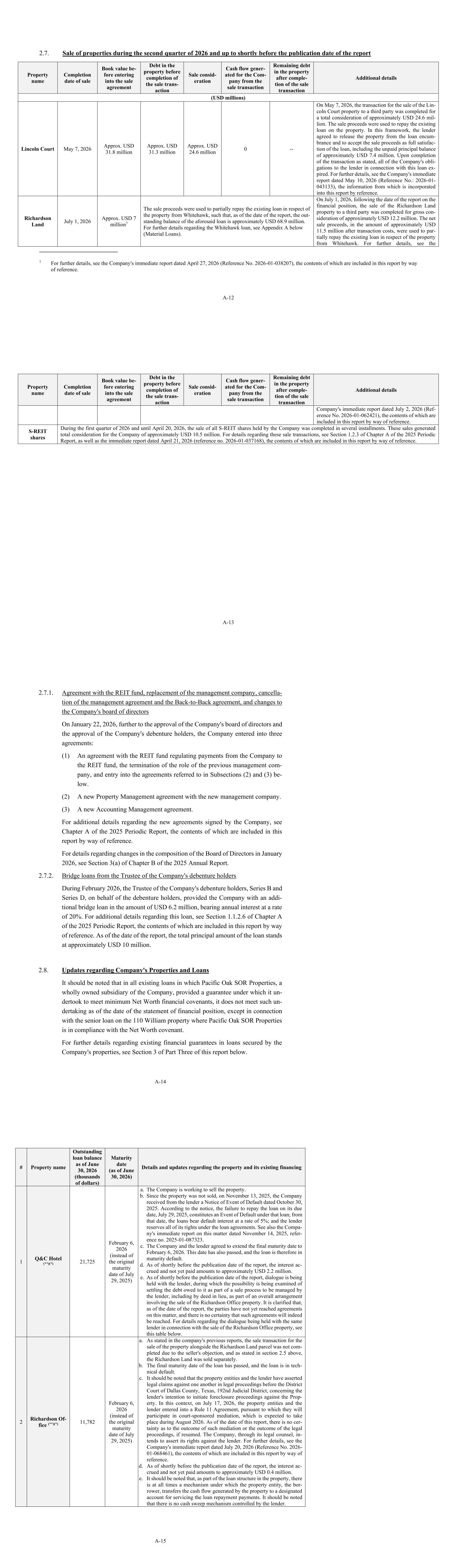
A-12 2.7. Sale of properties during the second quarter of 2026 and up to shortly before the publication date of the report Property name Completion date of sale Book value be- fore entering into the sale agreement Debt in the property before completion of the sale trans- action Sale consid- eration Cash flow gener- ated for the Com- pany from the sale transaction Remaining debt in the property after comple- tion of the sale transaction Additional details (USD millions) Lincoln Court May 7, 2026 Approx. USD 31.8 million Approx. USD 31.3 million Approx. USD 24.6 million 0 -- On May 7, 2026, the transaction for the sale of the Lin- coln Court property to a third party was completed for a total consideration of approximately USD 24.6 mil- lion. The sale proceeds were used to repay the existing loan on the property. In this framework, the lender agreed to release the property from the loan encum- brance and to accept the sale proceeds as full satisfac- tion of the loan, including the unpaid principal balance of approximately USD 7.4 million. Upon completion of the transaction as stated, all of the Company's obli- gations to the lender in connection with this loan ex- pired. For further details, see the Company's immediate report dated May 10, 2026 (Reference No.: 2026-01- 043133), the information from which is incorporated into this report by reference. Richardson Land July 1, 2026 Approx. USD 7 million7 The sale proceeds were used to partially repay the existing loan in respect of the property from Whitehawk, such that, as of the date of the report, the out- standing balance of the aforesaid loan is approximately USD 68.9 million. For further details regarding the Whitehawk loan, see Appendix A below (Material Loans). On July 1, 2026, following the date of the report on the financial position, the sale of the Richardson Land property to a third party was completed for gross con- sideration of approximately USD 12.2 million. The net sale proceeds, in the amount of approximately USD 11.5 million after transaction costs, were used to par- tially repay the existing loan in respect of the property from Whitehawk. For further details, see the 7 For further details, see the Company's immediate report dated April 27, 2026 (Reference No. 2026-01-038207), the contents of which are included in this report by way of reference. A-13 Property name Completion date of sale Book value be- fore entering into the sale agreement Debt in the property before completion of the sale trans- action Sale consid- eration Cash flow gener- ated for the Com- pany from the sale transaction Remaining debt in the property after comple- tion of the sale transaction Additional details Company's immediate report dated July 2, 2026 (Ref- erence No. 2026-01-062421), the contents of which are included in this report by way of reference. S-REIT shares During the first quarter of 2026 and until April 20, 2026, the sale of all S-REIT shares held by the Company was completed in several installments. These sales generated total consideration for the Company of approximately USD 10.5 million. For details regarding these sale transactions, see Section 1.2.3 of Chapter A of the 2025 Periodic Report, as well as the immediate report dated April 21, 2026 (reference no. 2026-01-037168), the contents of which are included in this report by way of reference. A-14 2.7.1. Agreement with the REIT fund, replacement of the management company, cancella- tion of the management agreement and the Back-to-Back agreement, and changes to the Company's board of directors On January 22, 2026, further to the approval of the Company's board of directors and the approval of the Company's debenture holders, the Company entered into three agreements: (1) An agreement with the REIT fund regulating payments from the Company to the REIT fund, the termination of the role of the previous management com- pany, and entry into the agreements referred to in Subsections (2) and (3) be- low. (2) A new Property Management agreement with the new management company. (3) A new Accounting Management agreement. For additional details regarding the new agreements signed by the Company, see Chapter A of the 2025 Periodic Report, the contents of which are included in this report by way of reference. For details regarding changes in the composition of the Board of Directors in January 2026, see Section 3(a) of Chapter B of the 2025 Annual Report. 2.7.2. Bridge loans from the Trustee of the Company's debenture holders During February 2026, the Trustee of the Company's debenture holders, Series B and Series D, on behalf of the debenture holders, provided the Company with an addi- tional bridge loan in the amount of USD 6.2 million, bearing annual interest at a rate of 20%. For additional details regarding this loan, see Section 1.1.2.6 of Chapter A of the 2025 Periodic Report, the contents of which are included in this report by way of reference. As of the date of the report, the total principal amount of the loan stands at approximately USD 10 million. 2.8. Updates regarding Company's Properties and Loans It should be noted that in all existing loans in which Pacific Oak SOR Properties, a wholly owned subsidiary of the Company, provided a guarantee under which it un- dertook to meet minimum Net Worth financial covenants, it does not meet such un- dertaking as of the date of the statement of financial position, except in connection with the senior loan on the 110 William property where Pacific Oak SOR Properties is in compliance with the Net Worth covenant. For further details regarding existing financial guarantees in loans secured by the Company's properties, see Section 3 of Part Three of this report below. A-15 # Property name Outstanding loan balance as of June 30, 2026 (thousands of dollars) Maturity date (as of June 30, 2026) Details and updates regarding the property and its existing financing 1 Q&C Hotel (**)(*) 21,725 February 6, 2026 (instead of the original maturity date of July 29, 2025) a. The Company is working to sell the property. b. Since the property was not sold, on November 13, 2025, the Company received from the lender a Notice of Event of Default dated October 30, 2025. According to the notice, the failure to repay the loan on its due date, July 29, 2025, constitutes an Event of Default under that loan; from that date, the loans bear default interest at a rate of 5%; and the lender reserves all of its rights under the loan agreements. See also the Compa- ny's immediate report on this matter dated November 14, 2025, refer- ence no. 2025-01-087323. c. The Company and the lender agreed to extend the final maturity date to February 6, 2026. This date has also passed, and the loan is therefore in maturity default. d. As of shortly before the publication date of the report, the interest ac- crued and not yet paid amounts to approximately USD 2.2 million. e. As of shortly before the publication date of the report, dialogue is being held with the lender, during which the possibility is being examined of settling the debt owed to it as part of a sale process to be managed by the lender, including by deed in lieu, as part of an overall arrangement involving the sale of the Richardson Office property. It is clarified that, as of the date of the report, the parties have not yet reached agreements on this matter, and there is no certainty that such agreements will indeed be reached. For details regarding the dialogue being held with the same lender in connection with the sale of the Richardson Office property, see this table below. 2 Richardson Of- fice (**)(*) 11,782 February 6, 2026 (instead of the original maturity date of July 29, 2025) a. As stated in the company's previous reports, the sale transaction for the sale of the property alongside the Richardson Land parcel was not com- pleted due to the seller's objection, and as stated in section 2.5 above, the Richardson Land was sold separately. b. The final maturity date of the loan has passed, and the loan is in tech- nical default. c. It should be noted that the property entities and the lender have asserted legal claims against one another in legal proceedings before the District Court of Dallas County, Texas, 192nd Judicial District, concerning the lender's intention to initiate foreclosure proceedings against the Prop- erty. In this context, on July 17, 2026, the property entities and the lender entered into a Rule 11 Agreement, pursuant to which they will participate in court-sponsored mediation, which is expected to take place during August 2026. As of the date of this report, there is no cer- tainty as to the outcome of such mediation or the outcome of the legal proceedings, if resumed. The Company, through its legal counsel, in- tends to assert its rights against the lender. For further details, see the Company's immediate report dated July 20, 2026 (Reference No. 2026- 01-068461), the contents of which are included in this report by way of reference. d. As of shortly before the publication date of the report, the interest ac- crued and not yet paid amounts to approximately USD 0.4 million. e. It should be noted that, as part of the loan structure in the property, there is at all times a mechanism under which the property entity, the bor- rower, transfers the cash flow generated by the property to a designated account for servicing the loan repayment payments. It should be noted that there is no cash sweep mechanism controlled by the lender.

A-16 # Property name Outstanding loan balance as of June 30, 2026 (thousands of dollars) Maturity date (as of June 30, 2026) Details and updates regarding the property and its existing financing 3 Madison Square (^)(*) 20,040 November 30, 2025 a. As stated in the Company's immediate report dated March 31, 2026,8 on March 30, 2026, the court in Arizona accepted, on March 19, 2026, a motion filed by the lender for the appointment of a Receiver, with the purpose of managing and operating the property and, among other things, protecting the lender's rights in connection with the property and the loan, including with respect to the assignment to the lender of all income cash flow generated by the property. In addition, subject to the lender's approval, the Receiver may act to market and sell the prop- erty. b. Further to the aforementioned, as noted in the May 15, 2026 immedi- ate report9, the Receiver announced that an auction will be held to sell the property to the highest bidder on July 22, 2026. As a result, the Company has not received indications of value from the auction pro- cess that would support a valuation different from the Company's cur- rent expected sale price, although there can be no assurance as to the ultimate timing, terms, or proceeds of any sale. In this regard, it should be noted that following the appointment of the Receiver, the property was deconsolidated and the aforementioned loan was derecognized from the Company's balance sheet. c. On May 27, 2026, the Company received notice that the lender with respect to the property is seeking from the court in the State of Arizona a default judgment against the Company's subsidiaries in connection with the property (Pacific Oak/Verus GC Phoenix, LLC and Pacific Oak SOR Properties LLC), on the grounds that no statement of de- fense was filed within the time prescribed by the court. The Company is reviewing the notice with its legal counsel and is considering its course of action in this matter. For more information, see also the Company's immediate report dated May 31, 2026 (Reference No.: 2026-01-051619), the contents of which are included in this report by way of reference. d. During August 2026, the Company was informed that the Receiver has a non-binding offer from a third-party buyer to purchase to the property for an amount of approximately USD 18.5 million. The pro- cess of sale is managed as aforesaid by the Receiver and is subject to the Arizona court's approval, and the Company cannot estimate the certainty of the transaction's completion. As of the date of the report, outstanding cumulative interest totals ap- proximately USD 2.2 million. 4 Eight & Nine Corporate Cen- tre (*) 19,877 February 9, 2027 a. During February 2026, the Company and the lender entered into an agreement to extend the maturity date until February 9, 2027. Within the framework of the agreements with the lender, the lender provided the property entity with a sum of approximately USD 1.2 million for the property's leasing activities (lender reserves for lease-up). The total out- standing loan balance on the property after providing the said sum stands at approximately USD 20.2 million. b. Furthermore, the parties agreed on an update to the financial covenants of the subsidiary (100% owned by the Company) Pacific Oak SOR Prop- erties, LLC, which serves as a guarantor under the loan agreement, 8 Reference: 2026-01-030059, the contents of which are included in this report by way of reference. 9 Reference: 2026-01-045040, the contents of which are included in this report by way of reference. A-17 # Property name Outstanding loan balance as of June 30, 2026 (thousands of dollars) Maturity date (as of June 30, 2026) Details and updates regarding the property and its existing financing whereby the net worth financial covenant was canceled and a liquid as- sets covenant was added, which shall not fall below USD 10 million. It should be noted that a significant tenant in the property, which leases approximately 76 thousand square feet, has vacated the leased premises in June 2026, which decreased the occupancy rate of the property to ap- proximately 70%. In this context, the lender reserves for lease-up is in- tended to support the Company's efforts to lease out the vacant spaces in the property. c. It shall be noted that as part of the property's loan structure, there is, at all times, a quasi-cash sweep mechanism, under which the lender utilizes the cash flow generated from the property for the monthly interest pay- ments required under the loan, and uses 50% of the remaining excess amount for loan principal repayments, while transferring the remaining 50% to the Company. d. For details regarding a non-binding MOU for the refinancing of the ex- isting loan on the property from August 2026 (subsequent to the date of the financial statements), see Section 2.6 above. 5 White Hawk loan secured by land areas in the Park Highlands and Richard- son properties and the 210 West 31st land property (*) (^^) 80,000(f) December 1, 2027 a. Pursuant to the terms of the said loan agreement, the existence of a right to declare the Debentures, Series B and Series D, immediately due and payable, insofar as no waiver, including a temporary waiver, of the said right has been obtained from the debenture holders, even if such right has not been exercised, constitutes grounds for declaring the loan imme- diately due and payable. As a result, the loan bears additional arrears interest at a rate of 3%. b. It should be noted that on April 30, 2026, the Company received notices of default and demand letters in which the lender demands from wholly owned subsidiaries of the Company, Pacific Oak SOR US Properties II, LLC and Pacific Oak SOR Properties, LLC, the immediate repayment of the loan. The Company has referred this matter to its legal advisers and is exam- ining the said letters. The Company is also still maintaining dialogue with the White Hawk lender regarding the continuation of the loan pe- riod. For additional details, see the Company's immediate report dated May 2, 2026, reference no. 2026-01-040463, the contents of which are included in this report by way of reference. c. Subsequently, on May 20, 2026, the Company received notices regard- ing lawsuits filed by the lender in the District Court of Clark County, Nevada, against the property entities holding the Highlands Park lands, seeking declaratory reliefs and orders concerning the breach of the loan agreement and the lender's lien rights. On May 22, 2026, an inter partes hearing was held, during which the court, with the parties' consent, is- sued a temporary injunction prohibiting the creation of liens, the incur- rence of debt in connection with the Highlands Park lands, and any in- terference with the sale transaction, until a hearing scheduled for June 16, 2026. The Company and the property entities are reviewing the lend- er's claims and may dispute them, while working with their US legal counsel and conducting parallel negotiations with the lender. It should be noted that there is no certainty as to the outcomes of the proceedings or the completion of the Highlands Park lands sale transaction under its existing terms. For further details, see the Company's immediate report dated May 24, 2026 (Reference No.: 2026-01-047562), the information of which is incorporated herein by reference. d. On May 28, 2026, the Company received by email additional notices (the "Additional Notices") stating that the lender had filed additional claims A-18 # Property name Outstanding loan balance as of June 30, 2026 (thousands of dollars) Maturity date (as of June 30, 2026) Details and updates regarding the property and its existing financing against the Company's wholly owned subsidiaries (100%) that had pro- vided full financial guarantees in respect of the loan (Pacific Oak SOR Properties, LLC and Pacific Oak SOR US Properties II LLC) (the "Guarantor Entities") in the Supreme Court of the State of New York, County of New York: Commercial Division, seeking remedies whose principal elements are: that the Guarantor Entities pay damages to the lender for losses incurred by it as a result of the breach of the loan agree- ment, in amounts to be determined in the legal proceeding; that the bor- rowers bear the lender's legal costs; and (c) the award of additional dam- ages to the lender at the court's discretion. The Additional Notices also include a summons from the aforesaid court, pursuant to which the Guar- antor Entities are required to submit their response to the claim within 20 days of service thereof, failing which the aforesaid court may enter judgment in favor of the lender. The Company and the Guarantor Entities are reviewing the lender's claims and may dispute them, while working with their U.S. legal coun- sel and conducting parallel negotiations with the lender. It should be noted that there is no certainty regarding the outcome of the proceeding or the completion of the Highlands Park land sale transaction on its cur- rent terms. For further details, see the Company's immediate report pub- lished May 31, 2026 (Reference No.: 2026-01-051621), the contents of which are included in this report by way of reference. e. It should be noted that, as of the date of this report, the Company has not been informed of any change in the timetable of the Park Highlands land sale transaction, and it is proceeding as usual. In this regard, Whitehawk informed the Company that the purchaser deposited with it the monthly deferral fees that the purchaser is required to pay under the purchase agreement, and these were used for the monthly interest payments on the loan. f. Subsequent to the date of the financial statements, the Company com- pleted the sale of an undeveloped land plot of approximately 25.4 acres located in Richardson, Texas (the "Richardson Land"). For further de- tails regarding the sale, see Section 2.6 above. 6 Bank of Amer- ica Loan secured by Park Centre, 1180 Raymond, The Marq, and Oakland City Center (*) 152,636 September 1, 2026 Further to what was stated in the Company's immediate report dated Feb- ruary 17, 2026, reference no. 2026-01-015474, the Company continues its dialogue with the lender for the purpose of entering into a forbearance agreement. Under this agreement, the lender would grant a Forbearance period until August 31, 2026, during which, subject to compliance with the terms of the agreement as set out below, the lender will not exercise its rights in respect of the Notice of Default of the loan and will not collect the required monthly principal and interest payments under the loan agree- ment. It is clarified that the memorandum of understanding is non-binding and that the lender reserves all of its rights and claims in connection with the loan agreement. During the Forbearance period stated above, the Com- pany and the property entities will be required to comply with the follow- ing conditions: a. Upon entering into the Forbearance agreement, the Company will be required to transfer the net cash flow generated by the properties to a designated deposit account, a Cash Sweep mechanism. Due to the said contacts, as of shortly before the publication date of the report, a Cash Sweep mechanism is in effect in the properties, and it will continue to remain in effect until the end of the Forbearance period. b. A Cash Trap mechanism will be activated in all of the properties. A-19 # Property name Outstanding loan balance as of June 30, 2026 (thousands of dollars) Maturity date (as of June 30, 2026) Details and updates regarding the property and its existing financing c. The Company will be required to meet milestones for the marketing and sale of all the properties, in coordination with and with the consent of the lender, so that all four properties will be sold by January 31, 2027. d. Failure to meet the milestones for the sale of the properties will consti- tute a breach of the terms of the Forbearance agreement. It should be noted that entering into such an agreement is also expected to regulate the Company's failure to make loan payments, principal and inter- est, and the non-compliance by Pacific Oak SOR Properties, LLC, a wholly owned subsidiary of the Company serving as guarantor under the loan agreement, with the net worth financial covenant10 to which it com- mitted as guarantor under the terms of the loan agreement. - In this context, as part of the dialogue for entering into the Forbearance agreement described above, as of the publication date of the report, the Company and the lender are acting on the understanding that the said Cash Sweep mechanism has already been activated. - It should be noted that the property entities have not paid the monthly interest payments in respect of the loan since September 2025, and as of shortly before the publication date of the report, the interest accrued and not yet paid amounts to approximately USD 14.5 million. - It should further be noted that, concurrently with the dialogue with the lender described above, the Company is working to market and sell the four properties pledged in favor of said loan. It is clarified that there is no certainty that the negotiations described above will mature into a binding forbearance agreement. 7 Loans in the PORT Proper- ties portfolio (*) 216,000 August 2027 For details of the existing property loan as of around the date of the release of the report, see the above Section 2.3 as well as the below Appendix A (Material Loans). 8 110 William (*) Senior loan: 305,342 July 5, 2026 On July 28, 2026, subsequent to the date of the report, the property entity received a notice of default from the lenders under the senior loan and the mezzanine loan in respect of the property, stating that the failure to repay both loans on their due date (July 6, 2026) constitutes an Event of De- fault, and that the lenders reserve their rights under the loan agreements. For further details regarding the property and its financing, see Section 2.4 above and Section 1.1.2.3 of Part A of the 2025 Periodic Report. Mezzanine loan: 24,000 (*) Non-recourse loans. (**) The loan agreements for the Q&C Hotel and Richardson Office Portfolio properties contain a Cross Default provision as well as Cross Collateral between the two properties, such that an event of default under one loan will constitute an event of default under the other loan as well. (^) Under the loan agreement for the Madison Square property, Pacific Oak SOR US Properties LLC (a 100%- owned subsidiary of the Company) provided a full financial guarantee (in the amount of 100% of the loan principal) for the full obligations of the borrower entity. It should be noted that until October 7, 2021, such guarantee was provided by Pacific Oak SOR US Properties II LLC (another 100%-owned subsidiary of the 10 The net worth required from Pacific Oak SOR US Properties, LLC, in accordance with the terms of the loan agreement is approximately USD 250 million, and as of March 31, 2026, it is not in compliance with said covenant.

A-20 Company), and from such month, as part of an update to the loan terms, the said guarantee was assigned to Pacific Oak SOR US Properties LLC. (^^) The loan agreement from the lender White Hawk is a loan under which Pacific Oak SOR Properties LLC and Pacific Oak SOR Properties II LLC provided a full financial guarantee (in the amount of 100% of the loan principal) for the full obligations of the borrowers entity pursuant to the loan. The Company's estimates regarding property sale transactions, completion of dialogue with lenders for the arrangement of the loans and/or refinancing thereof, and possible implications of the sale transactions and dialogue with lenders described in the table above constitute forward-looking information as defined in the Securities Law, 5728-1968. This information is based on dialogue that the Company is conducting with potential purchasers, dialogue with existing lenders and potential lenders, the Company's under- standing of the terms of the loan agreements, and the Company's past experience. This information may not materialize at all or may materialize differently from what is stated above if the contacts and negotia- tions described above do not mature into binding sale agreements and sale transactions, if arrangements with lenders or refinancing agreements are not completed, or if it turns out that the final interpretations of the loan agreements differ from the Company's current understanding thereof, as applicable, due to adverse changes in the markets and areas of activity in which the properties are located and due to the realization of the risk factors detailed in Section 1.18 of Chapter A of the 2025 Periodic Report. 2.9. Bridge loans from the previous management company Further to the bridge loans provided to the Company by the previous management company through the Company's sole shareholder, the Partnership: A. On January 29, 2026, the Company's sole shareholder informed the Company that it had received a notice of default from the previous management company, POCA, according to which non-payment of interest constitutes grounds for de- claring the bridge loan immediately due and payable. At the same time, during January 2026, legal disputes were raised by counsel for the REIT fund in the United States concerning the absence of documentation for the "back-to-back" component between the partnership and the Company, as well as inconsisten- cies in the repayment dates and loan terms compared with previous approvals and reports. Further thereto, on March 27, 2026, the Company received, for the PORT en- tities, a letter from POCA's counsel notifying of the realization of the pledge over the PORT shares and demanding that all proceeds deriving therefrom, in- cluding dividends, realizations, liquidation proceeds and the like, be transferred to POCA. For additional details regarding the disputes, the loan terms, and the implica- tions of realization of the collateral, see Section 1.1.2.9 of Chapter A of the 2025 Periodic Report, the information contained therein being incorporated by reference. A-21 B. On April 21, 2026, POCA sent an additional demand for the registration and transfer of 4,431,934 PORT shares under its name. In this demand, addressed to the Company and to the PORT entities, POCA demanded that the transfer of the shares not be delayed and that, until completion of the registration, all div- idends and proceeds from the shares be transferred to it, or held in trust for it. In addition, POCA demanded that any agreement or payment relating to the shares pledged to it, or any additional allocation of shares in PORT, be subject to POCA's approval. For additional details, see the Company's immediate re- port dated April 23, 2026 (reference no. 2026-01-037682), the contents of which are included in this report by way of reference. Further thereto, on April 29, 2026, the Company's counsel received an addi- tional letter from counsel for the Company's previous management company, POCA, concerning a demand for distributions that may arise from refinancing of the PORT properties and a reservation of rights. For additional details, see the Company's immediate report dated April 29, 2026 (reference no. 2026-01- 039690), the contents of which are included in this report by way of reference. C. On June 12, 202611, the Company received a letter from the Company's former management company (POCA), in which the former management company al- leged that the trustee for the holders of the debentures, the holders of the de- bentures and the REIT had purportedly breached the terms of the Standstill Agreement entered into by the parties in August 2025. Accordingly, the former management company claimed to be exercising a purported right to terminate the Standstill Agreement upon 20 days' prior notice. D. On July 8, 202612, the Company received a letter from the Company's former management company (POCA), demanding that the Company and its investee companies refrain from creating any liens over the shares of PORT that, in its view, would subordinate or otherwise impair the liens registered in its favor. The Company (and its investee companies) via legal counsel in the United States, is involved in discussions with POCA and its representatives regarding the demands and claims raised by POCA as aforesaid. The Company and its U.S. legal counsel are examining the merits of such claims and the basis therefor, as well as the full exercise of the Company's legal rights in connection therewith. 11 For details, see the Company's immediate report dated June 15, 2026 (Reference No. 2026-01-056177). 12 For details, see the Company's immediate report dated July 8, 2026 (Reference No. 2026-01-065123). A-22 2.10. Resolutions adopted by holders of the Debentures (Series B and Series D) of the Company The following is a summary of the main actions and the decisions that were carried out and made in the framework of the aforementioned negotiations: A. As stated in Section 1.1.3 of Chapter A of the 2025 Periodic Report, the details of which are incorporated into this report by reference, from December 2025 and up to shortly before the publication date of the 2025 Periodic Report, dis- cussions have been taking place between representatives of the Company and the controlling shareholder and the trustee for the Debentures, Series B and Series D, and his representatives. For details regarding resolutions of assem- blies of Company's debenture holders up to April 16, the publication date of the Company's 2025 Periodic Report, see Section 1.1.3 of Chapter A of the Company's 2025 Periodic Report, the contents of which are included in this report by way of reference. B. The following are the main additional resolutions of meetings of the holders of the Company's debentures adopted up to shortly before the publication date of this report: 1. On April 27, 2026, assemblies of Series B and Series D debenture holders approved a resolution to approve the proposed debt arrangement, as pub- lished on April 17, 2026, and to authorize the Trustee to perform all ac- tions required for its implementation, including the signing of an amended deed of trust. For additional details, see the reports published by the Trustee on April 27 and 28, 2026, reference nos. 2026-10-038656, 2026-10-038657, and 2026-10-038974, the contents of which are in- cluded in this report by way of reference. 2. On April 28, 2026, assemblies of Series B and Series D debenture hold- ers, in an aggregate count, approved a resolution to ratify the Company's entry into a loan agreement with lender consortium led by Klirmark Op- portunity Fund IV, LP, on the basis of the memorandum of understanding dated February 17, 2026, while updating the terms of the memorandum of understanding so that the amount excluded from the distribution re- strictions in PORT will be up to USD 4 million, instead of USD 8 million. For details, see the reports published by the Trustee on April 28, 2026, reference nos. 2026-10-039027 and 2026-10-039030, the contents of which are included in this report by way of reference. 3. On May 3, 2026, the holders of the Company's debentures (Series B and Series D) approved the selection of Mr. Yitzhak Lax as a candidate for appointment as a director of the Company. For further details, see the A-23 Company's immediate report dated May 3, 2026 (Reference Nos. 2026- 10-040725, 2026-10-040722), the information therein is incorporated in this report by reference. 4. On May 11, 2026, and further to the resolutions of the debenture holders' meeting dated March 17, 2026, the Trustee for the debentures announced an additional deferral of the principal and interest payment dates for the Debentures (Series B) to July 1, 2026. For further details, see the Com- pany's immediate report dated May 11, 2026 (Reference No. 2026-10- 043401), the information therein is incorporated in this report by refer- ence. 5. On May 11, 2026, and further to the resolutions of the debenture holders' meeting dated April 16, 2026, the Trustee for the debentures announced that the payment date for the interest on the Debentures (Series D) was deferred to July 1, 2026, and the record date was deferred to June 19, 2026. For further details, see the Company's immediate report dated May 11, 2026 (Reference No. 2026-10-043402), the information therein is in- corporated in this report by reference. 6. On June 1, 2026, the holders of the debentures (Series B and Series D) approved the following resolutions: (a) to instruct the trustee to apply to the Court for approval of the Debt Arrangement, while consenting to the appointment of an arrangement administrator who would also serve as claims administrator and be granted investigatory powers, provided that such administrator would not be granted powers to intervene in the man- agement of the Company's business; (b) to instruct the trustee to approve the Company's advancement of the sale of the Highlands Park Village II land and to undertake not to impede its consummation; and (c) to approve that no liens would be created in favor of the trustee over assets pledged in favor of the WhiteHawk lender until its loan has been repaid in full. For further details, see the trustee's immediate reports dated June 1, 2026 (Reference Nos. 2026-10-051998 and 2026-10-051999), the contents of which are included in this report by way of reference. 7. On June 11, 2026, the holders of the debentures (Series B) approved the postponement of the principal and interest payment date from July 1, 2026 to August 31, 2026, and authorized the trustee to postpone the date by an additional month, if necessary. For further details, see the trustee's immediate report dated June 11, 2026 (Reference No. 2026-10-055618), the contents of which are included in this report by way of reference.
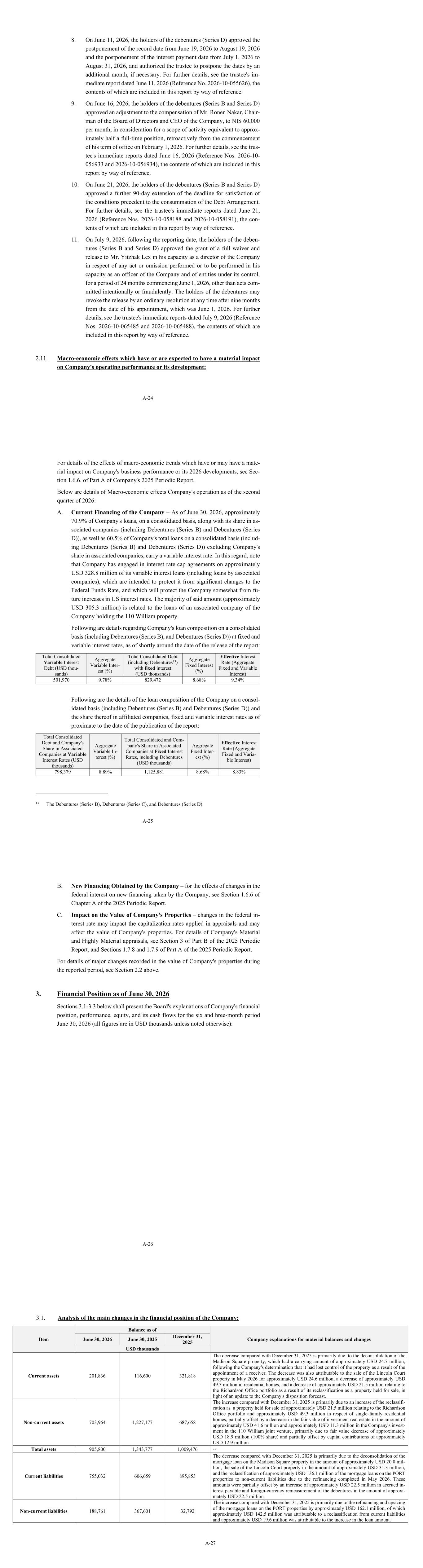
A-24 8. On June 11, 2026, the holders of the debentures (Series D) approved the postponement of the record date from June 19, 2026 to August 19, 2026 and the postponement of the interest payment date from July 1, 2026 to August 31, 2026, and authorized the trustee to postpone the dates by an additional month, if necessary. For further details, see the trustee's im- mediate report dated June 11, 2026 (Reference No. 2026-10-055626), the contents of which are included in this report by way of reference. 9. On June 16, 2026, the holders of the debentures (Series B and Series D) approved an adjustment to the compensation of Mr. Ronen Nakar, Chair- man of the Board of Directors and CEO of the Company, to NIS 60,000 per month, in consideration for a scope of activity equivalent to approx- imately half a full-time position, retroactively from the commencement of his term of office on February 1, 2026. For further details, see the trus- tee's immediate reports dated June 16, 2026 (Reference Nos. 2026-10- 056933 and 2026-10-056934), the contents of which are included in this report by way of reference. 10. On June 21, 2026, the holders of the debentures (Series B and Series D) approved a further 90-day extension of the deadline for satisfaction of the conditions precedent to the consummation of the Debt Arrangement. For further details, see the trustee's immediate reports dated June 21, 2026 (Reference Nos. 2026-10-058188 and 2026-10-058191), the con- tents of which are included in this report by way of reference. 11. On July 9, 2026, following the reporting date, the holders of the deben- tures (Series B and Series D) approved the grant of a full waiver and release to Mr. Yitzhak Lex in his capacity as a director of the Company in respect of any act or omission performed or to be performed in his capacity as an officer of the Company and of entities under its control, for a period of 24 months commencing June 1, 2026, other than acts com- mitted intentionally or fraudulently. The holders of the debentures may revoke the release by an ordinary resolution at any time after nine months from the date of his appointment, which was June 1, 2026. For further details, see the trustee's immediate reports dated July 9, 2026 (Reference Nos. 2026-10-065485 and 2026-10-065488), the contents of which are included in this report by way of reference. 2.11. Macro-economic effects which have or are expected to have a material impact on Company's operating performance or its development: A-25 For details of the effects of macro-economic trends which have or may have a mate- rial impact on Company's business performance or its 2026 developments, see Sec- tion 1.6.6. of Part A of Company's 2025 Periodic Report. Below are details of Macro-economic effects Company's operation as of the second quarter of 2026: A. Current Financing of the Company – As of June 30, 2026, approximately 70.9% of Company's loans, on a consolidated basis, along with its share in as- sociated companies (including Debentures (Series B) and Debentures (Series D)), as well as 60.5% of Company's total loans on a consolidated basis (includ- ing Debentures (Series B) and Debentures (Series D)) excluding Company's share in associated companies, carry a variable interest rate. In this regard, note that Company has engaged in interest rate cap agreements on approximately USD 328.8 million of its variable interest loans (including loans by associated companies), which are intended to protect it from significant changes to the Federal Funds Rate, and which will protect the Company somewhat from fu- ture increases in US interest rates. The majority of said amount (approximately USD 305.3 million) is related to the loans of an associated company of the Company holding the 110 William property. Following are details regarding Company's loan composition on a consolidated basis (including Debentures (Series B), and Debentures (Series D)) at fixed and variable interest rates, as of shortly around the date of the release of the report: Total Consolidated Variable Interest Debt (USD thou- sands) Aggregate Variable Inter- est (%) Total Consolidated Debt (including Debentures13) with fixed interest (USD thousands) Aggregate Fixed Interest (%) Effective Interest Rate (Aggregate Fixed and Variable Interest) 501,970 9.78% 829,472 8.68% 9.34% Following are the details of the loan composition of the Company on a consol- idated basis (including Debentures (Series B) and Debentures (Series D)) and the share thereof in affiliated companies, fixed and variable interest rates as of proximate to the date of the publication of the report: Total Consolidated Debt and Company's Share in Associated Companies at Variable Interest Rates (USD thousands) Aggregate Variable In- terest (%) Total Consolidated and Com- pany's Share in Associated Companies at Fixed Interest Rates, including Debentures (USD thousands) Aggregate Fixed Inter- est (%) Effective Interest Rate (Aggregate Fixed and Varia- ble Interest) 798,379 8.89% 1,125,881 8.68% 8.83% 13 The Debentures (Series B), Debentures (Series C), and Debentures (Series D). A-26 B. New Financing Obtained by the Company – for the effects of changes in the federal interest on new financing taken by the Company, see Section 1.6.6 of Chapter A of the 2025 Periodic Report. C. Impact on the Value of Company's Properties – changes in the federal in- terest rate may impact the capitalization rates applied in appraisals and may affect the value of Company's properties. For details of Company's Material and Highly Material appraisals, see Section 3 of Part B of the 2025 Periodic Report, and Sections 1.7.8 and 1.7.9 of Part A of the 2025 Periodic Report. For details of major changes recorded in the value of Company's properties during the reported period, see Section 2.2 above. 3. Financial Position as of June 30, 2026 Sections 3.1-3.3 below shall present the Board's explanations of Company's financial position, performance, equity, and its cash flows for the six and hree-month period June 30, 2026 (all figures are in USD thousands unless noted otherwise): A-27 3.1. Analysis of the main changes in the financial position of the Company: Item Balance as of Company explanations for material balances and changes June 30, 2026 June 30, 2025 December 31, 2025 USD thousands Current assets 201,836 116,600 321,818 The decrease compared with December 31, 2025 is primarily due to the deconsolidation of the Madison Square property, which had a carrying amount of approximately USD 24.7 million, following the Company's determination that it had lost control of the property as a result of the appointment of a receiver. The decrease was also attributable to the sale of the Lincoln Court property in May 2026 for approximately USD 24.6 million, a decrease of approximately USD 49.3 million in residential homes, and a decrease of approximately USD 21.5 million relating to the Richardson Office portfolio as a result of its reclassification as a property held for sale, in light of an update to the Company's disposition forecast. Non-current assets 703,964 1,227,177 687,658 The increase compared with December 31, 2025 is primarily due to an increase of the reclassifi- cation as a property held for sale of approximately USD 21.5 million relating to the Richardson Office portfolio and approximately USD 49.3 million in respect of single-family residential homes, partially offset by a decrease in the fair value of investment real estate in the amount of approximately USD 41.6 million and approximately USD 11.3 million in the Company's invest- ment in the 110 William joint venture, primarily due to fair value decrease of approximately USD 18.9 million (100% share) and partially offset by capital contributions of approximately USD 12.9 million Total assets 905,800 1,343,777 1,009,476 -- Current liabilities 755,032 606,659 895,853 The decrease compared with December 31, 2025 is primarily due to the deconsolidation of the mortgage loan on the Madison Square property in the amount of approximately USD 20.0 mil- lion, the sale of the Lincoln Court property in the amount of approximately USD 31.3 million, and the reclassification of approximately USD 136.1 million of the mortgage loans on the PORT properties to non-current liabilities due to the refinancing completed in May 2026. These amounts were partially offset by an increase of approximately USD 22.5 million in accrued in- terest payable and foreign-currency remeasurement of the debentures in the amount of approxi- mately USD 22.5 million. Non-current liabilities 188,761 367,601 32,792 The increase compared with December 31, 2025 is primarily due to the refinancing and upsizing of the mortgage loans on the PORT properties by approximately USD 162.1 million, of which approximately USD 142.5 million was attributable to a reclassification from current liabilities and approximately USD 19.6 million was attributable to the increase in the loan amount.
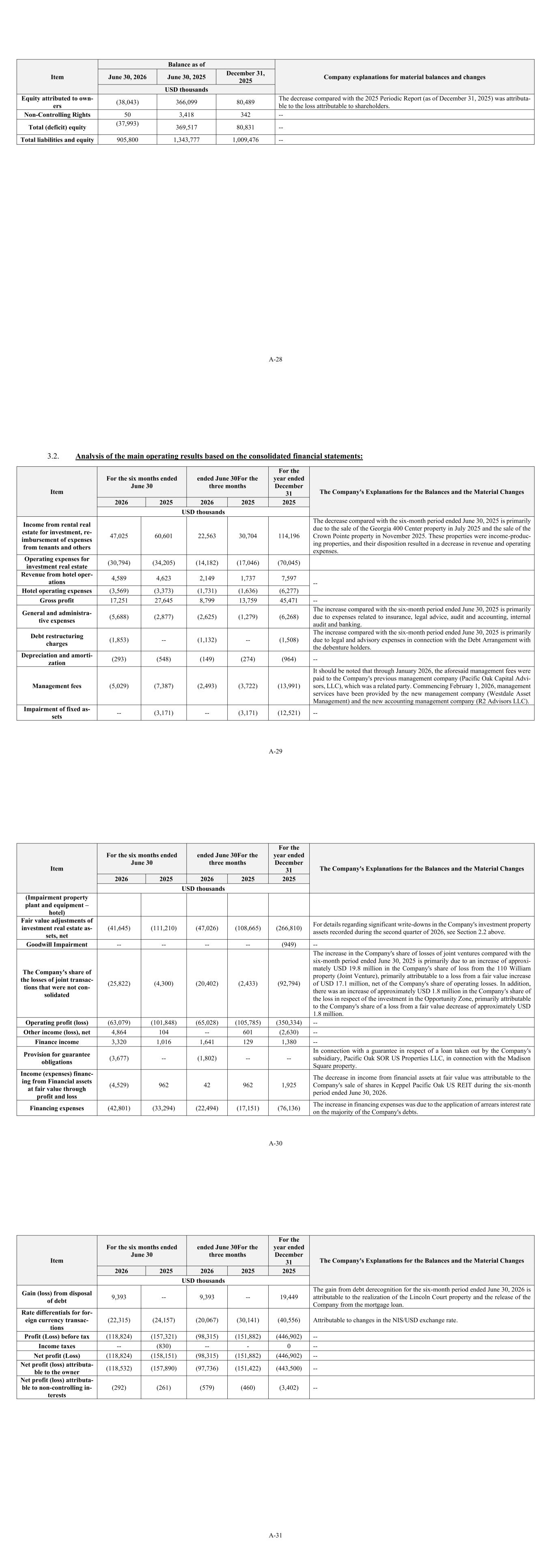
A-28 Item Balance as of Company explanations for material balances and changes June 30, 2026 June 30, 2025 December 31, 2025 USD thousands Equity attributed to own- ers (38,043) 366,099 80,489 The decrease compared with the 2025 Periodic Report (as of December 31, 2025) was attributa- ble to the loss attributable to shareholders. Non-Controlling Rights 50 3,418 342 -- Total (deficit) equity (37,993) 369,517 80,831 -- Total liabilities and equity 905,800 1,343,777 1,009,476 -- A-29 3.2. Analysis of the main operating results based on the consolidated financial statements: Item For the six months ended June 30 ended June 30For the three months For the year ended December 31 The Company's Explanations for the Balances and the Material Changes 2026 2025 2026 2025 2025 USD thousands Income from rental real estate for investment, re- imbursement of expenses from tenants and others 47,025 60,601 22,563 30,704 114,196 The decrease compared with the six-month period ended June 30, 2025 is primarily due to the sale of the Georgia 400 Center property in July 2025 and the sale of the Crown Pointe property in November 2025. These properties were income-produc- ing properties, and their disposition resulted in a decrease in revenue and operating expenses. Operating expenses for investment real estate (30,794) (34,205) (14,182) (17,046) (70,045) Revenue from hotel oper- ations 4,589 4,623 2,149 1,737 7,597 -- Hotel operating expenses (3,569) (3,373) (1,731) (1,636) (6,277) Gross profit 17,251 27,645 8,799 13,759 45,471 -- General and administra- tive expenses (5,688) (2,877) (2,625) (1,279) (6,268) The increase compared with the six-month period ended June 30, 2025 is primarily due to expenses related to insurance, legal advice, audit and accounting, internal audit and banking. Debt restructuring charges (1,853) -- (1,132) -- (1,508) The increase compared with the six-month period ended June 30, 2025 is primarily due to legal and advisory expenses in connection with the Debt Arrangement with the debenture holders. Depreciation and amorti- zation (293) (548) (149) (274) (964) -- Management fees (5,029) (7,387) (2,493) (3,722) (13,991) It should be noted that through January 2026, the aforesaid management fees were paid to the Company's previous management company (Pacific Oak Capital Advi- sors, LLC), which was a related party. Commencing February 1, 2026, management services have been provided by the new management company (Westdale Asset Management) and the new accounting management company (R2 Advisors LLC). Impairment of fixed as- sets -- (3,171) -- (3,171) (12,521) -- A-30 Item For the six months ended June 30 ended June 30For the three months For the year ended December 31 The Company's Explanations for the Balances and the Material Changes 2026 2025 2026 2025 2025 USD thousands (Impairment property plant and equipment – hotel) Fair value adjustments of investment real estate as- sets, net (41,645) (111,210) (47,026) (108,665) (266,810) For details regarding significant write-downs in the Company's investment property assets recorded during the second quarter of 2026, see Section 2.2 above. Goodwill Impairment -- -- -- -- (949) -- The Company's share of the losses of joint transac- tions that were not con- solidated (25,822) (4,300) (20,402) (2,433) (92,794) The increase in the Company's share of losses of joint ventures compared with the six-month period ended June 30, 2025 is primarily due to an increase of approxi- mately USD 19.8 million in the Company's share of loss from the 110 William property (Joint Venture), primarily attributable to a loss from a fair value increase of USD 17.1 million, net of the Company's share of operating losses. In addition, there was an increase of approximately USD 1.8 million in the Company's share of the loss in respect of the investment in the Opportunity Zone, primarily attributable to the Company's share of a loss from a fair value decrease of approximately USD 1.8 million. Operating profit (loss) (63,079) (101,848) (65,028) (105,785) (350,334) -- Other income (loss), net 4,864 104 -- 601 (2,630) -- Finance income 3,320 1,016 1,641 129 1,380 -- Provision for guarantee obligations (3,677) -- (1,802) -- -- In connection with a guarantee in respect of a loan taken out by the Company's subsidiary, Pacific Oak SOR US Properties LLC, in connection with the Madison Square property. Income (expenses) financ- ing from Financial assets at fair value through profit and loss (4,529) 962 42 962 1,925 The decrease in income from financial assets at fair value was attributable to the Company's sale of shares in Keppel Pacific Oak US REIT during the six-month period ended June 30, 2026. Financing expenses (42,801) (33,294) (22,494) (17,151) (76,136) The increase in financing expenses was due to the application of arrears interest rate on the majority of the Company's debts. A-31 Item For the six months ended June 30 ended June 30For the three months For the year ended December 31 The Company's Explanations for the Balances and the Material Changes 2026 2025 2026 2025 2025 USD thousands Gain (loss) from disposal of debt 9,393 -- 9,393 -- 19,449 The gain from debt derecognition for the six-month period ended June 30, 2026 is attributable to the realization of the Lincoln Court property and the release of the Company from the mortgage loan. Rate differentials for for- eign currency transac- tions (22,315) (24,157) (20,067) (30,141) (40,556) Attributable to changes in the NIS/USD exchange rate. Profit (Loss) before tax (118,824) (157,321) (98,315) (151,882) (446,902) -- Income taxes -- (830) -- - 0 -- Net profit (Loss) (118,824) (158,151) (98,315) (151,882) (446,902) -- Net profit (loss) attributa- ble to the owner (118,532) (157,890) (97,736) (151,422) (443,500) -- Net profit (loss) attributa- ble to non-controlling in- terests (292) (261) (579) (460) (3,402) --
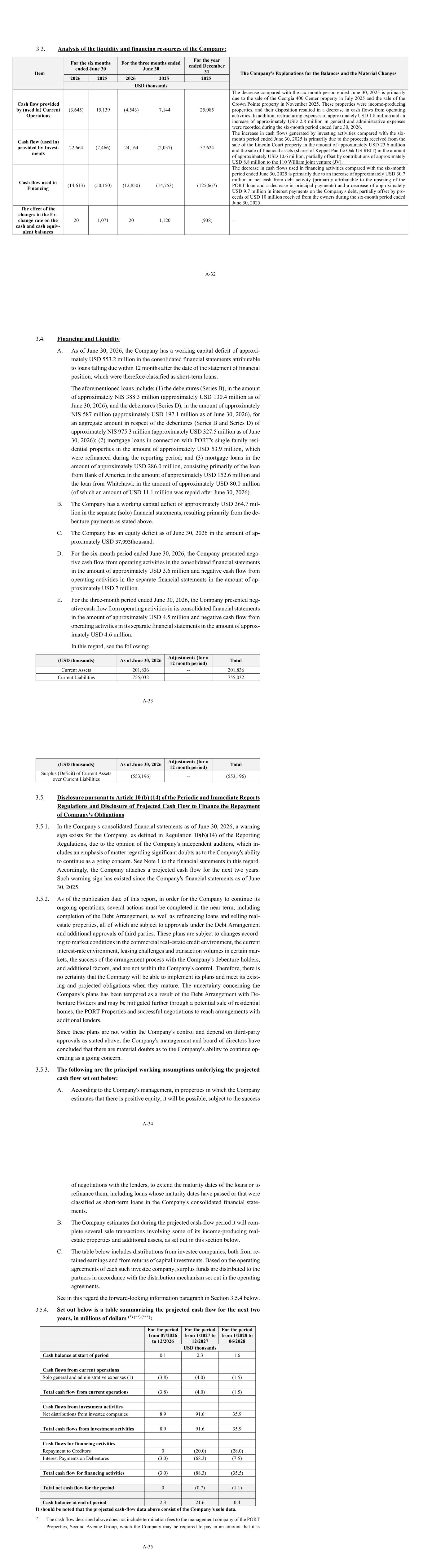
A-32 3.3. Analysis of the liquidity and financing resources of the Company: Item For the six months ended June 30 For the three months ended June 30 For the year ended December 31 The Company's Explanations for the Balances and the Material Changes 2026 2025 2026 2025 2025 USD thousands Cash flow provided by (used in) Current Operations (3,645) 15,139 (4,543) 7,144 25,085 The decrease compared with the six-month period ended June 30, 2025 is primarily due to the sale of the Georgia 400 Center property in July 2025 and the sale of the Crown Pointe property in November 2025. These properties were income-producing properties, and their disposition resulted in a decrease in cash flows from operating activities. In addition, restructuring expenses of approximately USD 1.8 million and an increase of approximately USD 2.8 million in general and administrative expenses were recorded during the six-month period ended June 30, 2026. Cash flow (used in) provided by Invest- ments 22,664 (7,466) 24,164 (2,037) 57,624 The increase in cash flows generated by investing activities compared with the six- month period ended June 30, 2025 is primarily due to the proceeds received from the sale of the Lincoln Court property in the amount of approximately USD 23.6 million and the sale of financial assets (shares of Keppel Pacific Oak US REIT) in the amount of approximately USD 10.6 million, partially offset by contributions of approximately USD 8.8 million to the 110 William joint venture (JV). Cash flow used in Financing (14,613) (50,150) (12,850) (14,753) (125,667) The decrease in cash flows used in financing activities compared with the six-month period ended June 30, 2025 is primarily due to an increase of approximately USD 30.7 million in net cash from debt activity (primarily attributable to the upsizing of the PORT loan and a decrease in principal payments) and a decrease of approximately USD 9.7 million in interest payments on the Company's debt, partially offset by pro- ceeds of USD 10 million received from the owners during the six-month period ended June 30, 2025. The effect of the changes in the Ex- change rate on the cash and cash equiv- alent balances 20 1,071 20 1,120 (938) -- A-33 3.4. Financing and Liquidity A. As of June 30, 2026, the Company has a working capital deficit of approxi- mately USD 553.2 million in the consolidated financial statements attributable to loans falling due within 12 months after the date of the statement of financial position, which were therefore classified as short-term loans. The aforementioned loans include: (1) the debentures (Series B), in the amount of approximately NIS 388.3 million (approximately USD 130.4 million as of June 30, 2026), and the debentures (Series D), in the amount of approximately NIS 587 million (approximately USD 197.1 million as of June 30, 2026), for an aggregate amount in respect of the debentures (Series B and Series D) of approximately NIS 975.3 million (approximately USD 327.5 million as of June 30, 2026); (2) mortgage loans in connection with PORT's single-family resi- dential properties in the amount of approximately USD 53.9 million, which were refinanced during the reporting period; and (3) mortgage loans in the amount of approximately USD 286.0 million, consisting primarily of the loan from Bank of America in the amount of approximately USD 152.6 million and the loan from Whitehawk in the amount of approximately USD 80.0 million (of which an amount of USD 11.1 million was repaid after June 30, 2026). B. The Company has a working capital deficit of approximately USD 364.7 mil- lion in the separate (solo) financial statements, resulting primarily from the de- benture payments as stated above. C. The Company has an equity deficit as of June 30, 2026 in the amount of ap- proximately USD 37,993thousand. D. For the six-month period ended June 30, 2026, the Company presented nega- tive cash flow from operating activities in the consolidated financial statements in the amount of approximately USD 3.6 million and negative cash flow from operating activities in the separate financial statements in the amount of ap- proximately USD 7 million. E. For the three-month period ended June 30, 2026, the Company presented neg- ative cash flow from operating activities in its consolidated financial statements in the amount of approximately USD 4.5 million and negative cash flow from operating activities in its separate financial statements in the amount of approx- imately USD 4.6 million. In this regard, see the following: (USD thousands) As of June 30, 2026 Adjustments (for a 12 month period) Total Current Assets 201,836 -- 201,836 Current Liabilities 755,032 -- 755,032 A-34 (USD thousands) As of June 30, 2026 Adjustments (for a 12 month period) Total Surplus (Deficit) of Current Assets over Current Liabilities (553,196) -- (553,196) 3.5. Disclosure pursuant to Article 10 (b) (14) of the Periodic and Immediate Reports Regulations and Disclosure of Projected Cash Flow to Finance the Repayment of Company's Obligations 3.5.1. In the Company's consolidated financial statements as of June 30, 2026, a warning sign exists for the Company, as defined in Regulation 10(b)(14) of the Reporting Regulations, due to the opinion of the Company's independent auditors, which in- cludes an emphasis of matter regarding significant doubts as to the Company's ability to continue as a going concern. See Note 1 to the financial statements in this regard. Accordingly, the Company attaches a projected cash flow for the next two years. Such warning sign has existed since the Company's financial statements as of June 30, 2025. 3.5.2. As of the publication date of this report, in order for the Company to continue its ongoing operations, several actions must be completed in the near term, including completion of the Debt Arrangement, as well as refinancing loans and selling real- estate properties, all of which are subject to approvals under the Debt Arrangement and additional approvals of third parties. These plans are subject to changes accord- ing to market conditions in the commercial real-estate credit environment, the current interest-rate environment, leasing challenges and transaction volumes in certain mar- kets, the success of the arrangement process with the Company's debenture holders, and additional factors, and are not within the Company's control. Therefore, there is no certainty that the Company will be able to implement its plans and meet its exist- ing and projected obligations when they mature. The uncertainty concerning the Company's plans has been tempered as a result of the Debt Arrangement with De- benture Holders and may be mitigated further through a potential sale of residential homes, the PORT Properties and successful negotiations to reach arrangements with additional lenders. Since these plans are not within the Company's control and depend on third-party approvals as stated above, the Company's management and board of directors have concluded that there are material doubts as to the Company's ability to continue op- erating as a going concern. 3.5.3. The following are the principal working assumptions underlying the projected cash flow set out below: A. According to the Company's management, in properties in which the Company estimates that there is positive equity, it will be possible, subject to the success A-35 of negotiations with the lenders, to extend the maturity dates of the loans or to refinance them, including loans whose maturity dates have passed or that were classified as short-term loans in the Company's consolidated financial state- ments. B. The Company estimates that during the projected cash-flow period it will com- plete several sale transactions involving some of its income-producing real- estate properties and additional assets, as set out in this section below. C. The table below includes distributions from investee companies, both from re- tained earnings and from returns of capital investments. Based on the operating agreements of each such investee company, surplus funds are distributed to the partners in accordance with the distribution mechanism set out in the operating agreements. See in this regard the forward-looking information paragraph in Section 3.5.4 below. 3.5.4. Set out below is a table summarizing the projected cash flow for the next two years, in millions of dollars (*) (**) (***): For the period from 07/2026 to 12/2026 For the period from 1/2027 to 12/2027 For the period from 1/2028 to 06/2028 USD thousands Cash balance at start of period 0.1 2.3 1.6 Cash flows from current operations Solo general and administrative expenses (1) (3.8) (4.0) (1.5) Total cash flow from current operations (3.8) (4.0) (1.5) Cash flows from investment activities Net distributions from investee companies 8.9 91.6 35.9 Total cash flows from investment activities 8.9 91.6 35.9 Cash flows for financing activities Repayment to Creditors 0 (20.0) (28.0) Interest Payments on Debentures (3.0) (68.3) (7.5) Total cash flow for financing activities (3.0) (88.3) (35.5) Total net cash flow for the period 0 (0.7) (1.1) Cash balance at end of period 2.3 21.6 0.4 It should be noted that the projected cash-flow data above consist of the Company's solo data. (*) The cash flow described above does not include termination fees to the management company of the PORT Properties, Second Avenue Group, which the Company may be required to pay in an amount that it is

A-36 unable to estimate as of the publication date of the report. This is because the amount of such termination fees, as well as the very need to pay them, is determined, among other things, by the circumstances of termination of the agreement, insofar as it is terminated, according to a mechanism derived from the per- formance of the PORT properties and according to the date of termination of the agreement. (**) It should be noted that assumptions relating to cash flow that will arise from the sale of residential homes held through PORT may change materially in light of the existing uncertainty in connection with such sales, including the nature of the sale, whether bulk or retail, the timing of the sale, CAPEX expenses, and debt- service costs until the sale. (***) The assumptions in the cash flow do not include sales of properties in sale processes led by the existing lenders of the properties, since the Company does not expect such sales to generate cash flow for it. (^) The value under "net distributions from investee companies" includes the net value of NOI, net operating income, together with financing costs. (1) Under the anticipated debt arrangement approved by the court as described in Section 2.1 above, general and administrative expenses are limited by pre-determined caps. The Company is using its best efforts to remain within the framework of the general and administrative expenses, and may need to obtain a Waiver to the extent that certain amounts exceed the anticipated balances, in particular due to higher-than-expected budgets in respect of legal defense. 3.5.5. Assumptions used in preparing the projected cash-flow report for two years from the date of the financial report: As stated in Section 2.1 above, on June 5, 2026, the Tel Aviv District Court approved the Debt Arrangement, and as of shortly before the date of publication of the report the Company is working together with the trustee for the Company’s debenture hold- ers to finalize the Debt Arrangement, including the execution of amendments to the existing deeds of trust for the Company’s debentures (Series B) and debentures (Se- ries D) in accordance with the terms of the Debt Arrangement, which will replace the existing deeds of trust. In the assumptions set out below, the Company assumed that the holders of the Com- pany's debentures will not object to said actions and will not declare the Company's debt immediately due and payable, even if grounds for declaring the Company's debt immediately due and payable exist during the projected cash-flow period. Also recall that pursuant to the Debt Arrangement, the repayment date of the Debentures, Series B, and the Debentures, Series D, as well as the repayment date for the rest of the Company's creditors, is set for June 30, 2028, in one payment, subject to the provi- sions regarding mandatory early redemption. It should be noted that the said projected cash flow reflects the operating principles and assumptions that were also set forth in the Debt Arrangement, as well as the Company's operating assumptions regarding negotiations with lenders and regarding the realization values of the Company's properties. The projections are highly sensi- tive to changes in market conditions, the execution of property realizations, lenders' A-37 decisions, and additional uncertainties, which may cause actual results to differ ma- terially from the presented projections. (1) Net cash expected to be received by the Company from investee companies: This item includes the Company's share of cash expected to be received from the sale of properties of investee companies after interest expenses on the loans in the properties and operating expenses. For the period from 07/2026 to 12/2026: - Approximately USD 2 million that will arise from the refinancing of the Eight & Nine Corporate Center loan in the amount of approximately USD 12 million, of which approximately USD 10 million will be used for the 110 William project for debt service and for obligations in respect of improvement works. - Approximately USD 7.6 million that will arise from the sale of 175 resi- dential homes, held through PORT, for consideration of approximately USD 30 million. Out of the said sale consideration, approximately USD 27 million will be used for debt service and transaction costs, alongside an additional distribution of USD 4.6 million from PORT. Approxi- mately USD 2.2 million from the sale of Park Highlands land in Septem- ber and December 2026 for gross sales price of approximately USD 83.0 million. Out of the said sale consideration, approximately USD 72.6 mil- lion will be used for debt service and transaction costs, approximately USD 6 million will be used for the payment of a tax expense and approx- imately USD 2.2 million for preferred shares redemption in connection to such property. It should be noted that the foregoing stated above with respect to the Park Highlands asset is based on the assumption that the discussions being conducted with the WhiteHawk lender and the purchaser of the Park Highlands land, as described in Section 2.5 above, will be completed. For the period from 1/2027 to 12/2027: These distributions mainly include: - Approximately USD 13 million that will arise from the sale of an addi- tional 520 residential homes, held through PORT, for consideration of approximately USD 89.9 million. Out of said sale consideration, A-38 approximately USD 80.9 million will be used for debt service and trans- action costs, alongside an additional distribution of approximately USD 4 million from PORT. - Approximately USD 6.1 million from the sale of the remaining land par- cels at Park Highlands, which is expected to arise from the aforesaid land sale transaction for consideration of approximately USD 18.3 million. Out of the consideration for such transaction, approximately USD 10 mil- lion will be used for required infrastructure expenses at Park Highlands in accordance with the terms of the sale agreement, approximately USD 10.0 million of previously received deposits is applied to the sale, ap- proximately USD 1.7 million will be used for tax expenses in connection with the transaction, and approximately USD 0.5 million will be used for transaction costs. - Distributions in the amount of approximately USD 62.1 million that will arise from the joint venture holding the 110 William property, from the sale transaction of the said property for estimated total consideration of approximately USD 406.5 million, of which approximately USD 329.3 million will be used to repay the existing loans in the property and ap- proximately USD 8.1 million for transaction costs and additional debt service. The distribution is based on the Company's effective holding rate in the property, which as of June 30, 2026 is 90%. As of June 30, 2026, the 110 William joint venture had working capital accounts of approxi- mately USD 1.4 million cash, approximately USD 3.4 million of re- stricted cash, approximately USD 21.0 million of receivables and ap- proximately USD 16.9 million of payables. These balances are not taken into consideration of the proceeds from the sale of the 110 William prop- erty. For the period from 1/2028 to 06/2028: The distributions from investee companies derive mainly from: - A total of approximately USD 21.3 million from the sale of the Eight & Nine Corporate Centre in return for approximately USD 55 million, of which approximately USD 32 million will be used for the repayment of an existing loan on the property as well as transaction costs of approxi- mately USD 1.7 million. - Approximately USD 6 million that will arise from the sale of an addi- tional 350 residential homes, held through PORT, for consideration of approximately USD 59.9 million. Out of the said sale consideration, A-39 approximately USD 53.9 million will be used for transaction costs and debt service. The assumptions and projected cash flow detailed above constitute forward- looking information, as defined in the Securities Law, 5728-1968, including, among other things, forecasts, assessments, estimates, and other information re- lating to future events or matters whose realization is uncertain and does not depend solely on the Company, but on many additional factors that are not un- der its control, including receipt of the debenture holders' approval for sale and financing transactions. These estimates are based on the information currently available to the Company regarding its activity, the Company's past experience, and dialogue and negotiations being held with lenders, potential purchasers, and brokers, as applicable. The said information may not materialize at all or may materialize differently from what is stated above if the contacts and negotiations described above do not mature on the timetable set out above or do not mature at all into binding sale agreements and sale transactions, as applicable, for var- ious reasons, including adverse changes in the markets and areas of activity in which the properties are located and due to the realization of the risk factors detailed in Section 1.18 of Chapter A of the 2025 Periodic Report. It is also pos- sible that the assumptions in the cash flow will not materialize because the pro- posed debt arrangement is not approved. It should further be noted that, in light of existing breaches of the terms of loan agreements in connection with the Company's properties, as stated in Section 1.1.2.7 of Chapter A of the 2025 Periodic Report, the Company may be required to carry out forced sales of properties, which may result in the consideration for the sale of such properties being lower, even materially lower, than the fair value of the properties as of the date of this report. Further, with respect to property sales, the sale of residential homes held through PORT may change materially in light of the existing uncertainty in con- nection with such sales, including the nature of the sale, whether bulk or retail, the timing of the sale, CAPEX expenses, and debt-service costs until the sale. In this context, as follows from the foregoing, based on the information available to the Company as of the date of this report, according to the cash-flow forecast prepared by the Company as described above, and based on the information available to it as of the date of the report, the Company will not have sufficient amounts to fully repay its obligations to its creditors, including the holders of the Company's debentures.

A-40 3.5.6. Further to the existing uncertainties presented after the assumptions for the projected cash flow in Section 3.5.5 above, see below the Company's estimates regarding the possible effects of the foregoing on the Company's equity: Amount Notes Equity as of June 30, 2026 (38) Adjustments: Investment real estate assets (*) (20) Adjustment in respect of the possible sale of properties in the framework of accelerated sale processes as described above. Investments in associates (Joint Ventures) (23) Adjustment in respect of possible transaction costs for the sale of the 110 William property, and adjustment in respect of the lack of marketability of the Company's holdings in the Opportunity Zone. Transaction costs (36) Adjustment in respect of expected transaction costs for the sale of all residential properties held through PORT, the sale of 8&9 Corporate Centre, and the Park Highlands lands. Equity after adjustments (**) (117) (*) It should be noted that there is uncertainty regarding the consideration that may arise from the sale of the PORT Properties and the properties pledged in favor of Bank of America, in light of the high pace of sales required under the terms of the new loan in PORT, as well as contacts for entering into a forbearance agreement with Bank of America for the properties pledged to it. The assumption with respect to these properties is that the sale price will not exceed the amount of the debt to the lender. (**) The adjustments to equity do not include financing expenses, including the effect of exchange rates, capital investments in the PORT Properties, and operating profit/loss. In addition, the adjustments above do not include termination fees to the management company of the PORT Properties, Second Avenue Group, which the Company may be required to pay in an amount that it is unable to estimate as of the publication date of the report. This is because the amount of such termination fees, as well as the very need to pay them, is determined, among other things, by the circumstances of termination of the agreement, insofar as it is terminated, according to a mechanism derived from the per- formance of the PORT Properties and according to the date of termination of the agreement. A-41 3.6. FFO (Funds from Operations) Below are the FFO results the net reported profit after deducting non-recurring in- come and expenses (including gains and losses from the sale of properties, adjust- ment of the fair value of investment properties and changes in percentage holdings in investee companies) with the addition of the share of amortizations of the Com- pany, which is a parameter commonly used by analysts to analyze the results of in- come-producing property companies. It is emphasized that FFO: (a) does not represent cash flows from operating activities in accordance with gen- erally accepted accounting principles; (b) Does not reflect cash held by the Company and its ability to distribute the cash; (c) Does not replace the net reported profit; (d) Is not data audited nor reviewed by the auditors of the Company The Company believes that subject to and in addition to its financial statements, the FFO adequately reflects another aspect of the Company's operating results, and offers a basis for comparison between the Company's operating results in a specific period and those in prior periods, and between the Company's operating results and those of other income-producing property companies. Following are Company's FFO figures: FFO (*) For the six-month period ended June 30 For the three-month period ended June 30 For the year ended December 31, 2025 Increase (de- crease) June 30, 2026 vs. June 30, 2025 2026 2025 2026 2025 (USD thousands) Net Profit (loss) (118,824) (158,151) (98,316) (151,882) (446,902) 62,037 Adjustments: According to the provisions of the Fourth Addendum to the Securities Regulations (Prospectus Information and Draft Prospectus – Structure and Form), 5729-1969 Neutralized Secondary Opera- tions (Hotel) 736 3,057 532 3,791 2,538 (2,321) Gains and Losses from Reap- praisals of Investment Real Es- tate 41,645 111,210 47,026 108,665 266,810 (66,445) One-time or Extraordinary Ex- penses (9,988) -- (9,988) -- (18,500) (9,988) Loss or disposal of loss from depreciation in accordance with IAS 36 (including depreciation of investments valued at book value) or gains from distressed acquisitions -- 3,171 -- 3,171 12,521 (3,171) Gain/Loss from changes in the fair value or sale of financial in- struments 4,529 (962) (42) (962) (1,925) 5,491 A-42 FFO (*) For the six-month period ended June 30 For the three-month period ended June 30 For the year ended December 31, 2025 Increase (de- crease) June 30, 2026 vs. June 30, 2025 2026 2025 2026 2025 (USD thousands) One-time tax expenses14 -- 830 -- -- -- (830) Adjustments (detailed above) for associated companies or joint ventures presented at book value 15,213 (654) (18,405) (295) 86,767 11,271 FFO according to the ISA's approach (66,689) (40,951) (48,767) (37,237) (98,691) (4,504) Adjustments due to non-control- ling rights' share of FFO (316) (55) (9) (28) (1,925) (261) FFO according to the ISA's approach attributed to Com- pany's shareholders * (67,005) (40,896) (48,776) (37,209) (100,616) (4,875) Of which: FFO from current operations (67,005) (40,896) (48,776) (37,209) (100,616) (4,875) Adjustments due to non-con- trolling rights' share of FFO - -- - -- -- -- FFO according to the ISA's approach attributed to Com- pany's shareholders (67,005) (40,896) (48,776) (37,209) (100,616) (4,875) Of which: FFO from current operations according to the ISA's approach attributed to Company's shareholders (67,005) (40,896) (48,776) (37,209) (100,616) (4,875) * FFO does not constitute a financial index based on generally accepted accounting guidelines; this index is calculated pursuant to the instructions of the Israel Securities Authority; the index represents net accounting profit for the period, after neutralizing one time income and expenses (including gains or losses from the reappraisal of properties), property sales, depreciation and deductions and other types of gains; use of this index is generally accepted when reviewing the performance of income generating real estate companies; required adjustments from the accounting profit are detailed in this table. 14 Due to the sale of the Park Highlands lands. A-43 3.7. Net Operating Income (NOI) Below is information with respect to the Net Operating Income (NOI) (profit from property rental and operation thereof) of the Group: The management of the Company estimates that the NOI data is one of the most important parameters in valuating income-producing real estate. The result of divid- ing this by the customary discount rate in the geographical area in which the property is located ("Cap Rate") is one of the indicators for determining the value of the prop- erty (in addition to other indicators, such as: the market value of similar properties in the area, the sale price per square meter built from recent transactions, etc.). In addi- tion, the NOI data is used to measure the free cash flow available for service of a financial debt taken to finance the purchase of the property, while investments in renovations and maintenance of the current property are deducted from the total NOI. It should be noted that NOI: (a) does not reflect cash flow provided by current operations in accordance with GAAP; (b) does not reflect cash available for financing all of the Group's cash flows, in- cluding its capacity to make distributions; (c) should not be considered a substitute for net income, in evaluating the Group's operating results. (d) is not audited nor reviewed by the auditors of the Company. Below is NOI information for the Company (not including its pro-rata share of NOI of associates and jointly-controlled entities): NOI For the six-month period ended June 30 For the three-month period ended June 30 For the year ended Decem- ber 31, 2025 2026 2025 2026 2025 USD thousands 17,251 27,645 8,799 13,759 45,471

A-44 Part Two – Corporate Governance 4. General Pursuant to Section 39a(a) of the Securities Law (hereinafter: "Section 39a"), the provisions of the Companies Law and the regulations set forth in the Securities Law, 5728-1968 (hereinafter: the "Securities Law") apply to companies incorporating out- side of Israel and which has offered its shares or warrants to the Israeli public, all as set forth in the Fourth Addendum (Part B) to the Securities Law. Whereas Company's nonconvertible warrants have been offered to the Israeli public by way of a prospec- tus, and have been listed for trading on the Exchange, pursuant to Israeli law, as described above, the provisions of Section 39a apply to the Company, and therefore various provisions of the Companies Law apply to it (including provisions pertaining to the appointment of external directors, and internal auditor and an audit committee) as detailed in Part B of the Fourth Addendum to the Securities Law, and these provi- sions apply in addition to the provisions set forth in Company's incorporation docu- ments and the laws of the British Virgin Islands. Pursuant to the 2019 Shelf Prospectus, (as the term is defined in the above Section A – Descriptions of the Entity's Business) in September 2019, the Insolvency and Fi- nancial Rehabilitation legislation, 2018 (hereinafter: "the Insolvency Law") came into effect, which includes, inter alia, instructions which have replaced certain sec- tions contained in Corporate law regarding compromises and settlements (including Mark C, in Section G, Chapter 2, which deals with financial rehabilitation, as well as Section 3, Part 10, which concerns approval of a material debt settlement by a de- bentures company), which applies as of the date the Insolvency Legislation came into effect. 4.1. Charitable Contributions The Company does not have a current permanent policy with regard to charitable donation nor does it have any existing commitment to make charitable donations in the future. During the report period, the Company did not make any material dona- tions. 4.2. Composition of the Board of Directors As of the reporting date, the Company's board of directors includes (4) directors, all of whom have accounting and financial expertise: - Mr. Ronen Nakar, Chairman of the Board of Directors and CEO of the Com- pany; A-45 - Mr. Izhak David Lax, director; - Ms. Varda Kalal, external director; - Mr. Itay Dayan, external director. Changes in the composition of the board of directors On May 12, 2026, Mr. Izhak David Lax was appointed to serve as a director of the Company, with his term commencing on June 1, 2026. For further details, see the Company's immediate report dated May 13, 2026 (Reference No.: 2026-01-044169), the information from which is incorporated into this report by reference. For details regarding the termination of Mr. Ron Hadassi's term of office as an exter- nal director of the Company shortly after the publication of the Company's financial statements as of March 31, 2026, see the Company's immediate reports dated Febru- ary 5, 2026 and June 1, 2026 (Reference Nos. 2026-01-013083 and 2026-01- 051786), the contents of which are included in this report by way of reference. For details regarding changes in the composition of the board of directors in January 2026, see Section 3(a) of Chapter B of the 2025 Periodic Report. 4.3. Update to the Compensation of the Chairman of the Board of Directors and CEO On May 15, 2026, the Audit Committee, acting in its capacity as the Compensation Committee, and the Company's Board of Directors approved an increase in the com- pensation of the Company's Chairman of the Board of Directors and CEO, Mr. Ronen Nakar, to NIS 60,000 per month (in lieu of NIS 40,000), in consideration for a scope of activity equivalent to a half-time position. They further approved the retroactive application of the updated compensation from February 1, 2026, the date on which he commenced serving in the aforesaid positions with the Company. For further de- tails, see the Company's immediate report dated June 18, 2026 (Reference No. 2026- 01-057926), the contents of which are included in this report by way of reference. It should be noted that the holders of the Company's debentures (Series B and Series D) approved the updated compensation terms and their retroactive application at the meetings of the holders of the debentures held on June 16, 2026, as described in Section 2.8 above. Notwithstanding the provisions of Section 273(3) of the Companies Law, 5759-1999, the Company's sole shareholder did not affirmatively consent thereto, but did not object thereto either. As a precaution, the Company has obtained a legal opinion from an attorney specializing in Israeli insolvency law, according to which, in view of the Company's insolvency, the shareholder's consent is no longer required in this matter, A-46 particularly given the absence of any objection by the shareholder and the approval of the holders of the debentures as described above. 4.4. Directors with accounting and financial expertise At the meeting of the Board of Directors on March 28, 2016, the Board of Directors decided, under Article 92(a)(12) of the Companies Law, that the appropriate mini- mum number of directors with accounting and financial expertise, including external directors (which will be appointed in accordance with the provisions of the Compa- nies Law) is two (including external directors) (hereinafter: the "Appropriate Min- imum Number"). The Appropriate Minimum Number was determined while taking into consideration, among other things, the size of the Company, its areas of activity and the nature of the accounting and financial issues arising from the examination of the financial position of the Company as well as the preparation and approval of its financial statements. In this regard, it should be noted that at the date of the Report, all four of the Company's directors possess accounting and financial expertise, as detailed in Section 4.2 above. 4.5. Independent Directors The Company articles do not include any provision in regard to the number of inde- pendent Directors. As of the date of the report the Company has two external direc- tors and no independent directors. A-47 Part Three – Disclosure provision in connection with the finan- cial reporting of the Entity 1. Critical accounting estimates With regard to critical accounting estimates, see note 3 to the consolidated financial statements of the Company as of June 30, 2026. 2. Highly Material Appraisers All of Company's properties have been appraised by Kroll, Inc. (previously: Duff & Phelps) and Colliers International Valuation and Advisory Services, LLC, save for Company's single-family properties (the PORT properties), appraised by House Ca- nary. Note that all of the aforementioned appraisers are independent of the Company. A. Kroll, Inc. (previously: Duff & Phelps) is a financial services consultation firm which providing financial consulting and investment banking services. Among other things, Kroll specializes in appraisals in major real estate cities and mar- kets in the US in a variety of real estate segments (office, residential, hotels, industry, healthcare, commerce, and retail) for business clients. Kroll employs approximately 5,000 people and provides services in over 100 nations. B. Colliers International Valuation and Advisory Services, LLC specializes in ap- praisals in major real estate cities and markets in the US in a variety of real estate segments (office, residential, hotels, industry, healthcare, commerce, and retail) for business clients such as financial institutions, real estate corpora- tions, contractors, investors, entrepreneurs and legal firms. Colliers employs approximately 17,000 people working in 62 branches and offices around the world. C. House Canary specializes in appraisals of various real estate properties in major cities and markets in the US for private and corporate clients such as financial institutions, real estate corporations, contractors, investors, and entrepreneurs. The House Canary appraisal model is autonomous and is based on, and backed by, machine learning technology and a large variety of data sources. 3. Material and Highly Material Appraisals as of the Date of the Report

A-48 Property Name Ap- praisal Date Value in the Fi- nancial State- ments as of June 30, 2026 Value Ac- cord- ing to the Ap- praisal Iden- tity of the Ap- praiser Valuation Model Assumptions Underlying the Valuation Capitaliza- tion Rates Representa- tive NOI (USD mil- lions) Representa- tive Occu- pancy Rate Highly Material Valuations(*) 110 William Street June 30, 2026 406,500 406,500 Kroll Discounted cash flow (Income Approach) Terminal Cap Rate – 6.00% Discount Rate – 7.00% Range of: 25.0-29.9 Range of: 97% - 100% Oakland City Center June 30, 2026 39,500 39,500 Kroll Discounted cash flow (Income Approach) Terminal Cap Rate – 9.50% Discount Rate – 11.0% Range of: 3- 5 Range of: 44% - 84% The Marq June 30, 2026 52,280 52,280 Kroll Discounted cash flow (Income Approach) Terminal Cap Rate – 9.50% Discount Rate – 11.0% Range of: 6.4-8.7 Range of: 78% - 80% Material Valuations Richardson Of- fice June 30, 2026 21,500 21,500 Kroll Discounted cash flow (In- come Ap- proach) Terminal Cap Rate – 10.5% Discount Rate – 12.5% Range of: 0.5-1.0 Range of: 49% - 85% 1180 Raymond June 30, 2026 57,800 57,800 Kroll Discounted cash flow (In- come Ap- proach) Terminal Cap Rate – 6.0%Discount Rate – 7.75% Range of: 3.0-3.5 Range of: 93% - 95% Eight & Nine Corporate Center June 30, 2026 52,400 52,400 Kroll Discounted cash flow (In- come Ap- proach) Terminal Cap Rate – 8.5%Discount Rate – 11.0% Range of: 4.5-5.0 Range of: 70% - 91% (*) The highly material valuations are attached to this quarterly report. 4. Guarantees to ensure repayment of obligations by borrowing entities Further to the contents of Section 1.11.2 a of Company's 2024 Periodic Report, fol- lowing are details of the financial guarantees (guarantees of the obligations of lenders as part of loan agreements, including payment of principal and interest, which are at times limited in amount) (hereinafter: "Financial Guarantees") granted by Compa- ny's Investee Companies as part of loan agreements on its properties as of around the date of the release of this report: - Pacific Oak SOR Properties LLC (a 100%-owned subsidiary of the Company) provided a full financial guarantee (in the amount of 100% of the loan princi- pal) in connection with the loan in respect of the Madison Square property. It should be noted that until October 7, 2021, such guarantee was provided by Pacific Oak SOR US Properties II LLC (another 100%-owned subsidiary of the Company), and beginning in October, as noted above, as part of an update A-49 to the loan terms, the said guarantee was assigned to Pacific Oak SOR US Properties LLC. - Pacific Oak SOR Equity Holdings X LLC (a 100%-owned subsidiary of the Company that indirectly holds rights in the Company's single-family residen- tial properties) provided full financial guarantees (in the amount of 100% of the loan principal) in connection with two of the four loans which existed in respect of the PORT properties. Such loans were repaid in full in May 2026 as part of a refinancing. For details, see Section 2.3 above. - In addition to the foregoing, in July 2025 Pacific Oak SOR Properties LLC and Pacific Oak SOR US Properties II LLC provided full financial guarantees for all the obligations of the borrowing entities under the loan granted in connec- tion with the properties Park Highlands, Richardson lands, and 210 West 31st, totaling approximately USD 80 million. For details regarding the guarantee and the terms of the aforementioned loan, see Appendix A below (Material Loans). 5. Additional information on the Company's restricted cash Following is a detail of Company's restricted cash, by property: Restricted Cash: Certain cash balances are subject to contractual or enforceable re- strictions and are therefore not available for general corporate and operating pur- poses. Restricted cash primarily consists of (i) lender-controlled cash management accounts associated with loans in default and (ii) lender-required impound, reserve and escrow accounts established under the Company's borrowing arrangements (iii) non-lender escrows for future commitments. These balances may only be used for purposes specified in the applicable loan agreements or other escrow arrangements. Property Restricted Cash Balance (USD thousands) Q&C Hotel 992 Richardson Portfolio 1,035 Park Centre 69 The Marq 9,079 Oakland City Center 42 1180 Raymond 904 PORT 16,786 Eight & Nine Corporate Centre 7,029 Park Highlands (1) 13,324 BVI Corporate 4,251 Other 1,201 Total (2) 54,712 (1) Park Highlands restricted cash balance is primarily related to interest reserves related to the WhiteHawk loan and escrowed funds for construction obligations. A-50 (2) Restricted cash related to Madison Square was excluded from the Company's consolidated bal- ance as a result of the property entering into a receivership in March 2026. 6. Legal Proceedings As of the date of publication of this report, there are no material legal proceedings pending against the Company or its controlled entities, except as detailed below: For details regarding a motion to certify a Class Action filed against the Company and members of its Board of Directors, submitted to the Economic Department of the Tel Aviv District Court and received by the Company on September 11, 2025, see the Company's report dated September 11, 2025 (reference number: 2025-01- 068917). For details regarding notices received by the Company concerning lawsuits filed by the lender against the property entities holding the Highlands Park lands, seeking declaratory reliefs and orders regarding the breach of the loan agreement and its lien rights, as well as the temporary injunction issued by the court with the parties' consent in connection with the Highlands Park lands, see the Company's immediate report dated May 24, 2026 (Reference No.: 2026-01-047562), the information of which is incorporated herein by reference. 7. Letter from the Trustee for the Company's Debenture Holders Re- garding Grounds for Legal Action On June 23, 2026, the Company received a letter from the U.S. attorneys of the Trus- tee for the Company's debenture holders, which includes claims regarding potential grounds for legal actions against the Company and senior officers who served in the Company in the past. Further thereto, on June 25, 2026, the Company, through its attorneys in the U.S., sent a letter to its officers' insurance company in order to inform it of the said letter of the Trustee. The said letters were attached to the Company's immediate report dated July 7, 2026 (Reference No.: 2026-01-063900), the infor- mation of which is incorporated herein by reference. A-51 Part Four – Specific Disclosure to the Company's Debenture Holders On September 30, 2025, further to the report of the Trustee for Company's Series B and D Debentures regarding the results of an assembly of Series B and Series D debenture holders in which Holders resolved to object to the proposed transaction for sale of the PORT proper- ties, S&P Global Ratings Maalot, LTD announced that it was downgrading Company's issuer's rating to ilB (in lieu of ilBBB) and maintaining its inclusion on a negative watchlist, as well as a downgrade of the rating of Company's unsecured Series B and D debentures to ilB (in lieu of ilBBB) and maintaining their inclusion on a negative watchlist. Due to the aforemen- tioned downgrading of the ratings of Company's debentures, grounds have arisen for Series B and D debenture holders, as applicable, to call Series B and D debentures for immediate re- payment, as set forth in Section 8.1 of the deeds of trust for Series B and D debentures. For details, see Company's March 31, 2026 immediate report (Reference Number: 2025-01- 073499), the contents of which are included in this report by way of reference. In addition, on February 17, 2026, S&P Global Ratings Maalot announced that, at the Com- pany's request, it was discontinuing the rating of the Company and its debentures, so that as of shortly before the publication date of this report, the Company and its debentures are not rated. Immediately prior to such rating discontinuation, the Company and its debentures were rated 'ilCCC' due to the increased risks of a default event. Further to the aforementioned, as described in this current section, below, beginning with Q3/25, the Company has violated the financial covenants in accordance with the deeds of trust of Company's Series B and D debentures for two consecutive quarters. As a result of the fail- ure to comply with the financial covenants, grounds have arisen for Series B and D debenture holders, as applicable, to call Series B and D debentures for immediate repayment, as set forth in Section 8.1 of the deeds of trust for Series B and D debentures. In addition, the review reports and opinions, as applicable, of the Company's auditors that were attached to the Company's financial statements beginning with the Company's financial statements as of June 30, 2025, included and include, as applicable, an emphasis of matter regarding significant doubts concerning the Company's continued existence as a going con- cern, in a manner that grants the holders of the debentures, Series B and Series D, as applica- ble, the right to declare the debentures, Series B or Series D, as applicable, immediately due and payable, as stated in Section 8.1 of the deeds of trust. It shall be noted that as of close to this report's publication date and in accordance with the debt settlement approved as aforesaid by the Tel Aviv District Court, the Company is working together with the trustee for the Company's debenture holders to finalize the execution of amendments to the existing trust deeds for the Company's Debentures (Series B) and
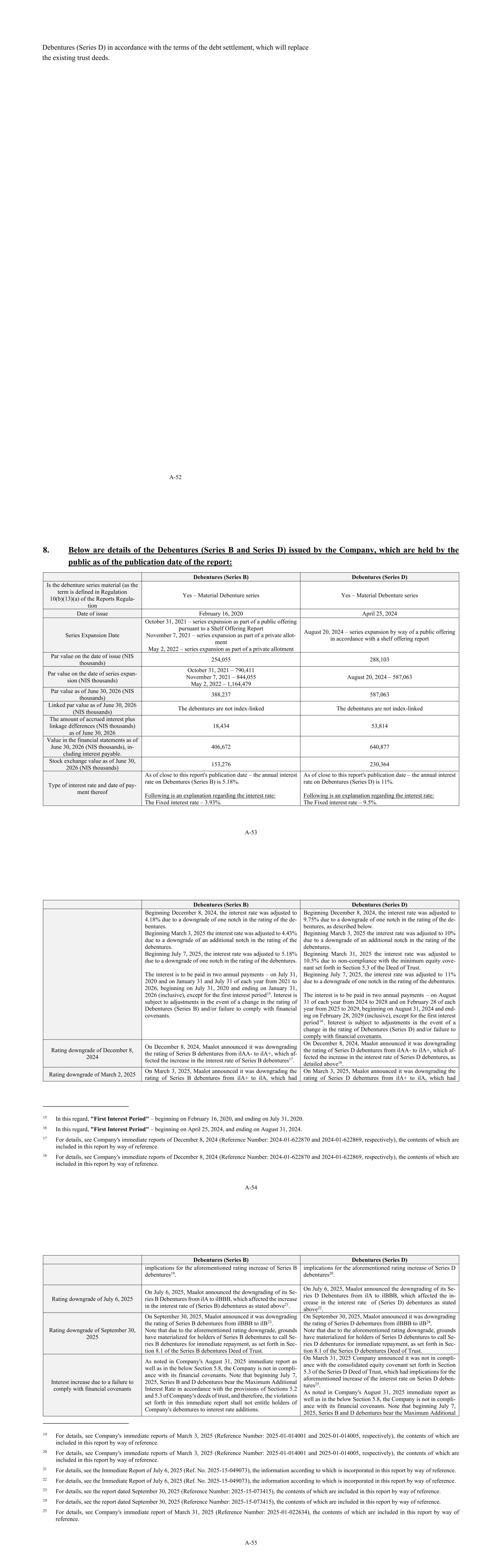
A-52 Debentures (Series D) in accordance with the terms of the debt settlement, which will replace the existing trust deeds. A-53 8. Below are details of the Debentures (Series B and Series D) issued by the Company, which are held by the public as of the publication date of the report: Debentures (Series B) Debentures (Series D) Is the debenture series material (as the term is defined in Regulation 10(b)(13)(a) of the Reports Regula- tion Yes – Material Debenture series Yes – Material Debenture series Date of issue February 16, 2020 April 25, 2024 Series Expansion Date October 31, 2021 – series expansion as part of a public offering pursuant to a Shelf Offering Report November 7, 2021 – series expansion as part of a private allot- ment May 2, 2022 – series expansion as part of a private allotment August 20, 2024 – series expansion by way of a public offering in accordance with a shelf offering report Par value on the date of issue (NIS thousands) 254,055 288,103 Par value on the date of series expan- sion (NIS thousands) October 31, 2021 – 790,411 November 7, 2021 – 844,055 May 2, 2022 – 1,164,479 August 20, 2024 – 587,063 Par value as of June 30, 2026 (NIS thousands) 388,237 587,063 Linked par value as of June 30, 2026 (NIS thousands) The debentures are not index-linked The debentures are not index-linked The amount of accrued interest plus linkage differences (NIS thousands) as of June 30, 2026 18,434 53,814 Value in the financial statements as of June 30, 2026 (NIS thousands), in- cluding interest payable. 406,672 640,877 Stock exchange value as of June 30, 2026 (NIS thousands) 153,276 230,364 Type of interest rate and date of pay- ment thereof As of close to this report's publication date – the annual interest rate on Debentures (Series B) is 5.18%. Following is an explanation regarding the interest rate: The Fixed interest rate – 3.93%. As of close to this report's publication date – the annual interest rate on Debentures (Series D) is 11%. Following is an explanation regarding the interest rate: The Fixed interest rate – 9.5%. A-54 Debentures (Series B) Debentures (Series D) Beginning December 8, 2024, the interest rate was adjusted to 4.18% due to a downgrade of one notch in the rating of the de- bentures. Beginning March 3, 2025 the interest rate was adjusted to 4.43% due to a downgrade of an additional notch in the rating of the debentures. Beginning July 7, 2025, the interest rate was adjusted to 5.18% due to a downgrade of one notch in the rating of the debentures. The interest is to be paid in two annual payments – on July 31, 2020 and on January 31 and July 31 of each year from 2021 to 2026, beginning on July 31, 2020 and ending on January 31, 2026 (inclusive), except for the first interest period15. Interest is subject to adjustments in the event of a change in the rating of Debentures (Series B) and/or failure to comply with financial covenants. Beginning December 8, 2024, the interest rate was adjusted to 9.75% due to a downgrade of one notch in the rating of the de- bentures, as described below. Beginning March 3, 2025 the interest rate was adjusted to 10% due to a downgrade of an additional notch in the rating of the debentures. Beginning March 31, 2025 the interest rate was adjusted to 10.5% due to non-compliance with the minimum equity cove- nant set forth in Section 5.3 of the Deed of Trust. Beginning July 7, 2025, the interest rate was adjusted to 11% due to a downgrade of one notch in the rating of the debentures. The interest is to be paid in two annual payments – on August 31 of each year from 2024 to 2028 and on February 28 of each year from 2025 to 2029, beginning on August 31, 2024 and end- ing on February 28, 2029 (inclusive), except for the first interest period16 . Interest is subject to adjustments in the event of a change in the rating of Debentures (Series D) and/or failure to comply with financial covenants. Rating downgrade of December 8, 2024 On December 8, 2024, Maalot announced it was downgrading the rating of Series B debentures from ilAA- to ilA+, which af- fected the increase in the interest rate of Series B debentures17. On December 8, 2024, Maalot announced it was downgrading the rating of Series D debentures from ilAA- to ilA+, which af- fected the increase in the interest rate of Series D debentures, as detailed above18. Rating downgrade of March 2, 2025 On March 3, 2025, Maalot announced it was downgrading the rating of Series B debentures from ilA+ to ilA, which had On March 3, 2025, Maalot announced it was downgrading the rating of Series D debentures from ilA+ to ilA, which had 15 In this regard, "First Interest Period" – beginning on February 16, 2020, and ending on July 31, 2020. 16 In this regard, "First Interest Period" – beginning on April 25, 2024, and ending on August 31, 2024. 17 For details, see Company's immediate reports of December 8, 2024 (Reference Number: 2024-01-622870 and 2024-01-622869, respectively), the contents of which are included in this report by way of reference. 18 For details, see Company's immediate reports of December 8, 2024 (Reference Number: 2024-01-622870 and 2024-01-622869, respectively), the contents of which are included in this report by way of reference. A-55 Debentures (Series B) Debentures (Series D) implications for the aforementioned rating increase of Series B debentures19. implications for the aforementioned rating increase of Series D debentures20. Rating downgrade of July 6, 2025 On July 6, 2025, Maalot announced the downgrading of its Se- ries B Debentures from ilA to ilBBB, which affected the increase in the interest rate of (Series B) debentures as stated above21. On July 6, 2025, Maalot announced the downgrading of its Se- ries D Debentures from ilA to ilBBB, which affected the in- crease in the interest rate of (Series D) debentures as stated above22. Rating downgrade of September 30, 2025 On September 30, 2025, Maalot announced it was downgrading the rating of Series B debentures from ilBBB to ilB23. Note that due to the aforementioned rating downgrade, grounds have materialized for holders of Series B debentures to call Se- ries B debentures for immediate repayment, as set forth in Sec- tion 8.1 of the Series B debentures Deed of Trust. On September 30, 2025, Maalot announced it was downgrading the rating of Series D debentures from ilBBB to ilB24. Note that due to the aforementioned rating downgrade, grounds have materialized for holders of Series D debentures to call Se- ries D debentures for immediate repayment, as set forth in Sec- tion 8.1 of the Series D debentures Deed of Trust. Interest increase due to a failure to comply with financial covenants As noted in Company's August 31, 2025 immediate report as well as in the below Section 5.8, the Company is not in compli- ance with its financial covenants. Note that beginning July 7, 2025, Series B and D debentures bear the Maximum Additional Interest Rate in accordance with the provisions of Sections 5.2 and 5.3 of Company's deeds of trust, and therefore, the violations set forth in this immediate report shall not entitle holders of Company's debentures to interest rate additions. On March 31, 2025 Company announced it was not in compli- ance with the consolidated equity covenant set forth in Section 5.3 of the Series D Deed of Trust, which had implications for the aforementioned increase of the interest rate on Series D deben- tures25. As noted in Company's August 31, 2025 immediate report as well as in the below Section 5.8, the Company is not in compli- ance with its financial covenants. Note that beginning July 7, 2025, Series B and D debentures bear the Maximum Additional 19 For details, see Company's immediate reports of March 3, 2025 (Reference Number: 2025-01-014001 and 2025-01-014005, respectively), the contents of which are included in this report by way of reference. 20 For details, see Company's immediate reports of March 3, 2025 (Reference Number: 2025-01-014001 and 2025-01-014005, respectively), the contents of which are included in this report by way of reference. 21 For details, see the Immediate Report of July 6, 2025 (Ref. No. 2025-15-049073), the information according to which is incorporated in this report by way of reference. 22 For details, see the Immediate Report of July 6, 2025 (Ref. No. 2025-15-049073), the information according to which is incorporated in this report by way of reference. 23 For details, see the report dated September 30, 2025 (Reference Number: 2025-15-073415), the contents of which are included in this report by way of reference. 24 For details, see the report dated September 30, 2025 (Reference Number: 2025-15-073415), the contents of which are included in this report by way of reference. 25 For details, see Company's immediate report of March 31, 2025 (Reference Number: 2025-01-022634), the contents of which are included in this report by way of reference.
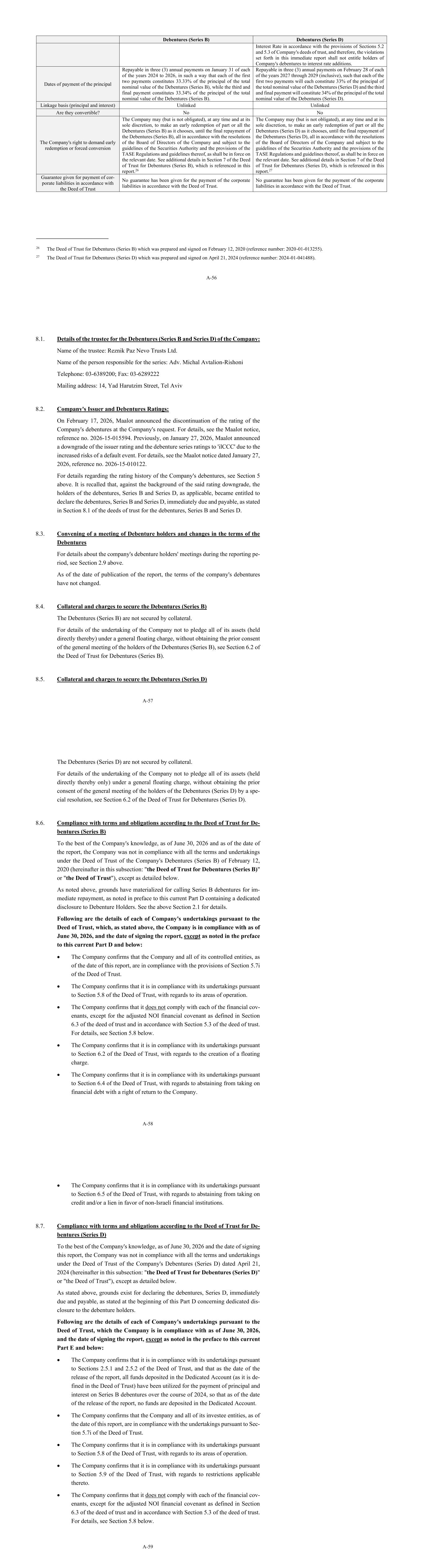
A-56 Debentures (Series B) Debentures (Series D) Interest Rate in accordance with the provisions of Sections 5.2 and 5.3 of Company's deeds of trust, and therefore, the violations set forth in this immediate report shall not entitle holders of Company's debentures to interest rate additions. Dates of payment of the principal Repayable in three (3) annual payments on January 31 of each of the years 2024 to 2026, in such a way that each of the first two payments constitutes 33.33% of the principal of the total nominal value of the Debentures (Series B), while the third and final payment constitutes 33.34% of the principal of the total nominal value of the Debentures (Series B). Repayable in three (3) annual payments on February 28 of each of the years 2027 through 2029 (inclusive), such that each of the first two payments will each constitute 33% of the principal of the total nominal value of the Debentures (Series D) and the third and final payment will constitute 34% of the principal of the total nominal value of the Debentures (Series D). Linkage basis (principal and interest) Unlinked Unlinked Are they convertible? No No The Company's right to demand early redemption or forced conversion The Company may (but is not obligated), at any time and at its sole discretion, to make an early redemption of part or all the Debentures (Series B) as it chooses, until the final repayment of the Debentures (Series B), all in accordance with the resolutions of the Board of Directors of the Company and subject to the guidelines of the Securities Authority and the provisions of the TASE Regulations and guidelines thereof, as shall be in force on the relevant date. See additional details in Section 7 of the Deed of Trust for Debentures (Series B), which is referenced in this report.26 The Company may (but is not obligated), at any time and at its sole discretion, to make an early redemption of part or all the Debentures (Series D) as it chooses, until the final repayment of the Debentures (Series D), all in accordance with the resolutions of the Board of Directors of the Company and subject to the guidelines of the Securities Authority and the provisions of the TASE Regulations and guidelines thereof, as shall be in force on the relevant date. See additional details in Section 7 of the Deed of Trust for Debentures (Series D), which is referenced in this report.27 Guarantee given for payment of cor- porate liabilities in accordance with the Deed of Trust No guarantee has been given for the payment of the corporate liabilities in accordance with the Deed of Trust. No guarantee has been given for the payment of the corporate liabilities in accordance with the Deed of Trust. 26 The Deed of Trust for Debentures (Series B) which was prepared and signed on February 12, 2020 (reference number: 2020-01-013255). 27 The Deed of Trust for Debentures (Series D) which was prepared and signed on April 21, 2024 (reference number: 2024-01-041488). A-57 8.1. Details of the trustee for the Debentures (Series B and Series D) of the Company: Name of the trustee: Reznik Paz Nevo Trusts Ltd. Name of the person responsible for the series: Adv. Michal Avtalion-Rishoni Telephone: 03-6389200; Fax: 03-6289222 Mailing address: 14, Yad Harutzim Street, Tel Aviv 8.2. Company's Issuer and Debentures Ratings: On February 17, 2026, Maalot announced the discontinuation of the rating of the Company's debentures at the Company's request. For details, see the Maalot notice, reference no. 2026-15-015594. Previously, on January 27, 2026, Maalot announced a downgrade of the issuer rating and the debenture series ratings to 'ilCCC' due to the increased risks of a default event. For details, see the Maalot notice dated January 27, 2026, reference no. 2026-15-010122. For details regarding the rating history of the Company's debentures, see Section 5 above. It is recalled that, against the background of the said rating downgrade, the holders of the debentures, Series B and Series D, as applicable, became entitled to declare the debentures, Series B and Series D, immediately due and payable, as stated in Section 8.1 of the deeds of trust for the debentures, Series B and Series D. 8.3. Convening of a meeting of Debenture holders and changes in the terms of the Debentures For details about the company's debenture holders' meetings during the reporting pe- riod, see Section 2.9 above. As of the date of publication of the report, the terms of the company's debentures have not changed. 8.4. Collateral and charges to secure the Debentures (Series B) The Debentures (Series B) are not secured by collateral. For details of the undertaking of the Company not to pledge all of its assets (held directly thereby) under a general floating charge, without obtaining the prior consent of the general meeting of the holders of the Debentures (Series B), see Section 6.2 of the Deed of Trust for Debentures (Series B). 8.5. Collateral and charges to secure the Debentures (Series D) A-58 The Debentures (Series D) are not secured by collateral. For details of the undertaking of the Company not to pledge all of its assets (held directly thereby only) under a general floating charge, without obtaining the prior consent of the general meeting of the holders of the Debentures (Series D) by a spe- cial resolution, see Section 6.2 of the Deed of Trust for Debentures (Series D). 8.6. Compliance with terms and obligations according to the Deed of Trust for De- bentures (Series B) To the best of the Company's knowledge, as of June 30, 2026 and as of the date of the report, the Company was not in compliance with all the terms and undertakings under the Deed of Trust of the Company's Debentures (Series B) of February 12, 2020 (hereinafter in this subsection: "the Deed of Trust for Debentures (Series B)" or "the Deed of Trust"), except as detailed below. As noted above, grounds have materialized for calling Series B debentures for im- mediate repayment, as noted in preface to this current Part D containing a dedicated disclosure to Debenture Holders. See the above Section 2.1 for details. Following are the details of each of Company's undertakings pursuant to the Deed of Trust, which, as stated above, the Company is in compliance with as of June 30, 2026, and the date of signing the report, except as noted in the preface to this current Part D and below: • The Company confirms that the Company and all of its controlled entities, as of the date of this report, are in compliance with the provisions of Section 5.7i of the Deed of Trust. • The Company confirms that it is in compliance with its undertakings pursuant to Section 5.8 of the Deed of Trust, with regards to its areas of operation. • The Company confirms that it does not comply with each of the financial cov- enants, except for the adjusted NOI financial covenant as defined in Section 6.3 of the deed of trust and in accordance with Section 5.3 of the deed of trust. For details, see Section 5.8 below. • The Company confirms that it is in compliance with its undertakings pursuant to Section 6.2 of the Deed of Trust, with regards to the creation of a floating charge. • The Company confirms that it is in compliance with its undertakings pursuant to Section 6.4 of the Deed of Trust, with regards to abstaining from taking on financial debt with a right of return to the Company. A-59 • The Company confirms that it is in compliance with its undertakings pursuant to Section 6.5 of the Deed of Trust, with regards to abstaining from taking on credit and/or a lien in favor of non-Israeli financial institutions. 8.7. Compliance with terms and obligations according to the Deed of Trust for De- bentures (Series D) To the best of the Company's knowledge, as of June 30, 2026 and the date of signing this report, the Company was not in compliance with all the terms and undertakings under the Deed of Trust of the Company's Debentures (Series D) dated April 21, 2024 (hereinafter in this subsection: "the Deed of Trust for Debentures (Series D)" or "the Deed of Trust"), except as detailed below. As stated above, grounds exist for declaring the debentures, Series D, immediately due and payable, as stated at the beginning of this Part D concerning dedicated dis- closure to the debenture holders. Following are the details of each of Company's undertakings pursuant to the Deed of Trust, which the Company is in compliance with as of June 30, 2026, and the date of signing the report, except as noted in the preface to this current Part E and below: • The Company confirms that it is in compliance with its undertakings pursuant to Sections 2.5.1 and 2.5.2 of the Deed of Trust, and that as the date of the release of the report, all funds deposited in the Dedicated Account (as it is de- fined in the Deed of Trust) have been utilized for the payment of principal and interest on Series B debentures over the course of 2024, so that as of the date of the release of the report, no funds are deposited in the Dedicated Account. • The Company confirms that the Company and all of its investee entities, as of the date of this report, are in compliance with the undertakings pursuant to Sec- tion 5.7i of the Deed of Trust. • The Company confirms that it is in compliance with its undertakings pursuant to Section 5.8 of the Deed of Trust, with regards to its areas of operation. • The Company confirms that it is in compliance with its undertakings pursuant to Section 5.9 of the Deed of Trust, with regards to restrictions applicable thereto. • The Company confirms that it does not comply with each of the financial cov- enants, except for the adjusted NOI financial covenant as defined in Section 6.3 of the deed of trust and in accordance with Section 5.3 of the deed of trust. For details, see Section 5.8 below.

A-60 • The Company confirms that it is in compliance with its undertakings pursuant to Section 6.2 of the Deed of Trust, with regards to the creation of a floating charge. • The Company confirms that it is in compliance with its undertakings pursuant to Section 6.4 of the Deed of Trust, with regards to abstaining from taking on financial debt with a right of return to the Company. • The Company confirms that it is in compliance with its undertakings pursuant to Section 6.5 of the Deed of Trust, with regards to abstaining from taking on credit and/or a lien in favor of non-Israeli financial institutions. A-61 8.8. Details regarding Company's compliance with the financial covenants subject to the Deeds of Trust for the Company's Debentures 8.8.1. Below are details of the financial covenants set forth in the Deed of Trust for Deben- tures (Series B) (terms shall have the meanings given to them in the Deed of Trust): Financial Covenant Method of calculating the financial criteria and results as of June 30, 2026 Comments The Consolidated Equity28 (not in- cluding minority interests) will not be less than USD 475 million (this amount will not be index-linked). Consolidated Equity (Deficit) (not including mi- nority interests) = USD (38,043) thousand. The Company is not in compliance with the Financial Covenant Section 6.3(1) of the Deed of Trust The Net Adjusted Financial Debt29 to Net CAP30 ratio shall not exceed 75%. Net Adjusted Financial Debt = USD 1,226,416 thousand. Net CAP = USD 1,228,422 thousand. Net Adjusted Financial Debt to Net CAP ratio = 103.1% The Company is not in compliance with the Financial Covenant Section 6.3(2) of the Deed of Trust Adjusted NOI31 shall be no lower than USD 35 million. Adjusted NOI = USD 42,489 thousand. The Company is in compliance with the Fi- nancial Covenant Section 6.3(3) of the Deed of Trust 28 "Consolidated Equity of the Company": The Company's equity according to the consolidated Financial Statements of the Company, including shareholder loans subordinate to the Debentures, if any. That is, shareholder loans that meet the following terms: (a) the maturity date thereof is after the final maturity of the debentures; and (b) the loans are subordinate to the debentures with regard to the repayment thereof, including in the event of liquidation. 29 "Net Adjusted Financial Debt" – Debt carrying short and long term interest from banks and financial institutions and from entities the main operation thereof is the provision of loans, plus debt carrying interest in favor of the holders of debentures issued by the Company, net of cash and cash equivalents and net of short-term investments and loans provided that the repayment date thereof does not exceed three years after the relevant balance sheet date, marketable securities and deposits (including such assets which are use- restricted, except for pledged deposits provided against guarantees), all based on the consolidated financial statements of the Company, plus the proportionate consolidation of the net financial debt in associated companies and in jointly controlled companies of the Company. 30 "Net CAP" – adjusted net financial debt in addition to the Consolidated Equity of the Company (including minority interests). 31 "Adjusted NOI" – the Company's income from rent (in the last four quarters), including income from interest deriving from the provision of loans by the consolidated Company (including income deriving from loans purchased) and revenues, including distributions, deriving to the Company from investments in REIT funds or other companies, net of the leasing cost of the properties (in the last four quarters), plus the Com- pany's share in the adjusted NOI of associated companies and jointly-controlled companies (relative con- solidation). It shall be clarified that by purchasing one or more income-producing property and/or comple- tion of development property and/or property contribution during the period, and/or provision of loans by the consolidated Company (including income deriving from loans purchased by the Company), and/or ad- ditional investment in REIT funds or other companies, the Adjusted NOI of the property/properties and/or loan/s and/or investment/s shall be calculated in accordance with the scope of the Adjusted NOI on the date of purchase and/or completion of development and/or contribution of the property and/or provision or pur- chase of the loan and/or execution of the investment and up until the relevant report date of financial state- ment, annualized. For the avoidance of doubt, it shall be clarified that upon the sale or removal of one or more properties, said annualization of the Adjusted NOI shall not be executed for the period prior to the date of sale. A-62 Financial Covenant Method of calculating the financial criteria and results as of June 30, 2026 Comments The Scope of the Projects for Devel- opment of the Consolidated Com- pany32 (including the share of the Company in jointly-controlled and associate companies) shall not ex- ceed 10% of the Adjusted Balance Sheet33 of the Company The Scope of the Projects for Development of the Consolidated Company (including the share of the Company in jointly controlled and associ- ate companies) = USD 0 Total adjusted balance sheet = USD 905,800 thousand The Company is in compliance with the Fi- nancial Covenant Section 6.3(4) of the Deed of Trust The Consolidated Equity11,12 (exclud- ing minority interests) shall not be less than USD 500 million (this amount will not be index-linked). Consolidated Equity (Deficit) (not including mi- nority interests) = USD (38,043) thousand. The Company is not in compliance with the Financial Covenant Section 5.3(1) of the Deed of Trust (*) Adjusted net financial debt14 to net CAP15 ratio shall not exceed 72.5%. Net Adjusted Financial Debt = USD 1,226,416 thousand. Net CAP = USD 1,228,422 thousand. Net Adjusted Financial Debt to Net CAP ratio = 103.1% The Company is not in compliance with the Financial Covenant Section 5.3(2) of the Deed of Trust (*) Adjusted NOI15 shall be no lower than USD 40 million. Adjusted NOI = USD 42,489 thousand. The Company is in compliance with the Fi- nancial Covenant Section 5.3(3) of the Deed of Trust (*) (*) Failure to comply with the financial covenant does not constitute grounds for immediate repayment but may result in an interest rate adjustment. As of the date of signing this report the Company is not compliant with all fi- nancial covenants described above, in accordance with the Company's financial statements for June 30, 2026. 32 "Scope of Projects for Development of the Company" – the cost of investment (separate than the fair value) of the Company in projects whose construction started as of the date of the relevant financial state- ments, and for which no Temporary Certificate of Occupancy (TCO) was obtained yet. It should be clarified that development and renovation works performed in existing income-producing assets of the Company, will not be considered as part of the definition of "Scope of Projects for Development of the Company". 33 "Adjusted Balance Sheet" – the total consolidated balance sheet of the Company in addition to the share of the Company in associated companies and companies under joint control. A-63 8.8.2. Below are details of the financial covenants set forth in the Deed of Trust for Deben- tures (Series D) (terms shall have the meanings given to them in the Deed of Trust): Financial Covenant Method of calculating the financial criteria and results as of June 30, 2026 Comments The Consolidated Equity34 of the Company (not including minority in- terests) will not be less than USD 450 million (this amount will not be index-linked). Consolidated Equity (Deficit) (not including mi- nority interests) = USD (38,043) thousand. The Company is not in compliance with the Financial Covenant Section 6.3(1) of the Deeds of Trust The Net Adjusted Financial Debt35 to Net CAP36 ratio shall not exceed 75%. Net Adjusted Financial Debt = USD 1,226,416 thousand. Net CAP = USD 1,228,422 thousand. Net Adjusted Financial Debt to Net CAP ratio = 103.1% The Company is not in compliance with the Financial Covenant Section 6.3(2) of the Deeds of Trust Adjusted NOI37 shall be no lower than USD 35 million. Adjusted NOI = USD 42,489 thousand. The Company is in compliance with the Fi- nancial Covenant Section 6.3(3) of the Deeds of Trust The Consolidated Equity11,12 (exclud- ing minority interests) shall not be less than USD 550 million (this amount will not be index-linked). Consolidated Equity (Deficit) (not including mi- nority interests) = USD (38,043) thousand. The Company is not in compliance with the Financial Covenant Section 5.3(1) of the Deeds of Trust (*) 34 "Consolidated Equity of the Company": The Company's equity according to the consolidated Financial Statements of the Company, including shareholder loans subordinate to the Debentures, if any. That is, shareholder loans that meet all of the following terms: (a) the maturity date thereof (for principal and inter- est) is after the final maturity of the debentures; and (b) the loans (principal and interest) are subordinate to the debentures with regard to the repayment thereof, including in the event of liquidation. 35 "Net Adjusted Financial Debt" – Debt carrying short and long term interest from banks and financial institutions and from entities the main operation thereof is the provision of loans, plus debt carrying interest in favor of the holders of debentures issued by the Company, net of cash and cash equivalents and net of short-term investments and loans provided that the repayment date thereof does not exceed three years after the relevant balance sheet date, marketable securities and deposits (including such assets which are use- restricted, except for pledged deposits provided against guarantees), all based on the consolidated financial statements of the Company, plus the proportionate consolidation of the net financial debt in associated companies and jointly controlled companies of the Company. 36 "Net CAP" – adjusted net financial debt in addition to the Consolidated Equity of the Company (including minority interests). 37 "Adjusted NOI" – the Company's income from rent (in the last four quarters), including income from interest deriving from the provision of loans by the consolidated Company (including income deriving from loans purchased) and revenues, including distributions, deriving to the Company from investments in REIT funds or other companies, net of the leasing cost of the properties (in the last four quarters), plus the Com- pany's share in the adjusted NOI of associated companies and jointly-controlled companies (relative con- solidation). It shall be clarified that by purchasing one or more income-producing property and/or comple- tion of development property and/or property contribution during the period, and/or provision of loans by the consolidated Company (including income deriving from loans purchased by the Company), and/or ad- ditional investment in REIT funds or other companies, the Adjusted NOI of the property/properties and/or loan/s and/or investment/s shall be calculated in accordance with the scope of the Adjusted NOI since the date of purchase and/or completion of development and/or contribution of the property and/or provision or purchase of the loan and/or execution of the investment and up until the relevant report date of financial statement, annualized. For the avoidance of doubt, it shall be clarified that upon the sale or removal of one or more properties, said annualization of the Adjusted NOI shall not be executed for the period prior to the date of sale.
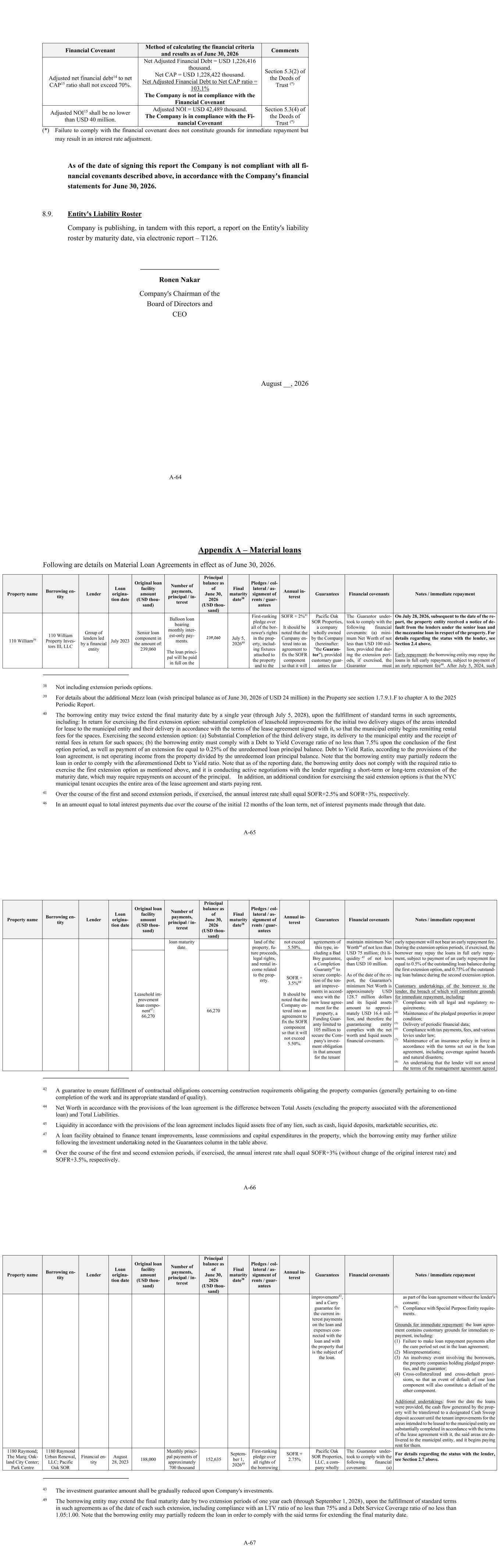
A-64 Financial Covenant Method of calculating the financial criteria and results as of June 30, 2026 Comments Adjusted net financial debt14 to net CAP15 ratio shall not exceed 70%. Net Adjusted Financial Debt = USD 1,226,416 thousand. Net CAP = USD 1,228,422 thousand. Net Adjusted Financial Debt to Net CAP ratio = 103.1% The Company is not in compliance with the Financial Covenant Section 5.3(2) of the Deeds of Trust (*) Adjusted NOI15 shall be no lower than USD 40 million. Adjusted NOI = USD 42,489 thousand. The Company is in compliance with the Fi- nancial Covenant Section 5.3(4) of the Deeds of Trust (*) (*) Failure to comply with the financial covenant does not constitute grounds for immediate repayment but may result in an interest rate adjustment. As of the date of signing this report the Company is not compliant with all fi- nancial covenants described above, in accordance with the Company's financial statements for June 30, 2026. 8.9. Entity's Liability Roster Company is publishing, in tandem with this report, a report on the Entity's liability roster by maturity date, via electronic report – T126. ______________________ Ronen Nakar Company's Chairman of the Board of Directors and CEO August __, 2026 A-65 Appendix A – Material loans Following are details on Material Loan Agreements in effect as of June 30, 2026. 38 Not including extension periods options. 39 For details about the additional Mezz loan (wish principal balance as of June 30, 2026 of USD 24 million) in the Property see section 1.7.9.1.F to chapter A to the 2025 Periodic Report. 40 The borrowing entity may twice extend the final maturity date by a single year (through July 5, 2028), upon the fulfillment of standard terms in such agreements, including: In return for exercising the first extension option: substantial completion of leasehold improvements for the initial two delivery stages of the areas intended for lease to the municipal entity and their delivery in accordance with the terms of the lease agreement signed with it, so that the municipal entity begins remitting rental fees for the spaces. Exercising the second extension option: (a) Substantial Completion of the third delivery stage, its delivery to the municipal entity and the receipt of rental fees in return for such spaces; (b) the borrowing entity must comply with a Debt to Yield Coverage ratio of no less than 7.5% upon the conclusion of the first option period, as well as payment of an extension fee equal to 0.25% of the unredeemed loan principal balance. Debt to Yield Ratio, according to the provisions of the loan agreement, is net operating income from the property divided by the unredeemed loan principal balance. Note that the borrowing entity may partially redeem the loan in order to comply with the aforementioned Debt to Yield ratio. Note that as of the reporting date, the borrowing entity does not comply with the required ratio to exercise the first extension option as mentioned above, and it is conducting active negotiations with the lender regarding a short-term or long-term extension of the maturity date, which may require repayments on account of the principal. In addition, an additional condition for exercising the said extension options is that the NYC municipal tenant occupies the entire area of the lease agreement and starts paying rent. 41 Over the course of the first and second extension periods, if exercised, the annual interest rate shall equal SOFR+2.5% and SOFR+3%, respectively. 46 In an amount equal to total interest payments due over the course of the initial 12 months of the loan term, net of interest payments made through that date. Property name Borrowing en- tity Lender Loan origina- tion date Original loan facility amount (USD thou- sand) Number of payments, principal / in- terest Principal balance as of June 30, 2026 (USD thou- sand) Final maturity date38 Pledges / col- lateral / as- signment of rents / guar- antees Annual in- terest Guarantees Financial covenants Notes / immediate repayment 110 William39 110 William Property Inves- tors III, LLC Group of lenders led by a financial entity July 2023 Senior loan component in the amount of: 239,060 Balloon loan bearing monthly inter- est-only pay- ments. The loan princi- pal will be paid in full on the 239,060 July 5, 202640 First-ranking pledge over all of the bor- rower's rights in the prop- erty, includ- ing fixtures attached to the property and to the SOFR + 2%41 It should be noted that the Company en- tered into an agreement to fix the SOFR component so that it will Pacific Oak SOR Properties, a company wholly owned by the Company (hereinafter: "the Guaran- tor"), provided customary guar- antees for The Guarantor under- took to comply with the following financial covenants: (a) mini- mum Net Worth of not less than USD 100 mil- lion, provided that dur- ing the extension peri- ods, if exercised, the Guarantor must On July 28, 2026, subsequent to the date of the re- port, the property entity received a notice of de- fault from the lenders under the senior loan and the mezzanine loan in respect of the property. For details regarding the status with the lender, see Section 2.4 above. Early repayment: the borrowing entity may repay the loans in full early repayment, subject to payment of an early repayment fee46. After July 5, 2024, such A-66 42 A guarantee to ensure fulfillment of contractual obligations concerning construction requirements obligating the property companies (generally pertaining to on-time completion of the work and its appropriate standard of quality). 44 Net Worth in accordance with the provisions of the loan agreement is the difference between Total Assets (excluding the property associated with the aforementioned loan) and Total Liabilities. 45 Liquidity in accordance with the provisions of the loan agreement includes liquid assets free of any lien, such as cash, liquid deposits, marketable securities, etc. 47 A loan facility obtained to finance tenant improvements, lease commissions and capital expenditures in the property, which the borrowing entity may further utilize following the investment undertaking noted in the Guarantees column in the table above. 48 Over the course of the first and second extension periods, if exercised, the annual interest rate shall equal SOFR+3% (without change of the original interest rate) and SOFR+3.5%, respectively. Property name Borrowing en- tity Lender Loan origina- tion date Original loan facility amount (USD thou- sand) Number of payments, principal / in- terest Principal balance as of June 30, 2026 (USD thou- sand) Final maturity date38 Pledges / col- lateral / as- signment of rents / guar- antees Annual in- terest Guarantees Financial covenants Notes / immediate repayment loan maturity date. land of the property, fu- ture proceeds, legal rights, and rental in- come related to the prop- erty. not exceed 5.50%. agreements of this type, in- cluding a Bad Boy guarantee, a Completion Guaranty42 to secure comple- tion of the ten- ant improve- ments in accord- ance with the new lease agree- ment for the property, a Funding Guar- anty limited to 105 million to secure the Com- pany's invest- ment obligation in that amount for the tenant maintain minimum Net Worth44 of not less than USD 75 million; (b) li- quidity 45 of not less than USD 10 million. As of the date of the re- port, the Guarantor's minimum Net Worth is approximately USD 128.7 million dollars and its liquid assets amount to approxi- mately USD 16.4 mil- lion, and therefore the guaranteeing entity complies with the net worth and liquid assets financial covenants. early repayment will not bear an early repayment fee. During the extension option periods, if exercised, the borrower may repay the loans in full early repay- ment, subject to payment of an early repayment fee equal to 0.5% of the outstanding loan balance during the first extension option, and 0.75% of the outstand- ing loan balance during the second extension option. Customary undertakings of the borrower to the lender, the breach of which will constitute grounds for immediate repayment, including: (3) Compliance with all legal and regulatory re- quirements; (4) Maintenance of the pledged properties in proper condition; (5) Delivery of periodic financial data; (6) Compliance with tax payments, fees, and various levies under law; (7) Maintenance of an insurance policy in force in accordance with the terms set out in the loan agreement, including coverage against hazards and natural disasters; (8) An undertaking that the lender will not amend the terms of the management agreement agreed Leasehold im- provement loan compo- nent47: 66,270 66,270 SOFR + 3.5%48 It should be noted that the Company en- tered into an agreement to fix the SOFR component so that it will not exceed 5.50%. A-67 43 The investment guarantee amount shall be gradually reduced upon Company's investments. 49 The borrowing entity may extend the final maturity date by two extension periods of one year each (through September 1, 2028), upon the fulfillment of standard terms in such agreements as of the date of each such extension, including compliance with an LTV ratio of no less than 75% and a Debt Service Coverage ratio of no less than 1.05:1.00. Note that the borrowing entity may partially redeem the loan in order to comply with the said terms for extending the final maturity date. Property name Borrowing en- tity Lender Loan origina- tion date Original loan facility amount (USD thou- sand) Number of payments, principal / in- terest Principal balance as of June 30, 2026 (USD thou- sand) Final maturity date38 Pledges / col- lateral / as- signment of rents / guar- antees Annual in- terest Guarantees Financial covenants Notes / immediate repayment improvements43, and a Carry guarantee for the current in- terest payments on the loan and expenses con- nected with the loan and with the property that is the subject of the loan. as part of the loan agreement without the lender's consent; (9) Compliance with Special Purpose Entity require- ments. Grounds for immediate repayment: the loan agree- ment contains customary grounds for immediate re- payment, including: (1) Failure to make loan repayment payments after the cure period set out in the loan agreement; (2) Misrepresentations; (3) An insolvency event involving the borrowers, the property companies holding pledged proper- ties, and the guarantor; (4) Cross-collateralized and cross-default provi- sions, so that an event of default of one loan component will also constitute a default of the other component. Additional undertakings: from the date the loans were provided, the cash flow generated by the prop- erty will be transferred to a designated Cash Sweep deposit account until the tenant improvements for the areas intended to be leased to the municipal entity are substantially completed in accordance with the terms of the lease agreement with it, the said areas are de- livered to the municipal entity, and it begins paying rent for them. 1180 Raymond; The Marq; Oak- land City Center; Park Centre 1180 Raymond Urban Renewal, LLC; Pacific Oak SOR Financial en- tity August 28, 2023 188,000 Monthly princi- pal payments of approximately 700 thousand 152,635 Septem- ber 1, 202649 First-ranking pledge over all rights of the borrowing SOFR + 2.75% Pacific Oak SOR Properties, LLC, a com- pany wholly The Guarantor under- took to comply with the following financial covenants: (a) For details regarding the status with the lender, see Section 2.7 above.
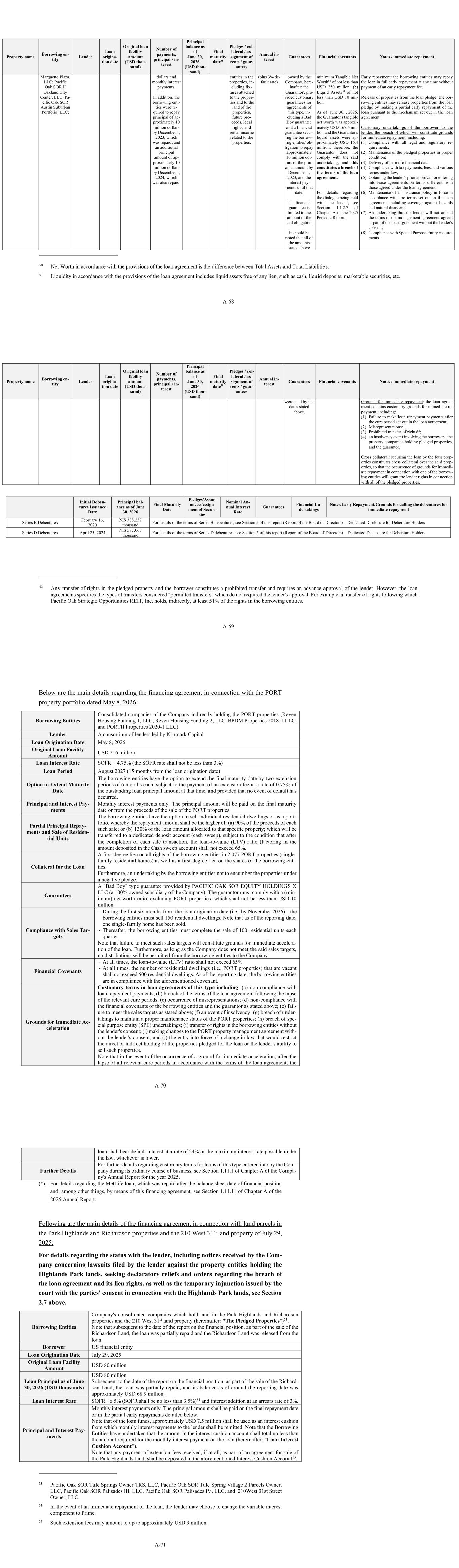
A-68 50 Net Worth in accordance with the provisions of the loan agreement is the difference between Total Assets and Total Liabilities. 51 Liquidity in accordance with the provisions of the loan agreement includes liquid assets free of any lien, such as cash, liquid deposits, marketable securities, etc. Property name Borrowing en- tity Lender Loan origina- tion date Original loan facility amount (USD thou- sand) Number of payments, principal / in- terest Principal balance as of June 30, 2026 (USD thou- sand) Final maturity date38 Pledges / col- lateral / as- signment of rents / guar- antees Annual in- terest Guarantees Financial covenants Notes / immediate repayment Marquette Plaza, LLC; Pacific Oak SOR II Oakland City Center, LLC; Pa- cific Oak SOR Austin Suburban Portfolio, LLC; dollars and monthly interest payments. In addition, the borrowing enti- ties were re- quired to repay principal of ap- proximately 10 million dollars by December 1, 2023, which was repaid, and an additional principal amount of ap- proximately 10 million dollars by December 1, 2024, which was also repaid. entities in the properties, in- cluding fix- tures attached to the proper- ties and to the land of the properties, future pro- ceeds, legal rights, and rental income related to the properties. (plus 3% de- fault rate) owned by the Company, here- inafter: the 'Guarantor', pro- vided customary guarantees for agreements of this type, in- cluding a Bad Boy guarantee and a financial guarantee secur- ing the borrow- ing entities' ob- ligation to repay approximately 10 million dol- lars of the prin- cipal amount by December 1, 2023, and the interest pay- ments until that date. The financial guarantee is limited to the amount of the said obligation. It should be noted that all of the amounts stated above minimum Tangible Net Worth50 of not less than USD 250 million; (b) Liquid Assets 51 of not less than USD 10 mil- lion. As of June 30, , 2026, the Guarantor's tangible net worth was approxi- mately USD 167.6 mil- lion and the Guarantor's liquid assets were ap- proximately USD 16.4 million; therefore, the Guarantor does not comply with the said undertaking, and this constitutes a breach of the terms of the loan agreement. For details regarding the dialogue being held with the lender, see Section 1.1.2.7 of Chapter A of the 2025 Periodic Report. Early repayment: the borrowing entities may repay the loan in full early repayment at any time without payment of an early repayment fee. Release of properties from the loan pledge: the bor- rowing entities may release properties from the loan pledge by making a partial early repayment of the loan pursuant to the mechanism set out in the loan agreement. Customary undertakings of the borrower to the lender, the breach of which will constitute grounds for immediate repayment, including: (1) Compliance with all legal and regulatory re- quirements; (2) Maintenance of the pledged properties in proper condition; (3) Delivery of periodic financial data; (4) Compliance with tax payments, fees, and various levies under law; (5) Obtaining the lender's prior approval for entering into lease agreements on terms different from those agreed under the loan agreement; (6) Maintenance of an insurance policy in force in accordance with the terms set out in the loan agreement, including coverage against hazards and natural disasters; (7) An undertaking that the lender will not amend the terms of the management agreement agreed as part of the loan agreement without the lender's consent; (8) Compliance with Special Purpose Entity require- ments. A-69 Initial Deben- tures Issuance Date Principal bal- ance as of June 30, 2026 Final Maturity Date Pledges/Assur- ances/Assign- ment of Securi- ties Nominal An- nual Interest Rate Guarantees Financial Un- dertakings Notes/Early Repayment/Grounds for calling the debentures for immediate repayment Series B Debentures February 16, 2020 NIS 388,237 thousand For details of the terms of Series B debentures, see Section 5 of this report (Report of the Board of Directors) – Dedicated Disclosure for Debenture Holders Series D Debentures April 25, 2024 NIS 587,063 thousand For details of the terms of Series D debentures, see Section 5 of this report (Report of the Board of Directors) – Dedicated Disclosure for Debenture Holders 52 Any transfer of rights in the pledged property and the borrower constitutes a prohibited transfer and requires an advance approval of the lender. However, the loan agreements specifies the types of transfers considered "permitted transfers" which do not required the lender's approval. For example, a transfer of rights following which Pacific Oak Strategic Opportunities REIT, Inc. holds, indirectly, at least 51% of the rights in the borrowing entities. Property name Borrowing en- tity Lender Loan origina- tion date Original loan facility amount (USD thou- sand) Number of payments, principal / in- terest Principal balance as of June 30, 2026 (USD thou- sand) Final maturity date38 Pledges / col- lateral / as- signment of rents / guar- antees Annual in- terest Guarantees Financial covenants Notes / immediate repayment were paid by the dates stated above. Grounds for immediate repayment: the loan agree- ment contains customary grounds for immediate re- payment, including: (1) Failure to make loan repayment payments after the cure period set out in the loan agreement; (2) Misrepresentations; (3) Prohibited transfer of rights52; (4) an insolvency event involving the borrowers, the property companies holding pledged properties, and the guarantor. Cross collateral: securing the loan by the four prop- erties constitutes cross collateral over the said prop- erties, so that the occurrence of grounds for immedi- ate repayment in connection with one of the borrow- ing entities will grant the lender rights in connection with all of the pledged properties. A-70 Below are the main details regarding the financing agreement in connection with the PORT property portfolio dated May 8, 2026: Borrowing Entities Consolidated companies of the Company indirectly holding the PORT properties (Reven Housing Funding 1, LLC, Reven Housing Funding 2, LLC, BPDM Properties 2018-1 LLC, and PORTII Properties 2020-1 LLC) Lender A consortium of lenders led by Klirmark Capital Loan Origination Date May 8, 2026 Original Loan Facility Amount USD 216 million Loan Interest Rate SOFR + 4.75% (the SOFR rate shall not be less than 3%) Loan Period August 2027 (15 months from the loan origination date) Option to Extend Maturity Date The borrowing entities have the option to extend the final maturity date by two extension periods of 6 months each, subject to the payment of an extension fee at a rate of 0.75% of the outstanding loan principal amount at that time, and provided that no event of default has occurred. Principal and Interest Pay- ments Monthly interest payments only. The principal amount will be paid on the final maturity date or from the proceeds of the sale of the PORT properties. Partial Principal Repay- ments and Sale of Residen- tial Units The borrowing entities have the option to sell individual residential dwellings or as a port- folio, whereby the repayment amount shall be the higher of: (a) 90% of the proceeds of each such sale; or (b) 130% of the loan amount allocated to that specific property; which will be transferred to a dedicated deposit account (cash sweep), subject to the condition that after the completion of each sale transaction, the loan-to-value (LTV) ratio (factoring in the amount deposited in the Cash sweep account) shall not exceed 65%. Collateral for the Loan A first-degree lien on all rights of the borrowing entities in 2,077 PORT properties (single- family residential homes) as well as a first-degree lien on the shares of the borrowing enti- ties. Furthermore, an undertaking by the borrowing entities not to encumber the properties under a negative pledge. Guarantees A "Bad Boy" type guarantee provided by PACIFIC OAK SOR EQUITY HOLDINGS X LLC (a 100% owned subsidiary of the Company). The guarantor must comply with a (min- imum) net worth ratio, excluding PORT properties, which shall not be less than USD 10 million. Compliance with Sales Tar- gets - During the first six months from the loan origination date (i.e., by November 2026) - the borrowing entities must sell 150 residential dwellings. Note that as of the reporting date, one single-family home has been sold. - Thereafter, the borrowing entities must complete the sale of 100 residential units each quarter. Note that failure to meet such sales targets will constitute grounds for immediate accelera- tion of the loan. Furthermore, as long as the Company does not meet the said sales targets, no distributions will be permitted from the borrowing entities to the Company. Financial Covenants - At all times, the loan-to-value (LTV) ratio shall not exceed 65%. - At all times, the number of residential dwellings (i.e., PORT properties) that are vacant shall not exceed 500 residential dwellings. As of the reporting date, the borrowing entities are in compliance with the aforementioned covenant. Grounds for Immediate Ac- celeration Customary terms in loan agreements of this type including: (a) non-compliance with loan repayment payments; (b) breach of the terms of the loan agreement following the lapse of the relevant cure periods; (c) occurrence of misrepresentations; (d) non-compliance with the financial covenants of the borrowing entities and the guarantor as stated above; (e) fail- ure to meet the sales targets as stated above; (f) an event of insolvency; (g) breach of under- takings to maintain a proper maintenance status of the PORT properties; (h) breach of spe- cial purpose entity (SPE) undertakings; (i) transfer of rights in the borrowing entities without the lender's consent; (j) making changes to the PORT property management agreement with- out the lender's consent; and (j) the entry into force of a change in law that would restrict the direct or indirect holding of the properties pledged for the loan or the lender's ability to sell such properties. Note that in the event of the occurrence of a ground for immediate acceleration, after the lapse of all relevant cure periods in accordance with the terms of the loan agreement, the A-71 loan shall bear default interest at a rate of 24% or the maximum interest rate possible under the law, whichever is lower. Further Details For further details regarding customary terms for loans of this type entered into by the Com- pany during its ordinary course of business, see Section 1.11.1 of Chapter A of the Compa- ny's Annual Report for the year 2025. (*) For details regarding the MetLife loan, which was repaid after the balance sheet date of financial position and, among other things, by means of this financing agreement, see Section 1.11.11 of Chapter A of the 2025 Annual Report. Following are the main details of the financing agreement in connection with land parcels in the Park Highlands and Richardson properties and the 210 West 31st land property of July 29, 2025: For details regarding the status with the lender, including notices received by the Com- pany concerning lawsuits filed by the lender against the property entities holding the Highlands Park lands, seeking declaratory reliefs and orders regarding the breach of the loan agreement and its lien rights, as well as the temporary injunction issued by the court with the parties' consent in connection with the Highlands Park lands, see Section 2.7 above. Borrowing Entities Company's consolidated companies which hold land in the Park Highlands and Richardson properties and the 210 West 31st land property (hereinafter: "The Pledged Properties")53. Note that subsequent to the date of the report on the financial position, as part of the sale of the Richardson Land, the loan was partially repaid and the Richardson Land was released from the loan. Borrower US financial entity Loan Origination Date July 29, 2025 Original Loan Facility Amount USD 80 million Loan Principal as of June 30, 2026 (USD thousands) USD 80 million Subsequent to the date of the report on the financial position, as part of the sale of the Richard- son Land, the loan was partially repaid, and its balance as of around the reporting date was approximately USD 68.9 million. Loan Interest Rate SOFR +6.5% (SOFR shall be no less than 3.5%)54 and interest addition at an arrears rate of 3%. Principal and Interest Pay- ments Monthly interest payments only. The principal amount shall be paid on the final repayment date or in the partial early repayments detailed below. Note that of the loan funds, approximately USD 7.5 million shall be used as an interest cushion from which monthly interest payments to the lender shall be remitted. Note that the Borrowing Entities have undertaken that the amount in the interest cushion account shall total no less than the amount required for the monthly interest payment on the loan (hereinafter: "Loan Interest Cushion Account"). Note that any payment of extension fees received, if at all, as part of an agreement for sale of the Park Highlands land, shall be deposited in the aforementioned Interest Cushion Account55. 53 Pacific Oak SOR Tule Springs Owner TRS, LLC, Pacific Oak SOR Tule Spring Village 2 Parcels Owner, LLC, Pacific Oak SOR Palisades III, LLC, Pacific Oak SOR Palisades IV, LLC, and 210West 31st Street Owner, LLC. 54 In the event of an immediate repayment of the loan, the lender may choose to change the variable interest component to Prime. 55 Such extension fees may amount to up to approximately USD 9 million.

A-72 For details of the Park Highlands land sale agreement see Section 1.7.8.3a.1 of Part A of Com- pany's 2025 Periodic Report, the contents of which are included in this report by way of refer- ence (Reference Number: 2025-01-022627) (above and hereinafter: "The Park Highlands Sale"). Partial Principal Repay- ments and Final Maturity Date Final Maturity Date The final maturity date shall be the earlier of (A) December 1, 2027, or, if the third and final phase of the Park Highlands Sale has not been completed by that date and no loan default event is ongoing, by March 1, 2028; (B) On the date on which the third and final phase of the Park Highlands Sale is completed. Partial Repayment Dates: Upon completing the second phase of the Park Highlands Sale (scheduled for December 2026)56, a partial early repayment totaling approximately USD 45 million shall be undertaken, with the addition of unpaid cumulative interest and an exit fee of approximately 4% of the re- deemed amount. Upon completing the third phase of the Park Highlands Sale, a partial early repayment totaling approximately USD 35 million shall be undertaken, with the addition of unpaid cumulative interest in an exit fee of approximately 4% of the redeemed amount. Option for Early Repay- ment Voluntary Early Repayment Initiated by the Borrowing Entities The Borrowing Entities may at any time complete a full or partial early repayment (in an amount of no less than USD 500 thousand) with the addition of a 4% exit fee. Mandatory Early Repayment Further to the aforementioned partial repayment dates in connection with the Park Highlands Sale, the Borrowing Entities must use the entire net consideration received, if any, in connection with the Pledged Properties, as detailed below, for the purpose of a full or partial early repay- ment: (A) Sale of any of the Pledged Properties; (B) A refinancing of a property from among the Pledged Properties; (C) Equity investments received in connection with the Pledged Prop- erties; (D) Any other proceeds received in connection with the Pledged Properties. Loan Collateral A first degree pledge on all of the rights of the Borrowing Entities to the Pledged Properties, including any annexes to the properties and their land57, future proceeds, legal rights, as well as rental fees associated with the properties. A first degree pledge on all of the rights to the Bor- rowing Entities. Note that subsequent to the date of the report on the financial position, as part of the sale of the Richardson Land, the loan was partially repaid and the Richardson Land was released from the loan. Guarantees Guarantee A Company's indirectly held subsidiaries which hold (directly and indirectly, as applicable) the Borrowing Entities have each provided, jointly and severally, a full financial guarantee for all of the obligations of the Borrowing Entities under the loan agreement (hereinafter: "The Guar- antor Entities"). The companies providing the guarantees in connection with the Park Highlands property – Pacific Oak SOR Park Highlands, LLC, Pacific Oak SOR Park Highlands II, LLC, Pacific Oak SOR XXXVII, LLC, The companies providing the guarantees in connection with the Richardson Lands prop- erty – Pacific Oak SOR Richardson Holdings, LLC, Pacific Oak SOR Richardson Holdings II, LLC The companies providing the guarantees in connection with the 210 West 31st St. property – Pacific Oak SOR II 210 West 31st Street JV, LLC, Pacific Oak SOR II 210 West 31st Street, LLC and Pacific Oak SOR II Acquisition VI, LLC Guarantee B [ Pacific Oak SOR Properties, LLC (directly held 100% by the Company) and Pacific Oak SOR US Properties II LLC (indirectly held 100% by the Company) provided, jointly and severally, 56 It shall be noted that under certain circumstances, the parties agreeing to sell the Park Highlands property may defer the dates of closing such sale transaction. 57 Except for a sub-parcel in Park Highlands (parcel 2.09A) which shall be subject to a first-rank pledge on the date of completing the second phase of the Park Highlands sale transactions (planned for December 2026). A-73 the guarantee described below (hereinafter, as applicable: "Pacific Oak Properties," "Pacific Oak Properties II," the "Properties Guarantees," and the "Properties Guarantors"). Until such time as a written extension is reached on the maturity of Company's Series B and D debentures, if reached, to a date later than the date for completing the second phase of the Park Highlands Sale (scheduled for December 2026), the Properties Guarantees shall serve as a fi- nancial guarantee of all of the obligations of the Borrowing Entities under the Loan Agreement. Following the date on which a written agreement is reached on an extension of Series B and D debentures, if reached, the Properties Guarantees shall constitute Bad Boy and Carry guaran- tees58. Financial Covenants Obli- gations The Borrowing Entities, the Guarantor Entities and the Properties Guarantors undertake that at no time shall the loan amount exceed a total of (a) 50% of the fair value of the Pledged Proper- ties; less (B) an amount of up to approximately USD 18.9 million charged to the properties entities holding the Park Highlands should a third party who owns land adjacent to the Park Highlands land be required to fund infrastructure work on his land provided the buyer in the Park Highlands Sale fails to complete such infrastructure work as undertaken by the latter by 2028 (hereinafter: Park Highlands Infrastructure Development Obligation). Note that with progress made by the buyer with this infrastructure work, scheduled to conclude by the time the second phase of the Park Highlands Sale is completed, the aforementioned liability shall be gradually reduced until it is terminated. Grounds for Immediate Repayment Standard terms for such loan agreements as well as the following terms: Blanket Loan, Cross Collateral between the Pledged Properties – Note that the guarantee of the loan by the Pledged Properties constitutes cross collateral on the aforementioned properties, so that the materialization of grounds for calling for immediate re- payment in connection with any of the Borrowing Entities shall grant the lender rights in con- nection with all of the Pledged Properties. Cross Default I. Failure by one of the Properties Guarantors to remit other loan payments in an amount exceeding approximately USD 20 million or should any of the Properties Guarantors' lenders be afforded grounds for calling the aforementioned loan for immediate repay- ment, even when not exercised, shall constitute grounds for calling the loan at the subject of this immediate report for immediate repayment. II. Company's failure to remit any payment to holders of its Series B or D debentures on time or should grounds materialize for Company's debenture holders to call Company's debentures for immediate repayment, even if such right is not exercised, shall constitute grounds for calling the loan at the subject of this immediate report for immediate repay- ment. Concurrently, pursuant to the terms of the aforementioned loan, the materialization of the right to call Series B and Series D debentures for immediate repayment, as material- ized in the manner set forth in the above Section 5.8, so long as no waiver, including a temporary waiver, has been obtained from Debentures Holders for the aforementioned right, even if such right is not exercised, constitutes grounds for calling the loan for im- mediate repayment. For details of the notice of default received from the lender, see the above Section 2.7. III. The transpiring of any of the events detailed below in connection with the Properties Guarantors and/or the Borrowing Entities and/or the Guarantor Entities and/or the Com- pany and/or the REIT shall constitute grounds for calling the loan at the subject of this immediate report for immediate repayment: (1) A ruling is issued for an amount exceeding the existing insurance coverage against such claim or other ruling which may have a material adverse effect, or a seizure of a property from among the aforementioned property entities which has not been lifted within 30 days. (2) Should any government authority (whether in the US or outside of it) restrict their operations and/or if their license for any material activity is revoked. (3) An ongoing insolvency proceeding (voluntary or unforced). IV. If the Park Highlands Infrastructure Development Obligation is not completed and can- celed by the completion of the second phase of the Park Highlands Sale. 58 Guarantee for payments such as taxes and lease fees in the 210 West 31st Street property. A-74 V. A Change of Control Event – (A) A change of control event in the REIT (where an indi- vidual or a group hold more than 10% of the shares of the REIT); (B) should the REIT cease to directly and/or indirectly hold and control the Borrowing Entities or the Guar- antors (C) Should the Company cease to directly and/or indirectly hold and control all of the capital rights in the Properties Guarantors; (D) Should the Properties Guarantors cease to directly and/or indirectly hold and control the Borrowing Entities or the Guar- antor Entities indirectly held by them, as applicable; (E) any change of control event in the articles of association and/or loan documents (in an amount exceeding USD 20 mil- lion) of the REIT, the Company and the Properties Guarantors. VI. Should Company's management Company (Pacific Oak Capital Advisors) be repaid an approximately USD 10 million loan provided to the Company at a date prior to the com- pletion of the second phase of the Park Highlands Sale, excluding a repayment of ap- proximately USD 2 million which is included among the uses of the loan proceeds as detailed in this table, below. VII. In connection with the Park Highlands Sale agreement (hereinafter in this current sub- section: "The Sale" or "The Sale Agreement"): (1) In the case of termination of the sale agreement; (2) A materially adverse amendment of the terms of the sale agreement with- out lender's consent; (3) If extension fees are not remitted on time by the buyer; (4) The second phase of the Sale is not completed by December 1, 2026 (or March 1, 2027, if no grounds have materialized for calling the loan for immediate repayment); (5) The third phase of the Sale is not completed by December 1, 2027 (or March 1, 2028, if no grounds have materialized for calling the loan for immediate repayment); (6) A default event in the Sale agreement which is not remedied within 5 days prior to the conclusion of the remedy period afforded for such in the Sale agreement. VIII. In the case of termination of the lease agreement for the 210 West 31st property, a default event in the latter and/or an amendment or materially adverse change without borrower's consent as well as the transpiring of a violation event of the aforementioned which is not remedied within 5 days prior to the conclusion of the remedy period afforded for such in the aforementioned agreement. Additional Details For additional details of standard terms for such loans engaged in by the Company over the ordinary course of its business, see Section 1.11.1 of Part A of Company's 2025 Periodic Re- port59. Undertaking for Use of the Loan Funds The Borrowing Entities have undertaken towards the lender that the proceeds of the loan shall be used for the following: (A) Company's general and working capital expenses; (B) The full repayment of Company's Series C debentures; (C) Funding of interest payments on Company's Series B and D debentures at a total of up to approximately USD 13.1 million; (D) Funding of the loan's Interest Cushion Account; (E) Repayment of a bridge loan provided by the manage- ment company used for interest payments to Series C debenture holders, not to exceed USD 2 million; (F) Payment of deferred payments to the management company in an amount not to exceed USD 5 million along with transaction expenses, costs and expenses associated with the loan at the subject of this report. Note that approximately USD 1.625 million of the loan proceeds have been paid to the lender in the form of financing fees. Furthermore, the Borrowing Entities have undertaken to refrain from using the loan proceeds for the acquisition of US securities on margin or for the repayment of loans provided for such purchases of securities. 59 Reference number: 2026-01-035767, the content of which is presented in this report by way of reference. A-75 Appendix B Quarterly disclosure regarding properties included in the 2025 Periodic Report and defined as "highly material investment properties" 1. 110 William Street Data according to 100% (Company's effective share in the property: 90.5%)60; (data in USD thousand) For the six- month period ended June 30, 2026 For the three- month period ended March 31, 2026 For the year ended Decem- ber 31, 2025 Property value (USD thousands) 406,500 422,100 422,100(**) Accrued NOI at the end of the period (USD thousands) 7,660 7,660 (1,585) Revaluation gains (losses) in the period (USD thou- sands) (18,976) (3,192) (95,204) Average occupancy rate in the period (%) (*) 96.7% 97.5% 98.5% Effective yield rate (%) 1.9% 1.8% 0.0% Average rental fees per SF (per month) (USD) 3.15 3.96 3.93 (*) The occupancy rate stated above is in accordance with the signed lease agreements for the property. It should be noted that beginning in July 2026, the New York City tenant, DCAS, began making monthly rent payments for the First and Second Phases in the property. For details, of the DCAS understandings regarding its lease, including the conditions for the tenant taking occupancy of the Third Phase Premises in accordance with the lease agreements and commencing rental payments for them, see the above Sec- tion 2.4. (**) It should be noted that the fair value of the above properties as of December 31, 2025, is based on valuations performed by an external appraiser as of December 31, 2025. Note that the fair value of the above properties as of June 30, 2026 is based on appraisals conducted by an independent appraiser as of June 30, 2026. (***) For details regarding the change in the value of the asset, see Section 2.4(d) above and the val- uation attached to this report. 2. Oakland City Center Data according to 100% (Company share in the property: 100%); (data in USD thousand) For the six- month period ended June 30, 2026 For the three- month period ended March 31, 2026 For the year ended December 31, 2025 Property value (USD thousands) 39,500 57,400 57,400 Accrued NOI at the end of the period (USD thousands) (359) 218 1,952 Revaluation gains (losses) in the period (USD thou- sands) (18,544) 101 (31,494) Average occupancy rate in the period (%) (**) 44.1% 44.7% 45.2% Effective yield rate (%) (1%) 0.3 3.4% Average rental fees per SF (per month) (USD) 4.5 4.5 4.5 60 100% of the common rights and 77.5% of the preferred equity rights.

A-76 3. The Marq Data according to 100% (Company share in the property: 100%); (data in USD thousand) For the six- month period ended June 30, 2026 For the three- month period ended March 31, 2026 For the year ended December 31, 2025 Property value (USD thousands) 52,280 64,030 64,030 Accrued NOI at the end of the period (USD thousands) 3,747 1,882 6,644 Revaluation gains (losses) in the period (USD thou- sands) (11,896) (56) (24,890) Average occupancy rate in the period (%) (**) 77.5% 78.6% 78.5% Effective yield rate (%) 7.2% 2.9% 10.4% Average rental fees per SF (per month) (USD) 1.6 1.61 1.61 PACIFIC OAK SOR (BVI) Holdings Ltd. BPart Financial Statements Exhibit 99.1 This English translation is for convenience purposes only. This is not an official translation and is not binding. Whilst reasonable care and skill have been exercised in the preparation hereof, no translation can ever perfectly reflect the original Hebrew version. In the event of any discrepancy between the Hebrew version and this translation, the Hebrew version shall prevail. PACIFIC OAK SOR (BVI) HOLDINGS, LTD. INTERIM CONDENSED CONSOLIDATED FINANCIAL STATEMENTS AS OF JUNE 30, 2026 UNAUDITED U.S. DOLLARS IN THOUSANDS INDEX Page Condensed Consolidated Statements of Financial Position 2-3 Condensed Consolidated Statements of Profit or Loss 4 Condensed Consolidated Statements of Equity 5-6 Condensed Consolidated Statements of Cash Flows 7-8 Notes to Interim Condensed Consolidated Financial Statements 9-19 - - - - - - - - - - - - - - - - - - - PACIFIC OAK SOR (BVI) HOLDINGS LTD. 2 CONDENSED CONSOLIDATED STATEMENTS OF FINANCIAL POSITION June 30, December 31, 2026 2025 2025 Unaudited Audited U.S. dollars in thousands ASSETS CURRENT ASSETS Cash and cash equivalents $ 16,386 $ 14,450 $ 11,960 Restricted cash 54,712 38,439 49,016 Rents and other receivables, net 2,076 3,872 3,979 Prepaid expenses and other assets 4,267 4,306 2,976 Due from affiliate — 2,317 — Financial assets at fair value through profit or loss — 14,116 15,079 77,441 77,500 83,010 Investment properties held for sale 124,395 39,100 238,808 201,836 116,600 321,818 NON-CURRENT ASSETS Investment properties 612,224 1,010,958 581,861 Property plant and equipment - hotel, net 20,050 30,000 20,200 Investment in joint ventures 71,690 173,075 84,580 Goodwill — 949 — Restricted cash — 12,195 1,017 703,964 1,227,177 687,658 Total assets $ 905,800 $ 1,343,777 $ 1,009,476 LIABILITIES AND EQUITY CURRENT LIABILITIES Notes payable, net $ 223,608 $ 337,621 $ 349,179 Bonds payable, net 324,563 157,247 302,004 Accounts payable and accrued liabilities 58,660 31,050 38,487 Due to affiliates 18,888 24,652 18,024 Other liabilities 18,923 16,574 13,212 644,642 567,144 720,906 Liabilities related to investment properties held for sale 110,390 39,515 174,947 755,032 606,659 895,853 NON-CURRENT LIABILITIES Lease obligation 9,341 9,270 9,308 Other liabilities 17,334 25,876 23,484 Notes payable, net 162,086 164,607 — Bonds payable, net — 167,848 — 188,761 367,601 32,792 Total liabilities 943,793 974,260 928,645 EQUITY Owner's net (deficit) equity (38,043) 366,099 80,489 Non-controlling interests 50 3,418 342 Total (deficit) equity (37,993) 369,517 80,831 Total liabilities and equity $ 905,800 $ 1,343,777 $ 1,009,476

PACIFIC OAK SOR (BVI) HOLDINGS LTD. 3 August 30, 2026 /s/ Ryan Schluttenhofer /s/ Ronen Nakar Date of approval of Schluttenhofer, Ryan Nakar, Ronen financial statements Chief Accounting Officer Chief Executive Officer and Chairman of the Board authorized by the Company's Board of Directors to execute the financial statements The accompanying notes are an integral part of the interim condensed consolidated financial statements. PACIFIC OAK SOR (BVI) HOLDINGS LTD. 4 CONDENSED CONSOLIDATED STATEMENTS OF PROFIT OR LOSS Six months ended June 30, Three months ended June 30, Year ended December 31, 2026 2025 2026 2025 2025 Unaudited Audited U.S. dollars in thousands Revenues and other income: Rental income $ 41,792 $ 53,694 $ 20,154 $ 27,269 $ 101,150 Tenant reimbursements 4,367 5,975 1,974 2,967 11,163 Hotel revenues 4,589 4,622 2,149 1,737 7,597 Other operating income 866 932 435 468 1,883 Total revenues and other income 51,614 65,223 24,712 32,441 121,793 Expenses: Operating, maintenance, and management fees (21,983) (23,302) (9,849) (11,624) (49,755) Real estate taxes and insurance (8,811) (10,903) (4,333) (5,422) (20,290) Hotel expenses (3,569) (3,373) (1,731) (1,636) (6,277) Total expenses (34,363) (37,578) (15,913) (18,682) (76,322) Gross profit 17,251 27,645 8,799 13,759 45,471 Fair value adjustment of investment properties, net (41,645) (111,210) (47,026) (108,665) (266,810) Depreciation (293) (548) (149) (274) (964) Equity in loss of unconsolidated joint ventures, net (25,822) (4,300) (20,402) (2,433) (92,794) Management fees (5,029) (7,387) (2,493) (3,722) (13,991) Restructuring charges (1,853) — (1,132) — (1,508) General and administrative expenses (5,688) (2,877) (2,625) (1,279) (6,268) Impairment charges on goodwill — — — — (949) Impairment loss - hotel — (3,171) — (3,171) (12,521) Operating loss (63,079) (101,848) (65,028) (105,785) (350,334) Other income (loss), net 4,864 601 — 104 (2,630) Provision for guarantee obligations (3,677) — (1,802) — — Finance income 3,320 415 1,641 129 1,380 Finance (loss) income from financial assets at fair value through profit or loss, net (4,529) 962 42 962 1,925 Finance expenses, net (42,801) (33,294) (22,494) (17,151) (76,136) Gain on extinguishment of debt 9,393 — 9,393 — 19,449 Foreign currency transaction loss (22,315) (24,157) (20,067) (30,141) (40,556) Net loss before income taxes $ (118,824) $ (157,321) $ (98,315) $ (151,882) $ (446,902) Income tax provision — (830) — — — Net loss $ (118,824) $ (158,151) $ (98,315) $ (151,882) $ (446,902) Net loss attributable to owner $ (118,532) $ (157,890) $ (97,736) $ (151,422) $ (443,500) Net (loss) income attributable to non-controlling interests (292) (261) (579) (460) (3,402) Net loss $ (118,824) $ (158,151) $ (98,315) $ (151,882) $ (446,902) Total comprehensive loss $ (118,824) $ (158,151) $ (98,315) $ (151,882) $ (446,902) The accompanying notes are an integral part of the interim condensed consolidated financial statements. PACIFIC OAK SOR (BVI) HOLDINGS LTD. 5 CONDENSED CONSOLIDATED STATEMENTS OF EQUITY Owner contributions Retained earnings Paid-in Capital resulting from transactions with non-controlling interests Owner's net equity (deficit) Non- controlling interests Total equity (deficit) Unaudited U.S. dollars in thousands Balance as of January 1, 2026 $ 693,554 $ (656,139) $ 43,074 $ 80,489 $ 342 $ 80,831 Net loss — (118,532) — (118,532) (292) (118,824) Total comprehensive loss — (118,532) — (118,532) (292) (118,824) Balance as of June 30, 2026 $ 693,554 $ (774,671) $ 43,074 $ (38,043) $ 50 $ (37,993) Owner contributions Retained earnings Paid-in Capital resulting from transactions with non-controlling interests Owner's net equity Non- controlling interests Total equity Unaudited U.S. dollars in thousands Balance as of January 1, 2025 $ 693,554 $ (212,639) $ 43,074 $ 523,989 $ 3,914 $ 527,903 Net loss — (157,890) — (157,890) (261) (158,151) Total comprehensive loss — (157,890) — (157,890) (261) (158,151) Noncontrolling interest contribution — — — — 10 10 Noncontrolling interest distributions — — — — (245) (245) Balance as of June 30, 2025 $ 693,554 $ (370,529) $ 43,074 $ 366,099 $ 3,418 $ 369,517 Owner contributions Retained earnings Paid-in Capital resulting from transactions with non-controlling interests Owner's net equity (deficit) Non- controlling interests Total equity (deficit) Unaudited U.S. dollars in thousands Balance as of April 1, 2026 $ 693,554 $ (676,935) $ 43,074 $ 59,693 $ 629 $ 60,322 Net loss — (97,736) — (97,736) (579) (98,315) Total comprehensive loss — (97,736) — (97,736) (579) (98,315) Balance as of June 30, 2026 $ 693,554 $ (774,671) $ 43,074 $ (38,043) $ 50 $ (37,993) Owner contributions Retained earnings Paid-in Capital resulting from transactions with non-controlling interests Owner's net equity Non- controlling interests Total equity Unaudited U.S. dollars in thousands Balance as of April 1, 2025 $ 693,554 $ (219,107) $ 43,074 $ 517,521 $ 4,053 $ 521,574 Net loss — (151,422) — (151,422) (460) (151,882) Total comprehensive loss — (151,422) — (151,422) (460) (151,882) Noncontrolling interest contribution — — — — 10 10 Noncontrolling interest distributions — — — — (185) (185) Balance as of June 30, 2025 $ 693,554 $ (370,529) $ 43,074 $ 366,099 $ 3,418 $ 369,517 PACIFIC OAK SOR (BVI) HOLDINGS LTD. 6 Owner contributions Retained earnings Paid-in Capital resulting from transactions with non-controlling interests Owner's net equity Non- controlling interests Total equity Audited U.S. dollars in thousands Balance at January 1, 2025 $ 693,554 $ (212,639) $ 43,074 $ 523,989 $ 3,914 $ 527,903 Net loss — (443,500) — (443,500) (3,402) (446,902) Total comprehensive loss — (443,500) — (443,500) (3,402) (446,902) Non-controlling interest contributions — — — — 75 75 Non-controlling interest distributions — — — — (245) (245) Balance at December 31, 2025 $ 693,554 $ (656,139) $ 43,074 $ 80,489 $ 342 $ 80,831 The accompanying notes are an integral part of the interim condensed consolidated financial statements.

PACIFIC OAK SOR (BVI) HOLDINGS LTD. 7 CONDENSED CONSOLIDATED STATEMENTS OF CASH FLOWS Six months ended June 30, Three months ended June 30, Year ended December 31, 2026 2025 2026 2025 2025 Unaudited Audited U.S. dollars in thousands Cash Flows from Operating Activities: Net loss $ (118,824) $ (158,151) $ (98,315) $ (151,882) $ (446,902) Adjustments to reconcile net loss to net cash provided by operating activities: Equity in loss of joint ventures, net 25,822 4,300 20,402 2,433 92,794 Fair value adjustment on investment properties, net 41,645 111,210 47,026 108,665 266,810 Depreciation 293 548 149 274 964 Provision for guarantee obligations 3,677 — 1,802 — — Deferred rent 1,032 1,104 797 620 1,582 Credit loss on financial assets 2,749 24 1,457 (660) 4,503 Finance expenses, net 42,801 33,294 22,494 17,151 76,136 Other (income) loss, net (4,864) (601) — (105) 2,630 Finance income (3,320) (415) (1,641) (129) (1,380) Finance loss (income) from financial assets at fair value through profit or loss, net 4,529 (962) (42) (962) (1,925) Foreign currency transaction loss (gain) 22,315 24,157 20,067 30,141 40,556 Impairment loss - hotel — 3,171 — 3,171 12,521 Impairment charges on goodwill — — — — 949 Income tax provision — 830 — — — Gain on extinguishment of debt (9,393) — (9,393) — (19,449) 8,462 18,509 4,803 8,717 29,789 Changes in assets and liabilities: Restricted cash (98) (1,698) (200) (6,103) (1,391) Rents and other receivables, net (3,813) (2,454) (3,676) (922) 289 Prepaid expenses and other assets (1,324) (130) 181 1,291 1,206 Accounts payable and accrued liabilities (6,670) (4,102) (4,644) (945) 2,597 Due to affiliates 864 1,992 527 1,291 (3,803) Other liabilities (1,066) 3,022 (1,534) 3,815 (3,602) (12,107) (3,370) (9,346) (1,573) (4,704) Net cash (used in) provided by operating activities (3,645) 15,139 (4,543) 7,144 25,085 Cash Flows from Investing Activities: Improvements to investment properties (5,392) (6,458) (3,648) (2,193) (8,808) Interest received 3,320 1,016 1,473 174 1,380 Payments for development obligations (624) (2,311) (116) (456) (3,565) Contributions to joint ventures (8,831) — (1,959) — — Proceeds from the sale of investments in financial assets at fair value through profit or loss 10,550 — 4,773 — — Proceeds from sales of investment properties, net 23,641 1,845 23,641 494 70,490 Other investing cash flows, net — — — — (2,630) Advance to associate — (2,317) — (815) — Distribution of capital from joint venture — 759 — 759 757 Net cash provided by (used in) investing activities 22,664 (7,466) 24,164 (2,037) 57,624 Cash Flows from Financing Activities: Principal payments on notes and bonds payable (212,405) (26,564) (209,980) (2,167) (145,227) Payments on deferred financing costs and extinguishment of debt (1,391) (167) (1,391) — (5,350) Interest paid (14,489) (26,925) (7,335) (7,870) (61,394) Release of restricted cash, net (3,523) (6,259) (10,144) (6,541) (3,526) Proceeds from notes and bonds payable 217,195 — 216,000 — 80,000 Non-controlling interest contributions — 10 — 10 75 Non-controlling interest distributions — (245) — (185) (245) Proceeds from loans from owner — 10,000 — 2,000 10,000 PACIFIC OAK SOR (BVI) HOLDINGS LTD. 8 Net cash used in financing activities (14,613) (50,150) (12,850) (14,753) (125,667) Effect of exchange rate changes on cash and cash equivalents 20 1,071 20 1,120 (938) Net increase (decrease) in cash and cash equivalents 4,426 (41,406) 6,791 (8,526) (43,896) Cash and cash equivalents, beginning of period 11,960 55,856 9,595 22976 55,856 Cash and cash equivalents, end of period $ 16,386 $ 14,450 $ 16,386 $ 14,450 $ 11,960 Supplemental Disclosure of Noncash Activities: Accrued development obligations $ 8,487 $ 9,188 $ 8,487 $ 9,188 $ 7,895 Asset management fee payable to owner $ 7,309 $ 16,342 $ 7,309 $ 16,342 $ 7,415 Deconsolidation of a subsidiary Investment property $ (24,700) $ — $ — $ — $ — Other assets $ (854) $ — $ — $ — $ — Notes payable $ 20,040 $ — $ — $ — $ — Other liabilities $ 6,109 $ — $ — $ — $ — Gain on deconsolidation of a subsidiary $ 595 $ — $ — $ — $ — The accompanying notes are an integral part of the interim condensed consolidated financial statements. PACIFIC OAK SOR (BVI) HOLDINGS LTD. NOTES TO INTERIM CONDENSED CONSOLIDATED FINANCIAL STATEMENTS 9 NOTE 1: GENERAL INFORMATION a. These financial statements have been prepared in a condensed format as of June 30, 2026, and for the three and six months period then ended (“interim condensed consolidated financial statements”). These interim condensed consolidated financial statements should be read in conjunction with the Company’s annual financial statements as of December 31, 2025, and for the year then ended and the accompanying notes. The Company and its subsidiaries operate in the investment real estate segment in the United States, which includes mainly investment in office and residential real estate and undeveloped lands. The Company has three reporting segments: 1) strategic opportunistic properties 2) residential homes and 3) hotel. As of June 30, 2026, the Company consolidated five office complexes, encompassing, in the aggregate, approximately 1.8 million rentable square feet and these properties were 61% occupied. In addition, the Company owned one residential home portfolio consisting of 1,730 residential homes, and one apartment property, containing 317 units, which were both 92% occupied. The Company also owned one hotel property with 196 rooms, one investment in undeveloped land with approximately 107 developable acres, and one office/retail development property, and two investments in unconsolidated joint ventures. Additionally, the Company had 347 residential homes and approximately 140 developable acres (Richardson and Park Highlands) classified as held-for-sale in accordance with IFRS 5. The assets met the criteria for classified as held- for-sale, as their carrying amounts will be recovered principally through a sale transaction rather than through continuing use. Management is committed to a plan to sell the assets, is highly probable, and the sale is expected to be completed within twelve months. The reduction in the number of residential homes classified as held for sale from 753 to 347 reflects management’s reassessment of the homes expected to be sold within twelve months, primarily due to slower-than-expected progress in preparing, listing, and selling individual homes. In addition, one office complex (Richardson Office) was no longer classified as held for sale as of June 30, 2026, as the previously contemplated sale was no longer under contract. As a result of the classification, certain assets and liabilities were reclassified on the condensed consolidated statements of financial position. Subsequent to June 30, 2026, the Company completed the sale of the Richardson developable acres, refer to Note 7 for additional details. b. The financial condition of the Company and the going concern assumption. As of June 30, 2026, the Company had a working capital shortfall amounting to $553.2 million, primarily attributed to loans that have matured or are maturing within a twelve month period from the date of the condensed consolidated statements of financial position, including: (i) Series B (388.3 million Israeli new Shekels or $130.4 million as of June 30, 2026) and Series D (587.0 million Israeli new Shekels or $197.1 million as of June 30, 2026), collectively (“Series Bonds”) of 975.3 million Israeli new shekels ($327.5 million as of June 30, 2026), (ii) mortgage loans related to our residential homes portfolio of $53.9 million, and (iii) other mortgage loans of $286.0 million, which primarily includes the Bank of America Loan of $152.6 million and the WhiteHawk Loan of $80.0 million ($11.1 million was repaid subsequent to June 30, 2026, refer to Note 7 for additional details). In addition, as of June 30, 2026, the Company had a shareholders’ deficit of $38.0 million. As a result of defaults due to covenant breaches, cross-collateralization, and other factors, the Company may be obligated to dispose of investment properties under forced-sale circumstances, which could result in proceeds that are lower than fair values as of June 30, 2026. PACIFIC OAK SOR (BVI) HOLDINGS LTD. NOTES TO INTERIM CONDENSED CONSOLIDATED FINANCIAL STATEMENTS 10 As of the date the interim condensed consolidated financial statements are issued, in order for the Company to continue its regular operations, several actions will need to be completed in the near term, including debt refinancing and real estate sales, all of which are subject to approval under a standstill agreement and other third-party approvals. These plans are subject to change based on market conditions in the commercial real estate lending environment, the current interest rate environment, leasing and transaction volume challenges in certain markets, successful restructuring with the Bondholders (see Note 1d for additional details), and such plans are not within the control of the Company, and therefore, there is no assurance that the Company will be successful in implementing its plans and fulfill its existing and projected obligations upon maturity. The uncertainty regarding the Company’s plans could be mitigated through the potential sales of its residential homes, successful negotiations with the Trustee and Representatives, and other strategic actions currently under consideration. Since the plans mentioned above are not within the control of the Company and subject to approval of third parties, including consents from bondholders and other lenders, the Company's management and the Board of Directors have concluded that there are significant doubts regarding the Company's ability to continue as a going concern. No adjustments were made to the financial statements to the values or classifications of assets and liabilities that might be necessary if the Company is unable to continue operating as a going concern. c. Class Action Suit On September 10, 2025, a bondholder filed a petition for certification of a class action in the Tel Aviv District Court, Israel against the Company and certain members of its board of directors, alleging that disclosures relating to the Company were misleading and caused investor harm. The petition states an individual claim amount in excess of 2.5 million Israeli new shekels ($0.8 million as of June 30, 2026) and cites the petitioner’s expert model estimating potential class-wide damages of approximately 124.6–145.2 million Israeli new shekels ($41.6–$48.6 million as of June 30, 2026). The matter is at a preliminary stage; the court has not ruled on class certification or on the merits and based on the Company’s legal counsel’s advice, the potential outcome cannot be determined, nor can the chances of the petition being approved be reliably assessed. d. Negotiations between the Company and a trustee that represents the bondholders of the Series Bonds (the “Trustee” and “Bondholders”) and the representatives of the Bondholders during and after the three months ended June 30, 2026. The following is a summary of the main actions and decisions that were carried out and made in the framework of the aforementioned negotiations: 1. Director Waiver and Release On July 9, 2026, the Bondholders approved the grant of a full waiver and release to Mr. Izhak Lax in his capacity as a director of the Company in respect of any act or omission performed or to be performed in his capacity as an officer of the Company and of entities under its control, for a period of 24 months commencing June 1, 2026, other than acts committed intentionally or fraudulently. The holders of the debentures may revoke the release by an ordinary resolution at any time after nine months from the date of his appointment, which was June 1, 2026. 2. Extension of Debt Arrangement Conditions Precedent On June 21, 2026, the Bondholders approved a further 90-day extension of the deadline for satisfaction of the conditions precedent to the consummation of the Debt Arrangement. 3. Adjustment to Chairman and CEO Compensation On June 16, 2026, the Bondholders approved an adjustment to the compensation of Mr. Ronen Nakar, Chairman of the Board of Directors and CEO of the Company, to NIS 60,000 per month, in consideration for a scope of activity equivalent to approximately half of a full-time position, retroactively from the commencement of his term of office on February 1, 2026. 4. Series D Bonds Deferral On June 11, 2026, the holders of the Series D bonds approved the postponement of the record date from June 19, 2026, to August 19, 2026, and the postponement of the interest payment date from July 1, 2026, to August 31, 2026, and authorized the Trustee to postpone the dates by an additional month, if necessary. 5. Series B Bonds Payment Deferral

PACIFIC OAK SOR (BVI) HOLDINGS LTD. NOTES TO INTERIM CONDENSED CONSOLIDATED FINANCIAL STATEMENTS 11 On June 11, 2026, holders of the Series B bonds approved the postponement of the principal and interest payment date from July 1, 2026, to August 31, 2026, and authorized the Trustee to postpone the date by an additional month, if necessary. 6. Debt Arrangement and Related Resolutions On June 1, 2026, the Bondholders approved the following resolutions: (a) to instruct the Trustee to apply to the Court for approval of the Debt Arrangement, while consenting to the appointment of an arrangement administrator who would also serve as claims administrator and be granted investigatory powers, provided that such administrator would not be granted powers to intervene in the management of the Company's business; (b) to instruct the Trustee to approve the Company's advancement of the sale of the Highlands Park Village II land and to undertake not to impede its consummation; and (c) to approve that no liens would be created in favor of the Trustee over assets pledged in favor of the White Hawk lender until its loan has been repaid in full. In connection with the Debt Arrangement, the Company and Owner will become subject to a loan agreement to provide limited operational funding, subject to conditions and limitations, from the Company to the Owner. 7. Series Bonds Deferral On May 11, 2026, the Trustee announced an additional deferral of the principal and interest payment dates for the Series Bonds to July 1, 2026. 8. Selection of Director Candidate On May 3, 2026, the Bondholders approved the selection of Mr. Izhak Lax as a candidate for appointment as a director of the Company. Mr. Lax will start as a director on June 1, 2026. 9. Approval of Klirmark Loan Agreement On April 28, 2026, assemblies of the Bondholders, in an aggregate count, approved a resolution to ratify the Company’s entry into a loan agreement with Klirmark Opportunity Fund IV, LP, on the basis of the memorandum of understanding dated February 17, 2026, while updating the terms of the memorandum of understanding so that the amount excluded from the distribution restrictions in PORT will be up to $4.0 million, instead of $8.0 million. 10. Approval of Proposed Debt Arrangement On April 27, 2026, assemblies of the Bondholders approved a resolution to approve the proposed debt arrangement and to authorize the Trustee to perform all actions required for its implementation, including the signing of an amended deed of trust. 11. Objection to Filing Insolvency Proceedings On March 10, 2026, meetings of the Bondholders resolved to object to the filing of an application for an order to commence insolvency proceedings against the Company, in accordance with the mechanism set out in the Insolvency and Economic Rehabilitation Law and Section 35H(d2b)(1) of the Securities Law. However, the applicable securities law requires a quorum of at least 75% of the voting rights, and such quorum was not achieved at the March 10, 2026 meetings. As a result, the Trustee was obligated to submit a petition for the commencement of insolvency proceedings. A court hearing on the petition has been scheduled for April 28, 2026. 12. Refinancing of the PORT Property Portfolio On February 18, 2026, meetings of the Bondholders approved entering into a memorandum of understanding and a detailed agreement for the refinancing of loans secured by the Company’s residential homes portfolio. The voting approved the refinancing and to which the financing proposal of Klirmark Opportunity Fund IV, LP was selected. Refer to Note 6 for additional details. 13. Exemption from Liability for Officers and Management Company On February 15, 2026, meetings of the Bondholders, by special resolution, approved granting a full exemption from liability and waiver of claims with respect to the new officer and directors (Mr. Ronen Nakar, Ms. Varda Kalal, and Mr. Itay Dayan), as well as R2 Advisors, LLC, Mr. Ryan Schluttenhofer, and all officers and managers thereof, in connection with management services provided to the Company. PACIFIC OAK SOR (BVI) HOLDINGS LTD. NOTES TO INTERIM CONDENSED CONSOLIDATED FINANCIAL STATEMENTS 12 14. Deferral of Debenture Payment Dates Meetings of the Bondholders approved several resolutions to defer repayment dates. On March 17, 2026, holders of Series B bonds approved deferring principal and interest payments to June 1, 2026 (instead of April 1, 2026), and authorized the Trustee, by special resolution, to grant an additional deferral of up to one month. On March 17, 2026, the trustee for the Series D bonds exercised previously granted authority to further defer interest payment dates, such that the effective date was deferred to April 18, 2026 and the payment date to April 30, 2026. 15. Use of Interest Cushion Funds During the three months ended March 31, 2026, the Bondholders approved the extension of two loans to the Company, in an aggregate amount of approximately $10.0 million, from funds held in the interest cushion accounts of the Series Bonds. The loans bear an annual interest of 20% and repayment of principal and accrued interest is expected to occur from the earliest proceeds received by the Company or controlled entities, including: asset sales or refinancing of real estate properties, sale of equity interests, or issuance of additional debt instruments, subject to creditor repayment priorities and maintenance of a minimum operating cash balance. As of June 30, 2026, the full facility of $10.0 million remained outstanding. 16. Asset Management Transition (Westdale) On January 22, 2026, the Company replaced previous management company and entered into a asset management agreement with Westdale for the Company’s portfolio of investments, excluding residential homes. 17. Management Agreement with R2 Advisors, LLC On January 22, 2026, meetings of the Bondholders approved entering into a management agreement with R2 Advisors, LLC. 18. Authorization to Sell Keppel Pacific Oak US REIT (S-REIT) Shares Meetings of the Bondholders approved authorizing the Company to sell its holdings in S-REIT shares, subject to approvals by the representative body and U.S. counsel. As of the approval date of the interim condensed consolidated financial statements, the Company completed sales of all S-REIT shares. 19. Debt Arrangement Proposals On February 4, 2026, the Tel Aviv District Court approved the convening of such creditor meetings. 20. Transactions Relating to Sale of PORT Properties On February 4, 2026, meetings rejected proposals to enter into a memorandum of understanding for the sale of all the residential homes. 21. Corporate structure and separation from POCA Effective January 31, 2026, the Company and Pacific Oak Strategic Opportunity REIT, Inc., the parent company, ceased to be part of POCA following the termination of the previous management and advisory arrangements and the transition to new service providers. On January 22, 2026, following approval by the Board of Directors and debenture holders, the Company entered into: An agreement with the Pacific Oak Strategic Opportunity REIT, Inc. governing settlement of amounts payable and terminating the previous management company’s engagement. A new asset management agreement with a replacement management company and new accounting and financial services agreement with a third-party provider became effective January 31, 2026. Concurrently, Pacific Oak Strategic Opportunity REIT, Inc. formally terminated the advisory agreement with the previous management company effective January 31, 2026, after which the new service providers commenced operations. 22. Changes in directors and officers During the three months ended March 31, 2026, there were service provider changes, prior directors and one senior officer, including the former President and CEO were removed. New executive leadership and external directors were appointed. One director announced intentions to conclude their service during the first half of 2026. These governance changes represent a significant change in management and oversight during the reporting period. e. Restructuring Events PACIFIC OAK SOR (BVI) HOLDINGS LTD. NOTES TO INTERIM CONDENSED CONSOLIDATED FINANCIAL STATEMENTS 13 On June 5, 2026, the Tel Aviv District Court approved a debt arrangement between the Company, the Bondholders and certain other creditors (the “Debt Arrangement”). The Debt Arrangement provides, among other matters, for amendments to the terms and maturity dates of the Company’s financial obligations, the provision of additional security and guarantees, restrictions on distributions and asset dispositions, and other financial and operational undertakings. As of the date the interim condensed consolidated financial statements are issued, certain conditions required for the Debt Arrangement to become effective remain outstanding. NOTE 2: SIGNIFICANT ACCOUNTING POLICY Basis of presentation of the interim condensed consolidated financial statements: The interim condensed consolidated financial statements have been prepared in accordance with generally accepted accounting principles for the preparation of financial statements for interim periods, as prescribed in IAS 34, "Interim Financial Reporting", and in accordance with the disclosure requirements of Chapter D of the Securities Regulations (Periodic and Immediate Reports), 1970. The accounting policies adopted in the preparation of the interim condensed consolidated financial statements are consistent with those followed in the preparation of the annual consolidated financial statements. NOTE 3: INVESTMENT IN JOINT VENTURES As of June 30, 2026, the Company’s investment in joint ventures was composed of the following (dollars in thousands): Properties as of March 31, 2026 Investment Balance as of June 30, December 31, 2025 2026 2025 Joint Venture Location Ownership % (Unaudited) (Audited) 110 William Joint Venture 1 New York, New York (1) $ 41,589 $ 138,402 $ 52,911 Pacific Oak Opportunity Zone Fund I 4 Various 47.0% 30,101 34,673 31,669 $ 71,690 $ 173,075 $ 84,580 _____________________ (1) As of June 30, 2026, the Company owned 77.5% of preferred interest and 100% of common interest in the 110 William Joint Venture. The equity in profit (loss) of joint ventures for the six and three months ended June 30, 2026 and 2025 and the year ended December 31, 2025 was as follows (in thousands): Six Months Ended June 30, Three Months Ended June 30, Year ended December 31, 2025 2026 2025 2026 2025 (Unaudited) (Audited) 110 William Joint Venture $ (24,257) $ (4,497) $ (19,296) $ (2,371) $ (89,987) Pacific Oak Opportunity Zone Fund I (1,565) 197 (1,106) (62) (2,807) Equity in loss of unconsolidated joint ventures, net $ (25,822) $ (4,300) $ (20,402) $ (2,433) $ (92,794) 110 William Joint Venture: Summarized information about the statements of financial position and the statements of profit or loss of Pacific Oak SOR SREF III 110 William, LLC (100%) (in thousands): PACIFIC OAK SOR (BVI) HOLDINGS LTD. NOTES TO INTERIM CONDENSED CONSOLIDATED FINANCIAL STATEMENTS 14 June 30, December 31, 2026 2025 2025 (Unaudited) (Audited) Current assets $ 26,570 $ 9,816 $ 8,880 Non-current assets (including investment property) (1) 406,500 503,552 422,100 Current liabilities (2) 348,501 26,945 342,038 Non-current liabilities 38,360 326,343 30,151 Equity 46,210 160,080 58,791 Equity attributable to equity holders of the Company (Based on the waterfall mechanism) $ 41,589 $ 138,402 $ 52,911 _____________________ (1) As of June 30, 2026 and December 31, 2025, non-current assets consist of the investment property held by the 110 William Joint Venture with a carrying value of $406.5 million and $422.1 million, respectively. The investment property was measured at fair value, which was determined based on valuation assessments performed by independent external valuation experts holding recognized and relevant professional qualifications and experience in the location and category of the property being valued. The valuations were primarily based on expected future cash flows and market assumptions. The 110 William Joint Venture investment is subject to significant disposal restrictions under the joint venture agreement, including the requirement to satisfy certain conditions and obtain consent from the other joint venture partner. (2) Current liabilities include principal balances of $305.3 million under senior loan facilities and $24.0 million under a mezzanine loan facility, both with initial maturities of July 5, 2026. The related financial covenants apply to the Company’s wholly owned subsidiary, Pacific Oak SOR Properties, LLC, which serves as guarantor of both the senior and mezzanine loans. As of June 30, 2026, Pacific Oak SOR Properties, LLC was not in compliance with the minimum net worth covenant for the mezzanine loan facility, resulting in a technical default under the mezzanine loan agreement. As of the approval date of the interim condensed consolidated financial statements, the 110 William Joint Venture is also in maturity default with both loans and is in discussions with the lender regarding a potential waiver, forbearance, or amendment of this covenant. Such amendment, if obtained, may include, among other alternatives, the provision of additional collateral or a modification to the covenant calculation to reflect the joint venture interest, subject to lender approval. Refer to Note 7 for additional details. Six months ended June 30, Three months ended June 30, Year ended December 31, 2026 2025 2026 2025 2025 (Unaudited) (Audited) Revenues (1) $ 18,805 $ 6,480 $ 6,637 $ 2,898 $ 16,418 Gross profit (loss) 8,256 (1,796) 596 (707) (1,585) Operating income (loss) *) (10,877) (1,592) (15,280) (894) (97,098) Net income (loss) *) (25,512) (12,149) (21,220) (6,586) (113,403) Share of equity in gain (loss) from joint venture (Based on the waterfall mechanism) (24,257) (4,497) (19,296) (2,371) (89,987) *) Includes revaluation of investment properties $ (18,976) $ 240 $ (15,784) $ (184) $ (95,204) _____________________ (1) On June 29, 2026, the 110 William Street Joint Venture entered into a letter agreement with its New York City tenant resolving certain disputes. Refer to Note 6 for additional details. Pacific Oak Opportunity Zone Fund I: Summarized information about the statements of financial position and the statements of profit or loss of Pacific Oak Opportunity Zone Fund 1, LLC (100%) (in thousands):

PACIFIC OAK SOR (BVI) HOLDINGS LTD. NOTES TO INTERIM CONDENSED CONSOLIDATED FINANCIAL STATEMENTS 15 June 30, December 31, 2026 2025 2025 (Unaudited) (Audited) Current assets $ 1,529 $ 2,268 $ 1,466 Non-current assets (investment property) (1) 118,496 129,132 122,446 Current liabilities 1,112 904 1,996 Non-current liabilities (2) 56,207 58,173 55,672 Equity 62,706 72,323 66,244 Equity attributable to equity holders of the Company (Based on the waterfall mechanism) $ 30,101 $ 34,673 $ 31,669 _____________________ (1) As of June 30, 2026 and December 31, 2025, non-current assets consist of three investment properties held by the Pacific Oak Opportunity Zone Fund I with a carrying value of $106.1 million. The investment properties are measured at fair value, which was primarily based on expected future cash flows and market assumptions. (2) Non-current liabilities consist of three secured mortgage loans with an aggregate principal balance of $56.2 million and initial maturities ranging from 2031 to 2032. Six months ended June 30, Three months ended June 30, Year ended December 31, 2026 2025 2026 2025 2025 (Unaudited) (Audited) Revenues $ 4,502 $ 4,109 $ 2,908 $ 1,971 $ 6,377 Gross profit 2,269 2,365 1,680 1,032 2,355 Operating (loss) income *) (3,615) 406 (3,195) (817) (1,683) Net (loss) income *) (4,897) 384 (3,807) (164) (4,362) Share of equity in profit (loss) from joint venture (Based on the waterfall mechanism) (1,565) 197 (1,106) (62) (2,807) *) Includes revaluation of investment properties $ (3,951) $ — $ (3,951) $ — $ (2,293) The Company does not attach the financial statements related to the investment in joint ventures, as the reports do not add more information to the contained above. NOTE 4: FINANCIAL INSTRUMENTS The fair values of the Company’s Series Bonds as of June 30, 2026 and December 31, 2025 were $128.8 million and $196.0 million, respectively. Additionally, the outstanding principal balances and accrued interest of the Series Bonds as of June 30, 2026 and December 31, 2025 were $351.8 million and $315.1 million, respectively. The Series Bonds are publicly traded on the Tel-Aviv Stock Exchange and the fair values are based on the quoted price and the Company classifies this input as a Level 1 input. The Series B bonds contain the following covenants: (i) Consolidated Equity Capital of the Company (not including minority rights) shall not be less than USD 475 million; (ii) the Net Adjusted Financial Debt to Net Adjusted Cap (shall not exceed a rate of 75%); (iii) Adjusted NOI shall be no lower than USD 35 million; and (iv) the consolidated scope of the projects for development of the Company shall not exceed 10% of the adjusted balance. As of June 30, 2026, the Company was not in compliance with all covenants under the deed of trust of the Series B Bonds and were calculated as follows: (i) Consolidated Equity Capital of the Company as of June 30, 2026 was $38.0 million deficit; (ii) the Net Adjusted Debt to Net Adjusted Cap was 103%; (iii) the Adjusted NOI was $42.5 million for the trailing twelve months ended June 30, 2026; and (iv) the consolidated scope of projects was $0 as of June 30, 2026. PACIFIC OAK SOR (BVI) HOLDINGS LTD. NOTES TO INTERIM CONDENSED CONSOLIDATED FINANCIAL STATEMENTS 16 The Series D bonds contain the following covenants: (i) Consolidated Equity Capital of the Company (not including minority rights) shall not be less than USD 450 million; (ii) the Net Adjusted Financial Debt to Net Adjusted Cap shall not exceed a rate of 75%; (iii) Adjusted NOI shall be no lower than USD 35 million. As of June 30, 2026, the Company was not in compliance with all covenants under the deed of trust of the Series D Bonds and were calculated as follows: (i) Consolidated Equity Capital of the Company as of June 30, 2026 was $38.0 million deficit; (ii) the Net Adjusted Debt to Net Adjusted Cap was 103%; (iii) and the Adjusted NOI was $42.5 million for the trailing twelve months ended June 30, 2026. As of June 30, 2026, the Company was not in compliance with certain financial and nonfinancial covenants and as a result, the Company continues to operate under a standstill agreement. The Company has not disclosed the fair value of its notes payable as management has determined that the carrying amounts represent a reasonable approximation of fair value. This assessment considers the default status of the loans, ongoing negotiations with lenders, and the expectation that any settlement would approximate the recorded obligations. Accordingly, the Company has not performed a separate fair value determination for these instruments. NOTE 5: SEGMENT INFORMATION The operating segments are identified on the basis of information that is reviewed by the chief operating decision maker (“CODM”) to make decisions about resources to be allocated and assess its performance. All corporate related costs are included in the strategic opportunistic properties segment to align with how financial information is presented to the CODM. The selected financial information for the reporting segments as of and for the six and three months ended June 30, 2026 and 2025 and as of and the year ended December 31, 2025 is as follows (in thousands): June 30, 2026 Strategic Opportunistic Properties Residential Homes Hotel Total (Unaudited) Investment properties $ 376,021 $ 360,598 $ — $ 736,619 Property plant and equipment - hotel, net $ — $ — $ 20,050 $ 20,050 Total assets $ 492,626 $ 391,914 $ 21,259 $ 905,800 Total liabilities $ 696,424 $ 222,918 $ 24,451 $ 943,793 Six months ended June 30, 2026 Strategic Opportunistic Properties Residential Homes Hotel Total (Unaudited) Total revenues and other income $ 28,542 $ 18,483 $ 4,589 $ 51,614 Gross profit $ 8,962 $ 7,269 $ 1,020 $ 17,251 Finance expenses, net $ 33,444 $ 7,976 $ 1,381 $ 42,801 Three months ended June 30, 2026 Strategic Opportunistic Properties Residential Homes Hotel Total (Unaudited) Total revenues and other income $ 13,337 $ 9,226 $ 2,149 $ 24,712 Gross profit $ 4,202 $ 4,179 $ 418 $ 8,799 Finance expenses, net $ 16,381 $ 5,371 $ 742 $ 22,494 PACIFIC OAK SOR (BVI) HOLDINGS LTD. NOTES TO INTERIM CONDENSED CONSOLIDATED FINANCIAL STATEMENTS 17 June 30, 2025 Strategic Opportunistic Properties Residential Homes Hotel Total (Unaudited) Investment properties $ 658,776 $ 391,282 $ — $ 1,050,058 Property plant and equipment - hotel, net $ — $ — $ 30,000 $ 30,000 Total assets $ 903,086 $ 405,709 $ 34,982 $ 1,343,777 Total liabilities $ 751,944 $ 198,970 $ 23,346 $ 974,260 Six months ended June 30, 2025 Strategic Opportunistic Properties Residential Homes Hotel Total (Unaudited) Total revenues and other income $ 42,328 $ 18,273 $ 4,622 $ 65,223 Gross profit $ 19,479 $ 6,917 $ 1,249 $ 27,645 Finance expenses, net $ 27,502 $ 4,727 $ 1,065 $ 33,294 Three months ended June 30, 2025 Strategic Opportunistic Properties Residential Homes Hotel Total (Unaudited) Total revenues and other income $ 21,503 $ 9,201 $ 1,737 $ 32,441 Gross profit $ 9,583 $ 4,075 $ 101 $ 13,759 Finance expenses, net $ 14,193 $ 2,446 $ 512 $ 17,151 December 31, 2025 Strategic Opportunistic Properties Residential Homes Hotel Total (Audited) Investment properties $ 460,071 $ 360,598 $ — $ 820,669 Property plant and equipment - hotel, net $ — $ — $ 20,200 $ 20,200 Total assets $ 612,346 $ 374,731 $ 22,399 $ 1,009,476 Total liabilities $ 704,231 $ 200,772 $ 23,642 $ 928,645 Year ended December 31, 2025 Strategic Opportunistic Properties Residential Homes Hotel Total (Audited) Total revenues and other income $ 77,256 $ 36,940 $ 7,597 $ 121,793 Gross profit $ 29,829 $ 14,322 $ 1,320 $ 45,471 Finance expenses, net $ 64,677 $ 9,430 $ 2,029 $ 76,136 NOTE 6: SIGNIFICANT EVENTS DURING THE REPORTING PERIOD Lincoln Court Sale PACIFIC OAK SOR (BVI) HOLDINGS LTD. NOTES TO INTERIM CONDENSED CONSOLIDATED FINANCIAL STATEMENTS 18 In May 2026, at the direction of the lender under the Lincoln Court Mortgage Loan, the Company sold the Lincoln Court investment property for a gross sales price of $24.6 million. At the time of closing, the outstanding principal balance of the mortgage loan was approximately $31.3 million. In connection with the closing, the lender released its lien on the property and the Company was fully discharged from its obligations under the mortgage loan, including any related guaranty. As a result of the release, the Company recognized a gain on extinguishment of debt in the accompanying statements of profit or loss of $9.4 million. PORT Refinancing On May 8, 2026, Pacific Oak Residential Trust, Inc. (“PORT”), an indirect wholly owned subsidiary of the Company, completed a $216.0 million senior secured refinancing of PORT’s approximately 2,077-home single-family residential portfolio with Klirmark Opportunity Fund IV, LP. The loan bears interest at the Secured Overnight Financing Rate (“SOFR”) plus 4.75%, subject to a 3.0% SOFR floor, and monthly payments are interest-only. The financing includes a $10.0 million interest reserve and requires PORT to maintain a three-month reserve for taxes, insurance, HOA fees, capital expenditures and property maintenance. The financing also provided for certain permitted distributions at closing, with additional distributions subject to specified release conditions. As a result of the refinancing, the previous PORT mortgage loans of $186.1 million were repaid. The loan has an initial maturity date of August 8, 2027, with two six-month extension options, subject to satisfaction of applicable conditions. Pacific Oak SOR Equity Holdings X LLC, a subsidiary of the Company, serves as the guarantor with respect to certain recourse obligations under the loan. The loan contains various covenants and release conditions, including requirements to sell at least 150 homes during the first six months following closing and at least 100 homes per quarter thereafter, as well as reserves, loan-to-value (65% maximum) and default-related conditions. In connection with sales of homes, a release price equal to the greater of 90% of net sales proceeds or 130% of the loan amount allocated to the sold property is generally required to be applied to repayment of the loan. As of June 30, 2026, the Company was in compliance with the loan covenants. PORT Board Restructuring Between March and April 6, 2026, all five members of the Board of Directors of PORT, including Mike Gough, Manager of PORT, and Keith Hall, former CEO and Director of the Company, had resigned. The resignations were part of a reconstitution of the PORT Board, following recommendations from the Company’s Board, which includes the appointment of two new directors, a Chief Accounting Officer, and the appointment of a Chief Restructuring Officer which was conditional on the refinancing timing. The reconstituted PORT Board and Chief Restructuring Officer were expected to support the Company’s strategy for the orderly retail sale of its residential homes portfolio and to advance the evaluation and execution of strategic alternatives. There can be no assurance regarding the timing, outcome, or success of these initiatives. PORT and POCA Loan On April 21, 2026, Pacific Oak Capital Advisors, LLC (“POCA”), the Company’s former advisor, delivered a demand directing PORT to transfer and re-register certain pledged equity interests in POCA’s name, together with a purported UCC transfer statement. The Company believes it has meritorious defenses to POCA’s asserted rights, remedies and demands, including the requested transfer and re-registration of PORT shares, and intends to vigorously defend against such claims while evaluating available claims, defenses and counterclaims against POCA. On April 29, 2026, the Company’s counsel received an additional letter from counsel for POCA asserting a demand with respect to distributions that may arise from the refinancing of PORT properties and reserving POCA’s rights in connection therewith. On June 12, 2026, the Company received a letter from POCA alleging that the trustee for the holders of the debentures, the debenture holders and the REIT had breached the terms of a standstill agreement entered into by the parties in August 2025. POCA asserted that, as a result of the alleged breaches, it was exercising a purported right to terminate the standstill agreement upon 20 days’ prior notice.

PACIFIC OAK SOR (BVI) HOLDINGS LTD. NOTES TO INTERIM CONDENSED CONSOLIDATED FINANCIAL STATEMENTS 19 The Company continues to evaluate POCA’s claims and demands, including available claims, defenses and counterclaims. Given the disputed nature of these matters and the potential assertion of counterclaims, the Company is unable to determine the likelihood of an unfavorable outcome or reasonably estimate a range of possible loss, if any. Accordingly, no provision was recorded as of June 30, 2026. Bondholder Claims Letter On June 23, 2026, the Company received a letter from legal counsel representing the Trustee providing notice of potential legal claims against the Company and certain of its current and former directors and officers. The letter alleges, among other matters, breaches of fiduciary duties, applicable statutory law, contractual obligations and the Company's organizational documents, as well as certain alleged reporting deficiencies and related-party transactions. The letter states that the Bondholders’ investigation remains ongoing and that the claims identified therein are not exhaustive. The Company is evaluating the allegations and potential claims, including with the assistance of legal counsel. As of June 30, 2026, no legal proceeding relating to the claims described in the letter had been commenced against the Company. The Company intends to defend itself against any claims that may ultimately be asserted. Because the matter remains at an early stage and the nature and extent of any potential proceedings are uncertain, the Company is currently unable to reasonably estimate the amount or range of any potential loss, if any. 110 William Street DCAS Agreement On June 29, 2026, the 110 William Street Joint Venture entered into a letter agreement with its New York City tenant (“DCAS”) resolving certain disputes related to the completion of tenant improvement works, the commencement of rent payments and the reimbursement of certain property-related expenditures. Pursuant to the agreement, the parties agreed that substantial completion of the improvement works occurred on December 5, 2025. DCAS agreed to pay approximately $10.1 million related to base rent and other amounts for the period from December 5, 2025 through May 31, 2026, and approximately $1.7 million of monthly base rent thereafter until the commencement of full rent under the lease. The parties also agreed that approximately $10.0 million of outstanding reimbursements were payable by DCAS, of which approximately $7.8 million was payable following execution of the agreement and approximately $2.2 million is payable upon completion of the remaining agreed improvement works. The property entity and DCAS also agreed upon certain remaining improvements and repairs to be completed at the Property. Full rent, including rent attributable to the remaining third-phase premises, will commence upon the occurrence of certain specified conditions, including completion of the agreed improvement works or DCAS’s occupancy of such premises. The 110 William Street Joint Venture estimates that the total cost of the improvement work related to the third phase will be approximately $18.0 million, of which the Company expects to fund approximately $10.0 million. WhiteHawk Default Notice In April 2026, the Company received notices of events of default, reservation of rights, and demands for payment from WhiteHawk Capital Partners LP (“WhiteHawk”), in its capacity as administrative agent and collateral agent under the Company’s credit agreement dated July 29, 2025. The notices asserted, among other things, that (i) certain restrictive agreements entered into in favor of holders of the Company’s debt constituted breaches of the credit agreement, and (ii) insolvency proceedings commenced against the Company constituted additional events of default under the credit agreement. WhiteHawk asserted that, as a result of such events of default, all obligations under the credit agreement, including applicable exit fees and default interest, were immediately due and payable and reserved all rights and remedies available under the loan documents and applicable law. In addition, WhiteHawk issued demands for immediate payment and performance under certain guaranties provided by Pacific Oak SOR Properties, LLC and Pacific Oak SOR US Properties II LLC, the Company’s subsidiaries. PACIFIC OAK SOR (BVI) HOLDINGS LTD. NOTES TO INTERIM CONDENSED CONSOLIDATED FINANCIAL STATEMENTS 20 On May 28, 2026, the Company received notice that Whitehawk filed claims in New York court against one of the Company’s wholly owned subsidiaries, Pacific Oak SOR Properties, LLC and Pacific Oak SOR US Properties II LLC, each provided full financial guarantees in connection with the loan. In the claims, the lender seeks, among other things, damages for an alleged breach of the loan agreement, legal costs, and additional relief. The notices include a summons requiring a response within 20 days of service. Refer to Note 7 for additional details regarding these notices. Sale of Financial Assets During April 2026, the Company completed the sale of remaining equity securities of 15 million shares in the Keppel Pacific Oak US REIT on the Singapore Exchange for net proceeds of $4.8 million. NOTE 7: SUBSEQUENT EVENTS The Company evaluates subsequent events up until the date the interim condensed consolidated financial statements are issued. Richardson Land Sale Subsequent to June 30, 2026, the Company completed the sale of approximately 25.4 acres of undeveloped land located in Richardson, Texas (the “Richardson Land”) for a gross sales price of $12.2 million, as amended. Approximately $11.5 million of the net sale proceeds were used to partially repay amounts outstanding under the WhiteHawk loan, including the related exit fee. 110 William Joint Venture Events Notice of Default On July 28, 2026, the 110 William Street Joint Venture received a Notice of Event of Default and Reservation of Rights, dated July 9, 2026 (the “Default Notice”), from the lenders under the senior loan and the mezzanine loan secured by the property. According to the Default Notice, the failure to repay the senior loan and the mezzanine loan upon their respective maturity date of July 5, 2026 constitutes an Event of Default under the applicable loan agreements. The lenders further reserved all of their rights and remedies available under the loan documents and applicable law, including, without limitation, the right to accelerate the indebtedness, exercise remedies against the collateral securing the loans, and pursue any other remedies available to them. As of the date the interim condensed consolidated financial statements are issued, the 110 William Street Joint Venture and the lenders are in discussions regarding, among other things, an extension of the maturity date, a forbearance from the exercise of remedies, and a restructuring or deferral of the repayment obligations under the loans. SavCon Legal Claim On August 19, 2026, SavCon Construction, LLC (“SavCon”), the construction manager for the 110 William Street property, filed a complaint in the Supreme Court of the State of New York against the 110 William Joint Venture and certain other parties. SavCon alleges that it is owed approximately $13.0 million for construction work performed at the property and has filed mechanic’s liens for such amount. Among other claims, SavCon alleges that the 110 William Joint Venture received construction trust funds that were improperly transferred while amounts remained unpaid to SavCon and seeks recovery from the 110 William Joint Venture and certain other defendants of amounts allegedly received, estimated by SavCon to total not less than $5.0 million, plus interest, punitive damages and attorneys’ fees. As of the date the interim condensed consolidated financial statements are issued, the 110 William Joint Venture was evaluating the claims and potential impact of the litigation, including in consultation with legal counsel. Given the preliminary stage of the proceedings, the ultimate outcome of the matter cannot presently be determined. POCA Letter PACIFIC OAK SOR (BVI) HOLDINGS LTD. NOTES TO INTERIM CONDENSED CONSOLIDATED FINANCIAL STATEMENTS 21 On July 8, 2026, the Company received a letter from POCA, demanding that the Company and its investee companies refrain from creating any liens over the shares of PORT that, in POCA’s view, would subordinate or otherwise impair liens registered in its favor. The Company is engaged in discussions with POCA and its representatives regarding the demands and claims raised in the letter. The Company and its U.S. legal counsel are evaluating the merits and legal basis of such claims, as well as the Company’s rights and available remedies in connection therewith. Madison Square As of the date of this report, the Madison Square property was under the control of a court-appointed receiver. In August 2026, the receiver received a non-binding proposal from a third-party buyer to acquire the property for approximately $18.5 million. The mortgage loan secured by the property had an outstanding principal balance of approximately $20.4 million. The proposed transaction remains subject to the negotiation and execution of a definitive purchase and sale agreement, completion of the buyer’s due diligence and requisite court approval. Accordingly, there can be no assurance that the proposed transaction will be consummated on the currently contemplated terms or at all. The Company has a guarantee associated with the mortgage loan secured by the Madison Square property. As of June 30, 2026, the Company recognized a guarantee liability of approximately $3.7 million, which is included in other liabilities in the accompanying condensed consolidated statements of financial position. Eight & Nine Corporate Centre Refinancing In August 2026, the Company executed a nonbinding application letter for a proposed first-mortgage bridge loan secured by the Eight & Nine Corporate Centre property as well as specified collateral of 110 William Joint Venture, providing for borrowings of up to the lesser of $32.0 million or 60% of the property’s as-is appraised value, including an initial draw of approximately $28.0 million and a $4.0 million tenant-improvement and leasing-commission reserve; the loan would bear interest at 30-day Term SOFR plus 7.95%, subject to a 3.25% SOFR floor, require monthly interest-only payments, and mature three years after closing. The loan may be prepaid in full at any time upon 30 days’ written notice. In the event of an early repayment, the Company is subject to a minimum interest requirement equal to 18 months of interest calculated on the loan amount at the interest rate in effect at the time of repayment. To the extent aggregate interest paid prior to repayment is less than the minimum interest requirement, the Company is required to pay the difference as a prepayment fee. - - - - - - - - - - - - - - - - - - - Exhibit 99.2 This English translation is for convenience purposes only. This is not an official translation and is not binding. Whilst reasonable care and skill have been exercised in the preparation hereof, no translation can ever perfectly reflect the original Hebrew version. In the event of any discrepancy between the Hebrew version and this translation, the Hebrew version shall prevail. PACIFIC OAK SOR (BVI) HOLDINGS, LTD. PRESENTATION OF SEPARATE FINANCIAL DATA FROM THE CONSOLIDATED FINANCIAL STATEMENTS ATTRIBUTABLE TO THE COMPANY June 30, 2026 (Unaudited)

PACIFIC OAK SOR (BVI) HOLDINGS, LTD. PRESENTATION OF SEPARATE FINANCIAL DATA FROM THE CONSOLIDATED FINANCIAL STATEMENTS ATTRIBUTABLE TO THE COMPANY AS OF JUNE 30, 2026 (UNAUDITED) U.S. DOLLARS IN THOUSANDS INDEX Page Special Report Presented Pursuant to Regulation 38d 2 Financial Information from the Consolidated Statements of Financial Position Attributable to the Company 3 Financial Information from the Consolidated Statements of Profit or Loss Attributable to the Company 4 Financial Information from the Consolidated Statements of Cash Flows Attributable to the Company 5 Additional Information 6 - - - - - - - - - - - 2 Special Report in accordance with Regulation 38d Financial Information and Financial Data from the Consolidated Financial Statements Attributable to the Company Below is separate financial information and financial data attributable to the Company from the Group's consolidated financial statements as of June 30, 2026, published as part of the periodic reports ("consolidated financial statements"), presented in accordance with Regulation 38d to the Israeli Securities Regulations (Periodic and Immediate Reports), 1970. PACIFIC OAK SOR (BVI) HOLDINGS, LTD. 3 Financial Information from the Consolidated Statements of Financial Position Attributable to the Company June 30, December 31, 2026 2025 2025 Unaudited Audited U.S. dollars in thousands ASSETS NON-CURRENT ASSETS Investments in investees $ 326,689 $ 709,073 $ 400,139 Restricted cash — 5,154 — 326,689 714,227 400,139 CURRENT ASSETS Cash and cash equivalents 651 591 622 Restricted cash 4,547 9,488 10,870 5,198 10,079 11,492 TOTAL ASSETS $ 331,887 $ 724,306 $ 411,631 (DEFICIT) EQUITY $ (38,043) $ 366,099 $ 80,489 NON-CURRENT LIABILITIES Bonds payable, net — 167,848 — CURRENT LIABILITIES Accounts payable and accrued liabilities 27,178 9,045 11,813 Bonds payable 324,563 157,247 302,004 Due to affiliates 18,189 24,067 17,325 369,930 190,359 331,142 TOTAL LIABILITIES 369,930 358,207 331,142 TOTAL EQUITY AND LIABILITIES $ 331,887 $ 724,306 $ 411,631 The accompanying notes are an integral part of the condensed interim financial data. August 30, 2026 /s/ Ryan Schluttenhofer /s/ Ronen Nakar Date of approval of Schluttenhofer, Ryan Nakar, Ronen financial statements Chief Accounting Officer Chief Executive Officer and Chairman of the Board authorized by the Company's Board of Directors to execute the financial statements PACIFIC OAK SOR (BVI) HOLDINGS, LTD. 4 Financial Information from the Consolidated Statements of Profit or Loss Attributable to the Company Six months ended June 30, Three months ended June 30, Year ended December 31, 2026 2025 2026 2025 2025 Unaudited Unaudited Audited U.S. dollars in thousands U.S. dollars in thousands Share of loss from investees, net $ (72,921) $ (112,790) $ (65,092) $ (110,394) $ (355,991) Asset management fees (3,210) (5,396) (1,704) (2,739) (9,641) Restructuring charges (1,853) — (1,132) — (1,508) General and administrative expenses (2,796) (1,255) (1,003) (765) (3,622) Operating loss (80,780) (119,441) (68,931) (113,898) (370,762) Finance expense (15,535) (14,493) (8,768) (7,475) (30,773) Finance income 98 201 30 91 501 Loss on extinguishment of debt — — — — (1,910) Foreign currency transaction loss (22,315) (24,157) (20,067) (30,141) (40,556) Net loss $ (118,532) $ (157,890) $ (97,736) $ (151,423) $ (443,500) Total comprehensive loss $ (118,532) $ (157,890) $ (97,736) $ (151,423) $ (443,500) The accompanying notes are an integral part of the condensed interim financial data.

PACIFIC OAK SOR (BVI) HOLDINGS, LTD. 5 Financial Information from the Consolidated Statements of Cash Flows Attributable to the Company Six months ended June 30, Three months ended June 30, Year ended December 31, 2026 2025 2026 2025 2025 Unaudited Unaudited Audited U.S. dollars in thousands U.S. dollars in thousands Cash flows from operating activities Net loss $ (118,532) $ (157,890) $ (97,736) $ (151,423) $ (443,500) Adjustments to reconcile net loss to net cash (used in) provided by operating activities: Share of loss from investees 72,921 112,790 65,092 110,394 355,991 Finance expense 15,535 14,493 8,768 7,475 30,773 Finance income (98) (201) (30) (91) (501) Distribution from investees, net — 22,988 — 10,684 26,566 Foreign currency transaction loss 22,315 24,157 20,067 30,141 40,556 Loss on extinguishment of debt — — — — 1,910 Changes in operating assets and liabilities: Accounts payable and accrued liabilities (380) (472) (1,505) (594) 670 Restricted cash for operational expenditures 410 (1,043) 252 (672) 1,504 Due to affiliates 864 2,101 527 1,487 (3,808) Net cash (used in) provided by operating activities (6,965) 16,923 (4,565) 7,401 10,161 Cash flows from investing activities Distributions from (to) investees, net 529 4,640 4,816 (9,173) 66,796 Finance income 98 201 30 91 501 Net cash provided by (used in) investing activities 627 4,841 4,846 (9,082) 67,297 Cash flows from financing activities Payment on bonds payable — (21,184) — — (62,595) Payments of deferred financing costs — — — — — Interest paid — (11,526) — (1,195) (26,746) Release of restricted cash 6,347 (238) (276) (268) 2,729 Proceeds from loan from owner — 10,000 — 2,000 10,000 Net cash provided by (used in) financing activities 6,347 (22,948) (276) 537 (76,612) Effect of exchange rate changes on cash and cash equivalents 20 1,071 20 1,120 (928) Increase (decrease) in cash 29 (113) 25 (24) (82) Cash, beginning of the period 622 704 626 615 704 Cash, end of the period $ 651 $ 591 $ 651 $ 591 $ 622 Supplemental Disclosure of Noncash Activities: Asset management fee payable to owner $ 7,309 $ 16,342 $ 7,309 $ 16,342 $ 7,415 The accompanying notes are an integral part of the condensed interim financial data. PACIFIC OAK SOR (BVI) HOLDINGS, LTD. Additional Information U.S. dollars in thousands 6 NOTE 1: BASIS OF PREPARATION a. Separate financial information is prepared in a condensed format as of June 30, 2026 and for the three and six months then ended, in accordance with Regulation 38D of the Securities Regulations (Periodic and Immediate Reports), 1970. Please refer to the separate financial information in this regard to the financial information on the annual financial statements of the Company as of December 31, 2025 and for the year then ended, and the information accompanying notes (hereinafter - the annual consolidated financial statements). b. As of June 30, 2026, the Company had a working capital shortfall amounting to $364.7 million, primarily attributed to bonds outstanding of 975.3 million Israeli new shekels ($327.5 million as of June 30, 2026) (“Series Bonds”), which includes Series B bonds (388.3 million Israeli new Shekels or $130.4 million as of June 30, 2026) and Series D bonds (587.0 million Israeli new Shekels or $197.1 million as of June 30, 2026) maturing within 12 month period from the date of the statement of the financial position and of which per the terms of the deed of trust, the bondholders have grounds for calling an immediate repayment of the bonds. As of the approval date of the condensed financial data, in order for the Company’s investees to continue their regular operations, several actions will need to be completed in the near term, including debt refinancing and real estate sales, all of which are subject to approval under the standstill agreement and other third-party approvals. These plans are subject to change based on market conditions in the commercial real estate lending environment, the current interest rate environment, leasing and transaction volume challenges in certain markets, successful negotiations with the Trustee and representatives of the Bondholders, and such plans are not within the control of the Company, and therefore, there is no assurance that the Company’s investees will be successful in implementing its plans and fulfill existing and projected obligations upon maturity. The uncertainty regarding the Company’s plans could be mitigated through the potential sales of its residential homes, successful negotiations with the Trustee and Representatives, and other strategic actions currently under consideration. Since the plans mentioned above are not within the control of the Company and subject to approval of third parties, including consents from bondholders and other lenders, the Company's management and the Board of Directors have concluded that there are significant doubts regarding the Company's ability to continue as a going concern. c. Class Action Suit On September 10, 2025, a bondholder filed a petition for certification of a class action in the Tel Aviv District Court, Israel against the Company and certain members of its board of directors, alleging that disclosures relating to the Company were misleading and caused investor harm. The petition states an individual claim amount in excess of 2.5 million Israeli new shekels ($0.8 million as of June 30, 2026) and cites the petitioner’s expert model estimating potential class-wide damages of approximately 124.6–145.2 million Israeli new shekels ($41.6–$48.6 million as of June 30, 2026). The matter is at a preliminary stage; the court has not ruled on class certification or on the merits and based on the Company’s legal counsel’s advice, the potential outcome cannot be determined, nor can the chances of the petition being approved be reliably assessed. d. Negotiations between the Company and a trustee that represents the bondholders of the Series Bonds (the “Trustee” and “Bondholders”) and the representatives of the Bondholders during and after the three months ended June 30, 2026. The following is a summary of the main actions and decisions that were carried out and made in the framework of the aforementioned negotiations: 1. Director Waiver and Release On July 9, 2026, the Bondholders approved the grant of a full waiver and release to Mr. Izhak Lax in his capacity as a director of the Company in respect of any act or omission performed or to be performed in his capacity as an officer of the Company and of entities under its control, for a period of 24 months commencing June 1, 2026, other than acts committed intentionally or fraudulently. The holders of the debentures may revoke the release by an ordinary resolution at any time after nine months from the date of his appointment, which was June 1, 2026. 2. Extension of Debt Arrangement Conditions Precedent On June 21, 2026, the Bondholders approved a further 90-day extension of the deadline for satisfaction of the conditions precedent to the consummation of the Debt Arrangement. PACIFIC OAK SOR (BVI) HOLDINGS, LTD. Additional Information U.S. dollars in thousands 7 3. Adjustment to Chairman and CEO Compensation On June 16, 2026, the Bondholders approved an adjustment to the compensation of Mr. Ronen Nakar, Chairman of the Board of Directors and CEO of the Company, to NIS 60,000 per month, in consideration for a scope of activity equivalent to approximately half of a full-time position, retroactively from the commencement of his term of office on February 1, 2026. 4. Series D Bonds Deferral On June 11, 2026, the holders of the Series D bonds approved the postponement of the record date from June 19, 2026, to August 19, 2026, and the postponement of the interest payment date from July 1, 2026, to August 31, 2026, and authorized the Trustee to postpone the dates by an additional month, if necessary. 5. Series B Bonds Payment Deferral On June 11, 2026, holders of the Series B bonds approved the postponement of the principal and interest payment date from July 1, 2026, to August 31, 2026, and authorized the Trustee to postpone the date by an additional month, if necessary. 6. Debt Arrangement and Related Resolutions On June 1, 2026, the Bondholders approved the following resolutions: (a) to instruct the Trustee to apply to the Court for approval of the Debt Arrangement, while consenting to the appointment of an arrangement administrator who would also serve as claims administrator and be granted investigatory powers, provided that such administrator would not be granted powers to intervene in the management of the Company's business; (b) to instruct the Trustee to approve the Company's advancement of the sale of the Highlands Park Village II land and to undertake not to impede its consummation; and (c) to approve that no liens would be created in favor of the Trustee over assets pledged in favor of the White Hawk lender until its loan has been repaid in full. In connection with the Debt Arrangement, the Company and Owner will become subject to a loan agreement to provide limited operational funding, subject to conditions and limitations, from the Company to the Owner. 7. Series Bonds Deferral On May 11, 2026, the Trustee announced an additional deferral of the principal and interest payment dates for the Series Bonds to July 1, 2026. 8. Selection of Director Candidate On May 3, 2026, the Bondholders approved the selection of Mr. Izhak Lax as a candidate for appointment as a director of the Company. Mr. Lax will start as a director on June 1, 2026. 9. Approval of Klirmark Loan Agreement On April 28, 2026, assemblies of the Bondholders, in an aggregate count, approved a resolution to ratify the Company’s entry into a loan agreement with Klirmark Opportunity Fund IV, LP, on the basis of the memorandum of understanding dated February 17, 2026, while updating the terms of the memorandum of understanding so that the amount excluded from the distribution restrictions in Pacific Oak Residential Trust, Inc. ("PORT"), the Company's investee, will be up to $4.0 million, instead of $8.0 million. 10. Approval of Proposed Debt Arrangement On April 27, 2026, assemblies of the Bondholders approved a resolution to approve the proposed debt arrangement and to authorize the Trustee to perform all actions required for its implementation, including the signing of an amended deed of trust. 11. Objection to Filing Insolvency Proceedings On March 10, 2026, meetings of the Bondholders resolved to object to the filing of an application for an order to commence insolvency proceedings against the Company, in accordance with the mechanism set out in the Insolvency and Economic Rehabilitation Law and Section 35H(d2b)(1) of the Securities Law. However, the applicable securities law requires a quorum of at least 75% of the voting rights, and such quorum was not achieved at the March 10, 2026 meetings. As a result, the Trustee was obligated to submit a petition for the commencement of insolvency proceedings. A court hearing on the petition has been scheduled for April 28, 2026. 12. Refinancing of the PORT Property Portfolio PACIFIC OAK SOR (BVI) HOLDINGS, LTD. Additional Information U.S. dollars in thousands 8 On February 18, 2026, meetings of the Bondholders approved entering into a memorandum of understanding and a detailed agreement for the refinancing of loans secured by the Company's residential homes portfolio, held through PORT. The voting approved the refinancing and to which the financing proposal of Klirmark Opportunity Fund IV, LP was selected. 13. Exemption from Liability for Officers and Management Company On February 15, 2026, meetings of the Bondholders, by special resolution, approved granting a full exemption from liability and waiver of claims with respect to the new officer and directors (Mr. Ronen Nakar, Ms. Varda Kalal, and Mr. Itay Dayan), as well as R2 Advisors, LLC, Mr. Ryan Schluttenhofer, and all officers and managers thereof, in connection with management services provided to the Company. 14. Deferral of Debenture Payment Dates Meetings of the Bondholders approved several resolutions to defer repayment dates. On March 17, 2026, holders of Series B bonds approved deferring principal and interest payments to June 1, 2026 (instead of April 1, 2026), and authorized the Trustee, by special resolution, to grant an additional deferral of up to one month. On March 17, 2026, the trustee for the Series D bonds exercised previously granted authority to further defer interest payment dates, such that the effective date was deferred to April 18, 2026 and the payment date to April 30, 2026. 15. Use of Interest Cushion Funds During the three months ended March 31, 2026, the Bondholders approved the extension of two loans to the Company, in an aggregate amount of approximately $10.0 million, from funds held in the interest cushion accounts of the Series Bonds. The loans bear an annual interest of 20% and repayment of principal and accrued interest is expected to occur from the earliest proceeds received by the Company or controlled entities, including: asset sales or refinancing of real estate properties, sale of equity interests, or issuance of additional debt instruments, subject to creditor repayment priorities and maintenance of a minimum operating cash balance. As of June 30, 2026, the full facility of $10.0 million remained outstanding. 16. Asset Management Transition (Westdale) On January 22, 2026, the Company replaced previous management company and entered into a asset management agreement with Westdale for the Company’s portfolio of investments, excluding residential homes. 17. Management Agreement with R2 Advisors, LLC On January 22, 2026, meetings of the Bondholders approved entering into a management agreement with R2 Advisors, LLC. 18. Authorization to Sell Keppel Pacific Oak US REIT (S-REIT) Shares Meetings of the Bondholders approved authorizing the Company to sell its holdings in S-REIT shares, subject to approvals by the representative body and U.S. counsel. As of the approval date of the interim condensed consolidated financial statements, the Company completed sales of all S-REIT shares. 19. Debt Arrangement Proposals On February 4, 2026, the Tel Aviv District Court approved the convening of such creditor meetings. 20. Transactions Relating to Sale of PORT Properties On February 4, 2026, meetings rejected proposals to enter into a memorandum of understanding for the sale of all the residential homes held through PORT. 21. Corporate structure and separation from POCA Effective January 31, 2026, the Company and Pacific Oak Strategic Opportunity REIT, Inc., the parent company, ceased to be part of POCA following the termination of the previous management and advisory arrangements and the transition to new service providers. On January 22, 2026, following approval by the Board of Directors and debenture holders, the Company entered into: An agreement with the Pacific Oak Strategic Opportunity REIT, Inc. governing settlement of amounts payable and terminating the previous management company’s engagement. A new asset management agreement with a replacement management company and new accounting and financial services agreement with a third-party

PACIFIC OAK SOR (BVI) HOLDINGS, LTD. Additional Information U.S. dollars in thousands 9 provider became effective January 31, 2026. Concurrently, Pacific Oak Strategic Opportunity REIT, Inc. formally terminated the advisory agreement with the previous management company effective January 31, 2026, after which the new service providers commenced operations. 22. Changes in directors and officers During the three months ended March 31, 2026, there were service provider changes, prior directors and one senior officer, including the former President and CEO were removed. New executive leadership and external directors were appointed. One director announced intentions to conclude their service during the first half of 2026. These governance changes represent a significant change in management and oversight during the reporting period. e. Restructuring Events On June 5, 2026, the Tel Aviv District Court approved a debt arrangement between the Company, the Bondholders and certain other creditors (the “Debt Arrangement”). The Debt Arrangement provides, among other matters, for amendments to the terms and maturity dates of the Company’s financial obligations, the provision of additional security and guarantees, restrictions on distributions and asset dispositions, and other financial and operational undertakings. As of the date the interim condensed consolidated financial statements are issued, certain conditions required for the Debt Arrangement to become effective remain outstanding. NOTE 2: SIGNIFICANT EVENTS DURING THE REPORTING PERIOD Israeli Bond Financings The deeds of trust that govern the terms of the Series Bonds contain various financial covenants. The Series B bonds contain the following covenants: (i) Consolidated Equity Capital of the Company (not including minority rights) shall not be less than USD 475 million; (ii) the Net Adjusted Financial Debt to Net Adjusted Cap (shall not exceed a rate of 75%); (iii) Adjusted NOI shall be no lower than USD 35 million; and (iv) the consolidated scope of the projects for development of the Company shall not exceed 10% of the adjusted balance. As of June 30, 2026, the Company was not in compliance with all covenants under the deed of trust of the Series B Bonds and were calculated as follows: (i) Consolidated Equity Capital of the Company as of June 30, 2026 was $38.0 million deficit; (ii) the Net Adjusted Debt to Net Adjusted Cap was 103%; (iii) the Adjusted NOI was $42.5 million for the trailing twelve months ended June 30, 2026; and (iv) the consolidated scope of projects was $0 as of June 30, 2026. The Series D bonds contain the following covenants: (i) Consolidated Equity Capital of the Company (not including minority rights) shall not be less than USD 450 million; (ii) the Net Adjusted Financial Debt to Net Adjusted Cap shall not exceed a rate of 75%; (iii) Adjusted NOI shall be no lower than USD 35 million. As of June 30, 2026, the Company was not in compliance with all covenants under the deed of trust of the Series D Bonds and were calculated as follows: (i) Consolidated Equity Capital of the Company as of June 30, 2026 was $38.0 million deficit; (ii) the Net Adjusted Debt to Net Adjusted Cap was 103%; (iii) and the Adjusted NOI was $42.5 million for the trailing twelve months ended June 30, 2026. As of June 30, 2026, the Company was not in compliance with financial and nonfinancial covenants and as a result, the Company continues to operate under a standstill agreement. PORT and POCA Loan On April 21, 2026, Pacific Oak Capital Advisors, LLC (“POCA”), the Company’s former advisor, delivered a demand directing Pacific Oak Residential Trust, Inc. (“PORT”), the Company's investee to transfer and re-register certain pledged equity interests in POCA’s name, together with a purported UCC transfer statement. The Company believes it has meritorious defenses to POCA’s asserted rights, remedies and demands, including the requested transfer and re- registration of PORT shares, and intends to vigorously defend against such claims while evaluating available claims, defenses and counterclaims against POCA. On April 29, 2026, the Company’s counsel received an additional letter from counsel for POCA asserting a demand with respect to distributions that may arise from the refinancing of PORT properties and reserving POCA’s rights in connection therewith. PACIFIC OAK SOR (BVI) HOLDINGS, LTD. Additional Information U.S. dollars in thousands 10 On June 12, 2026, the Company received a letter from POCA alleging that the trustee for the holders of the debentures, the debenture holders and the REIT had breached the terms of the Standstill Agreement entered into by the parties in August 2025. POCA asserted that, as a result of the alleged breaches, it was exercising a purported right to terminate the Standstill Agreement upon 20 days’ prior notice. The Company continues to evaluate POCA’s claims and demands, including available claims, defenses and counterclaims. Given the disputed nature of these matters and the potential assertion of counterclaims, the Company is unable to determine the likelihood of an unfavorable outcome or reasonably estimate a range of possible loss, if any. Accordingly, no provision was recorded as of June 30, 2026. Bondholder Claims Letter On June 23, 2026, the Company received a letter from legal counsel representing the Trustee providing notice of potential legal claims against the Company and certain of its current and former directors and officers. The letter alleges, among other matters, breaches of fiduciary duties, applicable statutory law, contractual obligations and the Company's organizational documents, as well as certain alleged reporting deficiencies and related-party transactions. The letter states that the Bondholders’ investigation remains ongoing and that the claims identified therein are not exhaustive. The Company is evaluating the allegations and potential claims, including with the assistance of legal counsel. As of June 30, 2026, no legal proceeding relating to the claims described in the letter had been commenced against the Company. The Company intends to defend itself against any claims that may ultimately be asserted. Because the matter remains at an early stage and the nature and extent of any potential proceedings are uncertain, the Company is currently unable to reasonably estimate the amount or range of any potential loss, if any. NOTE 3: SUBSEQUENT EVENT The Company evaluates subsequent events up until the date the consolidated financial statements are issued. POCA Letter On July 8, 2026, the Company received a letter from POCA, demanding that the Company and its investee companies refrain from creating any liens over the shares of PORT that, in POCA’s view, would subordinate or otherwise impair liens registered in its favor. The Company is engaged in discussions with POCA and its representatives regarding the demands and claims raised in the letter. The Company and its U.S. legal counsel are evaluating the merits and legal basis of such claims, as well as the Company’s rights and available remedies in connection therewith. - - - - - - - - - - - - - - - - - - PACIFIC OAK SOR (BVI) Holdings Ltd. Chapter C Director Statements Chapter C - Quarter Report on Effectiveness of Internal Control over Financial Reporting and Disclosure Quarterly Report on the Effectiveness of Internal Control over Financial Reporting and Disclosure Pursuant to Regulation 38C(a) of the Regulations The management of Pacific Oak SOR (BVI) Holdings Ltd. ("the Corporation"), under the supervision of the Corporation's Board of Directors, is responsible to set and maintain proper internal control over financial reporting and disclosure by the Corporation. For this matter, management consists of: Ronen Nakar, Chairman of the Board and CEO; Ryan Schluttenhofer, Chief Accounting Officer (hereinafter: "Most senior financial officer"); The internal auditing of the financial reports and disclosure includes the existing controls and procedures in the corporation, which were planned by the Chief Executive Officer and the senior corporate financial officers or under their supervision, or by someone who in practice carries out these functions, under the supervision of the corporation‘s Board of Directors, which are intended to provide a reasonable degree of confidence regarding the reliability of financial reporting and the preparation of the reports according to the instructions of the law and to ensure that the information which the corporation is required to disclose in the reports that it publishes according to the instructions of the law is gathered, processed, summarized and reported on the dates and in the format dictated by law. The internal auditing includes, among other things, audits and procedures that were planned to ensure that the information which the corporation is required to disclose was accumulated and submitted to the corporation‘s Executive, including the Chief Executive Officer and the senior corporate financial officer or someone who in practice fulfills these functions, in order to facilitate decision making at the appropriate time, with regard to the disclosure requirement. Due to its structural constraints, internal auditing of financial reporting and disclosure is not intended to fully guarantee that a biased presentation or the omission of information in the reports will be avoided or discovered. In the annual report on the effectiveness of the internal auditing of financial reporting and disclosure that was attached to the report for the period ended on December 31, 2025 (hereafter: "the last annual report on internal auditing"), the Board of Directors and the Executive assessed the corporation‘s internal auditing. Based on that assessment, the Board of Directors and the Executive of the corporation arrived at the conclusion that the aforementioned internal auditing, as of December 31, 2025 is not effective.

2 During the second quarter of 2026, the Company engaged an external consultant specializing in internal control to assist the Company in strengthening, improving, and implementing internal control processes in accordance with ISOX requirements. Within this framework, the Company formulated a Remediation Plan, which was presented to the independent auditor, and the Company commenced its implementation during the quarter. As part of implementing the plan, work processes and controls were formulated and updated, including formalizing the execution of controls, defining areas of responsibility, and establishing processes for retaining and documenting relevant records, support, and evidence demonstrating the execution and review of controls. The Company continues to act to implement and complete the remediation plan during the third and fourth quarters of 2026, including executing the remediated controls and gathering sufficient evidence to test their operating effectiveness. A reassessment of the effectiveness of internal control over financial reporting and disclosure will be performed as part of the internal control evaluation process for the end of 2026. 3 Certification by the CEO pursuant to Regulation 38C(d)(1) I, the undersigned, Ronen Nakar, serving as CEO of the company, hereby certify as follows; 1. I have examined the periodic report of Pacific Oak SOR (BVI) Holdings Ltd. (hereafter: the "Corporation") for the second quarter of the year 2026 (hereafter: the "reports"). 2. To the best of my knowledge, the reports do not include any incorrect presentation of a material fact and no material fact has been left out of them that would be necessary for the presentations in them, in light of the circumstances in which those presentations were included, not to be misleading with regard to the reporting period. 3. To the best of my knowledge, the financial statements and other financial information included in the reports accurately reflects, from all material perspectives, the financial situation, the results of activity and the cash flow of the corporation as of the dates and for the periods of the reports. 4. I have disclosed the following to the corporations auditing accountant, to the Board of Directors and to the balance sheet Committee of the corporation’s, based on my most recent assessment of the internal auditing of financial reporting and disclosure: a) All the significant faults and material weaknesses in the determination or implementation of the internal auditing of financial reporting and disclosure that are reasonably likely to adversely affect the ability of the corporation to gather, process, summarize or report financial information in a way that will create doubt in the reliability of the financial reports and the preparation of the financial reports according to the instructions of the law; and also b) Any fraud, whether material or not, in which the Chief Executive Officer or someone directly under him was involved or in which other workers who have a significant function in the internal auditing of financial reporting and disclosure were involved. 5. I, alone or together with others in the corporation: a) have determined audits and procedures or have verified the determination and existence of audits and procedures under my supervision, which are meant to ensure that significant information related to the company, including its consolidated companies as defined in the Securities Regulations (Annual Financial Reports) - 2010, is brought to my attention by others in the corporation and in the consolidated companies, and in particular during the period of the preparation of the reports; and also 4 b) have determined audits and procedures or have verified the determination and existence of audits and procedure under my supervision, which are intended to ensure to a reasonable degree the reliability of the financial reporting and the preparation of the financial reports in accordance with the instructions of the law, including in accordance with generally accepted accounting principles; and also c) No event or matter during the course of the period between the date of the last report (annual report for the year 2025) and the date of this report has been brought to my attention that would change the conclusion of the Board of Directors and the Executive with respect to the effectiveness of the internal auditing of the corporation‘s financial reporting and disclosure. The above does not detract from my responsibility or the responsibility of any other person, according to any law. Ronen Nakar, CEO Date: August 30, 2026 5 Certification by most senior financial officers pursuant to Regulation 38C(d)(2) I, the undersigned, Ryan Schluttenhofer, Chief Accounting Officer, hereby certify as follows: 1. I have examined the periodic report of Pacific Oak SOR (BVI) Holdings Ltd. (hereafter: the: "Corporation") for the second quarter of the year 2026 (Hereafter: the: "reports or the interim reports"). 2. To the best of my knowledge, the interim financial statements and other financial information do not include any incorrect presentation of a material fact and no material fact has been left out of them that would be necessary for the presentations in them, in light of the circumstances in which those presentations were included, not to be misleading with regard to the reporting period. 3. To the best of my knowledge, the interim financial statements and other financial information included in the interim reports accurately reflect, from all material perspectives, the financial situation, the results of activity and the cash flow of the corporation as of the dates and for the periods of the reports. 4. I have disclosed to the corporation’s auditing accountant, to the Board of Directors and to the balance sheet committee of the corporation's Board of Directors, based on our most recent assessment of the internal auditing of financial reporting and disclosure: a) All the significant faults and material weaknesses in the determination or implementation of the internal auditing of financial reporting and disclosure, to the extent that it relates to the interim financial statements and other financial information included in the reports for the interim period that are reasonably likely to adversely affect the ability of the corporation to gather, process, summarize or report financial information in a way that will create doubt in the reliability of its financial reporting and the preparation of the financial reports according to the instructions of the law; and also- b) Any fraud, whether material or not, in which the Chief Executive Officer or someone directly under him was involved or in which other workers who have a significant function in the internal auditing of financial reporting and disclosure were involved. 5. I, alone or together with others in the corporation: a) Have put in place audits and procedures or have verified the existence of audits and procedures under our supervision, which are meant to ensure that significant information related to the company, including its consolidated companies as defined in the Securities Regulations (Annual Financial Reports) - 2010, is brought to our attention by

6 others in the corporation and in the consolidated companies, and in particular during the period of the preparation of the reports; and also b) Have put in place audits and procedures or have verified the existence of audits and procedures under our supervision, which are intended to ensure to a reasonable degree the reliability of the financial reporting and the preparation of the financial reports in accordance with the instructions of the law, including in accordance with generally accepted accounting principles. c) No event or matter has been brought to our attention which occurred during the course of the period between the date of the last report (annual report for the year 2025) and the date of this report that relates to the interim financial statements and any other financial information that is included in the reports for the interim period, that would change the conclusion of the Board of Directors and the Executive with respect to the effectiveness of the internal auditing of the corporation‘s financial reporting and disclosure. The above does not detract from our responsibility or the responsibility of any other person, according to any law. Ryan Schluttenhofer, Chief Accounting Officer Date: August 30, 2026 PACIFIC OAK SOR (BVI) Holdings Ltd. Asset Valuations : 1. 110 William St. ; 2. Oakland City Center ; 3. The Marq . August 28, 2026 Pacific Oak SOR (BVI) Holdings, Ltd. 3857 Birch St Newport Beach, CA 92660-2616 Re. Valuation Reports Dear Sirs, We, Kroll Real Estate Advisory Group, hereby grant our consent to Pacific Oak SOR (BVI) Holdings, Ltd. (hereinafter: the “Company") to the inclusion of the valuation report described below within the Company's Consolidated Financial Statements as of June 30, 2026, to be published in August 2026 on the Tel Aviv Stock Exchange. Property Name Date of Appraisal Report Date of which the Appraisal was signed Oakland City Center June 30, 2026 August 27, 2026 The Marq June 30, 2026 August 27, 2026 110 William St June 30, 2026 August 27, 2026 Best Regards, Kroll Real Estate Advisory Group Appraisal Report August 28, 2026

August 28, 2026 Ryan Schluttenhofer Chief Accounting Officer Pacific Oak SOR (BVI) Holdings, Ltd. 3857 Birch St Newport Beach, CA 92660 Re: Appraisal Report Mr. Schluttenhofer: In accordance with your request, we have prepared an Appraisal Report to estimate the As-Is Market Value (Leased Fee) in the subject property in making financial reporting decisions related to this asset. Pacific Oak SOR (BVI) Holdings, Ltd. is the only intended user of this report. Please reference the attached report for important information regarding the scope of work and analysis for this appraisal, including property identification, inspection, the highest and best use analysis and valuation methodology. The subject property, located at 110 William Street, New York, NY, is a mixed-use, high-rise office property with ground floor retail located in the Insurance District submarket. The improvements consist of 928,157 square feet of net rentable area (NRA) as of the valuation date and were reportedly built in 1918, with expansions in 1959 and renovations in 2006. The property is 96% leased and 75% occupied. The largest tenant currently is ACS. We have broken up the future vacancy by use type and by floor. The following table conveys the final opinion of value that is developed in this appraisal: The exposure time preceding June 30, 2026 would have been six to nine months and the estimated marketing period as of June 30, 2026 is six to nine months. Extraordinary Assumptions No Extraordinary Assumptions were made for this assignment. Hypothetical Conditions No Hypothetical Conditions were made for this assignment. The following appraisal sets forth the most pertinent data gathered, the techniques employed, and the reasoning leading to the opinion of value. This report conforms to the current Uniform Standards of Professional Appraisal Practice (USPAP). Accordingly, the analyses, opinions and conclusions were developed based on, and this report has been prepared in conformance with, our interpretation of the guidelines and recommendations set forth therein. If there are any specific questions or concerns regarding the attached appraisal report, or if Kroll REAG can be of additional assistance, please contact the individuals listed below. Respectfully submitted, Kroll, LLC THIS LETTER MUST REMAIN ATTACHED TO THE REPORT IN ITS ENTIRETY INCLUDING RELATED EXHIBITS, IN ORDER FOR THE VALUE OPINION(S) SET FORTH TO BE CONSIDERED VALID. Table of Contents Letter of Transmittal Photographs of the Subject Property 3 General Assumptions And Limiting Conditions 5 Certification 7 Introduction Executive Summary 8 Identification of Appraisal Assignment 13 Scope of Work 15 Descriptions & Exhibits Regional Analysis 18 Neighborhood Analysis 23 Market Analysis 33 Site Description 35 Zoning 42 Improvement Description 44 Highest & Best Use Analysis 46 As Vacant Analysis 46 As-Improved Analysis 47 Appraisal Methodology Sales Comparison Approach 50 Income Capitalization Approach 58 Reconciliation of Value Conclusions 82 Addenda General Definitions 84 Legal Description 86 Photographs of the Subject Property August 28, 2026 2 Exterior view of subject from southwest corner of William Street and John Street Exterior view of building entrance on William Street Exterior view of subject Exterior view of peak building heights Exterior view of ground floor retail space along John Street Exterior view of building entrance on John Street and ground floor retail space entrance

Photographs of the Subject Property (Continued) Exterior view of service entrance on John Street Exterior view of Fulton Street Subway entrance on John Street Exterior view of building roof at 31st floor Interior view of newly renovated office space Exterior view of building roof at 21st floor from above Interior view of newly renovated cafeteria space Photographs of the Subject Property (Continued) Exterior view of skyline facing southwest Interior view of vacant tenant space under renovation General Assumptions And Limiting Conditions August 28, 2026 5 This appraisal report is subject to the following general assumptions and limiting conditions: 1. No investigation has been made of, and no responsibility is assumed for, the legal description or for legal matters including title or encumbrances. Title to the property is assumed to be good and marketable unless otherwise stated. The property is further assumed to be free and clear of liens, easements, encroachments, and other encumbrances unless otherwise stated, and all improvements are assumed to lie within property boundaries. 2. Information furnished by others, upon which all or portions of this report are based, is believed to be reliable, but has not been verified in all cases. No warranty is given as to the accuracy of such information. 3. It is assumed that all required licenses, certificates of occupancy, consents, or other legislative or administrative authority from any local, state, or national government or private entity or organization have been, or can readily be obtained, or renewed for any use on which the value estimates provided in this report are based. 4. Full compliance with all applicable federal, state, and local zoning, use, occupancy, environmental, and similar laws and regulations is assumed, unless otherwise stated. 5. No responsibility is taken for changes in market conditions and no obligation is assumed to revise this report to reflect events or conditions, which occur subsequent to the appraisal date hereof. 6. Responsible ownership and competent property management are assumed. 7. The allocation, if any, in this report of the total valuation among components of the property applies only to the program of utilization stated in this report. The separate values for any components may not be applicable for any other purpose and must not be used in conjunction with any other appraisal. 8. Areas and dimensions of the property were obtained from sources believed to be reliable. Maps or sketches, if included in this report, are only to assist the reader in visualizing the property and no responsibility is assumed for their accuracy. No independent surveys were conducted. 9. It is assumed that there are no hidden or unapparent conditions of the property, subsoil, or structures that affect value. No responsibility is assumed for such conditions or for arranging for engineering studies that may be required to discover them. 10. No soil analysis or geological studies were ordered or made in conjunction with this report, nor was an investigation made of any water, oil, gas, coal, or other subsurface mineral and use rights or conditions. 11. Neither Kroll REAG nor any individuals signing or associated with this report shall be required by reason of this report to give further consultation, to provide testimony or appear in court or other legal proceedings, unless specific arrangements thereto for have been made. 12. This appraisal has been made in conformance with, and is subject to, the requirements of the Code of Professional Ethics and Standards of Professional Conduct of the Appraisal Institute and the Uniform Standards of Professional Appraisal Practice. 13. We have not been engaged nor are we qualified to detect the existence of hazardous material, which may or may not be present on or near the property. The presence of potentially hazardous substances such as asbestos, urea- formaldehyde foam insulation, industrial wastes, etc. may affect the value of the property. The value estimate herein is predicated on the assumption that there is no such material on, in, or near the property that would cause a loss in value. No responsibility is assumed for any such conditions or for any expertise or engineering knowledge required to discover them. The client should retain an expert in this field if further information is desired. 14. The date of value to which the conclusions and opinions expressed in this report apply is set forth in the opinion letter at the front of this report. Our value opinion is based on the purchasing power of the United States' dollar as of this date. General Assumptions And Limiting Conditions (Continued) 15. The Americans with Disabilities Act (“ADA”) became effective January 26, 1992. We have not made a specific compliance survey and analysis of this property to determine whether or not it is in conformity with the various detailed requirements of the ADA. It is possible that a compliance survey of the property along with a detailed study of ADA requirements could reveal that the property is not in compliance with the act. If so, this would have a negative effect on the property value. We were not furnished with any compliance surveys or any other documents pertaining to this issue and therefore did not consider compliance or noncompliance with the ADA requirements when estimating the value of the property. 16. In accordance with our agreement, this report is limited to the value of the subject property. One or more additional issues may exist that could affect the Federal tax treatment of the subject property with respect to which we have prepared this report. This report does not consider or provide a conclusion with respect to any of those issues. With respect to any significant Federal tax issue outside the scope of this report, this report was not written, and cannot be used, by anyone for the purpose of avoiding Federal tax penalties. Hypothetical Conditions Hypothetical conditions assume conditions contrary to known facts about physical, legal, or economic characteristics of the subject property; or about conditions external to the property, such as market conditions or trends; or about the integrity of data used in an analysis. A hypothetical condition may be used in an assignment only if: Use of the hypothetical condition is clearly required for legal purposes, for purposes of reasonable analysis, or for purposes of comparison; Use of the hypothetical condition results in a credible analysis; and The appraiser complies with the disclosure requirements set forth in USPAP for hypothetical conditions. No Hypothetical Conditions were made for this assignment.

Certification August 28, 2026 7 I certify that, to the best of my knowledge and belief: The statements of fact contained in this report are true and correct. The reported analyses, opinions, and conclusions of the signer are limited only by the reported assumptions and limiting conditions, and are my personal, impartial, and unbiased professional analyses, opinions, and conclusions. The signer of this report has no present or prospective interest in the property that is the subject of this report, and no personal interest with respect to the parties involved. Adam Schwartz has performed services, specifically as appraisers, regarding the property that is the subject of this report, specifically as of December 31, 2025, September 30, 2025, September 30, 2024 and September 30, 2023. Kroll, LLC has performed services, specifically as an appraiser or in any other capacity, regarding the property that is the subject of this report within the three-year period immediately preceding acceptance of this assignment with valuation date of September 30, 2022. The signer is not biased with respect to the property that is the subject of this report or to the parties involved with this assignment. The engagement in this assignment was not contingent upon developing or reporting predetermined results. The compensation for completing this assignment is not contingent upon the development or reporting of a predetermined value or direction in value that favors the cause of the client, the amount of the value opinion, the attainment of a stipulated result, or the occurrence of a subsequent event directly related to the intended use of this appraisal. The reported analysis, opinions, and conclusions were developed, and this report has been prepared, in conformity with the requirements of the Code of Professional Ethics and Standards of Professional Appraisal Practice of the Appraisal Institute, and the Uniform Standards of Professional Appraisal Practice, as set forth by the Appraisal Standards Board of the Appraisal Foundation. A former representative of Kroll, LLC performed an inspection of the property subject to this report on October 22, 2014, and a subsequent exterior-only inspection on October 11, 2017; however, Adam Schwartz did not complete an inspection. No one provided real property appraisal assistance to the individuals signing this report. The use of this report is subject to the requirements of the Appraisal Institute relating to review by its duly authorized representatives. As of the date of this report, Adam Schwartz has completed the Standards and Ethics Requirements for Candidates for Designation of the Appraisal Institute. Adam C. Schwartz Senior Director State Certified General Real Estate Appraiser New York License No. 46000053290 Expiration Date 3/22/2027 Adam.Schwartz@kroll.com Executive Summary August 28, 2026 8 Executive Summary (Continued) August 28, 2026 9 Executive Summary (Continued) August 28, 2026 10 Value Attribution Comments We have previously completed an assignment involving the subject of this report (December 2025) in which we provided a (fair) market value conclusion of $422,100,000 or $455 per SF. This represents a 3.8% decrease over the previous conclusion. The primary driver of this decrease in value is due to a reforecast of taxes.

Aerial Photograph August 28, 2026 11 Identification of Assignment August 28, 2026 12 Property Identification The subject property, located at 110 William Street, New York, NY, is a mixed-use, high-rise office property with ground floor retail located in the Insurance District submarket. The assessor parcel Number is: Block 77, Lot 8. Legal Description A detailed legal description was not provided. Client/Intended Use/Users The client of this specific assignment is Pacific Oak SOR (BVI) Holdings, Ltd.. in making financial reporting decisions related to this asset. Pacific Oak SOR (BVI) Holdings, Ltd. is the only intended user of this report. Purpose The purpose of this appraisal is to develop an opinion of the As-Is Market Value (Leased Fee). Definition Of Market Value The most probable price which a property should bring in a competitive and open market under all conditions requisite to a fair sale, the buyer and seller each acting prudently, knowledgeably, and assuming that the price is not affected by undue stimulus. Implicit in this definition is the consummation of a sale as of a specified date and the passing of title from seller to buyer under conditions whereby: 1. Buyer and seller are typically motivated; 2. Both parties are well informed or well advised, and acting in what they consider their own best interests; 3. A reasonable time is allowed for exposure in the open market; 4. Payment is made in terms of cash in United States dollars or in terms of financial arrangements comparable thereto; and 5. The price represents the normal consideration for the property sold unaffected by special or creative financing or sales concessions granted by anyone associated with the sale.1 Property Rights Appraised The property rights appraised constitute the leased fee interest. Leased Fee Interest A freehold (ownership interest) where the possessory interest has been granted to another party by creation of a contractual landlord-tenant relationship.2 Non-Discrimination Statement This appraisal has been completed without regard to race, color, religion, national origin, sex, marital status, or any other prohibited basis, and does not contain references which could be regarded as discriminatory. 1 Office of Comptroller of the Currency (OCC), Title 12 of the Code of Federal Regulation, Part 34, Subpart C -Appraisals, 34.42 (g); Office of Thrift Supervision (OTS), 12 CFR 564.2 (g); This is also compatible with the FDIC, FRS and NCUA definitions of market value. 2 The Dictionary of Real Estate Appraisal, Sixth Edition, Appraisal Institute, Chicago, Illinois, 2015 Identification of Assignment (Continued) August 28, 2026 13 Personal Property & Business Intangible There is no personal property (FF&E) or business intangible value included in this appraisal. Property And Sales History Current Owner The subject title is currently recorded in the name of 110 William Property Investors III, LLC who acquired title to the property on April 29, 2014 for the improvements for $261,100,000, as recorded in the New York County Deed Records. Pacific Oak Capital Advisors assumed a loan in the amount of $141,500,000 from U.S. Bank National Association as part of the transaction. The contract was signed on December 4, 2013, which equates to an escrow period of 147 days. Three-Year Sales History Ownership of the subject property has not changed in the past three years. We are unaware of any pending sales or listing activity relating to the subject property. Scope of Work August 28, 2026 14 According to the Uniform Standards of Professional Appraisal Practice, it is the appraiser’s responsibility to develop and report a scope of work that results in credible results that are appropriate for the appraisal problem and intended user(s). Therefore, the appraiser must identify and consider: The client and intended users The intended use of the report The type and definition of value The effective date of value Assignment conditions Typical client expectations Typical appraisal work by peers for similar assignments The client of this specific assignment is Pacific Oak SOR (BVI) Holdings, Ltd.. in making financial reporting decisions related to this asset. Pacific Oak SOR (BVI) Holdings, Ltd. is the only intended user of this report. The scope of work for this assignment was based on the needs and prior communications with the Client. The purpose of this assignment—which was prepared as an Appraisal Report in accordance with USPAP Standards Rule 2-2a, with the analysis stated in the document and representing a fully described level of analysis—is to form an opinion of the As-Is Market Value (Leased Fee) for the subject property, as of the valuation date (June 30, 2026). Specifically, the scope of work and report content herein is commensurate with the relative risk that is associated with this particular transaction as determined by the Client, Pacific Oak SOR (BVI) Holdings, Ltd.. We have conducted primary research and-wherever possible-we have verified and/or re-verified applicable tax data, zoning requirements, flood zone status, demographics, and comparable listing, sale and rental information which was gathered via: a) public records, b) comments from local brokers and market participants, c) third party data such as CoStar, Reis, LoopNet, Real Quest, etc., d) other sources such as related or previous appraisal projects; and e) observations of the micro and/or macro market environments with respect to physical and economic factors relevant to the valuation process. Then we analyzed, correlated, and reconciled the results with the use of appropriate and accepted appraisal methodology to arrive at a reasonable and defensible value conclusion via the Sales Comparison and Income (Discounted Cash Flow) Approaches to value. The appraisal analyzes the regional and local area profiles including employment, population, household income and real estate trends. The local area was inspected to consider external influences on the subject. The appraisal analyzes legal and physical features of the subject including site size, improvement size, flood zone, seismic zone, site zoning, easements, encumbrances, site access and site exposure. The appraisal includes an office market analysis for the New York City market and Insurance District submarket using vacancy, absorption, supply and rent data. Conclusions were drawn for the subject’s competitive position given its physical and locational features, current market conditions and external influences. We have estimated a reasonable exposure time and marketing time associated with the value estimate presented. The appraisal includes a Highest and Best Use analysis and conclusions have been completed for the highest and best use of the subject property As Vacant and As Improved. The analysis considered legal, locational, physical, and financial feasibility characteristics of the subject site and existing improvements. We verified the accuracy of the rent roll against leases or adjusted where required except where otherwise noted as well as verified the accuracy of any Argus or cash flow input against the leases (if provided) as we have read or reviewed all of the leases provided to substantiate the quantity and durability of the gross revenue stream.

Scope of Work (Continued) August 28, 2026 15 We completed an analysis of the subject’s existing and/or pro forma economic operating characteristics and attempted—where possible—to identify all lease provisions pertaining to use clauses, co-tenancy requirements (initial opening and ongoing), kick-out provisions, sales volume out clauses, "go dark" clauses and operating covenants, (if applicable this information has been presented in a table format on a tenant-by-tenant basis. We have provided prior professional services regarding the subject property, in the capacity as appraisers or otherwise, within a three-year period immediately preceding the date of acceptance of this assignment. We have not completed a site inspection for this valuation update as it is beyond the scope of this engagement. As such we have not observed the interior and exterior of the subject’s improvements and the surrounding land area since our last inspection on October 22, 2014, and supplemental exterior-only inspection on October 11, 2017, and assume there have been no material changes since our last inspection. We did not attempt to detect any physical issues with the site area that would not be readily observable without removal of fixtures or fixed elements or any foliage at the site. As well, we did not attempt to detect any environmental hazards at the subject that were not readily observable during our on-site visitation, nor did we conduct any off-site research into potential environmental hazards which might impact the subject. Finally, no research into pending legal proceedings (such as planned condemnation for public-right- of-way, etc.) was undertaken. Unless otherwise noted in this appraisal, area measurements were taken from the information made available to us that was provided from the Client and site surveys or other sources. These figures have been cross-checked to the extent possible with public records. However, in no event—unless otherwise noted in this report—have we conducted measurements of the specific areas (these figures are taken solely from the information provided by the Client, site surveys or other sources). The author of this report is aware of the Competency Rule of USPAP and meets the standards. Scope of Work (Continued) August 28, 2026 16 Exposure & Marketing Time Marketing time and exposure time are both influenced by price. That is, a prudent buyer could be enticed to acquire the property in less time if the price were less. Hence, the time span cited below coincides with the value opinion(s) formed herein. USPAP Standard rule 1-2(c)(iv) requires an opinion of exposure time, not marketing time, when the purpose of the appraisal is to estimate market value. In the recent past, the volume of competitive properties offered for sale, sale prices, and vacancy rates have fluctuated. The following information is used to estimate exposure time and marketing time for the subject: Conclusion Given the analysis I have analyzed the exposure time as six to nine months. Further, a marketing time of six to nine months is estimated for the subject. Regional Analysis August 28, 2026 17 Introduction We have analyzed demographic and economic information as it relates to the interaction of real estate market’s supply and demand. This market analysis provides a tool to predict a property’s market position and to estimate current and future occupancy and rental rates. Furthermore, a market analysis provides a basis for determining highest and best use of the subject property. Overall market conditions, as well as the property’s ability to compete in its market segment, influence income and occupancy performance. Market conditions are influenced by a variety of factors; we have focused on the historical and projected trends for a.) gross domestic product; b.) population; c.) employment; d.) personal income; e.) consumer spending; and, f.) housing. The subject market’s economic performance and the property’s ability to maintain its market position is a result of its specific attributes, including overall quality, amenities, location, and reputation in the marketplace. To evaluate the factors that influence a property’s income potential over a projection term, the market has been analyzed at two levels: first from a broad market perspective (Regional Overview) without specific consideration of the subject property; second from a more narrowly defined market perspective with regards to the subject’s neighborhood influences (Neighborhood Analysis). The subject property is located in New York, New York. The map presented below illustrates the subject property location relative to the New York-Jersey City-White Plains, NY-NJ Metropolitan Division metropolitan area. Regional Analysis (Continued) August 28, 2026 18

Regional Analysis (Continued) August 28, 2026 19 Current Economic Conditions CoStar Economic Analysis – New York Office Market New York's office market enters the second quarter of 2026 with little sign of slowing momentum. While hiring nationally has slowed and economic uncertainty persists, demand in New York has remained resilient, supported by strong Manhattan leasing activity and a shift toward higher-quality space. Leasing gains have been concentrated in Manhattan, where tenant demand has rebounded more decisively than in peer markets. Large corporate occupiers continue to anchor their presence in the city, with leasing activity increasingly driven by financial institutions and artificial intelligence–focused firms. These particular tenants have greater access to capital and are in growth mode. Even as average lease sizes remain smaller than pre‑pandemic norms, overall leasing activity reflects sustained tenant commitment. Leasing activity continues to skew toward 4 & 5 Star buildings that offer modern layouts, luxury amenities, and proximity to major transit hubs. Trophy properties in Midtown Manhattan, particularly around the Plaza District and Grand Central, continue to outperform. A defining feature of buildings in these submarkets is their ability to command rents well above $150 per square foot, reflecting the scarcity of comparable high-quality space. In these submarkets, availability has tightened more quickly as tenant competition remains elevated relative to secondary office nodes. Supply-side dynamics have become more influential in shaping market conditions. Office availability has declined meaningfully from post-pandemic highs, reflecting both strong leasing and a sharp reduction in new construction. At the same time, a growing number of office buildings have been removed from the inventory through residential conversion activity. This reduction in supply has limited tenant choice in top-tier buildings and widened the divide between high-quality assets and the broader office inventory. While the performance gap has widened, declines in availability over the past year have been observed across Manhattan's 3 Star buildings and in submarkets outside Manhattan, a trend that market participants believe exemplifies the growing demand for office space in the metro. Pricing trends remain uneven across the market. Owners of recently built or renovated buildings are gradually regaining pricing power as availability continues to compress in these assets. Across the broader market, effective rents remain under pressure, with tenants still able to secure concessions and discounts from asking rents. Concession levels have stabilized over the past year, suggesting pricing pressure is no longer intensifying even as rent growth remains modest. The vacancy rate is expected to continue declining through 2026 as limited new supply and ongoing conversions reduce available inventory. Rent growth is forecast to resume gradually, led by top-tier buildings in core locations. While risks remain, particularly tied to slower job growth, New York's scale, supply constraints, and continued demand from finance- and AI‑driven tenants position the market to outperform national office trends. Regional Analysis (Continued) August 28, 2026 20 Unemployment The following graphs charts the trailing 18 months and trailing 10 years unemployment rate for the United States, Northeast Region, New York, New York-Jersey City-White Plains, NY-NJ Metropolitan Division, and New York County. Regional Analysis (Continued) August 28, 2026 21 Employment The following chart shows the trailing 10 years employment for the state of New York, New York-Jersey City-White Plains, NY-NJ Metropolitan Division, and New York County. Neighborhood Analysis August 28, 2026 22 Introduction A property is an integral part of its surrounding and must not be treated as an entity separate and apart from its surroundings. The value of a property is not found exclusively in its physical characteristics. Physical, economic, political, and sociological forces found in the area interact to give value to a property. In order to determine the degree of influence extended by these forces on a property, their past and probable future trends must be analyzed in depth. Therefore, in order to determine the value of a property, a careful and thorough analysis must be made of the area in which the property under study is found. The area is commonly referred to as a neighborhood. “The productivity of real estate is strongly influenced by its economic and physical location. Analyzing economic location goes beyond identification of the physical position of one property in relation to another. The analysis of economic location begins with identification of the economic activities in the neighborhood or trade area, which is delineated by physical, political, and socioeconomic boundaries or by time-distance relationships represented by travel times to and from common destinations.” Therefore, in order to estimate the value of a property, a careful and thorough analysis must be made of the area in which the property under study is found. The area is commonly referred to as a neighborhood. A neighborhood can be a portion of a city, a community, or an entire town. It is usually considered to be an area which exhibits a fairly high degree of homogeneity as to use, tenancy and certain other characteristics. Therefore, in real estate terminology, a homogeneous neighborhood is one in which property use types are similar. Thus, a neighborhood is more or less a unified area with somewhat definite boundaries. The objective of a neighborhood analysis is to determine perceivable patterns of growth, structure and change that may detract from or enhance property values. The analysis provides a framework or context in which the property values are estimated. A neighborhood map is presented below, followed by a discussion of the subject’s neighborhood. Subject Neighborhood Delineation While a certain level of subjectivity exists in attempting to quantify the limits of a property’s neighborhood, based upon our observations of road patterns and the competition, we believe the subject’s neighborhood is defined by New York City Hall to the north, Brooklyn Bridge, Pearl Street and East River to the east, Water Street and FDR Drive to the south, Broadway, and Trinity Place to the west.

Neighborhood Analysis (Continued) August 28, 2026 23 Neighborhood Analysis (Continued) August 28, 2026 24 Location The subject property is located at the northeast corner of William and John Streets in Lower Manhattan, New York City. New York City, or simply New York, is the most populous city in the United States with an enumerated population of 8,335,897 as of the 2022 census estimate distributed over approximately 302.6 square miles. New York is located at the southern tip of the U.S. state of New York, is a cultural, financial, and media capital of the world, which significantly influences commerce, entertainment, research, technology, education, politics, tourism, art, fashion, and sports. Lower Manhattan, also known as Downtown Manhattan or Downtown New York, is the southernmost part of Manhattan, which is the central borough for business, culture, and government in New York. Lower Manhattan is defined as the area delineated on the north by 14th Street, the west by the Hudson River, the east by the East River and the south by New York Harbor. The Lower Manhattan business district, known as the Financial District, forms the core of the area below Chambers Street and as of 2018, the district has a population of approximately 61,000 residents. In addition, Lower Manhattan is the 4th largest business district in the United States, after Midtown Manhattan, the Chicago Loop, and Washington. It is home to the New York Stock Exchange on Wall Street, and the corporate headquarters of NASDAQ, as well as headquarters of large companies such as AIG, Goldman Sachs, and Verizon Communications. Access & Linkages Primary road access to the subject property is provided by William Street, a one-way neighborhood street, and John Street, a one-way neighborhood street in Lower Manhattan. The subject’s immediate neighborhood primarily consists of office properties with ground floor retail, institutional properties, and some multi-family space. The area’s immediate proximity to the Fulton Street Subway Station provides tenants with easy access to various uptown and downtown rail lines, making it a convenient location for employees who utilize public transportation during their commute to and from work. Additionally, 110 William’s location on the east side of Manhattan provides access to FDR Drive and a connection to Brooklyn via the Brooklyn Bridge and Battery Tunnel. Slightly further west, the West Side Highway connects tenants with New Jersey via the Holland Tunnel, Lincoln Tunnel, and George Washington Bridge. Given all the preceding factors, the subject neighborhood has good access and linkage characteristics which benefits the office submarket. Neighborhood Analysis (Continued) August 28, 2026 25 The following tables and maps highlight the development in and around the subject. Neighborhood Analysis (Continued) August 28, 2026 26

Neighborhood Analysis (Continued) August 28, 2026 27 Neighborhood Analysis (Continued) August 28, 2026 28 Neighborhood Analysis (Continued) August 28, 2026 29 The land use in the subject’s immediate neighborhood consists of a significant amount of commercial property, comprising of a mix of many property types. The following chart illustrates the high concentration of multifamily and office properties compared to retail and industrial properties. Neighborhood Analysis (Continued) August 28, 2026 30 Demographics The following information reflects the demographics for the subject’s area. Population The estimate provided by ESRI for the current 2025 population within the subject neighborhood’s 3 mile radius is 992,328 representing a 1.05% change since 2020. ESRI’s 2025 population estimate for the subject’s 5 mile radius is 2,519,784, which represents a 0.7% change since 2020. Looking forward, ESRI estimates that the population within the subject neighborhood’s 3 mile radius is forecasted to change to 1,021,015 by the year 2030. As for the broader area, ESRI forecasts that the population within the subject’s 5 mile radius will change to 2,578,170 over the next five years. The population estimates for the next five years within the subject’s 5 mile radius represents a 2.3% change as well as a 2.2% change within the subject’s 1 mile radius for the same period. Households The estimates provided by ESRI indicate that the number of households within the subject neighborhood’s 3 mile radius is 477,411, which is a 3.08% change since 2020. Within the subject’s broader 5 mile radius, ESRI estimates that the number of households is 1,138,016, a 2.81% change over the same period of time.

Neighborhood Analysis (Continued) August 28, 2026 31 By the year 2030, the estimates provided by ESRI indicate that the number of households within the subject neighborhood’s 3 mile radius will change by 3.92% to 496,138 households. Additionally, ESRI’s estimate for total households over the next five years within the subject’s broader 5 mile radius indicates an expected change of 3.53% which will result in a total household estimate of 1,178,237. Looking back, the number of households in the subject neighborhood’s 3 mile radius changed 16.17% during the ten- year period of 2010 to 2020. Since then, it has changed by 3.08%. Income Income estimates provided by ESRI for the subject neighborhood’s 3 mile radius indicates that the median household income is $137,974 and that the average household income is $214,209. Further, the estimates provided by ESRI indicate that, for the subject’s broader 5 mile radius the median household income is $112,310, and the average household income is $183,453. Conclusion Based on our observation and the data provided by ESRI, it is perceived that the income and population demographics for the subject neighborhood exhibit above average characteristics in terms of reported population growth and income levels. As previously mentioned, the population growth for the subject’s 3 mile radius has increased 1.1% since 2020 and based on the projections provided by ESRI, it is expected to continue to increase another 2.9% during the next 5 years. Lastly, we perceive that, since average household incomes are above the national average ($214,209, for the subject’s 3 mile radius) and given that the area is well-populated (477,411 households in a 3 mile radius), developments like the subject should be adequately supported. Market Analysis August 28, 2026 32 In this section, market conditions which influence the subject property are analyzed. An overview of Office supply and demand conditions for the New York City market and Insurance District submarket is presented. Key supply and demand statistics for the most recent year, historical averages and a projection are summarized in the tables below. Market Analysis (Continued) August 28, 2026 33 The New York City Office market demonstrates positive conditions. There has been an increase in supply over the last year. Vacancy has increased over the last several periods hovering near the most recent figure at 15.6%. Market rent growth has also remained somewhat static as well. Net absorption was positive in the last two quarters. The Insurance District Office submarket generally mirrors the broader area in terms of rent and demand growth. Vacancy was stable, staying between 18.3% and 18.6% throughout the last several periods, with the most recent figure at 18.3%. Unlike vacancies, market rents fluctuated, with figures between $43.05 and $48.56 with the most recent figure at the low of $43.05 PSF. It is noted that rents in this submarket are currently below that of the MSA. Net absorption was positive for the last two quarters. Market Rent, Sale Price, Vacancy & Inventory Market Analysis (Continued) August 28, 2026 34 Market Analysis Conclusion Overall, investors would recognize these general office conditions and the subject’s positioning in the immediate market area as having a negative overall influence with upward potential when contemplating purchase of the subject. To conclude, the market should be monitored from time to time to assess its impact on market values.

Site Description August 28, 2026 35 The following summaries the salient characteristics of the subject site: Address 110 William Street, New York, New York. Location The subject property is located along the northeast corner of William Street in Lower Manhattan, New York City. Census Tract 36-061-001502 Arterial Access 110 William is located in the Insurance District of Manhattan, which is linked by major transportation routes including Interstate 95, Interstate 495, and Route 80, all within a 5-mile radius of the subject property. Rail Access The Property has a Fulton Street Subway entrance on site leading to the A, C, 2, and 3 lines. The Property is also conveniently located near the Nassau Street J and Z lines, Fulton Street 4 and 5 lines, and Cortlandt N and R lines. Water/Port Access In addition to public transportation, 110 William's location on the east side of Manhattan provides convenient access to FDR Drive and a direct connection to the Brooklyn Bridge and Brooklyn Battery Tunnel. To the west is the West Side Highway, which is directly connected to the Holland Tunnel, the Lincoln Tunnel, and the George Washington Bridge. Site Description (Continued) August 28, 2026 36 Adjacent Properties North Fulton Street borders the property to the north and provides several access points to the Fulton Street Subway Station. Land uses in the area predominantly consist of office buildings with ground floor retail and institutional buildings. A Pace University building is located on William Street just north of the subject. South A second main entrance to the building is located on John Street, which borders the subject directly to the south. Both the Fulton Street Subway Station and the building’s service entrance are also accessible via John Street. Nearby properties consist primarily of office space with ground floor retail is located here. East Gold Street borders the property to the east, and holds various office properties with ground floor retail. An underground parking garage is also located on Gold Street, along with several mid-rise and high-rise multi-family properties within close proximity to the subject. West The main entrance to the building sits on William Street, which borders the property directly to the West. HSBC, a ground floor tenant at the property, also has an entrance on William Street. The immediate area is primarily made up of office buildings with ground floor retail, including several cafés and convenience stores. Accessibility Access to the subject site is considered good overall. Exposure & Visibility Exposure of the subject is good. Flood Plain Zone X (Unshaded). This is referenced by Panel Number 3604970184F, dated September 05, 2007. Zone X (unshaded) is a moderate and minimal risk area. Areas of moderate or minimal hazard are studied based upon the principal source of flood in the area. However, buildings in these zones could be flooded by severe, concentrated rainfall coupled with inadequate local drainage systems. Local storm water drainage systems are not normally considered in a community’s flood insurance study. The failure of a local drainage system can create areas of high flood risk within these zones. Flood insurance is available in participating communities, but is not required by regulation in these zones. Nearly 25% of all flood claims filed are for structures located within these zones. Minimal risk areas outside the 1% and 0.2% annual chance floodplains. No BFEs or base flood depths are shown within these zones. (Zone X (unshaded) is used on new and revised maps in place of Zone C.) Easements A preliminary title report was not available for review. During the property inspection, no adverse easements or encumbrances were noted. This appraisal assumes that there are no adverse easements present. If questions arise, further research is advised. Site Description (Continued) August 28, 2026 37 Soils A detailed soils analysis was not available for review. Based on the development of the subject, it appears the soils are stable and suitable for the existing improvements. Hazardous Waste I have not conducted an independent investigation to determine the presence or absence of toxins on the subject property. If questions arise, the reader is strongly cautioned to seek qualified professional assistance in this matter. Please see the Assumptions and Limiting Conditions for a full disclaimer. Site Rating Overall, the subject site is considered good as an office site in terms of its location, exposure and access to employment, education and shopping centers, based on its location along a neighborhood street. Site Conclusion No significant detriments were discovered that would inhibit development in accordance with the highest and best use of the subject property. The site’s physical and legal characteristics appear to be supportive of and suitable for the subject’s current use. Plat Map August 28, 2026 38

Flood Map August 28, 2026 39 Taxes August 28, 2026 40 Current Taxation & Assessment Description The subject’s assessed values and property taxes for the current year are summarized in more detail in the following table. Real property in New York City is assessed at 45% of market value, which indicates an implied market value of $255,060,000. Our concluded value is higher than the implied market value due to the positive impacts due to the lease up of the property. Any changes to assessed values are phased in over a five-year period. New York City applies 20% of the change each year for five years. In any given year, there are multiple transitions being applied which results in an actual assessed value and a transitional assessed value for the property each year. The law requires that whichever number is lower – the actual assessed value or transitional assessed value – is used to determine the property’s tax bill. However, if physical changes are made to a property, the full value of the improvements is not phased in over a five-year period, but rather is immediately applied. We have incorporated the phased in tax increases into our analysis. Based on discussions with the client, 110 William Street participated in New York City Industrial and Commercial Abatement Program to improve the building and in connection with the new tenanted space. ICAP provides a property tax abatement that reduces the amount real estate taxes that would otherwise be due based on the Property’s assessed value and tax rate. The ICAP Abatement Base is calculated as the difference between the tax on the Building Assessed Value for the first tax year having a taxable status date following its completion and 115% of the tax on the building assessed value for the initial tax year. 110 William Street is located in the Lower Manhattan Renovation Area. For the purpose of this assignment, we have assumed that the appeal will be approved. The ICAP benefits would be effective as of July 1, 2026. If the benefit is approved after the taxes are billed, it will be implemented retroactively. As a result of this, excess taxes would be cancelled and generate a credit. The ICAP tax abatement will have 12 years of ICAP benefits. Benefits year 1 through 8 get 100% of the base, year 9 gets 80% of the base, year 10 gets 60% of the base, year 11 gets 40% of the base and year 12 gets 20% of the base. A historical analysis of the tax assessments at the subject property are detailed below: Zoning August 28, 2026 41 The subject is located in the General Central Commercial District/Special Lower Manhattan District (C6-4; L-M) zoning area which was Established to enhance the vitality of Lower Manhattan, home of the city’s oldest central business district and a growing residential community. The district regulations allow for the conversion of older commercial buildings to residential use and encourage a dynamic mix of uses in the area while protecting its distinctive skyline and old street patterns. The built character of the area is enhanced by height and setback regulations and limitations on the dimensions of tall buildings. The pedestrian environment is enriched by requirements for retail continuity, pedestrian circulation space and subway station improvements. Zoning Conclusion The current use for the subject property is high-rise office and is a permitted use based on the current zoning guidelines. A zoning change for the subject does not appear likely. Based on the foregoing, it appears that the subject’s improvements are a legally conforming use of the subject site. It is recommended that local planning and zoning personnel be contacted regarding more specific information that may be applicable to the subject. We note that this appraisal is not intended to be a detailed determination of compliance, as that determination is beyond the scope of this real estate appraisal assignment. Zoning Map (Continued) August 28, 2026 42

Improvement Description August 28, 2026 43 The following summaries the salient characteristics of the subject improvements. Overview The subject property, located at 110 William Street, New York, NY, is a mixed-use, high-rise office property with ground floor retail located in the Insurance District submarket. Foundation Poured concrete slab. Exterior Walls/Framing Structural steel with masonry and concrete encasement. Roof Flat / Insulated rubber membrane with a gravel ballast. Elevator 23 Passenger, 1 Freight. Heating & AC (HVAC) Heating: Direct steam; Cooling: Central chiller/cooling tower with cooling coils. Insulation Assumed to be standard and to code for both walls and ceilings. Lighting Mix of fluorescent and incandescent lighting. Electrical Assumed adequate and to code. Interior Walls Painted drywall. Doors and Windows Standard storefront windows and doors, glass in aluminum frames. Ceilings Suspended acoustical tile system throughout. Plumbing Assumed to be adequate and to code. Improvement Description (Continued) August 28, 2026 44 Floor Covering Floors throughout the office, corridor, or lobby areas contain either marble finish, terrazzo, resilient tile, ceramic tile, carpet or exposed hard wood. Fire Protection The subject has a wet fire sprinkler system. Interior Finish/Build-Out The interior of the subject is typical of a Multi-Tenant office building with Floors throughout the office, corridor, or lobby areas contain either marble finish, terrazzo, resilient tile, ceramic tile, carpet or exposed hard wood. flooring, Suspended acoustical tile system throughout ceilings and Painted drywall walls. Site Improvements The site is improved with asphalt pavement and concrete sidewalks without any landscaping. Landscaping None, the building covers the entire site. Parking C6-4 Zoning has no required accessory parking. Deferred Maintenance The subject property has an ongoing maintenance program in place. Based on an interview with the property owner/manager/contact and the onsite inspection by the field appraiser, no observable deferred maintenance exists. Functional Design The building features functional High-Rise Office design with typical site coverage. ADA Comment This analysis assumes that the subject complies with all ADA requirements. Please refer to the Assumptions and Limiting Conditions section. Hazardous Materials A Phase I report was not provided. This appraisal assumes that the improvements are constructed free of all hazardous waste and toxic materials, including (but not limited to) unseen asbestos and mold. Please refer to the Assumptions and Limiting Conditions section regarding this issue. Highest & Best Use August 28, 2026 45 The theory of highest and best use is fundamental to the concept of value. Highest and best use analysis identifies the most profitable, competitive use to which the property can be put. The highest and best use of a property is based on the competitive forces within the market and submarket and provides the foundation for a detailed investigation of the competitive position of the subject property in the minds of market participants. Highest and best use may be defined as: “The reasonably probable and legal use of vacant land or an improved property that is physically possible, appropriately supported, and financially feasible and that results in the highest value.” The four criteria the highest and best use must meet are 1) legally permissible, 2) physically possible, 3) financially feasible and 4) maximally productive. In arriving at the estimate of highest and best use, the subject was analyzed as vacant and as improved as of the date of value. In each of the previous sections of the report including the Market Analysis, Site Description, Improvement Description, Real Estate Taxes and Zoning we have identified factors that influence value. These factors shape our conclusions for the Highest and Best Use as Vacant and As Improved. This section develops the highest and best use of the subject property As-Vacant and As Improved. As Vacant Analysis In this section the highest and best use of the subject as vacant is concluded after taking into consideration financial feasibility, maximal productivity, marketability, legal, and physical factors. Legally Permissible Private restrictions, zoning, building codes, historic district controls, and environmental regulations are considered, if applicable to the subject site. The legal factors influencing the highest and best use of the subject site are primarily government regulations such as zoning ordinances. Permitted uses of the subject’s General Central Commercial District/Special Lower Manhattan District (C6-4; L-M) include most commercial, retail and residential uses, including corporate headquarters, hotels, retail stores and some residential uses in mixed-use buildings. A zoning change is not likely; therefore, uses outside of those permitted by the C6-4; L-M zoning are not considered moving forward in the as- vacant analysis. Physical Possible The test of what is physically possible for the subject site considers physical and locational characteristics that influence its highest and best use. In terms of physical features, the subject site totals 0.7500-acres (32,670 SF), it is generally rectangular in shape and has a level topography. The site has good exposure and good overall access. There are no physical limitations that would prohibit development of any of the by-right uses on the site. Financial Feasibility Based on the analysis of the subject’s market and an examination of costs, and given current speculative market conditions for office buildings in the Insurance District submarket and increased construction costs in lieu of inflation, a newly constructed building similar to the subject would likely not have a value commensurate with its cost; however, a speculative build is not prudent, and the site should only be developed for an identified user. Maximum Productivity There is only one use that creates value and at the same time conforms to the requirements of the first three tests. Financial feasibility, maximal productivity, marketability, legal, and physical factors have been considered and the highest and best use of the subject site as-vacant concluded to be to hold for residential development as demand and economic conditions warrants. Highest & Best Use (Continued) August 28, 2026 46 As Improved Analysis The legal factors influencing the highest and best use of the subject property are primarily governmental regulations such as zoning and building codes. The subject’s improvements were constructed in 1918 / 1959 and renovations in 2006 and are a legal, conforming use. The physical and location characteristics of the subject improvements have been previously discussed in this report. The project is of good quality construction and in good condition, with adequate site coverage. Therefore, the property as improved, meets the physical and location criteria as the highest and best use of the property. In addition to legal and physical considerations, analysis of the subject property as-improved requires consideration of alternative uses. The five possible alternative treatments of the property are demolition (not warranted as the improvements contribute substantial value to the site), expansion (not warranted, no excess or surplus land), renovation (not warranted), conversion (not applicable), and continued use "as-is". Among the five alternative uses, as improved with a mid-rise office building with ground floor retail is the Highest and Best Use of the subject As Improved. Most Probable Buyer Based on the type of property and the income generating potential of the improvements, it is our opinion that the most probable buyer for the subject would be a regional or national institutional investor.

Appraisal Methodology August 28, 2026 47 In traditional valuation theory, the three approaches to estimating the value of an asset are the cost approach, sales comparison approach, and income capitalization approach. Each approach assumes valuation of the property at the property’s highest and best use. From the indications of these analyses, an opinion of value is reached based upon expert judgment within the outline of the appraisal process. Site Valuation Characteristics specific to the subject property do not warrant that a site value is developed. Therefore, this appraisal does not provide a valuation of the subject site. Cost Approach The cost approach considers the cost to replace the proposed improvements, less accrued depreciation, plus the market value of the land. The cost approach is based on the understanding that market participants relate value to cost. The value of the property is derived by adding the estimated value of the land to the current cost of constructing a reproduction or replacement for the improvements and then subtracting the amount of depreciation in the structure from all causes. Profit for coordination by the entrepreneur is included in the value indication. The Cost Approach has limited applicability due to the age of the improvements and lack of market based data to support an estimate of accrued depreciation. Based on the preceding information, the Cost Approach will not be presented. Sales Comparison Approach The sales comparison approach estimates value based on what other purchasers and sellers in the market have agreed to as price for comparable properties. This approach is based upon the principle of substitution, which states that the limits of prices, rents, and rates tend to be set by the prevailing prices, rents, and rates of equally desirable substitutes. In conducting the sales comparison approach, I gather data on reasonably substitutable properties and adjust for transactional and property characteristics. The resulting adjusted prices lead to an estimate of the price one might expect to realize upon sale of the property. Considering the applicability of this approach in relation to the subject property's characteristics, we consider the application of this approach to be warranted. Income Capitalization Approach The income capitalization approach simulates the reasoning of an investor who views the cash flows that would result from the anticipated revenue and expense on a property throughout its lifetime. The net income developed in our analysis is the balance of potential income remaining after vacancy and collection loss, and operating expenses. This net income is then capitalized at an appropriate rate to derive an estimate of value or discounted by an appropriate yield rate over a typical projection period in a discounted cash flow analysis. Thus, two key steps are involved: (1) estimating the net income applicable to the subject and (2) choosing appropriate capitalization rates and discount rates. The appropriate rates are ones that will provide both a return on the investment and a return of the investment over the life of the particular property. The subject is a leased investment property making this valuation technique particularly applicable. Therefore, the Income Approach is developed. The Discounted Cash Flow analysis is used in this appraisal. The Direct Capitalization method does not contribute substantially to estimating value beyond the DCF analysis and is not presented. Correlation and Conclusion Based on the agreed upon scope with the client, the subject’s specific characteristics and the interest appraised, this appraisal developed Sales Comparison and Income (Discounted Cash Flow) Approaches. The values presented Appraisal Methodology (Continued) August 28, 2026 48 represent the As-Is Market Value (Leased Fee) This appraisal does not develop the Cost Approach, the impact of which is addressed in the reconciliation section. Sales Comparison Approach August 28, 2026 49 The sales comparison approach is a method of estimating market value whereby a subject property is compared with similar properties that have recently sold or are currently listed for sale. The sales comparison approach is based on the premise that a buyer would pay no more for a specific property than the cost of obtaining a property with the same quality, utility, and perceived benefits of ownership. It is based on the principles of supply and demand, balance, substitution, and externalities. The reliability of this approach is dependent on the availability and verification of data, degree of comparability to the subject and absence of atypical conditions affecting the sale price. The following steps describe the applied process of the sales comparison approach. The market in which the subject property competes is investigated; comparable sales, contracts for sale and current offerings are reviewed. The most pertinent data is further analyzed, and the quality of the transaction is determined. The most meaningful unit of value for the subject property is determined. Each comparable sale is analyzed and where appropriate, adjusted to account for differences the subject property. The value indication of each comparable sale is analyzed, and the data reconciled for a final indication of value via the sales comparison approach. Comparable Selection Our survey of the market uncovered several recent transactions of comparable office properties. The information collected on these transfers serves two primary functions. First, they establish the investment criteria and parameters upon which office properties are being purchased in the market. Second, the information obtained in the sales comparison approach will be utilized to derive an independent indication of value. The presented transactions will initially be examined on a sale price per SF NRA basis to standardize our comparison effort. Unit of Comparison In estimating the value for the subject property via the sales comparison approach, we have employed the price per SF method. The price per SF utilizes an analysis of the sales and concludes to an adjusted value per SF. This is then applied to the subject property's size in order to derive a value estimate. We have researched five comparables for this analysis; these are documented below followed by a location map and analysis grid. Our search criteria is noted below: 3 or 4 Star Rated (Class B+/A-) Office Buildings; Submarkets: Manhattan; Size: Greater than 100,000 Square Feet; Sale Date: After January 1st, 2023; and Building Height: Mid to High Rise. Adjustment Process Adjustments to the comparable sales were considered and made when warranted for property rights, financing terms, conditions of sale, expenditures after sale and market conditions. Transactional Adjustments Real Property Rights Conveyed1 When real property rights are sold, they may be the sole subject of the contract or the contract may include other rights, less than all of the real property rights, or even rights to another property or properties. The property rights sold in a comparable should be similar to the property rights being appraised. Typical property rights include the fee simple interest, leased fee interest and leasehold interest. Sales Comparison Approach (Continued) August 28, 2026 50 Financing Terms2 The transaction price of one property may differ from that of an identical property due to different financing arrangements. An adjustment for financing terms usually reflects non-market financing as either above or below market. Conditions of Sale3 The definition of market value requires “typical motivations of buyers and sellers” where there is no duress on either party to consummate the sale. An adjustment for conditions of sale usually reflects the motivation of the buyer or seller who is under duress to complete a transaction. Expenditures After Sale4 Expenses that the buyer incurs after purchase (deferred maintenance, HVAC repairs, etc.). No adjustments are warranted based on review of the sales. Time Adjustment Market Conditions5 Comparable sales that occurred under market conditions different from those applicable to the subject on the effective date of value require adjustment for any differences that affect their values. An adjustment of market conditions is made if general property values have increased or decreased since the transaction dates. Change in market conditions may result from changes in income tax laws, building moratoriums, and fluctuations in supply and demand. Property Adjustments - Quantitative Quantitative percentage adjustments are also made for location and physical characteristics such as size, age, site and parking ratios, access, exposure, quality, and condition, as well as other applicable elements of comparison. Where possible the adjustments applied are based on paired data or other statistical analysis. It should be stressed that the adjustments are subjective in nature and are meant to illustrate the logic in deriving a value opinion for the subject property by the Sales Comparison Approach. Location: Location refers to the time-distance relationships, or linkages, between a property or neighborhood and all other possible origins and destinations of people going to or coming from the property or neighborhood. An adjustment for location within a market area may be required when the locational characteristics of a comparable property are different from those of the subject property. The subject property is located in New York, NY, which is in the New York- Jersey City-White Plains, NY-NJ Metropolitan Division metropolitan area. Based on the available information of similar office transactions, we have selected 5 comparable sales in and around the Insurance District submarket of New York, NY. The location adjustments applied had varying magnitudes based on the specific locational factors of the subject property. Our methodology was to compare the localized demographics and market fundamentals of each subject property to the comparables to estimate the magnitude and direction of the location adjustment. Physical Characteristics: Physical characteristics may include differences for size, soils, site access, topography, quality of construction, architectural style, building materials, age, condition, functional utility, attractiveness, amenities, and other characteristics. The value added or lost by the presence or absence of an item in a comparable property may not equal the cost of installing or removing the item. The market dictates the value contribution of individual components to the value of the whole. Economic Characteristics: Economic characteristics are the attributes of a property that directly affect its income and is typically applied to income-producing properties. Characteristics that typically affect a property’s income include operating expenses, quality of management, trade area demographics, tenant mix, rent concessions, lease terms, lease expiration dates, renewal options, and lease provisions. The Improved Sales Comparison Table is on the following page.

Sales Comparison Approach (Continued) August 28, 2026 51 Sales Comparison Approach (Continued) August 28, 2026 52 Sales Comparison Approach (Continued) August 28, 2026 53 Improved Sales Photographs Sales Comparison Approach (Continued) August 28, 2026 54 Analysis of Comparable Sales The comparable sales indicate an overall unadjusted unit value range from $240/SF to $817/SF, and an average of $532/SF. After adjustments, the comparables indicate a range for the subject property from $228/SF to $815/SF, and $515/SF on average. The adjustment process is summarized below. Sale No. 1 ($228/SF Adjusted) – This transaction represents the sale of a 116,500 SF office building located 118 W 22nd St in the Chelsea submarket of New York, NY, which sold on June 24, 2026 for a confirmed $28,000,000 or $240 PSF. The sale represented the transfer of the leased fee interest, thus no adjustment for property rights was warranted. No adjustment was made to financing as the comparable had normal financing conditions. No adjustment was made to the sale condition as the comparable had normal sale conditions. The transaction closed on June 24, 2026; therefore, we made no adjustment for market conditions. A downward adjustment was made for building size due to the comparable being substantially smaller than the subject, as smaller buildings tend to sell for higher unitary prices due to economies of scale. A downward adjustment was made for location as the comparable property is in a higher-demand area than the subject property. An upward adjustment was made for access as the comparable has more limited access than the subject property. No adjustment was made for exposure as the subject exhibits similar visibility characteristics. No further adjustments were warranted for the physical characteristics of the comparable. Sale No. 2 ($400/SF Adjusted) – This transaction represents the sale of a 667,260 SF office building located at 140 E 45th St in the Grand Central submarket of New York, NY, which sold on December 4, 2025 for a confirmed $273,000,000 or $409 PSF. The sale represented the transfer of the leased fee interest, thus no adjustment for property rights was warranted. No adjustment was made to financing as the comparable had normal financing conditions. No adjustment was made to the sale condition as the comparable had normal sale conditions. The transaction closed on December 4th, 2025; therefore, we made an upwards adjustment upwards for market conditions. A downward adjustment was made for building size due to the comparable being substantially smaller than the subject, as smaller buildings tend to sell for higher unitary prices due to economies of scale. An downward adjustment was made for year built as the subject is of an older vintage than the comparable. A downward adjustment was made for location as the comparable property is in a higher-demand area than the subject property. An upward adjustment was made for access as the comparable has more limited access than the subject property. No adjustment was made for exposure as the subject exhibits similar visibility characteristics. No further adjustments were warranted for the physical characteristics of the comparable. Sale No. 3 ($508/SF Adjusted) – This transaction represents the sale of a 237,202 SF office building located 630 Third Ave in the Grand Central submarket of New York, NY, which sold on October 10, 2025 for a confirmed $130,000,000 or $548 PSF. The sale represented the transfer of the leased fee interest, thus no adjustment for property rights was warranted. No adjustment was made to financing as the comparable had normal financing conditions. No adjustment was made to the sale condition as the comparable had normal sale conditions. The transaction closed on October 10, 2025; therefore, an adjustment was made for market conditions. A downward adjustment was made for building size due to the comparable being substantially smaller than the subject, as smaller buildings tend to sell for higher unitary prices due to economies of scale. A upward adjustment was made for year built as the comparable is of a older vintage than the subject. A downward adjustment was made for location as the comparable property is in a higher-demand area than the subject property. A upward adjustment was made for access as the comparable property has more limited access compared to the subject property. No further adjustments were warranted for the physical characteristics of the comparable. Sale No. 4 ($815/SF Adjusted) - This transaction represents the sale of a 129,135 SF office building located 148 Lafayette St in the Soho submarket of New York, NY, which sold on May 28, 2025 for a confirmed $105,500,000 or $817 PSF.

Sales Comparison Approach (Continued) August 28, 2026 55 The sale represented the transfer of the leased fee interest, thus no adjustment for property rights was warranted. No adjustment was made to financing as the comparable had normal financing conditions. No adjustment was made to the sale condition as the comparable had normal sale conditions. The transaction closed on May 28th, 2025; therefore, an upward adjustment was made for market conditions. A downward adjustment was made for building size due to the comparable being substantially smaller than the subject, as smaller buildings tend to sell for higher unitary prices due to economies of scale. An downward adjustment was made for year built as the subject is of an older vintage than the comparable. An upward adjustment was made for location as the comparable property is in a higher-demand area than the subject property. An upward adjustment was made for access as the comparable has more limited access than the subject property. No adjustment was made for exposure as the subject exhibits superior visibility characteristics. No further adjustments were warranted for the physical characteristics of the comparable. Sale No. 5 ($623/SF Adjusted) – This transaction represents the sale of a 201,000 SF office building located at 500 Park Avenue in the Plaza District submarket of New York, NY which sold on January 21st, 2025 for a confirmed $130,000,000 or $647 PSF. The sale represented the transfer of the leased fee interest, thus no adjustment for property rights was warranted. No adjustment was made to financing as the comparable had normal financing conditions. No adjustment was made to the sale condition as the comparable had normal sale conditions. The transaction closed on January 21st, 2025; therefore, an upward adjustment was made for market conditions. A downward adjustment was made for building size due to the comparable being substantially smaller than the subject, as smaller buildings tend to sell for higher unitary prices due to economies of scale. A upward adjustment was made for year built as the comparable is of a older vintage than the subject. A downward adjustment was made for location as the comparable property is in a higher-demand area than the subject property. No adjustment was made for access as the comparable property has more limited access compared to the subject property. No further adjustments were warranted for the physical characteristics of the comparable. Sales Comparison Approach (Continued) August 28, 2026 56 Sales Comparison Approach Conclusion Based on general bracketing, the comparable sales support an adjusted unit value range from $228/SF to $815/SF, with a unit value of $440/SF concluded for the subject property. The following table summarizes the analysis of the comparables, reports the reconciled price per SF value conclusion, and presents the concluded value of the subject property by the Sales Comparison Approach. Based on the average sale prices in the market, it appears that the conclusion stated above is generally reasonable. Income Capitalization Approach August 28, 2026 57 The Income Capitalization Approach consists of methods, techniques, and mathematical procedures to analyze a property’s capacity to generate monetary benefits (i.e., income and reversion) and convert these benefits into an indication of present value. The present value of these benefits is an indication of the amount that a prudent, informed purchaser-investor would pay for the right to receive these benefits as of the valuation date. The principle of anticipation is fundamental to the approach. There are two primary methods for converting monetary benefits into present value: 1) discounted cash flow and 2) direct capitalization. The discounted cash flow (“DCF”) analysis focuses on the operating cash flows expected from the property and the anticipated proceeds of a hypothetical sale at the end of an assumed holding period. These amounts are then discounted to their present value. The discounted present values of the income stream and the reversion are added to obtain a value indication. Because benefits to be received in the future are worth less than the same benefits received in the present, this method weights income projected in the early years more heavily than the income and the sale proceeds to be received later. Direct capitalization uses a single year's stabilized net operating income as a basis for a value indication. It converts estimated “stabilized” annual net operating income to a value indication by dividing the income by a capitalization rate. The rate chosen includes a provision for recapture of the investment and should reflect all factors that influence the value of the property. The rate may be inferred from comparable market transactions and/or obtained from trade sources. In some situations, both methods yield similar results. The DCF method is more appropriate for the analysis of investment properties with multiple or long-term leases, particularly leases with cancellation clauses or renewal options and especially in volatile markets. The direct capitalization method is normally more appropriate for properties with relatively stable operating histories and expectations. For the purposes of our appraisal, I have utilized the DCF method. I have completed my discounted cash flow analysis on lease analysis software Argus Enterprise. The subject has multi-tenant design that is currently occupied by third party tenants, and has an analyzed occupancy of 97.4%, which is equivalent to the stabilized occupancy level estimate of 100.0% developed in this appraisal. Income Capitalization Approach (Continued) August 28, 2026 58 Subject Leases The following table summarizes the subject’s in-place contract rents.

Income Capitalization Approach (Continued) August 28, 2026 59 Market Leasing Assumptions The following table provides a breakdown of the subject’s various tenant categories. Income Capitalization Approach (Continued) August 28, 2026 60 Roll-Over Analysis Approximately 5.8% of the total NRA will expire by Year 2 and 10.7% of the total NRA will expire by Year 6 of our analysis period. The balance of the NRA is leased up by larger tenants, some of which are not set to expire until after our analysis period. Vacant Space The improvements consist of 928,157 square feet of net rentable area (NRA) as of the valuation date and were reportedly built in 1918, with expansions in 1959 and renovations in 2006. The property is 96% leased and 75% occupied. The largest tenant currently is ACS. We have broken up the future vacancy by use type and by floor. Office 9-15 (Direct) Market Rent Analysis This section examines comparable properties within the marketplace to estimate market rent for the subject. This allows for a comparison of the subject property’s contract to what is attainable in the current market. Unit of Comparison The analysis is conducted on a dollar per square foot annually, reflecting market behavior. Typically, office leases operate under the Full-service gross basis subject to base year stop structure, while retail leases operate under a Modified Gross or Triple Net basis. Under a typical full-service gross lease, the landlord will be responsible for paying the operating expenses, which include but not limited to property taxes, insurance, common area maintenance, utilities, and structural repairs, and capped at the base year amounts. The tenants will be responsible for their pro rata share of expense reimbursements above base year amounts. Similar to full-service gross lease, lease under Modified Gross basis require tenants to pay certain expense items such as electricity or utilities, depending on the nature of business and negotiation between the landlord Income Capitalization Approach (Continued) August 28, 2026 61 and tenant. As a result, the rent quoted on Modified Gross basis is usually lower than that on full-service basis for a given space. Selection of Comparables A complete search of the area was conducted in order to find the most comparable properties in terms of location, tenancy, age, exposure, quality, and condition. The comparables in this analysis are the most reliable indicators of market rent for the subject available at the time of this appraisal. Presentation The following presentation summarizes the comparables most similar to the subject property. The Office 9-15 (Direct) Lease Comparison Table, location map, photographs, and an analysis of the rent comparables are presented on the following pages. Income Capitalization Approach (Continued) August 28, 2026 62

Income Capitalization Approach (Continued) August 28, 2026 63 Discussion of Office 9-15 (Direct) Lease Comparables The Office 9-15 (Direct) lease comparables indicate an unadjusted range from $40.00/SF to $66.00/SF, and an average of $50.00/SF. Rents are analyzed on a full-service gross basis. Furthermore, in 3Q 2021 Twilio signed a 7.4-year lease occupying a total NRA of 35,848 square feet on the 17th floor, taking the place of the former tenant Knotel. Their annual contract rent begins at $50.00/SF, with a commencement date of September 1, 2021. Conclusion Of Market Rent Based on general bracketing, the comparable leases support an adjusted market rent range from $40.00/SF to $66.00/SF, with a market rent of $48.00/SF concluded for floors 2-25. The following table summarizes the various indicators of market rent, provides the market rent analysis and the conclusions for the subject property. Office Floors 26-30, 32 Market Rent Analysis This section examines comparable properties within the marketplace to estimate market rent for the subject. This allows for a comparison of the subject property’s contract to what is attainable in the current market. Selection of Comparables A complete search of the area was conducted in order to find the most comparable properties in terms of location, tenancy, age, exposure, quality, and condition. The comparables in this analysis are the most reliable indicators of market rent for the subject available at the time of this appraisal. Presentation The following presentation summarizes the comparables most similar to the subject property. The Office Floors 26-30, 32 Lease Comparison Table, location map, photographs, and an analysis of the rent comparables are presented on the following pages. Income Capitalization Approach (Continued) August 28, 2026 64 Income Capitalization Approach (Continued) August 28, 2026 65 Office Floors 26-30, 32 Discussion of Lease Comparables The Office Floors 26-30, 32 lease comparables indicate an unadjusted range from $46.00/SF to $58.00/SF, and an average of $51.80/SF. Rents are analyzed on a full-service gross basis. Conclusion Of Market Rent Based on general bracketing, the comparable leases support an adjusted market rent range from $46.00/SF to $58.00/SF, with a market rent of $55.00/SF concluded for floors 26-30 and floor 32. As floor 31 includes a terrace, it is reasonable that it would lease-up at a higher market rent. We have therefore reconciled to $58.00/SF for Floor 31. The following table summarizes the various indicators of market rent, provides the market rent analysis and the conclusions for the subject property. Retail (Corner & Side St) Market Rent Analysis This section examines comparable properties within the marketplace to estimate market rent for the subject. This allows for a comparison of the subject property’s contract to what is attainable in the current market. Unit of Comparison The analysis is conducted on a dollar per square foot Annually, reflecting market behavior. The market rent analysis is based on a modified gross basis where the tenant reimburses the landlord for their pro rata share of the tenant electric costs plus real estate taxes over the base year. Selection of Comparables A complete search of the area was conducted in order to find the most comparable properties in terms of location, tenancy, age, exposure, quality, and condition. The comparables in this analysis are the most reliable indicators of market rent for the subject available at the time of this appraisal. Presentation The following presentation summarizes the comparables most similar to the subject property. The Retail (Corner & Side St) Lease Comparison Table, location map, photographs, and an analysis of the rent comparables are presented on the following pages. Income Capitalization Approach (Continued) August 28, 2026 66 Retail (Corner & Side St) Discussion of Lease Comparables The Retail (Corner & Side St) lease comparables indicate an unadjusted range from $60.00/SF to $150.00/SF, and an average of $105.30/SF. Rents are analyzed on a triple net basis. As mentioned earlier, there are three types of retail space, delineated based on the location – inside the arcade, fronting the side street/corner of the building, and inside the interior of the building. Kinko’s Inc. is continuing its 5-year lease, occupying a total NRA of 4,000, at an annual contract rent of $31.28/SF. This tenant space is located along the side street. Currently, Voyager Espresso comprises the sole retail arcade suite and has a contract rent of approximately $37.11/SF.

Income Capitalization Approach (Continued) August 28, 2026 67 Conclusion Of Market Rent Based on general bracketing, the comparable leases support a market rent range from $60.00/SF to $150.00/SF, with a market rent of $110.00/SF concluded for the corner & side street retail tenant. The comparable leases supported a market range from $45.19/SF to $48.00/SF, with a market rent of $50.00 concluded for the interior retail tenant. No leases comparable were used for the arcade retail tenant, with a market rent of $35.00 concluded as this lease was signed prior to COVID and market rents have not fully returned to pre-COVID levels in the Insurance District. The following table summarizes the various indicators of market rent, provides the market rent analysis and the conclusions for the subject property. Market Rent vs. Contract Rent Based on the previous conclusions, the subject’s average contract rent is 94.3% of market rents. Income Capitalization Approach (Continued) August 28, 2026 68 Revenue and Expense Estimates We have utilized the Discounted Cash Flow method under the Income Capitalization Approach to arrive at the market value of our subject. The cash flow depends on the revenue generated and expenses incurred at the subject property. This section discusses the details of our revenue and expense projections in Year 1 of the hold period, which will be applied to DCF analysis. Rental Revenue The total rental revenue consists of the subject’s contract leases as well as our market leasing assumptions based on the rent conclusions presented above. The rental revenue for the subject is $42,291,705 or $46.77/SF. Other Tenant Revenue (Reimbursement or Recoveries) As discussed earlier in our Market Rent Analysis, the office and retail leases operate under a full-service gross or a Modified Gross basis. Our estimate for Year 1 is presented in the table below. Other Revenue (Miscellaneous) The following tables summarize the miscellaneous revenue projected for the subject property. Potential Gross Revenue (PGR) The potential gross revenue in this instance is the Rental Revenue plus Other Tenant Revenue (reimbursements) and Other Revenue (miscellaneous). The PGR for the subject is $44,493,599 which is $49.20/SF. Vacancy Vacancy loss is estimated based on the vacancy observed in the current market and the subject’s current and historical occupancy. According to the most recent quarter Costar report, the vacancy rate of New York office market is 13.5% and the Insurance District office submarket is 13.1%. As at the date of value, the subject is approximately 98.8% occupied. The outbreak of COVID-19 pandemic and social distancing policies have slowed down economic activities and hit the office market hardly especially in New York, which is a densely populated city and the financial hub where many corporate headquarters are located. Based on the current situation, we have assumed a vacancy loss of 5.00%. We did not apply the 5% vacancy loss assumption for City of New York – DCAS’ leases, as they are a high credit tenant. Income Capitalization Approach (Continued) August 28, 2026 69 Credit Loss Credit loss is the potential income loss due to rent payment default. Using the assumption that office tenants have suffered due to the pandemic, we have allowed credit loss of 1.00%. We did not apply the 1% credit loss assumption for City of New York – DCAS’ leases, as they are a high credit tenant. Concessions (Free Rent) Depending on current market conditions, in particular the amount of available space versus current demand, landlords may offer rental concessions in the form of free rent. We have considered the effects of concessions in the local office market, which will be offered on an ad hoc basis, depending on the marketing strategy of the property. Based on the most recent CoStar report for the Insurance District submarket, we estimate fourteen months of free rent for new office leases and seven months of free rent for renewal leases. New retail tenants are estimated to receive eight months of free rent and renewed retail leases will receive four months of free rent. Effective Gross Revenue (EGR) Effective Gross Revenue in this instance is the PGR less estimates for Vacancy, Collection and Concessions. The total EGR for the subject is $43,647,535 which is $47.03. Income Capitalization Approach (Continued) August 28, 2026 70 Operating History We were presented with the subject’s operating expenses as summarized.

Income Capitalization Approach (Continued) August 28, 2026 71 Expense Conclusions The individual expense conclusions for the subject are summarized below. The analysis relies upon the subject’s historical data and general market parameters. Net Operating Income (NOI) The net operating income equals the effective gross income less the total expenses. The net operating income for the subject is $24,973,175 which is $26.91/SF. Income Capitalization Approach (Continued) August 28, 2026 72 Capitalization Rate In this section, a capitalization rate for the subject is developed based upon market extraction, national survey data and band of investments analysis. Market Extraction The following capitalization table restates the information for the sales previously presented in the Sales Comparison Approach. The cap rate comps indicate a range from 4.00% to 7.75% with an average of 5.85%. Income Capitalization Approach (Continued) August 28, 2026 73 Market Extraction Conclusion In conclusion, the market extraction method brackets the subject’s applicable capitalization rate from 4.00% to 7.75%, and is supportive of a capitalization rate conclusion for the subject presented in the Capitalization Rate Conclusion section. A cap rate near the middle of the range is supported. National Survey The investor pool for the subject property likely includes regional investors, with a national investor profile viewed as likely based on the relatively large size, tenancy, and location of the subject property. The survey shows that cap rates range from 5.00% to 9.50% in the current quarter with an average cap rate between 6.62% to 7.29%. Income Capitalization Approach (Continued) August 28, 2026 74 Band of Investment (Simple) Technique As an additional test, we have presented the Simple Band of Investment as an alternate method for calculating the cap rate: Capitalization Rate Conclusion Taking all factors into consideration, the following table summarizes the various capitalization rate indicators and provides the final capitalization rate conclusion. Primary emphasis was placed on the Market Extraction Method, with support from the balance of the data. With the agreement with the City of New York – DCAS to lease most of the vacant space, the concluded capitalization rate was lower than the indicated capitalization rate.
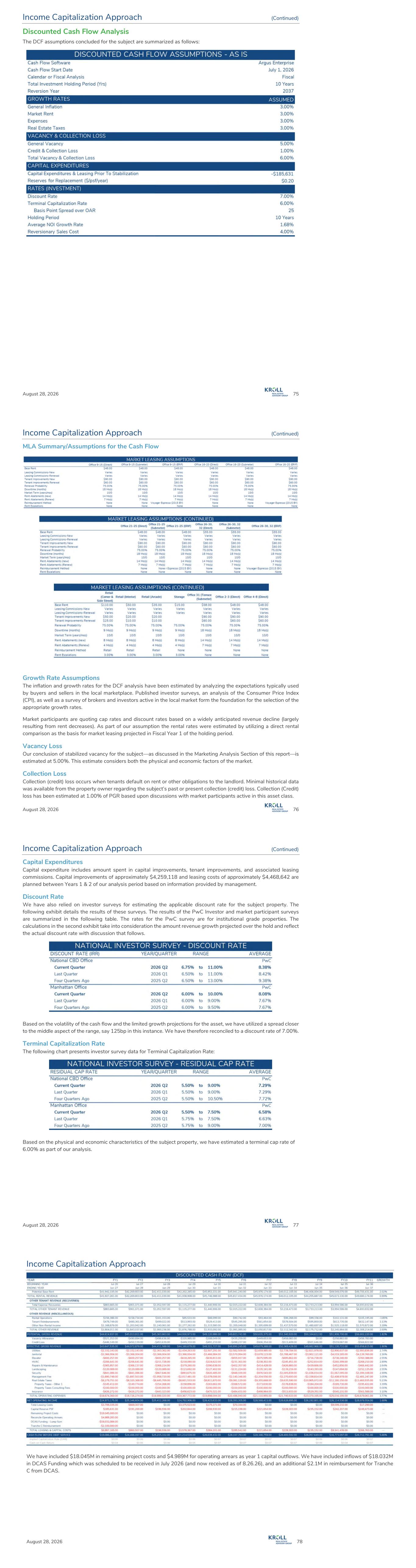
Income Capitalization Approach (Continued) August 28, 2026 75 Discounted Cash Flow Analysis The DCF assumptions concluded for the subject are summarized as follows: Income Capitalization Approach (Continued) August 28, 2026 76 MLA Summary/Assumptions for the Cash Flow Growth Rate Assumptions The inflation and growth rates for the DCF analysis have been estimated by analyzing the expectations typically used by buyers and sellers in the local marketplace. Published investor surveys, an analysis of the Consumer Price Index (CPI), as well as a survey of brokers and investors active in the local market form the foundation for the selection of the appropriate growth rates. Market participants are quoting cap rates and discount rates based on a widely anticipated revenue decline (largely resulting from rent decreases). As part of our assumption the rental rates were estimated by utilizing a direct rental comparison as the basis for market leasing projected in Fiscal Year 1 of the holding period. Vacancy Loss Our conclusion of stabilized vacancy for the subject—as discussed in the Marketing Analysis Section of this report—is estimated at 5.00%. This estimate considers both the physical and economic factors of the market. Collection Loss Collection (credit) loss occurs when tenants default on rent or other obligations to the landlord. Minimal historical data was available from the property owner regarding the subject’s past or present collection (credit) loss. Collection (Credit) loss has been estimated at 1.00% of PGR based upon discussions with market participants active in this asset class. Income Capitalization Approach (Continued) August 28, 2026 77 Capital Expenditures Capital expenditure includes amount spent in capital improvements, tenant improvements, and associated leasing commissions. Capital improvements of approximately $4,259,118 and leasing costs of approximately $4,468,642 are planned between Years 1 & 2 of our analysis period based on information provided by management. Discount Rate We have also relied on investor surveys for estimating the applicable discount rate for the subject property. The following exhibit details the results of these surveys. The results of the PwC Investor and market participant surveys are summarized in the following table. The rates for the PwC survey are for institutional grade properties. The calculations in the second exhibit take into consideration the amount revenue growth projected over the hold and reflect the actual discount rate with discussion that follows. Based on the volatility of the cash flow and the limited growth projections for the asset, we have utilized a spread closer to the middle aspect of the range, say 125bp in this instance. We have therefore reconciled to a discount rate of 7.00%. Terminal Capitalization Rate The following chart presents investor survey data for Terminal Capitalization Rate: Based on the physical and economic characteristics of the subject property, we have estimated a terminal cap rate of 6.00% as part of our analysis. Income Capitalization Approach August 28, 2026 78 We have included $18.045M in remaining project costs and $4.989M for operating arrears as year 1 capital outflows. We have included inflows of $18.032M in DCAS Funding which was scheduled to be received in July 2026 (and now received as of 8.26.26), and an additional $2.1M in reimbursement for Tranche C from DCAS.

Income Capitalization Approach August 28, 2026 79 Income Capitalization Approach (Continued) August 28, 2026 80 Income Capitalization Approach Reconciliation Given that the subject is a multitenant asset with leases expiring at different times throughout the hold, it is generally understood that the discounted cash flow (DCF) method is the preferred method. Based on our findings and interviews with other participants, we concur that this is largely the preferred method. Reconciliation of Value Conclusions August 28, 2026 81 The process of reconciliation involves the analysis of each approach to value. The quality of data applied the significance of each approach as it relates to market behavior and defensibility of each approach are considered and weighed. Finally, each is considered separately and comparatively with each other. Based on the agreed upon scope with the client, the subject’s specific characteristics and the interest appraised, this appraisal developed Sales Comparison and Income (Discounted Cash Flow) Approaches. The values presented represent the As-Is Market Value (Leased Fee). Reconciliation is the process of analyzing the relevance of the indicated values, resulting in a final value estimate. In each of the two approaches, the appraisers have documented all of the input data and briefly explained the methodology in processing and/or analyzing this data. Insofar as the appraisers were able to determine, the data furnished is from reliable sources and has been accepted as being accurate. Because the appraisal of real estate is not, by any means, an exact science, a great deal of subjective judgment on the part of the appraisers becomes a part of each of the recognized approaches. The cost approach relies on the proposition that the market value of the property is no more than the cost of producing a substitute property with the same utility as the subject produces. The approach is reasonable accurate in establishing replacement cost. The cost approach is not applied as this approach is not a typical consideration of investors in leased CBD office properties. The sales comparison approach was the second approach utilized in the valuation process. This approach involves the direct comparison of the property being appraised with similar market comparables. Each sale was analyzed and compared on a price per square foot basis. The sales comparison approach is heavily dependent upon the accuracy and comparability of the sales. We were able to research and analyze comparable transactions locally. Although the properties are considered comparable to the subject in general physical and economic characteristics, various adjustment factors were warranted. The data collected for the income capitalization approach is recent and considered to be reliable. Strong indicators of market rent, occupancy, and expenses were included in the analysis. The income capitalization approach is considered to be most applicable in the subject's valuation, since a prospective purchaser would likely purchase the property based on its income-producing characteristics. The discounted cash flow analysis is generally regarded as the most reliable method for estimating the value of an income producing property. This approach primarily emphasizes the economic productivity of the asset. It is based on the premise that value is created by the expectation of future benefits. In summary, the income capitalization approach is considered a primary value indicator and was given primary emphasis. The sales comparison approach also proved to be a reliable value estimate and was given secondary emphasis. The cost approach was not included. Reconciliation Of Value Conclusions (Continued) August 28, 2026 82

Addenda August 28, 2026 83 General Definitions3 Assessed value 1. A value set on real estate and personal property by a government as a basis for levying taxes. (IAAO) 2. The monetary amount for a property as officially entered on the assessment roll for purposes of computing the tax levy. Assessed values differ from the assessor's estimate of actual (market) value for three major reasons: fractional assessment ratios, partial exemptions, and decisions by assessing officials to override market value. The process of gathering and interpreting economic data to provide information that can be used by policymakers to formulate tax policy. (IAAO) Easement An interest in real property that conveys use, but not ownership, of a portion of an owner’s property. Access or right of way easements may be acquired by private parties or public utilities. Governments dedicate conservation, open space, and preservation easements. Effective date The date at which the analyses, opinions, and advice in an appraisal, review, or consulting service apply. Fee simple estate Absolute ownership unencumbered by any other interest or estate, subject only to the limitations imposed by the governmental powers of taxation, eminent domain, police power, and escheat. Floor area ratio (FAR) The relationship between the above-ground floor area of a building, as described by the building code, and the area of the plot on which it stands; in planning and zoning, often expressed as a decimal, e.g., a ratio of 2.0 indicates that the permissible floor area of a building is twice the total land area. Identified intangible assets Those intangible assets owned by a business (going concern) that have been separately identified and valued in an appraisal. Land-to-building ratio The proportion of land area to gross building area; one of the factors determining comparability of properties. Leased fee interest An ownership interest held by a landlord with the rights of use and occupancy conveyed by lease to others. The rights of the lessor (the leased fee owner) and the lessee are specified by contract terms contained within the lease. Leasehold interest The interest held by the lessee (the tenant or renter) through a lease transferring the rights of use and occupancy for a stated term under certain conditions. Market rent The most probable rent that a property should bring in a competitive and open market reflecting all conditions and restrictions of the specified lease agreement including term, rental adjustment and revaluation, permitted uses, use restrictions, and expense obligations; the lessee and lessor each acting prudently and knowledgeably, and assuming consummation of a lease contract as of a specified date and the passing of the leasehold from lessor to lessee under conditions whereby: 1. Lessee and lessor are typically motivated. 2. Both parties are well informed or well advised, and acting in what they consider their best interests. 3. A reasonable time is allowed for exposure in the open market. 4. The rent payment is made in terms of cash in United States dollars, and is expressed as an amount per time period consistent with the payment schedule of the lease contract. 3 Appraisal Institute, The Dictionary of Real Estate Appraisal, 6th ed. (Chicago: Appraisal Institute, 2015). Addenda (Continued) August 28, 2026 84 5. The rental amount represents the normal consideration for the property leased unaffected by special fees or concessions granted by anyone associated with the transaction. Marketing time 1. The time it takes an interest in real property to sell on the market sub-sequent to the date of an appraisal. 2. Reasonable marketing time is an estimate of the amount of time it might take to sell an interest in real property at its estimated market value during the period immediately after the effective date of the appraisal; the anticipated time required to expose the property to a pool of prospective purchasers and to allow appropriate time for negotiation, the exercise of due diligence, and the consummation of a sale at a price supportable by concurrent market conditions. Marketing time differs from exposure time, which is always presumed to precede the effective date of the appraisal. (Advisory Opinion 7 of the Appraisal Standards Board of The Appraisal Foundation and Statement on Appraisal Standards No. 6, "Reasonable Exposure Time in Real Property and Personal Property Market Value Opinions" address the determination of reasonable exposure and marketing time.) Negative easement Property that is burdened by an easement; also called servient estate. Personal property Identifiable tangible objects that are considered by the general public as being “personal,” for example, furnishings, artwork, antiques, gems and jewelry, collectibles, machinery and equipment; all tangible property that is not classified as real estate. Personal property consists of every kind of property that is not real property; movable without damage to itself or the real estate; subdivided into tangible and intangible. Prospective value opinion A forecast of the value expected at a specified future date. A prospective value opinion is most frequently sought in connection with real estate projects that are proposed, under construction, or under conversion to a new use, or those that have not achieved sellout or a stabilized level of long-term occupancy at the time the appraisal report is written. Rentable area The amount of space on which the rent is based; calculated according to local practice. Restricted appraisal report A written appraisal report prepared under Standards Rule 2-2(b) of the Uniform Standards of Professional Appraisal Practice (USPAP, 2020-2021 ed.). A restricted appraisal report sets forth the data considered, the appraisal procedures followed, and the reasoning employed in the appraisal, addressing each item in the depth and detail required by its significance to the appraisal and providing sufficient information so that the client and the users of the report will understand the appraisal and not be misled or confused. Appraisal report A written report prepared under Standards Rule 2-2(a) or 8-2(a). An appraisal report contains a summary of all information significant to the solution of the appraisal problem. The essential difference between a restricted appraisal report and an appraisal report is the level of detail of presentation. Use value In real estate appraisal, the value a specific property has for a specific use; may be the highest and best use of the property or some other use specified as a condition of the appraisal; may be used where legislation has been enacted to preserve farmland, timberland, or other open space land on urban fringes. See also exchange value; value in use. Usable area The area available for assignment or rental to an occupant, including every type of usable space; measured from the inside finish of outer walls to the office side of corridors or permanent partitions and from the centerline of adjacent spaces; includes subdivided occupant space, but no deductions are made for columns and projections. There are two variations of net area: single occupant net assignable area and store net assignable area. Addenda (Continued) August 28, 2026 85 Value “as is” The value of specific ownership rights to an identified parcel of real estate as of the effective date of the appraisal; relates to what physically exists and is legally permissible and excludes all assumptions concerning hypothetical market conditions or possible rezoning. Addenda (Continued) August 28, 2026 86 Legal Description

Pacific Oak - Oakland City Center Appraisal Report August 28, 2026 August 28, 2026 Mr. Ryan Schluttenhofer Chief Accounting Officer 3857 Birch St Newport Beach, CA 92660 Re: Appraisal Report Dear Mr. Schluttenhofer: In accordance with your request, we have prepared an Appraisal Report to estimate the As-Is Market Value (Leased Fee Interest) in the subject property. The intended use of this appraisal is to assist the client in making financial reporting decisions related to this asset. Pacific Oak SOR (BVI) Holdings, Ltd is the only intended user of this report. Please reference the attached report for important information regarding the scope of work and analysis for this appraisal, including property identification, inspection, the highest and best use analysis and valuation methodology. The subject property, located at 1300 Clay Street & 505 14th Street, Oakland, CA, is a Class A, office, office-retail property with improvements located in the Oakland submarket. The improvements consist of 368,059 square feet of net rentable area (NRA) as of the valuation date. The property was reportedly built in 1985 & 1990 and is approximately 44% occupied, with US GSA Bankruptcy Court (largest tenant) occupying approximately 36,632 square feet of space. The lease term for US GSA Bankruptcy Court runs until August 2035. Rollover for the subject in the next 24 months is estimated to be 14,577 square feet, or about 4.0% of NRA. The following tables convey the final opinion of value that is developed in this appraisal: The exposure time preceding July 1, 2026 would have been 9 to 12 months and the estimated marketing period as of July 1, 2026 is 9 to 12 months. The following appraisal sets forth the most pertinent data gathered, the techniques employed, and the reasoning leading to the opinion of value. This report conforms to the current Uniform Standards of Professional Appraisal Practice (USPAP). Accordingly, the analyses, opinions and conclusions were developed based on, and this report has been prepared in conformance with, our interpretation of the guidelines and recommendations set forth therein. If there are any specific questions or concerns regarding the attached appraisal report, or if Kroll REAG can be of additional assistance, please contact the individuals listed below. Respectfully submitted, Kroll, LLC Kroll, LLC Table of Contents Letter of Transmittal General Assumptions And Limiting Conditions 2 Certification 4 Introduction Executive Summary 5 Identification of Appraisal Assignment 8 Scope of Work 10 Descriptions & Exhibits Regional Analysis 13 Neighborhood Analysis 17 Market Analysis 27 Site Description 30 Zoning 35 Improvement Description 37 Highest & Best Use Analysis 39 As Vacant Analysis 39 As-Improved Analysis 40 Appraisal Methodology Sales Comparison Approach 43 Income Capitalization Approach 49 Reconciliation of Value Conclusions 70 Addenda General Definitions 72

General Assumptions And Limiting Conditions This appraisal report is subject to the following general assumptions and limiting conditions: 1. No investigation has been made of, and no responsibility is assumed for, the legal description or for legal matters including title or encumbrances. Title to the property is assumed to be good and marketable unless otherwise stated. The property is further assumed to be free and clear of liens, easements, encroachments and other encumbrances unless otherwise stated, and all improvements are assumed to lie within property boundaries. 2. Information furnished by others, upon which all or portions of this report are based, is believed to be reliable, but has not been verified in all cases. No warranty is given as to the accuracy of such information. 3. It is assumed that all required licenses, certificates of occupancy, consents, or other legislative or administrative authority from any local, state, or national government or private entity or organization have been, or can readily be obtained, or renewed for any use on which the value estimates provided in this report are based. 4. Full compliance with all applicable federal, state and local zoning, use, occupancy, environmental, and similar laws and regulations is assumed, unless otherwise stated. 5. No responsibility is taken for changes in market conditions and no obligation is assumed to revise this report to reflect events or conditions, which occur subsequent to the appraisal date hereof. 6. Responsible ownership and competent property management are assumed. 7. The allocation, if any, in this report of the total valuation among components of the property applies only to the program of utilization stated in this report. The separate values for any components may not be applicable for any other purpose and must not be used in conjunction with any other appraisal. 8. Areas and dimensions of the property were obtained from sources believed to be reliable. Maps or sketches, if included in this report, are only to assist the reader in visualizing the property and no responsibility is assumed for their accuracy. No independent surveys were conducted. 9. It is assumed that there are no hidden or unapparent conditions of the property, subsoil, or structures that affect value. No responsibility is assumed for such conditions or for arranging for engineering studies that may be required to discover them. 10. No soil analysis or geological studies were ordered or made in conjunction with this report, nor was an investigation made of any water, oil, gas, coal, or other subsurface mineral and use rights or conditions. 11. Neither Kroll REAG nor any individuals signing or associated with this report shall be required by reason of this report to give further consultation, to provide testimony or appear in court or other legal proceedings, unless specific arrangements therefor have been made. 12. This appraisal has been made in conformance with, and is subject to, the requirements of the Code of Professional Ethics and Standards of Professional Conduct of the Appraisal Institute and the Uniform Standards of Professional Appraisal Practice. 13. We have not been engaged nor are we qualified to detect the existence of hazardous material, which may or may not be present on or near the property. The presence of potentially hazardous substances such as asbestos, urea- formaldehyde foam insulation, industrial wastes, etc. may affect the value of the property. The value estimate herein is predicated on the assumption that there is no such material on, in, or near the property that would cause a loss in value. No responsibility is assumed for any such conditions or for any expertise or engineering knowledge required to discover them. The client should retain an expert in this field if further information is desired. 14. The date of value to which the conclusions and opinions expressed in this report apply is set forth in the opinion letter at the front of this report. Our value opinion is based on the purchasing power of the United States' dollar as of this date. 15. The Americans with Disabilities Act (“ADA”) became effective January 26, 1992. We have not made a specific compliance survey and analysis of this property to determine whether or not it is in conformity with the various detailed requirements of the ADA. It is possible that a compliance survey of the property along with a detailed General Assumptions And Limiting Conditions (Continued) study of ADA requirements could reveal that the property is not in compliance with the act. If so, this would have a negative effect on the property value. We were not furnished with any compliance surveys or any other documents pertaining to this issue and therefore did not consider compliance or noncompliance with the ADA requirements when estimating the value of the property. 16. In accordance with our agreement, this report is limited to the value of the subject property. One or more additional issues may exist that could affect the Federal tax treatment of the subject property with respect to which we have prepared this report. This report does not consider or provide a conclusion with respect to any of those issues. With respect to any significant Federal tax issue outside the scope of this report, this report was not written, and cannot be used, by anyone for the purpose of avoiding Federal tax penalties. Extraordinary Assumptions When a value opinion is subject to an extraordinary assumption or hypothetical condition, the appraiser must state that condition so that its effect on the value opinion or conclusion is clear. An extraordinary assumption is an assumption that is directly related to a specific assignment, which if found to be false, could alter the appraiser's opinions or conclusions. Extraordinary assumptions presume as fact otherwise uncertain information about physical, legal, or economic characteristics of the subject property; or about conditions external to the property such as market conditions or trends; or about the integrity of data used in an analysis. An extraordinary assumption may be used in an assignment only if: It is required to properly develop credible opinions and conclusions; The appraiser has a reasonable basis for the extraordinary assumption; Use of the extraordinary assumption results in a credible analysis; and The appraiser complies with the disclosure requirements set forth in USPAP for extraordinary assumptions. No Extraordinary Assumptions were made for this assignment. Hypothetical Conditions Hypothetical conditions assume conditions contrary to known facts about physical, legal, or economic characteristics of the subject property; or about conditions external to the property, such as market conditions or trends; or about the integrity of data used in an analysis. A hypothetical condition may be used in an assignment only if: Use of the hypothetical condition is clearly required for legal purposes, for purposes of reasonable analysis, or for purposes of comparison; Use of the hypothetical condition results in a credible analysis; and The appraiser complies with the disclosure requirements set forth in USPAP for hypothetical conditions. No Hypothetical Conditions were made for this assignment. Certification We certify that, to the best of our knowledge and belief: The statements of fact contained in this report are true and correct. The reported analyses, opinions, and conclusions of the signers are limited only by the reported assumptions and limiting conditions, and are our personal, impartial, and unbiased professional analyses, opinions, and conclusions. The signers of this report have no present or prospective interest in the property that is the subject of this report, and no personal interest with respect to the parties involved. William Lane, MAI, and Jake Wesson have performed services, specifically as appraisers, regarding the property that is the subject of this report within the three-year period immediately preceding acceptance of this assignment. The signers are not biased with respect to the property that is the subject of this report or to the parties involved with this assignment. The engagement in this assignment was not contingent upon developing or reporting predetermined results. The compensation for completing this assignment is not contingent upon the development or reporting of a predetermined value or direction in value that favors the cause of the client, the amount of the value opinion, the attainment of a stipulated result, or the occurrence of a subsequent event directly related to the intended use of this appraisal. The reported analysis, opinions, and conclusions were developed, and this report has been prepared, in conformity with the requirements of the Code of Professional Ethics and Standards of Professional Appraisal Practice of the Appraisal Institute, and the Uniform Standards of Professional Appraisal Practice, as set forth by the Appraisal Standards Board of the Appraisal Foundation. William Lane, MAI, and Jake Wesson have not inspected the property that is the subject of this report. A representative of Kroll has made a personal inspection of the subject property on October 19, 2018 for a previous assignment involving the subject. Ryan Savarese provided significant real property appraisal assistance to the appraiser signing this certification, including verifying rent and sale comparables and interviewing brokers for appropriate market rent, cap rates, and sale prices for similar properties. It is noted that the responsibilities of parties providing assistance is not considered to be significant in terms of any value determination. All parties conducted assistance under the direct supervision of the appraiser's signing this report in compliance with State regulations. The use of this report is subject to the requirements of the Appraisal Institute relating to review by its duly authorized representatives. As of the date of this report, William Lane, MAI has completed the continuing education program for Designated Members of the Appraisal Institute. As of the date of this report, Jake Wesson has completed the Standards and Ethics Education Requirement for Candidates of the Appraisal Institute. William Lane, MAI Managing Director State Certified General Real Estate Appraiser California License No. AG044166 Expiration Date 11/18/2026 Jake Wesson Vice President State Certified General Real Estate Appraiser California License No. AG3013379 Expiration Date 2/25/2027 Executive Summary (Continued) August 28, 2026 5

Executive Summary (Continued) August 28, 2026 6 Value Attributions Comments We have previously completed an assignment involving the subject property as of December 31, 2025, in which we concluded to a market value of $57,400,000. The value conclusion reported herein is approximately 31.18% lower than the prior appraisal. This decline in value is primarily attributable to continued weakness in the Oakland CBD office market and broader East Bay office sector, including elevated vacancy, limited leasing activity, and weakened investor demand. In response to current market conditions, we have reduced our market rental rate assumptions and increased the discount rate to reflect current investor return requirements and perceived market risk. Aerial Photograph Identification of Assignment Property Identification The subject property, located at 1300 Clay Street & 505 14th Street, Oakland, CA, is a Class A, office, office-retail property with improvements located in the Oakland submarket. The assessor parcel Number is: 002-0097-033-00; 002-0097-023-00. Legal Description A detailed legal description was not provided. Client/Intended Use/Users The client of this specific assignment is Pacific Oak SOR (BVI) Holdings, Ltd. The intended use of this appraisal is to assist the client in making financial reporting decisions related to this asset. Pacific Oak SOR (BVI) Holdings, Ltd is the only intended user of this report. Purpose The purpose of this appraisal is to develop an opinion of the As-Is Market Value (Leased Fee Interest). Definition Of Market Value The most probable price which a property should bring in a competitive and open market under all conditions requisite to a fair sale, the buyer and seller each acting prudently, knowledgeably, and assuming that the price is not affected by undue stimulus. Implicit in this definition is the consummation of a sale as of a specified date and the passing of title from seller to buyer under conditions whereby: 1. Buyer and seller are typically motivated; 2. Both parties are well informed or well advised, and acting in what they consider their own best interests; 3. A reasonable time is allowed for exposure in the open market; 4. Payment is made in terms of cash in United States dollars or in terms of financial arrangements comparable thereto; and 5. The price represents the normal consideration for the property sold unaffected by special or creative financing or sales concessions granted by anyone associated with the sale.1 Property Rights Appraised The property rights appraised constitute the leased fee interest. Leased Fee Interest A freehold (ownership interest) where the possessory interest has been granted to another party by creation of a contractual landlord-tenant relationship.2 Non-Discrimination Statement This appraisal has been completed without regard to race, color, religion, national origin, sex, marital status or any other prohibited basis, and does not contain references which could be regarded as discriminatory. 1 Office of Comptroller of the Currency (OCC), Title 12 of the Code of Federal Regulation, Part 34, Subpart C -Appraisals, 34.42 (g); Office of Thrift Supervision (OTS), 12 CFR 564.2 (g); This is also compatible with the FDIC, FRS and NCUA definitions of market value. 2 The Dictionary of Real Estate Appraisal, Sixth Edition, Appraisal Institute, Chicago, Illinois, 2015 Identification of Assignment (Continued) August 28, 2026 9 Personal Property & Business Intangible There is no personal property (FF&E) or business intangible value included in this appraisal. Property And Sales History Current Owner The subject property is currently under the ownership of Pacific Oak Capital Advisors Strategic Opportunity REIT Inc., Oakland City Center LLC, according to Alameda County records. Three-Year Sales History The subject property is not currently listed for sale or under contract.

Scope of Work According to the Uniform Standards of Professional Appraisal Practice, it is the appraiser’s responsibility to develop and report a scope of work that results in credible results that are appropriate for the appraisal problem and intended user(s). Therefore, the appraiser must identify and consider: The client and intended users The intended use of the report The type and definition of value The effective date of value Assignment conditions Typical client expectations Typical appraisal work by peers for similar assignments The client of this specific assignment is Pacific Oak SOR (BVI) Holdings, Ltd. The intended use of this appraisal is to assist the client in making financial reporting decisions related to this asset. Pacific Oak SOR (BVI) Holdings, Ltd is the only intended user of this report. The scope of work for this assignment was based on the needs and prior communications with the Client. The purpose of this assignment—which was prepared as an Appraisal Report in accordance with USPAP Standards Rule 2-2a, with the analysis stated in the document and representing a fully described level of analysis—is to form an opinion of the As-Is Market Value (Leased Fee Interest) for the subject property, as of July 1, 2026. Specifically, the scope of work and report content herein is commensurate with the relative risk that is associated with this particular transaction as determined by the Client, Pacific Oak SOR (BVI) Holdings, Ltd. We have conducted primary research and-wherever possible-we have verified and/or re-verified applicable tax data, zoning requirements, flood zone status, demographics, and comparable listing, sale and rental information which was gathered via: a) public records, b) comments from local brokers and market participants, c) third party data such as CoStar, Reis, LoopNet, Real Quest, etc.,) other sources such as related or previous appraisal projects; and e) observations of the micro and/or macro market environments with respect to physical and economic factors relevant to the valuation process. Then we analyzed, correlated and reconciled the results with the use of appropriate and accepted appraisal methodology to arrive at a reasonable and defensible value conclusion via the Sales Comparison and Income (Discounted Cash Flow) Approaches to value. The appraisal analyzes the regional and local area profiles including employment, population, household income and real estate trends. The local area was inspected to consider external influences on the subject. The appraisal analyzes legal and physical features of the subject including site size, improvement size, flood zone, seismic zone, site zoning, easements, encumbrances, site access and site exposure. The appraisal includes an office market analysis for the East Bay market and Oakland submarket using vacancy, absorption, supply and rent data. Conclusions were drawn for the subject’s competitive position given its physical and locational features, current market conditions and external influences. We have estimated a reasonable exposure time and marketing time associated with the value estimate presented. The appraisal includes a Highest and Best Use analysis and conclusions have been completed for the highest and best use of the subject property As Vacant and As Improved. The analysis considered legal, locational, physical and financial feasibility characteristics of the subject site and existing improvements. We verified the accuracy of the rent roll against leases or made adjustments where required except where otherwise noted as well as verified the accuracy of any Argus or cash flow input against the leases (if provided) as we have read or reviewed all of the leases provided to substantiate the quantity and durability of the gross revenue stream. Scope of Work (Continued) August 28, 2026 11 We completed an analysis of the subject’s existing and/or pro forma economic operating characteristics and attempted—where possible—to identify all lease provisions pertaining to use clauses, co-tenancy requirements (initial opening and ongoing), kick-out provisions, sales volume out clauses, "go dark" clauses and operating covenants, (if applicable this information has been presented in a table format on a tenant-by-tenant basis. We have provided prior professional services regarding the subject property, in the capacity as appraisers or otherwise, within a three-year period immediately preceding the date of acceptance of this assignment. We have observed the interior and exterior of the subject’s improvements and the surrounding land area. We did not attempt to detect any physical issues with the site area that would not be readily observable without removal of fixtures or fixed elements or any foliage at the site. As well, we did not attempt to detect any environmental hazards at the subject that were not readily observable during our on-site visitation, nor did we conduct any off-site research into potential environmental hazards which might impact the subject. Finally, no research into pending legal proceedings (such as planned condemnation for public-right-of-way, etc.) was undertaken. Unless otherwise noted in this appraisal, area measurements were taken from the information made available to us that was provided from the Client and site surveys or other sources. These figures have been cross-checked to the extent possible with public records. However, in no event—unless otherwise noted in this report—have we conducted measurements of the specific areas (these figures are taken solely from the information provided by the Client, site surveys or other sources). The authors of this report are aware of the Competency Rule of USPAP and meets the standards. Sources of Information The following sources were contacted to obtain relevant information: Scope of Work (Continued) August 28, 2026 12 The lack of the unavailable items could affect the results of this analysis. As part of the general assumptions and limiting conditions, the subject is assumed to have no adverse easements or be impacted by adverse environmental conditions, but the subject property has been analyzed as having significant items of deferred maintenance. Subject Property Inspection Exposure & Marketing Time Marketing time and exposure time are both influenced by price. That is, a prudent buyer could be enticed to acquire the property in less time if the price were less. Hence, the time span cited below coincides with the value opinion(s) formed herein. USPAP Standard rule 1-2(c)(iv) requires an opinion of exposure time, not marketing time, when the purpose of the appraisal is to estimate market value. In the recent past, the volume of competitive properties offered for sale, sale prices, and vacancy rates have fluctuated little. Sale concessions have not been prevalent. The following information is used to estimate exposure time and marketing time for the subject: Conclusion Given the analysis we have analyzed the exposure time as 9 to 12 months. Further, marketing time of 9 to 12 months is estimated for the subject. Regional Analysis Introduction We have analyzed demographic and economic information as it relates to the interaction of the real estate market’s supply and demand. This market analysis provides a tool to predict a property’s market position and to estimate current and future occupancy and rental rates. Furthermore, a market analysis provides a basis for determining highest and best use of the subject property. Overall market conditions, as well as the property’s ability to compete in its market segment, influence income and occupancy performance. Market conditions are influenced by a variety of factors; we have focused on the historical and projected trends for a.) gross domestic product; b.) population; c.) employment; d.) personal income; e.) consumer spending; and, f.) housing. The subject market’s economic performance and the property’s ability to maintain its market position is a result of its specific attributes, including overall quality, amenities, location and reputation in the marketplace. To evaluate the factors that influence a property’s income potential over a projection term, the market has been analyzed at two levels: first from a broad market perspective (Regional Overview) without specific consideration of the subject property; second from a more narrowly defined market perspective with regards to the subject’s neighborhood influences (Neighborhood Analysis). The subject property is located in Oakland, California. The map presented below illustrates the subject property location relative to the Oakland-Fremont-Berkeley, CA Metropolitan Division metropolitan area.

Regional Analysis (Continued) August 28, 2026 14 Regional Analysis (Continued) August 28, 2026 15 Unemployment The following graphs chart the trailing 18 months and trailing 10 years unemployment rate for the United States, West Region, California, Oakland-Fremont-Berkeley, CA Metropolitan Division, and Alameda County. Regional Analysis (Continued) August 28, 2026 16 Employment The following chart shows the trailing 10 years employment for the state of California, Oakland-Fremont-Berkeley, CA Metropolitan Division, and Alameda County. Neighborhood Analysis Introduction A property is an integral part of its surrounding and must not be treated as an entity separate and apart from its surroundings. The value of a property is not found exclusively in its physical characteristics. Physical, economic, political and sociological forces found in the area interact to give value to a property. In order to determine the degree of influence extended by these forces on a property, their past and probable future trends must be analyzed in depth. Therefore, in order to determine the value of a property, a careful and thorough analysis must be made of the area in which the property under study is found. The area is commonly referred to as a neighborhood. “The productivity of real estate is strongly influenced by its economic and physical location. Analyzing economic location goes beyond identification of the physical position of one property in relation to another. The analysis of economic location begins with identification of the economic activities in the neighborhood or trade area, which is delineated by physical, political and socioeconomic boundaries or by time-distance relationships represented by travel times to and from common destinations.” Therefore, in order to estimate the value of a property, a careful and thorough analysis must be made of the area in which the property under study is found. The area is commonly referred to as a neighborhood. A neighborhood can be a portion of a city, a community or an entire town. It is usually considered to be an area which exhibits a fairly high degree of homogeneity as to use, tenancy and certain other characteristics. Therefore, in real estate terminology, a homogeneous neighborhood is one in which property use types are similar. Thus, a neighborhood is more or less a unified area with somewhat definite boundaries. The objective of a neighborhood analysis is to determine perceivable patterns of growth, structure and change that may detract from or enhance property values. The analysis provides a framework or context in which the property values are estimated. A neighborhood map is presented below, followed by a discussion of the subject’s neighborhood. Subject Neighborhood Delineation While a certain level of subjectivity exists in attempting to quantify the limits of a property’s neighborhood, based upon our observations of road patterns and the competition, we believe the subject’s neighborhood would extend for a radius of three to five miles.

Neighborhood Analysis (Continued) August 28, 2026 18 Neighborhood Analysis (Continued) August 28, 2026 19 Location The subject property is located in Downtown Oakland, CA, and is influenced by the demographic and economic trends in the East Bay metropolitan area. The map above illustrates the subject property’s location relative to the Downtown Oakland area and specifically its Central Business District. The subject property is located along Clay St and 14th St. The properties are located in central Oakland and are located by various office properties and retail stores. Access & Linkages Primary road access to the subject property is provided by Clay Street & 505 14th Street and secondary road access is provided by Clay St. There is Metro Rail access via the 12th St/Oakland location, which is a 4-minute walk from the subject. There are multiple bus stops within a 3-minute walking distance from the subject property in all directions. The immediate area is considered to be pedestrian-friendly and access is considered to be very good. Land Uses The subject property is located along Clay Street & 505 14th Street. The area is urban, with a mixture of low, mid and high-rise development. There is a mix of property types with high-density SFR, multi-family apartment/condo, hotel and office. Neighborhood Analysis (Continued) August 28, 2026 20 The following tables and maps highlight the development in and around the subject. Neighborhood Analysis (Continued) August 28, 2026 21

Neighborhood Analysis (Continued) August 28, 2026 22 Neighborhood Analysis (Continued) August 28, 2026 23 Neighborhood Analysis (Continued) August 28, 2026 24 The land use in the subject’s immediate neighborhood consists of a significant amount of commercial property, comprising of a mix of many property types. Commercial uses in the area include the large office developments, industrial/distribution-type properties, and small- to- medium sized freestanding retail properties. The following chart illustrates the high concentration of multifamily and office compared to industrial and retail properties. Demographics The following information reflects the demographics for the subject’s area. Neighborhood Analysis (Continued) August 28, 2026 25 Population The estimate provided by ESRI for the current 2026 population within the subject neighborhood’s 3 mile radius is 275,005 representing a 6.04%change since 2020. ESRI’s 2020 population estimate for the subject’s 5 mile radius is 525,932, which represents a 3.00% change since 2020. Looking forward, ESRI estimates that the population within the subject neighborhood’s 3 mile radius is forecasted to change to 282,006 by the year 2031. As for the broader area, ESRI forecasts that the population within the subject’s 5 mile radius will change to 537,686 over the next five years. The population estimates for the next five years within the subject’s 5 mile radius represents a 2.23% change as well as a 4.57% change within the subject’s 1 mile radius for the same period. Households The estimates provided by ESRI indicate that the number of households within the subject neighborhood’s 3 mile radius is 119,783, which is a 6.79% change since 2020. Within the subject’s broader 5 mile radius, ESRI estimates that the number of households is 213,106, a 3.72% change over the same period of time. By the year 2031, the estimates provided by ESRI indicate that the number of households within the subject neighborhood’s 3 mile radius will change by 2.45% to 122,719 households. Additionally, ESRI’s estimate for total households over the next five years within the subject’s broader 5 mile radius indicates an expected change of 2.21% which will result in a total household estimate of 217,816.

Neighborhood Analysis (Continued) August 28, 2026 26 Looking back, the number of households in the subject neighborhood’s 3 mile radius changed 10.22% during the ten- year period of 2010 to 2020. Since then it has changed by 6.79%. Income Income estimates provided by ESRI for the subject neighborhood’s 3 mile radius indicates that the median household income is $112,489 and that the average household income is $168,477. Further, the estimates provided by ESRI indicate that, for the subject’s broader 5 mile radius the median household income is $115,819, and the average household income is $174,685. Given that there are reportedly 213,106 households in the subject’s 5 mile radius, it is estimated that the local effective buying income is around $37,226,421,610. Conclusion Based on our observation and the data provided by ESRI, it is perceived that the income and population demographics for the subject neighborhood exhibit average characteristics in terms of reported population growth and income levels. As previously mentioned, the population growth for the subject’s 3 mile radius has increased 6.04% since 2020 and based on the projections provided by ESRI, it is expected to continue to increase another 2.55% during the next 5 years. Lastly, we perceive that, since average household incomes are above the national average ($168,477, for the subject’s 3 mile radius) and given that the area is well-populated (119,783 households in a 3 mile radius), developments like the subject should be adequately supported. Market Analysis In this section, market conditions which influence the subject property are analyzed. An overview of Office supply and demand conditions for the East Bay market and Oakland submarket is presented. Key supply and demand statistics for the most recent year, historical averages and a projection are summarized in the tables below. Market Analysis (Continued) August 28, 2026 28 The East Bay Office market demonstrates negative conditions. There has been little variance in supply over the last year. Vacancy has slightly increased over the last few periods hovering near the most recent figure at 15.8%. Market rent growth has remained static over the past several periods. Net absorption was negative for the last year. The Oakland Office submarket mirrors the broader area in terms of rent and demand growth. Vacancy has increased steadily over the last few periods, with the latest figure being 21.6%. Market rents have been decreasing, falling between $40-$45 PSF with the most recent figure in-between at $40.07 PSF. It is noted that rents in this submarket are historically above that of the MSA. Net absorption was negative in the previous two periods. Market Rent, Sale Price, Vacancy & Inventory Market Analysis (Continued) August 28, 2026 29 Market Analysis Conclusion Overall, investors would recognize these general office conditions and the subject’s positioning in the immediate market area as having a negative overall influence when contemplating purchase of the subject.

Site Description The following summarizes the salient characteristics of the subject site: Address 1300 Clay Street & 505 14th Street, Oakland, California. Location The subject property is located along the corner of Clay Street & 14th Street. Census Tract 06-001-403100 Adjacent Properties North Retail South Retail East Retail West Office Accessibility Access to the subject site is considered good overall. Exposure & Visibility Exposure of the subject is good. Site Description (Continued) August 28, 2026 31 Flood Plain Zone X (Unshaded). This is referenced by Panel Number 06001C0067G, dated August 03, 2009. Zone X (unshaded) is a moderate and minimal risk area. Areas of moderate or minimal hazard are studied based upon the principal source of flood in the area. However, buildings in these zones could be flooded by severe, concentrated rainfall coupled with inadequate local drainage systems. Local storm water drainage systems are not normally considered in a community’s flood insurance study. The failure of a local drainage system can create areas of high flood risk within these zones. Flood insurance is available in participating communities, but is not required by regulation in these zones. Nearly 25% of all flood claims filed are for structures located within these zones. Minimal risk areas outside the 1% and 0.2% annual chance floodplains. No BFEs or base flood depths are shown within these zones. (Zone X (unshaded) is used on new and revised maps in place of Zone C.) Seismic The subject is in a moderate risk area. Easements A preliminary title report was not available for review. During the property inspection, no adverse easements or encumbrances were noted. This appraisal assumes that there are no adverse easements present. If questions arise, further research is advised. Soils A detailed soils analysis was not available for review. Based on the development of the subject, it appears the soils are stable and suitable for the existing improvements. Hazardous Waste I have not conducted an independent investigation to determine the presence or absence of toxins on the subject property. If questions arise, the reader is strongly cautioned to seek qualified professional assistance in this matter. Please see the Assumptions and Limiting Conditions for a full disclaimer. Site Rating Overall, the subject site is considered to be a good office site in terms of its location, exposure and access to employment, education and shopping centers, based on its location along a major arterial. Site Conclusion No significant detriments were discovered that would inhibit development in accordance with the highest and best use of the subject property. The site’s physical and legal characteristics appear to be supportive of and suitable for the subject’s current use. Plat Map Flood Map

Taxes Current Taxation & Assessment Description In California, Proposition 13 establishes that annual increases of assessed value of real property should not exceed 2% per year except in cases of a change in ownership, completion of new construction, and/or in the case of a value restoration due to a prior year decline in value (Proposition 8) assessment. The total assessment for the subject property for the tax year 2025 is $176,360,436 or $479.16 PSF. There are no exemptions in place. The total tax bill for the property is $2,407,586 or $6.54 PSF. The subject’s assessed values and property taxes for the current year are summarized in more detail in the following table. The last assessment for the subject was January 2026 with future assessments scheduled annually (next assessment estimated to be in January 2027). In this instance, the assessment is equal to the market value multiplied by the assessment ratio. The Alameda County Tax Authority usually reassesses upon sale. Based on the foregoing, and the current assessment's relationship to market value, we perceive that the risk of a reassessment is low. Should a reassessment occur, we believe it could be around 100.0% of market value. The current real estate tax obligations presented above reflect the subject’s existing assessed value. For purposes of the discounted cash flow analysis, real estate taxes are modeled in accordance with California Proposition 13, assuming reassessment of the property upon a hypothetical sale at the concluded market value rather than continuation of the current tax assessment. Accordingly, the real estate tax expense reflected in the DCF is lower than the subject’s current actual tax obligation. Based on the scope of this assignment, any pending tax liens are not considered in the value conclusion. Zoning The subject is located in the Downtown District General Commercial (D-DT-C) zoning area. Zoning Conclusion The current use for the subject property is office-retail and is permitted use based on the current zoning guidelines. A zoning change for the subject does not appear likely. Based on the foregoing, it appears that the subject’s improvements are a legally conforming use of the subject site. Zoning Map (Continued) August 28, 2026 36 Improvement Description The following summaries the salient characteristics of the subject improvements. Overview The subject property, located at 1300 Clay Street & 505 14th Street, Oakland, CA, is a Class A, office, office-retail property with improvements located in the Oakland submarket. Size The Net Rentable Area (NRA) and gross building area (GBA) are shown in the following table. The sizes are taken from public records and confirmed during site inspection. Foundation Reinforced concrete slab Exterior Walls/Framing Glass and Concrete/Heavy Steel Frame Roof Flat and metal gable roofs / Rubber Membrane and Metal gable covering Elevator 8 total. 4 in each building Heating & AC (HVAC) Adequate Insulation Assumed to be standard and to code for both walls and ceilings Lighting Interior lighting consists of a mix of incandescent and fluorescent lighting Interior Walls Tenant spaces vary by demand but are typically painted drywall

Improvement Description (Continued) August 28, 2026 38 Doors and Windows Solar tempered glass in aluminum frame Ceilings Tenant spaces have typical 10 foot ceiling heights Plumbing Assumed to be adequate and to code Fire Protection The first floor of the subject property features a lobby and office spaces. The following floors feature office space Site Improvements The site is improved with concrete sidewalks and minimal landscaping. Landscaping None, the building covers the entire site. Signage There is a monument style sign along Clay Street & 505 14th Street Parking Parking varies by use but is stated as one space per 1,000 SF. The subject provides 361 covered parking spaces. Site Coverage Ratio 38.4% (30,669 SF footprint / 79,861 SF site). Deferred Maintenance We have included $1,500,000 in deferred maintenance in Year 1 of our cash flow model for 1300 Clay. This number is based on discussions with management on outstanding capital projects for the property including replacing a generator ($500k) and replacing a chiller ($700k). Management expects the total to complete all work to be $1,500,000. Functional Design The building features a functional Mid-Rise Office design with typical site coverage and adequate off-street parking. ADA Comment This analysis assumes that the subject complies with all ADA requirements. Please refer to the Assumptions and Limiting Conditions section. Hazardous Materials A Phase I report was not provided. This appraisal assumes that the improvements are constructed free of all hazardous waste and toxic materials, including (but not limited to) unseen asbestos and mold. Please refer to the Assumptions and Limiting Conditions section regarding this issue. Highest & Best Use The theory of highest and best use is fundamental to the concept of value. Highest and best use analysis identifies the most profitable, competitive use to which the property can be put. The highest and best use of a property is based on the competitive forces within the market and submarket and provides the foundation for a detailed investigation of the competitive position of the subject property in the minds of market participants. Highest and best use may be defined as: “The reasonably probable and legal use of vacant land or an improved property that is physically possible, appropriately supported, and financially feasible and that results in the highest value.” The four criteria the highest and best use must meet are 1) legally permissible, 2) physically possible, 3) financially feasible and 4) maximally productive. In arriving at the estimate of highest and best use, the subject was analyzed as vacant and as improved as of the date of value. In each of the previous sections of the report including the Market Analysis, Site Description, Improvement Description, Real Estate Taxes and Zoning we have identified factors that influence value. These factors shape our conclusions for the Highest and Best Use as Vacant and As Improved. This section develops the highest and best use of the subject property As-Vacant and As Improved. As Vacant Analysis In this section the highest and best use of the subject as vacant is concluded after taking into consideration financial feasibility, maximal productivity, marketability, legal, and physical factors. Legally Permissible Private restrictions, zoning, building codes, historic district controls, and environmental regulations are considered, if applicable to the subject site. The legal factors influencing the highest and best use of the subject site are primarily government regulations such as zoning ordinances. Permitted uses of the subject’s Downtown District General Commercial (D-DT-C) include office building, retail, hotel and other commercial uses. Zoning change is not likely; therefore, uses outside of those permitted by the D-DT-C zoning are not considered moving forward in the as-vacant analysis. Physical Possible The test of what is physically possible for the subject site considers physical and locational characteristics that influence its highest and best use. In terms of physical features, the subject site totals 1.8334-acres (79,861 SF), it is irregular in shape and has a level topography. The site has good exposure and good overall access. There are no physical limitations that would prohibit development of any of the by-right uses on the site. Financial Feasibility Based on the analysis of the subject’s market and an examination of costs, a newly constructed building similar to the subject would likely have a value commensurate with its cost; however, a speculative build is not prudent and the site should only be developed for an identified user. Maximum Productivity There is only one use that creates value and at the same time conforms to the requirements of the first three tests. Financial feasibility, maximal productivity, marketability, legal, and physical factors have been considered and the highest and best use of the subject site as-vacant concluded to be commercial development, as demand dictates. Highest & Best Use (Continued) August 28, 2026 40 As Improved Analysis The legal factors influencing the highest and best use of the subject property are primarily governmental regulations such as zoning and building codes. The subject’s improvements were constructed in 1985 & 1990 and are a legal, conforming use. The physical and location characteristics of the subject improvements have been previously discussed in this report. The project is of good quality construction and in good condition, with adequate site coverage and parking ratios. Therefore, the property as improved, meets the physical and location criteria as the highest and best use of the property. In addition to legal and physical considerations, analysis of the subject property as-improved requires consideration of alternative uses. The five possible alternative treatments of the property are demolition (not warranted as the improvements contribute substantial value to the site), expansion (not warranted, no excess or surplus land), renovation (not warranted), conversion (not applicable), and continued use "as-is". Among the five alternative uses, continued use as an office building is the Highest and Best Use of the subject As Improved. Most Probable Buyer Based on the type of property and the income generating potential of the improvements, it is our opinion that the most probable buyer for the subject would be a regional or national investor. Appraisal Methodology In traditional valuation theory, the three approaches to estimating the value of an asset are the cost approach, sales comparison approach, and income capitalization approach. Each approach assumes valuation of the property at the property’s highest and best use. From the indications of these analyses, an opinion of value is reached based upon expert judgment within the outline of the appraisal process. Site Valuation The site value is not a specific scope requirement of this assignment. Characteristics specific to the subject property do not warrant that a site value is developed. Therefore, this appraisal does not provide a valuation of the subject site. Cost Approach The cost approach considers the cost to replace the proposed improvements, less accrued depreciation, plus the market value of the land. The cost approach is based on the understanding that market participants relate value to cost. The value of the property is derived by adding the estimated value of the land to the current cost of constructing a reproduction or replacement for the improvements and then subtracting the amount of depreciation in the structure from all causes. Profit for coordination by the entrepreneur is included in the value indication. The Cost Approach is not a specific scope requirement of this assignment. Characteristics specific to the subject property do not warrant that this valuation technique is developed. Based on the preceding information, the Cost Approach will not be presented. Sales Comparison Approach The sales comparison approach estimates value based on what other purchasers and sellers in the market have agreed to as price for comparable properties. This approach is based upon the principle of substitution, which states that the limits of prices, rents, and rates tend to be set by the prevailing prices, rents, and rates of equally desirable substitutes. In conducting the sales comparison approach, we gather data on reasonably substitutable properties and make adjustments for transactional and property characteristics. The resulting adjusted prices lead to an estimate of the price one might expect to realize upon sale of the property. The Sales Comparison Approach is a specific scope requirement of this assignment. Considering the applicability of this approach in relation to the subject property's characteristics, we consider the application of this approach to be warranted. Income Capitalization Approach The income capitalization approach simulates the reasoning of an investor who views the cash flows that would result from the anticipated revenue and expense on a property throughout its lifetime. The net income developed in our analysis is the balance of potential income remaining after vacancy and collection loss, and operating expenses. This net income is then capitalized at an appropriate rate to derive an estimate of value or discounted by an appropriate yield rate over a typical projection period in a discounted cash flow analysis. Thus, two key steps are involved: (1) estimating the net income applicable to the subject and (2) choosing appropriate capitalization rates and discount rates. The appropriate rates are ones that will provide both a return on the investment and a return of the investment over the life of the particular property. The Income Approach is a scope requirement for this assignment. The subject is a leased investment property making this valuation technique particularly applicable. Therefore, the Income Approach is developed. Discounted Cash Flow analysis is used in this appraisal. The Direct Capitalization method does not contribute substantially to estimating value beyond the DCF analysis and is not presented. Correlation and Conclusion Based on the agreed upon scope with the client, the subject’s specific characteristics and the interest appraised, this appraisal developed Sales Comparison and Income (Discounted Cash Flow) Approaches. The values presented

Appraisal Methodology (Continued) August 28, 2026 42 represent the As-Is Market Value (Leased Fee Interest). This appraisal does not develop the Cost Approach, the impact of which is addressed in the reconciliation section. Sales Comparison Approach The sales comparison approach is a method of estimating market value whereby a subject property is compared with similar properties that have recently sold or are currently listed for sale. The sales comparison approach is based on the premise that a buyer would pay no more for a specific property than the cost of obtaining a property with the same quality, utility, and perceived benefits of ownership. It is based on the principles of supply and demand, balance, substitution and externalities. The reliability of this approach is dependent on the availability and verification of data, degree of comparability to the subject and absence of atypical conditions affecting the sale price. The following steps describe the applied process of the sales comparison approach. The market in which the subject property competes is investigated; comparable sales, contracts for sale and current offerings are reviewed. The most pertinent data is further analyzed, and the quality of the transaction is determined. The most meaningful unit of value for the subject property is determined. Each comparable sale is analyzed and where appropriate, adjusted to account for differences the subject property. The value indication of each comparable sale is analyzed, and the data reconciled for a final indication of value via the sales comparison approach. Comparable Selection Our survey of the market uncovered several recent transactions of comparable office properties. The information collected on these transfers serves two primary functions. First, they establish the investment criteria and parameters upon which office properties are being purchased in the market. Second, the information obtained in the sales comparison approach will be utilized to derive an independent indication of value. The presented transactions will initially be examined on a sale price per SF NRA basis to standardize our comparison effort. Unit of Comparison In estimating the value for the subject property via the sales comparison approach, we have employed the price per SF method. The price per SF utilizes an analysis of the sales and concludes to an adjusted value per SF. This is then applied to the subject property's size in order to derive a value estimate. We have researched four comparables for this analysis; these are documented below followed by a location map and analysis grid. Our search criteria is noted below: Adjustment Process Adjustments to the comparable sales were considered and made when warranted for property rights, financing terms, conditions of sale, expenditures after sale and market conditions. Transactional Adjustments Real Property Rights Conveyed1 When real property rights are sold, they may be the sole subject of the contract or the contract may include other rights, less than all of the real property rights, or even rights to another property or properties. The property rights sold in a comparable should be similar to the property rights being appraised. Typical property rights include the fee simple interest, leased fee interest and leasehold interest. Financing Terms2 The transaction price of one property may differ from that of an identical property due to different financing arrangements. An adjustment for financing terms usually reflects non-market financing as either above or below market. Conditions of Sale3 The definition of market value requires “typical motivations of buyers and sellers” where there is no duress on either party to consummate the sale. An adjustment for conditions of sale usually reflects the motivation of the buyer or seller who is under duress to complete a transaction. Expenditures After Sale4 Expenses that the buyer incurs after purchase (deferred maintenance, HVAC repairs, etc.). No adjustments are warranted based on review of the sales. Sales Comparison Approach (Continued) August 28, 2026 44 Time Adjustment Market Conditions5 Comparable sales that occurred under market conditions different from those applicable to the subject on the effective date of value require adjustment for any differences that affect their values. An adjustment of market conditions is made if general property values have increased or decreased since the transaction dates. Change in market conditions may result from changes in income tax laws, building moratoriums, and fluctuations in supply and demand. Property Adjustments - Quantitative Quantitative percentage adjustments are also made for location and physical characteristics such as size, age, site and parking ratios, access, exposure, quality and condition, as well as other applicable elements of comparison. Where possible the adjustments applied are based on paired data or other statistical analysis. It should be stressed that the adjustments are subjective in nature and are meant to illustrate the logic in deriving a value opinion for the subject property by the Sales Comparison Approach. Location: Location refers to the time-distance relationships, or linkages, between a property or neighborhood and all other possible origins and destinations of people going to or coming from the property or neighborhood. An adjustment for location within a market area may be required when the locational characteristics of a comparable property are different from those of the subject property. The subject property is located in Oakland, CA, which is in the Oakland- Fremont-Berkeley, CA Metropolitan Division metropolitan area. Based on the available information of similar office transactions, we have selected 4 comparable sales in the Bay Area, CA. The location adjustments applied had varying magnitudes based on the specific locational factors of the subject property. Our methodology was to compare the localized demographics and market fundamentals of each subject property to the comparables to estimate the magnitude and direction of the location adjustment. Physical Characteristics: Physical characteristics may include differences for size, soils, site access, topography, quality of construction, architectural style, building materials, age, condition, functional utility, attractiveness, amenities, and other characteristics. The value added or lost by the presence or absence of an item in a comparable property may not equal the cost of installing or removing the item. The market dictates the value contribution of individual components to the value of the whole. Economic Characteristics: Economic characteristics are the attributes of a property that directly affect its income and is typically applied to income-producing properties. Characteristics that typically affect a property’s income include operating expenses, quality of management, trade area demographics, tenant mix, rent concessions, lease terms, lease expiration dates, renewal options, and lease provisions. The Improved Sales Comparison Table is on the following page. Sales Comparison Approach (Continued) August 28, 2026 45

Sales Comparison Approach (Continued) August 28, 2026 46 Sales Comparison Approach (Continued) August 28, 2026 47 Analysis of Comparable Sales The comparable sales indicate an overall unadjusted unit value range from $61/SF to $98/SF, and an average of $81/SF. After adjustments, the comparables indicate a range for the subject property from $64/SF to $103/SF, and $81/SF on average. The adjustment process is summarized below. Sale No. 1 ($103/SF Adjusted) This comparable represents the sale of The Leamington, an office property located at 1814-1820 Franklin St in Oakland, CA. This transaction occurred on March 3, 2026, for a total purchase price of $14,400,000 or $98 per square foot. A downward adjustment was made for size as the subject is significantly larger to the comparable. An upward adjustment was made for quality as the subject’s improvements are in better condition than the comparables. No other adjustments were made. Sale No. 2 ($82/SF Adjusted) This comparable represents the sale of 415 20th St, an office property located at 415 20th St in Oakland, CA. This transaction occurred on December 11th, 2025, for a total purchase price of $6,800,000 or $86 per square foot. A downward adjustment was made for size as the subject is significantly larger to the comparable. No other adjustments were made. Sale No. 3 ($74/SF Adjusted) This comparable represents the sale of the I. Magnin & Co. Building, an office property located at 2001-2015 in Oakland, CA. This transaction occurred on October 9, 2025, for a total purchase price of $4,500,000 or $78 per square foot. A downward adjustment was made for size as the subject is significantly larger to the comparable. No other adjustments were made. Sale No. 4 ($64/SF Adjusted) This comparable represents the sale of The Syndicate Building, an office property located at 1420-1440 Broadway in Oakland, CA. This transaction occurred on January 27, 2025, for a total purchase price of $5,500,000 or $161 per square foot. A downward adjustment was made for size as the subject is significantly larger to the comparable. An upward adjustment was made for quality as the subject’s improvements are in better condition than the comparables. No other adjustments were made. Sales Comparison Approach (Continued) August 28, 2026 48 Sales Comparison Approach Conclusion Based on general bracketing, the comparable sales support an adjusted unit value range from $64/SF to $103/SF, with a unit value of $100/SF concluded for the subject property. The following table summarizes the analysis of the comparables, reports the reconciled price per SF value conclusion, and presents the concluded value of the subject property by the Sales Comparison Approach. Based on the average sale prices in the market, it appears that the conclusion stated above is generally reasonable. Income Capitalization Approach The Income Capitalization Approach consists of methods, techniques, and mathematical procedures to analyze a property’s capacity to generate monetary benefits (i.e., income and reversion) and convert these benefits into an indication of present value. The present value of these benefits is an indication of the amount that a prudent, informed purchaser-investor would pay for the right to receive these benefits as of the valuation date. The principle of anticipation is fundamental to the approach. There are two primary methods for converting monetary benefits into present value: 1) discounted cash flow and 2) direct capitalization. The discounted cash flow (“DCF”) analysis focuses on the operating cash flows expected from the property and the anticipated proceeds of a hypothetical sale at the end of an assumed holding period. These amounts are then discounted to their present value. The discounted present values of the income stream and the reversion are added to obtain a value indication. Because benefits to be received in the future are worth less than the same benefits received in the present, this method weights income projected in the early years more heavily than the income and the sale proceeds to be received later. Direct capitalization uses a single year's stabilized net operating income as a basis for a value indication. It converts estimated “stabilized” annual net operating income to a value indication by dividing the income by a capitalization rate. The rate chosen includes a provision for recapture of the investment and should reflect all factors that influence the value of the property. The rate may be inferred from comparable market transactions and/or obtained from trade sources. In some situations, both methods yield similar results. The DCF method is more appropriate for the analysis of investment properties with multiple or long-term leases, particularly leases with cancellation clauses or renewal options and especially in volatile markets. The direct capitalization method is normally more appropriate for properties with relatively stable operating histories and expectations. For the purposes of our appraisal, we have utilized the DCF method. We have completed our discounted cash flow analysis on lease analysis software ARGUS Enterprise. The subject property, located at 1300 Clay Street & 505 14th Street, Oakland, CA, is a Class A, office, office-retail property with improvements located in the Oakland submarket. The subject has multi-tenant design that is currently occupied by third party tenants, and has an analyzed occupancy of 44.0%, which is not equivalent to the stabilized occupancy level estimates of 84.0% developed in this appraisal. Subject Leases The following table summarizes the subject’s in place contract rents.

Income Capitalization Approach (Continued) August 28, 2026 50 Income Capitalization Approach (Continued) August 28, 2026 51 Expense Structure The following table provides a breakdown of the subject’s various tenant categories. Income Capitalization Approach (Continued) August 28, 2026 52 Roll-Over Analysis Vacant Space The improvements consist of 368,059 square feet of net rentable area (NRA) as of the valuation date. The property was reportedly built in 1985 & 1990 and is approximately 44% occupied, with US GSA Bankruptcy Court (largest tenant) occupying approximately 36,632 square feet of space. The lease term for US GSA Bankruptcy Court runs until August 2035. Rollover for the subject in the next 24 months is estimated to be 14,577 square feet, or about 4.0% of NRA. Office Market Rent Analysis This section examines comparable properties within the marketplace to estimate market rent for the subject. This allows for a comparison of the subject property’s contract to what is attainable in the current market. Unit of Comparison The analysis is conducted on a dollar per square foot annually, reflecting market behavior. The market rent analysis is based on a full service structure where the landlord pays for all the operating costs related to running the property. Selection of Comparables A complete search of the area was conducted in order to find the most comparable properties in terms of location, tenancy, age, exposure, quality, and condition. The comparables in this analysis are the most reliable indicators of market rent for the subject available at the time of this appraisal. Income Capitalization Approach (Continued) August 28, 2026 53 Presentation The following presentation summarizes the comparables most similar to the subject property. The Office Lease Comparison Table, location map, photographs, and an analysis of the rent comparables are presented on the following pages.

Income Capitalization Approach (Continued) August 28, 2026 54 Income Capitalization Approach (Continued) August 28, 2026 55 Conclusion Of Market Rent Based on general bracketing, the comparable leases support an adjusted market rent range from $33.00/SF to $45.00/SF, with a market rent of $40.80/SF concluded for the subject property(s). The following table summarizes the various indicators of market rent, provides the market rent analysis and the conclusions for the subject property. Income Capitalization Approach (Continued) August 28, 2026 56 Retail Market Rent Analysis This section examines comparable properties within the marketplace to estimate market rent for the subject. This allows for a comparison of the subject property’s contract to what is attainable in the current market. Unit of Comparison The analysis is conducted on a dollar per square foot annually, reflecting market behavior. The market rent analysis is based on a triple net expense structure where the landlord pays for structural maintenance and vacant space expenses and the tenants reimburse a pro rata share of all other operating expenses including taxes, insurance, utilities, common area maintenance (CAM), and management. Selection of Comparables A complete search of the area was conducted in order to find the most comparable properties in terms of location, tenancy, age, exposure, quality, and condition. The comparables in this analysis are the most reliable indicators of market rent for the subject available at the time of this appraisal. Presentation The following presentation summarizes the comparables most similar to the subject property. The Retail Lease Comparison Table, location map, photographs, and an analysis of the rent comparables are presented on the following pages. Income Capitalization Approach (Continued) August 28, 2026 57 Conclusion Of Market Rent Based on general bracketing, the comparable leases support an adjusted market rent range from $22.28/SF to $30.00/SF, with a market rent of $25.00/SF concluded for the subject property. The following table summarizes the various indicators of market rent, provides the market rent analysis and the conclusion for the subject property.

Income Capitalization Approach (Continued) August 28, 2026 58 Market Rent vs. Contract Rent Based on the previous conclusions, the subject’s average contract rent is 154% of market rents. Contract rents are applied in our analysis. Overall Market Rent Conclusion Based on the average rental rates in the market, our estimate appears reasonable. Income Capitalization Approach (Continued) August 28, 2026 59 Operating History We were presented with the subject’s operating expenses as summarized. Income Capitalization Approach (Continued) August 28, 2026 60 Capitalization Rate In this section, a capitalization rate for the subject is developed based upon market extraction and national survey data. Market Extraction The following capitalization table restates the information for the sales previously presented in the Sales Comparison Approach. The cap rate comps indicate a range from 5.76% to 11.10% with an average of 8.54%. Based on the subject’s Net Operating Income and location, it is believed that a cap rate between 8% and 10% is reasonable. Due to the current state of the office market in the Oakland market, transaction data is limited. Income Capitalization Approach (Continued) August 28, 2026 61 Market Extraction Conclusion In conclusion, the market extraction method brackets the subject’s applicable capitalization rate from 5.76% to 11.10%, and is supportive of a capitalization rate conclusion for the subject presented in the Capitalization Rate Conclusion section. A cap rate near the upper end of the range is supported.

Income Capitalization Approach (Continued) August 28, 2026 62 National Survey The following table summarizes national cap rate trends for similar properties. Capitalization Rate Conclusion Taking all factors into consideration, the following table summarizes the various capitalization rate indicators and provides the final capitalization rate conclusion. Primary emphasis was placed on the Market Extraction Method, with support from the balance of the data. Income Capitalization Approach (Continued) August 28, 2026 63 Discounted Cash Flow Analysis The DCF assumptions concluded for the subject are summarized as follows: Income Capitalization Approach (Continued) August 28, 2026 64 MLA Summary/Assumptions for the Cash Flow General Assumptions We have estimated the total holding period for the subject to be 10 years, with the first year ending in 2027 (FY1) and the last year ending in 2036 (FY10), making the reversion year 2037 (FY11). The cash flow data from these years are utilized to calculate the current, “as is” market value of the subject via the discounted cash flow method. Growth Rate Assumptions The inflation and growth rates for the DCF analysis have been estimated by analyzing the expectations typically used by buyers and sellers in the local marketplace. Published investor surveys, an analysis of the Consumer Price Index (CPI), as well as a survey of brokers and investors active in the local market form the foundation for the selection of the appropriate growth rates. Market participants are quoting cap rates and discount rates based on a widely anticipated revenue increases (largely resulting from rent growth). As part of our assumption the rental rates were estimated by utilizing a direct rental comparison as the basis for market leasing projected in Fiscal Year 1 of the holding period. Market rent growth has been estimated at 0.0% in FY1, 0.0% in FY2, and 3.0% thereafter. Expense growth was estimated at 3.0% during the entire hold period. Real estate taxes are inflated at 2.0% every year. Income Capitalization Approach (Continued) August 28, 2026 65 Terminal Capitalization Rate The following chart presents investor survey data for Terminal Capitalization Rate: Terminal Rate Conclusion Taking all factors into consideration, the following table summarizes the various terminal rate indicators and provides the final terminal rate conclusion. Primary emphasis was placed on the Market Extraction Method, with support from the balance of the data. We’ve concluded to a 9.50% terminal capitalization rate.

Income Capitalization Approach (Continued) August 28, 2026 66 Discount Rate We have also relied on investor surveys for estimating the applicable discount rate for the subject property. The following exhibit details the results of these surveys. Discount Rate Conclusion Taking all factors into consideration, the following table summarizes the various discount rate indicators and provides the final discount rate conclusion. Primary emphasis was placed on the Market Extraction Method, with support from the balance of the data. We’ve concluded to an 11.00% discount rate. Income Capitalization Approach (Continued) August 28, 2026 67 Income Capitalization Approach (Continued) August 28, 2026 68 Income Capitalization Approach (Continued) August 28, 2026 69 Income Capitalization Approach Reconciliation Given that the subject is a multitenant asset with leases expiring at different times throughout the hold, it is generally understood that the discounted cash flow (DCF) method is the preferred method. Based on our findings and interviews with other participants, we concur that this is largely the preferred method and have given the DCF method sole reliance in our income capitalization approach conclusion.

Reconciliation of Value Conclusions The process of reconciliation involves the analysis of each approach to value. The quality of data applied the significance of each approach as it relates to market behavior and defensibility of each approach are considered and weighed. Finally, each is considered separately and comparatively with each other. Based on the agreed upon scope with the client, the subject’s specific characteristics and the interest appraised, this appraisal developed Sales Comparison and Income (Discounted Cash Flow) Approaches. The values presented represent the As-Is Market Value (Leased Fee Interest). Reconciliation is the process of analyzing the relevance of the indicated values, resulting in a final value estimate. In each of the two approaches, the appraisers have documented all of the input data and briefly explained the methodology in processing and/or analyzing this data. Insofar as the appraisers were able to determine, the data furnished is from reliable sources and has been accepted as being accurate. Because the appraisal of real estate is not, by any means, an exact science, a great deal of subjective judgment on the part of the appraisers becomes a part of each of the recognized approaches. The cost approach relies on the proposition that the market value of the property is no more than the cost of producing a substitute property with the same utility as the subject produces. The approach is reasonably accurate in establishing replacement cost. Market participants do not typically rely on the cost approach for this property type. Further, the age of the improvements makes depreciation difficult to estimate. As a result, the cost approach has limited utility and has been excluded from our analysis. The sales comparison approach was the second approach utilized in the valuation process. This approach involves the direct comparison of the property being appraised with similar market comparables. Each sale was analyzed and compared on a price per square foot basis. The sales comparison approach is heavily dependent upon the accuracy and comparability of the sales. We were able to research and analyze comparable transactions locally. Although the properties are considered comparable to the subject in general physical and economic characteristics, various adjustment factors were warranted. The data collected for the income capitalization approach is recent and considered to be reliable. Strong indicators of market rent, occupancy, and expenses were included in the analysis. The income capitalization approach is considered to be most applicable in the subject's valuation, since a prospective purchaser would likely purchase the property based on its income-producing characteristics. The discounted cash flow analysis is generally regarded as the most reliable method for estimating the value of an income producing property. This approach primarily emphasizes the economic productivity of the asset. It is based on the premise that value is created by the expectation of future benefits. In summary, the income capitalization approach is considered a primary value indicator and was given primary emphasis. The sales comparison also provided to be a reliable value estimate and was given secondary emphasis. Reconciliation Of Value Conclusions (Continued) August 28, 2026 71 Addenda General Definitions3 Assessed value 1. A value set on real estate and personal property by a government as a basis for levying taxes. (IAAO) 2. The monetary amount for a property as officially entered on the assessment roll for purposes of computing the tax levy. Assessed values differ from the assessor's estimate of actual (market) value for three major reasons: fractional assessment ratios, partial exemptions, and decisions by assessing officials to override market value. The process of gathering and interpreting economic data to provide information that can be used by policymakers to formulate tax policy. (IAAO) Easement An interest in real property that conveys use, but not ownership, of a portion of an owner’s property. Access or right of way easements may be acquired by private parties or public utilities. Governments dedicate conservation, open space, and preservation easements. Effective date The date at which the analyses, opinions, and advice in an appraisal, review, or consulting service apply. Fee simple estate Absolute ownership unencumbered by any other interest or estate, subject only to the limitations imposed by the governmental powers of taxation, eminent domain, police power, and escheat. Floor area ratio (FAR) The relationship between the above-ground floor area of a building, as described by the building code, and the area of the plot on which it stands; in planning and zoning, often expressed as a decimal, e.g., a ratio of 2.0 indicates that the permissible floor area of a building is twice the total land area. Identified intangible assets Those intangible assets owned by a business (going concern) that have been separately identified and valued in an appraisal. Land-to-building ratio The proportion of land area to gross building area; one of the factors determining comparability of properties. Leased fee interest An ownership interest held by a landlord with the rights of use and occupancy conveyed by lease to others. The rights of the lessor (the leased fee owner) and the lessee are specified by contract terms contained within the lease. Leasehold interest The interest held by the lessee (the tenant or renter) through a lease transferring the rights of use and occupancy for a stated term under certain conditions. Market rent The most probable rent that a property should bring in a competitive and open market reflecting all conditions and restrictions of the specified lease agreement including term, rental adjustment and revaluation, permitted uses, use restrictions, and expense obligations; the lessee and lessor each acting prudently and knowledgeably, and assuming consummation of a lease contract as of a specified date and the passing of the leasehold from lessor to lessee under conditions whereby: 1. Lessee and lessor are typically motivated. 2. Both parties are well informed or well advised, and acting in what they consider their best interests. 3. A reasonable time is allowed for exposure in the open market. 4. The rent payment is made in terms of cash in United States dollars, and is expressed as an amount per time period consistent with the payment schedule of the lease contract. 5. The rental amount represents the normal consideration for the property leased unaffected by special fees or 3 Appraisal Institute, The Dictionary of Real Estate Appraisal, 6th ed. (Chicago: Appraisal Institute, 2015). Addenda (Continued) August 28, 2026 73 concessions granted by anyone associated with the transaction. Marketing time 1. The time it takes an interest in real property to sell on the market sub-sequent to the date of an appraisal. 2. Reasonable marketing time is an estimate of the amount of time it might take to sell an interest in real property at its estimated market value during the period immediately after the effective date of the appraisal; the anticipated time required to expose the property to a pool of prospective purchasers and to allow appropriate time for negotiation, the exercise of due diligence, and the consummation of a sale at a price supportable by concurrent market conditions. Marketing time differs from exposure time, which is always presumed to precede the effective date of the appraisal. (Advisory Opinion 7 of the Appraisal Standards Board of The Appraisal Foundation and Statement on Appraisal Standards No. 6, "Reasonable Exposure Time in Real Property and Personal Property Market Value Opinions" address the determination of reasonable exposure and marketing time.) Negative easement Property that is burdened by an easement; also called servient estate. Personal property Identifiable tangible objects that are considered by the general public as being “personal,” for example, furnishings, artwork, antiques, gems and jewelry, collectibles, machinery and equipment; all tangible property that is not classified as real estate. Personal property consists of every kind of property that is not real property; movable without damage to itself or the real estate; subdivided into tangible and intangible. Prospective value opinion A forecast of the value expected at a specified future date. A prospective value opinion is most frequently sought in connection with real estate projects that are proposed, under construction, or under conversion to a new use, or those that have not achieved sellout or a stabilized level of long-term occupancy at the time the appraisal report is written. Rentable area The amount of space on which the rent is based; calculated according to local practice. Restricted appraisal report A written appraisal report prepared under Standards Rule 2-2(b) of the Uniform Standards of Professional Appraisal Practice (USPAP, 2020-2021 ed.). A restricted appraisal report sets forth the data considered, the appraisal procedures followed, and the reasoning employed in the appraisal, addressing each item in the depth and detail required by its significance to the appraisal and providing sufficient information so that the client and the users of the report will understand the appraisal and not be misled or confused. Appraisal report A written report prepared under Standards Rule 2-2(a) or 8-2(a). An appraisal report contains a summary of all information significant to the solution of the appraisal problem. The essential difference between a restricted appraisal report and an appraisal report is the level of detail of presentation. Use value In real estate appraisal, the value a specific property has for a specific use; may be the highest and best use of the property or some other use specified as a condition of the appraisal; may be used where legislation has been enacted to preserve farmland, timberland, or other open space land on urban fringes. See also exchange value; value in use. Usable area The area available for assignment or rental to an occupant, including every type of usable space; measured from the inside finish of outer walls to the office side of corridors or permanent partitions and from the centerline of adjacent spaces; includes subdivided occupant space, but no deductions are made for columns and projections. There are two variations of net area: single occupant net assignable area and store net assignable area. Value “as is” The value of specific ownership rights to an identified parcel of real estate as of the effective date of the appraisal;

Addenda (Continued) August 28, 2026 74 relates to what physically exists and is legally permissible and excludes all assumptions concerning hypothetical market conditions or possible rezoning. 0 The Marq - Minneapolis, MN Q2 2026 A p pr a i s a l R e po r t J u l y 2 2 , 20 2 6 1 July 22, 2026 Mr. Ryan Schluttenhofer Chief Accounting Officer 3857 Birch St Newport Beach, CA 92660 RE: Appraisal Report The Marq - Minneapolis, MN Q2 2026 250 S Marquette Ave Minneapolis, Minnesota 55401 Dear Mr. Schluttenhofer: In accordance with your request, we have prepared a Appraisal Report to estimate the As-Is Market Value (Leased Fee Interest) in the subject property. The intended use of this appraisal is to assist the client in making financial reporting decisions related to this asset. Pacific Oak SOR (BVI) Holdings, LTD is the only intended user of this report. Please reference the attached report for important information regarding the scope of work and analysis for this appraisal, including property identification, inspection, the highest and best use analysis and valuation methodology. The subject property, located at 250 Marquette Ave, Minneapolis, MN, is a Class A, office, high-rise office property with improvements located in the Minneapolis CBD submarket. The improvements consist of 522,656 square feet of net rentable area (NRA) as of the valuation date. The property, reportedly built: 1972 and renovated in 2019, is approximately 77.6% occupied, with GSA - FDA (largest tenant) occupying approximately 37,543 square feet of space. The lease term for GSA - FDA runs until May 2028. Rollover for the subject in the next 24 months are estimated to be 137,360 square feet, or about 26.3% of NRA. Lastly, we perceive that the property is currently stabilized. The following table conveys the final opinion of value—subject to any Extraordinary Assumptions or Hypothetical Conditions set forth herein—that is developed in this appraisal: The exposure time preceding June 30, 2026 would have been 12 to 18 months and the estimated marketing period as of June 30, 2026 is 12 to 18 months. 2 The leased fee final opinion of value as of December 31, 2025, was $64,030,000. Since then, the value has changed significantly. The value change from Q4 2025 to Q2 2026 is related to updated income and expense projections in line with recent historical financials. Additionally, we adjusted the terminal and discount rate (25 bps increase each) along with adjustments to market leasing assumptions based on market data. Market participant commentary (BOVs) supports the updated conclusions. Our current conclusion as of June 30, 2026, represents a 18.35% decrease in value. The following appraisal sets forth the most pertinent data gathered, the techniques employed, and the reasoning leading to the opinion of value. This report conforms to the current Uniform Standards of Professional Appraisal Practice (USPAP). Accordingly, the analyses, opinions and conclusions were developed based on, and this report has been prepared in conformance with our interpretation of the guidelines and recommendations set forth therein. If there are any specific questions or concerns regarding the attached appraisal report, or if Kroll REAG can be of additional assistance, please let us know. Respectfully submitted, DRAFT Kroll, LLC

Table of Contents 2 Letter of Transmittal Photographs of the Subject Property 3 Certification 4 Introduction Executive Summary 5 Identification of Appraisal Assignment 8 Scope of Work 10 Descriptions & Analyses Regional Overview 13 Neighborhood 15 Market Analysis 18 Site Description 20 Taxes & Assessment 22 Zoning 23 Improvement Description 24 Highest & Best Use Analysis 26 Appraisal Methodology Sales Comparison Approach 30 Income Capitalization Approach 36 Discounted Cash Flow Analysis 46 Reconciliation of Value Conclusions 51 Regional Overview 53 Demographics 54 Aerial Map 55 General Assumptions And Limiting Conditions 56 General Definitions 58 Photographs of the Subject Property 3 Exterior View of the Subject Exterior View of the Subject Exterior View of the Subject Exterior View of the Subject Interior View of the Subject Interior View of the Subject *These photos are from online databases or CoStar Certification 4 We certify that, to the best of our knowledge and belief: The statements of fact contained in this report are true and correct. The reported analyses, opinions, and conclusions of the signers are limited only by the reported assumptions and limiting conditions, and are our personal, impartial, and unbiased professional analyses, opinions, and conclusions. The signers of this report have no present or prospective interest in the property that is the subject of this report, and no personal interest with respect to the parties involved. Kroll REAG has performed services, specifically as an appraiser, regarding the property that is the subject of this report within the three-year period immediately preceding acceptance of this assignment in regard to appraisal reports dated October 6, 2020, October 20, 2021, October 25, 2022, December 31, 2022, September 30, 2023, September 30, 2024, September 30, 2025, December 31, 2025. The signers are not biased with respect to the property that is the subject of this report or to the parties involved with this assignment. The engagement in this assignment was not contingent upon developing or reporting predetermined results. The compensation for completing this assignment is not contingent upon the development or reporting of a predetermined value or direction in value that favors the cause of the client, the amount of the value opinion, the attainment of a stipulated result, or the occurrence of a subsequent event directly related to the intended use of this appraisal. The reported analysis, opinions, and conclusions were developed, and this report has been prepared, in conformity with the requirements of the Code of Professional Ethics and Standards of Professional Appraisal Practice of the Appraisal Institute, and the Uniform Standards of Professional Appraisal Practice, as set forth by the Appraisal Standards Board of the Appraisal Foundation. Joseph Mahowald, and Shale L. Kaplan, MAI have not inspected the property that is the subject of this report. A representative of Kroll made a personal inspection of the subject property on July 25, 2018, for a previous assignment involving the subject. No one provided assistance to the persons signing this report. The use of this report is subject to the requirements of the Appraisal Institute relating to review by its duly authorized representatives. As of the date of this report, Joseph Mahowald has completed the Standards & Ethics education program for Affiliates of the Appraisal Institute. As of the date of this report, Shale L. Kaplan, MAI has completed the continuing education program for Designated Members of the Appraisal Institute. DRAFT DRAFT ____________________________________ __________________________________ Joseph Mahowald Vice President State Certified General Real Estate Appraiser Minnesota License No.40917080 Expiration Date 8/31/2027 Shale L. Kaplan, MAI Senior Director State Certified General Real Estate Appraiser Minnesota License No. 40723920 Expiration Date 8/31/2026 Executive Summary 5

Executive Summary 6 Executive Summary 7 Extraordinary Assumptions When a value opinion is subject to an extraordinary assumption or hypothetical condition, the appraiser must state that condition so that its effect on the value opinion or conclusion is clear. An extraordinary assumption is an assumption that is directly related to a specific assignment, which if found to be false, could alter the appraiser's opinions or conclusions. Extraordinary assumptions presume as fact otherwise uncertain information about physical, legal, or economic characteristics of the subject property; or about conditions external to the property such as market conditions or trends; or about the integrity of data used in an analysis. An extraordinary assumption may be used in an assignment only if: It is required to properly develop credible opinions and conclusions; The appraiser has a reasonable basis for the extraordinary assumption; Use of the extraordinary assumption results in a credible analysis; and The appraiser complies with the disclosure requirements set forth in USPAP for extraordinary assumptions. The use of an Extraordinary Assumption(s) may have impacted the results of the assignment. We inspected the subject property on July 25, 2018, for a previous assignment related to the subject property. We have not re-inspected the subject for this engagement. We assume that there are no material changes in the physical, economic, or financial condition of the subject property between the inspection date and the date of this report. Hypothetical Conditions Hypothetical conditions assume conditions contrary to known facts about physical, legal, or economic characteristics of the subject property; or about conditions external to the property, such as market conditions or trends; or about the integrity of data used in an analysis. A hypothetical condition may be used in an assignment only if: Use of the hypothetical condition is clearly required for legal purposes, for purposes of reasonable analysis, or for purposes of comparison; Use of the hypothetical condition results in a credible analysis; and The appraiser complies with the disclosure requirements set forth in USPAP for hypothetical conditions. No Hypothetical Conditions were made for this assignment. Identification of Appraisal Assignment 8 Property Identification The subject property, located at 250 Marquette Ave, Minneapolis, MN, is a Class A, office, high-rise office property with improvements located in the Minneapolis CBD submarket. The assessor parcel number is: 22-029-24-41-0012. Legal Description AUDITORS SUBD. NO. 137 LOTS 128 TO 155 INCL ADJ VAC ALLEY SUBJECT TO STREET 108900 SQ. FT. Client/Intended Use/Users The client of this specific assignment is Pacific Oak SOR (BVI) Holdings, LTD. The intended use of this appraisal is to assist the client in making financial reporting decisions related to this asset. Pacific Oak SOR (BVI) Holdings, LTD, is the only intended user of this report. Purpose The purpose of this appraisal is to develop an opinion of the As-Is Market Value (Leased Fee Interest). Definition Of Market Value The most probable price which a property should bring in a competitive and open market under all conditions requisite to a fair sale, the buyer and seller each acting prudently, knowledgeably, and assuming that the price is not affected by undue stimulus. Implicit in this definition is the consummation of a sale as of a specified date and the passing of title from seller to buyer under conditions whereby: 1. Buyer and seller are typically motivated; 2. Both parties are well informed or well advised, and acting in what they consider their own best interests; 3. A reasonable time is allowed for exposure in the open market; 4. Payment is made in terms of cash in United States dollars or in terms of financial arrangements comparable thereto; and 5. The price represents the normal consideration for the property sold unaffected by special or creative financing or sales concessions granted by anyone associated with the sale.1 Property Rights Appraised The property rights appraised constitute the leased fee interest. Leased Fee Interest A freehold (ownership interest) where the possessory interest has been granted to another party by creation of a contractual landlord-tenant relationship.2 1 Office of Comptroller of the Currency (OCC), Title 12 of the Code of Federal Regulation, Part 34, Subpart C -Appraisals, 34.42 (g); Office of Thrift Supervision (OTS), 12 CFR 564.2 (g); This is also compatible with the FDIC, FRS and NCUA definitions of market value. 2 The Dictionary of Real Estate Appraisal, Sixth Edition, Appraisal Institute, Chicago, Illinois, 2015 Identification of Appraisal Assignment 9 Non-Discrimination Statement This appraisal has been completed without regard to race, color, religion, national origin, sex, marital status or any other prohibited basis, and does not contain references which could be regarded as discriminatory. Personal Property & Business Intangible There is no personal property (FF&E) or business intangible value included in this appraisal. Property And Sales History Current Owner/Three-Year Sales History The subject title is currently recorded in the name of KBS SOR MARQUETTE PLAZA LLC. who acquired title to the property on March 1, 2018, for the improvements for $88,400,000, as recorded in the Hennepin County records. According to information from the client, the subject property last transacted March 1, 2018, for $88,400,000 or $169 per square foot. To the best of our knowledge, there have been no transactions of the subject property within the past three years. Additionally, the subject is not currently under contract or being marketed for sale.

Scope of Work 10 Scope of Work According to the Uniform Standards of Professional Appraisal Practice, it is the appraiser’s responsibility to develop and report a scope of work that results in credible results that are appropriate for the appraisal problem and intended user(s). Therefore, the appraiser must identify and consider: The client and intended users The intended use of the report The type and definition of value The effective date of value Assignment conditions Typical client expectations Typical appraisal work by peers for similar assignments The client of this specific assignment is Pacific Oak SOR (BVI) Holdings, LTD. The intended use of this appraisal is to assist the client in making financial reporting decisions related to this asset. Pacific Oak SOR (BVI) Holdings, LTD is the only intended user of this report. The scope of work for this assignment was based on the needs and prior communications with the Client. The purpose of this assignment—which was prepared as an Appraisal Report in accordance with USPAP Standards Rule 2-2a, with the analysis stated in the document and representing a fully described level of analysis—is to form an opinion of the As-Is Market Value (Leased Fee Interest) for the subject property, as of June 30, 2026. Specifically, the scope of work and report content herein is commensurate with the relative risk that is associated with this particular transaction as determined by the Client, Pacific Oak SOR (BVI) Holdings, LTD. We have conducted primary research and-wherever possible-we have verified and/or re-verified applicable tax data, zoning requirements, flood zone status, demographics, and comparable listing, sale and rental information which was gathered via: a) public records, b) comments from local brokers and market participants, c) third party data such as CoStar, Reis, LoopNet, Real Quest, etc., d) other sources such as related or previous appraisal projects; and e) observations of the micro and/or macro market environments with respect to physical and economic factors relevant to the valuation process. Then we analyzed, correlated and reconciled the results with the use of appropriate and accepted appraisal methodology to arrive at a reasonable and defensible value conclusion via the Sales Comparison and Income (Discounted Cash Flow) Approaches to value. The appraisal analyzes the regional and local area profiles including employment, population, household income and real estate trends. The local area was inspected to consider external influences on the subject. The appraisal analyzes legal and physical features of the subject including site size, improvement size, flood zone, seismic zone, site zoning, easements, encumbrances, site access and site exposure. The appraisal includes an office class a market analysis for the Minneapolis-St. Paul market and Minneapolis CBD submarket using vacancy, absorption, supply and rent data. Conclusions were drawn for the subject’s competitive position given its physical and locational features, current market conditions and external influences. We have estimated a reasonable exposure time and marketing time associated with the value estimate presented. The appraisal includes a Highest and Best Use analysis and conclusions have been completed for the highest and best use of the subject property As Vacant and As Improved. The analysis considered legal, locational, physical and financial feasibility characteristics of the subject site and existing improvements. We verified the accuracy of the rent roll against leases or made adjustments where required except where otherwise noted as well as verified the accuracy of any Argus or cash flow input against the leases (if provided) as we have read or reviewed all of the leases provided to substantiate the quantity and durability of the gross revenue stream. Scope of Work 11 We completed an analysis of the subject’s existing and/or pro forma economic operating characteristics and attempted—where possible—to identify all lease provisions pertaining to use clauses, co-tenancy requirements (initial opening and ongoing), kick-out provisions, sales volume out clauses, "go dark" clauses and operating covenants, (if applicable this information has been presented in a table format on a tenant-by-tenant basis. We have provided prior professional services regarding the subject property, in the capacity as appraisers or otherwise, within a three-year period immediately preceding the date of acceptance of this assignment in regards to appraisal reports dated October 6, 2020, October 20, 2021, October 25, 2022, December 31, 2022, September 30, 2023, September 30, 2024, September 30, 2025, December 31, 2025. We did not observe the interior and exterior of the subject’s improvements and the surrounding land area. We did not attempt to detect any physical issues with the site area that would not be readily observable without removal of fixtures or fixed elements or any foliage at the site. As well, we did not attempt to detect any environmental hazards at the subject that were not readily observable during our on-site visitation, nor did we conduct any off-site research into potential environmental hazards which might impact the subject. Finally, no research into pending legal proceedings (such as planned condemnation for public-right-of-way, etc.) was undertaken. Unless otherwise noted in this appraisal, area measurements were taken from the information made available to us that was provided from the Client and site surveys or other sources. These figures have been cross-checked to the extent possible with public records. However, in no event—unless otherwise noted in this report—have we conducted measurements of the specific areas (these figures are taken solely from the information provided by the Client, site surveys or other sources). The authors of this report are aware of the Competency Rule of USPAP and meet the standards. Sources of Information The following sources were contacted to obtain relevant information: The lack of the unavailable items could affect the results of this analysis. As part of the general assumptions and limiting conditions, the subject is assumed to have no adverse easements, significant items of deferred maintenance, or be impacted by adverse environmental conditions. Subject Property Inspection A representative of Kroll has made a personal inspection of the subject property on July 25, 2018, for a previous assignment involving the subject. Scope of Work 12 Exposure & Marketing Time Marketing time and exposure time are both influenced by price. That is, a prudent buyer could be enticed to acquire the property in less time if the price were less. Hence, the time span cited below coincides with the value opinion(s) formed herein. USPAP Standard rule 1-2(c)(iv) requires an opinion of exposure time, not marketing time, when the purpose of the appraisal is to estimate market value. In the recent past, the volume of competitive properties offered for sale, sale prices, and vacancy rates have fluctuated little. Sale concessions have not been prevalent. The following information is used to estimate exposure time and marketing time for the subject: Conclusion Given the analysis we have analyzed the exposure time as 12 to 18 months. Further, marketing time of 12 to 18 months is estimated for the subject. Area Analysis 13 Introduction We have analyzed demographic and economic information as it relates to the interaction of the real estate market’s supply and demand. A Regional Analysis focuses on broad that are influenced by a variety of factors. We have focused on the historical and projected trends for a.) gross domestic product; b.) population; c.) employment; d.) personal income; e.) consumer spending; and, f.) housing. The subject market’s economic performance and the property’s ability to maintain its market position is a result of its specific attributes, including overall quality, amenities, location and reputation in the marketplace. To evaluate the factors that influence a property’s demographic demand characteristics such as population, employment, and income, the market has been analyzed at two levels: first from a broad market perspective (Regional) without specific consideration of the subject property; second from a more narrowly defined market perspective with regards to the subject’s neighborhood influences (Neighborhood). Regional The subject property is located in Minneapolis, Minnesota. We have presented this section in an abbreviated format. Please refer to the Addenda Section of this report for further details. The map presented below illustrates the subject property location relative to the Minneapolis-St. Paul-Bloomington, MN-WI MSA metropolitan area.

Area Analysis 14 Area Analysis 15 Neighborhood A property is an integral part of its surroundings and must not be treated as an entity separate and apart from its surroundings. The value of a property is not found exclusively in its physical characteristics. Physical, economic, political and sociological forces found in the area interact to give value to a property. In order to determine the degree of influence extended by these forces on a property, their past and probable future trends must be analyzed in depth. Therefore, in order to determine the value of a property, a careful and thorough analysis must be made of the area in which the property under study is found. The area is commonly referred to as a neighborhood. Subject Neighborhood Delineation While a certain level of subjectivity exists in attempting to quantify the limits of a property’s neighborhood, based upon our observations of road patterns and the competition, we believe the subject’s neighborhood the subject’s neighborhood would extend for a radius of three to five miles. Area Analysis 16 Area Analysis 17 Location The subject property is located in Minneapolis, Hennepin County, MN, and is influenced by the demographic and economic trends in the Minneapolis Metropolitan Area. The map presented above illustrates the subject property’s location relative to the Minneapolis Metropolitan Area and specifically its Central Business District. The subject property is located along South Marquette Avenue adjacent to South Washington Ave and South 3rd Street. The Marquette Plaza has a 1.5-acre plaza park area on the west side of the property. In partnership with the City of Minneapolis, the Cancer Survivors Park represents the only public park in downtown Minneapolis. Situated at the north end of Nicollet Mall, the park offers a new gathering place downtown featuring a central fountain and numerous seating areas amidst lush green landscaping. Access & Linkages Primary road access to the subject property is provided by South Marquette Ave and secondary road access is provided by South 3rd Street or South Washington Ave. There is Light Rail access via the Nicollet Mall station’s Blue and Green Lines, which is located at South 5th Street and Nicollet Mall. This is a 5-minute walk to the subject property. There is also access to Light Rail via the Government Plaza station and the Warehouse Hennepin Ave Station. There are multiple bus stops within a 3-minute walking distance from the subject property in all directions. There are four different bus stations on the block that the subject property is located on, allowing access to more than a dozen different bus routes. The immediate area is considered to be very pedestrian-friendly and access is considered to be very good. The subject neighborhood also benefits from its location in the Downtown Central Business District of Minneapolis. This area is most accessible for commuters living downtown and in the surrounding suburbs due to abundant rail, bus, and automobile accessibility in the area. Given all of these factors, the subject neighborhood has excellent access and linkage characteristics which has a positive factor for the office submarket.

Market Analysis 18 In this section, market conditions which influence the subject property are analyzed. An overview of Office Class A supply and demand conditions for the Minneapolis-St. Paul market and Minneapolis CBD submarket is presented. Key supply and demand statistics for the most recent year, historical averages and a projection are summarized in the tables below. Market Analysis 19 The Minneapolis-St. Paul Office Class A market has experienced successive quarters of consistency in the post- pandemic era, with vacancy levels nearly twice that of pre-pandemic levels. Rental rates have remained relatively stable since 2020. There has been little variance in supply over the last year. The Minneapolis CBD Office Class A submarket has experienced a higher vacancy level post-pandemic when compared to the overall market. Absorption was positive last quarter. Rents in the submarket are in-line to slightly above the overall market. Site Description 20 The following summaries the salient characteristics of the subject site: Address 250 S Marquette Ave, Minneapolis, Minnesota. Location The subject property is located along South Marquette Ave on the southeastern side of Marquette Plaza. Census Tract 27-053-126102 Adjacent Properties North Office Building South Parking Lot and Multifamily Building East Office Building West Office Building Accessibility Access to the subject site is considered good overall. Site Description 21 Exposure & Visibility Exposure of the subject is considered good. Flood Plain Zone X (Unshaded). This is referenced by Panel Number 27053C0357F, dated November 4, 2016. Zone X (unshaded) is a moderate and minimal risk area. Areas of moderate or minimal hazard are studied based upon the principal source of flood in the area. However, buildings in these zones could be flooded by severe, concentrated rainfall coupled with inadequate local drainage systems. Local storm water drainage systems are not normally considered in a community’s flood insurance study. The failure of a local drainage system can create areas of high flood risk within these zones. Flood insurance is available in participating communities but is not required by regulation in these zones. Nearly 25% of all flood claims filed are for structures located within these zones. Minimal risk areas outside the 1% and 0.2% annual chance floodplains. No BFEs or base flood depths are shown within these zones. (Zone X (unshaded) is used on new and revised maps in place of Zone C.) Seismic The subject is in a low risk area. Easements A preliminary title report was not available for review. During the property inspection, no adverse easements or encumbrances were noted. This appraisal assumes that there are no adverse easements present. If questions arise, further research is advised. Soils A detailed soils analysis was not available for review. Based on the development of the subject, it appears the soils are stable and suitable for the existing improvements. Hazardous Waste Based on a review of an independent investigation to determine the presence or absence of toxins on the subject property, none are present. If questions arise, the reader is strongly cautioned to seek qualified professional assistance in this matter. Please see the Assumptions and Limiting Conditions for a full disclaimer. Site Rating Overall, the subject site is considered good as a office site in terms of its location, exposure and access to employment, education and shopping centers, based on its location along a minor arterial.

Taxes 22 Taxes & Assessment The subject’s assessed values and property taxes for the current year are summarized in the following table. Taxation & Assessment Description In Minnesota, commercial real estate is assessed at 100% of market value. The total assessment for the subject property for the tax year 2026 is $45,800,000 or $87.63 PSF. There are no exemptions in place. The total tax bill for the property is $1,738,558 or $3.33 PSF. The subject’s previous year assessment was $54,900,000. The current year assessment of $45,800,000 represents a 16.58% decrease in assessed value. The base tax figure of $1,584,499 is a 13.23% decrease in base taxes year over year. The overall tax figure is an11.94% decrease in taxes year over year. Based on the scope of this assignment, any pending tax liens are not considered in the value conclusion. Zoning 23 The subject is located in the Downtown Destination (DT2) zoning area. Zoning Conclusion The current use for the subject property is high-rise office and is a permitted use based on the current zoning guidelines. A zoning change for the subject does not appear likely. Based on the foregoing, it appears that the subject’s improvements are a legally conforming use of the subject site. Improvement Description 24 The following summaries the salient characteristics of the subject improvements. Overview The subject property, located at 250 Marquette Ave, Minneapolis, MN, is a Class A, office, high-rise office property with improvements located in the Minneapolis CBD submarket. Foundation Poured concrete footings Exterior Walls/Framing Thin veneer granite panels and aluminum and glass framed curtain walls systems/Concrete and structural steel frame Roof Flat/Single-ply membrane Elevator Nine passenger elevators and one service elevator Heating & AC (HVAC) Adequate Insulation Assumed to be standard and to code for both walls and ceilings Lighting Interior lighting consists of a mix of incandescent and fluorescent lighting Electrical Assumed adequate and to code Interior Walls Painted drywall Doors and Windows Adequate Ceilings The ceilings are covered with a mix of painted gypsum board and suspended acoustical tiles Plumbing Standard plumbing for an office building Floor Covering Tenant spaces contain a mix of commercial grade carpeting, tile, and linoleum Fire Protection The subject has a wet fire sprinkler system Improvement Description 25 Site Improvements The site is improved with concrete sidewalks around the perimeter of the building. Situated at the north end of Nicollet Mall, the park offers a new gathering place downtown featuring a central fountain and numerous seating areas amidst lush green landscaping. Landscaping A variety of trees, shrubbery and grass. Signage There is a monument style sign along Marquette Ave. Parking Parking varies by use but is stated as one space per 1,000 SF. The subject provides 209 structured parking spaces, or 0.4 spaces per 1,000 SF of NRA, which is within market standards (3-5/1,000 SF) for office (high-rise office) property type. Deferred Maintenance The subject property has an ongoing maintenance program in place. Based on discussions with the asset manager, no observable deferred maintenance exists. Functional Design The building features a functional High-Rise Office design with typical site coverage and adequate off-street parking. ADA Comment This analysis assumes that the subject complies with all ADA requirements. Please refer to the Assumptions and Limiting Conditions section. Hazardous Materials A Phase I report was not provided. This appraisal assumes that the improvements are constructed free of all hazardous waste and toxic materials, including (but not limited to) unseen asbestos and mold. Please refer to the Assumptions and Limiting Conditions section regarding this issue.

Highest and Best Use Analysis 26 The theory of highest and best use is fundamental to the concept of value. Highest and best use analysis identifies the most profitable, competitive use to which the property can be put. The highest and best use of a property is based on the competitive forces within the market and submarket and provides the foundation for a detailed investigation of the competitive position of the subject property in the minds of market participants. Highest and best use may be defined as: “The reasonably probable and legal use of vacant land or an improved property that is physically possible, appropriately supported, and financially feasible and that results in the highest value.” The four criteria the highest and best use must meet are 1) legally permissible, 2) physically possible, 3) financially feasible and 4) maximally productive. In arriving at the estimate of highest and best use, the subject was analyzed as vacant and as improved as of the date of value. In each of the previous sections of the report including the Market Analysis, Site Description, Improvement Description, Real Estate Taxes and Zoning we have identified factors that influence value. These factors shape our conclusions for the Highest and Best Use as Vacant and As Improved. This section develops the highest and best use of the subject property As Vacant and As Improved. As Vacant Analysis In this section the highest and best use of the subject as vacant is concluded after taking into consideration financial feasibility, maximal productivity, marketability, legal, and physical factors. Legally Permissible Private restrictions, zoning, building codes, historic district controls, and environmental regulations are considered, if applicable to the subject site. The legal factors influencing the highest and best use of the subject site are primarily government regulations such as zoning ordinances. Permitted uses of the subject’s Downtown Destination (DT2) include corporate and professional offices. Zoning change is not likely; therefore, uses outside of those permitted by the DT2 zoning is not considered moving forward in the as-vacant analysis. Physically Possible The test of what is physically possible for the subject site considers physical and locational characteristics that influence its highest and best use. In terms of physical features, the subject site totals 2.5000-acres (108,900 SF), it is square in shape and has a level topography. The site has good exposure and good overall access. There are no physical limitations that would prohibit development of any of the by-right uses on the site. Drainage appears to be adequate. Soil conditions are assumed to be of sufficient load bearing capacity for most types of development. All typical public utilities and municipal services are available. Financial Feasibility Based on the analysis of the subject’s market and an examination of costs, a newly constructed building similar to the subject would likely have a value commensurate with its cost; however, a speculative build is not prudent and the site should only be developed for an identified user. Maximum Productivity There is only one use that creates value and at the same time conforms to the requirements of the first three tests. Financial feasibility, maximal productivity, marketability, legal, and physical factors have been considered and the highest and best use of the subject site as vacant concluded to be commercial development, commercial or office facility, as demand dictates. Highest and Best Use Analysis 27 As Improved Analysis The legal factors influencing the highest and best use of the subject property are primarily governmental regulations such as zoning and building codes. The subject’s improvements were constructed in 1972, renovated in 2019, and are a legal, conforming use. The physical and location characteristics of the subject improvements have been previously discussed in this report. The project is of good quality construction and in good condition, with adequate site coverage and parking ratios. Therefore, the property as improved, meets the physical and location criteria as the highest and best use of the property. In addition to legal and physical considerations, analysis of the subject property as improved requires consideration of alternative uses. The five possible alternative treatments of the property are demolition (not warranted as the improvements contribute substantial value to the site), expansion (not warranted, no excess or surplus land), renovation (not warranted), conversion (not applicable), and continued use "as is". Among the five alternative uses, continued use as a multi-tenant office building is the Highest and Best Use of the subject As Improved. Most Probable Buyer Based on the type of property and the income generating potential of the improvements, it is our opinion that the most probable buyer for the subject would be national institutional investor. Appraisal Methodology 28 In traditional valuation theory, the three approaches to estimating the value of an asset are the cost approach, sales comparison approach, and income capitalization approach. Each approach assumes valuation of the property at the property’s highest and best use. From the indications of these analyses, an opinion of value is reached based upon expert judgment within the outline of the appraisal process. Site Valuation The site value is not a specific scope requirement of this assignment. Characteristics specific to the subject property do not warrant that a site value is developed. Therefore, this appraisal does not provide a valuation of the subject site. Cost Approach The cost approach considers the cost to replace the proposed improvements, less accrued depreciation, plus the market value of the land. The cost approach is based on the understanding that market participants relate value to cost. The value of the property is derived by adding the estimated value of the land to the current cost of constructing a reproduction or replacement for the improvements and then subtracting the amount of depreciation in the structure from all causes. Profit for coordination by the entrepreneur is included in the value indication. The Cost Approach is not a specific scope requirement of this assignment. Characteristics specific to the subject property do not warrant that this valuation technique is developed. Based on the preceding information, the Cost Approach will not be presented. Sales Comparison Approach The sales comparison approach estimates value based on what other purchasers and sellers in the market have agreed to as price for comparable properties. This approach is based upon the principle of substitution, which states that the limits of prices, rents, and rates tend to be set by the prevailing prices, rents, and rates of equally desirable substitutes. In conducting the sales comparison approach, we gather data on reasonably substitutable properties and make adjustments for transactional and property characteristics. The resulting adjusted prices lead to an estimate of the price one might expect to realize upon sale of the property. The Sales Comparison Approach is a specific scope requirement of this assignment. Considering the applicability of this approach in relation to the subject property's characteristics, we consider the application of this approach to be warranted. Income Capitalization Approach The income capitalization approach simulates the reasoning of an investor who views the cash flows that would result from the anticipated revenue and expense on a property throughout its lifetime. The net income developed in our analysis is the balance of potential income remaining after vacancy and collection loss, and operating expenses. This net income is then capitalized at an appropriate rate to derive an estimate of value or discounted by an appropriate yield rate over a typical projection period in a discounted cash flow analysis. Thus, two key steps are involved: (1) estimating the net income applicable to the subject and (2) choosing appropriate capitalization rates and discount rates. The appropriate rates are ones that will provide both a return on the investment and a return of the investment over the life of the particular property. The Income Approach is a scope requirement for this assignment. The subject is a leased investment property making this valuation technique particularly applicable. Therefore, the Income Approach is developed. Discounted Cash Flow analysis is used in this appraisal. The Direct Capitalization method does not contribute substantially to estimating value beyond the DCF analysis and is not presented. Appraisal Methodology 29 Correlation and Conclusion Based on the agreed upon scope with the client, the subject’s specific characteristics and the interest appraised, this appraisal developed Sales Comparison and Income (Discounted Cash Flow) Approaches. The values presented represent the As-Is Market Value (Leased Fee Interest).

Sales Comparison Approach 30 The sales comparison approach is a method of estimating market value whereby a subject property is compared with similar properties that have recently sold or are currently listed for sale. The sales comparison approach is based on the premise that a buyer would pay no more for a specific property than the cost of obtaining a property with the same quality, utility, and perceived benefits of ownership. It is based on the principles of supply and demand, balance, substitution and externalities. The reliability of this approach is dependent on the availability and verification of data, degree of comparability to the subject and absence of atypical conditions affecting the sale price. The following steps describe the applied process of the sales comparison approach: 1) The market in which the subject property competes is investigated; comparable sales, contracts for sale and current offerings are reviewed; 2) The most pertinent data is further analyzed, and the quality of the transaction is determined; 3) The most meaningful unit of value for the subject property is determined; 4) Each comparable sale is analyzed and where appropriate, adjusted to account for differences the subject property; and, 5) The value indication of each comparable sale is analyzed, and the data reconciled for a final indication of value via the sales comparison approach. Comparable Selection Our survey of the market uncovered several recent transactions of comparable office properties. The information collected on these transfers serves two primary functions. First, they establish the investment criteria and parameters upon which office properties are being purchased in the market. Second, the information obtained in the sales comparison approach will be utilized to derive an independent indication of value. The presented transactions will initially be examined on a sale price per SF NRA basis to standardize our comparison effort. There has been minimal sales activity in the Twin Cities metro area over the last 24 months, however there is one new sale comparables are introduced to the report. Unit of Comparison In estimating the value for the subject property via the sales comparison approach, we have employed the price per SF method. The price per SF utilizes an analysis of the sales and concludes to an adjusted value per SF. This is then applied to the subject property's size in order to derive a value estimate. We have researched five comparables for this analysis; these are documented below followed by a location map and analysis grid. Transactional Adjustments Adjustments to the comparable sales were considered and made when warranted for property rights, financing terms, conditions of sale, expenditures after sale and market conditions. Real Property Rights Conveyed1: When real property rights are sold, they may be the sole subject of the contract or the contract may include other rights, less than all of the real property rights, or even rights to another property or properties. The property rights sold in a comparable should be similar to the property rights being appraised. Typical property rights include the fee simple interest, leased fee interest and leasehold interest. Financing Terms2: The transaction price of one property may differ from that of an identical property due to different financing arrangements. An adjustment for financing terms usually reflects non-market financing as either above or below market. Conditions of Sale3: The definition of market value requires “typical motivations of buyers and sellers” where there is no duress on either party to consummate the sale. An adjustment for conditions of sale usually reflects the motivation of the buyer or seller who is under duress to complete a transaction. Expenditures After Sale4: Expenses that the buyer incurs after purchase (deferred maintenance, HVAC repairs, etc.). No adjustments are warranted based on review of the sales. Sales Comparison Approach 31 Market Conditions5: Comparable sales that occurred under market conditions different from those applicable to the subject on the effective date of value require adjustment for any differences that affect their values. An adjustment of market conditions is made if general property values have increased or decreased since the transaction dates. Change in market conditions may result from changes in income tax laws, building moratoriums, and fluctuations in supply and demand. No market conditions have been applied to the comparables given the lack of recent market activity in the Twin Cities office market. Property Adjustments – Quantitative Quantitative percentage adjustments are also made for location and physical characteristics such as size, age, site and parking ratios, access, exposure, quality and condition, as well as other applicable elements of comparison. Where possible the adjustments applied are based on paired data or other statistical analysis. It should be stressed that the adjustments are subjective in nature and are meant to illustrate the logic in deriving a value opinion for the subject property by the Sales Comparison Approach. Location: Location refers to the time-distance relationships, or linkages, between a property or neighborhood and all other possible origins and destinations of people going to or coming from the property or neighborhood. An adjustment for location within a market area may be required when the locational characteristics of a comparable property are different from those of the subject property. The subject property is located in Minneapolis, MN, which is in the Minneapolis-St. Paul-Bloomington, MN-WI MSA metropolitan area. Based on the available information of similar office transactions, we have selected 5 comparable sales in the Twin Cities metro area. The location adjustments applied had varying magnitudes based on the specific locational factors of the subject property. Our methodology was to compare the localized demographics and market fundamentals of each subject property to the comparables to estimate the magnitude and direction of the location adjustment. Physical Characteristics: Physical characteristics may include differences for size, soils, site access, topography, quality of construction, architectural style, building materials, age, condition, functional utility, attractiveness, amenities, and other characteristics. The value added or lost by the presence or absence of an item in a comparable property may not equal the cost of installing or removing the item. The market dictates the value contribution of individual components to the value of the whole. Economic Characteristics: Economic characteristics are the attributes of a property that directly affects its income and is typically applied to income-producing properties. Characteristics that typically affect a property’s income include operating expenses, quality of management, trade area demographics, tenant mix, rent concessions, lease terms, lease expiration dates, renewal options, and lease provisions. The Improved Sales Comparison Table is on the following page. Sales Comparison Approach 32 Sales Comparison Approach 33

Sales Comparison Approach 34 Analysis of Comparable Sales The comparable sales indicate an overall unadjusted unit value range from $55.16/SF to $120.21/SF, and an average of $91.46/SF. After adjustments, the comparables indicate a range for the subject property from $63.43/SF to $120.21/SF, and $94.57/SF on average. The adjustment process is summarized below. Sale No. 1 ($98.43/SF Adjusted) - This comparable located at 3701 Wayzata Blvd, Minneapolis, MN is a 328,149 square foot office property located in the I-394 Corridor submarket. This comparable last traded on June 16, 2026, for $34,000,000 or $104/SF. This comparable was adjusted downward for size. No other adjustments were warranted. Sale No. 2 ($120.21/SF Adjusted) - This comparable located at 7505 Metro Blvd, Edina, MN is a 111,468 square foot office property located in the I-494 Corridor submarket. This comparable last traded on January 15, 2026, for $13,400,000 or $120/SF. This comparable was adjusted downward for size. An upward adjustment was made for year built and location. No other adjustments were warranted. Sale No. 3 ($63.43/SF Adjusted) - This comparable located at 800 Washington Ave N, Minneapolis, MN is a 402,316 square foot office property located in the Minneapolis CBD submarket. This comparable last traded on December 30, 2025, for $22,190,000 or $55/SF. This comparable was adjusted upward for year built and quality. No other adjustments were warranted. Sale No. 4 ($78.18/SF Adjusted) - This comparable located at 90 S 7th St, Minneapolis, MN is a 1,196,036 square foot office property located in the Minneapolis CBD. This comparable last traded on December 12, 2024, for $85,000,000 or $71/SF. This comparable was adjusted upward for size. No other adjustments were warranted. Sale No. 5 ($112.59/SF Adjusted) - This comparable located at 1305 Corporate Center Dr, Eagan, MN is a 140,813 square foot office property located in the Burnsville/Eagan/Apple Vy submarket. This comparable last traded on July 30, 2024, for $15,100,000 or $107/SF. This comparable was adjusted downward for size and age and adjusted upward for location and access. No other adjustments were warranted. Sales Comparison Approach 35 Sales Comparison Approach Conclusion Based on general bracketing, the comparable sales support an adjusted unit value ranges from $63.43/SF to $120.21/SF, with a unit value of $100.00/SF concluded for the subject property. We placed primary weight on the overall average. The following table summarizes the analysis of the comparables, reports the reconciled price per SF value conclusion, and presents the concluded value of the subject property by the Sales Comparison Approach. Based on the average sale prices in the market, it appears that the conclusion stated above is generally reasonable. Income Capitalization Approach 36 The Income Capitalization Approach consists of methods, techniques, and mathematical procedures to analyze a property’s capacity to generate monetary benefits (i.e., income and reversion) and convert these benefits into an indication of present value. The present value of these benefits is an indication of the amount that a prudent, informed purchaser-investor would pay for the right to receive these benefits as of the valuation date. The principle of anticipation is fundamental to the approach. There are two primary methods for converting monetary benefits into present value: 1) discounted cash flow and 2) direct capitalization. In some situations, both methods yield similar results. The DCF method is more appropriate for the analysis of investment properties with multiple or long-term leases, particularly leases with cancellation clauses or renewal options and especially in volatile markets. The direct capitalization method is normally more appropriate for properties with relatively stable operating histories and expectations. For the purposes of our appraisal, we have utilized the DCF method in this instance. we have completed our discounted cash flow analysis utilizing lease analysis software Argus Enterprise. Income Capitalization Approach 37 Subject Leases The following table summarizes the subject’s in place contract rents.

Income Capitalization Approach 38 Roll-Over Analysis Vacant Space The improvements consist of 522,656 square feet of net rentable area (NRA) as of the valuation date. The property, reportedly built: 1972 and renovated in 2019, is approximately 77.6% occupied, with GSA - FDA (largest tenant) occupying approximately 37,543 square feet of space. The lease term for GSA - FDA runs until May 2028. Rollover for the subject in the next 24 months are estimated to be 137,360 square feet, or about 26.3% of NRA. Lastly, we perceive that the property is currently stabilized. There are currently 15 vacant spaces at the subject. STD Office Market Rent Analysis This section examines comparable properties within the marketplace to estimate market rent for the subject. This allows for a comparison of the subject property’s contract to what is attainable in the current market. Unit of Comparison The analysis is conducted on a dollar per square foot annually, reflecting market behavior. The market rent analysis is based on a net lease basis where the landlord pays for structural maintenance and vacant space expenses and the tenants reimburse a pro rata share of all other operating expenses including taxes, insurance, utilities, common area maintenance (CAM), and management. Selection of Comparables A complete search of the area was conducted in order to find the most comparable properties in terms of location, tenancy, age, exposure, quality, and condition. The comparables in this analysis are the most reliable indicators of market rent for the subject available at the time of this appraisal. Income Capitalization Approach 39 Presentation The following presentation summarizes the comparables most similar to the subject property. The STD Office Lease Comparison Table, location map, photographs, and an analysis of the rent comparables are presented on the following pages. STD OFFICE LEASE COMPARISON TABLE SUBJECT COMP 1 COMP 2 COMP 3 COMP 4 COMP 5 COMP 6 COMP 7 COMP 8 COMP 9 COMP 10 Name The Marq - Minneapolis, MN Q1 2026 Fifth Street Towers Fifty South Sixth Deluxe Plaza SPS Tower SPS Tower RSM Plaza Fifth Street Towers Fifty South Sixth Wells Fargo Center Fifth Street Towers Address 250 Marquette Ave 100, 150 S Fifth Street 50 S 6th St 121 8th St S 333 S 7th St 333 S 7th St 801 Nicollet Mall 100, 150 S Fifth Street 50 S 6th St 90 S 7th St 100, 150 S Fifth Street City Minneapolis Minneapolis Minneapolis Minneapolis Minneapolis Minneapolis Minneapolis Minneapolis Minneapolis Minneapolis Minneapolis State MN MN MN MN MN MN MN MN MN MN MN Zip 55401 55402 55402 55402 55402-2414 55402-2414 55402 55402 55402 55402 55402 County Hennepin Hennepin Hennepin Hennepin Hennepin Hennepin Hennepin Hennepin Hennepin Hennepin Hennepin Submarket Minneapolis CBD Minneapolis CBD Minneapolis CBD Minneapolis CBD Minneapolis CBD Minneapolis CBD Minneapolis CBD Minneapolis CBD Minneapolis CBD Minneapolis CBD Minneapolis CBD Floor/Suite - 1900 1300 960 2090 1960 1825 910 2350 2900 1500 LEASE INFORMATION Rent ($/SF/Yr.) $19.09 $21.00 $15.00 $20.31 $21.23 $17.50 $17.76 $18.68 $25.00 $20.50 Tenant Gamer Packaging, Inc N/A Lighthouse Management Emergent Software Heritage Wealth Advisors American Bottling Company Forvis Mazars Messerli & Kramer BMO Bank Bassford Remele Start Date 6/1/2026 4/11/2026 3/6/2026 12/1/2025 11/1/2025 11/1/2025 9/27/2025 9/1/2025 8/31/2025 5/1/2025 Space Type Office Office Office Office Office Office Office Office Office Office Lease Type New New New New New New New New New New Lease Str. NNN NNN NNN NNN NNN NNN NNN NNN NNN NNN Size (SF) 20,182 8,014 1,915 6,741 4,255 8,125 4,179 33,974 11,645 1,464 Term (Yrs.) 11 N/A N/A - - 5.5 5.5 11 10 9 BUILDING INFORMATION NRA (SF) 522,656 1,071,252 698,606 308,387 655,070 655,070 246,000 1,071,252 690,000 1,196,036 1,071,252 Year Built/Ren 1972 / 2019 1984 / 2017 2001 1974/2015 1987 / 2015 1987 / 2015 1968 / 2020 1984 / 2017 2000 1988 / 2018 1984 / 2017 OVERALL COMPARISON SIMILAR SLIGHTLY SUPERIOR SLIGHTLY SUPERIOR SIMILARSIMILARSIMILAR SLIGHTLY SUPERIOR SLIGHTLY INFERIOR SIMILAR SIMILAR Income Capitalization Approach 40 Income Capitalization Approach 41 Conclusion Of Market Rent Based on general bracketing, the comparable leases support a market rent range from $15.00/SF to $25.00/SF, with a market rent of $18.00/SF concluded for the subject property. The following table summarizes the various indicators of market rent, provides the market rent analysis and the conclusions for the subject property. Asking Rents In addition to the comparable market rents indicated above, we have included current asking rents for comparable properties in the Minneapolis CBD. The listings add support to the rental rate conclusion. STD OFFICE MARKET RENT CONCLUSION LEASE RATE ADJUSTED 1 $19.09 2 $21.00 3 $15.00 4 $20.31 5 $21.23 6 $17.50 7 $17.76 8 $18.68 9 $25.00 10 $20.50 HIGH $25.00 AVG $19.61 MED $19.70 LOW $15.00 AVG CONTRACT STD Office $17.59 Triple Net CONCLUSION $18.00

Income Capitalization Approach 42 Overall Market Rent Conclusion Based on the average rental rates in the market, our estimate appears reasonable. Rental Revenue We have estimated the total holding period for the subject to be 12 years, with the first year ending in 2027 (FY1) and the last year ending in 2038 (FY12), making the reversion year 2039 (FY13). The cash flow data from these years are utilized to calculate the current, “as is” market value of the subject via the discounted cash flow method. Other Revenue Under the terms of the market’s triple-net lease expense structure, tenants would reimburse the landlord for operating expenses including property taxes, insurance, common area maintenance, utilities and management. These reimbursements are based on the operating expenses that are concluded later in the income capitalization approach. Other revenue included items such as parking, storage, late fees, etc. Potential Gross Revenue (PGR) The potential gross revenue in this instance is the sum of all Rental Revenue plus Other Tenant Revenue (reimbursements) and Other Revenue (miscellaneous). The PGR for the subject is $14,135,233 , which is $27.05. Vacancy This category accounts for the time period between occupants, as well as possible prolonged vacancies under slow market conditions. This assignment reflects the probable vacancy during the economic life of the property and not necessarily the current or short-term vacancy. The findings of the Market Analysis section support a vacancy loss allocation of 20.00%. As of the effective date, the subject is 77.9% occupied. Income Capitalization Approach 43 Credit Loss Collection (credit) loss occurs when tenants default on rent or other obligations to the landlord. Minimal historical data was available from the property owner regarding the subject’s past or present collection (credit) loss. Credit loss has been estimated at 1.00% of PGR based upon discussions with market participants active in this asset class. Effective Gross Revenue (EGR) Effective Gross Revenue in this instance is the PGR less estimates for Vacancy, Collection and Concessions. The total EGR for the subject is $13,489,698 , which is $25.81. Operating History We were presented with the subject’s operating expenses as summarized. Expense Conclusions The individual expense conclusions for the subject are summarized above. Net Operating Income (NOI) The net operating income equals the effective gross income less the total expenses. The net operating income for the subject is $6,350,983 , which is $12.15. Capitalization Rate In this section, a capitalization rate for the subject is developed based upon market extraction and national survey data. Market Extraction The following capitalization table highlights similar comparables to the subject that sold with reported capitalization rate data. There have been no comparable sales occurring in the Minneapolis market recently. As such, we are increasing reliance upon the investor survey data detailed below as a marker for the changing capitalization data. Income Capitalization Approach 44 The cap rate comps indicate a range from 8.20% to 12.50% with an average of 9.78%. Based on the subject’s NOI of $6,350,983 , it is believed that a cap rate between 8.50% and 9.50% is reasonable. As stated, we are placing reliance upon the survey data detailed below along with the comparables available, which shows between 5.00% - 9.50% (National CBD Office) and 6.50% - 10.00% (National Secondary Office) in capitalization rates year over year. Income Capitalization Approach 45 National Survey For additional support, the following table summarizes national cap rate trends for similar properties. The National CBD Office rates have increased 1bp year over year, while the National Secondary Office rates have decreased 27bp year over year. Capitalization Rate Conclusion Taking all factors into consideration, the following table summarizes the various capitalization rate indicators and provides the final capitalization rate conclusion. Primary emphasis was placed on the National PwC Investor Survey data with support from the balance of the data.

Income Capitalization Approach 46 Discounted Cash Flow Analysis The DCF assumptions concluded for the subject are summarized as follows: Income Capitalization Approach 47 MLA Summary/Assumptions for the Cash Flow General Assumptions We have estimated the total holding period for the subject to be 12 years, with the first year ending in 2027 (FY1) and the last year ending in 2038 (FY12), making the reversion year 2039 (FY13). The cash flow data from these years are utilized to calculate the current, “as is” market value of the subject via the discounted cash flow method. Growth Rate Assumptions The inflation and growth rates for the DCF analysis have been estimated by analyzing the expectations typically used by buyers and sellers in the local marketplace. Published investor surveys, an analysis of the Consumer Price Index (CPI), as well as a survey of brokers and investors active in the local market form the foundation for the selection of the appropriate growth rates. Market participants are quoting cap rates and discount rates based on a widely anticipated revenue increases (largely resulting from rent growth). As part of our assumption the rental rates were estimated by utilizing a direct rental comparison as the basis for market leasing projected in Fiscal Year 1 of the holding period. The increases for the following years are 3.0% thereafter annually. Expense growth was estimated at 3.0% during the entire hold period including estimates for real estate taxes and insurance. Vacancy Loss Our conclusion of stabilized vacancy for the subject—as discussed in the Marketing Analysis Section of this report—is estimated at 20.00%. This estimate considers both the physical and economic factors of the market. Income Capitalization Approach 48 Collection Loss Collection (credit) loss occurs when tenants default on rent or other obligations to the landlord. Minimal historical data was available from the property owner regarding the subject’s past or present collection (credit) loss. Collection (Credit) loss has been estimated at 1.00% of PGR based upon discussions with market participants active in this asset class. Discount Rate We have also relied on investor surveys for estimating the applicable discount rate for the subject property. The following exhibit details the results of these surveys. The rates for the PwC survey are for institutional grade properties. The calculations in the second exhibit take into consideration the amount revenue growth projected over the hold and reflect the actual discount rate with discussion that follows. The average spreads over the going in rate range from 150bp to 200bp. Based on the volatility of the cash flow and the limited growth projections for the asset, we have utilized a spread closer to the higher aspect of the range, say 200bp in this instance. Terminal Capitalization Rate The following chart presents investor survey data for Terminal Capitalization Rate: Our spread between our Terminal Rate conclusion over the going in rate is 50bp, which is reasonable for the subject’s property type. Income Capitalization Approach 49

Income Capitalization Approach 50 Income Capitalization Approach Reconciliation Given that the subject is a multitenant asset with leases expiring at different times throughout the hold, it is generally understood that the discounted cash flow (DCF) method is the preferred method. Based on our findings and interviews with other participants, we concur that this is largely the preferred method. Reconciliation of Value Conclusions 51 The process of reconciliation involves the analysis of each approach to value. The quality of data applied the significance of each approach as it relates to market behavior and defensibility of each approach are considered and weighed. Finally, each is considered separately and comparatively with each other. Based on the agreed upon scope with the client, the subject’s specific characteristics and the interest appraised, this appraisal developed Sales Comparison and Income (Discounted Cash Flow) Approaches. The values presented represent the As-Is Market Value (Leased Fee Interest). Reconciliation is the process of analyzing the relevance of the indicated values, resulting in a final value estimate. In each of the two approaches, the appraisers have documented all of the input data and briefly explained the methodology in processing and/or analyzing this data. Insofar as the appraisers were able to determine, the data furnished is from reliable sources and has been accepted as being accurate. Because the appraisal of real estate is not, by any means, an exact science, a great deal of subjective judgment on the part of the appraisers becomes a part of each of the recognized approaches. The cost approach relies on the proposition that the market value of the property is no more than the cost of producing a substitute property with the same utility as the subject produces. The approach is reasonable accurate in establishing replacement cost. We have not utilized this approach in our analysis because buyers of properties similar to the subject would not typically rely on this type of analysis. The sales comparison approach was the second approach utilized in the valuation process. This approach involves the direct comparison of the property being appraised with similar market comparables. Each sale was analyzed and compared on a price per square foot basis. The sales comparison approach is heavily dependent upon the accuracy and comparability of the sales. We were able to research and analyze comparable transactions locally. Although the properties are considered comparable to the subject in general physical and economic characteristics, various adjustment factors were warranted. The data collected for the income capitalization approach is recent and considered to be reliable. Strong indicators of market rent, occupancy, and expenses were included in the analysis. The income capitalization approach is considered to be most applicable in the subject's valuation, since a prospective purchaser would likely purchase the property based on its income-producing characteristics. The discounted cash flow analysis is generally regarded as the most reliable method for estimating the value of an income producing property. This approach primarily emphasizes the economic productivity of the asset. It is based on the premise that value is created by the expectation of future benefits. In summary, the income capitalization approach is considered a primary value indicator and was given primary emphasis. The sales comparison approach also provided to be a reliable value estimate and was given secondary emphasis. Reconciliation of Value Conclusions 52 Addenda 53 Regional Overview The following graphs charts the trailing 18 months and trailing 10 years unemployment rate for the United States, Midwest Region, Minnesota, Minneapolis-St. Paul-Bloomington, MN-WI MSA, and Hennepin County.

Addenda 54 The following chart shows the trailing 10 years employment for the state of Minnesota, Minneapolis-St. Paul- Bloomington, MN-WI MSA, and Hennepin County. Demographics The following information reflects the demographics for the subject’s area. Addenda 55 Aerial Map Addenda 56 General Assumptions & Limiting Conditions This appraisal report is subject to the following general assumptions and limiting conditions: 1. No investigation has been made of, and no responsibility is assumed for, the legal description or for legal matters including title or encumbrances. Title to the property is assumed to be good and marketable unless otherwise stated. The property is further assumed to be free and clear of liens, easements, encroachments and other encumbrances unless otherwise stated, and all improvements are assumed to lie within property boundaries. 2. Information furnished by others, upon which all or portions of this report are based, is believed to be reliable, but has not been verified in all cases. No warranty is given as to the accuracy of such information. 3. It is assumed that all required licenses, certificates of occupancy, consents, or other legislative or administrative authority from any local, state, or national government or private entity or organization have been, or can readily be obtained, or renewed for any use on which the value estimates provided in this report are based. 4. Full compliance with all applicable federal, state and local zoning, use, occupancy, environmental, and similar laws and regulations is assumed, unless otherwise stated. 5. No responsibility is taken for changes in market conditions and no obligation is assumed to revise this report to reflect events or conditions, which occur subsequent to the appraisal date hereof. 6. Responsible ownership and competent property management are assumed. 7. The allocation, if any, in this report of the total valuation among components of the property applies only to the program of utilization stated in this report. The separate values for any components may not be applicable for any other purpose and must not be used in conjunction with any other appraisal. 8. Areas and dimensions of the property were obtained from sources believed to be reliable. Maps or sketches, if included in this report, are only to assist the reader in visualizing the property and no responsibility is assumed for their accuracy. No independent surveys were conducted. 9. It is assumed that there are no hidden or unapparent conditions of the property, subsoil, or structures that affect value. No responsibility is assumed for such conditions or for arranging for engineering studies that may be required to discover them. 10. No soil analysis or geological studies were ordered or made in conjunction with this report, nor was an investigation made of any water, oil, gas, coal, or other subsurface mineral and use rights or conditions. 11. Neither Kroll, LLC nor any individuals signing or associated with this report shall be required by reason of this report to give further consultation, to provide testimony or appear in court or other legal proceedings, unless specific arrangements thereto for have been made. 12. This appraisal has been made in conformance with, and is subject to, the requirements of the Code of Professional Ethics and Standards of Professional Conduct of the Appraisal Institute and the Uniform Standards of Professional Appraisal Practice. 13. We have not been engaged nor are we qualified to detect the existence of hazardous material, which may or may not be present on or near the property. The presence of potentially hazardous substances such as asbestos, urea- formaldehyde foam insulation, industrial wastes, etc. may affect the value of the property. The value estimate herein is predicated on the assumption that there is no such material on, in, or near the property that would cause a loss in value. No responsibility is assumed for any such conditions or for any expertise or engineering knowledge required to discover them. The client should retain an expert in this field if further information is desired. 14. The date of value to which the conclusions and opinions expressed in this report apply is set forth in the opinion letter at the front of this report. Our value opinion is based on the purchasing power of the United States' dollar as of this date. Addenda 57 15. The Americans with Disabilities Act (“ADA”) became effective January 26, 1992. We have not made a specific compliance survey and analysis of this property to determine whether or not it is in conformity with the various detailed requirements of the ADA. It is possible that a compliance survey of the property along with a detailed study of ADA requirements could reveal that the property is not in compliance with the act. If so, this would have a negative effect on the property value. We were not furnished with any compliance surveys or any other documents pertaining to this issue and therefore did not consider compliance or noncompliance with the ADA requirements when estimating the value of the property. 16. In accordance with our agreement, this report is limited to the value of the subject property. One or more additional issues may exist that could affect the Federal tax treatment of the subject property with respect to which we have prepared this report. This report does not consider or provide a conclusion with respect to any of those issues. With respect to any significant Federal tax issue outside the scope of this report, this report was not written, and cannot be used, by anyone for the purpose of avoiding Federal tax penalties.
Addenda 58 General Definitions3 Assessed value 1. A value set on real estate and personal property by a government as a basis for levying taxes. (IAAO) 2. The monetary amount for a property as officially entered on the assessment roll for purposes of computing the tax levy. Assessed values differ from the assessor's estimate of actual (market) value for three major reasons: fractional assessment ratios, partial exemptions, and decisions by assessing officials to override market value. The process of gathering and interpreting economic data to provide information that can be used by policymakers to formulate tax policy. (IAAO) Easement An interest in real property that conveys use, but not ownership, of a portion of an owner’s property. Access or right of way easements may be acquired by private parties or public utilities. Governments dedicate conservation, open space, and preservation easements. Effective date The date at which the analyses, opinions, and advice in an appraisal, review, or consulting service apply. Fee simple estate Absolute ownership unencumbered by any other interest or estate, subject only to the limitations imposed by the governmental powers of taxation, eminent domain, police power, and escheat. Floor area ratio (FAR) The relationship between the above-ground floor area of a building, as described by the building code, and the area of the plot on which it stands; in planning and zoning, often expressed as a decimal, e.g., a ratio of 2.0 indicates that the permissible floor area of a building is twice the total land area. Identified intangible assets Those intangible assets owned by a business (going concern) that have been separately identified and valued in an appraisal. Land-to-building ratio The proportion of land area to gross building area; one of the factors determining comparability of properties. Leased fee interest An ownership interest held by a landlord with the rights of use and occupancy conveyed by lease to others. The rights of the lessor (the leased fee owner) and the lessee are specified by contract terms contained within the lease. Leasehold interest The interest held by the lessee (the tenant or renter) through a lease transferring the rights of use and occupancy for a stated term under certain conditions. Market rent The most probable rent that a property should bring in a competitive and open market reflecting all conditions and restrictions of the specified lease agreement including term, rental adjustment and revaluation, permitted uses, use restrictions, and expense obligations; the lessee and lessor each acting prudently and knowledgeably, and assuming consummation of a lease contract as of a specified date and the passing of the leasehold from lessor to lessee under conditions whereby: 1. Lessee and lessor are typically motivated. 2. Both parties are well informed or well advised, and acting in what they consider their best interests. 3. A reasonable time is allowed for exposure in the open market. 4. The rent payment is made in terms of cash in United States dollars, and is expressed as an amount per time period consistent with the payment schedule of the lease contract. 5. The rental amount represents the normal consideration for the property leased unaffected by special fees or concessions granted by anyone associated with the transaction. 3 Appraisal Institute, The Dictionary of Real Estate Appraisal, 6th ed. (Chicago: Appraisal Institute, 2015). Addenda (Continued) 59 Marketing time 1. The time it takes an interest in real property to sell on the market sub-sequent to the date of an appraisal. 2. Reasonable marketing time is an estimate of the amount of time it might take to sell an interest in real property at its estimated market value during the period immediately after the effective date of the appraisal; the anticipated time required to expose the property to a pool of prospective purchasers and to allow appropriate time for negotiation, the exercise of due diligence, and the consummation of a sale at a price supportable by concurrent market conditions. Marketing time differs from exposure time, which is always presumed to precede the effective date of the appraisal. (Advisory Opinion 7 of the Appraisal Standards Board of The Appraisal Foundation and Statement on Appraisal Standards No. 6, "Reasonable Exposure Time in Real Property and Personal Property Market Value Opinions" address the determination of reasonable exposure and marketing time.) Negative easement Property that is burdened by an easement; also called servient estate. Personal property Identifiable tangible objects that are considered by the general public as being “personal,” for example, furnishings, artwork, antiques, gems and jewelry, collectibles, machinery and equipment; all tangible property that is not classified as real estate. Personal property consists of every kind of property that is not real property; movable without damage to itself or the real estate; subdivided into tangible and intangible. Prospective value opinion A forecast of the value expected at a specified future date. A prospective value opinion is most frequently sought in connection with real estate projects that are proposed, under construction, or under conversion to a new use, or those that have not achieved sellout or a stabilized level of long-term occupancy at the time the appraisal report is written. Rentable area The amount of space on which the rent is based; calculated according to local practice. Restricted appraisal report A written appraisal report prepared under Standards Rule 2-2(a) of the Uniform Standards of Professional Appraisal Practice (USPAP, 2002 ed.). A restricted appraisal report sets forth the data considered, the appraisal procedures followed, and the reasoning employed in the appraisal, addressing each item in the depth and detail required by its significance to the appraisal and providing sufficient information so that the client and the users of the report will understand the appraisal and not be misled or confused. Appraisal report A written report prepared under Standards Rule 2-2(b) or 8-2(b). An appraisal report contains a summary of all information significant to the solution of the appraisal problem. The essential difference between a restricted appraisal report and an appraisal report is the level of detail of presentation. Use value In real estate appraisal, the value a specific property has for a specific use; may be the highest and best use of the property or some other use specified as a condition of the appraisal; may be used where legislation has been enacted to preserve farmland, timberland, or other open space land on urban fringes. See also exchange value; value in use. Usable area The area available for assignment or rental to an occupant, including every type of usable space; measured from the inside finish of outer walls to the office side of corridors or permanent partitions and from the centerline of adjacent spaces; includes subdivided occupant space, but no deductions are made for columns and projections. There are two variations of net area: single occupant net assignable area and store net assignable area. Value “as is” The value of specific ownership rights to an identified parcel of real estate as of the effective date of the appraisal; relates to what physically exists and is legally permissible and excludes all assumptions concerning hypothetical market conditions or possible rezoning.