Exhibit 99.8
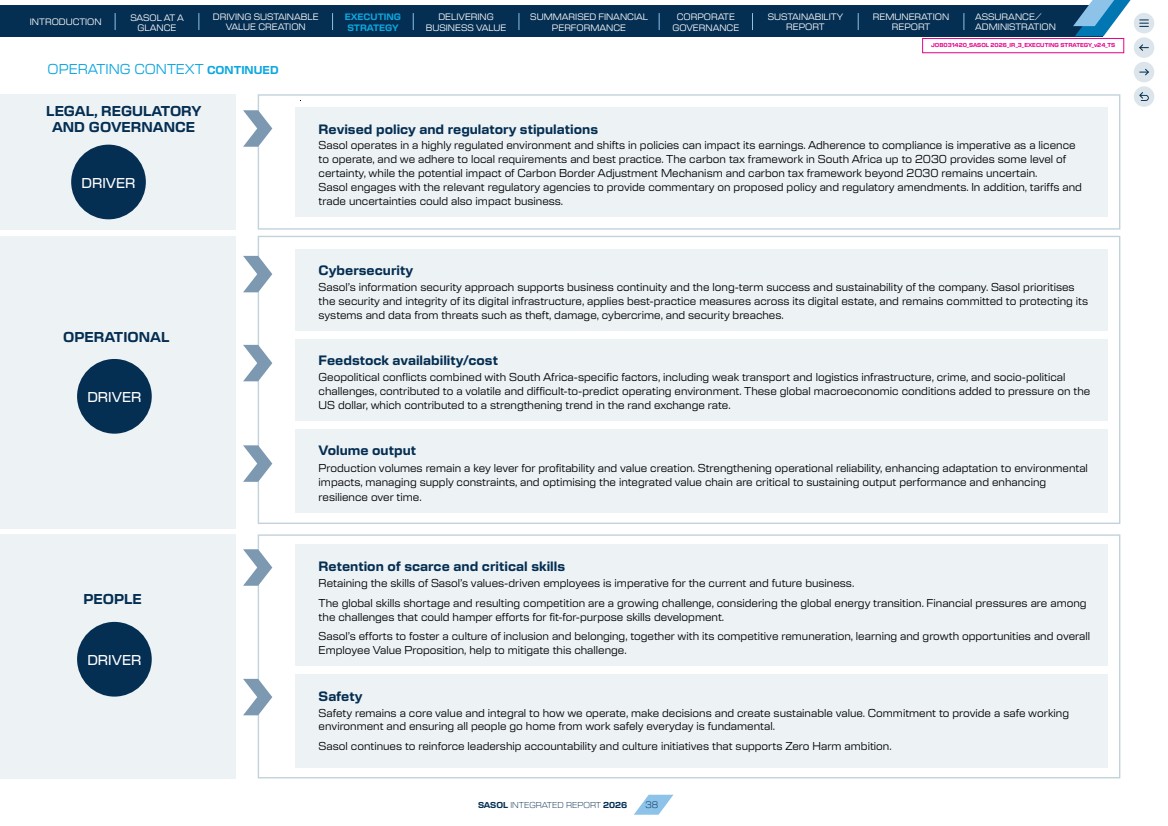
| OPERATING CONTEXT External and internal influences impact Sasol’s ability to do business sustainably The energy security and environmental influences have been pivotal in defining the energy and chemical sectors. The global push towards decarbonisation and the economic pressures have driven the adoption of renewable energy technologies, providing Sasol with an opportunity by leveraging its own demand to create momentum and establish a platform for value-accretive and sustainable growth, while maintaining pace with customer needs. Macroeconomic environment In 2026, global economic activity was resilient in the face of several challenges, including tariff and trade frictions, elevated policy uncertainty and the Middle East conflict. Although South Africa’s economic performance was uneven, there was an improvement in investor confidence and more favourable credit ratings underpinned by fiscal consolidation and ongoing structural reforms. The US economy remained on a firm footing, supported by household spending and business investment. In contrast, Euro area growth was subdued, as low levels of business and consumer confidence, strained industrial activity and muted external demand weighed on the region’s performance. The path to a lasting resolution to the Middle East conflict remains uncertain, while geopolitical and trade policy development will likely continue to impact energy and commodity markets. This, along with evidence of supply chain bottlenecks, input cost pressures, cost of living increases and tighter monetary policy in some countries, poses significant downside growth risk in the coming year. Against this uncertain backdrop, we continue to utilise scenario analysis, resilience testing and hedging strategies to help mitigate the effects of external factors beyond our control. Crude and product markets During the financial year, global oil prices weakened to a low point below US$65/bbl in December, driven by expectations of oversupply amid the return of volumes previously curtailed by OPEC and softer demand indicators. This downward trend was subsequently reversed by the outbreak of conflict between the US and Israel on the one hand, and Iran on the other, which introduced a significant geopolitical risk premium and resulted in pronounced price volatility. As a consequence, market dynamics shifted from oversupply concerns to conflict-driven supply disruptions, with prices increasingly influenced by the continued constraint of production from the Middle East and transit through the Strait of Hormuz. Prices subsequently reached a high of US$144/bbl during April, averaging US$80/bbl over FY26. Crude oil markets are expected to remain highly sensitive to geopolitical developments, OPEC+ production decisions and the pace of global demand growth. While the return of previously curtailed supply could cap prices in the absence of further disruptions, continued uncertainty around the Middle East conflict and the risk of interruptions to key trade routes are expected to keep volatility elevated and provide support to prices. Energy downstream markets diverged, with refined products outperforming chemicals. Refined product markets remained structurally tight, due to constrained global refining capacity, sanctions related disruptions to Russian product exports, and logistics and supply dislocations. Middle distillates, particularly diesel, benefitted from limited supply, higher logistics costs, and the Middle East conflict. In contrast, chemical markets stayed in a prolonged downcycle, as persistent global oversupply, driven largely by capacity additions in China and the Middle East, continued to outpace weak and uneven demand growth. This kept prices and margins under pressure, which has triggered some rationalisation announcements. Refined product markets are likely to remain tight given low inventory levels globally, sanctions-related trade disruptions and elevated supply chain costs, which should support near-term margins. Chemical markets are expected to recover only gradually, with persistent oversupply likely to keep margins under pressure until capacity rationalisation and stronger end-market demand restore a more balanced market. DRIVER FINANCIAL MARKET World and South African GDP growth (%) World South Africa Source: IMF, StatsSA, SARB, *Sasol forecast Year % year-over-year -8 -6 -4 -2 0 2 4 6 8 252423222120 26 3,0 1,1 1,2 3,5 0, 5 3,5 0,8 3,3 2,1 3,8 6,7 4,9 -6,2 -2,7 Average exchange rate (US$/R) Source: Reuters Year R/US$ 18,2 16,9 18,7 15,7 14,2 17,8 15,4 15,2 12 14 16 18 20 25242322212019 26 Average Brent crude oil (R/bbl) Source: S&P Global Year US$/bbl 40 50 60 70 80 90 100 2625242322212019 87,3 84,7 74,6 79,5 92,1 68,6 54,2 51,2 SASOL INTEGRATED REPORT 2026 37 JOB031420_SASOL 2026_IR_3_EXECUTING STRATEGY_v24_TS INTRODUCTION SUMMARISED FINANCIAL PERFORMANCE SUSTAINABILITY REPORT SASOL AT A GLANCE DRIVING SUSTAINABLE VALUE CREATION EXECUTING STRATEGY DELIVERING BUSINESS VALUE CORPORATE GOVERNANCE ASSURANCE/ ADMINISTRATION REMUNERATION REPORT |
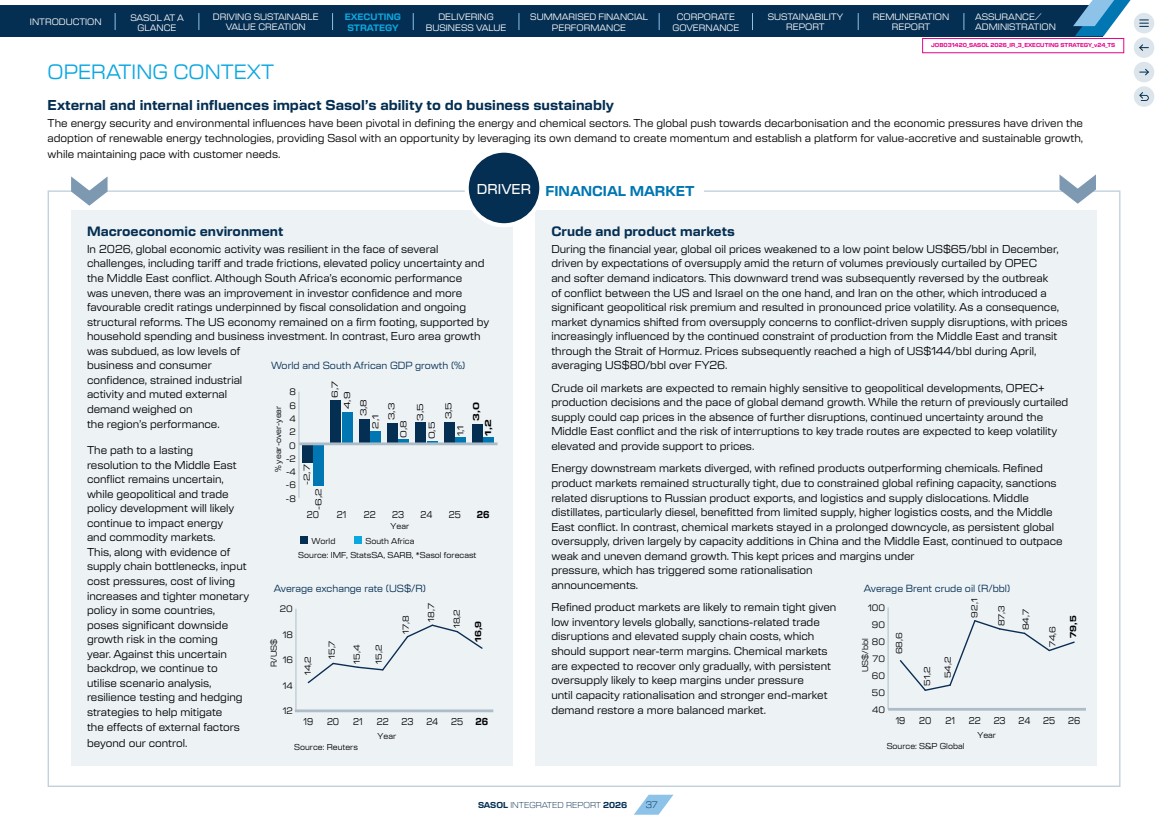
| OPERATING CONTEXT CONTINUED DRIVER LEGAL, REGULATORY AND GOVERNANCE DRIVER OPERATIONAL DRIVER PEOPLE Revised policy and regulatory stipulations Sasol operates in a highly regulated environment and shifts in policies can impact its earnings. Adherence to compliance is imperative as a licence to operate, and we adhere to local requirements and best practice. The carbon tax framework in South Africa up to 2030 provides some level of certainty, while the potential impact of Carbon Border Adjustment Mechanism and carbon tax framework beyond 2030 remains uncertain. Sasol engages with the relevant regulatory agencies to provide commentary on proposed policy and regulatory amendments. In addition, tariffs and trade uncertainties could also impact business. Retention of scarce and critical skills Retaining the skills of Sasol’s values-driven employees is imperative for the current and future business. The global skills shortage and resulting competition are a growing challenge, considering the global energy transition. Financial pressures are among the challenges that could hamper efforts for fit-for-purpose skills development. Sasol’s efforts to foster a culture of inclusion and belonging, together with its competitive remuneration, learning and growth opportunities and overall Employee Value Proposition, help to mitigate this challenge. Safety Safety remains a core value and integral to how we operate, make decisions and create sustainable value. Commitment to provide a safe working environment and ensuring all people go home from work safely everyday is fundamental. Sasol continues to reinforce leadership accountability and culture initiatives that supports Zero Harm ambition. Feedstock availability/cost Geopolitical conflicts combined with South Africa-specific factors, including weak transport and logistics infrastructure, crime, and socio-political challenges, contributed to a volatile and difficult-to-predict operating environment. These global macroeconomic conditions added to pressure on the US dollar, which contributed to a strengthening trend in the rand exchange rate. Cybersecurity Sasol’s information security approach supports business continuity and the long-term success and sustainability of the company. Sasol prioritises the security and integrity of its digital infrastructure, applies best-practice measures across its digital estate, and remains committed to protecting its systems and data from threats such as theft, damage, cybercrime, and security breaches. Volume output Production volumes remain a key lever for profitability and value creation. Strengthening operational reliability, enhancing adaptation to environmental impacts, managing supply constraints, and optimising the integrated value chain are critical to sustaining output performance and enhancing resilience over time. SASOL INTEGRATED REPORT 2026 38 JOB031420_SASOL 2026_IR_3_EXECUTING STRATEGY_v24_TS INTRODUCTION SUMMARISED FINANCIAL PERFORMANCE SUSTAINABILITY REPORT SASOL AT A GLANCE DRIVING SUSTAINABLE VALUE CREATION EXECUTING STRATEGY DELIVERING BUSINESS VALUE CORPORATE GOVERNANCE ASSURANCE/ ADMINISTRATION REMUNERATION REPORT |