Exhibit 99.7
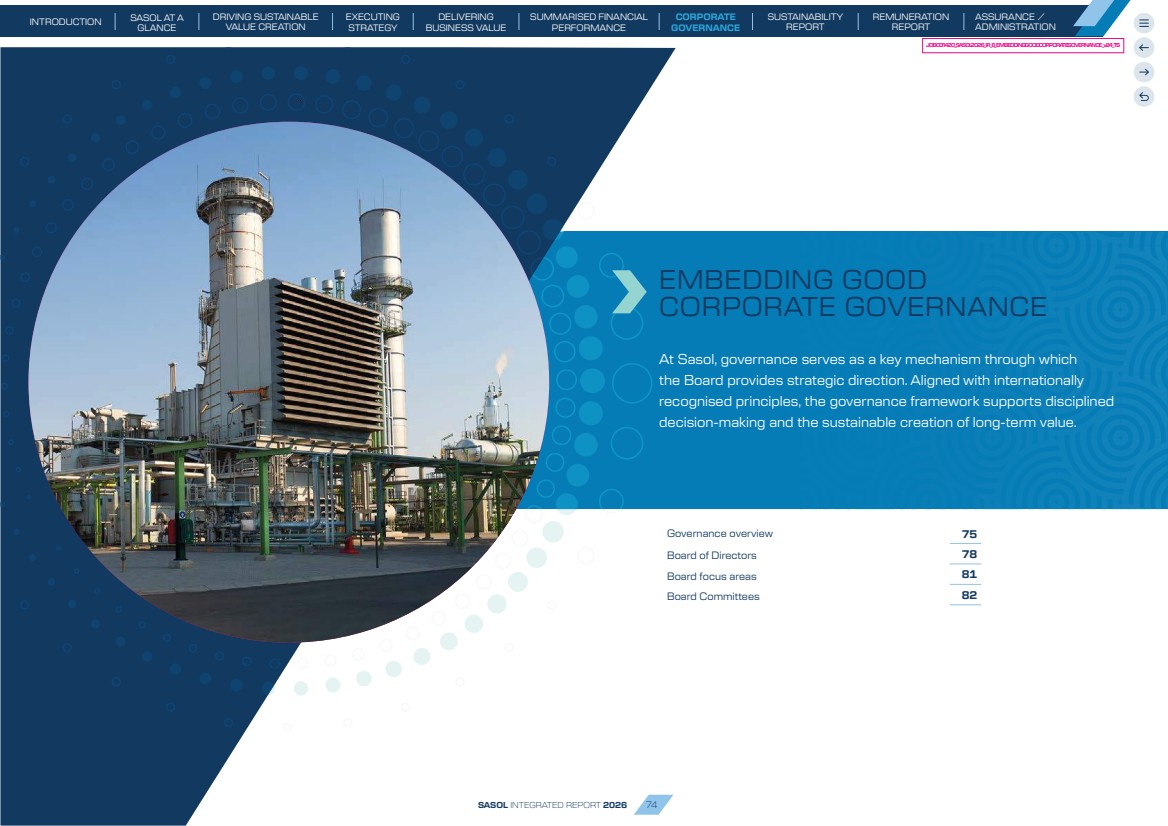
| EMBEDDING GOOD CORPORATE GOVERNANCE At Sasol, governance serves as a key mechanism through which the Board provides strategic direction. Aligned with internationally recognised principles, the governance framework supports disciplined decision-making and the sustainable creation of long-term value. Governance overview 75 Board of Directors 78 Board focus areas 81 Board Committees 82 SASOL INTEGRATED REPORT 2026 74 JOB031420_SASOL 2026_IR_6_EMBEDDING GOOD CORPORATE GOVERNANCE_v24_TS INTRODUCTION SUMMARISED FINANCIAL PERFORMANCE SUSTAINABILITY REPORT SASOL AT A GLANCE DRIVING SUSTAINABLE VALUE CREATION EXECUTING STRATEGY DELIVERING BUSINESS VALUE CORPORATE GOVERNANCE ASSURANCE / ADMINISTRATION REMUNERATION REPORT |
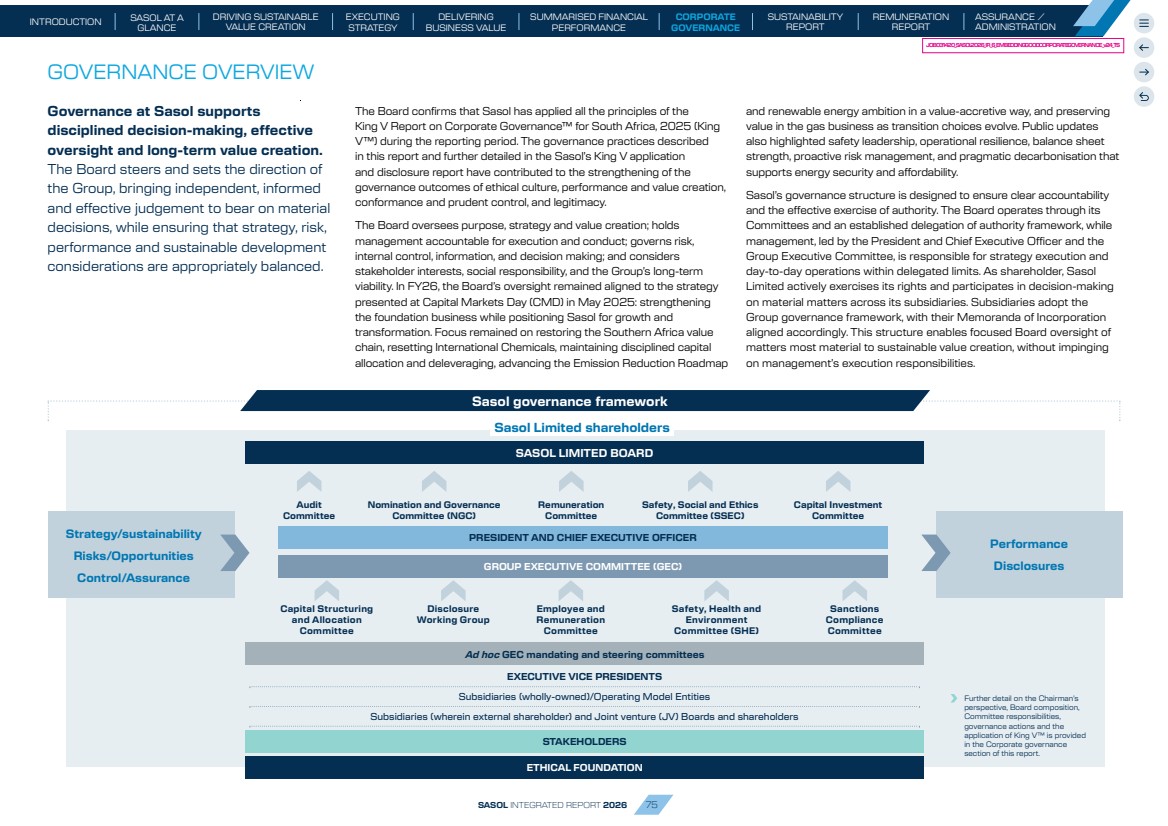
| The Board confirms that Sasol has applied all the principles of the King V Report on Corporate Governance™ for South Africa, 2025 (King V™) during the reporting period. The governance practices described in this report and further detailed in the Sasol’s King V application and disclosure report have contributed to the strengthening of the governance outcomes of ethical culture, performance and value creation, conformance and prudent control, and legitimacy. The Board oversees purpose, strategy and value creation; holds management accountable for execution and conduct; governs risk, internal control, information, and decision making; and considers stakeholder interests, social responsibility, and the Group’s long-term viability. In FY26, the Board’s oversight remained aligned to the strategy presented at Capital Markets Day (CMD) in May 2025: strengthening the foundation business while positioning Sasol for growth and transformation. Focus remained on restoring the Southern Africa value chain, resetting International Chemicals, maintaining disciplined capital allocation and deleveraging, advancing the Emission Reduction Roadmap and renewable energy ambition in a value-accretive way, and preserving value in the gas business as transition choices evolve. Public updates also highlighted safety leadership, operational resilience, balance sheet strength, proactive risk management, and pragmatic decarbonisation that supports energy security and affordability. Sasol’s governance structure is designed to ensure clear accountability and the effective exercise of authority. The Board operates through its Committees and an established delegation of authority framework, while management, led by the President and Chief Executive Officer and the Group Executive Committee, is responsible for strategy execution and day-to-day operations within delegated limits. As shareholder, Sasol Limited actively exercises its rights and participates in decision-making on material matters across its subsidiaries. Subsidiaries adopt the Group governance framework, with their Memoranda of Incorporation aligned accordingly. This structure enables focused Board oversight of matters most material to sustainable value creation, without impinging on management’s execution responsibilities. GOVERNANCE OVERVIEW Governance at Sasol supports disciplined decision-making, effective oversight and long-term value creation. The Board steers and sets the direction of the Group, bringing independent, informed and effective judgement to bear on material decisions, while ensuring that strategy, risk, performance and sustainable development considerations are appropriately balanced. PRESIDENT AND CHIEF EXECUTIVE OFFICER GROUP EXECUTIVE COMMITTEE (GEC) SASOL LIMITED BOARD STAKEHOLDERS ETHICAL FOUNDATION EXECUTIVE VICE PRESIDENTS Subsidiaries (wholly-owned)/Operating Model Entities Subsidiaries (wherein external shareholder) and Joint venture (JV) Boards and shareholders Disclosures Performance Audit Committee Capital Structuring and Allocation Committee Nomination and Governance Committee (NGC) Disclosure Working Group Remuneration Committee Employee and Remuneration Committee Safety, Social and Ethics Committee (SSEC) Safety, Health and Environment Committee (SHE) Capital Investment Committee Sanctions Compliance Committee Ad hoc GEC mandating and steering committees Strategy/sustainability Control/Assurance Risks/Opportunities Further detail on the Chairman’s perspective, Board composition, Committee responsibilities, governance actions and the application of King V™ is provided in the Corporate governance section of this report. Sasol governance framework Sasol Limited shareholders SASOL INTEGRATED REPORT 2026 75 JOB031420_SASOL 2026_IR_6_EMBEDDING GOOD CORPORATE GOVERNANCE_v24_TS INTRODUCTION SUMMARISED FINANCIAL PERFORMANCE SUSTAINABILITY REPORT SASOL AT A GLANCE DRIVING SUSTAINABLE VALUE CREATION EXECUTING STRATEGY DELIVERING BUSINESS VALUE CORPORATE GOVERNANCE ASSURANCE / ADMINISTRATION REMUNERATION REPORT |
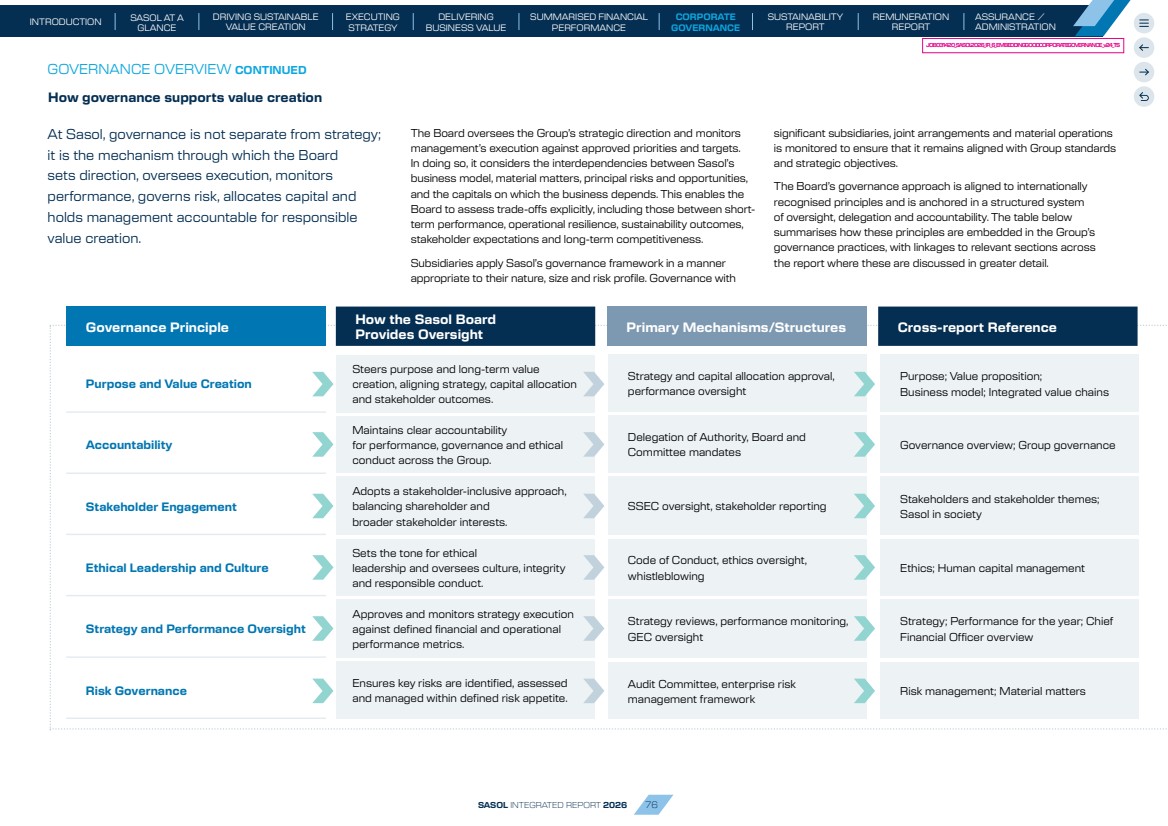
| How governance supports value creation GOVERNANCE OVERVIEW CONTINUED At Sasol, governance is not separate from strategy; it is the mechanism through which the Board sets direction, oversees execution, monitors performance, governs risk, allocates capital and holds management accountable for responsible value creation. The Board oversees the Group’s strategic direction and monitors management’s execution against approved priorities and targets. In doing so, it considers the interdependencies between Sasol’s business model, material matters, principal risks and opportunities, and the capitals on which the business depends. This enables the Board to assess trade-offs explicitly, including those between short-term performance, operational resilience, sustainability outcomes, stakeholder expectations and long-term competitiveness. Subsidiaries apply Sasol’s governance framework in a manner appropriate to their nature, size and risk profile. Governance with significant subsidiaries, joint arrangements and material operations is monitored to ensure that it remains aligned with Group standards and strategic objectives. The Board’s governance approach is aligned to internationally recognised principles and is anchored in a structured system of oversight, delegation and accountability. The table below summarises how these principles are embedded in the Group’s governance practices, with linkages to relevant sections across the report where these are discussed in greater detail. Governance Principle How the Sasol Board Provides Oversight Primary Mechanisms/Structures Cross-report Reference Purpose and Value Creation Accountability Stakeholder Engagement Ethical Leadership and Culture Strategy and Performance Oversight Risk Governance Steers purpose and long-term value creation, aligning strategy, capital allocation and stakeholder outcomes. Strategy and capital allocation approval, performance oversight Delegation of Authority, Board and Committee mandates Governance overview; Group governance SSEC oversight, stakeholder reporting Stakeholders and stakeholder themes; Sasol in society Purpose; Value proposition; Business model; Integrated value chains Maintains clear accountability for performance, governance and ethical conduct across the Group. Adopts a stakeholder-inclusive approach, balancing shareholder and broader stakeholder interests. Sets the tone for ethical leadership and oversees culture, integrity and responsible conduct. Code of Conduct, ethics oversight, whistleblowing Strategy reviews, performance monitoring, GEC oversight Strategy; Performance for the year; Chief Financial Officer overview Audit Committee, enterprise risk management framework Risk management; Material matters Ethics; Human capital management Approves and monitors strategy execution against defined financial and operational performance metrics. Ensures key risks are identified, assessed and managed within defined risk appetite. SASOL INTEGRATED REPORT 2026 76 JOB031420_SASOL 2026_IR_6_EMBEDDING GOOD CORPORATE GOVERNANCE_v24_TS INTRODUCTION SUMMARISED FINANCIAL PERFORMANCE SUSTAINABILITY REPORT SASOL AT A GLANCE DRIVING SUSTAINABLE VALUE CREATION EXECUTING STRATEGY DELIVERING BUSINESS VALUE CORPORATE GOVERNANCE ASSURANCE / ADMINISTRATION REMUNERATION REPORT |
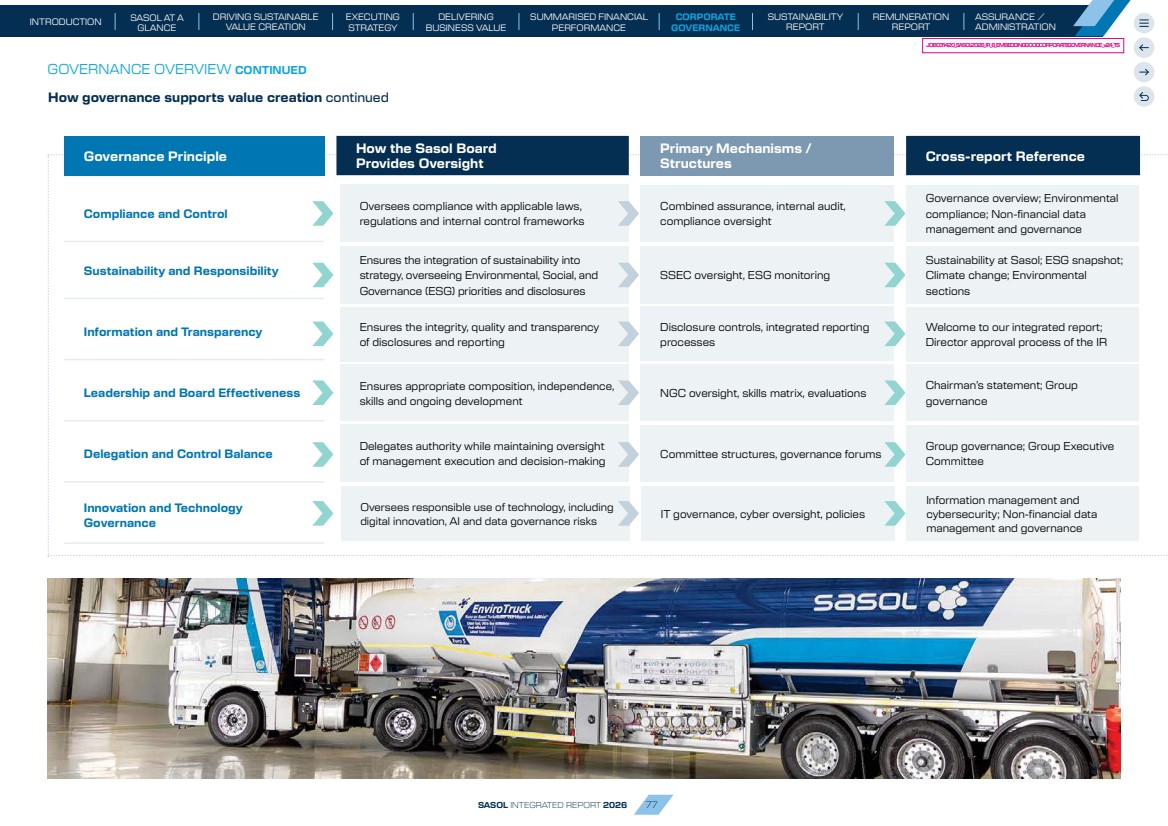
| Governance Principle How the Sasol Board Provides Oversight Primary Mechanisms / Structures Cross-report Reference GOVERNANCE OVERVIEW CONTINUED Compliance and Control Sustainability and Responsibility Information and Transparency Leadership and Board Effectiveness Delegation and Control Balance Innovation and Technology Governance Combined assurance, internal audit, compliance oversight SSEC oversight, ESG monitoring Governance overview; Environmental compliance; Non-financial data management and governance Sustainability at Sasol; ESG snapshot; Climate change; Environmental sections Oversees compliance with applicable laws, regulations and internal control frameworks Ensures the integration of sustainability into strategy, overseeing Environmental, Social, and Governance (ESG) priorities and disclosures How governance supports value creation continued Ensures the integrity, quality and transparency of disclosures and reporting Disclosure controls, integrated reporting processes NGC oversight, skills matrix, evaluations Chairman’s statement; Group governance Committee structures, governance forums IT governance, cyber oversight, policies Group governance; Group Executive Committee Information management and cybersecurity; Non-financial data management and governance Welcome to our integrated report; Director approval process of the IR Ensures appropriate composition, independence, skills and ongoing development Delegates authority while maintaining oversight of management execution and decision-making Oversees responsible use of technology, including digital innovation, AI and data governance risks SASOL INTEGRATED REPORT 2026 77 JOB031420_SASOL 2026_IR_6_EMBEDDING GOOD CORPORATE GOVERNANCE_v24_TS INTRODUCTION SUMMARISED FINANCIAL PERFORMANCE SUSTAINABILITY REPORT SASOL AT A GLANCE DRIVING SUSTAINABLE VALUE CREATION EXECUTING STRATEGY DELIVERING BUSINESS VALUE CORPORATE GOVERNANCE ASSURANCE / ADMINISTRATION REMUNERATION REPORT |
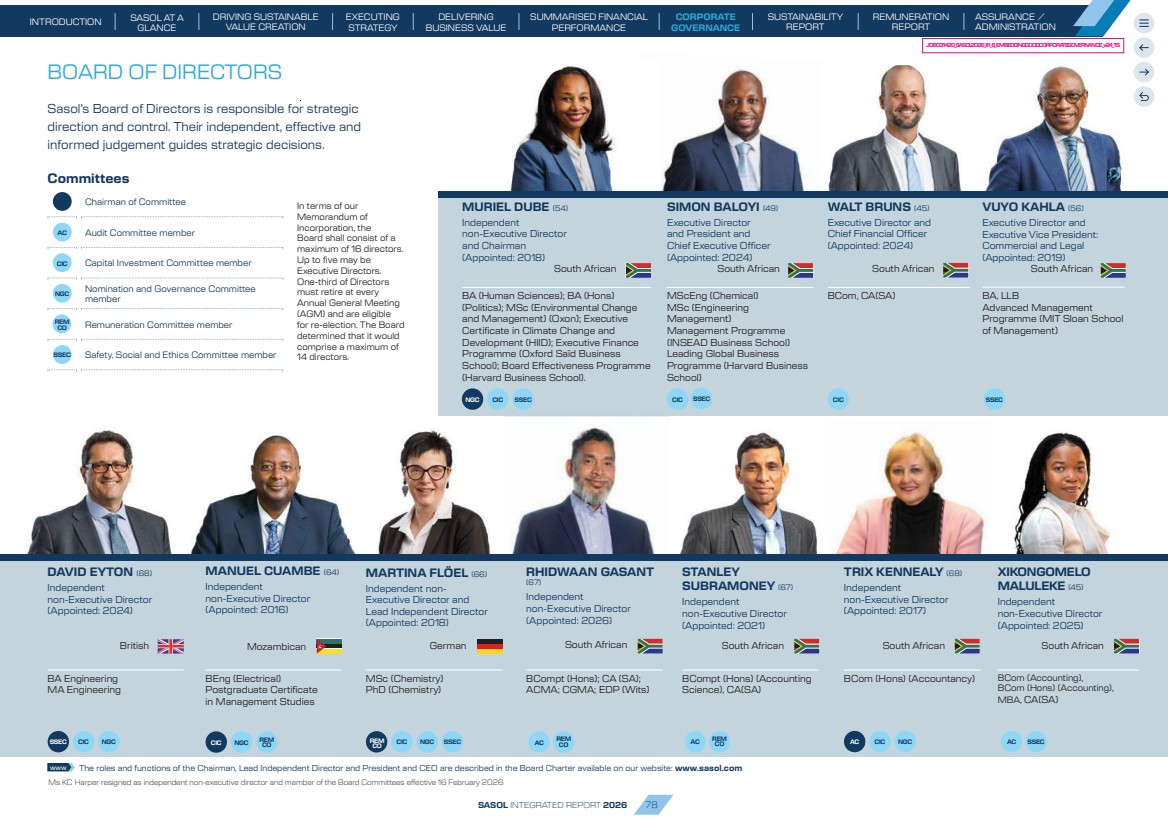
| SIMON BALOYI (49) Executive Director and President and Chief Executive Officer (Appointed: 2024) South African MScEng (Chemical) MSc (Engineering Management) Management Programme (INSEAD Business School) Leading Global Business Programme (Harvard Business School) WALT BRUNS (45) Executive Director and Chief Financial Officer (Appointed: 2024) South African BCom, CA(SA) MURIEL DUBE (54) Independent non-Executive Director and Chairman (Appointed: 2018) South African BA (Human Sciences); BA (Hons) (Politics); MSc (Environmental Change and Management) (Oxon); Executive Certificate in Climate Change and Development (HIID); Executive Finance Programme (Oxford Saïd Business School); Board Effectiveness Programme (Harvard Business School). VUYO KAHLA (56) Executive Director and Executive Vice President: Commercial and Legal (Appointed: 2019) South African BA, LLB Advanced Management Programme (MIT Sloan School of Management) MARTINA FLÖEL (66) Independent non-Executive Director and Lead Independent Director (Appointed: 2018) German MSc (Chemistry) PhD (Chemistry) REM CO CIC NGC SSEC MANUEL CUAMBE (64) Independent non-Executive Director (Appointed: 2016) Mozambican BEng (Electrical) Postgraduate Certificate in Management Studies CIC NGC REMCO TRIX KENNEALY (68) Independent non-Executive Director (Appointed: 2017) South African BCom (Hons) (Accountancy) AC CIC NGC RHIDWAAN GASANT (67) Independent non-Executive Director (Appointed: 2026) South African BCompt (Hons); CA (SA); ACMA; CGMA; EDP (Wits) AC REMCO XIKONGOMELO MALULEKE (45) Independent non-Executive Director (Appointed: 2025) South African BCom (Accounting), BCom (Hons) (Accounting), MBA, CA(SA) AC SSEC www The roles and functions of the Chairman, Lead Independent Director and President and CEO are described in the Board Charter available on our website: www.sasol.com NGC CIC SSEC Sasol’s Board of Directors is responsible for strategic direction and control. Their independent, effective and informed judgement guides strategic decisions. BOARD OF DIRECTORS Chairman of Committee AC Audit Committee member CIC Capital Investment Committee member NGC Nomination and Governance Committee member REM CO Remuneration Committee member SSEC Safety, Social and Ethics Committee member Committees In terms of our Memorandum of Incorporation, the Board shall consist of a maximum of 16 directors. Up to five may be Executive Directors. One-third of Directors must retire at every Annual General Meeting (AGM) and are eligible for re-election. The Board determined that it would comprise a maximum of 14 directors. CIC SSEC CIC SSEC DAVID EYTON (68) Independent non-Executive Director (Appointed: 2024) British BA Engineering MA Engineering SSEC CIC NGC STANLEY SUBRAMONEY (67) Independent non-Executive Director (Appointed: 2021) South African BCompt (Hons) (Accounting Science), CA(SA) AC REMCO Ms KC Harper resigned as independent non-executive director and member of the Board Committees effective 16 February 2026 SASOL INTEGRATED REPORT 2026 78 JOB031420_SASOL 2026_IR_6_EMBEDDING GOOD CORPORATE GOVERNANCE_v24_TS INTRODUCTION SUMMARISED FINANCIAL PERFORMANCE SUSTAINABILITY REPORT SASOL AT A GLANCE DRIVING SUSTAINABLE VALUE CREATION EXECUTING STRATEGY DELIVERING BUSINESS VALUE CORPORATE GOVERNANCE ASSURANCE / ADMINISTRATION REMUNERATION REPORT |
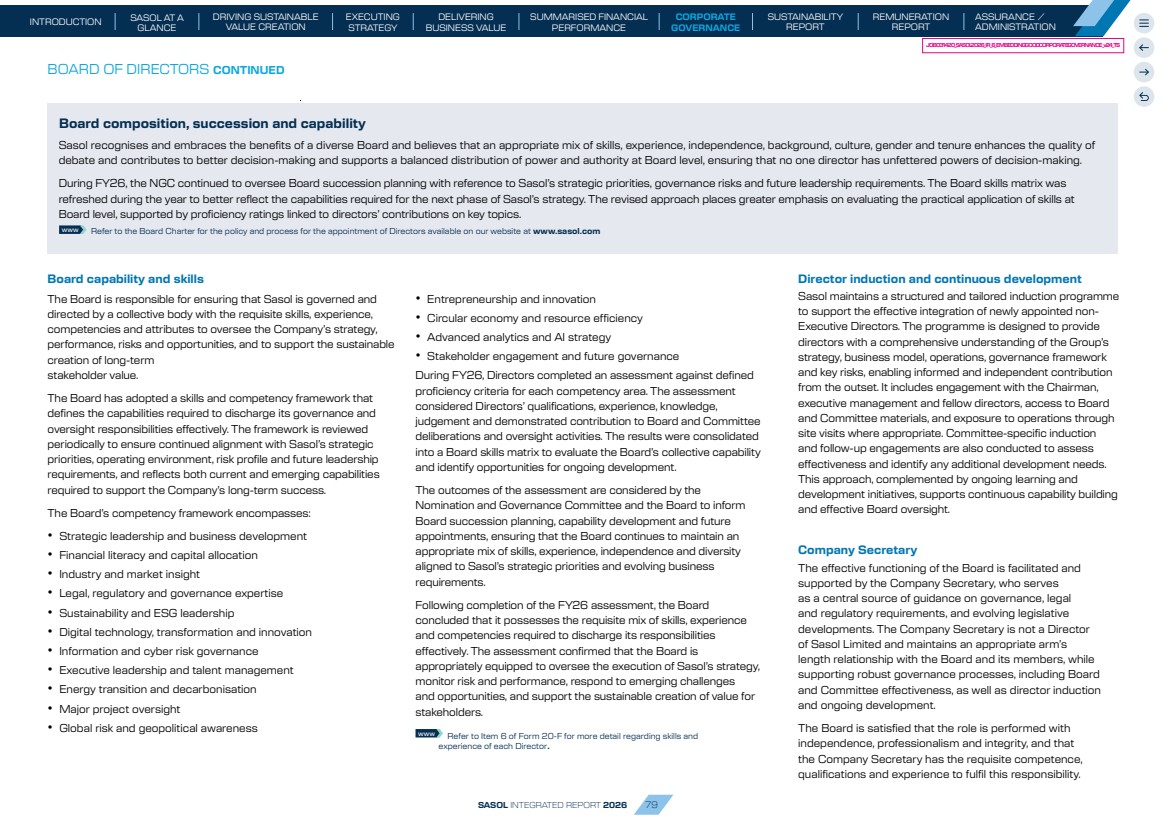
| BOARD OF DIRECTORS CONTINUED Board composition, succession and capability Sasol recognises and embraces the benefits of a diverse Board and believes that an appropriate mix of skills, experience, independence, background, culture, gender and tenure enhances the quality of debate and contributes to better decision-making and supports a balanced distribution of power and authority at Board level, ensuring that no one director has unfettered powers of decision-making. During FY26, the NGC continued to oversee Board succession planning with reference to Sasol’s strategic priorities, governance risks and future leadership requirements. The Board skills matrix was refreshed during the year to better reflect the capabilities required for the next phase of Sasol’s strategy. The revised approach places greater emphasis on evaluating the practical application of skills at Board level, supported by proficiency ratings linked to directors’ contributions on key topics. Director induction and continuous development Sasol maintains a structured and tailored induction programme to support the effective integration of newly appointed non-Executive Directors. The programme is designed to provide directors with a comprehensive understanding of the Group’s strategy, business model, operations, governance framework and key risks, enabling informed and independent contribution from the outset. It includes engagement with the Chairman, executive management and fellow directors, access to Board and Committee materials, and exposure to operations through site visits where appropriate. Committee-specific induction and follow-up engagements are also conducted to assess effectiveness and identify any additional development needs. This approach, complemented by ongoing learning and development initiatives, supports continuous capability building and effective Board oversight. Board capability and skills The Board is responsible for ensuring that Sasol is governed and directed by a collective body with the requisite skills, experience, competencies and attributes to oversee the Company’s strategy, performance, risks and opportunities, and to support the sustainable creation of long-term stakeholder value. The Board has adopted a skills and competency framework that defines the capabilities required to discharge its governance and oversight responsibilities effectively. The framework is reviewed periodically to ensure continued alignment with Sasol’s strategic priorities, operating environment, risk profile and future leadership requirements, and reflects both current and emerging capabilities required to support the Company’s long-term success. The Board’s competency framework encompasses: • Strategic leadership and business development • Financial literacy and capital allocation • Industry and market insight • Legal, regulatory and governance expertise • Sustainability and ESG leadership • Digital technology, transformation and innovation • Information and cyber risk governance • Executive leadership and talent management • Energy transition and decarbonisation • Major project oversight • Global risk and geopolitical awareness • Entrepreneurship and innovation • Circular economy and resource efficiency • Advanced analytics and AI strategy • Stakeholder engagement and future governance During FY26, Directors completed an assessment against defined proficiency criteria for each competency area. The assessment considered Directors’ qualifications, experience, knowledge, judgement and demonstrated contribution to Board and Committee deliberations and oversight activities. The results were consolidated into a Board skills matrix to evaluate the Board’s collective capability and identify opportunities for ongoing development. The outcomes of the assessment are considered by the Nomination and Governance Committee and the Board to inform Board succession planning, capability development and future appointments, ensuring that the Board continues to maintain an appropriate mix of skills, experience, independence and diversity aligned to Sasol’s strategic priorities and evolving business requirements. Following completion of the FY26 assessment, the Board concluded that it possesses the requisite mix of skills, experience and competencies required to discharge its responsibilities effectively. The assessment confirmed that the Board is appropriately equipped to oversee the execution of Sasol’s strategy, monitor risk and performance, respond to emerging challenges and opportunities, and support the sustainable creation of value for stakeholders. www Refer to the Board Charter for the policy and process for the appointment of Directors available on our website at www.sasol.com www Refer to Item 6 of Form 20-F for more detail regarding skills and experience of each Director. Company Secretary The effective functioning of the Board is facilitated and supported by the Company Secretary, who serves as a central source of guidance on governance, legal and regulatory requirements, and evolving legislative developments. The Company Secretary is not a Director of Sasol Limited and maintains an appropriate arm’s length relationship with the Board and its members, while supporting robust governance processes, including Board and Committee effectiveness, as well as director induction and ongoing development. The Board is satisfied that the role is performed with independence, professionalism and integrity, and that the Company Secretary has the requisite competence, qualifications and experience to fulfil this responsibility. SASOL INTEGRATED REPORT 2026 79 JOB031420_SASOL 2026_IR_6_EMBEDDING GOOD CORPORATE GOVERNANCE_v24_TS INTRODUCTION SUMMARISED FINANCIAL PERFORMANCE SUSTAINABILITY REPORT SASOL AT A GLANCE DRIVING SUSTAINABLE VALUE CREATION EXECUTING STRATEGY DELIVERING BUSINESS VALUE CORPORATE GOVERNANCE ASSURANCE / ADMINISTRATION REMUNERATION REPORT |
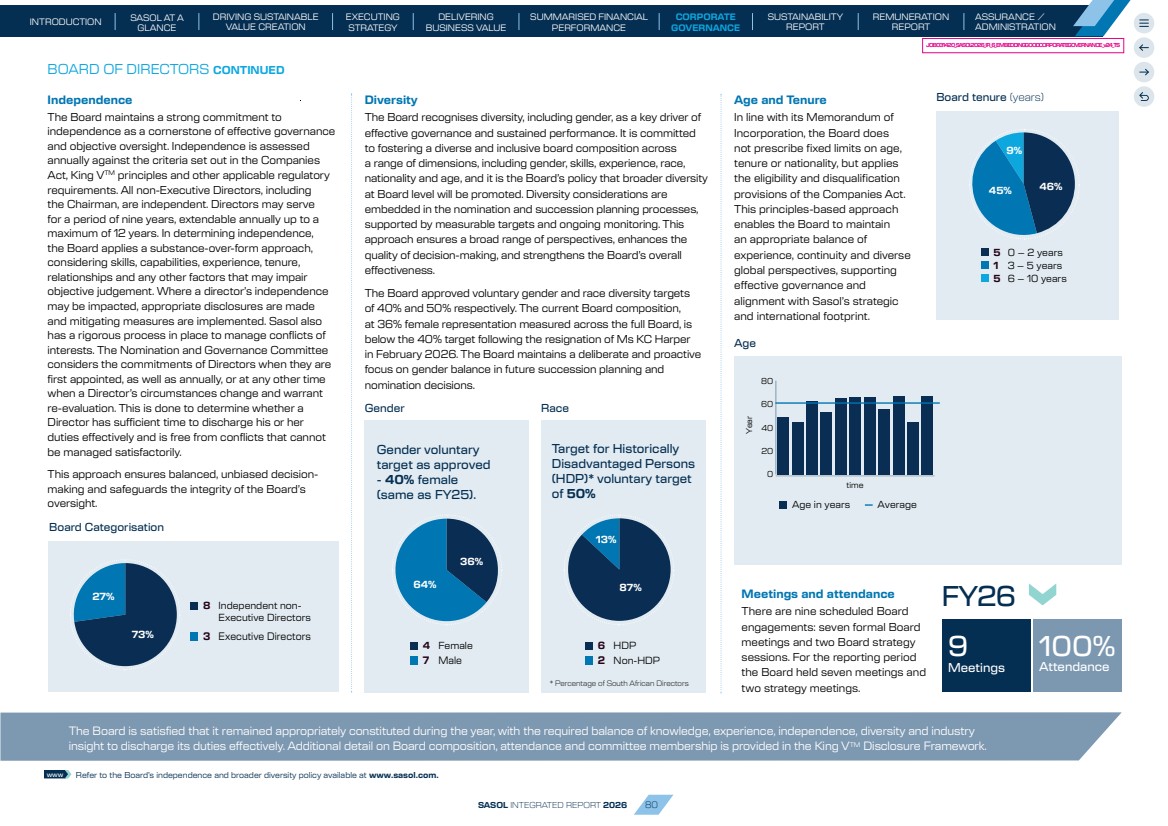
| BOARD OF DIRECTORS CONTINUED The Board is satisfied that it remained appropriately constituted during the year, with the required balance of knowledge, experience, independence, diversity and industry insight to discharge its duties effectively. Additional detail on Board composition, attendance and committee membership is provided in the King VTM Disclosure Framework. Independence The Board maintains a strong commitment to independence as a cornerstone of effective governance and objective oversight. Independence is assessed annually against the criteria set out in the Companies Act, King VTM principles and other applicable regulatory requirements. All non-Executive Directors, including the Chairman, are independent. Directors may serve for a period of nine years, extendable annually up to a maximum of 12 years. In determining independence, the Board applies a substance-over-form approach, considering skills, capabilities, experience, tenure, relationships and any other factors that may impair objective judgement. Where a director’s independence may be impacted, appropriate disclosures are made and mitigating measures are implemented. Sasol also has a rigorous process in place to manage conflicts of interests. The Nomination and Governance Committee considers the commitments of Directors when they are first appointed, as well as annually, or at any other time when a Director’s circumstances change and warrant re-evaluation. This is done to determine whether a Director has sufficient time to discharge his or her duties effectively and is free from conflicts that cannot be managed satisfactorily. This approach ensures balanced, unbiased decision-making and safeguards the integrity of the Board’s oversight. 8 Independent non-Executive Directors 73% 3 Executive Directors 27% Board Categorisation Age and Tenure In line with its Memorandum of Incorporation, the Board does not prescribe fixed limits on age, tenure or nationality, but applies the eligibility and disqualification provisions of the Companies Act. This principles-based approach enables the Board to maintain an appropriate balance of experience, continuity and diverse global perspectives, supporting effective governance and alignment with Sasol’s strategic and international footprint. Ethical misconduct substantiated allegations 1 3 – 5 years 5 0 – 2 years 5 6 – 10 years 45% 46% 9% Board tenure (years) Age time Year 0 20 40 60 80 Age in years Average Meetings and attendance There are nine scheduled Board engagements: seven formal Board meetings and two Board strategy sessions. For the reporting period the Board held seven meetings and two strategy meetings. FY26 9 Meetings 100% Attendance Diversity The Board recognises diversity, including gender, as a key driver of effective governance and sustained performance. It is committed to fostering a diverse and inclusive board composition across a range of dimensions, including gender, skills, experience, race, nationality and age, and it is the Board’s policy that broader diversity at Board level will be promoted. Diversity considerations are embedded in the nomination and succession planning processes, supported by measurable targets and ongoing monitoring. This approach ensures a broad range of perspectives, enhances the quality of decision-making, and strengthens the Board’s overall effectiveness. The Board approved voluntary gender and race diversity targets of 40% and 50% respectively. The current Board composition, at 36% female representation measured across the full Board, is below the 40% target following the resignation of Ms KC Harper in February 2026. The Board maintains a deliberate and proactive focus on gender balance in future succession planning and nomination decisions. 36% 64% 4 Female 7 Male Gender Race 13% 87% Gender voluntary target as approved - 40% female (same as FY25). Target for Historically Disadvantaged Persons (HDP)* voluntary target of 50% * Percentage of South African Directors www Refer to the Board’s independence and broader diversity policy available at www.sasol.com. 6 HDP 2 Non-HDP SASOL INTEGRATED REPORT 2026 80 JOB031420_SASOL 2026_IR_6_EMBEDDING GOOD CORPORATE GOVERNANCE_v24_TS INTRODUCTION SUMMARISED FINANCIAL PERFORMANCE SUSTAINABILITY REPORT SASOL AT A GLANCE DRIVING SUSTAINABLE VALUE CREATION EXECUTING STRATEGY DELIVERING BUSINESS VALUE CORPORATE GOVERNANCE ASSURANCE / ADMINISTRATION REMUNERATION REPORT |
| MIDDLE EAST CONFLICT AND BUSINESS RESILIENCE STRATEGY EXECUTION, LONG-TERM VALUE AND PERFORMANCE DELIVERY STAKEHOLDER ENGAGEMENT AND MARKET POSITIONING SAFETY, CULTURE AND OPERATIONAL DISCIPLINE RISK MANAGEMENT AND EMERGING RISKS PORTFOLIO MANAGEMENT AND CAPITAL ALLOCATION GOVERNANCE AND BOARD EFFECTIVENESS FINANCIAL RESILIENCE, LIQUIDITY AND CAPITAL DISCIPLINE B-BBEE AND SASOL KHANYISA The Board monitored the evolving impact of the Middle East conflict on the Group’s people, operations and financial performance. Key areas of focus included employee wellbeing, business continuity, supply security, operational resilience and the potential effects of prolonged regional disruption. The Board reviewed mitigation measures and contingency plans across the portfolio to ensure the Group remained well positioned to respond to changing geopolitical and market conditions. The Board assessed progress against strategic priorities and considered the actions required to sustain delivery momentum, improve competitiveness and support long-term value creation across the portfolio. The Board considered investor sentiment, share price performance and stakeholder expectations, emphasising credible delivery against commitments, transparent and consistent communication and strengthened stakeholder engagement. The Board maintained close oversight of safety performance and organisational culture during the year, including consideration of the lessons learned from a fatal incident. Focus was placed on the effectiveness of safety and cultural interventions, leadership accountability and the sustainability of behavioural improvements across operations. The Board monitored progress in strengthening operational discipline and embedding safety expectations consistently throughout the Group, with emphasis on translating standards and commitments into demonstrable outcomes. The Board maintained oversight of the Group’s material risks through an integrated enterprise risk management and combined assurance approach. Discussions focused on risk appetite, escalation triggers, mitigation actions and emerging risk themes, including cyber security and AI-related risks The Board deliberated portfolio optimisation and capital allocation, balancing short-term constraints with long-term value creation. Key considerations included Natref/Prax SA developments, progress and prioritisation of major capital and transition projects, including strategic partnerships, funding structures, mergers and acquisitions and asset positioning. The Board continued to enhance its effectiveness through regular evaluations, succession planning and ongoing optimisation of Board and Committee composition. Focus was placed on ensuring an appropriate balance of skills, experience and diversity while streamlining governance processes to support quality decision-making and long-term value creation. Focused attention was given to liquidity, balance sheet strength and free cash flow generation, including refinancing initiatives and covenant management. The Board support prudent capital allocation and dividend discipline to strengthen financial resilience. The Board deliberated on the future of the Sasol Khanyisa structure, focusing on responsible unwinding, stakeholder fairness and management of potential reputational implications. FC MC IC FC MC IC SC FC HC SC MC IC FC SC FC MC IC IC HC FC SC FC HC Board focus areas and key discussions In addition to routine agenda items covering feedback from Board Committees, performance oversight, approvals in line with the delegation of authority, sustainability matters, and relevant insights, the Board maintains a structured focus on strategic matters. Each quarterly meeting cycle includes dedicated strategy updates, reflecting our continuous and adaptive approach to guiding strategic direction and managing risks in the context of evolving market dynamics and regional uncertainties. During the year, the Board considered a range of significant matters aligned to its oversight of strategy execution, financial resilience, operational performance and long-term sustainability. Key discussion themes included: Link to capitals BOARD FOCUS AREAS SASOL INTEGRATED REPORT 2026 81 JOB031420_SASOL 2026_IR_6_EMBEDDING GOOD CORPORATE GOVERNANCE_v24_TS INTRODUCTION SUMMARISED FINANCIAL PERFORMANCE SUSTAINABILITY REPORT SASOL AT A GLANCE DRIVING SUSTAINABLE VALUE CREATION EXECUTING STRATEGY DELIVERING BUSINESS VALUE CORPORATE GOVERNANCE ASSURANCE / ADMINISTRATION REMUNERATION REPORT |
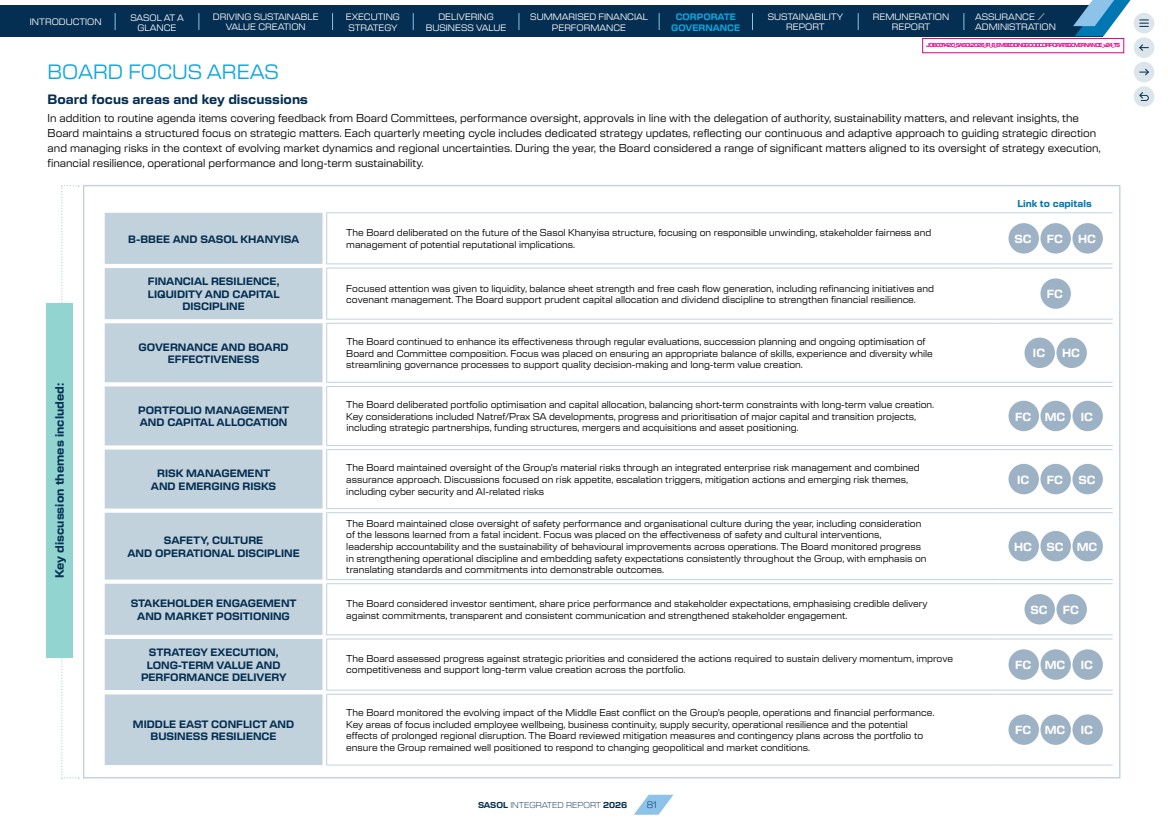
| The Board is supported by its five formal Committees, namely the Audit, Nomination and Governance, Remuneration, Safety, Social and Ethics and Capital Investment Committee. Each of which operates under formal terms of reference approved by the Board and reviewed periodically. Committee chairmen report to the Board after each meeting, ensuring that matters within the ambit of each Committee’s responsibilities are integrated into the Board’s overall deliberations. The Board has purposefully assumed direct responsibility for the governance of risk and does not delegate this responsibility to a separate Board Committee. Rather, risk oversight is considered by the Board as a whole, with each Board Committee monitoring the risks within the ambit of its responsibilities and escalating material issues to the Board as appropriate. Committee governance and how our Committees create and protect value MANDATE • Assists the Board in overseeing the integrity, transparency and quality of financial and integrated reporting and external disclosures • Oversees the independence, performance and effectiveness of the external audit, including recommending the appointment of external auditors and approval of audit scope and fees • Oversees the effectiveness of the internal audit function and the combined assurance model, ensuring coordinated assurance over key risks and controls • Monitors the effectiveness of the Group’s internal control environment, including internal control over financial reporting and the adequacy of remediation actions • Oversees financial risk management, key financial judgements and disclosures, including solvency, liquidity and financial sustainability considerations • Oversees compliance with legal and regulatory requirements relevant to financial reporting, including processes for managing whistleblowing and reporting concerns • Ensures appropriate assurance over material sustainability information and its alignment with financial and integrated reporting • Oversees information management, data governance and cyber related risks, to the extent relevant to financial reporting, disclosures and the control environment IN FY26, KEY AREAS OF FOCUS INCLUDED CHAIRMAN GMB Kennealy Audit Committee The Committee contributes to value creation by safeguarding the integrity of financial and non-financial reporting, strengthening the control environment and enhancing stakeholder confidence in the Group’s performance and disclosures. The Committee plays a critical role in supporting the Board in safeguarding the integrity of reporting, strengthening the control environment and enhancing confidence in the Group’s governance and financial disclosures. AC 100%5 DGP Eyton – Stepped down as a member on 1 June 2026. Mr Eyton is a permanent invitee, as Chairman of the SSEC, to enhance coordination and oversight in a non-member capacity. R Gasant – Appointed as a member on 1 June 2026 KC Harper – Resigned on 16 February 2026 NX Maluleke – Appointed as a member on 22 August 2025 S Subramoney MEMBERS ATTENDANCE • Financial performance and outlook remained under close review, with emphasis on cash flow resilience, working capital optimisation and delivery against CMD commitments • Ongoing focus on solvency, liquidity and debt management, including refinancing strategies, bond issuance, hedging mandates and covenant risks under stress scenarios • Continued oversight of internal control effectiveness, with targeted remediation of material weaknesses and strengthening of financial reporting processes • Progress on Information Management and cyber resilience, including leadership capability and system improvements • Enhanced focus on combined assurance, with the need to improve forward-looking assurance and prioritisation of deep dives on key risks • Consideration of significant accounting matters, impairments and regulatory developments • Risk mitigation via hedging activity support and approval • The Board confirms that the Audit Committee has executed the responsibilities set out in paragraph 5.7(h) of the JSE Listings Requirements. BOARD COMMITTEES MEETINGS www For a more detailed overview refer to the Committee report that is included in the annual financial statements available at www.sasol.com. SASOL INTEGRATED REPORT 2026 82 JOB031420_SASOL 2026_IR_6_EMBEDDING GOOD CORPORATE GOVERNANCE_v24_TS INTRODUCTION SUMMARISED FINANCIAL PERFORMANCE SUSTAINABILITY REPORT SASOL AT A GLANCE DRIVING SUSTAINABLE VALUE CREATION EXECUTING STRATEGY DELIVERING BUSINESS VALUE CORPORATE GOVERNANCE ASSURANCE / ADMINISTRATION REMUNERATION REPORT |
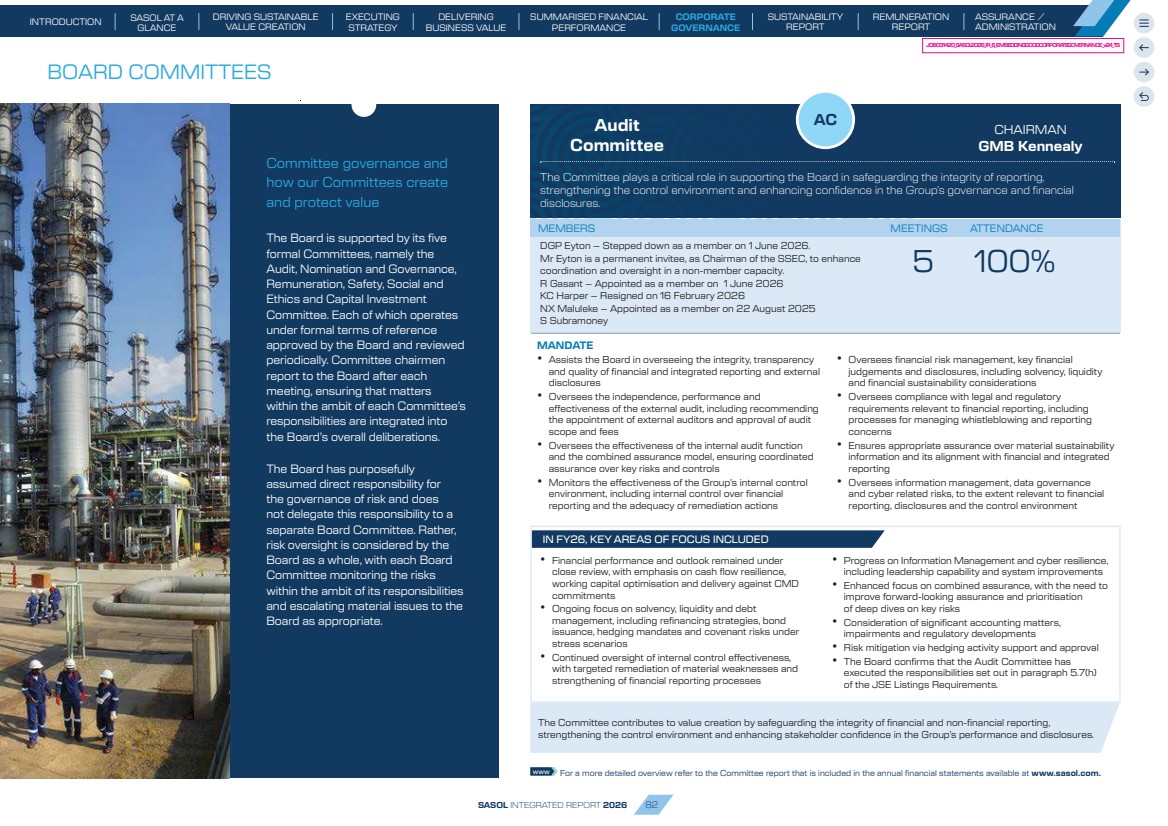
| BOARD COMMITTEES CONTINUED Committee governance and how our committees create and protect value continued MJ Cuambe DGP Eyton M Flöel GMB Kennealy MANDATE: • Assists the Board in promoting ethical and effective leadership, sound governance practices and long-term sustainable value creation across the Group • Oversees the effectiveness of the Group’s governance framework, including governance policies, disclosures and emerging governance related risks and alignment with evolving regulatory and best practice requirements • Oversees Board and Committee composition, succession planning and diversity, including the identification and nomination of directors, independence assessments and maintenance of an appropriate skills mix • Oversees executive succession and appointments, including recommendations on the composition of the Group Executive Committee and leadership continuity for key roles • Oversees Board, Committee and Director performance evaluations, and supports the Board in enhancing overall effectiveness and governance maturity • Oversees director induction, training and continuous development, ensuring the Board maintains appropriate capability aligned to strategic and emerging focus areas • Oversees legal, regulatory and compliance risk and governance, including monitoring adherence to applicable laws, codes and standards, and the integrity of compliance frameworks • Supports the Board in overseeing stakeholder governance and shareholder engagement, including investor relations IN FY26, KEY AREAS OF FOCUS INCLUDED MEMBERS ATTENDANCE CHAIRMAN MBN Dube Nomination and Governance Committee Contributes to value creation by ensuring effective leadership, optimal Board composition and robust governance practices that enable sound decision-making and long-term strategic oversight. The Committee plays a central role in supporting the Board in strengthening governance, enhancing leadership effectiveness and safeguarding long-term, sustainable value creation. MJ Cuambe KC Harper – Resigned as member on 16 February 2026 S Subramoney R Gasant – Appointed as member on 1 June 2026 MANDATE: • Assists the Board in overseeing the Group’s remuneration framework and policies, ensuring alignment with strategy, performance outcomes and regulatory requirements • Oversees the design and implementation of remuneration structures, including the appropriate balance between fixed and variable pay and alignment with market benchmarks and internal equity • Oversees short- and long-term incentive plans, including performance measures, target setting and outcomes, ensuring alignment with financial, operational, ESG and risk considerations • Oversees remuneration outcomes for executive directors, prescribed officers and employees, including salary increases, incentive awards and retention arrangements, and makes recommendations to the Board where required • Oversees governance and risk considerations in remuneration, including the application of malus and clawback provisions and ensuring remuneration does not incentivise excessive risk-taking • Oversees remuneration and benefit practices across the Group, including living wage considerations, employee benefits and internal pay equity • Oversees the preparation and integrity of the Remuneration Report and related disclosures, ensuring transparency and alignment with stakeholder expectations • Supports the Board in shareholder engagement on remuneration matters, including responding to shareholder feedback and voting outcomes IN FY26, KEY AREAS OF FOCUS INCLUDED CHAIRMAN M Flöel Remuneration Committee Contributes to value creation by aligning remuneration outcomes with performance, strategy and stakeholder interests, thereby driving accountability, talent retention and sustainable performance. The Committee plays a key role in supporting the Board in ensuring fair, responsible and transparent remuneration practices that align stakeholder interests and drive sustainable value creation NGC REMCO • Oversight of governance framework enhancements, including preparation for King VTM adoption and ongoing alignment with global governance standards • Monitoring of regulatory developments and compliance posture, including emerging disclosure and compliance requirements • Continued focus on Board composition, independence, skills and succession planning, supported by a formal skills development matrix benchmarking and ongoing director development • Progress on non-Executive Director succession and recruitment, ensuring alignment with future strategic capability requirements • Oversight of stakeholder and investor considerations, including AGM readiness, proxy voting trends and shareholder engagement matters • Review of corporate compliance programmes, including alignment with evolving international expectations (e.g. DOJ guidance) • Monitoring of Board and Committee effectiveness, including evaluation outcomes and development initiatives • Oversight of remuneration outcomes and alignment to performance, including STI and LTI delivery against targets and market benchmarks • Focus on remuneration governance and disclosure, incorporating shareholder feedback and evolving expectations • Consideration of market competitiveness of executive remuneration, including potential adjustments to pay structures and incentive pools • Monitoring of people risks, including talent retention, critical skills and workforce stability • Review of labour relations and wage negotiations, with attention to inflationary pressures and affordability • Oversight of Remuneration Policy compliance and updates, including malus, clawback and shareholding requirements • Continued engagement on culture, employee sentiment and leadership development as key drivers of performance MEMBERS ATTENDANCE 100%5 100%4 MEETINGS MEETINGS Refer to the Remuneration Report Exhibit 99.2. SASOL INTEGRATED REPORT 2026 83 JOB031420_SASOL 2026_IR_6_EMBEDDING GOOD CORPORATE GOVERNANCE_v24_TS INTRODUCTION SUMMARISED FINANCIAL PERFORMANCE SUSTAINABILITY REPORT SASOL AT A GLANCE DRIVING SUSTAINABLE VALUE CREATION EXECUTING STRATEGY DELIVERING BUSINESS VALUE CORPORATE GOVERNANCE ASSURANCE / ADMINISTRATION REMUNERATION REPORT |
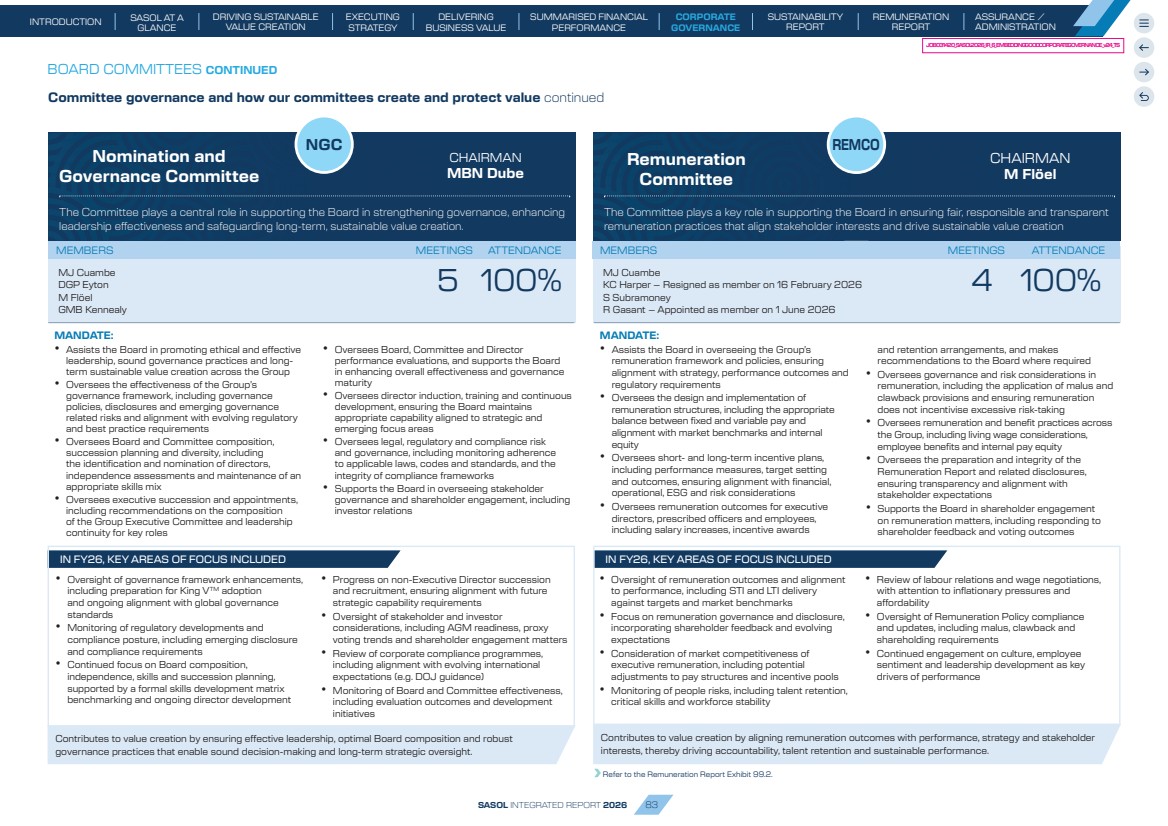
| BOARD COMMITTEES CONTINUED Committee governance and how our committees create and protect value continued S Baloyi MJ Cuambe MBN Dube* M Flöel VD Kahla NX Maluleke MANDATE: • Assists the Board in overseeing safety, sustainability, social and ethics matters, ensuring responsible and ethical conduct across the Group • Oversees the Group’s sustainability strategy, performance and commitments, including progress against targets, material risks and emerging opportunities • Oversees safety, health and environmental (SHE) performance, including incident trends, risk mitigation and initiatives supporting the Group’s Zero Harm ambition • Oversees the ethical culture and conduct of the Group, including anti-corruption, human rights, ethical supply chain practices and adherence to the Code of Conduct • Oversees labour, employment and workforce matters, including workforce capability, labour relations, transformation and alignment of skills with strategic priorities • Oversees the Group’s approach to responsible corporate citizenship and stakeholder impact, including community development, environmental stewardship and social licence to operate • Oversees stakeholder relations, reputation management and external engagement, including participation in industry, regulatory and sustainability-related forums • Oversees the integrity of sustainability-related disclosures and reporting, including alignment with regulatory requirements and assurance over non-financial information IN FY26, KEY AREAS OF FOCUS INCLUDED CHAIRMAN DGP Eyton Safety, Social and Ethics Committee Contributes to value creation by overseeing sustainability, safety and ethical conduct, thereby protecting the Group’s social licence to operate and supporting resilient, responsible long-term growth. The Committee plays a critical role in supporting the Board in overseeing sustainability, safety, social and ethical performance, safeguarding responsible business practices and enabling long-term value creation. S Baloyi WP Bruns MBN Dube* M Flöel DGP Eyton GMB Kennealy MANDATE: • Assists the Board in overseeing the Group’s capital allocation, major investment decisions and strategic execution, ensuring alignment with strategy and long-term value creation • Oversees and evaluates material capital investments, mergers and acquisitions, divestments and disposals, including associated risks, financial viability and strategic fit • Oversees the execution and delivery of major projects and strategic initiatives, including monitoring performance against approved investment cases, milestones and value realisation • Oversees strategic transformation and business growth initiatives, ensuring disciplined investment, scalability and delivery against commitments communicated to stakeholders • Oversees digital strategy development and execution and related investments, ensuring prioritisation, capital discipline and measurable value delivery from technology and innovation programmes • Monitors execution risks, delivery performance and benefits realisation, including corrective actions where value delivery is at risk • Provides oversight of portfolio performance and capital project delivery, ensuring efficiency, cost discipline and alignment with strategic objectives IN FY26, KEY AREAS OF FOCUS INCLUDED CHAIRMAN MJ Cuambe Capital Investment Committee Contributes to value creation by promoting disciplined capital allocation, overseeing strategic execution and ensuring that investments and transformation initiatives deliver anticipated value. The Committee plays a critical role in supporting the Board in driving disciplined capital allocation, overseeing strategic execution and enabling sustainable value creation through investment and transformation initiatives. SSEC CIC MEMBERS ATTENDANCE • Sustained focus on safety performance and culture, including high-severity incident prevention, root cause analysis and strengthening leadership accountability and behavioural discipline • Oversight of process safety and operational risk management, with targeted interventions to address systemic weaknesses • Continued monitoring of environmental compliance and regulatory risks, particularly air quality requirements and emissions reduction obligations • Progress on sustainability priorities, including emissions reduction roadmap delivery, water security, circular economy initiatives and ESG performance metrics • Review of ethics and culture, including EthicsLine trends, whistleblower protection and reinforcing tone-from-the-top • Oversight of social impact and corporate citizenship initiatives, including community development, stakeholder engagement and socio-economic programmes • Monitoring of human rights and modern slavery risks across operations and supply chain • Active oversight of the portfolio optimisation and asset review programme, including decisions on underperforming assets and potential partnerships or disposals • Continued monitoring of large capital projects and strategic investments, including Mozambique PSA and CTT, with focus on execution risk, delays and value preservation • Emphasis on capital discipline, prioritisation and alignment of investments to strategy and cash generation objectives • Ongoing work on the emissions reduction roadmap and energy transition initiatives, including renewable energy and sustainable fuels • Review of strategic growth and inorganic innovation, opportunities, including partnerships and market consolidation opportunities • Focus on operational reliability and value chain optimisation, particularly at Secunda and across mining and energy infrastructure • Ongoing monitoring of business transformation initiatives • Monitoring emerging technologies and future growth and innovation opportunities to support future value creation and business growth. MEMBERS ATTENDANCE 5 100% 4 100% MEETINGS MEETINGS * stepped down as a member effective 1 June 2026 * stepped down as a member effective 1 June 2026 Refer to the Report of the Chairman of the Safety, Social and Ethics Committee and other sustainability matters on the interated report as Sasol website. The President and CEO is not a member of the Audit, Remuneration nor the Nomination and Governance Committees but attends meetings by invitation. He is requested to leave the meeting, where appropriate, before any decisions are made that relate to him personally. SASOL INTEGRATED REPORT 2026 84 JOB031420_SASOL 2026_IR_6_EMBEDDING GOOD CORPORATE GOVERNANCE_v24_TS INTRODUCTION SUMMARISED FINANCIAL PERFORMANCE SUSTAINABILITY REPORT SASOL AT A GLANCE DRIVING SUSTAINABLE VALUE CREATION EXECUTING STRATEGY DELIVERING BUSINESS VALUE CORPORATE GOVERNANCE ASSURANCE / ADMINISTRATION REMUNERATION REPORT |
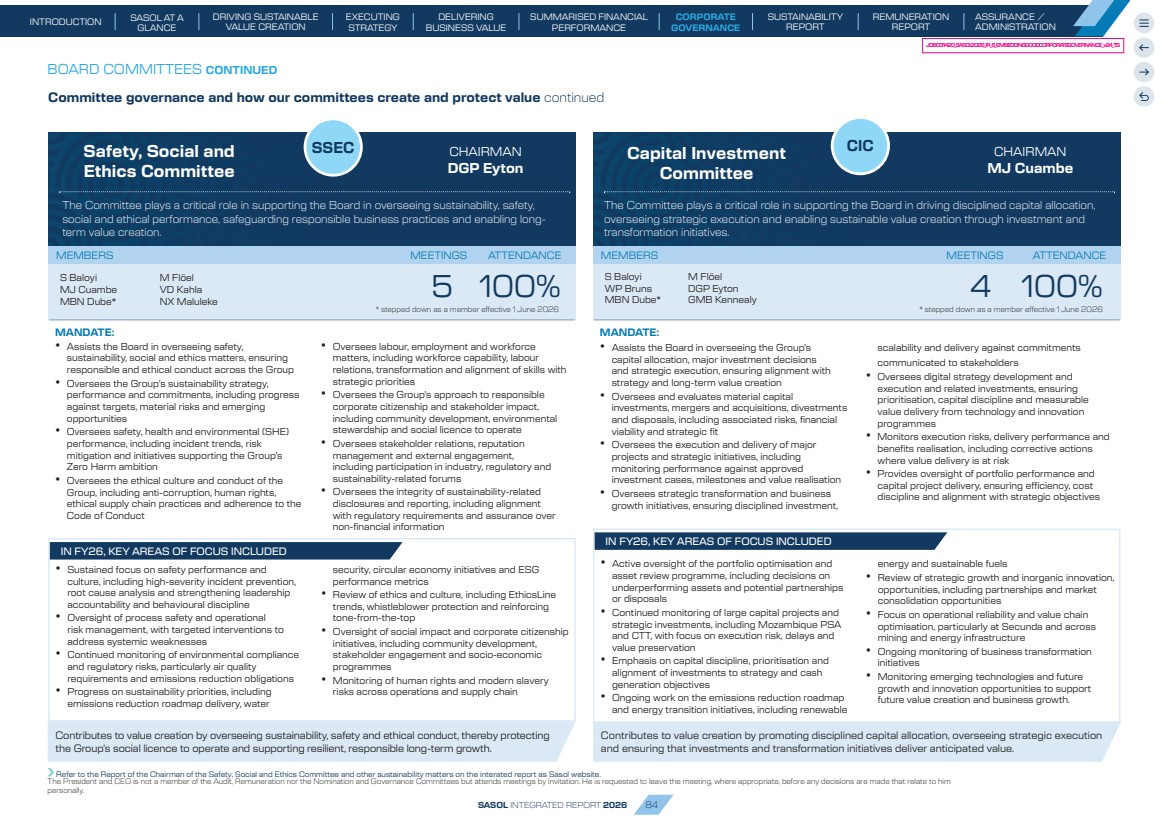
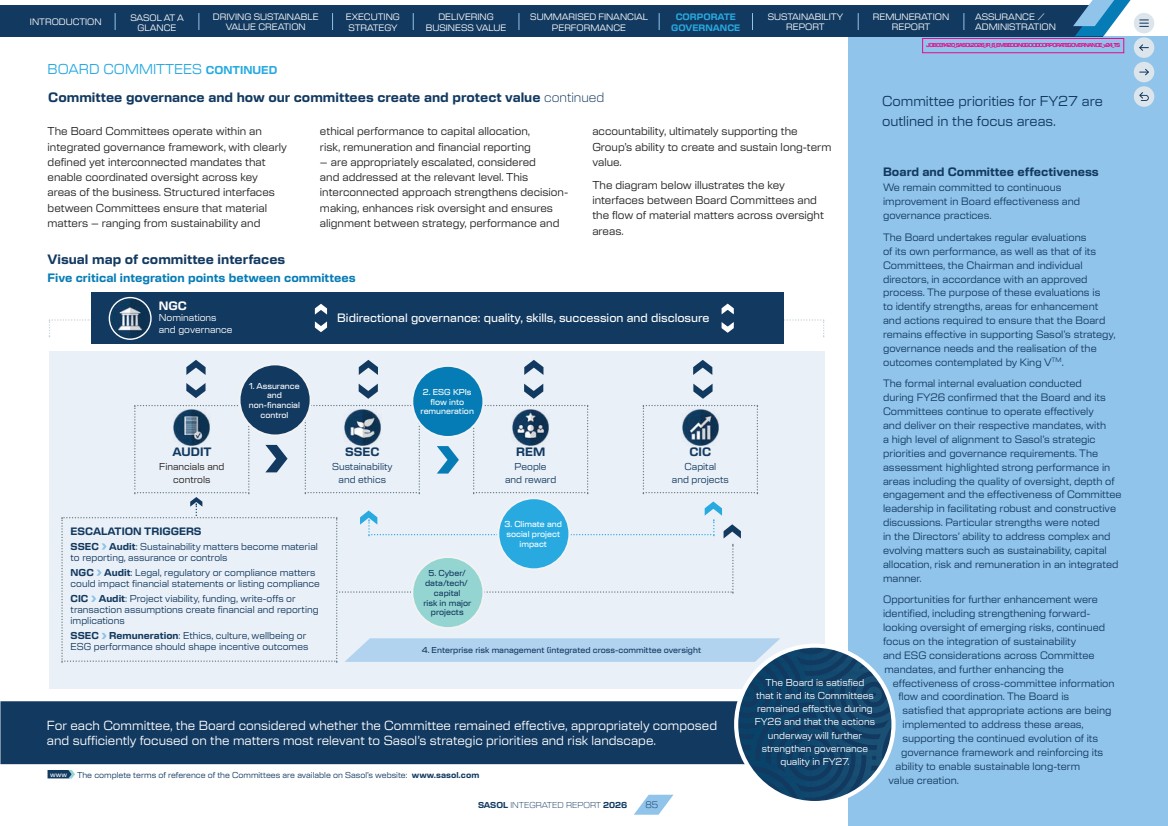
| The Board Committees operate within an integrated governance framework, with clearly defined yet interconnected mandates that enable coordinated oversight across key areas of the business. Structured interfaces between Committees ensure that material matters – ranging from sustainability and Committee governance and how our committees create and protect value continued Committee priorities for FY27 are outlined in the focus areas. ethical performance to capital allocation, risk, remuneration and financial reporting – are appropriately escalated, considered and addressed at the relevant level. This interconnected approach strengthens decision-making, enhances risk oversight and ensures alignment between strategy, performance and Board and Committee effectiveness We remain committed to continuous improvement in Board effectiveness and governance practices. The Board undertakes regular evaluations of its own performance, as well as that of its Committees, the Chairman and individual directors, in accordance with an approved process. The purpose of these evaluations is to identify strengths, areas for enhancement and actions required to ensure that the Board remains effective in supporting Sasol’s strategy, governance needs and the realisation of the outcomes contemplated by King VTM. The formal internal evaluation conducted during FY26 confirmed that the Board and its Committees continue to operate effectively and deliver on their respective mandates, with a high level of alignment to Sasol’s strategic priorities and governance requirements. The assessment highlighted strong performance in areas including the quality of oversight, depth of engagement and the effectiveness of Committee leadership in facilitating robust and constructive discussions. Particular strengths were noted in the Directors’ ability to address complex and evolving matters such as sustainability, capital allocation, risk and remuneration in an integrated manner. Opportunities for further enhancement were identified, including strengthening forward-looking oversight of emerging risks, continued focus on the integration of sustainability and ESG considerations across Committee mandates, and further enhancing the effectiveness of cross-committee information flow and coordination. The Board is satisfied that appropriate actions are being implemented to address these areas, supporting the continued evolution of its governance framework and reinforcing its ability to enable sustainable long-term value creation. accountability, ultimately supporting the Group’s ability to create and sustain long-term value. The diagram below illustrates the key interfaces between Board Committees and the flow of material matters across oversight areas. Visual map of committee interfaces Five critical integration points between committees 4. Enterprise risk management (integrated cross-committee oversight AUDIT Financials and controls SSEC Sustainability and ethics REM People and reward CIC Capital and projects 1. Assurance and non-financial control 2. ESG KPIs flow into remuneration 3. Climate and social project impact 5. Cyber/ data/tech/ capital risk in major projects ESCALATION TRIGGERS SSEC Audit: Sustainability matters become material to reporting, assurance or controls NGC Audit: Legal, regulatory or compliance matters could impact financial statements or listing compliance CIC Audit: Project viability, funding, write-offs or transaction assumptions create financial and reporting implications SSEC Remuneration: Ethics, culture, wellbeing or ESG performance should shape incentive outcomes NGC Nominations and governance Bidirectional governance: quality, skills, succession and disclosure For each Committee, the Board considered whether the Committee remained effective, appropriately composed and sufficiently focused on the matters most relevant to Sasol’s strategic priorities and risk landscape. The Board is satisfied that it and its Committees remained effective during FY26 and that the actions underway will further strengthen governance quality in FY27. BOARD COMMITTEES CONTINUED www The complete terms of reference of the Committees are available on Sasol’s website: www.sasol.com SASOL INTEGRATED REPORT 2026 85 JOB031420_SASOL 2026_IR_6_EMBEDDING GOOD CORPORATE GOVERNANCE_v24_TS INTRODUCTION SUMMARISED FINANCIAL PERFORMANCE SUSTAINABILITY REPORT SASOL AT A GLANCE DRIVING SUSTAINABLE VALUE CREATION EXECUTING STRATEGY DELIVERING BUSINESS VALUE CORPORATE GOVERNANCE ASSURANCE / ADMINISTRATION REMUNERATION REPORT |
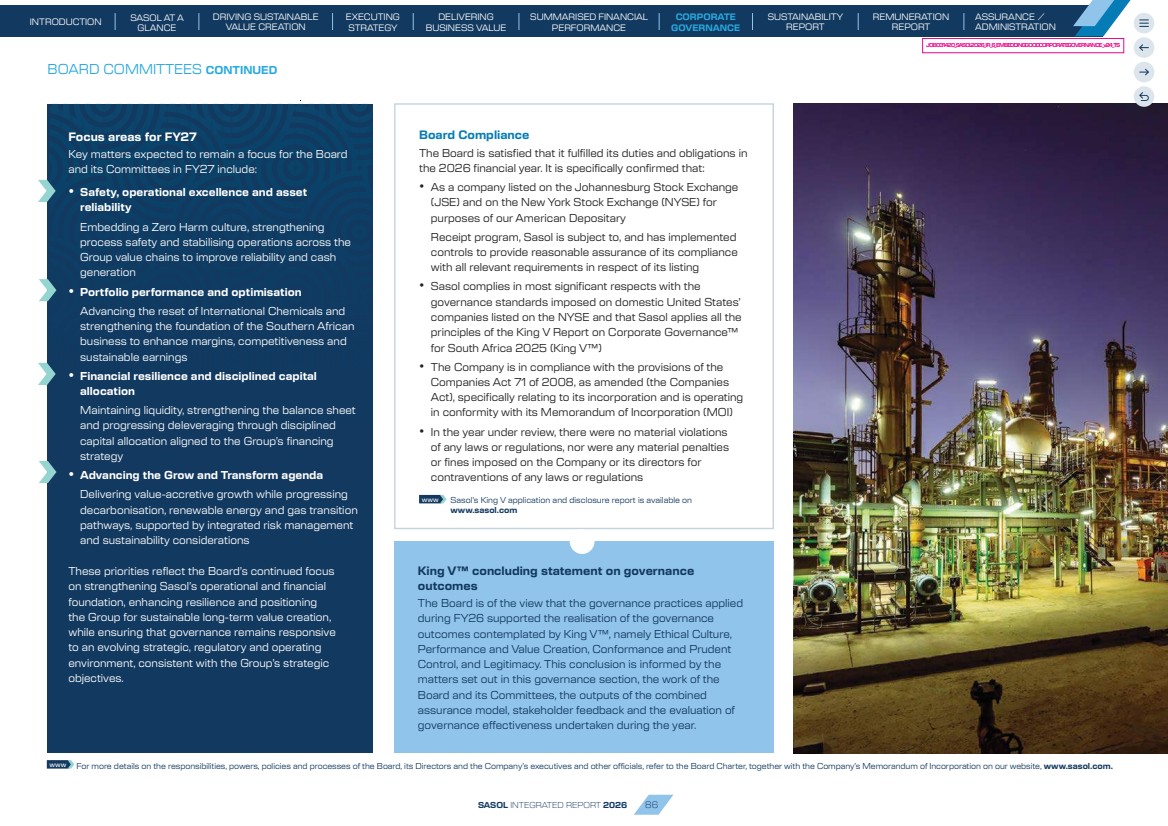
| Focus areas for FY27 Key matters expected to remain a focus for the Board and its Committees in FY27 include: • Safety, operational excellence and asset reliability Embedding a Zero Harm culture, strengthening process safety and stabilising operations across the Group value chains to improve reliability and cash generation • Portfolio performance and optimisation Advancing the reset of International Chemicals and strengthening the foundation of the Southern African business to enhance margins, competitiveness and sustainable earnings • Financial resilience and disciplined capital allocation Maintaining liquidity, strengthening the balance sheet and progressing deleveraging through disciplined capital allocation aligned to the Group’s financing strategy • Advancing the Grow and Transform agenda Delivering value-accretive growth while progressing decarbonisation, renewable energy and gas transition pathways, supported by integrated risk management and sustainability considerations These priorities reflect the Board’s continued focus on strengthening Sasol’s operational and financial foundation, enhancing resilience and positioning the Group for sustainable long-term value creation, while ensuring that governance remains responsive to an evolving strategic, regulatory and operating environment, consistent with the Group’s strategic objectives. Board Compliance The Board is satisfied that it fulfilled its duties and obligations in the 2026 financial year. It is specifically confirmed that: • As a company listed on the Johannesburg Stock Exchange (JSE) and on the New York Stock Exchange (NYSE) for purposes of our American Depositary Receipt program, Sasol is subject to, and has implemented controls to provide reasonable assurance of its compliance with all relevant requirements in respect of its listing • Sasol complies in most significant respects with the governance standards imposed on domestic United States’ companies listed on the NYSE and that Sasol applies all the principles of the King V Report on Corporate Governance™ for South Africa 2025 (King V™) • The Company is in compliance with the provisions of the Companies Act 71 of 2008, as amended (the Companies Act), specifically relating to its incorporation and is operating in conformity with its Memorandum of Incorporation (MOI) • In the year under review, there were no material violations of any laws or regulations, nor were any material penalties or fines imposed on the Company or its directors for contraventions of any laws or regulations King V™ concluding statement on governance outcomes The Board is of the view that the governance practices applied during FY26 supported the realisation of the governance outcomes contemplated by King V™, namely Ethical Culture, Performance and Value Creation, Conformance and Prudent Control, and Legitimacy. This conclusion is informed by the matters set out in this governance section, the work of the Board and its Committees, the outputs of the combined assurance model, stakeholder feedback and the evaluation of governance effectiveness undertaken during the year. BOARD COMMITTEES CONTINUED www Sasol’s King V application and disclosure report is available on www.sasol.com www For more details on the responsibilities, powers, policies and processes of the Board, its Directors and the Company’s executives and other officials, refer to the Board Charter, together with the Company’s Memorandum of Incorporation on our website, www.sasol.com. SASOL INTEGRATED REPORT 2026 86 JOB031420_SASOL 2026_IR_6_EMBEDDING GOOD CORPORATE GOVERNANCE_v24_TS INTRODUCTION SUMMARISED FINANCIAL PERFORMANCE SUSTAINABILITY REPORT SASOL AT A GLANCE DRIVING SUSTAINABLE VALUE CREATION EXECUTING STRATEGY DELIVERING BUSINESS VALUE CORPORATE GOVERNANCE ASSURANCE / ADMINISTRATION REMUNERATION REPORT |