Exhibit 99.(p)(x)
MayTech Global Investments, LLC
Code of Ethics
May, 2026
TABLE OF CONTENTS
| INTRODUCTION | 3 |
| GENERAL PRINCIPLES OF THE CFA INSTITUTE ASSET MANAGER CODE OF PROFESSIONAL CONDUCT | 4 |
| STANDARDS OF CONDUCT AND FIDUCIARY DUTY | 5 |
| INSIDER TRADING | 7 |
| GIFTS AND BUSINESS ENTERTAINMENT | 10 |
| POLITICAL CONTRIBUTIONS | 12 |
| PROHIBITED ACTIVITIES | 15 |
| PERSONAL SECURITIES ACCOUNTS AND TRADING | 16 |
| REPORTING VIOLATIONS & REMEDIAL ACTIONS | 20 |
| CERTIFICATE OF RECEIPT AND COMPLIANCE | 21 |
| WHISTLEBLOWER POLICY | 22 |
| DEFINITIONS | 24 |
| Exhibit A: CFA Institute Asset Manager Code of Professional Conduct - General Principles | 26 |
2
Last Revised 12/12/2025
INTRODUCTION
As an investment adviser, MayTech Global Investments, LLC (herein referred to as “MayTech” or the “Firm”), stands in a position of trust and confidence with respect to our clients. Accordingly, we must act pursuant to a fiduciary duty. MayTech has a fiduciary duty to place the interests of our clients before the interests of MayTech and our Supervised Persons. [See Definition of Supervised Persons].
This Code of Ethics (“Code”) is based on the concept of fiduciary duty and intends to comply with the various provisions of the Investment Advisers Act of 1940, as amended (the “Act”), federal securities laws1 and applicable rules and regulations adopted by the Securities and Exchange Commission (“SEC”). MayTech also expects all of its officers, full and part-time staff, and others who act on behalf of MayTech to maintain the highest standard of ethical conduct in their dealings with clients, fellow employees and all others who act on behalf of MayTech. Each employee is expected to conduct himself or herself with integrity, honesty, and professionalism.
To provide general guidance to employees, MayTech requires each employee, officer and representative to comply with the principles and standards contained in this Code of Ethics, as revised from time to time. This Code supersedes any prior Codes or policies related to the subject matter covered under the Code, which together with the firm’s Compliance Manual Policies and Procedures, collectively forms the basis of the firm’s compliance program. Therefore, this Code of Ethics should be read in conjunction with the Firm’s Policies and Procedures Manual. Failure to comply with this Code may result in disciplinary action, including, but not limited to, monetary fines, disgorgement of profits, and suspension or termination of employment.
Each Supervised Person is responsible for reading, understanding, and consenting to comply with the policies contained in this document. This Code will be reviewed periodically (at least annually) and any significant changes to either regulatory or Firm policies will result in the distribution of updates to the Code. Each employee must retain a copy of this Code.
A written Code cannot answer all questions raised in the context of business relationships and the provisions of the Code are not all-inclusive. The provisions of this Code are intended to serve as a guide for Supervised Persons of MayTech in their conduct. Thus, each Supervised Person is required to recognize and respond appropriately to specific situations as they arise. In those situations where a Supervised Person may be uncertain as to the intent or purpose of the Code, he or she is advised to consult with the Chief Compliance Officer who may grant exceptions to certain provisions contained in the Code only in those situations when it is clear beyond dispute that the interests of our clients will not be adversely affected or compromised. All questions arising in connection with personal securities trading should be resolved in favor of the client even at the expense of the interests of Supervised Persons.
Throughout this Code, you will find references to attestations, preapprovals and reporting. Supervised persons are responsible for logging in and utilizing the Compliance Alpha platform as the method for complying with such required information.
1 Federal securities laws include the Securities Act of 1933, the Securities Exchange Act of 1934, the Sarbanes-Oxley Act of 2002, the Investment Company Act of 1940, the Investment Advisers Act of 1940, Title V of the Gramm-Leach-Bliley Act, the Dodd-Frank Wall Street Reform and Consumer Protection Act of 2010, any rules adopted by the SEC under any of these statutes, the Bank Secrecy Act as it applies to funds and investment advisers, and any rules adopted thereunder by the SEC or the U.S. Department of the Treasury.
3
Last Revised 12/12/2025
GENERAL PRINCIPLES OF THE
CFA INSTITUTE ASSET MANAGER CODE OF PROFESSIONAL CONDUCT
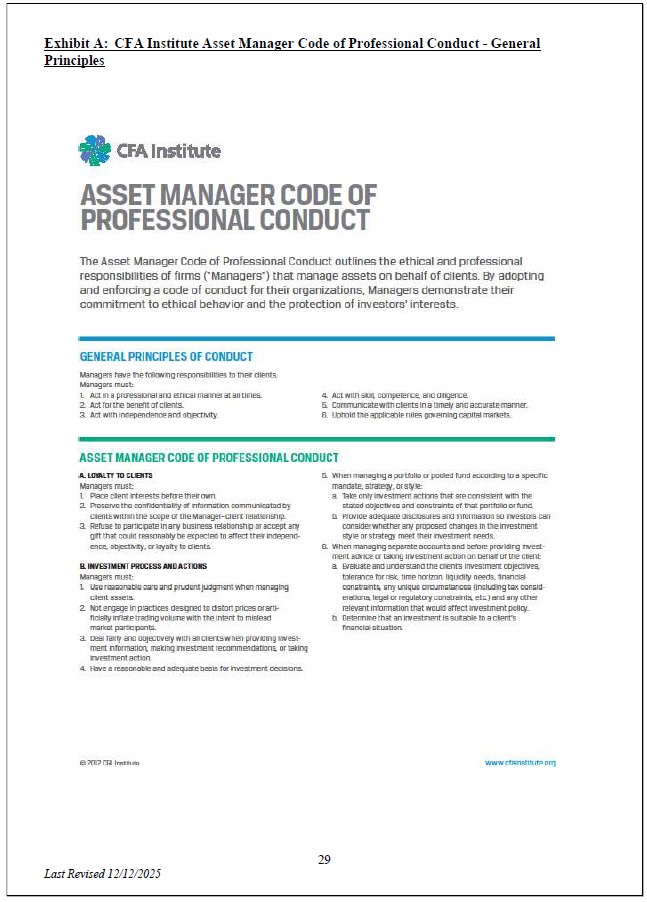
MayTech Global Investment has adopted the CFA Institute Asset Manager Code of Professional Conduct which outlines the ethical and professional responsibilities of firms (“Managers”) that manage assets on behalf of clients. By adopting and enforcing a code of conduct for their organizations, Managers demonstrate their commitment to ethical behavior and the protection of investors’ interests. MayTech believes that our Code of Ethics and Compliance Policies and Procedures Manual are consistent with the principles and provisions set forth in the CFA’s Code.
General Principles of Conduct
Managers have the following responsibilities to their clients. Managers must:
| 1. | Act in a professional and ethical manner at all times. |
2. Act for the benefit of clients.
| 3. | Act with independence and objectivity. |
| 4. | Act with skill, competence, and diligence. |
| 5. | Communicate with clients in a timely and accurate manner. |
| 6. | Uphold the applicable rules governing capital markets. |
The “General Principles of Conduct” are described and attached in Exhibit A and the full text of the CFA Institute Asset Manager Code of Conduct and its Recommendations and Guidance can be found here:
https://www.cfainstitute.org/ethics-standards/codes/asset-manager-code
“MayTech Global Investments, LLC claims compliance with the CFA Institute Asset Manager Code of Professional Conduct. This claim has not been verified by CFA Institute.”
4
Last Revised 12/12/2025
STANDARDS OF CONDUCT AND FIDUCIARY DUTY
MayTech’s Code of Ethics is based on the principle that you, as a Supervised Person of MayTech owe a fiduciary duty to Advisory Clients for which MayTech serves as an adviser. Accordingly, you must avoid activities, interests and relationships that might interfere or appear to interfere with making decisions in the best interests of our Advisory Clients.
As it is outlined in the SEC’s 2019 Interpretation of Standards and Conduct for Investment Advisors: An investment adviser’s fiduciary duty under the Advisers Act comprises a duty of care and a duty of loyalty.
The application of Duty is determined by the scope of the relationship with the client. An adviser’s fiduciary duty is imposed under the Advisers Act in recognition of the nature of the relationship between an adviser and its client—a relationship of trust and confidence. The adviser’s fiduciary duty is principles-based and applies to the entire relationship between the adviser and its client. The fiduciary duty follows the contours of the relationship between the adviser and its client, and the adviser and its client may shape that relationship by agreement, provided that there is full and fair disclosure and informed consent.
This Code is intended to comply with the various provisions of the Investment Advisers Act of 1940 and also requires that all Supervised Persons comply with federal securities laws, including the Investment Advisers Act of 1940, as amended and applicable rules and regulations adopted by the Securities and Exchange Commission (“SEC”).
Pursuant to Section 206 of the Advisers Act, both MayTech and its Supervised Persons are prohibited from engaging in fraudulent, deceptive or manipulative conduct. Compliance with this section involves more than acting with honesty and good faith alone. It means that MayTech has an affirmative duty of utmost good faith to act solely in the best interests of our Advisory Clients.
At all times, you must:
1. Place the interests of our Clients first. In other words, as a fiduciary you must scrupulously avoid serving your own personal interests ahead of the interests of our Clients. You may not cause a Client to take action, or not to take action, for your personal benefit rather than the benefit of the Client.
2. Duty of loyalty to clients. MayTech and its Supervised Persons owe a duty of loyalty to Clients and to always act in utmost good faith, place our clients’ interests first and foremost to make full and fair disclosure of all material facts, including conflicts of interest. Our Firm also has a duty to ensure that investment advice is suitable for meeting each Client’s individual and unique goals and objectives, investment mandates, needs, and circumstances.
3. Duty to seek best execution. MayTech must seek to obtain the execution of transactions for each of its clients such that the client’s total cost or proceeds in each transaction are the most favorable under the circumstances. An adviser fulfills this duty by seeking to obtain the execution of securities transactions on behalf of a client with the goal of maximizing value for the client under the particular circumstances occurring at the time of the transaction. Maximizing value encompasses more than just minimizing cost. When seeking best execution, an adviser should consider “the full range and quality of a broker’s services in placing brokerage including, among other things, the value of research provided as well as execution capability, commission rate, financial responsibility, and responsiveness” to the adviser.
5
Last Revised 12/12/2025
4. Duty to provide advice and monitoring over the course of the relationship. The duty of care includes a duty to provide investment advice that is in the best interest of the client, including a duty to provide advice that is suitable for the client. In order to provide such advice, an adviser must have a reasonable understanding of the client’s objectives. The basis for such a reasonable understanding generally would include, for retail clients, an understanding of the investment profile, or for institutional clients, an understanding of the investment mandate. The duty to provide advice that is in the best interest of the client based on a reasonable understanding of the client’s objectives is a critical component of the duty of care.
5. Conduct all of your personal securities transactions in full compliance with this Code. You must not take any action in connection with your personal investments that could cause even the appearance of unfairness or impropriety. Accordingly, you must comply with the policies and procedures set forth in this Code.
6. Avoid taking inappropriate advantage of your position. The receipt of investment opportunities, gifts or gratuities from persons seeking business with MayTech directly or on behalf of a Client could call into question the independence of your business judgment. Accordingly, you must comply with the policies and procedures set forth in this Code.
7. Keep Information Confidential. Information concerning Client transactions or holdings may be material non-public information and Employees may not use knowledge of any such information to profit from the market effect of those transactions.
9. Comply with federal securities law and all other laws and regulations applicable to the Firm’s business. Make it your business to know what is required of the Firm as an investment adviser and otherwise, and of you as an Employee of the Firm, and integrate compliance into the performance of all duties.
10. Seek advice when in doubt about the propriety of any action or situation. Any questions concerning this Code of Ethics should be addressed to the Chief Compliance Officer, who is encouraged to consult with outside counsel, outside auditors, or other professionals, as necessary.
11. Moderate Gifts and Entertainment. The receipt of investment opportunities, prerequisites, or gifts from persons doing or seeking to do business with the Firm could call into question the exercise of our independent judgement. Accordingly, Employees may accept such items only in accordance with the limitations of this Code.
This Code is adopted pursuant to the requirements of Rule 204A-1 under the Investment Advisers Act of 1940 applicable to all registered investment advisers, and Section 204A of the Investment Advisers Act of 1940 that registered investment advisers adopt procedures reasonably designed to prevent the misuse of material, nonpublic information.
6
Last Revised 12/12/2025
INSIDER TRADING
Insider trading is based on a simple, well-established principle: if you receive material, non-public information about a public company from any source, you are prohibited from discussing or acting on that information and should notify the CCO as soon as possible.
BACKGROUND
Supervised Persons are prohibited from trading based on material, non-public information, or communicating material, non-public information to others in violation of the law. Under insider trading laws, a person or company that illegally trades in securities of a company while in possession of material, non-public information about that company may be subject to severe sanctions, including civil penalties, fines, and imprisonment.
While the law concerning insider trading is not static, it is generally understood that the law prohibits:
| i. | Trading by an insider while in possession of material, non-public information; |
| ii. | Trading by a non-insider while in possession of material, non-public information, where the information either was disclosed to the non-insider in violation of an insider’s duty to keep it confidential or was misappropriated; or |
| iii. | An insider, or a non-insider described in clause (ii) above, from communicating material, non-public information to others. |
Who is an Insider?
The concept of “insider” is broad. It includes all employees of a company. Corporate insiders who possess material, non-public information about a corporation may be required either to disclose that information to the investing public or to refrain from passing such information along to others, trading in or recommending the purchase or sale of the corporation’s securities. Similarly, as a general rule, those to whom corporate insiders “tip” material, non-public information must refrain from passing such information along to others, trading in or recommending the corporation’s securities. In addition, under most circumstances, tipping or trading on material, non-public information about a tender offer may violate the rules of the SEC. Tipping may include spreading rumors about potential tender offers. For example, personnel may not pass along a rumor regarding a tender offer to those who are likely to trade on the information or further spread the rumor if the rumor emanated, directly or indirectly, from someone connected with the target, the offeror, or their respective officers, directors, partners, employees or persons acting on their behalf, even if such information was inadvertently communicated.
What is Material Information?
The question of whether information is material is not always easily resolved. Generally, the courts have held that a fact is material if there is substantial likelihood that a reasonable investor would consider the information “important” in making an investment decision. As such, material information would include information which would likely affect the market price of any securities or which would likely be considered important by a reasonable investor in determining whether to buy, sell, or hold such securities. Examples of material information may include the following:
| ● | Significant dividend increases or decreases |
| ● | Significant earnings information or estimates |
| ● | Significant changes in earnings information or estimates previously released by a company |
| ● | Significant expansion or curtailment of operations |
7
Last Revised 12/12/2025
| ● | Significant increases or declines in orders |
| ● | Significant merger, acquisition, or divestiture proposals or agreements |
| ● | Significant new products or discoveries |
| ● | Extraordinary borrowing |
| ● | Major litigation |
| ● | Significant liquidity problems |
| ● | Extraordinary management developments |
| ● | Purchase or sale of substantial assets |
| ● | Capital restructuring, such as exchange offers |
| ● | Block and/or Restricted Securities transactions |
Material information also may relate to the market for a company’s securities. Information about a significant order to purchase or sell securities may, in some contexts, be material. Prepublication information regarding reports in the financial press also may be material. For example, the United States Supreme Court upheld the criminal convictions of insider trading defendants who capitalized on prepublication information about The Wall Street Journal’s “Heard on the Street” column.
What is Non-public Information?
Information is “non-public” if it has not been disclosed generally to the investing public. Information is made public if it has been broadly disseminated and made available to the general public by publication in the newspapers or other media or if it has been the subject of a press release addressing the general investing public. However, information is not necessarily made public merely because such information is communicated through rumors or other unofficial statements in the marketplace.
Policy and Procedures
Supervised Persons are strictly forbidden from engaging in Insider Trading, either personally or on behalf of MayTech’s Clients. MayTech’s Insider Trading Policies and Procedures apply to all Supervised Persons, as well as any transactions in any securities by family members, trusts, or corporations, directly or indirectly controlled by such persons. The policy also applies to transactions by corporations in which the Supervised Person is an officer, director, or 10% or greater stockholder, as well as transactions by partnerships of which the Supervised Person is a partner unless the Supervised Person has no direct or indirect control over the partnership.
MayTech’s Clients and third-party research providers may possess Material Non-Public Information. Access to such information could come as a result of meeting with persons working in financial services or from issuers, in particular during “idea dinners.”
Any Supervised Person attending an idea dinner should report their attendance and information about the location and sponsor to the CCO by email, promptly following their return from the event. The email should also include any information about ideas suggested by the Supervised person and any information that appears to be Material Non-Public information passed along by other participants, a general idea of the discussion, and a general idea of the personnel in attendance.
The law of insider trading is complicated and continuously developing. Supervised Persons who are uncertain about the application of insider trading rules should discuss the situation with the Chief Compliance Officer. You must notify the Chief Compliance Officer immediately if you have any reason to believe that insider trading has occurred or is about to occur or if you receive or believe you received material, non-public information.
8
Last Revised 12/12/2025
Before executing any trade for yourself or others, including private accounts managed by MayTech, you must determine whether you have access to material, non-public information. If you think that you might have access to material, non-public information, you should take the following steps:
| ● | Prior to taking any action, report the information and proposed trade immediately to the Chief Compliance Officer; |
| ● | Do not purchase or sell the securities on behalf of yourself or others, including private accounts managed by the Firm; |
| ● | Do not communicate the information inside or outside the Firm, other than to the Chief Compliance Officer; |
| ● | Do not conduct research, trading, or other investment activities regarding a security for which you may have Material Non-Public Information until the CCO dictates an appropriate course of action; and. |
| ● | After the Chief Compliance Officer has reviewed the issue, the Firm will determine whether the information is material and non-public and, if so, what action the Firm will take. |
You should consult with the Chief Compliance Officer before taking any action or engaging in any transaction, in which inside information may have been provided. This degree of caution will protect you, our clients, and the Firm.
The Chief Compliance Officer shall use the following reviews and procedures to detect any possible trading on inside information:
| ● | Review of the personal securities reports for all Supervised Persons and any related accounts; |
| ● | Review of trading activity in Advisory Client accounts; |
| ● | Review of email communication; |
| ● | Investigation of any circumstances about any possible receipt, trading or other use of inside information. |
The Chief Compliance Officer may take the following steps, as appropriate for the situation where risks of exposure to material non-public information or insider trading are indicated:
| ● | Halt all trading in all portfolios in the company indicated in the MNPI until the matter is resolved; |
| ● | Review MayTech’s Insider Trading policies and procedures with the affected Supervised Person(s); |
| ● | Initially ask the affected Supervised Person (s) to execute written agreements that they will not disclose the potentially Material Non-Public Information to others, including colleagues; |
| ● | Periodically ask the affected Supervised Person(s) to sign certifications that they have not improperly shared the information; |
9
Last Revised 12/12/2025
| ● | Require the affected Supervised Person(s) to institute enhanced information security practices; |
| ● | Review the emails of the affected Supervised Person(s) more frequently; |
| ● | Forbid other Supervised Persons from seeking to obtain the information; and |
| ● | Conduct key word searches of all Supervised Persons’ emails for the information in question. |
Trading in affected securities may resume, and other responses may be adjusted or eliminated, when the CCO determines that the information has become public and/or immaterial.
Use of Expert Networks: Prior to participating in Expert Network calls, MayTech employees must make sure the consultants, whether in group calls or one-on-one calls, certify either to MayTech or the event organizer that they understand and abide by material non-public information-related confidentiality restrictions. Such certification can be detailed in the general contract with the vendor or obtained prior to each call. Further, the CCO must review the vendor’s compliance program and sign off on them prior to their use.
At the minimum, the expert network’s compliance program should include:
| - | Expert verification: third-party background checks, certify they are not prohibited from consultation practices by their employer, not disclose any non-public material information during calls, qualification as experts in their field (education, experience, etc.) |
| - | Access to calls and transcripts for MayTech’s compliance |
| - | Compliance training of the expert network’s employees |
Additionally, MayTech employees are required to save a copy of the audio or transcript of the call they participate in, in a folder easily accessible by the CCO. The CCO is responsible for randomly reviewing calls (or transcripts) for inside information and reporting any violations to the management of the Firm.
GIFTS AND BUSINESS ENTERTAINMENT
Supervised Persons should conduct themselves in such manner as to avoid potentially embarrassing situations when giving or receiving gifts and/or business entertainment as well as the bounds of law and reasonable propriety. If Supervised Persons are offered gifts, gratuities or other favors, they should simply ask themselves three questions:
| i. | Is the giver attempting to influence my judgment? |
| ii. | Would an outsider think so? |
| iii. | If I accept this gift, will I feel indebted or obligated in some way to the giver? |
By refusing inappropriate inducements of any kind, Supervised Persons will be preserving assets of far greater value: their good name, the reputation of MayTech, and our Advisory Clients’ financial welfare.
It is MayTech’s policy that no Supervised Person shall give or receive any gift, gratuity or other thing, or provide or participate in business entertainment, which would be construed as unreasonable in value with the intent or purpose of influencing a third party’s business relationship with MayTech.
In the ordinary course of business, Supervised Persons may give or receive modest business gifts and engage in business entertainment that is reasonable and customary. This Policy is not intended to restrict normal business activities. MayTech recognizes the value of fostering good working relationships with individuals and firms. Subject to this Policy, Supervised Persons of MayTech are permitted, on occasion, to entertain and to attend events as hosts and guests. When doing so, Supervised Persons are to always act in the best interests of MayTech, its associates and clients, and avoid any activity that might create an actual or perceived conflict of interest or the appearance of impropriety.
10
Last Revised 12/12/2025
Gifts & Special Entertainment Pre-approval and Reporting
Gifts Received
Supervised Persons must report their receipt of all gifts from Clients or third-party service providers to the CCO. However, gifts such as holiday baskets or lunches delivered to MayTech’s offices, which are received on behalf of the Company, do not require reporting. Promotional items valued at less than $100/occasion that clearly display the giver’s company logo also need not be reported. Examples of promotional gifts include mugs, hats, and umbrellas.
Entertainment/Events Received
Supervised Persons should request pre-approval and include a description of any entertainment or event that is unusual2 and not customary to our normal course of business in which the Supervised Person may consider participating (e.g. free entry to a conference for which other attendees pay a fee) Entertainment or events with an estimated value of $500/occasion or more should be submitted to the CCO prior to participation, where the value is known prior to attending the event. In certain circumstances, preapproval may not be practicable, such an invitation received while at a conference. In those situations, Supervised Persons should report the entertainment to the CCO, as soon thereafter as practicable.
You may attend business meals, sporting events and other entertainment events or conferences at the expense of a giver so long as the expense is reasonable (less than an estimated value of $500/occasion), both you and the host/provider of the entertainment is present, and the events are not excessively frequent. If you believe that the value of any entertainment you plan to participate in will be higher than $500/occasion, you must seek pre-clearance pursuant to the procedures below. The acceptance of tickets to any event where the giver will not attend is considered a gift subject to the gift reporting guidelines. Examples of events that may be considered an unreasonable expense would be World Series or Super Bowl tickets, special concerts or movie events and vacation trips.
If the estimated cost or value of the Supervised Person’s portion of the entertainment is estimated to have been greater than $500/occasion, or the Supervised Person has participated or received entertainment twice or more in a month, then the Supervised Person must report his/her attendance to the CCO through PTCC.
Gifts and Entertainment Provided by MayTech
Gifts and Entertainment provided by MayTech Supervised Persons to clients and other third parties with whom MayTech does business or wishes to do business, that are purchased on a MayTech credit card or where reimbursement is provided to the Supervised Person does not generally require reporting to the CCO, as the financial books and records of the firm provide official record of the expenses associated with such gifts and entertainment. However, where a Supervised Person expects to provide a gift or host entertainment the CCO may request further information in relation to these activities. In addition, any gift over $100 or entertainment given that is expected be more than $500 per person should be precleared with the CCO.
2 Golf outings are an example of an event that is not unusual and does not generally require preapproval unless the outing is at a course where the green fees are known to exceed $500. An invitation for a private helicopter ride to dinner while at a conference would be an example of an unusual event, for which preapproval may be impractical but since it is unusual should be reported promptly.
11
Last Revised 12/12/2025
Reporting Information and Compliance Review
Reporting must include the name(s) of the giver/recipient, the date, the organization of the giver/recipient, a description of the gift or event, and the value or estimated value of the gift or event.
Exceptions to the gift and entertainment/event limit may be made by the Chief Compliance Officer. These policies and procedures apply to situations where MayTech is actively seeking to do business with the third party and do not apply in relation to circumstances in which the Supervised Person has a personal relationship with such a third party (such as receiving or providing personal gifts as wedding gifts, or gifts for the birth of a child or in relation to dining out).
The CCO will track Supervised Persons’ provision and receipt of gifts and entertainment in order to review for potential conflicts of interest. The CEO will be responsible for reviewing any gifts and entertainment reported by the CCO.
If a Supervised Person has a question concerning a particular situation, it should be addressed to the Chief Compliance Officer.
POLITICAL CONTRIBUTIONS
Background
Individuals may have important personal reasons for seeking public office, supporting candidates for public office, or making charitable contributions. However, such activities could pose risks to an investment adviser. For example, federal and state “pay-to-play” laws have the potential to significantly limit an adviser’s ability to manage assets and provide other services to government-related clients.
Rule 206(4)-5 (the “Pay-to-Play Rule”) limits political contributions to state and local government officials, candidates, and political parties by:
| ● | Registered investment advisers; |
| ● | Advisers that would be required to register with the SEC but for the “foreign private advisor” exemption provided by Section 203(b)(3) of the Advisers Act, or that are exempt reporting advisers; |
| ● | Firms that solicit clients or investors on behalf of the types of advisers described above; and |
| ● | “Covered associates” (as defined below) of the entities listed above. |
12
Last Revised 12/12/2025
The Pay-to-Play Rule defines “contributions” broadly to include gifts, loans, the payment of debts, and the provision of any other thing of value. The SEC’s enforcement staff has interpreted contributions to include substantive donations of an adviser’s communications networks and other resources. Rule 206(4)-5 also includes a provision that prohibits any indirect action that would be prohibited if the same action was done directly.
Restrictions on the Receipt of Advisory Fees
The Pay-to-Play Rule prohibits the receipt of compensation from a government entity for advisory services for two years following a contribution to any official of that “government entity”.3 This prohibition also applies to “covered associates” of the adviser.
A “covered associate” of an adviser is defined to include:
| ● | Any general partner, managing member or executive officer, or other individual with a similar status or function; |
| ● | Any employee that solicits a government entity for the adviser, as well as any direct or indirect supervisor of that employee; and |
| ● | Any political action committee controlled by the adviser or by any person that meets the definition of a “covered associate.” |
However, there is an exception available for contributions from natural persons of $150 per election, or $350 per election if the contributor is eligible to vote in the election. An exception is also available for otherwise prohibited contributions that are returned, so long as the contribution in question is less than $350, is discovered within four months of being given, and is returned within 60 days of being discovered. The exception for returned contributions is available no more than twice per calendar year for advisers with 50 or fewer employees; advisers with more than 50 employees can rely on this exception three times per calendar year. However, an adviser cannot rely on the exception for returned contributions more than once for any particular employee, irrespective of the amount of time that passes between returned contributions.
The restrictions on contributions and payments imposed by Rule 206(4)-5 can apply to the activities of individuals for the two years before they became covered associates of an investment adviser. However, for covered associates who are not involved in soliciting clients or investors, the look-back period is six months instead of two years.
Restrictions on Payments for the Solicitation of Clients or Investors
The Pay-to-Play Rule prohibits the compensation of any person from soliciting a government entity unless the solicitor is an officer or employee of the adviser or unless the recipient of the compensation (i.e., solicitation fee) is another registered investment adviser or a registered broker/dealer.
3 A government entity means any state or political subdivision of a state, including (i) any agency, authority, or instrumentality of the state or political subdivision, (ii) a pool of assets sponsored or established by the state or political subdivision or agency, (iii) a plan or program of a government entity; and (iv) officers, agents or employees of the state or political subdivision or agency.
13
Last Revised 12/12/2025
However, a registered investment adviser will be ineligible to receive compensation for soliciting government entities if the adviser or its covered associates made, coordinated, or solicited contributions or payments to the government entity during the prior two years.4
Restrictions on the Coordination or Solicitation of Contributions
The Pay-to-Play Rule prohibits an adviser and its covered associates from coordinating or soliciting any contribution or payment to an official of the government entity, or a related local or state political party where the adviser is providing or seeking to provide investment advisory services to the government entity.
Recordkeeping Obligations
The Advisers Act imposes recordkeeping requirements on registered investment advisers who have any clients or investors in private funds that fall within Rule 206(4)-5’s definition of a “government entity.” Among other things, advisers with “government entity” clients or investors must keep records showing political contributions by “covered associates” and a listing of all “government entity” clients and investors.
Guidance Regarding Bona-Fide Charitable Contributions
Charitable donations to legitimate not-for-profit organizations, even at the request of an official of a government entity, do not implicate Rule 206(4)-5.
Applicability of Rule 206(4)-5 to Different Types of Advisory Products and Services Being Offered
The Pay-to-Play Rule applies equally to:
| ● | Advisers that provide advisory services to a government entity (including, among other things, through the management of a separate account or through an investment in a pooled private fund); and |
| ● | Advisers that manage a registered investment company (such as a mutual fund) that is an investment option of a plan or program of a government entity. |
Policies and Procedures
Political Contributions
Political contributions by MayTech or Supervised Persons to politically connected individuals or entities with the intention of influencing such individuals or entities for business purposes are strictly prohibited.
If a Supervised Person or any affiliated entity is considering making a political contribution to any state or local government entity, official, candidate, political party, or political action committee, the potential contributor must seek pre-clearance from the CCO using Compliance Alpha. Supervised Persons should be aware that political contributions that may require pre-clearance include cash donations, as well as substantive donations of MayTech’s resources, such as the use of conference rooms or communication systems. If pre-clearance is granted, it is valid for seven days before and after the intended contribution date. Any contributions outside of this date range require re-approval. The CCO will consider whether the proposed contribution is consistent with restrictions imposed by Rule 206(4)-5, and to the extent practicable, the CCO will seek to protect the confidentiality of all information regarding each proposed contribution.
4 Similar prohibitions are expected on broker/dealers pursuant to upcoming FINRA lawmaking.
14
Last Revised 12/12/2025
Supervised Persons may contribute to national political candidates, parties, or action committees without seeking pre-clearance as long as the recipient is not otherwise associated with a state or local political office. However, Supervised Persons must use good judgment in connection with all contributions and should consult with the CCO if there is any actual or apparent question about the propriety of a potential contribution.
Any political contribution by MayTech, rather than its Supervised Persons, must be pre-cleared by the CCO, irrespective of the proposed amount or recipient of the contribution. The CCO will maintain a chronological list of contributions in accordance with the requirements of the Pay-to-Play Rule, as well as a list of all Clients that meet the definition of a “government entity” for purposes of Rule 206(4)-5.
The President/CEO is responsible for reviewing the CCO’s political contribution activities.
PROHIBITED ACTIVITIES
No principal, director, officer, or employee of MayTech shall, directly or indirectly:
| a. | Employ any device, scheme or artifice to defraud a Client; |
| b. | Make any untrue statement of material fact to a Client; |
| c. | Engage in any act, practice, or course of business which operates or would operate as a fraud or deceit upon a Client; |
| d. | Engage in any manipulative practice with respect to a Client; or |
| e. | Use any information concerning a security held or to be acquired by a Client for personal gain or in a manner detrimental to the interests of a Client. |
Dissemination of Rumors
All employees are expressly prohibited from knowingly spreading as fact any rumor they know to be false concerning any company, or any purported market development, with the purpose and design to impact trading in or the price of that company’s or any other company’s securities, and from engaging in any other type of activity that constitutes illegal market manipulation. This prohibition includes the spreading of false rumors, or any other form of illegal market manipulation, via any media, including, but not limited to email, instant messages, text messages, blogs or chat rooms.
Service as a Director
Prior to accepting a position as a director of any company or organization (private or public, for-profit or not-for-profit), a Supervised Person must obtain written approval from the Chief Compliance Officer.
15
Last Revised 12/12/2025
Outside Business Activities
The Firm discourages Supervised Persons from holding unrelated outside employment, including consulting. Outside business activities5 must be reviewed by the President and approved by the CCO prior to engaging in such activities.
If a Supervised Person is associated with an outside business, such as by serving as an officer or director, the Supervised Person should recuse himself or herself from any decisions regarding that entity’s political contributions. If the Supervised Person believes that the outside business’ political contributions could give even the appearance of being related to MayTech’s advisory activities or marketing initiatives, the Supervised Person must discuss the matter with the CCO.
Supervised Persons must report outside business activities upon employment by MayTech and annually through the compliance questionnaire. Supervised Persons should request permission in writing from the CCO using Compliance Alpha, before engaging in outside business activities. Any outside business activities by the CCO will be reviewed by the President.
PERSONAL SECURITIES ACCOUNTS AND TRADING
1. Personal Securities Accounts and Trading
. The following policies are pursuant to Rule 17j-1 of the Investment Company Act and the Advisers Act of 1940. Rule 17j-1 addresses conflicts of interest that may occur when MayTech Access Persons buy or sell securities for their own accounts (personal investment activities).These policies apply to all Access Persons. Under the Advisers Act, Access Persons include any of the Company’s partners, officers (or other persons occupying a similar status or performing similar functions) and employees and consultants providing investment advice, who have access to nonpublic information regarding clients’ purchases or sales of securities, is involved in making securities recommendations to clients or who has access to such recommendations that are nonpublic. Because of the Company’s size and the range of duties that Employees and Consultants who provide investment advice may have, all Employees and Consultants are considered "Access Persons," and "Access Person" procedures, standards, and restrictions apply to all Employees and Consultants as well as the owners, officer or directors of the Company.
Many of the procedures, standards, and restrictions in this section govern activities in "Covered Accounts." Covered Accounts include each security account registered in an Access Person's name and each account or transaction in which an Access Person has any direct or indirect "beneficial ownership interest." The term "beneficial ownership interest" has a very broad meaning, discussed more completely below, and can include accounts of corporations owned by the Access Person and even accounts owned by certain family members. An Access Person has a "beneficial ownership" interest in not only securities he or she owns directly, and not only securities owned by others specifically for his or her benefit, but also
(i) securities held by the Access Person's spouse, domestic partner, minor children and relatives who live full time in the Access Person's home, and (ii) securities held by another person if by reason of any contract, understanding, relationship, agreement or other arrangement the Access Person obtains benefits substantially equivalent to ownership. Examples of some of the most common of those arrangements are as follows:
5 Outside business activities include paid employment, owning/operating small businesses and volunteer board positions for businesses or charities. Volunteer positions in relation to the co-op, condominium or other association in relation to your home are not considered outside business activities for this purpose.
16
Last Revised 12/12/2025
| 1. | By an Access Person for his/her own benefit, whether bearer, registered in his/her own name, or otherwise; |
| 2. | By others for the Access Person's benefit (regardless of whether or how registered), such as securities held for the Access Person by custodians, brokers, relatives, executors or administrators (including stock option plans, deferred compensation plans and 401(k) plans other than those administered by MayTech); |
| 3. | For an Access Person's account by a pledge; |
| 4. | By a trust in which an Access Person has an income or remainder interest unless the Access Person's only interest is to receive principal if (a) some other remainderman dies before distribution or (b) if some other person can direct by will distribution of trust property or income to the Access Person; |
| 5. | By an Access Person as trustee or co-trustee, where either the Access Person or any member of his/her immediate family (i.e., spouse, children and their descendants, stepchildren, parents and their ancestors, and stepparents, in each case treating a legal adoption as blood relationship) has an income or remainder interest in the trust. |
| 6. | By a trust of which the Access Person is the settlor, if the Access Person has the power to revoke the trust without obtaining the consent of all the beneficiaries; |
| 7. | By any non-public partnership in which the Access Person is a partner; |
| 8. | By a personal holding company controlled by the Access Person alone or jointly with others; |
| 9. | In the name of the Access Person's spouse unless legally separated; |
| 10. | In the name of minor children of the Access Person or in the name of any relative of the Access Person or of his/her spouse (including an adult child) who is presently sharing the Access Person's home. This applies even if the securities were not received from the Access Person and the dividends are not actually used for the maintenance of the Access Person's home; |
| 11. | In the name of any person other than the Access Person and those listed in (9) and (10) above, if by reason of any contract, understanding, relationship, agreement, or other arrangement the Access Person obtains benefits substantially equivalent to those of ownership; |
| 12. | In the name of any person other than the Access Person, even though the Access Person does not obtain benefits substantially equivalent to those of ownership (as described in (11) above), if the Access Person can vest or re-vest title in himself/herself. |
This broad definition of "beneficial ownership" is for purposes of this Code only; it does not necessarily apply for purposes of other securities laws or for purposes of estate or income tax reporting or liability. To accommodate potential differences in concepts of ownership for other purposes, an Access Person may include in his/her reports a statement declaring that the reporting or recording of any securities transaction shall not be construed as an admission that the reporting person has any direct or indirect beneficial ownership in the security.
Upon approval of the CCO, it may be possible for Access Persons to exclude accounts held personally or by immediate family members sharing the same household if the Access Person does not have any direct or indirect influence or control over the accounts, or if the Access Person can rebut the presumption of beneficial ownership over family members’ accounts.
17
Last Revised 12/12/2025
Preclearance. All Covered Accounts and Access Persons must obtain written preclearance before buying, selling, or pledging reportable securities6 for any Covered Account. Preclearance should be requested on the Compliance Alpha platform, where each employee is set up with a profile. MayTech maintains a Watch List that contains the model securities as well as securities the research team is actively working on. Pre-clearance of trades in securities on the Watch List require the approval of the portfolio managers and the CCO. All other securities transactions require the CCO’s approval only. If the portal is not available, preclearance requests should be sent to the CCO by email. Preclearance for purchases of private securities or private funds may be obtained by email sent to the CCO. After review, the CCO will generate a written (or email) response. No Access Person may buy, sell, or pledge any security for any Covered Account without obtaining clearance from the Chief Compliance Officer before the transaction. It is each Access Person's responsibility to obtain follow-up written documentation of any oral clearance from the Chief Compliance Officer. Transactions effected without preclearance are subject, in the Chief Compliance Officer's discretion (after consultation with other members of management, if appropriate), to being reversed or, if the Access Person made profits on the transaction, to disgorgement of such profits. Any trades by the Chief Compliance Officer shall be subject to approval by the highest ranking employee present at the time of the preapproval request.
The Chief Compliance Officer need not specify the reasons for any decision to clear or deny clearance for any proposed transaction.
Transaction orders should be placed promptly after approval is given and, in any case, must be placed by the close of business the day after the approval is granted. If the trade is not placed by that point the preapproval request must be resubmitted. The Chief Compliance Officer may revoke a pre-approval at any time for any reason and shall, in such case, promptly notify the Access Person.
Additional Trading Restrictions. Blackout period: Access Persons and Covered Accounts are prohibited to transact in the same securities during the same day when there are trades done on behalf of any Client. Access Persons and Covered Accounts are also prohibited to transact in these securities if the person(s) seeking preclearance approval have knowledge of MayTech portfolio managers’ intention to transact in those securities within the proceeding 3 trading days. Exception: Since most access person accounts are enrolled in MayTech’s portfolio strategy, when these accounts participate in group trades, where all accounts get the same execution (time and price) without preference to any account, the preapproval requirement is waived. The Chief Compliance Officer reserves the right to extend the trading restriction as seen appropriate on a case-by-case basis.
Exempt Transactions. Employees are not required to pre-clear any transaction in the following categories of securities (collectively, “Exempt Securities”):
6 The SEC’s definition of reportable securities, under 202(a)(18) of the Advisers Act,: Security” means any note, stock, treasury stock, bond, debenture, evidence of indebtedness, certificate of interest or participation in any profit-sharing agreement, collateral trust certificate, preorganization certificate or subscription, transferable share, investment contract, voting-trust certificate, certificate of deposit for a security, fractional undivided interest in oil, gas, or other mineral rights, any put, call, straddle, option, or privilege on any security (including a certificate of deposit) or on any group or index of securities (including any interest therein or based on the value thereof), or any put, call, straddle, option, or privilege entered into on a national securities exchange relating to foreign currency, or, in general, any interest or instrument commonly known as a “security,” or any certificate of interest or participation in, temporary or interim certificate for, receipt for, guaranty of, or warrant or right to subscribe to or purchase any of the foregoing.
18
Last Revised 12/12/2025
| ● | Direct obligations of the government of the United States; |
| ● | Bankers’ acceptances, bank certificates of deposit, commercial paper, and high-quality short-term debt instruments, including repurchase agreements; |
| ● | Shares issued by money market funds; |
| ● | Interests in 529 college savings plans; |
| ● | Shares issued by open-end funds and exchange-traded funds (other than Affiliated Mutual Funds); and |
| ● | Shares issued by unit investment trusts that are invested exclusively in one or more open-end funds. |
| ● | ETFs. Employees are not required to pre-clear any transaction in open-end exchange-traded funds that are not managed or sub-advised by the Firm or its affiliates (“ETFs”), but ETFs will be considered Reportable Securities for purposes of reporting requirements set out below. |
| ● | Personal accounts enrolled in the strategy do not need pre-clearance when the portfolio manager decides to rebalance those portfolios. When possible, the portfolio manager will block those orders together with client account orders, so they don’t appear to be favored. If blocking is not possible, personal accounts will be rebalanced last, after client account trading is completed. Rebalancing of a portfolio refers to bringing individual position sizes in line with the model. Buying more of a security or transacting in non-model securities is not considered rebalancing for the purposes of personal accounting trading rules and such trades should be pre-cleared before execution. |
Holding Period. Access Persons are required to hold any security purchased in their personal accounts for a minimum of 30 days. Access Person accounts enrolled in and traded with the SMA Strategy are not subject to this rule.
Other Exceptions. The Chief Compliance Officer reserves the right to decide, on a case-by-case basis, exceptions to any provisions under this Code. Any exceptions made hereunder will be maintained in writing by the Chief Compliance Officer and presented to the Firm’s Management at its next scheduled meeting.
Watch List - MayTech maintains a list of securities that are included in the model (ie Global Growth) as well as securities that the research team is actively working on. These securities could be subject of trading on any given day and require a 2-level pre-clearance process. (See details above). The Watch List is updated by the CCO, with the help of the Research Team, and maintained in Compliance Alpha. All changed to the model and the Watch List are logged and documented by the CCO.
New Issue Securities and Private Placements. Notwithstanding any of the exceptions set forth in this Personal Trading Policy, no Access Person may purchase any equity securities issued in an initial public offering ("New Issue Securities") or any securities offered in a “private placement” for any Covered Account without the prior written approval of the Chief Compliance Officer. In determining whether to approve any such transaction for an Access Person, the Chief Compliance Officer will consider, among other factors, whether the investment opportunity should be reserved for client accounts and whether the investment opportunity is being offered to the Investment Access Person by virtue of his or her position with the Company.
19
Last Revised 12/12/2025
2. Access Person Reporting
Quarterly Transaction Reports
Each quarter, Supervised Persons must report using Compliance Alpha all Reportable Securities transactions in accounts in which they have a Beneficial Interest. Supervised Persons must also report any accounts opened during the quarter that hold any Securities (including Securities excluded from the definition of a Reportable Security) that will include the date of the report, the date the account was established, and the name of the broker-dealer/bank with which the account is held. Reports regarding Securities transactions and newly opened accounts must be submitted to the CCO within 30 days of the end of each calendar quarter.
Quarterly transaction reports must include:
| ● | Date of report |
| ● | Date of transaction |
| ● | Title of security |
| ● | Ticker symbol or CUSIP |
| ● | Interest rate and maturity date |
| ● | Number of shares |
| ● | Principal amount |
| ● | Nature of the transaction (buy/sell) |
| ● | Broker-dealer/bank name |
Initial and Annual Holdings Reports
Supervised Persons must periodically report using Compliance Alpha the existence of any Covered Account that holds any Securities (including Securities excluded from the definition of a Reportable Security), as well as all Reportable Securities holdings.7 Reports regarding accounts and holdings must be submitted to the CCO through PTCC on or before February 14th of each year, and within 10 days of an individual first becoming a Supervised Person. Annual reports must be current as of December 31st; initial reports must be current as of a date no more than 45 days prior to the date that the person became a Supervised Person.
Initial and annual holdings reports must include:
| ● | Name of broker, dealer, or bank with which the Access Person maintains an account in which any securities are held for the Access Person’s direct or indirect benefit |
| ● | Date of the report |
| ● | Title and type of security |
| ● | Ticker symbol or CUSIP |
| ● | Number of shares |
| ● | Principal amount |
| 7 | In those cases the account is reported but not the actual holdings. For example, if you have a 401(k) from a prior employer at Fidelity, you list a new account called Fidelity 401(k). Similarly, you should report an account that is a 529 plan or a mutual fund account. This reporting may be done through PTCC or through separate reporting as requested by the CCO. But you do not need to list the assets it holds unless they are Reportable Securities. In addition, you don’t report the trading in those accounts unless they involve “Reportable Securities.” |
20
Last Revised 12/12/2025
Exceptions from Reporting Requirements
There are limited exceptions to certain reporting requirements. Specifically, an Access Person is not required to submit:
| ● | Quarterly reports for any transactions effected pursuant to an Automatic Investment Plan; or |
| ● | Any reports with respect to Securities held in accounts over which the Access Person had no direct or indirect influence or control, such as an account managed by an investment adviser on a discretionary basis. |
Any investment plans or accounts that may be eligible for either of these exceptions should be brought to the attention of the CCO, who will, on a case-by-case basis, determine whether the plan or account qualifies for an exception. In making this determination, the CCO may ask for supporting documentation, such as a copy of the Automatic Investment Plan, a copy of the discretionary account management agreement, and a written certification from an unaffiliated investment adviser that the Access Person does not have investment discretion over the account.
SOCIAL MEDIA POLICIES AND PROCEDURES
Background
Social media and/or methods of publishing opinions or commentary electronically are dynamic methods of mass communication. "Social media" is an umbrella term that encompasses various activities that integrate technology, social interaction and content creation. Social media may use many technologies, including, but not limited to, blogs, microblogs, wikis, photos and video sharing, podcasts, social networking, and virtual worlds. The terms "social media," "social media sites," "sites," and "social networking sites" are used interchangeably herein.
The proliferation of such electronic means of communication presents new and ever changing regulatory risks for our Firm. As a registered investment adviser, use of social media by our Firm and/or related persons of the Firm must comply with applicable provisions of the federal securities laws, including, but not limited to the anti-fraud, compliance and record keeping provisions.
For example, business or client related comments or posts made through social media may breach applicable privacy laws or be considered "advertising" under applicable regulations triggering content restrictions and special disclosure and recordkeeping requirements. Employees should be aware that the use of social media for personal purposes may also have implications for our Firm, particularly where the employee is identified as an officer, employee or representative of the Firm. Accordingly, MayTech seeks to adopt reasonable policies and procedures to safeguard the Firm and our clients.
Firm Social Media Accounts
MayTech manages several social media sites, in addition to the company’s blog, as part of its digital marketing strategy. MayTech treats social media and blog posts as advertisement and it is the overall responsibility of the CCO to adhere to the SEC’s Advertising Rules. The Social Media Administrator assigned to the management of the company’s social media accounts and blog postings is responsible for getting CCO approval prior to posting publicly any content whether that content is created internally or externally. Both the Administrator and CCO are responsible for keeping an approved copy of each post.
The CCO will periodically review all social media accounts to verify that only approved content has been posted.
21
Last Revised 12/12/2025
MayTech’s website and social media pages are designed to offer information about the company and its investment strategies to the public. They are not designed to be mediums for comments or discussions on any topic, therefore, where possible, the comment and endorsements fields should be disabled. Where it is not possible to disable the comment and endorsement fields, MayTech employees may only reply to comments and questions in a way that adheres to MayTech’s policies related to communicating with the public. If MayTech receives a comment that could be construed as a testimonial, the Social media Administrator must remove that comment from public view if possible.
Personal Social Media Accounts
Employees may maintain personal social media accounts and blog posts. It is each employee’s personal responsibility to properly conduct themselves, in adherence with MayTech policies related to communicating with the public, when interacting with the public via social media and personal blogs.
MayTech employees are not allowed to post business-related content on their personal social media pages or blogs, and they may not identify themselves as MayTech employees on these accounts. Any employee who wishes to post content related to MayTech, its business, and anything related to the employee’s job, the employee must create a professional account (i.e., LinkedIn) where he or she is clearly identified as a MayTech employee. Prior to establishing professional social media accounts and blogs, the employee must seek CCO approval. Only CCO-approved content may be posted on such professional accounts.
MayTech maintains the right to review employees’ personal as well as professional social media accounts to verify adherence to the company’s social media policies. It is the CCO’s overall responsibility to keep a record of each employee’s personal and professional social media and blog accounts and periodically review them.
Employees with professional social media accounts may not make any comments or endorsements that may violate SEC Advertising Rules such as recommending securities or inviting testimonials.
REPORTING VIOLATIONS & REMEDIAL ACTIONS
All Supervised Persons shall promptly report to their supervisor, the Chief Compliance Officer or a member of Senior Management all apparent violations of this Code. Supervisors and other Members of Senior Management shall immediately report possible material violations of the Code to the Chief Compliance Officer.
The Chief Compliance Officer shall promptly report to Senior Management all material violations of the Code. When the Chief Compliance Officer finds that a violation otherwise reportable to Senior Management could not be reasonably found to have resulted in a fraud, deceit, or a manipulative practice in violation of Section 206 of the Advisers Act, he may, in his discretion, submit a written memorandum of such finding and the reasons therefore to a reporting file created for this purpose in lieu of reporting the matter to Senior Management.
Senior Management shall consider reports made to it hereunder and shall determine whether or not the Code has been violated and what sanctions, if any, should be imposed.
22
Last Revised 12/12/2025
Because violations of legal and fiduciary practice by Supervised Persons can result in heavy penalties by regulatory agencies, violations of this Code of Ethics or regulatory laws will not be tolerated. Supervised Persons who violate the provisions of this Code or the fiduciary standard are subject to disciplinary action, which may include, but are not limited to, a letter of reprimand, disgorgement of profits, imposition of a fine, demotion, suspension, or termination.
The written regulations provided by the Securities & Exchange Commission and other regulatory agencies with regard to employee personal trading practices are imprecise thus demanding the utmost care and caution on the part of all who may be subject to official criticism. The effectiveness of this Code will depend on the application of fairness, common sense, and integrity. When in doubt about any related matter, consult with the Chief Compliance Officer.
No Retaliation Policy
It is the Firm’s policy that no Supervised Person who submits a complaint of a violation made in good faith will experience retaliation, harassment, or unfavorable or adverse employment consequences. A Supervised Person who retaliates against a person reporting a complaint will be subject to disciplinary action, which may include termination of employment. A Supervised Person who believes they have been subject to retaliation or reprisal as a result of reporting a concern or making a complaint is to report such action to the Chief Compliance Officer or Senior Management.
CERTIFICATE OF RECEIPT AND COMPLIANCE
Supervised Persons are required to acknowledge receipt of this Code and to certify upon commencement of employment or the effective date of this Code, whichever occurs later, and annually or upon amendment of the Code thereafter, that you have read and understand this Code and recognize that you are subject to this Code. Each initial and annual certificate comes in the form of a questionnaire and certification and will also state that you have complied with the requirements of this Code during the prior year, and, if appropriate, that you have disclosed, reported, or caused to be reported all transactions during the prior year in Covered Securities of which you had or acquired Beneficial Ownership. The initial and annual certificate will also ask you questions in relation to reporting on gifts and entertainment, outside business activities, and other potential conflicts of interest.
WHISTLE BLOWER POLICY
Background
The Whistleblower Program was created by Congress to provide monetary incentives for individuals to come forward and report possible violations of the federal securities laws to the SEC. Under the program, eligible whistleblowers (defined below) are entitled to an award of between 10% and 30% of the monetary sanctions collected in actions brought by the SEC and related actions brought by certain other regulatory and law enforcement authorities.
The Program also prohibits retaliation by employers against employees who provide us with information about possible securities violations.
An “eligible whistleblower” is a person who voluntarily provides the SEC with original information about a possible violation of the federal securities laws that has occurred, is ongoing or is about to occur. The information provided must lead to a successful SEC action resulting in an order of monetary sanctions exceeding $1 million. One or more people are allowed to act as a whistleblower, but companies or organizations cannot qualify as whistleblowers. You are not required to be an employee of the company to submit information about that company.
23
Last Revised 12/12/2025
In order to be considered for an award under the whistleblower program, you must submit your information either through our online Tips, Complaints and Referrals questionnaire and answer “yes” to the questions regarding participating in the whistleblower program or by completing our hardcopy Form-TCR and mailing or faxing it to the SEC Office of the Whistleblower, 100 F Street NE, Mail Stop 5631, Washington, DC 20549, Fax (703) 813-9322.
The SEC conducts investigations into possible violations of the federal securities laws. In general, the more specific, credible, and timely a whistleblower tip, the more likely it is that the tip will be forwarded to investigative staff for further follow-up or investigation. For instance, if the tip identifies individuals involved in the scheme, provides examples of particular fraudulent transactions, or points to non-public materials evidencing the fraud, the tip is more likely to be assigned to Enforcement staff for investigation.
The SEC does not have jurisdiction to take action on information that is outside the scope or coverage of federal securities laws. We may, in appropriate circumstances, refer your matter to another regulatory or law enforcement agency.
If you would like to provide the SEC with information about fraud or wrongdoing involving potential violations of the federal securities laws please follow the instructions provided in Rule 21F-9 and FAQ 9. Some examples of the kind of conduct the SEC is interested in include:
| ● | Ponzi scheme, Pyramid scheme, or a High-Yield Investment Program |
| ● | Theft or misappropriation of funds or securities |
| ● | Manipulation of a security's price or volume |
| ● | Insider trading |
| ● | Fraudulent or unregistered securities offering |
| ● | False or misleading statements about a company (including false or misleading SEC reports or financial statements) |
| ● | Abusive naked short selling |
| ● | Bribery of, or improper payments to, foreign officials |
| ● | Fraudulent conduct associated with municipal securities transactions or public pension plans |
| ● | Initial Coin Offerings and Cryptocurrencies |
| ● | Other fraudulent conduct involving securities |
MayTech Whistleblower Policy
As articulated in MayTech’s Code of Ethics, central to our Firm's compliance culture is an ingrained commitment to fiduciary principles. The policies and procedures set forth here and in our Compliance Manual and their consistent implementation by all supervised persons of MayTech evidence the Firm's unwavering intent to place the interests of clients ahead of the self-interest of the firm, our management, and staff.
24
Last Revised 12/12/2025
Every employee has a responsibility to know and follow the Firm’s policies and procedures. Every person in a supervisory role is also responsible for those individuals under his/her supervision. The Firm's principals, or a similarly designated officer, have overall supervisory responsibility.
Recognizing our shared commitment to our clients, all employees are required to conduct themselves with the utmost loyalty and integrity in their dealings with our clients, customers, stakeholders, and one another. Improper conduct on the part of any employee puts the Firm and company personnel at risk.
Therefore, while managers and senior management ultimately have supervisory responsibility and authority, these individuals cannot stop or remedy misconduct unless they know about it. Accordingly, all employees are not only expected to but are required to report their concerns about potentially illegal conduct as well as violations of our company’s policies.
Reporting Potential Misconduct
To ensure consistent implementation of such practices, it is imperative that supervised persons have the opportunity to report any concerns or suspicions of improper activity at the Firm (whether by a supervised person or other party) confidentially and without retaliation. MayTech’s Whistleblower Policy covers the treatment of all concerns relating to suspected illegal activity or potential misconduct.
Supervised persons may report potential misconduct by submitting a 'Report a Violation' form available on the SEC’s main web portal of this program (https://www.sec.gov/enforcement-litigation/whistleblower-program). By default, the report shall be submitted anonymously unless the individual unchecks the box that indicates the sender wishes to remain anonymous. Reports of violations or suspected violations must be reported to the CCO or, provided the CCO also receives such reports, to other designated members of senior management. Supervised persons may report suspected improper activity by the CCO to the Firm’s other senior management.
Responsibility of the Whistleblower
A person must be acting in good faith in reporting a complaint or concern under this policy and must have reasonable grounds for believing a deliberate misrepresentation has been made regarding accounting or audit matters or a breach of this Manual or the Firm’s Code of Ethics. A malicious allegation known to be false is considered a serious offense and shall be subject to disciplinary action that may include termination of employment.
Handling of Reported Improper Activity
The Firm shall take seriously any report regarding a potential violation of Firm policy or other improper or illegal activity, and recognizes the importance of keeping the identity of the reporting person from being widely known. Supervised persons are to be assured that the Firm will appropriately manage all such reported concerns or suspicions of improper activity in a timely and professional manner, confidentially and without retaliation.
In order to protect the confidentiality of the individual submitting such a report and to enable MayTech to conduct a comprehensive investigation of reported misconduct, supervised persons should understand that those individuals responsible for conducting any investigation are generally precluded from communicating information pertaining to the scope and/or status of such reviews.
25
Last Revised 12/12/2025
No Retaliation Policy
It is the Firm’s policy that no supervised person who submits a complaint made in good faith will experience retaliation, harassment, or unfavorable or adverse employment consequences. A supervised person who retaliates against a person reporting a complaint will be subject to disciplinary action, which may include termination of employment. A supervised person who believes s/he has been subject to retaliation or reprisal as a result of reporting a concern or making a complaint is to report such action to the CCO or to the Firm’s other senior management in the event the concern pertains to the CCO.
26
Last Revised 12/12/2025
DEFINITIONS
The following definitions are applicable within the context of this Code of Ethics:
“Supervised Person” means any employee, owner, director, officer, general partner, or Advisory Person of MayTech, including Consultants providing investment advice.
“Access Persons” are any “Supervised Persons” who have access to nonpublic information regarding any clients' purchase or sale of securities (or nonpublic information regarding the portfolio holdings of any reportable fund), or who are involved in making securities recommendations to clients, or who has access to such recommendations that are nonpublic. While under the Investment Advisers Act, Access Persons and Supervised Persons are distinguishable; this Code makes no distinction between Access and Supervised Persons. Based on the size and configuration of our Firm, all Supervised Persons are considered Access Persons.
“Automatic Investment Plan” is a program in which regular trades are made automatically in accordance with a predetermined schedule and allocation. An Automatic Investment Plan includes a dividend reinvestment plan.
“SMA Strategy” refers to MayTech’s investment strategy that is implemented across all separately managed accounts with discretionary authority granted to MayTech.
“Client” means any person or entity with which MayTech presently maintains an effective investment advisory contract. The meaning of Client shall exclude any person or entity that has terminated their investment advisory contract with MayTech.
“Security” shall mean any note, stock, treasury stock, shares issued by registered open-end investment companies, exchange traded funds, security future, bond, debenture, evidence of indebtedness, certificate of interest or participation in any profit-sharing agreement, collateral-trust certificate, pre-organization certificate or subscription, transferable share, investment contract, voting-trust certificate, certificate of deposit for a security, fractional undivided interest in oil, gas, or other mineral rights, any put, call, straddle, option or privilege on any security (including a certificate of deposit) or on any group or index of securities (including any interest therein or based on the value thereof), or any put, call, straddle, option or privilege entered into on a national securities exchange relating to foreign currency or, in general, any interest or instrument commonly known as a “security”, or any certificate of interest or participation in, temporary or interim certificate for, receipt for, guarantee of, or warrant or right to subscribe to or purchase, any security of the foregoing.
“Covered Security” shall mean a Security as defined above (in effect, all securities) except that it shall not include:
| ● | Direct obligations of the government of the United States, such as U.S. Treasury bonds; |
| ● | Bankers’ acceptances, bank certificates of deposit, commercial paper and high-quality short-term debt instruments, including repurchase agreements; |
| ● | Shares issued by money market funds; |
| ● | Exchange Traded Funds (ETF); |
| ● | Shares issued by unit investment trusts that are invested exclusively in unaffiliated mutual funds, such as variable insurance products; and |
| ● | Shares issued by open-end funds, such as open-end mutual funds. |
27
Last Revised 12/12/2025
“Beneficial Ownership” shall be interpreted in the same manner as it would be under Rule 16a-1(a)(2) of the Securities Exchange Act of 1934 (the “Exchange Act”) in determining whether a person has beneficial ownership of a security for purposes of Section 16 of the Exchange Act and the rules and regulations thereunder. In this regard, beneficial ownership will be deemed to exist if a person, directly or indirectly, through any contract, arrangement, understanding, relationship, or otherwise has or shares, a direct or indirect pecuniary interest in the securities (i.e., an opportunity, directly or indirectly, to profit or share in any profit derived from a transaction in the securities). Under this definition, an indirect pecuniary interest in securities generally includes, but is not limited to, securities held by members of a person’s immediate family sharing the same household provided, however, this presumption of beneficiary ownership may be rebutted, a person’s interests in securities held in certain trusts, a general partner’s proportionate interest in the portfolio securities held by a general or limited partnership, a person’s right to receive dividends that are separated or separable from the underlying securities (otherwise a right to receive dividends alone shall not represent a pecuniary interest) and a person’s right to acquire securities through the exercise or conversion of any derivative security whether or not presently exercisable. A person will not be deemed to be the beneficial owner of portfolio securities held by a corporation or similar entity in which the person owns securities if the shareholder is not a controlling shareholder of the entity and does not have or share investment control over the entity’s portfolio.
“Initial Public Offering” means an offering of securities registered under the Securities Act of 1933, the issuer of which, immediately before the registration, was not subject to the reporting requirements of Section 13 or 15(d) of the Securities Exchange Act of 1934.
“Limited Offering” shall mean an offering that is exempt from registration under the Securities Act of 1933 pursuant to Section 4(2) or Section 4(6) or pursuant to Rule 504, Rule 505 or Rule 506 under the Securities Act of 1933. This may include so-called hedge fund investments or, generally, investments in private securities.
“Purchase or Sale of a Covered Security” includes, among other things, the writing of an option to purchase or sell a Covered Security.
“Reportable fund” means (a) any fund for which you serve as an investment adviser, or (b) any fund whose investment adviser or principal underwriter controls you, is controlled by you, or is under common control with you.
“Security held or to be acquired” by an Advisory Client means (a) any Covered Security which (i) is or has been held by an Advisory Client or (ii) is being or has been considered by an Advisory Client or MayTech for purchase by an Advisory Client; and (b) any option to purchase or sell, and any security convertible into or exchangeable for, a Covered Security described in this Code.
28
Last Revised 12/12/2025