Exhibit 99.(p)(11)
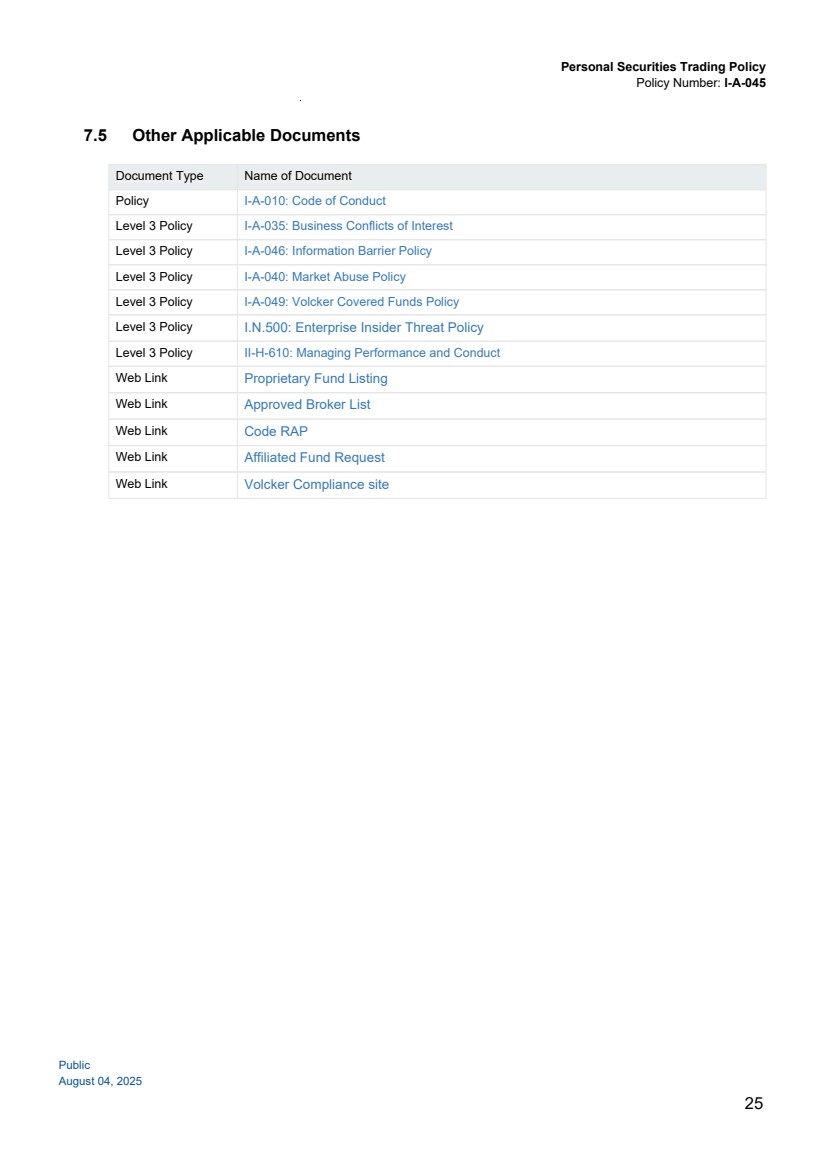
| Policy Number: I-A-045Personal Securities Trading Policy Level 3 Policy Effective Date August 04, 2025 Applicable to All BNY Employees Policy Owner Steven Wachtel, Global Head of Securities Trading Conduct and Trade Surveillance Policy Author Same as above Periodic Review 12 months Addendum(s) * Leave blank if not applicable Type Addendum Name Addendum Owner [X] Region [ ] Department [ ] Platform [ ] Product [ ] Legal Entity I-A-045 (A1): EMEA Personal Securities Trading Annette Fong, UK Chief Compliance Officer Denis Caprasse Head of SA/NV Compliance * An addendum captures an approved nuance, variation, or deviation, in manner or means, of accomplishing the objectives of a stated principle, rule or practice from the established minimum requirement articulated within this document. For internal use only |
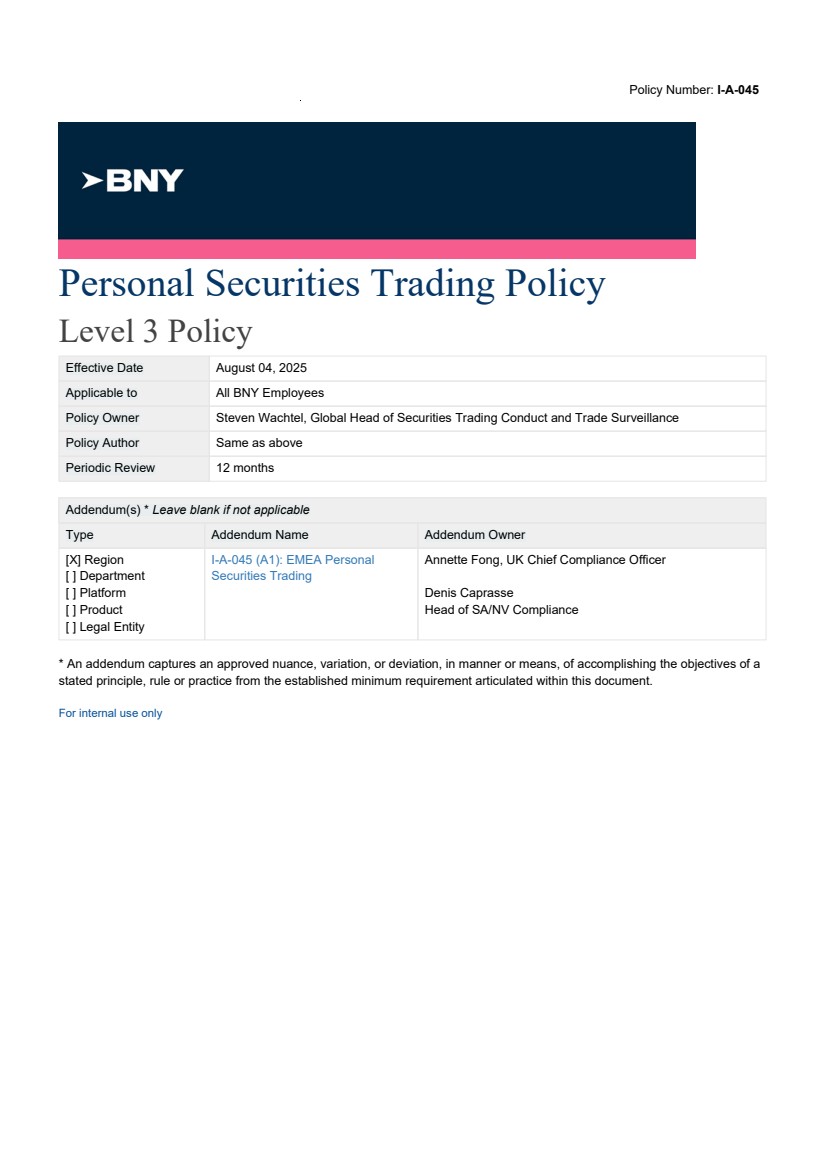
| Contents 1. Summary 4 2. Purpose 4 3. Applicability/Scope 5 4. Provisions of the Policy 5 4.1 Principal Requirements for all Employees 5 4.1.1 Avoidance of Conflicts of Interest 5 4.1.2 Trading in BNY Securities 5 4.1.3 Prohibitions When Trading in Non-Firm Securities 6 4.1.4 Initial Public Offerings (IPO) 6 4.1.5 Private Placements 7 4.1.6 BNY Affiliated Volcker Covered Funds 7 4.1.7 Ability to Request Account Statements and Trade Confirmations 7 4.2 Monitored Employees 7 4.3 Classifications of Monitored Employees 8 4.4 Additional Requirements and Restrictions for Monitored Employees 9 4.4.1 Reporting for All Monitored Employees 9 4.4.2 Account Statements and Trade Confirmations 10 4.4.3 Preclearance Prior to Trading 10 4.4.4 Additional Preclearance Restrictions for ADM, Investment/Public and certain private side employees (de minimis limits) 11 4.4.4.1 Approval for De Minimis Transactions for ADM Employees and Investment/Public Employees for Securities on Blackout List 11 4.4.4.1.1 Additional Restrictions for ADM employees (7 Day Blackout Period) 12 4.5 Managed Accounts 12 4.6 Prohibition on Short-Term Trading 12 4.7 Specific Restrictions for PREG Employees 13 4.8 Insider Threats 13 5. Governance and Responsibilities 13 5.1 All Employees are responsible for: 13 5.2 Businesses and Corporate Functions 14 Personal Securities Trading Policy Policy Number: I-A-045 Public August 04, 2025 2 |
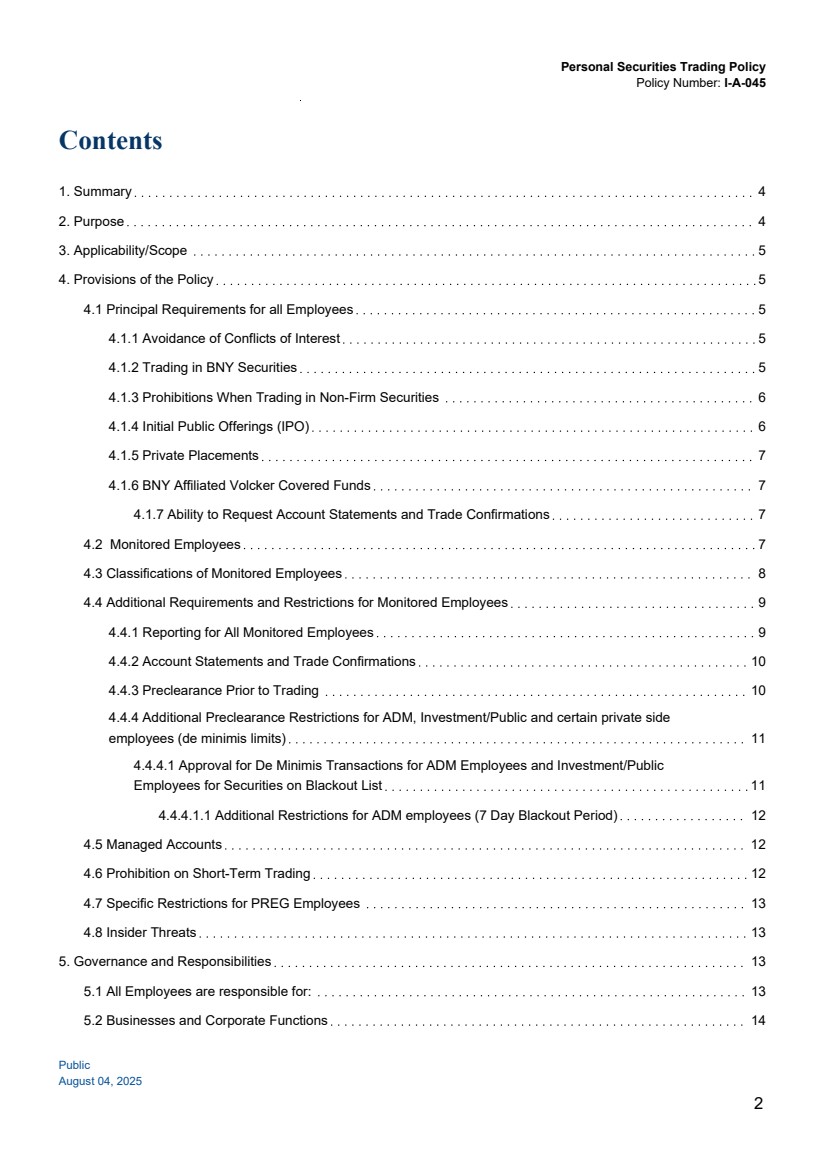
| 5.3 Securities Trading Conduct Group 14 5.4 Compliance Officers 14 5.5 Legal Department 15 5.6 Engineering Department 15 6. Adherence and Control 15 7. Appendices 16 7.1 Definitions 16 7.2 Document Governance 20 7.2.1 Periodic Review 20 7.2.2 Ownership/Questions 20 7.3 Version Control 21 7.4 Document Hierarchy 24 7.5 Other Applicable Documents 25 Personal Securities Trading Policy Policy Number: I-A-045 Public August 04, 2025 3 |
| 1. Summary Personal trading investments can lead to actual or perceived conflicts of interest which can undermine the integrity of the actions of The Bank of New York Corporation, its subsidiaries and affiliates that are majority owned (the “Firm”). The Firm is subject to various laws and/or regulations governing the personal trading of Securities/Financial Instruments (as defined in Section 7.1 of this Policy and collectively referenced as “securities”). The Firm has established limitations on personal trading so that employees’ personal securities investments are conducted in compliance with the applicable rules and regulations and are free from actual or perceived conflicts of interest. 2. Purpose The Personal Securities Trading Policy (this "Policy") sets out the global minimum obligations and restrictions related to personal securities transactions for all employees, including requirements and prohibitions related to the following: • Avoidance of conflicts of interest • Market Abuse1 • Trading in Firm securities • Trading in Non-Firm securities • Initial Public Offerings • Private Placements • Firm-affiliated Volcker Covered Funds • Excessive Trading2 This Policy also articulates additional requirements and restrictions for Monitored Employees who are likely to receive Firm or client information as normal course of business in their roles. These additional responsibilities include, but are not limited to, the following: • Filing of reports via the Star Compliance System (Star), the Firm’s electronic personal trading monitoring system • Providing duplicate statements and trade confirmations directly to the Firm • Preclearance prior to trading • Prohibition on short term trading Personal Securities Trading Policy Policy Number: I-A-045 Public August 04, 2025 4 1 Market Abuse includes insider dealing, market manipulation or unlawful disclosure of inside information. 2 The Firm reserves the right to limit trading in employee account(s) if deemed excessive. Excessive trading is defined as 20 or more trades in a calendar month. Excessive trading will be reported to the employee’s manager, business compliance officer and where warranted, People Services, as part of the Consequence Management Framework. |
| 3. Applicability/Scope This Policy applies to all employees of the Firm when trading in securities unless such securities are listed as “Exempt” under Section 7.1. Where indicated, this Policy may also apply to “Indirect Accounts,” as defined in Section 7.1 of this Policy. An employee is defined as a Director (excluding non-employees), Officer, Agent, Temporary Worker, Contractor, Intern or any other person who works for and contracted with the Firm, regardless of their duration of employment or contract. The Firm may, from time to time, designate additional persons that may from time to time have access to MNPI as being subject to this Policy. Where business/country-specific requirements are more stringent than those set out within this Policy, the business or country-specific rules prevail and you must also comply with such rules. 4. Provisions of the Policy 4.1 Principal Requirements for all Employees Failure to comply with any requirement in this Policy may subject you to discipline, up to and including termination of employment and referral to law enforcement, when required. 4.1.1 Avoidance of Conflicts of Interest You must not put your own interests ahead of the Firm and its clients. You must, comply with all applicable legal requirements, securities laws and the I-A-010: Code of Conduct. Employees must treat all Firm and client information as confidential. Refer to the Firm’s Code of Conduct for additional guidance. You are prohibited from placing transactions in securities if this would create, or could reasonably be perceived to create a conflict of interest between you and your clients, the Firm's clients, or the Firm. In accordance with securities and/or Market Abuse laws, you are prohibited from engaging in insider trading, trading while in possession of Material Non-Public Information (MNPI) (as defined in Section 7.1 of this Policy), Front Running (as defined in Section 7.1 of this Policy) or any other potential market manipulative trading activity. If you possess MNPI or have knowledge about client holdings, transactions, or recommendations, you must not, directly or indirectly (see definition of Indirect Ownership in Section 7.1 of this Policy): • Engage or attempt to engage in trading on the basis of such information • Recommend that another person engages in dealing or induce another person to engage in trading on the basis of the information; or • Unlawfully disclose the information (Tipping) In accordance with securities regulations, these prohibitions also apply to former employees, who must refrain from trading in any securities, Tipping or recommending that another person do the same, while in possession of MNPI. 4.1.2 Trading in BNY Securities If you invest or trade in Firm securities, you must be aware of your responsibilities and be sensitive to even the appearance of impropriety. The following prohibitions apply to all transactions in the Firm’s publicly traded securities, whether owned directly (i.e., in your name) or indirectly (see definition of Indirect Ownership in Section 7.1 of this Policy). The following activities are prohibited: Personal Securities Trading Policy Policy Number: I-A-045 Public August 04, 2025 5 |
| • Short Sales • Short-Term Trading: Defined as purchasing and selling, or selling and purchasing Firm securities within any 60 calendar day period. If you engage in short-term trading, you will be required to disgorge profits as determined by the Securities Trading Conduct group. This includes transactions in the Firm related employee benefit plans such as the BNY 401(k). • Margin Transactions: However, you may use Firm securities to collateralize full-recourse loans for non-securities purposes or for the acquisition of securities other than those issued by the Firm. • Option Transactions: Defined as any derivative transaction involving or having its value based upon any securities issued by the Firm, including the buying and writing of over-the-counter and exchange traded options. • Major Firm Events: Non-publicly announced events of which you have knowledge (prohibition will expire 24 hours after a public announcement is made). The Firm will comply with insider trading laws in connection with trades in its own securities. 4.1.3 Prohibitions When Trading in Non-Firm Securities You must be sensitive to any impropriety in connection with your personal securities transactions in securities of any issuer, including those owned indirectly (see Indirect Ownership defined in Section 7.1). You are prohibited from: • Engaging in FX derivative trading • Spread Betting: Taking bets on securities pricing, including FX spread-betting to reflect market/currency movement activities • Short Selling • Transacting in Options, excluding stock option grants • Transacting in Futures 4.1.4 Initial Public Offerings (IPO) You are prohibited from acquiring securities through an allocation by the underwriter of an IPO without the prior approval of the Securities Trading Conduct group. Approval is only likely to be given in the following circumstances: • The allocation comes through an employee of the issuer who has a direct family relationship to the Firm employee • The issuance is arranged by governments to promote the public ownership of previously state owned assets • Where a bank, savings and loan or insurance company converts from a structure owned by policyholders to one owned by investors (demutualization) Approval may not be available to employees of registered broker-dealers due to certain laws and regulations (e.g., FINRA rules in the U.S.). If you have any questions as to whether a particular offering constitutes an IPO, email the Securities Trading Conduct group before submitting an indication of interest to purchase the security. Personal Securities Trading Policy Policy Number: I-A-045 Public August 04, 2025 6 |
| 4.1.5 Private Placements You are prohibited from acquiring any security in a private placement unless you obtain prior written approval from the Securities Trading Conduct group, your Manager and Compliance Officer. A Private Placement Form must be submitted in Code RAP for approval: • If you are holding an investment of a privately-held (i.e., not traded on an exchange) Firm affiliated fund and you wish to divest all or a portion of your investment, you are required to obtain pre-approval from the Securities Trading Conduct group prior to redemption. Refer to MySource for a copy of the request Affiliated Fund Request form. • The Securities Trading Conduct group will generally not approve any private placement requests that appear to present an actual or potential conflict of interest. This includes instances where, among other things, the opportunity is being offered to you by virtue of your position with the Firm or its affiliates or your relationship to a managed fund or account and whether or not the investment opportunity being offered to you could be re-allocated to a client. So that no actual or potential conflict exists between the proposed private placement purchase and the interests of any managed fund or account, you must comply with any and all requests for information and/or documentation necessary for the Employee Compliance/Securities Trading Conduct group. • Within 30 days of being designated a Monitored Employee (see Sections 4.2 to 4.4 for information), you must disclose any existing investment in private placement securities to the Securities Trading Conduct group who will determine if you will be permitted to continue to hold the investment. 4.1.6 BNY Affiliated Volcker Covered Funds You are prohibited from acquiring any initial or subsequent investment in a Firm affiliated Volcker Covered Fund (Refer to the Volcker Compliance site on MySource) unless you obtain prior written approval from the Securities Trading Conduct group, your Manager and Compliance Officer. Unless your job duties are directly related to providing investment advisory, commodity trading advisory or “other services” to the fund, your investment in such funds will not be permitted. A Private Placement Form must be submitted in Code RAP for approval. If you are newly hired and you hold an investment (either directly or indirectly) in an affiliated Firm Volcker Covered Fund you must receive permission to continue to hold that investment. You must disclose your investment within 30 calendar days of your hire date by completing the Private Placement Form available in Code RAP. You may be required to divest your ownership interest. 4.1.7 Ability to Request Account Statements and Trade Confirmations For all employees, the Firm reserves the right to request accounts statements and trade confirmations when needed. 4.2 Monitored Employees If you are determined to be at risk for receiving Firm or client information as described below, your personal trading and accounts where you have Indirect Ownership (as defined in Section 7.1) are required to be monitored and you are thus deemed a Monitored Employee. There are strict limitations on such trading for Monitored Employees as further described in Section 4.4. Monitored Employees include employees who, as a routine and normal course of their job: Personal Securities Trading Policy Policy Number: I-A-045 Public August 04, 2025 7 |
| • Are deemed to be at a high risk of receiving MNPI of issuer clients (generally, certain employees located in or supporting Private Side businesses as defined by the Firm’s I-A-046: Information Barriers Policy. These are employees who are deemed to be private under I-A-046: Information Barrier Policy. • Have nonpublic information regarding advisory client’s purchases or sales of securities or nonpublic information regarding the portfolio holdings of a Proprietary Fund, are involved in making securities recommendations to advisory clients, or have access to such recommendations before they are public. • Have foreknowledge of the clients' trading positions or plans such that the information may elevate the risk of Front Running or similar manipulative trading. • Have access to inside information with respect to the Firm’s financial results in advance of such results being released to the public. • Required by regulation – employees who work for a Firm broker-dealer or investment adviser (or their equivalents). Additionally, each business unit is required to classify all employees who are Senior Directors, Managing Directors or above as Investment/Public or Insider Risk. All monitored employees managers will also be monitored to ensure managers have the proper visibility to supervise their employees. 4.3 Classifications of Monitored Employees The Firm has assigned Monitored Employees a classification that will correspond to the type of information they routinely are exposed to in as performing their job duties. They are as follows: Classification Type Definition Access Decision Maker (ADM) Employee Employees within BNY Investments who are Portfolio Managers or Research Analysts and make or participate in recommendations or decisions regarding the purchase or sale of securities for mutual funds or managed accounts. Portfolio Managers of broad-based index funds and traders are not typically classified as ADM Employees. Insider Risk Employee Employees who in the normal course of business are likely to receive MNPI regarding issuer clients. These employees are on the “private side” of the Information Barrier in accordance with the I-A-046: Information Barriers Policy. Investment/Public Employee Employees in the normal course of business who: • Are on the "public side" of the Information Barrier in accordance with the I-A-046: Information BarriersPolicy. • Employees that by regulation are required to have their personal trading monitored. • Have access to nonpublic information regarding advisory client’s purchase or sale of securities or nonpublic information regarding the portfolio holdings of a Firm Proprietary Fund • Are involved in making securities recommendations to advisory clients, or has access to such recommendations before they are public. • Have foreknowledge of clients trading positions or plans such that the information may elevate the risk of Front Running This classification typically includes employees in BNY Investments and BNY Wealth businesses as well as employees in other Public side businesses or Corporate Functions who have an elevated risk (clear access to pre-trade settlement information) of Front Running. • Employees of a Firm business regulated by certain investment company laws. Examples are: Personal Securities Trading Policy Policy Number: I-A-045 Public August 04, 2025 8 |
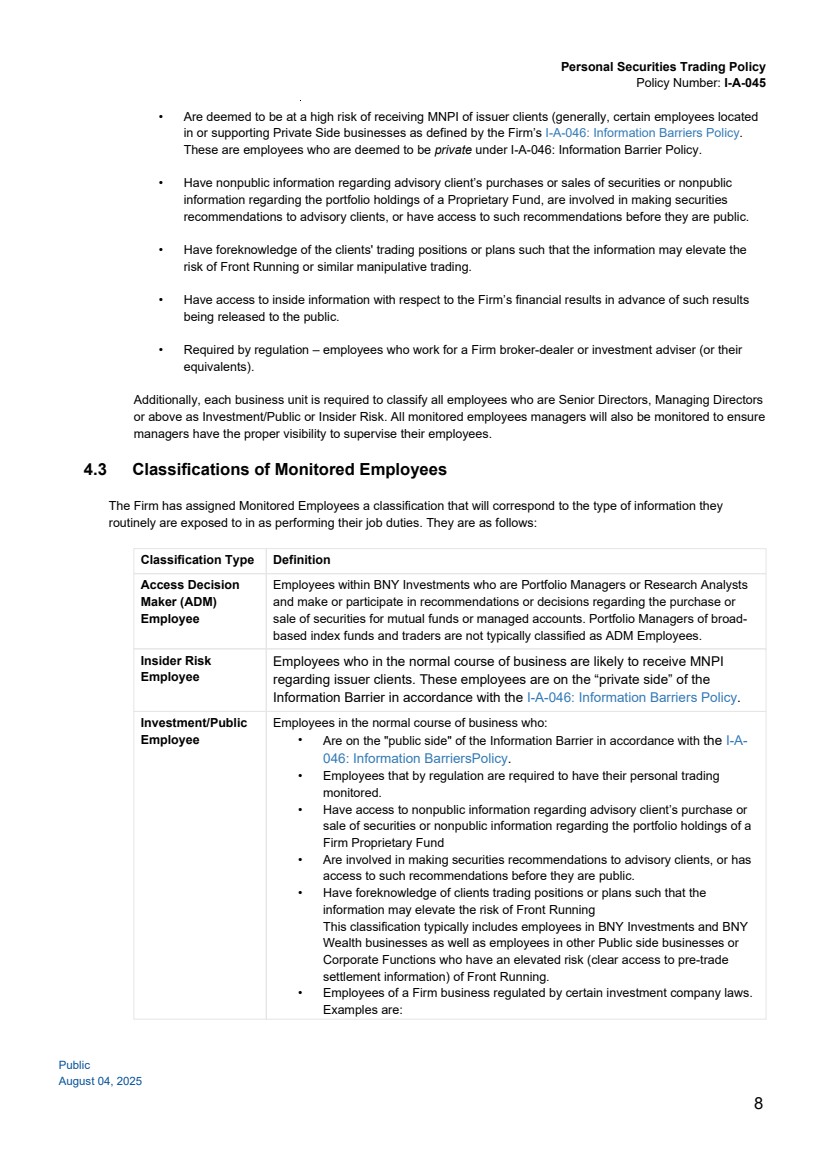
| • In the U.S., employees who are “advisory persons” or “access persons” under Rule 17j-1 of the Investment Company Act of 1940 or “access persons” under Rule 204A-1 of the Advisers Act. • In the U.K., employees in companies undertaking specified activities under the Financial Services and Markets Act 2000 (Regulated Activities), Order 2001, and regulated by the Financial Conduct Authority. • Any member of the Firm’s Senior Management who, as part of his/her usual duties, has management responsibility for fiduciary activities or routinely has access to information about advisory clients’ securities transactions. Pre-Release Earning Group (PREG) Employee Includes all Executive Committee members, their administrative assistants and any individual determined by the business to have access to the Firm’s earnings in advance of public announcements. 4.4 Additional Requirements and Restrictions for Monitored Employees In addition to the requirements which apply to all employees as described in Section 3.1 of this Policy, all Monitored Employees are also subject to the additional requirements noted below. These requirements apply to all securities accounts and holdings for which you have direct or indirect ownership. 4.4.1 Reporting for All Monitored Employees You are required to file various reports via Star, the Firm’s electronic personal trading monitoring system. Required reports must also include any securities (except those deemed exempt as defined in Section 7.1), held outside of an account (for example, if you hold physical securities outside of a brokerage account, you must report those securities). You are required to file the following reports in order to be in compliance with the Policy: • Initial Reports: Within 10 calendar days of being notified by the Securities Trading Conduct group that you are a Monitored Employee, you must file an Initial Broker Accounts and an Initial Holdings Report. These reports must contain a listing of all accounts that trade, or are capable of trading, securities. Initial Holdings Reports must be an accurate recording of accounts and securities holdings within the preceding 45 days of your being deemed a monitored employee. • Annual Reports: On an annual basis and within 30 calendar days after the end of the year, you must file an Annual Holdings Report. The report must contain an accurate and current listing of securities held in all accounts that trade, or are capable of trading securities. • Annual Accounts: On an annual basis and within 30 calendar days after the end of the year, you must review all of your reported accounts in the Star system and make any updates, including adding and/or removing accounts where necessary. • Ongoing Reporting: If you open a new account, or receive securities through a gift or inheritance, you must update your holdings in the Star system within 10 calendar days of the event (i.e., account opening or date of receipt of securities). For gifts/inheritance, you must disclose the name of the person receiving or giving the gift or inheritance, date of the transaction, and name of the broker through which the transaction was effected (if applicable). A gift of securities must be one where the donor does not receive anything of monetary value in return. Preclearance is required for all reportable holdings that are being liquidated (e.g. an executor liquidating a portfolio). • Updating Holdings: You are responsible for your securities holdings being accurate in the Star system. This may require you to make manual adjustments for changes to your securities holdings (excluding exempt securities as defined in Section 7.1 of this Policy) that occur as a result of Personal Securities Trading Policy Policy Number: I-A-045 Public August 04, 2025 9 |
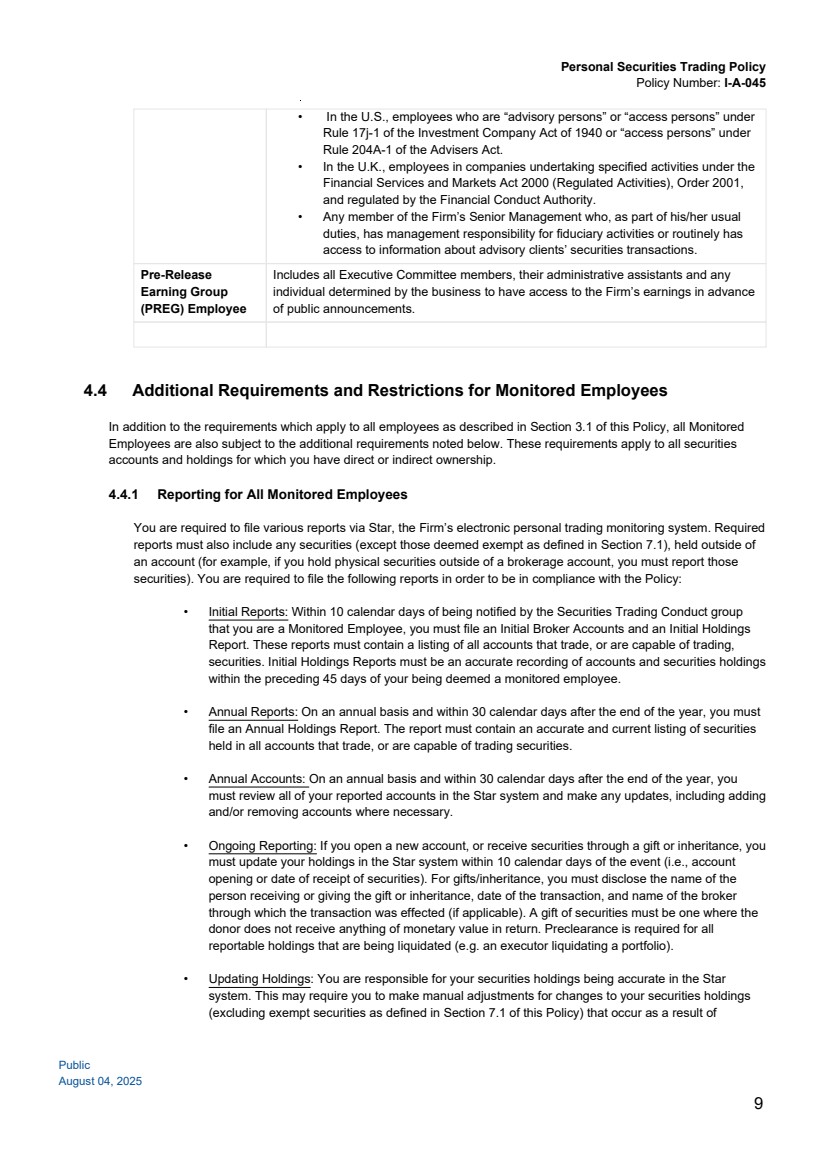
| corporate actions, dividend reinvestments, or similar activity. These adjustments must be reported as soon as possible, but no less than annually. • Quarterly Transaction Reports (Investment/Public and ADM employees only): Within 30 calendar days after the end of the quarter, you must file a Quarterly Transactions Report. The report must contain a list of all reportable transactions that occurred in the quarter. You must certify all broker accounts that are capable of trading in reportable securities and all reportable securities held. Your report must be current within 45 calendar days of the date the report is filed. • Certifications: The Securities Trading Conduct group will require certifications when there is a material change to this Policy. Additional certifications may be required as needed. 4.4.2 Account Statements and Trade Confirmations Monitored Employees are required to provide duplicate statements and trade confirmations directly to the Firm. You must adhere to the following requirements: • Countries with Approved Brokers - U.S., UK, India, Singapore or Hong Kong-based Monitored Employees: You must maintain all accounts with an approved broker-dealer (refer to MySource for the Approved Broker List). Employees are required to provide account statements to the Securities Trading Conduct Team until the account is on a feed with an Approved Broker. If you have securities held in a physical form or held directly with an issuer, you must provide copies of account statements and trade confirmations. Note: Certain brokers may require the account owner’s consent in order for the Firm to receive their account information electronically (connection to the electronic feed). • Countries without Approved Brokers: You must provide copies of account statements to your designated local Compliance Officer or Securities Trading Conduct Team upon receipt or at least quarterly. You are also required to enter your trade confirmation details into the Star system within 10 calendar days of the transaction. You may be compelled to move your accounts and hold them with an electronic broker-dealer where legally permissible and in jurisdictions where the Firm has made arrangements with a broker-dealer to provide automated electronic feeds to the Star system. You will be notified when this requirement becomes effective within your jurisdiction and are no longer required to manually enter your trade details into the Star system. • For all employees, the Firm reserves the right to request accounts statements and trade confirmations as needed. 4.4.3 Preclearance Prior to Trading • Monitored Employees must receive approval in the Star system to trade any security, including fractional shares, unless the security is expressly Exempt as defined in Section 7.1 of this Policy. You must also obtain preclearance for trades made by indirect owners. • ETFs and Single-Stock ETFs are reportable. Single-Stock ETFs and Proprietary ETFs must be pre-cleared prior to transacting in for employees who are classified as ADM, Investment/Public or Insider Risk Employees. • The sale of Company stock from the ESPP Plan or Restricted Stock/Units that have vested require preclearance in Star. NOTE: if you are classified as a PREG employee (see Section 4.7 of this Policy), you are only required to preclear trades in Firm securities (equities, fixed income, or derivatives) of The Bank of New York Corporation. Personal Securities Trading Policy Policy Number: I-A-045 Public August 04, 2025 10 |
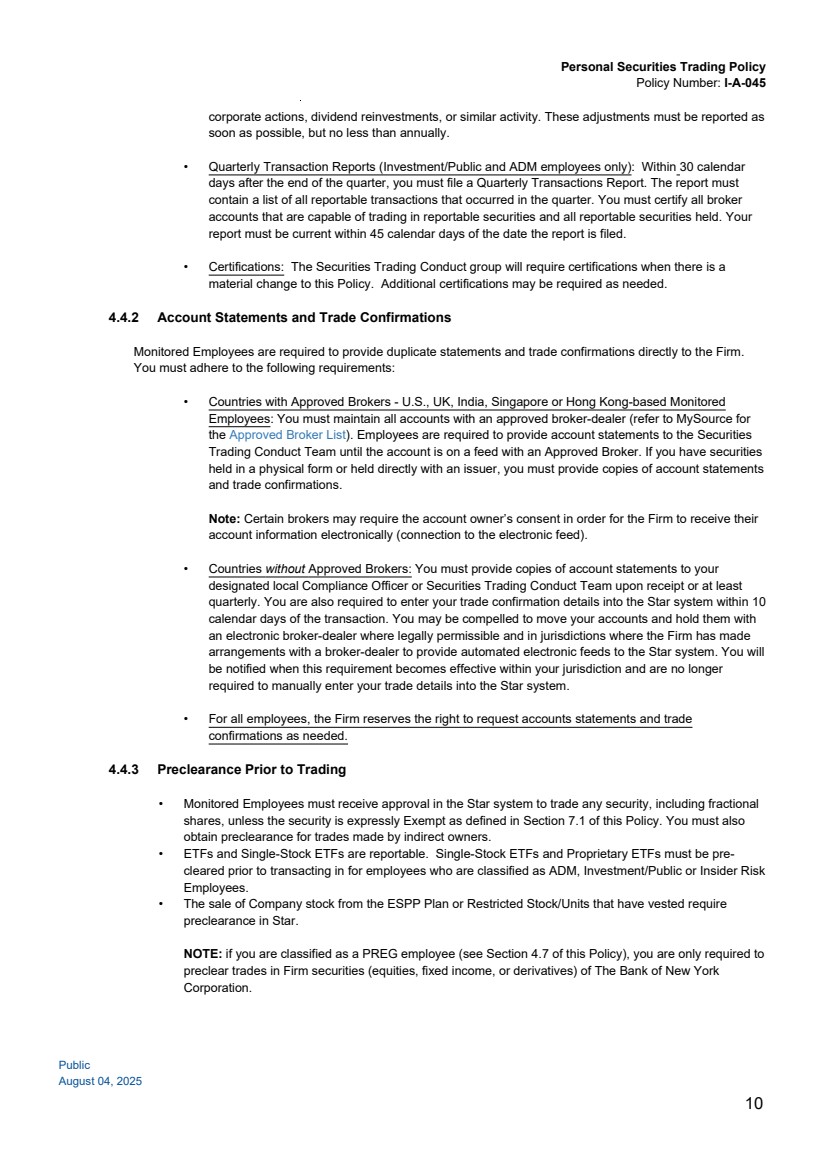
| • Although preclearance approval does not obligate you to place a trade, you should not seek preclearance for transactions you do not intend to make. Do not discuss the response (e.g. approval or denial) to a preclearance request with anyone (excluding any account co-owners or indirect owners). If you have questions regarding a response to a trade request, contact the Securities Trading Conduct group. • If you receive approval to trade, the trade must be executed by the close of business the following day in the local jurisdiction. For example, if you receive approval on Monday at 3 PM EST, the preclearance is only valid until the close of the trading day on Tuesday. You should be aware that all preclearance time stamps in the Star system are in EST. • You are only permitted to place day only orders which are orders that expire at the end of the trading day. Orders that extend beyond a single trading day, such as “good-until-cancelled” or similar orders, are not permitted. • You may also be subject to additional approvals, for example approval from your supervisor, depending upon your classification. Please check with your local Compliance Officer for additional information. 4.4.4 Additional Preclearance Restrictions for ADM, Investment/Public and certain private side employees (de minimis limits) ADM, Investment/Public and certain private side employees will generally not be given preclearance approval to execute a transaction in any security that appears on their business unit’s Blackout List (as defined in Section 7.1). 4.4.4.1 Approval for De Minimis Transactions for ADM Employees and Investment/Public Employees for Securities on Blackout List • ADM, Investment/Public and certain private side employees are eligible to receive de minimis approval for trades in securities of any one issuer in a 30-day period even if the security is on the Blackout List. • De Minimis transactions are permitted as follows: • ADMs: Market Cap Category Market Cap Value De Minimis Amount Allowed Per Trade 30 Day Period Limit Micro- Cap Market value of less than $250 million Not allowed Not allowed Small- Cap Market value between $250 million and $5 billion Not allowed Not allowed Mid- Cap Market value between $5 billion and $20 billion $10,000 $20,000 Large- Cap Market value between $20 billion and more $10,000 $20,000 • Investment/Public and certain private side employees: Market Cap Category Market Cap Value De Minimis Amount Allowed Per Trade 30 Day Period Limit Micro- Cap Market value of less than $250 million Not allowed Not allowed Personal Securities Trading Policy Policy Number: I-A-045 Public August 04, 2025 11 |
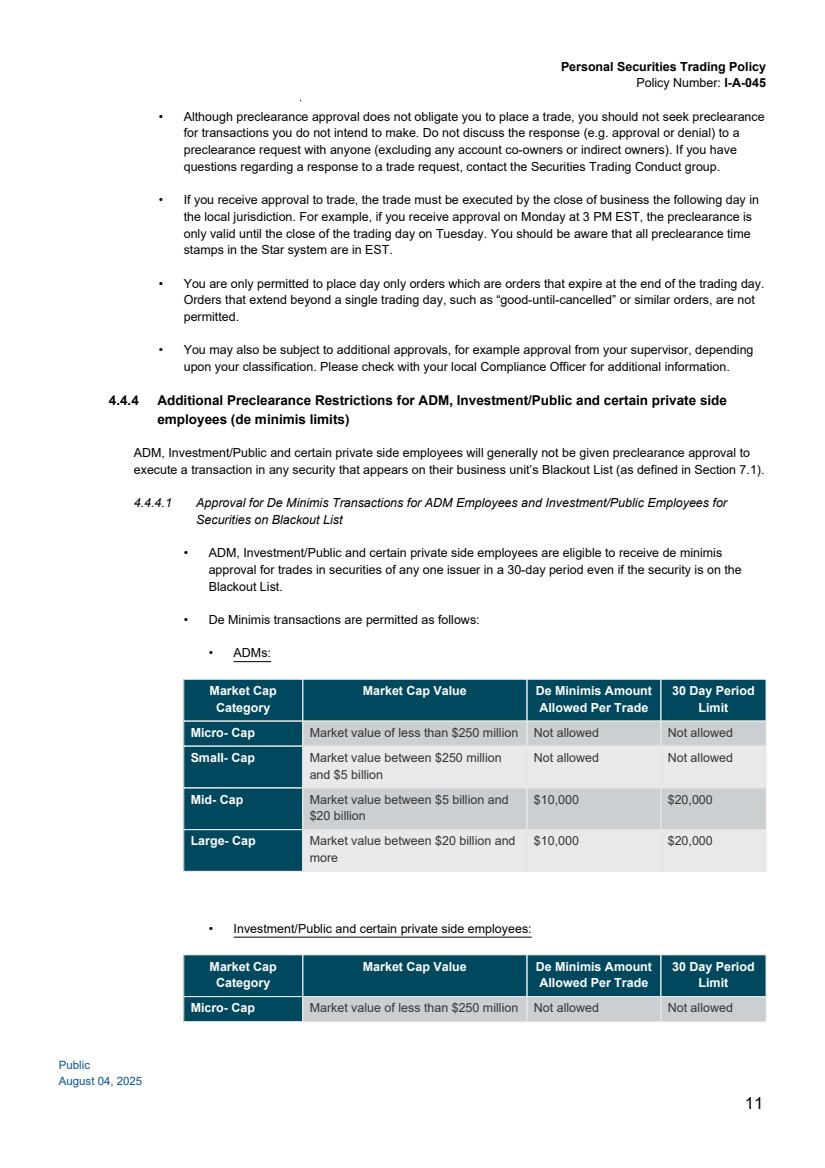
| Small- Cap Market value between $250 million and $5 billion $10,000 $20,000 Mid- Cap Market value between $5 billion and $20 billion $25,000 $50,000 Large- Cap Market value between $20 billion and more $50,000 $100,000 Note: Currency is listed in USD. Use the local currency equivalent outside of the US. 4.4.4.1.1 Additional Restrictions for ADM employees (7 Day Blackout Period) • You are not permitted to buy or sell a security within 7 calendar days before and 7 calendar days after the investment company or managed account for which you are affiliated has effected a transaction in that security. • Any trade initiated within the 7 day blackout period is deemed a violation of Policy and as such you will be required to disgorge profits per the Securities Trading Conduct group in their sole discretion. This does not apply to approved de minimis transactions during the 7 day blackout period. 4.5 Managed Accounts If you have an account fully managed by a third-party (you have an investment management, trust or similar agreement) which specifically documents in writing that you are unable to direct trades in the account, you must submit a Managed Account Form via Code RAP to determine if the account is eligible for exclusion from some of the reporting requirements, providing duplicate account statements/trade confirms or preclearance requirements noted within this Policy. For all managed accounts, you must add your account information in the Star system and comply with all provisions of the Policy until the Securities Trading Conduct group deems the account to be excluded in writing. If your account is approved as managed, you are required to complete an annual certification in the Star system attesting that the account continues to be maintained under the account provisions the Securities Trading Conduct group relied upon to provide approval. In addition, you are required to provide copies of statements to the Securities Trading Conduct group when requested. 4.6 Prohibition on Short-Term Trading • Non-Firm Securities: Employees classified as ADM, Investment/Public Employee and Insider Risk are prohibited from engaging in short-term trading. Short term trading is defined as the purchasing then selling, or selling then purchasing, the same or equivalent3 security within 30 calendar days. PREG employees are not subject to a holding period for non-Firm securities. • Firm Securities: All employees are prohibited from purchasing then selling, or selling then purchasing any Firm securities (Firm securities include any securities issued by The Bank of New York Corporation and its subsidiaries, including, but not limited to, shares of common stock, preferred stock or bonds of the Firm) within 60 calendar days. Employees who engage in short-term trading in non-Firm securities (within 30 calendar days) or Firm securities (within 60 calendar days) will be issued a violation and any profits realized must be disgorged. Personal Securities Trading Policy Policy Number: I-A-045 Public August 04, 2025 12 3 Equivalent securities include single-stock ETFs. |
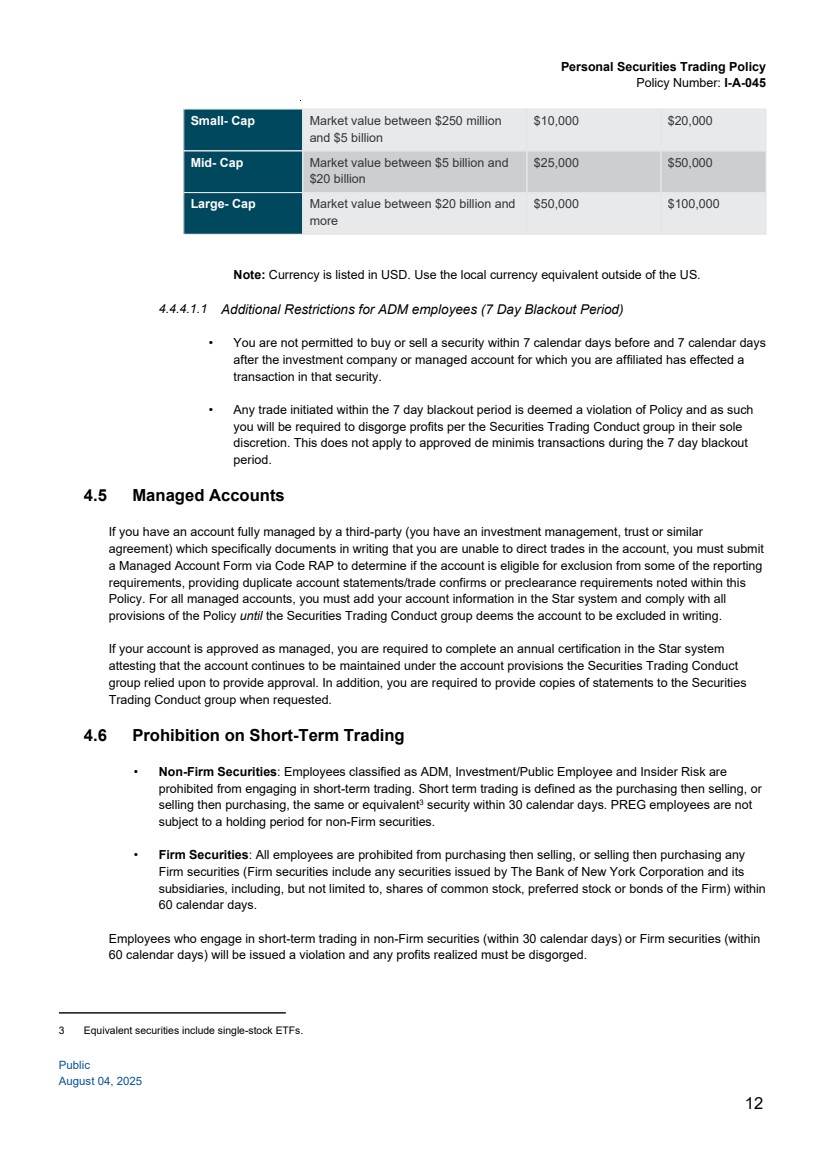
| Example: Transactions resulting in a position that is liquidated (sell), and then a new position is re-established (buy), would meet the criteria for a profit disgorgement. • Profit is based upon the difference between the most recent purchase and sale prices for the most recent transactions. You should be aware that profit for disgorgement purposes may differ from the capital gains calculations for tax purposes. • The disposition of any disgorged profits will be at the discretion of the Firm to a bona fide and legally permitted charity. You will be responsible for any tax and related costs. • Profit disgorgement, where applicable, is not required for any security that is deemed Exempt (as defined in Section 7.1 of this Policy) and trades in Proprietary Funds conducted within the BNY 401(k). 4.7 Specific Restrictions for PREG Employees Every quarter the Firm imposes a restriction on PREG employees. As such, you are prohibited from trading in the Firm’s securities from 12:01 AM Eastern Standard Time, on the 15th day of the month preceding the end of each calendar quarter through the first trading day after the public announcement of the Firm’s earnings for that quarter. For example, if earnings are released on Wednesday at 9:30 AM Eastern Standard Time, you may not trade the Firm’s securities until Thursday at 9:30 AM Eastern Standard Time. Non-trading days, such as weekends or holidays, are not counted as part of the restricted period. At its discretion, the Firm may extend the blackout period for some or all PREG employees. You will be notified if there is such an extension. The Firm may establish additional event-specific blackout periods that may be applicable to any or all categories of Monitored Employees. The Firm will notify you of any additional blackout periods. The blackout period includes trades in various employee plans. Specifically, you may not make payroll deductions, investment elections changes or reallocation of balances that might impact your holdings in company stock in the BNY 401(k) Plan; you may not exercise options granted through the employee incentive compensation or similar plan; you may not enroll in, or make payroll deduction changes, in your Employee Stock Purchase Plan. If you trade Firm securities made during the blackout period, you must unwind the trade and surrender profits as determined by the Firm in its sole discretion. Any losses due to the unwinding are yours to incur. Further, you may be subject to disciplinary action or referral to law enforcement when necessary. The Firm reserves the right to restrict trading in companies in similar industries as the Firm. 4.8 Insider Threats BNY considers Insider Threats to be a serious matter and has established an enterprise-wide Insider Threat program to provide direction, governance and drive organizational awareness to manage the risks. BNY s Enterprise Insider Threat program is aligned to the Company’s organizational risk priorities, including enhanced protection of information assets. As defined in the Enterprise Insider Threat Policy, Internal Fraud refers to unauthorized activity (e.g., inappropriate/unauthorized trading, market manipulation) or fraud (e.g., fraudulent funds transfer/movement, credit fraud, forgery, check fraud) by an Insider, which may cause financial or non-financial harm. Please consult the I.N.500: Enterprise Insider Threat Policy for more information. 5. Governance and Responsibilities 5.1 All Employees are responsible for: • Adhering to all sections of this Policy as it relates to their role. Personal Securities Trading Policy Policy Number: I-A-045 Public August 04, 2025 13 |
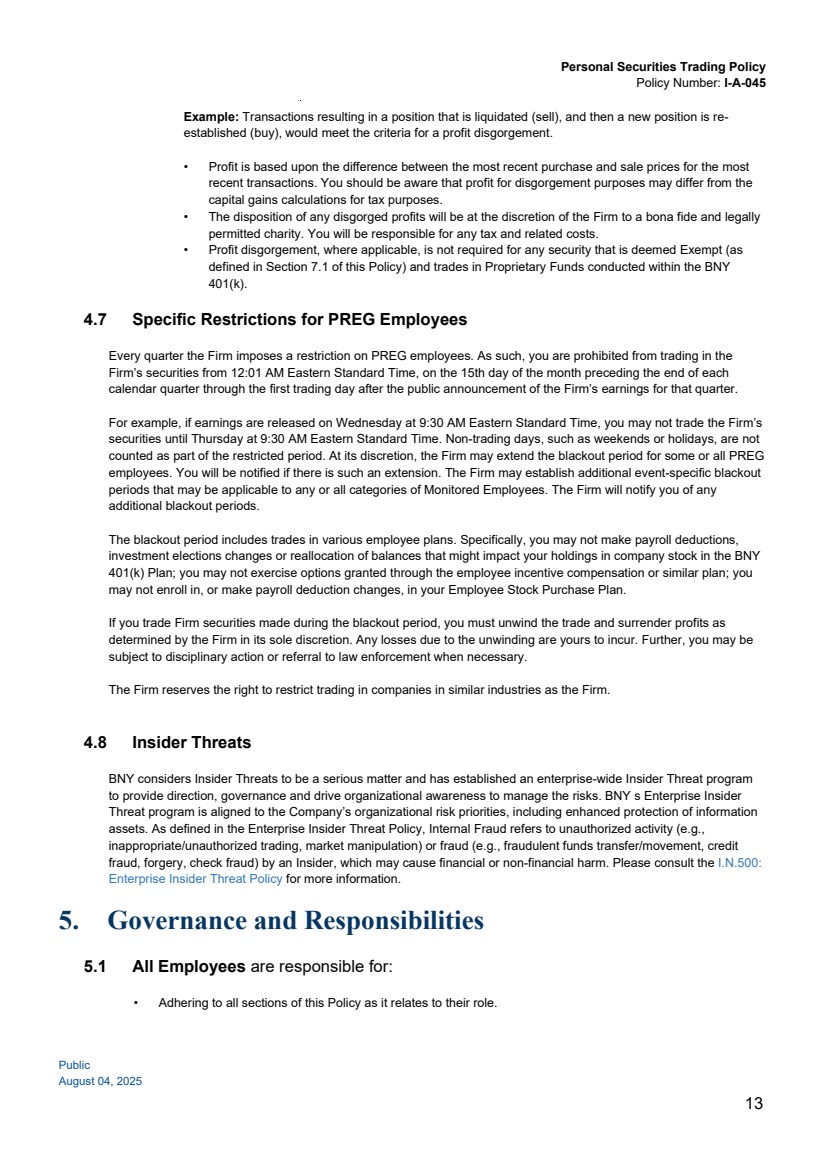
| • Immediately contacting the Securities Trading Conduct group or your Compliance Officer (or anonymously through the Firm’s Ethics Help Line or Ethics Hot Line) if a known or suspected violation of this Policy occurred. • Reporting MNPI to their MNPI Coordinator. Employees should not seek advice from anyone other than a Compliance Officer, their MNPI coordinator or the Control Room regarding appropriate handling of MNPI. Employees may also report the receipt of actual or suspected MNPI directly to the Control Room if the employee’s MNPI Coordinator is unavailable. The obligation to report all MNPI applies to both private and public side LOBs/Corporate Staff functions. 5.2 Businesses and Corporate Functions Management of the Firm’s Business and Corporate Staff groups are responsible for: • Classifying employees within 15 calendar days of joining or transfer. Develop business line procedures to describe the protocols for assigning classifications that are consistent with this Policy, seeking guidance from Compliance as needed. The procedures should include the rationale for the classification, whether manually or automatically. • Retaining accurate records of each employee’s classifications in their business unit, maintaining proper controls so that the classifications are current and providing an annual attestation to Compliance that the classification of the employees are accurate, when requested. • Communicating employees’ classification and overseeing staff so that they are properly trained on the Policy requirements. • Overseeing the timely completion of all required reports, violation notices and certifications as required by this Policy. • When required, constructing (and keeping current) a list of securities appropriate for Policy restrictions; typically this will consist of trading systems required for employee monitoring, portfolio manager codes, and designated approvers. Generally this detail will be required only in instances where a Business or Corporate Functions have staff classified as an Investment or ADM employee. • When required, providing timely and accurate updates to the list of Proprietary Funds (those that are advised, sub-advised or underwritten by the business) to the Securities Trading Conduct group. 5.3 Securities Trading Conduct Group The Securities Trading Conduct group is responsible for: • Maintaining all necessary records to demonstrate compliance with this Policy in a readily accessible place, for seven years from their creation. This includes but is not limited to versions of this Policy, record of employee violations and actions taken, holdings and transaction reports required by this Policy, list of monitored employees and their classifications, and lists of securities appropriate for restriction as reported by a Line of Business and/or Corporate Function. • Treating employee related records as “highly confidential”, to the extent permissible by law. 5.4 Compliance Officers Compliance Officers are responsible for: Personal Securities Trading Policy Policy Number: I-A-045 Public August 04, 2025 14 |
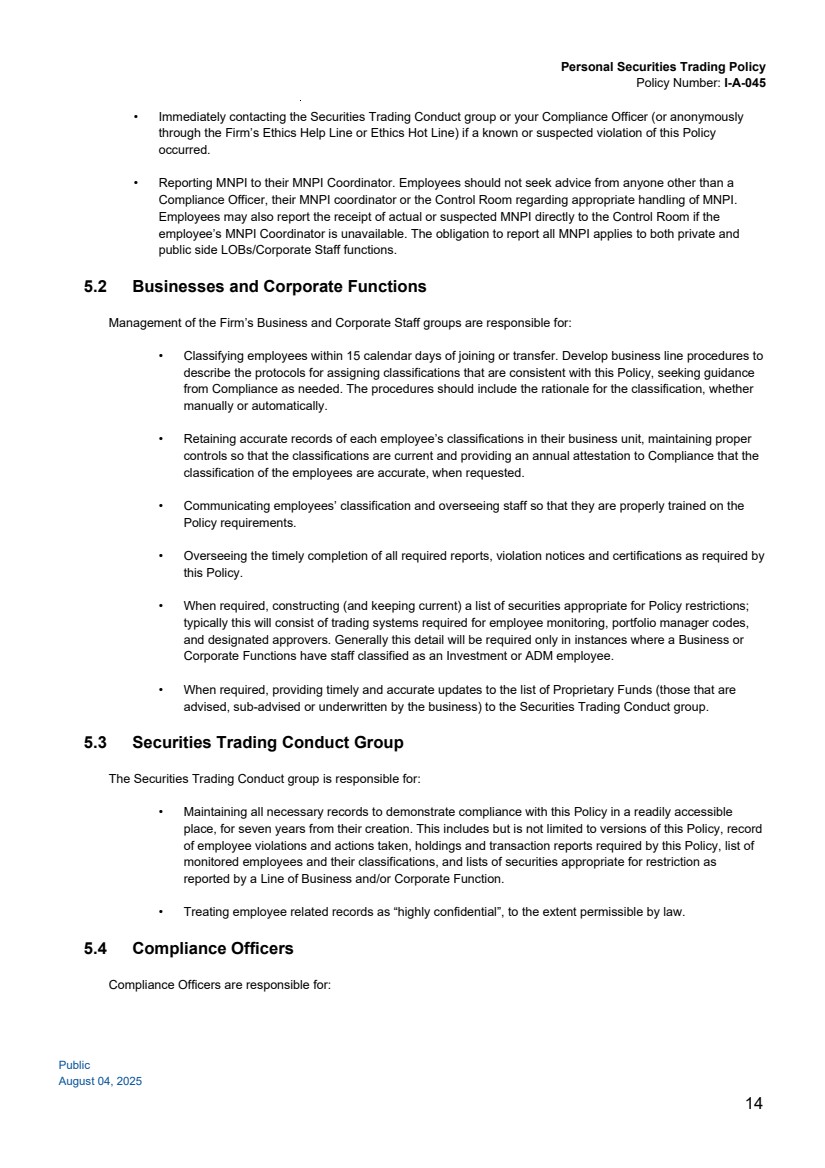
| • Providing policy training to employees when requested by the Securities Trading Conduct group. • Review annually the classifications of employees within their business or scope of oversight to ensure they concur with the classification of employees. • Reporting compliance with this Policy, including detail on violations, to Legal Entity and Fund Boards, as required by law, regulation or policy. • When requested by the Securities Trading Conduct group, approving requests for investment. 5.5 Legal Department The Legal Department is responsible for providing legal analysis of new and revised legislation of all jurisdictions regarding personal securities trading laws and regulations and participating in the review of material policy amendments. 5.6 Engineering Department The Engineering Department is responsible for providing support for internally hosted applications so that systems function properly, including various files are properly loaded into the system, developing an alert process to detect any failed or non-received files, and adequately testing all software updates or hardware installations. 6. Adherence and Control Failure to comply with any aspect of this Policy may result in the imposition of serious sanctions and employee will be issued a violation notice. You may also receive additional sanctions, which include, but are not limited to, the disgorgement of profits, cancellation of trades, selling of positions, and suspension of personal trading privileges, and may result in an employee being subject to corrective action as outlined in II-H-610-US: Managing Performance and Conduct for U.S.-based employees (or the applicable corrective action policy for non-U.S. based employees),4 up to and including termination of employment and referral to law enforcement, when required. If you know of or suspect a violation of this Policy has occurred, immediately contact the Securities Trading Conduct group or your Compliance Officer. You may also report known or suspected violations anonymously through the Firm’s Ethics Help Line or Ethics Hot Line. Amendments to or waivers of any requirements discussed above are at the discretion of the Chief Compliance Officer or their designee. When required, the concurrence of other officers or directors of the Firm may also be needed. Any waiver or exemption must be evidenced in writing to be valid. Personal Securities Trading Policy Policy Number: I-A-045 Public August 04, 2025 15 4 View the Policies Portal or consult your local HR Partner for the policy for the relevant jurisdiction. |
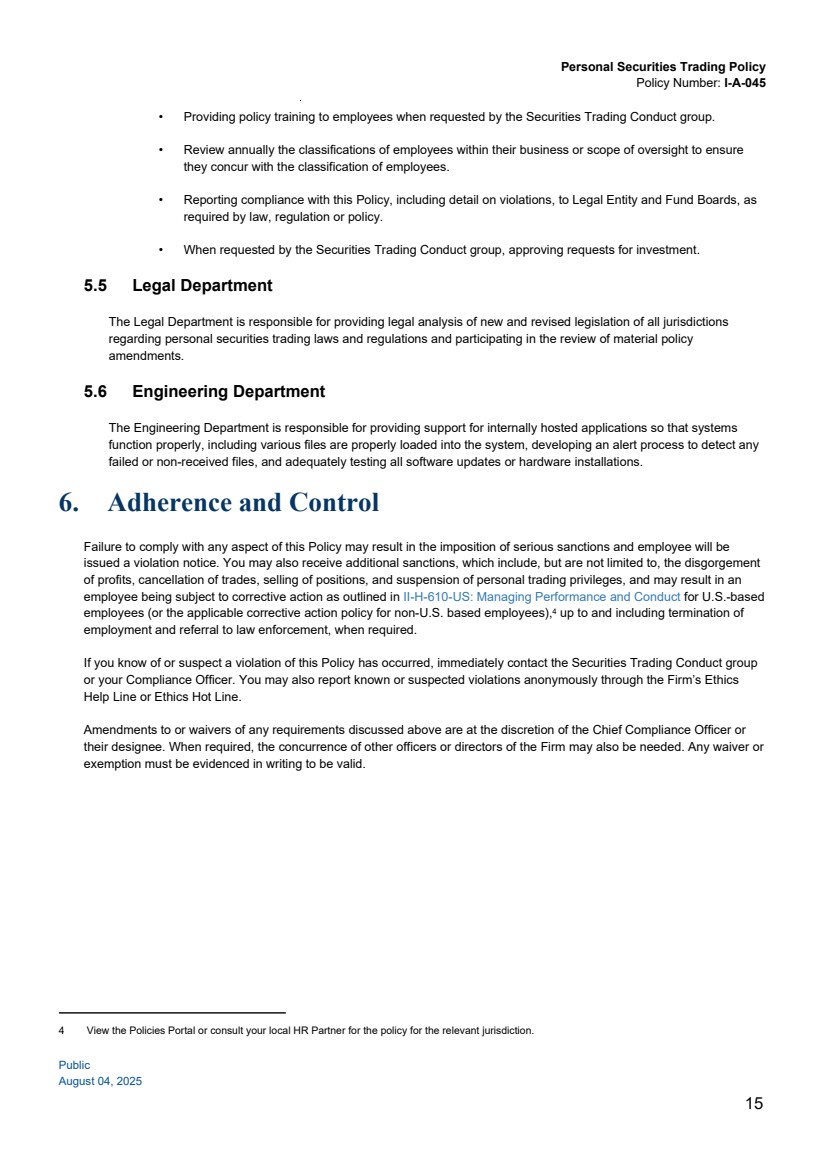
| 7. Appendices 7.1 Definitions Term Definition/Meaning of Term Automatic Investment Plan A program in which regular periodic purchases (withdrawals) are made automatically to/from investment accounts in accordance with a predetermined schedule and allocation. Examples include: Dividend Reinvestment Plans (DRIPS), payroll deductions, bank account drafts or deposits, automatic mutual fund investments/withdrawals (PIPS/SWIPS), and asset allocation accounts. Blackout List List of securities submitted by a Business Unit for which there are pending or executed transactions for an affiliated account (other than an index fund). Firm Securities Include any securities issued by The Bank of New York Corporation and its subsidiaries, including, but not limited to, shares of common stock, preferred stock or bonds of the Company. Exempt Securities/Financial Instruments (Collectively “Exempt Securities” or “Exempt”) All securities require reporting and preclearance unless expressly exempt by this Policy. The following financial instruments are exempt for all classifications of employees: • Cash, cash-like securities, such as bankers’ acceptances, bank CDs and time deposits, money market funds, FX spot transactions, commercial paper and repurchase agreements. • Digital assets - regardless of where they are held (in brokerage exchange accounts or in personal cryptocurrency wallets). Note: Direct participation investments in Initial Coin Offerings (ICOs), pooling money with others with the intent to invest in digital assets or cryptocurrencies and creating investment vehicles to sell interest in Limited Partnerships (LPs) or Master Limited Partnerships (MLPs) for the purpose of investing in digital assets or cryptocurrencies are all considered to be private securities transactions that must be reported. • Employee investments in sovereign governments. Obligations of other instrumentalities or quasi-government agencies are not exempt. • Securities issued by open-end investment companies (i.e., mutual funds and variable capital companies) that are not Proprietary Funds. Proprietary Funds are exempt for employees classified as Insider Risk. • Securities in retirement plans properly organized under local law of companies not associated with the Firm (e.g., spouse’s plan, previous employer’s plan, etc.). This exemption is not applicable to any plan wherein the trades can be directed in common stock by the account holder. • Securities in college tuition plans for dependents properly organized under local law. It should be noted that this exemption is not applicable securities that are deemed to be a Proprietary Fund for employees classified as an ADM and Investment Employees. • Fixed annuities. • Variable annuities, as long as the sub-accounts are not invested in Proprietary Fund sub-accounts. • Securities held in approved non-discretionary (managed) accounts. • Non-financial commodities (e.g., metals, oil, gas, etc.), currency and crypto-based currency. • Transactions that are involuntary (such as stock dividends, sales of fractional shares or sales of shares to cover account fees); however, sales initiated by brokers to satisfy margin calls are not considered involuntary. Personal Securities Trading Policy Policy Number: I-A-045 Public August 04, 2025 16 |
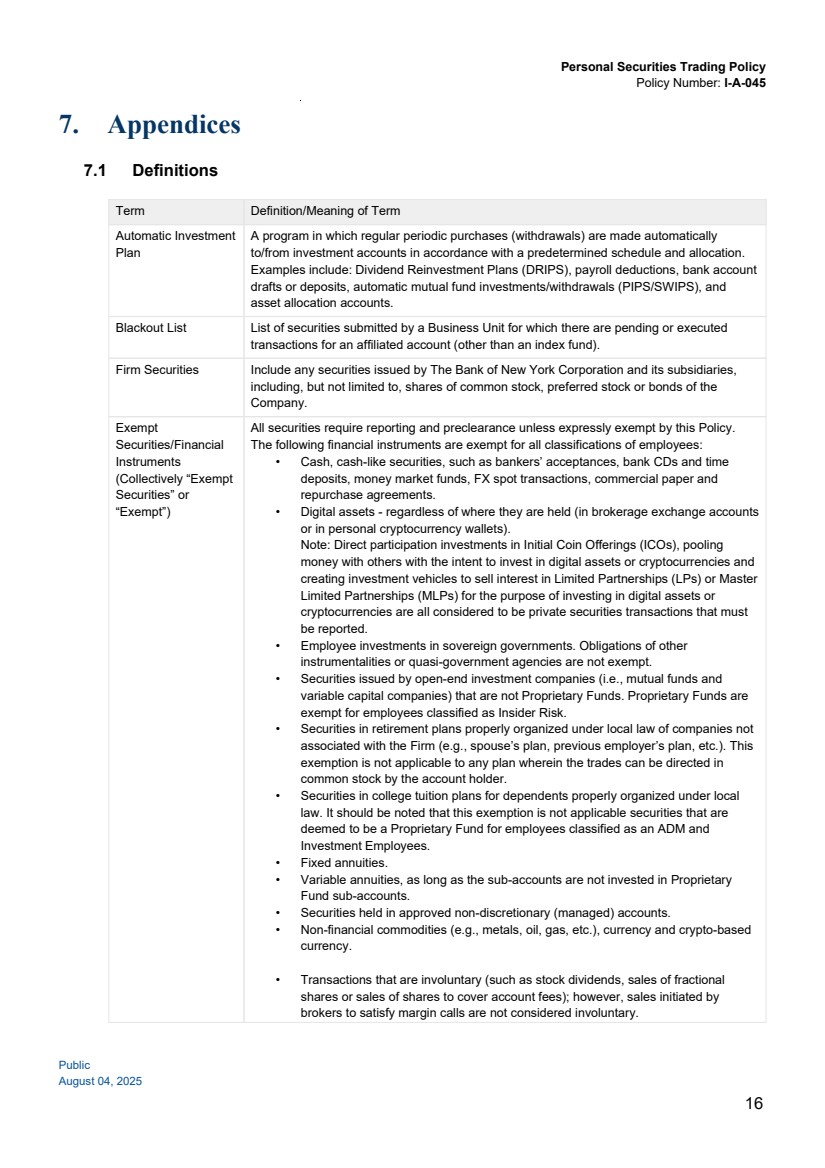
| • Transactions pursuant to the exercise of rights (purchases or sales) by an issuer made pro rata to all holders of a class of securities, to the extent such rights were acquired from such issuer. • Sales effected pursuant to a bona fide tender offer. • Transactions pursuant to an automatic investment plan, including payroll withholding to purchase Proprietary Funds. The initial purchase and additional changes to the automatic investment plan are subject to preclearance approval. Front Running The purchase or sale of securities for your own or the company’s accounts on the basis of your knowledge of the company’s or company’s clients trading positions or plans. Futures Standardized agreements to buy or sell an asset at a predetermined price and future date. Index Fund An investment company or managed portfolio (including indexed accounts and model driven accounts) that contain securities in proportions designed to replicate the performance of an independently maintained, broad-based index or that is based not on investment discretion but on computer models using prescribed objective criteria to replicate such an independently maintained index. Indirect Ownership Generally, you are the indirect owner of securities if you are named as power of attorney on the account or, through any contract, arrangement, understanding, relationship, or otherwise, you have the opportunity, directly or indirectly, to share at any time in any profit derived from a transaction in them. This includes trades which are effected by or on behalf of the employee when the trade is carried out for the account of any of the persons referenced below. Common indirect ownership situations include, but are not limited to: • Securities held by members of your Immediate Family by blood, marriage, adoption, or otherwise, who share the same household with you; “Immediate Family” includes any person with whom they have a family relationship, or whom they have close links, such as your spouse, domestic partner, children (including stepchildren, foster children, sons-in-law and daughters-in-law), grandchildren, parents (including step-parents, mothers-in-law and fathers-in-law), grandparents, and siblings (including brothers-in-law, sisters-in-law and stepbrothers and stepsisters): • Any person in conjunction with whom the employee has a direct or indirect material interest in the outcome of the trade – other than obtaining a fee or commission for the execution of the trade; Employees must consider this requirement and report trades which fit under the above definition to avoid violations and breaches of both regulations and Policy. Initial Public Offering (IPO) The first offering of a company's securities to the public. Investment Clubs Organizations whose members make joint decisions on which securities to buy or sell. The securities are generally held in the name of the investment club. Prior to participating in an investment club, all Monitored Employees are required to obtain written permission from their local Compliance Officer to participate in the club. If permission is granted, the account is subject to all aspects of this Policy. Investment Company A company that issues securities that represent an undivided interest in the net assets held by the company. Mutual funds are open-end investment companies that issue and sell redeemable securities representing an undivided interest in the net assets of the company. Material Non-Public Information (MNPI) and examples MNPI is generally defined as material information about a company (including BNY), its securities or any financial instruments related to that company that has not been disclosed to the public. Information is “material” if: • there is a substantial likelihood that a reasonable investor would consider it important in deciding whether to buy, sell, or hold securities/financial instruments; or Personal Securities Trading Policy Policy Number: I-A-045 Public August 04, 2025 17 |
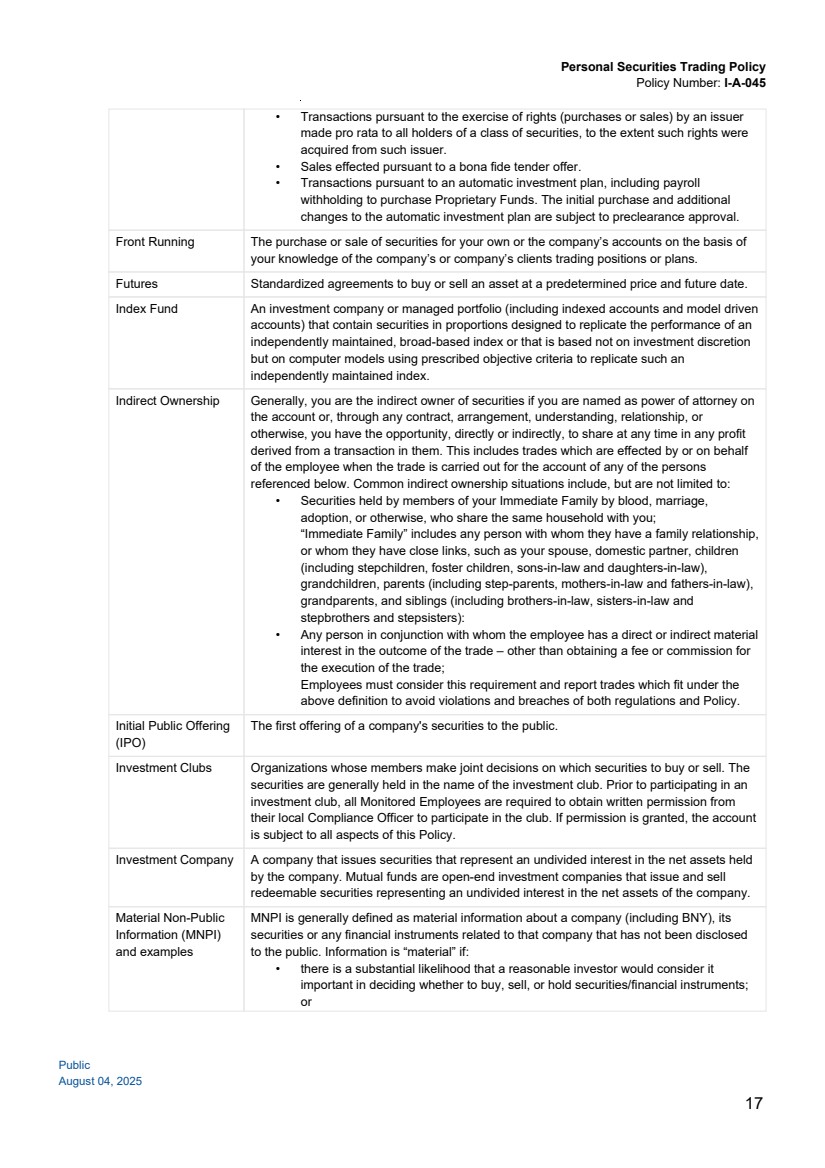
| • there is a substantial likelihood it would have been viewed by a reasonable investor as having significantly altered the “total mix” of information available. Information about an issuer is “non-public” if: • it is of a precise nature and is not generally available to the investing public. Information received under circumstances indicating that it is not yet in general circulation and may be attributable, directly or indirectly, to the issuer or its insiders is likely to be deemed non-public information. Most companies announce material information through a press release or a regulatory filing (such as with the Securities and Exchange Commission) and/or a posting on the company’s website. Therefore, if it has been determined that information is material but there is no announcement of it in any of those sources, it is likely to be non-public at that point. Examples of information that may, depending on the particular facts and circumstances, be material and non-public include, but are not limited to: • A proposal or agreement for a merger, acquisition or divestiture, or for the sale or purchase of substantial assets. • A tender offer, which can be material for the party making the tender offer as well as for the issuer of the securities for which the tender offer is made. • An extraordinary dividend declaration, change in the dividend rate or stock repurchase policy. • A proposal or agreement concerning the creation of a credit facility. • A draw down on a credit facility or a liquidity problem. • A potential default under a material agreement or actions by creditors, customers or suppliers relating to a company’s credit standing. • Earnings and other financial information, such as operating results, projections, a significant restatement or large or unusual write-offs, write-downs, profits or losses. • Pending discoveries or developments, such as new products, sources of materials, patents, processes, inventions or discoveries of mineral deposits. • A proposal or agreement concerning a financial restructuring. • A proposal to issue or redeem securities, or a development with respect to a pending issuance or redemption of securities. • Information conveyed by a client relating to the client’s pending orders for securities/financial instruments that would be likely to have a material effect on the prices of those securities/financial instruments. • Information about major contracts or increases or decreases in orders. • Information about derivative contracts such as options, futures, and forward rate agreements relating to an underlying security. • The institution of, or a development in, litigation or a regulatory proceeding. • Developments regarding a company’s senior management or board of directors. • Information that is inconsistent with published information, especially if published in regulatory reports or press releases. • A significant cybersecurity incident. Money Market Fund A mutual fund that invests in short-term debt instruments where its portfolio is valued at amortized cost so as to seek to maintain a stable net asset value (typically of $1 per share). Non-Discretionary (Managed) Account An account in which the employee has a beneficial interest but no direct or indirect control over the investment decision making process. Any such accounts of Monitored employees must be approved by the Securities Trading Conduct group in writing in order to be exempt from the reporting and preclearance requirements noted in this Policy. Personal Securities Trading Policy Policy Number: I-A-045 Public August 04, 2025 18 |
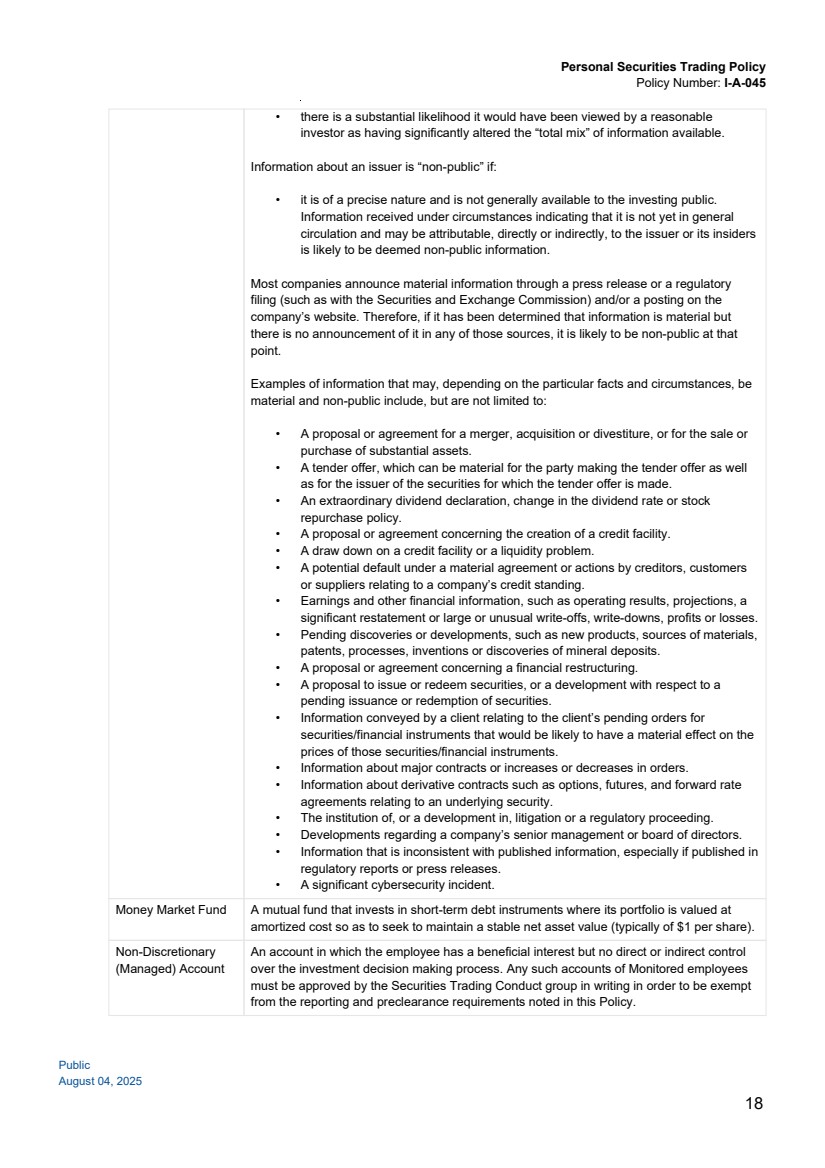
| Option A security which gives the investor the right, but not the obligation, to buy or sell a specific security at a specified price within a specified time frame. Short term trading in option positions Opening and closing or closing and opening an option position within 30 days of each other or opening an option position within 30 days of expiration will result in any profits being subject to disgorgement. When opening an option position against an existing common stock holding you must have held that position for at least 30 days to avoid any profits being subject to disgorgement. Private Placement An offering of securities exempt from registration under various laws and rules, such as the Securities Act of 1933 in the U.S. and the Listing Rules in the U.K. Such offerings are exempt from registration because they do not constitute a public offering. Private placements can include limited partnerships, certain cooperative investments in real estate, co-mingled investment vehicles such as hedge funds, investments in privately-held and family owned businesses and Volcker Covered Funds. For the purpose of this policy, time-shares and cooperative investments in real estate used as a primary or secondary residence are not considered to be private placements. Proprietary Fund An investment company or collective fund for which a Company subsidiary serves as an investment adviser, sub-adviser or principal underwriter. The Proprietary Fund Listing can be found on MySource on the Compliance and Ethics homepage. Securities/Financial Instruments (Collectively “Securities”) Any investment that represents an ownership stake or debt stake in a company, partnership, governmental unit, business or other enterprise. It includes stocks, bonds, notes, evidences of indebtedness, certificates of participation in any profit-sharing agreement, units in collective investment undertakings, collateral trust certificates and certificates of deposit. It also includes security-based derivatives and swaps and many types of puts, calls, straddles and options on any security or group of securities; fractional undivided interests in oil, gas, or other mineral rights; and investment contracts, variable life insurance policies and variable annuities whose cash values or benefits are tied to the performance of an investment account. Unless expressly exempt, all securities transactions are covered under the provisions of this policy (See exempt securities). Short Sale The sale of a security that is not owned by the seller at the time of the trade. Spread Betting A type of speculation that involves taking a bet on the price movement of a security. A spread betting company quotes two prices, the bid and offer price (also, called the spread), and investors bet whether the price of the underlying security will be lower than the bid or higher than the offer. The investor does not own the underlying security in spread betting, they simply speculate on the price movement of the stock. Tender Offer An offer to purchase some or all shareholders' shares in a corporation. The price offered is usually at a premium to the market price. Trading The buying or selling, including as a gift or other disposition, of a security. Volcker Covered Fund Generally, a “Volcker Covered Fund” is a domestic or foreign hedge fund, private equity fund, venture capital fund, commodity pool or alternative investment fund (AIF) that is sold in a private, restricted or unregistered offering to investors who must meet certain net worth, income or sophistication standards or is sold to a restricted number of investors. Generally, the fund is not registered with a securities/commodity regulator and therefore cannot be offered to the general or retail public unless the investor meets some type of qualification to demonstrate the investor does not need the protection of the securities or commodities regulations. A complete list of Covered Funds can be found at the Volcker Compliance Site on MySource or refer to the I-A-049: Volcker Covered Funds Policy. Personal Securities Trading Policy Policy Number: I-A-045 Public August 04, 2025 19 |
| 7.2 Document Governance 7.2.1 Periodic Review This Level 3 Policy will have a mandatory periodic review of 12 months. Note: If this Policy requires changes outside of the periodic review date AND the Policy is reviewed in its entirety at such time that the changes are incorporated, the periodic review date will be refreshed. 7.2.2 Ownership/Questions Ownership of this Policy lies with the Owner noted below. Questions should be directed to the Owner or Contact(s) noted below: Policy Owner Policy Approver Versio n Review and Approval Date Next Review Date Additional Contact(s) for Questions Steven Wachtel Global Head of Securities Trading Conduct and Trade Surveillance Tom Wileman, Global Head of Securities Trading Conduct and Trade Surveillance 8.0 July 29, 2025 May 29, 2026 securitiestradingpolicyhel p@bny.com Personal Securities Trading Policy Policy Number: I-A-045 Public August 04, 2025 20 |
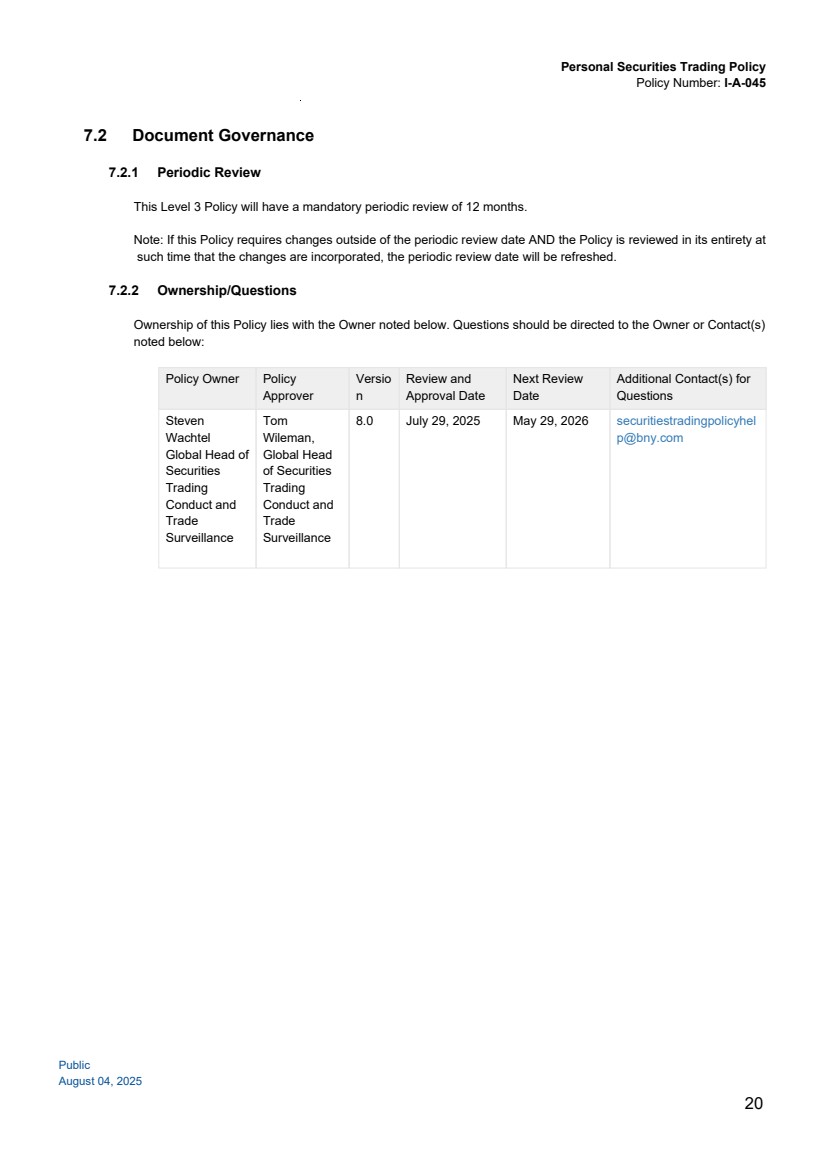
| 7.3 Version Control Version Number Date of Change Author (and Role of Author) of Change Description of Change 8.1 August 04, 2025 Ekta Agarwal, Compliance Governance Ad-hoc update: • Correction of a typo referencing section 7.1 (from 8.1) 8.0 July 29, 2025 Steven Wachtel, Global Head of Securities Trading Compliance Ad hoc update: changes include: • Clarification on excessive trading reporting (Section 2) • Ban on Options and Futures Trading (Section 4.1.3.) • Removal of additional reporting requirements for ADM employees • Removal of Contemporaneous Disclosure • Updates to Definitions (Section 7.1) • Updates to Section 4.4.3 related to preclearance prior to trading • Update to Sections 5.2 and responsibilities of Business and Corporate Functions regarding inclusion of rationale for classification in procedures • Update to Section 5.4. related to requirement of Compliance Officers to annually review classification for their covered Ares • Removed Section 7 to convert contents to Addendum Modification format and republished as I-A-045 (A1): EMEA Personal Securities Trading • Updated Document Hierarchy (Section 7.4) 7.9 May 29, 2025 Ekta Agarwal, Compliance Governance Periodic refresh complete: • No changes 7.7 and 7.8 May 12, 2025 Stan Drobiazko, Compliance Governance Adhoc Update: • Parent Policy Change, in alignment with the broader restructure of Compliance Policies related to Market Abuse; parent policy is newly published I-A-030: Market Abuse Framework. • Deleted links to 2 archived child policies: II-GG-420: Personal Securities Trading - Risk and III-OC-1.395-210: Personal Securities Trading: Overview (CT). 7.6 March 13, 2025 Ekta Agarwal, Compliance Governance Adhoc Update: • Extension requested until May 31, 2025 7.4 - 7.5 February 24, 2025 Steven Wachtel, Global Head of Securities Corrected 2 typos. No other changes. Personal Securities Trading Policy Policy Number: I-A-045 Public August 04, 2025 21 |
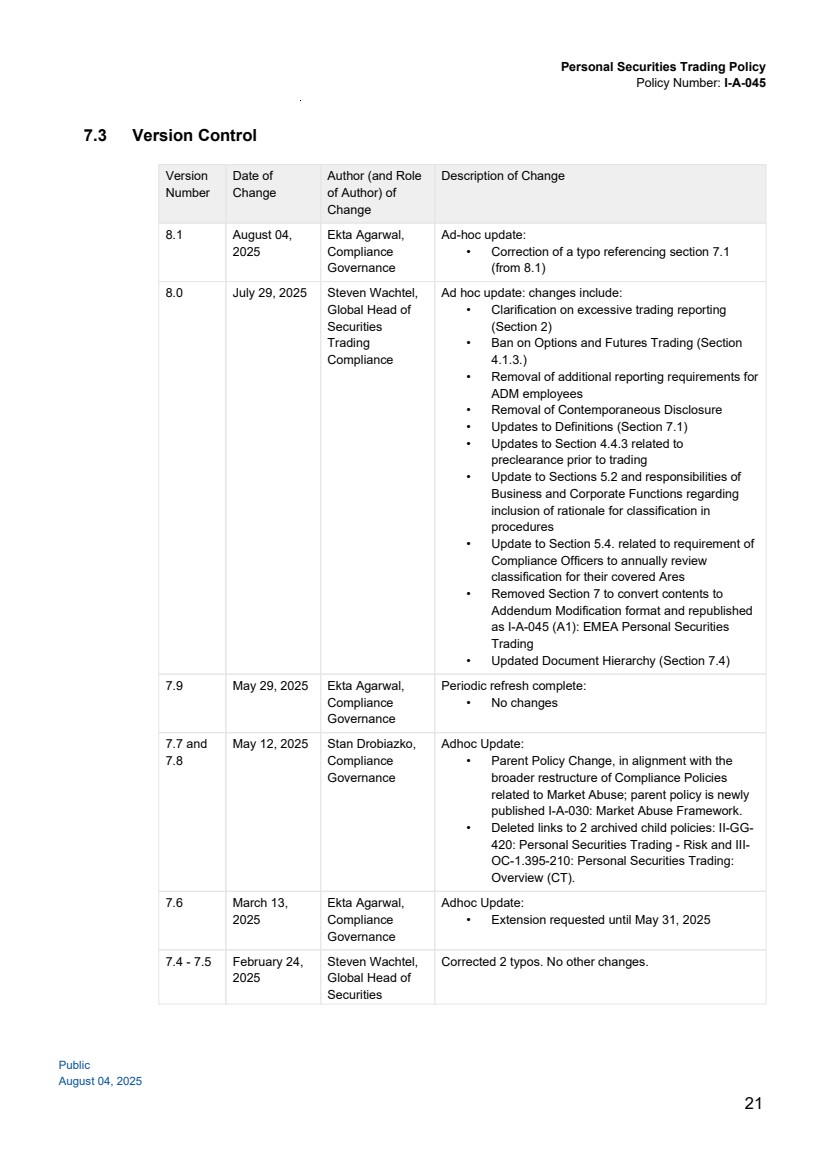
| Trading Compliance 7.3 February 6, 2025 Steven Wachtel, Global Head of Securities Trading Compliance Adhoc update: • Updated to reflect move to Star Compliance • Added additional definitions to 8.1 • Updated de minimis rules in 4.4.5 7.2 December 18, 2024 Ekta Agarwal, Compliance Governance Adhoc update: • Updated the approved broker list in section 4.4.3 7.1 October 10, 2024 Ekta Agarwal, Compliance Governance Adhoc refresh: • Updated BNYM to BNY and removed Mellon • Transferred to new rebranded template 7.0 September 20, 2024 Steven Wachtel, Global Head of Securities Trading Compliance Adhoc Update: • Elimination of Broker Dealer Employee Classification, prohibition on excessive trading and clarification on classification timeline. • Updated Policy Approver 6.0 April 4, 2024 Steven Wachtel Global Head of Securities Trading Compliance Approved Broker requirement added for Singapore and Hong Kong 5.0 January 29, 2024 Steven Wachtel Global Head of Securities Trading Compliance Periodic review complete: • Clarification that all private side employees will be monitored • New requirements to monitor all Senior Directors and above • Clarification that the Firm reserves the right to request accounts statements and trade confirmations when needed 4.0 March 30, 2023 Steven Wachtel Global Head of Securities Trading Compliance • Clarification of annual reporting requirements under Section 4.4.1 • Clarification of employee requirement to provide account statements to the Securities Trading Conduct Team until the account is on a feed with an Approved Broker. • Periodic Review of Policy 3.0 December 27, 2022 Mark Compton EMEA Head of Markets Compliance Updated Addendum 7.1: EMEA Personal Securities Trading Updated Section 8.4. Document Hierarchy 2.0 October 6, 2022 Mark Compton EMEA Head of Markets Compliance Addition of Addendum 7.1: EMEA Personal Securities Trading and additional definitions added under Section 8.1 specific to EMEA personal securities trading 1.9 June 2, 2022 Steven Wachtel Global Head of Addition of Insider Threat language (Section 4.8) Personal Securities Trading Policy Policy Number: I-A-045 Public August 04, 2025 22 |
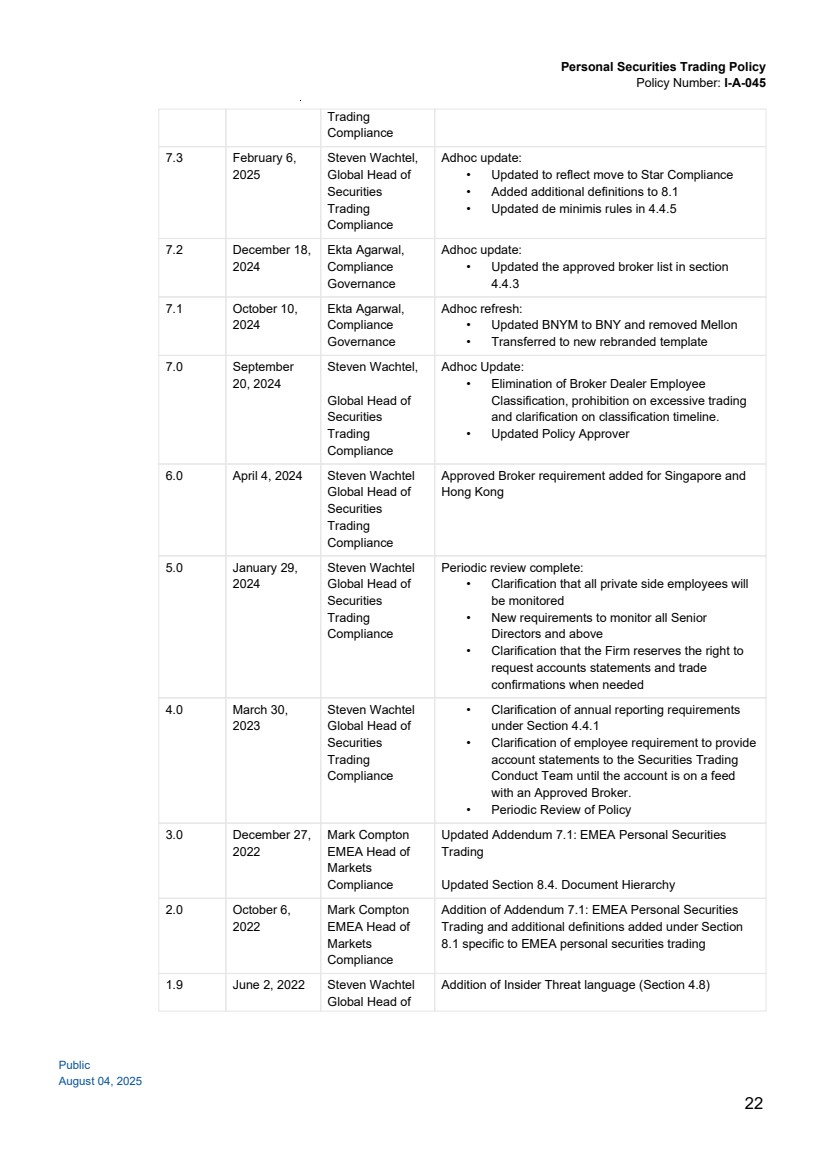
| Securities Trading Compliance 1.8 March 24, 2022 Steven Wachtel Global Head of Securities Trading Compliance Periodic Review of Policy. Clarification of Investment Employee and Insider Risk classification and other non-substantive changes. Update to child documents under Section 8.5 1.7 March 29, 2021 Carol Cersosimo Manager Personal Securities Trading Group Revised to remove reference to old policy; Correction of typo in Section 4.1.5. January 26, 2021 Carol Cersosimo Manager Personal Securities Trading Group Revised to reflect reporting requirement for Insider Risk employees for Non-Proprietary ETFs January 15, 2021 Steven Wachtel Global Head of Securities Trading Compliance Streamlined employee classifications, added Approved Broker requirement for UK and India-based employees, updated indirect ownership section to comply with MiFID II and instituted a strict 30 day hold requirement for non-company securities. January 15, 2019 Carol Cersosimo Manager Personal Securities Trading Group Revised to transfer the classification responsibility from Local Compliance to the 1st Line of Business for Investment Services; removed reference to IEC Oversight and Senior Leadership Team Members. June 8, 2018 Gerald DiMarco Manager Global Ethics Office The document was reviewed and reapproved without changes, pending substantive revisions anticipated for July 2018. April 3, 2018 Gerald DiMarco Manager Global Ethics Office Revised to include existing requirement for pre-approval prior to divesting from an affiliated fund; other minor edits.II-GG-420: Personal Securities Trading - RiskIII-OC-1.395-210: Personal Securities Trading: Overview(CT)III-OC-1.395-210: Personal Securities Trading: Overview(CT) Personal Securities Trading Policy Policy Number: I-A-045 Public August 04, 2025 23 |
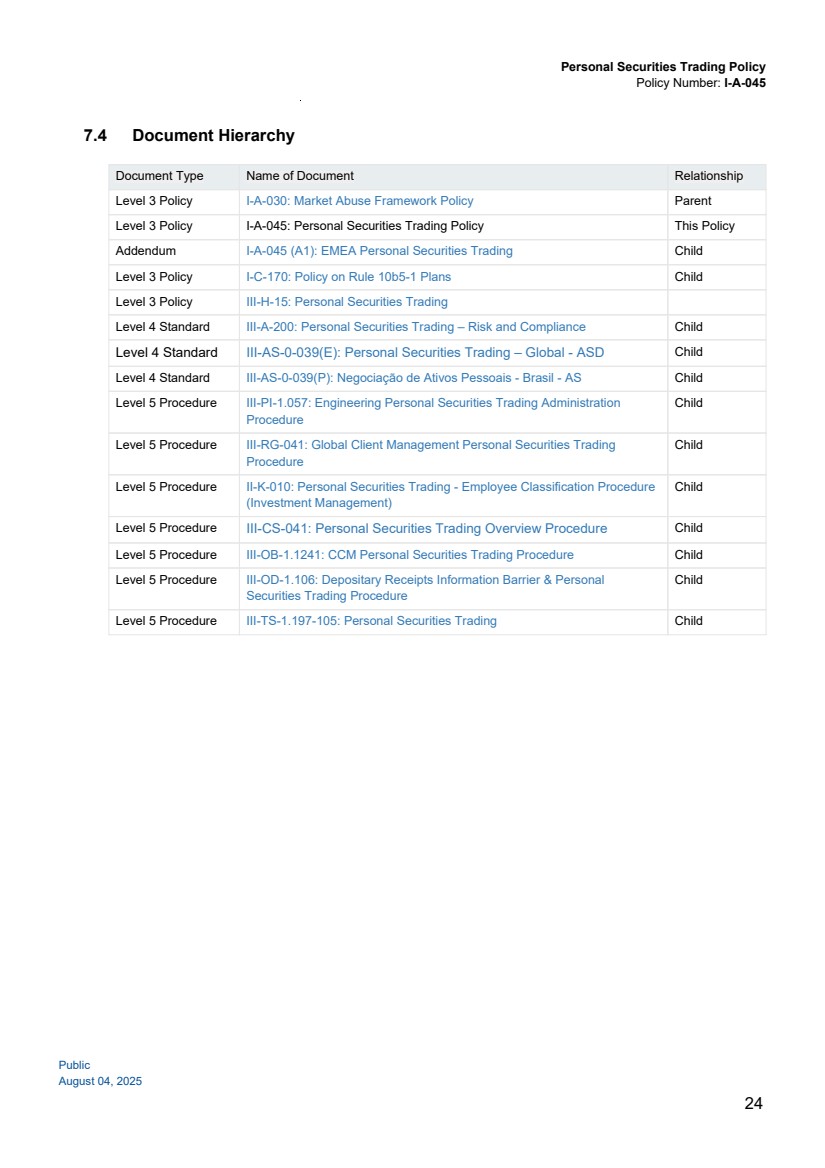
| 7.4 Document Hierarchy Document Type Name of Document Relationship Level 3 Policy I-A-030: Market Abuse Framework Policy Parent Level 3 Policy I-A-045: Personal Securities Trading Policy This Policy Addendum I-A-045 (A1): EMEA Personal Securities Trading Child Level 3 Policy I-C-170: Policy on Rule 10b5-1 Plans Child Level 3 Policy III-H-15: Personal Securities Trading Level 4 Standard III-A-200: Personal Securities Trading – Risk and Compliance Child Level 4 Standard III-AS-0-039(E): Personal Securities Trading – Global - ASD Child Level 4 Standard III-AS-0-039(P): Negociação de Ativos Pessoais - Brasil - AS Child Level 5 Procedure III-PI-1.057: Engineering Personal Securities Trading Administration Procedure Child Level 5 Procedure III-RG-041: Global Client Management Personal Securities Trading Procedure Child Level 5 Procedure II-K-010: Personal Securities Trading - Employee Classification Procedure (Investment Management) Child Level 5 Procedure III-CS-041: Personal Securities Trading Overview Procedure Child Level 5 Procedure III-OB-1.1241: CCM Personal Securities Trading Procedure Child Level 5 Procedure III-OD-1.106: Depositary Receipts Information Barrier & Personal Securities Trading Procedure Child Level 5 Procedure III-TS-1.197-105: Personal Securities Trading Child Personal Securities Trading Policy Policy Number: I-A-045 Public August 04, 2025 24 |
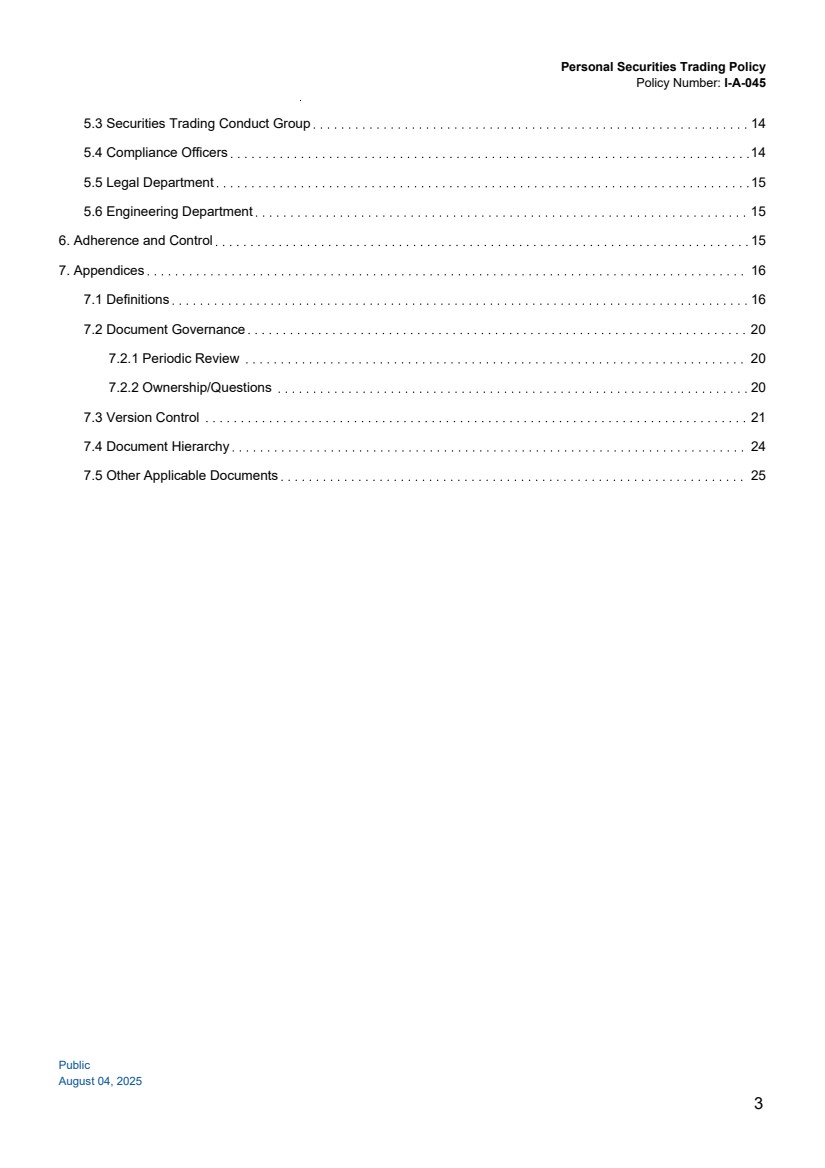
| 7.5 Other Applicable Documents Document Type Name of Document Policy I-A-010: Code of Conduct Level 3 Policy I-A-035: Business Conflicts of Interest Level 3 Policy I-A-046: Information Barrier Policy Level 3 Policy I-A-040: Market Abuse Policy Level 3 Policy I-A-049: Volcker Covered Funds Policy Level 3 Policy I.N.500: Enterprise Insider Threat Policy Level 3 Policy II-H-610: Managing Performance and Conduct Web Link Proprietary Fund Listing Web Link Approved Broker List Web Link Code RAP Web Link Affiliated Fund Request Web Link Volcker Compliance site Personal Securities Trading Policy Policy Number: I-A-045 Public August 04, 2025 25 |