Exhibit 99.2
SILVERCORP METALS INC.
Suite 1750 – 1066 West Hastings Street
Vancouver, British Columbia
Canada V6E 3X1
NOTICE OF ANNUAL GENERAL & SPECIAL MEETING AND
MANAGEMENT INFORMATION CIRCULAR
FOR THE 2026 ANNUAL GENERAL & SPECIAL MEETING OF SHAREHOLDERS
TO BE HELD AT 10:00 A.M. PACIFIC TIME ON SEPTEMBER 25, 2026
DATED AUGUST 12, 2026
SILVERCORP METALS INC.
Suite 1750 – 1066 West Hastings Street
Vancouver, British Columbia
Canada V6E 3X1
NOTICE OF ANNUAL GENERAL AND SPECIAL MEETING OF SHAREHOLDERS
NOTICE IS HEREBY GIVEN that the annual general and special meeting (the “Meeting”) of the shareholders (the “Shareholders”) of Silvercorp Metals Inc. (the “Company”) will be held at Oceanic Plaza, Suite 1750, 1066 West Hastings Street, Vancouver, British Columbia, V6E 3X1, Canada on Friday, September 25, 2026 at 10:00 a.m. (Vancouver time), and at any adjournment or postponement thereof, for the following purposes:
| 1. | to receive and consider the audited annual consolidated financial statements of the Company for the year ended March 31, 2026, together with the auditor’s report thereon; |
| 2. | to elect directors of the Company for the ensuing year; |
| 3. | to re-appoint Deloitte LLP, Independent Registered Public Accounting Firm, as auditor of the Company for the ensuing year, and to authorize the directors to fix their remuneration; |
| 4. | to consider, and if deemed appropriate, to pass with or without variation, a special resolution authorizing the Company to amend its Articles, as more particularly described in the Information Circular accompanying this notice of Meeting; |
| 5. | to consider and, if thought fit, to pass with or without variation, an ordinary resolution authorizing the Company to further amend and restate its amended and restated share based compensation plan, as more particularly described in the Information Circular accompanying this notice of Meeting; and |
| 6. | to transact such other business as may properly be brought before the Meeting, or at any adjournment(s) thereof. |
The record date for the notice and for voting at the Meeting is August 12, 2026. Only registered Shareholders at the close of business on August 12, 2026 are entitled to receive notice of and vote at the Meeting, or at any adjournments thereof.
Registered Shareholders are entitled to vote at the Meeting either in person or by proxy. Registered Shareholders who are unable to attend the Meeting are requested to read, complete, sign, date and return the accompanying form of proxy and deliver it to the Company’s transfer agent, TSX Trust Company, in accordance with the instructions set out in the form of proxy and the Information Circular accompanying this notice.
Shareholders who hold their shares in the Company through a broker or intermediary are not registered Shareholders, and should refer to the accompanying Information Circular for instructions on how to vote their shares.
| 1 |
The Company has elected to use the notice and access model provided for under National Instrument 54-101 – Communication with Beneficial Owners of Securities of a Reporting Issuer and National Instrument 51-102 – Continuous Disclosure Obligations for distribution of the Meeting materials to registered and beneficial Shareholders. The Company will deliver this notice, the Information Circular, and the form of proxy or voting instruction form, as applicable (collectively, the “Meeting Materials”) to Shareholders by posting the Meeting Materials at https://silvercorpmetals.com/AGM. The Meeting Materials will be posted on this website on August 26, 2026, and will be available thereon for one year following the date of this notice. In addition, the Meeting Materials are available on the Company’s profile on SEDAR+ at www.sedarplus.ca. Please review the information carefully before voting.
Notice and Access is an environmentally friendly and cost-effective way to distribute these materials since it reduces printing, paper and postage.
If you have any questions about notice and access or require assistance in voting your shares, please contact TSX Trust Company using the contact information provided in your proxy materials.
Shareholders who wish to receive paper copies of the Meeting Materials may request copies in accordance with the instructions contained in the Notice-and-Access Notification. Meeting Materials will be sent to such Shareholders at no cost to them within three business days of their request if such requests are made before the Meeting. To obtain paper copies of the Meeting Materials after the Meeting, please call 1-888-224-1881.
DATED at Vancouver, British Columbia, this 12th day of August, 2026.
| BY ORDER OF THE BOARD OF DIRECTORS | |
| “Rui Feng” | |
| Dr. Rui Feng | |
| Chairman, CEO and Director | |
| Silvercorp Metals Inc. |
| 2 |
MANAGEMENT INFORMATION CIRCULAR
Table of Contents
| Solicitation of Proxies | 4 |
| Notice and Access | 4 |
| PROXY Instructions | 5 |
| REVOCATION OF PROXIES | 5 |
| How to Vote | 6 |
| Voting of Shares and Exercise of Discretion by Proxyholders | 7 |
| Interest of Certain Persons in Matters to be Acted Upon | 7 |
| Record Date, Voting Shares, and Principal Shareholders | 8 |
| PARTICULARS OF MATTERS TO BE ACTED UPON | 8 |
| RECEIVING THE AUDITED CONSOLIDATED FINANCIAL STATEMENTS | 8 |
| ELECTION OF DIRECTORS | 8 |
| APPOINTMENT OF AUDITOR | 16 |
| amendment of articles | 17 |
| AMENDED AND RESTATED OMNIBUS PLAN | 19 |
| Corporate Governance | 21 |
| Corporate Governance AND NOMINATING Committee | 22 |
| Compensation Committee | 22 |
| Audit Committee | 23 |
| SUSTAINABILITY Committee | 23 |
| Executive Compensation | 24 |
| COMPENSATION OF DIRECTORS | 34 |
| Equity Compensation Plans | 36 |
| NORMAL COURSE ISSUER BID | 41 |
| Indebtedness of Directors, Executive Officers, and Senior Officers | 41 |
| Management Contracts | 42 |
| Interest of Informed Persons in Material Transactions | 42 |
| Auditor | 42 |
| Additional Information | 42 |
| Board Approval | 43 |
| SCHEDULE “1” | PROPOSED AMENDMENTS TO ARTICLES |
| SCHEDULE “2” | PROPOSED AMENDMENTS TO OMNIBUS PLAN |
| SCHEDULE “3” | BOARD OF DIRECTORS CHARTER |
| SCHEDULE “4” | CORPORATE GOVERNANCE AND NOMINATING COMMITTEE CHARTER |
| SCHEDULE “5” | COMPENSATION COMMITTEE CHARTER |
| EXHIBIT “A” | CORPORATE GOVERNANCE DISCLOSURE |
| 3 |
MANAGEMENT INFORMATION CIRCULAR
FOR THE 2026 ANNUAL GENERAL AND SPECIAL MEETING OF SHAREHOLDERS
TO BE HELD AT 10:00 A.M. ON SEPTEMBER 25, 2026
Unless otherwise noted, the information in this management information circular (“Information Circular”) is given as at August 12, 2026.
This Information Circular is furnished in connection with the solicitation of proxies by the management (the “Management”) of Silvercorp Metals Inc. for use at the annual general and special meeting (the “Meeting”) of the shareholders of the Company (the “Shareholders”), to be held at the time and place and for the purposes set forth in the accompanying notice of Meeting (“Notice of Meeting”) and at any adjournments thereof. In this Information Circular, references to the “Company”, “we”, “our” and “Silvercorp” refer to Silvercorp Metals Inc. and its subsidiaries, unless stated otherwise. “Common Shares” means common shares without par value in the capital of the Company. “Options” and “RSUs” mean the stock options and the restricted share units, respectively, granted to the directors, officers, employees, and consultants of the Company in accordance with the terms of the Company’s amended and restated share-based compensation plan (the “Omnibus Plan”). All currency amounts stated herein are expressed in lawful currency of the United States, unless otherwise specified.
Solicitation of Proxies
This solicitation is made on behalf of Management of the Company. Solicitation of proxies will be conducted by mail and may be supplemented by telephone or other personal contact to be made without special compensation by directors, officers, and employees of the Company. All costs of solicitation will be borne by the Company. The principal executive office of the Company is located at Suite 1750 – 1066 West Hastings Street, Vancouver, British Columbia, Canada, V6E 3X1. The telephone number is (604) 669-9397, toll free telephone number is 1-888-224-1881, and facsimile number is (604) 669-9387. The Company’s website address is https://silvercorpmetals.com. The information on this website is not incorporated by reference into this Information Circular. The registered and records office of the Company is located at Suite 1750 – 1066 West Hastings Street, Vancouver, British Columbia, Canada, V6E 3X1.
Notice and Access
The Company has elected to use the notice and access model (“Notice and Access”) provided for under National Instrument 54-101 – Communication with Beneficial Owners of Securities of a Reporting Issuer (“NI 54-101”) and National Instrument 51-102 – Continuous Disclosure Obligations (“NI 51-102”) for distribution of the Notice of Meeting, the form of proxy (the “Proxy”) or voting instruction form (the “Voting Instruction Form”), as applicable, and this Information Circular (collectively, the “Meeting Materials”) to both Registered Shareholders and Non-Registered Shareholders (each as defined below).
Under Notice and Access, instead of receiving a printed copy of the Meeting Materials, Shareholders receive a notice (the “Notice-and-Access Notification”) with information as to the date, location and purpose of the Meeting, as well as information on how they may access the Meeting Materials electronically. The Company adopted this alternative means of delivery for the Meeting Materials in order to reduce paper use, and the printing and mailing costs.
As described in the Notice-and-Access Notification mailed to the Shareholders, the Company will, in accordance with NI 54-101 and NI 51-102, deliver the Meeting Materials to Shareholders by posting them at https://silvercorpmetals.com/AGM on August 26, 2026. The Meeting Materials will remain on this website for one year following the date of this notice. In addition, the Meeting Materials are available on the Company’s profile on the System for Electronic Document Analysis and Retrieval (“SEDAR+”) at www.sedarplus.ca.
| 4 |
Shareholders who wish to receive paper copies of the Meeting Materials or audited financial statements may request copies from the Company's transfer agent and registrar, TSX Trust Company, in accordance with the instructions contained in the Notice-and-Access Notification. Meeting Materials and/or audited financial statements will be sent to such Shareholders at no cost to them within three business days of their request if such requests are made before the Meeting. To obtain paper copies of the Meeting Materials after the Meeting, please call 1-888-224-1881.
If you have any questions regarding Notice and Access or require assistance with voting your Common Shares, please contact TSX Trust Company using the contact information provided in the Notice-and-Access Notification.
The Company anticipates that Notice and Access will directly benefit the Company through reductions in paper use, postage and printing costs.
Shareholders are reminded to access and review all of the information contained in the Information Circular carefully before voting.
PROXY Instructions
Appointment of Proxyholder(s)
The persons named in the Proxy are directors and/or officers of the Company. A Registered Shareholder has the right to appoint a different person or company, who need not be a Shareholder, as proxyholder/alternate proxyholder to represent the Registered Shareholder at the Meeting by striking out the names of the persons named in the Proxy and inserting the name of that other person or company in the blank space provided. If you leave the space on the Proxy blank, those directors and/or officers named on the Proxy will be appointed to act as your proxyholder.
The Proxy must be signed in writing by the Registered Shareholder, or such Registered Shareholder’s attorney duly authorized in writing. If signed by a duly authorized attorney, the Proxy must be accompanied by the original power of attorney or a notarial certified copy thereof. If the Registered Shareholder is a corporation, the Proxy must be in writing signed by an officer or attorney of the corporation duly authorized by resolutions of the directors of such corporation, which resolutions must accompany such Proxy.
A Proxy will only be valid if it is duly completed, signed, dated and received at the Company’s registrar and transfer agent, TSX Trust Company (“TSX Trust”), in accordance with the instructions provided on the Proxy, not less than forty-eight (48) hours (excluding Saturdays, Sundays and statutory holidays) prior to the time set for the holding of the Meeting, unless the Chairman of the Meeting elects to exercise his discretion to accept proxies received subsequently.
Late proxies may be accepted or rejected by the Chairman of the Meeting at his discretion. The Chairman of the Meeting is under no obligation to accept or reject any particular late proxy. The Chairman of the Meeting may waive or extend the proxy cut-off without notice.
REVOCATION OF PROXIES
A Registered Shareholder may revoke a Proxy by delivering an instrument in writing executed by the Registered Shareholder or by the Registered Shareholder’s attorney authorized in writing, or where the Registered Shareholder is a corporation, by a duly authorized officer or attorney of the corporation, either at the office of the Company at any time up to and including the last business day preceding the day of the Meeting, or with the consent of the Chairman of the Meeting, on the day of the Meeting or on the day of any adjournment thereof, before any vote in respect of which the Proxy is to be used has been taken. A Registered Shareholder may also revoke a Proxy by depositing another properly executed Proxy bearing a later date with the Company’s registrar and transfer agent in the manner described above, or in any other manner permitted by law. A revocation of a Proxy does not affect any matter on which a vote has been taken prior to such revocation.
| 5 |
Only Registered Shareholders have the right to revoke a Proxy. Non-Registered Shareholders (as defined below) who wish to change their voting instructions must, in sufficient time in advance of the Meeting, arrange for the Company (where the Non-Registered Shareholder is a NOBO (as defined below)) or their Intermediaries (where the Non-Registered Shareholder is an OBO (as defined below)) to change their vote and, if necessary, revoke their Proxy.
How to Vote
Only Shareholders whose name appears on the records of the Company’s central security register (“Registered Shareholders”) as of the Record Date (as defined below) or their duly appointed proxyholders are permitted to vote at the Meeting. Non-Registered Shareholders (as defined below) are not permitted to vote at the Meeting unless they follow the instructions set forth below.
Registered Shareholders: If you are a Registered Shareholder, you may vote by attending the Meeting in person, or if you do not plan to attend the Meeting, by completing the Proxy and delivering it according to the instructions contained in the Proxy and this Information Circular. If you intend to attend the Meeting and vote your Common Shares in person, you do not need to complete a Proxy.
Non-Registered Shareholders: Most Shareholders are “non-registered” shareholders (“Non-Registered Shareholders”), meaning the Common Shares they own are not registered in their names but are instead registered in the name of the brokerage firm, bank or trust company through which they purchased the Common Shares. Common Shares beneficially owned by a Non-Registered Shareholder are registered either: (i) in the name of an intermediary (an “Intermediary”) that the Non-Registered Shareholder deals with in respect of the Common Shares (Intermediaries include, among others, banks, trust companies, securities dealers or brokers and trustees or administrators of self-administered RRSPs, RRIFs, RESPs and similar plans); or (ii) in the name of a clearing agency (such as CDS Clearing and Depository Services Inc. or The Depository Trust & Clearing Corporation) of which the Intermediary is a participant.
If you are a Non-Registered Shareholder, the documents that you receive, and who you receive them from, will vary depending upon whether you are a “non-objecting beneficial owner” (a “NOBO”), which means you have provided instructions to your Intermediary that you do not object to the Intermediary disclosing beneficial ownership information about you to the Company for certain purposes, or an “objecting beneficial owner” (an “OBO”), which means that you have provided instructions to your Intermediary that you object to the Intermediary disclosing such beneficial ownership information. In either case, you have the right to exercise voting rights attached to the Common Shares beneficially owned by you, including the right to attend and vote the Common Shares directly at the Meeting, if you follow the procedures outlined below.
Non-Objecting Beneficial Owners: If you are a NOBO, and unless you have previously informed your Intermediary that you do not wish to receive materials relating to the Meeting, you should receive or have already received from the Company or its agent a Notice-and-Access Notification and a Voting Instruction Form pursuant to NI 54-101. These security holder materials are being sent to both Registered Shareholders and Non-Registered Shareholders. If you are a Non-Registered Shareholder and the Company or its agent has sent these materials directly to you, your name and address and information about your holdings of Common Shares have been obtained in accordance with applicable securities regulatory requirements from the Intermediary holding the Common Shares on your behalf. By choosing to send these materials to you directly, the Company (and not the Intermediary holding the Common Shares on your behalf) has assumed responsibility for (i) delivering these materials to you, and (ii) executing your proper voting instructions. Please return your voting instructions as specified in the Voting Instruction Form.
| 6 |
If you wish to attend the Meeting and vote in person, write your name in the place provided for that purpose in the Voting Instruction Form provided to you and deposit it with our transfer agent. If you wish to appoint another person to attend the Meeting and vote on your behalf, write that person’s name in the place provided in the Voting Instruction Form and follow the instructions contained therein. If you do not intend to attend the Meeting or have an appointee do so on your behalf but you wish your Common Shares to be voted, please complete and return the information requested in the Voting Instruction Form to provide your specific voting instructions. If you do not return your voting instructions as specified in the Voting Instruction Form, your Common Shares will not be voted.
Objecting Beneficial Owners: The Company does not intend to pay for Intermediaries to forward the proxy-related materials and Form 54-101F7 – Request for Voting Instructions Made by Intermediary to Non-Registered Shareholders who are OBOs under NI 54-101. OBOs will not receive the materials unless the OBO’s Intermediary assumes the cost of delivery. If you receive or have already received from your Intermediary either a Voting Instruction Form or a Proxy, follow the instructions provided in order to ensure your Common Shares are voted in accordance with your instructions. Intermediaries have their own mailing procedures and provide their own instructions. These procedures may allow for providing voting instructions by telephone, on the Internet, by mail or by fax. If you wish to vote in person at the Meeting, you should follow the procedure in the instructions provided by or on behalf of your Intermediary and insert your name in the space provided on the Voting Instruction Form or Proxy or request a form of legal proxy which will grant you the right to attend the Meeting and vote in person.
The purpose of the above procedures is to permit Non-Registered Shareholders to direct the voting of the Common Shares they beneficially own. In either case, Non-Registered Shareholders should carefully follow the instructions of their Intermediary or the Company, as applicable, including those regarding when and where the Proxy or Voting Instruction Form is to be delivered.
A Non-Registered Shareholder may revoke a Voting Instruction Form or any waiver of their right to receive materials relating to a meeting which has been given to an Intermediary at any time by written notice to the Intermediary. An Intermediary is not required to act on a revocation of a Voting Instruction Form or of a waiver of the right to receive materials relating to a meeting which is not received by the Intermediary at least seven days prior to the Meeting.
Voting of Shares and Exercise of Discretion by Proxyholders
If you complete your Proxy properly, then the nominee named in your Proxy will vote for, against, or withhold from voting the Common Shares represented by the Proxy in accordance with your instructions on any ballot that may be called for and, if you specify a choice with respect to any matter to be acted upon, your Common Shares will be voted accordingly. If you do not specify a choice on any given matter to be voted upon, your Common Shares will be voted in favour of such matter. The Proxy grants the nominee the discretion to vote on amendments or variations to matters identified in the Notice of Meeting and with respect to other matters that may properly come before the Meeting. If any such amendments or variations are proposed to the matters described in the Notice of Meeting, or if any other matters properly come before the Meeting, your proxyholder may vote your Common Shares as he or she considers best.
Interest of Certain Persons in Matters to be Acted Upon
No Person has any material interest, direct or indirect, by way of beneficial ownership of securities or otherwise, in any matter to be acted upon at the Meeting other than the election of directors, the appointment of auditor, the proposed special resolution approving amendments to the Company's Articles, and the proposed ordinary resolution approving the Company's amended and restated Share Based Compensation Plan. For the purpose of this paragraph, “Person” shall include each person: (a) who has been a director or executive officer of the Company at any time since the commencement of the Company's last completed financial year; (b) who is a proposed nominee for election as a director of the Company; or (c) who is an associate or affiliate of a person included in subparagraphs (a) or (b).
| 7 |
Record Date, Voting Shares, and Principal Shareholders
The directors of the Company have fixed August 12, 2026 as the record date (the “Record Date”) for the determination of Shareholders entitled to receive the Notice of Meeting and to vote at the Meeting. Any such Registered Shareholder who either personally attends the Meeting, or has completed and delivered a Proxy in the manner and subject to the provisions described above shall be entitled to vote or to have his or her Common Shares voted at the Meeting. Non-Registered Shareholders should refer to the instructions above if they wish their Common Shares to be voted at the Meeting.
The Company is authorized to issue an unlimited number of Common Shares, each Common Share carrying the right to one vote. As of the Record Date, the Company has issued and outstanding 221,206,309 fully paid and non-assessable Common Shares. The Company has no other classes of shares.
On a show of hands, every individual who is present as a Registered Shareholder, or as a representative of a Registered Shareholder will have one vote (no matter how many Common Shares such Registered Shareholder holds). On a poll, every Registered Shareholder present in person or represented by Proxy and every person who is a representative of a Registered Shareholder will have one vote for each Common Share registered in the name of the Registered Shareholder on the list of Registered Shareholders, which is available for inspection during normal business hours at the office of TSX Trust, and which will be available at the Meeting.
To the knowledge of the directors and executive officers of the Company, there is no person who, or company that, beneficially owns, or exercises control or direction over, directly or indirectly, Common Shares carrying 10% or more of the voting rights attached to the outstanding Common Shares of the Company.
PARTICULARS OF MATTERS TO BE ACTED UPON
RECEIVING THE AUDITED CONSOLIDATED FINANCIAL STATEMENTS
The audited consolidated financial statements of the Company for the year ended March 31, 2026, together with the auditor’s report thereon (the “Financial Statements”) will be presented to the shareholders at the Meeting. The Financial Statements are available under the Company’s profile on SEDAR+ at www.sedarplus.ca, and on the Company’s website at https://silvercorpmetals.com. A paper copy may be requested, at no charge to the shareholder, by calling the Corporate Secretary of the Company toll-free at 1-888-224-1881.
ELECTION OF DIRECTORS
Each director of the Company is elected annually and holds office until the next annual general meeting of the Shareholders, or until his or her successor is elected or appointed, unless that person’s office is earlier vacated in accordance with the Articles of the Company or with the provisions of the Business Corporations Act.
Advance Notice Policy
No person will be eligible for election as a director of the Company unless nominated in accordance with the provisions of the Company’s advance notice policy (the “Advance Notice Policy”). A copy of the Advance Notice Policy was filed under the Company’s profile on SEDAR+ at www.sedarplus.ca and is available on the Company’s website at https://silvercorpmetals.com/corporate-governance. The Advance Notice Policy provides that advance notice to the Company must be made in circumstances where nominations of persons for election to the Board are made by Shareholders other than pursuant to: (i) a "proposal" made in accordance with Division 7 of the Business Corporations Act; or (ii) a requisition of the Shareholders made in accordance with section 167 of the Business Corporations Act. Among other things, the Advance Notice Policy fixes a deadline by which holders of record of the Common Shares must submit director nominations to the secretary of the Company prior to any annual or special meeting of Shareholders and sets forth the specific information that a Shareholder must include in the written notice to the secretary of the Company.
| 8 |
In the case of an annual meeting of Shareholders, notice to the Company must be made not less than 30 or more than 65 days prior to the date of the annual meeting; provided, however, that in the event that the annual meeting is to be held on a date that is less than 50 days after the date on which the first public announcement of the date of the annual meeting was made, notice may be made not later than the close of business on the 10th day following such public announcement. In the case of a special meeting of Shareholders (which is not also an annual meeting), notice to the Company must be made not later than the close of business on the 15th day following the day on which the first public announcement of the date of the special meeting was made.
To be in proper written form, a notice to the Company nominating a person for election to the Board must include certain information as set forth in the Advance Notice Policy with respect to the nominee and to the nominating Shareholder. The Board may, in its sole discretion, waive any requirement of the Advance Notice Policy.
Majority Voting Policy
Management has received written consent from each of Management’s nominees for election as a director as to their willingness and ability to serve as a director. The Company has adopted a majority voting policy in accordance with the requirements of the Toronto Stock Exchange (the “TSX”) and the recommendation of the Canadian Coalition for Good Governance, which means that any director nominee who receives more votes cast as withheld than voted in favour will tender his or her resignation immediately following the Meeting. The Board will consider the resignation and will determine whether to accept it within 90 days following the applicable annual meeting. The Board will be expected to accept the resignation except in situations where exceptional circumstances warrant the applicable director to continue to serve on the Board. A copy of the majority voting policy can be found on the Company’s website at https://silvercorpmetals.com/corporate-governance/.
Nominees for Election as Directors
At the Meeting, the six persons named below will be proposed for election to the Board (the “Director Nominees”). Five of the six Director Nominees (83%) are “independent” within the meaning of National Instrument 52-110 – Audit Committees (“NI 52-110”). Dr. Rui Feng is not considered to be “independent” as he is the Chief Executive Officer and Chairman of the Company. Management has received written consent from each of the Director Nominees as to their willingness and ability to serve as a director. The six proposed Director Nominees were duly elected as directors at the last Annual General Meeting of shareholders held on September 26, 2025.
The Board recommends that Shareholders vote FOR the election of the Director Nominees.
In the absence of contrary instructions, the management proxy nominees named as proxyholders in the enclosed Proxy or Voting Instruction Form will cast the votes represented by any Proxy or Voting Instruction Form FOR the election of the Director Nominees.
| 9 |
Information regarding the Director Nominees is set out below.
|
|
Dr. Rui Feng
Dr. Feng is Silvercorp’s CEO and Chair of the Board. He is primarily responsible for overseeing the management and strategic development of the Company and day-to-day management.
Dr. Feng’s passion for discoveries and mining exploration has led him to explore and acquire mineral opportunities worldwide. He was integral in discovering China Gold International Resources, formerly Jinshan Gold’s CSH Gold Mine in China in 2002, and New Pacific Metals’ Silver Sand and Carangas silver projects in Bolivia.
Dr. Feng founded Silvercorp in 2003 by acquiring early-stage properties in China. Through discovery, development and acquisition, Silvercorp has become one of the most profitable Canadian mining companies, with multiple producing mines in China, a mine under construction in Kyrgyzstan, and one mine under construction and the second mine under development in Ecuador.
Dr. Feng obtained his B.Sc. and M.Sc. degrees in Geology in China, his Ph.D. in Geological Science from the University of Saskatchewan in Canada in 1992 and received a post-Doctorial fellowship from National Science and Engineering Council of Canada in 1992.
In addition, Dr. Feng held positions in various organizations, such as a vice president of the Mineral Deposit Professional Committee of the Geological Society of China since December 2021, member of the Council of the China Nonferrous Metals Industry Association since March 2022, and the executive director of the Council of China Mining Association since November 2023.
Dr. Feng supports many community and social causes through contributions made personally and through the actions of the companies he leads.
| ||||
|
Residence: Beijing, China Age: 63 Director since: September 2003 Independent: No Principal Occupation: CEO and Chairman of the Company | |||||
| Equity Ownership | |||||
| Number of Common Shares |
Number of Restricted Share |
Number of Options | |||
| August 4, 2026 | 6,771,000 | 1,102,500 | 300,000 | ||
| August 5, 2025 | 6,596,000 | 1,177,500 | 410,000 | ||
| August 12, 2024 | 6,243,000 | 1,398,000 | 445,000 | ||
| Director Election – Voting Results | Areas of Expertise | ||||
| Year | For | Withheld | Strategic Leadership; Evaluation and Acquisition of new projects, Mine Production, Operation and Planning; Geological Exploration; CSR Management and Human Resource Management. | ||
| 2025 | 86.85% | 13.15% | |||
| 2024 | 92.97% | 7.03% | |||
| 2023 | 94.78% | 5.22% | |||
| Board and Committee Membership and Attendance in Fiscal 2026 | Other Public Directorships | ||||
|
Board (Chair) Sustainability committee |
5 of 5 1 of 1 |
N/A | |||
10
|
|
Paul Simpson
Mr. Paul Simpson is a Vancouver based corporate securities and mining lawyer with the firm Simpson Hartman. Mr. Simpson also holds a Certificate in Mining Law from Osgoode Hall Law School.
Mr. Simpson has been a corporate lawyer for over 40 years with experience in the mining sector, predominantly advising public companies with international natural resource property holdings. | ||||
Residence: Vancouver, BC, Canada Age: 69 Director since: June 2003 Independent: Yes Principal Occupation: Securities Lawyer | |||||
| Equity Ownership | |||||
Number of Common |
Number of Restricted Share |
Number of Options |
|||
| August 4, 2026 | 1,194,718 | 75,666 | 70,000 | ||
| August 5, 2025 | 1,194,718 | 65,666 | 70,000 | ||
| August 12, 2024 | 1,151,485 | 66,999 | 74,000 | ||
| Director Election – Voting Results | Areas of Expertise | ||||
| Year | For | Withheld | Strategic Leadership; International Business; Mergers and Acquisitions; Mining Industry; Public Companies and Listings; Corporate Governance; Health and Safety/Sustainability/Risk Management; Talent Management; Public Relations. | ||
| 2025 | 83.03% | 16.97% | |||
| 2024 | 89.32% | 10.68% | |||
| 2023 | 55.16% | 44.84% | |||
| Board and Committee Membership and Attendance in Fiscal 2026 | Other Public Directorships | ||||
Board (Independent Lead Director) Audit committee Compensation committee (Chair) Governance committee (Chair) |
5 of 5 4 of 4 1 of 1 1 of 1 |
New Pacific Metals Corp. | |||
11
 |
Marina A. Katusa
Ms. Katusa has over 17 years of business experience in areas including mineral exploration, research analysis, strategic planning and corporate development.
Ms. Katusa earned a Master of Business Administration (MBA) degree, and a Bachelor of Science (B.Sc.) degree in Geology/Earth & Ocean Science from the University of British Columbia.
She has been the President and CEO of Canita Consulting Corporation since 2010. She is a member of the Board of Directors of Mercy Ships Canada. She was a member of the Board of Directors of Osisko Development Corp from 2021 to 2024, and member of the Board of Directors of Family Services of Greater Vancouver from 2016 to 2020, Director of Corporate Development and Strategy at GCT Global Container Terminals Inc from 2013 to 2017, and the Vice President of Exeter Resource Corporation from 2012 to 2013.
| ||||
Residence: Vancouver, BC, Canada Age: 42 Director since: September 2017 Independent: Yes Principal Occupation: President/CEO of Canita Consulting Corporation | |||||
| Equity Ownership | |||||
| Number
of Common Shares |
Number of Restricted Share |
Number
of Options |
|||
| August 4, 2026 | 208,333 | 35,000 | 24,667 | ||
| August 5, 2025 | 190,667 | 57,333 | 70,000 | ||
| August 12, 2024 | 165,166 | 57,834 | 74,000 | ||
| Director Election – Voting Results | Areas of Expertise | ||||
| Year | For | Withheld | Strategic Planning; Corporate Development; International Business; Corporate Finance; Mining Industry and Geology; Sustainability/Risk Management; ESG; Public Company Boards; Corporate Governance. | ||
| 2025 | 86.69% | 13.31% | |||
| 2024 | 98.01% | 1.99% | |||
| 2023 | 96.77% | 3.23% | |||
| Board and Committee Membership and Attendance in Fiscal 2026 | Other Public Directorships | ||||
Board Compensation committee Governance committee Sustainability committee (Chair) |
5 of 5 1 of 1 1 of 1 1 of 1 |
N/A | |||
12
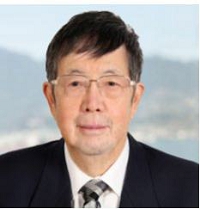 |
Yikang Liu
Mr. Yikang Liu is the Past Deputy General Secretary of the China Mining Association and the 35th & 36th Vice-Chairman of the Geological Society of China.
Before he retired in 2001, Mr. Liu was the Chief Geologist for the former Ministry of Metallurgical Industry of China. While he was there, he made significant contributions to the amendment of the last China Mineral Resources Law. Mr. Liu, representing Chinese interests, is the person responsible for the establishment of the first Sino-foreign joint venture for mineral exploration in China.
Mr. Liu has over 40 years of geological experience in managing, evaluating and exploring mineral projects for the Chinese government in China and in many countries around the world including Albania, Australia, Bolivia, Canada, Côte d'Ivoire, Ethiopia, Greece, Greenland, Iran, Laos, Madagascar, Peru, the Philippines, Sierra Leone, Tanzania, Zimbabwe and Zambia.
Silvercorp continues to benefit from the counsel of Mr. Liu's expertise in mining development and exploration in China.
| ||
Residence: Beijing, China Age: 84 Director since: July 2006 Independent: Yes Principal Occupation: Consultant and Corporate Director. | |||
| Equity Ownership | |||
| Number
of Common Shares |
Number of Restricted Share |
Number
of Options | |
| August 4, 2026 | 124,333 | 35,000 | 18,000 |
| August 5, 2025 | 101,333 | 52,333 | 70,000 |
| August 12, 2024 | 97,500 | 57,834 | 74,000 |
| Director Election – Voting Results | Areas of Expertise | ||||
| Year | For | Withheld | Strategic Planning; Corporate Development; International Business; Mining Industry, Operations, and Geology; Sustainability/Risk Management. | ||
| 2025 | 87.13% | 12.87% | |||
| 2024 | 98.98% | 1.02% | |||
| 2023 | 97.27% | 2.73% | |||
| Board and Committee Membership and Attendance in Fiscal 2026 | Other Public Directorships | ||||
|
Board Compensation committee Sustainability committee |
5 of 5 1 of 1 1 of 1 |
N/A | |||
13
|
|
Ken Robertson
Mr. Robertson was a partner and Global Director of Mining & Metals Group with Ernst & Young LLP ("EY"). During his career at EY in Canada and the United Kingdom, Mr. Robertson developed extensive experience in initial public offerings, financings, governance and securities regulatory compliance.
Mr. Robertson is a Chartered Professional Accountant.
Mr. Robertson has over 35 years of public accounting experience in Canada and the United Kingdom. Mr. Robertson holds a Bachelor of Commerce degree from McMaster University and the ICD.D designation from the Institute of Corporate Directors. | ||||
Residence: Vancouver, BC, Canada Age: 71 Director since: September 2022 Independent: Yes Principal Occupation: Corporate Director | |||||
| Equity Ownership | |||||
Number of Common Shares |
Number of Restricted Share |
Number
of Options | |||
| August 4, 2026 | 37,500 | 62,500 | 50,000 | ||
| August 5, 2025 | 35,000 | 55,000 | 50,000 | ||
| August 12, 2024 | 9,167 | 55,833 | 36,000 | ||
| Director Election – Voting Results | Areas of Expertise | ||||
| Year | For | Withheld | Strategic Planning; Mining Industry; Merger and Acquisition, Corporate Finance; Accounting and Auditing; Risk Management; Public Company Boards; Corporate Governance. | ||
| 2025 | 98.52% | 1.48% | |||
| 2024 | 98.39% | 1.61% | |||
| 2023 | 96.83% | 3.17% | |||
| Board and Committee Membership and Attendance in Fiscal 2026 | Other Public Directorships | ||||
Board Audit committee (Chair) Governance committee |
5 of 5 4 of 4 1 of 1 |
Gold Royalty Corporation; Uranium Royalty Corp. | |||
14
|
Helen Cai
Ms. Cai was appointed Senior Executive Vice-President and Chief Financial Officer of Barrick, effective March 1, 2026. She served as an independent director on the Barrick Board since 2021 and brings more than two decades of experience in equity research, corporate finance, strategic planning, capital markets, and M&A across the mining, industrial, and technology sectors, primarily with Goldman Sachs and China International Capital Corporation (CICC).
Ms. Cai was consistently top ranked as a research analyst by StarMine, Institutional Investor and Asiamoney, and the transactions she led as an investment banker received multiple deal awards from Asiamoney and The Asset.
Ms. Cai is a Chartered Financial Analyst and Chartered Alternative Investment Analyst and was educated at the Massachusetts Institute of Technology in the United States, where she received two master’s degrees and multiple fellowship awards.
| ||||
Residence: Hong Kong, China Age: 53 Director since: February 2024 Independent: Yes Principal Occupation: Corporate Director | |||||
| Equity Ownership | |||||
| Number
of Common Shares |
Number of Restricted Share |
Number
of Options | |||
| August 4, 2026 | 25,000 | 35,000 | 40,000 | ||
| August 5, 2025 | 8,333 | 41,667 | 40,000 | ||
| August 12, 2024 | N/A | 25,000 | 26,000 | ||
| Director Election – Voting Results | Areas of Expertise | ||||
| Year | For | Withheld | Strategic Planning; Mining Industry; Merger and Acquisition, Corporate Finance; Corporate Development; International Business; Risk Management; Public Company Boards; Corporate Governance. | ||
| 2025 | 99.10% | 0.90% | |||
| 2024 | 99.10% | 0.90% | |||
| 2023 | N/A | N/A | |||
| Board and Committee Membership and Attendance in Fiscal 2026 | Other Public Directorships | ||||
Board Audit committee |
5 of 5 4 of 4 |
Barrick Mining Corporation
| |||
The information as to the municipality and province, country of residence, principal occupation, or business or employment and the number of shares beneficially owned by each nominee or over which each nominee exercise control or direction set out above has been furnished by the individual nominees as at August 4, 2026.
15
Silvercorp confirms that no director, together with his or her associates or affiliates, owns or controls directly or indirectly 10% or more of the outstanding Common Shares.
No proposed director:
| (a) | is, as at the date of this Information Circular, or has been, within 10 years before the date of this Information Circular, a director, chief executive officer or chief financial officer of any company (including the Company) that: |
| (i) | was subject to an order (as defined in Form 51-102F5 Information Circular) that was issued while the proposed director was acting in the capacity as director, chief executive officer or chief financial officer; or |
| (ii) | was subject to an order (as defined in Form 51-102F5 Information Circular) that was issued after the proposed director ceased to be a director, chief executive officer or chief financial officer and which resulted from an event that occurred while that person was acting in the capacity as director, chief executive officer or chief financial officer; |
| (b) | is, as at the date of this Information Circular, or has been within the 10 years before the date of this Information Circular, a director or executive officer of any company (including the Company) that, while that person was acting in that capacity, or within a year of that person ceasing to act in that capacity, became bankrupt, made a proposal under any legislation relating to bankruptcy or insolvency or was subject to or instituted any proceedings, arrangement or compromise with creditors or had a receiver, receiver manager or trustee appointed to hold its assets; or |
| (c) | has, within 10 years before the date of this Information Circular, become bankrupt, made a proposal under any legislation relating to bankruptcy or insolvency, or become subject to or instituted any proceedings, arrangement or compromise with creditors, or had a receiver, receiver manager or trustee appointed to hold the assets of the proposed director. |
No proposed director has been subject to:
| (a) | any penalties or sanctions imposed by a court relating to securities legislation or by a securities regulatory authority or has entered into a settlement agreement with a securities regulatory authority; or |
| (b) | any other penalties or sanctions imposed by a court or regulatory body that would likely be considered important to a reasonable securityholder in deciding whether to vote for a proposed director. |
The foregoing, not being within the knowledge of the Company, has been furnished by the respective proposed directors themselves.
APPOINTMENT OF AUDITOR
It is proposed that Deloitte LLP, Independent Registered Public Accounting Firm, of Vancouver, British Columbia, be re-appointed as the auditor of the Company to hold office until the next annual general meeting of the Shareholders or until a successor is appointed, and that the directors be authorized to determine the auditor’s remuneration. Deloitte LLP, Independent Registered Public Accounting Firm, was first appointed as the auditor of the Company on November 26, 2012.
The following table shows the fees (stated in Canadian dollars) earned by Deloitte LLP for services for the years ended March 31, 2026 and 2025.
| 16 |
| Year Ended March 31, 2026 | Year Ended March 31, 2025 | |
| Audit Fees (1) | $1,419,370 | $1,300,388 |
| Audit-Related Fees (2) | $1,057,118 | $1,388,224 |
| Tax Fees (3) | Nil | Nil |
| All Other Fees (4) | Nil | Nil |
| Total | $2,477,088 | $2,688,612 |
Notes:
1. “Audit Fees” include the aggregate fees billed for professional services of the principal accountant for the audit of the Company’s annual financial statements and the audit of the Company's internal control over financial reporting for Fiscal 2026 and Fiscal 2025, or review services that are normally provided by the principal accountant in connection with interim filings or engagements for those fiscal years. For the years ended March 31, 2026 and 2025, fees of $175,144 and $159,120, respectively, related to the review of interim filings have been included as part of “Audit Fees”. Audit fees for fiscal 2025 have been updated from the amount previously disclosed to reflect additional amounts billed related to audit-related overruns and reimbursable expenses by the auditor subsequent to the filing of the prior year's annual information form.
2. “Audit-Related Fees” include the aggregate fees billed for assurance and related services by the principal accountant that are reasonably related to the performance of the audit or review of the Company’s financial statements and are not reported under above note (1). Audit-related fees incurred during the year ended March 31, 2026 relate to services provided in connection with Hong Kong listing and securities filings.
3. “Tax Fees” include the aggregate fees billed for professional services rendered by the principal accountant for tax compliance, tax advice, and tax planning.
4. “All Other Fees” include the aggregate fees billed for products and services provided by the principal accountant, other than the services reported in the above items.
At the Meeting, Shareholders will be asked to consider, and if thought advisable, to pass an ordinary resolution appointing Deloitte LLP, Independent Registered Public Accounting Firm, of Vancouver, British Columbia, as auditor of the Company until the next annual general meeting of Shareholders, or until a successor is appointed, at a remuneration to be fixed by the Board.
The Board recommends a vote “FOR” the approval of the resolution appointing Deloitte LLP, Independent Registered Public Accounting Firm, as auditor of the Company at a remuneration to be fixed by the Board. In the absence of contrary instructions, the management proxy nominees named as proxyholders in the enclosed Proxy or Voting Instruction Form will cast the votes represented by any Proxy or Voting Instruction Form FOR the appointment of Deloitte LLP as auditor of the Company, at a remuneration to be fixed by the Board.
PROPOSED LISTING ON THE HONG KONG STOCK EXCHANGE
The Company intends to pursue a listing of its Common Shares on The Stock Exchange of Hong Kong (the “Hong Kong Stock Exchange”). For the purposes of aligning with the relevant listing rules governing the listing of securities on the Hong Kong Stock Exchange (the “Listing Rules”), the following additional resolutions are being proposed for approval by the Shareholders.
amendment of articles
On May 26, 2026, the Company announced that it had filed an application (the “Listing Application”) with the Hong Kong Stock Exchange in connection with a proposed triple primary listing of its Common Shares on the Main Board of the Hong Kong Stock Exchange. In connection with the Listing Application, the Board wishes to amend the Articles of the Company (the “Articles”) in order to ensure that the Articles comply with Appendix 3 (Core Shareholder Protection Standards) to the Listing Rules, as described more fully below. The full text of the Articles as proposed to be amended (the “Amended Articles”) is set out in Schedule “1” (blacklined to the current Articles).
| 17 |
The Amended Articles are substantially similar to the current Articles, but reflect a number of amendments that are required to ensure that the Articles comply with the requirements of Appendix 3 (Core Shareholder Protection Standards) to the Listing Rules. A summary of the key proposed amendments to the Articles is set out below:
| · | Special Resolutions: Under the current Articles, the majority of votes required for the Company to pass a special resolution at a meeting of shareholders is two-thirds of the votes cast on the resolution and, unless the Articles or Business Corporations Act provides otherwise, the Articles may be amended by an ordinary resolution approved by a simple majority of votes cast on the resolution. The Company intends to amend Articles 9.4 and 11.2 to provide that: |
| o | in the case of a resolution to (a) approve the voluntary liquidation or winding-up of the Company or (b) alter the Articles in accordance with Article 9.4, such matter must be approved by a special resolution approved by three-quarters of the votes cast on the resolution by shareholders entitled to attend and vote at the meeting; and |
| o | in the case of a resolution to vary or delete any special rights or restrictions attached to the shares of any class or series of shares of the Company, such matter must be approved by a special resolution approved by two-thirds of the votes cast on the resolution by all shareholders entitled to attend and vote at the meeting (including three-quarters of the votes cast on the resolution by holders of such class or series of shares). |
| · | Quorum for Certain Matters: Under Article 11.3 of the current Articles, the quorum for the transaction of business at a meeting of Shareholders is two persons who are, or represent by proxy, shareholders holding, in the aggregate, at least five percent of the issued shares entitled to be voted at the meeting. The Company proposes to amend Article 11.3 to include the additional requirement that (a) if the Shareholders will be asked to vote on a resolution to approve the voluntary liquidation or winding up of the Company, the quorum in respect of such matter will be Shareholders or proxyholders representing at least 30% of the shares entitled to be voted at the meeting and (b) if the Shareholders will be asked to vote on a resolution to vary or delete any special rights or restrictions attached to the shares of any class or series of shares of the Company, the quorum in respect of such matter will be Shareholders or proxyholders who represent at least one-third of such class or series of shares. |
| · | Electronic Meetings: The Company proposes to amend Article 10.10 to confirm the ability of the Company to hold a meeting of the shareholders at which Shareholders may attend and vote by electronic means. |
| · | Appointment of Proxy Holders: The Company proposes to amend Article 12.7 to confirm that every shareholder, including a Shareholder that is a corporation or a clearing house that holds shares on behalf of a beneficial owner (including Hong Kong Securities Clearing Company Limited), may appoint proxies or corporate representatives to attend and vote at meetings on their behalf. |
| · | Removal of the Auditor: The Company proposes to amend Article 11.1(2) to clarify that neither appointment nor the removal of the auditor of the Company is considered “special business” that is subject to approval by special resolution. Under the Amended Articles, the Shareholders will be able to both appoint and remove the auditors of the Company by way of ordinary resolution passed by a simple majority of votes cast at a meeting of shareholders. |
| · | Right to Speak at Meetings: The Company proposes to amend Article 11.3 of the Articles to provide that all shareholders present and entitled to vote at a meeting of the Shareholders shall have the right to speak at such meeting. |
| 18 |
| · | Branch Registers: The Company proposes to add a new provision (Article 4.3) confirming that (a) the Company may maintain or cause to be maintained one or more branch securities registers and (b) any branch securities register shall be kept open for inspection by shareholders in accordance with all applicable laws of the jurisdiction in which such register is maintained and the rules and requirements of any applicable stock exchange (including the Hong Kong Stock Exchange). |
| · | Location of Meetings: The Company proposes to amend Article 10.4 to provide that meetings of Shareholders may be held outside of North America. |
At the Meeting, Shareholders will be asked to consider, and if thought advisable, to pass a special resolution authorizing the Company to adopt the Amended Articles, which resolution must be passed by not less than two-thirds of the votes cast by Shareholders and proxyholders who are entitled to attend and vote at the Meeting.
The full text of the special resolution authorizing the Company to adopt the Amended Articles (the “Amended Articles Resolution”) is as follows:
“BE IT RESOLVED as a special resolution that:
| 1. | Subject to and conditional upon the listing of the common shares of the Company on the Main Board of the Hong Kong Stock Exchange becoming effective, the Company be and is hereby authorized (but not required) to replace the current Articles of the Company with the Amended Articles as set out in Schedule “1” to the management proxy circular of the Company dated August 12, 2026. |
| 2. | Any one director or officer of the Company be and is hereby authorized, for and on behalf of the Company, to take all necessary steps and proceedings, including filing of such documents and take such further actions that may be necessary to effect the amendment to the current Articles and to execute, or cause to be executed, and to deliver or cause to be delivered all such other documents and instruments, and to do or to cause to be done all such other acts and things, as such director or officer of the Company may consider to be necessary or desirable to carry out the intent of the foregoing resolutions, such necessity or desirability to be conclusively evidenced by the execution and delivery of any such documents or instruments or the taking of any such actions." |
The Board recommends that Shareholders vote FOR the Amended Articles Resolution. In the absence of contrary instructions, the management proxy nominees named as proxyholders in the enclosed Proxy or Voting Instruction Form will cast the votes represented by any Proxy or Voting Instruction Form FOR the Amended Articles Resolution.
AMENDED AND RESTATED OMNIBUS PLAN
In connection with the Company’s intended listing on the Hong Kong Stock Exchange and in order for the Omnibus Plan to comply with Chapter 17 of the Listing Rules, the Board has determined that it is advisable to amend and restate the Omnibus Plan, subject to and conditional upon the listing of the Common Shares on the Main Board of the Hong Kong Stock Exchange. The full text of the Omnibus Plan as proposed to be amended (the “New Omnibus Plan”) is set out in Schedule “2” (blacklined to the current Omnibus Plan). A more fulsome summary of the current Omnibus Plan is provided under the section entitled “Equity Compensation Plans”.
Awards (as defined herein) granted under the Omnibus Plan will remain outstanding and be governed by the terms of the Omnibus Plan even if the New Omnibus Plan is approved by the shareholders of the Company and the Common Shares are listed on the Main Board of the Hong Kong Stock Exchange. If the New Omnibus Plan is not approved and the Company becomes listed on the Main Board of the Hong Kong Stock Exchange, the Omnibus Plan will not be in compliance with Chapter 17 of the Listing Rules and, as a result, the Company would not be permitted to grant any further Awards if and for so long as the Common Shares are listed on the Main Board of the Hong Kong Stock Exchange.
| 19 |
A summary of the key proposed amendments to the Omnibus Plan is set out below:
| · | The New Omnibus Plan will be a 10% fixed maximum plan (no longer a 10% rolling or “evergreen” plan). |
| · | Subject to increase with the approval of Shareholders as set out below, the maximum number of Common Shares subject to issuance pursuant to Awards granted under the Omnibus Plan, together with Common Shares issuable under any other share-based compensation arrangements (the “Plan Limit”), will be fixed at 22,120,630 (being 10% of the number of issued and outstanding Common Shares as of the Record Date). |
| · | The Plan Limit may at any time with the approval of Shareholders at a duly called meeting of Shareholders be refreshed or renewed to 10% of the number of Common Shares issued and outstanding as at the record date for such meeting. |
| · | If the Company seeks approval to renew the Plan Limit less than three years from the date of the prior approval, certain insiders (such as controlling shareholders, directors (excluding independent non-executive directors), executive officers and their respective associates) will be precluded from voting on the matter. |
| · | The New Omnibus Plan will expressly provide that the Company must obtain the approval of Shareholders in order to grant Awards in excess of the Plan Limit. |
| · | Options must be priced at the greater of (i) the closing price of the Common Shares on TSX on the trading day immediately preceding the grant date, (ii) if and for so long as the Common Shares are listed on the Hong Kong Stock Exchange, the closing price of the Common Shares on the Hong Kong Stock Exchange on the trading day immediately preceding the grant date (which must be a trading date) and (iii) the volume weighted average trading price of the Common Shares on the TSX for the five trading days immediately prior to the grant date. |
| · | Awards under the New Omnibus Plan generally cannot have a vesting period earlier than 12 months from the date of grant, although the Board has discretion to permit shorter vesting in the case of Awards granted to employees. |
| · | Awards to any one person within a 12-month period that would exceed 1% of the outstanding Common Shares will be subject to shareholder approval obtained in accordance with the Listing Rules. |
| · | The New Omnibus Plan will include provisions that specify the manner in which Awards will be adjusted in the event of a reorganization, recapitalization, stock split or redivision, reduction, combination or consolidation, stock dividend, combination of shares, merger, consolidation, rights offering or any other change in the corporate structure or shares of the Company. |
| · | Under the Omnibus Plan, the Board has the discretion to modify the terms of any Award (including to accelerate the vesting of Awards and to permit holders conditionally exercise their Awards) upon the occurrence of a Change of Control (as defined in the Omnibus Plan). The New Omnibus Plan will expand the definition of Change of Control to include the acquisition by any person or persons acting jointly or in concert, whether directly or indirectly, of beneficial ownership of voting securities of the Company that, together with all other voting securities of the Company held by such persons (if any), constitute in the aggregate, 30% or more of all of the then outstanding voting securities of the Company. |
| · | Unless earlier terminated by the Board, the New Omnibus Plan will terminate on the ten year anniversary of the date on which the proposed amendments are approved by Shareholders. |
| 20 |
At the Meeting, Shareholders will be asked to consider and, if thought advisable, approve an ordinary resolution authorizing the Company to adopt the New Omnibus Plan, which resolution must be passed by a simple majority of the votes cast by Shareholders and proxyholders who are entitled to attend and vote at the Meeting.
The full text of resolution authorizing the Company to adopt the New Omnibus Plan (the “Omnibus Plan Resolution”) is as follows:
“BE IT RESOLVED as an ordinary resolution that:
| 1. | Subject to and conditional upon the listing of the common shares of the Company on the Main Board of the Hong Kong Stock Exchange becoming effective, the Company be and is hereby authorized (but not required) to replace the current Share Based Compensation Plan of the Company with an amended Share Based Compensation Plan (the “New Omnibus Plan”) as set out in Schedule “2” to the management proxy circular of the Company dated August 12, 2026, including the reserving for issuance under the New Omnibus Plan of a maximum of 22,120,630 Common Shares, being 10% of the number of issued and outstanding common shares of the Company, as of the record date, pursuant to the exercise or settlement of awards thereunder. |
| 2. | Any one director or officer of the Company be and is hereby authorized, for and on behalf of the Company, to take all necessary steps and proceedings, including filing of such documents and taking such further actions that may be necessary to effect the amendment to the current Articles and to execute, or cause to be executed, and to deliver or cause to be delivered all such other documents and instruments, and to do or to cause to be done all such other acts and things, as such director or officer of the Company may consider to be necessary or desirable to carry out the intent of the foregoing resolutions, such necessity or desirability to be conclusively evidenced by the execution and delivery of any such documents or instruments or the taking of any such actions. |
The Board recommends that Shareholders vote FOR the Omnibus Plan Resolution. In the absence of contrary instructions, the management proxy nominees named as proxyholders in the Proxy or Voting Instruction Form will cast the votes represented by any Proxy or Voting Instruction Form FOR the Omnibus Plan Resolution.
Corporate Governance
The Company is committed to maintaining high standards of corporate governance and the Company’s corporate governance practices have been and continue to be in compliance with the applicable Canadian requirements. The Company continues to monitor developments in Canada with a view to further revising its governance policies and practices, as appropriate.
The common shares of the Company are listed on the NYSE American. Section 110 of the NYSE American company guide permits NYSE American to consider the laws, customs and practices of foreign issuers in relaxing certain NYSE American listing criteria, and to grant exemptions from NYSE American listing criteria based on these considerations. A description of the significant ways in which the Company’s governance practices differ from those followed by domestic companies pursuant to NYSE American standards is provided on the Company’s website at https://silvercorpmetals.com/corporate-governance/.
The Company believes that its governance practices are appropriate and effective for its size, industry, and risk profile.
| 21 |
Following is a description of the Company’s corporate governance practices which has been prepared by the Corporate Governance and Nominating Committee of the Board and has been approved by the Board.
The Company’s Charters and Policies are available on the Company’s website at https://silvercorpmetals.com/corporate-governance/, as well as on SEDAR+ at www.sedarplus.ca and EDGAR at www.sec.gov. Copies may be obtained free of charge upon request to the Corporate Secretary at the Company’s head office.
Board of Directors
In compliance with the requirements of the Business Corporations Act, the directors are elected by the Shareholders to manage or supervise the Management of the business and affairs of the Company. In exercising their powers and discharging their duties, the directors are required to act honestly and in good faith with a view to the best interests of the Company, and to exercise the care, diligence and skill that a reasonably prudent person would exercise in comparable circumstances. Five out of six of the Director Nominees are independent within the meaning of NI 52-110. One member of Management on the Board, Dr. Rui Feng, is not considered independent as he is the Chief Executive Officer and Chairman of the Company. The independent directors regularly meet without the members of Management present. Mr. Paul Simpson is the independent lead director of the Board. The role of the independent lead director is to act as the Chair for all meetings of the independent directors referred to above.
The Board has adopted a description of how it delineates its roles and stewardship responsibilities in the Board of Directors Charter, which is attached hereto as Schedule “3”. This description incorporates the guidelines and principles outlined in National Instrument 58-101 - Disclosure of Corporate Governance Practices (“NI 58-101”) and National Policy 58-201 - Corporate Governance Guidelines. The Board believes that good corporate governance is important to the effective performance of the Company and plays a significant role in protecting Shareholders’ interests and maximizing value for the Shareholders. The disclosure regarding the Company’s corporate governance practices that is required by NI 58-101 is attached hereto as Exhibit “A”.
Corporate Governance AND NOMINATING Committee
The Corporate Governance and Nominating Committee is responsible for assisting the Board in establishing and maintaining a sound system of corporate governance through a process of continuing assessment and enhancement. The Corporate Governance and Nominating Committee works to ensure that (a) the Board functions independently of Management, (b) Management is clearly accountable to the Board, and (c) procedures are in place to monitor the effectiveness of the performance of the Board, the committees of the Board and individual directors. The Corporate Governance and Nominating Committee is comprised of Paul Simpson, Marina Katusa, and Ken Robertson, all of whom are independent directors pursuant to NI 52-110. The Corporate Governance and Nominating Committee Charter is attached hereto as Schedule “4”.
Compensation Committee
The Compensation Committee is responsible for determining and approving compensation for directors and senior officers. The Compensation Committee Charter is attached hereto as Schedule “5”. The Compensation Committee is comprised of Paul Simpson, Yikang Liu, and Marina Katusa, all of whom are independent directors pursuant to NI 52-110. All committee members have experience in executive compensation. Paul Simpson is a senior corporate securities lawyer, and holds a Certificate in Mining Law from Osgoode Hall Law School. He brings over 25 years’ experience in corporate law and corporate governance as it relates to compensation committees. Yikang Liu is the past Deputy General Secretary for China Mining Association and former Vice-Chair of the Geological Society of China. Marina Katusa has over 17 years of business experience and she holds a MBA degree, and a B.Sc. degree in Geology/Earth & Ocean Science.
| 22 |
Given their education and experience, each member of the Compensation Committee has familiarity with, an understanding of, and experience in reviewing executive and directors’ compensation; administering of stock options and stock option grants; and reviewing performance goals and assessments of executives. In Fiscal 2026, the Compensation Committee conducted market research and selected 8 producing mining companies with main focus on silver sector as benchmarking. The Company’s compensation policies and programs are designed to be competitive with publicly listed mining companies of similar size and to recognize and reward executive performance consistent with the success of the Company’s business.
Audit Committee
The Audit Committee is comprised of Ken Robertson, Helen Cai, and Paul Simpson, all of whom are independent directors and financially literate within the meaning of NI 52-110. For information regarding the Audit Committee and to view the Audit Committee Charter, see the Company’s annual information form (the “AIF”) dated June 29, 2026, under the heading “Audit Committee”. The AIF is available under the Company’s profile at www.sedarplus.ca and on the Company’s website at https://silvercorpmetals.com.
SUSTAINABILITY Committee
At Silvercorp, we strive to operate all aspects of our business in line with the highest safety standards, and in the most efficient and sustainable way possible. Our focus is on generating sustainable growth through the optimization of innovative technology while operating in an environmentally responsible way.
Our Vision:
Be a technologically advanced, well-managed, and sustainable mining company.
Our Values:
| · | Operate sustainably by prioritizing safety and the environment. |
| · | Apply technology and efficient management to ensure our competitiveness. |
| · | Respect our people and enable them to achieve their potential. |
| · | Embody the principles of honesty and integrity. |
| · | Strive to innovate for further excellence. |
Silvercorp is committed to the principles of sustainable development, safety, and conducting its activities in an environmentally and socially responsible manner. We believe in caring for the environment in which we operate; contributing to the long-term development of our host communities; ensuring safe and secure workplaces for employees, local communities and governments; and operating transparently. Maintaining and improving good relationships and collaboration with the Company’s host communities is essential to achieving our sustainability targets. Through attentive engagement and collaboration, we understand the social, economic and environmental priorities, and take actions to tackle the most pressing issues and risks.
The Sustainability Committee Charter is available on the Company’s website at https://silvercorpmetals.com/corporate-governance/, as well as on SEDAR+ at www.sedarplus.ca. The Sustainability Committee is comprised of Marina Katusa, Dr. Rui Feng and Yikang Liu. Each of the members of the Sustainability Committee, other than Dr. Rui Feng, is independent pursuant to NI 52-110.
The Corporate Governance and Nominating Committee, Compensation Committee, Audit Committee and Sustainability Committee will each be re-constituted after the Meeting.
| 23 |
Executive Compensation
The following table sets forth a summary of the total compensation during the three most recently completed financial years paid to the Company’s Chief Executive Officer (“CEO”), Chief Financial Officer (“CFO”), and the three other most highly compensated executive officers, or the three most highly compensated individuals acting in a similar capacity, other than the CEO and CFO, at the end of the most recently completed financial year whose total compensation was, individually, more than CAD$150,000, and any additional individuals who satisfy these criteria but for the fact that individual was not serving as an officer, nor acting in a similar capacity, at the end of the most recently completed financial year, hereinafter referred to as the “Named Executive Officers” or the “NEOs”.
Summary Compensation Table
| Name
and Principal Position |
Fiscal Year |
Salary (1) (US$) |
Share- Based Awards (4) (US$) |
Option- Based Awards (8) (US$) |
Non-Equity Incentive
Plan (US$) |
Pension (US$) |
All
Other Compensation (US$) |
Total Compensation (2) (US$) | |
| Annual Incentive Plan |
Long
Term Incentive Plan | ||||||||
| Dr. Rui Feng, Chairman, CEO and Director (3) | 2026 | 997,417 | 1,403,238 | 87,805 | 1,500,000 | – | – | – | 3,988,461 |
| 2025 | 992,250 | 1,093,546 | 78,478 | 1,400,000 | – | – | – | 3,564,274 | |
| 2024 | 945,000 | 1,174,464 | – | 1,091,000 | – | – | – | 3,210,464 | |
| Lon Shaver, President (5) | 2026 | 252,478 | 357,688 | 29,269 | 180,897 | – | – | – | 820,332 |
| 2025 | 235,176 | 269,424 | 26,159 | 173,219 | – | – | – | 703,978 | |
| 2024 | 237,266 | 234,893 | – | 133,462 | – | – | – | 605,621 | |
Winnie Wang, Interim Chief Financial Officer(6) |
2026 | 101,915 | 253,871 | 79,855 | 37,113 | – | – | – | 472,754 |
| 2025 | – | – | – | – | – | – | – | – | |
| 2024 | – | – | – | – | – | – | – | – | |
| Lichang Peng, General Manager of China Operations | 2026 | 126,729 | 183,430 | - | 125,000 | – | – | – | 435,159 |
| 2025 | 124,653 | 158,485 | – | 86,250 | – | – | – | 369,388 | |
| 2024 | 125,588 | 148,765 | – | 74,145 | – | – | – | 348,498 | |
| Jonathan Hoyles, General Counsel and Corporate Secretary (7) | 2026 | 163,893 | 55,029 | 11,707 | 36,179 | – | – | – | 266,808 |
| 2025 | 146,985 | 31,697 | 10,464 | 45,641 | – | – | – | 234,787 | |
| 2024 | 105,039 | – | – | – | – | – | – | 105,039 | |
| Derek Liu, Former Chief Financial Officer(6) | 2026 | 162,541 | 324,671 | 29,269 | 133,864 | – | – | – | 650,345 |
| 2025 | 235,176 | 240,897 | 26,159 | 154,532 | – | – | – | 656,764 | |
| 2024 | 237,266 | 274,042 | – | 113,072 | – | – | – | 624,380 | |
| Total | 2026 | 1,804,973 | 2,577,927 | 237,905 | 2,013,053 | – | – | – | 6,633,859 |
| 2025 | 1,734,240 | 1,794,049 | 141,260 | 1,859,642 | – | – | – | 5,529,191 | |
| 2024 | 1,650,159 | 1,832,164 | – | 1,411,679 | – | – | – | 4,894,002 | |
Notes:
| (1) | Includes consulting fees paid to NEOs. | |
| (2) | Other than the consulting fees and annual incentive compensation paid to Dr. Rui Feng, the amounts paid to the NEOs were in Canadian dollars and converted into US dollars using the average exchange rate as per Bank of Canada for the corresponding fiscal year. | |
| (3) | Consulting fees are payable to Dr. Rui Feng for his services pursuant to a consulting agreement dated October 1, 2020. The Board reviews and adjusts such fees annually. No compensation was paid to Dr. Rui Feng for his services as a director of the Company. | |
| (4) | On December 9, 2025, April 10, 2025, April 1, 2024, and April 10, 2023, the Company awarded RSUs that vest over a three-year period at a value of CAD $10.85, CAD $5.07, CAD $4.41 and CAD $5.28, per unit, respectively. | |
| (5) | Mr. Lon Shaver was promoted to President from Vice President in September 2023. | |
| (6) | Mr. Derek Liu retired from his position and Ms. Winnie Wang was appointed as Interim Chief Financial Officer in November 2025. | |
| (7) | Mr. Jonathan Hoyles was appointed as General Counsel of the Company in July 2023 and Corporate Secretary in October 2023. |
| 24 |
| (8) | The Company has adopted IFRS 2 – Share-based Payment to account for the issuance of Options to employees and non-employees. The fair value of Options is estimated at the grant date using the Black-Scholes Option Pricing Model which requires the input of a number of assumptions. Although the assumptions used reflect Management’s best estimates, they involve inherent uncertainties based on market conditions generally outside the control of the Company. The following table summarizes the key assumptions used to calculate the fair value of each set of Options granted in each fiscal year ended March 31: |
| Name | Fiscal Year of Options Granted |
Grant Date | Options Granted(1) |
Exercise price (CAD$) |
Expiry Date | Weighted average expected life (years) |
Weighted average risk-free rates |
Weighted average volatilities |
Weighted average fair value per option (CAD$) |
| Dr. Rui Feng, Chairman, CEO and Director | 2026 | 10/Apr/2025 | 75,000 | 5.07 | 10/Apr/2030 | 2.75 | 2.64% | 48.51% | 1.62 |
| 2025 | 01/Apr/2024 | 75,000 | 4.41 | 01/Apr/2029 | 2.75 | 4.03% | 47.97% | 1.46 | |
| 2024 | Nil | Nil | Nil | Nil | Nil | Nil | Nil | Nil | |
Lon Shaver, President
|
2026 | 10/Apr/2025 | 25,000 | 5.07 | 10/Apr/2030 | 2.75 | 2.64% | 48.51% | 1.62 |
| 2025 | 01/Apr/2024 | 25,000 | 4.41 | 01/Apr/2029 | 2.75 | 4.03% | 47.97% | 1.46 | |
| 2024 | Nil | Nil | Nil | Nil | Nil | Nil | Nil | Nil | |
| Winnie Wang, Interim Chief Financial Officer | 2026 | 8/Dec/2025 | 30,000 | 10.85 | 8/Dec/2035 | 2.75 | 2.66% | 50.75% | 3.68 |
| 2025 | Nil | Nil | Nil | Nil | Nil | Nil | Nil | Nil | |
| 2024 | Nil | Nil | Nil | Nil | Nil | Nil | Nil | Nil | |
| Lichang Peng, General Manager of China Operations | 2026 | Nil | Nil | Nil | Nil | Nil | Nil | Nil | Nil |
| 2025 | Nil | Nil | Nil | Nil | Nil | Nil | Nil | Nil | |
| 2024 | Nil | Nil | Nil | Nil | Nil | Nil | Nil | Nil | |
Jonathan Hoyles General Counsel and Corporate Secretary |
2026 | 10/Apr/2025 | 10,000 | 5.07 | 10/Apr/2030 | 2.75 | 2.64% | 48.51% | 1.62 |
| 2025 | 01/Apr/2024 | 10,000 | 4.41 | 01/Apr/2029 | 2.75 | 4.03% | 47.97% | 1.46 | |
| 2024 | Nil | Nil | Nil | Nil | Nil | Nil | Nil | Nil | |
| Derek Liu, Former Chief Financial Officer(2) | 2026 | 10/Apr/2025 | 25,000 | 5.07 | 10/Apr/2030 | 2.75 | 2.64% | 48.51% | 1.62 |
| 2025 | 1/Apr/2024 | 25,000 | 4.41 | 1/Apr/2029 | 2.75 | 4.03% | 47.97% | 1.46 | |
| 2024 | Nil | Nil | Nil | Nil | Nil | Nil | Nil | Nil |
| 25 |
Outstanding Share-Based Awards and Option-Based Awards
The following table summarizes awards outstanding at fiscal year ended March 31, 2026, for each NEO:
| Option-Based Awards | Share-based Awards | ||||||
| Name | Number
of Securities Underlying Unexercised Options |
Option Exercise Price (CAD$) |
Option Expiration Date |
Value
of Unexercised In-The- Money Options (1) (CAD$) |
Number
of Shares or Units of Shares that have not Vested |
Market or Payout (CAD$) |
Market
or Payout Value of Vested Shares or Units of Shares not Paid Out or Distributed (CAD$) |
| Dr. Rui Feng, Chairman, CEO and Director | 75,000 | 5.07 | 10-Apr-2030 | 741,750 | Nil | Nil | 374,000 |
| 75,000 | 4.41 | 01-Apr-2029 | 791,250 | 50,000 | 748,000 | 0 | |
| 50,000 | 4.08 | 23-Feb-2028 | 544,000 | 172,500 | 2,580,600 | 2,580,600 | |
| 100,000 | 3.93 | 26-Apr-2027 | 1,103,000 | 318,750 | 4,768,500 | 953,700 | |
Lon Shaver, President |
25,000 | 5.07 | 10-Apr-2030 | 247,250 | Nil | Nil | 137,138 |
| 25,000 | 4.41 | 01-Apr-2029 | 263,750 | Nil | Nil | 224,400 | |
| 30,000 | 3.93 | 26-Apr-2027 | 330,900 | 10,000 | 149,600 | 598,400 | |
| Nil | Nil | Nil | Nil | 42,500 | 635,800 | 635,800 | |
| Nil | Nil | Nil | Nil | 81,250 | 1,215,500 | 243,100 | |
Winnie Wang, Interim CFO |
30,000 | 10.85 | 08-Dec-2030 | 123,300 | 4,167 | 62,338 | Nil |
| Nil | Nil | Nil | Nil | 30,000 | 448,800 | Nil | |
| Lichang Peng, General Manager of China Operations | Nil | Nil | Nil | Nil | 6,333 | 94,742 | Nil |
| Nil | Nil | Nil | Nil | 25,000 | 374,000 | Nil | |
| Nil | Nil | Nil | Nil | 41,667 | 623,338 | Nil | |
| Jonathan
Hoyles, General Counsel and Corporate Secretary |
8,333 | 5.07 | 10-Apr-2030 | 82,413 | 5,000 | 74,800 | Nil |
| 5,000 | 4.41 | 01-Apr-2029 | 52,750 | 12,500 | 187,000 | Nil | |
| Derek Liu, Former Chief Financial Officer(2) | 20,833 | $5.07 | 10-Apr-2030 | $206,038 | 11,667 | $174,538 | Nil |
| 25,000 | $4.41 | 01-Apr-2029 | $131,875 | 38,000 | $568,480 | Nil | |
| Nil | Nil | Nil | Nil | 73,750 | $1,103,300 | Nil | |
Notes:
(1) The closing price of the Common Shares on the Toronto Stock Exchange (“TSX”) on March 31, 2026, was CAD $14.96.
(2) The Company agreed to extend Mr. Derek Liu’s share-based awards to vest until 6 months after his last day.
Incentive Plan Awards – Value Vested or Earned during the Year
| Name | Option-Based Awards – Value vested during the year (US$) | Share-Based Awards – Value vested during the year (US$) | Non-Equity Incentive Plan Compensation – Value earned during the year (US$) |
| Dr. Rui Feng, Chairman, CEO and Director |
196,000 | 4,594,287 | 1,400,000 |
|
Lon Shaver, President |
34,450 | 96,265 | 173,219 |
| Winnie Wang, Interim CFO |
- | 5,485 | - |
|
Lichang Peng, General Manager of China Operations |
4,450 | 230,956 | 86,250 |
|
Jonathan Hoyles, General Counsel and Corporate Secretary |
12,001 | 34,364 | 45,641 |
| Derek Liu, Former Chief Financial Officer |
37,417 | 454,217 | 133,864 |
Option Repricing
There are no Options held by the NEOs that have been repriced.
Pension Plan Benefits
The Company does not provide any pension plan benefits.
| 26 |
Employment Agreements
As at the date of this Information Circular, the Company does not have any employment contracts with the NEOs other than as disclosed below.
Dr. Rui Feng, CEO, Chairman and Director
Dr. Rui Feng entered into an agreement on October 1, 2020, to provide senior executive services to the Company, at the annual salary or consulting fee as set out in the summary compensation above. Under the agreement, either party may terminate the agreement for any reason upon thirty (30) days written notice. In the event that the Company provides notice to terminate this agreement, it shall pay Dr. Rui Feng a termination fee equal to the full amount of the annual consulting fee, plus an additional 1/6th of the annual consulting fee for each year of service provided which commenced in September 2003.
Lon Shaver, President
Lon Shaver was promoted to President of the Company in September 2023. On July 16, 2018, the Company entered into an employment agreement to engage Lon Shaver as Vice President of the Company, at a base salary as set out in the summary compensation table above, in which he is entitled to share-based compensation and annual performance bonuses. Lon Shaver agreed to a “Non-Competition Period” of twelve months after the termination of his employment agreement.
Winnie Wang, Interim CFO
Winnie Wang was promoted to Interim CFO of the Company in November 2025. In August 2024, the Company entered into an employment agreement with Winnie Wang as head of financial department of the Company’s China Operations. Effective October 2025, the Company entered into a consulting agreement with Winnie Wang to engage her as the Company’s Interim CFO. Her compensation includes a base fee, share-based compensation and annual performance bonuses as set out in the summary compensation table above. Winnie Wang agreed to a “Non-Competition Period” of twelve months after the termination of her consulting agreement.
Lichang Peng, General Manager of China Operations
In February 2005, the Company entered into an employment agreement with Lichang Peng. Since then, Lichang Peng has been assuming various positions at the subsidiaries of the Company, including the General Manager of Henan Found Mining Co. Limited and the General Manager of Guangdong Found Mining Co. Limited. In September 2022, Lichang Peng was promoted to be the General Manager of China Operations. His compensation includes a base salary, share-based compensation and annual performance bonuses as set out in the summary compensation table above.
Jonathan Hoyles, General Counsel
On July 17, 2023, the Company entered into an employment agreement to engage Jonathan Hoyles as General Counsel of the Company, at a base salary as set out in the summary compensation table above, in which he is entitled to share-based compensation and annual performance bonuses. Jonathan Hoyles agreed to a “Non-Competition Period” of twelve months after the termination of his employment agreement.
Change of Control Agreements
The Company has in effect change of control agreements with each of Dr. Rui Feng and Lon Shaver. The terms of the change of control agreements provide that if an executive officer’s employment agreement or consulting agreement, as applicable, is terminated, other than for cause, within 18 months after a “Change of Control” (as defined below), the executive officer shall be entitled to: (i) a lump sum payment equal to 18 months base compensation plus any other amounts owed for compensation in arrears, (ii) bonus, if awarded, (iii) continuation of benefits for 18 months, (iv) immediate vesting of all outstanding Options, restricted share units and other rights and entitlements, (v) payment of recruitment services to assist in securing alternative employment. The Company is responsible for the payment of the Change of Control payments and there are no requirements to receiving a Change of Control payment (such as execution of a non-competition agreement, non-solicitation agreement or confidentiality agreement).
| 27 |
The change of control agreements deem a “Change of Control” to occur if: (i) a merger, amalgamation, arrangement, consolidation, reorganization or transfer takes place in which equity securities of the Company possessing more than 50% of the total combined voting power of the Company’s outstanding equity securities are acquired by a person or persons different from the persons holding those equity securities immediately prior to such transaction, and the composition of the Board following such transaction is such that the directors of the Company prior to the transaction constitute less than 50% of the Board membership following the transaction, except that no Change of Control will be deemed to occur if such merger, amalgamation, arrangement, consolidation, reorganization or transfer is with any subsidiary or subsidiaries of the Company; (ii) any person, or any combination of persons acting jointly or in concert by virtue of an agreement, arrangement, commitment or understanding shall acquire or hold, directly or indirectly, 25% or more of the voting rights attached to all outstanding equity securities; (iii) any person, or any combination of persons acting jointly or in concert by virtue of an agreement, arrangement, commitment or understanding shall acquire or hold, directly or indirectly, the right to appoint a majority of the directors of the Company; or (iv) the Company sells, transfers or otherwise disposes of all or substantially all of its assets, except that no Change of Control will be deemed to occur if such sale or disposition is made to a subsidiary or subsidiaries of the Company.
Quantified Impact of Termination and Change of Control Provisions
If a Change of Control of the Company had occurred on March 31, 2026, the total estimated cash cost to the Company of related payments to the below NEOs (which includes the accelerated option-based award value and share-based award value) is estimated at US$ 11,917,382. The following table shows estimated incremental payments triggered pursuant to termination of employment of an NEO in accordance with the termination provisions described above:
| Name |
Termination Without Cause Under Agreement Provision Value (USD) (1)(2)(3) |
Change of Control Provision Value (USD) (1)(2)(3)(4) |
| Dr. Rui Feng | 4,765,753 | 9,659,986 |
| Lon Shaver | - | 2,257,397 |
Notes:
| (1) | The termination values assume that the triggering event took place on the last business day of the Company’s financial year-end (March 31, 2026). | |
| (2) | The accelerated option-based award value on the last business day of the Company’s year-end (March 31, 2026) was calculated based on the difference between the value of the Options that would have vested and the closing price of the Common Shares on the TSX on March 31, 2026, of CAD$14.96. | |
| (3) | Value of earned/unused vacation and amounts owing for expense reimbursement are not included as they are not considered “incremental” payments made in connection with termination of employment. | |
| (4) | If Dr. Feng is terminated by virtue of a Change of Control, he will receive the greater of the value under the change of control agreement or under his consulting agreement. |
No new actions, decisions, or policies were made after the end of the last financial year to affect a reader’s understanding of an NEO’s compensation for the year ended March 31, 2026.
Compensation Discussion and Analysis
In Fiscal 2026, total compensation paid to the above NEOs was $6,633,859, higher compared to $5,529,190 in Fiscal 2025 (Fiscal 2024 - $4,894,002). The change was mainly due to change of share-based awards, bonuses and pay rate adjustments. In Fiscal 2026, total compensation paid to the NEOs changed primarily as a result of: i) an increase in payment of annual base fee totalling $1,804,973 compared to $1,734,240 in Fiscal 2025 and $1,650,159 in Fiscal 2024; ii) an increase in payment of annual bonuses totalling $2,013,053 compared to $1,859,642 in Fiscal 2025 and $1,411,679 in Fiscal 2024; and iii) grant of restricted share units in the value of $2,577,927 compared to $1,794,049 in Fiscal 2025 and $1,832,164 in Fiscal 2024; and iv) grant of stock options totalling $237,905 compared to $141,260 in Fiscal 2025, and nil in Fiscal 2024.
| 28 |
The Company’s executive compensation program is overseen by the Compensation Committee of the Board. See “Compensation Committee” above for a description of the composition of the Compensation Committee. The Compensation Committee has the overall responsibility for recommending levels of executive compensation that are competitive and motivating, it is responsible for making recommendations to the Board with respect to the compensation of executive officers of the Company and the Company’s Omnibus Plan. The Compensation Committee also assumes responsibility for reviewing and monitoring the long-range compensation strategy for the senior management of the Company.
In carrying out this mandate, the Compensation Committee assesses on an annual basis the performance of the CEO, relative to both industry performance, and overall Company performance, and compares total compensation to compensation paid by comparable companies. Comparable silver mining companies continue to be comprised of publicly traded mining companies of similar size in North America, as determined by market capitalization, revenue, cash flows from operations, net income attributable to equity shareholders of the Company, and complexity relative to the Company. Comparable companies referenced by the Compensation Committee include the Company’s peer group, as listed below.
The objectives of the Company’s compensation program are to attract, retain and inspire performance by members of senior management in a manner that will enhance the sustainable profitability and growth of the Company. The Company has employed a combination of base compensation and equity participation through its Omnibus Plan. In addition, the Company annually awards some of the executive officers, or companies controlled by executive officers, performance bonuses for the year. The Company does not offer securities purchase programs, Common Shares or units that are subject to restrictions on resale or other incentive plans. The Company, with the exception of Option grants, focuses on annual rather than long-term compensation.
The Compensation Committee attempts to ensure that the compensation packages for executive officers and the overall equity participation plan are in line with publicly listed mining companies of a comparable size and with production, exploration and operations at a similar, or a more advanced stage. The Compensation Committee does not rely on any formula, or objective criteria and analysis to determine an exact amount of total compensation. Compensation decisions are made through discussion by the Compensation Committee, with input from the Chairman and CEO, with the final recommendations of the Compensation Committee being submitted to the Board of Directors for further discussion and final approval.
The target is for the total compensation package granted to the CEO to be approximately in the middle range of other comparably sized mining companies. However, there is no fixed formula, or pre-determined set of peer companies that is used for this determination, rather the Compensation Committee focuses on the executive compensation of a limited number of silver mining producers with market capitalizations and production profiles most similar to the Company. For the current year, this peer group consisted of Endeavour Silver Corp., First Majestic Silver Corp., Fortuna Silver Corp., Coeur Mining Inc., Hecla Mining Company, Pan American Silver Corp., Aya Gold and Silver Inc., and Americas Gold and Silver Corporation. The Compensation Committee also places a particular emphasis on relative profitability and cash flow from operating activities.
The Compensation Committee reviews compensation mix on an annual basis with the goal of having a target performance-based compensation for the Chairman and CEO to be in excess of 50% of his total base compensation. In Fiscal 2026, of total compensation paid to Dr. Rui Feng, Chairman and CEO, 75% came from performance-based compensation compared to 72% in Fiscal 2025. Of the total compensation, 38% came from short term performance compensation (bonus) and 37% came from long term performance compensation (share-based awards) compared to 39% and 33%, respectively, in Fiscal 2025.
The Compensation Committee considered the implications of the risks associated with the Company’s compensation policies and practices and concluded that, given the nature of the Company’s business and the role of the Compensation Committee in overseeing the Company’s executive compensation practices, and no risks were identified arising from the Company’s compensation policies and practices that are reasonably likely to have a material adverse effect on the Company.
| 29 |
No NEOs or directors are permitted to purchase financial instruments including forward contracts, equity swaps, collars, or like instruments, that are designed to hedge against a decrease in market value of securities of the Company granted to such NEO or director as compensation.
Base Compensation
In the Compensation Committee’s view, paying base salaries that are competitive in the markets in which the Company competes for executive talent is a first step to attracting and retaining talented, qualified and effective executives. The NEOs are paid salaries commensurate with those offered by other companies in our industry, with consideration also given to internal relativity, individual performance, and the difficulty in finding a suitable alternative, particularly for a North American public company with mining operations in China.
Short Term Incentive Plan
The Company does not maintain any short-term incentive plans for its NEOs but does award annual performance bonuses, as discussed below.
Share-Based Awards
The Company believes that encouraging its executive officers and employees to increase the value of their shareholdings is one of the best ways of aligning their interests with those of its Shareholders. The Compensation Committee oversees the administration of the Omnibus Plan. The Omnibus Plan is designed to give eligible directors, officers, employees and consultants of the Company or its subsidiaries, an interest in preserving and maximizing shareholder value in the longer term, to enable the Company to attract and retain individuals with experience and ability, and to provide a sense of company ownership to the individual. The Compensation Committee considers share-based awards, including grants of Options and RSUs when reviewing executive officer compensation packages as a whole.
The distribution of share-based awards, including Options and RSUs, is recommended by the Chairman and CEO to the members of the Compensation Committee who decide whether they agree with the recommendations and who, once satisfied, provide their recommendation to the Board. The number of Options and RSUs recommended for each individual is based upon seniority, responsibilities of the job position, and the performance of the Company. The Compensation Committee’s recommendation to the Board includes the number of Options and RSUs to be granted to the independent directors.
The NEOs are granted Options and/or RSUs commensurate with those offered by other companies in our industry, with consideration also given to internal relativity and individual performance. Options and/or RSUs are granted to executive officers taking into account a number of factors, including the amount and terms of Options and/or RSUs previously granted, base compensation, performance bonuses, if any, and competitive factors. All Options and/or RSUs awarded were granted at or above market prices, with a term of three to five years, and vesting in equal bi-annual amounts over either a two, three or four-year vesting period.
Total share-based awards granted to eligible participants in Fiscal 2026, 2025, and 2024 are summarized as follows:
| Fiscal year | Options | RSUs | Total share-based awards | |||
| Number of units granted | Percentage of outstanding Common Shares at year end (1) | Number of units granted | Percentage of outstanding Common Shares at year end (1) | Number of units granted | Percentage of outstanding Common Shares at year end (1) | |
| 2026 | 307,500 | 0.1% | 1,210,500 | 0.5% | 1,518,000 | 0.7% |
| 2025 | 2,096,721(2) | 1.0% | 1,044,750 | 0.5% | 3,141,471 | 1.4% |
| 2024 | Nil | Nil | 1,056,000 | 0.6% | 1,056,000 | 0.6% |
| 30 |
Notes:
| (1) | 220,910,911 Common Shares were issued and outstanding as of March 31, 2026 | |
| (2) | This amount includes 1,766,721 Options that were issued as replacement Options pursuant to the Company’s acquisition of Adventus Mining Corporation. |
Performance Bonuses
The NEOs are paid performance bonuses commensurate with those offered by other companies in our industry, with consideration also given to Company performance, individual performance and internal relativity. Considerations for NEOs performance bonus awards paid out during the fiscal 2026 year were based primarily on two elements:
(1) executive officers’ personal performance; and (2) Company performance.
The Executive Bonus Plan provides a variable component of total cash compensation that is directly related to the operating and financial performance of the Company. A total bonus pool is calculated using measurable parameters that align executive team interests with that of the Shareholders. A bonus pool equal to 2.5% of cash flows from operations (excluding changes in non-cash working capital) may be available to NEOs, other corporate headquarter employees, and certain high-ranking managers at the mine operations. From this available pool, a percentage of base salary will be awarded to an employee when the Company performance and personal performance achieve target performance for the year. The actual bonus percentage will be determined based on a weighting for achieving Company performance, including metal production, cost, and environmental and safety performance, and personal performance according to the level of position, as shown in the following table:
| Positions | Target Bonus as % of Base Salary(1) |
Company Performance(2) |
Personal Performance(3) |
| CEO/Executive Chairman | 100% | 70% | 30% |
| CFO | 50% | 60% | 40% |
| Senior managers | 30% | 50% | 50% |
| Other head office employees | 20% | 20% | 80% |
Notes:
| (1) | For each individual, the bonus payable may be 30% of his/her target bonus to maximum of 200% of base salary. | |
| (2) | The Company Performance component is based on the achievement of metal production (silver ounce equivalent), all-in sustaining production costs per tonne, and safety & environment goals. Achieving metal production targets will account for 45%, all-in sustaining production costs per tonne targets will account for 40%, and safety & environment targets 15%. If a safety & environment accident occurs and causes regulatory, legal or social damage to the Company, the result of safety & environment component will be set as zero. | |
| (3) | The Personal Performance component is based on contribution to the Company’s core business achievement, satisfaction to the Company’s requirement or core job requirements, personal skill, self-development and initiatives, attendance, familiarity with business, work planning and performance, provide leadership and guidance to other employees or follow Company’s work instructions and leadership, human resource team building, shareholder communications, and Information Technology building. On an annual basis, employees and their supervisors set performance expectations and review progress toward the accomplishment of these goals. |
Payment of any bonus is discretionary and is subject to final Board approval and revision by the Compensation Committee as deemed necessary.
Performance Graph
The Common Shares commenced trading on the TSX on October 24, 2005, under the symbol “SVM” and prior to that time traded on the TSX Venture Exchange. The Common Shares previously traded on the NYSE, also under the symbol “SVM”, but were voluntarily delisted in September 2015, and traded on the Over-the-Counter Market under the symbol “SVMLF” until May 15, 2017 when the Common Shares commenced trading on the NYSE American (formerly, NYSE MKT) under the symbol “SVM”. The following chart compares the total cumulative shareholder return for CAD$100 invested in Common Shares on April 1, 2020, with the cumulative total return of the S&P/TSX Composite Index and S&P/TSX Global Gold Index for the period from March 31, 2020 to March 31, 2026. The Common Share performance as set out in the graph does not necessarily indicate future price performance and does not factor in the payment of dividends by Silvercorp to its Shareholders.
| 31 |
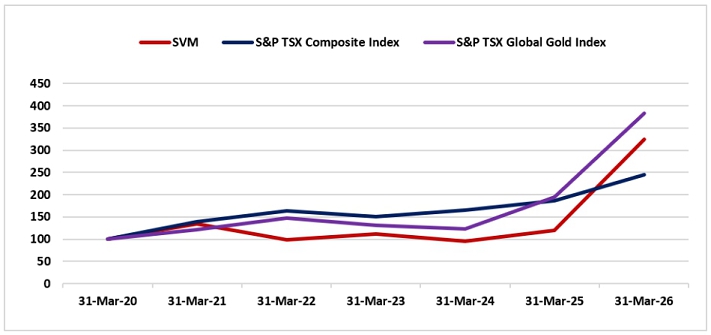

The Company takes into account overall share price performance in determining executive compensation amounts; however, share price performance is one of a number of factors, as discussed above, that the Company takes into consideration. Overall, the trend in total compensation for the NEOs has followed the trend in the share price, rising following increase in the share price, and declining when the share prices decline. Total compensation rises and falls in line with share prices in part because of the valuation of option-based awards and annual incentive plan payments. There is not a close correlation between the Company’s share price performance and the amount of base salaries, or consulting fees, (collectively “base pay”) paid to NEOs. While base pay generally increased during times when share price was increasing, total base pay has remained relatively stationary during the recent periods of declining share prices. In considering base pay for the CEO, the Compensation Committee gives particular weight to compensation paid to NEOs at the closest comparable companies, and is particularly cautious in recommending any reductions to base pay, recognizing the difficulty in finding English speaking senior management with experience in operating mines in China, or willing to spend the majority of their time in China.
Application of Executive Bonus Plan
The Compensation Committee concluded that the CEO’s personal performance and Company performance in fiscal 2026 were deserving of full marks.
| 32 |
Highlights of the evaluation included the following:
| · | Steady silver equivalent production: Produced approximately 6.8 million ounces of silver and 8,723 ounces of gold, or approximately 7.5 million ounces of silver equivalent; |
| · | Realized silver selling price of $46.44 per ounce after smelter deductions, increased 72% from $26.95 in Fiscal 2025; |
| · | Record annual revenue of $438.1 million, an increase of 47% over the year ended March 31, 2025 (“Fiscal 2025”), with silver representing 72% of the total revenue; |
| · | Cash cost per ounce of silver(net of by-product credits): negative $0.94, improved from negative $0.54 in Fiscal 2025; |
| · | AISC per ounce of silver (net of by-product credits): $14.25, 18% higher than $12.12 in Fiscal 2025, mainly due to higher government taxes linked to increased revenue and an increase in sustaining capital expenditures to increase mining capacity at Ying; |
| · | Adjusted EBITDA attributable to equity shareholders of $238.1 million, or $1.09 per share, compared to $132.2 million or $0.65 per share in Fiscal 2025; |
| · | Adjusted net income attributable to equity shareholders of $150.8 million, or $0.69 per share, after excluding non-cash or one-time items, compared to $75.1 million or $0.37 per share in Fiscal 2025; |
| · | Net loss attributable to equity shareholders of $9.9 million, or $0.05 per share, mainly due to a $178.5 million non-cash charge on “mark-to-market” of the fair value of the derivative liabilities primarily related to the convertible notes; |
| · | Cash flow from operating activities of $310.6 million, up $171.9 million, compared to $138.6 million in Fiscal 2025; |
| · | Capital expenditures: spent and capitalized $75.0 million on exploration, development, and equipment and facilities at the China operations and $49.4 million at the Ecuador operations for the development and construction of the El Domo mine and permitting activities for the Condor project; |
| · | Free cash flow of $181.3 million, up $122.5 million, compared to $58.8 million in Q4 Fiscal 2025; |
| · | Continued excellence in ESG practices: MSCI ESG rating improved from A to AA, placing the Company at a leading level within the industry; Sustainalytics risk score of 21.9, falling within the medium risk category, reflecting the Company’s effective ESG risk management. |
Bonus Pool Calculation for Fiscal 2026
A bonus pool equal to 2.5% of operating cash flow before changes in non-cash working capital may be available to NEOs, other corporate headquarter employees, and certain high-ranking managers at the mine operations. In Fiscal 2026, the available pool for bonus payment is $7.2 million. In Fiscal 2025, the available pool for bonus payment was $3.3 million and the total bonus payout was $2.3 million, below the 2.5% limit. In Fiscal 2024, the available pool for bonus payment was $2.2 million and the total bonus payout was $2.0 million, below the 2.5% limit.
Bonus Award in Fiscal 2026
Given the Company’s operating, financial and share price performance in Fiscal 2026 the Compensation Committee has recommended, and the Board of Directors concluded that the Fiscal 2026 bonus to the CEO is to be US$2,500,000, which is equal to 250.6% of his base salary paid in Fiscal 2026.
| 33 |
The Fiscal 2026 bonus is to be paid in Fiscal 2027 and will be reported as portion of the CEO’s compensation in Fiscal 2027.
The Compensation Committee will review and consider the CEO’s recommendation on the bonus for other officers.
COMPENSATION OF DIRECTORS
Independent members of the Board of Directors are compensated for acting as directors, and may be granted RSU’s pursuant to the policies of the TSX and the Company’s Omnibus Plan. The independent members of the Board of Directors may also be awarded non-equity incentive. The Board of Directors as a whole determines the RSUs and non-equity incentive for each director, after considering recommendation by the Compensation Committee.
The following table shows a breakdown of the fees payable to independent directors in fiscal 2026:
| Nature of Board duty | Amount (CAD$) |
| Annual retainer fee for each Independent Member of the Board | $100,000 |
| Additional annual retainer fee for lead independent director | $30,000 |
| Additional annual retainer fee for Chair of the Audit Committee | $25,000 |
| Additional annual retainer fee for Chair of the Compensation Committee | $20,000 |
|
Additional annual retainer fee for Chair of the Corporate Governance and Nominating Committee |
$20,000 |
| Additional annual retainer fee for Chair of the Sustainability Committee | $10,000 |
The table below sets forth the details of compensation provided to the directors, other than the NEOs (as defined above in this Information Circular) who are also directors, during the Company’s most recently completed financial year. Other than compensation paid to the NEOs (in their roles as such) who are also directors, and except as noted below, no compensation was paid to directors in their capacity as directors of the Company or its subsidiaries, or of a committee of the Board of Directors, or of its subsidiaries, or as consultants or experts, during the Company’s most recently completed financial year.
Director Compensation Table(1)
| Name | Fees earned(2) (US$) |
Share-based awards(3) (US$) |
Option-based awards US($) |
Non-equity incentive plan compensation(2) (US$) |
Pension value |
All other compensation (US$) |
Total (US$) |
| S. Paul Simpson | 123,010 | 91,715 | 16,390 | Nil | Nil | Nil | 231,115 |
| Yikang Liu | 72,359 | 91,715 | 16,390 | Nil | Nil | Nil | 180,464 |
| Marina Katusa | 79,595 | 91,715 | 16,390 | Nil | Nil | Nil | 187,700 |
| Ken Robertson | 90,449 | 91,715 | 16,390 | Nil | Nil | Nil | 198,554 |
| Helen Cai | 72,359 | 91,715 | 16,390 | Nil | Nil | Nil | 180,464 |
| Total | 437,772 | 458,575 | 81,950 | Nil | Nil | Nil | 978,297 |
| 34 |
Notes:
| (1) | Disclosure about compensation paid to Dr. Rui Feng in his capacity as director has already been disclosed above under the heading “Summary Compensation Table”. | |
| (2) | All director compensation is paid in Canadian dollars, and converted into U.S. dollars for reporting purposes using the average exchange rate for fiscal 2026 of $1.00 equalling CAD$1.3820. | |
| (3) | On April 10, 2025, the Company awarded stock options that vest over a three-year period with an exercise price of CAD$5.07 and RSUs that vest over a three-year period at a value of CAD$5.07 per unit. |
The following summarizes the information of options granted to directors in Fiscal 2026. No options were granted to directors in Fiscal 2024.
| Name | Fiscal year of Options Granted |
Grant Date | Options Granted |
Exercise price (CAD$) |
Expiry Date | Weighted average expected lives (years) |
Weighted average risk free rates |
Weighted
average volatilities |
Weighted average fair value per option (CAD$) |
| S. Paul Simpson | 2026 | 10/Apr/2025 | 14,000 | 5.07 | 10/Apr/2030 | 2.75 | 2.64% | 48.51% | 1.62 |
| 2025 | 1/Apr/2024 | 26,000 | 4.41 | 1/Apr/2029 | 2.75 | 4.03% | 47.97% | 1.46 | |
| 2024 | Nil | Nil | Nil | Nil | Nil | Nil | Nil | Nil | |
| Marina Katusa | 2026 | 10/Apr/2025 | 14,000 | 5.07 | 10/Apr/2030 | 2.75 | 2.64% | 48.51% | 1.62 |
| 2025 | 1/Apr/2024 | 26,000 | 4.41 | 1/Apr/2029 | 2.75 | 4.03% | 47.97% | 1.46 | |
| 2024 | Nil | Nil | Nil | Nil | Nil | Nil | Nil | Nil | |
| Yikang Liu | 2026 | 10/Apr/2025 | 14,000 | 5.07 | 10/Apr/2030 | 2.75 | 2.64% | 48.51% | 1.62 |
| 2025 | 1/Apr/2024 | 26,000 | 4.41 | 1/Apr/2029 | 2.75 | 4.03% | 47.97% | 1.46 | |
| 2024 | Nil | Nil | Nil | Nil | Nil | Nil | Nil | Nil | |
| Ken Robertson | 2026 | 10/Apr/2025 | 14,000 | 5.07 | 10/Apr/2030 | 2.75 | 2.64% | 48.51% | 1.62 |
| 2025 | 1/Apr/2024 | 26,000 | 4.41 | 1/Apr/2029 | 2.75 | 4.03% | 47.97% | 1.46 | |
| 2024 | Nil | Nil | Nil | Nil | Nil | Nil | Nil | Nil | |
| Helen Cai | 2026 | 10/Apr/2025 | 14,000 | 5.07 | 10/Apr/2030 | 2.75 | 2.64% | 48.51% | 1.62 |
| 2025 | 1/Apr/2024 | 26,000 | 4.41 | 1/Apr/2029 | 2.75 | 4.03% | 47.97% | 1.46 |
The Company grants Options and/or RSUs from time to time at the discretion of the Board to its directors, in accordance with the policies of the TSX, and the Omnibus Plan.
| 35 |
Outstanding Share-Based Awards and Option-Based Awards in Fiscal 2026
The following table summarizes awards outstanding at fiscal year ended March 31, 2026, for each non-executive director.
Name |
Option-Based Awards | Share-Based Awards | |||||
| Number
of Securities Underlying Unexercised Options |
Option Exercise Price (CAD$) |
Option
Expiration Date |
Value
of Unexercised In-The- Money Options (1) (CAD$) |
Number
of Shares or Units of Shares that have not Vested (#) |
Market
or Payout Value of Share- Based Awards that have not Vested (CAD$) |
Market
or Payout Value of Vested Share-Based Awards not Paid Out or Distributed (CAD$) | |
S. Paul Simpson
|
14,000 | 5.07 | 10-Apr-2030 | 138,460 | 37,500 | 561,000 | 421,363 |
| 26,000 | 4.41 | 01-Apr-2029 | 274,300 | ||||
| 30,000 | 3.93 | 26-Apr-2027 | 330,900 | ||||
Yikang Liu |
11,667 | 5.07 | 10-Apr-2030 | 115,387 | 37,500 | 561,000 | Nil |
| 13,000 | 4.41 | 01-Apr-2029 | 137,150 | ||||
Marina Katusa |
11,667 | 5.07 | 10-Apr-2030 | 115,387 | 37,500 | 561,000 | Nil |
| 13,000 | 4.41 | 01-Apr-2029 | 137,150 | ||||
| Ken Robertson | 14,000 | 5.07 | 10-Apr-2030 | 138,460 | 37,500 | 561,000 | $224,400 |
| 26,000 | 4.41 | 01-Apr-2029 | 274,300 | ||||
| 10,000 | 4.08 | 23-Feb-2028 | 108,800 | ||||
| Helen Cai | 14,000 | 5.07 | 10-Apr-2030 | 138,460 | 33,333 | 498,662 | Nil |
| 26,000 | 4.41 | 01-Apr-2029 | 274,300 | ||||
Note:
| (1) | The closing price of the Common Shares on the TSX on March 31, 2026 was CAD$14.96. |
Incentive Plan Awards – Value Vested or Earned during Fiscal 2026
| Name | Option-Based Awards – Value vested during the year (CAD$) | Share-Based Awards – Value vested during the year (CAD$) | Non-Equity Incentive Plan Compensation – Value earned during the year (CAD$) |
| Paul Simpson | 29,511 | - | - |
| Yikang Liu | 29,511 | 153,067 | - |
| Marina Katusa | 29,511 | 153,425 | - |
| Ken Robertson | 43,298 | 72,419 | - |
| Helen Cai | 25,061 | 73,084 | - |
Equity Compensation Plans
The only equity compensation plan which the Company has in place is the Omnibus Plan which was previously approved by the Shareholders on September 26, 2025.
Pursuant to the Omnibus Plan, the Company may issue options (“Options”), Restricted Share Units (“RSUs”) and Performance Share Units (“PSUs”), collectively, the (“Awards”). As of August 12, 2026, there were 741,574 Options outstanding (representing 0.34% of the Company’s issued and outstanding Shares), 2,492,085 RSUs outstanding (representing 1.13% of the Company’s issued and outstanding Shares). On August 12, 2026, a total of 18,886,971 Awards (representing 8.54% of the Company’s issued and outstanding Shares) were available for future issuance under the Omnibus Plan.
| 36 |
The Omnibus Plan has been established to attract and retain directors, officers, employees and consultants to the Company (each an “Eligible Person”), and to provide incentives for them to advance the interests of the Company by affording them with the opportunity to acquire an equity interest in the Company. Each such Eligible Person granted Awards pursuant to the Omnibus Plan, a “Participant”. The Omnibus Plan is administered by the Board and the Compensation Committee. The following is a description of the key terms of the Omnibus Plan, which is qualified in its entirety by reference to the full text of the Omnibus Plan.
| · | Maximum Number of Shares Issuable – The maximum number of shares (the “Shares”) issuable under the Omnibus Plan, together with the number of shares issuable under any other security-based compensation arrangements of the Company, shall not in the aggregate exceed 10% of the issued and outstanding shares of the Company, from time to time (the “Outstanding Issue”). In addition, no more than 3% of the Outstanding Issue, from time to time, may be granted in the form of Restricted Share Units and Performance Share Units. Any Shares reserved for issuance pursuant to an Award that has lapsed or terminated will thereupon no longer be in reserve and may once again be subject to an Award granted under the Omnibus Plan. Additionally, if any Award has been exercised, the number of Shares into which such Award was exercised will become available to be issued upon the exercise of Awards subsequently granted under the Omnibus Plan. |
| · | Plan Limits – When combined with all of the Company’s other security-based compensation arrangements, the Omnibus Plan shall not result in: |
| o | the number of Shares issuable to any one person at any time exceeding 5% of the Outstanding Issue; | |
| o | the number of Shares (i) issued to Insiders (as defined in the Omnibus Plan) within a one-year period, and (ii) issuable to Insiders at any time, exceeding 10% of the Outstanding Issue; | |
| o | the issuance to any one Insider and such Insider’s associates, within any one-year period, exceeding 5% of the Outstanding Issue; | |
| o | the issuance to consultants of the Company of a number of Shares exceeding 2% of the Outstanding Issue; or | |
| o | a number of Shares issuable to any one non-executive Directors within a one-year period exceeding an Award value of $150,000 per such non-executive Director, of which no more than $100,000 may comprise Options based on a generally accepted valuation method acceptable to the Board. |
Options
| · | Terms and Exercise Price – The number of Shares subject to each Option grant, the exercise price, vesting, expiry date and other terms and conditions thereof will be determined by the Board. The exercise price of each Option shall in no event be lower than the closing price of the Shares on the Toronto Stock Exchange (the “Market Price”) on the trading date prior to the grant date. |
| · | Term – Unless otherwise specified at the time of grant, Options shall expire 10 years from the date of grant, unless terminated earlier in accordance with the Omnibus Plan. |
| · | Vesting Schedule – Unless otherwise specified at the time of grant, Options vest and become exercisable in 25% increments on each of the 6-month, 12-month, 18-month, and 24-month anniversaries from the grant date. |
| · | Exercise of Options – A participant may exercise vested Options by (i) payment of the exercise price per Share subject to each Option, or (ii) if permitted by the Board, by undertaking a cashless exercise with the assistance of a broker (which may include authorizing the broker to sell Shares on the open market by means of a short sale and forward the proceeds of such short sale to the Company to satisfy the Option Price and any applicable tax withholdings), or (iii) if permitted by the Board, on a cashless basis by receiving that number of Shares equal to the current Market Price less the Option Price multiplied by the number of Options exercised as the numerator, divided by the current Market Price, as the denominator. |
| 37 |
| · | Termination of Employment – If a Participant ceases to be a director, officer, employee or consultant of the Company for any reason other than death, such director, officer, consultant or employee of the Company shall have such rights to exercise any vested Options not exercised prior to such termination within the lesser of a period of 90 calendar days after the date of termination, or the expiry date of the Option, or such shorter period as may be set out in the Participant’s Option Award Agreement. |
| · | Death – If a Participant dies prior to the expiry of his Option, his legal representatives may, within the lesser of one year from the date of the Participant's death or the expiry date of the Option, exercise that portion of all vested Options granted to the director, officer, employee or consultant of the Company under this Plan which remains outstanding. |
Restricted Share Units and Performance Share Units
| · | Terms – RSUs and PSUs are notional securities that entitle the recipient to receive cash or Shares at the end of a vesting period. The terms applicable to RSUs and PSUs under the Omnibus Plan (including the vesting schedule, performance cycle, performance criteria for vesting and whether dividend equivalents will be credited to a participant’s account) are determined by the Board at the time of the grant. |
| · | Vesting – Unless otherwise provided, RSUs typically vest on the second anniversary of the date the RSU was granted and shall be settled in accordance with the settlement provisions described below. Unless otherwise noted, PSUs shall vest as at the date that is the end of their specified performance cycle, subject to any performance criteria having been satisfied and shall be settled in accordance with the settlement provisions described below. Vesting of PSUs is contingent upon achieving certain performance criteria. |
| · | Settlement – On settlement, the Company shall, for each vested RSU or PSU being settled, deliver to a Participant either (a) one Share, (b) a cash payment equal to the Market Price of one Share as of the vesting date, or (c) any combination of cash and Shares equal to the Market Price of one Share as of the vesting date, at the discretion of the Board. |
| · | Dividend Equivalents – As dividends are declared, additional RSUs and PSUs may be credited to a Participant in an amount equal to the greatest whole number which may be obtained by dividing (i) the value of such dividend or distribution on the payment date therefor by (ii) the Market Price of one Share on such date. |
| · | Termination of Employment – If a director, officer, consultant or employee of the Company ceases to be so engaged by the Company for any reason other than death, all outstanding RSUs and PSUs that were vested on or before the date of the termination of employment or services of such Participant shall be settled in accordance with the applicable settlement provisions of the Omnibus Plan as of the date of termination, after which time the RSUs and PSUs shall in all respects terminate. |
| · | Death – If a Participant dies, all outstanding RSUs and PSUs that were vested on or before the date of death such Participant shall be settled in accordance with the applicable settlement provisions of the Omnibus Plan as of the date of death. Outstanding RSUs that were not vested on or before the date of death shall vest and be settled in accordance with the applicable settlement provisions of the Omnibus Plan as of the date of death, prorated to reflect the actual period between the grant date of the RSU and the date of death. Outstanding PSUs that were not vested on or before the date of death shall vest and be settled in accordance with the applicable settlement provisions of the Omnibus Plan as of the date of death, prorated to reflect the actual period between the commencement of the performance cycle and the date of death, based on the performance criteria for the applicable performance period(s) up to the date of death. Subject to the foregoing, any remaining RSUs and PSUs shall in all respects terminate as of the date of death. |
| 38 |
General
| · | Assignment – Except as may otherwise be specifically determined by the Board with respect to a particular Award, Awards granted under the Omnibus Plan are non-assignable and non-transferable other than by will or by the laws of descent and distribution. |
| · | Change of Control – In the event of a Change of Control (as defined in the Omnibus Plan), all unvested Awards then outstanding will, as applicable, be substituted by or replaced with awards of the surviving corporation (or any affiliate thereof) or the potential successor (or any affiliate thereto) (the “continuing entity”) on the same terms and conditions as the original Awards, subject to appropriate adjustments that do not diminish the value of the original Awards. If, upon a Change of Control, the continuing entity fails to comply with this requirement, the vesting of all then outstanding Awards (and, if applicable, the time during which such Awards may be exercised) will be accelerated in full. Additionally, in the event of a potential Change of Control, the Board will have the power, in its sole discretion, to modify the terms of the Omnibus Plan and/or the Awards to assist the Participants in tendering to a take-over bid or other transaction leading to a Change of Control (including to accelerate the vesting of Awards and to permit Participants to conditionally exercise their Awards). |
| · | Amendments Not Requiring Shareholder Approval – The Board may amend the Omnibus Plan or Awards at any time, provided, however, that no such amendment may adversely affect any Award previously granted to a Participant without the consent of the Participant, except to the extent required by applicable law (including TSX requirements). Any such amendment will be subject to all necessary regulatory approvals. Without limiting the generality of the foregoing, the Board may, without prior notice to the shareholders and without further shareholder approval, at any time and from time to time, amend the Plan or any provisions thereof, or the form of Award Agreement or instrument to be executed pursuant to the Plan, in such manner as the Board, in its sole discretion, determines appropriate: |
| o | for the purposes of making formal minor or technical modifications to any of the provisions of the Omnibus Plan; | |
| o | to correct any ambiguity, defective provisions, error or omission in the provisions of the Omnibus Plan; | |
| o | to change any vesting provisions of Awards; | |
| o | to change the termination provisions of the Awards or the Omnibus Plan; | |
| o | to change the persons who qualify as Eligible Persons under the Omnibus Plan; and | |
| o | to add or change provisions relating to any form of financial assistance provided by the Company to Participants that would facilitate the purchase of securities under the Omnibus Plan. |
| · | Amendments Requiring Shareholder Approval – Shareholder approval (or disinterested shareholder approval, if required by the policies of the TSX) will be required for the following types of amendments: |
| o | an increase in the number of Shares issuable under Awards granted pursuant to the Omnibus Plan; | |
| o | a reduction in the Option Price of an Option, or a cancellation and reissuance of an Option; | |
| o | an extension of (i) the term of an Option beyond its original expiry date, or (ii) the date on which a PSU or RSU will be forfeited or terminated in accordance with its terms, other than in accordance with the Omnibus Plan; | |
| o | a revision to the assignment provisions to permit Awards granted under the Plan to be transferable or assignable other than for estate settlement purposes; | |
| o | a revision to the insider participation limits or the non-executive director limits; | |
| o | a revision to the amending provisions; or | |
| o | any amendment required to be approved by shareholders of the Company under applicable law (including without limitation, pursuant to the policies of the TSX). |
| 39 |
| · | Black Out Periods – If the expiry date or vesting date of an Award (other than a PSU or RSU awarded to a Canadian resident) falls (i) during a self-imposed blackout period imposed under any insider trading policy or similar policy of the Company (a “Blackout Period”), or (ii) within two business days following the end of a Blackout Period, the expiry date or vesting date, as applicable, will be automatically extended for a period of ten business days after the earlier of the end of such Blackout Period, or, provided the Blackout Period has ended, the expiry date or vesting date of such Award. In the case of a RSU or PSU awarded to a Canadian resident, any settlement that is effected during a Blackout Period shall be settled in cash, notwithstanding any other provision of the Omnibus Plan. |
The following table sets out the annual burn rate for the three most recently completed financial years ending March 31.
| Fiscal Year | Number of options granted |
Weighted average number of shares outstanding |
% of Outstanding shares |
Number of Options exercised |
% of Outstanding shares |
| 2026 | 307,500 | 219,425,164 | 0.1% | 541,505.00 | 0.2% |
| 2025 | 2,096,721(1) | 204,008,035 | 1.0% | 934,222.00 | 0.5% |
| 2024 | Nil | 176,997,360 | Nil | - | 0.0% |
| Fiscal Year | Number of RSUs granted |
Weighted average number of shares outstanding |
% of Outstanding shares | Number of RSUs Settled |
% of Outstanding shares |
| 2026 | 1,210,500 | 219,425,164 | 0.55% | 1,262,831 | 0.6% |
| 2025 | 1,044,750 | 204,008,035 | 0.51% | 941,960 | 0.5% |
| 2024 | 1,056,000 | 176,997,360 | 0.60% | 928,755 | 0.5% |
Notes:
| (1) | This amount includes 1,766,721 Options that were issued as replacement Options pursuant to the Company’s acquisition of Adventus Mining Corporation. |
| 40 |
The following table sets out equity compensation plan information as at the end of the financial year ended March 31, 2026:
| (a) | (b) | (c) | |
| Plan Category | Number
of Securities to be Issued upon Exercise of Outstanding Options, Warrants and Rights |
Weighted-Average Exercise Price of Outstanding Options, Warrants and Rights (CAD$) |
Number
of Securities Remaining Available for Future Issuance under Equity Compensation Plans (excluding securities reflected in column (a)) |
Equity compensation plans approved by security holders |
Options: 809,274 Common Shares RSUs: 2,056,209 Common Shares |
$ 4.77 $0.00 |
14,654,490Common Shares 4,571,118 Common Shares |
Equity compensation plans not approved by security holders |
Nil | Nil | Nil |
| Total | 2,865,483 Common Shares | $4.27 | 19,225,608 Common Shares |
NORMAL COURSE ISSUER BID
In September 2025, the Board of Directors approved a share repurchase program pursuant to a normal course issuer bid to acquire up to 8,747,245 Common Shares of the Company, representing approximately 4% of the 218,681,127 common shares issued and outstanding as of September 8, 2025 (the “Share Repurchase Program”). The Company took this action to provide it with enhanced flexibility should market conditions result in Silvercorp’s shares being undervalued.
The Share Repurchase Program runs from September 19, 2025 to September 18, 2026. Purchases will be made at prevailing market prices, through the facilities of the TSX, the NYSE American, and alternative trading platforms in Canada and the United States, in compliance with regulatory requirements. All shares acquired thereunder were cancelled.
During the financial year ended March 31, 2026, the Company did not repurchase and cancel any Common Shares under the Share Repurchase Program.
Shareholders may obtain a copy of the Company’s Notice of Intention to Make a Normal Course Issuer Bid filed with the TSX, without charge, by contacting the Company at Suite 1750, 1066 West Hastings Street, Vancouver, British Columbia, V6E 3X1, Attention: Corporate Secretary.
Indebtedness of Directors, Executive Officers, and Senior Officers
No director or executive officer of the Company, no proposed nominee for election as a director of the Company, and no associate of any of the foregoing persons is or at any time since the beginning of the Company’s last financial year has been indebted to the Company or any of its subsidiaries or to any other entity which indebtedness is the subject of a guarantee, support agreement, letter of credit or other similar arrangement or understanding provided by the Company or any of its subsidiaries. There is no outstanding indebtedness owed by any current or former executive officers, directors or employees to the Company, or any of its subsidiaries, as at the date of the Information Circular.
| 41 |
Management Contracts
There are no management functions of the Company which are to any substantial degree performed by a person or company other than the directors or executive officers of the Company (or private companies controlled by them, either directly or indirectly).
Interest of Informed Persons in Material Transactions
No informed person of the Company, nominee for election as a director or any associate or affiliate of an informed person or nominee, had any material interest, direct or indirect, in any transaction since the commencement of the Company's most recently completed financial year or in any proposed transaction which has materially affected or would materially affect the Company or any of its subsidiaries. An “informed person” means: (a) a director or executive officer of the Company; (b) a director or executive officer of a person or company that is itself an informed person or subsidiary of the Company; (c) any person or company who beneficially owns, directly or indirectly, Common Shares or who exercises control or direction over Common Shares or a combination of both carrying more than 10% of the voting rights attached to the outstanding Common Shares other than Common Shares held by the person or company as underwriter in the course of a distribution; and (d) the Company itself if it has purchased, redeemed or otherwise acquired any of its Common Shares, for so long as, it holds any of its Common Shares.
Auditor
Deloitte LLP, Independent Registered Public Accounting Firm, of Vancouver, British Columbia, is the Company’s auditor. Deloitte LLP was appointed as auditor of the Company on November 26, 2012.
Additional Information
Additional information relating to the Company is available under the Company’s profile under SEDAR+ at www.sedarplus.ca.
Financial information regarding the Company and its affairs is provided in the Company’s audited annual consolidated financial statements and management’s discussion and analysis (“MD&A”) for its financial year ended March 31, 2026. Shareholders may contact the Company at the address set out on the face page of this Information Circular to request free copies of the Company’s financial statements and MD&A. Alternatively, they can be found under the Company’s profile on SEDAR+ at www.sedarplus.ca, and the Company’s website at https://silvercorpmetals.com.
| 42 |
Board Approval
The contents of this Information Circular have been approved and its mailing has been authorized by the directors of the Company.
Dated at Vancouver, British Columbia, this 12th day of August 2026
| BY ORDER OF THE BOARD OF DIRECTORS | |
| “Rui Feng” | |
| Dr. Rui Feng | |
| Chairman, CEO and Director | |
| Silvercorp Metals Inc. |
| 43 |
SCHEDULE “1”
PROPOSED AMENDMENTS TO ARTICLES
Incorporation Number : 414648
SILVERCORP METALS INC.
(the “Company”)
ARTICLES
| 1. | INTERPRETATION | 1 |
| 2. | SHARES AND SHARE CERTIFICATES | 1 |
| 3. | ISSUE OF SHARES | 3 |
| 4. | SECURITIES REGISTERS | 3 |
| 5. | SHARE TRANSFERS | 4 |
| 6. | TRANSMISSION OF SHARES | 5 |
| 7. | PURCHASE OF SHARES | 5 |
| 8. | BORROWING POWERS | 6 |
| 9. | ALTERATIONS | 6 |
| 10. | MEETINGS OF SHAREHOLDERS | 7 |
| 11 | PROCEEDINGS AT MEETINGS OF SHAREHOLDERS | 9 |
| 12 | VOTES OF SHAREHOLDERS | 12 |
| 13 | DIRECTORS | 16 |
| 14 | ELECTION AND REMOVAL OF DIRECTORS | 17 |
| 15 | ALTERNATE DIRECTORS | 19 |
| 16 | ADVANCE NOTICE POLICY | 20 |
| 17 | POWERS AND DUTIES OF DIRECTORS | 23 |
| 18 | DISCLOSURE OF INTEREST OF DIRECTORS | 23 |
| 19 | PROCEEDINGS OF DIRECTORS | 24 |
| 19 | EXECUTIVE AND OTHER COMMITTEES | 26 |
| 20 | OFFICERS | 28 |
| 21 | INDEMNIFICATION | 28 |
| 22 | DIVIDENDS | 29 |
| 23 | DOCUMENTS, RECORDS AND REPORTS | 31 |
| 24 | NOTICES | 31 |
| 25 | SEAL | 32 |
| 26 | PROHIBITIONS | 33 |
| 1. | INTERPRETATION |
| 1.1 | Definitions |
In these articles, unless the context otherwise requires:
| (1) | “board of directors”, “directors” and “board” mean the directors or sole director of the Company for the time being; |
| (2) | “Business Corporations Act” means the Business Corporations Act (British Columbia) from time to time in force and all amendments thereto and includes all regulations and amendments thereto made pursuant to the Act; |
| (3) | “clearing house” means a clearing house recognized by the laws of the jurisdiction in which the shares of the Company are listed or quoted on a stock exchange in such jurisdiction; |
| (4) |
| (5) |
| (6) | “Listing Rules” means the Rules Governing the Listing of Securities on The Stock Exchange of Hong Kong Limited; |
| (7) |
| (8) |
| 1.2 | Business Corporations Act and Interpretation Act Definitions Applicable |
The definitions in the Business Corporations Act and the definitions and rules of construction in the Interpretation Act, with the necessary changes, and unless the context requires otherwise, apply to these Articles as if the Articles were an enactment. If there is a conflict between a definition in the Business Corporations Act and a definition or rule in the Interpretation Act relating to a term in these Articles, the definition in the Business Corporations Act will prevail in relation to the use of the term in these Articles. If there is a conflict between these Articles and the Business Corporations Act, the Business Corporations Act will prevail
| 2. | SHARES AND SHARE CERTIFICATES |
| 2.1 | Authorized Share Structure |
The authorized share structure of the Company consists of shares of the class or classes and series, if any described in the Notice of Articles of the Company.
| 2.2 | Form of Share Certificate |
Each share certificate issued by the Company must comply with, and be signed as required by, the Business Corporations Act.
1
| 2.3 | Shareholder Entitled to Share Certificate or Acknowledgement |
Each shareholder is entitled, without charge, to (a) one share certificate representing the shares of each class or series of shares registered in the shareholder’s name or (b) a non-transferable written acknowledgement of the shareholder’s right to obtain such a share certificate, provided that in respect of a share held jointly by several persons, the Company is not bound to issue more than one share certificate and delivery of a share certificate or acknowledgment for a share to one of several joint shareholders or to one of the shareholders’ duly authorized agents will be sufficient for delivery to all.
| 2.4 | Delivery by Mail |
Any share certificate or non-transferable written acknowledgment of a shareholder’s right to obtain a share certificate may be by mail at the shareholder’s registered address and neither the Company nor any director, officer or agent of the Company is liable for any loss to the shareholder because the share certificate or acknowledgement is lost in the mail or stolen.
| 2.5 | Replacement of Worn Out or Defaced Share Certificate or Acknowledgement |
If the directors are satisfied that a share certificate or a non-transferable written acknowledgment of the shareholder’s right to obtain a share certificate is worn out or defaced, the director must, on production of the share certificate or acknowledgement, as the case may be, and on such other terms, if any, as the directors think fit:
| (1) | order the share certificate or acknowledgment, as the case may be, to be cancelled; and |
| (2) | issue a replacement share certificate or acknowledgement, as the case may be. |
| 2.6 | Replacement of Lost, Stolen or Destroyed Share Certificate or Acknowledgement |
If a share certificate or a non-transferable written acknowledgment of a shareholder’s right to obtain a share certificate is lost, stolen or destroyed, a replacement share certificate or acknowledgement, as the case may be, must be issued to the person entitled to that share certificate or acknowledgment, as the case may be, if the directors receive:
| (1) | proof satisfactory to the directors that the share certificate or acknowledgement is lost, stolen or destroyed; and |
| (2) | any indemnity the directors consider adequate. |
| 2.7 | Splitting Share Certificates |
If a shareholder surrenders a share certificate to the Company with a written request that the Company issue in the shareholder’s name two or more share certificates, each representing a specified number of shares and in the aggregate representing the same number of shares as the share certificate so surrendered, the Company must cancel the surrendered share certificate and issue replacement share certificates in accordance with that request.
| 2.8 | Share Certificate Fee |
There must be paid to the Company, in relation to the issue of any share certificate under Articles 2.5, 2.6 or 2.7, the amount, if any and which must not exceed the amount prescribed under the Business Corporations Act, determined by the directors.
| 2.9 | Recognition of Trusts |
Except as required by law or statute or these Articles, no person will be recognized by the Company as holding any share upon any trust, and the Company is not bound by or compelled in any way to recognize (even when having notice thereof) any equitable, contingent, future or partial interest in any share or fraction of a share or (except as by law or statute or these Articles provided or as ordered by a court of competent jurisdiction) any other rights in respect of any share except an absolute right to the entirety thereof in the shareholder.
2
| 3. | ISSUE OF SHARES |
| 3.1 | Directors Authorized |
Subject to the Business Corporations Act and the rights of the holders of issued shares of the Company, the Company may issue, allot, sell or otherwise dispose of the unissued shares, and issued shares held by the Company, at the times, to the persons, including directors, in the manner, on the terms and conditions and for the issue prices (including any premium at which shares with par value may be issued) that the directors may determine. The issue price for a share with par value must be equal to or greater than the par value of the share.
| 3.2 | Commissions and Discounts |
The Company may at any time, pay a reasonable commission or allow a reasonable discount to any person in consideration of that person purchasing or agreeing to purchase shares of the Company from the Company or any other person or procuring or agreeing to procure purchasers for shares of the Company.
| 3.3 | Brokerage |
The Company may pay such brokerage fee or other consideration as may be lawful for or in connection with the sale or placement of its securities.
| 3.4 | Conditions of Issue |
Except as provided for by the Business Corporations Act, no share may be issued until it is fully paid. A share is fully paid when:
| (1) | consideration is provided to the Company for the issue of the share by one or more of the following: |
| (a) | past services performed for the Company; |
| (b) | property; |
| (c) | money; and |
| (2) | the value of the consideration received by the Company equals or exceeds the issue price set for the share under Article 3.1. |
| 3.5 | Share Purchase Warrants and Rights |
Subject to the Business Corporations Act, the Company may issue share purchase warrants, options and rights upon such terms and conditions as the directors determine, which share purchase warrants, options and rights may be issued alone or in conjunction with debentures, debenture stock, bonds, shares or any other securities issued or created by the Company from time to time.
| 4. | SECURITIES REGISTERS |
| 4.1 | Central Securities Register |
As required
by and subject to the Business Corporations Act, the Company must maintain in British Columbia
a central securities register, which may be kept in electronic
form. The directors may, subject to the Business Corporations Act, appoint an agent to maintain the central securities register.
The directors may also appoint one or more agents, including the agent which keeps the central securities register, as transfer agent
for its shares or any class or series of its shares, as the case may be, and the same or another agent as registrar for its shares or
such class or series of its shares, as the case may be. The directors may terminate such appointment of any agent at any time and may
appoint another agent in its place.
3
| 4.2. | Closing Register |
The Company must not at any time close its central securities register.
| 4.3. | Branch Securities Registers |
The Company may maintain or cause to be maintained one or more branch securities registers. Any branch securities register shall be kept open for inspection by shareholders in accordance with all applicable laws of the jurisdiction in which such register is maintained and the rules and requirements of any applicable stock exchange.
| 5. | SHARE TRANSFERS |
| 5.1 | Registering Transfers |
A transfer of a share of the Company must not be registered unless:
| (1) | a duly signed instrument of transfer in respect of the share has been received by the Company; |
| (2) | if a share certificate has been issued by the Company in respect of the share to be transferred, that share certificate has been surrendered to the Company; and |
| (3) | if a non-transferable written acknowledgement of the shareholder’s right to obtain a share certificate has been issued by the Company in respect of the share to be transferred, that acknowledgement has been surrendered to the Company; |
| 5.2 | Form of Instrument of Transfer |
The instrument
of transfer in respect of any share of the Company must be either in the form, if any, on the back of the Company’s share certificates
or in any other form that may be approved by the directors from time to time.,
provided that such form of transfer must comply with the requirements of any stock exchange on which the securities of the Company are
then listed (including any requirement that, if the transferor or transferee is a clearing house (or its nominee(s)), such instrument
may be executed by hand, machine imprinted signature or such other means of execution as the directors may approve from time to time).
| 5.3 | Transferor Remains Shareholder |
Except to the extent that the Business Corporations Act otherwise provides, a transferor of shares is deemed to remain the holder of the shares until the name of the transferee is entered in a securities register of the Company in respect of the transfer.
| 5.4 | Signing of Instrument of Transfer |
If a shareholder, or his or her duly authorized attorney, signs an instrument of transfer in respect of shares registered in the name of the shareholder, the signed instrument of transfer constitutes a complete and sufficient authority to the Company and its directors, officers and agents to register the number of shares specified in the instrument of transfer or specified in any other manner, or, if no number is specified, all the shares represented by the share certificates or set out in the written acknowledgements deposited with the instrument of transfer:
| (1) | in the name of the person named as transferee in that instrument of transfer; or |
| (2) | if no person is named as transferee in that instrument of transfer, in the name of the person on whose behalf the instrument is deposited for the purpose of having the transfer registered. |
4
| 5.5 | Enquiry as to Title Not Required |
Neither the Company nor any director, officer or agent of the Company is bound to inquire into title of the person named in the instrument of transfer as transferee or, if no person is named as transferee in the instrument of transfer, of the person on whose behalf the instrument is deposited for the purpose of having the transfer registered or is liable for any claim related to registering the transfer by the shareholder or by any intermediate owner or holder of the shares, of any interest in the shares, of any share certificate representing such shares or of any written acknowledgement of a right to obtain a share certificate for such shares.
| 5.6 | Transfer Fee |
There must be paid to the Company, in relation to the registration of any transfer, the amount, if any, determined by the directors.
| 6. | TRANSMISSION OF SHARES |
| 6.1 | Legal Personal Representative Recognized on Death |
In the case of the death of a shareholder, the legal personal representative, or if the shareholder was a joint holder, the surviving joint holder, will be the only person recognized by the Company as having any title to the shareholder’s interest in the shares. Before recognizing a person as a legal personal representative, the director may require proof of appointment by a court of competent jurisdiction, a grant of letters probate, letters of administration or such other evidence or documents as the directors consider appropriate.
| 6.2 | Rights of Legal Personal Representative |
The legal personal representative of a shareholder has the same rights, privileges and obligations that attach to the shares held by the shareholder, including the right to transfer the shares in accordance with these Articles, provided the documents required by the Business Corporations Act and the directors have been deposited with the Company.
| 7. | PURCHASE OF SHARES |
| 7.1 | Company Authorized to Purchase Shares |
Subject to Article 7.2, the special rights and restrictions attached to the share of any class or series and the Business Corporations Act, the Company may, if authorized by the directors and/or shareholders in accordance with the Listing Rules, purchase or otherwise acquire any of its shares at the price and upon the terms specified in such resolution.
| 7.2 | Purchase When Insolvent |
The Company must not make a payment or provide any other consideration to purchase or otherwise acquire any of its shares if there are reasonable grounds for believing that:
| (1) | the Company is insolvent; or |
| (2) | making the payment or providing the consideration would render the Company insolvent. |
5
| 7.3 | Sale and Voting of Purchased Shares |
If the Company retains a share redeemed, purchased or otherwise acquired by it, the Company may sell, gift or otherwise dispose of the share, but, while such share is held by the Company, it:
| (1) | is not entitled to vote the share at a meeting of its shareholders; |
| (2) | must not pay a dividend in respect of the share; and |
| (3) | must not make any other distribution in respect of the share. |
| 8. | BORROWING POWERS |
The Company, if authorized by the directors, may:
| (1) | borrow money in the manner and amount, on the security, from the sources and on the terms and conditions that the directors consider appropriate; |
| (2) | issue bonds, debentures and other debt obligations either outright or as security for any liability or obligation of the Company or any other person and at such discounts or premiums and on such other terms as the directors consider appropriate; |
| (3) | guarantee the repayment of money by any other person or the performance of any obligation of any other person; and |
| (4) | mortgage, charge, whether by way of specific or floating charge, grant a security interest in, or give other security on, the whole or any part of the present and future assets and undertaking of the Company. |
| 9. | ALTERATIONS |
| 9.1 | Alteration of Authorized Share Structure |
Subject to
ArticleArticles
9.2 and 9.4 and the Business Corporations Act, the Company
may by ordinary resolution:
| (1) | create one or more classes or series of shares or, if none of the shares of a class or series of shares are allotted or issued, eliminate that class or series of shares; |
| (2) | increase, reduce or eliminate the maximum number of shares that the Company is authorized to issue out of any class or series of shares or establish a maximum number of shares that the Company is authorized to issue out of any class or series of shares for which no maximum is established; |
| (3) | subdivide or consolidate all or any of its unissued, or fully paid issued, shares; |
| (4) | if the Company is authorized to issue shares of a class of shares with par value: |
| (a) | decrease the par value of those shares; or |
| (b) | if none of the shares of that class of shares are allotted or issued, increase the par value of those shares; |
| (5) | change all or any of its unissued, or fully paid issued, shares with par value into shares without par value or any of its unissued shares without par value into shares with par value; |
| (6) | alter the identifying name of any of its shares; or |
| (7) | otherwise alter its shares or authorized share structure when required or permitted to do so by the Business Corporations Act. |
6
| 9.2 | Special Rights and Restrictions |
The Company may by special resolution:
| (1) | create special rights or restrictions for, and attach those special rights or restrictions to, the shares of any class or series of shares, whether or not any or all of those shares have been issued; or |
| (2) | vary or delete any special rights or restrictions attached to the shares of any class or series of shares, whether or not any or all of those shares have been issued. |
| 9.3 | Change of Name |
The Company may by ordinary resolution authorize an alteration of its Notice of Articles in order to change its name.
| 9.4 | Other Alterations |
If the Business
Corporations Act does not specify the type of resolution and these Articles do not specify another type of resolution, the Company
may by ordinaryspecial
resolution alter these Articles.
| 10. | MEETINGS OF SHAREHOLDERS |
| 10.1 | Annual General Meetings |
Unless an annual general meeting is deferred or waived in accordance with the Business Corporations Act, the Company must hold its first annual general meeting within 18 months after the date on which it was incorporated or otherwise recognized, and after that must hold an annual general meeting at least once in each calendar year and not more than 15 months after the last annual reference date at such time and place as may be determined by the directors.
| 10.2 | Resolution Instead of Annual General Meeting |
If all the shareholders who are entitled to vote at an annual general meeting consent by a unanimous resolution to all of the business that is required to be transacted at that annual general meeting, the annual general meeting is deemed to have been held on the date of the unanimous resolution. The shareholders must, in any unanimous resolution passed under this Article 10.2, select as the Company’s annual reference date, a date that would be appropriate for the holding of the applicable annual general meeting.
| 10.3 | Calling of Meetings of Shareholders |
The directors may, whenever the directors think fit, call a meeting of shareholders.
| 10.4 | Location of Meeting |
A general
meeting of the Company may be held anywhere in North America,
whether inside or outside of British Columbia, as determined by the directors.
| 10.5 | Notice of Meeting of Shareholders |
The Company must send notice of the date, time and location of any meeting of shareholders, in the manner provided in these Articles, or in such other manner, if any, as may be prescribed by ordinary resolution (whether previous notice of the resolution has been given or not), to each shareholder entitled to attend the meeting, to each director of the Company, unless these Articles otherwise provide, at least the following number of days before the meeting:
| (1) | if and for so long as the Company is a public company, twenty-one days; |
| (2) | otherwise, ten days. |
7
| 10.6 | Record Date for Notice |
The directors may set a date as the record date for the purpose of determining shareholders entitled to notice of any meeting of shareholders. The record date must not precede the date on which the meeting is to be held by more than two months or, in the case of a general meeting requisitioned by shareholders under the Business Corporations Act, by more than four months. The record date must not precede the date on which the meeting is held by fewer than:
| (1) | if and for so long as the Company is a public company, twenty-one days; |
| (2) | otherwise ten days. |
| 10.7 | Record Date for Voting |
The directors may set a date as the record date for the purpose of determining shareholders entitled to vote at any meeting of shareholders. The record date must not precede the date on which the meeting is to be held by more than two months, or , in the case of a general meeting requisitioned by shareholders under the Business Corporations Act, by more than four months. If no record date is set, the record date is 5:00 p.m. on the date immediately preceding the first date on which the notice is sent or, if no notice is sent, the beginning of the meeting.
| 10.8 | Failure to Give Notice and Waiver of Notice |
The accidental omission to send notice of any meeting of shareholders to, or the non-receipt of any notice by, any of the persons entitled to notice does not invalidate any proceedings at that meeting. Any persons entitled to notice of a meeting of shareholders may, in writing or otherwise, waive or reduce the period of notice of such meeting.
| 10.9 | Notice of Special Business at Meetings of Shareholders |
If a meeting of shareholders is to consider special business within the meaning of Article 11.1, the notice of meeting must:
| (1) | state the general nature of the special business; and |
| (2) | if the special business includes considering, approving, ratifying, adopting or authorizing any document or the signing of or giving of effect to any document, have attached to it a copy of the document or state that a copy of the document will be available for inspection by shareholders: |
| (a) | at the Company’s records office, or at such other reasonably accessible location in British Columbia as is specified in the notice; and |
| (b) | during statutory business hours on any one or more specified days before the day set for the holding of the meeting. |
| 10.10 | Electronic Meetings |
A
shareholderShareholder may participate in a meeting
of the shareholders in person or by telephone, if all shareholders participating intelephonic,
electronic or other communication facilities that permit all participants to speak and communicate adequately during the meeting,
whether and to vote in person or by telephone
or other communications medium, are able to communicate with each other and if all shareholders who wish to participate in the meeting
agree to such participationelectronic means. A shareholder
who participates in a meeting in a manner contemplated by this Article 10.10 is deemed for all purposes of the Business Corporations
Act and these Articles to be present at the meeting and to have agreed to participate in that manner,.
8
| 11 | PROCEEDINGS AT MEETINGS OF SHAREHOLDERS |
| 11.1 | Special Business |
At a meeting of shareholders, the following business is special business:
| (1) | at a meeting of shareholders that is not an annual general meeting, all business is special business except business relating to the conduct of or voting at the meeting; |
| (2) | at an annual general meeting, all business is special business except for the following: |
| (a) | business relating to the conduct of or voting at the meeting; |
| (b) | consideration of any financial statements of the Company presented to the meeting; |
| (c) | consideration of any reports of the directors or auditor; |
| (d) | the setting or changing of the number of directors; |
| (e) | the election or appointment of directors; |
| (f) | the appointment or removal of an auditor; |
| (g) | the setting of the remuneration of an auditor; |
| (h) | business arising out of a report of the directors not requiring the passing of a special resolution or an exceptional resolution; |
| (i) | any other business which, under these Articles or the Business Corporations Act, may be transacted at a meeting of shareholders without prior notice of the business being given to the shareholders. |
| 11.2 | Special Majority |
The majority
of votes required for the Company to pass a special resolution at a meeting of shareholders is two-thirds,
of the votes cast on the resolution.:
| (1) | in the case of a special resolution to (a) approve the voluntary liquidation or winding of the Company or (b) alter these Articles in accordance with Article 9.4, three-quarters of the votes cast on the resolution by shareholders entitled to attend and vote at the meeting; |
| (2) | in the case of a special resolution to vary or delete any special rights or restrictions attached to the shares of any class or series of shares, two-thirds of the votes cast on the resolution by shareholders entitled to attend and vote at the meeting (including three-quarters of the votes cast on the resolution by holders of such class or series of shares); and |
| (3) | in all other cases, two-thirds of the votes cast on the resolution by shareholders entitled to attend and vote at the meeting. |
9
| 11.3 | Quorum |
Subject to
the special rights and restrictions attached to the shares of any class or series of shares, the quorum for the transaction of business
at a meeting of shareholders is two persons who are, or represent by proxy, shareholders holding, in the aggregate, at least five percent
of the issued shares entitled to be voted at the meeting.;
provided that (a) if the shareholders will be asked to vote on a resolution to approve the voluntary liquidation or winding up of the
Company, the quorum in respect of such matter will be shareholders or proxyholders representing at least 30% percent of the shares entitled
to be voted at the meeting and (b) if the shareholders will be asked to vote on a resolution to vary or delete any special rights or restrictions
attached to the shares of any class or series of shares of the Company, the quorum in respect of such matter will be shareholders or proxyholders
who represent at least one-third of such class or series of shares. Every person present at a meeting of shareholders who is a shareholder
or proxy holder shall have the right to speak at such meeting.
| 11.4 | One Shareholder May Constitute Quorum |
If there is only one shareholder entitled to vote at a meeting of shareholders:
| (1) | the quorum is one person who is, or who represents by proxy, that shareholder, and |
| (2) | that shareholder, present in person or by proxy, may constitute the meeting. |
| 11.5 | Other Persons May Attend |
The directors, the president (if any), the secretary (if any), the assistant secretary (if any), the auditor of the Company and any other persons invited by the directors are entitled to attend any meeting of shareholders, but if any of those persons does attend a meeting of shareholders, that person is not to be counted in the quorum and is not entitled to vote at the meeting unless that person is a shareholder or proxy holder entitled to vote at the meeting.
| 11.6 | Requirement of Quorum |
No business, other than the election of a chair of the meeting and the adjournment of the meeting, may be transacted at any meeting of shareholders unless a quorum of shareholders entitled to vote is present at the commencement of the meeting, but such quorum need not be present throughout the meeting.
| 11.7 | Lack of Quorum |
If, within ½ hour from the time set for the holding of a meeting of shareholders, a quorum is not present:
| (1) | in the case of a general meeting requisitioned by shareholders, the meeting is dissolved, and |
| (2) | in the case of any other meeting of shareholders, the meeting stands adjourned to the same day in the next week at the same time and place. |
| 11.8 | Lack of Quorum at Succeeding Meeting |
If, at the meeting to which the meeting referred to in Article 11.8(2) was adjourned, a quorum is not present within ½ hour from the time set for the holding of the meeting, the person or persons present and being, or representing by proxy, one or more shareholders entitled to attend and vote at the meeting constitute a quorum.
| 11.9 | Chair |
The following individual is entitled to preside as chair at a meeting of shareholders:
| (1) | the chair of the board, if any; or |
| (2) | if the chair of the board is absent or unwilling to act as chair of the meeting, the president, if any. |
10
| 11.10 | Selection of Alternate Chair |
If, at any meeting of shareholders, there is no chair of the board or president present within fifteen minutes after the time set for holding the meeting, or if the chair of the board and the president have advised the secretary, if any, or any director present at the meeting, that the chair of the board and the president will not be present at the meeting, the directors present must choose one of their number to be chair of the meeting or if all of the directors present decline to take the chair or fail to so choose or if no director is present, the shareholders entitled to vote at the meeting who are present in person or by proxy may choose any person present at the meeting to chair the meeting.
| 11.11 | Adjournments |
The chair of a meeting of shareholders may, and if so directed by the meeting must, adjourn the meeting from time to time and from place to place, but no business may be transacted at any adjourned meeting other than the business left unfinished at the meeting from which the adjournment took place.
| 11.12 | Notice of Adjourned Meeting |
It is not necessary to give any notice of an adjourned meeting or of the business to be transacted at an adjourned meeting of shareholders except that, when a meeting is adjourned for thirty days or more, notice of the adjourned meeting must be given as in the case of the original meeting.
| 11.13 | Decision by Show of Hands or Poll |
Every motion put to a vote at a meeting of shareholders will be decided on a show of hand unless a poll, before or on the declaration of the result of the vote by show of hands, is directed by the chair or demanded by at least one shareholder entitled to vote who is present in person or by proxy.
| 11.14 | Declaration of Result |
The chair of a meeting of shareholders must declare to the meeting the decision on every question in accordance with the result of the show of hands or the poll, as the case may be, and that decision must be entered in the minutes of the meeting. A declaration of the chair that a resolution is carried by the necessary majority or is defeated is, unless a poll is directed by the chair or demanded under Article 11.13, conclusive evidence without proof of the number or proportion of the votes recorded in favour of or against the resolution.
| 11.15 | Motion Need Not be Seconded |
No motion proposed at a meeting of shareholders need be seconded unless the chair of the meeting rules otherwise, and the chair of any meeting of shareholders is entitled to propose or second a motion.
| 11.16 | Casting Vote |
In case of an equality of votes, the chair of a meeting of shareholders does not, either on a show of hands or on a poll, have a second or casting vote in addition to the vote or votes to which the chair may be entitled as a shareholder.
| 11.17 | Manner of Taking Poll |
Subject to Article 11.19, if a poll is duly demanded at a meeting of shareholders:
| (1) | the poll must be taken: |
| (a) | at the meeting, or within seven days after the date of the meeting, as the chair of the meeting directs; and |
| (b) | in the manner, at the time and at the place that the chair of the meeting directs. |
11
| (2) | the result of the poll is deemed to be the decision of the meeting at which the poll is demanded; and |
| (3) | the demand for the poll may be withdrawn by the person who demanded it. |
| 11.18 | Demand for Poll on Adjournment |
A poll demanded at a meeting of shareholders on a question of adjournment must be taken immediately at the meeting.
| 11.19 | Chair Must Resolve Dispute |
In the case of any dispute as to the admission or rejection of a vote given on a poll, the chair of a meeting of the shareholders must determine the dispute, and his or her determination made in good faith is final and conclusive.
| 11.20 | Casting of Votes |
On a poll, a shareholder is not entitled to more than one vote by which a chair of a meeting of shareholders is elected.
| 11.21 | Poll not Available in respect of Election of Chair |
No poll may be demanded in respect of the vote by which a chair of a meeting of shareholders is elected.
| 11.22 | Demand for Poll Not to Prevent Continuance of Meeting |
The demand for a poll at a meeting of shareholders does not, unless the chair of the meeting so rules, prevent the continuation of a meeting for the transaction of any business other than the question on which a poll has been demanded.
| 11.23 | Retention of Ballots and Proxies |
The Company must, for at least three months after a meeting of shareholders, keep each ballot cast on a poll and each proxy at the meeting, and, during that period, make such ballots and proxies available for inspection during normal business hours by any shareholder or proxyholder entitled to vote at the meeting. At the end of such three-month period, the Company may destroy such ballots and proxies.
| 12 | VOTES OF SHAREHOLDERS |
| 12.1 | Number of Votes by Shareholder or by Shares |
Subject to any special rights or restrictions attached to any shares and to the restrictions imposed on joint shareholders under Article 12.3:
| (1) | on a vote by show of hands, every person present who is a shareholder or proxy holder and entitled to vote on the matter has one vote; and |
| (2) | on a poll, every shareholder entitled to vote on the matter has one vote in respect of each share entitled to be voted on the matter and held by that shareholder and may exercise that vote either in person or by proxy. |
| 12.2 | Votes of Persons in Representative Capacity |
A person who is not a shareholder may vote at a meeting of shareholders, whether on a show of hands or on a poll, and may appoint a proxy holder to act at the meeting, if, before doing so, the person satisfies the chair of the meeting, or the directors, that the person is a legal personal representative or a trustee in bankruptcy for a shareholder who is entitled to vote at the meeting.
12
| 12.3 | Votes by Joint Holders |
If there are joint shareholders registered in respect of any share:
| (1) | any one of the joint shareholders may vote at any meeting of shareholders, either personally or by proxy, in respect of the share as if that joint shareholder were solely entitled to it; or |
| (2) | if more than one of the joint shareholders is present at any meeting of shareholders, personally or by proxy, and more than one of the joint shareholders votes in respect of that share, then only the vote of the joint shareholder present whose name stands first in the central securities register in respect of the share will be counted. |
| 12.4 | Legal Personal Representatives as Joint Shareholders |
Two or more legal personal representatives of a shareholder in whose sole name any share is registered are, for the purposes of Article 12.3, deemed to be joint shareholders.
| 12.5 | Representative of a Corporate Shareholder |
If a
corporation, that is not a subsidiary of the Company, is a shareholder, that
(including a clearing house) is a corporation or
other corporate entity, such shareholder may appoint a personone
or more persons to act as its representative at any meeting of shareholders of the Company, and:
| (1) | for that purpose, the instrument appointing a representative must: |
| be received at the registered office of the Company or at any other place specified, in the notice calling the meeting, for the receipt
of proxies, at least the number of business days specified in the notice for the receipt of proxies, or if no number of days is specified,
two business days before the day set for the holding of the meeting | ||
| (b) | if the shareholder appoints more than one representative to act on its behalf at the meeting, specify the number and class of shares in respect of which such representative is authorized to act. |
| (2) | if a representative is appointed under this Article 12.5: |
| (a) | the representative is entitled to exercise in respect of and at that meeting the same rights on behalf of the corporation that the
representative represents as that corporation could exercise if it were a shareholder who is an individual, including, without limitation,
the right to appoint a proxy holder; |
| (b) | the representative, if present at the meeting, is to be counted for the purpose of forming a quorum and is deemed to be a shareholder
present in person at the meeting |
| (c) | in the case a clearing house, such representative shall be exempt from any requirement to provide proof of shareholding, notarized authorization instruments or further evidence of due authorization. |
Evidence of the appointment of any such representative may be sent to the Company by written instrument, fax or any other method of transmitting legibly recorded messages.
| 12.6 | Proxy Provisions do not Apply to Public Companies |
| (1) | Articles 12.7 to 12.15 do not apply to the Company if and for so long as it is a public company or pre-existing reporting company which has the Statutory Reporting Company Provisions as part of its articles or to which the Statutory Reporting Company Provisions apply. |
13
| (2) | Notwithstanding anything to the contrary contained in this Article 12, if and for so long as the Company is a public company that has securities listed on the facilities of a stock exchange, (a) every shareholder shall be entitled to appoint a proxy holder to attend and vote at any meeting of shareholders, which proxy holder shall not be required to be a shareholder of the Company, and any shareholder that is a corporate entity shall be entitled to appoint a representative to attend and vote at any meeting of the shareholders and, where a corporate entity is so represented, such corporate entity shall be treated as being present at the meeting in person and (b) a shareholder that is a corporate entity may execute a form of proxy under the hand of a duly authorised officer. |
| 12.7 | Appointment of Proxy Holders |
Every shareholder
of the Company, including a corporation that is a shareholder but not a subsidiary of the Company,
entitled to vote at a meeting of shareholders of the Company may, by proxy,,
including a shareholder that is a corporation or a clearing house that holds shares on behalf of a beneficial owner, may appoint
one or more (but not more than five) proxy holders to attend and act at the meeting on
behalf of such shareholder in the manner, to the extent and with the powers conferred by the proxy provided
that, if more than one person is so authorized, the proxy must specify the number and class of shares in respect of which each such person
is so appointed.
| 12.8 | Alternate Proxy Holders |
A shareholder may appoint one or more proxy holders to act in the place of an absent proxy holder.
| 12.9 | When Proxy Holder Need Not be Shareholder |
A person must not be appointed as proxy holder unless the person is a shareholder, although a person who is not a shareholder may be appointed as a proxy holder if:
| (1) | the person appointing the proxy holder is a corporation or a representative of a corporation appointed under Article 12.5; |
| (2) | the Company has at the time of the meeting for which the proxy holder is to be appointed only one shareholder entitled to vote at the meeting; or |
| (3) | the shareholders present in person or by proxy at and entitled to vote at the meeting for which the proxy holder is to be appointed, by a resolution on which the proxy holder is not entitled to vote but in respect of which the proxy holder is to be counted in the quorum, permit the proxy holder to attend and vote at the meeting. |
| 12.10 | Deposit of Proxy |
A proxy for a meeting of shareholders must:
| (1) | be received at the registered office of the Company or at any other place specified, in the notice calling the meeting, for the receipt of proxies, at least the number of business days specified in the notice, or if no number of days is specified, two business days before the day set for the holding of the meeting; or |
| (2) | unless the notice provides otherwise, be provided, at the meeting, to the chair of the meeting or to a person designated by the chair of the meeting. |
A proxy may be sent to the Company by written instrument, fax or any other method of transmitting legibly recorded messages.
14
| 12.11 | Validity of Proxy Vote |
A vote given in accordance with the terms of a proxy is valid notwithstanding the death or incapacity of the shareholder giving the proxy and despite the revocation of the proxy or the revocation of the authority under which the proxy is given, unless notice in writing of that death, incapacity or revocation is received:
| (1) | at the registered office of the Company, at any time up to and including the last business day before the day set for the holding of the meeting at which the proxy is to be used; or |
| (2) | by the chair of the meeting, before the vote is taken. |
| 12.12 | Form of Proxy |
A proxy, whether for a specified meeting or otherwise, must be either in the following form or in any other form approved by the directors or the chair of the meeting:
[name of the company]
(the “Company”)
The undersigned, being a shareholder of the Company, hereby appoint [name] or, failing that person, [name], as proxy holder for the undersigned to attend, act and vote for and on behalf of the undersigned at the meeting of shareholders of the Company to be held on [month, day, year] and at any adjournment of that meeting.
Number of shares in respect of which this proxy is given (if no number is specified, then this proxy if given in respect of all shares registered in the name of the shareholder):
Signed [month, day, year]
| Signature of shareholder | ||
| Name of shareholder – [printed] |
| 12.13 | Revocation of Proxy |
Subject to Article 12.14, every proxy may be revoked by an instrument in writing that is:
| (1) | received at the registered office of the Company at any time up to and including the last business day before the day set for the holding of the meeting at which the proxy is to be used; or |
| (2) | provided, at the meeting, to the chair of the meeting. |
| 12.14 | Revocation of Proxy Must be Signed |
An instrument referred to in Article 12.13 must be signed as follows:
| (1) | if the shareholder for whom the proxy holder is appointed is an individual, the instrument must be signed by the shareholder or his or her legal personal representative or trustee in bankruptcy; |
| (2) | if the shareholder for whom the proxy holder is appointed is a corporation, the instrument must be signed by the corporation or by a representative appointed for the corporation under Article 12.5. |
15
| 12.15 | Production of Evidence of Authority to Vote |
The chair of any meeting of shareholders may, but need not, inquire into the authority of any person to vote at the meeting and may, but need not, demand from that person production of evidence as to the existence of the authority to vote.
| 13 | DIRECTORS |
| 13.1 | First Directors; Number of Directors |
The first directors are the persons designated as directors of the Company in the Notice of Articles that applies to the Company when it is recognized under the Business Corporations Act. The number of directors, excluding additional directors appointed under Article 14.8, is set at:
| (1) | subject to paragraphs (2) and (3), the number of directors that is equal to the number of the Company’s first directors; |
| (2) | if the Company is a public company, the greater of three and the most recently set of: |
| (a) | the number of directors set by ordinary resolution (whether or not previous notice of the resolution was given); and |
| (b) | the number of directors set under Article 14.4; |
| (3) | if the Company is not a public company, the most recently set of: |
| (a) | the number of directors set by ordinary resolution (whether or not previous notice of the resolution was given); and |
| (b) | the number of directors set under Article 14.4; |
| 13.2 | Change in Number of Directors |
If the number of directors is set under Articles 13.1(2)(a) or 13.1(3)(a):
| (1) | the shareholders may elect or appoint the directors needed to fill any vacancies in the board of directors up to that number; |
| (2) | if the shareholders do not elect or appoint the directors needed to fill any vacancies in the board of directors up to that number contemporaneously with the setting of that number, then the directors may appoint, or the shareholders may elect or appoint, directors to fill those vacancies. |
| 13.3 | Directors’ Acts Valid Despite Vacancy |
An act or proceeding of the directors is not invalid merely because fewer than the number of directors set or otherwise required under these Articles is in office.
| 13.4 | Qualifications of Directors |
A director is not required to hold a share in the capital of the Company as qualification for his or her office but must be qualified as required by the Business Corporations Act to become, act or continue to act as a director.
16
| 13.5 | Remuneration of Directors |
The directors are entitled to the remuneration for acting as directors, if any, as the directors may from time to time determine. If the directors so decide, the remuneration of the directors, if any, will be determined by the shareholders. That remuneration may be in addition to any salary or other remuneration paid to any officer or employee of the Company as such, who is also a director.
| 13.6 | Reimbursement of Expenses of Directors |
The Company must reimburse each director for the reasonable expenses that he or she may incur in and about the business of the Company.
| 13.7 | Special Remuneration for Directors |
If any director performs any professional or other services for the Company that in the opinion of the directors are outside the ordinary duties of a director, or if any director is otherwise specially occupied in or about the Company’s business, he or she may be paid remuneration fixed by the directors, or, at the option of that director, fixed by ordinary resolution, and such remuneration may be either in addition to, or in substitution for, any other remuneration that he or she may be entitled to receive.
| 13.8 | Gratuity, Pension or Allowance on Retirement of Director |
Unless otherwise determined by ordinary resolution, the directors on behalf of the Company may pay a gratuity or pension or allowance on retirement to any director who held any salaried office or place of profit with the Company or to his or her spouse or dependants and may make contributions to any fund and pay premium for the purchase or provision of any such gratuity, pension or allowance.
| 14 | ELECTION AND REMOVAL OF DIRECTORS |
| 14.1 | Election at Annual General Meeting |
At every annual general meeting and in every unanimous resolution contemplated by Article 10.2:
| (1) | the shareholders entitled to vote at the annual general meeting for the election of directors must elect, or in the unanimous resolution appoint, a board of directors consisting of the number of directors for the time being set under these Articles; and |
| (2) | all the directors cease to hold office immediately before the election or appointment of directors under paragraph (1), but are eligible for re-election or re-appointment. |
| 14.2 | Consent to be a Director |
No election, appointment or designation of an individual as a director is valid unless:
| (1) | that individual consents to be a director in the manner provided for in the Business Corporations Act; |
| (2) | that individual is elected or appointed at a meeting at which the individual does not refuse, at the meeting, to be a director; or |
| (3) | with respect to first directors, the designation is otherwise valid under the Business Corporations Act. |
17
| 14.3 | Failure to Elect or Appoint Directors |
If:
| (1) | the Company fails to hold an annual general meeting, and all the shareholders who are entitled to vote at an annual general meeting fail to pass the unanimous resolution contemplated by Article 10.2, on or before the date by which the annual general meeting is required to be held under the Business Corporations Act; or |
| (2) | the shareholders fail, at the annual general meeting or in the unanimous resolution contemplated by Article 10.2, to elect or appoint any directors. |
then each of the directors then in office continues to hold office until the earlier of:
| (3) | the date on which his or her successor is elected or appointed; and |
| (4) | the date on which he or she otherwise ceases to hold office under the Business Corporations Act or these Articles. |
| 14.4 | Places of Retiring Directors Not Filled |
If, at any meeting of shareholders at which there should be an election of directors, the places of any of the retiring directors are not filled by that election, those retiring directors who are not reelected and who are asked by the newly elected directors to continue in office will, if willing to do so, continue in office to complete the number of directors for the time being set pursuant to these Articles until further new directors are elected at a meeting of shareholders convened for that purpose. If any such election or continuance of directors does not result in the election or continuance of the number of directors for the time being set pursuant to these Article, the number of directors of the Company is deemed to be set at the number of directors actually elected or continued in office.
| 14.5 | Directors May Fill Casual Vacancies |
Any casual vacancy occurring in the board of directors may be filled by the directors.
| 14.6 | Remaining Directors Power to Act |
The directors may act notwithstanding any vacancy in the board of directors, but if the Company has fewer directors in office than the number set pursuant to these Articles as the quorum of directors, the directors may only act for the purpose of appointing directors up to that number or of summoning a meeting of shareholders for the purpose of filling any vacancies on the board of directors or, subject to the Business Corporations Act, for any other purpose.
| 14.7 | Shareholders May Fill Vacancies |
If the Company has no directors or fewer directors in office than the number set pursuant to these Articles as the quorum of directors, the shareholders may elect or appoint directors to fill any vacancies on the board of directors.
| 14.8 | Additional Directors |
Notwithstanding Article 13.1 and 13.2, between annual general meetings or unanimous resolutions, contemplated by Article 10.2, the directors may appoint one or more additional directors, but the number of additional directors appointed under this Article 14.8 must not at any time exceed:
| (1) | one-third of the number of first directors, if, at the time of the appointments, one or more of the first directors have not yet completed their first term of office; or |
| (2) | in any other case, one-third of the number of the current directors who were elected or appointed as directors other than pursuant to this Article 14.8. |
18
Any director so appointed ceases to hold office immediately before the next election or appointment of directors under Article 14.1(1), but is eligible for re-election or re-appointment.
| 14.9 | Ceasing to be a Director |
A director ceases to be a director when:
| (1) | the term of office of the director expires; |
| (2) | the director dies; |
| (3) | the director resigns as a director by notice in writing provided to the Company or a lawyer for the Company; or |
| (4) | the director is removed from office pursuant to Articles 14.10 or 14.11. |
| 14.10 | Removal of Director by Shareholders |
The Company may remove any director before the expiration of his or her term of office by ordinary resolution. In that event, the shareholders may elect, or appoint by ordinary resolution, a director to fill the resulting vacancy. If the shareholders do not elect or appoint a director to fill the resulting vacancy contemporaneously with the removal, then the directors may appoint or the shareholders may elect, or appoint by ordinary resolution, a director to fill that vacancy.
| 14.11 | Removal of Director by Directors |
The directors may remove any director before the expiration of his or her term of office if the director is convicted of an indictable offence, or if the director ceases to be qualified to act as a director of a company and does not promptly resign, and the directors may appoint a director to fill the resulting vacancy.
| 15 | ALTERNATE DIRECTORS |
| 15.1 | Appointment of Alternate Director |
Any director (an “appointor”) may by notice in writing received by the Company appoint any person (an “appointee”) who is qualified to act as a director to be his or her alternate to act in his or her place at meetings of the directors or committees of the directors at which the appointor is not present unless (in the case of an appointee who is not a director) the directors have reasonably disapproved the appointment of such person as an alternate director and have given notice to that effect to his or her appointor within a reasonable time after the notice of appointment is received by the Company.
| 15.2 | Notice of Meetings |
Every alternate director so appointed is entitled to notice of meetings of the directors and of committees of the directors of which his or her appointor is a member and to attend and vote as a director at any such meetings at which his or her appointor is not present.
| 15.3 | Alternate for More than One Director Attending Meetings |
A person may be appointed as an alternate director by more than one director, and an alternate director:
| (1) | will be counted in determining the quorum for a meeting of directors once for each of his or her appointors and, in the case of an appointee who is also a director, once more in that capacity; |
19
| (2) | has a separate vote at a meeting of directors for each of his or her appointors and, in the case of an appointee who is also a director, an additional vote in that capacity; |
| (3) | will be counted in determining the quorum for a meeting of a committee of directors once for each of his or her appointors who is a member of that committee and, in the case of an appointee who is also a member of that committee as a director, once more in that capacity; |
| (4) | has a separate vote at a meeting of a committee of directors for each of his or her appointors who is a member of that committee and, in the case of an appointee who is also a member of that committee as a director, an additional vote in that capacity. |
| 15.4 | Consent Resolutions |
Every alternate director, if authorized by the notice appointing him or her, may sign in place of his or her appointor any resolutions to be consented to in writing.
| 15.5 | Alternate Director Not an Agent |
Every alternate director is deemed not to be the agent of his or her appointor.
| 15.6 | Revocation of Appointment of Alternate Director |
An appointor may at any time, by notice in writing received by the Company, revoke the appointment of an alternate director appointed by him or her.
| 15.7 | Ceasing to be an Alternate Director |
The appointment of an alternate director ceases when:
| (1) | his or her appointor ceases to be a director and is not promptly re-elected or re-appointed; |
| (2) | the alternate director dies; |
| (3) | the alternate director resigns as an alternate director by notice in writing provided to the Company or a lawyer for the Company; |
| (4) | the alternate director ceases to be qualified to act as a director; or |
| (5) | his or her appointor revokes the appointment of the alternate director. |
| 15.8 | Remuneration of Expenses of Alternate Director |
The Company may reimburse an alternate director for the reasonable expenses that would be properly reimbursed if he or she were a director, and the alternate director is entitled to receive from the Company, such proportion, if any, of the remuneration otherwise payable to the appointor as the appointor may from time to time direct.
| 16 | ADVANCE NOTICE POLICY |
Background
The Company is committed to: (i) facilitating an orderly and efficient annual general or, where the need arises, special meeting, process; (ii) ensuring that all shareholders receive adequate notice of the director nominations and sufficient information with respect to all nominees; and (iii) allowing shareholders to register an informed vote having been afforded reasonable time for appropriate deliberation.
20
The purpose of this Advance Notice Policy (the "Policy") is to provide shareholders, directors and management of the Company with a clear framework for nominating directors. This Policy fixes a deadline by which holders of record of common shares of the Company must submit director nominations to the Company prior to any annual or special meeting of shareholders and sets forth the information that a shareholder must include in the notice to the Company for the notice to be in proper written form in order for any director nominee to be eligible for election at any annual or special meeting of shareholders.
It is the position of the Company that this Policy is in the best interests of the Company, its shareholders and other stakeholders. This policy will be subject to an annual review, and will reflect changes as required by securities regulatory agencies or stock exchanges, or so as to meet industry standards.
Nominations of directors
1. Only persons who are nominated in accordance with the following procedures shall be eligible for election as directors of the Company. Nominations of persons for election to the board of directors of the Company (the "Board") may be made at any annual meeting of shareholders, or at any special meeting of shareholders if one of the purposes for which the special meeting was called was the election of directors:
a. by or at the direction of the Board, including pursuant to a notice of meeting;
b. by or at the direction or request of one or more shareholders pursuant to a "proposal" made in accordance with Division 7 of the British Columbia Business Corporations Act (the "BCBCA"), or a requisition of the shareholders made in accordance with section 167 of the Act; or
c. by any person (a "Nominating Shareholder"):
(A) who, at the close of business on the date of the giving by the Nominating Shareholder of the notice provided for below in this Policy and at the close of business on the record date for notice of such meeting, is entered in the securities register of the Company as a holder of one or more shares carrying the right to vote at such meeting or who beneficially owns shares that are entitled to be voted at such meeting; and
(B) who complies with the notice procedures set forth below in this Policy.
2. In addition to any other requirements under applicable laws, for a nomination to be made by a Nominating Shareholder, the Nominating Shareholder must have given notice thereof that is both timely (in accordance with paragraph 3 below) and in proper written form (in accordance with paragraph 4 below) to the Secretary of the Company at the principal executive offices of the Company.
3. To be timely, a Nominating Shareholder’s notice to the Secretary of the Company must be made:
a. in the case of an annual meeting of shareholders, not less than 30 nor more than 65 days prior to the date of the annual meeting of shareholders; provided, however, that in the event that the annual meeting of shareholders is to be held on a date that is less than 50 days after the date (the "Notice Date") on which the first public announcement of the date of the annual meeting was made, notice by the Nominating Shareholder may be made not later than the close of business on the tenth day following the Notice Date; and
b. in the case of a special meeting (which is not also an annual meeting) of shareholders called for the purpose of electing directors (whether or not called for other purposes), not later than the close of business on the fifteenth day following the day on which the first public announcement of the date of the special meeting of shareholders was made.
The time periods for the giving of a Nominating Shareholder’s notice set forth above shall in all cases be determined based on the original date of the applicable annual meeting or special meeting of shareholders, and in no event shall any adjournment or postponement of a meeting of shareholders or the announcement thereof commence a new time period for the giving of such notice.
21
4. To be in proper written form, a Nominating Shareholder’s notice to the Secretary of the Company must set forth:
a. as to each person whom the Nominating Shareholder proposes to nominate for election as a director:
(A) the name, age, business address and residential address of the person;
(B) the principal occupation or employment of the person;
(C) the citizenship of such person;
(D) the class or series and number of shares in the capital of the Company which are controlled or which are owned beneficially or of record by the person as of the record date for the meeting of shareholders (if such date shall then have been made publicly available and shall have occurred) and as of the date of such notice; and
(E)
any other information relating to the person that would be required to be disclosed in a dissident’s proxy circular in connection
with solicitations of proxies for election of directors pursuant to the Act and,
Applicable Securities Laws (as defined below) and the rules and requirements
of any applicable stock exchange (including, if applicable, the Listing Rules); and
b.
as to the Nominating Shareholder giving the notice, full particulars regarding any proxy, contract, agreement, arrangement or understanding
pursuant to which such Nominating Shareholder has a right to vote or direct the voting of any shares of the Company and any other information
relating to such Nominating Shareholder that would be required to be made in a dissident’s proxy circular in connection with solicitations
of proxies for election of directors pursuant to the Act and,
Applicable Securities Laws (as defined below) and the rules and requirements
of any stock exchange on which the voting securities of the Company are listed.
The Company may require any proposed nominee to furnish such other information as may reasonable be required by the Company to determine the eligibility of such proposed nominee to serve as an independent director of the Company or that could be material to a reasonable shareholder's understanding of the independence, or lack thereof, of such proposed nominee.
5. No person shall be eligible for election as a director of the Company unless nominated in accordance with the provisions of this Policy; provided, however, that nothing in this Policy shall be deemed to preclude discussion by a shareholder (as distinct from the nomination of directors) at a meeting of shareholders of any matter that is properly before such meeting pursuant to the provisions of the Act or the discretion of the Chairman. The Chairman of the meeting shall have the power and duty to determine whether a nomination was made in accordance with the procedures set forth in the foregoing provisions and, if any proposed nomination is not in compliance with such foregoing provisions, to declare that such defective nomination shall be disregarded.
6. For purposes of this Policy:
a. "public announcement" shall mean disclosure in a press release reported by a national news service in Canada, or in a document publicly filed by the Company under its profile on the System of Electronic Document Analysis and Retrieval at www.sedar.com; and
b. "Applicable Securities Laws" means the applicable securities legislation of each relevant province and territory of Canada, as amended from time to time, the rules, regulations and forms made or promulgated under any such statute and the published national instruments, multilateral instruments, policies, bulletins and notices of the securities commission and similar regulatory authority of each province and territory of Canada.
22
7. Notwithstanding any other provision of this Policy, notice given to the Secretary of the Company pursuant to this Policy may only be given by personal delivery, facsimile transmission or by email (at such email address as may be stipulated from time to time by the Secretary of the Company for purposes of this notice), and shall be deemed to have been given and made only at the time it is served by personal delivery to the Secretary at the address of the principal executive offices of the Company, email (at the address as aforesaid) or sent by facsimile transmission (provided that receipt of confirmation of such transmission has been received); provided that if such delivery or electronic communication is made on a day which is a not a business day or later than 5:00 p.m. (Vancouver time) on a day which is a business day, then such delivery or electronic communication shall be deemed to have been made on the next following day that is a business day.
8. Notwithstanding the foregoing, the Board may, in its sole discretion, waive any requirement in this Policy.
Effective Date
This Policy was approved and adopted by the Board on July 28, 2014 (the "Effective Date") and is and shall be effective and in full force and effect in accordance with its terms and conditions from and after such date. Notwithstanding the foregoing, if this Policy is not approved by ordinary resolution of shareholders of the Company present in person or voting by proxy at the next meeting of those shareholders validly held following the Effective Date, then this Policy shall terminate and be void and of no further force and effect following the termination of such meeting of shareholders.
Governing Law
This Policy shall be interpreted and enforced in accordance with the laws of the Province of British Columbia and the federal laws of Canada applicable in that province.
| 17 | POWERS AND DUTIES OF DIRECTORS |
| 17.1 | Powers of Management |
The directors, must, subject to the Business Corporations Act and these Articles, manage or supervise the management of the business and affairs of the Company and have the authority to exercise all such powers of the Company as are not, by the Business Corporations Act or by these Articles, required to be exercised by the shareholders of the Company.
| 17.2 | Appointment of Attorney of Company |
The directors may from time to time, by power of attorney or other instrument, under seal if so required by law, appoint any person to be the attorney of the Company for such purposes, and with such powers, authorities and discretions (not exceeding those vested in or exercisable by the directors under these Articles and excepting the power to fill vacancies in the board of directors, to remove a director, to change the membership of, or fill vacancies in, any committee of the directors, to appoint or remove officers appointed by the directors and to declare dividends) and for such period, and with such remuneration and subject to such conditions as the directors may think fit. Any such power of attorney may contain such provisions for the protection or convenience of persons dealing with such attorney as the directors think fit. Any such attorney may be authorized by the directors to sub-delegate all or any of the powers, authorities and discretions for the time being vested in him or her.
| 18 | DISCLOSURE OF INTEREST OF DIRECTORS |
| 18.1 | Obligation to Account for Profits |
A director or senior officer who holds a disclosable interest (as that term is defined in the Business Corporations Act) in a contract or transaction into which the Company has entered or proposes to enter is liable to account to the Company for any profit that accrues to the director or senior officer under or as a result of the contract or transaction only if and to the extent provided in the Business Corporations Act.
| 18.2 | Restrictions on Voting by Reason of Interest |
A director who holds a disclosable interest in a contract or transaction into which the Company has entered or proposes to enter is not entitled to vote on any directors’ resolution to approve that contract or transaction, unless all the directors have disclosable interest in that contract or transaction, in which case any or all of those directors may vote on such resolution.
23
| 18.3 | Interested Director Counted in Quorum |
ASubject
to the rules and regulations of any stock exchange on which securities of the Company are listed, a director who holds a disclosable
interest in a contract or transaction into which the Company has entered or proposes to enter and who is present at the meeting of directors
at which the contract or transaction is considered for approval may be counted in the quorum at the meeting whether or not the director
votes on any or all of the resolutions considered at the meeting.
| 18.4 | Disclosure of Conflict of Interest or Property |
A director or senior officer who holds any office or possesses any property, right or interest that could result directly or indirectly, in the creation of a duty or interest that materially conflicts with that individual’s duty or interest as a director or senior officer, must disclose the nature and extent of the conflict as required by the Business Corporations Act.
| 18.5 | Director Holding Other Office in the Company |
A director may hold any office or place of profit with the Company, other than the office of auditor of the Company, in addition to his or her office of director for the period and on the terms (as to remuneration or otherwise) that the directors may determine.
| 18.6 | No Disqualification |
No director or intended director is disqualified by his or her office from contracting with the Company either with regard to the holding of any office or place of profit the director holds with the Company or as vendor, purchaser or otherwise, and no contract or transaction entered into by or on behalf of the Company in which a director is in any way interested is liable to be voided for that reason.
| 18.7 | Professional Services by Director or Officer |
Subject to the Business Corporations Act, a director or officer, or any person in which a director or officer has an interest, may act in a professional capacity for the Company, except as auditor of the Company, and the director or officer or such person is entitled to remuneration for professional services as if that director or officer were not a director or officer.
| 18.8 | Director of Officer in Other Corporations |
A director or officer may be or become a director, officer or employee of, or otherwise interested in, any person in which the Company may be interested as a shareholder or otherwise, and subject to the Business Corporations Act, the director or officer is not accountable to the Company for any remuneration or other benefits received by him or her as director, officer or employee of, or from his or her interest in, such other person.
| 19 | PROCEEDINGS OF DIRECTORS |
| 18.1 | Meetings of Directors |
The directors may meet together for the conduct of business, adjourn and otherwise regulate their meetings as they think fit, and meetings of the directors held at regular intervals may be held at the place, at the time and on the notice, if any, as the directors may from time to time determine.
24
| 18.2 | Voting at Meetings |
Questions arising at any meeting of directors are to be decided by a majority of votes and, in the case of an equality of votes, the chair of the meeting does not have a second or casting vote.
| 18.3 | Chair of Meetings |
The following individual is entitled to preside as chair at a meeting of directors:
| (1) | the chair of the board, if any; |
| (2) | in the absence of the chair of the board, the president, if any, if the president is a director; or |
| (3) | any other director chosen by the directors if: |
| (a) | neither the chair of the board nor the president, if a director, is present at the meeting within 15 minutes after the time set for holding the meeting; |
| (b) | neither the chair of the board nor the president, if a director, is willing to chair the meeting; or |
| (c) | the chair of the board and the president, if a director, have advised the secretary, if any, or any other director, that they will not be present at the meeting; |
| 18.4 | Meetings by Telephone or Other Communications Medium |
A director may participate in a meeting of the directors or of any committee of the directors by a communications medium other than telephone if all directors participating in the meeting, whether in person or by telephone or other communications medium, are able to communicate with each other and if all directors who wish to participate in the meeting agree to such participation. A director who participates in a meeting in a manner contemplated by this Article 18.4 is deemed for all purposes of the Business Corporations Act and these Articles to be present at the meeting and to have agreed to participate in that manner,
| 18.5 | Calling of Meetings |
A director may, and the secretary or an assistant secretary of the Company if any, on the request of a director must, call a meeting of the directors at any time.
| 18.6 | Notice of Meetings |
Other than for meetings held at regular intervals as determined by the directors pursuant to Article 18.1, reasonable notice of each meeting of the directors, specifying the place, day and time of that meeting must be given to each of the directors and the alternate directors by any method set out in Article 24.1 or orally or by telephone.
| 18.7 | When Notice not Required |
It is not necessary to give notice of a meeting of the directors to a director or an alternate director if:
| (1) | the meeting is to be held immediately following a meeting of shareholders at which that director was elected or appointed, or is the meeting of the directors at which that director is appointed; or |
| (2) | the director or alternate director, as the case may be, has waived notice of the meeting. |
25
| 18.8 | Meeting Valid Despite Failure to Give Notice |
The accidental omission to give notice of any meeting of directors to, or the non-receipt of any notice by, any director or alternate director, does not invalidate any proceedings at that meeting.
| 18.9 | Waiver of Notice of Meetings |
Any director or alternate director may send to the Company a document signed by him or her waiving notice of any past, present or future meeting or meetings of the directors and may at any time withdraw that waiver with respect to meetings held after that withdrawal. After sending a waiver with respect to all future meetings and until that waiver is withdrawn, no notice of any meeting of the directors need be given to that director and, unless the director otherwise requires by notice in writing to the Company, to his or her alternate director, and all meetings of the directors so held are deemed not to be improperly called or constituted by reason of notice not having been given to such director or alternate director.
| 18.10 | Quorum |
The quorum necessary for the transaction of the business of the directors may be set by the directors and, if not so set, is deemed to be set at two directors or, if the number of directors is set at one, is deemed to be set at one director, and that director may constitute a meeting.
| 18.11 | Validity of Acts Where Appointment Defective |
Subject to the Business Corporations Act, an act of a director or officer is not invalid merely because of an irregularity in the election or appointment or a defect in the qualification of that director or officer.
| 18.12 | Consent Resolution in Writing |
A resolution of the directors or of any committee of the directors consented to in writing by all of the directors entitled to vote on it, whether by signed document, fax, email or any other method of transmitting legibly recorded messages, is as valid and effective as if it had been passed at a meeting of the directors or of the committee of the directors duly called and held. Such resolution may be in two or more counterparts which together are deemed to constitute one resolution in writing. A resolution passed in that manner is effective on the date stated in the resolution or on the latest date stated on any counterpart. A resolution of the directors or any committee of the directors passed in accordance with this Article 18.12 is deemed to be a proceeding at a meeting of directors or of the committee of the directors and to be as valid and effective as if it has been passed at a meeting of the directors or of the committee of the directors that satisfies all the requirements of the Business Corporations Act and all the requirements of these Articles relating to meetings of the directors or of a committee of the directors.
| 19 | EXECUTIVE AND OTHER COMMITTEES |
| 19.1 | Appointment and Powers of Executive Committee |
The directors may, by resolution, appoint an executive committee consisting of the director or directors that they consider appropriate, and this committee has, during the intervals between meetings of the board of directors, all of the director’s powers, except:
| (1) | the power to fill vacancies in the board of directors; |
| (2) | the power to remove a director; |
| (3) | the power to change the membership of, or fill vacancies in, any committee of the directors; and |
| (4) | such other powers, if any, as may be set out in the resolution or any subsequent directors’ resolution. |
26
| 19.2 | Appointment and Powers of Other Committees |
The directors may, by resolution:
| (1) | appoint one or more committees (other than the executive committee) consisting of the director or directors that they consider appropriate; |
| (2) | delegate to a committee appointed under paragraph (1) any of the directors’ powers, except: |
| (a) | the power to fill vacancies in the board of directors; |
| (b) | the power to remove a director; |
| (c) | the power to change the membership of, or fill vacancies in, any committee of the directors; and |
| (d) | the power to appoint or remove officers appointed by the directors; and |
| (3) | make any delegation referred to in paragraph (2) subject to the conditions set out in the resolution or any subsequent directors’ resolution. |
| 19.3 | Obligations of Committees |
Any committee appointed under Articles 19.1 or 19.2, in the exercise of the powers delegated to it, must:
| (1) | conform to any rules that may from time to time be imposed on it by the directors; and |
| (2) | report every act or thing done in exercise of those powers at such times as the directors may require. |
| 19.4 | Powers of Board |
The directors may, at any time, with respect to a committee appointed under Articles 19.1 or 19.2:
| (1) | revoke or alter the authority given to the committee, or override a decision made by the committee, except as to acts done before such revocation, alteration or overriding; |
| (2) | terminate the appointment of, or change the membership of, the committee; and |
| (3) | fill vacancies in the committee. |
| 19.5 | Committee Meetings |
Subject to Article 19.3(1) and unless the directors otherwise provide in the resolution appointing the committee or in any subsequent resolution, with respect to a committee appointed under Articles 19.1 or 19.2:
| (1) | the committee may meet and adjourn as it thinks proper; |
| (2) | the committee may elect a chair of its meeting but, if no chair of a meeting is elected, or if at a meeting the chair of the meeting is not present within 15 minutes after the time set for holding the meeting, the directors present who are members of the committee may choose one of their number to chair the meeting; |
| (3) | a majority of the members of the committee constitutes a quorum of the committee; and |
| (4) | questions arising at any meeting of the committee are determined by a majority of votes of the members present, and in the case of an equality of votes, the chair of the meeting does not have a second or casting vote. |
27
| 20 | OFFICERS |
| 20.1 | Directors May Appoint Officers |
The directors, may, from time to time, appoint such officers, if any, as the directors determine and the directors may, at any time, terminate any such appointment.
| 20.2 | Functions, Duties and Powers of Officers |
The directors may, for each officer:
| (1) | determine the functions and duties of the officer; |
| (2) | entrust to and confer on the officer any of the powers exercisable by the directors on such terms and conditions and with such restrictions as the directors think fit; and |
| (3) | revoke, withdraw, alter or vary all or any of the functions, duties and powers of the officer. |
| 20.3 | Qualifications |
No officers may be appointed unless that officer is qualified in accordance with the Business Corporations Act. One person may hold more than one position as an officer of the Company. Any person appointed as the chair of the board or as a managing director must be a director. Any other officer need not be a director.
| 20.4 | Remuneration and Terms of Appointment |
All appointments of officers are to be made on the terms and conditions and at the remuneration (whether by way of salary, fee, commission, participation in profits or otherwise) that the directors think fit and are subject to termination at the pleasure of the directors, and an officer may in addition to such remuneration be entitled to receive, after he or she ceases to hold such office or leaves the employment of the Company, a pension or gratuity.
| 21 | INDEMNIFICATION |
| 21.1 | Definitions |
In this Article 21:
| (1) | “eligible penalty” means a judgment, penalty or fine awarded or imposed in, or an amount paid in settlement of, an eligible proceeding; |
| (2) | “eligible proceeding” means a legal proceeding or investigative action, whether current or threatened, pending or completed, in which a director, former director or alternate director of the Company (an “eligible party”) or any of the heirs and legal personal representatives of the eligible party, by reason of the eligible party being or having been a director or alternate director of the Company: |
| (a) | is or may be joined as a party; or |
| (b) | is or may be liable for or in respect of a judgment, penalty or fine in , or expenses related to, the proceeding; |
| (3) | “expenses” has the meaning set out in the Business Corporations Act. |
28
| 21.2 | Mandatory Indemnification of Directors and Former Directors |
Subject to the Business Corporations Act, the Company must indemnify a director, former director or alternate director of the Company and his or her heirs and legal personal representatives against all eligible penalties to which such person is or may be liable, and the Company must, after the final disposition of an eligible proceeding, pay the expenses actually and reasonably incurred by such person in respect of that proceeding. Each director and alternate director is deemed to have contracted with the Company on the terms of the indemnity contained in this Article 21.2
| 21.3 | Indemnification of Other Persons |
Subject to any restrictions in the Business Corporations Act, the Company may indemnify any person.
| 21.4 | Non-Compliance with Business Corporations Act |
The failure of a director, alternate director or officer of the Company to comply with the Business Corporations Act or these Articles does not invalidate any indemnity to which he or she is entitled under this Part.
| 21.5 | Company May Purchase Insurance |
The Company may purchase and maintain insurance for the benefit of any person (or his or her heirs or legal personal representatives) who:
| (1) | is or was a director, alternate director, officer, employee or agent of the Company; |
| (2) | is or was a director, alternate director, officer, employee or agent of a corporation at a time when the corporation is or was an affiliate of the Company; |
| (3) | at the request of the Company, is or was a director, alternate director, officer, employee or agent of a corporation or of a partnership, trust, joint venture or other unincorporated entity; |
| (4) | at the request of the Company, holds or held a position equivalent to that of a director, alternate director or officer of a partnership, trust or joint venture or other unincorporated entity; |
against any liability incurred by him or her as such director, alternate director, officer, employee or agent or person who holds or held such equivalent position.
| 22 | DIVIDENDS |
| 22.1 | Payment of Dividends Subject to Special Rights |
The provisions of this Article 22 are subject to the rights, if any, of shareholders holding shares with special rights as to dividends.
| 22.2 | Declaration of Dividends |
Subject to the Business Corporations Act, the directors may from time to time declare and authorize payment of such dividends as they may deem advisable.
| 22.3 | No Notice Required |
The directors need not give notice to any shareholder of any declaration under Article 22.2.
29
| 22.4 | Record Date |
The directors may set a date as the record date for the purpose of determining shareholders entitled to receive a payment of a dividend. The record date must not precede the date on which the dividend is to be paid by more than two months. If no record date is set, the record date is 5 p.m. on the date on which the directors pass the resolution declaring the dividend.
| 22.5 | Manner of Paying Dividend |
A resolution declaring a dividend may direct payment of the dividend wholly or partly by the distribution of specific assets or of fully paid shares or of bonds, debentures or other securities of the Company, or in any one or more of those ways.
| 22.6 | Settlement of Difficulties |
If any difficulty arises in regard to a distribution under Article 22.5, the directors may settle the difficulty as they deem advisable, and, in particular, may:
| (1) | set the value for distribution of specific assets; |
| (2) | determine that cash payments in substitution for all or any part of the specific assets to which any shareholders are entitled may be made to any shareholders on the basis of the value so fixed in order to adjust the rights of all parties; and |
| (3) | vest any such specific assets in trustees for the persons entitled to the dividend. |
| 22.7 | When Dividend Payable |
Any dividend may be made payable on such date as is fixed by the directors.
| 22.8 | Dividends to be Paid in Accordance with Number of Shares |
Subject to the rights of shareholders, if any, holding shares with special rights as to dividends, all dividends on shares of any class or series of shares must be declared and paid according to the number of such shares held.
| 22.9 | Receipt by Joint Shareholders |
If several persons are joint shareholders of any share, any one of them may give an effective receipt for any dividend, bonus or other money payable in respect of the share.
| 22.10 | Dividend Bears No Interest |
No dividend bears interest against the Company.
| 22.11 | Fractional Dividends |
If a dividend to which a shareholder is entitled includes a fraction of the smallest monetary unit of the currency of the dividend, that fraction may be disregarded in making payment of the dividend and that payment represents full payment of the dividend.
| 22.12 | Payment of Dividends |
Any dividend or other distribution payable in cash in respect of shares may be paid by cheque, made payable to the order of the person to whom it is sent, and mailed to the address of the shareholder, or in the case of joint shareholders, to the address of the joint shareholder who is first named on the central securities register, or to the person and to the address the shareholder or joint shareholders may direct in writing. The mailing of such cheque will, to the extent of the sum represented by the cheque (plus the amount of the tax required by law to be deducted), discharge all liability for the dividend unless such cheque is not paid on presentation or the amount of tax so deducted is not paid to the appropriate taxing authority.
30
| 22.13 | Capitalization of Surplus |
Notwithstanding anything contained in these Articles, the directors may from time to time capitalize any surplus of the Company and may from time to time issue, as fully paid, shares or any bonds, debentures, or other securities of the Company as a dividend representing the surplus or any part of the surplus.
| 23 | DOCUMENTS, RECORDS AND REPORTS |
| 23.1 | Recording of Financial Affairs |
The directors must cause adequate accounting records to be kept to record properly the financial affairs and condition of the Company and to comply with the Business Corporations Act.
| 23.2 | Inspection of Accounting Records |
Unless the directors determine otherwise, or unless otherwise determined by ordinary resolution, no shareholder of the Company is entitled to inspect or obtain a copy of any accounting records of the Company.
| 24 | NOTICES |
| 24.1 | Method of Giving Notice |
Unless the Business Corporations Act or these Articles provide otherwise, a notice, statement, report or other record required or permitted by the Business Corporations Act or these Articles to be sent by or to a person may be sent by any one of the following methods:
| (1) | mailing addressed to the person at the applicable address for that person as follows: |
| (a) | for a record mailed to a shareholder, the shareholder’s registered address; |
| (b) | for a record mailed to a director or officer, the prescribed address for mailing shown for the director or officer in the records kept by the Company or the mailing address provided by the recipient for the sending of that record or records of that class; |
| (c) | in any other case, the mailing address of the intended recipient; |
| (2) | delivery at the applicable address for that person, as follows, addressed to the person: |
| (a) | for a record delivered to a shareholder, the shareholder’s registered address; |
| (b) | for a record delivered to a director or officer, the prescribed address for delivery shown for the director or officer in the records kept by the Company or the delivery address provided by the recipient for the sending of that record or records of that class; |
| (c) | in any other case, the delivery address of the intended recipient; |
| (3) | sending the record by fax to the fax number provided by the intended recipient for the sending of that record or records of that class; |
31
| (4) | sending the record by email to the email address provided by the intended recipient for the sending of that record or records of that class; |
| (5) | physical delivery to the intended recipient |
| (6) | by any other method available and permitted by applicable laws, rules or regulations (including the rules and regulations of any stock exchange on which the securities of the Company are traded or listed). |
| 24.2 | Deemed Receipt of Mailing |
A record that is mailed to a person by ordinary mail to the applicable address for that person referred to in Article 24.1 is deemed to be received by the person to whom it was mailed on the day, Saturdays, Sundays and holidays excepted, following the date of mailing.
| 24.3 | Certificate of Sending |
A certificate signed by the secretary, if any, or other officer of the Company or of any other corporation acting in that behalf for the Company stating that a notice, statement, report or other record was addressed as required by Article 24.1, prepaid and mailed or otherwise sent as permitted by Article 24.1 is conclusive evidence of that fact.
| 24.4 | Notice to Joint Shareholders |
A notice, statement, report or other record may be provided by the Company to the joint shareholders of a share by providing the notice to the joint shareholder first named in the central securities register in respect of the share.
| 24.5 | Notice to Trustees |
A notice, statement, report or other record may be provided by the Company to the persons entitled to a share in consequence of the death, bankruptcy or incapacity of a shareholder by:
| (1) | mailing the record addressed to them: |
| (a) | by name, by the title of the legal personal representative of the deceased or incapacitated shareholder, by the title of trustee of the bankrupt shareholder or by any similar description; and |
| (b) | at the address, if any, supplied to the Company for that purpose by the persons claiming to be so entitled; or |
| (2) | if an address referred to in paragraph (1)(b) has not been supplied to the Company, by giving the notice in a manner in which it might have been given if the death, bankruptcy or incapacity had not occurred. |
| 25 | SEAL |
| 25.1 | Who May Attest to Seal |
Except as provided in Articles 25.2 and 25.3, the Company’s seal, if any, must not be impressed on any record except when that impression is attested by the signatures of:
| (1) | any two directors; |
| (2) | any officer, together with any director; |
| (3) | if the Company only has one director, that director; or |
| (4) | any one or more directors or officers or persons as may be determined by the directors. |
32
| 25.2 | Sealing Copies |
For the purposes of certifying under seal a certificate of incumbency of the directors or officers of the Company or a true copy of any resolution or other document, despite Article 25.1, the impression of the seal may be attested by the signature of any director or officer.
| 25.3 | Mechanical Reproduction of Seal |
The directors may authorize the seal to be impressed by third parties on share certificates or bonds, debentures or other securities of the Company as they may determine appropriate from time to time. To enable the seal to be impressed on any share certificates or bonds, debentures or other securities of the Company, whether in definitive or interim form, on which facsimiles of any of the signatures of the directors or officers of the Company, are, in accordance with the Business Corporations Act or these Articles, printed or otherwise mechanically reproduced, there may be delivered to the person employed to engrave, lithograph or print such definitive or interim share certificate or bonds, debentures or other securities one or more unmounted dies reproducing the seal and the chair of the board or any senior officer together with the secretary, treasurer, secretary-treasurer may in writing authorize such person to cause the seal to be impressed on such definitive or interim share certificates or bonds, debentures or other securities by the use of such dies. Share certificates or bonds, debentures or other securities to which the seal has been so impressed are for all purposes deemed to be under and to bear the seal impressed on them.
| 26 | PROHIBITIONS |
| 26.1 | Definitions |
In this Article 26:
| (1) | “designated securities” means: |
| (a) | a voting security of the Company; |
| (b) | a security of the Company that is not a debt security and that carries a residual right to participate in the earnings of the Company or, on the liquidation or winding up of the Company, in its assets; or |
| (c) | a security of the Company convertible, directly or indirectly, into a security described in paragraph (a) or (b); |
| (2) | “security” has the meaning assigned in the Securities Act (British Columbia); |
| (3) | “voting security” means a security of the Company that: |
| (a) | is not a debt security, and |
| (b) | carries a voting right either under all circumstances or under some circumstances that have occurred and are continuing. |
| 26.2 | Application |
Article 26.3 does not apply to the Company if and for so long as it is public company or a pre-existing reporting company which has the Statutory Reporting Company Provisions as part of its Articles or to which the Statutory Reporting Company Provisions apply.
| 26.3 | Consent Required for Transfer of Shares or Designated Securities |
No share or designated security may be sold, transferred or otherwise disposed of without the consent of the directors and the directors are not required to give any reason for refusing to consent to any such sale, transfer or other disposition.
33
SCHEDULE
“2”
PROPOSED AMENDMENTS TO OMNIBUS PLAN
1
SILVERCORP METALS INC.
SHARE BASED COMPENSATION PLAN
(Amended and restated October 20, 2004, October
24, 2005, August 24, 2006, August 12, 2009,
August 7, 2019, September 16, 2019 and
September 25, 2026
Reapproved by shareholders at 2012, 2016, 2019, 2022, 2025 and 2026 annual shareholder meetings respectively)
Article 1
INTERPRETATION
| 1.1 | Definitions Where used herein or in any amendments hereto or in any communication required or permitted to be given hereunder, the following words and phrases shall have the following meanings, respectively, unless the context requires otherwise: |
| (a) | “Approval Date” means September 25, 2026, being the date on which this Plan is amended and restated by the Company upon the approval by the Shareholders at the general meeting; |
| (b) | “Applicable Laws and Rules” means all applicable laws (including Securities Laws) and the rules, regulations and policies of each stock exchange on which the Company’s shares are listed, as amended, from time to time; |
| (c) | “Award” means a grant to a Participant of one or more Options, PSUs or RSUs pursuant to the terms of this Plan; |
| (d) | “Award Agreement” means an Option Award Agreement, a PSU Award Agreement, and/or an RSU Award Agreement or such other written contract, certificate or other instrument or document evidencing an individual Award granted under the Plan, if any, which may, in the discretion of the Company, be evidenced in electronic form (as applicable) as the context requires; |
| (e) | “Board” means the board of directors of the Company as constituted from time to time, and includes any committee of directors appointed by the directors as contemplated by Section 3.1 hereof; |
| (f) | “Canadian Taxpayer” means a Participant (other than a Consultant) who is resident in Canada for the purposes of the Tax Act or is otherwise liable to pay tax under the Tax Act in respect of an Award; |
| (g) | “Change of Control” means, at any time the occurrence of any of the following, in one transaction or a series of related transactions: |
| (i) | the acquisition by any person or persons acting jointly or in concert (as determined by the Securities Act), whether directly or indirectly, of beneficial ownership of voting securities of the Company that, together with all other voting securities of the Company held by such persons, constitute in the aggregate, more than 50% of all of the then outstanding voting securities of the Company; |
2
| (ii) | an amalgamation, merger, arrangement, consolidation, share exchange, take-over bid or other form of business combination of the Company or any of its subsidiaries with another person that results in the holders of voting securities of that other person holding, in the aggregate, more than 50% of all outstanding voting securities of the person resulting from the business combination; |
| (iii) | the sale, lease, exchange or other disposition of all or substantially all of the
property of the Company or any of its affiliates to another person, other than (a) in the ordinary course of business of the Company or
of an affiliate of the Company or (b) to the Company or any one or more of its affiliates; |
| (iv) | a resolution is adopted to wind-up, dissolve or liquidate the Company |
| (v) | if and for so long as the Company is subject to the HK Listing Rules, the acquisition by any person or persons acting jointly or in concert (as determined by the HK Listing Rules and applicable HK laws, rules and codes), whether directly or indirectly, of beneficial ownership of voting securities of the Company that, together with all other voting securities of the Company held by such persons (if any), constitute in the aggregate, 30% or more of all of the then outstanding voting securities of the Company. |
Notwithstanding the foregoing, a transaction or a series of related transactions will not constitute a Change of Control if such transaction(s) result(s) in the Company, any successor to the Company, or any successor to the Company’s business, being controlled, directly or indirectly, by the same person or persons who controlled the Company, directly or indirectly, immediately before such transaction(s);
| (h) | “Company” means SILVERCORP METALS INC.; |
| (i) | “connected person(s)” and “core connected person(s)” have the meaning ascribed thereto under the HK Listing Rules; |
| (j) | “Consultant(s)”
means an individual who provides consulting, technical, management or other services to the
Company or any of its subsidiaries on a continuing or recurring basis in its ordinary and usual course of business which are in the interests
of the long term growth of the Company or any of its subsidiaries, including a Service Provider as defined by the Exchange, and
who is permitted by Exchange Policy and by Securities Laws to receive, either directly or through a company, shares or options of the
Company in exchange for services |
| (k) | “Director(s)” means any director of the Company or of any of its subsidiaries; |
| (l) | “Dividend Equivalents” means the right, if any, granted under Article 8, to receive future payments in cash or in Shares, based on dividends declared on Shares; |
3
| (m) | “Eligible Person” means |
| (n) | “Employee(s)” means any individual in the employment of the Company or any of its subsidiaries or of a company providing management or administrative services to the Company (including full-time and part-time employees); |
| (o) | “Employee Participant(s)” means Director(s), Officer(s) and Employee(s) (including persons who are granted Awards as an inducement to enter into a Service Agreement); |
| (p) | “Exchange” means the Toronto Stock Exchange; |
| (q) | “Exchange Policy” means the policies, bylaws, rules and regulations of the Exchange governing the granting of Awards by the Company, as amended from time to time; |
| (r) | “Five Day VWAP” means, as of a particular date, the volume weight average trading price of the Shares for the five (5) trading days immediately preceding such date as reported by the Exchange, or if the Shares are not listed on the Exchange, on such other principal stock exchange or over-the-counter market on which the Shares are listed or quoted, as the case may be. If the Shares are not publicly traded or quoted, then the “Five Day VWAP” shall be the fair market value of the Shares, as determined by the Board, on the particular date; |
| (s) | “general meeting” means a dully called meeting of shareholders of the Company; |
| (t) | “Grant Date” means the date on which the Award is made to an Eligible Person in accordance with the provisions hereof; |
| (u) | “HK Listing Rules” means the listing rules governing the listing of securities on the HK Stock Exchange; |
| (v) | “HK Stock Exchange” means the Hong Kong Exchanges and Clearing Limited; |
| (w) | “Insider” has the meaning ascribed thereto in the Exchange Policy; |
| (x) | “Market Price” means,
as of a particular date, |
| (y) | “Officer(s)” means any officer of the Company or of any of its subsidiaries; |
| (z) | “Option” means an option to purchase Shares of the Company pursuant to the Plan; |
4
| (aa) | “Option Award Agreement” means a written award agreement, |
| (bb) | “Option Price” means |
| (cc) | “Outstanding Issue” means the issued and outstanding Shares |
| (dd) | “Participants” means an Eligible Person granted Awards in accordance with the Plan; |
| (ee) | “Plan” means this share based compensation plan as from time to time amended; |
| (ff) | “Plan Limit” has the meaning ascribed to such term in Section 4.2 of this Plan; |
| (gg) | “Performance Criteria” means criteria established by the Board which, without limitation, may include criteria based on the Participant’s personal performance, the financial performance of the Company and/or of its subsidiaries and/or achievement of corporate goals and strategic initiatives, and that may be used to determine the vesting of the Awards, when applicable; |
| (hh) | “PSU” means a performance share unit granted in accordance with Section 6.1, the value of which on any particular date will be equal to the Market Price of one Share, and that represents the conditional right, on the terms and conditions set out in the Plan and the applicable PSU Award Agreement, to receive a cash payment equal to the Market Price of one Share on settlement of the PSU or its equivalent in Shares at the discretion of the Company; |
| (ii) | “PSU Award Agreement” means a written confirmation agreement, |
| (jj) | “RSU” means a restricted share unit granted in accordance with Section 7.1, the value of which on any particular date will be equal to the Market Price of one Share, and that represents the conditional right, on the terms and conditions set out in the Plan and the applicable RSU Award Agreement, to receive a cash payment equal to the Market Price of one Share on settlement of the RSU or its equivalent in Shares at the discretion of the Company; |
| (kk) | “RSU Award Agreement” means a written confirmation agreement, |
5
| (ll) | “Securities Act” means the Securities Act, R.S.B.C. 1996, c.418, as amended, from time to time; |
| (mm) | “Securities Laws” means the acts, policies, bylaws, rules and regulations of the Canadian securities commissions, and applicable United States securities laws, governing the granting of Awards by the Company, as amended from time to time; |
| (nn) | “Service Agreement” means any written agreement between a Participant and the Company or a subsidiary of the Company (as applicable), in connection with that Participant’s employment, service or engagement as a Director, Officer, Consultant or Employee or the termination of such employment, service or engagement, as amended, replaced or restated from time to time; |
| (oo) | “Shares” means common shares of the Company; |
| (pp) | “substantial shareholder” has the meaning ascribed thereto under the HK Listing Rules; |
| (qq) | “Tax Act” means the Income Tax Act (Canada) and its regulations thereunder, as amended from time to time. |
| (rr) | “Treasury Shares” means Shares that the Company has repurchased and are held by it as recorded in the securities register; |
| 1.2 | Gender Throughout this Plan, words importing the masculine gender shall be interpreted as including the female gender. |
| 1.3 | Calculation of Percentages All percentage calculations in relation to the number of outstanding Shares at any given time shall be exclusive of Treasury Shares. |
| 1.4 | Currency Except where expressly provided otherwise, all references in this Plan to currency amounts are to the lawful currency of the United States. |
Article 2
PURPOSE OF PLAN
| 2.1 | Purpose The purpose of this Plan is to attract and retain Employees, Consultants, Officers or Directors to the Company and to motivate them to advance the interests of the Company by affording them with the opportunity to acquire an equity interest in the Company through Awards granted under this Plan to purchase Shares. |
Article 3
ADMINISTRATION OF PLAN
| 3.1 | Administration This Plan shall be administered and interpreted by the Board or, if the Board so elects, by a committee (which may consist of only one person) appointed by the Board from its members, and in such circumstances, all references to the term “Board” will be deemed to be references to such committee, except as may otherwise be determined by the Board. The day-to-day administration of the Plan may be delegated to such Officers and Employees as the Board determines. |
6
| 3.2 | Board Authority Subject to the terms and conditions set forth in the Plan, the Board shall have the sole and absolute discretion to: (i) designate Participants; (ii) determine the type, size, price, terms, and conditions of Awards to be granted; (iii) determine the method by which an Award may be vested, settled, exercised, canceled, forfeited, or suspended; (iv) determine the circumstances under which the delivery of cash, property, or other amounts payable with respect to an Award may be deferred either automatically or at the Participant’s or the Board’s election; (v) interpret and administer, reconcile any inconsistency in, correct any defect in, and supply any omission in the Plan and any Award granted under, the Plan; (vi) establish, amend, suspend, or waive any rules and regulations and appoint such agents as the Board shall deem appropriate for the proper administration of the Plan; (vii) accelerate the vesting, delivery, or exercisability of, or payment for or lapse of restrictions on, or waive any condition in respect of, Awards; and (viii) make any other determination and take any other action that the Board deems necessary or desirable for the administration of the Plan or to comply with any applicable law. |
Any grant of Awards to a Director or executive Officer of the Company, or any of their respective associates shall be approved by the independent non-executive Directors (excluding any independent non-executive Director who is the proposed Participant of such Awards).
In designating and determining the eligibility of Employee Participants, the Board shall have regard to a Employee Participant’s (a) professional skills, knowledge and experience, (b) individual performance, (c) time commitment, responsibilities or employment conditions according to the prevailing market practice and industry standards, (d) the length of engagement with the Company, and (e) individual contributions or potential contributions towards the development and growth of the Company.
In designating and determining the eligibility of Consultants, the Board shall have regard to a Consultant’s (a) potential and/or actual contribution to the development and growth of the Company attributable to the Consultant; (ii) performance of the Consultant and track record, including whether the Consultant has a proven track record of delivering quality services; and (iii) scale and length of the Company’s engagement of or collaboration with the Consultant.
No member of the Board will be liable for any action or determination taken or made in good faith in the administration, interpretation, construction or application of the Plan, any Award Agreement or other document or any Awards granted pursuant to the Plan.
Unless otherwise expressly provided in the Plan, all designations, determinations, interpretations, and other decisions regarding the Plan or any Award or any documents evidencing any Award granted pursuant to the Plan shall be within the sole discretion of the Board, may be made at any time, and shall be final, conclusive, and binding upon all persons or entities, including, without limitation, the Company, any subsidiary of the Company, any Participant, any holder or beneficiary of any Award, and any shareholder of the Company.
7
| 3.3 | Committee’s Recommendations The Board may accept all or any part of recommendations of the committee or may refer all or any part thereof back to the committee for further consideration and recommendation. |
| 3.4 | Clawback Policy All Awards granted under this Plan will be subject to the Company’s Policy on Recoupment of Incentive Compensation (the “Clawback Policy”), as amended from time to time. |
Article 4
RESERVE OF SHARES FOR AWARDS
| 4.1 | Sufficient Authorized Shares to be Reserved A sufficient number of Shares shall be reserved by
the Board to satisfy the exercise of Awards granted under this Plan. Shares that were the subject of Awards that have lapsed or terminated
|
| 4.2 | Maximum Number of Shares to be Reserved Under Plan |
If the Company conducts a share consolidation or subdivision after the Plan Limit has been approved at a general meeting, the maximum number of Shares that may be issued in respect of Awards to be granted under this Plan and any other share-based compensation arrangement adopted by the Company under the Plan Limit as a percentage of the total number of issued Shares at the date immediately before and after such consolidation or subdivision shall be the same, rounded to the nearest whole Share.
For the avoidance of doubt, this Plan is a fixed share based compensation plan and is not an “evergreen” plan within the meaning of the Exchange Policy.
8
| 4.3 |
| (a) | the number of Shares (i) issued to Insiders, within any one year period, and (ii) issuable to Insiders, at any time, exceeding 10% of the Outstanding Issue; |
| (b) | the number of Shares reserved for issuance
to any one |
| (c) | if and for so long as the Company is subject to the HK Listing Rules, the number of Shares reserved for issuance to any one person (including Insiders) pursuant to Awards granted under this Plan or other share based compensation arrangements (excluding any that have lapsed in accordance with their terms), within any 12-month period up to and including the Grant Date, exceeding 1% of the outstanding Shares, unless approval is obtained in accordance with Section 4.7; |
| (d) | if and for so long as the Company is subject to the HK Listing Rules, the number of Shares reserved for issuance pursuant to RSUs and PSUs granted to a Director (other than an independent non-executive Director) or chief executive of the Company or any of their respective associates under this Plan or other share based compensation arrangements (excluding any that have lapsed in accordance with their terms) within any 12-month period up to and including the Grant Date, exceeding 0.1% of the outstanding Shares, unless approval is obtained in accordance with Section 4.8(a); |
| (e) | if and for so long as the Company is subject to the HK Listing Rules, the number of Shares reserved for issuance pursuant to Awards granted to an independent non-executive Director or a substantial shareholder of the Company or any of their respective associates under this Plan or other share based compensation arrangements (excluding any that have lapsed in accordance with their terms) within any 12-month period up to and including the Grant Date, exceeding 0.1% of the outstanding Shares, unless approval is obtained in accordance with Section 4.8(b); |
| (f) |
| (g) |
| (h) |
9
| 4.4 | No Fractional Shares No fractional Shares shall be issued upon the exercise of Options or the settlement of PSUs or RSUs in Shares, and, accordingly, if a Participant would become entitled to a fractional Share upon the exercise of an Option or settlement of a PSU or RSU in Shares, such Participant will only have the right to acquire the next lowest whole number of Shares, and no payment or other adjustment will be made with respect to the fractional interest so disregarded. |
| 4.5 | Increase of the Plan Limit Subject to compliance with Applicable Laws and Rules, the Plan Limit may at any time with the approval of shareholders at a duly called meeting of shareholders (the date of such meeting being referred to herein as the “Renewal Date”) be refreshed or renewed to 10% of the Outstanding Issue as at the record date for such meeting. Awards which have lapsed or terminated in accordance with the terms of the Plan will not be regarded as utilized and will not be counted for the purpose of calculating the total number of Shares available for issuance pursuant to an increase in the Plan Limit upon a renewal. |
If and for so long as the Company is subject to the HK Listing Rules, any renewal of the Plan Limit within three years following the Approval Date or most recent Renewal Date shall be subject to the following: (a) any controlling shareholder and their associates (or if there is no controlling Shareholder, any directors (excluding independent non-executive directors) and the executive officers of the Company and his or her associates) must abstain from voting in favour of the relevant resolution at the shareholder meeting; and (b) the Company must comply with the requirements of the applicable provisions of the HK Listing Rules, unless the renewal of the Plan Limit is sought immediately after an issue of securities by the Company to its shareholders on a pro rata basis as set out in Rule 13.36(2)(a) of the HK Listing Rules such that the unused part of the Plan Limit (as a percentage of the relevant class of shares in issue) upon renewal is the same as the unused part of the Plan Limit immediately before the issue of securities, rounded to the nearest whole Share.
| 4.6 | Shareholder Approval to Exceed Plan Limit The Company may seek separate approval by its shareholders at a general meeting for granting Awards beyond the Plan Limit (as increased from time to time) provided that: |
| (a) | the Awards in excess of the Plan Limit (or the renewal of the Plan Limit) shall be granted only to the Participants specifically identified by the Company before such shareholders’ approval is sought; |
| (b) | the Company shall issue a circular to its shareholders containing the name of each specified Participant who may be granted such Awards, the number and terms of the Awards to be granted to each such specified Participant, and the purpose of granting Awards to each such specified Participant with an explanation as to how the terms of the Awards serve such purpose; |
| (c) | the number and terms of Awards to be granted to each such specified Participant shall be fixed before such shareholders' approval; and |
| (d) | for the purpose of calculating the exercise price in respect of any Options to be so granted to each such specified Participant, the date of the Board meeting for proposing such grant shall be taken as the date of the grant of such Options. |
10
| 4.7 | Shareholder Approval to Exceed 1% Limit in Section 4.3(c) Where any grant of Awards to a Participant would exceed the limit contained in Section 4.3(c) (if applicable), such grant shall be subject to the following requirements: |
| (a) | approval of the shareholders of the Company at a duly called meeting of shareholders, with such Participant and his or her close associates (or associates if such Participant is a connected person of the Company) abstaining from voting; |
| (b) | the Company shall send a circular to its shareholders disclosing the identity of such Participant, the number and terms of the further Awards to be granted (and Awards previously granted to such Participant in the 12-month period), the purpose of granting further Awards to such Participant and an explanation as to how the terms of the further Awards serve such purpose; |
| (c) | the number and terms of the further Awards to be granted to such Participant shall be fixed before the shareholders' approval mentioned in (a) above; and |
| (d) | subject to Applicable Laws and Rules, the date of the Board meeting for proposing such grant of further Options shall be taken as the date of the grant of such Options for the purpose of calculating the exercise price in respect of any Options to be so granted to such Participant. |
| 4.8 | Shareholder Approval to Exceed 0.1% Limits in Sections 4.3(d) and (e) |
| (a) | Where any grant of RSUs and PSUs would exceed the limit contained in Section 4.3(d) above (if applicable), such grant must be approved by the shareholders of the Company at a duly called meeting of shareholders. The Company shall send a circular to its shareholders containing such information as required under the Applicable Laws and Rules. The relevant Participant, his or her associates and all core connected persons of the Company shall abstain from voting in favour at such general meeting; and |
| (b) | Where any grant of Awards would exceed the limit contained in Section 4.3(e) above (if applicable), such grant must be approved by the shareholders of the Company at a duly called meeting of shareholders. The Company shall send a circular to its shareholders containing such information as required under the Applicable Laws and Rules. The relevant Participant, his or her associates and all core connected persons of the Company shall abstain from voting in favour at such general meeting. |
Article 5
OPTIONS
| 5.1 | Grant Options may be granted to Eligible Persons at such time or times as shall be determined by
the Board by resolution. The Grant Date of an Option for purposes of the Plan will be the date on which the Option is awarded by the Board,
or such later date determined by the Board, subject to |
11
| 5.2 | Terms and Conditions Options shall be evidenced by an Option Award Agreement, which shall specify such terms and conditions, not inconsistent with the Plan, as the Board shall determine, including: |
| (a) | the number of Shares to which the Options to be awarded to the Participant pertain; |
| (b) | the exercise price of the Options, which shall not be less than the Option Price on the Grant Date; |
| (c) | the expiry date of the Options, which will not be later than ten years from the Grant Date or such shorter period as prescribed by the Exchange; |
| (d) | the vesting schedule of the Options; and |
| (e) | such other terms and conditions, not inconsistent with the Plan, as the Board shall determine, including customary representations, warranties and covenants with respect to matters relating to Securities Laws. |
For greater certainty, each Option Award Agreement may contain terms and conditions in addition to those set forth in the Plan.
No Participant is required to make any payment in order to accept a grant of Options under this Plan. There are no performance targets that ordinarily attach to the Options.
| 5.3 | Vesting Subject Article 10, unless otherwise determined by the Board in accordance with the provisions
hereof, or unless otherwise specified in the Participant’s Service Agreement or Option Award Agreement, the
intended vesting schedule for each Option shall |
| 5.4 | Vesting Restrictions and Exceptions If and for so long as the Company is subject to the HK Listing Rules, Awards are not permitted to vest prior to the date that is 12 months from the Grant Date; provided, however, that a shorter vesting period may be allowed for Employee Participants as determined by the Board to better align with the purpose and objectives of the Plan, including but not limited to: |
| (a) | grants of “make-whole” Awards to new Employee Participants to replace their respective options or awards they forfeited when leaving their previous employers; |
| (b) | grants or accelerated vesting to Employee Participants due to death, disability, event of force majeure or change of control transactions; |
| (c) | grants with specific and objective performance-based vesting conditions in lieu of time-based vesting criteria as determined in the conditions of grant; |
12
| (d) | grants made to reward exceptional performers with accelerated vesting or in exceptional circumstances where justified or as determined to be necessary for talent recruitment and retention strategies on a case-by-case basis. |
| (e) | grants with a total vesting and holding period of more than 12 months; |
| (f) | grants with mixed or accelerated vesting schedules such that vesting occurs in tranches over a period of 12 months (or more); and |
| (g) | grants that are made in batches during a year due to administrative or compliance reasons, including where such earlier issuances were delayed due to administrative or compliance reasons. Each of the exceptions, which are not exhaustive, are considered appropriate and serve the purpose of the Plan to provide flexibility to grant Awards as part of the Company’s competitive terms and conditions to attract talent, to reward past contributions, to reward exceptional performance or to serve as an incentive to exceptional performance. |
| 5.5 | Method of Exercise Subject to the exercisability and termination provisions set forth in this Plan and in the applicable Option Award Agreement, Options may be exercised, in whole or in part, at any time and from time to time during the term of the Option, by the delivery of written notice of exercise (the “Exercise Notice”) by the Participant to the Company substantially in the form of Appendix A to the Option Award Agreement specifying the number of Shares to be purchased. Such notice will be accompanied by payment in full of the Option Price and any applicable tax withholdings by one of following methods: |
| (a) | in cash, by certified cheque or bank draft payable to the Company or by wire transfer of immediately available funds; |
| (b) | subject to the approval of the Board, a Participant may choose to undertake a “cashless exercise” with the assistance of a broker (the “Broker”) in order to facilitate the exercise of such Participant’s Options. The “cashless exercise” procedure may include a sale of such number of Shares as is necessary to raise an amount equal to the aggregate Option Price for all Options being exercised by that Participant under an Exercise Notice and any applicable tax withholdings. Pursuant to the Exercise Notice, the Participant may authorize the Broker to sell Shares on the open market by means of a short sale and forward the proceeds of such short sale to the Company to satisfy the Option Price and any applicable tax withholdings, promptly following which the Company shall issue the Shares underlying the number of Options as provided for in the Exercise Notice; or |
13
| (c) | in addition, in lieu of exercising any vested Option in the manner described in this Section 5.5(a) or Section 5.5(b), and pursuant to the terms of this Section 5.5(c), a Participant may, by surrendering an Option (“Surrender”) with a properly endorsed notice of Surrender to the Corporate Secretary of the Company, substantially in the form of Appendix B to the Option Award Agreement (a “Surrender Notice”), elect to receive that number of Shares calculated using the following formula, subject to acceptance of such Surrender Notice by the Board and provided that arrangements satisfactory to the Company have been made to pay any applicable withholding taxes: |
X = (Y * (A-B)) / A
Where:
| X = | the number of Shares to be issued to the Participant upon exercising such Options; provided that if the foregoing calculation results in a negative number, then no Shares shall be issued |
| Y = | the number of Shares underlying the Options to be Surrendered |
| A = | the Market Price of the Shares as at the date of the Surrender |
| B = | the Option Price of such Options |
No certificates for Shares so purchased will be issued to the Participant (including pursuant to Section 5.5(b) and Section 5.5(c)) until the Participant and the Company have each completed all steps required by law to be taken in connection with the issuance and sale of the Shares, including receipt from the Participant of payment or provision for all withholding taxes due as a result of the exercise of the Option. The delivery of certificates representing the Shares to be purchased pursuant to the exercise of an Option will be contingent upon receipt from the Participant by the Company of the full purchase price for such Shares and the fulfilment of any other requirements contained in the Option Award Agreement or applicable provisions of laws.
| 5.6 | Termination of Employment If a Director, Officer, Consultant or Employee ceases to be so engaged by the Company for any reason other than death, such Director, Officer, Consultant or Employee shall have such rights to exercise any vested Option not exercised prior to such termination within the lesser of a period of 90 calendar days after the date of termination or the expiry date of the Option, or such shorter period as may be set out in the Participant’s Option Award Agreement. For the avoidance of doubt, subject to applicable laws, no period of notice, if any, or payment instead of notice that is given or that ought to have been given under applicable law, whether by statute, imposed by a court or otherwise, in respect of such termination of employment that follows or is in respect of a period after the Participant’s termination date will be considered as extending the Participants period of employment for the purposes of determining his entitlement under the Plan. The Participant shall have no entitlement to damages or other compensation arising from or related to not receiving any Awards which would have settled or vested or accrued to the Participant after the termination date. |
| 5.7 | Death If a Director, Officer, Consultant or Employee dies prior to the expiry of his Option, his legal representatives may, within the lesser of one year from the date of the Participant’s death or the expiry date of the Option, exercise that portion of an Option granted to the Director, Officer, Consultant or Employee under this Plan which remains outstanding. |
14
Article 6
PERFORMANCE SHARE UNITS
| 6.1 | Grant PSUs may be granted to Eligible Persons at such time or times as shall be determined by the
Board by resolution. The Grant Date of a PSU for purposes of the Plan will be the date on which the PSU is awarded by the Board, or such
later date determined by the Board, subject to |
| 6.2 | Terms and Conditions Any PSU granted under this Plan shall be evidenced by a PSU Award Agreement which shall specify such terms and conditions, not inconsistent with the Plan, as the Board shall determine, including: |
| (a) | the number of PSUs to be awarded to the Participant; |
| (b) | the performance cycle applicable to each PSU, which shall be the period of time between the Grant Date and the date on which the Performance Criteria specified in Section 6.2(c) must be satisfied before the PSU is fully vested and may be settled by the Participant, before being subject to forfeiture or termination, which period of time, for Canadian Taxpayers, shall in no case end later than November 30 of the calendar year which is two years after the calendar year in which the Grant Date occurs; |
| (c) | the Performance Criteria that shall be used to determine the vesting of the PSUs; |
| (d) | whether and to what extent Dividend Equivalents will be credited to a Participant’s PSU Account in accordance with Article 8; and |
| (e) | such other terms and conditions, not inconsistent with the Plan, as the Board shall determine, including customary representations, warranties and covenants with respect to matters relating to Securities Laws. |
For greater certainty, each PSU Award Agreement may contain terms and conditions in addition to those set forth in the Plan and, if applicable. No Shares will be issued on the Grant Date and the Company shall not be required to set aside a fund for the payment of any such Awards.
No Participant is required to make any payment in order to accept a grant of PSUs under this Plan.
| 6.3 | PSU Accounts A separate notional account shall be maintained for each Participant with respect to PSUs granted to such Participant (a “PSU Account”) in accordance with Section 14.3. PSUs awarded to the Participant from time to time pursuant to Section 6.1 shall be credited to the Participant’s PSU Account and shall vest in accordance with Section 6.4. On the vesting of the PSUs pursuant to Section 6.4 and the corresponding issuance of cash and/or Shares to the Participant pursuant to Section 6.5, or on the forfeiture or termination of the PSUs pursuant to the terms of the Award, the PSUs credited to the Participant’s PSU Account will be cancelled. |
15
| 6.4 | Vesting Subject to Article 10, unless otherwise determined by the Board in accordance with the provisions hereof, or unless otherwise specified in the Participant’s Service Agreement or PSU Award Agreement, each PSU shall vest as at the date that is the end of the performance cycle (which shall be the “PSU Vesting Date”), subject to any Performance Criteria having been satisfied and will be settled in accordance with Section 6.5. If and for so long as the Company is subject to the HK Listing Rules, Awards are not permitted to vest prior to the date that is 12 months from the Grant Date; provided, however, that a shorter vesting period may be allowed for Employee Participants as determined by the Board to better align with the purpose and objectives of the Plan as set forth in Section 5.4. |
| 6.5 | Settlement |
| (a) | The PSUs may be settled by delivery by the Participant to the Company of a notice of settlement, substantially in the form attached as Schedule 1 – Notice of Settlement of PSUs attached to the PSU Award Agreement, acknowledged by the Company. On settlement, the Company shall, for each vested PSU being settled, deliver to the Participant a cash payment equal to the Market Price of one Share as of the PSU Vesting Date, one Share, or any combination of cash and Shares equal to the Market Price of one Share as of the PSU Vesting Date, in the sole discretion of the Board. No certificates for Shares issued in settlement will be issued to the Participant until the Participant and the Company have each completed all steps required by law to be taken in connection with the issuance of the Shares, including receipt from the Participant of payment or provision for all withholding taxes due as a result of the settlement of the PSUs. The delivery of certificates representing the Shares to be issued in settlement of PSUs will be contingent upon the fulfilment of any requirements contained in the PSU Award Agreement or applicable provisions of laws. |
| (b) | For greater certainty, for Canadian Taxpayers, in no event shall such settlement be later than December 31 of the calendar year which is three years after the calendar year in which the Grant Date occurs. |
| 6.6 | Termination of Employment If a Director, Officer, Consultant or Employee ceases to be so engaged by the Company for any reason other than death, all outstanding PSUs that were vested on or before the date of the termination of employment or services of such Director, Officer, Consultant or Employee shall be settled in accordance with Section 6.5 as of the date of termination, after which time the PSUs shall in all respects terminate. |
| 6.7 | Death If a Director, Officer, Consultant or Employee dies, all outstanding PSUs that were vested on or before the date of the date of death such Director, Officer, Consultant or Employee shall be settled in accordance with Section 6.5 as of the date of death. Outstanding PSUs that were not vested on or before the date of death shall vest and be settled in accordance with Section 6.5 as of the date of death, prorated to reflect the actual period between the commencement of the performance cycle and the date of death, based on the Performance Criteria for the applicable performance period(s) up to the date of death. Subject to the foregoing, any remaining PSUs shall in all respects terminate as of the date of death. |
16
| 6.8 | PSU Tax Considerations Any PSUs that are awarded to a Participant who is a resident of Canada or employed in Canada (each for purposes of the Tax Act) shall be structured so as to be considered to be a plan described in Section 7 of the Tax Act or in such other manner to ensure that such award is not a “salary deferral arrangement” as defined in the Tax Act (or any successor to such provisions). |
Article 7
RESTRICTED SHARE UNITS.
| 7.1 | Grant RSUs may be granted to Eligible Persons at such time or times as shall be determined by the
Board by resolution. The Grant Date of a RSU for purposes of the Plan will be the date on which the RSU is awarded by the Board, or such
later date determined by the Board, subject to |
| 7.2 | Terms and Conditions Any RSU granted under this Plan shall be evidenced by an RSU Award Agreement which shall specify such terms and conditions, not inconsistent with the Plan, as the Board shall determine, including: |
| (a) | the number of RSUs to be awarded to the Participant; |
| (b) | the period of time between the Grant Date and the date on which the RSU is fully vested and may be settled by the Participant, before being subject to forfeiture or termination, which period of time, for Canadian Taxpayers, shall in no case be later than November 30 of the calendar year which is two years after the calendar year in which the Grant Date occurs; |
| (c) | whether and to what extent Dividend Equivalents will be credited to a Participant’s RSU Account in accordance with Article 8; and |
| (d) | such other terms and conditions, not inconsistent with the Plan, as the Board shall determine, including customary representations, warranties and covenants with respect to matters relating to Securities Laws. |
For greater certainty, each RSU Award Agreement may contain terms and conditions in addition to those set forth in the Plan and, if applicable. No Shares will be issued on the Grant Date and the Company shall not be required to set aside a fund for the payment of any such Awards.
No Participant is required to make any payment in order to accept a grant of RSUs under this Plan. There are no performance targets that ordinarily attach to the RSUs.
| 7.3 | RSU Accounts A separate notional account shall be maintained for each Participant with respect to RSUs granted to such Participant (an “RSU Account”) in accordance with Section 14.3. RSUs awarded to the Participant from time to time pursuant to Section 7.1 shall be credited to the Participant’s RSU Account and shall vest in accordance with Section 7.4. On the vesting of the RSUs pursuant to Section 7.4 and the corresponding issuance of cash and/or Shares to the Participant pursuant to Section 7.5, or on the forfeiture or termination of the RSUs pursuant to the terms of the Award, the RSUs credited to the Participant’s RSU Account will be cancelled. |
17
| 7.4 | Vesting Subject to Article 10, unless otherwise determined by the Board in accordance with the provisions hereof, or unless otherwise specified in the Participant’s Service Agreement or RSU Award Agreement, each RSU shall vest when all applicable restrictions shall have lapsed (which shall be the “RSU Vesting Date”) and will be settled in accordance with Section 7.5. |
Unless otherwise determined by the Board in accordance with the provisions hereof, or unless otherwise specified in the Participant’s Service Agreement or RSU Award Agreement, each RSU shall vest and shall be settled on November 30th following the two year anniversary of the Grant Date. If and for so long as the Company is subject to the HK Listing Rules, Awards are not permitted to vest prior to the date that is 12 months from the Grant Date; provided, however, that a shorter vesting period may be allowed for Employee Participants as determined by the Board to better align with the purpose and objectives of the Plan as set forth in Section 5.4.
| 7.5 | Settlement |
| (a) | The RSUs may be settled by delivery by the Participant to the Company of a notice of settlement, substantially in the form attached as Schedule 1 – Notice of Settlement of RSUs attached to the RSU Award Agreement, acknowledged by the Company. On settlement, the Company shall, for each vested RSU being settled, deliver to the Participant a cash payment equal to the Market Price of one Share as of the RSU Vesting Date, one Share, or any combination of cash and Shares equal to the Market Price of one Share as of the RSU Vesting Date, in the sole discretion of the Board. No certificates for Shares issued in settlement will be issued to the Participant until the Participant and the Company have each completed all steps required by law to be taken in connection with the issuance of the Shares, including receipt from the Participant of payment or provision for all withholding taxes due as a result of the settlement of the RSUs. The delivery of certificates representing the Shares to be issued in settlement of RSUs will be contingent upon the fulfillment of any requirements contained in the RSU Award Agreement or applicable provisions of laws. |
| (b) | For greater certainty, for Canadian Taxpayers, in no event shall such settlement be later than December 31 of the calendar year which is three years after the calendar year in which the Grant Date occurs. |
| 7.6 | Termination of Employment If a Director, Officer, Consultant or Employee ceases to be so engaged by the Company for any reason other than death, all outstanding RSUs that were vested on or before the date of the termination of employment or services of such Director, Officer, Consultant or Employee shall be settled in accordance with Section 7.5 as of the date of termination, after which time the RSUs shall in all respects terminate. |
| 7.7 | Death If a Director, Officer, Consultant or Employee dies, all outstanding RSUs that were vested on or before the date of death of such Director, Officer, Consultant or Employee shall be settled in accordance with Section 7.5 as of the date of death. Outstanding RSUs that were not vested on or before the date of death shall vest and be settled in accordance with Section 7.5 as of the date of death, prorated to reflect the actual period between the Grant Date and the date of death. Subject to the foregoing, any remaining RSUs shall in all respects terminate as of the date of death. |
18
| 7.8 | RSU Tax Considerations Any RSUs that are awarded to a Participant who is a resident of Canada or employed in Canada (each for purposes of the Tax Act) shall be structured so as to be considered to be a plan described in Section 7 of the Tax Act or in such other manner to ensure that such award is not a “salary deferral arrangement” as defined in the Tax Act (or any successor to such provisions). |
Article 8
DIVIDEND EQUIVALENTS
| 8.1 | Credit of Dividend Equivalents The Board may determine whether and to what extent Dividend Equivalents will be credited to a Participant’s PSU Account and RSU Account with respect to Awards of PSUs or RSUs. Dividend Equivalents to be credited to a Participant’s PSU Account or RSU Account shall be credited as follows: |
| (a) | any cash dividends or distributions credited to the Participant’s PSU Account or RSU Account shall be deemed to have been invested in additional PSUs or RSUs, as applicable, on the payment date established for the related dividend or distribution in an amount equal to the greatest whole number which may be obtained by dividing (i) the value of such dividend or distribution on the payment date by (ii) the Market Price of one Share on such payment date, and such additional PSU or RSU, as applicable, shall be subject to the same terms and conditions as are applicable in respect of the PSU or RSU, as applicable, with respect to which such dividends or distributions were payable; and |
| (b) | if any such dividends or distributions are paid in Shares or other securities, such Shares and other securities shall be subject to the same vesting, performance and other restrictions as apply to the PSUs or RSUs, as applicable, with respect to which they were paid. |
| 8.2 | No Dividend Equivalent No Dividend Equivalent will be credited to or paid on Awards of PSUs or RSUs that have expired or that have been forfeited or terminated. |
Article 9
ADJUSTMENTS
| 9.1 | Corporate Reorganizations The number and kind of Shares to which an Award pertains and, with respect
to Options, the Option Price |
| (a) | the adjustments shall give a Participant the same proportion of the equity capital, rounded to the nearest whole Share, as that to which that Participant was previously entitled; |
19
| (b) | the adjustments shall be made in accordance with the Applicable Laws and Rules; |
| (c) | no adjustment shall be made of which would be to enable a Share to be issued at less than its nominal value; and |
| (d) | if and to the extent required by Applicable Laws and Rules, such adjustment shall be made with the prior approval of each stock exchange on which the securities of the Company are listed. |
In respect of any adjustments required under this clause (other than any made on a capitalisation issue), the auditors or an independent financial adviser appointed by the Company shall certify to the Directors in writing that the adjustments satisfy the requirements set out in this clause. In giving any certificate under this clause, the auditors or the independent financial adviser appointed by the Company shall be deemed to be acting as experts and not as arbitrators and their certificate shall, in the absence of manifest error, be final, conclusive and binding on the Company and all persons who may be affected thereby.
The costs of the auditors or the independent financial adviser appointed by the Company for the purpose of and in connection with this Plan shall be borne by the Company.
To the extent not otherwise determined by the Board in accordance with the above, the default method of adjustment for various alterations in share capital events will be made in accordance with Applicable Laws and Rules.
The purpose and intent of the adjustments provided for in this Section 9.1 is to ensure that the rights of any Participant are neither diminished nor enhanced as a result of any of the events set forth in the paragraph above.
| 9.2 | No Adjustment for Additional Purchases of Securities or Issuances Pursuant to a Transaction If at any time the Company grants to its shareholders the right to subscribe for and purchase pro rata additional securities of any other corporation or entity, there shall be no adjustments made to the Shares or other securities subject to an Award in consequence thereof and the Awards shall remain unaffected. No adjustment is required to be made under this Article 9 as a result of an issue by the Company of securities as consideration in a transaction. |
| 9.3 | Cumulative Effect of Adjustments The adjustments provided for in this Article 9 shall be cumulative. |
| 9.4 | Amendments to Effect Adjustments On the happening of each and every of the foregoing events, the applicable provisions of the Plan shall be deemed to be amended accordingly and the Board shall take all necessary action so as to make all necessary adjustments in the number and kind of securities subject to any outstanding Award (and the Plan) and, with respect to Options, the Option Price. |
20
Article 10
CHANGE OF CONTROL
| 10.1 | Effect of a Change of Control Despite any other provision of the Plan, in the event of a Change of Control, all unvested Awards then outstanding will, as applicable, be substituted by or replaced with awards of the surviving corporation (or any affiliate thereof) or the potential successor (or any affiliate thereto) (the “continuing entity”) on the same terms and conditions as the original Awards, subject to appropriate adjustments that do not diminish the value of the original Awards. If, upon a Change of Control, the continuing entity fails to comply with this Section 10.1, the vesting of all then outstanding Awards (and, if applicable, the time during which such Awards may be exercised) will be accelerated in full, and any performance vesting conditions will be assessed by the board, acting in good faith, on a pro-rata basis. |
| 10.2 | Discretion to Accelerate Vesting Despite anything else to the contrary in the Plan, in the event of a potential Change of Control, the Board will have the power, in its sole discretion, to modify the terms of the Plan and/or the Awards to assist the Participants in tendering to a take-over bid or other transaction leading to a Change of Control. For greater certainty, in the event of a take-over bid or other transaction leading to a Change of Control, the Board has the power, in its sole discretion, to accelerate the vesting of Awards and to permit Participants to conditionally exercise their Awards, such conditional exercise to be conditional upon the take-up by such offeror of the Shares or other securities tendered to such take-over bid in accordance with the terms of the take-over bid (or the effectiveness of such other transaction leading to a Change of Control). If, however, the potential Change of Control referred to in this Section 10.2 is not completed within the time specified (as the same may be extended), then despite this Section 10.2 or the definition of “Change of Control”, (i) any conditional exercise of vested Awards will be deemed to be null, void and of no effect, and such conditionally exercised Awards will for all purposes be deemed not to have been exercised, and (ii) Awards which vested pursuant to this Section 10.2 will be returned by the Participant to the Company and reinstated as authorized but unissued Shares and the original terms applicable to such Awards will be reinstated. |
| 10.3 | Termination of Awards on Change of Control If the Board has, pursuant to the provisions of Section 10.2 permitted the conditional exercise of Awards in connection with a potential Change of Control, then the Board will have the power, in its sole discretion, to terminate, immediately following actual completion of such Change of Control and on such terms as it sees fit, any Awards not exercised (including all vested and unvested Awards). |
| 10.4 | Further Assurances on Change in Control The Participant shall execute such documents and instruments and take such other actions, including exercise or settlement of Awards vesting pursuant to Section 10.2 or the Award Agreement, as may be required consistent with the foregoing; provided, however, that the exercise or settlement of Awards vesting pursuant to Section 10.2 or the Award Agreement shall be subject to the completion of the Change of Control. |
21
| 10.5 | Awards Need Not be Treated Identically In taking any of the actions contemplated by this Article 10, the Board shall not be obligated to treat all Awards held by any Participant, or all Awards in general, identically. |
| 10.6 | No Fractional Shares No fractional Shares or other security will be issued upon the exercise of any Award and accordingly, if as a result of a Change of Control, a Participant would become entitled to a fractional Share or other security, such participant will have the right to acquire only the next lowest whole number of Shares or other security and no payment or other adjustment will be made with respect to the fractional interest so disregarded. |
Article 11
SECURITIES LAWS AND EXCHANGE POLICIES
| 11.1 | Applicable Laws and Rules |
| 11.1 | Compliance with Laws. Any Award granted under the Plan shall be subject to the requirement that, if at any time the Company shall determine that the listing, registration or qualification of the Shares issuable pursuant to such Award upon any securities exchange or under any applicable laws of any jurisdiction, or the consent or approval of any exchange or any securities commission or similar securities regulatory body having jurisdiction over the Company is necessary as a condition of, or in connection with, the grant or exercise of such Award or the issuance or purchase of Shares thereunder, such Award may not be accepted, exercised or settled in whole or in part unless such listing, registration, qualification, consent or approval shall have been effected or obtained on conditions acceptable to the Board. Nothing herein shall be deemed to require the Company to apply for or to obtain such listing, registration, qualification, consent or approval. Participants shall, to the extent applicable, cooperate with the Company in complying with such legislation, rules, regulations and policies. |
Article 12
AMENDMENT OF PLAN
| 12.1 | Board May Amend Subject to Section 12.2 and 12.3 hereof, the Board may amend the Plan or Awards at any time, provided, however, that no such amendment of the Plan may be made without the consent of such affected Participant if such amendment would adversely affect the rights of such Participant under the Plan. Without limiting the generality of the foregoing, but subject in all cases to Section 12.2, the Board may, without prior notice to the shareholders and without further shareholder approval, at any time and from time to time, amend the Plan or any provisions thereof, or the form of Award Agreement or instrument to be executed pursuant to the Plan, in such manner as the Board, in its sole discretion, determines appropriate: |
| (a) | for the purposes of making formal minor or technical modifications to any of the provisions of the Plan; |
22
| (b) | to correct any ambiguity, defective provisions, error or omission in the provisions of the Plan; |
| (c) | to change any vesting provisions of Awards; |
| (d) | to change the termination provisions of the Awards or the Plan; |
| (e) | to change the persons who qualify as eligible Participants under the Plan; and |
| (f) | to add or change provisions relating to any form of financial assistance provided by the Company to Participants that would facilitate the purchase of securities under the Plan. |
| 12.2 | Amendments Requiring Same Level of Approval Notwithstanding the above, any change to the terms or conditions of Awards granted to a Participant must be approved in the same manner as the approval obtained to permit the initial grant of such Awards, whether such approval was approved by the Board or specifically approved by the independent non-executive directors of the Board, any compensation or remuneration committee and/or by the shareholders (as the case may be). For the avoidance of doubt, this provision does not apply where the alteration takes effect automatically under the terms of this Plan. |
| 12.3 | Amendments Requiring Shareholder Approval Notwithstanding any other provisions in this Plan, shareholder approval shall be obtained in accordance with the requirements of the Exchange for any amendment that results in: |
| (a) | an increase in the number of Shares issuable under Awards granted pursuant to the Plan; |
| (b) | a reduction in the Option Price of an Option, or a cancellation and reissuance of an Option; |
| (c) | an extension of (i) the term of an Option beyond its original expiry date, or (ii) the date on which a PSU or RSU will be forfeited or terminated in accordance with its terms, other than in accordance with Section 14.5; |
| (d) | a revision to Section 14.5 to permit Awards granted under the Plan to be transferable or assignable other than for estate settlement purposes; |
23
| (e) | a revision to the insider participation limits or the non-executive director limits set out in Section 4.3; |
| (f) | a revision to the amending provisions set forth in this Article 12; or |
| (g) | any amendment required to be approved by shareholders under |
| 12.4 | Termination This Plan shall terminate on the date that is ten (10) years from the Effective Date. The Board may earlier terminate this Plan at any time. Any such termination shall not alter the terms or conditions of any Award or materially impair any right of any Participant pursuant to any Award granted prior to the date of such termination except with the consent of such Participant and notwithstanding such termination by the Company, such Awards and such Participants shall continue to be governed by the provisions of this Plan. |
Article 13
EFFECT OF PLAN ON OTHER COMPENSATION OPTIONS
| 13.1 | Other Options Not Affected This Plan is in addition to any other existing stock options granted prior to and outstanding as at the date of this Plan and shall not in any way affect the policies or decisions of the Board in relation to the remuneration of Directors, Officers, Consultants and Employees. |
Article 14
MISCELLANEOUS
| 14.1 | No Rights as Shareholder Nothing contained in the Plan nor in any Award granted hereunder shall be deemed to give any person any interest or title in or to any Shares or any rights as a shareholder of the Company, including with respect to voting, dividends, distribution, transfer or any other legal or equitable right against the Company whatsoever (other than with respect to any rights, if any, granted under Article 8 and adjustments under Section 9.1) with respect to Shares issuable pursuant to an Award until such person becomes the holder of record of Shares. |
| 14.2 | Employment Nothing contained in the Plan shall confer upon any Participant any right with respect to employment or continued employment or the right to continue to serve as a director or interfere in any way with the right of the Company to terminate such employment or directorship at any time. Participation in the Plan by an Eligible Person is voluntary. For greater certainty, the granting of Awards to a Participant shall not impose any obligation on the Company to grant any Awards in the future nor shall it entitle the Participant to receive future grants. |
| 14.3 | Record Keeping The Company shall maintain appropriate registers in which shall be recorded all pertinent information with respect to the granting, amendment, exercise, vesting, expiry, forfeiture and termination of Awards. Such registers shall include, as appropriate: |
| (a) | the name and address of each Participant; |
24
| (b) | the number of Awards credited to each Participant’s account; |
| (c) | any and all adjustments made to Awards recorded in each Participant’s account; and |
| (d) | such other information which the Company considers appropriate to record in such registers. |
| 14.4 | No Representation or Warranty The Company makes no representation or warranty as to the future market value of any Shares issued pursuant to the Plan. |
| 14.5 | Black Out Periods Notwithstanding any other provision of the Plan, if the expiry date or vesting date of an Award, other than a PSU or RSU awarded to a Canadian Taxpayer, as applicable, is (i) during a self-imposed “black out” or similar period imposed under any insider trading policy or similar policy of the Company (a “Blackout Period”), or (ii) within two business days following the end of a Blackout Period, the expiry date or vesting date, as applicable, will be automatically extended for a period of ten business day after the earlier of the end of such Blackout Period, or, provided the Blackout period has ended, the expiry date or vesting date of such Award. In the case of a PSU or RSU awarded to a Canadian Taxpayer, any settlement that is effected during a Blackout Period in order to comply with Sections 6.8 or 7.8, as applicable, in the case of a Canadian Taxpayer shall (subject to the requirements of applicable law) be settled in cash, notwithstanding any other provision hereof. |
| 14.6 | Unfunded Plan Unless otherwise determined by the Board, the Plan shall be unfunded. To the extent any Participant or his or her estate holds any rights by virtue of a grant of Awards under the Plan, such rights (unless otherwise determined by the Board) shall be no greater than the rights of an unsecured creditor of the Company. |
| 14.7 | Conformity to Plan In the event that an Award is granted or an Award Agreement is executed which does not conform in all particulars with the provisions of the Plan, or purports to grant Awards on terms different from those set out in the Plan, the Award or the grant of such Award shall not be in any way void or invalidated, but the Award so granted will be adjusted to become, in all respects, in conformity with the Plan. |
| 14.8 | Non-Transferability Except as may otherwise be specifically determined by the Board with respect to a particular Award, Awards granted to a Participant pursuant to this Plan are personal to the Participant and may not be sold, pledged, assigned, hypothecated, gifted, transferred or disposed of in any manner, either voluntarily or involuntarily by operation of law, other than by will or by the laws of descent and distribution. |
| 14.9 | Term of Award Subject to Section 14.5, in no circumstances shall the term of an Award exceed ten years from the Grant Date. |
| 14.10 | Expiry, Forfeiture and Termination of Awards If for any reason an Award expires without having
been exercised or is forfeited or terminated, |
25
| 14.11 | Tax Withholding |
| (a) | Notwithstanding any other provision of the Plan, all distributions, delivery of Shares or payments to a Participant (or to the liquidator, executor or administrator, as the case may be, of the estate of the Participant) under the Plan shall be made net of applicable source deductions. If the event giving rise to the withholding obligation involves an issuance or delivery of Shares, then, the withholding obligation may be satisfied by (i) having the Participant elect to have the appropriate number of such Shares sold by the Company, the Company’s transfer agent and registrar or any trustee appointed by the Company, on behalf of and as agent for the Participant as soon as permissible and practicable, with the proceeds of such sale being delivered to the Company, which will in turn remit such amounts to the appropriate governmental authorities, or (ii) any other mechanism as may be required or appropriate to conform with local tax and other rules. The Company may also, in its sole discretion, agree to allow a Participant to satisfy its withholding obligation by surrendering the right to a receive a portion of the Shares that would otherwise be issued to the Participant, such that the number of Shares received by the Participant shall be reduced by such number of Shares as are equal in value to the withholding obligation (as determined by the Company). |
| (b) | Notwithstanding any other provision of the Plan, the Company shall not be required to issue any Shares or make payments under this Plan until arrangements satisfactory to the Company have been made for payment of all applicable withholdings obligations. |
| (c) | The sale of Shares by the Company, or by a broker on behalf of the Company, under Section 14.11(a) or under any other provision of the Plan will be made on the Exchange or any other alternative trading system. The Participant consents to such sale and grants to the Company an irrevocable power of attorney to effect the sale of such Shares on his behalf and acknowledges and agrees that (i) the number of Shares sold will be, at a minimum, sufficient to fund the withholding obligations net of all selling costs, which costs are the responsibility of the Participant and which the Participant hereby authorizes to be deducted from the proceeds of such sale; (ii) in effecting the sale of any such Shares, the Company or the broker will exercise its sole judgment as to the timing and the manner of sale and will not be obligated to seek or obtain a minimum price; and (iii) neither the Company nor the broker will be liable for any loss arising out of such sale of the Shares including any loss relating to the pricing, manner or timing of the sales or any delay in transferring any Shares to a Participant or otherwise. |
| (d) | The Participant further acknowledges that the sale price of the Shares will fluctuate with the market price of the Shares and no assurance can be given that any particular price will be received upon any sale. The Company makes no representation or warranty as to the future market value of the Shares or with respect to any income tax matters affecting the Participant resulting from the grant or exercise of an Award and/or transactions in the Shares. Neither the Company, nor any of its directors, officers, Employees, shareholders or agents will be liable for anything done or omitted to be done by such person or any other person with respect to the price, time, quantity or other conditions and circumstances of the issuance of Shares under the Plan, with respect to any fluctuations in the market price of Shares or in any other manner related to the Plan. |
26
Article 15
EFFECTIVE DATE OF PLAN
| 15.1 | Effective Date This Plan shall become effective upon the later of: |
| (a) | the date of acceptance for filing of this Plan by the Exchange |
| (b) | the passing of the necessary resolution(s) by the shareholders of the Company at a general meeting for approving the adoption of this Plan; and |
| (c) | the date on which the HK Stock Exchange grants approval for the listing of and permission to deal in the Shares to be allotted and issued by the Company pursuant to the exercise of the Awards in accordance with the terms and conditions of this Plan. |
,
howeverNotwithstanding the foregoing, Awards may be
granted under this Plan prior to the receipt of approval by shareholders and acceptance from the Exchange and
the HK Stock Exchange. Any Awards granted prior to such approval and acceptance will be conditional upon such approval and acceptance
being given and no such Awards may be exercised or will vest unless such approval and acceptance is given.
| 15.2 | References in Section 15.1 to the HK Stock Exchange granting the approval, listing and permission referred to therein shall include where such approval, listing and permission are granted subject to conditions. |
DATE OF PLAN: November 14, 2002
AMENDED: October 20, 2004; October 24, 2005, August 24, 2006, August 12, 2009, August 7, 2019, September 16, 2019 and September 25, 2026.
27
SCHEDULE “3”
BOARD OF DIRECTORS CHARTER
The Board is responsible for the stewardship of the Company and for the oversight of its management and affairs. Directors shall exercise their best business judgment in a manner consistent with their fiduciary duties.
Subject to the rights of the shareholders to elect the members of the Board and applicable law and stock exchange rules, a majority of the members of the Board should be independent in accordance with National Policy 58-201 – Corporate Governance Guidelines. The Board shall establish and maintain procedures and policies to ascertain independence and address conflict of interest issues.
Meetings of the Board will be called, scheduled and held in accordance with the Company’s constating documents and applicable law. All directors are expected to attend and be prepared to participate, including reviewing all meeting materials before every Board meeting. The independent directors should hold regularly scheduled meetings without non-independent members and members of management in attendance. The independent directors may also hold other meetings at such times and with such frequency as the independent directors consider necessary. Where the Chair of the Board is not independent, an independent director will be appointed as “lead director” and such “lead director” will chair all meetings of independent directors.
The Board’s primary responsibilities, which are discharged directly and through delegation to its committees, include the following:
| · | The primary goal of the Board is to act in the best interests of the Company to enhance long-term shareholder value while considering the interests of the Company’s various stakeholders, including shareholders, employees, the communities and others. |
| · | To act honestly and in good faith with a view to the best interests of the Company. |
| · | To exercise due care, diligence and skill that reasonably prudent persons would exercise in comparable circumstances. |
| · | Consistent with its responsibilities to the Company, to further the interests of the shareholders. |
| · | To consider business opportunities and risks, and to adopt business strategies and/or strategic plans. |
| · | To evaluate the principal risks of the Company’s business in consultation with management, and to implement an appropriate system to manage these risks. |
| · | To develop and oversee an investor relations and shareholder communications policy (“Corporate Disclosure Policy”) for the Company. |
| · | To develop and oversee a policy (“Whistleblower Policy”) to establish procedures for the confidential, anonymous submission by employees and consultants and any other person of concerns regarding the Company and otherwise facilitate measures for receiving feedback from stakeholders. |
| · | To oversee management’s adoption of effective internal control and management information systems. |
| · | To review and approve annual and quarterly financial statements and the publication thereof by management. |
| · | To review and approve operating plans and any capital budget plans. |
| · | To oversee succession planning and to select and approve all key executive appointments, and to monitor executive training and development. |
| · | To develop and update, as required, the Company’s approach to corporate governance, including establishing a set of corporate governance principles and guidelines that are specifically applicable to the Company. |
| · | To adopt a code of conduct to govern employees and management in their activities for and on behalf of the Company. |
| · | To promote diversity throughout the Company, commensurate with the Company's needs. |
| · | To satisfy itself as to the integrity of the management of the Company and ensure that such officers promote a culture of integrity throughout the Company consistent with the adopted code of conduct. |
| · | To take action on issues that by law or practice require the independent action of a Board or one of its committees. |
| · | To oversee management in its implementation of effective programs to provide a safe work environment, to employ sound environmental practices, and to operate in accordance with applicable laws, regulations and permits. |
| · | To oversee management in its implementation of an effective communications policy with regard to investors, employees, the communities in which it operates and the governments of those communities. |
1
Each new director, on joining the Board, shall be given an outline of the nature of the Company’s business, its corporate strategy, current issues within the Company, the expectations of the Company concerning input from directors and the general responsibilities of the Company’s directors. The Company will provide new directors with an orientation program upon joining the Company that includes copies of relevant financial, technical, geological and other information regarding its properties, as well as meetings with management. Board members are encouraged to communicate with management and auditors, to keep themselves current with industry trends and developments, and to attend related industry seminars. The Company may also request that Board members be advised by counsel to the Company of their legal obligations as directors of the Company.
The Board shall conduct evaluation of the performance of its duties under this Charter in such manner as it deems appropriate. The Board will assess any policy, procedure, guideline or standard, including this Charter, created by the Board to manage or fulfill its roles, duties and responsibilities, to ensure that they remain current and relevant. The Board will ensure that each Committee shall perform the same assessment in relation to any Committee policy, procedure, guideline or standard.
To fulfill its roles, duties and responsibilities effectively, the Board may contact and have discussions with the Company’s external auditors and the Company’s officers and employees and request Company information and documentation from these persons. The Board may, in its sole discretion, retain and obtain the advice and assistance of independent outside counsel and such other advisors as it deems necessary to fulfil its duties and responsibilities under this Charter. The Board may set the compensation and oversee the work of any outside counsel and other advisors to be paid by the Company.
This charter was reviewed by the Corporate Governance and Nominating Committee and last approved by the board of directors on August 6, 2026.
2
SCHEDULE “4”
CORPORATE GOVERNANCE AND NOMINATING COMMITTEE CHARTER
PURPOSE
The Corporate Governance and Nominating Committee (the "Committee") is a committee of the board of directors (the “Board”) of Silvercorp Metals Inc. (“Silvercorp”). The mandates of the Committee are to (i) assist the Board in establishing and maintaining a sound system of corporate governance, and (ii) in identifying and nominating qualified candidates for Board membership, through a process of continuing assessment and enhancement.
COMMITTEE STRUCTURE
Membership. The Committee shall consist of a minimum of three directors, including the Chairperson. A quorum for any meeting shall be two members. Nominees for the Committee shall be recommended by the Corporate Governance & Nominating Committee. The invitation to join the Committee shall be extended by the Board of Directors (the "Board") itself, by the Chairman of the Corporate Governance & Nominating Committee or the Executive Chairman of the Board. Members of the Committee may be removed or replaced by the Board. Members may also resign at any time by providing notice in writing to the Corporate Secretary of the Company, such resignation to take effect upon receipt thereof or at any later time specified in the resignation letter. Each Member of the Committee must be a director of the Company and must be “independent” as such term is defined in applicable securities legislations and exchange guidelines. All Members must meet all requirements and guidelines for corporate governance and nominating committee services as specified in applicable securities and corporate laws and the rules of any exchange on which the Company’s securities are listed for trading.
Delegation. The Committee may delegate any or all of its functions to any of its members or other persons, from time to time as it sees fit.
Reporting. The Committee shall keep minutes of its meetings which shall be made available for review by the Board. The Committee may, from time to time, appoint any person who need not be a member to act as secretary at any meeting.
RESPONSIBILITIES
Corporate Governance Responsibilities
| · | To advise the Chairman of the Board and the Board on matters of corporate governance, including adherence to any governance guidelines or rules established by applicable regulatory authorities. |
| · | To review the structure, size and composition (including the skills, knowledge and experience) of the Board at least annually and make recommendations on any proposed changes to the Board to complement the Company’s corporate strategy. |
| · | To assess the independence of the independent directors. |
| · | To make recommendations to the Board on the appointment or reappointment of directors and succession planning for directors, in particular the Chairman and the CEO. To consider salaries paid by comparable companies, time commitment and responsibilities and employment conditions elsewhere in the group. |
| · | To advise the Board on issues of conflict of interest for individual directors. |
| · | To examine the effectiveness of the Company’s corporate governance practices at least annually and to propose such procedures and policies as the Committee believes are appropriate to ensure that the Board functions independently of management, management is accountable to the Board and procedures are in place to monitor the effectiveness of performance of the Board, committees of the Board and individual directors. |
| · | To develop and review, together with the Chairman, CEO and the President of the Board, annual Board goals or improvement priorities. | |
| · | To periodically review the mandates of the Board and committees of the Board and determine what additional committees of the Board, if any, are required or appropriate. |
1
| · | To develop such codes of conduct and other policies as are appropriate to deal with the confidentiality of the Company’s information, insider trading and the Company’s timely disclosure and other public Company obligations. |
| · | To review the disclosure to be made in the statement of corporate governance included in the Management Information Circular. |
| · | To take such other steps as the Committee decides are appropriate, in consultation with the Board, to ensure that proper corporate governance practices are in place for the Company, with reference to the Toronto Stock Exchange guidelines or recommendations and other regulatory requirements on corporate governance. |
| · | To review its charter and assess annually the adequacy of this mandate, the effectiveness of its performance and, when necessary, to recommend changes to the Board of Directors for its approval. |
Nominating Responsibilities
| · | To identify individuals qualified to become Board members and recommend to the Board the nominees for election or re-election as directors at the next annual meeting of shareholders, as well as nominees to fill any Board vacancies or newly created Director positions. |
| · | To evaluate whether incumbent Directors should be nominated for re-election upon expiration of their terms; and evaluate each incumbent Director’s independence and qualifications under all applicable securities exchange laws and stock exchange rules. |
| · | In recommending candidates to the Board, the Committee may take into consideration such factors and criteria as it deems appropriate, including, but not limited to: |
| - | the competencies and skills that the Board considers to be necessary for the Board, as a whole, to possess; |
| - | the competencies and skills that the Board considers each existing director to possess; |
| - | independence and qualifications under all applicable laws and stock exchange rules; |
| - | qualifications to serve on any Board committee to which the candidate may be appointed, including financial literacy and, if applicable, audit expertise; |
| - | potential conflicts of interest; |
| - | professional experience and expertise. |
| - | personal character and integrity; |
| - | diversity of background, including but not limited to cultural, ethnic, and professional experience; |
| - | availability and willingness to commit time to Board duties | |
| · | To adopt procedures for shareholders of the Company to identify potential nominees for election to the Board, if determined necessary or appropriate, and to evaluate any nominees identified by shareholders of the Company pursuant to such procedures. |
| · | With assistance of management, to organize and provide an orientation program for new directors where appropriate. |
Authority to Retain Advisors: The Committee has the authority to engage independent legal, accounting, or other advisors, and to determine appropriate funding for the compensation of such advisors as needed to carry out its duties.
This charter was reviewed by the Corporate Governance and Nominating Committee and last approved by the board of directors on August 6, 2026.
2
SCHEDULE “5”
SILVERCORP
METALS INC.
COMPENSATION COMMITTEE CHARTER
PURPOSE
The purpose of the Compensation Committee is to assist the Board in discharging its duties relating to compensation of the executive officers of the Company; the goals are to enable the Company to attract, retain and motivate the most qualified talent who will contribute to the long term success of the Company by aligning compensation with the Company’s business objectives and performance, and aligning incentives with the interests of shareholders to maximize shareholders’ value.
MEMBERSHIP
The Board shall appoint members of the Compensation Committee. The Compensation Committee of the Board of Directors consists of at least three Directors, each of whom shall be independent as defined in accordance with all applicable securities laws and regulations and all applicable stock exchange rules, except where specifically permitted by such laws, regulations and rules.
The members of the Committee should have experience or demonstrate an understanding of compensation practices, including policy development, plan design, governance standards, and relevant industry trends.
In affirmatively determining the independence of any director who will serve on the Compensation Committee, the Board must consider all factors specifically relevant to determining whether a director has a relationship to the Company which is material to that director’s ability to be independent from management in connection with the duties of a Compensation Committee member, including, but not limited to: (A) the source of compensation of such director, including any consulting, advisory or other compensatory fee paid by the listed company to such director; and (B) whether such director is affiliated with the listed company, a subsidiary of the listed company or an affiliate of a subsidiary of the listed company.
The members of the Compensation Committee shall be appointed for one-year terms or such other terms as the Board may determine and shall serve until a successor is duly appointed by the Board or until the member's earlier death, resignation, disqualification or removal. The Board may remove any member from the Compensation Committee at any time with or without cause. The Board shall fill Compensation Committee member vacancies by appointing a member from the Board. If a vacancy on the Compensation Committee exists, the remaining members shall exercise all of the Compensation Committee's powers so long as a quorum exists.
COMMITTEE STRUCTURE AND OPERATIONS
Chair. The Board shall appoint a chair of the Compensation Committee from the Compensation Committee members.
Quorum. A quorum for decisions of the Compensation Committee shall be a majority of Compensation Committee members.
Meetings. The Committee is governed by the same rules regarding meetings (including meetings in person or by telephone or other similar communications equipment), resolutions in writing in lieu of a meeting, notice, waiver of notice and voting requirements as are applicable to the Board. The Committee meets at least annually, or more frequently as required to fulfill its responsibilities.
Reporting. The Committee shall report regularly to the Board regarding its actions and make recommendations to the Board as appropriate. The Committee shall keep minutes of its meetings which shall be made available for review by the Board. The Committee may, from time to time, appoint any person who need not be a member to act as secretary at any meeting.
Committee Annual Evaluation. The Committee shall conduct an annual evaluation of the performance of its duties under this Charter and shall present the results of the evaluation to the Board. The Committee shall conduct this evaluation in such manner as it deems appropriate.
1
AUTHORITY
The Committee shall have the authority to delegate any of its responsibilities, along with the authority to take action in relation to such responsibilities, to one or more subcommittees as the Committee may deem appropriate in its sole discretion.
The Committee shall have the authority to engage and compensate any outside advisor, including compensation consultants, independent legal counsel and other compensation advisors, that it determines to be necessary to permit it to carry out its duties. The Company shall provide for appropriate funding, as determined by the Committee, for payment of reasonable compensation of compensation consultants, independent legal counsel or any other advisor retained by the Committee.
RESPONSIBILITIES
The Committee’s responsibilities are:
| · | To review and approve annually the corporate goals and objectives applicable to the compensation of the chief executive officer (the "CEO"); evaluate at least annually the CEO's performance in light of those goals and objectives; and determine (or make recommendations to the Board with respect to) the CEO's compensation level based on this evaluation. The CEO shall not be permitted to attend the Committee’s deliberations and voting relating to the CEO’s compensation. |
| · | To make recommendations to the Board with respect to the compensation of individual executive directors, non-executive directors, other senior management and executive officers of the Company. |
| · | To review and approve the management’s remuneration proposals with reference to the Board’s corporate goals and objectives; |
| · | To review the compensation and benefits of the directors in their capacity as directors of the Company to ensure that such compensation reflects the responsibilities and risks involved in being a director. |
| · | To review and make recommendations to the Board as to the general compensation and benefits policies and practices of the Company, including incentive stock options for all employees, consultants, directors and officers. |
| · | To review the disclosure to be made of director and executive compensation in the Management Information Circular or otherwise before it is publicly disclosed. |
| · | To ensure there are appropriate training, development and benefit programs in place for management and staff. |
| · | To review and make recommendations to the Board for its approval on any special compensation and benefit arrangements. |
| · | To review its compensation practices by comparing them to surveys of relevant competitors and to set objective compensation based on this review. |
| · | To perform such other functions as the Board may from time to time assign to the Committee. |
| · | To review its charter and assess annually the adequacy of this mandate, the effectiveness of its performance, and to recommend changes to the Board for its approval. |
| · | To engage any outside advisor or expert, including compensation consultants, independent legal counsel, and other compensation advisors as it deems necessary to permit it to carry out its duties. The Committee shall be solely and directly responsible for the appointment, compensation, and oversight of the work of any such advisor. Prior to engaging or obtaining advice from any advisor, the Committee shall assess the independence of the advisor, taking into consideration all relevant factors as required by all applicable regulations, including: |
| o | The provision of other services to the Company by the person that employs the compensation consultant, legal counsel or other adviser; |
| o | The amount of fees received from the Company by the person that employs the compensation consultant, legal counsel or other adviser, as a percentage of the total revenue of the person that employs the compensation consultant, legal counsel or other adviser; |
| o | The policies and procedures of the person that employs the compensation consultant, legal counsel or other adviser that are designed to prevent conflicts of interest; |
| o | Any business or personal relationship of the compensation consultant, legal counsel or other adviser with a member of the Committee; |
| o | Any stock of the Company owned by the compensation consultant, legal counsel or other adviser; and |
| o | Any business or personal relationship of the compensation consultant, legal counsel, other adviser or the person employing the adviser with an executive officer of the Company. |
| · | To consider salaries paid by comparable companies, time commitment and responsibilities and employment conditions elsewhere in the group. |
| · | To review and approve compensation payable to executive directors and senior management for any loss or termination of office or appointment to ensure that it is consistent with contractual terms and is otherwise fair and not excessive. |
| · | To review and approve compensation arrangements relating to dismissal or removal of directors for misconduct to ensure that they are consistent with contractual terms and are otherwise reasonable and appropriate. |
| · | To ensure that no director or any of their associates is involved in deciding that director’s own remuneration. |
This charter was reviewed by the Corporate Governance and Nominating Committee and last approved by the board of directors on August 6, 2026.
2
EXHIBIT “A”
CORPORATE GOVERNANCE DISCLOSURE
SILVERCORP METALS INC. (the “Company”)
|
Governance Disclosure Guidelines under National Instrument 58-101 Disclosure of Corporate Governance Practices (“NI 58-101”)
|
Corporate Governance Practices of the Company | |
| 1. | Board of Directors | |
| (a) | Disclose the identity of directors who are independent. |
The following members of the board of directors of the Company (the “Board”) are considered to be “independent” within the meaning of NI 58-101: S. Paul Simpson, Marina Katusa, Yikang Liu, Ken Robertson and Helen Cai.
|
| (b) | Disclose the identity of directors who are not independent, and describe the basis for that determination. |
The following director is not independent for the reasons stated: Dr. Rui Feng is currently the CEO and Chairman of the Company.
|
| (c) |
Disclose whether or not a majority of directors are independent. If a majority of directors are not independent, describe what the Board does to facilitate its exercise of independent judgment in carrying out its responsibilities.
|
A majority of the Company’s current directors are independent. Five of the six persons nominated for election as directors at the annual general and special meeting qualify as independent directors for the purposes of NI 58-101. |
| (d) |
If a director is presently a director of any other issuer that is a reporting issuer (or the equivalent) in the same jurisdiction or a foreign jurisdiction, identify both the director and the other issuer.
|
Paul Simpson is a director of New Pacific Metals Corp. Ken Robertson is a director of Uranium Royalty Corp. and Gold Royalty Corporation. Helen Cai is a director of Barrick Mining Corporation. |
| (e) |
Disclose whether or not the independent directors hold regularly scheduled meetings at which non-independent directors and members of management are not in attendance. If the independent directors hold such meetings, disclose the number of meetings held since the beginning of the issuer’s most recently completed financial year. If the independent directors do not hold such meetings, describe what the Board does to facilitate open and candid discussion among its independent directors.
|
The independent directors hold meetings at which non-independent directors and members of management are not in attendance including at the end of every regularly scheduled Board meeting. 7 such meetings have been held since April 1, 2025.
|
| (f) |
Disclose whether or not the chair of the Board is an independent director. If the Board has a chair or lead director who is an independent director, disclose the identity of the independent chair or lead director, and describe his or her role and responsibilities. If the Board has neither a chair that is independent nor a lead director that is independent, describe what the Board does to provide leadership for its independent directors.
|
Dr. Rui Feng, Chair of the Board, is not an independent director.
Mr. Paul Simpson is the independent lead director of the Board. The role of the independent lead director is to act as the Chair for all meetings referred to in section 1(e) above.
|
| (g) | Disclose the attendance record of each director for all Board meetings held since the beginning of the issuer’s most recently completed financial year. |
The attendance record of each of the directors is disclosed in the Information Circular under the heading “Nominees for Election as Directors – Board and Committee Membership and Attendance in Fiscal 2026”.
|
| 2. | Board Mandate | |
|
Disclose the text of the Board’s written mandate. If the Board does not have a written mandate, describe how the Board delineates its role and responsibilities.
|
The Board has adopted a formal written mandate which defines its stewardship responsibilities, which is attached to the Information Circular as Schedule “3”.
| |
| 3. | Position Descriptions | |
| (a) | Disclose whether or not the Board has developed written position descriptions for the Chair and the Chair of each Board committee. If the Board has not developed written position descriptions for the Chair and/or the Chair of each Board committee, briefly describe how the Board delineates the role and responsibilities of each such position. | The Board has developed written position descriptions for the CEO, the Chair of each Board Committee and the Directors which are posted on the Company’s website at https://silvercorpmetals.com/corporate-governance/ |
3
|
Governance Disclosure Guidelines under National Instrument 58-101 Disclosure of Corporate Governance Practices (“NI 58-101”)
|
Corporate Governance Practices of the Company | |
| (b) |
Disclose whether or not the Board and CEO have developed a written position description for the CEO. If the Board and CEO have not developed such a position description, briefly describe how the Board delineates the role and responsibilities of the CEO.
|
The Board and CEO have adopted a written position description for the CEO.
|
| 4. | Orientation and Continuing Education | |
| (a) | Briefly describe what measures the Board takes to orient new directors regarding (i) the role of the Board, its committees and its directors, and (ii) the nature and operation of the issuer’s business. |
Each new director, on joining the Board, is given an outline of the nature of the Company’s business, its corporate strategy, current issues within the Company, the expectations of the Company concerning input from directors and the general responsibilities of the Company’s directors.
The Company provides new directors with an orientation program upon joining the Company that includes copies of relevant financial, technical, geological and other information regarding its properties, as well as meetings with management.
Board members are encouraged to communicate with management and auditors, to keep themselves current with industry trends and developments, and to attend related industry seminars. The Company may also request that Board members be advised by counsel of the Company regarding their legal obligations as directors of the Company. Directors have been and will continue to be given tours of the Company’s mines and development sites to give such directors additional insight into the Company’s business.
|
| (b) |
Briefly describe what measures, if any, the Board takes to provide continuing education for its directors. If the Board does not provide continuing education, describe how the Board ensures that its directors maintain the skill and knowledge necessary to meet their obligations as directors.
|
Directors have been and will continue to inspect the Company’s sites of mining operations, mine development, and exploration sites to give the directors an updated view of the Company’s business.
In addition, from time to time, the Company instructs its General Counsel and Corporate Secretary to circulate to the Board members a memorandum summarizing new and evolving precedents applicable to directors of public companies with respect to their conduct, duties and responsibilities. Individual board members, and the General Counsel and Corporate Secretary, from time to time, attend continuing education courses to stay abreast of latest developments in corporate governance and regulatory compliance issues. The Company also circulates feedback and commentary when received from proxy advisory firms to the directors. |
| 5. | Ethical Business Conduct | |
| (a) | Disclose whether or not the Board has adopted a written code for the directors, officers and employees. If the Board has adopted a written code: (i) disclose how a person or company may obtain a copy of the code; (ii) describe how the Board monitors compliance with its code, or if the Board does not monitor compliance, explain whether and how the Board satisfies itself regarding compliance with its code; and (iii) provide a cross-reference to any material change report filed since the beginning of the issuer’s most recently completed financial year that pertains to any conduct of a director or executive officer that constitutes a departure from the code. | As part of its stewardship responsibilities, the Board approved a revised “Code of Business Conduct and Ethics” (the “Code”) that is designed to deter wrong-doing and to promote honest and ethical conduct and full, accurate and timely disclosure.
The Company’s Corporate Governance and Nominating Committee is responsible for setting the standards of business conduct contained in the Code and overseeing and monitoring compliance with the Code. The Code also sets out mechanisms for the reporting of unethical conduct. |
4
|
Governance Disclosure Guidelines under National Instrument 58-101 Disclosure of Corporate Governance Practices (“NI 58-101”)
|
Corporate Governance Practices of the Company | |
|
The Code is applicable to all employees, consultants, officers and directors, regardless of their position with the Company, at all times and everywhere the Company does business. The Code provides that the Company’s employees, consultants, officers and directors will uphold its commitment to a culture of honesty, integrity and accountability.
The Board has not granted any waiver of the Code in favour of a director or executive officer, and no material change report has been required or filed in connection with the Code.
When proposed transactions or agreements in which directors or officers may have an interest, material or not, are presented to the Board, the directors are required to disclose any such interest and the persons who have such an interest are excluded from all discussion on the matter and are not permitted to vote on the proposal. All such interests in transactions or agreements involving senior management are dealt with by the Board, regardless of apparent immateriality.
The Board also adopted a formal “Code of Ethical Conduct for Financial Managers” that is applicable to all Financial Managers of the Company, being the Company’s CEO, CFO, principal accounting officer, controller and persons performing similar functions.
Further, the Board approved and implemented a “Whistleblower Policy” to encourage all directors, officers, employees, and any other party to report suspected illegal or improper conduct within the Company. Reports may be made to management or through designated reporting channels, either anonymously or using the whistleblower's real name. The Chair of the Audit Committee monitors and reports any alleged wrongdoing to the Audit Committee.
The Board approved and implemented a Corporate Disclosure Policy to ensure that communications to the investing public about the Company and its subsidiaries are timely, factual and accurate; and broadly disseminated in accordance with all applicable legal and regulatory requirements.
Further, the Company has adopted a Human Rights Statement which is stated below and included on the Company’s website:
Silvercorp is committed to supporting the human rights of our employees, local community members and all other stakeholders affected by our operations. We do not tolerate human rights abuses throughout any of our business activities, including child labour or forced labour of any kind. We strive to comply with all applicable regulations and laws and endeavour to act in accordance with the International Bill of Human Rights, the Universal Declaration on Human Rights, and the UN Voluntary Principles on Security and Human Rights. All Silvercorp employees are expected to uphold and respect the human rights of others, including but not limited to complying with the Company’s Code of Business Conduct & Ethics, Anti-Corruption Policy and other Company policies and procedures.
|
5
|
Governance Disclosure Guidelines under National Instrument 58-101 Disclosure of Corporate Governance Practices (“NI 58-101”)
|
Corporate Governance Practices of the Company | |
The Company is committed to preventing and mitigating human rights impacts associated with the Company’s operations and throughout its value chains. Our core objectives are to operate safely, sustainably, and responsibly with the environment and collaboratively with local communities, including human rights, to provide sustainable social value for our employees, the communities where we operate, and society as a whole. We strive to build a strong corporate culture centered around our key values of respect, equality, and responsibility. The Company takes a zero-tolerance approach to child labour and forced labour of any kind. The Company prepared the Fighting Against Forced Labour and Child Labour in Supply Chains Report (the “Report”) in accordance with Canada’s Fighting Against Forced Labour and Child Labour in Supply Chains Act (S.C. 2023) for the financial year ended March 31, 2025.
The Code, the Report and all other corporate governance and Nominating charters and policies are available on the Company’s website, https://silvercorpmetals.com/corporate-governance, copies of which can also be obtained by contacting the Company at the address on the cover of this Information Circular. | ||
| (b) | Describe any steps the Board takes to ensure directors exercise independent judgment in considering transactions and agreements in respect of which a director or executive officer has a material interest. |
Directors must disclose to the Company’s General Counsel any actual or potential disclosable interest under the Business Corporations Act (British Columbia) in any material contract or transaction being considered by the Board. If a director is determined to have a disclosable interest, the nature and extent of that interest must be disclosed to the Board. In addition, the interested Board member must refrain from voting and exit the meeting while the transaction at issue is being considered by the Board.
The Company also adopted a Diversity and Inclusion Statement, which is set out in 11. below.
|
| (c) | Describe any other steps the Board takes to encourage and promote a culture of ethical business conduct. |
The Corporate Governance and Nominating Committee is responsible for setting the standards of business conduct contained in the Code and for overseeing and monitoring compliance with the Code.
The Board sets the tone for ethical conduct throughout the Company by considering and discussing ethical considerations when reviewing the corporate transactions of the Company.
|
| 6. | Nomination of Directors | |
| (a) | Describe the process by which the Board identifies new candidates for Board nomination. |
The Board is responsible for recommending candidates for nomination to the Board and its committees. The Corporate Governance and Nominating Committee, which is composed entirely of independent directors, assists the Board by identifying and recommending to the Board suitable candidates for nomination as new directors.
The Board has adopted a majority voting policy as advocated by the Canadian Coalition for Good Governance. Each director nominee has agreed to tender their resignation from the board if they obtain less than a majority of votes in favour of their election in uncontested elections.
|
| (b) |
Disclose whether or not the Board has a nominating committee composed entirely of independent directors. If the Board does not have a nominating committee composed entirely of independent directors, describe what steps the Board takes to encourage an objective nomination process.
|
The Corporate Governance and Nominating Committee is composed entirely of independent directors. Generally, new nominees must have one or more of the following attributes: a track record in general business management, particularly with public companies; special expertise in an area of strategic interest to the Company; and financial literacy. Nominees must also have the ability to devote the required time to the Company, show support for the Company’s mission and objectives, and have a willingness to serve the Company and its Shareholders.
|
6
|
Governance Disclosure Guidelines under National Instrument 58-101 Disclosure of Corporate Governance Practices (“NI 58-101”)
|
Corporate Governance Practices of the Company | |
| (c) |
If the Board has a nominating committee, describe the responsibilities, powers and operation of the nominating committee.
|
Disclosure about the responsibilities, powers and operation of the Corporate Governance and Nominating Committee is included in the Information Circular under the heading “Corporate Governance and Nominating Committee”.
|
| 7. | Compensation | |
| (a) |
Describe the process by which the Board determines the compensation for the issuer’s directors and officers.
|
The Company’s Chairman and Compensation Committee review overall compensation policies and make recommendations to the Board on the compensation of the CEO, directors and officers.
|
| (b) |
Disclose whether or not the Board has a Compensation Committee composed entirely of independent directors. If the Board does not have a Compensation Committee composed entirely of independent directors, describe what steps the Board takes to ensure an objective process for determining such compensation.
|
The Compensation Committee is comprised of three directors who are all independent.
|
| (c) |
If the Board has a Compensation Committee, describe the responsibilities, powers and operation of the Compensation Committee.
|
Disclosure about the responsibilities, powers and operation of the Compensation Committee is included in the Information Circular under the heading “Compensation Committee”.
|
| 8. | Other Board Committees | |
|
If the Board has standing committees other than the audit, compensation and nominating committees, identify the committees and describe their function.
|
The Sustainability Committee is comprised of three directors, two of whom are independent.
The Board has no other committees other than as noted above. From time to time, the Board will establish special independent committees as required for good corporate governance.
| |
| 9. | Assessments | |
|
Disclose whether or not the board, its committees and individual directors are regularly assessed with respect to their effectiveness and contribution. If assessments are regularly conducted, describe the process used for the assessments. If assessments are not regularly conducted, describe how the board satisfies itself that the board, its committees, and its individual directors are performing effectively.
|
The Board and its committees, namely, the Corporate Governance and Nominating Committee, the Compensation Committee, the Audit Committee and Sustainability Committee, annually, and at such other times as they deem fit, monitor the adequacy of information given to directors, communications between the Board and management and the strategic direction and processes of the Board and its committees. As part of the assessments, the Board and/or the committees review their respective charters and conduct reviews of applicable corporate policies.
| |
| 10. | Director Term Limits | |
|
Disclose whether or not the issuer has adopted term limits for the directors on its board or other mechanisms of board renewal and, if so, include a description of those director term limits or other mechanisms of board renewal. If the issuer has not adopted director term limits or other mechanisms of board renewal, disclose why it has not done so.
|
The Company has not adopted term limits. The Corporate Governance and Nominating Committee, however, considers the issue of board renewal on an annual basis when considering the slate of director nominees. | |
7
|
Governance Disclosure Guidelines under National Instrument 58-101 Disclosure of Corporate Governance Practices (“NI 58-101”)
|
Corporate Governance Practices of the Company | |
| 11. | Policies Regarding the Representation of Women on the Board | |
|
Disclose whether the issuer has adopted a written policy relating to the identification and nomination of women directors. If the issuer has not adopted such a policy, disclose why it has not done so.
|
Currently 33% of the Board members are female. Even though the Board has not adopted a written policy relating to the identification and nomination of female directors or a formal diversity policy, the Board, through its direction to management, continues to promote diversity in the workplace.
The Company has adopted a Diversity and Inclusion Statement, as stated below and posted on the Company’s website:
At Silvercorp, we strive to integrate diversity and inclusion into all aspects of the Company and are committed to building a safe and inclusive space for all. Our core values of, Respect, Equality, and Responsibility, guide our efforts and are at the forefront of our decision making across all levels. We value diversity and are dedicated to the equitable treatment of all persons regardless of gender, race, ethnicity, nationality, religion, disability, age, culture, or sexual orientation. We recognize that building an inclusive workplace means providing equal opportunities and safe working environments, as well as cultivating and maintaining a Company culture based on fairness and respect. We are committed to implementing such values and opportunities Company wide and aspire to eliminate the barriers that interfere with such opportunities. Ultimately, we believe our people are our greatest asset, and our commitment to integrating diversity and inclusion will not only make us a better Company but will also help us retain and attract the best workforce possible.
| |
| 12. | Consideration of the Representation of Women in the Director Identification and Selection Process | |
| Disclose whether and, if so, how the board or nominating committee considers the level of representation of women on the board in identifying and nominating candidates for election or re-election to the board. If the issuer does not consider the level of representation of women on the board in identifying and nominating candidates for election or re-election to the board, disclose the issuer’s reasons for not doing so. |
The Board is committed to fostering a diverse workplace environment where: (i) individual differences and opinions are heard and respected; (ii) employment opportunities are based on the qualifications required for a particular position at a particular time, including training, experience, performance, skill and merit; and (iii) inappropriate attitudes, behaviours, actions and stereotypes are not tolerated and will be addressed and eliminated.
While the Board informally monitors the Company’s adherence to these principles, it continues to work towards formalizing its policy on diversity and establishing a formal process for the evaluation of compliance with the policy. While directors will be recruited and promoted based upon their qualifications, abilities and contributions, the Corporate Governance and Nominating Committee has decided that it will take into account the benefits of gender diversity when making suggestions to the Board for nominations of new directors. Currently, the Company has two female directors, representing 33% of the Board.
| |
| 13. | Consideration Given to the Representation of Women in Executive Officer Appointments | |
| Disclose whether and, if so, how the issuer considers the level of representation of women in executive officer positions when making executive officer appointments. If the issuer does not consider the level of representation of women in executive officer positions when making executive officer appointments, disclose the issuer’s reasons for not doing so. |
The Company has benefited from the distinguished service of a number of women in senior executive positions. From 2006 to 2015, Silvercorp’s CFOs were female. Since November 2025, Silvercorp’s current interim CFO is also female.
While executive officers will continue to be recruited and promoted based upon their qualifications, abilities and contributions, gender diversity is included in the list of contributions to be considered when selecting candidates.
| |
8
|
Governance Disclosure Guidelines under National Instrument 58-101 Disclosure of Corporate Governance Practices (“NI 58-101”)
|
Corporate Governance Practices of the Company | |
| 14. | Issuer’s Targets Regarding the Representation of Women on the Board and in Executive Officer Positions | |
| (a) |
Disclose whether the issuer has adopted a target regarding women on the issuer’s board. If the issuer has not adopted a target, disclose why it has not done so.
|
The Company has not adopted targets for the number of women on the Board. Also see responses to sections 11, 12, and 13 above. |
| (b) |
Disclose whether the issuer has adopted a target regarding women in executive officer positions of the issuer. If the issuer has not adopted a target, disclose why it has not done so.
|
The Company has not adopted targets for the number of women in executive officer positions. Also see responses to sections 11, 12, and 13 above. |
| 15. | Number of Women on the Board and in Executive Officer Positions | |
| (a) | Disclose the number and proportion (in percentage terms) of directors on the issuer’s board who are women. |
There are currently two female directors on the Board representing 33% of the Board.
|
| (b) | Disclose the number and proportion (in percentage terms) of executive officers of the issuer, including all major subsidiaries of the issuer, who are women | There is currently one female executive officer, representing 25% of the total executive officers of Silvercorp. |
9