
NEW YORK LIFE INVESTMENTS ACTIVE ETF TRUST 485BPOS
Exhibit (p)(1)
New York Life Investment Management
Code of Ethics
July 2026
SECTION 1 GENERAL FIDUCIARY PRINCIPLES
As fiduciaries to our clients’ assets, New York Life Investment Management1 (“NYLIM,” the “Firm” or the “Company”) and its employees have a duty to act in good faith and in the best interest of its clients. To this end, this Code of Ethics (“Code”) sets forth practices and standards to assist employees avoid potential conflicts that may arise from their personal trading (including with prediction markets) and financial wagering activities. In conducting personal trading and financial wagering activities, Employees must:
| ● | Place the interest of clients first. Employees may not engage in insider trading, front-running or scalping; |
| ● | Avoid any actual or potential conflict of interest or abuse of an individual’s position of trust and responsibility; |
| ● | Not taking inappropriate advantage of your position at the Company; and |
| ● | Act with integrity and in accordance with both the letter and spirit of applicable laws. Employees may not do anything indirectly that, if done directly, would violate the Code, including using derivatives or any other instrument or technique, to circumvent Code restrictions. Such actions would be the equivalent of direct Code violations. |
This Code does not attempt to identify all possible circumstances. When in doubt, exercise good judgment and ask for help when you need it.
1 Apogem Capital LLC, Flatiron RR LLC Manager Series, MacKay Shields LLC, NYL Investments Europe Ltd, NYLIFE Distributors LLC, New York Life Investment Management LLC, NYL Investments UK LLP, NYLIM Service Company LLC, New York Life Trust Company and NYL Investors LLC. Each registered investment adviser referred to above may be referred to individually as an “Investment Adviser.”
| 2 | P a g e |
SECTION 2 PERSONAL INVESTING ACTIVITIES PROCEDURES
| 2.1 | Applicable to all Employees |
The following requirements governing personal trading are applicable to all Employees:
| ● | Active personal trading (e.g., day trading) is discouraged. While there is currently no limitation on the number of trades that an Employee may execute or trade requests that an Employee may submit, personal trading limitations may be placed on any Employee if: (i) it is believed to be in the best interest of the Company or its clients, (ii) such trading interferes with an Employee’s professional duties, or (iii) there are excessive violations of the Code. |
| ● | No personal trades may be effected through the Company’s traders and trading systems. |
| ● | Employees may not purchase and sell (or exchange), or sell and purchase (or exchange), shares of the same NYLIM Mutual Fund within 30 days. The 30-day holding period is measured from the time of the most recent purchase of shares of the relevant NYLIM Mutual Fund by the Employee. This applies to all NYLIM Funds, including shares owned through a 401(K) plan or similar account, or through a variable insurance product. It does not apply to purchases that are effected as part of an automatic dividend reinvestment plan, an automatic investment plan, a payroll deduction plan or program, or transactions in money market funds. |
| 3 | P a g e |
| 2.2 | Additional Requirements for Access Persons and Investment Personnel |
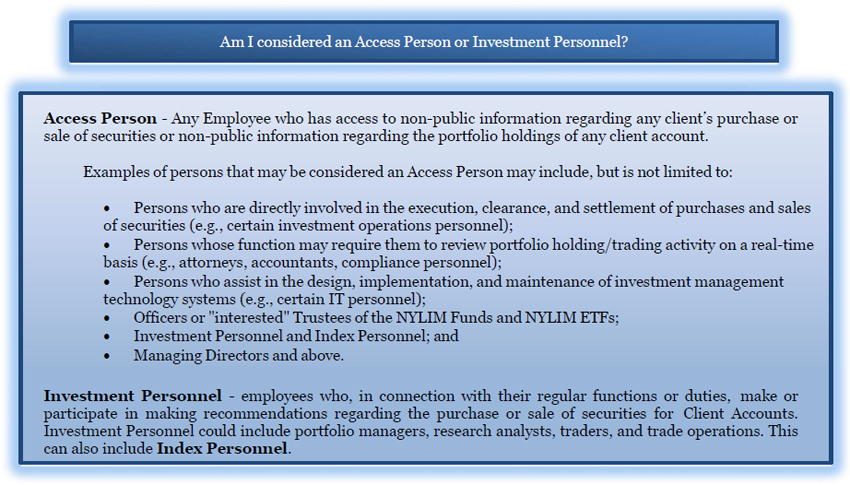
Access Persons, Investment Personnel and Index Personnel are subject to the following additional requirements:
| 2.2.1 | Preclearance of Covered Securities |
| ● | Access Persons must preclear all transactions in Covered Securities (see Appendix B for a list of Covered Securities). Each Access Person must submit their requests through the Employee Trade Preclearance System (“COMPLY”) available on the intranet (https://nylife.complysci.com/) |
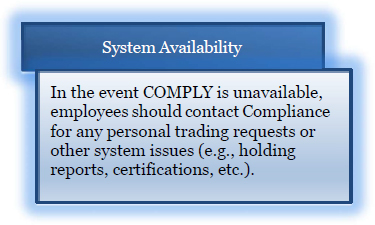
between the hours of 9:00 a.m. and 4:00 p.m. EST. Automated feedback will be provided to the Employee as to whether the request is approved or denied. In the event that the system is unavailable, Access Persons must contact Investments Compliance (“Compliance”). Compliance will provide approval or denial via email.
| 4 | P a g e |
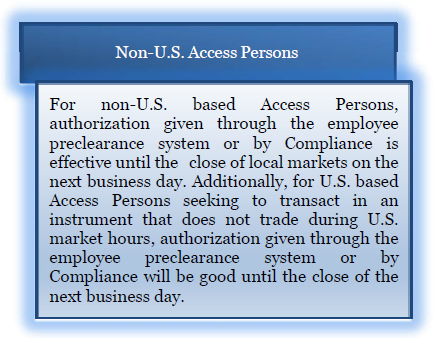
| ● | Preclearance approval is only good during U.S. market hours (9:30 a.m. to 4:00 p.m. EST). If you do not trade during the market session for which you were granted approval, the approval expires. If your transaction is not executed during that market session, a new request must be submitted. |
| ● | Access Persons must preclear all transactions in NYLIM ETFs and Single Stock ETFs. |
| 2.2.2 | Holding Period/Short Swing Rule |
| ● | Access Persons may not purchase and sell (or exchange) or sell and purchase (or exchange) the same (or equivalent) Covered Security within sixty (60) calendar days. The holding period is measured from the time of the most recent purchase of shares of the relevant Covered Security by the Employee (Last In First Out method). Exceptions may be made by Compliance to accommodate special circumstances. |
| ● | Transactions in NYLIM ETFs are subject to a seven-day Holding Period. |
| ● | Transactions in NYLIM mutual funds are subject to a thirty-day Holding Period. |
| ● | Access Persons who receive a grant of options through an Employee Stock Option Plan, or who chooses to exercise those options in a Cashless Exercise, will be allowed an exception from the sixty-day holding period, but only after obtaining approval by email from Compliance. |
| 2.2.3 | Trading /Black-Out Periods |
| ● | Access Persons may not purchase or sell a Covered Security on a day when there is a transaction in the same Covered Security for a Client of their respective Investment Adviser. Access Persons deemed Investment Personnel and Index Personnel are further restricted during black-out periods. |
| 5 | P a g e |
| ● | Investment Personnel and Index Personnel may not purchase or sell a Covered Security if any purchase or sale of such security has been made for an Investment Adviser Client account in the prior seven calendar days or can reasonably be anticipated for an Investment Adviser Client account in the next seven calendar days. |
| ● | Exceptions may be granted to the black-out period related to Investment Personnel and Index Personnel on days when there is no Buy or Sell transaction in a Covered Security for a Client of the Investment Adviser and the employee’s trade in such security involves one of the following: |
| (i) | 2000 shares or less in securities in the Russell 1000 Index; or |
| (ii) | 500 shares or less in securities NOT in the Russell 1000 Index |
| ● | Blackout exceptions will not apply to Index Personnel or the NYLIM Multi-Asset Solutions team during a black-out period resulting from an Index Rebalance. |
| 2.2.4 | Preclearance Exceptions |
| ● | Requirements pertaining to preclearance, hold and blackout periods (Sections 2.2.1 through 2.2.3) do not apply to the following transactions: |
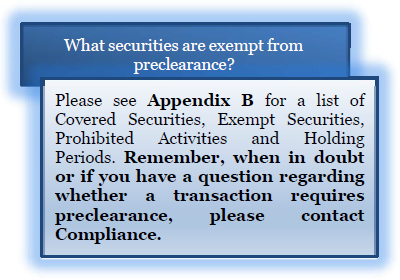
| ▪ | Certain securities and transaction types set forth in Section 2.2.1 through 2.2.3. See Appendix B for a list of exempt securities and transactions. |
| ▪ | In Discretionary Managed Accounts provided the Employee provides Compliance with a copy of the fully executed investment management agreement, which provides for the investment advisor’s complete discretion and control over the account. The Employee (and his/her investment advisor) are required to certify that he/she will not have any direct or indirect influence or control over the account. Employees that have Discretionary Managed Accounts managed by any family member2 are subject to preclearance requirements. Access Persons are prohibited from investing in and/or holding Private Placements and IPOs in Third-Party Discretionary Managed Accounts. |
| ▪ | That are non-volitional in nature: e.g., stock splits, stock dividends, exchanges and conversions, mandatory tenders, pro rata distributions to all holders of a class of securities, gifts, inheritances, margin/maintenance calls (where the securities to be sold are not directed by the covered person), and sales pursuant to regulated tender offers. |
2 In this regard, family member refers to any relative that manages an Employee’s Discretionary Managed Account.
| 6 | P a g e |
Even though preclearance requirements may not apply in certain situations, Employees are reminded of their fiduciary duty and must place the interest of clients before your own personal trading and conduct personal trading in a manner that avoids any actual or potential conflict of interest.
| 2.3 | Initial Public Offerings, Limited Offerings (e.g., Private Placements, Private Equity and Hedge Funds and/or Alternative Investments) and Initial Coin Offerings |
| ● | Access Persons or Employees who are Registered Representatives of NYLIFE Distributors may not directly or indirectly acquire Beneficial Ownership in any securities in an Initial Public Offering of securities, a Limited Offering (e.g., private placement, private equity hedge fund and/or alternative investments) or a virtual currency token offered in an initial or digital coin offering (also called ICOs or token sales) except with the express written prior approval of Compliance. Employees must submit a preclearance request through COMPLY. If COMPLY is unavailable, employees must contact Compliance. |
| 2.4 | Options Trading |
| ● | Transactions by Access Persons |
| ▪ | Access Persons may trade options on individual securities but must ensure that expiration dates meet or exceed the 60-day holding period and short swing rule. |
| ▪ | Access Persons are also prohibited from trading in uncovered options on individual securities (i.e., trading in a position where the seller of an option contract does not own any, or enough, of the underlying security). Should an Access Person decide to exercise any option prior to expiration, a separate preclearance request would also need to be entered prior to exercise. As discussed above, options on individual ETFs (excluding single-stock ETFs and NYLIM ETFs) are excluded from the preclearance, 60-day holding period and short swing rule requirements. |
| ● | Transactions by Investment Personnel |
| ▪ | Investment Personnel may not trade in options with respect to individual securities. Transactions in index options effected on a broad-based index are permitted. |
| ▪ | Transactions by Access Persons and Investment Personnel in index options effected on a broad-based index, options on individual ETFs (excluding single-stock ETFs and NYLIM ETFs) and options on commodities are permitted, and, these types of options do not require pre-clearance, nor are they subject to the 60-day holding period and short swing rule. |
| 7 | P a g e |
| ● | Please refer to Appendix C for a summary of options trading requirements. |
2.5 Financial Wagering Instruments and Prediction Markets
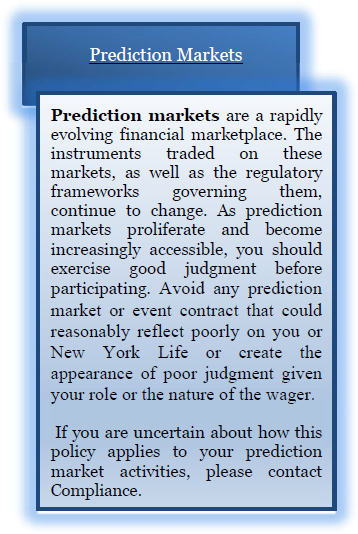
Employees are prohibited from participating in any predictive market, event contract, or similar arrangement based on the outcome of future events related to any security, issuer (both public and private), company, financial markets, financial indices, economic indicator or forecast, or any other comparable financial or market-related event or outcome.
This includes, but is not limited to:
● Prediction Markets: Platforms (e.g., Kalshi, Polymarket, Augur) that allow participants to bet on the likelihood of specific outcomes (e.g., interest rate decisions, recession likelihood, corporate earnings) through event contracts, options, or similar instruments.
● Spread Betting and Contracts for Difference (CFDs): Instruments that enable speculation on the price movement of financial assets without ownership of the underlying asset.
This prohibition does not apply to financial wagering instruments or trading with prediction markets on non-financial and non-market-related events such as sports, entertainment, or cultural outcomes (e.g., Super Bowl, Oscars, World Cup). However, all such wagering or trading activities must comply with applicable laws and regulations, and employees must never participate in, or assist anyone else with, any wager or trade based on non-public or proprietary information.
| 2.6 | NYLIM Funds and NYLIM ETFs Independent Trustees |
The following requirements apply only to the Independent Trustees of the NYLIM Funds and NYLIM ETFs.
| ● | Preclearance |
| ▪ | An Independent Trustee need only obtain prior approval from the Adviser CCO or Senior Compliance Officer before directly or indirectly acquiring or disposing of beneficial ownership in a Covered Security if he/she knew or, in the ordinary course of fulfilling his/her duties as a Trustee should have known3, (i) that during the 15-day period immediately before or after a transaction in that security, a NYLIM Fund or ETF, or any series thereof, purchased or sold that security, or (ii) an Adviser or subadvisers considered purchasing or selling that security on behalf of the NYLIM Fund or ETF. |
| 8 | P a g e |
| ▪ | With respect to the NYLIM ETF Independent Trustees, the preclearance requirement to obtain prior approval from the CCO does not apply to purchases and sales of any non-NYLIM ETF. |
| ● | Initial Certification |
| ▪ | Each newly appointed Independent Trustee is required to provide an initial certification stating that he/she has received a copy of the Code and that he/she understands the relevant requirements. |
| ● | Annual Certification |
| ▪ | Each Independent Trustee is also required to certify on an annual basis that he/she has received, read, understood and complied with this Code. |
| 2.7 | Section 16 Requirements (NYLIM Closed End Funds and NYLIM Interval Funds) |
| ● | Certain Employees, including NYLIM Independent Trustees, are considered “Fund Insiders” pursuant to Section 16 of the Exchange Act with respect to closed-end funds (including interval funds). Preclearance by Fund Insiders is required prior to transacting in closed-end fund shares, including closed-end fund shares purchased or sold in Discretionary Managed Accounts. |
| ● | In addition, transactions in closed-end fund shares by Fund Insiders require additional reporting to the U.S. Securities and Exchange Commission and are subject to holding periods. Please refer to the NYLIM Funds’ Policies and Procedures for Compliance with Section 16 of the Securities Act of 1934 or contact Compliance for more information. |
3 The “should have known” standard implies no duty of inquiry, does not presume there should have been any deduction or extrapolation from discussions or memoranda dealing with tactics to be employed meeting a Funds’ investment objectives, or that any knowledge is to be imputed because of prior knowledge of the Fund’s portfolio holdings, market considerations, or the Fund’s investment policies, objectives and restrictions.
| 9 | P a g e |
SECTION 3 RECORDKEEPING AND REPORTING REQUIREMENTS
| 3.1 | Initial Securities Holdings and Account Reports |
| ● | Access Persons must, no later than 10 days after becoming an employee, submit an initial holdings and account report and certification electronically through COMPLY. The holdings information presented in this report must be current as of 45 days prior to employment. |
| ● | Access Persons must also disclose all broker, dealer or bank accounts in which any securities (including Covered Securities) are held. Non-Access Persons are only required to disclose where Affiliated or Reportable Fund shares are held. Additionally, each new Employee shall file an “Acknowledgement of Receipt of the Code of Ethics and Related Policies” via COMPLY. |
| ● | In addition, NYLIFE Distributors Registered Representatives are also required to notify Compliance of any crypto currency accounts. Upon opening any new brokerage and/or crypto currency accounts, Registered Representatives must notify Compliance of the new account in accordance with NYLIFE Distributors procedures. |
| 3.2 | Quarterly Reporting |
| ● | Access Persons must, no later than 30 calendar days following quarter end, certify to all transactions in any Covered Security and Affiliated Funds or, alternatively, must confirm that there were no such transactions in the applicable quarter. This does not apply to transactions in Discretionary Managed Accounts as described in Section 2.2.4, unless managed by a family member. Employees must complete this requirement electronically through COMPLY. |
| 3.3 | Annual Reporting |
| ● | No later than January 30th each year: (i) all Employees must file an annual certification indicating that the Employee has complied with the Code; and (ii) Access Persons must also file an annual holdings report or submit updated, complete brokerage statements and certify to their brokerage accounts as of year-end. Employees must complete these requirements electronically through COMPLY. |
| 3.4 | Opening of Brokerage Accounts |
| ● | Access Persons shall promptly notify Compliance of any new account opened with a broker, dealer or bank including Discretionary Managed Accounts. Access Persons must provide Compliance with sufficient information so that Compliance can arrange for duplicate confirmations and accounts statements to be provided to Compliance. |
| 10 | P a g e |
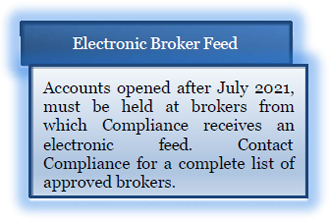
| ● | Access Persons may only open brokerage accounts with a firm that provides Compliance with an electronic feed of trade confirmations and statements. Contact Compliance for the complete list of firms. Exceptions are limited and require the approval of Compliance. |
| ● | Non-Access Persons are only required to notify Compliance of any new accounts opened with a broker, dealer or bank in which Affiliated Fund shares or Reportable Fund shares are held. |
SECTION 4 ADMINISTRATION
| 4.1 | Sanctions and Review |
| ● | Upon discovering a violation of the Code, the Company shall take whatever remedial steps it deems necessary and available to correct an actual or apparent conflict (e.g., trade reversal etc.). Following those corrective efforts, Compliance may impose sanctions if, based upon all of the facts and circumstances considered, such action is deemed appropriate. |
| ● | The magnitude of these penalties varies with the severity of the violation, although repeat offenders will likely be subjected to harsher sanctions. These sanctions may include, among others, the reversal of trades, disgorgement of profits, suspension of trading privileges or, in more serious cases, inclusion in annual performance evaluations, suspension or termination of employment. |
| ● | It is important to note that violations of the Code may occur without employee fault (e.g., despite preclearance). In those cases, punitive action may not be warranted, although remedial steps may still be necessary. |
| 4.2 | Acknowledgment and Training |
| ● | Each Employee must certify initially and annually thereafter that he or she has read and understood, is subject to and has complied with the Code and its related polices. Each Employee must attend a Code of Ethics training session conducted by Compliance within a reasonable time of becoming an Employee. |
| 4.3 | Exceptions |
| ● | The CCO or LCO, as applicable, in consultation with Compliance, may grant an exception to the Code in circumstances on a case-by-case basis if it is determined that the proposed conduct involves no opportunity for abuse and does not conflict with interests. Exceptions shall be structured to be as narrow as is reasonably practicable with appropriate safeguards designed to prevent abuse of the exception. Exceptions are expected to be rare. Notwithstanding the foregoing, however, no exception to a provision of the Code shall be granted where such exception would result in a violation of Rule 17j-1 or Rule 204A-1. |
| 11 | P a g e |
Appendix A DEFINITIONS
Affiliated Fund – The NYLIM Mutual Funds and NYLIM Exchange Traded Funds (“NYLIM ETFs”)
Beneficial Ownership – interpreted in the same manner as it would be under Rule 16a-1(a)(2) under the Securities Exchange Act of 1934, as amended (the “Exchange Act”) in determining whether a person is the beneficial owner of a security for purposes of the Exchange Act and the rules and regulations thereunder. A beneficial owner is any person who, directly or indirectly, through any contract, arrangement, understanding, relationship or otherwise, has or shares a direct or indirect pecuniary interest in the securities. A pecuniary interest in securities means the opportunity, directly or indirectly, to profit or share in any profit derived from a transaction in those securities. A person is presumed to have an indirect pecuniary interest in securities held by members of a person’s Immediate Family who either reside with, or are financially dependent upon, or whose investments are controlled by, that person. A person also has a beneficial interest in securities held: (i) in a trust which he or she is a trustee, has a beneficial interest or is the settlor with a power to revoke; (ii) by another person and he or she has a contract or an understanding with such person that the securities held in that person’s name are for his or her benefit; (iii) in the form of a right to acquisition of such security through the exercise of warrants, options, rights, or conversion rights; (iv) by a partnership of which he or she is a member; (v) by a corporation that he or she uses as a personal trading medium; or (vi) by a holding company that he or she controls.
Chief Compliance Officer (“CCO”) – CCO, as applicable, of each New York Life Investment Management entity.
Covered Security – means any security as defined in Section 202(a)(18) of the Advisers Act. Please see Appendix B for a list of Covered Securities, Exempt Securities, Prohibited Activities and Holding Periods. If you do not see a particular security type listed or if you have a question regarding whether a security is considered a “Covered Security,” or any other question relating to preclearance, account reporting or holding periods please contact Compliance.
Discretionary Managed Account – an account managed on a discretionary basis by a person (or Robo-Adviser) other than an Employee over which the Employee has no direct or indirect influence or control over the selection or disposition of securities and no advance knowledge of transactions therein.
Immediate Family – any of the following individuals: child, stepchild, grandchild, parent, stepparent, grandparent, spouse, domestic partner, sibling, mother-in-law, father-in-law, son-in-law, daughter-in-law, brother-in-law, sister-in-law, including adoptive relationships who reside in the same household. The term also includes (i) any related or unrelated individual who resides with, and (ii) whose investments are controlled by, or whose financial support is materially contributed to by, the employee, such as a “significant other.”
In addition, other individuals residing in the same household who do not fall within the categories listed above may nevertheless be considered Immediate Family based on the particular facts and circumstances of the relationship, including the nature of the residence, financial interdependence, or degree of influence or control. Employees should consult Compliance whenever there is any uncertainty regarding whether an individual qualifies as Immediate Family.
| 12 | P a g e |
NYLIM Independent Board Member – a trustee of a registered fund who is not an “interested person” of the NYLIM Funds or NYLIM ETFs, as defined in Section 2(a)(19)(B) of the 1940 Act.
Index Rebalance – a time period when a NYLIM ETF or other accounts for which New York Life Investment Management LLC (“NYLIM”) acts as advisor and/or sub-advisor receives its rebalance or reconstitution information with respect to an underlying index for which (i) NYLIM or (ii) an unaffiliated entity serves as the index provider.
Index Personnel – employees who maintain affiliated indexes and are responsible for rebalancing, validating and delivering index component securities and weightings of each affiliated index to the trading team.
Local Compliance Officer (“LCO”) – CCO or designee of an applicable New York Life Investment Management entity.
NYLIM ETFs – each exchange traded fund series of the NYLIM ETF Trust and NYLIM Active ETF Trust.
NYLIM Funds – each open-end fund and closed-end fund series of the NYLIM Funds.
Non-Access Person – employees that do not fall into the definition of Access Person.
Predictive Markets – any market, platform, or arrangement in which participants enter into contracts, agreements, or instruments that provide a payout, settlement value, or economic exposure based on the occurrence or non-occurrence of a specified future event or outcome.
Private Placement – an offering that is exempt from registration under the Securities Act of 1933 under Sections 4(a)(2) or 4(a)(6), or Rules 504, 505 or 506 thereunder.
Reportable Fund – an investment company, whether or not affiliated, advised or subadvised by the Company.
Restricted List – a listing of securities maintained by Compliance in which trading by Access Persons is generally prohibited.
Registered Representative – an Employee who is registered as such with a member firm of the Financial Industry Regulatory Authority (“FINRA”).
Spread Betting and Contracts for Differences – spread betting is a speculative transaction that involves wagering on the price movement of a security, index, or other financial product through a spread betting company, without acquiring ownership of the underlying asset. A Contract for Difference (CFD) is a similar instrument — a contract between a buyer and seller where the payout is based on the price movement of an underlying asset, again without ownership of that asset.
| 13 | P a g e |
Spread betting and CFD trading on financial or market-related products are not permitted, and employees may not use spread betting or CFD accounts to circumvent this Policy. Wagering on non-financial products, such as sporting events, is not covered by this Policy.
Supervised Person – partners, officers, directors (or other persons occupying a similar status or performing similar functions) and employees, as well as any other persons who provide advice on behalf of an adviser and are subject to the adviser’s supervision and control.
| 14 | P a g e |
APPENDIX B - PRECLEARANCE, REPORTING, AND HOLDING PERIOD REQUIREMENTS AND EXCLUSIONS BY ASSET/TRANSACTION TYPE
Please contact Compliance with any questions.
| Asset Type | Do
Transactions Require Approval? |
Is Reporting of Securities Required?1 |
Are Transactions Subject to a Holding Period?2 |
| Equities | |||
Shares of common or preferred stock or other equity securities, including any security convertible into equity securities |
Yes | Yes | Yes (60 days) |
| Initial Public Offerings (IPOs) Non-Registered Representatives | Yes | Yes | Yes (60 days) |
| Initial Public Offerings (IPOs) Registered Representatives | Prohibited | ||
| Options3, Rights & Warrants on equity securities | Yes | Yes | Yes (60 days) |
| Bonds | |||
| Corporate Bonds | Yes | Yes | Yes (60 days) |
| Municipal Bonds | Yes | Yes | Yes (60 days) |
Municipal auction rate securities (“ARS”) with short-term coupon resets (e.g., 7 days) and closed-end municipal auction rate “Preferred” shares |
No | Yes | No |
| Convertible Bonds | Yes | Yes | Yes (60 days) |
| Direct obligations of U.S. government or U.K. government | No | Yes | No |
| Direct obligations of non-U.S. government or U.K. government | Yes | Yes | No |
| Government-sponsored enterprises fixed income securities (e.g., FNMA, FHLMC) | No | Yes | No |
Securities futures and options on direct obligations of the US government or Non-U.S. governments and associated derivatives |
No | Yes | No |
| Derivatives on any bonds | Yes | Yes | Yes (60 days) |
| Structured Notes linked to an index | No | Yes | No |
| Structured Notes linked to an individual security | Yes | Yes | Not Applicable |
| Exchange Traded Funds | |||
| ETFs (unaffiliated and non-single stock) | No | Yes | No |
| NYLIM ETFs | Yes | Yes | Yes (7 days) |
| Single Stock ETFs | Yes | Yes | Yes (60 days) |
| Options on ETFs | No | Yes | No |
| Options on ETFs issued through NYLIM | Yes | Yes | Yes (7 days) |
| Options on single Stock ETFs | Yes | Yes | Yes (60 days) |
| Index Options effected on a broad-based index | No | Yes | No |
| Mutual Funds, Closed-End Funds and UCITs | |||
| Open-end mutual funds advised by NYLIM | No | Yes | Yes (30 days) |
1 If an investment account has the ability to invest in a reportable security within its investment options, the account is reportable to Compliance via COMPLY.
2 All holding periods are in calendar days.
3 Does not include non-volitional exercises or expirations, excluding ETFs not requiring preclearance. Options on NYLIM ETFs and Single Stock ETFs do require preclearance and are subject to the holding periods of the underlying instrument.
| Open-end mutual funds NOT advised by NYLIM | No | No | No |
| Closed-end mutual funds advised NYLIM | Yes | Yes | Yes (60 days) |
| Closed-end mutual funds NOT advised by NYLIM | Yes | Yes | Yes (60 days) |
| Interval funds advised by NYLIM | No | Yes | Not Applicable |
| Interval funds NOT advised by NYLIM | No | No | No |
| Business Development Companies | Yes | Yes | No |
| Unit Investment Trusts | No | Yes | No |
| Collective Investment Trusts | No | Yes | No |
| Money Market Funds | No | No | No |
| UCITs | No | Yes | No |
| Currencies & Commodities | |||
| Currencies | No | No | No |
| Currency futures, forwards, swaps, or options thereon | No | No | No |
| Commodities | No | Yes | No |
| Commodity futures, forwards, swaps, or options thereon | No | Yes | No |
| Cryptocurrencies or digital currencies (direct transactions)4 | No | No | No |
| Initial coin offerings - Registered Representative | Prohibited | ||
| Initial coin offerings - Non-Registered Representative | Yes | Yes | Yes (60 days) |
Crypto Index Funds and Single Asset products invested in cryptocurrencies, which are traded on a public exchange |
No | Yes | No |
| Other Securities/Transaction Types | |||
Limited Offerings (Private placements, hedge funds, alternative investments, private equity, or any other private offering) (Access Persons are prohibited from investing in and/or holding limited offerings in Third-Party Discretionary Managed Accounts). The sale of previously approved private placements does not require pre-clearance. |
Yes | Yes | No |
| Cash equivalents5 | No | No | No |
| Transfers of cash or securities, including gifts of stock given or received | No | Yes | No |
| Predictive Market/Event Contracts/Bets6 - Financial or Market Related Event | Prohibited | ||
| Spread Betting/Contracts for Differences6 | Prohibited | ||
| Naked Calls or Naked Puts | Prohibited | ||
4 Cryptocurrencies, such as Bitcoin, Ethereum, Litecoin and Dogecoin, which are a virtual or digital representations of value.
5 Cash equivalents include bank certificates of deposit (“CDs”), bankers acceptances, commercial paper and other high quality, non-sovereign short-term debt instruments (with an original maturity less than one year), including repurchase agreements.
6 Employees are prohibited from participating in any predictive market, event contract, or similar arrangement based on the outcome of future events related to any security, issuer (both public and private), company, financial markets, financial indices, economic indicator or forecast, or any other comparable financial or economic market-related event or outcome. This includes, but is not limited to:
Prediction Markets: Platforms (e.g., Kalshi, Polymarket, Augur) that allow participants to bet on the likelihood of specific outcomes (e.g., interest rate decisions, recession likelihood, corporate earnings) through event contracts, options, or similar instruments.
Spread Betting and Contracts for Difference (CFDs): Instruments that enable speculation on the price movement of financial assets without ownership of the underlying asset.
This prohibition does not apply to financial wagering instruments or trading with predictions markets on non-financial and non-market-related events such as sports, entertainment, or cultural outcomes (e.g., Super Bowl, Oscars, World Cup). However, all such wagering or trading activities must comply with applicable laws and regulations, and employees must never participate in, or assist anyone else with, any wager or trade based on non-public or proprietary information.
| Options trading in covered securities by Investment Personnel7 | Prohibited | ||
| Good until Canceled, Limit Orders and Stop Loss Orders | Prohibited | ||
| Securities on the Restricted List | Prohibited | ||
| Transfer of cash or securities, including gifts of stock given or received | No | Yes | No |
| Automatic Investment Plans such as Dividend Reinvestment Plans, Employee Stock Purchase Plans | No | Yes | No |
Stock options issued by a corporation as part of a compensation package (e.g., board memberships) do not require pre-clearance. However, a subsequent sale of the stock obtained by means of the exercise must receive prior clearance. |
No/Yes | Yes | No |
Transactions that are non-volitional in nature (e.g., stock splits, stock dividends, exchanges and conversions, mandatory tenders, pro rata distributions to all holders of a class of securities, gifts, inheritances, margin/maintenance calls (where the securities to be sold are not directed by the covered person), and sales pursuant to regulated tender offers)). |
No | Yes | No |
| Account Type | Is reporting of the account required? | ||
| Any account for which you or a Household Member has Beneficial Ownership AND in which securities can be bought, sold or held. | Yes | ||
| Brokerage Accounts | Yes | ||
| Discretionary Managed Accounts | Yes | ||
Mutual fund accounts held directly with the fund family to hold and trade that family of mutual funds only (i.e., account held with American Funds to hold and trade American Funds only). |
No | ||
| 529 accounts and 529 ABLE accounts or similar accounts | No | ||
Non-NYL 401K accounts unless they hold NYLIM Funds or ETFs, common stock or stock options. (However, if an Access Person’s immediate family member has a NYL 401k account or has a 401k account which can hold covered securities the Access Person must report the account.) |
No | ||
| Annuities unless they hold NYLIM Funds or ETFs | No | ||
| Banking accounts with cash or cash equivalents (i.e., savings account) | No | ||
| Financial Wagering and Predictive Markets accounts (e.g., Kalshi, Polymarket, Augur). | No | ||
7 Transactions by Access Persons (including Investment Personnel) in index options effected on a broad-based index, options on individual ETFs (excluding single-stock ETFs and NYLIM ETFs) and options on commodities are permitted, and, these types of options do not require preclearance, nor are they subject to the 60-day holding period and short swing rule.
APPENDIX C - OPTIONS TRADING: PRECLEARANCE AND 60 DAY HOLDING RULE 1
The following chart provides specific guidance on preclearance and short term trading prohibitions for options trading.
| Option Trading | Preclearance Required | Subject to Short Term Trading Restriction (“60 Day Holding Rule”) |
| Options trading in covered securities by Investment Personnel | Prohibited | |
Purchasing/Selling an Option
|
Yes
|
Yes
For avoidance of doubt, please contact compliance with any questions
|
Involuntary Option Assignment/Exercise of Existing Option Position
|
No
Purchase or sale of underlying Security not directed by the Employee |
No
The acquisition/disposition of a security resulting from an existing option position via an involuntary assignment/exercise is not subject to the 60 Day Holding Rule
|
Covered Calls
|
Yes
|
Yes
Must have held the underlying security for 60 days
Cannot sell more options contracts than the number of common shares held in that account |
Naked Calls / Naked Puts |
Prohibited | |
Long Calls / Long Puts
|
Yes
|
Yes
Trading option contracts themselves rather than exercising them, taking stock delivery or using covered positions
The option’s expiration date must be greater than 60 days from the date of the option transaction
|
Directing an Option Exercise of Existing Options Position
|
Yes
To exercise an option, the purchase or sale of the underlying security must be pre-cleared before directing the option exercise
|
Yes
After the receipt or disposal of the underlying security due to a directed option exercise, employees are prohibited from executing an opposite way transaction in the underlying security for 60 calendar days
|
Rolling2 an Option on All Other Underlying Securities
|
Yes
Pre-clearance of both legs of the transaction is required to roll the option
|
Yes
Other options are not allowed to roll within 60 calendar days (i.e., they are subject to the 60 Day Holding Rule)
|
1 Transactions by Access Persons (including Investment Personnel) in index options effected on a broad-based index, options on individual ETFs (excluding single-stock ETFs and NYLIM ETFs) and options on commodities are permitted, and, these types of options do not require pre-clearance, nor are they subject to the 60-day holding period and short swing rule.
2 The simultaneous closing and opening of an option to extend the expiration or maturity of the initial position to the next available contract period immediately following such expiration or maturity.