Investment Strategy
Aug. 28, 2026
The Fund seeks to achieve its investment objective by providing investors with U.S. large-cap equity market exposure while attempting to limit downside risk through a laddered portfolio of buffer ETFs managed by Aptus Capital Advisors, LLC, the Fund’s investment adviser (“Aptus” or the “Adviser”). To achieve U.S. large-cap equity market exposure, the Fund invests in underlying buffer ETFs that seek to provide their investors with returns that match the share price performance of the State Street SPDR® S&P 500® ETF Trust (“SPY”) up to a predetermined upside cap while providing a buffer against a predetermined percentage of losses. A laddered buffer portfolio is a portfolio that consists of multiple underlying defined outcome buffer ETFs with different expiration dates, allowing for tactical investing and diversification. The laddered approach spreads performance over multiple investment periods, providing a level of downside protection while allowing for some upside potential. Each underlying ETF tracks SPY and imposes a cap on the underlying ETF’s gains from SPY in return for also applying a buffer against the first 15% of SPY losses. The laddered portfolio is currently comprised of the Aptus January Buffer ETF, Aptus April Buffer ETF, Aptus July Buffer ETF, and Aptus October Buffer ETF (each, an “Underlying ETF” and, collectively, the “Underlying ETFs”); however, the U.S. large-cap equity Aptus-managed buffer ETFs that comprise the laddered portfolio may change from time to time. By investing in a “laddered portfolio” of multiple Underlying ETFs that employ structured outcome strategies over pre-determined investment periods, the Fund’s investment exposure to the underlying U.S. large-cap equity market, as well as its ability to limit downside risk, is spread out across multiple investment time periods. This laddered portfolio approach is intended to mitigate the risk of failing to benefit from the buffer of a single Underlying ETF due to the timing of investment in such Underlying ETF and the relative price of the reference asset or having limited or no upside potential remaining because of the cap of a single Underlying ETF. The Fund’s laddered approach is
intended to allow the Fund to continue to benefit from increases in the value of SPY and to provide a level of downside protection for at least a portion of the Fund’s portfolio at any given time. The Fund invests in the Underlying ETFs in a laddered manner.
Unlike the Underlying ETFs, the Fund itself does not pursue a structured outcome strategy. The buffer is only provided by the Underlying ETFs and the Fund itself does not provide any stated buffer against losses. The Fund will likely not receive the full benefit of the Underlying ETFs’ buffers and could have limited upside potential. The Fund’s returns may be limited by the caps of the Underlying ETFs.
In order to understand the Fund’s strategy and risks, it is important to understand the strategies and risks of the Underlying ETFs. See “Additional Information about the Fund” for a discussion of the principal investment strategies of the Underlying ETFs.
Under normal market conditions, the Fund will invest substantially all of its assets in the Underlying ETFs, which seek to provide investors with returns that match the share price performance of SPY up to a pre-determined upside cap, before fees and expenses, while providing a buffer against the first 15% of SPY losses, before fees and expenses, over a defined twelve-month period (an “Investment Period”). The period from the commencement of each Underlying ETF’s operations to the day preceding the Underlying ETF’s first full one-year Investment Period is referred to as the “Initial Investment Period” and all references to an Investment Period, other than its length in time, include an Underlying ETF’s Initial Investment Period. As of the date of this Prospectus, the only Underlying ETF that was still in its Initial Investment Period was Aptus October Buffer ETF.
In general, the structured outcomes each Underlying ETF seeks for investors that hold its shares for an entire Investment Period are as follows, though there can be no guarantee these results will be achieved:
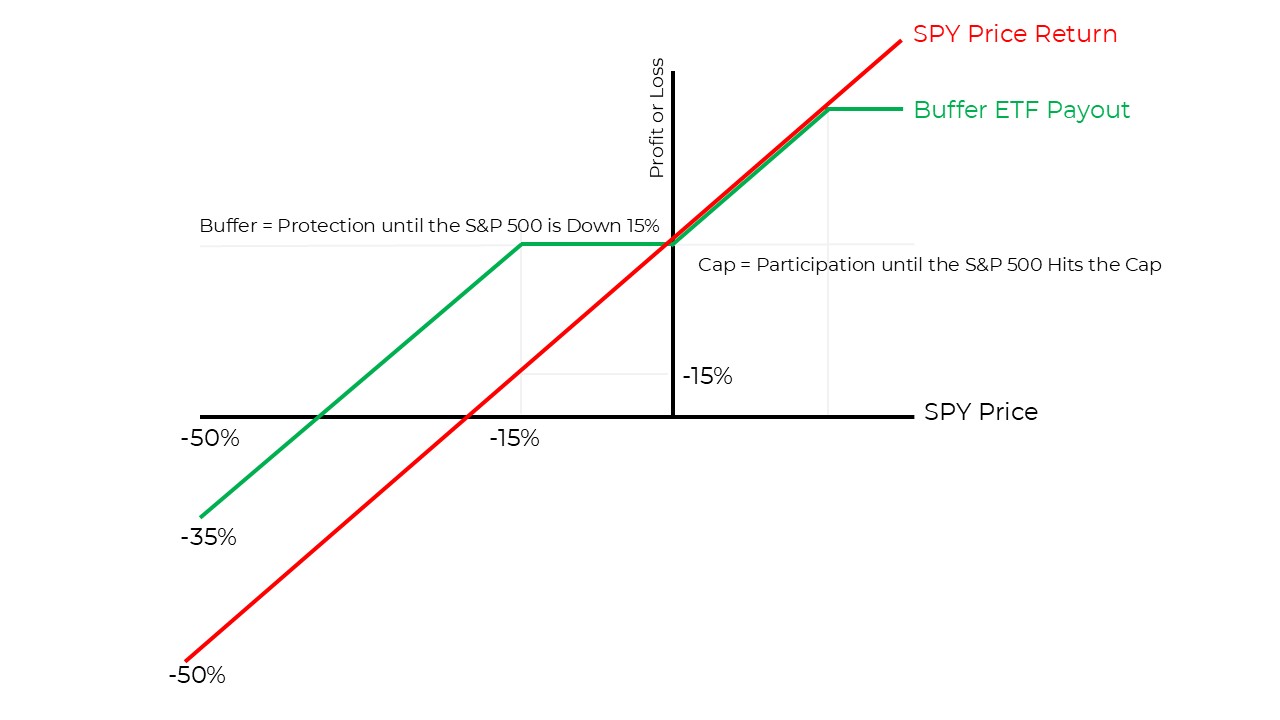
•To the extent that SPY’s share price appreciates over an Investment Period, each Underlying ETF’s strategy intends to provide upside participation that matches SPY’s share price performance up to the pre-determined upside cap, before fees and expenses of the Underlying ETF.
•To the extent that SPY’s share price declines by up to 15% over an Investment Period, each Underlying ETF’s strategy intends to provide a flat return for the applicable Underlying ETF (i.e., neither a gain nor a loss), before fees and expenses of the Underlying ETF.
•To the extent that SPY’s share price decreases by more than 15% over an Investment Period, each Underlying ETF’s strategy is designed to protect the Underlying ETF from the first 15% of SPY losses, while experiencing SPY losses greater than 15% on a one-to-one basis with SPY, before fees and expenses of the Underlying ETF.
The Fund and each Underlying ETF are advised by Aptus. The investment objective of SPY is to seek to provide investment results that, before expenses, correspond generally to the price and yield performance of the S&P 500® Index. See “Additional Information about the Fund” for more information about SPY.
Each Underlying ETF is an actively managed exchange-traded fund (“ETF”) that, under normal market conditions, invests substantially all of its assets in both purchased and written put and call Flexible Exchange® Options (“FLEX Options”) that reference the market price of SPY. FLEX Options are customizable exchange-traded option contracts guaranteed for settlement by the Options Clearing Corporation (“OCC”). Each Underlying ETF uses FLEX Options to employ a structured outcome strategy. Structured outcome strategies seek to produce pre-determined target investment outcomes based upon the performance of an underlying security or index (e.g., SPY). The pre-determined structured outcomes sought by the Underlying ETFs are intended to reflect the share price performance of SPY over the Investment Period, subject to a buffer, i.e., limited downside protection against the first 15% of losses experienced by SPY, and a cap, i.e., a pre-determined upside return cap percentage. Each Underlying ETF sets a cap at market close one business day prior to each Investment Period. The defined cap applicable to an Investment Period varies based on prevailing market conditions at the time, including then-current interest rate levels, SPY volatility, and the relationship of puts and calls on the underlying FLEX Options. This means that an Underlying ETF’s cap will change for each Investment Period. Each Underlying ETF is perpetually offered and will not terminate at the end of its Investment Period.
An investor that purchases shares of an Underlying ETF on any day other than the first day of an Investment Period and/or sells shares prior to the end of an Investment Period may experience results that are very different from the outcomes sought by the Underlying ETF for that Investment Period. Because the Fund typically will not acquire shares of the Underlying ETFs on the first day of an Investment Period and may dispose of shares of the Underlying ETFs before the end of the Investment Period, the Fund may experience investment returns that are very different from those that the Underlying ETFs seek to provide. If an Underlying ETF has experienced certain levels of either gains or losses since the beginning of its current Investment Period, there may be little to no ability for the Fund to achieve gains or benefit from the buffer for the remainder of the Investment Period. To achieve the structured outcomes sought by an Underlying ETF for an Investment Period, an investor, such as the Fund, must hold shares of the Underlying ETF for that entire Investment Period.
When an investor purchases shares of a single Underlying ETF, his or her potential outcomes are limited by the Underlying ETF’s stated cap and buffer over a defined time period (depending on when the shares were purchased). Alternatively, the Fund’s laddered approach provides a diversified exposure to all of the Underlying ETFs in a single investment. By owning a laddered portfolio of
Underlying ETFs, the Fund has the ability to continue to benefit from increases in the value of SPY and to provide a level of downside protection as each of the Underlying ETFs will reset its cap and refresh its buffer annually based on the share price performance of SPY at the time of the reset. In other words, the continual and periodic refreshing of the Underlying ETF caps and buffers at current SPY prices is intended to allow the Fund to continue to benefit from increases in the value of SPY and to provide a level of downside protection for at least a portion of the Fund’s portfolio at any given time. This approach reduces the risk inherent in the Underlying ETFs of having the upside potential for an entire Investment Period capped out in cases of rapid appreciation of SPY. It also reduces the risk of failing to benefit from an individual Underlying ETF buffer in cases where SPY has depreciated below that specific buffer level. Annually, each of the Underlying ETFs will undergo a reset of its cap and a refresh of its buffer, meaning that investors may have the ability to benefit from any appreciation in SPY for future periods up to the respective caps of the Underlying ETFs and may have the benefit of the buffer for future periods. A laddered buffer portfolio can diversify timing risk, similar to how laddered bond portfolios seek to manage timing risks for fixed-income investors.
The Fund intends to generally rebalance its portfolio to equal weight in each Underlying ETF at least annually. The Fund also will acquire and dispose of Underlying ETFs in connection with the creation and redemption of Creation Units between rebalances. In between such rebalances, market movements in the prices of the Underlying ETFs may result in the Fund having temporary larger exposures to certain Underlying ETFs compared to others. Under such circumstances, the Fund’s returns would be more greatly influenced by the returns of the Underlying ETFs with the larger exposures. If an over-weighted Underlying ETF underperforms the other Underlying ETFs, the Fund will experience returns that are inferior to those that would have been achieved if the Underlying ETFs were equally weighted.
The Fund’s website will provide, on a daily basis, the proportion of the Fund’s assets invested in each Underlying ETF at any given time. Each Underlying ETF’s website provides important information (including Investment Period start and end dates and the cap (both gross and net of fund fees and expenses) and buffer both at the start of the Underlying ETF’s Investment Period and on any particular day relative to the end of the Investment Period).
Although this website information may be useful in understanding the investment strategies of the Underlying ETFs, it is limited in providing an investor of the Fund with all of the risks and potential outcomes associated with an investment in the Underlying ETFs. For example, it does not provide a direct example of your potential investment return in the Fund because of the Fund’s laddered exposure to the Underlying ETFs in which each one of the Underlying ETFs will reset its cap and refresh its buffer annually based on prevailing market conditions.
The Fund’s investment strategy may include active and frequent trading. The Fund may also invest in money market funds from time to time.
As of June 30, 2026, SPY had significant investments in the Information Technology sector.
The Fund is an actively managed exchange-traded fund (“ETF”) that, under normal market conditions, invests substantially all of its assets in FLexible EXchange® Options (“FLEX Options”) that reference the market price of the Underlying ETF. Due to the unique mechanics of the Fund’s strategy, the return an investor can expect to receive from an investment in the Fund has characteristics that are distinct from many other investment vehicles. It is important that an investor understand these characteristics before making an investment in the Fund.
The Fund uses FLEX Options to employ a “structured outcome strategy.” Structured outcome strategies seek to produce pre-determined target investment outcomes based upon the performance of an underlying security or index. The pre-determined outcomes sought by the Fund are intended to reflect the share price performance of the Underlying ETF over an approximate one-year period (the “Investment Period”), subject to a buffer, i.e., limited downside protection (the “Buffer”) against a certain percentage of Underlying ETF losses, and a cap, i.e., a pre-determined upside return cap percentage (the “Cap”), as set forth in the following table:
| Investment Period Start | Investment Period End | Buffer (before Fund fees and expenses) | Buffer (after Fund fees and expenses)* | Cap (before Fund fees and expenses) | Cap (after Fund fees and expenses)* | ||||||||||||
| December 31 | December 30 | 15% | 14.25% | 14.05% | 13.30% | ||||||||||||
* For this purpose, Fund fees and expenses consist of the Fund’s total expense ratio and net options trading costs, if any.
The Underlying ETF’s share price performance does not reflect returns, if any, associated with the Underlying ETF’s dividend payments. As such, the Fund does not seek to provide its shareholders with returns that reflect the inclusion of the Underlying ETF’s dividend payments, if any.
In general, the structured outcomes the Fund seeks for investors that hold Fund shares for an entire Investment Period are as follows, though there can be no guarantee these results will be achieved:
•If the Underlying ETF’s share price appreciates over the Investment Period, the strategy is designed to provide upside participation that matches the share price performance of the Underlying ETF, up to the Cap that is determined at the start of the Investment Period, before fees and expenses of the Fund.
•If the Underlying ETF’s share price declines over the Investment Period by up to 15%, the strategy is designed to provide a flat return for the Fund (i.e., neither a gain nor a loss), before fees and expenses of the Fund. For example, if the Underlying ETF loses 10% in share price over the Investment Period, the strategy is designed for the Fund to have a flat return of 0%, before fees and expenses of the Fund.
•If the Underlying ETF’s share price declines over the Investment Period by more than 15%, the strategy is designed to protect the Fund from the first 15% of Underlying ETF losses, while experiencing losses greater than 15% on a one-to-one basis with the Underlying ETF, before fees and expenses of the Fund. For example, if the Underlying ETF loses 20% in share price over the Investment Period, the strategy is designed for the Fund to have losses of 5% (20% less the Buffer of 15%), before Fund fees and expenses. The Buffer is not the equivalent of a floor on investment losses.
The following charts illustrate the hypothetical returns that the FLEX Options seek to provide with respect to the share price performance of the Underlying ETF in certain illustrative scenarios over the course of the Investment Period. These charts do not take into account payment by the Fund of fees and expenses. There is no guarantee that the Fund will be successful in providing these investment outcomes for any Investment Period.
Market Scenarios over 12-Month Term (%)*
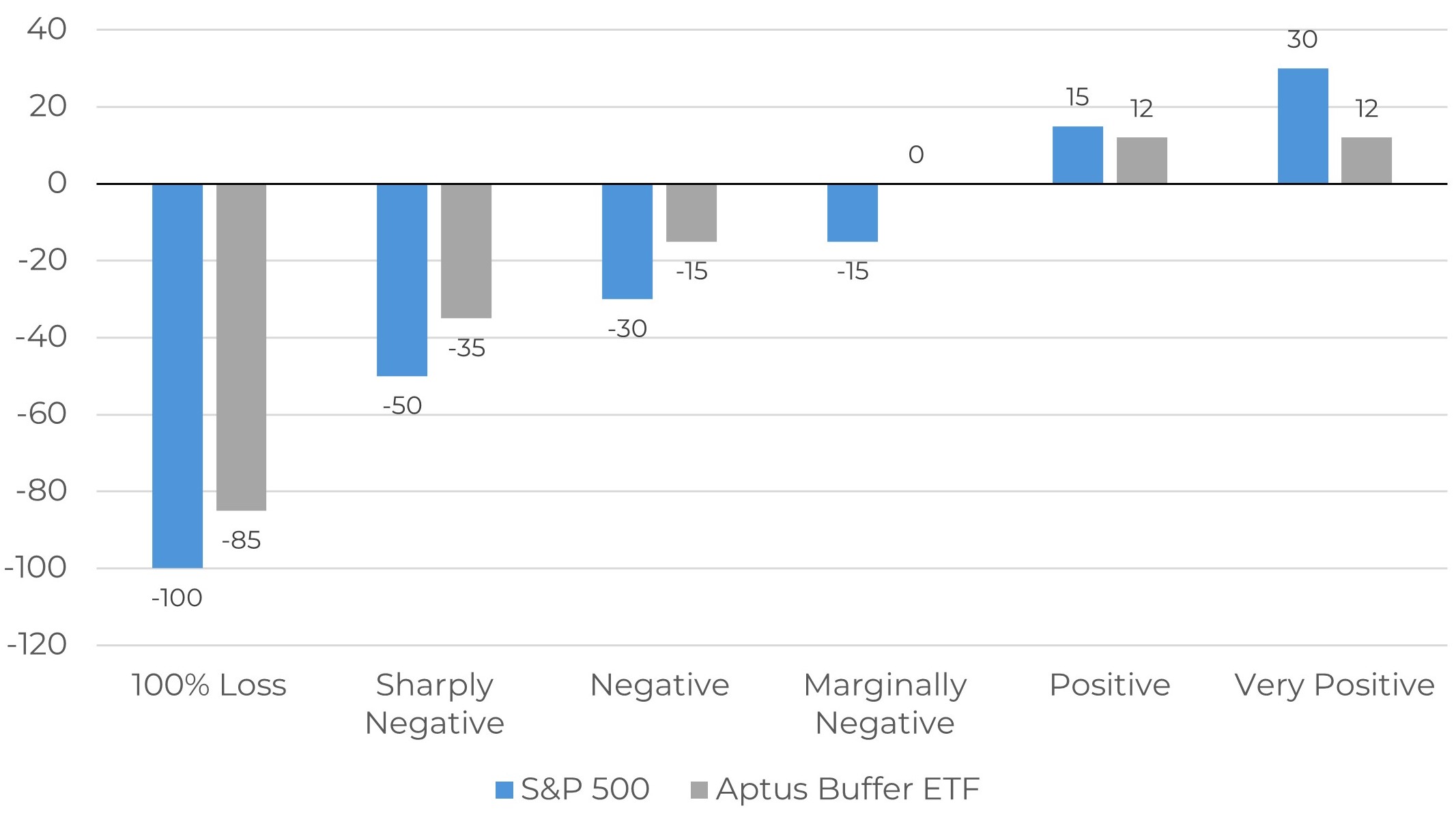
* The hypothetical cap level of 12% set forth in the above bar chart is for illustration purposes only. The Fund’s actual Cap, set forth in the table above, may be different and will change from Investment Period to Investment Period.
Investors purchasing Shares during an Investment Period will experience different results. The Fund’s website, www.aptusetfs.com/JANB, provides information relating to the possible outcomes for an investor of an investment in the Fund on a daily basis, including the Fund’s position relative to the Cap and Buffer. Before purchasing Shares, an investor should visit the Fund’s website to review this information and understand the possible outcomes of an investment in Shares on a particular day.
The Fund is a continuous investment vehicle that will be perpetually offered. It does not terminate and distribute its assets at the conclusion of an Investment Period. Subsequent Investment Periods will begin on the first business day following the end of the prior Investment Period and will end on the approximate one-year anniversary of that new Investment Period. On the final business day of each Investment Period, the Fund resets by investing in a new set of FLEX Options that will provide a new Cap for the new Investment Period. This means that the Cap will change for each Investment Period based upon prevailing market conditions at the beginning of each Investment Period. The Cap and Buffer, and the Fund’s position relative to each, should be considered before investing in the Fund.
Purchases During an Investment Period
An investor that purchases Shares other than on the first day of an Investment Period and/or sells Shares prior to the end of an Investment Period may experience results that are very different from the outcomes sought by the Fund for that Investment Period.
Both the Cap and Buffer are fixed levels that are calculated in relation to the Underlying ETF’s market price and the Fund’s net asset value (“NAV”) at the start of an Investment Period. While the Cap and Buffer reference the performance of the Underlying ETF over the Investment Period, the Fund expects its NAV to experience the same general price movement, Cap, and Buffer as a percentage gain or loss by the Underlying ETF over the Investment Period, before fees and expenses of the Fund.
Because the Underlying ETF’s market price and the Fund’s NAV change over the Investment Period, an investor acquiring Shares after the start of the Investment Period will likely have a different return potential than an investor who purchased Shares at the start of the Investment Period. This is because, while the Cap and Buffer for the Investment Period are fixed levels that remain constant throughout the Investment Period, an investor purchasing Shares at market value during the Investment Period likely purchased Shares at a price that is different from the Fund’s NAV at the start of the Investment Period (i.e., the NAV that the Cap and Buffer reference). In addition, the price of the Underlying ETF during the Investment Period is likely to be different from the price of the Underlying ETF at the start of the Investment Period. To achieve the structured outcomes sought by the Fund for an Investment Period, an investor must hold Shares for that entire Investment Period.
Buffer
The Fund seeks to shield its shareholders from the first 15% of losses experienced by the Underlying ETF during the Investment Period, i.e., provide a Buffer, or limited downside protection, against Underlying ETF losses of 15% over each Investment Period. After the Underlying ETF’s share price has decreased by more than 15%, the Fund will experience subsequent losses on a one-to-one
basis. The Buffer is before taking into account the fees and expenses of the Fund charged to shareholders. Unlike the Cap, the Buffer and the Underlying ETF will remain the same for each Investment Period.
If an investor is considering purchasing Shares during the Investment Period and the Fund has already decreased in share price by an amount equal to or greater than 15% from the Fund’s share price on the first day of the Investment Period (the “Initial Fund Price”), an investor purchasing Shares at that price will have increased gains available prior to reaching the Cap but may not benefit from the Buffer that the Fund seeks to offer for the remainder of the Investment Period. The Cap and Buffer relative to the Initial Fund Price, however, will not change over the Investment Period.
Conversely, if an investor is considering purchasing Shares during the Investment Period and the Fund has already increased in share price, an investor purchasing Shares at that price may experience losses prior to gaining the protection offered by the Buffer, which is not guaranteed.
Cap
The returns of the Fund are subject to the Cap set forth in the above table for the Investment Period. Unlike other investment products, the potential returns an investor can receive from the Fund are subject to a pre-determined upside return Cap that represents the maximum percentage return an investor can achieve from an investment in the Fund for an entire Investment Period. In the event the Underlying ETF experiences gains over an Investment Period, the Fund seeks to provide investment returns that match the percentage increase of the Underlying ETF’s share price, but any percentage gains over the amount of the Cap will not be experienced by the Fund. This means that, if the Underlying ETF experiences share price gains for an Investment Period in excess of the Cap for that Investment Period, the Fund will not benefit from those excess gains. Therefore, regardless of the share price performance of the Underlying ETF, the Cap is the maximum return an investor can achieve from an investment in the Fund for that Investment Period.
The Cap is set at market close one business day prior to each Investment Period. The defined Cap applicable to an Investment Period will vary based on prevailing market conditions at the time, including then-current interest rate levels, Underlying ETF volatility, and the relationship of puts and calls on the underlying FLEX Options. Following the close of business on the last day of the Investment Period, the Fund will supplement its prospectus by filing and mailing to shareholders a notice disclosing the Fund’s Cap for the next Investment Period. The information will also be available on the Fund’s website at www.aptusetfs.com/JANB.
The Cap is determined prior to taking into account annual operating expenses of the Fund, which are disclosed above under “Fees and Expenses of the Fund,” as well as brokerage commissions, trading fees, taxes, and any extraordinary expenses incurred by the Fund. Such extraordinary expenses (incurred outside of the ordinary operation of the Fund) may include, for example, unexpected litigation, regulatory, or tax expenses.
The Cap level is a result of the design of the Fund’s principal investment strategy. To provide the Buffer, the Fund purchases and sells (writes) a series of put and call FLEX Options on the first day of an Investment Period. As the purchaser of these FLEX Options, the Fund is obligated to pay a premium to the seller of those FLEX Options. The portfolio managers will calculate the amount of premiums that the Fund will owe on the put options acquired and sold to provide the Buffer and will then go into the market and sell call options with terms that entitle the Fund to receive premiums such that the net amount of premiums paid per unit of the Underlying ETF is approximately equal to the price per unit of shares of the Underlying ETF. The Cap is the strike price of those sold FLEX Options. If determined to be in the best interest of the Fund and its shareholders, the portfolio managers may set the Cap at a higher level by increasing the strike price of the sold FLEX Options, which may cause the Fund to incur additional trading costs.
The Cap, and the Fund’s position relative to it on any given day, should be considered before investing in the Fund. If an investor purchases Shares during an Investment Period, and the Fund has already increased in share price above its Initial Fund Price for that Investment Period to a level near to the Cap, an investor purchasing Shares will have limited to no gain potential for the remainder of the Investment Period. However, the investor will remain vulnerable to significant downside risk because the investor will bear the losses between the price at which it purchased its Shares and the Initial Fund Price for the Investment Period before any subsequent losses are protected by the Buffer.
General Information about FLEX Options
FLEX Options are exchange-traded options contracts with uniquely customizable terms like exercise price, style, and expiration date. The Underlying ETF is an exchange-traded unit investment trust that seeks to provide investment results that, before expenses, correspond generally to the price and yield performance of the S&P 500® Index. The Underlying ETF uses a full replication strategy, meaning it invests in all of the component securities of the S&P 500® Index in the same approximate proportions as in the S&P 500® Index.
The FLEX Options that the Fund will hold that reference the Underlying ETF will give the Fund the right to receive or deliver shares of the Underlying ETF on the option expiration date at a strike price, depending on whether the option is a put or call option and whether the Fund purchases or sells the option. The FLEX Options held by the Fund are European-style options, which are exercisable at the strike price only on the FLEX Option expiration date.
The Fund will generally, under normal conditions, hold four kinds of FLEX Options for each Investment Period. The Fund will purchase a call option (giving the Fund the right to receive shares of the Underlying ETF) and a put option (giving the Fund the right to deliver shares of the Underlying ETF), while simultaneously selling (i.e., writing) a call option (giving the Fund the obligation to deliver shares of the Underlying ETF) and a put option (giving the Fund the obligation to receive shares of the Underlying ETF). The Fund intends to structure the FLEX Options so that any amount owed by the Fund on the written FLEX Options will be covered by payouts at expiration from the purchased FLEX Options. As a result, the FLEX Options will be fully covered and no additional collateral will be necessary during the life of the Fund. The Fund receives premiums in exchange for the written FLEX Options and pays premiums in exchange for the purchased FLEX Options. Each of the FLEX Options purchased and sold throughout the Investment Period will have the same terms, such as strike price and expiration date, as the FLEX Options purchased and sold on the first day of the Investment Period.
Upon conclusion of the Investment Period, the Fund will receive the net cash value of all the FLEX Options it held for the Investment Period. The Fund will use that net cash to invest in a new series of FLEX Options with an expiration date matching the last business day in the new Investment Period.
The Fund is classified as “non-diversified” under the Investment Company Act of 1940, as amended (the “1940 Act”).
The Fund is an actively managed exchange-traded fund (“ETF”) that, under normal market conditions, invests substantially all of its assets in FLexible EXchange® Options (“FLEX Options”) that reference the market price of the Underlying ETF. Due to the unique mechanics of the Fund’s strategy, the return an investor can expect to receive from an investment in the Fund has characteristics that are distinct from many other investment vehicles. It is important that an investor understand these characteristics before making an investment in the Fund.
The Fund uses FLEX Options to employ a “structured outcome strategy.” Structured outcome strategies seek to produce pre-determined target investment outcomes based upon the performance of an underlying security or index. The pre-determined outcomes sought by the Fund are intended to reflect the share price performance of the Underlying ETF over an approximate one-year period (the “Investment Period”), subject to a buffer, i.e., limited downside protection (the “Buffer”) against a certain percentage of Underlying ETF losses, and a cap, i.e., a pre-determined upside return cap percentage (the “Cap”), as set forth in the following table:
| Investment Period Start | Investment Period End | Buffer (before Fund fees and expenses) | Buffer (after Fund fees and expenses)* | Cap (before Fund fees and expenses) | Cap (after Fund fees and expenses)* | ||||||||||||
| March 31 | March 30 | 15% | 14.25% | 16.59% | 15.84% | ||||||||||||
* For this purpose, Fund fees and expenses consist of the Fund’s total expense ratio and net options trading costs, if any.
The Underlying ETF’s share price performance does not reflect returns, if any, associated with the Underlying ETF’s dividend payments. As such, the Fund does not seek to provide its shareholders with returns that reflect the inclusion of the Underlying ETF’s dividend payments, if any.
In general, the structured outcomes the Fund seeks for investors that hold Fund shares for an entire Investment Period are as follows, though there can be no guarantee these results will be achieved:
•If the Underlying ETF’s share price appreciates over the Investment Period, the strategy is designed to provide upside participation that matches the share price performance of the Underlying ETF, up to the Cap that is determined at the start of the Investment Period, before fees and expenses of the Fund.
•If the Underlying ETF’s share price declines over the Investment Period by up to 15%, the strategy is designed to provide a flat return for the Fund (i.e., neither a gain nor a loss), before fees and expenses of the Fund. For example, if the Underlying ETF loses 10% in share price over the Investment Period, the strategy is designed for the Fund to have a flat return of 0%, before fees and expenses of the Fund.
•If the Underlying ETF’s share price declines over the Investment Period by more than 15%, the strategy is designed to protect the Fund from the first 15% of Underlying ETF losses, while experiencing losses greater than 15% on a one-to-one basis with the Underlying ETF, before fees and expenses of the Fund. For example, if the Underlying ETF loses 20% in share price over the Investment Period, the strategy is designed for the Fund to have losses of 5% (20% less the Buffer of 15%), before Fund fees and expenses. The Buffer is not the equivalent of a floor on investment losses.
The following charts illustrate the hypothetical returns that the FLEX Options seek to provide with respect to the share price performance of the Underlying ETF in certain illustrative scenarios over the course of the Investment Period. These charts do not take into account payment by the Fund of fees and expenses. There is no guarantee that the Fund will be successful in providing these investment outcomes for any Investment Period.
Market Scenarios over 12-Month Term (%)*
* The hypothetical cap level of 12% set forth in the above bar chart is for illustration purposes only. The Fund’s actual Cap, set forth in the table above, may be different and will change from Investment Period to Investment Period.
Investors purchasing Shares during an Investment Period will experience different results. The Fund’s website, www.aptusetfs.com/APRB, provides information relating to the possible outcomes for an investor of an investment in the Fund on a daily basis, including the Fund’s position relative to the Cap and Buffer. Before purchasing Shares, an investor should visit the Fund’s website to review this information and understand the possible outcomes of an investment in Shares on a particular day.
The Fund is a continuous investment vehicle that will be perpetually offered. It does not terminate and distribute its assets at the conclusion of an Investment Period. Subsequent Investment Periods will begin on the first business day following the end of the prior Investment Period and will end on the approximate one-year anniversary of that new Investment Period. On the final business day of each Investment Period, the Fund resets by investing in a new set of FLEX Options that will provide a new Cap for the new Investment Period. This means that the Cap will change for each Investment Period based upon prevailing market conditions at the beginning of each Investment Period. The Cap and Buffer, and the Fund’s position relative to each, should be considered before investing in the Fund.
Purchases During an Investment Period
An investor that purchases Shares other than on the first day of an Investment Period and/or sells Shares prior to the end of an Investment Period may experience results that are very different from the outcomes sought by the Fund for that Investment Period.
Both the Cap and Buffer are fixed levels that are calculated in relation to the Underlying ETF’s market price and the Fund’s net asset value (“NAV”) at the start of an Investment Period. While the Cap and Buffer reference the performance of the Underlying ETF over the Investment Period, the Fund expects its NAV to experience the same general price movement, Cap, and Buffer as a percentage gain or loss by the Underlying ETF over the Investment Period, before fees and expenses of the Fund.
Because the Underlying ETF’s market price and the Fund’s NAV change over the Investment Period, an investor acquiring Shares after the start of the Investment Period will likely have a different return potential than an investor who purchased Shares at the start of the Investment Period. This is because, while the Cap and Buffer for the Investment Period are fixed levels that remain constant throughout the Investment Period, an investor purchasing Shares at market value during the Investment Period likely purchased Shares at a price that is different from the Fund’s NAV at the start of the Investment Period (i.e., the NAV that the Cap and Buffer reference). In addition, the price of the Underlying ETF during the Investment Period is likely to be different from the price of the Underlying ETF at the start of the Investment Period. To achieve the structured outcomes sought by the Fund for an Investment Period, an investor must hold Shares for that entire Investment Period.
Buffer
The Fund seeks to shield its shareholders from the first 15% of losses experienced by the Underlying ETF during the Investment Period, i.e., provide a Buffer, or limited downside protection, against Underlying ETF losses of 15% over each Investment Period. After the Underlying ETF’s share price has decreased by more than 15%, the Fund will experience subsequent losses on a one-to-one
basis. The Buffer is before taking into account the fees and expenses of the Fund charged to shareholders. Unlike the Cap, the Buffer and the Underlying ETF will remain the same for each Investment Period.
If an investor is considering purchasing Shares during the Investment Period and the Fund has already decreased in share price by an amount equal to or greater than 15% from the Fund’s share price on the first day of the Investment Period (the “Initial Fund Price”), an investor purchasing Shares at that price will have increased gains available prior to reaching the Cap but may not benefit from the Buffer that the Fund seeks to offer for the remainder of the Investment Period. The Cap and Buffer relative to the Initial Fund Price, however, will not change over the Investment Period.
Conversely, if an investor is considering purchasing Shares during the Investment Period and the Fund has already increased in share price, an investor purchasing Shares at that price may experience losses prior to gaining the protection offered by the Buffer, which is not guaranteed.
Cap
The returns of the Fund are subject to the Cap set forth in the above table for the Investment Period. Unlike other investment products, the potential returns an investor can receive from the Fund are subject to a pre-determined upside return Cap that represents the maximum percentage return an investor can achieve from an investment in the Fund for an entire Investment Period. In the event the Underlying ETF experiences gains over an Investment Period, the Fund seeks to provide investment returns that match the percentage increase of the Underlying ETF’s share price, but any percentage gains over the amount of the Cap will not be experienced by the Fund. This means that, if the Underlying ETF experiences share price gains for an Investment Period in excess of the Cap for that Investment Period, the Fund will not benefit from those excess gains. Therefore, regardless of the share price performance of the Underlying ETF, the Cap is the maximum return an investor can achieve from an investment in the Fund for that Investment Period.
The Cap is set at market close one business day prior to each Investment Period. The defined Cap applicable to an Investment Period will vary based on prevailing market conditions at the time, including then-current interest rate levels, Underlying ETF volatility, and the relationship of puts and calls on the underlying FLEX Options. Following the close of business on the last day of the Investment Period, the Fund will supplement its prospectus by filing and mailing to shareholders a notice disclosing the Fund’s Cap for the next Investment Period. The information will also be available on the Fund’s website at www.aptusetfs.com/APRB.
The Cap is determined prior to taking into account annual operating expenses of the Fund, which are disclosed above under “Fees and Expenses of the Fund,” as well as brokerage commissions, trading fees, taxes, and any extraordinary expenses incurred by the Fund. Such extraordinary expenses (incurred outside of the ordinary operation of the Fund) may include, for example, unexpected litigation, regulatory, or tax expenses.
The Cap level is a result of the design of the Fund’s principal investment strategy. To provide the Buffer, the Fund purchases and sells (writes) a series of put and call FLEX Options on the first day of an Investment Period. As the purchaser of these FLEX Options, the Fund is obligated to pay a premium to the seller of those FLEX Options. The portfolio managers will calculate the amount of premiums that the Fund will owe on the put options acquired and sold to provide the Buffer and will then go into the market and sell call options with terms that entitle the Fund to receive premiums such that the net amount of premiums paid per unit of the Underlying ETF is approximately equal to the price per unit of shares of the Underlying ETF. The Cap is the strike price of those sold FLEX Options. If determined to be in the best interest of the Fund and its shareholders, the portfolio managers may set the Cap at a higher level by increasing the strike price of the sold FLEX Options, which may cause the Fund to incur additional trading costs.
The Cap, and the Fund’s position relative to it on any given day, should be considered before investing in the Fund. If an investor purchases Shares during an Investment Period, and the Fund has already increased in share price above its Initial Fund Price for that Investment Period to a level near to the Cap, an investor purchasing Shares will have limited to no gain potential for the remainder of the Investment Period. However, the investor will remain vulnerable to significant downside risk because the investor will bear the losses between the price at which it purchased its Shares and the Initial Fund Price for the Investment Period before any subsequent losses are protected by the Buffer.
General Information about FLEX Options
FLEX Options are exchange-traded options contracts with uniquely customizable terms like exercise price, style, and expiration date. The Underlying ETF is an exchange-traded unit investment trust that seeks to provide investment results that, before expenses, correspond generally to the price and yield performance of the S&P 500® Index. The Underlying ETF uses a full replication strategy, meaning it invests in all of the component securities of the S&P 500® Index in the same approximate proportions as in the S&P 500® Index.
The FLEX Options that the Fund will hold that reference the Underlying ETF will give the Fund the right to receive or deliver shares of the Underlying ETF on the option expiration date at a strike price, depending on whether the option is a put or call option and whether the Fund purchases or sells the option. The FLEX Options held by the Fund are European-style options, which are exercisable at the strike price only on the FLEX Option expiration date.
The Fund will generally, under normal conditions, hold four kinds of FLEX Options for each Investment Period. The Fund will purchase a call option (giving the Fund the right to receive shares of the Underlying ETF) and a put option (giving the Fund the right to deliver shares of the Underlying ETF), while simultaneously selling (i.e., writing) a call option (giving the Fund the obligation to deliver shares of the Underlying ETF) and a put option (giving the Fund the obligation to receive shares of the Underlying ETF). The Fund intends to structure the FLEX Options so that any amount owed by the Fund on the written FLEX Options will be covered by payouts at expiration from the purchased FLEX Options. As a result, the FLEX Options will be fully covered and no additional collateral will be necessary during the life of the Fund. The Fund receives premiums in exchange for the written FLEX Options and pays premiums in exchange for the purchased FLEX Options. Each of the FLEX Options purchased and sold throughout the Investment Period will have the same terms, such as strike price and expiration date, as the FLEX Options purchased and sold on the first day of the Investment Period.
Upon conclusion of the Investment Period, the Fund will receive the net cash value of all the FLEX Options it held for the Investment Period. The Fund will use that net cash to invest in a new series of FLEX Options with an expiration date matching the last business day in the new Investment Period.
The Fund is classified as “non-diversified” under the Investment Company Act of 1940, as amended (the “1940 Act”).
The Fund is an actively managed exchange-traded fund (“ETF”) that, under normal market conditions, invests substantially all of its assets in FLexible EXchange® Options (“FLEX Options”) that reference the market price of the Underlying ETF. Due to the unique mechanics of the Fund’s strategy, the return an investor can expect to receive from an investment in the Fund has characteristics that are distinct from many other investment vehicles. It is important that an investor understand these characteristics before making an investment in the Fund.
The Fund uses FLEX Options to employ a “structured outcome strategy.” Structured outcome strategies seek to produce pre-determined target investment outcomes based upon the performance of an underlying security or index. The pre-determined outcomes sought by the Fund are intended to reflect the share price performance of the Underlying ETF over an approximate one-year period (the “Investment Period”), subject to a buffer, i.e., limited downside protection (the “Buffer”) against a certain percentage of Underlying ETF losses, and a cap, i.e., a pre-determined upside return cap percentage (the “Cap”), as set forth in the following table:
| Investment Period Start | Investment Period End | Buffer (before Fund fees and expenses) | Buffer (after Fund fees and expenses)* | Cap (before Fund fees and expenses) | Cap (after Fund fees and expenses)* | ||||||||||||
| June 30 | June 29 | 15% | 14.25% | 15.96% | 15.21% | ||||||||||||
* For this purpose, Fund fees and expenses consist of the Fund’s total expense ratio and net options trading costs, if any.
The Underlying ETF’s share price performance does not reflect returns, if any, associated with the Underlying ETF’s dividend payments. As such, the Fund does not seek to provide its shareholders with returns that reflect the inclusion of the Underlying ETF’s dividend payments, if any.
In general, the structured outcomes the Fund seeks for investors that hold Fund shares for an entire Investment Period are as follows, though there can be no guarantee these results will be achieved:
•If the Underlying ETF’s share price appreciates over the Investment Period, the strategy is designed to provide upside participation that matches the share price performance of the Underlying ETF, up to the Cap that is determined at the start of the Investment Period, before fees and expenses of the Fund.
•If the Underlying ETF’s share price declines over the Investment Period by up to 15%, the strategy is designed to provide a flat return for the Fund (i.e., neither a gain nor a loss), before fees and expenses of the Fund. For example, if the Underlying ETF loses 10% in share price over the Investment Period, the strategy is designed for the Fund to have a flat return of 0%, before fees and expenses of the Fund.
•If the Underlying ETF’s share price declines over the Investment Period by more than 15%, the strategy is designed to protect the Fund from the first 15% of Underlying ETF losses, while experiencing losses greater than 15% on a one-to-one basis with the Underlying ETF, before fees and expenses of the Fund. For example, if the Underlying ETF loses 20% in share price over the Investment Period, the strategy is designed for the Fund to have losses of 5% (20% less the Buffer of 15%), before Fund fees and expenses. The Buffer is not the equivalent of a floor on investment losses.
The following charts illustrate the hypothetical returns that the FLEX Options seek to provide with respect to the performance of the Underlying ETF in certain illustrative scenarios over the course of the Investment Period. These charts do not take into account payment by the Fund of fees and expenses. There is no guarantee that the Fund will be successful in providing these investment outcomes for any Investment Period.
Market Scenarios over 12-Month Term (%)*
* The hypothetical cap level of 12% set forth in the above bar chart is for illustration purposes only. The Fund’s actual Cap, set forth in the table above, may be different and will change from Investment Period to Investment Period.
Investors purchasing Shares during an Investment Period will experience different results. The Fund’s website, www.aptusetfs.com/JULB, provides information relating to the possible outcomes for an investor of an investment in the Fund on a daily basis, including the Fund’s position relative to the Cap and Buffer. Before purchasing Shares, an investor should visit the Fund’s website to review this information and understand the possible outcomes of an investment in Shares on a particular day.
The Fund is a continuous investment vehicle that will be perpetually offered. It does not terminate and distribute its assets at the conclusion of an Investment Period. Subsequent Investment Periods will begin on the first business day following the end of the prior Investment Period and will end on the approximate one-year anniversary of that new Investment Period. On the final business day of each Investment Period, the Fund resets by investing in a new set of FLEX Options that will provide a new Cap for the new Investment Period. This means that the Cap will change for each Investment Period based upon prevailing market conditions at the beginning of each Investment Period. The Cap and Buffer, and the Fund’s position relative to each, should be considered before investing in the Fund.
Purchases During an Investment Period
An investor that purchases Shares other than on the first day of an Investment Period and/or sells Shares prior to the end of an Investment Period may experience results that are very different from the outcomes sought by the Fund for that Investment Period.
Both the Cap and Buffer are fixed levels that are calculated in relation to the Underlying ETF’s market price and the Fund’s net asset value (“NAV”) at the start of an Investment Period. While the Cap and Buffer reference the performance of the Underlying ETF over the Investment Period, the Fund expects its NAV to experience the same general price movement, Cap, and Buffer as a percentage gain or loss by the Underlying ETF over the Investment Period, before fees and expenses of the Fund.
Because the Underlying ETF’s market price and the Fund’s NAV change over the Investment Period, an investor acquiring Shares after the start of the Investment Period will likely have a different return potential than an investor who purchased Shares at the start of the Investment Period. This is because, while the Cap and Buffer for the Investment Period are fixed levels that remain constant throughout the Investment Period, an investor purchasing Shares at market value during the Investment Period likely purchased Shares at a price that is different from the Fund’s NAV at the start of the Investment Period (i.e., the NAV that the Cap and Buffer reference). In addition, the price of the Underlying ETF during the Investment Period is likely to be different from the price of the Underlying ETF at the start of the Investment Period. To achieve the structured outcomes sought by the Fund for an Investment Period, an investor must hold Shares for that entire Investment Period.
Buffer
The Fund seeks to shield its shareholders from the first 15% of losses experienced by the Underlying ETF during the Investment Period, i.e., provide a Buffer, or limited downside protection, against Underlying ETF losses of 15% over each Investment Period. After the Underlying ETF’s share price has decreased by more than 15%, the Fund will experience subsequent losses on a one-to-one
basis. The Buffer is before taking into account the fees and expenses of the Fund charged to shareholders. Unlike the Cap, the Buffer and the Underlying ETF will remain the same for each Investment Period.
If an investor is considering purchasing Shares during the Investment Period and the Fund has already decreased in share price by an amount equal to or greater than 15% from the Fund’s share price on the first day of the Investment Period (the “Initial Fund Price”), an investor purchasing Shares at that price will have increased gains available prior to reaching the Cap but may not benefit from the Buffer that the Fund seeks to offer for the remainder of the Investment Period. The Cap and Buffer relative to the Initial Fund Price, however, will not change over the Investment Period.
Conversely, if an investor is considering purchasing Shares during the Investment Period and the Fund has already increased in share price, an investor purchasing Shares at that price may experience losses prior to gaining the protection offered by the Buffer, which is not guaranteed.
Cap
The returns of the Fund are subject to the Cap set forth in the above table for the Investment Period. Unlike other investment products, the potential returns an investor can receive from the Fund are subject to a pre-determined upside return Cap that represents the maximum percentage return an investor can achieve from an investment in the Fund for an entire Investment Period. In the event the Underlying ETF experiences gains over an Investment Period, the Fund seeks to provide investment returns that match the percentage increase of the Underlying ETF’s share price, but any percentage gains over the amount of the Cap will not be experienced by the Fund. This means that, if the Underlying ETF experiences share price gains for an Investment Period in excess of the Cap for that Investment Period, the Fund will not benefit from those excess gains. Therefore, regardless of the share price performance of the Underlying ETF, the Cap is the maximum return an investor can achieve from an investment in the Fund for that Investment Period.
The Cap is set at market close one business day prior to of each Investment Period. The defined Cap applicable to an Investment Period will vary based on prevailing market conditions at the time, including then-current interest rate levels, Underlying ETF volatility, and the relationship of puts and calls on the underlying FLEX Options. Following the close of business on the last day of the Investment Period, the Fund will supplement its prospectus by filing and mailing to shareholders a notice disclosing the Fund’s Cap for the next Investment Period. The information will also be available on the Fund’s website at www.aptusetfs.com/JULB.
The Cap is determined prior to taking into account annual operating expenses of the Fund, which are disclosed above under “Fees and Expenses of the Fund,” as well as brokerage commissions, trading fees, taxes, and any extraordinary expenses incurred by the Fund. Such extraordinary expenses (incurred outside of the ordinary operation of the Fund) may include, for example, unexpected litigation, regulatory, or tax expenses.
The Cap level is a result of the design of the Fund’s principal investment strategy. To provide the Buffer, the Fund purchases and sells (writes) a series of put and call FLEX Options on the first day of an Investment Period. As the purchaser of these FLEX Options, the Fund is obligated to pay a premium to the seller of those FLEX Options. The portfolio managers will calculate the amount of premiums that the Fund will owe on the put options acquired and sold to provide the Buffer and will then go into the market and sell call options with terms that entitle the Fund to receive premiums such that the net amount of premiums paid per unit of the Underlying ETF is approximately equal to the price per unit of shares of the Underlying ETF. The Cap is the strike price of those sold FLEX Options. If determined to be in the best interest of the Fund and its shareholders, the portfolio managers may set the Cap at a higher level by increasing the strike price of the sold FLEX Options, which may cause the Fund to incur additional trading costs.
The Cap, and the Fund’s position relative to it on any given day, should be considered before investing in the Fund. If an investor purchases Shares during an Investment Period, and the Fund has already increased in share price above its Initial Fund Price for that Investment Period to a level near to the Cap, an investor purchasing Shares will have limited to no gain potential for the remainder of the Investment Period. However, the investor will remain vulnerable to significant downside risk because the investor will bear the losses between the price at which it purchased its Shares and the Initial Fund Price for the Investment Period before any subsequent losses are protected by the Buffer.
General Information about FLEX Options
FLEX Options are exchange-traded options contracts with uniquely customizable terms like exercise price, style, and expiration date. The Underlying ETF is an exchange-traded unit investment trust that seeks to provide investment results that, before expenses, correspond generally to the price and yield performance of the S&P 500® Index. The Underlying ETF uses a full replication strategy, meaning it invests in all of the component securities of the S&P 500® Index in the same approximate proportions as in the S&P 500® Index.
The FLEX Options that the Fund will hold that reference the Underlying ETF will give the Fund the right to receive or deliver shares of the Underlying ETF on the option expiration date at a strike price, depending on whether the option is a put or call option and whether the Fund purchases or sells the option. The FLEX Options held by the Fund are European-style options, which are exercisable at the strike price only on the FLEX Option expiration date.
The Fund will generally, under normal conditions, hold four kinds of FLEX Options for each Investment Period. The Fund will purchase a call option (giving the Fund the right to receive shares of the Underlying ETF) and a put option (giving the Fund the right to deliver shares of the Underlying ETF), while simultaneously selling (i.e., writing) a call option (giving the Fund the obligation to deliver shares of the Underlying ETF) and a put option (giving the Fund the obligation to receive shares of the Underlying ETF). The Fund intends to structure the FLEX Options so that any amount owed by the Fund on the written FLEX Options will be covered by payouts at expiration from the purchased FLEX Options. As a result, the FLEX Options will be fully covered and no additional collateral will be necessary during the life of the Fund. The Fund receives premiums in exchange for the written FLEX Options and pays premiums in exchange for the purchased FLEX Options. Each of the FLEX Options purchased and sold throughout the Investment Period will have the same terms, such as strike price and expiration date, as the FLEX Options purchased and sold on the first day of the Investment Period.
Upon conclusion of the Investment Period, the Fund will receive the net cash value of all the FLEX Options it held for the Investment Period. The Fund will use that net cash to invest in a new series of FLEX Options with an expiration date matching the last business day in the new Investment Period.
The Fund is classified as “non-diversified” under the Investment Company Act of 1940, as amended (the “1940 Act”).
The Fund is an actively managed exchange-traded fund (“ETF”) that, under normal market conditions, invests substantially all of its assets in FLexible EXchange® Options (“FLEX Options”) that reference the market price of the Underlying ETF. Due to the unique mechanics of the Fund’s strategy, the return an investor can expect to receive from an investment in the Fund has characteristics that are distinct from many other investment vehicles. It is important that an investor understand these characteristics before making an investment in the Fund.
The Fund uses FLEX Options to employ a “structured outcome strategy.” Structured outcome strategies seek to produce pre-determined target investment outcomes based upon the performance of an underlying security or index. The pre-determined outcomes sought by the Fund are intended to reflect the share price performance of the Underlying ETF over an approximate one-year period (the “Investment Period”), subject to a buffer, i.e., limited downside protection (the “Buffer”) against a certain percentage of Underlying ETF losses, and a cap, i.e., a pre-determined upside return cap percentage (the “Cap”), as set forth in the following table:
Investment Period Start* | Investment Period End* | Buffer (before Fund fees and expenses) | Buffer (after Fund fees and expenses)** | Cap (before Fund fees and expenses)* | Cap (after Fund fees and expenses)*, ** | ||||||||||||
| September 30 | September 29 | 15% | 14.26% | 13.75% | 13.01% | ||||||||||||
*The period from the commencement of the Fund’s operations (October 13, 2025) to the business day preceding the start of the Fund’s first full one-year Investment Period (September 29, 2026) is referred to as the “Initial Investment Period.” For purposes of this Prospectus, all references to an Investment Period, other than its length in time, include the Fund’s Initial Investment Period. Each Cap is calculated based on the Fund’s Initial Investment Period, which is less than a full year. Following the Fund’s Initial Investment Period, each subsequent Investment Period will be a twelve-month period from approximately September 30 to September 29 of the following year. If a scheduled Investment Period Start date or
Investment Period End date falls on a weekend or holiday, then the Investment Period Start date or Investment Period End date, as the case may be, will be the next succeeding business day.
** For this purpose, Fund fees and expenses consist of the Fund’s total expense ratio and net options trading costs, if any.
The Underlying ETF’s share price performance does not reflect returns, if any, associated with the Underlying ETF’s dividend payments. As such, the Fund does not seek to provide its shareholders with returns that reflect the inclusion of the Underlying ETF’s dividend payments, if any.
In general, the structured outcomes the Fund seeks for investors that hold Fund shares for an entire Investment Period are as follows, though there can be no guarantee these results will be achieved:
•If the Underlying ETF’s share price appreciates over the Investment Period, the strategy is designed to provide upside participation that matches the share price performance of the Underlying ETF, up to the Cap that is determined at the start of the Investment Period, before fees and expenses of the Fund.
•If the Underlying ETF’s share price declines over the Investment Period by up to 15%, the strategy is designed to provide a flat return for the Fund (i.e., neither a gain nor a loss), before fees and expenses of the Fund. For example, if the Underlying ETF loses 10% in share price over the Investment Period, the strategy is designed for the Fund to have a flat return of 0%, before fees and expenses of the Fund.
•If the Underlying ETF’s share price declines over the Investment Period by more than 15%, the strategy is designed to protect the Fund from the first 15% of Underlying ETF losses, while experiencing losses greater than 15% on a one-to-one basis with the Underlying ETF, before fees and expenses of the Fund. For example, if the Underlying ETF loses 20% in share price over the Investment Period, the strategy is designed for the Fund to have losses of 5% (20% less the Buffer of 15%), before Fund fees and expenses. The Buffer is not the equivalent of a floor on investment losses.
The following charts illustrate the hypothetical returns that the FLEX Options seek to provide with respect to the performance of the Underlying ETF in certain illustrative scenarios over the course of the Investment Period. These charts do not take into account payment by the Fund of fees and expenses. There is no guarantee that the Fund will be successful in providing these investment outcomes for any Investment Period.
Market Scenarios over 12-Month Term (%)*
* The hypothetical cap level of 12% set forth in the above bar chart is for illustration purposes only. The Fund’s actual Cap, set forth in the table above, may be different and will change from Investment Period to Investment Period.
Investors purchasing Shares during an Investment Period will experience different results. The Fund’s website, www.aptusetfs.com/OCTB, provides information relating to the possible outcomes for an investor of an investment in the Fund on a daily basis, including the Fund’s position relative to the Cap and Buffer. Before purchasing Shares, an investor should visit the Fund’s website to review this information and understand the possible outcomes of an investment in Shares on a particular day.
The Fund is a continuous investment vehicle that will be perpetually offered. It does not terminate and distribute its assets at the conclusion of an Investment Period. Subsequent Investment Periods will begin on the first business day following the end of the prior Investment Period and will end on the approximate one-year anniversary of that new Investment Period. On the final business day of each Investment Period, the Fund resets by investing in a new set of FLEX Options that will provide a new Cap for the new Investment Period. This means that the Cap will change for each Investment Period based upon prevailing market conditions at the beginning of each Investment Period. The Cap and Buffer, and the Fund’s position relative to each, should be considered before investing in the Fund.
Purchases During an Investment Period
An investor that purchases Shares other than on the first day of an Investment Period and/or sells Shares prior to the end of an Investment Period may experience results that are very different from the outcomes sought by the Fund for that Investment Period.
Both the Cap and Buffer are fixed levels that are calculated in relation to the Underlying ETF’s market price and the Fund’s net asset value (“NAV”) at the start of an Investment Period. While the Cap and Buffer reference the performance of the Underlying ETF over the Investment Period, the Fund expects its NAV to experience the same general price movement, Cap, and Buffer as a percentage gain or loss by the Underlying ETF over the Investment Period, before fees and expenses of the Fund.
Because the Underlying ETF’s market price and the Fund’s NAV change over the Investment Period, an investor acquiring Shares after the start of the Investment Period will likely have a different return potential than an investor who purchased Shares at the start of the Investment Period. This is because, while the Cap and Buffer for the Investment Period are fixed levels that remain constant throughout the Investment Period, an investor purchasing Shares at market value during the Investment Period likely purchased Shares at a price that is different from the Fund’s NAV at the start of the Investment Period (i.e., the NAV that the Cap and Buffer reference). In addition, the price of the Underlying ETF during the Investment Period is likely to be different from the price of the Underlying ETF at the start of the Investment Period. To achieve the structured outcomes sought by the Fund for an Investment Period, an investor must hold Shares for that entire Investment Period.
Buffer
The Fund seeks to shield its shareholders from the first 15% of losses experienced by the Underlying ETF during the Investment Period, i.e., provide a Buffer, or limited downside protection, against Underlying ETF losses of 15% over each Investment Period. After the Underlying ETF’s share price has decreased by more than 15%, the Fund will experience subsequent losses on a one-to-one basis. The Buffer is before taking into account the fees and expenses of the Fund charged to shareholders. Unlike the Cap, the Buffer and the Underlying ETF will remain the same for each Investment Period.
If an investor is considering purchasing Shares during the Investment Period and the Fund has already decreased in share price by an amount equal to or greater than 15% from the Fund’s share price on the first day of the Investment Period (the “Initial Fund Price”), an investor purchasing Shares at that price will have increased gains available prior to reaching the Cap but may not benefit from the Buffer that the Fund seeks to offer for the remainder of the Investment Period. The Cap and Buffer relative to the Initial Fund Price, however, will not change over the Investment Period.
Conversely, if an investor is considering purchasing Shares during the Investment Period and the Fund has already increased in share price, an investor purchasing Shares at that price may experience losses prior to gaining the protection offered by the Buffer, which is not guaranteed.
Cap
The returns of the Fund are subject to the Cap set forth in the above table for the Investment Period. Unlike other investment products, the potential returns an investor can receive from the Fund are subject to a pre-determined upside return Cap that represents the maximum percentage return an investor can achieve from an investment in the Fund for an entire Investment Period. In the event the Underlying ETF experiences gains over an Investment Period, the Fund seeks to provide investment returns that match the percentage increase of the Underlying ETF’s share price, but any percentage gains over the amount of the Cap will not be experienced by the Fund. This means that, if the Underlying ETF experiences share price gains for an Investment Period in excess of the Cap for that Investment Period, the Fund will not benefit from those excess gains. Therefore, regardless of the share price performance of the Underlying ETF, the Cap is the maximum return an investor can achieve from an investment in the Fund for that Investment Period.
The Cap is set at market close one business day prior to each Investment Period. The defined Cap applicable to an Investment Period will vary based on prevailing market conditions at the time, including then-current interest rate levels, Underlying ETF volatility, and the relationship of puts and calls on the underlying FLEX Options. Following the close of business on the last day of the Investment Period, the Fund will supplement its prospectus by filing and mailing to shareholders a notice disclosing the Fund’s Cap for the next Investment Period. The information will also be available on the Fund’s website at www.aptusetfs.com/OCTB.
The Cap is determined prior to taking into account annual operating expenses of the Fund, which are disclosed above under “Fees and Expenses of the Fund,” as well as brokerage commissions, trading fees, taxes, and any extraordinary expenses incurred by the Fund. Such extraordinary expenses (incurred outside of the ordinary operation of the Fund) may include, for example, unexpected litigation, regulatory, or tax expenses.
The Cap level is a result of the design of the Fund’s principal investment strategy. To provide the Buffer, the Fund purchases and sells (writes) a series of put and call FLEX Options on the first day of an Investment Period. As the purchaser of these FLEX Options, the Fund is obligated to pay a premium to the seller of those FLEX Options. The portfolio managers will calculate the amount of premiums that the Fund will owe on the put options acquired and sold to provide the Buffer and will then go into the market and sell call options with terms that entitle the Fund to receive premiums such that the net amount of premiums paid per unit of the Underlying ETF is approximately equal to the price per unit of shares of the Underlying ETF. The Cap is the strike price of those sold FLEX Options. If determined to be in the best interest of the Fund and its shareholders, the portfolio managers may set the Cap at a higher level by increasing the strike price of the sold FLEX Options, which may cause the Fund to incur additional trading costs.
The Cap, and the Fund’s position relative to it on any given day, should be considered before investing in the Fund. If an investor purchases Shares during an Investment Period, and the Fund has already increased in share price above its Initial Fund Price for that Investment Period to a level near to the Cap, an investor purchasing Shares will have limited to no gain potential for the remainder of the Investment Period. However, the investor will remain vulnerable to significant downside risk because the investor will bear the losses between the price at which it purchased its Shares and the Initial Fund Price for the Investment Period before any subsequent losses are protected by the Buffer.
General Information about FLEX Options
FLEX Options are exchange-traded options contracts with uniquely customizable terms like exercise price, style, and expiration date. The Underlying ETF is an exchange-traded unit investment trust that seeks to provide investment results that, before expenses, correspond generally to the price and yield performance of the S&P 500® Index. The Underlying ETF uses a full replication strategy, meaning it invests in all of the component securities of the S&P 500® Index in the same approximate proportions as in the S&P 500® Index.
The FLEX Options that the Fund will hold that reference the Underlying ETF will give the Fund the right to receive or deliver shares of the Underlying ETF on the option expiration date at a strike price, depending on whether the option is a put or call option and whether the Fund purchases or sells the option. The FLEX Options held by the Fund are European-style options, which are exercisable at the strike price only on the FLEX Option expiration date.
The Fund will generally, under normal conditions, hold four kinds of FLEX Options for each Investment Period. The Fund will purchase a call option (giving the Fund the right to receive shares of the Underlying ETF) and a put option (giving the Fund the right to deliver shares of the Underlying ETF), while simultaneously selling (i.e., writing) a call option (giving the Fund the obligation to
deliver shares of the Underlying ETF) and a put option (giving the Fund the obligation to receive shares of the Underlying ETF). The Fund intends to structure the FLEX Options so that any amount owed by the Fund on the written FLEX Options will be covered by payouts at expiration from the purchased FLEX Options. As a result, the FLEX Options will be fully covered and no additional collateral will be necessary during the life of the Fund. The Fund receives premiums in exchange for the written FLEX Options and pays premiums in exchange for the purchased FLEX Options. Each of the FLEX Options purchased and sold throughout the Investment Period will have the same terms, such as strike price and expiration date, as the FLEX Options purchased and sold on the first day of the Investment Period.
Upon conclusion of the Investment Period, the Fund will receive the net cash value of all the FLEX Options it held for the Investment Period. The Fund will use that net cash to invest in a new series of FLEX Options with an expiration date matching the last business day in the new Investment Period.
The Fund is classified as “non-diversified” under the Investment Company Act of 1940, as amended (the “1940 Act”).
The Fund is an actively managed exchange-traded fund (“ETF”) that seeks to achieve its objective principally by investing in a portfolio of U.S.-listed equity securities, while limiting downside risk by purchasing exchange-listed put options on one or more of such equity securities or on broad-based indexes or ETFs that track the performance of the U.S. equity market. Under normal circumstances, at least 80% of the Fund’s net assets (plus borrowings for investment purposes) will be invested in equity securities.
The equity component of the Fund’s portfolio is comprised of U.S.-listed common stocks of any market capitalization, real estate investment trusts (“REITs”), and American Depositary Receipts (“ADRs”). Aptus Capital Advisors, LLC, the Fund’s investment adviser (“Aptus” or the “Adviser”), generally selects the equity securities for the Fund based on an analysis of each company’s fundamental and momentum characteristics to try to identify attractive opportunities for growth. The Adviser’s proprietary analysis is built from a “yield plus growth” framework, which takes into account fundamental characteristics such as yield, growth, and valuation, along with momentum, to identify attractive securities. Typically, such securities will have either an attractive combination of yield plus growth relative to the overall market and/or strong momentum relative to the overall market.
The Adviser seeks to limit the Fund’s exposure to equity market declines primarily by purchasing exchange-listed put options on individual equity securities or on one or more equity indexes or ETFs (each, a “reference asset”) that track a portfolio of U.S. equity securities (“Equity Puts”). A put option gives the purchaser the right to sell shares of the reference asset at a specified price (“strike price”) prior to a specified date (“expiration date”). The purchaser pays a cost (premium) to purchase the put option. In the event the reference asset declines in value below the strike price and the holder exercises its put option, the holder will be entitled to receive the difference between the value of the reference asset and the strike price (which gain is offset by the premium originally paid by the holder), and in the event the reference asset closes above the strike price as of the expiration date, the put option may end up worthless and the holder’s loss is limited to the amount of premium it paid. The Adviser may purchase Equity Puts that are at-the-money, near-the-money, or out-of-the-money (also known as a “tail hedge”), and the Adviser will actively manage the Fund’s Equity Puts as markets move or events occur (e.g., earnings announcements) to roll forward expiration dates or to increase or decrease market exposure. The Adviser generally expects to invest less than 5% of the Fund’s net assets in Equity Puts at the time of investment.
In addition to purchasing Equity Puts, the Adviser may write (sell) covered Equity Puts. A written (sold) put option gives the seller the obligation to buy shares of the reference asset at a strike price until the expiration date. The writer (seller) of the put option receives an amount (premium) for writing (selling) the option. In the event the reference asset declines in value below the strike price and the
holder exercises the put option, the writer (seller) of the put option will have to pay the difference between the value of the reference asset and the strike price or deliver the reference asset (which loss is offset by the premium initially received), and in the event the reference asset appreciates in value, the put option may end up worthless and the writer (seller) of the put option retains the premium. The put options written by the Fund are considered “covered” when the Fund owns at least an equivalent number of put options on the same reference asset with the same expiration date and a higher strike price at the time it sells the options or the Fund segregates cash or liquid assets with a value at least equal to the exercise price of the put option.
The Adviser also may purchase or write (sell) covered exchange-listed call options on individual equity securities or on one or more equity indexes or ETFs (each, a “reference asset”) that track a portfolio of U.S. equity securities (“Equity Calls”). A call option gives the purchaser the right to purchase shares of the reference asset at a specified strike price prior to a specified expiration date. The purchaser pays a cost (premium) to purchase the call option. In the event the reference asset appreciates in value, the value of the call option will generally increase, and in the event the reference asset declines in value, the call option may end up worthless and the premium may be lost.
A written (sold) call option gives the seller the obligation to sell shares of the reference asset at a strike price until the expiration date. The writer (seller) of the call option receives an amount (premium) for writing (selling) the option. In the event the reference asset appreciates above the strike price and the holder exercises the call option, the writer (seller) of the call option will have to pay the difference between the value of the reference asset and the strike price or deliver the reference asset (which loss is offset by the premium initially received), and in the event the reference asset declines in value, the call option may end up worthless and the writer (seller) of the call option retains the premium. The call options written by the Fund are “covered” because the Fund owns the reference asset at the time it sells the option.
In addition to or in lieu of such Equity Puts or Equity Calls, the Adviser may utilize a combination of purchased and written (sold) put or call options (known as a “spread”) on individual equity securities, one or more equity indexes or ETFs, or the Cboe Volatility Index® (the “VIX® Index”). The VIX Index reflects a calculation designed to produce a measure of constant, 30-day expected volatility of the U.S. stock market, derived from real-time, mid-quote prices of S&P 500® Index call and put options. The Fund may use VIX call options as a hedge when the market is experiencing a rapid change in volatility, and the Adviser generally expects to invest less than 1% of the Fund’s net assets in VIX Index call and put options at the time of investment.
As of July 31, 2026, the Fund invested a significant portion of its assets in the technology, communications, and consumer sectors; however, the Fund’s sector exposure may change from time to time.
The Fund is an actively managed exchange-traded fund (“ETF”) that seeks to achieve its investment objective principally by investing in a portfolio of U.S.-listed equity securities of any market capitalization and buying put options or an options collar (i.e., a mix of written (sold) call options and long (bought) put options) on the same underlying equity securities, a U.S. equity ETF, or on an index tracking a portfolio of U.S. equity securities (a “U.S. Equity Index”). The U.S. Equity Index, U.S. equity ETF, and the underlying equity securities may be of any market capitalization. The equity securities and options held by the Fund must be listed on a U.S. exchange, and the equity securities may include common stocks of U.S. companies, American Depositary Receipts (“ADRs”) (i.e., receipts evidencing ownership of foreign equity securities), and real estate investment trusts (“REITs”). The Fund will typically limit investments in ADRs to approximately 20% of the Fund’s net assets.
Aptus Capital Advisors, LLC, the Fund’s investment adviser (“Aptus” or the “Adviser”), selects the Fund’s equity securities based on the Adviser’s assessment of the likelihood that the dividends paid by the issuer will increase or remain stable and based on the liquidity of the options available for such security. The Adviser considers factors primarily related to yield, earnings growth, revenue growth, and distribution history in assessing the likelihood that the dividends paid by an issuer will increase or remain stable. The Adviser may replace a security if it believes another security offers a better value proposition, with a bias for low portfolio turnover.
The Fund’s options collar strategy typically consists of two components: (i) selling covered call options on up to 100% of the equity securities held by the Fund to generate premium from such options, while (ii) simultaneously reinvesting a portion of such premium to buy put options on the same underlying equity securities, a U.S. equity ETF, or the U.S. Equity Index to “hedge” or mitigate the downside risk associated with owning equity securities. The Fund seeks to generate income from the combination of dividends received from the equity securities held by the Fund and premiums received from the sale of options. Additionally, the Fund may purchase put options or utilize a combination of purchased and written (sold) put options (known as a “spread”) on one or more equity securities, a U.S. equity ETF, or a U.S. Equity Index to “hedge” or mitigate the downside risk associated with owning equity securities.
Call Options. A call option gives the purchaser the right to purchase shares of the reference asset at a specified strike price prior to a specified expiration date. The purchaser pays a cost (premium) to purchase the call option. In the event the reference asset appreciates in value, the value of the call option will generally increase, and in the event the reference asset declines in value, the call option may end up worthless to the holder and the premium may be lost. A written (sold) call option gives the seller the obligation to sell shares of
the reference asset at a specified price (“strike price”) until a specified date (“expiration date”). The writer (seller) of the call option receives an amount (premium) for writing (selling) the option. In the event the reference asset appreciates above the strike price and the holder exercises the call option, the writer (seller) of the call option will have to pay the difference between the value of the reference asset and the strike price or deliver the reference asset (which loss is offset by the premium initially received), and in the event the reference asset declines in value, the call option may end up worthless and the writer (seller) of the call option retains the premium. The call options written by the Fund are “covered” because the Fund owns the reference asset at the time it sells the option.
Put Options. A put option gives the purchaser the right to sell shares of the reference asset at a strike price prior to its expiration date. The purchaser pays a cost (premium) to purchase the put option. In the event the reference asset declines in value below the strike price and the holder exercises its put option, the holder will be entitled to receive the difference between the value of the reference asset and the strike price (which gain is offset by the premium originally paid by the holder), and in the event the reference asset closes above the strike price as of the expiration date, the put option may end up worthless and the holder’s loss is limited to the amount of premium it paid.
A written (sold) put option gives the seller the obligation to buy shares of the reference asset at a strike price until its expiration date. The writer (seller) of the put option receives an amount (premium) for writing (selling) the option. In the event the reference asset declines in value below the strike price and the holder exercises the put option, the writer (seller) of the put option will have to pay the difference between the value of the reference asset and the strike price or deliver the reference asset (which loss is offset by the premium initially received), and in the event the reference asset appreciates in value, the put option may end up worthless and the writer (seller) of the put option retains the premium. The put options written by the Fund are considered “covered” when the Fund owns at least an equivalent number of put options on the same reference asset with the same expiration date and a higher strike price at the time it sells the options.
The Fund may write call options on up to 100% of each equity position held in the portfolio and will use a portion of the premium received from writing such call options to purchase put options. Call options written by the Fund will typically have a strike price that is higher than the current price of the reference asset, and put options purchased by the Fund will typically have a strike price that is lower (in some cases, significantly lower) than the current price of the reference asset. Options selected for the Fund will typically expire one week to nine months from their purchase date and will be rolled periodically (e.g., monthly) to continue generating income or to reflect the Adviser’s revised outlook on the underlying portfolio security. When an option is rolled, the Adviser simultaneously closes one option contract and opens another. The new contract opened can have a further-dated expiration (i.e., the option would be rolled “out”), higher strike price (i.e., rolled “up”), lower strike price (i.e., rolled “down”), or a combination of both a different expiration and strike.
In addition to the options strategies discussed above, the Fund may utilize a “bull call spread” options strategy. The Fund’s bull call spread strategy entails (i) the purchase of at-the-money call options (i.e., call options with a strike price roughly equal to the current price of the underlying asset) on an index or ETF tracking an index representing the U.S. equity market and (ii) writing (selling) out-of-the-money call options (i.e., call options with a strike price higher than the current price of the underlying asset) on the same index or ETF. The bull call spread strategy is intended to profit from moderate increases in the value of the reference asset (up to the strike price of the written call options). The Fund may also purchase call options on the securities held by the Fund to enable the Fund to further benefit from an increase in the value of such securities.
In addition, the Adviser may utilize a combination of purchased and written (sold) put or call options on the Cboe Volatility Index® (the “VIX® Index”). The VIX Index reflects a calculation designed to produce a measure of constant, 30-day expected volatility of the U.S. stock market, derived from real-time, mid-quote prices of S&P 500® Index call and put options. The Fund may use VIX call or put options as a hedge when the market is experiencing a rapid change in volatility, and the Adviser generally expects to invest less than 1% of the Fund’s net assets in VIX Index call and put options at the time of investment.
As of July 31, 2026, the Fund invested a significant portion of its assets in the technology, communications, and consumer sectors; however, the Fund’s sector exposure may change from time to time.
The Fund is an actively managed exchange-traded fund (“ETF”) that seeks to achieve its objective through a hybrid fixed income and equity strategy. The Fund typically invests approximately 75% to 95% of its assets to obtain exposure to investment-grade fixed income securities (the “Fixed Income Strategy”) and invests the remainder of its assets to obtain exposure to U.S. stocks, while seeking to limit downside risk (the “Equity Strategy”).
Fixed Income Strategy
The Fund’s Fixed Income Strategy seeks exposure to a diversified array of U.S. dollar-denominated, investment-grade fixed income securities of U.S. and non-U.S. issuers. The fixed income securities the Fund may have exposure to include government, corporate, and international dollar-denominated bonds, as well as mortgage-backed and asset-backed securities. The Fund will primarily obtain this exposure through investments in ETFs (“Underlying Bond ETFs”) that each track the investment results of an index composed of such fixed income securities. The Underlying Bond ETFs in which the Fund generally invests have fixed income securities with varying maturities, ranging from less than a year to 30 years. The Underlying Bond ETFs are generally expected to make monthly distributions of principal and interest received from their underlying holdings.
The Fund will typically rebalance its investments in Underlying Bond ETFs on a quarterly basis. The Adviser may also decide to reallocate assets among the Equity Strategy and Fixed Income Strategy outside of the normal rebalance activity if the Fund’s balance of equity and fixed income exposure has shifted significantly during the quarter.
Equity Strategy
The Fund’s Equity Strategy seeks exposure to small-, mid-, and large-capitalization U.S. stocks by purchasing exchange-listed call options on individual stocks or depositary receipts (the “Underlying Individual Equities”), on one or more equity indexes, or on one or more other ETFs that principally invest in U.S. equity securities (the “Underlying Equity ETFs”) (each a “reference asset”). A call option gives the purchaser the right to purchase shares of the underlying security at a specified price (“strike price”) prior to a
specified date (“expiration date”). The purchaser pays a cost (premium) to purchase the call option. In the event the underlying security appreciates in value, the value of the call option will generally increase, and in the event the underlying security declines in value, the call option may end up worthless and the premium may be lost.
Aptus Capital Advisors, LLC, the Fund’s investment adviser (“Aptus” or the “Adviser”), selects the Underlying Individual Equities based primarily on the Adviser’s proprietary analysis built from a “yield plus growth” framework, which takes into account fundamental characteristics such as yield, growth, valuation, and momentum. Stocks selected as Underlying Individual Equities by the Adviser must also have call options available for purchase that meet the Fund’s minimum liquidity threshold for investibility. The Adviser seeks to select Underlying Individual Equities to diversify exposure across a variety of industries and to maximize the Fund’s equity exposure given the amount allocated to the applicable options, as described below. Underlying Equity ETFs or equity indexes may be selected in lieu of or in addition to Underlying Individual Equities to adjust the balance of the Fund’s exposure across industries or to maintain the Fund’s equity exposure when the Adviser believes they present a better risk profile than Underlying Individual Equities.
The Fund may utilize a combination of purchased and written (sold) call options (known as a “spread”). A written (sold) call option gives the seller the obligation to sell shares of the reference asset at the strike price until the expiration date. The writer (seller) of the call option receives an amount (premium) for writing (selling) the option. In the event the reference asset appreciates above the strike price and the holder exercises the call option, the writer (seller) of the call option will have to pay the difference between the value of the reference asset and the strike price or deliver the reference asset (which loss is offset by the premium initially received), and in the event the reference asset declines in value, the call option may end up worthless and the writer (seller) of the call option retains the premium.
Call options purchased by the Fund typically have a time-to-expiration of one week to six months at the time of purchase and a strike price at or near the current market price of the applicable reference asset. The Fund will generally turn over its options holdings to rebalance its Equity Strategy investments on a monthly basis, at which time the Fund allocates approximately 0.25% to 1.00% of its net assets to options on each of the Underlying Individual Equities and may allocate up to approximately 5.00% to options on each of the equity indexes, Underlying Equity ETFs, or Underlying Bond ETFs selected. Each time the Fund rebalances its Equity Strategy, the Fund will typically sell the options it holds and purchase new ones as described above. To the extent the Fund sells options tied to one individual stock or ETF and purchases new options tied to the same individual stock or ETF, the rebalance will generally result in the Fund owning options with a later expiration date than the previous set of options. The Adviser will actively manage the Fund’s options as markets move or events occur (e.g., earnings announcements) to roll forward expiration dates or to increase or decrease market exposure to attempt to reduce the potential volatility inherent in options where the price of the reference asset is significantly higher or lower than the strike price.
Additionally, the Adviser seeks to limit the Fund’s exposure to equity market declines by utilizing a combination of purchased and written (sold) exchange-listed put options (known as a “spread”) on Underlying Individual Equities, on one or more equity indexes, on one or more Underlying Equity ETFs, or on one or more Underlying Bond ETFs. A purchased put option gives the purchaser the right to sell shares of the underlying security at a strike price prior to its expiration date. The purchaser of the put option pays a cost (premium) to purchase the put option. In the event the underlying security depreciates in value, the value of the put option will generally increase, and in the event the underlying security appreciates in value, the put option may end up worthless and the premium may be lost. The put options written by the Fund are considered “covered” when the Fund owns at least an equivalent number of put options on the same reference asset with the same expiration date and a higher strike price at the time it sells the options.
Put options purchased by the Fund typically have a time-to-expiration of one week to six months at the time of purchase and a strike price at or near the current market price of the applicable reference asset. Generally, each time the Fund rebalances its Equity Strategy, the Fund allocates approximately 0.25% to 1.50% of its net assets to put options and will sell the options it holds and purchase new ones as described above.
In addition, the Adviser may utilize a combination of purchased and written (sold) put or call options on the Cboe Volatility Index® (the “VIX® Index”). The VIX Index reflects a calculation designed to produce a measure of constant, 30-day expected volatility of the U.S. stock market, derived from real-time, mid-quote prices of S&P 500® Index call and put options. The Fund may use VIX call or put options as a hedge when the market is experiencing a rapid change in volatility, and the Adviser generally expects to invest less than 1% of the Fund’s net assets in VIX Index call and put options at the time of investment.
Because the premiums for call and put options purchased by the Fund will typically be a fraction of the value of the underlying reference assets, the options enable the Fund to gain greater exposure to the underlying reference assets than the amount invested in such options. Consequently, the Fund seeks to have greater participation in the appreciation (for call options) or depreciation (for put options) of the applicable underlying reference assets than it would have by investing the same amounts directly in such underlying reference assets, while limiting the maximum loss from such options to the premiums paid.
The Fund is an actively managed exchange-traded fund (“ETF”) that invests under normal circumstances at least 80% of its net assets (plus any borrowings for investment purposes) in equity securities of small-capitalization U.S. companies that exhibit value characteristics. The Fund defines small-capitalization companies as those that, at the time of investment, fall within the lowest 15% of the total U.S. equity market capitalization (excluding, for purposes of this calculation, companies with market capitalizations of less than $10 million), as calculated annually. As of June 30, 2026, there were approximately 4,108 small-capitalization companies, and those companies had market capitalizations ranging up to approximately $27.75 billion. The Fund defines value companies as companies that, based on factor-based analysis and fundamental research described below, appear undervalued relative to peers or its own historical valuation. The Fund’s equity securities primarily include common stocks, real estate investment trusts (“REITs”), and American Depositary Receipts (“ADRs”) representing the stock of a foreign company. The Fund will generally limit its investments in ADRs to 20% of its total assets. The Fund may invest in securities offered in an initial public offering (“IPO”) or in companies that have recently completed an IPO.
Aptus Capital Advisors, LLC, the Fund’s investment adviser (“Aptus” or the “Adviser”), selects stocks across a variety of sectors and industries for the Fund by combining factor-based analysis with rigorous fundamental research to identify high-quality, growing companies that the Adviser believes are undervalued. The Adviser focuses on three core themes to identify companies for the Fund:
Higher Quality | Companies with sound business models, higher returns on equity, strong balance sheets, and shareholder-friendly management. | ||||
Higher Growth | Companies that are well-positioned to grow sales, earnings, cash flows, and dividends. | ||||
Lower Valuation | Companies whose valuations reflect lower price-to-earnings and higher yields than their peers. | ||||
The Adviser generally sells a stock for the Fund when the company is no longer believed to be high quality, when its anticipated growth rate has significantly declined, when it is no longer considered undervalued, or when it is no longer considered a small-capitalization company after a significant period of time (e.g., more than one year).
As of July 31, 2026, the Fund invested a significant portion of its assets in the industrial, consumer and financial sectors; however, the Fund’s sector exposure may change from time to time.
The Fund is an actively managed exchange-traded fund (“ETF”) that seeks to achieve its objective through a combination of equity securities and total return swaps. The Fund invests primarily in a portfolio of other ETFs that invest in equity securities of non-U.S. (international) companies in developed and emerging markets throughout the world (the “Equity Strategy”) and invests the remainder of its assets in total return swaps (the “Total Return Swaps Strategy”). The Adviser may actively and frequently purchase and sell investments for the Fund.
Equity Strategy
Through its Equity Strategy, under normal circumstances, the Fund invests at least 80% of its assets in other ETFs that invest in the equity securities of non-U.S. companies. The Fund may also invest in common stocks and depositary receipts as part of its Equity Strategy, although such depositary receipts will generally comprise less than 20% of the Fund’s net assets.
Aptus Capital Advisors, LLC, the Fund’s investment adviser (“Aptus” or the “Adviser”), generally expects to expose the Fund to a mix of developed and emerging markets. The Fund’s Equity Strategy seeks exposure to mid- and large-capitalization stocks. Aptus selects the ETFs in which the Fund invests based on a variety of characteristics, including the particular geographic exposure provided by the portfolio of securities held by the ETF, the cost to invest in and trade the ETF’s shares, and the size of the ETF, among others. Aptus selects the individual common stocks and depositary receipts in which the Fund invests based on a company’s fundamental and momentum characteristics to try to identify attractive opportunities for growth.
Total Return Swaps Strategy
The Fund invests in total return swaps that implement a systematic trading strategy (STS), with the primary goal of increasing the Fund’s total return. A total return swap is an agreement whereby one party contracts to make periodic payments to another party based on the change in market value of certain underlying assets (or trading strategy) in exchange for receiving periodic payments from the other party based on a fixed or variable interest rate or the total return of other underlying assets. An STS implemented by a total
return swap is a rules-based investment approach to making trade decisions based on pre-established parameters. The Fund may invest in total return swaps that employ STSs using a combination of options and/or futures contracts on equity indexes, fixed income indexes, and/or volatility indexes (e.g., the Cboe Volatility Index, also known as “VIX”). Trading in these instruments may include selling (writing) and/or purchasing put or call options and/or entering into long or short futures contracts to implement the desired exposures in line with the STS parameters.
The Fund may hold Treasury Bills to provide a return on cash used as collateral for the total return swaps.
The Fund seeks to maintain relatively stable quarterly distributions at a rate that is approximately double the distribution rate of its broad-based securities market benchmark, the MSCI AC World Index ex USA (Net). Although the Adviser will target this distribution rate, the Fund’s actual distribution rate will be based on a combination of dividends generated by the Fund’s underlying equity portfolio, the appreciation of the Fund’s equity holdings, and income from U.S. Government securities. As a result, the amount of income earned by the Fund will vary from quarter-to-quarter, and the Fund may pay out a return of capital to meet those targets if quarterly distributions exceed the current income generated by the Fund. In addition, the Fund does not guarantee and there can be no assurance that distributions will always be paid or will be paid at a relatively stable level in line with the Adviser’s internal targets.
Through its Equity Strategy, under normal circumstances, the Fund invests at least 80% of its assets in other ETFs that invest in the equity securities of non-U.S. companies. The Fund may also invest in common stocks and depositary receipts as part of its Equity Strategy, although such depositary receipts will generally comprise less than 20% of the Fund’s net assets.
The Fund is an actively managed exchange-traded fund (“ETF”) that seeks to achieve its investment objectives through a combination of fixed income securities, Flexible Exchange Options (“FLEX Options”), and total return swaps. The Fund invests in U.S. Treasury Bills, U.S. Treasury Notes, and the securities of U.S. government-sponsored entities (“GSEs”) (the “Fixed Income Strategy”), box spreads using FLEX Options (the “Box Spread Strategy”), and total return swaps (the “Total Return Swap Strategy”). The Fund expects that, under normal market conditions, approximately 60% to 90% of the Fund’s assets will be invested in the Fixed Income Strategy, up to 25% of the Fund’s assets will be invested in the Box Spread Strategy, and up to 10% of the Fund’s remaining assets will be invested in the Total Return Swap Strategy. The Adviser allocates the Fund’s assets among these three strategies in response to market conditions and fluctuations in the values of fixed income securities, FLEX Options, and total return swaps. In light of these factors, the Fund may not invest its assets based on the Box Spread Strategy from time to time. The Adviser may actively and frequently purchase and sell investments for the Fund.
Fixed Income Strategy
Through its Fixed Income Strategy, under normal market conditions, the Fund invests in U.S. government securities, including U.S. Treasury securities, as well as securities of GSEs.
The Fund typically invests in U.S. Treasury Bills and U.S. Treasury Notes with maturities lower in duration but between about one month and twenty years. The investment technique used by the Fund to build exposure to a portfolio of bonds with various maturities is called a bond ladder. Bond ladders may reduce exposure to volatile securities and manage some potential risks from changing interest rates; however, such outcomes are not guaranteed. Duration is a measure of a security’s price sensitivity to changes in yields or interest rates and a lower duration indicates less sensitivity to interest rates. For example, the price of a security with a three-year duration would be expected to drop by approximately 3% in response to a 1% increase in interest rates. The Fund will generally reinvest the principal and interest amounts in corresponding Treasury bills, notes, or bonds, respectively, that have the furthest away maturity date in the bond ladder.
The Fund may also invest in securities issued by GSEs, such as the Federal National Mortgage Association (“Fannie Mae”), Federal Home Loan Mortgage Corporation (“Freddie Mac”), Federal Home Loan Banks (“FHLBanks”), and Federal Agricultural Mortgage Corporation (“Farmer Mac”).
Box Spread Strategy
Through its Box Spread Strategy, the Fund invests in box spreads structured using FLEX Options. The box spreads are intended to replace some of the traditional fixed income exposure while still maintaining a similar risk and return profile to that of treasuries with similar duration. An options contract provides a buyer the option to buy (call option) or sell (put option) an asset at a strike price on a future date. A box spread involves creating a synthetic long position in the asset by buying a call option and selling (writing) a put option with the same strike price and expiration date, paired with a synthetic short position in the same asset by selling a call option and buying a put option with the same strike price and expiration date, but with a different strike price than the synthetic long position in the asset. The difference in the strike prices between the synthetic long and synthetic short positions in the asset defines the box spread’s return, aiming for a return independent of market movement.
Box spreads have similar economic exposure as zero-coupon bonds, where profit or loss from the investment is equal to the price difference from initiation to expiration, or from when the zero-coupon bond was bought and when it was sold. The Fund will buy box spreads with varying expirations. When structuring a box spread, the Fund favors index-based options and options on index-based ETFs because such options generally have deep and liquid markets. Although the FLEX Options used in the box spread options may reference equity indices or ETFs linked to such indices, the Fund does not seek to obtain exposure to the performance of those indices through the box spread positions. Instead, the Fund’s box spread trades are constructed to produce return characteristics similar to those of a fixed-income instrument.
Total Return Swaps Strategy
The Fund invests in total return swaps that implement a systematic trading strategy (STS), with the primary goal of increasing the Fund’s total return. A total return swap is an agreement whereby one party contracts to make periodic payments to another party based on the change in market value of certain underlying assets (or trading strategy) in exchange for receiving periodic payments from the other party based on a fixed or variable interest rate or the total return of other underlying assets. An STS implemented by a total return swap is a rules-based investment approach to making trade decisions based on pre-established parameters. The Fund may invest in total return swaps that employ STSs using a combination of options and/or futures contracts on equity indexes, fixed income indexes, and/or volatility indexes (e.g., the Cboe Volatility Index, also known as “VIX”). Trading in these instruments may include selling (writing) and/or purchasing put or call options and/or entering into long or short futures contracts to implement the desired exposures in line with the STS parameters.
The Fund may hold Treasury Bills to provide a return on cash used as collateral for the total return swaps.
The Fund seeks to maintain relatively stable monthly distributions at a rate that is approximately between 5% and 12%. Although the Adviser will target this distribution rate, the Fund’s actual distribution rate will be based on the income from U.S. Government securities. As a result, the amount of income earned by the Fund will vary from month-to-month, and the Fund may pay out a return of capital to meet those targets if monthly distributions exceed the current income generated by the Fund. In addition, the Fund does not guarantee and there can be no assurance that distributions will always be paid or will be paid at a relatively stable level in line with the Adviser’s internal targets.
The Fund is an actively managed exchange-traded fund (“ETF”) that seeks to achieve its investment objective by investing in a combination of one or more other ETFs that track the performance of the U.S. large-cap equity market (the “Equity Strategy”) and total return swaps (the “Total Return Swaps Strategy”) to increase the Fund’s total return. The Fund considers a large-cap company to be one with a market capitalization that, at the time of purchase, is within the capitalization range of the S&P 500 Index. As of June 30, 2026 the market capitalization range represented by companies in the S&P 500 Index was approximately $6.7 billion to $4.8 trillion.
The Fund expects that, under normal market conditions, approximately 80% to 95% of the Fund’s assets will be invested in the Equity Strategy and up to 10% of the Fund’s remaining assets will be invested in the Total Return Swap Strategy. The Adviser may actively and frequently purchase and sell investments for the Fund.
Equity Strategy
Under normal circumstances, at least 80% of the Fund’s net assets (plus borrowings for investment purposes) will be invested, directly or indirectly through ETFs, in equity securities of large-cap companies. For purposes of such policy, the Fund considers equity securities to include U.S.-listed common stocks, American Depositary Receipts (“ADRs”), and real estate investment trusts (“REITs”).
The Fund will primarily achieve its Equity Strategy exposure through investments in other ETFs, but may also invest directly in equity securities as part of the Equity Strategy.
Aptus Capital Advisors, LLC, the Fund’s investment adviser (“Aptus” or the “Adviser”), generally selects one or more other U.S. large-cap ETFs, as part of its Equity Strategy, based on a variety of characteristics, including the particular U.S. large-cap equity exposure provided by the ETF’s portfolio of securities, the costs associated with investing in and trading the ETF’s shares and the size of ETF, among others.
Total Return Swaps Strategy
The Fund invests in total return swaps that implement a systematic trading strategy (STS), with the primary goal of increasing the Fund’s total return. A total return swap is an agreement whereby one party contracts to make periodic payments to another party based on the change in market value of certain underlying assets (or trading strategy) in exchange for receiving periodic payments from the other party based on a fixed or variable interest rate or the total return of other underlying assets. An STS implemented by a total return swap is a rules-based investment approach to making trade decisions based on pre-established parameters. The Fund may invest in total return swaps that employ STSs using a combination of options and/or futures contracts on equity indexes, fixed income indexes, and/or volatility indexes (e.g., the Cboe Volatility Index, also known as “VIX”). Trading in these instruments may include selling (writing) and/or purchasing put or call options and/or long or short futures contracts to implement the desired exposures in line with the STS parameters.
The Fund may hold Treasury Bills to provide a return on cash used as collateral for the total return swaps.
The Fund seeks to maintain relatively stable quarterly distributions at a rate that is approximately double the distribution rate of its broad-based securities market benchmark, the S&P 500 Index. Although the Adviser will target this distribution rate, the Fund’s actual distribution rate will be based on a combination of dividends generated by the Fund’s underlying equity portfolio, the appreciation of the Fund’s equity holdings, and income from U.S. Government securities. As a result, the amount of income earned by the Fund will vary from quarter-to-quarter, and the Fund may pay out a return of capital to meet those targets if quarterly distributions exceed the current income generated by the Fund. In addition, the Fund does not guarantee and there can be no assurance that distributions will always be paid or will be paid at a relatively stable level in line with the Adviser’s internal targets.
The Fund is an actively managed exchange-traded fund (“ETF”). Under normal circumstances, at least 80% of the Fund’s net assets (plus borrowings for investment purposes) will be invested in equity securities of large-cap companies. The Fund considers a large cap company to be a company with a market capitalization that, at the time of purchase, is within the capitalization range of the S&P 500 Index. As of June 30, 2026 the market capitalization range represented by companies in the S&P 500 Index was approximately $6.7 billion to $4.8 trillion.
The Fund seeks to achieve its objective by investing in individual stocks, equity and index put options and/or put spreads, equity futures, Treasury Bills, and total returns swaps that implement a systematic trading strategy (STS). The Fund will own equity securities that, in the Adviser’s view, score well through quality, value, and growth screens, which are constructed using a weighting scheme designed to reduce overall portfolio volatility. The Adviser may replace a security if it believes another security offers a better return potential, with a preference for low portfolio turnover.
The Fund will utilize futures or a total return swap on the S&P 500 Index, as well as collect option premiums on S&P 500 puts during favorable market conditions to capture more equity market upside. A total return swap is an agreement whereby one party contracts to make periodic payments to another party based on the change in market value of certain underlying assets, which may include a basket of stocks, equity futures, Treasuries, Treasury futures, puts or calls, or an index during a specified period, in exchange for periodic payments based on a fixed or variable interest rate or the total return of other underlying assets.
Selling (or writing) a put option gives the buyer the right to sell shares of the option’s reference asset at a specified price (the “strike price”) through the expiration date of the option (American-style options) or only at the expiration date (European-style options). The seller of the put option receives an amount (premium) for selling the option. In the event the reference asset declines in value below the strike price and the buyer exercises its put option, the buyer will be entitled to receive the difference between the strike price and the value of the reference asset (a gain offset by the premium originally paid for the option), and in the event the reference asset closes
above the strike price as of the expiration date, the put option may end up worthless, resulting in a gain to the seller in the amount of premium received.
Finally, the Fund will hold Treasury Bills to provide a return on cash used as collateral for the options, total return swaps, and/or futures, employing either standard exchange-listed options or Flexible EXchange Options (“FLEX Options”). An options contract provides a buyer the option to buy (call option) or sell (put option) an asset at a strike price on a future date.
The S&P 500 Index, maintained by S&P Dow Jones Indices, LLC, is designed to be comprised of stocks that are issued by the 500 leading large-cap U.S. operating companies and real estate investment trusts. The components of the Index are selected based on a variety of factors including the price of outstanding shares, market capitalization, liquidity, public float, and financial viability. The Index is a market-capitalization weighted and float-adjusted index.
The Fund is classified as “non-diversified” under the Investment Company Act of 1940, as amended (the “1940 Act”). The Fund’s strategy may result in the active and frequent trading of the Fund’s investments, which may result in significant portfolio turnover.
The Fund is an actively managed exchange-traded fund (“ETF”) that seeks to achieve its objective by attempting to provide a tax-efficient return stream through investments in options, total return swaps, Treasury Bills and/or box spreads as opposed to traditional bond investments. The Fund seeks to maintain a risk profile comparable to the Index.
The Fund manages its portfolio duration in a range between 75% and 125% of the Index, which generally has a duration in the range of five to eight years. Duration is a measure used to determine the sensitivity of a security’s price to changes in interest rates. The Fund prioritizes total return over an extended period while focusing on relative performance over shorter periods to minimize tracking error against traditional bond investments.
The Fund gains and manages duration exposure through investment in option combinations, employing either standard exchange-listed options or Flexible EXchange Options (“FLEX Options”), on Treasury and/or fixed-income ETFs. The Fund will purchase at-the-market call options and sell at-the-market put options on the same Treasury and/or fixed-income ETF issuer to achieve notional long exposure to the particular Treasury and/or fixed-income ETF issuer, and thus achieve a synthetic exposure to Treasuries. The Fund gains exposure to the spread component of a traditional bond allocation by selling (writing) put options with a notional value expected to align with the return profile of bond spreads over time. To implement this put writing strategy, rather than directly selling put options, the Fund expects to enter into total return swaps, which have the potential of deferring the return generated by this trading strategy.
Selling (or writing) a put option gives the buyer the right to sell shares of the option’s reference asset at a specified price (the “strike price”) through the expiration date of the option (American-style options) or only at the expiration date (European-style options). The seller of the put option receives an amount (premium) for selling the option. In the event the reference asset declines in value below the strike price and the buyer exercises its put option, the buyer will be entitled to receive the difference between the strike price and the value of the reference asset (a gain offset by the premium originally paid for the option), and in the event the reference asset closes above the strike price as of the expiration date, the put option may end up worthless, resulting in a gain to the seller in the amount of premium received.
A total return swap is an agreement whereby one party contracts to make periodic payments to another party based on the change in market value of certain underlying assets in exchange for periodic payments based on a fixed or variable interest rate or the total return of other underlying assets.
Finally, the Fund will hold Treasury Bills and/or box spreads to provide a return on cash used as collateral for the options and total return swaps. An options contract provides a buyer the option to buy (call option) or sell (put option) an asset at a strike price on a future date. A box spread involves creating a synthetic long position in the asset by buying a call option and selling a put option with the same strike price and expiration date, paired with a synthetic short position in the same asset by selling a call option and buying a put option with the same strike price and expiration date, but with a different strike price than the synthetic long position in the asset. The difference in the strike prices between the synthetic long and synthetic short positions in the asset defines the box spread’s return, aiming for a return independent of market movement.
Box spreads have similar economic exposure as zero-coupon bonds, where profit or loss from the investment is equal to the price difference from initiation to expiration, or from when the zero-coupon bond was bought and when it was sold. The Fund will buy box spreads with varying expirations. The Fund favors options on ETFs that track market indexes, such as the Nasdaq-100 Index, for optimal risk-return balance and liquidity, with active trading essential given frequent 'rolling' of the box spreads to manage expirations and renew positions.
The Fund will not invest directly in traditional fixed income securities; except that the Fund may invest directly in Treasury Bills; however, the derivatives utilized by the Fund may provide economic exposure equivalent to fixed income securities.
The Index is unmanaged and measures the investment grade, U.S. dollar-denominated fixed-rate taxable bond market, with index components for government and corporate securities, asset-backed securities, and mortgage pass-through securities.
The Fund is classified as “non-diversified” under the Investment Company Act of 1940, as amended (the “1940 Act”). The Fund’s strategy may result in the active and frequent trading of the Fund’s investments, which may result in significant portfolio turnover.