
PEMEX Consolidated Ticker: PEMEX Quarter: 2 Year: 2026 Currency: MXN 1 of 132 Quarterly Financial Information [105000] Management commentary .................................................................................................................................2 [110000] General information about financial statements ...........................................................................................44 [210000] Statement of financial position, current/non-current.....................................................................................45 [310000] Statement of comprehensive income, profit or loss, by function of expense ...........................................47 [410000] Statement of comprehensive income, OCI components presented net of tax .........................................48 [520000] Statement of cash flows, indirect method ......................................................................................................50 [610000] Statement of changes in equity - Accumulated Current ..............................................................................52 [610000] Statement of changes in equity - Accumulated Previous ............................................................................55 [700000] Informative data about the Statement of financial position .........................................................................58 [700002] Informative data about the Income statement...............................................................................................59 [700003] Informative data - Income statement for 12 months.....................................................................................60 [800001] Breakdown of credits ........................................................................................................................................61 [800003] Annex - Monetary foreign currency position..................................................................................................64 [800005] Annex - Distribution of income by product .....................................................................................................65 [800007] Annex - Financial derivate instruments ..........................................................................................................66 [800100] Notes - Subclassifications of assets, liabilities and equities .......................................................................79 [800200] Notes - Analysis of income and expense.......................................................................................................83 [800500] Notes - List of notes ..........................................................................................................................................84 [800600] Notes - List of accounting policies ..................................................................................................................85 [813000] Notes - Interim financial reporting ...................................................................................................................86 Exhibit 1 PEMEX Consolidated Ticker: PEMEX Quarter: 2 Year: 2026 Currency: MXN 2 of 132 [105000] Management commentary Management commentary [text block] In addition to this document, the Company publishes a report disclosing its preliminary financial and operating results as of June 30, 2026. Readers are encouraged to review this report alongside the present document. The report is accompanied by a series of exhibits, as well as the stenographic transcript of the Company’s earnings conference call held on July 31, 2026. All materials — including the report, exhibits, transcript, and other relevant documents — are available for download at www.pemex.com/en/investors. Information Summary Second Quarter 2026 During the second quarter of 2026 (2Q26), PEMEX recorded favorable operational and financial results across its core business segments. Against a backdrop of international energy market volatility, the Company maintained operational continuity, increased industrial processing volumes, supported domestic market supply, and advanced its financial objectives. In Exploration and Production, total hydrocarbon production averaged 2,447 thousand barrels of oil equivalent per day (Mboed), representing a 4.6% increase compared with 2Q25. Liquid hydrocarbon production reached 1,658 thousand barrels per day (Mbd), supported by higher output from fields such as Ixachi, Bakté, Itta, Koban, and Maloob, as well as actions to incorporate incremental volumes and mitigate the natural decline of mature fields. Natural gas production totaled 4,006 million cubic feet per day (MMcfd), an increase of 11.5%, driven primarily by non-associated gas production and stronger contributions from onshore fields such as Bakté and Ixachi. In Industrial Transformation, crude oil processing at the National Refining System (NRS) increased 2.9%, rising from 980 Mbd to 1,008 Mbd. On a year-to-date basis (January-June), crude oil processing increased by 12.3% to 1,074 Mbd. Total petroleum products output in 2Q26 rose 3.4%, with notable increases in diesel (+19.3%), gasoline (+2.9%), and jet fuel (+2.3%), strengthening the domestic supply of transportation fuels. This performance was also reflected in the domestic market. Sales volumes of refined products increased 9.8%, rising from 1,339 Mbd in 2Q25 to 1,471 Mbd in 2Q26. Gasoline sales increased 11.4%, while diesel sales grew 19.1%, reinforcing PEMEX's role in supplying strategic products for transportation, logistics, industry, and the domestic economy. On the financial front, revenue from sales and services increased 30.3% year-over-year to Ps. 510.4 billion during the second quarter of 2026. Gross profit reached Ps. 139.7 billion, while operating result improved from a operating loss of Ps. 11.1 billion in 2Q25 to an operating income of Ps. 85.5 billion. PEMEX reported net income of Ps. 18.0 billion and EBITDA of Ps. 144.2 billion, up 89.9% compared with 2Q25. Regarding financial discipline, total debt stood at U.S. $ 77.5 billion as of June 30, 2026, representing a 9.1% reduction compared with year-end 2025. In addition, the share of short-term debt decreased to 16% of total debt, strengthening the Company's financial profile. PEMEX Consolidated Ticker: PEMEX Quarter: 2 Year: 2026 Currency: MXN 3 of 132 In ESG matters, PEMEX signed a cooperation agreement with Mexico's National Institute of Ecology and Climate Change (INECC) to advance joint initiatives in environmental protection, pollutant monitoring, and air quality. In governance, PEMEX ranked first in the 2026 Corporate Integrity 500 (IC500) ranking, reinforcing its leadership in corporate ethics and business transparency. Finally, PEMEX and Petrobras signed a Memorandum of Understanding establishing a framework for technical and strategic cooperation in exploration, production, and industrial processes, including potential collaboration in mature fields, deepwater and ultra-deepwater operations, refining, petrochemicals, fertilizers, gas processing, liquids recovery, energy efficiency, and emissions reduction. Main Results 2Q25 2Q26 Variation Operative (Mbd) % Amount Liquids production (Mbd) 1,631 1,658 1.7% 28 Crude Oil Processing (Mbd) 980 1,008 2.9% 28 Financial (Ps. million) Operating income (loss) (11,100) 85,483 870.1% 96,582 Net Income (loss) 59,516 18,024 -69.7% (41,492) EBITDA 75,959 144,231 89.9% 68,272 Disclosure of nature of business [text block] Petróleos Mexicanos is a state-owned public company (Empresa Pública del Estado) and an entity of the Federal Public Administration (Administración Pública Federal), sectorized under the Ministry of Energy (Secretaría de Energía). It operates with technical, operational, and managerial autonomy, and has its own legal personality, special legal regime, and independent assets. Disclosure of management's objectives and its strategies for meeting those objectives [text block] PEMEX Consolidated Ticker: PEMEX Quarter: 2 Year: 2026 Currency: MXN 4 of 132 Pemex’s purpose is to carry out the exploration and extraction of hydrocarbons, as well as the import, export and industrial transformation thereof. In addition, Pemex conducts activities related to storage, commercialization, formulation, transportation, distribution and sale of hydrocarbons and petroleum products and their derivatives. Pemex may also engage in activities related to energy sources other than hydrocarbons, in accordance with applicable law. The Company’s activities are intended to contribute to the preservation of Mexico’s energy sovereignty, security and sustainability, consistent with the applicable legal and regulatory framework. Disclosure of entity's most significant resources, risks and relationships [text block] When evaluating the potential acquisition of securities from PEMEX, potential investors must consider all the information included in the company's Quarter Report, including, especially, the risk factors described below. These risks could significantly affect PEMEX's performance and profitability but are not the only risks the Company faces. Risks described in this document are the ones PEMEX is currently aware of and that it considers relevant. In addition, other risks may exist or emerge in the future and influence the price of the company's securities. Risk Factors Related to Our Operations We have a substantial amount of indebtedness and other liabilities and are exposed to significant liquidity constraints, which could make it difficult for us to obtain financing on favorable terms and could adversely affect our financial condition, results of operations and ability to repay our debt and, ultimately, our ability to operate as a going concern without additional support from the Mexican Government, which we may not receive. We have a substantial amount of debt, which we have incurred primarily to fund our operating expenses and finance our capital investment projects. Despite reductions in our tax burden, our cash flow from operations in recent years has not been sufficient to fund our capital expenditures and other expenses and, accordingly, we face significant indebtedness. Therefore, in order to develop our assigned hydrocarbon reserves, service our indebtedness and amortize scheduled debt maturities, we may need to obtain funds from a broad range of sources, in addition to continuing efficiency and cost-cutting initiatives. There can be no assurances that we will continue to have access to capital on favorable terms or any terms at all. During the first six-month period ended on June30, 2026, we continued to receive support from the Mexican Government, mainly to strengthen our financial condition, however, such additional support may not be available in upcoming years. As of June 30, 2026, our total indebtedness, including accrued interest, was Ps. 1,353.2 billion (U.S.$77.5 billion), in nominal terms, which represented a 11.6% decrease in peso terms compared to our total indebtedness, including accrued interest, of Ps. 1,531.3 billion as of December 31, 2025. As of June 30, 2026, 34.9% of our existing debt, or Ps. 472.2 billion (U.S.$27.0 billion), including accrued interest, is scheduled to mature in the next three years, including Ps.213.1 billion (U.S.$12.2 billion) scheduled to mature in 2027. Our working capital improved from a negative working capital of Ps.530.5 billion (U.S.$ 29.5 billion) as of December 31, 2025, to a negative working capital of Ps.355.3 billion (U.S.$20.3 billion) as of June 30, 2026. Our level of debt may increase further in the short or medium term as a result of new financing activities, which may adversely affect our financial condition or, in accounting terms, due to future depreciation of the peso against the U.S. dollar, which could further impact our financial condition, results of operations and liquidity positions. To service our debt, we have relied and may continue to rely on a combination of cash flows from our operations, drawdowns under our credit facilities, capital contributions from the Mexican Government and additional financing schemes (including refinancing of existing indebtedness).

PEMEX Consolidated Ticker: PEMEX Quarter: 2 Year: 2026 Currency: MXN 5 of 132 During the first six-month period ended on June 30, 2026, we received Ps.100.4 billion (U.S.$ 5.7 billion) in capital contributions from the Mexican Government to strengthen our financial position. These contributions represented a resource for the payment of our debt during the first six-month period ended on June 30, 2026. If we were unable to obtain financing on favorable terms or any terms at all, this could hamper our ability to invest in projects, replace hydrocarbon reserves, and meet our principal and interest payment obligations with our creditors. This risk would increase, in case if support from the Mexican Government were to be discontinued or diminished. As a result, we may be exposed to significant liquidity constraints and may be unable to service our debt, pay our suppliers, or make the necessary capital expenditures to maintain our target production levels and to maintain, and increase, the proved hydrocarbon reserves assigned to us by the Mexican Government, which may adversely affect our financial condition and results of operations. See “—Risk Factors Related to our Relationship with the Mexican Government—We must make significant capital expenditures to sustain our current production levels, and to maintain, as well as increase, the proved hydrocarbon reserves assigned to us by the Mexican Government. Reductions in our revenue, adjustments to our capital expenditures budget or an inability to obtain financing may limit our ability to make capital investments” below. If such constraints occur at a time when our cash flow from operations is insufficient to meet our debt service obligations, as was the case for the year ended December 31, 2025, we could be forced to further reduce our planned capital expenditures and implement further austerity measures in order to provide additional liquidity to our operations. A reduction in our capital expenditure program could adversely affect our financial condition and results of operations. Additionally, such measures may not be sufficient for us to meet our obligations. Our unaudited condensed consolidated interim financial statements have been prepared on the assumption that we will continue as a going concern. Our unaudited condensed consolidated interim financial statements as of June 30, 2026, have been prepared under the assumption that we will continue as a going concern. However, there is material uncertainty that raises significant doubt about our ability to continue operating as a going concern. Our unaudited condensed consolidated interim financial statements as of June 30, 2026, do not include any adjustments that might result from the outcome of that uncertainty. If the actions we are taking to improve our financial condition, we may not be able to continue operating as a going concern. Downgrades in our credit ratings could negatively impact our access to the financial markets and cost of financing. We rely on access to the financial markets to fund our operations and finance the capital expenditures needed to carry out our capital investment projects. Accordingly, credit ratings are important to our business and financial condition, as credit ratings affect the cost and other terms upon which we are able to obtain funding. Ratings address our creditworthiness and the likelihood of timely payment of our long-term debt securities. Ratings are not a recommendation to purchase, hold or sell securities and may be changed, suspended or withdrawn at any time. Our current credit ratings and the rating outlooks depend, in part, on economic conditions and other exogenous factors that affect credit risk and are beyond our control, as well as assessments of the creditworthiness of Mexico. In July 2023 and February 2024, certain rating agencies downgraded our credit rating and ratings outlook. We currently have a “split rating” among the rating agencies that formally rate our credit profile. In 2025, two of the three rating agencies upgraded our credit rating due to the measures taken by the Mexican Government to support our financial obligations and the publication of our 2025-2035 Pemex’s Strategic Plan. However, in May 2026, S&P revised the rating outlooks for Mexico and PEMEX, changing them from stable to negative. For its part, Moody’s downgraded Mexico’s credit rating from Baa2 to Baa3, revised the outlook from negative to stable, and affirmed PEMEX’s credit rating at B1 with a stable outlook. PEMEX Consolidated Ticker: PEMEX Quarter: 2 Year: 2026 Currency: MXN 6 of 132 While ratings downgrades do not constitute a default or an event of default under our debt instruments, they can increase our cost of financing. Likewise, future downgrades could occur as a result of factors beyond our control, including changes in the creditworthiness of Mexico or a deterioration in our financial condition. Any such downgrades could significantly harm our financial condition, results of operations and ability to meet existing obligations. In addition, for new financings or amendments to existing financing arrangements, more restrictive covenants, higher collateral requirements and other less favorable terms could reduce our financial and operational flexibility, negatively impact our liquidity and the prices of our debt securities, reduce our potential pool of investors and limit our funding sources, among other consequences. There can be no assurance that we will be able to maintain or improve our current credit ratings or outlook. Crude oil, natural gas and petroleum products prices are volatile, and low crude oil, natural gas and petroleum products prices adversely affect our income and cash flows and the value of the hydrocarbon reserves that we have the right to extract and sell. Most of our cash flow derives from sales of crude oil, petroleum products and natural gas. International prices of these products fluctuate due to global supply and demand dynamics, as well as many factors beyond our control. These factors include (i) competition within the oil and natural gas industry, (ii) the existence and development of alternative sources of energy, (iii) prices of alternative sources of energy, (iv) the cost of exploration and extraction of oil fields, (v) international economic trends, (vi) exchange rate fluctuations, (vii) expectations of inflation, (viii) domestic and foreign laws and government regulations, (ix) energy transition policies, (x) political, social and other events (including public health events and armed conflict) in major oil- and natural gas-producing and consuming nations, (xi) actions taken by Organization of the Petroleum Exporting Countries (“OPEC”) members and other oil exporting countries, (xii) oil and natural gas trading activity and (xiii) transactions in derivative financial instruments (“DFIs”) related to oil and gas. If international prices of crude oil, petroleum products and/or natural gas decrease, we earn less revenue and less income before taxes, which generate lower cash flows and limits our ability to make capital expenditures and meet our financial obligations as our fixed costs remain roughly constant. Conversely, if prices of crude oil, petroleum products and/or natural gas increase, we may earn more revenue and our income before taxes and duties increases. As of June 30, 2026, and 2025, the weighted average Mexican crude oil price remained volatile due to market conditions, averaging U.S. $81.08 per barrel, and U.S. $62.89, respectively. As of the date of this report, crude oil prices continue to show high volatility, mainly due to armed conflict in the Middle East and related disruptions in international trade. See “Risk Factors Related to Our Operations—Our business could be negatively impacted by hydrocarbon price volatility as the result of actual or threatened global military or paramilitary activity, political tensions, and any related destabilization of the world energy markets”. Any future decline in international crude oil and natural gas prices will have a negative impact on our results of operations and financial condition. Price fluctuations may also affect estimates of the amount and value of Mexico’s hydrocarbon reserves that we have the right to extract and sell, which could affect our future production levels. See “—Risk Factors Related to our Relationship with the Mexican Government—Hydrocarbon reserves are based on estimates, which are uncertain and subject to revisions”. Our business could be negatively impacted by hydrocarbon price volatility as a result of actual or threatened global military or paramilitary activity, political tensions, and any related destabilization of the world energy markets. Our income and cash flows depend on the prices of crude oil, petroleum products and natural gas. Oil prices are highly sensitive to real and perceived threats to global geopolitical stability, as well as to changes in production from OPEC and OPEC+ member states and other oil-producing nations, which can cause either oversupply or shortages in the market. Volatility in global oil, natural gas and petroleum products prices may increase as a result of international sanctions, trade restrictions and other governmental actions affecting crude oil supply in global markets. Such volatility may also result from actual or threatened military or paramilitary activities, including the ongoing war in Ukraine, hostilities involving Israel, Hamas, Hezbollah, the United States and PEMEX Consolidated Ticker: PEMEX Quarter: 2 Year: 2026 Currency: MXN 7 of 132 Iran in the Middle East, disruptions affecting regional shipping lanes and other critical supply routes, and political, regulatory and sanctions-related developments affecting the energy sector. These events, and the perception that they may intensify or expand, could cause sudden increases or decreases in the prices of crude oil, natural gas and petroleum products, disrupt production, transportation and export activities, impair access to significant transit routes, and increase overall market volatility. In particular, hostilities in the Middle East, including any actual or threatened disruption, closure or reduced access to the Strait of Hormuz or other significant supply routes, could materially disrupt regional and global energy markets. In addition, changes in sanctions regimes, governmental control, export policies or investment conditions in Venezuela or other significant oil-producing countries could alter regional and global supply dynamics. Any such changes could contribute to market instability and increase price volatility. Any increase in oil, gas and petroleum products prices resulting from these conflicts or developments may be temporary and may be offset or reversed by factors beyond our control, including changes in global supply and demand, actions by OPEC and OPEC+ member states and other producing nations, sanctions relief, ceasefires, releases from strategic reserves or other geopolitical or macroeconomic developments. Conversely, any resulting decline in commodity prices, sustained period of heightened volatility, or disruption to supply, transportation or market access could have a material adverse effect on our business, financial condition, results of operations and cash flows. Our business may be materially and adversely affected by the emergence of epidemics or pandemics. Public health events, including epidemics and pandemics caused by infectious agents and diseases, may adversely impact the health of our workforce, disrupt the operations of our partners and suppliers, and affect or change supply chains routes and procedures. These events can also compromise the operation of our key facilities, including our oil platforms, refineries and terminals, causing disruptions in our supply chain. Likewise, these events may impact the economy of Mexico, its population and/or the global economy, influencing the international prices of, and/or supply and demand for, crude oil, refined products and/or natural gas, which may in turn affect our business, results of operations and financial condition. The impact of current or future public health events is highly uncertain and will depend on numerous evolving factors that we cannot predict. See “—Risk Factors Related to our Operations—Crude oil, natural gas and petroleum products prices are volatile, and low crude oil, natural gas and petroleum products prices adversely affect our income and cash flows and the value of the hydrocarbon reserves that we have the right to extract and sell”. We are an integrated oil and gas company and are exposed to production, equipment and transportation risks, criminal acts, blockades to our facilities and deliberate acts of terror that could adversely affect our business, results of operations and financial condition. We are subject to several risks that are common among oil and gas companies. These risks include: (i) production risks, including variations in production due to operational hazards, accidents at our facilities and effects of natural disasters or weather, (ii) equipment risks, including those relating to the adequacy, condition and maintenance of our facilities and equipment and (iii) transportation risks, including those relating to the condition, availability and vulnerability of pipelines and other modes of transportation. Our business is subject to risks of explosions in pipelines, refineries, plants, drilling wells and other facilities; as well as oil spills, natural disasters, accidents, fires and mechanical failures. Our operations are also exposed to risks arising from criminal acts to steal, divert or tamper with our crude oil, natural gas and refined products from our pipeline network, as well as materials and equipment theft. These acts include the illegal extraction of hydrocarbons, such as clandestine “tapping” of our pipelines, which results in a loss of revenue due to stolen goods has led to fires explosions, property and environmental damage, injuries and loss of life. In addition, the illegal trade in hydrocarbons, including through counterfeit schemes that undervalue, mislabel and fail to quantify imported hydrocarbons for tax evasion purposes, disrupt the domestic fuels market, adversely affect our operating results and damage our reputation. PEMEX Consolidated Ticker: PEMEX Quarter: 2 Year: 2026 Currency: MXN 8 of 132 The measures we have taken in conjunction with the Mexican Government to reduce the illicit fuel market have not resulted in sustained improvement. In 2025 and 2024, we identified 10,591 and 11,774 illegal pipeline taps, respectively. We are also exposed to the risk that some of our employees or public officials may participate, or be perceived to participate in the illicit market in fuels. In addition, our facilities are exposed to intentional acts of sabotage, terrorism, blockades, theft and piracy. Incidents of this nature in connection with the production, processing and transportation of oil and gas products could result in personal injury, loss of life, environmental damage, related containment, cleanup and repair costs and damage to equipment and facilities, any of which could adversely affect our business, results of operations and financial condition. We are exposed to cybersecurity incidents and attacks that could materially adversely affect our business, results of operations and financial condition. Our operations rely on information technology and specialized systems. In recent years, cyber-threats and cyber-attacks targeting critical infrastructure in the energy sector have become more sophisticated, frequent, coordinated and costly, and could be and have been targeted at our operations or information technology systems. These attacks seek to exploit vulnerabilities in business and industrial systems and equipment, disrupting business continuity and compromising sensitive data. If the integrity of our information technology and specialized systems were to be materially compromised due to a cyber-attack or due to the negligence or misconduct of our employees, our business operations could be disrupted or even paralyzed, and our proprietary information could be stolen or lost. If such information security failures occur, we could experience, among other things: (i) disruptions in critical infrastructure operations affecting the production and distribution of hydrocarbons and derivatives, (ii) regulatory penalties, (iii) legal liability resulting from breaches of personal, customer or partner data, (iv) reputational damage and loss of trust, (v) decreased revenues and financial losses due to business interruption, theft or alteration of information, depending on the magnitude of the incident; (vi) increased operational costs, including system recovery, enhanced security measures and compensation payouts and (vii) loss of strategic assets depending on the severity of incidents affecting critical systems, which in turn could have a material adverse effect on our results of operations and financial condition. A continued decline in our proved hydrocarbon reserves and production could adversely affect our operating results and financial condition. Some of our existing oil and gas-producing fields are mature and, as a result, our reserves and production may decline as reserves are depleted. In 2025, our total proven reserves had an increase of 21.3 million barrels of crude oil equivalent, or 0.3%, after accounting for discoveries, extensions, revisions, and delimitations, from 7,450.6 million barrels of crude oil equivalent as of December 31, 2024 to 7,471.9 million barrels of crude oil equivalent as of December 31, 2025. Based on these numbers, our reserve replacement ratio (“RRR”) in 2025 was 102.6%, an increase as compared to a RRR of 96.6% in 2024. Our proven reserves increased from 7,450.6 million barrels of crude oil equivalent as of December 31, 2024 to 7,471.9 million barrels of crude oil equivalent as of December 31, 2025, due to discoveries, developments, delineations and revisions of our proved reserves, in particular to the recategorization of reserves as a result of production and pressure histories analysis in several reservoirs. Our crude oil production decreased by 7.0% in 2025, mainly due to the natural decline of some of our main fields such as: Zaap, Quesqui, Tupilco Profundo, Xanab and Pokche, the lag in the installation of marine infrastructure, as well as unusual bad weather conditions that affected the continuity of offshore operations and delays in the completion times of wells with high complexity due to their depth, pressure and temperature conditions. There can be no assurances that we will be able to replace our proved reserves and prevent a decline in our production. Failing to replace our reserves could have an adverse effect on our production expectations and results of operations, increase our need for external financing and compromise our long-term financial conditions.

PEMEX Consolidated Ticker: PEMEX Quarter: 2 Year: 2026 Currency: MXN 9 of 132 Developments in the oil and gas industry and other factors may result in substantial write-downs of the carrying amount of certain of our assets, which could adversely affect our operating results and financial condition. We evaluate on an annual basis, or more frequently where the circumstances require, the carrying amount of our assets for possible impairment. Our asset impairment tests are performed by a comparison of the carrying amount of an individual asset or a cash-generating unit with its recoverable amount. Whenever the recoverable amount of an individual asset or cash-generating unit is less than its carrying amount, an impairment loss is recognized to reduce the carrying amount to the recoverable amount. Changes in the economic, regulatory, business or political environment in Mexico or in other markets where we operate—such as the liberalization of fuel prices, a significant decline in international crude oil and gas prices, regulatory changes and stricter environmental policies, among other factors— may result in the recognition of impairment charges in certain of our assets. Due to fluctuations in the price of crude oil and annual variations in discount rates, among other factors, we have performed impairment tests on our non-financial assets (other than inventories and deferred taxes) at the end of each quarter. As of June 30, 2026 and 2025 we recognized net impairments of Ps.0.7 billion and Ps.40.2 billion, respectively. See Note 12 to our condensed consolidated interim financial statements not audited as of June 30, 2026 for further information about the impairment of certain of our assets. Future developments in the economic environment, in the oil and gas industry and other factors could result in further substantial impairment charges, adversely affecting our operating results and financial condition. Competition in the energy sector could adversely affect our business and financial performance. The Mexican Constitution and the Ley del Sector Hidrocarburos (the “Hydrocarbons Sector Law”) allow other oil and gas companies to carry out certain activities related to the energy sector in Mexico, including exploration and extraction activities, and the import and sale of gasoline. Accordingly, we face competition for the right to explore and develop new oil and gas reserves. Additionally, we are likely to face competition in connection with certain refining, transportation and processing activities, and in the distribution and sale of gasoline and other fuels. The Hydrocarbons Sector Law gives us priority in various industry activities and currently limits participation of private companies in exploration and extraction activities in Mexico. A failure to compete effectively, or any increased competition in industry activities, including as a result of modifications to the Hydrocarbons Sector Law, could have an adverse impact on our results of operations and financial condition and make it difficult for us to hire and retain skilled personnel. We are subject to Mexican and international anti-corruption, anti-bribery, anti-money laundering or similar laws. Our failure to comply with these laws could result in penalties, which could harm our reputation and have an adverse effect on our business, results of operations and financial condition. We are subject to Mexican and international anti-corruption, anti-bribery and anti-money laundering laws. We maintain a corporate compliance program that includes policies and processes intended to monitor compliance with these laws, such as our internal control system. Our internal control system aims to prevent operational risks, anticipate any weaknesses arising from our operations or internal control over financial reporting and promote information exchange and communication. However, we are subject to the risk that our management, employees, contractors or any person doing business with us may (i) engage in fraudulent activity, corruption, bribery or other improper conduct, (ii) circumvent or override our internal controls and procedures or (iii) misappropriate or manipulate our assets to our detriment. This risk is heightened because we have large number of complex and significant contracts with domestic and foreign third parties. Although we have systems and internal policies in place for identifying, monitoring and mitigating these risks, such systems and policies have failed in the past and may not be effective in the future. Further, we cannot ensure that these compliance policies and processes will prevent intentional, reckless or negligent acts committed by our management, employees, contractors or anyone doing business with us. Any failure—real or perceived—to comply with applicable governance or regulatory obligations by our management, employees, contractors or any person doing business with us could harm our reputation, limit our ability to obtain financing and otherwise have a material adverse effect on our business, financial condition and results of operations. PEMEX Consolidated Ticker: PEMEX Quarter: 2 Year: 2026 Currency: MXN 10 of 132 If we fail to comply with any applicable anti-corruption, anti-bribery, anti-money laundering or similar laws, we and our management, employees, contractors or any person doing business with us may be subject to criminal, administrative or civil penalties and other measures, which could in turn have material adverse effects on our reputation, business, financial condition and results of operations. Any investigation of potential violations of anti-corruption, anti-bribery, anti-money laundering or similar laws by governmental authorities in Mexico or other jurisdictions could result in an inability to prepare our consolidated financial statements in a timely manner and could adversely impact our reputation, limit our ability to access financial markets and adversely affect our ability to obtain contracts, assignments, permits and other government authorizations necessary to participate in our industry, which, in turn, could have adverse effects on our business, results of operations and financial condition. Our management has identified material weaknesses in our internal control over financial reporting and has concluded that our internal control over financial reporting was not effective at December 31, 2023, 2024 and 2025, which may have a material adverse effect on our results of operations and financial condition. Our management identified one material weakness in our internal control over financial reporting for 2023 related to our authorization process for manual journal entries in our financial recording systems and such material weakness remained unremedied during 2024 and 2025. In light of the identified material weakness, our management concluded that our internal control over financial reporting was not effective at December 31, 2025. Although we are developing several measures to remedy this material weakness, we cannot be certain that these measures will be successfully implemented or that there will be no other material weaknesses in our internal control over financial reporting in the future. Due to the material weakness identified, our management concluded that our internal control over financial reporting was not effective at December 31 of each of those years. It should be noted that this risk has not materialized in the identification of any potential errors in the financial information or the improper disposal of assets at the end of each of the fiscal years mentioned or as of the date of this report. We cannot be certain that additional material weaknesses will not develop or be discovered in the future. There is also a risk that there could be accounting errors in our financial reporting. If our efforts to remediate any material weakness are unsuccessful, we may be unable to report our results of operations for future periods accurately and in a timely manner and make our required filings with government authorities, including international instances. Any of these occurrences could adversely affect our results of operations and financial condition. We participate in strategic alliances and other joint arrangements, which may not always perform as expected, could harm our reputation and could have an adverse effect on our business, results of operations and financial condition. We have not entered into any strategic alliances or other joint arrangements since 2018. However, we continue to participate in arrangements entered into before 2018 and have entered into contratos de servicios integrales de exploración y extracción (long- term service contracts for oil production, or “CSIEEs”). Pursuant to the Hydrocarbons Sector Law, we can also enter into contratos mixtos (“Mixed Agreements”) with other market participants to complement our technical, operational and financial capabilities in exploration and extraction activities. Although these agreements are intended to reduce or reallocate risks in oil and gas exploration and extraction, refining, transportation and processing activities, our partners in such arrangements may, as a result of financial or other difficulties, be unable or unwilling to fulfill their financial or other obligations under our agreements, potentially undermining the viability of the relevant project. Moreover, in certain strategic alliances, our partners may act contrary to our policies or objectives, which could be to our overall detriment. If our strategic alliances and other joint arrangements do not perform as anticipated, our reputation may be harmed and our business, financial condition and results of operations could be adversely affected. PEMEX Consolidated Ticker: PEMEX Quarter: 2 Year: 2026 Currency: MXN 11 of 132 Our brand and reputation are key assets, and our business may be materially affected by how we are perceived in the media and by investors and rating agencies. Our reputation is a key asset, and perceptions surrounding our commitment to and compliance with environmental, corporate governance and social goals could have a material impact on us, our ability to obtain financing and the value of our debt securities. We are exposed to significant publicity and constant informational requests due to our relationship with the Mexican Government and our role in the Mexican economy. Political and public sentiment regarding the Mexican Government, Mexico, the oil and gas industry and us has resulted and may result in adverse publicity affecting us, which may expose us to reputational harm, regardless of the accuracy of information being publicized. Our exposure to potentially negative publicity is heightened by social media and the increasing sophistication and availability of generative artificial intelligence, which can facilitate the creation of false or misleading information and increase the velocity with which such information is distributed. In addition to the general risk that negative publicity poses to us and our reputation, rating agencies and third party environmental, social and governance (ESG) certification agencies may consider publicly available data and information as part of their analysis and methodology. Any such information that adversely affects our reputation could be considered in the assessments by these agencies, potentially leading to increased scrutiny by investors and regulators, which could limit our access to financial markets and increase our cost of financing. See “—Risk Factors Related to Climate Issues—Deficient performance related to environmental, social and governance (ESG) criteria could have an adverse impact on our ability to access capital markets, increase the cost of financing, reduce insurance or increase the cost of insurance and negatively affect our reputation.” Risk Factors Related to our Relationship with the Mexican Government The Mexican Government controls us, could transfer or reorganize our assets, and/or may limit our ability to satisfy our external debt obligations. We are controlled by the Mexican Government and our annual budget may be adjusted by the Mexican Government in certain respects. Pursuant to the Energy Reform Decree, we were transformed from a productive state-owned company to a state-owned public company on November 1, 2024. Additionally, the 2025 Petróleos Mexicanos Law established a special regime governing, among other things, our budget, debt levels, administrative liabilities, acquisitions, leases, services and public works. This special regime provides us with technical and managerial autonomy, separate legal personality and, subject to certain restrictions, with autonomy with respect to our budget. Nevertheless, the Mexican Government still controls us and, subject to the approval of the Chamber of Deputies, has the power to adjust our targeted net cash flow for the fiscal year based on our projected revenues and expenses, as well as our annual wage and salary expenditures. Downward adjustments to our annual budget may hinder our ability to develop the reserves assigned to us by the Mexican Government, limit our ability to compete effectively with other oil and gas companies and adversely affect our ability to make payments on our outstanding indebtedness. Despite being wholly owned by the Mexican Government and receiving financial contributions to address our debt, our financial obligations do not constitute obligations of, and are not guaranteed by, the Mexican Government. See “—Risk Factors Related to our Relationship with the Mexican Government—Our financial obligations are not guaranteed by the Mexican Government”. The Mexican Government’s agreements with international creditors may affect our external debt obligations. In certain past debt restructurings of the Mexican Government, our external indebtedness was treated on the same terms as the debt of the Mexican Government and other public-sector entities, and it may be treated on similar terms in any future debt restructuring. In addition, Mexico has entered into agreements with official bilateral creditors to reschedule public-sector external debt. The Mexican Government has not requested restructuring of bonds or debt owed to multilateral agencies. PEMEX Consolidated Ticker: PEMEX Quarter: 2 Year: 2026 Currency: MXN 12 of 132 If the Mexican Constitution and federal law were amended in the future, the Mexican Government would have the power to reorganize our corporate structure, including a transfer of all, or a portion of, our assets to an entity not controlled, directly or indirectly, by the Mexican Government. See “—Risk Factors Related to Mexico”. Our financial obligations are not guaranteed by the Mexican Government. Although we are wholly owned by the Mexican Government, our financial obligations do not constitute obligations of, and are not guaranteed by, the Mexican Government. Accordingly, the Mexican Government has no legal obligation to make principal or interest payments on our debt, nor would any such obligation arise if we were unable to service our financial obligations. The Mexican Government may cease to support us. The Mexican Government made capital contributions to us of Ps.100.4 billion (U.S.$5.7 billion) during the first six-month period ended on June 30, 2026 to strengthen our financial position. Given that the Mexican Government is not legally or contractually obligated to make such capital contributions to us or assist us in repaying our debt, such support may cease at any time. Any change in the Mexican Government’s support of us, including as a result of liquidity constraints or a change in policy objectives, would have a material adverse effect on our financial condition and ability to repay our indebtedness, as well as on the market value of our debt securities. We pay significant taxes and duties to the Mexican Government, which may limit our capacity to expand our investment program or negatively impact our financial condition. We are required to make significant payments to the Mexican Government, including in the form of taxes and duties. For the first six-month period ended on June 30, 2026, our total taxes and duties were Ps.120.7 billion, representing 13.8% of our sales revenues in the form of taxes and duties, which constituted a substantial portion of the Mexican Government’s revenues. Although the Mexican Government has previously granted us tax reductions, there can be no assurance that we will not be required to pay a larger portion of our sales revenue to the Mexican Government in the future, nor that tax collection will be suspended. On December 19, 2024, the Ley de Ingresos de la Federación para el Ejercicio Fiscal de 2025 (the “2025 Federal Revenue Law”) was published in the Official Gazette of the Federation. The 2025 Federal Revenue Law introduced changes to our fiscal regime that remain current under the Ley de Ingresos de la Federación para el Ejercicio Fiscal de 2026, published on November 7, 2025, in the Official Gazette of the Federation (the “2026 Federal Revenue Law”). See “—Risk Factors Related to our Relationship with the Mexican Government. Recent changes to our fiscal regime may impact our ability to report our results of operations for future periods accurately and in a timely manner”. We cannot provide any assurances that any future changes will be favorable to us. Any increase in the amount of payments we must make to the Mexican Government could limit our ability to make capital investments or expand our investment program and could have a negative adverse impact on our financial condition. Pursuant to the 2025 Petróleos Mexicanos Law, we were transformed from a productive state-owned company to a state-owned public company. Under the 2014 Petróleos Mexicanos Law, we and our subsidiary entities were subject to a dividend policy that required us to pay a state dividend to the Mexican Government on an annual basis. The 2025 Petróleos Mexicanos Law, which repealed and replaced the 2014 Petróleos Mexicanos Law, does not include a state dividend provision. Accordingly, we are no longer subject to the state dividend requirement, and we did not pay a state dividend in 2025. However, we cannot provide any assurances that the 2025 Petróleos Mexicanos Law will not be amended such that we would be required to pay a dividend in the future.

PEMEX Consolidated Ticker: PEMEX Quarter: 2 Year: 2026 Currency: MXN 13 of 132 Recent changes to our fiscal regime may impact our ability to report our results of operations for future periods accurately and in a timely manner. The 2025 Federal Revenue Law introduced changes to our fiscal regime aiming to simplify the fiscal framework and reduce the number of taxes and duties to which we are subject. Effective January 1, 2025, the Mexican Government consolidated the Profit- Sharing Duty and other taxes and duties payable by us into a new Derecho Petrolero Para el Bienestar (“Welfare Oil Duty”). This duty is set at a general rate of 30% on oil and fuel production and 11.63% for non-associated gas. Additionally, as of January 1, 2025, Petróleos Mexicanos is no longer subject to income tax. These modifications were maintained for fiscal year 2026 under the 2026 Federal Revenue Law. However, we cannot assure that changes in our fiscal regime will not affect our ability to report our results of operations accurately and timely or comply with filing requirements with governmental authorities, including the SEC. This could limit our access to financial markets and hinder our ability to secure contracts, assignments, permits and other governmental authorizations necessary for participation in the oil and natural gas industry, thereby adversely affecting our business, results of operations and financial condition. Furthermore, there can be no assurances that our fiscal regime will not be further modified by the Mexican Government in the future. The Mexican Government could enter into agreements with other nations to limit production. Although Mexico is not a member of OPEC, from time to time it enters into agreements with OPEC and non-OPEC countries to reduce the global supply of crude oil. We do not control the Mexican Government’s international affairs, and the Mexican Government could enter into further agreements with OPEC, OPEC+ or other countries to reduce our crude oil production or exports in the future. A reduction in our oil production or exports may have an adverse effect on our business, results of operations and financial condition. The Mexican nation, not us, owns the hydrocarbon reserves located in Mexico, and our right to continue to extract these reserves is subject to the approval of the Ministry of Energy. The Mexican Constitution provides that the Mexican nation, not us, owns all petroleum and other hydrocarbon reserves located in Mexican territory. Article 27 of the Mexican Constitution provides that the Mexican Government will carry out exploration and production activities through agreements with third parties and through assignments to and agreements with us. We and other oil and gas companies are allowed to explore and extract the petroleum and other hydrocarbon reserves located in Mexico, subject to assignment of rights by the Secretaría de Energía (Ministry of Energy) and entry into agreements pursuant to a competitive bidding process. Access to crude oil and natural gas reserves is essential to an oil and gas company’s sustained production and generation of income, and our ability to generate income would be materially and adversely affected if the Mexican Government were to restrict or prevent us from exploring or extracting any of the crude oil and natural gas reserves that it has assigned to us, or if we are unable to compete effectively with other oil and gas companies in any future potential bidding rounds for additional exploration and production rights in Mexico. For more information, see “—Risk Factors Related to our Relationship with the Mexican Government—We must make significant capital expenditures to sustain our current production levels, and to maintain, as well as increase, the proved hydrocarbon reserves assigned to us by the Mexican Government. Reductions in our revenue, adjustments to our capital expenditures budget or an inability to obtain financing may limit our ability to make capital investments with its own resources.” PEMEX Consolidated Ticker: PEMEX Quarter: 2 Year: 2026 Currency: MXN 14 of 132 Hydrocarbon reserves are based on estimates, which are uncertain and subject to revisions. The information on oil, gas and other reserves set forth in this report is based on estimates. Reserves valuation is a subjective process of estimating underground accumulations of crude oil and natural gas that cannot be measured in an exact manner. The accuracy of any reserves depends on the quality and reliability of available data, and the interpretation and subjective judgment of experts. Additionally, estimates may be revised based on subsequent results of drilling, testing and production. These estimates are also subject to certain adjustments based on changes in variables, including crude oil prices. Therefore, proved reserves estimates may differ materially from ultimately recoverable quantities of crude oil and natural gas. Downward revisions in our reserve estimates could lead to lower future production, which could have an adverse effect on our results of operations and financial condition. See “—Risk Factors Related to our Operations—Crude oil, natural gas and petroleum products prices are volatile, and low crude oil and natural gas prices adversely affect our income and cash flows and the value of the hydrocarbon reserves that we have the right to extract and sell”. We revise our hydrocarbon reserve estimates annually, which may result in material revisions to estimates. Our ability to maintain our long-term growth objectives for oil and gas production depends on our ability to successfully develop our reserves, and failure to do so could prevent us from achieving our long-term goals for growth in production. On December 20, 2024, the Mexican Government published the Organic Simplification Decree. As a result, the National Hydrocarbons Commission and the Energy Regulatory Commission were dissolved, and their regulatory functions were transferred to the Ministry of Energy. In accordance with the Organic Simplification Decree and the implementing Law of the National Energy Commission, a new deconcentrated body—the National Energy Commission—was created within the Ministry of Energy to assume the regulatory responsibilities previously held by the Energy Regulatory Commission and, in certain matters, the National Hydrocarbons Commission. Legal acts issued by the National Hydrocarbons Commission and Energy Regulatory Commission prior to their dissolution remain valid and binding, and contracts, agreements and other legal instruments continue to be effective and enforceable by the government entities or bodies that assumed their relevant functions, including the National Energy Commission. However, future procedures for auditing or adjusting our hydrocarbon reserves remain uncertain and may be subject to change under the new regulatory framework. Any request to adjust or revise our hydrocarbon reserve estimates could impact our ability to prepare our consolidated financial statements in a timely manner, which could, in turn, adversely affect our access to financial markets and our ability to secure contracts, assignments, permits and other authorizations necessary to participate in the oil and gas industry. This could have a material adverse effect on our business, results of operations and financial condition. We cannot assure you that our hydrocarbon reserve estimates will not be revised by the National Energy Commission or as a result of changes implemented under the Organic Simplification Decree and its related legislation, which may affect the reserve classification or revision process. For more information, see “—Risk Factors Related to Mexico—The current Mexican Government has sufficient control in the Mexican Congress to implement constitutional reforms which, if effected, could have a material adverse impact on our business, financial position or operating results.” PEMEX Consolidated Ticker: PEMEX Quarter: 2 Year: 2026 Currency: MXN 15 of 132 We must make significant capital expenditures to sustain our current production levels, and to maintain, as well as increase the proved hydrocarbon reserves assigned to us by the Mexican Government. Reductions in our revenue, adjustments to our capital expenditures budget or an inability to obtain financing may limit our ability to make capital investments with its own resources. Our ability to maintain or increase our crude oil production is highly dependent on our ability to successfully develop existing hydrocarbon reserves and, in the long term, on our ability to develop additional reserves. Therefore, we continually invest capital to enhance our hydrocarbon recovery factor and improve the reliability and productivity of our infrastructure. The development of the reserves assigned to us by the Mexican Government requires significant capital investments and poses significant operational challenges. Our right to develop such reserves is conditioned upon adherence to our development plans, which are formulated based on our technical, financial and operational capabilities at the time such reserves were assigned. We cannot provide assurances that we will have or will be able to obtain the necessary resources or technical capacity at the required time to explore and extract the reserves that the Mexican Government assigned to us or the reserves that the Mexican Government may assign to us in the future. In the past, we have reduced our capital expenditures in response to declining oil prices. If we are unable to increase our capital expenditures, we may not be able to develop the reserves assigned to us in accordance with our exploration and development plans. Additionally, if we fail to adhere to development plans, we could lose the right to continue to extract such reserves, which could in turn adversely affect our operating results and financial condition. Our ability to make capital expenditures is limited by the substantial duties and taxes that we pay to the Mexican Government, the ability of the Mexican Government to adjust certain aspects of our annual budget, fluctuations in our revenues related to volatile oil prices and any other constraints on our liquidity. Our ability to undertake the necessary capital investments to maintain current production levels depends on the availability of financing. For more information on the liquidity constraints we are exposed to, see “—Risk Factors Related to our Operations—We have a substantial amount of indebtedness and other liabilities and are exposed to significant liquidity constraints, which could make it difficult for us to obtain financing on favorable terms and could adversely affect our financial condition, results of operations and ability to repay our debt and, ultimately, our ability to operate as a going concern without additional support from the Mexican Government, which we may not receive.” In addition, we have entered into strategic alliances and other joint arrangements with third parties in order to develop our reserves. If our partners were to default on their obligations to us, we may be unable to maintain production levels or extract from our reserves. We also cannot provide any assurances that these strategic alliances and other joint arrangements will be successful or reduce our capital commitments. For more information, see “—Risk Factors Related to Our Operations—We participate in strategic alliances and other joint arrangements, which may not always perform as expected, and harm our reputation and could have an adverse effect on our business, results of operations and financial condition.” The Mexican Government has historically imposed, and may in the future impose, price controls or other pricing measures in the domestic market on our products. The Mexican Government has from time to time imposed price controls and other pricing measures on the sale of natural gas, liquefied petroleum gas, gasoline, diesel, gas oil intended for domestic use, fuel oil and other products. As a result, we may not be able to fully pass through increases in costs or market prices to customers in the domestic market, which could adversely affect our margins, results of operations and cash flows. In 2017, the Mexican Government began gradually removing price controls on gasoline and diesel as part of the liberalization of fuel prices in Mexico, and sales prices for gasoline and diesel are generally determined by market conditions. However, on February 27, 2025, the Mexican Government and numerous private gasoline retailers entered into an agreement establishing a maximum price of Ps. 24.00 per liter of regular gasoline, which was renewed on March 11, 2026. The effects of that agreement, as well as any similar arrangements or other governmental actions affecting domestic fuel prices, could adversely affect our results of operations. We have no control over the Mexican Government’s domestic pricing policies or energy policies,and it may in the PEMEX Consolidated Ticker: PEMEX Quarter: 2 Year: 2026 Currency: MXN 16 of 132 future impose indefinite price controls or take other measures to influence domestic fuel prices. Any such measures could limit our ability to adjust prices in response to changes in costs, market conditions or international prices, which could adversely affect our business, financial condition, results of operations and cash flows. Risk Factors Related to Mexico Economic conditions and government policies in Mexico and elsewhere may have a material impact on our operations. A deterioration in Mexico’s economic condition, social instability, political unrest or other adverse developments in Mexico could adversely affect our business and financial condition. Such developments could also lead to increased volatility in exchange rates and financial markets, thereby restricting our ability to secure new financing on favorable terms or at all and service our debt. In the past, the Mexican Government has implemented budget cuts in response to declining international crude oil prices and global economic conditions, and it may reduce our budget in the future. Any such budget cuts could adversely affect the Mexican economy and, consequently, our results of operations, financial condition and ability to service our debt. See “Risk Factors—Risk Factors Related to our Relationship with the Mexican Government—The Mexican Government controls us, could transfer or reorganize our assets, and/or may limit our ability to satisfy our external debt obligations”. Mexico has experienced periods of economic contraction or low growth, high inflation, elevated interest rates, currency devaluation and other economic challenges. These conditions may worsen or recur in the future and could adversely affect our financial condition, as well as our ability to service our debt, particularly in the absence of additional support from the Mexican Government. A deterioration in international financial or economic conditions, whether due to a slowdown or recessionary conditions affecting Mexico’s trading partners, including the United States, or as a result a new financial crisis, could have adverse effects on the Mexican economy, the Mexican Government’s ability to support us, our financial condition and our ability to service our debt. Economic and political developments in Mexico and the United States may adversely affect Mexican economic policy and, in turn, our operations. Economic conditions in Mexico are highly correlated with economic conditions in the United States due to geographic proximity and the high degree of economic interdependence between the two countries. Accordingly, political and policy developments in the United States, including changes in administrations and U.S. fiscal, foreign, immigration, border security and other policies, could continue to influence the exchange rate between the U.S. dollar and the Mexican peso, capital flows, investment levels and economic conditions in Mexico, which could adversely affect our business, results of operations and financial condition. In addition, changes in U.S. policy reflecting a more protectionist approach, including tariffs, investment restrictions, sanctions and industrial policies, have increased uncertainty regarding U.S.-Mexico relations. Among these restrictions, on January 29, 2026, President Trump signed an executive order authorizing additional tariffs on goods from any country that directly or indirectly sells or otherwise provides oil to Cuba. The effect of that executive order, and of any similar measures, that influences on the Mexican economy and our results of operations remains uncertain. Any deterioration in U.S.-Mexico relations could adversely affect economic conditions in Mexico, limit our access to international capital markets and increase volatility in the markets in which we operate. We cannot assure you that political or economic events in Mexico and the United States, over which we have no control, will not have a significant adverse effect on our business, financial condition, results of operations, cash flows and ability to service or repay our debt.

PEMEX Consolidated Ticker: PEMEX Quarter: 2 Year: 2026 Currency: MXN 17 of 132 Changes in global trade policy could adversely affect the Mexican economy and, in turn, our operations and financial condition. During the first six-month period ended on June 30, 2026, our export sales to the United States amounted to Ps. 223.5 billion, which represented 25.5% of our total revenues and 74.8% of our export sales. Historically, exports of petrochemical products from Mexico to the United States benefited from zero tariffs under the North American Free Trade Agreement (“NAFTA”), subject to certain exceptions. NAFTA was replaced on July 1, 2020 by the United States-Mexico-Canada Agreement (the “USMCA”). Although petrochemical exports from Mexico to the United States generally remain exempt from tariffs under the USMCA, any change in trade relations among Mexico, the United States and Canada, whether as a result of the imposition of tariffs, the modification, renegotiation, non-renewal or termination of the USMCA, or otherwise, could adversely affect the industries in which we operate, require us to renegotiate commercial arrangements or cause us to lose business, which could materially and adversely affect our business, results of operations and financial condition. Beginning in 2025, the U.S. government made significant changes to its international trade policy and, in some cases, expressed interest in renegotiating or potentially terminating existing trade arrangements. These measures included tariffs on certain goods and trading partners, including steel and aluminum, new baseline and so-called “reciprocal” tariffs applicable to many countries, and raised the possibility of imposed tariffs on certain Mexican goods that do not satisfy USMCA requirements. Continuing into 2026, the U.S. government has maintained or modified a number of these tariff measures, while also indicating that additional tariffs may be imposed under alternative legal authorities. On February 20, 2026, the U.S. Supreme Court held that IEEPA does not authorize the reciprocal or drug-trafficking tariffs, but the effect of that ruling and the extent to which the U.S. government may seek to implement similar measures under other authorities remain uncertain. The medium- and long-term direction of U.S. trade policy remains uncertain as of the date of this report. Any additional tariffs, trade barriers or other restrictions imposed on Mexican products, or any adverse outcome in the review, renegotiation or possible termination of the USMCA, could reduce the competitiveness of our products, disrupt supply chains and trade flows, increase costs and reduce demand for our products. Further disruptions to global trade, increased bilateral or regional trade frictions, or any resulting downturn in Mexico, the United States or the global economy could adversely affect our business, financial condition, results of operations, cash flows and ability to service or repay our debt. We cannot assure you that the USMCA review process will preserve the current terms of trade among Mexico, the United States and Canada, or that U.S.-Mexico trade relations will not deteriorate and result in the imposition of additional trade barriers affecting the products we produce and sell. The macroeconomic and trade environment in which we operate is beyond our control and may become less favorable in the future. Mexico has experienced a period of heightened criminal activity, which could affect our operations. For the past several years, Mexico has experienced a period of heightened criminal activity, primarily due to the activities of drug cartels and related criminal organizations. In addition, in recent periods, actions by the Mexican Government targeting organized crime have at times been followed by retaliatory violence, vandalism, road blockades and broader disruption of commercial and civilian activity. The growth of an illicit fuel market in Mexico has led to increased theft and illegal trading of the fuels we produce, as well as theft of our equipment and materials. In response, the Mexican Government has implemented various security measures and has strengthened its military and police forces. Likewise, we, in coordination with the Federal Government, have continued to implement strategic measures to reduce theft and other criminal activities targeting our facilities and products. However, criminal activity remains prevalent in Mexico and is likely to persist. Criminal activities, along with the associated damage to human life and property, may disrupt operations, interrupt the supply and distribution of our products, lead to significant economic losses, and negatively impact our business continuity, financial condition and results of operations. PEMEX Consolidated Ticker: PEMEX Quarter: 2 Year: 2026 Currency: MXN 18 of 132 Changes in Mexico’s exchange control laws may hamper our ability to service our foreign currency debt. The Mexican Government does not restrict the ability of Mexican companies or individuals to convert pesos into other currencies. However, we and certain other Mexican Government entities are required to buy and sell our foreign currency with Banco de México (the “Mexican Central Bank”) in accordance with its terms and conduct all foreign currency transactions in compliance with its regulations. We cannot provide assurances that the Mexican Government will maintain its current policies regarding the peso. The Mexican Government has imposed foreign exchange controls in the past and could do so again in the future. If imposed, Mexican Government policies preventing us from exchanging pesos into U.S. dollars could hamper our ability to service our debt, the majority of which is denominated in currencies other than pesos, and other foreign currency obligations. The current Mexican Government has sufficient control in the Mexican Congress to implement constitutional reforms which, if enacted, could have a material adverse impact on our business, financial position or operating results. The political coalition led by Mexico’s National Regeneration Movement (Movimiento Regeneración Nacional or “Morena”) party has sufficient control in the Mexican Congress and several state legislatures to implement significant reforms, including amendments to the Mexican Constitution. The 2024 Mexican federal election strengthened Morena’s political position, as it won the presidency and obtained a qualified majority in the lower chamber of the Congress and the Senate. The current Congress assumed office on September 1, 2024 and the current president, Claudia Sheinbaum, assumed office on October 1, 2024. The concentration of political power in Mexico and any changes in Mexican politics or the Mexican economy resulting therefrom could have a material adverse impact on our business, results of operations, financial condition and ability to service our debt obligations. We cannot predict the nature or viability of any future legal or constitutional reforms or when or how they might be implemented. We cannot provide any assurances that these changes will not adversely affect the Mexican economy or our business, financial condition, results of operations and, ultimately, our ability to pay our debt when due. Changes in U.S. policy toward international criminal organizations pose uncertainty for Mexican businesses. On January 20, 2025, the U.S. government issued an executive order instructing the U.S. Department of State to designate certain international cartels and transnational criminal organizations as Foreign Terrorist Organizations (“FTOs”). On February 20, 2025, the U.S. government designated eight such entities, including six Mexican cartels, as FTOs. These designations expand the tools available for U.S. authorities to prosecute members of FTOs or individuals or entities alleged to have provided them “material support” and increases the risk of potential criminal and civil liability against such entities and any members thereof. The potential direct and indirect effects on U.S. and Mexican businesses remains uncertain. For more information on our anti-corruption policies, see “—Risks Related to Our Operations—We are subject to Mexican and international anti-corruption, anti-bribery, anti- money laundering or similar laws. Our failure to comply with these laws could result in penalties, which could harm our reputation and have an adverse effect on our business, results of operations and financial condition”. Risk Factors Related to Climate Issues Environmental regulations, including those aimed at mitigating climate change, could result in material adverse effects on our results of operations. A wide range of general and industry-specific environmental laws and regulations apply to our operations in Mexico. Pemex’s current Sustainability Plan notes that the company’s business model could see its revenues affected in the medium and long term due to increased demand for low-carbon products, such as electric cars or the use of renewable energy sources; furthermore, regulations governing the use of hydrocarbons are expected to become stricter and establish mechanisms for setting fees based on greenhouse gas emissions, which would impact the business model due to increased costs associated with compliance with such regulations and affect the value chain due to the necessary adaptation of the company’s operations. The perception of a poor environmental performance may damage our reputation and may limit our ability to access financing on favorable terms or at all. PEMEX Consolidated Ticker: PEMEX Quarter: 2 Year: 2026 Currency: MXN 19 of 132 Global efforts aimed at reducing greenhouse gas emissions, decarbonizing the economy and limiting global warming have led to an increased regulatory and financial burden for companies in the energy sector. This could result in additional capital requirements over the medium- to long-term to execute projects included in transition plans, as well as economic losses arising from legal liabilities, trade restrictions or, ultimately, the mandatory shutdown of our facilities. We are exposed to severe natural and weather conditions, which may be exacerbated by climate change. Our facilities and operations are exposed to physical risks from extreme weather events, such as floods, hurricanes, wildfires and droughts, as well as long-term hazards such as sea level rise, changes in precipitation patterns and increases in global average temperatures. Climate change has intensified the frequency and severity of adverse weather conditions, which could cause severe damage to our key facilities, disrupt our operations, reduce our production capacity and increase operational and maintenance costs. Adapting and protecting our assets from these risks may increase our costs and expenses and, in turn, could adversely affect our financial condition, limit our ability to invest in strategic projects and accelerate the deterioration of our assets. Growing international concern over climate change could adversely impact the value of our assets, our strategies and our results of operations. In the context of the global transition to a low-carbon economy, we face growing regulatory and financial challenges. Climate change mitigation policies, such as carbon taxes, cap-and-trade schemes and new energy efficiency requirements, may increase our operational costs and adversely affect our financial condition. International agreements, such as the Paris Agreement adopted by the Mexican Government, include commitments to reduce emissions and adapt to climate change, which could result in additional restrictions on the exploration, production, and refining of hydrocarbons. Measures taken in response to these commitments could increase our costs and expenses. Additionally, such measures may promote a shift in consumer demand from petroleum-based fuels toward lower-carbon alternatives, adversely affecting our operations, financial results and long-term viability. Our failure to implement an energy transition plan may damage our reputation, increase regulatory scrutiny and; reduce our ability to contract with third parties or obtain financing on favorable terms. In addition, global decarbonization could negatively impact our business due to technological changes, such as the proliferation of cheaper renewables, making oil-based energy comparatively less profitable. Other risks include increasing consumer pressure for sustainable products and potential market disruptions, such as sharp drops in hydrocarbon product prices. All of these factors may have an adverse effect on our business, results of operations and financial condition. Deficient performance related to environmental, social and governance (ESG) criteria may adversely impact our reputation and could make it difficult for us to access financing, increase the cost of financing, reduce insurance options or increase the cost of insurance and negatively affect our reputation. In recent years, our financial counterparties, including investors, lenders and insurance companies, have expressed interest in our performance regarding ESG criteria. ESG considerations encompass: (i) social challenges such as improving our practices regarding human rights, worker health and protection, fair employment practices and culture of gender equality; (ii) environmental challenges such as reducing our greenhouse gas and air pollutant emissions, improving our effluent treatment systems, hazardous waste management and complying with admissible water discharge parameters; and (iii) corporate governance practices to integrate senior management decision-making, risk management and internal control processes. As regulatory approaches to ESG matters continue to evolve around the world, commitments in this area could become more difficult to manage. Failure to comply with applicable regulatory requirements, or the inability to meet the changing expectations PEMEX Consolidated Ticker: PEMEX Quarter: 2 Year: 2026 Currency: MXN 20 of 132 of investors, lenders, insurers or other stakeholder, could damage our reputation, limit our access to capital or insurance, increase our financing or insurance costs, and adversely affect our results of operations and financial condition. In January 2025, the Comisión Nacional Bancaria y de Valores (National Banking and Securities Commission, or the CNBV) issued a circular amending the General Provisions applicable to securities issuers and other entities, which established the obligation to disclose financial information in accordance with the International Financial Reporting Standards on Sustainability (IFRS S1) and Climate (IFRS S2). To comply with these regulations, PEMEX is required to file a report with the Mexican Stock Exchange (BMV), taking into account the regulatory relief and flexibility granted by the CNBV in this regard. For this first report in 2025, no comparative information for the prior period is presented; disclosures are limited to climate-related risks and opportunities, in accordance with IFRS S2; use is made of the transitional provision allowing the report to be filed concurrently with the second- quarter financial information in July; the relief exempting the disclosure of Scope 3 greenhouse gas emissions during the first reporting period is applied; and the exemption allowing emissions to be reported using a methodology different from that of the Greenhouse Gas Protocol has been adopted. Risk Factors Related to the Certificados Bursátiles. Secondary Market for the Certificados Bursátiles. Currently, Certificados Bursátiles (peso-denominated publicly traded notes) have low trading levels in the secondary market and the Company cannot provide assurances that there will be a sustained development of said market. These notes have been registered in the Registro Nacional de Valores (Mexican National Securities Registry, RNV) and are traded in the Bolsa Mexicana de Valores, S.A.B. de C.V. (Mexican Stock Exchange). Notwithstanding, the Company cannot provide assurances that there will be an active market to trade these Certificados Bursátiles, or that they will be traded at par or above its initial offering. The foregoing could limit holders’ ability to sell them at the price, time and in the amount they desire. Therefore, potential investors must be prepared to assume the risk in investing in Certificados Bursátiles until their maturity. To promote liquidity to Certificados Bursátiles, in November 2013, the Company established a Market-Makers Program for its peso-denominated Certificados Bursátiles at fixed and floating rates. This program is directed to financial institutions under applicable laws and with regard to the operating rules set forth by the Company in its website. Financial obligations compliance. The Company considers it has fulfilled in a timely and orderly manner, with the reports filed with the SEC and every requirement from said authority. The Company is aware of both the principal payment and the interest generated by those securities. The Company files with the SEC its Annual Report in the 20-F Form. Additionally, the Company provides information regarding relevant events and quarterly reports (current quarter as compared to same quarter of the previous year) to foreign investors that it files with Mexican regulators CNBV and BMV, through the filing of Forms 6-K with the SEC. The Company considers it has fulfilled in a timely and orderly manner, with the quarterly reports and information regarding relevant events that it files with Mexican regulators BMV and CNBV. In addition, the Company has provided copies of the corresponding quarterly reports to the Luxembourg Stock Exchange and Swiss Stock Exchange, regarding the securities listed in every one of them. The Company considers it has delivered in a timely and orderly manner, for the last three years, the reports that Mexican and foreign legislation require it to do, regarding periodic information and relevant events.

PEMEX Consolidated Ticker: PEMEX Quarter: 2 Year: 2026 Currency: MXN 21 of 132 Disclosure of results of operations and prospects [text block] Operating Summary Hydrocarbon Production In 2Q26, total hydrocarbon production averaged 2,447 Mboed, an increase of 107 Mboed, or 4.6%, compared to 2Q25. Liquid hydrocarbon[1] production reached 1,658 Mbd, up 28 Mbd, or 1.7%, driven mainly by higher output from the Ixachi, Bakté, Itta, Koban and Maloob fields, as well as initiatives to add incremental production and mitigate the natural decline of mature fields. Hydrocarbon gas production averaged 4,006 MMcfd in 2Q26, an increase of 414 MMcfd, or 11.5%, compared to 2Q25. This growth was driven by non-associated gas production, which increased by 443 MMcfd, or 23.2%, mainly reflecting higher output from the onshore Bakté and Ixachi fields. This increase more than offset a 28 MMcfd decline in associated gas production. Crude Oil Processing and Petroleum Products Production Crude oil processing averaged 1,008 Mbd, 2.9% higher than in the same quarter of 2025. This increase was mainly driven by the Tula and Olmeca refineries, which raised their processing levels by 42 Mbd and 21 Mbd, respectively. As a result, petroleum products output increased by 3.4% to 1,029 Mbd. Production of high-value distillates (gasoline, diesel, and jet fuel) reached 649 Mbd, representing 63.0% of total refined products output. Gas Processing and Production In 2Q26, wet gas processing averaged 2,229 MMcfd, a 10.8% increase, driven by higher sour wet gas deliveries in the Southeastern Region and higher sweet wet gas deliveries in the Northern Region. Dry gas production averaged 1,834 MMcfd, up 13.6%, while natural gas liquids production increased 3.5% to 121 Mbd. Upstream 2Q25 2Q26 Variation Total hydrocarbons (Mboed) 2,341 2,447 4.6% 107 Liquid hydrocarbons (Mbd)[2] 1,631 1,658 1.7% 28 PEMEX's production[3] 1,614 1,640 1.6% 26 Business partners' production 17 18 6.9% 1 Natural gas (MMcfd)[4] 4,531 4,930 8.8% 399 PEMEX's production 4,489 4,869 8.5% 380 Business partners' production 42 61 44.0% 19 Downstream 2Q25 2Q26 Variation Crude oil processing (Mbd) 980 1,008 2.9% 28 Dry gas from plants (MMcfd) 1,614 1,834 13.6% 220 Natural gas liquids (Mbd) 117 121 3.5% 4 Petroleum products (Mbd) 995 1,029 3.4% 34 PEMEX Consolidated Ticker: PEMEX Quarter: 2 Year: 2026 Currency: MXN 22 of 132 EXPLORATION AND EXTRACTION 2Q26 Liquid Hydrocarbons Production In 2Q26, liquid hydrocarbon production averaged 1,658 Mbd, an increase of 28 Mbd, or 1.7%, compared to 2Q25. This performance was driven mainly by output from the Ixachi, Bakté, Itta, Koban and Maloob fields. The operating strategy focused on accelerating the development of key fields, particularly Ixachi and Bakté, while improving well intervention turnaround times. During the quarter, PEMEX completed 34 development wells and one exploratory well, in addition to performing 41 major workovers, with the aim of adding incremental production. Maintenance activities and initiatives to improve well efficiency were also intensified to mitigate the natural decline of fields such as Zaap, Quesqui, Tupilco, Yaxché and Xanab. To support base production, 546 interventions were carried out, comprising 428 minor workovers and 118 well stimulation treatments. In terms of composition, light crude oil and condensates accounted for 51% of liquid hydrocarbon production, while heavy crude oil represented 49%. By location, 63% of production came from offshore assets and 37% from onshore assets. Hydrocarbon Gas Production In 2Q26, hydrocarbon gas production averaged 4,006 MMcfd, an increase of 414 MMcfd, or 11.5%, compared to 2Q25. This performance continued the recovery trend observed in 2025 and was driven mainly by higher output from the onshore Bakté and Ixachi fields. By type, non-associated gas production increased by 443 MMcfd, or 23.2%, compared to 2Q25. This growth more than offset a 28 MMcfd decline in associated gas production and accounted for the increase in total gas production. By location, onshore fields accounted for 69% of total production, while shallow-water fields represented the remaining 31% Gas Utilization In 2Q26, hydrocarbon gas sent to the atmosphere averaged 778 MMcf/d, an increase of 387 MMcf/d, or 99.0%, compared to 2Q25. This increase was primarily attributable to infrastructure constraints affecting the handling of gas from Ixachi, maintenance activities at Papán, processing restrictions related to high H₂S content at Cactus and Nuevo Pemex, as well as transportation constraints and a loss of containment in the Quesqui 4–Jujo system. Infrastructure In 2Q26, PEMEX completed 35 wells—34 development wells and one exploratory well—22 more than in 2Q25. The average number of wells in operation was 5,595, a decrease of 108 wells, or 1.9%, compared to 2Q25. An increase of 70 oil-producing wells was more than offset by a reduction of 178 non-associated gas-producing wells. PEMEX Consolidated Ticker: PEMEX Quarter: 2 Year: 2026 Currency: MXN 23 of 132 Discoveries As a result of exploration activities conducted during the quarter, the Tumut-101EXP well was confirmed as a producer of gas and 34° API crude oil, with preliminary 3P reserves estimated at 18 to 23 MMboe. Initial production Water depthAsset Project Well Geological age bpd MMcfd (m) Hydrocarbon type Completion date Remarks Southern Offshore Exploration Asset Chalabil Tumut- 101EXP JSK 2,172 1.449 32.5 Oil and gas May 11, 2026 Preliminary 3P reserves are estimated in the range of 18 to 23 MMboe. INDUSTRIAL PROCESSES 2Q26 Crude Oil Processing During the second quarter of 2026, crude oil processing in the National Refining System (NRS) averaged 1,008 Mbd, a 2.9% increase as compared to the same period in 2025, equivalent to an additional 28 Mbd. This result was primarily driven by the Tula refinery, which increased its processing by 42 Mbd due to the continuous operation of the coker unit commissioned in July 2025. Likewise, the Olmeca refinery increased its throughput by 21 Mbd compared to the second quarter of 2025, as a result of sustained operations and the gradual increase in processing levels. The NRS’ installed atmospheric distillation capacity is 1,750 Mbd; at this processing level, utilization of the primary distillation capacity averaged 57.6%. Production of Petroleum Products As a result of the NRS' operational performance, petroleum products output averaged 1,029 Mbd during the second quarter of 2026, a 3.4% increase as compared to the same period in 2025. Production of high-value distillates (gasoline, diesel, and jet fuel) reached 649 Mbd, 52 Mbd higher than in the second quarter of 2025, a 8.8% growth. This result was mainly driven by increased diesel production, which rose by 41 Mbd (19.3%), as well as higher gasoline and jet fuel volumes. PEMEX's strategy to maximize the production of higher value-added fuels continued to strengthen the output of products with greater demand and profitability within the refined products mix. As a result, the distillate yield reached 64.3%, 3.5 percentage points higher than in the same period of the previous year. PEMEX Service Stations As of June 30, 2026, 7,564 service stations were registered under the PEMEX Franchise, an increase of 3% compared to the same period of 2025. Of these franchise service stations, 44 are owned by PEMEX. As of the end of June 2026, 1,149 service stations were registered under the Brand Use Licensing scheme, while 4,333 service stations operated under brands other than PEMEX and were supplied by both PEMEX and third parties. PEMEX Consolidated Ticker: PEMEX Quarter: 2 Year: 2026 Currency: MXN 24 of 132 Related parties Related parties include individuals and companies that do not form part of PEMEX, but that could take advantage of being in a privileged position as a result of their relation with PEMEX. Also included are situations in which PEMEX could take advantage of a special relationship in order to benefit its financial position or results of operations. Mrs. Emilia Esther Calleja Alor, Chief Executive Officer of CFE, was appointed member of the Board of Directors of Petróleos Mexicanos in accordance with the Article 18 Fraction V of the Ley de la Empresa Pública del Estado, Petróleos Mexicanos. CFE has executed several purchase agreements with Industrial Processes and Energy Transformation. As of June 30, 2026, the amount of operations held is Ps. 16.8 billion and the balance receivable is Ps. 11.2 billion. Gas Processing and Production During 2Q26, wet gas processing averaged 2,229 MMcfd, an increase of 218 MMcfd, or 10.8%, compared to the same period of 2025. This result was mainly driven by higher deliveries of sour wet gas in the Southeast region and sweet wet gas in the Northern region. Dry gas production averaged 1,834 MMcfd, an increase of 220 MMcfd, or 13.6%, compared to 2Q25, mainly due to higher production at the Matapionche, Nuevo Pemex and Burgos gas processing complexes. Natural gas liquids production averaged 121 Mbd, an increase of 4.1 Mbd, or 3.5%, compared to the same quarter of the previous year, primarily driven by the Burgos, Nuevo Pemex and Matapionche gas processing complexes. Condensate processing averaged 8.4 Mbd, a decrease of 0.2 Mbd compared to 2Q25, due to lower receipts of sour and sweet condensates. Petrochemicals Production In the second quarter of 2026, petrochemicals production reached 360 thousand tons (Mt), a 40% increase as compared to the same period of 2025, primarily driven by higher carbon dioxide, sulfur, and ammonia production. The product chains that recorded the strongest performance were: other petrochemicals production increased by 62 Mt, mainly due to higher carbon dioxide production, which reached 153 Mt following the start-up of the Ammonia VII plant at the Cosoleacaque Petrochemical Complex; sulfur production increased by 26 Mt as a result of higher output from the Olmeca refinery; methane derivatives production increased by 13 Mt, driven by higher ammonia production associated with the start-up of the Ammonia VII plant since March 2026; methanol production increased by 7 Mt due to longer operating time and the continued operation of Methanol Plant No. 2 at the Independencia Petrochemical Complex; and ethane derivatives production increased by 3 Mt, supported by greater operating continuity at the low-density polyethylene (LDPE) plant in the Cangrejera Petrochemical Complex.

PEMEX Consolidated Ticker: PEMEX Quarter: 2 Year: 2026 Currency: MXN 25 of 132 Environmental, Social & Governance Criteria Environmental Carbon Dioxide Equivalent Emissions During 2Q26, carbon dioxide equivalent emissions reached 18.6 million metric tons, a 0.5% increase from 18.5 million metric tons in 2Q25. This variation was primarily driven by higher activity levels in the Exploration and Extraction, Gas Processing, and Refining segments. Methane Emissions During 2Q26, methane emissions totaled 213.7 thousand metric tons, a 5.1% decrease from 225.2 thousand metric tons in 2Q25. This reduction was primarily attributable to lower flaring at gas processing complexes. Sulfur Oxide Emissions During 2Q26, sulfur oxide emissions were estimated at 349.8 thousand metric tons, a 12.4% increase from 311.2 thousand metric tons in 2Q25. This increase was primarily attributable to the higher sulfur content of the gas processed at the Company’s gas processing complexes. These emissions are expected to begin declining toward year-end 2026 as sulfur recovery units come online. Water Reuse During 2Q26, water reuse volumes reached 10.2 million cubic meters, a 1.0% increase from 10.1 million cubic meters in 2Q25. This performance reflected higher water reuse at the Madero, Salamanca, and Tula refineries, partially offset by a 10% decrease at the Cadereyta refinery due to infrastructure rehabilitation requirements. Energy Consumption During 2Q26, energy consumption reached 129.3 PJ, a 7.7% increase from 120.1 PJ in 2Q25. This increase was primarily driven by operations at the Olmeca refinery. Initiatives for Atmospheric Emissions Reduction and Climate Change Adaptation Collaboration with the Global Flaring and Methane Reduction Partnership (GFMR). During 2Q26, PEMEX and the World Bank’s GFMR initiative formalized the projects comprising the first phase of their collaboration. These projects involve conceptual engineering studies to assess alternatives for the recovery and utilization of flare gas. The studies cover gas recovery systems at the Cactus and Nuevo Pemex gas processing complexes, as well as at the Tula, Minatitlán, and Salina Cruz refineries. The findings will support an assessment of the technical feasibility of recovering and utilizing these gases in production processes, helping reduce emissions and strengthen PEMEX’s environmental performance. Emissions Trading System (ETS) During the quarter, PEMEX completed facility-level emissions inventories. These inventories will be independently verified by third parties accredited by the Mexican environmental authorities and subsequently reported in compliance with the requirements of the Emissions Trading System Pilot Program. PEMEX Consolidated Ticker: PEMEX Quarter: 2 Year: 2026 Currency: MXN 26 of 132 GHG and methane management During the quarter, work continued to stabilize electricity and steam supply processes at the gas processing complexes, contributing to lower emissions from flaring. PEMEX also continued to systematically address alerts issued through the International Methane Emissions Observatory’s Methane Alert and Response System (MARS). Progress on the critical risk management program At the end of 2Q26, the inventory remained at 240 environmental risks, of which 33% had been addressed and 67% were in the process of being addressed. The estimated investment required to address these risks totals Ps. 16.5 billion and is intended to mitigate potential impacts on soil, water, and air. Industrial Safety and Occupational Health Petróleos Mexicanos reaffirms its commitment to comprehensive risk management through the continuous strengthening of its industrial safety and occupational health systems. Its strategy focuses on identifying, assessing, and mitigating critical risks through a preventive approach aimed at protecting personnel and strategic assets. These actions enhance operational reliability, support business continuity, and safeguard personnel, in line with sustainability principles. Frequency Index[5] At the end of 2Q26, the cumulative Frequency Index (FI) for PEMEX personnel stood at 0.43 accidents per million man-hours worked with exposure to risk, a 48.3% increase from 0.29 in the same period of 2025. During the quarter, 32 workers were injured and four fatalities were recorded across various PEMEX business areas. Exploration and Extraction recorded 13 injured workers and two fatalities, with incidents occurring across various processing centers, platforms, wells, and operating units. The Industrial Processes Directorate reported 11 injured workers and one fatality, primarily at the Salina Cruz refinery, with additional incidents at the Madero, Minatitlán, Tula, Cosoleacaque, and Cangrejera facilities. The Logistics Directorate recorded three injured workers at various terminals and one fatality at CPTG Atasta; the Administration and Services Directorate reported three injured workers at the Mexico City Administrative Center and the Southeast Corporate Services Unit; and Energy Transformation recorded two injured workers at the Nuevo Pemex and Ciudad Pemex gas processing complexes. Severity Index[6] At the end of 2Q26, the cumulative Severity Index (SI) for PEMEX personnel stood at 34 lost days per million man-hours worked with exposure to risk, a 61.9% increase from 21 lost days in the same period of 2025. For all events classified as moderate or severe, root cause analyses are conducted to identify determining factors and establish corrective and preventive actions aimed at avoiding recurrence. For very severe events, analyses are conducted by independent national and international investigators, strengthening the objectivity of evaluations and transparency in accountability. These processes reinforce the Pemex Safety, Health and Environmental Protection System (SSPA) and further promote a culture of prevention across the organization. PEMEX Consolidated Ticker: PEMEX Quarter: 2 Year: 2026 Currency: MXN 27 of 132 Tier 1 Loss of Primary Containment Events During 2Q26, the Tier 1 (severe) process safety event frequency rate stood at 0.16, a 78% increase compared to the same period of 2025. The following are two events classified as Tier 1 due to their severity and media relevance. The related investigations remain ongoing. Incident date Work center Incident description Root Cause Analysis status May 11, 2026 Salina Cruz Refinery Fire at cooling tower TE-05 of the Hidros 2.b Plant. The root cause analysis and the corresponding investigations remain ongoing. June 18, 2026 Macuspana- Muspac Exploration Asset, Bakté field Sour gas leak from the 30- inch-diameter Agave gas pipeline. The root cause analysis and the corresponding investigations remain ongoing. Safety, Occupational Health and Environmental Protection Initiatives (SSPA) During the quarter, various activities were carried out to assess and monitor SSPA performance, including the following: Comprehensive second-party audits of SSPA, reliability and energy management performance Three comprehensive audits were conducted at the following work centers: o Pajaritos Storage and Port Services Terminal (TASP) o Catalina Pipeline Sector o Arenque Gas Processing Complex (CPG) 2026 Inspection Unit Program The program includes the following actions: o Nine conformity assessments under NOM-020-STPS-2011, concerning pressure vessels, at the Cangrejera, Pajaritos and Morelos petrochemical complexes; the Tepeji LPG Distribution Terminal (TDGL); the Salina Cruz and Madero refineries; and the Ciudad Pemex and Burgos gas processing complexes. o Three workshops on NOM-020-STPS-2011, with the participation of personnel from the Arenque Gas Processing Complex, the Madero Pipeline Sector, the Madero Refinery, DPI Industrial Projects, the Morelos and Cangrejera petrochemical complexes, and Pemex Logistics’ STPL/SAD Pajaritos. o Coordination with the Ministry of Labor and Social Welfare (STPS) to obtain approval for 13 candidates to serve as evaluators under NOM-020-STPS-2011. PEMEX Consolidated Ticker: PEMEX Quarter: 2 Year: 2026 Currency: MXN 28 of 132 Industrial safety risk inventory As of the end of 2Q26, 763 of the 1,033 identified industrial safety risks had been addressed, representing 73.9% of the total inventory. The remaining 270 risks are covered by mitigation and permanent corrective action plans. The estimated investment required to address the entire inventory exceeds Ps. 31.5 billion, of which Ps. 14.1 billion corresponds to the outstanding risks. Social Responsibility In 2Q26, PEMEX continued strengthening its social responsibility strategy through initiatives aimed at addressing priority needs and generating sustainable benefits in communities located within its areas of operational influence. During the quarter, PEMEX carried out 142 initiatives, consisting of 75 Programs, Projects, and Actions (PROA), 59 donations, and 8 Mutual Benefit Projects (OBM), representing a social investment of Ps. 1.05 billion across 18 states. These initiatives focused on community infrastructure, health, education, environmental protection, public safety, and productive development, contributing to the strengthening of public services, emergency response capabilities, and quality of life in local communities. Key actions included the operation of Mobile Medical Units, community and road infrastructure projects, support for productive initiatives, equipment for public safety and civil protection, and donations of fuels and asphalt to state and municipal governments. Donations OBM PROA # Ps. million # Ps. million # Ps. million Total investment Ps. million Aguascalientes 1 3.5 3.5 Campeche 1 6.9 12 109.4 116.3 Chiapas 3 18.0 5 118.1 10 13.5 149.6 Durango 1 9.2 9.2 Guerrero 2 29.9 29.9 Hidalgo 8 49.3 3 20.6 69.9 Jalisco 1 8.8 8.8 México 2 13.0 1 2.1 15.1 Morelos - 1 0.4 0.4 Nuevo León 5 55.6 55.6 Oaxaca 5 30.2 10 30.9 61.0 Puebla 5 49.3 6 19.7 69.1 Querétaro 5 8.8 8.8 Quintana Roo 1 8.2 8.2 Tabasco 3 125.3 3 63.3 24 137.2 325.8 Tamaulipas 7 44.1 5 19.8 63.9 Tlaxcala 1 7.3 7.3 Veracruz de Ignacio de la Llave 8 31.4 3 16.7 48.1 Total 59 498.7 8 181.4 75 370.3 1,050.4 Spending by strategic axis

PEMEX Consolidated Ticker: PEMEX Quarter: 2 Year: 2026 Currency: MXN 29 of 132 Through these initiatives, PEMEX reaffirms its commitment to creating social value, fostering regional development, and building more resilient, inclusive and sustainable communities, in line with the United Nations Sustainable Development Goals. SDG Relevant Programs, Works and Actions in 2Q26 (PROAs) SDG 3. Good Health and Well-being Mobile Medical Units provided general medical and mammography services across Campeche, Chiapas, Oaxaca, Tabasco and Veracruz. PEMEX also provided ambulances and specialized medical equipment and supported the construction of a comprehensive care center for individuals with autism spectrum disorder in Tabasco. SDG 4. Quality Education In Campeche, 41 preschool and primary school classrooms across seven schools were equipped. In Hidalgo, 54 school furniture packages were provided to support schools in municipalities associated with PEMEX’s operations. SDGs 6 and 9. Clean Water and Sanitation; Industry, Innovation and Infrastructure Water tankers and combined sewer-cleaning units were provided across six states to strengthen water distribution, drainage maintenance and emergency response. Roads and bridges were rehabilitated in Chiapas and Tabasco, road-maintenance machinery was delivered in Campeche, and community facilities were improved in Tabasco and Oaxaca. SDG 8. Decent Work and Economic Growth Rural producers in Campeche received fertilizer to support agricultural productivity. Fishing communities were provided with fishing gear, engine parts and safety equipment. PEMEX also supported aquaculture production facilities and provided vessels in Veracruz. SDG 11. Sustainable Cities and Communities LED streetlights were provided in Campeche, Chiapas, Morelos, Oaxaca and Tabasco. Additional initiatives included municipal service vehicles and equipment, road paving, and improvements to public spaces and community infrastructure. SDG 13. Climate Action Waste collection and compactor trucks were delivered in Tabasco and Tamaulipas to strengthen solid-waste management. Specialized HAZMAT equipment was also provided in Oaxaca to support the containment and remediation of hazardous-material leaks and spills SDG 16. Peace, Justice and Strong Institutions Patrol vehicles were delivered in Tabasco and Puebla, while fire engines were provided in Hidalgo and Tamaulipas. Tow trucks, smart monitoring equipment and other operational resources were also delivered to strengthen public safety, civil protection and emergency response capabilities. During 2Q26, PEMEX continued donating regular gasoline and diesel to state and municipal governments, as well as producer organizations, to support the operation of vehicles, machinery and equipment used for public services, healthcare, public safety, civil protection and emergency response. In Tabasco, a portion of these resources was also allocated to fishing and oyster-farming organizations, helping ensure the continuity of their productive activities. During the quarter, PEMEX also authorized asphalt donations to state and municipal governments to support pothole repair, paving, rehabilitation and road maintenance projects in municipalities across 17 Mexican states. These contributions are intended to strengthen road infrastructure and connectivity, while facilitating communities’ access to public services and economic activities. Inclusion and Human Rights During 2Q26, PEMEX carried out 114 awareness-raising and training activities aimed at strengthening equality, inclusion, respect for human rights and organizational culture. These activities generated 40,144 participation records: 36,179 in awareness-raising activities and 3,965 in training activities. Participation in awareness-raising activities increased by 13.6% compared to 2Q25, while participation in training activities decreased by 66.4% year over year, although it recovered by 28.6% compared to 1Q26. PEMEX Consolidated Ticker: PEMEX Quarter: 2 Year: 2026 Currency: MXN 30 of 132 In addition, the Labor Well-Being and Gender Support Center (CABLAG) provided 140 initial consultations and 157 support services. Through these actions, PEMEX continued to strengthen its institutional guidance and support mechanisms, while promoting a workplace environment based on equality, inclusion and respect. Governance During 2Q26, PEMEX continued implementing its compliance program, “PEMEX Cumple”, through initiatives aimed at strengthening the culture of compliance, ethics, corporate integrity, corruption risk prevention, transparency, and accountability. As part of its training efforts, 497 employees participated in ethics and anti-corruption courses in accordance with the annual schedule of the Institutional Training, Education and Specialized Development Program (PICADE). In addition, the Training Program on Transparency, Access to Information, and Related Topics remained under implementation following updates to the applicable legal framework and the redesign of the corresponding training model. Regarding due diligence, PEMEX processed 701 requests and issued 562 viability opinions for the execution of commercial agreements with third parties during 2Q26. With respect to transparency and personal data protection, PEMEX continued coordinating efforts for the publication of information on the National Open Data Platform and maintained its participation in the Extractive Industries Transparency Initiative (EITI) in line with the 2025–2026 Work Plan. The update of internal regulations on transparency and personal data protection also remained under review following the issuance of new guidelines by the Ministry of Anti-Corruption and Good Governance. During the quarter, PEMEX processed 908 information and personal data requests, while the Transparency Committee held 14 meetings and issued 899 resolutions. Additionally, on July 16, 2026, PEMEX achieved a perfect score of 100 points and ranked first in the 2026 Corporate Integrity 500 (IC500) Ranking[7], prepared by Transparencia Mexicana, Mexicanos Contra la Corrupción y la Impunidad, and Expansión, maintaining the top rating obtained in the previous year. The recognition reflects the company's ongoing efforts to strengthen ethics, corporate integrity, transparency, compliance, and anti-corruption practices. Main Environmental Incidents and Control Actions In line with responsible and transparent environmental management, focused on risk mitigation and the creation of sustainable value, this section presents the main incidents recorded during the period, as well as the actions implemented for their control, prevention and response, as part of the company’s commitment to continuous improvement and accountability. For further details on the response to these incidents, please refer to PEMEX | Press Room | National Press Releases. Operating Incident at the Krem-1 Exploratory Well, Las Choapas, Veracruz Progress in Addressing the Krem-1 Well Incident PEMEX continues working toward the permanent closure of the Krem-1 well. The new valve and piping system required to stop the flow was already on site, after which permanent well plugging will proceed. PEMEX also maintained containment barriers in nearby streams and continued recovering hydrocarbons for proper disposal. The area remained under continuous monitoring for gas concentrations and explosivity, with no critical levels or hazardous conditions detected. As part of its support for the local population, mobile medical units provided services in 42 communities in Las Choapas, in coordination with municipal and state authorities. PEMEX continues working on site to fully resolve the incident. Operational Incident at the Salina Cruz Refinery On May 11, 2026, a fire occurred at the Hydros 2 unit of the Salina Cruz Refinery during commissioning activities associated with cooling tower TE-05. The incident was brought under control in accordance with established safety protocols. PEMEX Consolidated Ticker: PEMEX Quarter: 2 Year: 2026 Currency: MXN 31 of 132 Six people were injured, including three PEMEX employees and three contractor personnel. Refinery operations and regional product supply were not affected. On May 13, one of the injured workers passed away while receiving specialized medical treatment. PEMEX deeply regrets this loss, extends its condolences to the worker’s family, colleagues, and loved ones, and continues to provide support to those affected. The company also continues its technical investigation to determine the causes of the incident. Response to Fuel Oil Pipeline Containment Loss Events in Salina Cruz On June 9, 2026, a loss of containment was detected in a fuel oil pipeline in Salina Cruz, Oaxaca. PEMEX activated its emergency response protocols, temporarily suspended operations of the affected system, and controlled the release with the support of specialized personnel and relevant authorities. A second containment loss occurred on June 21 in a 16-inch pipeline along the Refinery–Marine Terminal corridor. The situation was controlled through repair activities and recovery of the released hydrocarbon. On July 7, another fuel oil leak was identified in the same section. PEMEX again activated its emergency response protocols, carried out the necessary repairs, and successfully completed the work on July 8. PEMEX continues to conduct monitoring and surveillance activities in the area. The affected sections have been repaired, and containment, recovery, and remediation activities have been completed. Verification of the effectiveness of the implemented measures remains ongoing to ensure the safety and integrity of the infrastructure. Operational Incident at the Salina Cruz Refinery Alkylation Unit On June 30, 2026, during maintenance activities at the alkylation unit of the Salina Cruz Refinery, a flash fire occurred at bottom pump GA-311 B of Fractionation Tower DA-304. Emergency response and safety protocols were immediately activated, and the incident was controlled without damage to refinery infrastructure. Three workers sustained minor burns and were transported to the PEMEX General Hospital for evaluation and treatment, where they were reported in stable condition. PEMEX continues to monitor their recovery and conduct the corresponding technical review, while refinery operations remain unaffected. [1] Including business partners’ production and condensates produced at fields. [2] Crude oil and condensates [3] Includes production that belongs to the State through Ek-Balam [4] Includes nitrogen. [5] Refers to the number of accidents with incapacitating injuries per million man-hours worked (MMhh) with risk exposure during the relevant period. An incapacitating injury is an injury, functional damage or death that is caused, either immediately or subsequently, by a sudden event at work or during work-related activities. Man-hours worked with risk exposure represent the number of hours worked by all personnel, including overtime hours. [6] Refers to the total number of days lost per million man-hours worked with risk exposure during the relevant period. The number of days lost is based on medical leaves of absence for injuries stemming from accidents at work, plus the number of corresponding days on which compensation is paid for partial or total disability or death. [7] https://expansion.mx/empresas/2026/07/16/ic500-el-ranking-que-mide-los-avances-de-las-500-en-materia-de-transparencia Financial position, liquidity and capital resources [text block] PEMEX Consolidated Ticker: PEMEX Quarter: 2 Year: 2026 Currency: MXN 32 of 132 Financial Summary Revenues In the second quarter of 2026, revenues from sales and services amounted to Ps. 510.4 billion, a 30.3% year-over-year (YoY) increase, driven primarily by higher export sales resulting from increased crude oil marketing prices and higher distillate volumes, as well as higher domestic sales of diesel, Magna gasoline, and jet fuel due to increased volumes and prices. Cost of Sales Cost of sales, including the effect of impairment of fixed assets, totaled Ps. 370.7 billion, an 8.6% YoY increase. This was mainly attributable to higher product purchases, greater inventory variation, and higher charges related to right-of-use asset impairment, depreciation, and amortization. These effects were partially offset by lower fixed-asset impairment charges, fewer unsuccessful wells, lower third-party crude oil purchases, and reduced conservation and maintenance expenses. Taxes and Duties In 2Q26, total taxes and duties, including the Welfare Oil Duty, amounted to Ps. 70.3 billion, compared with Ps. 47.3 billion in the same period of 2025. The increase was mainly due to a higher oil price used in determining hydrocarbon extraction duties. Net Result During 2Q26, PEMEX reported net income of Ps. 18.0 billion, compared with net income of Ps. 59.5 billion recorded in 2Q25. This result was primarily driven by higher sales, lower fixed-asset impairment charges, and reduced transportation, distribution, selling, and administrative expenses. These effects were partially offset by higher product purchases, increased taxes and duties, higher costs associated with derivative financial instruments, and lower foreign exchange gains. Financial Debt As of June 30, 2026, financial debt stood at U.S. $ 77.5 billion, representing a 9.1% decrease compared with year-end 2025. Translated at an exchange rate of Ps. 17.4700 per U.S. $ 1.00, this amount was equivalent to approximately Ps. 1,350.2 billion. Financial Resources PEMEX has revolving credit facilities for liquidity management totaling U.S. $ 4.15 billion and Ps. 19.0 billion. As of June 30, 2026, U.S. $ 3.35 billion remained available, along with the full amount of the peso-denominated facilities. EBITDA In 2Q26, EBITDA amounted to Ps. 144.2 billion, representing a 89.9% increase compared with 2Q25, primarily associated with higher sales and the operating performance of the period. CAPEX As of June 30, 2026, PEMEX had invested Ps. 48.2 billion, representing 37.2% of total CAPEX. Consolidated Income Statement from April 1 to June 30, 2026 Total Revenues from Sales and Services Total revenues from sales and services amounted to Ps. 510.4 billion, representing a 30.3% increase compared to the second quarter of 2025. This change is mainly explained by: a 31.4% increase in export sales value, driven by higher crude oil prices and increased distillate sales volumes; and a 29.8% increase in domestic sales value, mainly attributable to higher sales volumes and prices for diesel and Magna gasoline, as well as higher jet fuel prices.

PEMEX Consolidated Ticker: PEMEX Quarter: 2 Year: 2026 Currency: MXN 33 of 132 Cost of Sales Cost of sales, including the effect of impairment of wells, pipelines, properties, plant and equipment, net, amounted to Ps. 370.7 billion, a 8.6% increase YoY. This increase was primarily driven by: a Ps. 65.8 billion increase in product purchases; a Ps. 19.7 billion increase in inventory variation; a Ps. 9.0 billion increase in right-of-use asset impairment charges; and a Ps. 7.3 billion increase in depreciation and amortization expenses. These effects were partially offset by: a Ps. 48.2 billion decrease in fixed-asset impairment charges, reflecting the absence of impairment indicators in the Exploration and Extraction segment and the recognition of an impairment reversal in the Energy Transformation segment; a Ps. 11.9 billion decrease in unsuccessful well expenses; a Ps. 5.7 billion decrease in crude oil purchases from third parties under CNH contracts; and a Ps. 4.0 billion decrease in conservation and maintenance expenses. Taxes and Duties During the second quarter of 2026, total taxes and duties amounted to Ps. 70.3 billion, including the Welfare Oil Duty (Derecho Petrolero para el Bienestar), compared with Ps. 47.3 billion in the same period of 2025. The increase was mainly attributable to a higher oil price used in the calculation of hydrocarbon extraction duties. Evolution of Net Result During 2Q26, PEMEX recorded a net income of Ps. 18.0 billion, compared with net income of Ps. 59.5 billion recorded in 2Q25. The main factors contributing to this result were: i) higher sales; ii) lower fixed-asset impairment charges; and iii) lower transportation, distribution, selling, and administrative expenses. These effects were partially offset by: i) higher product purchases; ii) higher taxes and duties; iii) higher costs associated with derivative financial instruments; and (iv) lower foreign exchange gains. During the quarter, PEMEX recorded a foreign exchange gain of Ps. 49.3 billion, compared with a gain of Ps. 134.7 billion in 2Q25. This variation was attributable to the appreciation of the Mexican peso against the U.S. dollar during 2Q26. The exchange rate moved from Ps. 18.0667 per U.S. $ 1.00 as of March 31, 2026, to Ps. 17.4700 per U.S. $ 1.00 as of June 30, 2026, representing a 3.3% appreciation of the peso. In addition, PEMEX recorded a loss on derivative financial instruments of Ps. 2.4 billion, compared with a gain of Ps. 19.1 billion in 2Q25. This variation was mainly attributable to changes in the fair value of cross-currency swaps, crude oil options, and foreign exchange options. Comprehensive Income PEMEX Consolidated Ticker: PEMEX Quarter: 2 Year: 2026 Currency: MXN 34 of 132 In 2Q26, PEMEX recorded comprehensive income of Ps. 1.9 billion, primarily reflecting net income for the period, partially offset by negative foreign currency translation effects of Ps. 16.1 billion resulting from the depreciation of the U.S. dollar against the Mexican peso. PEMEX Consolidated Ticker: PEMEX Quarter: 2 Year: 2026 Currency: MXN 35 of 132 Consolidated Financial Position as of June 30, 2026 Working Capital As of June 30, 2026, PEMEX recorded a negative working capital of Ps. 355.3 billion, compared to a negative working capital of Ps. 530.5 billion as of December 31, 2025. The Ps. 175.2 billion improvement was mainly attributable to: a Ps. 132.1 billion decrease in short-term debt; a Ps. 62.4 billion decrease in accounts payable to suppliers; a Ps. 38.8 billion increase in trade receivables and other accounts receivable; and a Ps. 30.4 billion increase in inventories. These effects were partially offset by: a Ps. 31.3 billion increase in accrued expenses payable and short-term contractual liabilities; a Ps. 24.0 billion decrease in cash and cash equivalents; a Ps. 21.4 billion decrease in Federal Government Bonds; and a Ps. 8.7 billion decrease in derivative financial instrument assets. Debt Financial Resources As of June 30, 2026, Petróleos Mexicanos, State-Owned Public Company, and its subsidiary companies carried out financing activities, including short-term bank loans, totaling Ps. 337.9 billion (U.S. $ 19.3 billion). During the same period, total debt repayments amounted to Ps. 480.6 billion (U.S. $ 27.5 billion). As of June 30, 2026, 90.4% of total debt was denominated in currencies other than the Mexican peso and UDIS, primarily U.S. dollars, and is translated into Mexican pesos for reporting purposes using the period-end exchange rate. Financing Activities In line with the Strategic Plan of Petróleos Mexicanos for 2025–2035, the strategy to converge toward zero net debt continues. Financial Market Operations During the second quarter of 2026, PEMEX did not carry out any financing transactions. Revolving Credit Facilities PEMEX has revolving credit facilities for liquidity management totaling U.S. $ 4.15 billion and Ps. 19.0 billion. As of June 30, 2026, U.S. $ 3.35 billion and the full Ps. 19.0 billion remained available. Hedging Strategy Since 2017, PEMEX has maintained an annual hedging program aimed at mitigating the impact of market volatility on its revenues and cash flows. PEMEX Consolidated Ticker: PEMEX Quarter: 2 Year: 2026 Currency: MXN 36 of 132 Product Hedging For 2026, PEMEX implemented its oil price hedging strategy, providing protection for approximately 25% of its estimated total exposure. The strategy consists of the monthly purchase of put spreads, which provide protection against declines of up to U.S. $ 5.0 per barrel in the price of the Mexican Export Mix, starting from a level close to that assumed in the Federal Expenditure Budget. Additionally, PEMEX implemented a strategy to hedge cash flows against a potential decline in gasoline and diesel crack spreads. Under this strategy, 5.43 million barrels of gasoline (March–August) and 1.41 million barrels of diesel (March–November) were hedged. The strategy consisted of locking in gasoline and diesel price differentials relative to WTI crude oil at levels above those assumed in the Federal Expenditure Budget through fixed-for-floating swaps settled on a monthly basis. As a result of the volatility observed in crude oil prices and crack spreads during 2Q26, these hedging activities resulted in a net protection cost of U.S. $ 84.4 million. Foreign Exchange Hedging During 2Q26, PEMEX entered into UDI-Ps. cross-currency swaps to hedge its 2026 UDI-denominated debt issuance, effectively converting the debt into Mexican pesos. In addition, a credit-linked feature was incorporated into the hedge structure, reducing funding costs by approximately 70 basis points. Investment Activities Budgetary Investment[1] For fiscal year 2026, PEMEX has an approved budget of Ps. 303.3 billion (U.S. $ 17.2 billion[2]) for budgetary investment activities. As of June 30, 2026, Ps. 114.3 billion (U.S. $ 6.5 billion[3]) had been exercised, representing 37.7% of the approved budget. Business Segment 2026 Budget[4] (Ps. billion) Investment Exercised as of June 30, 2026 (Ps. billion) Exploration and Extraction[5] 246.1 87.3 Industrial Processes 40.7 21.9 Logistics 9.0 3.9 Energy Transformation 4.3 0.9 Support Processes 3.1 0.2 Commercialization 0.1 0.03 Total 303.3 114.2 Budgetary investment has been mainly allocated to strengthening hydrocarbon extraction and processing in refineries, with the objective of increasing the production of petroleum products and gas liquids. In the Exploration and Extraction segment, resources have been focused on accelerating the development and operation of new fields, which has helped offset the natural decline in production from mature fields. Likewise, resources have been allocated to the Refinery Rehabilitation Plan, with the purpose of improving operating reliability and increasing crude oil processing to supply the domestic market. As of June 30, 2026, capital contributions of Ps. 5.0 billion were made to subsidiaries to capitalize the subsidiary responsible for the Olmeca Refinery, while Ps. 0.7 billion was contributed to subsidiaries within the fertilizers business line.

PEMEX Consolidated Ticker: PEMEX Quarter: 2 Year: 2026 Currency: MXN 37 of 132 Capital Investment (CAPEX) For fiscal year 2026, capital investment amounts to Ps. 129.6 billion (U.S. $ 7.3 billion)12. As of June 30, 2026, Ps. 48.2 billion (U.S. $ 2.8 billion)¹³ had been exercised, representing 37.2% of total CAPEX. Business Segment 2026 Budget14 (Ps. billion) CAPEX Exercised as of June 30, 2026 (Ps. billion) Exploration and Extraction 81.7 26.9 Industrial Processes 32.4 16.3 Logistics 9.0 3.9 Energy Transformation 4.3 0.9 Support Processes 2.1 0.2 Commercialization 0.1 0.03 Total 129.6 48.2 Other Relevant Topics Mexican Crude Oil Export Mix [6] In the first half of 2026, the average price of the Mexican Export Mix was USD 81.76 per barrel, 30.2% higher than the average recorded during the first half of 2025. As a result of the conflict involving the United States, Israel, and Iran, crude oil prices continued to rise due to disruptions affecting crude oil production and exports in the region. Toward the end of the period, prices declined following the signing of a Memorandum of Understanding between the United States and Iran, which allowed for the partial resumption of crude oil flows through the Strait of Hormuz. Gasoline[7] The average gasoline benchmark price during the first half of 2026 was USD 121.0 per barrel, 32.1% higher than the level observed during the first half of 2025. Gasoline prices increased during the period due to the conflict in the Middle East, higher crude oil prices, and increased risks of supply disruptions. Toward the end of the period, prices declined as supply conditions improved and oil tankers resumed transit through the Strait of Hormuz. PEMEX Consolidated Ticker: PEMEX Quarter: 2 Year: 2026 Currency: MXN 38 of 132 Diesel9 During the first half of 2026, the average diesel benchmark price was USD 135.6 per barrel, 41.2% higher than the level recorded during the first half of 2025. Diesel prices increased due to the closure of the Strait of Hormuz, which reduced diesel availability in the region and created imbalances in the European and Asian markets. In addition, during the second quarter of 2026, prices faced further upward pressure from lower Russian diesel exports resulting from damage to refining infrastructure caused by Ukrainian drone attacks. PEMEX and INECC Sign Cooperation Agreement on Environmental Protection and Climate Action On May 1, 2026, PEMEX and the National Institute of Ecology and Climate Change (INECC) signed a cooperation agreement aimed at strengthening environmental protection and climate action initiatives. The agreement establishes a framework for information sharing and collaboration in areas such as pollutant monitoring, soil analysis, and air quality assessment. It also promotes the development, integration, and dissemination of scientific and technological research projects related to environmental protection and climate change. PEMEX Announces Appointment of Chief Executive Officer On May 15, 2026, during Extraordinary Session No. 1052, the Board of Directors of Petróleos Mexicanos acknowledged the appointment of Juan Carlos Carpio Fragoso as Chief Executive Officer of the State-Owned Enterprise. Mr. Carpio Fragoso served as PEMEX Chief Financial Officer from October 2024 until his appointment as CEO. Prior to joining PEMEX, he served as Director General of Financial Administration at the Mexico City Ministry of Administration and Finance from 2018 to 2024. He holds a master’s degree in public management from the Center for Economic Research and Teaching (CIDE) and a bachelor’s degree in economics from the National Autonomous University of Mexico (UNAM). PEMEX and Petrobras Sign Memorandum of Understanding to Strengthen Strategic Cooperation On June 23, 2026, PEMEX and Petrobras signed a Memorandum of Understanding (MoU) establishing a framework for technical and strategic cooperation to evaluate opportunities in hydrocarbon exploration and production, as well as industrial operations. The MoU provides for the joint evaluation of projects involving mature fields and deepwater and ultra-deepwater exploration and production in the Gulf of Mexico. It also promotes the exchange of technical expertise, operational experience, and industry best practices. In addition, the agreement identifies potential areas of collaboration in refining, petrochemicals, fertilizers, gas processing, recovery of liquids, energy efficiency, and emissions reduction, among other activities across the value chain. The MoU will remain in effect for two years, with the possibility of renewal. It does not create any binding investment obligations or establish a partnership, consortium, or joint venture between the parties. PEMEX Consolidated Ticker: PEMEX Quarter: 2 Year: 2026 Currency: MXN 39 of 132 Board of Directors Approves Senior Management Appointments On June 25, 2026, during Extraordinary Session No. 1053, the Board of Directors of Petróleos Mexicanos approved the following appointments: Elizabeth González Garduño Chief Financial Officer. Mauricio Camarena Páez Director of Planning, Coordination, Performance and Sustainability. Salvador Clodoaldo Pineda Hernández Deputy Director of Information and Communications Technologies. Saúl Rojas Ramírez Deputy Director of Legal Advisory and Contracts. The appointees will perform their duties in accordance with the Organic Statute of Petróleos Mexicanos and applicable regulations. PEMEX Ranked First in the 2026 Corporate Integrity 500 (IC500) Ranking[8] On July 16, 2026, Expansión magazine published the results of the 2026 Corporate Integrity 500 (IC500) Ranking, an initiative led by Transparencia Mexicana, Mexicanos Contra la Corrupción y la Impunidad, and Expansión, which evaluates the existence, quality, and disclosure of integrity policies among Mexico’s 500 largest companies. In the 2026 edition, Petróleos Mexicanos achieved a perfect score of 100 points and ranked first overall, maintaining the highest rating it also obtained in 2025. The IC500 index assesses 29 elements related to anti-corruption policies and codes of ethics, grouped into five categories: statement of principles, third-party relationships, training and scope, reporting mechanisms, and information availability. This recognition reflects PEMEX’s commitment to ethics, corporate integrity, transparency, regulatory compliance, and corruption prevention. FORWARD-LOOKING STATEMENT AND CAUTIONARY NOTE Variations Cumulative or year-on-year variations are calculated by comparison with the corresponding period of the prior year, unless otherwise specified. Rounding As a result of rounding, certain totals may not add up precisely to the sum of the figures presented. Financial Information Except for budgetary and volumetric information, the financial information included in this report and the related appendices is based on the consolidated financial statements prepared in accordance with International Financial Reporting Standards (“IFRS”), which PEMEX adopted as of January 1, 2012. For further information regarding the adoption of IFRS, please refer to Note 23 to the consolidated financial statements included in the 2012 Annual Report filed with the Comisión Nacional Bancaria y de Valores (“CNBV”), or the 2012 Form 20-F filed with the U.S. Securities and Exchange Commission (“SEC”). PEMEX Consolidated Ticker: PEMEX Quarter: 2 Year: 2026 Currency: MXN 40 of 132 EBITDA is a non-IFRS financial measure. A reconciliation of EBITDA is presented in Table 33 of the appendices to this report. Budgetary information is prepared in accordance with Government Accounting Standards and, therefore, does not include the subsidiary companies and affiliates of Petróleos Mexicanos. It is important to note that our outstanding credit agreements do not include financial covenants or events of default that could arise as a result of negative equity. Methodology The methodology used to prepare the information published herein may be modified from time to time in order to improve its quality and usefulness and/or to align it with international standards and best practices. Foreign Exchange Conversions For reference purposes, translations from Mexican pesos into U.S. dollars have been made at the prevailing closing exchange rate for the relevant period, unless otherwise indicated. Due to market volatility, differences between the average exchange rate, the closing exchange rate, the spot exchange rate or any other exchange rate could be material. Such translations should not be construed as representing that peso amounts have been or could be converted into U.S. dollars at the exchange rate used. Both our consolidated financial statements and accounting records are maintained in Mexican pesos. As of June 30, 2026, the exchange rate used for convenience translations was Ps. 17.4700 = U.S.$1.00. Fiscal Regime As of January 1, 2015, the tax regime applicable to Petróleos Mexicanos is established in the Hydrocarbons Revenue Law. On March 18, 2025, a new secondary regulatory framework was published in the Official Gazette of the Federation. Amendments and repeals to various provisions of the Hydrocarbons Revenue Law modified PEMEX’s tax regime. The Shared Profit Duty, the Hydrocarbons Extraction Duty and the Hydrocarbons Exploration Duty were repealed and replaced by the Welfare Oil Duty, which establishes a single tax rate applicable to the value of hydrocarbons extracted by assignees, thereby simplifying the tax regime. This new duty provides for a unified rate of 30% on the value of hydrocarbons extracted, without deductions, and a differentiated rate of 11.63% for non-associated natural gas. In addition, the reform exempts PEMEX from the payment of income tax as a result of its change in legal nature to a state-owned public company. The Special Tax on Production and Services (“IEPS”) applicable to automotive gasoline and diesel is established in the Special Tax on Production and Services Law. PEMEX acts as an intermediary between the Ministry of Finance and Public Credit (“SHCP”) and the final consumer by withholding the IEPS and subsequently transferring it to the Federal Government. As of January 1, 2018, retail gasoline and diesel prices are determined under market conditions. Production-sharing Pursuant to the production sharing agreements in which Petróleos Mexicanos participates as a result of its participation in bidding rounds conducted by the National Hydrocarbons Commission (“CNH”) and block migrations, PEMEX discloses only its proportional share of production for the Ek-Balam field, Block 2 Tampico-Misantla (Round 2.1), Block 8 Southern Basins (Round 2.1), Santuario, Misión, Block 16 Tampico-Misantla-Veracruz (Round 3.1), Block 17 Tampico-Misantla-Veracruz (Round 3.1), Block 18 Tampico- Misantla-Veracruz (Round 3.1), Block 29 Offshore Southern Basins (Round 3.1), Block 32 Offshore Southern Basins (Round 3.1), Block 33 Offshore Southern Basins (Round 3.1) and Block 35 Offshore Southern Basins (Round 3.1). Hydrocarbon Reserves Pursuant to the Hydrocarbons Sector Law, published in the Official Gazette of the Federation on March 18, 2025, the Ministry of Energy (“SENER”) will establish and administer an electronic information platform to collect, safeguard, manage, analyze, update and publish information and statistics relating to, among other matters, hydrocarbon reserves, including reserve estimation

PEMEX Consolidated Ticker: PEMEX Quarter: 2 Year: 2026 Currency: MXN 41 of 132 reports and evaluation, quantification and certification studies. On August 13, 2015, the CNH published guidelines regulating the procedure for the quantification and certification of the Nation’s reserves and the related contingent resources report. As of January 1, 2010, the SEC amended its disclosure guidelines to permit the disclosure of probable and possible reserves. However, any descriptions of probable or possible reserves contained in this document do not necessarily comply with the recovery limits set forth in the SEC’s definitions. Investors are encouraged to carefully consider the disclosures contained in the Annual Report filed with the CNBV and in PEMEX’s most recent Form 20-F filed with the SEC, both of which are available at www.pemex.com. Forward-looking Statements This document contains forward-looking statements. Forward-looking statements may be made orally or in writing in PEMEX’s periodic reports filed with the CNBV and the SEC, in statements, offering memoranda and prospectuses, in publications and other written materials, and in oral statements made by PEMEX’s directors or employees to third parties. Such forward-looking statements may include, among others, statements regarding: exploration and extraction activities, including drilling; activities relating to import, export, refining, transportation, storage and distribution of petrochemicals, petroleum, natural gas and oil products; activities relating to our lines of business, including power generation; projected and targeted capital expenditures and other costs; trends in international and Mexican crude oil and natural gas prices; liquidity and sources of funding, including our ability to continue operating as a going concern; farm-outs, joint ventures and strategic alliances with other companies; and the monetization of certain of our assets. Actual results could differ materially from those projected in such forward-looking statements as a result of various factors that may be beyond our control. These factors include, but are not limited to: general economic and business conditions, including changes in international and Mexican crude oil and natural gas prices, refining margins and prevailing exchange rates; credit ratings and limitations on our access to sources of financing on competitive terms; our ability to find, acquire or gain access to additional reserves and to develop, either on our own or with our strategic partners, the reserves that we obtain successfully; the level of financial and other support we receive from the Mexican Government; national or international public health events, including the outbreak of pandemics or contagious disease; the outbreak of military hostilities, including an escalation of the military conflict involving Russia and Ukraine, the conflict in the Middle East and disruptions to shipping operations in the Red Sea; effects on us from competition, including our ability to hire and retain skilled personnel; PEMEX Consolidated Ticker: PEMEX Quarter: 2 Year: 2026 Currency: MXN 42 of 132 uncertainties inherent in making estimates of oil and gas reserves, including recently discovered oil and gas reserves; technical difficulties; significant developments in the global economy; significant economic or political developments in Mexico and the United States; developments affecting the energy sector; changes in, or failure to comply with, our legal regime or regulatory environment, including with respect to tax, environmental regulations and corruption regulations; receipt of governmental approvals, permits and licenses; natural disasters, accidents, blockades and acts of sabotage or terrorism; the cost and availability of adequate insurance coverage; and the effectiveness of our risk management policies and procedures. Accordingly, you should not place undue reliance on these forward-looking statements. In any event, these statements speak only as of their dates, and we undertake no obligation to update or revise any of them, whether as a result of new information, future events or otherwise. These risks and uncertainties are detailed in the Company’s most recent Annual Report filed with the Comisión Nacional Bancaria y de Valores (CNBV), available on the website of Bolsa Mexicana de Valores, S.A.B. de C.V., and in Petróleos Mexicanos’ most recent Form 20-F filed with the U.S. Securities and Exchange Commission (SEC). Such factors may cause actual results to differ materially from those expressed or implied in any forward-looking statements. ACCRONYMS USED IN THIS DOCUMENT Thousand barrels per day (Mbd) Million barrels (MMb) Million barrels of oil equivalent (MMboe) Million barrels of oil equivalent per day (MMboed) Million cubic feet per day (MMcfd) Thousand tons (Mt) Million tons (MMt) Dollars of the United States of America (U.S. $) Mexican pesos (Ps.) Meters (m) Kilometers (km) Square kilometers (km2) [1] Includes non-capitalizable investment. [2] The Ps.-to-U.S. $ conversion was made using the average exchange rate for the budgetary adjustment as of June 2026 of Ps. 17.65 = U.S. $ 1.00. [3] The Ps.-to-U.S. $ conversion was calculated using the average exchange rate from January 1 to June 30, 2026, of Ps. 17.46142 per U.S. $ 1.00. [4] Budgetary adjustment as of the end of June. [5] Exploration investment totaled Ps. 9.04 billion in in the first half of 2026, compared with Ps. 22.3 billion in the same period of 2025. [6] Source: PEMEX, Petroleum Statistics (www.pemex.com/en) [7] Source: U.S. Energy Information Administration (www.eia.gov) [8] IC500: el ranking que mide los avances de 'Las 500' en materia de transparencia (Only available in Spanish) PEMEX Consolidated Ticker: PEMEX Quarter: 2 Year: 2026 Currency: MXN 43 of 132 Internal control [text block] The information related to internal control has not had any changes with respect to the last annual information. Disclosure of critical performance measures and indicators that management uses to evaluate entity's performance against stated objectives [text block] Key Indicators Change Indicator Group 2Q25 2Q26 % Amount Mexican Mix (U.S. $/b) 60.98 89.43 46.7% 28.45 Gasoline reference price (U.S. $/b) 90.95 141.74 55.8% 50.79 Diesel reference price (U.S. $/b)) 91.53 159.73 74.5% 68.20 International reference LPG (Ps./kilo) 8.45 7.52 -11.0% (0.93) Ps. per U.S. $ 18.8928 17.4700 -7.5% (1.42) Indicator Group 2Q25 2Q26 Net income (loss) margin 0.152 0.035 Income (loss) after the Welfare Oil Duty -0.149 0.032 Taxes and duties as a percentage of total revenues 0.000 0.002 Return on equity -0.031 -0.010 Income (loss) after the Welfare Oil Duty as a percentage of total assets -0.026 0.008 Return on total assets 0.027 0.008 PEMEX Consolidated Ticker: PEMEX Quarter: 2 Year: 2026 Currency: MXN 44 of 132 [110000] General information about financial statements Ticker: PEMEX Period covered by financial statements: 2026-01-01 al 2026-06-30 Date of end of reporting period: 2026-06-30 Name of reporting entity or other means of identification: PEMEX Description of presentation currency: MXN Level of rounding used in financial statements: MILES Consolidated: Yes Number of quarter: 2 Type of issuer: ICS Explanation of change in name of reporting entity or other means of identification from end of preceding reporting period: Description of nature of financial statements: Disclosure of general information about financial statements [text block] Follow-up of analysis [text block]

PEMEX Consolidated Ticker: PEMEX Quarter: 2 Year: 2026 Currency: MXN 45 of 132 [210000] Statement of financial position, current/non-current Concept Close Current Quarter 2026-06-30 Close Previous Exercise 2025-12-31 Statement of financial position [abstract] Assets [abstract] Current assets [abstract] Cash and cash equivalents 138,678,322,000 162,651,289,000 Trade and other current receivables 238,959,444,000 200,184,969,000 Current tax assets, current 0 0 Other current financial assets 5,857,255,000 35,970,401,000 Current inventories 129,290,237,000 98,900,961,000 Current biological assets 0 0 Other current non-financial assets 2,142,703,000 4,528,422,000 Current assets other than non-current assets or disposal groups classified as held for sale or as held for distribution to owners 514,927,961,000 502,236,042,000 Non-current assets or disposal groups classified as held for sale or as held for distribution to owners 0 0 Total current assets 514,927,961,000 502,236,042,000 Non-current assets [abstract] Trade and other non-current receivables 804,531,000 893,152,000 Current tax assets, non-current 0 0 Non-current inventories 0 0 Non-current biological assets 0 0 Other non-current financial assets 0 0 Investments accounted for using equity method 0 0 Investments in subsidiaries, joint ventures and associates 3,231,405,000 2,794,404,000 Property, plant and equipment 1,560,471,541,000 1,618,916,044,000 Investment property 0 0 Right-of-use assets that do not meet definition of investment property 27,409,159,000 37,841,299,000 Goodwill 0 0 Intangible assets other than goodwill 9,890,099,000 10,998,869,000 Deferred tax assets 7,997,706,000 7,464,412,000 Other non-current non-financial assets 38,944,939,000 38,322,791,000 Total non-current assets 1,648,749,380,000 1,717,230,971,000 Total assets 2,163,677,341,000 2,219,467,013,000 Equity and liabilities [abstract] Liabilities [abstract] Current liabilities [abstract] Trade and other current payables 374,333,989,000 436,704,206,000 Current tax liabilities, current 93,331,614,000 95,424,966,000 Other current financial liabilities 305,158,446,000 423,334,300,000 Current lease liabilities 9,046,654,000 9,428,699,000 Other current non-financial liabilities 88,325,649,000 67,884,889,000 Current provisions [abstract] Current provisions for employee benefits 0 0 Other current provisions 0 0 Total current provisions 0 0 Total current liabilities other than liabilities included in disposal groups classified as held for sale 870,196,352,000 1,032,777,060,000 Liabilities included in disposal groups classified as held for sale 0 0 Total current liabilities 870,196,352,000 1,032,777,060,000 Non-current liabilities [abstract] Trade and other non-current payables 0 0 Current tax liabilities, non-current 0 0 PEMEX Consolidated Ticker: PEMEX Quarter: 2 Year: 2026 Currency: MXN 46 of 132 Concept Close Current Quarter 2026-06-30 Close Previous Exercise 2025-12-31 Other non-current financial liabilities 1,384,583,817,000 1,186,070,119,000 Non-current lease liabilities 30,184,958,000 31,755,581,000 Other non-current non-financial liabilities 56,755,562,000 247,711,098,000 Non-current provisions [abstract] Non-current provisions for employee benefits 1,506,546,076,000 1,470,059,563,000 Other non-current provisions 157,687,878,000 152,816,682,000 Total non-current provisions 1,664,233,954,000 1,622,876,245,000 Deferred tax liabilities 4,111,797,000 4,083,080,000 Total non-current liabilities 3,139,870,088,000 3,092,496,123,000 Total liabilities 4,010,066,440,000 4,125,273,183,000 Equity [abstract] Issued capital 1,915,204,216,000 1,814,760,248,000 Share premium 0 0 Treasury shares 0 0 Retained earnings (3,798,543,077,000) (3,770,574,870,000) Other reserves 37,226,274,000 50,282,658,000 Total equity attributable to owners of parent (1,846,112,587,000) (1,905,531,964,000) Non-controlling interests (276,512,000) (274,206,000) Total equity (1,846,389,099,000) (1,905,806,170,000) Total equity and liabilities 2,163,677,341,000 2,219,467,013,000 PEMEX Consolidated Ticker: PEMEX Quarter: 2 Year: 2026 Currency: MXN 47 of 132 [310000] Statement of comprehensive income, profit or loss, by function of expense Concept Quarter Current Year 2026-04-01 - 2026- 06-30 Accumulated Current Year 2026-01-01 - 2026- 06-30 Quarter Previous Year 2025-04-01 - 2025- 06-30 Accumulated Previous Year 2025-01-01 - 2025- 06-30 Profit or loss [abstract] Profit (loss) [abstract] Revenue 510,443,379,000 876,138,967,000 391,621,022,000 787,210,525,000 Cost of sales 370,733,525,000 647,724,176,000 341,447,837,000 628,022,986,000 Gross profit 139,709,854,000 228,414,791,000 50,173,185,000 159,187,539,000 Distribution costs 3,943,851,000 7,669,633,000 7,022,655,000 11,267,346,000 Administrative expenses 49,473,420,000 96,421,777,000 57,546,077,000 104,461,951,000 Other income 1,280,692,000 4,185,957,000 4,073,061,000 16,435,185,000 Other expense 2,090,691,000 3,520,326,000 777,253,000 7,405,536,000 Profit (loss) from operating activities 85,482,584,000 124,989,012,000 (11,099,739,000) 52,487,891,000 Finance income 51,720,397,000 54,217,982,000 142,877,904,000 147,647,056,000 Finance costs 49,079,341,000 90,210,976,000 25,256,483,000 79,868,780,000 Share of profit (loss) of associates and joint ventures accounted for using equity method 191,438,000 381,061,000 298,801,000 366,102,000 Profit (loss) before tax 88,315,078,000 89,377,079,000 106,820,483,000 120,632,269,000 Tax income (expense) 70,290,693,000 117,345,656,000 47,304,127,000 104,444,845,000 Profit (loss) from continuing operations 18,024,385,000 (27,968,577,000) 59,516,356,000 16,187,424,000 Profit (loss) from discontinued operations 0 0 0 0 Profit (loss) 18,024,385,000 (27,968,577,000) 59,516,356,000 16,187,424,000 Profit (loss), attributable to [abstract] Profit (loss), attributable to owners of parent 18,023,182,000 (27,968,207,000) 59,520,793,000 16,193,513,000 Profit (loss), attributable to non-controlling interests 1,203,000 (370,000) (4,437,000) (6,089,000) Earnings per share [text block] Earnings per share [abstract] Earnings per share [line items] Basic earnings per share [abstract] Basic earnings (loss) per share from continuing operations 0 0 0 0 Basic earnings (loss) per share from discontinued operations 0 0 0 0 Total basic earnings (loss) per share 0 0 0 0 Diluted earnings per share [abstract] Diluted earnings (loss) per share from continuing operations 0 0 0 0 Diluted earnings (loss) per share from discontinued operations 0 0 0 0 Total diluted earnings (loss) per share 0 0 0 0 PEMEX Consolidated Ticker: PEMEX Quarter: 2 Year: 2026 Currency: MXN 48 of 132 [410000] Statement of comprehensive income, OCI components presented net of tax Concept Quarter Current Year 2026-04-01 - 2026-06-30 Accumulated Current Year 2026-01-01 - 2026-06-30 Quarter Previous Year 2025-04-01 - 2025-06-30 Accumulated Previous Year 2025-01-01 - 2025-06-30 Statement of comprehensive income [abstract] Profit (loss) 18,024,385,000 (27,968,577,000) 59,516,356,000 16,187,424,000 Other comprehensive income [abstract] Components of other comprehensive income that will not be reclassified to profit or loss, net of tax [abstract] Other comprehensive income, net of tax, gains (losses) from investments in equity instruments 0 0 0 0 Other comprehensive income, net of tax, gains (losses) on revaluation 0 0 0 0 Other comprehensive income, net of tax, gains (losses) on remeasurements of defined benefit plans 0 0 0 (95,566,136,000) Other comprehensive income, net of tax, change in fair value of financial liability attributable to change in credit risk of liability 0 0 0 0 Other comprehensive income, net of tax, gains (losses) on hedging instruments that hedge investments in equity instruments 0 0 0 0 Share of other comprehensive income of associates and joint ventures accounted for using equity method that will not be reclassified to profit or loss, net of tax 0 0 0 0 Total other comprehensive income that will not be reclassified to profit or loss, net of tax 0 0 0 (95,566,136,000) Components of other comprehensive income that will be reclassified to profit or loss, net of tax [abstract] Exchange differences on translation [abstract] Gains (losses) on exchange differences on translation, net of tax (16,132,211,000) (13,058,320,000) (38,245,983,000) (36,971,023,000) Reclassification adjustments on exchange differences on translation, net of tax 0 0 0 0 Other comprehensive income, net of tax, exchange differences on translation (16,132,211,000) (13,058,320,000) (38,245,983,000) (36,971,023,000) Available-for-sale financial assets [abstract] Gains (losses) on remeasuring available-for-sale financial assets, net of tax 0 0 0 0 Reclassification adjustments on available-for-sale financial assets, net of tax 0 0 0 0 Other comprehensive income, net of tax, available-for-sale financial assets 0 0 0 0 Cash flow hedges [abstract] Gains (losses) on cash flow hedges, net of tax 0 0 0 0 Reclassification adjustments on cash flow hedges, net of tax 0 0 0 0 Amounts removed from equity and included in carrying amount of non-financial asset (liability) whose acquisition or incurrence was hedged highly probable forecast transaction, net of tax 0 0 0 0 Other comprehensive income, net of tax, cash flow hedges 0 0 0 0 Hedges of net investment in foreign operations [abstract] Gains (losses) on hedges of net investments in foreign operations, net of tax 0 0 0 0 Reclassification adjustments on hedges of net investments in foreign operations, net of tax 0 0 0 0 Other comprehensive income, net of tax, hedges of net investments in foreign operations 0 0 0 0 Change in value of time value of options [abstract] Gains (losses) on change in value of time value of options, net of tax 0 0 0 0 Reclassification adjustments on change in value of time value of options, net of tax 0 0 0 0 Other comprehensive income, net of tax, change in value of time value of options 0 0 0 0 Change in value of forward elements of forward contracts [abstract] Gains (losses) on change in value of forward elements of forward contracts, net of tax 0 0 0 0
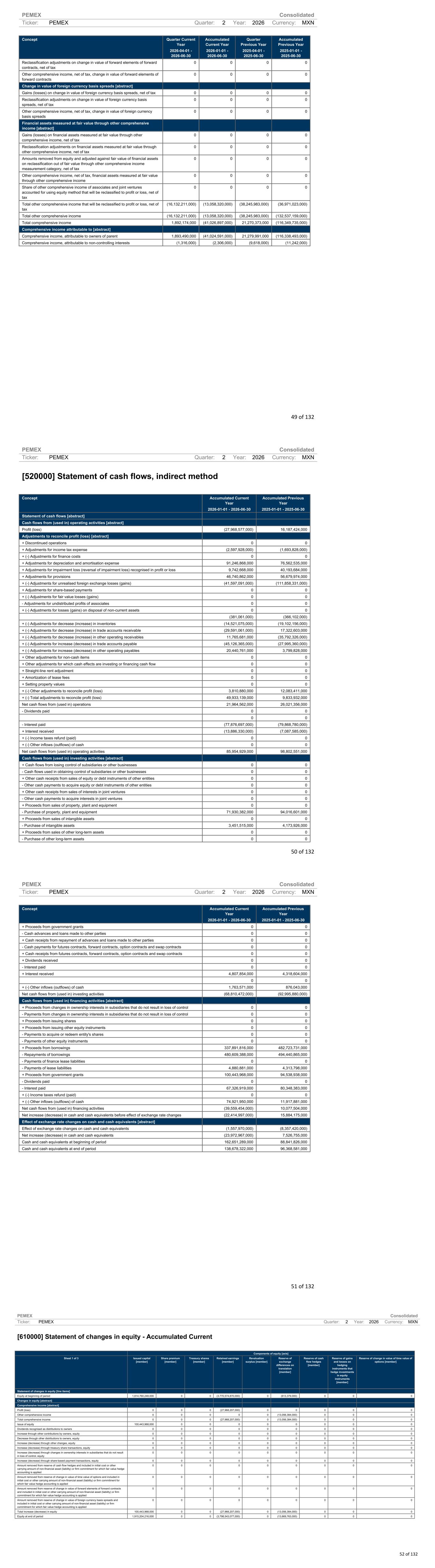
PEMEX Consolidated Ticker: PEMEX Quarter: 2 Year: 2026 Currency: MXN 49 of 132 Concept Quarter Current Year 2026-04-01 - 2026-06-30 Accumulated Current Year 2026-01-01 - 2026-06-30 Quarter Previous Year 2025-04-01 - 2025-06-30 Accumulated Previous Year 2025-01-01 - 2025-06-30 Reclassification adjustments on change in value of forward elements of forward contracts, net of tax 0 0 0 0 Other comprehensive income, net of tax, change in value of forward elements of forward contracts 0 0 0 0 Change in value of foreign currency basis spreads [abstract] Gains (losses) on change in value of foreign currency basis spreads, net of tax 0 0 0 0 Reclassification adjustments on change in value of foreign currency basis spreads, net of tax 0 0 0 0 Other comprehensive income, net of tax, change in value of foreign currency basis spreads 0 0 0 0 Financial assets measured at fair value through other comprehensive income [abstract] Gains (losses) on financial assets measured at fair value through other comprehensive income, net of tax 0 0 0 0 Reclassification adjustments on financial assets measured at fair value through other comprehensive income, net of tax 0 0 0 0 Amounts removed from equity and adjusted against fair value of financial assets on reclassification out of fair value through other comprehensive income measurement category, net of tax 0 0 0 0 Other comprehensive income, net of tax, financial assets measured at fair value through other comprehensive income 0 0 0 0 Share of other comprehensive income of associates and joint ventures accounted for using equity method that will be reclassified to profit or loss, net of tax 0 0 0 0 Total other comprehensive income that will be reclassified to profit or loss, net of tax (16,132,211,000) (13,058,320,000) (38,245,983,000) (36,971,023,000) Total other comprehensive income (16,132,211,000) (13,058,320,000) (38,245,983,000) (132,537,159,000) Total comprehensive income 1,892,174,000 (41,026,897,000) 21,270,373,000 (116,349,735,000) Comprehensive income attributable to [abstract] Comprehensive income, attributable to owners of parent 1,893,490,000 (41,024,591,000) 21,279,991,000 (116,338,493,000) Comprehensive income, attributable to non-controlling interests (1,316,000) (2,306,000) (9,618,000) (11,242,000) PEMEX Consolidated Ticker: PEMEX Quarter: 2 Year: 2026 Currency: MXN 50 of 132 [520000] Statement of cash flows, indirect method Concept Accumulated Current Year 2026-01-01 - 2026-06-30 Accumulated Previous Year 2025-01-01 - 2025-06-30 Statement of cash flows [abstract] Cash flows from (used in) operating activities [abstract] Profit (loss) (27,968,577,000) 16,187,424,000 Adjustments to reconcile profit (loss) [abstract] + Discontinued operations 0 0 + Adjustments for income tax expense (2,597,928,000) (1,693,828,000) + (-) Adjustments for finance costs 0 0 + Adjustments for depreciation and amortisation expense 91,246,868,000 76,562,535,000 + Adjustments for impairment loss (reversal of impairment loss) recognised in profit or loss 9,742,668,000 40,193,684,000 + Adjustments for provisions 46,740,862,000 56,679,974,000 + (-) Adjustments for unrealised foreign exchange losses (gains) (41,597,091,000) (111,858,331,000) + Adjustments for share-based payments 0 0 + (-) Adjustments for fair value losses (gains) 0 0 - Adjustments for undistributed profits of associates 0 0 + (-) Adjustments for losses (gains) on disposal of non-current assets 0 0 (381,061,000) (366,102,000) + (-) Adjustments for decrease (increase) in inventories (14,521,075,000) (19,102,156,000) + (-) Adjustments for decrease (increase) in trade accounts receivable (29,591,061,000) 17,322,603,000 + (-) Adjustments for decrease (increase) in other operating receivables 11,765,681,000 (35,792,326,000) + (-) Adjustments for increase (decrease) in trade accounts payable (45,126,365,000) (27,995,360,000) + (-) Adjustments for increase (decrease) in other operating payables 20,440,761,000 3,799,828,000 + Other adjustments for non-cash items 0 0 + Other adjustments for which cash effects are investing or financing cash flow 0 0 + Straight-line rent adjustment 0 0 + Amortization of lease fees 0 0 + Setting property values 0 0 + (-) Other adjustments to reconcile profit (loss) 3,810,880,000 12,083,411,000 + (-) Total adjustments to reconcile profit (loss) 49,933,139,000 9,833,932,000 Net cash flows from (used in) operations 21,964,562,000 26,021,356,000 - Dividends paid 0 0 0 0 - Interest paid (77,876,697,000) (79,868,780,000) + Interest received (13,886,330,000) (7,087,585,000) + (-) Income taxes refund (paid) 0 0 + (-) Other inflows (outflows) of cash 0 0 Net cash flows from (used in) operating activities 85,954,929,000 98,802,551,000 Cash flows from (used in) investing activities [abstract] + Cash flows from losing control of subsidiaries or other businesses 0 0 - Cash flows used in obtaining control of subsidiaries or other businesses 0 0 + Other cash receipts from sales of equity or debt instruments of other entities 0 0 - Other cash payments to acquire equity or debt instruments of other entities 0 0 + Other cash receipts from sales of interests in joint ventures 0 0 - Other cash payments to acquire interests in joint ventures 0 0 + Proceeds from sales of property, plant and equipment 0 0 - Purchase of property, plant and equipment 71,930,382,000 94,016,601,000 + Proceeds from sales of intangible assets 0 0 - Purchase of intangible assets 3,451,515,000 4,173,926,000 + Proceeds from sales of other long-term assets 0 0 - Purchase of other long-term assets 0 0 PEMEX Consolidated Ticker: PEMEX Quarter: 2 Year: 2026 Currency: MXN 51 of 132 Concept Accumulated Current Year 2026-01-01 - 2026-06-30 Accumulated Previous Year 2025-01-01 - 2025-06-30 + Proceeds from government grants 0 0 - Cash advances and loans made to other parties 0 0 + Cash receipts from repayment of advances and loans made to other parties 0 0 - Cash payments for futures contracts, forward contracts, option contracts and swap contracts 0 0 + Cash receipts from futures contracts, forward contracts, option contracts and swap contracts 0 0 + Dividends received 0 0 - Interest paid 0 0 + Interest received 4,807,854,000 4,318,604,000 0 0 + (-) Other inflows (outflows) of cash 1,763,571,000 876,043,000 Net cash flows from (used in) investing activities (68,810,472,000) (92,995,880,000) Cash flows from (used in) financing activities [abstract] + Proceeds from changes in ownership interests in subsidiaries that do not result in loss of control 0 0 - Payments from changes in ownership interests in subsidiaries that do not result in loss of control 0 0 + Proceeds from issuing shares 0 0 + Proceeds from issuing other equity instruments 0 0 - Payments to acquire or redeem entity's shares 0 0 - Payments of other equity instruments 0 0 + Proceeds from borrowings 337,891,816,000 482,723,731,000 - Repayments of borrowings 480,609,388,000 494,440,865,000 - Payments of finance lease liabilities 0 0 - Payments of lease liabilities 4,880,881,000 4,313,798,000 + Proceeds from government grants 100,443,968,000 94,538,938,000 - Dividends paid 0 0 - Interest paid 67,326,919,000 80,348,383,000 + (-) Income taxes refund (paid) 0 0 + (-) Other inflows (outflows) of cash 74,921,950,000 11,917,881,000 Net cash flows from (used in) financing activities (39,559,454,000) 10,077,504,000 Net increase (decrease) in cash and cash equivalents before effect of exchange rate changes (22,414,997,000) 15,884,175,000 Effect of exchange rate changes on cash and cash equivalents [abstract] Effect of exchange rate changes on cash and cash equivalents (1,557,970,000) (8,357,420,000) Net increase (decrease) in cash and cash equivalents (23,972,967,000) 7,526,755,000 Cash and cash equivalents at beginning of period 162,651,289,000 88,841,826,000 Cash and cash equivalents at end of period 138,678,322,000 96,368,581,000 PEMEX Consolidated Ticker: PEMEX Quarter: 2 Year: 2026 Currency: MXN 52 of 132 [610000] Statement of changes in equity - Accumulated Current Components of equity [axis] Sheet 1 of 3 Issued capital [member] Share premium [member] Treasury shares [member] Retained earnings [member] Revaluation surplus [member] Reserve of exchange differences on translation [member] Reserve of cash flow hedges [member] Reserve of gains and losses on hedging instruments that hedge investments in equity instruments [member] Reserve of change in value of time value of options [member] Statement of changes in equity [line items] Equity at beginning of period 1,814,760,248,000 0 0 (3,770,574,870,000) 0 (613,379,000) 0 0 0 Changes in equity [abstract] Comprehensive income [abstract] Profit (loss) 0 0 0 (27,968,207,000) 0 0 0 0 0 Other comprehensive income 0 0 0 0 0 (13,056,384,000) 0 0 0 Total comprehensive income 0 0 0 (27,968,207,000) 0 (13,056,384,000) 0 0 0 Issue of equity 100,443,968,000 0 0 0 0 0 0 0 0 Dividends recognised as distributions to owners 0 0 0 0 0 0 0 0 0 Increase through other contributions by owners, equity 0 0 0 0 0 0 0 0 0 Decrease through other distributions to owners, equity 0 0 0 0 0 0 0 0 0 Increase (decrease) through other changes, equity 0 0 0 0 0 0 0 0 0 Increase (decrease) through treasury share transactions, equity 0 0 0 0 0 0 0 0 0 Increase (decrease) through changes in ownership interests in subsidiaries that do not result in loss of control, equity 0 0 0 0 0 0 0 0 0 Increase (decrease) through share-based payment transactions, equity 0 0 0 0 0 0 0 0 0 Amount removed from reserve of cash flow hedges and included in initial cost or other carrying amount of non-financial asset (liability) or firm commitment for which fair value hedge accounting is applied 0 0 0 0 0 0 0 0 0 Amount removed from reserve of change in value of time value of options and included in initial cost or other carrying amount of non-financial asset (liability) or firm commitment for which fair value hedge accounting is applied 0 0 0 0 0 0 0 0 0 Amount removed from reserve of change in value of forward elements of forward contracts and included in initial cost or other carrying amount of non-financial asset (liability) or firm commitment for which fair value hedge accounting is applied 0 0 0 0 0 0 0 0 0 Amount removed from reserve of change in value of foreign currency basis spreads and included in initial cost or other carrying amount of non-financial asset (liability) or firm commitment for which fair value hedge accounting is applied 0 0 0 0 0 0 0 0 0 Total increase (decrease) in equity 100,443,968,000 0 0 (27,968,207,000) 0 (13,056,384,000) 0 0 0 Equity at end of period 1,915,204,216,000 0 0 (3,798,543,077,000) 0 (13,669,763,000) 0 0 0
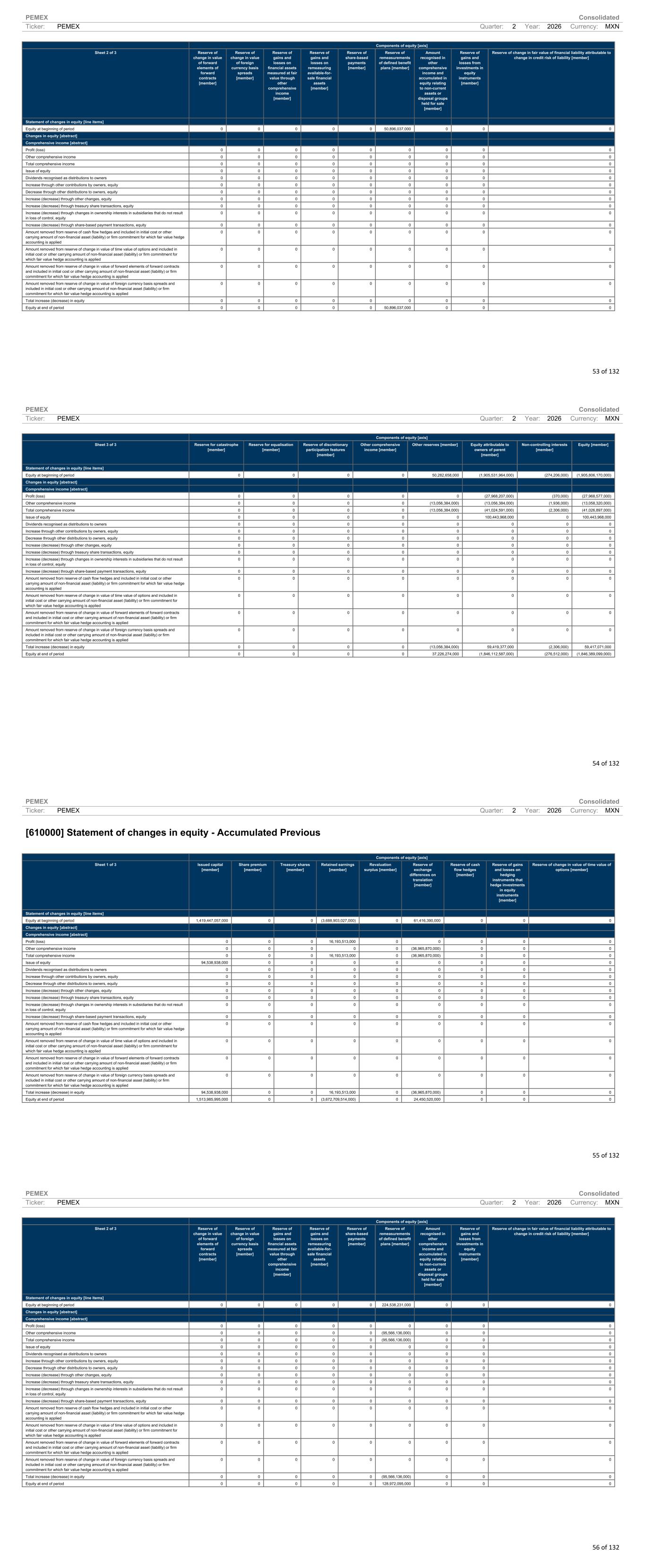
PEMEX Consolidated Ticker: PEMEX Quarter: 2 Year: 2026 Currency: MXN 53 of 132 Components of equity [axis] Sheet 2 of 3 Reserve of change in value of forward elements of forward contracts [member] Reserve of change in value of foreign currency basis spreads [member] Reserve of gains and losses on financial assets measured at fair value through other comprehensive income [member] Reserve of gains and losses on remeasuring available-for- sale financial assets [member] Reserve of share-based payments [member] Reserve of remeasurements of defined benefit plans [member] Amount recognised in other comprehensive income and accumulated in equity relating to non-current assets or disposal groups held for sale [member] Reserve of gains and losses from investments in equity instruments [member] Reserve of change in fair value of financial liability attributable to change in credit risk of liability [member] Statement of changes in equity [line items] Equity at beginning of period 0 0 0 0 0 50,896,037,000 0 0 0 Changes in equity [abstract] Comprehensive income [abstract] Profit (loss) 0 0 0 0 0 0 0 0 0 Other comprehensive income 0 0 0 0 0 0 0 0 0 Total comprehensive income 0 0 0 0 0 0 0 0 0 Issue of equity 0 0 0 0 0 0 0 0 0 Dividends recognised as distributions to owners 0 0 0 0 0 0 0 0 0 Increase through other contributions by owners, equity 0 0 0 0 0 0 0 0 0 Decrease through other distributions to owners, equity 0 0 0 0 0 0 0 0 0 Increase (decrease) through other changes, equity 0 0 0 0 0 0 0 0 0 Increase (decrease) through treasury share transactions, equity 0 0 0 0 0 0 0 0 0 Increase (decrease) through changes in ownership interests in subsidiaries that do not result in loss of control, equity 0 0 0 0 0 0 0 0 0 Increase (decrease) through share-based payment transactions, equity 0 0 0 0 0 0 0 0 0 Amount removed from reserve of cash flow hedges and included in initial cost or other carrying amount of non-financial asset (liability) or firm commitment for which fair value hedge accounting is applied 0 0 0 0 0 0 0 0 0 Amount removed from reserve of change in value of time value of options and included in initial cost or other carrying amount of non-financial asset (liability) or firm commitment for which fair value hedge accounting is applied 0 0 0 0 0 0 0 0 0 Amount removed from reserve of change in value of forward elements of forward contracts and included in initial cost or other carrying amount of non-financial asset (liability) or firm commitment for which fair value hedge accounting is applied 0 0 0 0 0 0 0 0 0 Amount removed from reserve of change in value of foreign currency basis spreads and included in initial cost or other carrying amount of non-financial asset (liability) or firm commitment for which fair value hedge accounting is applied 0 0 0 0 0 0 0 0 0 Total increase (decrease) in equity 0 0 0 0 0 0 0 0 0 Equity at end of period 0 0 0 0 0 50,896,037,000 0 0 0 PEMEX Consolidated Ticker: PEMEX Quarter: 2 Year: 2026 Currency: MXN 54 of 132 Components of equity [axis] Sheet 3 of 3 Reserve for catastrophe [member] Reserve for equalisation [member] Reserve of discretionary participation features [member] Other comprehensive income [member] Other reserves [member] Equity attributable to owners of parent [member] Non-controlling interests [member] Equity [member] Statement of changes in equity [line items] Equity at beginning of period 0 0 0 0 50,282,658,000 (1,905,531,964,000) (274,206,000) (1,905,806,170,000) Changes in equity [abstract] Comprehensive income [abstract] Profit (loss) 0 0 0 0 0 (27,968,207,000) (370,000) (27,968,577,000) Other comprehensive income 0 0 0 0 (13,056,384,000) (13,056,384,000) (1,936,000) (13,058,320,000) Total comprehensive income 0 0 0 0 (13,056,384,000) (41,024,591,000) (2,306,000) (41,026,897,000) Issue of equity 0 0 0 0 0 100,443,968,000 0 100,443,968,000 Dividends recognised as distributions to owners 0 0 0 0 0 0 0 0 Increase through other contributions by owners, equity 0 0 0 0 0 0 0 0 Decrease through other distributions to owners, equity 0 0 0 0 0 0 0 0 Increase (decrease) through other changes, equity 0 0 0 0 0 0 0 0 Increase (decrease) through treasury share transactions, equity 0 0 0 0 0 0 0 0 Increase (decrease) through changes in ownership interests in subsidiaries that do not result in loss of control, equity 0 0 0 0 0 0 0 0 Increase (decrease) through share-based payment transactions, equity 0 0 0 0 0 0 0 0 Amount removed from reserve of cash flow hedges and included in initial cost or other carrying amount of non-financial asset (liability) or firm commitment for which fair value hedge accounting is applied 0 0 0 0 0 0 0 0 Amount removed from reserve of change in value of time value of options and included in initial cost or other carrying amount of non-financial asset (liability) or firm commitment for which fair value hedge accounting is applied 0 0 0 0 0 0 0 0 Amount removed from reserve of change in value of forward elements of forward contracts and included in initial cost or other carrying amount of non-financial asset (liability) or firm commitment for which fair value hedge accounting is applied 0 0 0 0 0 0 0 0 Amount removed from reserve of change in value of foreign currency basis spreads and included in initial cost or other carrying amount of non-financial asset (liability) or firm commitment for which fair value hedge accounting is applied 0 0 0 0 0 0 0 0 Total increase (decrease) in equity 0 0 0 0 (13,056,384,000) 59,419,377,000 (2,306,000) 59,417,071,000 Equity at end of period 0 0 0 0 37,226,274,000 (1,846,112,587,000) (276,512,000) (1,846,389,099,000) PEMEX Consolidated Ticker: PEMEX Quarter: 2 Year: 2026 Currency: MXN 55 of 132 [610000] Statement of changes in equity - Accumulated Previous Components of equity [axis] Sheet 1 of 3 Issued capital [member] Share premium [member] Treasury shares [member] Retained earnings [member] Revaluation surplus [member] Reserve of exchange differences on translation [member] Reserve of cash flow hedges [member] Reserve of gains and losses on hedging instruments that hedge investments in equity instruments [member] Reserve of change in value of time value of options [member] Statement of changes in equity [line items] Equity at beginning of period 1,419,447,057,000 0 0 (3,688,903,027,000) 0 61,416,390,000 0 0 0 Changes in equity [abstract] Comprehensive income [abstract] Profit (loss) 0 0 0 16,193,513,000 0 0 0 0 0 Other comprehensive income 0 0 0 0 0 (36,965,870,000) 0 0 0 Total comprehensive income 0 0 0 16,193,513,000 0 (36,965,870,000) 0 0 0 Issue of equity 94,538,938,000 0 0 0 0 0 0 0 0 Dividends recognised as distributions to owners 0 0 0 0 0 0 0 0 0 Increase through other contributions by owners, equity 0 0 0 0 0 0 0 0 0 Decrease through other distributions to owners, equity 0 0 0 0 0 0 0 0 0 Increase (decrease) through other changes, equity 0 0 0 0 0 0 0 0 0 Increase (decrease) through treasury share transactions, equity 0 0 0 0 0 0 0 0 0 Increase (decrease) through changes in ownership interests in subsidiaries that do not result in loss of control, equity 0 0 0 0 0 0 0 0 0 Increase (decrease) through share-based payment transactions, equity 0 0 0 0 0 0 0 0 0 Amount removed from reserve of cash flow hedges and included in initial cost or other carrying amount of non-financial asset (liability) or firm commitment for which fair value hedge accounting is applied 0 0 0 0 0 0 0 0 0 Amount removed from reserve of change in value of time value of options and included in initial cost or other carrying amount of non-financial asset (liability) or firm commitment for which fair value hedge accounting is applied 0 0 0 0 0 0 0 0 0 Amount removed from reserve of change in value of forward elements of forward contracts and included in initial cost or other carrying amount of non-financial asset (liability) or firm commitment for which fair value hedge accounting is applied 0 0 0 0 0 0 0 0 0 Amount removed from reserve of change in value of foreign currency basis spreads and included in initial cost or other carrying amount of non-financial asset (liability) or firm commitment for which fair value hedge accounting is applied 0 0 0 0 0 0 0 0 0 Total increase (decrease) in equity 94,538,938,000 0 0 16,193,513,000 0 (36,965,870,000) 0 0 0 Equity at end of period 1,513,985,995,000 0 0 (3,672,709,514,000) 0 24,450,520,000 0 0 0 PEMEX Consolidated Ticker: PEMEX Quarter: 2 Year: 2026 Currency: MXN 56 of 132 Components of equity [axis] Sheet 2 of 3 Reserve of change in value of forward elements of forward contracts [member] Reserve of change in value of foreign currency basis spreads [member] Reserve of gains and losses on financial assets measured at fair value through other comprehensive income [member] Reserve of gains and losses on remeasuring available-for- sale financial assets [member] Reserve of share-based payments [member] Reserve of remeasurements of defined benefit plans [member] Amount recognised in other comprehensive income and accumulated in equity relating to non-current assets or disposal groups held for sale [member] Reserve of gains and losses from investments in equity instruments [member] Reserve of change in fair value of financial liability attributable to change in credit risk of liability [member] Statement of changes in equity [line items] Equity at beginning of period 0 0 0 0 0 224,538,231,000 0 0 0 Changes in equity [abstract] Comprehensive income [abstract] Profit (loss) 0 0 0 0 0 0 0 0 0 Other comprehensive income 0 0 0 0 0 (95,566,136,000) 0 0 0 Total comprehensive income 0 0 0 0 0 (95,566,136,000) 0 0 0 Issue of equity 0 0 0 0 0 0 0 0 0 Dividends recognised as distributions to owners 0 0 0 0 0 0 0 0 0 Increase through other contributions by owners, equity 0 0 0 0 0 0 0 0 0 Decrease through other distributions to owners, equity 0 0 0 0 0 0 0 0 0 Increase (decrease) through other changes, equity 0 0 0 0 0 0 0 0 0 Increase (decrease) through treasury share transactions, equity 0 0 0 0 0 0 0 0 0 Increase (decrease) through changes in ownership interests in subsidiaries that do not result in loss of control, equity 0 0 0 0 0 0 0 0 0 Increase (decrease) through share-based payment transactions, equity 0 0 0 0 0 0 0 0 0 Amount removed from reserve of cash flow hedges and included in initial cost or other carrying amount of non-financial asset (liability) or firm commitment for which fair value hedge accounting is applied 0 0 0 0 0 0 0 0 0 Amount removed from reserve of change in value of time value of options and included in initial cost or other carrying amount of non-financial asset (liability) or firm commitment for which fair value hedge accounting is applied 0 0 0 0 0 0 0 0 0 Amount removed from reserve of change in value of forward elements of forward contracts and included in initial cost or other carrying amount of non-financial asset (liability) or firm commitment for which fair value hedge accounting is applied 0 0 0 0 0 0 0 0 0 Amount removed from reserve of change in value of foreign currency basis spreads and included in initial cost or other carrying amount of non-financial asset (liability) or firm commitment for which fair value hedge accounting is applied 0 0 0 0 0 0 0 0 0 Total increase (decrease) in equity 0 0 0 0 0 (95,566,136,000) 0 0 0 Equity at end of period 0 0 0 0 0 128,972,095,000 0 0 0
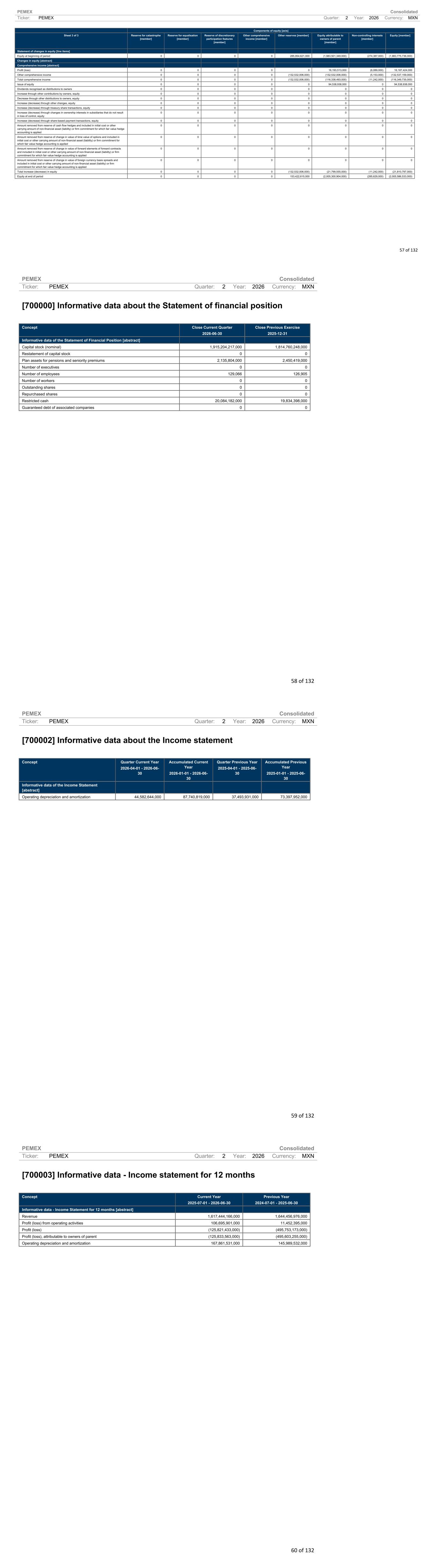
PEMEX Consolidated Ticker: PEMEX Quarter: 2 Year: 2026 Currency: MXN 57 of 132 Components of equity [axis] Sheet 3 of 3 Reserve for catastrophe [member] Reserve for equalisation [member] Reserve of discretionary participation features [member] Other comprehensive income [member] Other reserves [member] Equity attributable to owners of parent [member] Non-controlling interests [member] Equity [member] Statement of changes in equity [line items] Equity at beginning of period 0 0 0 0 285,954,621,000 (1,983,501,349,000) (274,387,000) (1,983,775,736,000) Changes in equity [abstract] Comprehensive income [abstract] Profit (loss) 0 0 0 0 0 16,193,513,000 (6,089,000) 16,187,424,000 Other comprehensive income 0 0 0 0 (132,532,006,000) (132,532,006,000) (5,153,000) (132,537,159,000) Total comprehensive income 0 0 0 0 (132,532,006,000) (116,338,493,000) (11,242,000) (116,349,735,000) Issue of equity 0 0 0 0 0 94,538,938,000 0 94,538,938,000 Dividends recognised as distributions to owners 0 0 0 0 0 0 0 0 Increase through other contributions by owners, equity 0 0 0 0 0 0 0 0 Decrease through other distributions to owners, equity 0 0 0 0 0 0 0 0 Increase (decrease) through other changes, equity 0 0 0 0 0 0 0 0 Increase (decrease) through treasury share transactions, equity 0 0 0 0 0 0 0 0 Increase (decrease) through changes in ownership interests in subsidiaries that do not result in loss of control, equity 0 0 0 0 0 0 0 0 Increase (decrease) through share-based payment transactions, equity 0 0 0 0 0 0 0 0 Amount removed from reserve of cash flow hedges and included in initial cost or other carrying amount of non-financial asset (liability) or firm commitment for which fair value hedge accounting is applied 0 0 0 0 0 0 0 0 Amount removed from reserve of change in value of time value of options and included in initial cost or other carrying amount of non-financial asset (liability) or firm commitment for which fair value hedge accounting is applied 0 0 0 0 0 0 0 0 Amount removed from reserve of change in value of forward elements of forward contracts and included in initial cost or other carrying amount of non-financial asset (liability) or firm commitment for which fair value hedge accounting is applied 0 0 0 0 0 0 0 0 Amount removed from reserve of change in value of foreign currency basis spreads and included in initial cost or other carrying amount of non-financial asset (liability) or firm commitment for which fair value hedge accounting is applied 0 0 0 0 0 0 0 0 Total increase (decrease) in equity 0 0 0 0 (132,532,006,000) (21,799,555,000) (11,242,000) (21,810,797,000) Equity at end of period 0 0 0 0 153,422,615,000 (2,005,300,904,000) (285,629,000) (2,005,586,533,000) PEMEX Consolidated Ticker: PEMEX Quarter: 2 Year: 2026 Currency: MXN 58 of 132 [700000] Informative data about the Statement of financial position Concept Close Current Quarter 2026-06-30 Close Previous Exercise 2025-12-31 Informative data of the Statement of Financial Position [abstract] Capital stock (nominal) 1,915,204,217,000 1,814,760,248,000 Restatement of capital stock 0 0 Plan assets for pensions and seniority premiums 2,135,804,000 2,450,419,000 Number of executives 0 0 Number of employees 129,066 126,905 Number of workers 0 0 Outstanding shares 0 0 Repurchased shares 0 0 Restricted cash 20,084,182,000 19,834,398,000 Guaranteed debt of associated companies 0 0 PEMEX Consolidated Ticker: PEMEX Quarter: 2 Year: 2026 Currency: MXN 59 of 132 [700002] Informative data about the Income statement Concept Quarter Current Year 2026-04-01 - 2026-06- 30 Accumulated Current Year 2026-01-01 - 2026-06- 30 Quarter Previous Year 2025-04-01 - 2025-06- 30 Accumulated Previous Year 2025-01-01 - 2025-06- 30 Informative data of the Income Statement [abstract] Operating depreciation and amortization 44,582,644,000 87,740,819,000 37,493,931,000 73,397,952,000 PEMEX Consolidated Ticker: PEMEX Quarter: 2 Year: 2026 Currency: MXN 60 of 132 [700003] Informative data - Income statement for 12 months Concept Current Year 2025-07-01 - 2026-06-30 Previous Year 2024-07-01 - 2025-06-30 Informative data - Income Statement for 12 months [abstract] Revenue 1,617,444,166,000 1,644,456,976,000 Profit (loss) from operating activities 106,695,901,000 11,452,395,000 Profit (loss) (125,821,433,000) (495,753,173,000) Profit (loss), attributable to owners of parent (125,833,563,000) (495,603,255,000) Operating depreciation and amortization 167,861,531,000 145,989,532,000
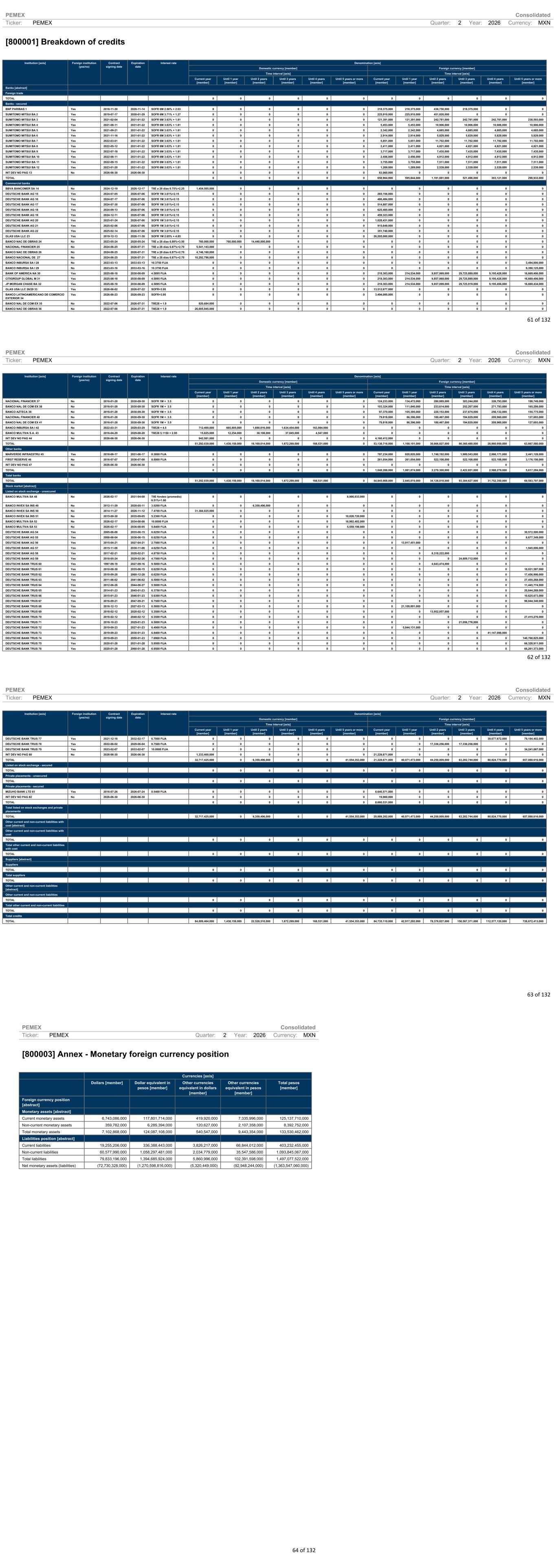
PEMEX Consolidated Ticker: PEMEX Quarter: 2 Year: 2026 Currency: MXN 61 of 132 [800001] Breakdown of credits Denomination [axis] Domestic currency [member] Foreign currency [member] Time interval [axis] Time interval [axis] Institution [axis] Foreign institution (yes/no) Contract signing date Expiration date Interest rate Current year [member] Until 1 year [member] Until 2 years [member] Until 3 years [member] Until 4 years [member] Until 5 years or more [member] Current year [member] Until 1 year [member] Until 2 years [member] Until 3 years [member] Until 4 years [member] Until 5 years or more [member] Banks [abstract] Foreign trade TOTAL 0 0 0 0 0 0 0 0 0 0 0 0 Banks - secured BNP PARIBAS 1 Yes 2018-11-30 2028-11-14 SOFR 6M 2.86% + 2.03 0 0 0 0 0 0 218,375,000 218,375,000 436,750,000 218,375,000 0 0 SUMITOMO MITSUI BA 2 Yes 2019-07-17 2028-01-29 SOFR 6M 3.71% + 1.27 0 0 0 0 0 0 225,910,000 225,910,000 451,820,000 0 0 0 SUMITOMO MITSUI BA 3 Yes 2021-02-04 2031-01-22 SOFR 6M 3.63% + 1.81 0 0 0 0 0 0 121,391,000 121,391,000 242,781,000 242,781,000 242,781,000 238,593,000 SUMITOMO MITSUI BA 4 Yes 2021-08-11 2031-01-22 SOFR 6M 3.63% + 1.81 0 0 0 0 0 0 5,453,000 5,453,000 10,906,000 10,906,000 10,906,000 10,906,000 SUMITOMO MITSUI BA 5 Yes 2021-09-21 2031-01-22 SOFR 6M 3.63% + 1.81 0 0 0 0 0 0 2,342,000 2,342,000 4,685,000 4,685,000 4,685,000 4,685,000 SUMITOMO MITSUI BA 6 Yes 2021-11-16 2031-01-22 SOFR 6M 3.63% + 1.81 0 0 0 0 0 0 2,914,000 2,914,000 5,829,000 5,829,000 5,829,000 5,829,000 SUMITOMO MITSUI BA 7 Yes 2022-03-01 2031-01-22 SOFR 6M 3.63% + 1.81 0 0 0 0 0 0 5,851,000 5,851,000 11,702,000 11,702,000 11,702,000 11,702,000 SUMITOMO MITSUI BA 8 Yes 2022-05-12 2031-01-22 SOFR 6M 3.63% + 1.81 0 0 0 0 0 0 2,411,000 2,411,000 4,821,000 4,821,000 4,821,000 4,821,000 SUMITOMO MITSUI BA 9 Yes 2022-07-18 2031-01-22 SOFR 6M 3.63% + 1.81 0 0 0 0 0 0 3,717,000 3,717,000 7,435,000 7,435,000 7,435,000 7,435,000 SUMITOMO MITSUI BA 10 Yes 2022-08-11 2031-01-22 SOFR 6M 3.63% + 1.81 0 0 0 0 0 0 2,456,000 2,456,000 4,912,000 4,912,000 4,912,000 4,912,000 SUMITOMO MITSUI BA 11 Yes 2022-09-15 2031-01-22 SOFR 6M 3.63% + 1.81 0 0 0 0 0 0 3,755,000 3,755,000 7,511,000 7,511,000 7,511,000 7,511,000 SUMITOMO MITSUI BA 12 Yes 2023-01-20 2031-01-22 SOFR 6M 3.63% + 1.81 0 0 0 0 0 0 1,269,000 1,269,000 2,539,000 2,539,000 2,539,000 2,539,000 INT DEV NO PAG 13 No 2026-06-30 2026-06-30 0 0 0 0 0 0 63,060,000 0 0 0 0 0 TOTAL 0 0 0 0 0 0 658,904,000 595,844,000 1,191,691,000 521,496,000 303,121,000 298,933,000 Commercial banks BBVA BANCOMER SA 14 No 2024-12-19 2026-12-17 TIIE a 28 días 6.75%+2.25 1,454,505,000 0 0 0 0 0 0 0 0 0 0 0 DEUTSCHE BANK AG 15 Yes 2024-07-05 2026-07-06 SOFR 1M 3.61%+2.15 0 0 0 0 0 0 265,156,000 0 0 0 0 0 DEUTSCHE BANK AG 16 Yes 2024-07-17 2026-07-06 SOFR 1M 3.61%+2.15 0 0 0 0 0 0 466,484,000 0 0 0 0 0 DEUTSCHE BANK AG 17 Yes 2024-07-30 2026-07-06 SOFR 1M 3.61%+2.15 0 0 0 0 0 0 514,887,000 0 0 0 0 0 DEUTSCHE BANK AG 18 Yes 2024-09-13 2026-07-06 SOFR 1M 3.61%+2.15 0 0 0 0 0 0 625,485,000 0 0 0 0 0 DEUTSCHE BANK AG 19 Yes 2024-12-11 2026-07-06 SOFR 1M 3.61%+2.15 0 0 0 0 0 0 459,323,000 0 0 0 0 0 DEUTSCHE BANK AG 20 Yes 2025-01-24 2026-07-06 SOFR 1M 3.61%+2.15 0 0 0 0 0 0 1,028,431,000 0 0 0 0 0 DEUTSCHE BANK AG 21 Yes 2025-02-06 2026-07-06 SOFR 1M 3.61%+2.15 0 0 0 0 0 0 915,649,000 0 0 0 0 0 DEUTSCHE BANK AG 22 Yes 2025-02-14 2026-07-06 SOFR 1M 3.61%+2.15 0 0 0 0 0 0 351,740,000 0 0 0 0 0 GLAS USA LLC 23 Yes 2019-12-13 2026-11-30 SOFR 1M 2.65% + 4.85 0 0 0 0 0 0 26,205,000,000 0 0 0 0 0 BANCO NAC DE OBRAS 24 No 2023-05-24 2028-05-24 TIIE a 28 días 6.80%+3.50 760,000,000 760,000,000 14,440,000,000 0 0 0 0 0 0 0 0 0 NACIONAL FINANCIER 25 No 2024-06-25 2026-07-31 TIIE a 28 días 6.87%+2.70 5,541,143,000 0 0 0 0 0 0 0 0 0 0 0 BANCO NAC DE OBRAS 26 No 2024-06-25 2026-07-31 TIIE a 28 días 6.87%+2.70 4,746,160,000 0 0 0 0 0 0 0 0 0 0 0 BANCO NACIONAL DE 27 No 2024-06-25 2026-07-31 TIIE a 28 días 6.87%+2.70 10,292,796,000 0 0 0 0 0 0 0 0 0 0 0 BANCO INBURSA SA I 28 No 2023-03-13 2033-03-13 10.3750 FIJA 0 0 0 0 0 0 0 0 0 0 0 3,494,000,000 BANCO INBURSA SA I 29 No 2023-03-16 2033-03-16 10.3750 FIJA 0 0 0 0 0 0 0 0 0 0 0 9,390,125,000 BANK OF AMERICA NA 30 Yes 2025-08-18 2030-08-09 4.5895 FIJA 0 0 0 0 0 0 218,303,000 214,534,000 9,857,069,000 29,725,889,000 9,195,428,000 16,669,406,000 CITIGROUP GLOBAL M 31 Yes 2025-08-18 2030-08-09 4.5895 FIJA 0 0 0 0 0 0 218,303,000 214,534,000 9,857,069,000 29,725,889,000 9,195,428,000 16,669,406,000 JP MORGAN CHASE BA 32 Yes 2025-08-18 2030-08-09 4.5895 FIJA 0 0 0 0 0 0 218,303,000 214,534,000 9,857,099,000 29,725,919,000 9,195,456,000 16,669,434,000 GLAS USA LLC 26/29 33 Yes 2026-06-02 2026-07-22 SOFR+3.95 0 0 0 0 0 0 13,512,677,000 0 0 0 0 0 BANCO LATINOAMERICANO DE COMERCIO EXTERIOR 34 Yes 2026-06-23 2026-09-23 SOFR+3.95 0 0 0 0 0 0 3,494,000,000 0 0 0 0 0 BANCO NAL DE COM EX 35 No 2022-07-06 2026-07-31 TIIE28 + 1.9 820,684,000 0 0 0 0 0 0 0 0 0 0 0 BANCO NAC DE OBRAS 36 No 2022-07-06 2026-07-31 TIIE28 + 1.9 26,005,945,000 0 0 0 0 0 0 0 0 0 0 0 PEMEX Consolidated Ticker: PEMEX Quarter: 2 Year: 2026 Currency: MXN 62 of 132 Denomination [axis] Domestic currency [member] Foreign currency [member] Time interval [axis] Time interval [axis] Institution [axis] Foreign institution (yes/no) Contract signing date Expiration date Interest rate Current year [member] Until 1 year [member] Until 2 years [member] Until 3 years [member] Until 4 years [member] Until 5 years or more [member] Current year [member] Until 1 year [member] Until 2 years [member] Until 3 years [member] Until 4 years [member] Until 5 years or more [member] NACIONAL FINANCIER 37 No 2016-01-28 2030-09-30 SOFR 1M + 3.5 0 0 0 0 0 0 124,233,000 134,472,000 280,889,000 303,244,000 326,793,000 198,749,000 BANCO NAL DE COM EX 38 No 2016-01-28 2030-09-30 SOFR 1M + 3.5 0 0 0 0 0 0 103,324,000 111,840,000 233,614,000 252,207,000 271,793,000 165,299,000 BANCO AZTECA 39 No 2016-01-28 2030-09-30 SOFR 1M + 3.5 0 0 0 0 0 0 97,370,000 105,395,000 220,153,000 237,674,000 256,132,000 155,775,000 NACIONAL FINANCIER 40 No 2016-01-28 2030-09-30 SOFR 1M + 3.5 0 0 0 0 0 0 79,818,000 86,396,000 180,467,000 194,829,000 209,960,000 127,693,000 BANCO NAL DE COM EX 41 No 2016-01-28 2030-09-30 SOFR 1M + 3.5 0 0 0 0 0 0 79,818,000 86,396,000 180,467,000 194,829,000 209,960,000 127,693,000 BANCO INBURSA SA I 42 No 2022-03-31 2029-03-29 TIIE28 + 4.5 712,400,000 665,905,000 1,690,816,000 1,634,454,000 163,984,000 0 0 0 0 0 0 0 BANCO MULTIVA S.A. 43 No 2016-04-29 2029-08-20 TIIE28 5.1150 + 2.95 15,825,000 12,254,000 38,198,000 37,845,000 4,547,000 0 0 0 0 0 0 0 INT DEV NO PAG 44 No 2026-06-30 2026-06-30 942,581,000 0 0 0 0 0 4,160,412,000 0 0 0 0 0 TOTAL 51,292,039,000 1,438,159,000 16,169,014,000 1,672,299,000 168,531,000 0 53,138,716,000 1,168,101,000 30,666,827,000 90,360,480,000 28,860,950,000 63,667,580,000 Other banks MARVERDE INFRAESTRU 45 Yes 2016-06-17 2031-06-17 8.3800 FIJA 0 0 0 0 0 0 787,234,000 820,820,000 1,748,192,000 1,900,543,000 2,066,171,000 2,441,128,000 FIRST RESERVE 46 No 2016-07-07 2036-07-08 8.8900 FIJA 0 0 0 0 0 0 261,054,000 261,054,000 522,108,000 522,108,000 522,108,000 3,176,156,000 INT DEV NO PAG 47 No 2026-06-30 2026-06-30 0 0 0 0 0 0 0 0 0 0 0 0 TOTAL 0 0 0 0 0 0 1,048,288,000 1,081,874,000 2,270,300,000 2,422,651,000 2,588,279,000 5,617,284,000 Total banks TOTAL 51,292,039,000 1,438,159,000 16,169,014,000 1,672,299,000 168,531,000 0 54,845,908,000 2,845,819,000 34,128,818,000 93,304,627,000 31,752,350,000 69,583,797,000 Stock market [abstract] Listed on stock exchange - unsecured BANCO MULTIVA SA 48 No 2026-02-17 2031-04-08 TIIE fondeo (promedio) 6.51%+1.80 0 0 0 0 0 8,986,033,000 0 0 0 0 0 0 BANCO INVEX SA INS 49 No 2012-11-29 2028-05-11 3.0200 FIJA 0 0 6,359,496,000 0 0 0 0 0 0 0 0 0 BANCO INVEX SA INS 50 No 2014-11-27 2026-11-12 7.4700 FIJA 31,384,025,000 0 0 0 0 0 0 0 0 0 0 0 BANCO INVEX SA INS 51 No 2015-09-30 2035-09-05 5.2300 FIJA 0 0 0 0 0 10,026,720,000 0 0 0 0 0 0 BANCO MULTIVA SA 52 No 2026-02-17 2034-08-08 10.8000 FIJA 0 0 0 0 0 16,982,402,000 0 0 0 0 0 0 BANCO MULTIVA SA 53 No 2026-02-17 2036-08-05 5.8400 FIJA 0 0 0 0 0 5,559,198,000 0 0 0 0 0 0 DEUTSCHE BANK AG 54 Yes 2005-06-08 2035-06-15 6.6250 FIJA 0 0 0 0 0 0 0 0 0 0 0 30,572,500,000 DEUTSCHE BANK AG 55 Yes 2008-06-04 2038-06-15 6.6250 FIJA 0 0 0 0 0 0 0 0 0 0 0 8,677,349,000 DEUTSCHE BANK AG 56 Yes 2015-04-21 2027-04-21 2.7500 FIJA 0 0 0 0 0 0 0 13,917,451,000 0 0 0 0 DEUTSCHE BANK AG 57 Yes 2015-11-06 2030-11-06 4.6250 FIJA 0 0 0 0 0 0 0 0 0 0 0 1,945,006,000 DEUTSCHE BANK AG 58 Yes 2017-02-21 2028-02-21 4.8750 FIJA 0 0 0 0 0 0 0 0 8,318,222,000 0 0 0 DEUTSCHE BANK AG 59 Yes 2018-05-24 2029-02-26 4.7500 FIJA 0 0 0 0 0 0 0 0 0 24,809,712,000 0 0 DEUTSCHE BANK TRUS 60 Yes 1997-09-18 2027-09-16 9.5000 FIJA 0 0 0 0 0 0 0 0 4,643,474,000 0 0 0 DEUTSCHE BANK TRUS 61 Yes 2010-08-30 2035-06-15 6.6250 FIJA 0 0 0 0 0 0 0 0 0 0 0 18,021,587,000 DEUTSCHE BANK TRUS 62 Yes 2010-09-28 2060-12-28 6.6250 FIJA 0 0 0 0 0 0 0 0 0 0 0 17,456,996,000 DEUTSCHE BANK TRUS 63 Yes 2011-06-02 2041-06-02 6.5000 FIJA 0 0 0 0 0 0 0 0 0 0 0 27,455,268,000 DEUTSCHE BANK TRUS 64 Yes 2012-06-26 2044-06-27 5.5000 FIJA 0 0 0 0 0 0 0 0 0 0 0 11,445,774,000 DEUTSCHE BANK TRUS 65 Yes 2014-01-23 2045-01-23 6.3750 FIJA 0 0 0 0 0 0 0 0 0 0 0 20,644,269,000 DEUTSCHE BANK TRUS 66 Yes 2015-01-23 2046-01-23 5.6300 FIJA 0 0 0 0 0 0 0 0 0 0 0 10,625,673,000 DEUTSCHE BANK TRUS 67 Yes 2016-09-21 2047-09-21 6.7500 FIJA 0 0 0 0 0 0 0 0 0 0 0 96,044,340,000 DEUTSCHE BANK TRUS 68 Yes 2016-12-13 2027-03-13 6.5000 FIJA 0 0 0 0 0 0 0 21,109,891,000 0 0 0 0 DEUTSCHE BANK TRUS 69 Yes 2018-02-12 2028-02-12 5.3500 FIJA 0 0 0 0 0 0 0 0 13,952,057,000 0 0 0 DEUTSCHE BANK TRUS 70 Yes 2018-02-12 2048-02-12 6.3500 FIJA 0 0 0 0 0 0 0 0 0 0 0 27,415,276,000 DEUTSCHE BANK TRUS 71 Yes 2018-10-23 2029-01-23 6.5000 FIJA 0 0 0 0 0 0 0 0 0 21,056,776,000 0 0 DEUTSCHE BANK TRUS 72 Yes 2019-09-23 2027-01-23 6.4900 FIJA 0 0 0 0 0 0 0 5,044,131,000 0 0 0 0 DEUTSCHE BANK TRUS 73 Yes 2019-09-23 2030-01-23 6.8400 FIJA 0 0 0 0 0 0 0 0 0 0 41,147,098,000 0 DEUTSCHE BANK TRUS 74 Yes 2019-09-23 2050-01-23 7.6900 FIJA 0 0 0 0 0 0 0 0 0 0 0 140,768,825,000 DEUTSCHE BANK TRUS 75 Yes 2020-01-28 2031-01-28 5.9500 FIJA 0 0 0 0 0 0 0 0 0 0 0 66,328,911,000 DEUTSCHE BANK TRUS 76 Yes 2020-01-28 2060-01-28 6.9500 FIJA 0 0 0 0 0 0 0 0 0 0 0 66,261,373,000 PEMEX Consolidated Ticker: PEMEX Quarter: 2 Year: 2026 Currency: MXN 63 of 132 Denomination [axis] Domestic currency [member] Foreign currency [member] Time interval [axis] Time interval [axis] Institution [axis] Foreign institution (yes/no) Contract signing date Expiration date Interest rate Current year [member] Until 1 year [member] Until 2 years [member] Until 3 years [member] Until 4 years [member] Until 5 years or more [member] Current year [member] Until 1 year [member] Until 2 years [member] Until 3 years [member] Until 4 years [member] Until 5 years or more [member] DEUTSCHE BANK TRUS 77 Yes 2021-12-16 2032-02-17 6.7000 FIJA 0 0 0 0 0 0 0 0 0 0 39,677,672,000 79,184,402,000 DEUTSCHE BANK TRUS 78 Yes 2022-06-02 2029-06-04 8.7500 FIJA 0 0 0 0 0 0 0 0 17,336,256,000 17,336,256,000 0 0 DEUTSCHE BANK TRUS 79 Yes 2023-02-07 2033-02-07 10.0000 FIJA 0 0 0 0 0 0 0 0 0 0 0 34,241,067,000 INT DEV NO PAG 80 No 2026-06-30 2026-06-30 1,333,400,000 0 0 0 0 0 21,228,671,000 0 0 0 0 0 TOTAL 32,717,425,000 0 6,359,496,000 0 0 41,554,353,000 21,228,671,000 40,071,473,000 44,250,009,000 63,202,744,000 80,824,770,000 657,088,616,000 Listed on stock exchange - secured TOTAL 0 0 0 0 0 0 0 0 0 0 0 0 Private placements - unsecured TOTAL 0 0 0 0 0 0 0 0 0 0 0 0 Private placements - secured MIZUHO BANK LTD 81 Yes 2016-07-26 2026-07-24 0.5400 FIJA 0 0 0 0 0 0 8,640,571,000 0 0 0 0 0 INT DEV NO PAG 82 No 2026-06-30 2026-06-30 0 0 0 0 0 0 19,960,000 0 0 0 0 0 TOTAL 0 0 0 0 0 0 8,660,531,000 0 0 0 0 0 Total listed on stock exchanges and private placements TOTAL 32,717,425,000 0 6,359,496,000 0 0 41,554,353,000 29,889,202,000 40,071,473,000 44,250,009,000 63,202,744,000 80,824,770,000 657,088,616,000 Other current and non-current liabilities with cost [abstract] Other current and non-current liabilities with cost TOTAL 0 0 0 0 0 0 0 0 0 0 0 0 Total other current and non-current liabilities with cost TOTAL 0 0 0 0 0 0 0 0 0 0 0 0 Suppliers [abstract] Suppliers TOTAL 0 0 0 0 0 0 0 0 0 0 0 0 Total suppliers TOTAL 0 0 0 0 0 0 0 0 0 0 0 0 Other current and non-current liabilities [abstract] Other current and non-current liabilities TOTAL 0 0 0 0 0 0 0 0 0 0 0 0 Total other current and non-current liabilities TOTAL 0 0 0 0 0 0 0 0 0 0 0 0 Total credits TOTAL 84,009,464,000 1,438,159,000 22,528,510,000 1,672,299,000 168,531,000 41,554,353,000 84,735,110,000 42,917,292,000 78,378,827,000 156,507,371,000 112,577,120,000 726,672,413,000 PEMEX Consolidated Ticker: PEMEX Quarter: 2 Year: 2026 Currency: MXN 64 of 132 [800003] Annex - Monetary foreign currency position Currencies [axis] Dollars [member] Dollar equivalent in pesos [member] Other currencies equivalent in dollars [member] Other currencies equivalent in pesos [member] Total pesos [member] Foreign currency position [abstract] Monetary assets [abstract] Current monetary assets 6,743,086,000 117,801,714,000 419,920,000 7,335,996,000 125,137,710,000 Non-current monetary assets 359,782,000 6,285,394,000 120,627,000 2,107,358,000 8,392,752,000 Total monetary assets 7,102,868,000 124,087,108,000 540,547,000 9,443,354,000 133,530,462,000 Liabilities position [abstract] Current liabilities 19,255,206,000 336,388,443,000 3,826,217,000 66,844,012,000 403,232,455,000 Non-current liabilities 60,577,990,000 1,058,297,481,000 2,034,779,000 35,547,586,000 1,093,845,067,000 Total liabilities 79,833,196,000 1,394,685,924,000 5,860,996,000 102,391,598,000 1,497,077,522,000 Net monetary assets (liabilities) (72,730,328,000) (1,270,598,816,000) (5,320,449,000) (92,948,244,000) (1,363,547,060,000)

PEMEX Consolidated Ticker: PEMEX Quarter: 2 Year: 2026 Currency: MXN 65 of 132 [800005] Annex - Distribution of income by product Income type [axis] National income [member] Export income [member] Income of subsidiaries abroad [member] Total income [member] PETROLÍFEROS COMBUSTOLEO 10,157,938,000 17,084,864,000 0 27,242,802,000 DIESEL 92,186,155,000 256,167,000 0 92,442,322,000 GAS L.P. 0 0 0 0 GASOLINA MAGNA SIN 332,331,336,000 0 23,442,813,000 355,774,149,000 GASOLINA PREMIUM 42,284,135,000 0 0 42,284,135,000 TURBOSINA 43,381,242,000 0 0 43,381,242,000 PETRÓLEO CRUDO 0 119,091,248,000 0 119,091,248,000 NAFTAS 0 318,302,000 0 318,302,000 VENTAS DE CÍAS. SUBSIDIARIAS 0 20,762,502,000 0 20,762,502,000 OTROS REFINADOS 0 21,022,525,000 95,679,320,000 116,701,845,000 INCENTIVO COMPLEMENTARIO DE VENTAS NACIONALES REFINADOS 0 0 0 0 REFINADOS, GASES Y AROMÁTICOS OTROS REFINADOS 37,427,052,000 0 0 37,427,052,000 GAS SECO 0 5,427,000 0 5,427,000 ASFALTOS 3,402,867,000 0 0 3,402,867,000 PROPILENO Y DERIVADOS 747,343,000 0 0 747,343,000 FERTILIZANTES AMONIACO 848,575,000 0 0 848,575,000 FOSFATADOS 0 1,058,813,000 0 1,058,813,000 NITROGENADOS 0 89,641,000 0 89,641,000 ÁCIDOS 0 0 0 0 OTROS FERTILIZANTES 277,857,000 6,212,000 0 284,069,000 ETILENO POLIETILENO 0 0 0 0 ÓXIDO DE ETILENO 13,162,796,000 0 0 13,162,796,000 MONOETILENGLICOL 0 0 0 0 OTROS ETILENO 0 76,999,000 0 76,999,000 INGRESOS POR SERVICIOS INGRESOS POR SERVICIOS 1,036,838,000 0 0 1,036,838,000 TOTAL 577,244,134,000 179,772,700,000 119,122,133,000 876,138,967,000 PEMEX Consolidated Ticker: PEMEX Quarter: 2 Year: 2026 Currency: MXN 66 of 132 [800007] Annex - Financial derivate instruments Management discussion about the policy uses of financial derivate instruments, explaining if these policies are allowed just for coverage or for other uses like trading [text block] POLICIES FOR THE USE OF DERIVATIVE FINANCIAL INSTRUMENTS PEMEX faces market risk caused by the volatility of hydrocarbon prices, exchange rates and interest rates, credit risk associated with investments and financial derivatives, as well as liquidity risk. In order to monitor and manage these risks, PEMEX has approved general provisions relating to financial risk management, which are comprised of policies and guidelines that promote an integrated framework for risk management, regulate the use of Derivative Financial Instruments (DFIs), and guide the development of risk mitigation strategies. This regulatory framework establishes that DFIs should be used only for the purpose of mitigating financial risk. The use of DFIs for any other purpose must be approved in accordance with PEMEX’s current internal regulation. PEMEX has a Financial Risk Working Group (FRWG) which is a specialized working group with decision-making authority over financial risk exposure, financial risk mitigation schemes, DFIs trading of PEMEX and where applicable, the subsidiary companies. Approved DFIs are mainly traded on the Over-the-Counter (OTC) market; however, exchange traded instruments may also be used. In the case of PMI Trading, DFIs are traded on CME-Clearport. The different types of DFIs that PEMEX trades are described below in the subsections corresponding to each risk type and as related to the applicable trading markets. One of PEMEX’s policies is to minimize the impact that unfavourable changes in financial risk factors have on its financial results by promoting an adequate balance between incoming cash flows from operations and outgoing cash flows related to its liabilities. As part of the regulatory framework for financial risk management, PEMEX has established the eligible counterparties with which it may trade DFIs and other financial instruments. In addition, certain PMI Subsidiaries have implemented a regulatory framework for risk management with respect to its activities, which consists of policies, guidelines and procedures to manage the market risk associated with its commodity trading activities in accordance with industry best practices, such as: 1) the use of DFIs for financial risk mitigation purposes; 2) the segregation of duties; 3) valuation and monitoring mechanisms, such as the generation of a daily portfolio risk report, market value at risk (“VaR”) computation; and 4) VaR limits, at business unit level and the implementation of stop loss mechanisms. Given that PEMEX’s outstanding DFIs have been entered into for risk mitigation purposes, particularly with economic hedging purposes, there is no need to establish and monitor market risk limits. For those portfolios with an open market risk exposure, PEMEX’s financial risk management regulatory framework establishes the implementation and monitoring of market risk metrics and limits (such as VaR, among others). PEMEX Consolidated Ticker: PEMEX Quarter: 2 Year: 2026 Currency: MXN 67 of 132 PEMEX has also established credit guidelines for DFIs that offers to its domestic customers, which include the use of guarantees and credit lines. For exchange traded DFIs PEMEX trades under the margin requirements of the corresponding exchange market and therefore does not have internal policies for these DFIs. Most of DFIs held with financial counterparties do not require collateral exchange. Notwithstanding, PEMEX’s regulatory framework promotes credit risk mitigation strategies such as collateral exchange. PEMEX does not have an independent third party to verify compliance with these internal standards; however, PEMEX has internal control procedures that certify compliance with existing policies and guidelines. General description about valuation techniques, standing out the instruments valuated at cost or fair value, just like methods and valuation techniques [text block] VALUATION TECHNIQUES Fair Value of DFIs PEMEX periodically evaluates its exposure to international hydrocarbon prices, interest rates and foreign currencies and uses derivative instruments as a mitigation mechanism when potential sources of market risk are identified. PEMEX monitors the fair value of its DFI portfolio on a periodic basis. The fair value, or Mark-to-market (MtM), represents the price at which one party would assume the rights and obligations of the other and is calculated for DFIs through models commonly used in the international financial markets, based on inputs obtained from major market information systems and price providers. Therefore, PEMEX does not have an independent third party to value its DFIs. PEMEX calculates the fair value of its DFIs through the tools developed by its market information providers, and through valuation models implemented in software packages used to integrate all of PEMEX´s business areas and accounting, such as SAP (System Applications Products). PEMEX’s DFI portfolio is composed primarily of swaps, for which fair value is estimated by projecting future cash flows and discounting them with the corresponding market discount factor; for the projection of variable flows, the prices of future contracts of each of the references corresponding to these trades are used. For currency and interest rate options this is done through the Black and Scholes model, which uses as inputs the prices of the underlying futures, the reference prices agreed in the contracted instruments, the market risk-free rates and the implied volatilities of the instruments traded in the markets. In the case of crude oil options, the Levy Model for Asian options is used, which is based on the Black and Scholes Model, with the difference that this model weights the prices of the futures involved during the hedging period and contemplates a volatility adjustment, based on the terms of the corresponding futures. According to IFRS 13 “Fair Value Measurement”, the MtM value of DFIs must reflect the creditworthiness of the parties. Consequently, the fair value of a DFI takes into account the risk that either party may default on its obligation, considering the counterparties’ probability of default. Due to the above, PEMEX applies the credit value adjustment (“CVA”) method to calculate the fair value of its DFIs. PEMEX Consolidated Ticker: PEMEX Quarter: 2 Year: 2026 Currency: MXN 68 of 132 For each DFI, the CVA is calculated by determining the difference between the MtM and the estimated MtM adjusted for credit risk. In determining the credit risk, the CVA method takes into account the current market perception about the credit risk of both counterparties, using the following inputs: a) the MtM projection for each payment date based on forward yield curves; b) the implied default probability obtained from both, PEMEX and the counterparty’s credit default swaps, at each payment date; and c) the default recovery rates of each counterparty. Given that PEMEX’s hedges are cash flow hedges, their effectiveness is preserved regardless of variations in the underlying assets or reference variables since, over time, asset flows are offset by liabilities flows. Therefore, and in addition to the fact that these hedges are established for accounting purposes as trading instruments, it is not considered necessary to measure the hedge’s effectiveness or to monitor them. Fair value hierarchy PEMEX values the fair value of its financial instruments under standard methodologies commonly applied in the financial markets. PEMEX’s related assumptions and inputs therefore fall under the three Levels of the fair value hierarchy for market participant assumptions, as described below. The fair values determined by Level 1 inputs utilize quoted prices in financial markets for identical assets or liabilities. Fair values determined by Level 2 inputs are based on quoted prices for similar assets or liabilities in financial markets, and inputs other than quoted prices that are observed for assets or liabilities. Level 3 inputs are unobservable inputs for the assets or liabilities, and include situations where there is little, if any, market activity for the assets or liabilities. When available, PEMEX measures fair value using Level 1 inputs, because they generally provide the most reliable evidence of fair value. PEMEX’s DFIs’ fair-value assumptions and inputs fall under Level 2 of the fair value hierarchy for market participant assumptions. Management discussion about intern and extern sources of liquidity that could be used for attending requirements related to financial derivate instruments [text block] LIQUIDITY SOURCES Liquidity Risk PEMEX’s main internal source of liquidity comes from its operations. Additionally, through its debt planning and the purchase and sale of U.S. dollars, PEMEX currently preserves a cash balance at a level of liquidity in domestic currency and U.S. dollars that is considered adequate to cover its investment and operating expenses, as well as other payment obligations, such as those related to DFIs. In addition, PEMEX has acquired committed revolving credit lines in order to mitigate liquidity risk. During the second quarter of 2026 PEMEX did not enter into FX Forwards MXN/USD in order to preserve an adequate level of liquidity in U.S. dollars.

PEMEX Consolidated Ticker: PEMEX Quarter: 2 Year: 2026 Currency: MXN 69 of 132 During the second quarter of 2026, none DFIs entered into with this purpose expired. During 2025, in order to mitigate liquidity risk, PEMEX executed two voluntary synthetic recouponings, which involved the restructuring of five UDI/MXN DFIs. Additionally, in the fourth quarter of 2025, PEMEX implemented two liquidity-enhancing structures. The first involved entering into five MXN/USD prepaid forwards and two USD/MXN cross currency swaps, while the second involved entering into one USD/MXN cross currency swap and two MXN/USD exchange rate options. Furthermore, PEMEX restructured two previously executed MXN/USD prepaid swaps in order to defer obligations due in 2025 and 2026, thereby supporting liquidity. Finally, the investment strategies of our portfolios are structured by selecting time horizons that consider each currency’s cash flow requirements in order to preserve liquidity. Certain PMI companies mitigate their liquidity risk through several mechanisms, the most important of which is the Centralized Treasury. In addition, PMI companies have access to bilateral credit lines through this structure. These companies monitor their cash flow on a daily basis and protect their creditworthiness in the financial markets. Liquidity risk is mitigated by monitoring certain financial ratios as set forth in the policies approved by each company’s board of directors. Changes and management explanation in principal risk exposures identified, as contingencies and events known by the administration that could affect future reports [text block] MAIN RISKS Market Risk (i) Interest Rate Risk PEMEX is exposed to fluctuations in floating interest rate liabilities. PEMEX is exposed to U.S. dollar Secured Overnight Financing Rate (SOFR), to Mexican peso Interbank Equilibrium Interest Rate (TIIE) and TIIE funding rate. Occasionally, for strategic reasons or in order to offset the expected inflows and outflows, PEMEX has entered into interest rate swaps and options. Through the swap agreements, PEMEX acquires the obligation to make payments based on a fixed or floating interest rate in exchange for receiving payments referenced to a floating or fixed interest rate according to what is assessed as convenient. On the other hand, under the option agreements, PEMEX acquires protection against potential increases in the floating interest rates of some of its liabilities. During the second quarter of 2026, no interest rate DFIs matured. During the fourth quarter of 2025, as a result of Pemex's liability management, an unwind of an interest rate hedging DFI associated with the repurchased bonds was executed, for a notional amount of USD 100 million. Similarly, in order to eliminate the volatility associated with variable interest rates of long-term financing operations, PMI NASA has also executed interest rate swap agreements denominated in U.S. dollars. PEMEX Consolidated Ticker: PEMEX Quarter: 2 Year: 2026 Currency: MXN 70 of 132 During the second quarter of 2026 there were no ongoing interest rate DFI of PMI NASA. Moreover, PEMEX invests in pesos and U.S. dollars in compliance with applicable internal regulations, through portfolios that have different purposes that seek an adequate return subject to risk parameters that reduce the probability of capital losses. The objective of the investments made through these portfolios is to meet PEMEX’s obligations payable in pesos and U.S. dollars. The investments made through PEMEX’s portfolios are exposed to domestic and international interest rate risk and credit spread risk derived from government and corporate securities, and inflation risk arising from the relationship between UDIs and pesos. However, these risks are mitigated by established limits on exposure to market risk. TIIE reference rates transition Banco de Mexico (the Mexican Central Bank) announced that the 28-day TIIE ceased to be a reference for new contracts as of January 1, 2025. Similarly, the 91-day and 182-day TIIE ceased to be reference rates for new contracts as of January 1, 2024. In response, Petroleos Mexicanos carried out the actions it deemed pertinent and necessary to modify contracts referenced to TIIE rates in line with the modifications announced by Banco de Mexico. In the event that TIIE ceases to be published, the financial instruments portfolio referenced to these floating rates is composed of debt instruments and DFIs as shown below: Reference Rate *Notional Amount As of June 30, 2026 (in thousands of pesos) Debt TIIE 28D MXN 69,815,154 DFI TIIE 28D MXN 11,594,491 *Note: Notional amounts with maturity after June 30, 2026. PEMEX’s portfolio also consists of additional debt instruments and DFIs referenced at fixed and float rates, which are not listed in the table above since these instruments will not be impacted by this change. (ii) Exchange Rate Risk Most of PEMEX’s revenues are denominated in U.S. dollars, a significant amount of which is derived from exports of crude oil and petroleum products, which are priced and payable in U.S. dollars. Additionally, PEMEX’s revenues from domestic sales of gasoline and diesel net of IEPS Tax, tax duties, incentives, and other related taxes, as well as domestic sales of natural gas and its byproducts, LPG and petrochemicals, are referenced to international U.S. dollar-denominated prices. PEMEX’s expenses related to hydrocarbon duties are calculated based on international U.S. dollar-denominated prices and the cost of hydrocarbon imports that PEMEX acquires for resale in Mexico or use in its facilities are indexed to international U.S. dollar-denominated prices. On the other hand, PEMEX determines the annual amount to be allocated to its capital expenditure and operating expenses as a fixed amount in pesos. As a result of this cash flow structure, the depreciation of the peso against the U.S. dollar increases PEMEX’s financial balance. The appreciation of the peso relative to the U.S. dollar has the opposite effect. PEMEX manages this risk without hedging instruments PEMEX Consolidated Ticker: PEMEX Quarter: 2 Year: 2026 Currency: MXN 71 of 132 because the impact of exchange rate fluctuations between the U.S. dollar and the peso on PEMEX’s revenues is partially offset by its impact on its obligations. PEMEX prioritizes debt issuances denominated in U.S. dollars; nonetheless, this is not always achievable, hence non-U.S. dollar denominated debt issued in international currencies is hedged through DFIs to mitigate their exchange rate exposure, either by swapping it into U.S. dollars or through other derivative structures. The rest of the debt is denominated in pesos or in UDIs, and for the debt denominated in UDIs, it is converted into pesos through DFIs in order to eliminate the inflationary risk exposure. As a consequence of the above, PEMEX's debt issued in international currencies other than U.S. dollars has exchange rate risk mitigation strategies. PEMEX has selected strategies that further seek to reduce its cost of funding by leaving, in some cases, part of this exchange rate exposure unhedged when assessed as appropriate. The underlying currencies of the DFIs that mitigate the exchange rate risk are the euro and the Japanese yen against the U.S. dollar and UDIs against the peso. During the second quarter of 2026 three UDI/MXN DFIs were entered into, and none exchange rate risk hedging matured. As of the fourth quarter of 2025, as a result of Pemex's liability management, eighteen total unwinds and tree partial unwinds of exchange rate risk hedging DFIs associated with the repurchased bonds were carried out for a cumulative notional amount of €3,211.8 million. Certain of the PMI Subsidiaries face market risks generated by fluctuations in foreign exchange rates. In order to mitigate these risks, the boards of directors of several of these companies have authorized a policy which stipulates that financial assets must be denominated in its functional currency, unless the company owes a duty or expected payment in a currency other than its functional one. Finally, a significant amount of income and expenses of PMI Trading’s, including the cost of sales and related sales costs, is derived from the trade of refined products, petrochemicals and natural gas liquids to PEMEX and third parties, whose prices are determined and are payable in U.S. dollars. PMI Trading’s exposure to foreign currency risk results primarily from the need to fund tax payments denominated in domestic currency, as well as from certain related sales costs denominated in domestic currency. PMI Trading believes it can adequately manage the risk created by the payment of taxes in domestic currency without the need to enter into hedging instruments because the exposure to this risk is marginal relative to the total flows of U.S. dollar. In addition, in the event that a potential foreign exchange risk arises in connection with a commercial transaction, PMI Trading may implement risk mitigation measures by entering into DFIs. (iii) Hydrocarbon Price Risk PEMEX periodically assesses its revenues and expenditures structure in order to identify the main market risk factors that PEMEX’s cash flows are exposed to in connection with international hydrocarbon prices. Based on this assessment, PEMEX monitors its exposure to the most significant risk factors and quantifies their impact on PEMEX’s financial balance. PEMEX’s exports and domestic sales are directly or indirectly related to international hydrocarbon prices. Therefore, PEMEX is exposed to fluctuations in these prices. In terms of crude oil and natural gas, part of this risk is transferred to the Mexican Government under PEMEX’s current fiscal regime. PEMEX’s exposure to hydrocarbon prices is partly mitigated by natural hedges between its inflows and outflows. PEMEX Consolidated Ticker: PEMEX Quarter: 2 Year: 2026 Currency: MXN 72 of 132 Additionally, PEMEX continuously evaluates the implementation of risk mitigation strategies, including those involving the use of DFIs, taking into consideration their operative and budgetary feasibility. In 2017, the Board of Directors of Petróleos Mexicanos approved the establishment of an Annual Oil Hedging Program. Since then, PEMEX has implemented hedging strategies to protect its cash flows from falls in the Mexican crude oil basket price from the level that PEMEX assesses as adequate, considering the cost-protection ratio. During the fourth quarter of 2024 and the first quarter of 2025, PEMEX entered into a crude oil hedge for the fiscal year 2025, pursuant to which PEMEX hedged 455 thousand barrels per day on average for the period between January and December 2025, for U.S.$195,404. During the first quarter of 2026, PEMEX entered into a crude oil hedge for the fiscal year 2026, pursuant to which PEMEX hedged 360 thousand barrels per day on average for the period between February and December 2026, for U.S.$197,751. During the second quarter of 2026, no DFIs entered into with the purpose of mitigating hydrocarbon price risk expired. Additionally, PEMEX cash flows are exposed to crack spread movements as these determine the refining margin. During the first quarter of 2026, PEMEX implemented a hedging strategy to partially protect its cash flows exposed to the diesel crack spread against declines below the level established in the Federal Revenue Law for the fiscal year 2026. This strategy was implemented by entering into zero-cost swaps hedging 1,410,000 barrels for the period from March through November 2026. During the second quarter of 2026, two DFIs entered into with this purpose expired. During the first quarter of 2026, PEMEX implemented a hedging strategy to partially protect its cash flows exposed to the gasoline crack spread against declines below the level established in the Federal Revenue Law for the fiscal year 2026. This strategy was implemented by entering into zero-cost swaps hedging 5,430,000 barrels for the period from March through August 2026. During the second quarter of 2026, twenty-nine DFIs entered into with this purpose expired. During the first quarter of 2026, DPRLP implemented a margin hedge strategy to protect its cash flows exposed to crack spread volatility by entering into a 2-1-1 crack spread swap contract with a fixed leg of 30-32 USD/BBL and 8,000,000 barrels for the period from March 2026 to June 2026. This Derivative Financial Instruments (DFI) matured each month from March, April, May and June 2026. In addition to supplying natural gas, PEMEX can offer DFIs to its domestic customers in order to provide them with support to mitigate the risk associated with the volatility of natural gas prices. As of the second quarter of 2026, there were no DFIs of this type. PMI Trading faces market risk generated by the terms of the purchase and sale of refined products as well as the volatility of oil prices. Accordingly, it frequently enters into DFIs in order to mitigate this risk, thereby reducing the volatility of its financial results. During the second quarter of 2026, PMI Trading closed twenty-three DFIs positions listed in CME-Clearport related to commodities, with a profit (loss) of Ps. (763,622) recognized under the concept of (Loss) Return in DFIs. During the second quarter of 2026, PMI Trading had twenty-nine margin calls, which accounted for a positive net flow of Ps. 413,345. In accordance with the risk management regulatory framework that PMI Trading has implemented, VaR and the change in profit and loss by portfolio are calculated daily and compared to the maximum applicable limits in order to implement risk mitigation mechanisms as necessary.

PEMEX Consolidated Ticker: PEMEX Quarter: 2 Year: 2026 Currency: MXN 73 of 132 Counterparty or Credit Risk When the fair value of a DFI is favorable to PEMEX, PEMEX faces the risk that the counterparty will not be able to meet its obligations. PEMEX monitors its counterparties’ creditworthiness and calculates the credit risk exposure for its DFIs. As a risk mitigation strategy, PEMEX only enters into DFIs with major financial institutions with a minimum credit rating of BBB-. These ratings are issued and revised periodically by risk rating agencies. Furthermore, PEMEX seeks to maintain a diversified portfolio of counterparties. In order to estimate PEMEX’s credit risk exposure to each financial counterparty, the potential future exposure is calculated by projecting the risk factors used in the valuation of each DFI in order to estimate the MtM value for different periods, taking into account any credit risk mitigation provisions. Moreover, PEMEX has entered into various long-term cross-currency swaps agreements, using the following as credit risk mitigants: 1) recouponing clauses (pursuant to which when the MtM exceeds the threshold specified in the confirmation, the MtM is adjusted to cero and notional amount is also adjusted), thereby limiting the PEMEX's exposure to its counterparties referenced to a specific threshold amount, as well as the counterparties’ exposure to PEMEX; 2) set-off clauses (under which, in the event of a default by either party, the other party has the option to settle the MtM owed to it through the delivery of bonds issued by the defaulting party). During the second quarter of 2026 recouponing clauses were not triggered in any DFI, and no new DFIs with the set-off clause were entered into. According to IFRS 13 “Fair Value Measurement,” the fair value of DFIs must reflect the creditworthiness of the parties. Consequently, the fair value of a DFI takes into account the risk that either party may default on its obligation. Due to the above, PEMEX applies the credit value adjustment (“CVA”) method to calculate the fair value of its DFIs. There were no defaults during the second quarter of 2026. For each DFI, the CVA is calculated by determining the difference between the MtM and the estimated MtM adjusted for credit risk. In determining the credit risk, the CVA method takes into account the current market perception about the credit risk of both counterparties, using the following inputs: a) the MtM projection for each payment date based on forward yield curves; b) the implied default probability obtained from both, PEMEX and the counterparty’s credit default swaps, at each payment date; and c) the default recovery rates of each counterparty. Furthermore, by means of its credit guidelines for DFI operations, PEMEX significantly reduces its credit risk exposure related to the DFIs. In order to qualify for these DFIs, customers must be party to a current natural gas supply contract and sign a domestic master derivative agreement. Additionally, according to the credit guidelines, DFIs with these customers must be initially secured by cash deposits, letters of credit or other collateral provisions, as required. The credit guidelines indicate that PEMEX may offer DFIs with an exemption from collateral requirements up to a certain amount, through a credit line approved by the credit committee, based on an internal financial and credit assessment. Moreover, if the credit line is insufficient to cover each client’s exposure, the client is obligated to deposit collateral. PEMEX Consolidated Ticker: PEMEX Quarter: 2 Year: 2026 Currency: MXN 74 of 132 In accordance with these guidelines, in the event that a client does not meet its payment obligations, DFIs related to this client would be terminated, rights to any available collateral would be exercised and, if the collateral were insufficient to cover the fair value, or in the absence of collateral, natural gas supply would be suspended until the payment is made. As previously mentioned, as of the second quarter of 2026, there were no DFIs of this type. PMI Trading’s credit risk associated with DFI transactions is mitigated through the use of DFI’s that are cleared through CME- Clearport. SENSITIVITY ANALISIS PEMEX has entered into DFIs with the purpose to mitigate the market risk for specific flows or predetermined volumes associated with its operations. PEMEX’s DFIs have the same characteristics (e.g. underlying assets, payment dates, amounts, volumes) as the hedged position, but with the opposite exposure to the market risk factors. As a result of these mitigation strategies, PEMEX has a minor sensitivity to the hedged market risk factors. Given that PEMEX’s hedges are cash flow hedges, their effectiveness is preserved regardless of variations in the underlying assets or reference variables since, over time, asset flows are offset by liabilities flows. Therefore, and in addition to the fact that these hedges are recognized and recorded for accounting purposes as trading instruments, it is not considered necessary to measure the hedge’s effectiveness or to monitor them. Natural gas DFIs that PEMEX has offered to its domestic customers have been reported as transactions with trading purposes. However, such operations were fully compensated by the operations entered into with financial counterparties, maintaining a negligible or even null exposure to market risk (due to this back-to-back mechanism). As of the second quarter of 2026, PEMEX did not have any DFI of this type. As such, it is no necessary to conduct either a sensitivity analysis or to measure or monitor the hedge effectiveness. Other DFIs seek to hedge the changes in the price of the commercialized products, such that the DFIs’ underlying assets have correlations with the prices of the products involved in commercialization. PMI Trading estimates the market value at risk (VaR) of these DFIs. Notably, DFIs of PMI Trading (all of them related to petroleum products derivatives), are classified under cash and cash equivalents for accounting purposes due to their liquidity. Quantitative information for disclosure [text block] QUANTITATIVE DISCLOSURE Accounting treatment applied and the impact in the financial statements PEMEX enters into derivatives transactions with the sole purpose of hedging financial risks related to its operations, firm commitments, planned transactions and assets and liabilities recorded on its statement of financial position. Nonetheless, some of these transactions do not qualify for hedge accounting treatment because they do not meet the requirements of the accounting standards for designation as hedges. They are therefore recorded in the financial statements as instruments entered into for trading purposes, despite the fact that their cash flows are offset by the cash flows of the positions (assets or liabilities) to which they relate. As a result, the changes in their fair value are recognized in the “Derivative financial instruments (cost) income, net” line item in the consolidated statement of comprehensive income. PEMEX Consolidated Ticker: PEMEX Quarter: 2 Year: 2026 Currency: MXN 75 of 132 As of June 30, 2026, and December 31, 2025, the net fair value of PEMEX’s DFIs, including both DFIs that have not reached maturity and those that have reached maturity but have not been settled, recognized in the consolidated statement of financial position, was Ps. (75,337,546) and Ps. (63,571,865), respectively. As of June 30, 2026, and December 31, 2025, PEMEX did not have any DFIs designated as hedges for accounting purposes. All of PEMEX’s DFIs are treated, for accounting purposes, as instruments entered into for trading purposes, therefore any change in their fair value, caused by any act or event, impacts directly in the “Derivative financial instruments (cost) income, net” line item in the consolidated statement of comprehensive income. In accordance with established accounting policies, PEMEX has analyzed the different contracts (financial and non-financial) that PEMEX has entered into and has determined that according to the terms thereof none of these agreements meet the criteria to be classified as embedded derivatives. Accordingly, as of June 30, 2026, and December 31, 2025, PEMEX did not recognize any embedded derivatives (foreign currency or index) in the financial and non-financial contracts. For the six-month periods ended June 30, 2026, and 2025, PEMEX recognized a net (loss) gain of Ps. (12,334,279) and Ps. 20,932,405, respectively, in the “Derivative financial instruments (cost) income, net” line item with respect to DFIs treated as instruments entered into for trading purposes. PEMEX Consolidated Ticker: PEMEX Quarter: 2 Year: 2026 Currency: MXN 76 of 132 FAIR VALUE OF DFIs The summary of PEMEX's current DFIs along with their fair value is shown in the next tables: TABLE 1 Interest Rate and Currency Derivatives (in thousands of pesos, except as noted, as of June 30, 2026) Underlying Value Fair Value Derivative Type Hedging/ Trading Notional Amount Current Quarter Previous Quarter Current Quarter Previous Quarter Notional amounts by expected maturity year Collateral delivered 2026 2027 2028 2029 2030 Thereafter Interest Rate Swaps Hedging 13,976,000 TERM SOFR 3M = 3.7337% TERM SOFR 6M = 3.8494% DAILY COMPOUNDED SOFR = 3.68% TERM SOFR 3M = 3.6822% TERM SOFR 6M = 3.7000% DAILY COMPOUNDED SOFR = 3.68% 17,741 109,213 0 0 13,976,000 0 0 0 0 Currency Swaps Hedging 94,083,895 MXN = 17.47 1/EUR = 1.139 1/GBP = 1.3205 JPY = 161.74428 CHF = 0.8097 Exchange rates against US dollar. UDI = 8.81523 Exchange rate against MXN MXN = 18.0667 1/EUR = 1.1509 1/GBP = 1.3268 JPY = 160.33635 CHF = 0.7983 Exchange rates against US dollar. UDI = 8.78531 Exchange rate against MXN (3,439,009) (1,995,565) 0 13,177,165 4,749,625 25,705,976 1,933,754 48,517,374 0 Currency Options Hedging 75,336,490 1/EUR = 1.139 1/GBP = 1.3205 JPY = 161.74428 CHF = 0.8097 Exchange rates against US dollar. 1/EUR = 1.1509 1/GBP = 1.3268 JPY = 160.33635 CHF = 0.7983 Exchange rates against US dollar. (3,972,799) (4,110,827) 8,597,970 13,967,944 8,362,361 24,942,793 1,995,423 17,470,000 0 Only cupon swaps Hedging 7,818,390 1/EUR = 1.139 Exchange rate against US dollar. 1/EUR = 1.1509 Exchange rate against US dollar. (22,451) (14,897) 0 0 7,818,390 0 0 0 0 Currency Forward Hedging 16,408,581 MXN = 17.47 Exchange rate against US dollar. MXN = 18.0667 Exchange rate against US dollar. (13,811,780) (13,763,440) 0 0 9,280,296 3,738,009 3,390,276 0 0 Prepaid Swap Hedging 32,621,802 MXN = 17.47 Exchange rate against US dollar. MXN = 18.0667 Exchange rate against US dollar. (53,830,661) (54,660,291) 0 16,310,901 16,310,901 0 0 0 16,211,172

PEMEX Consolidated Ticker: PEMEX Quarter: 2 Year: 2026 Currency: MXN 77 of 132 TABLE 2 Crude Oil Derivatives (in thousands of pesos, except as noted, as of June 30, 2026) Underlying value (U.S. $ per barrel) (2) Fair Value Derivative Type Hedging/ Trading Volume (in millions of barrels) (1) Current Quarter Previous Quarter Current Quarter Previous Quarter Volume per Year (in millions of barrels) Collateral delivered 2026 2027 2028 2029 2030 Thereafter Crude Oil Options Hedging 58.80 WTI = 81.79 Brent= 84.43 WTI = 91.00 Brent= 99.60 675,389 1,094,807 58.80 0 0 0 0 0 0 (1) Net Volume. (2) Representative underlying asset value. Monthly average price per barrel TABLE 3 Crack Spread Derivatives (in thousands of pesos, except as noted, as of June 30, 2026) Underlying value (U.S. $ per barrel) (2) Fair Value Derivative Type Hedging/ Trading Volume (in millions of barrels) (1) Current Quarter Previous Quarter Current Quarter Previous Quarter Volume per Year (in millions of barrels) Collateral delivered 2026 2027 2028 2029 2030 Thereafter Diesel Crack Spread Swaps Hedging 0.90 N.A. N.A. (292,491) (349,130) 0.90 0 0 0 0 0 0 Gasoline Crack Spread Swaps Hedging 0.51 N.A. N.A. (202,651) (731,337) 0.51 0 0 0 0 0 0 (1) Net Volume. (2) Representative underlying asset value. Monthly average price per barrel TABLE 4 Crack Spread Derivatives (DPRLP) (in thousands of pesos, except as noted, as of June 30, 2026) Underlying value ( U.S. $ per barrel ) (2) Fair Value Derivative Type Hedging/ Trading Volume (in millions of barrels) (1) Current Quarter Previous Quarter Current Quarter Previous Quarter Volume per Year (in millions of barrels) Collateral delivered 2026 2027 2028 2029 2030 Thereafter Crack Spread Swaps Hedging 2.0 39.800 40.480 (458,835) (1,667,517) 2.0 0 0 0 0 0 0 (1) Net Volume. (2) Representative underlying asset value. Monthly average price per barrel. PEMEX Consolidated Ticker: PEMEX Quarter: 2 Year: 2026 Currency: MXN 78 of 132 TABLE 5 Crude and Petroleum Products Financial Derivatives Classified as Cash and Cash Equivalent for Accounting Purposes due to their Liquidity (in thousands of pesos, except as noted, as of June 30, 2026) Underlying value (U.S. $ per barrel) (2) Fair Value Derivative Type Hedging/ Trading Volume (in millions of barrels) (1) Current Quarter Previous Quarter Current Quarter Previous Quarter Volume per Year (in millions of barrels) Collateral delivered (3) 2026 2027 2028 2029 2030 Thereafter Futures Trading (0.8) 121.72 135.09 34,468 (21,646) (0.8) 0 0 0 0 0 0 Exchange Traded Swaps Trading (1.6) 72.92 101.36 216,454 (787,684) (1.6) 0 0 0 0 0 0 (1) Net Volume. (2) Representative underlying asset value per barrel. (3) Exchange traded operations, both futures and swaps have an initial margin of Ps. (196,343) The information in these tables has been calculated using the exchange rates as of June 30, 2026, Ps. 17.47 = US$1.00 and as of March 31, 2026, Ps. 18.0667 = US$1.00 The information in these tables has been calculated using the exchange rates as of June 30, 2026, Ps. 19.89833= EUR $1.00 and as of March 31, 2026, Ps. 20.79297 = EUR $1.00 PEMEX Consolidated Ticker: PEMEX Quarter: 2 Year: 2026 Currency: MXN 79 of 132 [800100] Notes - Subclassifications of assets, liabilities and equities Concept Close Current Quarter 2026-06-30 Close Previous Exercise 2025-12-31 Subclassifications of assets, liabilities and equities [abstract] Cash and cash equivalents [abstract] Cash [abstract] Cash on hand 47,086,774,000 28,259,440,000 Balances with banks 9,360,909,000 38,194,781,000 Total cash 56,447,683,000 66,454,221,000 Cash equivalents [abstract] Short-term deposits, classified as cash equivalents 0 0 Short-term investments, classified as cash equivalents 82,230,639,000 96,197,068,000 Other banking arrangements, classified as cash equivalents 0 0 Total cash equivalents 82,230,639,000 96,197,068,000 Other cash and cash equivalents 0 0 Total cash and cash equivalents 138,678,322,000 162,651,289,000 Trade and other current receivables [abstract] Current trade receivables 139,667,846,000 111,994,478,000 Current receivables due from related parties 0 0 Current prepayments [abstract] Current advances to suppliers 0 0 Current prepaid expenses 0 0 Total current prepayments 0 0 Current receivables from taxes other than income tax 29,961,863,000 36,818,641,000 Current value added tax receivables 0 0 Current receivables from sale of properties 0 0 Current receivables from rental of properties 0 0 Other current receivables 69,329,735,000 51,371,850,000 Total trade and other current receivables 238,959,444,000 200,184,969,000 Classes of current inventories [abstract] Current raw materials and current production supplies [abstract] Current raw materials 0 0 Current production supplies 0 0 Total current raw materials and current production supplies 0 0 Current merchandise 0 0 Current work in progress 1,610,858,000 1,092,307,000 Current finished goods 120,880,117,000 88,495,878,000 Current spare parts 0 0 Property intended for sale in ordinary course of business 0 0 Other current inventories 6,799,262,000 9,312,776,000 Total current inventories 129,290,237,000 98,900,961,000 Non-current assets or disposal groups classified as held for sale or as held for distribution to owners [abstract] Non-current assets or disposal groups classified as held for sale 0 0 Non-current assets or disposal groups classified as held for distribution to owners 0 0 Total non-current assets or disposal groups classified as held for sale or as held for distribution to owners 0 0 Trade and other non-current receivables [abstract] Non-current trade receivables 0 0 Non-current receivables due from related parties 0 0 Non-current prepayments 0 0 Non-current lease prepayments 0 0 Non-current receivables from taxes other than income tax 0 0 Non-current value added tax receivables 0 0 PEMEX Consolidated Ticker: PEMEX Quarter: 2 Year: 2026 Currency: MXN 80 of 132 Concept Close Current Quarter 2026-06-30 Close Previous Exercise 2025-12-31 Non-current receivables from sale of properties 0 0 Non-current receivables from rental of properties 0 0 Revenue for billing 0 0 Other non-current receivables 804,531,000 893,152,000 Total trade and other non-current receivables 804,531,000 893,152,000 Investments in subsidiaries, joint ventures and associates [abstract] Investments in subsidiaries 0 0 Investments in joint ventures 0 0 Investments in associates 3,231,405,000 2,794,404,000 Total investments in subsidiaries, joint ventures and associates 3,231,405,000 2,794,404,000 Property, plant and equipment [abstract] Land and buildings [abstract] Land 52,702,397,000 52,779,908,000 Buildings 31,708,879,000 32,708,923,000 Total land and buildings 84,411,276,000 85,488,831,000 Machinery 0 0 Vehicles [abstract] Ships 0 0 Aircraft 0 0 Motor vehicles 15,331,982,000 15,621,018,000 Total vehicles 15,331,982,000 15,621,018,000 Fixtures and fittings 0 0 Office equipment 10,454,146,000 11,138,897,000 Tangible exploration and evaluation assets 0 0 Mining assets 0 0 Oil and gas assets 1,262,936,105,000 1,140,151,962,000 Construction in progress 180,178,353,000 358,209,038,000 Construction prepayments 0 0 Other property, plant and equipment 7,159,679,000 8,306,298,000 Total property, plant and equipment 1,560,471,541,000 1,618,916,044,000 Investment property [abstract] Investment property completed 0 0 Investment property under construction or development 0 0 Investment property prepayments 0 0 Total investment property 0 0 Intangible assets and goodwill [abstract] Intangible assets other than goodwill [abstract] Brand names 0 0 Intangible exploration and evaluation assets 4,976,294,000 6,301,007,000 Mastheads and publishing titles 0 0 Computer software 0 0 Licences and franchises 0 0 Copyrights, patents and other industrial property rights, service and operating rights 4,913,805,000 4,697,862,000 Recipes, formulae, models, designs and prototypes 0 0 Intangible assets under development 0 0 Other intangible assets 0 0 Total intangible assets other than goodwill 9,890,099,000 10,998,869,000 Goodwill 0 0 Total intangible assets and goodwill 9,890,099,000 10,998,869,000 Trade and other current payables [abstract] Current trade payables 0 0 Current payables to related parties 0 0 Accruals and deferred income classified as current [abstract]

PEMEX Consolidated Ticker: PEMEX Quarter: 2 Year: 2026 Currency: MXN 81 of 132 Concept Close Current Quarter 2026-06-30 Close Previous Exercise 2025-12-31 Deferred income classified as current 0 0 Rent deferred income classified as current 0 0 Accruals classified as current 374,333,989,000 436,704,206,000 Short-term employee benefits accruals 0 0 Total accruals and deferred income classified as current 374,333,989,000 436,704,206,000 Current payables on social security and taxes other than income tax 0 0 Current value added tax payables 0 0 Current retention payables 0 0 Other current payables 0 0 Total trade and other current payables 374,333,989,000 436,704,206,000 Other current financial liabilities [abstract] Bank loans current 110,421,925,000 178,975,129,000 Stock market loans current 102,678,100,000 146,157,772,000 Other current iabilities at cost 0 20,095,070,000 Other current liabilities no cost 0 0 Other current financial liabilities 92,058,421,000 78,106,329,000 Total Other current financial liabilities 305,158,446,000 423,334,300,000 Trade and other non-current payables [abstract] Non-current trade payables 0 0 Non-current payables to related parties 0 0 Accruals and deferred income classified as non-current [abstract] Deferred income classified as non-current 0 0 Rent deferred income classified as non-current 0 0 Accruals classified as non-current 0 0 Total accruals and deferred income classified as non-current 0 0 Non-current payables on social security and taxes other than income tax 0 0 Non-current value added tax payables 0 0 Non-current retention payables 0 0 Other non-current payables 0 0 Total trade and other non-current payables 0 0 Other non-current financial liabilities [abstract] Bank loans non-current 246,779,436,000 257,742,638,000 Stock market loans non-current 893,279,988,000 928,327,481,000 Other non-current liabilities at cost 0 0 Other non-current liabilities no cost 0 0 Other non-current financial liabilities 244,524,393,000 0 Total Other non-current financial liabilities 1,384,583,817,000 1,186,070,119,000 Other provisions [abstract] Other non-current provisions 157,687,878,000 152,816,682,000 Other current provisions 0 0 Total other provisions 157,687,878,000 152,816,682,000 Other reserves [abstract] Revaluation surplus 0 0 Reserve of exchange differences on translation (13,669,763,000) (613,379,000) Reserve of cash flow hedges 0 0 Reserve of gains and losses on hedging instruments that hedge investments in equity instruments 0 0 Reserve of change in value of time value of options 0 0 Reserve of change in value of forward elements of forward contracts 0 0 Reserve of change in value of foreign currency basis spreads 0 0 Reserve of gains and losses on financial assets measured at fair value through other comprehensive income 0 0 Reserve of gains and losses on remeasuring available-for-sale financial assets 0 0 Reserve of share-based payments 0 0 Reserve of remeasurements of defined benefit plans 50,896,037,000 50,896,037,000 PEMEX Consolidated Ticker: PEMEX Quarter: 2 Year: 2026 Currency: MXN 82 of 132 Concept Close Current Quarter 2026-06-30 Close Previous Exercise 2025-12-31 Amount recognised in other comprehensive income and accumulated in equity relating to non-current assets or disposal groups held for sale 0 0 Reserve of gains and losses from investments in equity instruments 0 0 Reserve of change in fair value of financial liability attributable to change in credit risk of liability 0 0 Reserve for catastrophe 0 0 Reserve for equalisation 0 0 Reserve of discretionary participation features 0 0 Reserve of equity component of convertible instruments 0 0 Capital redemption reserve 0 0 Merger reserve 0 0 Statutory reserve 0 0 Other comprehensive income 0 0 Total other reserves 37,226,274,000 50,282,658,000 Net assets (liabilities) [abstract] Assets 2,163,677,341,000 2,219,467,013,000 Liabilities 4,010,066,440,000 4,125,273,183,000 Net assets (liabilities) (1,846,389,099,000) (1,905,806,170,000) Net current assets (liabilities) [abstract] Current assets 514,927,961,000 502,236,042,000 Current liabilities 870,196,352,000 1,032,777,060,000 Net current assets (liabilities) (355,268,391,000) (530,541,018,000) PEMEX Consolidated Ticker: PEMEX Quarter: 2 Year: 2026 Currency: MXN 83 of 132 [800200] Notes - Analysis of income and expense Concept Quarter Current Year 2026-04-01 - 2026-06-30 Accumulated Current Year 2026-01-01 - 2026-06-30 Quarter Previous Year 2025-04-01 - 2025-06-30 Accumulated Previous Year 2025-01-01 - 2025-06-30 Analysis of income and expense [abstract] Revenue [abstract] Revenue from rendering of services 575,636,000 1,036,838,000 565,020,000 1,088,279,000 Revenue from sale of goods 509,867,743,000 875,102,129,000 391,056,002,000 786,122,246,000 Interest income 0 0 0 0 Royalty income 0 0 0 0 Dividend income 0 0 0 0 Rental income 0 0 0 0 Revenue from construction contracts 0 0 0 0 Other revenue 0 0 0 0 Total revenue 510,443,379,000 876,138,967,000 391,621,022,000 787,210,525,000 Finance income [abstract] Interest income 2,453,345,000 13,886,330,000 2,318,433,000 7,087,585,000 Net gain on foreign exchange 49,267,052,000 40,331,652,000 119,627,066,000 119,627,066,000 Gains on change in fair value of derivatives 0 0 0 0 Gain on change in fair value of financial instruments 0 0 20,932,405,000 20,932,405,000 Other finance income 0 0 0 0 Total finance income 51,720,397,000 54,217,982,000 142,877,904,000 147,647,056,000 Finance costs [abstract] Interest expense 46,712,330,000 77,876,697,000 38,466,912,000 79,868,780,000 Net loss on foreign exchange 0 0 (15,057,989,000) 0 Losses on change in fair value of derivatives 0 0 0 0 Loss on change in fair value of financial instruments 2,367,011,000 12,334,279,000 1,847,560,000 0 Other finance cost 0 0 0 0 Total finance costs 49,079,341,000 90,210,976,000 25,256,483,000 79,868,780,000 Tax income (expense) Current tax 69,499,277,000 117,576,801,000 47,757,904,000 104,778,309,000 Deferred tax 791,416,000 (231,145,000) (453,777,000) (333,464,000) Total tax income (expense) 70,290,693,000 117,345,656,000 47,304,127,000 104,444,845,000 PEMEX Consolidated Ticker: PEMEX Quarter: 2 Year: 2026 Currency: MXN 84 of 132 [800500] Notes - List of notes Disclosure of notes and other explanatory information [text block] See annex 813000 Disclosure of significant accounting policies [text block] See annex 813000

PEMEX Consolidated Ticker: PEMEX Quarter: 2 Year: 2026 Currency: MXN 85 of 132 [800600] Notes - List of accounting policies Disclosure of significant accounting policies [text block] See annex 813000 PEMEX Consolidated Ticker: PEMEX Quarter: 2 Year: 2026 Currency: MXN 86 of 132 [813000] Notes - Interim financial reporting Disclosure of interim financial reporting [text block] NOTE 1. STRUCTURE AND BUSINESS OPERATIONS OF PETRÓLEOS MEXICANOS STATE-OWNED PUBLIC COMPANY AND SUBSIDIARY COMPANIES Petróleos Mexicanos was created by a decree issued by the Mexican Congress on June 7, 1938. The decree was published in the Diario Oficial de la Federación (“Official Gazette of the Federation”) on July 20, 1938 and came into effect on that date. On December 20, 2013, the Decreto por el que se reforman y adicionan diversas disposiciones de la Constitución Política de los Estados Unidos Mexicanos, en Materia de Energía (Decree that amends and supplements various provisions of the Mexican Constitution relating to energy matters), was published in the Official Gazette of the Federation. This Decree came into effect on December 21, 2013 and includes transitional articles setting forth the general framework and timeline for implementing legislation relating to the energy sector. On August 11, 2014, the Ley de Petróleos Mexicanos (the “2014 Petróleos Mexicanos Law”) was published in the Official Gazette of the Federation. The 2014 Petróleos Mexicanos Law became effective on October 7, 2014, except for certain provisions. On December 2, 2014, the Secretaría de Energía (the “Ministry of Energy”) published in the Official Gazette of the Federation the declaration pursuant to which the special regime governing Petróleos Mexicanos’ activities relating to productive state-owned subsidiaries, affiliates, compensation, assets, administrative liabilities, state dividend, budget and debt came into effect. On June 10, 2015, the Disposiciones Generales de Contratación para Petróleos Mexicanos y sus Empresas Productivas Subsidiarias (General Contracting Provisions for Petróleos Mexicanos and its productive state-owned subsidiaries) was published in the Official Gazette of the Federation and the following day the special regime for acquisitions, leases, services and public works matters came into effect. Once the 2014 Petróleos Mexicanos Law came into effect, Petróleos Mexicanos was transformed from a decentralized public entity to a productive state-owned company. Petróleos Mexicanos is a legal entity empowered to own property and carry on business in its own name with the purpose of carrying out exploration and extraction of crude oil and other hydrocarbons in the United Mexican States (“Mexico”), as well as refining, processing, storing, transporting, selling and trading in these products. On October 31, 2024, amendments to Articles 25, 27 and 28 of the Mexican Constitution were signed into law by President Claudia Sheinbaum Pardo and published in the Official Gazette of the Federation as the Energy Reform Decree. The Energy Reform Decree took effect on November 1, 2024 and transformed the legal regime of Petróleos Mexicanos from an empresa productiva del Estado (productive state-owned company) to an empresa pública del Estado (state-owned public company). The Energy Reform Decree reaffirmed the Mexican nation’s ownership of the hydrocarbons located Mexico’s subsoil and included transitional articles setting forth the general framework and timeline for its implementation through secondary legislation. On March 12, 2025, the Mexican Congress approved the secondary legislation, which was subsequently signed into law by President Claudia Sheinbaum Pardo and published in the Official Gazette of the Federation on March 18, 2025. The secondary legislation took effect on March 19, 2025 and included six new laws, including the Ley de la Empresa Pública del Estado, Petróleos Mexicanos (the “2025 Petróleos Mexicanos Law”). Pursuant to the 2025 Petróleos Mexicanos Law, Petróleos Mexicanos is wholly owned by the Mexican Government and categorized under the Ministry of Energy. The 2025 Petróleos Mexicanos Law dissolved the subsidiary entities Pemex Exploración y Producción (“Pemex Exploration and Production”), Pemex Transformación Industrial (“Pemex Industrial Transformation”) and Pemex Logística (“Pemex Logistics”) each of which were, until March 19, 2025, productive state-owned subsidiaries of Petróleos Mexicanos empowered to own property and carry on business in their own name, subject to the direction and coordination of Petróleos Mexicanos. All of the assets, liabilities, rights and obligations of the subsidiary entities were assumed by and transferred at historical cost without gain or loss to Petróleos Mexicanos and it became the successor of the subsidiary entities as a matter of Mexican law. The 2025 Petróleos Mexicanos Law does not affect any payment obligations previously contracted, nor does it alter the guarantees provided by Petróleos Mexicanos or the dissolved entities, whether in Mexico or abroad, where Petróleos Mexicanos is the beneficiary. PEMEX Consolidated Ticker: PEMEX Quarter: 2 Year: 2026 Currency: MXN 87 of 132 Prior to their dissolution, the primary purpose of the subsidiary entities, were as follows: • Pemex Exploration and Production: This entity was in charge of the exploration and extraction of crude oil and solid, liquid or gaseous hydrocarbons in Mexico, in the exclusive economic zone of Mexico and abroad, as well as drilling services and repair and services of wells; • Pemex Industrial Transformation: This entity performed activities related to refining, transformation, processing, importing, exporting, trading and the sale of hydrocarbons, petroleum products, natural gas and petrochemicals, as well as commercialized, distributed and traded methane, ethane and propylene, directly or through others; and • Pemex Logistics: This entity provided transportation, storage and related services for crude oil, petroleum products and petrochemicals to PEMEX (as defined below) and other companies, through pipelines and maritime and terrestrial means, and provided guard and management services. Prior to the dissolution, the principal distinction between the subsidiary entities and the Subsidiary Companies (as defined below) was that the subsidiary entities were productive state-owned entities, whereas the Subsidiary Companies are affiliate companies that were formed in accordance with the applicable laws of each of the respective jurisdictions in which they were incorporated. On May 22, 2025, the Board of Directors of Petróleos Mexicanos approved the Estatuto Orgánico de Petróleos Mexicanos (Organic Statute of Petróleos Mexicanos or the “New Organic Statute”). The New Organic Statute was published in the Official Gazette of the Federation on May 30, 2025, and became effective on June 1, 2025. On September 12, 2025, an amendment to the New Organic Statute, previously approved by the Board of Directors of Petróleos Mexicanos, was published in the Official Gazette of the Federation. The New Organic Statute establishes the new structure and organization of PEMEX. Changes derived from this new structure and how PEMEX’s primary business are now conducted are disclosed in Note 6. The “Subsidiary Companies” are defined as those companies which are controlled, directly or indirectly, by Petróleos Mexicanos. “Associates,” as used herein, means those companies in which Petróleos Mexicanos has significant influence but not control or joint control over its financial and operating policies. Petróleos Mexicanos, State-Owned Public Company and the Subsidiary Companies are referred to collectively herein as “PEMEX”. PEMEX’s address and its principal place of business is: Av. Marina Nacional No. 329, Col. Verónica Anzures, Alcaldía Miguel Hidalgo, 11300, Ciudad de México, México. PEMEX Consolidated Ticker: PEMEX Quarter: 2 Year: 2026 Currency: MXN 88 of 132 NOTE 2. AUTHORIZATION AND BASIS OF PREPARATION Authorization On July 31, 2026, these condensed consolidated interim financial statements and the notes hereto were authorized for issuance by the following officers: Mr. Juan Carlos Carpio Fragoso, Chief Executive Officer, Mrs. Elizabeth González Garduño, Acting Chief Financial Officer, Mr. Óscar René Orozco Piliado, Deputy Director of Accounting and Tax and Mr. Ernesto Balcázar Hernández, Associate Managing Director of Accounting. Basis of preparation A. Statement of compliance PEMEX prepared its condensed consolidated interim financial statements as of June 30, 2026 and December 31, 2025, and for the three-and six-month periods ended June 30, 2026 and 2025, in accordance with IAS 34, “Interim Financial Reporting” (“IAS 34”) of the IFRS Accounting Standards (“IFRS”), as issued by the International Accounting Standards Board. These condensed consolidated interim financial statements do not include all the information and disclosures required for full annual consolidated financial statements and should be read in conjunction with PEMEX’s audited consolidated financial statements as of and for the year ended December 31, 2025. PEMEX estimates that there is no significant impact on its condensed consolidated interim financial statements due to the seasonality of operations. These condensed consolidated interim financial statements follow the same accounting policies and methods of computation as PEMEX’s audited consolidated financial statements as of and for the year ended December 31, 2025. B. Basis of accounting These condensed consolidated interim financial statements have been prepared using the historical cost basis method, except for the following items, which have been measured using an alternative basis. ITEM BASIS OF MEASUREMENT Derivative Financial Instruments (“DFIs”) Fair Value Employee Benefits Fair Value of plan assets less present value of the obligation (defined benefit plan) C. Going concern The condensed consolidated interim financial statements have been prepared on a going concern basis, which assumes that PEMEX will be able to continue its operations and can meet its payment obligations for a reasonable period (See Note 18-F). D. Functional and reporting currency These condensed consolidated interim financial statements are presented in Mexican pesos, which is both PEMEX’s functional currency and reporting currency, due to the following: i. The economic environment in which PEMEX operates is Mexico, where the legal currency is the Mexican peso;

PEMEX Consolidated Ticker: PEMEX Quarter: 2 Year: 2026 Currency: MXN 89 of 132 ii. The budget through which Petróleos Mexicanos operates as an entity of the Mexican Government, including the ceiling for personnel services, is elaborated, approved and exercised in Mexican pesos; iii. Employee benefits provision was 38% and 36% of PEMEX’s total liabilities as of June 30, 2026 and December 31, 2025, respectively. This provision is computed, denominated and payable in Mexican pesos; and iv. Cash flows for payment of general expenses, taxes and duties are realized in Mexican pesos. Although the sales prices of certain products are based on international U.S. dollar-indices, final domestic selling prices are governed by the economic and financial policies established by the Mexican Government. Accordingly, cash flows from domestic sales are generated and received in Mexican pesos. With regards to PEMEX’s foreign currency (export sales, borrowings, etc.), Mexico’s monetary policy regulator, the Banco de México (“Mexican Central Bank”), requires that Mexican Government entities other than financial entities sell their foreign currency to the Mexican Central Bank in accordance with its terms, receiving Mexican pesos in exchange, which is the currency of legal tender in Mexico. Terms definition References in these condensed consolidated interim financial statements and the related notes to “pesos” or “Ps.” refers to Mexican pesos, “U.S. dollars” or “U.S.$” refers to dollars of the United States of America, “yen” or “¥” refers to Japanese yen, “euro” or “€” refers to the legal currency of the European Economic and Monetary Union, “pounds sterling” or “£” refers to the legal currency of the United Kingdom and “Swiss francs” or “CHF” refers to the legal currency of the Swiss Confederation. Figures in all currencies are presented in thousands of the relevant currency unit, except exchange rates and product and share prices. E. Use of judgments and estimates The preparation of the condensed consolidated interim financial statements in accordance with IFRS requires the use of estimates and assumptions made by PEMEX’s management that affect the recorded amounts of assets and liabilities and the disclosures of contingent assets and liabilities as of the date of these condensed consolidated interim financial statements, as well as the recorded amounts of income, costs and expenses during the period. Actual results may differ from these estimates. Significant estimates and underlying assumptions are reviewed, and the effects of such revisions are recognized in the periods in which any estimates are revised and in any future periods affected by such revision. The significant judgments made by management in applying PEMEX’s accounting policies and the key sources of estimation uncertainty were the same as those described in PEMEX’s audited consolidated financial statements as of and for the year ended December 31, 2025. i.- Measurement of fair values Some of PEMEX’s accounting policies and disclosures require the measurement of the fair values of financial assets and liabilities, as well as non-financial assets and liabilities. PEMEX has an established control framework with respect to the measurement of fair values. This includes a valuation team that has overall responsibility for overseeing all significant fair value measurements, including Level 3 fair values. The valuation team regularly reviews significant unobservable inputs and valuation adjustments. If third party information, such as broker quotes or pricing services, is used to measure fair values, then the valuation team assesses the evidence obtained from the PEMEX Consolidated Ticker: PEMEX Quarter: 2 Year: 2026 Currency: MXN 90 of 132 third parties to support the conclusion that these valuations meet the requirements of IFRS, including the level in the fair value hierarchy in which the valuations should be classified. When measuring the fair value of an asset or a liability, PEMEX uses market observable data as far as possible. Fair values are categorized into different levels in a fair value hierarchy based on the inputs used in the valuation techniques as follows: • Level 1: quoted prices (unadjusted) in active markets for identical assets or liabilities. • Level 2: inputs other than quoted prices included in Level 1 that are observable for the asset or liability, either directly (i.e., as prices) or indirectly (i.e., derived from prices). • Level 3: inputs for the asset or liability that are not based on observable market data (unobservable inputs). If the inputs used to measure the fair value of an asset or a liability might be categorized in different levels of the fair value hierarchy, then the fair value measurement is categorized in its entirety in the same level of the fair value hierarchy as the lowest level input that is significant to the entire measurement. PEMEX recognizes transfers between levels of the fair value hierarchy at the end of the reporting period during which the change has occurred. NOTE 3. MATERIAL ACCOUNTING POLICIES The accounting policies applied in the preparation of these condensed consolidated interim financial statements are consistent with those applied in the preparation of PEMEX’s annual consolidated financial statements as of and for the year ended December 31, 2025, except for the adoption of new standards effective as of January 1, 2026. However, these new standards have not had a material effect on the condensed consolidated interim financial statements of PEMEX. NOTE 4. RECENTLY ISSUED ACCOUNTING STANDARDS A number of new standards are effective for annual periods beginning on or after January 1, 2026 and earlier application is permitted; however, PEMEX has not early adopted the new or amended standards in preparing these condensed consolidated interim financial statements. i Presentation and Disclosure in Financial Statements (IFRS 18). PEMEX is in the process of assessing the impact of IFRS 18 to meet the new presentation and disclosure requirements. ii Other accounting standards The following new and amended accounting standards are not expected to have a significant impact on PEMEX’s condensed consolidated interim financial statements. • Classification and Measurement of Financial Instruments (Amendments to IFRS 9 and IFRS 7) • Contracts Referencing Nature-dependent Electricity (Amendments to IFRS 9 and IFRS 7). • Annual Improvements to IFRS Accounting Standards (Amendments to IFRS 1, IFRS 7, IFRS 9, IFRS 10 and IAS 7). NOTE 5. SUBSIDIARY ENTITIES AND SUBSIDIARY COMPANIES The subsidiary entities Pemex Exploration and Production, Pemex Industrial Transformation and Pemex Logistics were dissolved effective as of March 19, 2025 pursuant to the 2025 Petróleos Mexicanos Law. As a result of such dissolution, all of their assets, liabilities, rights and obligations were assumed by, and transferred to, Petróleos Mexicanos, which became the successor of the subsidiary entities as a matter of Mexican law. PEMEX Consolidated Ticker: PEMEX Quarter: 2 Year: 2026 Currency: MXN 91 of 132 As of June 30, 2026 and December 31, 2025, the consolidated Subsidiary Companies are as follows: • P.M.I. Trading, DAC. (“PMI Trading”) (i)(iii)(vii) • P.M.I. Holdings Petróleos España, S.L.U. (“HPE”) (i)(iii)(v) • P.M.I. Services North America, Inc. (“PMI SUS”) (i)(iii)(vi) • P.M.I. Norteamérica, S.A. de C.V. (“PMI NASA”) (i)(iii)(iv) • P.M.I. Comercio Internacional, S.A. de C.V. (“PMI CIM”) (i)(ii)(iv) • Pro-Agroindustria, S.A. de C.V. (“AGRO”) (iii)(iv) • PTI Infraestructura de Desarrollo, S.A. de C.V. (“PTI ID”) (iii)(iv) • P.M.I. Servicios Portuarios Transoceánico, S.A. de C.V. (“PMI SP”) (iii)(iv) • Pemex Procurement International, Inc. (“PPI”) (iii)(vi) • Mex Gas Internacional, S.L. (“MGAS”) (iii)(iv) • Pemex Desarrollo e Inversión de Proyectos, S.A. de C.V. (“PDII”) (iii)(iv) • IKAL Insurance Company, AG. (“KOT”) (iii)(viii)(xi) • PPQ Cadena Productiva, S.L.U. (“PPQCP”) (iii)(v)(xii) • I.I.I. Servicios, S.A. de C.V. (“III Servicios”) (iii)(iv) • PMI Ducto de Juárez, S. de R.L. de C.V. (“PMI DJ”) (i)(iii)(iv) • PMX Fertilizantes Holding, S.A. de C.V. (“PMX FH”) (iii)(iv) • PMX Fertilizantes Pacífico, S.A. de C.V. (“PMX FP”) (iii)(iv) • Grupo Fertinal, S.A. de C.V. (“GP FER”) (iii)(iv) • Compañía Mexicana de Exploraciones, S.A. de C.V. (“COMESA”) (ii)(iv)(x) • P.M.I. Trading México, S.A. de C.V. (“TRDMX”) (i)(iii)(iv) • Holdings Holanda Services, B.V. (“HHS”) (iii)(ix) • Deer Park Refining Limited Partnership (“Deer Park” or “DPRLP”) (i)(iii)(vi) • Servicios Logísticos Integrales Mumiya, S.A. de C.V. (“MUMIYA”) (iii)(iv)(xiii) (i) Member Company of the “PMI Subsidiaries”. (ii) Non-controlling interest company (98.33% in PMI CIM and 60.00% in COMESA). (iii) Petróleos Mexicanos owns 100.00% of the interests in this Subsidiary Company. (iv) Operates in Mexico. (v) Operates in Spain. (vi) Operates in the United States of America. (vii) Operates in Ireland. (viii) Operates in Switzerland. (ix) Operates in the Netherlands. (x) This company is in process of liquidation. (xi) Formerly KOT Insurance Company, AG. until of August 31, 2025. (xii) This company was liquidated on January 15, 2026. (xiii) Formerly Gasolinas Bienestar,S.A de C.V. until March 30, 2026. PEMEX Consolidated Ticker: PEMEX Quarter: 2 Year: 2026 Currency: MXN 92 of 132 NOTE 6. SEGMENT FINANCIAL INFORMATION PEMEX’s primary business is the exploration and extraction of crude oil and natural gas, as well as the production, processing, marketing and distribution of petroleum and petrochemical products. Following the dissolution of the subsidiary entities on March 19, 2025 and pursuant to the New Organic Statute, as of June 1, 2025, as of June 30, 2026 and 2025, PEMEX’s operations are now conducted through six segments: • Exploration and Extraction; • Industrial Processes; • Energy Transformation; • Deer Park; • the Trading Companies; and • Other Operating Subsidiary Companies. The primary sources of revenue for PEMEX’s business segments are as described below: • The Exploration and Extraction segment (formerly Exploration and Production) earns revenues from domestic sales of crude oil and natural gas, and from exporting crude oil through certain of the Trading Companies. Crude oil export sales are made through the agent subsidiary company PMI CIM, to 12 major customers in various foreign markets. Approximately half of PEMEX’s crude oil is transferred to the Industrial Processes segment. Additionally, it receives income from drilling services, and servicing and repairing wells. • The Industrial Processes segment (formerly Industrial Transformation) earns revenues from sales of refined petroleum products and derivatives, mainly to third parties within the domestic market. This segment also sells a significant portion of the fuel oil it produces to the Comisión Federal de Electricidad (Federal Electricity Commission, or “CFE”) and a significant portion of jet fuel produced to the Aeropuertos y Servicios Auxiliares (Airports and Auxiliary Services Agency or "ASA"). The refining segment’s most important products are different types of gasoline and diesel. • The Energy Transformation segment (previously included in the Industrial Transformation segment) earns revenues from domestic sources generated by sales of natural gas, liquefied petroleum gas, naphtha, butane and ethane and certain other petrochemicals such as methane derivatives, ethane derivatives, aromatics, ammonia, fertilizers and its derivatives. • The Deer Park segment includes DPRLP’s operations, generates revenues from sales of distillates and gasoline in the U.S. market. • The Trading Companies segment, which consists of PMI CIM, PMI NASA, PMI Trading, MGAS and MUMIYA (the “Trading Companies”), earns revenues from trading crude oil, gas and petroleum and petrochemical products in international markets. • The segment related to the Other Operating Subsidiary Companies provides transportation and storage of crude oil, petroleum products and petrochemicals, administrative, financing, consulting and logistical services, as well as economic, tax and legal advice and re-insurance services to PEMEX’s subsidiary companies with industrial activities. As of March 19, 2025 this segment includes the Logistics and Corporate activities, previously reported as separate segments.

PEMEX Consolidated Ticker: PEMEX Quarter: 2 Year: 2026 Currency: MXN 93 of 132 The following tables present the condensed financial information of these segments, after elimination of unrealized intersegment gain (loss), and include only select line items. The columns before intersegment eliminations include unconsolidated figures. As a result, the line items presented below may not total. These reporting segments are those which PEMEX’s management evaluates in its analysis and on which it bases its decision-making. These reporting segments are presented in PEMEX’s reporting currency. As of/for the six-month period ended June 30, 2026 Exploration and Extraction Industrial Processes Energy Transformation DPRLP Trading Companies Other Operating Subsidiary Companies Intersegment eliminations Total Sales: Trade Ps.96,646,114 322,336,958 33,550,169 119,122,133 287,959,699 15,487,056 — Ps.875,102,129 Intersegment 482,056 180,519,439 2,796,066 8,003,669 229,021,369 28,845,834 (449,668,433) — Services income 12,556 71,044 19,937 — 601,294 332,007 — 1,036,838 (Impairment) reversal of impairment of wells, pipelines, properties, plant and equipment, net — 497,902 3,205,654 — — (4,402,726) — (699,170) Cost of sales 157,376,803 217,688,703 32,917,804 110,757,741 510,238,521 64,265,911 (446,220,477) 647,025,006 Transfer of good and services (79,621,142) 65,065,528 26,130,763 — — (21,677,425) 10,102,276 — Gross income (loss) 19,385,065 220,671,112 (19,476,741) 16,368,061 7,343,841 (2,326,315) (13,550,232) 228,414,791 Distribution, transportation and sale expenses 232,013 5,558,064 2,926,115 — 755,061 (25,513) (1,776,107) 7,669,633 Administrative expenses 16,593,225 20,396,583 4,466,130 895,047 1,646,719 52,759,456 (335,383) 96,421,777 Transfer of services 23,017,106 20,785,661 892,371 — — (33,297,002) (11,398,136) — Other revenue 1,521,218 1,229,236 607,893 40,274 409,891 377,445 — 4,185,957 Other expenses 2,925,722 118,213 513,668 13,915 6,349 (17,040) (40,501) 3,520,326 Operating income (21,861,783) 175,041,827 (27,667,132) 15,499,373 5,345,603 (21,368,771) (105) 124,989,012 Welfare oil duty (3) 116,951,434 — — — — — — 116,951,434 Operating income (loss) after Welfare oil duty (138,813,217) 175,041,827 (27,667,132) 15,499,373 5,345,603 (21,368,771) (105) 8,037,578 Financing income 19,416,394 183,022 12,096 335,230 441,780 47,174,345 (53,676,537) 13,886,330 Financing (cost) 66,068,672 1,701,920 127,957 15,904 1,628,226 62,010,660 (53,676,642) 77,876,697 Derivative financial instruments (cost) income, net (8,209,538) — — (1,894,052) (1,577,805) (652,884) — (12,334,279) Foreign exchange income (loss), net 51,771,478 7,859,381 519,995 — (749,172) (19,070,030) — 40,331,652 Profit (loss) sharing in associates 212,042 (360,965) 360,965 — 12,954,791 32,168,531 (44,954,303) 381,061 Total taxes and other — — — 16,265 80,179 297,778 — 394,222 Net (loss) income Ps.(141,691,513) 181,021,345 (26,902,033) 13,908,382 14,706,792 (24,057,247) (44,954,303) Ps.(27,968,577) Total current assets 433,853,339 556,463,995 27,193,248 50,106,940 234,104,462 2,160,042,676 (2,946,836,699) 514,927,961 Total non-current assets 887,955,133 211,799,591 22,810,294 34,047,318 139,351,156 (120,761,883) 473,547,771 1,648,749,380 Total current liabilities 1,343,915,054 364,244,065 95,548,855 18,131,726 209,352,205 1,785,906,649 (2,946,902,202) 870,196,352 Total long-term liabilities 1,683,905,474 634,155,659 70,287,476 7,694,348 1,178,741 1,619,415,036 (876,766,646) 3,139,870,088 Total equity (deficit) (1,706,012,056) (230,136,138) (115,832,789) 58,328,184 162,924,672 (1,366,040,892) 1,350,379,920 (1,846,389,099) Depreciation and amortization of wells, pipelines, properties, plant and equipment 73,088,181 3,174,592 341,337 1,668,101 106,889 9,361,719 — 87,740,819 Depreciation of rights of use 198,735 800,598 1,323,607 297,144 437,247 321,612 — 3,378,943 Net periodic cost of employee benefits 22,267,676 24,960,897 6,010,593 — 900 25,535,172 — 78,775,238 Interest income (1) 27,992 190,483 — 129,927 259,489 4,357,956 — 4,965,847 Interest cost (2) 9,092,257 1,508,545 — 15,904 982,139 47,939,721 — 59,538,566 (1) Included in financing income. (2) Included in financing cost. (3) This concept is classified under the "Income taxes" line item, due to the lack of an specific line for disclosure. PEMEX Consolidated Ticker: PEMEX Quarter: 2 Year: 2026 Currency: MXN 94 of 132 For the three-month period ended June 30, 2026 Exploration and Extraction Industrial Processes Energy Transformation DPRLP Trading Companies Other Operating Subsidiary Companies Intersegment eliminations Total Sales: Trade Ps.64,687,077 189,639,743 16,649,604 70,106,547 158,971,308 9,813,464 — Ps.509,867,743 Intersegment 307,960 105,832,979 1,447,561 5,478,260 151,977,931 16,525,510 (281,570,201) — Services income 6,261 42,261 19,937 — 375,345 131,832 — 575,636 Reversal of impairment (impairment) of wells, pipelines, properties, plant and equipment, net — 338,935 15,756,229 — — (2,472,470) — 13,622,694 Cost of sales 79,792,480 150,350,954 18,519,816 70,769,776 305,841,427 39,090,082 (280,008,316) 384,356,219 Transfer of good and services (6,316,273) (6,780,292) 16,084,591 — — (8,685,603) 5,697,577 — Gross income (loss) (8,474,909) 152,283,256 (731,076) 4,815,031 5,483,157 (6,406,143) (7,259,462) 139,709,854 Distribution, transportation and sale expenses 128,650 2,995,997 1,304,143 — 466,431 (48,767) (902,603) 3,943,851 Administrative expenses 8,294,982 9,872,859 2,418,532 498,634 848,405 27,747,234 (207,226) 49,473,420 Transfer of services 9,388,220 10,975,519 447,136 — — (14,686,719) (6,124,156) — Other revenue 641,188 395,870 386,143 33,908 197,260 (373,677) — 1,280,692 Other expenses 1,825,513 39,400 255,784 13,915 3,139 (19,662) (27,398) 2,090,691 Operating income (loss) (27,471,086) 128,795,351 (4,770,528) 4,336,390 4,362,442 (19,771,906) 1,921 85,482,584 Welfare oil duty (3) 69,250,688 — — — — — — 69,250,688 Operating income (loss) after Welfare oil duty (96,721,774) 128,795,351 (4,770,528) 4,336,390 4,362,442 (19,771,906) 1,921 16,231,896 Financing income 255,427 100,338 12,096 188,760 220,692 21,332,922 (19,656,890) 2,453,345 Financing (cost) 40,899,498 769,701 127,957 7,681 748,762 23,813,698 (19,654,967) 46,712,330 Derivative financial instruments (cost) income, net 1,958,570 — — (265,375) 299,206 (4,359,412) — (2,367,011) Foreign exchange income (loss), net 58,465,055 11,798,535 519,995 — (1,048,415) (20,468,118) — 49,267,052 Profit (loss) sharing in associates 76,830 18,635 (18,635) — 5,447,884 59,853,341 (65,186,617) 191,438 Total taxes and other — — — 8,996 915,034 115,975 — 1,040,005 Net income (loss) Ps.(76,865,390) 139,943,158 (4,385,029) 4,243,098 7,618,013 12,657,154 (65,186,619) Ps.18,024,385 Depreciation and amortization of wells, pipelines, properties, plant and equipment 36,654,525 1,624,445 153,448 805,563 52,932 5,291,731 — 44,582,644 Depreciation of rights of use 91,173 400,299 661,803 148,685 218,954 165,322 — 1,686,236 Net periodic cost of employee benefits 11,133,838 12,225,902 3,259,844 — (319) 12,768,353 — 39,387,618 Interest income (1) 14,497 109,125 — 88,803 132,780 1,668,918 — 2,014,123 Interest cost (2) 8,295,638 743,472 — 7,681 430,984 23,140,574 — 32,618,349 (1) Included in financing income. (2) Included in financing cost. (3) This concept is classified under the "Income taxes" line item, due to the lack of an specific line for disclosure. PEMEX Consolidated Ticker: PEMEX Quarter: 2 Year: 2026 Currency: MXN 95 of 132 As of/for the six month period ended June 30, 2025 Exploration and Extraction Industrial Processes Energy Transformation DPRLP Trading Companies Other Operating Subsidiary Companies Intersegment eliminations Total Sales: Trade Ps.126,009,210 256,729,007 43,014,520 86,773,298 259,927,115 13,669,096 — Ps.786,122,246 Intersegment 109,304,916 149,458,896 12,817,193 10,157,247 224,281,594 64,035,152 (570,054,998) — Services income 8,345 51,809 3,716 — 757,842 266,567 — 1,088,279 (Impairment) reversal of impairment of wells, pipelines, properties, plant and equipment, net (37,993,336) (8,950,886) 6,750,538 — — — — (40,193,684) Cost of sales 170,389,112 289,862,435 52,869,419 94,572,264 470,693,725 67,231,106 (557,788,759) 587,829,302 Transfer of good and services (90,411,716) 82,804,118 16,970,941 — — (8,798,860) (564,483) — Gross income (loss) 117,351,739 24,622,273 (7,254,393) 2,358,281 14,272,826 19,538,569 (11,701,756) 159,187,539 Distribution, transportation and sale expenses 97,720 5,887,396 7,070,774 — 32,468 316,864 (2,137,876) 11,267,346 Administrative expenses 21,791,284 21,519,389 4,347,390 982,592 1,788,577 63,292,687 (9,259,968) 104,461,951 Transfer of services 46,139,526 11,022,651 1,237,460 — — (58,001,090) (398,547) — Other revenue 10,915,544 1,094,282 976,148 (180,308) 507,452 3,122,067 — 16,435,185 Other expenses 8,531,303 (1,214,077) (198,329) — 5,877 198,191 82,571 7,405,536 Operating income 51,707,450 (11,498,804) (18,735,540) 1,195,381 12,953,356 16,853,984 12,064 52,487,891 Welfare oil duty (3) 103,067,978 — — — — — — 103,067,978 Operating (loss) income after Welfare oil duty (51,360,528) (11,498,804) (18,735,540) 1,195,381 12,953,356 16,853,984 12,064 (50,580,087) Financing income 19,442,739 193,817 17,727 426,661 695,473 109,510,086 (123,198,918) 7,087,585 Financing cost 83,128,629 21,481,318 1,576,414 71,636 3,496,866 93,300,771 (123,186,854) 79,868,780 Derivative financial instruments income (cost) , net 47,746,601 124,196 — — (326,055) (26,612,337) — 20,932,405 Foreign exchange (loss) income, net 142,409,542 13,005,044 783,262 — (223,535) (36,347,247) — 119,627,066 Profit (loss) sharing in associates 106,996 — — — 9,372,009 52,427,664 (61,540,567) 366,102 Total duties, taxes and other — — — 11,177 1,070,696 294,994 — 1,376,867 Net (loss) income Ps.75,216,721 (19,657,065) (19,510,965) 1,539,229 17,903,686 22,236,385 (61,540,567) Ps.16,187,424 Depreciation and amortization of wells, pipelines, properties, plant and equipment 63,624,507 3,282,488 311,066 1,527,687 139,530 4,512,674 — 73,397,952 Depreciation of rights of use 147,176 1,362,873 476,246 333,115 441,240 306,939 — 3,067,589 Net periodic cost of employee benefits 21,080,428 23,796,800 5,674,891 — (1,121) 23,728,122 — 74,279,120 Interest income (1) 66,873 196,559 — 142,238 401,099 4,601,820 — 5,408,589 Interest cost (2) (2,417,123) 1,919,644 — 71,636 2,554,461 70,856,694 — 72,985,312 (1) Included in financing income. (2) Included in financing cost. (3) This concept is classified under the "Income taxes" line item, due to the lack of an specific line for disclosure. PEMEX Consolidated Ticker: PEMEX Quarter: 2 Year: 2026 Currency: MXN 96 of 132 As of/for the three-month period ended June 30, 2025 Exploration and Extraction Industrial Processes Energy Transformation DPRLP Trading Companies Other Operating Subsidiary Companies Intersegment eliminations Total Sales: Trade Ps.54,167,767 131,327,830 20,132,588 44,627,707 131,646,697 9,153,413 — Ps.391,056,002 Intersegment 2,146,794 72,386,982 2,066,820 4,085,918 108,406,353 13,616,273 (202,709,140) — Services income 912 30,789 2,287 — 394,286 136,746 — 565,020 (Impairment) reversal of impairment of wells, pipelines, properties, plant and equipment, net (28,964,956) (10,865,572) 5,257,172 — — — — (34,573,356) Cost of sales 87,222,437 87,689,472 15,756,588 47,311,295 235,542,289 34,360,873 (201,008,473) 306,874,481 Transfer of good and services (56,277,312) 48,669,714 16,970,941 — — (8,798,859) (564,484) — Gross income (loss) (3,594,608) 56,520,843 (5,268,662) 1,402,330 4,905,047 (2,655,582) (1,136,183) 50,173,185 Distribution, transportation and sale expenses 41,069 579,589 6,635,523 — 17,778 249,007 (500,311) 7,022,655 Administrative expenses 8,254,385 8,744,443 4,017,994 581,534 1,094,248 35,230,366 (376,893) 57,546,077 Transfer of services 46,139,526 11,022,652 1,237,460 — — (58,001,090) (398,548) — Other revenue 1,370,753 575,033 249,850 31,431 250,813 1,595,181 — 4,073,061 Other expenses (2,556,795) (1,104,786) (2,595,414) — 2,860 6,890,103 141,285 777,253 Operating (loss) income (54,102,040) 37,853,978 (14,314,375) 852,227 4,040,974 14,571,213 (1,716) (11,099,739) Welfare oil duty (3) 47,225,596 — — — — — — 47,225,596 Operating (loss) income after Welfare oil duty (101,327,636) 37,853,978 (14,314,375) 852,227 4,040,974 14,571,213 (1,716) (58,325,335) Financing income 459,577 95,278 8,049 209,431 342,085 31,291,696 (30,087,683) 2,318,433 Financing cost 31,491,427 920,156 243,197 34,764 1,530,749 34,336,018 (30,089,399) 38,466,912 Derivative financial instruments income (cost) , net 22,412,164 66,358 — — 48,999 (3,442,676) — 19,084,845 Foreign exchange income (loss), net 153,814,581 15,932,366 1,867,270 — (200,661) (36,728,501) — 134,685,055 Profit (loss) sharing in associates 106,996 — — — 3,490,571 76,153,177 (79,451,943) 298,801 Total duties, taxes and other — — — 9,175 (48,318) 117,674 — 78,531 Net income (loss) Ps.43,974,255 53,027,824 (12,682,253) 1,017,719 6,239,537 47,391,217 (79,451,943) Ps.59,516,356 Depreciation and amortization of wells, pipelines, properties, plant and equipment 32,587,239 1,684,453 150,247 706,214 69,531 2,296,248 — 37,493,932 Depreciation of rights of use 71,547 669,795 238,123 164,093 380,473 164,455 — 1,688,486 Net periodic cost of employee benefits 10,368,100 9,576,172 4,937,157 — (2,679) 11,605,573 — 36,484,323 Interest income (1) 23,111 97,263 — 72,220 198,028 1,817,572 — 2,208,194 Interest cost (2) (987,293) 998,958 — 34,764 1,080,519 33,473,579 — 34,600,527 (1) Included in financing income. (2) Included in financing cost. (3) This concept is classified under the "Income taxes" line item, due to the lack of an specific line for disclosure. As of December 31, 2025 Exploration and Extraction Industrial Processes Energy Transformation DPRLP Trading Companies Other Operating Subsidiary Companies Intersegment eliminations Total Total current assets 358,461,569 390,453,024 (2,875,722) 25,532,702 207,960,075 1,734,731,765 (2,212,027,373) 502,236,040 Total non-current assets 937,978,665 223,288,730 11,621,051 36,183,453 130,083,074 (46,660,527) 424,736,525 1,717,230,971 Total current liabilities 1,170,640,890 319,308,368 102,346,767 7,500,117 184,622,246 1,460,294,877 (2,211,936,205) 1,032,777,060 Total long-term liabilities 1,690,119,743 629,488,968 65,770,049 4,519,381 1,107,814 1,646,039,669 (944,549,503) 3,092,496,121 Total equity (deficit) (1,564,320,399) (335,055,582) (159,371,487) 49,696,657 152,313,089 (1,418,263,308) 1,369,194,860 (1,905,806,170)

PEMEX Consolidated Ticker: PEMEX Quarter: 2 Year: 2026 Currency: MXN 97 of 132 NOTE 7.REVENUE For the six-month period ended June 30, 2026 and 2025, revenue disaggregation is presented in accordance with the operating segments presentation pursuant to PEMEX's new organizational structure under the New Organic Statute (see Note 6): A.Revenue disaggregation For the six-month period ended June 30, Exploration and Extraction Industrial Processes Energy Transformation DPRLP Trading Companies Other Operating Subsidiary Companies Total Geographical market 2026 United States Ps.31,836,809 — — 119,122,133 70,217,416 2,362,366 Ps.223,538,724 Other 15,097,358 — — — 1,631,194 411,263 17,139,815 Europe 49,711,947 — — — 8,499,235 — 58,211,182 Local 12,556 322,408,002 33,570,106 — 208,213,148 13,045,434 577,249,246 Total Ps.96,658,670 322,408,002 33,570,106 119,122,133 288,560,993 15,819,063 Ps.876,138,967 2025 United States Ps.68,257,019 — — 86,773,298 59,265,775 1,082,044 Ps.215,378,136 Other 19,940,653 — — — 10,150,977 120,562 30,212,192 Europe 37,745,410 — — — 11,862,527 — 49,607,937 Local 74,473 256,780,816 43,018,236 — 179,405,678 12,733,057 492,012,260 Total Ps.126,017,555 256,780,816 43,018,236 86,773,298 260,684,957 13,935,663 Ps.787,210,525 Major products and services 2026 Crude oil Ps.96,646,114 — — 1,654,685 5,397,132 — Ps.103,697,931 Gas — — 29,812,309 2,511,488 13,275,358 — 45,599,155 Refined petroleum products — 322,336,958 3,737,860 23,442,813 267,963,659 — 617,481,290 Other — — — 91,513,147 1,323,550 15,487,056 108,323,753 Services 12,556 71,044 19,937 — 601,294 332,007 1,036,838 Total Ps.96,658,670 322,408,002 33,570,106 119,122,133 288,560,993 15,819,063 Ps.876,138,967 2025 Crude oil Ps.125,943,083 — — — 6,535,415 — Ps.132,478,498 Gas 66,127 — 36,695,864 2,742,313 16,787,238 — 56,291,542 Refined petroleum products — 253,921,010 — 21,602,602 236,596,241 — 512,119,853 Other — 2,807,997 6,318,656 62,428,383 8,221 13,669,096 85,232,353 Services 8,345 51,809 3,716 — 757,842 266,567 1,088,279 Total Ps.126,017,555 256,780,816 43,018,236 86,773,298 260,684,957 13,935,663 Ps.787,210,525 2026 Products transferred at a point in time Ps.96,646,114 322,336,958 3,737,860 119,122,133 287,959,699 15,487,056 Ps.845,289,820 Products and services transferred over the time 12,556 71,044 29,832,246 — 601,294 332,007 30,849,147 Total Ps.96,658,670 322,408,002 33,570,106 119,122,133 288,560,993 15,819,063 Ps.876,138,967 2025 Products transferred at a point in time Ps.126,009,210 256,780,816 28,532,307 86,773,298 259,927,115 13,927,367 Ps.771,950,113 Products and services transferred over the time 8,345 — 14,485,929 — 757,842 8,296 15,260,412 Total Ps.126,017,555 256,780,816 43,018,236 86,773,298 260,684,957 13,935,663 Ps.787,210,525 PEMEX Consolidated Ticker: PEMEX Quarter: 2 Year: 2026 Currency: MXN 98 of 132 For the three-month period ended June 30, 2026 and 2025, revenue disaggregation is presented in accordance with the operating segments presentation pursuant to PEMEX's new organizational structure under the New Organic Statute (see Note 6): For the three-month period ended June 30, Exploration and Extraction Industrial Processes Energy Transformation DPRLP Trading Companies Other Operating Subsidiary Companies Total Geographical market 2026 United States Ps.17,225,650 — — 70,106,547 39,023,348 1,618,440 Ps.127,973,985 Other 14,198,680 — — — 1,356,165 405,930 15,960,775 Europe 33,262,747 — — — 4,609,757 — 37,872,504 Local 6,261 189,682,004 16,669,541 — 114,357,383 7,920,926 328,636,115 Total Ps.64,693,338 189,682,004 16,669,541 70,106,547 159,346,653 9,945,296 Ps.510,443,379 2025 United States Ps.33,473,062 — — 44,627,707 27,294,927 (191) Ps.105,395,505 Other 6,428,814 — — — 4,651,432 56,769 11,137,015 Europe 14,235,367 — — — 7,623,523 — 21,858,890 Local 31,436 131,358,619 20,134,875 — 92,471,101 9,233,581 253,229,612 Total Ps.54,168,679 131,358,619 20,134,875 44,627,707 132,040,983 9,290,159 Ps.391,621,022 Major products and services 2026 Crude oil Ps.64,687,077 — — 1,654,685 3,294,970 — Ps.69,636,732 Gas — — 14,686,722 1,318,884 5,817,964 — 21,823,570 Refined petroleum products — 189,639,743 1,962,882 14,411,408 149,079,415 — 355,093,448 Other — — — 52,721,570 778,959 9,813,464 63,313,993 Services 6,261 42,261 19,937 — 375,345 131,832 575,636 Total Ps.64,693,338 189,682,004 16,669,541 70,106,547 159,346,653 9,945,296 Ps.510,443,379 2025 Crude oil Ps.54,137,243 — — — 1,664,904 — Ps.55,802,147 Gas 30,524 — 15,710,337 1,300,856 9,377,718 — 26,419,435 Refined petroleum products — 128,519,798 (1,895,724) 13,151,069 152,025,885 — 291,801,028 Other — 2,808,032 6,317,975 30,175,782 (31,421,810) 9,153,413 17,033,392 Services 912 30,789 2,287 — 394,286 136,746 565,020 Total Ps.54,168,679 131,358,619 20,134,875 44,627,707 132,040,983 9,290,159 Ps.391,621,022 2026 Products transferred at a point in time Ps.64,687,077 189,639,743 1,962,882 70,106,547 158,971,307 9,813,463 Ps.495,181,019 Products and services transferred over the time 6,261 42,261 14,706,659 — 375,346 131,833 15,262,360 Total Ps.64,693,338 189,682,004 16,669,541 70,106,547 159,346,653 9,945,296 Ps.510,443,379 2025 Products transferred at a point in time Ps.54,167,765 131,358,619 14,414,703 44,627,707 131,646,696 9,287,728 Ps.385,503,218 Products and services transferred over the time 914 — 5,720,172 — 394,287 2,431 6,117,804 Total Ps.54,168,679 131,358,619 20,134,875 44,627,707 132,040,983 9,290,159 Ps.391,621,022 PEMEX Consolidated Ticker: PEMEX Quarter: 2 Year: 2026 Currency: MXN 99 of 132 Nature, performance obligations and timing of revenue recognition- Revenue is measured based on the consideration specified in a contract with a customer. PEMEX recognizes revenue when it transfers control over a good or service to a customer. The following table provides information about the nature and timing of the satisfaction of performance obligations in contracts with customers, including significant payment terms and the related revenue. Products / services Nature, performance obligations Timing of revenue recognition Crude oil sales Export sales of crude oil are based on delivery terms established in contracts or orders. All sales are performed by the Free on Board International commercial term (“FOB” Incoterm). Crude oil sale contracts consider possible customers’ claims due to product quality, volume or delays in boarding, which are estimated in the price of the transaction. For orders that have variations in price, revenue is adjusted on the closing date of each period. The subsequent variations in the fair value at the different reporting dates are recognized according to IFRS 9. The price of the product is determined based on a market components formula and the sale of crude oil. Revenue is recognized at a point in time when control of the crude oil has transferred to the customer, which occurs when the product is delivered at the point of shipping. Invoices are generated at that time and are mostly payable within the deadlines established in contracts or orders. Payments in respect of crude oil sold and delivered shall be made within 30 days after the date of the bill of lading therefor. For international market crude oil sales, revenue is recognized with a provisional price, which undergoes subsequent adjustments until the product has arrived at the port of destination. There may be a period of up to two months in determining the final sale price, such as in the case of sales to some regions. Revenue is measured initially estimating variables such as quality and volume claims, delays in boarding, etc. Sale of petroleum products For all petroleum products, there is only one performance obligation that includes transport and handling services to the point of delivery. The price is determined based on the price at the point of delivery, adding the price of the services rendered (freight, handling of jet fuel, etc.) with the provisions and terms established by the Comisión Nacional de Energía (Energy National Commission or “CNE”). Revenue is recognized at a point in time when control is transferred to the customer, which occurs either at the point of shipping or when it is delivered at the customer’s facilities. Therefore, transportation fees can be included in the price of sale of the product and are considered part of a single performance obligation since transportation is rendered before control is transferred. Revenue is initially measured by estimating variables such as quality and volume claims, etc. Invoices are usually payable within 30 days. Sales of natural gas There is only one performance obligation that includes transport and handling services to the point of delivery. The transaction price is established at the time of sale, including the estimation of Revenue is recognized at a point in time when control is transferred to the customer, which occurs when it is delivered at the customer’s facilities. Therefore, transportation fees can be included in the price of sale of the product and PEMEX Consolidated Ticker: PEMEX Quarter: 2 Year: 2026 Currency: MXN 100 of 132 Products / services Nature, performance obligations Timing of revenue recognition variable considerations such as capacity, penalties, extraordinary sales not included in contracts, adjustments for quality or volume claims, and incentives for the purchase of products; which are known days after the transaction. Such variable consideration is recognized to the extent that it is probable that it will not be reversed in a future period. are considered part of a single performance obligation since transportation is rendered before control is transferred. Revenue initially is measured estimating variables as quality and volume claims, etc. Invoices are usually payable within 30 days. Services In cases where within the same service order there are transportation and storage services, there could exist more than one performance obligation, depending on the term of the service. When there is a performance obligation, the price is not distributed, but if it is considered that there is more than one performance obligation, the price of the transaction is considered based on the prices established in the service orders and which also include penalties such as quality and volume claims. Income is recognized over time as the service is rendered. Invoices are usually payable within 22 days. Other products There is only one performance obligation that includes transportation for delivery to destination. The sale and delivery of the product are made at the same time and because they are FOB, transportation fees are included in the price of sale of the product. The transaction price is established at the time of sale, including the estimation of variable considerations such as capacity, penalties, extraordinary sales not included in contracts, adjustments for quality or volume claims, and incentives for the purchase of products; which are known days after the transaction. The price of the product is estimated on the date of sale and considers variables such as quality and volume claims, etc. Invoices are usually payable within 30 days. B.Accounts receivable in the statement of financial position As of June 30, 2026 and December 31, 2025, PEMEX had accounts receivable derived from customer contracts in the amounts of Ps. 139,667,846 and Ps. 111,994,478, respectively (see Note 10).

PEMEX Consolidated Ticker: PEMEX Quarter: 2 Year: 2026 Currency: MXN 101 of 132 C.Practical expedients i. Significant financial component, less than one year PEMEX does not need to adjust the amount committed in consideration for goods and services to account for the effects of a significant financing component, since the transfer and the time of payment of a good or service committed to the customer is less than one year. ii. Practical expedient PEMEX applied the practical expedient, so disclosure about remaining performance obligations that conclude in less than one year is not needed. When PEMEX is entitled to consideration for an amount that directly corresponds to the value of the performance that PEMEX has completed, it may recognize an income from ordinary activities for the amount to which it has the right to invoice. NOTE 8.FINANCIAL INSTRUMENTS A.Accounting classifications and fair values of financial instruments The following tables present information about PEMEX’s carrying amounts and fair values of financial assets and financial liabilities, including their levels in the fair value hierarchy, as of June 30, 2026 and December 31, 2025. It does not include fair value information for financial assets and financial liabilities not measured at fair value if the carrying amount is a reasonable approximation of fair value. PEMEX Consolidated Ticker: PEMEX Quarter: 2 Year: 2026 Currency: MXN 102 of 132 As of June 30, 2026 and December 31, 2025, the disclosure of the fair value for the lease obligations is not required. Carrying amount Fair value hierarchy As of June 30, 2026 FVTPL FVOCI – debt instruments FVOCI – equity instruments Financial assets at amortized cost Other financial liabilities Total carrying amount Level 1 Level 2 Level 3 Total Financial assets measured at fair value Derivative financial instruments 5,857,255 — — — — 5,857,255 — 5,857,255 — 5,857,255 Total 5,857,255 — — — — 5,857,255 Financial assets not measured at fair value Cash and cash equivalents — — — 138,678,322 — 138,678,322 — — — — Customers — — — 139,667,846 — 139,667,846 — — — — Officials and employees — — — 5,567,773 — 5,567,773 — — — — Sundry debtors — — — 29,771,631 — 29,771,631 — — — — Investments in associates — — — 3,231,405 — 3,231,405 — — — — Notes receivable — — — 804,531 — 804,531 — — — — Other assets — — — 11,277,061 — 11,277,061 — — — — Total — — — 328,998,569 — 328,998,569 Financial liabilities measured at fair value Derivative financial instruments (81,194,801) — — — — (81,194,801) — (81,194,801) — (81,194,801) Total (81,194,801) — — — — (81,194,801) Financial liabilities not measured at fair value Suppliers — — — — (374,333,989) (374,333,989) — — — — Accounts and accrued expenses payable — — — — (88,325,649) (88,325,649) — — — — Leases — — — — (39,231,612) (39,231,612) — — — — Contractual liabilities — — — — (255,388,013) (255,388,013) — (259,434,142) — (259,434,142) Debt — — — — (1,353,159,449) (1,353,159,449) — (1,304,966,625) — (1,304,966,625) Total — — — — (2,110,438,712) (2,110,438,712) PEMEX Consolidated Ticker: PEMEX Quarter: 2 Year: 2026 Currency: MXN 103 of 132 Carrying amount Fair value hierarchy As of December 31, 2025 FVTPL FVOCI – debt instruments FVOCI – equity instruments Financial assets at amortized cost Other financial liabilities Total carrying amount Level 1 Level 2 Level 3 Total Financial assets measured at fair value Derivative financial instruments 14,534,464 — — — — 14,534,464 — 14,534,464 — 14,534,464 Total 14,534,464 — — — — 14,534,464 Financial assets not measured at fair value Cash and cash equivalents — — — 162,651,289 — 162,651,289 — — — — Customers — — — 111,994,478 — 111,994,478 — — — — Officials and employees — — — 5,342,168 — 5,342,168 — — — — Sundry debtors — — — 18,378,494 — 18,378,494 — — — — Investments in associates — — — 2,794,404 — 2,794,404 — — — — Notes receivable — — — 893,152 — 893,152 — — — — Mexican Government Bonds — — — 21,435,936 — 21,435,936 21,765,389 — — 21,765,389 Other assets — — — 11,281,010 — 11,281,010 — — — — Total — — — 334,770,931 — 334,770,931 Financial liabilities measured at fair value Derivative financial instruments (78,106,329) — — — — (78,106,329) — (78,106,329) — (78,106,329) Total (78,106,329) — — — — (78,106,329) Financial liabilities not measured at fair value Suppliers — — — — (436,704,206) (436,704,206) — — — — Accounts and accrued expenses payable — — — — (67,884,889) (67,884,889) — — — — Leases — — — — (41,184,280) (41,184,280) — — — — Contractual liabilities — — — — (193,033,065) (193,033,065) — (182,718,845) — (182,718,845) Debt — — — — (1,531,298,090) (1,531,298,090) — (1,432,095,661) — (1,432,095,661) Total — — — — (2,270,104,530) (2,270,104,530) Debt is recognized at amortized cost and the fair value of debt is estimated using quotes from major market sources which are then adjusted internally using standard market pricing models. As a result of relevant assumptions, the estimated fair value does not necessarily represent the actual terms at which existing transactions could be liquidated or unwound. B.Fair value hierarchy PEMEX values the fair value of its financial instruments under standard methodologies commonly applied in the financial markets. PEMEX’s related assumptions and inputs therefore fall under the three Levels of the fair value hierarchy for market participant assumptions, as described below. The fair values determined by Level 1 inputs utilize quoted prices in active markets for identical assets or liabilities. Fair values determined by Level 2 inputs are based on quoted prices for similar assets or liabilities in active markets, and inputs other than quoted prices that are observed for assets or liabilities. Level 3 inputs are unobservable inputs for the assets or liabilities, and include situations where there is little, if any, market activity for the assets or liabilities. PEMEX Consolidated Ticker: PEMEX Quarter: 2 Year: 2026 Currency: MXN 104 of 132 Management uses appropriate valuation techniques based on the available inputs to measure the fair values of PEMEX’s applicable financial assets and liabilities. When available, PEMEX measures fair value using Level 1 inputs, because they generally provide the most reliable evidence of fair value. C. Fair value of DFIs PEMEX periodically evaluates its exposure to international hydrocarbon prices, interest rates and foreign currencies and uses derivative instruments (DFIs) as a mitigation mechanism when potential sources of market risk are identified. PEMEX monitors the fair value of its DFI portfolio on a periodic basis. The fair value, or Mark-to-Market (MtM), represents the price at which one party would assume the rights and obligations of the other and is calculated for DFIs through models commonly used in the international financial markets, based on inputs obtained from major market information systems and price providers. Therefore, PEMEX does not have an independent third party to value its DFIs. PEMEX calculates the fair value of its DFIs through the tools developed by its market information providers, and through valuation models implemented in software packages used to integrate all of PEMEX’s business areas and accounting, such as SAP (System Applications Products). PEMEX’s DFI portfolio is composed primarily of swaps, for which fair value is estimated by projecting future cash flows and discounting them with the corresponding market discount factor; for the projection of variable flows, the prices of future contracts of each of the references corresponding to these trades are used. For currency and interest rate options this is done through the Black and Scholes model, which uses as inputs the prices of the underlying futures, the reference prices agreed in the contracted instruments, the market risk-free rates and the implied volatilities of the instruments traded in the markets. In the case of crude oil options, the Levy Model for Asian options is used, which is based on the Black and Scholes Model, with the difference that this model weights the prices of the futures involved during the hedging period and contemplates a volatility adjustment, based on the terms of the corresponding futures. According to IFRS 13 “Fair Value Measurement”, the MtM value of DFIs must reflect the creditworthiness of the parties. Consequently, the fair value of a DFI takes into account the risk that either party may default on its obligation, considering the counterparties’ probability of default. Due to the above, PEMEX applies the credit value adjustment (“CVA”) method to calculate the fair value of its DFIs. For each DFI, the CVA is calculated by determining the difference between the MtM and the estimated MtM adjusted for credit risk. In determining the credit risk, the CVA method takes into account the current market perception about the credit risk of both counterparties, using the following inputs: a) the MtM projection for each payment date based on forward yield curves; b) the implied default probability obtained from both, PEMEX and the counterparty’s credit default swaps, at each payment date; and c) the default recovery rates of each counterparty. Given that PEMEX’s hedges are cash flow hedges, their effectiveness is preserved regardless of variations in the underlying assets or reference variables since, over time, asset flows are offset by liabilities flows. Therefore, and in addition to the fact that these hedges are established for accounting purposes as trading instruments, it is not considered necessary to measure the hedge’s effectiveness or to monitor them. PEMEX’s DFIs’ fair-value assumptions and inputs fall under Level 2 of the fair value hierarchy for market participant assumptions.

PEMEX Consolidated Ticker: PEMEX Quarter: 2 Year: 2026 Currency: MXN 105 of 132 D. Accounting treatment applied and impact in the financial statements PEMEX enters into derivatives transactions with the sole purpose of hedging financial risks related to its operations, firm commitments, planned transactions and assets and liabilities recorded on its statement of financial position. Nonetheless, some of these transactions do not qualify for hedge accounting treatment because they do not meet the requirements of the accounting standards for designation as hedges. They are therefore recorded in the condensed consolidated interim financial statements as instruments entered into for trading purposes, despite the fact that their cash flows are offset by the cash flows of the positions (assets or liabilities) to which they relate. As a result, the changes in their fair value are recognized in the “Derivative financial instruments (cost) income, net” line item in the condensed consolidated interim statement of comprehensive income. As of June 30, 2026, and December 31, 2025, the net fair value of PEMEX’s DFIs, including both DFIs that have not reached maturity and those that have reached maturity but have not been settled, recognized in the condensed consolidated interim statement of financial position, was Ps. (75,337,546) and Ps. (63,571,865), respectively. As of June 30, 2026, and December 31, 2025, PEMEX did not have any DFIs designated as hedges for accounting purposes. All of PEMEX’s DFIs are treated, for accounting purposes, as instruments entered into for trading purposes, therefore any change in their fair value, caused by any act or event, impacts directly in the “Derivative financial instruments (cost) income, net” line item in the condensed consolidated interim statement of comprehensive income. In accordance with established accounting policies, PEMEX has analyzed the different contracts (financial and non-financial contracts) that PEMEX has entered into and has determined that according to the terms thereof none of these agreements meet the criteria to be classified as embedded derivatives. Accordingly, as of June 30, 2026, and December 31, 2025, PEMEX did not recognize any embedded derivatives (foreign currency or index) in the financial and non-financial contracts. For the six-month periods ended June 30, 2026 and 2025, PEMEX recognized a net (loss) gain of Ps.(12,334,279) and Ps. 20,932,405, respectively, in the “Derivative financial instruments (cost) income, net” line item with respect to DFIs treated as instruments entered into for trading purposes. E. TIIE reference rates transition Banco de Mexico (the Mexican Central Bank) announced that the 28-day linked to Interbank Interest Rate (TIIE) ceased to be a reference for new contracts as of January 1, 2025. Similarly, the 91-day and 182-day TIIE ceased to be reference rates for new contracts as of January 1, 2024. Petróleos Mexicanos carried out the actions it deemed pertinent and necessary to modify contracts referenced to TIIE rates in line with the modifications announced by Banco de Mexico. In the event that TIIE ceases to be published, the financial instruments portfolio referenced to these floating rates is composed of debt instruments and DFIs as shown below: Reference Rate *Notional Amounts As of June 30,2026 (Mexican Pesos) Debt TIIE 28D MXN 69,815,154 DFI TIIE 28D MXN 11,594,491 *Note: Notional amounts with maturity after June 30, 2026. PEMEX’s portfolio also consists of additional debt instruments and DFIs referenced at fixed and float rates, which are not listed in the table above since these instruments will not be impacted by this change. PEMEX Consolidated Ticker: PEMEX Quarter: 2 Year: 2026 Currency: MXN 106 of 132 NOTE 9.CASH AND CASH EQUIVALENTS As of June 30, 2026 and December 31, 2025, cash and cash equivalents were as follows: June 30, December 31, 2026 2025 Cash on hand and in banks (1) Ps.56,447,683 Ps.66,454,221 Highly liquid investments (2) 82,230,639 96,197,068 Total of cash and cash equivalents Ps.138,678,322 Ps.162,651,289 (1) Cash on hand and in banks is primarily composed of cash in banks. (2) Mainly composed of short-term Mexican Government investments. NOTE 10.CUSTOMERS AND OTHER FINANCING AND NON-FINANCING RECEIVABLES As of June 30, 2026 and December 31, 2025, accounts receivable and other receivables were as follows: A.Customers June 30, December 31, 2026 2025 Domestic customers Ps.108,506,354 Ps.90,666,378 Export customers 31,161,492 21,328,100 Total customers, net(1) Ps.139,667,846 Ps.111,994,478 (1) As of June 30, 2026 and December 31, 2025, total customers include impairment of Ps.(39,964,728) and Ps. (37,328,647), respectively. For the six-month period ended June 30, 2026 and the twelve-month period ended December 31, 2025, the impairment charge was Ps.(2,636,078) and Ps. (12,931,983), respectively. B.Other financing and non-financing receivables June 30, December 31, 2026 2025 Other financing receivables: Sundry debtors (1) Ps.29,771,631 Ps.18,378,494 Employees and officers 5,567,773 5,342,168 Total other financing receivables Ps.35,339,404 Ps.23,720,662 Other non-financing receivables: Taxes to be recovered and prepaid taxes Ps.44,746,142 Ps.46,811,990 Special Tax on Production and Services 13,638,555 12,951,835 Other accounts receivable 5,567,497 4,706,004 Total other non-financing receivables Ps.63,952,194 Ps.64,469,829 (1) Includes Ps.(5,445,399) and Ps. (5,466,747) of impairment, as of June 30, 2026 and December 31, 2025, respectively. PEMEX Consolidated Ticker: PEMEX Quarter: 2 Year: 2026 Currency: MXN 107 of 132 NOTE 11.INVENTORIES As of June 30, 2026 and December 31, 2025, inventories were as follows: June 30, December 31, 2026 2025 Refined and petrochemicals products Ps.60,730,085 Ps.52,481,991 Products in transit 36,495,078 12,326,412 Crude oil 25,159,128 24,655,124 Materials and products in stock 6,727,370 6,558,991 Gas and condensate products 106,684 124,657 Materials in transit 71,892 2,753,785 Total Ps.129,290,237 Ps.98,900,960 PEMEX Consolidated Ticker: PEMEX Quarter: 2 Year: 2026 Currency: MXN 108 of 132 NOTE 12.WELLS, PIPELINES, PROPERTIES, PLANT AND EQUIPMENT, NET As of June 30, 2026, 2025 and December 31, 2025, wells, pipelines, properties, plant and equipment, net, is presented as follows: Plants Drilling equipment Pipelines Wells Buildings Offshore platforms Furniture and equipment Transportation equipment Construction in progress (1) Land Total fixed assets Investment Balances as of January 1, 2025 Ps.1,147,088,699 24,307,475 507,250,372 1,849,606,934 77,850,512 428,679,320 55,458,217 34,193,167 595,534,110 53,332,375 Ps.4,773,301,181 Acquisitions 4,041,750 668,550 2,242,850 18,115,280 740 520,240 2,500,900 390,220 29,155,370 — 57,635,900 Reclassifications 439,360 — 522,330 — — (441,590) (1,390) 48,747 — — 567,457 Capitalization 35,739,410 — 2,721,580 13,543,470 4,992,210 — 496,170 129,150 (57,621,990) — — Disposals (834,900) (68,410) (794,720) (10,940) (7,510) (14,800) (302,700) (80,880) (859,150) (215,670) (3,189,680) Translation effect (10,009,810) — (250,910) — (1,049,210) — (82,420) (297,530) (24,284,900) (193,770) (36,168,550) Balances as of June 30, 2025 1,176,464,509 24,907,615 511,691,502 1,881,254,744 81,786,742 428,743,170 58,068,777 34,382,874 541,923,440 52,922,935 4,792,146,308 Balances as of January 1, 2025 Ps.1,147,088,699 24,307,475 507,250,372 1,849,606,934 77,850,512 428,679,320 55,458,217 34,193,167 595,534,110 53,332,375 Ps.4,773,301,181 Acquisitions 14,065,870 1,720,400 9,362,710 67,196,720 (10,680) 2,731,950 3,285,650 1,722,480 94,020,980 — 194,096,080 Reclassifications 5,228,300 (25,430) 532,090 — 1,620,720 (6,927,180) 24,210 92,620 77,520 — 622,850 Capitalization 168,334,100 — 6,574,820 47,890,360 7,835,170 604,370 1,040,030 256,850 (232,536,280) 580 — Disposals (7,437,570) (3,000,030) (12,463,280) (29,665,120) (9,320) (10,782,430) (473,760) (146,460) (713,060) (228,880) (64,919,910) Translation effect (24,060,380) — (23,670) — (1,849,780) — (145,780) (469,180) (32,298,830) (324,160) (59,171,780) Balances as of December 31, 2025 Ps.1,303,219,019 23,002,415 511,233,042 1,935,028,894 85,436,622 414,306,030 59,188,567 35,649,477 424,084,440 52,779,915 Ps.4,843,928,421 Acquisitions 4,613,710 873,310 817,840 8,542,980 104,070 774,640 (132,800) 657,300 27,282,700 — 43,533,750 Reclassifications (311,460) (12,770) — — (840) — 16,580 (7,180) 319,380 — 3,710 Capitalization 191,011,510 — 4,650,250 17,266,370 179,750 — 313,670 59,850 (213,481,400) — — Disposals (5,824,760) (372,570) — — — — (1,487,100) (11,640) (1,434,550) (290) (9,130,910) Translation effect (23,064,510) — (2,620) — (445,700) — (38,370) (74,950) 9,291,710 (77,220) (14,411,660) Balances as of June 30, 2026 Ps.1,469,643,509 23,490,385 516,698,512 1,960,838,244 85,273,902 415,080,670 57,860,547 36,272,857 246,062,280 52,702,405 Ps.4,863,923,311 Accumulated depreciation and amortization Balances as of January 1, 2025 Ps.(901,583,069) (7,574,244) (326,936,205) (1,413,192,433) (51,487,596) (303,184,790) (46,845,363) (18,471,570) (53,493,199) — Ps.(3,122,768,469) Depreciation and amortization (14,956,200) (239,210) (5,964,120) (43,854,360) (816,410) (5,859,610) (845,050) (862,992) — — (73,397,952) Reclassifications (6,630) 1,220 (522,330) — — 7,270 (1,750) (45,237) — — (567,457) (Impairment) (22,740,200) — (10,025,500) (15,956,570) (42,890) (10,210,580) — — (2,048,694) — (61,024,434) Reversal of impairment 18,524,140 — — 1,894,170 — — — — 412,440 — 20,830,750 Disposals 400,860 68,330 749,470 — 7,360 12,000 302,500 78,200 — — 1,618,720 Translation effect 6,295,220 — 253,340 — 413,340 — 37,580 71,461 — — 7,070,941 Balances as of June 30, 2025 Ps.(914,065,879) (7,743,904) (342,445,345) (1,471,109,193) (51,926,196) (319,235,710) (47,352,083) (19,230,138) (55,129,453) — Ps.(3,228,237,901) Balances as of January 1, 2025 Ps.(901,583,069) (7,574,244) (326,936,205) (1,413,192,433) (51,487,596) (303,184,790) (46,845,363) (18,471,570) (53,493,199) — Ps.(3,122,768,469) Depreciation and amortization (34,323,900) (415,240) (13,635,710) (86,448,950) (1,863,600) (13,364,700) (1,724,030) (1,742,534) — — (153,518,664) Reclassifications (1,290,060) 1,220 (532,090) — (96,200) 1,385,140 (1,750) (89,110) — — (622,850) (Impairment) (39,761,990) — (34,492,290) (23,760,170) (42,890) (12,365,330) — — (16,023,009) — (126,445,679) Reversal of impairment 39,467,710 — 29,701,920 30,497,120 — 14,903,160 — — 3,798,320 — 118,368,230 Disposals 6,591,240 2,107,790 6,848,320 25,124,790 8,290 6,898,330 470,340 135,570 — — 48,184,670 Translation effect 10,858,320 — 26,400 — 714,760 — 64,860 126,045 — — 11,790,385 Balances as of December 31, 2025 Ps.(920,041,749) (5,880,474) (339,019,655) (1,467,779,643) (52,767,236) (305,728,190) (48,035,943) (20,041,599) (65,717,888) — Ps.(3,225,012,377) Depreciation and amortization Ps.(20,881,540) (249,380) (5,926,720) (51,461,430) (1,044,010) (6,418,630) (853,790) (905,319) — — Ps.(87,740,819) Reclassifications (1,000) 1,040 — — 840 — (5,900) 1,310 — — (3,710) (Impairment) (3,652,020) — (1,102,090) — — — — (52,480) (678,390) — (5,484,980) Reversal of impairment 4,161,020 — — — — — — — 624,790 — 4,785,810 Disposals 5,228,180 165,090 — — — — 1,485,910 10,296 — — 6,889,476 Translation effect 2,886,510 — 1,970 — 177,080 — 17,130 32,140 — — 3,114,830 Balances as of June 30, 2026 Ps.(932,300,599) (5,963,724) (346,046,495) (1,519,241,073) (53,633,326) (312,146,820) (47,392,593) (20,955,652) (65,771,488) — Ps.(3,303,451,770) Wells, pipelines, properties, plant and equipment—net as of June 30, 2025 Ps.262,398,630 17,163,711 169,246,157 410,145,551 29,860,546 109,507,460 10,716,694 15,152,736 486,793,987 52,922,935 1,563,908,407 Wells, pipelines, properties, plant and equipment—net as of December 31, 2025 Ps.383,177,270 17,121,941 172,213,387 467,249,251 32,669,386 108,577,840 11,152,624 15,607,878 358,366,552 52,779,915 1,618,916,044 Wells, pipelines, properties, plant and equipment—net as of June 30, 2026 Ps.537,342,910 17,526,661 170,652,017 441,597,171 31,640,576 102,933,850 10,467,954 15,317,205 180,290,792 52,702,405 1,560,471,541 Depreciation rates 3 to 5% 5% 2 to 7% — 3 to 7% 4% 3 to 10% 4 to 20% — — Estimated useful lives 20 to 35 20 15 to 45 — 14 to 33 25 10 to 33 5 to 25 — — (1) Mainly wells, pipelines and plants.

PEMEX Consolidated Ticker: PEMEX Quarter: 2 Year: 2026 Currency: MXN 109 of 132 A. For the six-month periods ended June 30, 2026 and 2025, the financing cost identified with fixed assets in the construction or installation stage, capitalized as part of the value of such fixed assets, was Ps. 1,787,322 and Ps. 3,114,120, respectively. Financing cost rates during the six-month periods ended June 30, 2026 and 2025 were 7.83% to 8.68% and 8.35% to 14.11%, respectively. B. The combined depreciation of fixed assets and amortization of wells for the six-month periods ended June 30, 2026 and 2025, recognized in operating costs and expenses, was Ps. 87,740,819 and Ps. 73,397,952, respectively. These figures include costs related to plugging and abandonment of wells, for the six-month periods ended June 30, 2026 and 2025 of Ps. 5,132,477 and Ps. 3,768,993, respectively. C. As of June 30, 2026 and December 31, 2025, provisions relating to future plugging of wells costs amounted to Ps. 126,693,166 and Ps. 126,608,358, respectively, and are presented in the “Provisions for plugging of wells” (see Note 17). D. For the six-month periods ended June 30, 2026 and 2025, the translation effect of property, plant and equipment items from a different currency than the presentation currency was Ps. (11,296,830) and Ps. (29,097,609), respectively, which consisted of mainly plant. E. During the six-month periods ended June 30, 2026 and 2025, PEMEX recognized a net impairment of Ps. (699,170) and Ps. (40,193,684), respectively, which is presented as a separate line item in the condensed consolidated interim statement of comprehensive income as follows: For the six-month periods ended June 30, 2026 2025 (Impairment) / Reversal of impairment, net Logistics as a part of Other Operating Subsidiary Companies (formerly Pemex Logistics) Ps.(4,402,726) Ps. — Industrial Processes (formerly part of Pemex Industrial Transformation) 497,902 — Energy Transformation (formerly part of Pemex Industrial Transformation) 3,205,654 — Exploration and Extraction (formerly Pemex Exploration and Production) — (37,993,336) Pemex Industrial Transformation — (2,200,348) (Impairment), net Ps.(699,170) Ps.(40,193,684) Cash-Generating Units of Logistics as a part of Other Operating Subsidiary Companies segment (formerly Pemex Logistics) For the six-month period ended June 30, 2026, Logistics as part of the Other Operating Subsidiary Companies segment, recognized a net impairment of Ps.(4,402,726) shown by CGUs as follows: 2026 Storage terminals Ps.(3,248,152) Pipelines (1,102,093) Vessel (52,481) Impairment, net Ps.(4,402,726) PEMEX Consolidated Ticker: PEMEX Quarter: 2 Year: 2026 Currency: MXN 110 of 132 As of June 30, 2026, Logistics as part of the Other Operating Subsidiary Companies segment, recognized an impairment net of Ps.(4,402,726) mainly due to a decrease in the estimated storage terminals and pipelines CGUs cash flows due to decrease in revenues of 11% and 10% respectively, these effects were partially offset by a decrease in the discount rate of CGUs from 13.18% as of December 31, 2025 to 12.90% as of June 30, 2026. To determine the value in use of long-lived assets associated with the Logistics, the net present value of cash flows was determined based on the following assumptions: June 30, 2026 Pipelines Storage terminal Vessel Discount rate 12.90% 12.90% 12.90% Useful life 17 14 15 As of June 30, 2026, the value in use for the CGUs is as follows: June 30, 2026 Primary logistics Ps.72,298,113 TAD, TDGL, TOMS (Storage terminals) 56,979,885 Total Ps.129,277,998 Cash-Generating Units of Industrial Processes For the six-month period ended June 30, 2026, Industrial Processes recognized a net reversal of impairment of Ps.497,902, shown by CGUs as follows: 2026 Morelos Petrochemical Complex Ps.852,295 Minatitlán Refinery 278,427 Pajaritos Ethylene Complex 7,108 Coatzacoalcos Gas Processor Complex (9,117) Salamanca Refinery (18,511) Cosoleacaque Petrochemical Complex (63,076) Cangrejera Ethylene Complex (236,482) Tula Refinery (312,742) Net reversal of impairment Ps.497,902 As of June 30, 2026, the Industrial Transformation segment recognized the net reversal of impairment of Ps.497,902 due to an increase in the variable margin resulting from higher international crude oil and gasoline prices driven by international conflicts, and a decrease in the carrying value of the assets. Considering that the factors supporting the increase in commodity prices may be temporary in nature, management has adopted a conservative approach and has elected not to recognize the impairment reversal attributable to these price increases until such market conditions are considered to be sustained. PEMEX Consolidated Ticker: PEMEX Quarter: 2 Year: 2026 Currency: MXN 111 of 132 To determine the value in use of long-lived assets associated with the CGUs of Industrial Processes segment, the net present value of cash flows was determined based on the following assumptions: June 30, 2026 Refining Petrochemicals Ethylene Fertilizers Average crude oil Price (U.S.$) (1) 97.17 N.A. Processed volume (1) 910 Variable because the load inputs are diverse. Rate of U.S.$ 17.4700 17.4700 17.4700 17.4700 Useful lives of the cash-generating units (year average) 13 8 10 15 Pre-tax discount rate 10.77% 8.44% 8.44% 10.16% Period 2026-2038 2026-2033 2026-2035 2026-2040 (1) Average of the first four years. (2) The first five years are projected and stabilize at year six. N.A. = Not applicable CGUs in Industrial Processes segment were processing centers grouped according to their types of processes as refineries, gas complex processors, and petrochemical centers. These centers produced various finished products for direct sale to customers or intermediate products that can be processed in another of its CGUs or by a third party. Each processing center of Industrial Processes represented the smallest unit that has distinguishable revenues, with clear costs and expenses that enable future cash flows (value in use) to be determined. Cash flow determinations are made based on PEMEX’s business plans, operating financial programs, forecasts of future prices of products related to the processes of the CGUs, budget programs and various statistical models that consider historical information of processes and the capacity of various processing centers. The recoverable amount of assets was based on each asset’s value in use. The value in use for each asset was calculated based on discounted cash flows, taking into consideration the volumes to be produced and sales to be carried out. As of June 30, 2026, the value in use for the impairment of fixed assets was as follows: 2026 Tula Refinery Ps.78,254,072 Salina Cruz Refinery 51,976,517 Cadereyta Refinery 36,892,693 Salamanca Refinery 36,045,460 Cangrejera Petrochemical Complex 19,516,481 Independencia Petrochemical Complex 1,776,475 Morelos Petrochemical Complex 1,344,075 Pajaritos Ethylene Complex 184,970 Coatzacoalcos Gas Processor Complex 52,172 Total Ps.226,042,915 PEMEX Consolidated Ticker: PEMEX Quarter: 2 Year: 2026 Currency: MXN 112 of 132 Cash-Generating Units of Energy Transformation For the six-month period ended June 30, 2026, the Energy Transformation segment recognized a net reversal of impairment of Ps. 3,205,654, shown by CGUs as follows: 2026 Cactus Gas Processor Complex Ps.2,356,230 Matapionche Gas Processor Complex 674,485 Ciudad Pemex Gas Processor Complex 672,467 Gas Poza Rica Processor Complex 13,239 Gas Arenque Processor Complex 3,432 La Venta Gas Processor Complex (106,115) Nuevo Pemex Gas Processor Complex (408,084) Net reversal of impairment Ps.3,205,654 As of June 30, 2026, the Energy Transformation segment recognized a net reversal of impairment of Ps. 3,205,654 due to: (i) a decrease in gross margin due to unplanned shutdowns of plants and equipment, (ii) reduction in the supply of exploration and extraction raw materials caused by failures in compression modules, which led to an average production decrease of 4% at the Energy Transformation work centers; (iii) a decrease in the exchange rate used in cash flow projections, from Ps. 17.9667 in December 31, 2025 to Ps.17.4700 in June 30, 2026, and (iv) decrease in the discount rate of CGUs of gas products from 10.72% as of December 31, 2025 to 9.81% as of June 30, 2026. To determine the value in use of long-lived assets associated with the CGUs of Energy Transformation segment, the net present value of cash flows was determined based on the following assumptions: June 30, 2026 Gas Processed volume (1) 2,262 Rate of U.S.$ 17.4700 Useful lives of the cash-generating units (year average) 8 Pre-tax discount rate 9.81% Period 2026-2033 (1) Average of the first 5 years. CGUs in the Energy Transformation segment are processing centers grouped according to their types of processes in the gas complex processors. These centers produce various finished products for direct sale to customers or intermediate products that can be processed in another of its CGUs or by a third party. Each processing center of the Energy Transformation segment represents the smallest unit that has distinguishable revenues, with clear costs and expenses that enable future cash flows (value in use) to be determined.

PEMEX Consolidated Ticker: PEMEX Quarter: 2 Year: 2026 Currency: MXN 113 of 132 Cash flow determinations are made based on PEMEX’s business plans, operating financial programs, forecasts of future prices of products related to the processes of the CGUs, budget programs and various statistical models that consider historical information of processes and the capacity of various processing centers. As of June 30, 2026, the value in use for the CGUs is as follows: 2026 Cactus Gas Processor Complex Ps.7,462,772 Ciudad Pemex Gas Processor Complex 4,075,724 Nuevo Pemex Gas Processor Complex 3,386,489 Burgos Gas Processor Complex 1,579,429 La Venta Gas Processor Complex 1,013,731 Matapionche Gas Processor Complex 708,459 Total Ps.18,226,604 Cash-Generating Unit of Exploration and Extraction For the six-month periods ended June 30, 2025, the Exploration and Extraction segment recognized a net impairment of Ps. (37,993,336), shown by CGU as follows: 2025 Cantarell Ps.(13,920,150) Tsimin Xux (8,497,809) Ogarrio Magallanes (6,073,181) Antonio J. Bermúdez (3,604,799) Lakach (2,996,233) Burgos (1,456,273) Santuario CEE (1,375,273) Ayin Alux (111,656) Misión CEE 42,038 Impairment, net Ps.(37,993,336) As of June 30, 2025, the Exploration and Extraction segment recognized a net impairment of Ps. (37,993,336) mainly due to: (i) a negative effect in crude oil prices of Ps. 73,871,593, mainly in the Cantarell, Lakach, Burgos and Tsimin Xux CGUs; (ii) an increase in production costs generating a negative effect of Ps. 11,235,927 mainly in the Ogarrio Sanchez Magallanes, Tsimin Xux and Cantarell CGUs; and (iii) a negative effect of Ps. 8,060,149 due to the fluctuations of the exchange rate from Ps. 20.2683 = U.S.$1.00 as of December 31, 2024 to Ps. 18.8928 = U.S.$1.00 as of June 30, 2025. These effects were partially offset by (i) a decrease in the discount rate of Ps. 43,206,307 from 10.86% as of December 31, 2024 to 9.72% as of June 30, 2025; (ii) a positive tax effect of Ps. 7,378,133 due to a lower tax base due to the decrease in prices and production costs; and (iii) an increase in production profiles volume in the barrel of crude oil equivalent generating a positive effect of Ps. 4,589,893. The CGUs of the Exploration and Extraction segment are investment projects in productive fields with hydrocarbon reserves associated with proved reserves. These productive hydrocarbon fields contain varying degrees of heating power consisting of a set of wells and are supported by fixed assets associated directly with production, such as pipelines, production facilities, offshore platforms, specialized equipment and machinery. PEMEX Consolidated Ticker: PEMEX Quarter: 2 Year: 2026 Currency: MXN 114 of 132 Each project represents the smallest unit which can concentrate the core revenues, with clear costs and expenses that enable future cash flows (value in use) to be determined. The Exploration and Extraction segment determines the recoverable amount of fixed assets based on the long-term estimated prices for Pemex’s proved reserves. The recoverable amount on each asset is the value in use. To determine the value in use of long-lived assets associated to hydrocarbon extraction, the net present value of reserves is determined based on the following assumptions: 2025 Average crude oil price 60.78 U.S.$/bl Average gas price 3.99 U.S.$/mpc Average condensates price 67.39 U.S.$/bl After-tax discount rate 9.72% annual For the six-month periods ended June 30, 2025, the total forecast production, calculated with a horizon of 25 years, was 6,591 Million barrels of oil equivalent (MMboe). The Exploration and Extraction segment, in compliance with practices observed in the industry, estimates the recovery value of an asset by determining its value in use, based on cash flows associated with proved reserves after taxes and using a discount rate, also after taxes. Cash flows related to plugging wells provision costs are excluded in this computation of discounted cash flows. As of June 30, 2025, values in use for each CGU are: 2025 Aceite Terciario del Golfo Ps.59,818,214 Tsimin Xux 31,916,156 Ogarrio Magallanes 28,561,758 Antonio J. Bermúdez 25,680,550 Tamaulipas Constituciones 13,461,553 Poza Rica 9,873,370 Arenque 6,587,176 Cantarell 5,826,250 Lakach 1,960,612 Cuenca de Macuspana 1,392,556 Santuario 760,363 Ayin Alux 569,486 Total Ps.186,408,044 PEMEX Consolidated Ticker: PEMEX Quarter: 2 Year: 2026 Currency: MXN 115 of 132 Cash-Generating Units of Industrial Processes and Energy Transformation (formerly Pemex Industrial Transformation) For the six-month periods ended June 30, 2025, the Industrial Processes and Energy Transformation segments recognized a net impairment of Ps.(2,200,349), shown by CGUs as follows: 2025 Cadereyta Refinery Ps.(7,724,245) Salina Cruz Refinery (6,408,822) Salamanca Refinery (3,879,630) Madero Refinery (289,501) Minatitlán Refinery (226,982) Gas Arenque Processor Complex 2,154 Matapionche Gas Processor Complex 3,025 Gas Poza Rica Processor Complex 13,667 Cangrejera Ethylene Complex 55,298 Pajaritos Ethylene Complex 97,160 La Venta Gas Processor Complex 128,351 Coatzacoalcos Gas Processor Complex 226,723 Cactus Gas Processor Complex 1,020,168 Morelos Petrochemical Complex 1,167,663 Ciudad Pemex Gas Processor Complex 1,423,670 Cosoleacaque Petrochemical Complex 1,551,778 Nuevo Pemex Gas Processor Complex 2,433,853 Tula Refinery 8,205,321 Impairment Ps.(2,200,349) As of June 30, 2025, the Industrial Processes and Energy Transformation (formerly Pemex Industrial Transformation) segments recognized net impairment of Ps.(2,200,349) due to the fluctuations of the exchange rate from Ps. 20.2683 = U.S.$1.00 as of December 31, 2024 to Ps.18.8928 = U.S.$1.00 as of June 30, 2025 and a decrease in the discount rate of CGUs of refined products from 14.75% as of December 31, 2024 to 13.21% as of June 30, 2025. PEMEX Consolidated Ticker: PEMEX Quarter: 2 Year: 2026 Currency: MXN 116 of 132 To determine the value in use of long-lived assets associated with the CGUs of Industrial Processes and Energy Transformation, the net present value of cash flows was determined based on the following assumptions: As of June 30, 2025 Refining Gas Petrochemicals Ethylene Fertilizers Average crude oil Price (U.S.$) 101.75 N.A. N.A. N.A. N.A. Processed volume (1) 885 mbd 2,487 mmcfd of wet gas Variable because the load inputs are diverse Rate of U.S.$ $18.8928 $18.8928 $18.8928 $18.8928 $18.8928 Useful lives of the cash-generating units (year average) 12 8 8 8 15 Pre-tax discount rate 13.21% 14.28% 10.52% 10.52% 11.96% Period (2) 2025 -2036 2025 - 2032 2025 - 2032 2025 - 2032 2025 - 2039 (1) Average of the first four years. (2) The first five years are projected and stabilize at year six. N.A. = Not applicable CGUs in the Industrial Processes and Energy Transformation segments are processing centers grouped according to their types of processes as refineries, gas complex processors, and petrochemical centers. These centers produce various finished products for direct sale to customers or intermediate products that can be processed in another of its CGUs or by a third party. Each processing center of the Industrial Processes and Energy Transformation segments represents the smallest unit that has distinguishable revenues, with clear costs and expenses that enable future cash flows (value in use) to be determined. Cash flow determinations are made based on PEMEX’s business plans, operating financial programs, forecasts of future prices of products related to the processes of the CGUs, budget programs and various statistical models that consider historical information of processes and the capacity of various processing centers.

PEMEX Consolidated Ticker: PEMEX Quarter: 2 Year: 2026 Currency: MXN 117 of 132 The recoverable amount of assets is based on each asset’s value in use. The value in use for each asset is calculated based on discounted cash flows, taking into consideration the volumes to be produced and sales to be carried out. As of June 30, 2025, the value in use for the impairment of fixed assets was as follows: 2025 Tula Refinery Ps.32,713,039 Salamanca Refinery 21,870,250 Cadereyta Refinery 21,364,001 Salina Cruz Refinery 13,313,915 Cangrejera Ethylene Complex 10,406,680 Nuevo Pemex Gas Processor Complex 10,133,615 Ciudad Pemex Gas Processor Complex 7,348,025 Cactus Gas Processor Complex 6,002,310 Independencia Petrochemical Complex 4,906,321 Burgos Gas Processor Complex 1,652,472 Morelos Petrochemicals Complex 1,645,677 Coatzacoalcos Gas Processor Complex 1,212,199 La Venta Gas Processor Complex 1,189,134 Pajaritos Ethylene Complex 184,970 Total Ps.133,942,608 NOTE 13.INTANGIBLE ASSETS, NET As of June 30, 2026 and December 31, 2025, intangible assets, net were mainly wells unassigned to a reserve and other components of intangible assets, which amounted to Ps. 9,890,099 and Ps. 10,998,869, respectively: A.Wells unassigned to a reserve June 30, 2026 2025 Wells unassigned to a reserve: Balance at the beginning of the period Ps.6,301,007 Ps.15,573,570 Additions to construction in progress 2,934,658 4,102,723 Transfers against expenses (1,569,446) (3,363,914) Transfers against fixed assets (2,689,925) (4,991,275) Balance at the end of the period Ps.4,976,294 Ps.11,321,104 As of June 30, 2026 and 2025, PEMEX recognized expenses related to unsuccessful wells of Ps. 1,569,446 and Ps. 10,512,451, respectively directly in its statement of comprehensive income. PEMEX Consolidated Ticker: PEMEX Quarter: 2 Year: 2026 Currency: MXN 118 of 132 B.Other intangible assets Other intangible assets are mainly licenses, exploration expenses, evaluation of assets and concessions. Licenses Exploration expenses, evaluation of assets and concessions Total Cost Balance as of January 1, 2026 Ps.10,668,184 1,828,821 Ps.12,497,005 Additions 410,555 106,302 516,857 Effects of foreign exchange (160,989) (52,764) (213,753) 10,917,750 1,882,359 12,800,109 Amortization accumulated Balance as of January 1, 2026 (7,024,801) (774,342) (7,799,143) Amortization (109,587) (17,519) (127,106) Effects of foreign exchange 18,184 21,761 39,945 (7,116,204) (770,100) (7,886,304) Balance as of June 30, 2026 Ps.3,801,546 1,112,259 Ps.4,913,805 Useful lives 1 to 3 years Up to 36 years Licenses Exploration expenses, evaluation of assets and concessions Total Cost Balance as of January 1, 2025 Ps.7,183,553 1,949,820 Ps.9,133,373 Additions 3,559,658 101,626 3,661,284 Effects of foreign exchange (75,027) (222,625) (297,652) 10,668,184 1,828,821 12,497,005 Amortization accumulated Balance as of January 1, 2025 Ps.(6,779,294) (839,372) (7,618,666) Amortization (331,402) (28,630) (360,032) Effects of foreign exchange 85,895 93,660 179,555 (7,024,801) (774,342) (7,799,143) Balance as of December 31, 2025 Ps.3,643,383 1,054,479 Ps.4,697,862 Useful lives 1 to 3 years Up to 36 years PEMEX Consolidated Ticker: PEMEX Quarter: 2 Year: 2026 Currency: MXN 119 of 132 NOTE 14.GOVERNMENT BONDS AND OTHER ASSETS A.Government bonds The following table sets forth the balance of Mexican Government local bonds (the “Government Bonds”) held by Petróleos Mexicanos valued at amortized cost as of June 30, 2026 and December 31, 2025: June 30, December 31, 2026 2025 Government bonds (1) Ps. — Ps.21,435,936 Less: current portion of Government Bonds, net of expected credit losses — 21,435,936 Total long-term notes receivable Ps. — Ps. — (1) As of December 31, 2025, includes an expected credit loss of Ps.1,573. As of November 19, 2020, the value of the Government Bonds was Ps. 128,786,611, and the liability was Ps. 95,597,610. On November 20, 2020, Petróleos Mexicanos monetized the whole of the Government Bonds by entering into a three-year financial arrangement to partially raise an equivalent of Ps. 95,597,610 at an annual rate of 8.56275%, maturing November 24, 2023. Petróleos Mexicanos retains the risks, benefits and economic rights of the Government Bonds, which were delivered to a financial institution. Petróleos Mexicanos will continue to collect coupon and principal payments from the securities throughout the term of the transaction. Therefore, Petróleos Mexicanos recognizes these Government Bonds as restricted assets and recognizes short-term debt for the monetization. The resources from the Government Bonds were transferred to the Fondo Laboral Pemex (Pemex Labor Fund, or “FOLAPE”) for payments related to its pension and retirement plan obligations. During the period from January 1 to December 31, 2025, interest income generated by the Government Bonds amounted to Ps.1,759,219, of which Petróleos Mexicanos received payments in the amount of Ps.1,819,299. As of December 31, 2025, the Government Bonds consist of 1 development bonds, issued by the Secretaría de Hacienda y Crédito Público (“Ministry of Finance and Public Credit” or “SHCP”) with maturity in March 2026, at fair value of Ps. 21,419,618. As of December 31, 2025, the fair value of the transferred assets was Ps. 21,765,389 and the fair value of the associated liabilities was Ps. 20,119,075, resulting in a net position of Ps. 1,646,314. PEMEX Consolidated Ticker: PEMEX Quarter: 2 Year: 2026 Currency: MXN 120 of 132 As of December 31, 2025, the recorded liability was Ps. 20,095,070 (Ps. 19,942,808 of principal and Ps. 152,262 of interest). The roll-forward of the Government Bonds is as follows: June 30, 2026 2025 Balance as of the beginning of the year Ps.21,435,936 Ps.35,875,353 Government Bonds collected (1) (21,419,618) (10,765,584) Accrued interests — 1,094,599 Interests received from bonds — (1,152,297) Amortized cost (17,891) 25,998 Reversal of impairment of bonds 1,573 288 Balance at the end of the period Ps. — Ps.25,078,357 (1) As of March 31,2026, the final Government Bond had been collected. B.Other assets As of June 30, 2026 and December 31, 2025, the balance of other assets was as follows: June 30, December 31, 2026 2025 Restricted cash (1) Ps.20,084,183 Ps.19,834,399 Guarantees (2) 11,277,061 11,281,010 Payments in advance 4,260,371 3,846,363 Insurance 1,902,972 1,932,648 Other 1,420,352 1,428,371 Total other assets Ps.38,944,939 Ps.38,322,791 (1) As of June 30, 2026 and December 31, 2025, restricted cash mainly consists of collateral for a financing transaction maturing in November 2028, amounting to Ps.16,177,220 and Ps.16,637,164, respectively, as well as cash related to court-ordered seizures amounting to Ps.3,906,948 and Ps.3,197,220, respectively. (2) As of June 30, 2026 and December 31, 2025, includes Ps.6,181,073 and Ps.6,375,020 of collateral for financing transaction on August 18, 2025.

PEMEX Consolidated Ticker: PEMEX Quarter: 2 Year: 2026 Currency: MXN 121 of 132 NOTE 15.DEBT The Federal Revenue Law applicable to PEMEX as of January 1, 2026, published in the Official Gazette of the Federation on November 7, 2025, authorized Petróleos Mexicanos to incur an internal net debt up to Ps. 160,619,600 and an external net debt up to U.S.$5,342,100. PEMEX can incur additional domestic or external debt, as long as the total amount of net debt does not exceed the ceiling established by the Federal Revenue Law. Following the dissolution, this authorization is exercised solely by Petróleos Mexicanos as successor (see Note 1). During the period from January 1 to June 30, 2026, PEMEX participated in the following outstanding financing activities: • On February 13, 2026, Petróleos Mexicanos completed an issuance of local debt for a total amount of Ps.31,500,000, in three tranches: (1) Ps.9,005,367 at a floating interest rate to TIIE plus 180 basis points, maturing in April 2031; (2) Ps.16,998,940 at a fixed rate of 10.8%, maturing in August 2034; and (3) Ps.5,495,693 at a fixed rate of 5.84%, maturing in August 2036. • On March 4, 2026, Petróleos Mexicanos entered into a Ps. 19,000,000 in credit facility bearing interest at a floating rate linked to 28-day TIIE, plus a margin of 215 basis points, maturing in September 2029. As of June 30, 2026, PEMEX had U.S.$4,150,000 and Ps.19,000,000 in credit lines in order to provide liquidity of which U.S.$3,350,000 and Ps.19,000,000 were available. As of December 31, 2025, the outstanding amount under PMI Trading's revolving credit line was U.S.$206,314. From January 1 to June 30, 2026, PMI Trading obtained U.S.$400 million from its revolving credit line and repaid U.S.$400 million. As of June 30, 2026, the outstanding amount under this revolving credit line was U.S.$206,314. The following table presents the roll-forward of total debt of PEMEX for each of the three-month periods ended June 30, 2026 and 2025, which includes short and long-term debt: June 30, 2026 2025 Changes in total debt: At the beginning of the year Ps.1,531,298,090 Ps.1,978,772,255 Loans obtained - financing institutions 337,891,816 482,723,731 Debt payments (480,609,388) (494,440,865) Accrued interest (1)(2) 69,248,435 81,295,785 Interest (paid) (67,326,919) (80,348,383) Foreign exchange (37,342,585) (101,650,766) At the end of the period Ps.1,353,159,449 Ps.1,866,351,757 (1) During 2026, includes Ps. 447,331 of premiums and awards amortizations; Ps. (43,000) of fees and expenses related to the issuance of debt and amortized cost of Ps. (117,178). (2) During 2025, includes Ps. 637,892 of premiums and awards amortizations; Ps. (539,553) of fees and expenses related to the issuance of debt and amortized cost of Ps. 346,657. PEMEX Consolidated Ticker: PEMEX Quarter: 2 Year: 2026 Currency: MXN 122 of 132 As of June 30, 2026 and 2025, PEMEX used the following exchange rates to translate the outstanding balances in foreign currencies to pesos in the statement of financial position. June 30, 2026 2025 U.S. dollar 17.4700 18.8928 Japanese yen 0.10801 0.1310 Pounds sterling 23.0691 25.9927 Euro 19.8983 22.1518 Swiss francs 21.5759 23.6426 UDI 8.815225 8.500847 NOTE 16. CONTRACTUAL LIABILITIES During 2025 and as of June 30, 2026, Petróleos Mexicanos entered into amendment agreements with suppliers and contractors with the purpose of extending the payment terms of certain accrued and accepted commercial obligations during the period, in accordance with the financial scheme authorized by the Board of Directors. As a result of these agreements, the original balances recorded as short-term accounts payable to suppliers generated in 2025, were replaced by new obligations with maturities to eight years, subject to a schedule of quarterly payments of principal and interest. As a result, the nature of the obligation changed from a commercial account payable to a financial liability with terms that differ from those originally agreed with the suppliers. Additionally, certain suppliers chose to present their accounts receivable to a Fideicomiso Privado Irrevocable de Administración y Fuente de Pago (Irrevocable Private Trust for Administration and Source of Payment), resulting in a legal subrogation from the original creditor, without modifying the agreed economic terms in the amendment agreements. In these cases, Petróleos Mexicanos maintains a direct financial obligation to the trust. Petróleos Mexicanos assessed whether the modifications to the contractual terms resulted in the derecognition of the original liability, considering the extended maturity, the addition of interest on outstanding balances and the scheduled quarterly payments. Based on this assessment, Petróleos Mexicanos concluded that the amendment agreements together with the legal subrogation in applicable cases, resulted in the extinction of the original obligation and the recognition of a new financial liability. Consequently, Petróleos Mexicanos derecognized the original liabilities and recognized a new financial liability classified as “Short- term and Long-term contractual liabilities”, which was initially measured at fair value. The contractual interest rates of the amendment agreements approximate market rates for instruments with similar terms and credit risk; accordingly, no material gain or loss arose upon initial recognition of the new financial liabilities. The following table presents the balance of contractual liabilities as of June 30, 2026: June 30, 2026 Contractual Liabilities Ps.255,388,013 Less: current portion of Contractual Liabilities 10,863,620 Total long-term of Contractual Liabilities Ps.244,524,393 PEMEX Consolidated Ticker: PEMEX Quarter: 2 Year: 2026 Currency: MXN 123 of 132 The book value of each of the new contractual liabilities is presented below: Contractual liability Date of Agreement Interest rate spread Balances as of June 30, 2026 1st. Group September 8, 2025 1.85% Ps.3,020,383 2nd. Group October 17, 2025 1.85% 26,979,280 3rd. Group November 14, 2025 1.85% 2,515,517 4th. Group November 21, 2025 1.85% 37,799,001 5th. Group December 16, 2025 1.80% 29,793,236 6th. Group December 30, 2025 1.80% 91,902,792 7th. Group February 6, 2026 1.80% 28,077,779 8th. Group February 27, 2026 1.80% 10,959,811 9th. Group March 31, 2026 1.80% 16,952,093 10th. Group May 5, 2026,, 1.80% 3,671,982 Ps.251,671,874 Net accrued interest 3,716,139 Ps.255,388,013 Accrued interest is determined based on a variable rate equivalent to TIIE plus a margin of 1.80% or 1.85%, as applicable. Accrued interest is recognized as a financial cost in the statement of comprehensive income. Liabilities arising from the amendment agreements are presented separately in the statement of financial position in the “Short- term and Long-term contractual liabilities” line item as they represent financial obligations distinct from ordinary accounts payable. Cash flows related to the payment of principal and interest of long-term contractual liabilities are presented in the statement of cash flows as financing activities. The following table presents the roll-forward of contractual liabilities during the six-month period ended June 30, 2026: 2026 At the beginning of the year Ps.193,033,065 Increase in contractual liabilities 58,638,810 Accrued interest 8,852,616 Interest (paid) (5,136,478) At the end of the period Ps.255,388,013 Information regarding the fair value measurement is disclosed in Note 8. The following table sets out the amortization of contractual liabilities as of June 30, 2026: 2026 2027 2028 2029 2030 2031 and thereafter Total Amortization of Contractual Liabilities as of June 30, 2026 Ps. 3,716,139 21,442,444 31,509,319 34,630,050 38,052,787 126,037,274 Ps. 255,388,013 PEMEX Consolidated Ticker: PEMEX Quarter: 2 Year: 2026 Currency: MXN 124 of 132 NOTE 17.PROVISIONS FOR SUNDRY CREDITORS As of June 30, 2026 and December 31, 2025, the provisions for sundry creditors are as follows: June 30, December 31, 2026 2025 Provision for plugging of wells (Note 12) Ps.126,693,166 Ps.126,608,358 Provision for trials in process (Note 19) 14,005,812 13,424,603 Provision for environmental costs 16,988,900 12,783,721 Total Ps.157,687,878 Ps.152,816,682 NOTE 18.EQUITY (DEFICIT) A.Certificates of Contribution “A” The capitalization agreement between Petróleos Mexicanos and the Mexican Government states that the Certificates of Contribution “A” constitute permanent capital. For the six-month period ended June 30, 2026 Petróleos Mexicanos received Ps.100,443,968 in Certificates of Contribution “A” from the Mexican Government. During 2025, Petróleos Mexicanos received Ps.395,313,191 in Certificates of Contribution “A” from the Mexican Government. PEMEX’s Certificates of Contribution “A” are as follows: Amount Certificates of Contribution “A” as of December 31, 2024 Ps.1,352,716,466 Increase in Certificates of Contribution “A” during 2025 395,313,191 Certificates of Contribution “A” as of December 31, 2025 Ps.1,748,029,657 Increase in Certificates of Contribution “A” during 2026 100,443,968 Certificates of Contribution “A” as of June 30, 2026 Ps.1,848,473,625

PEMEX Consolidated Ticker: PEMEX Quarter: 2 Year: 2026 Currency: MXN 125 of 132 Mexican Government contributions made in the form of Certificates of Contribution “A” during the six-month period ended June 30, 2026 totaled Ps.100,443,968 and were designated for the strengthening of Petróleos Mexicanos’ financial position as follows. Date Strengthening of financial position January 16, Ps.12,471,690 January 23, 12,216,400 February 23, 18,592,882 March 31, 15,065,419 April 29, 18,178,905 May 28, 10,214,608 June 15, 13,704,064 Total Ps.100,443,968 B.Mexican Government contributions As of June 30, 2026 and December 31, 2025, there were no Mexican Government contributions apart from Certificates of Contribution “A”. C.Legal reserve Under Mexican law, each of the Subsidiary Companies is required to allocate a certain percentage of its net income to a legal reserve fund until the fund reaches an amount equal to a certain percentage of each Subsidiary Company’s capital stock. As of June 30, 2026 and December 31, 2025, there were no changes to the legal reserve. D.Accumulated other comprehensive income (loss) As of June 30, 2026, the discount rate and the return on plan assets used in the actuarial valuation were 9.89%, compared to a discount rate of 9.95% as of December 31, 2025. Given the immaterial difference between these rates, no adjustment for net actuarial gains or losses was recognized during the period. As a result of the analysis of the discount rate related to the liability for employee benefits for the six-month period ended June 30, 2025, PEMEX recognized a net actuarial (loss) of Ps.(95,566,136) in other comprehensive income, related to retirement and post-employment benefit obligations. The variation related to retirement and post-employment benefits resulted from a decrease in the discount rate and plan asset rates from 11.28% as of December 31, 2024, to 10.30% as of June 30, 2025. E.Accumulated deficit from prior years PEMEX has recorded losses in the past several years. However, the Ley de Concursos Mercantiles (“Commercial Bankruptcy Law of Mexico”) is not applicable to Petróleos Mexicanos State-Owned Public Company. Furthermore, the financing agreements to which PEMEX is a party do not provide for financial covenants that would be breached or events of default that would be triggered as a consequence of negative equity. PEMEX Consolidated Ticker: PEMEX Quarter: 2 Year: 2026 Currency: MXN 126 of 132 F.Uncertainty related to going concern The condensed consolidated interim financial statements have been prepared assuming PEMEX will continue as a going concern. The going concern assumption contemplates the realization of assets and satisfaction of liabilities in the normal course of business. However, significant doubt about PEMEX’s ability to continue as a going concern exists due to (1) recurring net losses, (2) negative equity and (3) dependence on equity contributions from the Mexican Government, as described below. Facts and conditions (1) Recurring net losses For the six-month period ended June 30, 2026 and 2025, PEMEX recognized net loss and income of Ps. (27,968,577) and Ps. 16,187,424, respectively. The recurring net losses in recent years have directly impacted PEMEX’s consolidated financial position and constitute an indicator of uncertainty regarding its ability to generate sufficient resources to fund its operations and meet its financial obligations in the normal course of business. These losses are primarily attributable to PEMEX’s heavy fiscal burden resulting from hydrocarbon extraction duties, including the Welfare Oil Duty effective as of January 1, 2025, and the insufficiency of operating cash flows to fully fund both operations and capital expenditure programs. (2) Negative equity As of June 30, 2026 and December 31, 2025, PEMEX has a negative equity of Ps.(1,846,389,099), and Ps.(1,905,806,170) respectively. The negative equity position is a cumulative result of the recurring net losses described above. As of June 30, 2026 and December 31, 2025, PEMEX also has negative working capital of Ps. 355,268,391 and Ps.530,541,020, respectively, and short- term debt principal maturities (including interest payable) of Ps. 213,100,025 as of June 30, 2026. These conditions represent additional factors of uncertainty regarding PEMEX’s ability to continue as a going concern. (3) Dependence on equity contributions from the Mexican Government PEMEX’s operational continuity and timely compliance with its financial obligations depend on the recurrence of equity contributions from the Mexican Government. During 2025, PEMEX received equity contributions of Ps. 395,313,191 from the Mexican Government, exceeding the initial expected contributions of Ps. 136,120,300 due to additional support for PEMEX’s liability management strategy. PEMEX has substantial debt, incurred mainly to finance capital investment projects and operating expenses, and in the absence of continued Mexican Government support, PEMEX would be unable to meet its financial obligations as they become due. PEMEX has budget autonomy, and, in public finance terms, is subject to the cash flows financial balance goals approved in the Decreto de Presupuesto de Egresos de la Federación (“Federal Expenditure Budget Decree”). This represents the difference between its gross revenues (inflows) and its total budgeted expenditures (outflows) including the financial cost of its debt, which is proposed by the SHCP and approved by the Chamber of Deputies. The Federal Budget for 2026 authorized PEMEX to have a financial balance budget of Ps. 263,476,300, and conduct financing activities that do not represent a net debt in terms of public debt greater than Ps. 261,585,290 and other financing activities that do not represent net public debt. These targets are determined considering premises such as the exchange rate and the international price of the Mexican crude oil, and in case of significant fluctuations, the results could impact the goals determined in the budget. This financial balance does not consider the payment of principal during 2026, which PEMEX expects to cover with equity contributions from the Mexican Government. Other relevant factors In 2025, certain ratings agencies upgraded PEMEX’s credit rating, mainly driven by PEMEX’s operating performance, liquidity and the Mexican Government’s ability and willingness to provide PEMEX with additional liquidity, as well as fluctuations in crude oil prices and the Mexican Government’s sovereign debt rating. These factors may influence PEMEX’s access to the financial markets, PEMEX Consolidated Ticker: PEMEX Quarter: 2 Year: 2026 Currency: MXN 127 of 132 the cost and terms of PEMEX’s new debt and contract renegotiations that PEMEX may carry out during 2026. These conditions have impacted PEMEX’s financial performance. During the first half of 2026, international rating agencies ratified PEMEX’s global ratings unchanged. On February 13, 2026, Fitch Ratings ratified the long-term issuer's foreign and local currency default ratings in BB+, with a stable outlook.On May 13, 2026, S&P Global Ratings, ratified the long-term issuer ratings in foreign and local currency at BBB and BBB+, respectively, and revised the perspective from stable to negative, in line with the action taken on Mexico’s sovereign rating. Subsequently, On May 22,2026, Moody’s Ratings ratified PEMEX ratings in B1, with a stable outlook, after reducing Mexico’s sovereign rating to Baa3 with a stable outlook. International rating agencies continued to consider the support of the Federal Government as a determining factor for PEMEX ratings and its ability to meet its liquidity and debt service Beginning in the second half of 2025, PEMEX implemented a comprehensive liability management strategy which resulted in an approximately 23% reduction in the consolidated financial debt compared to the levels reported as of December 31, 2024. This decrease was primarily attributable to equity contributions from the Mexican Government, other liability management transactions, and prepayments of outstanding indebtedness. Despite these efforts, PEMEX still retains a significant level of financial debt. As part of its liquidity management strategy, PEMEX implemented a supplier payment program through amended agreements designed to extend payment terms with suppliers and contractors, with the objective of settling balances incurred in 2025 over a period of up to eight years, through quarterly payments of principal and interest. As of June 30, 2026, the restructured amount under this program totaled Ps.255,388,013. The combined effect of the above-mentioned events and conditions, in particular the recurring net losses, the negative equity and the dependence on equity contributions from the Mexican Government, indicates significant doubt about PEMEX’s ability to continue as a going concern. Actions PEMEX and the Mexican Government are carrying out the following actions, among others, to preserve liquidity and let PEMEX pay its commitments: The application of the tax credit decree to automotive fuels published in the Official Gazette of the Federation of March 4, 2022, remains in effect through 2026. This decree allows PEMEX to substantially recover from the Mexican Government the difference between the international reference price of gasoline and diesel and the price at which they trade in the domestic market, accounting for inflation. Pursuant to the Energy Reform Decree, Petróleos Mexicanos is no longer subject to income tax as of November 1, 2024 (and, prior to their dissolution, the former subsidiary entities were also exempt). Effective January 1, 2025, the Welfare Oil Duty came into effect, consolidating the Profit-Sharing Duty, the Hydrocarbon Extraction Duty and the Hydrocarbon Exploration Duty payable into a single obligation, requiring only provisional and annual tax returns, which is set at a general rate of 30% on oil and fuel production and 11.63% for non-associated gas. The Mexican Government’s Federal Budget for 2026 includes Ps.263,476,317, which will be received during 2026. As of June 30, 2026, PEMEX has received Ps.100,443,968 in capital contributions used to strengthen PEMEX’s financial position. In February 2026, PEMEX carried out a refinancing transaction and optimization of its debt maturity profile aimed to address short-term maturities, extending repayment terms, and improving financial conditions, as part of the initiatives implemented to strengthen its liquidity and capital structure. The Revenue Law for 2026 also authorized PEMEX to incur a net additional indebtedness up to Ps.261,585,290 (Ps.160,619,600 and U.S.$5,342,100), which is considered as public debt by the Mexican Government and may be used to partially cover its financial balance in 2026. PEMEX Consolidated Ticker: PEMEX Quarter: 2 Year: 2026 Currency: MXN 128 of 132 PEMEX reviews and aligns its capital expenditures portfolio in accordance with updated economic assumptions on a periodic basis and giving priority to those projects which increase production in an efficient manner and at the lowest cost. On August 5, 2025, PEMEX presented its Plan Estratégico 2025–2035 (the “Strategic Plan”), grounded in the principles of energy sovereignty, security and sustainable development, that aims to restore and enhance its operational, financial and institutional conditions in line with Mexico’s national energy policy. The Strategic Plan is structured around an operational strategy, aimed at boosting production across hydrocarbons, petrochemicals and fertilizers while reducing greenhouse gas (GHG) emissions and reinforcing social responsibility; and a capitalization and financing strategy, aimed at strengthening PEMEX’s financial stability through capital structure optimization, debt reduction and restructuring, cost reduction and sustainable financing. Petróleos Mexicanos is not subject to the Commercial Bankruptcy Law of Mexico and none of PEMEX’s existing financing agreements include any financial covenants that could lead to the demand for immediate payment of its debt due to having negative equity or non-compliance with financial ratios. PEMEX prepared its condensed consolidated interim financial statements as of June 30, 2026 and December 31, 2025 on a going concern basis. There are conditions that have generated material uncertainty and significant doubt concerning PEMEX’s ability to continue as a going concern, in particular the recurring net losses, the negative working capital and negative equity, and the dependence on equity contributions from the Mexican Government to meet its financial obligations. Those financial statements do not contain any adjustments that would be required if they were not prepared on a going concern basis. G.Non-controlling interest PEMEX does not currently own all of the shares of PMI, CIM and COMESA; therefore, variations in income and equity from these entities are also presented in the condensed consolidated interim statements of changes in equity (deficit) as “non-controlling interest.” As of June 30, 2026 and December 31, 2025, non-controlling interest represented (losses) of Ps.(276,512) and Ps. (274,206), respectively, in PEMEX’s equity (deficit). NOTE 19.CONTINGENCIES In the ordinary course of business, PEMEX is named in a number of lawsuits of various types. PEMEX evaluates the merit of each claim and assesses the likely outcome. PEMEX has not recorded provisions related to ongoing legal proceedings since an unfavorable resolution is not expected in such proceedings, with the exception of the proceedings described in further detail in this Note. PEMEX is involved in various civil, tax, criminal, administrative, labor and commercial lawsuits and arbitration proceedings. The results of these proceedings are uncertain as of the date of these condensed consolidated interim financial statements. As of June 30, 2026 and December 31, 2025, PEMEX had accrued a reserve of Ps. 14,005,812 and Ps. 13,424,603, respectively, for these contingent liabilities. Following the dissolution of the subsidiary entities on March 19, 2025 (see Note 1), Petróleos Mexicanos assumed, as successor, the position of party in all legal proceedings in which the subsidiary entities were named as plaintiff or defendant. References to Pemex Exploration and Production, Pemex Industrial Transformation and Pemex Logistics in the descriptions below reflect the original parties to the relevant proceedings. As of June 30, 2026, the current status of the principal lawsuits in which PEMEX is involved is as follows: • On April 4, 2011, Pemex Exploration and Production was summoned before the Séptima Sala Regional Metropolitana (“Seventh Regional Metropolitan Court”) of the Tribunal Federal de Justicia Fiscal y Administrativa (“Tax and Administrative Federal Court”) in connection with an administrative claim (No. 4957/11-17-07-1) filed by EMS Energy

PEMEX Consolidated Ticker: PEMEX Quarter: 2 Year: 2026 Currency: MXN 129 of 132 Services de México, S. de R.L. de C.V. and Energy Maintenance Services Group I. LLC requesting that Pemex Exploration and Production’s termination of the public works contract be declared null and void. In a concurrent proceeding, the plaintiffs also filed an administrative claim (No. 13620/15-17-06) against Pemex Exploration and Production before the Sexta Sala Regional Metropolitana (“Sixth Regional Metropolitan Court”) of the Tax and Administrative Federal Court in Mexico City seeking damages totaling U.S.$193,713 related to the above-mentioned contract. Pemex Exploration and Production filed a response requesting the two administrative claims be joined in a single proceeding, which was granted. On April 30, 2019, a judgment was issued by the Segunda Seccion de la Sala Superior (“Second Section of the Superior Court”) in favor of Pemex Exploration and Production. On June 25, 2019, the plaintiffs filed an amparo (D.A. 397/2019) before the Tercer Tribunal Colegiado en Materia Administrativa del Primer Circuito (“Third Administrative Joint Court of the First Circuit”), which was granted. On March 12, 2020, Pemex Exploration and Production filed a motion to review against the resolution granting this amparo before the Third Administrative Joint Court of the First Circuit. On October 1, 2020, in compliance with the amparo ruling, the Third Administrative Joint Court declared the challenged resolution null and void, determined that termination of the contract due to causes attributable to the defendant authority was not warranted, denied the economic relief requested by the plaintiffs, and upheld the validity of the resolution challenged in the related proceeding. On February 24, 2022, an amparo (350/2020) was granted in favor of EMS Energy Services de México, S. de R.L. On March 17, 2022, a motion was filed to draw the resolution by the Suprema Corte de Justicia de la Nación (Supreme Court of Justice of the Nation). On June 16, 2022, a resolution was issued in connection with the amparo 350/2020 stating that the plaintiffs partially proved their requests, and the resolution was declared null and void, among others. On August 1, 2022, a motion to review this resolution was filed and admitted (RF 574/2022) by the Third Administrative Joint Court of the First Circuit. On September 13, 2022, representations were made under the amparo (D.A. 539/2022) filed by the plaintiffs before such Court. On April 18, 2024, a resolution was issued by the Third Administrative Joint Court of the First Circuit modifying the appealed judgment, granting the amparo to EMS Energy Services de México, S. de R.L. de C.V. On July 10, 2024, the Superior Court ordered Pemex Exploration and Production to (i) pay U.S.$27,244 plus VAT; (ii) pay damages; (iii) refund the penalties applied for an amount of U.S.$4,143 plus VAT; (iv) refund the standby letter of credit for U.S.$13,975 and (v) payoff financial expenses. On August 27, 2024, the tax review was filed. An amparo was filed directly against the compliance with the judgment issued on July 10, 2024, and was admitted under the case D.A. 497/2024, by the Third Administrative Joint Court of the First Circuit. In addition, on February 20, 2026, the Third Administrative Joint Court of the First Circuit resolved that the challenge filed against the compliance with the judgment in case D.A. 539/2022 was unfounded. As of the date of these condensed consolidated interim financial statements, a final resolution is still pending. • Micro Smart Systems de México, S. de R.L. de C.V. (MSSM) filed before the Sala Regional del Golfo Norte (Regional Court of the North Gulf) of the Tax and Administrative Federal Court (574/22-18-01-8) challenging a settlement statement dated February 17, 2022 related to a works contract number No. 424049831 issued by Pemex Exploration and Production and seeking U.S.$240,488. On April 5, 2022, the claim was admitted which was notified on May 17, 2022. On July 4, 2022, Pemex Exploration and Production filed a response to this claim, requesting Pemex Exploration and Production evidence, which was filed on August 8, 2022, and admitted by the Regional Court of the North Gulf on August 17, 2022. On September 2, 2022, this Regional Court confirmed the rejection of the evidence filed by the plaintiffs. On September 29, 2022, the First Section of the Superior Court denied a compliant motion filed by MSSM against the settlement statement dated February 17, 2022. On October 3, 2022, it was agreed that the plaintiff would be heard, making various statements in relation to the defense of the claim. On October 7, 2022 a resolution was issued regarding the complaint filed by the plaintiff confirming the resolution issued on August 28, 2018 (through which the prior resolution dated April 3, 2018, was partially revoked, leaving without effect the warning contained therein regarding the submission of the administrative file) and such resolution was upheld. On November 14, 2022, the First Section of the Superior Court agreed to an amparo proceeding (1833/2022) against acts issued by the Juzgado Octavo de Distrito en Materia Administrativa (Eighth Administrative District Court), in Mexico City and required such authority to render the justified report. On May 17, 2023, the Regional Court of the North Gulf, summoned the parties to file its rejoinders, which were filed by Pemex Exploration and Production on June 14, 2023. On June 22, 2023, the Regional Court ordered the file to be sent to the First Section of the Superior Court acknowledged that both parties had exercised their right to submit closing arguments, declared the PEMEX Consolidated Ticker: PEMEX Quarter: 2 Year: 2026 Currency: MXN 130 of 132 close of the evidentiary stage of the proceeding, and ordered the file to be sent to the First Section of the Superior Court. On September 19, 2023, the Northern Gulf Regional Court sent by certified mail the file to the First Section of the Superior Court for a final resolution. On November 14, 2023, the Superior Court published a resolution requiring the Northern Gulf Regional Court to send all the documents that integrate the evidentiary file offered in the trial. On December 12, 2023, an extract of a clarification agreement concerning the referral of evidence to the Superior Court was notified in the jurisdictional gazette. On June 14, 2024, the Superior Court issued a resolution, (574/22-18-01-8/1549/23-PL-09-04), designating the delegates by Micro Smart Systems de México S. de R.L. de C.V. On September 9, 2024, the trial was suspended until a determination of compliance with the resolution of the First Section of the Superior Chamber issued within the trial 752/17-18-01-7/1625/19-S1-05-04 becomes final. On February 17, 2025, the Eighth District Court in Administrative Matters of the First Circuit denied the amparo filed by Micro Smart Systems de México S. de R.L. de C.V. (case 1560/2024-VIII) against a September 10, 2024 resolution of the First Section of the Superior Chamber of the Federal Court of Administrative Justice (Tribunal Federal de Justicia Administrativa). In that resolution, the TFJA had found that its prior judgment was complied with because the contested settlement was annulled and replaced with a new one reflecting the effects ordered in the nullity judgment. On March 11, 2025, within amparo proceeding 1560/2025-VIII before the Eighth District Court for Administrative Matters of the First Circuit, Micro Smart Systems filed a review appeal, which was acknowledged by court order. On April 3, 2025, the First Section of the Superior Chamber of the Federal Court of Administrative Justice decided to wait for the outcome of the amparo case, related to the September 10, 2024, judgment challenged in amparo proceeding 1560/2024-VIII, before lifting a suspension issued on September 4, 2024, and before issuing its final ruling. On April 21, 2025, the Twenty-Fourth Administrative Joint Court of the First Circuit admitted an ancillary appeal for review filed by Pemex Exploration and Production. On June 25, 2025, through a resolution issued within the amparo review proceeding R.A. 519/2025, the Third Joint Administrative Court of the First Circuit determined, due to court assignment and considering that it had previously taken cognizance of the amparo review R.A. 153/2023 — which derived from the nullity trial 752/17-18-01-7/1625/19-S1-05-04 — to assume jurisdiction over the matter. On March 11, 2026, the General Secretary of Agreements of the Federal Court of Administrative Justice issued an order lifting the suspension of the proceeding (pursuant to Article 367 of the Federal Code of Civil Procedure, applied on a supplementary basis), which had been ordered by the Plenary of the Superior Chamber on September 4, 2024, and ordered that the case file be referred to the Reporting Judge for the preparation of the draft resolution to be submitted to the Plenary of the Superior Chamber. As of the date of these condensed consolidated interim financial statements, the final resolution of this process is pending. • Constructora Norberto Odebrecht, S.A de C.V. filed an administrative claim against Pemex Industrial Transformation (file No. 4742/19-17-01-7) seeking U.S.$113,582 and Ps.14,607 in connection with a termination resolution (no. 1,757) dated January 14, 2019, and issued by Pemex Industrial Transformation, which awarded U.S.$51,454 in favor of Pemex Industrial Transformation. The claim was admitted. On November 11, 2020, Pemex Industrial Transformation filed a response to this claim. The accounting expert filed his opinion. On June 2, 2022 an opinion by the accounting expert appointed by Pemex Industrial Transformation was filed. A third accounting expert was appointed, who did not ratify his position; therefore, a resolution dated October 2, 2023 was issued requesting the Expert Unit to appoint another expert. On February 2, 2024, the independent accounting expert accepted his assignment and was awarded 15 days to render his report. On March 19, 2024, the Superior Court decided to exercise its power of attraction. On May 2, 2024, the Superior Court issued a resolution requesting the Expert Unit to appoint another expert, since the previously appointed expert did not ratify the report. On August 2, 2024, a resolution was issued, granting the independent expert a term to render the report and ratify it. On February 28, 2025, the investigation was declared concluded, and the records were sent to the Pleno de la Sala Superior (Plenary of the Superior Chamber) for the issuance of the judgment. On May 15, 2025, through a resolution issued by the Superior Chamber, acknowledgment of receipt of the original case files was recorded, and the case remains under analysis by the Superior Chamber. On March 18, 2026, a tax review appeal was filed, and the corresponding court order is pending issuance. On March 18, 2026, the parties filed a tax review appeal and Direct Amparo against the final judgment dated January 21, 2026. Both proceedings were admitted on April 20, 2026, by the Tenth Joint Court on Administrative Matters of the First Circuit, under files R.F. 165/2026 and D.A. 203/2026, respectively. As of the date of these condensed consolidated interim financial statements, a final resolution is still pending. PEMEX Consolidated Ticker: PEMEX Quarter: 2 Year: 2026 Currency: MXN 131 of 132 • On November 24, 2021, Pemex Industrial Transformation filed a repeal request (no. RRL2021014568) seeking that the resolutions 3392 and 3393 dated October 7, 2021, issued by the Hydrocarbons Verification Manager of the Tax Administration Service be declared null and void. These resolutions established charges for Special Taxes on Production and Services, Value Added Taxes, fines among others for an amount of Ps. 3,084,975. As of the date of these condensed consolidated interim financial statements, a final resolution is still pending. • On September 9, 2022, Pemex Industrial Transformation filed a repeal request against a tax credit for the 2016 fiscal year related to the Special Tax on Production and Services and Value Added Tax for an amount of Ps.5,852,222, seeking that this resolution is declared null and void. As of the date of these condensed consolidated interim financial statements, a final resolution is still pending. • On September 22, 2023, Pemex Industrial Transformation filed a repeal request against a tax credit for the 2017 fiscal year related to the Special Tax on Production and Services and Value Added Tax, updates, fines and surcharges for the months of January to December 2017 for an amount of Ps.8,349,608, seeking that this resolution be declared null and void. As of the date of these condensed consolidated interim financial statements, a final resolution is still pending. • On June 17, 2025, Compañía Minera San Alejandro, S.A. de C.V. filed a civil lawsuit against Petróleos Mexicanos seeking indemnification related to the alleged breach of Preparatory Contract PM-2019-004. The ordinary civil action, docketed as case 2065/2025, was filed before the Fourteenth District Court for Civil Matters in Mexico City. The plaintiff also claimed damages in the amount of Ps.7,316,929 for equipment maintenance costs, as well as other resources and expenses incurred during the contractual period, and an additional Ps.2,353,719 for loss of fair profit. On June 20, 2025, PEMEX submitted its response to the claim, denying liability and raising exceptions and defenses. On June 24, 2025, the claim was deemed answered, notice was given to the opposing party, and the objection regarding the impropriety of the procedural route was considered filed, which remains pending resolution. By resolution dated November 4, 2025, the claim filed by the plaintiff’s former legal representative was dismissed; against such ruling, the petitioner filed an appeal, which remains pending resolution. On April 13, 2026, the interlocutory judgment declaring the objection regarding the impropriety of the procedural route to be unfounded was served. An appeal was filed against such judgment, and the parties were summoned for the issuance of the corresponding interlocutory judgment. As of the date of these condensed consolidated interim financial statements, the final resolution of this action is pending. The results of these proceedings are uncertain until their final resolutions are issued by the appropriate authorities. PEMEX has recorded liabilities for loss contingencies when it is probable that a liability has been incurred and the amount thereof can be reasonably estimated. When a reasonable estimation could not be made, qualitative disclosure was provided in the notes to these condensed consolidated interim financial statements. PEMEX does not disclose amounts accrued for each individual claim because such disclosure could adversely affect PEMEX’s legal strategy, as well as the outcome of the related litigation. PEMEX Consolidated Ticker: PEMEX Quarter: 2 Year: 2026 Currency: MXN 132 of 132 NOTE 20.SUBSEQUENT EVENTS A.Recent financing activities During the period from July 1 to July 24, 2026, PEMEX carried out the following financing activity: On July 24, 2026, Petróleos Mexicanos, together with PTI ID, entered into a financing agreement for U.S. $83,384,256 and daily compounded Funding TIIE plus 1.70%, with maturity in June 2030 U.S. $56,552,000 corresponds to Petróleos Mexicanos and U.S $26,832,256 corresponds to PTI ID. As of June 30, 2026, the outstanding amount under the PMI Trading revolving credit line was U.S.$206,314. Between July 1 to July 24, 2026, PMI Trading obtained and repaid U.S.$60,000 from its revolving credit line. As of July 24, 2026, the outstanding amount under this revolving credit line was U.S.$206,314. As of July 24, 2026, PEMEX had U.S.$4,150,000 and Ps.19,000,000 in available credit lines in order to provide liquidity, of which U.S.$3,350,000 and Ps. 19,000,000 are available. B.Exchange rates and crude oil prices As of July 24, 2026 , the Mexican peso-U.S. dollar exchange rate was Ps. 17.3973 per U.S. dollar, which represents a 0.4% appreciation of the value of the peso in U.S. dollar terms as compared to the exchange rate as of June 30, 2026, which was Ps. 17.4700 per U.S. dollar. This appreciation of the Mexican peso, has led to an estimated income of Ps.5,000,948 in PEMEX’s foreign exchange gains as of July 24, 2026. As of July 24, 2026, the weighted price of the crude oil exported by PEMEX was U.S.$87.38 per barrel. This represents a price increase of approximately 30.0% as compared to the average price as of June 30, 2026, which was U.S.$67.20 per barrel. C.Contributions from the Mexican Government On July 17,2026, the Mexican Government has made contributions to Petróleos Mexicanos, through the Ministry of Energy in the amount of Ps.34,398,906 to provide financial support to PEMEX. Dividends paid, ordinary shares: 0 Dividends paid, other shares: 0 Dividends paid, ordinary shares per share: 0 Dividends paid, other shares per share: 0