PART II — INFORMATION REQUIRED IN OFFERING CIRCULAR
Preliminary Offering Circular dated August 21, 2025
An Offering Statement pursuant to Regulation A relating to these securities has been filed with the Securities and Exchange Commission. Information contained in this Preliminary Offering Circular is subject to completion or amendment. These securities may not be sold nor may offers to buy be accepted before the Offering Statement filed with the Commission is qualified. This Preliminary Offering Circular shall not constitute an offer to sell or the solicitation of an offer to buy nor may there be any sales of these securities in any state in which such offer, solicitation or sale would be unlawful before registration or qualification under the laws of any such state. We may elect to satisfy our obligation to deliver a Final Offering Circular by sending you a notice within two business days after the completion of our sale to you that contains the URL where the Final Offering Circular or the Offering Statement in which such Final Offering Circular was filed may be obtained.
GroEstate I, LLC.
BEST EFFORTS OFFERING
OF
UP TO 7,425,000 CLASS A PREFERRED UNITS (INCLUDING UP TO 675,000 INCENTIVE UNITS)
$10.00 PER UNIT FOR EACH CLASS A PREFERRED UNIT
GroEstate I, LLC, a Delaware limited liability company (the “Company”, “we”, “us” or “our”) are offering up to 6,750,000 of our Class A Preferred Units, which represents limited liability interests in our Company (the “Class A Preferred Unit”), at an offering price of $10.00 per Unit (the “Offered Units”) to investors (“Investors”). The minimum purchase requirement is two hundred and fifty (250) Offered Units ($2,500). Additionally, any Investor that invests at least $100,000 in the offering (the “Incentive Threshold”), will receive such number of incentive units (the “Incentive Units”) equal to their aggregate subscription amount multiplied by ten percent (10%). Accordingly, we may issue up to 675,000 Incentive Units, assuming all Investors meet the Incentive Threshold.
The Class A Preferred Units being offered are non-voting, except with regard to certain matters, and are entitled to distributions from the Company in preference to the holders of our common units (“Common Units”). See the section of this Offering Circular entitled “Description of Securities” for more information. We do not currently intend to list the Class A Preferred Units for trading on a national securities exchange and we have not applied for any listing.
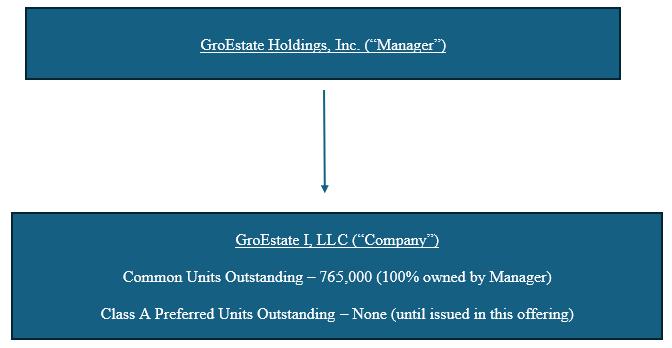
We are managed by GroEstate Holdings, Inc. (“Manager”) who owns 100% of our issued and outstanding common units. The Manager will have substantial control with respect to the Company, including its operations, strategic direction, and determining if and when to issue distributions of cash to the holders of the Class A Preferred Units and Common Units (collectively, the “Units”, and each person or entity holding Units, a “Member”). See Risk Factors beginning on page 11 for further discussions and risks associated therewith.
This offering is being conducted by the Company as a direct public offering (i.e., without the benefit of the services of an underwriter or SEC-registered broker-dealer) on a “best efforts” basis in a “Tier 2” Regulation A offering. No sales of Class A Preferred Units will be made prior to the qualification of the Offering Statement by the United States Securities and Exchange Commission (“SEC”). All Class A Preferred Units will be offered in all jurisdictions at the same price that is set forth in this offering circular. This offering will terminate on the earlier of (a) twelve (12) months from the date this Offering Circular is qualified for sale by the SEC (which date may be extended for an additional 90 days in our sole discretion); (b) the date when all Offered Units have been sold; or (c) the date on which this offering is earlier terminated by us, in our sole discretion. Subscriptions will be accepted on a rolling basis and, once received, are irrevocable by investors but can be rejected by us prior to acceptance. There is no minimum offering amount and, the Company may immediately deposit the proceeds from accepted subscription agreements into the Company’s bank account and may use such proceeds in accordance with the “Use of Proceeds”. The Company has not engaged commissioned sales agents or underwriters. Upon purchasing Class A Preferred Units, you will be become a Member of the Company and subject to the terms of the Company’s operating agreement (“Operating Agreement”), adopted April 30, 2026. The Operating Agreement sets forth the rights, preferences, and privileges with respect to the Class A Preferred Units and Common Units.
The Company has engaged T7X Equities, Inc. to act as transfer agent (“Transfer Agent”) for the Class A Preferred Units. We intend to issue the Class A Preferred Units as a token on a public, permissionless blockchain (the “Tokens”). The maintenance of the Tokens will occur on a gated platform controlled by the Transfer Agent. Such ownership records will then be indexed onto the blockchain by the Transfer Agent. The off-chain Master Securityholder File maintained by the Transfer Agent is the sole official record of ownership of the Class A Preferred Units. See ‘Plan of Distribution — Use of Tokens’”
The use of projections or forecasts in this offering is prohibited. No one is permitted to make any oral or written predictions about the cash benefits or tax consequences you will receive from your investment in our Class A Preferred Units.
This Offering Circular shall not constitute an offer to sell or the solicitation of an offer to buy, nor shall there be any sales of these securities in any state or jurisdiction in which such offer, solicitation or sale would be unlawful, prior to registration or qualification under the laws of any such state.
Investing in our Class A Preferred Units involves a high degree of risk. See “Risk Factors” beginning on page 11 for a discussion of certain risks that you should consider in connection with an investment in our Class A Preferred Units.
| Price to Public | Proceeds to Issuer | |||||||
| Public Offering Price per Offered Unit (1)(2) | $ | 10.00 | $ | 67,500,000 | ||||
| Underwriting Discounts and Commissions (3) | $ | – | $ | – | ||||
| Proceeds to Company (Excluding Offering Expenses) | $ | 10.00 | $ | 67,500,000 | ||||
| (1) | We are offering units on a continuous basis. We are offering up to 6,750,000 Class A Preferred Units, plus up to 675,000 additional Class A Preferred Units as Incentive Units for Investors purchasing at least $100,000 in this offering. | |
| (2) | This is a “best-efforts” offering. We will place 8.00% of the gross proceeds received from this offering into a reserve account “Reserve Account” which will be maintained as a contingency reserve to make distributions to the Members in accordance with the Operating Agreement (see section of this Offering Circular entitled “Description of Securities”). | |
| (3) | We are offering these securities without an underwriter. |
No sale may be made to you in this Offering if the aggregate purchase price you pay is more than 10% of the greater of your annual income or net worth. Different rules apply to accredited investors and non-natural persons. Before making any representation that your investment does not exceed applicable thresholds, we encourage you to review Rule 251(d)(2)(i)(C) of Regulation A. For general information on investing, we encourage you to refer to www.investor.gov. We retain complete discretion to determine that subscribers are qualified purchasers (as defined in Regulation A under the Securities Act) in reliance on the information and representations provided to us regarding their financial situation.
An investment in the Class A Preferred Units is subject to certain risks and should be made only by persons or entities able to bear the risk of and to withstand the total loss of their investment. Prospective investors should carefully consider and review the information under the heading “Risk Factors” beginning on page 11.
The SEC does not pass upon the merits of or give its approval to any securities offered or the terms of the Offering, nor does it pass upon the accuracy or completeness of any offering circular or other solicitation materials. These securities are offered pursuant to an exemption from the registration requirements of the Securities Act of 1933, as amended (the “Securities Act”); however, the SEC has not made an independent determination that the securities offered are exempt from registration.
We expect that our operations will be exempt from investment company registration under the Investment Company Act of 1940, as amended (the “1940 Act”), under section 3(c)(5)(B) of the 1940 Act which provide for an exemption from registration for companies that are primarily engaged in making loans to manufacturers, wholesalers, and retailers of, and to prospective purchasers of, specified merchandise, insurance, and services. This exemption allows qualifying lending companies to avoid registration under the 1940 Act, provided that they meet specific operational and asset composition requirements established through SEC interpretive guidance. We intend to monitor our ongoing operations to ensure compliance with the 1940 Act – See “Investment Company Act Considerations” beginning on page 10 for a further discussion.
This offering circular is part of an offering statement that we filed with the SEC, using a continuous offering process pursuant to Rule 251(d)(3) of Regulation A, meaning that while the offering of securities is continuous, active sales of securities may happen sporadically over the term of the offering. Further, the acceptance of subscriptions may be briefly paused at times to allow us to effectively and accurately process and settle subscriptions that have been received. Periodically, we will provide an offering circular supplement that may add, update or change information contained in this offering circular. Any statement that we make in this offering circular will be modified or superseded by any inconsistent statement made by us in a subsequent offering circular supplement. The offering statement we filed with the SEC includes exhibits that provide more detailed descriptions of the matters discussed in this offering circular. You should read this offering circular and the related exhibits filed with the SEC and any offering circular supplement, together with additional information contained in our annual reports, semi-annual reports and other reports and information statements that we will file periodically with the SEC. See the section entitled “Where You Can Find More Information” below for more details.
We use the offices of our Manager located at 6608 N. Western Ave, Suite 1334, Oklahoma City, OK 73116, Phone: 463-220-1808, Email: invest@gro.estate. We maintain a website at http://www.gro.estate. We do not incorporate the information on or accessible through our website into this Offering Circular, and you should not consider any information on, or that can be accessed through, our website as a part of this Offering Circular.
This offering circular is following the offering circular format described in Part II of Form 1-A.
NON-ACCREDITED INVESTOR LIMITATIONS
No sale may be made to you in this offering if the aggregate purchase price you pay is more than 10% of the greater of your annual income or your net worth. Different rules apply to accredited investors and non-natural persons. Before making any representation that your investment does not exceed applicable thresholds, we encourage you to review Rule 251(d)(2)(i)(C) of Regulation A. For general information on investing, we encourage you to refer to www.investor.gov.
NOTICE TO FOREIGN INVESTORS
IF THE INVESTOR LIVES OUTSIDE OF THE UNITED STATES, IT IS THE INVESTOR’S RESPONSIBILITY TO FULLY OBSERVE THE LAWS OF ANY RELEVANT TERRITORY OR JURISDICTION OUTSIDE THE UNITED STATES IN CONNECTION WITH ANY PURCHASE OF THE SECURITIES, INCLUDING OBTAINING REQUIRED GOVERNMENTAL OR OTHER CONSENTS OR OBSERVING ANY OTHER REQUIRED LEGAL OR OTHER FORMALITIES. THE COMPANY RESERVES THE RIGHT TO DENY THE PURCHASE OF THE SECURITIES BY ANY FOREIGN INVESTOR.
THE U.S. SECURITIES AND EXCHANGE COMMISSION DOES NOT PASS UPON THE MERITS OF OR GIVE ITS APPROVAL TO ANY SECURITIES OFFERED OR THE TERMS OF THE OFFERING, NOR DOES IT PASS UPON THE ACCURACY OR COMPLETENESS OF ANY OFFERING CIRCULAR OR OTHER SOLICITATION MATERIALS. THESE SECURITIES ARE OFFERED PURSUANT TO AN EXEMPTION FROM REGISTRATION WITH THE COMMISSION; HOWEVER, THE COMMISSION HAS NOT MADE AN INDEPENDENT DETERMINATION THAT THE SECURITIES OFFERED ARE EXEMPT FROM REGISTRATION.
The date of this Offering Circular is August 21, 2026.
We are offering to sell, and seeking offers to buy, our securities only in jurisdictions where such offers and sales are permitted. You should rely only on the information contained in this Offering Circular. We have not authorized anyone to provide you with any information other than the information contained in this Offering Circular. The information contained in this Offering Circular is accurate only as of its date, regardless of the time of its delivery or of any sale or delivery of our securities. Neither the delivery of this Offering Circular nor any sale or delivery of our securities shall, under any circumstances, imply that there has been no change in our affairs since the date of this Offering Circular. This Offering Circular will be updated and made available for delivery to the extent required by the federal securities laws. You should not assume that the information contained in this Offering Circular is accurate as of any date later than the date hereof or such other dates as are stated herein or as of the respective dates of any documents or other information incorporated herein by reference.
In this Offering Circular, unless the context indicates otherwise, references to “GroEstate” “we,” the “Company,” “our” and “us” refer to the activities of and the assets and liabilities of the business and operations of GroEstate I LLC., or as applicable, GroEstate, Inc., which was our predecessor company prior to completing a holding company reorganization structure and conversion into a limited liability company. Reference to “our Manager”, or “GroEstate Holdings” refers to our Manager GroEstate Holdings, Inc. which is the sole holder of our outstanding Common Units.
| i |
IMPORTANT INFORMATION ABOUT THIS OFFERING CIRCULAR
Please carefully read the information in this Offering Circular and any accompanying offering circular supplements, which we refer to collectively as the Offering Circular. You should rely only on the information contained in this Offering Circular. We have not authorized anyone to provide you with different information. This Offering Circular may only be used where it is legal to sell these securities. You should not assume that the information contained in this Offering Circular is accurate as of any date later than the date hereof or such other dates as are stated herein or as of the respective dates of any documents or other information incorporated herein by reference.
This Offering Circular is part of an offering statement that we filed with the SEC, using a continuous offering process. Periodically, as we make material investments, or have other material developments, we will provide an offering circular supplement that may add, update or change information contained in this Offering Circular. Any statement that we make in this Offering Circular will be modified or superseded by any inconsistent statement made by us in a subsequent offering circular supplement. The offering statement we filed with the SEC includes exhibits that provide more detailed descriptions of the matters discussed in this Offering Circular. You should read this Offering Circular and the related exhibits filed with the SEC and any offering circular supplement, together with additional information contained in our annual reports, semi-annual reports and other reports and information statements that we will file periodically with the SEC. See the section entitled “Additional Information” below for more details.
The offering statement and all supplements and reports that we have filed or will file in the future can be read at the SEC website, www.sec.gov, or on our website, http://www.gro.estate. The contents of the website (other than the offering statement, this Offering Circular and the appendices and exhibits thereto) are not incorporated by reference in or otherwise a part of this Offering Circular.
Our Manager and those selling units on our behalf in this Offering are permitted to make a determination that the purchasers of units in this Offering are “qualified purchasers” in reliance on the information and representations provided by the holder regarding the holder’s financial situation. Before making any representation that your investment does not exceed applicable thresholds, we encourage you to review Rule 251(d)(2)(i)(C) of Regulation A. For general information on investing, we encourage you to refer to www.investor.gov.
This Offering Circular contains information concerning our industry, our business and the markets for our services to be provided to agricultural business, including data regarding the estimated size of such markets. We obtained the industry, market and similar data set forth in this Offering Circular from our internal estimates and research and from academic and industry research, publications, surveys and studies conducted by third parties, including governmental agencies. In some cases, we do not expressly refer to the sources from which this data is derived. Information that is based on estimates, forecasts, projections, market research or similar methodologies is inherently subject to uncertainties and actual events or circumstances may differ materially from events and circumstances that are assumed in this information. While we believe our internal research is reliable, such research has not been verified by any third party.
| 1 |
STATE LAW EXEMPTION AND PURCHASE RESTRICTIONS
Our Class A Preferred Units are being offered and sold only to “qualified purchasers” (as defined in Regulation A). As a Tier 2 offering pursuant to Regulation A, this offering is exempt from state law “Blue Sky” review, subject to meeting certain state filing requirements and complying with certain anti-fraud provisions, to the extent that our Class A Preferred Units offered hereby are offered and sold only to “qualified purchasers” or at a time when our Class A Preferred Units are listed on a national securities exchange. “Qualified purchasers” include: (i) “accredited investors” under Rule 501(a) of Regulation D and (ii) all other investors so long as their investment in our Class A Preferred Units does not represent more than 10% of the greater of their annual income or net worth (for natural persons), or 10% of the greater of annual revenue or net assets at fiscal year-end (for non-natural persons). However, our Class A Preferred Units are being offered and sold only to those investors that are within the latter category (i.e., investors whose investment in our Class A Preferred Units does not represent more than 10% of the applicable amount), regardless of an investor’s status as an “accredited investor”. Accordingly, we reserve the right to reject any investor’s subscription in whole or in part for any reason, including if we determine in our sole and absolute discretion that such investor is not a “qualified purchaser” for purposes of Regulation A.
To determine whether a potential investor is an “accredited investor” for purposes of satisfying one of the tests in the “qualified purchaser” definition, the investor must be a natural person:
1. who has an individual net worth, or joint net worth with the person’s spouse, that exceeds $1,000,000 at the time of the purchase, excluding the value of the primary residence of such person; or
2. who has earned income exceeding $200,000 in each of the two most recent years or joint income with a spouse exceeding $300,000 for those years and a reasonable expectation of the same income level in the current year; or
3. who has certain professional certifications, designations or credentials or other credentials issued by an accredited educational institution, as designated by the SEC; or
4. who, with respect to investments in a private fund, are “knowledgeable employees” of the fund, as defined in the Investment Company Act of 1940.
The list above is non-exhaustive; prospective investors should review Rule 501 of Regulation D for more details on whether they are an “accredited investor.” If the investor is not a natural person, different standards apply. See Rule 501 of Regulation D for more details.
For purposes of determining whether a potential investor is a “qualified purchaser”, annual income and net worth should be calculated as provided in the “accredited investor” definition under Rule 501 of Regulation D. In particular, net worth in all cases should be calculated excluding the value of an investor’s home, home furnishings and automobiles.
| 2 |
CAUTIONARY STATEMENT REGARDING FORWARD-LOOKING STATEMENTS
Some of the statements under “Summary”, “Risk Factors”, “Management’s Discussion and Analysis of Financial Condition and Results of Operations”, “Business” and elsewhere in this Offering Circular constitute forward-looking statements. Forward-looking statements relate to expectations, beliefs, projections, future plans and strategies, anticipated events or trends and similar matters that are not historical facts. In some cases, you can identify forward-looking statements by terms such as “anticipate”, “believe”, “could”, “estimate”, “expect”, “intend”, “may”, “plan”, “potential”, “should”, “will” and “would” or the negatives of these terms or other comparable terminology.
You should not place undue reliance on forward-looking statements. The cautionary statements set forth in this Offering Circular, including in “Risk Factors” and elsewhere, identify important factors which you should consider in evaluating our forward-looking statements. These factors include, among other things, may include statements about our:
| · | business strategy; | |
| · | our ability to successfully compete in highly competitive markets; | |
| · | our expectations regarding financial performance, including but not limited to revenue, achieving or maintaining profitability, ability to generate or maintain positive cashflow and other results of operations; | |
| · | our expectations regarding future operating performance, including but not limited to our expectations regarding our anticipated lending and consulting services, and the potential revenues and margins related thereto; | |
| · | our ability to monitor, manage, and structure our operations and assets in a manner that enables us to comply with applicable with applicable exemptions from registration under the Investment Company Act of 1940; | |
| · | our ability to make distributions on the Class A Preferred Units to be issued in this offering; | |
| · | anticipated technology trends and developments and our ability to address those trends and developments with our partners that enter into loan instruments with us and retain our consulting services; | |
| · | the size of our addressable markets, market share, category positions, and market trends, including our ability to grow our business in the North American market; | |
| · | our ability to identify, recruit, and retain skilled personnel, including key members of senior management; | |
| · | our ability to effectively manage our growth and maintain and improve our corporate culture; | |
| · | our ability to successfully respond to global economic conditions, including rising inflation and interest rates; | |
| · | the availability of capital to grow our business; | |
| · | our ability to meet the requirements of our existing debt and accrued obligations; | |
| · | our ability to comply with existing, modified, or new laws and regulations applying to our business; and | |
| · | our ability to implement, maintain, and improve our internal control over financial reporting. |
Although the forward-looking statements in this Offering Circular are based on our beliefs, assumptions and expectations, taking into account all information currently available to us, we cannot guarantee future transactions, results, performance, achievements or outcomes. No assurance can be made to any investor by anyone that the expectations reflected in our forward-looking statements will be attained, or that deviations from them will not be material and adverse. We undertake no obligation, other than as maybe be required by law, to re-issue this Offering Circular or otherwise make public statements updating our forward-looking statements.
| 3 |
This summary highlights selected information contained elsewhere in this Offering Circular. This summary is not complete and does not contain all the information that you should consider before deciding whether to invest in our Class A Preferred Units. You should carefully read the entire Offering Circular, including the risks associated with an investment in the company discussed in the “Risk Factors” section of this Offering Circular, before making an investment decision. Some of the statements in this Offering Circular are forward-looking statements. See the section entitled “Cautionary Statement Regarding Forward-Looking Statements.”
Company Information
GroEstate I, LLC. (the “Company”, “GroEstate”, “we” and “us”) was incorporated as GroEstate, Inc. (the “Predecessor Corporation”) under the laws of the State of Wyoming on January 30, 2025. In connection with a holding company reorganization, the Predecessor Corporation was redomiciled and simultaneously converted into a Delaware limited liability company and became a wholly owned subsidiary of GroEstate Holdings, Inc. (the “Manager”). The holding company reorganization was completed on April 30, 2026 (the “Reorganization”). As a result of the Reorganization, the Manager holds all of the outstanding voting units of the Company.
Our Structure
| 4 |
Our Business
Our manager and advisors have experience in land development and agricultural technology, including but not limited to advanced water purification systems, specialized lighting, and growing techniques for high-yield, small-footprint cultivation as well as experience in equipment leasing, and real estate management and operational procedures for farming facilities. We are an agriculture equipment focused lending company that intends to partner with agricultural operators. We intend to generate recurring revenues primarily by: (i) originating, investing in and managing a portfolio of commercial loans to agricultural business, farmers, growers, and other agricultural operators (“Operators”), the proceeds of which will be used primarily for the purchase or lease of specified agricultural equipment and machinery used in their agricultural businesses and (ii) providing business and strategic consulting services to the Operators that we make loans to, as well as other agricultural businesses. We currently plan to provide loans that are specifically for equipment such as greenhouses and growing equipment with such loans being either unsecured or secured by the equipment being acquired or other assets of the agricultural business. Our loans are anticipated to have a fixed or variable interest rate and be either participating or non-participatory loan instruments. We plan on focusing on Operators in the North American market.
We do not plan on directly engaging in farming operations or acquiring farming real estate, and we do not currently intend to conduct farming operations or acquire any real property.
Our Manager
GroEstate Holdings, Inc. (“Manager”), as our manager, will oversee and direct our day-to-day operations. In overseeing our operations, the Manager will use its own employees as well as retain consultants and experienced personnel both at the Manager level or Company level. Pursuant to our operating agreement, the Manager is entitled to make substantially all of the decisions regarding the Company operations and holds all of the voting securities of the Company, subject to certain limitations. Accordingly, all decisions related to our commercial loans as well as substantially all of the governance of the Company and its Members, will be subject to the sole discretion of the Manager.
Our Operating Agreement
Investors purchasing Class A Preferred Units in this offering will be bound by and subject to the terms of the Operating Agreement, a copy of the form of which is attached to this Offering Circular as Exhibit 2.2.
Our Offices
Our Manager maintains an office for us that is located at 6608 N. Western Ave, Suite 1334, Oklahoma City, OK 73116, Phone: 463-220-1808, Email: invest@gro.estate. We maintain a website at http://www.gro.estate. We do not incorporate the information on or accessible through our website into this Offering Circular, and you should not consider any information on, or that can be accessed through, our website as a part of this Offering Circular.
| 5 |
| Issuer: | GroEstate I, LLC. |
| Securities offered: |
The Company will offer Class A Preferred Units - See “Description Securities” below for further information regarding the Class A Preferred Units.
We intend to (i) sell a maximum of 6,750,000 Class A Preferred Units at an offering price of $10.00 per unit (the “Offered Units”), and (ii) issue up to 675,000 incentive Class A Preferred Units (“Incentive Units”). For each Investor purchasing at least $100,000 of Offered Units (the “Incentive Threshold”), such Investor will receive such number of Incentive Units equal to ten percent (10%) of the number of Offered Units purchased (See “Plan of Distribution”). |
| Price per Class A Preferred Unit: | $10.00 |
| Minimum Investment Amount: | The minimum investment amount per investor is $2,500 (250 Class A Preferred Units). We reserve the right to reject any subscription. However, we may revise the minimum investment amount in the future or elect to waive the minimum purchase requirements on a case-by-case basis in our sole discretion. Subscriptions will be accepted on a rolling basis and, once received, are irrevocable by investors but can be rejected by us prior to acceptance. |
| Number of Class A Preferred Units outstanding before the offering: | Prior to this offering, there are no Class A Preferred Units outstanding. |
|
Number of Class A Preferred Units to be outstanding after the offering:
|
7,425,000 units, assuming the maximum amount of Offered Units and Incentive Units are issued. Such number of units excludes Class A Preferred Units underlying $696,386 in outstanding convertible notes (including accrued bridge fees and interest) that are convertible into approximately 69,638 Class A Preferred Units as of July 15, 2026 (based on a conversion price of $10.00 per unit). |
| Investment Restrictions: | Generally, no sale may be made to you in this Offering if the aggregate purchase price you pay is more than 10% of the greater of your annual income or net worth. Different rules apply to accredited investors and non-natural persons. Before making any representation that your investment does not exceed applicable thresholds, you are encouraged to review Rule 251(d)(2)(i)(C) of Regulation A. For general information on investing, you are encouraged to refer to www.investor.gov. |
| Maximum offering amount: | 6,750,000 units at $10.00 per unit, or $67,500,000, excluding any applicable Incentive Units (See “Plan of Distribution.”). |
| Subscribing Online: | After the qualification by the SEC of the offering statement of which this Offering Circular is a part, the Offering will be conducted through our website whereby investors will receive, review, execute and deliver subscription agreements electronically and make payment of the purchase price. For additional information, see “Plan of Distribution - Subscription Procedures”. |
| 6 |
| Voting Rights: |
The Class A Preferred Units will not vote on any matter, except for (i) certain amendments to the Operating Agreement that would disproportionately and adversely affect the Class A Preferred Units, (ii) the determination to dissolve or wind up the Company, (iii) the appointment of a replacement manager in the event the manager resigns or is otherwise dissolved (e.g. bankruptcy, etc.) and (iv) other matters required by Delaware law.
Accordingly, the holders of the Common Units will have control over all other matters to be voted on by the Members of the Company. |
| Member Distributions: |
If and when declared by the Manager, all distributions made by the Company, if any, will be subject to the following preferences (the “Distributions”):
(i) First, the Class A Preferred Units shall receive one hundred percent (100%) of Distributions until each Member holding Class A Preferred Units has received cumulative Distributions equal to an annual, non-compounded, eight percent (8%) return on the original purchase price paid for such Class A Preferred Units, calculated from the date of issuance and prorated for partial years, with any such portion not distributed in any year continuing to accrue and remain until satisfied; and
(ii) Thereafter, all additional Distributions, shall be distributed (a) seventy percent (70%) to the Class A Preferred Units and (b) thirty percent (30%) to the Common Units.
There can be no assurances if and when the Manager will declare Distributions, or if the Company will have sufficient free cash flows from its operations to make any Distributions. |
| Closing | This Offering has no minimum amount. The Company may close the Offering as it accepts investor subscriptions on a rolling basis. We will offer Class A Preferred Unit in this Offering for a period of twelve (12) months from the date of commencement of this Offering after qualification or until we raise the maximum amount being offered, whichever occurs earlier. If any of the Class A Preferred Units remain unsold as of the conclusion of the Offering, such Class A Preferred Units shall remain unissued by the Company. The Company reserves the right to terminate the Offering for any reason at any time prior to the final closing. |
| Dissolution: | In the event of a Dissolution Event (as defined below), the Distributions will be the same as those described above after payment of all creditors and liabilities have been made. |
| Trading Market: | As of the date of this Offering Circular, there is no trading market for any of our securities, and we cannot assure you that a trading market will develop. There are no current plans to make a secondary market, but if one does develop, any transfers of Class A Preferred Units will comply with applicable registration or exemption requirements. |
| 7 |
| Transfer Restrictions |
The Class A Preferred Units may be transferred (i) pursuant to an Involuntary Transfer (as defined in the Operating Agreement), (ii) via a trading market approved by the Company, if one ever develops or (iii) pursuant to approval by the Company in writing. We do not currently plan to list the Class A Preferred Units on any National Stock Exchange. There are no current plans to make a secondary market, but if one does develop, any transfers of Class A Preferred Units will comply with applicable registration or exemption requirements. There is no public market for the Class A Preferred Units, and one may never develop. Certain states also impose additional statutory restrictions on secondary trading of securities purchased in the Offering, which may further restrict the transferability of the Class A Preferred Units. Prospective investors are urged to consult their own legal advisors with respect to secondary trading in the Class A Preferred Units. |
| Use of proceeds: | If we sell all of the Class A Preferred Units being offered, our proceeds (excluding our estimated offering expenses and any escrowed funds to be used to return capital for the cash Distributions) will be $67,500,000. We will use the majority of the net proceeds to provide secured and unsecured commercial loans for the purchase or lease of specified equipment and machinery necessary for the operations of agriculture properties. The remaining proceeds are anticipated to be used for working capital and other general corporate purposes. Please see “Use of Proceeds” for further information. |
| Risk factors: | Investing in our Class A Preferred Units involves a high degree of risk. See the section entitled “Risk Factors” for a discussion of factors you should carefully consider before deciding to invest. |
| 8 |
DETERMINATION OF OFFERING PRICE
Our Manager established the offering price of our Class A Preferred Units on an arbitrary basis. Because the offering price is not based upon any independent valuation, the offering price may not be indicative of the proceeds that you would receive upon liquidation.
We do not expect to declare any Distributions until the proceeds from this Offering are invested and generating operating cash flow from payments of interest and principal on the loans in our portfolio. Once we begin to make Distributions, we expect that our Manager will make Distributions from time to time from our cash flow which we anticipate will be derived from payments of interest and principal from the loans in our portfolio and any applicable consulting fees after the payment of our expenses and liabilities and allocating reasonable cash reserves.
Any Distributions we make will be at the discretion of our Manager, and will be based on, among other factors, our present and reasonably projected future cash flow. Distributions will be paid to Members as of the record dates declared by the Manager.
Holders of our Class A Preferred Units will be entitled to an 8% annualized preference on Distributions. Pursuant to such preference, in the event the Manager declares a distribution, 100% of the distribution will be allocated to Class A Preferred Units until the holders have received an annualized return of 8.0%. In the event additional Distributions are made after such time, cash available for Distributions will be made 70% to the holders of the Class A Preferred Units and 30% to the holders of our Common Units.
We have agreed to allocate 8% of the proceeds from this Offering to a Reserve Account, which will be maintained as a contingency reserve to make payments to the Class A Preferred Units as Distributions. Such funds held in the Reserve Account will be classified as restricted cash, and may, at the discretion of the Manager, be invested by the Company in cash equivalents. Our Distributions generally will constitute a return of capital to the extent that they exceed our current and accumulated earnings and profits as determined for U.S. federal income tax purposes. To the extent that a Distribution is treated as a return of capital for U.S. federal income tax purposes, it will reduce a holder’s adjusted tax basis in the holder’s units, and to the extent that it exceeds the holder’s adjusted tax basis, it will be treated as gain resulting from a sale or exchange of such units.
Notwithstanding the Reserve Account, there can be no assurance that the Manager will declare a Distribution at any time or that even if made, they will be sufficient to pay holders of the Class A Preferred Units the annual preference or result in the return of their investment.
| 9 |
INVESTMENT COMPANY ACT CONSIDERATIONS
We intend to conduct our operations so that neither we, nor any of our subsidiaries, is required to register as an investment company under the Investment Company Act of 1940, as amended (“1940 Act”). Section 3(a)(1)(A) of the 1940 Act defines an investment company as any issuer that is or holds itself out as being engaged primarily in the business of investing, reinvesting or trading in securities. Section 3(a)(1)(C) of the 1940 Act defines an investment company as any issuer that is engaged or proposes to engage in the business of investing, reinvesting, owning, holding or trading in securities and owns or proposes to acquire investment securities having a value exceeding 40% of the value of the issuer’s total assets (exclusive of U.S. Government securities and cash items) on an unconsolidated basis. Excluded from the term “investment securities,” among other things, are U.S. Government securities and securities issued by majority-owned subsidiaries that are not themselves investment companies and are not relying on the exception from the definition of investment company set forth in Section 3(c)(1) or Section 3(c)(7) of the 1940 Act.
We intend to rely upon the exemption from the definition of investment company contained in Section 3(c)(5)(B) of the 1940 Act. Section 3(c)(5)(B) applies to certain issuers primarily engaged in the business of making loans to manufacturers, wholesalers, retailers, and prospective purchasers of specified merchandise and services. The SEC Staff has interpreted the term “primarily engaged” contained in Section 3(c)(5)(B) to require that between 55% and 80% of the issuer’s total assets will consist of “qualifying assets”. Based on SEC guidance, in order for our loans to be considered “qualifying assets” the proceeds from the loans must be used to purchase specific merchandise, insurance or services that have a direct nexus to the merchandise or services sold by the Operators. The direct nexus requirement means that general corporate lending or working capital loans typically do not qualify unless tied to specific merchandise, insurance, or services.
The Company intends to always maintain qualifying assets equal to at least 65% of its total assets. The Company will monitor its asset composition on an ongoing basis to ensure continued compliance with the “primarily engaged” standard. In the event that the Company’s qualifying asset percentage approaches the minimum threshold, the Company intends to take remedial steps, which may include increasing qualifying assets while decreasing non-qualifying assets or any other commercially reasonable actions available under applicable law in order to regain compliance with any applicable exemption under the 1940 Act.
The Company intends to make secured and unsecured commercial loans to agricultural facilities for equipment such as greenhouse, lighting fixtures, vertical growing shelves and other equipment used for growing the crops. These facilities will be able to initially grow or increase production of their produce and thus directly generate revenue from the equipment acquired by the Company’s loans. In making the loans for equipment purchases or leases, the Company will require the Operators to identify the equipment being purchased or leased and establish how it directly relates to growing crops that will generate revenue via sales wholesale or to consumers. The Company believes that its loans will satisfy the “direct nexus” standard because (i) the financed equipment is essential for the facilities to grow its crops that generate its revenues, (ii) each loan instrument, if and when entered into, will contain a use of proceeds and covenants specifically identifying the equipment and machinery models, categories, or components being acquired with each applicable drawdown of funds, and (iii) approximately 85% of the proceeds of the loans will be used for the acquisition of these specified equipment, with only a small portion of the loan being utilized for general working capital by the Operators for the facilities, which such portion of the loan instrument not counting as a “qualifying asset” on the Company’s balance sheet.
Previously, the Company entered into partially binding term sheets with (i) Green Blue Marketplace, LLC (for the development of Community Gardens) (“GBM”) and (ii) AmberCloud Company, LLC (“AmberCloud”) with respect to making certain loans, acquiring options to purchase land, and providing consulting services. In order to comply with the foregoing 1940 Act exemptions, each of the foregoing term sheets were mutually terminated with their respective parties on May 2, 2026. The Company and each of GBM and AmberCloud are currently in discussions regarding new agreements, that will comply with the exemptions set forth in Section 3(c)(5)(B) of the 1940 Act or any other available exemption thereunder. Notwithstanding these preliminary discussions, there can be no assurances that the Company will enter into any binding agreements, including loan instruments, with either AmberCloud or GBM.
Qualification for the exemption from registration under the 1940 Act will limit our ability to make certain investments. To the extent that the SEC staff provides more specific guidance regarding any of the matters bearing upon such exemption, we may be required to adjust our strategy accordingly. Any additional guidance from the SEC staff could provide additional flexibility to us, or it could further inhibit our ability to pursue the strategies we have chosen.
The loss of our exemption from registration pursuant to the 1940 Act could require us to restructure our operations, sell certain of our assets or abstain from the purchase of certain assets, which could have an adverse effect on our financial condition and results of operations. See Risk Factors—Risks Relating to the Investment Company Act of 1940.
| 10 |
An investment in our Class A Preferred Units involves a high degree of risk. You should carefully consider the following risk factors, together with the other information contained in this Offering Circular, before purchasing our Class A Preferred Units. Any of the following factors could harm our business, financial condition, results of operations or prospects, and could result in a partial or complete loss of your investment. Some statements in this Offering Circular, including statements in the following risk factors, constitute forward-looking statements. Please refer to the section entitled “Cautionary Statement Regarding Forward-Looking Statements”.
Risks Related to this Offering and our Series A Preferred Units
There is no existing market for our Class A Preferred Units and we cannot predict whether one will develop to provide you with adequate liquidity to sell your Class A Preferred Units at prices equal to or greater than the price you paid in this offering.
There is no public market for our Class A Preferred Units, and we have not applied to list or quote our securities on any market, exchange or interdealer quotation system. We cannot predict the extent to which investor interest in our Company will lead to the development of an active trading market or otherwise or how liquid that market might become. If an active trading market does not develop, you may have difficulty selling any of your Class A Preferred Unit that you buy. The purchase price for the Series A Preferred Unit was determined by us and may not be representative of the value of the Company.
If our Class A Preferred Units becomes quoted, the market price of the Class A Preferred Units may fluctuate, and you could lose all or part of your investment.
The offering price for the Class A Preferred Units is set by us based on a number of factors and may not be indicative of prices that would prevail on any national securities exchange or the OTC Markets or other alternative markets if a market developed. Although there are no current plans to establish a market, if a market did develop, the value of our Series A Preferred Units could decline.
Some of the other factors that could negatively affect our Unit price or result in fluctuations in our unit price if a market did develop, include:
| · | our operating and financial performance; | |
| · | quarterly variations in the rate of growth of our financial indicators, such as net income per share, net income and revenues; | |
| · | the public reaction to our press releases, our other public announcements and our filings with the SEC; | |
| · | our failure to meet revenue, reserves or earnings estimates by research analysts or other investors; | |
| · | changes in revenue or earnings estimates, or changes in recommendations or withdrawal of research coverage, by equity research analysts; | |
| · | our ability to make Distributions on our Class A Preferred Units; | |
| · | our ability to make required payments on our current and future outstanding debt instruments; | |
| · | speculation in the press or investment community; | |
| · | changes in accounting principles, policies, guidance, interpretations or standards; | |
| · | additions or departures of key management personnel; | |
| · | actions by our Manager or Members; | |
| · | general market conditions, including fluctuations in commodity prices; | |
| · | domestic and international economic, legal and regulatory factors unrelated to our performance; and | |
| · | the realization of any risks describes under this “Risk Factors” section. |
| 11 |
Our Members holding Class A Preferred Units may not replace the Manager and have limited ability to influence decisions regarding our business.
Under our Operating Agreement, the assets, affairs, and business of the Company are managed exclusively under the direction of the Manager, GroEstate Holdings, Inc. The Manager is also the holder of 100% of our Common Units. Holders of Class A Preferred Units do not have the right to remove the Manager, and may vote only in limited circumstances, such as on amendments the Operating Agreement that are adverse to the Class A Preferred Members, the decision to wind up or dissolve the Company, to appoint a replacement Manager after a resignation or dissolution of the Manager, or as required by applicable law.
Our outstanding common units, which possess full voting rights on matters submitted to Members, are owned by the Manager. As a result, the Manager has the ability to exercise unilateral control over all significant Company decisions, including operational matters, strategic direction, financings, amendments to governing documents (subject to applicable limitations), and the timing and amount of any distributions.
Because the Manager controls all voting power, holders of Class A Preferred Units will have limited ability to influence the Company’s management, policies, or strategic decisions. Investors must rely entirely on the judgment and discretion of the Manager, whose interests may not always align with those of the Class A Preferred holders.
As a non-listed company conducting an exempt offering under Regulation A, we are not subject to many corporate governance requirements applicable to publicly listed companies.
Because we are conducting an offering pursuant to Regulation A and our securities are not listed on a national securities exchange, we are not subject to many of the corporate governance requirements that apply to issuers listed on the NYSE, Nasdaq, or other national securities exchanges. For example, we are not required to maintain a board of directors composed of independent members or to establish independent audit, compensation, or nominating committees.
Instead, the Company is managed exclusively by our Manager, which owns 100% of our Common Units and controls the voting power of the Company with respect to substantially all matters. As a result, investors will not receive the same level of corporate governance protections, oversight, or procedural safeguards that are afforded to stockholders of companies listed on national securities exchanges.
The Manager has authority to determine compensation for its personnel, and we are required to reimburse such costs, which may reduce cash available for Distributions.
Under the Operating Agreement and the Management Agreement (as described below), the Manager has broad authority to manage the Company’s affairs, including determining the compensation, bonuses, benefits, and other remuneration paid to its personnel, including senior executives. The Company is obligated to reimburse the Manager for compensation and related expenses incurred in connection with managing and operating the Company.
The Manager may increase the salaries, bonuses, equity incentives, or other forms of compensation payable to its personnel without obtaining the approval of Members holding Class A Preferred Units. Because these amounts are reimbursable expenses of the Company under the Management Agreement, any such increases will directly reduce the cash available to the Company for operations and Distributions.
Holders of Class A Preferred Units do not have approval rights over compensation arrangements for the Manager’s personnel and will not have the ability to influence or limit such compensation decisions. As a result, the Manager may establish compensation levels that holders of Class A Preferred Units may believe are excessive or not aligned with the Company’s performance.
In addition, because the Manager controls both the determination of compensation and the decision whether to declare Distributions, conflicts of interest may arise between maximizing compensation paid to its personnel and maximizing returns to investors. Any increase in reimbursable compensation expenses could materially reduce or eliminate funds otherwise available for Distributions and adversely affect the value of your investment.
Investors must rely on the integrity and business judgment of the Manager with respect to compensation decisions.
| 12 |
Our Manager has broad discretion in managing the Company’s lending portfolio and to the use of certain of the net proceeds from this offering.
As described in the Use of Proceeds section of this Offering Circular, we intend to use a majority of the proceeds from this Offering to lend and/or lease to Operators under long term loan agreements for the purchase of equipment specifically to expand growing operations of these Operators, In addition, the Company is in various stages of negotiating arrangements with Operators, that if executed, would further in the Company’s use of a substantial amount of the proceeds from this Offering. However, we cannot specify with certainty the particular uses of such proceeds. Our Manager will have broad discretion in the application of the net proceeds designated for loans, or for other general corporate purposes. Accordingly, you will have to rely upon the judgment of our Manager with respect to the use of these proceeds. Our Manager may spend a portion or all of the net proceeds from this offering in ways that holders of our Class A Preferred Units may not desire or that may not yield a significant return or any return at all. The failure by our management to apply these funds effectively could harm our business. Pending their use, we may also invest the net proceeds from this offering in a manner that does not produce income or that loses value. Please see “Use of Proceeds” below for more information.
The holders of Class A Preferred Units will have limited voting rights and will not control the Company’s management or operations.
The Company is managed by its Manager and the holders of Class A Preferred Units will not participate in the management or control of the Company and will not have general voting rights with respect to the Company’s operations, business decisions, or strategic direction.
Pursuant to the Operating Agreement, holders of Class A Preferred Units will have limited voting rights solely in specified circumstances, including (i) the approval of a liquidation or dissolution of the Company, (ii) amendments to the Operating Agreement that would materially and adversely affect the rights, preferences, or privileges of the Class A Preferred Units, and (iii) the appointment of a successor Manager in the limited circumstance that the existing Manager resigns or otherwise ceases to exist as an entity. Outside of these limited protective provisions, holders of Class A Preferred Units will not have the ability to vote on or approve matters relating to the Company’s business, capital raising activities, incurrence of indebtedness, compensation arrangements, related-party transactions, or other operational decisions.
The Manager has broad authority to control the Company’s affairs, including decisions regarding investments, loans and consulting services, consulting arrangements, fees payable under the Management Agreement, the timing and amount of any Distributions, and whether to pursue additional financings or strategic transactions. Because the Manager controls these decisions and the holders of Class A Preferred Units have only limited protective voting rights, the Manager may make decisions that differ from, or conflict with, the interests of the Members holding Class A Preferred Units.
This concentration of control precludes the ability of holders of Class A Preferred Units to influence Company decisions, may delay or prevent transactions that such holders believe are favorable, and may adversely affect the value of their investment. Investors in the Class A Preferred Units have rights in the Company that are primarily economic in nature and that they will not have meaningful governance influence over the Company.
If we raise only a limited amount of proceeds in this Offering, we may be unable to make a meaningful number of loans to Operators, which could limit our potential returns and our ability to become profitable.
We expect to use a substantial portion of the net proceeds from this Offering to make secured and unsecured commercial loans to Operators. The amount of capital required for any particular Operator will vary significantly depending on, among other things, the amount and type of equipment the Operator seeks to finance, the size and nature of the Operator’s business and the structure of the applicable loan. Accordingly, we cannot currently predict the number of Operators to which we will be able to make loans with the proceeds of this Offering. If we raise only a limited amount of proceeds, we may have insufficient proceeds to make a loan to any Operator, or we may be able to make loans to only a small number of Operators. A limited loan portfolio could result in greater concentration risk, reduce our ability to generate interest income and other revenues, limit our ability to become profitable and reduce the frequency or amount of Distributions, if any.
| 13 |
The interests of the Manager, its principals and its other affiliates may conflict with the interests of the Members holding Class A Preferred Units.
The Operating Agreement grants the Manager broad authority and discretion over the management, control, and operations of the Company. The Manager and its principals and affiliates may have interests that differ from or conflict with the interests of holders of Class A Preferred Units. Since the Class A Preferred Units do not control the Company and have only limited protective voting rights, they will have limited ability to influence decisions in situations involving conflicts of interest.
Potential conflicts of interest include, but are not limited to:
| · | The Manager, its principals, and their affiliates may form, invest in, manage, operate, or otherwise participate in other entities, whether or not such businesses are competitive with or similar to our business. Neither the Operating Agreement, nor the Management Agreement prohibit the Manager or its affiliates from engaging in competing activities. | |
| · | The Manager, its principals, and their affiliates are not required to present business opportunities to the Company or to disgorge any profits, fees, or compensation earned from other ventures in which they participate. Investors in the Class A Preferred Units will not have any right to participate in or share in the returns of any other business activities conducted by the Manager or its affiliates. | |
| · | The Manager and its principals are not required to devote all, or any specified portion, of their time to the Company’s affairs and may devote substantial time and resources to other business interests. This could reduce the time and attention devoted to our operations. | |
| · | The Manager is entitled to receive fees and reimbursement of expenses pursuant to the Management Agreement. Because such fees are paid regardless of the profitability of the Company, and because Distributions are made only from available cash and at the discretion of the Manager, conflicts may arise between maximizing fees and maximizing Distributions. | |
| · | The Company may enter into transactions with the Manager or its affiliates, including service arrangements or other agreements. Such transactions may not be negotiated on an arm’s-length basis, and Members holding Class A Preferred Units will not have approval rights over such arrangements. |
For example, Dr. Isaac B. Horton III, our Chief Technology Officer, is the founder, controlling shareholder, Chairman and Chief Executive Officer of GBM, one of the parties with which we are currently discussing potential equipment loans and consulting arrangements. If we enter into a transaction with GBM, Dr. Horton’s interests in GBM could differ from, or conflict with, our interests, including with respect to the terms of any loan, underwriting determinations, collateral requirements, consulting arrangements, enforcement decisions or other matters relating to the transaction. Although no definitive agreement with GBM has been entered into as of the date of this Offering Circular, any future transaction with GBM could present actual or perceived conflicts of interest.
Our Operating Agreement limits the liability of our Manager and provides broad indemnification rights, which may restrict the remedies available to Members.
Our Operating Agreement provides that the Manager will not be liable to the Company or the Members for actions taken in connection with Company affairs except in cases involving actual fraud, gross negligence, willful misconduct, bad faith, breach of fiduciary duty, reckless disregard of duty, or intentional and material breach of the Operating Agreement. The Company has also agreed to indemnify the Manager and other protected persons to the fullest extent permitted by law, subject to similar exceptions.
In addition, the Operating Agreement permits the Manager and its affiliates to engage in other business activities, including activities that may compete with the Company, without being deemed in breach of duty solely by reason of such activities. As a result of these provisions, Members may have more limited remedies against the Manager than would exist in the absence of such contractual limitations.
| 14 |
The tax treatment of an investment in the Company is complex, uncertain and subject to change.
We currently intend to be treated as a partnership for U.S. federal income tax purposes. As a partnership, we generally would not be subject to entity-level U.S. federal income tax. Instead, our taxable income, gain, loss and deductions would be allocated to our Members, and Members would be required to report such items on their individual tax returns, regardless of whether we make cash distributions.
If the Company were treated as a “publicly traded partnership” within the meaning of Section 7704 of the Internal Revenue Code (including as a result of the existence of a secondary market or the substantial equivalent thereof for our Class A Preferred Units), the Company would generally be treated as a corporation for U.S. federal income tax purposes unless an exception applies. If we were treated as a corporation, we would be subject to entity-level U.S. federal income tax on our taxable income, and distributions to Members could be treated as taxable dividends to the extent of earnings and profits, resulting in potential double taxation.
In addition, our Manager has discretion, subject to applicable law, to cause the Company to elect to be treated as a corporation for U.S. federal income tax purposes. Any such change in tax classification could materially and adversely affect the amount and timing of cash distributions to Members and the after-tax return on an investment in the Company.
Tax laws are complex and subject to change, and the IRS could challenge our intended tax treatment. Members are urged to consult their own tax advisors regarding the tax consequences of an investment in the Company.
By purchasing Class A Preferred Units in this offering, you are bound by the arbitration provision contained in our subscription agreement which limit your ability to bring class action lawsuits or seek remedy on a class basis, including with respect to securities law claims.
By purchasing Class A Preferred Units in this offering, Investors agree to be bound by the arbitration provision contained in our subscription agreement (the “Arbitration Provision”). Such Arbitration Provision applies to claims under the U.S. federal securities laws and to all claims that are related to the Company, including with respect to this offering, our Class A Preferred Units, and our ongoing operations, among other matters, and limit the ability of investors to bring class action lawsuits or similarly seek remedy on a class basis.
By agreeing to be subject to the Arbitration Provision, you are severely limiting your rights to seek redress against us in court. For example, you may not be able to pursue litigation for any claim in state or federal courts against us, our Manager, or their respective directors or officers, including with respect to securities law claims, and any awards or remedies determined by the arbitrators may not be appealed. In addition, arbitration rules generally limit discovery, which could impede your ability to bring or sustain claims, and the ability to collect attorneys’ fees or other damages may be limited in the arbitration, which may discourage attorneys from agreeing to represent parties wishing to commence such a proceeding.
Specifically, the Arbitration Provision provides that either party may, at its sole election, require that the sole and exclusive forum and remedy for resolution of a claim be final and binding arbitration. We have not determined whether we will exercise our right to demand arbitration but reserve the right to make that determination on a case by case basis as claims arise. In this regard, the Arbitration Provision is similar to a binding arbitration provision as we are likely to invoke the Arbitration Provision to the fullest extent permissible.
| 15 |
Any arbitration brought pursuant to the Arbitration Provision must be conducted in the State of Delaware. The term “Claim” as used in the Arbitration Provision is very broad and includes any past, present, or future claim, dispute, or controversy involving you (or persons claiming through or connected with you), on the one hand, and us (or persons claiming through or connected with us), on the other hand, relating to or arising out of your subscription agreement, and/or the activities or relationships that involve, lead to, or result from any of the foregoing, including (except an individual Claim that you may bring in Small Claims Court or an equivalent court, if any, so long as the Claim is pending only in that court) the validity or enforceability of the Arbitration Provision, any part thereof, or the entire subscription agreement. Claims are subject to arbitration regardless of whether they arise from contract; tort (intentional or otherwise); a constitution, statute, common law, or principles of equity; or otherwise. Claims include (without limitation) matters arising as initial claims, counter-claims, cross-claims, third-party claims, or otherwise. The scope of the Arbitration Provision is to be given the broadest possible interpretation that will permit it to be enforceable. We believe that the Arbitration Provision is enforceable under federal law, the laws of the State of Delaware, or under any other applicable laws or regulations. However, the issue of enforceability is not free from doubt and to the extent that one or more of the provisions in our subscription agreement with respect to the Arbitration Provision or otherwise requiring you to waive certain rights were to be found by a court to be unenforceable, we would abide by such decision.
As a result of these arbitration provisions, you and our other stockholders may be subject to increased costs in bringing a claim, limited access to information and you may also be subject to other imbalances of resources between us and our stockholders. These provisions may also discourage you and other stockholders, including those who may purchase securities upon resale by any initial purchaser in an aftermarket or otherwise, from bringing claims at all and will limit your ability to bring a claim in a judicial forum that you find favorable.
Further, potential Investors should consider that our subscription agreement restricts the ability of our Members to bring class action lawsuits or to similarly seek remedy on a class basis, unless otherwise consented to by us. These restrictions on the ability to bring a class action lawsuit are likely to result in increased costs, both in terms of time and money, to individual investors who wish to pursue claims against us.
BY AGREEING TO BE SUBJECT TO THE ARBITRATION PROVISION, INVESTORS WILL NOT BE DEEMED TO WAIVE THE COMPANY’S COMPLIANCE WITH THE FEDERAL SECURITIES LAWS AND THE RULES AND REGULATIONS PROMULGATED THEREUNDER.
By purchasing Class A Preferred Units in this offering, you are bound by the jury waiver provisions contained in our subscription agreement, which require you to waive your right to a trial by a jury for those matters that are not otherwise subject to the arbitration provisions, including with respect to securities law claims.
By purchasing Class A Preferred Units in this offering, Investors agree to be bound by the jury waiver provisions contained in our subscription agreement and our Operating Agreement. Such jury waiver provisions apply to claims under the U.S. federal securities laws and to all claims that are related to the Company, including with respect to this Offering, our Class A Preferred Units, our holdings, our ongoing operations and the management of our investments, among other matters, and means that you are waiving your rights to a trial by jury with respect to such claims.
We believe that the jury waiver provisions are enforceable under federal law, the laws of the State of Delaware, or under any other applicable laws or regulations. However, the issue of enforceability is not free from doubt and to the extent that one or more of the provisions in our subscription agreement or our Operating Agreement with respect to the jury waiver provisions were to be found by a court to be unenforceable, we would abide by such decision.
BY AGREEING TO BE SUBJECT TO THE JURY WAIVER PROVISIONS, INVESTORS WILL NOT BE DEEMED TO WAIVE THE COMPANY’S COMPLIANCE WITH THE FEDERAL SECURITIES LAWS AND THE RULES AND REGULATIONS PROMULGATED THEREUNDER.
| 16 |
By purchasing Class A Preferred Units in this offering, you are bound by the provisions contained in our subscription agreement and Operating Agreement that require you to waive your rights to request to review and obtain information relating to the Company, including, but not limited to, names and contact information of our Members.
By purchasing Class A Preferred Units in this offering, Investors agree to be bound by the provisions contained in our subscription agreement (the “Waiver Provision”). The Waiver Provision limits the ability of our Members to make a request to review and obtain information relating to and maintained by the Company, including, but not limited to, names and contact information of our Members, information listed in Section 18-305 of the Delaware Limited Liability Company Act, as amended, and any other information deemed to be confidential by the Manager in its sole discretion.
Through the Company’s required public filing disclosures, periodic reports and obligation to provide annual reports and tax information to its Members, much of the information listed in Section 18-305 of the Delaware Limited Liability Company Act will be available to Members notwithstanding the Waiver Provision. While the intent of the Waiver Provision is to protect your personally identifiable information from being disclosed pursuant to Section 18-305, by agreeing to be subject to the Waiver Provision, you are severely limiting your right to seek access to the personally identifiable information of other Members, such as names, addresses and other information about Members and the Company that the Manager deems to be confidential. As a result, the Waiver Provision could impede your ability to communicate with other Members, and such provisions, on their own, or together with the effect of the Arbitration Provision, may impede your ability to bring or sustain claims against the Company, including under applicable securities laws.
We believe that the Waiver Provision is enforceable under federal law, the laws of the State of Delaware, or under any other applicable laws or regulations. However, the issue of enforceability is not free from doubt and to the extent that one or more of the provisions in our subscription agreement and Operating Agreement, with respect to the Waiver Provision were to be found by a court to be unenforceable, we would abide by such decision.
BY AGREEING TO BE SUBJECT TO THE WAIVER PROVISION, INVESTORS WILL NOT BE DEEMED TO WAIVE THE COMPANY’S COMPLIANCE WITH THE FEDERAL SECURITIES LAWS AND THE RULES AND REGULATIONS PROMULGATED THEREUNDER.
Risks Relating to Our Financial Condition and Financing our Business
We are an early stage company with limited operating history, have not generated revenues, have limited cash and there is substantial doubt about our ability to continue as a going concern.
We were formed on January 30, 2025 and we currently have no revenues and very limited operations. Future losses are likely to occur until we are able to generate substantial revenue from (i) loans/leases for equipment, and (ii) consulting services that we anticipate providing to farm operators pursuant to consulting arrangements or joint development agreements, which to date we have not yet provided any such services.
We currently do not have sufficient liquidity to fund our operating expenses, pursue our business plan, or make Distributions to Members. As of the date of this Offering Circular, we have minimal cash on hand.
We expect to continue to incur losses for the foreseeable future as we seek to implement our business model and begin generating revenue from commercial loans and consulting services to our Operator partners to whom we anticipate providing loans and our consulting services. Our ability to achieve profitability will depend on a number of factors, including our ability to raise sufficient capital in this Offering, successfully originating our first loans to fund our Operator partners, and enable our Operator partners to achieve profitable operations
| 17 |
While we intend to use a portion of the proceeds from this Offering to finance these activities, there can be no assurance that we will raise capital in amounts sufficient to implement our business plan or achieve profitable operations. If we are unable to obtain sufficient funding, we may be required to delay or scale back our business plans, reduce expenses, seek additional financing on unfavorable terms, or cease operations. Any such developments could materially and adversely affect the value of your investment. Accordingly, an investment in our Class A Preferred Units is highly speculative and involves a substantial risk of loss. Investors should be prepared to lose all or a substantial portion of their investment. As a result of these, among other factors, we have included a footnote within the financial statements for the six months ended December 31, 2025, and for our year ended June 30, 2025, an explanatory paragraph stating that there is substantial doubt about our ability to continue as a going concern. Please see NOTE 2 – GOING CONCERN for further information.
Our existing financial resources are insufficient to meet our planned operating expenses, and we will need to raise additional capital to finance our anticipated operations.
We currently have no sources of revenue and limited cash to meet our anticipated operating expenses. As a result, we are dependent on obtaining additional financing to fund our anticipated operations. In the short term, unless we are able to raise capital through the offering of debt and/or equity, we will be unable to meet our anticipated obligations or continue executing on our business plan. Over the longer term, we expect to seek additional funding through the sale of equity or debt securities, including the Class A Preferred Units being offered pursuant to this Offering Circular. However, there can be no assurances that we will be able to obtain financing on acceptable terms, or at all.
We have accrued substantial expenses related to our formation, initial operations and this Offering.
As of July 15, 2026, we have accrued expenses of $622,835. These expenses include legal and accounting expenses, as well as accrued compensation related to our consultants / employees. If we are not able to raise sufficient capital in this Offering, these accrued expenses will constitute a large portion of the monies raised which would significantly decrease the amount of capital available for future operations (See “Use of Proceeds” in this Offering Circular).
Our Manager has expressed concerns about our ability to continue as a going concern.
Our Manager has expressed concern about our ability to continue as a going concern based on the absence of significant revenues, our significant losses from operations and our need for additional financing to fund all of our operations. It is not possible at this time for us to predict with assurance the potential success of our business. The revenue and income potential of our proposed business and operations are unknown. If we cannot continue as a viable entity, we may be unable to continue our operations, and you may lose some or all of your investment in our Class A Preferred Units.
| 18 |
Risks Relating to the Investment Company Act of 1940
If we are deemed to be an Investment Company under the 1940 Act, we may not be able to operate or conduct our business.
We anticipate our operations will consist of: (i) originating, investing in, and managing a portfolio of commercial loans for equipment and machinery purchases / leases for the benefit of agriculture Operators and (ii) providing business and strategic consulting services to the agriculture Operators that we provide loans to. We believe that we will qualify for an exclusion from the definition of “investment company” under Section 3(c)(5)(B) of the 1940 Act, based upon the nature of our assets and business activities. Our ability to rely on such exclusions depends upon the composition of our assets and the continued characterization of a substantial portion of our assets as qualifying assets under applicable SEC interpretations and guidance. If a certain amount of the assets we finance do not qualify pursuant to the established interpretive guidance, we may be determined to be an “investment company”. If we are determined to be an investment company, Sections 7(a)(4) and (5) of the 1940 Act, prohibit unregistered investment companies from engaging in any business in interstate commerce or from controlling any company engaged in any business in interstate commerce which would:
| · | render most of our contracts unenforceable; and | |
| · | impose burdensome substantive requirements and restrictions on our operations. |
As we do not intend to register as an investment company, if we cannot remedy the situation or find another exemption to registration under the 1940 Act, such determination would result in us having to cease all operations.
Maintenance of our Investment Company Act exemption imposes limits on our operations, which may adversely affect our operations.
We intend to conduct our operations so that neither we nor any of our subsidiaries is required to register as an investment company under the 1940 Act. We anticipate that more than 65% of our assets will consist of commercial loans to acquire specified equipment and machinery needed to grow and expand the services of our agriculture partners and services, such as equipment and machinery such as greenhouses and growing facilities needed for the operation of our agriculture partners. In order to be eligible for the exemption, we must be “primarily engaged” in making qualifying loans. The SEC Staff has interpreted the “primarily engaged” requirement of Section 3(c)(5)(B) to require that a substantial majority of an issuer’s total assets consist of such qualifying loans; we intend to maintain our qualifying asset percentage at or above 65% of total assets on an ongoing basis. We intend to take steps to ensure that no more than 35% of our total assets will consist of non-qualifying assets, which may include cash, general working capital loans, and other assets not directly tied to specified merchandise or services. See “Investment Company Act Considerations” on page 10 for a more detailed discussion of our compliance strategy. If we are unable to comply with the requirements of the exemption or another applicable exemption under the 1940 Act, we will be required to comply with a variety of substantive requirements that the 1940 Act imposes, including but not limited to:
| · | limitations on capital structure; | |
| · | restrictions on specified investments; | |
| · | prohibitions on transactions with affiliates; and | |
| · | compliance with reporting, record keeping, voting, proxy disclosure and other rules and regulations that would significantly increase our operating expenses. |
If we were required to register as an investment company but failed to do so, we could be prohibited from engaging in our business, and criminal and civil actions could be brought against us.
| 19 |
Registration with the SEC as an investment company would be costly, would subject us to a host of complex regulations and would divert attention from the conduct of our business, which could materially and adversely affect us.
Our ability to rely on an exclusion from registration under the Investment Company Act of 1940 depends upon the composition of our assets and the manner in which we conduct our business.
We intend to operate our business in a manner that permits us to rely on an exemption from the definition of “investment company” under the 1940 Act. Our ability to do so depends upon a variety of factors, including the nature of our assets, the characterization of our loans and other investments, the amount of cash and other non-qualifying assets we hold from time to time, and evolving interpretations of the 1940 Act by the SEC and its staff.
Although we intend to actively monitor our operations and asset composition and to conduct our business in a manner designed to maintain an available exemption from registration under the 1940 Act, there can be no assurance that the SEC, its staff, or a court would agree with our analysis or conclusions. If we determine that our operations or asset composition could impair our ability to rely on an available exemption, we anticipate taking such actions as we believe are commercially reasonable under the circumstances to maintain compliance, including modifying our asset composition, originating or acquiring additional qualifying assets, restructuring certain activities, relying on another available exemption or exclusion, or taking other actions permitted by applicable law.
There can be no assurance that any such actions would be successful or capable of being implemented in a timely manner. If we were unable to maintain an available exemption from registration under the 1940 Act, we could be required to significantly alter our business, incur substantial compliance costs, register as an investment company or business development company, or curtail certain operations, any of which could materially and adversely affect our business, financial condition and results of operations.
Risks Relating to Our Business, Industry, and Regulations
Our anticipated business model relies on us successfully lending to farming operators, and performing consulting services, which we may not be able to implement or scale.
Our anticipated business model is dependent on our future success in (i) lending for the purchase or lease of equipment to farming Operators and (ii) providing consulting services. Since we are an early stage company with limited operations and no revenues, there is no certainty that we can implement our business plan at scale. We will need significant capital in order to execute on our business plan and our failure to execute on any or all aspects of our business plan could materially and adversely affect our results of operations and financial condition. Furthermore, our strategy depends heavily on our ability to identify, contract with, and retain reliable Operators who are capable of servicing our potential loans and benefiting from our consulting services. Many Operators in the agricultural sector, particularly hemp and marijuana growers, face financial challenges, limited access to credit, and volatile revenue streams. If our Operator counterparties are unsuccessful or default on obligations to us, our anticipated revenues could be substantially reduced or eliminated.
We anticipate entering into secured and unsecured loan arrangements with the Operators which will expose us to credit, collateral, and recovery risks.
In connection with our partnerships with Operators, we anticipate entering into secured or unsecured loan arrangements. The structure, amount, priority, maturity, interest rate, participation, covenants, and collateral (if any) of such loans will vary depending on the specific transaction, market conditions, borrower profile, and business objectives at the time the loan is made.
As a result, certain loans may involve greater credit risk than others. Secured loans may be collateralized by assets such as equipment, machinery, or other agriculture related assets, while other loans may be unsecured. The value, liquidity, and enforceability of any collateral may be uncertain and could decline over time. Agricultural equipment may be specialized, subject to rapid technological obsolescence or limited resale markets, which could materially impair recovery values.
| 20 |
There can be no assurance that such Operators will satisfy their repayment obligations to us under the applicable loans, that we will be able to enforce our rights in a timely or cost-effective manner, that any pledged collateral will be sufficient to cover outstanding amounts owed, or that we will be able to successfully foreclose upon, repossess, or liquidate such collateral at values sufficient to prevent losses. In addition, enforcement proceedings may be subject to delays, legal defenses, bankruptcy proceedings, regulatory limitations, or other factors beyond our control.
Notwithstanding our use of proceeds requirements, borrowed funds may potentially be misallocated, used inefficiently, or deployed in projects that do not improve the farms’ revenue generating activities or profitability.
We have no prior history underwriting agricultural equipment loans, which may impair our ability to accurately value collateral, assess borrower creditworthiness, and price our loans appropriately.
Neither our Manager nor the Company has a track record of underwriting commercial loans whether unsecured or secured by agricultural equipment or related collateral. Our underwriting process will require us to assess factors such as the creditworthiness of Operators, the value and useful life of specialized agricultural equipment, the likely revenue-generating capacity of the equipment financed, and the overall viability of the borrower’s farming or growing operation. Because we lack historical loan performance data specific to this asset class, we may misjudge collateral values, overestimate an Operator’s ability to repay, or fail to identify red flags that a more experienced agricultural lender would recognize. If our underwriting standards prove inadequate, we may select borrowers who default at higher rates than anticipated, extend loans against collateral that are worth less than we believed, or price our loans in a manner that does not adequately compensate us for the risk assumed. Any of these outcomes could result in higher than expected loan losses and materially and adversely affect our business, financial condition, and results of operations, as well as the investor’s ability to receive Distributions, if any.
We currently have a limited and concentrated number of prospective lending relationships, and the failure or underperformance of any one of these projects could have an outsized adverse effect on our results.
As of the date of this Offering Circular, we have a limited number of prospective loan arrangements, including our early stage discussions with GMB and AmberCloud. As these are early stage discussions, there can be no assurances that we are able to negotiate definitive agreements with either GMB or AmberCloud to make loans or provide consulting services. In the event that we do not enter into arrangements with either, we will be forced to search for other agricultural properties and Operators that we may able to make our loans to and provide consulting services to. Also, because we are an early-stage company with limited capital, our initial loan portfolio is expected to be concentrated in a small number of Operators in limited geographic regions and types of agricultural operations, rather than having our loans and services diversified across a broader pool of borrowers. This concentration means that the default, underperformance, delay, or termination of any single loan or relationship could have a disproportionately negative effect on our revenues, cash flow, and overall financial condition compared to a lender with a more diversified portfolio. We cannot assure you that we will be able to diversify our portfolio in a timely manner, or at all, and until we do, our results of operations may be volatile and dependent on the performance of a small number of counterparties.
Our revenues are dependent on the success of underlying agricultural and growing operations, which are subject to numerous risks, including crop failure, water and utility disruptions, price volatility, spoilage, and contamination.
Because a substantial portion of our anticipated revenue is tied to interest payments from the Operators we make loans to, our results of operations are indirectly dependent on the success of the underlying farming and growing operations conducted by the Operators that we partner with. We receive our revenue through Operators that generate income from their farming or growing activities; accordingly, we are, by extension, subject to the same operational risks faced by those Operators, including:
| · | Crop failure or reduced yields due to disease, pests, poor growing conditions, or operator error; | |
| · | Water supply disruptions or restrictions, including drought conditions, water rights disputes, or increased water costs, which could impair an Operator’s ability to maintain production; | |
| · | Utility interruptions, including electricity or fuel shortages or price increases, which may be particularly significant for indoor or controlled-environment growing operations that depend on specialized lighting, climate control, or water purification equipment; | |
| · | Price volatility of agricultural products, which may cause an Operator’s revenues to fluctuate significantly even where production levels remain stable, thereby affecting their ability to make loan payments to us; and | |
| · | Spoilage, contamination, or product recalls, which could result in the loss of inventory, reputational harm to an Operator, regulatory action, or liability that impairs an Operator’s financial condition and ability to repay its obligations to us. |
| 21 |
The occurrence of any of the foregoing with respect to one or more Operators could reduce the amount of interest we receive, delay such payments, or result in loan defaults, any of which could materially and adversely affect our business, financial condition, and results of operations.
Our lending, and consulting business is subject to risks specific to the agricultural industry that may differ from, and in some respects exceed, the risks associated with more traditional forms of commercial lending.
Unlike lenders that finance more conventional commercial or industrial equipment, we are focused on financing equipment and operations used in agricultural production, which presents industry-specific risks, including: (i) seasonality in certain crops or growing cycles that may affect an Operator’s cash flow and ability to make scheduled payments; (ii) evolving state and local agricultural, environmental, zoning, food-safety, and water-use regulations that may increase Operators’ compliance costs or restrict their operations; (iii) the risk that our consulting recommendations regarding land development, equipment selection, or farming techniques may prove incorrect or ineffective, which could expose us to reputational harm or claims from Operators; and (iv) the risk that, because certain of our potential Operators anticipated to be early-stage, undercapitalized, or otherwise higher-risk borrowers than those typically served by traditional agricultural lenders, our loan portfolio may experience higher default rates than more established lending institutions. Any of these risks could impair our ability to generate the interest and fees we anticipate and could materially and adversely affect our results of operations.
| 22 |
If we foreclose on a default of a secured loan, it might be difficult to get possession of the secured assets from the Operator.
In the event that we foreclose on the secured loans from any of our Operators, we may have difficulty getting possession of the equipment that is secured by the applicable loan. In certain circumstances, the secured assets underlying the loan may include equipment that could be damaged or even a semi-permanent fixture such as a greenhouse that will be difficult and/or costly to repossess. As a result, the costs and delays associated with repossessing and liquidating such collateral may materially reduce the amount we are able to recover following a default and could result in the loss of some or all of the outstanding principal, accrued interest and other amounts owed under the applicable loan.
Our borrowers may rely on income generated from Operators or other third parties, and financial distress affecting those parties could impair our borrowers’ ability to repay us.
Certain agricultural property owners or other borrowers may rely, in whole or in part, on lease payments, operating revenues or other cash flows generated by third-party Operators to satisfy their obligations to us. As a result, even where we do not lend directly to an Operator, our repayment may be indirectly dependent on the financial condition and operating performance of such Operator.
If an Operator upon which a borrower relies for cash flow becomes insolvent, defaults on its obligations or files for bankruptcy protection, the borrower may experience a significant reduction or loss of expected revenue and may be unable to make required payments under its loan with us or pay for consulting services. In such circumstances, we may incur substantial costs and delays in enforcing our loan documents and, in the case of a secured loan, exercising remedies against the collateral securing such loan. The value of such collateral may also be insufficient to satisfy the outstanding balance of the loan and our related enforcement costs.
We are dependent on our Manager, and the loss of one or more key employees of our Manager could harm our business and prevent us from implementing our business plan in a timely manner.
Our success depends substantially upon the continued services of the executives of our Manager. From time to time, there may be changes in our Manager’s executive team resulting from the hiring or departure of executives. Such changes in our Manager’s team may be disruptive to our business.
Natural disasters and other events beyond our control could materially adversely affect us in the future.
Since our loans will primarily be repaid through revenues generated from the sale of crops and other agricultural products, our Operators may be particularly vulnerable to natural disasters and other catastrophic events, including droughts, floods, wildfires, hurricanes, severe storms, extreme temperatures, earthquakes, pest infestations, plant disease, power outages and other events beyond their control. Such events could damage or destroy crops, reduce crop yields or quality, delay planting or harvesting, disrupt agricultural operations, damage greenhouses, grow lighting systems and other equipment, or otherwise materially reduce an Operator’s revenues and cash flow.
Any resulting reduction in an Operator’s revenues or operating capacity could impair its ability to make scheduled principal, interest, or other payments owed to us and could result in payment delays or defaults. In addition, a catastrophic event may damage or destroy equipment or other collateral securing our loans, thereby reducing the value of such collateral and the amount we may be able to recover in the event of a foreclosure or other enforcement action.
As a result, natural disasters and other catastrophic events could increase loan defaults, impair the value of our collateral and result in losses on our loans, any of which could materially adversely affect our business, financial condition and results of operations.
| 23 |
Given our limited workforce and need for additional capital, we anticipate relying heavily on third-party consultants, which may expose us to additional operational risks.
We expect to initially rely heavily on consultants, contractors, and other third-party service providers to perform a significant portion of our operational, administrative, and technical functions. While this approach may allow us to remain flexible and reduce fixed overhead, it also exposes us to risks beyond our direct control. There is no assurance that qualified third parties will be available to us on favorable terms, or at all, when their services are required. In addition, reliance on external providers may lead to higher costs, delays, inconsistent quality of service, or disruptions if a provider terminates its relationship with us, fails to meet contractual obligations, or encounters financial or operational difficulties of its own. Any inability to secure or retain reliable third-party providers could impair our ability to operate efficiently, increase our costs, and materially and adversely affect our business, financial condition, and results of operations.
We do not currently maintain managers’ and officers’ liability insurance, and our indemnification obligations may be limited and could reduce funds available for operations.
We do not presently maintain managers’ and officers’ liability insurance covering our Manager or other personnel. As a result, such persons may, under certain circumstances, be personally exposed to claims arising from their service to the Company.
Our Operating Agreement provides for exculpation and indemnification of the Manager and other persons to the fullest extent permitted by Delaware law, subject to certain exceptions, including for acts involving actual fraud, gross negligence, willful misconduct, bad faith, breach of fiduciary duty, reckless disregard of duty, or intentional and material breach of the Operating Agreement. However, there can be no assurance that such contractual protections will be sufficient to cover all potential claims, expenses, or liabilities.
In addition, our indemnification obligations may require us to advance expenses or reimburse significant legal costs incurred by the Manager or other protected persons, which could reduce funds otherwise available for operations or distributions to Members.
If we fail to maintain an effective system of internal controls, we may not be able to accurately report our financial results or prevent fraud. As a result, current and potential Members could lose confidence in our financial reporting, which would harm our business.
Effective internal controls are necessary for us to provide reliable financial reports and effectively prevent fraud. If we cannot provide reliable financial reports or prevent fraud, our brand and operating results could be harmed.
Under our Operating Agreement, the Manager has exclusive authority and discretion over the management and control of the Company’s business and affairs, including financial reporting processes and the design and implementation of internal controls. Members, including holders of Class A Preferred Units, have limited voting rights and no direct role in overseeing management, internal control systems, or financial reporting policies. We do not maintain an independent board of directors or independent audit committee to provide oversight of our financial reporting practices.
As a result, investors must rely substantially on the judgment, integrity, and performance of the Manager and its designated officers and personnel, with respect to internal controls. We may in the future identify material weaknesses or areas requiring improvement in our internal control systems, and we cannot assure you that measures implemented to address such issues will be effective. Any failure to implement required new or improved controls, or difficulties encountered in their implementation, could result in material misstatements, regulatory scrutiny, or a loss of investor confidence, which could materially and adversely affect our business, financial condition, and ability to make Distributions to Members.
| 24 |
Allocation of taxable income and losses may reduce a Member’s tax basis, and Members may recognize taxable income even if no cash distributions are made.
We intend to be treated as a partnership for U.S. federal income tax purposes. As a result, Members generally will be allocated their distributive share of our taxable income, gain, loss, and deduction, regardless of whether we make cash Distributions.
Distributions from the Company generally will not be taxable to a Member to the extent of such Member’s adjusted tax basis in its Class A Preferred Units, but instead will reduce such Member’s adjusted tax basis. To the extent a Distribution exceeds a Member’s adjusted tax basis, such excess generally will be treated as taxable gain from the sale or exchange of such Units.
Because taxable income and loss is allocated to Members whether or not cash is distributed, it is possible that a Member could incur a U.S. federal income tax liability in respect of allocated income without receiving sufficient cash Distributions to pay such taxes. See “Material U.S. Federal Income Tax Considerations.”
Risks Related to Tokenization and Blockchain
We intend to issue the Class A Preferred Units on a public, permissionless blockchain, which presents risks that would not be present on a private or permissioned blockchain even though its transfer agent maintains the book and records offline.
The Company has elected to issue its Class A Preferred Units using the Trusted Smart Chain, which is a permissioned environment that operates as a restricted partition within an otherwise public, permissionless blockchain network. While the underlying blockchain infrastructure remains open and permissionless, meaning that any person or entity may participate in the network as a node operator, miner, or validator without the Company’s approval or oversight, the Transfer Agent seeks to deliver controls such as KYC/AML verification, jurisdiction-specific transfer restrictions, role-based access, and real-time credential revocation to verified, credentialed participants through token-level identity binding and on-chain credential enforcement. These controls are intended to restrict participation in certain transactions and interactions involving the Class A Preferred Units; however, they do not provide complete control over the underlying blockchain infrastructure. Unlike a fully permissioned or private blockchain, where access is restricted to known and vetted participants, the underlying blockchain infrastructure on which the Trusted Smart Chain operates, remains permissionless, meaning the blockchain is open to all users, and the Company has no ability to control who operates the network infrastructure that processes transactions. Changes in laws, regulations, or policies surrounding crypto assets could change validator behavior in a way that makes the blockchain operationally unstable, including by reducing the computing power available to secure the network and temporarily increasing the risk of a so-called “51% attack,” in which a malicious actor gains control of a majority of the network’s validation power. Since the Company intends, through its Transfer Agent, to use the blockchain to index the master securityholder file and record ownership of the Class A Preferred Units, disruptions to the blockchain network — including any such attack at the underlying network level — would not affect the official ownership records maintained by the Transfer Agent in book-entry form, which constitute the sole official unit holder records for the Company’s Class A Preferred Units and govern record ownership of the Class A Preferred Units in all circumstances. However, such events could undermine confidence in the blockchain record.
Because the Trusted Smart Chain operates on a permissionless base layer, aspects of the underlying blockchain — such as protocol upgrades and governance — are subject to decentralized processes outside the Company’s control. In many permissionless blockchains, nodes must agree on changes and upgrades to the blockchain protocol, and this distributed governance may pose challenges in addressing bugs or security vulnerabilities. When participants cannot agree on updates to network rules, they may split the blockchain itself, often referred to as a “hard fork.” When financial assets are tokenized, a hard fork could lead to a situation in which there are two or more tokens running on different distributed ledgers but only one underlying asset. Any such hard fork or material protocol change could result in competing versions of the blockchain, potential incompatibility with the Tokens smart contracts, or disruption to functionality, any of which could require the Company or the Transfer Agent to migrate the Tokens to an alternative blockchain or take other corrective action. In addition, misalignment between updates or changes to the base layer and the Trusted Smart Chain’s permissioned controls could result in technical incompatibilities, operational disruptions, or the need to modify or migrate the Company’s blockchain-based systems. The format in which a security is issued or the methods by which holders are recorded, whether on-chain or off-chain, does not affect the application of the federal securities laws, and the Company’s use of a public, permissionless blockchain does not reduce or modify any of its obligations under such laws.
| 25 |
Because the blockchain is open and publicly viewable, certain transaction data — including wallet addresses, transaction amounts, and transfer history — may be visible on the public ledger, while interaction with the Trusted Smart Chain is restricted to authorized participants. While wallet addresses are pseudonymous and do not by themselves identify Members holding Tokens, this level of transparency would not exist on a fully permissioned blockchain and could present privacy concerns for Members. Technology-based solutions for privacy-preserving identity verification, including zero-knowledge proofs, are being developed but are not yet fully mature.
Additionally, because public, permissionless blockchains are used by a wide range of participants for different purposes — including purposes that may be illegal or subject to regulatory scrutiny — the Company’s association with a public blockchain network could create reputational risk or invite increased regulatory attention, regardless of the Company’s own lawful use of the technology. This could cause investors to hesitate to invest in the Class A Preferred Units linked to blockchain technology, which could impact the participation of potential investors and negatively impact the potential liquidity and value of the Class A Preferred Units.
Any Transfers of the Tokens, if ever permitted, may require payment of a fee to the Transfer Agent.
While the Token smart contract supports permissioned transfers between approved accounts as a technical matter, no investor accounts have been approved or whitelisted, all Tokens reside in a single omnibus wallet under the exclusive custody and control of the Transfer Agent (the “Omnibus Wallet”), and the Company has no current plans to enable transferability. If a secondary market of the Class A Preferred Units does develop, transfers will comply with applicable registration or exemption requirements.
In the event that such Tokens become transferable on the blockchain, the network requires the payment of network fees, sometimes referred to as ’‘gas fees.’’ These fees are payments made by users of the blockchain to the blockchain miners to compensate the miners for the computing energy required to process and validate transactions on the network. The gas fee is determined by the miners, and the miners can choose to decline to process a transaction if the gas fee does not meet their specified threshold. As a result, the amount of the gas fee can vary, and can increase due to increased demand for the miners’ services in processing network transactions.
Investors will not pay blockchain network fees or gas fees separately for the initial purchase or issuance of the Class A Preferred Units. Any network fees for the initial issuance or indexing of the Tokens will be paid by the Company, platform, or another service provider.
If transfers of Class A Preferred Units are permitted in the future, the Transfer Agent will, as customary, perform a transfer at the request of the owner, subject to the restrictions applicable to the Class A Preferred Units. The Transfer Agent will execute the transfer on the official securityholder records and then index the Token transfer on-chain.
If an investor transfers ownership of the Class A Preferred Units, Transfer Agent fees may apply. However, the owner will not pay separate gas fees or blockchain network fees. Any blockchain network or gas fees related to the on-chain indexing of the transfer of the Tokens will be included as part of the Transfer Agent fee charged for the transfer.
The issuer reserves the right to utilize alternative blockchains for the Tokens and will provide holders with appropriate notification should it choose to make available Tokens on any blockchain, or if should choose to change the blockchain on which the Tokens were available.
| 26 |
The Transfer Agent’s master securityholder file stored off-chain in a Rule 17AD6 and Rule 17AD7 compliant database is the sole official record of ownership of the Class A Preferred Units and will control in the event of any discrepancy.
The private master securityholder file maintained by the Transfer Agent constitutes the official record of ownership of the Class A Preferred Units. The Transfer Agent is regulated by the SEC and the Transfer Agent’s records constitute the only official shareholder records for our Class A Preferred Units and govern the record ownership of our Class A Preferred Units in all circumstances. Tokens are ’‘TSC Protocol’’ digital tokens that are transferable between approved accounts in peer-to-peer transactions on a blockchain network approved by the Transfer Agent. Tokens are created, held, distributed, maintained, and deleted by the Transfer Agent, and not by the Company. The Transfer Agent uses permissioned ERC-20 Standard while leveraging ERC-725 and ERC-734 for compliance management (which can interface with various blockchain networks’ programming standards) to program any relevant compliance-related transfer restrictions that would traditionally have been printed on a paper stock certificate onto ’’smart contracts’’ (computer programs written to the relevant blockchain), which allows the smart contract to impose the relevant conditions or restrictions on the transfer of the Tokens.
Blockchain technology is a relatively new and untested technology. The risks associated with blockchain technology may not emerge until the technology is widely used.
The Company intends to use, through its Transfer Agent, blockchain to index a copy of the master securityholder file and record ownership of the Class A Preferred Units, including transfers, to the extent permitted. A blockchain is an open, distributed ledger that records transactions between two parties in a verifiable and permanent way using cryptography. Transactions on the blockchain are permanently recorded on the blockchain in collections of transactions called “blocks.” Blockchain networks are based upon software source code that establishes and governs their respective cryptographic systems for verifying transactions.
Blockchain is a nascent and rapidly changing technology that is novel and untested and may contain inherent flaws or limitations. Blockchain systems could be vulnerable to fraud, theft, destruction or inaccessibility and there can be no assurances that the blockchain and the creation, transfer, or storage of the Tokens will be uninterrupted or fully secure.
The primary source of the Class A Preferred Units is the private, off-chain master securityholder file maintained by the Transfer Agent. Ownership of the Class A Preferred Units is then indexed and copied on such blockchain-based system, and the private, off-chain record maintained by the Transfer Agent will be determinative in all circumstances. There may or may not be any direct impact for the Company as a result of any blockchain related cyberattacks, fraud, breach, theft, destruction, inaccessibility or accidental transactions. However, such events could impact the participation of potential investors and negatively impact the value of the Class A Preferred Units.
Technological developments may lead to technical or other flaws (including undiscovered flaws) in the Transfer Agent’s blockchain-based system or the underlying blockchain technology, including in the process by which transactions are recorded to a blockchain or the development of new or existing hardware or software tools or mechanisms, which could negatively impact the functionality of the blockchain systems, all of which could impact the participation of potential investors and negatively impacting potential liquidity and value of the Class A Preferred Units.
| 27 |
There may be Risks related to loss of keys by an Investor in this Offering.
Investors do not custody any blockchain wallet or private keys. Access to the Transfer Agent’s investor portal is for purposes of viewing account information, receiving distributions, and managing investor profile data only, and does not constitute custody or control of any Token. All Tokens are held by the Transfer Agent in the Omnibus Wallet at all times. If the investor forgets the password or loses the passkeys for the investment platform, they can restore access by contacting the Transfer Agent directly. If the investor loses access to their email account or passkeys, which was used during the account creation process, they are instructed to contact the Transfer Agent’s team and validate their identity to reset the investment platform access for them. Until the password is reset, the investor may not be able to view its account nor transact. Investors who subscribe directly with the Company may not be required to complete their initial subscription through the platform, but their ownership of Class A Preferred Units will still be recorded on the Transfer Agent’s official master securityholder file.
Tokens can be modified if smart contract turns out to be defective.
If the Company discovers errors or unexpected functionalities in the Token smart contract, the Company may make a determination that the smart contract is defective and that its use should be discontinued. The Company intends to replace and/or modify the Tokens for impacted Class A Preferred Units and the smart contract with a new issuance using a new or modified smart contract in that situation.
The regulatory regime governing blockchain technologies, tokens, and token offerings, is uncertain, and new regulations or policies may adversely affect the Company’s business plan.
Regulation of tokens and token offerings, blockchain technologies, and token exchanges is being developed and likely to rapidly evolve. Regulations on token offerings vary significantly by type of token and among international, federal, state, and local jurisdictions and are subject to significant uncertainty. Various legislative and executive bodies in the United States and in other countries may in the future adopt laws, regulations, guidance, or other actions, which may severely impact the development, growth, adoption, and utility of such tokens. Failure by the Company or certain users to comply with any laws, rules, and regulations, some of which may not exist yet or are subject to interpretation, could result in a variety of adverse consequences, including civil penalties and fines. Since the Company uses blockchain to maintain to maintain the blockchain-based master securityholder file and record ownership of the Class A Preferred Units, investors may hesitate to invest in equity securities linked to blockchain technology, which could impact the participation of potential investors and negatively impact the potential future liquidity and value of the Company’s securities.
As blockchain networks and blockchain assets have grown in popularity and in market size, federal and state agencies have begun to take interest in, and in some cases regulate, their use and operations.
The regulation of non-currency use of blockchain assets is uncertain. The United States Commodity Futures Trading Commission has publicly taken the position that certain blockchain assets are commodities, and the SEC has issued a public report stating federal securities laws require treating some blockchain related assets as securities. To the extent that a domestic government or quasi-governmental agency exerts regulatory authority over a blockchain network or asset, the Company or certain users may be required to comply with new laws, rules, and regulations, some of which may not exist yet or are subject to interpretation, that could result in a variety of adverse consequences, including civil penalties and fines. The investors may hesitate to invest in the Class A Preferred Units linked to blockchain technology, which could further impact the participation of potential investors and negatively impact the value of the Class A Preferred Units.
| 28 |
Recent disruptions in the cryptocurrency markets could negatively impact the Company’s reputation, invite increased regulation, and make it more difficult to raise capital needed.
The Company does not transact in or store cryptocurrencies, and crypto market fluctuations do not deter the Company’s commitment, alter its strategic roadmap, or directly impact its operations or financial condition. Recent disruptions in the cryptocurrency markets have resulted in increased interest in governmental regulation of all forms of digital representations of assets. Investors may erroneously use blockchain and cryptocurrencies interchangeably, which may result in hesitation to invest in Class A Preferred Units linked to blockchain. Increased regulation or decreased investment could hinder the Company’s ability to operate its business or generate returns, and could negatively impact the value of the Class A Preferred Units.
Cautionary Note
We have sought to identify what we believe to be the most significant risks to our business, but we cannot predict whether, or to what extent, any of such risks may be realized nor can we guarantee that we have identified all possible risks that might arise. Investors should carefully consider all of such risk factors before making an investment decision with respect to our Series A Preferred Units.
| 29 |
If we sell all of the Offered Units, our gross proceeds will be $67,500,000. The figures below are estimates only and the actual costs may differ. The precise amounts that we will devote to each of the following items, and the timing of expenditures, will vary depending on numerous factors. As of the date of this Offering Circular, we have not sold any securities pursuant to this offering.
To account for a varying potential use of funds from the low to high ends of this range, the following table represents management’s best estimate of the uses of gross proceeds. We provide a summary of the proceeds, excluding offering expenses at the maximum raise amount, as well as at the 25%, 50%, and 75% intervals. Although we are providing summaries at various amounts raised, below, the Offering has no Minimum Amount. Accordingly, we could receive less than the minimum amount depicted in the summary. All amounts in this table are based on estimated amounts outstanding on July 15, 2026.
If 100% of the Class A Preferred Units are sold:
| Planned Actions | Estimated Cost to Complete | |||
| Loans for: | ||||
| Purchase / Rental of Equipment for Operators | $ | 44,837,500 | ||
| Working Capital Loans for the Operators | 7,912,500 | |||
| Marketing Costs of this Offering | 3,750,000 | |||
| Repayment of Convertible Notes (including interest and bridge fees) | 696,386 | |||
| Payment of Accrued Liabilities (as of July 15, 2026) | 622,835 | |||
| Reserved for Distributions* | 5,400,000 | |||
| Working Capital, General Corporate Purposes | 4,280,779 | |||
| TOTAL | $ | 67,500,000 | ||
If 75% of the Class A Preferred Units are sold:
| Planned Actions | Estimated Cost to Complete | |||
| Loans for: | ||||
| Purchase / Rental of Equipment for Operators | $ | 33,150,000 | ||
| Working Capital Loans for the Operators | 5,850,000 | |||
| Marketing Costs of this Offering | 2,812,500 | |||
| Repayment of Convertible Notes (including interest and bridge fees) | 696,386 | |||
| Payment of Accrued Liabilities (as of July 15, 2026) | 622,835 | |||
| Reserved for Distributions* | 4,050,000 | |||
| Working Capital, General Corporate Purposes | 3,443,279 | |||
| TOTAL | $ | 50,625,000 | ||
If 50% of the Class A Preferred Units are sold:
| Planned Actions | Estimated Cost to Complete | |||
| Loans for: | ||||
| Purchase / Rental of Equipment for Operators | $ | 21,568,750 | ||
| Working Capital Loans for the Operators (primarily Community Gardens) | 3,806,250 | |||
| Marketing Costs of this Offering | 1,875,000 | |||
| Repayment of Convertible Notes (including interest and bridge fees) | 696,386 | |||
| Payment of Accrued Liabilities (as of July 15, 2026) | 622,835 | |||
| Reserved for Distributions* | 2,700,000 | |||
| Working Capital, General Corporate Purposes | 2,480,779 | |||
| TOTAL | $ | 33,750,000 | ||
| 30 |
If 25% of the Class A Preferred Units are sold:
| Planned Actions | Estimated Cost to Complete | |||
| Loans for: | ||||
| Purchase / Rental of Equipment for Operators | $ | 9,520,000 | ||
| Working Capital Loans for the Operators | 1,680,000 | |||
| Marketing Costs of this Offering | 937,500 | |||
| Repayment of Convertible Notes (including interest and bridge fees) | 696,386 | |||
| Payment of Accrued Liabilities (as of July 15, 2026) | 622,835 | |||
| Reserved for Distributions* | 1,350,000 | |||
| Working Capital, General Corporate Purposes | 2,068,279 | |||
| TOTAL | $ | 16,875,000 | ||
* Our Manager has the right to invest such Reserve Account funds in cash equivalents, at its discretion
As indicated in the table above, if we sell only 25%, 50% or 75% of the Offered Units in this Offering, we would expect to use the resulting proceeds for the same purposes as we would use the proceeds from the sale of 100% of the Offered Units, and in approximately the same proportions, until such time as such use of proceeds would leave us without working capital reserve. At that point we would expect to modify our use of proceeds by limiting our expansion, leaving us with the working capital reserve indicated. There is no guarantee that we will be able to sell the minimum amount of 25% summarized above. We are currently evaluating potential lending opportunities with GMB relating to equipment for “Community Gardens” and with AmberCloud relating to equipment intended to expand the growing capacity of Jones Farms. We have not entered into any definitive agreement with either party, and there can be no assurance that either transaction will be consummated. If one or both transactions are consummated, however, a significant portion of the proceeds allocated to equipment and working capital loans may be used in connection with such transactions, subject to the amount raised and determination of management. Please see the Section of this Offering Circular entitled “Business” – “Potential First Partners” regarding our ongoing discussions with GMB and AmberCloud.
The use of proceeds also assumes that the holders of $504,088 in principal of our Convertible Notes (which are convertible into Class A Preferred Units) elect to not convert their Convertible Notes and instead are repaid the entire principal plus accrued interest and bridge fees (calculated through July 15, 2026 with respect to amounts due under the Convertible Notes). In the event that the holders elect to convert any portion of the Convertible Notes, the additional unused proceeds are anticipated to be used for general working capital.
In addition, the use of proceeds assumes that we use a portion of the proceeds to pay all accrued liabilities which totaled $622,835 as of July 15, 2026. The accrued liabilities consist of payments to the employees and former employees of our Manager for $339,835 and $283,835 to various consultants, including but not limited to legal and accounting.
The expected use of the proceeds from this Offering represents our intentions based upon our current plans and business conditions, which could change in the future as our plans and business conditions evolve and change. The amounts and timing of our actual expenditures, specifically with respect to working capital, may vary significantly depending on numerous factors. The precise amounts that we will devote to each of the foregoing items, and the timing of expenditures, will vary depending on numerous factors. As a result, our management will retain broad discretion over the allocation of the proceeds from this offering.
In the event we do not sell all of the Class A Preferred Units being offered, we may sell Class A Preferred Units through other channels in order to support the intended use of proceeds indicated above. If we secure additional equity funding, investors in this offering would be diluted. In all events, there can be no assurance that additional financing would be available to us when wanted or needed and, if available, on terms acceptable to us.
| 31 |
This Offering Circular is part of an Offering Statement that we filed with the SEC, using a continuous offering process. Periodically, as we have material developments, we will provide an Offering Circular supplement that may add, update or change information contained in this Offering Circular. Any statement that we make in this Offering Circular will be modified or superseded by any inconsistent statement made by us in a subsequent Offering Circular supplement. The Offering Statement we filed with the SEC includes exhibits that provide more detailed descriptions of the matters discussed in this Offering Circular. You should read this Offering Circular and the related exhibits filed with the SEC and any Offering Circular supplement, together with additional information contained in our annual reports, semi-annual reports and other reports and information statements that we will file periodically with the SEC.
Exchange Listing
As of the date of this Offering Circular, there is no trading market for any of our securities, and we cannot assure you that a trading market will develop. We have not applied to list our securities on any national securities exchange.
Pricing of the Offering
Prior to this Offering, there has been no public market for the Offered Units. The public offering price was determined by the Manager.
Offering Period and Expiration Date
This offering will start on or after the qualification date and will terminate on the earlier of (a) twelve (12) months from the date this Offering Circular is qualified for sale by the SEC (which date may be extended for an additional 90 days in our sole discretion); (b) the date when all Offered Units have been sold; or (c) the date on which this offering is earlier terminated by us, in our sole discretion.
The Company may extend this offering for an additional time period unless the offering is completed or otherwise terminated by us, or unless we are required to terminate by application of Regulation A of the JOBS Act. Funds received from Investors will be counted towards the offering only if the form of payment, such as a check or wire transfer, clears the banking system and represents immediately available funds held by us prior to the termination of the subscription period, or prior to the termination of the extended subscription period if extended by the Company.
Incentive Units
Certain Investors in this offering are eligible to receive Incentive Units in addition to the Offered Units subscribed for as part of the Offering, effectively discounting the price per unit offered. It will not increase the total amount raised. To qualify for the receipt of Incentive Units, an Investor is required to purchase at least $100,000 of Offered Units, referred to as the Incentive Threshold. Upon meeting the Incentive Threshold, such applicable Investor will receive, as part of their investment, such number of additional Series A Preferred Units equal to ten percent (10.0%) of the Offered Units purchased by such Investor. Incentive Units will be granted at the applicable closing only upon such Investor meeting the Incentive Threshold for such closing and such investment will not aggregate with purchases of Offered Units in any other closing.
Broker Dealers
The Company will not initially sell the Series A Preferred Units through commissioned broker-dealers, but may do so after the commencement of the Offering. Any such arrangement will add to our expenses in connection with the Offering. If we engage one or more commissioned sales agents or underwriters, we will supplement this Form 1-A to describe the arrangement.
| 32 |
If you decide to subscribe for the Offered Units in this Offering, you should carefully review the Company’s subscription agreement. A copy of the form of subscription agreement is attached to this Offering Circular as Exhibit 4.1. Investors may submit their Subscription Agreements to the Company either through the Transfer Agent’s platform (the “Platform”), which is an online service operated by the Transfer Agent on behalf of the Company and provides “back-end” functionality for processing subscription and payments, or directly with the Company. The Platform is not an ATS or broker-dealer. After the qualification by the SEC of the Offering Statement of which this Offering Circular is a part, this Offering will be conducted either (i) through the Platform, whereby investors will review and complete their subscription agreements online and make payment of the purchase price through a third-party processor to an account we designate or (ii) directly through the Company, subject to substantially similar requirements. The information on the Company’s offering page, while using the Platform’s technology, is presented and under the control of the Company. We further note that the Platform is operational and will be accessible shortly after qualification through gro.estate/invest.
The Company may ask an investor to provide identification or accreditation proof documents before accepting their subscription.
We reserve the right to reject any investor’s subscription in whole or in part for any reason. If the Offering terminates or if any prospective investor’s subscription is rejected, all funds received from such investors will be returned without interest or deduction. Further, pursuant to the applicable subscription agreement, the subscriptions are irrevocable by the investor. If a subscription is rejected, funds will be returned to the investor without deduction or interest.
Since there is no minimum amount to complete a closing under this Offering, the Company may immediately deposit the proceeds from accepted subscription agreements into the Company’s bank account, and subject to the requirement to deposit eight percent (8.00%) of subscriptions in the Reserve Account to be maintained as a contingency reserve for Distributions (which may be invested, at management’s discretion, into cash equivalents), the Company may use such proceeds in accordance with the Use of Proceeds.
You shall deliver funds by either check, ACH deposit, wire transfer, or such other consideration as the Company deems appropriate, pursuant to the instructions set forth in the subscription agreement. Upon confirmation that a subscriber’s funds have cleared, confirmation that your subscription has been accepted will be sent to you within 48 hours of the applicable closing electronically.
Any potential investor will have ample time to review the subscription agreement, along with their counsel, prior to making any final investment decision.
Agreement to be Bound by the Operating Agreement
By purchasing Class A Preferred Units, you will be admitted as a member of our Company and will be bound by the provisions of, and deemed to be a party to the Operating Agreement.
Acceptance of Subscriptions
Upon our receipt of a subscription agreement and payment, we will countersign the subscription agreement and issue the Class A Preferred Units subscribed for at the applicable closing. Once you submit the subscription agreement, you may not revoke or change your subscription or request your subscription funds. All accepted subscription agreements are irrevocable, and the Company will not return any funds to subscribers regardless of the volume of sales in any applicable closing.
Investors must further comply with the “Investor Suitability Standards” set forth below.
| 33 |
Investor Suitability Standards
As a Tier 2 Regulation A offering, investors must comply with the 10% limitation to investment in the offering, as prescribed in Rule 251. Under Rule 251 of Regulation A, non-accredited, non-natural investors are subject to the investment limitation and may only invest funds which do not exceed 10% of the greater of the purchaser’s revenue or net assets (as of the purchaser’s most recent fiscal year end). A non-accredited, natural person may only invest funds which do not exceed 10% of the greater of the purchaser’s annual income or net worth (please see below on how to calculate your net worth).
NOTE: For the purposes of calculation, “Net Worth” is defined as the difference between total assets and total liabilities. This calculation must exclude the value of your primary residence and may exclude any indebtedness secured by your primary residence (up to an amount equal to the value of your primary residence). In the case of fiduciary accounts, net worth and/or income suitability requirements may be satisfied by the beneficiary of the account or by the fiduciary, if the donor or grantor is the fiduciary and the fiduciary directly or indirectly provides funds for the purchase of the Offered Units.
In order to purchase Offered Units and prior to the acceptance of any funds from an Investor, an Investor will be required to represent, to the Company’s satisfaction, that it is either an accredited investor or is in compliance with the ten percent (10%) of net worth or annual income limitation on investment in this offering. We urge all investors to review Rule 251 of Regulation A to ensure compliance.
The only investor in this offering exempt from this limitation is an accredited investor, an “Accredited Investor,” as defined under Rule 501 of Regulation D. If you meet one of the following tests you qualify as an Accredited Investor:
(i) You are a natural person who has had individual income in excess of $200,000 in each of the two most recent years, or joint income with your spouse in excess of $300,000 in each of these years, and have a reasonable expectation of reaching the same income level in the current year;
(ii) You are a natural person and your individual net worth, or joint net worth with your spouse, exceeds $1,000,000 at the time you purchase the Units (please see below on how to calculate your net worth);
(iii) You are an executive officer or general partner of the issuer or a management team or executive officer of the general partner of the issuer;
(iv) You are an organization described in Section 501(c)(3) of the Internal Revenue Code of 1986, as amended, the Code, a corporation, a Massachusetts or similar business trust or a partnership, not formed for the specific purpose of acquiring the Units, with total assets in excess of $5,000,000;
(v) You are a bank or a savings and loan association or other institution as defined in the Securities Act, a broker or dealer registered pursuant to Section 15 of the Securities Exchange Act of 1934, as amended, the Exchange Act, an insurance company as defined by the Securities Act, an investment company registered under the Investment Company Act of 1940, as amended, the Investment Company Act, or a business development company as defined in that act, any Small Business Investment Company licensed by the Small Business Investment Act of 1958 or a private business development company as defined in the Investment Advisers Act of 1940;
(vi) You are an entity (including an Individual Retirement Account trust) in which each equity owner is an accredited investor;
(vii) You are a trust with total assets in excess of $5,000,000, your purchase of the Units is directed by a person who either alone or with his purchaser representative(s) (as defined in Regulation D promulgated under the Securities Act) has such knowledge and experience in financial and business matters that he is capable of evaluating the merits and risks of the prospective investment, and you were not formed for the specific purpose of investing in the Units; or
| 34 |
(viii) You are a plan established and maintained by a state, its political subdivisions, or any agency or instrumentality of a state or its political subdivisions, for the benefit of its employees, if such plan has assets in excess of $5,000,000.
(ix) You are an investment professional in good standing holding the general securities representative license (Series 7), the investment adviser representative license (Series 65), or the private securities offerings representative license (Series 82).
Use of Blockchain
A blockchain is an open, distributed ledger that records transactions between two parties in a verifiable and permanent way using cryptography. Transactions on the blockchain are permanently recorded on the blockchain in collections of transactions called “blocks.” Blockchain networks are based upon software source code that establishes and governs their respective cryptographic systems for verifying transactions.
For clarity of the terminology of the securities on the blockchain, the Company is utilizing the following definitions:
“Issued” means that, after an investor’s subscription is accepted and the investor is approved, the Transfer Agent records the investor’s ownership of the Class A Preferred Units on the official master securityholder file. The Company may also create a corresponding tokenized reference on-chain (the “blockchain index”), but legal issuance of the Class A Preferred Units occurs only when reflected on the Transfer Agent’s official records.
“Maintained” means that the Transfer Agent maintains the official master securityholder file off-chain. This master securityholder file is the sole authoritative record of ownership of the Class A Preferred Units. The blockchain does not maintain the official shareholder ledger and does not replace or supersede the Transfer Agent’s records.
“Indexed” means that certain transaction information may be recorded on-chain as a reference or audit trail. The blockchain index is not the legal record of ownership. It is only a technology layer used to reflect certain activity that has been approved and recorded by the Transfer Agent.
Securities recorded or represented on blockchain; no investment in cryptocurrencies
T7X, Equity Inc., the Company’s Transfer Agent will maintain the official ownership records of the Class A Preferred Units in the master securityholder file, which shall be maintained on a private, off-chain database and indexed and copied to a blockchain-based ledger (the “MSF”), where the digital Class A Preferred Units (each, a “Token” and collectively, “Tokens”) represent the book-entry interests of the underlying security. The blockchain refers to a permissionless blockchain network. The Transfer Agent has chosen to use the Trusted Smart Chain blockchain.
A securityholder shall be entitled to exercise the rights attributed to the Class A Preferred Units held by such securityholder only to the extent that, as of the respective date when such rights are intended to accrue or be exercised, such securityholder is a record holder of the corresponding number of Class A Preferred Units in the master securityholder file. For these purposes, the Company shall rely on the information recorded in the master securityholder file maintained by the Transfer Agent as the official record of ownership.
| 35 |
The Company will index to the blockchain against the transfers agent’s book form records on a daily basis to ensure the records remain synchronized. This applies to new issuances of Tokens as well as transfers from existing Token owners, if ever permitted. While there are no current plans to make a secondary market, if one does develop, transfers of Tokens will comply with applicable registration or exemption requirements. The indexing process will also ensure that the Tokens remain stapled to the underlying Class A Preferred Units. In the event of a conflict between the off-chain record held by the Transfer Agent and the blockchain record, the off-chain MSF record is determinative.
Tokens are encrypted digital assets created on the blockchain and issued in accordance with the Operating Agreement that represent the underlying Class A Preferred Units and do not constitute separate securities. If ever permitted, transfers recorded on the blockchain effect the corresponding transfer of ownership of the underlying Class A Preferred Units.
Tokens do not have any independent economic or legal value apart from the underlying Class A Preferred Units and may not exist, be transferred, or be used independently of the corresponding Class A Preferred Units. Holders receive only those rights associated with the Class A Preferred Units held, and no additional legal, economic, or other rights arise from the existence or use of Tokens.
Please refer to Risk Factors – “Risks Related to Tokenization and Blockchain” for additional practical and legal risks including risks related to impact on value of the Class A Preferred Units and unproven technology, which would not exist if no blockchain technology was used by the Company.
Tokens are not considered by the Company to be cryptocurrency, as there is no value independent of the Class A Preferred Units and they cannot be traded, sold, used to purchase items, or be used for any other purpose. Tokens cannot be purchased, sold, or traded separate from the Class A Preferred Units.
Each Token represents one Class A Preferred Unit and cannot be subdivided. Only a whole Class A Preferred Unit can be issued or transferred. Accordingly, only a whole Token representing such Class A Preferred Unit can be issued or transferred (if ever permitted). While there are no current plans to make a secondary market, if one does develop, transfers will comply with applicable registration or exemption requirements. The number of Tokens outstanding would be equal to the number of Class A Preferred Units issued as each Token is only created upon the successful subscription approved.
The Tokens do not, at any time, convey any rights, obligations, preferences, voting rights, dividend rights, liquidation rights, or other benefits of the Class A Preferred Unit.
There are additional risks associated with the issuance, transfer, custody and record keeping of securities or Tokens maintained and recorded on a blockchain. For example, securities that are issued using blockchain technology would be subject to the many risks as covered under Risk Factors – “Risks Related to Tokenization and Blockchain.”
Use of Trusted Smart Chain Blockchain
Trusted Smart Chain blockchain is an open source, permissionless blockchain framework. It is a modular, general-purpose framework that offers unique access control features, which make it suitable for a variety of industry applications such as track-and-trace of supply chains, trade finance, loyalty and rewards, as well as clearing and settlement of financial assets.
Investors will not pay blockchain network fees or gas fees separately for the initial purchase or issuance of the Tokens. Any network fees for the initial issuance or indexing will be paid by the Company, Platform, or another service provider. If an investor transfers ownership of the Class A Preferred Units, Transfer Agent fees may apply. However, the investor will not pay separate gas fees or blockchain network fees. Any blockchain network or gas fees related to the on-chain indexing of the transfer will be included as part of the Transfer Agent fee charged for the transfer. For the avoidance of doubt, there are no current plans to make a secondary market, but if one does develop, transfers will comply with applicable registration or exemption requirements.
| 36 |
Trusted Smart Chain blockchain is a permissionless blockchain network that supports permissioned functionality through access controls and credentialing mechanisms applied at the application or smart contract level. The securityholders can access the financial information in the Platform based on the information in book form and the same information from the Platform in the blockchain form.
A Token is an encrypted digital asset created on the blockchain which, when issued and delivered pursuant to and in compliance with our Operating Agreement, represents the underlying Class A Preferred Unit and forms part of the record of ownership maintained on the blockchain. The smart contract used to create and manage the Tokens facilitates the issuance and transfer of the Class A Preferred Units on the blockchain and does not grant any additional legal rights, economic rights or otherwise to the Securities securityholder.
The smart contract uses a permissioned extension of the ERC-20 standards. ERC-20 is a standard interface for fungible tokens. ERC-20 provides basic functionality to track and transfer tokens.
As an extension of ERC-20, the smart contract used by the Company is running on the Trusted Smart Chain blockchain and incorporates permissioned controls that restrict certain interactions to verified and credentialed participants, which creates and records Tokens representing the Class A Preferred Units and related information on the blockchain. The Token forms part of the record of ownership of the Class A Preferred Units. The smart contract records the transfer of Tokens and related financial information. Although there are no current plans to make a secondary market, if one does develop, transfers of Tokens will comply with applicable registration or exemption requirements. If ever applicable, transfers recorded on the blockchain constitute the transfers of the underlying Class A Preferred Units as reflected in the master securityholder file. The smart contract does not provide any additional legal or economic rights to securityholders beyond those associated with the underlying Class A Preferred Units. Holders are provided with semi-annual financial information and quarterly distribution details for each Class A Preferred Unit they hold. This financial information is accessible to securityholders in the Platform for review or on the blockchain. The primary source of the financial information is maintained in book-entry form, and in the event of a conflict between the book-entry form and the financial information maintained on the blockchain, the book-entry form records will be determinative.
Primary benefits of Trusted Smart Chain Blockchain
Trusted Smart Chain in connection with the Transfer Agent creates a compliance-enforced permissioned enclave within permissionless blockchain networks, delivering the controls of a private, permissioned ledger such as KYC/AML verification, jurisdiction-specific transfer restrictions, role-based access, and real-time credential revocation while preserving the core advantages of public blockchain infrastructure: settlement finality, liquidity access, and transparent auditability. Through token-level identity binding and on-chain credential enforcement, the Transfer Agent seeks to ensure that only verified, credentialed participants can interact with tokenized assets, ring-fencing activity within the open network without sacrificing the interoperability or efficiency that institutional adopters require.
Wallet and access
All Tokens are held in the Omnibus Wallet, where the Transfer Agent maintains, within the T7X transfer agent system, a sub-ledger that identifies each investor by name and links each investor’s position in the Class A Preferred Units to the Know-Your-Customer, anti-money-laundering, accredited-investor or qualified-purchaser status, tax, and contact information collected from that investor at subscription. For each investor, a corresponding on-chain identity record is created using the ERC-725 and ERC-734 standards that binds the investor’s verified identity and compliance claims to the blockchain index entries reflecting that investor’s position. Each investor’s identity is an administrative identifier used by the Transfer Agent to enforce compliance, transfer restrictions, recordkeeping, and reporting obligations. It is not a custodial wallet, holds no Tokens, and does not grant the investor any private key, signing authority, or technical ability to initiate or authorize any on-chain transaction. Investors do not custody Tokens or private keys at any time. All Tokens at all times reside in the Omnibus Wallet under the exclusive control of the Transfer Agent.
| 37 |
After KYC and AML checks are completed, the investor may create an account, and set up a username and passkeys. If the Investor loses access to their email account or passkeys, which was used during the account creation process, they are instructed to contact the team at our Transfer Agent at support_ta@t7x.io and validate their identity to reset the investment platform access for them. Until the password is reset, the Investor may not be able to view its account nor transact.
The Transfer Agent maintains the official record of ownership of the Class A Preferred Units in the master securityholder file on a private, off-chain database. The Transfer Agent has access to the Omnibus Wallet and can freeze the tokens or block any transactions on blockchain to comply with the requirements of a regulatory mandate or a court order.
Transfer Agent / No Certificates
The Company has engaged T7X Equity Inc. to act as the Transfer Agent for the Class A Preferred Units being issued in this Offering. We intend to issue the Class A Preferred Units as a token on a public, permissionless blockchain (the “Tokens”). The maintenance of the Tokens will occur on a gated platform controlled by the Transfer Agent. Such ownership records will then be indexed onto the blockchain by the Transfer Agent. The Transfer Agent’s offline private records will be the official record in the event of a discrepancy. Investors may submit subscription agreements and corresponding funds to the Company either directly or through the Transfer Agent’s platform. The information related to all accepted subscriptions will be provided to the Transfer Agent for recording on the master securityholder file, and the Transfer Agent’s master securityholder file will remain the official record of ownership of the Class A Preferred Units.
The Transfer Agent will reconcile the blockchain index to the master securityholder file daily. If there is any discrepancy between the blockchain index and the Transfer Agent’s master securityholder file, the Transfer Agent’s master securityholder file will control in all cases. The Transfer Agent may correct the records in the T7X transfer agent system, and any correction may then be indexed to the blockchain.
Advertising, Sales and other Promotional Materials
In addition to this Offering Circular, subject to limitations imposed by applicable securities laws, we expect to use additional advertising, sales and other promotional materials in connection with this offering. These materials may include information relating to this offering, the past performance of our Manager and its officers, directors and its affiliates, articles and publications concerning the industry, or public advertisements and audio-visual materials, in each case only as authorized by us. In addition, the sales material may contain certain quotes from various publications without obtaining the consent of the author or the publication for use of the quoted material in the sales material. Although these materials will not contain information in conflict with the information provided by this Offering Circular and will be prepared with a view to presenting a balanced discussion of risk and reward with respect to our Class A Preferred Units, these materials will not give a complete understanding of this Offering, us or our Class A Preferred Units and will only be made available consistent with the requirements of Rule 255 of Regulation A. This Offering is made only by means of this Offering Circular and prospective investors must read and rely on the information provided in this Offering Circular in connection with their decision to invest in our Class A Preferred Units.
When subscribing to this Offering, investors will go through a Know Your Customer (“KYC”) process in order to verify an investors information prior to the acceptance of any subscriptions. Upon acceptance of an investor’s subscription agreement, an account will be set-up on our Transfer Agent’s platform, that is controlled directly by the subscriber.
| 38 |
Investors subscribing through the Platform may transfer funds into its account at the Transfer Agent by authorizing an electronic transfer using the ACH network from investor’s designated and verified bank account (or other means that may be permitted by the Transfer Agent) to its funding account. Investors can view their cash positions in their self-custodied account at the Transfer Agent, through an “Investor Dashboard”. Investors subscribing directly with the Company may deliver funds by check, ACH, wire transfer, or such other method as the Company may approve, pursuant to instructions provided by the Company. Any distributions on the Class A Preferred Units will be made in accordance with the Operating Agreement and the Company’s distribution procedures, which may include payments through the Transfer Agent, direct payments by the Company, or such other payment method as the Company may approve.
Investors seeking to purchase our Class A Preferred Units who satisfy the “qualified purchaser” standards should proceed as follows:
| · | Read this entire Offering Circular and any supplements accompanying this Offering Circular. | |
| · | Complete and execute a copy of the subscription agreement. A specimen copy of the subscription agreement, including instructions for completing it, is included in this Offering Circular as Exhibit 4.1. | |
| · | Complete Client onboarding including KYC and establishing an account with our Transfer Agent or alternatively provide such information as the Company, or its respective service providers may reasonably require before accepting the subscription. | |
| · | Deliver funds for the purchase of the Class A Preferred Units either through the Platform or directly to the Company by ACH, wire transfer, or such other method the Company may approve. |
By executing the subscription agreement and paying the total purchase price for our Class A Preferred Units subscribed for, each investor agrees to accept the terms of the subscription agreement and attests that the investor meets the minimum standards of a “qualified purchaser”, and that such subscription for Class A Preferred Units, to the extent not an “Accredited Investor” (as defined in Rule 501) does not exceed 10% of the greater of such investor’s annual income or net worth (for natural persons), or 10% of the greater of annual revenue or net assets at fiscal year-end (for non-natural persons). Subscriptions will be binding upon investors but will be effective only upon our acceptance and we reserve the right to reject any subscription in whole or in part.
We will offer the Class A Preferred Units in this Offering for a period of twelve (12) months from the date of commencement of this Offering after qualification or until we raise the maximum amount being offered, whichever occurs earlier, but there is No guarantee that any amount of our Class A Preferred Units will be sold. This Offering will commence within two (2) days of the date of qualification by the SEC. We reserve the right to terminate or extend the Offering for any reason at any time. Subscriptions will be accepted on a rolling basis and, once received, are irrevocable by investors. Subscriptions will be binding upon investors and will be accepted or rejected by us at our discretion.
To the extent that the funds are not ultimately received by us or are subsequently withdrawn by the subscriber, the subscription agreement will be considered terminated, and the subscriber will not be entitled to any Class A Preferred Units subscribed for or distributions that may have accrued.
| 39 |
For investors who fund subscriptions through the Platform, an investor must transfer funds held in its Transfer Agent account to its own bank account to utilize the funds in any way other than investment in our Class A Preferred Units. Upon request, our Transfer Agent, will transfer funds back to an investor’s verified bank account by ACH transfer, provided that such funds are not irrevocably committed to the purchase of our Class A Preferred Units or otherwise irrevocably committed through the T7X Platform. An investor may transfer funds out of its T7X Platform account at any time by accessing their Investor Dashboard and selecting “request withdrawal”. Funds withdrawn will be released and made available in the investor’s funding account typically within 48 hours. Investors may withdraw uncommitted funds by accessing their Investor Dashboard on the T7X Platform and selecting the option to move uncommitted funds held in the T7X account back to their personal bank account. This transfer typically takes three to five business days to complete.
You must initially purchase at least 250 Class A Preferred Units in this Offering, or $2,500 based on the current per Unit price. If you have satisfied the applicable minimum purchase requirement, any additional purchase must be in amounts of at no less than $10. However, in certain instances, and in our sole discretion, we may revise the minimum purchase requirements in the future or elect to waive the minimum purchase requirement, such as for individuals who participate in different plans established by our Manager.
By purchasing Class A Preferred Units in this offering, investors agree to be bound by the Arbitration Provisions contained in our subscription agreement and our Operating Agreement. Such Arbitration Provisions apply to claims under the U.S. federal securities laws and to all claims that are related to the Company, including with respect to this offering, our Class A Preferred Units, and our ongoing operations, among other matters, and limit the ability of investors to bring class action lawsuits or similarly seek remedy on a class basis.
By agreeing to be subject to the Arbitration Provisions contained in our subscription agreement and our Operating Agreement, you are severely limiting your rights to seek redress against us in court. For example, you may not be able to pursue litigation for any claim in state or federal courts against us, our Manager, or their respective directors or officers, including with respect to securities law claims, and any awards or remedies determined by the arbitrators may not be appealed. In addition, arbitration rules generally limit discovery, which could impede your ability to bring or sustain claims, and the ability to collect attorneys’ fees or other damages may be limited in the arbitration, which may discourage attorneys from agreeing to represent parties wishing to commence such a proceeding.
Specifically, under the Arbitration Provisions, either party may, at its sole election, require that the sole and exclusive forum and remedy for resolution of a claim be final and binding arbitration. We have not determined whether we will exercise our right to demand arbitration but reserve the right to make that determination on a case by case basis as claims arise. In this regard, the Arbitration Provisions are similar to a binding arbitration provision as we are likely to invoke the Arbitration Provisions to the fullest extent permissible. The Arbitration Provisions apply to claims under the U.S. federal securities laws and to all claims that are related to the Company, including with respect to this offering, our holdings, our Class A Preferred Units, and our ongoing operations, among other matters.
Any arbitration brought pursuant to the Arbitration Provisions must be conducted in the State of Delaware. The term “Claim” as used in the Arbitration Provisions is very broad and includes any past, present, or future claim, dispute, or controversy involving you (or persons claiming through or connected with you), on the one hand, and us (or persons claiming through or connected with us), on the other hand, relating to or arising out of your subscription agreement, and/or the activities or relationships that involve, lead to, or result from any of the foregoing, including (except an individual Claim that you may bring in Small Claims Court or an equivalent court, if any, so long as the Claim is pending only in that court) the validity or enforceability of the Arbitration Provisions, any part thereof, or the entire subscription agreement. Claims are subject to arbitration regardless of whether they arise from contract; tort (intentional or otherwise); a constitution, statute, common law, or principles of equity; or otherwise. Claims include (without limitation) matters arising as initial claims, counter-claims, cross-claims, third-party claims, or otherwise. The scope of the Arbitration Provisions is to be given the broadest possible interpretation that will permit it to be enforceable. We have no reason to believe that the Arbitration Provisions are not enforceable under federal law, the laws of the State of Delaware, or under any other applicable laws or regulations. However, to the extent that one or more of the provisions in our subscription agreement or our Operating Agreement with respect to the Arbitration Provisions or otherwise requiring you to waive certain rights were to be found by a court to be unenforceable, we would abide by such decision.
| 40 |
As a result of these arbitration provisions, you and our other Members may be subject to increased costs in bringing a claim, limited access to information and you may also be subject to other imbalances of resources between us and our Members. These provisions may also discourage you and other members, including those who may purchase securities upon resale by any initial purchaser in an aftermarket or otherwise, from bringing claims at all and will limit your ability to bring a claim in a judicial forum that you find favorable.
Before purchasing Units, a potential investor must acknowledge, understand, and agree that: (a) arbitration is final and binding on the parties; (b) the parties are waiving their right to seek remedies in court, including the right to jury trial; (c) pre-arbitration discovery is generally more limited than and potentially different in form and scope from court proceedings; (d) the Arbitration Award is not required to include factual findings or legal reasoning and any party’s right to appeal or to seek modification of a ruling by the arbitrators is strictly limited; and (e) the panel of arbitrators may include a minority of persons engaged in the securities industry. The Arbitration Provisions limit the rights of an investor to many legal remedies and rights otherwise available.
| 41 |
MANAGEMENT’S DISCUSSION AND ANALYSIS OF
FINANCIAL CONDITION AND RESULTS OF OPERATIONS
You should read the following discussion and analysis of our financial condition and results of our operations together with our consolidated financial statements and the notes thereto appearing elsewhere in this Offering Circular. This discussion contains forward-looking statements reflecting our current expectations, whose actual outcomes involve risks and uncertainties. Actual results and the timing of events may differ materially from those stated in or implied by these forward-looking statements due to a number of factors, including those discussed in the sections entitled “Risk Factors”, “Cautionary Statement Regarding Forward-Looking Statements” and elsewhere in this Offering Circular. Please see the notes to our Financial Statements for information about our Critical Accounting Policies and Recently Issued Accounting Pronouncements.
Overview
We were incorporated as GroEstate, Inc. under the laws of the State of Wyoming on January 30, 2025. On April 30, 2026, we completed a holding company reorganization and a change of our state of organization whereby we converted from a Wyoming corporation to a Delaware limited liability company and became a wholly owned subsidiary of our Manager, GroEstate Holdings, Inc., a Delaware corporation.
Pro Forma Financial Information
The following pro forma equity statement presents the Company’s members’ equity as of December 31, 2025, on a pro forma basis to give effect to the conversion, share exchange, and subsequent issuance of LLC interests of the Company as if these events had occurred as of that date. The pro forma information is presented for illustrative purposes only and does not purport to represent what the actual equity position would have been had the transactions occurred on December 31, 2025, nor does it project the Company’s equity position for any future date.
| Series Preferred Units | Common Units | Additional | Total | |||||||||||||||||||||||||
| Number of Units | Amount | Number of Units | Amount | Paid-in Capital | Accumulated Deficit | Members’ Deficit | ||||||||||||||||||||||
| Balance - December 31, 2025 | – | $ | – | 765,000– | $ | 765 | $ | – | $ | (715,502 | ) | $ | (714,737 | ) | ||||||||||||||
| Issuance of Common Units to GroEstate Holdings, Inc. (Manager) - Transfer to Manager | – | – | (765,000 | ) | (765 | ) | – | – | – | |||||||||||||||||||
| Issuance of Common Units to GroEstate Holdings, Inc. (Manager) - Manager Total 765,000 | – | – | 765,000 | 765 | – | – | – | |||||||||||||||||||||
| Balance - December 31, 2025 | – | $ | – | 765,000 | $ | 765 | $ | – | $ | (715,502 | ) | $ | (714,737 | ) | ||||||||||||||
| 42 |
Pro Forma Members’ Deficit Presentation (Unaudited)
The accompanying pro forma statement of changes in members’ deficit has been prepared to reflect the following transactions as if they had occurred on December 31, 2025:
1. The Company reorganized from a Wyoming corporation (GroEstate, Inc.) to a Delaware limited liability company (GroEstate I, LLC).
2. All Common Units were issued to GroEstate Holdings, Inc., the Manager of the Company
This pro forma presentation does not reflect any adjustments to the historical carrying amounts of assets and liabilities, as the reorganization was non -substantive recapitalization with no change in ownership or economic substance
Plan of Operation for the Next Twelve Months
Provided we sell the maximum number of Offered Units, we believe that the proceeds from this Offering will satisfy our cash requirements for our currently anticipated business plan for the next twelve months. If we sell less than the maximum Offered Units, we will be required to scale back our plans pursuant as provided for in our use of proceeds.
General and administrative. The majority of our general and administrative expenses will consist of salaries, and bonuses for our Manager including for the salaries of the Manager’s executives and advisors. In addition, general and administrative expenses include legal, financial and corporate communication services. The Company expects to incur substantial expenses in marketing the current Offering. Further, the company expects to incur significant general and administrative expenses in the following areas:
| · | Accounting, including audit, accounting, and tax compliance-related costs; | |
| · | Filing and transfer agent costs if the company decides that it is advantageous to use a transfer agent of other method for tracking its Preferred Unit-holders; | |
| · | Investor relations and news dissemination, including maintaining and updating a planned website and disseminating news releases; and | |
| · | Management fees, including executive officer salaries. |
Goods and Equipment. We intend to use the proceeds of this offering to make loans to agricultural properties for agricultural equipment, with such loans being either unsecured or secured by certain equipment or assets of the Operator. We anticipate that revenues will consist of interest generated directly from our loans and consulting services for Operators that we partner with. The Company expects minimal marketing with the exception of the marketing for this Offering. We intend to provide consulting services with the individual Operators to assist such Operators in generating revenue through farming. Assuming that we enter into agreements to provide both loans for the equipment and consulting services, for which there are no guarantees, we plan to make substantial investments within such projects with Operators.
Marketing and sales. We anticipate very low marketing and sales costs as we are providing loans to agricultural owners that have existing Operators for their facilities or loans directly to such Operators.
Cost of revenue. Because the Company’s revenues are expected to consist primarily of interest and fees earned on loans made to Operators, the Company expects to incur relatively limited direct costs of revenue. The insurance and maintenance of the equipment such as the greenhouses will be the responsibility of the Operators and thus not be a cost for the Company.
| 43 |
For the six month period from July 1 through December 31, 2025.
The following table sets forth information comparing the components of net loss for the six month period from July 1 through December 31, 2025:
| For the six month period from July 1 to December 31, | ||||
| 2025 | ||||
| Revenues, net | $ | – | ||
| Cost of revenues | – | |||
| Gross profit | – | |||
| Operating expenses: | ||||
| General and administrative | 63,871 | |||
| Professional fees | 345,040 | |||
| Finance Costs | 86,727 | |||
| Total operating expenses | 495,637 | |||
| Operating loss | (495,637 | ) | ||
| Other income (expenses): | ||||
| Gain on sale of cryptocurrency | 676 | |||
| Loss on change in fair value of cryptocurrency | (23,329 | ) | ||
| Interest expense | (16,200 | ) | ||
| Total other income / (expense) | (38,853 | ) | ||
| Loss before income taxes | (534,490 | ) | ||
| Income tax expense | – | |||
| Net loss | $ | (534,490 | ) | |
| Net loss per common share: Basic and Diluted | $ | (0.699 | ) | |
| Outstanding: Basic and Diluted | 765,000 | |||
During the period July 1, 2025 through December 31, 2025, there were zero revenues and related costs of sales and as a result zero gross profit.
Operating expenses were $495,637 for the period July 1, 2025 December 31, 2025. The majority of these costs are related to professional fees for consultants and management.
Loss from operations was $495,637 for the period July 1, 2025 through December 31, 2025.
Other (expenses) was ($38,853) for the period July 1, 2025 through December 31, 2025 which are attributable to interest expense as well as losses due to the change in value of the crypto assets.
Net loss for the period July 1, 2025 through December 31, 2025 was $534,490 which was mostly attributable to professional fees expense and finance costs.
| 44 |
For the period from Inception (January 30, 2025) through June 30, 2025.
The following table sets forth information comparing the components of net loss for the period from inception (January 30, 2025) through June 30, 2025:
| For the period from Inception through June 30, | ||||
| 2025 | ||||
| Revenues, net | $ | – | ||
| Cost of revenues | – | |||
| Gross profit | – | |||
| Operating expenses: | ||||
| General and administrative | 4,411 | |||
| Professional fees | 108,885 | |||
| Finance Costs | 64,500 | |||
| Total operating expenses | 177,796 | |||
| Operating loss | (177,796 | ) | ||
| Other income (expenses): | ||||
| Interest expense | (3,216 | ) | ||
| Total other income / (expense) | (3,216 | ) | ||
| Loss before income taxes | (181,012 | ) | ||
| Income tax expense | – | |||
| Net loss | $ | (181,012 | ) | |
| Net loss per common share: Basic and Diluted | $ | (1.083 | ) | |
| Outstanding: Basic and Diluted | 167,185 | |||
During the period January 30, 2025 through June 30, 2025, there were zero revenues and related costs of sales and as a result zero gross profit.
Operating expenses were $177,796 for the period January 30, 2025 through June 30, 2025. The majority of these costs are related to professional fees for consultants and management. The remaining costs relate to finance costs associated with the four convertible notes as of June 30, 2025 in the amount of $67,500.
Loss from operations was $177,796 for the period January 30, 2025 through June 30, 2025.
Other (expenses) was ($3,216) for the period from January 30, 2025 through June 30, 2025 which are attributable to interest expense.
Net loss for the period from January 30, 2025 through June 30, 2025 was $181,012 which was mostly attributable to professional fees expense and finance costs.
| 45 |
LIQUIDITY AND CAPITAL RESOURCES
The following table summarizes the cash flows for the six months ended December 31, 2025
| December 31, 2025 | ||||
| Cash Flows: | ||||
| Net cash used in operating activities | $ | (176,575 | ) | |
| Net cash used in investing activities | (149,895 | ) | ||
| Net cash provided by financing activities | 289,088 | |||
| Net decrease in cash | (37,382) | |||
| Cash at beginning of period | 37,969 | |||
| Cash at end of period | $ | 587 | ||
Net Cash used in Operating Activities for the period from Inception July1 through December 31, 2025
Net cash used in operating activities was $176,575.
Net cash used in Investing Activities for the period from Inception July 1 through December 31, 2025
We spent $182,000 in investing activities pursuant to a previous option to purchase the Jones Farmland and equipment from AmberCloud. Subsequently, the Company cancelled this agreement and converted the purchase option to a 1 year, 10% interest note. The Company agreed to accept cryptocurrency as payment from one of the convertible note investors and subsequently sold most of that crypto currency received including stablecoin USDT and XRP.
Net cash provided by Financing Activities for the period from Inception July 1 through December 31, 2025
The Company had $289,088 net cash provided by financing activities. The cash provided by financing activities is largely attributable to the proceeds from convertible notes payable.
| 46 |
LIQUIDITY AND CAPITAL RESOURCES
The following table summarizes the cash flows for the from January 30, 2025 through to our year ended June 30, 2025
| June 30, 2025 | ||||
| Cash Flows: | ||||
| Net cash used in operating activities | $ | (45,031 | ) | |
| Net cash used in investing activities | (132,000 | ) | ||
| Net cash provided by financing activities | 225,000 | |||
| Net increase in cash | 37,969 | |||
| Cash at beginning of period | – | |||
| Cash at end of period | $ | 37,969 | ||
Net Cash used in Operating Activities for the period from Inception (January 30, 2025) through June 30, 2025
Net cash used by operating activities was $45,031.
Net cash used in Investing Activities for the period from Inception (January 30, 2025) through June 30, 2025
Through June 30, 2025, we spent $132,000 in investing activities pursuant to a previous option to purchase the Jones Farmland and equipment from Amber Cloud Company, LLC. Subsequently, in December, 2025 we then executed an updated term sheet to restructure this agreement such that we have the right to lend Amber NV a total of $4.5 million in a 10 year loan for the purchase of growing equipment such as grow lamps and greenhouses secured by the property and equipment along with an additional sale lease-back arrangement for an additional $1 million. In June, 2026, we signed an agreement with Amber Cloud Company, LLC such that this investment in Amber Cloud is a loan for the purchase of growing equipment and will automatically roll into the larger loan agreement upon its completion. In May 2026, the option agreement was terminated and effective May, 2026, the $132,000 (which was accrued to $182,000 through December 2025) was converted into a one year, 10% promissory note that may be converted into an equipment financing / working capital loan between the Company and AmberCloud upon terms mutually acceptable to the parties.
Net cash provided by Financing Activities for the period from Inception (January 30, 2025) through June 30, 2025
The Company had $225,000 net cash provided by financing activities. The cash provided from financing activities is largely attributable to the proceeds from convertible notes payable.
We presently have limited and expensive available credit, and do not have bank financing or other external sources of liquidity. We will need to obtain additional capital in order to expand operations and become profitable. In order to obtain capital, we may need to sell our equity securities or borrow funds from private lenders. There can be no assurance that we will be successful in obtaining additional funding. We will still need additional capital in order to continue operations until we are able to achieve positive operating cash flow. Additional capital is being sought, but we cannot guarantee that we will be able to obtain such investments. Financing transactions may include the issuance of equity or debt securities, obtaining credit facilities, or other financing mechanisms. However, even if we are able to raise the funds required, it is possible that we could incur unexpected costs and expenses, fail to collect significant amounts owed to us, or experience unexpected cash requirements that would force us to seek alternative financing. Furthermore, if we issue additional equity or debt securities, stockholders may experience additional dilution or the new equity securities may have rights, preferences or privileges senior to those of existing holders of our common stock. If additional financing is not available or is not available on acceptable terms, we will have to curtail our operations.
| 47 |
OFF-BALANCE SHEET ARRANGEMENTS
We do not have any off-balance sheet arrangements that are reasonably likely to have a current or future effect on our financial condition, revenues, results of operations, liquidity, or capital expenditures.
Recent Financing Transactions
Convertible Promissory Notes
Between July 1 and December 31, 2025, we sold investors an aggregate of $305,288 including accrued interest in convertible notes (“Exchange Notes”). The Convertible Notes (i) mature one (1) year from the initial issuance date of the Prior Note or Convertible Note, as applicable, (ii) accrue interest at eight percent (8%) per annum, (iii) contain a bridge / exit fee of 30% of the principal amount of such Note payable at maturity or included in conversion, and (iv) are convertible into Series A Preferred Units at a price per Unit of $10.00.
The principal balance of the Convertible Notes totaled $289,088 in principal and accrued interest of $16,200 for the period July 1 to December 31, 2025. The one-time bridge fee is equal to $83,277 with respect to the six additional Convertible Notes, which will be due along with the principal and interest at maturity or included in the total to be converted at the election of the holders.
Between February and June of 2025, we sold investors an aggregate of $225,000 in convertible notes (“Prior Notes”), which were subsequently exchanged for new convertible notes on July 25, 2025 (the “Exchange Notes”). Additionally, between July and August 2025, we sold an additional $92,544 in convertible notes (with the Exchange Notes, the “Convertible Notes”). The Convertible Notes (i) mature one (1) year from the initial issuance date of the Prior Note or Convertible Note, as applicable, (ii) accrue interest at eight percent (8%) per annum, (iii) contain a bridge / exit fee of 30% of the principal amount of such Note payable at maturity or included in conversion, and (iv) are convertible into Series A Preferred Units at a price per Unit of $10.00.
The principal balance of the Convertible Notes totaled $318,544 in principal and accrued interest of $5,759.22 as of August 15, 2025. The one-time bridge fee is equal to $95,263.20 with respect to all Convertible Notes, which will be due along with the principal and interest at maturity or included in the total to be converted at the election of the holders.
The total principal balance of the Convertible Notes was $504,088 with accrued interest of $19,416 as of December 31, 2025. The one-time bridge fee is equal to $151,227 with respect to all Convertible Notes, which will be due along with the principal and interest at maturity or included in the total to be converted at the election of the holders.
Quantitative and Qualitative Disclosures about Market Risk
In the ordinary course of our business, we are not exposed to market risk of the sort that may arise from changes in interest rates or foreign currency exchange rates, or that may otherwise arise from transactions in derivatives.
The preparation of financial statements in conformity with GAAP requires our management to make estimates and assumptions that affect the reported amounts of assets and liabilities and the disclosure of contingent assets and liabilities at the date of the consolidated financial statements, and the reported amounts of revenues and expenses during the reporting period. Actual results could differ from those estimates. The Company’s significant estimates and assumptions include the fair value of the Company’s common stock, stock-based compensation, the recoverability and useful lives of long-lived assets, and the valuation allowance relating to the Company’s deferred tax assets.
| 48 |
Contingencies
Certain conditions may exist as of the date the financial statements are issued, which may result in a loss to the Company, but which will only be resolved when one or more future events occur or fail to occur. The Company’s management, in consultation with its legal counsel as appropriate, assesses such contingent liabilities, and such assessment inherently involves an exercise of judgment. In assessing loss contingencies related to legal proceedings that are pending against the Company or unasserted claims that may result in such proceedings, the Company, in consultation with legal counsel, evaluates the perceived merits of any legal proceedings or unasserted claims, as well as the perceived merits of the amount of relief sought or expected to be sought therein. If the assessment of a contingency indicates it is probable that a material loss has been incurred and the amount of the liability can be estimated, then the estimated liability would be accrued in the Company’s financial statements. If the assessment indicates a potentially material loss contingency is not probable, but is reasonably possible, or is probable, but cannot be estimated, then the nature of the contingent liability, together with an estimate of the range of possible loss, if determinable and material, would be disclosed. Loss contingencies considered remote are generally not disclosed unless they involve guarantees, in which case the guarantees would be disclosed.
| 49 |
Company Information
We incorporated as GroEstate, Inc. (the “Predecessor Corporation”) as a corporation under the laws of the State of Wyoming on January 30, 2025. In connection with a holding company reorganization we converted into a Delaware limited liability company and became the wholly owned subsidiary of GroEstate Holdings, Inc. our Manager. The holding company reorganization was completed on April 30, 2026 (the “Reorganization”), As a result of the Reorganization, the Manager holds all of the Company’s outstanding Common Units, which carry all of the Company’s voting power.
Our Structure
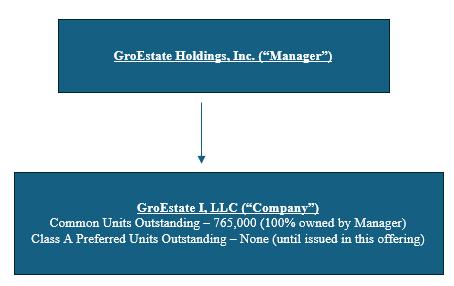
| 50 |
Our Business
We are a recently organized Delaware limited liability company formed to partner with Operators of agricultural businesses. Our Manager and its advisors have experience in land development and agricultural technology, including advanced water purification systems, specialized lighting, and growing techniques for high-yield, small-footprint cultivation, as well as experience in equipment leasing and real estate management for farming facilities.
We are an agriculture-equipment focused lending company. We intend to generate recurring revenues primarily by: (i) originating, investing in and managing a portfolio of commercial loans to Operators, the proceeds of which will be used primarily for the purchase or lease of specified agricultural equipment and machinery used in their agricultural businesses and (ii) providing business and strategic consulting services to the Operators that we make loans to, as well as other agricultural businesses. We currently plan to provide loans that are specifically for (i) equipment such as greenhouses and growing equipment with such loans being either unsecured or secured by the equipment being acquired or other assets of the agricultural business and (ii) general working capital.
We plan to make loans that are either unsecured or secured by the equipment financed or other assets of the agricultural business, to farm owners and Operators in the North American market. Certain of our loans may additionally have a fixed or variable interest rate, and be either participating or non-participatory loan instruments. We also plan to assist Operators with the further development of their land, equipment, and operations through our consulting services.
We are not directly involved in farming operations, and acquiring real property is not part of our business plan.
Given our early stage of development and limited funds, we are initially focusing on lending and consulting to underserved market opportunities where we can demand higher interest rates such as: (i) urban food production farms in areas affected by food deserts, and (ii) higher risk farming operations.
Loans
We intend for our secured and unsecured loans to Operators will be for the purchase or lease of specified agricultural equipment, such as greenhouses, grow lighting, water purification systems, vertical growing infrastructure, and related equipment. Each of our loans is anticipated to have a use of proceeds specifically identifying the equipment to be acquired, along with relevant descriptions, product or model numbers, etc. The balance of our loans will be for the Operator’s general working capital. Our loans are anticipated to have a fixed or variable interest rate and be either participating or non-participatory loan instruments. Certain of our loans will be secured in part by the equipment and machinery being purchased or other assets of the farming business. In the event of default on the loans, we may foreclose upon, or otherwise take title to, such secured assets. In that circumstance, we would intend to sell such assets, rather than operate the farming business ourselves.
Consulting Services
We anticipate providing consulting services to Operators. Such consulting services are anticipated to be related to land development, equipment selection and use, and farming techniques, such as irrigation and grow-lighting design. We generally expect to provide these services in connection with, and as a complement to, a lending relationship, rather than as a stand-alone service line, although we may in certain circumstances provide consulting services on a stand-alone service offering.
| 51 |
Anticipated Parties to our Loan Agreements
Depending on the ownership and operating structure of a particular agricultural facility, our loans may involve several different categories of counterparties. These roles are not mutually exclusive, and a single person or entity may serve in more than one capacity. For example, a landowner may also serve as the Operator and borrower, while in other cases the landowner, Operator and Borrower may be separate persons or entities. We currently expect that a substantial portion of our loans will be made directly to landowners that either (i) lease the applicable agricultural property and related equipment to an independent tenant Operator or (ii) directly operate the agricultural property themselves. In certain circumstances, we may instead make loans directly to a tenant Operator that is responsible for the day-to-day agricultural operations but does not own the underlying real property.
Anticipated Loan Sizes
| ● | Agricultural Equipment Loans. The amount of each agricultural equipment loan will vary based on the particular needs of the Operator, including the size and nature of the agricultural operation, the type and volume of equipment being financed, the cost of such equipment, and other underwriting considerations. Accordingly, except for the two parties that we have had preliminary discussions with below (GBM and AmberCloud) we are not currently able to estimate an average loan size. Notwithstanding, we generally expect to not originate any agricultural equipment loans with an original principal amount of less than approximately $100,000, although we may make loans below this amount if we determine that doing so is appropriate based on the circumstances of a particular Operator or financing opportunity. | |
| ● | Community Garden Loans (Green Blue Marketplace). As described below, we have engaged in preliminary discussions with GBM regarding the potential financing of equipment for the development of multiple community garden projects. We have not entered into any definitive agreement with GBM, no financing commitment has been made by us or GBM, and the discussions remain subject to, among other things, further due diligence, negotiation of definitive terms and documentation, satisfaction of our underwriting criteria and the availability of sufficient capital. There can be no assurance that we will enter into any agreement with GBM, that any community garden projects will ultimately be financed by us, or, if any financing is completed, as to the number, timing or amount of such loans. Based solely on our preliminary discussions, we currently anticipate that loans for individual community garden projects could be approximately $1.00 million to $1.25 million, although actual loan amounts, if any, may be materially higher or lower depending on the equipment requirements and other circumstances of each project. | |
| ● | Jones Farm (AmberCloud). As described below we have engaged in preliminary discussions with AmberCloud to make equipment loans for Jones Farm. There can be no assurance that we will enter into any agreement with AmberCloud, that we will be able to finance the Jones Farm equipment, or that we will raise sufficient proceeds in this Offering to make any such loan. Based solely on our preliminary discussions, we currently anticipate that Jones Farm will require approximately $4.5 million in equipment loans (with a small portion going toward general working capital). |
Current Loan Agreements
As of the date of this Offering Circular, we have executed a one (1) year promissory note with AmberCloud in the amount of $182,000, having a term of one (1) year which we anticipate converting into one of our standard commercial loans for equipment, if and when we are able to agree upon terms with AmberCloud and assuming we have raised sufficient proceeds in this Offering.
| 52 |
Although we have one minor promissory note with AmberCloud, we do not have any agreements in place to make any equipment loans or provide any consulting services, as per our business plan. Notwithstanding, we are in discussions to provide such equipment loans and consulting services to both AmberCloud for expansion of its greenhouses and growing lights and to GBM to acquire equipment for the community gardens they are building. A description of the potential projects being discussed with AmberCloud and Green Blue Marketplace, including their general operations are as follows:
| 1. | Green Blue Marketplace: |
Community Gardens Projects
Many U.S. inner cities lack affordable access to fresh produce, a problem commonly referred to as “food deserts” defined by the U.S. Department of Agriculture (“USDA”) as a low-income geographic area where residents have limited access to healthy, affordable food, often because they are far from supermarkets and lack access to healthy food retailers According to the USDA’s Food Access Research Atlas approximately 18.8 million Americans (6.1% of the population) lives in a food dessert.1 Through partnerships with community-based operators we intend to finance and expand shipping-container farms that grow and sell produce directly to consumers within these communities. By selling directly to consumers, these operators are able to retain the full retail margin, while providing healthier food alternatives at reasonable prices. According to the USDA Food Dollar Series, farmers receive only 14.9% of the consumer food dollar, while 85.1% goes to the broader distribution chain—including processing, transportation, packaging, and retailing—with retailers themselves retaining 12.4%.2 In addition, In 2023, the Centers for Medicare & Medicaid Services authorized states to cover nutrition assistance and produce prescriptions as Health-Related Social Needs (HRSN) services under Medicaid, and Medicare Advantage plans may reimburse healthy food purchases through Special Supplemental Benefits for the Chronically Ill.3
GBM has created a community garden grow facility and marketplace within inner-city Raleigh North Carolina as an initial proving ground of growing high quality vegetables and selling direct within the city and helping to solve issues of Food Deserts. The growing facilities are all located within shipping containers and utilize specialized lighting and proprietary water purification systems to grow directly where the consumers are located. As the typical farmer usually receives under 15% of the retail price of vegetables and the distribution chain usually costs 72%4, by locating the farm directly at the consumer, GBM can keep the entire retail price of the food and thus generate higher margins that the traditional farm while providing fresh produce to the inner city at reasonable prices. In addition, GBM has created the ability to offer food prescriptions to those in the community on Medicare, Medicaid and Food Stamps such that fresh vegetables are free to such consumers.
We are in initial discussions with GBM for the equipment needed to run up to 20 community gardens projects throughout the United States, including ancillary consulting services. Based on our discussions with GBM, they anticipate needing approximately $1 million to $1.25 million per community garden project. While we have discussions with GBM, there can be no assurances that (i) we raise sufficient capital to make such loans or (ii) we are able to come to an agreement to loan the funds to GBM or provide any consulting services.
Relationship with Dr. Isaac B. Horton III. Dr. Isaac B. Horton, who serves as Chief Technology Officer of our Manager and provides services to us in that capacity, is the founder and controlling shareholder of GBM and currently serves as its Chairman and Chief Executive Officer. Accordingly, any transaction that we may enter into with GBM would constitute a related-party transaction and could present a conflict of interest for Dr. Horton. As of the date of this Offering Circular, we have not entered into any definitive agreement with GBM, and neither we nor GBM has any obligation to enter into any proposed loan, consulting or other transaction.
_______
1 U.S. Department of Agriculture, Economic Research Service, Food Access Research Atlas (2024), https://www.ers.usda.gov/data-products/food-access-research-atlas
2 U.S. Department of Agriculture, Economic Research Service, Food Dollar Series, 2024 Update. https://www.ers.usda.gov/data
3 Centers for Medicare & Medicaid Services (CMS), Medicaid and CHIP Health-Related Social Needs Framework (Nov. 2023); CMS, Special Supplemental Benefits for the Chronically Ill (SSBCI) Guidance for Medicare Advantage Plans (2023), https://www.cms.gov.
4 .S. Department of Agriculture, Economic Research Service, Food Dollar Series, 2024 Update. https://www.ers.usda.gov/data-products/food-dollar-series/
| 53 |
| 2. | AmberCloud |
Jones Farms (Oklahoma)
Our management team has an existing relationship with AmberCloud in connection with Jones Farms, a hemp-growing facility located in Oklahoma and operated by an independent Operator pursuant to a 20-year lease, which has an off-take agreement with a major processor for the extraction of CBD and THC oils from the hemp grown at the facility. We are in discussions to provide equipment loans and consulting services with AmberCloud. Based on current preliminary discussions we believe AmberCloud may need approximately $4.5 million in loans for specified equipment (with a small portion being general working capital).
While we have had ongoing discussions with AmberCloud, there can be no assurances that (i) we raise sufficient capital to make such loans or (ii) we are able to come to an agreement to loan the funds to AmberCloud or provide any consulting services.
Competition
There are numerous companies that provide financing and equipment leasing to farming operations generally. We are not aware, however, of any company that focuses specifically on the combination of urban food-production financing that represents our initial focus, which we believe provides us with a distinct niche within the broader agricultural finance industry. There can be no assurance that our competitors will not expand into these segments, and if they do, they may have substantial competitive advantages over us, including greater capital resources, larger operating teams, more loan underwriting experience, and more established track records.
Although we do not intend to acquire real property such as the competitors listed below, we consider the following companies to be potential competitors, given their focus on agricultural and related real estate and equipment financing:
| · | Gladstone Land Corporation (Nasdaq: LAND), a publicly traded REIT that acquires farmland across the United States and leases it to farmers, often through long-term sale-leaseback transactions, and currently owns more than 150 farms nationwide. | |
| · | Innovative Industrial Properties, Inc. (NYSE: IIPR), a publicly traded REIT that acquires, owns, and manages specialized real estate leased to licensed cannabis operators, managing more than 100 properties across 19 states comprising more than 8.5 million square feet. | |
| · | Other agricultural investment firms such as Equilibrium, Contain Inc., and Farmland LP, which provide capital solutions, leasing structures, or direct ownership of farmland and controlled-environment agriculture facilities. |
In addition to these direct competitors, we face indirect competition from traditional banks, private equity funds, and specialty lenders active in financing agricultural operations. Although these capital providers may not focus on our exact business model, they compete with us for relationships with the same Operators we target by offering alternative sources of capital and lease structures.
Government Regulations
As equipment lenders and consultants to agricultural businesses, we could be affected by various federal, state, and local environmental laws, regulations.
Equal Credit Opportunity Act (ECOA)
ECOA prohibits lenders from discriminating against any credit applicant — including business loan applicants — on the basis of race, color, religion, national origin, sex, marital status, age, or receipt of public assistance. For commercial loans, lenders must provide adverse action notices when declining credit, though the timing and detail requirements are relaxed for large commercial borrowers (gross revenues exceeding $1 million). Personal guarantors on commercial loans are also protected as credit applicants. Farm owners from protected classes are entitled to equal treatment in all aspects of the credit transaction, including pricing and terms.
| 54 |
Office of Foreign Assets Control (OFAC) Compliance
Lenders are required to screen all loan applicants, beneficial owners, and related parties against OFAC’s Specially Designated Nationals (SDN) list and other sanctions lists. Extending credit to a sanctioned person or entity is prohibited and may result in civil or criminal penalties. This obligation applies regardless of loan size or transaction type, including commercial loans to agricultural businesses.
Fair Credit Reporting Act (FCRA)
FCRA governs the use of consumer credit reports in lending decisions. When a lender pulls the personal credit report of a farm owner or guarantor as part of the commercial loan underwriting process, FCRA requirements are triggered. These include obtaining permissible purpose, providing adverse action notices if credit is denied based in whole or in part on information in a credit report, and complying with accuracy and dispute resolution obligations. Business credit reports are not subject to FCRA, but personal guarantor reports are.
Uniform Commercial Code (UCC) — Article 9
UCC Article 9 governs secured transactions where personal property (equipment, inventory, accounts receivable, fixtures) serves as collateral for a commercial loan. For a farm, this would typically cover growing equipment, other assets such as tractors, accounts receivable from sale of produce, and other business assets. Lenders must properly perfect their security interest by filing a UCC-1 financing statement with the appropriate state authority to establish priority over other creditors.
State Usury and Lending Laws
Most states impose caps on interest rates for commercial loans, though many states have enacted exemptions for loans above certain thresholds or to corporate borrowers. Lenders must comply with the usury laws of the applicable jurisdiction, which is typically determined by where the loan is made or where the borrower is located. Some states also impose licensing requirements on commercial lenders and have enacted their own fair lending statutes. Florida, for example, has its own commercial lending statutes under Chapter 687, Florida Statutes.
Market opportunity
Currently, we have very limited resources. We will need to source capital in order to exercise make loans for equipment to our Operators and land owners. In order to grow our operations, we will need to make such loans and continue to find additional opportunities similar to the loan opportunities we are currently negotiating. If we fail to raise adequate funds, it will prevent us from exercising all of our lending under negotiations or from providing the capital needed to expand our search for additional suitable agricultural facilities to lend to.
Seasonality
Depending on the types of loan agreements we are able to enter into and consulting services we ultimately provide, we may experience seasonality with respect to certain of the equipment we lease and revenues we receive, particularly as some of our revenues are tied to revenues and to usage of our equipment. However, we believe that many of our early-stage target facilities will be greenhouses or shipping containers for inner cities that will likely not be affected by seasonality the way a traditional farming operation would.
| 55 |
Our Manager
GroEstate Holdings, Inc., as our Manager, oversees and directs our day-to-day operations, using its own employees as well as retained consultants and other experienced personnel at either the Manager or Company level. Pursuant to our Operating Agreement, the Manager is entitled to make substantially all decisions regarding Company operations and holds all of the Company’s voting securities, subject to certain limited exceptions. Accordingly, all decisions relating to our loans, leases, and consulting arrangements, as well as substantially all governance matters affecting the Company and its Members, are subject to the sole discretion of the Manager.
The Manager’s Board of Directors currently consists of Dean Medwid and Jason Garnett. Mr. Medwid also serves as the Manager’s Chief Executive Officer, Chief Operating Officer and Chief Financial Officer. Dr. Isaac Horton serves as the Manager’s Chief Technology Officer.
Management Agreement
On April 30, 2026, we entered into a management agreement with the Manager (the “Management Agreement”). Pursuant to the terms of the Management Agreement, the Manager will determine whether to employ personnel that provide services for the benefit of our Company, including employees, directors, consultants, and all work related to identification of Operators and the loans and consulting services directly with the Manager or with us. To the extent incurred, the Manager is entitled to reimbursement of such salaries, fees, third party expenses for consultants, insurance, legal, investor relations, and any other direct costs and expenses incurred on behalf of the Company. The Manager has the right to amend the Management Agreement as it deems necessary on fifteen (15) days notice. If Manager serves as a manager, operator, or owner of other business enterprises, Manager shall act in good faith to allocate and proportionately share any shared or overlapping costs among the Company and such other enterprises in a fair and reasonable manner. Notwithstanding, nothing will preclude the Company from retaining the services of certain service providers directly, at its discretion.
The Manager does not receive any selling commissions or dealer manager fees in connection with the offer and sale of our Class A Preferred Units. See “Management Compensation” for a more detailed explanation of the fees and expenses payable to the Manager.
Operating Agreement
In the event that you purchase Class A Preferred Units pursuant to this Offering, you will be bound by, and subject to, the terms of the Operating Agreement, a copy of the form of which is attached to this Offering Circular as Exhibit 2.2.
Distributions
Pursuant to the Company’s Operating Agreement, the Manager will determine if and when distributions are made to the Members. The Company will deposit 8.00% of the proceeds from this Offering into a segregated restricted account, which will be maintained as a contingency reserve (“Reserve Account”) to make distributions to the Members holding Class A Preferred Units. Such funds held in the Reserve Account will be classified as restricted cash and may, at the discretion of the Manager, be invested by the Company in cash equivalents.
All distributions of cash to be made by the Company, at the discretion of Manager, will be subject to the following (collectively, the “Distributions”):
(i) First, the Class A Preferred Units shall receive one hundred percent (100%) of Distributions until each Member holding Class A Preferred Units has received cumulative Distributions equal to an annual, non-compounded, eight percent (8.0%) return on the original purchase price paid for such Class A Preferred Units, calculated from the date of issuance and prorated for partial years. Any such portion not distributed in any year shall continue to accrue and remain unpaid until satisfied; and
(ii) Thereafter, all additional Distributions, shall be distributed (1) seventy percent (70%) to the Class A Preferred Units and (2) thirty percent (30%) to the Common Units.
There can be no assurances if and when the Manager will make Distributions, or if the Company will have sufficient free cash flows from its loans and consulting services in order for Distributions to be made.
| 56 |
Our Distributions generally will constitute a return of capital to the extent that they exceed our current and accumulated earnings and profits as determined for U.S. federal income tax purposes. To the extent that a distribution is treated as a return of capital for U.S. federal income tax purposes, it will reduce a holder’s adjusted tax basis in the holder’s Units, and to the extent that it exceeds the holder’s adjusted tax basis, it will be treated as gain resulting from a sale or exchange of such Units.
Voting Rights
Pursuant the Operating Agreement, the Class A Preferred Units will not vote on any matter, except for (i) certain amendments to the Operating Agreement that would disproportionately and adversely affect the Class A Preferred Units, (ii) the determination to dissolve or wind up the Company, (iii) the appointment of a replacement Manager in the event the Manager resigns or is otherwise dissolved (bankruptcy etc.), and (iv) other matters required by Delaware law.
Accordingly, the Manager, as the sole holder of the Common Units will have control over all other matters to be voted on by the Members of the Company.
Dissolution
Upon any of the following to occur, the Company will commence winding up (each, a “Dissolution Event”): (i) the vote of the Members (each class voting separately), with Manager approval, (ii) the insolvency or bankruptcy of the Company, (iii) the occurrence of a Fundamental Transaction (as defined in the Operating Agreement, but generally an acquisition of the Company), or (iv) the entry of a decree of judicial dissolution under Section 18-801 of the Delaware Limited Liability Company Act. In the event of a Dissolution Event, the Distributions will be the same as those described above in the section entitled “Distributions” after payment of all creditors and liabilities have been made.
Other Governance Matters
Other than the limited Class A Preferred Unit voting rights described above, the Operating Agreement vests most other decisions relating to our assets and to the business of our Company, including decisions relating to acquisitions, originations and dispositions, the issuance of securities in our Company, in the Manager. See “Management” for more information about the rights and responsibilities of our Manager.
Transfer Agent
The Company has engaged T7X Equities, Inc. to act as transfer agent for the Class A Preferred Units. The Class A Preferred Units will be issued and maintained in book-entry form on a digital ledger platform administered by the transfer agent. The digital record evidencing ownership will not be tradeable on any securities exchange or alternative trading system unless separately registered or qualified and in compliance with applicable securities laws.
Employees
As of July 15, 2026, the Company has no employees. Our Manager has one (1) full time employee, its Chief Executive Officer, Dean Medwid. Our Chief Technology Officer, Dr. Isaac Horton, is employed on a part time basis. We also employ a part time bookkeeper. We do not anticipate retaining additional personnel, but plan to utilize the employees, legal service providers, accountants, and other consultants of either our Manager, or those who we retain directly.
Description of Our Property
Our Manager maintains offices on our behalf located at 6608 N. Western Ave, Suite 1334, Oklahoma City, OK 73116, Phone: 463-220-1808, Email: invest@gro.estate. We currently pay no money for office space. We maintain a website at http://www.gro.estate. We do not incorporate the information on or accessible through our website into this Offering Circular, and you should not consider any information on, or that can be accessed through, our website a part of this Offering Circular.
| 57 |
Arbitration Provision
Under the Arbitration Provision contained in our Operating Agreement, either party may, at its sole election, require that the sole and exclusive forum and remedy for resolution of a claim be final and binding arbitration. We have not determined whether we will exercise our right to demand arbitration but reserve the right to make that determination on a case by case basis as claims arise. In this regard, the Arbitration Provision is similar to a binding arbitration provision as we are likely to invoke the Arbitration Provision to the fullest extent permissible. The Arbitration Provision applies to claims under the U.S. federal securities laws and to all claims that are related to the Company, including with respect to this offering, our holdings, our Class A Preferred Units, and our ongoing operations, among other matters.
Any arbitration brought pursuant to the Arbitration Provision must be conducted in the State of Delaware. The term “Claim” as used in the Arbitration Provision is very broad and includes any past, present, or future claim, dispute, or controversy involving you (or persons claiming through or connected with you), on the one hand, and us (or persons claiming through or connected with us), on the other hand, relating to or arising out of your subscription agreement, and/or the activities or relationships that involve, lead to, or result from any of the foregoing, including (except an individual Claim that you may bring in Small Claims Court or an equivalent court, if any, so long as the Claim is pending only in that court) the validity or enforceability of the Arbitration Provision, any part thereof, or the entire subscription agreement. Claims are subject to arbitration regardless of whether they arise from contract; tort (intentional or otherwise); a constitution, statute, common law, or principles of equity; or otherwise. Claims include (without limitation) matters arising as initial claims, counter-claims, cross-claims, third-party claims, or otherwise. The scope of the Arbitration Provision is to be given the broadest possible interpretation that will permit it to be enforceable. Based on discussions with and research performed by the Company’s counsel, we believe that the Arbitration Provision is enforceable under federal law, the laws of the State of Delaware, or under any other applicable laws or regulations. However, the issue of enforceability is not free from doubt and to the extent that one or more of the provisions in our subscription agreement or our operating agreement with respect to the Arbitration Provision or otherwise requiring you to waive certain rights were to be found by a court to be unenforceable, we would abide by such decision.
As a result of these arbitration provisions, you and our other Members may be subject to increased costs in bringing a claim, limited access to information and you may also be subject to other imbalances of resources between us and our Members. These provisions may also discourage you and other stockholders, including those who may purchase securities upon resale by any initial purchaser in an aftermarket or otherwise, from bringing claims at all and will limit your ability to bring a claim in a judicial forum that you find favorable.
Before purchasing Class A Preferred Units, a potential Investor must acknowledge, understand, and agree that: (a) arbitration is final and binding on the parties; (b) the parties are waiving their right to seek remedies in court, including the right to jury trial; (c) pre-arbitration discovery is generally more limited than and potentially different in form and scope from court proceedings; (d) the Arbitration Award is not required to include factual findings or legal reasoning and any party’s right to appeal or to seek modification of a ruling by the arbitrators is strictly limited; and (e) the panel of arbitrators may include a minority of persons engaged in the securities industry. The Arbitration Provision limits the rights of an investor to many legal remedies and rights otherwise available. See the Section of this Offering Circular entitled - “How to Subscribe—Arbitration Provision.”
BY AGREEING TO BE SUBJECT TO THE ARBITRATION PROVISION IN OUR OPERATING AGREEMENT, INVESTORS WILL NOT BE DEEMED TO WAIVE THE COMPANY’S COMPLIANCE WITH THE FEDERAL SECURITIES LAWS AND THE RULES AND REGULATIONS PROMULGATED THEREUNDER.
| 58 |
Investment Company Act Considerations
We intend to conduct our operations so that neither we, nor any of our subsidiaries, is required to register as an investment company under the Investment Company Act of 1940, as amended (“1940 Act”). Section 3(a)(1)(A) of the 1940 Act defines an investment company as any issuer that is or holds itself out as being engaged primarily in the business of investing, reinvesting or trading in securities. Section 3(a)(1)(C) of the 1940 Act defines an investment company as any issuer that is engaged or proposes to engage in the business of investing, reinvesting, owning, holding or trading in securities and owns or proposes to acquire investment securities having a value exceeding 40% of the value of the issuer’s total assets (exclusive of U.S. Government securities and cash items) on an unconsolidated basis. Excluded from the term “investment securities,” among other things, are U.S. Government securities and securities issued by majority-owned subsidiaries that are not themselves investment companies and are not relying on the exception from the definition of investment company set forth in Section 3(c)(1) or Section 3(c)(7) of the 1940 Act.
We intend to rely upon the exemption from the definition of investment company contained in Section 3(c)(5)(B) of the 1940 Act. Section 3(c)(5)(B) applies to certain issuers primarily engaged in the business of making loans to manufacturers, wholesalers, retailers, and prospective purchasers of specified merchandise and services. The SEC Staff has interpreted the term “primarily engaged” contained in Section 3(c)(5)(B) to require that between 55% and 80% of the issuer’s total assets will consist of “qualifying assets”. Based on SEC guidance, in order for our loans to be considered “qualifying assets” the proceeds from the loans must be used to purchase specific merchandise, insurance or services that have a direct nexus to the merchandise or services sold by the Operators. The direct nexus requirement means that general corporate lending or working capital loans typically do not qualify unless tied to specific merchandise, insurance, or services.
The Company intends to always maintain qualifying assets equal to at least 65% of its total assets. The Company will monitor its asset composition on an ongoing basis to ensure continued compliance with the “primarily engaged” standard. In the event that the Company’s qualifying asset percentage approaches the minimum threshold, the Company intends to take remedial steps, which may include increasing qualifying assets while decreasing non-qualifying assets or any other commercially reasonable actions available under applicable law in order to regain compliance with any applicable exemption under the 1940 Act.
The Company intends to make secured and unsecured commercial loans to agricultural facilities for equipment such as greenhouse, lighting fixtures, vertical growing shelves and other equipment used for growing the crops. These facilities will be able to initially grow or increase production of their produce and thus directly generate revenue from the equipment acquired by the Company’s loans. In making the loans for equipment purchases or leases, the Company will require the Operators to identify the equipment being purchased or leased and establish how it directly relates to growing crops that will generate revenue via sales wholesale or to consumers. The Company believes that its loans will satisfy the “direct nexus” standard because (i) the financed equipment is essential for the facilities to grow its crops that generate its revenues, (ii) each loan instrument, if and when entered into, will contain a use of proceeds and covenants specifically identifying the equipment and machinery models, categories, or components being acquired with each applicable drawdown of funds, and (iii) approximately 85% of the proceeds of the loans will be used for the acquisition of these specified equipment, with only a small portion of the loan being utilized for general working capital by the Operators for the facilities, which such portion of the loan instrument not counting as a “qualifying asset” on the Company’s balance sheet.
Previously, the Company entered into partially binding term sheets with (i) GBM (for the development of Community Gardens) (“GBM”) and (ii) AmberCloud with respect to making certain loans, acquiring options to purchase land, and providing consulting services. In order to comply with the foregoing 1940 Act exemptions, each of the foregoing term sheets were mutually terminated with their respective parties on May 2, 2026. The Company and each of GBM and AmberCloud are currently in discussions regarding new agreements, that will comply with the exemptions set forth in Section 3(c)(5)(B) of the 1940 Act or any other available exemption thereunder. Notwithstanding these preliminary discussions, there can be no assurances that the Company will enter into any binding agreements, including loan instruments, with either AmberCloud or GBM.
Qualification for the exemption from registration under the 1940 Act will limit our ability to make certain investments. To the extent that the SEC staff provides more specific guidance regarding any of the matters bearing upon such exemption, we may be required to adjust our strategy accordingly. Any additional guidance from the SEC staff could provide additional flexibility to us, or it could further inhibit our ability to pursue the strategies we have chosen.
The loss of our exemption from registration pursuant to the 1940 Act could require us to restructure our operations, sell certain of our assets or abstain from the purchase of certain assets, which could have an adverse effect on our financial condition and results of operations. See Risk Factors—Risks Relating to the Investment Company Act of 1940.
| 59 |
Our Manager
Pursuant to a Management Agreement entered into by us and the Manager on April 30, 2026, our Manager controls and is responsible for directing the management of our business, managing our day-to-day affairs, and providing loans and consulting services. A majority of the outstanding capital stock of the Manager is owned by its directors and officers - Dean Medwid, Jason Garnett and Dr. Isaac Horton. Pursuant to our Operating Agreement and Management Agreement, we have agreed to indemnify the Manager and its affiliated persons for their services under the Operating Agreement and Management Agreement, subject to certain exceptions, including for acts involving actual fraud, gross negligence, willful misconduct, bad faith, breach of fiduciary duty, reckless disregard of duty, or intentional and material breach of the Operating Agreement. The Manager and its officers and directors are not required to devote all of their time to our business and are only required to devote such time to our affairs as their duties require.
Responsibilities of our Manager pursuant to the Operating Agreement and Management Agreement
The responsibilities of our Manager, as contained in the Operating Agreement and Management Agreement, include, but are not limited to:
| · | All day to day operational decisions, including the development of potential borrowers, lending and consulting to agricultural facilities and the community gardens project.; | |
| · | Provide, to the extent necessary, the loan servicing and consulting services, if and when applicable; | |
| · | The declaration, timing, and amount of any Distributions to Members; | |
| · | Entry into, amendment, or termination of material agreements, including lending arrangements, management agreements, and consulting contracts; | |
| · | The incurrence of indebtedness and determination of capital structure; | |
| · | The issuance of additional Class A Preferred Units (subject to applicable securities laws); | |
| · | Appointment and removal of Officers and delegation of authority to such Officers, if any; | |
| · | Financial reporting policies and internal control procedures; | |
| · | Selection of accountants, legal counsel, and other professional advisors; | |
| · | Approval of mergers, consolidations, restructurings, or other fundamental transactions, subject to the terms of the Operating Agreement and votes of Members, as applicable; | |
| · | Amendment of the Management Agreement; | |
| · | Determination of reserves and use of Company funds; | |
| · | Approval of Transfers of Units, to the extent required under the Operating Agreement. |
| 60 |
Management Team
The Company does not currently have a Board of directors or any officers. The Company is managed by its Manager, GroEstate Holdings, Inc. The following table sets forth information regarding our Manager’s executive officers, directors and significant employees, including their ages as of July 15, 2026:
| Name | Age | Term of Office | Position | Approximate hours per week for part-time employees | ||||
| Dean Medwid | 58 | 1/2025 – Current | Chief Executive Officer, Chief Financial Officer, President and Director (Chairperson) | Full Time | ||||
| Dr. Isaac Horton | 68 | 7/2025 – Current | Chief Technology Officer | 10 | ||||
| Jason Garnett | 57 | 6/2026 – Current | Director | N/A |
The principal occupations for each of our current executive officers and directors are as follows:
Dean Medwid - Mr. Medwid has worked as a senior executive in operations for cannabis, technology, and operations for more than thirty years, in both public and private markets with a focus on scalable process engineering, brand development and strategic partnerships. He has been recognized with numerous business awards and accolades, including Profit 100’s Top 100 in Canada, five years in a row while a co-founder and partner in Seattle’s Best Coffee. Mr. Medwid has served as a founder and chief operating officer of GroEstate since May 2025. Previously, from April 2024 through April 2025, Mr. Medwid served an operating partner for Elevation Capital, a venture capital firm based in the Bahamas. Prior to that, from June 2023 through June 2024, he served as CEO of CannapharmaRx Inc.(OTC: CPMD), a Canadian publicly traded cannabis cultivation company, trading on the OTC. From March 2024 through May 2025, he served as CEO of New Leaf Ventures (CSEL NLV, OTC: NLVVVF), a publicly traded Canadian cannabis financing and applied management company that trades on the Canadian Stock Exchange and the OTC. Additionally, from June 2021 though May 2024, Mr. Medwid served as President and COO of High Profile Holdings Inc., a cannabis retailer in Canada, before it was acquired by New Leaf Ventures. From 2013 through June 2021, he also served as President and COO of Mindfield, a Canadian recruiter and employment outsourcing company in various hospitality sectors. Mr. Medwid has assisted companies in driving growth and expansion, creating internal processes related to budgets, technology standards and human resources. Mr. Medwid received a degree in paramedicine in from Southern Alberta Polytechnic University. He has also completed a 3 year entrepreneurial program at MIT and a 2 year leadership program at Emory University. Our Board believes Mr. Medwid’s experience as an executive and operator in the farming and cannabis industry qualifies him to serve on the Board.
Dr. Isaac B. Horton III – Dr. Horton has been the CEO (or Managing Partner) of Oak City Hydroponics and serves as Founder, Chairman, and CEO of The Green Blue Marketplace, LLC, with which we are presently engaged in preliminary discussions regarding potential equipment financing and consulting arrangements. See “Business—Potential First Partners—Green Blue Marketplace” and “Certain Relationships and Related Party Transactions.”. Prior to these roles, Dr. Horton held a number of positions as a Founder, CEO, or CTO, including at Remote Light, Inc. (where he served as CEO and Chairman), Scientific Production Ventures, LLC (a consulting and finance group he has led for over 20 years), and other ventures in solar/energy, water treatment technology, and ag-tech. He began his career as a research chemist at DuPont and later held roles in manufacturing, sales, marketing, strategic planning, and business development at Rohm and Haas Company. Dr. Horton’s companies have been issued more than 140 patents (primarily related to optics, UV disinfection/water treatment, lighting, and chemical processes). His technologies have been used in high-profile installations including Disney theme parks, Tiffany & Co., the New York Stock Exchange, and NFL Super Bowl halftime shows. Dr. Horton holds a bachelor’s degree in Chemistry from the University of North Carolina at Chapel Hill and a PhD in Organic Chemistry (Synthetic Organic Chemistry of Natural Products, with a minor in Inorganic Chemistry) from Indiana University Bloomington.
| 61 |
Jason Garnett - Mr. Garnett has served as Managing General Partner of Surfing Goat Dairy, located in Hawaii, since September 2023. From April 2022 to September 2023, he served as Chief Executive Officer of Xebra Brands, and from April 2020 to April 2022, he served as Chief Executive Officer of High Profile Cannabis. Previously, Mr. Garnett served as Chief Executive Officer and Chairman of Steaze, a healthy beverage company, and as founder and Chief Executive Officer of Seattle’s Best Coffee – Canada. He currently serves as an advisor to Not Too Sweet Craft Sodas. Mr. Garnett holds a Bachelor’s degree in Business Management from the Massachusetts Institute of Technology and a Master’s degree in Entrepreneurial Studies from Stanford University. The Board believes Mr. Garnett is qualified to serve as a director based on his extensive executive leadership experience as chief executive officer of multiple consumer products and beverage companies, his experience founding and scaling early-stage enterprises in the cannabis space, and the operational and strategic insight he has gained across the food, beverage, and consumer goods sectors.
None of our executive officers and board directors has been involved in any of the following proceedings during the past ten (10) years:
1. any bankruptcy petition filed by or against any business of which such person was a general partner or executive officer either at the time of the bankruptcy or within two years prior to that time;
2. any conviction in a criminal proceeding or being subject to a pending criminal proceedings (excluding traffic violations and other minor offenses);
3. being subject to any order, judgment, or decree, not subsequently reversed, suspended or vacated, of any court of competent jurisdiction, permanently or temporarily enjoining, barring, suspending or otherwise limiting his involvement in any type of business, securities or banking activities; or
4. being found by a court of competent jurisdiction (in a civil action), the SEC or the Commodity Futures Trading Commission to have violated a federal or state securities or commodities law, and the judgment has not been reversed, suspended or vacated.
Family Relationships
There are no family relationships between any of our officers and directors.
Indemnification of our Manager and Others
Our Operating Agreement provides for exculpation and indemnification of the Manager and other protected persons to the fullest extent permitted by Delaware law, subject to certain exceptions, including for acts involving actual fraud, gross negligence, willful misconduct, bad faith, breach of fiduciary duty, reckless disregard of duty, or intentional and material breach of the Operating Agreement. However, there can be no assurance that such contractual protections will be sufficient to cover all potential claims, expenses, or liabilities.
Term and Removal of the Manager
Our Operating Agreement provides that our Manager will serve as our manager for an indefinite term, but that our Manager may resign at any time. The Manager may not be removed by the Members for any reason. In the event of a resignation of the Manager or the Manager’s dissolution as a result of bankruptcy or other reason, the members holding Class A Preferred Units may elect a new Manager.
| 62 |
Involvement in Certain Legal Proceedings.
None of the following events have occurred during the past five years and which are material to an evaluation of the ability or integrity of any director or executive officer: (1) A petition under the federal bankruptcy laws or any state insolvency law was filed by or against, or a receiver, fiscal agent or similar officer was appointed by a court for the business or property of such person, or any partnership in which he was general partner at or within two years before the time of such filing, or any corporation or business association of which he was an executive officer at or within two years before the time of such filing; or (2) Such person was convicted in a criminal proceeding (excluding traffic violations and other minor offenses).
Board Composition
We do not have a Board of Directors and the Manager makes decisions typically made by a Board of Directors of a corporation. The Manager has a Board of Directors consisting of Dean Medwid, and Jason Garnett – see “Management Team” above.
Board Leadership Structure and Risk Oversight
The Manager oversees our business and considers the risks associated with our business strategy and decisions. The Board currently implements its risk oversight function as a whole. Each of the Board’s committees of the Manager, when and if established, will also provide risk oversight in respect of its areas of concentration and reports material risks to the Board for further consideration.
Code of Business Conduct and Ethics
The Company has adopted a written code of business conduct and ethics that applies to our directors, officers and employees, including our principal executive officer, principal financial officer and principal accounting officer or controller, or persons performing similar functions. The code of business conduct and ethics is attached to this Offering Circular as Exhibit 99.1 and is posted on our website at: www.gro.estate.
| 63 |
The following table sets forth the cash compensation (including bonuses) paid to or accrued for, and other compensation received by, our executive officers and directors for the year ended June 30, 2026 (or the period they served, as applicable). Note on Reorganization: On April 30, 2026, the Company completed a holding company reorganization, converted into a limited liability company, adopted an Operating Agreement, and entered into a Management Agreement with the Manager. As a result, the individuals listed below currently serve as officers and directors of the Manager rather than the Company. The Company is required to reimburse the Manager for compensation paid or payable to these individuals under the Management Agreement.
| Name | Capacities in which compensation was received | Cash Compensation ($) | Other Compensation ($) | Total Compensation ($) | ||||||||||
| Dean Medwid (1) | CEO, CFO | $ | 180,000(1) | – | – | |||||||||
| Dr. Isaac Horton(2) | CTO | –(2) | – | – | ||||||||||
| Dominick Colvin (3) | Former CEO | $ | 117,335(3) | – | ||||||||||
| Jason Garnett(4) | Director | –(4) | ||||||||||||
| (1) | Mr. Medwid served as Chief Operating Officer since May 20, 2025 and was appointed as CEO and CFO on May 1, 2026 after the resignation of Dominic Colvin, our prior CEO. Mr. Medwid previously provided services pursuant to a consulting agreement entered into on May 20, 2025, which terminated on April 27, 2026 pursuant to Mr. Medwid entering into a new consulting agreement with our Manager. Per the consulting agreements, Mr. Medwid receives $15,000 per month since his service began in May 2025 or an aggregate of $180,000 for the year ended June 30, 2026. In aggregate, as of July 15, 2026, he is owed $195,000 in accrued but unpaid compensation. Mr. Medwid agreed to defer any compensation until September 1, 2026. | |
| (2) | Dr. Horton served as Chief Technology Officer since May 20, 2025. Dr. Horton previously provided services pursuant to a consulting agreement entered into on May 20, 2025, which terminated on April 27, 2026 pursuant to Dr. Horton entering into a new consulting agreement with our Manager. Per the consulting agreements, Dr. Horton will be entitled to receive $8,333 per month, but only once the Company raises at least $1,000,000 in aggregate proceeds. Accordingly, Dr. Horton has not accrued any cash compensation as the Company has not yet met the capital raising requirement. | |
| (3) | Dominic Colvin served as our former CEO from inception through May 1, 2026, when he resigned. Mr. Colvin was previously entitled to monthly compensation of $15,000. He is owed an aggregate of $117,335 as of the date of his resignation that remains accrued but unpaid. | |
| (4) | Mr. Garnett provides services as a member of the board of directors of the Manager. He does not currently receive any compensation as a member of the Manager’s Board at this time. |
Director Compensation
The Manager has not paid, and does not currently intend to pay, any cash compensation to its directors solely for their service as directors. Our Manager may adopt a non-employee director compensation policy after completion of this Offering.
| 64 |
Employment and Consulting Agreements
Dean Medwid Consulting Agreement
On April 29, 2026, the Manager entered into a management consulting agreement with 1082900 BC Ltd., an entity wholly owned by Mr. Medwid, pursuant to which Mr. Medwid provides services as Chief Executive Officer, Chief Financial Officer, Chief Operating Officer, Secretary and Treasurer and performs services relating to the management of the Company under the Management Agreement. The effective date is April 27, 2026 and continues indefinitely unless terminated in accordance with its terms. Mr. Medwid is entitled to base compensation of $15,000 per month and reimbursement of reasonable and necessary business and travel expenses incurred in connection with the performance of the services. Either party may terminate the agreement for convenience upon 30 days’ notice. The agreement may also be terminated for breach upon 15 days’ notice if the breach is not cured during such period, or immediately for a breach that cannot reasonably be cured. Upon termination, Mr. Medwid is only entitled to compensation earned through the termination date. The agreement also contains customary confidentiality, intellectual property assignment and non-solicitation provisions.
On May 28, 2025, Mr. Medwid purchased 300,000 shares of Common Stock of the Predecessor Corporation at a price per share of $0.001. Of these shares, 225,000 were originally subject to a repurchase option by the Company at $0.001 per share. On the one-year anniversary of the purchase date (May 28, 2026), 75,000 shares vested and are no longer subject to repurchase. As of the date of this Offering Circular, 150,000 shares remain subject to the Company’s repurchase option. The repurchase option on the remaining shares will lapse in equal installments of 75,000 shares on each subsequent one-year anniversary, provided Mr. Medwid continues to provide services to the Company or Manager.
Dr. Isaac B. Horton III Consulting Agreement
Effective April 27, 2026, our Manager entered into a consulting agreement with Dr. Isaac B. Horton III to serve as Chief Technology Officer. Pursuant to the agreement, Dr. Horton will be entitled to receive $8,333 per month once the Company has raised at least $1,000,000 in proceeds from the sales of its securities.
Dr. Horton has also entered into the Company’s standard form of confidential information and invention assignment agreement.
Stock Option Plan and other Employee Benefits Plans
The Company does not maintain a Stock Option Plan or other Employee Benefit Plans.
Overview of Compensation Program
Neither the Company nor the Manager currently maintains a Compensation Committee of the Board of Directors. Until a formal committee of the board of directors of our manager is established, the entire Board of Directors of our Manager has responsibility for establishing, implementing and continually monitoring adherence with the Company’s compensation philosophy.
Role of Executive Officers of our Manager in Compensation Decisions
The Board of Directors of our Manager makes all compensation decisions for, and approves recommendations regarding equity awards to, the executive officers and directors of the Manager.
| 65 |
CERTAIN RELATIONSHIPS AND RELATED PARTY TRANSACTIONS
Transactions
| 1. | On May 28, 2025, we sold Domnic Colvin, 300,000 shares of common stock at a price per share of $0.001. Of the shares purchased, 225,000 were subject to a repurchase option by the Company at $0.001 per share. On each one (1) year anniversary of the purchase date, an additional 75,000 shares will vest and no longer be subject to repurchase, subject to Mr. Colvin continuing to be a service provider to the Company. The shares purchased were subsequently exchanged for shares of capital stock of the Manager in the holding company reorganization. Pursuant to his resignation, the Manager repurchased the 225,000 shares of the Manager that were not vested for $2,250. Mr. Colvin retains 75,000 shares of the Manager. As of the date of this Offering Circular, 150,000 shares remain subject to the Manager’s repurchase option. |
| 2. |
On May 28, 2025, we sold our Dean Medwid, our current CEO, 300,000 shares of common stock at a price per share of $0.001. Of the shares purchased, 225,000 are subject to a repurchase option by the Company at $0.001 per share. On each one (1) year anniversary of the purchase date, an additional 75,000 shares will vest and no longer be subject to repurchase, subject to Mr. Medwid continuing to be a service provider to the Company. The shares purchased were subsequently exchanged for shares of capital stock of the Manager in the holding company reorganization. |
| 3. |
On May 28, 2025, we sold our CTO, Dr. Issac Horton, 100,000 shares of common stock at a price per share of $0.001. Of the shares purchased, 75,000 are subject to a repurchase option by the Company at $0.001 per share. On each one (1) year anniversary of the purchase date, an additional 25,000 shares will vest and no longer be subject to repurchase, subject to Dr. Horton’s continuing to be a service provider to the Company. The shares purchased were subsequently exchanged for shares of capital stock of the Manager in the holding company reorganization. |
| 4. | On June 1, 2026, our Manager sold Jason Garnett, a director of the Manager, 60,000 shares of the Manager’s common stock at a price per share of $0.001. Of the shares purchased, 40,000 are subject to a repurchase option by the Manager at $0.001 per share. On each one (1) year anniversary of the purchase date, an additional 20,000 shares will vest and no longer be subject to repurchase, subject to Mr. Garnett continuing to be a service provider to our Manager. |
| 5. | On April 30, 2026, we entered into the Management Agreement. Pursuant to the terms of the Management Agreement, the Manager will determine whether to employ personnel that provide services for the benefit of our Company, including employees, directors, consultants, and all work related to identification of Operators and the loans and consulting services directly with the Manager or with us. To the extent incurred, the Manager is entitled to reimbursement of such salaries, fees, third party expenses for consultants, insurance, legal, investor relations, and any other direct costs and expenses incurred on behalf of the Company. The Manager has the right to amend the Management Agreement as it deems necessary on fifteen (15) days notice. If Manager serves as a manager, operator, or owner of other business enterprises, Manager shall act in good faith to allocate and proportionately share any shared or overlapping costs among the Company and such other enterprises in a fair and reasonable manner. Notwithstanding, nothing will preclude the Company from retaining the services of certain service providers directly, at its discretion. |
| 6. | Dr. Isaac B. Horton III, who serves as Chief Technology Officer of our Manager and provides services to us in that capacity, is the founder, controlling shareholder, Chairman and Chief Executive Officer of GBM. As described under “Business—Potential First Partners—Green Blue Marketplace,” we have engaged in preliminary discussions with GBM regarding potential loans to finance equipment for community garden projects and related consulting services. We previously entered into a partially binding term sheet with GBM, which was mutually terminated on May 2, 2026. As of the date of this Offering Circular, we have not entered into any definitive loan, consulting or other agreement with GBM, no financing commitment has been made, and there can be no assurance that any transaction with GBM will be consummated. If we enter into any transaction with GBM, such transaction will constitute a related-party transaction as a result of Dr. Horton’s relationship with GBM. |
| 66 |
SECURITY OWNERSHIP OF MANAGEMENT AND CERTAIN SECURITY HOLDERS
The following table sets forth the beneficial ownership of our Common Units as of July 15, 2026 by:
| · | each equity holder known by us to beneficially own more than 5% of the Manager’s or our outstanding Common Units; | |
| · | our Manager and each of its directors; | |
| · | each of the named executive officers of our Manager; and | |
| · | all of the Manager’s directors and executive officers as a group. |
We have determined beneficial ownership in accordance with the rules of the SEC. These rules generally provide that a person is the beneficial owner of securities if such person has or shares the power to vote or direct the voting of securities, or to dispose or direct the disposition of securities. A security holder is also deemed to be, as of any date, the beneficial owner of all securities that such security holder has the right to acquire within 60 days after such date through (i) the exercise of any option or warrant, (ii) the conversion of a security, (iii) the power to revoke a trust, discretionary account or similar arrangement, or (iv) the automatic termination of a trust, discretionary account or similar arrangement. Except as disclosed in the footnotes to this table and subject to applicable community property laws, we believe that each person identified in the table has sole voting and investment power over all of the shares shown opposite such person’s name. For purposes of this table below, given that the Manager manages all operations of our business and holds 100% of the Common Units, which are the primary voting units, we have disclosed ownership of the Manager where indicated.
Common Units
For GroEstate I, LLC
Percentage ownership in the following table is based on 765,000 Common Units outstanding as of July 15, 2026.
| Title of Class | Name of Beneficial Owner (1) | Amount and nature of beneficial ownership (2) | Amount and nature of beneficial ownership acquirable | Percent of class (3) | ||||||||||
| Common Units | GroEstate Holdings, Inc. (4) | 765,000 | – | 100% | ||||||||||
| (1) | Beneficial Ownership is determined in accordance with the rules of the Securities and Exchange Commission and generally includes voting or investment power with respect to securities. Common Units subject to options, warrants, or convertible debt currently exercisable or convertible, or exercisable or convertible within 60 days of July 15, 2026 are deemed outstanding for computing percentage of the person holding such option or warrant but are not deemed outstanding for computing the percentage of any person. Percentages are based on a total of 765,000 Common Units outstanding July 15, 2026. There are no options, warrants, or debt instruments exercisable for or convertible into, our Common Units. | |
| (2) | Unless otherwise stated in a specific footnote, all units are held directly by beneficial owners. | |
| (3) | The number of Common Units outstanding used in computing the percentages is 765,000. | |
| (4) | See Table below regarding ownership of GroEstate Holdings, Inc., our Manager. The Address of the Company is the same as our Manager: 6608 N. Western Ave, Suite 1334, Oklahoma City, OK 73116. |
| 67 |
For GroEstate Holdings, Inc. (our Manager)
| Title of Class | Name of Beneficial Owner (1) | Amount and nature of beneficial ownership (2) | Amount and nature of beneficial ownership acquirable | Percent of class (3) | ||||||||||
| Common Stock, par value $0.001 | Dominic Colvin (4) | 75,000 | – | 12.5% | ||||||||||
| Common Stock, par value $0.001 | Dean Medwid (5) | 300,000 | – | 50.0% | ||||||||||
| Common Stock, par value $0.001 | Isaac Horton (6) | 100,000 | – | 16.7% | ||||||||||
| Common Stock, par value $0.001 | Jason Garnett(7) | 60,000 | - | 10.0% | ||||||||||
| Common Stock, par value $0.001 | Matt Saul(8) | 40,000 | - | 6.7% | ||||||||||
| (1) | Beneficial Ownership is determined in accordance with the rules of the Securities and Exchange Commission and generally includes voting or investment power with respect to securities. Common Shares subject to options, warrants, or convertible debt currently exercisable or convertible, or exercisable or convertible within 60 days of July 15, 2026 are deemed outstanding for computing percentage of the person holding such option or warrant but are not deemed outstanding for computing the percentage of any person. Percentages are based on a total of 600,000 Common Shares outstanding July 15, 2026 including all shares held for vesting, and the shares issuable upon exercise of options, warrants exercisable, and debt convertible on or within 60 days of July 15, 2026. | |
| (2) | Unless otherwise stated in a specific footnote, all shares are held directly by beneficial owners. | |
| (3) | The number of Common Shares outstanding used in computing the percentages is 600,000. | |
| (4) | Mr. Colvin is the former CEO of the Manager. The Address of such beneficial owner is 6608 N. Western Ave, Suite 1334, Oklahoma City, OK 73116. | |
| (5) | Mr. Medwid serves as the CEO and CFO and as a director of the Manager. The Address of such beneficial owner is 6608 N. Western Ave, Suite 1334, Oklahoma City, OK 73116. Of Mr. Medwid’s shares, 150,000 are fully vested and the remaining 150,000 are subject to a repurchase right by the Manager at $0.001 per share. Of the 300,000 75,000 shares vest each year, on May 15 of such year, as long as Mr. Medwid is still employed by GroEstate Holdings. | |
| (6) | r. Horton serves as the CTO of GroEstate Holdings, Inc. The Address of such beneficial owner is 6608 N. Western Ave, Suite 1334, Oklahoma City, OK 73116. Of Dr. Horton’s shares, 50,000 are fully vested and the remaining 50,000 are subject to a company buyback at par value. 25,000 shares vest each year, on May 15 of such year, as long as Dr. Horton is still employed by GroEstate Holdings. | |
| (7) | Mr. Garnett serves as on the Board of Directors of the Manager. The Address of such beneficial owner is 6608 N. Western Ave, Suite 1334, Oklahoma City, OK 73116. Of Mr. Garnett’s shares, 20,000 are fully vested and the remaining 40,000 are subject to a repurchase right by the Manager at $0.001 per share. On each yearly anniversary from purchase, 20,000 shares vest and are no longer subject to repurchase, subject to Mr. Garnett continuing to be a service provider to the Manager. | |
| (8) |
Mr. Saul’s address is 217 Green Lake Drive, Myrtle Beach, SC 29572. |
| 68 |
The following is a summary of the rights of our Units as provided in our certificate of organization and Operating Agreement, as amended to date. For more detailed information, please see our certificate of organization and Operating Agreement, which have been filed as exhibits to the Offering Statement of which this Offering Circular is a part.
General
Current Capitalization
| Security | Authorized (1) | Outstanding | Voting Rights | |||||||
| Common Units | 1,000,000 | 765,000 | 1 vote / unit | |||||||
| Class A Preferred Units | 10,000,000 | 0 (2) | None (3) | |||||||
| (1) | As of July 15, 2026, the Company had authorized (i) 1,000,000 Common Units and (ii) 10,000,000 Class A Preferred Units. | |
| (2) | Excludes Class A Preferred Units issuable upon conversion of $696,386 of convertible notes, inclusive of principal, accrued interest, and bridge fees as of July 15, 2026 that may be converted by the holder at $10.00 per Class A Unit, or an aggregate of 69,638 Class A Preferred Units. | |
| (3) | The Class A Preferred Units vote in certain limited circumstances, such as (i) certain amendments to the Operating Agreement that would disproportionately and adversely affect the Class A Preferred Units, (ii) the determination to dissolve or wind up the Company, (iii) the appointment of a replacement Manager in the event the Manager resigns or is otherwise dissolved (bankruptcy etc.), and (iv) other matters required by Delaware law. |
Capitalization After the Offering
| Security | Authorized (1) | Outstanding | Voting Rights | |||||||
| Common Units | 1,000,000 | 765,000 | 1 vote / unit | |||||||
| Class A Preferred Units | 10,000,000 | 7,425,000 (2) | None (3) | |||||||
| (1) | As of July 15, 2026, the Company had authorized (i) 1,000,000 Common Units and (ii) 10,000,000 Class A Preferred Units. | |
| (2) | Assumes that all Offered Units are sold in the Offering and that all investors purchasing Offered Units in this Offering meet the Incentive Threshold. Excludes Class A Preferred Units issuable upon conversion of $696,386 in convertible notes, inclusive of principal, accrued interest, and bridge fees as of July 15, 2026 that may be converted by the holder at $10.00 per Class A Unit, or an aggregate of 69,638 Class A Preferred Units. |
Class A Preferred Units
Pursuant to the Operating Agreement, the Company is authorized to issue 10,000,000 Class A Preferred Units. The Class A Preferred Units have the rights, preferences, and privileges described below.
(a) Designation and Amount. 10,000,000 Class A Preferred Units are authorized under the Operating Agreement.
(b) Closings. Since there is no minimum offering amount, the Company may immediately deposit the proceeds from accepted subscription agreements into the Company’s bank account.
(c) Voting. Pursuant the Operating Agreement, the Class A Preferred Units will not vote on any matter, except for (i) certain amendments to the Operating Agreement that would disproportionately and adversely affect the Class A Preferred Units, (ii) the determination to dissolve or wind up the Company, (iii) the appointment of a replacement Manager in the event the Manager resigns or is otherwise dissolved (bankruptcy etc.), and (iv) other matters required by Delaware law.
| 69 |
Accordingly, the Manager, as the sole holder of the Common Units will have control over all other matters to be voted on by the Members of the Company.
(d) Distributions.
Pursuant to the Company’s Operating Agreement, the Manager will determine if and when distributions are made to the Members. The Company will deposit 8.00% of the proceeds from this offering into a segregated restricted account, which will be maintained as a contingency reserve (“Reserve Account”) to make distributions to the Members holding Class A Preferred Units. Such funds held in the Reserve Account will be classified as restricted cash and may, at the discretion of the Manager, be invested by the Company in cash equivalents.
All Distributions of cash to be made by the Company, at the discretion of Manager, will be subject to the following):
(i) First, the Class A Preferred Units shall receive one hundred percent (100%) of Distributions until each Member holding Class A Preferred Units has received cumulative Distributions equal to an annual, non-compounded, eight percent (8.0%) return on the original purchase price paid for such Class A Preferred Units, calculated from the date of issuance and prorated for partial years. Any such portion not distributed in any year shall continue to accrue and remain unpaid until satisfied; and
(ii) Thereafter, all additional Distributions, shall be distributed (1) seventy percent (70.0%) to the Class A Preferred Units and (2) thirty (30.0%) to the Common Units.
There can be no assurances if and when the Manager will make Distributions, or if the Company will have sufficient free cash flows from its lending and consulting services in order for Distributions to be made.
Our Distributions generally will constitute a return of capital to the extent that they exceed our current and accumulated earnings and profits as determined for U.S. federal income tax purposes. To the extent that a distribution is treated as a return of capital for U.S. federal income tax purposes, it will reduce a holder’s adjusted tax basis in the holder’s Units, and to the extent that it exceeds the holder’s adjusted tax basis, it will be treated as gain resulting from a sale or exchange of such Units.
(e) Dissolution.
Upon any of the following to occur, the Company will commence winding up (each, a “Dissolution Event”): (i) the vote of the Members (each class voting separately), with Manager approval, (ii) the insolvency or bankruptcy of the Company, (iii) the occurrence of a Fundamental Transaction (as defined in the Operating Agreement, but generally an acquisition of the Company), or (iv) the entry of a decree of judicial dissolution under Section 18-801 of the Delaware Limited Liability Company Act. In the event of a Dissolution Event, the Distributions will be made on the same terms as those described above in the section entitled “Distributions” after payment of all creditors and liabilities have been made.
As of July 15, 2026, the Company had no Class A Preferred Units outstanding.
Common Units
The Common Units represents the equity ownership interests in the Company held by the Manager. The Common Units are subordinate in certain respects to the Class A Preferred Units with respect to Distributions and liquidation preferences, as described above.
The Common Units are not being offered pursuant to this Offering Circular.
| 70 |
Management and Voting Rights
The Company is a manager-managed limited liability company. Except as otherwise required by the Delaware Limited Liability Company Act or as expressly provided in the Operating Agreement, the holder of Common Units has the exclusive authority to vote on all matters submitted to members of the Company.
The Manager currently holds all of the Common Units, as a result, controls the management, direction, and policies of the Company. Holders of the Class A Preferred Units have limited protective voting rights only in specified circumstances, as described elsewhere in this Offering Circular.
Distributions
Distributions to holders of Common Units may be declared by the Manager from legally available funds and in accordance with the Operating Agreement. The Common Units receive Distributions along with the Class A Preferred Units as described above under the description of Class A Preferred Units, including in the event of a liquidation.
Transfer Restrictions
The Common Units are non-transferable by Manager, except in connection with an acquisition of the Company.
As of July 15, 2026 the Company had 765,000 Common Units outstanding, all of which are owned by the Manager.
Transfer Agent
The Company has engaged T7X Equities, Inc. to act as transfer agent for the Class A Preferred Units. The Class A Preferred Units will be issued and maintained in book-entry form on a digital ledger platform administered by the transfer agent. The digital record evidencing ownership will not be tradeable on any securities exchange or alternative trading system unless separately registered or qualified and in compliance with applicable securities laws.
| 71 |
UNITS ELIGIBLE FOR FUTURE SALE / TRANSFER RESTRICTIONS
The Class A Preferred Units offered hereby are being issued pursuant to Regulation A under the Securities Act. Securities issued in a qualified Regulation A offering are not “restricted securities” for purposes of Rule 144; however, any resale of the Class A Preferred Units must comply with applicable federal and state securities laws.
Transfers of Class A Preferred Units are also subject to the restrictions contained in the Company’s Operating Agreement. Except for transfers effected on a Trading Market approved in writing by the Company, any transfer of Class A Preferred Units requires the prior written approval of the Company, which may be granted or withheld in the Company’s sole discretion. Any attempted transfer in violation of the Operating Agreement will be null and void.
There is currently no public trading market for the Class A Preferred Units, there are no current plans to make a secondary market, but if one does develop transfers will comply with applicable registration or exemption requirements. Notwithstanding, there can be no assurance that an approved Trading Market will develop. As a result, investors should expect to hold their Class A Preferred Units indefinitely.
| 72 |
MATERIAL U.S. FEDERAL INCOME TAX CONSIDERATIONS
MATERIAL U.S. FEDERAL TAX CONSIDERATIONS
The following is a discussion of material U.S. federal income tax considerations relating to the purchase, ownership and disposition of our Class A Preferred Units by Holders (as defined below) as of the date hereof. This discussion is based on the U.S. Internal Revenue Code of 1986, as amended (the “Code”), U.S. Treasury Regulations promulgated or proposed thereunder, and all administrative and judicial interpretations thereof, all as in effect on the date hereof and all of which are subject to change, possibly with retroactive effect, or to different interpretation.
The U.S. federal income taxation of partnerships and partners is extremely complex, involving, among other things, significant issues as to the character, timing of realization and sourcing of gains and losses. This discussion does not address all of the U.S. federal income tax considerations that may be relevant to specific Holders in light of their particular circumstances or to Holders subject to special treatment under U.S. federal income tax law (such as banks, insurance companies, dealers in securities or other Holders that generally mark their securities to market for U.S. federal income tax purposes, tax-exempt entities, retirement plans, regulated investment companies, real estate investment trusts, certain former citizens or residents of the United States or Holders that hold our Class A Preferred Units as part of a straddle, hedge, conversion or other integrated transaction) or U.S. Holders that have a “functional currency” other than the U.S. dollar. This discussion does not address any U.S. state or local or non-U.S. tax considerations or any U.S. federal estate (except as discussed below for Non-U.S. Holders), gift or alternative minimum tax considerations. Prospective Investors are urged to consult their own tax advisors regarding the purchase, ownership and disposition of our Class A Preferred Units with respect to their particular tax situations, including, in the case of prospective Holders subject to special treatment under U.S. federal income tax laws, with reference to any special issues that the purchase, ownership and disposition of our Class A Preferred Units may raise for such persons. The activities of a Holder unrelated to such Holder’s status as a member of the Company may affect the tax consequences to such Holder of an investment in the Company.
As used in this discussion, the term “U.S. Holder” means a beneficial owner of a Class A Preferred Units that, for U.S. federal income tax purposes, is (i) an individual who is a citizen or resident of the United States, (ii) a corporation created or organized under the laws of the United States, any state thereof or the District of Columbia, (iii) an estate, the income of which is subject to U.S. federal income tax regardless of its source, or (iv) a trust (x) with respect to which a court within the United States is able to exercise primary supervision over its administration and one or more U.S. persons have the authority to control all of its substantial decisions or (y) that has in effect a valid election under applicable U.S. Treasury Regulations to be treated as a U.S. person. As used in this discussion, the term “Non-U.S. Holder” means a beneficial owner of a Class A Preferred Units that is neither a U.S. Holder nor a partnership for U.S. federal income tax purposes, and the term “Holder” means a U.S. Holder or a Non-U.S. Holder.
If an entity treated as a partnership for U.S. federal income tax purposes invests in our Class A Preferred Units, the U.S. federal income tax considerations relating to such investment will depend in part upon the status and activities of such entity and the particular partner. Any such entity should consult its own tax advisor regarding the U.S. federal income tax considerations applicable to it and its partners relating to the purchase, ownership and disposition of our Class A Preferred Units.
PERSONS CONSIDERING AN INVESTMENT IN OUR CLASS A UNITS SHOULD CONSULT THEIR OWN TAX ADVISORS REGARDING THE U.S. FEDERAL, STATE AND LOCAL AND NON-U.S. INCOME, ESTATE AND OTHER TAX CONSIDERATIONS RELATING TO THE PURCHASE, OWNERSHIP AND DISPOSITION OF OUR CLASS A PREFERRED UNITS IN LIGHT OF THEIR PARTICULAR CIRCUMSTANCES.
| 73 |
Taxation of Our Company
Taxation of the Company. We expect that we will be treated as a partnership for U.S. federal income tax purposes and not as an association or publicly traded partnership subject to tax as a corporation. As a partnership, we generally will not be subject to U.S. federal income tax. Instead, each Holder that is subject to U.S. tax will be required to take into account its distributive share, whether or not distributed, of each item of our income, gain, loss, deduction or credit. See “—Taxation of U.S. Holders of Class A Preferred Units”.
An entity that would otherwise be classified as a partnership for U.S. federal income tax purposes may nonetheless be taxable as a corporation if it is a “publicly traded partnership”, unless an exception applies. An entity that would otherwise be classified as a partnership is a publicly traded partnership if (i) interests in the partnership are traded on an established securities market or (ii) interests in the partnership are readily tradable on an alternative exchange or the substantial equivalent thereof. We may eventually be publicly traded for purposes of these rules.
A publicly traded partnership will, however, be treated as a partnership, and not as a corporation, for U.S. federal income tax purposes, if (x) 90% or more of such partnership’s gross income during each taxable year consists of “qualifying income” and (y) such partnership is not required to register as an investment company under the Investment Company Act of 1940, as amended (the “1940 Act”). We refer to this exception as the “qualifying income exception.” Qualifying income generally includes certain interest income, dividends, real property rents, gains from the sale or other disposition of real property, gains from the sale or other disposition of capital assets or other property held for the production of income that otherwise constitutes qualifying income and certain other forms of investment income.
We intend to operate such that we will meet the qualifying income exception in each taxable year. We do not expect that the Company will earn any income in any taxable year other than qualifying income including (x) interest income with respect to commercial loans made by the Company to the Operators and (y) Distributions, at the discretion of the Manager or upon dissolution / sale of the Company. At present, we do not expect to seek a ruling from the U.S. Internal Revenue Service (the “IRS”) with respect to our treatment as a partnership for U.S. federal income tax purposes and no assurance can be given that the IRS will not take a contrary position.
If we fail to meet the qualifying income exception (other than a failure that is determined by the IRS to be inadvertent and that is cured within a reasonable time after discovery) or if we are required to register under the 1940 Act, we will be treated as if, on the first day in which we fail to meet the qualifying income exception or are required to register under the 1940 Act, we had transferred all of our assets, subject to our liabilities, to a newly formed corporation in exchange for stock of such corporation, and then distributed the stock to the Holders in liquidation of their interests in us. This deemed contribution and liquidation should generally be tax-free to the Holders so long as we do not have liabilities in excess of the tax basis of our assets at such time. Thereafter, we would be treated as a corporation for U.S. federal income tax purposes.
If we were treated as a corporation in any taxable year, our items of income, gain, loss, deduction and credit would be reflected our tax return, rather than the returns of our Holders subject to U.S. tax, and we would be subject to U.S. corporate income tax on our taxable income. Distributions of cash or other property to a Holder with respect to our Class A Preferred Units generally would be treated as a dividend to the extent such distribution was paid from our current or accumulated earnings and profits (as determined under U.S. federal income tax principles), or in the absence of earnings and profits, as a tax-free return of capital to the extent of such Holder’s adjusted tax basis in such Class A Preferred Unit, and then as capital gain. Accordingly, treatment as a corporation could materially reduce a Holder’s after-tax return and thus could result in a substantial reduction of the value of our Class A Preferred Units.
The remainder of this discussion assumes that we will be treated as a partnership for U.S. federal income tax purposes.
| 74 |
Taxation of U.S. Holders of Units
Below is a discussion of material U.S. federal income tax considerations applicable to U.S. Holders of our Class A Preferred Units.
Taxation of Holders of Units on Our Profits and Losses. As a partnership for U.S. federal income tax purposes, we generally will not be subject to U.S. federal income tax. Instead, each Holder that is subject to U.S. tax will be required to take into account its distributive share, whether or not distributed, of each item of our income, gain, loss, deduction or credit. It is possible that in any year, a Holder’s tax liability arising from the Company could exceed the Distributions made by the Company to such Holder. The Company will file a U.S. federal partnership information return reporting its operations for each year and provide a U.S. Internal Revenue Service Schedule K-1 to each Holder. However, Holders may not receive such Schedule prior to when their tax return reporting obligations become due and may need to file for extensions or file based on estimates.
In addition to regular U.S. federal income tax, certain U.S. Holders that are individuals, estates or trusts are subject to a 3.8% tax on all or a portion of their “net investment income,” which may include all or a portion of any interest income we earn that is allocable to such U.S. Holder.
Allocation of Profits and Losses. For each of our fiscal years, each Holder’s allocable share of our items of income, gain, loss, deduction or credit will be determined by our Operating Agreement, provided such allocations either have “substantial economic effect” or are determined to be in accordance with such Holder’s interest in the Company. We believe that for U.S. federal income tax purposes, such allocations will be given effect as being in accordance with such Holder’s interest in the Company and we intend to prepare tax returns based on such allocations. If the allocations provided by our Operating Agreement were successfully challenged by the IRS, the resulting allocations to a particular Holder for U.S. federal income tax purposes may be less favorable than the allocations set forth in our Operating Agreement.
Section 706 of the Internal Revenue Code provides that items of partnership income and deductions must be allocated between transferors and transferees of shares. We will apply certain assumptions and conventions in an attempt to comply with applicable rules and to report income, gain, loss, deduction and credit to Holders in a manner that reflects such Holders’ beneficial shares of our items. These conventions are designed to more closely align the receipt of cash and the allocation of income between Holders of Class A Preferred Units, but these assumptions and conventions may not conform with all aspects of existing Treasury Regulations. If the IRS successfully challenges our conventions, our items of income, gain, loss, deduction or credit may be reallocated among the Holders of Class A Preferred Units to the possible detriment of certain Holders. The Manager is authorized to revise our method of allocation between transferors and transferees (as well as among Holders whose interests otherwise could vary during a taxable period).
Adjusted Tax Basis of Class A Preferred Units. A Holder’s initial tax basis in its Class A Preferred Units will generally equal the amount such Holder paid for the Class A Preferred Units plus such Holder’s allocable share of our liabilities, if any. A Holder’s adjusted tax basis will be increased by such Holder’s share of items of our income and gain and any increase in such Holder’s share of our liabilities. A Holder’s adjusted tax basis will be decreased, but not below zero, by distributions from us, such Holder’s allocable share of items of our deductions and losses and by any decrease in such Holder’s allocable share of our liabilities.
Holders who purchase our Class A Preferred Units in separate transactions must combine the basis of those Class A Preferred Units and maintain a single adjusted tax basis for all of those Class A Preferred Units. Upon a sale or other disposition of less than all of the Class A Preferred Units held by such Holder, a portion of that tax basis must be allocated to the Class A Preferred Units sold.
| 75 |
Restrictions on Deductibility of Expenses and Other Losses. A Holder may deduct its allocable share of our losses (if any) for U.S. federal income tax purposes only to the extent of such Holder’s adjusted tax basis in the Class A Preferred Units it is treated as holding at the end of the taxable year in which the losses occur. If the recognition of a Holder’s allocable share of our losses would reduce its adjusted tax basis for its Class A Preferred Units below zero, the recognition of such losses by such Holder would be deferred to subsequent taxable years and will be allowed if and when such Holder has sufficient tax basis so that such losses would not reduce such Holder’s adjusted tax basis below zero. In addition, the “at-risk” rules and the limitation on “excess business losses” could limit the deductibility of losses allocable to a Holder. We do not expect to generate income or losses from “passive activities” for purposes of Section 469 of the Internal Revenue Code. Therefore, income allocated by us to a Holder may not be offset by the Section 469 passive losses of such Holder and losses allocated to a Holder generally may not be used to offset Section 469 passive income of such Holder.
It is anticipated that our expenses generally will be investment expenses treated as miscellaneous itemized deductions, rather than trade or business expenses, with the result that any individual who is a Holder (either directly or through a Holder that is a partnership or other pass-through entity) will not be permitted to claim a U.S. federal income tax deduction for such expenses for taxable years beginning before January 1, 2026 and thereafter may be limited in his or her ability to claim a U.S. federal income tax deduction for such expenses.
In general, neither we nor any Holder may deduct organizational expenses. We may elect to amortize any organizational expenses ratably over fifteen years, or we may elect to capitalize such expenses. No deduction is allowed for offering expenses, including placement fees.
Treatment of Distributions. For U.S. federal income tax purposes, distributions of cash by us generally will not be taxable to a U.S. Holder to the extent of such U.S. Holder’s adjusted tax basis in its Class A Preferred Units. Any cash distributions in excess of a U.S. Holder’s adjusted tax basis generally will be considered to be gain from the sale or exchange of our Class A Preferred Units. Under current law, such gain generally will be capital gain and will be long-term capital gain if such U.S. Holder has held such Class A Preferred Units for more than one year at the time of such distribution, subject to certain exceptions.
Disposition of Class Units. A U.S. Holder generally will recognize gain or loss for U.S. federal income tax purposes upon the sale, exchange or other disposition of our Class A Preferred Units in an amount equal to the difference, if any, between the amount realized on the sale, exchange or other disposition and such U.S. Holder’s adjusted tax basis in such Class A Preferred Unit. A U.S. Holder’s adjusted tax basis will be adjusted for this purpose by its allocable share of our income or loss for the year of such sale or other disposition. Any gain or loss so recognized generally will be capital gain or loss and will be long-term capital gain or loss if such Holder has held such Class A Preferred Unit for more than one year at the time of such sale, exchange or other disposition. Net long-term capital gain of certain non-corporate U.S. Holders generally is subject to preferential rates of tax. The deductibility of capital losses is subject to limitations.
Holders who purchase our Class A Preferred Units at different times and intend to sell all or a portion of the Class A Preferred Units within a year of their most recent purchase are urged to consult their tax advisors regarding the application of certain “split holding period” rules to them and the treatment of any gain or loss as long-term or short-term capital gain or loss. For example, a selling Holder may use the actual holding period of the portion of its transferred Class A Preferred Units, provided such Class A Preferred Units are divided into identifiable Class A Preferred Units with ascertainable holding periods, the selling Holder can identify the portion of the Class A Preferred Units transferred, and the selling Holder elects to use the identification method for all sales or exchanges of our Class A Preferred Units.
Controlled Foreign Corporations. In general, a corporation organized outside the United States is treated as a controlled foreign corporation (“CFC”) for U.S. federal income tax purposes in any taxable year in which more than 50% of (i) the total combined voting power of all classes of stock of such non-U.S. corporation entitled to vote or (ii) the total value of the stock of such non-U.S. corporation is owned (or is considered as owned) by “U.S. Shareholders” on any day during the taxable year of such non-U.S. corporation. A “U.S. Shareholder” with respect to a non-U.S. corporation is any U.S. person that owns (or is treated as owning) 10% or more of the total combined voting power of all classes of stock of the non-U.S. corporation entitled to vote or 10% or more of the total value of such non-U.S. corporation’s stock.
| 76 |
Passive Foreign Investment Companies. In general, a corporation organized outside the United States is treated as a passive foreign investment company (“PFIC”) for U.S. federal income tax purposes in any taxable year in which either (i) at least 75% of its gross income is “passive income” or (ii) on average at least 50% of the value of its assets is attributable to assets that produce passive income or are held for the production of passive income. Passive income for this purpose generally includes, among other things, dividends, interest, royalties, rents and gains from commodities transactions and from the sale or exchange of property that gives rise to passive income. In determining whether a non-U.S. corporation is a PFIC, a pro rata portion of the income and assets of each corporation in which it owns, directly or indirectly, at least a 25% interest (by value) generally is taken into account.
Taxation of Non-U.S. Holders of Class A Preferred Units
Below is a discussion of material U.S. federal income tax considerations applicable to Non-U.S. Holders of our Class A Preferred Units and does not purport to address all of the U.S. federal income tax consequences that may be applicable to any particular Non-U.S. Holder. This discussion does not address the tax consequences of purchasing, holding or disposing of our Class A Preferred Units to Non-U.S. Holders subject to special rules under U.S. federal income tax laws, such as non-U.S. governments and their controlled entities, non-U.S. pension plans, trusts, former U.S. citizens or residents and individual Non-U.S. Holders that have a “tax home” in the United States. The discussion assumes that a Non-U.S. Holder is not and will not be engaged in a trade or business within the United States, has and will have no U.S. source income apart from its investment in our Class A Preferred Units, and, in the case of a Non-U.S. Holder that is an individual, has not been (and will not be) present in the United States for 183 days or more in any taxable year.
Interest, Dividends, Etc. A Non-U.S. Holder is subject to U.S. federal withholding tax at the rate of 30% (or at a lower rate if provided by an applicable tax treaty and the Non-U.S. Holder provides the documentation (generally, IRS Form W-8BEN or W-8BEN-E) required to claim benefits under such tax treaty to the applicable withholding agent) on its distributive share of any U.S. source interest (subject to certain exemptions), U.S. source dividends (including, in certain cases, dividend equivalent amounts) and certain other income received by us.
Effectively Connected Income. In general, a non-U.S. person that invests in an entity taxable as a partnership for U.S. federal income tax purposes that is (directly or through entities treated as disregarded from their owners or as partnerships for U.S. federal income tax purposes) “engaged in trade or business within the United States” is itself considered to be engaged in trade or business within the United States and is subject to U.S. federal income tax (including, possibly, in the case of a non-U.S. corporation, the “branch profits” tax), withholding and income tax return filing requirements with respect to its income effectively connected (or treated as effectively connected) with the U.S. trade or business (“ECI”). A non-U.S. person that fails to file a timely U.S. federal income tax return in respect of its ECI may subsequently be precluded from claiming deductions related to the ECI and may be subject to interest and penalties.
U.S. Federal Estate Taxes for Non-U.S. Persons. Individual Non-U.S. Holders will be subject to U.S. federal estate tax on the value of U.S.-situs property owned at the time of their death. Our Class A Preferred Units that are owned or treated as owned by an individual Non-U.S. Holder at the time of such Non-U.S. Holder’s death may be considered U.S.-situs property for U.S. federal estate tax purposes and may be subject to U.S. federal estate tax unless an applicable estate tax treaty provides otherwise. Prospective individual holders who are non-U.S. persons are urged to consult their tax advisors concerning the potential U.S. federal estate tax consequences with regard to our Class A Preferred Units.
Administrative Matters
Tax Elections. The Manager will have the authority to act on our behalf with respect to tax audits and certain other tax matters and to make such elections under the Internal Revenue Code and other relevant tax laws as the Manager deems necessary or appropriate. Accordingly, our Manager can change our tax election in its sole and absolute discretion.
| 77 |
Nominee Reporting. Persons who hold our Class A Preferred Units as nominees for another person are required to furnish to us (i) the name, address and taxpayer identification number of the beneficial owner and the nominee; (ii) whether the beneficial owner is (1) a person that is not a U.S. person, (2) a foreign government, an international organization or any wholly owned agency or instrumentality of either of the foregoing, or (3) a tax exempt entity; (iii) the amount and description of Class A Preferred Units held, acquired or transferred for the beneficial owner; and (iv) specific information including the dates of acquisitions and transfers, means of acquisitions and transfers, and acquisition costs for purchases, as well as the amount of net proceeds from sales. Brokers and financial institutions are required to furnish additional information, including whether they are U.S. persons and specific information on Class A Preferred Units they acquire, hold or transfer for their own account. A penalty is imposed by the Internal Revenue Code for failure to report that information to us. The nominee is required to supply the beneficial owner of the Class A Preferred Units with the information furnished to us.
Taxable Year. We currently intend to use the June 30 as our taxable year end for U.S. federal income tax purposes.
Partnership Audit Rules. We or the Holders may have potential tax liability in the event of an adjustment imposed as a result of a tax audit by the IRS. An audit resulting in an adjustment to any item of our income, gain, loss, deduction or credit (or adjustment of the allocation of any such items among the Holders), and any tax (including interest and penalties) attributable to such adjustment, may be determined and collected at the Company level in the year of such adjustment. In that event of any adjustment at the Company level, under the Operating Agreement, the Manager will allocate such tax among the Holders as equitably determined by the Manager, and each Holder may be required to contribute to the Company the amount of such tax allocated to it. As a result, a Holder may bear liability for the adjustment in an amount that exceeds the taxes that the Holder (or its predecessor in interest) would have paid if the adjustment had been applied at the Holder level. Alternatively, the Manager may elect to send an adjusted Schedule K-1 to each person who was a Holder in the taxable year reviewed on audit (the “Push-Out Election”). In that event, each such person (whether a current or former Holder) may elect to pay any resulting tax (including interest and penalties) or, in the case of a person that is itself treated as a partnership or other flow-through vehicle for U.S. federal income tax purposes, such person may further push out the adjustment to the next tier of partners. Non-U.S. Holders may be required to file U.S. tax returns as a result of a Push-Out Election. There is some uncertainty regarding the interpretation and implementation of these partnership audit procedures.
Treatment of Withholding Taxes. We will withhold and pay over any U.S. withholding taxes required to be withheld with respect to any Holder and will treat such withholding as a payment to such Holder. Such payment will be treated as a distribution to the extent that the Holder is then entitled to receive a cash distribution. To the extent that such payment exceeds the amount of any cash distribution to which such Holder is then entitled, such Holder shall be required to make prompt payment to us. Similar provisions would apply in the case of taxes withheld from a distribution to us.
Information Reporting and Backup Withholding. If we are required to withhold any U.S. tax on distributions made to any Holder of Class A Preferred Units, we will pay such withheld amount to the IRS. Amounts withheld generally will be reported annually to the IRS and to the Holders by the applicable withholding agent. Distributions made to a U.S. Holder may be subject to backup withholding, unless such U.S. Holder provides the appropriate documentation certifying that, among other things, its taxpayer identification number (“TIN”) is correct, or otherwise establishes an exemption. Such U.S. Holder should use an IRS Form W-9 for this purpose. If such U.S. Holder does not provide its correct TIN and other required information or an adequate basis for exemption, payments made to such U.S. Holder will be subject to backup withholding (currently, at a rate of 24%) and such U.S. Holder may be subject to a penalty imposed by the IRS. Exempt U.S. Holders (including, among others, all corporations) are not subject to these information reporting and backup withholding requirements, provided that, if required, they properly demonstrate their eligibility for exemption. In order for a Non-U.S. Holder to avoid backup withholding, such Non-U.S. Holder should submit the appropriate version of IRS Form W-8, attesting to such Non-U.S. Holder’s foreign status. The failure of such a Non-U.S. Holder to provide the appropriate IRS Form W-8 may result in backup withholding on some or all of the payments made to such Non-U.S. Holder. Backup withholding is not an additional tax. Any amounts withheld under the backup withholding rules generally will be allowed as a refund or a credit against a Holder’s U.S. federal income tax liability if the required information is furnished by such Holder on a timely basis to the IRS.
| 78 |
If you do not timely provide us with IRS Form W-8 or IRS Form W-9, as applicable, or such form is not properly completed, we may become subject to U.S. backup withholding taxes in excess of what would have been imposed had we received certifications from all Holders. Such excess U.S. backup withholding taxes may be treated by us as an expense that will be borne by all Holders on a pro rata basis (where we are or may be unable to cost efficiently allocate any such excess withholding tax cost specifically to the Holders that failed to timely provide the proper U.S. tax certifications).
The proper application to us of rules for withholding under Section 1441 of the Internal Revenue Code (applicable to certain dividends, interest and similar items) is unclear. Because the documentation we receive may not properly reflect the identities of Holders at any particular time (in light of possible sales of Class A Preferred Units), we may over-withhold or under-withhold with respect to a particular Holder. For example, we may impose withholding, remit that amount to the IRS and thus reduce the amount of a distribution paid to a Non-U.S. Holder. It may be determined, however, that the corresponding amount of our income was not properly allocable to such Non-U.S. Holder, and the withholding should have been less than the actual withholding. Such Non-U.S. Holder would be entitled to a credit against such Non-U.S. Holder’s U.S. tax liability for all withholding, including any such excess withholding, but if the withholding exceeded the Non-U.S. Holder’s U.S. tax liability, the Non-U.S. Holder would be required to apply for a refund to obtain the benefit of the excess withholding. Similarly, we may fail to withhold on a distribution, and it may be determined that the corresponding income was properly allocable to a Non-U.S. Holder and withholding should have been imposed. In that event, we may determine to pay the under-withheld amount to the IRS, and we may treat such under-withholding as an expense that will be borne by all partners on a pro rata basis (since we may be unable to allocate any such excess withholding tax cost to the relevant Non-U.S. Holder).
Reportable Transactions
If the U.S. federal tax rules relating to “reportable transactions” are applicable to us (or any of the transactions undertaken by us), Holders that are required to file U.S. federal income tax returns (and, in some cases, certain direct and indirect interest holders of certain Holders) would be required to disclose to the IRS information relating to the Company and our transactions, and to retain certain documents and other records related thereto. Although we do not believe that the purchase of our Class A Preferred Units is a reportable transaction, there can be no assurance that the IRS will not take a contrary position. In addition, an interest in the Company could become a reportable transaction for Holders in the future, for example if we generate certain types of losses that exceed prescribed thresholds or if certain other events occur. It is also possible that a transaction undertaken by us will be a reportable transaction for Holders. Substantial penalties may be imposed on taxpayers who fail to comply with these laws.
In addition, other tax laws impose substantial excise taxes and additional reporting requirements and penalties on certain tax-exempt Investors (and, in some cases, the managers of tax-exempt investors) that are, directly or in some cases indirectly, parties to certain types of reportable transactions.
FATCA
Under the Foreign Account Tax Compliance Act provisions of the Code and related U.S. Treasury guidance (“FATCA”), a withholding tax of 30% will be imposed in certain circumstances on (i) payments of certain U.S. source income (including interest and dividends) and gross proceeds from the sale or other disposition after December 31, 2018, of property that can produce U.S. source interest or dividends (“withholdable payments”) and (ii) payments made after December 31, 2018 (or, if later, the date on which the final U.S. Treasury regulations that define “foreign pass thru payments” are published) by certain foreign financial institutions (such as banks, brokers, investment funds or certain holding companies) (“FFIs”) that are “attributable” to withholdable payments (“foreign pass thru payments”). It is uncertain at present when payments will be treated as “attributable” to withholdable payments.
Although the application of FATCA to a sale or other disposition of an interest in an entity treated as a partnership for U.S. federal income tax purposes is unclear, it is possible that the gross proceeds from the sale or other disposition of an interest in the Company may be subject to tax under FATCA.
Each Holder should consult its own tax advisor regarding the application of FATCA to an investment in the Company.
| 79 |
Certain State, Local and Non-U.S. Tax Considerations
The foregoing discussion does not address the U.S. state and local or non-U.S. tax consequences of the purchase, ownership and disposition of our Class A Preferred Units. Holders may be subject to certain U.S. state and local and non-U.S. taxation, and tax return filing requirements, in the jurisdictions of our activities or investments. Holders may not receive the relevant tax information prior to when their tax return reporting obligations become due and may need to file for extensions. Prospective Holders are urged to consult their own tax advisors regarding U.S. state and local and non-U.S. tax matters.
| 80 |
ERISA AND RELATED CONSIDERATIONS
The Employee Retirement Income Security Act of 1974, as amended (“ERISA”), is a broad statutory framework that governs most U.S. retirement and other U.S. employee benefit plans. ERISA and the rules and regulations of the Department of Labor (the “DOL”) under ERISA contain provisions that should be considered by fiduciaries of employee benefit plans subject to the provisions of Title I of ERISA (“ERISA Plans”) and their legal advisors. In particular, a fiduciary of an ERISA Plan should consider whether an investment in our Class A Preferred Units (or, in the case of a participant-directed defined contribution plan (a “Participant-Directed Plan”), making our Class A Preferred Units available for investment under the Participant-Directed Plan) satisfies the requirements set forth in Part 4 of Title I of ERISA, including the requirements that (1) the investment satisfy the prudence and diversification standards of ERISA, (2) the investment be in the best interests of the participants and beneficiaries of the ERISA Plan, (3) the investment be permissible under the terms of the ERISA Plan’s investment policies and governing instruments and (4) the investment does not give rise to a non-exempt prohibited transaction under ERISA or Section 4975 of the Code.
In determining whether an investment in our Class A Preferred Units (or making our units available as an investment option under a Participant-Directed Plan) is prudent for ERISA purposes, a fiduciary of an ERISA Plan should consider all relevant facts and circumstances including, without limitation, possible limitations on the transferability of our Class A Preferred Units, whether the investment provides sufficient liquidity in light of the foreseeable needs of the ERISA Plan (or the participant account in a Participant-Directed Plan), and whether the investment is reasonably designed, as part of the ERISA Plan’s portfolio, to further the ERISA Plan’s purposes, taking into consideration the risk of loss and the opportunity for gain (or other return) associated with the investment. It should be noted that we will invest our assets in accordance with the investment objectives and guidelines described herein, and that neither our Manager nor any of its affiliates has any responsibility for developing any overall investment strategy for any ERISA Plan (or the participant account in a Participant-Directed Plan) or for advising any ERISA Plan (or participant in a Participant-Directed Plan) as to the advisability or prudence of an investment in us. Rather, it is the obligation of the appropriate fiduciary for each ERISA Plan (or participant in a Participant-Directed Plan) to consider whether an investment in our Class A Preferred Units by the ERISA Plan (or making such securities available for investment under a Participant-Directed Plan in which event it is the obligation of the participant to consider whether an investment in our Class A Preferred Units is advisable), when judged in light of the overall portfolio of the ERISA Plan, will meet the prudence, diversification and other applicable requirements of ERISA.
Section 406 of ERISA and Section 4975 of the Code prohibit certain transactions involving the assets of an ERISA Plan, as well as those plans that are not subject to ERISA but that are subject to Section 4975 of the Code, such as individual retirement accounts (“IRAs”) and non-ERISA Keogh plans (collectively with ERISA Plans, “Plans”), and certain persons (referred to as “parties in interest” for purposes of ERISA or “disqualified persons” for purposes of the Code) having certain relationships to Plans, unless a statutory or administrative exemption is applicable to the transaction. A party in interest or disqualified person who engages in a non-exempt prohibited transaction may be subject to non-deductible excise taxes and other penalties and liabilities under ERISA and the Code, and the transaction might have to be rescinded. In addition, a fiduciary who causes an ERISA Plan to engage in a non-exempt prohibited transaction may be personally liable for any resultant loss incurred by the ERISA Plan and may be subject to other potential remedies.
A Plan that proposes to invest in our Class A Preferred Units (or to make our units available for investment under a Participant-Directed Plan) may already maintain a relationship with our Manager or one or more of its affiliates, as a result of which our Manager or such affiliate may be a “party in interest” under ERISA or a “disqualified person” under the Code, with respect to such Plan (e.g., if our Manager or such affiliate provides investment management, investment advisory or other services to that Plan). ERISA (and the Code) prohibits plan assets from being used for the benefit of a party in interest (or disqualified person). This prohibition is not triggered by “incidental” benefits to a party in interest (or disqualified person) that result from a transaction involving the Plan that is motivated solely by the interests of the Plan. ERISA (and the Code) also prohibits a fiduciary from using its position to cause the Plan to make an investment from which the fiduciary, its affiliates or certain parties in which it has an interest would receive a fee or other consideration or benefit. In this circumstance, Plans that propose to invest in our Class A Preferred Units should consult with their counsel to determine whether an investment in our Class A Preferred Units would result in a transaction that is prohibited by ERISA or Section 4975 of the Code.
| 81 |
If our assets were considered to be assets of a Plan (referred to herein as “Plan Assets”), our management might be deemed to be fiduciaries of the investing Plan. In this event, the operation of our Company could become subject to the restrictions of the fiduciary responsibility and prohibited transaction provisions of Title I of ERISA and/or the prohibited transaction rules of Section 4975 of the Code.
The DOL has promulgated a final regulation under ERISA, 29 C.F.R. § 2510.3-101 (as modified by Section 3(42) of ERISA, the “Plan Assets Regulation”), that provides guidelines as to whether, and under what circumstances, the underlying assets of an entity will be deemed to constitute Plan Assets for purposes of applying the fiduciary requirements of Title I of ERISA (including the prohibited transaction rules of Section 406 of ERISA) and the prohibited transaction provisions of Code Section 4975.
Under the Plan Assets Regulation, the assets of an entity in which a Plan or IRA makes an equity investment will generally be deemed to be assets of such Plan or IRA unless the entity satisfies one of the exceptions to this general rule. Generally, the exceptions require that the investment in the entity be one of the following:
| · | in securities issued by an investment company registered under the Investment Company Act; | |
| · | in “publicly offered securities”, defined generally as interests that are “freely transferable”, “widely held” and registered with the SEC; | |
| · | in an “operating company” which includes “venture capital operating companies” and “real estate operating companies”; or | |
| · | in which equity participation by “benefit plan investors” is not significant. |
The Units will constitute an “equity interest” for purposes of the Plan Assets Regulation, and the Units may not constitute “publicly offered securities” for purposes of the Plan Assets Regulation. In addition, the Units will not be issued by a registered investment company.
The 25% Limit. Under the Plan Assets Regulation, and assuming No other exemption applies, an entity’s assets would be deemed to include “plan assets” subject to ERISA on any date if, immediately after the most recent acquisition of any equity interest in the entity, 25% or more of the value of any class of equity interests in the entity is held by “benefit plan investors” (the “25% Limit”). For purposes of this determination, the value of equity interests held by a person (other than a benefit plan investor) that has discretionary authority or control with respect to the assets of the entity or that provides investment advice for a fee with respect to such assets (or any affiliate of such a person) is disregarded. The term “benefit plan investor” is defined in the Plan Assets Regulation as (a) any employee benefit plan (as defined in Section 3(3) of ERISA) that is subject to the provisions of Title I of ERISA, (b) any plan that is subject to Section 4975 of the Code and (c) any entity whose underlying assets include plan assets by reason of a plan’s investment in the entity (to the extent of such plan’s investment in the entity). Thus, while our assets would not be considered to be “plan assets” for purposes of ERISA so long as the 25% Limit is not exceeded. Our operating agreement provides that if benefit plan investors exceed the 25% Limit, we may redeem their interests at a price equal to the then current NAV per Unit We intend to rely on this aspect of the Plan Assets Regulation.
Operating Companies. Under the Plan Assets Regulation, an entity is an “operating company” if it is primarily engaged, directly or through a majority-owned subsidiary or subsidiaries, in the production or sale of a product or service other than the investment of capital. In addition, the Plan Assets Regulation provides that the term operating company includes an entity qualifying as a real estate operating company (“REOC”) or a venture capital operating company (“VCOC”). An entity is a REOC if: (i) on its “initial valuation date and on at least one day within each annual valuation period”, at least 50% of the entity’s assets, valued at cost (other than short-term investments pending long-term commitment or distribution to investors) are invested in real estate that is managed or developed and with respect to which such entity has the right to substantially participate directly in management or development activities; and (ii) such entity in the ordinary course of its business is engaged directly in the management and development of real estate during the 12-month period. The “initial valuation date” is the date on which an entity first makes an investment that is not a short-term investment of funds pending long-term commitment. An entity’s “annual valuation period” is a pre-established period not exceeding 90 days in duration, which begins No later than the anniversary of the entity’s initial valuation date. Certain examples in the Plan Assets Regulation clarify that the management and development activities of an entity looking to qualify as a REOC may be carried out by independent contractors (including, in the case of a partnership, affiliates of the general partner) under the supervision of the entity. An entity will qualify as a VCOC if (i) on its initial valuation date and on at least one day during each annual valuation period, at least 50% of the entity’s assets, valued at cost, consist of “venture capital investments”, and (ii) the entity, in the ordinary course of business, actually exercises management rights with respect to one or more of its venture capital investments. The Plan Assets Regulation defines the term “venture capital investments” as investments in an operating company (other than a VCOC) with respect to which the investor obtains management rights.
| 82 |
If the 25% Limit is exceeded and we do not exercise our right to redeem benefit plan investors as described above, we may try to operate in a manner that will enable us to qualify as a VCOC or a REOC or to meet such other exception as may be available to prevent our assets from being treated as assets of any investing Plan for purposes of the Plan Assets Regulation. Accordingly, we believe, on the basis of the Plan Assets Regulation, that our underlying assets should not constitute “plan assets” for purposes of ERISA. However, no assurance can be given that this will be the case.
If our assets are deemed to constitute “plan assets” under ERISA, certain of the transactions in which we might normally engage could constitute a non-exempt “prohibited transaction” under ERISA or Section 4975 of the Code. In such circumstances, in our sole discretion, we may void or undo any such prohibited transaction, and we may require each investor that is a “benefit plan investor” to redeem their Units upon terms that we consider appropriate.
Prospective investors that are subject to the provisions of Title I of ERISA and/or Code Section 4975 should consult with their counsel and advisors as to the provisions of Title I of ERISA and/or Code Section 4975 relevant to an investment in our Class A Preferred Units.
As discussed above, although IRAs and non-ERISA Keogh plans are not subject to ERISA, they are subject to the provisions of Section 4975 of the Code, prohibiting transactions with “disqualified persons” and investments and transactions involving fiduciary conflicts. A prohibited transaction or conflict of interest could arise if the fiduciary making the decision to invest has a personal interest in or affiliation with our Company or any of its respective affiliates. In the case of an IRA, a prohibited transaction or conflict of interest that involves the beneficiary of the IRA could result in disqualification of the IRA. A fiduciary for an IRA who has any personal interest in or affiliation with our Company or any of its respective affiliates, should consult with his or her tax and legal advisors regarding the impact such interest may have on an investment in our Units with assets of the IRA.
Units sold by us may be purchased or owned by investors who are investing Plan assets. Our acceptance of an investment by a Plan should not be considered to be a determination or representation by us or any of our respective affiliates that such an investment is appropriate for a Plan. In consultation with its advisors, each prospective Plan investor should carefully consider whether an investment in our Company is appropriate for, and permissible under, the terms of the Plan’s governing documents.
Governmental plans, foreign plans and most church plans, while not subject to the fiduciary responsibility provisions of ERISA or the provisions of Code Section 4975, may nevertheless be subject to local, foreign, state or other federal laws that are substantially similar to the foregoing provisions of ERISA and the Code. Fiduciaries of any such plans should consult with their counsel and advisors before deciding to invest in our Class A Preferred Units.
The DOL has issued a final regulation significantly expanding the concept of “investment advice” for purposes of determining fiduciary status under ERISA. The DOL recognized that transactions such as the mere offering of the Units to sophisticated Plans could be characterized as fiduciary investment advice under this new regulation absent an exception and that such potential for fiduciary status would not be appropriate in these contexts. Accordingly, the DOL provided an exception based upon satisfaction of certain factual conditions. As the final regulation became effective in April 2017, we may elect to ensure these conditions are satisfied in connection with the offering of the Units. Finally, fiduciaries of Plans should be aware that the Manager is not undertaking to provide impartial investment advice or to give advice in a fiduciary capacity in connection with the offering or purchase of Units and that the Manager has financial interests associated with the purchase of Units including the fees and other allocations and distributions they may receive from us as a result of the purchase of Units by a Plan.
Form 5500. Plan administrators of ERISA Plans that acquire Units may be required to report compensation, including indirect compensation, paid in connection with the ERISA Plan’s investment in Units on Schedule C of Form 5500 (Annual Return/Report of Employee Benefit Plan). The descriptions in this memorandum of fees and compensation, including the fees paid to the Manager, are intended to satisfy the disclosure requirement for “eligible indirect compensation”, for which an alternative reporting procedure on Schedule C of Form 5500 may be available.
| 83 |
Certain legal matters with respect to the shares of Series A Preferred Units offered hereby will be passed upon by the Silvestre Law Group, P.C., whose address is 2629 Townsgate Rd., Suite 215, Westlake Village, CA 91361. Silvestre Law Group, or its attorneys, currently own an aggregate of 25,000 shares of our Manager’s common stock.
The financial statements of GroEstate Inc. for the year ended June 30, 2025, included in this Offering Statement have been audited by Wahl Street Accountancy Corp, an independent auditor, as stated in their report thereon and incorporated by reference in this Offering Statement, in reliance upon such report and upon the authority of said firm as experts in accounting and auditing.
WHERE YOU CAN FIND MORE INFORMATION
We have filed with the SEC this Offering Statement on Form 1-A pursuant to Regulation A promulgated under the Securities Act with respect to the Series A Preferred Units offered hereby. This Offering Circular, which constitutes a part of the Offering Statement, does not contain all of the information set forth in the Offering Statement or the exhibits and schedules filed therewith. For further information about us and the Series A Preferred Units offered hereby, we refer you to the Offering Statement and the exhibits and schedules filed therewith. Statements contained in this Offering Circular regarding the contents of any contract or other document that is filed as an exhibit to the Offering Statement are not necessarily complete, and each such statement is qualified in all respects by reference to the full text of such contract or other document filed as an exhibit to the Offering Statement. Upon the qualification of the offering statement, we will become subject to the informational reporting requirements that are applicable to Tier 2 companies whose securities are qualified pursuant to Regulation A, and accordingly, we will file annual reports, semi-annual reports and other information with the SEC. You may read and copy this information at the SEC’s Public Reference Room, 100 F Street, N.E., Room 1580, Washington, D.C. 20549. You may obtain information on the operation of the Public Reference Room by calling the SEC at 1-800-SEC-0330. The SEC also maintains an Internet website that contains reports, proxy statements and other information about issuers, including us, that file electronically with the SEC. The address of this site is www.sec.gov.
| 84 |
GROESTATE I, LLC. (formerly GroEstate, Inc.)
FINANCIAL STATEMENTS
For the six months ended December 31, 2025 (Reviewed) and from inception (January 30, 2025) through to June 30, 2025 (Audited)
INDEX TO CONSOLIDATED FINANCIAL STATEMENTS
| F-1 |
Independent Accountant’s Review Report
To the Board of Directors of GroEstate Holdings, Inc.
and the Unitholders of GroEstate I, LLC (formerly GroEstate, Inc.)
Oklahoma City, Oklahoma
We have reviewed the accompanying financial statements of GroEstate I, LLC (formerly GroEstate, Inc.) (the “Company”), which comprise the balance sheet as of December 31, 2025, and the related statements of operations, changes in stockholders’ deficit, and cash flows for the six months then ended, and the related notes to the financial statements. A review includes primarily applying analytical procedures to management’s financial data and making inquiries of Company management. A review is substantially less in scope than an audit, the objective of which is the expression of an opinion regarding the financial statements as a whole. Accordingly, we do not express such an opinion.
Management’s Responsibility for the Financial Statements
Management is responsible for the preparation and fair presentation of these financial statements in accordance with accounting principles generally accepted in the United States of America; this includes the design, implementation, and maintenance of internal control relevant to the preparation and fair presentation of financial statements that are free from material misstatement, whether due to fraud or error.
Accountant’s Responsibility
Our responsibility is to conduct the review engagement in accordance with Statements on Standards for Accounting and Review Services promulgated by the Accounting and Review Services Committee of the AICPA. Those standards require us to perform procedures to obtain limited assurance as a basis for reporting whether we are aware of any material modifications that should be made to the financial statements for them to be in accordance with accounting principles generally accepted in the United States of America. We believe that the results of our procedures provide a reasonable basis for our conclusion.
Accountant’s Conclusion
Based on our review, we are not aware of any material modifications that should be made to the accompanying financial statements in order for them to be in accordance with accounting principles generally accepted in the United States of America.
Substantial Doubt About the Company’s Ability to Continue as a Going Concern
The accompanying financial statements have been prepared assuming that the Company will continue as a going concern. As discussed in Note 2 to the financial statements, the Company has incurred significant operating losses and is dependent on future financing, which raises substantial doubt about its ability to continue as a going concern. Management’s evaluation of the events and conditions and management’s plans regarding those matters are also described in Note 2. Our conclusion is not modified with respect to this matter.
/s/ Wahl Street Accountancy Corporation
Irvine, California
June 29, 2026
| F-2 |
To the Management and Directors of
GroEstate, Inc.
Opinion
We have audited the financial statements of GroEstate, Inc., which comprise the balance sheet as of June 30, 2025, and the related statements of operations, changes in stockholders’ deficit, and cash flows for the period from January 30, 2025 (inception) through June 30, 2025, and the related notes to the financial statements.
In our opinion, the accompanying financial statements present fairly, in all material respects, the financial position of GroEstate, Inc. as of June 30, 2025, and the results of its operations and its cash flows for the period from January 30, 2025 (inception) through June 30, 2025, in accordance with accounting principles generally accepted in the United States of America.
Basis for Opinion
We conducted our audit in accordance with auditing standards generally accepted in the United States of America (GAAS). Our responsibilities under those standards are further described in the Auditor’s Responsibilities for the Audit of the Financial Statements section of our report. We are required to be independent of GroEstate, Inc. and to meet our other ethical responsibilities, in accordance with the relevant ethical requirements relating to our audit. We believe that the audit evidence we have obtained is sufficient and appropriate to provide a basis for our audit opinion.
Substantial Doubt About the Company’s Ability to Continue as a Going Concern
The accompanying financial statements have been prepared assuming that the Company will continue as a going concern. As discussed in Note 2 to the financial statements, the Company has incurred significant operating losses and is dependent on future financing, which raises substantial doubt about its ability to continue as a going concern. Management’s evaluation of the events and conditions and management’s plans regarding those matters are also described in Note 2. Our opinion is not modified with respect to this matter.
Responsibilities of Management for the Financial Statements
Management is responsible for the preparation and fair presentation of the financial statements in accordance with accounting principles generally accepted in the United States of America, and for the design, implementation, and maintenance of internal control relevant to the preparation and fair presentation of financial statements that are free from material misstatement, whether due to fraud or error.
In preparing the financial statements, management is required to evaluate whether there are conditions or events, considered in the aggregate, that raise substantial doubt about GroEstate, Inc.’s ability to continue as a going concern within one year after the date that the financial statements are available to be issued.
Auditor’s Responsibilities for the Audit of the Financial Statements
Our objectives are to obtain reasonable assurance about whether the financial statements as a whole are free from material misstatement, whether due to fraud or error, and to issue an auditor’s report that includes our opinion. Reasonable assurance is a high level of assurance but is not absolute assurance and therefore is not a guarantee that an audit conducted in accordance with GAAS will always detect a material misstatement when it exists. The risk of not detecting a material misstatement resulting from fraud is higher than for one resulting from error, as fraud may involve collusion, forgery, intentional omissions, misrepresentations, or the override of internal control. Misstatements are considered material if there is a substantial likelihood that, individually or in the aggregate, they would influence the judgment made by a reasonable user based on the financial statements.
| F-3 |
In performing an audit in accordance with GAAS, we:
| · | Exercise professional judgment and maintain professional skepticism throughout the audit. | |
| · | Identify and assess the risks of material misstatement of the financial statements, whether due to fraud or error, and design and perform audit procedures responsive to those risks. Such procedures include examining, on a test basis, evidence regarding the amounts and disclosures in the financial statements. | |
| · | Obtain an understanding of internal control relevant to the audit in order to design audit procedures that are appropriate in the circumstances, but not for the purpose of expressing an opinion on the effectiveness of GroEstate, Inc.’s internal control. Accordingly, no such opinion is expressed. | |
| · | Evaluate the appropriateness of accounting policies used and the reasonableness of significant accounting estimates made by management, as well as evaluate the overall presentation of the financial statements. | |
| · | Conclude whether, in our judgment, there are conditions or events, considered in the aggregate, that raise substantial doubt about GroEstate, Inc.’s ability to continue as a going concern for a reasonable period of time. |
We are required to communicate with those charged with governance regarding, among other matters, the planned scope and timing of the audit, significant audit findings, and certain internal control-related matters that we identified during the audit.
We have served as the Company’s auditor since 2025.
/s/ Wahl Street Accountancy Corporation
Irvine, California
September 5, 2025
| F-4 |
GROESTATE I, LLC. (formerly GroEstate, Inc.)
| December 31, | June 30, | |||||||
| 2025 | 2025 | |||||||
| ASSETS | ||||||||
| Current Assets: | ||||||||
| Cash | $ | 587 | $ | 37,969 | ||||
| Other current assets- stablecoin holdings | 39,518 | – | ||||||
| Crypto assets | 37,724 | – | ||||||
| Total Current Assets | 77,829 | 37,969 | ||||||
| Amber Cloud Investments | 182,000 | 132,000 | ||||||
| Total Long Term Assets | 182,000 | 132,000 | ||||||
| TOTAL ASSETS | $ | 259,829 | $ | 169,969 | ||||
| LIABILITIES AND STOCKHOLDERS’ DEFICIT | ||||||||
| Current Liabilities: | ||||||||
| Accounts payable and accrued liabilities | $ | 299,835 | $ | 67,500 | ||||
| Convertible notes payable, short-term including accrued interest | 674,731 | 282,716 | ||||||
| Total Current Liabilities | 974,566 | 350,216 | ||||||
| Total Liabilities | 974,566 | 350,216 | ||||||
| Stockholders’ Deficit: | ||||||||
| Preferred Stock, Series A, par value $0.001, authorized 1,000 and zero issued and outstanding as of December 31, 2025 and June 30, 2025, respectively | – | – | ||||||
| Common stock, $0.001 par value, authorized 1,000,000, 765,000 shares issued and outstanding at December 31, 2025 and June 30, 2025 , respectively | 765 | 765 | ||||||
| Additional paid-in capital | – | – | ||||||
| Accumulated deficit | (715,502 | ) | (181,012 | ) | ||||
| Total Stockholders’ Deficit | (714,737 | ) | (180,247 | ) | ||||
| TOTAL LIABILITIES AND STOCKHOLDERS’ DEFICIT | $ | 259,829 | $ | 169,969 | ||||
The accompanying notes are an integral part of these financial statements
| F-5 |
GROESTATE I, LLC. (formerly GroEstate, Inc.)
| For the six months ended | From inception January 30, 2025 through to | |||||||
| December 31, | June 30, | |||||||
| 2025 | 2025 | |||||||
| Revenues | $ | – | $ | – | ||||
| Cost of revenue | – | – | ||||||
| Gross Profit | – | – | ||||||
| Operating Expenses | ||||||||
| General and administrative | $ | 63,871 | $ | 4,411 | ||||
| Professional fees | 345,040 | 108,885 | ||||||
| Finance costs | 86,727 | 64,500 | ||||||
| Total Operating Expenses | 495,637 | 177,796 | ||||||
| Loss from operations | (495,637 | ) | (177,796 | ) | ||||
| Other Expense | ||||||||
| Gain on sale of cryptocurrency | 676 | – | ||||||
| Loss on change in fair value of cryptocurrency | (23,329 | ) | – | |||||
| Interest expense | (15,851 | ) | (3,216 | ) | ||||
| Net Other Expense | (38,504 | ) | (3,216 | ) | ||||
| Net Loss | $ | (534,141 | ) | $ | (181,012 | ) | ||
| Net Loss Per Common Share: Basic and Diluted | $ | (0.698 | ) | $ | (1.083 | ) | ||
| Weighted Average Number of Common Shares Outstanding: Basic and Diluted | 765,000 | 167,185 | ||||||
The accompanying notes are an integral part of these financial statements
| F-6 |
GROESTATE I, LLC. (formerly GroEstate, Inc.)
STATEMENT OF CHANGES IN STOCKHOLDERS DEFICIT
For the six months ended December 31, 2025 and From Inception January 30, 2025 to June 30, 2025
| Series Preferred Stock | Common Stock | Additional | Total | |||||||||||||||||||||||||
| Number of Shares | Amount | Number of Shares | Amount | Paid-in Capital | Accumulated Deficit | Stockholders’ Deficit | ||||||||||||||||||||||
| Balance - June 30, 2025 | – | $ | – | 765,000– | $ | 765 | $ | – | $ | (181,012 | ) | $ | (180,247 | ) | ||||||||||||||
| Common Stock purchased for cash | – | – | – | – | – | – | – | |||||||||||||||||||||
| Common stock issued for stock compensation | – | – | – | – | – | – | – | |||||||||||||||||||||
| Net loss | – | – | – | – | – | (534,490 | ) | (534,490 | ) | |||||||||||||||||||
| Balance - December 31, 2025 | – | $ | – | 765,000 | $ | 765 | $ | – | $ | (715,502 | ) | $ | (714,737 | ) | ||||||||||||||
| Series Preferred Stock | Common Stock | Additional | Total | |||||||||||||||||||||||||
| Number of Shares | Amount | Number of Shares | Amount | Paid-in Capital | Accumulated Deficit | Stockholders’ Deficit | ||||||||||||||||||||||
| Balance - January 30, 2025 | – | $ | – | – | $ | – | $ | – | $ | – | $ | – | ||||||||||||||||
| Common Stock purchased for cash | – | – | 300,000 | 300 | – | – | 300 | |||||||||||||||||||||
| Common stock issued for stock compensation | – | – | 465,000 | 465 | – | – | 465 | |||||||||||||||||||||
| Net loss | – | – | – | – | – | (181,012 | ) | (181,012 | ) | |||||||||||||||||||
| Balance - June 30, 2025 | – | $ | – | 765,000 | $ | 765 | $ | – | $ | (181,012 | ) | $ | (180,247 | ) | ||||||||||||||
The accompanying notes are an integral part of these financial statements.
| F-7 |
GROESTATE I, LLC. (formerly GroEstate, Inc.)
| Six Months Ended | From inception January 30, 2025 through | |||||||
| December 31, | to June 30 | |||||||
| 2025 | 2025 | |||||||
| OPERATING ACTIVITIES: | ||||||||
| Net loss | $ | (534,141 | ) | $ | (181,012 | ) | ||
| Adjustments to reconcile net loss to net cash used by operating activities: | ||||||||
| Stock based compensation | – | 465 | ||||||
| Accrued interest | 15,851 | 3,216 | ||||||
| Financing costs convertible notes | 86,727 | 64,500 | ||||||
| Gain on sale of cryptocurrency | (676 | ) | – | |||||
| Loss on change in fair value of cryptocurrency | 23,329 | – | ||||||
| Changes in operating assets and liabilities: | ||||||||
| Accounts payable and accrued liabilities | 232,335 | 67,500 | ||||||
| Net Cash Used in Operating Activities | (176,575 | ) | (45,331 | ) | ||||
| INVESTING ACTIVITIES: | ||||||||
| Purchase of crypto currency | (99,895 | ) | – | |||||
| Proceeds from sale of XRP | 39,518 | – | ||||||
| Purchase of stablecoin USDT | (39,518 | ) | – | |||||
| Amber Cloud Investment | (50,000 | ) | (132,000 | ) | ||||
| Net Cash Used in Investing Activities | (149,895 | ) | (132,000 | ) | ||||
| FINANCING ACTIVITIES: | ||||||||
| Proceeds from issuance of convertible notes | 289,088 | 215,000 | ||||||
| Net Cash Provided by Financing Activities | 289,088 | 215,000 | ||||||
| Net (decrease) / increase in cash | (37,382 | ) | 37,669 | |||||
| Cash, beginning of period | 37,969 | – | ||||||
| Cash, end of period | $ | 587 | $ | 37,669 | ||||
| Supplemental cash flow information | ||||||||
| Cash paid for interest | $ | – | $ | – | ||||
| Cash paid for taxes | $ | – | $ | – | ||||
The accompanying notes are an integral part of these financial statements
| F-8 |
GROESTATE I, LLC. (formerly GroEstate, Inc.)
NOTES TO THE FINANCIAL STATEMENTS
December 31, 2025 and June 30, 2025
NOTE 1 – ORGANIZATION AND NATURE OF BUSINESS
GroEstate I, LLC (the “Company,” “GroEstate,” “we,” or “us”), formerly known as GroEstate, Inc., was incorporated under the laws of the State of Wyoming on January 30, 2025. On April 30, 2026, the Company completed a statutory conversion and holding-company reorganization pursuant to which GroEstate, Inc. (a Wyoming corporation) was converted into GroEstate I, LLC (a Delaware limited liability company) and became a wholly-owned subsidiary of GroEstate Holdings, Inc. (the “Manager”). In connection with the conversion, all outstanding shares of common stock of GroEstate, Inc. were exchanged for an equal number of Common Units of the Company, and GroEstate Holdings, Inc. was appointed as the sole Manager of the Company. All shareholders and noteholders of the predecessor corporation consented to the conversion and reorganization.
The conversion was accounted for as a reorganization of entities under common control (a non-substantive recapitalization). Accordingly, the historical carrying amounts of assets, liabilities, and equity of the predecessor have been carried forward to the successor with no step-up in basis or recognition of goodwill. The financial statements for periods prior to April 30, 2026, represent the predecessor entity (GroEstate, Inc.), while periods after April 30, 2026 represent the successor entity (GroEstate I, LLC). References to the “Company” include the predecessor where applicable for continuity of presentation.
The Company’s Manager and advisors have experience in land development and agricultural technology, including advanced water purification systems, specialized lighting, and growing techniques for high-yield, small-footprint cultivation, as well as experience in equipment leasing and real estate management for farming facilities. We are an agriculture equipment-focused lending company that intends to partner with agricultural operators. We intend to generate recurring revenues primarily by: (i) originating, investing in, and managing a portfolio of commercial loans to agricultural businesses, farmers, growers, and other agricultural operators (“Operators”), the proceeds of which will be used primarily for the purchase or lease of specified agricultural equipment and machinery; and (ii) providing business and strategic consulting services to the Operators to which we make loans, as well as to other agricultural businesses. We currently plan to provide loans that are specifically for equipment such as greenhouses and growing equipment, with such loans being either unsecured or secured by the equipment being acquired or other assets of the agricultural business. Our loans are anticipated to have fixed or variable interest rates and may be participating or non-participating. We plan to focus on Operators in the North American market.
We do not plan on directly engaging in farming operations or acquiring farming real estate, and we do not currently intend to conduct farming operations or acquire any real property.
NOTE 2 – GOING CONCERN
As of December 31, 2025, the Company has incurred losses totaling $715,502 since inception, has not yet generated revenue from its operations, and will require additional funds to maintain our operations. As of December 31, 2025, the Company had a working capital deficit of $896,737 and incurred a loss from July 1 to December 31, 2025 of $534,490. From July 1 to December 31, the Company has raised $504,088 (this is the principal amount not including interest and bridge fees) from nine investors. The cost of financing was 8% and a 30% bridge fee and is expensive financing, which might create cash flow issues in the future from our next financing or if we cannot raise sufficient cash flows from operations to pay the bridge financing fee and / or default rate of 18%. Prior to June 30, 2025, the Company had raised an additional $215,000 containing the same terms as other investors.
The Company’s ability to continue as a going concern is dependent upon its ability to generate profitable future operations and to obtain the necessary financing to meet its obligations and repay its liabilities arising from normal business operations when they become due. The Company intends to finance operating costs over the next twelve months through continued financial support from its stockholders, the issuance of debt securities and private placements of common stock.
While the Company strongly believes that its capital resources will be sufficient in the near term, there is no assurance that the Company’s activities will generate sufficient revenues to sustain its operations without additional capital or, if additional capital is needed that such funds, if available, will be obtainable in terms of satisfactory to the Company.
The accompanying financial statements have been prepared assuming that the Company will continue as a going concern; however, the above condition raises substantial doubt about the Company’s ability to do so. The financial statements do not include any adjustments to reflect the possible future effects on the recoverability and classification of assets or the amounts and classifications of liabilities that may result should the Company be unable to continue as a going concern.
| F-9 |
GROESTATE I, LLC. (formerly GroEstate, Inc.)
NOTES TO THE FINANCIAL STATEMENTS
December 31, 2025 and June 30, 2025
NOTE 3 – SUMMARY OF SIGNIFICANT ACCOUNTING POLICIES
Basis of Presentation
The accompanying financial statements have been prepared in accordance with generally accepted accounting principles (“GAAP”) as promulgated in the United States of America.
All figures are in U.S. Dollars.
The fiscal year end is June 30.
Reorganization and Predecessor/Successor Presentation
On April 30, 2026, Gro Estates, Inc. (the “Predecessor”), a Wyoming corporation, converted into GroEstate I, LLC (the “Company” or “Successor”), a Delaware limited liability company, pursuant to a statutory conversion. In connection with the conversion, all outstanding common stock of the Predecessor was exchanged for an equal number of Common Units of the Company, and GroEstate Holdings, Inc. was appointed as the sole Manager of the Company. The conversion was accounted for as a reorganization under the common control method (a non-substantive recapitalization). Accordingly, the historical carrying amounts of assets, liabilities, and equity of the Predecessor have been carried forward to the Successor with no step-up in basis or recognition of goodwill. The financial statements for periods prior to April 30, 2026 represent the Predecessor, while periods after April 30, 2026 represent the Successor. References to the “Company” include the Predecessor where applicable for continuity of presentation.
Use of Estimates
The preparation of financial statements in conformity with accounting principles generally accepted in the United States of America requires management to make estimates and assumptions that affect the reported amounts of assets and liabilities and disclosure of contingent assets and liabilities at the date of the financial statements. The estimates and judgments will also affect the reported amounts for certain revenues and expenses during the reporting period. Significant estimates and assumptions reflected in these financial statements include, but are not limited to, stock-based compensation, accounting for preferred stock, and the valuation of acquired assets and liabilities. The Company bases its estimates on historical experience, known trends and other market-specific or other relevant factors that it believes to be reasonable under the circumstances. On an ongoing basis, management evaluates its estimates when there are changes in circumstances, facts, and experience. Changes in estimates are recorded in the period in which they become known. Actual results could differ from those estimates.
Cash and Cash Equivalents
Cash and cash equivalents include cash on hand and on deposit at banking institutions as well as all highly liquid short-term investments with original maturities of ninety days or less. The Company had cash on hand of $587 and $37,969 as of December 31, 2025 and June 30, 2025, respectively. The Company had no cash equivalents as of December 31, 2025 and June 30, 2025.
Crypto Assets
The Company adopted ASC 350-60 effective July 1, 2025. Crypto assets (primarily Bitcoin and Ethereum) are accounted for as intangible assets in accordance with ASC 350-60, Intangibles—Goodwill and Other: Crypto Assets. The Company measures its crypto assets at fair value at each reporting date, with changes in fair value (both realized and unrealized) recognized in net income in the period they occur. Fair value is determined based on quoted prices in active markets (Level 1 inputs under ASC 820, Fair Value Measurement).
| F-10 |
GROESTATE I, LLC. (formerly GroEstate, Inc.)
NOTES TO THE FINANCIAL STATEMENTS
December 31, 2025 and June 30, 2025
NOTE 3 – SUMMARY OF SIGNIFICANT ACCOUNTING POLICIES (cont’d)
Crypto assets are presented as a separate line item within current assets on the balance sheet. Purchases of crypto assets are classified as investing activities in the statement of cash flows. Sales of crypto assets are also classified as investing activities, with the full cash proceeds reported and any related fair value adjustments already reflected in earnings. The Company does not treat crypto assets as cash or cash equivalents. No impairment testing under the pre-ASU 2023-08 model is required, as the Company has adopted the fair value measurement guidance of ASC 350-60.
Revenue Recognition
Under Financial Accounting Standards Board (“FASB”) Topic 606, “Revenue from Contacts with Customers” (“ASC 606”), the Company recognizes revenue when the customer obtains control of promised goods or services, in an amount that reflects the consideration which is expected to be received in exchange for those goods or services. The Company recognizes revenue following the five-step model prescribed under ASC 606: (i) identify contract(s) with a customer; (ii) identify the performance obligation(s) in the contract; (iii) determine the transaction price; (iv) allocate the transaction price to the performance obligation(s) in the contract; and (v) recognize revenues when (or as) the Company satisfies a performance obligation. We have no revenues as of from inception through to June 30, 2025.
Convertible Debt
The Company issues convertible debt instruments, typically in the form of convertible notes, which may be converted into equity securities at the option of the holder under specified conditions or upon the occurrence of certain events, such as a qualified financing round or maturity date. The Company evaluates convertible debt instruments at issuance to determine the appropriate accounting treatment in accordance with ASC 470-20, Debt with Conversion and Other Options. When a convertible debt instrument includes an embedded conversion feature, the Company assesses whether the feature qualifies as an embedded derivative requiring separate accounting under ASC 815, Derivatives and Hedging. If the conversion feature is not required to be bifurcated, the Company accounts for the convertible debt as a single liability measured at its amortized cost, using the effective interest method. In cases where the convertible debt includes a beneficial conversion feature (BCF), the Company allocates a portion of the proceeds to the BCF, measured as the intrinsic value of the conversion option at the issuance date. The BCF is recorded as a debt discount and an increase to additional paid-in capital. The debt discount is amortized as interest expense over the term of the convertible debt using the effective interest method. Interest expense on convertible debt includes stated interest, amortization of any debt discount, and debt issuance costs, if applicable. Debt issuance costs are capitalized and amortized over the term of the debt as interest expense. Upon conversion of the debt into equity, the carrying amount of the debt, including any unamortized discount or issuance costs, is reclassified to equity, and no gain or loss is recognized unless the conversion terms are modified.
Stock-Based Compensation
The Company grants stock-based awards, including stock options and restricted stock units (RSUs), to employees, directors, and non-employee consultants as part of its equity incentive plan. Stock-based compensation is accounted for in accordance with ASC 718, Compensation – Stock Compensation, for awards to employees and directors, and ASC 505-50, Equity – Equity-Based Payments to Non-Employees, for awards to non-employees.
Employees and Directors: The Company measures stock-based compensation expense for employee and director awards based on the grant-date fair value of the awards, using the Black-Scholes option-pricing model for stock options and the fair market value of the underlying common stock for RSUs. Compensation expense is recognized on a straight-line basis over the requisite service period, which is generally the vesting period of the award (typically four years with a one-year cliff). Forfeitures are accounted for as they occur. The Black-Scholes model incorporates assumptions such as the expected term, volatility, risk-free interest rate, and expected dividend yield. The fair value of the underlying common stock is determined based on valuations performed by management or independent third parties, considering factors such as recent financing transactions, market conditions, and the Company’s financial performance.
| F-11 |
GROESTATE I, LLC. (formerly GroEstate, Inc.)
NOTES TO THE FINANCIAL STATEMENTS
December 31, 2025 and June 30, 2025
NOTE 3 – SUMMARY OF SIGNIFICANT ACCOUNTING POLICIES (cont’d)
Non-Employees: For stock-based awards granted to non-employees (e.g., consultants or advisors), the Company measures compensation expense based on the fair value of the awards at the grant date, consistent with ASC 718 principles, as amended by ASU 2018-07. The fair value is determined using the Black-Scholes model for options or the fair market value of the underlying stock for other equity awards. Compensation expense is recognized over the period during which services are rendered, with the fair value remeasured at each reporting date until the awards vest or the service is complete, if required under ASC 505-50.Modifications: If the terms of a stock-based award are modified, the Company evaluates whether the modification results in incremental compensation cost under ASC 718 or ASC 505-50. Incremental costs, if any, are measured as the difference between the fair value of the modified award and the original award immediately before modification and are recognized over the remaining vesting period. Stock-based compensation expense is recorded in the statement of operations within operating expenses, based on the function of the employee or non-employee (e.g., research and development or general and administrative). The Company does not capitalize stock-based compensation costs.
Income Taxes
We account for income taxes under the asset and liability method. Deferred tax assets and liabilities are recognized for future tax consequences attributable to differences between the financial statement carrying amounts of existing assets and liabilities and their respective tax bases. Deferred tax assets and liabilities are measured using enacted tax rates expected to apply to taxable income in the years in which the temporary differences are expected to be recovered or settled. The effect on deferred tax assets and liabilities of a change in tax rates is recognized in income in the period that includes the enactment date. Valuation allowances are recorded, when necessary, to reduce deferred tax assets to the amount expected to be realized.
ASC 740, Income Taxes (“ASC 740”), which clarifies the accounting and disclosure for uncertainty in tax positions, as defined, seeks to reduce the diversity in practice associated with certain aspects of the recognition and measurement related to accounting for income taxes. We adopted the provisions of ASC 740 as of June 30, 2025 and have analyzed filing positions in each of the federal and state jurisdictions where we are required to file income tax returns, as well as all open tax years in these jurisdictions. We have identified the U.S. federal and California as our “major” tax jurisdictions. With limited exceptions, we remain subject to Internal Revenue Service (“IRS”) examination of our income tax returns filed within the last three (3) years, and to California Franchise Tax Board examination of our income tax returns filed within the last four (4) years. However, we have certain tax attribute carryforwards which will remain subject to review and adjustment by the relevant tax authorities until the statute of limitations closes with respect to the year in which such attributes are utilized.
At December 31, 2025 and June 30, 2025, the Company recognized a full valuation allowance against the recorded deferred tax assets.
We believe that our income tax filing positions and deductions will be sustained on audit and do not anticipate any adjustments that will result in a material change to our financial position. Therefore, no reserves for uncertain income tax positions have been recorded pursuant to ASC 740. Our policy for recording interest and penalties associated with income-based tax audits is to record such items as a component of income taxes.
Net Loss per Share
The Company follows ASC 260, “Earnings per Share” (“EPS”), which requires presentation of basic EPS on the face of the Statements of Operations for all entities with complex capital structures and requires a reconciliation of the numerator and denominator of the basic EPS computation. In the accompanying financial statements, basic earnings (loss) per share are computed by dividing net loss by the weighted average number of shares of common stock outstanding during the period.
| F-12 |
GROESTATE I, LLC. (formerly GroEstate, Inc.)
NOTES TO THE FINANCIAL STATEMENTS
December 31, 2025 and June 30, 2025
NOTE 3 – SUMMARY OF SIGNIFICANT ACCOUNTING POLICIES (cont’d)
Diluted earnings per share reflect the potential dilution that could occur if securities were exercised or converted into common stock or other contracts to issue common stock resulting in the issuance of common stock that would then share in the Company’s earnings subject to anti-dilution limitations. In a period in which the Company has a net loss, all potentially dilutive securities are excluded from the computation of diluted shares outstanding as they would have an anti-dilutive impact.
For the six months ended December 31, 2025 and the six months ended June 30, 2025, potentially dilutive common shares consist of common stock issuable upon the conversion of convertible notes payable. All potentially dilutive securities related to these convertible notes payable were excluded from the computation of diluted weighted average number of shares of common stock outstanding as they would have had an anti-dilutive impact.
Comprehensive Income
ASC 220, Comprehensive Income, establishes standards for the reporting and display of comprehensive loss and its components in the financial statements. During the six months ended December 31, 2025 and the six months ended June 30, 2025, the Company’s did not have any component of comprehensive income.
Contingencies
The Company follows ASC 450-20, “Loss Contingencies” to report accounting for contingencies. Liabilities for loss contingencies arising from claims, assessments, litigation, fines and penalties and other sources are recorded when it is probable that a liability has been incurred and the amount of the assessment can be reasonably estimated. There were no loss contingencies as of December 31, 2025 and June 30, 2025.
In February 2016, the FASB issued ASU 2016-02, “Leases (Topic 842)” (“ASU 2016-02”) which supersedes existing guidance on accounting for leases in “Leases (Topic 840).” The standard requires lessees to recognize the assets and liabilities that arise from leases on the balance sheet. A lessee should recognize in the balance sheet a liability to make lease payments (the lease liability) and a right-of-use asset representing its right to use the underlying asset for the lease term. The new guidance is effective for annual reporting periods beginning after December 15, 2018 and interim periods within those fiscal years. The amendments should be applied at the beginning of the earliest period presented using a modified retrospective approach with earlier application permitted as of the beginning of an interim or annual reporting period. The Company evaluated the effects of adopting ASU 2016-02 on its financial statements and determined that there are no leases for evaluation.
Recent Accounting Pronouncements
In December 2023, the FASB issued ASU 2023-09 “Income Taxes (Topic 740): Improvements to Income Tax Disclosures,” which requires the Company to disclose disaggregated jurisdictional and categorical information for the tax rate reconciliation, income taxes paid and other income tax related amounts. This guidance is effective for annual periods beginning after December 15, 2024, which will be the Company’s fiscal year 2025, with early adoption permitted. The adoption is expected to enhance the Company’s Notes to the Financial Statements. The Company is currently evaluating how this ASU will impact its financial statements and disclosures.
In November 2024, the FASB issued ASU 2024-03 “Disaggregation of Income Statement Expenses,” which requires the Company to disaggregate key expense categories such as employee compensation, depreciation and intangible asset amortization within its financial statements. ASU 2024-03 is effective for annuals periods beginning with the Company’s fiscal year 2027, and interim periods within the Company’s fiscal year 2028, with early adoption permitted. The Company is currently evaluating the impact of this ASU on its Notes to the Financial Statements.
Management does not believe any other recently issued, but not yet effective accounting pronouncements would have a material effect on our present or future financial statements.
| F-13 |
GROESTATE I, LLC. (formerly GroEstate, Inc.)
NOTES TO THE FINANCIAL STATEMENTS
December 31, 2025 and June 30, 2025
NOTE 4 – CRYPTO ASSETS
Crypto assets consist of holdings in Bitcoin and Ethereum that meet the definition of crypto assets under ASC 350-60, Intangibles—Goodwill and Other—Crypto Assets. The Company adopted the provisions of ASU 2023-08 (codified in ASC 350-60) effective July 1, 2025 (the beginning of its fiscal year). Under ASC 350-60, crypto assets are measured at fair value at each reporting date, with changes in fair value (both realized and unrealized) recognized in net income in the period they occur. Fair value is determined based on quoted prices in active markets (Level 1 inputs under ASC 820, Fair Value Measurement).
The Company uses the specific-identification method to determine the cost basis of crypto assets for purposes of computing realized gains and losses.
Crypto assets are presented as a separate line item within current assets on the balance sheet because the Company has the ability and intent to liquidate them as needed within its operating cycle. Purchases and sales of crypto assets are classified as investing activities in the statement of cash flows. The Company does not treat crypto assets as cash or cash equivalents.
The following table summarizes the Company’s crypto assets and stablecoin holdings:
| Description | December 31, 2025 | June 30, 2025 | ||||||
| Other current assets- stablecoin holdings | $ | 39,518 | $ | – | ||||
| Crypto assets, at fair value | 37,724 | $ | – | |||||
| Total | $ | 77,242 | $ | – | ||||
During the six months ended December 31, 2025, the Company purchased crypto assets for cash consideration of $100,000. There were no sales or disposals of crypto assets during the period.
Fair Value Adjustments
For the six months ended December 31, 2025, the Company recognized a net unrealized gain (loss) on crypto assets of $676 and ($23,329) (included in “Other income (expense)” or as a separate line item “Crypto asset fair value adjustments” on the Statement of Operations). Crypto assets are classified as current assets on the balance sheet because the Company has the ability and intent to liquidate them as needed within its operating cycle.
The Company does not classify any crypto assets as cash or cash equivalents due to price volatility and the fact that they are not legal tender.
Stablecoin holdings of $39,518 at December 31, 2025 are accounted for separately from crypto assets under ASC 350-60 and are included in “Other current assets.”
NOTE 5 – OPTION AGREEMENT AND INVESTMENT IN THE AMBER CLOUD COMPANY
Amber Cloud Company Investments at December 31, 2025 and June 30, 2025 consists of the following:
| December 31, 2025 | June 30, 2025 | |||||||
| Amber Cloud Company Investments | $ | 182,000 | $ | 132,000 | ||||
| Total Amber Cloud Investments | $ | 182,000 | $ | 132,000 | ||||
On February 1, 2025, the Company entered into an option agreement granting the right, but not the obligation, to purchase 100% of the outstanding equity of The Amber Cloud Company, LLC (“Amber NV”), a Nevada limited liability company, for an aggregate purchase price of $10,000,000. Amber NV owns Jones Farms, a hemp-growing operation located in Oklahoma, consisting of (i) 7 acres of property with two fully updated 2,700 square foot greenhouses and (ii) seven additional 2,700 square foot greenhouses currently under modernization, along with irrigation and growing equipment. The property has the capacity to accommodate up to 18 additional greenhouses. The option may be exercised in parts and expires on December 31, 2026. As of August 15, 2025, the Company has exercised a portion of the option, acquiring a 1.82% equity interest in Amber NV for $182,000. The investment is accounted for under the cost method in accordance with ASC 323, Investments—Equity Method and Joint Ventures, as the Company does not have significant influence over Amber NV. The carrying value of the investment is $182,000 as of December 31, 2025 and $132,000 as of June 30, 2025, and no impairment has been recognized.
| F-14 |
GROESTATE I, LLC. (formerly GroEstate, Inc.)
NOTES TO THE FINANCIAL STATEMENTS
December 31, 2025 and June 30, 2025
NOTE 5 – OPTION AGREEMENT AND INVESTMENT IN THE AMBER CLOUD COMPANY (cont’d)
Lease and Revenue Sharing Agreement Jones Farms is subject to a 20-year lease agreement with an independent operator, expiring April 30, 2045. The lease requires the operator to pay $6,250 per month per operating greenhouse, subject to certain increases, plus $400 per production/harvest cycle for lighting equipment. Pursuant to a side agreement with Amber NV, the Company is entitled to receive lease revenue proportional to its ownership percentage in Amber NV. As of August 15, 2025, with a 1.82% ownership, the Company is entitled to 1.82% of the lease revenue generated by Jones Farms. In 2024, with two active greenhouses, Jones Farms generated $1,000,000 in sales through an off-take agreement with a major processor for the extraction of CBD and THC oils from hemp. The Company anticipates potential revenue growth upon completion of the modernization of the seven additional greenhouses. If the Company exercises the full option and all nine greenhouses (two existing and seven modernized) are operational, the Company would receive monthly lease revenue of $60,750 ($6,750 per greenhouse) plus additional fees for lighting equipment usage, estimated at $162,000 per month based on 90 lights per greenhouse at $200 per light per month. These projections are based on management’s estimates and are subject to risks and uncertainties, including the completion of greenhouse modernization and market conditions. Subsequently, in December, 2025 we restructured this agreement such that we have the right to lend Amber NV a total of $4.5 million in a 10 year loan to purchase growing equipment such as grow lights and greenhouses secured by the property and equipment along with an additional sale lease-back arrangement for an additional $1 million.
Between July 1, 2025, and September 5, 2025, we raised $93,544 through the issuance of convertible notes, bearing the same terms as the $225,000 convertible notes described in Note 6 to the financial statements (e.g., convertible into the Series A Preferred Units at the holders option with an annual interest rate of 8% and a 30% bridge fee and maturing 12 months from issuance). Of the proceeds, $50,000 was paid to Amber Cloud Company, LLC on July 15, 2025, as a partial payment under an option agreement to acquire Amber cloud Company, the entity that owns Jones Farms, as detailed in Note 4. The remaining $43,544 was used for working capital to support ongoing operations.
On August 21, 2025, we entered into an option agreement with Saxon Investments Inc. Cremona Farms has 160 acres of land with a 60,000 sq feet indoor, climate controlled grow facility for growing marijuana for both medicinal and recreational purposes. It is fully licensed by the Province of Alberta and Health Canada for growing marijuana and has long term off-take agreements with both processors and wholesalers for it harvests. The facility is capable of producing 6,000 Kg of flower per year, depending on the strains ordered by customers Per the option agreement, we have an option to 49% ownership in Formosa Mountain, Ltd., the entity that owns the land and the equipment for $8.9 million. We have until August 31, 2026 to exercise any part of this option. If the entire option is exercised and we purchase the land, we would receive $54,000 in monthly rent from the operator, 2323414 Alberta Ltd, a subsidiary company of CannaPharmaRX, Inc. who is also the guarantor and indemnifier of the lease. In addition, we would expect to receive approximately $61,250 in monthly usage fees for the equipment and the expertise provided to the operator by us. As we expect the revenues to increase at Cremona, we expect the usage fee to increase commensurately.
In addition to the option agreement to purchase 49% of the land and equipment, we also have an option to lend the operator $3 million to further expand its facilities. The Note has a term of one (1) year from the date that Gro invests the capital and carries an annual interest rate of 15% paid monthly in arrears. By investing this additional $3 million into the operator, we believe that it will allow the operator to greatly accelerate growth of its business and thus increase the payments to us through the variable payments section of the operating lease.
Subsequently in December 2025, we cancelled this agreement as we could not come to terms on restructuring the agreement.
| F-15 |
GROESTATE I, LLC. (formerly GroEstate, Inc.)
NOTES TO THE FINANCIAL STATEMENTS
December 31, 2025 and June 30, 2025
NOTE 5 – OPTION AGREEMENT AND INVESTMENT IN THE AMBER CLOUD COMPANY (cont’d)
Consulting Services The Company provides consulting expertise to Jones Farms on marketing and grow technologies, including water purification and state-of-the-art grow lamps. The Company earns additional fees based on equipment usage, which are included in the projected $162,000 per month noted above. Option Purchase Agreement with Ambercloud Development Corp.
On June 1, 2025, the Company entered into an option purchase agreement with Ambercloud Development Corp. (“Amber Canada”), a Canadian company that wholly owns Amber NV. The agreement provides the Company with the right to purchase up to 100% of Amber NV’s outstanding equity securities. The terms of this agreement align with the February 1, 2025, option agreement described above. The agreement with Amber Canada has been cancelled. In May 2026, the Company entered into a once year note that allows the Company and Amber Canada the right to negotiate a larger agreement.
Related Party Transaction On December 12, 2023, PLC Intl Foundation, a trust established by the Company’s former CEO, Dominic Colvin, for the benefit of his adult children and grandchildren, loaned $400,000 to Amber Canada via a promissory note, which is currently past due. Mr. Colvin is not the trustee and does not control the trust’s assets. The trustee has agreed to defer repayment of the note until the Company exercises its option to purchase Amber NV, which may not occur. In accordance with ASC 850, Related Party Disclosures, this transaction is disclosed due to the involvement of the former CEO’s trust. The agreement with Amber Canada has been cancelled. In May 2026, the Company entered into a once year note that allows the Company and Amber Canada the right to negotiate a larger agreement.
Contingencies and Commitments The Company’s ability to exercise the remaining option to acquire Amber NV is contingent upon raising at least $36,500,000 through an offering. There is no assurance that the Company will raise the necessary funds or fully exercise the option. Gro will receive 1% of equity ownership for every $100,000 paid. If the option is not exercised by December 31, 2026, it will expire. The Company has no other significant commitments related to this agreement as of December 31, 2025 and June 30, 2025.
Fair Value Considerations The option to purchase Amber NV is not recognized as a derivative under ASC 815, Derivatives and Hedging, as it does not meet the criteria for net settlement. The fair value of the option has not been determined as of December 31, 2025 and June 30, 2025, as it is not required to be measured at fair value under ASC 820, Fair Value Measurement, unless exercised or impaired.
NOTE 6 – ACCOUNTS PAYABLE AND ACCRUED LIABILITIES
Accounts payable and accrued liabilities at December 31, 2025 and June 30, 2025 consist of the following:
| December 31, 2025 | June 30, 2025 | |||||||
| Accounts payable and accrued liabilities | $ | 299,835 | $ | 67,500 | ||||
| Total accounts payable and accrued liabilities | $ | 299,835 | $ | 67,500 | ||||
The Company accounts payable is made up of consulting fees to Orange County Investment Financial Group (“OCIFG”), accrued compensation to CEO and remaining payable for accounting and audit professional fees. OCIFG is a vendor that the Company uses for the design and implementation of its plan. This payable bears no interest and is payable in cash. As of December 31, 2025 and June 30, 2025, the amount owed to OCIFG is $140,000 and $50,000, respectively. The CEO was owed $57,335 and the COO $90,000 as of December 31, 2025 and $10,000 and zero as of June 30, 2025. The remaining accounting and audit vendors were owed $12,500 as of December 31, 2025 and June 30, 2025, respectively.
| F-16 |
GROESTATE I, LLC. (formerly GroEstate, Inc.)
NOTES TO THE FINANCIAL STATEMENTS
December 31, 2025 and June 30, 2025
NOTE 7 – CONVERTIBLE NOTES PAYABLE
Convertible Notes Payable, at December 31, 2025 and June 30, 2025 consists of the following:
| December 31, 2025 | June 30, 2025 | |||||||
| Convertible Notes Payable | $ | 655,315 | $ | 279,500 | ||||
| Add: accrued interest | 19,416 | 3,216 | ||||||
| Total Convertible Notes Payable, accrued interest | $ | 674,731 | $ | 282,716 | ||||
During the six months ended December 31, 2025, the Company entered into five convertible note agreements with five private investors. During the six months ended June 30, 2025, the Company entered into four convertible note agreements with four private investors. The notes (collectively, the “Notes”) bear interest at 8% per annum, mature 12 months from issuance, and rank senior to all other obligations of the Company. The Notes include a 30% bridge fee on the face amount, which is payable at maturity or upon conversion. In the event of default, the interest rate increases to 18% per annum. The Notes are convertible, at the option of the holder, into Class A Preferred Units of the Company at a conversion price equal to the fixed price per unit at which the Class A Preferred Units are sold in the Company’s ongoing Regulation A offering ($10.00 per unit).
The Company has determined that the embedded conversion option does not require bifurcation and separate accounting as a derivative under ASC 815 because it qualifies for the conventional convertible debt exception (fixed conversion price into a fixed number of equity units).
The four notes principal balance totaled $504,088 and $225,000 and accrued interest of $19,416 and $3,260 as of December 31, 2025. and June 30, 2025. There was an additional one-time bridge fee totaling $151,227 and $67,500 which will be due along with the principal and interest at maturity as of December 31, 2025 and June 30, 2025. The Company fully accrues the bridge fee as a liability at the inception of each Note, with a corresponding charge to interest expense.
NOTE 8 – STOCKHOLDERS’ DEFICIT
The Company’s authorized capital consists of (a) 1,000,000 Common Units and (b) 10,000,000 Class A Preferred Units.
Common Units
Holders of Common Units are entitled to one vote per unit on all matters submitted to a vote of the Members, except as otherwise provided in the Company’s Operating Agreement or required by Delaware law. Except as otherwise required by law or the Operating Agreement, the holders of Common Units and Class A Preferred Units vote together as a single class on any matter presented to the Members. Holders of Common Units have no preemptive, conversion, or other subscription rights. The Operating Agreement provides that holders of Common Units do not have cumulative voting rights. The rights, preferences, and privileges of the holders of Common Units are subject to, and may be adversely affected by, the rights of the holders of any series of Preferred Units that the Company may designate and issue in the future.
As of December 31, 2025 and June 30, 2025, the Company had 765,000 Common Units outstanding.
Class A Preferred Units
Pursuant to the Company’s Operating Agreement, the Company is authorized to issue up to 10,000,000 Class A Preferred Units. Class A Preferred Units are non-voting (except with respect to certain matters that would disproportionately and adversely affect the Class A Preferred Units, dissolution or winding up of the Company, appointment of a replacement Manager, and other matters required by Delaware law) and do not convert into Common Units.
As of December 31, 2025 and June 30, 2025, the Company had zero Class A Preferred Units outstanding.
Issuances of Common Units
During the six months ended December 31, 2025, the Company did not issue any additional Common Units. From inception (January 30, 2025) through June 30, 2025, the Company (then known as GroEstate, Inc.) issued an aggregate of 765,000 shares of common stock, which were subsequently exchanged on a one-for-one basis for 765,000 Common Units of the Company in connection with the statutory conversion and reorganization completed on April 30, 2026 (see Note 1 and Note 12).
In February 2025, the Company sold to its then-CEO, Dominic Colvin, 300,000 shares of common stock at a purchase price of $0.001 per share. Of these shares, 225,000 were subject to a repurchase option by the Company at $0.001 per share. On each one-year anniversary of the purchase date, an additional 75,000 shares were scheduled to vest and no longer be subject to repurchase, subject to Mr. Colvin continuing to provide services to the Company. In connection with Mr. Colvin’s resignation on April 30, 2026, the Manager exercised its repurchase right and acquired the 225,000 unvested units for par value. Mr. Colvin retained the 75,000 units that had previously vested.
| F-17 |
GROESTATE I, LLC. (formerly GroEstate, Inc.)
NOTES TO THE FINANCIAL STATEMENTS
December 31, 2025 and June 30, 2025
NOTE 8 – STOCKHOLDERS’ DEFICIT (cont’d)
In February 2025, the Company sold to its then-COO (now CEO), Dean Medwid, 300,000 shares of common stock at a purchase price of $0.001 per share, subject to the same vesting and repurchase terms described above.
On May 28, 2025, the Company issued an aggregate of 765,000 shares of common stock to founders, initial employees, and certain key consultants at a purchase price of $0.001 per share (par value). Of the shares issued: (i) 210,000 shares vested fully at issuance, and (ii) 555,000 shares were subject to a repurchase right by the Company that expires as follows: (a) 185,000 shares on the one-year anniversary of issuance, (b) 185,000 shares on the two-year anniversary of issuance, and (c) 185,000 shares on the three-year anniversary of issuance, in each case subject to the holder continuing to provide services to the Company on the applicable vesting date. The Company received aggregate consideration of $765 for all such shares
In connection with the April 30, 2026 statutory conversion and reorganization, all outstanding shares of common stock of the predecessor corporation were exchanged on a one-for-one basis for Common Units of the Company, and all such Common Units were transferred to GroEstate Holdings, Inc., the Manager of the Company, resulting in the Manager owning 100% of the outstanding Common Units.
NOTE 9: INCOME TAXES
The actual income tax provision differs from the “expected” tax computed by applying the Federal corporate tax rate of 21% to the income before income taxes as follows:
| Six months ended December 31, | Year Ended June 30, | |||||||
| 2025 | 2025 | |||||||
| “Expected” income tax benefit | $ | 112,128 | $ | 37,969 | ||||
| State tax expense, net of Federal benefit | – | – | ||||||
| Change in valuation allowance | (112,128 | ) | (37,969 | ) | ||||
| Other | – | – | ||||||
| Income tax provision | $ | – | $ | – | ||||
The change in the valuation allowance is due to the tax effect of increase in net operating losses due to our continued net losses.
| F-18 |
GROESTATE I, LLC. (formerly GroEstate, Inc.)
NOTES TO THE FINANCIAL STATEMENTS
December 31, 2025 and June 30, 2025
NOTE 9: INCOME TAXES (cont’d)
The tax effects of temporary differences which give rise to significant portions of the deferred taxes are summarized as follows:
| December 31, 2025 | June 30, 2025 | |||||||
| Deferred tax assets: | ||||||||
| Inventory reserves | $ | – | $ | – | ||||
| Allowances for bad debts and returns | – | – | ||||||
| Accrued expenses | – | – | ||||||
| Asset valuation reserves | – | – | ||||||
| Net operating loss carryforwards-estimate | (714,745 | ) | (180,805 | ) | ||||
| Total deferred tax assets | (714,745 | ) | (180,805 | ) | ||||
| Valuation allowance | 714,745 | 180,805 | ||||||
| Deferred tax liabilities: | ||||||||
| Deferred state taxes | – | – | ||||||
| Total deferred tax liabilities | ||||||||
| – | – | |||||||
| Net deferred tax assets | $ | – | $ | – | ||||
As of December 31, 2025 and June 30, 2025, we have $714,745 and $180,805 in net operating loss carryforwards for federal and state income tax purposes. In assessing the realizability of the deferred tax assets, management considers whether it is more likely than not that some portion or all of the deferred tax assets will not be realized. We consider the scheduled reversal of deferred tax assets, the level of historical taxable income and tax planning strategies in making the assessment of the realizability of deferred tax assets. We have identified the U.S. federal and California as our “major” tax jurisdiction. With limited exceptions, we remain subject to IRS examination of our income tax returns filed within the last three (3) years, and to California Franchise Tax Board examination of our income tax returns filed within the last four (4) years.
NOTE 10 – RELATED PARTY TRANSACTIONS
The Company has engaged in the following transactions with related parties:
Consulting Agreements
| · | On March 1, 2025, the Company entered into a consulting agreement with PLC International Investments Inc., an entity affiliated with former CEO Dominic (Nick) Colvin. Pursuant to the agreement, the Company pays a monthly retainer of $15,000 and Mr. Colvin is entitled to 4% of the Company’s profits. Mr. Colvin resigned as CEO and Chairman effective April 30, 2026. | |
| · | On May 20, 2025, the Company entered into a management consulting agreement with 1082900 BC Ltd., an entity controlled by Dean Medwid (current CEO and CFO), for Mr. Medwid to serve as Chief Operating Officer (later appointed CEO). The agreement provides for an annual base salary of $180,000 and may be terminated by the Company upon 30 days’ notice. The agreement was subsequently assigned to the Company’s Manager, GroEstate Holdings, Inc. |
| F-19 |
GROESTATE I, LLC. (formerly GroEstate, Inc.)
NOTES TO THE FINANCIAL STATEMENTS
December 31, 2025 and June 30, 2025
NOTE 10 – RELATED PARTY TRANSACTIONS (cont’d)
Stock Issuances to Officers and Affiliates
During the period from inception through December 31, 2025, the Company issued shares of common stock to its founders, officers, and consultants, including:
| · | 300,000 shares to former CEO Dominic Colvin at $0.001 per share (of which 75,000 shares had vested as of April 30, 2026, and the remaining 225,000 unvested shares were repurchased by the Manager for par value upon his resignation). | |
| · | 300,000 shares to Dean Medwid at $0.001 per share (subject to the same vesting and repurchase terms described in Note 7 – Stockholders’ Deficit). |
Investment in Amber Cloud Company / Jones Farms
The Company has a related party relationship through a trust established by former CEO Dominic Colvin (PLC Intl Foundation). On December 12, 2023, this trust loaned $400,000 to Amber Canada (parent of Amber NV) via a promissory note that remains past due. The trustee has agreed to defer repayment until the Company exercises its option to acquire Amber NV. Although the trust is for the benefit of Mr. Colvin’s adult children and grandchildren and Mr. Colvin is not the trustee, this transaction is considered a related party transaction under ASC 850 due to Mr. Colvin’s prior role as CEO.
Reorganization and Manager Relationship
On April 30, 2026, the Company completed a reorganization whereby GroEstate Holdings, Inc. (the “Manager”) became the sole holder of all Common Units of the Company. All decisions regarding operations, distributions, and strategy are made by the Manager. See Note 1 – Organization and Nature of Business and Note 7 – Stockholders’ Deficit for additional information regarding the reorganization.
Accounts Payable – Related Parties
As of December 31, 2025, accrued compensation and consulting fees due to officers and related entities totaled approximately $147,335 (primarily to the former CEO and current CEO/COO). All related party transactions were approved by the Board of Directors (or Manager) and were on terms no less favorable than those that could be obtained from unaffiliated third parties. The Company intends to continue to disclose all future related party transactions in accordance with ASC 850.
NOTE 11: COMMITMENTS AND CONTINGENCIES
The Company evaluates its commitments and contingencies in accordance with ASC 440, Commitments, and ASC 450, Contingencies, to determine whether disclosure or recognition is required.
Contractual Obligations: On April 1, 2025, the Company entered into a contract with OCIFG, Inc. that provides business development and acquisition advisory services for $20,000 per month for six months and a bonus of $110,000 when the services are completed for a total of $250,000. The contract was extended for another 12 months in September 30, 2025. As of December 31, 2025 there is nine months remaining in the agreement.
Effective March 1, 2025, the Company entered into month to month consulting agreement with our CEO for a monthly retainer of $15,000 and he receives 4% of our profits. On April 30, 2026, Nick Colvin resigned as CEO and Chairman. The Manager, as was its right, bought back 225,000 shares of his stock for par value. Nick Colvin retained the 75,000 shares that had previously vested. The shares held by Nick Colvin are held at the Manager level. Dean Medwid was appointed CEO and Chairman.
| F-20 |
GROESTATE I, LLC. (formerly GroEstate, Inc.)
NOTES TO THE FINANCIAL STATEMENTS
December 31, 2025 and June 30, 2025
NOTE 11: COMMITMENTS AND CONTINGENCIES (cont’d)
On May 20, 2025, the Company and 1082900 BC Ltd., an entity controlled by Dean Medwid, entered into a management consulting agreement (the “Medwid Agreement”) pursuant to which Mr. Medwid agreed to serve as Chief Operating Officer. Under the Medwid Agreement, Mr. Medwid receives a base salary of $180,000 per year. The Medwid Agreement may be terminated by the Company upon thirty (30) days’ notice. Effective in connection with the April 30, 2026 reorganization, the Medwid Agreement was assigned and transferred by the Company to the Manager (GroEstate Holdings, Inc.). Mr. Medwid was subsequently appointed Chief Executive Officer and Chairman of the Manager on April 30, 2026.
Financing Commitments: In connection with convertible notes issued in 2025, the Company is obligated to issue equity securities upon the occurrence of a qualified financing event, as defined in the note agreements. The notes are convertible, at the option of the holders, into Class A Preferred Units of the Company at a conversion price of $10.00 per unit (the same price at which Class A Preferred Units are being offered in this Regulation A offering).
As of the date of these financial statements, the Company is conducting a Tier 2 Regulation A offering of up to 6,750,000 Class A Preferred Units at an offering price of $10.00 per unit, plus up to 675,000 additional Class A Preferred Units as Incentive Units. Any investor that invests at least $100,000 in the offering (the “Incentive Threshold”) will receive Incentive Units equal to ten percent (10%) of the number of Class A Preferred Units purchased. Each Class A Preferred Unit is entitled to an annual, non-compounded eight percent (8%) preferential distribution on the original purchase price, payable in cash if and when declared by the Manager.
The Company is not aware of any unasserted claims or assessments that are probable of assertion and would require disclosure or recognition under ASC 450 as of December 31, 2025.
NOTE 12 – SUBSEQUENT EVENTS
The Company evaluated subsequent events through June 29, 2026, the date the financial statements were available to be issued.
On April 30, 2026, the Company completed a statutory conversion and holding-company reorganization under the laws of the State of Delaware. Under the conversion, GroEstate, Inc. (a Wyoming corporation) changed its name to GroEstate I, LLC and became a Delaware limited liability company. GroEstate Holdings, Inc. was appointed as the sole Manager of the Company. As part of the reorganization, the Company issued 765,000 Common Units to its Manager in exchange for all of the outstanding shares of common stock of the predecessor corporation. All shareholders and noteholders of the predecessor corporation consented to the conversion and reorganization.
On April 30, 2026, Dominic Colvin resigned as Chief Executive Officer and Chairman. In connection with his resignation, the Manager exercised its repurchase right and acquired 225,000 unvested Common Units previously held by Mr. Colvin for par value. Mr. Colvin retained the 75,000 Common Units that had previously vested. Dean Medwid was appointed Chief Executive Officer and Chairman.
| F-21 |
GROESTATE I, LLC. (formerly GroEstate, Inc.)
NOTES TO THE FINANCIAL STATEMENTS
December 31, 2025 and June 30, 2025
NOTE 12 – SUBSEQUENT EVENTS (cont’d)
Issuance of Common Units to Manager
As part of the conversion to an LLC, the Company issued its Manager 765,000 shares of its Common Units in exchange for all shares of Common Units that were previously outstanding.
Giving effect to the reincorporation and reorganization as if it had occurred on December 31, 2025.
| Series Preferred Units | Common Units | Additional | Total | |||||||||||||||||||||||||
| Number of Units | Amount | Number of Units | Amount | Paid-in Capital | Accumulated Deficit | Members’ Deficit | ||||||||||||||||||||||
| Balance - December 31, 2025 | – | $ | – | 765,000– | $ | 765 | $ | – | $ | (715,502 | ) | $ | (714,737 | ) | ||||||||||||||
| Issuance of Common Units to Gro state Holdings, Inc. (Manager) - Transfer to Manager | – | – | (225,000 | ) | (225 | ) | – | – | – | |||||||||||||||||||
| Issuance of Common Units to GroEstate Holdings, Inc. (Manager) - Manager Total 765,000 | – | – | 225,000 | 225 | – | – | – | |||||||||||||||||||||
| Balance - December 31, 2025 | – | $ | – | 765,000 | $ | 765 | $ | – | $ | (715,502 | ) | $ | (714,737 | ) | ||||||||||||||
Pro Forma Equity Presentation (Unaudited)
The accompanying pro forma statement of changes in members’ deficit has been prepared to reflect the following transactions as if they had occurred on December 31, 2025:
Pro Forma Members’ Deficit Presentation (Unaudited)
1. The re-purchase of 225,000 unvested Common Units from the former CEO.
2. The statutory conversion of GroEstate, Inc. (Wyoming corporation) into GroEstate I, LLC (Delaware limited liability company).
3. The issuance of all Common Units to GroEstate Holdings, Inc., the Manager of the Company.
This pro forma presentation does not reflect any adjustments to the historical carrying amounts of assets and liabilities, as the reorganization was accounted for as a non-substantive recapitalization with no change in ownership or economic substance.
No other events have occurred subsequent to December 31, 2025 that require adjustment to or disclosure in the financial statements.
| F-22 |
PART III — EXHIBITS
Index to Exhibits
| + | Management contract or compensatory plan or arrangement. |
| * | Filed herewith. |
| # | To be filed by amendment. |
| II-1 |
Pursuant to the requirements of Regulation A, the issuer certifies that it has reasonable grounds to believe that it meets all of the requirements for filing on Form 1-A and has duly caused this Offering Statement to be signed on its behalf by the undersigned, thereunto duly authorized on August 21, 2026.
| (Exact name of issuer as specified in its charter): | GroEstate I, LLC |
This Offering Statement has been signed by the following persons in the capacities and on the dates indicated.
| By (Signature and Title): | /s/ Dean Medwid | ||
| Dean Medwid, Chief Executive Officer, Chief Financial Officer, and Principal Accounting Officer of Manager of GroEstate I, LLC |
(Date): August 21, 2026
SIGNATURES OF THE DIRECTORS OF OUR MANAGER:
| /s/ Dean Medwid | August 21, 2026 | ||
| Dean Medwid, Chairman | Date | ||
| /s/ Jason Garnett | August 21, 2026 | ||
| Jason Garnett, Director | Date |
| II-2 |