Clover Health (Nasdaq: CLOV) Second Quarter 2026 Supplemental Q&A August 20, 2026 Ahead of our second quarter 2026 earnings call, we once again invited shareholders to submit questions about Clover Health and our outlook for the business. We appreciate the continued engagement and thoughtful participation from everyone who contributed. For this Q&A, we've compiled a selection of questions that we believe help provide additional perspective on our second quarter 2026 results, our updated outlook for the balance of 2026, and the longer-term direction of the business. These questions reflect both submissions received through our shareholder portal and recurring topics we've heard in conversations with investors and at industry events. Thank you again to everyone who submitted questions. We view this Q&A as an important part of our ongoing commitment to transparency and open communication with our shareholders, and we encourage you to continue reaching out to our Investor Relations team with any additional questions. - Andrew Toy, Chief Executive Officer, Clover Health Use of Non-GAAP Measures These responses use non-GAAP (“Generally Accepted Accounting Principles”) financial metrics, which should not be considered as a substitute for financial measures computed in accordance with GAAP. Please see our second quarter 2026 earnings results here, which includes our full results as well as reconciliations to comparable GAAP financial metrics, and which is available at investors.cloverhealth.com. August 20, 2026 1 Exhibit 99.1
Clover Health (Nasdaq: CLOV) Second Quarter 2026 Supplemental Q&A August 20, 2026 Second Quarter 2026 Supplemental Q&A 1.) What makes your cohort maturation different from any other Medicare Advantage plan? Cohort maturation itself is not unique in Medicare Advantage. What is unique to Clover is the impact of Clover Assistant (“CA”) on that maturation. As members spend more time under our care model, earlier identification, intervention, and better care management build on one another. Across our total membership, members in year 3 generate ~$155 PMPM more in insurance gross profit than members in year 1. Clover Assistant impacts that maturation, with CA-managed members demonstrating an MCR ~18% better than the non-CA-managed population in year 3. We see a similar pattern in our retrospective clinical analyses. In chronic kidney disease, members receiving CA-powered care were diagnosed 18 months earlier, at an average GFR of 52.6 vs. 46.5 mL/min, meaning disease was identified while kidney function was meaningfully better. Following diagnosis, the observed rate of kidney function decline slowed from 4.6 to 1.3 mL/min per year, a ~72% slower rate of decline. Taken together, our data indicates that physician use of CA is associated with both earlier CKD identification and a slower observed decline in kidney function. And by year three the CA-managed cohort's average GFR remains higher than the average GFR of the non-CA-managed cohort at the time of initial CKD diagnosis. Beyond CKD, our published analyses have found similar associations across other chronic conditions, including earlier identification and treatment of diabetes and lower observed hospitalization and readmission rates among members with CHF and COPD whose physicians used CA. We believe these findings are consistent with CA helping physicians identify and manage chronic disease more proactively. That is why cohort maturation under CA is such an important value driver. The member is not simply aging on the plan. We believe our technology is helping physicians deliver better and more proactive care, and that care is improving the economics of the member over time. August 20, 2026 2
Clover Health (Nasdaq: CLOV) Second Quarter 2026 Supplemental Q&A August 20, 2026 2.) Why is your reported operating expense ratio higher than peers? We do not view today's operating expense ratio as the long-term cost structure of the business. Rather, we view the distance between today's ratio and where it can go over time as part of the earnings opportunity. We have deliberately invested ahead of scale, and we believe that creates substantial room for operating leverage from here. Those investments include CA, member quality programs and Counterpart Health's go-to-market infrastructure. They are capabilities we believe create long-term value, but they also sit in the expense base today. At the same time, we have already driven meaningful SG&A improvement in recent years through fixed-cost leveraging, and we expect that runway to continue as membership and revenue grow. Lastly, AI should add another layer. Many insurance functions, including claims, member service and other administrative workflows, were built in a pre-AI environment. We believe those processes can become more customized and meaningfully more efficient over time. 3.) When evaluating Clover Health's earnings potential in 2027, how should investors think about the impact of the 4.5 Star payment year vs. cohort maturation? They are two separate and distinct drivers. Clover Assistant creates the value. Cohort maturation allows that value to compound. And 4.5 Stars gives us additional flexibility on top of it. The cohort maturation we have shown is independent of changes in Stars. As members spend more time receiving CA-powered care, their clinical and financial performance improves. That is the underlying earnings engine. The 4.5 Star payment year is incremental. It creates additional economic value and gives us more flexibility in how that value is deployed across benefits, growth and margin. So when we think about 2027, our Star ratings are not the reason the underlying model works. We are not providing formal 2027 guidance at this time, but we believe our Star ratings give us more flexibility around a model that is already improving through CA-powered cohort maturation. August 20, 2026 3
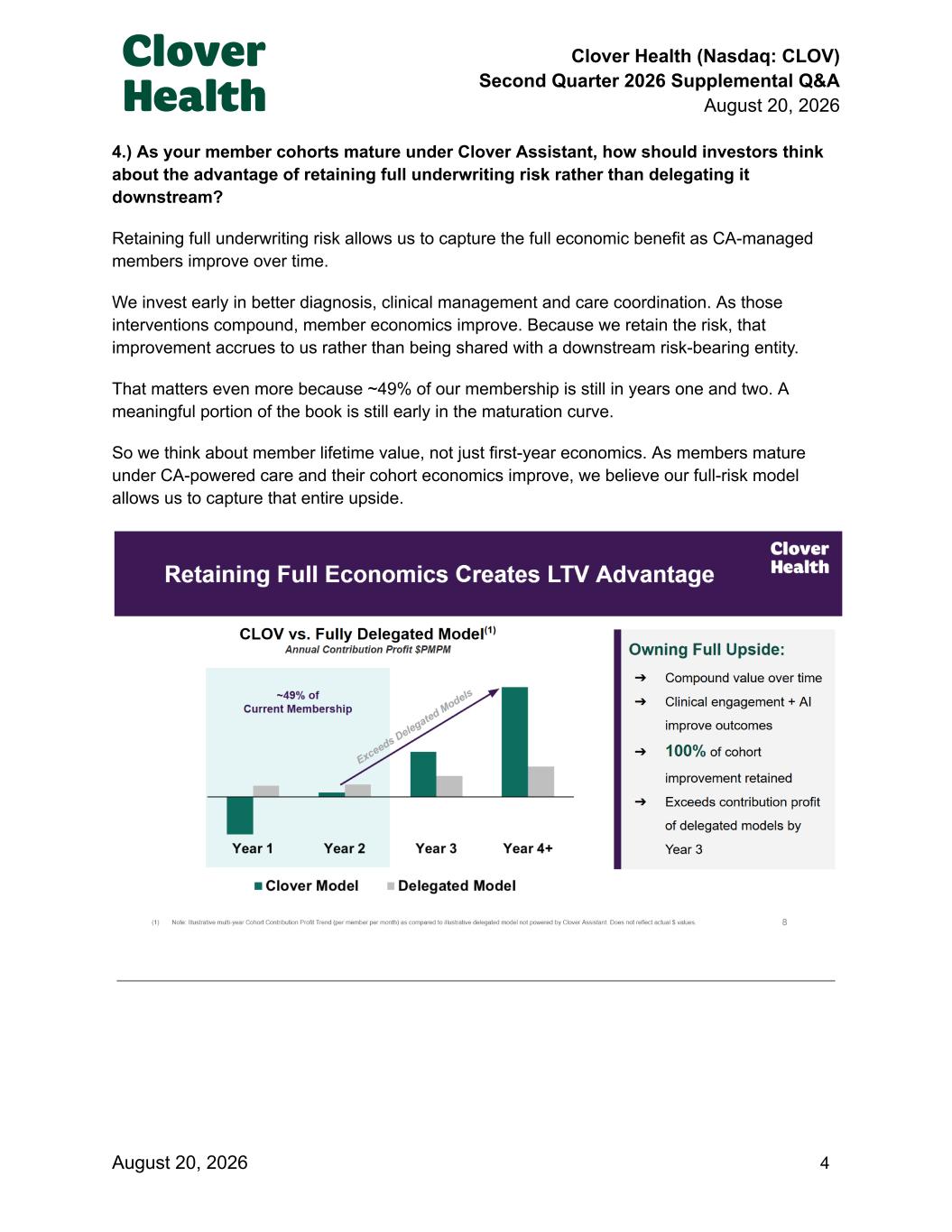
Clover Health (Nasdaq: CLOV) Second Quarter 2026 Supplemental Q&A August 20, 2026 4.) As your member cohorts mature under Clover Assistant, how should investors think about the advantage of retaining full underwriting risk rather than delegating it downstream? Retaining full underwriting risk allows us to capture the full economic benefit as CA-managed members improve over time. We invest early in better diagnosis, clinical management and care coordination. As those interventions compound, member economics improve. Because we retain the risk, that improvement accrues to us rather than being shared with a downstream risk-bearing entity. That matters even more because ~49% of our membership is still in years one and two. A meaningful portion of the book is still early in the maturation curve. So we think about member lifetime value, not just first-year economics. As members mature under CA-powered care and their cohort economics improve, we believe our full-risk model allows us to capture that entire upside. August 20, 2026 4
Clover Health (Nasdaq: CLOV) Second Quarter 2026 Supplemental Q&A August 20, 2026 5.) Why is continuing to grow within New Jersey a better long-term strategy than expanding your Medicare Advantage footprint into additional states today? There is still substantial room to grow in New Jersey, and greater density makes our model stronger. Our strategy has been to build depth in our core markets, and we believe New Jersey demonstrates the strength of that approach. Our NJ market share today is ~31%, on an individual non-SNP basis, putting us ahead of every large national plan in the state. At the same time, MA penetration in NJ remains relatively low compared to traditional Medicare nationally. So there is still a significant runway inside a market where we already have scale, brand awareness and infrastructure. Density also matters because as we become a larger portion of physicians' patient panels, CA engagement also scales. Greater CA engagement supports stronger clinical performance and stronger cohort economics. Counterpart also changes the expansion equation. It allows us to bring CA into new states, work with providers and demonstrate the model in markets where we do not yet operate an MA plan. So we do not need to expand the insurance footprint simply to expand the reach of CA. We believe we can keep compounding density in our core markets while Counterpart extends the clinical platform more broadly. 6.) Georgia is another one of Clover Health's core markets. What gives you confidence in the long-term opportunity there? We have been operating in Georgia for some time and our strategy is to build depth in our core markets, rather than simply expand our geographic footprint. In Georgia, we believe we have already built the network, distribution and local infrastructure required to succeed. Importantly, we are now deepening the clinical capabilities on top of that foundation. This is what increases our confidence in Georgia's long-term economics. We have taken what we’ve learned from the success of Clover Care Services (“CCS”) in New Jersey and are now applying that model at scale in Georgia. CCS provides proactive, higher-touch care and support to our Medicare Advantage members through dedicated clinical teams. That allows us to bring CA-powered care directly to more members, including in the home, and deepen disease management and care coordination. We’re very pleased with the increasing engagement and early results we’re seeing. August 20, 2026 5
Clover Health (Nasdaq: CLOV) Second Quarter 2026 Supplemental Q&A August 20, 2026 Now our focus is on deepening our clinical engagement and compounding the value of that existing foundation as we grow. 7.) You've shared that Clover Assistant engagement continues increasing over time. What are the biggest constraints to expanding Clover Assistant coverage across your membership? To be clear, the absolute number of members receiving CA-enabled care continues to increase as we grow, and engagement is tracking in line with our expectations. Historically, the biggest constraint to PCP adoption has been panel density. As we grow within our core markets and become a larger portion of physicians' panels, that density improves and CA adoption improves with it. This is another reason why our strategy is to build depth in our core markets. Greater density creates the opportunity for deeper clinical engagement. Importantly, PCP adoption is not the only way to expand CA-powered care. Through Clover Care Services, our clinicians can use CA to deliver care directly to members, including in the home. CA creates significant value through either channel, and we believe they are even more powerful together. We believe that gives us multiple paths to expand CA-powered care as we grow, without making PCP adoption the ceiling on how many members can benefit from CA. 8.) Counterpart Health has now been commercially available for about two years. When should investors expect it to make a more meaningful financial contribution? Our focus today is on growing lives under management and demonstrating to partners that CA can create the same kind of impact in their populations that we already see in our own plan. To be clear, we have already proven the value of CA in our own plan. We’re simply now making that impact demonstrable to external plans and providers in their own populations, markets and clinical environments. That is an important stage of building the business. As partners see the impact directly and lives under management continue to grow, we believe the commercial opportunity becomes increasingly tangible. August 20, 2026 6
Clover Health (Nasdaq: CLOV) Second Quarter 2026 Supplemental Q&A August 20, 2026 Because our Medicare Advantage business is the core profit engine of our business today, we also have the flexibility to build Counterpart thoughtfully. We do not need to force near-term economics at the expense of long-term scale or partner adoption. We believe the sequence is straightforward: grow adoption, demonstrate impact, build scale, and let the economics follow. 9.) As Counterpart Health scales, what do you expect the business model to look like? Should investors think about PMPM SaaS fees, shared savings, implementation fees, or some combination? We have coined the term "real-time value-based payment" to describe how we think about the model. The idea is to preserve the economics and incentive alignment of value-based care while creating payment structures that can be more predictable and flexible for Counterpart and its partners. Depending on the arrangement, that could include fixed or PMPM-style payments, shared savings, capitation or a combination. But we believe the structure is secondary to the underlying principle: better clinical care drives lower total cost of care, and Counterpart participates in the upside value it creates. 10.) You've talked about applying AI beyond Clover Assistant into your insurance operations. How should investors think about that opportunity over the next several years? We started with AI at the clinical layer of healthcare, where we believe the hardest and most valuable problems sit, and have demonstrated its ability to improve clinical decision-making and patient outcomes. That differentiates us from traditional ‘InsurTech.’ Now we are bringing that same AI-first mindset to our back-office insurance operations. Much of the traditional insurance operating stack was built in a pre-AI world. Claims, member service and other administrative workflows still contain significant repetitive and manual work. We believe AI can materially improve the efficiency and quality of those processes. August 20, 2026 7
Clover Health (Nasdaq: CLOV) Second Quarter 2026 Supplemental Q&A August 20, 2026 That creates a substantial SG&A opportunity. We are already generating fixed-cost leverage as we scale, and AI should increasingly improve variable operating efficiency as well. Our long-term view is that the administrative cost of running a health plan should be meaningfully lower in an AI-first world. We have already built the clinical AI layer. Now we are extending that advantage into the operating model itself. 11.) Can you provide an update on the Stars appeal? As previously disclosed, CMS has rated our PPO and HMO plans at 4.5 Stars for the 2027 payment year, and that is the basis on which we are operating. With respect to the appeal, and as we mentioned in our earnings call, we are limited in what we can share, given that the matter is being actively litigated. That being said, we believe the District Court entered a thorough, well-reasoned decision in this case and we intend to vigorously defend our position before the Eleventh Circuit, while remaining focused on executing the business. 12.) Looking over the next several years, what do you believe investors still underestimate about the long-term opportunity you've built? We believe that viewing Clover as a traditional Medicare Advantage plan would miss the long-term opportunity created by our differentiated care model, which combines wide-network PPO plans with physician-enabled, AI-powered clinical technology. It starts with the member. Members choose our plans for their value and our PPO-first structure, supporting strong retention. That retention is critical because it gives us the opportunity to realize the impact of CA in our cohort economics over time. As members mature under CA-powered care, better clinical outcomes translate into stronger economics, and because we retain full underwriting risk, we own the full upside value. From there, we believe the model compounds. CA drives better care and stronger cohort economics, which create capacity for continued growth. Greater density increases CA engagement, scale and AI create operating leverage, and Counterpart extends our clinical August 20, 2026 8
Clover Health (Nasdaq: CLOV) Second Quarter 2026 Supplemental Q&A August 20, 2026 technology beyond our own MA membership. Taken together, we believe we are still early in realizing the full earnings potential of the model we’ve built. Forward-Looking Statements These supplemental shareholder questions and answers (the “Q&A”) contain forward-looking statements within the meaning of Section 27A of the Securities Act of 1933, as amended, and Section 21E of the Securities Exchange Act of 1934, as amended. Forward-looking statements include statements regarding future events and Clover Health's future results of operations, financial condition, market size and opportunity, business strategy and plans, and the factors affecting our performance and our objectives for future operations. Forward-looking statements are not guarantees of future performance and you are cautioned not to place undue reliance on such statements. In some cases, you can identify forward looking statements because they contain words such as "may," "will," "should," "expects," "plans," "anticipates," "going to," "can," "could," "should," "would," "intends," "target," "projects," "contemplates," "believes," "estimates," "predicts," "potential," "outlook," "forecast," "guidance," "objective," "plan," "seek," "grow," "if," "continue" or the negative of these words or other similar terms or expressions that concern Clover Health's expectations, strategy, priorities, plans or intentions. Forward-looking statements in this Q&A include, but are not limited to, the following: statements under "Financial Guidance" and “2026 Financial Outlook” and statements regarding expectations relating to potential improvements in revenues, operating and medical expenses, Adjusted SG&A, Insurance BER, profitability and the number of Clover Health's Insurance members, as well as the statements contained in the quotations of our executive officers, and other expectations as to future performance, operations and results (including our guidance for full year 2026). Statements regarding our GAAP Net Income profitability are also forward-looking, and are based on our current targets which are preliminary and are derived from our 2026 financial guidance. These statements are subject to known and unknown risks, uncertainties and other factors that may cause our actual results, levels of activity, performance or achievements to differ materially from results expressed or implied by forward-looking statements in this Q&A. Forward-looking statements involve a number of judgments, risks and uncertainties, including, without limitation, risks related to: our expectations regarding results of operations, financial condition, and cash flows; our expectations regarding the development and management of our business; any current, pending, or future legislation, regulations or policies that could have a negative effect on our revenue, profit margins, cash flows and business, including rules, regulations and policies relating to healthcare, Medicare generally and medical loss ratios; our ability to successfully enter new service markets and manage our operations; anticipated trends and challenges in our business and in the markets in which we operate; our ability to effectively manage our beneficiary base and provider network; our ability to maintain and increase August 20, 2026 9
Clover Health (Nasdaq: CLOV) Second Quarter 2026 Supplemental Q&A August 20, 2026 adoption and use of Clover Assistant, including the expansion and growth of Clover Assistant for external payors and providers under the brand name Counterpart Assistant; the anticipated benefits associated with the use of Clover Assistant, including our ability to utilize the platform to manage our medical expenses; our ability to maintain or improve our Star Ratings or otherwise continue to improve the financial performance of our business; our ability to develop new features and functionality that meet market needs and achieve market acceptance; our ability to protect our sites, networks, and systems against security breaches, or otherwise to protect our confidential or health information or the confidential or health information of our members, providers, or other third parties; our ability to retain and hire necessary employees and staff our operations appropriately; the timing and amount of certain investments in growth; the outcome of any known and unknown litigation and regulatory proceedings; our ability to maintain, protect, and enhance our intellectual property; general economic conditions and uncertainty; persistent high inflation and fluctuating interest rates; and geopolitical uncertainty and instability. Additional information concerning these and other risk factors is contained under Item 1A. “Risk Factors” in our most recent Annual Report on Form 10-K filed with the Securities and Exchange Commission (the "SEC") on February 27, 2026, as such risks may be updated in our subsequent filings with the SEC. The forward-looking statements included in this Q&A are made as of the date hereof. Except as required by law, Clover Health undertakes no obligation to update any of these forward-looking statements after the date of this press release or to conform these statements to actual results or revised expectations. August 20, 2026 10