Exhibit 4.1
ANNUAL INFORMATION FORM
For the Fiscal Year Ended July 31, 2025
October 29, 2025
Table of Contents
| ITEM 1. | CORPORATE STRUCTURE | 8 |
| ITEM 2. | GENERAL DEVELOPMENT OF THE BUSINESS | 8 |
| ITEM 3. | DESCRIPTION OF THE BUSINESS | 10 |
| ITEM 4. | RISK FACTORS | 19 |
| ITEM 5. | DIVIDENDS OR DISTRIBUTIONS | 35 |
| ITEM 6. | DESCRIPTION OF CAPITAL STRUCTURE | 35 |
| ITEM 7. | MARKET FOR SECURITIES | 38 |
| ITEM 8. | ESCROWED SECURITIES AND SECURITIES SUBJECT TO CONTRACTUAL RESTRICTIONS ON TRANSFER | 39 |
| ITEM G. | DIRECTORS AND OFFICERS | 41 |
| ITEM 10. | PROMOTERS | 45 |
| ITEM 11. | LEGAL PROCEEDINGS AND REGULATORY ACTIONS | 46 |
| ITEM 12. | INTEREST OF MANAGEMENT AND OTHERS IN MATERIAL TRANSACTIONS | 46 |
| ITEM 13. | TRANSFER AGENTS AND REGISTRARS | 46 |
| ITEM 14. | MATERIAL CONTRACTS | 46 |
| ITEM 15. | INTERESTS OF EXPERTS | 47 |
| ITEM 16. | ADDITIONAL INFORMATION | 47 |
GLOSSARY
Unless otherwise indicated, whenever used in this AIF, the following words and terms have the indicated meanings. Words importing the singular, where the context requires, include the plural and vice versa and words importing any gender includes all genders.
“AIF” means this annual information form.
“Board” means the board of directors of the Company.
“CBI” means Cizzle Brands Inc., a corporation incorporated under the laws of Canada.
“Cboe Canada” means Cboe Canada Inc.
“CEO” means Chief Executive Officer.
“CFO” means Chief Financial Officer.
“Cizzle” or the “Company” means Cizzle Brands Corporation, formerly 1348512 B.C. Ltd., a company existing under the laws of the Province of British Columbia.
“Common Shares” means common shares in the authorized share structure of the Company, and each a “Common Share”.
“Escrow Agreement” means the escrow agreement among the Company, the Principals and Odyssey Trust Company.
“Flow Agreement” means the non-exclusive manufacturing agreement between Flow Water Inc. and CBI dated March 13, 2024.
“GAAP” means generally accepted accounting principles.
“IFRS” means International Financial Reporting Standards.
“Legacy Option Plan” means the stock option plan of Target, as may be amended from time to time.
“Nutrablend Agreement” means the non-exclusive manufacturing agreement dated February 22, 2024 between NBF Holdings Canada Inc. and CBI.
“OBCA” means the Business Corporations Act (Ontario) as amended from time to time.
“Subco” means 1001070471 Ontario Inc.
“Target” means Harbour Mission Co. Ltd.
“VHCS” means Van Houtte Coffee Services, a subsidiary of Keurig Dr Pepper.
“Warrants” means warrants to purchase Common Shares of the Company.
Page 1
ABOUT THIS ANNUAL INFORMATION FORM
All dollar amounts referred to in this AIF are stated in Canadian dollars, unless otherwise indicated. The Company prepares its financial statements in accordance with Canadian GAAP. Accordingly, financial information in this AIF is presented in accordance with IFRS.
The information in this AIF is presented as at October 29, 2025 unless otherwise indicated.
In this AIF, unless the context otherwise requires, the “Company” refers to Cizzle Brands Corporation and its subsidiaries.
Market Data
Unless otherwise indicated, market data and certain industry data and forecasts included in this AIF concerning the industry of the Company and the markets in which it operates including its general expectations, legislative regime and market opportunity, is based on information from industry publications and reports generated by several third parties and management estimates. Unless otherwise indicated, management estimates are derived from publicly available information released by independent industry analysts and third-party sources, as well as data from the Company’s internal research, and are based on assumptions made by the Company based on such data and its knowledge of such industry and markets, which the Company believes to be reasonable. These industry publications and reports generally indicate that the information contained therein was obtained from sources believed to be reliable, but do not guarantee the accuracy and completeness of such information. The Company has not independently verified the data in such publications, reports or resources, and such information is inherently imprecise. In addition, projections, assumptions and estimates of the Company’s future performance and the future performance of the industry in which the Company operates are necessarily subject to a high degree of uncertainty and risk due to a variety of factors, including those described under “Forward-Looking Statements” and “Risk Factors” in this AIF. While the Company believes its internal business research is reliable and market definitions are appropriate, neither such research nor definitions have been verified by any independent source. While the Company is not aware of any misstatement regarding any industry or government data presented herein, the industry involves risks and uncertainties that are subject to change based on various factors.
FORWARD-LOOKING STATEMENTS
This AIF includes “forward-looking information” and “forward-looking statements” within the meaning of applicable Canadian securities laws. All information, other than statements of historical facts, included in this AIF that addresses activities, events or developments that the Company expects or anticipates will or may occur in the future is forward-looking information. Forward-looking information is often identified by the words “may”, “would”, “could”, “should”, “will”, “intend”, “plan”, “anticipate”, “believe”, “estimate”, “expect” or similar expressions and includes, among others, information regarding:
| · | future products and services; |
| · | expansion to product distribution; |
| · | the Company’s growth; |
| · | marketing and business plans and short-term objectives; |
| · | the intention to grow the business, operations and potential activities of the Company; |
| · | revenue; |
| · | use of available funds; |
Page 2
| · | business milestones and objectives; |
| · | the protection of intellectual property; |
| · | exploration of new products and opportunities; |
| · | future risks to operations; |
| · | the Company’s business objectives; |
| · | the Company’s expectations regarding its business, financial condition and results of operations |
| · | future market share; |
| · | intent to build or acquire manufacturing facilities; |
| · | strategic plans; and |
| · | strategic relationships with third parties. |
These statements reflect the Company’s current views with respect to future events and are based on assumptions and subject to a number of risks and uncertainties, some of which are unknown at this time. Certain assumptions made in preparing the forward-looking statements contained in this AIF include:
| · | the Company’s ability to meet its obligations as they become due; |
| · | the Company’s ability to implement its growth strategies; |
| · | the Company’s competitive advantages; |
| · | the development of new products and product formats for the Company’s products; |
| · | the Company’s ability to manage any indebtedness as required; |
| · | the Company’s ability to obtain and maintain financing or to re-finance existing indebtedness on acceptable terms, as necessary; |
| · | the impact of competition; |
| · | changes and trends in the beverage industry and markets; |
| · | changes in laws, rules and regulations; |
| · | the Company’s ability to maintain and renew required licences; |
| · | the Company’s ability to maintain good business relationships with its customers, distributors and other strategic partners; |
| · | the Company’s ability to keep pace with changing consumer preferences; |
| · | the Company’s ability to protect intellectual property; |
| · | the Company’s ability to retain key personnel; |
| · | The absence of material adverse changes in the industry and in Canadian, US or global economies |
Page 3
| · | The Company’s future business performance; |
| · | The demand for the Company’s products; and |
| · | The conditions of the markets that the Company’s serves. |
Although the Company believes that the assumptions underlying its statements are reasonable, they may prove to be incorrect. Given these risks, uncertainties and assumptions, investors should not place undue reliance on the forward-looking information.
The purpose of forward-looking information is to provide the reader with a description of management’s expectations, and such forward-looking information may not be appropriate for any other purpose. In particular, but without limiting the foregoing, disclosure in this AIF under “Description of the Business” as well as statements regarding the Company’s objectives, plans and goals, including future operating results and economic performance may make reference to or involve forward-looking information. Although the Company believes that the expectations reflected in such forward-looking information are reasonable, it can give no assurance that such expectations will prove to have been correct.
While the Company believes its plans, intentions and expectations reflected in the forward-looking information are reasonable, it cannot assure you that these plans, intentions or expectations will be achieved. The Company’s actual results, performance or achievements could differ materially from those contemplated, expressed or implied by the forward-looking information relating to the Company contained in this AIF as a result of various factors, including the risks, uncertainties and assumptions discussed under “Risk Factors”, which include, but are not limited to, the following:
| · | Ability to achieve and manage growth; |
| · | Failure to effectively expand sales capabilities could harm the Company’s ability to increase distribution and achieve broader market acceptance of its products; |
| · | The Company may need additional financing in the future, which may not be available when needed or may be costly and dilutive; |
| · | Changes in consumer preferences may reduce demand for some of the Company’s products; |
| · | The Company’s brand and image are keys to its business and any inability to maintain a positive brand image could have a material adverse effect on its results of operations; |
| · | The Company may be adversely impacted by the effects of high or prolonged inflation; |
| · | Competition from traditional and large, well-financed non-alcoholic beverage manufacturers may adversely affect the Company’s distribution relationships and may hinder development of its existing markets, as well as prevent the Company from expanding its markets; |
| · | The Company competes in an industry characterized by rapid changes in consumer preferences and public perception, so its ability to continue developing new products to satisfy the changing preferences of consumers will determine its long-term success; |
| · | The Company’s reliance on distributors, retailers and brokers could affect its ability to efficiently and profitably distribute and market its products, maintain its existing markets and expand its business into other geographic markets; |
Page 4
| · | The Company incurs significant time and expense in attracting and maintaining key distributors; |
| · | If the Company loses any of its key distributors or national retail accounts, its financial condition and results of operations could be adversely affected; |
| · | It is difficult to predict the timing and amount of sales because most distributors and retailers are not required to place minimum orders with the Company; |
| · | If the Company does not adequately manage its inventory levels, its operating results could be adversely affected; |
| · | If the Company fails to maintain relationships with its independent contract manufacturers, its business could be harmed; |
| · | The Company’s dependence on independent contract manufacturers could make management of its manufacturing and distribution efforts inefficient or unprofitable; |
| · | The Company relies upon our ongoing relationships with its key flavor suppliers. If the Company is unable to source its flavors on acceptable terms from its key suppliers, the Company could suffer disruptions in its business; |
| · | Criticism of the packaged beverage market generally could adversely affect the Company’s operating results; |
| · | If the Company is unable to maintain brand image or product quality, its business could suffer; |
| · | Increased competition could hurt the Company’s business; |
| · | Consolidation of retailers, wholesalers and distributors and the dominant position of a limited number of key players in the industry may result in downward pressure on sales prices; |
| · | The Company’s failure to accurately estimate demand for its products could adversely affect its business and financial results; |
| · | If the Company fails to obtain and retain high-visibility sponsorship or endorsement arrangements with celebrities, or if the reputation of any of the celebrities that the Company partners with is impaired, the business of the Company may suffer; |
| · | The Company’s distributors and vendors are material to the Company’s success. If the Company is unable to maintain good relationships with its existing distributors and vendors, its business could suffer; |
| · | Changing retail landscape could hurt the Company’s business; |
| · | Incorrect product design or development could hurt the Company’s business; |
| · | Product information misrepresentations could happen and may adversely affect the Company’s business; |
| · | The Company relies on third party distributors and other logistics providers; |
| · | The Company relies on key inputs; |
| · | The Company’s success relies on its quality control systems; |
Page 5
| · | The Company is subject to risks and uncertainty regarding future product development; |
| · | Risks related to the Company’s human capital; |
| · | Revenues derived entirely from packaged beverages; |
| · | Increases in costs and/or shortages of raw materials and/or ingredients and/or fuel could harm the Company’s business; |
| · | Fluctuation of quarterly operating results; |
| · | No assurance of profitability; |
| · | Fluctuations in foreign currency exchange rates may adversely affect the Company’s operating results; |
| · | Significant changes in government regulation may hinder sales; |
| · | Contamination or recalls of the Company’s ingredients or end products could adversely affect its business; |
| · | The Company’s intellectual property rights are critical to the Company’s success, and the loss of such rights could materially adversely affect its business; |
| · | Litigation or legal proceedings could expose the Company to significant liabilities and thus negatively affect its financial results; |
| · | Future effective tax rates could be subject to volatility or adversely affected by a number of factors; |
| · | Catastrophic events could impact the Company’s operations and affect the Company’s ability to grow its business; |
| · | Climate change may negatively affect the Company’s business; |
| · | The Company’s business is seasonal and adverse weather conditions could negatively affect its business; |
| · | The Company depends on key information systems and third-party service providers; |
| · | If the Company is unable to securely maintain its customers’ confidential or credit card information, or other private data relating to the Company or its employees, the Company could be subject to negative publicity, costly government enforcement actions or private litigation, which could damage its business reputation and negatively affect its results of operations; |
| · | The Company must continually maintain and/or upgrade its information technology systems; |
| · | Conflicts of interest; |
| · | No operating history as a public company; |
| · | Potential volatility of share price; |
| · | No assurance of active market for shares; |
Page 6
| · | Dividends; |
| · | A return on the Company’s securities is not guaranteed; |
| · | Global financial conditions; |
| · | Future sales of common shares by existing shareholders; |
| · | Additional issuances and dilution; |
| · | Publication of inaccurate or unfavourable research and reports; and |
| · | There are costs associated with maintaining a public listing. |
These risks, uncertainties, assumptions and other factors could cause the Company’s actual results, performance, achievements and experience to differ materially from its expectations, future results, performances or achievements expressed or implied by the forward-looking information.
The forward-looking information made in this AIF relates only to events or information as of the date on which the statements are made in this AIF. In addition, even if results and developments are consistent with the forward- looking information contained in this AIF, those results and developments may not be indicative of results or developments in subsequent periods. The Company undertakes no obligation to update or revise publicly any forward-looking information, whether as a result of new information, future events or otherwise, after the date on which the statements are made or to reflect the occurrence of unanticipated events unless required under applicable securities laws. The Company’s forward-looking information is expressly qualified in their entirety by this cautionary statement.
An investor should read this AIF with the understanding that the Company’s actual future results may be materially different from what is expected.
Page 7
ITEM 1.CORPORATE STRUCTURE
| 1.1 | Name, Address and Incorporation |
The Company was incorporated on February 16, 2022, pursuant to the provisions of the BCBCA under the name “1348512 B.C. Ltd.” for the purposes of investigating and evaluation business opportunities to acquire or participate in.
On December 19, 2024, the Company completed a business combination with Cizzle Brands Ltd. by way of a three-cornered amalgamation (the “RTO Transaction”). In connection with the RTO Transaction, prior to the closing of the RTO Transaction, the Company changed its name to “Cizzle Brands Corporation”.
Our head office is located at 35 McCleary Ct, Unit 21, Concord, ON L4K 3Y9, Canada. Our registered and records office is located at registered and records office is located at 550 Burrard St #2300, Vancouver, BC, Canada.
The Company is a reporting issuer in each of the provinces and territories of Canada.
| 1.2 | Intercorporate Relationships |
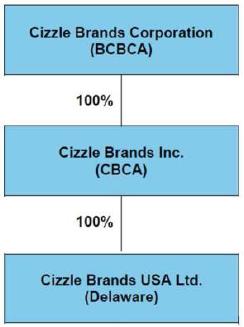
The following diagram presents the inter-corporate relationships among the Company and its subsidiaries as of the date hereof.
ITEM 2.GENERAL DEVELOPMENT OF THE BUSINESS
The Company was created as a result of a spin out of Larose Ventures Ltd. pursuant to an order of the Supreme Court of British Columbia dated March 24, 2022. Prior to the completion of the RTO Transaction, the Company’s business was to identify and evaluate businesses with a view to completing a reverse takeover with one or more private companies.
Prior to the RTO Transaction, the Company also conducted two non-brokered private placements, namely (a) 937,500 common shares for gross proceeds of $100,000 on September 27, 2024; and (b) 312,500 common shares for gross proceeds of $60,000 on December 13, 2024. The proceeds of these placements were used to fund the RTO Transaction and for general corporate purposes.
Pre-RTO Business of the Target
The Target had acquired and built its business, in part, through the acquisition of Cizzle Brands Inc. (“CBI”) for a purchase price of $5,000,000. The Target changed its name to “Cizzle Brands Ltd.” on February 6, 2024 and completed the acquisition of CBI on February 8, 2024.
Page 8
CBI was incorporated on August 8, 2023 as a company focused on discovering and commercializing novel ingredients. As the time of the acquisition, CBI was a holding company which owned the formulation of active ingredients which was further developed by the Company to become CWENCH Hydration, and trademark applications for CWENCH Hydration. CWENCH Hydration and Spoken. Total expenses of CBI prior to acquisition by Cizzle Brands Ltd. were de minimis and consisted of mainly incorporation/legal costs and trademark application costs. The Company’s product was only developed after CBI was acquired by the Target and such development was facilitated by CBI’s founder leveraging his experience with contract manufacturers and retail channels. Related expenses are recorded in the financial statements of “Cizzle Brands Ltd.”
The Target had also completed several private placements prior to the RTO Transaction.
| · | Between February and August 2024, a placement of units comprising one common share of the Target and one-half of one share purchase warrant exercisable into one common share of the Target at a price of $0.40 per share. A total of 77,223,270 were issued for gross proceeds of $15,444,654. In connection with the financing, the Target issued an additional 966,000 units to finders and paid $73,440 in cash as commission to arm’s length finders, along with $60,700 in cash and 303,500 Broker Warrants, each convertible into one unit at an exercise price of $0.20 per Target Unit, as commission to arm’s length agents in connection with the financing. The proceeds of the offering were used for the purchase of CBI and general corporate purposes. |
| · | In November 2024, a placement of common shares of the Target pursuant to which 10,185,513 common shares of the Target were issued at a price of $0.30 per share for aggregate gross proceeds of $3,055,655. In connection with the financing, the Target also issued 332,876 common shares and $36,750 in cash as commission to arm’s length finders. |
RTO Transaction
On October 7, 2024, the Company entered into a business combination agreement with Cizzle Brands Ltd. (formerly, Harbour Mission Co, the “Target”), setting forth the terms pursuant to which the RTO Transaction would be completed. The Target was incorporated on January 10, 2024 under the laws of the Province of Ontario and its purpose on incorporation was to facilitate a transaction with one or more food and beverage companies.
On November 21, 2024, the Company incorporated 1001070471 Ontario Inc. (“Subco”) under the OBCA for the purposes of completing the RTO Transaction. Subco was incorporated for the purposes of the RTO Transaction; it had no material assets and did not conduct any operations or active business prior to the completion of the RTO Transaction.
On November 12, 2024, in connection with the RTO Transaction, the Target also completed a private placement of 3,458,940 subscription receipts for aggregate gross proceeds of $1,037,682. On the closing date of the subscription receipt financing, the proceeds were deposited in escrow pending the occurrence of the escrow release conditions. In connection with the financing, the Target issued 239,781 warrants to finders, each convertible into one common share of the Target at an exercise price of $0.30 per share, and $71,934 in cash to arm’s length finders.
On December 10, 2024, Cboe Canada conditionally approved the listing of the Common Shares of the Company under the symbol “CZZL” and the Common Shares were listed and posted for trading on Cboe Canada on December 30, 2024.
Page 9
On December 19, 2024, the Company completed the RTO Transaction, acquiring the Target and taking over its principal business. In connection with the completion of the RTO Transaction, the following transactions were completed:
| · | Each subscription receipt outstanding was automatically converted into one common share of the Target. |
| · | Each common share of the Target outstanding was exchanged for one Common Share. |
| · | Each common share purchase warrant of the Target outstanding was exchanged for one common share purchase warrant of the Company on commensurate terms. |
| · | Each stock option of the Target outstanding was exchanged for one stock option of the Company on commensurate terms. |
| · | The Target amalgamated with Subco became a wholly owned subsidiary of the Company. |
In connection with the RTO Transaction, the Company was renamed “Cizzle Brands Corporation.” Upon completion of the RTO Transaction, the Company assumed the business of Target as described in “Description of the Business”.
ITEM 3. DESCRIPTION OF THE BUSINESS
| 3.1 | General |
Cizzle is a consumer-packaged goods company, operating under the emerging “better-for-you” category of food and hydration. Cizzle exists to provide consumers with high-performing alternatives that are healthy, taste great, and meet their needs.
| 3.2 | Principal Products |
The Company has launched four central lines of products to market: (i) CWENCH Hydration, in the sports hydration category; (ii) CWENCH Protein; (iii) its nutraceutical line of products, Spoken™ Nutrition, its line of nutritional supplements; and (iv) HappiEats™, its line of food products.
CWENCH Hydration
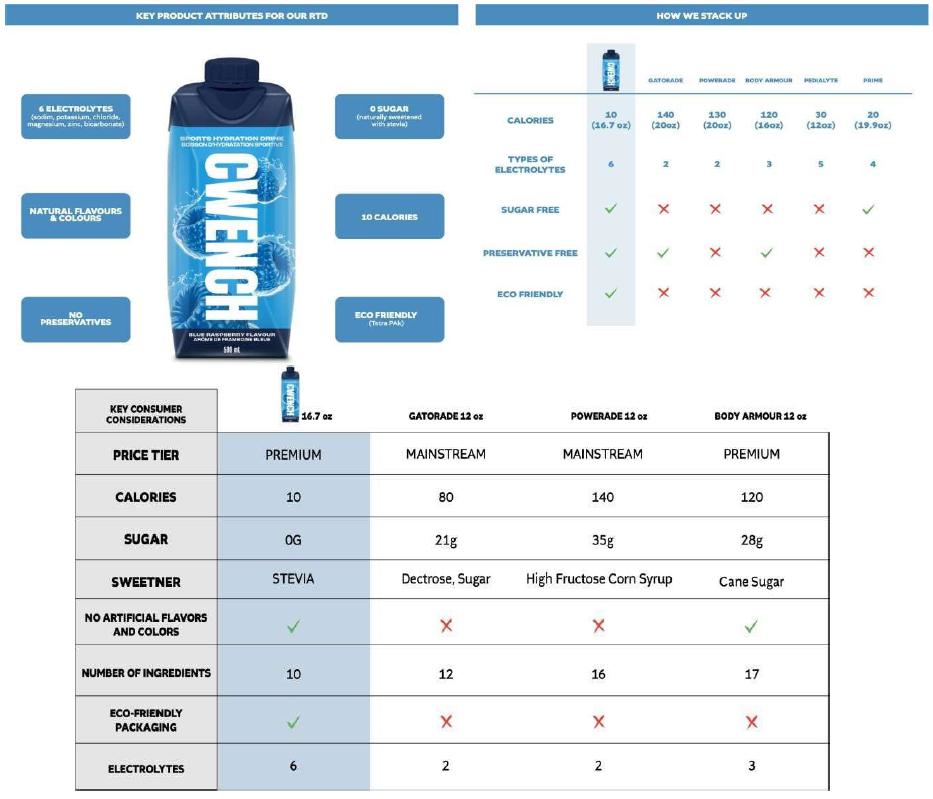
Containing no sugar, all-natural ingredients, only 10 calories and 6+ performing electrolytes, CWENCH Hydration is a next generation sports hydration drink developed by strength coach, Andy O’Brien, and the Company’s management team. CWENCH Hydration is currently offered in two formats: (i) hydration powder mix; and (ii) 500ml ready-to-drink Tetra Paks, and is offered in five flavours: Berry Crush, Blue Raspberry, Cherry Lime, Rainbow Swirl and Tropical Flow, along with limited time flavour offerings Celly Freeze, Pink Lemon Flow and Rocket Berry Blast. The hydration powder mix comes in two sizes, a 10-serving pack of individual sachets (70 grams in total) or a 45-serving container (315 grams).
CWENCH Hydration is endorsed by world-class athletes, including 2024 National Hockey League (“NHL”) MVP and Colorado Avalanche forward, Nathan MacKinnon, Montreal Canadien forward, Cole Caufield, National Basketball Association (“NBA”) All-Star and Miami Heat, Andrew Wiggins, Canadian Olympic soccer player, Adriana Leon, and up-and-coming professional hockey players Gavin McKenna, Chloe Primerano and Jade Iginla.
To date, Cizzle Brands products has been ordered by more than 21 NHL teams, 21 Major League Baseball teams, 5 NFL teams and 4 NBA teams. Cizzle Brands products are currently available in over 5,300 points of distribution across North America and Europe, including SportChek, Canadian Tire, LifeTime, Metro, Longos, Sobeys, Fortinos, Loblaws, Circle K, Petro Canada, United Supermarkets, Pure Hockey, Pro Hockey Life, London Drugs, Golf Town, Healthy Planet, Farm Boy, INS Markets, MacEwen Gas and Source for Sports. CWENCH Hydration is also being distributed by a number of major distributors.
Page 10
Spoken NutritionTM
Spoken NutritionTM is a premium line of nutritional supplements, designed to bring elite athletes into the Cizzle ecosystem. All Spoken Nutrition™ products carry the NSF Certified for Sport® designation, a certification program that confirms sports supplements and sports nutritional products do not contain substances banned by many major athletic organizations.
The team that formulated Spoken Nutrition’s™ products includes Dr. Matt Frakes (New York Giants Dietician), Brianne Brown (University of Miami Strength C Conditioning Coach), Alan Bishop (University of Houston Director of Men’s Basketball Sports Performance), David Lawrence (Strength Coach to Six NFL Super Bowl Winners), Ben Prentiss (Experienced NHL Strength Coach), Dr. Jordan Shallow (Doctor of Chiropractic and Strength Coach to Elite Athletes), Dr. Sachin Patel (Functional Medicine Doctor), and Cizzle’s Chief Performance Officer, Andy O’Brien.
Spoken Nutrition’s™ product line includes:
| · | Spoken™ Sleep Builder: containing only amino acids (such as l-theanine, glycine and glutamine), inositol and three forms of magnesium (orotate, glycerophosphate and glycinate), Spoken™ Sleep Builder is formulated to help people get more restorative sleep without the use of melatonin, 5- HTP and other herbal supplements. |
| · | Spoken™ Greens: Spoken™ Greens contains 20 high-impact, nutrient-rich ingredients in quantities that aims to assist in a healthy lifestyle. |
| · | Spoken™ Aminos + ATP: formulated to have a high dose of leucine, added tyrosine and Peak ATP to assist with increased muscle protein synthesis, increased dopamine and help with cellular energy. |
| · | Spoken™ Creatine: aims to increase body/lean muscle when used in conjunction with a resistance training regimen. It also aims improve strength, power, and performance. |
| · | Spoken™ High EPA Fish Oil + D: made from sustainable wild-caught anchovy, sardine, and mackerel low in heavy metals, was intentionally formulated to contain 700mg of EPA (eicosapentaenoic acid) along with 300 mg of DHA (docosahexaenoic acid), Spoken’s™ High EPA Fish Oil + D is a high dose Omega-3 supplement, supplemented with lipase to enhance absorption. |
| · | Spoken™ MAG 3: formulated to be a beneficial source of magnesium for cardiovascular, cognitive, muscular, and brain health. Spoken™ MAG 3 not only aims to increase magnesium levels in the brain but also to raise blood serum magnesium levels. Each serving contains 225 mg of elemental magnesium from three highly bioavailable forms: Magnesium Glycinate, Magnesium Malate, and ATA Mg®, a patented acetyl taurinate magnesium salt. |
| · | Spoken™ Pro Resolving Mediators + EPA/DHA: formulated to manage pain, help our bodies avoid the ravages of injury and promote a natural, balanced recovery process. Each capsule of Spoken™ Pro Resolving Mediators + EPA/DHA contains 14-HDHA, 17-HDHA, and 18-HEPE, along with their source materials, eicosapentaenoic acid (EPA) and docosahexaenoic acid (DHA). |
| · | Spoken™ Vitamin D3 + K1/K2: each capsule of Spoken™ Vitamin D3 + K1/K2 provides 2000 IUs of Vitamin D, along with 120 mcg of K1 and 90 mcg of K2. |
| · | Spoken™ Essential Daily Packs: formulated to be the essential, all-in-one foundational vitamin and nutritional supplement for athletes and people living an active lifestyle, Spoken™ Essential Daily Packs are convenient all-in-one packs designed to fill the critical nutritional gaps that can impact performance. |
Page 11
| · | Spoken™ Grass Fed Whey Protein: a protein supplement that contains 25 grams of grassfed whey protein, Tendoforte® collagen and 3 grams of fat from olive oil or cocoa. |
| · | Spoken™ Grass Fed Beef Protein: features 25 grams of complete protein from grass-fed beef bone broth |
HappiEats™ Sport Pasta™
Sport Pasta™ is handmade in Italy using a unique four-ingredient recipe including red lentil, white quinoa, and white bean flour, while maintaining the taste of traditional Italian pasta. It is slowly dried at low temperatures to preserve its nutritional qualities, and its formulation offers athletes easy digestion and sustained energy. Sport Pasta™ is higher in protein and fibre than conventional pasta, with a single serving (85 grams) of Sport Pasta containing 18 grams of protein and 10 grams of fibre.
Product Roadmap
The Company has a robust portfolio of innovative products and brands that it expects to launch over the next 12-24 months, which includes but is not limited to the products listed below. Management will continue to evaluate market conditions to determine when and if to launch any of the following products.
| · | CWENCHIE: a formulation and format of CWENCH Hydration designed specifically for children. |
| · | SnakStars: a brand of snack products fortified with 8g - 12g of protein designed for the youth snack market. |
The Company is working with manufacturing partners to develop the formulations. For CWENCHIE, the Company is actively in discussions with manufacturing partners and does not anticipate any additional development costs to be incurred. For SnakStars, the Company is continuing to refine and improve the recipes with expected additional development costs of approximately $10,000. Please refer to “Business Objectives and Milestones” for details of timing and status of these launches.
A key feature of the Company’s strategy is to develop a distribution channel platform that would support many different “better-for-you” products as well as potential insourcing of key business functions, such as manufacturing. We are continually evaluating potential opportunities for both new products that fit our mission to elevate health and wellness, as well as manufacturing.
| 3.3 | Principal Markets |
In Canada, Cizzle has national distribution coverage with a strong focus in three geographic markets: (i) the Greater Toronto Area; (ii) the Montreal and Ottawa corridor; and (iii) the Greater Vancouver Area.
On January 29, 2025, the Company announced it had entered into a distribution agreement with Van Houtte Coffee Services (“VHCS”), a subsidiary of Keurig Dr Pepper, pursuant to which VHCS will distribute the Company’s CWENCH Hydration product lineup across Canada. As part of its agreement, VHCS will also take over distributorship for many of the Company’s existing accounts in various categories including sporting goods retailers and stadiums.
The Company’s distribution strategy in Canada was initially focused on a combination of: (i) direct sales to sports and specialty retailers, as well as “points of sweat” such as hockey arenas, fitness centres and training facilities; and (ii) broker/distributors in the sports and natural/organic channels. However, as brand awareness has grown, the Company has started distributing through major Canadian grocery and gas C convenience stores, including Loblaws, Metro, Longos, Sobeys, Fortinos, Circle K, PetroCanada, MacEwen Gas and others. As brand awareness continues to grow, we anticipate that Canadian distribution will expand further to mass merchandise and club channels.
Page 12
As with Canada, our distribution strategy in the United States involves a combination of: (i) direct sales to sports and specialty retailers, as well as "points of sweat" such as hockey arenas, fitness centres, training facilities; and (ii) broker/distributors in the sports and natural/organic channels. In the United States, our focus is on hockey-centric markets, including Connecticut, Minnesota and Colorado.
In addition to sales through retail channels, the Company maintains a solid online presence through its own website www.cwenchhydration.com as well as online retailers such as Amazon. Part of the Company's strategy is to continue its online marketing efforts in order to increase sales through e-commerce channels in a more aggressive and efficient manner.
| 3.4 | Sales |
The CWENCH Hydration brand has delivered 92% of the Company’s revenues in fiscal 2025. Spoken accounted for 8% of the Company’s revenues in the same period and Sports PastaTM was launched after year end. As the Company brings new brands to market, the proportionate contribution of CWENCH Hydration will naturally adjust to reflect its share of revenue over the entire portfolio of brands.
| 3.5 | Production |
The Company outsources manufacturing of its products so it can focus on our core competencies in brand development, product formulation and marketing. Presently, CWENCH Hydration's hydration powder mix is manufactured by Nutrablend Holdings Canada Inc. (“Nutrablend”), and the ready-to-drink is manufactured by Flow Water Inc. Spoken is manufactured by various manufacturers depending on the product, including Nutrablend, JW Nutritionals, WIN Nutrition, Pharmaline and RFI, LLC. Sport Pasta is presently manufactured by Federico Export SRL.
| 3.6 | Components |
The main ingredient in the CWENCH Hydration ready-to-drink is primarily a combination of water, flavours, and electrolytes. The CWENCH Hydration powder mix is primarily a combination of amino acids, electrolytes and vitamins and minerals.
The Company purchases raw materials (i.e., ingredients for its products) from various suppliers at fair market prices.
| 3.7 | Specialized skills and knowledge |
The Company does not require any specialized skills or knowledge to operate its business other than knowledge of consumer-packaged goods and sports nutrition industries.
| 3.8 | Research |
The Company is continually exploring new product opportunities as well as piloting new flavours and ingredients. These efforts are a result of both in-house development work as well as in conjunction with third party researchers, facilities and manufacturers.
Page 13
| 3.G | Operations |
The Company's activities consist of developing, marketing, selling and distributing foods and beverages in the "better for you" category under a variety of brand names. Manufacturing is outsourced to established third party manufacturers. Consequently, the Company does not own or rent any property, plant or equipment (other than a lease for its head office), nor is the Company subject to any payment terms, expiration dates and terms of any renewal options of any material leases or mortgages.
The Company’s intellectual property and goodwill play an important role in the success of the business. However, the Company is not subject to any franchise, license, software or subscription list.
| 3.10 | Business Objectives and Milestones |
The table below outlines the key milestones and the estimated timing for the next 16 months from the date of this AIF. These milestones and estimates are based on the Company’s reasonable expectations and reasonable courses of action and current assumptions and judgment. The Company expects that the milestones outlined in the chart will be achieved under the normalized scenario.
Many of these milestones are already underway, and the remaining two innovations (i.e., CWENCHIE and SnakStars) are planned and would be executed as projected. To align with projected revenues and cash usage, certain supporting resources will be scaled appropriately, focusing on efficient execution and managing cash burn in line with the normalized operating plan.
| Description | Status |
Estimated/Announced Timing |
Type of Expense |
| Expand the foundational account distribution of CWENCH Hydration and secure retail listings |
The Company had the following numbers of foundational accounts: 718 as of November 26, 2024; 808 on January 31, 2025, and 5,302 as of the date hereof. The following retailer launches occurred during the period: Sport Chek, Fortinos, Canco, Golf Town, Sobeys, London Drugs, MacEwen, Fortinos, Canco, Calgary Co-Op C Freson Bros, PHL, Metro, Healthy Planet, Farm Boy, and United Supermarkets. |
Ongoing | Selling, General and Administrative Expenses |
| Expansion of marketing campaigns and advertising for CWENCH Hydration |
The Company executed the following marketing campaigns in the period: Tropical Flow Launch, Nathan MacKinnon Four Nations Campaign, Ǫuebec International PeeWee Hockey Tournament, and Chippy x Cabbie Social Campaign (February); 2025 CWENCH All Canadian Basketball Games , and CWENCH Future Stars Program (March); USA Hockey partnership, and Shoe Charms Launch (April), Coach Chippy Retailer Meet C Greet Activations, and Ongoing grassroots activations (February to April). |
Ongoing | Marketing |
Page 14
|
Launch of “Spoken Nutrition” product line through distribution in the fitness and sports communities |
Launched in January 2025; Spoken is sold on Amazon, in gyms and select health food stores |
February to April 2025 | Selling, General and Administrative Expenses |
| Launch of “Sport Pasta” product line in conventional retailers and grocers | HappiEats Sport Pasta launched on September 9, 2025 | May to July 2025 | Selling, General and Administrative Expenses |
| Launch of CWENCHIE Hydration drinks designed specifically for children | Formulation efforts are in progress, but there is no specific timeline for launch |
December 2025 – December 2026 |
Selling, General and Administrative Expenses |
|
Launch of SnakStars snack products fortified with protein designed for the youth market |
Formulation not launched as of the date hereof |
December 2025 – December 2026 |
Selling, General and Administrative Expenses |
The Company also anticipates potential financings for growth purposes, such as inventory build for new customer volume requirements, marketing and sponsorship initiatives, or hiring to support growth and new initiatives, are expected to be of a size that would not materially impact the Company’s capitalization ($5,000,000 - $10,000,000 at a time). The Company may use a mix of common shares, debt, or hybrid securities (such as warrants) depending on market conditions.
While the achievement of the foregoing milestones is dependent on the ability of the Company to obtain additional financing, there is no guarantee such financing will be secured, or available on a timely basis or on acceptable terms. Notwithstanding the foregoing, in the event that the Company does not allocate funds to growth initiatives, management believes that the Company has sufficient working capital to funds its business for 16-18 months without having to access capital under a Prospectus Supplement.
| 3.11 | Marketing Plan and Strategies |
Brand Purpose, Core Beliefs and Value Proposition
The Company's mission is to elevate the game in health C wellness by positioning itself at the forefront of an emerging secular shift happening in consumer markets. Specifically, consumers are becoming increasingly aware of how unhealthy foods continue to have a significantly negative impact on health and quality of life. Globally, obesity rates have tripled since 1975 and increased nearly 33% since 2018. In the US 42.4% of adults and 19.7% of children are classified as obese.1 As a result, the number of people with Type 2 diabetes has increased 5x since 19802, with 34.2 million Americans now having Type 2 diabetes2 and rates climbing more steeply in children and young adults.3
The Company views the primary driver of the changes noted above to be diet, with ultra-processed foods often being rich in added sugars, unhealthy fats, and artificial ingredients. Sugar has become the new “bad word” in the world of health C wellness.
While some consumers attempt to eat healthier, their choices are often unappetizing, uninspired or expensive. This has created an opportunity for companies with strong brands, high quality ingredients and premium products to thrive.
1 https://www.who.int/news-room/fact-sheets/detail/obesity-and-overweight
2 https://diabetesatlas.org/
3 https://www.cdc.gov/diabetes/php/data-research/methods.html
Page 15
The Company seeks to provide consumers with high-performing alternatives that are healthy, taste great, and meet their needs.
Marketing Strategies
The Company undertakes a number of marketing strategies to increase brand awareness, expand distribution into new channels and drive purchases of the Company’s products. All marketing activities, including channels and partners, are chosen and conducted with the brand as top of mind.
Our strategy involves trying to drive bottom-up distribution along with top-down demand to drive velocity. To achieve this, the Company is focused on direct sales to locations frequented by target consumers, followed by in- store demonstrations, product sampling and retail activations in specific retail channels. At the same time, the Company is actively investing in athlete and creator partnerships and sponsorship programs to create top-of-funnel awareness, including with 2024 NHL MVP and Colorado Avalanche forward, Nathan MacKinnon, Montreal Canadien forward, Cole Caufield, NBA All-Star and Golden State Warrior, Andrew Wiggins, Canadian Olympic soccer player, Adriana Leon, and up-and-coming professional hockey players Gavin McKenna, Chloe Primerano and Jade Iginla. These efforts are supported by active investment in digital and social media awareness initiatives.
| 3.12 | Competitive Conditions |
The global functional beverage market is estimated to be a $97 billion dollar industry, of which $13 billion is comprised of the sports drink market. Within the sports drink market, premium products are the fastest growing price category (51%) and zero sugar products are the fastest growing category in sugar content (46%).
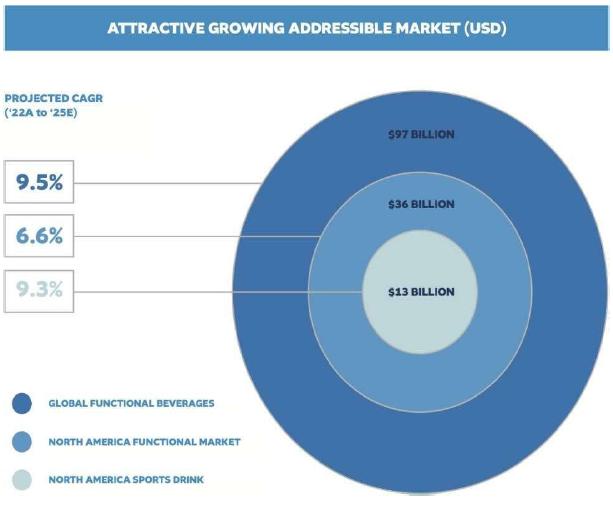
Although the sports drink market is dominated by a few key players, by positioning CWENCH Hydration as a premium, all-natural and sugar-free sports drink, the Company believes it is well-situated to capture a growing share of the sports drink market, and the functional beverage market more broadly.
Page 16
The tables below highlight some of the key players and how CWENCH Hydration is differentiated from other products in the category.
| 3.13 | Intangible Properties |
The Company invest heavily in building brand awareness for its products in key markets for its products. Accordingly, the Company looks to proactively protects its products and brands through trademarks and contractual provisions. The enforcement of the Company's intellectual property rights depends on any legal actions against any infringers being successful. These actions may not be successful or may be prohibitively expensive. As of the date of this AIF, the Company has submitted applications for the following trademarks:
| · | CELLY FREEZE – Trademark Application #2390468 |
| · | CIZZLE BRANDS – Trademark Application #2364892 |
| · | CWENCH - Trademark Application #2294798 |
| · | CWENCH Hydration - Trademark Application #2294810 |
| · | CWENCHIES - Trademark Application #2308920 |
Page 17
| · | HAPPIEATS – Trademark Application #2382123 |
| · | PR*TEIN BITES C Design – Trademark Application #2429007 |
| · | SNAKSTARS - Trademark Application #2316638 |
| · | SNAKSTARS PROTEIN BITES – Application #2429008 |
| · | S Star Logo - Trademark Application #2316637 |
| · | SPORT PASTA - Trademark Application #2325757 |
| · | SPORT BITES – Trademark Application #2429006 |
| · | SPOKEN - Trademark Application #2307224 |
| · | SPOKEN SLEEP BUILDER – Trademark Application #2364891 |
| 3.14 | Cycles |
Cizzle's business is not cyclical, however it is slightly seasonal for CWENCH Hydration with slightly increased sales during warm weather months. The Company produces and sells products throughout the entire year.
| 3.15 | Economic Dependence |
The Company entered into: (i) the Flow Agreement for the manufacturing of the Company's CWENCH Hydration ready-to-drink products; and (ii) the Nutrablend Agreement for manufacturing of its CWENCH Hydration powder mix. Although neither of these agreements are exclusive, a significant disruption or delay in production at either of the Company’s primary manufacturers could significantly impact revenues as alternative manufacturing facilities in Canada and the United States with adequate capacity may not be available at commercially reasonable rates and/or within a reasonably short period of time, if at all.
In addition, although the Company's revenues have been generated by many clients, its relationships with two vendors represented over 10% of revenue each. Specifically, for fiscal 2025, Customer 1 generated 20.4% (0% in 2024) and Customer 2 generated 12.7% (33% in 2024) of total revenues. These relationships do not have any minimum purchase commitments from the vendors and, as a result, a decline in orders from either could have a significant impact on revenues. However, as the Company continues to expand its distribution channels and vendor partnerships, the relative importance of these two vendors is expected to decrease.
| 3.16 | Changes to Contracts |
The Company does not expect any changes in the current financial year as a result of renegotiation or termination of contracts.
On August 25, 2025 Flow Beverage Corp. (“Flow”) announced that Flow Water Inc. (“FWI”) and certain of its subsidiaries had received demand letters of repayment and notices of intention to enforce a security under section 241 of the Bankruptcy and Insolvency Act (Canada) from NFS Leasing Canada Ltd. and RI Flow LLC (collectively the “Flow Creditors”) with respect to alleged defaults under certain secured loans made to Flow and certain of its subsidiaries by the Flow Creditors. Flow was placed into receivership in September 2025 and was subsequently acquired by its secured lenders in October 2025. The business of Flow is now owned by a privately held business and continues to operate without interruption. Cizzle Brands Inc. is in touch with FWI and the Flow Creditors with respect to continued production of CWENCH under the Flow Agreement and has no reason to believe manufacturing will be affected by the foregoing.
| 3.17 | Social or Environmental Policies |
The packaging chosen by the Company for CWENCH Hydration is integral to the CWENCH Hydration story and brand. With a view to environmental sustainability, product differentiation as well as minimizing exposure to plastics, CWENCH Hydration's ready-to-drink products are offered in Tetra Pak packaging. By using Tetra Pak's for its ready-to-drink products the Company is able to reduce the CO2 and water consumption of its packaging while maintaining longer lasting shelf-stability and minimizing consumer's exposure to microplastics.
Page 18
As of the date hereof, there are no financial and/or operational effects in relation to environmental protection requirements on the capital expenditures, earnings and competitive position of the Company.
| 3.18 | Employees |
As of the date hereof, the Company has 30 employees, all located in Canada. listing
| 3.1 G | Foreign Operations |
Except for the contract manufacturer in Canada that makes CWENCH Hydration's ready-to-drink offerings, all manufacturing of the Company’s products currently takes place in the United States. The Sport Pasta is manufactured in Italy. Branded products (e.g., shaker bottles, towels) are manufactured in China. Management assessed the Company’s non-Canadian assets to be immaterial. The Company does not foresee any risks associated with foreign operations or any dependence of the segments upon the foreign operations, other than those noted under the heading “Risk Factors” in this AIF.
| 3.20 | Lending |
As of the date hereof, the Company does not conduct any lending operations, nor does it have in place any investment policies and/or investment restrictions.
ITEM 4. RISK FACTORS
There are certain risks associated with owning securities of the Company that holders should carefully consider. The risks and uncertainties below are not the only risks and uncertainties facing the Company. Additional risks and uncertainties not presently known to the Company or that the Company currently considers immaterial may also impair the business, operations and future prospects of the Company and cause the price of its securities to decline. If any of the following risks actually occur, the business of the Company may be harmed and its financial condition and results of operations may suffer significantly. In that event, the trading price of the Company’s securities could decline, and holders may lose all or part of their investment. In addition to the risks described elsewhere in the Company’s filings on SEDAR+ at www.sedarplus.ca, holders of securities should carefully consider each of, and the cumulative effect of all of, the following risk factors.
| 4.1 | Risks Relating to the Company’s Business, Industry and Operations |
Ability to achieve and manage growth
The growth of the Company’s operations may place a strain on managerial, financial and human resources and the Company’s ability to continue its rate of growth will depend on a number of factors, including the availability of working capital, existing and emerging competition, the ability to maintain sufficient profit margins and to recruit and train additional qualified personnel, both with respect to sales and product development, the ability to expand its product offering and the ability to identify and successfully integrate acquisitions of other companies or products.
Page 19
Failure to effectively expand sales capabilities could harm the Company’s ability to increase distribution and achieve broader market acceptance of its products
Increasing the Company’s customer base and achieving broader market acceptance of its products platforms will depend, in part, on its ability to effectively expand its sales and effectively conduct marketing operations to drive new sales. The Company is substantially dependent on distribution partners, its online marketing efforts and on its direct sales force to obtain new customers. The bulk of the Company’s sales have historically come from a small number of key distributors that focus on the natural channel. In order to achieve its expansion goals, the Company must become less reliant on current key distributors and expand into conventional grocery/food, mass merchandise and club, and gas/convenience channels. If the Company is unable to expand its distribution, it may not be able to deliver sufficient volume for the Company to meet its internal targets. The Company’s ability to achieve significant revenue growth in the future will depend, in part, on its success in recruiting, training and retaining a sufficient number of distribution partners and experienced sales professionals. Our recent and planned distribution partners may not become productive as quickly as expected. If sales expansion efforts do not generate a significant increase in revenue, business and future growth prospects could be harmed.
The Company may need additional financing in the future, which may not be available when needed or may be costly and dilutive
The Company may require additional financing to support working capital needs in the future. The amount of additional capital required, the timing of capital needs and the availability of financing to fund those needs will depend on a number of factors, including the Company’s strategic initiatives and operating plans, the performance of its business and the market conditions for debt or equity financing. Additionally, the amount of capital required will depend on the Company’s ability to meet its sales goals and otherwise successfully execute its operating plan. The Company believes it is imperative that it meet these sales objectives in order to lessen its reliance on external financing in the future. The Company intends to continually monitor and adjust its operating plan as necessary to respond to developments in its business, its markets and the broader economy. Although the Company believes various debt and equity financing alternatives will be available to it to support its working capital needs, financing arrangements on acceptable terms may not be available to the Company when needed. Moreover, these alternatives may require significant cash payments for interest and other costs or could be highly dilutive to the Company’s existing shareholders. Any such financing alternatives may not provide the Company with sufficient funds to meet its long-term capital requirements. If necessary, the Company may explore strategic transactions that it considers to be in the best interest of the company and its shareholders, which may include, without limitation, public or private offerings of debt or equity securities, a rights offering, and other strategic alternatives; however, these options may not ultimately be available or feasible when needed.
Changes in consumer preferences may reduce demand for some of the Company’s products
Consumer demand and appetite for premium hydration products and beverages in general, and industry trends, may change over time. The Company’s future success will depend, in part, upon the Company’s continued ability to maintain customer loyalty to the Company’s existing product offering and develop and introduce new and innovative products over time. The Company’s ability to compete, grow and differentiate itself requires it to be competitive in the areas of taste, quality, innovation and wellness. There can be no assurance of the Company’s ability to do so. In addition, product lifecycles for some premium hydration brands and/or products and/or packages may be limited before consumers’ preferences change. While the Company’s main product profile has resonated positively in the market, and many of the Company’s consumers are becoming loyal to the Company’s brands and their taste profiles, there can be no assurance that such preferences will continue into the future. The Company may be unable to achieve volume growth through product and packaging differentiation in the markets in which the Company competes.
The Company’s brand and image are keys to its business and any inability to maintain a positive brand image could have a material adverse effect on its results of operations.
The Company’s success depends maintaining brand image for its existing products and building brand image for new products and brand extensions. The Company cannot predict whether its advertising, marketing and promotional programs will have the desired impact on its products’ branding and on consumer preferences. In addition, negative public relations and product quality issues, whether real or imagined, could tarnish its reputation and image of the affected brands and could cause consumers to choose other products. The Company’s brand image can also be adversely affected by unfavorable reports, studies, articles, litigation, or regulatory or other governmental action, whether involving the Company’s products or those of its competitors.
Page 20
The Company may be adversely impacted by the effects of high or prolonged inflation
Inflation increases the cost of goods and services the Company procures, the cost of capital projects and wages and benefits for the Company’s workforce. Although the Company may take measures to mitigate the impact of inflation through pricing actions or cost reduction measures, if the Company is not able to offset inflationary costs, its results of operations will be negatively impacted and possibly in a material manner. As a result, the impact of high and prolonged inflation could have a material adverse effect on the Company’s business, financial condition, or results of operations. Inflationary pressures also increase the cost of living, which decreases consumers’ disposable income and could impact the Company’s customers’ discretionary spending habits, which could reduce customer demand for the Company’s products and negatively impact the Company’s revenues and operating cash flow.
Competition from traditional and large, well-financed non-alcoholic beverage manufacturers may adversely affect the Company’s distribution relationships and may hinder development of its existing markets, as well as prevent the Company from expanding its markets.
The beverage industry is highly competitive. The Company competes with other beverage companies not only for consumer acceptance but also for shelf space in retail outlets and for marketing focus by its distributors, all of whom also distribute other beverage brands. The Company’s products compete with all non-alcoholic beverages, most of which are marketed by companies with substantially greater financial resources than the Company. Some of these competitors are placing severe pressure on independent distributors not to carry competitive brands such as the Company. The Company also competes with regional beverage producers and “private label” beverage suppliers. The Company’s direct competitors in the sports hydration category include traditional large beverage companies and distributors, and regional premium beverage companies. These national and international competitors have advantages such as lower production costs, larger marketing budgets, greater financial and other resources and more developed and extensive distribution networks than the Company. The Company may not be able to grow its volumes or maintain its selling prices, whether in existing markets or as it enters new markets. Increased competitor consolidations, market-place competition, particularly among branded beverage products, and competitive product and pricing pressures could impact the Company’s earnings, market share and volume growth. If, due to such pressure or other competitive threats, the Company is unable to sufficiently maintain or develop its distribution channels, the Company may be unable to achieve its current revenue and financial targets. As a means of maintaining and expanding its distribution network, the Company intends to introduce product extensions and additional brands. The Company may not be successful in doing this, or it may take the Company longer than anticipated to achieve market acceptance of these new products and brands, if at all. Other companies may be more successful in this regard over the long term. Competition, particularly from companies with greater financial and marketing resources than the Company, could have a material adverse effect on the Company’s existing markets, as well as on its ability to expand the market for its products.
The Company competes in an industry characterized by rapid changes in consumer preferences and public perception, so developing new products to satisfy the changing preferences of consumers will determine its long-term success.
Failure to introduce new brands, products or product extensions into the marketplace as current ones mature or meet the changing preferences of consumers could prevent the Company from gaining market share and achieving long-term profitability. Product lifecycles vary and consumer preferences and loyalties change over time. Although the Company tries to anticipate these shifts and innovate new products, the Company may not succeed. Consumer preferences also are affected by factors other than taste, such as health, nutrition, and obesity concerns, shifting consumer needs, changes in consumer lifestyles, increased consumer information and competitive product and pricing pressures. Sales of the Company’s products may be adversely affected by the negative publicity associated with these issues. If the Company does not adequately anticipate or adjust to respond to these and other changes in consumer preferences, the company may not be able to maintain and grow its brand image and its sales may be adversely affected.
Page 21
The Company’s reliance on distributors, retailers and brokers could affect its ability to efficiently and profitably distribute and market its products, maintain its existing markets and expand its business into other geographic markets.
The Company’s ability to maintain and expand its existing markets for its products, and to establish markets in new geographic distribution areas, is dependent on its ability to establish and maintain successful relationships with reliable distributors, retailers and brokers strategically positioned to serve those areas. Most of the Company’s distributors, retailers and brokers sell and distribute competing products, including non-alcoholic and alcoholic beverages, and its products may represent a small portion of their businesses. The success of this network will depend on the performance of the distributors, retailers and brokers of this network. There is a risk that the mentioned entities may not adequately perform their functions within the network by, without limitation, failing to distribute to sufficient retailers or positioning the Company’s products in localities that may not be receptive to such products. The Company’s ability to incentivize and motivate distributors to manage and sell its products is affected by competition from other beverage companies who have greater resources than the Company does. To the extent that the Company’s distributors, retailers and brokers are distracted from selling its products or do not employ sufficient efforts in managing and selling its products, including re-stocking the retail shelves with its products, the Company’s sales and results of operations could be adversely affected. Furthermore, such third-parties’ financial position or market share may deteriorate, which could adversely affect the Company’s distribution, marketing and sales activities.
The Company’s ability to maintain and expand its distribution network and attract additional distributors, retailers and brokers will depend on a number of factors, some of which are outside of the Company’s control. Some of these factors include:
| · | the level of demand for the Company’s brands and products in a particular distribution area; |
| · | the Company’s ability to price its products at levels competitive with those of competing products; and |
| · | the Company’s ability to deliver products in the quantity and at the time ordered by distributors, retailers and brokers. |
The Company may not be able to successfully manage all or any of these factors in any of its current or prospective geographic areas of distribution. The Company’s inability to achieve success with regards to any of these factors in a geographic distribution area will have a material adverse effect on its relationships in that particular geographic area, thus limiting the Company’s ability to maintain or expand its market, which will likely adversely affect its revenues and financial results.
The Company incurs significant time and expense in attracting and maintaining key distributors.
The Company’s marketing and sales strategy depends in large part on the availability and performance of its independent distributors. The Company currently does not have, nor does it anticipate in the future that it will be able to establish, long-term contractual commitments from some of its current distributors. The Company may not be able to maintain its current distribution relationships or establish and maintain successful relationships with distributors in new geographic distribution areas. Moreover, there is the additional possibility that the Company may have to incur additional expenditures to attract and maintain key distributors in one or more of its geographic distribution areas in order to profitably exploit our geographic markets.
Page 22
If the Company loses any of its key distributors or national retail accounts, its financial condition and results of operations could be adversely affected.
The Company may not be able to maintain its key distributor base. The loss of any of the Company’s key distributors or national accounts would have a material adverse effect on the Company’s revenues, liquidity and financial results, could negatively impact its ability to retain its relationships with its other distributors and its ability to expand its market, and would place increased dependence on its other independent distributors and national accounts.
It is difficult to predict the timing and amount of sales because most distributors and retailers are not required to place minimum orders with the Company.
The Company’s independent distributors and national accounts are not required to place minimum monthly or annual orders for the Company’s products. In order to reduce their inventory costs, independent distributors typically order products from the Company on a “just in time” basis in quantities and at such times based on the demand for the products in a particular distribution area. Accordingly, the Company cannot predict the timing or quantity of purchases by any of its independent distributors or whether any of its distributors will continue to purchase products from the Company in the same frequencies and volumes as they may have done in the past. Additionally, the Company’s larger distributors and national partners, may make orders that are larger than the Company historically has been required to fill. Shortages in inventory levels, supply of raw materials or other key supplies could negatively affect the Company.
If the Company does not adequately manage its inventory levels, its operating results could be adversely affected
The Company needs to maintain adequate inventory levels to be able to deliver products to distributors on a timely basis. The Company’s inventory supply depends on its ability to correctly estimate demand for its products. The Company’s ability to estimate demand for its products is imprecise, particularly for new products, seasonal promotions and new markets. If the Company materially underestimates demand for its products or are unable to maintain sufficient inventory of raw materials, the Company might not be able to satisfy demand on a short-term basis. If the Company overestimates distributor or retailer demand for its products, the Company may end up with too much inventory, resulting in higher storage costs, increased trade spend and the risk of inventory spoilage. If the Company fails to manage its inventory to meet demand, the Company could damage its relationships with its distributors and retailers and could delay or lose sales opportunities, which would unfavorably impact the Company’s future sales and adversely affect its operating results. In addition, if the inventory of the Company’s products held by its distributors and retailers is too high, they will not place orders for additional products, which would also unfavorably impact the Company’s sales and adversely affect its operating results.
If the Company fails to maintain relationships with its independent contract manufacturers, its business could be harmed.
The Company does not manufacture its products but instead outsources the manufacturing process to third- party packagers and independent contract manufacturers (co-packers). The Company does not own the plants or the majority of the equipment required to manufacture and package its beverage products, and the Company does not anticipate bringing the manufacturing process inhouse in the future. The Company’s ability to maintain effective relationships with contract manufacturers and other third parties for the production and delivery of its beverage products in a particular geographic distribution area is important to the success of its operations within each distribution area. Competition for contract manufacturers’ business is intense, and this could make it more difficult for the Company to obtain new or replacement manufacturers, or to locate back-up manufacturers, in our various distribution areas, and could also affect the economic terms of the Company’s agreements with its existing manufacturers. The Company may not be able to maintain its relationships with current contract manufacturers or establish satisfactory relationships with new or replacement contract manufacturers, whether in existing or new geographic distribution areas. The failure to establish and maintain effective relationships with contract manufacturers for a distribution area could increase the Company’s manufacturing costs and thereby materially reduce gross profits from the sale of the Company’s products in that area. Poor relations with any of the Company’s contract manufacturers could adversely affect the amount and timing of product delivered to the Company’s distributors for resale, which would in turn adversely affect the Company’s revenues and financial condition. In addition, the Company’s agreements with our contract manufacturers are terminable at any time, and any such termination could disrupt the Company’s ability to deliver products to our customers.
Page 23
The Company’s dependence on independent contract manufacturers could make management of its manufacturing and distribution efforts inefficient or unprofitable.
The Company is expected to arrange for its contract manufacturing needs sufficiently in advance of anticipated requirements, which is customary in the contract manufacturing industry for comparably sized companies. Based on the cost structure and forecasted demand for the particular geographic area where the Company’s contract manufacturers are located, the Company continually evaluates which of its contract manufacturers to use. To the extent demand for the Company’s products exceeds available inventory or the production capacity of its contract manufacturing arrangements, or orders are not submitted on a timely basis, the Company will be unable to fulfill distributor orders on demand. Conversely, the Company may produce more product inventory than warranted by the actual demand for it, resulting in higher storage costs and the potential risk of inventory spoilage. The Company’s failure to accurately predict and manage its contract manufacturing requirements and its inventory levels may impair relationships with its independent distributors and key accounts, which, in turn, would likely have a material adverse effect on the Company’s ability to maintain effective relationships with those distributors and key accounts.
The Company relies upon our ongoing relationships with its key flavor suppliers. If the Company is unable to source its flavors on acceptable terms from its key suppliers, the Company could suffer disruptions in its business.
The Company currently purchases its flavor concentrate from various flavor concentrate suppliers, and continually develop other sources of flavor concentrate for each of its products. Generally, flavor suppliers hold the proprietary rights to their flavors. Although the Company has the exclusive rights to flavor concentrates developed with its current flavor concentrate suppliers, the Company does not have the list of ingredients or formulas for its flavors and concentrates. Consequently, the Company may be unable to obtain these same flavors or concentrates from alternative suppliers on short notice. If the Company has to replace a flavor supplier, the company could experience disruptions in its ability to deliver products to its customers, which could have a material adverse effect on its results of operations.
Criticism of the packaged beverage market generally could adversely affect the Company’s operating results
Public criticism of single-use packaged products, including criticism by environmental organizations, could affect consumer opinions of packaged beverage products in general and/or the Company’s products and result in decreased demand. Because the Company’s products are packaged in 100% recyclable TETRA Paks that are non-PET (polyethylene terephthalate), as well as BPA (bisphenol A) and BHA (butylated hydroxyanisole) free, the Company has generally benefited from public criticism of packaged beverages because the Company’s products are generally perceived as an environmentally friendly alternative to competing products. However, there can be no assurance that some environmental organizations and consumers will not consider all packaged beverage products to be similar, regardless of their inherent differences. Such indiscriminate consideration could result in decreased demand and profitability for the Company’s products. In addition, competitors are constantly innovating sustainable packaging alternatives, and the Company’s current perceived sustainability advantages may be reduced if competitors are able develop packaging that the consumers prefer.
Page 24
If the Company is unable to maintain brand image or product quality, its business could suffer
The Company’s success depends on the Company’s ability to build and maintain brand image for its existing products, new products and brand extensions. The Company has no assurance that the Company’s advertising, marketing and promotional programs will have the desired impact on the Company’s products’ brand image, consumer preferences and demand.
Increased competition could hurt the Company’s business
The beverage industry is highly competitive, and there can be no assurance that the Company will not encounter difficulties in maintaining its current revenues or market share or position due to competition in the beverage industry. The principal areas of competition are promotional pricing, packaging, development of new products and flavours and marketing campaigns. The Company’s products primarily compete with other isotonic products and also with a wide range of beverages produced by a relatively large number of manufacturers, most of which have substantially greater financial, marketing and distribution resources than the Company does. Important factors affecting the Company’s ability to compete successfully include the taste and flavour of the Company’s products, the Company’s commitment to sustainability, attractive and differentiated packaging, trade and consumer promotions, rapid and effective commercialization of new products, branded product advertising and pricing. The Company’s products compete with all beverage products and with products of much larger and substantially better- financed competitors, including the products of numerous nationally and internationally known producers. The Company also competes with companies that are smaller or primarily national or local in operations. The Company’s products also compete with private label brands such as those carried by grocery store chains, convenience store chains, and club stores.
Consolidation of retailers, wholesalers and distributors and the dominant position of a limited number of key players in the industry may result in downward pressure on sales prices
A significant portion of the Company’s products are distributed through retailers, wholesalers and distributors. A consolidation of retailers, wholesalers and distributors and the dominant position of certain key players in the industry could allow them to impose less favourable commercial terms to the Company, which could result in significant downward pricing pressure on the Company’s products and additional costs on the Company. If the Company is unable to successfully manage the potential impact of such less-favourable commercial terms, the Company’s financial results may be materially and adversely affected.
The Company’s failure to accurately estimate demand for its products could adversely affect its business and financial results
The Company may not correctly estimate demand for its products. The Company’s ability to estimate demand for its products is imprecise and may be less precise during periods of rapid growth, particularly in new markets. If the Company materially underestimates demand for its products or is unable to secure sufficient ingredients or raw materials including, but not limited to, TETRA Pak packaging, flavours, or functional ingredients, the Company might not be able to satisfy demand on a short-term basis. Moreover, industry-wide shortages of certain components of the Company’s products have been and could, from time to time in the future, be experienced. Such shortages could interfere with and/or delay production of certain of the Company’s products and could have a material adverse effect on the Company’s inventory as well as business and financial results. The Company generally does not use hedging agreements or alternative instruments to manage this risk.
Page 25
If the Company fails to obtain and retain high-visibility sponsorship or endorsement arrangements with celebrities, or if the reputation of any of the celebrities that the Company partners with is impaired, the business of the Company may suffer.
A principal component of the Company’s marketing program is to partner with well-known celebrities and professional and amateur athletes. Although we have partnered with several well-known athletes in this manner, some of these persons may not continue their endorsements, may not continue to succeed in their fields or may engage in activities which could bring disrepute on themselves and, in turn, on us and our brand image and products.
We also may not be able to attract and partner with new celebrities that may emerge in the future. Competition for endorsers is significant and adverse publicity regarding us or our industry could make it more difficult to attract and retain endorsers. Any of these failures by us or the celebrities that we partner with could adversely affect our business and revenues.
The Company’s distributors and vendors are material to the Company’s success. If the Company is unable to maintain good relationships with its existing distributors and vendors, its business could suffer
There can be no assurance of continued business relationships with distributors and vendors of the Company’s products. Unilateral decisions could be taken by the Company’s distributors, convenience chains, grocery chains, specialty chain stores, club stores and other customers to discontinue carrying all or any of the Company’s products that they are carrying at any time, which could cause the Company’s business to suffer materially.
Changing retail landscape could hurt the Company’s business
The rapid growth in sales through e-commerce retailers, e-commerce websites, mobile commerce applications and subscription services, and closures of physical retail operations, may result in a shift away from physical retail operations to digital channels and a reduction in impulse purchases. As the Company builds its e-commerce capabilities, the Company may not be able to develop and maintain successful relationships with existing and new e- commerce retailers without experiencing a deterioration of the Company’s relationships with key customers operating physical retail channels. Further, the ability of consumers to compare prices on a real-time basis using digital technology puts additional pressure on it to maintain competitive prices.
Sales in gas chains may also be affected by improvements in fuel efficiency and increased consumer preferences for electric or alternative fuel-powered vehicles, which may result in fewer trips by consumers to gas stations and a corresponding reduction in purchases by consumers at convenience gas retailers. If the Company is unable to successfully adapt to the rapidly changing retail landscape, its share of sales, volume growth, and overall financial results could be negatively affected.
Incorrect product design or development could hurt the Company’s business
The Company is actively innovating by releasing new products to remain competitive with other brands and to take advantage of market trends. Creating new products is not a risk-free process. Newly introduced products may be too early or too late for the market and may result in lower earnings than expected. Substantial costs may be incurred to develop these products which may never be recovered. Supply chain disruptions may cause delays in the release of the new products or the fulfillment of purchase orders related to these new products.
Page 26
Product information misrepresentations could happen and may adversely affect the Company’s business
While the Company actively works on compliance with applicable regulatory requirements, misrepresentations could happen, and they may induce the Company’s customers to purchase its products. The Company may omit, innocently, unintentionally, or on the basis that the information was not available at the time of the representation, to warn consumers of the risks of using a product, to overemphasize what the product could do, to overstate what the product is used for, or simply fail to list an ingredient. That misrepresentation could be the basis for a product liability action against the Company if a misrepresentation or omission were to occur, which could adversely affect the Company’s brand reputation, the demand for the Company’s products and the Company’s profitability.
The Company relies on third party distributors and other logistics providers
The Company relies on third party distributors, certain logistics providers and other courier services and may in the future rely on other third parties, to distribute its products or provide other services. If these distributors and service providers do not successfully carry out their contractual duties, if there is a delay or interruption in the distribution of the Company’s products, or if these third parties damage the Company’s products or reputation, it could have a material adverse effect on the Company’s business, financial condition, results of operations or prospects. Any damage to the Company’s products, such as product spoilage, could expose the Company to potential product liability, damage its reputation and the reputation of its brands or otherwise harm its business.
The Company relies on key inputs
The Company’s business is dependent on a number of key inputs and their related costs including raw materials and supplies related to its growing operations, as well as electricity, water and other local utilities. Any significant interruption or negative change in the availability or economics of the supply chain for key inputs could materially impact the business, financial condition and operating results of the Company. Some of these inputs may only be available from a single supplier or a limited group of suppliers. If a sole source supplier was to go out of business, the Company might be unable to find a replacement for such source in a timely manner or at all. If a sole source supplier were to be acquired by a competitor, that competitor may elect not to sell to the Company in the future. Any inability to secure required supplies and services or to do so on appropriate terms could have a materially adverse impact on the business, financial condition and operating results of the Company.
The Company’s success relies on its quality control systems
The quality and safety of the Company’s products are critical to the success of the Company’s business and operations. As such, it is imperative that the Company’s (and its service providers’) quality control systems operate effectively and successfully. Ǫuality control systems can be negatively impacted by the design of the quality control systems, the quality training program, and adherence by employees to quality control guidelines. Although the Company strives to ensure that all of its service providers have implemented and adhere to high calibre quality control systems, the Company could experience a significant failure or deterioration of such quality control systems. If, as a result of a failure in the Company (or the Company’s service providers’) quality control systems, contamination of, or damage to, the Company’s inventory or packaged products occurs, the Company may incur significant costs in replacing the inventory and recalling products. The Company may be unable to meet customer demand and may lose customers who have to purchase alternative brands or products. In addition, consumers may lose confidence in the affected products. A loss of sales volume from a contamination event may occur, and such a loss may affect the Company’s ability to supply its current customers and to recapture their business in the event they are forced to switch products or brands, even if on a temporary basis. The Company may also be subject to legal action as a result of a contamination, which could result in negative publicity and affect the Company’s sales. During this time, the Company’s competitors may benefit from an increased market share that could be difficult and costly to regain.
Page 27
The Company is subject to risks and uncertainty regarding future product development
The Company expects to derive a portion of our future revenues from the sale of new products, some of which are still being actively developed and put into production. If the Company fails to adequately meet market demand for such products in a timely fashion, it may adversely impact the Company’s profitability.
Risks Related to the Company’s Human Capital
The Company’s business is dependent, to a large extent, upon the services of its senior management. The Company does not maintain key person life insurance for any members of its senior management. The loss of services of the Company’s Executive Chairman, Chief Executive Officer, Chief Financial Officer, Chief Operating Officer or any other key members of its senior management team could adversely affect the Company’s business until suitable replacements can be found. There may be a limited number of personnel with the requisite skills and industry experience to serve in these positions and the Company may be unable to locate or employ such qualified personnel on acceptable terms.
| 4.2 | Financial, Credit and Liquidity Risks |
Revenues derived almost entirely from packaged beverages
A significant portion of the Company’s revenue is derived from the manufacture and sale of packaged beverages. Any decrease in the sales of its brand and packaged beverages generally could significantly adversely affect future revenues and net income. The Company’s products compete directly with many other brands. The increasing number of competitive products and a limited amount of shelf space in retail stores may adversely impact the Company’s ability to gain or maintain share of sales in the marketplace. In addition, certain actions of the Company’s competitors, including unsubstantiated and/or misleading claims, false advertising claims and tortious interference in the Company’s business, as well as competitors selling misbranded products, could impact the Company’s sales. Competitive pressures in the packaged beverage category could impact the Company’s revenues, cause price erosion and/or lower market share, any of which could have a material adverse effect on the Company’s business and results of operations.
Increases in costs and/or shortages of raw materials and/or ingredients and/or fuel could harm the Company’s business
The principal raw materials used by the Company, are the added flavours and electrolytes, TETRA Pak packaging and the corrugate outer packaging it’s shipped in, the costs of which are subject to fluctuations. Fluctuations in prices of raw materials for the Company’s products could have a material impact on the Company’s cost structure, margins and financial results. The Company generally does not use hedging agreements or alternative instruments to manage the risks associated with securing sufficient ingredients or raw materials. In addition, some of these raw materials are available from a limited number of suppliers, and the TETRA Pak packaging is only available from the Tetra Pak Group. With the careful use of multiple suppliers for most raw materials, as well as maintaining a close working relationship with the Tetra Pak Group, the Company has been able to maintain relatively stable sources and prices for its raw materials and production costs. There is no guarantee that this will continue in the future.
Page 28
Fluctuation of quarterly operating results
Revenue is difficult to forecast and may fluctuate significantly from quarter to quarter. Delays, reduction in scope or cancellation of orders could have a material adverse effect on the Company’s business, financial condition and results of operations. Ǫuarter-to-quarter comparisons of the Company’s operating results are not necessarily meaningful and should not be relied upon as indications of likely future performance. Reductions in revenue or net income between quarters or the Company’s failure to achieve expected quarterly earnings could cause the market price of the Company’s tradable securities to decline or have a material impact on their value.
No assurance of profitability
The Company has not achieved profitability in the past, and there can be no assurance that the achievement of such results will be achieved in the future. The future development of the Company’s interests may require additional financing. There are no assurances that such financing will be available, or if available, available upon terms acceptable to the Company. The Company may issue additional equity or debt securities in subsequent offerings to finance its operations or expansion which may cause dilution to shareholders. Debt and equity financing, if available, may involve agreements that include covenants limiting or restricting The Company’s ability to take specific actions, such as redeeming shares, making investments, incurring additional debt, making capital expenditures, declaring dividends or placing limitations on the Company’s ability to acquire, sell or license intellectual property rights or make strategic acquisitions.
Fluctuations in foreign currency exchange rates may adversely affect the Company’s operating results
The Company is exposed to foreign currency exchange rate risk with respect to its sales, expenses, profits, assets and liabilities. While many of these risks offset each other within the Company’s operations, the Company still has net exposure to foreign currency fluctuations, particularly in regard to the U.S. dollar. The Company generally does not use instruments to hedge certain foreign currency risks and is not protected against foreign currency fluctuations.
As a result, the Company’s reported earnings may be affected by changes in foreign currency exchange rates. Moreover, any favourable impacts on profit margins or financial results from fluctuations in foreign currency exchange rates are likely to be unsustainable over time.
| 4.3 | Legal, Regulatory and Tax Risks |
Significant changes in government regulation may hinder sales
The production, distribution and sale of the Company’s products are subject to various federal, provincial and state regulations, including, but not limited to food and drug regulation; health and safety laws, various environmental statutes; and various other federal, provincial state and local statutes and regulations applicable to the production, transportation, sale, safety, advertising, labelling and ingredients of such products. New statutes and regulations may also be instituted in the future. If a regulatory authority finds that a current or future product or production run is not in compliance with certain of these regulations, the Company may be fined, or such products may have to be recalled and/or reformulated and/or have the packaging changed, adversely affecting the Company’s financial condition and operations. In particular, regulations that apply to functional ingredients may change and become more stringent over time, and the Company cannot predict how such developments may impact the costs or sales of its products.
Page 29
Contamination or recalls of the Company’s ingredients or end products could adversely affect its business
While the Company has robust processes in place to avoid these situations, product contamination events or recalls may occur. The Company’s ingredients or end products could be subject to product liability claims or recalls due to contamination, poisoning or other factors. Product quality and/or ingredient content issues, efficacy or lack thereof, real or imagined, or allegations of product contamination, even if false or unfounded, could tarnish the image of the affected brands and may cause consumers to choose other products. In certain instances, the Company may be required to recall products from specific markets or batches. Product recalls could adversely affect the Company’s profitability and the Company’s brand image. While the Company has not experienced any material product liability litigation to date, there is no assurance that the Company will not experience such litigation in the future. In the event the Company were to be subject product liability claims or a product recall, its financial condition and business operations could be materially adversely affected.
Litigation or legal proceedings could expose the Company to significant liabilities and thus negatively affect its financial results
The Company may become party, from time to time, to various litigation claims and legal proceedings, including, but not limited to, intellectual property, unfair business practices and false advertising, breach of contract claims and product liability. Defending any such proceedings could result in significant ongoing expenditures and the continued diversion of the Company’s management’s time and attention from the operation of the Company’s business, which could harm its business operations. The Company’s failure to successfully defend or settle any litigation or legal proceedings could result in liability that, to the extent not covered by the Company’s insurance, could have a material adverse effect on the Company’s financial condition, revenue and profitability, and could cause the market value of its tradable securities to decline.
Future effective tax rates could be subject to volatility or adversely affected by a number of factors
The Company’s future effective tax rates could be subject to volatility or adversely affected by a number of factors, including:
| · | changes in the valuation of our deferred tax assets and liabilities; |
| · | expected timing and amount of the release of any tax valuation allowances; |
| · | tax effects of stock-based compensation; |
| · | costs related to intercompany restructurings; |
| · | changes in tax laws, regulations or interpretations thereof; or |
| · | future earnings being lower than anticipated in countries where we have lower statutory tax rates and higher than anticipated earnings in countries where we have higher statutory tax rates. |
The Company currently conducts activities in Canada and the United States through its subsidiaries pursuant to transfer pricing arrangements and may in the future conduct operations in other jurisdictions pursuant to similar arrangements. If two or more affiliated companies are located in different countries, the tax laws or regulations of each country generally will require that transfer prices be the same as those between unrelated companies dealing at arms’ length. While the Company believes that it operates in compliance with applicable transfer pricing laws and intends to continue to do so, its transfer pricing procedures are not binding on applicable tax authorities. If tax authorities were to successfully challenge the Company’s transfer pricing methodology as not reflecting arm’s length transactions, they could require the Company to adjust its transfer prices and thereby reallocate its income to reflect these revised transfer prices, which could result in a higher tax liability.
Page 30
| 4.4 | Environmental Risks |
Catastrophic events could impact the Company’s operations and affect the Company’s ability to grow its business
Because of the Company’s increasing geographical presence, the Company’s business could be affected by unstable political conditions, civil unrest, large-scale terrorist acts, the outbreak or escalation of armed hostilities, major natural disasters or widespread outbreaks of infectious diseases. Such events could impact the production and distribution of the Company’s products. In addition, such events could disrupt global or regional economic activity, which could affect consumer purchasing power, thereby reducing demand for the Company’s products. The Company’s growth rate could decline as a result of these factors.
Climate change may negatively affect the Company’s business
There is concern that a gradual increase in global average temperatures could cause significant changes in weather patterns around the globe and an increase in the frequency and severity of natural disasters. While warmer weather has historically been associated with increased sales of the Company’s products, changing weather patterns could result in decreased agricultural productivity in certain regions, which may limit availability or increase the cost of certain key ingredients used in the Company’s products. Increased frequency or duration of extreme weather conditions could also impair production capabilities, and disrupt the Company’s supply chain including, without limitation, the availability of and/or result in higher prices for functional ingredients and natural flavours, or impact demand for the Company’s products. In addition, public expectations with respect to environmental impact could result in increased energy, transportation and raw material costs and may require the Company to make additional investments in facilities and equipment. Climate change related natural disasters could negatively affect the economy as a whole, and thereby impact consumers’ ability to purchase the Company products. As a result, the effects of climate change could have a long-term adverse impact on the Company’s business and results of operations.
The Company’s business is seasonal and adverse weather conditions could negatively affect its business
The sales of the Company’s products are influenced to some extent by weather conditions in the markets in which the Company operates. Unusually cold or rainy weather during the summer months may reduce the demand for the Company’s packaged beverages and other products and contribute to lower revenues, which could negatively affect the Company’s profitability.
| 4.5 | Risks Related to the Company’s Information Technology, Cyber Security and Data Protection |
The Company depends on key information systems and third-party service providers
The Company depends on key information systems to accurately and efficiently transact its business, provide information to management and prepare financial reports. The Company relies on third-party providers for various networking, application hosting and related business process services which support its key information systems. Issues with performance by these third-parties may disrupt the Company’s operations and as a result, its operating expenses could increase, which could negatively affect its results of operations.
In addition, these systems and services are vulnerable to interruptions or other failures resulting from, among other things, natural disasters, terrorist attacks, software, equipment or telecommunications failures, processing errors, computer viruses, hackers, other security issues or supplier defaults. Security, backup and disaster recovery measures may not be adequate or implemented properly to avoid such disruptions or failures. Any disruption or failure of these systems or services could cause substantial errors, processing inefficiencies, security breaches, inability to use the systems or process transactions, loss of customers or other business disruptions, all of which could negatively affect the Company’s business and results of operations.
Page 31
The Company’s intellectual property rights are critical to its success, and loss of such rights could materially affect its business
The Company has registered for trademarks that are important to its business. The Company regards trademarks, copyrights, trade secrets, and similar intellectual property as critical to its success and attempt to protect such intellectual property with registered and common law trademarks and copyrights, restrictions on disclosure and other actions to prevent infringement. However, there can be no assurance that other third parties will not infringe or misappropriate the Company’s trademarks and similar proprietary rights. If the Company loses some or all of its intellectual property rights, its business may be materially adversely affected.
If the Company is unable to securely maintain its customers’ confidential or credit card information, or other private data relating to the Company or its employees, the Company could be subject to negative publicity, costly government enforcement actions or private litigation, which could damage its business reputation and negatively affect its results of operations
The protection of the Company’s customer, employee and company data is critical. The Company has procedures and technology in place to safeguard its customers’ debit card, credit card and other personal information, the Company’s employees’ private data and corporate records and intellectual property. However, if the Company experiences a data security breach of any kind, it could be exposed to negative publicity, government enforcement actions, private litigation or costly response measures. In addition, the Company’s reputation within the business community and with its customers may be affected, which could result in the Company’s customers discontinuing their purchases of its products and services or their use of the debit or credit card payment option. Any loss of the Company’s ability to securely offer its customers a credit card payment option would make its products less attractive by negatively affecting the Company’s customer experience and significantly increasing the administrative costs related to customer payment processing. This could cause the Company to lose customers and could have a negative effect on its results of operations.
In addition, the regulatory environment surrounding information security and privacy is increasingly demanding, with the frequent imposition of new and changing requirements. Compliance with changes in privacy and information security laws and standards may result in significant expenses due to increased investment in technology and the development of new operational processes.
The Company must continually maintain and/or upgrade its information technology systems
Information technology helps the Company operate efficiently, interface with customers, maintain financial accuracy and efficiency, and accurately produce its financial statements. If the Company does not allocate and effectively manage the resources necessary to build and sustain the proper technology infrastructure, the Company could be subject to transaction errors, processing inefficiencies, the loss of customers, business disruptions, or the loss of or damage to intellectual property through security breach. If the Company’s data management systems, including the Company’s enterprise resource planning system, do not effectively collect, store, process and report relevant data for the operation of the Company’s business, whether due to equipment malfunction or constraints, software deficiencies, or human error, the Company’s ability to effectively plan, forecast and execute its business plan and comply with applicable laws and regulations will be impaired, perhaps materially. Any such impairment could materially and adversely affect the Company’s financial condition, results of operations, the Company’s cash and the timeliness with which the Company reports its internal and external operating results.
Conflicts of Interest
Certain directors and officers of the Company are or will be, and may continue to be, involved in other business ventures through their direct and indirect participation in corporations, partnerships, joint ventures, etc. that may become potential competitors of the products the Company intends to provide. Situations may arise where the other interests of these directors and officers conflict with or diverge from the Company’s interests. Certain conflicts may be required to be disclosed in accordance with internal policies or procedures as well as remedies available under applicable corporate law, although such policies, procedures and remedies may not fully protect the Company. In addition, in conflict-of-interest situations, the directors and officers of the Company may owe the same duty to another company and will need to balance their competing interests. Circumstances (including with respect to future corporate opportunities) may arise that may be resolved in a manner that is unfavourable to the Company.
Page 32
| 4.6 | Risks Relating to the Ownership of the Common Shares |
Potential Volatility of Share Price
The market price for Common Shares may be volatile and subject to wide fluctuations in response to numerous factors, many of which are beyond the Company’s control, including, but not limited to, the following: (i) actual or anticipated fluctuations in the Company’s quarterly results of operations; (ii) recommendations by securities research analysts; (iii) changes in the economic performance or market valuations of other issuers that investors deem comparable to the Company; (iv) addition or departure of the Company’s executive officers and other key personnel; (v) sales or anticipated sales of additional Common Shares; (vi) significant acquisitions or amalgamations, strategic partnerships, joint ventures or capital commitments by or involving the Company or its competitors; and (vii) news reports relating to trends, concerns, technological or competitive developments, regulatory changes and other related issues in the Company’s industry or target markets. Financial markets have historically experienced significant price and volume fluctuations that have particularly affected the market prices of equity securities of public entities and that have, in many cases, been unrelated to the operating performance, underlying asset values or prospects of such entities. Accordingly, the market price of the Common Shares may decline even if the Company’s operating results, underlying asset values or prospects have not changed. Additionally, these factors, as well as other related factors, may cause decreases in asset values that are deemed to be other than temporary, which may result in impairment losses. There can be no assurance that continuing fluctuations in price and volume will not occur. If such increased levels of volatility and market turmoil continue for a protracted period of time, the trading price of the Common Shares may be materially adversely affected.
No Assurance of Active Market for Shares
There can be no assurance that an active and liquid market for the Common Shares will develop or be maintained. If an active public market does not develop or is not maintained, shareholders of the Company may have difficulty selling the Common Shares. The market price of the Common Shares may materially decline below the initial trading price.
Dividends
It is not anticipated that the Company will pay any dividends in the foreseeable future. The declaration of dividends will be at the discretion of Company’s board of directors, even if Company has sufficient funds, net of its liabilities, to pay such dividends, and the declaration of any dividend will depend on Company’s financial results, cash requirements, future prospects and other factors deemed relevant by its board of directors.
A return on the Company’s securities is not guaranteed
There is no guarantee that the Company’s securities will earn any positive return in the short term or long term. A holding of the Company’s securities is speculative and involves a high degree of risk and should be undertaken only by holders whose financial resources are sufficient to enable them to assume such risks and who have no need for immediate liquidity in their investment. A holding of the Company’s securities is appropriate only for holders who have the capacity to absorb a loss of some or all of their investment.
Page 33
Global Financial Conditions
Global financial conditions have always been subject to volatility. This volatility may impact the ability of the Company to obtain equity or debt financing in the future and, if obtained, on terms favourable to the Company. Increased levels of volatility and market turmoil can adversely impact the Company’s operations and the value, and the price of the Common Shares could be adversely affected.
Future Sales of Common Shares by Existing Shareholders
If the Common Shares become listed on a stock exchange, sales of a substantial number of Common Shares in the public market could occur at any time. These sales, or the market perception that the holders of a large number of Common Shares intend to sell Common Shares, could reduce the market price of the Common Shares. The Common Shares of certain shareholders of the Company are subject to lock-up agreements for a period of time following the completion of the RTO Transaction. If the restrictions in such lock-up agreements expire or are waived, additional Common Shares will be available for sale in the public market, subject to applicable securities laws and stock exchange requirements, which could reduce the market price for the Common Shares.
Additional Issuances and Dilution
The Company may issue and sell additional securities to finance its operations. The Company cannot predict the size or type of future issuances of securities or the effect, if any, that future issuances and sales of securities will have on the market price of the Company’s issued and outstanding securities from time to time. Sales or issuances of substantial amounts of the Company’s securities, or the perception that such sales could occur, may adversely affect prevailing market prices for the Company’s issued and outstanding securities from time to time. With any additional sale or issuance of the Company’s securities, holders will suffer dilution with respect to voting power and may experience dilution in the Company’s earnings per share.
Publication of Inaccurate or Unfavourable Research and Reports
The trading market for the Common Shares will rely in part on the research and reports that securities analysts and other third parties choose to publish about the Company. The Company will not control these analysts or other third parties. The price of the Common Shares could decline if one or more securities analysts downgrade the Common Shares or if one or more securities analysts or other third parties publish inaccurate or unfavourable research about the Company or cease publishing reports about the Company. If one or more analysts cease coverage of the Company or fail to regularly publish reports on the Company, the Company could lose visibility in the financial markets, which in turn could reduce the market price for the Common Shares or trading volume to decline.
There are costs associated with maintaining a public listing
As the Common Shares are listed on the CBOE and Frankfurt exchanges, and are quoted on the OTCǪX, the Company is subject to the reporting requirements, rules and regulations under the applicable Canadian securities laws and rules of stock exchange(s) on which the Company’s securities may be listed. There are increased costs associated with legal, accounting and other expenses related to such regulatory compliance. Securities legislation and the rules and policies of the Canadian Securities Administrators and stock exchanges require listed companies to, among other things, adopt corporate governance and related practices, and to continuously prepare and disclose material information, all of which add to a company’s legal and financial compliance costs. The Company may also elect to devote greater resources than it otherwise would have on communication and other activities typically considered important by publicly traded companies.
Page 34
ITEM 5.DIVIDENDS OR DISTRIBUTIONS
The Company has not declared or paid any cash dividends on its Common Shares since the date of its incorporation. The Company intends to retain its earnings, if any, to finance the growth and development of its business and does not expect to pay dividends or to make any other distributions in the near future. The Board will review this policy from time to time having regard to the Company’s financing requirements, financial condition and other factors considered to be relevant.
ITEM 6.DESCRIPTION OF CAPITAL STRUCTURE
| 6.1 | General Description of Share Capital |
The Company is authorized to issue an unlimited number of Common Shares.
The following type of awards are also issuable under the Company’s Omnibus Equity Compensation Plan (the “Omnibus Plan”): stock options to purchase Common Shares (“Options”), deferred share units (“DSUs”), performance share units (“PSUs”), restricted share units (“RSUs”) and share appreciation rights (“SARs” and, together with Options, DSUs, PSUs, and RSUs, collectively, “Awards”).
As of the date of this AIF, the Company has issued and outstanding: (i) 212,005,176 Common Shares; (ii) 26,010,000 Options with exercise prices of ranging from $0.20 to $0.45 per Common Share; (iii) 49,334,698 Warrants with exercise prices ranging from $0.30 to $0.44 per Common Share; and (iv) 455,394 RSUs which are exercisable into common Shares at a deemed price of $0.425. There are no PSUs, DSUs or SARs outstanding as of the date of this AIF.
| 6.2 | Common Shares |
Each holder of Common Shares is entitled to one vote per Common Share held on all matters submitted to a vote of the shareholders, including the election of directors.
Holders of Common Shares are entitled to receive dividends, if any, as may be declared from time to time by the Board. In the event of the liquidation, dissolution or winding up of the Company, holders of Common Shares will be entitled to receive a proportionate share, on a per-share basis, of the assets legally available for distribution to shareholders after the payment of all of the Company’s debts and other liabilities.
Holders of the Common Shares have no pre-emptive, conversion or subscription rights, and there is no redemption or sinking fund provisions applicable to the Common Shares.
| 6.3 | Warrants |
The Company has multiple series of Warrants outstanding. Each Warrant entitles the holder thereof to purchase one Common Share at a fixed exercise price, ranging from $0.30 to $0.44 per Common Share. The Warrants are subject to adjustment in certain customary events, subject to a de minimus amount, including (i) reclassifications of the Common Shares or a capital reorganization of the Company; (ii) consolidations, amalgamations, arrangements or mergers of the Company with or into any other corporation or other entity (other than consolidations, amalgamations, arrangements or mergers which do not result in any reclassification of the outstanding Common Shares or a change of the Common Shares into other shares); (iii) the sale, conveyance or transfer of the undertaking or assets of the Company as an entirety or substantially as an entirety to another corporation or other entity; (iv) the subdivision, re-division or change of the Common Shares into a greater number of Common Shares; or (v) the consolidation, reduction or combination of the Common Shares into a lesser number of Common Shares.
Page 35
In addition to the Warrants described above, there are 203,500 broker warrants outstanding which were issued as compensation in equity offerings of the Company or, prior to the RTO Transaction, the Target.
| 6.4 | Awards under the Omnibus Plan |
The Company has in place an Omnibus Plan to attract and retain employees, directors and consultants, and to ensure that interests of key persons are aligned with the success of the Company and its affiliates. The Company Incentive Plan is a “rolling” plan which provides that the aggregate maximum number of Common Shares reserved for issuance under the Company Incentive Plan (and all equity compensation plans) shall not exceed fifteen percent (15%) of the Company’s issued and outstanding Common Shares from time to time on a non-diluted basis and is inclusive of any stock options issued under the Legacy Option Plan that was in place at Target prior to the RTO Transaction.
Subject to adjustment pursuant to provisions of the Omnibus Plan, the aggregate number of Common Shares: (i) issued to insiders of the Company under the Omnibus Plan or any other proposed or established security based compensation arrangement of the Company within any one (1) year period; and (ii) issuable to insiders at any time under the Omnibus Plan or any other proposed or established security based compensation arrangement of the Company, shall in each case not exceed ten percent (10%) of the total issued and outstanding Common Shares (on a non-diluted basis). Other than by will or under the law of succession or as otherwise set forth in the Omnibus Plan, Awards are not assignable or transferable. Every three (3) years after the effective date of the Omnibus Plan, all unallocated Awards under the Omnibus Plan shall be submitted for approval to the Board and the shareholders of the Company.
Options
Subject to the terms and conditions of the Omnibus Plan and any shareholder or regulatory approval which may be required, the Board may, from time to time by resolution, in its sole discretion: (i) designate the eligible participants who may receive Options under the Omnibus Plan; (ii) fix the number of Options, if any, to be granted to each eligible participant and the date or dates on which such Options shall be granted; (iii) determine the price per Common Share to be payable upon the exercise of each such Option (the “Option Price”); and (iv) determine the relevant vesting provisions, including criteria established by the Board which, without limitation, may include criteria based on the eligible participant’s personal performance and the financial performance of the Company or of its subsidiaries, and that may be used to determine the vesting of the Awards, when applicable, if applicable, and the expiry of the Options, which shall be no later than ten (10) years from the date the Option is granted.
DSUs
Under the Omnibus Plan, the Company may grant DSUs to a participant, entitling such participant to receive payment based on the value of one (1) Common Share once such Award has vested, subject to restrictions and conditions as the Board may determine at the time of grant. Conditions may be based on such factors as may be determined by the Board from time to time, including the achievement of preestablished performance criteria. As of the date of this AIF, there were no DSUs outstanding.
Subject to the terms and conditions of Omnibus Plan and any shareholder or regulatory approval which may be required, the Board may, from time to time by resolution, in its sole discretion: (i) designate the participants who may receive DSUs under the Omnibus Plan; (ii) fix the number of DSUs, if any, to be granted to each eligible director and the date or dates on which such DSUs shall be granted; and (iii) determine the relevant conditions and vesting provisions of such DSUs.
Subject to the vesting and other conditions and provisions set forth in the Omnibus Plan and in any agreement relating to a grant of DSUs, each DSU will entitle a participant to receive: one (1) Common Share issued from treasury or purchased on the open market; (ii) to receive the cash equivalent of one (1) Common Share; or (iii) a combination of (i) and (ii), as determined by the Board in its sole discretion, on the date when the DSU is fully vested.
Page 36
A participant who: (i) ceases to be a director; (ii) ceases to be employed by the Company or its subsidiaries; or (iii) ceases to provide services to the Company or its subsidiaries, as applicable, (of, if deceased, their estate, successors, heirs or legal representatives) may request the settlement of all (but not less than all) of their vested DSUs at any time during the period between the date on which they (i) cease to be a director of the Company; (ii) cease to be employed by the Company or its Subsidiaries; or (iii) cease to provide services to the Company or its Subsidiaries, as applicable, and the expiry date of the DSU, in such manner as the Board may determine from time to time and in accordance with such rules and regulations as the Board may prescribe from time to time. Any DSU which has not been settled prior to the expiry date of the DSU shall be automatically settled on the expiry date of the DSU.
RSUs
Under the Omnibus Plan, the Company may grant RSUs to a participant, entitling such participant to receive payment based on the value of one (1) Common Share once such Award has vested, subject to restrictions and conditions as the Board may determine at the time of grant. Conditions may be based on continuing employment (or engagement) with the Company or a subsidiary.
Subject to the terms and conditions of Omnibus Plan and any shareholder or regulatory approval which may be required, the Board may, from time to time by resolution, in its sole discretion: (i) designate the eligible participants who may receive RSUs under the Omnibus Plan for services rendered in a particular year; (ii) fix the number of RSUs, if any, to be granted to each eligible participant and the date or dates on which such RSUs shall be granted; and (iii) determine the relevant conditions and vesting provisions and the settlement date of such RSUs.
Subject to the vesting and other conditions and provisions set forth in the Omnibus Plan and in any agreement relating to a grant of RSUs, each RSU will entitle a participant to receive: one (1) Common Share issued from treasury or purchased on the open market; (ii) to receive the cash equivalent of one (1) Common Share; or (iii) a combination of (i) and (ii), as determined by the Board in its sole discretion, on the date when the RSU is fully vested.
PSUs
Under the Omnibus Plan, the Company may grant PSUs to a participant, entitling such eligible participant to receive payment based on the value of one (1) Common Share once such Award has vested, subject to restrictions and conditions as the Board may determine at the time of grant. Conditions may be based on continuing employment (or engagement) with the Company or a subsidiary and performance criteria.
Subject to the terms and conditions of Omnibus Plan and any shareholder or regulatory approval which may be required, the Board may, from time to time by resolution, in its sole discretion: (i) designate the eligible participants who may receive PSUs under the Omnibus Plan for services rendered in a particular year; (ii) fix the number of PSUs, if any, to be granted to each eligible participant and the date or dates on which such PSUs shall be granted; and (iii) determine the relevant conditions, performance criteria and vesting provisions and the settlement date of such PSUs.
Subject to the vesting and other conditions and provisions set forth in the Omnibus Plan and in any agreement relating to a grant of PSUs, each PSU will entitle a participant to receive: one (1) Common Share issued from treasury or purchased on the open market; (ii) to receive the cash equivalent of one (1) Common Share; or (iii) a combination of (i) and (ii), as determined by the Board in its sole discretion, on the date when the PSU is fully vested.
Page 37
SARs
Under the Omnibus Plan, the Company may grant SARs to a participant. A SAR is an Award entitling the recipient to receive a cash payment having a value equal to the excess of the Market Value of the Common Shares on the date of exercise over the determined initial price of the SAR, which price shall not be less than 100% of the Market Value of the Common Share on the date of grant.
Subject to the terms and conditions of the Omnibus Plan and any shareholder or regulatory approval which may be required, the Board may, from time to time by resolution, in its sole discretion: (i) designate the eligible participants who may receive SARs under the Omnibus Plan; (ii) fix the number of SARs, if any, to be granted to each eligible participant and the date or dates on which such SARs shall be granted; (iii) determine the initial price per SAR (the “SAR Price”); and (iv) determine the relevant conditions and vesting provisions, including the Performance Criteria, and the expiry of the SARs.
The SAR Price will be fixed by the Board when such SAR is granted but will not be less than the Market Value of such Common Shares on the at the time of the grant.
In no event shall a SAR be exercisable on a date which is later than five (5) years from the date the SAR is granted. Each SAR shall be exercisable at such time or times and pursuant to the achievement of such performance criteria or other vesting conditions as the Board at the time of granting of the particular SAR, may determine in its sole discretion.
| 6.5 | Ratings |
The Company has neither asked for, nor received, a credit rating from a credit rating agency.
| ITEM 7. | MARKET FOR SECURITIES |
| 7.1 | Trading Price and Volume |
The Common Shares are listed for trading on the CBOE under the symbol “Cizzle”. The following table sets out the price range (monthly high and low prices) of the Common Shares consolidated volumes traded on the CBOE for the periods indicated.
| Month | High ($)(1)(2) | Low ($)(1)(2) | Volume(3) | ||||||
| December 30-31, 2024(4) | $0.39 | $0.19 | 488,714 | ||||||
| January 2025 | $0.63 | $0.19 | 7,191,638 | ||||||
| February 2025 | $0.59 | $0.31 | 4,182,650 | ||||||
| March 2025 | $0.44 | $0.33 | 2,838,952 | ||||||
| April 2025 | $0.44 | $0.325 | 2,672,055 | ||||||
| May 2025 | $0.50 | $0.38 | 4,062,790 | ||||||
| June 2025 | $0.45 | $0.365 | 2,983,625 | ||||||
| July 2025 | $0.45 | $0.35 | 1,267,090 | ||||||
| August 2025 | $0.45 | $0.38 | 1,583,009 | ||||||
| September 2025 | $0.48 | $0.41 | 1,216,968 | ||||||
| October 1-28, 2025 | $0.41 | $0.455 | 1,307,801 | ||||||
Notes:
| (1) | Data source: Bloomberg; trading on CBOE Lit, Dark and Speedbump markets. |
| (2) | High and low daily trading prices in the month. |
| (3) | Total volume traded in the month. |
| (4) | Cizzle’s common shares were listed and posted for trading on the CBOE on December 30, 2024. |
Page 38
| 7.2 | Prior Sales |
The following table summarizes the issuances of Common Shares or securities convertible into Common Shares since December 30, 2024, being the date of the RTO Transaction.
| Type of Securities | Date of Issue / Grant | Number of Securities |
Issuance/Exercise Price Per Security |
Reason for Issuance | ||||||
| Common Shares | October 9, 2025 | 75,985 | $0.20 | (2) | Exercise of Options | |||||
| Units(1) | July 15, 2025 | 9,796,340 | $0.36 | Non-Brokered Private Placement (“2025 Placement”) | ||||||
| Units(1) | Jul 15, 2025 | 70,611 | $0.36 | Finders’ Fees for 2025 Placement | ||||||
| Units(1) | July 10, 2025 | 2,708,331 | $0.36 | 2025 Placement | ||||||
| Common Shares | June 11, 2025 | 87,500 | $0.40 | Exercise of warrants | ||||||
| Common Shares | March 14, 2025 | 37,500 | $0.40 | Exercise of warrants | ||||||
| Common Shares | March 14, 2025 | 2,500,000 | $0.40 | Exercise of warrants | ||||||
Notes:
| (1) | Each units comprised one common share and one the holder there of to purchase one additional Share of the Company at a price of $0.44 for a period of thirty-six months from the date of issuance. |
| (2) | Cashless exercise satisfied by the surrender of 57,348 stock options having the same terms as those exercised. |
ITEM 8. ESCROWED SECURITIES AND SECURITIES SUBJECT TO CONTRACTUAL RESTRICTIONS ON TRANSFER
| 8.1 | Escrowed Securities and Securities Subject to Contractual Restriction on Transfer CBOE Escrow |
In connection with the RTO Transaction, Cboe Canada has discretion, in certain circumstances, to impose escrow provisions on the Common Shares being issued to certain shareholders of Target. All Common Shares held by the Principals of the Company following the completion of the RTO Transaction are subject to an escrow agreement to be entered into with the Escrow Agent. “Principals” of the Company include all directors, all senior officers and any shareholder who held 20% or more of the Common Shares following the completion of the RTO Transaction. It also includes any shareholder of the Company who held, following the completion of the RTO Transaction, 10% or more of the Common Shares and who has elected or appointed, or has the right to elect or appoint, one or more directors or officers of the Company. Any spouse or relative of a Principal who resided with a Principal were also subject to the escrow requirements of Cboe Canada.
At the closing of the RTO Transaction, an aggregate of 41,223,327 common shares, 9,175,000 options to purchase Common Shares, and 750,000 warrants to purchase Common Shares were subject to escrow. One- quarter of these securities were released from escrow on each of the: (a) listing of the Common Shares on December 30, 2024 (the “Listing Date”); and (b) 6-month anniversary of the Listing Date. The following table sets out the securities that are, to the Company’s knowledge, held in escrow and the percentage that number represents of the outstanding securities of that class as at the date of this AIF:
Page 39
| Designation of Class | Number of Securities Held in Escrow | Percentage of Class | ||||
| Common Shares | 20,611,664 | 9.72 | % | |||
| Options to purchase Common Shares | 4,587,500 | 17.64 | % | |||
| Warrants to purchase Common Shares | 375,000 | 0.76 | % | |||
The securities of the Company held by the Principals set out in the table above (collectively, the “Escrowed Securities”) are held in escrow pursuant to Escrow Agreement and will be released from escrow in accordance with the following schedule:
| Amount of Escrowed Securities |
Release Date |
| 1/4 of the Escrowed Securities | Released on the Listing Date |
| 1/4 of the Escrowed Securities | Released on June 30, 2025 (6-month anniversary of the Listing Date) |
| 1/4 of the Escrowed Securities | To be 12-month anniversary of the Listing Date |
| 1/4 of the Escrowed Securities | To be 18-month anniversary of the Listing Date |
Notes:
| (1) | As these Common Shares are no longer in escrow, they are not reflected in the table above titled “CBOE Escrow” |
Contractual Restriction on Transfer
As of the date of this AIF, 89,356,660 Common Shares held by certain shareholders of the Company are subject to contractual lock-up agreements, representing roughly 45.5% of the issued and outstanding Common Shares, with the following release schedules.
Designation of Class | Number of Securities Held in Escrow | Release Date | ||
| Common Shares | 42,056,660 | 100% released on the earlier of: (i) December 19, 2025; and (ii) the date on which the 10-day VWAP for the Common Shares reaches at least $0.60 | ||
| Common Shares | 47,300,000 | ¼ of the Listing Date and ¼ on ach of the 6, 12, and 18 month anniversaries of the Listing Date; provided that provided that no Common Shares shall be released in the first 12 months from December 19, 2024 unless the 10-day VWAP for the Common Shares reaches at least $0.60. |
Page 40
ITEM G.DIRECTORS AND OFFICERS
| 9.1 | Name, Occupation and Security Holding |
The following table sets out the name, province or state, and country of residence, positions and offices held with the Company, the period during which each director has served as a director and the principal occupations of each of the directors and executive officers as of the Company since incorporation. Directors of the Company hold office until the next annual meeting of shareholders or until their successors are duly elected or appointed.
| Name, Municipality of Residence and Position Held |
Principal Occupation for Past Five Years | Appointed As Of | Number and Percentage of Securities4 Beneficially Owned or Controlled |
| John Celenza2, 3 King City, Ontario Director, CEO and Corporate Secretary | CEO of the Company Previously CEO of BioSteel Sports Nutrition Inc. (“BioSteel”) | December 19, 2024 | 15,723,327 (7.42%)5 |
| Steven Tschirhart Toronto, Ontario CFO | CFO of the Company Previously Head of Coffee Canada for Heinz Kraft | December 19, 2024 | 123,435 (less than 1%)6 |
| Tucker Wright Toronto, Ontario President C Chief Revenue Officer | President C Chief Revenue Officer of the Company Previously Chief Commercial Officer, BioSteel | December 19, 2024 | 12,000,000 (5.66%)7 |
| Anthony Mila King City, Ontario Chief Marketing Officer | Chief Marketing Officer of the Company; CEO of HighRise Marketing Inc.; Previously, Vice President, Sales of Otherlife; Chief Marketing Officer of BioSteel | December 19, 2024 | 10,000,000 (4.72%)8 |
| Blane Kaufman Toronto, Ontario Chief Operating Officer | Chief Operating Officer of the Company; President, Midnight Investments; Previously, Head of Operations, BioSteel | December 19, 2024 | 136,470 (less than 1%)9 |
| Lauri Holomis Toronto, Ontario Director | VP, Marketing, The Gretzky Foundation | December 19, 2024 | Nil (0%)10 |
| Nunziato Fatorre1,2,3 Toronto, Ontario Director |
Manager, Dendrite Inc. | December 19, 2024 | 3,500,000 (1.65%)11 |
| Ndamukong Suh11 Director | Managing Partner, House of Spears Management Previously Professional Football Player with Tampa Bay Buccaneers (2019–2021) Philadelphia Eagles (2022) | August 7, 2025 | Nil (0%) |
| Michael Doolan1,3,12 Director | Retired; Independent corporate director for the Company and Fredonia Mining Inc. (FRED.V) Previously, Director and Chair of the Audit Committee of Route1 Inc. (ROI.V) | August 7, 2025 | 375,000 (less than 1%) |
| Geoff Bedford1,2,13 Director | Retired; Independent corporate director for the Company Previously, Director, President C CEO of Neo Performance Materials | August 7, 2025 | 385,000 (less than 1%) |
Notes:
| (1) | Member of the Audit Committee. |
| (2) | Member of the Compensation Committee. |
| (3) | Member of the Nominating C Corporate Governance Committee. |
| (4) | For the purposes of this table, “Securities” means Common Shares |
Page 41
| (5) | Mr. Celenza also owns or controls 1,500,000 Options. | |
| (6) | Mr. Tschirhart also owns or controls 123,435 Warrants and 825,000 Options. | |
| (7) | Mr. Wright also owns or controls 1,000,000 Options. | |
| (8) | Mr. Mila also owns or controls 1,000,000 Options. | |
| (9) | Mr. Kaufman also owns or controls 1,500,000 Options. | |
| (10) | Ms. Holomis owns or controls 350,000 Options. | |
| (11) | Mr. Fatorre also owns or controls 750,000 Warrants and 250,000 Options. | |
| (12) | Mr. Suh owns or controls 470,000 Options. | |
| (13) | Mr. Doolan also owns or controls 275,000 Warrants and 470,000 Options. | |
| (14) | Mr. Bedford also owns or controls 275,000 Warrants and 470,000 Options. |
The directors of the Company are elected by the shareholders at each annual general meeting and typically hold office until the next annual general meeting at which time they may be re-elected or replaced.
As at the date of this AIF, the directors and executive officers of the Company as a group beneficially own or control or direct, directly or indirectly, 42,243,232 Common Shares representing approximately 16.62% of the outstanding Common Shares. Assuming exercise of the options and warrants held by the directors and executive officers of the Company, they would beneficially own or control or direct, directly or indirectly, 51,937,137 Common Shares representing approximately 19.68% of the outstanding Common Shares on a partially-diluted basis (18.09% on a fully-diluted basis). The information as to Common Shares beneficially owned, directly or indirectly, or over which control or direction are exercised by the directors and executive officers, not being within the knowledge of the Company, has been furnished by such directors and executive officers.
The following are brief biographical descriptions of the officers and directors of the Company:
John Celenza is a pioneer in the sports nutrition and hydration industries. Prior to Cizzle, Mr. Celenza co- founded and served as CEO of BioSteel Sports Nutrition Inc., which was acquired by Canopy Growth Corporation in 2019. Under his leadership, BioSteel partnered with world-class athletes including Connor McDavid, Andrew Wiggins, Brooke Henderson, Genie Bouchard and Wayne Gretzky .
Steven Tschirhart is a strategic leader with extensive experience in the Consumer-Packaged Goods industry through progressive leadership positions in marketing, finance, and sales. Mr. Tschirhart held several roles at Kraft Foods and Kraft Heinz over the course of more than 17 years, including Head of Coffee, Canada; Finance Director, Grocery Division; Finance Lead, Meal Solutions; Finance Manager, Trade Analytics; and other Finance Manager roles.
Tucker Wright is President C Chief Revenue Officer of the Company. Mr. Wright formerly worked as Chief Commercial Officer at Biosteel Sports Nutrition, Inc., President of Dream Water, and VP, Sales at Biosteel Sports. Mr. Wright has a degree in Political Science from King's University College, London.
Anthony Mila is a senior marketing professional. He currently serves as Chief Marketing Officer for the Company. Mr. Mila started his career at BioSteel Sports Nutrition Inc., where he held a variety of positions, culminating in the role of Chief Marketing Officer C Chief Creative Officer. While at BioSteel, Anthony was instrumental in building the BioSteel brand and worked with top athletes. He also created key Canadian sports properties, including BioSteel #CAMP and the All-Canadian Basketball Game. Subsequent to BioSteel, Mr. Mila founded a successful marketing agency, HighRise Marketing, which partnered with publicly traded companies, advanced the web3 space, and led the digital launch of Gretzky Whisky. Mr. Mila holds a Graduate Program Certificate from Columbia Business School.
Blane Kaufman is Chief Operations Officer of the Company. Mr. Kaufman is also President of Midnight Investments and has more than 10 years of experience in leading and managing operations in the consumer goods and sports nutrition industries. He formerly worked as Head of Operations at Biosteel Sports Nutrition, Inc., Director of Operations of Dream Water, and Biosteel Sports. Throughout his career, Mr. Kaufman has successfully scaled the operations, increasing production capacity, efficiency, and quality, while reducing the costs and risks. Mr. Kaufman holds a Bachelor of Arts from Guelf University.
Page 42
Lauri Holomis has been an entrepreneur for nearly a decade as owner of Ryla Marketing C Consulting, a strategic marketing firm. She has also served in senior roles at various organizations, including The Gretzky Foundation where she served VP, Events and Marketing.
Nunziato Fatorre has been a business owner for his entire career. He is the Manager at Dendrite Inc., a real estate portfolio company with significant assets in the Greater Toronto Area. He has also been the owner and operator of a number of Bruno's Fine Foods grocery store locations across the Greater Toronto Area for more than a decade.
Ndamukong Suh is a Super Bowl winning, three-time First-Team All-Pro and five-time Pro Bowler who spent 13 seasons in the National Football League with the Detroit Lions, Miami Dolphins, Los Angeles Rams, Tampa Bay Buccaneers, and Philadelphia Eagles. A graduate of the University of Nebraska-Lincoln with a degree in construction management, Mr. Suh is the managing partner of House of Spears Management, a family office that has invested in more than 30 companies and operates a growing real-estate development portfolio. In July 2025, Mr. Suh launched the “No Free Lunch” podcast, sharing insights on wealth building and financial literacy for athletes and entrepreneurs.
Michael Doolan has over 35 years of experience in all aspects of financial management, with specific expertise in international mergers and acquisitions, offshore financing structures, and international treasury management. He has extensive experience as both a board member and an executive for private and public companies in several industries, including Route1 Inc. (ROI:TSXV), UGE International Inc. (UGE:TSXV), and Fredonia Mining Inc. (FRED:TSXV). Doolan most recently retired as Executive Vice President, Finance and Chief Financial Officer of Neo Performance Materials Inc. (CBOE:CA). Prior to that, he served as Senior Vice President and Chief Financial Officer of Falconbridge Limited (TSX: FAL; NYSE:FAL) of Toronto before its merger with Noranda.
Geoff Bedford has held several C-suite positions for publicly traded companies over the last 20 years, including President and CEO of Neo Performance Materials Inc. (NEO:TSX), President and CEO of Molycorp, Inc. (MCP:NYSE), EVP, Chief Operating Officer and previously Chief Financial Officer at Neo Material Technologies Inc. (NEM:TSX). He presently serves as Non-Executive Chairman at B.E.S.T Venture Opportunities Fund (BVOF:CSE). He has led innovation in high-growth sectors navigating complex regulatory environments across North America, Europe, and Asia, leveraging his expertise in strategic planning, global operations, and capital markets. Mr. Bedford is a Canadian Chartered Accountant who has completed Harvard Business School’s Making Corporate Boards More Effective program. Mr. Bedford holds a Bachelor of Science from the University of Western Ontario, and an MBA from Kellogg School of Management.
| 9.2 | Cease Trade Orders, Bankruptcies, Penalties or Sanctions |
Cease Trade Orders
To the Company’s knowledge, except as disclosed herein, no director or executive officer of the Company is, as of the date hereof, or was within ten years before the date hereof, a director, chief executive officer or chief financial officer of any company (including the Company), that:
| · | was subject to a cease trade order, an order similar to a cease trade order, or an order that denied the relevant company access to any exemption under securities legislation, that was in effect for a period of more than 30 consecutive days that was issued while the director or executive officer was acting in the capacity as director, chief executive officer or chief financial officer; or |
Page 43
| · | was subject to a cease trade order, an order similar to a cease trade order, or an order that denied the relevant company access to any exemption under securities legislation, that was in effect for a period of more than 30 consecutive days, that was issued after the director or executive officer ceased to be a director, chief executive officer or chief financial officer and which resulted from an event that occurred while that person was acting in the capacity as director, chief executive officer or chief financial officer. |
Bankruptcies
Except as disclosed immediately below, to the Company’s knowledge, no director or executive officer of the Company, or a shareholder holding a sufficient number of securities of the Company to affect materially the control of the Company:
| · | is, as of the date hereof, or has been within the ten years before the date hereof, a director or executive officer of any company (including the Company) that, while that person was acting in that capacity, or within a year of that person ceasing to act in that capacity, became bankrupt, made a proposal under any legislation relating to bankruptcy or insolvency or was subject to or instituted any proceedings, arrangement or compromise with creditors or had a receiver, receiver manager or trustee appointed to hold its assets; or |
| · | has, within the ten years before the date hereof, become bankrupt, made a proposal under any legislation relating to bankruptcy or insolvency, or become subject to or instituted any proceedings, arrangement or compromise with creditors, or had a receiver, receiver manager or trustee appointed to hold the assets of the director, executive officer or shareholder. |
John Celenza, the Company's CEO, served as the CEO of BioSteel Sports Nutrition Inc. from 2009 to March 2023. Canopy Growth Ltd., majority shareholder of BioSteel Sports Nutrition Inc., elected to initiate creditor protection under the Companies' Creditors Arrangement Act (Canada) (“CCAA”) for the company, which occurred on September 14, 2023, over 6-months after Celenza ceased to be the CEO thereof.
Mr. Doolan was EVP C CFO of Neo Material Technologies Inc. (“NEM”) from 2005 to 2016. Following its acquisition by Molycorp, Inc. in 2012, NEM’s Mountain Pass mine and facility were negatively affected by export controls and deteriorating prices in rare earth elements. In June 2015, Molycorp filed a voluntary petition of reorganization under Chapter 11 of Title 11 of the United States Bankruptcy Code in the United States Bankruptcy Court of the District of Delaware (the “Reorganization”). On August 31, 2016 and pursuant to the terms of the Reorganization, NEM emerged from Chapter 11 protection with an improved capital structure and renewed focus on expanding its business.
Mr. Bedford was Director, President and CEO of Molycorp, Inc. from 2013 to 2016, including at the time at NEM undertook the Reorganization described above. Following the Reorganization process, Mr. Bedford also served as the Director, President and CEO of the Post- Chapter 11 NEM company.
Penalties or Sanctions
To the Company’s knowledge, no director or executive officer of the Company, or a shareholder holding a sufficient number of securities of the Company to affect materially the control of the Company, has been subject to:
| · | any penalties or sanctions imposed by a court relating to securities legislation or by a securities regulatory authority or has entered into a settlement agreement with a securities regulatory authority; or |
| · | any other penalties or sanctions imposed by a court or regulatory body that would likely be considered important to a reasonable investor in making an investment decision. |
Page 44
| 9.1 | Conflicts of Interest |
To our knowledge, there are no existing or potential material conflicts of interest between the Company or any of its subsidiaries, directors, officers or subsidiaries.
The directors of the Company are required by law to act honestly and in good faith with a view to the best interests of the Company and to disclose any interests, which they may have in any project or opportunity of the Company. If a conflict of interest arises at a meeting of the Board, any director in a conflict is required to disclose his or her interest and abstain from voting on such matter. Conflicts, if any, will be subject to the procedures and remedies provided under the BCBCA.
| 9.2 | Interests of Management and Other in Material Transactions |
Prior to the RTO Transaction, Target acquired CBI in February 2024. The acquisition of CBI was not conducted at arm's length as the sole shareholder and director of CBI was John Celenza, was also a director of the Target. This conflict of interest was disclosed and Mr. Celenza recused himself from any approvals or discussions related to the transaction in accordance with applicable corporate laws. The valuation process and the negotiation of the transaction was conducted by the Company's then independent arm's length directors.
| ITEM 10. | PROMOTERS |
John Celenza, CEO of the Company, may be considered a promoter of the Company in that he took the initiative in organizing the current business of the Company. Mr. Celenza is the registered holder of 15,723,327 Common Shares and 1,500,000 stock options to acquire Common Shares.
Other than as disclosed in this AIF, no person who was a promoter of the Company:
| · | received anything of value directly or indirectly from the Company; |
| · | sold or otherwise transferred any asset to the Company within the last 2 years; |
| · | is at of the date hereof, or was within 10 years before the date hereof, a director, CEO or CFO of any person or company that was the subject of a cease trade order or similar order or an order that denied the relevant person or company access to any statutory exemptions for a period of more than 30 consecutive days while that person was acting in the capacity as director, CEO or CFO; |
| · | is at of the date hereof, or was within 10 years before the date hereof, a director, CEO or CFO of any person or company that was the subject of a cease trade order or similar order or an order that denied the relevant person or company access to any statutory exemptions for a period of more than 30 consecutive days that was issued after the person ceased to be a director, CEO or CFO and which resulted from an event that occurred while the person was acting in the capacity as director, CEO or CFO; |
| · | is at of the date hereof, or was within 10 years before the date hereof, a director or executive officer of any person or company that, while the person was acting in that capacity, or within a year of that person ceasing to act in the capacity, became bankrupt, made a proposal under any legislation relating to bankruptcy or insolvency or was subject to or instituted any proceedings, arrangement or compromise with creditors or had a receiver or receiver manager or trustee appointed to hold its assets; |
| · | has, within 10 years before the date hereof, become bankrupt, made a proposal under any legislation relating to bankruptcy or insolvency, or become subject to or instituted any proceedings, arrangement or compromise with creditors, or had a receiver, receiver-manager or trustee appointed to hold the assets of the person; |
Page 45
| · | has been subject to any penalties or sanctions imposed by a court relating to Canadian securities legislation or by a Canadian securities regulatory authority or has entered into a settlement agreement with a Canadian securities regulatory authority; or |
| · | has been subject to any other penalties or sanctions imposed by a court or regulatory body that would be likely to be considered important to a reasonable investor making an investment decision. |
| ITEM 11. | LEGAL PROCEEDINGS AND REGULATORY ACTIONS |
To the Company’s knowledge, there are no legal proceedings or regulatory actions material to the Company to which it is a party, or has been a party to, or of which any of its property is or was the subject matter, and no such proceedings or actions are known by the Company to be contemplated.
| ITEM 12. | INTEREST OF MANAGEMENT AND OTHERS IN MATERIAL TRANSACTIONS |
Other than as disclosed elsewhere in this AIF and in the Company’s financial statements, none of the directors or executive officers of the Company, nor any shareholder directly or indirectly beneficially owning, or exercising control or direction over, shares carrying more than ten (10%) percent of the voting rights attached to Common Shares, nor an associate or affiliate of any of the foregoing persons has any material interest, direct or indirect, in any transactions involving the Company that materially affected or would materially affect the Company or any of its subsidiaries.
| ITEM 13. | TRANSFER AGENTS AND REGISTRARS |
| 13.1 | Transfer Agents and Registrars |
The Company’s registrar and transfer agent is Odyssey Trust Company, at its principal office in Toronto, Ontario.
| ITEM 14. | MATERIAL CONTRACTS |
| 14.1 | Material Contracts |
The only material contracts entered into by the Company, other than in the ordinary course of business, within the most recently completed financial year, or before the most recently completed financial year that are still in effect are as follows: (a) Escrow Agreement, more fully describe above; (b) the Nutrablend Agreement; and (c) the Flow Agreement.
Cizzle Brands Inc. entered into a manufacturing Agreement with NBF Holdings Canada Inc. (“NBF”) dated as of February 22, 2024 (the “Nutrablend Agreement”). Pursuant to the Nutrablend Agreement, NBF manufactures and packages CWENCH powders and certain Spoken Nutrition Products, both on a white label basis using NBF’s own product formulations, and through the production of custom product formulations for the Company. Under the Nutrablend Agreement, NBF provides all ingredients, packaging and lot identifying materials necessary to manufacture, identify and prepare the Company’s products in accordance with the Company’s specifications. The Company is responsible for providing labelling information and materials and any custom packaging components. NBF is responsible for maintaining quality control procedures for the manufacture, packaging, storage, handling and transportation of the products. NBF provides manufacturing services in the United States. The Nutrablend Agreement has a one-year term with successive one-year renewals.
Page 46
Cizzle Brands Inc. entered into a manufacturing agreement Flow Water Inc. (“FWI”) dated March 13, 2024 (the “Flow Agreement”). Pursuant to the Flow Agreement, FWI processes CWENCH in Tetra Pak format from materials supplied by Cizzle Brands Inc. (the “Raw Materials”) in accordance with good manufacturing practices and Cizzle Brands Inc.'s specifications, and tests, labels, packages and stores the finished CWENCH products. FWI provides all labour, supervision, equipment, facilities, utilities, supplies and materials for its performance under the Flow Agreement. FWI provides the foregoing services at its facility in Aurora, Ontario. Cizzle Brands Inc. is responsible for providing FWI with Raw Materials specifications, allergen information, the Material Safety Data sheet, letters of guarantee, certificates of insurance, and any applicable Organic or Kosher certificates, as well as the quality and condition of the Raw Materials delivered to FWI. The Flow Agreement has an initial term of three years, with successive one-year renewal periods. The Flow Agreement is non-exclusive and the Company could obtain similar services from other suppliers.
The Flow Agreement and the Nutrablend Agreement, along with other material contracts of the Company, have been filed as material contracts on our profile on SEDAR+ at www.sedarplus.ca.
| ITEM 15. | INTERESTS OF EXPERTS |
| 15.1 | Names of Experts |
The Company’s independent auditor is MNP LLP, located at 1 Adelaide Street East, Suite 1900, Toronto, Ontario, M5C 2V9. MNP LLP is independent with respect to the Company within the meaning of the Rules of Professional Conduct of Chartered Professional Accountants of Ontario (registered name of The Institute of Chartered Accountants of Ontario).
| 15.2 | Interests of Experts |
No person or corporation whose profession or business gives authority to a statement made by the person or corporation and who is named as having prepared or certified a part of this AIF or as having prepared or certified a report or valuation described or included in this AIF holds any beneficial interest, direct or indirect, in any securities or property of the Company or of an Associate or affiliate of the Company and no such person is expected to be elected, appointed or employed as a director, senior officer or employee of the Company or of an Associate or affiliate of the Company and no such person is a promoter of the Company or an Associate or affiliate of the Company.
| ITEM 16. | ADDITIONAL INFORMATION |
| 16.1 | Additional Information |
Additional information relating to the Company may be found on SEDAR+ at www.sedarplus.ca.
Additional information, including directors’ and officers’ remuneration and indebtedness, principal holders of the Company’s securities and securities authorized for issuance under equity compensation plans will be contained in the Company’s information circular for its next annual and general meeting of its shareholders.
Additional information is also provided in the Company’s financial statements and MDCA for its most recently completed financial year.
Page 47