Exhibit 1.2
THE
INSTRUCTIONS ACCOMPANYING THIS LETTER OF TRANSMITTAL SHOULD BE READ CAREFULLY BEFORE THIS LETTER OF TRANSMITTAL IS COMPLETED. THIS LETTER
OF TRANSMITTAL IS FOR USE IN ACCEPTING THE OFFER BY CURALEAF HOLDINGS, INC. TO PURCHASE ALL OF THE ISSUED AND OUTSTANDING COMMON
SHARES IN THE CAPITAL OF AURORA CANNABIS INC. NOT ALREADY OWNED BY CURALEAF HOLDINGS, INC. OR ITS AFFILIATES, TOGETHER WITH THE
ASSOCIATED RIGHTS ISSUED AND OUTSTANDING UNDER THE SHAREHOLDER RIGHTS PLAN OF AURORA CANNABIS INC., INCLUDING ANY COMMON SHARES
THAT MAY BECOME ISSUED AND OUTSTANDING AFTER THE DATE OF THE OFFER BUT PRIOR TO THE EXPIRY TIME (AS DEFINED HEREIN).
LETTER OF TRANSMITTAL
for deposit of Common Shares
(together with associated rights issued under
the Shareholder Rights Plan)
of
AURORA CANNABIS INC.
pursuant to the Offer to Purchase dated August 18,
2026 made by
CURALEAF HOLDINGS, INC.
THE OFFER IS OPEN FOR ACCEPTANCE UNTIL 5:00
P.M. (MOUNTAIN TIME) ON DECEMBER 1, 2026 (THE “EXPIRY TIME”), UNLESS THE OFFER IS EXTENDED, ACCELERATED OR WITHDRAWN
IN ACCORDANCE WITH ITS TERMS.
| YOU
MAY USE THIS LETTER OF TRANSMITTAL IF: |
| 1. | YOU
WISH TO ACCEPT THE OFFER AND ARE DEPOSITING PHYSICAL SHARE CERTIFICATE(S) OR DRS ADVICES
REPRESENTING COMMON SHARES; |
| 2. | YOU
ARE ACCEPTING THE OFFER USING THE PROCEDURES FOR BOOK-ENTRY TRANSFER WITH DTC AND DO NOT
HAVE AN AGENT’S MESSAGE; OR |
| 3. | YOU
PREVIOUSLY DEPOSITED COMMON SHARES PURSUANT TO A NOTICE OF GUARANTEED DELIVERY. |
This Letter of Transmittal
is for use by holders (“Company Shareholders”) of common shares (the “Common Shares”) in the capital
of Aurora Cannabis Inc. (the “Company”) whose Common Shares are registered in their names, including any Common Shares
that may become issued and outstanding after the date of the Offer but prior to the Expiry Time, to accept the offer (the “Offer”)
made by Curaleaf Holdings, Inc. (“Curaleaf” or the “Offeror”) to purchase all of the issued
and outstanding Common Shares, together with the associated rights to purchase Common Shares (the “SRP Rights”) issued
and outstanding under the shareholder rights plan of the Company (the “Shareholder Rights Plan”), subject to the terms
and conditions of the Offer, as set forth in the Offer to Purchase and accompanying take-over bid Circular dated August 18, 2026
(together, the “Offer to Purchase and Circular”).
Upon acceptance
of the Offer, each Company Shareholder whose Common Shares are taken up by the Offeror will be entitled to receive, for each Common Share,
US$0.75 in cash (the “Cash Consideration”) and 0.3463 (“Base Exchange Ratio”) of a subordinate
voting share in the capital of the Offeror (each whole share, an “Offeror Share”), subject to a maximum value per
Common Share of US$5.00 (the “Cap Price”). If, on the earlier of the Expiry Time and the date on which all conditions
of the Offer have been satisfied or waived by the Offeror, the 20-day volume weighted average price (“VWAP”) of the
Offeror Shares (“Calculation Date VWAP”) traded on the Toronto Stock Exchange (“TSX”) is greater
than $17.05 (assuming an exchange rate for U.S. dollars of $1.00 = US$0.7200) per Offeror Share (“Cap VWAP Price”),
the number of Offeror Shares that a Company Shareholder will receive for each Common Share will be calculated by dividing the Cap Price
of US$5.00 less the Cash Consideration of US$0.75 by the Calculation Date VWAP (the “Cap Exchange Ratio”). The number
of Offeror Shares to be issued in consideration for the Common Shares, whether as a result of the application of the Base Exchange Ratio
or the Cap Exchange Ratio, is referred to herein as the “Share Consideration” and together with the Cash Consideration,
the “Consideration”. The following table provides an analysis of the changes in price of Offeror Shares on the Consideration.
Calculation
Date VWAP
(Price of
Offeror Shares
in $) | | |
Calculation
Date VWAP
(Price of
Offeror Shares in
US$) | | |
Number
of
Offeror
Shares Issued
per Common
Share | | |
Share
Consideration
(US$) | | |
Cash
Consideration
(US$) | | |
Total
Consideration
per Common
Share (US$) | |
| $ | 13.75 | | |
$ | 9.90 | | |
| 0.34630000 | | |
$ | 3.43 | | |
$ | 0.75 | | |
$ | 4.18 | |
| $ | 14.50 | | |
$ | 10.44 | | |
| 0.34630000 | | |
$ | 3.62 | | |
$ | 0.75 | | |
$ | 4.37 | |
| $ | 15.25 | | |
$ | 10.98 | | |
| 0.34630000 | | |
$ | 3.80 | | |
$ | 0.75 | | |
$ | 4.55 | |
| $ | 16.00 | | |
$ | 11.52 | | |
| 0.34630000 | | |
$ | 3.99 | | |
$ | 0.75 | | |
$ | 4.74 | |
| $ | 16.75 | | |
$ | 12.06 | | |
| 0.34630000 | | |
$ | 4.18 | | |
$ | 0.75 | | |
$ | 4.93 | |
| $ | 17.50 | | |
$ | 12.60 | | |
| 0.33730159 | | |
$ | 4.25 | | |
$ | 0.75 | | |
$ | 5.00 | |
| $ | 18.25 | | |
$ | 13.14 | | |
| 0.32343988 | | |
$ | 4.25 | | |
$ | 0.75 | | |
$ | 5.00 | |
| $ | 19.00 | | |
$ | 13.68 | | |
| 0.31067251 | | |
$ | 4.25 | | |
$ | 0.75 | | |
$ | 5.00 | |
| $ | 19.75 | | |
$ | 14.22 | | |
| 0.29887482 | | |
$ | 4.25 | | |
$ | 0.75 | | |
$ | 5.00 | |
Note:
Assumed exchange rate for U.S. dollars of $1.00 = US$0.7200.
The Consideration,
including the Cap VWAP Price, is subject to fluctuation based on the exchange rate between Canadian and United States dollars. See Section 23
of the Circular, “Risk Factors”.
The terms and conditions
of the Offer to Purchase are incorporated by reference in this Letter of Transmittal. Capitalized terms that are used but not defined
in this Letter of Transmittal which are defined in the Offer to Purchase and Circular have the respective meanings set forth in the Offer
to Purchase and Circular.
Registered Company
Shareholders who wish to accept the Offer must, prior to the Expiry Time, properly complete and execute this Letter of Transmittal and
deposit it, together with Certificate(s) (including both physical certificate(s) or DRS Advice(s)) representing their Common
Shares and all other required documents, with the Depositary at one of its offices at the addresses set forth on the back page of
this Letter of Transmittal. Detailed rules and instructions are set out below. Alternatively, registered Company Shareholders may
accept the Offer by:
| (a) | following the procedures for a book-entry
transfer of Common Shares set forth in Section 3 of the Offer to Purchase, “Manner
of Acceptance – Acceptance by Book-Entry Transfer”; or |
| (b) | following the procedures for guaranteed
delivery set forth in Section 3 of the Offer to Purchase, “Manner of Acceptance
– Procedure for Guaranteed Delivery”, using the Notice of Guaranteed Delivery
accompanying the Offer to Purchase and Circular, or a manually executed facsimile thereof
or LOG option, in cases where (i) the Certificate(s) representing such Common Shares
is (are) not immediately available; (ii) the Company Shareholder cannot complete the
procedure for book-entry transfer of the Common Shares on a timely basis; or (iii) the
Certificate(s) and all other required documents cannot be delivered to the Depositary
at or prior to the Expiry Time. |
Delivery of Common
Shares to the Depositary by means of a book-entry transfer will constitute a valid deposit of such Common Shares under and in accordance
with the terms of the Offer. Company Shareholders, through their respective CDS participants, who utilize CDSX to accept the Offer through
a book-entry transfer of their holdings into the Depositary’s account with CDS shall be deemed to have completed and submitted
this Letter of Transmittal and to be bound by the terms hereof.
This Letter of Transmittal
is for use by registered Company Shareholders only and is not to be used by non-registered Company Shareholders. Most holders of Common
Shares are non-registered Company Shareholders because the Common Shares they beneficially own are not registered in their names, but
are instead registered in the name of an intermediary, such as an investment dealer, broker, bank, trust company or other intermediary.
Company Shareholders whose Common Shares are registered in the name of an intermediary should immediately contact that intermediary for
assistance if they wish to accept the Offer, in order to take the necessary steps to be able to deposit such Common Shares under the
Offer. Intermediaries likely have established tendering cut-off times that are prior to the Expiry Time. Such Company Shareholders must
instruct their brokers or other intermediaries promptly if they wish to deposit their Common Shares under the Offer.
Company Shareholders
in the United States should read the “Notice to Shareholders in the United States” on page 4 of this Letter of Transmittal.
All dollar references
in this Letter of Transmittal refer to United States dollars, except where otherwise indicated.
Questions or
requests for assistance or additional copies of this Letter of Transmittal and the Offer to Purchase and Circular may be directed to
the Depositary or the Information Agent at the telephone numbers and addresses set forth on the back page of this Letter of Transmittal.
You may also contact your broker or other intermediary for assistance concerning the Offer.
DELIVERY OF THIS
LETTER OF TRANSMITTAL TO AN ADDRESS OTHER THAN AS SET FORTH ON THE LAST PAGE OF THIS LETTER OF TRANSMITTAL WILL NOT CONSTITUTE A VALID
DELIVERY TO THE DEPOSITARY. YOU MUST SIGN THIS LETTER OF TRANSMITTAL IN THE APPROPRIATE SPACE PROVIDED BELOW AND IF YOU ARE A U.S. COMPANY
SHAREHOLDER, YOU MUST ALSO COMPLETE THE FORM W-9 INCLUDED HEREIN, OR, IF APPLICABLE, THE APPROPRIATE IRS FORM W-8 (SEE
INSTRUCTION 9 BELOW, “U.S. COMPANY SHAREHOLDERS AND BACKUP WITHHOLDING”). IF YOU HAVE A U.S. ADDRESS, BUT ARE NOT A U.S.
COMPANY SHAREHOLDER, PLEASE SEE INSTRUCTION 9 BELOW.
Please read carefully
the Offer to Purchase and Circular and the Instructions set forth on page 18 before completing this Letter of Transmittal.
NOTICE TO SHAREHOLDERS IN THE UNITED STATES
The
Offer is made in the United States by a foreign issuer that is permitted, under a multi-jurisdictional disclosure system adopted by Canada
and the United States, to prepare the Offer to Purchase and Circular and related documents in accordance with Canadian disclosure requirements.
Prospective investors should be aware that such requirements are different than those of the United States. Financial statements of the
Offeror included or incorporated by reference in the Offer to Purchase and Circular have been prepared in accordance with accounting
principles generally accepted in the United States (“U.S. GAAP”), and thus may not be comparable to financial statements
of Canadian companies that are prepared in accordance with IFRS Accounting Standards, as issued by the International Accounting Standards
Board.
The
Offer to Purchase and Circular are subject to applicable disclosure requirements under Canadian securities Laws. Company Shareholders
resident in the United States should be aware that such requirements are different from those of the United States applicable to prospectuses
and circulars for tender offers of United States domestic issuers registered under the United States Securities Act of 1933, as amended
(the “U.S. Securities Act”) and under the United States Securities Exchange Act of 1934, as amended (the “U.S. Exchange
Act”), and the respective rules and regulations promulgated thereunder.
The
Offeror has filed with the SEC a registration statement on Form F-80 (the “Registration Statement”) under the U.S. Securities
Act, including the Offer to Purchase and Circular, a Tender Offer Statement on Schedule 14D-1F (the “Schedule 14D-1F”) under
the U.S. Exchange Act, and other documents and information, and expects to mail the Offer to Purchase and Circular to Company Shareholders.
COMPANY SHAREHOLDERS ARE URGED TO READ THE REGISTRATION STATEMENT, SCHEDULE 14D-1F, THE OFFER TO PURCHASE AND CIRCULAR, ALL DOCUMENTS
INCORPORATED BY REFERENCE THEREIN AND ANY OTHER RELEVANT DOCUMENTS AND ANY AMENDMENTS OR SUPPLEMENTS TO ANY SUCH DOCUMENTS FILED OR TO
BE FILED WITH THE SEC, BECAUSE THEY CONTAIN OR WILL CONTAIN IMPORTANT INFORMATION ABOUT THE OFFEROR, THE COMPANY AND THE OFFER. When
they become available, investors and Company Shareholders will be able to obtain the documents free of charge at the SEC’s website,
www.sec.gov. In addition, documents filed with the SEC by the Offeror will be available free of charge from the Offeror and the Information
Agent. You may direct requests for documents to the Information Agent by North American toll free phone at 1-800-530-5189, local and
text: 416-751-2066, or by email at info@carsonproxy.com. To obtain timely delivery, such documents should be requested no later than
five Business Days before the Expiry Time.
Your
ability to enforce civil liabilities under the United States federal securities laws may be affected adversely by the fact that the Offeror
is incorporated in British Columbia, Canada, some or all of the Offeror’s officers and directors and some or all of the experts
named in the Offer to Purchase and Circular reside outside of the United States, and all or a substantial portion of the Offeror’s
assets and of the assets of such persons are located outside the United States. Company Shareholders in the United States may not be
able to sue the Offeror or the Offeror’s officers or directors in a non-U.S. court for violation of United States federal securities
laws. It may be difficult to compel such parties to subject themselves to the jurisdiction of a court in the United States or to enforce
a judgment obtained from a court of the United States.
Company
Shareholders should be aware that the disposition of their Common Shares and the acquisition, holding and disposition of Offeror Shares
by them may have tax consequences both in the United States and in Canada. Such consequences for Company Shareholders who are resident
in, or citizens of, the United States may not be described fully in this Offer to Purchase and Circular and Company Shareholders are
encouraged to consult their tax advisors. See Section 19 of the Circular, “Certain Canadian Federal Income Tax Considerations”
and Section 20 of the Circular, “United States Federal Income Tax Considerations”.
The
Offer is made for the securities of a Canadian company. The Offer is subject to Canadian disclosure requirements and Shareholders should
be aware that these disclosure requirements are different from those of the United States. The Offer is being conducted in accordance
with Section 14(e) of the U.S. Exchange Act and Regulation 14E promulgated thereunder, as applicable.
THE
OFFEROR SHARES AND THE OFFER HAVE NOT BEEN APPROVED OR DISAPPROVED BY THE SEC OR ANY U.S. STATE SECURITIES COMMISSION NOR HAS THE SEC
OR ANY U.S. STATE SECURITIES COMMISSION PASSED UPON THE ACCURACY OR ADEQUACY OF THE OFFER TO PURCHASE AND CIRCULAR. ANY REPRESENTATION
TO THE CONTRARY IS A CRIMINAL OFFENSE.
THE
OFFEROR SHARES HAVE NOT BEEN REGISTERED OR OTHERWISE QUALIFIED FOR OFFER AND SALE IN CERTAIN U.S. STATES WHERE COMPANY SHAREHOLDERS MAY RESIDE.
NO OFFER TO SELL OR SOLICITATION OF AN OFFER TO BUY OFFEROR SHARES PURSUANT TO THE OFFER IS MADE IN THE U.S. STATES, DISTRICTS AND TERRITORIES
OF ALABAMA, ARIZONA, ARKANSAS, COLORADO, CONNECTICUT, DELAWARE, THE DISTRICT OF COLUMBIA, GUAM, ILLINOIS, KENTUCKY, LOUISIANA, MARYLAND,
MASSACHUSETTS, MONTANA, NEBRASKA, NEW JERSEY, NORTH CAROLINA, NORTH DAKOTA, OHIO, OKLAHOMA, OREGON, PENNSYLVANIA, PUERTO RICO, TENNESSEE,
TEXAS, UTAH, VIRGINIA, WASHINGTON AND WEST VIRGINIA EXCEPT ONLY TO A PERSON WHO QUALIFIES AS AN “EXEMPT INSTITUTIONAL INVESTOR”
(AS DESCRIBED UNDER “NOTICE TO SHAREHOLDERS IN THE UNITED STATES” IN THE OFFER TO PURCHASE AND CIRCULAR) IN SUCH U.S. STATES,
DISTRICTS AND TERRITORIES.
If you
reside in one of the U.S. states, districts and territories of Alabama, Arizona, Arkansas, Colorado, Connecticut, Delaware, the District
of Columbia, Guam, Illinois, Kentucky, Louisiana, Maryland, Massachusetts, Montana, Nebraska, New Jersey, North Carolina, North
Dakota, Ohio, Oklahoma, Oregon, Pennsylvania, Puerto Rico, Tennessee, Texas, Utah, Virginia, Washington and West Virginia (collectively,
the “Restricted States”) and you are not an exempt institutional investor under the laws of your state of residence,
you may accept the Offer, but you are not entitled to receive any Offeror Shares as part of the Consideration for the Common Shares that
you deposit under the Offer. The Offeror proposes to deliver to the Depositary the total number of Offeror Shares that Company Shareholders
who are non-residents of Canada, including those U.S. Company Shareholders residing in a Restricted State that are not exempt institutional
investors, would otherwise have been entitled to receive as part of the consideration under the Offer, but are prohibited from receiving
due to applicable securities Laws (collectively, the “Non-Exempt Shareholders”). The Depositary or its nominee will,
as agent for the Non-Exempt Shareholders, sell or cause to be sold (through a broker in Canada and on the Toronto Stock Exchange (the
“TSX”)) those Offeror Shares that would otherwise be issuable to Non-Exempt Shareholders as part of the consideration
under the Offer, after the payment date for the Common Shares taken up or otherwise acquired by the Offeror under the Offer. After the
completion of such sales, the Depositary will distribute the aggregate net proceeds of sale, after expenses, commissions and applicable
withholding taxes, on a pro rata basis among the Non-Exempt Shareholders. Such net cash proceeds will be remitted to such Non-Exempt
Shareholders in United States dollars. Any such sales of Offeror Shares will be completed as soon as practicable after the date on which
the Offeror takes up and pays for the Common Shares of Non-Exempt Shareholders under the Offer and will be done in a manner intended
to maximize the consideration to be received from the sale of such Offeror Shares and to minimize any adverse impact of the sale on the
market for the Offeror Shares. Each Non-Exempt Shareholder accepting the Offer will be deemed by such acceptance to have agreed that
it will not receive any Offeror Shares and will instead receive the net cash proceeds from the sale of Offeror Shares on its behalf (as
described above) as consideration of its acceptance of the Offer.
If you
reside in one of the following states, you may accept the Offer and receive Offeror Shares as part of the consideration under the Offer
in exchange for any Common Shares that you deposit under the Offer: Alaska, California, Florida, Georgia, Hawaii, Idaho, Indiana, Iowa,
Kansas, Maine, Michigan, Minnesota, Mississippi, Missouri, Nevada, New Hampshire, New Mexico, New York, Rhode Island, South Carolina,
South Dakota, U.S. Virgin Islands, Vermont, Wisconsin and Wyoming (each, a “Non-Restricted State”). You are not required
to be an “exempt institutional investor” to accept the Offer and receive Offeror Shares as part of the consideration under
the Offer if you reside in a Non-Restricted State.
If you
reside in one of the Restricted States, you may accept the Offer and receive Offeror Shares as part of the Consideration under the Offer
in exchange for any Common Shares that you deposit under the Offer if and only if you are an exempt institutional investor under the
laws of your state of residence. If you are an exempt institutional investor under the laws of your state of residence, and wish to deposit
Common Shares and receive Offeror Shares, you may be required to certify your status as an exempt institutional investor to the Offeror
and the Information Agent and should contact the Information Agent for additional information in that regard.
See “Notice
to Shareholders in the United States” in the Offer to Purchase and Circular.
| TO: | |
CURALEAF HOLDINGS, INC. |
| | |
|
| AND TO: | |
ODYSSEY TRUST COMPANY, as Depositary |
STEP 1: DEPOSIT OF COMMON
SHARES (AND ACCOMPANYING SRP RIGHTS)
The signatory to
this Letter of Transmittal delivers to you the enclosed Certificate(s) evidencing ownership of Common Shares deposited under the
Offer. Subject only to the provisions of the Offer regarding withdrawal, the signatory to this Letter of Transmittal irrevocably accepts
the Offer in respect of such Common Shares upon the terms and conditions contained in the Offer to Purchase and hereby deposits, sells,
assigns and transfers to the Offeror all right, title and interest in and to such Common Shares, and the accompanying SRP Rights.
Unless waived by
the Offeror, Company Shareholders are required to deposit the SRP Right associated with each Common Share prior to the Expiry Time in
order to effect a valid deposit of the Common Share under the Offer or, if available, a Book-Entry Confirmation must be received by the
Depositary with respect thereto. The signatory to this Letter of Transmittal understands that by depositing Common Shares to the Offer,
such person will be deemed to have deposited the SRP Rights associated with such Common Shares. No additional payment will be made for
the SRP Rights and no amount of the Consideration will be allocated to the SRP Rights. For greater certainty, deposit of SRP Rights certificates
only will not result in payment of the Consideration.
The following are
the details of the enclosed Certificate(s):
BOX A
(Please print or type. If space is insufficient,
please attach a list to this Letter of Transmittal in the form below.) |
| COMMON
SHARES |
Certificate or Holder
Identification Number(s)(1)
(if available) |
Name in which Common
Shares are Registered(2)
(please fill in exactly as name appears on
Certificate(s)) |
Number
of Common
Shares Represented by
Certificate(s) |
Number
of Common
Shares Deposited(3) |
| |
|
|
|
| |
|
|
|
| TOTAL: |
|
| SRP
RIGHTS(4) (To be completed if necessary.) |
Certificate or Holder
Identification Number(s)(1)
(if available) |
Name in which Common
Shares are Registered(2)
(please fill in exactly as
name appears on
Certificate(s)) |
Number
of SRP Rights
Represented by
Certificate(s) |
Number
of SRP Rights
Deposited(3) |
| |
|
|
|
| |
|
|
|
| TOTAL: |
|
| ☐ | Some or all of my Certificates have been lost, stolen or destroyed. Please review Instruction
12 for the procedure to replace lost or destroyed Certificates. (Check box if applicable). |
| (1) | A certificate number does not need to be provided
if Common Shares are represented by a DRS Advice. |
| (2) | If Common Shares are registered in different names, a separate Letter
of Transmittal must be submitted for each different registered Company Shareholder. Please review Step
3 and Instructions 3, 4 and 5 of this Letter of Transmittal. |
| (3) | Unless otherwise indicated, the total number of Common Shares and SRP
Rights evidenced by all Certificates delivered will be deemed to have been deposited. See Instruction
7 of this Letter of Transmittal. |
| (4) | The following procedures must be followed in order to effect the valid
delivery of certificates representing the SRP Rights, or such other written document or acknowledgement
(including, without limitation, a DRS Advice or other book-entry confirmation) evidencing ownership of
the SRP Rights (“Rights Certificates”). If the Separation Time does not occur prior
to the Expiry Time, a deposit of Common Shares will also constitute a deposit of the associated SRP Rights.
If the Separation Time occurs prior to the Expiry Time and Rights Certificates are distributed by the
Company to the Company Shareholders prior to the time that the signatory to this Letter of Transmittal’s
Common Shares are deposited pursuant to the Offer, in order for the Common Shares to be validly deposited,
Rights Certificate(s) representing SRP Rights at least equal in number to the number of Common Shares
deposited must be delivered with this Letter of Transmittal or, if available, a Book-Entry Confirmation,
to the Depositary. If the Separation Time occurs prior to the Expiry Time and Rights Certificates are
not distributed by the time that a Company Shareholder deposits its Common Shares pursuant to the Offer,
the Company Shareholder may deposit its SRP Rights before receiving Rights Certificate(s) by using
the guaranteed delivery procedure described below and in the Offer to Purchase and Circular. See Instruction
2 of this Letter of Transmittal. In any case, a deposit of Common Shares constitutes an agreement by
the signatory to this Letter of Transmittal to deliver Rights Certificate(s) representing SRP Rights
at least equal in number to the number of Common Shares deposited pursuant to the Offer or, if available,
a Book-Entry Confirmation, to the Depositary at one of its offices at the addresses set forth on the
back page of this Letter of Transmittal at or prior to 5:00 p.m. (Mountain Time) on the second
trading day on the TSX after the date, if any, that Rights Certificate(s) are distributed to Company
Shareholders. The Offeror reserves the right to require, if the Separation Time occurs prior to the Expiry
Time, that the Depositary receive, prior to taking-up the Common Shares for payment pursuant to the Offer,
Rights Certificate(s) from a Company Shareholder representing SRP Rights or, if available, a Book-Entry
Confirmation at least equal in number to the Common Shares deposited by the signatory to this Letter
of Transmittal. |
STEP 2: PAYMENT AND DELIVERY/PICK-UP
INSTRUCTIONS
BOX
B
PAYMENT AND DELIVERY INSTRUCTIONS(1)
(see Instruction 3) |
BOX
C
PICK-UP INSTRUCTIONS |
| |
|
| To
be completed ONLY if the cheque or DRS Advice representing the Consideration is to be issued and transferred to someone other than
the registered holder: |
Hold the cheque or DRS Advice
representing the Consideration at the office of the Depositary checked below: |
| |
|
| |
|
| (Name) |
¨ |
| |
Toronto
|
| |
Trader’s
Bank Building |
| (Street
Address and Number) |
1100 –
67 Yonge Street |
| |
Toronto
ON M5E 1J8 |
| |
Attention:
Corporate Actions |
| (City
and Province/State) |
|
| |
¨ |
| |
Calgary |
| (Country
and Postal/Zip Code) |
Stock Exchange
Tower |
| |
1230-300
5th Avenue SW |
| |
Calgary
AB T2P 3C4 |
| (Email
Address) |
Attention:
Corporate Actions |
| |
|
| |
|
| (Telephone
– Business Hours) |
|
| (1) | The delivery instructions given in Box B will also be used to return Common Share certificates
or facsimile DRS Advices if required for any reason. See Instruction 6. |
BOX D
STATUS AS CANADIAN RESIDENT
COMPANY SHAREHOLDER
TO BE COMPLETED BY ALL COMPANY
SHAREHOLDERS BY SELECTING ONE BOX BELOW
Indicate whether you are a resident of Canada for tax purposes
| ¨ | The signatory to this Letter of Transmittal represents
that it is a resident of Canada for Canadian tax purposes |
| | |
| ¨ | The
signatory to this Letter of Transmittal represents that it is NOT a resident
of Canada for Canadian tax purposes
|
A Company Shareholder who does not check either of the boxes above
will be deemed to be a person that is NOT a resident of Canada for Canadian tax purposes.
BOX E
STATUS AS U.S. COMPANY
SHAREHOLDER
TO BE COMPLETED BY ALL COMPANY
SHAREHOLDERS BY SELECTING ONE BOX BELOW
(See Instruction 9)
Indicate whether you are a U.S. Company Shareholder or are acting
on behalf of a U.S. Company Shareholder
| ¨ | The
signatory to this Letter of Transmittal represents that it is NOT a U.S. Company Shareholder
and is not acting on behalf of a U.S. Company Shareholder |
| | |
| ¨ | The
signatory to this Letter of Transmittal represents that it is a U.S. Company Shareholder
or is acting on behalf of a U.S. Company Shareholder
|
A “U.S. Company Shareholder”
is any holder of Common Shares that is either (a) a person whose address (as it appears on the register of shareholders of the Company)
is located within the United States or any territory or possession thereof or is providing an address in Box B or I that is located within
the United States or any territory or possession thereof, or (b) that is a U.S. Person (as defined in Instruction 9) for United States
federal income tax purposes.
If you are a U.S. Company Shareholder or are
acting on behalf of a U.S. Company Shareholder then, in order to avoid possible U.S. backup withholding, you must complete the IRS Form
W-9 included herein or the appropriate IRS Form W-8, as provided in Instruction 9.
BOX F
RESIDENCE OF U.S. HOLDERS
A U.S.
Company Shareholder who resides in one of the U.S. states, districts and territories of Alabama, Arizona, Arkansas, Colorado, Connecticut,
Delaware, the District of Columbia, Guam, Illinois, Kentucky, Louisiana, Maryland, Massachusetts, Montana, Nebraska, New Jersey,
North Carolina, North Dakota, Ohio, Oklahoma, Oregon, Pennsylvania, Puerto Rico, Tennessee, Texas, Utah, Virginia, Washington and West
Virginia (collectively, the “Restricted States”) and is not an exempt institutional investor (as described under “Notice
to Shareholders in the United States” in the Offer to Purchase and Circular) under the laws of their state of residence (a
“Non-Exempt Shareholder”) may NOT receive any Offeror Shares. The Offeror proposes to deliver to the
Depositary the total number of Offeror Shares that Company Shareholders who are non-residents of Canada, including U.S. Company Shareholders
who are Non-Exempt Shareholders, would otherwise have been entitled to receive as part of the consideration under the Offer, but are
prohibited from receiving due to applicable securities Laws.
The Depositary
or its nominee will, as agent for the Non-Exempt Shareholders, sell or cause to be sold (through a broker in Canada and on the TSX) those
Offeror Shares that would otherwise be issuable to Non-Exempt Shareholders as part of the consideration under the Offer, after the payment
date for the Common Shares taken up or otherwise acquired by the Offeror under the Offer. After the completion of such sales, the Depositary
will distribute the aggregate net proceeds of sale, after expenses, commissions and applicable withholding taxes, on a pro rata basis
among the Non-Exempt Shareholders. Such net cash proceeds will be remitted to such Non-Exempt Shareholders in United States dollars.
Any such sales of Offeror Shares will be completed as soon as practicable after the date on which the Offeror takes up and pays for the
Common Shares of Non-Exempt Shareholders under the Offer and will be done in a manner intended to maximize the consideration to be received
from the sale of such Offeror Shares and to minimize any adverse impact of the sale on the market for the Offeror Shares. Each Non-Exempt
Shareholder accepting the Offer will be deemed by such acceptance to have agreed that it will not receive any Offeror Shares and will
instead receive the net cash proceeds from the sale of Offeror Shares on its behalf (as described above) and the Cash Consideration as
consideration of its acceptance of the Offer. See “Notice to Shareholders in the United States” in the Offer to Purchase
and Circular.
Any Company
Shareholder who resides in one of the Restricted States and who wishes to deposit its Common Shares in exchange for Offeror Shares as
part of the consideration under the Offer must certify by checking the appropriate box below that such Company Shareholder qualifies
as an exempt institutional investor in such jurisdiction. U.S. Company Shareholders, including Non-Exempt Shareholders, with any questions
and requests for assistance in accepting the Offer and in depositing Common Shares with the Depositary may contact the Depositary, by
email at corp.actions@odysseytrust.com or by telephone at 1-(888)-290-1175 (Toll Free in North America) or (587)-885-0960 (Collect Outside
of North America) or the Information Agent, Carson Proxy Advisors, by North American toll free phone at 1-800-530-5189, local and text:
416-751-2066, or by email at info@carsonproxy.com.
The signatory
to this Letter of Transmittal represents that it:
| ☐ | Is NOT a resident of one of the Restricted States |
| ☐ | Is a resident of a Restricted State (in which case, complete the choice in the next sentence) |
If the
box above representing that the U.S. Holder is a resident of one of the Restricted States has been checked, then the signatory to this
Letter of Transmittal further represents that it:
as an
exempt institutional investor under the securities laws of such Restricted State. See “Notice to Shareholders in the United
States” in the Offer to Purchase and Circular.
BOX G
DEPOSIT PURSUANT TO NOTICE OF GUARANTEED
DELIVERY
| ☐ | Please check here
if Common Shares are being deposited pursuant to a Notice of Guaranteed Delivery previously
sent to the Depositary and complete the following: |
Name of Registered Company Shareholder ________________________________________________________________________
Date of Execution of Notice of Guaranteed Delivery __________________________________________________________________
Name of Institution which Guaranteed Delivery ______________________________________________________________________
BOX H
INVESTMENT DEALER OR BROKER SOLICITING
ACCEPTANCE OF THE OFFER
(See Instruction 8)
The Company Shareholder signing this Letter of Transmittal represents
that the investment dealer or broker who solicited and obtained this deposit is:
| |
|
| |
| |
|
| |
(Firm) |
| (Registered
Representative) |
| (Telephone
Number) |
|
| ☐ | Check here if list
of beneficial holders is attached |
STEP 3: COMPANY SHAREHOLDER SIGNATURE
By signing below,
the signatory to this Letter of Transmittal expressly agrees to the terms and conditions set forth in this Letter of Transmittal.
This Letter of
Transmittal must be signed below by the registered Company Shareholder(s) exactly as their name(s) appear(s) on the Certificate(s) representing
the Deposited Common Shares (as defined herein), or by person(s) authorized to become registered holders(s) by Certificate(s) and
documents transmitted herewith, or, pursuant to Instruction 5, by a fiduciary or authorized representative.
BOX I
SIGNATURE
(REQUIRED)
| |
|
|
| |
|
Dated: |
|
| |
|
|
| |
|
|
| Authorized
Signature of Guarantor (if required under Instruction 4) |
|
Signature of Company Shareholder or Authorized Representative
(see Instructions 3, 4 and 5) |
| |
|
|
|
|
|
| Name of Guarantor (please print or type) |
|
Name of Company Shareholder (please print or type) |
| |
|
|
|
|
|
| Address of Guarantor (please print or type) |
|
Name of Authorized Representative, if applicable (please print or type) |
| |
|
|
| |
|
|
| |
|
Address of Company Shareholder |
| |
|
|
| |
|
|
| |
|
Daytime Telephone Number of Company Shareholder or Authorized Representative |
| |
|
|
| |
|
|
| |
|
Email Address |
| |
|
|
| |
|
|
| |
|
(Tax Identification or Social Insurance or Business or Social Security Number) |
STEP 4: DECLARATIONS AND ACKNOWLEDGEMENTS
The signatory to
this Letter of Transmittal hereby acknowledges receipt of the Offer to Purchase and Circular, acknowledges the terms and conditions of
the Offer set forth in the Offer to Purchase and acknowledges that there will be a binding agreement between the signatory to this Letter
of Transmittal and the Offeror effective immediately following the time at which the Offeror takes up the Common Shares covered by this
Letter of Transmittal (the “Deposited Common Shares”) and delivers them to the Depositary in accordance with the terms
and subject to the conditions of the Offer. The signatory to this Letter of Transmittal represents and warrants that:
| (a) | the signatory to this Letter of Transmittal
has received the Offer to Purchase and Circular; |
| (b) | the signatory to this Letter of Transmittal
has full power and authority to execute and deliver this Letter of Transmittal or cause the
book-entry transfer to be made (as applicable) and to deposit, sell, assign and transfer
the Deposited Common Shares and all rights and benefits arising from such Deposited Common
Shares, including, without limitation, the SRP Rights and benefit of any and all dividends,
distributions, payments, securities, property or other interests, which may be declared,
paid, accrued, issued, distributed, made or transferred on or in respect of the Deposited
Common Shares or any of them, whether or not separate from the Deposited Common Shares, on
and after the date of the Offer, including, without limitation, any dividends, distributions
or payments on such dividends, distributions, payments, securities, property or other interests
(collectively, “Distributions”), to the Offeror; |
| (c) | the signatory to this Letter of Transmittal
has good title to and is the registered and beneficial owner of the Deposited Common Shares
and any Distributions deposited under the Offer; |
| (d) | the Deposited Common Shares and Distributions
have not been sold, assigned or transferred, nor has any agreement been entered into to sell,
assign or transfer any of the Deposited Common Shares or Distributions, to any other person; |
| (e) | the deposit of the Deposited Common
Shares and Distributions complies with applicable Laws; |
| (f) | all information inserted by the signatory
to this Letter of Transmittal into this Letter of Transmittal is complete, true and accurate; |
| (g) | when the Deposited Common Shares (together
with the associated SRP Rights) are taken up by the Offeror, the Offeror will acquire good
title thereto (and to any Distributions), free and clear of all security interests, liens,
restrictions, charges, encumbrances, claims and rights of others; |
| (h) | the signatory to this Letter of Transmittal
is not acting for the account or benefit of a person from any jurisdiction in which the acceptance
of the Offer would not be in compliance with the Laws of such jurisdiction and is not in,
or delivering this Letter of Transmittal from, such a jurisdiction; |
| (i) | to the extent the signatory to this
Letter of Transmittal is a Non-Exempt Shareholder, it directs the Depositary or its nominee,
as agent for the Non-Exempt Shareholder, to (i) take all necessary steps to sell, or
cause to be sold (through a broker in Canada and on the TSX) those Offeror Shares that would
otherwise be issuable to the signatory to this Letter of Transmittal as part of the consideration
under the Offer after the payment date for the Common Shares taken up or otherwise acquired
by the Offeror under the Offer; and (ii) after completion of such sales, distribute
to the signatory to this Letter of Transmittal its pro rata interest of the aggregate net
proceeds of such sales, after expenses, commissions and applicable withholding taxes; and |
| (j) | the foregoing representations and warranties
shall survive the completion of the Offer and the delivery to the Depositary of the Deposited
Common Shares and any Distributions. |
IN CONSIDERATION
OF THE OFFER AND FOR VALUE RECEIVED, on the terms and subject to the conditions set forth in the Offer to Purchase and in this Letter
of Transmittal, subject only to withdrawal rights set out in the Offer to Purchase, the signatory to this Letter of Transmittal irrevocably
accepts the Offer for and in respect of the Deposited Common Shares and (unless deposit is made pursuant to the procedure for book-entry
transfers) delivers to the Offeror the enclosed Certificate(s) and Rights Certificate(s), as applicable, representing the Deposited
Common Shares and the SRP Rights, respectively, and, on and subject to the terms and conditions of the Offer, deposits, sells, assigns
and transfers to the Offeror all right, title and interest in and to the Deposited Common Shares and in and to all rights and benefits
arising from such Deposited Common Shares, including, without limitation, the SRP Rights, whether or not separated from the Common Shares,
and any and all Distributions.
The signatory to
this Letter of Transmittal acknowledges that under certain circumstances the Offeror may, among other things, (a) vary the terms
of the Offer, including, without limitation, by extending or abridging the period during which Common Shares may be deposited under the
Offer where permitted by Law (see Section 5 of the Offer to Purchase, “Extension, Variation or Change in the Offer”),
or (b) make such adjustments as it considers appropriate to the consideration payable by the Offeror under the Offer and other terms
of the Offer (including, without limitation, the type of securities offered to be purchased and the amount payable therefor) to reflect
any changes on or after the date of the Offer in the Common Shares or the Company’s capitalization (including, without limitation,
the division, combination, reclassification, consolidation or conversion of the Common Shares, the issuance of any Common Shares, the
issuance, grant or sale of any Convertible Securities, or the disclosure that the Company has taken or intends to take any such action)
(see Section 10 of the Offer to Purchase, “Changes in Capitalization; Adjustments; Liens”).
In addition, the
signatory to this Letter of Transmittal acknowledges that if, on or after the date of the Offer, any Distributions are received by or
made payable to or to the order of the Company Shareholder, then: (a) in the case of any such cash Distributions that in an aggregate
amount do not exceed the Cash Consideration per Common Share payable by the Offeror pursuant to the Offer, the Offeror will reduce the
amount of the Cash Consideration payable to such Company Shareholder under the Offer by deducting (i) the applicable amount from
the Cash Consideration otherwise issuable by the Offeror to the Company Shareholder; or (ii) from the Share Consideration otherwise
issuable by the Offeror to the Company Shareholder pursuant to the Offer, a number of Offeror Shares equal in value to the amount or
value of such Distribution, as determined by the Offeror, and (b) in the case of any such Distributions that in an aggregate amount
exceed the Cash Consideration per Common Share payable by the Offeror pursuant to the Offer, the amount of any excess, or in the case
of any non-cash Distribution, the whole of any such Distribution (and not simply the portion that exceeds the Cash Consideration per
Common Share), will be received and held by the signatory to this Letter of Transmittal for the account of the Offeror and will be promptly
remitted and transferred by the signatory to this Letter of Transmittal to the Depositary for the account of the Offeror, accompanied
by appropriate documentation of transfer. Pending such remittance and transfer, the Offeror will be entitled to all rights and privileges
as the owner of any such Distributions and may deduct from the Cash Consideration payable by the Offeror under the Offer the amount or
value thereof, as determined by the Offeror, in its sole discretion (see Section 10 of the Offer to Purchase, “Changes
in Capitalization; Adjustments; Liens”).
If the Separation
Time does not occur prior to the Expiry Time, a deposit of Common Shares will also constitute a deposit of the associated SRP Rights.
If the Separation Time occurs prior to the Expiry Time and Rights Certificates are distributed by the Company to the Company Shareholders
prior to the time that the signatory to this Letter of Transmittal’s Common Shares are deposited pursuant to the Offer, in order
for the Common Shares to be validly deposited, Rights Certificate(s) representing SRP Rights at least equal in number to the number
of Common Shares deposited must be delivered with this Letter of Transmittal or, if available, a Book-Entry Confirmation, to the Depositary.
If the Separation Time occurs prior to the Expiry Time and Rights Certificates are not distributed by the time that a Company Shareholder
deposits its Common Shares pursuant to the Offer, the Company Shareholder may deposit its SRP Rights before receiving Rights Certificate(s) by
using the guaranteed delivery procedure described below and in the Offer to Purchase and Circular. See Instruction 2. In any case, a
deposit of Common Shares constitutes an agreement by the signatory to this Letter of Transmittal to deliver Rights Certificate(s) representing
SRP Rights at least equal in number to the number of Common Shares deposited pursuant to the Offer or, if available, a Book-Entry Confirmation,
to the Depositary at one of its offices at the addresses set forth on the back page of this Letter of Transmittal at or prior to
5:00 p.m. (Mountain Time) on the second trading day on the TSX after the date, if any, that Rights Certificate(s) are distributed
to Company Shareholders. The Offeror reserves the right to require, if the Separation Time occurs prior to the Expiry Time, that the
Depositary receive, prior to taking-up the Common Shares for payment pursuant to the Offer, Rights Certificate(s) representing SRP
Rights or, if available, a Book-Entry Confirmation at least equal in number to the Common Shares deposited by the signatory to this Letter
of Transmittal.
The signatory to
this Letter of Transmittal irrevocably constitutes and appoints, effective at and after the time that the Offeror takes up the Deposited
Common Shares (the “Effective Time”), each director and officer of the Offeror, and any other person designated by
the Offeror in writing, as the true and lawful agent, attorney, attorney-in-fact and proxy of the holder of the Deposited Common Shares
(which Deposited Common Shares upon being taken up are, together with any Distributions thereon, hereinafter referred to as the “Purchased
Securities”) with respect to such Purchased Securities, with full power of substitution (such powers of attorney, being coupled
with an interest, being irrevocable), in the name of and on behalf of such Company Shareholder:
| (a) | to register or record the transfer and/or
cancellation of such Purchased Securities, to the extent consisting of securities, on the
appropriate securities registers maintained by or on behalf of the Company; |
| (b) | for so long as any such Purchased Securities
are registered or recorded in the name of such Company Shareholder, to exercise any and all
rights of such Company Shareholder, including, without limitation, the right to vote, to
execute and deliver (provided the same is not contrary to applicable Laws), as and when requested
by the Offeror, any and all instruments of proxy, authorizations or consents in form and
on terms satisfactory to the Offeror in respect of any or all such Purchased Securities,
to revoke any such instruments, authorizations or consents given prior to or after the Effective
Time, and to designate in any such instruments, authorizations or consents any person or
persons as the proxyholder of such Company Shareholder in respect of such Purchased Securities
for all purposes, including, without limitation, in connection with any meeting or meetings
(whether annual, special or otherwise, or any adjournments thereof, including, without limitation,
any meeting to consider a Subsequent Acquisition Transaction) of holders of relevant securities
of the Company; |
| (c) | to execute, endorse and negotiate, for
and in the name of and on behalf of such Company Shareholder, any and all instruments representing
any Distributions payable to or to the order of, or endorsed in favour of, such Company Shareholder;
and |
| (d) | to exercise any other rights of a Company
Shareholder with respect to such Purchased Securities. |
The signatory to
this Letter of Transmittal accepts the Offer under the terms of this Letter of Transmittal (including by book-entry transfer) and revokes
any and all other authority, whether as agent, attorney-in-fact, attorney, proxy or otherwise, previously conferred or agreed to be conferred
by the Company Shareholder at any time with respect to the Deposited Common Shares or any Distributions. The signatory to this Letter
of Transmittal agrees that no subsequent authority, whether as agent, attorney-in-fact, attorney, proxy or otherwise will be granted
with respect to the Deposited Common Shares or any Distributions by or on behalf of the depositing Company Shareholder unless the Deposited
Common Shares are not taken up and paid for under the Offer or are withdrawn in accordance with Section 8 of the Offer to Purchase,
“Withdrawal of Deposited Common Shares”.
The signatory to
this Letter of Transmittal also agrees not to vote any of the Purchased Securities at any meeting (whether annual, special or otherwise,
or any adjournments thereof, including, without limitation, any meeting to consider a Subsequent Acquisition Transaction) of holders
of relevant securities of the Company and, except as may otherwise be agreed with the Offeror, not to exercise any of the other rights
or privileges attached to the Purchased Securities, and agrees to execute and deliver to the Offeror any and all instruments of proxy,
authorizations or consents in respect of all or any of the Purchased Securities, and agrees to designate or appoint in any such instruments
of proxy, authorizations or consents, the person or persons specified by the Offeror as the proxy or the proxy nominee or nominees of
the holder of the Purchased Securities. Upon such appointment, all prior proxies and other authorizations (including, without limitation,
all appointments of any agent, attorney or attorney-in-fact) or consents given by the holder of such Purchased Securities with respect
thereto will be revoked and no subsequent proxies or other authorizations or consents may be given by such person with respect thereto.
The signatory to
this Letter of Transmittal covenants to execute, upon request of the Offeror, any additional documents, transfers and other assurances
as may be necessary or desirable to complete the sale, assignment and transfer of the Purchased Securities to the Offeror. Each authority
herein conferred or agreed to be conferred is, to the extent permitted by applicable Law, irrevocable and may be exercised during any
subsequent legal incapacity of the signatory to this Letter of Transmittal and shall, to the extent permitted by applicable Law, survive
the death or incapacity, bankruptcy or insolvency of the signatory to this Letter of Transmittal and all obligations of the signatory
to this Letter of Transmittal herein shall be binding upon the heirs, executors, administrators, attorneys, personal representatives,
successors and assigns of the signatory to this Letter of Transmittal.
The Depositary will
act as the agent of persons who have deposited Common Shares in acceptance of the Offer for the purposes of receiving payment from the
Offeror and transmitting such payment to such persons, and receipt of payment by the Depositary will be deemed to constitute receipt
of payment by persons depositing Common Shares under the Offer. All cash payments under the Offer will be made in United States dollars.
Settlement with
each Non-Exempt Shareholder who has deposited (and not withdrawn) Common Shares under the Offer will be made by the Depositary issuing
or causing to be issued a cheque (except for payments in excess of $25 million, which will be made by wire transfer, as set forth in
this Letter of Transmittal) payable in United States dollars representing the net cash proceeds of the Consideration in the amount to
which the person depositing Common Shares is entitled. Settlement with each Company Shareholder who has deposited (and not withdrawn)
Common Shares under the Offer will be made by the Depositary issuing or causing to be issued a cheque (except for payments in excess
of $25 million, which will be made by wire transfer, as set forth in the Letter of Transmittal) representing the Cash Consideration and
delivering or causing to be delivered a DRS Advice representing the Consideration in the amount to which the person depositing Common
Shares is entitled.
In no event will
a Company Shareholder be entitled to a fractional Offeror Share. Where the aggregate number of Offeror Shares to be issued to a Company
Shareholder as Consideration under the Offer would result in a fraction of an Offeror Share being issuable, the number of Offeror Shares
to be received by such Company Shareholder will be rounded down to the nearest whole number and no Company Shareholder will be entitled
to any compensation in respect of a fractional Offeror Share. In calculating such fractional interests, all Common Shares registered
in the name of or beneficially held by such Company Shareholder or their nominee shall be aggregated.
Unless otherwise
directed by this Letter of Transmittal, the cheque and DRS Advice representing the Consideration will be issued in the name of the registered
holder of the Common Shares so deposited. Unless the person depositing the Common Shares instructs the Depositary to hold the cheque
and DRS Advice representing the Consideration for pick-up by checking the appropriate box (Box C) in this Letter of Transmittal, the
cheque and DRS Advice will be forwarded by courier, first class mail or such other manner permitted by applicable Law to such person
at the address specified in this Letter of Transmittal. If no such address is specified, the cheque and DRS Advice will be sent to the
address of the registered Company Shareholder as shown on the securities register maintained by or on behalf of the Company. Cheques
and DRS Advices representing the Consideration mailed in accordance with this paragraph will be deemed to be delivered at the time of
mailing. Pursuant to applicable Law, the Offeror may, in certain circumstances, be required to make withholdings from the amount otherwise
payable to a Company Shareholder.
The signatory to
this Letter of Transmittal understands that no physical certificate(s) for the Share Consideration will be issued to Company Shareholders
upon take-up and payment for the Deposited Common Shares; rather, a DRS Advice will be delivered by the Depository and Share Consideration
will be held in the name of the applicable Company Shareholder and registered electronically in the Offeror’s records. The signatory
to this Letter of Transmittal further understands and acknowledges that under no circumstances will interest accrue or any amount be
paid by the Offeror or the Depositary to persons depositing Common Shares, regardless of any delay in making payments for Common Shares
to any person on account of Common Shares accepted for payment under the Offer.
Pursuant to rules of
the Canadian Payments Association, a $25 million limit has been established on cheques, bank drafts and other paper-based payments processed
through Canada’s clearing system. As a result, any payment of net cash proceeds to Non-Exempt Shareholders as signatory to this
Letter of Transmittal in excess of $25 million will be effected by the Depositary by wire transfer in accordance with the Large Value
Transfer System Rules established by the Canadian Payments Association. Accordingly, settlement with the signatory to this Letter
of Transmittal involving a payment in excess of $25 million, if applicable, will be made only in accordance with wire transfer instructions
provided by the signatory to this Letter of Transmittal to the Depositary in writing. In the event wire transfer instructions are required
as set forth above, the Depositary will contact the signatory to this Letter of Transmittal promptly following the Expiry Time for purposes
of obtaining wire transfer instructions. Any delay in payment by the Depositary resulting from the provision by the signatory to this
Letter of Transmittal of wire transfer instructions will not entitle the signatory to this Letter of Transmittal to interest or other
compensation in addition to the amounts to which the signatory to this Letter of Transmittal is entitled pursuant to the Offer.
Any Deposited Common
Shares that are not taken up and paid for by the Offeror under the Offer for any reason will be returned, at the Offeror’s expense,
to the depositing Company Shareholder as soon as practicable after the Expiry Time or withdrawal of the Offer, by either (a) sending
Certificates representing the Common Shares not purchased by first class mail or courier to the address of the depositing Company Shareholder
specified in this Letter of Transmittal or, if such name or address is not so specified, in such name and to such address as shown on
the securities register maintained by or on behalf of the Company, or (b) in the case of Common Shares deposited by book-entry transfer
of such Common Shares pursuant to the procedures set forth in Section 3 of the Offer to Purchase, “Manner of Acceptance
— Acceptance by Book-Entry Transfer”, such Common Shares will be credited to the depositing holder’s account maintained
with CDS or DTC, as applicable.
Company Shareholders
will not be required to pay any fee or commission if they accept the Offer by depositing their Common Shares directly with the Depositary
or if they make use of the services of a Soliciting Dealer, if any, to accept the Offer. However, an investment dealer, broker, bank,
trust company or other intermediary through whom Company Shareholders own Common Shares may charge a fee to tender any such Common Shares
on their behalf. Company Shareholders should consult their investment advisor, broker, bank, trust company or other intermediary to determine
whether any charges will apply. Notwithstanding the foregoing, if a Company Shareholder is a Non-Exempt Shareholder, the proceeds resulting
from any sale of Offeror Shares by a registered broker retained by the Depositary or its nominee on behalf of such Non-Exempt Shareholder
may be subject to deductions in respect of brokerage commissions and other expenses. See “Notice to Shareholders in the United
States”.
The signatory to
this Letter of Transmittal acknowledges that the Offer is not being made to, nor will deposits of Common Shares be accepted from or on
behalf of, Company Shareholders in any jurisdiction in which the making or acceptance thereof would not be in compliance with the Laws
of such jurisdiction.
By reason of the
use by the signatory to this Letter of Transmittal of an English language form of Letter of Transmittal, the signatory to this Letter
of Transmittal shall be deemed to have required that any contract evidenced by the Offer as accepted through this Letter of Transmittal,
as well as all documents related thereto, be drawn exclusively in the English language. Puisque le signataire utilise une version
anglaise de la lettre d’envoi, il est réputé avoir exigé que tout contrat attesté par l’offre,
acceptée au moyen de la présente lettre d’envoi, et tous les documents connexes s’y rapportant soient rédigés
exclusivement en anglais.
INSTRUCTIONS
| 1. | Use of Letter of Transmittal |
| (a) | Registered Company Shareholders should
read the accompanying Offer to Purchase and Circular before completing this Letter of Transmittal. |
| (b) | This Letter of Transmittal is not to
be used by non-registered Company Shareholders. Most holders of Common Shares are non-registered
Company Shareholders because the Common Shares they beneficially own are not registered in
their names, but are instead registered in the name of an intermediary, such as an investment
dealer, broker, bank, trust company or other intermediary. Company Shareholders whose Common
Shares are registered in the name of an intermediary should immediately contact that intermediary
for assistance if they wish to accept the Offer, in order to take the necessary steps to
be able to deposit such Common Shares under the Offer. Intermediaries likely have established
tendering cut-off times that are prior to the Expiry Time. Such Company Shareholders must
instruct their brokers or other intermediaries promptly if they wish to deposit their Common
Shares under the Offer. |
| (c) | This Letter of Transmittal, or a manually
executed facsimile hereof, properly completed and duly executed, with the signature(s) guaranteed
if required by Instruction 4 below, together with accompanying outstanding Certificate(s) representing
the Deposited Common Shares (or, alternatively, Book-Entry Confirmation with respect thereto)
and all other documents required by the terms of the Offer and this Letter of Transmittal
must be physically received by the Depositary at one of its offices specified in this Letter
of Transmittal at or prior to the Expiry Time, unless the Offer is accelerated, extended
or withdrawn or unless the procedure for guaranteed delivery set forth in Instruction 2 below
is used. |
| (d) | The method used to deliver this Letter
of Transmittal, any accompanying outstanding Certificate(s) representing Common Shares
(and, if applicable, Rights Certificates), and all other required documents is at the option
and risk of the Company Shareholder depositing these documents. In the event of a mail
service disruption due to a threatened or ongoing postal strike, Company Shareholders are
asked not to mail any Certificate(s), Letter(s) of Transmittal, Notice(s) of Guaranteed
Delivery or other required documents. Instead, Company Shareholders should contact the Information
Agent for more information. The Offeror recommends that these documents be delivered
by hand to the Depositary or a courier service be used and that proper insurance be obtained.
It is recommended that any such delivery or mailing be made sufficiently in advance of the
Expiry Time to permit delivery to the Depositary at or prior to the Expiry Time. Delivery
will only be effective upon physical receipt by the Depositary. Delivery by email is only
acceptable if accompanied by DRS Advices where there is no change in registration or address. |
| (e) | Company Shareholders can also accept
the Offer by following the procedures for book-entry transfer set forth in Section 3
of the Offer to Purchase, “Manner of Acceptance – Acceptance by Book-Entry
Transfer”. A Company Shareholder accepting the Offer by following the procedures
for book-entry transfer does not need to use this Letter of Transmittal unless such Company
Shareholder is following the procedures for book-entry transfer with DTC and does not have
an accompanying Agent’s Message. Company Shareholders who accept the Offer through
a CDS book-entry transfer will be deemed to have completed and submitted a Letter of Transmittal
and be bound by the terms hereof. Accordingly, where Common Shares are deposited by book-entry
transfer without delivery of an executed Letter of Transmittal, unless the context otherwise
requires, references herein to the “signatory to this Letter of Transmittal”
are to the person on whose behalf that book-entry transfer is made (notwithstanding that
such person has not executed a Letter of Transmittal). |
| (f) | Other than as set out in paragraph (e) above,
references herein to the “signatory to this Letter of Transmittal” are to the
Company Shareholder identified in Box I. |
| 2. | Procedure for Guaranteed Delivery |
If a registered
Company Shareholder wishes to deposit Common Shares pursuant to the Offer and (i) the Certificate(s) representing such Common
Shares is (are) not immediately available; (ii) the Company Shareholder cannot complete the procedure for book-entry transfer of
the Common Shares on a timely basis; or (iii) the Certificate(s) and all other required documents cannot be delivered to the
Depositary at or prior to the Expiry Time, such Common Shares may nevertheless be deposited under the Offer provided that all of the
following conditions are met:
| (a) | the deposit is made by or through an
Eligible Institution (as defined below); |
| (b) | a properly completed and executed Notice
of Guaranteed Delivery (printed on PINK paper) in the form accompanying the Offer to Purchase
and Circular, or a manually executed facsimile thereof, including the guarantee of delivery
by an Eligible Institution in the form set forth in the Notice of Guaranteed Delivery, is
received by the Depositary at its office in Toronto, Ontario or Calgary, Alberta specified
in the Notice of Guaranteed Delivery at or prior to the Expiry Time. Company Shareholders,
through their respective CDS participants, who utilize CDS through a book-entry transfer
(see “– Acceptance by Book-Entry Transfer” of the Offer to Purchase
and Circular), may also have the option of tendering a Notice of Guaranteed Delivery through
the CDS online letter of guarantee option (the “LOG option”). Participants
tendering through LOG option in CDS are deemed to have completed the Notice of Guaranteed
Delivery and such instructions are considered valid with the terms of the Offer; |
| (c) | the Certificate(s) representing
all Deposited Common Shares, in proper form for transfer, and, if the Separation Time has
occurred at or prior to the Expiry Time and Rights Certificates have been distributed to
Company Shareholders prior to the Expiry Time, the Rights Certificate(s) representing
the deposited SRP Rights, in proper form for transfer, together with this Letter of Transmittal,
or a manually executed facsimile thereof, properly completed and duly executed as required
by the instructions set forth in this Letter of Transmittal (including signature guarantee,
if required), or, in the case of a book-entry transfer, a Book-Entry Confirmation with respect
to such Deposited Common Shares and deposited SRP Rights, and, in the case of DTC accounts,
a Letter of Transmittal, or a manually executed facsimile thereof, properly completed and
duly executed (including signature guarantee, if required), or an Agent’s Message in
lieu of a Letter of Transmittal, and all other documents required by the terms of the Offer
and this Letter of Transmittal, are received by the Depositary at its office at one of the
addresses set forth on the back page of this Letter of Transmittal prior to 5:00 p.m. (Mountain
time) on the second trading day on the TSX after the Expiry Time; and |
| (d) | in the case of SRP Rights, where the
Separation Time has occurred prior to the Expiry Time but Rights Certificates have not been
distributed to the Company Shareholders prior to the Expiry Time, the Rights Certificate(s) representing
the deposited SRP Rights, in proper form for transfer, together with this Letter of Transmittal,
or a manually executed facsimile thereof, properly completed and duly executed as required
by the instructions set forth in this Letter of Transmittal (including signature guarantee,
if required) or, in the case of a book-entry transfer, a Book-Entry Confirmation with respect
to such deposited SRP Rights and, in the case of DTC accounts, a Letter of Transmittal, or
a manually executed facsimile thereof, properly completed and duly executed (including signature
guarantee, if required), or an Agent’s Message in lieu of a Letter of Transmittal,
and all other documents required by the terms of the Offer and this Letter of Transmittal,
are received by the Depositary at its office at one of the addresses set forth on the back
page of this Letter of Transmittal prior to 5:00 p.m. (Mountain Time) on the second
trading day on the TSX after the date, if any, that Rights Certificates are distributed to
Company Shareholders. |
The Notice of
Guaranteed Delivery must be delivered by hand or courier or transmitted by email or mailed to the Depositary at its office in Toronto,
Ontario or Calgary, Alberta specified in the Notice of Guaranteed Delivery at or prior to the Expiry Time and must include a guarantee
by an Eligible Institution in the form set forth in the Notice of Guaranteed Delivery. Delivery of the Notice of Guaranteed Delivery
and this Letter of Transmittal and accompanying Certificate(s) representing Common Shares (and, if applicable, the Rights Certificate(s))
and all other required documents to an address or transmission by email to an email address other than those specified in the Notice
of Guaranteed Delivery does not constitute delivery for purposes of satisfying a guaranteed delivery. Only Letters of Transmittal accompanied
by DRS Advices and not requiring a change in registration or address or Notices of Guaranteed Delivery are acceptable for deposit via
email. Certificates must be mailed or couriered to the Depositary.
An “Eligible
Institution” means a Canadian Schedule I chartered bank or an eligible guarantor institution with membership in an approved Medallion
signature guarantee program, a member of the Securities Transfer Agents Medallion Program (STAMP), a member of the Stock Exchanges Medallion
Program (SEMP) or a member of the New York Stock Exchange Medallion Signature Program (MSP).
This Letter of Transmittal
must be completed and executed by the Company Shareholder accepting the Offer or by such Company Shareholder’s duly authorized
representative (in accordance with Instruction 5).
| (a) | If this Letter of Transmittal is signed
by the registered Company Shareholder(s) of the Deposited Common Shares exactly as the
name(s) of the registered Company Shareholder(s) appear(s) on the Certificate(s),
if applicable, deposited herewith, and the Share Consideration to be received by such registered
Company Shareholder(s) under the Offer is to be delivered directly to such registered
Company Shareholder(s), the Certificate(s) need not be endorsed. If such Deposited Common
Shares are owned of record by two or more joint holders, all such Company Shareholders must
sign this Letter of Transmittal. |
| (b) | If this Letter of Transmittal is signed
by a person other than the registered Company Shareholder(s) of the Deposited Common
Shares, or if the Share Consideration to be received by such registered Company Shareholder(s) under
the Offer is (are) to be delivered to a person other than the registered Company Shareholder(s),
or if the Certificate(s) representing Deposited Common Shares in respect of which the
Offer is not being accepted is (are) to be returned to a person other than such registered
Company Shareholder(s) or sent to an address other than the address of the registered
Company Shareholder(s) shown on the securities register maintained by or on behalf of
the Company: |
| (i) | the accompanying Certificate(s) must
be endorsed or be accompanied by an appropriate share transfer power of attorney, in either
case, duly and properly completed by the registered Company Shareholder(s); |
| (ii) | the signature(s) on the endorsement
panel or share transfer power of attorney must correspond exactly to the name(s) of
the registered Company Shareholder(s) as registered or as written on the face of the
Certificate(s); and |
| (iii) | such signature(s) must be guaranteed
by an Eligible Institution, or in some other manner satisfactory to the Depositary (except
that no guarantee is required if the signature is that of an Eligible Institution). |
| (c) | If any of the Deposited Common Shares
are registered in different names on several Certificates, it will be necessary to complete,
sign and submit as many separate Letters of Transmittal as there are different registrations
of such Deposited Common Shares. |
| 4. | Guarantee of Signatures |
If this Letter of
Transmittal is executed by a person other than the registered Company Shareholder(s) of the Deposited Common Shares or in the circumstances
set forth in Instruction 3(b), such signatures must be guaranteed by an Eligible Institution, or in some other manner satisfactory to
the Depositary (except that no guarantee is required if the signature is that of an Eligible Institution).
| 5. | Fiduciaries, Representatives and Authorizations |
Where this Letter
of Transmittal or any Certificate or share transfer power of attorney is executed by a person as an executor, administrator, trustee,
guardian, or on behalf of a corporation, partnership or association or is executed by any other person acting in a representative or
fiduciary capacity, such person should so indicate when signing and this Letter of Transmittal must be accompanied by satisfactory evidence
of such person’s authority to act. Either the Offeror or the Depositary, at its sole discretion, may require additional evidence
of such authority or additional documentation.
Unless otherwise
directed by this Letter of Transmittal, the cheque and DRS Advice representing the Consideration will be issued in the name of the registered
holder of the Common Shares so deposited. Unless the person depositing the Common Shares instructs the Depositary to hold the cheque
and DRS Advice representing the Consideration for pick-up by checking the appropriate box (Box C) in this Letter of Transmittal, the
cheque and DRS Advice will be forwarded by courier, first class mail or such other manner permitted by applicable Law to such person
at the address specified in this Letter of Transmittal. If no such address is specified, the cheque and DRS Advice will be sent to the
address of the registered Company Shareholder as shown on the securities register maintained by or on behalf of the Company. Cheques
and DRS Advices representing the Consideration mailed in accordance with this paragraph will be deemed to be delivered at the time of
mailing.
If less than the
total number of Common Shares evidenced by any Certificate(s) submitted are to be deposited, fill in the number of Common Shares
to be deposited in the appropriate space in Box A on this Letter of Transmittal. In such case, new Certificate(s) for the number
of Common Shares not deposited will be sent to the registered Shareholder as soon as practicable after the Expiry Time or the termination
or withdrawal of the Offer (unless such holder completes Box C on this Letter of Transmittal). See Section 9 of the Offer to Purchase,
“Return of Deposited Common Shares”. The total number of Common Shares evidenced by all Certificates delivered will
be deemed to have been deposited unless otherwise indicated. Note that this Instruction is not applicable to holders who deposit their
Common Shares by book-entry transfer.
Canaccord Genuity
Corp. has been retained by the Offeror to act as financial advisor to the Offeror with respect to the Offer.
The Offeror may,
in its sole discretion, retain the services of one or more dealer manager(s) to form and manage a Soliciting Dealer Group to solicit
acceptances of the Offer from persons who are resident in Canada on terms and conditions, including the payment of fees and reimbursement
of expenses, as are customary for such services. The Offeror expects that if a dealer manager is engaged and/or a Soliciting Dealer Group
is formed, then the Offeror will provide notice of such event by news release and/or such other means as the Offeror may determine. Investment
advisors or registered representatives employed by Soliciting Dealers, if any, may solicit their clients to deposit or tender their Common
Shares to the Offer. Soliciting Dealers may pay an investment advisor or registered representative a portion of the solicitation fee,
if any, for each Common Share deposited under the Offer by clients of or served by the investment advisor or registered representative.
Company Shareholders will not be required to pay any fee or commission if they accept the Offer by depositing their Common Shares directly
with the Depositary or if they make use of the services of a Soliciting Dealer, if any, to accept the Offer. However, an investment dealer,
broker, bank, trust company or other intermediary through whom Company Shareholders own Common Shares may charge a fee to tender any
such Common Shares on their behalf.
Where the Offer
has been accepted through a Soliciting Dealer, identify the investment dealer or broker who solicited acceptance of the Offer by completing
Box H on this Letter of Transmittal. If this deposit represents more than one beneficial holder, all beneficial holder information must
be provided on a list that must accompany the deposit and be forwarded by the Soliciting Dealer to the place of deposit in accordance
with the procedures outlined herein.
| 9. | U.S. Company Shareholders and Backup Withholding |
To prevent U.S.
federal backup withholding on any payment made pursuant to the Offer to a U.S. Company Shareholder (or person acting on behalf of a U.S.
Company Shareholder), you are required, if you are a U.S. Person (as defined below), to notify the Offeror and the Depositary of your
current U.S. taxpayer identification number, or “TIN”, (or the TIN of the person on whose behalf you are acting) and certify,
under penalty of perjury, that such TIN is correct, that you are not subject to backup withholding, and that you are a U.S. Person, by
properly completing and signing the enclosed Internal Revenue Service (“IRS”) Form W-9. See the enclosed IRS Form W-9
for instructions.
If you are a U.S.
Company Shareholder that is not a U.S. Person, you may be subject to backup withholding on all or a portion of any payment received pursuant
to the Offer unless you furnish the appropriate, properly completed and executed IRS Form W-8, which may be obtained at the IRS
website (www.irs.gov).
Backup withholding
is not an additional tax; rather, the amount of any backup withholding may be credited against the U.S. federal income tax liability
of the person subject to backup withholding. If backup withholding results in an overpayment of tax, a refund can be obtained by the
U.S. Company Shareholder by timely providing the required information to the IRS.
For purposes of
this Letter of Transmittal, a “U.S. Person” is a beneficial owner of Common Shares that, for U.S. federal income tax
purposes, is (a) an individual who is a citizen or resident of the United States, (b) a corporation, partnership, or other
entity classified as a corporation or partnership for U.S. federal income tax purposes that is created or organized in or under the laws
of the United States, or any political subdivision thereof or therein, (c) an estate, if the income of such estate is subject to
U.S. federal income tax regardless of the source of such income, or (d) a trust if (i) such trust has validly elected to be
treated as a U.S. person for U.S. federal income tax purposes, or (ii) a U.S. court is able to exercise primary supervision over
the administration of such trust and one or more U.S. persons have the authority to control all substantial decisions of such trust.
Certain U.S. Persons
(such as corporations and individual retirement accounts) are not subject to backup withholding but may be required to provide evidence
of their exemption from backup withholding. Exempt U.S. Persons should enter the appropriate exempt payee code on the IRS Form W-9.
See the enclosed IRS Form W-9 for instructions.
Failure to provide
the required information on the IRS Form W-9 or to provide an IRS Form W-8, as applicable, may subject the U.S. Company Shareholder
to penalties imposed by the IRS and backup withholding on all or a portion of any payment received pursuant to the Offer. Serious penalties
may be imposed for providing false information which, if wilfully done, may result in fines and/or imprisonment.
Each U.S. Company
Shareholder is urged to consult his, her or its U.S. tax advisor to determine whether such holder is required to furnish an IRS Form W-9,
is exempt from backup withholding and information reporting, or is required to furnish an IRS Form W-8.
A U.S. COMPANY
SHAREHOLDER WHO FAILS TO PROPERLY COMPLETE THE IRS FORM W-9 ENCLOSED WITH THIS LETTER OF TRANSMITTAL OR, IF APPLICABLE, THE
APPROPRIATE IRS FORM W-8 MAY BE SUBJECT TO BACKUP WITHHOLDING AT THE APPLICABLE STATUTORY RATE (CURRENTLY 24%) WITH RESPECT
TO ALL OR A PORTION OF ANY PAYMENT MADE TO SUCH U.S. COMPANY SHAREHOLDER PURSUANT TO THE OFFER AND MAY BE SUBJECT TO PENALTIES.
All cash payments
under the Offer will be made in United States dollars.
| (a) | If the space in Box A of this Letter
of Transmittal is insufficient to list all Certificates for Common Shares or SRP Rights,
additional Certificate numbers and numbers of securities may be included on a separate signed
list affixed to this Letter of Transmittal. |
| (b) | If Deposited Common Shares are registered
in different forms (e.g., “John Doe” and “J. Doe”), a separate Letter
of Transmittal should be signed for each different registration. |
| (c) | No alternative, conditional or contingent
deposits of Common Shares will be accepted. All depositing Company Shareholders by execution
of this Letter of Transmittal waive any right to receive any notice of the acceptance of
Deposited Common Shares for payment, except as required by applicable Laws. |
| (d) | The Offer and all contracts resulting
from acceptance thereof shall be governed by and construed in accordance with the Laws of
the Province of British Columbia and the federal laws of Canada applicable therein. Each
party to any agreement resulting from the acceptance of the Offer unconditionally and irrevocably
attorns to the exclusive jurisdiction of the courts of the Province of British Columbia and
all courts competent to hear appeals therefrom. |
| (e) | The Offeror will not pay any fees or
commissions to any broker, dealer or other person for soliciting deposits of Common Shares
under the Offer, other than to members of the Soliciting Dealer Group and the Depositary
and except as otherwise set out in the Offer to Purchase and Circular. |
| (f) | It is strongly recommended that prior
to completing this Letter of Transmittal the signatory to this Letter of Transmittal read
the accompanying Offer to Purchase and Circular and discuss any questions with their tax
advisor. |
| (g) | All questions as to the validity, form,
eligibility (including, without limitation, timely receipt) and acceptance of any Common
Shares deposited pursuant to the Offer will be determined by the Offeror in its sole discretion.
Depositing Company Shareholders agree that such determination shall be final and binding.
The Offeror reserves the absolute right to reject any and all deposits which it determines
not to be in proper form or which may be unlawful to accept under the Laws of any applicable
jurisdiction. The Offeror reserves the absolute right to waive any defects or irregularities
in any deposit of any Common Shares. |
| | | |
| | | There shall be no duty or obligation of the Offeror, the Depositary,
or any other person to give notice of any defects or irregularities in any deposit and no liability shall
be incurred by any of them for failure to give any such notice. The Offeror’s interpretation of the
terms and conditions of the Offer to Purchase and Circular, this Letter of Transmittal, the Notice of Guaranteed
Delivery and any other related documents will be final and binding. The Offeror reserves the right to permit
the Offer to be accepted in a manner other than that set forth in the Offer to Purchase and Circular. |
| (h) | Additional copies of the Offer to Purchase
and Circular, this Letter of Transmittal and the Notice of Guaranteed Delivery may be obtained
without charge on request from the Depositary at the address set forth on the back page of
this Letter of Transmittal. Copies of this Letter of Transmittal and related materials may
also be accessed on SEDAR+ at www.sedarplus.ca and, for its US filings, through EDGAR at
www.sec.gov. |
| (i) | Deposits of Common Shares will not be
accepted from or on behalf of Company Shareholders in any jurisdiction outside of Canada
in which the acceptance of the Offer would not be in compliance with the Laws of that jurisdiction. |
If a Certificate
representing Common Shares has been lost, stolen, mutilated or destroyed, this Letter of Transmittal should be completed as fully as
possible and delivered, together with a letter describing the circumstances surrounding the loss, to the Depositary at its office at
one of the addresses set forth on the back page of this Letter of Transmittal. The Depositary and/or the transfer agent for the
Common Shares will advise the Company Shareholder of the steps that the Company Shareholder must take to obtain a replacement Certificate
for the Common Shares. The foregoing action must be taken sufficiently in advance of the Expiry Time in order to obtain a replacement
Certificate in sufficient time to permit the Common Shares represented by the replacement Certificate to be deposited under the Offer
at or prior to the Expiry Time.
Questions and
requests for assistance in accepting the Offer and in depositing Common Shares with the Depositary may be directed to the Depositary,
by email at corp.actions@odysseytrust.com or by telephone at 1-888-290-1175 (Toll Free in North America) or 1-587-885-0960 (Collect Outside
of North America) or to the Information Agent, Carson Proxy Advisors, by North American toll free phone at 1-800-530-5189, local and
text: 416-751-2066, or by email at info@carsonproxy.com. Company Shareholders may also contact their brokers or other intermediaries
for assistance concerning the Offer.
At Odyssey
Trust Company, we take your privacy seriously. When providing services to you, we receive non-public, personal information about you.
We receive this information through transactions we perform for you or an issuer in which you hold securities, from enrolment forms and
through other communications with you. We may also receive information about you by virtue of your transactions with affiliates of Odyssey
Trust Company or other parties. This information may include your name, social insurance number, securities ownership information and
other financial information. With respect to both current and former customers, Odyssey Trust Company does not share non-public personal
information with any non-affiliated third party except as necessary to process a transaction, service your account or as permitted by
law. Our affiliates and outside service providers with whom we share information are legally bound not to disclose the information in
any manner, unless permitted by law or other governmental process. We strive to restrict access to your personal information to those
employees who need to know the information to provide our services to you, and we maintain physical, electronic, and procedural safeguards
to protect your personal information. Odyssey Trust Company realizes that you entrust us with confidential personal and financial information,
and we take that trust very seriously. By providing your personal information to us and signing this form, we will assume, unless we
hear from you to the contrary, that you have consented and are consenting to this use and disclosure. A complete copy of our Privacy
Code may be accessed at www.odysseytrust.com, or you may request a copy in writing Attn: Chief Privacy Officer, Odyssey Trust Company
at 1310 – 1140 West Pender St, Vancouver, BC, V6C 1T2.
The Depositary for the
Offer is:
ODYSSEY TRUST COMPANY
Deliver by Registered
Mail, Mail, Hand or Courier to:
Toronto:
Trader’s Bank Building
1100 – 67 Yonge Street
Toronto, Ontario M5E 1J8
Attention: Corporate Actions
OR
Calgary:
Stock Exchange Tower
1230-300 5th
Avenue SW
Calgary AB T2P 3C4
Attention: Corporate Actions
Inquiries:
Telephone: 1-888-290-1175
(Toll Free in North America) or (587) 885-0960 (Collect Outside of North America)
E-Mail: corp.actions@odysseytrust.com
The Information Agent
for the Offer is:
Carson Proxy Advisors
North American Toll Free
Phone: 1-800-530-5189 Local and Text: 416-751-2066
email: info@carsonproxy.com
Questions
or requests for assistance or additional copies of this Letter of Transmittal and the Offer to Purchase and Circular may be directed
by Company Shareholders to the Depositary or the Information Agent at the telephone numbers and locations set out above. You may also
contact your broker or other intermediary for assistance concerning the Offer.
| 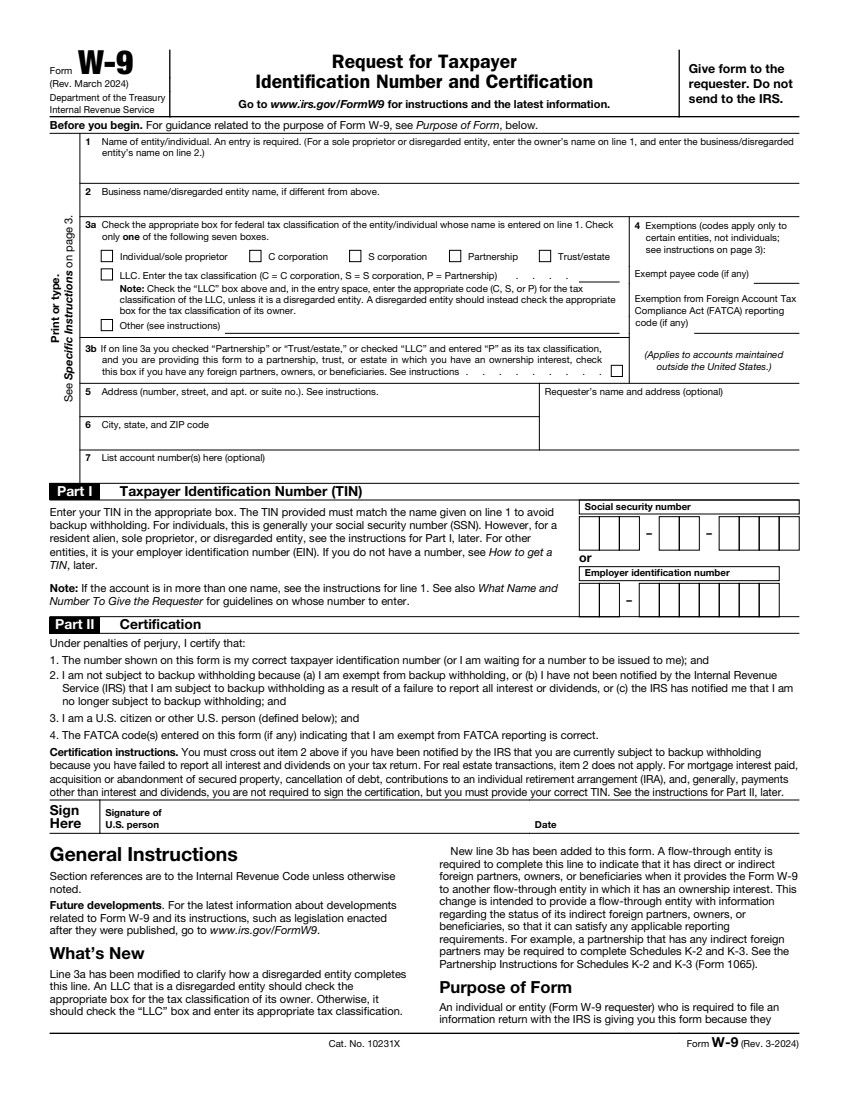
| Form W-9
(Rev. March 2024)
Request for Taxpayer
Identification Number and Certification
Department of the Treasury
Internal Revenue Service Go to www.irs.gov/FormW9 for instructions and the latest information.
Give form to the
requester. Do not
send to the IRS.
Before you begin. For guidance related to the purpose of Form W-9, see Purpose of Form, below. Print or type. See Specific Instructions on page 3.
1 Name of entity/individual. An entry is required. (For a sole proprietor or disregarded entity, enter the owner’s name on line 1, and enter the business/disregarded
entity’s name on line 2.)
2 Business name/disregarded entity name, if different from above.
3a Check the appropriate box for federal tax classification of the entity/individual whose name is entered on line 1. Check
only one of the following seven boxes.
Individual/sole proprietor C corporation S corporation Partnership Trust/estate
LLC. Enter the tax classification (C = C corporation, S = S corporation, P = Partnership) . . . .
Note: Check the “LLC” box above and, in the entry space, enter the appropriate code (C, S, or P) for the tax
classification of the LLC, unless it is a disregarded entity. A disregarded entity should instead check the appropriate
box for the tax classification of its owner.
Other (see instructions)
3b If on line 3a you checked “Partnership” or “Trust/estate,” or checked “LLC” and entered “P” as its tax classification,
and you are providing this form to a partnership, trust, or estate in which you have an ownership interest, check
this box if you have any foreign partners, owners, or beneficiaries. See instructions . . . . . . . . .
4 Exemptions (codes apply only to
certain entities, not individuals;
see instructions on page 3):
Exempt payee code (if any)
Exemption from Foreign Account Tax
Compliance Act (FATCA) reporting
code (if any)
(Applies to accounts maintained
outside the United States.)
5 Address (number, street, and apt. or suite no.). See instructions.
6 City, state, and ZIP code
Requester’s name and address (optional)
7 List account number(s) here (optional)
Part I Taxpayer Identification Number (TIN)
Enter your TIN in the appropriate box. The TIN provided must match the name given on line 1 to avoid
backup withholding. For individuals, this is generally your social security number (SSN). However, for a
resident alien, sole proprietor, or disregarded entity, see the instructions for Part I, later. For other
entities, it is your employer identification number (EIN). If you do not have a number, see How to get a
TIN, later.
Note: If the account is in more than one name, see the instructions for line 1. See also What Name and
Number To Give the Requester for guidelines on whose number to enter.
Social security number
– –
or
Employer identification number
–
Part II Certification
Under penalties of perjury, I certify that:
1. The number shown on this form is my correct taxpayer identification number (or I am waiting for a number to be issued to me); and
2. I am not subject to backup withholding because (a) I am exempt from backup withholding, or (b) I have not been notified by the Internal Revenue
Service (IRS) that I am subject to backup withholding as a result of a failure to report all interest or dividends, or (c) the IRS has notified me that I am
no longer subject to backup withholding; and
3. I am a U.S. citizen or other U.S. person (defined below); and
4. The FATCA code(s) entered on this form (if any) indicating that I am exempt from FATCA reporting is correct.
Certification instructions. You must cross out item 2 above if you have been notified by the IRS that you are currently subject to backup withholding
because you have failed to report all interest and dividends on your tax return. For real estate transactions, item 2 does not apply. For mortgage interest paid,
acquisition or abandonment of secured property, cancellation of debt, contributions to an individual retirement arrangement (IRA), and, generally, payments
other than interest and dividends, you are not required to sign the certification, but you must provide your correct TIN. See the instructions for Part II, later.
Sign
Here
Signature of
U.S. person Date
General Instructions
Section references are to the Internal Revenue Code unless otherwise
noted.
Future developments. For the latest information about developments
related to Form W-9 and its instructions, such as legislation enacted
after they were published, go to www.irs.gov/FormW9.
What’s New
Line 3a has been modified to clarify how a disregarded entity completes
this line. An LLC that is a disregarded entity should check the
appropriate box for the tax classification of its owner. Otherwise, it
should check the “LLC” box and enter its appropriate tax classification.
New line 3b has been added to this form. A flow-through entity is
required to complete this line to indicate that it has direct or indirect
foreign partners, owners, or beneficiaries when it provides the Form W-9
to another flow-through entity in which it has an ownership interest. This
change is intended to provide a flow-through entity with information
regarding the status of its indirect foreign partners, owners, or
beneficiaries, so that it can satisfy any applicable reporting
requirements. For example, a partnership that has any indirect foreign
partners may be required to complete Schedules K-2 and K-3. See the
Partnership Instructions for Schedules K-2 and K-3 (Form 1065).
Purpose of Form
An individual or entity (Form W-9 requester) who is required to file an
information return with the IRS is giving you this form because they
Cat. No. 10231X Form W-9 (Rev. 3-2024) |
| 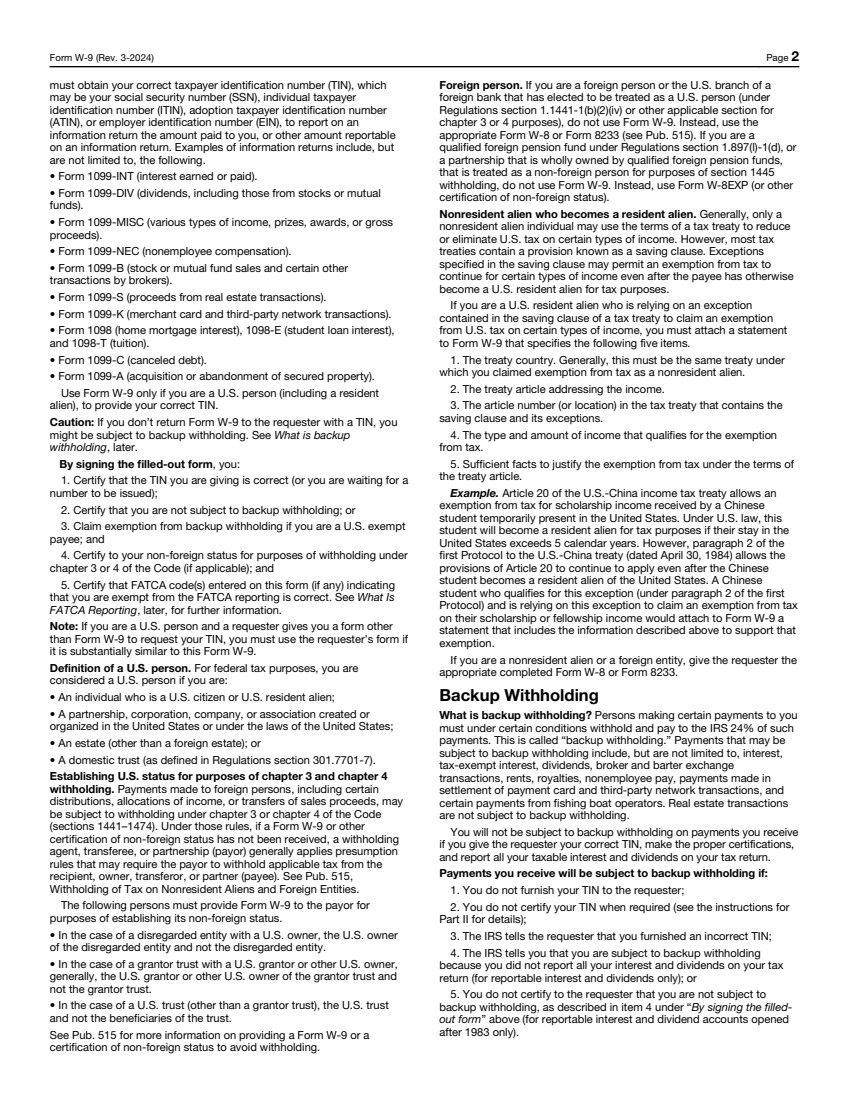
| Form W-9 (Rev. 3-2024) Page 2
must obtain your correct taxpayer identification number (TIN), which
may be your social security number (SSN), individual taxpayer
identification number (ITIN), adoption taxpayer identification number
(ATIN), or employer identification number (EIN), to report on an
information return the amount paid to you, or other amount reportable
on an information return. Examples of information returns include, but
are not limited to, the following.
• Form 1099-INT (interest earned or paid).
• Form 1099-DIV (dividends, including those from stocks or mutual
funds).
• Form 1099-MISC (various types of income, prizes, awards, or gross
proceeds).
• Form 1099-NEC (nonemployee compensation).
• Form 1099-B (stock or mutual fund sales and certain other
transactions by brokers).
• Form 1099-S (proceeds from real estate transactions).
• Form 1099-K (merchant card and third-party network transactions).
• Form 1098 (home mortgage interest), 1098-E (student loan interest),
and 1098-T (tuition).
• Form 1099-C (canceled debt).
• Form 1099-A (acquisition or abandonment of secured property).
Use Form W-9 only if you are a U.S. person (including a resident
alien), to provide your correct TIN.
Caution: If you don’t return Form W-9 to the requester with a TIN, you
might be subject to backup withholding. See What is backup
withholding, later.
By signing the filled-out form, you:
1. Certify that the TIN you are giving is correct (or you are waiting for a
number to be issued);
2. Certify that you are not subject to backup withholding; or
3. Claim exemption from backup withholding if you are a U.S. exempt
payee; and
4. Certify to your non-foreign status for purposes of withholding under
chapter 3 or 4 of the Code (if applicable); and
5. Certify that FATCA code(s) entered on this form (if any) indicating
that you are exempt from the FATCA reporting is correct. See What Is
FATCA Reporting, later, for further information.
Note: If you are a U.S. person and a requester gives you a form other
than Form W-9 to request your TIN, you must use the requester’s form if
it is substantially similar to this Form W-9.
Definition of a U.S. person. For federal tax purposes, you are
considered a U.S. person if you are:
• An individual who is a U.S. citizen or U.S. resident alien;
• A partnership, corporation, company, or association created or
organized in the United States or under the laws of the United States;
• An estate (other than a foreign estate); or
• A domestic trust (as defined in Regulations section 301.7701-7).
Establishing U.S. status for purposes of chapter 3 and chapter 4
withholding. Payments made to foreign persons, including certain
distributions, allocations of income, or transfers of sales proceeds, may
be subject to withholding under chapter 3 or chapter 4 of the Code
(sections 1441–1474). Under those rules, if a Form W-9 or other
certification of non-foreign status has not been received, a withholding
agent, transferee, or partnership (payor) generally applies presumption
rules that may require the payor to withhold applicable tax from the
recipient, owner, transferor, or partner (payee). See Pub. 515,
Withholding of Tax on Nonresident Aliens and Foreign Entities.
The following persons must provide Form W-9 to the payor for
purposes of establishing its non-foreign status.
• In the case of a disregarded entity with a U.S. owner, the U.S. owner
of the disregarded entity and not the disregarded entity.
• In the case of a grantor trust with a U.S. grantor or other U.S. owner,
generally, the U.S. grantor or other U.S. owner of the grantor trust and
not the grantor trust.
• In the case of a U.S. trust (other than a grantor trust), the U.S. trust
and not the beneficiaries of the trust.
See Pub. 515 for more information on providing a Form W-9 or a
certification of non-foreign status to avoid withholding.
Foreign person. If you are a foreign person or the U.S. branch of a
foreign bank that has elected to be treated as a U.S. person (under
Regulations section 1.1441-1(b)(2)(iv) or other applicable section for
chapter 3 or 4 purposes), do not use Form W-9. Instead, use the
appropriate Form W-8 or Form 8233 (see Pub. 515). If you are a
qualified foreign pension fund under Regulations section 1.897(l)-1(d), or
a partnership that is wholly owned by qualified foreign pension funds,
that is treated as a non-foreign person for purposes of section 1445
withholding, do not use Form W-9. Instead, use Form W-8EXP (or other
certification of non-foreign status).
Nonresident alien who becomes a resident alien. Generally, only a
nonresident alien individual may use the terms of a tax treaty to reduce
or eliminate U.S. tax on certain types of income. However, most tax
treaties contain a provision known as a saving clause. Exceptions
specified in the saving clause may permit an exemption from tax to
continue for certain types of income even after the payee has otherwise
become a U.S. resident alien for tax purposes.
If you are a U.S. resident alien who is relying on an exception
contained in the saving clause of a tax treaty to claim an exemption
from U.S. tax on certain types of income, you must attach a statement
to Form W-9 that specifies the following five items.
1. The treaty country. Generally, this must be the same treaty under
which you claimed exemption from tax as a nonresident alien.
2. The treaty article addressing the income.
3. The article number (or location) in the tax treaty that contains the
saving clause and its exceptions.
4. The type and amount of income that qualifies for the exemption
from tax.
5. Sufficient facts to justify the exemption from tax under the terms of
the treaty article.
Example. Article 20 of the U.S.-China income tax treaty allows an
exemption from tax for scholarship income received by a Chinese
student temporarily present in the United States. Under U.S. law, this
student will become a resident alien for tax purposes if their stay in the
United States exceeds 5 calendar years. However, paragraph 2 of the
first Protocol to the U.S.-China treaty (dated April 30, 1984) allows the
provisions of Article 20 to continue to apply even after the Chinese
student becomes a resident alien of the United States. A Chinese
student who qualifies for this exception (under paragraph 2 of the first
Protocol) and is relying on this exception to claim an exemption from tax
on their scholarship or fellowship income would attach to Form W-9 a
statement that includes the information described above to support that
exemption.
If you are a nonresident alien or a foreign entity, give the requester the
appropriate completed Form W-8 or Form 8233.
Backup Withholding
What is backup withholding? Persons making certain payments to you
must under certain conditions withhold and pay to the IRS 24% of such
payments. This is called “backup withholding.” Payments that may be
subject to backup withholding include, but are not limited to, interest,
tax-exempt interest, dividends, broker and barter exchange
transactions, rents, royalties, nonemployee pay, payments made in
settlement of payment card and third-party network transactions, and
certain payments from fishing boat operators. Real estate transactions
are not subject to backup withholding.
You will not be subject to backup withholding on payments you receive
if you give the requester your correct TIN, make the proper certifications,
and report all your taxable interest and dividends on your tax return.
Payments you receive will be subject to backup withholding if:
1. You do not furnish your TIN to the requester;
2. You do not certify your TIN when required (see the instructions for
Part II for details);
3. The IRS tells the requester that you furnished an incorrect TIN;
4. The IRS tells you that you are subject to backup withholding
because you did not report all your interest and dividends on your tax
return (for reportable interest and dividends only); or
5. You do not certify to the requester that you are not subject to
backup withholding, as described in item 4 under “By signing the filled-out form” above (for reportable interest and dividend accounts opened
after 1983 only). |
| 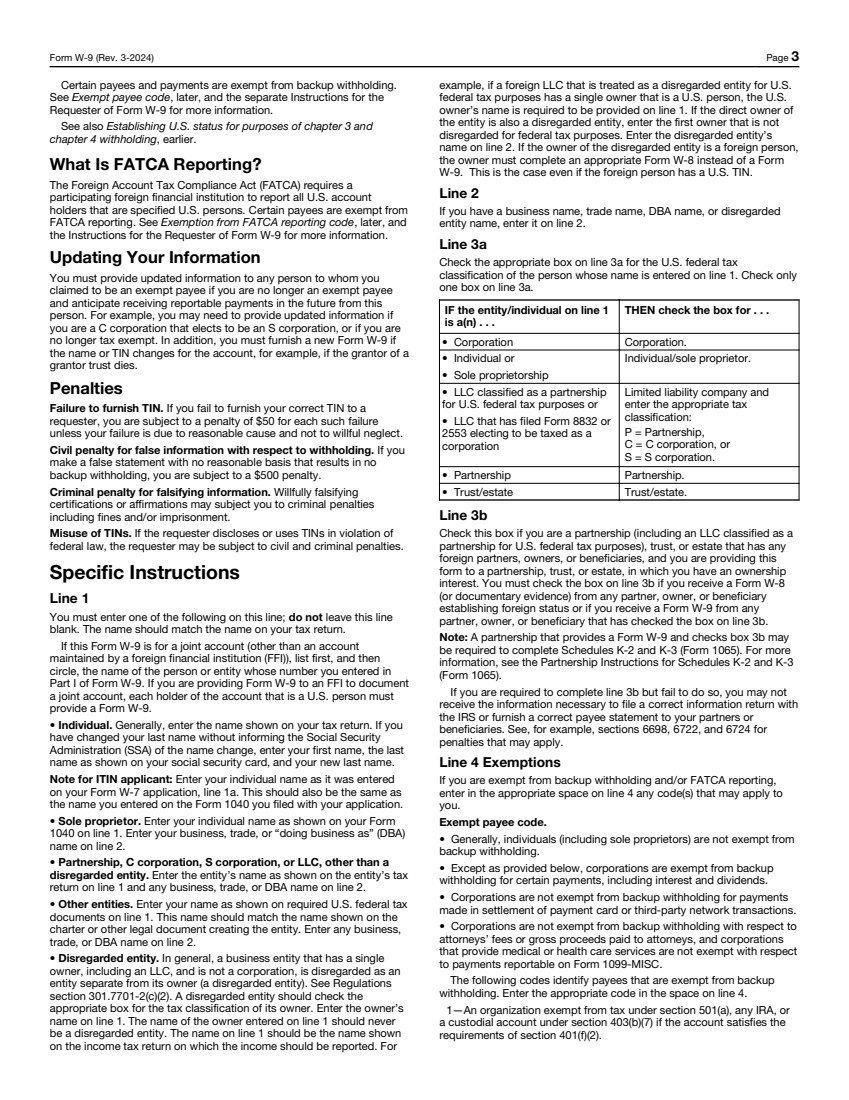
| Form W-9 (Rev. 3-2024) Page 3
Certain payees and payments are exempt from backup withholding.
See Exempt payee code, later, and the separate Instructions for the
Requester of Form W-9 for more information.
See also Establishing U.S. status for purposes of chapter 3 and
chapter 4 withholding, earlier.
What Is FATCA Reporting?
The Foreign Account Tax Compliance Act (FATCA) requires a
participating foreign financial institution to report all U.S. account
holders that are specified U.S. persons. Certain payees are exempt from
FATCA reporting. See Exemption from FATCA reporting code, later, and
the Instructions for the Requester of Form W-9 for more information.
Updating Your Information
You must provide updated information to any person to whom you
claimed to be an exempt payee if you are no longer an exempt payee
and anticipate receiving reportable payments in the future from this
person. For example, you may need to provide updated information if
you are a C corporation that elects to be an S corporation, or if you are
no longer tax exempt. In addition, you must furnish a new Form W-9 if
the name or TIN changes for the account, for example, if the grantor of a
grantor trust dies.
Penalties
Failure to furnish TIN. If you fail to furnish your correct TIN to a
requester, you are subject to a penalty of $50 for each such failure
unless your failure is due to reasonable cause and not to willful neglect.
Civil penalty for false information with respect to withholding. If you
make a false statement with no reasonable basis that results in no
backup withholding, you are subject to a $500 penalty.
Criminal penalty for falsifying information. Willfully falsifying
certifications or affirmations may subject you to criminal penalties
including fines and/or imprisonment.
Misuse of TINs. If the requester discloses or uses TINs in violation of
federal law, the requester may be subject to civil and criminal penalties.
Specific Instructions
Line 1
You must enter one of the following on this line; do not leave this line
blank. The name should match the name on your tax return.
If this Form W-9 is for a joint account (other than an account
maintained by a foreign financial institution (FFI)), list first, and then
circle, the name of the person or entity whose number you entered in
Part I of Form W-9. If you are providing Form W-9 to an FFI to document
a joint account, each holder of the account that is a U.S. person must
provide a Form W-9.
• Individual. Generally, enter the name shown on your tax return. If you
have changed your last name without informing the Social Security
Administration (SSA) of the name change, enter your first name, the last
name as shown on your social security card, and your new last name.
Note for ITIN applicant: Enter your individual name as it was entered
on your Form W-7 application, line 1a. This should also be the same as
the name you entered on the Form 1040 you filed with your application.
• Sole proprietor. Enter your individual name as shown on your Form
1040 on line 1. Enter your business, trade, or “doing business as” (DBA)
name on line 2.
• Partnership, C corporation, S corporation, or LLC, other than a
disregarded entity. Enter the entity’s name as shown on the entity’s tax
return on line 1 and any business, trade, or DBA name on line 2.
• Other entities. Enter your name as shown on required U.S. federal tax
documents on line 1. This name should match the name shown on the
charter or other legal document creating the entity. Enter any business,
trade, or DBA name on line 2.
• Disregarded entity. In general, a business entity that has a single
owner, including an LLC, and is not a corporation, is disregarded as an
entity separate from its owner (a disregarded entity). See Regulations
section 301.7701-2(c)(2). A disregarded entity should check the
appropriate box for the tax classification of its owner. Enter the owner’s
name on line 1. The name of the owner entered on line 1 should never
be a disregarded entity. The name on line 1 should be the name shown
on the income tax return on which the income should be reported. For
example, if a foreign LLC that is treated as a disregarded entity for U.S.
federal tax purposes has a single owner that is a U.S. person, the U.S.
owner’s name is required to be provided on line 1. If the direct owner of
the entity is also a disregarded entity, enter the first owner that is not
disregarded for federal tax purposes. Enter the disregarded entity’s
name on line 2. If the owner of the disregarded entity is a foreign person,
the owner must complete an appropriate Form W-8 instead of a Form
W-9. This is the case even if the foreign person has a U.S. TIN.
Line 2
If you have a business name, trade name, DBA name, or disregarded
entity name, enter it on line 2.
Line 3a
Check the appropriate box on line 3a for the U.S. federal tax
classification of the person whose name is entered on line 1. Check only
one box on line 3a.
IF the entity/individual on line 1
is a(n) . . .
THEN check the box for . . .
• Corporation Corporation.
• Individual or
• Sole proprietorship
Individual/sole proprietor.
• LLC classified as a partnership
for U.S. federal tax purposes or
• LLC that has filed Form 8832 or
2553 electing to be taxed as a
corporation
Limited liability company and
enter the appropriate tax
classification:
P = Partnership,
C = C corporation, or
S = S corporation.
• Partnership Partnership.
• Trust/estate Trust/estate.
Line 3b
Check this box if you are a partnership (including an LLC classified as a
partnership for U.S. federal tax purposes), trust, or estate that has any
foreign partners, owners, or beneficiaries, and you are providing this
form to a partnership, trust, or estate, in which you have an ownership
interest. You must check the box on line 3b if you receive a Form W-8
(or documentary evidence) from any partner, owner, or beneficiary
establishing foreign status or if you receive a Form W-9 from any
partner, owner, or beneficiary that has checked the box on line 3b.
Note: A partnership that provides a Form W-9 and checks box 3b may
be required to complete Schedules K-2 and K-3 (Form 1065). For more
information, see the Partnership Instructions for Schedules K-2 and K-3
(Form 1065).
If you are required to complete line 3b but fail to do so, you may not
receive the information necessary to file a correct information return with
the IRS or furnish a correct payee statement to your partners or
beneficiaries. See, for example, sections 6698, 6722, and 6724 for
penalties that may apply.
Line 4 Exemptions
If you are exempt from backup withholding and/or FATCA reporting,
enter in the appropriate space on line 4 any code(s) that may apply to
you.
Exempt payee code.
• Generally, individuals (including sole proprietors) are not exempt from
backup withholding.
• Except as provided below, corporations are exempt from backup
withholding for certain payments, including interest and dividends.
• Corporations are not exempt from backup withholding for payments
made in settlement of payment card or third-party network transactions.
• Corporations are not exempt from backup withholding with respect to
attorneys’ fees or gross proceeds paid to attorneys, and corporations
that provide medical or health care services are not exempt with respect
to payments reportable on Form 1099-MISC.
The following codes identify payees that are exempt from backup
withholding. Enter the appropriate code in the space on line 4.
1—An organization exempt from tax under section 501(a), any IRA, or
a custodial account under section 403(b)(7) if the account satisfies the
requirements of section 401(f)(2). |
| 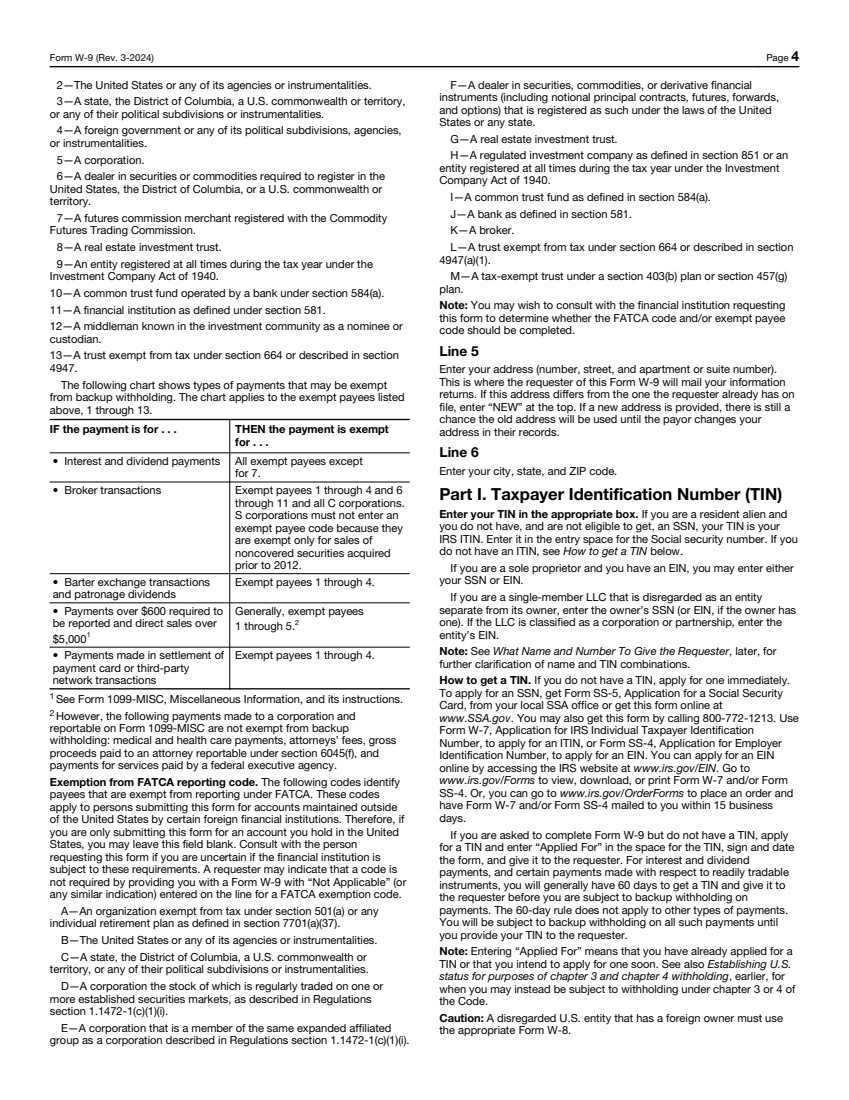
| Form W-9 (Rev. 3-2024) Page 4
2—The United States or any of its agencies or instrumentalities.
3—A state, the District of Columbia, a U.S. commonwealth or territory,
or any of their political subdivisions or instrumentalities.
4—A foreign government or any of its political subdivisions, agencies,
or instrumentalities.
5—A corporation.
6—A dealer in securities or commodities required to register in the
United States, the District of Columbia, or a U.S. commonwealth or
territory.
7—A futures commission merchant registered with the Commodity
Futures Trading Commission.
8—A real estate investment trust.
9—An entity registered at all times during the tax year under the
Investment Company Act of 1940.
10—A common trust fund operated by a bank under section 584(a).
11—A financial institution as defined under section 581.
12—A middleman known in the investment community as a nominee or
custodian.
13—A trust exempt from tax under section 664 or described in section
4947.
The following chart shows types of payments that may be exempt
from backup withholding. The chart applies to the exempt payees listed
above, 1 through 13.
IF the payment is for . . . THEN the payment is exempt
for . . .
• Interest and dividend payments All exempt payees except
for 7.
• Broker transactions Exempt payees 1 through 4 and 6
through 11 and all C corporations.
S corporations must not enter an
exempt payee code because they
are exempt only for sales of
noncovered securities acquired
prior to 2012.
• Barter exchange transactions
and patronage dividends
Exempt payees 1 through 4.
• Payments over $600 required to
be reported and direct sales over
$5,0001
Generally, exempt payees
1 through 5.2
• Payments made in settlement of
payment card or third-party
network transactions
Exempt payees 1 through 4.
1See Form 1099-MISC, Miscellaneous Information, and its instructions.
2However, the following payments made to a corporation and
reportable on Form 1099-MISC are not exempt from backup
withholding: medical and health care payments, attorneys’ fees, gross
proceeds paid to an attorney reportable under section 6045(f), and
payments for services paid by a federal executive agency.
Exemption from FATCA reporting code. The following codes identify
payees that are exempt from reporting under FATCA. These codes
apply to persons submitting this form for accounts maintained outside
of the United States by certain foreign financial institutions. Therefore, if
you are only submitting this form for an account you hold in the United
States, you may leave this field blank. Consult with the person
requesting this form if you are uncertain if the financial institution is
subject to these requirements. A requester may indicate that a code is
not required by providing you with a Form W-9 with “Not Applicable” (or
any similar indication) entered on the line for a FATCA exemption code.
A—An organization exempt from tax under section 501(a) or any
individual retirement plan as defined in section 7701(a)(37).
B—The United States or any of its agencies or instrumentalities.
C—A state, the District of Columbia, a U.S. commonwealth or
territory, or any of their political subdivisions or instrumentalities.
D—A corporation the stock of which is regularly traded on one or
more established securities markets, as described in Regulations
section 1.1472-1(c)(1)(i).
E—A corporation that is a member of the same expanded affiliated
group as a corporation described in Regulations section 1.1472-1(c)(1)(i).
F—A dealer in securities, commodities, or derivative financial
instruments (including notional principal contracts, futures, forwards,
and options) that is registered as such under the laws of the United
States or any state.
G—A real estate investment trust.
H—A regulated investment company as defined in section 851 or an
entity registered at all times during the tax year under the Investment
Company Act of 1940.
I—A common trust fund as defined in section 584(a).
J—A bank as defined in section 581.
K—A broker.
L—A trust exempt from tax under section 664 or described in section
4947(a)(1).
M—A tax-exempt trust under a section 403(b) plan or section 457(g)
plan.
Note: You may wish to consult with the financial institution requesting
this form to determine whether the FATCA code and/or exempt payee
code should be completed.
Line 5
Enter your address (number, street, and apartment or suite number).
This is where the requester of this Form W-9 will mail your information
returns. If this address differs from the one the requester already has on
file, enter “NEW” at the top. If a new address is provided, there is still a
chance the old address will be used until the payor changes your
address in their records.
Line 6
Enter your city, state, and ZIP code.
Part I. Taxpayer Identification Number (TIN)
Enter your TIN in the appropriate box. If you are a resident alien and
you do not have, and are not eligible to get, an SSN, your TIN is your
IRS ITIN. Enter it in the entry space for the Social security number. If you
do not have an ITIN, see How to get a TIN below.
If you are a sole proprietor and you have an EIN, you may enter either
your SSN or EIN.
If you are a single-member LLC that is disregarded as an entity
separate from its owner, enter the owner’s SSN (or EIN, if the owner has
one). If the LLC is classified as a corporation or partnership, enter the
entity’s EIN.
Note: See What Name and Number To Give the Requester, later, for
further clarification of name and TIN combinations.
How to get a TIN. If you do not have a TIN, apply for one immediately.
To apply for an SSN, get Form SS-5, Application for a Social Security
Card, from your local SSA office or get this form online at
www.SSA.gov. You may also get this form by calling 800-772-1213. Use
Form W-7, Application for IRS Individual Taxpayer Identification
Number, to apply for an ITIN, or Form SS-4, Application for Employer
Identification Number, to apply for an EIN. You can apply for an EIN
online by accessing the IRS website at www.irs.gov/EIN. Go to
www.irs.gov/Forms to view, download, or print Form W-7 and/or Form
SS-4. Or, you can go to www.irs.gov/OrderForms to place an order and
have Form W-7 and/or Form SS-4 mailed to you within 15 business
days.
If you are asked to complete Form W-9 but do not have a TIN, apply
for a TIN and enter “Applied For” in the space for the TIN, sign and date
the form, and give it to the requester. For interest and dividend
payments, and certain payments made with respect to readily tradable
instruments, you will generally have 60 days to get a TIN and give it to
the requester before you are subject to backup withholding on
payments. The 60-day rule does not apply to other types of payments.
You will be subject to backup withholding on all such payments until
you provide your TIN to the requester.
Note: Entering “Applied For” means that you have already applied for a
TIN or that you intend to apply for one soon. See also Establishing U.S.
status for purposes of chapter 3 and chapter 4 withholding, earlier, for
when you may instead be subject to withholding under chapter 3 or 4 of
the Code.
Caution: A disregarded U.S. entity that has a foreign owner must use
the appropriate Form W-8. |
| 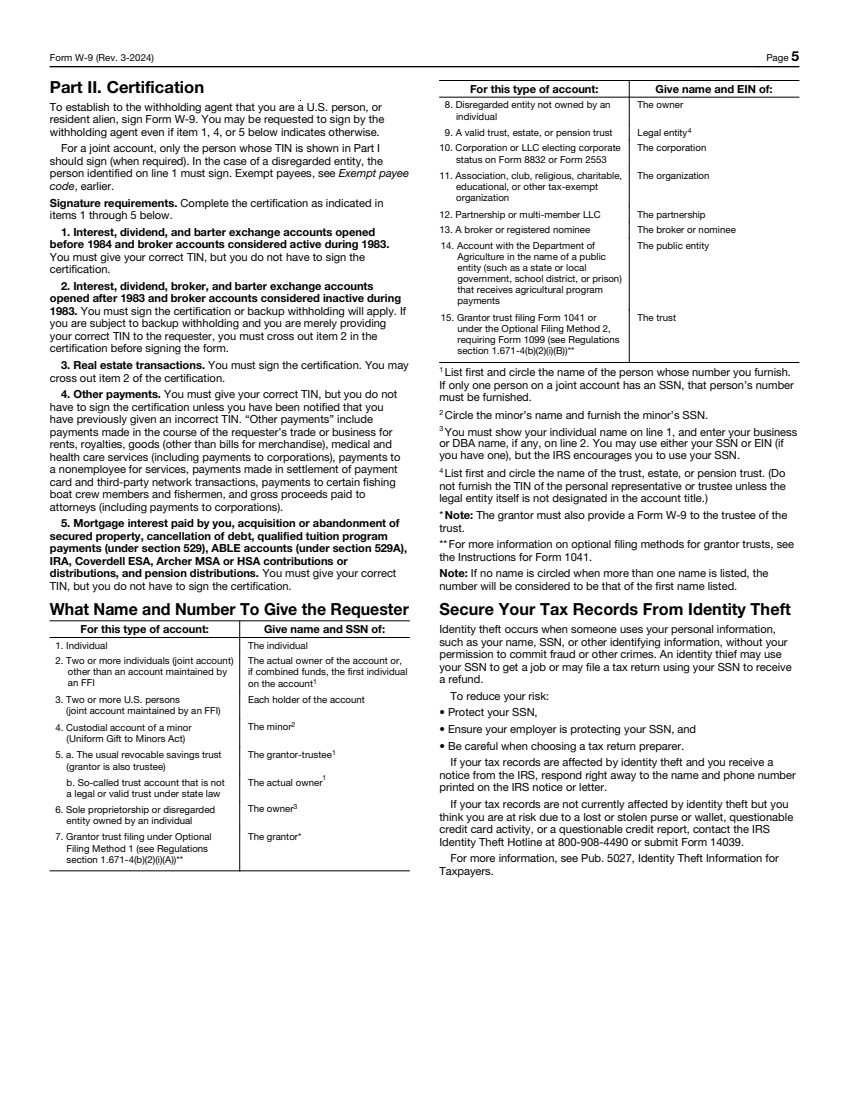
| Form W-9 (Rev. 3-2024) Page 5
Part II. Certification
To establish to the withholding agent that you are a U.S. person, or
resident alien, sign Form W-9. You may be requested to sign by the
withholding agent even if item 1, 4, or 5 below indicates otherwise.
For a joint account, only the person whose TIN is shown in Part I
should sign (when required). In the case of a disregarded entity, the
person identified on line 1 must sign. Exempt payees, see Exempt payee
code, earlier.
Signature requirements. Complete the certification as indicated in
items 1 through 5 below.
1. Interest, dividend, and barter exchange accounts opened
before 1984 and broker accounts considered active during 1983.
You must give your correct TIN, but you do not have to sign the
certification.
2. Interest, dividend, broker, and barter exchange accounts
opened after 1983 and broker accounts considered inactive during
1983. You must sign the certification or backup withholding will apply. If
you are subject to backup withholding and you are merely providing
your correct TIN to the requester, you must cross out item 2 in the
certification before signing the form.
3. Real estate transactions. You must sign the certification. You may
cross out item 2 of the certification.
4. Other payments. You must give your correct TIN, but you do not
have to sign the certification unless you have been notified that you
have previously given an incorrect TIN. “Other payments” include
payments made in the course of the requester’s trade or business for
rents, royalties, goods (other than bills for merchandise), medical and
health care services (including payments to corporations), payments to
a nonemployee for services, payments made in settlement of payment
card and third-party network transactions, payments to certain fishing
boat crew members and fishermen, and gross proceeds paid to
attorneys (including payments to corporations).
5. Mortgage interest paid by you, acquisition or abandonment of
secured property, cancellation of debt, qualified tuition program
payments (under section 529), ABLE accounts (under section 529A),
IRA, Coverdell ESA, Archer MSA or HSA contributions or
distributions, and pension distributions. You must give your correct
TIN, but you do not have to sign the certification.
What Name and Number To Give the Requester
For this type of account: Give name and SSN of:
1. Individual The individual
2. Two or more individuals (joint account)
other than an account maintained by
an FFI
The actual owner of the account or,
if combined funds, the first individual
on the account1
3. Two or more U.S. persons
(joint account maintained by an FFI)
Each holder of the account
4. Custodial account of a minor
(Uniform Gift to Minors Act)
The minor2
5. a. The usual revocable savings trust
(grantor is also trustee)
The grantor-trustee1
b. So-called trust account that is not
a legal or valid trust under state law
The actual owner1
6. Sole proprietorship or disregarded
entity owned by an individual
The owner3
7. Grantor trust filing under Optional
Filing Method 1 (see Regulations
section 1.671-4(b)(2)(i)(A))**
The grantor*
For this type of account: Give name and EIN of:
8. Disregarded entity not owned by an
individual
The owner
9. A valid trust, estate, or pension trust Legal entity4
10. Corporation or LLC electing corporate
status on Form 8832 or Form 2553
The corporation
11. Association, club, religious, charitable,
educational, or other tax-exempt
organization
The organization
12. Partnership or multi-member LLC The partnership
13. A broker or registered nominee The broker or nominee
14. Account with the Department of
Agriculture in the name of a public
entity (such as a state or local
government, school district, or prison)
that receives agricultural program
payments
The public entity
15. Grantor trust filing Form 1041 or
under the Optional Filing Method 2,
requiring Form 1099 (see Regulations
section 1.671-4(b)(2)(i)(B))**
The trust
1 List first and circle the name of the person whose number you furnish.
If only one person on a joint account has an SSN, that person’s number
must be furnished.
2 Circle the minor’s name and furnish the minor’s SSN.
3You must show your individual name on line 1, and enter your business
or DBA name, if any, on line 2. You may use either your SSN or EIN (if
you have one), but the IRS encourages you to use your SSN.
4 List first and circle the name of the trust, estate, or pension trust. (Do
not furnish the TIN of the personal representative or trustee unless the
legal entity itself is not designated in the account title.)
*Note: The grantor must also provide a Form W-9 to the trustee of the
trust.
**For more information on optional filing methods for grantor trusts, see
the Instructions for Form 1041.
Note: If no name is circled when more than one name is listed, the
number will be considered to be that of the first name listed.
Secure Your Tax Records From Identity Theft
Identity theft occurs when someone uses your personal information,
such as your name, SSN, or other identifying information, without your
permission to commit fraud or other crimes. An identity thief may use
your SSN to get a job or may file a tax return using your SSN to receive
a refund.
To reduce your risk:
• Protect your SSN,
• Ensure your employer is protecting your SSN, and
• Be careful when choosing a tax return preparer.
If your tax records are affected by identity theft and you receive a
notice from the IRS, respond right away to the name and phone number
printed on the IRS notice or letter.
If your tax records are not currently affected by identity theft but you
think you are at risk due to a lost or stolen purse or wallet, questionable
credit card activity, or a questionable credit report, contact the IRS
Identity Theft Hotline at 800-908-4490 or submit Form 14039.
For more information, see Pub. 5027, Identity Theft Information for
Taxpayers. |
| 
| Form W-9 (Rev. 3-2024) Page 6
Victims of identity theft who are experiencing economic harm or a
systemic problem, or are seeking help in resolving tax problems that
have not been resolved through normal channels, may be eligible for
Taxpayer Advocate Service (TAS) assistance. You can reach TAS by
calling the TAS toll-free case intake line at 877-777-4778 or TTY/TDD
800-829-4059.
Protect yourself from suspicious emails or phishing schemes.
Phishing is the creation and use of email and websites designed to
mimic legitimate business emails and websites. The most common act
is sending an email to a user falsely claiming to be an established
legitimate enterprise in an attempt to scam the user into surrendering
private information that will be used for identity theft.
The IRS does not initiate contacts with taxpayers via emails. Also, the
IRS does not request personal detailed information through email or ask
taxpayers for the PIN numbers, passwords, or similar secret access
information for their credit card, bank, or other financial accounts.
If you receive an unsolicited email claiming to be from the IRS,
forward this message to phishing@irs.gov. You may also report misuse
of the IRS name, logo, or other IRS property to the Treasury Inspector
General for Tax Administration (TIGTA) at 800-366-4484. You can
forward suspicious emails to the Federal Trade Commission at
spam@uce.gov or report them at www.ftc.gov/complaint. You can
contact the FTC at www.ftc.gov/idtheft or 877-IDTHEFT (877-438-4338).
If you have been the victim of identity theft, see www.IdentityTheft.gov
and Pub. 5027.
Go to www.irs.gov/IdentityTheft to learn more about identity theft and
how to reduce your risk.
Privacy Act Notice
Section 6109 of the Internal Revenue Code requires you to provide your
correct TIN to persons (including federal agencies) who are required to
file information returns with the IRS to report interest, dividends, or
certain other income paid to you; mortgage interest you paid; the
acquisition or abandonment of secured property; the cancellation of
debt; or contributions you made to an IRA, Archer MSA, or HSA. The
person collecting this form uses the information on the form to file
information returns with the IRS, reporting the above information.
Routine uses of this information include giving it to the Department of
Justice for civil and criminal litigation and to cities, states, the District of
Columbia, and U.S. commonwealths and territories for use in
administering their laws. The information may also be disclosed to other
countries under a treaty, to federal and state agencies to enforce civil
and criminal laws, or to federal law enforcement and intelligence
agencies to combat terrorism. You must provide your TIN whether or not
you are required to file a tax return. Under section 3406, payors must
generally withhold a percentage of taxable interest, dividends, and
certain other payments to a payee who does not give a TIN to the payor.
Certain penalties may also apply for providing false or fraudulent
information. |