
Exhibit 96.2
|
|
S-K 1300 Technical Report Summary
Selkirk Nickel-Copper-PGE Project, Botswana
NexMetals Mining Corp.
1111 West Hastings Street, 15th Floor,
Vancouver, British Columbia, V6E 2J3,
Canada

Prepared by:
The MSA Group (Pty) Ltd
Henley House, Greenacres Office Park
Cnr Victory and Rustenburg Roads
Victory Park, 2195, South Africa
| Effective Date: | 22 June 2026 |
| Report Date: | 17 August 2026 |
| MSA Project No.: | J5050 |
IMPORTANT NOTICE
This Technical Report Summary (TRS) has been prepared in accordance with Subpart 1300 of Regulation S-K promulgated by the United States Securities and Exchange Commission (SEC) (S-K 1300). The TRS is based on the same technical work, information, analyses, interpretations and effective date as the corresponding technical report prepared in accordance with National Instrument 43-101 Standards of Disclosure for Mineral Projects (NI 43-101), but has been presented and adapted, as required, to comply with the disclosure requirements, terminology and format prescribed under S-K 1300.
For clarity, this TRS is not intended to update, supersede or change the technical conclusions, assumptions, interpretations or effective date of the corresponding NI 43-101 technical report, except to the extent necessary to satisfy S-K 1300 requirements. References to NI 43-101, the NI 43-101 technical report or Canadian disclosure standards are included to identify the underlying source report and technical basis for this TRS. The mineral resource estimates and related technical disclosure in this TRS should be read and interpreted in accordance with S-K 1300.
The quality of information, conclusions and estimates contained in this TRS is consistent with the level of effort undertaken by The MSA Group (Pty) Ltd (MSA), South Africa, and the qualified persons, based on information available as at the effective date of the corresponding NI 43-101 technical report and this TRS, data supplied by NexMetals Mining Corp. (NexMetals) and other sources, and the assumptions, conditions, limitations and qualifications set out in this TRS. Differences between this TRS and the corresponding NI 43-101 technical report, if any, are intended to reflect differences between the applicable disclosure regimes and not a change in the underlying technical work or effective date.
Mineral resources disclosed in this TRS have been classified in accordance with S-K 1300 as inferred, indicated or measured mineral resources, as applicable. These classifications reflect the qualified person’s judgement regarding the level of geological evidence, sampling support, geological and grade or quality continuity, data spacing, data quality and confidence in the estimate. Under S-K 1300, inferred mineral resources have the lowest level of geological confidence, indicated mineral resources have sufficient confidence to allow application of modifying factors in sufficient detail to support mine planning and evaluation of economic viability, and measured mineral resources have the highest level of geological confidence and may support more detailed mine planning and evaluation. Mineral resources are not mineral reserves and do not have demonstrated economic viability.

| TABLE OF CONTENTS |
| 1. | Summary | 1 | ||
| 1.1 | Property Description | 2 | ||
| 1.2 | Land Tenure | 2 | ||
| 1.3 | History | 2 | ||
| 1.4 | Geological Setting, Mineralisation and Deposit | 3 | ||
| 1.5 | Exploration | 3 | ||
| 1.6 | Sample Preparation, Analyses, and Security | 4 | ||
| 1.7 | Mineral Processing and Metallurgical Testing | 4 | ||
| 1.8 | Data Verification | 5 | ||
| 1.9 | Mineral Resource Estimates | 5 | ||
| 1.10 | Conclusions | 7 | ||
| 1.10.1 | Geology and Mineral Resources | 7 | ||
| 1.10.2 | Mineral Processing | 8 | ||
| 1.11 | Recommendations | 8 | ||
| 1.11.1 | Geology and Mineral Resources | 8 | ||
| 1.11.2 | Mineral Processing | 8 | ||
| 1.12 | Forward Work Program | 9 | ||
| 2. | Introduction | 10 | ||
| 2.1 | Background, Terms of Reference and Purpose of the Report | 10 | ||
| 2.2 | Registrant for Whom the Technical Report Summary was Prepared | 11 | ||
| 2.3 | Corporate Structure | 11 | ||
| 2.4 | Principal Sources of Information | 11 | ||
| 2.4.1 | Previous Technical Reports | 12 | ||
| 2.5 | Qualifications, Experience and Independence | 12 | ||
| 2.5.1 | Qualified Persons | 13 | ||
| 2.6 | Site Visits and Scope of Personal Inspection | 13 | ||
| 2.7 | Effective Date | 13 | ||
| 2.8 | Units and Currency | 13 | ||
| 2.9 | Units of Measurement and Abbreviations | 14 | ||
| 3. | Reliance on Other Experts | 15 | ||
| J5050 – Selkirk Nickel-Copper-PGE Project S-K 1300 Technical Report Summary 17-08-2026 | Page: i |
| 4. | Property Description and Location | 16 | ||
| 4.1 | Location | 16 | ||
| 4.2 | Mineral Tenure, Permitting, Rights and Agreements | 17 | ||
| 4.2.1 | Mineral Rights | 20 | ||
| 4.2.2 | Surface Rights | 20 | ||
| 4.3 | Environmental Liabilities | |||
| 4.4 | Royalties and Encumbrances | 21 | ||
| 4.5 | Other Significant Factors and Risks | 21 | ||
| 21 | ||||
| 5. | Accessibility, Climate, Local Resources, Infrastructure and Physiography | 22 | ||
| 5.1 | Accessibility | 22 | ||
| 5.2 | Climate and Physiography | 22 | ||
| 5.3 | Local Resources and Infrastructure | 23 | ||
| 5.3.1 | Human Resources | 23 | ||
| 5.3.2 | Infrastructure, Power, Water and Supply | 23 | ||
| 5.4 | Physiography | 25 | ||
| 25 | ||||
| 5.4.1 | Topography | 25 | ||
| 5.4.2 | Surface Water | 25 | ||
| 5.4.3 | Groundwater | 25 | ||
| 5.4.4 | Flora and Fauna | |||
| 6. | History | 26 | ||
| 6.1 | Prior and Current Ownership | 26 | ||
| 6.2 | Exploration and Development History | 27 | ||
| 6.3 | Historical Mineral Resource Estimates | 36 | ||
| 6.3.1 | Previous Estimate (SLR, 2024) | 37 | ||
| 6.4 | Past Production | 38 | ||
| 6.5 | History of Environmental Considerations | 38 | ||
| 7. | Geological Setting and MineraliSation | 39 | ||
| 7.1 | Regional Geology | 39 | ||
| 7.2 | Local Geology | 39 | ||
| 7.3 | Selkirk Deposit Geology | 42 | ||
| 7.4 | Mineralisation | 45 | ||
| 8. | Deposit Types | 46 | ||
| 9. | Exploration | 47 | ||
| 9.1 | Mining Licence | 47 | ||
| 9.1.1 | Underground Exploration | 47 | ||
| 9.1.2 | Analyses of 2007 Soil Data | 47 | ||
| 9.2 | Regional Exploration | 48 | ||
| J5050 – Selkirk Nickel-Copper-PGE Project S-K 1300 Technical Report Summary 17-08-2026 | Page: ii |
| 10. | Drilling | 51 | ||
| 10.1 | Summary | 51 | ||
| 10.2 | Historical Drilling | 53 | ||
| 10.2.1 | RC Drilling | 53 | ||
| 10.2.2 | Diamond Drilling | 53 | ||
| 10.3 | PNGPL Drilling | 54 | ||
| 10.4 | Data Management | 56 | ||
| 10.5 | Geotechnical Logging | 57 | ||
| 10.6 | QP Opinion on Drilling Campaigns at Selkirk | 57 | ||
| 11. | Sample Preparation, Analyses and Security | 57 | ||
| 11.1 | Historical Work | 57 | ||
| 11.1.1 | Sample Preparation | 57 | ||
| 11.1.2 | Sample Analysis | 58 | ||
| 11.2 | Work by PNGPL | 58 | ||
| 11.3 | Quality Assurance and Quality Control | 59 | ||
| 11.3.1 | Historical Practices and Results | 59 | ||
| 11.3.2 | Current Work | 63 | ||
| 11.4 | Silicate Nickel Investigation | 67 | ||
| 11.5 | Relative Density Determinations | 68 | ||
| 11.6 | Sample Security | 68 | ||
| 11.7 | QP opinion on Adequacy of the Sample Preparation, Security and Analytical Procedures | 69 | ||
| 12. | Data Verification | 70 | ||
| 12.1 | Historical Data Verification | 70 | ||
| 12.1.1 | Comparison Between Original and Resampling | 70 | ||
| 12.1.2 | Comparison between Metallurgical Twin and Resample Assays | 73 | ||
| 12.2 | Assay Certificate Verification | 75 | ||
| 12.3 | Site Visit Verification | 75 | ||
| 12.4 | Summary and Opinion of the QP on the Data Verification | 77 | ||
| 13. | Mineral Processing and Metallurgical Testing | 78 | ||
| 13.1 | 2025 IMS Ore Sorting Testwork Program | 79 | ||
| 13.1.1 | Sample Selection | 79 | ||
| 13.1.2 | Testwork Results | 80 | ||
| 13.2 | 2025/2026 BCR Testwork Program | 80 | ||
| 13.2.1 | Sample Selection and Preparation | 81 | ||
| 13.2.2 | Feed Characterisation | 81 | ||
| 13.2.3 | Mineralogy | 82 | ||
| 13.2.4 | Comminution | 85 | ||
| 13.2.5 | Flotation | 86 | ||
| 13.2.6 | Variability Program | 90 | ||
| 13.3 | Metal Recovery Estimation | 91 | ||
| 13.3.1 | Conceptual Mineral Processing | 91 | ||
| 13.4 | QP Opinion, Conclusions and Summary | 91 | ||
| J5050 – Selkirk Nickel-Copper-PGE Project S-K 1300 Technical Report Summary 17-08-2026 | Page: iii |
| 14. | Mineral Resource Estimation | 92 | ||
| 14.1 | Introduction | 92 | ||
| 14.2 | Mineral Resource Disclosure Basis | 92 | ||
| 14.3 | Mineral Resource Estimation Database | 92 | ||
| 14.4 | Data Validation | 93 | ||
| 14.4.1 | Treatment of Unsampled or Missing Assays | 94 | ||
| 14.4.2 | Regression Analysis | 94 | ||
| 14.5 | Mineralisation Criteria | 95 | ||
| 14.6 | Geological Modelling and Estimation Domains | 95 | ||
| 14.7 | Statistical and Geostatistical Analysis | 96 | ||
| 14.7.1 | Sample Compositing | 96 | ||
| 14.7.2 | Evaluation of Outliers (Grade Capping) | 98 | ||
| 14.7.3 | Core Recovery | 99 | ||
| 14.7.4 | Density | 100 | ||
| 14.7.5 | Density verses Grade Relationship | 100 | ||
| 14.7.6 | Moisture | 100 | ||
| 14.7.7 | Variography | 100 | ||
| 14.8 | Block Model and Grade Estimation | 103 | ||
| 14.8.1 | Block Model Parameters | 103 | ||
| 14.8.2 | Search Parameters and Number of Samples | 104 | ||
| 14.8.3 | Grade Estimation | 105 | ||
| 14.9 | Block Model Validation | 105 | ||
| 14.9.1 | Swath Plots | 106 | ||
| 14.9.2 | Statistical Validation | 108 | ||
| 14.10 | Mineral Resource Classification | |||
| 108 | ||||
| 14.10.1 | Approach to Classification | 108 | ||
| 14.10.2 | Summary of Mineral Resource Classification | 109 | ||
| J5050 – Selkirk Nickel-Copper-PGE Project S-K 1300 Technical Report Summary 17-08-2026 | Page: iv |
| 14.11 | Assessment of Reasonable Prospects for Economic Extraction (RPEE) | 110 | |
| 14.12 | Mineral Resource Statement | 112 | |
| 14.13 | Grade Tonnage Curves | 114 | |
| 14.14 | Comparison with Previous Estimates | 115 | |
| 14.15 | Mineral Resource Uncertainty Discussion | 115 | |
| 14.16 | QP Opinion | 116 | |
| 15. | Mineral Reserve Estimates | 117 | |
| 16. | Mining Methods | 118 | |
| 17. | Recovery Methods | 119 | |
| 18. | Project Infrastructure | 120 | |
| 19. | Market Studies and Contracts | 121 | |
| 20. | Environmental Studies, Permitting and Social or Community Impact | 122 | |
| 21. | Capital and Operating Costs | 123 | |
| 22. | Economic Analysis | 124 | |
| 23. | Adjacent Properties | 125 | |
| 24. | Other Relevant Data and Information | ||
| 127 | |||
| 25. | Interpretation and Conclusions | 128 | |
| 25.1 | Geology and Mineral Resources | 128 | |
| 25.2 | Mineral Processing | 129 | |
| 26. | Recommendations | 130 | |
| 26.1 | Geology and Mineral Resources | 130 | |
| 26.2 | Mineral Processing | 130 | |
| 26.3 | Forward Work Program | 130 | |
| 27. | References | 132 | |
| 28. | Date and Signature Page | ||
| J5050 – Selkirk Nickel-Copper-PGE Project S-K 1300 Technical Report Summary 17-08-2026 | Page: v |
| LIST OF TABLES |
| Table 1-1 Selkirk Mineral Resource Statement as of 22 June 2026 reported on a 100% ownership basis | 6 |
| Table 1-2 Forward work program proposed budget | 9 |
| Table 2-1 Technical Report Summary sections and third-party firms | 13 |
| Table 4-1 Selkirk Property Tenure | 19 |
| Table 6-1 History of ownership at Selkirk | 26 |
| Table 6-2 Summary of historical mineral resource estimates at Selkirk | 37 |
| Table 6-3 Mineral Resource Statement prepared by SLR (November 01, 2024) | 38 |
| Table 9-1 Assay results from an underground drift at Selkirk | 47 |
| Table 10-1 History of drilling campaigns at the Selkirk deposit | 51 |
| Table 10-2 Collar locations of PNGPL 2025 drillholes | 55 |
| Table 10-3 PNGPL 2025 drillhole significant intercepts | 56 |
| Table 11-1 Summary of the QAQC on blanks | 59 |
| Table 11-2 Results of CRM assays by TNMC | 61 |
| Table 11-3 QAQC blanks performance summary PNGPL samples at ALS | 64 |
| Table 11-4 QAQC - CRM performance summary PNGPL samples at ALS | 64 |
| Table 11-5 2025 Pulp Duplicates Statistics | 65 |
| Table 12-1 Original vs resample assay statistics- resampling | 73 |
| Table 12-2 Original vs resample assay statistics – twin drilling | 74 |
| Table 13-1 As received Selkirk samples and weights | 81 |
| Table 13-2 Head assays and hardness of Selkirk tenor samples | 82 |
| Table 13-3 Selkirk comminution testwork summary | 86 |
| Table 13-4 LCT-1 master composite projected metallurgy – based on cycles 4 to 6 | 86 |
| Table 13-5 LCT-2 master composite projected metallurgy – based on cycles 4 to 6 | 86 |
| Table 13-6 Lock cycle-2 copper and nickel concentrate quality assessment | 90 |
| Table 13-7 Copper and nickel grades and recoveries | 91 |
| Table 14-1 Database Summary | 92 |
| Table 14-2 Assay availability in final dataset | 94 |
| Table 14-3 NSR parameters (Two concentrate option) | 95 |
| Table 14-4 Composited vs uncomposited statistics | 98 |
| Table 14-5 Global top-cap statistics | 99 |
| Table 14-6 Variogram parameters | 103 |
| Table 14-7 Statistical comparison of block model and composite means | 108 |
| Table 14-8 RPEE shell parameters | 111 |
| Table 14-9 Selkirk Mineral Resource Statement as of 22 June 2026 | 113 |
| Table 26-1 Forward work program proposed budget | 131 |
| J5050 – Selkirk Nickel-Copper-PGE Project S-K 1300 Technical Report Summary 17-08-2026 | Page: vi |
| LIST OF FIGURES |
| Figure 4-1 Selkirk Property Location | 17 |
| Figure 5-1 Climate at the Selkirk Project | 23 |
| Figure 5-2 Location of Phoenix and Selkirk mining infrastructure | 24 |
| Figure 5-3 Surface water in the Selkirk Project area | 25 |
| Figure 6-1 Detailed ground magnetic (top) and first derivative Bouguer Anomaly survey (bottom) | 30 |
| Figure 6-2 IP Survey at Selkirk | 31 |
| Figure 6-3 a) Distribution pattern showing concentrations of Ni at Selkirk; b) Ni concentrations superimposed on soil type and geological structures | 32 |
| Figure 6-4 a) Distribution pattern showing concentrations of Cu at Selkirk; b) Cu concentrations superimposed on soil type and geological structures | 33 |
| Figure 6-5 Apparent resistivity at 250 m below surface | 34 |
| Figure 6-6 Geochemical anomalies for Ni and Cu over the TNMC PLs | 35 |
| Figure 7-1 a) Schematic map of the Limpopo Belt and adjacent cratons showing studies localities; and b) Geological map of the central portion of the Tati Greenstone Belt indicating the locality of the Phoenix, Selkirk and Tekwane deposits | 40 |
| Figure 7-2 Simplified geological map of the northern Tati Greenstone Belt | 41 |
| Figure 7-3 Simplified geology in longitudinal view through the Selkirk deposit | 43 |
| Figure 7-4 Detailed map of the Selkirk geology | 44 |
| Figure 9-1 Results of the analyses of 2007 soil data over the Selkirk Mining Licence | 48 |
| Figure 9-2 Soil geochemistry anomaly map (MIDST2) | 50 |
| Figure 10-1 Drillhole location map | 52 |
| Figure 10-2 PNGPL 2025 drillholes | 55 |
| Figure 11-1 Pt and Pd values (2004-2016) of blank samples assayed at Phoenix Mine laboratory | 60 |
| Figure 11-2 GBM398-5 control chart for Ni and Cu at the Phoenix Mine laboratory | 62 |
| Figure 11-3 Selected AMIS002 and AMIS007 control charts at the Phoenix Mine laboratory | 63 |
| Figure 11-4 Scatter plots for pulp duplicate samples | 66 |
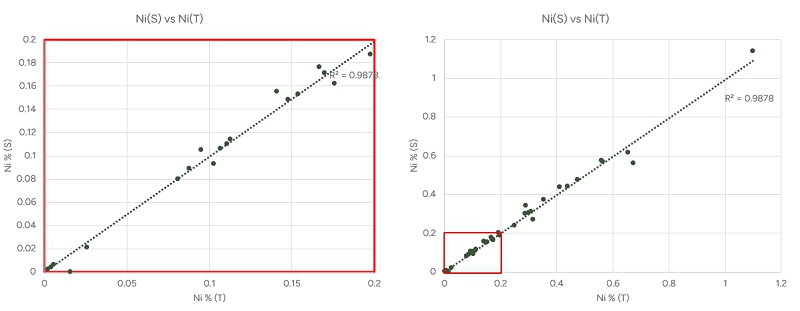
| Figure 11-5 Scatter plots comparing total and sulphide nickel | 68 |
| Figure 12-1 QQ plot comparing original and resample Ni assays | 71 |
| Figure 12-2 QQ plot comparing original and resample Cu assays | 71 |
| Figure 12-3 QQ plot comparing original and resample Pt assays | 72 |
| Figure 12-4 QQ plot comparing original and resample Pd assays | 72 |
| Figure 12-5 QQ plot comparing original and resample Au assays | 73 |
| Figure 12-6 Visual comparison between resample original and twin hole nickel grades | 74 |
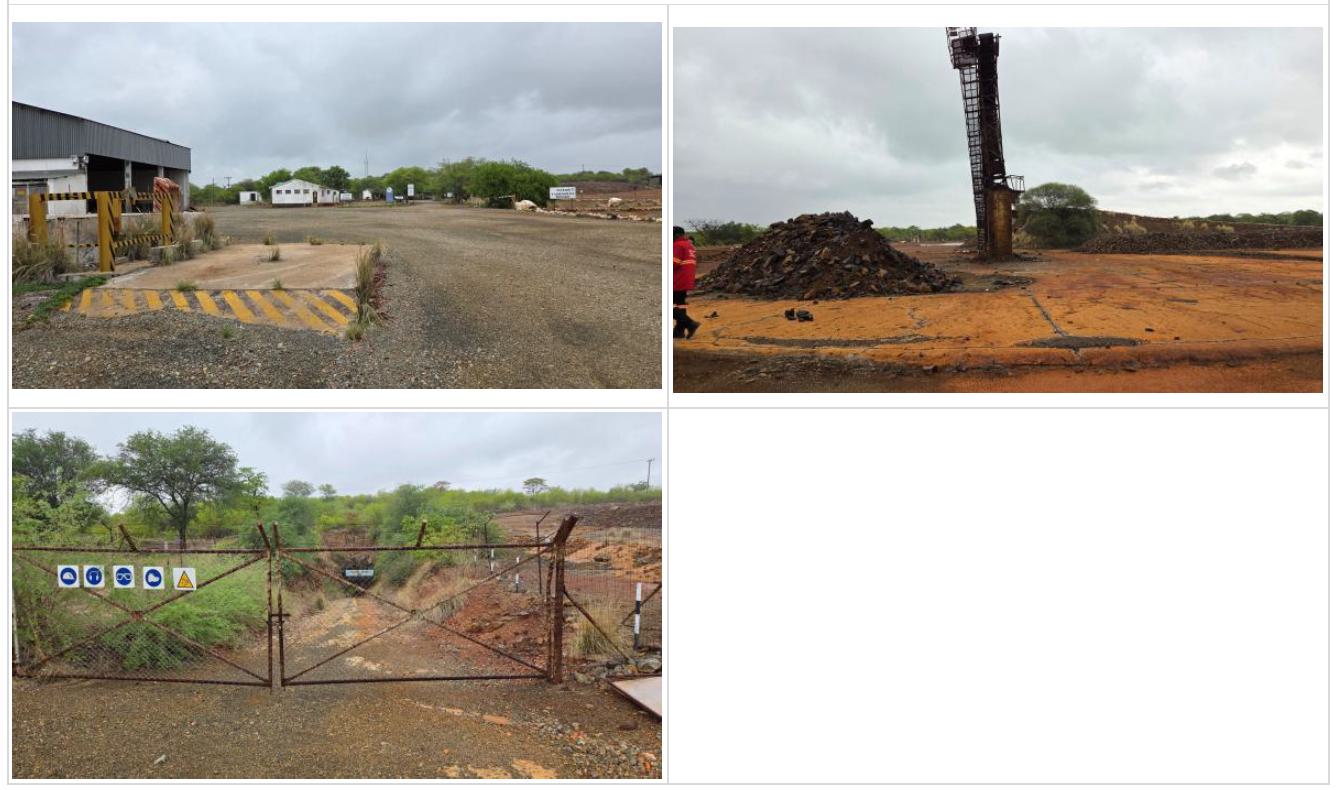
| Figure 12-7 Historical infrastructure at Selkirk (workshop, conveyer and remains of massive sulphide dump, portal entrance) | 75 |
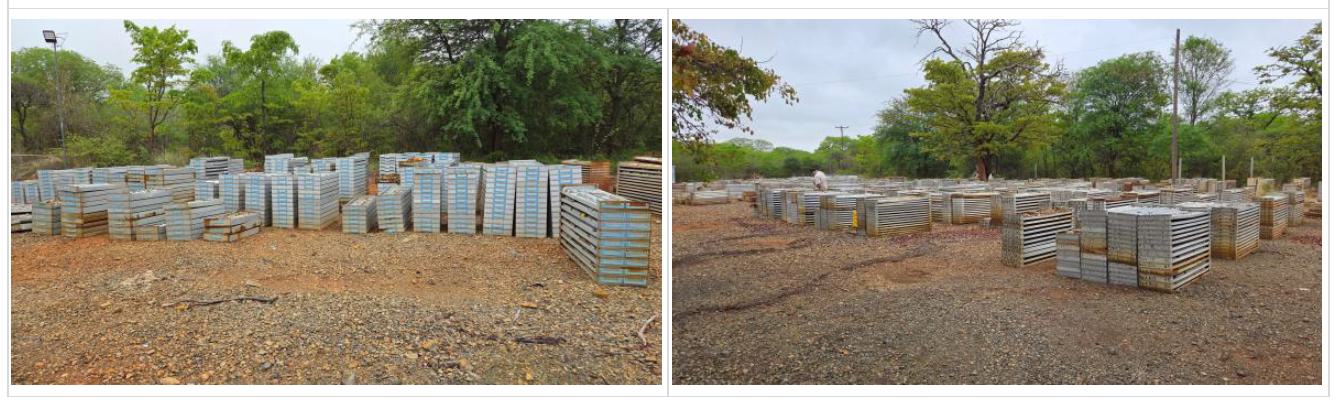
| Figure 12-8 TMNC core stored at Selkirk | 76 |
| Figure 12-9 Oxidised TMNC core at Selkirk | 76 |
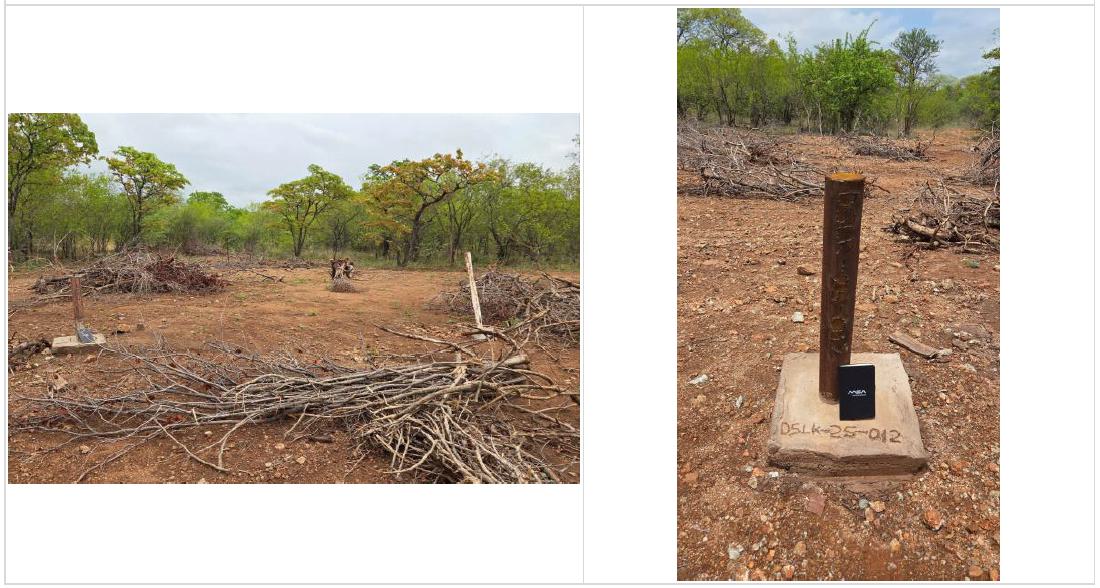
| Figure 12-10 Twin drilled collars (left) and infill drillhole collar (right) | 77 |
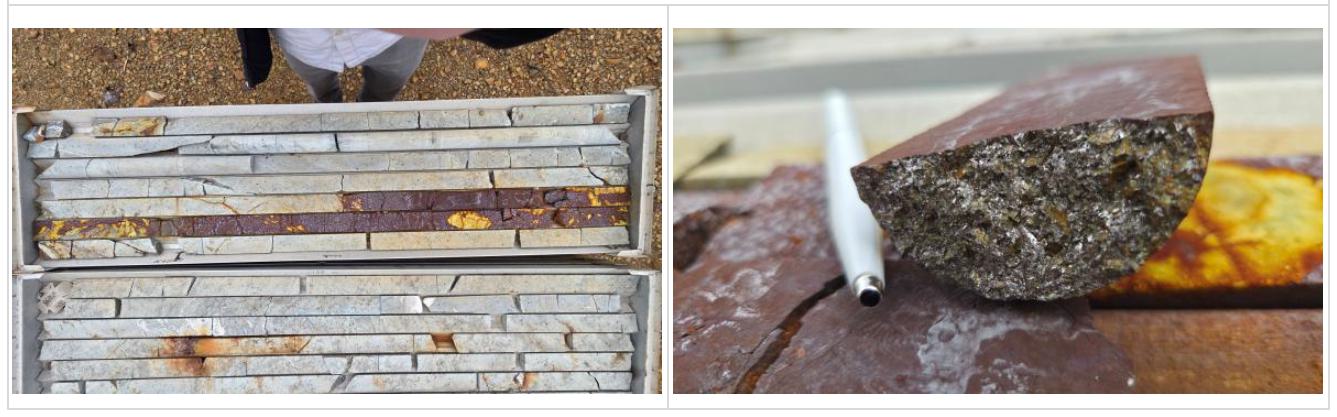
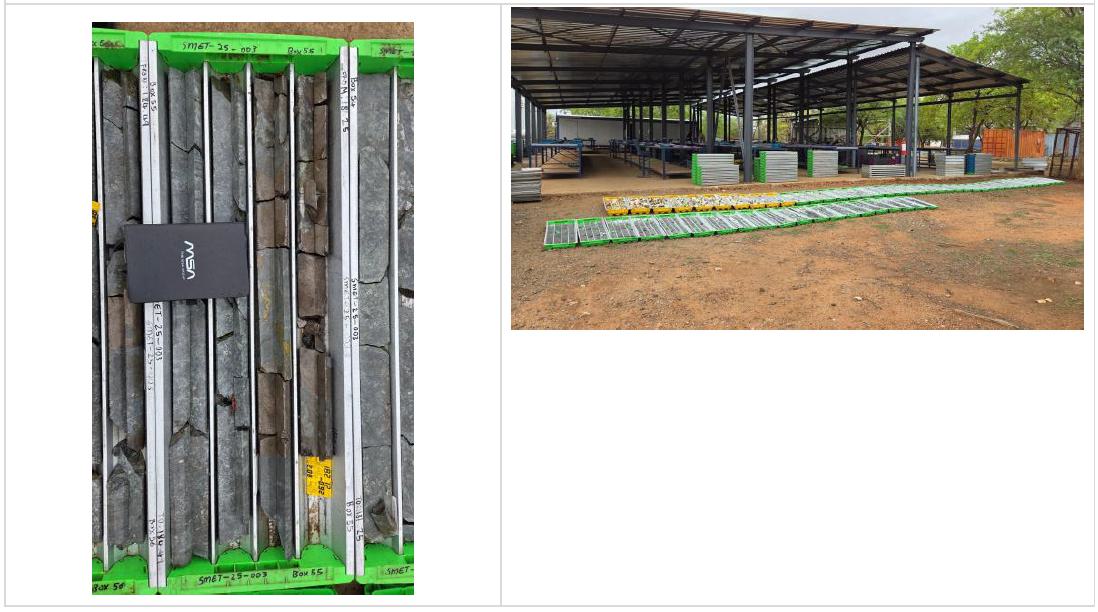
| Figure 12-11 Well mineralised core in SMET-25-003 (left), Core laid out for QP inspection at Selebi North core facility (right) | 77 |
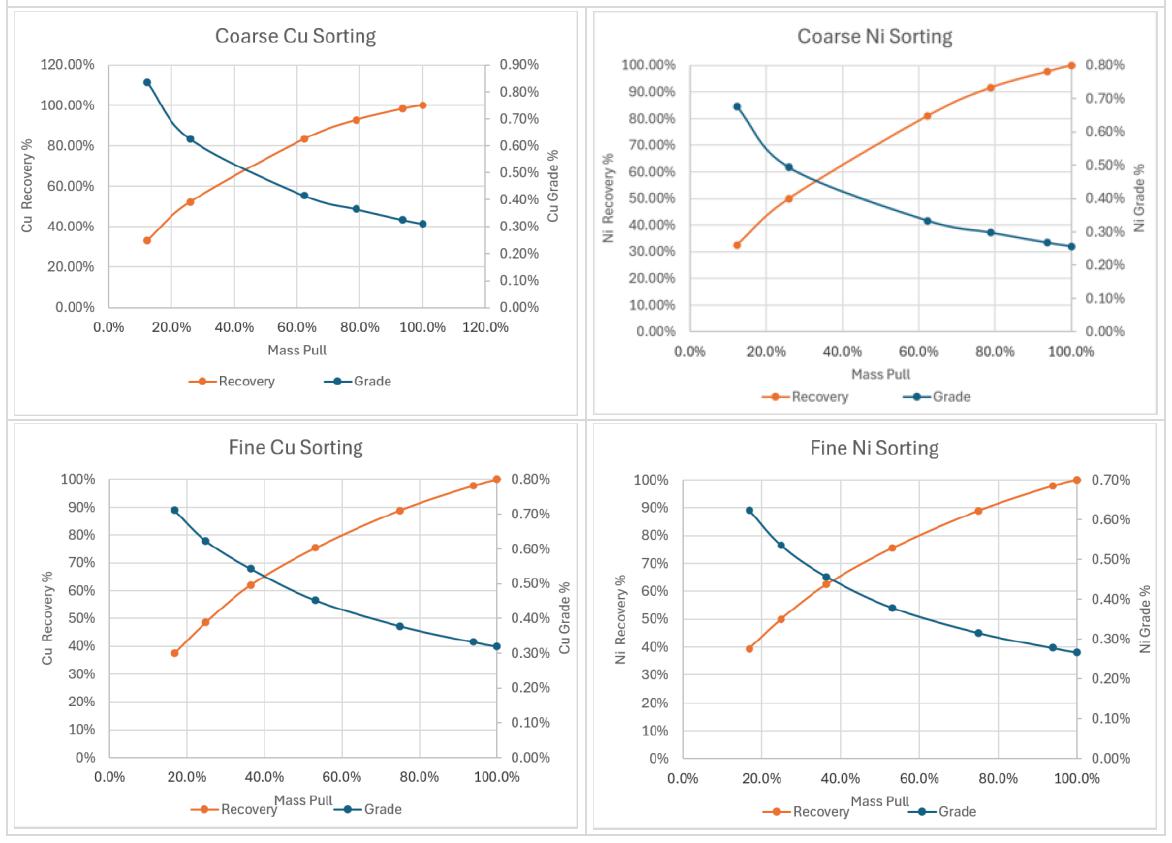
| Figure 13-1 Coarse and fine copper and nickel recovery versus mass pull curves | 80 |
| Figure 13-2 Tenor modal mineralogy | 83 |
| Figure 13-3 Copper and nickel metal deportment | 84 |
| Figure 13-4 Copper and nickel liberation by volume | 85 |
| Figure 13-5 Selkirk LCT flowsheet | 87 |
| Figure 13-6 Nickel and copper variability testwork | 91 |
| Figure 14-1 Plan showing location of drillhole collar data by type | 93 |
| Figure 14-2 Ni vs Cu Regression | 94 |
| Figure 14-3 View to the east of modelled mineralised zones | 96 |
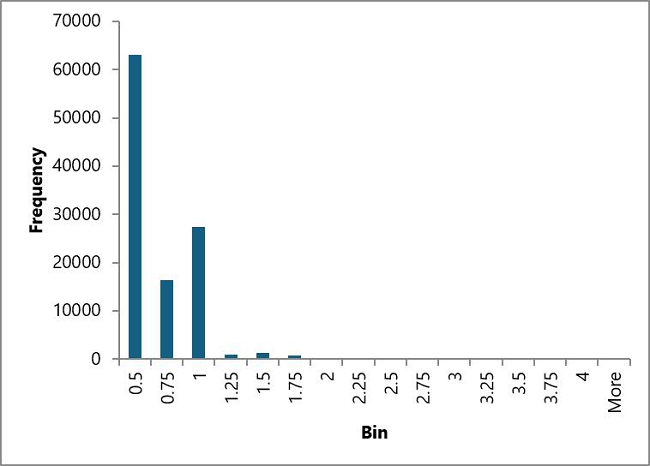
| Figure 14-4 Histogram of interval length | 97 |
| Figure 14-5 Density vs nickel scatterplot | 100 |
| Figure 14-6 Ni grade variograms | 101 |
| Figure 14-7 Pd grade variograms | 102 |
| Figure 14-8 Ag grade variograms | 102 |
| Figure 14-9 KNA block size analysis | 104 |
| Figure 14-10 KNA sample analysis | 105 |
| Figure 14-11 East - West block model section – Ni grade | 106 |
| Figure 14-12 North East – South West block model section – Cu grade | 106 |
| Figure 14-13 Ni, Cu, Pt and Pd swath plots in Y direction (MIN1) | 107 |
| Figure 14-14 View to the east showing Mineral Resource classification | 110 |
| Figure 14-15 Location and extent of conceptual pit-shell relative to the mining licence | 111 |
| Figure 14-16 Grade-Tonnage Curve: Indicated Resource | 114 |
| Figure 14-17 Grade-Tonnage Curve: Inferred Resource | 115 |
| Figure 23-1 Map showing surrounding Mining and Prospecting Licence holders adjacent to the Selkirk Mining Licence and the Prospecting Licences | 126 |
| J5050 – Selkirk Nickel-Copper-PGE Project S-K 1300 Technical Report Summary 17-08-2026 | Page: vii |
| 1. | Summary |
The MSA Group (Pty) Ltd. (MSA) was retained by NexMetals Mining Corp. (NEXM) to prepare a Technical Report Summary (TRS) on the Selkirk Nickel-Copper-PGE Project (Selkirk, the Selkirk Project or the Project), located in northeastern Botswana. The purpose of this TRS is to document the updated Mineral Resource Estimate (MRE) and the technical information available on the Project as of June 22, 2026. This TRS conforms to the United States Securities and Exchange Commission’s (SEC) Modernized Property Disclosure Requirements for Mining Registrants as described in Subpart 229.1300 of Regulation S-K, Disclosure by Registrants Engaged in Mining Operations (S-K 1300) and Item 601(b)(96) of Regulation S-K. The TRS and Mineral Resource Estimate has been prepared using diamond drilling sample assay data available up to and including March 19, 2026.
The conclusions, recommendations, and forward-looking statements made by Qualified Persons (QPs) are based on reasonable assumptions and results interpretations. Forward-looking statements cannot be relied upon to guarantee the Selkirk Project’s performance or outcomes and naturally include inherent risks and risks relating to the industry and NEXM.
NEXM is a Vancouver based exploration and development company. Its’ exploration activities focus on nickel and copper, with exploration projects in Botswana and Canada.
The Selkirk Project, including related infrastructure, was acquired by Premium Nickel Group Proprietary Limited (PNGPL) in an asset purchase agreement with the Liquidator of Tati Nickel Mining Company (TNMC). Prior to this acquisition, TNMC was jointly owned by BCL Limited (BCL, 85%) and the Government of Botswana (15%). On May 27, 2022, PNGPL was awarded the Mining Licence over the Selkirk Project, and the acquisition was finalised on August 22, 2022.
PNGPL is an indirect subsidiary of NEXM, being a wholly owned subsidiary of Premium Nickel Resources Selkirk Group (Barbados) Limited, which is in turn wholly owned by Premium Nickel Resources International Limited, which is in turn wholly owned by PNR Amalco Ltd., a direct wholly owned subsidiary of NEXM.
Prior to June 9, 2025, the Company was named Premium Resources Ltd. (PREM), prior to that, Premium Nickel Resources Ltd. (PNRL), and prior to that, North American Nickel Inc. (NAN). NEXM’s common shares trade on the TSX Venture Exchange (TSXV:NEXM) in Canada and the Nasdaq Capital Market (NASDAQ: NEXM) in the USA. NEXM began trading on the Nasdaq on July 16, 2025. NEXM currently own 100% of the Project through its subsidiary PNGPL.
The Project is currently conceptualised as an open pit mine capturing the disseminated sulphide Ni-Cu-PGE mineralisation present within the Selkirk gabbro host.
The TRS is an update of NEXM’s prior Technical Report Summary for the Property, with an effective date of November 1, 2024, prepared by SLR Consulting (Canada) Ltd (SLR) for Premium Resources Ltd. Premium Resources Ltd. changed its name to NexMetals Mining Corp. on June 09, 2025. This August 2026 TSR is not reliant on the prior TRS and supersedes it.
| J5050 – Selkirk Nickel-Copper-PGE Project S-K 1300 Technical Report Summary 17-08-2026 | Page: 1 |
| 1.1 | Property Description |
The Project is located in the northeast of Botswana approximately 28 km southeast of the city of Francistown and 450 km northeast of the national capital Gaborone.
The Project is accessed year-round via paved and gravel roads from Gaborone and Francistown. Project infrastructure includes relict surface infrastructure supporting the historical underground mine, and the original decline. The Project area is quite flat and, beyond the mine footprint, is covered in grassland with dispersed and clusters of trees typical of a tree savanna biome.
| 1.2 | Land Tenure |
The property consists of a single mining licence covering an area of 1,458 ha (14.58 km2) and four prospecting licences covering a total of 12,670 ha (126.7 km2). The mining licence, 2022/7L, is centred approximately at 21°19’13” S and 27°44’17” E and is held by PNGPL, an indirect subsidiary of NEXM. The mining licence was renewed for ten years commencing on May 27, 2022, ending on May 26, 2032. The four prospecting licences (PL050/2010, PL051/2010, PL210/2010, and PL071/2011) are valid for a period of two years effective from April 1, 2025.
| 1.3 | History |
Anglo American Corporation of South Africa (AAC) established the presence of nickel and copper occurrences at the sites of the ancient copper workings in the area in 1929. Significant exploration started in the mid-1960s by the Tati Territory Exploration Company (TTE). The first exploration campaigns included soil sampling, trench sampling, ground geophysics, and diamond drilling. At least four exploration and mining companies have worked on the Project since the 1960s and extensive historical work was conducted to characterise the economic potential of the property.
The Selkirk underground mine was operated from 1989 to 2002 by TNMC, a company created specifically to exploit the deposit. More than 1.0 Mt of material grading 2.6% Ni and 1.6% Cu was extracted from a semi-elliptical deposit of massive sulphide up to 20 m thick. Since 2003, extensive exploration has been completed to characterise the lower-grade/higher-tonnage halo of disseminated sulphides both surrounding and down plunge (south) of the mined-out high-grade mineralisation. Exploration and conceptual studies were conducted by Lion Ore Mining Pty Ltd. (Lion Ore) and subsequently by Norilsk Nickel Group of Companies (Norilsk Nickel) through their ownership in TNMC.
At the time of liquidation, a number of economic studies had been completed for the Project, including a Feasibility Study (FS) on the open pit concept at the Selkirk Project by WorleyParsons Limited (WorleyParsons) in 2016 on behalf of BCL. The FS included Mineral Resource and Mineral Reserve estimates prepared in accordance with the South African Code for the Reporting of Exploration Results, Mineral Resources and Mineral Reserves (SAMREC Code). The results of the study and associated Mineral Resource and Mineral Reserve estimates are considered to be historical in nature and should not be relied on. A Qualified Person (QP) has not completed work to classify the historical estimates as current and NEXM is not treating the historical estimate as current Mineral Resources or Mineral Reserves.
| J5050 – Selkirk Nickel-Copper-PGE Project S-K 1300 Technical Report Summary 17-08-2026 | Page: 2 |
| 1.4 | Geological Setting, Mineralisation and Deposit |
The Project lies within the Tati granite-greenstone belt of the Zimbabwe Craton. The mineralised body of the Selkirk deposit is hosted within the Selkirk Formation (>1 km thick), which consists mainly of dacitic and rhyolitic volcaniclastic rocks and minor amounts of mafic volcanic rocks, quartzites, and quartz sericite schists. The Selkirk Formation hosts the Phoenix, Selkirk, and Tekwane metagabbronoritic intrusions and the Sikukwe metaperidotite intrusion. The area around the Project hosts intrusive magmatic Ni-Cu-PGE sulphide deposits; namely the Phoenix deposit, as well as the Tekwane and Cinderella exploration prospects.
Two styles of mineralisation are found at Selkirk: (1) massive sulphides (largely mined-out), located within the metagabbro intrusion, as well as small, massive sulphide accumulations at the base of the taxitic metagabbro intrusive, and (2) matrix and disseminated sulphides as a halo surrounding and down-dip of the mined-out massive sulphide body. The disseminated zone that once included the mined-out sulphide lens, lies 50 m to 100 m above the basal contact of the footwall quartz diorite and mimics the footwall contact. Currently available drilling suggests that the shallow, previously mined, massive sulphide lens was synformal in shape and measured up to 70 m to 90 m wide, averaged 20 m thick, and had a plunge extent of 200 m.
The disseminated sulphide mineralisation surrounding the massive sulphides averages 100 m to 150 m thick, dips steeply west and plunges shallowly to the southwest at 25°. It is defined from surface over a distance of 900 m and remains open at depth. Sulphide mineralisation consists of pentlandite, pyrrhotite, chalcopyrite, and pyrite. At least three generations of dykes crosscut the mineralised metagabbro. Numerous faults traversing the deposit have been described in surface and underground mapping, none of which present significant displacement at the deposit scale. The Selkirk metagabbro host has been attributed an age of 2.7 Ga.
| 1.5 | Exploration |
Exploration work on the Selkirk Mining Licence completed by the PNGPL Project team to date included the sourcing and digitisation and verification of existing historical information. Recent work included analyses of the 2007 soil sampling data, drill testing of three versatile time-domain electromagnetic (VTEM) survey anomalies, surface and borehole electromagnetic (EM) surveys.
Validation and verification of the historical data included confirmation and re-surveying of 320 drillhole collar locations, channel sampling underground, sampling mineralised drill core found unsampled on surface and two re-sampling campaigns of historical drillholes. Eleven large diameter drillholes that twinned TNMC holes were used to verify the historical results and produce samples for metallurgical testwork. An additional hole in this program was completed as a resource infill hole.
Drill testing of three VTEM anomalies in 2025 all intersected sulphides, with the two holes to the southwest of the conceptual pit testing and intersecting the southwest extension of the Selkirk gabbro-footwall contact. Re-analyses of the 2007 soil data highlighted areas of mafic intrusions and high priority point anomalies for follow-up.
Work on the Prospecting Licences included data compilation, transfer of core from the Phoenix site, target generation, field prospecting, three surface EM surveys, Differential Global Positioning System (DGPS) of drillhole collars, and sampling of two mineralised intervals of 2012 drillholes DRKP001 and DRKP002.
Analyses of the 2025 soil survey data on the PLs indicates a mafic intrusion 2 km x 2.5 km located 6 km northwest of Selkirk.
| J5050 – Selkirk Nickel-Copper-PGE Project S-K 1300 Technical Report Summary 17-08-2026 | Page: 3 |
| 1.6 | Sample Preparation, Analyses, and Security |
Historical drillhole data were prepared and analysed at the Phoenix Mine Laboratory. At the time of preparation and analysis, TNMC owned both the Phoenix Mine and Selkirk, and the laboratory was not independent of the operator. From 2011, the Phoenix Mine Laboratory held accreditation with the South African National Accreditation System (SANAS), and with the International Organisation for Standardisation/International Electrotechnical Commission (ISO/IEC) 17025 for chemical analyses. At the Phoenix Mine Laboratory, nickel and copper were analysed by X-ray fluorescence (XRF) and Pt, palladium (Pd), and gold (Au) were analysed using a 50 g fire assay.
Unsampled intervals of drill core from a total of five historical drillholes from 2016 completed by the former operator of the Selkirk Mine, TNMC, were cut, sampled, and sent for analysis at ALS Global laboratory in Johannesburg, South Africa in 2021. In addition, 51 historical drillholes representing the drilling over the deposit spatially and temporally were re-sampled in 2024 and 2025 using half core. Eleven large diameter holes (HQ: 63.5 mm diameter) and one NQ sized hole (47.6 mm diameter) were drilled in 2025.
The PNGPL drill core was logged, photographed and marked for sampling in nominal lengths of one metre. The core samples were cut in half longitudinally using a rotating diamond saw. The bagged core samples were given a unique sample reference number, bagged and despatched to ALS Laboratories Ltd. in Johannesburg, South Africa for analysis (SANAS Accredited Testing Laboratory, No. T0387).
Analyses of the PNGPL samples for nickel, copper, and cobalt were completed by ALS using a peroxide fusion preparation and inductively coupled plasma atomic emission spectrometry (ICP-AES) finish (ME-ICP81). Analyses for platinum (Pt), palladium (Pd), and gold (Au) were by fire assay (30 g nominal sample weight) with an ICP-AES finish (PGM-ICP23). A suite of 48 elements, including silver (Ag), was analysed for a selection of drillholes using a 4-acid digest and ICP-AES finish (ME-ICP61). Specific gravity measurements were also completed by ALS.
The PNGPL drilling and resampling was subjected to a comprehensive program of quality assurance and quality control (QAQC) by PNGPL, independent of the laboratories own QAQC measures, including certified reference materials (5%), blank samples (5%), coarse and duplicate samples (5%) and pulp duplicate samples (5%). The MSA Qualified Person is satisfied that the assay results are of sufficient accuracy and precision for use in Mineral Resource estimation.
All historical core is stored on site within a secure fenced facility. Core from holes drilled by PNGPL are stored at the Selebi North core processing and storage facility near the town of Selebi Phikwe.
| 1.7 | Mineral Processing and Metallurgical Testing |
NexMetals intends to use flotation to produce separate copper and nickel concentrates. Metallurgical testwork programs were conducted by SGS Natural Resources (SGS) in Lakefield, Ontario, in 2021 and 2023, evaluating separate copper and nickel concentrate production at a conceptual level. A more comprehensive program was subsequently completed at Blue Coast Research (BCR) in 2025 and 2026 to further support the development of the two separate concentrates. The BCR testwork supported flowsheet development and informed key unit operations, including crushing, grinding, and flotation. Metallurgical recoveries for copper (Cu), nickel (Ni), cobalt (Co), platinum, palladium, gold, and silver were estimated using results from locked-cycle testwork on the master composite sample, suitable for an initial-level evaluation.
| J5050 – Selkirk Nickel-Copper-PGE Project S-K 1300 Technical Report Summary 17-08-2026 | Page: 4 |
| 1.8 | Data Verification |
An extensive program of historical data verification was completed by PNGPL including re-surveying of 320 drillhole collar locations and two re-sampling campaigns of historical drillholes. Eleven large diameter drillholes that twinned TNMC holes were used to verify the historical results and produce samples for metallurgical testwork. An additional hole in this program was completed as a resource infill hole.
Independent verification included a site visit by the MSA QP from November 07 (site inspection) to November 08, 2025 (PNGPL core inspection). On site, the MSA QP inspected historical mineralised core, viewed the gossanous outcrop at surface, observed existing infrastructure, including the Selkirk underground ramp and remains of massive sulphide stockpiles at surface, and verified the locations of several surface drillhole collar locations (both historical and recent). The mineralisation in five of the twin holes completed by PNGPL was inspected by the MSA QP. The assay results from ALS for a selection of the PNGPL sampling have been verified against independently accessed assay certificates, and a random selection of historical database results have been compared against digital records.
MSA’s independent checks revealed no issues aside from several TNMC drillholes that did not have associated down hole surveys and were excluded from the validated data. No material biases between the historical TNMC surface drillhole sample assays and recent sample assays were found. The drillhole data from TNMC underground drilling and from drilling work completed prior to TNMC was not verified and therefore not included in the Mineral Resource Estimate.
| 1.9 | Mineral Resource Estimates |
The Mineral Resource was estimated in compliance with Subpart 1300 of Regulation S-K (17 CFR § 229.1300) (“Regulation S-K 1300”).
Estimation comprised modelling of the Selkirk metagabbro, dykes and a surface representing the base of oxidation, followed by the construction of an implicit probability mineralised shell within the metagabbro including drillhole sample intervals greater than a Net Smelter Return (NSR) value of USD20. A three-dimensional block model with parent cells of 20 mX by 20 mY by 10 mRL, and appropriate sub-celling, was used to estimate metal grades and density by ordinary kriging. Volumes representing mined voids and oxidised material were removed and dykes were assigned grades of zero. NSR was then calculated for each block model cell using the estimated grades, metal prices, recoveries, off-site costs and payabilities. The mineral resource model was classified into the Indicated and Inferred categories, taking into account data quality, geological modelling uncertainty, drillhole spacing and kriging outputs. The majority of the Indicated Mineral Resource is informed by drillholes closer than 60 m apart up to maximum spacing of 75 m.
The Mineral Resource was reported using a NSR based optimised pit-shell. Using concentration costs of USD20/tonne, General and Administration (G&A) expenses of USD1.35 per tonne and royalites of 3% for base metals and 5% for precious metals, blocks that occur within the pit-shell with estimated NSR above USD25 satisfy cut-off grade criteria and, together with the optimised pit shell, the MSA QP considers that reasonable prospects for economic extraction (RPEE) for the Mineral Resource have been demonstrated. The Mineral Resource for the Selkirk Project is presented in Table 1-1.
| J5050 – Selkirk Nickel-Copper-PGE Project S-K 1300 Technical Report Summary 17-08-2026 | Page: 5 |
Table 1-1 Selkirk Mineral Resource Statement as of 22 June 2026 reported on a 100 % ownership basis |
| Class | Tonnes | CuEq Grade |
Total Contained CuEq | NSR | Grade | ||||||
| Ni | Cu | Co | Pt | Pd | Au | Ag | |||||
| (Millions) | (%) | (Mlbs) | (USD) | (%) | (%) | (%) | (g/t) | (g/t) | (g/t) | (g/t) | |
| Measured | 0.0 | - | 0 | - | - | - | - | - | - | - | - |
| Indicated | 78.2 | 0.66 | 1,133 | 56 | 0.21 | 0.23 | 0.012 | 0.10 | 0.42 | 0.05 | 0.72 |
| Inferred | 15.1 | 0.60 | 198 | 51 | 0.18 | 0.21 | 0.010 | 0.09 | 0.40 | 0.05 | 0.77 |
| Contained Metal | |||||||||||
| Ni | Cu | Co | Pt | Pd | Au | Ag | |||||
| (kt) | (kt) | (kt) | (koz) | (koz) | (koz) | (koz) | |||||
| Measured | - | - | - | - | - | - | - | ||||
| Indicated | 163 | 181 | 9.2 | 245 | 1,066 | 120 | 1,818 | ||||
| Inferred | 27 | 32 | 1.6 | 45 | 193 | 25 | 372 | ||||
Notes:
1 Mineral Resources have been classified in accordance with SEC Regulation S-K 1300 and have been estimated under the supervision of the Qualified Person, MSA, a third-party firm comprising mining experts as defined by S-K 1300.
2 The 2026 MRE has been prepared in accordance with S-K 1300 definitions. Mineral Resources are exclusive of Mineral Reserves. There are no Mineral Reserves reported.
3 Mineral Resources, which are not Mineral Reserves, have no demonstrated economic viability. There is no guarantee that that all or any part of the Mineral Resource will be converted into a Mineral Reserve. The estimate of Mineral Resources may be materially affected by geology, environment, permitting, legal title, taxation, socio-political, marketing, or other relevant issues.
4 It cannot be assumed that all or any part of an Inferred Mineral Resource will ever be upgraded to an Indicated or Measured Mineral Resource.
5 The assessment is preliminary in nature; it includes Inferred Mineral Resources that are considered too speculative geologically to have modifying factors applied to them that would enable them to be categorised as Mineral Reserves, and there is no certainty that this economic assessment will be realised.
6 Mineral Resources reported on a 100% NEXM ownership basis.
7 All tabulated data have been rounded and as a result minor computational errors may occur.
8 kt = thousand tonnes, Mlbs = Million pounds, koz = thousand ounces.
9 Mineral Resources are reported in situ (point of reference).
10 The Mineral Resource is report as in situ dry tonnes; figures are reported in metric tonnes.
11 Mineral Resources are reported within an optimised pit shell using NSR values, mining cost of USD3 per tonne (additional USD 0.008 per metre depth from pit rim), concentrate costs of USD20 per tonne, G&A of USD1.35 per tonne, 45°pit slope to base of partially weathered and 60° in fresh rock.
12 Mineral Resources are reported at a cut-off value of USD25/t NSR (Net Smelter Return) defined as received value of final metal recovered minus off-site costs.
13 Mineral Resources are estimated using long-term prices of USD9.10/lb Ni, USD5.10/lb Cu, USD20.00/lb Co, USD1,800/oz Pt, USD1,550/oz Pd, USD3,600/oz Au and USD52.00/oz Ag. The same metal prices were used in CuEq and NSR calculations.
14 Mineral Resources are estimated using nickel, copper, cobalt, platinum, palladium, gold and silver recoveries of 54%, 88%, 53%, 56%, 78%, 72% and 61%, respectively, derived from metallurgical studies which consider a two-concentrate scenario.
15 Payabilities and off-site treatment and refining costs were derived from an independent marketing study commissioned by NexMetals.
16 The CuEq value was calculated based on relative recovered value received for each metal excluding costs. Received value for each metal was calculated using the formula: in-situ grade*concentrator recovery*payability*metal price. The ratio between received copper value and total other metal value was then used to calculate CuEq, i.e., CuEq = (1+value excluding Cu / Cu value) * Cu grade. Formula is: CuEq(%)=Cu(%)+Ni(%)*(85.1/91.4)+Co(%)*(93.8/91.4)+Pt(g/t)*(22.4/91.4)+Pd(g/t)*(33.1/91.4)+Au(g/t)* (68.5/91.4)+Ag(g/t)*(0.8/91.4)
| J5050 – Selkirk Nickel-Copper-PGE Project S-K 1300 Technical Report Summary 17-08-2026 | Page: 6 |
17 Bulk density has been estimated in the block model based on an extensive data set of measurements taken from drillhole cores.
18 The effective date of the Mineral Resource estimate is 22 June 2026.
The MSA QP is not aware of any environmental, permitting, legal, title, taxation, socio-economic, marketing, political, or other relevant factors that could materially affect the Mineral Resource Estimate.
| 1.10 | Conclusions |
| 1.10.1 | Geology and Mineral Resources |
| ● | There is good understanding of the geology and the nature of the mineralisation at the Project. The Selkirk geology has been the subject of several academic studies and numerous techno-economic evaluations over several decades. |
| ● | Selkirk represents a large magmatic sulphide deposit of which a high grade lens of massive sulphide was extracted from underground by TNMC. The remaining disseminated mineralisation represents a high tonnage low-grade deposit is suitable to be mined by open-pit methods. |
| ● | The interpreted oxidised portion of the deposit has been excluded from the Mineral Resource. Further work is required to establish the depth of oxidation and to what level of oxidation that could have economic benefit to the project. |
| ● | The Mineral Resource is underpinned by a combination of historical and recent data. There are deficiencies in the historical assay data, that appear to be in part related to data management. The verification work that has taken place has confirmed the historical assays populations. Assays from the extensive resampling program have replaced the historical assays in the database, and increased the amount of platinum, palladium and gold data, significantly reducing project risk due to reliance on historical assay data. |
| ● | Eleven twin holes and a resource infill hole, drilled and sampled by PNGPL, have further verified the geology and grade of the deposit, providing additional high quality nickel-copper-PGE assays. Furthermore, five holes that were drilled by the previous operator, and were not sampled, have been sampled and assayed by PNGPL. Infill and extension sampling of unsampled intervals of TNMC core has further added to the high confidence data. |
| ● | There are no drilling, sampling or recovery factors identified that could materially impact the accuracy and reliability of the results. |
| ● | The Mineral Resource is adequately drilled for the level of classification applied. The majority of the Mineral Resource is classified as Indicated. |
| J5050 – Selkirk Nickel-Copper-PGE Project S-K 1300 Technical Report Summary 17-08-2026 | Page: 7 |
| 1.10.2 | Mineral Processing |
| ● | Based on the results from preliminary studies and historical data analyses, the proposed treatment process for Selkirk material considers flotation of two concentrate products (copper and nickel). |
| ● | Earlier SGS testwork demonstrated while flotation test results indicated that copper-nickel separation is achievable, further representative sampling was required to demonstrate that the target grades of copper and nickel in two concentrates can be consistently met. |
| ● | X-ray Transmission (XRT) ore sorting was evaluated on a bulk sample to assess the amenability of the Selkirk deposit to pre-concentration. Results indicated high recovery losses relative to the level of waste removal required, with no clear economic cut-off identified. For the purposes of this report, ore sorting is not considered or applied prior to flotation. |
| ● | Blue Coast Research (BCR) testwork was carried out on fresh core from the re-assay program, providing spatial coverage and representation of varying nickel tenor and copper grade. Flowsheet development successfully demonstrated the ability to produce saleable copper and nickel concentrates meeting clean specifications suitable for market sale. Variability testwork was carried out on the three tenor domain samples, which demonstrated notable variability in nickel recovery and grade across each domain. |
| ● | The metallurgical and analytical data have been collected in a manner that is suitable to be used conceptually for Mineral Resources estimation, however, further testwork to optimise the individual domains, along with further analysis of the deposit based on tenor domains, is recommended for the next stage of metallurgical testwork. |
| 1.11 | Recommendations |
| 1.11.1 | Geology and Mineral Resources |
The confidence in the Mineral Resource is sufficient to progress the Project to a Preliminary Economic Assessment (PEA).
Exploration work is merited on the Exploration licences, comprising soil geochemistry, surface geophysics and diamond drilling.
Further work on the historical data may be considered as the project advances further, largely related to more detailed assessment of the historical database.
| 1.11.2 | Mineral Processing |
Recommended work comprises work in support of a PEA and planning work in support of more advanced studies:
| ● | In support of the PEA (Phase1): |
| ○ | Complete remaining variability testwork on the three tenor domain samples to finalise the current metallurgical program. |
| ○ | Re-assess the tenor domains across the deposit using the updated block model, to ensure the master composite accurately reflects the tenor blend. |
| J5050 – Selkirk Nickel-Copper-PGE Project S-K 1300 Technical Report Summary 17-08-2026 | Page: 8 |
| ● | As part of further exploration work to support future, more advanced studies (Phase 2): |
| ○ | Plan the next stage of testwork including a geo-metallurgical study, to fully characterise variability in mineralisation across the deposit and enhance the reliability of recovery estimates in support of the mine plan. |
| ○ | Utilise the updated domains to determine additional drilling requirements, ensuring adequate spatial and mineralogical representation across each domain. |
| 1.12 | Forward Work Program |
The proposed forward work program comprises a PEA (Phase 1) supported by additional metallurgical testwork. In parallel, exploration on the properties is proposed to take place (Phase 2). Phase 2 is not contingent on the results of Phase1. The approximate budget for the forward work program is shown in Table 1-2.
Table 1-2 Forward work program proposed budget |
| Item | Cost | |
| USD (‘000) | CAD (‘000) | |
Phase 1 PEA a) Remaining Metallurgical Testwork to support the PEA |
35 | 50 |
| b) Preliminary Economic Assessment | 650 | 923 |
Phase 2 Exploration Work (not contingent on the outcome of Phase 1) Soil geochemistry Surface geophysics Diamond drilling Geometallurgy |
106 | 150 |
| General site and administration costs | 70 | 100 |
| Subtotal | 861 | 1,223 |
| Contingency (5%) | 35 | 50 |
| Total Phase 1 and 2 | 896 | 1,273 |
Note: Exchange rate as of 22 June 2026 = CAD 1.42 to USD1.00
The QPs support progressing to a PEA and further exploration work and consider that the approximate costs outlined in the proposed budget (Table 1-2) are justified for the current stage of the Project.
| J5050 – Selkirk Nickel-Copper-PGE Project S-K 1300 Technical Report Summary 17-08-2026 | Page: 9 |
| 2. | Introduction |
| 2.1 | Background, Terms of Reference and Purpose of the Report |
The MSA Group (Pty) Ltd. (MSA) was retained by NexMetals Mining Corp. (NEXM) to prepare a Technical Report Summary (TRS) on the Selkirk Nickel-Copper-PGE Project (Selkirk, the Selkirk Project or the Project), located in northeastern Botswana. The purpose of this TRS is to document the updated Mineral Resource Estimate (MRE) and the technical information available on the Project as of June 22, 2026.
This TRS conforms to the United States Securities and Exchange Commission’s (SEC) Modernized Property Disclosure Requirements for Mining Registrants as described in Subpart 229.1300 of Regulation S-K, Disclosure by Registrants Engaged in Mining Operations (S-K 1300) and Item 601 (b)(96) Technical Report Summary. The reported Mineral Resources are based on data collected up to March 19, 2026.
The conclusion, recommendations, and forward-looking statements made by Qualified Persons (QPs) are based on reasonable assumptions and results interpretations. Forward-looking statements cannot be relied upon to guarantee the Selkirk Project’s performance or outcomes and naturally include inherent risks and risks relating to the industry and NEXM.
NEXM is a Vancouver based exploration and development company previously named Premium Resources Ltd. (PREM) and prior to that, Premium Nickel Resources Ltd. (PNRL) and prior to that, North American Nickel Inc. (NAN). PREM changed its name to NEXM on June 9, 2025. NEXM’s common shares trade on the TSX Venture Exchange (TSXV:NEXM) in Canada and the Nasdaq Capital Market (NASDAQ: NEXM) in the USA (since July 16, 2025). Its exploration activities focus on nickel and copper, with exploration projects in Botswana and Canada.
The Selkirk Project, including related infrastructure, was acquired by Premium Nickel Group Proprietary Limited (PNGPL) in an asset purchase agreement with the Liquidator of Tati Nickel Mining Company (TNMC). Prior to this acquisition, TNMC was jointly owned by BCL Limited (BCL, 85%) and the Government of Botswana (15%). On May 27, 2022, PNGPL was awarded the Mining Licence over the Selkirk Project, and the acquisition was finalised on August 22, 2022.
TNMC operated the historical Selkirk Mine as a small underground nickel-copper mine from 1989 to 2002, extracting massive sulphide material from the shallow dipping, semi-elliptical, high-grade core of the Selkirk gabbro from near surface to a depth of approximately 100 m. A total of 1.0 million tonnes (Mt) at grades of 2.6% Ni and 1.5% Cu were mined and shipped directly to the BCL smelter during this time. The mine ceased operations after exhausting the massive sulphide material and undertaking partial pillar extraction.
The Project is currently conceptualised as an open pit mine capturing the lower grade nickel-copper-cobalt-platinum group elements (Ni-Cu-PGE) mineralisation present within the Selkirk gabbro host.
| J5050 – Selkirk Nickel-Copper-PGE Project S-K 1300 Technical Report Summary 17-08-2026 | Page: 10 |
At the time of liquidation, a number of economic studies had been completed for the Project, including a Feasibility Study (FS) on the open pit concept at the Selkirk Project by WorleyParsons Limited (WorleyParsons) in 2016 on behalf of BCL. The FS included Mineral Resource and Mineral Reserve estimates prepared in accordance with the South African Code for the Reporting of Exploration Results, Mineral Resources and Mineral Reserves (SAMREC Code). The results of the study and associated Mineral Resource and Mineral Reserve estimates are considered to be historical in nature and should not be relied on. A QP has not completed sufficient work to classify the historical estimates as current and NEXM is not treating the historical estimate as current Mineral Resources or Mineral Reserves.
Exploration work completed by the PNGPL (a subsidiary of NEXM – see section 2.3) Project team to date has consisted of the sourcing and digitisation of existing historical information, confirming collar location information on selected historical holes, re-logging selected drill core, sampling mineralised drill core found unsampled on surface, re-sampling of historical drill core, drilling of twelve holes within the Selkirk deposit, three regional exploration drillholes, surface and downhole geophysics and submitting samples for metallurgical testing. Studies at various levels of completion have been initiated by PNGPL into the feasibility of the open pit concept and processing options.
This TRS contains forward-looking information.
| 2.2 | Registrant for Whom the Technical Report Summary was Prepared |
This report was prepared as a TRS in accordance with the SEC S-K regulations (Title 17, Part 229, Items 601 and 1300 through 1305) for NexMetals Mining Corp.
| 2.3 | Corporate Structure |
PNGPL is an indirect subsidiary of NEXM, being a wholly owned subsidiary of Premium Nickel Resources Selkirk Group (Barbados) Limited, which is in turn wholly owned by Premium Nickel Resources International Limited, a direct wholly owned subsidiary of NEXM.
Throughout this report references are made to PNGPL as the local operating company and NEXM as the ultimate Project owner and issuer of the report, and in some instances references to either entity are interchangeable.
| 2.4 | Principal Sources of Information |
MSA has based its review of the Property on information provided by NEXM/PNGPL, along with technical reports by the current and previous tenement holders, and other relevant published and unpublished data as listed in the References section of this Report.
MSA has endeavoured, by making all reasonable enquiries, to confirm the authenticity and completeness of the technical data upon which the TRS is based. The TRS and Mineral Resource Estimate has been prepared using diamond drilling sample assay data available up to and including March 19, 2026.
| J5050 – Selkirk Nickel-Copper-PGE Project S-K 1300 Technical Report Summary 17-08-2026 | Page: 11 |
During the site visit and during the preparation of this TRS, discussions were held online and onsite with personnel from NEXM:
| ● | Sharon Taylor, P.Geo., Vice President Geophysics, NEXM. |
| ● | Gerry Katchen, P.Geo., former Exploration Manager, NEXM. |
The principal sources of information used in the Mineral Resource include an extensive drillhole database complied by PNGPL. The data sourced from campaigns by the previous owner of the Project (TNMC) have been extensively validated, original sampling data have been verified and additional data from infill and extensional sampling of historical drillhole cores, 11 twin drillhole and an infill drillhole by PNGPL have been included.
| 2.4.1 | Previous Technical Reports |
Previous technical reports on the Project include:
| ● | A Technical Report on the Project was filed in Canada in 2023 (G Mining Services Inc., 2023), titled: “NI 43-101 Technical Report. Selkirk Nickel Project. North East District, Republic of Botswana”, prepared by G Mining Services Inc. for Premium Nickel Resources Ltd. (now NexMetals). This report did not include a Mineral Resource estimate. |
| ● | A Technical Report on the Project that included a Mineral Resource Estimate with an effective date of November 1, 2024 that was filed in Canada on January 08, 2025 (SLR, 2024 ), titled: “NI 43-101 Technical Report. Selkirk Nickel Project, North East District, Republic of Botswana” prepared by SLR Consulting (Canada) Ltd. (SLR) for Premium Resources Ltd. (now NexMetals). |
| ● | A Technical Report Summary on the Project that included a Mineral Resource Estimate with an effective date of November 1, 2024 that was filed in the Unites States on January 31, 2025 titled: “S-K 1300 Technical Report Summary. Selkirk Nickel Project, North East District, Republic of Botswana”, prepared by SLR Consulting (Canada) Ltd for Premium Resources Ltd. (now NexMetals). |
MSA has reviewed the aforementioned previous technical reports and, where appropriate, referenced information from these reports.
This TRS supersedes the previous report: S-K 1300 Technical Report Summary. Selkirk Nickel Project, North East District, Republic of Botswana, dated November 1, 2024, prepared by SLR Consulting (Canada) Ltd which had previously been filed in accordance with U.S. SEC (Regulation S-K Subpart 1300 (“S-K 1300”).
| 2.5 | Qualifications, Experience and Independence |
MSA is an exploration and resource consulting and contracting firm, which has been providing services and advice to the international mineral industry and financial institutions since 1983. The MSA Group is independent of NEXM, its respective directors, senior management and advisers.
Neither MSA, Fuse Advisors nor personnel nominated for the completion or review of work, including the QPs, have any material interest (present or contingent) in NEXM or the mineral properties in which NEXM has an interest. The relationship with NEXM is solely one of professional association between client and independent consultants. This report is prepared in return for professional fees based upon agreed commercial rates and the payment of these fees is in no way contingent on the results of this report. The QPs and authors have no bias with respect to the asset that is the subject of the Report, or to the parties involved with the assignment. These is no conflict of interest in MSA or Fuse Advisors undertaking the QP Report as contained in this document.
| J5050 – Selkirk Nickel-Copper-PGE Project S-K 1300 Technical Report Summary 17-08-2026 | Page: 12 |
| 2.5.1 | Qualified Persons |
This report was compiled by MSA, with sub-sections authored by Fuse Advisors, a part of SLR Consulting. Both firms are third-party firms comprising mining experts in accordance with 17 CFR § 229.1302(b)(1). NEXM has determined that both firms meet the qualifications specified under the definition of Qualified Person in 17 CFR § 229.1300. The list of firms responsible for each report section is presented in Table 2-1.
References to the Qualified Person, or QP, in this report are references to MSA or Fuse Advisors and not to any individual employed by MSA or Fuse Advisors. In the case of instances referring to geology, exploration, Mineral Resources and direct relations, the QP refers to MSA and not to any individual employed by MSA. In the instances referring to mineral processing and metallurgical testing, the QP refers to Fuse Advisors and not to any individual employed by Fuse Advisors.
Table 2-1 Technical Report Summary sections and third-party firms |
| Company | Sections Responsible for | Sections Co-Responsible for |
| MSA | 4 – 12, 14 - 23 | 1, 2, 3, 24, 25, 26, 27 |
| Fuse Advisors | 1.7, 13 | 1, 2, 3, 24, 25, 26, 27 |
| 2.6 | Site Visits and Scope of Personal Inspection |
Site visits were performed by the QPs as follows:
| ● | The MSA QP visited the Project for two days from November 07 to November 08, 2025. This included a site-inspection on 07 November and inspection of drillholes cores at the Company’s core storage and processing facility near the town of Selebi Phikwe. |
| ● | Fuse Advisors did not visit the Project as no metallurgical testwork has been completed on the site and there are currently no processing facilities on site. |
Refer to section 12.3 of this report for more details on this site visit.
| 2.7 | Effective Date |
The Effective Date of this TRS is 22 June 2026.
| 2.8 | Units and Currency |
The International System of Units (SI) is used throughout the report, and currency information is based on the Canadian Dollar (CAD), United States Dollar (USD) or Botswana Pula (BWP) unless otherwise stated. The exchange rate as of 22 June 2026 is 9.49 BWP per CAD, 13.44 BWP per USD and 1.42 CAD per USD.
A list summarising units of measure and abbreviations specific to this TRS, is set out in Section 2.9 below.
Unless indicated otherwise, all of the coordinates stated in this report are in Universal Transverse Mercator (UTM) 1984 World Geodetic System (WGS84) datum, with a Zone 35 South projection.
| J5050 – Selkirk Nickel-Copper-PGE Project S-K 1300 Technical Report Summary 17-08-2026 | Page: 13 |
| 2.9 | Units of Measurement and Abbreviations |
Units of measurement and abbreviations used in this TRS are listed below.
| ≈ | Approximately equal to |
| ° | Degree |
| °C | Degrees Celsius |
| % | Per cent |
| μm | micron |
| BWP | Botswana Pula |
| CAD | Canadian Dollar |
| dmt | Dry metric tonne |
| g | gram |
| g/cm3 | Gram per cubic centimetre |
| g/t | Grams per tonne |
| Ga | Giga annum / billion (109) years |
| ha | Hectare |
| HQ | 63.5 mm diameter drillhole |
| kg | Kilogram |
| km | Kilometre |
| km2 | Square kilometre |
| koz | Thousand ounces |
| kt | Kilo tonne / thousand tonnes |
| kWh/t | Kilowatt-hours per tonne |
| m | metre |
| Ma | Million years |
| mE | Metres east |
| Mlbs | Million pounds |
| mm | Millimetre |
| mN | Metres north |
| Mt | Million tonnes |
| NQ | 47.6 mm diameter drillhole |
| ppb | Parts per billion |
| ppm | Parts per million |
| t/m3 | Tonne per cubic metre |
| USD | United States Dollar |
| USD/lb | United States Dollars per pound |
| USD/t | United States Dollars per tonne |
| Vol% | Volume per cent |
| wmt | Wet metric tonne |
| wt% | Weight per cent |
| J5050 – Selkirk Nickel-Copper-PGE Project S-K 1300 Technical Report Summary 17-08-2026 | Page: 14 |
| 3. | Reliance on Other Experts |
This TRS has been prepared by MSA for NEXM. The information, conclusions, opinions, and estimates contained herein are based on:
| ● | Information available to MSA at the time of preparation of this TRS. |
| ● | Assumptions, conditions, and qualifications as set forth in this TRS. |
The Report Contributors have not relied on any other experts in compiling this Report.
MSA has not independently verified, nor is it qualified to verify, the legal status of the Project property. The present status of tenements listed in this Report is based on information provided by NEXM, and the Report has been prepared on the assumption that the tenements will prove lawfully accessible for evaluation. Information that MSA has relied on, as provided by NEXM, is detailed in the following sections of this TRS:
| ● | 1.2 Land Tenure. |
| ● | 4.2 Mineral Tenure, Permitting, Rights and Agreements. |
| ● | 4.4 Royalties and Encumbrances. |
The aforementioned sections have been reviewed by NEXM’s legal counsel in Botswana (Bookbinder Business Law, Gaborone).
MSA has not independently verified the environmental permitting and liability for the Project. Information that MSA has relied on, as provided by NEXM, is detailed in the following section of this TRS:
| ● | 4.3 Environmental Liabilities. |
Except for the purposes legislated under provincial securities laws, any use of this TRS by any third party is at that party’s sole risk.
| J5050 – Selkirk Nickel-Copper-PGE Project S-K 1300 Technical Report Summary 17-08-2026 | Page: 15 |
| 4. | Property Description and Location |
| 4.1 | Location |
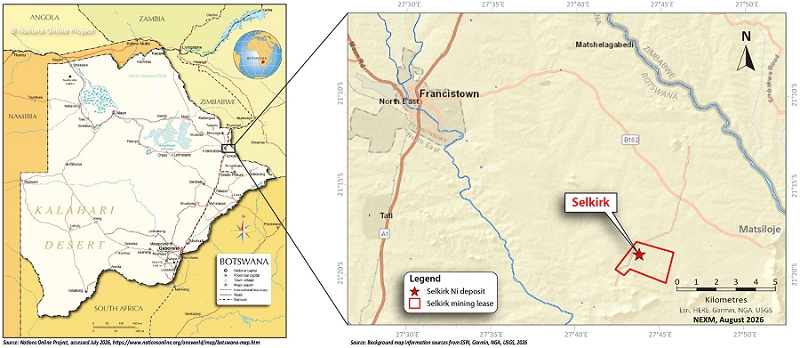
The Project consists of a single mining licence (ML) covering an area of 1,458 ha (14.58 km2) and four prospecting licences (PL) covering a total area of 12,670 ha (126.7 km2). The Project is located approximately 28 km southeast of the city of Francistown, and 450 km northeast of the national capital Gaborone. The mining licence, 2022/7L (the Selkirk Mining Licence), is centred at approximately 21°19’13” S and 27°44’17” E and is presented in Figure 4-1.
This mining licence gives PNGPL the right to mine copper and nickel ores and associated minerals contained in these mined ores for a period of ten years commencing on May 27, 2022 and ending on May 26, 2032. It also provides the right to carry out care and maintenance and exploration work from both surface and underground. The four PLs, PL050/2010, PL051/2010, PL210/2010 and PL071/2011, give PNGPL the exclusive right to prospect for base metals for a period of two years, effective April 1, 2025.
| J5050 – Selkirk Nickel-Copper-PGE Project S-K 1300 Technical Report Summary 17-08-2026 | Page: 16 |
Figure 4-1
Selkirk Property Location
| J5050 – Selkirk Nickel-Copper-PGE Project S-K 1300 Technical Report Summary 17-08-2026 | Page: 17 |
| 4.2 | Mineral Tenure, Permitting, Rights and Agreements |
The original mining licence over the historical Selkirk Mine, 88/2, had been granted to TNMC on November 29, 1988, and later amended to include the Phoenix Mine. It was granted for an initial period of 25 years, renewed on November 28, 2013 for a period of 11 years. The new mining licence, 2022/7L, was granted to PNGPL, on May 27, 2022, is limited to the Selkirk deposit and the surrounding areas, and expires on May 26, 2032.
Section 42 of the Mines Act (the Act) states that “The holder of a mining licence may apply to the Minister for the renewal of his licence at any time not later than one year before the expiry of such licence. The terms and conditions for the renewal of the mining licence are framed by the relevant sub-sections of Section 42 of the Act and indicate that:
| 1. | The Minister shall grant an application for renewal if satisfied that: |
| a) | the applicant is not in default; | |
| a) | development of the mining area has proceeded with reasonable diligence; | |
| b) | the proposed program of mining operations will ensure the most efficient and beneficial use of the mineral resources in the mining area. |
| 1. | The Minister shall not reject an application on the ground referred to in: |
| a) | Subsection (4)(a), unless the applicant has been given details of the default and has failed to remedy the same within three months of such notification; | |
| b) | Subsection (4)(b), unless the applicant has been given reasonable opportunity to make written representations thereon to the Minister; or | |
| c) | Subsection (4)(c), unless the applicant has been so notified and has failed to propose amendments to his proposed program of mining operations satisfactory to the Minister within three months of such notification. |
| 2. | Subject to the provisions of this Act, the period of renewal of a mining licence shall be such period, not exceeding 25 years, as is reasonably required to carry out the mining program. | |
| 3. | On the renewal of a mining licence, the Minister shall append thereto the program of mining operations to be carried out in the period of renewal. |
In order to maintain the mining licence in good order, the holder must make annual payments on its anniversary date in accordance with Section 71 of the Act, and monthly royalty payments according to Section 66 of the Act, if appropriate, in each case to the Government of Botswana. The royalties payable are percentages of the gross market value of mineral or mineral products as follows: precious stones (10%), precious metals (5%), and other minerals or mineral products (3%). The term gross market value is defined in the Act as the sale value receivable at the mine gate in an arms-length transaction without discounts, commissions, or deductions for the mineral or mineral product on disposal. Annual fees are calculated as BWP 200/km2 of part thereof subject to a minimum of BWP 1,000.
| J5050 – Selkirk Nickel-Copper-PGE Project S-K 1300 Technical Report Summary 17-08-2026 | Page: 18 |
The four prospecting licences were transferred to PNGPL effective October 1, 2022, and gave PNGPL the exclusive right to explore for base metals for a period of two years. Upon issuance of the licence and each anniversary thereof, a charge equal BWP 10.00 multiplied by the number of square kilometres, subject to a minimum of BWP 2,000.00, is payable to the office of the Director of Mines. The renewal of the four prospecting licences was approved for another two years effective April 1, 2025, making the new expiration date March 31, 2027.
The terms and conditions for the renewal of the prospecting licences are framed by the relevant sub-sections of Section 17 of the Act and indicate that:
| 2. | The holder of a prospecting licence may, at any time not later than three months before the expiry of such licence, apply to the Minister by completing Form I set out in the First Schedule for renewal thereof stating the period for which the renewal is sought and submitting together with the application- |
| a) | a report on prospecting operations so far carried out and the direct costs incurred thereby; and |
| b) | a proposed program of prospecting operations to be carried out during the period of renewal and the estimated cost thereof. |
| 3. | Subject to this Act, the applicant shall be entitled to the grant of no more than two renewals thereof, each for the period applied for, which periods shall not in either case exceed two years, provided that: |
| a) | the applicant is not in default; and |
| b) | the proposed program of prospecting operations is adequate. |
| 4. | Before rejecting an application for renewal under subsection 3(a), the Minister shall give notice of the default to the applicant and shall call upon the applicant to remedy such default within a reasonable time. |
| 5. | Before rejecting an application for renewal under (3)(b), the Minister shall give the applicant opportunity to make satisfactory amendments to the proposed program of prospecting operations. |
| 6. | Notwithstanding the provisions of subsection (3), the Minister may renew a prospecting licence for a period or periods in excess of the periods specified in that subsection where a discovery has been made and evaluation work has not, despite proper efforts, been completed. |
Table 4-1 shows the details of each PL as well as ML 2022/7L.
Table 4-1
Selkirk Property Tenure
| Description | Area (km2) |
Issue Date | Expiry Date | 2026
Annual Fee (BWP) |
Proposed Annual Exploration Expenditure | |
| Year
1 (BWP) |
Year
2 (BWP) | |||||
| ML 2022/7L | 14.58 | May 27, 2022 | May 26, 2032 | 3,000 | N/A | N/A |
| PL050/2010 | 4.1 | Oct. 1, 2022 | March 31, 2027 | 2,000 | 600,000 | 2,000,000 |
| PL051/2010 | 4.4 | Oct. 1, 2022 | March 31, 2027 | 2,000 | 500,000 | 2,000,000 |
| PL210/2010 | 46.8 | Oct. 1, 2022 | March 31, 2027 | 2,000 | 1,000,000 | 1,000,000 |
| PL071/2011 | 71.4 | Oct. 1, 2022 | March 31, 2027 | 2,000 | 2,000,000 | 4,000,000 |
| Total | 141.28 | 11,000 | 4,100,000 | 9,000,000 | ||
| Note: | The exchange rate as of 22 June 2026 is 9.49 BWP per CAD and 13.44 BWP per USD. |
| J5050 – Selkirk Nickel-Copper-PGE Project S-K 1300 Technical Report Summary 17-08-2026 | Page: 19 |
| 4.2.1 | Mineral Rights |
In Botswana, mining activities are regulated under the Act, which is administered by the Ministry of Minerals and Energy (MME). The Act regulates the issuance of exploration and mining licences as well as harmonising mining activities and environmental impacts.
With regards to environmental issues, the Act stipulates that the holder of the mineral concession shall:
| ● | in accordance with Botswana law and good mining industry practice, conduct operations in such manner as to preserve in as far as possible the natural environment, minimize and control waste or undue loss or damage to natural and biological resources, to prevent and where unavoidable, promptly treat pollution and contamination of the environment and shall take no steps which may unnecessarily or unreasonably restrict or limit further development of the natural resources of the concession area or adjacent areas. |
| ● | in the event of an emergency or extraordinary circumstances requiring immediate action, the holder of a mineral concession shall forthwith notify the Director of Mines and shall take all immediate action in accordance with the reasonable directions of the Director of Mines. |
| ● | prepare and submit an Environmental Impact Assessment (EIA) report as part of a mining licence or retention application or renewal. |
| ● | ensure that his concession area is rehabilitated from time to time and ultimately reclaimed in so far as is practicable in a manner acceptable to the Director of Mines. |
| ● | during and at the end of operations in any mine, excavation, waste dump or pond, the holder of a mineral concession shall take such measures as are required from time to time to maintain and restore the top soil of affected areas and otherwise to restore the land substantially to the condition in which it was prior to the commencement of operations. |
| ● | Make adequate ongoing financial provision for compliance with environmental obligations as stipulated by the Act. |
Any abstraction of water in Botswana is regulated through the Water Act of 1967.
| 4.2.2 | Surface Rights |
The Project area is situated on freehold land, with the Selkirk Mining Licence situated on portions of Farms 73NQ and 75NQ. A lease rental agreement, 201-NQ, between TNMC and Nkobiwa Emmanuel Keeng Selebe, the owner of Farm 73NQ, was signed on April 2, 1998, with an effective date of October 1, 1988. This agreement remains effective for the lifetime of the mining licence, including renewals. The area covers only a small portion (52.008 ha) of the mining licence and PNGPL will need to expand the surface rights area to develop an open pit mine.
| J5050 – Selkirk Nickel-Copper-PGE Project S-K 1300 Technical Report Summary 17-08-2026 | Page: 20 |
To that effect, an agreement was signed on February 4, 2025, with an effective date of April 12, 2024, between PNGPL and Cubic Times Proprietary Limited (Cubic), the company who will receive the transfer of 73NQ from the estate of NEKS. Both parties have agreed to certain amendments, pending the completion of the conveyancing:
| ● | The rental will be BWP 300,000 per annum, payable in advance. The rental will escalate at 5% per annum, commencing on April 12, 2025. |
| ● | PNGPL will pay Cubic a royalty equal to 0.5% of the Net Smelter Return (NSR) of the Selkirk Mine, payable annually from the date that the Selkirk Mine commences commercial operations. |
| ● | PNGPL is entitled to reduce the royalty to 0.25% against a payment of BWP 3,000,000 to Cubic. |
| ● | PNGPL is entitled to increase the area of interest of no less than 2 km around the Lease area. The annual rental increases proportionally but the royalty remains at 0.5% or 0.25% (as applicable) of NSR. |
| 4.3 | Environmental Liabilities |
The Selkirk Mine is a past producing mine with underground production via a ramp. Infrastructure on site includes workshops, a conveyor, office buildings, ventilation fan, fencing, a portal entrance, and a massive sulphide pile. The estimated costs of rehabilitation in 2021 were BWP 91 million (Parry and Buchanan, 2021).
| 4.4 | Royalties and Encumbrances |
PNGPL has signed a royalty agreement and contingent compensation agreement with the Liquidator. A 1% net smelter return exists on the sale of concentrates (or any other economic mineral resource material produced and sold) subject to specific rights of purchase by the purchaser and the Government of Botswana:
| ● | A reduction to a 0.5% NSR for a payment of USD2 million on or before the two-year anniversary date of the first shipment. |
| ● | A general first right of purchase shared between the purchaser and the Government of Botswana. |
There is also a contingent compensation agreement whereby PNGPL would pay additional compensation to the Government of Botswana if and when it discovers additional resources over and above the base case scenario of 15.9 Mt:
| ● | New resource discovery up until the end of the seven-year mine life of the base case resource of 15.9 Mt (minimum grade of 2.5% Ni equivalent (NiEq) at Decision to Mine): |
| ○ | 25 Mt < new deposit > 50 Mt USD0.50 per tonne. |
| ○ | 50 Mt < new deposit > 75 Mt USD0.20 additional per incremental tonne. |
| ○ | 75 Mt < new deposit > 100 Mt USD0.30 additional per incremental tonne: |
| ○ | New deposit > 100 Mt USD0.40 additional per incremental tonne. |
| ● | The payment of contingent compensation shall be made from operating cash flow of the mine(s) once in operation and subject to adequate liquidity. |
| 4.5 | Other Significant Factors and Risks |
The MSA QP is not aware of any other significant factors and risks that may affect access, title, or the right or ability to perform the proposed work program on the Property.
| J5050 – Selkirk Nickel-Copper-PGE Project S-K 1300 Technical Report Summary 17-08-2026 | Page: 21 |
| 5. | Accessibility, Climate, Local Resources, Infrastructure and Physiography |
The Selkirk deposit is located in the North East District of Botswana, approximately 30 km southeast of Francistown, the country’s northernmost city. The Property extends across the farms 73NQ and 75NQ approximately 20 km from the Zimbabwean border, near Matsiloje village. The Tati River lies to the south of this area. Francistown, in close proximity to the west, being the main centre in the area with a burgeoning and industrious young population of around 120,000, provides a good source of labour and a growing skills base. The rural farming population has very low density and lives generally in cattle posts situated close to sources of groundwater, generally near the main rivers which have a more or less constant supply of groundwater in their sandy beds.
| 5.1 | Accessibility |
The railway line and Highway A1 from Bulawayo to Gaborone pass through Francistown, 30 km to the northwest of Selkirk. From Francistown, site access is made via an all-weather tarred surface road to Matsiloje that passes 7 km north of the Selkirk deposit, with the main access to Selkirk being a well maintained and graded unsurfaced road.
All forms of transportation are readily available and accessible to the population, mainly light and medium vehicles, mini-bus type taxis, and larger public bus transportation. Francistown has a tarred airstrip and International Airport with customs clearing.
| 5.2 | Climate and Physiography |
The climate is tropical, with hot, wet summers and mild, dry winters (Figure 5-1). Most of the rainfall occurs during the period from October to April, usually in the form of scattered thundershowers, with massive surface run-off. The average rainfall is approximately 460 mm per annum as recorded at Francistown Airport.
| J5050 – Selkirk Nickel-Copper-PGE Project S-K 1300 Technical Report Summary 17-08-2026 | Page: 22 |
Figure 5-1
Climate at the Selkirk Project
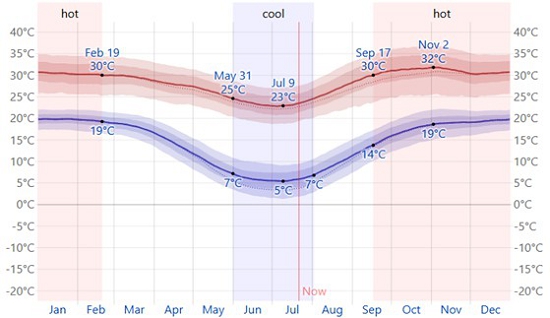
| Notes: | The daily average high (red line) and low (blue line) temperature, with 25th to 75th and 10th to 90th percentile bands. The thin dotted lines are the corresponding average perceived temperatures | |
| Source: | Weatherspark.com, 2026 (location Francistown) |
Due to the climate, most greenfield exploration field work is carried out during the winter period when the rivers and streams are practically dry and vegetation less dense. However, where good access infrastructure exists at brownfield sites such as Selkirk, work can continue all year round.
| 5.3 | Local Resources and Infrastructure |
| 5.3.1 | Human Resources |
No specific deficiencies in the general labour resource have been identified as the former mining company TNMC had engaged in the training and development of local Botswana skills from the growing and youthful population of Francistown and other regional communities such as Matsiloje and Matshelagabedi. With the exception of highly specialised technical experts required during the construction phase, PNGPL believes that there is a local skills base with sufficient capacity to cater for its further needs with regard to the Project and its general organisational development requirements.
| 5.3.2 | Infrastructure, Power, Water and Supply |
The area is in a rural district, and the available infrastructure is minimal. The current Project infrastructure includes relict surface infrastructure supporting the historical underground mine, and the original decline (Figure 5-2).
Water Utilities Corporation (WUC) is a government-owned parastatal organisation that manages water treatment and distribution in Botswana. An unquantified amount of water may be sourced from boreholes for various uses (subject to the requisite approvals). Several dams managed by WUC exist with the main supply for the area coming from Shashe Dam (Figure 5-2).
The power needs for the Project are yet to be determined, however there are existing Botswana Power Corporation powerlines nearby including one which runs along the Mopane access road to the Selkirk Mine infrastructure. The available capacity of existing water and power infrastructure has not yet been confirmed for the Selkirk Project.
| 5.3.2.1 | Tailings/Waste/Plant Sites |
The project is at an MRE stage and potential tailings storage areas, waste disposal areas, and processing plant sites have not been assessed.
| J5050 – Selkirk Nickel-Copper-PGE Project S-K 1300 Technical Report Summary 17-08-2026 | Page: 23 |
Figure 5-2
Location of Phoenix and Selkirk mining infrastructure
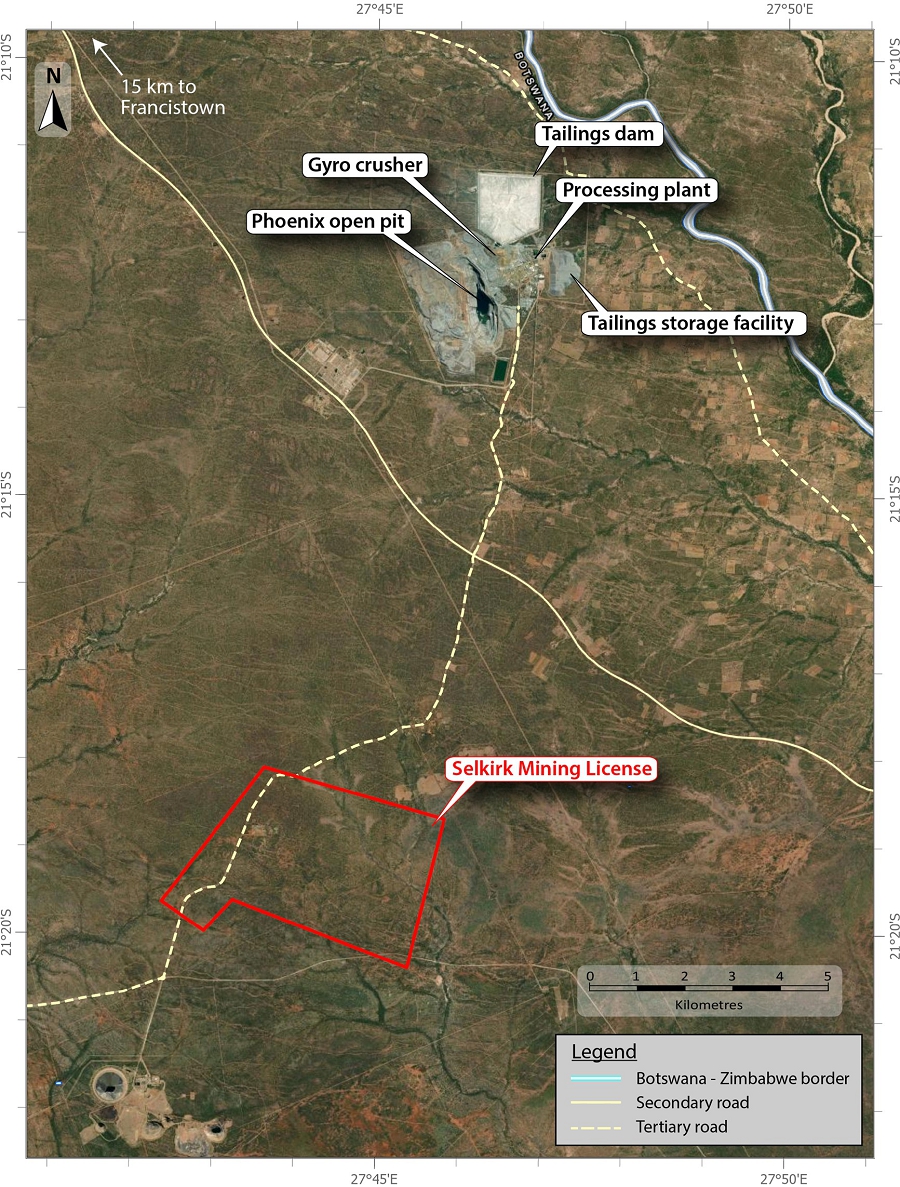
| Source: | NEXM 2024 |
| J5050 – Selkirk Nickel-Copper-PGE Project S-K 1300 Technical Report Summary 17-08-2026 | Page: 24 |
| 5.4 | Physiography |
| 5.4.1 | Topography |
The Project and the proposed infrastructural sites are located in a relatively flat area of Botswana, with a mean elevation of 980 m. Isolated hills, comprised of geological units less susceptible to weathering, protrude above the flat surface. The prevailing drainage pattern is dendritic, with irregular branching tributaries. The valleys of the streams and rivers are narrow (3 m to 5 m wide) and gently sloped. The general slope of the area is eastwards towards the Ramokgwebana River. Various unnamed tributaries flow across the property.
| 5.4.2 | Surface Water |
The Project falls within the greater Shashe/Tati River systems (Figure 5-3). All the rivers in these systems are ephemeral, with irregular but rapid surface flows after heavy summer rainfall. WUC managed dams store water from these river systems, with the main supply in the region being from Shashe Dam.
Figure 5-3
Surface water in the Selkirk Project area
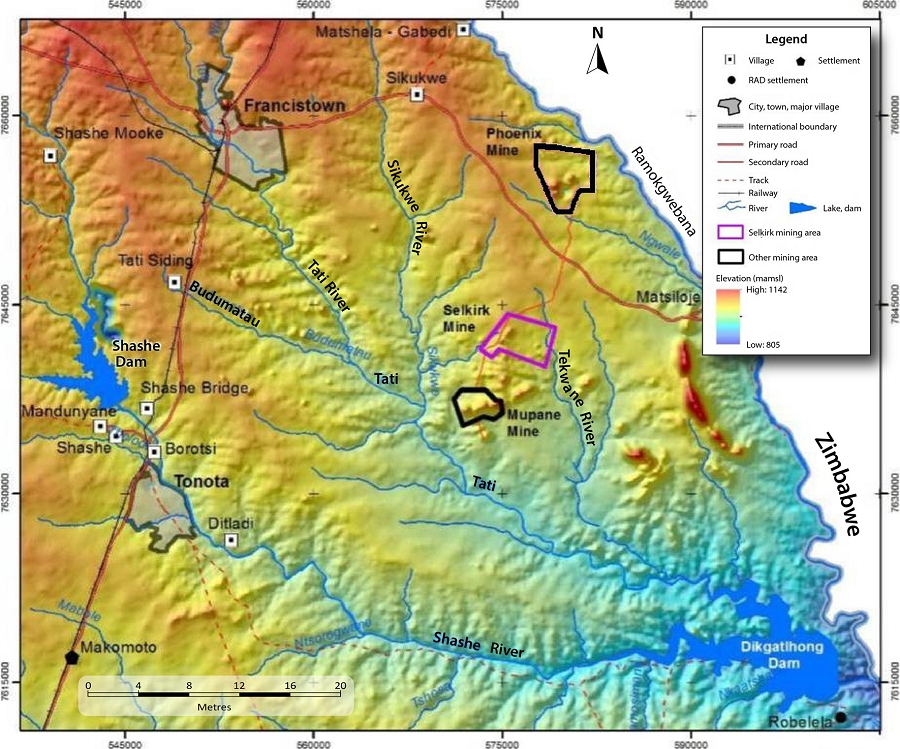
| Source: | NEXM, 2024 |
| J5050 – Selkirk Nickel-Copper-PGE Project S-K 1300 Technical Report Summary 17-08-2026 | Page: 25 |
| 5.4.3 | Groundwater |
Two aquifers are present in the Project area, namely; fractured granitoids and alluvial sands within the ephemeral river systems. Both aquifer types have limited storage capacity, are unconfirmed and are vulnerable to contamination. Recharge to the groundwater regime is from rains and ephemeral surface flow. Overall, the groundwater potential in the area is limited, hence all major water requirements being met from Shashe Dam.
| 5.4.4 | Flora and Fauna |
The type of vegetation cover is fairly uniform although the nature of the underlying strata and the amount of grazing does have some bearing on the richness of the vegetation cover. On the Botswana vegetation map, the whole area is described as being within a tree savanna type (specifically Mixed Mopane Bushveld). The vegetation therefore consists of trees and shrubs of several species, but Mopane and Acacia are the dominant species. The density of grass cover depends on the extent of grazing. At Selkirk it is mostly overgrazed with species diversity being relatively low.
Large species of wild animals are almost non-existent, except where they have been reintroduced by game farmers. However, many of the smaller species of wildlife occur and birds are common. The area is predominantly utilised for livestock grazing.
As far as the MSA QP is aware, no flora or fauna red data species have, to date, been identified within the Selkirk lease area.
| 6. | History |
The following paragraphs regarding the history of the Project are largely extracted from a previous TRS prepared by SLR (SLR, 2024) which in turn referenced G Mining Services Inc. (G Mining, 2023), which in turn referenced Botepe (2013). Historical Mineral Resource estimates have only been mentioned if the original source document was available, and the information pertaining to estimation methodologies was sufficiently detailed for disclosure.
| 6.1 | Prior and Current Ownership |
NEXM currently own 100% of the Project through the asset purchase agreement for the Selkirk Assets under its local subsidiary Premium Nickel Group Proprietary Limited (PNGPL) on 22 August 2022.
The first record of mineral rights occurred in 1964 when Tati Territory Exploration Co. Ltd. (TTE) acquired mineral rights over a large area that included the Project.
The Government of Botswana granted a 25-year mining licence over the Selkirk and Phoenix deposits in November 1988 to TNMC, a new company comprised of Lexan Trading Inc. (51%) and Francistown Mining and Exploration Ltd. (49%). These two founding companies have changed ownership several times and Table 6-1 presents a summary of the ownership history of the Selkirk Project. The government acquired a 15% interest in TNMC in 1995, resulting in project ownership by Lexan Trading Inc. (43.35%), Francistown Mining and Exploration Ltd. (41.65%), and the Government of Botswana (15%). BCL, through its wholly owned subsidiary BCL Investments (Pty) Ltd., acquired Lexan Trading Inc. and Francistown Mining and Exploration Ltd. in 2015.
| J5050 – Selkirk Nickel-Copper-PGE Project S-K 1300 Technical Report Summary 17-08-2026 | Page: 26 |
Table
6-1
History of ownership at Selkirk
| Year | Company |
| 1964 | Tati Territory Exploration Co. Ltd (TTE) acquired the large Tati Concession. |
| 1970 | Anglo American Corporation of South Africa (AAC) acquired the rights to prospect for a period of 15 months, ending June 5, 1971, under agreement with TTE. |
| 1971 | Concessions were returned to TTE after negotiations with AAC failed to extend the agreement. |
| 1979 | New prospecting licence granted to TTE; however, TTE failed to honour exploration expenditures. |
| 1984 | United Kingdom (UK) investment firm Morex through its local subsidiary Morex Botswana (Pty) Limited (together Morex) was granted a prospecting licence covering the Phoenix and Selkirk deposits. |
| 1985 | Morex founded Francistown Mining and Exploration Ltd. in 1985. |
| 1988 | Morex transferred the prospecting licence to newly formed company TNMC, wholly owned by Morex. |
| 1988 | TNMC ownership changed to Lexan Trading Inc. (51%; Swiss trading affiliate of RTZ Corp identified as Centametall AG) and Francistown Mining and Exploration Ltd. (49%, Morex). |
| 1989 | AAC acquired 51% of TNMC. |
| 1995 | Government of Botswana acquired 15% of TNMC. Ownership of TNMC: AAC, 43.35%; Morex, 41.65%; Government of Botswana, 15%. |
| 1996 | LionOre Mining International Limited (LionOre) acquired 41.65% of TNMC. Ownership of TNMC is AAC, 43.35%; LionOre, 41.65%; Government of Botswana, 15%. |
| 2002 | LionOre purchased AAC’s interest in TNMC. TNMC ownership is LionOre, 85%; Government of Botswana 15%. |
| 2007 | Norilsk Nickel acquired LionOre. TNMC ownership is Norilsk Nickel, 85%; Government of Botswana, 15%. |
| 2015 | BCL purchased Norilsk Nickel’s interest in TNMC through its wholly owned subsidiary BCL investments (Pty) Ltd. TNMC ownership is 85% BCL, 15% Government of Botswana. |
| October 9, 2016 | BCL and TNMC operations placed on care and maintenance, placed in provisional liquidation. |
| June 15, 2017 | BCL placed into final liquidation. |
| May 27, 2022 | PNGPL awarded the Mining Licence over the Selkirk deposit. |
| August 22, 2022 | NEXM completed the asset purchase agreement for the Selkirk Assets under its local subsidiary Premium Nickel Group Proprietary Limited (PNGPL). NEXM own 100% of the asset |
| 6.2 | Exploration and Development History |
A detailed account of all exploration undertaken at Selkirk was provided in the Technical Report by G Mining (G Mining, 2023) and is summarised in the following sections:
The Phoenix and Selkirk sites are known for ancient copper workings and were also investigated for their gold potential after the rediscovery of gold in the area in 1866 (Marsh, 1979). AAC established the presence of nickel and copper occurrences at the sites of the ancient workings in 1929 through the commissioning of Messer’s Brown and Tulloch to evaluate the mining potential of the area.
The first large scale systematic work was conducted from 1964 to1969 by the TTE. Eighteen holes in 2,500 m were drilled during 1965 and1966, but TEE was unable to determine the potential of mineralisation within the geological setting. In the late 1960s, De Beers and AAC conducted regional mapping, widely spaced soil sampling and commissioned Geoterrex Limited of Canada to fly an airborne magnetic and INPUT electromagnetic (EM) survey. AAC, through its local subsidiary, Sedge Botswana (Pty) Limited (Sedge), subsequently explored the Selkirk prospect from March 1970 to 1971 under a 15-month prospecting agreement negotiated with TTE. Detailed work included 1:500 scale geological outcrop mapping, soil sampling, trench sampling, ground geophysics, and diamond drilling. A total of 117 drillholes for 27,377.5 m were drilled and assay results were used to evaluate the tonnes and grade of the project. Mineralogical studies and metallurgical testwork were completed and used as input within a subsequent economic study. Potential for additional mineralisation was identified at Phoenix, but AAC was unsuccessful at renegotiating the option agreement with TTE. All the drill core from this period of exploration was destroyed, apart from a few examples that were stored at the Geological Survey Department of Botswana in Lobatse.
| J5050 – Selkirk Nickel-Copper-PGE Project S-K 1300 Technical Report Summary 17-08-2026 | Page: 27 |
The exploration agreement between AAC and TTE expired in 1971, and no significant exploration work was conducted until Morex was awarded a prospecting licence in 1984 over the Selkirk and Phoenix deposits. Morex approached Rio Tinto to conduct a preliminary study on the Selkirk and Phoenix deposits in August 1984. Two holes, one at Selkirk and one at Phoenix, were drilled to obtain samples for metallurgical testwork. Rio Tinto presented several options, including mining the high-grade massive sulphides and shipping the mined mineralisation to the BCL smelter.
The Selkirk underground mine was commissioned in 1989 and extracted massive sulphide from a near surface, shallow dipping and synformal-shaped deposit of massive sulphide up to 20 m thick for direct smelting at BCL. The mine ceased operations in August 2002 after exhausting the massive sulphide. Partial pillar extraction occurred in 2013. Over 1.0 Mt of material grading 2.6% Ni and 1.6% Cu was extracted from the mine since 1989.
Recent exploration dates back to 2003 when TNMC conducted a Titan 24 geophysical survey over the Selkirk deposit. Results of this work, along with earlier Sedge work, indicated the presence of mineralisation down plunge of the underground mine. This was followed by a series of diamond drilling campaigns which defined a large body with thick intervals of disseminated sulphides extending in excess of 1,500 m down plunge to the southwest of the initial massive sulphide discovery.
Further exploration of Selkirk by TNMC included soil sampling, gravity, magnetic, and induced polarisation (IP) surveys. The magnetic data was interpreted to be dominated by that of the trending Karoo dyke swarm and the gravity data provide an excellent tool for mapping the west-northwest regional geology of the Selkirk Mining Licence (Figure 6-1). From October 2007 to February 2008, an IP survey was conducted by Spectral Geophysics over the Selkirk Mining Licence (Figure 6-2). The survey was only completed over two thirds of the planned area; however, several chargeability anomalies were outlined by this geophysical campaign and indicated the presence of chargeable bodies at depth (Botepe, 2013).
Drilling of geophysical and geochemical targets followed by resource definition drilling took place from 2003 until 2007. TNMC began to analyse selected drill core for PGEs for sampled intervals that had a concentration of Ni > 0.15%, which created an incomplete dataset with a bias towards higher-grade PGE assays. All samples from drillholes completed onwards from 2007 (from drillhole DSLK249) were routinely analysed for PGE content.
During TNMC’s exploration campaign, the extension of mineralisation down plunge of the massive sulphide zone as a broad envelope of consistent disseminated and sporadic massive pyrrhotite-chalcopyrite mineralisation was defined within the metagabbro host. The deepest hole drilled intersected massive sulphides at 1,200 m below surface, significantly deeper than exploration by previous operators.
In June 2007, Norilsk Nickel acquired the Project from LionOre (LionOre, 2007). The new owners concentrated their efforts both on further development of the Selkirk historical resource and exploration for new deposits, both on the Selkirk Mining Licence and on newly acquired prospecting licences. As part of this work, a drillhole validation exercise in 2008 compared results from old drillholes to new drillholes to determine if historical results could be included in the resource. It was concluded that the historical holes showed higher grades, and care had to be taken in data handling to avoid overestimation of resources.
| J5050 – Selkirk Nickel-Copper-PGE Project S-K 1300 Technical Report Summary 17-08-2026 | Page: 28 |
Between May and September 2007, soil samples were collected over the entirety of the Selkirk Mining Licence (approximately 15 km2) using the recommendations from the soil orientation surveys carried out in 2006, including preferentially collecting the sample from the B horizon. A total of 4,972 samples were collected and assayed for pathfinder elements prepared at Genalysis Laboratory Services Pty Ltd., South Africa, and analysed at Genalysis Laboratory Services Pty Ltd., Australia.
The soil sampling results showed clear Ni and Cu anomalies over the Selkirk deposit and Cinderella (target 3) area (Figure 6-3 and Figure 6-4). The copper soil anomalies appear to show that the Selkirk and Cinderella systems are located along an easterly to northeasterly trending soil geochemical strike that can be followed in a northerly direction into the Ramokgwebana mafic intrusive complex.
From this work, several target areas were identified where anomalous concentrations of associated elements coincide. Three trenches totalling 2,858 m located east of the Selkirk deposit to test regional soil geochemical anomalies were excavated in 2008, revealing melanocratic to leucocratic metagabbros with iron staining (Mogotsi, 2008).
Much of the work between 2008 and 2015 focused on gathering data to support a “bankable feasibility study” (BFS) and consisted of additional metallurgical studies and geotechnical drilling. The Selkirk Tunnel Project started in May 2008 to evaluate the characteristics of the Selkirk mineralisation and collect representative grab and bulk samples for metallurgical testing. A total of 522 tonnes of material were sent to Council for Mineral Technology (Mintek), in South Africa, for testwork, and channel samples were analysed to characterise material in the mine workings area. Geological mapping of underground exposures was completed to document rock types, structural features, and mineralisation types in the tunnel.
Concurrently with the BFS work, regional exploration continued. TNMC was granted five additional prospecting licences in 2010. Exploration advanced on all licences with complete soil geochemistry coverage and complete EM coverage by means of a versatile time-domain electromagnetic (VTEM) survey in 2012. A total of 2,526-line kilometres were flown over the TNMC lands (Han et al., 2012). Anomalous responses were interpreted, and 14 targets in four areas of interest were investigated in detail using Maxwell Plate Modelling, and a complete 3D magnetic inversion (Figure 6-5). Although two areas of interest were located near known mineralisation (i.e., Selkirk and Phoenix deposits), the VTEM and aeromagnetic survey helped identify two new potential sources of mineralisation location east and northeast of the Selkirk deposit.
In 2012, a soil geochemical campaign over the PLs was completed (TNMC, 2012). A total of 6,392 soil samples were analysed for lithogeochemistry, and interpretation of nickel and copper assay results defined six prospective areas over the exploration properties (Figure 6-6). Geological and structural mapping of the outcrops located near the Rooikoppie Shear Zone (RSZ) noted several northeast striking shear zones with parallel gossan outcrops. Five diamond drillholes, DRKP001 to DRKP005, were drilled to test the gossan and associated VTEM anomaly. Sulphides were intersected, but assay results showed no elevated nickel or copper values.
| J5050 – Selkirk Nickel-Copper-PGE Project S-K 1300 Technical Report Summary 17-08-2026 | Page: 29 |
Figure
6-1
Detailed ground magnetic (top) and Bouguer Anomaly survey (bottom)
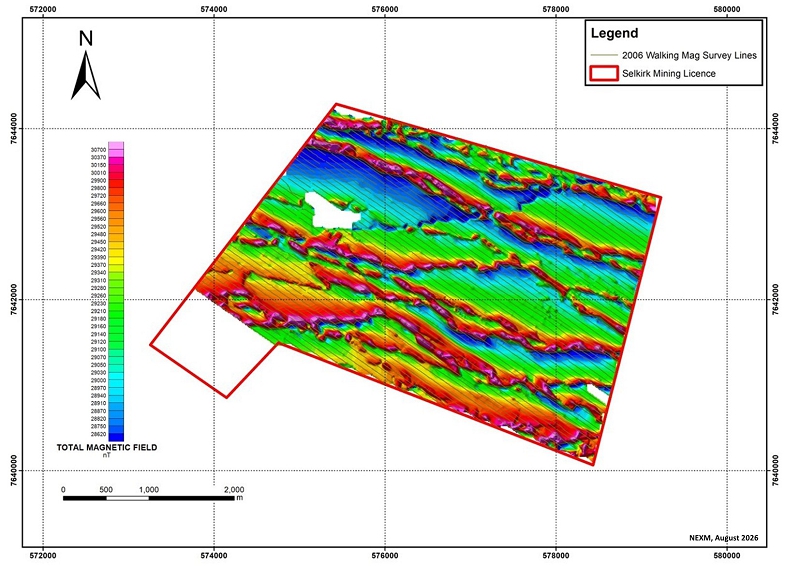
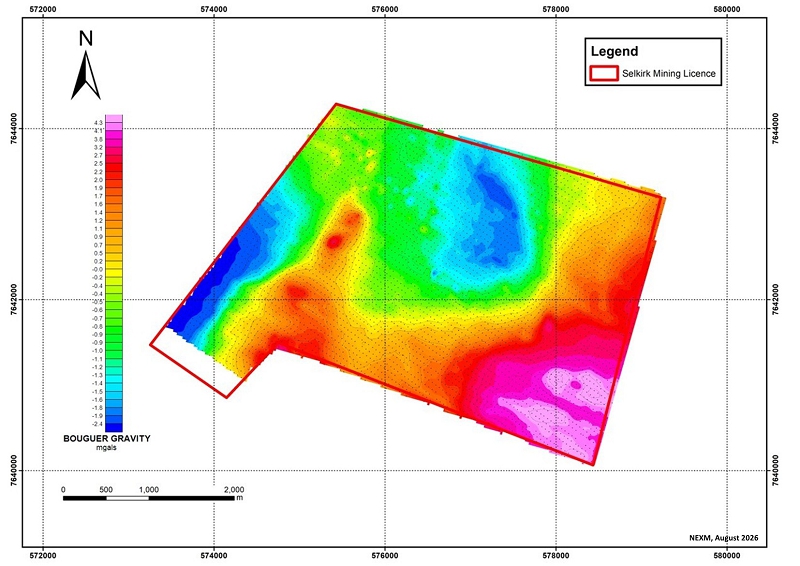
| J5050 – Selkirk Nickel-Copper-PGE Project S-K 1300 Technical Report Summary 17-08-2026 | Page: 30 |
Figure
6-2
IP Survey at Selkirk
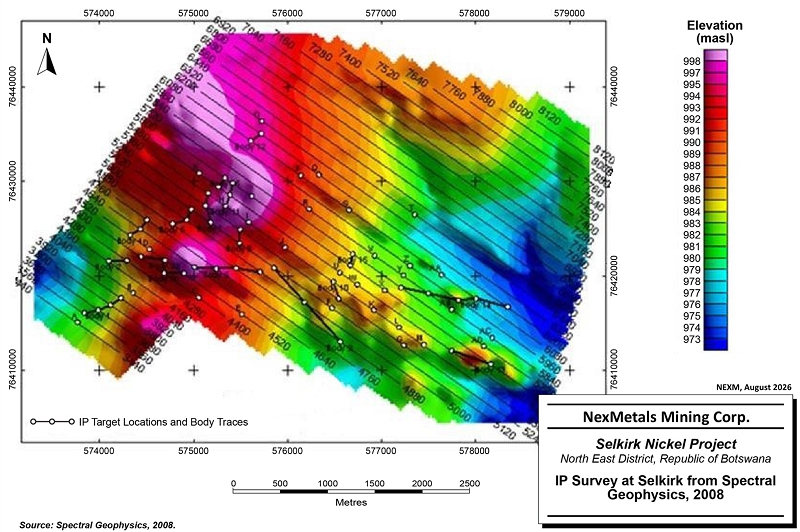
| J5050 – Selkirk Nickel-Copper-PGE Project S-K 1300 Technical Report Summary 17-08-2026 | Page: 31 |
Figure
6-3
a) Distribution pattern showing concentrations of Ni at Selkirk; b) Ni concentrations superimposed on soil type and geological structures
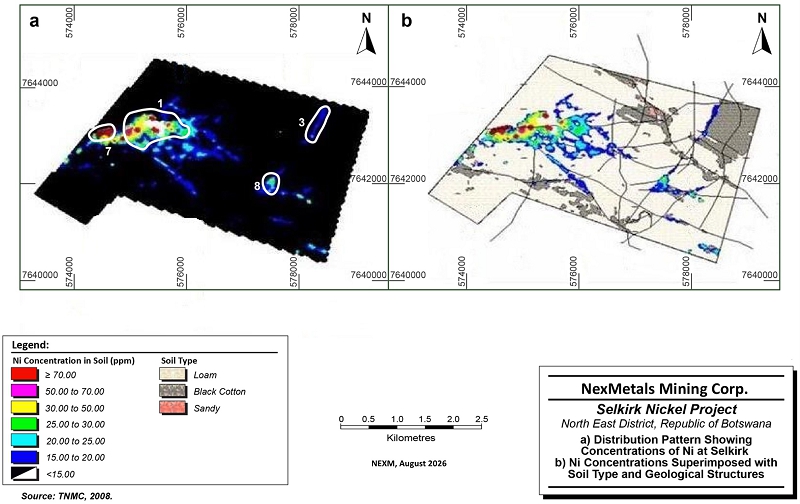
| J5050 – Selkirk Nickel-Copper-PGE Project S-K 1300 Technical Report Summary 17-08-2026 | Page: 32 |
Figure
6-4
a) Distribution pattern showing concentrations of Cu at Selkirk; b) Cu concentrations superimposed on soil type and geological structures
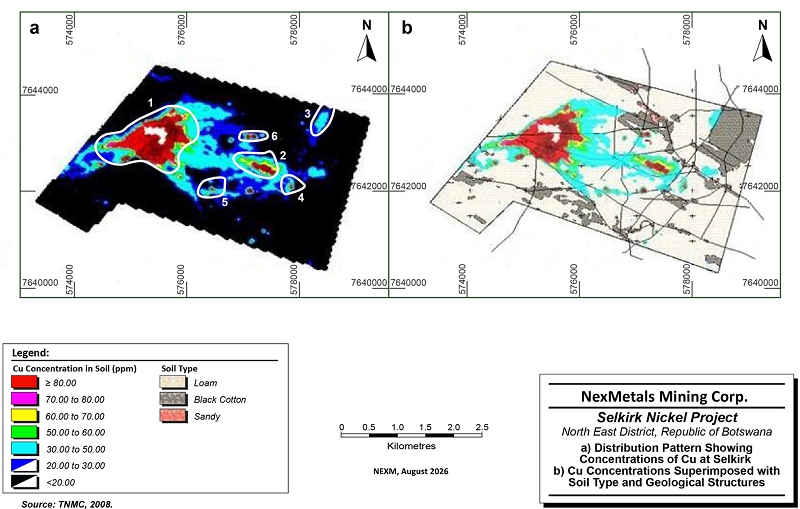
| J5050 – Selkirk Nickel-Copper-PGE Project S-K 1300 Technical Report Summary 17-08-2026 | Page: 33 |
Figure 6-5
Apparent resistivity at 250 m below surface
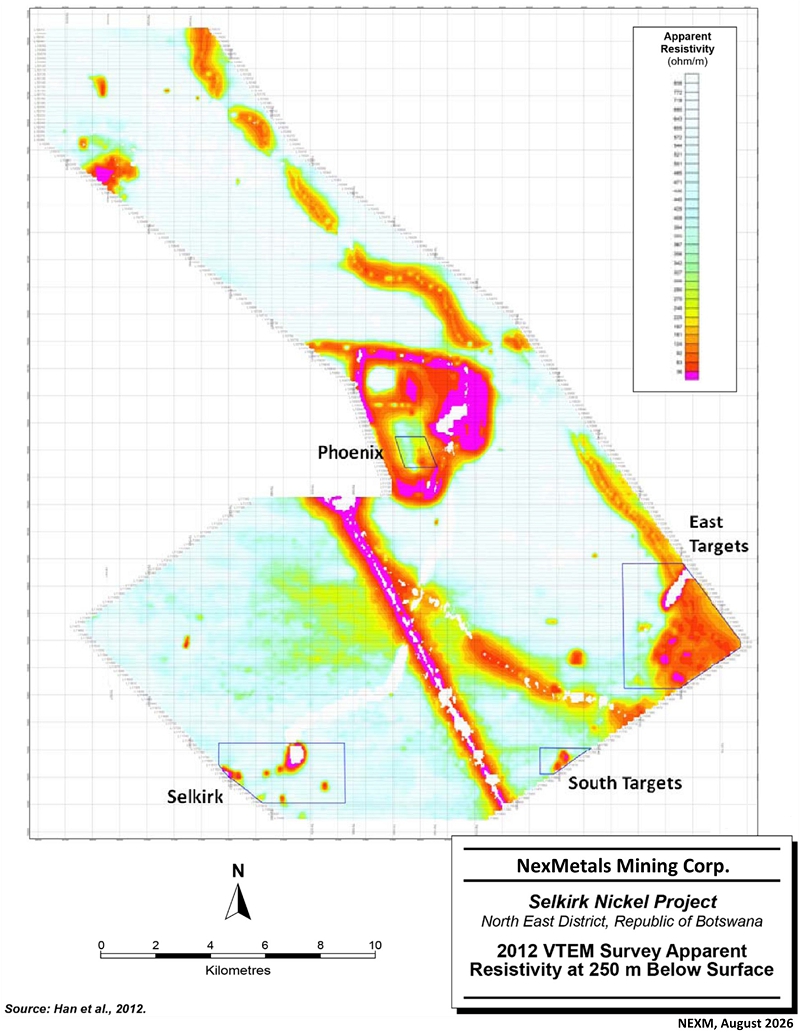
| J5050 – Selkirk Nickel-Copper-PGE Project S-K 1300 Technical Report Summary 17-08-2026 | Page: 34 |
Figure 6-6
Geochemical anomalies for Ni and Cu over the TNMC PLs
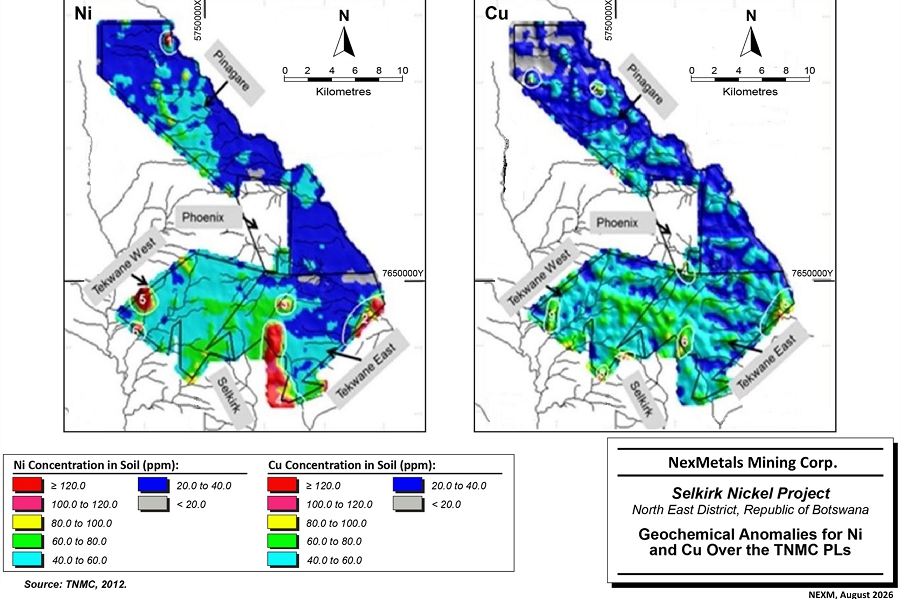
| J5050 – Selkirk Nickel-Copper-PGE Project S-K 1300 Technical Report Summary 17-08-2026 | Page: 35 |
From 2014 to 2015, exploration for nickel mineralisation on prospecting licences PL050/2010 (northwest corner of Selkirk Mine), PL051/2010 (southwest corner of Phoenix Mine), and PL071/2011 (southeast of Selkirk Mine) was undertaken. Remote sensing, geological and structural mapping, petrological analysis, as well as drilling were completed on the exploration licences (Thari, 2015).
From 2014 to 2016, follow-up work between Tekwane and Phoenix included a structural analysis and an IP survey. Two exploration drillholes were completed, with no major mineralisation intersected. The recommendation from the 2015 Annual Report concluded that about half of the exploration rights of the PL071/2011 prospect should be surrendered and that exploration around the Tekwane and Rooikoppie mineralised zones should be kept a high priority for later exploration campaigns.
The Project was acquired by BCL in October 2014. No exploration was carried out on either the Selkirk Mining Licence or the prospecting licences. Drilling during 2015 and 2016 supported various aspects of the BFS. Seven holes, DSLK268 to 274, totalling 1,956.93 m, were drilled to collect metallurgical samples for the Mintek testwork. Three holes, DSLK288 to 290, totalling 750 m, were holes drilled for water pump tests.
DSLK275 to 287, HQ (96 mm hole for 63.5 mm core) sized holes, were located by PNGPL in the core storage area at the Phoenix Mine, unlogged and unsampled.
The Selkirk Mine itself has been under care and maintenance since 2002 and is generally inactive. Despite the mine having been idle for twenty years since production, the underground workings were accessible for sampling activities by PNGPL in 2021.
| 6.3 | Historical Mineral Resource Estimates |
The first historical mineral resource estimate on the Selkirk deposit was prepared by Sedge in 1971 (Hall, 1971). More recently, several historical Mineral Resource estimates (MRE) have been completed. Table 6-2 provides a summary of when and by whom historical mineral resource estimates were completed.
The information regarding historical mineral resource estimates reported herein should be considered as historical in nature, as insufficient data verification has been conducted by the QP to verify them. It should be noted that it is not clear if historical resources were reported constrained (limited at depth by a conceptual pit shell) or unconstrained). NEXM is not treating the historical mineral resource estimates as current.
| J5050 – Selkirk Nickel-Copper-PGE Project S-K 1300 Technical Report Summary 17-08-2026 | Page: 36 |
Table 6-2
Summary of historical mineral resource estimates at Selkirk
| Date | Company and Reference | Comments |
| March 2007 | LionOre (TMP, 2007) | Initial MRE at Selkirk in accordance with CIM (2005) definitions and NI 43-101 |
| November 2007 | Norilsk Nickel (TWP, 2007) | Geological interpretation more restricted leading to lower tonnages, and historical data (pre-2003) was discarded |
| November 2008 | Anglo American plc (Geldenhuys, A. 2008) | Produced by Anglo American plc (MinRED department) in conjunction with Norilsk Nickel and TNMC geologists. |
| January 2013 | Norilsk Nickel, (Gipronickel Institute (Gipro), 2013) | Introduced sub-celling of block model, no major changes to geological model, recategorisation of Indicated to Inferred |
| September 2016 | BCL (WorleyParsons, 2016) | Modified classification, new geological model (0.20% Ni cut-off). |
November 2024 |
Premium Resources Ltd. (SLR, 2024) |
Premium Resources Ltd. is now known as NEXM. Refer to 14.14 of this TRS |
| Source: | G Mining, 2023 modified from Botepe, 2013 |
| J5050 – Selkirk Nickel-Copper-PGE Project S-K 1300 Technical Report Summary 17-08-2026 | Page: 37 |
| 6.4 | Past Production |
The Selkirk underground mine was operated from 1989 to 2002 by TNMC, a company created specifically to exploit the deposit. More than 1.0 Mt of material grading 2.6% Ni and 1.6% Cu was extracted from a semi-elliptical deposit of massive sulphide up to 20 m thick to a depth of 100 m below surface.
| 6.5 | History of Environmental Considerations |
In 2008, an EIA was carried out to obtain authorisation for the redevelopment of the Selkirk Mine. No redevelopment took place and, therefore, the authorisation lapsed. Thereafter, TNMC proposed to construct and operate the Selkirk Open Pit Mine within the mine lease area. The Department of Environmental Affairs (DEA), after evaluation of the Project Brief, advised TNMC that an Environmental Management Plan (EMP) should be prepared to guide the implementation of the proposed project. TNMC contracted Sangwenu Engineering & Environmental Consultants to develop an EMP on their behalf (Sangwenu Engineering & Environmental Consultants (Pty) Ltd., 2016).
In 2016, the EMP was compiled for the potential construction and operation of an open pit within the mine lease area. This open pit would extend the life of the TNMC operation by about five years and would generate 5.0 Mt of feed per annum. The original intention was concentration at the nearby Phoenix mill and the concentrate would be treated by the BCL Smelter in Selebi Phikwe. In July 2016, the EMP submitted on behalf of TNMC was approved by the DEA in terms of Section 12(1) of the Environmental Assessment Act No. 10 of 2011, reference number DEA/BOD/F/EXT/MNE 030 (13) (DEA, 2016). The DEA used the 2008 EIA as input to the 2016 EMP.
The 2016 authorisation was valid for a period of two years, which lapsed in July 2018.
The 2016 EMP was transferred to PNGPL on May 23, 2023, and is valid for ten years under the same terms as the 2016 authorisation. Any development not discussed and assessed in the 2016 Statement, or any modification, use of new technology, upgrade or expansion requires a brief to be submitted to the DEA for review. The EMP may be subject to renewal at the end of the ten year period.
| J5050 – Selkirk Nickel-Copper-PGE Project S-K 1300 Technical Report Summary 17-08-2026 | Page: 38 |
| 7. | Geological Setting and MineraliSation |
| 7.1 | Regional Geology |
The Project is located in the eastern part of Botswana, approximately 28 km southeast of the city of Francistown (Figure 7-1). This area hosts several intrusive magmatic Ni-Cu-PGE sulphide deposits, including the past producing mines at Phoenix, Selebi Phikwe, and Selkirk.
The eastern Botswana Ni–Cu–PGE deposits may be subdivided into two groups. The first group of deposits, hosted by the Phoenix, Selkirk, and Tekwane intrusions, occurs within and in the periphery of the Tati greenstone belt. The deposits were discovered in 1968 by TTE, based on mapping and stream sediment geochemistry. The second group of deposits, comprising Phikwe, Dikoloti, Lentswe and Phokoje, are hosted by the Selebi Phikwe mafic ultramafic intrusions that occur within gneisses of the Limpopo metamorphic belt approximately 200 km to the south of the Tati belt (Gordon, 1973; Baldock et al., 1976). Most of these deposits were discovered by BCL (Bamangwato Concessions Limited) between 1963 and 1966 using soil geochemistry (Maier et al., 2007).
The stratigraphy of the east Botswana mines and deposits consists of major metavolcanic and sedimentary groups. The main lithologies within the Tati greenstone belt consist of lower greenschist to lower amphibolite facies volcanic and sedimentary rocks intruded by granitoids of unknown age (Maier et al., 2007). The volcano-sedimentary succession has been subdivided into three formations: Lady Mary, Penhalonga, and Selkirk Formations that contain a progressively higher proportion of felsic volcanic rocks (Key, 1976). At the base, the < 1,600 m Lady Mary Formation consists mainly of altered komatiite and komatiitic basalt and lesser amounts of quartzitic schist, limestone, and iron formation. The overlying > 10 km thick Penhalonga Formation consists of basaltic, andesitic. and rhyolitic volcanic and volcaniclastic rocks, as well as phyllites, black shales, limestones, and jaspilites. This is capped by the Selkirk Formation (> 1 km thick) which consists mainly of dacitic and rhyolitic volcaniclastic rocks and minor amounts of mafic volcanic rocks, quartzites, and quartz-sericite schists. The Selkirk Formation also hosts the Phoenix, Selkirk, and Tekwane metagabbronoritic intrusions and the Sikukwe metaperidotite intrusion (Maier et al., 2007). Van Geffen (2004) dated a gabbro at the Phoenix Mine at 2,703 ± 30 Ma, which places the Tati greenstone belt within the 2.7 Ga Francistown Arc Complex (Carney et al., 1994; McCourt et al., 2004).
Three main deformation events affected the stratigraphy and the emplacement of intrusive units as gabbro and granodiorite, which has implications in the local and regional controls on the Ni-Cu-PGEs mineralisation. The first deformation event, D₁ is associated with north-northwest to south-southeast oriented principal stress axes, is of brittle-ductile nature, and is evidenced by the occurrence of kilometre scale fold, fault, and shear zones. The second deformation event resulted from northeast-southwest oriented compressional stress and is recognisable by the presence of folded and asymmetric boudinaged quartz veins and faults that crosscut D1 structures. The third deformation created by the minimum northeast-southwest principal stress, D₃ produced the fracture, stylolitic cleavages, extensional and columnar joints, which crosscut all the D₁ and D₂ structures (Dirks, 2005).
| J5050 – Selkirk Nickel-Copper-PGE Project S-K 1300 Technical Report Summary 17-08-2026 | Page: 39 |
Figure 7-1
a) Schematic map of the Limpopo Belt and adjacent cratons showing studies localities; and
b) Geological map of the central portion of the Tati Greenstone Belt indicating the locality of the Phoenix, Selkirk and Tekwane deposits
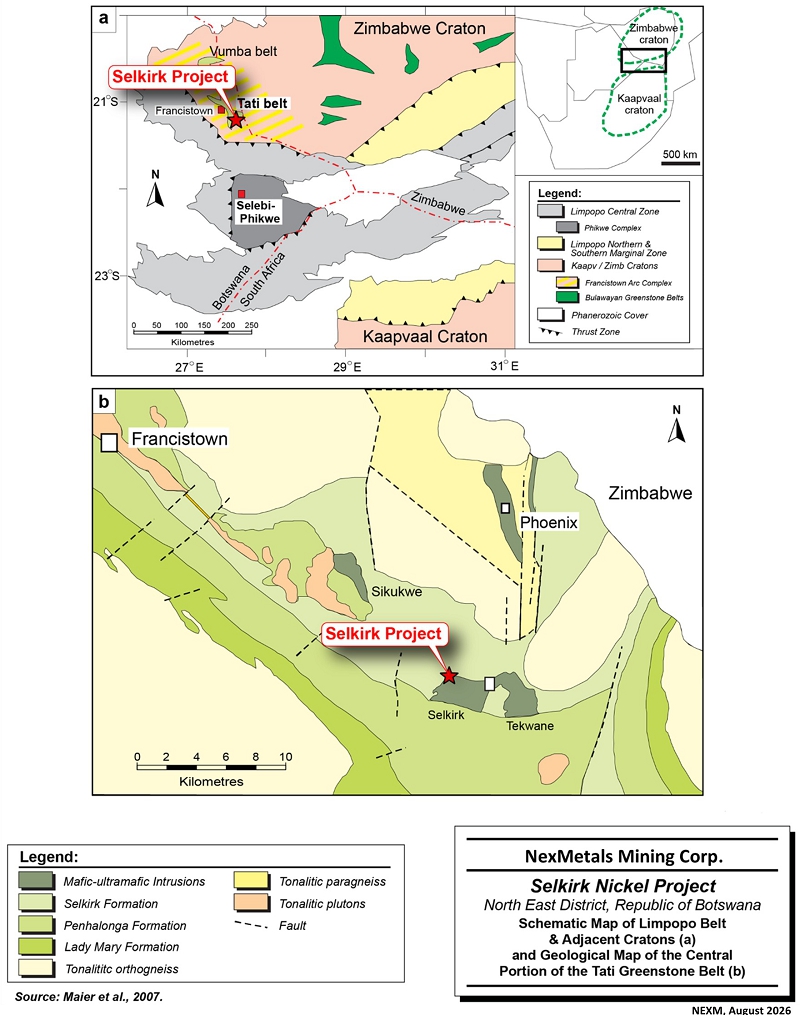
| 7.2 | Local Geology |
The Tati greenstone belt has a long mining history spanning as far back as ancient copper workings, which exploited gossan outcrops of the present operations (Dirks, 2005). Two deposits have been exploited by TNMC; one at Selkirk and the other being the Phoenix Mine, located 15 km to north (Figure 7-2). Other associated Ni-Cu prospects in the vicinity of the Project include the Tekwane and Cinderella exploration prospects.
| J5050 – Selkirk Nickel-Copper-PGE Project S-K 1300 Technical Report Summary 17-08-2026 | Page: 40 |
Figure 7-2 Simplified geological map of the northern Tati Greenstone Belt
|
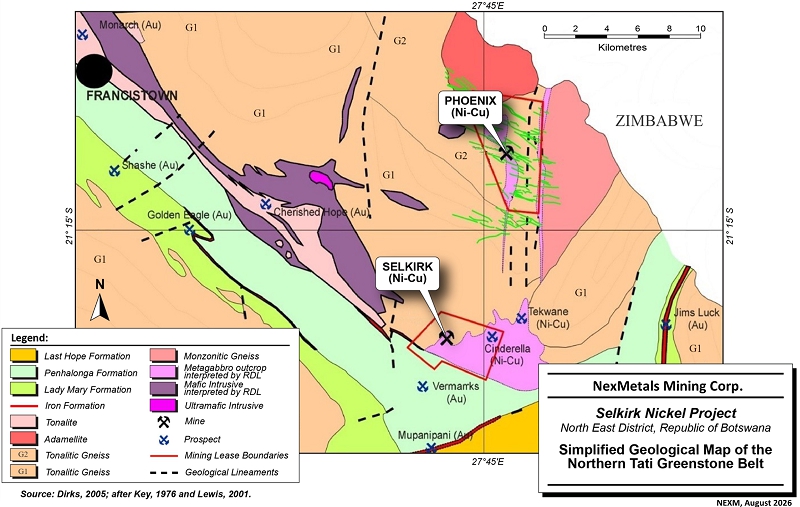 |
| J5050 – Selkirk Nickel-Copper-PGE Project S-K 1300 Technical Report Summary 17-08-2026 | Page: 41 |
| 7.3 | Selkirk Deposit Geology |
The geology of the Selkirk deposit is characterised by two types of metagabbro units, namely, taxitic and leucocratic porphyritic metagabbro (Maier et al., 2007). The taxitic metagabbro is characterised by Ni-Cu sulphide mineralisation of low to high grade, whereas the leucocratic porphyritic gabbro is barren (Carney et al., 1994). Northwest trending Karoo-age dolerite dykes and south trending feldspar porphyries crosscut these metagabbro units. Alteration assemblages consist of epidote-chlorite, fuchsite, and saussurite (Dirks, 2005).
The general stratigraphy of the main lithological units of the Selkirk deposit is defined as follows (Figure 7-3):
| ● | Dikgaka metagabbro (Ni-depleted metagabbro in the hanging wall). | |
| ● | Selkirk metagabbro (taxitic contaminated and Ni-enriched metagabbro). | |
| ● | Quartz-diorite (footwall basement). | |
| ● | Penhalonga Formation (andesitic, mafic and ultramafic volcanics that were thrust over the former lithologies along a prominent northwest trending regional thrust zone at the northern border of the Tati greenstone belt) (not shown). |
A structural geology study of the area in 2016 discovered numerous faults that have lateral and vertical displacement, resulting in the displacement and movement of bodies of mineralisation (WorleyParsons, 2016; Figure 7-4). The Selkirk deposit plunges at 25° to the southwest, with a gossanous outcrop located at surface above the underground mine stopes.
| J5050 – Selkirk Nickel-Copper-PGE Project S-K 1300 Technical Report Summary 17-08-2026 | Page: 42 |
Figure 7-3 Simplified geology in longitudinal view through the Selkirk deposit
|
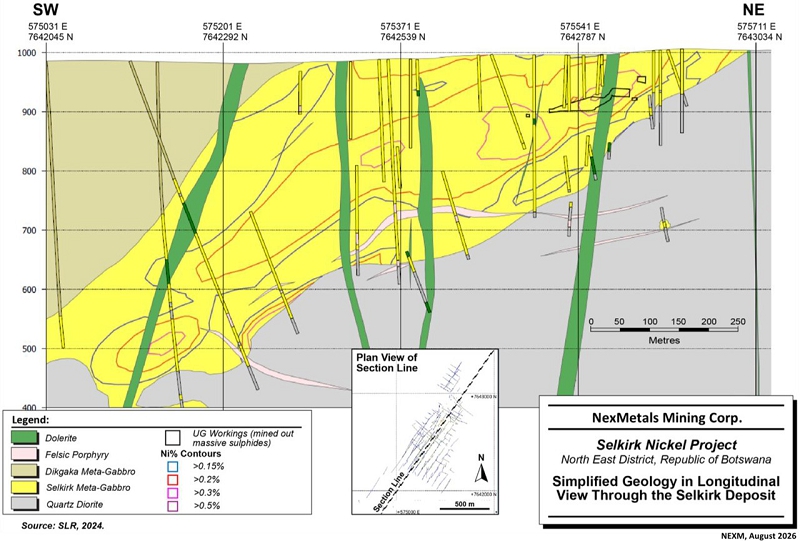 |
| J5050 – Selkirk Nickel-Copper-PGE Project S-K 1300 Technical Report Summary 17-08-2026 | Page: 43 |
Figure 7-4 Detailed map of the Selkirk geology
|
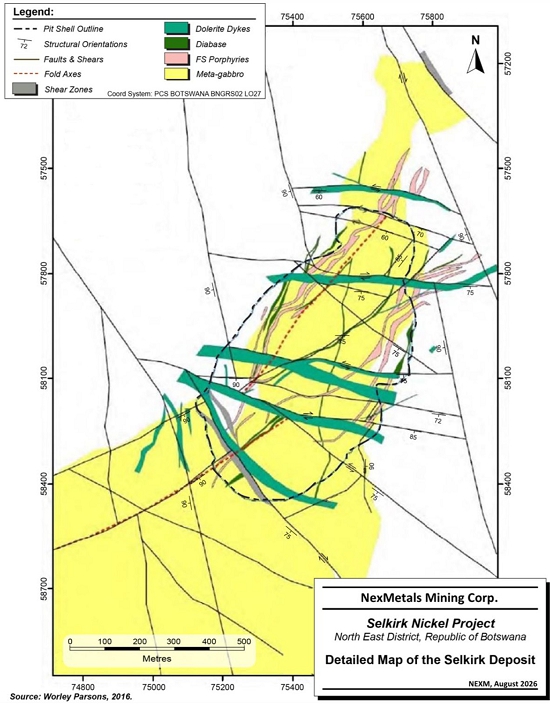 |
| Note: | Pit Shell Outline refers to previous work and not the pit shell used for reporting the Mineral Resource Estimate in Section 14 of this TRS. |
| J5050 – Selkirk Nickel-Copper-PGE Project S-K 1300 Technical Report Summary 17-08-2026 | Page: 44 |
| 7.4 | Mineralisation |
Two distinct styles of mineralisation can be found at Selkirk:
| ● | Massive-sulphide accumulations within the “keel” of the gabbro intrusion, and along the contacts with the surrounding volcano-sedimentary host rocks. | |
| ● | Matrix and disseminated sulphide accumulations as a halo and down dip of the massive sulphide mineralisation. |
Ni-Cu-PGE mineralisation is hosted within pentlandite, pyrrhotite, chalcopyrite, and pyrite (Johnson, 1986). PGE mineralisation is primarily hosted within Kotulskite (Pd(Te,Bi)), Michenerite ((Pd,Pt)BiTe), and Merenskyite (Pd,Pt)(Te,Bi)2 (SGS, 2024).
The intrusion once hosted a lens of massive sulphide measuring approximately 20 m thick and 200 m long that is mantled by a zone of disseminated sulphides that averages 120 m wide and ranges from approximately 100 m to 150 m thick.
Pyrrhotite constitutes up to 90 vol% of the massive mineralisation. Pentlandite occurs as flame-like lamellae and granular aggregates in pyrrhotite. Chalcopyrite predominantly occurs in the disseminated sulphides. Magnetite locally constitutes up to 15% of the opaque fraction, occurring as subhedral grains that may be distinctly rounded. In some cases, pyrite may constitute approximately 5% of the sulphides, forming late-stage veins and euhedral or subhedral crystals. The massive sulphides may also contain distinctly rounded silicate inclusions reminiscent of durchbewegung textures (Vokes, 1969).
Surface and underground geological mapping, as well as information obtained from historical and current drilling campaigns and surface geophysical surveys, have confirmed the synclinal nature of the massive sulphide body hosted within the surrounding disseminated sulphide halo in the metagabbro. The axis of this “syncline” appears to plunge at approximately 20° to 25° to the southwest, which was also confirmed by ground geophysical methods (EM, IP, and resistivity), as well as drilling.
The disseminated sulphide continues down plunge to the southwest beyond the massive sulphide mineralisation, and averages approximately 100 m to 150 m in thickness. Fieldwork and studies of the Selkirk drill core indicate that the Selkirk metagabbro is 2.7 Ga (Maier et al., 2007).
| J5050 – Selkirk Nickel-Copper-PGE Project S-K 1300 Technical Report Summary 17-08-2026 | Page: 45 |
| 8. | Deposit Types |
Ni-Cu-PGE sulphide deposits occur in cratons and orogenic belts worldwide (Arndt et al., 2005). Sulphide deposits are broadly classified into two types; hydrothermal and magmatic. The Selkirk deposit belongs to the magmatic type.
Magmatic Ni-Cu sulphide deposits form as the result of segregation and concentration of droplets of liquid sulphide from mafic or ultramafic magma, and the partitioning of chalcophile elements into these from the silicate melt. Sulphide saturation of a magma is not enough in itself to produce economic accumulations of metals. The appropriate physical environment is required so that the sulphide liquid mixes with enough magma to become adequately enriched in chalcophile metals, and then is concentrated in a restricted locality so that the resulting concentration is of economic grade (Naldrett et al., 2004).
Magmatic sulphide deposits are hosted by mafic and ultramafic units, i.e., komatiite, gabbro, gabbronorite, dunite, peridotite, pyroxenite, boninitic, and picritic rocks. Fundamental parameters for the formation of magmatic sulphide deposits include the ability of the mantle melt enriched in chalcophile elements (i.e., Ni, Cu, and PGEs) to interact with sulphur, and reaching sulphide saturation through progressive fractionation, or externally from sulphur rich contact wall rocks such as sediments (Barnes and Maier 1999; Li et al., 2002; Lu et al., 2019). The placement localities such as faults and basins concentrate the sulphide enriched melts, which result in different geometries such as tabular and massive magmatic sulphide bodies. The magmatic sulphide deposits are the most dominant Ni-Cu-PGE type, which include Kabanga in Tanzania, Norilsk Talnakh in Russia, Pechanga in China, Voisey’s Bay in Canada, Mount Keith in Western Australia, Bushveld Complex in South Africa, Great Dyke in Zimbabwe, and Selebi Phikwe in Botswana (Barnes and Lightfoot, 2005).
The capacity of a magma to form an economic Ni-Cu±PGE deposit is controlled mainly by: 1) the abundances of metals in the magma; 2) the sulphide saturation state of the magma; and 3) the capacity of the magma to interact with its surroundings. In practice, the ability of magma to interact with wall rocks depends on the nature of the wall rocks, the mode of emplacement, and the composition, temperature, viscosity, and volatile content of the magma itself (Arndt et al., 2005; Lesher et al., 2001).
| J5050 – Selkirk Nickel-Copper-PGE Project S-K 1300 Technical Report Summary 17-08-2026 | Page: 46 |
| 9. | Exploration |
| 9.1 | Mining Licence |
Exploration work completed by the PNGPL Project team on the Selkirk Mining Licence has included the sourcing and digitisation of existing historical information, confirmation and re-surveying of 320 drillhole collar locations, channel sampling underground, undertaking targeted sampling and re-sampling campaigns of historical drilling, analyses of the 2007 soil data, drill testing of three VTEM anomalies, surface and borehole EM surveys.
| 9.1.1 | Underground Exploration |
PNGPL geologists examined underground workings and confirmed continuous visible sulphides along an exploration drift extending 144 m across the interpreted primary sulphide horizon, in a southwestern direction from the previous mining operations. PNGPL collected and submitted twenty 10 kg grab samples from this exploration drift for assay to determine the variability in the grade of the mineralisation. Results are presented in Table 9-1. These results were not used in the MRE as they are grab samples taken from underground drifts that do not fully expose the mineralisation.
Table 9-1 Assay results from an underground drift at Selkirk |
| SAMPLE ID | Ni (%) |
Cu (%) |
Co (%) |
Pt (g/t) |
Pd (g/t) |
Au (g/t) |
mE | mN | Elevation (m) |
| TD00826 | 0.323 | 0.411 | 0.004 | 0.124 | 0.494 | 0.035 | 575413.3 | 7642664.3 | 897.4 |
| TD00827 | 0.177 | 0.307 | 0.001 | 0.071 | 0.348 | 0.03 | 575418.0 | 7642666.0 | 897.4 |
| TD00828 | 0.608 | 0.536 | 0.036 | 0.219 | 1.045 | 0.107 | 575422.7 | 7642667.7 | 897.3 |
| TD00829 | 2.34 | 0.201 | 0.132 | 0.568 | 2.44 | 0.011 | 575427.4 | 7642669.5 | 897.2 |
| TD00831 | 0.379 | 0.255 | 0.02 | 0.169 | 0.631 | 0.031 | 575432.1 | 7642671.2 | 897.2 |
| TD00832 | 0.578 | 1.55 | 0.03 | 0.186 | 0.888 | 0.052 | 575436.8 | 7642672.9 | 897.1 |
| TD00833 | 0.564 | 0.675 | 0.03 | 0.131 | 0.874 | 0.067 | 575441.5 | 7642674.6 | 897.0 |
| TD00834 | 0.485 | 0.35 | 0.024 | 0.127 | 0.658 | 0.045 | 575446.2 | 7642676.3 | 897.0 |
| TD00835 | 0.354 | 0.547 | 0.018 | 0.138 | 0.57 | 0.03 | 575450.9 | 7642678.1 | 896.9 |
| TD00836 | 0.638 | 0.306 | 0.032 | 0.213 | 0.857 | 0.03 | 575455.6 | 7642679.8 | 896.9 |
| TD00838 | 0.341 | 0.557 | 0.017 | 0.131 | 0.626 | 0.085 | 575460.3 | 7642681.5 | 896.8 |
| TD00839 | 0.393 | 0.349 | 0.022 | 0.108 | 0.559 | 0.022 | 575465.0 | 7642683.2 | 896.7 |
| TD00840 | 0.333 | 0.292 | 0.015 | 0.068 | 0.503 | 0.036 | 575469.7 | 7642684.9 | 896.7 |
| TD00841 | 0.223 | 0.295 | 0.01 | 0.061 | 0.381 | 0.027 | 575474.4 | 7642686.7 | 896.6 |
| TD00842 | 0.726 | 1.435 | 0.034 | 0.241 | 0.92 | 0.029 | 575479.0 | 7642688.4 | 896.5 |
| TD00844 | 0.369 | 0.273 | 0.015 | 0.278 | 0.961 | 0.06 | 575483.7 | 7642690.1 | 896.5 |
| TD00845 | 0.377 | 0.476 | 0.016 | 0.17 | 0.684 | 0.066 | 575488.4 | 7642691.8 | 896.4 |
| TD00846 | 0.295 | 0.857 | 0.011 | 0.131 | 0.611 | 0.099 | 575493.1 | 7642693.6 | 896.4 |
| TD00847 | 0.071 | 0.099 | 0.001 | 0.028 | 0.205 | 0.023 | 575497.8 | 7642695.3 | 896.3 |
| TD00848 | 0.274 | 0.193 | 0.014 | 0.126 | 0.542 | 0.025 | 575502.5 | 7642697.0 | 896.2 |
| Average | 0.492 | 0.498 | 0.024 | 0.164 | 0.740 | 0.046 |
| J5050 – Selkirk Nickel-Copper-PGE Project S-K 1300 Technical Report Summary 17-08-2026 | Page: 47 |
| 9.1.2 | Analyses of 2007 Soil Data |
On the Mining Licence, the 2007 soil data was analysed by Consulting Geologist Peter Lighfoot. The aim was to identify soils whose chemistry indicates buried magmatic Ni-Cu-PGE sulphide bedrock, plus map the broader mafic intrusion footprint. Mixed multi-element analyses were used to map mafic intrusions and identify discrete target points (Figure 9-1).
Figure 9-1 Results of the analyses of 2007 soil data over the Selkirk Mining Licence
|
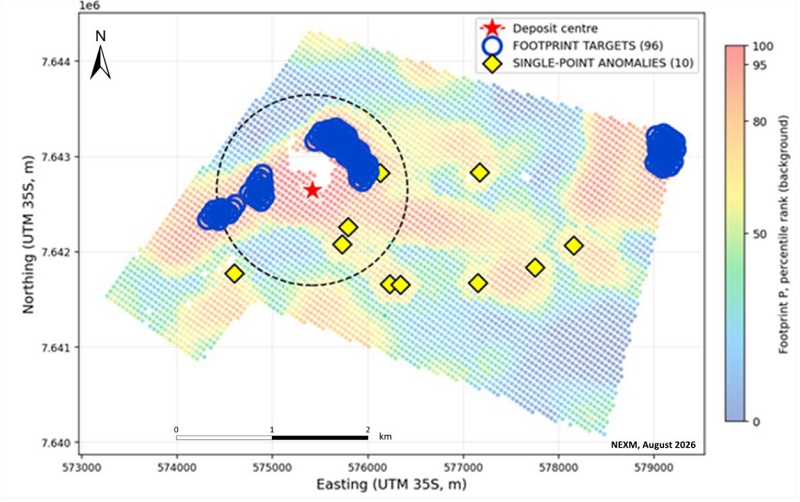 |
| Source: | PNGPL, 2025 |
| 9.2 | Regional Exploration |
The acquisition of the PLs adjacent to the Selkirk Mining Licence in 2010 and 2011 and their subsequent exploration was carried out by TNMC between 2011 and 2014 when it was controlled by Norilsk Nickel. The exploration work is described in Section 6.2.
The area is prospective for Ni-Cu-Co-Au-PGE mineralisation, having underlying geology similar to that of the nearby past producing mines; Selkirk, located immediately south of the PLs, and Phoenix, located to the north, as well as Ni-Cu deposits Tekwane and Cinderella.
| J5050 – Selkirk Nickel-Copper-PGE Project S-K 1300 Technical Report Summary 17-08-2026 | Page: 48 |
PNGPL’s work on the PLs has included data compilation and target generation, followed up by field prospecting, data verification, geophysical and soil sampling surveys. The most prospective target identified by TNMC was Rooikoppie, a strong VTEM anomaly coincident with both the presence of gossan and elevated soil geochemistry. Five holes, DRKP001 to DRKP005 targeted the gossan and VTEM anomaly in 2012, intersecting two distinct mineralised horizons. With the purpose of confirming that the anomalies were adequately tested, a surface EM survey was completed and the drillhole collar locations were recorded using a DGPS. The results indicated that the two parallel conductors had been intersected near surface and have significant down dip and strike extents. The drill core was sparsely sampled, and additional sampling was completed in DRKP001 and DKRP002. Assays results returned no significant Ni-Cu-PGEs.
A soil sampling program was completed in October and November of 2025 on the Selkirk PLs with the purpose of detailing 2012 soil anomalies (refer to Section 6.2) and one VTEM anomaly. Samples were also collected on two lines crossing over the mineralised Selkirk gabbro for control. A total of 933 samples were collected, excluding 59 duplicates. Grids typically had 100 m line intervals and 50 m sample spacing. The grid covering the VTEM anomaly had a 50 m line spacing. Samples were sent to ALS in Johannesburg where they were analysed for PGEs (PGM-MS23L) and a 48-element base/trace suite (ME-MS61L).
The analysis of results was carried out by Peter Lightfoot. A robust 8-element Mahalanobis (MDIST) anomaly detection — on log-transformed Ni, Cu, Co, Cr, Mg, Pt, Pd, Au and using the MCD robust covariance estimator — flags 248 samples as anomalous at the 97.5% χ² cutoff, with 183 samples exceeding the extreme 99.9% threshold (MD² up to 425). These fall into three geographically and geochemically distinct clusters (Figure 9-2):
| ● | Selkirk Deposit Test Lines: This area contains every top-20 MDIST2 anomaly in the dataset. Peak values reached 1,460 ppm Ni, 3,660 ppm Cu, 1,865 ppb Pd, and 217 ppb Pt. | |
| ● | Western Cluster: A coherent 2 km x 2.5 km area of Ni-dominant anomalies (median Ni/Cu ≈ 2.3). This is considered a high-priority exploration target. | |
| ● | Eastern Cluster: Displays moderate anomalies but lacks a supporting ultramafic rock-chemistry signature, suggesting potential secondary concentration processes rather than primary bedrock mineralisation. |
During the soil sampling program, a gossanous boulder was discovered at 575,896 E / 7,644,519 N. Analyses confirmed it as a massive Ni-Cu-sulfide-derived rock (2.22% Ni, 0.78% Cu, 35.7% S). There was no soil anomaly corresponding to the location, confirming the observation that it was not in situ:
| ● | Geochemical Fingerprint: The gossan has a Ni/Cu ratio of 2.86, which closely matches the Western cluster but differs significantly from the Selkirk test lines (Ni/Cu ≈ 1). | |
| ● | PGE Signature: It exhibits an extreme Pd/Pt ratio of 31.6, suggesting a highly fractionated source or supergene enrichment. |
The development of gossans can involve supergene enrichment/depletion processes, so the metal signal of the sample is not diagnostic of source. This applies to both Ni/Cu and Pd/Pt. Further sampling of the Selkirk gossan would help facilitate a more robust comparison.
| J5050 – Selkirk Nickel-Copper-PGE Project S-K 1300 Technical Report Summary 17-08-2026 | Page: 49 |
Figure 9-2 Soil geochemistry anomaly map (MIDST2)
|
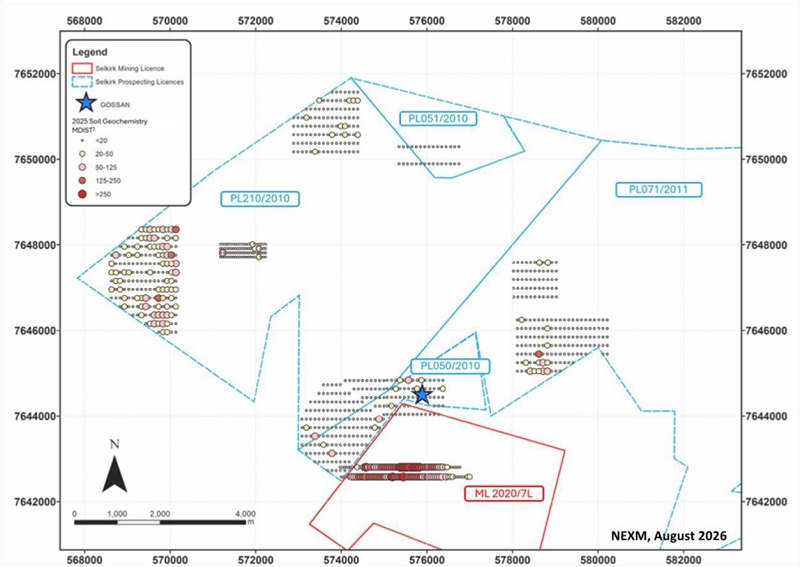 |
| Source: | PNGPL, 2025 using data from Lighthouse Geoscience |
The exploration work comprising soil samplings and limited drill testing of exploration targets has been completed and it is the MSA QP’s opinion that they warrant more detailed follow-up exploration.
| J5050 – Selkirk Nickel-Copper-PGE Project S-K 1300 Technical Report Summary 17-08-2026 | Page: 50 |
| 10. | Drilling |
The following paragraphs are summarised from SLR (2024), which in turn were largely taken from G Mining (2023), which in turn were largely taken from Botepe (2013). Drilling undertaken by current operator PNGPL includes 3577.40 m of large diameter core (HQ: 63.5 mm diameter) drilled for data verification and metallurgical samples, 325.8 m in one drillhole used to infill the existing Mineral Resource and three regional drillholes for 558.70 m testing VTEM anomalies located southwest and southeast of the Selkirk deposit.
| 10.1 | Summary |
Drilling at Selkirk began in 1965 and to the end of 2016, more than 500 holes had been drilled. Drilling resumed in 2025 when PNGPL drilled eleven HQ (63.5 mm diameter) drillholes for data verification and metallurgical samples, one NQ (47.6 mm diameter) size core for resource infill drilling and three regional exploration holes testing VTEM targets. The drilling campaigns completed by previous operators and by PNGPL are summarised in Table 10-1 and shown in Figure 10-1.
Table 10-1 History of drilling campaigns at the Selkirk deposit |
| Company | Years | Description | Number of holes | Metres |
| TTE1 | 1965-1967 | Core not available | 18 | 2,394 |
| Sedge2 | 1970-1971 | Exploration and Resource Drilling, core destroyed | 117 | 27,378 |
| Morex1 | 1984 | Metallurgical hole | 1 | 66 |
| Morex1 | 1987 | Geological confirmation & Metallurgical testwork | 2 | 254 |
| TNMC | 2003 | Scout drilling (exploration) | 11 | 5,202 |
| TNMC | 2005-2008 | Delineation drilling | 189 | 51,489 |
| TNMC | 2007 | Data Verification drilling (hole twinning) | 32 | 7,637 |
| TNMC | 2007 | Geotechnical | 24 | 2,935 |
| TNMC | 2007 | Regional Exploration | 9 | 4,333 |
| TNMC | 2016 | HQ metallurgical holes | 11 | 2,952 |
| TNMC | 2016 | HQ hydro holes | 4 | 1,000 |
| TNMC | 2016 | Geotechnical | 2 | 561 |
| TNMC | 2016 | Sterilisation holes | 11 | 2,044 |
| TNMC | 2008 | UG Drilled at the exploration drift | 13 | 457 |
| TNMC | 1998-2006 | UG Delineation and Crown Pillar Drilling | 83 | 2,726 |
| PNGPL | 2025 | HQ metallurgical holes (hole twinning) | 11 | 3577 |
| PNGPL | 2025 | Resource Drilling (gap drilling) | 1 | 326 |
| PNGPL | 2025 | Regional Exploration | 3 | 559 |
| Total | Total Diamond Drillholes | 542 | 115,890 | |
| TNMC1 | 2003 | Auger drilling (0.4 m Depth) | 25 | 10 |
| TNMC | 2008 | UG Channel Samples along wall of Exploration drift | 98 | 177 |
| PNGPL | 2021 | UG Channel Samples along wall of Exploration drift | 20 | 20 |
| Note: | 1 Holes excluded from database | |
| 2 Holes excluded from MRE in addition to those excluded from the database |
| J5050 – Selkirk Nickel-Copper-PGE Project S-K 1300 Technical Report Summary 17-08-2026 | Page: 51 |
Details of the procedures for the drilling prior to TNMC are scarce. Although the Sedge drilling exists in the compiled dataset, the details of the drilling and grade biases described by TNMC (high bias in Sedge drilling) led the QP to exclude these data from Mineral Resource estimation.
Figure 10-1 shows the drillholes and channel data currently digitised in the drilling database, with the underground workings, lithology, and the current optimised pit shell at 965 m elevation shown for context.
Figure 10-1 Drillhole location map
|
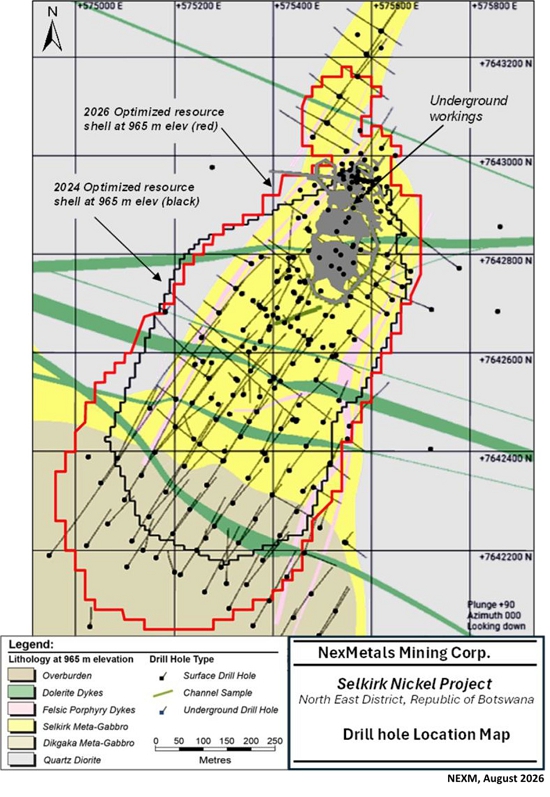 |
| Note: | April 2026 MRE Pit shell shown as red perimeter and Nov 2004 MRE pit shell shown as black perimeter. | |
| Source: | Modified from SLR, 2024 by NEXM, 2026 |
| J5050 – Selkirk Nickel-Copper-PGE Project S-K 1300 Technical Report Summary 17-08-2026 | Page: 52 |
| 10.2 | Historical Drilling |
The first drilling campaign at Selkirk was carried out by TTE in 1968. Eighteen diamond drillholes totalling 2,394 m were drilled (Malan, 1968), however, these drillholes are not present in the current database.
Between 1970 and 2016, 509 diamond drillholes (both surface and underground) have been completed at Selkirk for a total of 109,034 m, including 12 holes for metallurgical purposes, four holes for hydrogeology studies, and eleven holes for condemnation purposes. Ten regional holes were drilled by TNMC (DSLK171-180) for 4,618 m.
The majority of the drilling was aimed at delineating the main deposit along strike and down dip, with nine holes targeting areas away from the deposit.
In addition, 98 underground channel samples were taken along the wall of the underground workings, and 25 shallow auger holes were completed for soil sampling.
| 10.2.1 | RC Drilling |
A small amount reverse circulation (RC) drilling was carried out in 2003. Where sampled, the sample length was one metre, collected in a bag attached to the cyclone and split using a series of riffle splitters to produce two 100 g samples, one for submission to the laboratory and the other as a duplicate reference material. Splitting equipment included a 50/50 Jones riffle and three tier stack of riffle splitters. The sample submitted to the laboratory underwent crushing to 6 mm and milling to 75 μm until an 18 g subsample was extracted for X-ray fluorescence (XRF) and a 50 g subsample was extracted for fire assay for PGEs and Au if the minimum grade threshold for Ni was met.
RC drilling was discontinued at site due to concerns surrounding the sampling method and recovery.
| 10.2.2 | Diamond Drilling |
Diamond drilling was employed for exploration and resource delineation in the Selkirk deposit. Drilling primarily used NQ (47.6 mm diameter) size core, however, PQ (85 mm) and HQ (63.5 mm diameter) sized core were used for pre-collaring in unconsolidated sediments, geotechnical studies, and for the collection of metallurgical samples.
| 10.2.2.1 | Collar Surveying and Downhole Surveying |
Pre-drill collar positions were located by mine surveyors based on a drill plan issued by exploration geologists, and actual positions were surveyed after drilling using a real time kinematic (RTK) approach.
Downhole surveys were carried out using the Gyro survey tool. This tool was best suited as it remains unaffected by the influence of magnetic rocks.
Core orientation was carried out in most holes using the Ezy-Mark ™ system, and later the Ace tool provided by the drilling contractor.
From October 13 to October 17, 2022, PNGPL contracted Drysdale and Associates of Francistown, Botswana, to conduct a re-survey campaign of all available drill collars on the Project. Leica GS12 and Leica GS10 GPS Units were used, all with current Leica Blue Certificates. Coordinates were provided in WGS84, UTM zone 35 South, with geoidal heights. Three monuments were located to calibrate the positing, all of which gave precisions with < 50 mm error. Approximately 320 drillholes were re-surveyed.
| J5050 – Selkirk Nickel-Copper-PGE Project S-K 1300 Technical Report Summary 17-08-2026 | Page: 53 |
| 10.2.2.2 | Core Logging |
Core was metre-marked and logged by the geologist prior to sampling. Detailed logging described and separated all lithological units greater than 40 cm and these were logged as ‘Main’ units. Samples taken in ‘Main’ units were split along lithological boundaries and boundaries defined by percentage of visible sulphide minerals.
| 10.2.2.3 | Core Sampling |
Samples were marked by geologists for cutting and sampling, and sample lengths set at a minimum of 0.1 m for massive mineralisation to 1.0 m for disseminated, low-grade mineralisation, with approximately 88% of all samples within the database sampled at or below 1.0 m. This produced samples with weights between 250 g for massive mineralisation (0.1 m length and 4.69 g/cm3 rock density) and 2.4 kg for disseminated, low-grade mineralisation (1.0 m and 3.01 g/cm3 density). Once appropriately labelled, the samples were sent to the laboratory for assay.
Quality control procedures used were as follows:
| ● | All core was transported to the Phoenix Mine Site, located 15 km north of Selkirk, for logging and sampling and later returned to Selkirk for storage. | |
| ● | Core was logged by trained geologists and samples were selected at the time that the drillhole core was logged. | |
| ● | Most sample intervals conformed to a minimum of 0.1 m and a maximum of 1.0 m. Sampling took the geological host rock into consideration. | |
| ● | A continuous saw cut line was made along the drill core. | |
| ● | Core was cut using a diamond saw, with half of the core sent for analyses and the remaining half returned to the core box for reference purposes. | |
| ● | A 0.2 m waste sample was taken of the material bounding the mineralised intersections. | |
| ● | Specific gravity measurements were carried out on all the half drillhole core samples submitted to the laboratory, prior to the crushing stage of sample preparation. | |
| ● | Samples were despatched to the laboratory at the Phoenix Mine as a batch of 50 samples of which two of the samples were blank samples, and two were certified reference pulp samples (SARM-7 and GBM396-1). |
| 10.3 | PNGPL Drilling |
A total of 11 large diameter holes (HQ:63.5 mm diameter) in 3,577.4 m were drilled for the purpose of data verification and the collection of samples for metallurgical flowsheet development and pre-concentration studies using XRT technology. One NQ sized hole was drilled to in-fill the resource. Figure 10-2 shows the position of the 2025 drillholes, Table 10-2 and Table 10-3 show the collar details and significant results of the 2025 drillholes respectively.
DSLK-25-012 intersected a footwall zone below the conceptual pit shell. The footwall is an exploration target at this time.
| J5050 – Selkirk Nickel-Copper-PGE Project S-K 1300 Technical Report Summary 17-08-2026 | Page: 54 |
Figure 10-2 PNGPL 2025 drillholes
|
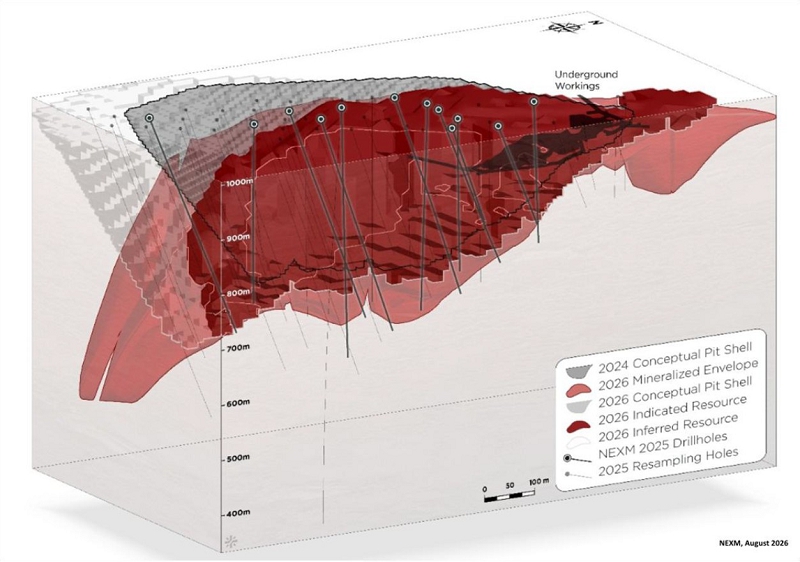 |
Table 10-2 Collar locations of PNGPL 2025 drillholes |
| HOLE ID | Details | 1Easting | 1Northing | 1Elevation | Dip | Azimuth | Hole Length (m) |
| SMET-25-001 | DSLK035 Twin | 575502.8 | 7642676.4 | 993.9 | -89.8 | 17.5 | 273.7 |
| SMET-25-002 | DSLK075 Twin | 575370.9 | 7642476.5 | 986.8 | -72.1 | 30.5 | 401.2 |
| SMET-25-003 | DSLK012 Twin | 575450.8 | 7642666.4 | 996.9 | -69.1 | 27.2 | 295.9 |
| SMET-25-004 | DSLK216 Twin | 575406.7 | 7642671.8 | 1000.7 | -88.1 | 14.2 | 375.5 |
| SMET-25-005 | DSLK047 Twin | 575354.5 | 7642634.2 | 996.9 | -70.6 | 42.8 | 364.9 |
| SMET-25-006 | DSLK219 Twin | 575475.3 | 7642848.6 | 991.9 | -88.0 | 63.2 | 253.1 |
| SMET-25-007 | DSLK028 Twin | 575587.6 | 7642717.7 | 993.0 | -69.0 | 32.9 | 187.7 |
| SMET-25-008 | DSLK037 Twin | 575550.6 | 7642643.4 | 990.0 | -70.9 | 36.0 | 177.8 |
| SMET-25-009 | DSLK243 Twin | 575330.4 | 7642547.7 | 989.3 | -88.1 | 334.7 | 455.3 |
| SMET-25-010 | DSLK086 Twin | 575284.7 | 7642459.4 | 984.4 | -70.4 | 36.3 | 388.9 |
| SMET-25-011 | DSLK145 Twin | 575205.0 | 7642236.3 | 982.7 | -68.76 | 39.4 | 403.6 |
| DSLK-25-012 | Resource in-fill | 575328.7 | 7642374.6 | 982.5 | -89.1 | 231.3 | 325.8 |
| Note: | 1Coordinates are WGS84z35S with geoidal elevations |
| J5050 – Selkirk Nickel-Copper-PGE Project S-K 1300 Technical Report Summary 17-08-2026 | Page: 55 |
Table 10-3 PNGPL 2025 drillhole significant intercepts |
| HOLE ID | From (m) |
To (m) |
1Length (m) |
Cu (%) |
Ni (%) |
Co (%) |
Pd (g/t) |
Pt (g/t) |
Au (g/t) |
Ag (g/t) |
2CuEq (%) |
| SMET-25-001 | 13.00 | 65.70 | 52.70 | 0.22 | 0.23 | 0.01 | 0.46 | 0.10 | 0.04 | 0.91 | 0.67 |
| SMET-25-001 | 90.25 | 208.00 | 117.75 | 0.26 | 0.24 | 0.01 | 0.53 | 0.11 | 0.05 | 1.58 | 0.76 |
| incl. | 92.55 | 156.00 | 63.45 | 0.26 | 0.25 | 0.02 | 0.51 | 0.10 | 0.04 | 1.56 | 0.77 |
| and | 92.55 | 99.85 | 7.30 | 0.47 | 0.57 | 0.03 | 0.68 | 0.13 | 0.06 | 1.78 | 1.37 |
| and | 138.00 | 156.00 | 18.00 | 0.38 | 0.30 | 0.02 | 0.76 | 0.15 | 0.06 | 2.29 | 1.06 |
| SMET-25-002 | 26.10 | 207.00 | 180.90 | 0.26 | 0.25 | 0.01 | 0.52 | 0.11 | 0.04 | 1.29 | 0.76 |
| Incl. | 53.00 | 78.00 | 25.00 | 0.21 | 0.22 | 0.01 | 0.43 | 0.09 | 0.03 | 0.75 | 0.63 |
| and | 122.00 | 207.00 | 85.00 | 0.34 | 0.31 | 0.02 | 0.65 | 0.14 | 0.05 | 1.90 | 0.97 |
| Incl. | 195.00 | 207.00 | 12.00 | 0.48 | 0.35 | 0.02 | 0.87 | 0.16 | 0.10 | 3.01 | 1.28 |
| SMET-25-003 | 12.70 | 214.00 | 201.30 | 0.33 | 0.30 | 0.02 | 0.55 | 0.13 | 0.05 | 1.81 | 0.91 |
| Incl. | 44.25 | 203.00 | 158.75 | 0.36 | 0.33 | 0.02 | 0.60 | 0.13 | 0.06 | 1.84 | 1.00 |
| SMET-25-003 | 73.00 | 195.00 | 122.00 | 0.39 | 0.36 | 0.02 | 0.63 | 0.14 | 0.07 | 2.04 | 1.08 |
| SMET-25-004 | 66.00 | 276.00 | 210.00 | 0.40 | 0.36 | 0.02 | 0.59 | 0.14 | 0.06 | 2.30 | 1.07 |
| Incl. | 66.00 | 187.00 | 121.00 | 0.36 | 0.37 | 0.02 | 0.58 | 0.14 | 0.06 | 1.85 | 1.03 |
| Incl. | 113.00 | 187.00 | 74.00 | 0.45 | 0.46 | 0.03 | 0.73 | 0.17 | 0.08 | 2.15 | 1.29 |
| Incl. | 131.65 | 187.00 | 55.35 | 0.52 | 0.47 | 0.03 | 0.80 | 0.18 | 0.09 | 2.60 | 1.41 |
| SMET-25-005 | 47.00 | 266.00 | 219.00 | 0.39 | 0.33 | 0.02 | 0.61 | 0.14 | 0.07 | 2.15 | 1.04 |
| incl. | 109.00 | 266.00 | 157.00 | 0.46 | 0.38 | 0.02 | 0.72 | 0.16 | 0.08 | 2.51 | 1.22 |
| incl. | 158.00 | 220.00 | 62.00 | 0.62 | 0.49 | 0.03 | 0.99 | 0.22 | 0.10 | 3.07 | 1.62 |
| SMET-25-006 | 20.00 | 86.35 | 66.35 | 0.43 | 0.41 | 0.03 | 0.65 | 0.14 | 0.05 | 2.70 | 1.17 |
| SMET-25-007 | 46.30 | 127.00 | 80.70 | 0.29 | 0.29 | 0.01 | 0.61 | 0.13 | 0.06 | 1.28 | 0.88 |
| incl. | 83.00 | 124.00 | 41.00 | 0.33 | 0.34 | 0.02 | 0.69 | 0.14 | 0.07 | 1.32 | 1.02 |
| SMET-25-008 | 33.00 | 132.00 | 99.00 | 0.24 | 0.25 | 0.01 | 0.53 | 0.13 | 0.04 | 1.07 | 0.75 |
| SMET-25-009 | 77.00 | 308.00 | 231.00 | 0.39 | 0.38 | 0.02 | 0.64 | 0.15 | 0.07 | 2.29 | 1.11 |
| incl. | 129.00 | 226.00 | 97.00 | 0.46 | 0.43 | 0.03 | 0.76 | 0.18 | 0.08 | 2.15 | 1.29 |
| and | 257.00 | 304.90 | 47.90 | 0.52 | 0.49 | 0.03 | 0.83 | 0.17 | 0.07 | 3.99 | 1.44 |
| SMET-25-010 | 110.00 | 281.00 | 171.00 | 0.29 | 0.29 | 0.02 | 0.51 | 0.12 | 0.05 | 2.11 | 0.85 |
| incl. | 110.00 | 268.00 | 158.00 | 0.30 | 0.30 | 0.02 | 0.52 | 0.12 | 0.05 | 2.15 | 0.87 |
| incl. | 146.00 | 196.00 | 50.00 | 0.40 | 0.43 | 0.02 | 0.68 | 0.16 | 0.08 | 1.87 | 1.18 |
| SMET-25-011 | 112.00 | 125.00 | 13.00 | 0.15 | 0.19 | 0.01 | 0.35 | 0.09 | 0.03 | 0.88 | 0.52 |
| SMET-25-011 | 171.10 | 324.00 | 152.90 | 0.25 | 0.26 | 0.02 | 0.54 | 0.12 | 0.05 | 0.91 | 0.78 |
| incl. | 275.10 | 319.00 | 43.90 | 0.35 | 0.34 | 0.02 | 0.75 | 0.16 | 0.06 | 1.19 | 1.05 |
| DSLK-25-012 | 15.00 | 267.00 | 252.00 | 0.21 | 0.23 | 0.01 | 0.46 | 0.11 | 0.04 | 0.72 | 0.66 |
| incl. | 163.00 | 264.00 | 101.00 | 0.28 | 0.29 | 0.01 | 0.56 | 0.12 | 0.05 | 0.95 | 0.84 |
DSLK-25-012 Footwall |
299.00 | 303.85 | 4.85 | 0.45 | 0.53 | 0.04 | 0.40 | 0.08 | 0.06 | 10.11 | 1.28 |
| Note: | 1Length is reported, which is an apparent thickness and not true thickness. True thickness has not been established for each intercept reported. | |
| 2CuEq% calculated using the formula: Cu(%) + Ni(%) * (85.1/91.4) + Co(%) * (93.8/91.4) + Pt(g/t) * (22.4/91.4) + Pd(g/t)*(33.1/91.4) + Au(g/t)*(68.5/91.4) + Ag(g/t)*(0.8/91.4). |
| 10.4 | Data Management |
Legacy and recent exploration drilling and sampling data has been or is in the process of being imported into a Fusion secure mining industry database.
| J5050 – Selkirk Nickel-Copper-PGE Project S-K 1300 Technical Report Summary 17-08-2026 | Page: 56 |
| 10.5 | Geotechnical Logging |
As part of the 2016 BCL BFS, 96 drillholes were re-logged for structure and a three-dimensional structural model was created in support of pit design and a conceptual strategy for mining around the underground excavations. A geotechnical investigation for ore transport and infrastructure design was also prepared This work included geotechnical logging of boreholes, point load testing, data capture, and rock mass classification and is detailed in WorleyParsons (2016). The QP is not relying on the historical geotechnical work, which should be considered as historical in nature, as insufficient data verification has been conducted by the QP to verify it.
| 10.6 | MSA QP Opinion on Drilling Campaigns at Selkirk |
The MSA QP is of the opinion that the drilling procedures used historically generally align with industry practice in place at the time, and that the spatial outline of the drilling allows for interpretation of the geological features.
The MSA QP is of the opinion that there are no drilling, sampling, or recovery factors that could materially impact the accuracy and reliability of the results.
Verification has continued to improve confidence in the drilling database, including extensive resampling of historical core, and completion of twelve twin drillholes.
The MSA QP is of the opinion that the geological information, mineralisation model, and drilling database are sufficient to support the geological interpretation and Mineral Resource Estimate presented in this TRS.
The MSA QP considers the current understanding of the controls on mineralisation and lithological association to be adequate for the purposes of Mineral Resource estimation at the current stage of project development. No material geological uncertainties have been identified that would reasonably be expected to have a material impact on the geological interpretation or the resulting Mineral Resource Estimate.
| 11. | Sample Preparation, Analyses and Security |
| 11.1 | Historical Work |
The following sections describe drillhole sample preparation, analysis and security undertaken by former operator TNMC, under ownership of LionOre (2006), Norilsk Nickel (2007-2013), and BCL (2016).
Drill core samples were prepared and analysed at the Phoenix Mine Laboratory. At the time of preparation and analysis, TNMC owned both the Phoenix Mine and Selkirk and the laboratory was not independent of the operator. From 2011, the Phoenix Mine Laboratory held accreditation with the South African National Accreditation System (SANAS), and with the International Organization for Standardisation/International Electrotechnical Commission (ISO/IEC) 17025 for chemical analyses.
| 11.1.1 | Sample Preparation |
Drill core samples were delivered to the Phoenix Mine Laboratory where they were dried and crushed twice to reach the required less than 6 mm size, upon which a 100 g split (in duplicate) was taken for milling. The type of splitter used is unknown. This subsample was milled to 80% passing 75 μm. The remaining sample was kept as a duplicate pulp in special sealed envelopes. Both pulp and crushed sample duplicates were returned to the exploration department for storage and were later used within the quality assurance and quality control (QAQC) program. Results from the laboratory were posted electronically through the LIMS / GBiS system against each sample as per the sample number into a working file where they were validated against lithological logging data; then they were imported into the GBiS database for storage.
| J5050 – Selkirk Nickel-Copper-PGE Project S-K 1300 Technical Report Summary 17-08-2026 | Page: 57 |
| 11.1.2 | Sample Analysis |
The following sample analyses were undertaken at the Phoenix Mine Laboratory:
| ● | Ni and Cu: XRF. | |
| ● | Pt, Pd, Au: 50 g fire assay. |
| 11.2 | Work by PNGPL |
Several phases of work involving sampling and assaying have been carried out by PNGPL:
| ● | In 2021, PNGPL located the unsampled cores of five historical drillholes completed by TNMC in 2016. The unsampled intervals of drill core were cut and quarter core sampled using the BCL Phikwe core processing facility at Selebi Phikwe and sent for analysis at ALS Global (ALS) in Johannesburg, South Africa. The MSA QP confirms that ALS (SANAS Accredited Testing Laboratory, No. T0387) is a commercial laboratory that is independent from NEXM. Samples ranged in length from 1.0 m to 1.5 m. Analyses for Ni, Cu, and Co were completed using a peroxide fusion preparation and inductively coupled plasma atomic emission spectrometry (ICP-AES) finish (ME-ICP81). Analyses for Pt, Pd, and Au were by fire assay (30 g nominal sample weight) with an ICP-AES finish (PGM-ICP23). Silver was assayed by ME-ICP61. Fe and S were analysed by ME-ICP81. | |
| ● | In 2022, as part of the data verification exercise in support of the G Mining 2023 NI 43-101 Technical Report, 115 quarter core duplicate samples were taken to validate primary laboratory results from the Phoenix Mine Laboratory, spanning five drillholes: DSLK014, DSLK083, DSLK207, DSLK213, and DSLK224. Drillholes were chosen for their spatial representativeness. These samples were shipped to ALS in South Africa for assaying. SLR reviewed the results against the original data and suggested PNGPL submit additional samples to complement this analysis, and to use half core samples instead of quarter core. | |
| ● | Twenty channel samples were completed in the underground exploration drift by PNGPL in 2021. Samples were sent to ALS and analysed using the same methods as the drill core. | |
| ● | Expanding on the initial data verification work completed by G-Mining, in 2024, a total of seventeen drillholes were selected from the remaining core fractions, and resampled. 3,699 samples were assayed for copper, nickel, gold, silver, PGEs (Pd, Pt), and cobalt by ALS. The purpose of this resampling campaign was to collect additional analyses to be used in the 2024 MRE. | |
| ● | The resampling work was expanded in 2025 with 34 additional holes, resulting in the resampling of a total of 51 historical drillholes representing a cross section of holes spatially and temporally. The expanded program using half core for the resampling. Core was processed at the Selebi North processing facility in 2024 and 2025. The aim of this program was to verify the original data and add to the PGE database, as not all samples were assayed for PGE by TNMC. Samples were analysed at ALS. Silver assays were completed using ME-MS61. | |
| ● | In 2025, PNGPL twin drilled 11 TNMC holes for the purposes of providing metallurgical samples and verifying the historical holes. An infill resource hole was also completed. The metallurgical holes were drilled using HQ size equipment, and for the verification sampling quarter HQ core samples were taken. Assaying was completed at ALS in South Africa using the same procedures as for the resampling. The 2025 drill hole locations are shown in Figure 10-2, collar locations in Table 10-2 and significant intercepts in Table 10-3. |
| J5050 – Selkirk Nickel-Copper-PGE Project S-K 1300 Technical Report Summary 17-08-2026 | Page: 58 |
| 11.3 | Quality Assurance and Quality Control |
| 11.3.1 | Historical Practices and Results |
Blank samples and certified reference material (CRM) samples were inserted regularly by TNMC at a rate of one per 20 samples within a batch not exceeding 200 samples. CRM samples were chosen based on anticipated nickel content of the proximal mineralised core sample. All QAQC sample insertions maintain consecutive numerical order. A pulp silica blank was also inserted every 20 samples.
MSA was provided with the historical TNMC QAQC database for the Phoenix Mine Laboratory that included 12,232 control samples (blanks and standards) inserted within drillhole samples from DSLK008 to DSLK168, and USLK001 to USLK009.
The following section provides an overview of the historical QAQC compilation and discusses the results obtained for Ni, Cu, Pt, Pd and Au. Co and Ag were not analysed for by TNMC.
| 11.3.1.1 | Blanks |
The regular submission of blank material is used to assess contamination during sample preparation and to identify sample numbering errors. Standard QAQC protocol accepts results returning up to 10 times the detection limit as a pass, i.e., 0.01% for Ni and Cu, and 0.01 g/t for Au, Pt, and Pd. A total of 4,043 blank samples were sent for analysis of nickel and copper, and around 1,261 of these samples were also analysed for Au and PGEs (Pd and Pt).
The analysis of blank samples reveals low error rates for Ni (0.6%) and Cu (0.6%), and higher failure rates for Au (4.2%), Pt (7%), and Pd (13.2%) (Table 11-1). The magnitude of many of the failures is greater than any possible contamination and suggest issues with sample swaps and/or data entry, particularly concerning the PGEs.
Table 11-1 Summary of the QAQC on blanks |
Ni (%) |
Cu (%) |
Pt (g/t) |
Pd (g/t) |
Au (g/t) | |
| Mean | 0.006 | 0.006 | 0.048 | 0.094 | 0.023 |
| Minimum | 0.000 | 0.000 | 0.000 | 0.000 | 0.000 |
| Maximum | 1.049 | 1.495 | 9.039 | 6.903 | 0.570 |
| Count | 4,043 | 4,043 | 1,253 | 1,261 | 1,247 |
| Fail Count | 26 | 24 | 88 | 167 | 52 |
| % Fail | 1% | 1% | 7% | 13% | 4% |
| J5050 – Selkirk Nickel-Copper-PGE Project S-K 1300 Technical Report Summary 17-08-2026 | Page: 59 |
Figure 11-1 Pt and Pd values (2004-2016) of blank samples assayed at Phoenix Mine laboratory
|
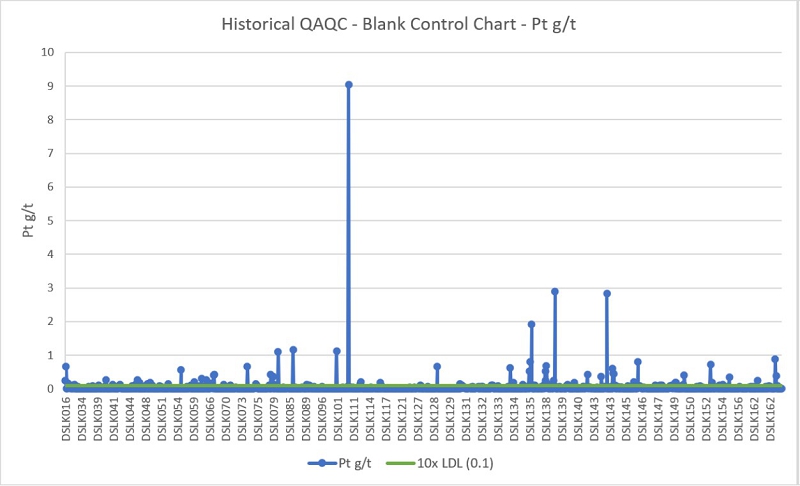 |
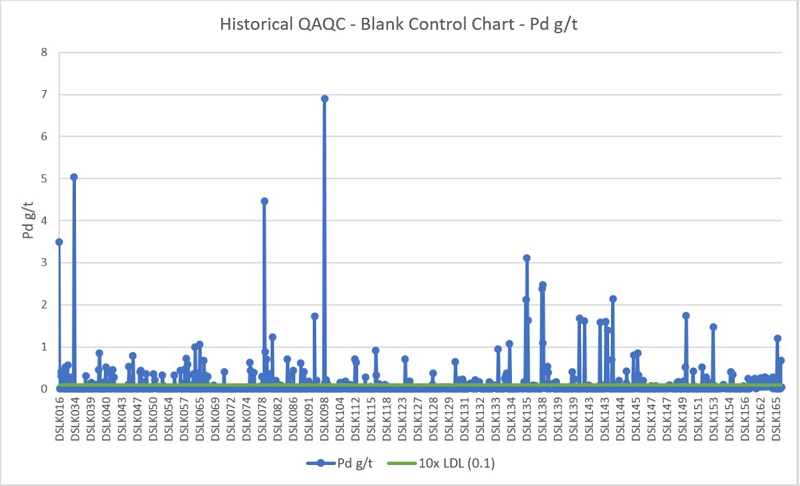 |
| Source: | MSA, 2026 |
| 11.3.1.2 | Certified Reference Materials |
The results from nine different standards used by TNMC from 2005 certified for Ni and Cu, with two additionally certified for Pt, Pd and Au, were reviewed. Although not sourced from Selkirk, the CRMs were chosen based on their similarity of mineralisation, rock composition and range of grades expected at Selkirk.
| J5050 – Selkirk Nickel-Copper-PGE Project S-K 1300 Technical Report Summary 17-08-2026 | Page: 60 |
A total of 7,787 standards were inserted into streams of drilling samples and shipped to the Phoenix Mine Laboratory. Typically, failures for standards data are considered by MSA to be values falling outside of three standard deviations (±3SD) from the expected value. However, the database did not contain the certified standard deviations for each CRM, and a 10% value was used.
Results are listed in Table 11-2 and indicate that the laboratory generally produced accurate results for Ni and Cu with very limited failures in most instances. CRM GBM398-5 produced the highest proportion of failures for Ni and Cu, likely stemming from data management issues or standards mix-up, rather than indicating laboratory failure. The low number of samples used for this standard suggests potential issues with the standard itself. The mean value for Pt and Pd for the AMIS002 and AMIS007 is significantly lower than expected and these two standards produced significantly high failure rates for Pt, Pd and Au. This raise concerns on the historical Pt, Pd, and Au assays, however, such concerns would largely be addressed by the re-sampling program. Selected graphs for these CRMs are presented in Table 11-3, showing that failed values were typically lower than the expected values.
Table 11-2 Results of CRM assays by TNMC |
| Assay | CRM ID | Expected value | Mean value | Count | Fail number | Fail % |
| Ni | AMIS002 | 0.197 | 0.206 | 307 | 7 | 2.3% |
| Cu | AMIS002 | 0.131 | 0.134 | 307 | 6 | 2.0% |
| Pt | AMIS002 | 0.840 | 0.670 | 189 | 54 | 28.6% |
| Pd | AMIS002 | 0.880 | 0.745 | 194 | 54 | 27.8% |
| Au | AMIS002 | 0.155 | 0.150 | 192 | 75 | 39.1% |
| Ni | AMIS007 | 0.207 | 0.206 | 583 | 4 | 0.7% |
| Cu | AMIS007 | 0.131 | 0.125 | 583 | 6 | 1.0% |
| Pt | AMIS007 | 2.460 | 1.599 | 236 | 123 | 52.1% |
| Pd | AMIS007 | 1.510 | 1.039 | 244 | 123 | 50.4% |
| Au | AMIS007 | 0.155 | 0.110 | 238 | 134 | 56.3% |
| Ni | GBM396-1 | 0.216 | 0.228 | 1,186 | 19 | 1.6% |
| Cu | GBM396-1 | 0.287 | 0.304 | 1,186 | 25 | 2.1% |
| Ni | GBM396-3 | 0.040 | 0.035 | 1,405 | 63 | 4.5% |
| Ni | GBM397-8 | 0.132 | 0.147 | 1,410 | 14 | 1.0% |
| Cu | GBM397-8 | 0.144 | 0.149 | 1,410 | 14 | 1.0% |
| Ni | GBM398-5 | 0.194 | 0.171 | 80 | 4 | 5.0% |
| Cu | GBM398-5 | 0.122 | 0.133 | 80 | 9 | 11.3% |
| Ni | GBM998-8 | 0.410 | 0.429 | 1,408 | 16 | 1.1% |
| Ni | GBM999-1 | 1.173 | 1.166 | 1,407 | 11 | 0.8% |
| J5050 – Selkirk Nickel-Copper-PGE Project S-K 1300 Technical Report Summary 17-08-2026 | Page: 61 |
Figure 11-2 GBM398-5 control chart for Ni and Cu at the Phoenix Mine laboratory
|
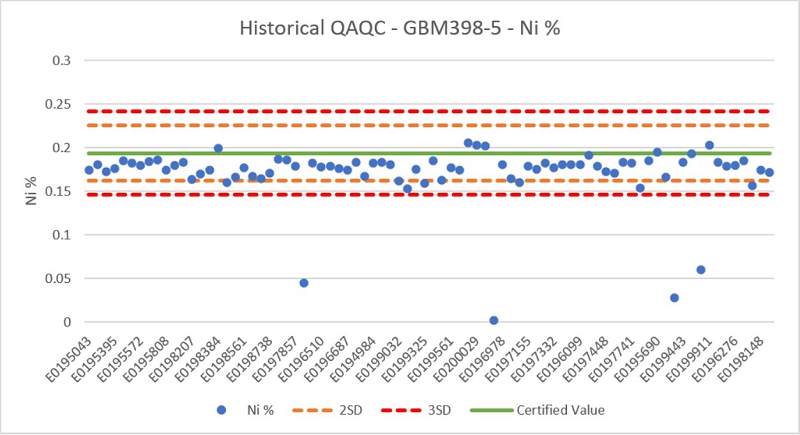 |
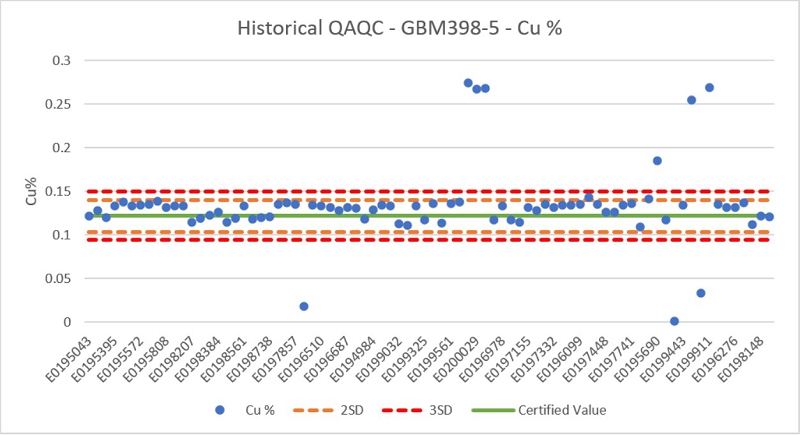 |
| Source: | MSA, 2026 |
| J5050 – Selkirk Nickel-Copper-PGE Project S-K 1300 Technical Report Summary 17-08-2026 | Page: 62 |
Figure 11-3 Selected AMIS002 and AMIS007 control charts at the Phoenix Mine laboratory
|
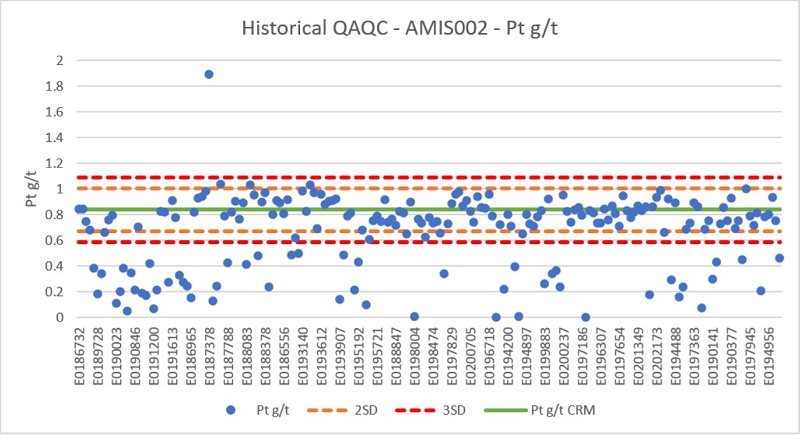 |
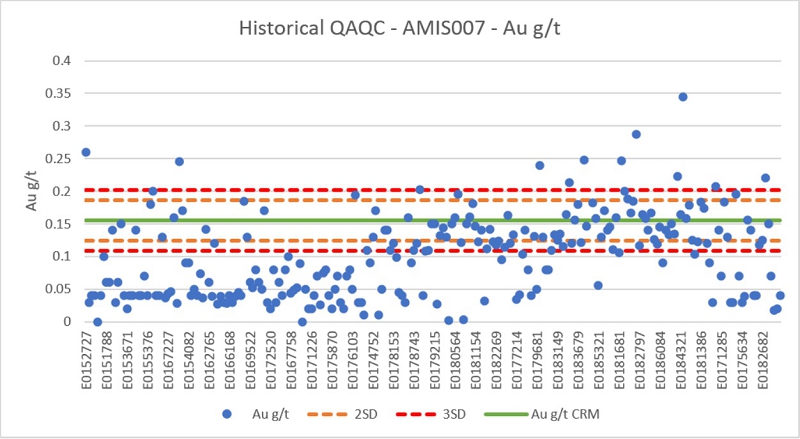 |
| Source: | MSA, 2026 |
| 11.3.2 | Current Work |
| 11.3.2.1 | 2025 program |
A QAQC database for the 2025 program was provided by PNGPL, containing around 4,402 QAQC samples from 71 drillholes (re-sampled drillholes, metallurgical twins, regional exploration, etc.). This means around 22% of the total assays for the program were QAQC samples.
Blanks
The QAQC dataset contained 825 blanks, comprising a mix between field blanks and CRMs. All the assays performed well against a failure limit of 0.1% / 0.1 g/t except for Ag which had a failure rate around 18%. A summary of blanks performance is presented in Table 11-1.
| J5050 – Selkirk Nickel-Copper-PGE Project S-K 1300 Technical Report Summary 17-08-2026 | Page: 63 |
Table 11-3 QAQC blanks performance summary PNGPL samples at ALS |
| Assay | Mean | Min | Max | Count | Fail Count | Fail % |
| Ni % | 0.010 | 0.000 | 1.190 | 814 | 15 | 1.8% |
| Cu % | 0.009 | 0.001 | 0.956 | 814 | 13 | 1.6% |
| Co % | 0.001 | 0.000 | 0.036 | 814 | 0 | 0.0% |
| Pt g/t | 0.009 | 0.002 | 0.523 | 799 | 13 | 1.6% |
| Pd g/t | 0.008 | 0.000 | 0.580 | 799 | 14 | 1.8% |
| Au g/t | 0.005 | 0.000 | 0.183 | 814 | 13 | 1.6% |
| Ag g/t | 0.122 | 0.005 | 3.840 | 778 | 143 | 18.4% |
Standards
Expected values and standard deviations were not provided within the database. Expected values and standard deviation for AMIS0060 and AMIS0061 were sourced from African Mineral Standards website and used for the analysis. For the others, the analysis was based on the actual sample results with assays deviating by more than 10% from the mean of the available CRM assays being flagged as a failure. CFRM-900 and AMIS0577 are a blank standard with low levels of the analytes of interest and performance of lab analyses was judged on a ten times detection level basis. Results were generally acceptable for Ni, Cu, Pt, and Pd; while Au, Ag, and Co sometimes reflected large failure rates against the conservative 10% deviation limit that was used.
Table 11-4 QAQC - CRM performance summary PNGPL samples at ALS |
| Assay | CRM | Mean value | Std dev | Count | Fail number | Fail % |
| Co % | AMIS0060 | 0.011 | 0.002 | 33 | 3 | 9.1% |
| Pt g/t | AMIS0060 | 0.198 | 0.011 | 31 | 0 | 0.0% |
| Pd g/t | AMIS0060 | 0.739 | 0.032 | 31 | 0 | 0.0% |
| Au g/t | AMIS0060 | 0.061 | 0.008 | 31 | 2 | 6.5% |
| Co % | AMIS0061 | 0.098 | 0.008 | 23 | 0 | 0.0% |
| Pt g/t | AMIS0061 | 0.473 | 0.021 | 23 | 0 | 0.0% |
| Pd g/t | AMIS0061 | 3.621 | 0.156 | 23 | 0 | 0.0% |
| Au g/t | AMIS0061 | 0.092 | 0.017 | 23 | 1 | 4.3% |
| Co % | AMIS0577 | 0.003 | 0.002 | 48 | 0 | 0.0% |
| Pt g/t | AMIS0577 | 0.006 | 0.020 | 48 | 1 | 2.1% |
| Pd g/t | AMIS0577 | 0.016 | 0.091 | 48 | 2 | 4.2% |
| Au g/t | AMIS0577 | 0.003 | 0.012 | 48 | 1 | 2.1% |
| Ni % | CFRM-100 | 0.313 | 0.019 | 371 | 5 | 1.3% |
| Cu % | CFRM-100 | 0.368 | 0.171 | 371 | 19 | 5.1% |
| Co % | CFRM-100 | 0.019 | 0.003 | 371 | 85 | 22.9% |
| Pt g/t | CFRM-100 | 0.321 | 0.021 | 362 | 11 | 3.0% |
| Pd g/t | CFRM-100 | 0.364 | 0.022 | 362 | 6 | 1.7% |
| Au g/t | CFRM-100 | 0.176 | 0.011 | 374 | 13 | 3.5% |
| Ag g/t | CFRM-100 | 2.083 | 0.459 | 344 | 87 | 25.3% |
| Ni % | CFRM-101 | 1.191 | 0.055 | 395 | 2 | 0.5% |
| Cu % | CFRM-101 | 0.921 | 0.321 | 395 | 2 | 0.5% |
| Co % | CFRM-101 | 0.034 | 0.003 | 395 | 56 | 14.2% |
| Pt g/t | CFRM-101 | 0.540 | 0.030 | 397 | 12 | 3.0% |
| Pd g/t | CFRM-101 | 0.590 | 0.023 | 397 | 5 | 1.3% |
| Au g/t | CFRM-101 | 0.182 | 0.013 | 400 | 40 | 10.0% |
| Ag g/t | CFRM-101 | 3.694 | 0.395 | 383 | 39 | 10.2% |
| Ni % | CFRM-102 | 2.525 | 0.041 | 39 | 0 | 0.0% |
| Cu % | CFRM-102 | 1.764 | 0.034 | 39 | 0 | 0.0% |
| Co % | CFRM-102 | 0.055 | 0.003 | 40 | 4 | 10.0% |
| Pt g/t | CFRM-102 | 0.861 | 0.031 | 43 | 0 | 0.0% |
| Pd g/t | CFRM-102 | 0.926 | 0.032 | 43 | 0 | 0.0% |
| Au g/t | CFRM-102 | 0.146 | 0.021 | 43 | 23 | 53.5% |
| Ag g/t | CFRM-102 | 5.994 | 0.459 | 40 | 7 | 17.5% |
| Ni % | CFRM-900 | 0.002 | 0.003 | 378 | 7 | 1.9% |
| Cu % | CFRM-900 | 0.002 | 0.002 | 378 | 2 | 0.5% |
| Co % | CFRM-900 | 0.001 | 0.000 | 378 | 0 | 0.0% |
| Pt g/t | CFRM-900 | 0.003 | 0.002 | 371 | 6 | 1.6% |
| Pd g/t | CFRM-900 | 0.001 | 0.001 | 371 | 2 | 0.5% |
| Au g/t | CFRM-900 | 0.002 | 0.002 | 377 | 3 | 0.8% |
| Ag g/t | CFRM-900 | 0.088 | 0.303 | 360 | 56 | 15.6% |
| J5050 – Selkirk Nickel-Copper-PGE Project S-K 1300 Technical Report Summary 17-08-2026 | Page: 64 |
| 11.3.2.2 | Pulp duplicates |
The QAQC database contained 1,781 pulp duplicates (pulp split), representing approximately 11% of the total assays for the 2025 program. The results were compared with original samples using scatterplots (Figure 11-4) and half absolute relative difference (HARD). Summary results are presented in Table 11-5.
Overall, the program yielded good repeatability for Ni, Cu, Pt, and Pd. Au, Ag, and Co repeatability is moderate to poor, largely due to the low assay values being less than or close to the method precision.
Table 11-5 2025 Pulp Duplicates Statistics |
| Assay | Count | Percentage HARD > 10% | Percentage HARD > 20% |
| Ni % | 1,781 | 10% | 3% |
| Cu % | 1,780 | 6% | 2% |
| Pt g/t | 1,751 | 14% | 4% |
| Pd g/t | 1,751 | 6% | 2% |
| Au g/t | 1,781 | 51% | 24% |
| Ag g/t | 223 | 25% | 13% |
| Co % | 1,781 | 32% | 12% |
| J5050 – Selkirk Nickel-Copper-PGE Project S-K 1300 Technical Report Summary 17-08-2026 | Page: 65 |
Figure 11-4 Scatter plots for pulp duplicate samples |
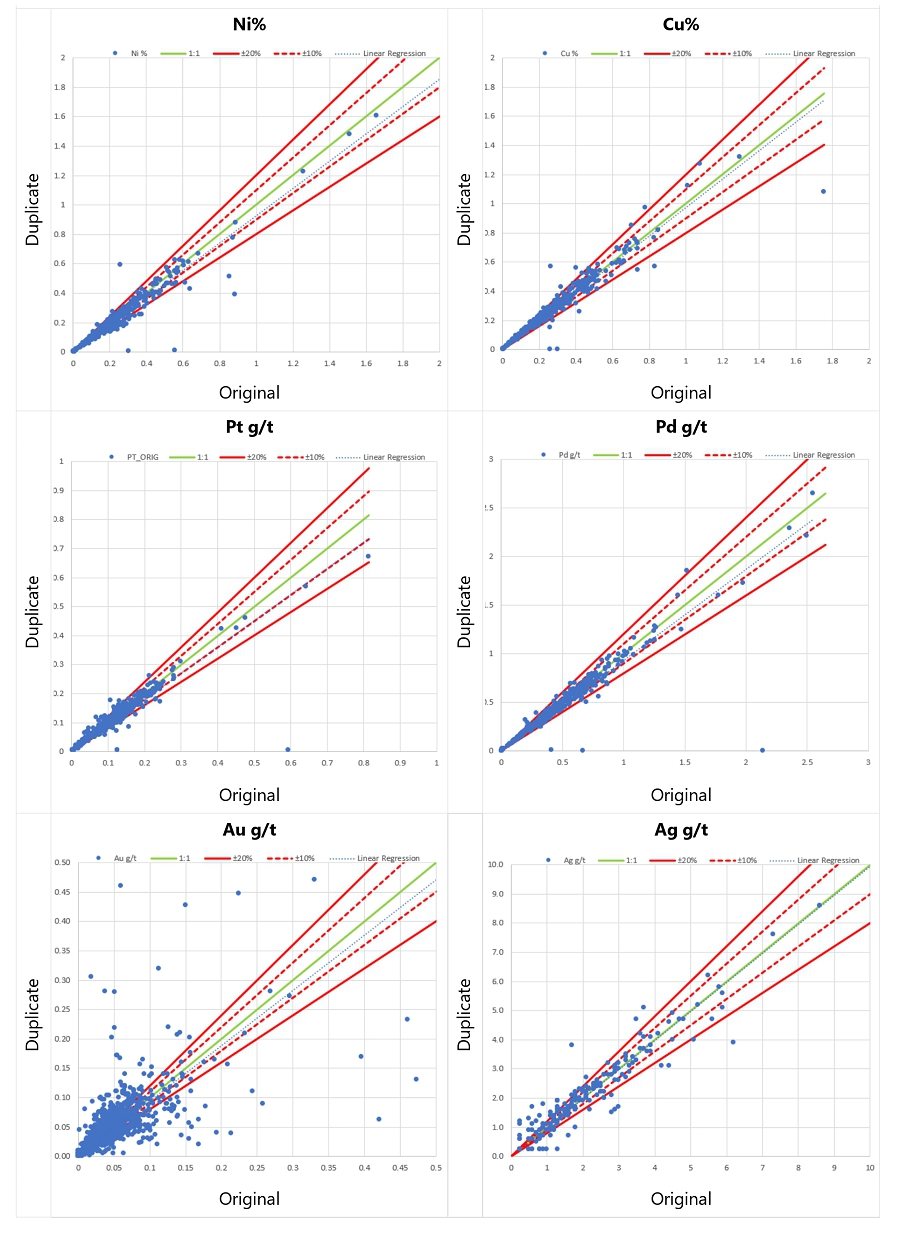 |
| J5050 – Selkirk Nickel-Copper-PGE Project S-K 1300 Technical Report Summary 17-08-2026 | Page: 66 |
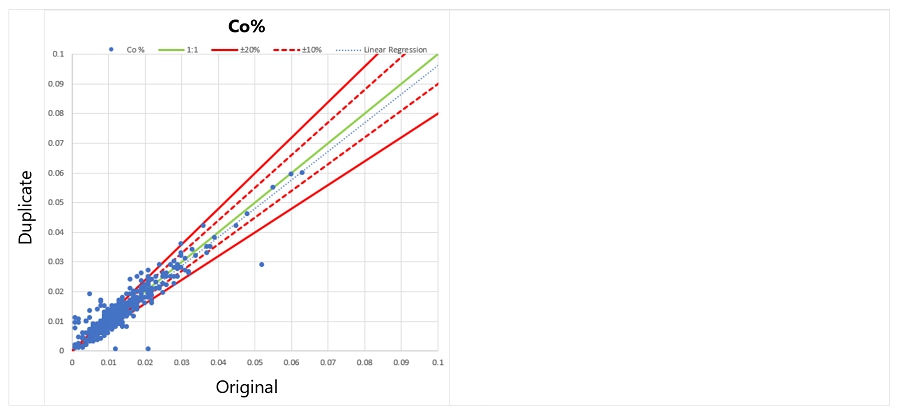 |
| 11.4 | Silicate Nickel Investigation |
SLR (2024) reported on the proportion of silicate nickel at Selkirk, as per the following paragraphs. The proportion of nickel at Selkirk reporting from silicates was investigated in three holes by Gipronickel Institute in 2012 through analysis of 23 samples ranging in total nickel grades of 0.18% to 1.08% (G-Mining, 2023). Assuming all non-sulphide nickel is silicate nickel, the small sample set indicated that, on average, 9% of the total nickel was from silicates, with a total range of silicate nickel of 0% to 22%. There seemed to be some correlation between higher silicate nickel proportion and lower nickel grades, however, the sample set was too small to be conclusive.
In 2021, SGS analysed for nickel in sulphide as part of metallurgical studies. The two composite samples (LG: 0.44% NiT; HG: 0.77% NiT) reported silicate nickel to form 6% and 3% of the total nickel, respectively (G-Mining, 2023).
In 2024, as part of the re-sampling program, PNGPL submitted 36 samples for sulphide nickel (Ni% (S) or NiS)) analysis to be compared alongside total nickel values (Ni % (T) or NiT). The data, in Figure 11-5, show good correlation between the sulphide and total nickel values, though some samples reported NiS values higher than NiT. Considering the samples with NiT ≥ 0.1% and NiT>NiS, results suggest that the extent to which silicate nickel informs the NiT value is 5%, with a total range of silicate nickel of 0% to 17%; however, this finding is limited to a small sample set of twelve, and results continue to be inconclusive. As metallurgical testing progresses at the Project, SLR recommended that PNGPL continue to explore the impact of silicate nickel in the nickel analytical results at the Project.
The proportion of nickel in silicates and its deportment has been and will be investigated further in metallurgical studies. MSA recommends that PNGPL gathers data in future programs on the proportion of nickel in silicates to enable spatial modelling, should it be of importance to the Project.
| J5050 – Selkirk Nickel-Copper-PGE Project S-K 1300 Technical Report Summary 17-08-2026 | Page: 67 |
Figure 11-5 Scatter plots comparing total and sulphide nickel
| |
| Zoomed in | All samples |
| |
| 11.5 | Relative Density Determinations |
All TNMC diamond drillhole half core samples were analysed for relative density using a spring balance on site at Selkirk (weight in air versus weight in water method). The relative density data was initially captured on paper hard copy, following which it was input into an MS Excel spreadsheet. The calibration of the spring balance was checked daily prior to any sample analyses. Relative density data that returned outside of a specific range (2.00 to 5.00) were subsequently investigated and either corrected or discarded from the final dataset.
For the 2025 drill programs, determination of Specific Gravity (SG), or density, was completed using the water immersion method (Archimedes method) by a trained PNGPL geological technician. The method entails the weighing of a dry sample in air and in water. SG determinations of all samples were carried out in a closed environment at the core shed to avoid external disturbances that may affect the scale reading. Dry samples were weighed using an electronic scale sensitive to 0.1 g and capable of measuring weights up to 3,100 g.
SG of a particular sample lithology was reviewed for correspondence with the sample description of the lithology on the log sheet and if there were any marked discrepancies, the process was repeated and the SG recalculated.
The recorded SGs were validated by a geologist to confirm if they correspond to the lithology as logged. If all was correct, the geologist signed-off the batch for dispatch to the laboratory and entered the SGs on a log sheet, otherwise the whole process was repeated.
| 11.6 | Sample Security |
TNMC diamond drill core is stored on site within a security patrolled fenced area at Selkirk. Holes drilled by PNGPL are stored at the secure Selebi North core processing and storage facility near Selebi Phikwe.
| J5050 – Selkirk Nickel-Copper-PGE Project S-K 1300 Technical Report Summary 17-08-2026 | Page: 68 |
| 11.7 | MSA QP opinion on Adequacy of the Sample Preparation, Security and Analytical Procedures |
In the MSA QP’s opinion, the sample preparation procedures for nickel, copper, cobalt, palladium, platinum, gold and silver are acceptable. Sufficient sample security is in place.
Based on the QAQC results, copper and nickel have shown acceptable performance at the Phoenix Mine Laboratory. Significant issues were identified at the Phoenix Mine Laboratory for the precious metals (Pt, Pd, Au) as most CRM assays returned values significantly lower than their expected values, suggesting accuracy issues.
The results of both the CRM and blank analyses suggest some sample mix ups have occurred, either in the sampling and assaying process or the database. Further work is required in this aspect.
Repeatability of Au, Ag and Co is problematic at the low concentrations at Selkirk. Both the Phoenix Mine Laboratory and ALS experienced poor precision for these elements.
ALS did not experience the low bias that was evident for Phoenix assays of CRMs for Pt and Pd. This suggests that Phoenix systematically under-assayed grades of Pt and Pd, which could lead to a conservative view of the Pt and Pd grade of the Project.
The resampling QAQC program demonstrated robust quality control for the sampling by PNGPL and sample processing and assaying by ALS. No contamination was detected, and the standards showed consistent performance with minimal biases. The PNGPL / ALS data can be used with confidence, however taking into consideration the low precision inherent in the Pt. Pd and Au analyses.
The MSA QP is of the opinion that the supporting data are representative and adequately support the geological interpretations and estimates to the level of classification assigned.
| J5050 – Selkirk Nickel-Copper-PGE Project S-K 1300 Technical Report Summary 17-08-2026 | Page: 69 |
| 12. | Data Verification |
The MSA QP has conducted the following as part of the data verification process:
| ● | Verification of the historical database including resampling of the historical drill core and metallurgical twin holes; | |
| ● | Checks of the database against original assay certificates; | |
| ● | A site visit by the MSA QP; from 7-8 November 2025; | |
| ● | Review of the project database, drilling procedures, sampling and assay methods, and QAQC (see sections 10 and 11 of this TRS). |
| 12.1 | Historical Data Verification |
Of the historical database, only the TNMC surface drillholes have original records of the drilling data and sample assay QAQC. Drilling prior to TNMC, as well as underground drilling and sampling, were not verifiable because original records and core are no longer available. As such, they were not included in the data considered for the Mineral Resource Estimate.
Verification of the historical sampling data has been applied in various phases.
| ● | In 2022, as part of the data verification exercise in support of the G Mining 2023 NI 43-101 Technical Report, 115 quarter core duplicate samples were taken to validate primary laboratory results from the Phoenix Mine Laboratory, spanning five drillholes: DSLK014, DSLK083, DSLK207, DSLK213, and DSLK224. Drillholes were chosen for their spatial representativeness. | |
| ● | Expanding on the initial data verification work completed by G-Mining, a total of seventeen drillholes were selected from the remaining core fractions, and resampled. 3,699 samples were taken. | |
| ● | The resampling work was expanded resulting in the resampling of a total of 51 historical drillholes representing a cross section of holes spatially and temporally. | |
| ● | In 2024 and 2025, PNGPL twin drilled 11 TNMC holes for the purposes of providing metallurgical samples and verifying the historical holes. |
| 12.1.1 | Comparison Between Original and Resampling |
Quartile-Quartile (QQ) plots were used to assess bias between the original and resample assay populations (Figure 12-1 to Figure 12-5). These indicate a slight low- to mid-grade positive bias for Ni towards the resample assays. A slight positive bias towards the resample assays for copper in the 0.05% to 0.30% Cu range is indicated although the higher grade range shows higher grades for the original samples. These differences may be attributed to the different analytical techniques between the original assays (XRF) and the resample assays (peroxide fusion and ICP-AES). Slight negative bias towards the resample assays was identified within the mid-grade range for Pt, Pd, and Au. Co and Ag were only assayed as part of the resampling program and hence such analysis was not possible.
| J5050 – Selkirk Nickel-Copper-PGE Project S-K 1300 Technical Report Summary 17-08-2026 | Page: 70 |
Figure 12-1
|
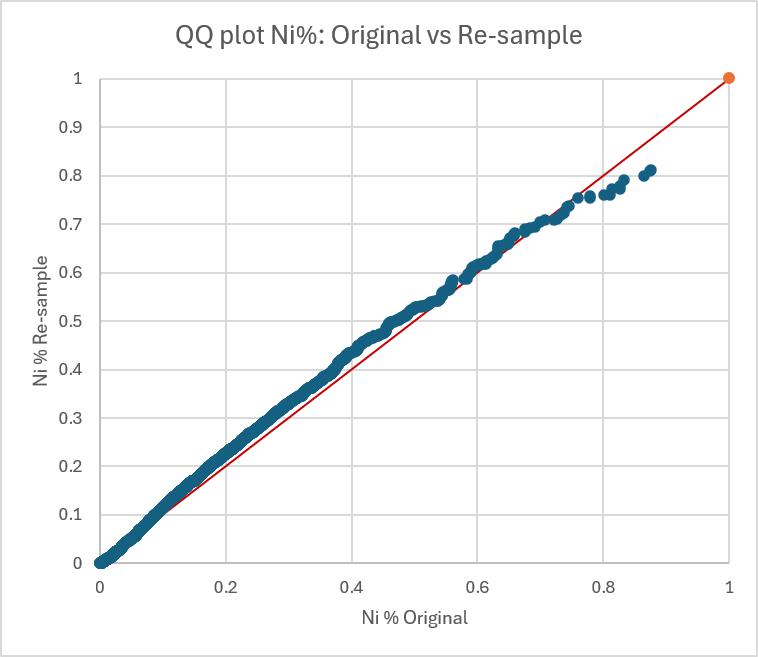 |
Figure 12-2
|
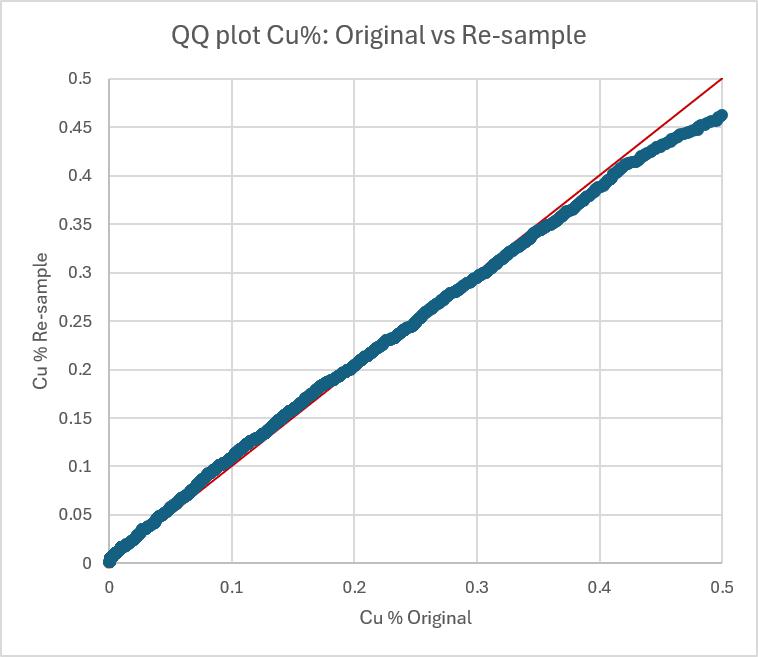 |
| J5050 – Selkirk Nickel-Copper-PGE Project S-K 1300 Technical Report Summary 17-08-2026 | Page: 71 |
Figure 12-3
|
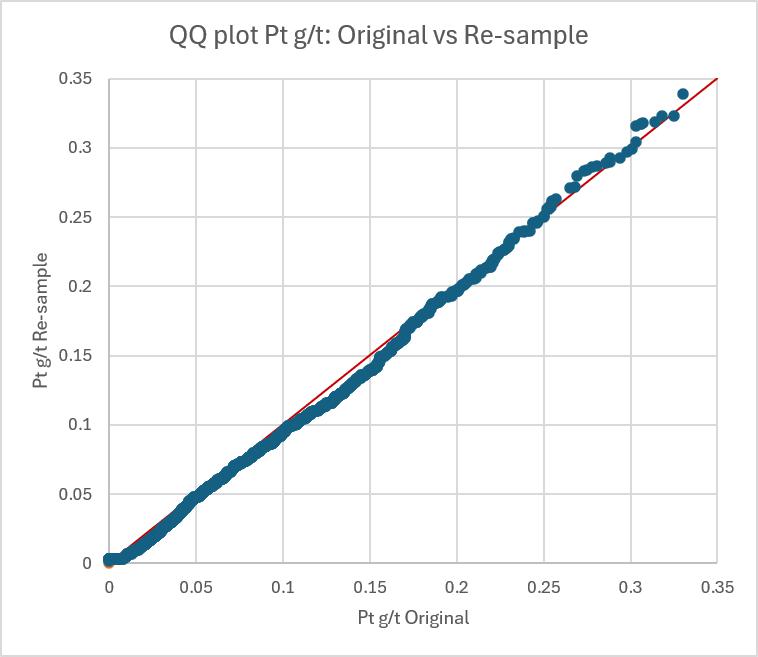 |
Figure 12-4
|
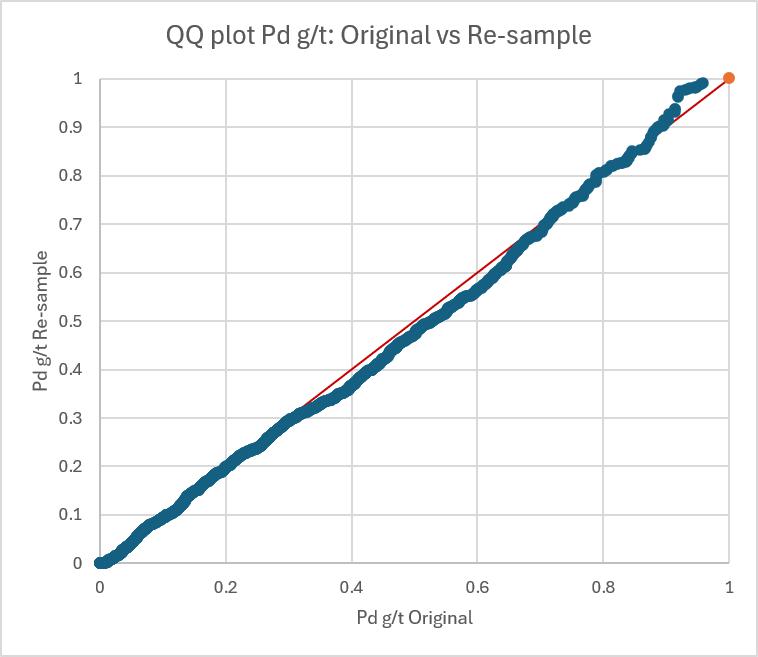 |
| J5050 – Selkirk Nickel-Copper-PGE Project S-K 1300 Technical Report Summary 17-08-2026 | Page: 72 |
Figure 12-5
|
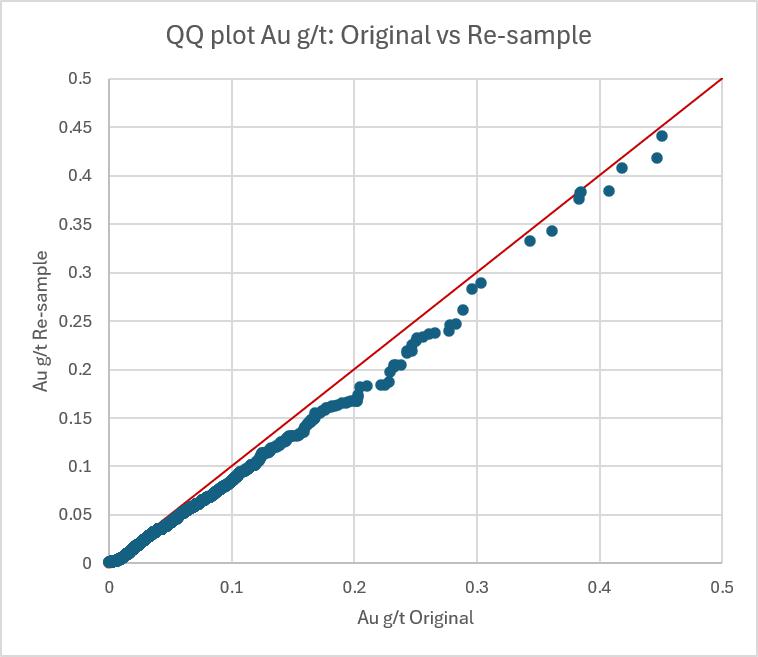 |
Summary statistics are presented in Table 12-1. The mean values for Ni and Cu compare closely, however the historical Pt and Pd assays tend to be slightly higher, with a stronger bias noted for Au.
| Table
12-1 Original vs resample assay statistics- resampling |
| Assay | Type | Count | Min | Max | Mean | SD | CV |
| Ni % | Original | 5,201 | 0.001 | 3.007 | 0.175 | 0.168 | 0.960 |
| Re-sample | 5,201 | 0.001 | 3.197 | 0.191 | 0.159 | 0.835 | |
| Cu % | Original | 5,051 | 0.000 | 12.319 | 0.213 | 0.275 | 1.289 |
| Re-sample | 5,051 | 0.001 | 11.08 | 0.213 | 0.248 | 1.165 | |
| Pt g/t | Original | 1,884 | 0.000 | 0.819 | 0.089 | 0.068 | 0.756 |
| Re-sample | 1,884 | 0.002 | 0.725 | 0.085 | 0.068 | 0.805 | |
| Pd g/t | Original | 1,942 | 0.000 | 6.134 | 0.371 | 0.366 | 0.987 |
| Re-sample | 1,942 | 0.000 | 5.009 | 0.358 | 0.350 | 0.979 | |
| Au g/t | Original | 3,497 | 0.000 | 1.452 | 0.048 | 0.061 | 1.277 |
| Re-sample | 3,497 | 0.001 | 2.309 | 0.041 | 0.061 | 1.501 |
| 12.1.2 | Comparison between Metallurgical Twin and Resample Assays |
In 2024 and 2025, PNGPL twin drilled 11 TNMC holes for the purposes of providing metallurgical samples and verifying the historical holes. The twin holes were drilled within five metres of the original hole and at the same orientation. The holes were HQ in size and quarter core samples were taken for assay for use in the MRE.
| J5050 – Selkirk Nickel-Copper-PGE Project S-K 1300 Technical Report Summary 17-08-2026 | Page: 73 |
Summary statistics are presented in Table 12-2. None of the metallurgical drillholes had corresponding resampled Ag assays. The mean of the assay data between the two sets of data compare closely. Additionally, a visual inspection reflected reasonable correlation as represented in Figure 12-6.
| Table
12-2 Original vs resample assay statistics – twin drilling |
| Assay | Type | Count | Min | Max | Mean | SD | CV |
| Ni % | Met twin | 1044 | 0.001 | 1.772 | 0.252 | 0.170 | 0.672 |
| Duplicate | 1044 | 0.001 | 1.374 | 0.245 | 0.154 | 0.627 | |
| Cu % | Met twin | 1044 | 0.001 | 1.349 | 0.267 | 0.201 | 0.753 |
| Duplicate | 1044 | 0.001 | 1.602 | 0.273 | 0.194 | 0.711 | |
| Co % | Met twin | 1053 | 0.001 | 0.097 | 0.015 | 0.009 | 0.595 |
| Duplicate | 1053 | 0.001 | 0.075 | 0.014 | 0.008 | 0.604 | |
| Pt g/t | Met twin | 1044 | 0.002 | 0.626 | 0.106 | 0.066 | 0.617 |
| Duplicate | 1044 | 0.003 | 0.678 | 0.108 | 0.064 | 0.592 | |
| Pd g/t | Met twin | 1044 | 0.001 | 3.227 | 0.465 | 0.309 | 0.664 |
| Duplicate | 1044 | 0.001 | 5.009 | 0.471 | 0.316 | 0.671 | |
| Au g/t | Met twin | 1053 | 0.001 | 0.866 | 0.049 | 0.053 | 1.096 |
| Duplicate | 1053 | 0.001 | 1.225 | 0.050 | 0.064 | 1.273 |
Figure 12-6
|
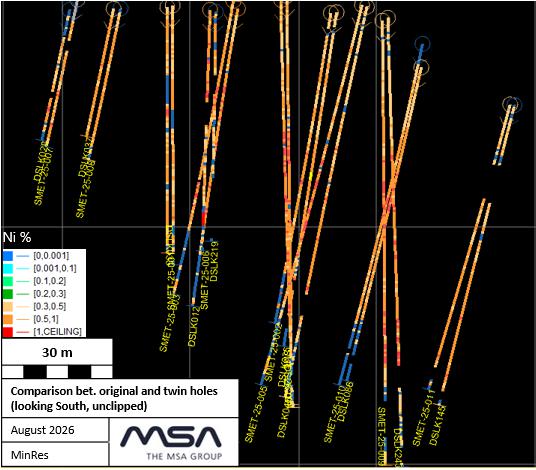 |
| J5050 – Selkirk Nickel-Copper-PGE Project S-K 1300 Technical Report Summary 17-08-2026 | Page: 74 |
| 12.2 | Assay Certificate Verification |
MSA was provided with original assay certificates for the resample assays and metallurgical drillholes and has access to the ALS Web retrieve system where assay results can be obtained directly from the laboratory. MSA cross-checked the assays certificates for several assay batches against the values in in the Excel database. No transcription errors were found.
A random selection of historical database results have been compared against digital records from TNMC and no issues were found.
| 12.3 | Site Visit Verification |
The Selkirk Project was visited by MSA from November 07 (site inspection) to November 08, 2025 (PNGPL core inspection). On site, MSA inspected historical mineralised core, viewed the gossanous outcrop at surface, observed existing infrastructure (Figure 12-7), including the Selkirk underground ramp and remains of massive sulphide stockpiles at surface, and verified the locations of several surface drillhole collar locations, both historical and recent.
Figure 12-7
|
Source: J. Witley, 2025
No drilling was being conducted during the time of the site visit.
| J5050 – Selkirk Nickel-Copper-PGE Project S-K 1300 Technical Report Summary 17-08-2026 | Page: 75 |
The historical core is stored within the Selkirk Mine perimeter which is access controlled by security personnel (Figure 12-8). The core has been exposed to the elements and has oxidised on surface; however, this oxidation can be cleaned off and the sulphides appear unoxidised in recently broken core (Figure 12-9). Core boxes are marked with the drillhole name, box number and depth. Acid from oxidation of the massive sulphide mineralisation has in some cases dissolved portions of the core boxes, however much of the historical core appears well preserved and the well-preserved cores were suitable for re-sampling.
Figure 12-8
|
Source: J. Witley, 2025
Figure 12-9
|
Source: J. Witley, 2025
The collars of six twin holes (SMET-25-002, SMET-25-003, SMET-25-004, SMET-25-006, SMET-25-010) and the corresponding original hole (DSLK075, DSLK012, DSLK216, DSLK219, DSLK086) as well as the PNGPL infill hole (DSLK-25-012) were located in the field, photographed (Figure 12-10) and hand-held GPS coordinates were recorded by the QP.
| J5050 – Selkirk Nickel-Copper-PGE Project S-K 1300 Technical Report Summary 17-08-2026 | Page: 76 |
Figure 12-10
|
Source: J. Witley, 2025
At the Selebi North core facility the MSA QP inspected the cores from five twin drillholes; SMET-25-002, SMET-25-003, SMET-25-004, SMET-25-006 and SMET-25-007 (Figure 12-11). The logging was verified by comparing the lithology and mineralisation in the remaining core with that of the database logs. The core boxes and cores are well marked with hole number, box number, depths and sample number and mineralisation is clearly visible in the core.
Figure 12-11
| |
Source: J. Witley, 2025
| 12.4 | Summary and Opinion of the MSA QP on the Data Verification |
An extensive program of data verification was completed by PNGPL including re-surveying of 320 drillhole collar locations and resampling campaigns of historical drillholes. Eleven HQ diameter drillholes that twinned TNMC holes were used to verify the historical results and produce samples for metallurgical testwork. The verification drilling and sampling confirmed the nature of mineralisation of the historical data. Although small biases occur between datasets, and errors in the database exist, they are not material and the MSA QP considers that they will not impact on the Mineral Resource Estimate for this large scale disseminated sulphide deposit.
The PNGPL Project team continues to collect, compile, review, and validate technical data relevant for the Project. Data collection, management and QAQC procedures carried out by PNGPL are adequate to support the MRE and meet industry good practices. It is the opinion of the MSA QP that the supporting data (historical drillhole database, and the data sourced from the current resampling work and 2025 drilling) is suitable to support Inferred and Indicated Mineral Resources. The MSA QP recommends that PNGPL continue its validation program and work towards a fully validated error free drillhole database. Given the higher confidence in the resampling, it is recommended that these data replace the original TNMC data as input to the Mineral Resource Estimate.
Approximately 22% of the TNMC drillholes were resampled by PNGPL and assayed for nickel and copper. A higher proportion of the platinum, palladium and gold assays (36%) were from NEXM resampling as TNMC did not always assay for these elements. Together with the 12 holes that were drilled by PNGPL, the total proportion of drillholes with assay data from PNGPL resampling and new drilling within the estimation data set is 25% for nickel and copper and 44% for platinum, palladium and gold. All of the silver and cobalt assays were sourced from PNGPL resampling and new drilling.
| J5050 – Selkirk Nickel-Copper-PGE Project S-K 1300 Technical Report Summary 17-08-2026 | Page: 77 |
| 13. | Mineral Processing and Metallurgical Testing |
The Selkirk Mine was commissioned in 1989 with massive sulphide material being trucked directly to the BCL furnace for smelting with no upgrading at a concentrator. Mining ceased in 2002 when the massive sulphides were exhausted, leaving behind a deposit described as being highly disseminated. The main objective of the metallurgical testwork since 2005 has been to optimise the processing of the disseminated mineralisation.
Although it was shown to be possible to produce separate nickel and copper concentrates, the nickel concentrate was low grade, hence most studies focused on the production of a bulk nickel-copper concentrate that would meet the specifications of the BCL smelter in Selebi Phikwe. Historical testing tracked PGE content but did not focus on the optimisation of PGE recoveries.
The BCL Smelter in Selebi Phikwe is no longer operational and, in 2021, prior to acquiring the Selkirk Project, NexMetals conducted a metallurgical test program to assess if marketable separate copper and nickel concentrates could be produced at acceptable recovery levels.
Historical metallurgical testing and the 2021 NexMetals testwork was covered extensively by G Mining in its 2023 report.
In 2023, NexMetals completed additional investigations covered by SLR in its 2024 report. Work included engaging several agencies to evaluate various conceptual process options for the Project.
| ● | Stark in Schleswig-Holstein, Germany conducted some preliminary amenability testwork for NexMetals on pre-concentration methods (Stark, 2024). X-ray Transmission (XRT) sorting technology was evaluated to determine the effectiveness on Selkirk feed samples and to identify whether different lithologies could be detected. Testwork focused on separating the minerals from waste materials. Overall, the XRT scanning results demonstrated the efficacy of the technology in classifying the Selkirk samples as product or waste based on the atomic density profiles of the rocks scanned. Based on the preliminary testwork results, Stark recommended additional work | |
| ● | SGS Natural Resources (SGS) in Lakefield, Ontario, Canada tested samples from the Selkirk deposit to evaluate the established flowsheet on Selkirk tenor variability samples representative of the cut-off grades of historical mineral resources and to explore ways to improve nickel recovery, investigate an alternate (Gipro) flowsheet for bulk concentrate generation, and generate large quantities of copper and nickel concentrates for smelter evaluation and downstream hydrometallurgical testing. Testing across four tenor samples showed that pentlandite liberation was generally weak, improving somewhat with finer grinding but remaining poor for two of the samples even at very fine grind sizes. The alternate Gipro flowsheet, which simplifies the process to produce a bulk concentrate, delivered a meaningful improvement in both copper and nickel recoveries, though concentrate grades were lower as a result. Locked cycle testing on a 2021 moderate-grade composite was more successful, producing a high-grade, low-nickel copper concentrate alongside a separate nickel concentrate, with reasonable overall recovery of the associated platinum, palladium, and gold split between the two concentrate streams. (SGS, 2024) |
| J5050 – Selkirk Nickel-Copper-PGE Project S-K 1300 Technical Report Summary 17-08-2026 | Page: 78 |
| ● | Conceptual Process Study - DRA Projects (Pty) Ltd. (DRA) was engaged by NexMetals to prepare a Front End Solutions (FES) conceptual study for the Selkirk Project, evaluating various process options for concentrate production and processing (DRA, 2023). Based on the results of these preliminary studies and historical data analyses, NexMetals conceptualised a treatment process incorporating ore sorting and flotation to produce a bulk concentrate for sale and estimated the associated copper and nickel recoveries. |
In 2024, NexMetals contracted Flowsheets Metallurgical Consulting Inc. (FMCI) to review previous SGS data generated from four tenor samples (MG_HT, LG_HT, MG_LT, and MG_MT) which had been tested using the Gipro process flowsheet to produce a bulk concentrate (FMCI, 2024). FMCI noted that this flowsheet had delivered the highest nickel recovery of the previous testwork, and subsequently applied the simplified Gipro flowsheet to produce a bulk low-grade copper-nickel-PGM concentrate sample for use in proof of concept hydrometallurgical testwork.
In 2025, NexMetals contracted Fuse Advisors Inc. (Fuse Advisors) to review historical testwork and provide metallurgical guidance for the Project. At the time of Fuse’s engagement, a bulk concentrate was being produced at XPS laboratories and overseen by FMCI using a fresh core sample from the re-assay program to better understand the hydrometallurgical response and recovery of the platinum group elements (PGEs). The program’s focus subsequently shifted, and fresh core was selected from the Selkirk deposit to support a new metallurgical flotation program aimed at generating two saleable concentrates. This program was successful and highlighted key considerations for a future variability program that will support improved recovery estimates across the deposit.
| 13.1 | 2025 IMS Ore Sorting Testwork Program |
Preliminary testwork conducted by Stark evaluated the amenability of Selkirk material to pre-concentration via XRT (X-ray transmission) sorting technology. Results indicated that the technique could effectively distinguish product mineralised material from waste based on the atomic density response of the scanned rock. Based on these findings, further testing on a larger bulk sample was recommended, along with a dedicated sorting test campaign. In early 2025, IMS Engineering (Pty) Ltd. (IMS Engineering) was engaged to support this bulk testwork program and to establish Selkirk’s recovery versus mass pull curves.
| 13.1.1 | Sample Selection |
To support this bulk sampling initiative, half-core material from a twin drilling program was identified as a suitable source. Hole SMET-25-004 was selected and submitted to IMS Engineering for initial proof-of-concept ore sorting testing. The selected interval spanned 7.6 m to 296 m of half core, yielding approximately 1,230 kg of sample material. This interval was chosen to capture a representative range of ore characteristics likely to influence sorting performance, including low, medium, and high-grade material, moderate and low tenor material and a variety of textures including taxitic, foliated, and massive.
| J5050 – Selkirk Nickel-Copper-PGE Project S-K 1300 Technical Report Summary 17-08-2026 | Page: 79 |
In addition to the bulk sample, IMS Engineering required a supplementary 50 kg reference sample set. This set included sulphide product variations spanning low, medium, and high grade, and moderate to low tenor, as well as barren waste variations consisting of dyke material and pegmatite.
| 13.1.2 | Testwork Results |
The objective of this testwork was to conduct sensor-based sorting trials on the provided samples to demonstrate the Comex X-ray Transmission (XRT) sorter’s ability to pre-concentrate copper/nickel ore, upgrading mineral grade through the removal of waste material. Grade-recovery relationships across all four scenarios evaluated (Coarse Cu, Coarse Ni, Fine Cu, and Fine Ni) followed a consistent pattern, with strong grade upgrading and mass rejection achievable at lower recoveries but diminishing returns as recovery increased toward the upper end of the curve (Figure 13-1). At a target recovery of 95%, all four sorting curves indicated that mass pull would need to approach 90% or greater, resulting in minimal mass rejection and only marginal grade uplift above head grade. This behaviour suggests that Selkirk material does not exhibit a clearly defined density cut-off between mineralised and waste material, with overlapping density populations restricting the sorter’s ability to achieve meaningful mass rejection while maintaining high recovery.
Discrepancies between the positive initial scanning results reported by Stark Germany and the subsequent bulk testwork may be attributable to the representativity of the initial sample selection, or to differences between particle-scale liberation and rock-scale visual appearance.
Figure 13-1
|
| 13.2 | 2025/2026 BCR Testwork Program |
The main objectives of the 2025/2026 BCR testwork program samples were as follows:
| ● | Utilise fresh drill core from the metallurgical drilling program to prepare samples representing a range of tenor grades across the deposit. | |
| ● | Produce marketable copper and nickel concentrates, targeting a copper concentrate containing <1% Ni and a nickel concentrate grading >10% Ni. | |
| ● | Evaluate opportunities to improve copper, nickel, and PGM recoveries. | |
| ● | Improve the understanding of copper and nickel recovery estimation and the key factors influencing recovery. |
| J5050 – Selkirk Nickel-Copper-PGE Project S-K 1300 Technical Report Summary 17-08-2026 | Page: 80 |
| 13.2.1 | Sample Selection and Preparation |
A summary of the as-received samples and weights are presented in Table 13-1.
| Table
13-1 As received Selkirk samples and weights |
| Tenor Category | Sample ID | Hole ID | From | To | Sample Mass (kg) |
Low Tenor Waste sample |
DSLK012972- DSLK014209 | SMET-25-005 | 69.00 135.20 |
95.00 154.60 |
98.8 |
| Low Tenor | DSLK009939- DSLK009968 | SMET-25-006 | 39.00 | 63.60 | 41.7 |
| Low Tenor | DSLK010483- DSLK012023 | SMET-25-009 | 172.00 | 209.00 | 81.5 |
| Mid Tenor | DSLK013701- DSLK013720 | SMET-25-004 | 7.00 | 25.00 | 63.6 |
| Mid Tenor | DSLK004649- DSLK009019 | SMET-25-003 | 50.00 | 69.00 | 39.3 |
| Mid Tenor | DSLK008951- DSLK008986 | SMET-25-001 | 61.00 90.25 114.15 |
65.70 108.90 125.00 |
63.3 |
| Mid Tenor | DSLK013143- DSLK013186 | SMET-25-002 | 130.00 | 169.00 | 78.5 |
| High Tenor | DSLK009284- DSLK009384 | SMET-25-008 | 32.00 115.35 |
57.00 124.00 |
69.3 |
| High Tenor | DSLK009878- DSLK009837 | SMET-25-007 | 46.30 | 98.00 | 103.1 |
| High Tenor | DSLK009454- DSLK010007 | SMET-25-010 | 85.00 | 97.00 | 27.7 |
Three tenor domain samples were prepared for comminution and flotation testwork. Each 200+ kg tenor sample underwent an initial coarse preparation stage, during which approximately 20 kg of 31.5 mm/+26.5 mm material was extracted for the SMC test. After the SMC test sets were selected from this coarse fraction, the remaining material was further reduced to 6 mesh for Bond Work Index (BWI) testing. This approach ensured that all comminution testwork was completed on the same representative subsample of rock. In parallel, the remaining sample was prepared to 10 mesh for flotation testing. The head assay subsamples were extracted from a grind calibration testwork charge to ensure that the head assay subsamples were extracted at the finest particle size that was practical for the laboratory workflow.
A portion of each tenor sample was blended to create a composite representative of the estimated tenor distribution across the deposit. The blend proportions were based on a point model that identified areas of low, med, and high tenor mineralisation, with the interpreted zones converted to relative volumes. The resulting composite comprised approximately 43% high tenor, 49% med tenor, and 8% low tenor material. This master composite was used for flowsheet development, while the remaining tenor samples were utilised for variability testing to evaluate metallurgical performance across the range of ore types.
| 13.2.2 | Feed Characterisation |
A summary of feed assays for the three tenor samples is provided in Table 13-2. Head grades ranged from 0.23% to 0.33% copper and 0.23% to 0.33% nickel. The proportion of nickel present as sulphide ranged from 80.6% to 88.5%, from high to low tenor. Nickel tenor is a measure of how nickel-rich the sulphide minerals themselves are. The nickel tenor formula, provided by NexMetals geologists, assumes 38% nickel in pentlandite and does not correct for chalcopyrite; it is calculated as Ni%/S × 38. Tenor ranges are categorised as low (1–3), mid (3–5), and high (>5). The mineralogy reported below shows that as the abundance of pyrrhotite increases in the mid and low tenor categories, the amount of nickel reporting as flame pentlandite locked within pyrrhotite also increases, providing a good indication of recoverable nickel.
| J5050 – Selkirk Nickel-Copper-PGE Project S-K 1300 Technical Report Summary 17-08-2026 | Page: 81 |
| Table
13-2 Head assays and hardness of Selkirk tenor samples |
| Sample ID | Assay Cut | Assays | Ni(S)/Ni (%) | Nickel Tenor | |||||||
| Au (g/t) | Pt (g/t) | Pd (g/t) | Cu (%) |
Ni (%) |
Fe (%) |
Stot (%) |
Ni(S) (%) | ||||
| High Tenor BCR | Cut A | 0.04 | 0.13 | 0.54 | 0.23 | 0.23 | 8.54 | 1.73 | 0.19 | 80.8 | |
| Cut B | 0.05 | 0.13 | 0.57 | 0.24 | 0.23 | 8.43 | 1.76 | 0.18 | 80.7 | ||
| Cut C | 0.04 | 0.10 | 0.52 | 0.23 | 0.23 | 8.61 | 1.74 | 0.19 | 80.3 | ||
| High Tenor BCR Average | 0.04 | 0.12 | 0.54 | 0.23 | 0.23 | 8.53 | 1.74 | 0.19 | 80.6 | 5.0 | |
| Mid Tenor | Cut A | 0.02 | 0.08 | 0.45 | 0.24 | 0.21 | 8.57 | 1.94 | 0.18 | 85.4 | |
| Cut B | 0.03 | 0.10 | 0.42 | 0.24 | 0.22 | 8.78 | 1.90 | 0.18 | 82.9 | ||
| Cut C | 0.03 | 0.09 | 0.42 | 0.23 | 0.21 | 8.42 | 1.91 | 0.18 | 87.5 | ||
| Mid Tenor Average | 0.03 | 0.09 | 0.43 | 0.24 | 0.21 | 8.59 | 1.92 | 0.18 | 85.2 | 4.2 | |
| Low Tenor | Cut A | 0.10 | 0.14 | 0.61 | 0.33 | 0.30 | 11.7 | 4.39 | 0.28 | 93.0 | |
| Cut B | 0.07 | 0.13 | 0.60 | 0.33 | 0.31 | 12.1 | 4.44 | 0.26 | 84.6 | ||
| Cut C | 0.11 | 0.13 | 0.61 | 0.33 | 0.31 | 11.9 | 4.35 | 0.27 | 87.9 | ||
| Low Tenor Average | 0.09 | 0.13 | 0.61 | 0.33 | 0.31 | 11.9 | 4.39 | 0.27 | 88.5 | 2.6 | |
| Master Composite | Cut A | 0.03 | 0.11 | 0.44 | 0.25 | 0.23 | 8.87 | 2.04 | 0.19 | 83.2 | |
| Cut B | 0.06 | 0.09 | 0.40 | 0.24 | 0.24 | 8.92 | 2.03 | 0.20 | 82.3 | ||
| Cut C | 0.04 | 0.11 | 0.45 | 0.24 | 0.23 | 8.88 | 2.02 | 0.19 | 83.3 | ||
| Master Composite Average | 0.04 | 0.10 | 0.43 | 0.24 | 0.23 | 8.89 | 2.03 | 0.19 | 82.9 | 4.4 | |
Note: Ni(S) is nickel present in a sulphide form, Stot is Total Sulphur
| 13.2.3 | Mineralogy |
| 13.2.3.1 | Model Mineralogy |
A subsample from each of the three tenor samples was submitted for mineralogically investigation at a grind size of 80% passing approximately 100 µm. The Selkirk mineralised material is predominantly composed of silicate gangue minerals, with feldspars, chlorite, and pyroxene/amphibole collectively accounting for approximately 75–80 wt% of each sample (Figure 13-2).
Pyrrhotite is the dominant sulphide mineral and exhibits the greatest variability between the tenor domains, increasing from approximately 3.6 wt% in the high-tenor sample to 10.1 wt% in the low-tenor sample.
| J5050 – Selkirk Nickel-Copper-PGE Project S-K 1300 Technical Report Summary 17-08-2026 | Page: 82 |
Pentlandite (0.4–0.5 wt%) and chalcopyrite (0.9–1.3 wt%) occur at relatively consistent abundances across all three tenor domains, while pyrite is present as minor sulphide phases in each sample.
Figure 13-2
|
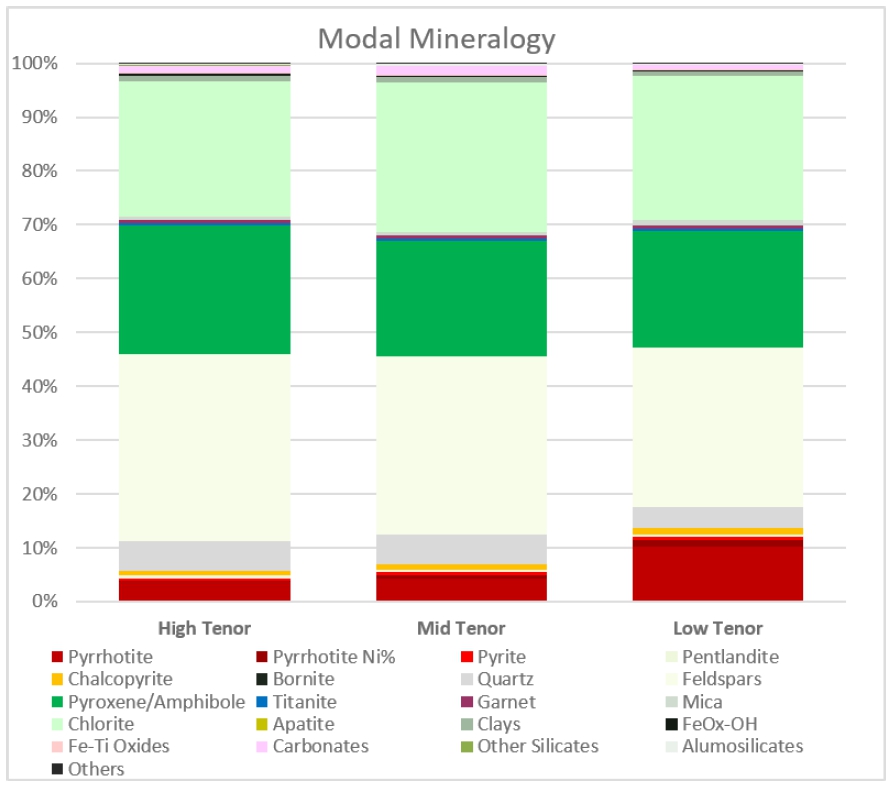 |
Source: BCR, 2026,
| 13.2.3.2 | Metal Deportment |
Copper is hosted entirely within chalcopyrite across all three tenor domains, indicating a consistent mode of occurrence regardless of tenor.
Nickel is predominantly associated with pentlandite; however, the proportion of nickel hosted in this mineral decreases with decreasing tenor. Pentlandite accounts for approximately 92% of the nickel in the high-tenor sample, 79% in the medium-tenor sample, and 58% in the low-tenor sample.
Nickel associated with Ni-bearing pyrrhotite increases with decreasing tenor, rising from approximately 8% in the high-tenor sample to 42% in the low-tenor sample.
The progressive shift of nickel from pentlandite to Ni-bearing pyrrhotite in the lower-tenor material is expected to adversely affect nickel flotation performance, resulting in lower nickel recoveries and reduced nickel concentrate grades compared with the high-tenor ore.
| J5050 – Selkirk Nickel-Copper-PGE Project S-K 1300 Technical Report Summary 17-08-2026 | Page: 83 |
Figure 13-3
Copper and nickel metal deportment
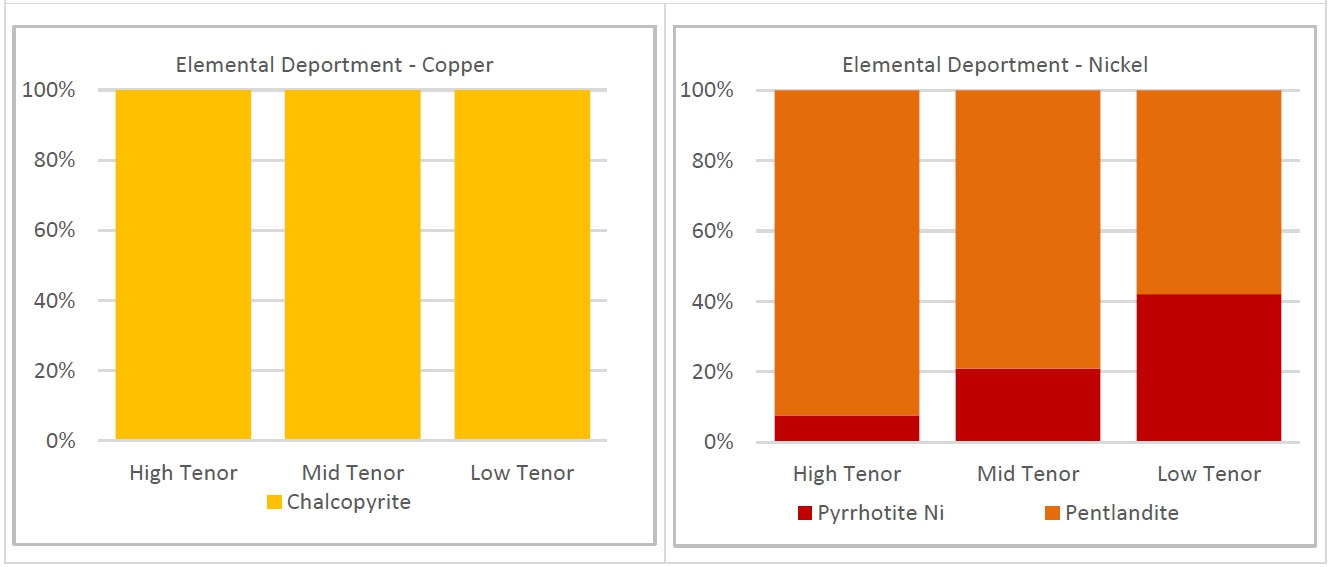
Source: BCR, 2026
| 13.2.3.3 | Liberation |
Copper sulphide minerals exhibit a high degree of liberation across all three tenor domains (Figure 13-4), with approximately 65–72% of chalcopyrite particles reporting to the >90% liberated fraction. The liberation characteristics are consistent between the high, med, and low tenor samples, indicating that copper flotation performance is not expected to vary significantly as a function of tenor.
In contrast, nickel sulphide liberation decreases progressively with decreasing tenor (Figure 13-4). The mid tenor sample exhibits moderate liberation, with the proportion of particles in the >90% liberated fraction declining to approximately 40%, accompanied by a corresponding increase in composite particles. The low tenor sample displays the poorest liberation, with only approximately 20% of nickel sulphide particles reporting to the >90% liberated fraction and a substantially higher proportion of partially liberated and locked particles.
These results indicate that nickel sulphides become increasingly associated with pyrrhotite and silicate gangue minerals as nickel tenor decreases. The reduced liberation of nickel bearing minerals in the lower tenor material is expected to negatively impact nickel flotation recovery and concentrate grade.
| J5050 – Selkirk Nickel-Copper-PGE Project S-K 1300 Technical Report Summary 17-08-2026 | Page: 84 |
Figure 13-4
Copper and nickel liberation by volume
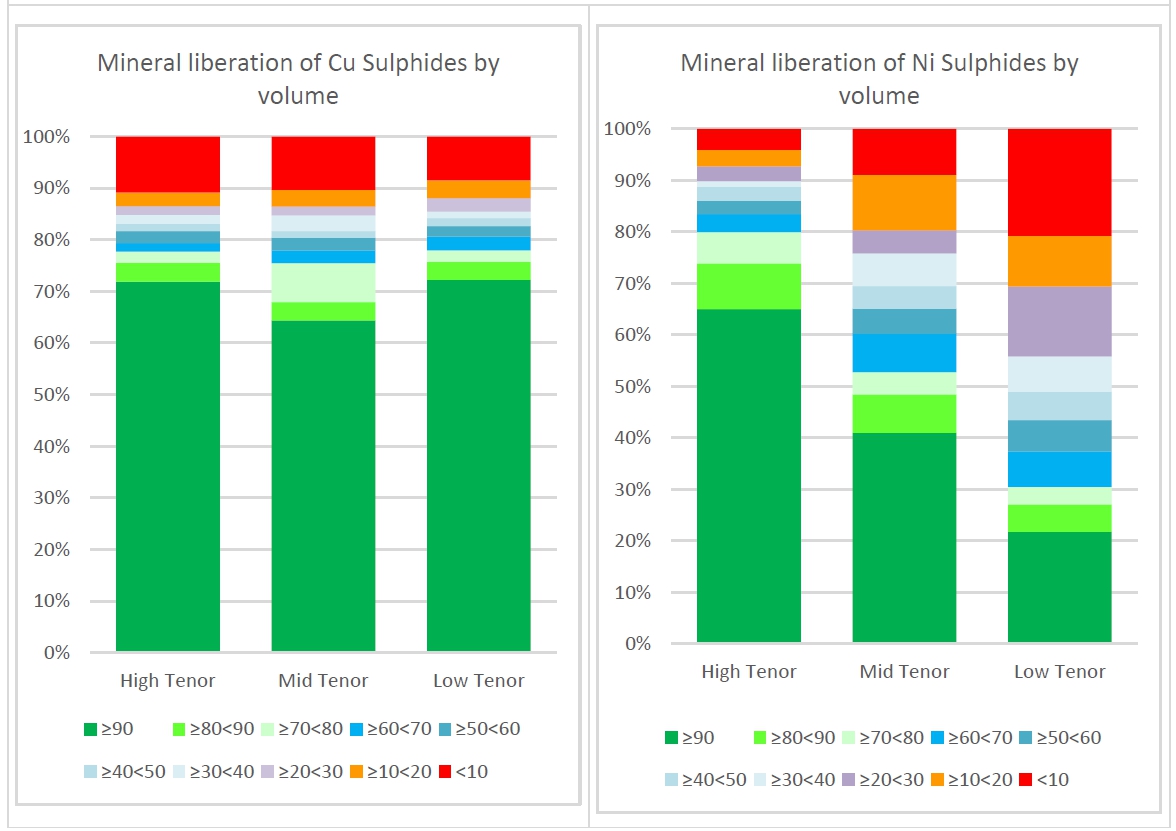
Source: BCR, 2026
| 13.2.4 | Comminution |
Comminution testing indicates that the Selkirk material is consistently hard and competent across the high, mid, and low tenor domains, with only minor variability observed between samples (Table 13-3).
The Bond Ball Mill Work Index (BWi) ranged from 17.3 to 18.9 kWh/t, with an average of 18.2 kWh/t, indicating a hard ore with moderate to high grinding energy requirements. SMC testing produced A×b values between 19 and 21, classifying the ore as highly competent and suggesting challenging breakage characteristics in SAG milling applications. Low ta values of 0.16–0.18 further indicate a high resistance to abrasion breakage.
Overall, the comminution properties are consistent across all tenor domains and are in good agreement with historical comminution testwork, providing confidence that the grinding characteristics are representative of the Selkirk deposit.
| J5050 – Selkirk Nickel-Copper-PGE Project S-K 1300 Technical Report Summary 17-08-2026 | Page: 85 |
| Table
13-3 Selkirk comminution testwork summary |
| Grindability Test Summary - Selkirk | |||||
| Sample ID | Relative Density | JK Parameters | Bond Work Index | ||
| SMC | BWI | ||||
| SMC | A x b | ta | SCSE | kWh/t | |
| High Tenor | 3.04 | 19.0 | 0.16 | 15.94 | 18.9 |
| Mid Tenor | 3.01 | 21.0 | 0.18 | 14.94 | 18.3 |
| Low Tenor | 3.14 | 19.0 | 0.16 | 16.30 | 17.3 |
| 13.2.5 | Flotation |
The main objectives of the flotation test program were to:
| ● | Conduct flowsheet development testing on the master composite, representative of the Mineral Resource Estimate (MRE) grades. | |
| ● | Optimise copper, nickel, and PGE recoveries through flowsheet evaluation and process optimisation. | |
| ● | Assess the established flowsheet performance using Selkirk tenor variability samples to evaluate metallurgical response across the range of ore types. | |
| ● | Characterise the final copper and nickel concentrates for deleterious elements and evaluate concentrate quality and marketability. |
The BCR testwork program adopted a different approach to flowsheet development. Based on the observed mineralogical and liberation characteristics of the copper and nickel bearing minerals, a sequential flotation flowsheet was selected. This approach prioritised copper recovery and concentrate upgrading before recovering nickel from the copper flotation tailings, with the objective of improving the overall recovery and concentrate quality of both metals.
The conventional sequential flowsheet, as shown in Figure 13-5, recovers copper in a rougher flotation stage, followed by regrinding and three stages of cleaning to produce a final copper concentrate. Copper cleaner tailings are directed to the nickel circuit to maximise nickel recovery. The nickel circuit comprises rougher flotation, concentrate regrinding, and three stages of cleaning to produce a final nickel concentrate. Final rougher and nickel first cleaner tailings constitute the overall flotation tailings.
All flotation tests were conducted using a laboratory Denver D-12 flotation cell with 4 kg test charges in an 8-litre cell. The increased sample mass ensured adequate concentrate production for reliable head and concentrate assays, compensating for the low mass pull characteristic of the Selkirk material.
| J5050 – Selkirk Nickel-Copper-PGE Project S-K 1300 Technical Report Summary 17-08-2026 | Page: 86 |
Figure 13-5
Selkirk LCT flowsheet
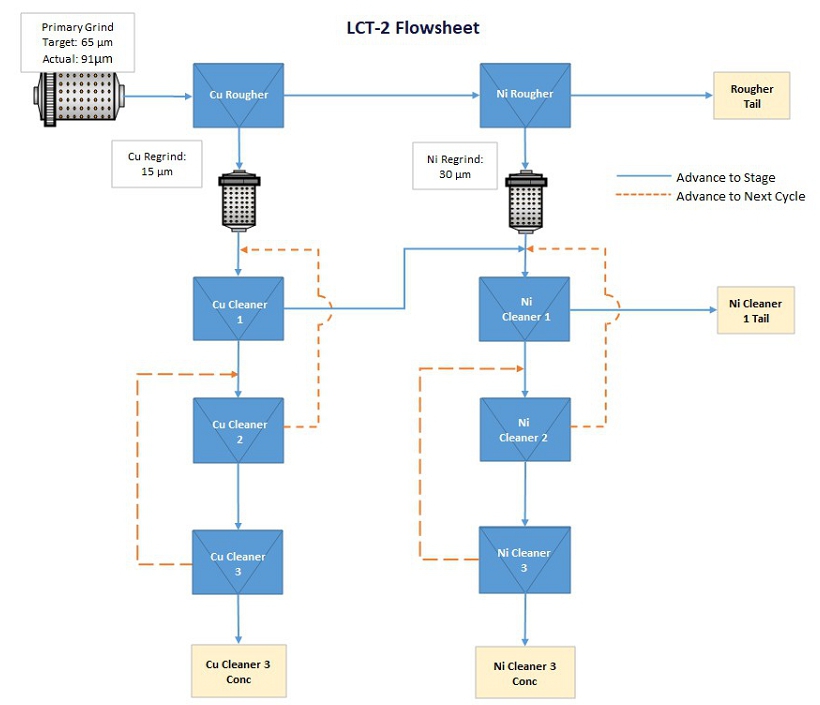
Source: BCR,, 2026
Copper rougher flotation performance was improved through the addition of 200 g/t NS 1162 dispersant to mitigate the effects of high chlorite content, increasing the flotation pH from 10.5 to 11.3, and reducing the primary grind size from P80 90 µm to P80 65 µm. Copper cleaner flotation recovery and concentrate grade were improved by extending the rougher concentrate regrind time to 30 minutes, producing a regrind product of approximately P80 15 µm, and by the addition of 2 g/t of 3418A collector. These modifications also contributed to reducing nickel misplacement to the copper concentrate. The copper flotation circuit was successful in producing a high-grade copper concentrate with acceptable levels of nickel misplacement and improved recoveries from previous programs.
| J5050 – Selkirk Nickel-Copper-PGE Project S-K 1300 Technical Report Summary 17-08-2026 | Page: 87 |
Nickel rougher flotation recovery was optimised by extending the rougher flotation residence time to 30 minutes, operating at a flotation pH of 11.2, and using PEX as the sole collector at a dosage of 100 g/t. Of these variables, increasing the rougher flotation time had the greatest positive impact on nickel recovery, highlighting the slow floating properties of the pentlandite. The key factors influencing nickel cleaner flotation performance were improving selectivity while maintaining the target mass pull, implementing staged cleaner flotation with oxygen (O₂) conditioning, and incorporating a regrind screen to achieve a P₈₀ of 25 µm. The nickel cleaner circuit presented challenges in achieving the target nickel concentrate grade due to pyrrhotite reporting to the concentrate. Oxidation conditioning significantly improved selectivity by depressing pyrrhotite, resulting in higher nickel concentrate grades. Both hydrogen peroxide (H₂O₂) and oxygen (O₂) conditioning demonstrated this beneficial effect, with oxygen conditioning selected as the preferred approach for subsequent testwork.
| 13.2.5.1 | Locked Cycle Tests |
Two locked-cycle tests (LCTs) were completed to evaluate and optimise the copper and nickel flotation circuits. Both tests consistently produced a marketable copper concentrate, achieving approximately 81–82% Cu recovery at a concentrate grade of 29–30% Cu, while maintaining nickel below the target specification of 1% Ni. The copper concentrate was also the primary carrier of precious metals, recovering approximately 53–55% of the gold, 60% of the palladium, and 15% of the platinum.
The principal improvements between the two tests were observed in the nickel circuit. LCT1 did not achieve stable circuit performance or produce a marketable nickel concentrate, with the final concentrate grading only 6% Ni (Table 13-4). Testwork indicated that excessive nickel rougher mass pull resulted in high pyrrhotite entrainment to the cleaner circuit, reducing concentrate grade. Reducing the nickel rougher mass pull in LCT2 significantly improved circuit performance, resulting in stable operation and the production of a marketable nickel concentrate grading 10.9% Ni at 54% Ni recovery (Table 13-5). In addition to nickel, the concentrate recovered a significant proportion of the remaining precious metals, accounting for an additional 19% of the gold, 41% of the platinum, and 18% of the palladium. Combined, the copper and nickel concentrates recovered approximately 72% of the gold, 56% of the platinum, and 78% of the palladium, demonstrating effective recovery of both base and precious metals.
Although LCT2 substantially improved nickel circuit performance, the primary grind size remained coarser than the target (P₈₀ of 91 µm versus the target P₈₀ of 65 µm). Future variability testing will reassess the impact of finer grinding and improved metallurgical performance.
| J5050 – Selkirk Nickel-Copper-PGE Project S-K 1300 Technical Report Summary 17-08-2026 | Page: 88 |
| Table
13-4 LCT-1 master composite projected metallurgy – based on cycles 4 to 6 |
| Product LCT- 1 | Weight | Grade | Distribution (%) | ||||||||||||
| % | Au (g/t) | Pt (g/t) | Pd (g/t) | Cu (%) | Ni (%) | Fe (%) | Stot (%) | Au | Pt | Pd | Cu | Ni | Fe | Stot | |
| Cu Cleaner 3 Conc | 0.69 | 3.13 | 2.13 | 37.6 | 28.7 | 0.78 | 29.2 | 32.3 | 55.3 | 17.2 | 60.2 | 82.3 | 2.6 | 2.4 | 12.7 |
| Ni Cleaner 3 Conc | 1.22 | 0.45 | 2.39 | 5.34 | 0.95 | 5.96 | 50.3 | 35.6 | 14.1 | 34.1 | 15.1 | 4.8 | 35.4 | 7.4 | 24.8 |
| Ni Cleaner 1 Tail | 3.8 | 0.07 | 0.51 | 0.65 | 0.18 | 1.68 | 21.8 | 11.2 | 6.4 | 23 | 5.7 | 2.8 | 31.2 | 10.1 | 24.5 |
| Rougher Tail | 94.3 | 0.01 | 0.02 | 0.09 | 0.03 | 0.07 | 7 | 0.7 | 24.1 | 25.7 | 19 | 10.1 | 30.7 | 80.1 | 37.9 |
| Calculated Head | 100 | 0.04 | 0.09 | 0.43 | 0.24 | 0.21 | 8.3 | 1.7 | |||||||
| Table
13-5 LCT-2 master composite projected metallurgy – based on cycles 4 to 6 |
| Product (LCT-2) | Weight | Grade | Distribution (%) | ||||||||||||||||
| % | Au (g/t) | Pt (g/t) | Pd (g/t) | Ag (g/t) | Cu (%) | Ni (%) | Co (%) | Fe (%) | Stot (%) | Au | Pt | Pd | Ag | Cu | Ni | Co | Fe | Stot | |
| Cu Cleaner 3 Conc | 0.7 | 3 | 1.91 | 36.2 | 78.7 | 30.2 | 0.62 | 0.04 | 30 | 32.5 | 53.1 | 15 | 60.1 | 43.5 | 81.3 | 1.8 | 1.8 | 2.4 | 11 |
| Ni Cleaner 3 Conc | 1.2 | 0.62 | 3.05 | 6.26 | 18.6 | 1.54 | 10.9 | 0.6 | 41.7 | 31.5 | 19 | 41.3 | 18 | 17.7 | 7.2 | 54.4 | 53.2 | 5.8 | 18.5 |
| Ni Cleaner 1 Tail | 2.44 | 0.04 | 0.29 | 0.24 | 3.14 | 0.14 | 0.74 | 0.04 | 12.9 | 4.55 | 2.8 | 7.9 | 1.4 | 6.1 | 1.3 | 7.4 | 7.1 | 3.6 | 5.4 |
| Rougher Tail | 95.7 | 0.01 | 0.03 | 0.09 | 0.43 | 0.03 | 0.09 | 0.01 | 8.05 | 1.4 | 25.1 | 35.9 | 20.5 | 32.6 | 10.2 | 36.4 | 37.9 | 88.2 | 65.1 |
| Calculated Head | 100 | 0.04 | 0.09 | 0.42 | 1.26 | 0.26 | 0.24 | 0.01 | 8.73 | 2.05 | |||||||||
| J5050 – Selkirk Nickel-Copper-PGE Project S-K 1300 Technical Report Summary 17-08-2026 | Page: 89 |
| 13.2.5.2 | Concentrate Quality |
Final concentrate assays (Table 13-6) indicate that both the copper and nickel concentrates are expected to satisfy typical commercial smelter acceptance specifications, supporting their marketability. The concentrates exhibit low concentrations of deleterious elements, including magnesium, cadmium, mercury, fluorine, lead, silica, and arsenic, with all analysed impurities below industry recognised penalty thresholds. These results suggest no significant smelter related concerns associated with concentrate quality.
| Table
13-6 Lock cycle-2 copper and nickel concentrate quality assessment |
| Analyte | Analytical Method | Unit | Copper Concentrate | Nickel Concentrate |
| Potentially Payable Metals | ||||
| Ni | 4AD-ICP | % | 0.629 | 10.846 |
| Cu | 4AD-ICP | % | 30.770 | 1.723 |
| Co | 4AD-ICP | % | 0.036 | 0.620 |
| Ag | 4AD-ICP | g/t | 74.1 | 18.9 |
| Au | FA-ICP | g/t | 3.64 | 0.99 |
| Pd | FA-ICP | g/t | 37.67 | 6.95 |
| Pt | FA-ICP | g/t | 1.80 | 3.27 |
| Other Analytes | ||||
| As | 4AD-ICP | ppm | 18 | 51 |
| Al2O3 | FUS-XRF/FUS-ICP | % | 1.44 | 2.67 |
| Sb | 4AD-ICP | ppm | 22 | 59 |
| Bi | 4AD-ICP | ppm | 41 | 27 |
| Cd | 4AD-ICP | ppm | 50.3 | 15.6 |
| Cl | INAA | % | 0.01 | 0.02 |
| Ctot | Eltra | % | 0.63 | 0.21 |
| F | FUS-ISE | % | < 0.01 | < 0.01 |
| Fe | 4AD-ICP | % | 29.95 | 42.37 |
| Pb | 4AD-ICP | ppm | 122 | 78 |
| MgO | FUS-XRF | % | 0.74 | 1.59 |
| Hg | 1G | ppb | 47 | 137 |
| Mo | 4AD-ICP | ppm | <1 | <1 |
| Se | 4AD-ICP | ppm | 36 | <10 |
| SiO2 | FUS-XRF/FUS-ICP | % | 3.65 | 6.51 |
| Stot | Eltra | % | 31.99 | 32.17 |
| Te | 4AD-ICP | ppm | 77 | 39 |
| Zn | 4AD-ICP | ppm | 2105 | 881 |
| 13.2.6 | Variability Program |
Variability testwork was completed to assess the robustness of the proposed flotation flowsheet across a range of nickel tenors and to evaluate the impact of ore variability on metallurgical performance (Figure 13-6). Copper flotation performance was consistently strong across all three samples, producing high concentrate grades and recoveries, with copper recovery primarily influenced by copper head grade. In contrast, nickel flotation performance was strongly dependent on nickel tenor with no correlation to nickel grade. The high-tenor sample achieved the highest nickel concentrate grades (up to 17% Ni) while maintaining good recoveries, whereas the mid and low tenor samples exhibited a pronounced grade recovery trade off. Nickel concentrate grade decreased with decreasing nickel tenor due to increased pyrrhotite and gangue dilution, as well as reduced nickel sulphide liberation. These results highlight the sensitivity of nickel circuit performance to ore mineralogy and emphasise the need to better characterise metallurgical variability across the deposit to support resource modelling, mine planning, and recovery predictions.
| J5050 – Selkirk Nickel-Copper-PGE Project S-K 1300 Technical Report Summary 17-08-2026 | Page: 90 |
Figure 13-6
Nickel and copper variability testwork
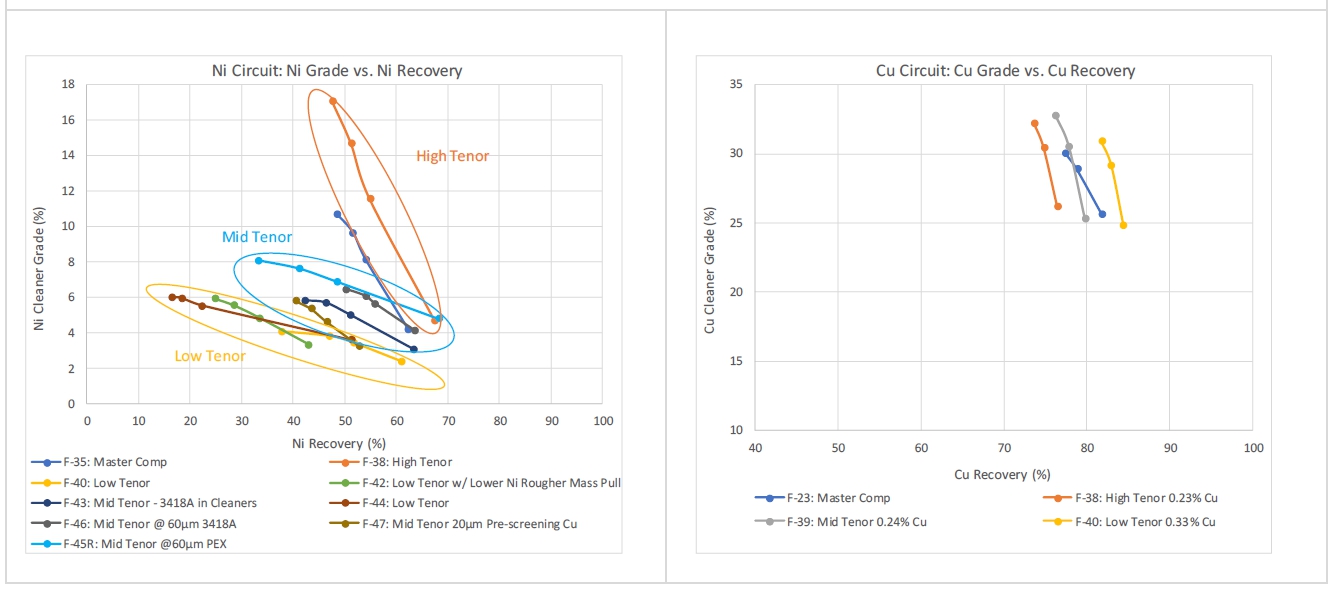
| 13.3 | Metal Recovery Estimation |
| 13.3.1 | Conceptual Mineral Processing |
Based on the testwork programs completed to date, the proposed processing route does not include pre-concentration of Selkirk feed material. Accordingly, the metallurgical recoveries estimated for the purposes of Mineral Resource estimation do not account for any benefits associated with pre-concentration.
Based on the average Selkirk feed grades representative of the MRE and supported by the completed metallurgical testwork program, the resource model assumes the grades and recoveries presented in Table 13-7.
| Table
13-7 Copper and nickel grades and recoveries |
| Parameter | Ni % | Cu % | Co % | Pt g/t | Pd g/t | Au g/t | Ag g/t |
| Cu Conc Recovery (%) | 0.62 | 81.3 | 0.04 | 15 | 60.1 | 53.1 | 43.5 |
| Ni Conc Recovery (%) | 54.4 | 7.2 | 53.2 | 41.3 | 18 | 19 | 17.7 |
| Cu Conc Grade | 0.62 | 30.5 | 0.04 | 1.8 | 38 | 3.6 | 74 |
| Ni Conc Grade | 10.8 | 1.7 | 0.6 | 3.2 | 6.9 | 1 | 19 |
These metal recoveries are supported by the most recent metallurgical testwork completed by BCR, including LCT confirmation testwork and detailed analyses of the final concentrate products.
| 13.4 | QP Opinion, Conclusions and Summary |
Based on the results of the historical and, more importantly, recent metallurgical testwork, the current processing approach for Selkirk material comprises of sequential copper and nickel flotation to produce two saleable concentrates.
The Fuse QP is of the opinion that the samples used for the recent metallurgical testwork provide a reasonable initial representation of the deposit and that the results generated are adequate to support the metallurgical interpretations and recovery estimates applied to the MRE.
The Fuse QP concludes that the metallurgical and analytical data were collected using methods suitable for conceptual application in support of Mineral Resource estimation. However, further work is recommended to better define the distribution of nickel and PGM tenors throughout the deposit. Improved definition of these tenor domains will assist in quantifying their impact on overall metallurgical recoveries and provide greater confidence for future resource modelling, mine planning, ore blending, and recovery predictions.
| J5050 – Selkirk Nickel-Copper-PGE Project S-K 1300 Technical Report Summary 17-08-2026 | Page: 91 |
| 14. | Mineral Resource Estimation |
| 14.1 | Introduction |
The Mineral Resource Estimate (MRE) was prepared and completed in June 2026 by MSA, a third-party firm comprising mining experts in accordance with 17 CFR § 229.1302(b)(1).
The MRE was undertaken using the following software: Leapfrog Geo for selected lithological modelling; Datamine Studio RM for selected lithological modelling, block modelling, and grade estimation; and Datamine Supervisor for statistical and geostatistical evaluation.
| 14.2 | Mineral Resource Disclosure Basis |
The Mineral Resource Estimate (“MRE”) for the Selkirk Project was prepared by MSA.
For the purposes of this Technical Report Summary (“TRS”), the Mineral Resources are prepared and reported in accordance with SEC Regulation S-K 1300. MSA is the QP, as defined by Subpart 1300 of Regulation S-K, responsible for the Mineral Resource disclosure presented herein. The MSA QP has reviewed the estimation methodology, classification criteria and supporting technical information and considers the Mineral Resource Estimate suitable for disclosure under SEC Regulation S-K 1300. The MSA QP has reviewed and approved the scientific and technical information summarised in this section.
| 14.3 | Mineral Resource Estimation Database |
The final compiled geological database for the resampled drillholes, metallurgical drillholes, regional exploration drillholes, and historical drillholes was received from NEXM by MSA on 29 April 2026, with the last date of assays included of March 19, 2026. A summary of the data received is tabulated in Table 14-1.
| Table
14-1 Database Summary |
| Type | Number of Drillholes | Total Metres |
| TNMC surface | 292 | 78,152 |
| Resampled exploration | 51 | 16,754 |
| TNMC Regional exploration | 3 | 882 |
| Metallurgical twins | 11 | 3,577 |
| Resource infill hole | 1 | 326 |
| Resampled geotechnical holes | 5 | 1,272 |
| Other1 | 243 | 30,915 |
| Total Unique2 | 550 | 113,526 |
| Note: | 1 Historical Sedge drillholes, auger drillholes, reverse circulation (RC) drillholes, underground channel samples and drillholes | |
| 2 Totals exclude resampled drillholes to prevent double counting |
The PNGPL resampling data replaced the original TNMC data as input to the Mineral Resource Estimate. Together with the 12 holes that were drilled by PNGPL, the total proportion of drillholes with assay data from PNGPL resampling and new drilling within the estimation data set is 25% for nickel and copper and 44% for platinum, palladium and gold. All of the silver and cobalt assays were sourced from PNGPL resampling and new drilling.
| J5050 – Selkirk Nickel-Copper-PGE Project S-K 1300 Technical Report Summary 17-08-2026 | Page: 92 |
Drillhole spacing within the area of interest ranges from approximately 60 m x 60 m to a tighter spacing of around 20 m x 20 m towards the north-west, close to the historical underground workings (Figure 14-1).
| Figure
14-1 Plan showing location of drillhole collar data by type |
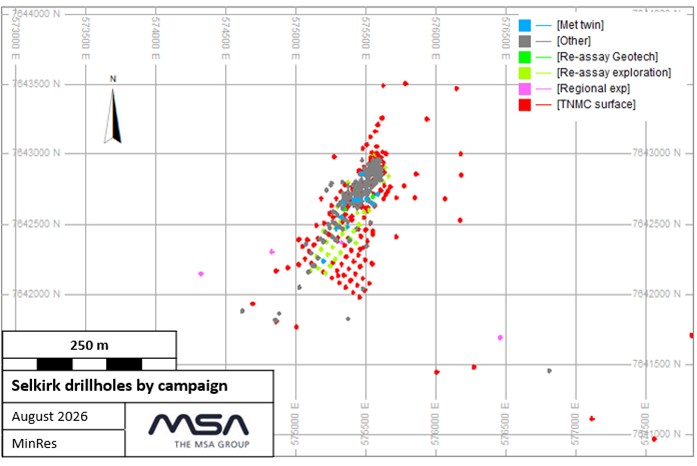 |
Source: MSA, 2026
| 14.4 | Data Validation |
The data validation process included the following checks of the Selkirk database:
| ● | Examining the sample assay, collar, down-hole survey and geology data to ensure that the data are complete for all the drillholes | |
| ● | Examining the de-surveyed data in three dimensions to check for spatial errors | |
| ● | Examination of the assay and density data to ascertain whether they are within expected ranges | |
| ● | Checks for “FROM-TO” errors, to ensure that the sample data do not overlap one another or that there are no unexplained gaps in the sampling. |
Five (5) samples were identified to have Pd, Pt and Au grades, attributed to swaps with CRMs., These were changed to detection limit values. The sulphur data for drillholes DSLK170-DSLK250 were found to be erroneous and a regression based on Fe and S was used to replace these values.
Seventy-three (73) drillholes did not have down-hole survey data, of which 10 drillholes were from the TNMC surface exploration program and the rest mainly from the historical SEDGE program. These drillholes were excluded from the database.
To ensure consistent data reliability; only TNMC surface exploration drillhole data, resampled drillhole data, metallurgical twin hole data, and regional exploration drillhole data were included in the final database for consideration in the Mineral Resource Estimate. A total of 288 drillholes were transferred to the final database, accounting for 52% of the original dataset.
| J5050 – Selkirk Nickel-Copper-PGE Project S-K 1300 Technical Report Summary 17-08-2026 | Page: 93 |
| 14.4.1 | Treatment of Unsampled or Missing Assays |
Gaps in sampling were compared to lithological units and examined spatially where relevant. Grades were set to 0.001 where the sampling gaps correlated with dykes, barren Dikgaka gabbro, or in instances where surrounding and adjacent gabbro grades were deteriorating away from the main mineralisation. In other instances, null values (-) were used, specifically within the Selkirk gabbro.
A total of 17,132 unsampled units were assigned detection limits, representing around 14% of the final assay dataset.
| 14.4.2 | Regression Analysis |
A regression analysis was conducted to account for the inconsistent availability of assay information in the final dataset (Table 14-2, Figure 14-2), and to address the erroneous sulphur values. The regression was necessary to calculate a Net Smelter Return (NSR) value at a drillhole sample level and was undertaken on a binned basis. Regressed values were not used for grade estimation in the block model. Silver assays were particularly sparse; however, they do not have a material impact on the overall grade and NSR estimation.
A strong correlation is evident between Fe and S (Table 14-2). The regression using assays from resampled and twinned drillholes was used to correct the erroneous S values for drillholes DSLK170 – DSLK250.
| Table
14-2 Assay availability in final dataset |
| Total Assays | Ni | Cu | Co | Pd | Pt | Au | Ag | S | S.G |
| 102,735 | 102,735 | 100,794 | 37,877 | 63,568 | 62,810 | 62,479 | 7,945 | 101,199 | 37,663 |
| % of Total | 100% | 98% | 37% | 62% | 61% | 61% | 8% | 99% | 37% |
Figure 14-2
Ni vs Cu Regression
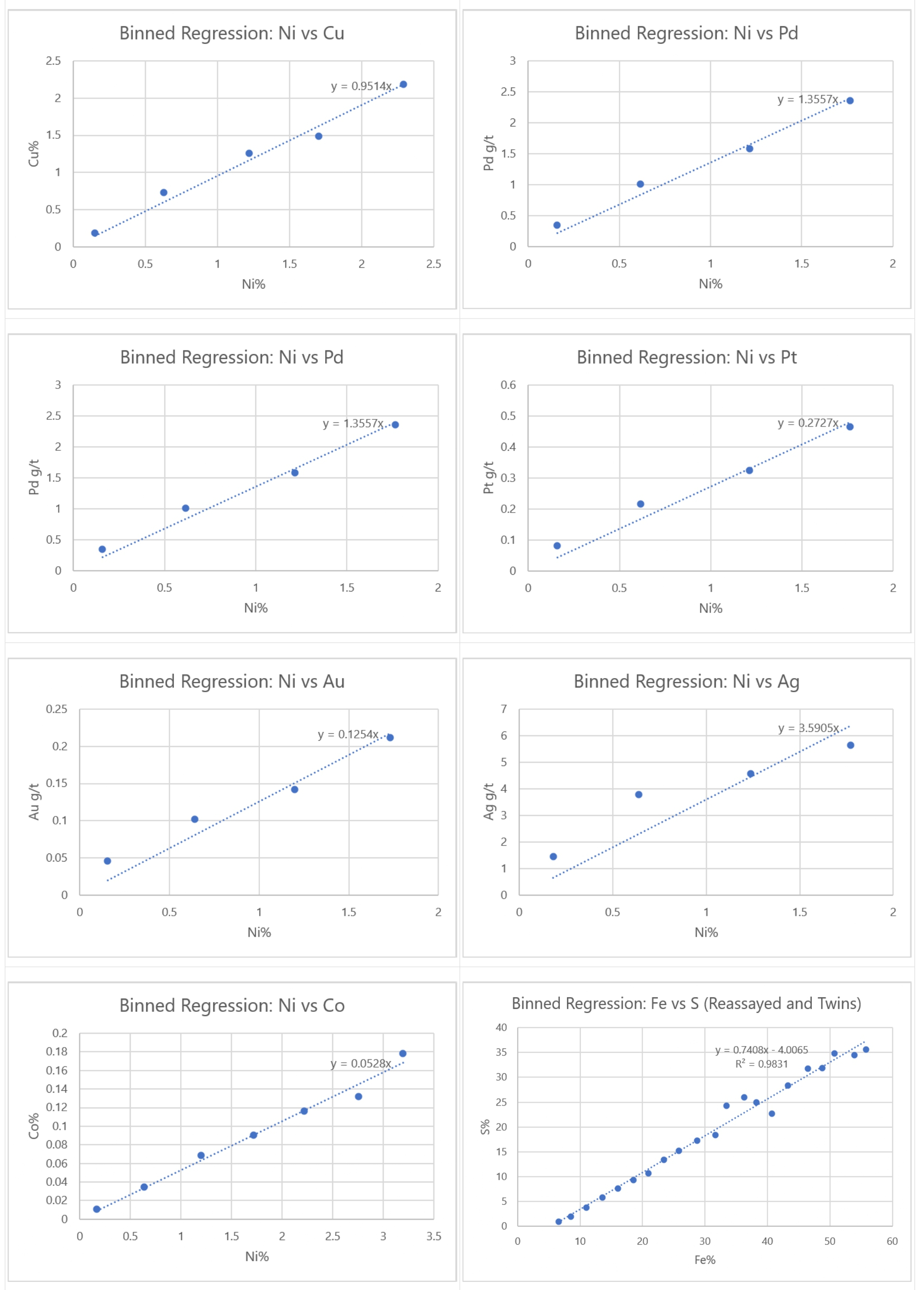
| J5050 – Selkirk Nickel-Copper-PGE Project S-K 1300 Technical Report Summary 17-08-2026 | Page: 94 |
| 14.5 | Mineralisation Criteria |
A Net Smelter Return (NSR) value >= USD20/t was used as a threshold to create a mineralised volume. The parameters for NSR are tabulated below (Table 14-3). Metal prices were based on long-term forecasts sourced from industry and broker research. Other parameters were based on metallurgical test work and a marketing study completed for NEXM (Aird, 2025).
| Table
14-3 NSR parameters (Two concentrate option) |
| Parameter | Ni % | Cu % | Co % | Pt g/t | Pd g/t | Au g/t | Ag g/t |
| Cu Concentrate Recovery (%) | 0 | 81.3 | 0 | 15 | 60.1 | 53.1 | 43.5 |
| Ni Concentrate Recovery (%) | 54.4 | 7.2 | 53.2 | 41.3 | 18 | 19 | 17.7 |
| Cu Concentrate Grade | 0 | 30.5 | 0 | 1.8 | 38 | 3.6 | 74 |
| Ni Concentrate Grade | 10.8 | 1.7 | 0.6 | 3.2 | 6.9 | 1 | 19 |
| Cu/Ni Concentrate Moisture Percent | 8 | ||||||
| Cu Concentrate Transport USD/wmt | 160 | ||||||
| Ni Concentrate Transport USD/wmt | 160 | ||||||
| Treatment Charge Cu Concentrate USD/dmt | 80 | ||||||
| Treatment Charge Ni Concentrate USD/dmt | 0 | ||||||
| Metal from Cu Concentrate: Payability (%) | 96.5 | 92.5 | 92.5 | 90 | 90 | ||
| Metal from Ni Concentrate: Payability (%) | 78 | 40 | 40 | 60 | 60 | 60 | 60 |
| Metal from Cu Concentrate: Refining Cost USD/lb or USD/oz (on payable metal) | 0.08 | 15 | 15 | 5 | 0.5 | ||
| Metal; from Ni Concentrate: Refining Cost USD/lb or USD/oz (on payable metal) | 0 | 0 | 0 | 0 | 0 | 0 | 0 |
| Metal Price per lb or oz | 9.1 | 5.1 | 20 | 1800 | 1550 | 3600 | 52 |
Notes: wmt – wet metric tonne; dmt – dry metric tonne
| 14.6 | Geological Modelling and Estimation Domains |
Mineralisation is hosted within the Selkirk metagabbro, which is intersected by several unmineralised, cross-cutting dolerite and felsic dykes. The adjacent Dikgaka metagabbro (hanging wall) is typically unmineralised. Oxidation was logged in the lithology logs, however oxidation logging was not consistently applied across all periods of exploration.
The following three dimensional models were created:
| ● | Selkirk Metagabbro, Dikgaka Metagabbro, Dolerite and Felsic dykes: modelled in Leapfrog by revising the previous model and updating it with the new drillhole information. |
| J5050 – Selkirk Nickel-Copper-PGE Project S-K 1300 Technical Report Summary 17-08-2026 | Page: 95 |
| ● | Topography: Modelled in Datamine based on drillhole collars. A surveyed DTM was not provided for this project. | |
| ● | Oxidised Zone: Modelled in Datamine based on lithological logging and manually edited to remove unnatural irregularities. A gossan model also exists that is within the oxide. | |
| ● | Mined out underground using historic Norilsk data. | |
| ● | Mineralised Zones: Four (4) discrete zones; MIN1, MIN2, MIN3, MIN4; were modelled in Datamine using explicit modelling techniques. Interpretation was based on an NSR cut-off of $20/t, geological continuity, and lithological logging. MIN1 represents the main mineralised zone, with the other mineralised zones being significantly smaller in volume. MIN4 represents a small, high-grade mineralised zone within the previously mined massive sulphide unit (Figure 14-3). |
| Figure
14-3 View to the east of modelled mineralised zones |
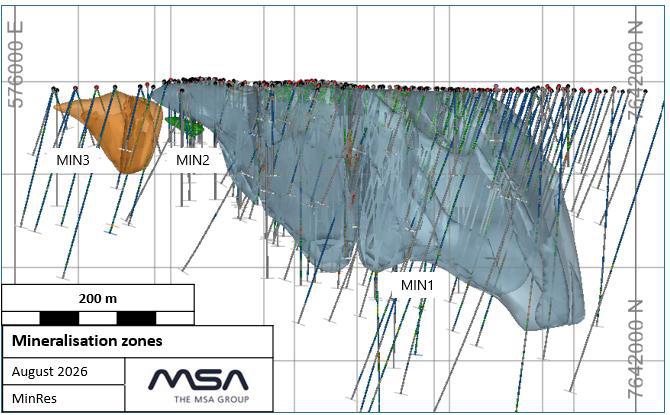
Source: MSA, 2026
| 14.7 | Statistical and Geostatistical Analysis |
| 14.7.1 | Sample Compositing |
All samples within the mineralised zones and outside the dykes were composited to 2 m for use in grade estimation. Prior to compositing, approximately 99% of samples were equal to or less than 1 m in length. Given the large scale of the deposit (thickness in excess of 100 m), a 2 m composite was preferred. Figure 14-4 illustrates the sample length distribution of the uncomposited drillhole data within the mineralised zones.
| J5050 – Selkirk Nickel-Copper-PGE Project S-K 1300 Technical Report Summary 17-08-2026 | Page: 96 |
A statistical comparison between the composited and uncomposited data within the mineralisation zones is summarised in Table 14-4.
| Figure
14-4 Histogram of interval length |
|
Source: MSA, 2026
| J5050 – Selkirk Nickel-Copper-PGE Project S-K 1300 Technical Report Summary 17-08-2026 | Page: 97 |
| Table
14-4 Composited vs uncomposited statistics |
| Domain | Assay | Uncomposited | 2 m composites | ||||||||
| Samples | Min | Max | Mean | CV | Samples | Min | Max | Mean | CV | ||
| MIN1 | Ni % | 68,394 | 0.00 | 10.04 | 0.21 | 0.95 | 15,938 | 0.00 | 2.72 | 0.20 | 0.75 |
| Cu % | 68,172 | 0.00 | 13.42 | 0.25 | 1.28 | 15,927 | 0.00 | 6.59 | 0.23 | 0.97 | |
| Co % | 31,637 | 0.00 | 0.29 | 0.01 | 0.74 | 7,019 | 0.00 | 0.17 | 0.01 | 0.74 | |
| Pt g/t | 49,219 | 0.00 | 10.10 | 0.10 | 0.99 | 11,794 | 0.00 | 5.31 | 0.10 | 0.86 | |
| Pd g/t | 49,545 | 0.00 | 14.95 | 0.44 | 0.96 | 11,838 | 0.00 | 6.28 | 0.41 | 0.80 | |
| Au g/t | 49,087 | 0.00 | 48.55 | 0.05 | 4.86 | 11,756 | 0.00 | 19.35 | 0.05 | 3.81 | |
| Ag g/t | 7,392 | 0.00 | 24.80 | 1.73 | 0.99 | 2,110 | 0.00 | 13.41 | 1.01 | 1.39 | |
| S % | 67,424 | 0.00 | 58.75 | 2.14 | 1.14 | 15,118 | 0.00 | 40.33 | 2.02 | 1.04 | |
| MIN2 | Ni % | 264 | 0.00 | 1.16 | 0.14 | 0.85 | 59 | 0.00 | 0.30 | 0.13 | 0.58 |
| Cu % | 258 | 0.00 | 1.98 | 0.20 | 0.97 | 59 | 0.00 | 0.76 | 0.19 | 0.75 | |
| Co % | 3 | 0.00 | 0.00 | 0.00 | 0.00 | 7 | 0.00 | 0.00 | 0.00 | 0.00 | |
| Pt g/t | 215 | 0.00 | 0.22 | 0.06 | 0.62 | 52 | 0.00 | 0.13 | 0.05 | 0.61 | |
| Pd g/t | 219 | 0.00 | 1.13 | 0.27 | 0.68 | 52 | 0.00 | 0.68 | 0.24 | 0.64 | |
| Au g/t | 216 | 0.00 | 0.24 | 0.05 | 0.75 | 52 | 0.00 | 0.13 | 0.04 | 0.62 | |
| Ag g/t | 3 | 0.00 | 0.00 | 0.00 | 0.00 | 7 | 0.00 | 0.00 | 0.00 | 0.00 | |
| S % | 260 | 0.00 | 12.11 | 1.49 | 0.89 | 55 | 0.14 | 5.75 | 1.57 | 0.73 | |
| MIN3 | Ni % | 2,446 | 0.00 | 1.40 | 0.11 | 0.89 | 464 | 0.01 | 0.64 | 0.10 | 0.65 |
| Cu % | 2,427 | 0.00 | 2.13 | 0.13 | 1.04 | 464 | 0.00 | 0.59 | 0.13 | 0.76 | |
| Pt g/t | 255 | 0.00 | 0.47 | 0.06 | 0.71 | 55 | 0.02 | 0.15 | 0.06 | 0.48 | |
| Pd g/t | 270 | 0.00 | 1.19 | 0.20 | 0.81 | 56 | 0.02 | 0.58 | 0.20 | 0.69 | |
| Au g/t | 213 | 0.00 | 17.95 | 0.12 | 9.95 | 47 | 0.01 | 6.58 | 0.17 | 5.53 | |
| S % | 2,425 | 0.00 | 20.40 | 1.06 | 1.28 | 464 | 0.00 | 7.93 | 0.99 | 0.99 | |
| MIN4 (HG) | Ni % | 195 | 0.09 | 4.24 | 2.05 | 0.55 | 33 | 0.15 | 3.44 | 1.85 | 0.60 |
| Cu % | 195 | 0.01 | 9.23 | 1.95 | 0.94 | 33 | 0.09 | 4.71 | 1.71 | 0.70 | |
| Co % | 64 | 0.02 | 0.22 | 0.11 | 0.52 | 8 | 0.04 | 0.17 | 0.10 | 0.40 | |
| Pt g/t | 186 | 0.01 | 2.06 | 0.37 | 0.99 | 31 | 0.03 | 0.99 | 0.32 | 0.61 | |
| Pd g/t | 189 | 0.01 | 6.51 | 1.86 | 0.53 | 32 | 0.13 | 2.62 | 1.64 | 0.50 | |
| Au g/t | 190 | 0.00 | 0.68 | 0.11 | 1.08 | 32 | 0.00 | 0.29 | 0.09 | 0.75 | |
| Ag g/t | 64 | 1.30 | 15.00 | 4.46 | 0.84 | 8 | 2.43 | 9.97 | 4.41 | 0.67 | |
| S % | 195 | 1.36 | 39.20 | 24.22 | 0.45 | 33 | 3.02 | 37.39 | 21.16 | 0.53 | |
| 14.7.2 | Evaluation of Outliers (Grade Capping) |
Grade capping was applied to the 2 m composite samples for each element as necessary to restrict the influence of higher-grade outliers that have a low probability of occurrence. Selection of the top cut (grade capping) grades was based on histograms and log-probability plots with subsequent validation using the coefficient of variation.
| J5050 – Selkirk Nickel-Copper-PGE Project S-K 1300 Technical Report Summary 17-08-2026 | Page: 98 |
A summary of the grade capping applied to each element and/or attribute is presented in Table 14-5.
| Table
14-5 Global top-cap statistics |
| Assay | Statistic | Mean | Max | CV | Samples | Top-cap Grade |
Percentile | Number capped |
Metal reduction |
| Ni % | Raw | 0.20 | 3.44 | 0.87 | 16,494 | - | - | - | - |
| Capped | 0.20 | 2.29 | 0.83 | 18 | 2.29 | 99.90% | 18 | 0.30% | |
| Change | - | 33.60% | 5.30% | 0.10% | - | - | - | - | |
| Cu % | Raw | 0.23 | 6.59 | 1.03 | 16,483 | - | - | - | - |
| Capped | 0.23 | 3.02 | 0.97 | 12 | 3.02 | 99.90% | 12 | 0.40% | |
| Change | - | 54.20% | 5.60% | 0.10% | - | - | - | - | |
| Co % | Raw | 0.01 | 0.17 | 0.79 | 7,034 | - | - | - | - |
| Capped | 0.01 | 0.08 | 0.73 | 10 | 0.08 | 99.90% | 10 | 0.60% | |
| Change | - | 51.40% | 7.40% | 0.10% | - | - | - | - | |
| Pt g/t | Raw | 0.10 | 5.31 | 0.89 | 11,932 | - | - | - | - |
| Capped | 0.10 | 0.75 | 0.71 | 7 | 0.75 | 99.90% | 7 | 0.60% | |
| Change | - | 85.80% | 20.20% | 0.10% | - | - | - | - | |
| Pd g/t | Raw | 0.41 | 6.28 | 0.82 | 11,978 | - | - | - | - |
| Capped | 0.41 | 3.57 | 0.79 | 9 | 3.57 | 99.90% | 9 | 0.30% | |
| Change | - | 43.30% | 3.90% | 0.10% | - | - | - | - | |
| Au g/t | Raw | 0.05 | 19.35 | 3.93 | 11,887 | - | - | - | - |
| Capped | 0.05 | 1.5 | 1.43 | 6 | 1.5 | 99.90% | 6 | 4.30% | |
| Change | - | 92.30% | 63.60% | 0.10% | - | - | - | - | |
| Ag g/t | Raw | 1.02 | 13.41 | 1.4 | 2,125 | - | - | - | - |
| Capped | 1.01 | 9.25 | 1.37 | 3 | 9.25 | 99.90% | 3 | 0.40% | |
| Change | - | 31% | 1.70% | 0.10% | - | - | - | - | |
| S % | Raw | 2.03 | 40.33 | 1.14 | 15,670 | - | - | - | - |
| Capped | 1.98 | 13.01 | 0.92 | 28 | 13.01 | 99.50% | 72 | 2.50% | |
| Change | 2.50% | 67.70% | 18.90% | 0.50% | - | - | - | - | |
| S.G | Raw | 3.01 | 4.55 | 0.04 | 5,790 | - | - | - | - |
| Capped | 3.01 | 3.73 | 0.04 | 7 | 3.73 | 99.90% | 7 | 0% | |
| Change | - | 18% | 4.70% | 0.10% | - | - | - | - |
| 14.7.3 | Core Recovery |
The fresh igneous rock at Selkirk is competent and the MSA QP observed that the core loss was minimal during the core inspection. Higher losses occur in the weathered and/or oxidised zone, however this does not form part of the Mineral Resource.
| J5050 – Selkirk Nickel-Copper-PGE Project S-K 1300 Technical Report Summary 17-08-2026 | Page: 99 |
| 14.7.4 | Density |
For the mineralised zones, in-situ density values were estimated into the block model using the relative density measured on site. Average values from the density data were assigned to dolerite dykes (2.94 t/m3), felsic dykes (2.78 t/m3), gossan (3.0 t/m3), and waste (2.89 t/m3).
| 14.7.5 | Density verses Grade Relationship |
Density and nickel grade are reasonably well correlated (Figure 14-5). This is consistent with typical disseminated sulphide deposits, where the introduction of denser sulphide minerals increases the overall specific gravity of the host rock compared to barren silicate material.
Figure 14-5
|
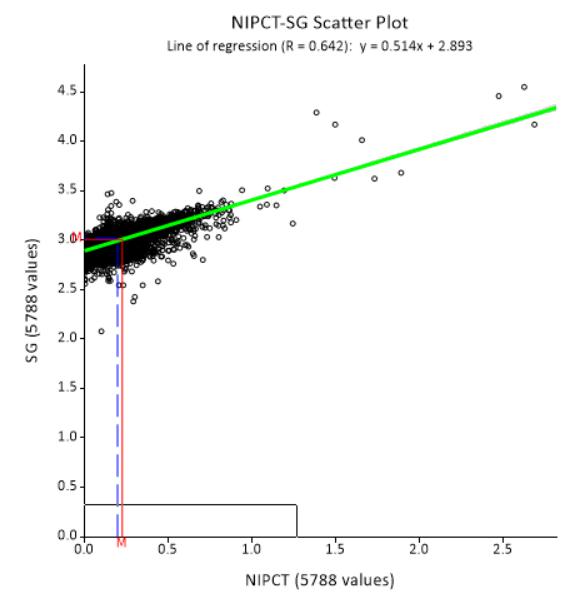 |
Source: MSA, 2026
| 14.7.6 | Moisture |
No in-situ moisture data was made available. Grade and tonnage were estimated on a dry basis. The rocks within the mineral resource are unweathered crystalline igneous rocks and the MSA QP considers that in-situ moisture is insignificant.
| 14.7.7 | Variography |
Variography was undertaken in Datamine’s Supervisor software using normal scores transformation. The variances were back transformed for grade estimation.
| J5050 – Selkirk Nickel-Copper-PGE Project S-K 1300 Technical Report Summary 17-08-2026 | Page: 100 |
The major (25 degrees), semi-major (-65 degrees) and minor (36 degrees) directions were aligned with the strike, dip and plunge of the main mineralised zone, and were consistent across all the elements analysed. An angular tolerance of 25 degrees was applied to the directional variograms. Capping was in some cases applied to where outlier values impacted on the continuity of the bulk of the mineralisation differently to those used for grade interpolation.
Variogram models are well structured, spherical, and display strong spatial continuity with the anisotropy as expected for this style of mineralisation (examples are shown in Figure 14-6 and Figure 14-7). The variogram shapes are similar to each other for most variables. There are insufficient silver assays with which to reliably model the spatial continuity (Figure 14-8), however the MSA QP considers this to be immaterial given the <1% contribution of silver to NSR. A summary of the variogram parameters is presented in Table 14-6.
Figure 14-6
|
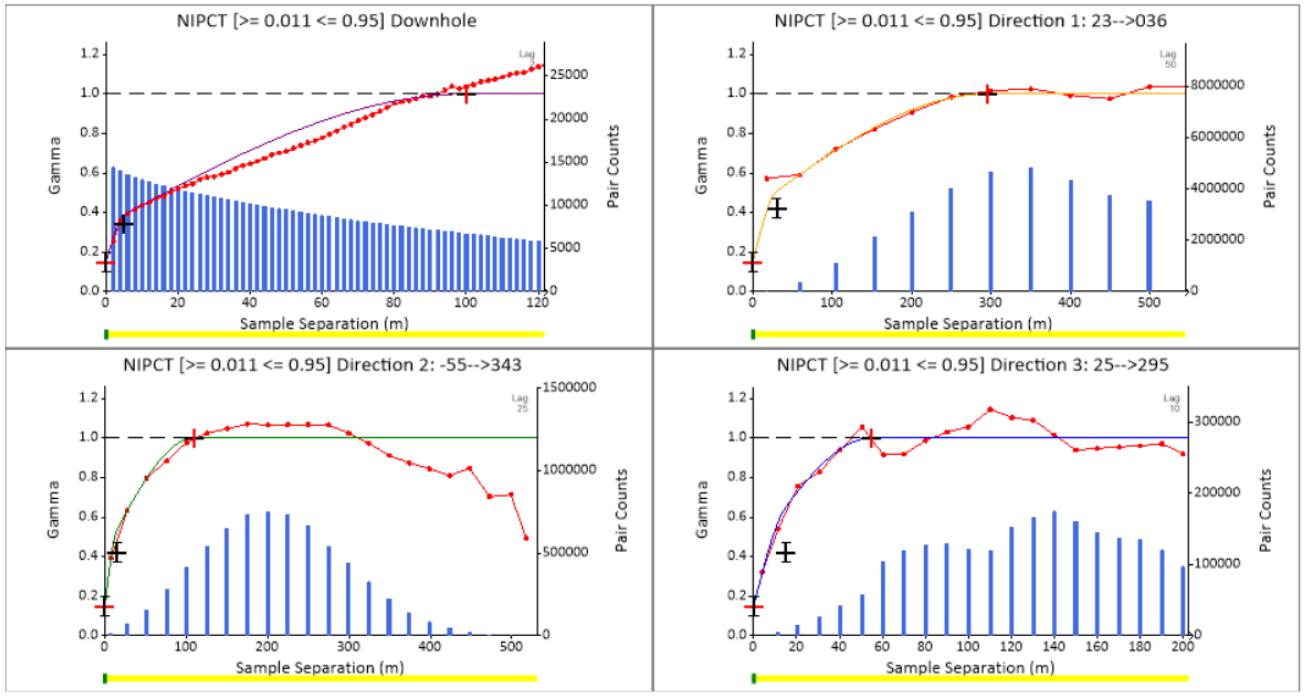 |
Source: MSA, 2026
| J5050 – Selkirk Nickel-Copper-PGE Project S-K 1300 Technical Report Summary 17-08-2026 | Page: 101 |
| Figure
14-7 Pd grade variograms |
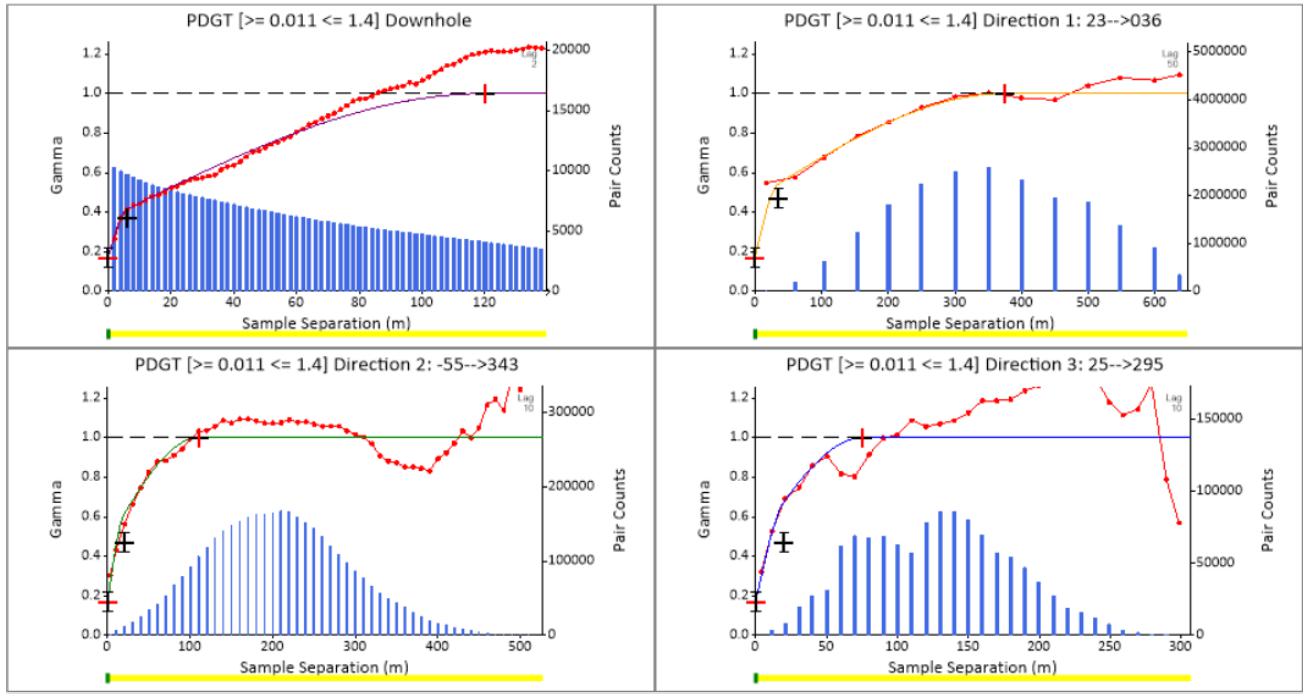 |
Source: MSA, 2026
| Figure
14-8 Ag grade variograms |
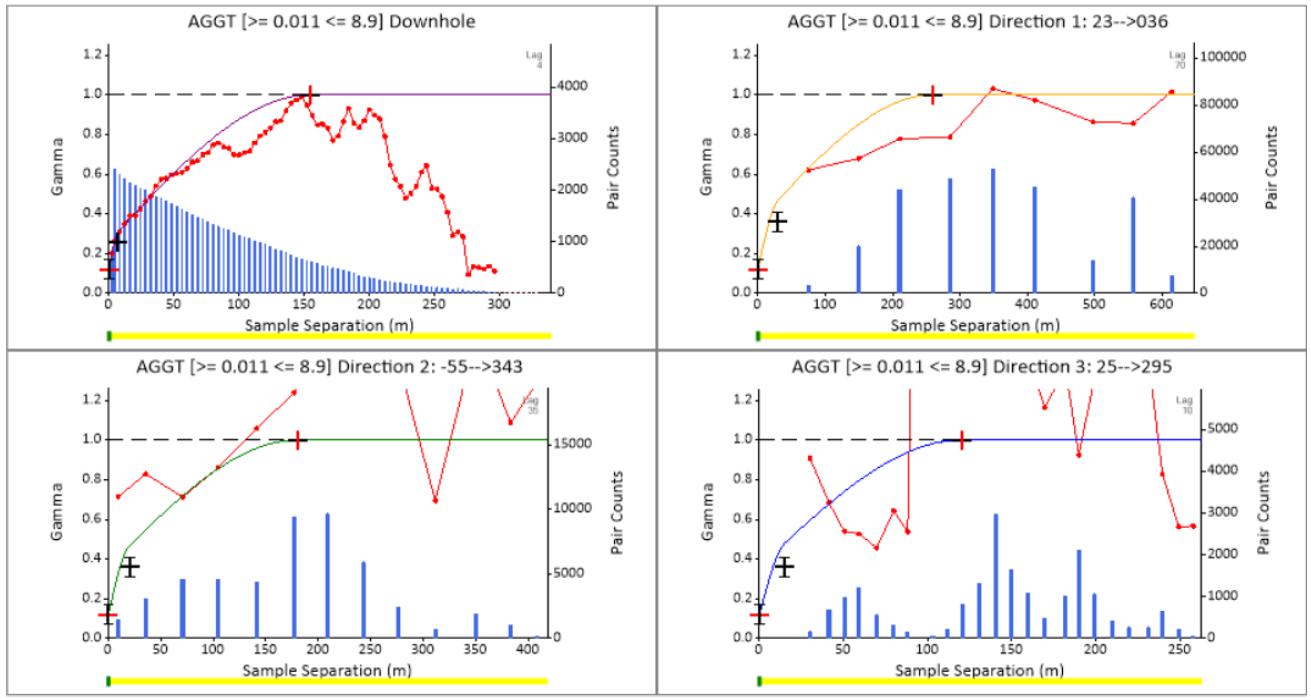 |
Source: MSA, 2026
| J5050 – Selkirk Nickel-Copper-PGE Project S-K 1300 Technical Report Summary 17-08-2026 | Page: 102 |
| Table
14-6 Variogram parameters |
| Assay | Nugget Effect | Structure | Dir1 Range (m) | Dir2 Range (m) | Dir3 Range (m) | Sill |
| Ni | 0.167 | 1 | 30 | 15 | 15 | 0.289 |
| 2 | 295 | 110 | 55 | 0.544 | ||
| Cu | 0.204 | 1 | 30 | 15 | 20 | 0.270 |
| 2 | 360 | 125 | 70 | 0.526 | ||
| Co | 0.199 | 1 | 35 | 10 | 10 | 0.277 |
| 2 | 150 | 35 | 25 | 0.181 | ||
| 3 | 300 | 115 | 40 | 0.343 | ||
| Pt | 0.214 | 1 | 30 | 20 | 20 | 0.250 |
| 2 | 320 | 110 | 65 | 0.535 | ||
| Pd | 0.178 | 1 | 35 | 20 | 20 | 0.307 |
| 2 | 375 | 110 | 75 | 0.515 | ||
| Au | 0.315 | 1 | 45 | 10 | 15 | 0.306 |
| 2 | 85 | 50 | 60 | 0.107 | ||
| 3 | 470 | 160 | 75 | 0.272 | ||
| Ag | 0.136 | 1 | 30 | 20 | 15 | 0.267 |
| 2 | 260 | 180 | 120 | 0.597 | ||
| S | 0.158 | 1 | 30 | 10 | 15 | 0.218 |
| 2 | 140 | 70 | 50 | 0.229 | ||
| 3 | 430 | 160 | 140 | 0.395 | ||
| SG | 0.086 | 1 | 20 | 15 | 10 | 0.206 |
| 2 | 80 | 120 | 50 | 0.278 | ||
| 3 | 345 | 120 | 60 | 0.430 |
| 14.8 | Block Model and Grade Estimation |
| 14.8.1 | Block Model Parameters |
An unrotated block model was produced, with a parent block size of 20 mX by 20 me by 10 mZ. The X (easting) and Y (northing) dimensions are based on approximately one-third of the average drill spacing, supported by results of a kriging neighbourhood analysis (KNA). Sub-celling of up to 1/10th parent block size was used to ensure adequate resolution on the edges of geological domains.
| J5050 – Selkirk Nickel-Copper-PGE Project S-K 1300 Technical Report Summary 17-08-2026 | Page: 103 |
Figure 14-9
|
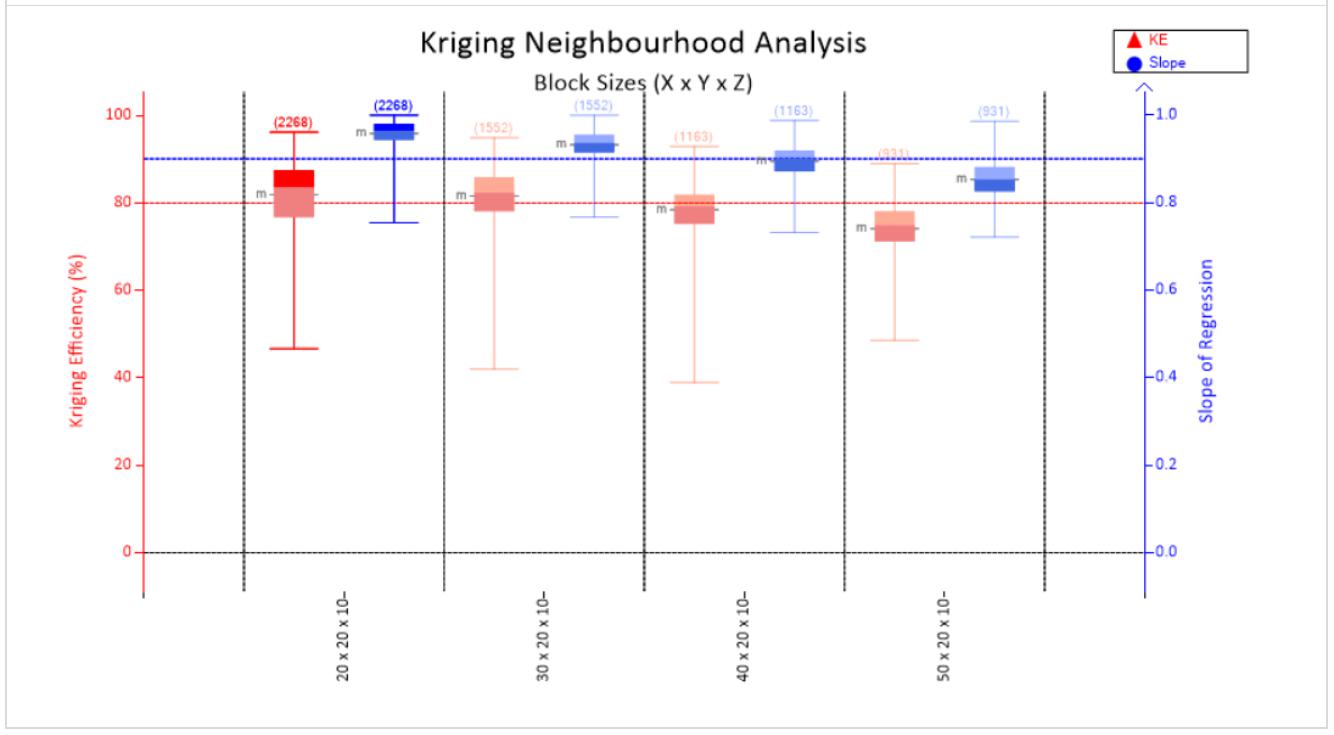 |
Source: MSA, 2026
| 14.8.2 | Search Parameters and Number of Samples |
The search and ellipsoid parameters were based on the variography results. A search factor of 2 and 3 was used for the second and third searches respectively. Maximum composites allowed from an individual sample for block estimation was set at 7. The final search parameters for all elements are as follows:
| ● | Search Distances: 90 m (major), 70 m (semi-major), 16 m (minor). | |
| ● | Search Angles: -65 degrees (major), 65 degrees (semi-major), 25 degrees (minor). |
A kriging neighbourhood analysis (KNA) was carried out on the 2 m composite sample nickel grade to guide the selection of the final estimation parameters. A minimum of 16 samples and maximum of 36 samples was used for the first search, minimum of 16 samples and maximum of 32 samples for the second search, and minimum of 12 samples and maximum of 20 samples for the third search.
| J5050 – Selkirk Nickel-Copper-PGE Project S-K 1300 Technical Report Summary 17-08-2026 | Page: 104 |
Figure 14-10
|
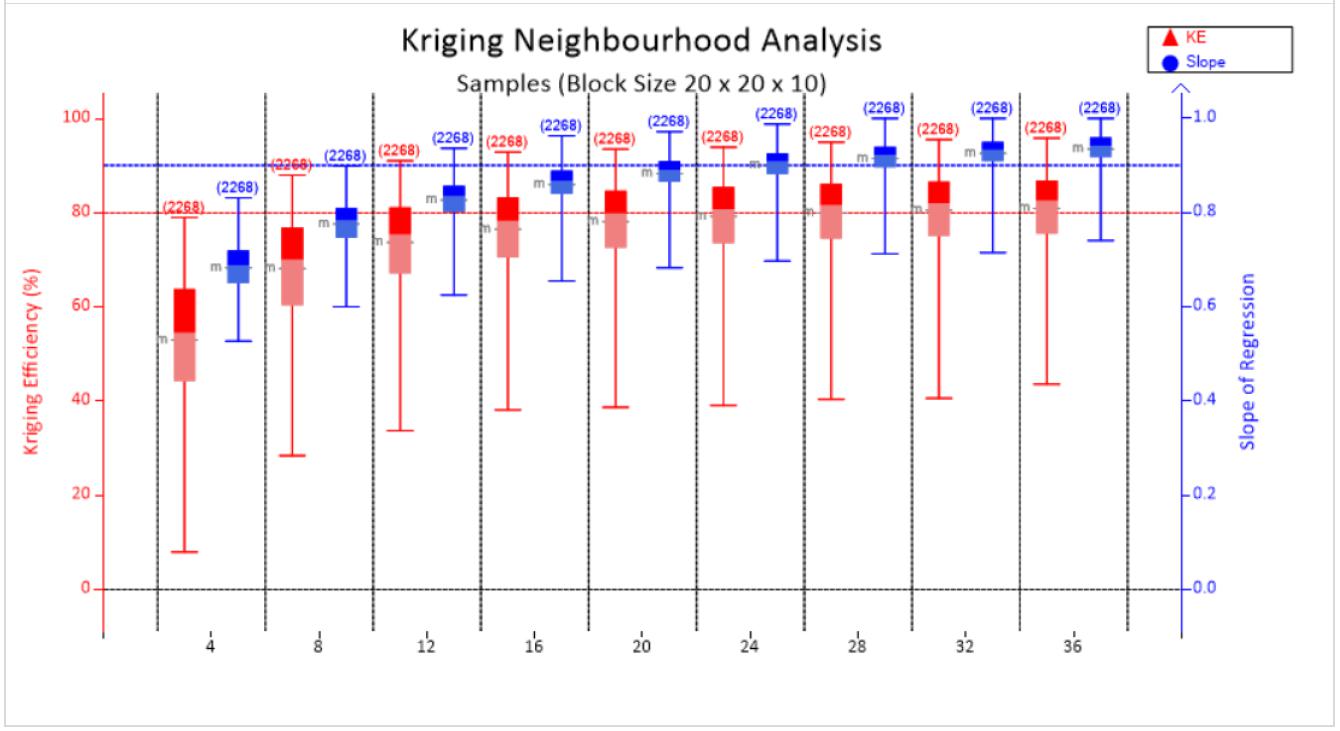 |
Source: MSA, 2026
| 14.8.3 | Grade Estimation |
Grade estimation was carried out by means of Ordinary Kriging (OK) within full parent blocks and utilising the 2 m composites. Grade estimation was carried out for each element within the mineralised domains with no distinction based on weathering type (oxide, transition or fresh / sulphide) owing to the grade of these zones being observably similar. Hard boundaries were utilised so that only samples within each domain were used for the estimation of the grade within that domain. The resultant kriging efficiency was typically greater than 75% in the main mineralised domain. An NSR value was calculated within the block model based on the estimated grades, utilising the same parameters as used for the drillhole data NSR calculation.
| 14.9 | Block Model Validation |
Validation of block-models was carried out by visual comparison of drillhole and block grades in sections (Figure 14-11 and Figure 14-12), global average grade comparison and swath plots.
| J5050 – Selkirk Nickel-Copper-PGE Project S-K 1300 Technical Report Summary 17-08-2026 | Page: 105 |
Figure 14-11
|
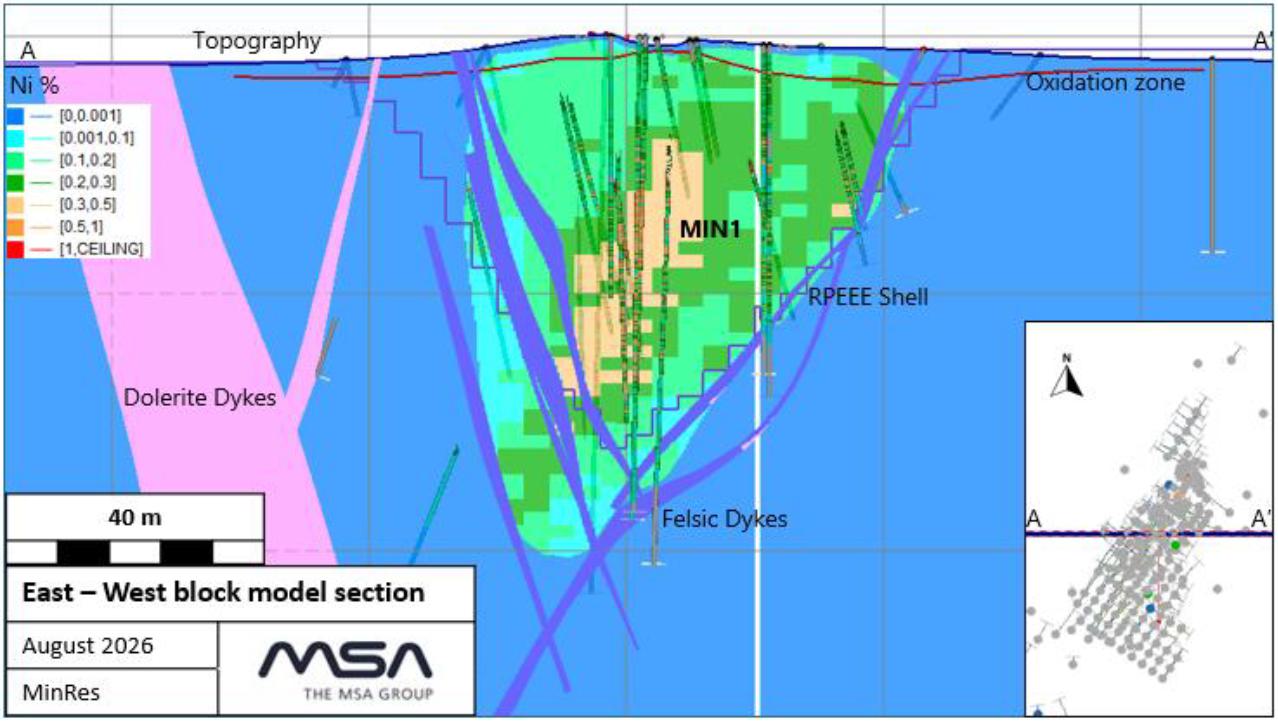 |
Source: MSA, 2026
Figure 14-12
|
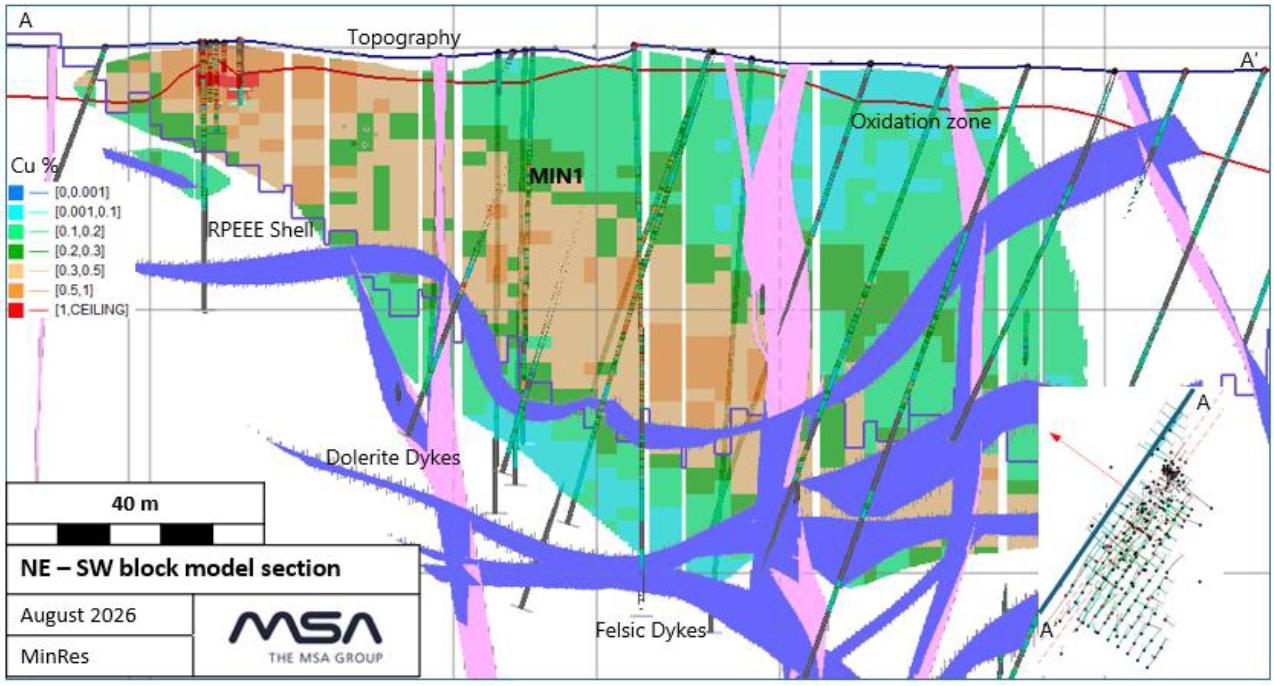 |
Source: MSA, 2026
| 14.9.1 | Swath Plots |
Swath plots confirmed that the model reflect grade trends with no consistent bias for nickel and copper, the model is slightly lower than the data for Pt and Pd. Swath plots for nickel, copper, palladium and platinum by northing are presented in Figure 14-13.
| J5050 – Selkirk Nickel-Copper-PGE Project S-K 1300 Technical Report Summary 17-08-2026 | Page: 106 |
Figure 14-13
Ni, Cu, Pt and Pd swath plots in Y direction (MIN1)
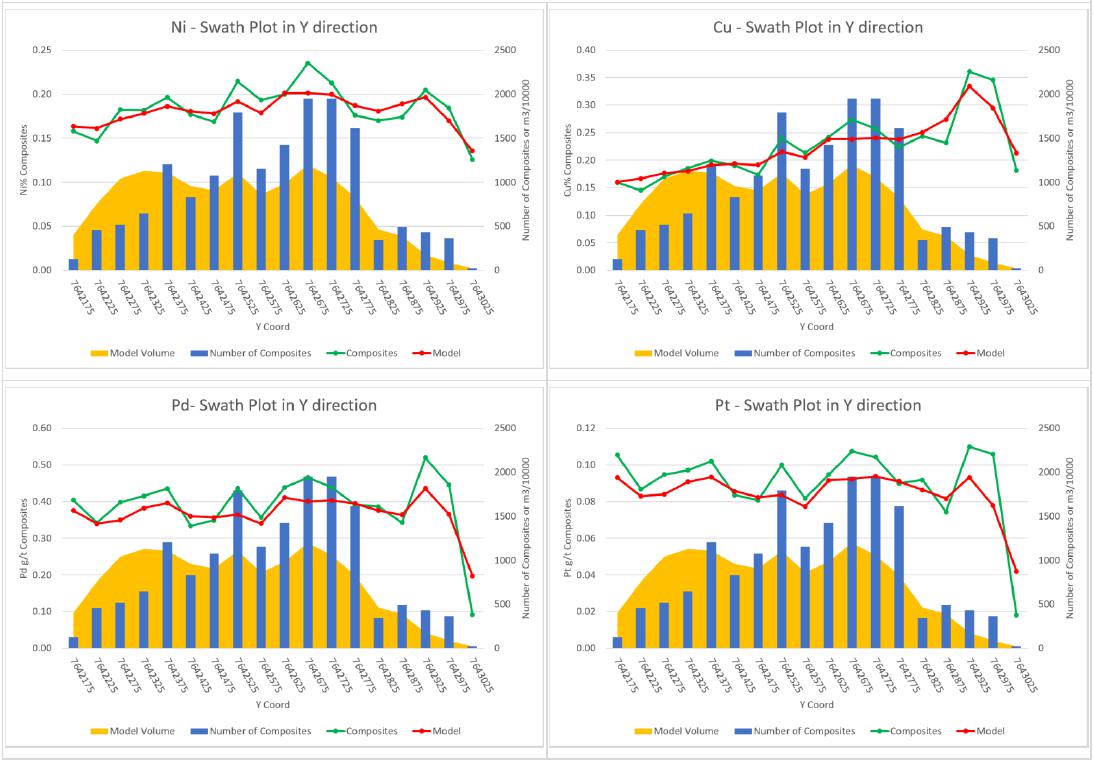
Source: MSA, 2026
| J5050 – Selkirk Nickel-Copper-PGE Project S-K 1300 Technical Report Summary 17-08-2026 | Page: 107 |
| 14.9.2 | Statistical Validation |
A comparison between the mean block model and 2 m composite sample grades (capped) is presented in Table 14-7 for the main mineralisation zone. The global grade correlation is well within acceptable limits. The silver data are sparse and the comparison between the block model and the data is strongly influenced by the spatial influence of drillholes with silver grade data.
| Table
14-7 Statistical comparison of block model and composite means |
| Domain | Assay | 2 m Composite Mean | Block model Mean | Percent difference (block model to data) |
| MIN1 | Ni % | 0.20 | 0.19 | -5% |
| Cu % | 0.23 | 0.22 | -4% | |
| Co % | 0.01 | 0.01 | ||
| Pt g/t | 0.10 | 0.09 | -10% | |
| Pd g/t | 0.41 | 0.39 | -5% | |
| Au g/t | 0.05 | 0.05 | ||
| Ag g/t | 1.00 | 0.64 | -37% | |
| S % | 2.02 | 1.84 | -9% |
| 14.10 | Mineral Resource Classification |
The Selkirk MRE has been classified as Measured, Indicated or Inferred Mineral Resource in accordance with SEC Regulation S-K 1300. No Measured Mineral Resources were declared for the Project.
| 14.10.1 | Approach to Classification |
Classification of the Selkirk Mineral Resource was based on the degree of geological uncertainty, grade continuity and variability, frequency of the drilling data and confidence in the data.
The main considerations in terms of the Mineral Resource classification are as follows:
| ● | Confidence of the geological and mineralisation model: |
| ○ | The confidence in the mineralisation model (NSR) is good, it being informed by adequate drilling and constrained to the Selkirk Metagabbro. | |
| ○ | The deposit is intruded by numerous dykes. These have been modelled where they form continuous units between drillholes. Smaller dykes will however occur that will have a dilutionary effect on the grade model. | |
| ○ | The base of oxidation model is based on oxidation and/or weathering data that have not been consistently collected. This is of importance as oxidised material is not included in the Mineral Resource as a processing route has not been defined for it and potential economic extraction is uncertain. | |
| ○ | The topography model is largely based on drillhole collars. Inaccuracies near surface will therefore occur. |
| J5050 – Selkirk Nickel-Copper-PGE Project S-K 1300 Technical Report Summary 17-08-2026 | Page: 108 |
| ● | Database quality including presence and performance of QAQC: |
| ○ | The data collected by PNGPL passes QAQC tests. There are some concerns revealed by the QAQC on the TNMC database, with many errors likely caused by sample identification issues and/or database errors. | |
| ○ | Despite issues relating to individual samples, these will not impact materially on the Mineral Resource Estimate due to the large, disseminated nature of the mineralisation and the high number of sample composites available for block estimation. However, the data errors may impact the accuracy of local estimates in the block model. | |
| ○ | The grade distributions between the PNGPL resampling assay data and twin drilling are closely comparable to the original TNMC data. | |
| ○ | The estimates of metal grades that are not well represented by the data will be of lower confidence. However, these metals (including silver) currently represent an immaterial proportion of the project NSR value, which is currently close to two thirds within Ni and Cu, approximately one third in Pt, Pd and Au with Ag accounting for approximately 1% and Co 2%. |
| ● | Grade shell continuity is high and grade variability is low. Broad high and low grade zones are visually apparent in the data and confirmed by semi-variogram ranges well in excess of the drillhole spacing. | |
| ● | The grade model validation is acceptable. |
| 14.10.2 | Summary of Mineral Resource Classification |
Considering the aforementioned factors, the Selkirk Mineral Resource has been classified as follows:
| ● | No Measured Mineral Resource was declared. | |
| ● | The Indicated Mineral Resource is underpinned by denser drilling in the central portion of the deposit. This drilling is on an irregular grid of typically 20 m to 60 m. | |
| ● | The Inferred Mineral Resource comprises those parts of the block model for which geostatistical confidence in the grade estimates is low or when second or third searches were required to estimate block grades. These are typically toward the fringes of the deposit and at depth, where drilling is sparser. | |
| ● | Below and adjacent to the mined out area, the data accepted for the MRE is relatively widely spaced and this area forms an area of Inferred. Outside of this area, the Inferred tends to occur on the deposit edges where grades are typically relatively low. | |
| ● | Extrapolation of Inferred Resources from the drillholes was minimal due to the Mineral resource being limited by the NSR shell and at depth by economic considerations. | |
| ● | A general volume was modelled around the voids formed by the underground mined area. This was expanded by 5 m and all unmined block model within this volume was classified as Inferred. |
| J5050 – Selkirk Nickel-Copper-PGE Project S-K 1300 Technical Report Summary 17-08-2026 | Page: 109 |
| ● | The grade of mineralisation zone MIN2 is relatively low and did not meet RPEE criteria and was therefore not classified. | |
| ● | MIN3 contains limited amounts of data and was classified as Inferred. |
An east-view of the Mineral Resource Classification, within the RPEE shell, is presented in Figure 14-14.
| Figure
14-14 View to the east showing Mineral Resource classification |
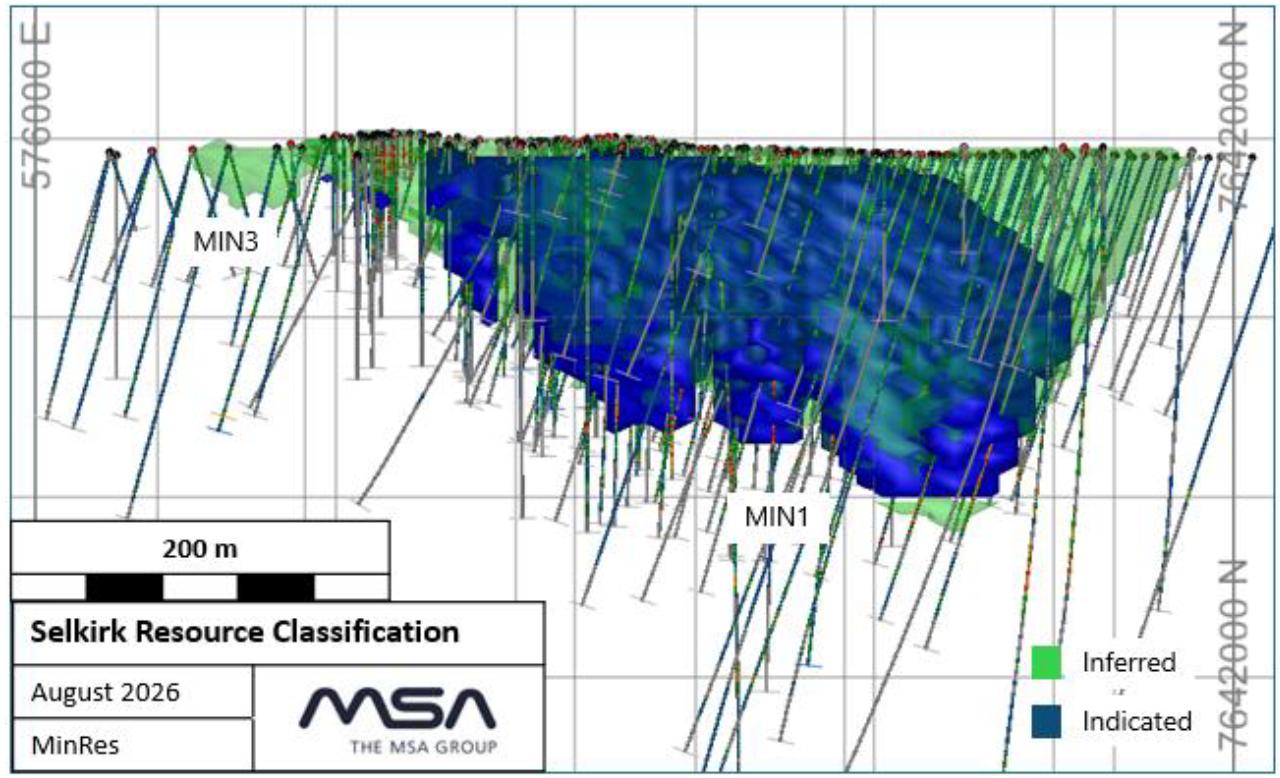 |
Source: MSA, 2026
| 14.11 | Assessment of Reasonable Prospects for Economic Extraction (RPEE) |
In assessing “reasonable prospects for economic extraction” (RPEE), the Mineral Resource was constrained within an optimised pit shell using assumed parameters (Table 14-8). The MSA QP considers that an NSR cut-off of USD25/t is appropriate given the nature of the mineralisation and the assumed on-site costs. The location and extent of conceptual pit-shell relative to the mining licence is shown in Figure 14-15.
| J5050 – Selkirk Nickel-Copper-PGE Project S-K 1300 Technical Report Summary 17-08-2026 | Page: 110 |
Figure 14-15
|
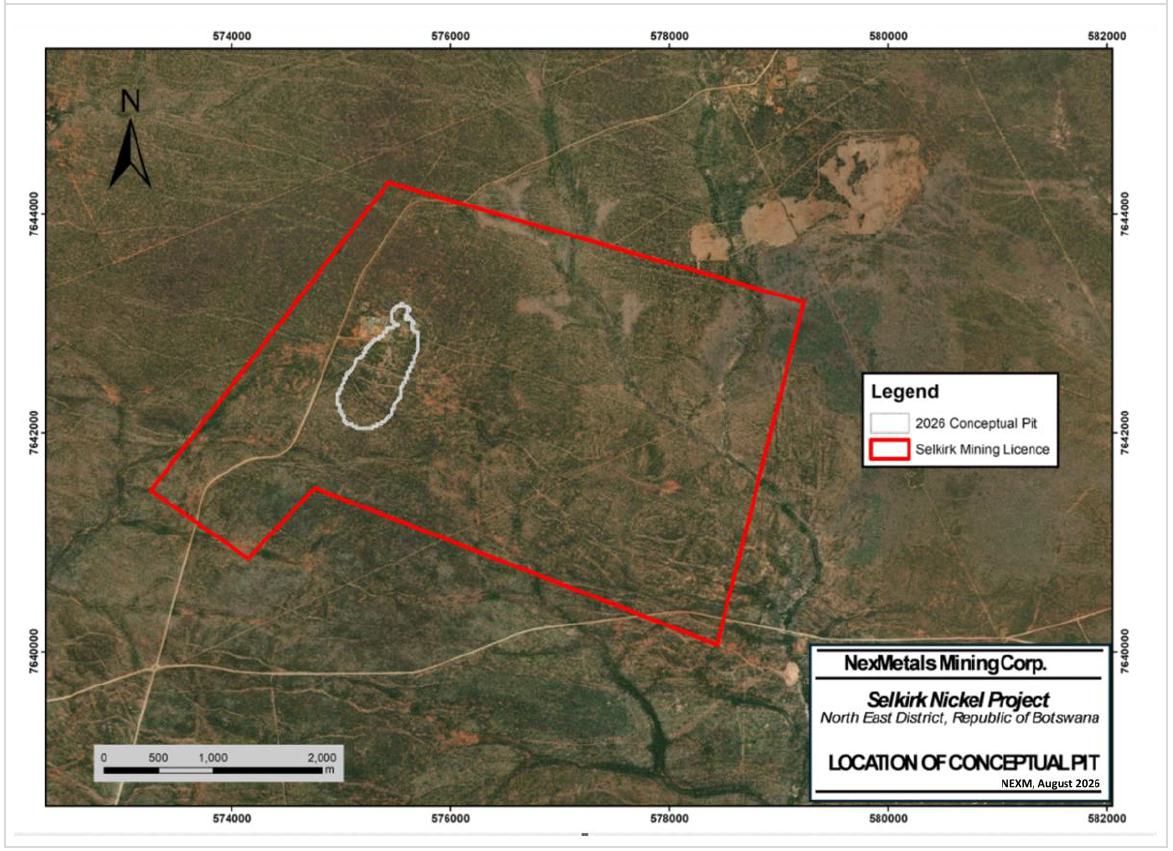 |
| Table
14-8 RPEE shell parameters |
| Parameter | Unit | Value | |
| Mining Cost | Mineralisation | USD/t mineralisation mined | 3 |
| Waste | USD/t waste | 3 | |
| Incremental depth | USD/t per m below pit rim | 0.008 | |
| Concentrate production cost | Copper Concentrate | USD/tonne concentrated | 20 |
| Nickel Concentrate | 20 | ||
| G&A | USD/tonne concentrated | 1.35 | |
| Slope angle | 0 to 30 m from surface | degrees | 45 |
| >30 m from surface | 60 | ||
The reader is advised that the assessment of economic potential that is incorporated in the Mineral Resource is a high-level assessment and is solely for the purpose of reporting Mineral Resources with reasonable prospects of economic extraction and does not represent an attempt to estimate Mineral Reserves.
| J5050 – Selkirk Nickel-Copper-PGE Project S-K 1300 Technical Report Summary 17-08-2026 | Page: 111 |
| 14.12 | Mineral Resource Statement |
For the purposes of this Technical Report Summary (“TRS”), the Mineral Resources are prepared and reported in accordance with SEC Regulation S-K 1300. MSA is the QP, as defined by Subpart 1300 of Regulation S-K, responsible for the Mineral Resource disclosure presented herein. The MSA QP has reviewed the estimation methodology, classification criteria and supporting technical information and considers the Mineral Resource Estimate suitable for disclosure under SEC Regulation S-K 1300.
Definitions for resource categories used in this TRS are aligned with those defined by SEC in S-K 1300. Mineral Resources are classified into Measured, Indicated, and Inferred categories. No Measured Mineral Resources were declared for the Project.
The Mineral Resource constrained to the potentially economic open pit shell honouring RPEE is presented in Table 14-9.
Mineral Resources are not Mineral Reserves and have not demonstrated economic viability. The reported Inferred Mineral Resources are considered too speculative geologically to have economic considerations applied to them that would enable them to be categorised as Mineral Reserves as defined by S-K 1300. It cannot be assumed that all or any part of an Inferred Mineral Resource will ever be upgraded to an Indicated or Measured Mineral Resource category.
The Mineral Resource is stated at a cut-off NSR of USD25/t and is reported within an optimised pit shell. In the opinion of the MSA QP, the Mineral Resources reported herein at the selected cut-off grade have “reasonable prospects for economic extraction” (RPEE), taking into consideration mining and processing assumptions.
| J5050 – Selkirk Nickel-Copper-PGE Project S-K 1300 Technical Report Summary 17-08-2026 | Page: 112 |
| Table
14-9 Selkirk Mineral Resource Statement as of 22 June 2026 |
| Class | Tonnes | CuEq Grade |
Total Contained CuEq | NSR | Grade | ||||||
| Ni | Cu | Co | Pt | Pd | Au | Ag | |||||
| (Millions) | (%) | (Mlbs) | (USD) | (%) | (%) | (%) | (g/t) | (g/t) | (g/t) | (g/t) | |
| Measured | 0.0 | - | 0 | - | - | - | - | - | - | - | - |
| Indicated | 78.2 | 0.66 | 1,133 | 56 | 0.21 | 0.23 | 0.012 | 0.10 | 0.42 | 0.05 | 0.72 |
| Inferred | 15.1 | 0.60 | 198 | 51 | 0.18 | 0.21 | 0.010 | 0.09 | 0.40 | 0.05 | 0.77 |
| Contained Metal | |||||||||||
| Ni | Cu | Co | Pt | Pd | Au | Ag | |||||
| (kt) | (kt) | (kt) | (koz) | (koz) | (koz) | (koz) | |||||
| Measured | - | - | - | - | - | - | - | ||||
| Indicated | 163 | 181 | 9.2 | 245 | 1,066 | 120 | 1,818 | ||||
| Inferred | 27 | 32 | 1.6 | 45 | 193 | 25 | 372 | ||||
Notes:
| 1 | Mineral Resources have been classified in accordance with SEC Regulation S-K 1300 and have been estimated under the supervision of the Qualified Person, MSA, a third-party firm comprising mining experts as defined by S-K 1300. | |
| 2 | The 2026 MRE has been prepared in accordance with S-K 1300 definitions. Mineral Resources are exclusive of Mineral Reserves. There are no Mineral Reserves reported. | |
| 3 | Mineral Resources, which are not Mineral Reserves, have no demonstrated economic viability. There is no guarantee that that all or any part of the Mineral Resource will be converted into a Mineral Reserve. The estimate of Mineral Resources may be materially affected by geology, environment, permitting, legal title, taxation, socio-political, marketing, or other relevant issues. | |
| 4 | It cannot be assumed that all or any part of an Inferred Mineral Resource will ever be upgraded to an Indicated or Measured Mineral Resource. | |
| 5 | The assessment is preliminary in nature; it includes Inferred Mineral Resources that are considered too speculative geologically to have modifying factors applied to them that would enable them to be categorised as Mineral Reserves, and there is no certainty that this economic assessment will be realised. | |
| 6 | Mineral Resources reported on a 100% NEXM ownership basis. | |
| 7 | All tabulated data have been rounded and as a result minor computational errors may occur. | |
| 8 | kt = thousand tonnes, Mlbs = Million pounds, koz = thousand ounces. | |
| 9 | Mineral Resources are reported in situ (point of reference). | |
| 10 | The Mineral Resource is report as in situ dry tonnes; figures are reported in metric tonnes. | |
| 11 | Mineral Resources are reported within an optimised pit shell using NSR values, mining cost of USD3 per tonne (additional USD 0.008 per metre depth from pit rim), concentrate costs of USD20 per tonne, G&A of USD1.35 per tonne, 45°pit slope to base of partially weathered and 60° in fresh rock. | |
| 12 | Mineral Resources are reported at a cut-off value of USD25/t NSR (Net Smelter Return) defined as received value of final metal recovered minus off-site costs. | |
| 13 | Mineral Resources are estimated using long-term prices of USD9.10/lb Ni, USD5.10/lb Cu, USD20.00/lb Co, USD1,800/oz Pt, USD1,550/oz Pd, USD3,600/oz Au and USD52.00/oz Ag. The same metal prices were used in CuEq and NSR calculations. | |
| 14 | Mineral Resources are estimated using nickel, copper, cobalt, platinum, palladium, gold and silver recoveries of 54%, 88%, 53%, 56%, 78%, 72% and 61%, respectively, derived from metallurgical studies which consider a two-concentrate scenario. | |
| 15 | Payabilities and off-site treatment and refining costs were derived from an independent marketing study commissioned by NexMetals. | |
| 16 | The
CuEq value was calculated based on relative recovered value received for each metal excluding
costs. Received value for each metal was calculated using the formula: in-situ grade*concentrator
recovery*payability*metal price. The ratio between received copper value and total other
metal value was then used to calculate CuEq, i.e., CuEq = (1+value excluding Cu / Cu value)
* Cu grade. Formula is: CuEq(%)=Cu(%)+Ni(%)*(85.1/91.4)+Co(%)*(93.8/91.4)+Pt(g/t)*(22.4/91.4)+Pd(g/t)*(33.1/91.4)+Au(g/t)* (68.5/91.4)+Ag(g/t)*(0.8/91.4) |
| J5050 – Selkirk Nickel-Copper-PGE Project S-K 1300 Technical Report Summary 17-08-2026 | Page: 113 |
| 17 | Bulk density has been estimated in the block model based on an extensive data set of measurements taken from drillhole cores. | |
| 18 | The effective date of the Mineral Resource estimate is 22 June 2026. |
| 14.13 | Grade Tonnage Curves |
The grade-tonnage curves for the Indicated and Inferred Resources are presented below (Figure 14-16 and Figure 14-17).
Figure 14-16
|
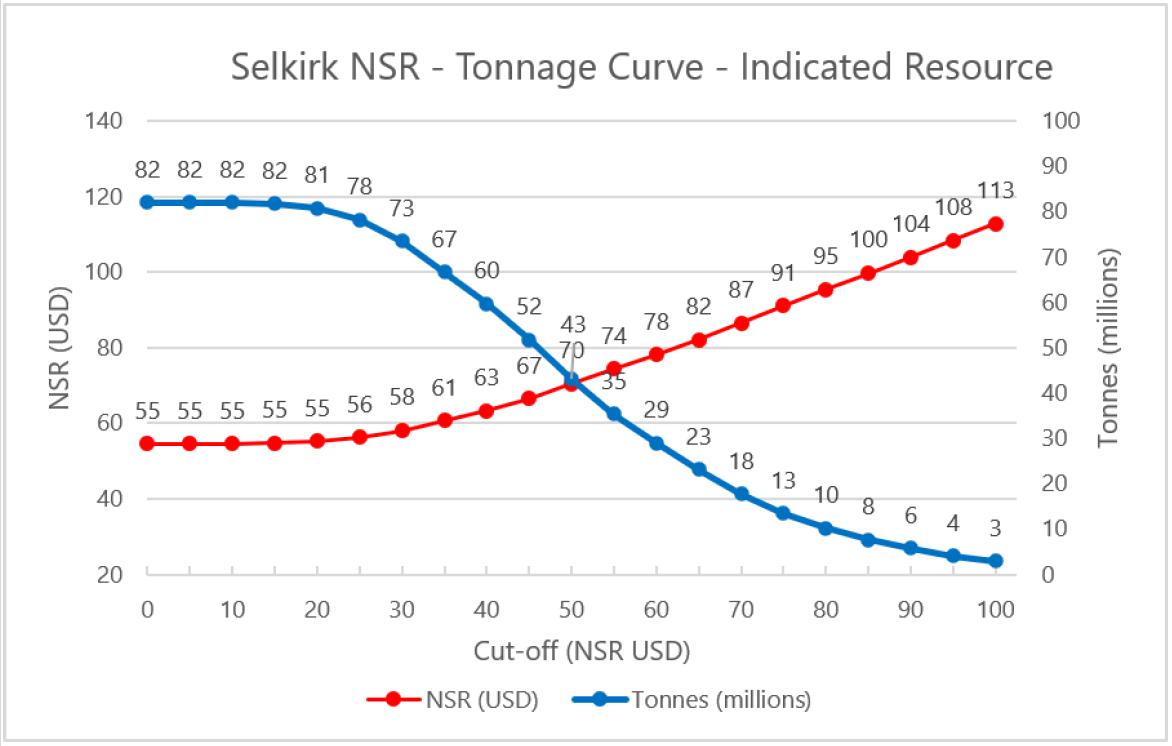 |
| J5050 – Selkirk Nickel-Copper-PGE Project S-K 1300 Technical Report Summary 17-08-2026 | Page: 114 |
Figure 14-17
|
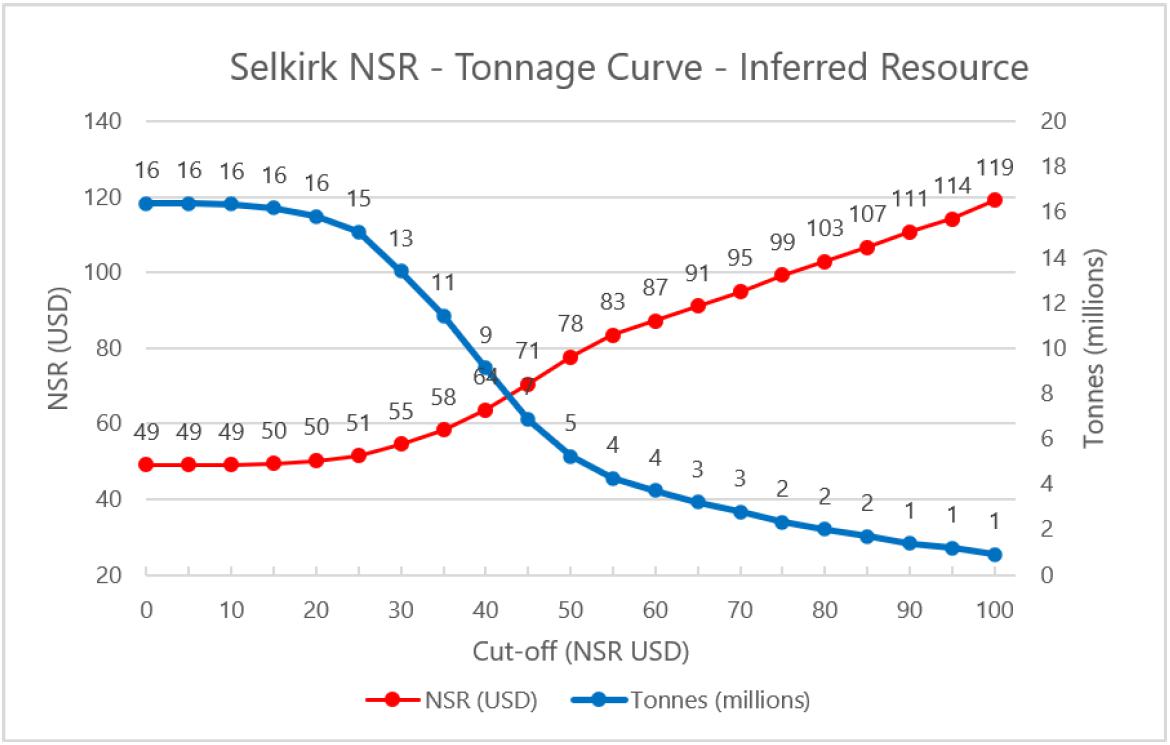 |
| 14.14 | Comparison with Previous Estimates |
On behalf of Premium Resources Ltd. (now known as NEXM), a Mineral Resource estimate for the Selkirk deposit was prepared by SLR using available drill hole data as of November 1, 2024.
The 2024 MRE was prepared using results from 283 historical drill holes completed between 2003 and 2016, five historical 2016 drill holes sampled by NEXM in 2021, and 17 historical holes re-sampled by PNGPL in 2024. Mineral Resource domain and block modelling work was completed using Seequent’s Leapfrog Geo and Edge software. The MRE was defined within a single domain, modelled as a mineralised body within the Selkirk gabbro that targeted an NSR threshold of US$20/t.
Inferred Mineral Resources represented areas with approximate drillhole spacings of up to 70 m and were constrained within an optimised pit shell.
The Mineral Resource estimates as prepared by SLR are tabulated in Table 6-2. The information regarding the mineral resource estimate prepared by SLR (November 01, 2024) reported herein should be considered as historical in nature. NEXM is not treating the SLR 01 November 2024 mineral resource estimate as current and this has been superseded by the 22 June 2026 mineral resource estimate
The MSA QP notes that other metals than Ni and Cu (i.e., Pt, Pd) were not always used when defining the NSR value in the drillhole due to these assays having not being completed for them. Inclusion of the unassayed variables (including Pt, Pd, Au, Co and by MSA using regression techniques (for the purpose of defining the mineralised extents on an NSR basis) results in a larger volume. Furthermore, different assumed technical parameters and metal prices used in the estimation of NSR result in differences to the resulting estimates.
| Table
6-3 Mineral Resource Statement prepared by SLR (November 01, 2024) | ||||||||
| Mass (Mt) | Average Value | Contained Metal | ||||||
| Cu | Ni | Pd | Pt | Cu | Ni | Pd | Pt | |
| (%) | (%) | (g/t) | (g/t) | (kt) | (kt) | (koz) | (koz) | |
| 44.2 | 0.30 | 0.24 | 0.55 | 0.12 | 132 | 108 | 775 | 174 |
Notes:
| 1. | The definitions for Mineral Resources in S-K 1300 were followed for Mineral Resources, which are consistent with CIM (2014) definitions. | |
| 2. | Mineral Resources are estimated at a net smelter return (NSR) value of US$25/t. | |
| 3. | Mineral Resources are estimated using a long-term prices of US$10.50/lb Ni, US$4.75/lb Cu, US$1,450/oz Pt and US$1,500/oz Pd, and a US$:BWP exchange rate of 1.00:13.23. | |
| 4. | Mineral Resources are estimated using nickel, copper, palladium, and platinum recoveries of 60%, 70%, 59%, and 59%, respectively, derived from metallurgical studies which consider a conceptual two concentrate scenario. | |
| 5. | Bulk density has been estimated. | |
| 6. | Mineral Resources are reported within an optimized pit shell. | |
| 7. | There are no Mineral Reserves. | |
| 8. | Totals may not add or multiply accurately due to rounding. |
Previous resource estimates for the Project were prepared under different assumptions, databases, drilling densities and economic parameters. Direct comparison between estimates may not be appropriate without consideration of these differences.
The current Mineral Resource Estimate reflects additional verification sampling and drilling, revised geological interpretations, updated estimation methodologies, revised economic assumptions and reporting in accordance with SEC Regulation S-K 1300.
| 14.15 | Mineral Resource Uncertainty Discussion |
The principal sources of uncertainty affecting the Mineral Resource Estimate include geological interpretation, continuity of mineralization, grade interpolation, bulk density assumptions, metallurgical recovery assumptions, commodity price assumptions and future mining selectivity. Additional infill drilling, production data and operating experience may result in future revisions to Mineral Resources.
MSA notes that future economic assessment could result in a change in the COG, which would result in a change in the tonnage of available mineable material. Mineralisation represented by the resource block model was evaluated for RPEE for open pit mining methods. The MSA QP did not independently audit recovery, processing costs, or other assumptions for deriving COG but does consider the inputs to be reasonable for the purposes of declaring a Mineral Resource.
| J5050 – Selkirk Nickel-Copper-PGE Project S-K 1300 Technical Report Summary 17-08-2026 | Page: 115 |
Portions of the deposit remain sparsely drilled, that should be investigated through more-closely spaced sample intervals, which would improve understanding of the grade distribution and continuity.
The current Environmental Management Programme (EMP) was issued in 2016 and based on the mine design at that time. The results of future studies may require amendment to the EMP Any development not discussed and assessed in the 2016 Statement, or any modification, use of new technology, upgrade or expansion requires a brief to be submitted to the DEA for review (refer to section 6.5 ).
The Mining Licence (ML 2022/7L) expires May 26, 2032. Given the early exploration stage and PEA as the next milestone, it is uncertain whether mine construction and operation can be achieved within the remaining licence term. The Mines Act allows for renewal of the Mining Licence for a period of 25 years (refer to section 4.2).
The current surface rights area has been noted to be insufficient for the perceived open pit mine. Agreements with the landowners are in place to extend the surface rights area should it be necessary (refer to section 4.2.2).
With the exception of these potential risks to Mineral Resources, MSA is not aware of any other factors to which the mineral resource estimates could be materially affected, such as environmental, permitting, legal, title, taxation, socio-economic, marketing, political, or other relevant factors
| 14.16 | QP Opinion |
The MSA Qualified Person is of the opinion that:
| ● | the drilling, sampling, analytical and database information are adequate to support the Mineral Resource Estimate; | |
| ● | the geological interpretation appropriately reflects the style and continuity of mineralization; | |
| ● | the estimation methodology is suitable for the deposit type and available data; | |
| ● | the Mineral Resource models presented in this report are representative of the informing data and that the data is of sufficient quality and quantity to support the Mineral Resource estimate to the classifications applied; | |
| ● | the classification appropriately reflects the confidence in the estimate; and the reported Mineral Resources have reasonable prospects for economic extraction; | |
| ● | the resource estimation reported herein is an appropriate representation of the Ni, Cu, Co, Pt, Pd, Au and Ag Mineral Resources found at Selkirk; | |
| ● | the Mineral Resource Estimate has been prepared in accordance with SEC Regulation S-K 1300; and | |
| ● | the QPs are of the opinion that with consideration of the recommendations summarized in Section 1.0 and 26.0 of this TRS, any issues relating to all relevant technical and economic factors likely to influence the prospect of economic extraction can be resolved with further work. |
| J5050 – Selkirk Nickel-Copper-PGE Project S-K 1300 Technical Report Summary 17-08-2026 | Page: 116 |
| 15. | MINERAL RESERVE ESTIMATES |
This section is not applicable. The Project is at the MRE stage with no Preliminary Economic Assessment (PEA) or Pre-Feasibility Study (PFS) completed.
| J5050 – Selkirk Nickel-Copper-PGE Project S-K 1300 Technical Report Summary 17-08-2026 | Page: 117 |
| 16. | MINING METHODS |
This section is not applicable. The Project is at the MRE stage with no Preliminary Economic Assessment (PEA) or Pre-Feasibility Study (PFS) completed.
| J5050 – Selkirk Nickel-Copper-PGE Project S-K 1300 Technical Report Summary 17-08-2026 | Page: 118 |
| 17. | RECOVERY METHODS |
This section is not applicable. The Project is at the MRE stage with no Preliminary Economic Assessment (PEA) or Pre-Feasibility Study (PFS) completed.
| J5050 – Selkirk Nickel-Copper-PGE Project S-K 1300 Technical Report Summary 17-08-2026 | Page: 119 |
| 18. | PROJECT INFRASTRUCTURE |
This section is not applicable. The Project is at the MRE stage with no Preliminary Economic Assessment (PEA) or Pre-Feasibility Study (PFS) completed.
| J5050 – Selkirk Nickel-Copper-PGE Project S-K 1300 Technical Report Summary 17-08-2026 | Page: 120 |
| 19. | MARKET STUDIES AND CONTRACTS |
This section is not applicable. The Project is at the MRE stage with no Preliminary Economic Assessment (PEA) or Pre-Feasibility Study (PFS) completed.
| J5050 – Selkirk Nickel-Copper-PGE Project S-K 1300 Technical Report Summary 17-08-2026 | Page: 121 |
| 20. | ENVIRONMENTAL STUDIES, PERMITTING AND SOCIAL OR COMMUNITY IMPACT |
This section is not applicable. The Project is at the MRE stage with no Preliminary Economic Assessment (PEA) or Pre-Feasibility Study (PFS) completed.
| J5050 – Selkirk Nickel-Copper-PGE Project S-K 1300 Technical Report Summary 17-08-2026 | Page: 122 |
| 21. | CAPITAL AND OPERATING COSTS |
This section is not applicable. The Project is at the MRE stage with no Preliminary Economic Assessment (PEA) or Pre-Feasibility Study (PFS) completed.
| J5050 – Selkirk Nickel-Copper-PGE Project S-K 1300 Technical Report Summary 17-08-2026 | Page: 123 |
| 22. | ECONOMIC ANALYSIS |
This section is not applicable. The Project is at the MRE stage with no Preliminary Economic Assessment (PEA) or Pre-Feasibility Study (PFS) completed.
| J5050 – Selkirk Nickel-Copper-PGE Project S-K 1300 Technical Report Summary 17-08-2026 | Page: 124 |
| 23. | Adjacent Properties |
The Selkirk Mining Licence, located 15 km to the southwest of the past producing Phoenix Mine, is surrounded by numerous exploration licence holders, primarily small companies. The past producing Phoenix Mine, a metagabbro hosted Ni-Cu-PGE-Au deposit previously operated by Tati Nickel Mining Company, began production in 1995 and went into liquidation in 2017 alongside other assets of BCL. The Phoenix Mine and associated infrastructure was acquired by Tataki Mining Company (Pty) Ltd, wholly owned by the NUI Group. The Hawks Mining Company Pty Ltd.’s Mupane gold mine, located 6 km southwest of the Selkirk Mining Licence, was the only operating gold mine in Botswana when it ceased operations in March 2024. The current owner, Nova Africa Resources and partner AgaOne Commodities acquired the mine out of liquidation and is planning a restart by mid-2027.
Figure 23-1 shows the various exploration licence holders surrounding the Selkirk Mining Licence.
The MSA QP has not relied on information from adjacent properties for this TRS and has been unable to verify information regarding properties outside the Selkirk Property. Information in respect of adjacent properties is not necessarily indicative of the mineralisation at the Selkirk Project that is the subject of this TRS.
| J5050 – Selkirk Nickel-Copper-PGE Project S-K 1300 Technical Report Summary 17-08-2026 | Page: 125 |
Figure 23-1
Map showing surrounding Mining and Prospecting Licence holders adjacent to the Selkirk Mining Licence and the Prospecting Licences
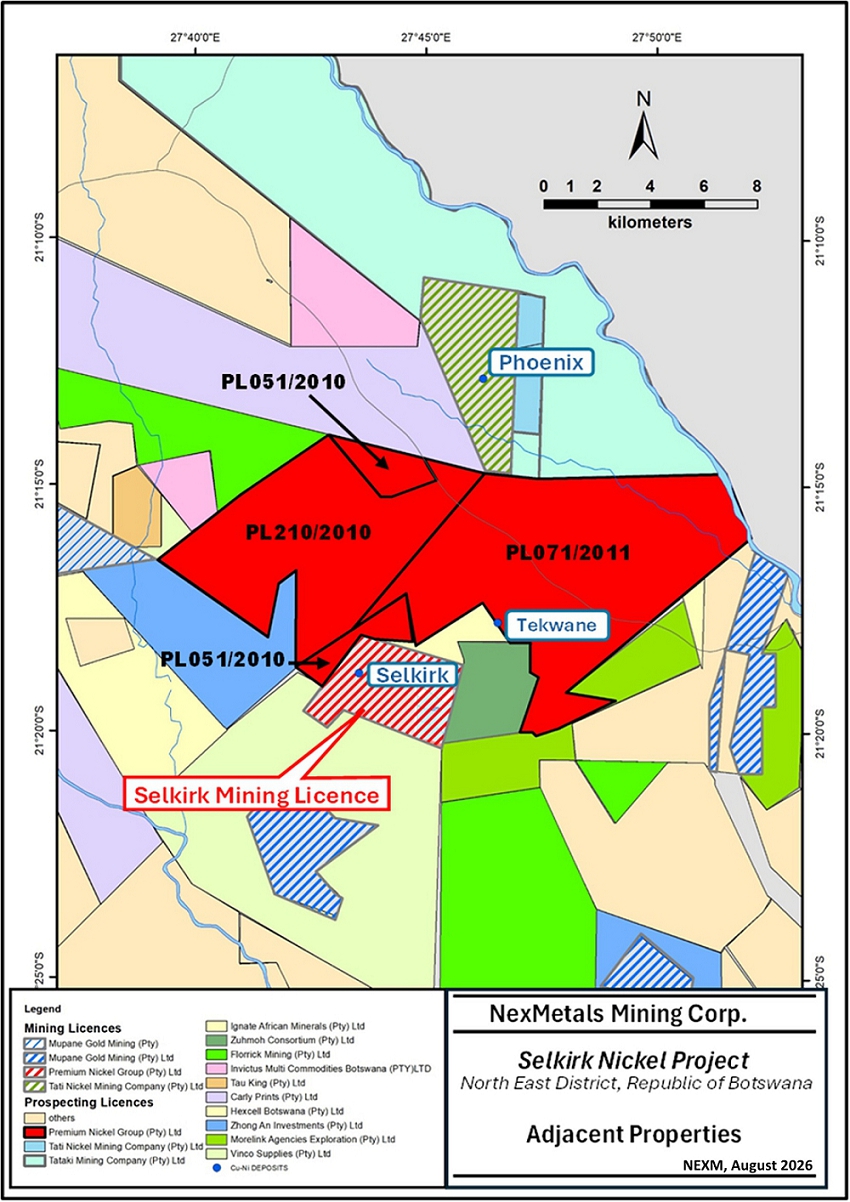
Source: NEXM, 2026. Information sourced from Botswana Mining Cadastre, downloaded February 2026
| J5050 – Selkirk Nickel-Copper-PGE Project S-K 1300 Technical Report Summary 17-08-2026 | Page: 126 |
| 24. | Other Relevant Data and Information |
No additional information or explanation is necessary to make this TRS understandable and not misleading.
The QPs are not aware of other data to disclose.
| J5050 – Selkirk Nickel-Copper-PGE Project S-K 1300 Technical Report Summary 17-08-2026 | Page: 127 |
| 25. | Interpretation and Conclusions |
This section contains forward-looking information related to Mineral Resources and the mineral processing for the Project. The material factors that could cause actual results to differ materially from the conclusions, estimates, designs, forecasts or projections in the forward-looking information include any significant differences from one or more of the material factors or assumptions that were set forth in this sub-section including geological and grade interpretations and controls and assumptions and forecasts associated with establishing the prospects for economic extraction; grade continuity analysis and assumptions; Mineral Resource model tonnes and grade; prevailing economic conditions, commodity markets and prices; environmental, social or government approvals.
The Project is an Exploration Stage Property 100% owned by NEXM. The Project includes the historical Selkirk Mine which was a small underground nickel-copper mine from 1989 to 2002, targeting massive sulphide material. The project is currently conceptualised as an open pit mine capturing the lower grade nickel-copper-cobalt-platinum group elements (Ni-Cu-PGE) mineralisation present within the Selkirk gabbro host.
| 25.1 | Geology and Mineral Resources |
| ● | There is good understanding of the geology and the nature of the mineralisation at the Project. The Selkirk geology has been the subject of several academic studies and numerous techno-economic evaluations over several decades. |
| ● | Selkirk represents a large magmatic sulphide deposit of which a high grade lens of massive sulphide was extracted from underground by TNMC. The remaining disseminated mineralisation represents a high tonnage low-grade deposit is suitable to be mined by open-pit methods. |
| ● | The interpreted oxidised portion of the deposit has been excluded from the Mineral Resource. Further work is required to establish the depth of oxidation and to what level of oxidation that could have economic benefit to the project. |
| ● | The Mineral Resource is underpinned by a combination of historical and recent data. There are deficiencies in the historical assay data, that appear to be in part related to data management. The verification work that has taken place has confirmed the historical assays populations. Assays from the extensive resampling program have replaced the historical assays in the database, and increased the amount of platinum, palladium and gold data, significantly reducing project risk due to reliance on historical assay data. |
| ● | Eleven twin holes and a resource infill hole, drilled and sampled by PNGPL, have further verified the geology and grade of the deposit, providing additional high quality nickel-copper-PGE assays. Furthermore, five holes that were drilled by the previous operator, and were not sampled, have been sampled and assayed by PNGPL. Infill and extension sampling of unsampled intervals of TNMC core has further added to the high confidence data. |
| J5050 – Selkirk Nickel-Copper-PGE Project S-K 1300 Technical Report Summary 17-08-2026 | Page: 128 |
| ● | There are no drilling, sampling or recovery factors identified that could materially impact the accuracy and reliability of the results. |
| ● | The Mineral Resource is adequately drilled for the level of classification applied. The majority of the Mineral Resource is classified as Indicated. |
| 25.2 | Mineral Processing |
| ● | Based on the results from preliminary studies and historical data analyses, the proposed treatment process for Selkirk material considers flotation of two concentrate products (copper and nickel) using a sequential copper and nickel flotation flowsheet. |
| ● | Earlier SGS testwork demonstrated that while flotation test results indicated that copper-nickel separation is achievable, further representative sampling was required to demonstrate that the target grades of copper and nickel in two concentrates can be consistently met. |
| ● | X-ray Transmission (XRT) ore sorting was further evaluated on a bulk sample to assess the amenability of the Selkirk deposit to pre-concentration. Results indicated high recovery losses relative to the level of waste removal , with no clear economic cut-off identified. For the purposes of this report, ore sorting is not considered or applied prior to flotation. |
| ● | The recent Blue Coast Research (BCR) testwork was carried out on fresh core drilled by PNGPL for the purposes of providing metallurgical sample material and verification of the mineralisation in the twinned hole. These holes providing spatial coverage and representation of varying nickel tenor and copper grade. Flowsheet development successfully demonstrated the ability to produce separate saleable copper and nickel concentrates meeting clean specifications. Variability testwork was carried out on three tenor samples, which demonstrated notable variability in nickel recovery and grade across each domain. |
| ● | The metallurgical and analytical data have been collected in a manner that is suitable to be used conceptually for Mineral Resources estimation, however, further testwork to optimize the individual domains, along with further analysis of the deposit based on tenor domains, is recommended for the next stage of metallurgical testwork. |
| J5050 – Selkirk Nickel-Copper-PGE Project S-K 1300 Technical Report Summary 17-08-2026 | Page: 129 |
| 26. | Recommendations |
| 26.1 | Geology and Mineral Resources |
The confidence in the Mineral Resource is sufficient to progress the project to a Preliminary Economic Assessment.
Exploration work is merited on the Exploration licences, comprising soil geochemistry, surface geophysics and diamond drilling.
Further work on the historical data may be considered as the project advances further, largely related to more detailed assessment of the historical database.
| 26.2 | Mineral Processing |
Recommended work comprises work in support of a PEA and planning work in support of more advanced studies:
| ● | In support of the PEA (Phase 1) |
| ○ | Complete remaining variability testwork on the three tenor domain samples to finalise the current metallurgical program. |
| ○ | Re-assess the tenor domains across the deposit using the updated block model, to ensure the master composite accurately reflects the tenor blend. |
| ● | As part of further exploration work to support future, more advanced studies (Phase 2): |
| ○ | Plan the next stage of testwork including a geo-metallurgical study, to fully characterise variability in mineralisation across the deposit and enhance the reliability of recovery estimates in support of the mine plan. |
| ○ | Utilise the updated domains to determine additional drilling requirements, ensuring adequate spatial and mineralogical representation across each domain. |
| 26.3 | Forward Work Program |
The forward work program comprises a PEA (Phase 1) supported by additional metallurgical testwork. In parallel, exploration on the properties will take place (Phase 2). Phase 2 is not contingent on the results of Phase 1. The approximate budget for the forward work program is shown in Table 26-1.
| J5050 – Selkirk Nickel-Copper-PGE Project S-K 1300 Technical Report Summary 17-08-2026 | Page: 130 |
Table
26-1
| ||
| Item | Cost | |
| USD (‘000) | CAD (‘000) | |
Phase 1 PEA a) Remaining Metallurgical Testwork to support the PEA |
35 | 50 |
| b) Preliminary Economic Assessment | 650 | 923 |
Phase 2 Exploration Work (not contingent on the outcome of Phase 1) Soil geochemistry Surface geophysics Diamond drilling Geometallurgy |
106 | 150 |
| General site and administration costs | 70 | 100 |
| Subtotal | 861 | 1,223 |
| Contingency (5%) | 35 | 50 |
| Total Phase 1 and 2 | 896 | 1,273 |
Note: Exchange rate as of 22 June 2026 = CAD 1.42 to USD1.00
The QPs support progressing to a PEA and further exploration work and consider that the approximate costs outlined in the proposed budget (Table 26-1) are justified for the current stage of the project.
| J5050 – Selkirk Nickel-Copper-PGE Project S-K 1300 Technical Report Summary 17-08-2026 | Page: 131 |
| 27. | References |
Aird, 2025. Selebi & Selkirk Projects Marketing Study. A Report for NexMetals Mining Corp. June 2026. 27 p.
Arndt N., Lesher, C.M., Czamanske, G.K. 2005. Mantle-derived magmas and magmatic Ni-Cu- (PGE) deposits. Economic Geology, 100th Anniversary Volume. pp. 5-24.
Barnes, S.-J., and Maier, W.D. 1999. The fractionation of Ni, Cu and the noble metals in silicate and sulfide liquids. In Dynamic Processes in Magmatic Ore Deposits and their application in mineral exploration. Edited par Keays, R.R., Lesher, C.M. Lightfoot, P.C. et Farrow, C.E.G. Geological Association of Canada, Short Course Volume 13, pp. 69-106.
Barnes, S.-J., and Lightfoot, P.C. 2005. Formation of magmatic nickel sulfide ore deposits and processes affecting their copper and platinum group element contents. Economic Geology 100th Anniversary Volume. Denver, pp. 179–213
Baldock, J.W., Hepworth, J.V., Marengwa, B.S. 1976. Gold, base metals, and diamonds in Botswana. Econ Geol 71:139–156
Botepe. K.G. 2013. Competent persons report for the Selkirk deposit. Report for Norilsk Nickel. 102 p.
Carney, J.N., Aldiss, D.T., Lock, N.P. 1994. The geology of Botswana. Geological Survey of the Botswana Bulletin 37, 113 p.
Canadian Institute of Mining, Metallurgy and Petroleum (CIM). 2005. CIM Definition Standards for Mineral Resources and Mineral Reserves adopted by CIM Council on December 11, 2005.
CIM. 2014. CIM Definition Standards for Mineral Resources and Mineral Reserves, adopted by the CIM Council on May 10, 2014 (CIM (2014) definitions).
CIM. 2019. CIM Estimation of Mineral Resources & Mineral Reserves Best Practice Guidelines, prepared by the CIM Mineral Resource & Mineral Reserve Committee and adopted by CIM Council on November 29, 2019.
Department of Environmental Affairs (DEA). 2016. Approval of the Final Environmental Management Plan for the Proposed Selkirk Mine Open Pit Bankable Feasibility Study for Tati Nickel Mining Company. REF: DEA/BOD/F/EXT/MNE 030 (13).
Dirks P.H.G.M. 2005. An updated structural framework for Ni-Sulphide mineralization at Phoenix Mine, Tati Greenstone Belt, NW Botswana. Tati Nickel: structural framework for Phoenix mine II – 5 April 2005. 66 p.
DRA Projects (PTY) Ltd. 2023. Selkirk Front End Solutions Study for Premium Nickel Resources Botswana, Selkirk, Botswana, DRA Project Number HBWAYR8003, DRA-HBWAYR8003-GEN-REP-001, Revision 1, December 18, 2023.
Flowsheets Metallurgical Consulting Inc. (FMCI). 2024. Updated Estimate of the Selkirk Project Copper and Nickel Concentrates, memo from FMCI to Mr. S. Whiteford, October 1, 2024.
| J5050 – Selkirk Nickel-Copper-PGE Project S-K 1300 Technical Report Summary 17-08-2026 | Page: 132 |
G Mining Services Inc. (G Mining). 2023. NI 43-101 Technical Report, Selkirk Nickel Project, North East District, Republic of Botswana, prepared for Premium Nickel Resources Ltd. (April 12, 2023).
Geldenhuys, A. 2008. 2008 Mineral Resource Update for Selkirk Nickel Project, Botswana. Anglo American Mineral Resource Evaluation Department (MinRED). Internal Report prepared for TNMC, 61 p.
Gordon PSL. 1973. The Selebi-Phikwe nickel–copper deposits, Botswana. In: Lister LA (ed) Symposium on granites, gneisses and related rocks. Special Publication, Geological Society of South Africa 3:167–187
Hall, V.W. 1971. Production of Nickel and Copper from Phoenix and Selkirk, Tati Concession. Anglo American Corporation of South Africa Ltd. 95 p.
Han, Z., Prikhodko, A., and Eadie T. 2012. Interpretation Report on a Helicopter-Borne Versatile Time Domain Electromagnetic (VTEM) and Aeromagnetic Geophysical Survey. Geotech Ltd. 146 p.
Johnson, R.S. 1986. The Phoenix and Selkirk nickel–copper sulphide ore deposits, Tati Greenstone Belt, eastern Botswana. In: Anhaeusser CR, Maske S (eds) Mineral deposits of Southern Africa. Geological Society of South Africa, pp. 243–248
Joint Ore Reserve Committee (JORC). 2012. Australasian Code for Reporting of Exploration Results, Mineral Resources and Ore Reserves (The JORC Code), effective 20 December 2012.
Key, R.M. 1976. The geology of the area around Francistown and Phikwe, northeast and central districts, Botswana. Distr Mem Geol Surv Botswana 3:15–25
Lesher, C.M., Burnham, O.M., Keays, R.R., Barnes, S.J., and Hulbert, L. 2001. Geochemical discrimination of barren and mineralized komatiites associated with magmatic Ni-Cu-(PGE) sulphide deposits. Canadian Mineralogist, v. 39, pp. 673-696
Li, C., Maier, W.D., de Waal, S.A. 2002. The role of magma mixing in the genesis of PGE mineralization in the Bushveld Complex: thermodynamic calculations and new interpretations—a reply. Economic Geology 97 (3).
LionOre Africa. 2006. Geological Modelling and Resource Estimation of the Phoenix Nickel Deposit. Report under SRK project number LOA009. 114 p.
Liu, J., Imeson, D. 2021. An Investigation into The Recovery of Copper and Nickel from Composite Samples from The Selkirk Deposit. A report prepared for North American Nickel by SGS Canada. Project 18559-01.
Lu Y., Lesher C.M., Deng J. 2019. Geochemistry and genesis of magmatic Ni-Cu-(PGE) and PGE-(Cu)-(Ni) deposits in China. Ore Geology Reviews, Volume 107, pp. 863-887.
MacMillan, N.M. 1985. Preliminary Feasibility Study on the Selkirk and Phoenix Deposits Botswana. Rio Tinto Zimbabwe,115 p.
Maier W. D., Barnes S.-J., Chinyepi G., Barton Jr J. M., Eglington B., Setshedi I. 2007. The composition of magmatic Ni–Cu–(PGE) sulfide deposits in the Tati and Selebi-Phikwe belts of eastern Botswana. Miner Deposita.
| J5050 – Selkirk Nickel-Copper-PGE Project S-K 1300 Technical Report Summary 17-08-2026 | Page: 133 |
Malan, S. 1968. Summary of Borehole Logs from Selkirk, Tati Concession, with available assay results. Memo sent to Geological Survey Department. 5 p.
Marsh, S.C.K. 1979. A Review of the Prospecting History, the Reserve and Grade Calculation and Potential for Further Ore in the Selkirk and Phoenix Orebodies. Anglo American Corporation of South Africa Limited, New Mining Division, 22 p.
McCourt, S., Kampunzu, A.B., Bagai, Z., Armstrong, R.A. 2004. The crustal architecture of Archean terranes in Northeastern Botswana. S Afr J Geol 107:147–158
Mogotsi, K. 2008. Exploration Annual Report. Tati Nickel Mining Company Pty Ltd. on behalf of Norilsk Nickel Group of Companies, Report MING-XREP-A08.1, 15 p.
Morex Botswana (Pty) Ltd. 1987. Prospecting Licences 26/84 – Quarterly Report for the periods 01/10/87 to 21/12/87. 1p.
Naldrett A.J. 2004. Magmatic sulfide deposits. Springer, Berlin Heidelberg New York, p 727
Parry, D. and Buchanan, K. 2021. Tsholofelo Project Environmental & Social Due Diligence Report prepared for PNRB July 19, 2021, resubmitted October 20, 2021. 69p
SAMREC. 2016. South African Code for the Reporting of Exploration Results, Mineral Resources and Mineral Reserves (SAMREC Code).
Sangwenu Engineering & Environmental Consultants (Pty) Ltd. 2016. Environmental Management Plan (EMP) for Selkirk Open Pit Mine Bankable Feasibility Study for Tati Nickel Mining Company (Pty) Ltd, North East District, Botswana.
SGS. 2024. An Investigation into the Metallurgical Testwork on Samples from the Selebi and Selkirk Deposits, prepared for Premium Nickel Resources (January 3, 2024).
Simpson, A. 1986. Quarterly Report Prospecting Licences No. 26/84 and 25/84. Period 1/10/85-31/12/85. Submitted by Morex Botswana (Pty) Limited. 4 p.
SLR Consulting (Canada) Ltd. (SLR). 2024. Technical report Summary on the Selkirk Nickel Project, North East District, Republic of Botswana, prepared for Premium Nickel Resources Ltd. (June 27, 2024).
Stark Resources GmbH. 2024. Selkirk Intrinsic Ore Sorting Test Report, Project D241547 – Selkirk, May 28, 2024.
Tati Nickel Mining Company Pty Ltd (TNMC). 2008. Selkirk Geochemical Soil Sampling. Norilsk Nickel Group of Companies, Report MING-XREP-T08.1, 84 p.
TNMC. 2012. Exploration October 2012 Monthly Report. Norilsk Nickel Group of Companies, Report MING-XREP-M010.0, 4 p.
| J5050 – Selkirk Nickel-Copper-PGE Project S-K 1300 Technical Report Summary 17-08-2026 | Page: 134 |
Thari, K.T. 2015. Prospecting License Work Done and Relinquishment Report. Tati Nickel Mining Company Pty Ltd. on behalf of Norilsk Nickel Group of Companies, Reports MING-XREP-T16.1, MING-XREP-T16.3, MING-XREP-T16.4., 38 p.
TMP Consulting (Pty) Ltd. 2007. A Technical Report Comprised of a Pre-feasibility Study (PFS) and Techno Financial Economic Analysis of the requirements for the Establishment of a Nickel Mining and Processing Facility at the ‘Selkirk Project” situated on the Farms 73 MQ and 75 NQ in the North East Botswana District, with Mineral Properties and Prospects held by LionOre, prepared by TMP Consulting (Pty) Ltd. for LionOre Mining International Limited and Tati Nickel Mining Company Limited (TNMC) in accordance with NI 43-101 guidelines, 101 p.
TWP Consulting (Pty) Ltd (TWP). 2006. A Preliminary Assessment and Techno-Economic Analysis of the requirements for the Establishment of a Nickel Mining and Processing Facility at “The Selkirk Project” situated on the Farms 73 MQ and 75 NQ in NE Botswana, Mineral Properties and Prospects held by LionOre, 138 p.
TWP Consulting & Norilsk. 2007. Selkirk Project – Bankable Feasibility Study. Internal Report, 1095pp
TWP. 2013. Selkirk Definitive Feasibility Study. Project Close-Out Report as at 1 February 2013. Report 120236-2031-100-400-0007 prepared for Norilsk Nickel, 11 p.
Van Geffen PWG. 2004. Geochemistry of the Phoenix Ni–Cu–PGE deposit, Francistown, Botswana. MSc thesis, Utrecht University, 88 p.
Vokes. 1969. A review of the metamorphism of sulphide deposits. Earth Sci Rev 5:99–143.
WorleyParsons. 2016. Selkirk Bankable Feasibility Study, Project No: C00449, September 2016 overview. Report for BCL Limited. 87 p.
| J5050 – Selkirk Nickel-Copper-PGE Project S-K 1300 Technical Report Summary 17-08-2026 | Page: 135 |
| 28. | Date and Signature Page |
This report titled “S-K 1300 Technical Report Summary Selkirk Nickel-Copper-PGE Project, Botswana” for NexMetals Mining Corp. with an effective date of 22 June 2026 was prepared and signed by the following authors:
| The MSA Group (Pty) Ltd. | ||
| Per: | ||
| /s/Jeremy Witley | ||
| Jeremy Witley | ||
| Head of Mineral Resources | ||
| Dated at Johannesburg, South Africa | ||
| 17 August 2026 | ||
| Fuse Advisors | ||
| Per: | ||
| /s/ Ross Weymark | ||
| Ross Weymark | ||
| Vice President of Operations | ||
| Dated at Vancouver, BC | ||
| 17 August 2026 |