Before the Distribution:
After the Distribution:
4
Exhibit 99.1
MADISON SQUARE GARDEN SPORTS CORP.
TWO PENNSYLVANIA PLAZA
NEW YORK, NY 10121
[●], 2026
Dear Stockholder:
I am pleased to report that the previously announced spin-off by Madison Square Garden Sports Corp., which we refer to as “MSG Sports,” of all of the common stock of its MSGS Spinco, Inc. subsidiary is expected to become effective on [●], 2026. MSGS Spinco, Inc., a Nevada corporation, which we refer to as “Spinco,” will become a public company on that date and will own the New York Rangers business, currently owned and operated by MSG Sports, as described in this information statement. On or prior to the Distribution, Madison Square Garden Sports Corp. will change its name to “MSG Knickerbockers Corp.” and Spinco will change its name to “MSG Rangers Corp.” Spinco’s Class A Common Stock will be listed on the New York Stock Exchange, which we refer to as “NYSE”, under the symbol “MSGR” and Madison Square Garden Sports Corp. (renamed “MSG Knickerbockers Corp.”) will change its symbol on the NYSE to “MSGK” in connection with the spin-off.
Holders of record of MSG Sports Class A Common Stock as of the close of business, New York City time, on [●], 2026, which will be the record date, will receive one share of Spinco Class A Common Stock for every two shares of MSG Sports Class A Common Stock held. Holders of record of MSG Sports Class B Common Stock as of the close of business on the record date will receive one share of Spinco Class B Common Stock for every two shares of MSG Sports Class B Common Stock held. No action is required on your part to receive your Spinco shares. You will not be required either to pay anything for the new shares or to surrender any shares of MSG Sports stock.
No fractional shares of Spinco stock will be issued. If you otherwise would be entitled to a fractional share, you will receive a check for the cash value thereof, which generally will be taxable to you. In due course you will be provided with information to enable you to compute your tax bases in both MSG Sports and Spinco stock. MSG Sports expects to obtain an opinion from Sullivan & Cromwell LLP substantially to the effect that, among other things, the distribution by MSG Sports of Spinco Class A Common Stock and Spinco Class B Common Stock to the holders of MSG Sports Class A Common Stock and MSG Sports Class B Common Stock, respectively (i.e., the distribution), will qualify as a tax-free distribution for U.S. federal income tax purposes.
The enclosed information statement describes the distribution of shares of Spinco stock and contains important information about Spinco, including financial statements. I suggest that you read it carefully. If you have any questions regarding the Distribution, please contact MSG Sports’ transfer and distribution agent, EQ Shareowner Services, at 1-800-468-9716 (U.S. toll free) or 651-450-4064 (International).
Sincerely,
James L. Dolan
Executive Chairman and Chief Executive Officer
Information contained herein is subject to completion or amendment. A Registration Statement on Form 10 relating to these securities has been filed with the U.S. Securities and Exchange Commission.
PRELIMINARY INFORMATION STATEMENT
SUBJECT TO COMPLETION, DATED AUGUST 14, 2026
INFORMATION STATEMENT
MSGS Spinco, Inc.
Distribution of
Class A Common Stock
Par Value, $0.01 Per Share
Class B Common Stock
Par Value, $0.01 Per Share
This information statement is being furnished in connection with the distribution by Madison Square Garden Sports Corp. (“MSG Sports”) to holders of its common stock of all of the outstanding shares of MSGS Spinco, Inc. (collectively, “we,” “us,” “our,” “Spinco,” or the “Company”) common stock. Prior to such distribution, we will enter into a series of transactions with MSG Sports pursuant to which we will own the New York Rangers (the “Rangers”) business, that was owned and operated by MSG Sports, as described in this information statement.
Shares of our Class A Common Stock will be distributed to holders of MSG Sports Class A Common Stock of record as of the close of business, New York City time, on [●], 2026, which will be the record date. Each such holder will receive one share of our Class A Common Stock for every two shares of MSG Sports Class A Common Stock held on the record date. Shares of our Class B Common Stock will be distributed to holders of MSG Sports Class B Common Stock as of the close of business on the record date. Each holder of MSG Sports Class B Common Stock will receive one share of our Class B Common Stock for every two shares of MSG Sports Class B Common Stock held on the record date. We refer to this distribution of securities as the “Distribution.” The Distribution will be effective at 11:59 p.m., New York City time, on [●], 2026 (the “Distribution Date”). For MSG Sports stockholders who own common stock in registered form, in most cases the transfer and distribution agent will credit their shares of Spinco common stock to book entry accounts established to hold their MSG Sports common stock. Our transfer and distribution agent will send these stockholders a statement reflecting their Spinco common stock ownership shortly after [●], 2026. For stockholders who own MSG Sports common stock through a broker or other nominee, their shares of Spinco common stock will be credited to their accounts by the broker or other nominee. Stockholders will receive a cash payment in lieu of fractional shares, which generally will be taxable. See “The Distribution — Material U.S. Federal Income Tax Consequences of the Distribution.”
The Company will have two classes of common stock. Our Class A Common Stock will be entitled to one vote per share and to collectively elect at least 25% of our Board of Directors, and our Class B Common Stock will be entitled to ten votes per share and to collectively elect up to the remaining 75% of our Board of Directors. See “Description of Capital Stock” for more information. As of the Distribution Date, certain members of the Dolan family, including certain trusts for the benefit of members of the Dolan family, will collectively own all of our Class B Common Stock, approximately [●]% of our outstanding Class A Common Stock and approximately [●]% of the total voting power of all our outstanding common stock (in each case, inclusive of exercisable options). As a result, the Company will be a “controlled company” within the meaning of the corporate governance standards of the New York Stock Exchange (“NYSE”) and the Dolan Family Group will, by virtue of their stock ownership, have the ability to determine all matters requiring approval by stockholders (other than the election of the Class A Directors and any matters requiring a separate vote by the holders of the Class A common stock) and will be able collectively to control stockholder decisions on matters on which holders of our Class A Common Stock and Class B Common Stock vote together as a single class.
No stockholder approval of the Distribution is required or sought. We are not asking you for a proxy and you are requested not to send us a proxy. MSG Sports stockholders will not be required to pay for the shares of our common stock to be received by them in the Distribution, or to surrender or to exchange shares of MSG Sports common stock in order to receive our common stock, or to take any other action in connection with the Distribution. There is currently no trading market for our common stock.
On or prior to the Distribution, Madison Square Garden Sports Corp. will change its name to “MSG Knickerbockers Corp.” and MSGS Spinco, Inc. will change its name to “MSG Rangers Corp.” We will apply to list our Class A Common Stock on the NYSE. Our Class A Common Stock will trade under the symbol “MSGR” and Madison Square Garden Sports Corp. (renamed “MSG Knickerbockers Corp.”) will change its symbol on the NYSE to “MSGK” in connection with the Distribution. We will not list our Class B Common Stock on any securities exchange.
IN REVIEWING THIS INFORMATION STATEMENT, YOU SHOULD CAREFULLY CONSIDER THE MATTERS DESCRIBED UNDER THE CAPTION “RISK FACTORS” BEGINNING ON PAGE 21.
WE ARE AN EMERGING GROWTH COMPANY AS DEFINED IN THE JUMPSTART OUR BUSINESS STARTUPS ACT OF 2012. REFER TO “RISK FACTORS — RISKS RELATED TO THE SPIN-OFF TRANSACTION — THE REDUCED DISCLOSURE REQUIREMENTS APPLICABLE TO US AS AN ‘EMERGING GROWTH COMPANY’ MAY MAKE OUR CLASS A COMMON STOCK LESS ATTRACTIVE TO INVESTORS” AND “BUSINESS — EMERGING GROWTH COMPANY STATUS.”
NEITHER THE SECURITIES AND EXCHANGE COMMISSION NOR ANY STATE SECURITIES COMMISSION HAS APPROVED OR DISAPPROVED THESE SECURITIES OR DETERMINED IF THIS INFORMATION STATEMENT IS TRUTHFUL OR COMPLETE. ANY REPRESENTATION TO THE CONTRARY IS A CRIMINAL OFFENSE.
THIS INFORMATION STATEMENT DOES NOT CONSTITUTE AN OFFER TO SELL OR THE SOLICITATION OF AN OFFER TO BUY ANY SECURITIES.
Stockholders of MSG Sports with inquiries related to the Distribution should contact MSG Sports’ transfer and distribution agent, EQ Shareowner Services, at 1-800-468-9716 (U.S. toll free) or 651-450-4064 (International).
The date of this information statement is [●], 2026.
| Page | ||||
| 1 | ||||
| Summary Historical and Unaudited Pro Forma Combined Financial Data |
13 | |||
| 15 | ||||
| 21 | ||||
| 42 | ||||
| 49 | ||||
| 57 | ||||
| 58 | ||||
| Management’s Discussion and Analysis of Financial Condition and Results of Operations |
65 | |||
| 89 | ||||
| 101 | ||||
| 140 | ||||
| Security Ownership of Certain Beneficial Owners and Management and Related Stockholder Matters |
149 | |||
| 161 | ||||
| 163 | ||||
| 169 | ||||
| 170 | ||||
| F-1 | ||||
i
The following is a summary of certain of the information contained in this information statement. This summary is included for convenience only and should not be considered complete. This summary is qualified in its entirety by more detailed information contained elsewhere in this information statement, which should be read in its entirety.
Unless the context otherwise requires, all references to “we,” “us,” “our,” “Spinco” or the “Company” refer to MSGS Spinco, Inc., together with its direct and indirect subsidiaries giving effect to the Distribution. Where we describe in this information statement our business activities, we do so as if the transfer of the New York Rangers business, as shown below under “— Organizational Structure”, to Spinco has already occurred.
On or prior to the Distribution, Madison Square Garden Sports Corp. will change its name to “MSG Knickerbockers Corp.” and MSGS Spinco, Inc. will change its name to “MSG Rangers Corp.”
The Company reports on a fiscal year basis ending on June 30.
Our Company
The Company owns and operates one of the most storied franchises in all of professional sports, the New York Rangers (the “Rangers”) of the National Hockey League (“NHL”). The Rangers play their home games in the Madison Square Garden Arena (“The Garden”), also known as The World’s Most Famous Arena. The Company also includes a development league team, the Hartford Wolf Pack of the American Hockey League (“AHL”). In addition, the Company operates a professional sports team performance center — the Madison Square Garden Training Center in Greenburgh, NY.
Our Strengths
| • | Iconic sports franchise with a renowned global brand; |
| • | Enduring and meaningful presence in the New York metropolitan area, the nation’s largest media market; |
| • | Deep connections with a large and passionate fan base that spans a wide demographic mix; |
| • | Multi-year sponsorship and suite agreements through a strategic partnership with Madison Square Garden Entertainment Corp. (“MSG Entertainment”); |
| • | National media rights agreements through the NHL; |
| • | Local telecast rights agreement with MSG Networks Inc. (“MSG Networks”); |
| • | Long-term Arena License Agreement with MSG Entertainment under which the Rangers play their home games at The Garden; |
| • | World-class expertise in team operations, event presentation, ticketing, and premium hospitality; and |
| • | Seasoned management team and committed ownership. |
Our Strategy
Our strategy is to leverage the strength and popularity of our professional sports franchise — the New York Rangers — and our unique position in the nation’s largest media market to grow our business and increase the long-term value of our assets. Key components of our strategy include:
| • | Developing a championship-caliber team. Our core goal is to develop and maintain a team that consistently competes for championships. A competitive team helps support and drive revenue streams |
1
| across the Company during the regular season and, when our team qualifies for the postseason, the Company benefits from incremental home playoff games, which provide us with a significant source of additional revenue. The ownership and operation of an NHL development team–the Hartford Wolf Pack– as well as the operation of our professional sports teams performance center, are part of our strategy to develop a championship-caliber team. |
| • | Employ a ticketing policy that gives the Company a direct relationship with our fan base. Our large and loyal fan base has placed us among the league leaders in ticket sales as the Rangers consistently play to at or near capacity crowds at The Garden. Tickets to Rangers’ home games are sold through membership plans (full season and partial plans), group sales and single-game tickets, which are purchased on an individual basis (as opposed to third-party sales). We generally review and set the price of our tickets before the start of each season; however, we dynamically price our single-game tickets throughout the season to align with fan demand. |
| • | Maximize the value of our exclusive live sports content. The Company receives a pro-rata share of fees related to the NHL’s U.S. and Canadian national media rights agreements, which provide a significant recurring revenue stream for the Company. The NHL’s U.S. national media rights agreements with The Walt Disney Company and WarnerMedia, LLC will expire following the 2027-28 season. The NHL’s Canadian media rights agreement with Rogers Communications expires following the 2037-38 season. In addition, the Company receives fees related to local media rights. The Rangers’ local telecast rights agreement with MSG Networks, which expires at the end of the 2028-29 season, provides MSG Networks with exclusive local linear and digital rights to home and away games of the Rangers, as well as other team-related programming. MSG Networks makes this content available to our fans on its regional sports networks, MSG Network and MSG Sportsnet, and through its direct to consumer and authenticated streaming offering, MSG+ (which is included in the Gotham Sports streaming product and is anticipated to be available through the DAZN streaming product during the 2026-2027 NHL season). |
| • | Utilize our unique assets and an integrated approach to drive sponsorship and suite sales. The Company possesses powerful and attractive assets that also benefit from being part of a broader sports, entertainment and media offering as a result of the Company’s various agreements with MSG Entertainment. These agreements enable us to partner with MSG Entertainment, MSG Sports and Sphere Entertainment Co. (“Sphere Entertainment”) on an integrated approach to marketing partnerships and corporate hospitality solutions to drive sponsorship, signage and suite sales. For example: |
| • | Our assets are highly sought after by companies that value the popularity of the Rangers franchise, the demographic makeup of our fans, and our unique position in the New York market. The attractiveness of our assets is further strengthened by the Sponsorship Sales and Service Representation Agreement and the Arena License Agreement with MSG Entertainment, which create compelling, broad-based marketing platforms by combining the Rangers brand and MSG Sports’ New York Knickerbockers (“Knicks”) Brand, MSG Entertainment’s live entertainment assets and Sphere Entertainment’s media assets. |
| • | Our Arena License Agreement with MSG Entertainment enables MSG Entertainment to offer corporate hospitality solutions that bring together our live sporting events with Knicks games and MSG Entertainment’s live sporting and entertainment offerings and provide for the sharing of revenues from such offerings. For example, The Garden offers a variety of suite and club products, including 23 Event Level spaces consisting of 22 suites and an event level club, 58 Lexus Level suites, 18 Infosys Level suites, the Madison Club and the HUB Loft. These suites and clubs — which provide exclusive private spaces, first-class amenities and some of the best seats in The Garden — are primarily licensed to corporate customers, with the majority being multi-year agreements, most of which have annual escalators. We believe the unique combination of our live |
2
| sporting events, Knicks games and MSG Entertainment’s live sporting and entertainment offerings, along with the continued importance of corporate hospitality to our guests, positions us well to continue to grow this area of the business. |
| • | Continue to invest in the fan experience. The strong loyalty of our fans has been driven in part by our commitment to the fan experience, which we will continue to build on through our relationship with MSG Entertainment, owner and operator of The Garden. Working with MSG Entertainment, we offer first-class operations, innovative event presentation, premium food and beverage offerings, and unique and exclusive merchandise, as well as a Rangers mobile app designed to create a seamless experience for our fans. Our goal is to deliver the best in-game experience in the industry — whether our guests are first-time visitors, repeat customers, season ticket holders, suite holders or club members. |
Key Challenges
Following the Distribution, we may face a number of challenges, both pre-existing and as a result of the Distribution, including:
| • | Dependence upon the continued popularity and competitiveness of the Rangers, which is sensitive to the performance of the team, including the team’s ability to advance in the playoffs, which provides us with a significant source of additional revenue; |
| • | Intense competition in the market and industry in which we operate, including with other sporting events and other live performances; |
| • | Lack of an operating history as a stand-alone public company; |
| • | Strength or weakness of, as well as volatility and less predictability in, our operating results and cash flow because the Company’s results will no longer include cash flows from the Knicks; and |
| • | Volatility in the market price and trading volume of our common stock. The market price for our common stock could fluctuate significantly for many reasons following the Distribution, including the lack of an existing public market for our stock, the information set forth under “Risk Factors” and other reasons unrelated to our performance. |
See the section entitled “Risk Factors” for more information on each of these key challenges.
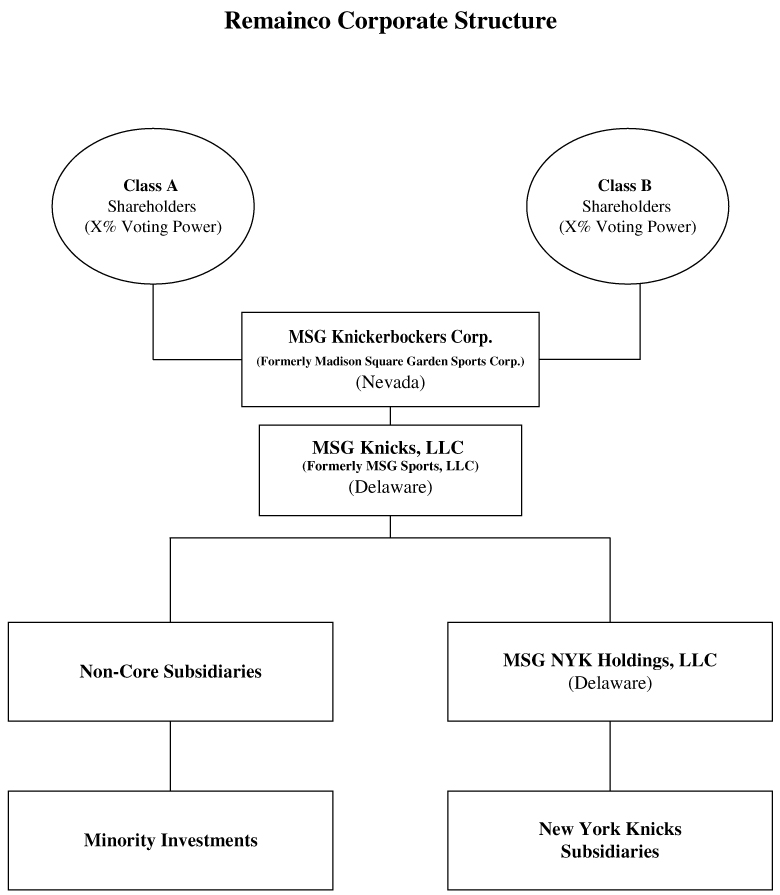
Organizational Structure
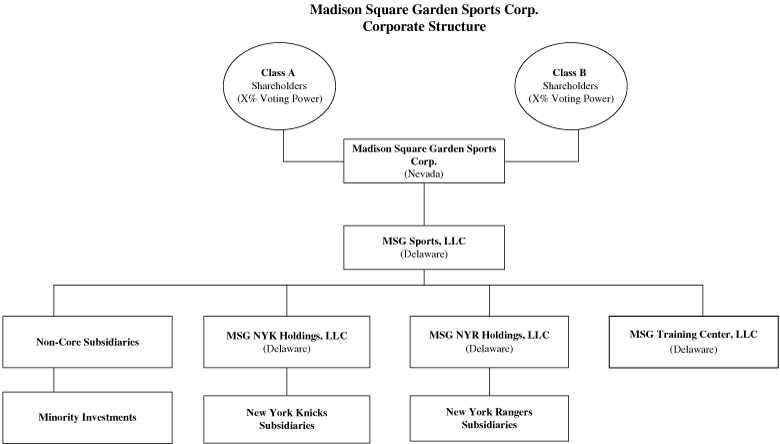
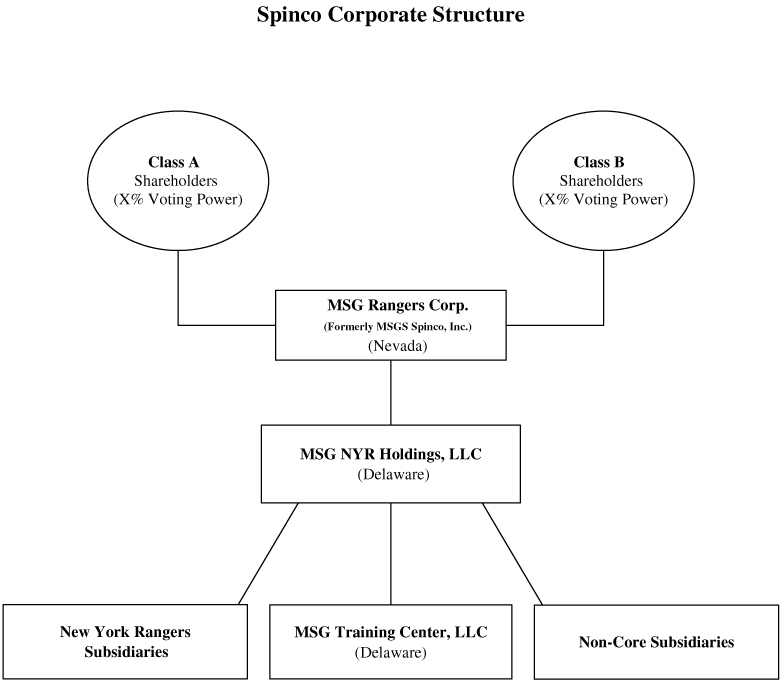
The following charts depict a simplified graphical representation of the Company’s corporate structure before and after the Distribution. The shares issued in the Distribution will represent all of our common stock. MSG Sports will not own any of our Class A Common Stock or Class B Common Stock following the Distribution. The shares issued in the Distribution will include 100% of the outstanding shares of Class A Common Stock (the holders of which will have the right to collectively elect at least 25% of our Board of Directors, rounded up to the nearest whole number of directors) and 100% of the outstanding shares of Class B Common Stock (the holders of which will have the right to collectively elect up to the remaining 75% of our Board of Directors). As a result, the shares issued in the Distribution will represent 100% of the combined voting power of the outstanding common stock with respect to the election of directors. Certain members of the Dolan family, including certain trusts for the benefit of members of the Dolan family (collectively, the “Dolan Family Group”) will collectively own all of our Class B Common Stock, approximately [●]% of our outstanding Class A Common Stock and approximately [●]% of the total voting power of all our outstanding common stock (in each case, inclusive of exercisable options).
3
Before the Distribution:
After the Distribution:
4
Company Information
We are a Nevada corporation with our principal executive offices at Two Pennsylvania Plaza, New York, NY 10121. Our telephone number is +1 (212) 465-6500, our website is [●]. Spinco is a holding company and conducts substantially all of its operations through its subsidiaries.
Spinco was incorporated on April 28, 2026 and is a direct, wholly-owned subsidiary of MSG Sports. MSG Sports’ board of directors approved the Distribution on [●], 2026. Prior to the Distribution, the Company will acquire the subsidiaries of MSG Sports that own, directly and indirectly, the subsidiaries, businesses and other assets described in this information statement. Where we describe in this information statement our business activities, we do so as if these transfers have already occurred.
On or prior to the Distribution, Madison Square Garden Sports Corp. will change its name to “MSG Knickerbockers Corp.” and MSGS Spinco, Inc. will change its name to “MSG Rangers Corp.” We will apply to list our Class A Common Stock on the NYSE under the symbol “MSGR” and Madison Square Garden Sports Corp. (renamed “MSG Knickerbockers Corp.”) will change its symbol on the NYSE to “MSGK” in connection with the Distribution. We will not list our Class B Common Stock on any securities exchange.
5
SUMMARY OF RISK FACTORS
Ownership of our common stock is subject to numerous risks, including the Distribution, that could adversely affect our business, operations and financial results. The following list of risk factors is not exhaustive. Please read the information in the section entitled “Risk Factors” for a more thorough description of these and other risks.
Risks Related to Our Business
| • | We have in the past incurred and are likely in the future to incur operating losses, adjusted operating losses and negative cash flow. |
| • | Our business is substantially dependent on the continued popularity and/or competitive success of the Rangers, including the significant additional revenue generated by the Rangers advancing in the playoffs, which cannot be assured. |
| • | Our business faces intense and wide-ranging competition that may have a material negative effect on our business and results of operations. |
| • | Our hockey decisions, especially those concerning player and coach selection and salaries, may have a material negative effect on our business and results of operations. |
| • | The actions of the NHL may have a material negative effect on our business and results of operations. |
| • | Injuries to, and illness of, players on the Rangers could hinder our success. |
Economic and Business Relationship Risks
| • | Local media rights are a significant revenue stream for our business. Decreases in local media rights revenue have had an adverse effect on our business and results of operations, and the effect of future reductions, including from a bankruptcy of MSG Networks, could be material. |
| • | Our business has been adversely impacted and may, in the future, be materially adversely impacted by an economic downturn, recession, financial instability or inflation. |
| • | We have in the past incurred and we could in the future incur substantial indebtedness, and the occurrence of an event of default under our credit facility or our inability to repay such indebtedness when due could substantially impair our assets and have a negative effect on our business. |
| • | We may require additional financing to fund our ongoing operations, the availability of which is highly uncertain. |
| • | We do not own The Garden and our failure to renew the Arena License Agreement or MSG Entertainment’s failure to operate The Garden in compliance with the Arena License Agreement or extensive governmental regulations may have a material negative effect on our business and results of operations. |
| • | A change to or withdrawal of a New York City real estate tax exemption may have a material negative effect on our business and results of operations. |
| • | Labor matters may have a material negative effect on our business and results of operations. |
| • | We rely on affiliated entities’ performance, including performance of financial obligations, under various agreements. |
| • | Our business is subject to seasonal fluctuations and our operating results and cash flows can vary substantially from period to period. |
6
| • | We may pursue acquisitions and other strategic transactions to complement or expand our business that may not be successful. |
Operational Risks
| • | Our operations and operating results have been, and may in the future be, materially impacted by a pandemic or other public health emergency. |
| • | Our business could be adversely affected by terrorist activity or the threat of terrorist activity and other developments that discourage congregation at prominent places of public assembly. |
| • | We are subject to governmental regulation, including tax laws and regulations, which can change, and any failure to comply with these regulations may have a material negative effect on our business and results of operations. |
| • | We are subject to data privacy, data protection and data security regulations and laws and could face substantial penalties if we fail to comply with such regulations and laws. |
| • | We face continually evolving cybersecurity and other technology-related risks, which could result in loss, disclosure, theft, destruction or misappropriation of, or access to, our confidential information and cause disruption to our business, damage to our brands and reputation, legal exposure and financial losses. |
| • | The interruption or unavailability of third party facilities, systems and/or software upon which we rely, may have a material negative effect on our business, financial condition and results of operations. |
| • | We rely upon cloud computing services to operate certain aspects of our business and any disruption of or interference with our use of these services would impact our operations and our business could be adversely impacted. |
| • | We have in the past and may in the future become subject to infringement or other claims relating to our content or technology. |
| • | Weather or other conditions may impact our games, which may have a material negative effect on our business and results of operations |
| • | There is a risk of personal injuries and accidents at The Garden, which could subject us to personal injury or other claims; we are subject to the risk of adverse outcomes or negative publicity in other types of litigation. |
Risks Related to the Spin-off Transaction
| • | Because there has not been any public market for our common stock, the market price and trading volume of our common stock may be volatile and you may not be able to resell your shares at or above the initial market price of our stock following the Distribution. In addition, future stock sales, including as a result of the exercise of registration rights by certain of our stockholders, could adversely affect the trading price of our Class A Common Stock. |
| • | The combined post-Distribution value of MSG Sports and Spinco shares may not equal or exceed the pre-Distribution value of MSG Sports shares, and we may incur material costs and expenses as a result of our separation from MSG Sports. |
| • | The Distribution is subject to various risks and uncertainties and may not be completed in accordance with the expected plans or anticipated timeline, or at all, and will involve significant time and expense, which could disrupt or adversely affect our business. |
7
| • | The Distribution could result in significant tax liability. |
| • | We may have a significant indemnity obligation to MSG Sports if the Distribution is treated as a taxable transaction. |
| • | The tax rules applicable to the Distribution may restrict us from engaging in certain corporate transactions or from raising equity capital beyond certain thresholds for a period of time after the Distribution. |
| • | We do not have an operating history as a stand-alone public company. |
| • | Our historical financial results and our unaudited pro forma condensed combined financial statements may not be representative of our results as a separate, stand-alone company. |
| • | We may incur material costs and expenses as a result of our separation from MSG Sports. |
| • | If, following the Distribution, we are unable to satisfy the requirements of Section 404 of the Sarbanes Oxley act, or our internal control over financial reporting is not effective, the reliability of our financial statements may be questioned and our stock price may suffer. |
| • | The reduced disclosure requirements applicable to us as an “emerging growth company” may make our Class A Common Stock less attractive to investors. |
| • | We are controlled by the Dolan Family. As a result of their control, the Dolan Family has the ability to prevent or cause a change in control or approve, prevent or influence certain actions by the Company. |
| • | We have elected to be a “controlled company” for NYSE purposes which allows us not to comply with certain of the corporate governance rules of the NYSE. |
| • | Future stock sales, including as a result of the exercise of registration rights by certain of our stockholders, could adversely affect the trading price of our Class A Common Stock. |
| • | Transfers and ownership of our Common Stock are subject to restrictions under rules of the NHL and our amended and restated articles of incorporation provide us with remedies against holders who do not comply with those restrictions. |
| • | We will share certain directors and officers with MSG Sports, MSG Entertainment, Sphere Entertainment and/or AMC Global Media Inc. (“AMC Global Media”), which means those officers will not devote their full time and attention to our affairs and the overlap may give rise to conflicts. |
| • | Our overlapping directors and officers with MSG Sports, MSG Entertainment, Sphere Entertainment and/or AMC Global Media may result in the diversion of corporate opportunities to MSG Sports, MSG Entertainment, Sphere Entertainment and/or AMC Global Media and other conflicts and provisions in our amended and restated articles of incorporation may provide us no remedy in that circumstance. |
8
Please see “The Distribution” for a more detailed description of the matters described below.
| Distributing Company | MSG Sports owns and operates a portfolio of assets featuring some of the most recognized teams in all of sports, including the Knicks of the National Basketball Association (“NBA”) and the Rangers of the NHL. Both the Knicks and Rangers play their home games at The Garden. | |
| Distributed Company | Spinco, a wholly-owned subsidiary of MSG Sports, which will own and operate the New York Rangers business, as described in this information statement. Please see “Business” and “Management’s Discussion and Analysis of Financial Condition and Results of Operations” for information concerning this business. | |
| Distribution Ratio | Each holder of MSG Sports Class A Common Stock will receive a distribution of one share of our Class A Common Stock for every two shares of MSG Sports Class A Common Stock held on the record date and each holder of MSG Sports Class B Common Stock will receive a distribution of one share of our Class B Common Stock for every two shares of MSG Sports Class B Common Stock held on the record date. | |
| Securities to be Distributed | Based on [●] shares of MSG Sports Class A Common Stock and [●] shares of MSG Sports Class B Common Stock outstanding on [●], 2026, approximately [●] shares of our Class A Common Stock and [●] shares of our Class B Common Stock will be distributed. The shares issued in the Distribution will represent 100% of our common stock. MSG Sports will not own any of our Class A Common Stock or Class B Common Stock following the Distribution. The shares issued in the Distribution will include 100% of the outstanding shares of Class A Common Stock (the holders of which will have the right to collectively elect at least 25% of our Board of Directors, rounded up to the nearest whole number of directors) and 100% of the outstanding shares of Class B Common Stock (the holders of which will have the right to collectively elect up to the remaining 75% of our Board of Directors). MSG Sports stockholders will not be required to pay for the shares of our common stock to be received by them in the Distribution, or to surrender or exchange shares of MSG Sports common stock in order to receive our common stock, or to take any other action in connection with the Distribution. | |
| Fractional Shares | Fractional shares of our common stock will not be distributed. Fractional shares of our Class A Common Stock will be aggregated and sold in the public market by the transfer and distribution agent and stockholders will receive a cash payment in lieu of a fractional share. Similarly, fractional shares of our Class B Common Stock will be aggregated, converted to Class A Common Stock, and sold in the public market by the transfer and distribution agent. The aggregate net cash proceeds of these sales will be distributed ratably to the stockholders who would otherwise have received fractional interests. These proceeds generally will be taxable to those stockholders. | |
| Distribution Agent, Transfer Agent and Registrar for the Shares | EQ Shareowner Services will be the distribution agent, transfer agent and registrar for the shares of our common stock. | |
9
| Record Date | The record date is the close of business, New York City time, on [●], 2026. | |
| Distribution Date | 11:59 p.m., New York City time, on [●], 2026. | |
| Material U.S. Federal Income Tax Consequences of the Distribution | MSG Sports expects to obtain an opinion from Sullivan & Cromwell LLP substantially to the effect that, among other things, the distribution by MSG Sports of our Class A Common Stock and Class B Common Stock to the holders of MSG Sports Class A Common Stock and MSG Sports Class B Common Stock, respectively (i.e., the Distribution), will qualify as a tax-free distribution under the Internal Revenue Code of 1986, as amended (the “Code”). For U.S. federal income tax purposes, the Distribution is not expected to result in the recognition of gain to MSG Sports with respect to the distribution of our Class A Common Stock or our Class B Common Stock to the MSG Sports stockholders and, except to the extent a stockholder receives cash in lieu of fractional shares of our common stock, no income, gain or loss will be recognized by, and no amount will be included in the income of, such holder upon the receipt of shares of our common stock pursuant to the Distribution. The opinion will not be binding on the Internal Revenue Service (“IRS”) or the courts. See “The Distribution — Material U.S. Federal Income Tax Consequences of the Distribution” below. Certain transactions related to the Distribution that are not addressed (or expected to be addressed) by the opinion could result in the recognition of income or gain by MSG Sports. The opinion will rely on factual representations and reasonable assumptions, which, if incorrect or inaccurate, may jeopardize the ability to rely on such opinion. | |
| Stock Exchange Listing | There is not currently a public market for our common stock. We will apply to list our Class A Common Stock on the NYSE. Our Class A Common Stock will trade under the symbol “MSGR” and Madison Square Garden Sports Corp. (renamed “MSG Knickerbockers Corp.”) will change its symbol on the NYSE to “MSGK” in connection with the Distribution. It is anticipated that trading will commence on a when-issued basis prior to the Distribution. On the first trading day following the date of the Distribution, when-issued trading in respect of our Class A Common Stock will end and regular way trading will begin. Our Class B Common Stock will not be listed on any securities exchange. | |
| Relationship Between MSG Sports and Us After the Distribution | Following the Distribution, we will be a separate public company. MSG Sports will not own any of our Class A Common Stock or Class B Common Stock following the Distribution. Prior to the Distribution, we and MSG Sports will enter into a distribution agreement (the “Distribution Agreement”) and several ancillary agreements for the purpose of accomplishing the distribution of our common stock to MSG Sports common stockholders. These agreements also will govern our relationship with MSG Sports subsequent to the Distribution and provide for the allocation of employee benefit, tax and some other liabilities and obligations attributable to periods prior to, at and after the Distribution. These agreements also will include arrangements with respect to transition services (the “Transition Services Agreement”) and a number of on-going commercial relationships. The Distribution Agreement will include an agreement that we and MSG Sports will provide each other with appropriate indemnities with respect to liabilities arising out of the business being transferred to us by MSG Sports. We will also be party to other arrangements | |
10
| with MSG Sports, MSG Entertainment, Sphere Entertainment and each entity’s subsidiaries. See “Certain Relationships and Related Party Transactions — Relationship Between MSG Sports and Us After the Distribution.” | ||
| Overlapping Directors and Officers and Potential Conflicts of Interest | Following the Distribution, there will be overlap between directors and officers of the Company, MSG Sports, MSG Entertainment, Sphere Entertainment and AMC Global Media. James L. Dolan will serve as the Executive Chairman and Chief Executive Officer of the Company, MSG Sports, MSG Entertainment and Sphere Entertainment. James L. Dolan also currently serves as Non-Executive Chairman of AMC Global Media (together with MSG Sports, MSG Entertainment and Sphere Entertainment, the “Other Entities” and each, an “Other Entity”), a company controlled by the Dolan family. In addition, Mr. Lesane will also serve as the Chief Operating Officer of MSG Sports, Mr. Granville-Smith will also serve as the Executive Vice President of MSG Sports, Sphere Entertainment and AMC Global Media, Mr. DiCicco will also serve as the Executive Vice President, Chief Financial Officer and Treasurer of MSG Sports, and Mr. Warner will also serve as the Senior Vice President, Head of Legal of MSG Sports. Furthermore, immediately following the Distribution, we expect three of the members of our Board of Directors (the “Board of Directors” or the “Board”) will also serve as directors of MSG Sports, four members of our Board will also serve as directors of MSG Entertainment, five members of our Board will also serve as directors of Sphere Entertainment and five members of our Board will also serve as directors of AMC Global Media, including our Executive Chairman and Chief Executive Officer. | |
| The overlapping directors and officers may have actual or apparent conflicts of interest with respect to matters involving or affecting each company. In addition, after the Distribution, certain of our directors and officers will continue to own stock and/or stock options or other equity awards of an Other Entity. These ownership interests could create actual, apparent or potential conflicts of interest when these individuals are faced with decisions that could have different implications for our Company and an Other Entity. | ||
| The Company’s amended and restated articles of incorporation will acknowledge that directors and officers of the Company may also be serving as directors, officers, employees or agents of an Other Entity (the “Overlap Persons”), and that the Company may engage in material business transactions with such Other Entities. The Company will renounce its rights to certain business opportunities and the Company’s amended and restated articles of incorporation will provide that no Overlap Person will be liable to the Company or its stockholders for breach of any fiduciary duty that would otherwise occur by reason of the fact that any such individual directs a corporate opportunity (other than certain limited types of opportunities set forth in our amended and restated articles of incorporation) to one or more of the Other Entities instead of the Company, or does not refer or communicate information regarding such corporate opportunities to the Company. These provisions in our amended and restated articles of incorporation will also expressly validate certain contracts, agreements, arrangements and transactions (and amendments, modifications or terminations thereof) between the Company and the Other Entities and, to the fullest extent permitted by law, will provide that the actions of the Overlap | ||
11
| Persons in connection therewith are not breaches of fiduciary duties owed to the Company, any of its subsidiaries or their respective stockholders. | ||
| See “Certain Relationships and Related Party Transactions — Certain Relationships and Potential Conflicts of Interest” and “Description of Capital Stock — Certain Corporate Opportunities and Conflicts.” | ||
| Control by Dolan Family | Following the Distribution, we will be controlled by the Dolan Family Group. We have been informed that the Dolan Family Group will enter into a stockholders agreement (the “Stockholders Agreement”) relating, among other things, to the voting of its shares of our Class B Common Stock. As a result, following the Distribution, we will be a “controlled company” under the corporate governance rules of the NYSE. Our Board of Directors has elected not to comply with the NYSE requirements for a majority-independent board of directors and an independent corporate governance and nominating committee because of our status as a controlled company. The Dolan Family Group also controls MSG Sports, MSG Entertainment, Sphere Entertainment and AMC Global Media. See “Risk Factors — Risks Related to the Spin-off Transaction — We are controlled by the Dolan Family. As a result of their control, the Dolan Family has the ability to prevent or cause a change in control or approve, prevent or influence certain actions by the Company.” Immediately following the Distribution, six of the members of our Board of Directors will be members of the Dolan family. | |
| Stock Ownership and Transfer Restrictions | We are the owner of a franchise in the NHL and, as a result, transfers and ownership of our common stock are subject to certain restrictions under the constituent documents of the NHL, as well as the Company’s consent and other agreements with the NHL in connection with its approval of the Distribution. See “Description of Capital Stock – Class A Common Stock and Class B Common Stock—Transfer Restrictions.” | |
| Post-Distribution Dividend Policy | We do not expect to pay any cash dividends on our common stock in the foreseeable future. All decisions regarding the payment of dividends will be made by our Board of Directors from time to time in accordance with applicable law. | |
| Risk Factors | Stockholders should carefully consider the matters discussed under “Risk Factors.” | |
The historical financial information of MSGS Spinco, Inc. has not been included in this information statement as, from its formation on April 28, 2026 to the date of this information statement, MSGS Spinco, Inc. has had no material assets, liabilities, operations, business transactions or activities other than those taken in contemplation of the Distribution and those incidental to the preparation of this information statement and the registration statement on Form 10 to which this information statement is filed as an exhibit.
12
SUMMARY HISTORICAL AND UNAUDITED PRO FORMA COMBINED FINANCIAL DATA
The historical operating and balance sheet data included in the following summary financial data table have been derived from the audited combined financial statements as of June 30, 2026 and 2025 and for the three years ended June 30, 2026, 2025 and 2024 included elsewhere in this information statement. The historical financial information presented below does not necessarily reflect what our results of operations and financial position would have been if we had operated as a separate publicly-traded entity during those periods. The summary historical financial data presented below should be read in conjunction with the combined financial statements included elsewhere in this information statement and with “Management’s Discussion and Analysis of Financial Condition and Results of Operations.”
Also set forth below are summary unaudited pro forma combined balance sheet data as of June 30, 2026 and summary unaudited pro forma combined statement of operations data for the year ended June 30, 2026. The unaudited pro forma combined balance sheet information has been prepared giving effect to the distribution as if this transaction had occurred as of June 30, 2026. The unaudited pro forma combined statement of operations has been prepared giving effect to the distribution as if this transaction had occurred on July 1, 2025. The unaudited pro forma combined financial information also reflects certain assumptions that we believe are reasonable given the information currently available. The unaudited pro forma financial information does not purport to represent what the Company’s financial position and results of operations actually would have been had the Distribution occurred on the dates indicated, or to project the Company’s financial performance for any future period. See “Unaudited Pro Forma Combined Financial Information” for more information.
| Pro Forma Combined | Historical | |||||||||||||||
| Year Ended June 30, | Years Ended June 30, | |||||||||||||||
| 2026 | 2026 | 2025 | 2024 | |||||||||||||
| (in thousands, except per share information) | ||||||||||||||||
| Operating Data: |
||||||||||||||||
| Revenues |
$ | 341,473 | $ | 337,270 | $ | 332,017 | $ | 401,532 | ||||||||
| Operating expenses |
||||||||||||||||
| Direct operating expenses |
262,635 | 262,605 | 256,473 | 268,044 | ||||||||||||
| Selling, general and administrative expenses |
100,793 | 101,557 | 96,342 | 104,141 | ||||||||||||
| Depreciation and amortization |
2,348 | 2,348 | 2,461 | 2,514 | ||||||||||||
| Restructuring charges |
1,234 | 1,234 | — | — | ||||||||||||
|
|
|
|
|
|
|
|
|
|||||||||
| Operating (loss) income |
(25,537 | ) | (30,474 | ) | (23,259 | ) | 26,833 | |||||||||
| Other income (expense): |
||||||||||||||||
| Interest income |
37 | 37 | 63 | 86 | ||||||||||||
| Interest expense |
(3,630 | ) | (3,630 | ) | (4,065 | ) | (8,268 | ) | ||||||||
| Miscellaneous expense, net |
(83 | ) | (83 | ) | (585 | ) | (187 | ) | ||||||||
|
|
|
|
|
|
|
|
|
|||||||||
| (3,676 | ) | (3,676 | ) | (4,587 | ) | (8,369 | ) | |||||||||
|
|
|
|
|
|
|
|
|
|||||||||
| (Loss) income before income taxes |
(29,213 | ) | (34,150 | ) | (27,846 | ) | 18,464 | |||||||||
| Income tax benefit (expense) |
6,123 | 7,772 | 4,810 | (11,024 | ) | |||||||||||
|
|
|
|
|
|
|
|
|
|||||||||
| Net (loss) income |
$ | (23,090 | ) | $ | (26,378 | ) | $ | (23,036 | ) | $ | 7,440 | |||||
|
|
|
|
|
|
|
|
|
|||||||||
| Pro forma loss per share: |
||||||||||||||||
| Basic |
$ | (1.91 | ) | |||||||||||||
| Diluted |
$ | (1.91 | ) | |||||||||||||
| Pro forma weighted-average common shares outstanding: |
||||||||||||||||
| Basic |
12,077 | |||||||||||||||
| Diluted |
12,077 | |||||||||||||||
13
| Pro Forma Combined | Historical | |||||||||||||||
| Year Ended June 30, | Years Ended June 30, | |||||||||||||||
| 2026 | 2026 | 2025 | 2024 | |||||||||||||
| (in thousands) | ||||||||||||||||
| Other Financial Data: |
||||||||||||||||
| Reconciliation of Operating (loss) income to Adjusted operating (loss) income: |
||||||||||||||||
| Operating (loss) income |
$ | (25,537 | ) | $ | (30,474 | ) | $ | (23,259 | ) | $ | 26,833 | |||||
| Depreciation and amortization |
2,348 | 2,348 | 2,461 | 2,514 | ||||||||||||
| Share-based compensation expense |
5,684 | 7,962 | 6,647 | 7,781 | ||||||||||||
| Restructuring charges |
1,234 | 1,234 | — | — | ||||||||||||
|
|
|
|
|
|
|
|
|
|||||||||
| Adjusted operating (loss) income(a) |
$ | (16,271 | ) | $ | (18,930 | ) | $ | (14,151 | ) | $ | 37,128 | |||||
|
|
|
|
|
|
|
|
|
|||||||||
| (a) | See “Adjusted operating income (loss)” below. |
| Pro Forma Combined | Historical | |||||||||||
| Year Ended June 30, | Years Ended June 30, | |||||||||||
| 2026 | 2026 | 2025 | ||||||||||
| (in thousands) | ||||||||||||
| Balance Sheet Data: |
||||||||||||
| Current assets |
$ | 116,533 | $ | 68,688 | $ | 70,810 | ||||||
| Total assets |
565,139 | 517,294 | 509,866 | |||||||||
| Debt |
16,500 | 16,500 | 24,000 | |||||||||
| Current liabilities |
221,985 | 219,355 | 242,077 | |||||||||
| Total liabilities |
552,846 | 550,216 | 574,513 | |||||||||
| Total equity |
12,293 | (32,922 | ) | (64,647 | ) | |||||||
| Total liabilities and equity |
565,139 | 517,294 | 509,866 | |||||||||
Adjusted operating income (loss)
The Company evaluates performance based on several factors, of which the key financial measure is operating income (loss) excluding (i) depreciation, amortization and impairments of property and equipment, goodwill and other intangible assets, (ii) share-based compensation expense or benefit, (iii) restructuring charges or credits, (iv) gains or losses on sales or dispositions of businesses, and (v) the impact of purchase accounting adjustments related to business acquisitions, which is referred to as adjusted operating income (loss), a non-GAAP measure.
Management believes that the exclusion of share-based compensation expense allows investors to better track the performance of the Company’s business without regard to the settlement of an obligation that is not expected to be made in cash.
The Company believes adjusted operating income (loss) is an appropriate measure for evaluating the operating performance of the Company. Adjusted operating income (loss) and similar measures with similar titles are common performance measures used by investors and analysts to analyze the Company’s performance. The Company uses revenues and adjusted operating income (loss) measures as the most important indicators of its business performance and evaluates management’s effectiveness with specific reference to these indicators.
Adjusted operating income (loss) should be viewed as a supplement to and not a substitute for operating income (loss), net income (loss), cash flows from operating activities, and other measures of performance and/or liquidity presented in accordance with GAAP. Since adjusted operating income (loss) is not a measure of performance calculated in accordance with GAAP, this measure may not be comparable to similar measures with similar titles used by other companies. The Company has presented the components that reconcile operating income (loss), the most directly comparable GAAP financial measure, to adjusted operating income (loss).
14
QUESTIONS AND ANSWERS ABOUT THE DISTRIBUTION
The following is a brief summary of the terms of the Distribution. Please see “The Distribution” for a more detailed description of the matters described below.
| Q: | What is the Distribution? |
| A: | The Distribution is the method by which MSG Sports will separate the business of our Company from MSG Sports’ other business, creating two separate, publicly traded companies. In the Distribution, MSG Sports will distribute to its stockholders shares of our Class A Common Stock and Class B Common Stock that it owns. Following the Distribution, we will be a separate company from MSG Sports. The number of shares of MSG Sports common stock you own will not change as a result of the Distribution. |
| Q: | What is being distributed in the Distribution? |
| A: | Approximately [●] shares of our Class A Common Stock and [●] shares of our Class B Common Stock will be distributed in the Distribution, based upon the number of shares of MSG Sports Class A Common Stock and MSG Sports Class B Common Stock outstanding on the record date. The shares of our Class A Common Stock and Class B Common Stock to be distributed by MSG Sports will constitute all of the issued and outstanding shares of our Class A Common Stock and all of the Class B Common Stock immediately after the Distribution. For more information on the shares being distributed in the Distribution, see “Description of Capital Stock — Class A Common Stock and Class B Common Stock.” |
| Q: | Which business and assets will remain with MSG Sports and which business and assets will transfer to the Company? |
| A: | Following the Distribution, the Company will include: |
| • | The Rangers professional NHL franchise and its development team, the Hartford Wolf Pack of the AHL; and |
| • | The professional sports team performance center — the Madison Square Garden Training Center in Greenburgh, NY. |
Following the Distribution, MSG Sports will include:
| • | The Knicks of the NBA and the Westchester Knicks of the NBA G League (“NBAGL”). |
| Q: | What will I receive in the Distribution? |
| A: | Holders of MSG Sports Class A Common Stock will receive a distribution of one share of our Class A Common Stock for every two shares of MSG Sports Class A Common Stock held by them on the record date, and holders of MSG Sports Class B Common Stock will receive a distribution of one share of our Class B Common Stock for every two shares of MSG Sports Class B Common Stock held by them on the record date. As a result of the Distribution, your proportionate interest in MSG Sports will not change. For a more detailed description, see “The Distribution.” |
| Q: | What is the record date for the Distribution? |
| A: | Record ownership will be determined as of the close of business, New York City time, on [●], 2026, which we refer to as the “record date.” The person in whose name shares of MSG Sports common stock are registered as of the close of business on the record date is the person to whom shares of the Company’s common stock will be issued in the Distribution. As described below, if a record holder of MSG Sports |
15
| Class A Common Stock sells those shares regular way after the record date and on or prior to the Distribution Date, the seller will be obligated to deliver to the purchaser the shares of our common stock that are issued in respect of the transferred MSG Sports Class A Common Stock. |
| Q: | When will the Distribution occur? |
| A: | Shares of our Class A Common Stock and Class B Common Stock will be distributed by the transfer and distribution agent, on behalf of MSG Sports, effective at 11:59 p.m., New York City time, on [●], 2026, which we refer to as the “Distribution Date.” |
| Q: | What will the relationship between MSG Sports and us be following the Distribution? |
| A: | Following the Distribution, we will be a separate public company. In connection with the Distribution, we and MSG Sports will enter into a Distribution Agreement and several other agreements for the purpose of accomplishing the Distribution of our common stock to MSG Sports’ common stockholders. These agreements will also govern our relationship with MSG Sports subsequent to the Distribution and provide for the allocation of employee benefit, tax and some other liabilities and obligations attributable to periods prior to, at and after the Distribution. These agreements will also include arrangements with respect to transition services under the Transition Services Agreement and a number of ongoing commercial relationships. The Distribution Agreement will provide that we and MSG Sports will provide each other with appropriate indemnities with respect to liabilities arising out of the business being transferred to us by MSG Sports. We will also be party to other arrangements with MSG Sports, MSG Entertainment, Sphere Entertainment and each entity’s subsidiaries. See “Certain Relationships and Related Party Transactions.” Following the Distribution, we and MSG Sports will both be controlled by the Dolan Family Group. |
Following the Distribution, there will be an overlap between directors and officers of the Company and MSG Sports. James L. Dolan will serve as the Executive Chairman and Chief Executive Officer of the Company, MSG Sports, MSG Entertainment and Sphere Entertainment. Mr. Dolan also currently serves as Non-Executive Chairman of AMC Global Media. Mr. Lesane will also serve as the Chief Operating Officer of MSG Sports, Mr. Granville-Smith will also serve as the Executive Vice President of MSG Sports, Sphere Entertainment and AMC Global Media, Mr. DiCicco will also serve as the Executive Vice President, Chief Financial Officer and Treasurer of MSG Sports, and Mr. Warner will also serve as the Senior Vice President, Head of Legal of MSG Sports.
Furthermore, immediately following the Distribution, we expect three of the Class B Directors of the Company will also serve as Class B Directors of MSG Sports, four of the Class B Directors of the Company will also serve as Class B Directors of MSG Entertainment, five of the Class B Directors of the Company will also serve as Class B Directors of Sphere Entertainment and five of the Class B Directors of the Company will also serve as Class B Directors of AMC Global Media, including our Executive Chairman and Chief Executive Officer, who serves as Executive Chairman and Chief Executive Officer of MSG Sports.
See “Certain Relationships and Related Party Transactions — Certain Relationships and Potential Conflicts of Interest” for a discussion of the policy that will be in place for dealing with potential conflicts of interest that may arise from our ongoing relationships with MSG Sports.
| Q: | What voting power will current MSG Sports shareholders (including the Dolan Family Group) and others hold in the Company immediately following the Distribution? |
| A: | In the Distribution, holders of MSG Sports Class A Common Stock will receive a distribution of one share of our Class A Common Stock for every two shares of MSG Sports Class A Common Stock held by them on the record date, and holders of MSG Sports Class B Common Stock will receive a distribution of one share of our Class B Common Stock for every two shares of MSG Sports Class B Common Stock held by |
16
| them on the record date. The Company’s Class A Common Stock is entitled to one vote per share and to collectively elect at least 25% of our Board of Directors, and the Company’s Class B Common Stock will be entitled to ten votes per share and to collectively elect up to the remaining 75% of our Board of Directors. See “Description of Capital Stock” for more information. The Dolan Family Group will collectively own all of our Class B Common Stock, approximately [●]% of our outstanding Class A Common Stock and approximately [●]% of the total voting power of all our outstanding common stock (in each case, inclusive of exercisable options). As a result, the Company will be a “controlled company” within the meaning of the corporate governance standards of the NYSE and the Dolan Family Group will, by virtue of their stock ownership, have the ability to determine all matters requiring approval by stockholders (other than the election of the Class A Directors and any matters requiring a separate vote by the holders of the Class A Common Stock) and will be able collectively to control stockholder decisions on matters on which holders of our Class A Common Stock and Class B Common Stock vote together as a single class. |
| Q: | What do I have to do to participate in the Distribution? |
| A: | No action is required on your part. Stockholders of MSG Sports on the record date for the Distribution are not required to pay any cash or deliver any other consideration, including any shares of MSG Sports common stock, for the shares of our common stock distributable to them in the Distribution. |
| Q: | If I sell, on or before the Distribution Date, shares of MSG Sports Class A Common Stock that I held on the record date, am I still entitled to receive shares of Spinco Class A Common Stock distributable with respect to the shares of MSG Sports Class A Common Stock I sold? |
| A: | It depends on the market in which you sell your shares. Beginning on [●], 2026 and continuing until the occurrence of the Distribution, MSG Sports expects that the MSG Sports Class A Common Stock will trade in two markets on the NYSE: in the “regular way” market under the symbol “MSGS” and in the “ex-distribution” market under the symbol “MSGK WI”. If you own shares of MSG Sports Class A Common Stock on the record date and thereafter sell those shares regular way on or prior to the Distribution Date, you will also be selling the shares of our Class A Common Stock that would have been distributed to you in the Distribution with respect to the shares of MSG Sports Class A Common Stock you sell. |
Conversely, a person who purchases shares of MSG Sports Class A Common Stock after the record date and on or prior to the Distribution Date will be entitled to receive from the seller of those shares the shares of our Class A Common Stock issued in the Distribution with respect to the transferred MSG Sports Class A Common Stock.
However, if you own shares of MSG Sports Class A Common Stock on the record date and thereafter sell those shares in the ex-distribution market on or prior to the Distribution Date, you will not be selling the shares of our Class A Common Stock that will be distributed to you in the Distribution with respect to the shares of MSG Sports Class A Common Stock you sell. Conversely, a person who purchases shares of MSG Sports Class A Common Stock in the ex-distribution market after the record date and on or prior to the Distribution Date will not be entitled to receive from the seller of those shares the shares of our Class A Common Stock issued in the Distribution with respect to the transferred MSG Sports Class A Common Stock.
| Q: | How will fractional shares be treated in the Distribution? |
| A: | If you would be entitled to receive a fractional share of our common stock in the Distribution, you will instead receive a cash payment. See “The Distribution — Manner of Effecting the Distribution” for an explanation of how the cash payments will be determined and “The Distribution — Material U.S. Federal Income Tax Consequences of the Distribution” for an explanation of the tax consequences of such cash payments. |
| Q: | How will MSG Sports distribute shares of Spinco common stock to me? |
| A: | Holders of shares of MSG Sports Class A Common Stock or MSG Sports Class B Common Stock on the record date will receive shares of the same class of our common stock in book entry form. See “The Distribution — Manner of Effecting the Distribution” for a more detailed explanation. |
17
| Q: | What is the reason for the Distribution? |
| A: | The potential benefits considered by MSG Sports’ board of directors in making the determination to consummate the Distribution included the following: |
| • | to provide each of MSG Sports and the Company with increased flexibility to fully pursue and fund its business plan, including the ability to raise capital at each entity separately. This increased financial flexibility reflects the belief that investors in a company with the mix of assets that each of MSG Sports and the Company will own following the Distribution will be more receptive to strategic initiatives that MSG Sports and the Company may respectively pursue; and |
| • | to increase the aggregate value of the stock of MSG Sports and the Company above the value that the stock of MSG Sports would have had if it had continued to represent an interest in both the businesses of MSG Sports and the Company, so as to: (i) allow each company to use its stock to pursue and achieve strategic objectives, including, accessing capital on more attractive terms, evaluating and effectuating acquisitions and investments, and increasing the long-term attractiveness of equity compensation programs in a significantly more efficient and effective manner with significantly less dilution to existing stockholders; and (ii) allow each company to offer a more focused investment profile to investors. |
MSG Sports’ board of directors also considered several factors that might have a negative effect on MSG Sports as a result of the Distribution. MSG Sports common stock may come under initial selling pressure as certain MSG Sports stockholders sell their shares because they are not interested in holding an investment in MSG Sports’ remaining business. Moreover, certain factors, such as a lack of comparable public companies, may limit investors’ ability to appropriately value MSG Sports common stock. In addition, the Distribution would separate from MSG Sports the business and assets of the Company, which represent significant value. Because the Company will no longer be part of MSG Sports, the Distribution will also affect the terms upon which MSG Sports can pursue cross-company business transactions and initiatives with the Company.
MSG Sports’ board of directors considered certain aspects of the Distribution that may be adverse to the Company, including the impacts of the Company’s net loss for Fiscal Years 2025 and 2026. The Company’s common stock may come under initial selling pressure as certain MSG Sports stockholders sell their shares in the Company because they are not interested in holding an investment in the Company’s business. Moreover, certain factors, such as a lack of comparable public companies, may limit investors’ ability to appropriately value the Company’s common stock. Because the Company will no longer be part of MSG Sports, the Distribution will also affect the terms upon which the Company can pursue cross-company business transactions and initiatives with MSG Sports’ other businesses. In addition, after the Distribution, the Company’s results, which reflected a net loss for Fiscal Years 2025 and 2026, will not reflect cash flow from MSG Sports. As a result of the Distribution, the Company will need to finance any losses without the benefit of cash flow from MSG Sports while bearing significant incremental costs associated with being a publicly held company. Refer to the “Unaudited Pro Forma Combined Financial Information” section for further details.
| Q: | What are the federal income tax consequences to me of the Distribution? |
| A: | MSG Sports expects to obtain an opinion from Sullivan & Cromwell LLP substantially to the effect that, among other things, the distribution by MSG Sports of our Class A Common Stock and Class B Common Stock to the holders of MSG Sports Class A Common Stock and MSG Sports Class B Common Stock, respectively (i.e., the Distribution), will qualify as a tax-free distribution under the Code. For U.S. federal income tax purposes, the Distribution is not expected to result in the recognition of gain to MSG Sports with respect to the distribution of our Class A Common Stock or our Class B Common Stock to the MSG Sports stockholders and, except to the extent that you receive cash in lieu of fractional shares of our common stock, you will not recognize income, gain or loss, and no amount will be included in your income upon the receipt |
18
| of shares of our common stock pursuant to the Distribution. The opinion will not be binding on the IRS or the courts. See “The Distribution — Material U.S. Federal Income Tax Consequences of the Distribution.” Certain transactions related to the Distribution that are not addressed (or expected to be addressed) by the opinion could result in the recognition of income or gain by MSG Sports. The opinion will rely on factual representations and reasonable assumptions, which, if incorrect or inaccurate, may jeopardize the ability to rely on such opinion. MSG Sports does not intend to request any ruling from the IRS as to the U.S. federal income tax consequences of the Distribution. |
| Q: | Does Spinco intend to pay cash dividends? |
| A: | No. We do not expect to pay any cash dividends on our common stock in the foreseeable future. All decisions regarding the payment of dividends will be made by our Board of Directors from time to time in accordance with applicable law. |
| Q: | How will Spinco common stock trade? |
| A: | Currently, there is no public market for our common stock. We will apply to list our Class A Common Stock on the NYSE under the symbol “MSGR” (and we will change our name to “MSG Rangers Corp.”) and MSG Sports will change its symbol on the NYSE to “MSGK” (and be renamed “MSG Knickerbockers Corp.”) in connection with the Distribution. It is anticipated that trading will commence on a when-issued basis prior to the Distribution. On the first trading day following the Distribution Date, when-issued trading in respect of our Class A Common Stock will end and regular way trading will begin. Our Class B Common Stock will not be listed on a securities exchange. |
| Q: | Will the Distribution affect the trading price of my MSG Sports Class A Common Stock? |
| A: | Yes. After the initial distribution of our Class A Common Stock, the trading price of MSG Sports Class A Common Stock may be lower than the trading price of the MSG Sports Class A Common Stock immediately prior to the Distribution. Moreover, until the market has evaluated the operations of MSG Sports without the operations of the New York Rangers business that was owned and operated by MSG Sports, the trading price of MSG Sports Class A Common Stock may fluctuate significantly. MSG Sports believes that the separation of the Company from MSG Sports offers its stockholders the greatest long-term value. However, the combined trading prices of MSG Sports Class A Common Stock and Spinco Class A Common Stock after the Distribution may be lower than the trading price of MSG Sports Class A Common Stock prior to the Distribution. See “Risk Factors” beginning on page 20. |
| Q: | Can MSG Sports decide to cancel the Distribution? |
| A: | Yes. The occurrence of the Distribution will be subject to certain conditions, including the final approval of the MSG Sports board of directors. The MSG Sports board of directors may, in its sole and absolute discretion, determine to impose or waive conditions to the Distribution or abandon the Distribution. If the MSG Sports board of directors decides to cancel the Distribution or otherwise materially amend the terms of the Distribution, MSG Sports will notify stockholders of such decision by issuing a press release and/or filing a current report on Form 8-K. |
| Q: | Do I have appraisal rights? |
| A: | No. Holders of MSG Sports common stock are not entitled to appraisal rights in connection with the Distribution. |
| Q: | Who is the transfer and distribution agent for Spinco common stock? |
| A: | EQ Shareowner Services, P.O. Box 64874, St. Paul, Minnesota 55164-0854. Telephone: 1-800-468-9716 (U.S. toll free) or 651-450-4064 (International). Corporate website: www.shareowneronline.com. |
19
| Q: | Where can I get more information? |
| A: | If you have questions relating to the mechanics of the Distribution of shares of Spinco common stock, you should contact the transfer and distribution agent: |
EQ Shareowner Services, P.O. Box 64874, St. Paul, Minnesota 55164-0854. Telephone: 1-800-468-9716 (U.S. toll free) or 651-450-4064 (International). Corporate website: www.shareowneronline.com.
If you have questions relating to the Distribution or Spinco, you should contact:
Madison Square Garden Sports Corp.
Investor Relations Department
Two Pennsylvania Plaza
New York, NY 10121
Telephone: 1-212-631-5422
20
You should carefully consider the following risk factors and all the other information contained in this information statement in evaluating us and our common stock.
Risks Related to Our Business
We have in the past incurred and are likely in the future to incur operating losses, adjusted operating losses and negative cash flow.
We have in the past incurred and are likely in the future to incur operating losses, adjusted operating losses and negative cash flow. In Fisal Years 2026 and 2025, we recorded an operating loss of approximately $30.5 million and $23.3 million, respectively. We are likely not to be profitable in the near term unless the Rangers make an extended playoff run and there can be no assurance that we will not incur operating losses, adjusted operating losses or negative cash flow in the future. See “Our business is substantially dependent on the continued popularity and/or competitive success of the Rangers, including the significant additional revenue generated by the Rangers advancing in the playoffs, which cannot be assured.” Significant operating losses may limit our ability to operate our business raise necessary financing, or to do so on favorable terms, as such losses will likely be considered by potential investors and lenders.
Our business is substantially dependent on the continued popularity and/or competitive success of the Rangers, including the significant additional revenue generated by the Rangers advancing in the playoffs, which cannot be assured.
Our financial results are substantially dependent on, and are expected to continue to substantially depend in large part on, the continued popularity and/or on-ice competitiveness of the Rangers, which have a direct effect on ticket sales for the team’s home games, the team’s largest single source of revenue. In addition, the popularity of the Rangers can generate fan enthusiasm, resulting in sustained premium seating, suite, sponsorship, food and beverage and merchandise sales, and well as impact television ratings, which could affect the long-term value of the media rights for the Rangers. Furthermore, success in the regular season may qualify the Rangers for participation in post-season playoffs, which provides us with a significant source of additional revenue, operating income and adjusted operating income. The increased revenue is generated by the additional number of home games played by the Rangers and importantly, the increased excitement and interest in the Rangers can help drive a number of our revenue streams, including by improving attendance and sponsorships, in subsequent seasons. The Rangers last qualified for the post-season during the 2023-24 NHL season. In that fiscal year (Fiscal Year 2024), when the Rangers played eight home playoff games, we recorded $64.4 million of playoff-related revenues and $34.6 million of playoff-related expenses, and we recorded operating income of $26.8 million. However, in Fiscal Years 2026 and 2025, when the Rangers did not qualify for the post season, we recorded operating losses of $30.5 million and $22.3 million, respectively. We are likely not to be profitable in the near term unless the Rangers make an extended playoff run. See “We have in the past incurred and are likely in the future to incur operating losses, adjusted operating losses and negative cash flow.”
In addition, league, team and/or player actions or inactions, including protests, may impact the popularity of the Rangers or the NHL. There can be no assurance that the Rangers will maintain continued popularity or compete in post-season play in the future.
Our business faces intense and wide-ranging competition that may have a material negative effect on our business and results of operations.
The success of a sports business, like ours, is dependent upon the performance and/or popularity of its franchises. The Rangers and other sports franchises compete for attendance, viewership and/or advertising, in
21
varying respects and degrees, with other live sporting events, and with sporting events delivered over television networks, radio, the Internet and online services, streaming devices and applications, and other alternative sources, as well as with other leisure-time activities and entertainment options in the New York City metropolitan area, such as television, motion pictures, concerts, music festivals and other live performances, restaurants and nightlife venues, the Internet, social media and social networking platforms and online and mobile services, including sites for online content distribution, video on demand and other alternative sources of entertainment. During some or all of the hockey season, the Rangers face competition from professional baseball (including the New York Yankees and the New York Mets), professional football (including the New York Giants and the New York Jets), professional basketball (including the Knicks and the Brooklyn Nets), professional soccer (including the New York Red Bulls, the New York City Football Club and the NJ/NY Gotham FC), professional women’s hockey (including the New York Sirens), professional women’s basketball (including the New York Liberty), collegiate sporting events, such as the Big East basketball tournament, other sporting events, including those held at The Garden. For fans who prefer the unique experience of NHL hockey, we must compete with two other NHL hockey teams located in the New York City metropolitan area (the New York Islanders (the “Islanders”) and the New Jersey Devils (the “Devils”)) as well as with other NHL hockey teams and the NHL itself.
As a result of the large number of options available, we face strong competition for the New York City metropolitan area sports fan base. We must compete with these other sports teams and sporting events, including on the basis of the quality of the Rangers’ roster, their success in the NHL, our ability to provide an entertaining environment at our games, prices we charge for tickets and the viewing availability of the Rangers on multiple media alternatives. Given the nature of sports, there can be no assurance that we will be able to compete effectively, including with companies that may have greater resources than us, and, as a consequence, our business and results of operations may be materially negatively affected. The success of our business is also largely dependent on our ability to attract strong attendance to Rangers’ home games at The Garden.
We also compete with other teams in the NHL to attract players. For example, players who are free agents are generally permitted to sign with the team of their choice. These players may make their decision based upon a number of factors, including the compensation they are offered, the makeup and competitiveness of the team bidding for their services, geographic preferences and other non-economic factors. There can be no assurance that we will be able to retain players upon expiration of their contracts or draft, sign and develop talented players to replace those who leave for other teams, retire or are injured, traded or released.
Our hockey decisions, especially those concerning player and coach selection and salaries, may have a material negative effect on our business and results of operations.
Creating and maintaining the Rangers popularity and/or on-ice competitiveness is key to the success of our business. Accordingly, efforts to improve our revenues and earnings from operations from period to period may be secondary to actions that management believes will generate long-term growth and asset value creation. The competitive position of the Rangers depends primarily on our ability to develop, obtain and retain talented players, coaches and team executives, for whom we compete with other professional sports teams. Our efforts in this regard may include, among other things, trading for highly compensated players, signing draft picks, free agents or current players to new contracts, engaging in salary arbitration or contract negotiation with existing players, terminating and waiving players and replacing coaches and team executives. Any of these actions could increase expenses for a particular period, subject to any salary cap restrictions contained in the NHL’s Collective Bargaining Agreement (the “CBA”). There can be no assurance that any actions taken by management to generate and increase our long-term growth and asset value creation will be successful.
A significant factor in our ability to attract and retain talented players is player compensation. NHL player salaries have increased significantly and are expected to continue to increase significantly in the future. Although the CBA between the NHL and the NHL Players’ Association (“NHLPA”) generally caps league-wide player salaries at a prescribed percentage of league-wide revenues, we may pay our players different aggregate salaries and a different proportion of our revenues than other NHL franchises. In addition, the NHL CBA includes a
22
salary floor, which limits our ability to decrease costs below a certain amount. Future CBAs may increase the percentage of league-wide revenues to which NHL players are entitled or impose other conditions, which may further increase our costs.
We have incurred, and may incur in the future, significant charges for costs associated with transactions relating to players on the Rangers for season-ending and career-ending injuries and for trades, waivers and contract terminations of players and other team personnel, including coaches and team executives. These transactions can result in significant charges as the Company recognizes the estimated ultimate costs of these events in the period in which they occur, although amounts due to these individuals may be paid over their remaining contract terms. These expenses add to the volatility of our results of operations.
The actions of the NHL may have a material negative effect on our business and results of operations.
The governing bodies of the NHL (including the AHL) have certain rights under certain circumstances to take actions that they deem to be in the best interests of the NHL, which may not necessarily be consistent with maximizing our results of operations and which could affect the Rangers in ways that are different than the impact on other sports teams. Decisions by the NHL could have a material negative effect on our business and results of operations. For example, failure to follow rules and regulations of the NHL has in the past resulted and may in the future result in loss of draft picks, fines or other actions by the NHL.
From time to time, we may disagree with or challenge actions the NHL takes or the power and authority it asserts. The following discussion highlights examples of areas in which decisions of the NHL could materially affect our business.
| • | The NHL may assert control over certain matters, under certain circumstances, that may affect our revenues such as the local, national and international rights to telecast the games of league members, including the Rangers, licensing of the rights to produce and sell merchandise bearing the logo and/or other intellectual property of the Rangers and the league, and the Internet and mobile-based activities of the Rangers. The NHL has entered into agreements regarding the national and international telecasts of NHL games. We receive a share of the income the NHL generates from these contracts, which expire at various times. There can be no assurance that the NHL will be able to renew or replace these contracts following their expiration on terms as favorable to us as those in the current agreements or that we will continue to receive the same level of revenues in the future. Even though we previously agreed to substantially reduce the amount of media rights fees we receive from MSG Networks for the right to telecast games of the Rangers in Fiscal Year 2025, we still receive significant revenues from MSG Networks for media rights. Changes to league rules, regulations and/or agreements, including changes to league schedules, have in the past impacted and in the future will likely continue to impact the availability of games covered by our local media rights and negatively affect the rights fees we receive from MSG Networks, which could negatively affect our business and results of operations. |
| • | The NHL imposes rules that define, under certain circumstances, the territories in which the Rangers operate, including the markets in which our games may be telecast. The NHL has also asserted control over other important decisions, such as the length and format of, and the number of games in, the playing season, preseason and playoff schedules, admission of new members, franchise relocations, labor relations with the players associations, collective bargaining, free agency and revenue sharing. Changes to these rules could have a material negative effect on our business and results of operations. For example, we were subject to the NHL’s decisions with respect to the 2019-20, 2020-21 and 2021-22 seasons as a result of the COVID-19 pandemic and player, team and/or league protests and actions. |
| • | The NHL imposes an escrow system with respect to player salaries and a revenue sharing plan. For Fiscal Years 2026 and 2025, the Rangers recorded approximately $43.5 million and $43.8 million, respectively, in estimated revenue sharing expenses, net of escrow. The actual amounts for the 2025-26 and 2024-25 seasons may vary significantly from the estimate based on actual operating results for the NHL and all teams for the season and other factors. |
23
| • | The NHL imposes certain restrictions on the ability of owners to undertake certain types of transactions in respect of teams, including a change in ownership and team relocation. The NHL has also imposed significant restrictions on amounts of financing and/or certain types of financings and the rights of those financing providers. In certain instances, these restrictions could impair our ability to proceed with a transaction that is in the best interest of the Company and its stockholders if we were unable to obtain any required league approvals in a timely manner or at all. |
| • | The possibility of further NHL expansion could create increased competition for the Rangers. The most recent NHL expansion occurred in 2021 with the addition of the Seattle Kraken (following the addition of the Vegas Golden Knights in 2017). Because revenue from national media rights agreements is divided equally among all NHL teams, any further expansion would dilute the revenue realized by the Rangers from such agreements. Expansion also increases competition for talented players among NHL teams. Any expansion in the New York City metropolitan area, in particular, could also draw fan, consumer and viewership interest away from the Rangers. |
| • | The NHL’s governing body has imposed a number of rules, regulations, guidelines, bulletins, directives, policies and agreements upon its teams. Changes to these provisions may apply to our teams and their personnel, and/or the Company as a whole, regardless of whether we agree or disagree with such changes, have voted against such changes or have challenged them through other means. It is possible that any such changes could materially negatively affect our business and results of operations to the extent they are ultimately determined to bind our team. The commissioner of the NHL asserts significant authority to take certain actions on behalf of the league under certain circumstances. Decisions by the commissioner of the NHL, including on the matters described above, may materially negatively affect our business and results of operations. The league’s governing documents and our agreements with the league purport to limit the manner in which we may challenge decisions and actions by a league commissioner or the league itself. |
Injuries to, and illness of, players on the Rangers could hinder our success.
To the degree that our financial results are dependent on the Rangers’ popularity and/or on-ice success, the likelihood of achieving such popularity or competitive success may be substantially impacted by serious and/or untimely injuries to, or illness of, our players. Even if we take health and safety precautions, our players may nevertheless contract serious illnesses or suffer serious injuries, and, as a result, our ability to participate in games may be substantially impacted. Nearly all of our Rangers players, including those with multi-year contracts, have partially or fully guaranteed contracts, meaning that in some cases (subject to the terms of the applicable player contract and CBA), a player or his estate may be entitled to receive his salary even if the player is unable to play as a result of injury or death.
These salaries represent significant financial commitments for the Rangers. We maintain insurance policies to mitigate some of the risk of paying certain player salaries in the event of a player’s death or disability. In the event of injuries sustained resulting in lost services (as defined in the applicable insurance policies), generally the insurance policies provide for payment to us of a portion of the player’s salary for the remaining term of the contract or until the player can resume play, in each case following a deductible number of missed games. In no event do the insurance policies provide for payment of lost revenues from any impacts of reduced popularity or competitive success as a result of player injuries. Such insurance may not be available in every circumstance, may not be available on terms that are commercially feasible, or may contain significant dollar limits and/or exclusions from coverage for pre-existing medical conditions. We may choose not to obtain (or may not be able to obtain) such insurance in some cases and we may change coverage levels (or be unable to change coverage levels) in the future.
In the absence of disability insurance, we have in the past been obligated to pay and may in the future be obligated to pay all of an injured player’s salary.
24
Economic and Business Relationship Risks
Local media rights are a significant revenue stream for our business. Decreases in local media rights revenue have had an adverse effect on our business and results of operations, and the effect of future reductions, including from a bankruptcy of MSG Networks, could be material.
Local media rights represent a significant revenue stream for the Company. In Fiscal Year 2026, we recorded $35.3 million of local media rights revenues, which represented 10% of our total revenues in Fiscal Year 2026, compared to $39.1 million in Fiscal Year 2025, which represented 12% of our total revenues.
Business conditions impacting our broadcasting partner, MSG Networks, including the work-out of MSG Networks (as discussed below) and/or actions by the NHL, have in the past adversely affected and could in the future materially adversely affect the revenue that can be derived from these media rights.
In October 2015, the Rangers entered into a 20-year local telecast rights agreement with MSG Networks, a regional sports network and wholly-owned subsidiary of Sphere Entertainment to provide MSG Networks with exclusive local linear and digital rights to home and away games of the Rangers, as well as other team-related programming.
In recent years, regional sports networks, including MSG Networks, have experienced significant financial difficulties.
MSG Networks was not able to refinance its credit facilities prior to their maturity in October 2024. After a series of forbearances from its lenders, on June 27, 2025, MSG Networks restructured its indebtedness, with MSG Networks’ lenders writing off approximately $510 million of indebtedness. As part of MSG Networks’ debt restructuring process, the local telecast rights agreement between MSG Networks and the Rangers was amended to effect a fee reduction of 18%, effective as of January 1, 2025, with no annual rights fee escalator. In addition, the term of the local telecast rights agreement was reduced to end after the 2028-29 season. In connection with the expiration of the rights agreement, MSG Networks has the right to make a firm offer for an additional term of not less than 3 seasons and the right to match a third party offer that provides for rights fees that are not at least 110% of the rights fees for the first 3 years of the term specified in the firm offer. As a result of the amendment and other terms of the local telecast rights agreement, media rights fees for the Rangers were approximately $2.2 million lower for Fiscal Year 2025 compared to the prior fiscal year, and approximately $3.8 million lower for Fiscal Year 2026, compared to Fiscal Year 2025.
Although MSG Networks completed the workout of its indebtedness on June 27, 2025, MSG Networks could in the future default on its obligations under the local telecast rights agreement or seek bankruptcy protection, including as a result of loss of carriage of its programming by its distributors through non-renewal of affiliation agreements, loss of subscribers or transition of MSG Networks to a more limited tier of service.
If MSG Networks were to default on its local telecast rights agreement with us or discharge its local telecast rights agreement with us as part of a bankruptcy proceeding or otherwise, or if we do not renew the agreement upon its expiration, we would lose a significant recurring revenue stream, and would also lose the exposure provided by the MSG Networks broadcasting related to the Rangers, any of which could have a material negative effect on our business and results of operations. Although we would pursue alternative sources of distribution for home and away games of the Rangers, as well as other team-related programming, there can be no assurances as to the timing or success of such alternative sources of distribution, all of which would be subject to the approval of the NHL.
Our business has been adversely impacted and may, in the future, be materially adversely impacted by an economic downturn, recession, financial instability or inflation.
Our business depends upon the ability and willingness of consumers and businesses to purchase tickets (including season tickets) to our games, license suites at The Garden, spend on food and beverages and
25
merchandise and drive continued advertising and sponsorship revenues, and these revenues are sensitive to general economic conditions, recessions, fears of recession and consumer behavior, including due to the impact of tariffs.
Consumer and corporate spending have in the past declined and may in the future decline at any time for reasons beyond our control. The risks associated with our business may become more acute in periods of a slowing economy or recession, which may lead to reductions in, among other things, corporate sponsorship and advertising and decreases in attendance at live sports events, demand for suite licenses and food and beverage and merchandise sales, some of which we have experienced in the past and may experience in the future. In addition, inflation, which has risen significantly in recent years, has resulted in and may continue to result in increased operational costs. Volatility in, and uncertainty regarding inflation rates, as well as continued elevated interest rates in response to concerns about inflation may have the effect of further increasing economic uncertainty and heightening these risks. As a result, instability and weakness of the U.S. and global economies, disruptions to financial markets, inflation, recession, high unemployment, the imposition of tariffs, reduced tourism and other geopolitical events, including another outbreak similar to the COVID-19 pandemic, and the resulting negative effects on consumers’ and businesses’ discretionary spending have in the past materially negatively affected, and may in the future materially negatively affect, our business and results of operations.
We have in the past incurred and we could in the future incur substantial indebtedness, and the occurrence of an event of default under our credit facility or our inability to repay such indebtedness when due could substantially impair our assets and have a negative effect on our business.
We have in the past incurred and we could in the future incur substantial indebtedness. The Rangers credit agreement (as amended, amended and restated, supplemented, waived or otherwise modified from time to time, the “Rangers Credit Agreement,”) provides for a senior secured revolving credit facility of $250 million (the “Rangers Revolving Credit Facility”). As of June 30, 2026, the Rangers Revolving Credit Facility was undrawn. The credit facility expires in November 2030. Furthermore, in 2020, New York Rangers, LLC received a $30 million advance from the NHL, which is payable upon demand by the NHL (the “NHL Advance Agreement”). As of June 30, 2026, the outstanding balance under the NHL Advance Agreement was $16.5 million.
Our ability to make payments on, or repay or refinance, such indebtedness, and to fund our operations, depends largely upon our future operating performance. Our future operating performance is subject to general economic, financial, competitive, regulatory and other factors that are beyond our control.
Furthermore, our available borrowing capacity under the Rangers Revolving Credit Facility bears interest at variable rates that are linked to changing market interest rates. As a result, increases in market interest rates increase our interest expense and our debt service obligations. If interest rates were to increase in the future (including in connection with rising inflation), this would further increase the amount of interest expense that we would have to pay in connection with our variable interest rate indebtedness, which could cause our interest expense to be substantial relative to our revenues and cash outflows.
The Rangers Credit Agreement includes covenants and events of default that may be implicated by a shortfall in the amount of national and local media rights revenue received by the Rangers. If the NHL 2026-27 season is delayed, shortened, suspended or cancelled, the Rangers may be required, absent a cure or waiver, to repay certain amounts borrowed under the Rangers Revolving Credit Facility. If we are unable to repay such amounts due to liquidity constraints, we may need to pursue other sources of financing, including through issuances of equity and/or asset sales.
We may require additional financing to fund our ongoing operations, the availability of which is highly uncertain.
We may require additional financing to fund our ongoing operations or otherwise engage in transactions that depend on our ability to obtain financing. The public and private capital and credit markets can experience
26
volatility and disruption. Such markets can exert extreme downward pressure on stock prices and upward pressure on the cost of new debt capital and can severely restrict credit availability for most issuers. For example, the global economy, including credit and financial markets, has in recent years experienced extreme volatility and disruptions, including diminished liquidity and credit availability, rising interest and inflation rates, declines in consumer confidence, declines in economic growth, increases in unemployment rates and uncertainty about economic stability.
Depending upon conditions in the financial markets and/or the Company’s financial performance, we may not be able to raise additional capital on favorable terms, or at all. In addition, as described above, the NHL may have, under certain circumstances, approval rights over certain financing transactions, and in connection with those rights, could affect our ability to obtain such financing.
We do not own The Garden and our failure to renew the Arena License Agreement or MSG Entertainment’s failure to operate The Garden in compliance with the Arena License Agreement or extensive governmental regulations may have a material negative effect on our business and results of operations.
The Rangers play their home games at The Garden pursuant to the Arena License Agreement with MSG Entertainment, which owns and operates The Garden. Our Arena License Agreement for The Garden expires in 2055. If we are unable to renew the Arena License Agreement on economically attractive terms, our business could be materially negatively affected. The Arena License Agreement requires that MSG Entertainment must operate The Garden in a first-class manner. If MSG Entertainment were to breach or become unable to satisfy this obligation under the Arena License Agreement, we could suffer operational difficulties and/or significant losses.
In addition, MSG Entertainment is subject to federal, state and local regulations relating to the operation of The Garden. For example, The Garden holds a liquor license to sell alcoholic beverages at concession stands in The Garden. Failure by MSG Entertainment to retain, or the suspension of, the liquor license could interrupt or terminate the ability to serve alcoholic beverages at The Garden and may have a negative effect on our business and our results of operations.
The Garden is subject to zoning and building regulations, including a zoning special permit. The original permit was granted by the New York City Planning Commission in 1963 and renewed in July 2013 for 10 years and again in September 2023 for five years. The Garden sits above Penn Station. The federal government, Amtrak and other relevant rail agencies are advancing a proposed redevelopment of Penn Station, which proposed redevelopment could affect The Garden and may require coordination with, or concessions from, MSG Entertainment. Certain government officials and special interest groups have in the past used, and may in the future use, the renewal process for the zoning special permit to pressure MSG Entertainment to make financial contributions or other concessions in connection with the redevelopment of Penn Station, relocate The Garden or sell or transfer all or portions of The Garden complex. For example, in connection with the 2023 renewal process, in June 2023, the New York Metropolitan Transportation Authority, New Jersey Transit and Amtrak, which operate commuter rail services from Penn Station, issued a compatibility report asserting that The Garden imposes severe constraints on Penn Station that restrict efforts to make the rail agencies’ desired improvements. In June 2026, MSG Entertainment announced that it had entered into a non-binding memorandum of understanding with the Amtrak-selected master developer related to the proposed redevelopment of Penn Station that, among other things, acknowledged that The Garden must remain fully operational at all times during the redevelopment as required by MSG Entertainment and contemplated the transfer of the Infosys Theater at MSG, subject to further negotiation, definitive documentation and other agreements. There can be no assurance regarding the future renewal of the permit or the terms thereof, or regarding the timing, scope, terms or completion of any Penn Station redevelopment or related arrangements, and the failure to obtain such renewal or to do so on favorable terms or the effects of any such redevelopment or arrangements could have a material negative effect on our business.
In addition, The Garden is, and will in the future continue to be, subject to a variety of other laws and regulations, including environmental, working conditions, labor, immigration and employment laws, and health,
27
safety and sanitation requirements. For example, governmental regulations adopted in the wake of the COVID-19 pandemic impacted the permitted occupancy of The Garden for games of the Rangers and the manner in which we use or maintain The Garden on game days during the 2019-20 and 2020-21 seasons, which impacted the revenue we derived from games and the expenses that we incurred on game days.
MSG Entertainment’s failure to comply with governmental laws and regulations applicable to the operation of The Garden, or to maintain necessary permits or licenses, could have a material negative effect on our business and results of operations.
A change to or withdrawal of a New York City real estate tax exemption may have a material negative effect on our business and results of operations.
Many arenas, ballparks and stadiums nationally and in New York City have received significant public support, such as tax exempt financing, other tax benefits, direct subsidies and other contributions, including for public infrastructure critical to the facilities, such as parking lots and transit improvements. The Madison Square Garden complex benefits from a more limited real estate tax exemption pursuant to an agreement with the City of New York, subject to certain conditions, and legislation enacted by the State of New York in 1982. For Fiscal Year 2026, the tax exemption was $45.2 million. From time to time there have been calls to repeal or amend the tax exemption. For example, in January 2023, a number of elected representatives from New York issued a public letter, and in July 2023, the New York City Independent Budget Office issued a public report, in each case noting the tax exemption status should be reexamined. Any repeal of the tax exemption status would require legislative action by the New York State legislature.
Under the Arena License Agreement, the Rangers are responsible for 50% of any real estate or similar taxes applicable to The Garden (with the Knicks responsible for the remaining 50%, which percentages can be reduced or increased in certain circumstances, as further described in the Arena License Agreement). If the tax exemption is repealed or the Rangers are otherwise subject to the property tax due to no fault of the Rangers, certain revenue allocations that we receive under the Arena License Agreement would be increased as set forth in the Arena License Agreement. Although the value of any such revenue increase could be material, it is not expected to offset the property tax that would be payable by the Rangers.
There can be no assurance that the tax exemption will not be amended in a manner adverse to us or repealed in its entirety, either of which could have a material negative effect on our business and results of operations.
Labor matters may have a material negative effect on our business and results of operations.
NHL players are covered by a CBA between the NHLPA and the NHL. Labor difficulties may include players’ strikes or protests or management lockouts. The NHL has experienced labor difficulties in the past and may have labor issues in the future. For example, the NHL has experienced lockouts in the past that resulted in a regular season being shortened and the cancellation of the entire season, with a lockout during the 2012-13 NHL season resulting in a regular season that was shortened from 82 to 48 games. The current NHL CBA expires after the 2029-30 season. Labor disputes, such as players’ strikes, protests or lockouts, have in the past had and could in the future have a material negative effect on our business and results of operations.
MSG Entertainment provides certain services to us through various commercial agreements, including day-of-game services. These services are provided by MSG Entertainment employees who are subject to CBAs. Any labor disputes, such as strikes or lockouts, with the unions with which MSG Entertainment has CBAs could impact staffing on Rangers game days. In addition, we and MSG Entertainment have in the past faced difficulty in maintaining staffing on Rangers game days and have been operating in an increasingly competitive labor market. If we and/or MSG Entertainment are unable to attract and retain qualified people or to do so on reasonable terms, or if game day staffing is impacted due to a labor dispute, we could suffer operational difficulties and the fan experience at Rangers games may be adversely impacted.
28
Competition for qualified employees has required higher wages, which has resulted in higher labor costs. If wages and labor costs increase further, this could have an adverse effect on our business and results of operations.
We rely on affiliated entities’ performance, including performance of financial obligations, under various agreements.
We have various agreements with MSG Entertainment, which include an Arena License Agreement and a Sponsorship Sales and Service Representation Agreement. These agreements provide for a number of ongoing commercial relationships, including our use of The Garden and the allocation of certain revenues and expenses from games played by the Rangers at The Garden. In addition, we will also have a Transition Services Agreement, a group ticket sales services agreement and a lease agreement for the Madison Square Garden Training Center with MSG Sports. Through the Transition Services Agreement, MSG Sports will provide certain business services to the Company, such as information technology, accounts payable, payroll, tax, certain legal functions, human resources, insurance and risk management, investor relations, corporate communications, benefit plan administration and reporting and internal audit functions. Some of the services provided under the Transition Services Agreement will be provided pursuant to the services agreement between MSG Sports and MSG Entertainment, pursuant to which MSG Sports receives certain services from MSG Entertainment, such as information technology, executive support, accounts payable, payroll human resources, and other corporate functions. The Transition Services Agreement and certain of the commercial arrangements will be subject to potential termination by MSG Sports and MSG Entertainment in the event MSG Sports or MSG Entertainment as applicable and the Company are no longer affiliates. We have a local telecast rights agreement with MSG Networks (a wholly-owned subsidiary of Sphere Entertainment), which provides MSG Networks with exclusive local linear and digital rights to home and away games of the Rangers, as well as other team-related programming. We will also have a sponsorship allocation agreement with MSG Sports, MSG Entertainment and Sphere Entertainment.
The Company and its affiliated entities each rely on the other to perform its respective obligations under these agreements. If one of the affiliated entities were to breach, become unable to satisfy their material obligations under these agreements because of financial difficulties, ongoing labor market disruptions or otherwise, fail to satisfy their indemnification or other financial obligations, or these agreements otherwise terminate or expire and we do not enter into replacement agreements, we could suffer operational difficulties and/or significant losses.
Our business is subject to seasonal fluctuations and our operating results and cash flows can vary substantially from period to period.
Our revenues and expenses have been seasonal and we expect they will continue to be seasonal. Due to the NHL playing season, revenues from our business are typically concentrated in the second and third quarters of each fiscal year.
As a result of seasonality, our operating results and cash flows reflect significant variation from period to period and will continue to do so in the future. Therefore, period-to-period comparisons of our operating results or cash flows may not necessarily be meaningful and the operating results or cash flows of one period are not indicative of our financial performance during a full fiscal year.
We may pursue acquisitions and other strategic transactions to complement or expand our business that may not be successful.
We may explore opportunities to purchase or invest in other businesses or assets that we believe will complement, enhance or expand our current business or that might otherwise offer us growth opportunities. Any transactions that we are able to identify and complete may involve risks, including the commitment of significant capital, the incurrence of indebtedness, the payment of advances, the diversion of management’s attention and resources, litigation or other claims in connection with acquisitions or against companies we invest in or acquire, our lack of control over certain joint venture companies and other minority investments, the inability to successfully integrate such business into our operations or even if successfully integrated, the risk of not achieving the intended results and the exposure to losses if the underlying transactions or ventures are not successful.
29
Operational Risks
Our operations and operating results have been, and may in the future be, materially impacted by a pandemic or other public health emergency.
A major epidemic or pandemic, or the threat of such an event, has in the past materially affected, and could in the future materially adversely affect, attendance at our games or, depending on its severity, halt our operations entirely. Although the Company saw a return to normal business operations and schedules for the Rangers following the COVID-19 pandemic, it is unclear to what extent a resurgence of COVID-19, including variants thereof, or another pandemic or public health emergency, could result in renewed governmental and/or league restrictions on attendance or otherwise impact attendance of games at The Garden, demand for our sponsorship, tickets and other premium inventory or otherwise impact the Company’s operations and operating results. If, due to a resurgence of COVID-19 or another pandemic or public health emergency, the NHL does not play a minimum number of games required under the league-wide media rights agreements or the Rangers do not make available to MSG Networks the number of games during the season required under the local telecast rights agreement, the amounts of revenues we earn could be substantially reduced depending upon the number of games not played or not made available to MSG Networks and an event of default may occur under the Rangers Credit Agreement.
Our business is also particularly sensitive to discretionary business and consumer spending. A pandemic such as COVID-19, or the fear of a new pandemic or public health emergency, has in the past impeded and could in the future impede economic activity in impacted regions or globally over the long term, leading to a decline in discretionary spending on sporting events and other leisure activities, including declines in domestic and international tourism, which has in the past resulted and could in the future result in long-term effects on our business. To the extent a pandemic or other public health emergency adversely affects our business and financial results, it may also have the effect of heightening many of the other risks described in this “Risk Factors” section, such as those relating to our liquidity, indebtedness, and our ability to comply with the covenants contained in the agreements that govern our indebtedness. See “— Economic and Business Relationship Risks — We have in the past incurred and we could in the future incur substantial indebtedness, and the occurrence of an event of default under our credit facility or our inability to repay such indebtedness when due could substantially impair our assets and have a negative effect on our business” and “— Economic and Business Relationship Risks — We do not own The Garden and our failure to renew the Arena License Agreement or MSG Entertainment’s failure to operate The Garden in compliance with the Arena License Agreement or extensive governmental regulations may have a material negative effect on our business and results of operations.”
Our business could be adversely affected by terrorist activity or the threat of terrorist activity and other developments that discourage congregation at prominent places of public assembly.
The success of our business is dependent upon the willingness and ability of patrons to attend our games. The Garden, like all prominent places of public assembly, could be the target of terrorist activities, including acts of domestic terrorism or other actions that discourage attendance. Any such activity or threatened activity at or near The Garden or other similar venues in other locations could result in reduced attendance at our games and, more generally, have a material negative effect on our business and results of operations. Moreover, the costs of protecting against such incidents have in the past reduced and could in the future reduce the profitability of our operations. In addition, such events or the threat of such events may harm our or our affiliates’ ability to obtain or renew insurance coverage on favorable terms or at all.
We are subject to governmental regulation, including tax laws and regulations, which can change, and any failure to comply with these regulations may have a material negative effect on our business and results of operations.
Our business is subject to a variety of laws and regulations, including working conditions, labor, immigration and employment laws, health, safety and sanitation requirements, and laws relating to ticketing practices and tax regulations. In addition, our business may be subject to future laws and regulations in these and
30
other areas, which may create incremental and new compliance obligations. We are unable to predict the outcome or effects of any potential legislative or regulatory proposals on our businesses. Any changes to the legal and regulatory framework applicable to our businesses could have an adverse impact on our business and results of operations.
Changes in laws and regulations have limited and in the future could further limit the availability of tax benefits or deductions that the Company expects to claim or otherwise increase the taxes imposed on the Company’s operations. For example, Section 162(m) of the U.S. Internal Revenue Code generally limits a publicly held corporation’s deduction for compensation paid to each covered employee to $1 million per year. Effective for our tax year beginning on July 1, 2027, Section 162(m) expands the definition of “covered employee” to include the five highest compensated employees for the taxable year other than our principal executive officer, principal financial officer, and the three highest compensated executive officers. This expanded provision will apply to players on the Rangers, and would cause a significant amount of compensation expense to be nondeductible in Fiscal Year 2028 and beyond. Based on compensation arrangements currently in place for the 2027-2028 season and other assumptions, we estimate that the expansion will result in approximately $17 million of additional income tax expense in Fiscal Year 2028 and a corresponding reduction in our net income.
Our failure to comply with applicable governmental laws and regulations, or to maintain necessary permits or licenses, could result in liability that could have a material negative effect on our business and results of operations.
Our business was also materially impacted by government actions taken in response to the COVID-19 pandemic, and could be materially impacted by government actions in response to a pandemic or other public health emergency in the future. See “ — Our operations and operating results have been, and may in the future be, materially impacted by a pandemic or other public health emergency.”
In addition, changes in international trade policies and practices, including tariffs and trade barriers, and the economic impacts, volatility and uncertainty resulting therefrom, could have an adverse impact on our business and results of operations.
We are subject to data privacy, data protection and data security regulations and laws and could face substantial penalties if we fail to comply with such regulations and laws.
We are subject to data privacy and protection laws, regulations, policies and contractual obligations that apply to the collection, transmission, storage, processing and use of personal information or personal data, which among other things, impose certain requirements relating to the privacy and security of personal information. The variety of laws and regulations governing data privacy and protection, and the use of the internet as a commercial medium are rapidly evolving, extensive, and complex, and may include provisions and obligations that are inconsistent with one another or uncertain in their scope or application.
The data protection landscape continues to evolve in the United States. As our operations and business grow, we may become subject to or affected by new or additional data protection laws and regulations and face increased scrutiny or attention from regulatory authorities. For example, California has passed a comprehensive data privacy law, the California Consumer Privacy Act (“CCPA”), and numerous other states including New Jersey, Virginia, Colorado, Utah and Connecticut have also passed similar laws, and various additional states may do so in the near future. Additionally, the California Privacy Rights Act (“CPRA”) imposes additional data protection obligations on covered businesses, including additional consumer rights procedures and obligations, limitations on data uses, new audit requirements for higher risk data, and constraints on certain uses of sensitive data. Further, there are several legislative proposals in the United States, at both the federal and state level, that could impose new privacy and security obligations. We cannot yet determine the impact that these future laws and regulations may have on our business. As new privacy- and security-related laws and regulations are implemented, the time and resources needed for us to comply with such laws and regulations, as well as our potential liability for non-compliance with such laws and regulations, may increase.
31
In addition, governmental authorities and private litigants continue to bring actions against companies for online collection, use, dissemination and security practices that are unfair or deceptive. We may incur significant legal expenses or reputational damage for data privacy or security claims regardless of whether we are found to be liable.
We face continually evolving cybersecurity and other technology-related risks, which could result in loss, disclosure, theft, destruction or misappropriation of, or access to, our confidential information and cause disruption to our business, damage to our brands and reputation, legal exposure and financial losses.
Through our operations, we collect and store, including by electronic means, certain personal, proprietary and other sensitive information, including payment card information, that is provided to us through purchases, registration on our websites or mobile applications, or otherwise in communication or interaction with us. These activities require the use of online services and centralized data storage, including through third-party service providers. Data maintained in electronic form is subject to the risk of security incidents, including breach, compromise, intrusion, tampering, theft, destruction, misappropriation or other malicious activity. The increased use of mobile and cloud technologies heightens these and other operational risks, as do hybrid work arrangements. The rapid development and increased availability of advanced artificial intelligence technologies may further heighten these risks by increasing the speed, scale and sophistication of cyber threats and making security vulnerabilities easier to identify and exploit. Our ability to safeguard such personal and other sensitive information, including information regarding the Company and our customers, sponsors, partners and employees, independent contractors and vendors, is important to our business. We take significant steps to protect our stored information, including the implementation of systems and processes to thwart malicious activity. These protections are costly and require ongoing monitoring and updating as technologies change and efforts to overcome security measures become more sophisticated. See “— We are subject to governmental regulations, including tax laws and regulations, which can change, and any failure to comply with these regulations may have a material negative effect on our business and results of operations.”
Despite our efforts, the risks of a security incident cannot be entirely eliminated and our information technology and other systems that maintain and transmit customer, sponsor, partner, Company, employee, vendor, independent contractor, and other confidential and proprietary information may be compromised due to employee error or other circumstances such as malware or ransomware, viruses, hacking and phishing attacks, denial-of-service attacks, business email compromises, or otherwise. Advanced artificial intelligence tools may also increase the likelihood and speed of successful cyberattacks or the misuse or inadvertent exposure of sensitive, proprietary or confidential information. A compromise could affect the security of information on our network, or that of a third-party service provider, including MSG Entertainment or our vendors’ systems to which we outsource information technology services, including technology relating to season ticket holders and purchases of individual game tickets, and certain payment processing. For example, MSG Sports receives certain information technology services from MSG Entertainment under its services agreement, and in December 2025, MSG Entertainment identified and, with the assistance of a security firm, has taken measures to address a security incident involving MSG Entertainment’s Oracle EBusiness Suite Enterprise Resource Planning system, which is utilized by MSG Sports. The incident resulted from an Oracle system vulnerability that was exploited by a threat actor that targeted hundreds of companies using Oracle E-Business Suite. The Oracle E-Business Suite instance utilized by MSG Sports is hosted on a server that is managed by a third-party and MSG Sports’ network was not involved in the incident. MSG Sports determined that this breach is not material to MSG Sports’ business and results of operations. Additionally, outside parties may attempt to fraudulently induce employees, vendors or users to disclose sensitive, proprietary or confidential information in order to gain access to data and systems. Given the increasing sophistication of bad actors and complexity of the techniques used to obtain unauthorized access or disable systems, a security incident could potentially persist for an extended period of time before being detected. We may not be able to anticipate the incident or respond adequately or timely, and the extent of a particular incident, and the steps that we may need to take to investigate the incident, may not be immediately clear. As a result, our or our customers’ or affiliates’ sensitive, proprietary and/or confidential information may be lost, disclosed, accessed or taken without consent.
32
We also continue to review and enhance our security measures in light of the constantly evolving techniques used to gain unauthorized access to networks, data, software and systems. We have expended, and expect to continue to expend, significant expenses on an ongoing basis in order to review and enhance our security measures and to address any actual or potential security incidents that arise, but these measures may be ineffective and we may be subject to legal or regulatory action, as well as financial losses, and we may not have insurance coverage for any or all such losses.
If we experience an actual or perceived security incident, our ability to conduct business may be interrupted or impaired, we may incur damage to our systems, we may lose profitable opportunities or the value of those opportunities may be diminished and we may lose revenue as a result of unlicensed use of our intellectual property. Unauthorized access to or security breaches of our systems could result in the loss of data, loss of business, severe reputational damage adversely affecting customer or investor confidence, diversion of management’s attention, regulatory investigations and orders, litigation, indemnity obligations, damages for contract breach, penalties for violation of applicable laws or regulations and significant costs for remediation that may include liability for stolen or lost assets or information and repair of system damage that may have been caused, incentives offered to customers or other business partners in an effort to maintain business relationships after a breach and other liabilities. In addition, in the event of a security incident, changes in legislation may increase the risk of potential litigation. For example, the CCPA (as expanded by the CPRA) provides a private right of action (in addition to statutory damages) for California residents whose sensitive personal information is breached as a result of a business’ violation of its duty to reasonably secure such information. Numerous other states have passed similar laws and additional states may do so in the near future. Our insurance coverage may not be adequate to cover the costs of a data breach, indemnification obligations, or other liabilities.
We also routinely transmit and receive personal, confidential and proprietary information by email and other electronic means. We have discussed and worked with customers, sponsors, partners, employees, directors, independent contractors and vendors to secure transmission capabilities and protect against cyber incidents, but we do not have, and may be unable to put in place, secure capabilities with all of our customers, sponsors, partners, employees, directors, independent contractors and vendors and we may not be able to ensure that these third parties have appropriate controls in place to protect the confidentiality of the information. An interception, misuse or mishandling of personal, confidential or proprietary information being sent to or received from a client, vendor, service provider, counterparty or other third party could result in legal liability, regulatory action and reputational harm.
In addition, we are required to disclose information about material cybersecurity incidents on a timely basis, including those that may not have been resolved or fully investigated at the time of disclosure, or, in some instances, we may have obligations to notify relevant stakeholders of security breaches. As the regulatory environment and disclosure expectations relating to cybersecurity and artificial intelligence continue to evolve, we may face additional governance, transparency and regulatory challenges, including an increased risk that our controls, practices or disclosures are viewed as insufficient or misleading. Such mandatory disclosures are costly, could provide information to bad actors, could lead to negative publicity, may cause our customers to lose confidence in the effectiveness of our security measures and may require us to expend significant capital and other resources to respond to or alleviate problems caused by an actual or perceived security breach.
The interruption or unavailability of third party facilities, systems and/or software upon which we rely, may have a material negative effect on our business, financial condition and results of operations.
We rely upon various internal and third-party software and systems in the operation of our business, including, with respect to ticket sales, credit card processing, email marketing, point of sale transactions, database, inventory, human resource management and financial systems. With respect to third-party software or systems, certain of these arrangements are not covered by long-term agreements. System interruption and the lack of integration and redundancy in the information systems and infrastructure, both of our own websites and other computer systems and of affiliate and third-party software, computer networks, apps and other communications systems service providers
33
on which we rely, may adversely affect our ability to operate websites, process and fulfill transactions, respond to customer inquiries and generally maintain cost-efficient operations. Such interruptions could occur as a result of a number of factors, including design defects, the age of the technology, network failures, technology modernization initiatives, malfunctions in maintenance updates or security patches, natural disasters, malicious actions, such as hacking or acts of terrorism or war, or human error. Any such damage or disruption could also compromise the security of our information systems and networks. See also “We face continually evolving cybersecurity and other technology-related risks, which could result in loss, disclosure, theft, destruction or misappropriation of, or access to, our confidential information and cause disruption to our business, damage to our brands and reputation, legal exposure and financial losses” and “— Economic and Business Relationship Risks — We rely on affiliated entities’ performance, including performance of financial obligations, under various agreements” for a discussion of services MSG Entertainment performs on our behalf.
While we have backup systems and offsite data centers for certain aspects of our operations, disaster recovery planning by its nature cannot be for all eventualities. In addition, we may not have adequate insurance coverage to compensate for any or all losses from a major interruption. If any of these adverse events were to occur, it could adversely affect our business, financial condition and results of operations.
We rely upon cloud computing services to operate certain aspects of our business and any disruption of or interference with our use of these services would impact our operations and our business could be adversely impacted.
Cloud computing services provide a distributed computing infrastructure platform for our business operations. We have established our software and computer systems so as to utilize data processing, storage capabilities and other services provided by third parties. Those third parties’ facilities are vulnerable to damage or interruption from, among other things, design defects, the age of the technology, network failures, technology modernization initiatives, malfunctions in maintenance updates or security patches, natural disasters, cybersecurity attacks, terrorist attacks, power outages and similar events or acts of misconduct. We have experienced, and we expect that in the future we will experience, interruptions, delays and outages in service and availability from third-party service providers from time to time due to a variety of factors, including infrastructure changes, human or software errors, website hosting disruptions and capacity constraints. Given this, along with the fact that we cannot easily switch our cloud operations to another cloud provider, without significant costs, or at all, any disruption of or interference with our use of cloud providers would impact our operations and our business.
We have in the past and may in the future become subject to infringement or other claims relating to our content or technology.
From time to time, third parties have in the past and may in the future assert against us alleged intellectual property (e.g., copyright, trademark and patent) or other claims relating to our technologies or other material, some of which may be material to our business. Any such claims, regardless of their merit, could cause us to incur significant costs that could harm our results of operations. These claims may not be covered by insurance or could involve exposures that exceed the limits of any applicable insurance policy. In addition, if we are unable to continue use of certain intellectual property rights, our business and results of operations could be materially negatively impacted.
Weather or other conditions may impact our games, which may have a material negative effect on our business and results of operations.
Weather or other conditions, including natural disasters and similar events, in the New York metropolitan area may affect patron attendance at Rangers games as well as sales of food and beverages and merchandise, among other things. Weather conditions may also require us to cancel or postpone games. Any of these events may have a material negative effect on our business and results of operations.
34
There is a risk of personal injuries and accidents at The Garden, which could subject us to personal injury or other claims; we are subject to the risk of adverse outcomes or negative publicity in other types of litigation.
There are inherent risks associated with having customers attend Rangers’ games. As a result, personal injuries, accidents and other incidents have occurred and may occur from time to time, which could subject us to claims and liabilities.
These risks may not be covered by insurance or could involve exposures that exceed the limits of any applicable insurance policy. Incidents in connection with one of our games or an event hosted by MSG Entertainment at The Garden could also reduce attendance at our other games and may have a negative impact on our revenue and results of operations. Under the Arena License Agreement, MSG Entertainment and the Company have reciprocal indemnity obligations to each other in connection with their respective acts or omissions in or about The Garden during the home games of the Rangers. We, and the NHL maintain insurance policies that provide coverage for incidents in the ordinary course of business, but there can be no assurance that such indemnities or insurance will be adequate at all times and in all circumstances.
From time to time, the Company, its subsidiaries and/or its affiliates are involved in various legal proceedings, including proceedings or lawsuits brought by governmental agencies, stockholders, customers, employees, other private parties and other stakeholders. The outcome of litigation is inherently unpredictable and, regardless of the merits of the claims, litigation may be expensive, time-consuming, disruptive to our operations and distracting to management. In addition, publicity from these matters could negatively impact our business or reputation, regardless of the accuracy of such publicity. As a result, we may incur liability from litigation (including in connection with settling such litigation) which could be material and for which we may not have available or adequate insurance coverage or be subject to other forms of non-monetary relief which may adversely affect the Company. The liabilities and any defense costs we incur in connection with any such litigation could have an adverse effect on our business and results of operations.
Risks Related to the Spin-off Transaction
Because there has not been any public market for our common stock, the market price and trading volume of our common stock may be volatile and you may not be able to resell your shares at or above the initial market price of our stock following the Distribution.
Prior to the Distribution, there will have been no regular way trading market for our common stock. We cannot predict the extent to which investors’ interest will lead to a liquid trading market or whether the market price of our common stock will be volatile. The market price of our common stock could fluctuate significantly for many reasons, including in response to the risk factors listed in this information statement or for reasons unrelated to our specific performance, such as reports by industry analysts, investor perceptions or negative developments for our customers, competitors or suppliers, as well as general economic and industry conditions.
The combined post-Distribution value of MSG Sports and Spinco shares may not equal or exceed the pre-distribution value of MSG Sports shares.
After the Distribution, MSG Sports Class A Common Stock will continue to be listed and traded on the NYSE. We cannot assure you that the combined trading prices of MSG Sports Class A Common Stock and Spinco Class A Common Stock after the Distribution, as adjusted for any changes in the combined capitalization of these companies, will be equal to or greater than the trading price of MSG Sports Class A Common Stock prior to the Distribution. Until the market has fully evaluated the business of MSG Sports without the business of Spinco, the price at which MSG Sports Class A Common Stock trades may fluctuate significantly. Similarly, until the market has fully evaluated the business of Spinco, the price at which shares of Spinco Class A Common Stock trade may fluctuate significantly.
35
The Distribution could result in significant tax liability.
MSG Sports expects to obtain an opinion from Sullivan & Cromwell LLP substantially to the effect that, among other things, the distribution by MSG Sports of our Class A Common Stock and Class B Common Stock to the holders of MSG Sports Class A Common Stock and MSG Sports Class B Common Stock, respectively (i.e., the Distribution), will qualify as a tax-free distribution under the Code. Accordingly, for U.S. federal income tax purposes, the Distribution is not expected to result in the recognition of gain to MSG Sports with respect to the distribution of our Class A Common Stock or our Class B Common Stock to the MSG Sports stockholders and, except to the extent a stockholder receives cash in lieu of fractional shares of our common stock, no income, gain or loss will be recognized by, and no amount will be included in the income of such holder upon the receipt of shares of our common stock pursuant to the Distribution. The opinion will not be binding on the IRS or the courts. See “The Distribution — Material U.S. Federal Income Tax Consequences of the Distribution.” Certain transactions related to the Distribution that are not addressed (or expected to be addressed) by the opinion could result in the recognition of income or gain by MSG Sports. The opinion will rely on factual representations and reasonable assumptions, which, if incorrect or inaccurate, may jeopardize the ability to rely on such opinion. MSG Sports does not intend to request any ruling from the IRS as to the U.S. federal income tax consequences of the Distribution.
If the Distribution does not qualify for tax-free treatment for U.S. federal income tax purposes, then, in general, MSG Sports would recognize taxable gain in an amount equal to the excess of the fair market value of our common stock distributed in the Distribution over MSG Sports’ tax basis therein (i.e., as if it had sold such common stock in a taxable sale for its fair market value). In addition, the receipt by MSG Sports stockholders of common stock of our Company would be a taxable distribution, and each U.S. holder that receives our common stock in the Distribution would be treated as if the U.S. holder had received a distribution equal to the fair market value of our common stock that was distributed to it, which generally would be treated first as a taxable dividend to the extent of such holder’s pro rata share of MSG Sports’ earnings and profits, then as a non-taxable return of capital to the extent of the holder’s tax basis in its MSG Sports common stock, and thereafter as capital gain with respect to any remaining value. It is expected that the amount of any such taxes to MSG Sports stockholders and MSG Sports would be substantial. See “The Distribution — Material U.S. Federal Income Tax Consequences of the Distribution.”
We may have a significant indemnity obligation to MSG Sports if the Distribution is treated as a taxable transaction.
We will enter into a Tax Disaffiliation Agreement with MSG Sports, which will set out each party’s rights and obligations with respect to federal, state, local or foreign taxes for periods before and after the Distribution and related matters such as the filing of tax returns and the conduct of IRS and other audits. Pursuant to the Tax Disaffiliation Agreement, we will be required to indemnify MSG Sports for losses and taxes of MSG Sports resulting from the breach of certain covenants and for certain taxable gains recognized by MSG Sports, including as a result of certain acquisitions of our stock or assets. If we are required to indemnify MSG Sports under the circumstances set forth in the Tax Disaffiliation Agreement, we may be subject to substantial liabilities, which could materially adversely affect our financial position.
The tax rules applicable to the Distribution may restrict us from engaging in certain corporate transactions or from raising equity capital beyond certain thresholds for a period of time after the Distribution.
To preserve the tax-free treatment of the Distribution to MSG Sports and its stockholders, under the Tax Disaffiliation Agreement with MSG Sports, for the two-year period following the Distribution, we will be subject to restrictions with respect to:
| • | entering into any transaction pursuant to which 50% or more of our shares or assets would be acquired, whether by merger or otherwise, unless certain tests are met; |
| • | issuing equity securities, if any such issuances would, in the aggregate, constitute 50% or more of the voting power or value of our capital stock; |
36
| • | certain repurchases of our common shares; |
| • | ceasing to actively conduct our business; |
| • | amendments to our organizational documents (i) affecting the relative voting rights of our stock or (ii) converting one class of our stock to another; |
| • | liquidating or partially liquidating; and |
| • | taking any other action that prevents the Distribution and certain related transactions from being tax-free. |
These restrictions may limit our ability during such period to pursue strategic transactions of a certain magnitude that involve the issuance or acquisition of our stock or engage in new businesses or other transactions that might increase the value of our business. These restrictions may also limit our ability to raise significant amounts of cash through the issuance of stock, especially if our stock price were to suffer substantial declines, or through the sale of certain of our assets. For more information, see the sections entitled “The Distribution — Material U.S. Federal Income Tax Consequences of the Distribution” and “Certain Relationships and Related Party Transactions — Relationship Between MSG Sports and Us After the Distribution — Tax Disaffiliation Agreement.”
We do not have an operating history as a stand-alone public company.
In the past, our operations have been a part of MSG Sports and MSG Sports provided us with various financial, operational and managerial resources for conducting our business. Following the Distribution, we will maintain our own credit and banking relationships and perform certain of our own financial and operational functions. We cannot assure you that we will be able to successfully put in place the financial, operational and managerial resources necessary to operate as a public company or that we will be able to be profitable doing so.
Our historical financial results and our unaudited pro forma condensed combined financial statements may not be representative of our results as a separate, stand-alone company.
The historical financial information we have included in this information statement has been derived from the consolidated financial statements and accounting records of MSG Sports and does not necessarily reflect what our financial position, results of operations or cash flows would have been had we been a separate, stand-alone company during the periods presented. The New York Rangers business is not a separate business segment of MSG Sports and has not been operated as a separate, stand-alone company for the historical periods presented. The historical costs and expenses reflected in our combined financial statements include an allocation for certain corporate functions historically provided by MSG Sports, including general corporate expenses and employee benefits and incentives. These allocations were based on what we and MSG Sports considered to be reasonable reflections of the historical utilization levels of these services required in support of our business. The historical information does not necessarily indicate what our results of operations, financial position, cash flows or costs and expenses will be in the future. Our pro forma financial information set forth under “Unaudited Pro Forma Combined Financial Information” reflects changes to our operations as a result of the separation. However, there can be no assurances that this unaudited pro forma combined financial information will appropriately reflect our financial position or results of operations as a separate, stand-alone public company.
We may incur material costs and expenses as a result of our separation from MSG Sports.
We may incur costs and expenses greater than those we currently incur as a result of our separation from MSG Sports. These increased costs and expenses may arise from various factors, including financial reporting and costs associated with complying with federal securities laws (including compliance with the Sarbanes-Oxley Act). In addition, we expect to either maintain similar or have increased corporate and administrative costs and expenses to those we incurred while part of MSG Sports, even though following the Distribution we will be a smaller, stand-alone company. We cannot assure you that these costs will not be material to our business.
37
If, following the Distribution, we are unable to satisfy the requirements of Section 404 of the Sarbanes-Oxley Act, or our internal control over financial reporting is not effective, the reliability of our financial statements may be questioned and our stock price may suffer.
Section 404 of the Sarbanes-Oxley Act requires any company subject to the reporting requirements of the U.S. securities laws to do a comprehensive evaluation of its and its consolidated subsidiaries’ internal control over financial reporting. To comply with this statute, we will eventually be required to document and test our internal control procedures, our management will be required to assess and issue a report concerning our internal control over financial reporting, and our independent auditors will be required to issue an opinion on the Company’s internal controls over financial reporting. The rules governing the standards that must be met for management to assess our internal control over financial reporting are complex and require significant documentation, testing and possible remediation to meet the detailed standards under the rules. During the course of its testing, our management may identify material weaknesses or deficiencies which may not be remedied in time to meet the deadline imposed by the Sarbanes-Oxley Act. If our management cannot favorably assess the effectiveness of our internal control over financial reporting or our auditors identify material weaknesses in our internal controls, investor confidence in our financial results may weaken, and our stock price may suffer.
The reduced disclosure requirements applicable to us as an “emerging growth company” may make our Class A Common Stock less attractive to investors.
We are an “emerging growth company” as defined in the Jumpstart Our Business Startups Act of 2012 (the “JOBS Act”), and we may avail ourselves of certain exemptions from various reporting requirements of public companies that are not “emerging growth companies,” including, but not limited to, an exemption from complying with the auditor attestation requirements of Section 404 of the Sarbanes-Oxley Act, and, like smaller reporting companies, reduced disclosure obligations regarding executive compensation in our periodic reports and proxy statements, and exemptions from the requirement of holding a non-binding advisory vote on executive compensation and stockholder approval of any golden parachute payments not previously approved. We may remain an emerging growth company for up to five full fiscal years following the Distribution. We would cease to be an emerging growth company, and, therefore, become ineligible to rely on the above exemptions, if we: (a) have more than $1.235 billion in annual revenue in a fiscal year; (b) issue more than $1 billion of non-convertible debt over a three-year period; or (c) become a “large accelerated filer” as defined in Rule 12b-2 under the Securities Exchange Act of 1934, as amended (the “Exchange Act”) which would generally occur after: (i) we have filed at least one annual report; (ii) we have been a Securities and Exchange Commission (“SEC”) reporting company for at least 12 months; and (iii) the market value of our common stock that is held by, non-affiliates exceeds $700 million as of the last business day of our most recently completed second fiscal quarter. We cannot predict if investors will find our common stock less attractive because we may rely on these exemptions.
If some investors find our common stock less attractive as a result of the exemptions available to us as an emerging growth company, there may be a less active trading market for our common stock and our value may be more volatile than that of an otherwise comparable company that does not avail itself of the same or similar exemptions.
We are controlled by the Dolan Family. As a result of their control, the Dolan Family has the ability to prevent or cause a change in control or approve, prevent or influence certain actions by the Company.
We will have two classes of common stock:
| • | Class A Common Stock, par value $0.01 per share (“Class A Common Stock”), which is entitled to one vote per share and is entitled collectively to elect a number of directors constituting at least 25% of our Board of Directors; and |
| • | Class B Common Stock, par value $0.01 per share (“Class B Common Stock”), which is generally entitled to ten votes per share and is entitled collectively to elect the remainder of our Board of Directors. |
38
As of the Distribution Date, the Dolan Family Group, will collectively own all of our Class B Common Stock, approximately [●]% of our outstanding Class A Common Stock and approximately [●]% of the total voting power of all our outstanding common stock (in each case, inclusive of options exercisable and RSUs vesting within 60 days of the Distribution Date) in matters other than the election of directors. Of that amount, certain Dolan family trusts (the “Excluded Trusts”) will collectively own [●]% of the outstanding Class B Common Stock. The trustees of the Excluded Trusts are members of the Dolan family. We have been informed that the members of the Dolan Family Group holding Class B Common Stock will execute a stockholders agreement (the “Stockholders Agreement”) that has the effect of causing the voting power of holders of our Class B Common Stock (other than the Excluded Trusts) to be cast as a block with respect to all matters to be voted on by such holders of Class B Common Stock.
Shares of Class B Common Stock owned by Excluded Trusts will on all matters be voted on in accordance with the determination of the Excluded Trusts holding a majority of the Class B Common Stock held by all Excluded Trusts, except in the case of a vote on a going-private transaction or a change in control transaction, in which case a vote of trusts holding two-thirds of the Class B Common Stock owned by Excluded Trusts is required.
Under the Stockholders Agreement, the shares of Class B Common Stock owned by members of the Dolan Family Group (other than the Excluded Trusts) are to be voted on all matters in accordance with the determination of the Dolan Family Committee. The “Dolan Family Committee” will consist of James L. Dolan, Thomas C. Dolan, Patrick F. Dolan, Kathleen M. Dolan, Marianne Dolan Weber and Deborah A. Dolan-Sweeney. The Dolan Family Committee generally acts by majority vote, except that approval of a going-private transaction must be approved by a two-thirds vote and approval of a change-in-control transaction must be approved by not less than all but one vote. The voting members of the Dolan Family Committee will be James L. Dolan, Thomas C. Dolan, Kathleen M. Dolan, Marianne Dolan Weber and Deborah A. Dolan-Sweeney, with each member having one vote other than James L. Dolan, who will have two votes. Because James L. Dolan will have two votes, he will have the ability to block Dolan Family Committee approval of any Company change in control transaction.
The Dolan Family Group, by virtue of their stock ownership, have the ability to determine all matters requiring approval by stockholders (other than the election of the Class A Directors and any matters requiring a separate vote by the holders of the Class A Common Stock) and are able collectively to control stockholder decisions on matters on which holders of our Class A Common Stock and Class B Common Stock vote together as a single class (including, but not limited to, a change-in-control), and to elect up to 75% of the Company’s Board of Directors. Certain Dolan family trusts (the “Excluded Trusts”) will collectively own the majority of the outstanding shares of the Company’s Class B Common Stock. These matters could include the amendment of some provisions of our amended and restated articles of incorporation. The Company’s capital structure and the disparate voting rights of the Company’s Class A Common Stock and Class B Common Stock may have anti-takeover effects, including that the Dolan Family Group is able to prevent a change in control of the Company or other fundamental corporate transaction that our stockholders might consider in their best interest. No person interested in acquiring us would be able to do so without obtaining the consent of the Dolan Family Group, which includes the Excluded Trusts.
In addition, the affirmative vote or consent of the holders of at least 66 2/3% of the outstanding shares of the Class B Common Stock, voting separately as a class, is required to approve:
| • | the authorization or issuance of any additional shares of Class B Common Stock; and |
| • | any amendment, alteration or repeal of any of the provisions of our articles of incorporation that adversely affects the powers, preferences or rights of the Class B Common Stock. |
As a result, the Dolan Family Group, which includes the Excluded Trusts, also has the power to prevent such issuance or amendment.
39
Following the Distribution, the Company and MSG Sports will still be controlled by the Dolan Family Group. The Dolan Family Group also controls MSG Entertainment, Sphere Entertainment and AMC Global Media.
We have elected to be a “controlled company” for NYSE purposes which allows us not to comply with certain of the corporate governance rules of the NYSE.
We have been informed that, prior to the Distribution, the members of the Dolan Family Group will enter into a Stockholders Agreement relating, among other things, to the voting of their shares of our Class B Common Stock. As a result, following the Distribution, we will be a “controlled company” under the corporate governance rules of the NYSE. As a controlled company, we will have the right to elect not to comply with the corporate governance rules of the NYSE requiring: (i) a majority of independent directors on our Board of Directors; (ii) an independent corporate governance and nominating committee; and (iii) an independent compensation committee. Our Board of Directors has elected for the Company to be treated as a “controlled company” under NYSE corporate governance rules and not to comply with the NYSE requirement for a majority-independent board of directors and for an independent corporate governance and nominating committee because of our status as a controlled company. Nevertheless, we expect our Board of Directors to elect to comply with the NYSE requirement for an independent compensation committee.
Future stock sales, including as a result of the exercise of registration rights by certain of our stockholders, could adversely affect the trading price of our Class A Common Stock.
All of the shares of Class A Common Stock will be freely tradable without restriction or further registration under the Securities Act unless the shares are owned by our “affiliates” as that term is defined in the rules under the Securities Act. Shares held by “affiliates” may be sold in the public market only if registered or if they qualify for an exemption from registration under Rule 144 which is summarized under “Shares Eligible for Future Sale.” Further, we plan to file a registration statement to cover the shares issued under our equity-based benefit plans.
As described under “Shares Eligible for Future Sale — Registration Rights Agreements,” certain parties have registration rights covering a portion of our shares.
We expect to enter into registration rights agreements with members of the Dolan family, and certain Dolan family interests that provide them with “demand” and “piggyback” registration rights with respect to approximately [●] million shares of Class A Common Stock (inclusive of exercisable options), including shares issuable upon conversion of shares of Class B Common Stock.
We also may issue additional shares of Class B Common Stock and may provide registration rights with respect to those shares. Any new shares of Class B Common Stock issued generally will be entitled to ten votes per share.
Future issuances of Class B Common Stock would be dilutive to the voting power of Class A Common Stock on matters where both classes of the Company’s common stock vote together as a single class. In addition, sales of a substantial number of shares of Class A Common Stock, including sales pursuant to the registration rights agreements described above, could adversely affect the market price of the Class A Common Stock and could impair our future ability to raise capital through an offering of our equity securities.
Transfers and ownership of our Common Stock are subject to restrictions under rules of the NHL and our amended and restated articles of incorporation provides us with remedies against holders who do not comply with those restrictions.
The Company is the owner of a franchise in the NHL and, as a result, transfers and ownership of our common stock are subject to certain restrictions under the constituent documents of the NHL as well as the Company’s consent and other agreements with the NHL in connection with its approval of the Distribution.
These restrictions are described under “Description of Capital Stock — Class A Common Stock and Class B
40
Common Stock — Transfer Restrictions.” In order to protect the Company and the Rangers from sanctions that might be imposed by the NHL as a result of violations of these restrictions, our amended and restated articles of incorporation provide that, if a transfer of shares of our common stock to a person or the ownership of shares of our common stock by a person requires approval or other action by the NHL, and such approval or other action was not obtained or taken as required, the Company shall have the right by written notice to the holder to require the holder to dispose of the shares of common stock which triggered the need for such approval. If a holder fails to comply with such a notice, in addition to any other remedies that may be available, the Company may redeem the shares at 85% of the fair market value of those shares.
We will share certain directors and officers with MSG Sports, MSG Entertainment, Sphere Entertainment and/or AMC Global Media, which means those officers will not devote their full time and attention to our affairs and the overlap may give rise to conflicts.
James L. Dolan will serve as the Executive Chairman and Chief Executive Officer of the Company and as the Executive Chairman and Chief Executive Officer of MSG Sports. James L. Dolan also currently serves as Executive Chairman and Chief Executive Officer of MSG Entertainment and Sphere Entertainment and as Non-Executive Chairman of AMC Global Media. In addition, Mr. Lesane will also serve as the Chief Operating Officer of MSG Sports, Mr. Granville-Smith will also serve as the Executive Vice President of MSG Sports, Sphere Entertainment and AMC Global Media, Mr. DiCicco will also serve as the Executive Vice President, Chief Financial Officer and Treasurer of MSG Sports, and Mr. Warner will also serve as the Senior Vice President, Head of Legal of MSG Sports. Furthermore, immediately following the Distribution, we expect three of the members of the Board of Directors of the Company will also serve as directors of MSG Sports, four will serve as directors of MSG Entertainment, five will serve as directors of Sphere Entertainment, and five will serve as directors of AMC Global Media, including our Executive Chairman and Chief Executive Officer. The Overlap Persons may have actual or apparent conflicts of interest with respect to matters involving or affecting each company. For example, there will be the potential for a conflict of interest when we on the one hand, and MSG Entertainment, MSG Sports, Sphere Entertainment and/or AMC Global Media and their respective subsidiaries and successors on the other hand, look at certain acquisitions and other corporate opportunities that may be suitable for more than one of the companies. Also, conflicts may arise if there are issues or disputes under the commercial arrangements that will exist between an Other Entity and us. In addition, after the Distribution, certain of our directors and officers will continue to own stock and/or stock options or other equity awards of an Other Entity. These ownership interests could create actual, apparent or potential conflicts of interest when these individuals are faced with decisions that could have different implications for our Company and an Other Entity. See “Certain Relationships and Related Party Transactions — Certain Relationships and Potential Conflicts of Interest” for a discussion of certain procedures we will institute to help ameliorate such potential conflicts that may arise.
Our overlapping directors and officers with MSG Sports, MSG Entertainment, Sphere Entertainment and/or AMC Global Media may result in the diversion of corporate opportunities to MSG Sports, MSG Entertainment, Sphere Entertainment and/or AMC Global Media and other conflicts and provisions in our amended and restated articles of incorporation may provide us no remedy in that circumstance.
The Company’s amended and restated articles of incorporation will acknowledge that directors and officers of the Company may also be serving as directors, officers, employees or agents of an Other Entity, and that the Company may engage in material business transactions with such Other Entities. The Company will renounce its rights to certain business opportunities and the Company’s amended and restated articles of incorporation will provide that no Overlap Person will be liable to the Company or its stockholders for breach of any fiduciary duty that would otherwise occur by reason of the fact that any such individual directs a corporate opportunity (other than certain limited types of opportunities set forth in our amended and restated articles of incorporation) to one or more of the Other Entities instead of the Company, or does not refer or communicate information regarding such corporate opportunities to the Company. These provisions in our amended and restated articles of incorporation will also expressly validate certain contracts, agreements, arrangements and transactions (and amendments, modifications or terminations thereof) between the Company and the Other Entities and, to the fullest extent permitted by law, provide that the actions of the Overlap Person in connection therewith are not breaches of fiduciary duties owed to the Company, any of its subsidiaries or their respective stockholders. See “Description of Capital Stock — Certain Corporate Opportunities and Conflicts.”
41
General
MSG Sports will distribute all of our outstanding stock to the holders of MSG Sports Class A Common Stock and Class B Common Stock. We refer to this distribution of securities as the “Distribution,” the Class A Common Stock distributed as the “Distributed Class A Common Stock,” the Class B Common Stock distributed as the “Distributed Class B Common Stock” (and, together with the Distributed Class A Common Stock, the “Distributed Common Stock”). The Distributed Common Stock will include 100% of the outstanding shares of Class A Common Stock (the holders of which will have the right to collectively elect at least 25% of our Board of Directors, rounded up to the nearest whole number of directors) and 100% of the outstanding shares of Class B Common Stock (the holders of which will have the right to collectively elect up to the remaining 75% of our Board of Directors).
In the Distribution, each holder of MSG Sports common stock will receive a distribution of one share of our common stock for every two shares of MSG Sports common stock held as of the close of business, New York City time, on [●], 2026, which will be the record date. Immediately following the Distribution, owners of Class A Common Stock (the “Class A Common Stockholders”) of MSG Sports will own 100% of our Class A Common Stock, and owners of Class B Common Stock (the “Class B Common Stockholders “) of MSG Sports will own 100% of our Class B Common Stock.
Manner of Effecting the Distribution
The general terms and conditions relating to the Distribution will be set forth in the Distribution Agreement between us and MSG Sports. Under the Distribution Agreement, the Distribution will be effective at 11:59 p.m., New York City time, on [●], 2026. For most MSG Sports stockholders who own MSG Sports common stock in registered form on the record date, our transfer and distribution agent will credit their shares of our common stock to book entry accounts established to hold these shares. Our transfer and distribution agent will send these stockholders a statement reflecting their ownership of our common stock. Book entry refers to a method of recording stock ownership in our records in which no physical certificates are used. For stockholders who own MSG Sports common stock through a broker or other nominee, their shares of our common stock will be credited to these stockholders’ accounts by the broker or other nominee. As further discussed below, fractional shares will not be distributed. Following the Distribution, stockholders whose shares are held in book entry form may request that their shares of our common stock be transferred to a brokerage or other account at any time, as well as delivery of physical stock certificates for their shares, in each case without charge.
MSG SPORTS STOCKHOLDERS WILL NOT BE REQUIRED TO PAY FOR SHARES OF OUR COMMON STOCK RECEIVED IN THE DISTRIBUTION, OR TO SURRENDER OR EXCHANGE SHARES OF MSG SPORTS COMMON STOCK IN ORDER TO RECEIVE OUR COMMON STOCK, OR TO TAKE ANY OTHER ACTION IN CONNECTION WITH THE DISTRIBUTION. NO VOTE OF MSG SPORTS STOCKHOLDERS IS REQUIRED OR SOUGHT IN CONNECTION WITH THE DISTRIBUTION, AND MSG SPORTS STOCKHOLDERS HAVE NO APPRAISAL RIGHTS IN CONNECTION WITH THE DISTRIBUTION.
Fractional shares of our common stock will not be issued to MSG Sports stockholders as part of the Distribution or credited to book entry accounts. In lieu of receiving fractional shares, each holder of MSG Sports common stock who would otherwise be entitled to receive a fractional share of our common stock will receive cash for the fractional interest, which generally will be taxable to such holder. An explanation of the tax consequences of the Distribution can be found below in the subsection captioned “— Material U.S. Federal Income Tax Consequences of the Distribution.” The transfer and distribution agent will, as soon as practicable after the Distribution Date, aggregate fractional shares of our Class A Common Stock into whole shares and sell them in the open market at the prevailing market prices and distribute the aggregate proceeds, net of brokerage
42
fees, ratably to stockholders otherwise entitled to fractional interests in our Class A Common Stock. Similarly, fractional shares of our Class B Common Stock will be aggregated, converted to Class A Common Stock, and sold in the public market by the transfer and distribution agent. The amount of such payments will depend on the prices at which the aggregated fractional shares are sold by the transfer and distribution agent in the open market shortly after the Distribution Date.
See “Executive Compensation — Treatment of Outstanding Awards,” for a discussion of how outstanding MSG Sports options, restricted stock units and performance stock units will be affected by the Distribution.
In order to be entitled to receive shares of our common stock in the Distribution, MSG Sports stockholders must be stockholders of record of MSG Sports common stock at the close of business, New York City time, on the record date, [●], 2026.
Reasons for the Distribution
MSG Sports’ board of directors has determined that separation of our business from MSG Sports’ other business is in the best interests of MSG Sports and its stockholders. The potential benefits considered by MSG Sports’ board of directors in making the determination to consummate the Distribution included the following:
| • | to provide each of MSG Sports and the Company with increased flexibility to fully pursue and fund its business plan, including the ability to raise capital at each entity separately. This increased financial flexibility reflects the belief that investors in a company with the mix of assets that each of MSG Sports and the Company will own following the Distribution will be more receptive to strategic initiatives that MSG Sports and the Company may respectively pursue; and |
| • | to increase the aggregate value of the stock of MSG Sports and the Company above the value that the stock of MSG Sports would have had if it had continued to represent an interest in both the businesses of MSG Sports and the Company, so as to: (i) allow each company to use its stock to pursue and achieve strategic objectives, including accessing capital on more attractive terms, evaluating and effectuating acquisitions and investments, and increasing the long-term attractiveness of equity compensation programs in a significantly more efficient and effective manner with significantly less dilution to existing stockholders; and (ii) allow each company to offer a more focused investment profile to investors. |
MSG Sports’ board of directors also considered several factors that might have a negative effect on MSG Sports as a result of the Distribution. MSG Sports common stock may come under initial selling pressure as certain MSG Sports stockholders sell their shares because they are not interested in holding an investment in MSG Sport’s remaining business. Moreover, certain factors, such as a lack of comparable public companies, may limit investors’ ability to appropriately value MSG Sports common stock. In addition, the Distribution would separate from MSG Sports the business and assets of the Company, which represent significant value. Because the Company will no longer be part of MSG Sports, the Distribution will also affect the terms upon which MSG Sports can pursue cross-company business transactions and initiatives with the Company. Finally, following the Distribution, MSG Sports and its remaining business will need to absorb certain corporate and administrative costs previously allocated to its New York Rangers business.
MSG Sports’ board of directors considered certain aspects of the Distribution that may be adverse to the Company, including the impacts of the Company’s net loss for Fiscal Years 2025 and 2026. The Company’s common stock may come under initial selling pressure as certain MSG Sports stockholders sell their shares in the Company because they are not interested in holding an investment in the Company’s business. Moreover, certain factors, such as a lack of comparable public companies, may limit investors’ ability to appropriately value the Company’s common stock. Because the Company will no longer be part of MSG Sports, the Distribution will also affect the terms upon which the Company can pursue cross-company business transactions and initiatives with MSG Sports’ other business. In addition, after the Distribution, the Company’s results, which reflected a net
43
loss for Fiscal Years 2025 and 2026, will not reflect the cash flow of MSG Sports. As a result of the Distribution, the Company will need to finance any losses without the benefit of the cash flow from MSG Sports while bearing significant incremental costs associated with being a publicly held company. Refer to the “Unaudited Pro Forma Combined Financial Information” section for further details.
Results of the Distribution
After the Distribution, we will be a public company owning and operating the New York Rangers business. Immediately after the Distribution, we expect to have approximately [●] holders of record of our Class A Common Stock and [●] holders of record of our Class B Common Stock and approximately [●] shares of Class A Common Stock and [●] shares of Class B Common Stock outstanding, based on the number of stockholders of record and outstanding shares of MSG Sports common stock on [●], 2026 and after giving effect to the delivery to stockholders of cash in lieu of fractional shares of our common stock. The actual number of shares to be distributed will be determined on the record date. You can find information regarding options, restricted stock units and performance stock units that will be outstanding after the Distribution in the section captioned, “Executive Compensation — Treatment of Outstanding Awards.” We and MSG Sports will both be controlled by the Dolan Family Group.
In connection with the Distribution, we have entered or will enter into a number of other agreements with MSG Sports, MSG Entertainment, and Sphere Entertainment (and certain of their subsidiaries) to provide for an orderly transition and to govern the ongoing relationships between the Company, MSG Sports, MSG Entertainment and Sphere Entertainment after the Distribution. These agreements are summarized below, and described in more detail in the “Certain Relationships and Related Party Transactions” section below.
Agreements between MSG Sports and the Company
Distribution Agreement. We will enter into a Distribution Agreement with MSG Sports as part of a series of transactions pursuant to which we have acquired or will acquire prior to the Distribution the subsidiaries, businesses and other assets of MSG Sports that constitute our business.
Transition Services Agreement. We will enter into a Transition Services Agreement with MSG Sports under which, in exchange for the fees specified in such agreement, MSG Sports will agree to provide certain corporate and other services to us, including with respect to such areas as information technology, executive support, finance, accounting, legal, human resources, and other corporate functions. Some of these services to us will be provided pursuant to the services agreement between MSG Sports and MSG Entertainment, pursuant to which MSG Sports receives certain services from MSG Entertainment, such as information technology, executive support, accounts payable, payroll human resources, and other corporate functions.
Tax Disaffiliation Agreement. We will enter into a Tax Disaffiliation Agreement with MSG Sports that will govern MSG Sports’ and our respective rights, responsibilities and obligations with respect to taxes and tax benefits, the filing of tax returns, the control of audits and other tax matters.
Employee Matters Agreement. We will enter into an employee matters agreement with MSG Sports that allocates assets, liabilities and responsibilities with respect to certain employee compensation and benefit plans and programs and certain other related matters upon completion of the Distribution.
Aircraft Arrangements. We will enter into various arrangements with subsidiaries of MSG Entertainment, MSG Sports and Sphere Entertainment, pursuant to which the Company will have the right to lease on a non-exclusive (“dry-lease”) basis or on a “time-sharing” basis, as applicable, certain aircraft to which MSG Sports and MSG Entertainment have access, and pursuant to which MSG Entertainment will provide certain aircraft support services.
44
Madison Square Garden Training Center Lease. We will enter into a lease with MSG Sports with respect to MSG Sports’ use of the Madison Square Garden Training Center.
Group Ticket Sales Services Agreement. We will enter into a group ticket sales services agreement with MSG Sports, with an initial term lasting until June 30, 2027 and automatically renewing annually thereafter, pursuant to which the Company is MSG Sports’ sales and service representative to sell group tickets and ticket packages.
Sponsorship Allocation Agreement. The Company, MSG Sports, MSG Entertainment and Sphere Entertainment each routinely enter into sponsorship agreements with third-parties that include the assets of all or some of companies with either the Company, MSG Sports, MSG Entertainment or Sphere Entertainment serving as the contracting party with the third-party sponsor. The Company will enter into a sponsorship allocation agreement with MSG Sports, MSG Entertainment and Sphere Entertainment pursuant to which the Company, MSG Sports, MSG Entertainment and Sphere Entertainment will distribute payments received under the third-party sponsorship agreements to each other generally in accordance with the relative value of the assets provided by each company under the respective third-party agreement.
The Distribution will not affect the number of outstanding shares of MSG Sports common stock or any rights of MSG Sports stockholders.
Material U.S. Federal Income Tax Consequences of the Distribution
The following is a summary of the material U.S. federal income tax consequences of the Distribution to us, MSG Sports and MSG Sports stockholders. This summary is based on the Code, the regulations promulgated under the Code by the Department of the Treasury, and interpretations of such authorities by the courts and the IRS, all as of the date of this information statement and all of which are subject to change at any time, possibly with retroactive effect. This summary is limited to holders of MSG Sports common stock that are U.S. holders, as defined below, that hold their shares of MSG Sports common stock as capital assets, within the meaning of Section 1221 of the Code. Further, this summary does not discuss all tax considerations that may be relevant to holders of MSG Sports common stock in light of their particular circumstances, nor does it address the consequences to holders of MSG Sports common stock subject to special treatment under the U.S. federal income tax laws, such as tax-exempt entities, partnerships (including arrangements treated as partnerships for U.S. federal income tax purposes), persons who acquired such shares of MSG Sports common stock pursuant to the exercise of employee stock options or otherwise as compensation, financial institutions, insurance companies, dealers in securities or currencies, traders in securities that elect to use a mark-to-market method of accounting for their securities holdings, persons liable for the alternative minimum tax, persons who hold their shares of MSG Sports common stock as part of a straddle, hedge, conversion, constructive sale, synthetic security, integrated investment or other risk-reduction transaction for U.S. federal income tax purposes, and persons whose functional currency is not the U.S. dollar. This summary does not address any U.S. federal estate, gift or other non-income tax consequences or any applicable state, local, foreign, or other tax consequences. Each stockholder’s individual circumstances may affect the tax consequences of the Distribution.
For purposes of this summary, a “U.S. holder” is a beneficial owner of MSG Sports common stock that is, for U.S. federal income tax purposes:
| • | an individual who is a citizen or a resident of the United States; |
| • | a corporation, or other entity taxable as a corporation for U.S. federal income tax purposes, created or organized under the laws of the United States or any state or political subdivision thereof; |
| • | an estate, the income of which is subject to United States federal income taxation regardless of its source; or |
| • | a trust, if (i) a court within the United States is able to exercise primary jurisdiction over its administration and one or more U.S. persons have the authority to control all of its substantial |
45
| decisions, or (ii) it has a valid election in place under applicable U.S. Department of Treasury regulations to be treated as a U.S. person. |
A “non-U.S. holder” is a beneficial owner of MSG Sports common stock that is not a U.S. holder for U.S. federal income tax purposes.
If a partnership (including any arrangement treated as a partnership for U.S. federal income tax purposes) holds shares of MSG Sports common stock, the tax treatment of a partner in the partnership generally will depend upon the status of the partner and the activities of the partnership. A partner of a partnership holding shares of MSG Sports common stock should consult its tax advisor regarding the tax consequences of the Distribution.
MSG Sports expects to obtain an opinion from Sullivan & Cromwell LLP substantially to the effect that, among other things, the distribution by MSG Sports of our Class A Common Stock and Class B Common Stock to the holders of MSG Sports Class A Common Stock and MSG Sports Class B Common Stock, respectively (i.e., the Distribution), will qualify as a tax-free distribution under the Code. The opinion will not be binding on the IRS or the courts. Certain transactions related to the Distribution that are not addressed (or expected to be addressed) by the opinion could result in the recognition of income or gain by MSG Sports. The opinion will rely on factual representations and reasonable assumptions, which, if incorrect or inaccurate, may jeopardize the ability to rely on such opinion. MSG Sports does not intend to request any ruling from the IRS as to the U.S. federal income tax consequences of the Distribution.
On the basis of the opinion we expect to receive, and assuming that MSG Sports common stock is a capital asset in the hands of an MSG Sports stockholder on the Distribution Date:
| • | Except for any cash received in lieu of a fractional share of our common stock, an MSG Sports stockholder will not recognize any income, gain or loss as a result of the receipt of our common stock in the Distribution. |
| • | An MSG Sports stockholder’s holding period for our common stock received (including, for this purpose, any fractional share of our common stock for which cash is received) in the Distribution will include the period for which that stockholder’s MSG Sports common stock was held. |
| • | An MSG Sports stockholder’s tax basis for our common stock received in the Distribution will be determined by allocating to that common stock, on the basis of the relative fair market values of MSG Sports common stock and our common stock at the time of the Distribution, a portion of the stockholder’s tax basis in its MSG Sports common stock. An MSG Sports stockholder’s tax basis in its MSG Sports common stock will be decreased by the portion allocated to our common stock. Within a reasonable period of time after the Distribution, MSG Sports will provide its stockholders who receive our common stock pursuant to the Distribution with a worksheet for calculating their tax bases in our common stock and their MSG Sports common stock. |
| • | The receipt of cash in lieu of a fractional share of our common stock generally will be treated as a sale of the fractional share of our common stock, and an MSG Sports stockholder will recognize gain or loss equal to the difference between the amount of cash received and the stockholder’s tax basis in the fractional share of our common stock, as determined above. The gain or loss will be long-term capital gain or loss if the holding period for the fractional share of our common stock, as determined above, is more than one year. |
| • | The Distribution will not be a taxable transaction to us or MSG Sports. However, certain transactions related to the Distribution that are not expected to be addressed by the opinion could result in the recognition of income or gain by MSG Sports. |
If the Distribution does not qualify for tax-free treatment for U.S. federal income tax purposes, then, in general, MSG Sports would recognize taxable gain in an amount equal to the excess of the fair market value of
46
our common stock distributed in the Distribution over MSG Sports’ tax basis therein (i.e., as if it had sold such common stock in a taxable sale for its fair market value). In addition, the receipt by MSG Sports stockholders of our common stock would be a taxable distribution, and each U.S. holder that receives our common stock in the Distribution would be treated as if the U.S. holder had received a distribution equal to the fair market value of our common stock that was distributed to it, which generally would be treated first as a taxable dividend to the extent of such holder’s pro rata share of MSG Sports’ earnings and profits, then as a non-taxable return of capital to the extent of the holder’s tax basis in its MSG Sports common stock, and thereafter as capital gain with respect to any remaining value.
Even if the Distribution otherwise qualifies for tax-free treatment under the Code, the Distribution may be taxable to MSG Sports and would result in a significant U.S. federal income tax liability to MSG Sports (but not to the MSG Sports stockholders) under Section 355(e) of the Code if the Distribution were deemed to be part of a plan (or series of related transactions) pursuant to which one or more persons acquire, directly or indirectly, stock representing a 50% or greater interest by vote or value, in MSG Sports or us. For this purpose, any acquisitions of MSG Sports’ stock or our stock within the period beginning two years before the Distribution and ending two years after the Distribution are presumed to be part of such a plan, although MSG Sports or we may be able to rebut that presumption. The process for determining whether a prohibited acquisition has occurred under the rules described in this paragraph is complex, inherently factual and subject to interpretation of the facts and circumstances of a particular case. MSG Sports or we might inadvertently cause or permit a prohibited change in the ownership of MSG Sports or us to occur, thereby triggering tax to MSG Sports, which could have a material adverse effect. If such an acquisition of our stock or MSG Sports’ stock triggers the application of Section 355(e) of the Code, MSG Sports would recognize taxable gain equal to the excess of the fair market value of our common stock distributed in the Distribution over MSG Sports’ tax basis therein, but the Distribution would be tax-free to each MSG Sports stockholder. In certain circumstances, under the Tax Disaffiliation Agreement, we would be required to indemnify MSG Sports against certain taxes imposed on MSG Sports if they resulted from certain actions by us after the Distribution. Please see “Certain Relationships and Related Party Transactions — Relationship Between MSG Sports and Us After the Distribution — Tax Disaffiliation Agreement” for a more detailed discussion of the Tax Disaffiliation Agreement between MSG Sports and us.
Payments of cash in lieu of a fractional share of our common stock made in connection with the Distribution may, under certain circumstances, be subject to backup withholding, unless a holder provides proof of an applicable exception or a correct taxpayer identification number, and otherwise complies with the applicable requirements of the backup withholding rules. Any amounts withheld under the backup withholding rules are not additional tax and may be refunded or credited against the holder’s U.S. federal income tax liability, provided that the holder furnishes the required information to the IRS.
U.S. Treasury regulations require certain MSG Sports stockholders with significant ownership in MSG Sports that receive shares of our stock in the Distribution to attach to their U.S. federal income tax return for the year in which such stock is received a detailed statement setting forth such data as may be appropriate to show that the Distribution is tax-free under the Code. Within a reasonable period of time after the Distribution, MSG Sports will provide its stockholders who receive our common stock pursuant to the Distribution with the information necessary to comply with such requirement.
EACH MSG SPORTS STOCKHOLDER SHOULD CONSULT ITS TAX ADVISOR ABOUT THE PARTICULAR CONSEQUENCES OF THE DISTRIBUTION TO SUCH STOCKHOLDER, INCLUDING THE APPLICATION OF STATE, LOCAL AND FOREIGN TAX LAWS, AND POSSIBLE CHANGES IN TAX LAW THAT MAY AFFECT THE TAX CONSEQUENCES DESCRIBED ABOVE.
Listing and Trading of Our Common Stock
There is not currently a public market for our common stock. We will apply to list our Class A Common Stock on the NYSE under the symbol “MSGR” (and we will change our name to “MSG Rangers Corp.”) and
47
Madison Square Sports Corp. will change its symbol on the NYSE to “MSGK” (and be renamed “MSG Knickerbockers Corp.”) in connection with the Distribution. It is anticipated that trading will commence on a when-issued basis prior to the Distribution. On the first trading day following the Distribution Date, when-issued trading in our Class A Common Stock will end and regular-way trading will begin. “When-issued trading” refers to trading which occurs before a security is actually issued. These transactions are conditional with settlement to occur if and when the security is actually issued and NYSE determines transactions are to be settled. “Regular way trading” refers to normal trading transactions, which are settled by delivery of the securities against payment on the first business day after the transaction.
We cannot assure you as to the price at which our Class A Common Stock will trade before, on or after the Distribution Date. Until our Class A Common Stock is fully distributed and an orderly market develops in our Class A Common Stock, the price at which such stock trades may fluctuate significantly. In addition, the combined trading prices of our Class A Common Stock and MSG Sports Class A Common Stock held by stockholders after the Distribution may be less than, equal to, or greater than the trading price of the MSG Sports Class A Common Stock prior to the Distribution. Our Class B Common Stock will not be listed on a securities exchange or publicly traded.
The shares of our common stock distributed to MSG Sports stockholders will be freely transferable, except for shares received by people who may have a special relationship or affiliation with us or shares subject to contractual restrictions. People who may be considered our affiliates after the Distribution generally include individuals or entities that control, are controlled by, or are under common control with us. This may include certain of our officers, directors and significant stockholders. Persons who are our affiliates will be permitted to sell their shares only pursuant to an effective registration statement under the Securities Act of 1933, as amended (the “Securities Act”), or an exemption from the registration requirements of the Securities Act, or in compliance with Rule 144 under the Securities Act (“Rule 144”). As described under “Shares Eligible for Future Sale — Registration Rights Agreements,” we expect that certain persons will have registration rights with respect to our stock.
Reason for Furnishing this Information Statement
This information statement is being furnished by MSG Sports solely to provide information to stockholders of MSG Sports who will receive shares of our common stock in the Distribution. It is not, and is not to be construed as, an inducement or encouragement to buy or sell any of our securities. We and MSG Sports will not update the information in this information statement except in the normal course of our and MSG Sports’ respective public disclosure obligations and practices.
48
We are a Nevada corporation with our principal executive offices at Two Pennsylvania Plaza, New York, NY 10121. Our telephone number is (212) 465-6500. Spinco is a holding company and conducts substantially all of its operations through its subsidiaries.
Spinco was incorporated on April 28, 2026 and is a direct, wholly-owned subsidiary of MSG Sports. MSG Sports’ board of directors approved the Distribution on [●], 2026. Prior to the Distribution, the Company will acquire the subsidiaries of MSG Sports that own, directly and indirectly, the subsidiaries, businesses and other assets described in this information statement. Where we describe in this information statement our business activities, we do so as if these transfers have already occurred.
On or prior to the Distribution, Madison Square Garden Sports Corp. will change its name to “MSG Knickerbockers Corp.” and MSGS Spinco, Inc. will change its name to “MSG Rangers Corp.” We will apply to list our Class A Common Stock on the NYSE under the symbol “MSGR” and Madison Square Garden Sports Corp. (renamed “MSG Knickerbockers Corp.”) will change its symbol on the NYSE to “MSGK” in connection with the Distribution. We will not list our Class B Common Stock on any securities exchange.
Overview
The Company owns and operates one of the most storied franchises in all of professional sports, the Rangers of the NHL. The Rangers play their home games in The Garden, also known as The World’s Most Famous Arena. The Company also includes a development league team, the Hartford Wolf Pack of the AHL. In addition, the Company operates a professional sports team performance center — the Madison Square Garden Training Center in Greenburgh, NY.
Our Strengths
| • | Iconic sports franchise with a renowned global brand; |
| • | Enduring and meaningful presence in the New York metropolitan area, the nation’s largest media market; |
| • | Deep connections with a large and passionate fan base that spans a wide demographic mix; |
| • | Multi-year sponsorship and suite agreements through a strategic partnership with MSG Entertainment; |
| • | National media rights agreements through the NHL; |
| • | Local telecast rights agreement with MSG Networks; |
| • | Long-term Arena License Agreement with MSG Entertainment under which the Rangers play their home games at The Garden; |
| • | World-class expertise in team operations, event presentation, ticketing, and premium hospitality; and |
| • | Seasoned management team and committed ownership. |
Our Strategy
Our strategy is to leverage the strength and popularity of our professional sports franchise — the New York Rangers — and our unique position in the nation’s largest media market to grow our business and increase the long-term value of our assets. Key components of our strategy include:
| • | Developing a championship-caliber team. Our core goal is to develop and maintain a team that consistently competes for championships. A competitive team helps support and drive revenue streams |
49
| across the Company during the regular season and, when our team qualifies for the postseason, the Company benefits from incremental home playoff games, which provide us with a significant source of additional revenue. The ownership and operation of an NHL development team– the Hartford Wolf Pack– as well as the operation of our professional sports teams performance center, are part of our strategy to develop a championship-caliber team. |
| • | Employ a ticketing policy that gives the Company a direct relationship with our fan base. Our large and loyal fan base has placed us among the league leaders in ticket sales as the Rangers consistently play to at or near capacity crowds at The Garden. Tickets to Rangers’ home games are sold through membership plans (full season and partial plans), group sales and single-game tickets, which are purchased on an individual basis (as opposed to third-party sales). We generally review and set the price of our tickets before the start of each season; however, we dynamically price our single-game tickets throughout the season to align with fan demand. |
| • | Maximize the value of our exclusive live sports content. The Company receives a pro-rata share of fees related to the NHL’s U.S. and Canadian national media rights agreements, which provide a significant recurring revenue stream for the Company. The NHL’s U.S. national media rights agreements with The Walt Disney Company and WarnerMedia, LLC will expire following the 2027-28 season. The NHL’s Canadian media rights agreement with Rogers Communications expires following the 2037-38 season. In addition, the Company receives fees related to local media rights. The Rangers’ local telecast rights agreement with MSG Networks, which expires at the end of the 2028-29 season, provides MSG Networks with exclusive local linear and digital rights to home and away games of the Rangers, as well as other team-related programming. MSG Networks makes this content available to our fans on its regional sports networks, MSG Network and MSG Sportsnet, and through its direct to consumer and authenticated streaming offering, MSG+ (which is included in the Gotham Sports streaming product, and is anticipated to be available through the DAZN streaming product during the 2026-2027 NHL season). |
| • | Utilize our unique assets and an integrated approach to drive sponsorship and suite sales. The Company possesses powerful and attractive assets that also benefit from being part of a broader sports, entertainment and media offering as a result of the Company’s various agreements with MSG Entertainment. These agreements enable us to partner with MSG Entertainment, MSG Sports and Sphere Entertainment on an integrated approach to marketing partnerships and corporate hospitality solutions to drive sponsorship, signage and suite sales. For example: |
| • | Our assets are highly sought after by companies that value the popularity of the Rangers franchise, the demographic makeup of our fans, and our unique position in the New York market. The attractiveness of our assets is further strengthened by the Sponsorship Sales and Service Representation Agreement and the Arena License Agreement with MSG Entertainment, which create compelling, broad-based marketing platforms by combining the Rangers brand and MSG Sports’ Knicks brand, MSG Entertainment’s live entertainment assets and Sphere Entertainment’s media assets. |
| • | Our Arena License Agreement with MSG Entertainment enables MSG Entertainment to offer corporate hospitality solutions that bring together our live sporting events with Knicks games and MSG Entertainment’s live sporting and entertainment offerings and provide for the sharing of revenues from such offerings. For example, The Garden offers a variety of suite and club products, including 23 Event Level spaces consisting of 22 suites and an event level club, 58 Lexus Level suites, 18 Infosys Level suites, the Madison Club and the HUB Loft. These suites and clubs — which provide exclusive private spaces, first-class amenities and some of the best seats in The Garden — are primarily licensed to corporate customers, with the majority being multi-year agreements, most of which have annual escalators. We believe the unique combination of our live sporting events, Knicks games and MSG Entertainment’s live sporting and entertainment offerings, along with the continued importance of corporate hospitality to our guests, positions us well to continue to grow this area of the business. |
50
| • | Continue to invest in the fan experience. The strong loyalty of our fans has been driven in part by our commitment to the fan experience, which we will continue to build on through our relationship with MSG Entertainment, owner and operator of The Garden. Working with MSG Entertainment, we offer first-class operations, innovative event presentation, premium food and beverage offerings, and unique and exclusive merchandise, as well as a Rangers mobile app designed to create a seamless experience for our fans. Our goal is to deliver the best in-game experience in the industry — whether our guests are first-time visitors, repeat customers, season ticket holders, suite holders or club members. |
Key Challenges
Following the Distribution, we may face a number of challenges, both pre-existing and as a result of the Distribution, including:
| • | Dependence upon the continued popularity and competitiveness of the Rangers, which is sensitive to the performance of the team, including the team’s ability to advance in the playoffs, which provides us with a significant source of additional revenue; |
| • | Intense competition in the market and industry in which we operate, including with other sporting events and other live performances; |
| • | Lack of an operating history as a stand-alone public company; |
| • | Strength or weakness of, as well as volatility and less predictability in, our operating results and cash flow because the Company’s results will no longer include cash flows from the Knicks; and |
| • | Volatility in the market price and trading volume of our common stock. The market price for our common stock could fluctuate significantly for many reasons following the Distribution, including the lack of an existing public market for our stock, the information set forth under “Risk Factors” and other reasons unrelated to our performance. |
See the section entitled “Risk Factors” for more information on each of these key challenges.
Our Business
Our Sports Franchises
New York Rangers
The Rangers hockey club is one of the NHL’s “Original Six” franchises and celebrated its centennial during the 2025-26 season. As a storied franchise and one of the league’s marquee teams, the Rangers have won four Stanley Cup Championships and have a loyal and enthusiastic fan base.
Hartford Wolf Pack
The Hartford Wolf Pack, a minor-league hockey team in the AHL, is the top affiliate team for the Rangers. The Rangers send draft picks, prospects and other players to the Hartford Wolf Pack to compete, gain valuable ice time and develop. The Rangers can call up players from Hartford to their own roster during the regular season when needed.
Arena License Agreement
The Garden, also known as The World’s Most Famous Arena, is the home for the Rangers pursuant to the Arena License Agreement with MSG Entertainment. The Arena License Agreement provides revenue opportunities through the sharing of certain suites and clubs, sponsorship and signage, food and beverage, merchandise and sales arrangements with MSG Entertainment. The Arena License Agreement has a term of 35 years and expires in June 2055.
51
Our Professional Sports Teams Performance Center
The Company owns the Madison Square Garden Training Center in Greenburgh, NY, which is used by the Rangers as well as the Knicks (which the Company expects to occur through a lease following the Distribution). The approximately 114,000 square-foot facility features one NHL regulation-sized hockey rink and two basketball courts, and is equipped with well-appointed private areas and office space and exercise and training rooms with dedicated equipment for each team as well as the latest technology and other first-class amenities.
The Role of the NHL in Our Operations
As a franchise in a professional sports league, the Rangers are a member of the NHL and, as such, are subject to certain rules, regulations and limitations on the control and management of their affairs. The NHL Constitution, under which the NHL is operated, together with the CBA that the NHL has signed with its players’ association, contains numerous provisions that, as a practical matter, could impact the manner in which we operate our business. In addition, under the NHL constitution, the commissioner of the NHL, either acting alone or with the consent of a majority (or, in some cases, a supermajority) of the other NHL teams, may be empowered in certain circumstances to take certain actions believed to be in the best interests of the league, whether or not such actions would benefit the Rangers and whether or not we consent or object to those actions.
The NHL has a degree of control exercisable under certain circumstances over the length and format of the playing season, including, for example, preseason and playoff schedules; the number of games in a playing season; the operating territories of the member teams; local, national and international media and other licensing rights; admission of new members and changes in ownership; franchise relocations; indebtedness affecting the franchises and their affiliates; and labor relations with the players’ associations, including collective bargaining, free agency, and rules applicable to player transactions and revenue sharing.
Media Rights
We historically license the local media rights for Rangers’ home and away games. The Rangers are party to media rights agreements with MSG Networks covering the local telecast and radio rights for the Rangers. The local telecast agreement has a remaining term of approximately three years.
Our Community
MSG Sports’ most recent Corporate Social Responsibility Report, which is released in collaboration with MSG Entertainment and Sphere Entertainment, can be found on MSG Sports’ website under “Our Community”. As part of our company-wide philanthropic efforts, the Rangers run a large community-based youth sports program — Jr. Rangers — focused on eliminating barriers and creating more inclusive opportunities for all kids to enjoy hockey. Jr. Rangers activities include youth hockey clinics, summer camps, a girls hockey league, equipment donations and other ‘learn to play’ initiatives in the community. In Fiscal Year 2025, Jr. Rangers programming extended across more than 1,350 individual sessions and 50 locations. The Company is also dedicated to affecting positive change through other social impact and cause-related initiatives including philanthropic food and other in-kind donations.
Garden of Dreams Foundation
The centerpiece of the Company’s philanthropy is the Garden of Dreams Foundation (“GDF”), a non-profit organization that assists young people in need. Since it was established in 2006, the Garden of Dreams Foundation has donated nearly $100 million in grants and other donations, impacting more than 480,000 young people and their families. GDF focuses on young people facing illness or financial challenges, as well as children of uniformed personnel who have been lost or injured while serving our communities. In partnership with the Company, MSG Sports, MSG Entertainment and Sphere Entertainment, GDF provides young people in our communities with access to educational and skills opportunities, mentoring programs and memorable
52
experiences that enhance their lives, help shape their futures and create lasting joy. Each year, as part of its Season of Giving, GDF partners with the Rangers, as well as the Knicks and MSG Entertainment’s Radio City Rockettes on charitable programs. GDF further supports its mission by providing a core group of non-profit partners with critical funding to support their long-term success.
Regulation
Our business is subject to legislation governing the sale and resale of tickets and consumer protection statutes generally.
In addition, The Garden, like all public spaces, is subject to building and health codes and fire regulations imposed by the state and local governments. The Garden is subject to zoning and outdoor advertising regulations and requires a number of licenses in order to operate, including occupancy permits, exhibit licenses, food and beverage permits, liquor licenses and other authorizations and a zoning special permit granted by the New York City Planning Commission. See “Risk Factors — Risks Related to our Business — We do not own The Garden and our failure to renew the Arena License Agreement or MSG Entertainment’s failure to operate The Garden in compliance with the Arena License Agreement or extensive governmental regulations may have a material negative effect on our business and results of operations.”
The NHL has the right under certain circumstances to regulate important aspects of our business, including, without limitation, our team-related online and mobile businesses. See “Risk Factors — Sports Business Risks — The actions of the NHL may have a material negative effect on our business and results of operations.”
Our business is also subject to certain regulations applicable to our Internet websites and mobile applications, including data privacy laws in various jurisdictions. These include, but are not limited to, the CCPA and the CPRA. These laws obligate us to comply with certain consumer and employee rights concerning data we may collect about these individuals. We maintain various websites and mobile applications that provide information and content regarding our business, offer merchandise and tickets for sale, make available sweepstakes and/or contests and offer hospitality services. The operation of these websites and applications is subject to a range of other federal, state and local laws, such as accessibility for persons with disabilities and consumer protection regulations. In addition, to the extent any of our websites seeks to collect information from children under 13 years of age or is intended primarily for children under 13 years of age, it is also subject to the Children’s Online Privacy Protection Act, which places restrictions on websites’ and online services’ collection and use of personally identifiable information from children under 13 years of age without prior parental consent. Our business is also subject to a variety of laws and regulations, including working conditions, labor, immigration and employment laws and health, safety and sanitation requirements. See “Risk Factors — Operational Risks — We are subject to data privacy, data protection and data security regulations and laws and could face substantial penalties if we fail to comply with such regulations and laws” and “— We are subject to governmental regulations, including tax laws and regulations, which can change, and any failure to comply with these regulations may have a material negative effect on our business and results of operations.”
Competition
Our business operates in a market in which numerous sports and entertainment opportunities are available. In addition to the NHL team that we own and operate, the New York City metropolitan area is home to two Major League Baseball teams (the New York Yankees and the New York Mets), two National Football League teams (the New York Giants and the New York Jets), two additional NHL teams (the Islanders and the Devils), and two NBA teams (the Knicks and the Brooklyn Nets), two Major League Soccer franchises (the New York Red Bulls and the New York City Football Club), a professional women’s hockey team (the New York Sirens), a Women’s National Basketball Association team (the New York Liberty), a National Women’s Soccer League team (the NJ/NY Gotham FC) and a Professional Women’s Hockey League team (the New York Sirens). In addition, there are a number of other men’s and women’s amateur and professional teams that compete in other sports, including at the collegiate and minor league levels. New York is also home to many other non-sports related entertainment options.
53
As a result of the large number of options available, we face strong competition for the New York area sports fan base. We must compete with these other sporting events in varying respects and degrees, including on the basis of the quality and success of the teams we field, our ability to provide an entertaining environment at our games and the prices we charge. In addition, for fans who prefer the unique experience of NHL hockey, we must compete with the Islanders and Devils as well as, in varying respects and degrees, with other NHL hockey teams. We also compete to varying degrees with the other New York metropolitan area sports teams, the NHL itself, and other productions and live entertainment events for advertising and sponsorship dollars.
The amount of revenue we earn is influenced by many factors, including the popularity and on-ice performance of the Rangers and general economic and health and safety conditions. In particular, when the Rangers have strong on-ice performance, we benefit from increased demand for tickets and premium hospitality, potentially greater food, beverage and merchandise sales from increased attendance and increased sponsorship opportunities. When the Rangers qualify for the playoffs, we also benefit from the attendance and in-game spending at the playoff games. The year-to-year impact of team performance is somewhat moderated by the fact that a significant portion of our revenue derives from media rights fees, suite rental fees and sponsorship and signage revenue, all of which are generally contracted on a multi-year basis. Nevertheless, the long-term performance of our business is tied to the success and popularity of the Rangers. In addition, due to the NHL playing seasons, revenues from our business are typically concentrated in the second and third quarters of each fiscal year.
See “Risk Factors — Risks Related to our Business — Our business faces intense and wide-ranging competition, which may have a material negative effect on our business and results of operations” and “— Our business is substantially dependent on the continued popularity and/or competitive success of the Rangers, including the significant additional revenue generated by the Rangers advancing in the playoffs, which cannot be assured.”
Human Capital Resources
We believe the strength of our workforce is one of the significant contributors to our success. Our key human capital management objectives are to invest in and support our employees in order to attract, develop and retain a high performing and diverse workforce.
Talent
As of June 30, 2026, we had 144 full-time union and non-union employees and three part-time union and non-union employees.
We are committed to fostering a strong, inclusive workplace community where all employees feel supported, valued and empowered to grow. Our approach includes:
| • | A culture of accountability: Our performance management practices promote transparency, accountability, and alignment with our business goals. Through ongoing, actionable feedback and development-focused conversations, we support individual growth and recognize contributions at every level. Continuous learning is also promoted and supported through an online learning platform and tuition assistance. |
| • | Supporting total well-being: Our benefit offerings are designed to meet the range of needs of our diverse workforce and include: domestic partner coverage; medical, dental and vision plan options; life insurance benefits for the employee and their dependents; a 401k plan with employer match; an employee assistance program which also provides assistance with child and elder care resources; legal support; pet insurance; wellness programs and financial planning seminars. These resources are intended to support the physical, emotional and financial well-being of our employees. |
54
| • | Meaningful employee engagement programs: We invest in meaningful programming that builds connections, recognition, and a sense of belonging across our workforce. From culture-focused campaigns and milestone celebrations to employee recognition, these efforts reinforce our shared purpose of making the unforgettable happen. |
In addition, approximately 40.1% of our employees were represented by unions as of June 30, 2026, all of whom are our players. There are no union employees subject to CBAs that expired as of June 30, 2026 and no union employees subject to CBAs that will expire by June 30, 2027.
Labor relations in general and in the sports industry in particular can be volatile, though our current relationship with the NHLPA union taken as a whole is positive. The NHL players are covered by a CBA between the NHLPA and the NHL. The NHL has experienced labor difficulties in the past and may have labor issues in the future. On September 15, 2012, the then-existing CBA between the NHL and NHLPA expired and there was a work stoppage for approximately four months until a new CBA was entered into in January 2013. In addition, the NHL playoff games for the 2019-20 seasons experienced postponements due to player, team and/or league protests and decisions. On July 8, 2025, the NHL and the NHLPA announced that a new four-year CBA (the majority of which becomes effective on September 16, 2026) had been ratified by the NHL Board of Governors and the NHL players. The new NHL CBA expires after the 2029-30 season.
See “Risk Factors — Economic and Business Relationship Risks — Labor matters may have a material negative effect on our business and results of operations.”
Properties
We license The Garden, which has a maximum capacity of approximately 18,000 seats for New York Rangers games, from MSG Entertainment in New York City pursuant to the Arena License Agreement. See “Certain Relationships and Related Party Transactions—Other Arrangements and Agreements with MSG Entertainment, Sphere Entertainment and/or AMC Global Media—Arena License Agreement” for a description of the Arena License Agreement.
We own the Madison Square Garden Training Center in Greenburgh, NY with approximately 114,000 square feet of space.
Financial Information about Geographic Areas
Substantially all of the Company’s revenues and assets are attributed to or located in the United States and are primarily concentrated in the New York City metropolitan area.
Available Information
Our telephone number is (212) 465-6500, our website is [●] and the investor relations section of our website is [●]. Through the investor relations section of our website, we make available, free of charge, the Company’s annual reports on Form 10-K, quarterly reports on Form 10-Q, current reports on Form 8-K and proxy statements, as well as any amendments to those reports and other statements filed or furnished pursuant to Section 13(a) or 15(d) of the Securities Exchange Act of 1934. These materials become available as soon as reasonably practicable after we electronically file such materials with, or furnish them to, the SEC. Copies of these filings are also available on the SEC’s website (www.sec.gov). References to our website in this report are provided as a convenience and the information contained on, or available through, our website is not part of this or any other report we file with or furnish to the SEC.
Investor Relations can be contacted at [●], Two Penn Plaza, New York, New York 10121, Attn: [●], telephone: [●], e-mail: [●]. We use our website ([●]) and our LinkedIn account ([●]), as well as other social media channels, to disclose public information to investors, the media and others.
55
Our officers may use similar social media channels to disclose public information. It is possible that certain information we or our officers post on our website and on social media could be deemed material, and we encourage investors, the media and others interested in Spinco to review the business and financial information we or our officers post on our website and on the social media channels identified above. The information on our website and those social media channels is not incorporated by reference into this Information Statement.
56
UNAUDITED PRO FORMA COMBINED FINANCIAL INFORMATION
All dollar amounts included in the Unaudited Pro Forma Combined Financial Information are presented in thousands, except per share data or as otherwise noted.
On February 18, 2026, the board of directors of MSG Sports authorized MSG Sports management to explore a potential tax-free spin-off of the New York Rangers business from the New York Knicks business of MSG Sports, and on May 12, 2026, the MSG Sports board of directors approved the filing of a Form 10 registration statement and amendments thereto.
The Company was incorporated in the state of Nevada on April 28, 2026 to be the company to hold the New York Rangers business of MSG Sports. In the transaction, record holders of MSG Sports Class A and Class B Common Stock would receive a pro-rata distribution expected to be equivalent, in the aggregate, to 100% of the economic interest in the Company. These transfers to the Company by MSG Sports are treated as a contribution to the Company’s capital at MSG Sports’ historical cost.
The following unaudited pro forma combined balance sheet as of June 30, 2026 and the unaudited pro forma combined statement of operations for the fiscal year ended June 30, 2026 have been derived from the historical annual combined financial statements of the Company, including the audited combined balance sheet as of June 30, 2026 and the audited combined statement of operations for the fiscal year ended June 30, 2026, included elsewhere in this information statement. The unaudited pro forma combined financial information presented below should be read in conjunction with “Management’s Discussion and Analysis of Financial Condition and Results of Operations” and our historical annual combined financial statements and corresponding notes thereto included elsewhere in this information statement.
The following unaudited pro forma combined financial information gives effect to the Distribution and related adjustments in accordance with Article 11 of Regulation S-X.
The unaudited pro forma combined balance sheet has been prepared giving effect to the Distribution as if this transaction had occurred as of June 30, 2026. The unaudited pro forma combined statement of operations has been prepared giving effect to the Distribution as if this transaction had occurred on July 1, 2025. The unaudited pro forma combined financial information also reflects certain assumptions that we believe are reasonable given the information currently available.
The unaudited pro forma combined balance sheet as of June 30, 2026 and the unaudited pro forma combined statement of operations for the fiscal year ended June 30, 2026 have been prepared to reflect transaction accounting and autonomous entity adjustments to the Company’s historical combined financial statements to present the financial condition and results of operations, respectively, as if we were a separate stand-alone entity. The unaudited pro forma combined financial information has been adjusted to give effect to the following items (collectively, the “Pro Forma Adjustments”):
| • | Adjustments for differences between the historical combined balance sheet prepared on a carve-out basis and assets and liabilities expected to be transferred between MSG Sports and the Company; |
| • | The distribution of all of the Company’s issued and outstanding common stock by MSG Sports in connection with the Distribution; |
| • | The impact of transactions contemplated by the Transition Services Agreement; |
| • | The impact of transactions contemplated by other contracts entered into between MSG Sports and the Company at the time of Distribution, such as the Madison Square Garden Training Center Lease and Group Ticket Sales Services Agreement; |
| • | Other adjustments as described in the notes to this unaudited pro forma combined financial information; and |
| • | Income tax impacts of the adjustments described above. |
58
In preparing the pro forma combined financial information, we did not include adjustments for the following item:
| • | Historically, amounts that we collected for tickets, suites and sponsorship sales in advance were recorded as deferred revenue and were recognized as revenues when earned for both accounting and tax purposes. In connection with the reorganization transactions related to the Distribution, the tax recognition by MSG Sports for certain of these deferred revenues will be accelerated to the date of the Distribution, rather than recognized over the course of one year. Assuming the Distribution occurred on June 30, 2026, the estimated tax on the acceleration of such deferred revenue is $19,979. The Company will not reimburse MSG Sports for such taxes. |
Our historical combined financial statements, which were the basis for the unaudited pro forma combined financial information, were prepared on a carve-out basis as we did not operate as a stand-alone entity for the periods presented. The historical combined financial statements include allocations for certain support functions that are provided on a centralized basis and not historically recorded at the component level by MSG Sports, such as expenses related to executive management, finance, legal, human resources, government affairs, information technology and corporate operating lease costs. These expenses have been allocated to the Company from MSG Sports on the basis of direct usage when identifiable, with the remainder allocated on a pro-rata basis of combined revenue, headcount or other measures of the Company or MSG Sports, which is recorded as a component of either direct operating expenses or selling, general and administrative (“SG&A”) expenses. In addition, the combined businesses of the Company include the Madison Square Garden Training Center and certain group sales functions. Certain expenses associated with the Madison Square Garden Training Center and group sales functions have been allocated to MSG Sports from the Company on a pro-rata basis as a reduction of direct operating expenses or SG&A expenses. See Note 1 and Note 15 to the audited combined financial statements included elsewhere in this information statement for further information on the allocation of corporate costs.
We expect to experience changes in our ongoing cost structure when we become an independent, publicly-traded company. Our historical combined financial statements for the year ended June 30, 2026 include allocations of $3,048 from MSG Sports related to certain public company costs incurred as a combined entity. Total public company costs of MSG Sports were $8,351 for the fiscal year ended June 30, 2026. The costs to operate our business as an independent public entity are expected to vary from the historical allocations, including corporate allocations from MSG Sports for the fiscal year ended June 30, 2026 reflected in the accompanying historical annual combined financial statements included elsewhere within this information statement. The public company costs within the accompanying unaudited pro forma combined statement of operations were not adjusted from the historical allocations from MSG Sports as many of the costs are estimates based on projections and are not quantifiable at this time. Such costs principally relate to areas that include, but are not limited to:
| • | professional fees associated with internal and external audits, including compliance with Sarbanes-Oxley Act of 2002, tax, legal and other services; |
| • | stock market listing fees, investor relations costs and fees for preparing and distributing periodic filings with the SEC. |
This unaudited pro forma combined financial information reflects other adjustments that, in the opinion of management, are necessary to present fairly the pro forma combined results of operations and combined financial position of the Company as of and for the periods indicated. The unaudited pro forma combined financial information is subject to the assumptions and adjustments described in the accompanying notes. This unaudited pro forma combined financial information is subject to change as MSG Sports and the Company finalize the terms of the separation and Distribution Agreement and other agreements and transactions related to the separation. The unaudited pro forma combined financial information is for illustrative and informational purposes only and is not intended to represent or be indicative of what our financial condition or results of operations would have been had the Company operated historically as a company independent of MSG Sports, or if the Distribution had occurred on the dates indicated. The unaudited pro forma combined financial information also should not be considered representative of our future combined financial condition or combined results of operations.
59
MSGS SPINCO, INC.
UNAUDITED PRO FORMA COMBINED BALANCE SHEET
As of June 30, 2026 (in thousands)
| Historical SpinCo (a) |
Transaction Accounting Adjustments |
Notes | Autonomous Entity Adjustments |
Notes | Pro Forma | |||||||||||||||||||
| ASSETS |
||||||||||||||||||||||||
| Current Assets: |
||||||||||||||||||||||||
| Cash and cash equivalents |
$ | 160 | $ | 47,845 | (b) | $ | — | $ | 48,005 | |||||||||||||||
| Restricted cash |
— | — | — | — | ||||||||||||||||||||
| Accounts receivable, net |
9,033 | — | — | 9,033 | ||||||||||||||||||||
| Net related party receivables |
13,399 | — | — | 13,399 | ||||||||||||||||||||
| Prepaid expenses |
32,666 | — | — | 32,666 | ||||||||||||||||||||
| Other current assets |
13,430 | — | — | 13,430 | ||||||||||||||||||||
|
|
|
|
|
|
|
|
|
|||||||||||||||||
| Total current assets |
68,688 | 47,845 | — | 116,533 | ||||||||||||||||||||
| Property and equipment, net |
22,944 | — | — | 22,944 | ||||||||||||||||||||
| Right-of-use assets |
266,802 | — | — | 266,802 | ||||||||||||||||||||
| Indefinite-lived intangible assets |
20,378 | — | — | 20,378 | ||||||||||||||||||||
| Goodwill |
76,423 | — | — | 76,423 | ||||||||||||||||||||
| Deferred tax assets, net |
42,374 | — | — | 42,374 | ||||||||||||||||||||
| Other assets |
19,685 | — | — | 19,685 | ||||||||||||||||||||
|
|
|
|
|
|
|
|
|
|||||||||||||||||
| Total assets |
$ | 517,294 | $ | 47,845 | $ | — | $ | 565,139 | ||||||||||||||||
|
|
|
|
|
|
|
|
|
|||||||||||||||||
| LIABILITIES AND DIVISIONAL DEFICIT |
|
|||||||||||||||||||||||
| Current Liabilities: |
||||||||||||||||||||||||
| Accounts payable |
$ | 1,703 | $ | — | $ | — | $ | 1,703 | ||||||||||||||||
| Net related party payables |
47 | — | — | 47 | ||||||||||||||||||||
| Debt |
16,500 | — | — | 16,500 | ||||||||||||||||||||
| Accrued liabilities: |
||||||||||||||||||||||||
| Employee related costs |
18,258 | — | — | 18,258 | ||||||||||||||||||||
| League-related accruals |
87,250 | — | — | 87,250 | ||||||||||||||||||||
| Other accrued liabilities |
1,166 | — | 2,630 | (g | ) | 3,796 | ||||||||||||||||||
| Operating lease liabilities, current |
19,288 | — | — | 19,288 | ||||||||||||||||||||
| Deferred revenue |
75,143 | — | — | 75,143 | ||||||||||||||||||||
|
|
|
|
|
|
|
|
|
|||||||||||||||||
| Total current liabilities |
219,355 | — | 2,630 | 221,985 | ||||||||||||||||||||
| Operating lease liabilities, noncurrent |
312,309 | — | — | 312,309 | ||||||||||||||||||||
| Other employee-related costs |
18,347 | — | — | 18,347 | ||||||||||||||||||||
| Deferred revenue, noncurrent |
205 | — | — | 205 | ||||||||||||||||||||
|
|
|
|
|
|
|
|
|
|||||||||||||||||
| Total liabilities |
550,216 | — | 2,630 | 552,846 | ||||||||||||||||||||
|
|
|
|
|
|
|
|
|
|||||||||||||||||
| Commitments and contingencies (see Note 11) |
|
|||||||||||||||||||||||
| SpinCo Divisional Deficit: |
||||||||||||||||||||||||
| MSG Sports investment |
(32,922 | ) | 32,922 | (c) | — | — | ||||||||||||||||||
| Class A Common Stock |
— | 98 | (c) | — | 98 | |||||||||||||||||||
| Class B Common Stock |
— | 23 | (c) | — | 23 | |||||||||||||||||||
| Additional paid-in capital |
— | 47,845 | (b) | (2,630 | ) | (g | ) | 12,172 | ||||||||||||||||
| (33,043 | ) | (c) | ||||||||||||||||||||||
|
|
|
|
|
|
|
|
|
|||||||||||||||||
| Total SpinCo divisional (deficit) equity |
(32,922 | ) | 47,845 | (2,630 | ) | 12,293 | ||||||||||||||||||
|
|
|
|
|
|
|
|
|
|||||||||||||||||
| Total liabilities and SpinCo divisional (deficit) equity |
$ | 517,294 | $ | 47,845 | $ | — | $ | 565,139 | ||||||||||||||||
|
|
|
|
|
|
|
|
|
|||||||||||||||||
60
MSGS SPINCO, INC.
UNAUDITED PRO FORMA COMBINED STATEMENT OF OPERATIONS
For the Year Ended June 30, 2026
(in thousands, except per share data)
| Historical SpinCo (a) |
Transaction Accounting Adjustments |
Notes | Autonomous Entity Adjustments |
Notes |
Pro Forma | |||||||||||||||||
| Revenues |
$ | 337,270 | $ | — | $ | 2,293 | (d) | $ | 341,473 | |||||||||||||
| 1,910 | (e) | |||||||||||||||||||||
| Operating expenses: |
||||||||||||||||||||||
| Direct operating expenses |
262,605 | — | (466 | ) | (d) | 262,635 | ||||||||||||||||
| 496 | (f) | |||||||||||||||||||||
| Selling, general and administrative expenses |
101,557 | — | 697 | (d) | 100,793 | |||||||||||||||||
| 1,083 | (e) | |||||||||||||||||||||
| (5,174 | ) | (f) | ||||||||||||||||||||
| 2,630 | (g) | |||||||||||||||||||||
| Depreciation and amortization |
2,348 | — | — | 2,348 | ||||||||||||||||||
| Restructuring charges |
1,234 | — | — | 1,234 | ||||||||||||||||||
|
|
|
|
|
|
|
|
|
|||||||||||||||
| Operating (loss) income |
(30,474 | ) | — | 4,937 | (25,537 | ) | ||||||||||||||||
| Other income (expense) |
||||||||||||||||||||||
| Interest income |
37 | — | — | 37 | ||||||||||||||||||
| Interest expense |
(3,630 | ) | — | — | (3,630 | ) | ||||||||||||||||
| Miscellaneous expense, net |
(83 | ) | — | — | (83 | ) | ||||||||||||||||
|
|
|
|
|
|
|
|
|
|||||||||||||||
| (3,676 | ) | — | — | (3,676 | ) | |||||||||||||||||
|
|
|
|
|
|
|
|
|
|||||||||||||||
| (Loss) income before income taxes |
(34,150 | ) | — | 4,937 | (29,213 | ) | ||||||||||||||||
| Income tax benefit (expense) |
7,772 | — | (1,649 | ) | (h) | 6,123 | ||||||||||||||||
|
|
|
|
|
|
|
|
|
|||||||||||||||
| Net (loss) income and comprehensive (loss) income |
$ | (26,378 | ) | $ | — | $ | 3,288 | $ | (23,090 | ) | ||||||||||||
|
|
|
|
|
|
|
|
|
|||||||||||||||
| Pro Forma (loss) earnings per share |
||||||||||||||||||||||
| Basic |
(i) | $ | (1.91 | ) | ||||||||||||||||||
| Diluted |
(i) | $ | (1.91 | ) | ||||||||||||||||||
| Pro Forma weighted-average common shares outstanding |
||||||||||||||||||||||
| Basic |
(i) | 12,077 | ||||||||||||||||||||
| Diluted |
(i) | 12,077 | ||||||||||||||||||||
61
NOTES TO UNAUDITED PRO FORMA COMBINED FINANCIAL INFORMATION
| (a) | Represents Spinco’s audited combined balance sheet as of June 30, 2026 and audited combined statements of operations and comprehensive (loss) income for the fiscal year ended June 30, 2026. |
Transaction Accounting Adjustments:
| (b) | Adjustment reflects cash and cash equivalents not attributed to Spinco in the historical combined balance sheet as of June 30, 2026 that are anticipated to be transferred from MSG Sports to Spinco in connection with the Distribution. MSG Sports is anticipated to contribute cash and cash equivalents to the Company such that the Company’s cash and cash equivalents balance is approximately $60 million after giving effect to the Distribution and the settlement of certain related party receivables at the time of Distribution. To reflect this impact, an adjustment to Cash and cash equivalents of $47,845 was recorded to reflect the anticipated Cash and cash equivalents contribution from MSG Sports as if the Distribution took effect on June 30, 2026, with a corresponding adjustment to Additional paid-in capital. See Note 1 to the audited combined financial statements included elsewhere in this information statement for further discussion of the Company’s attribution of assets and liabilities. |
| (c) | Adjustment reflects the pro forma recapitalization of our equity. As of the Distribution date, MSG Sports’s net investment in the Company will be distributed to MSG Sports’ stockholders through the distribution of all of Spinco’s common stock. As the unaudited pro forma combined financial information is presented for the Company on a standalone basis, the entire balance of historical MSG Sports investment has been recorded as Common Stock and Additional paid-in capital, respectively, as a result of this adjustment. The par value of Spinco’s common stock was recognized as a component of common stock, with the remaining balance recorded as Additional paid-in capital in the unaudited pro forma combined balance sheet as of June 30, 2026. |
Common stock reflects approximately 9.8 million shares of Class A Common Stock, par value $0.01 per share, and approximately 2.3 million shares of Class B Common Stock, par value $0.01 per share. The number of shares of common stock assumes each MSG Sports Class A and Class B common stockholder will receive one share of Spinco Class A or Class B Common Stock for every two shares of MSG Sports Class A or Class B common stock held on the record date for the Distribution.
This adjustment is based on MSG Sports’ June 30, 2026 issued and outstanding shares of Class A and Class B common stock, although the actual number of shares issued will not be known until the record date for the Distribution. The adjustments to Additional paid-in capital including assets transferred between MSG Sports and Spinco as described in notes (b) and (c) are summarized below:
| Increase Cash and cash equivalents (b) |
$ | (47,845 | ) | |
| Recapitalization of MSG Sports investment (c) |
32,922 | |||
| Establishment of Class A Common Stock (c) |
98 | |||
| Establishment of Class B Common Stock (c) |
23 | |||
|
|
|
|||
| Additional paid-in capital |
$ | (14,802 | ) |
Autonomous Entity Adjustments:
| (d) | Reflects the impact of the Madison Square Garden Training Center Lease (the “Training Center Lease Agreement”) to be entered into in connection with the Distribution. The Company historically allocated costs related to the Madison Square Garden Training Center to MSG Sports related to MSG Sports’ use of the Training Center, resulting in a reduction in direct operating expenses and selling, general and administrative expenses. As a result of the Training Center Lease Agreement, the Company will begin recognizing lease income from MSG Sports. An adjustment to increase lease revenue from MSG Sports in the amount of $2,293 was recorded in the unaudited pro forma combined statement of operations for the |
62
| fiscal year ended June 30, 2026 to reflect the Training Center Lease Agreement. In addition, payments received by the Company for certain costs reimbursed by MSG Sports under the Training Center Lease Agreement will be presented as a reduction of direct operating expenses. An adjustment to decrease direct operating expenses of $466 and to increase selling, general and administrative expenses of $697 for the fiscal year ended June 30, 2026 was recorded in the unaudited pro forma combined statement of operations. The adjustment was derived by comparing contractual payments required by the Training Center Lease Agreement for cost reimbursements to amounts historically allocated on a pro rata basis of certain measures of the Company or MSG Sports in the Company’s historical combined financial statements. |
| (e) | Reflects the impact of the Group Ticket Sales Services Agreement to be entered into with MSG Sports in connection with the Distribution pursuant to which the Company will be appointed the sales and service representative to sell group tickets related to MSG Sports events in exchange for a commission. The Company historically allocated costs related to certain group sales functions to MSG Sports, resulting in a reduction in selling, general and administrative expenses. As a result of the Group Ticket Sales Services Agreement, the Company will begin recognizing commission revenue from MSG Sports. An adjustment of $1,910 was recorded to reflect commission revenue based on group tickets sold during the fiscal year ended June 30, 2026 in the unaudited pro forma combined statement of operations. In addition, an adjustment of $1,083 to increase selling, general and administrative expenses for the fiscal year ended June 30, 2026 was recorded in the unaudited pro forma combined statement of operations to reverse the historical allocation to MSG Sports. |
| (f) | Reflects the net impact of the Transition Services Agreement to be entered into in connection with the Distribution, and compensation costs reflecting employment agreements contemplated in the Distribution, which resulted in reduced corporate and administrative costs as compared to the Company’s historical combined financial statements. |
Following the Distribution, the Company will enter into a Transition Services Agreement with MSG Sports under which MSG Sports will provide certain corporate and other services to the Company. The Company will also provide certain transition services to MSG Sports. Costs and cost recoveries for transition services will be presented as a component of direct operating expenses or selling, general and administrative expenses, as applicable. The adjustment was derived by comparing contractual payments required by the Transition Services Agreement of $29,424 (including $794 of direct operating expenses and $28,628 of selling, general and administrative expenses) and costs reflecting employment agreements contemplated in the Distribution of $19,382 (reflecting $19,382 of selling, general and administrative expenses) to amounts historically allocated from MSG Sports in the Company’s historical combined financial statements (which included $298 of direct operating expenses and $53,184 of selling, general and administrative expenses).
| (g) | Reflects estimates for additional costs we expect to incur in connection with the Distribution. These costs primarily relate to professional fees associated with external audits and legal expenses required to establish MSGS SpinCo, Inc. as a public company. Actual costs that will be incurred could be different from these estimates. |
| (h) | The income tax effects of the pro forma adjustments are recorded at the applicable federal and state statutory tax rate for the fiscal year ended June 30, 2026. This resulted in an overall tax benefit of $6,123 for the fiscal year ended June 30, 2026 in the unaudited pro forma combined statement of operations. |
Earnings (Loss) Per Share:
| (i) | Pro forma earnings per share and pro forma weighted-average basic shares outstanding are based on the weighted-average number of shares of MSG Sports Class A Common Stock and MSG Sports Class B Common Stock outstanding of 24.2 million during the fiscal year ended June 30, 2026. Spinco’s weighted average shares outstanding assumes a distribution ratio of one share of our common stock for every two shares of MSG Sports Class A Common Stock and MSG Sports Class B Common Stock held on the record date of the Distribution. As a result, the Company’s pro forma weighted-average basic shares outstanding represents approximately one share of Spinco for every two outstanding shares of MSG Sports. |
63
Pro forma diluted weighted-average shares outstanding reflect potential dilution from the issuance of Spinco common shares from MSG Sports equity plans, giving effect to the distribution ratio and conversion of certain MSG Sports equity awards into Spinco equity awards. Potentially dilutive shares for the unaudited pro forma combined statement of operations for the fiscal year ended June 30, 2026 are excluded from the calculation of diluted earnings per share because their inclusion would have been anti-dilutive. While the actual impact on a go-forward basis will depend on various factors, including employees who may change employment from one company to another, we believe the estimate provided yields a reasonable approximation of the dilutive impact of MSG Sports equity plans. We expect that the actual amounts will differ from these estimates.
64
MANAGEMENT’S DISCUSSION AND ANALYSIS OF FINANCIAL CONDITION AND RESULTS OF OPERATIONS
This Management’s Discussion and Analysis of Financial Condition and Results of Operations (“MD&A”) contains forward-looking statements within the meaning of the Private Securities Litigation Reform Act of 1995. In this MD&A, there are statements concerning the future operating and future financial performance of MSGS Spinco, Inc. (collectively, “we,” “us,” “our,” “Spinco,” or the “Company”), including our potential spin-off from Madison Square Garden Sports Corp. (“MSG Sports”). Words such as “expects,” “anticipates,” “believes,” “estimates,” “may,” “will,” “should,” “could,” “potential,” “continue,” “intends,” “plans,” and similar words and terms used in the discussion of future operating and future financial performance identify forward-looking statements. Investors are cautioned that such forward-looking statements are not guarantees of future performance, results or events and involve risks and uncertainties and that actual results or developments may differ materially from the forward-looking statements as a result of various factors. References to “Spinco” or the “Company” include the subsidiaries of MSG Sports that will be subsidiaries of the Company at the time of the Distribution (as defined herein). Factors that may cause such differences to occur include, but are not limited to:
| • | the level of our revenues, which depends in part on the popularity and competitiveness of the New York Rangers (the “Rangers”) and the ability of the Rangers to reach and advance in the National Hockey League (“NHL”) playoffs; |
| • | costs associated with player injuries, waivers or contract terminations of players, coaches and other team personnel; |
| • | changes in the Rangers’ compensation, including the impact of signing free agents and executing trades, subject to league salary floors and caps; |
| • | general economic conditions, especially in the New York City metropolitan area, including any economic downturn, recession, financial instability, impacts from government shutdowns or inflation; |
| • | the demand for sponsorship arrangements and for advertising; |
| • | competition, for example, from other teams and other sports and entertainment options; |
| • | changes in laws, NHL rules, regulations, guidelines, bulletins, directives, policies and agreements, including the NHL’s collective bargaining agreement (the “NHL CBA”) with its’ players association, salary floors and caps, escrow requirements, revenue sharing, media rights or other regulations under which we operate; |
| • | developments affecting the regional sports network industry, including the effects of such developments on MSG Networks Inc.’s (“MSG Networks”) solvency and its ability to perform its obligations under its local telecast rights agreement with us; |
| • | a default by our subsidiary under its credit facility; |
| • | any NHL or other work stoppage; |
| • | any economic, political or other actions, such as boycotts, protests, work stoppages or campaigns by labor organizations; |
| • | geopolitical risks, including the risks of foreign wars and conflicts, including the conflict with Iran and related unrest in the Middle East, on international, domestic and local economies; |
| • | the performance by our affiliates of their obligations under various agreements with the Company; |
| • | seasonal fluctuations and other variation in our operating results and cash flow from period to period; |
| • | the level of our expenses, including our corporate expenses; |
| • | the acquisition or disposition of assets or businesses and/or the impact of, and our ability to successfully pursue acquisitions or other strategic transactions; |
65
| • | our ability to successfully integrate acquisitions or new businesses into our operations and the operating and financial performance of strategic acquisitions and investments, including those we may not control; |
| • | a pandemic or another public health emergency and our ability to effectively manage the impacts, including labor market disruptions; |
| • | actual or threatened activities or other developments that discourage or may discourage congregation at prominent places of public assembly, including Madison Square Garden Arena (“The Garden”) where the home games of the Rangers are played; |
| • | the impact of governmental regulations or laws, changes in how those regulations and laws are interpreted and the continued benefit of certain tax exemptions (including for The Garden) or tax deductions and the ability for us and Madison Square Garden Entertainment Corp. (“MSG Entertainment”) to maintain necessary permits or licenses; |
| • | operational, business, reputational, litigation and other risk if there is a security incident resulting in loss, disclosure or misappropriation of stored personal information or other breaches of our information security or if third party facilities, systems and/or software upon which we rely are interrupted or unavailable; |
| • | the impact of any government plans to redesign New York City’s Pennsylvania Station; |
| • | changes in international trade policies and practices, including tariffs, and the economic impacts, volatility and uncertainty resulting therefrom; |
| • | business, economic, reputational and other risks associated with, and the outcome of, litigation and other proceedings; |
| • | financial community and rating agency perceptions of our business, operations, financial condition and the industry in which we operate; |
| • | certain restrictions on transfer and ownership of our common stock related to our ownership of professional sports franchises in the NHL; |
| • | lack of operating history as a standalone public company and costs associated with being an independent public company; |
| • | the tax-free treatment of the Distribution; |
| • | our ability to achieve the intended benefits of the Distribution; |
| • | failure of the Company or MSG Sports to satisfy its obligations under transition services agreements or other agreements entered into in connection with the Distribution; |
| • | our status as an emerging growth company; and |
| • | the additional factors described under “Risk Factors” in this information statement. |
We disclaim any obligation to update or revise the forward-looking statements contained herein, except as otherwise required by applicable federal securities laws.
All dollar amounts included in the following MD&A are presented in thousands, except as otherwise noted.
Introduction
This MD&A is provided as a supplement to, and should be read in conjunction with, the combined financial statements as of and for the fiscal years ended June 30, 2026, 2025 and 2024 and notes thereto (“Audited Combined Annual Financial Statements”), included elsewhere in this information statement, to help provide an
66
understanding of our financial condition, changes in financial condition and results of operations. The information included in this MD&A should also be read in conjunction with the pro forma financial information set forth within “Unaudited Pro Forma Combined Financial Information.” The Company reports on a fiscal year basis ending on June 30th (“Fiscal Year”). In this MD&A, the years ended on June 30, 2026, 2025, and 2024 are referred to as “Fiscal Year 2026”, “Fiscal Year 2025”, and “Fiscal Year 2024”, respectively.
Our MD&A is organized as follows:
Proposed Distribution and Basis of Presentation. This section provides a general description of the proposed spin-off that would separate the New York Knicks and New York Rangers businesses.
Business Overview. This section provides a general description of our business, as well as other matters that we believe are important in understanding our results of operations and financial condition and in anticipating future trends.
Results of Operations. This section provides an analysis of our results of operations for Fiscal Years 2026, 2025 and 2024, in each case on a combined basis.
Liquidity and Capital Resources. This section provides a discussion of our financial condition and liquidity, as well as an analysis of our cash flows for Fiscal Years 2026, 2025 and 2024, in each case on a combined basis. The discussion of our financial condition and liquidity includes summaries of our primary sources of liquidity and our contractual obligations and off-balance sheet arrangements that existed as of June 30, 2026.
Seasonality of Our Business. This section discusses the seasonal performance of the Company.
Recently Issued Accounting Pronouncements and Critical Accounting Estimates. This section includes a discussion of accounting policies considered to be important to our financial condition and results of operations and which require significant judgment and estimates on the part of management in their application. In addition, all of our significant accounting policies, including our critical accounting policies and estimates and recently issued accounting pronouncements, are discussed in the notes to our combined financial statements included elsewhere in this information statement.
Proposed Distribution and Basis of Presentation
On February 18, 2026, the board of directors of MSG Sports authorized MSG Sports management to explore a potential tax-free spin-off of the New York Rangers business from the New York Knicks business of MSG Sports, and on May 12, 2026, the MSG Sports board of directors approved the filing of a Form 10 registration statement and amendments thereto.
MSGS Spinco, Inc. was incorporated in the state of Nevada on April 28, 2026 to be the company to hold the New York Rangers business of MSG Sports. The spin-off is expected to be completed through a tax-free pro rata distribution of 100% of the common stock of the Company to MSG Sports stockholders (the “Distribution”).
Completion of the Distribution is subject to various conditions, including final approval by the board of directors of MSG Sports, league approval, receipt of a tax opinion from counsel and the filing and effectiveness of the Form 10 registration statement with the SEC.
The combined financial statements of the Company were prepared on a standalone basis and derived from the consolidated financial statements and accounting records of MSG Sports. These financial statements reflect the combined historical results of operations, financial position and cash flows of the Company in accordance with U.S. generally accepted accounting principles (“GAAP”) and SEC Staff Accounting Bulletin Topic 1-B,
67
Allocation of Expenses and Related Disclosure in Financial Statements of Subsidiaries, Divisions or Lesser Business Components of Another Entity. References to GAAP issued by the Financial Accounting Standards Board (“FASB”) in this MD&A are to the FASB Accounting Standards Codification, also referred to as “ASC.”
Historically, separate financial statements have not been prepared for the Company and it has not operated as a standalone business from MSG Sports. The combined financial statements include certain assets and liabilities that have historically been held by MSG Sports or by other MSG Sports subsidiaries but are specifically identifiable or otherwise attributable to the Company. The combined financial statements are presented as if the Company’s businesses had been combined for all periods presented. The assets and liabilities in the combined financial statements have been reflected on a historical cost basis as all of the assets and liabilities presented are wholly owned by MSG Sports and are being transferred to the Company at a carry-over basis.
All intracompany transactions and balances within the combined businesses have been eliminated. Certain historical intercompany transactions between MSG Sports and the Company have been included as components of MSG Sports investment in the combined financial statements, as they are to be considered effectively settled upon effectiveness of the Distribution and were not historically settled in cash. See Note 15 to the Audited Combined Annual Financial Statements included elsewhere in this information statement for additional information.
The combined statements of operations and comprehensive (loss) income include allocations for certain support functions that are provided on a centralized basis and not historically recorded at the component level by MSG Sports, such as expenses related to executive management, finance, legal, human resources, government affairs, information technology and corporate operating lease costs. These expenses have been allocated to the Company from MSG Sports on the basis of direct usage when identifiable, with the remainder allocated on a pro-rata basis of combined revenue, headcount or other measures of the Company or MSG Sports, which is recorded as a component of either direct operating expenses or selling, general and administrative (“SG&A”) expenses. In addition, the combined businesses of the Company include the Madison Square Garden Training Center and certain group sales functions. Certain expenses associated with the Madison Square Garden Training Center and group sales functions have been allocated to MSG Sports from the Company on a pro-rata basis as a reduction of direct operating expenses or SG&A expenses. See Note 15 to the Audited Combined Annual Financial Statements included elsewhere in this information statement for additional information.
Management believes the assumptions underlying the combined financial statements, including the assumptions regarding allocating general corporate expenses, are reasonable. Nevertheless, the combined financial statements may not include all of the actual expenses that would have been incurred by the Company and may not reflect its combined results of operations, financial position and cash flows had it been a standalone company during the periods presented. Actual costs that would have been incurred if the Company had been a standalone company would depend on multiple factors, including organizational structure and strategic decisions made in various areas, including information technology and infrastructure. The Company is unable to quantify the amounts that it would have recorded during the historical periods on a standalone basis as it is not practicable to do so. See “Unaudited Pro Forma Combined Financial Information — Notes to Unaudited Pro Forma Combined Financial Information.” and Note 2 to the Audited Combined Annual Financial Statements included elsewhere within this information statement for additional information.
Business Overview
The Company owns and operates one of the most storied franchises in all of professional sports, the Rangers of the NHL. The Rangers play their home games at The Garden, also known as The World’s Most Famous Arena. The Company also includes a development league team, the Hartford Wolf Pack of the American Hockey League. In addition, the Company operates a professional sports team performance center — the Madison Square Garden Training Center in Greenburgh, NY.
68
Revenue Sources
We earn revenue from several primary sources: ticket sales and a portion of suite rental fees at The Garden, our share of distributions from NHL league-wide national and international media contracts and other league-wide revenue sources, sponsorships and signage, food and beverage sales at The Garden and merchandising. We also earn fees from MSG Networks for the local media rights to telecast the games of the Rangers. The amount of revenue we earn is influenced by many factors, including the popularity and on-ice performance of the Rangers (particularly the ability of the Rangers to reach and advance in the NHL playoffs) and general economic and health and safety conditions. In particular, when the Rangers have strong on-ice performance, we benefit from increased demand for tickets and premium hospitality, potentially greater food, beverage and merchandise sales from increased attendance and increased sponsorship opportunities. When the Rangers qualify for the playoffs, we also benefit from the attendance and in-game spending at the playoff games. The year-to-year impact of team performance is somewhat moderated by the fact that a significant portion of our revenue derives from media rights fees, suite rental fees and sponsorship and signage revenue, all of which are generally contracted on a multi-year basis. Nevertheless, the long-term performance of our business is tied to the success and popularity of the Rangers. In addition, due to the NHL playing season, revenues from our business are typically concentrated in the second and third quarters of each fiscal year.
Ticket Sales and Facility and Ticketing Fees
Ticket sales have historically constituted our largest single source of revenue. Tickets to Rangers home games are sold through season tickets (full and partial plans), which are typically held by long-term season ticket members, through group sales, and through single-game tickets, which are purchased by fans either individually or in multi-game packages. We generally review and set the price of our tickets before the start of the Rangers season. However, we dynamically price our individual tickets based on opponent, seat location, day of the week and other factors. We do not earn revenue from ticket sales for games played by the Rangers at their opponents’ arenas.
We also earn revenue in the form of certain fees added to ticket prices, which currently include a facility fee the Company charges on tickets it sells to Rangers games, except for season tickets.
Media Rights
We earn revenue from the licensing of media rights for Rangers home and away games and also through the receipt of our share of fees paid for league-wide media rights, which are awarded under contracts negotiated and administered by the NHL. Fees paid by telecasters under these arrangements are pooled by the NHL and then generally shared equally among all NHL teams.
The Company and MSG Networks are parties to a local telecast rights agreement covering the local telecast rights for the Rangers. On June 27, 2025, the Rangers and MSG Networks entered into an amendment with respect to the local telecast rights agreement. See “— Factors Affecting Operating Results — Amendments to Local Telecast Rights Agreement” for more information.
Suites and Clubs
We earn revenue through the sale of suite and premium club licenses at The Garden, which are generally sold by MSG Entertainment to corporate customers via multi-year licenses. Under standard licenses, the licensee pays an annual license fee, which varies depending on the location and type of the suite or club. The license fee includes, for each seat in the suite or club, tickets for Rangers home games, Knicks home games presented by MSG Sports, and other events at The Garden that are presented by MSG Entertainment for which tickets are sold to the general public, subject to certain exceptions. In addition, suite holders separately pay for food and beverage service in their suites at The Garden. Food and non-alcoholic beverage service is included in the annual license fee paid by club members.
69
Because suite and club licenses cover Rangers home games, Knicks home games presented by MSG Sports, and events that MSG Entertainment presents at The Garden, suite and club rental revenue is shared between the Company, MSG Sports and MSG Entertainment under arena license agreements. The Company is party to the Arena License Agreement, which is a long term license agreement with MSG Entertainment that ends on June 30, 2055 that allows the Rangers to play their home games at The Garden.
Pursuant to the Arena License Agreement, the Rangers are entitled to 32.5% of the revenues received by MSG Entertainment in connection with suite and club licenses.
Sponsorships and Signage
We earn revenue through the sale of sponsorships and signage specific to the Rangers. Sales of Rangers specific signage generally involve the sale of advertising space within The Garden during Rangers home games and include the sale of signage on the ice and on the boards of the hockey rink and/or on the various scoreboards and display panels at The Garden, as well as virtual signage during Rangers broadcasts. We offer both television camera-visible and non-camera-visible signage space. We also earn a portion of revenues through MSG Entertainment’s sale of venue indoor signage space and sponsorship rights at The Garden that are not specific to the Rangers pursuant to the Arena License Agreement. Under the Arena License Agreement, the Rangers are entitled to 22.5% of revenue from certain shared arena sponsorship assets and 17.5% of revenue from any arena naming rights.
Sponsorship rights generally require the use of the name, logos and other trademarks of a sponsor in the advertising and in promotions for The Garden in general or the Rangers specifically during our sports events. Sponsorship arrangements may be exclusive within a particular sponsorship category or non-exclusive and generally permit a sponsor to use the name, logos and other trademarks of the Rangers and, in the case of sponsorship arrangements shared with MSG Sports, MSG Sports’ brands in connection with their own advertising, as well as in the case of sponsorship arrangements shared with MSG Entertainment, MSG Entertainment’s venues and brands in connection with their own advertising and in promotions in The Garden or in the community.
Food, Beverage and Merchandise Sales
We earn revenue from the sale of food and beverages during Rangers games at The Garden. In addition to concession-style sales of food and beverages, which represent the majority of food and beverage revenues, The Garden also provides higher-end dining at premium clubs as well as catering for suites. Pursuant to the Arena License Agreement, the Rangers receive 50% of net profits from the sales of food and beverages during their games at The Garden.
We also earn revenues from the sale of Rangers merchandise both through the in-venue and online sale of items bearing the logos or other marks of the Rangers and through our share of NHL distributions of royalties and other revenues from the NHL’s licensing of team and sports league trademarks, which are generally shared equally among the teams in the NHL. Pursuant to the Arena License Agreement, the Rangers pay MSG Entertainment a commission equal to 30% of revenues from the sales of their merchandise at The Garden.
Other
Amounts collected for ticket sales, media rights, suite licenses and clubs, sponsorships, and venue signage in advance of the Company’s satisfaction of its contractual performance obligations are recorded as deferred revenue and are recognized as revenues when earned.
70
Expenses
Our most significant expenses are player and other team personnel salaries. We also incur costs for travel, player insurance, league operating assessments, NHL revenue sharing, and charges for transactions relating to players for career-ending and season-ending injuries, trades, and waivers and contract termination costs of players and other team personnel, including coaches and team executives.
Arena License Agreement
In addition, the Arena License Agreement provides for fixed payments to be made from inception through June 30, 2055 in 12 equal installments during each year of the contractual term. The contracted license fee for the first full contract year ended June 30, 2021 was approximately $16,700, and then for each subsequent year, the license fee is 103% of the license fee for the immediately preceding contract year. Recognition of operating lease costs is recorded on a straight-line basis as Rangers pre/regular season home games are played based upon the value of total future payments under the arrangement. Operating lease costs associated with the Rangers playing home games at The Garden included (i) $19,344, $18,781 and $18,234 of expense paid in cash for Fiscal Years 2026, 2025 and 2024, respectively, and (ii) a non-cash expense of $9,489, $10,052 and $10,599 for Fiscal Years 2026, 2025 and 2024, respectively.
Player Salaries, Escrow System/Revenue Sharing
The amount we pay an individual player is typically determined by negotiation between the player (typically represented by an agent) and us, and is generally influenced by the player’s past performance, the amounts paid to players with comparable past performance by other sports teams, and restrictions in the NHL CBA, including the salary floor and cap. The NHL CBA contains restrictions on when players may move between league clubs following expiration of their contracts and what rights their current and former clubs have.
NHL CBA. The current NHL CBA was scheduled to expire on September 15, 2026. On July 8, 2025, the NHL and the National Hockey League Players’ Association announced that a new four-year CBA had been ratified by the NHL Board of Governors and the NHL players. The new NHL CBA will be effective on September 15, 2026 and expires after the 2029-30 season. The NHL CBA provides for a salary floor (i.e., a floor on each team’s aggregate player salaries) and a “hard” salary cap (i.e., teams may not exceed a stated maximum), which are adjusted each season based upon league-wide revenues.
NHL Escrow System/Revenue Sharing. The NHL CBA, applicable prior to the 2026-27 season, provides that each season the NHL players in the aggregate receive as player compensation 50% of that season’s league-wide revenues. Because the aggregate amount to be paid to the players is based upon league-wide revenues and not on a team-by-team basis, the Company may pay its players a higher or lower percentage of the Rangers’ revenues than other NHL teams pay of their own revenues. In order to implement the escrow system, NHL teams may withhold a portion of each player’s salary and contribute the withheld amounts to an escrow account. If the league’s aggregate player compensation for a season exceeds the designated percentage (50%) of that season’s league-wide revenues, the excess is retained by the league. Any such excess funds are distributed to all teams in equal shares. In addition, the NHL CBA limits the amount of deductions to be withheld from player salaries each year. If annual escrow deductions from player salaries are insufficient to limit league-wide player salaries to 50% of that season’s league-wide revenues, any shortfall will be carried forward to future seasons and remain due from the players to the league. If the league’s aggregate player compensation for a season is less than the designated percentage (50%) of that season’s league-wide revenues, the deficiency is collected from the teams and distributed to the players.
The NHL CBA also provides for a revenue sharing plan. The plan generally requires the distribution of a pool of funds not more than 6.055% of league-wide revenues to certain qualifying lower-revenue teams and is funded as follows: (a) 50% from contributions by the top ten revenue earning teams (based on preseason and
71
regular season revenues, net of arena costs) in accordance with a formula; (b) then from payments by teams participating in the playoffs, with each team contributing 35% of its gate receipts for each home playoff game; and (c) the remainder from centrally-generated NHL sources. Our net provisions for revenue sharing, net of escrow, for Fiscal Years 2026 and 2025 were approximately $43,530 and $43,828, respectively. The actual amounts for the 2025-26 and 2024-25 seasons may vary significantly from the recorded provision based on actual operating results for the league and all NHL teams for the season and other factors. The Rangers are consistently among the top ten revenue earning teams and, accordingly, have consistently contributed to the top ten revenue earning teams component of the plan.
The new NHL CBA, which is applicable starting with the 2026-27 season, includes certain changes to league rules and regulations, including replacing one preseason home game with a regular season home game, and changes to the revenue sharing plan which, beginning with the 2026-27 season, will be funded as follows: (a) 50% from contributions by the top eleven revenue earning teams (based on preseason and regular season revenues, net of arena costs) in accordance with a formula; (b) then from payments by teams participating in the playoffs, with each team contributing 35% of its gate receipts for each home playoff game in the first round of the playoffs and 50% of its gate receipts for each home playoff game in subsequent playoff rounds; and (c) the remainder from centrally-generated NHL sources. The Rangers are consistently among the top eleven revenue earning teams and, accordingly, are expected to contribute to the top eleven revenue earning teams component of the plan.
Other Team Operating Expenses
As a member of the NHL, the Rangers are also subject to league assessments, which include certain operating costs incurred by the NHL to operate the league. The governing body of the NHL determines the amount of each season’s league assessments that are required from each member team.
Direct variable day-of-event costs incurred at The Garden, such as the costs of front-of-house and back-of-house staff, including electricians, laborers, box office staff, ushers, security, and event production, are charged to the Company, and we also incur costs associated with VIP amenities provided to certain ticket holders. The Rangers also pay expenses associated with day-to-day operations, including for travel and player insurance.
In addition, our team operating expenses include operating costs of the Company’s training center in Greenburgh, NY. The operation of the Hartford Wolf Pack is reported as a net Rangers player development expense.
Other Expenses
Other expenses primarily include selling, general and administrative expenses that consist of (i) administrative costs, including compensation, and professional fees, (ii) fees related to the Company’s sponsorship sales and service representation agreement, entered into in April 2020 (the “Sponsorship Sales and Service Representation Agreement”), and (iii) sales and marketing costs. In addition, selling, general and administrative expenses includes allocations from MSG Sports for certain support functions that are provided on a centralized basis and not historically recorded at the component level by MSG Sports, such as expenses related to executive management, finance, legal, human resources, government affairs, information technology and corporate operating lease costs.
Factors Affecting Operating Results
General
Our operating results are largely dependent on the continued popularity and/or on-ice competitiveness of the Rangers, which have a direct effect on ticket sales for the team’s home games and are the team’s largest single
72
source of revenue. In addition, the popularity of the Rangers can generate fan enthusiasm, resulting in sustained premium seating, suite, sponsorship, food and beverage and merchandise sales. Furthermore, success in the regular season may qualify the Rangers for participation in post-season playoffs, which provides us with a significant source of additional revenue, operating income and adjusted operating income. As with other sports teams, the competitive position of the Rangers depends primarily on our ability to develop, obtain and retain talented players, for which we compete with other professional hockey teams.
A significant factor in our ability to attract and retain talented players is player compensation. The Company’s operating results reflect the impact of high costs for player salaries and salaries of non-player team personnel. In addition, we have incurred significant charges for costs associated with transactions relating to our players for season-ending and career-ending injuries and for trades, waivers and contract terminations of players and other team personnel, including team executives. Waiver and termination costs reflect our efforts to improve the competitiveness of the Rangers. These transactions can result in significant charges as the Company recognizes the estimated ultimate costs of these events in the period in which they occur, although amounts due to these individuals are generally paid over their remaining contract terms. For example, the expenses for these transactions were a net provision of $4,628, $13,201 and $2,281 for Fiscal Years 2026, 2025 and 2024, respectively. These expenses add to the volatility of our operating results. We expect to continue to pursue opportunities to improve the overall quality of the Rangers and our efforts may result in continued significant expenses and charges. Such expenses and charges may result in future operating losses although it is not possible to predict their timing or amount. In addition, our performance has been, and may in the future be, impacted by work stoppages. See “— Risk Factors — Economic and Business Relationship Risks —Labor matters may have a material negative effect on our business and results of operations.”
In addition to our future performance being dependent upon the continued popularity and/or on-ice competitiveness of the Rangers, it is also dependent on general economic conditions, in particular those in the New York City metropolitan area, and the effect of these conditions on our customers. An economic downturn could adversely affect our business and results of operations as it may lead to lower demand for suite licenses and tickets to the games of the Rangers, which would also negatively affect merchandise and concession sales, as well as decrease levels of sponsorship and venue signage revenues.
Amendment to Local Telecast Rights Agreement
On June 27, 2025, the local telecast rights agreement between subsidiaries of MSG Networks and the Company was amended, as follows:
| • | A modification to the annual rights fee to effect an 18% reduction as of January 1, 2025; |
| • | an elimination of the annual rights fee escalator; and |
| • | a change to the contract expiration date to the end of the 2028-29 season, subject to MSG Networks’ right to make a firm offer for an additional term of not less than three seasons and to match a third-party offer unless the third-party offer provides rights fees for the first three years that are at least 110% of the rights fees specified in MSG Networks’ firm offer. |
Concurrent with the amendment to the local telecast rights agreement, MSG Networks issued penny warrants to MSG Sports exercisable for 19.9% of the equity interests in MSG Networks. Concurrent with the Distribution, MSG Sports is expected to assign penny warrants to the Company exercisable for approximately 6.5% of the equity interests in MSG Networks.
As a result of the amendment to the local telecast rights agreement, local telecast rights fees revenues for Fiscal Years 2026 and 2025 have been recorded at the applicable reduced rate described above. The Company also expects to record local telecast rights fees revenues reflecting the reduced rates described above in future periods.
73
Results of Operations
Combined Results of Operations
Comparison of Fiscal Year 2026 versus Fiscal Year 2025
The table below sets forth, for the periods presented, certain historical financial information.
| Years Ended June 30, | Change | |||||||||||||
| 2026 | 2025 | Amount | Percentage | |||||||||||
| Revenues |
$ | 337,270 | $ | 332,017 | $ | 5,253 | 2 % | |||||||
| Direct operating expenses |
262,605 | 256,473 | 6,132 | 2 % | ||||||||||
| Selling, general and administrative expenses |
101,557 | 96,342 | 5,215 | 5 % | ||||||||||
| Depreciation and amortization |
2,348 | 2,461 | (113 | ) | (5)% | |||||||||
| Restructuring charges |
1,234 | — | 1,234 | NM | ||||||||||
|
|
|
|
|
|
|
|||||||||
| Operating loss |
(30,474 | ) | (23,259 | ) | (7,215 | ) | (31)% | |||||||
| Other income (expense): |
||||||||||||||
| Interest income |
37 | 63 | (26 | ) | (41)% | |||||||||
| Interest expense |
(3,630 | ) | (4,065 | ) | 435 | (11)% | ||||||||
| Miscellaneous expense, net |
(83 | ) | (585 | ) | 502 | 86 % | ||||||||
|
|
|
|
|
|
|
|||||||||
| Loss before income taxes |
(34,150 | ) | (27,846 | ) | (6,304 | ) | (23)% | |||||||
| Income tax benefit |
7,772 | 4,810 | 2,962 | 62 % | ||||||||||
|
|
|
|
|
|
|
|||||||||
| Net loss |
$ | (26,378 | ) | $ | (23,036 | ) | $ | (3,342 | ) | (15)% | ||||
|
|
|
|
|
|
|
|||||||||
NM — Percentage is not meaningful
Revenues
Revenues for Fiscal Year 2026 increased $5,253, or 2%, to $337,270 as compared to Fiscal Year 2025. The net increase was attributable to the following:
| Increase in suite revenues |
$ | 5,951 | ||
| Increase in sponsorship and signage revenues |
4,092 | |||
| Increase in pre/regular season food, beverage and merchandise sales |
2,147 | |||
| Increase in revenues from league distributions |
1,406 | |||
| Decrease in pre/regular season ticket-related revenues |
(5,009 | ) | ||
| Decrease in revenues from local media rights fees |
(3,831 | ) | ||
| Other net increases |
497 | |||
|
|
|
|||
| $ | 5,253 | |||
|
|
|
The increase in suite revenues was primarily due to higher net sales of suite products.
The increase in sponsorship and signage revenues was primarily due to higher net sales of existing sponsorship and signage inventory.
The increase in pre/regular season food, beverage and merchandise sales was primarily due to higher online sales of merchandise. Merchandise sales for the Fiscal Year 2026 included the positive impact of new Rangers’ jersey launches.
The increase in revenues from league distributions was primarily due to increased rights fees under the NHL’s national media rights agreements and an increase in certain league distributions unrelated to national media rights fees.
74
The decrease in pre/regular season ticket-related revenues was primarily due to lower average per-game revenue.
The decrease in revenues from local media rights fees was primarily due to reduced local telecast rights fees as a result of amendments to the Rangers’ local telecast rights agreement with MSG Networks entered into in the fourth quarter of Fiscal Year 2025. See “— Factors Affecting Operating Results — Amendments to Local Telecast Rights Agreement” above for more information. Stated annual local media rights fees, subject to adjustments in certain circumstances, including if the Company does not make available a minimum number of games in the year, after consideration of the local telecast rights amendment, were $35,450 for Fiscal Year 2026 as compared to $39,276 in stated annual local media rights fees for Fiscal Year 2025.
Direct operating expenses
Direct operating expenses generally include:
| • | compensation expense for our team’s players and certain other team personnel; |
| • | arena license fees recognized as operating lease costs associated with the Rangers playing home games at The Garden; |
| • | cost of team personnel transactions for waivers/contract termination costs, trades, and season-ending player injuries (net of anticipated insurance recoveries) of players and other team personnel, including coaches; |
| • | NHL revenue sharing (net of escrow and excluding playoffs); |
| • | other team operating expenses, including variable day-of-event costs, team travel, player insurance, operating costs of the Company’s training center, and league assessments; |
| • | the cost of merchandise sales; and |
| • | playoff related expenses, which include NHL revenue sharing and other team operating expenses, as described above. |
Direct operating expenses for Fiscal Year 2026 increased $6,132, or 2%, to $262,605 as compared to Fiscal Year 2025. The net increase was attributable to the following:
| Increase in team personnel compensation |
$ | 9,781 | ||
| Increase in other team operating expenses |
3,387 | |||
| Increase in pre/regular season expense associated with merchandise sales |
1,443 | |||
| Decrease in net provisions for certain team personnel transactions |
(8,573 | ) | ||
| Other net increases |
94 | |||
|
|
|
|||
| $ | 6,132 | |||
|
|
|
The increase in team personnel compensation was primarily due to changes in the Rangers roster.
The increase in other team operating expenses was primarily due to higher average per-game expenses, including higher team travel expenses.
The increase in pre/regular season expense associated with merchandise sales was primarily due to higher online sales of merchandise. Merchandise sales for Fiscal Year 2026 included the positive impact of new Rangers’ jersey launches.
75
Net provisions for certain team personnel transactions were as follows:
| Years Ended June 30, | Decrease | |||||||||||
| 2026 | 2025 | |||||||||||
| Player trades |
$ | 4,339 | $ | 7,600 | $ | (3,261 | ) | |||||
| Waivers/contract terminations |
289 | 5,468 | (5,179 | ) | ||||||||
| Season-ending player injuries |
— | 133 | (133 | ) | ||||||||
|
|
|
|
|
|
|
|||||||
| Net provisions for certain team personnel transactions |
$ | 4,628 | $ | 13,201 | $ | (8,573 | ) | |||||
|
|
|
|
|
|
|
|||||||
Selling, general and administrative expenses
Selling, general and administrative expenses primarily consist of (i) administrative costs, including compensation, and professional fees, (ii) fees related to the Company’s Sponsorship Sales and Service Representation Agreement, and (iii) sales and marketing costs. In addition, selling, general and administrative expenses includes allocations from MSG Sports for certain support functions that are provided on a centralized basis and not historically recorded at the component level by MSG Sports, such as expenses related to executive management, finance, legal, human resources, government affairs, information technology and corporate operating lease costs. Selling, general and administrative expenses generally do not fluctuate in line with changes in the Company’s revenues and direct operating expenses.
Selling, general and administrative expenses for Fiscal Year 2026 increased $5,215, or 5%, to $101,557 as compared to Fiscal Year 2025 primarily due to (i) higher corporate allocations from MSG Sports related to employee compensation and related benefits of $4,140, including executive management transition costs of $2,626 recognized in Fiscal Year 2026, (ii) corporate allocations from MSG Sports related to the Distribution of $1,370, (iii) higher corporate allocations from MSG Sports related to MSG Sports’ services agreement with MSG Entertainment of $1,122 and (iv) higher other general and administrative expenses. This increase was partially offset by lower professional fees of $2,182.
Restructuring charges
Restructuring charges for Fiscal Year 2026 were $1,234 due to termination benefits provided as part of a voluntary exit program the Company implemented during Fiscal Year 2026. There were no restructuring charges for Fiscal Year 2025.
Operating loss
Operating loss for Fiscal Year 2026 increased $7,215, or 31%, to $30,474 as compared to Fiscal Year 2025 primarily due to higher direct operating expenses and higher selling, general and administrative expenses, partially offset by higher revenues.
Income taxes
Income tax benefit for Fiscal Year 2026 of $7,772 reflects an effective tax rate of 23%. The effective tax rate differs from the income tax benefit derived from applying the statutory federal rate of 21% to pretax loss primarily due to state and local tax benefit of $2,659, partially offset by income tax expense from nondeductible officers’ compensation of $1,427 and nondeductible disability insurance premiums of $534.
Income tax benefit for Fiscal Year 2025 of $4,810 reflects an effective tax rate of 17%. The effective tax rate differs from the income tax benefit derived from applying the statutory federal rate of 21% to pretax loss
76
primarily due to income tax expense from nondeductible officers’ compensation of $1,931 and nondeductible disability insurance premiums of $595, partially offset by state and local tax benefit of $1,783.
See Note 16 to the Audited Combined Annual Financial Statements included elsewhere in this information statement for further details on the components of income tax and a reconciliation of the statutory federal rate to the effective tax rate. Income taxes recognized in the combined financial statements and resulting effective tax rates may not be reflective of the taxes that the Company expects to recognize in the future as a standalone entity.
Effective for our tax year beginning on July 1, 2027, Section 162(m) of the U.S. Internal Revenue Code expands the definition of a “covered employee”, for which the Company’s deduction for compensation paid is limited to $1 million per year, to include the five highest compensated employees for the taxable year other than our principal executive officer, principal financial officer, and the three highest compensated executive officers. This expanded provision will apply to players on the Rangers, and would cause a significant amount of compensation expense to be nondeductible in Fiscal Year 2028 and beyond. Based on compensation arrangements currently in place for the 2027-2028 season and other assumptions, we estimate that the expansion will result in approximately $17 million of additional income tax expense in Fiscal Year 2028 and a corresponding reduction in our net income.
Adjusted operating income (loss)
The Company evaluates performance based on several factors, of which the key financial measure is operating income (loss) excluding (i) depreciation, amortization and impairments of property and equipment, goodwill and other intangible assets, (ii) share-based compensation expense or benefit, (iii) restructuring charges or credits, (iv) gains or losses on sales or dispositions of businesses, and (v) the impact of purchase accounting adjustments related to business acquisitions, which is referred to as adjusted operating income (loss), a non-GAAP measure.
Management believes that the exclusion of share-based compensation expense allows investors to better track the performance of the Company’s business without regard to the settlement of an obligation that is not expected to be made in cash.
The Company believes adjusted operating income (loss) is an appropriate measure for evaluating the operating performance of the Company. Adjusted operating income (loss) and similar measures with similar titles are common performance measures used by investors and analysts to analyze the Company’s performance. The Company uses revenues and adjusted operating income (loss) measures as the most important indicators of its business performance and evaluates management’s effectiveness with specific reference to these indicators.
Adjusted operating income (loss) should be viewed as a supplement to and not a substitute for operating income (loss), net income (loss), cash flows from operating activities, and other measures of performance and/or liquidity presented in accordance with GAAP. Since adjusted operating income (loss) is not a measure of performance calculated in accordance with GAAP, this measure may not be comparable to similar measures with similar titles used by other companies. The Company has presented the components that reconcile operating income (loss), the most directly comparable GAAP financial measure, to adjusted operating income (loss).
The following is a reconciliation of operating loss to adjusted operating loss:
| Years Ended June 30, | ||||||||||||||||
| 2026 | 2025 | Change | Percentage | |||||||||||||
| Operating loss |
$ | (30,474) | $ | (23,259 | ) | $ | (7,215) | (31 | )% | |||||||
| Depreciation and amortization |
2,348 | 2,461 | ||||||||||||||
| Share-based compensation |
7,962 | 6,647 | ||||||||||||||
| Restructuring charges |
1,234 | — | ||||||||||||||
|
|
|
|
|
|||||||||||||
| Adjusted operating loss |
$ | (18,930 | ) | $ | (14,151 | ) | $ | (4,779 | ) | (34 | )% | |||||
|
|
|
|
|
|||||||||||||
77
Adjusted operating loss for Fiscal Year 2026 increased $4,779, or 34%, to $18,930 as compared to Fiscal Year 2025 primarily due to higher direct operating expenses and higher selling, general and administrative expenses, partially offset by higher revenues.
Results of Operations
Comparison of Fiscal Year 2025 versus Fiscal Year 2024
The table below sets forth, for the periods presented, certain historical financial information.
| Years Ended June 30, | Change | |||||||||||||||
| 2025 | 2024 | Amount | Percentage | |||||||||||||
| Revenues |
$ | 332,017 | $ | 401,532 | $ | (69,515 | ) | (17)% | ||||||||
| Direct operating expenses |
256,473 | 268,044 | (11,571 | ) | (4)% | |||||||||||
| Selling, general and administrative expenses |
96,342 | 104,141 | (7,799 | ) | (7)% | |||||||||||
| Depreciation and amortization |
2,461 | 2,514 | (53 | ) | (2)% | |||||||||||
|
|
|
|
|
|
|
|||||||||||
| Operating (loss) income |
(23,259 | ) | 26,833 | (50,092 | ) | NM | ||||||||||
| Other income (expense): |
||||||||||||||||
| Interest income |
63 | 86 | (23 | ) | (27)% | |||||||||||
| Interest expense |
(4,065 | ) | (8,268 | ) | 4,203 | (51)% | ||||||||||
| Miscellaneous expense, net |
(585 | ) | (187 | ) | (398 | ) | NM | |||||||||
|
|
|
|
|
|
|
|||||||||||
| (Loss) income before income taxes |
(27,846 | ) | 18,464 | (46,310 | ) | NM | ||||||||||
| Income tax benefit (expense) |
4,810 | (11,024 | ) | 15,834 | NM | |||||||||||
|
|
|
|
|
|
|
|||||||||||
| Net (loss) income |
$ | (23,036 | ) | $ | 7,440 | $ | (30,476 | ) | NM | |||||||
|
|
|
|
|
|
|
|||||||||||
NM — Percentage is not meaningful
Revenues
Revenues for Fiscal Year 2025 decreased $69,515, or 17%, to $332,017 as compared to Fiscal Year 2024. The net decrease was attributable to the following:
| Decrease in playoff related revenues |
$ | (64,543 | ) | |
| Decrease in revenues from league distributions |
(6,719 | ) | ||
| Decrease in pre/regular season food, beverage and merchandise sales |
(3,112 | ) | ||
| Decrease in revenues from local media rights fees |
(2,190 | ) | ||
| Increase in suite revenues |
4,719 | |||
| Increase in sponsorship and signage revenues |
2,083 | |||
| Other net increases |
247 | |||
|
|
|
|||
| $ | (69,515 | ) | ||
|
|
|
The decrease in playoff related revenues was due to the Rangers playing eight home playoff games in Fiscal Year 2024 as compared to not qualifying for the playoffs in Fiscal Year 2025.
The decrease in revenues from league distributions was primarily due to the absence of a non-recurring territorial fee from the NHL of approximately $7 million recognized in Fiscal Year 2024.
The decrease in pre/regular season food, beverage and merchandise sales was primarily due to lower online sales of merchandise and lower average per-game revenue. Merchandise sales for Fiscal Year 2024 included the positive impact of new Rangers jersey launches.
78
The decrease in revenues from local media rights fees was primarily due to a reduction in local telecast rights fees for the 2024-25 season as a result of amendments to the Rangers local telecast rights agreement with MSG Networks entered into in the fourth quarter of Fiscal Year 2025. See “— Factors Affecting Operating Results — Amendments to Local Telecast Rights Agreement” above for more information. Stated annual local media rights fees, subject to adjustments in certain circumstances, including if the Company does not make available a minimum number of games in the year, after consideration of the local telecast rights amendment, were $35,450 for Fiscal Year 2026 as compared to $39,276 in stated annual local media rights fees for Fiscal Year 2025.
The increase in suite revenues was primarily due to higher net sales of suite products.
The increase in sponsorship and signage revenues was primarily due to higher net sales of existing sponsorship and signage inventory.
Direct operating expenses
Direct operating expenses for Fiscal Year 2025 decreased $11,571, or 4%, to $256,473 as compared to Fiscal Year 2024. The net decrease was attributable to the following:
| Decrease in playoff related expenses |
$ | (30,087 | ) | |
| Decrease in pre/regular season expense associated with merchandise sales |
(1,636 | ) | ||
| Increase in net provisions for certain team personnel transactions |
10,920 | |||
| Increase in net provisions for league revenue sharing expense (net of escrow and excluding playoffs) |
6,009 | |||
| Increase in team personnel compensation |
1,883 | |||
| Increase in other team operating expenses |
1,340 | |||
|
|
|
|||
| $ | (11,571 | ) | ||
|
|
|
The decrease in playoff related expenses was due to the Rangers playing eight home playoff games in Fiscal Year 2024 as compared to not qualifying for the playoffs in Fiscal Year 2025.
The decrease in pre/regular season expense associated with merchandise sales was primarily due to lower online sales of merchandise and lower average per-game revenue. Merchandise sales for Fiscal Year 2024 included the positive impact of new Rangers jersey launches.
Net provisions for certain team personnel transactions were as follows:
| Years Ended June 30, | Increase (Decrease) |
|||||||||||
| 2025 | 2024 | |||||||||||
| Waivers/contract terminations |
$ | 5,468 | $ | (332 | ) | $ | 5,800 | |||||
| Player trades |
7,600 | — | 7,600 | |||||||||
| Season-ending player injuries |
133 | 2,613 | (2,480 | ) | ||||||||
|
|
|
|
|
|
|
|||||||
| Net provisions for certain team personnel transactions |
$ | 13,201 | $ | 2,281 | $ | 10,920 | ||||||
|
|
|
|
|
|
|
|||||||
79
Net provisions for league revenue sharing expense (net of escrow and excluding playoffs) were as follows:
| Years Ended June 30, | Increase | |||||||||||
| 2025 | 2024 | |||||||||||
| Net provisions for league revenue sharing expense (net of escrow and excluding playoffs) |
$ | 43,828 | $ | 37,819 | $ | 6,009 | ||||||
The actual net provisions for league revenue sharing expense (net of escrow and excluding playoffs) for the 2024-25 seasons may vary significantly from the recorded provisions based on actual operating results for the NHL and all NHL teams for the season and other factors.
The increase in team personnel compensation was primarily due to changes in the Rangers roster.
The increase in other team operating expenses was primarily due to higher league assessments.
Selling, general and administrative expenses
Selling, general and administrative expenses for Fiscal Year 2025 decreased $7,799, or 7%, to $96,342 as compared to Fiscal Year 2024 primarily due to (i) lower corporate allocations from MSG Sports related to employee compensation and related benefits of $7,505, primarily related to executive management transition costs of $4,094 recognized in Fiscal Year 2024, (ii) lower playoff related expenses of $4,812 and (iii) lower sales and marketing costs of $1,879, partially offset by (iv) higher corporate allocations from MSG Sports related to MSG Sports operating leases of $2,780 and (v) higher professional fees of $2,202.
Operating (loss) income
Operating (loss) income for Fiscal Year 2025 reflected an operating loss of $23,259 and operating (loss) income for Fiscal Year 2024 reflected operating income of $26,833. The decrease was primarily due to lower revenues, partially offset by lower direct operating expenses and lower selling, general and administrative expenses.
Interest expense
Interest expense for Fiscal Year 2025 decreased $4,203, or 51%, to $4,065 as compared to Fiscal Year 2024, primarily due to lower average borrowings under the Rangers Revolving Credit Facility in Fiscal Year 2025.
Income taxes
Income tax benefit for Fiscal Year 2025 of $4,810 reflects an effective tax rate of 17%. The effective tax rate differs from the income tax benefit derived from applying the statutory federal rate of 21% to pretax loss primarily due to income tax expense from nondeductible officers’ compensation of $1,931 and nondeductible disability insurance premiums of $595, partially offset by state and local tax benefit of $1,783.
Income tax expense for Fiscal Year 2024 of $11,024 reflects an effective tax rate of 60%. The effective tax rate differs from the income tax expense derived from applying the statutory federal rate of 21% to pretax income primarily due to income tax expense from state and local taxes of $4,206, nondeductible officers’ compensation of $2,153 and nondeductible disability insurance premiums of $547.
See Note 16 to the Audited Combined Annual Financial Statements included elsewhere in this information statement for further details on the components of income tax and a reconciliation of the statutory federal rate to the effective tax rate. Income taxes recognized in the combined financial statements and resulting effective tax rates may not be reflective of the taxes that the Company expects to recognize in the future as a standalone entity.
80
Adjusted operating (loss) income
The following is a reconciliation of operating (loss) income to adjusted operating (loss) income:
| Years Ended June 30, | ||||||||||||||||
| 2025 | 2024 | Change | Percentage | |||||||||||||
| Operating (loss) income |
$ | (23,259 | ) | $ | 26,833 | $ | (50,092 | ) | NM | |||||||
| Depreciation and amortization |
2,461 | 2,514 | ||||||||||||||
| Share-based compensation |
6,647 | 7,781 | ||||||||||||||
|
|
|
|
|
|||||||||||||
| Adjusted operating (loss) income |
$ | (14,151 | ) | $ | 37,128 | $ | (51,279 | ) | NM | |||||||
|
|
|
|
|
|||||||||||||
NM — Percentage is not meaningful
Adjusted operating (loss) income for Fiscal Year 2025 reflected adjusted operating loss of $14,151 and adjusted operating (loss) income for Fiscal Year 2024 reflected adjusted operating income of $37,128. The decrease was primarily due to lower revenues, partially offset by lower direct operating expenses and lower selling, general and administrative expenses.
Liquidity and Capital Resources
Overview
Our primary sources of liquidity are cash and cash equivalents, cash flow from operations, transfers from MSG Sports and MSG Sports’ subsidiaries, and available borrowing capacity under the 2025 Rangers Revolving Credit Facility. See Note 12 to the Audited Combined Annual Financial Statements included elsewhere in this information statement for a discussion of the 2025 Rangers Revolving Credit Facility and the Rangers NHL Advance Agreement (each as defined therein).
Our principal uses of cash include the operation of our businesses, working capital-related items, transfers to MSG Sports and MSG Sports’ subsidiaries, and the repayment of outstanding debt, including under the Rangers NHL Advance Agreement.
MSG Sports uses a centralized approach to cash management and financing of operations. Cash is managed centrally with net earnings reinvested and working capital requirements met from existing liquid funds. The Company’s cash has been regularly “swept” historically. Cash and cash equivalents were attributed to the Company for each of the periods presented, as such cash was held in accounts legally owned by the Company.
As of June 30, 2026, the Company had $160 in Cash and cash equivalents. In addition, as of June 30, 2026, the Company’s deferred revenue obligations were $56,951, net of billed, but not yet collected deferred revenue. This balance is primarily comprised of obligations in connection with tickets and suites. The outstanding balance under the Rangers NHL Advance Agreement was $16,500 as of June 30, 2026. There were no borrowings under the 2025 Rangers Revolving Credit Facility as of June 30, 2026.
We regularly monitor and assess our ability to meet our net funding and investing requirements. The decisions of the Company as to the use of its available liquidity will be based upon the ongoing review of the funding needs of the business, management’s view of a favorable allocation of cash resources, and the timing of cash flow generation. To the extent the Company desires to access alternative sources of funding through the capital and credit markets, restrictions imposed by the NHL and potentially challenging U.S. and global economic and market conditions could adversely impact its ability to do so at that time.
We believe we have sufficient liquidity, including $160 in Cash and cash equivalents as of June 30, 2026, along with $250,000 of additional available borrowing capacity under the 2025 Rangers Revolving Credit Facility (as of June 30, 2026), to fund our operations and satisfy any obligations, for the foreseeable future.
81
Financing Agreements
See Note 12 to the Audited Combined Annual Financial Statements included elsewhere in this information statement for a discussion of the Company’s debt obligations and various financing agreements.
Contractual Obligations and Off-Balance Sheet Arrangements
Future cash payments required under contracts entered into by the Company in the normal course of business as of June 30, 2026 are summarized in the following table:
| Payments Due by Period | ||||||||||||||||||||
| Total | Year 1 |
Years 2-3 |
Years 4-5 |
More Than 5 Years |
||||||||||||||||
| Off-balance sheet arrangements (a) |
$ | 416,577 | $ | 102,969 | $ | 174,677 | $ | 88,932 | $ | 49,999 | ||||||||||
|
|
|
|
|
|
|
|
|
|
|
|||||||||||
| Contractual obligations reflected in the balance sheet: |
||||||||||||||||||||
| Short-term debt (b) |
16,500 | 16,500 | — | — | — | |||||||||||||||
| Leases (c) |
900,938 | 19,924 | 41,659 | 44,196 | 795,159 | |||||||||||||||
| Contractual obligations (d) |
31,635 | 14,239 | 7,965 | 3,772 | 5,659 | |||||||||||||||
|
|
|
|
|
|
|
|
|
|
|
|||||||||||
| 949,073 | 50,663 | 49,624 | 47,968 | 800,818 | ||||||||||||||||
|
|
|
|
|
|
|
|
|
|
|
|||||||||||
| Total |
$ | 1,365,650 | $ | 153,632 | $ | 224,301 | $ | 136,900 | $ | 850,817 | ||||||||||
|
|
|
|
|
|
|
|
|
|
|
|||||||||||
| (a) | Contractual obligations not reflected in the balance sheet consist principally of the Company’s obligations under employment agreements that the Company has with certain Rangers team personnel where services are to be performed in future periods and that are generally guaranteed regardless of employee injury or termination. |
| (b) | Consists of amounts under the Rangers NHL Advance Agreement. See Note 12 to the Audited Combined Annual Financial Statements included elsewhere in this information statement for further details. |
| (c) | Includes contractually obligated minimum license fees under the Arena License Agreement, which fees are characterized as lease payments for operating leases having an initial noncancelable term in excess of one year under GAAP. These commitments are presented exclusive of the imputed interest used to reflect the payment’s present value. See Note 7 to the Audited Combined Annual Financial Statements included elsewhere in this information statement for information on the contractual obligations related to future lease payments, which are reflected in the combined balance sheet as lease liabilities as of June 30, 2026. |
| (d) | Contractual obligations reflected in the balance sheet consist principally of the Company’s obligations under employment agreements that the Company has with certain Rangers team personnel where services have been fully performed and that are being paid on a deferred basis. |
Cash Flow Discussion
The following table summarizes the Company’s cash flow activities for Fiscal Years 2026, 2025 and 2024:
| Years Ended June 30, | ||||||||||||
| 2026 | 2025 | 2024 | ||||||||||
| Net (loss) income |
$ | (26,378 | ) | $ | (23,036 | ) | $ | 7,440 | ||||
| Adjustments to reconcile net (loss) income to net cash (used in) provided by operating activities |
4,086 | (8,523 | ) | 5,363 | ||||||||
| Changes in working capital assets and liabilities |
(26,369 | ) | 28,318 | (6,707 | ) | |||||||
|
|
|
|
|
|
|
|||||||
| Net cash (used in) provided by operating activities |
$ | (48,661 | ) | $ | (3,241 | ) | $ | 6,096 | ||||
| Net cash used in investing activities |
(634 | ) | (472 | ) | (646 | ) | ||||||
| Net cash provided by financing activities |
40,735 | 6,660 | 256 | |||||||||
|
|
|
|
|
|
|
|||||||
| Net (decrease) increase in cash, cash equivalents and restricted cash |
$ | (8,560 | ) | $ | 2,947 | $ | 5,706 | |||||
|
|
|
|
|
|
|
|||||||
82
Operating Activities
Net cash used in operating activities for Fiscal Year 2026 increased $45,420 to $48,661 as compared to Fiscal Year 2025. The change was primarily due to the impact of changes in working capital assets and liabilities, partially offset by the change in net loss adjusted for non-cash items. The changes in working capital assets and liabilities were primarily driven by (i) an increase in net related party receivables of $22,773 primarily due to the timing of collections related to the Company’s Arena License Agreement and Sponsorship Sales and Service Representation Agreement, (ii) a decrease in accrued and other liabilities of $21,805 primarily due to higher payments related to league revenue sharing, net of escrow in Fiscal Year 2026, partially offset by the timing of payments related to employee compensation, and (iii) a decrease in deferred revenue of $15,179 primarily due to the timing of collections of ticket and suites sales in advance of recognition.
Net cash used in operating activities for Fiscal Year 2025 was $3,241 as compared to net cash provided by operating activities for Fiscal Year 2024 of $6,096. The change was primarily due to the change in net (loss) income adjusted for non-cash items, offset by the impact of changes in working capital assets and liabilities. The changes in working capital assets and liabilities were primarily driven by (i) a decrease in net related party receivables of $20,326, primarily due to the timing of collections related to the Company’s Arena License Agreement and Sponsorship Sales and Service Representation Agreement, (ii) an increase in deferred revenue of $17,667, primarily due to higher collections of ticket sales in advance of recognition and (iii) an increase in accrued and other liabilities of $7,829, primarily due to increased accruals for league revenue sharing and league assessments in Fiscal Year 2025. These changes were partially offset by an increase in prepaid expenses and other assets of $6,405 primarily driven by the timing of payments related to employee compensation.
Investing Activities
Net cash used in investing activities for Fiscal Year 2026 increased by $162 to $634 as compared to Fiscal Year 2025 due to higher capital expenditures in Fiscal Year 2026.
Net cash used in investing activities for Fiscal Year 2025 decreased by $174 to $472 as compared to Fiscal Year 2024 due to lower capital expenditures in Fiscal Year 2025.
Financing Activities
Net cash provided by financing activities for Fiscal Year 2026 increased by $34,075 to $40,735 as compared to Fiscal Year 2025. The increase was primarily due to higher net transfers from MSG Sports and MSG Sports’ subsidiaries in Fiscal Year 2026, partially offset by payments for financing costs in Fiscal Year 2026 and higher principal repayments under the Rangers NHL Advance Agreement in Fiscal Year 2026.
Net cash provided by financing activities for Fiscal Year 2025 increased $6,404 to $6,660 as compared to Fiscal Year 2024. The increase was primarily due to principal repayments under the Rangers Revolving Credit Facility in Fiscal Year 2024, partially offset by lower net transfers from MSG Sports and MSG Sports’ subsidiaries in Fiscal Year 2025, additional borrowings under the Rangers Revolving Credit Facility in Fiscal Year 2024 and, to a lesser extent, the impact of principal repayments under the Rangers NHL Advance Agreement in Fiscal Year 2025.
Seasonality of Our Business
The Company’s dependence on revenues from the Rangers generally means that it earns a disproportionate share of its revenues in the second and third quarters of the Company’s fiscal year, which is when the majority of the team’s games are played.
83
Recently Issued Accounting Pronouncements and Critical Accounting Estimates
Recently Issued Accounting Pronouncements
See Note 2 the Audited Combined Annual Financial Statements included elsewhere in this information statement for discussion of recently issued accounting pronouncements.
Critical Accounting Estimates
The preparation of the combined financial statements in conformity with GAAP requires management to make estimates and assumptions about future events. These estimates and the underlying assumptions affect the amounts of assets and liabilities reported, disclosures about contingent assets and liabilities, and reported amounts of revenues and expenses. Management believes its use of estimates in the combined financial statements to be reasonable. In addition to the critical accounting estimates disclosed below, refer to the section above entitled Proposed Distribution and Basis of Presentation for further details on corporate allocations recorded in the combined financial statements. The significant accounting policies which we believe are the most critical to aid in fully understanding and evaluating our reported financial results include the following:
Arrangements with Multiple Performance Obligations
The Company has contracts with customers, including multi-year sponsorship agreements, that contain multiple performance obligations. Payment terms for such arrangements can vary by contract, but payments are generally due in installments throughout the contractual term. The performance obligations included in each sponsorship agreement vary and may include various advertising benefits such as, but not limited to, signage, digital advertising, and event or property specific advertising, as well as non-advertising benefits such as suite licenses and event tickets. To the extent the Company’s multi-year arrangements provide for performance obligations that are consistent over the multi-year contractual term, such performance obligations generally meet the definition of a series as provided for under the accounting guidance. If performance obligations meet the definition of a series, the contractual fees for all years during the contract term are aggregated and the related revenue is recognized proportionately as the underlying performance obligations are satisfied.
The timing of revenue recognition for each performance obligation is dependent upon the facts and circumstances surrounding the Company’s satisfaction of its respective performance obligation. The Company allocates the transaction price for such arrangements to each performance obligation within the arrangement based on the estimated relative standalone selling price of the performance obligation. The Company’s process for determining its estimated standalone selling prices involves management’s judgment and considers multiple factors including company specific and market specific factors that may vary depending upon the unique facts and circumstances related to each performance obligation. Key factors considered by the Company in developing an estimated standalone selling price for its performance obligations include, but are not limited to, prices charged for similar performance obligations, the Company’s ongoing pricing strategy and policies, and consideration of pricing of similar performance obligations sold in other arrangements with multiple performance obligations.
The Company may incur costs to obtain its multi-year sponsorship agreements. The Company assesses such costs for capitalization on a contract by contract basis. To the extent costs are capitalized, the Company estimates the useful life of the related contract asset which may be the underlying contract term or the estimated customer life depending on the facts and circumstances surrounding the contract. The contract asset is amortized over the estimated useful life.
84
Impairment of Long-Lived and Indefinite-Lived Assets
The Company’s long-lived and indefinite-lived assets accounted for approximately 23% of the Company’s combined total assets as of June 30, 2026 and consisted of the following:
| Goodwill |
$ | 76,423 | ||
| Indefinite-lived intangible assets |
20,378 | |||
| Property and equipment, net |
22,944 | |||
|
|
|
|||
| $ | 119,745 | |||
|
|
|
In assessing the recoverability of the Company’s long-lived and indefinite-lived assets, the Company must make estimates and assumptions regarding future cash flows and other factors to determine the fair value of the respective assets. These estimates and assumptions could have a significant impact on whether an impairment charge is recognized and also the magnitude of any such charge. Fair value estimates are made at a specific point in time, based on relevant information. These estimates are subjective in nature and involve significant uncertainties and judgments and therefore cannot be determined with precision. Changes in assumptions could significantly affect the estimates. If these estimates or material related assumptions change in the future, the Company may be required to record impairment charges related to its long-lived and/or indefinite-lived assets.
Goodwill
Goodwill is tested annually for impairment as of August 31st and at any time upon the occurrence of certain events or changes in circumstances. The Company performs its goodwill impairment test at the reporting unit level, which is the same as or one level below the operating segment level. The Company has one operating and reportable segment, and as of June 30, 2026, the Company had one reporting unit for goodwill impairment testing purposes.
The Company has the option to perform a qualitative assessment to determine if an impairment is more likely than not to have occurred. If the Company can support the conclusion that it is not more likely than not that the fair value of a reporting unit is less than its carrying amount, the Company would not need to perform a quantitative impairment test for that reporting unit. If the Company cannot support such a conclusion or the Company does not elect to perform the qualitative assessment, a quantitative assessment is performed by comparing the fair value of a reporting unit with its carrying amount, including goodwill. The estimates of the fair value of the Company’s reporting units are primarily determined using discounted cash flows and comparable market transactions. These valuations are based on estimates and assumptions including projected future cash flows, discount rates, determination of appropriate market comparables and the determination of whether a premium or discount should be applied to comparables. Significant judgments inherent in a discounted cash flow analysis include the selection of the appropriate discount rate, the estimate of the amount and timing of projected future cash flows and identification of appropriate continuing growth rate assumptions. The discount rates used in the analysis are intended to reflect the risk inherent in the projected future cash flows. The amount of an impairment loss is measured as the amount by which a reporting unit’s carrying value exceeds its fair value, not to exceed the carrying amount of goodwill.
For purposes of the combined financial statements, goodwill was recorded on the basis of the historical goodwill of MSG Sports components. Goodwill impairment tests were performed at the MSG Sports level in the current and prior periods. MSG Sports elected to perform the qualitative assessment of impairment for the MSG Sports reporting unit for the Fiscal Year 2026 impairment test. These assessments considered factors such as:
| • | macroeconomic conditions; |
| • | industry and market considerations; |
| • | market capitalization; |
| • | cost factors; |
85
| • | overall financial performance of the reporting unit; |
| • | other relevant company-specific factors such as changes in management, strategy or customers; and |
| • | relevant reporting unit specific events such as changes in the carrying amount of net assets. |
MSG Sports performed its most recent annual impairment test of goodwill during the first quarter of Fiscal Year 2026, and there was no impairment of goodwill. Based on this impairment test, MSG Sports concluded it was not more likely than not that the fair value of the reporting unit was less than its carrying amount, as the estimated fair value substantially exceeded its carrying value.
On a prospective basis, the Company will perform its annual goodwill impairment tests at the Rangers reporting unit level as of August 31st and at any time upon the occurrence of certain events or changes in circumstances. The Company assessed potential indicators of impairment for the Rangers reporting unit as of June 30, 2026 and determined there were no indicators of impairment.
Identifiable Indefinite-Lived Intangible Assets
Identifiable indefinite-lived intangible assets are tested annually for impairment as of August 31st and at any time upon the occurrence of certain events or substantive changes in circumstances. The Company’s indefinite-lived intangible assets were $20,378 as of June 30, 2026, which consisted of the Company’s sports franchises.
The Company has the option to perform a qualitative assessment to determine if an impairment is more likely than not to have occurred. In the qualitative assessment, the Company must evaluate the totality of qualitative factors, including any recent fair value measurements, that impact whether an indefinite-lived intangible asset other than goodwill has a carrying amount that more likely than not exceeds its fair value. The Company must proceed to conducting a quantitative analysis if the Company (i) determines that such an impairment is more likely than not to exist, or (ii) forgoes the qualitative assessment entirely. Under the quantitative assessment, the impairment test for identifiable indefinite-lived intangible assets consists of a comparison of the estimated fair value of the intangible asset with its carrying value. If the carrying value of the intangible asset exceeds its fair value, an impairment loss is recognized in an amount equal to that excess. For all periods presented, the Company elected to perform a qualitative assessment of impairment for the indefinite-lived intangible assets. These assessments considered the events and circumstances that could affect the significant inputs used to determine the fair value of the intangible asset. Examples of such events and circumstances include:
| • | cost factors; |
| • | financial performance; |
| • | legal, regulatory, contractual, business or other factors; |
| • | other relevant company-specific factors such as changes in management, strategy or customers; |
| • | industry and market considerations; and |
| • | macroeconomic conditions. |
The Company performed its most recent annual impairment test of identifiable indefinite-lived intangible assets during the first quarter of Fiscal Year 2026, and there were no impairments identified. Based on this impairment test, the Company concluded it was not more likely than not that the fair value of the indefinite-lived intangible assets was less than their carrying amount.
Lease Accounting
The Company is party to the Arena License Agreement, which is a long term license agreement with MSG Entertainment that ends June 30, 2055 that allows the Rangers to play their home games at The Garden. The Company accounts for the rights of use of The Garden pursuant to the Arena License Agreement as a lease under the ASC Topic 842, Leases. The Company determines whether an arrangement contains a lease at the inception
86
of the arrangement. If a lease is determined to exist, the lease term is assessed based on the date when the underlying asset is made available for the Company’s use by the lessor. The Company’s assessment of the lease term reflects the non-cancelable term of the lease, inclusive of any rent-free periods and/or periods covered by early-termination options which the Company is reasonably certain not to exercise, as well as periods covered by renewal options which the Company is reasonably certain of exercising. The Company also determines lease classification as either operating or finance at lease commencement, which governs the pattern of expense recognition and the presentation reflected in the combined statements of operations and comprehensive (loss) income over the lease term.
For leases with a term exceeding 12 months, a lease liability is recorded in the combined balance sheet at lease commencement reflecting the present value of the fixed minimum payment obligations over the lease term. A corresponding right-of-use (“ROU”) asset equal to the initial lease liability is also recorded, adjusted for any prepaid rent and/or initial direct costs incurred in connection with execution of the lease and reduced by any lease incentives received.
The Company includes fixed payment obligations related to non-lease components in the measurement of ROU assets and lease liabilities, as the Company has elected to account for lease and non-lease components together as a single lease component. ROU assets associated with finance leases, if any, are presented separate from operating leases ROU assets and are included within Property and equipment, net in the combined balance sheets. For purposes of measuring the present value of the Company’s fixed payment obligations for a given lease, the Company uses its incremental borrowing rate, determined based on information available at lease commencement, as rates implicit in the underlying leasing arrangements are typically not readily determinable. The Company’s incremental borrowing rate reflects the rate it would pay to borrow on a secured basis and incorporates the term and economic environment surrounding the associated lease.
For operating leases, fixed lease payments are recognized as lease expense on a straight-line basis over the lease term. For finance leases, the initial ROU asset is depreciated on a straight-line basis over the lease term, along with recognition of interest expense associated with accretion of the lease liability, which is ultimately reduced by the related fixed payments. For leases with a term of 12 months or less (“short-term leases”), any fixed lease payments are recognized on a straight-line basis over the lease term and are not recognized in the combined balance sheet. Variable lease costs for both operating and finance leases, if any, are recognized as incurred and such costs are excluded from lease balances recorded in the combined balance sheet.
In certain instances, leases include options to renew, with varying option terms. The exercise of lease renewal, if available under the lease options, is generally at the Company’s discretion and is considered in the Company’s assessment of the respective lease term. The Company’s lease agreements do not contain material residual value guarantees or material restrictive covenants.
The Arena License Agreement provides for fixed payments to be made from inception through June 30, 2055 in 12 equal installments during each year of the contractual term. The contracted license fee for the first full contract year ended June 30, 2021 was approximately $16,700, and then for each subsequent year, the license fee is 103% of the license fee for the immediately preceding contract year.
The Rangers are entitled to use The Garden on home game days, which are usually nonconsecutive, for a pre-defined period of time before and after the game. In evaluating the Company’s lease cost, the Company considered the timing of payments throughout the lease term and the nonconsecutive periods of use, provided for within the license. While payments are made throughout the contract year in twelve equal installments under the arrangement, the periods of use only span each of the Rangers pre/regular season home games. As such, the Company concluded that the related straight-line operating lease costs should be recorded equally as Rangers pre/regular season home games are played.
As part of the Arena License Agreement, we recognized license fees which are characterized as operating lease liabilities and ROU assets. We measured the lease liabilities at the present value of the future lease payments as
87
of April 17, 2020 and remeasured the operating lease liabilities and ROU assets as a result of government-mandated suspension of events and government-mandated assembly restrictions in response to COVID-19. We use our incremental borrowing rates based on the remaining lease term to determine the present value of future lease payments. Our incremental borrowing rate for a lease is the rate of interest we would have to pay on a collateralized basis to borrow an amount equal to the lease payments under similar terms.
Our incremental borrowing rate is calculated as the weighted average risk-free rate plus a spread to reflect our current unsecured credit rating. We subsequently measure the lease liability at the present value of the future lease payments as of the reporting date with a corresponding adjustment to the right-to-use asset. Absent a lease modification we will continue to utilize the April 17, 2020 incremental borrowing rate.
Estimation of the incremental borrowing rate requires judgment by management and reflects an assessment of credit standing to derive an implied secured credit rating and corresponding yield curve. Changes in management’s estimates of discount rate assumptions could result in a significant overstatement or understatement of ROU assets or lease liabilities, resulting in an adverse impact to the Company’s financial position. See Note 7 to the Audited Combined Annual Financial Statements included elsewhere in this information statement for additional information.
88
CORPORATE GOVERNANCE AND MANAGEMENT
Corporate Governance
General
We will apply to list our Class A Common Stock on the NYSE under the symbol “MSGR” (and change our name to “MSG Rangers Corp.”) and Madison Square Garden Sports Corp. will change its symbol on the NYSE to “MSGK” (and be renamed “MSG Knickerbockers Corp.”) in connection with the Distribution. As a result, we will be generally subject to NYSE corporate governance listing standards.
A listed company that meets NYSE’s definition of a “controlled company” may elect not to comply with certain of these requirements. We have been informed that prior to the Distribution, the members of the Dolan Family Group will enter into a similar Stockholders Agreement with respect to the voting of their shares of the Class B Common Stock that will be issued in the Distribution. As a result, following the Distribution, we will be a “controlled company.” As a controlled company, we will have the right to elect not to comply with the corporate governance rules of the NYSE requiring: (i) a majority of independent directors on our Board, (ii) an independent corporate governance and nominating committee and (iii) an independent compensation committee. Our Board of Directors has elected for the Company to be treated as a “controlled company” under NYSE corporate governance rules and not to comply with the NYSE requirement for a majority-independent board of directors and for a corporate governance and nominating committee because of our status as a controlled company. Nevertheless, we expect our Board of Directors to elect to comply with the NYSE requirement for an independent compensation committee.
In connection with the consideration of the Distribution by MSG Sports’ board of directors, a committee of MSG Sports’ board of directors, comprising three independent Class A Directors, recommended to the full MSG Sports board of directors the principal elements of our governance structure, including the replication in our amended and restated articles of incorporation of the MSG Sports common stock voting structure, which the MSG Sports board adopted as part of its approval of the filing with the SEC of the registration statement, of which this information statement forms a part.
Corporate Governance Guidelines
Our Board of Directors will adopt our Corporate Governance Guidelines (“Governance Guidelines”). These guidelines set forth our practices and policies with respect to Board composition and selection, Board meetings, executive sessions of the Board, Board committees, the expectations we have of our directors, selection of the Executive Chairman and the Chief Executive Officer, management succession, Board and executive compensation, and Board self-assessment requirements. The full text of our Governance Guidelines will be available at our website at [●] under Investors — Governance — Corporate Governance. A copy may be obtained by writing to MSGS Spinco, Inc., Two Pennsylvania Plaza, New York, NY 10121; Attention: Corporate Secretary.
Executive Sessions of Non-Management and Independent Board Members
Under our Governance Guidelines, either our directors who are not also executive officers of our Company (the “non-management directors”) or our directors who are independent under the NYSE rules are required to meet regularly in executive sessions with no members of management present. If non-management directors who are not independent participate in these executive sessions, the independent directors under the NYSE rules are required to meet separately in executive sessions at least once each year. The non-management or independent directors may specify the procedure to designate the director who may preside at any such executive session.
Communicating with Our Directors
Our Board will adopt policies designed to allow our stockholders and other interested parties to communicate with our directors. Any interested party who wishes to communicate directly with the Board or any
89
director or the non-management directors as a group should send communications in writing to the Chairman of the Audit Committee, MSGS Spinco, Inc., Two Pennsylvania Plaza, New York, NY 10121. Any person, whether or not an employee, who has a concern with respect to our accounting, internal accounting controls, auditing issues or other matters, may, in a confidential or anonymous manner, communicate those concerns to our Audit Committee by contacting the Spinco Integrity Hotline, which is operated by a third-party service provider, at [phone] or [email].
Code of Conduct and Ethics
Our Board will adopt a Code of Conduct and Ethics for our directors, officers and employees. A portion of this Code of Conduct and Ethics also serves as a code of conduct and ethics for our senior financial officers, including our principal accounting officer and controller. Among other things, our Code of Conduct and Ethics covers conflicts of interest, disclosure responsibilities, legal compliance, reporting and compliance with the Code of Conduct and Ethics, confidentiality, corporate opportunities, fair dealing, protection and proper use of Company assets and equal employment opportunity and harassment. The full text of the Code of Conduct and Ethics will be available on our website at [●] under [●]. In addition, a copy may be obtained by writing to MSGS Spinco, Inc., Two Pennsylvania Plaza, New York, NY 10121; Attention: Corporate Secretary.
Our Directors
The following individuals are expected to be elected to serve as directors of the Company commencing on the Distribution Date:
Directors Elected by Class A Common Stockholders
In connection with the Distribution, it is expected that Joseph M. Cohen and Nelson Peltz will resign as directors of MSG Sports elected by holders of MSG Sports’ Class A Common Stock and Stephen C. Mills will resign as a director of MSG Sports elected by holders of MSG Sports’ Class B Common Stock effective as of, and contingent upon the occurrence of, the Distribution. We expect the following individuals to be elected, prior to the Distribution, as directors of the Company, and to be designated as directors elected by the Class A Common Stockholders:
JOSEPH M. COHEN, 79, has been Chairman and Chief Executive Officer of West Ridge Associates, a sports and media consulting firm, since 2013. West Ridge’s clients include Platinum Equities, a private equity firm, the Cleveland Guardians and Arizona Diamondbacks of Major League Baseball, and The Switch, a broadcast transmission facilities provider. In 2024, Mr. Cohen joined the advisory board of Seregh, a platform dedicated to investing in developing real estate around sports and entertainment venues. In April 2022, Mr. Cohen was named Chairman of Brand Velocity Group Sports, a private equity firm. Mr. Cohen has served as an independent consultant of The Switch since 2018 in various roles, including his current role as President of Sports, and previously served as President of Sports at The Switch (as an employee) from 2013 to 2018. He was Chief Executive Officer and Principal Owner of The Switch predecessor companies Hughes Television Network (1985-1989) and HTN Communications, LLC (2003-2013). Mr. Cohen served in various senior executive roles with Madison Square Garden while the business was part of Cablevision and was President of MSG Networks (1977-1985), when he was a member of the NBA and NHL television committees. He returned as Executive Vice President of MSG Media & Development (1995-2002). Mr. Cohen was Chairman of the Los Angeles Kings of the NHL (1993-1995), also serving on the NHL Board of Governors. He was President of Spectacor West and Chief Executive Officer of Spectacor Films (1991-1993), serving on the board of Allied Communications, Inc., an independent film distribution company. He was also co-founder and a director of USA Network (1977-1981). It is expected that Mr. Cohen will no longer serve as a director of MSG Sports following the Distribution. He previously served as a director of AMC Global Media from June 2022 to June 2026 and as a director of MSG Networks from 2020 to 2021. He also serves as a director of Joe Torre’s Safe At Home
90
Foundation and Maccabi World Union. He serves as a director emeritus of the March of Dimes and trustee emeritus of the California Institute of the Arts. Recognition of Mr. Cohen includes the Cable Hall of Fame, the Sports Broadcasting Hall of Fame and the WWE Hall of Fame, the Sports Business Journal’s Champions Class of 2016, Ellis Island Medal of Honor and Billboard Magazine’s Facilities Manager of the Year (1974 and 1976). Mr. Cohen brings to the Board his long-term experience as a senior executive of other companies and his knowledge of the sports, entertainment and media industries, as well as the knowledge and experience he has gained about the Company’s business and the contributions he has made during his tenure as a director of the MSG Sports, MSG Networks and AMC Global Media.
STEPHEN C. MILLS, 66, served as President from 2017 to 2020 and Executive Vice President and General Manager from 2013 to 2017 of the Knicks, which is owned by MSG Sports. Prior to joining the Knicks, he served as a Partner at Athletes & Entertainers Wealth Management Group, LLC from 2009 to 2013, the Chief Operating Officer and Sports Business President of MSG Networks from 2003 to 2009, and in various roles at the NBA from 1984 to 2000. It is expected that Mr. Mills will no longer serve as a director of MSG Sports following the Distribution. Mr. Mills has served as a director of Selective Insurance Group, Inc. since September 2020. He previously served as a director of AMC Global Media from June 2024 to June 2026, as a Member of the Board of Trustees of Ariel Investments from 2015 to January 2025 and as a director of MSG Networks from 2020 to 2021. Mr. Mills has also served on the board of advisors for the Hospital for Special Surgery since 2011, as a director of Harlem Junior Tennis since 2017, as a director of the Princeton University Varsity Club since 2010, as a director of the Ladies Professional Golf Association since 2023 and as a director of Ariel Project Level since 2025. He previously served as a trustee of USA Basketball from 1992 to 2000 and the Basketball Hall of Fame from 1992 to 2000. Mr. Mills brings to the Board his experience as a former executive of MSG Sports, his experience at other companies and the NBA and his knowledge of the sports industry, as well as the knowledge and experience he has gained about the Company’s business and the contributions he has made during his tenure as a director of the MSG Sports, MSG Networks and AMC Global Media.
NELSON PELTZ, 84, has served as the Chief Executive Officer and a founding partner of Trian Fund Management, L.P., a management company for various investment funds and accounts, since its formation in 2005. From 1993 until 2007, Mr. Peltz served as Chairman and Chief Executive Officer of The Wendy’s Company (formerly known as Triarc Companies, Inc.), which during that time period owned Arby’s Restaurant Group, Inc. and Snapple Beverage Group, as well as other consumer and industrial businesses. Mr. Peltz has been Chairman Emeritus of The Wendy’s Company’s since September 2024 and previously served as its non-executive Chairman from 2007 to September 2024. In addition, Mr. Peltz has served as a director of Unilever PLC since July 2022. It is expected that Mr. Peltz will no longer serve as a director of MSG Sports following the Distribution. Mr. Peltz previously served as a director of Janus Henderson Group plc from February to November 2022, Invesco Ltd. from November 2020 to February 2022, The Procter & Gamble Company from March 2018 to October 2021, Sysco Corporation from 2015 to 2021, Legg Mason, Inc. from 2009 to 2014 and 2019 to July 2020, Mondelçz International, Inc. from 2014 to 2018, MSG Networks from 2014 to 2015, Ingersoll-Rand plc from 2012 to 2014 and H. J. Heinz Company from 2006 to 2013. Mr. Peltz brings to the Board his more than 40 years of business and investment experience, including as the Chairman and Chief Executive Officer of public companies, his extensive experience working with management teams and boards of directors, and in acquiring, investing in and building companies and implementing operational improvements at the companies with which he has been involved, his strong operating experience and strategic planning skills and strong relationships with institutional investors, investment banking and capital markets advisors and others, as well as the knowledge and experience he has gained about the Company’s business and the contributions he has made during his tenure as a director of the MSG Sports and MSG Networks.
HANS VESTBERG, 61, has served as Special Advisor to Verizon Communications Inc. (“Verizon”) since October 2025. He previously served as the Chief Executive Officer of Verizon from 2018 to October 2025 and as Chairman from 2019 to October 2025. Prior to these roles, Mr. Vestberg served as Verizon’s Chief Technology Officer and President of Global Networks from 2017 to 2018. Before joining Verizon in 2017,
91
Mr. Vestberg served for six years as President and CEO of Ericsson, a multinational networking and telecommunications equipment and services company headquartered in Sweden. He has served as a director of BlackRock, Inc. since 2022 and previously served as a director of Verizon from 2018 to May 2026. Mr. Vestberg brings to the Board his executive experience as a former leader of Verizon and Ericsson.
Directors Elected by Class B Common Stockholders
The following individual is currently a director of the Company and is expected to continue to serve as a director elected by the Class B Common Stockholders at the time of the Distribution:
JAMES L. DOLAN, 71, has been a director and the Executive Chairman of the MSG Sports since 2015, and has additionally been Chief Executive Officer of MSG Sports since May 2024. He also served as the Chief Executive Officer of MSG Sports from 2017 to April 2020. Mr. Dolan has served as a director and the Executive Chairman and Chief Executive Officer of MSG Entertainment since December 2022 and as a director and the Executive Chairman and Chief Executive Officer of Sphere Entertainment since November 2019. Mr. Dolan has served as Non-Executive Chairman of AMC Global Media since February 2023, previously serving in that role from September 2020 to December 2022, and has served as a director since 2011. He served as Interim Executive Chairman of AMC Global Media from December 2022 to February 2023. Mr. Dolan was also the Executive Chairman of MSG Networks from 2009 to 2021 and Chief Executive Officer of Cablevision from 1995 to 2016. He was previously President of Cablevision from 1998 to 2014; Chief Executive Officer of Rainbow Media Holdings, Inc., a former programming subsidiary of Cablevision that spun off in 2011 to become AMC Global Media, from 1992 to 1995; and Vice President of Cablevision from 1987 to 1992. In addition, Mr. Dolan previously served as a director of MSG Networks from 2009 until 2021 and a director of Cablevision from 1991 to 2016. Mr. Dolan is the spouse of Kristin A. Dolan, the brother of Marianne Dolan Weber and Thomas C. Dolan and the brother-in-law of Christopher J., Cox and Brian G. Sweeney. Mr. Dolan brings to the Board his experience as Executive Chairman and Chief Executive Officer of MSG Sports, MSG Entertainment and Sphere Entertainment, his experience in various positions with Cablevision, including as its Chief Executive Officer, his experience in various positions with MSG Networks and its predecessors since 1999, including as Executive Chairman, as well as the knowledge and experience he has gained about the Company’s businesses and contributions he has made during his tenure as a director of MSG Sports, MSG Entertainment, Sphere Entertainment, MSG Networks, AMC Global Media and Cablevision.
In connection with the Distribution, it is expected that Marianne Dolan Weber and Alan D. Schwartz will resign as directors of MSG Sports elected by holders of MSG Sports’ Class B Common Stock effective as of, and contingent upon the occurrence of, the Distribution. We expect the following individuals to be elected, prior to the Distribution, as directors of the Company, and to be designated as directors elected by the Class B Common Stockholders:
CHRISTOPHER J. COX, 62, is the founder and principal of Cox ADR LLC, an alternative dispute resolution consulting firm. He was a partner with Hogan Lovells LLP from April 2019 to January 2024. Prior to joining Hogan Lovells LLP, he was a partner with Weil Gotshal & Manges LLP, which he joined as an associate in 1997. Mr. Cox has served as a director of AMC Global Media since 2024. Mr. Cox is currently a member of the American Bar Association Dispute Resolutions Section, where he sits on the Arbitration and Mediation Committees. He also currently serves on the FINRA Dispute Resolution Services panel of arbitrators as of January 2026. Mr. Cox is the brother-in-law of Kristin Dolan and James L. Dolan. Mr. Cox brings to the Board his experience as founder and principal of Cox ADR LLC, as well as the knowledge and experience he has gained during his tenure as a partner at Hogan Lovells LLP and a partner Weil Gotshal & Manges LLP and the contributions he has made during his tenure as a director of AMC Global Media.
KRISTIN A. DOLAN, 60, has served as the Chief Executive Officer of AMC Global Media since February 2023 and as a member of AMC Global Media’s board of directors since March 2026, where she was previously a director from 2011 until March 2023. Prior to that, she founded 605, LLC, an audience
92
measurement and data analytics company in the media and entertainment industries, served as its Chief Executive Officer from its inception in 2016 until February 2023 and served as its Non-Executive Chairman until its sale to iSpot.tv in September 2023. Ms. Dolan previously served as the Chief Operating Officer of Cablevision from 2014 to 2016. Prior to becoming Chief Operating Officer, Ms. Dolan served in various other roles at Cablevision, including: President of Optimum Services from 2013 to 2014; Senior Executive Vice President of Product Management and Marketing from 2011 to 2013; and Senior Vice President from 2003 to 2011. Ms. Dolan has served as a director of Sphere Entertainment since 2020 and previously served as a director of The Wendy’s Company from 2017 to May 2026, Revlon, Inc. from 2017 until May 2023, MSG Sports from 2015 to 2021, MSG Networks from 2010 to 2015 and from 2018 to 2021, and Cablevision from 2010 to 2016. Ms. Dolan is a member of the Board of Directors for NCTA - The Internet & Television Association (as well as the NCTA Education Foundation), The Paley Center for Media and The Syndeo Institute at The Cable Center. She also serves on the President’s Councils for the University at Albany and Pace University. Ms. Dolan is the spouse of James L. Dolan and the sister-in-law of Christopher J. Cox, Marianne Dolan Weber, Thomas C. Dolan and Brian G. Sweeney. Ms. Dolan brings to the Board her experience as Chief Executive Officer and director of AMC Global Media and as founder and former Chief Executive Officer of 605, LLC and in various positions at Cablevision, her service as a director of other public companies, as well as the knowledge and experience she has gained about the Company’s business and the contributions she has made during her tenure as a director of MSG Sports, Sphere Entertainment, MSG Networks, AMC Global Media and Cablevision.
MARIANNE DOLAN WEBER, 68, has been President of Heartfelt Wings Foundation Inc. since 2015 and a Member of the Board of Green Mountain Foundation Inc. since 2015. Ms. Dolan Weber currently serves as a manager of MLC Ventures LLC and served as Chairman of both the Dolan Family Foundation and the Dolan Children’s Foundation from 1999 to 2011 and Vice Chairman and Director of the Dolan Family Office, LLC from 1997 to 2011. It is expected that Ms. Dolan Weber will no longer serve as a director of MSG Sports following the Distribution. Ms. Dolan Weber has served as a director of MSG Entertainment since April 2023 and Sphere Entertainment since 2020. She previously served as a director of AMC Global Media from 2011 to June 2021 and June 2022 to July 2024, Cablevision from 2005 to 2016 and MSG Networks from 2010 to 2014. Marianne Dolan Weber is the sister of James L. Dolan and Thomas C. Dolan and the sister-in-law of Brian G. Sweeney and Kristin A. Dolan. Ms. Dolan Weber brings to the Board her experience as a member of Cablevision’s founding family and as former Chairman of the Dolan Family Foundation and her experience as the former Vice Chairman of the Dolan Family Office, LLC, as well as the knowledge and experience she has gained about the Company’s business and contributions she has made during her tenure as a director of MSG Sports, MSG Entertainment, Sphere Entertainment, MSG Networks, AMC Global Media and Cablevision.
THOMAS C. DOLAN, 73, served as Executive Vice President — Strategy and Development, Office of the Chairman of Cablevision from 2008 to 2016. He was Chief Executive Officer of Rainbow Media Corp. from 2004 to 2005; and previously served in various roles at Cablevision, including: Executive Vice President and Chief Information Officer from 2001 until 2005, Senior Vice President and Chief Information Officer from 1996 to 2001, Vice President and Chief Information Officer from 1994 to 1996, General Manager of Cablevision’s East End Long Island cable system from 1991 to 1994, and System Manager of Cablevision’s East End Long Island cable system from 1987 to 1991. It is expected that Mr. Dolan will no longer serve as a director of MSG Sports following the Distribution. Mr. Dolan has served as a director of MSG Entertainment since April 2023, Sphere Entertainment since 2020 and AMC Global Media since 2011 and previously served as a director of MSG Networks from 2010 to 2021 and Cablevision from 2007 to 2016. Mr. Dolan is the brother of James L. Dolan and Marianne Dolan Weber and the brother-in-law of Brian G. Sweeney and Kristin A. Dolan. Mr. Dolan brings to the Board his experience as a member of Cablevision’s founding family and in various positions with Cablevision, as well as the knowledge and experience he has gained about the Company’s business and contributions he has made during his tenure as a director of MSG Sports, MSG Entertainment, Sphere Entertainment, MSG Networks, AMC Global Media and Cablevision.
ALAN D. SCHWARTZ, 76, has been Executive Chairman of Guggenheim Partners, LLC, an investment advisory financial services firm, since 2009 and has previously served as consultant for Rothschild Inc. from
93
2008 to 2009, and various roles at The Bear Stearns Companies, Inc., including: Chief Executive Officer from January 2008 to March 2008; President and Co-Chief Operating Officer from 2007 to 2008; and Co-President from 2001 to 2007. It is expected that Mr. Schwartz will no longer serve as a director of MSG Sports following the Distribution. Mr. Schwartz is currently a director of Marvin & Palmer Associates, Inc., an investment advisory firm, and previously served as a director of MSG Networks from 2010 to 2015 and AMC Global Media from 2011 to 2016. He is a trustee of NYU Langone Health, a trustee emeritus of Duke University, a member of the boards of the Robin Hood Foundation, the Clinton Health Access Initiative and the National Medal of Honor Museum. Mr. Schwartz brings to the Board his experience as an investment banker, his experience as a senior executive of other businesses, his service as a director of other public companies and charitable institutions, as well as the knowledge and experience he has gained about the Company’s business and the contributions he has made during his tenure as a director of the MSG Sports, MSG Networks and AMC Global Media.
BRIAN G. SWEENEY, 62, served as the President of Cablevision from 2014 and President and Chief Financial Officer of Cablevision from 2015 to 2016. Previously, Mr. Sweeney served in various other roles at Cablevision, including: Senior Executive Vice President, Strategy and Chief of Staff from 2013 to 2014; Senior Vice President — Strategic Software Solutions from 2012 to 2013; and Senior Vice President — eMedia from January 2000 to 2012. Mr. Sweeney has served as a director of MSG Entertainment since April 2023, Sphere Entertainment since 2020, MSG Sports since 2015 and AMC Global Media since 2011 and previously served as a director of MSG Networks from 2010 to 2021 and Cablevision from 2005 to 2016. Brian G. Sweeney is the brother-in-law of James L. Dolan, Marianne Dolan Weber, Thomas C. Dolan and Kristin A. Dolan. Mr. Sweeney brings to the Board his experience in various positions with Cablevision, as well as the knowledge and experience he has gained about the Company’s business and contributions he has made during his tenure as a director of MSG Sports, MSG Entertainment, Sphere Entertainment, MSG Networks, AMC Global Media, and Cablevision.
The term of office of our directors will expire at the next annual meeting of stockholders and until their successors have been elected and qualified and at each succeeding annual meeting after that. The business address for each director is c/o MSGS Spinco, Inc., Two Pennsylvania Plaza, New York, NY 10121 and each director is a citizen of the United States. We will encourage our directors to attend annual meetings of stockholders and believe that attendance at annual meetings is just as important as attendance at meetings of the Board.
Overlapping Directors
Immediately following the Distribution, there will be overlap between members of the Company’s Board of Directors who also hold positions at MSG Sports, MSG Entertainment, Sphere Entertainment and AMC Global Media: Three of the members of the Board, including James L. Dolan, Thomas C. Dolan Brian G. Sweeney, will also serve as directors of MSG Sports; four of the members of the Board, including James L. Dolan, Marianne Dolan Weber, Thomas C. Dolan and Brian G. Sweeney, will also serve as directors of MSG Entertainment; five of the members of the Board, including James L. Dolan, Kristin A. Dolan, Marianne Dolan Weber, Thomas C. Dolan and Brian G. Sweeney, will also serve as directors of Sphere Entertainment; and five of the members of the Board, including James L. Dolan, Christopher C. Cox, Kristin A. Dolan, Thomas C. Dolan and Brian G. Sweeney will also serve as directors of AMC Global Media.
Director Compensation
A director who is a Company employee will receive no extra compensation for serving as a director. Each non-employee director will receive a base cash retainer of $75,000 per year, $15,000 annually per committee membership and $25,000 annually per committee chairmanship. In addition, we will reimburse our directors for reasonable expenses in connection with attendance at Board, committee and stockholder meetings.
We will also pay our non-employee directors additional compensation in restricted stock units. Each year, each non-employee director will receive a grant of restricted stock units for the number of shares of common
94
stock equal to $160,000 divided by the average closing price over the twenty-trading-day period concluding on the date immediately preceding the grant date. The restricted stock units the non-employee directors will receive will be fully vested on the date of grant but will remain subject to a holding requirement until the first business day following 90 days after a separation from service (other than in the event of a director’s death, in which case the restricted stock units will be settled as soon as practicable). Such compensation will be made pursuant to our Stock Plan for Non-Employee Directors. Please see “Executive Compensation — Our Equity Compensation Plan Information — Our Stock Plan for Non-Employee Directors” for information concerning our Director Stock Plan.
Non-employee directors have the ability to make a non-revocable annual election to defer all cash compensation (annual cash retainer and, if applicable, committee fees) to be earned in the next calendar year into restricted stock units. Grants of restricted stock units in lieu of cash compensation are determined by dividing the value of the applicable director’s total annual cash compensation by the average closing price over the twenty-trading-day period concluding on the date immediately preceding the grant date (February 15 or the next succeeding business day). Restricted stock units are fully vested on the date of grant but remain subject to a holding requirement until the first business day following 90 days after a separation from service (other than in the event of a director’s death, in which case they are settled as soon as practicable), at which time they are settled in stock or, at the election of the compensation committee of the Board (the “Compensation Committee”), in cash. Such equity grants are made pursuant to the Company’s 2026 Stock Plan for Non-Employee Directors (the “Director Stock Plan”).
Board Committees
The Board has two permanent committees: the Audit Committee and the Compensation Committee.
Audit Committee
At the time of the Distribution, our Audit Committee will consist of three members. The primary purposes and responsibilities of our Audit Committee are to: (a) assist the Board (i) in its oversight of the integrity of our financial statements, (ii) in its oversight of our compliance with legal and regulatory requirements, (iii) in assessing our independent registered public accounting firm’s qualifications and independence, and (iv) in assessing the performance of our internal audit function and independent registered public accounting firm; (b) appoint, compensate, retain, oversee and terminate the Company’s independent registered public accounting firm and pre-approve, or adopt appropriate procedures to pre-approve, all audit and non-audit services, if any, to be provided by the independent registered public accounting firm; (c) review the appointment and replacement of the head of our internal audit department and to review and coordinate the agenda, scope, priorities, plan and authority of the internal audit department; (d) establish procedures for the receipt, retention and treatment of complaints received by the Company regarding accounting, internal accounting controls or auditing matters and for the confidential, anonymous submission by Company employees or any provider of accounting-related services of concerns regarding questionable accounting and auditing matters and review of submissions and the treatment of any such complaints; (e) review and approve related party transactions that are required to be disclosed under SEC rules or that require such approval under the Company’s Related Party Transaction Approval Policy (if the Audit Committee is then serving as the Independent Committee under such policy); (f) conduct and review with the Board an annual self-assessment of the Audit Committee; (g) prepare any report of the Audit Committee required by the rules and regulations of the SEC for inclusion in our annual proxy statement; (h) review and reassess the Audit Committee charter at least annually; (i) report to the Board on a regular basis; and (j) oversee corporate risks, including cybersecurity and venue security, and provide periodic updates to the Board on such oversight activities. The text of our Audit Committee charter will be available on our website at [●] under Investors — Corporate Governance. A copy may be obtained by writing to MSGS Spinco, Inc., Two Pennsylvania Plaza, New York, NY 10121; Attention: Corporate Secretary.
We expect our Board of Directors to determine that each member of our Audit Committee is “independent” within the meaning of the rules of both the NYSE and the SEC, and that each has not participated in the
95
preparation of the financial statements of the Company or any current subsidiary of the Company at any time during the past three years and is able to read and understand fundamental financial statements, including balance sheets, income statements and cash flow statements. All directors we add to the Audit Committee in the future will also meet those standards. We expect our Board to also determine that at least one member of our Audit Committee is an “audit committee financial expert” within the meaning of the rules of the SEC.
Our Board has established a procedure whereby complaints or concerns with respect to accounting, internal controls, auditing and other matters may be submitted to the Audit Committee. This procedure is described under “Communicating with Our Directors” above.
Our Audit Committee did not exist in Fiscal Year 2025.
Compensation Committee
At the time of the Distribution, our Compensation Committee will consist of three members. The primary purposes of our Compensation Committee are to: (a) establish our general compensation philosophy and, in consultation with management, oversee the development and implementation of compensation programs; (b) review and approve corporate goals and objectives relevant to the compensation of our Chief Executive Officer and our other executive officers who are required to file reports with the SEC under Section 16 of the Exchange Act (together with the Chief Executive Officer, the “Senior Employees”), evaluate their performance in light of these goals and objectives and determine and approve their compensation based upon that evaluation; (c) approve any new equity compensation plan or material changes to an existing plan; (d) oversee the activities of the committee or committees administering our retirement and benefit plans; (e) in consultation with management, oversee regulatory compliance with respect to compensation matters including overseeing the Company’s policies on structuring compensation programs to preserve tax deductibility; (f) determine and approve any severance or similar termination payments to be made to Senior Employees (current or former); (g) determine the components and amount of Board compensation and review such determinations from time to time in relation to other similarly situated companies; (h) prepare any reports of the Compensation Committee to be included in the Company’s annual proxy statement in accordance with the applicable rules and regulations of the SEC; (i) conduct and review with the Board an annual self-assessment of the Compensation Committee; and (j) report to the Board on a regular basis, but not less than annually.
The Compensation Committee will review the performance of the Senior Employees, evaluate their performance in light of those goals and objectives and, either as a committee or together with any other independent directors (as directed by the Board), will determine and approve the Senior Employees’ compensation level based on this evaluation. In determining the long-term incentive component of our Chief Executive Officer’s compensation, the Compensation Committee will consider, among other factors, the Company’s performance and relative stockholder return, the value of similar incentive awards to Chief Executive Officers at comparable companies and the awards given to the Chief Executive Officer in past years.
The Compensation Committee may, in its discretion, delegate a portion of its duties and responsibilities to one or more subcommittees of the Compensation Committee. For example, the Compensation Committee may delegate the approval of certain transactions to a subcommittee consisting solely of members of the Compensation Committee who are “non-employee directors” for the purposes of Rule 16b-3 issued by the SEC under the Exchange Act. The Compensation Committee may also engage outside compensation consultants to assist in the performance of its duties and responsibilities. The text of our Compensation Committee charter will be available on our website at [●] under Investors — Governance — Corporate Governance. A copy may be obtained by writing to MSGS Spinco, Inc., Two Pennsylvania Plaza, New York, NY 10121; Attention: Corporate Secretary.
We expect our Board of Directors to determine that each member of our Compensation Committee is “independent” under the rules of the NYSE.
Our Compensation Committee did not exist in Fiscal Year 2025.
96
Absence of Nominating Committee
We will not have a nominating committee. We believe that it is appropriate not to have a nominating committee because of our stockholder voting structure. Under the terms of our amended and restated articles of incorporation, the holders of our Class B Common Stock will have the right to elect up to 75% of the members of our Board. Our Governance Guidelines provide a mechanism for the selection of nominees for election as directors by the holders of our Class A Common Stock (“Class A Directors”) and by the holders of our Class B Common Stock (“Class B Directors”). The holders of our Class A Common Stock will be entitled to elect at least 25% of the members of our Board. Under our Governance Guidelines, nominees for election as Class A Directors shall be recommended to the Board by the Class A Directors then in office who were elected by the holders of our Class A Common Stock. Nominees for election as Class B Directors shall be recommended to our Board by the Class B Directors then in office who were elected by the holders of the Class B Common Stock.
Our directors have not set specific, minimum qualifications that nominees must meet in order for them to be nominated for election to the Board, but rather believe that each nominee should be evaluated based on his or her individual merits, taking into account, among other matters, the factors set forth in our Governance Guidelines under “Board Composition” and “Selection of Directors.” Those factors include:
| • | The desire to have a Board that encompasses a broad range of skills, expertise, industry knowledge, diversity of viewpoints, opinions, background and experience, and contacts relevant to our business; |
| • | Personal qualities and characteristics, accomplishments and reputation in the business community; |
| • | Ability and willingness to commit adequate time to Board and committee matters; and |
| • | The fit of the individual’s skill and personality with those of other directors and potential directors in building a Board that is effective, collegial and responsive to the needs of our Company. |
The Class A Directors will evaluate possible candidates to recommend to the Board for nomination as Class A Directors and suggest individuals for the Board. The Board will consider nominees for Class A Directors recommended by our stockholders. Nominees recommended by stockholders will be given appropriate consideration in the same manner as other nominees. Stockholders who wish to submit nominees for consideration by the Board for election at our annual meeting of stockholders may do so by submitting in writing such nominees’ names, in compliance with the procedures and along with the other information required by our by-laws. Any such nominee must be submitted to the Corporate Secretary of the Company, at MSGS Spinco, Inc., Two Pennsylvania Plaza, New York, NY 10121 not less than 60 or more than 90 days prior to the date of our annual meeting of stockholders, provided that if the date of the meeting is publicly announced or disclosed less than 70 days prior to the date of the meeting, such notice must be given not more than 10 days after such date is first announced or disclosed.
The Class B Directors will consult from time to time with one or more of the holders of Class B Common Stock to ensure that all Class B Director nominees recommended to the Board are individuals who will make a meaningful contribution as Board members and will be individuals likely to receive the approving vote of the holders of a majority of the outstanding Class B Common Stock. The Class B Directors do not intend to consider unsolicited suggestions of nominees by holders of our Class A Common Stock. We believe that this is appropriate in light of the voting provisions of our amended and restated articles of incorporation which vest exclusively in the holders of our Class B Common Stock the right to elect our Class B Directors.
Other Committees
In addition to standing committees, the Company has adopted a policy whereby a committee of our Board of Directors consisting entirely of independent directors (an “Independent Committee”) will review and approve transactions with Other Entities in which the value or expected value of the transaction or arrangement exceeds $1,000,000. The Independent Committee will also review and approve or take such other action as it may deem
97
appropriate with respect to transactions involving the Company and its subsidiaries, on the one hand, and in which any director, executive officer, greater than 5% stockholder of the Company or any other “related person” as defined in Item 404 of Regulation S-K adopted by the SEC (“Item 404”) has or will have a direct or indirect material interest. This approval requirement covers any transaction that meets the related party disclosure requirements of the SEC as set forth in Item 404, which currently apply to any transaction (or any series of similar transactions) in which the amount involved exceeds $120,000. The policy does not cover decisions on compensation or benefits or the hiring or retention of executive officers. The hiring or retention of executive officers is determined by our full Board of Directors. Compensation of executive officers is subject to the approval of our Compensation Committee. This policy also does not cover any pro rata distributions to all Company stockholders, including a pro rata distribution of our Class A Common Stock to holders of our Class A Common Stock and our Class B Common Stock to holders of our Class B Common Stock. No director on an Independent Committee will participate in the consideration of a related party transaction with that director or any related person of that director.
Our amended by-laws will provide for the formation of an Executive Committee of the Board of Directors which would have the power to exercise all of the powers and authority of the Board in the management of the business and affairs of the Company, except as limited by the Nevada law. Our Board has not formed an Executive Committee, although it could do so in the future.
Our amended by-laws will also permit the Board of Directors to appoint other committees of the Board of Directors from time to time which would have such powers and duties as the Board properly determines.
Our Executive Officers
The following individuals are executive officers of the Company and are expected to continue to serve as our executive officers at the time of the Distribution. Additional executive officers may be appointed prior to the Distribution.
JAMES L. DOLAN, 71, has been a director and the Executive Chairman of the MSG Sports since 2015, and has additionally been Chief Executive Officer of MSG Sports since May 2024. He also served as the Chief Executive Officer of MSG Sports from 2017 to April 2020. Mr. Dolan has served as a director and the Executive Chairman and Chief Executive Officer of MSG Entertainment since December 2022 and as a director and the Executive Chairman and Chief Executive Officer of Sphere Entertainment since November 2019. Mr. Dolan has served as Non-Executive Chairman of AMC Global Media since February 2023, previously serving in that role from September 2020 to December 2022, and has served as a director since 2011. He served as Interim Executive Chairman of AMC Global Media from December 2022 to February 2023. Mr. Dolan was also the Executive Chairman of MSG Networks from 2009 to 2021 and Chief Executive Officer of Cablevision from 1995 to 2016. He was previously President of Cablevision from 1998 to 2014; Chief Executive Officer of Rainbow Media Holdings, Inc., a former programming subsidiary of Cablevision that spun off in 2011 to become AMC Global Media, from 1992 to 1995; and Vice President of Cablevision from 1987 to 1992. In addition, Mr. Dolan previously served as a director of MSG Networks from 2009 until 2021 and a director of Cablevision from 1991 to 2016.
JAMAAL T. LESANE, 49, has served as the Chief Operating Officer of MSG Sports since July 2024. He previously served as MSG Sports’ Interim President and Chief Operating Officer from April 2024 to July 2024 and as MSG Sports’ Executive Vice President and General Counsel from March 2022 to July 2024. Prior to that, he served as Senior Vice President and Associate General Counsel of MSG Sports from January 2017 to March 2022, and prior to that served as Vice President, Legal and Business Affairs from January 2008 to January 2017. Before joining MSG Sports in 2008, Mr. Lesane served as Associate Counsel at HBO from 2006 to 2007 and was an associate at Covington & Burling LLP from 2001 to 2006.
QUENTIN F. DOLAN, 32, has served as President and Chief Operating Officer, New York Rangers at the MSG Sports since July 2026. In this role, he oversees the day-to-day ownership responsibilities of the New York
98
Rangers and its AHL affiliate, the Hartford Wolf Pack. In addition, Mr. Dolan has served as Special Advisor to the Executive Chairman of MSG Entertainment since February 2026 and Special Advisor to the Executive Chairman of Sphere Entertainment since February 2026, where he advises on Sphere expansion and enterprise-wide strategic initiatives. He most recently served as Senior Vice President, Player Performance & Science Leader at MSG Sports from July 2024 to July 2026, an area he continues to oversee for both the Rangers and the Knicks, where he has built and continues to lead the performance science and player development infrastructure, including overseeing medical, strength and conditioning, nutrition, mental performance, and performance data operations for both franchises. Prior to that, he served in various roles at MSG Sports, including as Vice President, Strategic Advisor to the Executive Chairman of MSG Sports from January 2024 to June 2024, as Strategic Advisor to the Executive Chairman from July 2023 to December 2023 and as Investment Director from May 2022 to July 2023. Mr. Dolan has served as a director of Madison Square Garden Entertainment Corp. since April 2023, MSG Sports since December 2021 and Sphere Entertainment Co. since April 2020, and previously served as a director of MSG Networks Inc. from 2015 to 2020. Mr. Dolan is a graduate of New York University. Earlier in his career, he held positions at Grubman Shire & Meiselas, P.C. and Azoff MSG Entertainment, LLC, and has advised on research and product development projects in sports performance and biotechnology.
DAVID GRANVILLE-SMITH, 59, has served as Executive Vice President of MSG Sports, Sphere Entertainment, and AMC Global Media, since June 2023. Previously, Mr. Granville-Smith served as the Chief Operating Officer and Chief Financial Officer of A&E Television Networks, LLC (“A+E Networks”), a global media and entertainment brand portfolio, from December 2016 to June 2023, and as A+E Networks’ Executive Vice President and Chief Financial Officer from July 2014 to December 2016. As Chief Financial Officer of A+E Networks, Mr. Granville-Smith led all key financial functions across the company, including Finance and Accounting, Financial Planning and Analysis, Treasury and Tax, and as Chief Operating Officer, Mr. Granville- Smith oversaw Technology, Media Production and Operations, Engineering and Broadcast Operations, Digital Product Technology and Office Services and Facilities. Mr. Granville-Smith was also responsible for the Corporate Development & Strategy Group. During his tenure at A+E Networks, he provided strategic, financial and operational leadership across all divisions of the company, including the Brand Portfolio Group, Ad Sales, Distribution, Digital and International, in order to drive the company’s overall growth and value creation. While at A+E Networks, Mr. Granville-Smith served on the boards of A+E Networks Latin America, Propagate Content, Vice TV and Vice Media. Prior to joining A+E Networks, Mr. Granville-Smith held various positions at J.P. Morgan Chase & Co. (“J.P. Morgan”) and The Bear Stearns Companies, Inc., which was acquired by J.P. Morgan in 2008, from 1991 to 2014, including Managing Director and Head of the Media Group in the Investment Banking Division at J.P. Morgan from 2008 to 2014. Prior to that, he worked in the Mergers & Acquisitions Group at Smith Barney from 1989 to 1991. Throughout his career in banking, Mr. Granville-Smith worked on a multitude of significant strategic and financing transactions for companies in the diversified media and entertainment, television network, content distribution and telecommunications industries. Mr. Granville-Smith serves as a trustee of the Parrish Art Museum in Water Mill, New York.
PAUL DICICCO, 51, has served as Executive Vice President, Chief Financial Officer and Treasurer of MSG Sports since May 2026. Previously, Mr. DiCicco was Chief Financial Officer for Stephen Gould Corporation (“Stephen Gould”), a global, privately held, family-owned packaging, sourcing, and logistics company, since 2023, and previously served as Stephen Gould’s Corporate Controller from 2022 to 2023. In his roles at Stephen Gould, Mr. DiCicco oversaw the company’s finance, accounting, tax, financial planning & analysis and treasury functions. Prior to that, Mr. DiCicco served as the Senior Vice President, Corporate Controller for Harris Blitzer Sports and Entertainment LLC (“HBSE”), a sports and entertainment company, from 2018-2022, and as HBSE’s Vice President, Controller from 2016-2018. In his roles at HBSE, Mr. DiCicco directed finance & accounting, payroll, and ticket operations for HBSE’s sports and entertainment portfolio, including the Philadelphia 76ers and New Jersey Devils. Earlier in his career, Mr. DiCicco held senior accounting, finance and compliance roles at both public and private companies and served as an Assurance Business Advisory Services Manager at PricewaterhouseCoopers LLP.
BRYAN WARNER, 41, has served as Senior Vice President, Head of Legal of MSG Sports since October 2024. Previously, Mr. Warner was with Anheuser-Busch InBev SA/NV (“AB InBev”) where he most
99
recently served as Deputy General Counsel and Company Secretary, and a member of the senior management team, at Budweiser Brewing Company APAC Ltd. (“Budweiser APAC”) from December 2019 to October 2024. In this role, Mr. Warner provided counsel to the chief executive officer, chief financial officer and chief legal officer on topics including environmental, social and governance (ESG), operations, internal controls, regulatory and government affairs, commercial matters, litigation, compliance and internal investigations. He also acted as primary advisor to the board of directors regarding stakeholder governance, risk management and board operations, and managed a team covering securities law and disclosure, investor relations, mergers and acquisitions, venture transactions and executive compensation. Prior to Budweiser APAC, Mr. Warner served as Global Director, Legal Commercial and M&A at AB InBev from January 2018 to December 2019. He was previously a corporate associate at Cleary Gottlieb Steen & Hamilton LLP from September 2011 to December 2017, where he was actively involved in complex mergers, joint ventures and corporate and securities laws matters.
Overlapping Officers
Immediately following the Distribution, James L. Dolan will also serve as the Executive Chairman and Chief Executive Officer of MSG Sports, MSG Entertainment and Sphere Entertainment and as the Non-Executive Chairman of AMC Global Media, Mr. Lesane will also serve as the Chief Operating Officer of MSG Sports, Mr. Granville-Smith will also serve as the Executive Vice President of MSG Sports, Sphere Entertainment and AMC Global Media, Mr. DiCicco will also serve as the Executive Vice President, Chief Financial Officer and Treasurer of MSG Sports, and Mr. Warner will also serve as the Senior Vice President, Head of Legal of MSG Sports.
100
Introduction
This section presents information concerning compensation arrangements for our named executive officers. We present historical and current fiscal year information concerning the compensation from MSG Sports of Mr. James L. Dolan, our Executive Chairman and Chief Executive Officer; Jamaal T. Lesane, our Chief Operating Officer; David Granville-Smith, our Executive Vice President; Paul DiCicco, our Executive Vice President, Chief Financial Officer and Treasurer; and Bryan Warner, our Senior Vice President, Head of Legal for the fiscal year ended June 30, 2026.
The historical compensation information, including in particular the information set forth below under “— Historical Compensation Information,” is not directly relevant to the compensation that these officers will receive from the Company.
Each of our named executive officers holds various long-term incentive awards that were granted by MSG Sports. Treatment of these in the Distribution is described under “— Treatment of Outstanding Awards.”
Compensation Discussion & Analysis
This Compensation Discussion & Analysis provides a discussion of MSG Sports’ compensation philosophy and Fiscal Year 2026 compensation from MSG Sports for our NEOs (as defined below). MSG Sports’ compensation philosophy may be relevant to the Company because it is anticipated that the elements of our compensation will be similar to the elements of MSG Sports’ compensation. Our Compensation Committee will review the impact of the Distribution and will review all aspects of compensation and make any appropriate adjustments.
For purposes of this Compensation Discussion & Analysis, the Company’s named executive officers are James L. Dolan, Jamaal T. Lesane, David Granville-Smith, Paul DiCicco and Bryan Warner. These individuals are referred to as Named Executive Officers (“NEOs”). Messrs. Dolan, Lesane, Granville-Smith, DiCicco and Warner are also named executive officers of MSG Sports and will continue as officers of MSG Sports following the Distribution.
Executive Summary
MSG Sports’ Executive Compensation Program Objectives and Philosophy
MSG Sports is a sports business comprised of dynamic and powerful assets and brands. It operates in specialized industries and its named executive officers have substantial and meaningful professional experience in these industries. Given the unique nature of its business, MSG Sports places great importance on its ability to attract, retain, motivate and reward experienced named executive officers who can continue to drive its business objectives and achieve strong financial, operational and stock price performance. The compensation committee of the board of directors of MSG Sports (“MSG Sports’ Compensation Committee” or the “MSG Sports Compensation Committee”) has designed executive compensation policies and programs that are consistent with, explicitly linked to, and supportive of the financial and strategic objectives of growing MSG Sports’ businesses and driving long-term stockholder value.
MSG Sports’ program reflects four key overarching executive compensation principles:
| Principle | Implementation(1) | |
| A significant portion of compensation opportunities should be at risk. | • The majority of executive compensation is at risk and based on stockholder returns as well as MSG Sports’ performance against pre-determined financial and strategic performance targets. |
101
| Principle | Implementation(1) | |
| Long-term performance incentives should generally outweigh short-term performance incentives. | • Incentive compensation focuses more heavily on long-term rather than short-term accomplishments and results. | |
| Executive officers should be aligned with stockholders through equity-based compensation. | • Equity-based compensation comprises a substantial portion of executive compensation, ensuring alignment with stockholder interests. | |
| The compensation structure should enable MSG Sports to attract, retain, motivate and reward the best talent in a competitive industry. | • The overall executive compensation program is competitive, equitable and thoughtfully structured so as to attract, retain, motivate and reward talent.
• MSG Sports’ Compensation Committee focuses on total direct compensation, as well as individual compensation elements when providing competitive compensation opportunities. | |
| (1) | Excludes any one-time awards, including awards granted in connection with commencement of employment. |
In designing MSG Sports’ executive compensation program, MSG Sports’ Compensation Committee seeks to fulfill these objectives by maintaining appropriate balances between (1) short-term and long-term compensation, (2) cash and equity-based compensation, and (3) performance-based and time-based vesting of compensation.
Elements of MSG Sports’ Fiscal Year 2026 Compensation & Performance Objectives
MSG Sports compensates its named executive officers through base salary, annual incentive awards, long-term incentive awards, perquisites and benefit programs. MSG Sports’ annual and long-term incentive programs provide performance-based incentives for such named executive officers tied to key financial and strategic measures that generate long-term stockholder value and reward sustained achievement of MSG Sports’ key financial goals.
MSG Sports considers revenues and AOI to be the key measures of its operating performance. As such, MSG Sports’ Compensation Committee has incorporated AOI and revenues in its long-term incentive performance awards (i.e., performance stock units) and AOI in its annual incentive awards. MSG Sports’ long-term incentive program also includes time-vested restricted stock units whose value is tied to the performance of the market value of MSG Sports Class A Common Stock. Mr. DiCicco, who joined MSG Sports effective May 11, 2026, was not eligible to receive annual incentive awards or long-term incentive awards during the fiscal year ended June 30, 2026. In order to further align compensation opportunities with MSG Sports’ strategic vision and focus on growth, MSG Sports’ Compensation Committee has also occasionally granted certain awards in the form of stock options, where appropriate, which support the goal of generating long-term stockholder value.
The table below summarizes the elements of MSG Sports’ compensation program as in effect for Fiscal Year 2026 and how each element supported MSG Sports’ compensation objectives.
| Component(1) | Performance Link | Description | ||||
|
Base Salary |
Cash | • Fixed level of compensation determined primarily based on the role, job performance and experience
• Intended to compensate named executive officers for day-to-day services performed | ||||
102
| Component(1) | Performance Link | Description | ||||
|
Annual Incentive |
Cash | Initial funding based on financial performance measure, AOI (which initial funding level can be modified based on strategic, operational and financial (collectively referred to herein as “strategic”) objectives) | • Performance-based cash incentive opportunity
• Designed to be initially funded solely based on the achievement of pre-determined financial performance measure (AOI) approved by MSG Sports’ Compensation Committee
• Performance against pre-determined strategic objectives can modify initial AOI-funded pool within specified range | |||
|
Long- Term Incentive |
Performance Stock Units (50%) | Revenues (50%) | • Financial performance targets are determined by MSG Sports’ Compensation Committee to incentivize strong execution of MSG Sports’ strategy and long-term financial goals
• Cliff-vest after three years to the extent that financial performance targets measured in the last year of the three-year period are achieved | |||
|
AOI (50%)
| ||||||
| Restricted Stock Units (50%) | Stock Price Performance | • Stock-based award establishes direct alignment with MSG Sports stock price performance and stockholder interests
• Vest ratably over three years | ||||
| (1) | Excludes any one-time awards, including awards granted in connection with commencement of employment. |
103
MSG Sports’ Fiscal Year 2026 Annual Compensation Opportunities Mix
As described above, MSG Sports’ compensation program is designed with significant long-term performance-based and at-risk components. For Fiscal Year 2026, a substantial majority of MSG Sports annual target compensation for the Company’s NEOs was at risk, with a majority of at-risk compensation granted in the form of long-term equity-based awards.
| Executive Chairman and Chief Executive Officer Pay Mix(1) | Average NEO Pay Mix(1)(2) (excluding Executive Chairman and Chief Executive Officer) | |
|
|
|
| (1) | Reflects the allocation of base salary, annual target bonus opportunity, and long-term incentive award target value as set forth in each NEO’s employment agreement for Fiscal Year 2026 (other than with respect to Mr. DiCicco as noted below) and excludes awards that are not considered standard annual compensation for Fiscal Year 2026. To reflect the go-forward pay mix, the Average NEO Pay Mix also includes Mr. DiCicco’s full Fiscal Year 2027 base salary and Fiscal Year 2027 target bonus opportunity and long-term incentive target value, as per the terms of his employment agreement with MSG Sports, he was not eligible to participate in MSG Sports’ Fiscal Year 2026 MPIP (as defined below) and long-term incentive program given his start date of May 11, 2026. |
| (2) | Sum of compensation elements or the “At-Risk” value shown may not add to 100% (or “At-Risk” value) due to rounding. |
Sound Compensation Governance Practices
MSG Sports’ executive compensation program is overseen by the wholly independent MSG Sports Compensation Committee, with the support of an independent compensation consultant and independent legal counsel. MSG Sports maintains a compensation program with strong governance features, including:
| Compensation Practices | ||
| ✓ | Substantial proportion of compensation at risk (87% for Executive Chairman and Chief Executive Officer; 69% on average for the other NEOs) | |
| ✓ | Short- and long-term incentives earned based on the achievement of objective, pre-determined performance goals | |
| ✓ | Stockholder feedback considered in MSG Sports’ Compensation Committee review of compensation program | |
| ✓ | Anti-hedging | |
104
| Compensation Practices | ||
| ✓ | No excise tax gross-up provisions | |
| ✓ | Review of tally sheets for each named executive officer by MSG Sports’ Compensation Committee at least annually | |
| ✓ | Fully independent MSG Sports Compensation Committee oversight of compensation decisions | |
| ✓ | MSG Sports’ Compensation Committee utilizes support of an independent compensation consultant and independent legal counsel | |
MSG Sports’ Compensation Program Practices and Policies
The following discussion describes the practices and policies implemented by MSG Sports’ Compensation Committee during the fiscal year ended June 30, 2026. Much of MSG Sports’ named executive officers’ compensation for the year ended June 30, 2026 is covered by employment agreements approved by MSG Sports’ Compensation Committee.
Role of the MSG Sports Compensation Committee
MSG Sports’ Compensation Committee administers MSG Sports’ executive compensation program. The responsibilities of MSG Sports’ Compensation Committee are set forth in its charter. Among other responsibilities, MSG Sports’ Compensation Committee: (1) establishes MSG Sports’ general compensation philosophy and, in consultation with management, oversees the development and implementation of MSG Sports’ compensation programs; (2) reviews and approves corporate goals and objectives relevant to the compensation of MSG Sports’ executive officers who are required to file reports with the SEC under Section 16(a) of the Exchange Act, evaluates their performance in light of those goals and objectives, and determines and approves their respective compensation levels based on this evaluation; (3) oversees the activities of the committee or committees administering MSG Sports’ retirement and benefit plans; and (4) administers MSG Sports’ stockholder-approved compensation plans.
In carrying out its responsibilities, MSG Sports’ Compensation Committee utilizes the services of the MSG Sports independent compensation consultant and independent legal counsel, and considers recommendations from management, each as further described below.
Role of the MSG Sports Independent Compensation Consultant
MSG Sports’ Compensation Committee has authority under its charter to engage outside consultants to assist in the performance of its duties and responsibilities. MSG Sports’ Compensation Committee utilizes the services of ClearBridge Compensation Group LLC (the “MSG Sports independent compensation consultant”), an independent compensation consultant, to assist in determining whether the elements of MSG Sports’ executive compensation program are reasonable and consistent with MSG Sports’ objectives.
The MSG Sports independent compensation consultant collaborates with independent legal counsel and reports directly to MSG Sports’ Compensation Committee and, at the request of MSG Sports’ Compensation Committee, the MSG Sports independent compensation consultant meets with members of management from time to time for the purpose of gathering information on management proposals and recommendations to be presented to MSG Sports’ Compensation Committee.
The services provided by the MSG Sports independent compensation consultant to MSG Sports’ Compensation Committee during the fiscal year ended June 30, 2026 included:
| • | Attending all MSG Sports Compensation Committee meetings; |
| • | Providing information, research, and analysis pertaining to MSG Sports’ executive compensation program for Fiscal Year 2026; |
105
| • | Regularly updating MSG Sports’ Compensation Committee on market trends, changing practices and legislation pertaining to compensation; |
| • | Assisting MSG Sports’ Compensation Committee in making pay determinations for MSG Sports’ executive officers; |
| • | Assisting MSG Sports’ Compensation Committee in connection with the entry into a new employment agreement with MSG Sports’ Executive Vice President, Chief Financial Officer and Treasurer and Senior Vice President, Controller and Principal Accounting Officer; |
| • | Assisting with compensation-related matters in connection with the Distribution; |
| • | Advising on the design of MSG Sports’ executive compensation program and the reasonableness of individual compensation targets and awards and executive perquisites; |
| • | Conducting a compensation risk assessment; |
| • | Preparing tally sheets for MSG Sports’ Compensation Committee’s review, setting forth all components of compensation payable, and the benefits accruing, to MSG Sports’ named executive officers for the fiscal year ended June 30, 2026, including all cash compensation, benefits, perquisites and the current value of outstanding equity-based awards; |
| • | Providing advice and recommendations that incorporated both market data and MSG Sports-specific factors; and |
| • | Assisting MSG Sports’ Compensation Committee in connection with its periodic review of non-employee director compensation. |
During Fiscal Year 2026, the MSG Sports independent compensation consultant provided no services to MSG Sports other than those provided to MSG Sports’ Compensation Committee.
MSG Sports’ Compensation Committee charter requires MSG Sports’ Compensation Committee to consider the NYSE independence factors before receiving advice from an advisor, despite the fact that such independence rules are not applicable to controlled companies. For the fiscal year ended June 30, 2026, MSG Sports’ Compensation Committee concluded that the MSG Sports independent compensation consultant satisfies the independence requirements of the NYSE rules. In addition, MSG Sports’ Compensation Committee believes that the MSG Sports independent compensation consultant’s work did not raise any conflicts of interest during the fiscal year ended June 30, 2026. In reaching this conclusion, MSG Sports’ Compensation Committee considered the same rules regarding advisor independence.
Role of MSG Sports’ Executive Officers in Determining Compensation
MSG Sports’ Compensation Committee reviews the performance and compensation of MSG Sports’ Executive Chairman and Chief Executive Officer and, following discussions with the MSG Sports independent compensation consultant, establishes his compensation. Senior management of MSG Sports assists MSG Sports’ Compensation Committee and the MSG Sports independent compensation consultant as described in this Compensation Discussion & Analysis, and provides to MSG Sports’ Compensation Committee, either directly or through the MSG Sports independent compensation consultant, management’s recommendations on the compensation for MSG Sports’ executive officers other than the Executive Chairman and Chief Executive Officer. Recommendations from MSG Sports’ management are based on a comprehensive review and analysis of the performance of MSG Sports and its business against pre-determined goals, strategies and metrics. Other members of MSG Sports’ management provide support to MSG Sports’ Compensation Committee as needed. Based upon a review of performance and historical compensation, recommendations and information from members of MSG Sports’ management, and recommendations and discussions with the MSG Sports independent compensation consultant, MSG Sports’ Compensation Committee determines and approves compensation for its executive officers.
106
MSG Sports’ Performance Objectives
As described below under “— Elements of MSG Sports’ Compensation Program,” performance-based incentive compensation is an important element of MSG Sports’ executive compensation program.
MSG Sports considers these performance objectives to be key measures of MSG Sports’ operating performance. As such, MSG Sports’ Compensation Committee has incorporated AOI and revenues in MSG Sports’ long-term incentive performance awards (i.e., performance stock units) and AOI in MSG Sports’ annual incentive awards.
MSG Sports defines AOI, which is a non-GAAP financial measure, as operating income (loss) excluding (i) depreciation, amortization and impairments of property and equipment, goodwill and other intangible assets, (ii) share-based compensation expense or benefit, (iii) restructuring charges or credits, (iv) gains or losses on sales or dispositions of businesses, (v) the impact of purchase accounting adjustments related to business acquisitions, and (vi) gains and losses related to the remeasurement of liabilities under the Madison Square Garden Sports Corp. Executive Deferred Compensation Plan (the “EDC Plan”). Because it is based upon operating income (loss), AOI (loss) also excludes interest expense (including cash interest expense) and other non-operating income and expense items.
The performance measures used for purposes of annual incentives or long-term awards may contemplate certain potential future adjustments and exclusions.
Tally Sheets
MSG Sports’ Compensation Committee has reviewed tally sheets prepared by the MSG Sports independent compensation consultant, setting forth all components of compensation payable, and the benefits accruing, to MSG Sports’ named executive officers for the fiscal year ended June 30, 2026, including all cash compensation, benefits, perquisites and the current value of outstanding equity-based awards. The tally sheets also set forth potential payouts to such named executive officers upon various termination scenarios.
Determining MSG Sports Compensation Levels; Benchmarking
As part of the MSG Sports Compensation Committee’s review of total compensation for the fiscal year ended June 30, 2026, the MSG Sports independent compensation consultant assisted MSG Sports’ Compensation Committee in: (1) determining if a peer group should be used for comparative purposes, (2) assessing executive compensation in light of internal and external considerations and (3) reviewing MSG Sports’ equity and cash-based executive incentive programs, taking into account evolving market trends. MSG Sports’ Compensation Committee, in consultation with the MSG Sports independent compensation consultant, considered market data (both industry-specific and general company data based on multiple broad-based compensation surveys) in order to appropriately assess compensation levels.
For the fiscal year ended June 30, 2026, MSG Sports’ Compensation Committee, in consultation with the MSG Sports independent compensation consultant, determined not to utilize a peer group or specific target positioning in determining compensation given the limited number of comparable publicly-traded companies.
In addition to the market data documented above, MSG Sports’ Compensation Committee considered internal information (job responsibility, experience, parity among executive officers, contractual commitments, attraction and retention of talent and historical compensation) to determine compensation.
Elements of MSG Sports’ Compensation Program
MSG Sports’ executive compensation philosophy is reflected in the principal elements of its executive compensation program, each of which is important to MSG Sports’ goal of attracting, retaining, motivating and
107
rewarding highly-qualified executive officers. MSG Sports’ compensation program included the following key elements for the fiscal year ended June 30, 2026: base salary, annual cash incentives, long-term incentives, retirement, health and welfare and other benefits, which are generally provided to all other eligible employees of MSG Sports, and additional executive officer benefits, including post-termination compensation under certain circumstances and certain perquisites, each as described below.
A significant percentage of total direct compensation is allocated to incentive compensation in accordance with the MSG Sports Compensation Committee’s philosophy. MSG Sports’ Compensation Committee reviews historical compensation, other information provided by the MSG Sports independent compensation consultant and other factors, such as experience, performance, length of service and contractual commitments, to determine the appropriate level and mix of compensation for executive officers. The allocation between cash and equity-based compensation and between short-term and long-term compensation is designed to provide a variety of fixed and at-risk compensation that is related to the achievement of MSG Sports’ short-term and long-term objectives.
Mr. Dolan is also employed by MSG Entertainment and Sphere Entertainment as each company’s Executive Chairman and Chief Executive Officer and receives separate compensation from each company with respect to such employment. The compensation program and philosophies discussed in this information statement reflect only compensation that is paid by MSG Sports for services rendered to MSG Sports, except as otherwise noted. While MSG Sports’ Compensation Committee was aware that Mr. Dolan also receives compensation for services rendered to MSG Entertainment and Sphere Entertainment, its compensation decisions are based on its independent assessment and application of the compensation goals and objectives of MSG Sports. For more information regarding the compensation of Mr. Dolan by MSG Entertainment and Sphere Entertainment, see MSG Entertainment’s 2025 Definitive Proxy Statement and Sphere Entertainment’s 2026 Definitive Proxy Statements, respectively.
Mr. Granville-Smith is employed by Sphere Entertainment and AMC Global Media and receives separate compensation from each company with respect to such employment. The compensation program and philosophies discussed in this information statement reflect only compensation that is paid by MSG Sports for services rendered to MSG Sports, except as otherwise noted. While MSG Sports’ Compensation Committee was aware that Mr. Granville-Smith also receives compensation for services rendered to Sphere Entertainment and AMC Global Media, its compensation decisions are based on its independent assessment and application of the compensation goals and objectives of MSG Sports. For more information regarding the compensation of Mr. Granville-Smith by Sphere Entertainment, see Sphere Entertainment’s 2026 Definitive Proxy Statement.
See “— Key Elements of 2027 Expected Compensation from the Company” below for information regarding the compensation expected to be paid by the Company to our NEOs following the Distribution.
Base Salaries
MSG Sports’ Compensation Committee is responsible for setting the base salaries of its executive officers, which are intended to compensate them for the day-to-day services that they perform for MSG Sports. MSG Sports set the base salaries for these executive officers at levels that are intended to reflect the competitive marketplace in attracting and retaining quality executive officers. The employment agreement between MSG Sports and each NEO contains a minimum base salary level. MSG Sports’ Compensation Committee reviews the salaries of its executive officers at least annually. MSG Sports’ Compensation Committee may adjust base salaries for its executive officers over time, based on their performance and experience and in accordance with the terms of their employment agreements with MSG Sports.
The MSG Sports base salaries for each of Messrs. Dolan, Lesane, Granville-Smith, DiCicco and Warner as of the end of the fiscal year ended June 30, 2026 were as follows: $1,600,000, $1,000,000, $800,000, $650,000 and $500,000. MSG Sports’ Compensation Committee generally determined salaries for the NEOs after evaluation of
108
MSG Sports and individual performance, market pay levels, the range of increases generally provided to MSG Sports’ employees and, to the extent appropriate, management’s recommendations. See footnote 1 to “— Historical Compensation Information — Summary Compensation Table” for additional information regarding the base salaries, and actual amounts earned by our NEOs, from MSG Sports during Fiscal Year 2026.
Annual Cash Incentives
Overview
MSG Sports’ annual cash incentives earned for performance in Fiscal Year 2026 were determined based on performance against goals established by MSG Sports’ Compensation Committee under MSG Sports’ Management Performance Incentive Plan (“MPIP”). MPIP is an annual incentive plan under which eligible members of MSG Sports’ management, including the NEOs, were provided an opportunity to earn an annual cash award. The initial funding level of the bonus pool was solely based on financial performance versus a pre-determined AOI target for Fiscal Year 2026, which initial funding level could be modified based on performance versus pre-determined and measurable key strategic objectives, resulting in a payout that falls within the range of 0% to 200% of target.
This annual incentive was designed to link executive compensation directly to MSG Sports’ financial performance and performance on key strategic initiatives by providing incentives and rewards based upon business performance during the applicable fiscal year. Mr. DiCicco was not eligible to participate in MSG Sports’ Fiscal Year 2026 MPIP in accordance with the terms of his employment agreement with MSG Sports.
As discussed in “Performance Targets & Achievement Levels” below, as a result of the level of achievement of the AOI target, [after modification based on achievement relative to the pre-determined strategic objectives discussed below,] the final payout level of the annual cash incentives was calculated at [●]% of the target level.
Target Award Opportunities
Each employee eligible for an annual incentive award from MSG Sports was assigned a target award equal to a percentage of that employee’s base salary as of the conclusion of the applicable fiscal year.
Target annual incentive opportunities were based upon the applicable employee’s position, grade level, responsibilities and historical and expected future contributions to MSG Sports. In addition, each employment agreement between MSG Sports and each of the NEOs contains a minimum target annual incentive award level. MSG Sports’ Compensation Committee reviews the target annual incentive award levels of the NEOs at least annually, subject to the minimum target annual incentive award level set forth in their employment agreements with MSG Sports. MSG Sports’ Compensation Committee, in its sole discretion and subject to the terms of such employment agreements with MSG Sports, may revise target annual incentive award levels for the NEOs.
109
Annual Incentive Payouts
The below table summarizes each NEO’s target annual incentive opportunity and actual Fiscal Year 2026 annual incentive payouts from MSG Sports, as determined by MSG Sports’ Compensation Committee. The annual incentive payouts are described in more detail below.
| Name |
2026 Fiscal Year Base Salary |
Target Incentive (% of Base Salary) |
Actual 2026 Fiscal Year MPIP as a % of Target |
Actual 2026 Fiscal Year Annual Incentive Award |
||||||||||||
| James L. Dolan |
$ | 1,600,00 | 200 | % | [●] | % | $ | [●] | ||||||||
| Jamaal T. Lesane |
$ | 1,000,00 | 125 | % | [●] | % | $ | [●] | ||||||||
| David Granville-Smith |
$ | 800,000 | 100 | % | [●] | % | $ | [●] | ||||||||
| Paul DiCicco(1) |
$ | 650,000 | — | — | — | |||||||||||
| Bryan Warner |
$ | 500,000 | 50 | % | [●] | % | $ | [●] | ||||||||
| (1) | Pursuant to the terms of his employment agreement with MSG Sports, Mr. DiCicco was not eligible for an annual cash incentive award for the fiscal year ended June 30, 2026. |
Performance Targets & Achievement Levels
Financial Component:
For the fiscal year ended June 30, 2026, the MPIP financial performance objective consisted of an AOI target from the budget approved by MSG Sports’ board of directors. The initial MPIP funding pool was determined after assessing financial performance against the pre-determined AOI target, with the initial MPIP funding pool under this component ranging from 0 to 200% of target.
Based on the performance against the pre-determined AOI target, the calculated result of the financial component of the MPIP, giving effect to the payout provisions of the MPIP, was [●]% of target.
The MPIP provides MSG Sports’ Compensation Committee with flexibility to make equitable adjustments to the structure and payouts that it deems appropriate to reflect the best interests of the business, including based on recommendations from management. [●].
Strategic Modifier:
For the fiscal year ended June 30, 2026, the MPIP also included a strategic modifier component that could increase or decrease the initial AOI-funded MPIP pool based on performance against relevant strategic goals, resulting in a payout that falls within a range of 0% to 200% of target. These goals, and associated tactics and metrics, were reviewed and approved by MSG Sports’ Compensation Committee at the beginning of the year.
Goal Setting Process: In Fiscal Year 2026, numerous specific goals that were aligned with MSG Sports’ broad strategic initiatives were established for MSG Sports. Discrete tactics and metrics were enumerated to measure year-end achievement of these goals. Taking into account performance with respect to each goal and underlying strategies and metrics, management could propose a modification to the initial AOI-funded pool. MSG Sports’ Compensation Committee would then assess management’s recommended modification relative to the level of achievement against strategic goals and make an independent determination as to the appropriate modifier (if any).
Fiscal Year 2026 Goals & Achievement: The strategic modifier for payouts was determined based on the extent to which goals, strategies and measurable metrics were achieved in the fiscal year.
In Fiscal Year 2026, MSG Sports’ strategic modifier focused on numerous core strategies aimed at: [●].
110
The strategic goals were supported by [●] individual measurable metrics. Achievement of metrics for Fiscal Year 2026 included, but were not limited to: [●].
Annual Cash Incentive Payout:
In recognition of performance versus the pre-determined strategic goals, MSG Sports’ Compensation Committee, considering recommendations from management and in consultation with the MSG Sports independent compensation consultant, determined to modify the payout level of the annual cash incentives to [●]% of the target level for Fiscal Year 2026.
Long-Term Incentives
Long-term incentives represent a substantial portion of MSG Sports’ executive officers’ annual total direct compensation. For the fiscal year ended June 30, 2026, MSG Sports’ standard long-term incentives were comprised of performance stock units and restricted stock units.
MSG Sports’ Compensation Committee believes this equity mix:
| • | Establishes strong alignment between its executive officers and the interests of MSG Sports’ stockholders; |
| • | Provides meaningful incentive to drive actions that will improve MSG Sports’ long-term stockholder value; and |
| • | Supports MSG Sports’ objectives of attracting and retaining the best executive officer talent. |
The following table summarizes MSG Sports’ Fiscal Year 2026 standard annual long-term incentive awards to our NEOs, excluding Mr. DiCicco:
| Element | Weighting | Summary | ||
| Performance Stock Units | 50% | ✓ Performance is measured by revenues and AOI, which are equally weighted and considered key value drivers of MSG Sports’ business | ||
| ✓ Financial performance targets are pre-determined by MSG Sports’ Compensation Committee early in the three-year performance period and based on MSG Sports’ long-range plan (as reviewed by MSG Sports’ board of directors) to incentivize strong execution of MSG Sports’ financial strategy and long-term financial goals | ||||
|
✓ Cliff-vest after three years based on financial performance targets measured in the final year of the three-year period | ||||
| Restricted Stock Units | 50% | ✓ Stock-based award establishes direct alignment with MSG Sports’ stock price performance and stockholder interests | ||
|
✓ Vest ratably over three years | ||||
Additional information regarding long-term incentive awards granted by MSG Sports to the Company’s NEOs during Fiscal Year 2026 is set forth in the “2026 Summary Compensation Table” and the “2026 Grants of MSG Sports Plan-Based Awards” table under “— Historical Compensation Information” below. See “— Treatment of Outstanding Awards” below for a discussion of the impact of the Distribution on outstanding MSG Sports long-term incentive awards.
111
MSG Sports Performance Stock Units
MSG Sports’ performance stock units are intended to align its executive officers’ interests with those of its stockholders, with a focus on long-term financial results. Under MSG Sports’ executive compensation program for the fiscal year ended June 30, 2026, MSG Sports performance stock units were granted to executive officers and certain other members of management pursuant to MSG Sports’ 2015 Employee Stock Plan, as amended (the “MSG Sports Employee Stock Plan”).
MSG Sports Fiscal Year 2026 Grants
During the fiscal year ended June 30, 2026, MSG Sports’ Compensation Committee approved the following awards of MSG Sports performance stock units to the Company’s NEOs, which are for the 2026-2028 fiscal year performance period:
| Name |
Performance Stock Units (at target) |
Grant Date Fair Value(1) |
||||||
| James L. Dolan |
19,526 | $ | 3,839,788 | |||||
| Jamaal T. Lesane |
3,755 | $ | 738,421 | |||||
| David Granville-Smith |
4,256 | $ | 836,942 | |||||
| Paul DiCicco(2) |
— | — | ||||||
| Bryan Warner |
1,252 | $ | 246,206 | |||||
| (1) | The grant date fair value listed above is calculated in accordance with Financial Accounting Standards Board Accounting Standards Codification Topic 718 (“Topic 718”). MSG Sports determines the number of performance stock units to grant by dividing the target grant value by the 20-trading day average ending on the day before the date of grant. |
| (2) | Pursuant to the terms of his employment agreement with MSG Sports, Mr. DiCicco was not eligible for any grant of long-term incentive awards for the fiscal year ended June 30, 2026. |
MSG Sports’ standard performance stock units are structured to be settled upon the later of September 15th following a three-year period and the date of certification of achievement against pre-determined performance goals measured in the final year of such three-year period.
Target Setting
For Fiscal Year 2026 performance stock units granted for the 2026-2028 fiscal year period (the “2026 Performance Stock Units”), MSG Sports’ Compensation Committee selected revenues and AOI as the two financial metrics to be measured in the final fiscal year of the three-year vesting period (i.e., performance is based on 2028 fiscal year financials). MSG Sports’ Compensation Committee seeks to ensure target goals are ambitious, requiring meaningful growth over the performance period, while threshold goals are expected to be achievable. Goals were set at the beginning of Fiscal Year 2026 based on MSG Sports’ long-range strategic plan, which is subject to review by MSG Sports’ board of directors in connection with its approval of MSG Sports’ annual budget. MSG Sports’ long-range strategic plan is confidential, and disclosure of those targets could provide information that could lead to competitive harm, and for this reason the performance stock unit financial performance targets are not disclosed. MSG Sports intends to disclose the revenues and AOI payout results as a percentage of target as well as the resulting payout for the 2026 Performance Stock Units as a percentage of target measured in the last year of the performance period.
| Financial Metrics (Weighting) |
Threshold Performance |
Maximum Performance | ||
| Revenues (50%) | 85% of target goal | 115% of target goal | ||
| AOI (50%) | 75% of target goal | 125% of target goal |
The performance stock unit payout opportunity ranges from 0 to 110% of target, based on MSG Sports’ performance and subject to continued employment and employment agreement and award agreement terms (as
112
applicable). At the threshold performance level, the award would vest at 90% of the target performance stock units, and at or above the maximum performance level, the award would vest at 110% of the target performance stock units. If MSG Sports exceeds threshold levels but does not achieve the targeted rates, or if MSG Sports achieves or exceeds one target but not both, the award provides for partial payments. No performance stock units would vest if MSG Sports fails to achieve both threshold levels of performance.
MSG Sports Restricted Stock Units
MSG Sports’ restricted stock units serve to align its executive officers’ interests with those of its stockholders and promote the retention of employees, including its executive officers.
MSG Sports’ Compensation Committee approved the following awards of MSG Sports restricted stock units to the Company’s NEOs during the fiscal year ended June 30, 2026 pursuant to the MSG Sports Employee Stock Plan:
| Name |
Restricted Stock Units |
Grant Date Fair Value(1) |
||||||
| James L. Dolan |
19,526 | $ | 3,839,788 | |||||
| Jamaal T. Lesane |
3,755 | $ | 738,421 | |||||
| David Granville-Smith |
4,256 | $ | 836,942 | |||||
| Paul DiCicco(2) |
— | — | ||||||
| Bryan Warner |
1,252 | $ | 246,206 | |||||
| (1) | The grant date fair value listed above is calculated in accordance with Topic 718. MSG Sports determines the number of restricted stock units to grant by dividing the target grant value by the 20-trading day average ending on the day before the date of grant. |
| (2) | Pursuant to the terms of his employment agreement with MSG Sports, Mr. DiCicco was not eligible for any grant of long-term incentive awards for the fiscal year ended June 30, 2026. |
MSG Sports’ standard restricted stock units vest ratably over three years on September 15th of each year following the year of grant, subject to continued employment and employment agreement and award agreement terms (as applicable). Mid-year grants in respect of an out-of-cycle promotion, increase in compensation or new-hire typically vest on the same timeframe as standard restricted stock units granted that fiscal year, subject to continued employment and employment agreement terms (as applicable).
Fiscal Year 2024 Performance Stock Unit Awards
The performance stock units granted by MSG Sports to its executive officers in the Fiscal Year 2024 (collectively, the “2024 Performance Stock Units”) were subject to revenues and AOI performance objectives, which were each weighted at 50% over a performance period of July 1, 2025 through June 30, 2026 (the third year of the three-year performance award).
In [●] 2026, MSG Sports’ Compensation Committee certified MSG Sports’ financial performance against previously determined revenues and AOI determined as a percentage of target performance at [●]% and [●]%, respectively, with a resulting payout for the 2024 Performance Stock Units calculated at [●]% of target.
MSG Sports’ Compensation Committee Policies Related to Certain Compensation Matters
The MSG Sports Compensation Committee’s charter sets forth certain provisions relating to the consideration and granting of annual equity-based awards and other compensation.
MSG Sports’ Compensation Committee is required to establish a schedule for the consideration and granting of annual equity-based and other compensation, and the meeting to approve any annual equity-based
113
awards and incentive compensation awards shall promptly follow the announcement of MSG Sports’ year-end earnings (except as MSG Sports’ Compensation Committee may otherwise agree). MSG Sports’ Compensation Committee also has the authority in its discretion to approve equity-based awards at other times during the year for other reasons, including to provide compensation to new employees. MSG Sports’ Compensation Committee does not take material non-public information into account when determining the timing of the grant of equity-based awards, including options. The timing of MSG Sports’ release of material non-public information is not based on affecting the value of executive compensation.
In addition, the MSG Sports Compensation Committee’s charter sets forth certain procedural matters relating to the granting of stock options.
Insider Trading Policy
MSG Sports has an insider trading policy that governs the purchase, sale and other disposition of its securities by MSG Sports itself and its employees, directors and consultants. MSG Sports believes its insider trading policy is reasonably designed to promote compliance with insider trading laws, rules and regulations and the exchange listing standards applicable to it. Among other things, MSG Sports’ insider trading policy prohibits its employees, directors and consultants from trading in its securities while in possession of material non-public information. The foregoing summary of MSG Sports’ insider trading policy does not purport to be complete and is qualified by reference to the full text of its insider trading policy, a copy of which can be found as an exhibit to its 2025 Form 10-K.
Hedging Policy
MSG Sports’ Insider Trading Policy prohibits all its directors, consultants and employees (including its executive officers), and all members of their immediate families and any individual who is materially dependent upon them for financial support who resides in the same household, from directly or indirectly engaging in short sales, short sales against the box or other “hedging” transactions unless otherwise permitted by MSG Sports.
Clawback Policy
MSG Sports’ Clawback Policy, which was established in accordance with the listing requirement of the NYSE, provides for the recovery or “clawback” of certain erroneously awarded incentive-based compensation in the event that MSG Sports is required to prepare an accounting restatement. The policy was effective December 1, 2023 and applies to incentive-based compensation received by current and former executive officers of MSG Sports during the three fiscal years preceding an accounting restatement and after the effective date of the NYSE’s listing requirement, October 2, 2023.
Vesting and Holding Requirements
Under MSG Sports’ executive compensation program for the fiscal year ended June 30, 2026, annual restricted stock unit awards vest ratably over three years and annual performance stock unit awards cliff-vest after three years to the extent that pre-determined financial performance targets measured in the last year of the three-year period are achieved, in each case, so long as the recipient is continuously employed by MSG Sports, MSG Entertainment or Sphere Entertainment or any of their respective subsidiaries until the applicable vesting date (and subject to the performance conditions described above and any applicable terms of the award agreements and their employment agreement (as applicable), which may supersede any continued employment obligations). With respect to MSG Sports’ non-employee directors, compensation includes annual awards of restricted stock units. Pursuant to MSG Sports’ award agreements, directors’ restricted stock units are settled in shares of MSG Sports Class A Common Stock (or, in the MSG Sports Compensation Committee’s discretion, cash) on the first business day following 90 days after the director incurs a separation from service (other than in the event of a director’s death, where the restricted stock units are settled immediately). One effect of the three-
114
year cliff vesting and three-year ratable vesting, as the case may be (with respect to MSG Sports’ executive officers and eligible MSG Sports employees), and the holding requirements (with respect to non-employee MSG Sports directors), is to require each of MSG Sports’ non-employee directors, named executive officers and eligible employees to maintain significant holdings of MSG Sports securities at all times.
MSG Sports’ Benefits
Benefits offered by MSG Sports to its executive officers generally provide for retirement income and serve as a safety net against hardships that can arise from illness, disability or death. MSG Sports’ executive officers are generally eligible to participate in the same health and welfare benefit plans made available to the other benefits-eligible employees of MSG Sports, including, for example, medical, dental, vision, life insurance and disability coverage. Notwithstanding the foregoing, Mr. Dolan does not participate in certain MSG Sports benefit plans, including MSG Sports’ medical, dental and vision plans, as he receives such benefits from MSG Entertainment.
Defined Benefit Plans
Prior to the distribution of all of the outstanding common stock of Sphere Entertainment (which was previously known as Madison Square Garden Entertainment Corp. until the MSGE Distribution (as defined below)) to MSG Sports’ stockholders (the “SPHR Distribution”), MSG Sports sponsored a cash balance pension plan (the “MSGE Cash Balance Pension Plan”). The MSGE Cash Balance Pension Plan is currently sponsored by MSG Entertainment. The MSGE Cash Balance Pension Plan is, a tax-qualified defined benefit plan for participating employees, including certain of MSG Sports’ executive officers. All benefits under the MSGE Cash Balance Pension Plan are provided by MSG Entertainment.
MSG Sports sponsors the MSG Sports, LLC Excess Cash Balance Plan (the “Excess Cash Balance Plan”), a nonqualified deferred compensation plan, under which MSG Sports provides additional benefits to certain of its employees, including its executive officers, who are restricted by the applicable IRS annual compensation limitation under the MSGE Cash Balance Pension Plan. The MSGE Cash Balance Pension Plan was frozen to new participants and future benefit accruals effective as of December 31, 2015, but accrued benefits under the plan continue to earn interest credits. The Excess Cash Balance Plan is frozen to new participants and future benefit accruals.
More information regarding the MSGE Cash Balance Pension Plan and the Excess Cash Balance Plan is provided in the Pension Benefits table under “— Historical Compensation Information” below.
Defined Contribution Plans
MSG Sports contributes as a participating employer to the Madison Square Garden 401(k) Savings Plan (the “Savings Plan”), which is a tax-qualified retirement savings plan, for participating employees, including its executive officers, sponsored by MSG Entertainment. Under the Savings Plan, participants may contribute into their plan accounts a percentage of their eligible pay on a pre-tax or Roth 401(k) after-tax basis as well as a percentage of their eligible pay on an after-tax basis. The Savings Plan provides (a) fully-vested matching contributions equal to 100% of the first 4% of eligible pay contributed on a pre-tax or Roth 401(k) after-tax basis by participating employees and (b) a discretionary non-elective contribution by the applicable employer. In the event of a change in employment among MSG Sports, MSG Entertainment, Sphere Entertainment or any of their respective subsidiaries, the cost of the matching contribution or any discretionary contribution made to such individual during the applicable calendar year is equitably shared among the applicable companies to reflect the portion of the year such individual was employed by such company.
In addition, MSG Sports offers the MSG Sports, LLC Excess Savings Plan (the “Excess Savings Plan”), a nonqualified deferred compensation plan, to certain of its employees, including its executive officers, whose contributions to the Savings Plan are restricted by the applicable IRS annual compensation limitation and/or the pre-tax income deferral limitation. More information regarding the Excess Savings Plan is provided in the Nonqualified Deferred Compensation table under “— Historical Compensation Information” below.
115
The cost to MSG Sports of the matching and discretionary contributions made to the Savings Plan in the fiscal year ended June 30, 2026 in respect of the Company’s NEOs under the Savings Plan and the Excess Savings Plan are set forth in the Summary Compensation Table under “— Historical Compensation Information” below.
Deferred Compensation Plan
MSG Sports sponsors the EDC Plan, under which participating employees, including its executive officers, may make elective base salary or bonus deferral contributions. Participants may make individual investment elections that will determine the rate of return on their deferral amounts under the EDC Plan. The EDC Plan does not provide any above-market returns or preferential earnings to participants, and the participants’ deferrals and their earnings are always 100% vested. The EDC Plan does not provide for any MSG Sports contributions. Participants may elect at the time they make their deferral elections to receive their distribution either as a lump sum payment or in substantially equal annual installments over a period of up to five years. More information regarding the EDC Plan is provided in the Nonqualified Deferred Compensation table under “— Historical Compensation Information” below.
MSG Cares Charitable Matching Gift Program
MSG Sports’ employees, including its named executive officers, are eligible to participate in the MSG Cares Charitable Matching Gifts Program. Under this program, MSG Sports matches charitable contributions made by its employees, including its named executive officers, to eligible 501(c)(3) organizations of the employee’s choice in an aggregate amount of up to $1,000 per employee or $5,000 per employee for members of management (including certain of its named executive officers) for each fiscal year.
MSG Sports’ Perquisites
MSG Sports provides certain perquisites to executive officers as described below. Additional information concerning perquisites provided by MSG Sports to each of the NEOs is set forth in the Summary Compensation Table under “— Historical Compensation Information” below. The perquisites described below are provided pursuant to arrangements between MSG Sports and MSG Entertainment. We anticipate that the arrangements described below will continue following the Distribution.
Car and Driver
Mr. Dolan has regular access to a car and driver which he is permitted to use for personal use in addition to business purposes, the costs of which are shared equally by MSG Sports, MSG Entertainment and Sphere Entertainment. In addition, certain other MSG Sports executive officers and members of management have had access to cars and drivers on a limited basis for personal use. To the extent employees used a car and driver for personal use without reimbursement to MSG Sports, those employees were imputed compensation for tax purposes.
Aircraft Arrangements
During Fiscal Year 2026, MSG Sports leased certain aircraft and also had access to certain aircraft through arrangements with a subsidiary of MSG Entertainment. Mr. Dolan is permitted to use such aircraft for personal use and is not required to reimburse MSG Sports for such use. Additionally, Mr. Dolan has access to helicopter travel, including for personal travel. Helicopter use has primarily been for commutation, and he is not required to reimburse MSG Sports for such use.
Such costs of personal aircraft and helicopter use are shared equally by MSG Sports, MSG Entertainment and Sphere Entertainment. See “Certain Relationships and Related Party Transactions — Relationship Between MSG Sports and Us After the Distribution — Aircraft Arrangements” for a description of certain aircraft arrangements that we will enter into with MSG Sports prior to the Distribution.
116
Executive Security
Mr. Dolan participates in MSG Entertainment’s executive security program, including services related to cybersecurity and connectivity. Such costs are shared equally by MSG Sports, MSG Entertainment and Sphere Entertainment. In addition, certain other executive officers of MSG Sports may participate in MSG Entertainment’s executive security program, including services related to cybersecurity and connectivity, on a limited basis. Because certain of these costs can be viewed as conveying personal benefits to MSG Sports’ executive officers, they are reported as perquisites.
Executive Wellness Program
MSG Sports sponsors an executive wellness program (the “Wellness Program”), pursuant to which certain of its employees, including certain of its executive officers, may elect to participate and receive certain health and wellness benefits. The cost of participating in the Wellness Program is considered a perquisite for any executive officers who elect to participate.
Other
From time to time certain MSG Sports employees, including its executive officers (and their guests), have access at no cost to tickets to MSG Sports events and events at The Garden (which is operated by MSG Entertainment), and may also purchase tickets to such events at face value. Attendance at such events is integrally and directly related to the performance of MSG Sports’ employees’ duties, and, as such, MSG Sports does not deem the receipt of such tickets to be perquisites. In addition, certain MSG Sports employees, including its named executive officers (and their guests), may have access at no cost to tickets to events at venues operated by MSG Entertainment (other than The Garden) or Sphere Entertainment, which are deemed to be perquisites, and may also purchase tickets to such events at face value. Tickets provided to MSG Sports employees, including its named executive officers, cannot be resold.
MSG Sports’ Post-Termination Compensation
MSG Sports believes that post-termination benefits are integral to MSG Sports’ ability to attract and retain qualified executive officers.
Under certain circumstances, payments or other benefits may be provided by MSG Sports to its employees upon the termination of their employment with MSG Sports. These may include payments or other benefits upon a termination by MSG Sports without cause, termination by the employee for good reason, other voluntary termination by the employee, retirement, death, disability or termination following a change in control of MSG Sports or following a going private transaction. With respect to the NEOs, the amounts and terms of such payments and other benefits (including the definition of “cause” and “good reason”) are governed by each NEO’s employment agreement with MSG Sports and any applicable award agreements. Post-termination compensation is discussed in greater detail in “— Termination and Severance” below.
Employment Agreements
We may enter into employment agreements with Messrs. Dolan, Lesane, Granville-Smith, DiCicco and Warner prior to the Distribution. The terms of these agreements, if any, have not been determined and will be disclosed in an amendment to this information statement. As noted above, Messrs. Dolan, Lesane, Granville-Smith, DiCicco and Warner will continue as officers of MSG Sports following the Distribution. The terms of their employment with MSG Sports will be governed by employment agreements with MSG Sports.
Key Elements of 2027 Expected Compensation from the Company
As a newly formed entity, we did not have any executive officers or pay any compensation during the year ended June 30, 2026. The following summarizes the principal components of the annual compensation that we
117
expect to provide following the Distribution to Messrs. Dolan, Lesane, Granville-Smith, DiCicco and Warner. We have not yet determined the form of any long-term incentives to be granted.
| James L. Dolan: |
||
| Base Salary |
[●] | |
| Target Bonus |
[●] | |
| Target Long-Term Incentives |
[●] | |
| Jamaal T. Lesane: |
||
| Base Salary |
[●] | |
| Target Bonus |
[●] | |
| Target Long-Term Incentives |
[●] | |
| David Granville-Smith: |
||
| Base Salary |
[●] | |
| Target Bonus |
[●] | |
| Target Long-Term Incentives |
[●] | |
| Paul DiCicco: |
||
| Base Salary |
[●] | |
| Target Bonus |
[●] | |
| Target Long-Term Incentives |
[●] | |
| Bryan Warner: |
||
| Base Salary |
[●] | |
| Target Bonus |
[●] | |
| Target Long-Term Incentives |
[●] |
In addition, our NEOs are expected to receive other benefits and perquisites, similar to those received by MSG Sports’ named executive officers, as discussed above.
Historical Compensation Information
The table below summarizes the total compensation paid to or earned by each of our NEOs from MSG Sports for the fiscal years ended June 30, 2026, 2025 and 2024, respectively. MSG Sports’ Executive Chairman and Chief Executive Officer is a shared employee of MSG Sports, MSG Entertainment and Sphere Entertainment. MSG Sports’ Executive Vice President is a shared employee of MSG Sports, Sphere Entertainment (as an executive officer) and AMC Global Media (in a non-executive officer role). The information set forth below only reflects the compensation for those shared named executive officers paid by MSG Sports for services rendered to MSG Sports. For more information regarding the compensation of Messrs. Dolan and Granville-Smith by MSG Entertainment and Sphere Entertainment, as applicable, see MSG Entertainment’s 2025 Definitive Proxy Statement and Sphere Entertainment’s 2026 Definitive Proxy Statement, respectively.
The information below is therefore not necessarily indicative of the compensation these individuals will receive as executive officers of the Company.
2026 Summary Compensation Table
| Name and Principal |
Year | Salary ($)(1) |
Bonus ($)(2) |
Stock Awards ($)(3) |
Non-Equity Incentive Plan Compensation ($)(4) |
Change in Pension Value and Nonqualified Deferred Compensation Earnings ($)(5) |
All Other Compensation ($)(6) |
Total ($) |
||||||||||||||||||||||||
| James L. Dolan(7) Executive Chairman and Chief Executive Officer |
2026 | 1,600,000 | 7,679,576 | 13,583 | 414,404 | 9,707,563 | ||||||||||||||||||||||||||
| 2025 | 1,600,000 | — | 8,096,246 | 3,040,000 | 12,999 | 401,024 | 13,150,269 | |||||||||||||||||||||||||
| 2024 | 1,250,000 | 270,000 | 5,564,732 | 2,687,500 | 11,840 | 370,640 | 10,154,712 | |||||||||||||||||||||||||
118
| Name and Principal |
Year | Salary ($)(1) |
Bonus ($)(2) |
Stock Awards ($)(3) |
Non-Equity Incentive Plan Compensation ($)(4) |
Change in Pension Value and Nonqualified Deferred Compensation Earnings ($)(5) |
All Other Compensation ($)(6) |
Total ($) |
||||||||||||||||||||||||
| Jamaal T. Lesane(8) Chief Operating Officer |
2026 | 1,000,000 | 1,476,842 | — | 61,875 | 2,538,717 | ||||||||||||||||||||||||||
| 2025 | 1,000,000 | — | 1,557,354 | 1,187,500 | — | 56,229 | 3,801,083 | |||||||||||||||||||||||||
| 2024 | 730,769 | 81,000 | 905,070 | 806,250 | — | 56,496 | 2,579,585 | |||||||||||||||||||||||||
| David Granville-Smith(9) Executive Vice President |
2026 | 800,000 | 1,673,884 | — | 48,361 | 2,522,245 | ||||||||||||||||||||||||||
| 2025 | 800,000 | — | 1,764,918 | 760,000 | — | 46,353 | 3,371,271 | |||||||||||||||||||||||||
| 2024 | 800,000 | 86,400 | 1,809,782 | 860,000 | — | 37,079 | 3,593,261 | |||||||||||||||||||||||||
| Paul DiCicco(10) Executive Vice President, Chief Financial Officer and Treasurer |
2026 | 90,822 | — | — | — | — | 169 | 90,991 | ||||||||||||||||||||||||
| Bryan Warner(11) Senior Vice President, Head of Legal |
2026 | 500,000 | 492,412 | — | 23,627 | 1,016,039 | ||||||||||||||||||||||||||
| 2025 | 346,575 | 500,000 | 331,368 | 158,333 | — | 15,357 | 1,351,633 | |||||||||||||||||||||||||
| (1) | For 2026, salaries earned by the NEOs from MSG Sports accounted for approximately the following percentages of their total MSG Sports compensation: Mr. Dolan – [●]%; Mr. Lesane – [●]%; Mr. Granville-Smith – [●]%; Mr. DiCicco – [●]%; and Mr. Warner – [●]%. |
| (2) | For 2025, this column reflects a one-time special bonus paid by MSG Sports outside of the MPIP to Mr. Warner in connection with forfeited compensation from his previous employer in connection with the commencement of his employment with MSG Sports. |
For 2024, this column reflects the value of adjustments made by MSG Sports’ Compensation Committee to the MPIP, including the annual incentive award earned by each of the NEOs with respect to MSG Sports performance during the fiscal year ended June 30, 2024 to reflect particular events not contemplated by MSG Sports’ budget related to: (i) changes in employment and the form of compensation for certain senior employees, (ii) certain league-related developments, including a non-recurring territorial fee from the NHL and (iii) a corporate aircraft lease. The annual incentive awards, as adjusted, were paid in September 2024.
| (3) | This column reflects the aggregate grant date fair value of MSG Sports restricted stock units and MSG Sports performance stock units granted to the NEOs, without any reduction for risk of forfeiture, as calculated in accordance with Topic 718 on the date of grant. The assumptions used by MSG Sports in calculating these amounts are set forth in Note 15 to the financial statements included in MSG Sports’ 2025 Form 10-K. The grant date fair value of the performance stock units is shown at target performance. The number of restricted stock units and performance stock units granted to the NEOs was determined based on the 20-trading day average closing market price on the day prior to the date such awards were approved by MSG Sports’ Compensation Committee. |
For the 2026 figures, this column reflects the value of MSG Sports restricted stock units and MSG Sports performance stock units granted in August 2025. At the highest level of performance, the value of such 2026 performance stock units on the grant date would be: $4,223,845 for Mr. Dolan; $812,361 for Mr. Lesane; $920,715 for Mr. Granville-Smith; and $270,787 for Mr. Warner. With respect to Mr. DiCicco, pursuant to the terms of his employment agreement with MSG Sports, he was not eligible for any grant of MSG Sports long-term incentive awards for fiscal year 2026.
For the 2025 figures, this column reflects the value of MSG Sports restricted stock units and MSG Sports performance stock units granted in August 2024 and April 2025, as applicable. At the highest level of performance, the value of such 2025 performance stock units on the applicable grant date would be: $4,452,852 for Mr. Dolan; $856,462 for Mr. Lesane; $970,643 for Mr. Granville-Smith and $182,177 for Mr. Warner. With respect to Mr. Warner, such amount reflects a mid-year award of restricted stock units
119
and performance stock units granted in April 2025 to reflect, on a pro rata basis, the long-term incentive opportunity under his employment agreement effective October 2024.
For the 2024 figures, this column reflects the value of MSG Sports restricted stock units and MSG Sports performance stock units granted in August 2023. At the highest level of performance, the value of such 2024 performance stock units on the applicable grant date would be: $3,060,656 for Mr. Dolan; $497,842 for Mr. Lesane and $995,327 for Mr. Granville-Smith.
| (4) | For the 2026 figures, the amount of the annual incentive award that may be earned by each of the NEOs under MSG Sports’ program with respect to performance during the fiscal year ended June 30, 2026 is not calculable as of the date of this filing. The amounts are expected to be determined in August 2026 and, when determined, will be included in a subsequent amendment (and will also indicate what percentage of each NEO’s total compensation from MSG Sports is represented by his or her base salary). |
For the 2025 figures, this column reflects the annual incentive award earned by each of the NEOs under MSG Sports’ program with respect to performance during the fiscal year ended June 30, 2025 and paid in September 2025. With respect to Mr. Warner, the 2025 figure reflects the prorated annual incentive award earned during the fiscal year ended June 30, 2025 based on eight months of the fiscal year, in accordance with his employment agreement. For the 2024 figures, this column reflects the annual incentive award earned by each of the NEOs under MSG Sports’ program with respect to performance during the fiscal year ended June 30, 2024 and paid in September 2024.
| (5) | For each period, this column represents the sum of the increase during such period in the present value of each individual’s accumulated Excess Cash Balance Plan account over the amount reported for the prior period. There were no above-market earnings on nonqualified deferred compensation. With respect to Mr. Lesane, the 2026, 2025 and 2024 figures exclude an increase in the present value of his accumulated MSGE Cash Balance Pension Plan accounts of $3,392, $3,246 and $2,955, respectively, as the MSGE Cash Balance Pension Plan is sponsored by MSG Entertainment. For more information regarding the NEOs’ pension benefits, please see the Pension Benefits table below. |
| (6) | The table below shows the components of this column for the 2026 figures. The values of the components of the “Perquisites” column below are not calculable as of the date of this filing, and were estimated based on the values for each individual in 2025: |
| Name |
Year | 401(k) Plan Match ($)(a) |
401(k) Plan Discretionary Contribution ($)(a) |
Excess Savings Plan Match ($)(b) |
Excess Savings Plan Discretionary Contribution ($)(b) |
Life Insurance Premiums ($)(c) |
MSG Cares Matching Gift Program ($)(d) |
Perquisites ($)(e) |
Total ($) | |||||||||||||||||||||||||||
| James L. Dolan |
2026 | — | — | 66,462 | 24,923 | — | — | |
323,019 |
|
414,404 |
|||||||||||||||||||||||||
| Jamaal T. Lesane |
2026 | 16,092 | 5,250 | 27,538 | 10,327 | 1,668 | 1,000 | — | 61,875 | |||||||||||||||||||||||||||
| David Granville-Smith |
2026 | 15,000 | 5,250 | 19,231 | 7,212 | 1,668 | — | — | 48,361 | |||||||||||||||||||||||||||
| Paul DiCicco |
2026 | — | — | — | — | 169 | — | — | 169 | |||||||||||||||||||||||||||
| Bryan Warner |
2026 | 13,231 | 5,250 | 1,725 | 2,587 | 834 | — | — | 23,627 | |||||||||||||||||||||||||||
| (a) | These columns represent, for each individual, MSG Sports’ share of the cost of a matching or a discretionary contribution by MSG Sports on behalf of such individual under the Savings Plan, as applicable. |
| (b) | These columns represent, for each individual, a matching or a discretionary contribution by MSG Sports on behalf of such individual under the Excess Savings Plan, as applicable. |
| (c) | This column represents amounts paid for each individual to participate in MSG Sports’ group life insurance program. Mr. Dolan receives his life insurance benefits from MSG Entertainment. |
120
| (d) | This column represents amounts paid by MSG Sports to eligible 501(c)(3) organizations as matching contributions for donations made by the NEOs under the MSG Cares Charitable Matching Gift Program. |
| (e) | This column represents the aggregate estimated perquisites described in the table below. These perquisites were provided pursuant to arrangements between MSG Sports, MSG Entertainment and Sphere Entertainment. For more information regarding the calculation of these perquisites, please see “— Compensation Discussion & Analysis — Elements of MSG Sports’ Compensation Program — MSG Sports’ Perquisites.” |
| Name |
Year | Car and Driver ($)(I) |
Aircraft ($)(II) | Executive Security ($)(III) |
Other ($)(IV) | Total ($) | ||||||||||||||
| James L. Dolan |
2026 | 73,642 | 249,215 | * | * | 323,019 | ||||||||||||||
| Jamaal T. Lesane |
2026 | * | * | * | * | ** | ||||||||||||||
| David Granville-Smith |
2026 | * | * | * | * | ** | ||||||||||||||
| Paul DiCicco |
2026 | * | * | * | * | ** | ||||||||||||||
| Bryan Warner |
2026 | * | * | * | * | ** | ||||||||||||||
| * | Does not exceed the greater of $25,000 or 10% of the total amount of the perquisites of the NEO. |
| ** | The aggregate value of the perquisites in 2026 for the individual is less than $10,000. |
| (I) | The amount in this column represents MSG Sports’ share of the cost for Mr. Dolan’s personal use of MSG Entertainment vehicles, which includes commutation. |
| (II) | As discussed under “— Elements of MSG Sports’ Compensation Program — MSG Sports’ Perquisites — Aircraft Arrangements,” the amounts in the table reflect MSG Sports’ share of the incremental cost for personal use of aircraft (see “Certain Relationships and Related Party Transactions — Relationship Between MSG Sports and Us After the Distribution — Aircraft Arrangements”), as well as personal helicopter use primarily for commutation. |
| (III) | The amount in this column represents MSG Sports’ share of the cost for Mr. Dolan’s participation in MSG Entertainment’s executive security programs (including cybersecurity and connectivity). |
| (IV) | The amounts in this column represent MSG Sports’ cost for such individual’s participation in the Executive Wellness Program. |
| (7) | Effective May 29, 2024, Mr. Dolan was appointed Chief Executive Officer (in addition to Executive Chairman) of MSG Sports. |
| (8) | Effective April 1, 2024, Mr. Lesane was appointed Interim President and Chief Operating Officer (in addition to Executive Vice President and General Counsel) of MSG Sports. Effective July 1, 2024, Mr. Lesane was appointed Chief Operating Officer (on a non-interim basis) of MSG Sports and ceased to be Executive Vice President and General Counsel of MSG Sports. |
| (9) | Effective June 15, 2023, Mr. Granville-Smith was appointed Executive Vice President. |
| (10) | Effective May 11, 2026, Mr. DiCicco was appointed Executive Vice President, Chief Financial Officer and Treasurer of MSG Sports. |
| (11) | Effective October 1, 2024, Mr. Warner was appointed Senior Vice President, Head of Legal of MSG Sports. |
121
2026 Grants of MSG Sports Plan-Based Awards
The table below presents information regarding awards granted by MSG Sports during the fiscal year ended June 30, 2026 to each NEO under MSG Sports’ plans, including estimated possible and future payouts under non-equity incentive plan awards and equity incentive plan awards of restricted stock units and performance stock units. See “— Treatment of Outstanding Awards” below for a discussion of the impact of the Distribution on certain of the awards discussed in the following table.
| Estimated Future Payouts Under Non-Equity Incentive Plan Awards |
Estimated Future Payouts Under Equity Incentive Plan Awards |
All Other Stock Awards: Number of Shares of Stock or Units (#) |
Grant Date Fair Value of Stock and Option Awards ($)(1) |
|||||||||||||||||||||||||||||||||||||
| Name |
Year | Grant Date | Threshold ($) |
Target ($) | Maximum ($) |
Threshold (#) |
Target (#) |
Maximum (#) |
||||||||||||||||||||||||||||||||
| James L. Dolan |
2026 | (2) | 3,200,000 | 6,400,000 | ||||||||||||||||||||||||||||||||||||
| 2026 | 8/21/2025 | (3) | 17,573 | 19,526 | 21,479 | 3,839,788 | ||||||||||||||||||||||||||||||||||
| 2026 | 8/21/2025 | (4) | 19,526 | 3,839,788 | ||||||||||||||||||||||||||||||||||||
| Jamaal T. Lesane |
2026 | (2) | 1,250,000 | 2,500,000 | ||||||||||||||||||||||||||||||||||||
| 2026 | 8/21/2025 | (3) | 3,380 | 3,755 | 4,131 | 738,421 | ||||||||||||||||||||||||||||||||||
| 2026 | 8/21/2025 | (4) | 3,755 | 738,421 | ||||||||||||||||||||||||||||||||||||
| David Granville-Smith |
2026 | (2) | 800,000 | 1,600,000 | ||||||||||||||||||||||||||||||||||||
| 2026 | 8/21/2025 | (3) | 3,830 | 4,256 | 4,682 | 836,942 | ||||||||||||||||||||||||||||||||||
| 2026 | 8/21/2025 | (4) | 4,256 | 836,942 | ||||||||||||||||||||||||||||||||||||
| Paul DiCicco |
2026 | — | — | — | — | — | — | — | ||||||||||||||||||||||||||||||||
| Bryan Warner |
2026 | (2) | 250,000 | 500,000 | ||||||||||||||||||||||||||||||||||||
| 2026 | 8/21/2025 | (3) | 1,127 | 1,252 | 1,377 | 246,206 | ||||||||||||||||||||||||||||||||||
| 2026 | 8/21/2025 | (4) | 1,252 | 246,206 | ||||||||||||||||||||||||||||||||||||
| (1) | This column reflects the aggregate grant date fair value of MSG Sports restricted stock unit awards and MSG Sports performance stock unit awards, as applicable, granted to each NEO in the 2026 fiscal year without any reduction for risk of forfeiture as calculated in accordance with Topic 718 as of the date of grant. The grant date fair value of such performance stock units is shown at target performance. At the highest level of performance, the value of such performance stock units on the applicable grant date would be: $4,223,845 for Mr. Dolan; $812,361 for Mr. Lesane; $920,715 for Mr. Granville-Smith; and $270,787 for Mr. Warner. |
| (2) | This row reflects the possible payouts with respect to grants of annual incentive awards under MSG Sports’ MPIP for performance in the fiscal year ended June 30, 2026. Each of the NEOs is assigned a target bonus which is a percentage of the NEO’s base salary as of such fiscal year end. There is no threshold amount for annual incentive awards. The amounts of annual incentive awards that will be actually paid in September 2026 for performance in the 2026 fiscal year will be disclosed in the Non-Equity Incentive Plan Compensation column and related footnotes thereto of the Summary Compensation Table above. For more information regarding the terms of these annual incentive awards, please see “Compensation Discussion & Analysis — Elements of MSG Sports’ Compensation Program — Annual Cash Incentives.” |
| (3) | This row reflects the threshold, target and maximum number of MSG Sports performance stock units awarded in the fiscal year ended June 30, 2026. Each such performance stock unit award was granted with a target number of units, with an actual payment based upon the achievement of performance targets. These grants of performance stock units, which were made under the MSG Sports Employee Stock Plan, will vest upon the later of September 15, 2028 and the date of certification of achievement against pre-determined performance goals measured in the 2028 fiscal year, subject to continued employment requirements and employment agreement and award terms (as applicable). See |
122
| “Compensation Discussion & Analysis — Elements of MSG Sports’ Compensation Program — Long-Term Incentives — MSG Sports Performance Stock Units.” |
| (4) | This row reflects the number of restricted stock units awarded in the fiscal year ended June 30, 2026. These grants of restricted stock units, which were made under the MSG Sports Employee Stock Plan, vest in three equal installments on September 15, 2026, 2027 and 2028, subject to continued employment requirements and employment agreement and award terms (as applicable). See “Compensation Discussion & Analysis — Elements of MSG Sports’ Compensation Program — Long-Term Incentives — MSG Sports Restricted Stock Units.” |
Outstanding MSG Sports Equity Awards at June 30, 2026
The table below shows the aggregate number and value of unvested MSG Sports restricted stock units and MSG Sports performance stock units outstanding (assuming target performance) for each NEO, in each case, as of June 30, 2026. See “— Treatment of Outstanding Awards” below for a discussion of the impact of the Distribution on certain of the awards discussed in the following table.
| Name |
Equity Incentive Plan Awards: Number of Unearned Shares, Units or Other Rights That Have Not Vested (#) |
Equity Incentive Plan Awards: Market or Payout Value of Unearned Shares, Units or Other Rights That Have Not Vested ($)(1) |
||||||
| James L. Dolan |
92,208 | (2) | 37,052,863 | |||||
| Jamaal T. Lesane |
17,120 | (3) | 6,879,501 | |||||
| David Granville-Smith |
28,825 | (4) | 11,583,038 | |||||
| Paul DiCicco |
— | — | ||||||
| Bryan Warner |
3,961 | (5) | 1,591,688 | |||||
| (1) | Calculated using the closing market price of MSG Sports Class A Common Stock on the NYSE on June 30, 2026 of $401.84 per share. |
| (2) | With respect to Mr. Dolan, the total in this column represents 5,179 MSG Sports restricted stock units (from an original award of 15,537 restricted stock units) and 15,537 MSG Sports target performance stock units granted as long-term incentive awards on August 28, 2023, 12,976 MSG Sports restricted stock units (from an original award of 19,464 restricted stock units) and 19,464 MSG Sports target performance stock units granted as long-term incentive awards on August 29, 2024 and 19,526 MSG Sports restricted stock units and 19,526 MSG Sports target performance stock units granted as long-term incentive awards on August 21, 2025. All restricted stock units vest ratably over three years on September 15th each year following the year of grant. All performance stock units cliff-vest upon the later of September 15th following a three-year period, and the date of certification of achievement against pre-determined performance goals measured in the final year of the three-year period ending June 30th of the applicable year. All vestings are subject to continued employment requirements and employment agreement and award terms (as applicable). |
| (3) | With respect to Mr. Lesane, the total in this column represents 843 MSG Sports restricted stock units (from an original award of 2,527 restricted stock units) and 2,527 MSG Sports target performance stock units granted as long-term incentive awards on August 28, 2023, 2,496 MSG Sports restricted stock units (from an original award of 3,744 restricted stock units) and 3,744 MSG Sports target performance stock units granted as long-term incentive awards on August 29, 2024 and 3,755 MSG Sports restricted stock units and 3,755 MSG Sports target performance stock units granted as long-term incentive awards on August 21, 2025. All restricted stock units vest ratably over three years on September 15th each year following the year of grant. All performance stock units cliff-vest upon the later of September 15th following a three-year period, and the date of certification of achievement against pre-determined performance goals measured in the final year of a three-year period ending June 30th of the applicable year. All vestings are subject to continued employment requirements and employment agreement and award terms (as applicable). |
123
| (4) | With respect to Mr. Granville-Smith, this column represents 6,503 MSG Sports restricted stock units (from an original one-time special award of 19,508 restricted stock units) granted as long-term incentive awards on June 15, 2023 in accordance with his new employment agreement with MSG Sports and which was intended to compensate him for forfeited compensation from his previous employer, 1,685 MSG Sports restricted stock units (from an original award of 5,053 restricted stock units) and 5,053 MSG Sports target performance stock units granted as long-term incentive awards on August 28, 2023, 2,829 MSG Sports restricted stock units (from an original award of 4,243 restricted stock units) and 4,243 MSG Sports target performance stock units granted as long-term incentive awards on August 29, 2024 and 4,256 MSG Sports restricted stock units and 4,256 MSG Sports target performance stock units granted as long-term incentive awards on August 21, 2025. The restricted stock units granted on June 15, 2023 vest ratably over three years on September 15, 2024, 2025 and 2026. All other restricted stock units vest ratably over three years on September 15th each year following the year of grant. All performance stock units cliff-vest upon the later of September 15th following a three-year period, and the date of certification of achievement against pre-determined performance goals measured in the final year of the three-year period ending June 30th of the applicable year. All vestings are subject to continued employment and employment agreement and award terms (as applicable). |
| (5) | With respect to Mr. Warner, the total in this column represents an award of 583 MSG Sports restricted stock units (from an original award of 874 restricted stock units) and 874 MSG Sports target performance stock units granted as long-term incentive awards on April 23, 2025 and 1,252 MSG Sports restricted stock units and 1,252 MSG Sports target performance stock units granted as long-term incentive awards on August 21, 2025. The restricted stock units granted on April 23, 2025 vest in three equal installments on September 15, 2025, 2026 and 2027. All other restricted stock units vest ratably over three years on September 15th each year following the year of grant. All performance stock units cliff-vest upon the later of September 15th following a three-year period, and the date of certification of achievement against pre-determined performance goals measured in the final year of a three-year period ending June 30th of the applicable year. All vestings are subject to continued employment requirements and employment agreement and award terms (as applicable). |
MSG Sports 2026 Stock Vested
The table below shows MSG Sports restricted stock unit and performance stock unit awards that vested during the fiscal year ended June 30, 2026. No stock options were exercised in the fiscal year ended June 30, 2026.
| Stock Awards | ||||||||
| Number of Shares Acquired on Vesting |
Value Realized on Vesting ($)(1) |
|||||||
| James L. Dolan |
38,449 | 8,110,817 | ||||||
| Jamaal T. Lesane |
5,575 | |
1,176,046 |
| ||||
| David Granville-Smith |
9,601 | 2,025,331 | ||||||
| Paul DiCicco |
— | — | ||||||
| Bryan Warner |
291 | 61,386 | ||||||
| (1) | Calculated using the closing market price of MSG Sports Class A Common Stock on the NYSE on the vesting date, September 15, 2025, of $210.95 per share. |
124
MSG Sports 2026 Pension Benefits
The table below shows the present value of accumulated benefits payable to each of our NEOs, including the number of years of service credited to each NEO, under MSG Sports’ defined benefit pension plans as of June 30, 2026 (which plans are not being assigned to the Company in connection with the Distribution).
| Name |
Plan Name(1) |
Number of Years of Credited Service (#) |
Present Value of Accumulated Benefit ($)(2) |
|||||||
| James L. Dolan |
MSGE Cash Balance Pension Plan | 0 | (3) | — | ||||||
| Excess Cash Balance Plan | 7 | (3) | 315,122 | |||||||
| Jamaal T. Lesane |
MSGE Cash Balance Pension Plan | 0 | (5) | — | ||||||
| Excess Cash Balance Plan | 0 | (5) | — | |||||||
| David Granville-Smith |
MSGE Cash Balance Pension Plan | 0 | (4) | — | ||||||
| Excess Cash Balance Plan | 0 | (4) | — | |||||||
| Paul DiCicco |
MSGE Cash Balance Pension Plan | 0 | (4) | — | ||||||
| Excess Cash Balance Plan | 0 | (4) | — | |||||||
| Bryan Warner |
MSGE Cash Balance Pension Plan | 0 | (4) | — | ||||||
| Excess Cash Balance Plan | 0 | (4) | — | |||||||
| (1) | Accruals under both the MSGE Cash Balance Pension Plan and the Excess Cash Balance Plan were frozen as of December 31, 2015 (though accrued benefits continue to earn interest credits). |
| (2) | Additional information concerning pension plans and postretirement plan assumptions is set forth in Note 14 to the financial statements included in MSG Sports’ 2025 Form 10-K. |
| (3) | Mr. Dolan does not participate in the MSGE Cash Balance Pension Plan. Mr. Dolan commenced participation in the Excess Cash Balance Plan in connection with the distribution of all of MSG Sports’ outstanding common stock to the stockholders of MSG Networks (the “MSGS Distribution”). Amounts accrued by Mr. Dolan prior to the MSGS Distribution under MSG Networks’ excess cash balance plan were transferred to the Excess Cash Balance Plan and remained with MSG Sports following the SPHR Distribution. The number of years of credited service under the Excess Cash Balance Plan includes the period of Mr. Dolan’s participation in MSG Networks’ excess cash balance plan. |
| (4) | Messrs. Granville-Smith, DiCicco and Warner commenced employment with MSG Sports after the MSGE Cash Balance Pension Plan and the Excess Cash Balance Plan were frozen and therefore are not eligible to participate. |
| (5) | The liability for Mr. Lesane’s benefits under the MSGE Cash Balance Plan was transferred to MSG Entertainment in connection with the distribution of approximately 67% of the outstanding common stock of MSG Entertainment to Sphere Entertainment’s stockholders (the “MSGE Distribution”). Mr. Lesane does not participate in the Excess Cash Balance Plan. |
MSG Sports maintains several benefit plans for its executive officers. The material terms and conditions are discussed below.
MSGE Cash Balance Pension Plan
Prior to the SPHR Distribution, MSG Sports sponsored the MSGE Cash Balance Pension Plan. The MSGE Cash Balance Pension Plan is currently sponsored by MSG Entertainment. The MSGE Cash Balance Pension Plan is a tax-qualified defined benefit plan for participating employees, including certain of MSG Sports’ executive officers. All benefits under the MSGE Cash Balance Pension Plan are provided by MSG Entertainment. The MSGE Cash Balance Pension Plan was frozen to future benefit accruals effective as of December 31, 2015 (though accrued benefits continue to earn interest credits). Under the MSGE Cash Balance Pension Plan, a notional account is maintained for each participant, which consists of (i) annual allocations made
125
by MSG Sports as of the end of each year on behalf of each participant who has completed 800 hours of service during the year that range from 3% to 9% of the participant’s compensation, based on the participant’s age and (ii) monthly interest credits based on the average of the annual rate of interest on the 30-year U.S. Treasury Bonds for the months of September, October and November of the prior year. Compensation includes all direct cash compensation received as part of the participant’s primary compensation structure (excluding bonuses, fringe benefits, and other compensation that is not received on a regular basis), and before deductions for elective deferrals, subject to applicable IRS limits.
A participant’s interest in the MSGE Cash Balance Pension Plan is subject to vesting limitations for the first three years of employment. A participant’s account also vests in full upon his or her termination due to death, disability or retirement after attaining age 65. Upon retirement or other termination of employment with MSG Sports, the participant may elect a distribution of the vested portion of the cash balance account. Any amounts remaining in the MSGE Cash Balance Pension Plan will continue to be credited with interest until the account is paid. The normal form of benefit payment for an unmarried participant is a single life annuity and the normal form of benefit payment for a married participant is a 50% joint and survivor annuity. The participant, with spousal consent if applicable, can waive the normal form and elect a single life annuity or a lump sum.
Excess Cash Balance Plan
The Excess Cash Balance Plan is a nonqualified deferred compensation plan that is intended to provide eligible participants with a portion of their overall benefit that they would accrue under the MSGE Cash Balance Pension Plan but for Code limits on the amount of compensation (as defined in the MSGE Cash Balance Pension Plan) that can be taken into account in determining benefits under tax-qualified plans. The Excess Cash Balance Plan was frozen to future benefit accruals effective as of December 31, 2015 (though accrued benefits continue to earn interest credits). MSG Sports maintains a notional excess cash balance account for each eligible participant and, for each calendar year, credits these accounts with the portion of the allocation that could not be made on his or her behalf under the MSGE Cash Balance Pension Plan due to the compensation limitation. In addition, MSG Sports credits each notional excess cash balance account monthly with interest at the same rate used under the MSGE Cash Balance Pension Plan. A participant vests in the excess cash balance account according to the same schedule in the MSGE Cash Balance Pension Plan. The excess cash balance account, to the extent vested, is paid in a lump sum to the participant as soon as practicable following his or her retirement or other termination of employment with MSG Sports, other than a transfer to MSG Entertainment or Sphere Entertainment.
Savings Plan
Under the Savings Plan, participating employees, including MSG Sports’ named executive officers, may contribute into their plan accounts a percentage of their eligible pay on a pre-tax or Roth 401(k) after-tax basis as well as a percentage of their eligible pay on an after-tax basis. The Savings Plan provides (a) matching contributions equal to 100% of the first 4% of eligible pay contributed on a pre-tax or Roth 401(k) after tax-basis by participating employees and (b) a discretionary non-elective contribution by the applicable employer. In the event of a change in employment among MSG Sports, MSG Entertainment, Sphere Entertainment or any of their respective subsidiaries, the cost of the matching contribution or any discretionary contribution made to such individual during the applicable calendar year is equitably shared among the applicable companies to reflect the portion of the year such individual was employed by such company.
Excess Savings Plan
The Excess Savings Plan is an unfunded, nonqualified deferred compensation plan that operates in conjunction with the Savings Plan. An employee of MSG Sports is eligible to participate in the Excess Savings Plan for a calendar year if his or her compensation (as defined in the Savings Plan) in the preceding year exceeded (or would have exceeded, if the employee had been employed for the entire year) the IRS limit on the amount of compensation that can be taken into account in determining contributions under tax-qualified
126
retirement plans ($360,000 in calendar year 2026) and he or she makes an election to participate prior to the beginning of the year. An eligible employee whose contributions to the Savings Plan are limited as a result of this compensation limit or as a result of reaching the maximum 401(k) deferral limit ($24,500 for calendar year 2026) can continue to make contributions under the Excess Savings Plan of up to 4% of his or her eligible pay. In addition, MSG Sports provides (a) matching contributions equal to 100% of the first 4% of eligible pay contributed by participating employees and (b) a discretionary non-elective contribution by MSG Sports. Account balances under the Excess Savings Plan are credited monthly with the rate of return earned determined by reference to a deemed investment fund offered as an investment alternative under the Savings Plan. Distributions of vested benefits are made in a lump sum as soon as practicable after the participant’s termination of employment with MSG Sports.
Executive Deferred Compensation Plan
Under the EDC Plan, participating employees of MSG Sports, including its named executive officers, may make elective base salary or bonus deferral contributions. Participants may make individual investment elections that will determine the rate of return on their deferral amounts under the EDC Plan. The EDC Plan does not provide any above-market returns or preferential earnings to participants, and the participants’ deferrals and their earnings are always 100% vested. The EDC Plan does not provide for any MSG Sports contributions. Participants may elect at the time they make their deferral elections to receive their distribution either as a lump sum payment or in substantially equal annual installments over a period of up to five years.
MSG Sports 2026 Nonqualified Deferred Compensation
The table below shows (i) the contributions made by each NEO and MSG Sports during the fiscal year ended June 30, 2026, (ii) aggregate earnings on each NEO’s account balance during the fiscal year ended June 30, 2026 and (iii) the account balance of each of our NEOs under the Excess Savings Plan and the EDC Plan as of June 30, 2026, as applicable. For contributions, earnings and balances with respect to the participation of Mr. Dolan in MSG Entertainment’s and Sphere Entertainment’s Excess Savings Plans, see MSG Entertainment’s 2025 Definitive Proxy Statement and Sphere Entertainment’s 2026 Definitive Proxy Statements, respectively.
| Name |
Plan Name |
Executive Contributions in FY 2026 ($)(1) |
Registrant Contributions in FY 2026 ($)(2) |
Aggregate Earnings in FY 2026 ($)(3) |
Aggregate Withdrawals/ Distributions ($) |
Aggregate Balance at End of FY 2026 ($)(4) |
||||||||||||||||
| James L. Dolan |
Excess Savings Plan | 64,000 | 91,385 | 48,378 | — | 1,387,801 | ||||||||||||||||
| EDC Plan | — | — | — | — | — | |||||||||||||||||
| Jamaal T. Lesane |
Excess Savings Plan | 27,750 | 37,865 | 6,391 | — | 210,502 | ||||||||||||||||
| EDC Plan | 586,538 | — | 491,901 | — | 3,034,663 | |||||||||||||||||
| David Granville-Smith |
Excess Savings Plan | 22,200 | 26,442 | 4,314 | — | 144,303 | ||||||||||||||||
| EDC Plan | — | — | — | — | — | |||||||||||||||||
| Paul DiCicco |
Excess Savings Plan | — | — | — | — | — | ||||||||||||||||
| EDC Plan | — | — | — | — | — | |||||||||||||||||
| Bryan Warner |
Excess Savings Plan | 1,725 | 4,311 | 89 | — | 6,292 | ||||||||||||||||
| EDC Plan | — | — | — | — | — | |||||||||||||||||
| (1) | These amounts represent a portion of the NEOs’ salaries and/or annual cash incentives, which are included in the numbers reported in the “Salary” or “Non-Equity Incentive Plan Compensation” columns, as applicable, of the Summary Compensation Table that the NEOs contributed to (i) the Excess Savings Plan and (ii) the EDC Plan. |
| (2) | These amounts are reported in the “All Other Compensation” column of the Summary Compensation Table. |
| (3) | These amounts are not reported in the “All Other Compensation” column of the Summary Compensation Table. |
127
| (4) | For Mr. Dolan, the Excess Savings Plan balance includes amounts that were previously reported in the MSG Sports Summary Compensation Table for the fiscal years ended June 30, 2025 ($78,005), June 30, 2024 ($68,750), June 30, 2023 ($71,875), June 30, 2022 ($30,827), June 30, 2021 ($10,461), June 30, 2020 (21,538), June 30, 2019 ($39,675), June 30, 2018 ($47,612), June 30, 2017 ($24,459) and June 30, 2016 ($10,217). For Mr. Lesane, the Excess Savings Plan balance includes amounts that were previously reported in the MSG Sports Summary Compensation Table for the fiscal years ended June 30, 2025 ($29,679), June 30, 2024 ($19,292), June 30, 2023 ($13,645) and June 30, 2022 ($2,697). For Mr. Granville-Smith, the Excess Savings Plan balance includes amounts that were previously reported in the MSG Sports Summary Compensation Table for the fiscal years ended June 30, 2025 ($25,025) and June 30, 2024 ($17,373). |
Termination and Severance
This section describes the payments that would have been received by our NEOs who were employed by MSG Sports as of June 30, 2026 upon various terminations of employment from MSG Sports scenarios. The information under “Separation from MSG Sports” assumes that each NEO was employed by MSG Sports under his applicable employment agreement, and his employment terminated as of June 30, 2026. This information is presented to illustrate the payments such NEOs would have received from MSG Sports under the various termination scenarios.
Separation from MSG Sports
Payments may be made to MSG Sports’ executive officers upon the termination of their employment with MSG Sports depending upon the circumstances of their termination, which include termination by MSG Sports without cause, termination by MSG Sports with cause, termination by the officer for good reason, other voluntary termination by the officer, retirement, death, disability, or termination following a change in control of MSG Sports or following a going private transaction. Certain of these circumstances are addressed in the employment agreement between MSG Sports and each of its executive officers. In addition, MSG Sports award agreements for long-term incentives also address some of these circumstances. The Distribution will not constitute a change in control of MSG Sports for purposes of the employment agreements between MSG Sports and its executive officers or MSG Sports’ long-term incentive award agreements.
Award Agreement Terms in the Event of a Change in Control or Going Private Transaction of MSG Sports
The award agreements governing the restricted stock units of MSG Sports provide that upon a change in control or going private transaction of MSG Sports, the applicable named executive officer will be entitled to either (in the successor entity’s discretion) (a) cash equal to the unvested restricted stock units multiplied by the per share price paid in the change in control or going private transaction, or (b) only if the successor entity is a publicly-traded company, a replacement restricted stock unit award from the successor entity with the same terms. Any such cash award as provided in clause (a) above would be payable, and any replacement restricted stock unit award as provided in clause (b) above would vest, upon the earliest of (i) the date the restricted stock units were originally scheduled to vest so long as the applicable named executive officer remains continuously employed by MSG Sports, MSG Entertainment, Sphere Entertainment or any of their respective subsidiaries and if such entities remain affiliates of MSG Sports, (ii) death, (iii) a termination without “cause” or a resignation for “good reason” (as each term is defined in the applicable award agreement) from MSG Sports, a subsidiary or the successor entity, or (iv) only if the successor entity elects clause (b) above, upon a resignation without “good reason” from MSG Sports, a subsidiary or the successor entity that is at least six months, but no more than nine months, following the change in control or going private transaction.
The award agreements governing the performance stock units of MSG Sports provide that upon a change in control or going private transaction of MSG Sports, the unvested performance stock units will vest at the target level and be payable (i) upon a change in control, regardless of whether the applicable named executive officer’s employment is terminated, or (ii) following a going private transaction, upon the earlier of (x) July 1, 2026 (in
128
the case of the Fiscal Year 2024 awards), July 1, 2027 (in the case of Fiscal Year 2025 awards) or July 1, 2028 (in the case of Fiscal Year 2026 awards) if the applicable named executive officer is employed by MSG Sports, MSG Entertainment, Sphere Entertainment or any of their respective subsidiaries and if such entities remain affiliates of MSG Sports, (y) death or (z) a termination without “cause” or a resignation for “good reason” (as each term is defined in the applicable award agreement) from MSG Sports, a subsidiary or the successor entity.
Quantification of Termination and Severance Payable by MSG Sports
The following tables set forth a quantification of estimated severance and other benefits payable by MSG Sports to the NEOs who were employed by MSG Sports as of June 30, 2026 under various circumstances regarding the termination of their employment. In calculating these amounts, the following was taken into consideration or otherwise assumed:
| • | Termination of employment from MSG Sports occurred after the close of business on June 30, 2026. |
| • | Equity awards (other than stock options) were valued using the closing market price of MSG Sports’ Class A Common Stock of $401.84 on the NYSE on June 30, 2026. |
| • | In the event of termination of employment from MSG Sports, the payment of certain long-term incentive awards and other amounts may be delayed, depending upon the terms of each specific MSG Sports award agreement, the provisions of the applicable NEO’s employment agreement with MSG Sports and the applicability of Code Section 409A. In quantifying aggregate termination payments, the timing of the payments was not taken into account and the value of payments that would be made over time was not discounted, except where otherwise disclosed. |
| • | It was assumed that all MSG Sports performance objectives for outstanding performance-based long-term incentive awards are achieved (but not exceeded). |
| • | It was assumed that on June 30, 2026, each NEO who was also simultaneously employed by MSG Entertainment, Sphere Entertainment or both was simultaneously terminated from MSG Sports, MSG Entertainment and Sphere Entertainment, as applicable. |
For the avoidance of doubt, the following tables do not disclose any severance or other benefits payable to any NEO by MSG Entertainment or Sphere Entertainment as a result of their termination from MSG Sports, MSG Entertainment or Sphere Entertainment, as applicable, including any entitlement to the vesting of equity issued by MSG Entertainment or Sphere Entertainment. For additional information regarding information payable to certain NEOs in connection with a simultaneous termination from MSG Sports, MSG Entertainment and Sphere Entertainment, as applicable, see MSG Entertainment’s 2025 Definitive Proxy Statement and Sphere Entertainment’s 2026 Definitive Proxy Statement, as applicable, as well as such NEO’s employment agreement with MSG Entertainment and Sphere Entertainment, as applicable.
Benefits Payable as a Result of Voluntary Termination of Employment from MSG Sports by NEO, Termination of Employment from MSG Sports by NEO Due to Retirement or by MSG Sports for Cause.
In the event of a voluntary termination of employment from MSG Sports, retirement from MSG Sports or termination by MSG Sports for cause, no NEO would have been entitled to any payments at June 30, 2026, excluding any pension or other vested retirement benefits.
Benefits Payable as a Result of Termination of Employment from MSG Sports Without Cause or by NEO for Good Reason*
| Elements |
James L. Dolan |
Jamaal T. Lesane |
David Granville-Smith |
Paul DiCicco | Bryan Warner |
|||||||||||||||
| Severance |
$ | 9,600,000 | (1) | $ | 4,500,000 | (1) | $ | 3,200,000 | (1) | $ | 2,600,000 | (1) | $ | 750,000 | (2) | |||||
| Pro rata bonus |
$ | 3,200,000 | (3) | $ | 1,250,000 | (3) | $ | 800,000 | (3) | — | (4) | $ | 250,000 | (4) | ||||||
| Unvested restricted stock units |
$ | 15,141,733 | (5) | $ | 2,850,653 | (5) | $ | 6,137,302 | (5) | — | — | |||||||||
| Unvested performance stock units |
$ | 21,911,130 | (6) | $ | 4,028,848 | (6) | $ | 5,445,736 | (6) | — | — | |||||||||
129
| * | The amounts in this table do not include any pension or other vested retirement benefits. |
| (1) | Represents severance equal to two times the sum of his annual base salary and annual target bonus. |
| (2) | Represents severance equal to the sum of Mr. Warner’s annual base salary and annual target bonus. |
| (3) | Represents a pro rata annual bonus for the year in which the termination occurred, payable to the same extent as annual bonuses are paid to the other NEOs under MSG Sports’ program without regard to personal performance objectives. Since the amount of the annual incentive award that may be earned by each individual under MSG Sports’ program with respect to performance in the year ended June 30, 2026 is not calculable as of the date of this filing, target performance was assumed. |
| (4) | Represents a pro rata annual target bonus for the year in which the termination occurred, payable to the same extent as annual bonuses are paid to the other NEOs without regard to MSG Sports or personal performance objectives. |
| (5) | Represents the full vesting of the 2023, 2024, 2025 and 2026 fiscal year grants of restricted stock units, as applicable, which are: Mr. Dolan: 5,179 units ($2,081,129), 12,976 units ($5,214,276) and 19,526 units ($7,846,328), respectively (2024, 2025 and 2026 only); Mr. Lesane: 843 units ($338,751), 2,496 units ($1,002,993) and 3,755 units ($1,508,909), respectively (2024, 2025 and 2026 only); and Mr. Granville-Smith: 6,503 units ($2,613,166), 1,685 units ($677,100), 2,829 units ($1,136,805) and 4,256 units ($1,710,231), respectively. |
| (6) | Represents the full vesting at target of the 2024, 2025 and 2026 fiscal year grants of performance stock units, as applicable, which are: Mr. Dolan: 15,537 units ($6,243,388), 19,464 units ($7,821,414) and 19,526 units ($7,846,328), respectively; Mr. Lesane: 2,527 units ($1,015,450), 3,744 units ($1,504,489) and 3,755 units ($1,508,909), respectively; and Mr. Granville-Smith: 5,053 units ($2,030,498), 4,243 units ($1,705,007) and 4,256 units ($1,710,231), respectively. |
Benefits Payable as a Result of Termination of Employment from MSG Sports Due to Death or Disability*
| Elements |
James L. Dolan |
Jamaal T. Lesane |
David Granville-Smith |
Paul DiCicco |
Bryan Warner |
|||||||||||||||
| Severance |
|
— |
|
|
— |
|
|
— |
|
|
— |
|
|
— |
| |||||
| Pro rata bonus |
$ | 3,200,000 | (1) | $ | 1,250,000 | (1) | $ | 800,000 | (1) | — | (2) | $ | 250,000 | (2) | ||||||
| Unvested restricted stock units |
$ | 15,141,733 | (3) | $ | 2,850,653 | (3) | $ | 6,137,302 | (3) | — | $ | 737,376 | (3) | |||||||
| Unvested performance stock units |
$ | 21,911,130 | (4) | $ | 4,028,848 | (4) | $ | 5,445,736 | (4) | — | $ | 854,312 | (4) | |||||||
| * | The amounts in this table do not include any pension or other vested retirement benefits. |
| (1) | Represents a pro rata annual bonus for the year in which the termination occurred, payable to the same extent as annual bonuses are paid to the other NEOs without regard to personal performance objectives. Since the amount of the annual incentive award that may be earned by each individual under MSG Sports’ program with respect to performance in the year ended June 30, 2026 is not calculable as of the date of this filing, target performance was assumed. |
| (2) | Represents a pro rata annual target bonus for the year in which the termination occurred, payable to the same extent as annual bonuses are paid to the other NEOs without regard to MSG Sports or personal performance objectives. |
| (3) | Represents the full vesting of the 2023, 2024, 2025 and 2026 fiscal year grants of restricted stock units, as applicable, which are: Mr. Dolan: 5,179 units ($2,081,129), 12,976 units ($5,214,276) and 19,526 units ($7,846,328), respectively (2024, 2025 and 2026 only); Mr. Lesane: 843 units ($338,751), 2,496 units ($1,002,993) and 3,755 units ($1,508,909), respectively (2024, 2025 and 2026 only); Mr. Granville-Smith: 6,503 units ($2,613,166), 1,685 units ($677,100), 2,829 units ($1,136,805) and 4,256 units ($1,710,231), respectively and Mr. Warner: 583 units ($234,272) and 1,252 units ($503,104), respectively (2025 and 2026 only). |
| (4) | Represents the full vesting at target of the 2024, 2025 and 2026 fiscal year grants of performance stock units, as applicable, which are: Mr. Dolan: 15,537 units ($6,243,388), 19,464 units ($7,821,414) and 19,526 units ($7,846,328), respectively; Mr. Lesane: 2,527 units ($1,015,450), 3,744 units ($1,504,489) and 3,755 units ($1,508,909), respectively; Mr. Granville-Smith: 5,053 units ($2,030,498), 4,243 units |
130
| ($1,705,007) and 4,256 units ($1,710,231), respectively; and Mr. Warner: 874 units ($351,208) and 1,252 units ($503,104), respectively (2025 and 2026 only). |
Benefits Payable as a Result of Termination of Employment from MSG Sports without Cause or for Good Reason Following a Change in Control or Going Private Transaction of MSG Sports(1)(2)*
| Elements |
James L. Dolan |
Jamaal T. Lesane |
David Granville-Smith |
Paul DiCicco | Bryan Warner |
|||||||||||||||
| Severance |
$ | 9,600,000 | (3) | $ | 4,500,000 | (3) | $ | 3,200,000 | (3) | $ | 2,600,000 | (3) | $ | 750,000 | (4) | |||||
| Pro rata bonus |
$ | 3,200,000 | (5) | $ | 1,250,000 | (5) | $ | 800,000 | (5) | — | (6) | $ | 250,000 | (6) | ||||||
| Unvested restricted stock units |
$ | 15,141,733 | (7) | $ | 2,850,653 | (7) | $ | 6,137,302 | (7) | — | (7) | $ | 737,376 | (7) | ||||||
| Unvested performance stock units |
$ | 21,911,130 | (8) | $ | 4,028,848 | (8) | $ | 5,445,736 | (8) | — | (8) | $ | 854,312 | (8) | ||||||
| * | The amounts in this table do not include any pension or other vested retirement benefits. |
| (1) | The information in this table and the footnotes hereto describe amounts payable as a result of certain terminations of employment by the NEO or MSG Sports following a change in control. The amounts payable as a result of termination of employment by the NEO or MSG Sports following a going private transaction are generally equal to or less than the amounts payable as a result of termination of employment by the NEO or MSG Sports following a change in control. Notwithstanding the amounts set forth in this table, if any payment otherwise due to any of the NEOs would result in the imposition of an excise tax under Code Section 4999, then MSG Sports would instead pay to the applicable NEO either (a) the amounts set forth in this table, or (b) the maximum amount that could be paid to such NEO without the imposition of the excise tax, whichever results in a greater amount of after-tax proceeds to such NEO. |
| (2) | The amounts in this table assume that the applicable NEO has either been terminated without “cause” or resigned for “good reason” following such a change in control or going private transaction of MSG Sports in accordance with the terms of the applicable NEO’s employment agreement with MSG Sports and award agreements applicable to the NEO’s MSG Sports stock awards. Any severance or bonus reflected in this table is provided as a result of the terms of the applicable NEO’s employment agreement with MSG Sports and its terms related to termination without “cause” or resignation for “good reason,” and such severance is not enhanced by the change of control or going private transaction. For additional information, see “— Award Agreement Terms in the Event of a Change in Control or Going Private Transaction of MSG Sports” above. |
| (3) | Represents severance equal to two times the sum of his annual base salary and annual target bonus. |
| (4) | Represents severance equal to Mr. Warner’s annual base salary and annual target bonus. |
| (5) | Represents a pro rata annual bonus for the year in which the termination occurred, payable to the same extent as annual bonuses are paid to the other NEOs without regard to personal performance objectives. Since the amount of the annual incentive award that may be earned by each individual under MSG Sports’ program with respect to performance in the year ended June 30, 2026 is not calculable as of the date of this filing, target performance was assumed. |
| (6) | Represents a pro rata annual target bonus for the year in which the termination occurred, payable to the same extent as annual bonuses are paid to the other NEOs without regard to MSG Sports or personal performance objectives. |
| (7) | Represents the full vesting of the 2023, 2024, 2025 and 2026 fiscal year grants of restricted stock units, as applicable, which are: Mr. Dolan: 5,179 units ($2,081,129), 12,976 units ($5,214,276) and 19,526 units ($7,846,328), respectively (2024, 2025 and 2026 only); and Mr. Lesane: 843 units ($338,751), 2,496 units ($1,002,993) and 3,755 units ($1,508,909), respectively (2024, 2025 and 2026 only); Mr. Granville-Smith: 6,503 units ($2,613,166), 1,685 units ($677,100), 2,829 units ($1,136,805) and 4,256 units ($1,710,231), respectively and Mr. Warner: 583 units ($234,272) and 1,252 units ($503,104), respectively (2025 and 2026 only). |
| (8) | Represents the full vesting at target of the 2024, 2025 and 2026 fiscal year grants of performance stock units, as applicable, which are: Mr. Dolan: 15,537 units ($6,243,388), 19,464 units ($7,821,414) and 19,526 units ($7,846,328), respectively; Mr. Lesane: 2,527 units ($1,015,450), 3,744 units ($1,504,489) and 3,755 units ($1,508,909), respectively; Mr. Granville-Smith: 5,053 units ($2,030,498), 4,243 units |
131
| ($1,705,007) and 4,256 units ($1,710,231), respectively; and Mr. Warner: 874 units ($351,208) and 1,252 units ($503,104), respectively (2025 and 2026 only). |
Our Equity Compensation Plan Information
We plan to adopt an Employee Stock Plan (the “Employee Stock Plan”) and a Director Stock Plan, which are discussed below.
Our Employee Stock Plan
Prior to the Distribution, we expect to adopt an Employee Stock Plan, subject to the approval of MSG Sports as our sole shareholder at such time. A form of the Employee Stock Plan will be filed as an exhibit to the registration statement, of which this information statement forms a part, that we have filed with the SEC, and the following description of the Employee Stock Plan is qualified in its entirety by reference to the Employee Stock Plan.
Overview
The purpose of the Employee Stock Plan will be to (i) compensate employees and eligible service providers of the Company and its affiliates who are responsible for the management and growth of the business of the Company and its affiliates, and (ii) advance the interest of the Company by encouraging and enabling the acquisition of a personal proprietary interest in the Company by employees and such service providers upon whose judgment and keen interest the Company and its affiliates are largely dependent for the successful conduct of their operations. It is anticipated that the acquisition of such a proprietary interest in the Company will stimulate the efforts of these employees and such service providers on behalf of the Company and its affiliates, and strengthen their desire to remain with the Company and its affiliates. It is also expected that the opportunity to acquire such a proprietary interest will enable the Company and its affiliates to attract and retain desirable personnel and will better align the interests of participating employees and service providers with those of the Company’s stockholders. The Employee Stock Plan will provide for grants of incentive stock options (as defined in Section 422 of the Code), non-qualified stock options, stock appreciation rights, restricted shares, restricted stock units and other equity-based awards (collectively, “Awards”). The Employee Stock Plan is expected to terminate, and no more Awards will be granted, after the ten year anniversary of the Distribution (unless sooner terminated by our Board or our Compensation Committee). The termination of the Employee Stock Plan will not affect previously granted Awards.
Shares Subject to the Employee Stock Plan; Other Limitations
The Employee Stock Plan will be administered by the Company’s Compensation Committee. Awards may be granted under the Employee Stock Plan to such employees and other eligible service providers of the Company and its affiliates as the Compensation Committee may determine. An “affiliate” will be defined in the Employee Stock Plan to mean any entity controlling, controlled by, or under common control with the Company or any other affiliate and will also include any entity in which the Company owns at least five percent of the outstanding equity interests. It is expected that the total number of shares of the Company’s Class A Common Stock that may be issued pursuant to Awards under the Employee Stock Plan may not exceed an aggregate of [●], which may be either treasury shares or authorized and unissued shares. To the extent that (i) an Award is paid, settled or exchanged or expires, lapses, terminates or is cancelled for any reason without the issuance of shares, (ii) any shares under an Award are not issued because of payment or withholding obligations or (iii) restricted shares revert back to the Company prior to the lapse of the restrictions or are applied by the Company for purposes of tax withholding obligations, then it is expected that the Compensation Committee will also be able to grant Awards with respect to such shares or restricted shares. Awards payable only in cash or property other than shares will not reduce the aggregate remaining number of shares with respect to which Awards may be made under the Employee Stock Plan and shares relating to any other Awards that are settled in
132
cash or property other than shares, when settled, will be added back to the aggregate remaining number of shares with respect to which Awards may be made under the Employee Stock Plan. Any shares underlying Awards that the Company becomes obligated to make through the assumption of, or in substitution for, outstanding awards previously granted by an acquired entity will not count against the shares available to be delivered pursuant to Awards under the Employee Stock Plan. No single individual may be issued Awards during any one calendar year for, or that relate to, a number of shares exceeding [●]. In the event that any dividend or other distribution (whether in the form of cash, shares, other securities, or other property), recapitalization, forward or reverse stock split, reorganization, merger, consolidation, spin-off, combination, repurchase, share exchange, liquidation, dissolution or other similar corporate transaction or event affects shares such that the failure to make an adjustment to an Award would not appropriately protect the rights represented by the Award in accordance with the essential intent and principles thereof (each such event, an “Adjustment Event”), then it is expected that the Compensation Committee will, in such manner as it may determine to be equitable in its sole discretion, adjust any or all of the terms of an outstanding Award (including, without limitation, the number of shares covered by such outstanding Award, the type of property to which the Award is subject and the exercise price of such Award).
Awards
It is expected that all employees and other service providers of the Company and its affiliates who are eligible under General Instruction A.1(a) to Form S-8, excluding any member of the Board who is not a current employee of the Company or its subsidiaries, will be eligible to receive Awards under the Employee Stock Plan. Under the Employee Stock Plan, the Company will be able to grant options and stock appreciation rights, which will be exercisable at a price determined by the Compensation Committee on the date of the Award grant, which price will be no less than the fair market value of a share of the Company’s Class A Common Stock on the date the option or stock appreciation right is granted. Other than in the case of the death of a participant, such options and stock appreciation rights may be exercised for a term fixed by the Compensation Committee but no longer than ten years from the date of grant. An award agreement may provide that, in the event the participant dies while the option or stock appreciation right is outstanding, the option or stock appreciation right will remain outstanding until the first anniversary of the participant’s death, whether or not such first anniversary occurs after such ten-year period. Upon its exercise, a stock appreciation right will be settled (and an option may be settled, in the Compensation Committee’s discretion) for an amount equal to the excess of the fair market value of a share of the Company’s Class A Common Stock on the date of exercise over the exercise price of the stock appreciation right (or option). The Employee Stock Plan will prohibit (1) repricing options and stock appreciation rights (other than in connection with Adjustment Events), (2) repurchasing options or stock appreciation rights for cash when the exercise price equals or exceeds the fair market value of a share of the Company’s Class A Common Stock or (3) option or stock appreciation right automatic reload provisions, in each case without the approval of the Company’s stockholders.
It is expected that the Employee Stock Plan will also permit the Company to grant restricted shares and restricted stock units. A restricted share is a share of the Company’s Class A Common Stock that is registered in the participant’s name, but that is subject to certain transfer and/or forfeiture restrictions for a period of time as specified in the applicable award agreement. The participant of a restricted share will have the rights of a stockholder, subject to any restrictions and conditions specified by the Compensation Committee in the participant’s award agreement. Notwithstanding the previous sentence, unless the Compensation Committee determines otherwise, all ordinary cash dividends paid upon any restricted share prior to its vesting will be retained by the Company for the account of the relevant participant and upon vesting will be paid to the relevant participant.
A restricted stock unit is an unfunded, unsecured right to receive a share of the Company’s Class A Common Stock (or cash or other property) at a future date upon the satisfaction of the conditions specified by the Compensation Committee in the award agreement. Unless otherwise provided by the Compensation Committee, a restricted stock unit will also carry a dividend equivalent right representing an unfunded and unsecured promise
133
to pay to the relevant participant, upon the vesting of the restricted stock unit, an amount equal to the ordinary cash dividends that would have been paid upon any share underlying a restricted stock unit had such shares been issued.
The Compensation Committee is also expected to be able to grant other equity-based or equity-related awards to participants subject to terms and conditions it may specify. These awards may entail the transfer of shares or payment in cash based on the value of shares.
It is expected that under the Employee Stock Plan, the Compensation Committee will have the authority, in its discretion, to add performance criteria as a condition to any participant’s ability to exercise a stock option or stock appreciation right, or the vesting or payment of any restricted shares or restricted stock units, granted under the Employee Stock Plan. Additionally, the Employee Stock Plan will specify certain performance criteria that may, in the case of certain executive officers of the Company, be conditions precedent to the vesting of awards granted to such executives under the Employee Stock Plan.
Amendment; Termination
It is expected that the Board or the Compensation Committee may discontinue the Employee Stock Plan at any time and from time to time may amend or revise the terms of the Employee Stock Plan or any award agreement, as permitted by applicable law, except that it may not (a) make any amendment or revision in a manner unfavorable to a participant (other than if immaterial), without the consent of the participant or (b) make any amendment or revision without the approval of the stockholders of the Company if such approval is required by the rules of the stock exchange on which the Company’s shares are listed. The consent of the participant will not be required solely pursuant to the previous sentence in respect of any adjustment made in light of an Adjustment Event, except to the extent the terms of an award agreement expressly refer to an Adjustment Event, in which case such terms will not be amended in a manner unfavorable to a participant (other than if immaterial) without such participant’s consent.
U.S. Federal Tax Implications of Certain Awards Under the Plan
The following summary generally describes the principal Federal (but not state and local) income tax consequences of certain awards that are expected to be permitted under the Employee Stock Plan. It is general in nature and is not intended to cover all tax consequences that may apply to a particular participant or the Company. The provisions of the Code and the regulations thereunder relating to these matters are complex and their impact in any one case may depend upon the particular circumstances.
Incentive Stock Options
A participant will not be subject to tax upon the grant of an incentive stock option (an “ISO”) or upon the exercise of an ISO. However, the excess of the fair market value of the shares on the date of exercise over the exercise price paid will be included in the participant’s alternative minimum taxable income. Whether the participant is subject to the alternative minimum tax will depend on his or her particular circumstances. The participant’s basis in the shares received will be equal to the exercise price paid, and the holding period in such shares will begin on the day following the date of exercise. If a participant disposes of the shares on or after (i) the second anniversary of the date of grant of the ISO and (ii) the first anniversary of the date of exercise of the ISO (the “statutory holding period”), the participant will recognize a capital gain or loss in an amount equal to the difference between the amount realized on such disposition and his or her basis in the shares.
Nonstatutory Stock Options
For the grant of an option that is not intended to be (or does not qualify as) an ISO, a participant will not be subject to tax upon the grant of such an option (a “nonstatutory stock option”). Upon exercise of a nonstatutory
134
stock option, an amount equal to the excess of the fair market value of the shares acquired on the date of exercise over the exercise price paid is taxable to a participant as ordinary income, and such amount is generally deductible by the Company. This amount of income will be subject to income tax withholding and employment taxes. A participant’s basis in the shares received will equal the fair market value of the shares on the date of exercise, and a participant’s holding period in such shares will begin on the day following the date of exercise.
Restricted Stock
A participant will not be subject to tax upon receipt of an award of shares subject to forfeiture conditions and transfer restrictions (the “restrictions”) under the Employee Stock Plan unless the participant makes the election referred to below. Upon lapse of the restrictions, a participant will recognize ordinary income equal to the fair market value of the shares on the date of lapse (less any amount the participant may have paid for the shares), and such income will be subject to income tax withholding and employment taxes. A participant’s basis in the shares received will be equal to the fair market value of the shares on the date the restrictions lapse, and a participant’s holding period in such shares begins on the day after the restrictions lapse. If any dividends are paid on such shares prior to the lapse of the restrictions they will be includible in a participant’s income during the restricted period as additional compensation (and not as dividend income) and will be subject to income tax withholding and employment taxes.
If permitted by the applicable award agreement, a participant may elect, within thirty days after the date of the grant of the restricted stock, to recognize immediately (as ordinary income) the fair market value of the shares awarded (less any amount a participant may have paid for the shares), determined on the date of grant (without regard to the restrictions). Such income will be subject to income tax withholding and employment taxes at such time. This election is made pursuant to Section 83(b) of the Code and the regulations thereunder. If a participant makes this election, the participant’s holding period will begin the day after the date of grant, dividends paid on the shares will be subject to the normal rules regarding distributions on stock, and no additional income will be recognized by the participant upon the lapse of the restrictions. However, if the participant forfeits the restricted shares before the restrictions lapse, no deduction or capital loss will be available to the participant (even though the participant previously recognized income with respect to such forfeited shares).
In the taxable year in which a participant recognizes ordinary income on account of shares awarded to the participant, the Company generally will be entitled to a deduction equal to the amount of income recognized by the participant. In the event that the restricted shares are forfeited by the participant after having made the Section 83(b) election referred to above, the Company generally will include in our income the amount of our original deduction.
Stock Appreciation Rights
A participant will not be subject to tax upon the grant of a stock appreciation right. Upon exercise of a stock appreciation right, an amount equal to the cash and/or the fair market value (measured on the date of exercise) of shares receivable by the participant in respect of a stock appreciation right will be taxable to the participant as ordinary income, and such amount generally will be deductible by the Company. This amount of income will be subject to income tax withholding and employment taxes. A participant’s basis in any shares received will be equal to the fair market value of such shares on the date of exercise, and a participant’s holding period in such shares will begin on the day following the date of exercise.
Restricted Stock Units
A participant will not be subject to tax upon the grant of a restricted stock unit. Upon vesting of a restricted stock unit, the fair market value of the shares covered by the award on the vesting date will be subject to employment taxes. Upon distribution of the shares and/or cash underlying a restricted stock unit, a participant
135
will recognize as ordinary income an amount equal to the cash and/or fair market value (measured on the Distribution date) of the shares received, and such amount will generally be deductible by the Company. This amount of income will generally be subject to income tax withholding on the date of distribution. A participant’s basis in any shares received will be equal to the fair market value of the shares on the date of distribution, and a participant’s holding period in such shares will begin on the date of distribution. If any dividend equivalent amounts are paid to a participant, they will be includible in the participant’s income as additional compensation (and not as dividend income) and will be subject to income and employment tax withholding.
Disposition of Shares
Unless stated otherwise above, upon the subsequent disposition of shares acquired under any of the preceding awards, a participant will recognize capital gain or loss based upon the difference between the amount realized on such disposition and the participant’s basis in the shares, and such amount will be long-term capital gain or loss if such shares were held for more than 12 months.
Our Stock Plan for Non-Employee Directors
Prior to the Distribution, we expect to adopt the Director Stock Plan, subject to the approval of MSG Sports as our sole shareholder at such time. A form of the Director Stock Plan will be filed as an exhibit to the registration statement, of which this information statement forms a part, that we have filed with the SEC, and the following description of the Director Stock Plan is qualified in its entirety by reference to the Director Stock Plan.
Overview
We believe that the Company’s ability to attract and retain capable persons as non-employee directors will be enhanced if it can provide its non-employee directors with equity-based awards and that the Company will benefit from encouraging a sense of proprietorship of such persons stimulating the active interest of such persons in the development and financial success of the Company. The Director Stock Plan will provide for potential grants of non-qualified stock options, restricted stock units, restricted shares and other equity-based awards (collectively, “Director Awards”) to our non-employee directors. The Director Stock Plan is expected to terminate, and no more Director Awards will be granted, after the ten year anniversary of the Distribution (unless sooner terminated by our Board or our Compensation Committee). The termination of the Director Stock Plan will not affect previously granted Director Awards.
Shares Subject to the Director Stock Plan; Other Limitations
The Director Stock Plan will be administered by the Compensation Committee. The total number of shares of the Company’s Class A Common Stock that may be issued pursuant to Director Awards under the Director Stock Plan may not exceed an aggregate of [●] shares, which may be either treasury shares or authorized and unissued shares. To the extent that (i) a Director Award is paid, settled or exchanged or expires, lapses, terminates or is cancelled for any reason without the issuance of shares or (ii) any shares under a Director Award are not issued because of payment or withholding obligations, then it is expected that the Compensation Committee will also be able to grant Director Awards with respect to such shares. Director Awards payable only in cash or property other than shares will not reduce the aggregate remaining number of shares with respect to which Director Awards may be made under the Director Stock Plan and shares relating to any other Director Awards that are settled in cash or property other than shares, when settled, will be added back to the aggregate remaining number of shares with respect to which Director Awards may be made under the Director Stock Plan. Any shares underlying Director Awards that the Company becomes obligated to make through the assumption of, or in substitution for, outstanding awards previously granted by an acquired entity will not count against the shares available to be delivered pursuant to Director Awards under the Director Stock Plan. In the event that any Adjustment Event affects shares such that the failure to make an adjustment to a Director Award would not
136
appropriately protect the rights represented by the Director Award in accordance with the essential intent and principles thereof, then it is expected that the Compensation Committee will, in such manner as it may determine to be equitable in its sole discretion, be able to adjust any or all of the terms of an outstanding Director Award (including, without limitation, the number of shares covered by such outstanding Director Award, the type of property to which the Director Award is subject and the exercise price of such Director Award).
Director Awards
It is expected that under the Director Stock Plan, the Company will be able to grant stock options to participants. The options will be exercisable at a price determined by the Compensation Committee on the date of the Director Award grant, which price will be no less than the fair market value of a share of the Company’s Class A Common Stock on the date the option is granted, and will otherwise be subject to such terms and conditions as specified by the Compensation Committee, provided that, unless determined otherwise by the Compensation Committee, such options will be fully vested and exercisable on the date of grant. Each option granted pursuant to the Director Stock Plan will terminate upon the earlier to occur of (i) the expiration of ten years following the date upon which the option is granted and (ii) a period fixed by the Compensation Committee in the award agreement; however, an award agreement may provide that in the event that a participant dies while an option is exercisable, the option will remain exercisable by the participant’s estate or beneficiary only until the first anniversary of the participant’s date of death and whether or not such first anniversary occurs prior to or following the expiration of the relevant period referred to above. It is expected that upon its exercise, an option may be settled, in the Compensation Committee’s discretion, for a cash amount equal to the excess of the fair market value of a share of the Company’s Class A Common Stock on the date of exercise over the exercise price of the option. The Director Stock Plan will prohibit (1) repricing options and stock appreciation rights (other than in connection with Adjustment Events), (2) repurchasing options or stock appreciation rights for cash when the exercise price equals or exceeds the fair market value of a share of the Company’s Class A Common Stock or (3) option or stock appreciation right automatic reload provisions, in each case without the approval of the Company’s stockholders.
The Company is also expected to be able to grant restricted stock units to participants. A restricted stock unit is an unfunded, unsecured right to receive a share of the Company’s Class A Common Stock (or cash or other property) at a future date upon the satisfaction of the conditions specified by the Compensation Committee in the award agreement. Unless otherwise provided by the Compensation Committee, such restricted stock units will be fully vested on the date of grant and will also carry a dividend equivalent right representing an unfunded and unsecured promise to pay to the relevant participant an amount equal to the ordinary cash dividends that would have been paid upon any share underlying a restricted stock unit had such shares been issued. If a restricted stock unit is not fully vested at the date of grant, the dividend equivalent right will not apply until such restricted stock unit is vested.
It is expected that the Compensation Committee will be permitted to grant other equity-based or equity-related awards (including, without limitation, restricted shares, unrestricted shares and share appreciation awards) to non-employee directors subject to terms and conditions it may specify. These awards may entail the transfer of shares or payment in cash based on the value of shares.
Amendment; Termination
It is expected that the Board or the Compensation Committee may discontinue the Director Stock Plan at any time and from time to time may amend or revise the terms of the Director Stock Plan or any award agreement, as permitted by applicable law, except that it may not (a) make any amendment or revision in a manner unfavorable to a participant (other than if immaterial), without the consent of the participant or (b) make any amendment or revision without the approval of the stockholders of the Company if such approval is required by the rules of the stock exchange on which the Company’s shares are listed. Consent of the participant will not be required solely pursuant to the previous sentence in respect of any adjustment made in light of an Adjustment Event, except to
137
the extent the terms of an award agreement expressly refer to an Adjustment Event, in which case such terms will not be amended in a manner unfavorable to a participant (other than if immaterial) without such participant’s consent.
U.S. Federal Tax Implications of Options and Restricted Stock Units Under the Director Stock Plan
The following summary generally describes the principal Federal (but not state and local) income tax consequences of the issuance and exercise of options and restricted stock units that it is expected would be permitted under the Director Stock Plan. It is general in nature and is not intended to cover all tax consequences that may apply to a particular participant or the Company. The provisions of the Code and the regulations thereunder relating to these matters are complex and subject to change and their impact in any one case may depend upon the particular circumstances.
A non-employee director will not realize any income, and the Company will not be entitled to a deduction, at the time that a stock option is granted under the Director Stock Plan. Upon exercising an option, a non-employee director will realize ordinary income (not as capital gain), and the Company will be entitled to a corresponding deduction, in an amount equal to the fair market value on the exercise date of the shares subject to the option over the exercise price of the option. The non-employee director will have a basis in the shares received as a result of the exercise, for purposes of computing capital gain or loss, equal to the fair market value of those shares on the exercise date and the non-employee director’s holding period in the shares received will commence on the day after the date of exercise. If an option is settled by the Company in cash, shares or a combination thereof, the non-employee directors will recognize ordinary income at the time of settlement equal to the fair market value of such cash, shares or combination thereof, and the Company will be entitled to a corresponding deduction.
A non-employee director will not realize any income, and the Company will not be entitled to a deduction, at the time that a restricted stock unit is granted under the Director Stock Plan or at the time that a restricted stock unit vests. Upon payment or settlement of a restricted stock unit award in our Class A Common Stock or cash, the non-employee director will recognize ordinary income, and the Company will be entitled to a corresponding deduction, equal to the fair market value of any Class A Common Stock or cash received.
Treatment of Outstanding Awards
MSG Sports has previously issued options to purchase its MSG Sports Class A Common Stock. In connection with the Distribution, each MSG Sports option will become two options: one will be an option to acquire MSG Sports Class A Common Stock and one an option to acquire our Class A Common Stock. We expect that options with respect to our Class A Common Stock will be issued under the Employee Stock Plan. The existing exercise price will be allocated between the existing MSG Sports options and our new options based upon the weighted average price of each of MSG Sports Class A Common Stock and our Class A Common Stock over the ten trading days immediately following the Distribution as reported by Bloomberg, and the underlying share amount will take into account the one-to-two distribution ratio (i.e., one share of our common stock will be issued for every two shares of MSG Sports Class A Common Stock, with any fractional share rounded down). The MSG Sports options and our new options will not be exercisable during a period beginning on a date prior to the Distribution determined by MSG Sports in its sole discretion, and continuing until the exercise prices of the MSG Sports options and our new options are determined after the Distribution, or such longer period as MSG Sports or we determine is necessary with respect to our and MSG Sports’ respective awards. Other than the split of the MSG Sports options and the allocation of the existing exercise price, upon issuance of our new options there will be no additional adjustment to the existing MSG Sports options in connection with the Distribution and the terms of each employee’s applicable MSG Sports award agreement will continue to govern the MSG Sports options. The options that we issue in respect of outstanding MSG Sports stock options will be affected by a change in control or going private transaction of the Company, MSG Sports, MSG Entertainment or Sphere Entertainment, as set forth in the terms of the award agreement.
138
MSG Sports has previously issued restricted stock units and performance stock units to its employees, which represent unfunded, unsecured rights to receive shares of MSG Sports Class A Common Stock (or cash or other property) at a future date upon the satisfaction of the conditions specified by MSG Sports’ Compensation Committee in the award agreement. In connection with the Distribution, each holder of an employee restricted stock unit will receive one Company restricted stock unit in respect of every two MSG Sports restricted stock units owned on the record date, with any fractional unit rounded up, and continue to be entitled to a share of MSG Sports Class A Common Stock (or cash or other property) for each MSG Sports restricted stock unit in accordance with the MSG Sports award agreement. Additionally, each holder of an employee performance stock unit will receive one Company performance stock unit (at target performance) in respect of every two MSG Sports performance stock units (at target performance) owned on the record date, with any fractional unit rounded up, and continue to be entitled to a share of MSG Sports Class A Common Stock (or cash or other property) for each MSG Sports performance stock unit in accordance with the MSG Sports award agreement. The performance conditions applicable to MSG Sports performance stock units and Company performance stock units following the Distribution have not been determined and, when determined, will be disclosed in an amendment to this information statement or in another filing.
Our restricted stock units and performance stock units will be issued under our Employee Stock Plan and will be subject to the same conditions and restrictions as the MSG Sports award except as described above. Except as described above, there will be no adjustment to the existing MSG Sports restricted stock units or MSG Sports performance stock units in connection with the Distribution and the terms of each employee’s applicable award agreement will continue to govern the MSG Sports award. The restricted stock units and performance stock units that we issue in respect of outstanding MSG Sports awards will be affected by a change in control or going private transaction of the Company, MSG Sports, MSG Entertainment or Sphere Entertainment, as set forth in the terms of the award agreement.
MSG Sports has previously issued restricted stock units to its non-employee directors which represent unfunded, unsecured rights to receive shares of MSG Sports Class A Common Stock (or cash or other property) at a future date. Such restricted stock units were fully vested on the date of grant. In connection with the Distribution, each holder of a director restricted stock unit will receive one share of our Class A Common Stock in respect of every two MSG Sports restricted stock units owned on the record date, with any fractional share rounded up, and continue to be entitled to a share of MSG Sports Class A Common Stock (or cash or other property) in accordance with the award agreement. Such shares of Company Class A Common Stock will be issued under our Director Stock Plan.
With respect to outstanding equity awards, the Company, MSG Sports, MSG Entertainment and Sphere Entertainment will not be regarded as competitive entities of each other for purposes of any non-compete provisions contained in the applicable award agreements. With respect to all outstanding MSG Sports awards (and our awards issued in connection with such awards), holders of such awards will continue to vest so long as they remain employed by the Company, MSG Sports, MSG Entertainment, Sphere Entertainment or affiliates of such entities, provided that an employee who moves between the Company (or one of its subsidiaries), MSG Sports (or one of its subsidiaries), MSG Entertainment (or one of its subsidiaries) or Sphere Entertainment (or one of its subsidiaries) at a time when the applicable entities are no longer affiliates will not continue to vest in such awards and such change will constitute a termination of employment for purposes of the award agreement.
139
CERTAIN RELATIONSHIPS AND RELATED PARTY TRANSACTIONS
Introduction
Following the Distribution, the Company and MSG Sports will each be controlled by the Dolan Family Group. The Dolan Family Group also controls MSG Entertainment, Sphere Entertainment and AMC Global Media. For purposes of governing the ongoing relationships between the Company and MSG Sports, respectively, after the Distribution, we will enter into certain agreements with those companies prior to the Distribution.
Relationship Between MSG Sports and Us After the Distribution
Following the Distribution, we will be a public company and MSG Sports will not own any of our Class A Common Stock or Class B Common Stock following the Distribution. As described under “The Distribution — Results of the Distribution,” both MSG Sports and Spinco will be under the control of the Dolan Family Group (as defined below) immediately following the Distribution. See “Unaudited Pro Forma Combined Financial Information,” “Combined Balance Sheets as of June 30, 2026 and 2025 and Combined Statements of Operations for the years ended June 30, 2026 and 2025 — Notes to Combined Financial Statements — Note 19, Related Party Transactions” for information concerning historical intercompany transactions between us and MSG Sports.
For purposes of governing the ongoing relationships between MSG Sports and us after the Distribution and to provide for an orderly transition, MSG Sports and Spinco will enter into the agreements described in this section prior to the Distribution.
Certain of the agreements summarized in this section will be filed prior to the Distribution as exhibits to the registration statement, of which this information statement forms a part, that we have filed with the SEC, and the following summaries of those agreements are qualified in their entirety by reference to the agreements that will be filed prior to the Distribution.
Distribution Agreement
We will enter into a Distribution Agreement with MSG Sports as part of a series of transactions pursuant to which we have acquired or will acquire prior to the Distribution the subsidiaries, business and other assets of MSG Sports that constitute our business.
Under the Distribution Agreement, MSG Sports will distribute 100% of our common stock to its common stockholders.
Under the Distribution Agreement, MSG Sports will provide us with indemnities with respect to liabilities, damages, costs and expenses arising out of any of: (i) MSG Sports’ businesses (other than business of ours); (ii) certain identified claims or proceedings; (iii) any breach by MSG Sports of its obligations under the Distribution Agreement; (iv) any untrue statement or omission in the registration statement, of which this information statement forms a part, or in this information statement relating to MSG Sports and its subsidiaries; and (v) indemnification obligations we may have to the NBA or NHL that result from acts or omissions of MSG Sports. We will provide MSG Sports with indemnities with respect to liabilities, damages, costs and expenses arising out of any of (i) our business; (ii) any breach by us of its obligations under the Distribution Agreement; (iii) any untrue statement or omission in the registration statement, of which this information statement forms a part, or in this information statement other than any such statement or omission relating to MSG Sports and its subsidiaries; and (iv) indemnification obligations MSG Sports may have to the NBA or NHL that result from acts or omissions of the Company.
140
In the Distribution Agreement, we will release MSG Sports from any claims we might have arising out of:
| • | The management of the business and affairs of MSG Sports’ Rangers business on or prior to the Distribution; |
| • | The terms of the Distribution, our amended and restated articles of incorporation, our by-laws and the other agreements entered into in connection with the Distribution; and |
| • | Any decisions that have been made, or actions taken, relating to MSG Sports’ Rangers business or the Distribution. |
Additionally, in the Distribution Agreement, MSG Sports will release us from any claims MSG Sports might have arising out of:
| • | the management of the business and affairs of MSG Sports’ Knicks business on or prior to the Distribution; |
| • | the terms of the Distribution and the other agreements entered into in connection with the Distribution; and |
| • | any decisions that have been made, or actions taken, relating to the Distribution. |
The Distribution Agreement will also provide that MSG Sports has the sole and absolute discretion to determine whether to proceed with the Distribution, including the form, structure and terms of any transactions to effect the Distribution and the timing of and satisfaction of conditions to the consummation of the Distribution.
The Distribution Agreement will also provide for access to records and information, cooperation in defending litigation, as well as methods of resolution for certain disputes.
Transition Services Agreement
We will enter into a Transition Services Agreement with MSG Sports under which, in exchange for the fees specified in such agreement, MSG Sports will agree to provide certain corporate and other services to the Company, including with respect to such areas as information technology, accounts payable, payroll, tax, certain legal functions, human resources, insurance and risk management, government affairs, investor relations, corporate communications, benefit plan administration and reporting, and internal audit functions as well as certain marketing functions. The Company similarly will agree to provide certain transition services to MSG Sports. The Company expects the net annualized amount payable by the Company under the Transition Services Agreement to be $29.4 million for Fiscal Year 2027. The Company and MSG Sports, as parties receiving services under the agreement, will agree to indemnify the party providing services for losses incurred by such party that arise out of or are otherwise in connection with the provision by such party of services under the agreement, except to the extent that such losses result from the providing party’s gross negligence, willful misconduct or breach of its obligations under the agreement. Similarly, each party providing services under the agreement will agree to indemnify the party receiving services for losses incurred by such party that arise out of or are otherwise in connection with the indemnifying party’s provision of services under the agreement if such losses result from the providing party’s gross negligence, willful misconduct or breach of its obligations under the agreement.
Tax Disaffiliation Agreement
We will enter into a Tax Disaffiliation Agreement with MSG Sports that will govern MSG Sports’ and our respective rights, responsibilities and obligations with respect to taxes and tax benefits, the filing of tax returns, the control of audits and other tax matters. References in this summary description of the Tax Disaffiliation Agreement to the terms “tax” or “taxes” mean taxes as well as any interest, penalties, additions to tax or additional amounts in respect of such taxes.
We and our eligible subsidiaries currently join with MSG Sports in the filing of certain consolidated, combined, and unitary returns for state, local, and other applicable tax purposes. However, for periods (or
141
portions thereof) beginning after the Distribution, we generally will not join with MSG Sports or any of its subsidiaries (as determined after the Distribution) in the filing of any federal, state, local or other applicable consolidated, combined or unitary tax returns.
Under the Tax Disaffiliation Agreement, with certain exceptions, MSG Sports will be generally responsible for all of our U.S. federal, state, local and other applicable income taxes for any taxable period or portion of such period ending on or before the Distribution Date. We will be generally responsible for all taxes that are attributable to us or one of our subsidiaries after the Distribution Date.
For any tax year, we will be generally responsible for filing all separate company tax returns that relate to us or one of our subsidiaries and that do not also include MSG Sports or any of its subsidiaries. MSG Sports will be generally responsible for filing all separate company tax returns that relate to MSG Sports or its subsidiaries (other than tax returns that will be filed by us), and for filing consolidated, combined or unitary returns that include (i) one or more of MSG Sports and its subsidiaries and (ii) one or more of us and our subsidiaries. Where possible, we will waive the right to carry back any losses, credits, or similar items to periods ending prior to or on the Distribution Date; however, if we cannot waive the right, we will be entitled to receive the resulting refund or credit, net of any taxes incurred by MSG Sports with respect to the refund or credit.
Generally, we will have the authority to conduct all tax proceedings, including tax audits, relating to taxes or any adjustment to taxes for which we are responsible for filing a return under the Tax Disaffiliation Agreement, and MSG Sports will have the authority to conduct all tax proceedings, including tax audits, relating to taxes or any adjustment to taxes for which MSG Sports will be responsible for filing a return under the Tax Disaffiliation Agreement. However, if one party acknowledges a liability to indemnify the other party for a tax to which such proceeding relates, and provides evidence to the other party of its ability to make such payment, the first-mentioned party will have the authority to conduct such proceeding. The Tax Disaffiliation Agreement will further provide for cooperation between MSG Sports and the Company with respect to tax matters, the exchange of information and the retention of records that may affect the tax liabilities of the parties to the agreement.
Finally, the Tax Disaffiliation Agreement will require that neither we nor any of our subsidiaries will take, or fail to take, any action where such action, or failure to act, would be inconsistent with or preclude the Distribution from qualifying as a tax-free transaction to MSG Sports and to its stockholders under Section 355 of the Code, or would otherwise cause holders of MSG Sports stock receiving our stock in the Distribution to be taxed as a result of the Distribution and certain transactions undertaken in connection with the Distribution. Additionally, for the two-year period following the Distribution, we will be restricted from engaging in certain activities that may jeopardize the tax-free treatment of the Distribution to MSG Sports and its stockholders, unless we receive MSG Sports’ consent or otherwise obtain a ruling from the IRS or a legal opinion, in either case reasonably satisfactory to MSG Sports, that the activity will not alter the tax-free status of the Distribution to MSG Sports and its stockholders. Such restricted activities include:
| • | entering into any transaction pursuant to which all or a significant portion of our shares or assets would be acquired, whether by merger or otherwise, unless certain tests are met; |
| • | issuing equity securities, if any such issuances would, together with certain other transactions, constitute 50% or more of the voting power or value of our capital stock; |
| • | certain repurchases of our common shares; |
| • | ceasing to actively conduct our business; |
| • | amendments to our organizational documents (i) affecting the relative voting rights of our stock or (ii) converting one class of our stock to another; |
| • | liquidating or partially liquidating; and |
| • | taking any other action that prevents the Distribution and certain related transactions from being tax-free. |
142
Moreover, we will be required to indemnify MSG Sports and its subsidiaries, directors and officers for any taxes, resulting from action or failure to act, if such action or failure to act precludes the Distribution from qualifying as a tax-free transaction (including taxes imposed as a result of a violation of the restrictions set forth above).
Employee Matters Agreement
We will enter into an employee matters agreement (the “Employee Matters Agreement”) with MSG Sports that allocates assets, liabilities and responsibilities with respect to certain employee compensation and benefit plans and programs and certain other related matters upon completion of the Distribution. In general, our employees currently participate in various of MSG Sports’ retirement, health and welfare, and other employee benefit plans. After the Distribution, it is anticipated that our employees will generally participate in similar plans and arrangements established and maintained by us; however, we may continue to be a participating company in certain of MSG Sports’ employee benefit plans during a transition period. Effective as of the Distribution Date, we and MSG Sports generally will each hold responsibility for our respective employees and compensation plans.
For a description of the impact of the Distribution on holders of MSG Sports options, restricted stock units and performance stock units, see “Executive Compensation — Treatment of Outstanding Awards.”
Aircraft Arrangements. We will enter into various arrangements with subsidiaries of MSG Entertainment, MSG Sports and Sphere Entertainment, pursuant to which the Company will have the right to lease on a non-exclusive (“dry-lease”) basis or on a “time-sharing” basis, as applicable, certain aircraft to which MSG Sports and MSG Entertainment have access, and pursuant to which MSG Entertainment will provide certain aircraft support services.
Madison Square Garden Training Center Lease. We will enter into a lease with MSG Sports with respect to MSG Sports’ use of the Madison Square Garden Training Center.
Group Ticket Sales Services Agreement. We will enter into a group ticket sales services agreement with MSG Sports, with an initial term lasting until June 30, 2027 and automatically renewing annually thereafter, pursuant to which the Company is MSG Sports’ sales and service representative to sell group tickets and ticket packages. MSG Sports pays the Company a 7.5% commission on gross revenue derived from group ticket sales placed on behalf of MSG Sports by the Company and MSG Sports reimburses the Company for a share of certain of its costs, which is determined by mutual good faith agreement of the parties and revisited each month to cover costs such as sales and service staff and overhead allocated to commission sales.
Sponsorship Allocation Agreement. The Company, MSG Sports, MSG Entertainment and Sphere Entertainment each routinely enter into sponsorship agreements with third-parties that include the assets of all or some of companies with either the Company, MSG Sports, MSG Entertainment or Sphere Entertainment serving as the contracting party with the third-party sponsor. The Company will enter into a sponsorship allocation agreement with MSG Sports, MSG Entertainment and Sphere Entertainment pursuant to which the Company, MSG Sports, MSG Entertainment and Sphere Entertainment will distribute payments received under the third-party sponsorship agreements to each other generally in accordance with the relative value of the assets provided by each company under the respective third-party agreement. The Company, MSG Sports, MSG Entertainment and Sphere Entertainment will also agree to use commercially reasonable efforts to continue to receive the payments by the third-party sponsors, and will agree that none of the parties will take any action that would cause another party to be in breach under the third-party agreements (to the extent they had knowledge or reason to have knowledge of such agreement), as well as to consult with the other parties in the event of a breach by a third-party sponsor.
143
Other Arrangements and Agreements with MSG Entertainment, Sphere Entertainment and/or AMC Global Media
The Company is party to and/or expects to enter into a number of commercial and other arrangements and agreements with MSG Entertainment, Sphere Entertainment and/or AMC Global Media and their respective subsidiaries. The Company will agree to share certain executive support costs, including office space, executive assistants, security and transportation costs, for the Company’s Executive Chairman and Chief Executive Officer with MSG Entertainment, Sphere Entertainment and MSG Sports and for the Company’s Vice Chairman with MSG Entertainment, Sphere Entertainment, MSG Sports and AMC Global Media and for the Company’s other executive officers with MSG Sports. Additionally, the Company will agree on an allocation of the costs of certain personal aircraft use and helicopter use with MSG Entertainment, Sphere Entertainment, MSG Sports and AMC Global Media by their shared executives. Other arrangements may include the use of equipment, lease and use of offices and other premises, provision of transport services and vendor services, access to technology and lease of suites and sponsorships.
Arena License Agreement
On April 15, 2020, the Rangers entered into an Arena License Agreement with a subsidiary of MSG Entertainment that allows the Rangers to play their home games at The Garden. Under the Arena License Agreement, which has a term of 35 years, the Rangers pay an annual license fee in connection with their use of The Garden. The Arena License Agreement provides that the license fee for the first full contract year ended June 30, 2021 was approximately $16.7 million, and then for each subsequent year, the license fee is 103% of the license fee for the immediately preceding contract year. The Rangers are not required to pay the license fee during a period in which The Garden is unavailable for use due to a force majeure event (including when events at The Garden were suspended by government mandate as a result of the COVID-19 pandemic). If, due to a force majeure event, capacity at The Garden is limited to 1,000 or fewer attendees, the Rangers may schedule and play home games at The Garden with applicable rent payable to the MSG Entertainment under the Arena License Agreement reduced by 80%. If, due to a force majeure event, capacity at The Garden is limited to less than full capacity but over 1,000 attendees, the parties will agree on an appropriate reduction to the rent payments.
For the year ended June 30, 2026, the Company recognized total license fee expense under the Arena License Agreement of approximately $28.8 million to MSG Entertainment.
The Arena License Agreement sets forth the terms of the Rangers’ use of The Garden, including arrangements for the provision of amenities, game day and other services. While MSG Entertainment will provide game day services for the Rangers, most of the associated costs will be borne by the Rangers. Pursuant to the Arena License Agreement, MSG Entertainment, at its sole cost and expense, is responsible for the maintenance, equipment and other functions needed to operate, repair and maintain The Garden. MSG Entertainment does not own or control the team’s broadcast and telecast rights and therefore is not entitled to revenues in connection with their broadcast rights.
Pursuant to the Arena License Agreement, MSG Entertainment operates and manages food and beverage services during all team events, for which the MSG Entertainment shares 50% of net profits with the Rangers. For the year ended June 30, 2026, the Company recorded revenue for food and beverage services of approximately $5.8 million shared from MSG Entertainment.
Pursuant to the Arena License Agreement, MSG Entertainment also has the right and obligation to operate and manage team merchandise sales at The Garden. MSG Entertainment retains a 30% portion of revenues from team merchandise sold in The Garden. MSG Entertainment maintains the exclusive right to control the operation and sale of non-team merchandise. For the year ended June 30, 2026, the Company recorded commission expense of approximately $2.6 million related to team merchandise sales at The Garden.
144
Pursuant to the Arena License Agreement, MSG Entertainment has the exclusive right to license and manage suites and club memberships at The Garden, including for use during team games, subject to certain exceptions, and shares a portion of the revenues from such licenses and club memberships with the Rangers. The Rangers are entitled to 32.5% of revenues (net of any contracted catering credits), for suites or club memberships sold for all or substantially all events at The Garden, including team home games. The Rangers receive all revenues from the sale of suites licensed for team-only packages or individual team games, subject to a 20-25% commission to MSG Entertainment. For any customizable suite package, revenues are divided between MSG Entertainment and the Rangers on a proportional basis, with the Rangers receiving all revenues attributable to the team events included in the package, less a 20-25% commission to MSG Entertainment. For the year ended June 30, 2026, the Company recorded approximately $65.1 million of revenue from licensing suite and club memberships.
Pursuant to the Arena License Agreement, the Rangers are entitled to 22.5% of revenue from the sale of certain arena shared sponsorship assets, such as fixed signage or entitlements at The Garden. MSG Entertainment is not entitled to any revenue from certain team sponsorship assets, such as rinkside advertising and other team or event-specific sponsorship assets. The Rangers are also entitled to 17.5% of the revenue from the sale of any arena naming rights. For the year ended June 30, 2026, the Company recorded approximately $4.0 million of revenue from arena shared sponsorship assets from MSG Entertainment.
Pursuant to the Arena License Agreement, MSG Entertainment does not have the right to sell or retain revenues from ticket sales or resales to team events. The Arena License Agreement sets forth MSG Entertainment’s responsibilities with respect to box office services, ticket printing and the Rangers’ responsibilities to comply with MSG Entertainment’s ticket agent agreements.
The Arena License Agreement provides that the Rangers are responsible for 50% of any real property or similar taxes applicable to The Garden (with the Knicks responsible for the remaining 50%, which percentages can be reduced or increased in certain circumstances, as further described in the Arena License Agreement). If the tax exemption is repealed or the Rangers are otherwise subject to property tax through no fault of the Rangers, the revenue opportunity that MSG Entertainment may generate from team events will be reduced on a percentage basis as set forth in the Arena License Agreement.
The Arena License Agreement provides for MSG Entertainment to prepare an annual budget, in consultation with the Rangers, subject to certain team consent rights.
Sponsorship Sales and Service Representation Agreement
On April 15, 2020, the Rangers entered into a sponsorship sales and service representation agreement with MSG Entertainment, which has a term of more than 10 years. Under this agreement, MSG Entertainment is the exclusive sales and service representative for all sponsorship benefits available for sale in connection with the team. MSG Entertainment receives a commission from the Rangers, subject to certain exceptions set forth in the agreement. Commissions are generally set at 12.5% of gross revenue, and may be increased to 17.5% of gross revenue for sales above the annual target revenue for the year. Commissions may also be reduced to account for fulfilment costs associated with a particular sponsorship asset. For the year ended June 30, 2026, the Company recorded commission expense of approximately $4.9 million to MSG Entertainment.
MSG Entertainment also receives annual sales operation fixed payments from the Rangers associated with providing sponsorship sales services. For each subsequent year, the payment is 103% of the payment for the immediately preceding contract year. For the year ended June 30, 2026, the Company recorded sponsorship sales services expense of approximately $3.6 million to MSG Entertainment.
145
This agreement is subject to certain termination rights, including the right of each of MSG Entertainment and the Rangers to terminate if MSG Entertainment and the Rangers are no longer affiliates, and the Rangers’ right to terminate if certain sales thresholds are not met (unless MSG Entertainment pays the Rangers the shortfall).
Local Media Rights Agreements
The local telecast rights agreement between the Rangers and MSG Networks covering the Rangers provides MSG Networks exclusive media rights to team games in their local markets. The local telecast rights agreement became effective July 2015 and was amended in June 2025 to reflect a reduction in the annual rights fee, an elimination of the annual rights fee escalator and a change to the contract expiration date to the end of the 2028-29 season. In connection with the expiration of the rights agreement, MSG Networks has the right to make a firm offer for an additional term of not less than 3 seasons and the right to match a third party offer that provides for rights fees that are not at least 110% of the rights fees for the first 3 years of the term specified in the firm offer. The Company is also party to an audio rights agreement that provides MSG Networks with exclusive audio-only distribution rights for Rangers games in its local markets, which expires at the end of the 2028-29 season. For the fiscal year ended June 30, 2026, the Company recorded media rights revenues (including audio rights) of $35.3 million. For the fiscal year ending June 30, 2027, the stated rights fee (including audio rights) is $35.4 million. The rights fee is subject to adjustments in certain circumstances, including if the Company does not make available a minimum number of games in any year.
Concurrent with the amendment to the local telecast rights agreement, MSG Networks issued penny warrants to MSG Sports exercisable for 19.9% of the equity interests in MSG Networks. Prior to the Distribution, MSG Sports will assign warrants exercisable for approximately 6.5% of the equity interests in MSG Networks to the Company.
Group Ticket Sales and Service Representation Agreement.
MSG Sports entered into a group ticket sales and service representation agreement with MSG Entertainment (the “MSGE Group Ticket Sales Agreement”), with an initial term lasting until June 30, 2024 and automatically renewing annually thereafter, pursuant to which MSG Sports is MSG Entertainment’s sales and service representative to sell group tickets and ticket packages. MSG Entertainment pays MSG Sports a 7.5% commission on gross revenue derived from group ticket sales placed on behalf of MSG Entertainment by MSG Sports and MSG Entertainment reimburses MSG Sports for a share of certain of its costs, which is determined by mutual good faith agreement of the parties and revisited each month to cover costs such as sales and service staff and overhead allocated to commission sales. In connection with the Distribution, the Company will enter into a group ticket sales services agreement with MSG Sports, pursuant to which the Company will be MSG Sports’ sales and service representative to sell all of the group tickets and ticket packages contemplated by the MSGE Group Ticket Sales Agreement. See “Certain Relationships and Related Party Transactions—Relationship Between MSG Sports and Us After the Distribution—Group Ticket Sales Services Agreement.” For the year ended June 30, 2026, the Company recorded revenue of approximately $6.4 million related to the MSGE Group Ticket Sales Agreement.
Sponsorship Allocation Agreement
As described above, we will enter into a sponsorship allocation agreement with MSG Sports, MSG Entertainment and Sphere Entertainment pursuant to which the Company, MSG Sports, MSG Entertainment and Sphere Entertainment will distribute payments received under the third-party sponsorship agreements to each other generally in accordance with the relative value of the assets provided by each company under the respective third-party agreement.
146
Dolan Family Arrangements
Standstill Agreement
Prior to the Distribution, the members of the Dolan Family Group will enter into an agreement (the “Standstill Agreement”) with the Company in which they will agree that during the 12-month period beginning on the Distribution date, the Dolan Family Group must obtain the prior approval of a majority of the Company’s Independent Directors prior to acquiring common stock of the Company through a tender offer that results in members of the Dolan Family Group owning more than 50% of the total number of outstanding shares of common stock of the Company. For purposes of this agreement, the term “Independent Directors” means the directors of the Company who have been determined by our Board of Directors to be independent directors for purposes of NYSE corporate governance standards. The Standstill Agreement has been filed as an exhibit to the registration statement of which this information statement forms a part, that we have filed with the SEC, and the foregoing discussion of that agreement is qualified in its entirety by reference to that exhibit.
Registration Rights
See “Shares Eligible for Future Sale — Registration Rights Agreements” for a description of registration rights agreements that will be entered into among Dolan family interests and the Company and MSG Sports and the Company.
Certain Relationships and Potential Conflicts of Interest
Following the Distribution, there will be an overlap between officers of the Company, MSG Sports, MSG Entertainment and Sphere Entertainment. James L. Dolan will serve as the Executive Chairman and Chief Executive Officer of the Company, MSG Sports, MSG Entertainment and Sphere Entertainment and as the Non-Executive Chairman of AMC Global Media. In addition, Mr. Lesane will also serve as the Chief Operating Officer of MSG Sports, Mr. Granville-Smith will also serve as the Executive Vice President of MSG Sports, Sphere Entertainment and AMC Global Media, Mr. DiCicco will also serve as the Executive Vice President, Chief Financial Officer and Treasurer of MSG Sports, and Mr. Warner will also serve as the Senior Vice President, Head of Legal of MSG Sports. Furthermore, immediately following the Distribution, we expect three of the members of the Board will also serve as directors of MSG Sports, four members of our Board will also serve as directors of MSG Entertainment, five members of our Board will also serve as directors of Sphere Entertainment and five members of our Board will also serve as directors of AMC Global Media, including our Executive Chairman and Chief Executive Officer.
The overlapping directors and officers may have actual or apparent conflicts of interest with respect to matters involving or affecting each company. For example, there will be the potential for a conflict of interest when we or the Other Entities look at certain acquisitions and other corporate opportunities that may be suitable for more than one of the companies. Also, conflicts may arise if there are issues or disputes under the commercial arrangements that will exist between an Other Entity on the one hand and us on the other hand. In addition, after the Distribution, certain of our directors and officers will continue to own stock and/or stock options or other equity awards of an Other Entity. These ownership interests could create actual, apparent or potential conflicts of interest when these individuals are faced with decisions that could have different implications for our Company and an Other Entity. See “— Related Party Transaction Approval Policy” for a discussion of certain procedures we will institute to help ameliorate such potential conflicts that may arise.
The Company’s amended and restated articles of incorporation will acknowledge that directors and officers of the Company may also be serving as directors, officers, employees or agents of an Other Entity (the “Overlap Persons”), and that the Company may engage in material business transactions with such Other Entities. The Company will renounce its rights to certain business opportunities and the Company’s amended and restated articles of incorporation will provide that no Overlap Person will be liable to the Company or its stockholders for breach of any fiduciary duty that would otherwise occur by reason of the fact that any such individual directs a
147
corporate opportunity (other than certain limited types of opportunities set forth in our amended and restated articles of incorporation) to one or more of the Other Entities instead of the Company, or does not refer or communicate information regarding such corporate opportunities to the Company. These provisions in our amended and restated articles of incorporation will also expressly validate certain contracts, agreements, arrangements and transactions (and amendments, modifications or terminations thereof) between the Company and the Other Entities and, to the fullest extent permitted by law, will provide that the actions of the Overlap Persons in connection therewith are not breaches of fiduciary duties owed to the Company, any of its subsidiaries or their respective stockholders.
Related Party Transaction Approval Policy
We will adopt a written policy whereby an Independent Committee of our Board of Directors will review and approve or take such other action as it may deem appropriate with respect to transactions involving the Company and its subsidiaries, on the one hand, and in which any director, executive officer, greater than 5% stockholder of the Company or any other “related person” (as defined in Item 404 of Regulation S-K adopted by the SEC) has or will have a direct or indirect material interest. This approval requirement covers any transaction that meets the related party disclosure requirements of the SEC as set forth in Item 404, which currently apply to transactions (or any series of similar transactions) in which the amount involved exceeds the dollar threshold set forth in Item 404 (currently $120,000). To simplify the administration of the approval process under this policy, an Independent Committee may, where appropriate, establish guidelines for certain of those transactions. The policy does not cover decisions on compensation or benefits or the hiring or retention of any person. The hiring or retention of executive officers is determined by our full Board of Directors. Compensation of executive officers is subject to the approval of our Compensation Committee. This policy also does not cover any pro rata distributions to all Company stockholders, including a pro rata distribution of our Class A Common Stock to holders of our Class A Common Stock and our Class B Common Stock to holders of our Class B Common Stock. No director on an Independent Committee will participate in the consideration of a related party transaction with that director or any related person of that director. Following the Distribution, our Board of Directors will also adopt a special approval policy for transactions with the Other Entities whether or not such transactions qualify as “related party” transactions described above. Under this policy, an Independent Committee will oversee approval of all transactions and arrangements between the Company and its subsidiaries, on the one hand, and one or more of the Other Entities, on the other hand, in which the amount exceeds a $1,000,000 threshold. In addition, an Independent Committee will receive a quarterly update from the Company’s Internal Audit Department of all related party transactions, including transactions and arrangements between the Company and its subsidiaries on the one hand, and each of the Other Entities, on the other hand, regardless of value. To simplify the administration of the approval process under this policy, an Independent Committee may, where appropriate, establish guidelines for certain of these transactions. The approval requirement will not apply to the implementation and administration of these intercompany arrangements under the related party transaction approval policy but will cover any amendments, modifications, terminations or extensions involving amounts in excess of $1,000,000, as well as the handling and resolution of any disputes involving amounts in excess of $1,000,000. Our executive officers and directors who are also senior executives or directors of the Other Entities may participate in the negotiation, execution, implementation, amendment, modification, or termination of these intercompany arrangements, as well as in any resolution of disputes thereunder, on behalf of any or all of the Company and the Other Entities, in each case under the direction or ultimate approval of an Independent Committee or the comparable committee of the board of directors of the Company and/or Other Entities, as applicable.
Our related party transaction approval policy cannot be amended or terminated without the prior approval of a majority of the Company’s independent directors and by a majority of the directors elected by our Class B Common Stockholders. For purposes of this policy, “independent directors” means those directors who have been determined by our Board to be independent directors for purposes of NYSE corporate governance standards.
148
SECURITY OWNERSHIP OF CERTAIN BENEFICIAL OWNERS
AND MANAGEMENT AND RELATED STOCKHOLDER MATTERS
Beneficial Ownership of Stock
This table shows the number of shares of our Class A Common Stock and Class B Common Stock, and the percentage of shares of our Class A Common Stock and our Class B Common Stock, that would be owned of record and beneficially at the time of the Distribution by each person that will be a director and executive officer of the Company (calculated as of July 31, 2026, the “Reference Date”). The table also shows the name, address and the number of shares of our Class A Common Stock and Class B Common Stock and percentage of shares of our Class A Common Stock and our Class B Common Stock that would be owned by persons beneficially owning more than five percent (5%) of any class at the time of Distribution. All information in the table and related footnotes is based solely upon the Company’s review of SEC filings as of the Reference Date (and, in the case of members of the Dolan family and trusts for their benefit, information provided to the Company as of the Reference Date) as to the ownership of MSG Sports common stock and is presented as if the Distribution had occurred on the Reference Date. The ownership percentages in this table are based on the following total share amounts expected to be outstanding at the time of the Distribution (calculated as of the Reference Date and based on the distribution ratio of one share of our Class A Common Stock and Class B Common Stock for every two shares of MSG Sports Class A Common Stock and MSG Sports Class B Common Stock, respectively), and include the issuance of shares of our Class A Common Stock to MSG Sports non-employee directors who held MSG Sports non-employee director restricted stock units as of the Reference Date: 9,821,217 shares of Class A Common Stock and 2,264,754 shares of Class B Common Stock, for a total of 12,085,971 shares. In computing the number of shares beneficially owned by a person or a group and the percentage ownership of that person or group, shares of our Class A Common Stock subject to restricted stock units vesting within 60 days of the Reference Date are deemed outstanding, but are not deemed outstanding for the purpose of computing the percentage ownership of any other person.
| Name and Address |
Title of Stock Class(1) | Beneficial Ownership |
Percent of Class |
Combined Voting Power of All Classes of Stock Beneficially Owned(1)(2) |
||||||||||||
| Dolan Family Group (3) c/o Dolan Family Office 340 Crossways Park Drive Woodbury, NY 11797 |
Class A Common Stock | 315,675 | 3.2 | % | 70.7 | % | ||||||||||
| Class B Common Stock | 2,264,754 | 100.0 | % | |||||||||||||
| James L. Dolan (3)(4)(6)(7)(12)(15)(17)(22) Knickerbocker Group LLC P.O. Box 420 Oyster Bay, NY 11771 |
Class A Common Stock | 123,691 | 1.3 | % | 23.2 | % | ||||||||||
| Class B Common Stock | 740,204 | 32.7 | % | |||||||||||||
| Kristin A. Dolan (3)(4)(6)(7)(12)(15)(17)(22) Knickerbocker Group LLC P.O. Box 420 Oyster Bay, NY 11771 |
Class A Common Stock | 123,691 | 1.3 | % | 23.2 | % | ||||||||||
| Class B Common Stock | 740,204 | 32.7 | % | |||||||||||||
| Thomas C. Dolan (3)(5)(8)(12)(14)(18)(23) c/o Dolan Family Office 340 Crossways Park Drive Woodbury, NY 11797 |
Class A Common Stock | 22,492 | * | 12.0 | % | |||||||||||
| Class B Common Stock | 388,475 | 17.2 | % | |||||||||||||
149
| Name and Address |
Title of Stock Class(1) | Beneficial Ownership |
Percent of Class |
Combined Voting Power of All Classes of Stock Beneficially Owned(1)(2) |
||||||||||||
| Brian G. Sweeney (3)(5)(9)(11)(12)(13)(20)(25) P.O. Box 509 Oyster Bay, NY 11771 |
Class A Common Stock | 50,674 | * | 11.2 | % | |||||||||||
| Class B Common Stock | 357,146 | 15.8 | % | |||||||||||||
| Marianne Dolan Weber (3)(5)(10)(12)(14)(19)(24) MLC Ventures LLC P.O. Box 1014 Yorktown Heights, NY 10598 |
Class A Common Stock | 33,928 | * | 11.8 | % | |||||||||||
| Class B Common Stock | 380,449 | 16.8 | % | |||||||||||||
| Joseph M. Cohen (5) |
Class A Common Stock | 2,980 | * | * | ||||||||||||
| Class B Common Stock | — | — | ||||||||||||||
| Christopher Cox |
Class A Common Stock | — | — | — | ||||||||||||
| Class B Common Stock | — | — | ||||||||||||||
| Stephen C. Mills (5) |
Class A Common Stock | 3,092 | * | * | ||||||||||||
| Class B Common Stock | — | — | ||||||||||||||
| Nelson Peltz (5) |
Class A Common Stock | 4,945 | * | * | ||||||||||||
| Class B Common Stock | — | — | ||||||||||||||
| Alan D. Schwartz (5) |
Class A Common Stock | 7,548 | * | * | ||||||||||||
| Class B Common Stock | — | — | ||||||||||||||
| Hans Vestberg |
Class A Common Stock | 625 | * | * | ||||||||||||
| Class B Common Stock | — | — | ||||||||||||||
| Jamaal T. Lesane (4) |
Class A Common Stock | 4,843 | * | * | ||||||||||||
| Class B Common Stock | — | — | ||||||||||||||
| Quentin F. Dolan (4)(5) |
Class A Common Stock | 665 | * | * | ||||||||||||
| Class B Common Stock | — | — | ||||||||||||||
| David Granville-Smith (4) |
Class A Common Stock | 9,592 | * | * | ||||||||||||
| Class B Common Stock | — | — | ||||||||||||||
| Paul DiCiccio |
Class A Common Stock | — | — | — | ||||||||||||
| Class B Common Stock | — | — | ||||||||||||||
| Bryan Warner (4) |
Class A Common Stock | 442 | * | * | ||||||||||||
| Class B Common Stock | — | — | ||||||||||||||
| All current executive officers and directors as a group (3) – (10) |
Class A Common Stock | 265,517 | 2.7 | % | 58.3 | % | ||||||||||
| Class B Common Stock | 1,866,274 | 82.4 | % | |||||||||||||
| Deborah A. Dolan-Sweeney (3)(5)(9)(11)(12)(13)(20)(25) P.O. Box 509 Oyster Bay, NY 11771 |
Class A Common Stock | 50,674 | * | 11.2 | % | |||||||||||
| Class B Common Stock | 357,146 | 15.8 | % | |||||||||||||
| Kathleen M. Dolan (3)(12)(15)(17)-(21)(26) MLC Ventures LLC P.O. Box 1014 Yorktown Heights, NY 10598 |
Class A Common Stock | 48,510 | * | 35.5 | % | |||||||||||
| Class B Common Stock | 1,146,484 | 50.6 | % | |||||||||||||
150
| Name and Address |
Title of Stock Class(1) | Beneficial Ownership |
Percent of Class |
Combined Voting Power of All Classes of Stock Beneficially Owned(1)(2) |
||||||||||
| Mary S. Dolan (3)(13)(20)(22) – (26) c/o Dolan Family Office 340 Crossways Park Drive Woodbury, NY 11797 |
Class A Common Stock | 22,048 | * | 45.4 | % | |||||||||
| Class B Common Stock | 1,471,193 | 65.0 | % | |||||||||||
| Matthew J. Dolan (3)(14)(18)(19) c/o Dolan Family Office 340 Crossways Park Drive Woodbury, NY 11797 |
Class A Common Stock | 15,287 | * | 9.4 | % | |||||||||
| Class B Common Stock | 302,960 | 13.4 | % | |||||||||||
| Paul J. Dolan (3)(5)(15)(17)(21) c/o Dolan Family Office 340 Crossways Park Drive Woodbury, NY 11797 |
Class A Common Stock | 40,497 | * | 14.2 | % | |||||||||
| Class B Common Stock | 455,825 | 20.1 | % | |||||||||||
| Corby Dolan Leinauer (3)(16)(22) – (26) c/o Dolan Family Office 340 Crossways Park Drive Woodbury, NY 11797 |
Class A Common Stock | 12,149 | * | 40.4 | % | |||||||||
| Class B Common Stock | 1,309,030 | 57.8 | % | |||||||||||
| Charles F. Dolan Children Trust FBO James L. Dolan (3)(6)(7)(12)(15)(17) Knickerbocker Group LLC P.O. Box 420 Oyster Bay, NY 11771 |
Class A Common Stock Class B Common Stock |
|
14,624 302,162 |
|
|
* 13.3 |
% |
9.4 | % | |||||
| Charles F. Dolan Children Trust FBO Thomas C. Dolan (3)(8)(12)(14)(18) c/o Dolan Family Office 340 Crossways Park Drive Woodbury, NY 11797 |
Class A Common Stock Class B Common Stock |
|
6,647 154,493 |
|
|
* 6.8 |
% |
4.8 | % | |||||
| Charles F. Dolan Children Trust FBO Marianne Dolan Weber (3)(10)(12)(14)(19) MLC Ventures LLC P.O. Box 1014 Yorktown Heights, NY 10598 |
Class A Common Stock Class B Common Stock |
|
7,977 148,467 |
|
|
* 6.6 |
% |
4.6 | % | |||||
| Charles F. Dolan Children Trust FBO Deborah A. Dolan-Sweeney (3)(9)(11)(12)(13)(20) P.O. Box 509 Oyster Bay, NY 11771 |
Class A Common Stock Class B Common Stock |
|
7,977 161,663 |
|
|
* 7.1 |
% |
5.0 | % | |||||
151
| Name and Address |
Title of Stock Class(1) | Beneficial Ownership |
Percent of Class |
Combined Voting Power of All Classes of Stock Beneficially Owned(1)(2) |
||||||||||
| Charles F. Dolan Children Trust Kathleen M. Dolan MLC Ventures LLC P.O. Box 1014 Yorktown Heights, NY 10598 |
Class A Common Stock | 7,977 | * | 4.7 | % | |||||||||
| Class B Common Stock | 153,163 | 6.8 | % | |||||||||||
| Charles F. Dolan 2009 Family James L. Dolan Knickerbocker Group LLC P.O. Box 420 Oyster Bay, NY 11771 |
Class A Common Stock | 2,215 | * | 12.7 | % | |||||||||
| Class B Common Stock | 412,317 | 18.2 | % | |||||||||||
| Charles F. Dolan 2009 Family Thomas C. Dolan c/o Dolan Family Office 340 Crossways Park Drive Woodbury, NY 11797 |
Class A Common Stock | 2,215 | * | 7.2 | % | |||||||||
| Class B Common Stock | 233,982 | 10.3 | % | |||||||||||
| Charles F. Dolan 2009 Family Marianne Dolan Weber MLC Ventures LLC P.O. Box 1014 Yorktown Heights, NY 10598 |
Class A Common Stock | 2,215 | * | 6.7 | % | |||||||||
| Class B Common Stock | 218,130 | 9.6 | % | |||||||||||
| Charles F. Dolan 2009 Family Deborah A. Dolan-Sweeney P.O. Box 509 Oyster Bay, NY 11771 |
Class A Common Stock | 2,215 | * | 6.0 | % | |||||||||
| Class B Common Stock | 195,483 | 8.6 | % | |||||||||||
| Charles F. Dolan 2009 Family Kathleen M. Dolan MLC Ventures LLC P.O. Box 1014 Yorktown Heights, NY 10598 |
Class A Common Stock | 2,215 | * | 6.4 | % | |||||||||
| Class B Common Stock | 209,030 | 9.2 | % | |||||||||||
| BlackRock, Inc. (27) 50 Hudson Yards New York, NY 10001 |
Class A Common Stock | 979,912 | 10.0 | % | 3.0 | % | ||||||||
| Class B Common Stock | — | — | ||||||||||||
152
| Name and Address |
Title of Stock Class(1) | Beneficial Ownership |
Percent of Class |
Combined Voting Power of All Classes of Stock Beneficially Owned(1)(2) |
||||||||||
| Silver Lake Entities (28) 2775 Sand Hill Road, Suite 100 Menlo Park, CA 94025 |
Class A Common Stock | 932,931 | 9.5 | % | 2.9 | % | ||||||||
| Class B Common Stock | — | — | ||||||||||||
| GAMCO Investors, Inc. (29) One Corporate Center Rye, NY 10580 |
Class A Common Stock | 1,127,997 | 5.7 | % | 1.7 | % | ||||||||
| Class B Common Stock | — | — | ||||||||||||
| * | Less than 1%. |
| (1) | Beneficial ownership of a security consists of sole or shared voting power (including the power to vote or direct the vote) and/or sole or shared investment power (including the power to dispose or direct the disposition) with respect to the security through any contract, arrangement, understanding, relationship or otherwise. Unless indicated, beneficial ownership disclosed consists of sole voting and investment power. Beneficial ownership of Class A Common Stock is exclusive of the shares of Class A Common Stock that are issuable upon conversion of shares of Class B Common Stock. Share ownership reflects rounding for share-based compensation in the aggregate, not by specific tranche or award. For purposes of this table, fractional shares have been rounded to the nearest whole share. |
| (2) | Shares of Class B Common Stock are convertible into shares of Class A Common Stock at the option of the holder on a share for share basis. The holder of one share of Class A Common Stock has one vote per share at a meeting of our stockholders and the holder of one share of Class B Common Stock has ten votes per share at a meeting of our stockholders, except in the separate elections of directors. Holders of Class A Common Stock have the right to elect 25% of our Board rounded up to the nearest whole director and the holders of Class B Common Stock have the right to elect the remaining members of our Board. |
| (3) | Members of the Dolan family have formed a “group” for purposes of Section 13(d) of the Securities Exchange Act. The members of this group (the “Group Members”) are: James L. Dolan; Thomas C. Dolan; Kathleen M. Dolan, individually and as co-trustee of the Charles F. Dolan Children Trust FBO Kathleen M. Dolan, the Charles F. Dolan Children Trust FBO Deborah Dolan-Sweeney, the Charles F. Dolan Children Trust FBO Marianne Dolan Weber, the Charles F. Dolan Children Trust FBO Thomas C. Dolan and the Charles F. Dolan Children Trust FBO James L. Dolan (hereinafter collectively referred to as the “Dolan Children Trusts” and individually, a “Dolan Children Trust”) and as sole trustee of the Ryan Dolan 1989 Trust and the Tara Dolan 1989 Trust; Marianne E. Dolan Weber; Deborah A. Dolan-Sweeney; Patrick F. Dolan; the Dolan Children Trust FBO Kathleen M. Dolan; the Dolan Children Trust FBO Marianne Dolan Weber; the Dolan Children Trust FBO Deborah Dolan-Sweeney; the Dolan Children Trust FBO James L. Dolan; the Dolan Children Trust FBO Thomas C. Dolan; the Charles F. Dolan 2009 Family Trust FBO James L. Dolan; the Charles F. Dolan 2009 Family Trust FBO Thomas C. Dolan; the Charles F. Dolan 2009 Family Trust FBO Kathleen M. Dolan; the Charles F. Dolan 2009 Family Trust FBO Marianne E. Dolan Weber; the Charles F. Dolan 2009 Family Trust FBO Deborah A. Dolan-Sweeney; the Charles F. Dolan 2009 Family Trust FBO Patrick F. Dolan; the CFD 2010 Grandchildren Trust FBO Descendants of Kathleen M. Dolan and the CFD 2010 Grandchildren Trust FBO Descendants of Marianne E. Dolan Weber (collectively, the “CFD 2010 Grandchildren Trusts”); the Marianne E. Dolan Weber 2012 Descendants Trust (the “MDW 2012 Descendants Trust”); the Kathleen M. Dolan 2012 Descendants Trust (the “KMD 2012 Descendants Trust”); the CFD 2021 GC Trust FBO Kevyn A. Dolan and the CFD 2021 GC Trust FBO Tara E. Dolan (collectively, the “CFD 2021 GC Trusts”); the Ryan Dolan 1989 Trust; and the Tara Dolan 1989 Trust. Individuals who are not Group Members but are trustees of trusts that are Group Members also include Corby Dolan Leinauer as co-trustee of the Charles F. Dolan 2009 Family Trust FBO Thomas C. Dolan, the Charles F. Dolan 2009 Family Trust FBO James L. Dolan, the Charles F. Dolan 2009 Family Trust FBO Marianne E. Dolan Weber, the Charles F. Dolan 2009 Family Trust FBO Kathleen M. Dolan, the Charles F. Dolan 2009 Family Trust FBO Deborah A. Dolan-Sweeney and the Charles F. Dolan 2009 Family Trust FBO Patrick F. Dolan (collectively, the “2009 Family Trusts” |
153
| and individually, a “2009 Family Trust”), the CFD 2010 Grandchildren Trusts and the CFD 2021 GC Trusts; Paul J. Dolan, as co-trustee of the Dolan Children Trust FBO Kathleen M. Dolan, the Dolan Children Trust FBO James L. Dolan and the KMD 2012 Descendants Trust; Matthew J. Dolan, as co-trustee of the Dolan Children Trust FBO Marianne Dolan Weber and the Dolan Children Trust FBO Thomas C. Dolan; Mary S. Dolan, as a co-trustee of the Dolan Children Trust FBO Deborah Dolan-Sweeney, each of the 2009 Family Trusts, the CFD 2010 Grandchildren Trusts, the KMD 2012 Descendants Trust and the CFD 2021 GC Trusts; and Richard Baccari, as sole trustee of the MDW 2012 Descendants Trust. The Group Members may be deemed to beneficially own an aggregate of (i) 315,675 shares of Class A Common Stock and (ii) 2,264,754 shares of Class B Common Stock and the equal number of shares of Class A Common Stock issuable upon conversion thereof. Group Members in the aggregate may be deemed to have the shared power to vote or direct the vote of and to dispose of or direct the disposition of 2,264,754 shares of Class B Common Stock (representing all outstanding Class B Common Stock) and the equal number of shares of Class A Common Stock issuable upon conversion thereof by reason of the terms of an agreement among the Group Members. Individuals who are not Group Members but are trustees of trusts that are Group Members may be deemed to beneficially own 22,069 shares of Class A Common Stock that are not beneficially owned by Group Members. |
| (4) | For purposes of the table, the number of shares presented as beneficially owned does not include restricted stock units that will be issued in connection with the Distribution in respect of unvested restricted stock units granted under the MSG Sports Employee Stock Plan or the target amount of unvested performance stock units granted under the MSG Sports Employee Stock Plan (except for restricted stock units subject to vesting within 60 days of the Reference Date). The excluded numbers of restricted stock units for the following individuals are: Messrs. James L. Dolan, 9,753 units; Jamaal T. Lesane, 1,876 units; Quentin F. Dolan, 25 units; David Granville-Smith, 2,127 units; and Bryan Warner, 564 units. The excluded numbers of target performance stock units for the following individuals are: Messrs. James L. Dolan, 27,264 units; Jamaal T. Lesane, 5,014 units; Quentin F. Dolan, 116 units; David Granville-Smith, 6,777 units; and Bryan Warner, 1,063 units. |
| (5) | For purposes of the table, the number of shares presented as beneficially owned includes shares of our Class A Common Stock that are expected to be issued to non-employee directors of the Company, Mr. Paul J. Dolan in his capacity as a trustee for certain trusts within the Dolan Family Group and Mr. Quentin F. Dolan in his capacity as an executive officer of the Company, in respect of MSG Sports non-employee director restricted stock units held as of the Reference Date, which for each of the following individuals is: Messrs. Paul J. Dolan, 2,656 units; Quentin F. Dolan, 442 units; Thomas C. Dolan, 3,754 units; Brian G. Sweeney, 3,754 units; Joseph M. Cohen, 2,676 units; Stephen C. Mills, 2,676 units; Nelson Peltz, 4,692 units; Alan D. Schwartz, 4,467 units; and Ms. Marianne Dolan Weber, 3,439 units. See “Executive Compensation —Treatment of Outstanding Awards” for further information. |
| (6) | James L. Dolan may be deemed to have (a) the sole power to vote or direct the vote of and to dispose of or to direct the disposition of an aggregate of 104,139 shares of Class A Common Stock (including 94,806 shares of Class A Common Stock owned personally, all of which have been pledged in support of one or more margin accounts as of February 25, 2026, 9,088 restricted stock units owned of record personally that are subject to vesting within 60 days of the Reference Date and 245 shares of Class A Common Stock held as custodian for minor children or by household members) and 25,725 shares of Class B Common Stock and the equal number of shares of Class A Common Stock issuable upon conversion thereof owned personally, and (b) the shared power to vote or direct the vote of and to dispose of or direct the disposition of an aggregate of 19,552 shares of Class A Common Stock (including 208 shares of Class A Common Stock owned jointly with his spouse, 2,505 shares of Class A Common Stock owned personally by his spouse, 2,215 shares of Class A Common Stock owned by CFD 2009 Family Trust LLC, a subsidiary of the 2009 Family Trust for his benefit, all of which have been pledged in support of one or more margin accounts as of February 25, 2026, and 14,624 shares of Class A Common Stock owned by CFD 2009 Children’s Trust LLC, a subsidiary of the Dolan Children Trust for his benefit, all of which have been pledged in support of one or more margin accounts as of February 25, 2026) and an aggregate of 714,479 shares of Class B Common Stock and the equal number of shares of Class A Common Stock issuable upon conversion thereof (including 412,317 shares of Class B Common Stock owned by CFD 2009 |
154
| Family Trust LLC and 302,162 shares of Class B Common Stock owned by CFD 2009 Children’s Trust LLC). He disclaims beneficial ownership of an aggregate of 19,589 shares of Class A Common Stock (245 shares of Class A Common Stock held as custodian for minor children or by household members, 2,505 shares of Class A Common Stock owned personally by his spouse, 2,215 shares of Class A Common Stock owned by CFD 2009 Family Trust LLC, and 14,624 shares of Class A Common Stock owned by CFD 2009 Children’s Trust LLC) and an aggregate of 714,479 shares of Class B Common Stock and the equal number of shares of Class A Common Stock issuable upon conversion thereof (including 412,317 shares of Class B Common Stock owned by CFD 2009 Family Trust LLC and 302,162 shares of Class B Common Stock owned by CFD 2009 Children’s Trust LLC). |
| (7) | Kristin A. Dolan may be deemed to have (a) the sole power to vote or direct the vote of and to dispose of or to direct the disposition of 2,505 shares of Class A Common Stock owned of record personally and (b) the shared power to vote or direct the vote of and to dispose of or direct the disposition of an aggregate of 121,186 shares of Class A Common Stock (including 208 shares of Class A Common Stock owned jointly with her spouse, 94,806 shares of Class A Common Stock owned of record personally by her spouse, all of which have been pledged in support of one or more margin accounts as of February 25, 2026, 9,088 restricted stock units owned of record personally by her spouse that are subject to vesting within 60 days of the Reference Date, 245 shares of Class A Common Stock held by her spouse as custodian for one or more minor children or by household members, 2,215 shares of Class A Common Stock owned of record by CFD 2009 Family Trust LLC, a subsidiary of the 2009 Family Trust for the benefit of her spouse, all of which have been pledged in support of one or more margin accounts as of February 25, 2026, and 14,624 shares of Class A Common Stock owned of record by CFD 2009 Children’s Trust LLC, a subsidiary of the Dolan Children Trust for the benefit of her spouse, all of which have been pledged in support of one or more margin accounts as of February 25, 2026, and an aggregate of 740,204 shares of Class B Common Stock and the equal number of shares of Class A Common Stock issuable upon conversion thereof (including 25,725 shares of Class B Common Stock owned of record personally by her spouse, 412,317 shares of Class B Common Stock owned of record by CFD 2009 Family Trust LLC and 302,162 shares of Class B Common Stock owned by CFD 2009 Children’s Trust LLC ). She disclaims beneficial ownership of an aggregate of 120,978 shares of Class A Common Stock (including 94,806 shares of Class A Common Stock owned of record personally by her spouse, 9,088 restricted stock units owned of record personally by her spouse that are subject to vesting within 60 days of the Reference Date, 245 shares of Class A Common Stock held by her spouse as custodian for one or more minor children or by household members, 2,215 shares of Class A Common Stock owned of record by CFD 2009 Family Trust LLC and 14,624 shares of Class A Common Stock owned of record by CFD 2009 Children’s Trust LLC) and an aggregate of 740,204 shares of Class B Common Stock and the equal number of shares of Class A Common Stock issuable upon conversion thereof (including 25,725 shares of Class B Common Stock owned of record personally by her spouse, 412,317 shares of Class B Common Stock owned of record by CFD 2009 Family Trust LLC and 302,162 shares of Class B Common Stock owned of record by CFD 2009 Children’s Trust LLC). |
| (8) | Thomas C. Dolan may be deemed to have (a) the sole power to vote or direct the vote of and to dispose of or to direct the disposition of 13,630 shares of Class A Common Stock owned personally and (b) the shared power to vote or direct the vote of and to dispose of or to direct the disposition of an aggregate of 8,862 shares of Class A Common Stock (including 2,215 shares of Class A Common Stock owned by the 2009 Family Trust for his benefit and 6,647 shares of Class A Common Stock owned by the Dolan Children Trust for his benefit) and an aggregate of 388,475 shares of Class B Common Stock and the equal number of shares of Class A Common Stock issuable upon conversion thereof (including 233,982 shares of Class B Common Stock owned by the 2009 Family Trust for his benefit and 154,493 shares of Class B Common Stock owned by the Dolan Children Trust for his benefit). He disclaims beneficial ownership of an aggregate of 8,862 shares of Class A Common Stock (including 2,215 shares of Class A Common Stock owned by the 2009 Family Trust for his benefit and 6,647 shares of Class A Common Stock owned by the Dolan Children Trust for his benefit) and an aggregate of 388,475 shares of Class B Common Stock and the equal number of shares of Class A Common Stock issuable upon conversion thereof (including 233,982 shares of Class B Common Stock owned by the 2009 Family Trust for his benefit and 154,493 shares of Class B Common Stock owned by the Dolan Children Trust for his benefit). |
155
| (9) | Brian G. Sweeney may be deemed to have (a) the sole power to vote or direct the vote of and to dispose of or direct the disposition of 11,345 shares of Class A Common Stock owned personally and (b) the shared power to vote or direct the vote of and to dispose of or direct the disposition of an aggregate of 39,329 shares of Class A Common Stock (including 3,436 shares of Class A Common Stock owned by his spouse, an aggregate of 1,123 shares of Class A Common Stock held in trusts for his children for which he serves as co-trustee, 2,215 shares of Class A Common Stock owned by the 2009 Family Trust for the benefit of his spouse, 7,977 shares of Class A Common Stock owned by the Dolan Children Trust for the benefit of his spouse and 24,578 shares of Class A Common Stock owned by the Beathra Foundation) and an aggregate of 357,146 shares of Class B Common Stock and the equal number of shares of Class A Common Stock issuable upon conversion thereof (including 195,483 shares of Class B Common Stock owned by the 2009 Family Trust for the benefit of his spouse and 161,663 shares of Class B Common Stock owned by the Dolan Children Trust for the benefit of his spouse). He disclaims beneficial ownership of an aggregate of 39,329 shares of Class A Common Stock (including 3,436 shares of Class A Common Stock owned by his spouse, 1,123 shares of Class A Common Stock held in trusts for his children for which he serves as co-trustee, 2,215 shares of Class A Common Stock owned by the 2009 Family Trust for the benefit of his spouse, 7,977 shares of Class A Common Stock owned by the Dolan Children Trust for the benefit of his spouse and 24,578 shares of Class A Common Stock owned by the Beathra Foundation) and an aggregate of 357,146 shares of Class B Common Stock and the equal number of shares of Class A Common Stock issuable upon conversion thereof (including 195,483 shares of Class B Common Stock owned by the 2009 Family Trust for the benefit of his spouse and 161,663 shares of Class B Common Stock owned by the Dolan Children Trust for the benefit of his spouse). |
| (10) | Marianne E. Dolan Weber may be deemed to have (a) the sole power to vote or direct the vote of and to dispose of or to direct the disposition of 7,470 shares of Class A Common Stock owned personally and (b) the shared power to vote or direct the vote of and to dispose of or direct the disposition of an aggregate of 26,458 shares of Class A Common Stock (including 16,266 shares of Class A Common Stock owned by the Heartfelt Wings Foundation Inc., 2,215 shares of Class A Common Stock owned by the 2009 Family Trust for her benefit and 7,977 shares of Class A Common Stock owned by the Dolan Children Trust for her benefit) and an aggregate of 380,449 shares of Class B Common Stock and the equal number of shares of Class A Common Stock issuable upon conversion thereof (including 218,130 shares of Class B Common Stock owned by the 2009 Family Trust for her benefit, 148,467 shares of Class B Common Stock owned by the Dolan Children Trust for her benefit, 9,351 shares of Class B Common Stock owned by the CFD 2010 Grandchildren Trust FBO Descendants of Marianne E. Dolan Weber and 4,501 shares of Class B Common Stock owned by the MDW 2012 Descendants Trust). She disclaims beneficial ownership of an aggregate of 26,458 shares of Class A Common Stock (including 16,266 shares of Class A Common Stock owned by the Heartfelt Wings Foundation Inc., 2,215 shares of Class A Common Stock owned by the 2009 Family Trust for her benefit and 7,977 shares of Class A Common Stock owned by the Dolan Children Trust for her benefit) and an aggregate of 380,449 shares of Class B Common Stock and the equal number of shares of Class A Common Stock issuable upon conversion thereof (including 218,130 shares of Class B Common Stock owned by the 2009 Family Trust for her benefit, 148,467 shares of Class B Common Stock owned by the Dolan Children Trust for her benefit, 9,351 shares of Class B Common Stock owned by the CFD 2010 Grandchildren Trust FBO Descendants of Marianne E. Dolan Weber and 4,501 shares of Class B Common Stock owned by the MDW 2012 Descendants Trust). |
| (11) | Deborah A. Dolan-Sweeney may be deemed to have (a) the sole power to vote or direct the vote of and to dispose of or to direct the disposition of 3,436 shares of Class A Common Stock owned personally and (b) the shared power to vote or direct the vote of and to dispose of or direct the disposition of an aggregate of 47,238 shares of Class A Common Stock (including 11,345 shares of Class A Common Stock owned by her spouse, 1,123 shares of Class A Common Stock held by trusts for her children for which her spouse serves as co-trustee, 2,215 shares of Class A Common Stock owned by the 2009 Family Trust for her benefit, 7,977 shares of Class A Common Stock owned by the Dolan Children Trust for her benefit and 24,578 shares of Class A Common Stock owned by the Beathra Foundation), and an aggregate of 357,146 shares of Class B Common Stock and the equal number of shares of Class A Common Stock issuable upon conversion thereof (including 195,483 shares of Class B Common Stock owned by the 2009 Family Trust |
156
| for her benefit and 161,663 shares of Class B Common Stock owned by the Dolan Children Trust for her benefit). She disclaims beneficial ownership of an aggregate of 47,238 shares of Class A Common Stock (including 11,345 shares of Class A Common Stock owned by her spouse, 1,123 shares of Class A Common Stock held by trusts for her children for which her spouse serves as co-trustee, 2,215 shares of Class A Common Stock owned by the 2009 Family Trust for her benefit, 7,977 shares of Class A Common Stock owned by the Dolan Children Trust for her benefit and 24,578 shares of Class A Common Stock owned by the Beathra Foundation), and an aggregate of 357,146 shares of Class B Common Stock and the equal number of shares of Class A Common Stock issuable upon conversion thereof (including 195,483 shares of Class B Common Stock owned by the 2009 Family Trust for her benefit and 161,663 shares of Class B Common Stock owned by the Dolan Children Trust for her benefit). |
| (12) | Kathleen M. Dolan may be deemed to have (a) the sole power to vote or direct the vote of and to dispose of or to direct the disposition of an aggregate of 1,092 shares of Class A Common Stock (including 784 shares of Class A Common Stock owned personally and 308 shares of Class A Common Stock held as custodian for minor children or by household members) and an aggregate of 5,052 shares of Class B Common Stock and the equal number of shares of Class A Common Stock issuable upon conversion thereof (including 2,526 shares of Class B Common Stock owned by the Ryan Dolan 1989 Trust and 2,526 shares of Class B Common Stock owned by the Tara Dolan 1989 Trust, for which she serves as sole trustee) and (b) the shared power to vote or direct the vote of and to dispose of or direct the disposition of an aggregate of 47,418 shares of Class A Common Stock (including 2,215 shares of Class A Common Stock owned by the 2009 Family Trust for her benefit and an aggregate of 45,203 shares of Class A Common Stock owned by the Dolan Children Trusts, for which she serves as co-trustee) and an aggregate of 1,141,432 shares of Class B Common Stock and the equal number of shares of Class A Common Stock issuable upon conversion thereof (including 209,030 shares of Class B Common Stock owned by the 2009 Family Trust for her benefit, 919,949 shares of Class B Common Stock owned by the Dolan Children Trusts, for which she serves as co-trustee, 11,953 shares of Class B Common Stock owned by the CFD 2010 Grandchildren Trust FBO Descendants of Kathleen M. Dolan and 500 shares of Class B Common Stock owned by the KMD 2012 Descendants Trust). She disclaims beneficial ownership of an aggregate of 47,726 shares of Class A Common Stock (including 308 shares of Class A Common Stock held as custodian for minor children or by household members, 2,215 shares of Class A Common Stock owned by the 2009 Family Trust for her benefit and an aggregate of 45,203 shares of Class A Common Stock owned by the Dolan Children Trusts, for which she serves as co-trustee) and an aggregate of 1,146,484 shares of Class B Common Stock and the equal number of shares of Class A Common Stock issuable upon conversion thereof (including 2,526 shares of Class B Common Stock owned by the Ryan Dolan 1989 Trust and 2,526 shares of Class B Common Stock owned by the Tara Dolan 1989 Trust, for which she serves as sole trustee, 209,030 shares of Class B Common Stock owned by the 2009 Family Trust for her benefit, 919,949 shares of Class B Common Stock owned by the Dolan Children Trusts, for which she serves as co-trustee, 11,953 shares of Class B Common Stock owned by the CFD 2010 Grandchildren Trust FBO Descendants of Kathleen M. Dolan and 500 shares of Class B Common Stock owned by the KMD 2012 Descendants Trust). |
| (13) | Mary S. Dolan may be deemed to have (a) the sole power to vote or direct the vote and to dispose of or direct the disposition of 1,137 shares of Class A Common Stock held as custodian for one or more minor children and (b) the shared power to vote or direct the vote of and to dispose of or direct the disposition of an aggregate of 20,911 shares of Class A Common Stock (including 1,301 shares of Class A Common Stock owned jointly with her spouse, 7,977 shares of Class A Common Stock owned by the Dolan Children Trust for the benefit of Deborah Dolan-Sweeney, for which she serves as co-trustee, an aggregate of 556 shares of Class A Common Stock (including 139 shares of Class A Common Stock owned by the CFD 2012 Grandchildren Trust FBO Aidan J. Dolan, 139 shares of Class A Common Stock owned by the CFD 2012 Grandchildren Trust FBO Quentin F. Dolan, 139 shares of Class A Common Stock owned by the CFD 2012 Grandchildren Trust FBO Marianne Rose Weber and 139 shares of Class A Common Stock owned by the CFD 2012 Grandchildren Trust FBO Kevyn A. Dolan, for which she serves as co-trustee) and an aggregate of 11,077 shares of Class A Common Stock owned by the 2009 Family Trusts, for which she serves as co-trustee) and an aggregate of 1,471,193 shares of Class B Common Stock and the equal number of shares of Class A Common Stock issuable upon conversion thereof (including 161,663 shares of Class B Common |
157
| Stock owned by the Dolan Children Trust for the benefit of Deborah Dolan-Sweeney, for which she serves as co-trustee, an aggregate of 1,276,726 shares of Class B Common Stock owned by the 2009 Family Trusts, for which she serves as co-trustee, an aggregate of 21,304 shares of Class B Common Stock owned by the CFD 2010 Grandchildren Trusts, for which she serves as co-trustee, 500 shares of Class B Common Stock owned by the KMD 2012 Descendants Trust, for which she serves as co-trustee, and an aggregate of 11,000 shares of Class B Common Stock owned by the CFD 2021 GC Trusts, for which she serves as co-trustee). She disclaims beneficial ownership of an aggregate of 20,747 shares of Class A Common Stock (including 1,137 shares of Class A Common Stock held as custodian for one or more minor children, 7,977 shares of Class A Common Stock owned by the Dolan Children Trust for the benefit of Deborah Dolan-Sweeney, for which she serves as co-trustee, an aggregate of 556 shares of Class A Common Stock (including 139 shares of Class A Common Stock owned by the CFD 2012 Grandchildren Trust FBO Aidan J. Dolan, 139 shares of Class A Common Stock owned by the CFD 2012 Grandchildren Trust FBO Quentin F. Dolan, 139 shares of Class A Common Stock owned by the CFD 2012 Grandchildren Trust FBO Marianne Rose Weber and 139 shares of Class A Common Stock owned by the CFD 2012 Grandchildren Trust FBO Kevyn A. Dolan, for which she serves as co-trustee), and an aggregate of 11,077 shares of Class A Common Stock owned by the 2009 Family Trusts, for which she serves as co-trustee), and an aggregate of 1,471,193 shares of Class B Common Stock and the equal number of shares of Class A Common Stock issuable upon conversion thereof (including 161,663 shares of Class B Common Stock owned by the Dolan Children Trust for the benefit of Deborah Dolan-Sweeney, for which she serves as co-trustee, an aggregate of 1,276,726 shares of Class B Common Stock owned by the 2009 Family Trusts, for which she serves as co-trustee, an aggregate of 21,304 shares of Class B Common Stock owned by the CFD 2010 Grandchildren Trusts, for which she serves as co-trustee, 500 shares of Class B Common Stock owned by the KMD 2012 Descendants Trust, for which she serves as co-trustee, and an aggregate of 11,000 shares of Class B Common Stock owned by the CFD 2021 GC Trusts, for which she serves as co-trustee). |
| (14) | Matthew J. Dolan may be deemed to have (a) the sole power to vote or direct the vote of and to dispose of or to direct the disposition of an aggregate of 397 shares of Class A Common Stock (including 204 shares of Class A Common Stock owned personally and 193 shares of Class A Common Stock held as custodian for a minor child) and (b) the shared power to vote or direct the vote of and to dispose of or direct the disposition of an aggregate of 14,890 shares of Class A Common Stock (including 158 shares of Class A Common Stock owned jointly with his spouse, 108 shares of Class A Common Stock held by his spouse as custodian for a minor child and 14,624 shares of Class A Common Stock owned by the Dolan Children Trusts for the benefit of Marianne Dolan Weber and Thomas C. Dolan, for which he serves as co-trustee) and an aggregate of 302,960 shares of Class B Common Stock and the equal number of shares of Class A Common Stock issuable upon conversion thereof owned by the Dolan Children Trusts for the benefit of Marianne Dolan Weber and Thomas C. Dolan, for which he serves as co-trustee. He disclaims beneficial ownership of an aggregate of 14,925 shares of Class A Common Stock (including 193 shares of Class A Common Stock held as custodian for a minor child, 108 shares of Class A Common Stock held by his spouse as custodian for a minor child and an aggregate of 14,624 shares of Class A Common Stock owned by the Dolan Children Trusts for the benefit of Marianne Dolan Weber and Thomas C. Dolan, for which he serves as co-trustee) and an aggregate of 302,960 shares of Class B Common Stock and the equal number of shares of Class A Common Stock issuable upon conversion thereof owned by the Dolan Children Trusts for the benefit of Marianne Dolan Weber and Thomas C. Dolan, for which he serves as co-trustee. |
| (15) | Paul J. Dolan may be deemed to have (a) the sole power to vote or direct the vote of and to dispose of or direct the disposition of an aggregate of 17,896 shares of Class A Common Stock (including 2,656 shares of Class A Common Stock owned personally and 15,240 shares of Class A Common Stock owned by the CFD Trust No. 10, for which he serves as sole trustee, and (b) the shared power to vote or direct the vote of and to dispose of or direct the disposition of an aggregate of 22,601 shares of Class A Common Stock owned by the Dolan Children Trusts for the benefit of Kathleen M. Dolan and James L. Dolan, for which he serves as co-trustee, and an aggregate of 455,825 shares of Class B Common Stock and the equal number of shares of Class A Common Stock issuable upon conversion thereof (including 500 shares of Class B Common Stock owned by the KMD 2012 Descendants Trust, for which he serves as co-trustee, and an aggregate of 455,325 shares of Class B Common Stock owned by the Dolan Children Trusts for the benefit of Kathleen M. Dolan |
158
| and James L. Dolan, for which he serves as co-trustee). He disclaims beneficial ownership of an aggregate of 37,841 shares of Class A Common Stock (including 15,240 shares of Class A Common Stock owned by the CFD Trust No. 10, for which he serves as sole trustee, and an aggregate of 22,601 shares of Class A Common Stock owned by the Dolan Children Trusts for the benefit of Kathleen M. Dolan and James L. Dolan, for which he serves as co-trustee) and an aggregate of 455,825 shares of Class B Common Stock and the equal number of shares of Class A Common Stock issuable upon conversion thereof (including 500 shares of Class B Common Stock owned by the KMD 2012 Descendants Trust, for which he serves as co-trustee, and an aggregate of 455,325 shares of Class B Common Stock owned by the Dolan Children Trusts for the benefit of Kathleen M. Dolan and James L. Dolan, for which he serves as co-trustee). |
| (16) | Corby Dolan Leinauer may be deemed to have (a) the sole power to vote or direct the vote and to dispose of or direct the disposition of 157 shares of Class A Common Stock held as custodian for one or more minor children and (b) the shared power to vote or direct the vote of and to dispose of or direct the disposition of an aggregate of 11,992 shares of Class A Common Stock (including 82 shares of Class A Common Stock owned jointly with her spouse, 277 shares of Class A Common Stock owned by the Leinauer Family Education Trust, an aggregate of 556 shares of Class A Common Stock (including 139 shares of Class A Common Stock owned by the CFD 2012 Grandchildren Trust FBO Aidan J. Dolan, 139 shares of Class A Common Stock owned by the CFD 2012 Grandchildren Trust FBO Quentin F. Dolan, 139 shares of Class A Common Stock owned by the CFD 2012 Grandchildren Trust FBO Marianne Rose Weber and 139 shares of Class A Common Stock owned by the CFD 2012 Grandchildren Trust FBO Kevyn A. Dolan, for which she serves as co-trustee), and an aggregate of 11,077 shares of Class A Common Stock owned by the 2009 Family Trusts, for which she serves as co-trustee) and an aggregate of 1,309,030 shares of Class B Common Stock and the equal number of shares of Class A Common Stock issuable upon conversion thereof (including an aggregate of 21,304 shares of Class B Common Stock owned by the CFD 2010 Grandchildren Trusts, for which she serves as co-trustee, an aggregate of 11,000 shares of Class B Common Stock owned by the CFD 2021 GC Trusts, for which she serves as co-trustee, and an aggregate of 1,276,726 shares of Class B Common Stock owned by the 2009 Family Trusts, for which she serves as co-trustee). She disclaims beneficial ownership of an aggregate of 12,067 shares of Class A Common Stock (including 157 shares of Class A Common Stock held as custodian for one or more minor children, 277 shares of Class A Common Stock owned by the Leinauer Family Education Trust, an aggregate of 556 shares of Class A Common Stock (including 139 shares of Class A Common Stock owned by the CFD 2012 Grandchildren Trust FBO Aidan J. Dolan, 139 shares of Class A Common Stock owned by the CFD 2012 Grandchildren Trust FBO Quentin F. Dolan, 139 shares of Class A Common Stock owned by the CFD 2012 Grandchildren Trust FBO Marianne Rose Weber and 139 shares of Class A Common Stock owned by the CFD 2012 Grandchildren Trust FBO Kevyn A. Dolan, for which she serves as co-trustee), an aggregate of 11,077 shares of Class A Common Stock owned by the 2009 Family Trusts, for which she serves as co-trustee) and an aggregate of 1,309,030 shares of Class B Common Stock and the equal number of shares of Class A Common Stock issuable upon conversion thereof (including an aggregate of 21,304 shares of Class B Common Stock owned by the CFD 2010 Grandchildren Trusts, for which she serves as co-trustee, an aggregate of 11,000 shares of Class B Common Stock owned by the CFD 2021 GC Trusts, for which she serves as co-trustee, and an aggregate of 1,276,726 shares of Class B Common Stock owned by the 2009 Family Trusts, for which she serves as co-trustee). |
| (17) | Kathleen M. Dolan and Paul J. Dolan are the trustees of the Charles F. Dolan Children Trust FBO James L. Dolan and have the shared power to vote and dispose of the shares held by the trust. |
| (18) | Kathleen M. Dolan and Matthew J. Dolan are the trustees of the Charles F. Dolan Children Trust FBO Thomas C. Dolan and have the shared power to vote and dispose of the shares held by the trust. |
| (19) | Kathleen M. Dolan and Matthew J. Dolan are the trustees of the Charles F. Dolan Children Trust FBO Marianne Dolan Weber and have the shared power to vote and dispose of the shares held by the trust. |
| (20) | Kathleen M. Dolan and Mary S. Dolan are the trustees of the Charles F. Dolan Children Trust FBO Deborah Dolan-Sweeney and have the shared power to vote and dispose of the shares held by the trust. |
| (21) | Kathleen M. Dolan and Paul J. Dolan are the trustees of the Charles F. Dolan Children Trust FBO Kathleen M. Dolan and have the shared power to vote and dispose of the shares held by the trust. |
159
| (22) | Corby Dolan Leinauer and Mary S. Dolan are the trustees of the Charles F. Dolan 2009 Family Trust FBO James L. Dolan and have the shared power to vote and dispose of the shares held by the trust. |
| (23) | Corby Dolan Leinauer and Mary S. Dolan are the trustees of the Charles F. Dolan 2009 Family Trust FBO Thomas C. Dolan and have the shared power to vote and dispose of the shares held by the trust. |
| (24) | Corby Dolan Leinauer and Mary S. Dolan are the trustees of the Charles F. Dolan 2009 Family Trust FBO Marianne E. Dolan Weber and have the shared power to vote and dispose of the shares held by the trust. |
| (25) | Corby Dolan Leinauer and Mary S. Dolan are the trustees of the Charles F. Dolan 2009 Family Trust FBO Deborah A. Dolan-Sweeney and have the shared power to vote and dispose of the shares held by the trust. |
| (26) | Corby Dolan Leinauer and Mary S. Dolan are the trustees of the Charles F. Dolan 2009 Family Trust FBO Kathleen M. Dolan and have the shared power to vote and dispose of the shares held by the trust. |
| (27) | Based upon a Schedule 13G (Amendment No. 3) filed with the SEC on January 8, 2026, BlackRock, Inc. and certain of its subsidiaries and affiliates (together, “BlackRock”) beneficially own an aggregate of 979,912 shares of Class A Common Stock. BlackRock has sole voting power over 965,196 shares of Class A Common Stock and sole dispositive power over 979,912 shares of Class A Common Stock. |
| (28) | Based upon a Schedule 13D (Amendment No. 3) filed on December 26, 2018, SLP Investment Holdco, L.P. (“SLP Holdco”), SLP Investment Holdings, L.L.C., Silver Lake Technology Associates IV, L.P., SLTA IV (GP), L.L.C., Silver Lake Group, L.L.C., Silver Lake Partners V DE (AIV) Marquee, L.P. (“SLP V Marquee”), Silver Lake Technology Investors V DE (AIV) Marquee, L.P. (“SLTI V Marquee”), Silver Lake Technology Associates V Marquee, L.P., SLTA V (GP) Marquee, L.L.C., and SLP Marquee Investor, L.L.C. (together, the “Silver Lake Entities”) beneficially own an aggregate of 1,865,862 shares of Class A Common Stock. The 1,865,862 shares of Class A Common Stock beneficially owned by the Silver Lake Entities includes (i) 939,996 shares of Class A Common Stock held by SLP Holdco, (ii) 912,811 shares of Class A Common Stock held by SLP V Marquee and (iii) 13,055 shares of Class A Common Stock held by SLTI V Marquee. SLP Holdco has shared voting power over 939,996 shares of Class A Common Stock, and shared dispositive power over 939,996 shares of Class A Common Stock. SLP V Marquee has shared voting power over 912,811 shares of Class A Common Stock, and shared dispositive power over 912,811 shares of Class A Common Stock. SLTI V Marquee has shared voting power over 13,055 shares of Class A Common Stock, and shared dispositive power over 13,055 shares of Class A Common Stock. |
| (29) | Based upon a Schedule 13D (Amendment No. 1) filed with the SEC on March 26, 2020, certain operating subsidiaries of GAMCO Investors, Inc. beneficially hold, or exercise investment discretion over various institutional accounts which would hold, an aggregate of 1,127,997 shares of Class A Common Stock. Mario J. Gabelli, who directly or indirectly controls, or for which he acts as Chief Investment Officer of all of the GAMCO filing entities, is deemed to have beneficial ownership of the shares of Class A Common Stock held by such entities. |
160
SHARES ELIGIBLE FOR FUTURE SALE
Sales or the availability for sale of substantial amounts of our Class A Common Stock in the public market could adversely affect the prevailing market price for such stock. Upon completion of the Distribution, we will have outstanding an aggregate of approximately [●] shares of our Class A Common Stock and [●] shares of our Class B Common Stock based upon the shares of MSG Sports common stock outstanding on [●], 2026, excluding treasury stock and assuming no exercise of outstanding options. All of the shares of Class A Common Stock will be freely tradable without restriction or further registration under the Securities Act unless the shares are owned by our “affiliates” as that term is defined in the rules under the Securities Act. Shares held by “affiliates” may be sold in the public market only if registered or if they qualify for an exemption from registration or in compliance with Rule 144, which is summarized below. Further, as described below, we plan to file a registration statement to cover the shares issued under our Employee Stock Plan.
Rule 144
In general, under Rule 144 as currently in effect, an affiliate would be entitled to sell within any three-month period a number of shares of Class A Common Stock that does not exceed the greater of:
| • | one percent of the number of shares of our Class A Common Stock then outstanding; or |
| • | the average weekly trading volume of our Class A Common Stock on the NYSE during the four calendar weeks preceding the filing of a notice on Form 144 with respect to such sale. |
Sales under Rule 144 are also subject to certain holding period requirements, manner of sale provisions and notice requirements and to the availability of current public information about us.
Employee Stock Awards
As described under “Executive Compensation — Treatment of Outstanding Awards,” in connection with the Distribution we will issue under our Employee Stock Plan options with respect to approximately [●] shares of our Class A Common Stock, approximately [●] restricted stock units and approximately [●] performance stock units (at the target level of performance) in respect of previously outstanding awards by MSG Sports. In addition, we anticipate making other equity-based awards to our employees in the future. We currently expect to file a registration statement under the Securities Act to register shares to be issued under our Employee Stock Plan, including the options, restricted stock units and performance stock units that were granted in connection with the Distribution. Shares covered by such registration statement, other than shares issued to affiliates, generally will be freely tradable without further registration under the Securities Act.
Non-Employee Director Stock Awards
We also currently expect to file a registration statement under the Securities Act to register shares to be issued under our Director Stock Plan, including approximately [●] shares of the Company’s Class A Common Stock in connection with MSG Sports’ restricted stock units, in each case held by MSG Sports directors. These shares will be granted, issued and fully vested as of the Distribution Date. Shares covered by such registration statement, other than shares issued to affiliates, generally will be freely tradable without further registration under the Securities Act.
Registration Rights Agreements
The holders of our Class B Common Stock other than the Charles F. Dolan Children Trusts (collectively, the “Dolan Parties”) will enter into the Dolan Registration Rights Agreement with the Company, which will become effective upon consummation of the Distribution. Under this agreement, the Company will provide the Dolan Parties (and, in certain cases, transferees and pledgees of shares of Class B Common Stock owned by these
161
parties) with certain demand and piggy-back registration rights with respect to their shares of Class A Common Stock (including those issued upon conversion of shares of Class B Common Stock). The Dolan Parties are expected to receive [●] shares of our Class B Common Stock in the Distribution, which are expected to represent approximately [●]% of our Class B Common Stock as well as approximately [●] shares of Class A Common Stock, which are expected to represent less than [●] of our Class A Common Stock. Such shares of Class B Common Stock and Class A Common Stock, collectively, are expected to represent approximately [●]% of our common stock and [●]% of the aggregate voting power of our common stock. The foregoing amounts and percentages are inclusive of exercisable options.
The Charles F. Dolan Children Trusts (the “Dolan Children Trusts”) and the Company will enter into the Children Trusts Registration Rights Agreement, which will become effective upon consummation of the Distribution. Under this agreement, the Company will provide the Dolan Children Trusts (and, in certain cases, transferees and pledgees of shares of Class B Common Stock owned by these parties) with certain demand and piggy-back registration rights with respect to their shares of Class A Common Stock (including those issued upon conversion of shares of Class B Common Stock). The Dolan Children Trusts are expected to receive Class B Common Stock in the Distribution (the “Children Trust Shares”), which are expected to represent approximately [●]% of our Class B Common Stock, as well as approximately [●] shares of Class A Common Stock, which are expected to represent less than [●]% of our Class A Common Stock. Such shares of Class B Common Stock and Class A Common Stock, collectively, are expected to represent approximately [●]% of our common stock and [●]% of the aggregate voting power of our common stock.
In the Children Trusts Registration Rights Agreement, each Dolan Children Trust will agree that in the case of any sale or disposition of its shares of Class B Common Stock by such Dolan Children Trust, or of any of the Children Trust Shares by any other Dolan family interest to which such shares of Class B Common Stock are transferred, such stock will be converted to Class A Common Stock. The Dolan Registration Rights Agreement will not include a comparable conversion obligation, and the conversion obligation in the Children Trusts Registration Rights Agreement will not apply to the Class B Common Stock received by the Dolan Parties in the Distribution.
The Dolan Registration Rights Agreement and the Children Trusts Registration Rights Agreement are filed as exhibits prior to the Distribution to the registration statement, of which this information statement forms a part, that we have filed with the SEC, and the foregoing discussion of those agreements is qualified in its entirety by reference to those agreements that will be filed prior to the Distribution.
162
We are currently authorized to issue 1,000 shares of common stock. Prior to the Distribution, we will amend our articles of incorporation to provide authorization for us to issue 165,000,000 shares of capital stock, of which 120,000,000 shares will be Class A Common Stock, par value $0.01 per share, 30,000,000 shares will be Class B Common Stock, par value $.01 per share, and 15,000,000 shares will be preferred stock, par value $.01 per share. The amended and restated articles of incorporation will provide that our common stock and preferred stock will have the rights described below.
Class A Common Stock and Class B Common Stock
All shares of our common stock currently outstanding are fully paid and non-assessable, not subject to redemption and without preemptive or other rights to subscribe for or purchase any proportionate part of any new or additional issues of stock of any class or of securities convertible into stock of any class.
Voting
Holders of Class A Common Stock are entitled to one vote per share. Holders of Class B Common Stock are entitled to 10 votes per share. All actions submitted to a vote of stockholders are voted on by holders of Class A Common Stock and Class B Common Stock voting together as a single class, except for the election of directors and as otherwise set forth below. With respect to the election of directors, holders of Class A Common Stock will vote together as a separate class and be entitled to elect at least 25% of the total number of directors constituting the whole Board of Directors and, if such 25% is not a whole number, then the holders of Class A Common Stock, voting together as a separate class, will be entitled to elect the nearest higher whole number of directors that is at least 25% of the total number of directors. Holders of Class B Common Stock, voting together as a separate class, will be entitled to elect the remaining directors.
If, however, on the record date for any stockholders meeting at which directors are to be elected, the number of outstanding shares of Class A Common Stock is less than 10% of the total number of outstanding shares of both classes of common stock, the holders of Class A Common Stock and Class B Common Stock will vote together as a single class with respect to the election of directors and the holders of Class A Common Stock will not have the right to elect 25% of the total number of directors but will have one vote per share for all directors and the holders of Class B Common Stock will have 10 votes per share for all directors. (On the date of the Distribution, we anticipate that the number of outstanding shares of Class A Common Stock will represent approximately [●]% of the total number of outstanding shares of both classes of common stock.)
If, on the record date for notice of any stockholders meeting at which directors are to be elected, the number of outstanding shares of Class B Common Stock is less than 12 1⁄2% of the total number of outstanding shares of both classes of common stock, then the holders of Class A Common Stock, voting as a separate class, would continue to elect a number of directors equal to 25% of the total number of directors constituting the whole Board of Directors and, in addition, would vote together with the holders of Class B Common Stock, as a single class, to elect the remaining directors to be elected at such meeting, with the holders of Class A Common Stock entitled to one vote per share and the holders of Class B Common Stock entitled to 10 votes per share.
In addition, the affirmative vote or consent of the holders of at least 66 2⁄3% of the outstanding shares of Class B Common Stock, voting separately as a class, is required for the authorization or issuance of any additional shares of Class B Common Stock and for any amendment, alteration or repeal of any provisions of our articles of incorporation which would affect adversely the powers, preferences or rights of the Class B Common Stock. The number of authorized shares of Class A Common Stock may be increased or decreased (but not below the number of shares thereof then outstanding) by the affirmative vote of the holders of the majority of the voting power of the Class A Common Stock and the Class B Common Stock voting together as a single class. Our amended and restated articles of incorporation will not provide for cumulative voting.
163
The Dolan Family Group, by virtue of their stock ownership, have the ability to determine all matters requiring approval by stockholders (other than the election of the Class A Directors and any matters requiring a separate vote by the holders of the Class A Common Stock) and are able collectively to control stockholder decisions on matters on which holders of our Class A Common Stock and Class B Common Stock vote together as a single class. Shares of Class B Common Stock owned by the Excluded Trusts will, on all matters, be voted on in accordance with the determination of the Excluded Trusts holding a majority of the shares of Class B Common Stock held by all Excluded Trusts, except in the case of a vote on a going-private transaction or a change-in-control transaction, in which case a vote of trusts holding two-thirds of the shares of Class B Common Stock owned by the Excluded Trusts is required.
Members of the Dolan Family Group (other than the Excluded Trusts) will enter into the Stockholders Agreement, which has the effect of causing the voting power of holders of our Class B Common Stock (other than the Excluded Trusts) to be cast as a block with respect to all matters to be voted on by holders of our Class B Common Stock. Under the Stockholders Agreement, the shares of Class B Common Stock owned by members of the Dolan Family Group (other than the Excluded Trusts) are to be voted on all matters in accordance with the determination of the Dolan Family Committee. The Dolan Family Committee generally acts by majority vote, except that approval of a going-private transaction must be approved by a two-thirds vote and approval of a change-in-control transaction must be approved by not less than all but one vote. The voting members of the Dolan Family Committee will be James L. Dolan, Thomas C. Dolan, Kathleen M. Dolan, Marianne Dolan Weber and Deborah A. Dolan-Sweeney, with each member having one vote other than James L. Dolan, who will have two votes. Because James L. Dolan will have two votes, he will have the ability to block Dolan Family Committee approval of any Company change in control transaction.
Advance Notification of Stockholder Nominations and Proposals
Our amended by-laws will establish advance notice procedures with respect to stockholder proposals and nomination of candidates for election as directors other than nominations made by or at the direction of our Board of Directors. In particular, stockholders must notify our corporate secretary in writing prior to the meeting at which the matters are to be acted upon or directors are to be elected. The notice must contain the information specified in our amended by-laws. To be timely, the notice must be received by our corporate secretary not less than 60 or more than 90 days prior to the date of the stockholders’ meeting, provided that if the date of the meeting is publicly announced or disclosed less than 70 days prior to the date of the meeting, the notice must be given not more than 10 days after such date is first announced or disclosed.
No Stockholder Action by Written Consent
Our amended and restated articles of incorporation will provide that, except as otherwise provided as to any series of preferred stock in the terms of that series, no action of stockholders required or permitted to be taken at any annual or special meeting of stockholders may be taken without a meeting of stockholders, without prior notice and without a vote, and the power of the stockholders to consent in writing to the taking of any action without a meeting is specifically denied.
Conversions
The Class A Common Stock has no conversion rights. The Class B Common Stock is convertible into Class A Common Stock in whole or in part at any time and from time to time on the basis of one share of Class A Common Stock for each share of Class B Common Stock. In the case of any sale or disposition of Class B Common Stock by a Dolan Children Trust, or of any Children Trust Shares by any other Dolan family interest to which such shares have been transferred, such stock must be converted to Class A Common Stock on a one-for-one basis. This conversion requirement will not apply to sales or dispositions of Class B Common Stock to Dolan family interests. Any conversion of Class B Common Stock into Class A Common Stock would result in the issuance of additional shares of Class A Common Stock. As a result of any such conversion, existing Class A Common Stockholders would own the same percentage of the outstanding Common Stock but a smaller percentage of the total number of shares of issued and outstanding Class A Common Stock. Additionally, the
164
conversion of shares of Class B Common Stock, which are entitled to 10 votes per share, into shares of Class A Common Stock, which are entitled to one vote per share, would increase the voting power of Class A Common Stockholders with respect to all actions that are voted on by holders of Class A Common Stock and Class B Common Stock as a single class; however, the Class B Common Stockholders, voting as a separate class, would continue to have the right to elect up to 75% of our Board of Directors unless and until the Class B Common Stock represented less than 12 1⁄2% of the outstanding Common Stock and, when both classes vote together as one class, would continue to represent a majority of the outstanding voting power of the Common Stock unless and until the Class B Common Stock represented less than approximately 9.1% of the outstanding Common Stock. See “Description of Capital Stock — Class A Common Stock and Class B Common Stock — Voting” and “Security Ownership of Certain Beneficial Owners and Management and Related Stockholder Matters — Beneficial Ownership of Stock.”
Dividends
Holders of Class A Common Stock and Class B Common Stock are entitled to receive dividends equally on a per-share basis if and when such dividends are declared by the Board of Directors from funds legally available therefor. No dividend may be declared or paid in cash or property or shares of either Class A Common Stock or Class B Common Stock unless the same dividend is paid simultaneously on each share of the other class of common stock. In the case of any stock dividend, holders of Class A Common Stock are entitled to receive the same dividend on a percentage basis (payable in shares of or securities convertible to shares of Class A Common Stock and other securities of ours or any other person) as holders of Class B Common Stock receive (payable in shares of or securities convertible into shares of Class A Common Stock, shares of or securities convertible into shares of Class B Common Stock and other securities of us or any other person). The distribution of shares or other securities of the Company or any other person to common stockholders is permitted to differ to the extent that the common stock differs as to voting rights and rights in connection to certain dividends.
Liquidation
Holders of Class A Common Stock and Class B Common Stock share with each other on a ratable basis as a single class in the net assets available for distribution in respect of Class A Common Stock and Class B Common Stock in the event of a liquidation.
Other Terms
Neither the Class A Common Stock nor the Class B Common Stock may be subdivided, consolidated, reclassified or otherwise changed, except as expressly provided in our amended and restated articles of incorporation, unless the other class of common stock is subdivided, consolidated, reclassified or otherwise changed at the same time, in the same proportion and in the same manner.
In any merger, consolidation or business combination the consideration to be received per share by holders of either Class A Common Stock or Class B Common Stock must be identical to that received by holders of the other class of common stock, except that in any such transaction in which shares of capital stock are distributed, such shares may differ as to voting rights only to the extent that voting rights now differ between Class A Common Stock and Class B Common Stock.
Transfer Agent
The transfer and distribution agent and registrar for the Class A Common Stock is EQ Shareowner Services.
Transfer Restrictions
The Company is the direct owner of a professional sports franchise in the NHL. As a result, ownership and transfers of our Common Stock are subject to certain restrictions under the constituent documents of the NHL as well as under the Company’s agreements with the NHL.
165
Under the NHL arrangements, transfers and ownership of our Class A Common Stock are subject to NHL approval only if they constitute a “controlling interest” in the New York Rangers. The NHL has agreed that so long as the Dolan family has the right to elect a majority of our Board of Directors, there are no restrictions on transactions in, or ownership of, our Class A Common Stock. Transfers of our Class B Common Stock are subject to restrictions under the NHL arrangements, subject to certain exceptions involving transfers of such shares among Dolan family interests. Prior to any transaction that results in the Dolan family no longer controlling the Company, we will likely need to negotiate a new consent agreement with the NHL.
In order to protect the Company and its NHL franchise from sanctions that might be imposed by the NHL as a result of violations of these restrictions, our amended and restated articles of incorporation provide that if at any time the Company owns, directly or indirectly, an interest in an NHL franchise, the ownership and transfer of shares of our Common Stock are subject to any applicable restrictions on transfer imposed by the NHL or other governing body with respect to such franchise, which restrictions will be described in our filings (including exhibits) with the Securities and Exchange Commission. If a transfer of shares of our Common Stock (including any pledge or creation of a security interest therein) to a person or the ownership of shares of our Common Stock by a person requires approval or other action by the NHL or other governing body, and such approval or other action has not been obtained or taken as required, the Company will have the right by written notice to the holder to require the holder to dispose of the shares of Common Stock which triggered the need for such approval (the “excess shares”)
Preferred Stock
Under our amended and restated articles of incorporation, our Board of Directors will be authorized, without further stockholder action, to provide for the issuance of up to 15,000,000 shares of preferred stock in one or more series. The powers, designations, preferences and relative, participating, optional or other special rights, and qualifications, limitations or restrictions, including dividend rights, voting rights, conversion rights, terms of redemption and liquidation preferences, of the preferred stock of each series will be fixed or designated by the Board of Directors pursuant to a certificate of designations. There will be no shares of our preferred stock outstanding at the time of the Distribution. Any issuance of preferred stock may adversely affect the rights of holders of our common stock and may render more difficult certain unsolicited or hostile attempts to take over the Company.
Certain Corporate Opportunities and Conflicts
Our amended and restated articles of incorporation will recognize that Overlap Persons may serve as directors, officers, employees, and agents of an Other Entity and will provide that if a director or officer of the Company who is an Overlap Person is presented or offered, or otherwise acquires knowledge of, a potential transaction or matter that may constitute or present a business opportunity for the Company or any of its subsidiaries, in which the Company could have an interest or expectancy (any such transaction or matter, and any such actual or potential business opportunity, a “Potential Business Opportunity”), (i) such Overlap Person will, to the fullest extent permitted by law, have no duty or obligation to refrain from referring such Potential Business Opportunity to any Other Entity and, if such director or officer refers such Potential Business Opportunity to an Other Entity, such Overlap Person shall have no duty or obligation to refer such Potential Business Opportunity to the Company or to give any notice to the Company regarding such Potential Business Opportunity (or any matter related thereto), (ii) if such Overlap Person refers a Potential Business Opportunity to an Other Entity, such Overlap Person, to the fullest extent permitted by law, will not be liable to the Company as a director, officer, stockholder or otherwise, for any failure to refer such Potential Business Opportunity to the Company, or for referring such Potential Business Opportunity to any Other Entity, or for any failure to give any notice to the Company regarding such Potential Business Opportunity or any matter relating thereto, (iii) any Other Entity may participate, engage or invest in any such Potential Business Opportunity notwithstanding that such Potential Business Opportunity may have been referred to such Other Entity by an Overlap Person, and (iv) if a director or officer who is an Overlap Person refers a Potential Business Opportunity to an Other Entity, then, as between the
166
Company, on the one hand, and such Other Entity, on the other hand, the Company shall be deemed to have renounced any interest, expectancy or right in or to such Potential Business Opportunity or to receive any income or proceeds derived therefrom solely as a result of such Overlap Person having been presented or offered, or otherwise acquiring knowledge of, such Potential Business Opportunity, unless in each case referred to in clauses (i), (ii), (iii) or (iv), such Potential Business Opportunity is considered a “Restricted Potential Business Opportunity” as defined in our amended and restated articles of incorporation. In our amended and restated articles of incorporation, the Company has renounced to the fullest extent permitted by law, any interest or expectancy in any Potential Business Opportunity that is not a Restricted Potential Business Opportunity. In the event that the Company’s Board of Directors declines to pursue a Restricted Potential Business Opportunity, Overlap Persons are free to refer such Restricted Potential Business Opportunity to an Other Entity.
Our amended and restated articles of incorporation will provide that no contract, agreement, arrangement or transaction (or any amendment, modification or termination thereof) entered into between the Company and/or any of its subsidiaries, on the one hand, and an Other Entity, on the other hand, before the Company ceased to be an indirect, wholly-owned subsidiary of MSG Sports shall be void or voidable or be considered unfair to the Company or any of its subsidiaries solely because an Other Entity is a party thereto, or because any directors, officers or employees of an Other Entity were present at or participated in any meeting of the Board of Directors, or a committee thereof, of the Company that authorized the contract, agreement, arrangement or transaction (or any amendment, modification or termination thereof), or because his, her or their votes were counted for such purpose. The Company may from time to time enter into and perform, and cause or permit any of its subsidiaries to enter into and perform, one or more contracts, agreements, arrangements or transactions (or amendments, modifications or supplements thereto) with an Other Entity. To the fullest extent permitted by law, no such contract, agreement, arrangement or transaction (nor any such amendments, modifications or supplements), nor the performance thereof by the Company or an Other Entity, shall be considered contrary to any fiduciary duty owed to the Company (or to any stockholder of the Company) by any director or officer of the Company who is an Overlap Person. To the fullest extent permitted by law, no director or officer of the Company who is an Overlap Person thereof shall have or be under any fiduciary duty to the Company (or to any stockholder of the Company) to refrain from acting on behalf of the Company or an Other Entity in respect of any such contract, agreement, arrangement or transaction or performing any such contract, agreement, arrangement or transaction in accordance with its terms and each such director or officer of the Company who is an Overlap Person shall be deemed to have acted in good faith and in a manner such person reasonably believed to be in or not opposed to the best interests of the Company, and shall be deemed not to have breached his or her duties of loyalty to the Company (or to any stockholders of the Company) and not to have derived an improper personal benefit therefrom.
No alteration, amendment or repeal of, or adoption of any provision inconsistent with the foregoing provisions will have any effect upon: (a) any agreement between the Company or a subsidiary thereof and any Other Entity that was entered into before the time of such alteration, amendment or repeal or adoption of any such inconsistent provision (the “Amendment Time”), or any transaction entered into in connection with the performance of any such agreement, whether such transaction is entered into before or after the Amendment Time; (b) any transaction entered into between the Company or a subsidiary thereof and any Other Entity, before the Amendment Time; (c) the allocation of any business opportunity between the Company or any subsidiary thereof and any Other Entity before the Amendment Time; or (d) any duty or obligation owed by any director or officer of the Company or any subsidiary of the Company (or the absence of any such duty or obligation) with respect to any Potential Business Opportunity which such director or officer was offered, or of which such director or officer otherwise became aware, before the Amendment Time (regardless of whether any proceeding relating to any of the above is commenced before or after the Amendment Time).
Business Combination Statutes
Pursuant to Nevada’s “business combination” statutes (NRS 78.411 through 78.444), a Nevada corporation with 200 or more stockholders of record may not engage in business combinations with interested stockholders
167
for up to four years, unless certain conditions are met. NRS 78.423 provides that an “interested stockholder” means a beneficial owner of 10% or more of the voting power. NRS 78.411 through 78.444 imposes an initial two-year moratorium that can be lifted only by (i) advance approval of the combination, or the transaction by which such person first becomes an interested stockholder, by the corporation’s board of directors, (ii) approval for the combination by the board of directors and 60% of the corporation’s voting power not beneficially owned by the interested stockholder, its affiliates and associates, or (iii) the combination meets specified fair value requirements. After the two-year moratorium period, a business combination remains prohibited unless (i) the combination or the transaction by which the person first became an interested stockholder is approved in advance by the board of directors as previously described, (ii) the combination is approved by a majority of the outstanding voting power not beneficially owned by the interested stockholder and its affiliates and associates or (iii) the combination meets specified fair value requirements.
While companies are entitled to opt out of these business combination statutes in the original articles of incorporation, we have not done so. However, our Board of Directors will exercise its right under NRS 78.411 through 78.444 to approve the acquisition of shares of the capital stock of the Company by members of the Dolan Family Group in connection with the Company’s conversion to a Nevada corporation, which has the effect of making NRS 78.411 through 78.444 inapplicable to transactions between the Company and current and future members of the Dolan Family Group.
Inapplicability of Controlling Interest Statutes
Pursuant to Nevada’s “acquisition of controlling interest” statutes (NRS 78.378 through 78.3793), any person who acquires a “controlling interest” in a corporation may not exercise voting rights on any control shares unless such voting rights are conferred by a majority vote of the disinterested stockholders of the issuing corporation at a special meeting of such stockholders held upon the request and at the expense of the acquiring person. The provisions of NRS 78.378 through 78.3793, or any successor statutes, relating to acquisitions of controlling interests in the Company do not apply to the Company or to any acquisition of any shares of the Company’s capital stock.
168
OF DIRECTORS AND OFFICERS
Our amended and restated articles of incorporation will provide that, to the fullest extent permitted by Nevada law (including, without limitation, NRS 78.751(3)), as the same may be amended and supplemented, or by any successor thereto, the Company will indemnify any and all persons whom it shall have power to indemnify under said section from and against any and all of the expenses, liabilities or other matters referred to in or covered by said section. Such right to indemnification shall continue as to a person who has ceased to be a director, officer, employee or agent and shall inure to the benefit of the heirs, executors and administrators of such a person. The right to indemnification provided under our amended and restated articles of incorporation is not exclusive of any other rights to which a person seeking indemnification may be entitled under any by-law, agreement, vote of stockholders or disinterested directors or otherwise. The amended and restated articles of incorporation also provides that no amendment, modification or repeal of the indemnification provision shall adversely affect any right or protection of a person that exists at the time of such amendment, modification or repeal.
Prior to the Distribution, we expect to enter into indemnification agreements with each of our directors and executive officers. The indemnification agreements will provide that we will, to the fullest extent permitted by Nevada law, and subject to the terms and conditions of each indemnification agreement, indemnify each director and executive officer against certain types of liabilities and pay or reimburse certain expenses if the director or executive officer is involved in any manner (including as a party or witness) in certain types of proceedings by reason of the fact of such person’s service as a director, officer, partner, trustee, fiduciary, manager or employee of the Company or of any other corporation, limited liability company, public limited company, partnership, joint venture, trust, employee benefit plan, fund or other enterprise (a) affiliated with the Company or (b) at the written request of the Board, a Board committee, the Executive Chairman or the Chief Executive Officer of the Company.
The Distribution Agreement between us and MSG Sports will provide for indemnification by us of MSG Sports and its directors, officers and employees and by MSG Sports of us and our directors, officers and employees for some liabilities, including liabilities under the Securities Act and the Exchange Act. The amount of these indemnity obligations is unlimited.
169
We have filed with the SEC a registration statement, of which this information statement forms a part, under the Exchange Act and the rules and regulations promulgated under the Exchange Act with respect to the shares of our Class A Common Stock being distributed to MSG Sports stockholders in the Distribution. This information statement does not contain all of the information set forth in the registration statement and its exhibits and schedules, to which reference is made hereby. Statements in this information statement as to the contents of any contract, agreement or other document are qualified in all respects by reference to such contract, agreement or document. If we have filed any of those contracts, agreements or other documents as an exhibit to the registration statement, you should read the full text of such contract, agreement or document for a more complete understanding of the document or matter involved. For further information with respect to us and our Class A Common Stock, we refer you to the registration statement, of which this information statement forms a part, including the exhibits and the schedules filed as a part of it.
We intend to furnish the holders of our Class A Common Stock with annual reports and proxy statements containing financial statements audited by an independent public accounting firm and file with the SEC quarterly reports for the first three quarters of each fiscal year containing interim unaudited financial information. We also intend to furnish other reports as we may determine or as required by law.
The registration statement, of which this information statement forms a part, and its exhibits and schedules, and other documents which we file with the SEC are available to the public at the SEC’s website at http://www.sec.gov. You can also obtain reports, proxy statements and other information about us at the NYSE’s website at http://www.nyse.com.
Information that we file with the SEC after the date of this information statement may supersede the information in this information statement. You may read these reports, proxy statements and other information and obtain copies of such documents and information as described above.
No person is authorized to give any information or to make any representations other than those contained in this information statement, and, if given or made, such information or representations must not be relied upon as having been authorized. Neither the delivery of this information statement nor any distribution of securities made hereunder shall imply that there has been no change in the information set forth or in our affairs since the date hereof.
170
NOTES TO COMBINED FINANCIAL STATEMENTS
(Continued)
INDEX TO COMBINED FINANCIAL STATEMENTS
| Combined Financial Statements | Page | |||
| F-2 | ||||
| F-3 | ||||
| F-4 | ||||
| Combined Statements of Cash Flows for the years ended June 30, 2026, 2025 and 2024 |
F-5 | |||
| Combined Statements of Divisional Deficit for the years ended June 30, 2026, 2025 and 2024 |
F-6 | |||
| F-7 | ||||
F-1
Report of Independent Registered Public Accounting Firm
To the Stockholder and the Board of Directors of MSGS Spinco, Inc.
Opinion on the Financial Statements
We have audited the accompanying combined balance sheets of MSGS Spinco, Inc. (the New York Rangers business of Madison Square Garden Sports Corp.) (the “Company”) as of June 30, 2026 and 2025, the related combined statements of operations and comprehensive (loss) income, cash flows, and divisional deficit, for each of the three years in the period ended June 30, 2026, and the related notes (collectively referred to as the “financial statements”). In our opinion, the financial statements present fairly, in all material respects, the financial position of the Company as of June 30, 2026 and 2025, and the results of its operations and its cash flows for each of the three years in the period ended June 30, 2026, in conformity with accounting principles generally accepted in the United States of America.
Basis for Opinion
These financial statements are the responsibility of the Company’s management. Our responsibility is to express an opinion on the Company’s financial statements based on our audits. We are a public accounting firm registered with the Public Company Accounting Oversight Board (United States) (PCAOB) and are required to be independent with respect to the Company in accordance with the U.S. federal securities laws and the applicable rules and regulations of the Securities and Exchange Commission and the PCAOB.
We conducted our audits in accordance with the standards of the PCAOB and in accordance with auditing standards generally accepted in the United States of America. Those standards require that we plan and perform the audit to obtain reasonable assurance about whether the financial statements are free of material misstatement, whether due to error or fraud. The Company is not required to have, nor were we engaged to perform, an audit of its internal control over financial reporting. As part of our audits, we are required to obtain an understanding of internal control over financial reporting but not for the purpose of expressing an opinion on the effectiveness of the Company’s internal control over financial reporting. Accordingly, we express no such opinion.
Our audits included performing procedures to assess the risks of material misstatement of the financial statements, whether due to error or fraud, and performing procedures that respond to those risks. Such procedures included examining, on a test basis, evidence regarding the amounts and disclosures in the financial statements. Our audits also included evaluating the accounting principles used and significant estimates made by management, as well as evaluating the overall presentation of the financial statements. We believe that our audits provide a reasonable basis for our opinion.
Emphasis of Matter
As described in Notes 1 and 15 to the financial statements, the accompanying financial statements were derived from the consolidated financial statements and accounting records of Madison Square Garden Sports Corp. These financial statements include transactions with related parties and allocations for certain support functions that are provided on a centralized basis and may not reflect the Company’s combined results of operations, financial position and cash flows had it been operated as a stand-alone company during the periods presented.
/s/ Deloitte & Touche LLP
New York, New York
August 14, 2026
We have served as the Company’s auditor since 2026.
F-2
COMBINED BALANCE SHEETS
(in thousands)
| June 30, | ||||||||
| 2026 | 2025 | |||||||
| ASSETS |
||||||||
| Current Assets: |
||||||||
| Cash and cash equivalents |
$ | 160 | $ | 149 | ||||
| Restricted cash |
— | 8,571 | ||||||
| Accounts receivable, net |
9,033 | 8,940 | ||||||
| Net related party receivables |
13,399 | 2,486 | ||||||
| Prepaid expenses |
32,666 | 37,289 | ||||||
| Other current assets |
13,430 | 13,375 | ||||||
|
|
|
|
|
|||||
| Total current assets |
68,688 | 70,810 | ||||||
| Property and equipment, net |
22,944 | 24,672 | ||||||
| Right-of-use lease assets |
266,802 | 272,233 | ||||||
| Indefinite-lived intangible assets |
20,378 | 20,378 | ||||||
| Goodwill |
76,423 | 76,423 | ||||||
| Deferred tax assets, net |
42,374 | 35,353 | ||||||
| Other assets |
19,685 | 9,997 | ||||||
|
|
|
|
|
|||||
| Total assets |
$ | 517,294 | $ | 509,866 | ||||
|
|
|
|
|
|||||
| LIABILITIES AND DIVISIONAL DEFICIT |
||||||||
| Current Liabilities: |
||||||||
| Accounts payable |
$ | 1,703 | $ | 1,688 | ||||
| Net related party payables |
47 | 13 | ||||||
| Debt |
16,500 | 24,000 | ||||||
| Accrued liabilities: |
||||||||
| Employee-related costs |
18,258 | 14,859 | ||||||
| League-related accruals |
87,250 | 104,215 | ||||||
| Other accrued liabilities |
1,166 | 2,218 | ||||||
| Operating lease liabilities, current |
19,288 | 18,726 | ||||||
| Deferred revenue |
75,143 | 76,358 | ||||||
|
|
|
|
|
|||||
| Total current liabilities |
219,355 | 242,077 | ||||||
| Operating lease liabilities, noncurrent |
312,309 | 308,812 | ||||||
| Other employee-related costs |
18,347 | 23,381 | ||||||
| Deferred revenue, noncurrent |
205 | 243 | ||||||
|
|
|
|
|
|||||
| Total liabilities |
550,216 | 574,513 | ||||||
|
|
|
|
|
|||||
| Commitments and contingencies (see Note 11) |
||||||||
| SpinCo Divisional Deficit: |
||||||||
| MSG Sports investment |
(32,922 | ) | (64,647 | ) | ||||
|
|
|
|
|
|||||
| Total SpinCo divisional deficit |
(32,922 | ) | (64,647 | ) | ||||
|
|
|
|
|
|||||
| Total liabilities and SpinCo divisional deficit |
$ | 517,294 | $ | 509,866 | ||||
|
|
|
|
|
|||||
See accompanying notes to combined financial statements.
F-3
COMBINED STATEMENTS OF OPERATIONS AND COMPREHENSIVE (LOSS) INCOME
(in thousands)
| Years Ended June 30, | ||||||||||||
| 2026 | 2025 | 2024 | ||||||||||
| Revenues (a) |
$ | 337,270 | $ | 332,017 | $ | 401,532 | ||||||
| Operating expenses: |
||||||||||||
| Direct operating expenses (b) |
262,605 | 256,473 | 268,044 | |||||||||
| Selling, general and administrative expenses (c) |
101,557 | 96,342 | 104,141 | |||||||||
| Depreciation and amortization |
2,348 | 2,461 | 2,514 | |||||||||
| Restructuring charges |
1,234 | — | — | |||||||||
|
|
|
|
|
|
|
|||||||
| Operating (loss) income |
(30,474 | ) | (23,259 | ) | 26,833 | |||||||
| Other income (expense): |
||||||||||||
| Interest income |
37 | 63 | 86 | |||||||||
| Interest expense |
(3,630 | ) | (4,065 | ) | (8,268 | ) | ||||||
| Miscellaneous expense, net |
(83 | ) | (585 | ) | (187 | ) | ||||||
|
|
|
|
|
|
|
|||||||
| (3,676 | ) | (4,587 | ) | (8,369 | ) | |||||||
|
|
|
|
|
|
|
|||||||
| (Loss) income before income taxes |
(34,150 | ) | (27,846 | ) | 18,464 | |||||||
| Income tax benefit (expense) |
7,772 | 4,810 | (11,024 | ) | ||||||||
|
|
|
|
|
|
|
|||||||
| Net (loss) income and comprehensive (loss) income |
$ | (26,378 | ) | $ | (23,036 | ) | $ | 7,440 | ||||
|
|
|
|
|
|
|
|||||||
| (a) | Include revenues from related parties of $48,025, $51,366 and $56,227 for the years ended June 30, 2026, 2025 and 2024, respectively. |
| (b) | Include net charges from related parties of $42,141, $40,912 and $44,785 for the years ended June 30, 2026, 2025 and 2024, respectively. |
| (c) | Include net charges from related parties of $66,017, $59,875 and $65,987 for the years ended June 30, 2026, 2025 and 2024, respectively. |
See accompanying notes to combined financial statements.
F-4
COMBINED STATEMENTS OF CASH FLOWS
(in thousands)
| Years Ended June 30, | ||||||||||||
| 2026 | 2025 | 2024 | ||||||||||
| Cash flows from operating activities: |
||||||||||||
| Net (loss) income |
$ | (26,378 | ) | $ | (23,036 | ) | $ | 7,440 | ||||
| Adjustments to reconcile net (loss) income to net cash (used in) provided by operating activities: |
||||||||||||
| Depreciation and amortization |
2,348 | 2,461 | 2,514 | |||||||||
| Deferred income taxes |
(7,025 | ) | (18,229 | ) | (5,471 | ) | ||||||
| Share-based compensation expense |
7,962 | 6,647 | 7,781 | |||||||||
| Other non-cash adjustments |
801 | 598 | 539 | |||||||||
| Change in assets and liabilities: |
||||||||||||
| Accounts receivable |
(93 | ) | (678 | ) | 329 | |||||||
| Net related party receivables |
(10,913 | ) | 11,860 | (8,466 | ) | |||||||
| Prepaid expenses and other assets |
(4,015 | ) | (6,733 | ) | (328 | ) | ||||||
| Accounts payable |
30 | (2,226 | ) | 849 | ||||||||
| Net related party payables |
34 | (39 | ) | (275 | ) | |||||||
| Accrued and other liabilities |
(19,649 | ) | 2,156 | (5,673 | ) | |||||||
| Deferred revenue |
(1,253 | ) | 13,926 | (3,741 | ) | |||||||
| Operating lease right-of-use assets and lease liabilities |
9,490 | 10,052 | 10,598 | |||||||||
|
|
|
|
|
|
|
|||||||
| Net cash (used in) provided by operating activities |
(48,661 | ) | (3,241 | ) | 6,096 | |||||||
|
|
|
|
|
|
|
|||||||
| Cash flows from investing activities: |
||||||||||||
| Capital expenditures |
(634 | ) | (472 | ) | (646 | ) | ||||||
|
|
|
|
|
|
|
|||||||
| Net cash used in investing activities |
(634 | ) | (472 | ) | (646 | ) | ||||||
|
|
|
|
|
|
|
|||||||
| Cash flows from financing activities: |
||||||||||||
| Net transfers from MSG Sports and MSG Sports’ subsidiaries |
50,141 | 12,660 | 60,256 | |||||||||
| Proceeds from revolving credit facility |
— | — | 35,000 | |||||||||
| Repayment of revolving credit facility |
— | — | (95,000 | ) | ||||||||
| Repayment of NHL advance |
(7,500 | ) | (6,000 | ) | — | |||||||
| Payments for financing costs |
(1,906 | ) | — | — | ||||||||
|
|
|
|
|
|
|
|||||||
| Net cash provided by financing activities |
40,735 | 6,660 | 256 | |||||||||
|
|
|
|
|
|
|
|||||||
| Net (decrease) increase in cash, cash equivalents and restricted cash |
(8,560 | ) | 2,947 | 5,706 | ||||||||
|
|
|
|
|
|
|
|||||||
| Cash, cash equivalents and restricted cash at beginning of period |
8,720 | 5,773 | 67 | |||||||||
|
|
|
|
|
|
|
|||||||
| Cash, cash equivalents and restricted cash at end of period |
$ | 160 | $ | 8,720 | $ | 5,773 | ||||||
|
|
|
|
|
|
|
|||||||
| Non-cash investing and financing activities: |
||||||||||||
| Capital expenditures incurred but not yet paid |
$ | — | $ | 16 | $ | 39 | ||||||
See accompanying notes to combined financial statements.
F-5
COMBINED STATEMENTS OF DIVISIONAL DEFICIT
(in thousands)
| Year Ended June 30, | ||||||||||||
| 2026 | 2025 | 2024 | ||||||||||
| MSG Sports Investment |
||||||||||||
| Beginning Balance |
$ | (64,647 | ) | $ | (60,918 | ) | $ | (136,395 | ) | |||
| Net (loss) income |
(26,378 | ) | (23,036 | ) | 7,440 | |||||||
| Net increase in MSG Sports investment |
58,103 | 19,307 | 68,037 | |||||||||
|
|
|
|
|
|
|
|||||||
| Ending Balance |
(32,922 | ) | (64,647 | ) | (60,918 | ) | ||||||
|
|
|
|
|
|
|
|||||||
| Total SpinCo Divisional Deficit |
$ | (32,922 | ) | $ | (64,647 | ) | $ | (60,918 | ) | |||
|
|
|
|
|
|
|
|||||||
See accompanying notes to combined financial statements.
F-6
NOTES TO COMBINED FINANCIAL STATEMENTS
All amounts included in the following Notes to Combined Financial Statements are presented in thousands, except as otherwise noted.
Note 1. Description of Business and Basis of Presentation
The Proposed Distribution
On February 18, 2026, the board of directors of Madison Square Garden Sports Corp. (“MSG Sports”) authorized MSG Sports management to explore a potential tax-free spin-off of the New York Rangers business from the New York Knicks business of MSG Sports, and on May 12, 2026, the MSG Sports board of directors approved the filing of a Form 10 registration statement and amendments thereto.
MSGS Spinco, Inc. (“SpinCo” or the “Company”) was incorporated in the state of Nevada on April 28, 2026 to be the company to hold the New York Rangers business of MSG Sports. The spin-off is expected to be completed through a tax-free pro rata distribution of 100% of the common stock of the Company to MSG Sports stockholders (the “Distribution”).
Completion of the Distribution is subject to various conditions, including final approval by the board of directors of MSG Sports, league approval, receipt of a tax opinion from counsel and the filing and effectiveness of the Form 10 registration statement with the Securities and Exchange Commission (the “SEC”).
Description of Business
The Company owns and operates the New York Rangers (“Rangers”) of the National Hockey League (“NHL”), who play their home games in Madison Square Garden Arena (“The Garden”), also known as The World’s Most Famous Arena. The Company also owns the Hartford Wolf Pack of the American Hockey League, a development league team. In addition, the Company operates a professional sports team performance center — the Madison Square Garden Training Center in Greenburgh, NY.
The Company operates and presents financial information in one operating and reportable segment as the SpinCo businesses were operated as part of the single segment of MSG Sports and were not separately evaluated for the periods presented in the combined financial statements. MSG Sports’ Executive Chairman and Chief Executive Officer was the chief operating decision maker (“CODM”) for the periods presented.
Basis of Presentation
The Company reports on a fiscal year basis ending on June 30th. In these combined financial statements, the years ended on June 30, 2026, 2025, and 2024 are referred to as “Fiscal Year 2026”, “Fiscal Year 2025”, and “Fiscal Year 2024”, respectively.
The combined financial statements of the Company (the “combined financial statements”) were prepared on a standalone basis derived from the consolidated financial statements and accounting records of MSG Sports. These financial statements reflect the combined historical results of operations, financial position and cash flows of the Company in accordance with U.S. generally accepted accounting principles (“GAAP”) and SEC Staff Accounting Bulletin Topic 1-B, Allocation of Expenses and Related Disclosure in Financial Statements of Subsidiaries, Divisions or Lesser Business Components of Another Entity. References to GAAP issued by the Financial Accounting Standards Board (“FASB”) in these footnotes are to the FASB Accounting Standards Codification, also referred to as “ASC.”
F-7
MSGS SPINCO, INC.
NOTES TO COMBINED FINANCIAL STATEMENTS
(Continued)
Historically, separate financial statements have not been prepared for the Company and it has not operated as a standalone business from MSG Sports. The combined financial statements include certain assets and liabilities that have historically been held by MSG Sports or by other MSG Sports subsidiaries but are specifically identifiable or otherwise attributable to the Company. The combined financial statements are presented as if the Company’s businesses had been combined for all periods presented. The assets and liabilities in the combined financial statements have been reflected on a historical cost basis as all of the assets and liabilities presented are wholly owned by MSG Sports and are being transferred to the Company at a carry-over basis.
The accompanying combined financial statements include all revenues and costs directly attributable to the Company. The accompanying combined statements of operations and comprehensive (loss) income include allocations for certain support functions that are provided on a centralized basis and not historically recorded at the component level by MSG Sports, such as expenses related to executive management, finance, legal, human resources, government affairs, information technology and corporate operating lease costs. These expenses have been allocated to the Company from MSG Sports on the basis of direct usage when identifiable, with the remainder allocated on a pro-rata basis of combined revenue, headcount or other measures of the Company or MSG Sports, which is recorded as a component of either direct operating expenses or selling, general and administrative (“SG&A”) expenses. In addition, the combined businesses of the Company include the Madison Square Garden Training Center and certain group sales functions. Certain expenses associated with the Madison Square Garden Training Center and group sales functions have been allocated to MSG Sports from the Company on a pro-rata basis as a reduction of direct operating expenses or SG&A expenses.
Management believes the assumptions underlying the combined financial statements, including the assumptions regarding allocating general corporate expenses, are reasonable. Nevertheless, the combined financial statements may not include all of the actual expenses that would have been incurred by the Company and may not reflect its combined results of operations, financial position and cash flows had it been a standalone company during the periods presented. Actual costs that would have been incurred if the Company had been a standalone company would depend on multiple factors, including organizational structure and strategic decisions made in various areas, including information technology and infrastructure. The Company is unable to quantify the amounts that it would have recorded during the historical periods on a standalone basis as it is not practicable to do so. See Note 15 for more information regarding allocations of certain costs to the Company from MSG Sports.
MSG Sports uses a centralized approach to cash management and financing of operations. Cash is managed centrally with net earnings reinvested and working capital requirements met from existing liquid funds. The Company’s cash has been regularly “swept” historically. Cash and cash equivalents were attributed to the Company for each of the periods presented, as such cash was held in accounts legally owned by the Company. See Note 12 for more information regarding the Rangers Revolving Credit Facility. Transfers of cash both to and from MSG Sports are included as components of MSG Sports investment in the accompanying combined statements of divisional deficit.
MSG Sports’ net investment in the Company has been presented as a component of divisional deficit in the combined financial statements. Distributions made by MSG Sports to the Company or to MSG Sports from the Company are recorded as transfers to and from MSG Sports, and the net amount is presented in the accompanying combined statements of cash flows as “Net transfers from MSG Sports and MSG Sports’ subsidiaries.”
F-8
MSGS SPINCO, INC.
NOTES TO COMBINED FINANCIAL STATEMENTS
(Continued)
Note 2. Summary of Significant Accounting Policies
Principles of Combination
All intracompany transactions and balances within the combined businesses have been eliminated. Certain historical intercompany transactions between MSG Sports and the Company have been included as components of MSG Sports investment in the combined financial statements, as they are to be considered effectively settled upon effectiveness of the Distribution and were not historically settled in cash. Net expenses related to corporate allocations to the Company from MSG Sports prior to the Distribution, are considered to be effectively settled in the combined financial statements at the time the transaction is recorded, with the offset recorded against MSG Sports investment. See Note 15 for further information on related party arrangements.
Use of Estimates
The preparation of the accompanying combined financial statements in conformity with GAAP requires management to make estimates and assumptions about future events. These estimates and the underlying assumptions affect the amounts of assets and liabilities reported, disclosures about contingent assets and liabilities, and reported amounts of revenues and expenses. Such estimates include the valuation of accounts receivable, other current assets, goodwill, intangible assets, other long-lived assets, deferred tax valuation allowance, tax accruals and other liabilities. In addition, estimates are used in revenue recognition, revenue sharing expense (net of escrow), income tax expense (benefit), performance and share-based compensation, depreciation and amortization, litigation matters and other matters. Management believes its use of estimates in the accompanying combined financial statements to be reasonable.
Management evaluates its estimates on an ongoing basis using historical experience and other factors, including the general economic environment and actions it may take in the future. The Company adjusts such estimates when facts and circumstances dictate. However, these estimates may involve significant uncertainties and judgments and cannot be determined with precision. In addition, these estimates are based on management’s best judgment at a point in time and as such these estimates may ultimately differ from actual results. Changes in estimates resulting from weakness in the economic environment or other factors beyond the Company’s control could be material and would be reflected in the Company’s financial statements in future periods.
Revenue Recognition
See Note 3 for details of accounting policies related to revenue recognition and other disclosures required under ASC Topic 606, Revenue from Contracts with Customers.
Direct Operating Expenses
Direct operating expenses include compensation expense for our players and certain other team personnel, as well as NHL revenue sharing (net of escrow) and league assessments, event costs related to the presentation and production of the Company’s sporting events and other operating expenses, including expenses related to the arena license agreement (the “Arena License Agreement”) with Madison Square Garden Entertainment Corp. (referred to herein as “MSG Entertainment”) which requires the Company to pay arena license fees to MSG Entertainment in exchange for the right to use The Garden for games of the Rangers for a 35-year term ending June 30, 2055.
F-9
MSGS SPINCO, INC.
NOTES TO COMBINED FINANCIAL STATEMENTS
(Continued)
Player Costs and Other Team Personnel Transactions, NHL Escrow System/Revenue Sharing, League Assessments, and Arena License Expenses
Player Costs and Other Team Personnel Transactions
Costs incurred to acquire player contracts, including signing bonuses, are deferred and amortized over the NHL regular season, typically from October through mid-April, on a straight-line basis over the fixed contract period of the respective player. Annual contractual player salaries are expensed over the applicable NHL regular season typically on a straight-line basis. In certain player contracts, the annual contractual salary amounts (including any applicable signing bonuses) may fluctuate such that expensing the salary for the entire fixed contract period on a straight-line basis over each regular season more appropriately reflects the economic benefit of the services provided.
In instances where a player sustains what is deemed to be a season-ending or career-ending injury, a provision is recorded, when that determination can be reasonably made, for the remainder of the player’s seasonal or contractual salary and related costs, net of any anticipated insurance recoveries. When players are traded, waived or contracts are terminated, any remaining unamortized signing bonuses and prepaid salaries are expensed to current operations while any accrued but unpaid signing bonuses or salaries are recognized as a credit to current operations. Cash consideration paid or received via trade is recorded to current operations in the period incurred. Amounts due to these individuals are generally paid over their remaining contract terms. Team personnel contract termination costs are recognized in the period in which those events occur. See Note 5 for further discussion of significant team personnel transactions.
The NHL has a collective bargaining agreement (the “NHL CBA”) with the league’s players association, to which the Company is subject. The current NHL CBA was scheduled to expire on September 15, 2026. On July 8, 2025, the NHL and the National Hockey League Players’ Association announced that a new four-year CBA had been ratified by the NHL Board of Governors and the NHL players. The new NHL CBA expires after the 2029-30 season.
The NHL CBA provides for a salary floor (i.e., a floor on each team’s aggregate player salaries) and a “hard” salary cap (i.e., teams may not exceed a stated maximum), which are adjusted each season based upon league-wide revenues.
NHL Escrow System/Revenue Sharing
The NHL CBA, applicable prior to the 2026-27 season, provides that each season the NHL players in the aggregate receive as player compensation 50% of that season’s league-wide revenues. Because the aggregate amount to be paid to the players is based upon league-wide revenues and not on a team-by-team basis, the Company may pay its players a higher or lower percentage of the Rangers’ revenues than other NHL teams pay of their own revenues. In order to implement the escrow system, NHL teams may withhold a portion of each player’s salary and contribute the withheld amounts to an escrow account. If the league’s aggregate player compensation for a season exceeds the designated percentage (50%) of that season’s league-wide revenues, the excess is retained by the league. Any such excess funds are distributed to all teams in equal shares. In addition, the NHL CBA limits the amount of deductions to be withheld from player salaries each year. If annual escrow deductions from player salaries are insufficient to limit league-wide player salaries to 50% of that season’s league-wide revenues, any shortfall will be carried forward to future seasons and remain due from the players to the league. If the league’s aggregate player compensation for a season is less than the designated percentage (50%) of that season’s league-wide revenues, the deficiency is collected from the teams and distributed to the players.
F-10
MSGS SPINCO, INC.
NOTES TO COMBINED FINANCIAL STATEMENTS
(Continued)
The NHL CBA provides for a revenue sharing plan which generally requires the distribution of a pool of funds not more than 6.055% of league-wide revenues to certain qualifying lower-revenue earning teams. Under the NHL CBA, the pool is funded as follows: (a) 50% from contributions by the top ten revenue earning teams (based on preseason and regular season revenues, net of arena costs) in accordance with a formula; (b) then from payments by teams participating in the playoffs, with each team contributing 35% of its gate receipts for each home playoff game; and (c) the remainder from centrally-generated NHL sources. The Rangers are consistently among the top ten revenue earning teams and, accordingly, have consistently contributed to the top ten revenue earning teams component of the plan.
The new NHL CBA, which is applicable starting with the 2026-27 season, includes certain changes to league rules and regulations, including replacing one preseason home game with a regular season home game, and changes to the revenue sharing plan which, beginning with the 2026-27 season, will be funded as follows: a) 50% from contributions by the top eleven revenue earning teams (based on preseason and regular season revenues, net of arena costs) in accordance with a formula; (b) then from payments by teams participating in the playoffs, with each team contributing 35% of its gate receipts for each home playoff game in the first round of the playoffs and 50% of its gate receipts for each home playoff game in subsequent playoff rounds; and (c) the remainder from centrally-generated NHL sources.
The Company recognizes the amount of its estimated revenue sharing expense associated with the preseason and regular season, net of the amount the Company expects to receive from the escrow, on a straight-line basis over the applicable NHL seasons as a component of direct operating expenses. In years when the Rangers participate in the playoffs, the Company recognizes its estimate of the playoff revenue sharing contribution in the periods when the playoffs occur.
As of June 30, 2026 and 2025, the Company had revenue sharing liabilities, recorded within League-related accruals in the accompanying combined balance sheets, of $75,975 and $84,245, respectively.
League Assessments
As a member of the NHL, the Rangers are also subject to annual league assessments, which include certain operating costs incurred by the NHL to operate the league. The governing body of the NHL determines the amount of each season’s league assessments that are required from each member team. The Company recognizes estimated league assessments on a straight-line basis over the applicable NHL season.
Arena License Expenses
The Rangers play their home games at The Garden pursuant to the Arena License Agreement with MSG Entertainment, which owns and operates The Garden. Generally, the combined financial statements reflect the monthly payments made for the Arena License Agreement throughout the contract year in equal installments, and straight-line rent expense recorded equally over the Rangers pre/regular season home games. See Note 7 for more information on the accounting for leases.
Advertising Expenses
Advertising costs are typically charged to expense when incurred. Total advertising costs classified in selling, general and administrative expenses within the accompanying combined statements of operations and comprehensive (loss) income were $1,695, $1,632 and $2,554 for Fiscal Years 2026, 2025 and 2024, respectively.
F-11
MSGS SPINCO, INC.
NOTES TO COMBINED FINANCIAL STATEMENTS
(Continued)
Income Taxes
The Company accounts for income taxes in accordance with ASC Topic 740, Income Taxes (“ASC Topic 740”). Income taxes as presented herein attribute current and deferred income taxes of MSG Sports to the Company’s stand-alone financial statements in a manner that is systematic, rational, and consistent with the asset and liability method prescribed by ASC Topic 740.
Accordingly, the Company’s income tax provision was prepared following the separate return method. The separate return method applies ASC Topic 740 to the stand-alone financial statements of each member of the combined group as if the group member were a separate taxpayer and the benefits of a consolidated return have been reflected where such returns have or could be filed based on the entities’ jurisdictions included in the combined financial statements. As a result, actual tax transactions included in the consolidated financial statements of MSG Sports may not be included in the combined financial statements.
Similarly, the tax treatment of certain items reflected in the combined financial statements may not be reflected in the consolidated financial statements and tax returns of MSG Sports. Therefore, portions of items such as net operating losses (“NOLs”), tax credit carryforwards, other deferred taxes, and valuation allowances may exist in the combined financial statements that may or may not exist in MSG Sports’ consolidated financial statements and vice versa.
Share-based Compensation
Certain employees of the Company have historically participated in share-based compensation plans of MSG Sports, as the Company does not have a standalone share-based compensation plan. Share-based compensation expense has been attributed to the Company based on the awards and terms previously granted to MSG Sports’ employees and has been included as a component of the MSG Sports Investment in the combined financial statements as these arrangements were not historically settled in cash. For purposes of the combined financial statements, share-based compensation expense includes expense specifically attributed to the Company’s direct employees as well as an allocation from MSG Sports of share-based compensation expense related to certain employees of MSG Sports, including directors, corporate executives, and corporate staff. Share-based compensation expense related to MSG Sports employees has been allocated on a pro-rata basis of combined revenue, which management has deemed to be reasonable.
The Company measures the cost of employee services received in exchange for an award of equity-based instruments based on the grant date fair value of the award. Share-based compensation cost is recognized in earnings over the period during which an employee is required to provide service in exchange for the award, except for restricted stock units granted to non-employee directors which, unless otherwise provided under the applicable award agreement, are fully vested, and are expensed at the grant date. The Company accounts for forfeitures as they occur.
Cash and Cash Equivalents
The Company considers the balance of its investment in funds that substantially hold highly liquid securities that mature within three months or less from the date the fund purchases these securities to be cash equivalents. The carrying amount of cash and cash equivalents either approximates fair value due to the short-term maturity of these instruments or is at fair value.
F-12
MSGS SPINCO, INC.
NOTES TO COMBINED FINANCIAL STATEMENTS
(Continued)
Restricted Cash
The Company’s restricted cash includes cash deposited in escrow accounts. Cash may be required to be withheld from player salaries and deposited in an escrow account which is in the name of the Company pursuant to the NHL CBA. That escrow account will be distributed to the players and NHL teams based on the provisions of the NHL CBA. The carrying amount of restricted cash approximates fair value due to the short-term maturity of these instruments. Changes in restricted cash are reflected in the combined statements of cash flows in accordance with Accounting Standards Update (“ASU”) No. 2016-18, Statement of Cash Flows (Topic 230), which is included with cash and cash equivalents when reconciling the beginning-of-period and end-of-period total amounts shown in the combined statements of cash flows.
Accounts Receivable
Accounts receivable are recorded net of the allowance for doubtful accounts. The Company maintains an allowance for doubtful accounts to reserve for expected credit losses. The allowance for doubtful accounts is estimated based on the Company’s analysis of receivables aging, historical experience, as well as current and expected economic conditions and industry trends. The Company had no allowance for doubtful accounts as of June 30, 2026 and 2025.
Long-Lived and Indefinite-Lived Assets
The Company’s long-lived and indefinite-lived assets consist of property and equipment, right-of-use (“ROU”) assets, goodwill and indefinite-lived intangible assets.
Property and equipment is stated at cost. Depreciation is calculated on a straight-line basis over the estimated useful lives of the assets or, with respect to leasehold improvements, amortized over the shorter of the lease term or the asset’s estimated useful life. The useful lives of the Company’s long-lived assets are based on estimates of the period over which the Company expects the assets to be of economic benefit to the Company. In estimating the useful lives, the Company considers factors such as, but not limited to, risk of obsolescence, anticipated use, plans of the Company, and applicable laws and permit requirements.
Identifiable intangible assets with finite useful lives are amortized on a straight-line basis over their respective estimated useful lives. Goodwill and identifiable intangible assets that have indefinite useful lives are not amortized.
Impairment of Long-Lived and Indefinite-Lived Assets
In assessing the recoverability of the Company’s long-lived and indefinite-lived assets, the Company must make estimates and assumptions regarding future cash flows and other factors to determine the fair value of the respective assets. These estimates and assumptions could have a significant impact on whether an impairment charge is recognized as well as the magnitude of any such charge. Fair value estimates are made at a specific point in time, based on relevant information. These estimates are subjective in nature and involve significant uncertainties and judgments and therefore cannot be determined with precision. Changes in assumptions could significantly affect the estimates. If these estimates or material related assumptions change in the future, the Company may be required to record impairment charges related to its long-lived and/or indefinite-lived assets.
For purposes of the combined financial statements, goodwill was recorded on the basis of the historical goodwill of MSG Sports components. Goodwill impairment tests were performed at the MSG Sports level in the current and prior periods. The Company assessed potential indicators of impairment for the Rangers reporting unit as of June 30, 2026 and determined there were no indicators of impairment.
F-13
MSGS SPINCO, INC.
NOTES TO COMBINED FINANCIAL STATEMENTS
(Continued)
Goodwill is tested annually for impairment as of August 31st and at any time upon the occurrence of certain events or changes in circumstances. The Company has the option to perform a qualitative assessment to determine if an impairment is more likely than not to have occurred. If the Company can support the conclusion that it is not more likely than not that the fair value of a reporting unit is less than its carrying amount, the Company would not need to perform a quantitative impairment test for that reporting unit. If the Company cannot support such a conclusion or the Company does not elect to perform the qualitative assessment, a quantitative assessment is performed by comparing the fair value of a reporting unit with its carrying amount, including goodwill. The Company generally determines the fair value of a reporting unit using an income approach, such as the discounted cash flow method, in instances when it does not perform the qualitative assessment of goodwill. The amount of an impairment loss is measured as the amount by which a reporting unit’s carrying value exceeds its fair value, not to exceed the carrying amount of goodwill.
The Company performs its goodwill impairment test at the reporting unit level, which is the same as or one level below the operating segment level. The Company has one operating and reportable segment and one reporting unit for goodwill impairment testing purposes.
Identifiable indefinite-lived intangible assets are tested annually for impairment as of August 31st and at any time upon the occurrence of certain events or substantive changes in circumstances. The Company has the option to perform a qualitative assessment to determine if an impairment is more likely than not to have occurred. In the qualitative assessment, the Company must evaluate the totality of qualitative factors, including any recent fair value measurements, that impact whether an indefinite-lived intangible asset other than goodwill has a carrying amount that more likely than not exceeds its fair value. The Company must proceed to conducting a quantitative analysis if the Company (i) determines that such an impairment is more likely than not to exist, or (ii) foregoes the qualitative assessment entirely. Under the quantitative assessment, the impairment test for identifiable indefinite-lived intangible assets consists of a comparison of the estimated fair value of the intangible asset with its carrying value. If the carrying value of the intangible asset exceeds its fair value, then an impairment loss is recognized in an amount equal to that excess. The Company generally determines the fair value of an indefinite-lived intangible asset using an income approach, such as the relief from royalty method, in instances when it does not perform the qualitative assessment of the intangible asset.
For other long-lived assets, including ROU lease assets and intangible assets that are amortized, the Company evaluates assets for recoverability when there is an indication of potential impairment. If the undiscounted cash flows from a group of assets being evaluated is less than the carrying value of that group of assets, the fair value of the asset group is determined and the carrying value of the asset group is written down to fair value. The Company generally determines the fair value of a finite-lived intangible asset using an income approach, such as the discounted cash flow method.
Contingencies
Liabilities for loss contingencies arising from claims, assessments, litigation, fines and penalties and other sources are recorded when it is probable that a liability has been incurred and the amount of the assessment can be reasonably estimated.
Fair Value Measurements
The fair value hierarchy is based on inputs to valuation techniques that are used to measure fair value that are either observable or unobservable. Observable inputs reflect assumptions market participants would use in pricing an asset or liability based on market data obtained from independent sources while unobservable inputs
F-14
MSGS SPINCO, INC.
NOTES TO COMBINED FINANCIAL STATEMENTS
(Continued)
reflect a reporting entity’s pricing based upon their own market assumptions. The fair value hierarchy consists of the following three levels:
| • | Level I — Quoted prices for identical instruments in active markets. |
| • | Level II — Quoted prices for similar instruments in active markets; quoted prices for identical or similar instruments in markets that are not active; and model-derived valuations whose inputs are observable or whose significant value drivers are observable. |
| • | Level III — Instruments whose significant value drivers are unobservable. |
Recent Accounting Pronouncements
Recently Adopted Accounting Pronouncements
In March 2023, the FASB issued ASU No. 2023-01, Leases (Topic 842): Common Control Arrangements. This ASU amends certain provisions of ASC 842, Leases that apply to arrangements between related parties under common control. The Company adopted this standard as of the beginning of Fiscal Year 2025 and the adoption did not have an impact on the combined financial statements.
In November 2023, the FASB issued ASU No. 2023-07, Segment Reporting (Topic 280): Improvements to Reportable Segment Disclosures. The ASU expands public entities’ segment disclosures by requiring disclosure of significant segment expenses that are regularly provided to the CODM and included within each reported measure of segment profit or loss, an amount and description of its composition for other segment items, and interim disclosures of a reportable segment’s profit or loss and assets. All disclosure requirements under ASU 2023-07 are also required for public entities with a single reportable segment. The Company adopted this standard as of June 30, 2025 and this standard has been applied retrospectively to all prior periods as presented in Note 18. Segment Information.
In December 2023, the FASB issued ASU No. 2023-09, Income Taxes (Topic 740): Improvements to Income Tax Disclosures. The ASU enhances annual disclosures related to the effective income tax rate reconciliation and income taxes paid. The Company adopted this standard as of June 30, 2026 and this standard has been applied retrospectively to all prior periods as presented in Note 16. Income Taxes.
Recently Issued Accounting Pronouncements Not Yet Adopted
In November 2024, the FASB issued ASU No. 2024-03, Income Statement—Reporting Comprehensive Income—Expense Disaggregation Disclosures (Subtopic 220-40): Disaggregation of Income Statement Expenses. The ASU requires the disclosure of additional information about specific expense categories in the notes to the financial statements. The ASU is effective for the Company’s financial statements for the fiscal year ending June 30, 2028 and subsequent interim periods, with early adoption permitted. The Company is currently evaluating the impact this standard will have on its disclosures.
In September 2025, the FASB issued ASU No. 2025-06, Intangibles - Goodwill and Other—Internal-Use Software (Subtopic 350-40)—Targeted Improvements to the Accounting for Internal-Use Software. The ASU modernizes and clarifies the threshold for when an entity is required to start capitalizing software costs and is based on when (i) management has authorized and committed to funding the software project and (ii) it is probable that the project will be completed and the software will be used to perform the function intended. The ASU is effective for the Company in the first quarter of the fiscal year ending June 30, 2029. The Company is currently evaluating the impact this standard will have on its combined financial statements.
F-15
MSGS SPINCO, INC.
NOTES TO COMBINED FINANCIAL STATEMENTS
(Continued)
Note 3. Revenue Recognition
Contracts with Customers
All revenue recognized in the accompanying combined statements of operations and comprehensive (loss) income is considered to be revenue from contracts with customers in accordance with ASC Topic 606. For Fiscal Year 2026 and 2025, the Company recorded impairment losses of $392 and $59, respectively, on contract assets arising from contracts with customers. For Fiscal Year 2024, the Company did not have any impairment losses on contract assets arising from contracts with customers. For Fiscal Years 2026, 2025 and 2024, the Company did not have any impairment losses on receivables arising from contracts with customers.
The Company recognizes revenue when, or as, performance obligations under the terms of a contract are satisfied, which generally occurs when, or as, control of promised goods or services are transferred to customers. Revenue is measured as the amount that reflects the consideration the Company expects to be entitled to in exchange for those goods or services (“transaction price”). To the extent the transaction price includes variable consideration, the Company estimates the amount of variable consideration that should be included in the transaction price utilizing the most likely amount to which the Company expects to be entitled. Variable consideration is included in the transaction price if, in the Company’s judgment, it is probable that a significant future reversal of cumulative revenue under the contract will not occur. Estimates of variable consideration and the determination of whether to include such estimated amounts in the transaction price are based largely on an assessment of the Company’s anticipated performance and all information that is reasonably available. The Company accounts for taxes collected from customers and remitted to governmental authorities on a net basis and excludes these amounts from revenues.
In addition, the Company defers certain costs to fulfill the Company’s contracts with customers to the extent such costs relate directly to the contracts, are expected to generate resources that will be used to satisfy the Company’s performance obligations under the contracts, and are expected to be recovered through revenue generated under the contracts. Contract fulfillment costs are expensed as the Company satisfies the related performance obligations.
Arrangements with Multiple Performance Obligations
The Company has contracts with customers, including multi-year sponsorship agreements, that contain multiple performance obligations. Payment terms for such arrangements can vary by contract, but payments are generally due in installments throughout the contractual term. The performance obligations included in each sponsorship agreement vary and may include various advertising benefits such as, but not limited to, signage, digital advertising, event or property specific advertising, as well as non-advertising benefits such as suite licenses and event tickets. To the extent the Company’s multi-year arrangements provide for performance obligations that are consistent over the multi-year contractual term, such performance obligations generally meet the definition of a series as provided for under the accounting guidance. If performance obligations meet the definition of a series, the contractual fees for all years during the contract term are aggregated and the related revenue is recognized proportionately as the underlying performance obligations are satisfied.
The timing of revenue recognition for each performance obligation is dependent upon the facts and circumstances surrounding the Company’s satisfaction of its respective performance obligation. The Company allocates the transaction price for such arrangements to each performance obligation within the arrangement based on the estimated relative standalone selling price of the performance obligation. The Company’s process for determining its estimated standalone selling prices involves management’s judgment and considers multiple
F-16
MSGS SPINCO, INC.
NOTES TO COMBINED FINANCIAL STATEMENTS
(Continued)
factors including company specific and market specific factors that may vary depending upon the unique facts and circumstances related to each performance obligation. Key factors considered by the Company in developing an estimated standalone selling price for its performance obligations include, but are not limited to, prices charged for similar performance obligations, the Company’s ongoing pricing strategy and policies, and consideration of pricing of similar performance obligations sold in other arrangements with multiple performance obligations.
The Company may incur costs to obtain its multi-year sponsorship agreements. The Company assesses such costs for capitalization on a contract by contract basis. To the extent costs are capitalized, the Company estimates the useful life of the related contract asset which may be the underlying contract term or the estimated customer life depending on the facts and circumstances surrounding the contract. The contract asset is amortized over the estimated useful life.
Principal versus Agent Revenue Recognition
The Company reports revenue on a gross or net basis based on management’s assessment of whether the Company acts as a principal or agent in the transaction. The determination of whether the Company acts as a principal or an agent in a transaction is based on an evaluation of whether the Company controls the good or service before transfer to the customer. When the Company concludes that it controls the good or service before transfer to the customer, the Company is considered a principal in the transaction and records revenue on a gross basis. When the Company concludes that it does not control the good or service before transfer to the customer but arranges for another entity to provide the good or service, the Company acts as an agent and records revenue on a net basis in the amount it earns for its agency service.
The Company’s revenue recognition policies that summarize the nature, amount, timing and uncertainty associated with each of the Company’s revenue sources are discussed further below.
The Company derives event-related revenues principally from ticket sales which are recognized as the related games occur. The Company’s revenues also include revenue from the license of The Garden’s suites. Suite license arrangements are generally multi-year fixed fee arrangements that include annual fee increases. Payment terms for suite license arrangements can vary by contract, but payments are generally due in installments prior to each license year. The Company’s performance obligation under such arrangements is to provide the licensee with access to the suite when events occur at The Garden. Because suite and club licenses cover Rangers games, Knicks games presented by MSG Sports, and events that MSG Entertainment presents at The Garden, suite and club rental revenue is shared between the Company, MSG Sports and MSG Entertainment under arena license agreements. Pursuant to the Arena Licenses Agreement, the Rangers are entitled 32.5% of the revenues received by MSG Entertainment in connection with suite and club licenses. The Company accounts for the performance obligation under these types of arrangements as a series and, as a result, the related suite license fees for all years during the license term are aggregated and revenue is recognized proportionately over the license period as the Company satisfies the related performance obligation. Progress toward satisfaction of the Company’s suite license performance obligations is measured as access to the suite is provided to the licensee throughout the contractual term of the license.
Event-related revenue also includes food, beverage and merchandise sales which are recognized at the point goods are provided to customers. Payment is received at the point of sale and sales tax collected from customers is excluded from revenue. Pursuant to the Arena License Agreement, the Rangers receive 50% of net profits from the sales of food and beverages during their games at The Garden.
F-17
MSGS SPINCO, INC.
NOTES TO COMBINED FINANCIAL STATEMENTS
(Continued)
In addition to event-related revenue, the Company maintains local media rights arrangements which provide for the licensing of team-related telecast and radio rights to MSG Networks Inc. (“MSG Networks”). The Company, pursuant to the terms of the agreements, receives such rights fees in equal monthly installments throughout each license year. The transaction price under the local telecast arrangement is variable in nature as certain credit provisions exist to the extent that the Rangers games are unavailable for broadcast during an individual league season. The Company estimates the transaction price at the beginning of each fiscal year, which coincides with the annual contractual term. In estimating the transaction price, the Company considers the contractually agreed upon license fees as well as considerations with respect to the number of games expected to be available for broadcast by MSG Networks over the upcoming year. The resulting transaction price is allocated entirely to the rights provided for the related contract year and revenue is recognized using an output measure of progress toward satisfaction of the Company’s performance obligations within the contract year, as the underlying benefits are conveyed to the licensee.
On June 27, 2025, the local telecast rights agreement between subsidiaries of MSG Networks and the Company was amended as follows:
| • | a modification to the annual rights fee to effect an 18% reduction as of January 1, 2025; |
| • | an elimination of the annual rights fee escalator; and |
| • | a change to the contract expiration date to the end of the 2028-29 season, subject to MSG Networks’ right to make a firm offer for an additional term of not less than three seasons and to match a third-party offer unless the third-party offer provides rights fees for the first three years that are at least 110% of the rights fees specified in MSG Networks’ firm offer. |
The amendment was accounted for as a modification under ASC Subtopic 606 with revenue for Fiscal Year 2025 reflecting the change in the transaction price in the local telecast rights agreement.
The Company also derives revenue from the distribution of league-wide national and international media contracts and other league-wide revenue sources. The transaction price for each of these revenues is based upon the expected distribution values as communicated by the league. The timing of revenue recognition is dependent on the nature of the underlying performance obligation, which is generally over time. Receipt of league-wide revenues generally occurs at the time of communication or according to a specified timeline.
The Company also earns revenues from the sale of advertising in the form of sponsorships and signage, which are generally not related to any specific event. The Company’s performance obligations with respect to this advertising are satisfied as the related benefits are delivered over the term of the respective agreements.
Amounts collected in advance of the Company’s satisfaction of its contractual performance obligations are recorded as a contract liability within deferred revenue and are recognized as the Company satisfies the related performance obligations.
F-18
MSGS SPINCO, INC.
NOTES TO COMBINED FINANCIAL STATEMENTS
(Continued)
The following table disaggregates the Company’s revenues by type of goods or services in accordance with the disclosure requirements of ASC Subtopic 280-10-50-38 to 40 and the disaggregation of revenue required disclosures in accordance with ASC Subtopic 606-10-50-5 for Fiscal Years 2026, 2025 and 2024:
| Years Ended June 30, | ||||||||||||
| 2026 | 2025 | 2024 | ||||||||||
| Event-related (a) |
$ | 146,114 | $ | 150,645 | $ | 210,789 | ||||||
| Sponsorship, signage and suite licenses |
111,210 | 101,166 | 99,416 | |||||||||
| Media rights (b) |
61,725 | 64,390 | 65,735 | |||||||||
| League distributions and other |
18,221 | 15,816 | 25,592 | |||||||||
|
|
|
|
|
|
|
|||||||
| Total revenues from contracts with customers |
$ | 337,270 | $ | 332,017 | $ | 401,532 | ||||||
|
|
|
|
|
|
|
|||||||
| (a) | Consists of (i) ticket sales and other ticket-related revenues and (ii) food, beverage and merchandise sales at The Garden. |
| (b) | Consists of (i) local media rights fees from MSG Networks and (ii) revenue from distributions through league-wide national and international media contracts. |
Contract Balances
The timing of revenue recognition, billings and cash collections results in billed receivables, contract assets and contract liabilities in the accompanying combined balance sheets. The following table provides information about contract balances from the Company’s contracts with customers as of June 30, 2026, 2025 and 2024:
| June 30, 2026 |
June 30, 2025 |
June 30, 2024 |
||||||||||
| Receivables from contracts with customers, net (a) |
$ | 12,393 | $ | 11,659 | $ | 11,041 | ||||||
| Contract assets, current (b) |
7,242 | 7,782 | 6,858 | |||||||||
| Deferred revenue, including non-current portion (c) (d) |
75,348 | 76,601 | 62,675 | |||||||||
| (a) | Receivables from contracts with customers, net, which are reported in Accounts receivable, net and Other assets in the accompanying combined balance sheets, represent the Company’s unconditional rights to consideration under its contracts with customers. As of June 30, 2026, the Company’s receivables reported above included $523 related to contracts with customers that are related parties. As of June 30, 2025 and 2024, the Company’s receivables reported above included no receivables related to contracts with customers that are related parties. See Note 15 for further details on related party arrangements. Receivables from contracts with customers, net, excludes amounts recorded in Accounts receivable, net, associated with amounts due from the NHL related to escrow. |
| (b) | Contract assets, current, which are reported as Other current assets in the accompanying combined balance sheets, primarily relate to the Company’s rights to consideration for goods or services transferred to the customer, for which the Company does not have an unconditional right to bill as of the reporting date. Contract assets are transferred to accounts receivable once the Company’s right to consideration becomes unconditional. |
| (c) | Deferred revenue, including non-current portion primarily relates to the Company’s receipt of consideration from customers, inclusive of sales tax collected, or billing customers in advance of the Company’s transfer of goods or services to those customers. Deferred revenue is reduced and the related revenue is recognized once the underlying goods or services are transferred to the customer. There were no deferred revenue balances with related parties as of June 30, 2026, 2025 and 2024. |
F-19
MSGS SPINCO, INC.
NOTES TO COMBINED FINANCIAL STATEMENTS
(Continued)
| (d) | Revenue recognized for Fiscal Year 2026 relating to the deferred revenue balance as of July 1, 2025 was $65,825. Revenue recognized for Fiscal Year 2025 relating to the deferred revenue balance as of July 1, 2024 was $55,003. |
Transaction Price Allocated to the Remaining Performance Obligations
The following table depicts the estimated revenue expected to be recognized in the future related to performance obligations that are unsatisfied (or partially unsatisfied) as of June 30, 2026. In developing the estimated revenue, the Company applies the allowable practical expedient and does not disclose information about remaining performance obligations that have original expected durations of one year or less. Additionally, the Company has elected to exclude variable consideration from its disclosure related to the remaining performance obligations under its local telecast rights arrangements with MSG Networks, league-wide national and international media contracts, and certain other arrangements with variable consideration.
| Fiscal year ending June 30, 2027 |
$ | 89,139 | ||
| Fiscal year ending June 30, 2028 |
69,685 | |||
| Fiscal year ending June 30, 2029 |
47,782 | |||
| Fiscal year ending June 30, 2030 |
28,331 | |||
| Fiscal year ending June 30, 2031 |
17,342 | |||
| Thereafter |
17,126 | |||
|
|
|
|||
| $ | 269,405 | |||
|
|
|
Note 4. Restructuring Charges
During Fiscal Year 2026, the Company recorded restructuring charges related to termination benefits provided as part of a voluntary exit program that the Company implemented during Fiscal Year 2026. As a result, the Company recognized restructuring charges of $1,234, of which $750 related to direct employees of the Company and $484 related employees of MSG Sports. Restructuring charges related to direct employees of the Company were recognized within accrued employee-related costs in the accompanying combined balance sheets.
There were no restructuring charges for Fiscal Years 2025 and 2024.
| Restructuring Liability | ||||
| June 30, 2025 |
$ | — | ||
| Restructuring charges |
750 | |||
| Payments |
(750 | ) | ||
|
|
|
|||
| June 30, 2026 |
$ | — | ||
|
|
|
|||
Note 5. Team Personnel Transactions
Direct operating expenses in the accompanying combined statements of operations and comprehensive (loss) income includes net provisions for transactions relating to the Rangers for waivers/contract termination costs, player trades and season-ending injuries (“Team personnel transactions”). Team personnel transactions were a net provision of $4,628, $13,201 and $2,281 for Fiscal Years 2026, 2025 and 2024, respectively.
F-20
MSGS SPINCO, INC.
NOTES TO COMBINED FINANCIAL STATEMENTS
(Continued)
Note 6. Cash, Cash Equivalents and Restricted Cash
The following table provides a summary of the amounts recorded as cash, cash equivalents and restricted cash as of June 30, 2026, 2025 and 2024:
| June 30, 2026 |
June 30, 2025 |
June 30, 2024 |
||||||||||
| Captions on the combined balance sheets: |
||||||||||||
| Cash and cash equivalents |
$ | 160 | $ | 149 | $ | 2 | ||||||
| Restricted cash (a) |
— | 8,571 | 5,771 | |||||||||
|
|
|
|
|
|
|
|||||||
| Cash, cash equivalents and restricted cash in the combined statements of cash flows |
$ | 160 | $ | 8,720 | $ | 5,773 | ||||||
|
|
|
|
|
|
|
|||||||
| (a) | See Note 2 for more information regarding the nature of restricted cash. |
Note 7. Leases
The Company is party to the Arena License Agreement, which is a long term license agreement with MSG Entertainment that ends June 30, 2055 that allows the Rangers to play their home games at The Garden. The Company accounts for the rights of use of The Garden pursuant to the Arena License Agreement as a lease under the ASC Topic 842, Leases. The Company determines whether an arrangement contains a lease at the inception of the arrangement. If a lease is determined to exist, the lease term is assessed based on the date when the underlying asset is made available for the Company’s use by the lessor. The Company’s assessment of the lease term reflects the non-cancelable term of the lease, inclusive of any rent-free periods and/or periods covered by early-termination options which the Company is reasonably certain not to exercise, as well as periods covered by renewal options which the Company is reasonably certain of exercising. The Company also determines lease classification as either operating or finance at lease commencement, which governs the pattern of expense recognition and the presentation reflected in the combined statements of operations and comprehensive (loss) income over the lease term.
For leases with a term exceeding 12 months, a lease liability is recorded in the combined balance sheet at lease commencement reflecting the present value of the fixed minimum payment obligations over the lease term. A corresponding ROU asset equal to the initial lease liability is also recorded, adjusted for any prepaid rent and/or initial direct costs incurred in connection with execution of the lease and reduced by any lease incentives received.
The Company includes fixed payment obligations related to non-lease components in the measurement of ROU assets and lease liabilities, as the Company has elected to account for lease and non-lease components together as a single lease component. ROU assets associated with finance leases, if any, are presented separate from operating lease ROU assets and are included within Property and equipment, net in the combined balance sheets. For purposes of measuring the present value of the Company’s fixed payment obligations for a given lease, the Company uses its incremental borrowing rate, determined based on information available at lease commencement, as rates implicit in the underlying leasing arrangements are typically not readily determinable. The Company’s incremental borrowing rate reflects the rate it would pay to borrow on a secured basis and incorporates the term and economic environment surrounding the associated lease.
For operating leases, fixed lease payments are recognized as lease expense on a straight-line basis over the lease term. For finance leases, the initial ROU asset is depreciated on a straight-line basis over the lease term, along
F-21
MSGS SPINCO, INC.
NOTES TO COMBINED FINANCIAL STATEMENTS
(Continued)
with recognition of interest expense associated with accretion of the lease liability, which is ultimately reduced by the related fixed payments. For leases with a term of 12 months or less (“short-term leases”), any fixed lease payments are recognized on a straight-line basis over the lease term and are not recognized in the combined balance sheet. Variable lease costs for both operating and finance leases, if any, are recognized as incurred and such costs are excluded from lease balances recorded in the combined balance sheet.
In certain instances, leases include options to renew, with varying option terms. The exercise of lease renewal, if available under the lease options, is generally at the Company’s discretion and is considered in the Company’s assessment of the respective lease term. The Company’s lease agreements do not contain material residual value guarantees or material restrictive covenants.
The Arena License Agreement provides for fixed payments to be made from inception through June 30, 2055 in 12 equal installments during each year of the contractual term. The contracted license fee for the first full contract year ended June 30, 2021 was approximately $16,700, and then for each subsequent year, the license fee is 103% of the license fee for the immediately preceding contract year.
The Rangers are entitled to use The Garden on home game days, which are usually nonconsecutive, for a pre-defined period of time before and after the game. In evaluating the Company’s lease cost, the Company considered the timing of payments throughout the lease term and the nonconsecutive periods of use, provided for within the license. While payments are made throughout the contract year in twelve equal installments under the arrangement, the periods of use only span each of the Rangers pre/regular season home games. As such, the Company concluded that the related straight-line operating lease costs should be recorded equally as Rangers pre/regular season home games are played.
The remaining lease term for the Arena License Agreement as of June 30, 2026 and 2025 was 29 years and 30 years, respectively, and the discount rate used for the Arena License Agreement was 7.14%. The Company uses discount rates that represent the Company’s estimated incremental borrowing rate, assuming a secured borrowing, based on the remaining lease term at the time of either (i) adoption of the standard or (ii) the period in which the lease term expectation commenced or was modified.
The following table summarizes the ROU assets and lease liabilities recorded in the accompanying combined balance sheets as of June 30, 2026 and 2025:
| Line Item in the Combined Balance Sheet | June 30, 2026 | June 30, 2025 | ||||||||||
| Right-of-use assets: |
||||||||||||
| Operating leases |
Right-of-use lease assets | $ | 266,802 | $ | 272,233 | |||||||
| Lease liabilities: |
||||||||||||
| Operating leases, current (a) |
Operating lease liabilities, current | 19,288 | 18,726 | |||||||||
| Operating leases, noncurrent (a) |
Operating lease liabilities, noncurrent | 312,309 | 308,812 | |||||||||
|
|
|
|
|
|||||||||
| Total lease liabilities |
$ | 331,597 | $ | 327,538 | ||||||||
|
|
|
|
|
|||||||||
| (a) | As of June 30, 2026 and June 30, 2025, all of the Company’s Operating lease liabilities, current and Operating leases liabilities, noncurrent were payable to MSG Entertainment. |
The Company recorded operating lease costs of $28,833 for Fiscal Years 2026, 2025 and 2024 which were recorded in direct operating expenses within the accompanying combined statements of operations and comprehensive (loss) income.
F-22
MSGS SPINCO, INC.
NOTES TO COMBINED FINANCIAL STATEMENTS
(Continued)
Supplemental Information
For Fiscal Years 2026, 2025 and 2024, cash paid for amounts included in the measurement of lease liabilities was $19,344, $18,780 and $18,233, respectively. There were no non-cash additions to ROU assets and operating lease liabilities for Fiscal Years 2026, 2025 and 2024.
Maturities of operating lease liabilities as of June 30, 2026 are as follows:
| Fiscal year ending June 30, 2027 |
$ | 19,924 | ||
| Fiscal year ending June 30, 2028 |
20,522 | |||
| Fiscal year ending June 30, 2029 |
21,137 | |||
| Fiscal year ending June 30, 2030 |
21,771 | |||
| Fiscal year ending June 30, 2031 |
22,425 | |||
| Thereafter |
795,159 | |||
|
|
|
|||
| Total lease payments |
900,938 | |||
| Less imputed interest |
(569,341 | ) | ||
|
|
|
|||
| Total lease liabilities |
$ | 331,597 | ||
|
|
|
Note 8. Property and Equipment
As of June 30, 2026 and 2025, property and equipment consisted of the following assets:
| June 30, 2026 |
June 30, 2025 |
Estimated Useful Lives | ||||||||
| Land |
$ | 5,153 | $ | 5,153 | ||||||
| Buildings |
51,705 | 51,295 | Up to 45 years | |||||||
| Equipment |
6,743 | 6,664 | 3 years to 20 years | |||||||
| Leasehold improvements |
401 | 401 | Shorter of term of lease or life of improvement | |||||||
| Furniture and fixtures |
470 | 470 | 7 years to 10 years | |||||||
|
|
|
|
|
|||||||
| 64,472 | 63,983 | |||||||||
| Less accumulated depreciation |
(41,528 | ) | (39,311 | ) | ||||||
|
|
|
|
|
|||||||
| $ | 22,944 | $ | 24,672 | |||||||
|
|
|
|
|
|||||||
Depreciation expense on property and equipment was $2,348, $2,461 and $2,514 for Fiscal Years 2026, 2025 and 2024, respectively.
Note 9. Goodwill and Intangible Assets
During the first quarter of Fiscal Year 2026, MSG Sports performed its annual impairment test of goodwill and determined that there were no impairments of goodwill identified as of the impairment test date. The Company’s goodwill was $76,423 as of June 30, 2026 and 2025.
During the first quarter of Fiscal Year 2026, the Company performed its annual impairment test of identifiable indefinite-lived intangible assets and determined that there were no impairments identified as of the impairment test date. The Company’s indefinite-lived intangible assets were $20,378 as of June 30, 2026 and 2025, which consisted of the Company’s sports franchises.
F-23
MSGS SPINCO, INC.
NOTES TO COMBINED FINANCIAL STATEMENTS
(Continued)
Note 10. Fair Value Measurements
The carrying value and fair value of the Company’s financial instruments reported in the accompanying combined balance sheets as of June 30, 2026 and 2025 are as follows:
| June 30, 2026 | June 30, 2025 | |||||||||||||||
| Carrying Value |
Carrying Value |
Carrying Value |
Carrying Value |
|||||||||||||
| Liabilities |
||||||||||||||||
| Debt, current (a) |
$ | 16,500 | $ | 16,500 | $ | 24,000 | $ | 24,000 | ||||||||
| (a) | The Company’s debt, current is classified within Level II of the fair value hierarchy as it is valued using quoted indices of similar securities for which the inputs are readily observable. The fair value of the Company’s debt, current is the same as its carrying amount based on valuation of similar securities. See Note 12 for further details. |
Note 11. Commitments and Contingencies
Contractual Obligations and Off-Balance Sheet Arrangements
The Company has certain future cash payments required under contracts entered into by the Company in the normal course of business.
As of June 30, 2026, future cash payments required under contracts entered into by the Company in the normal course of business in excess of one year are as follows:
| Off-Balance
Sheet Commitments(a) |
Contractual Obligations reflected on the Balance Sheet(b) |
Total(c) | ||||||||||
| Fiscal year ending June 30, 2027 |
$ | 102,969 | $ | 14,239 | $ | 117,208 | ||||||
| Fiscal year ending June 30, 2028 |
94,897 | 4,268 | 99,165 | |||||||||
| Fiscal year ending June 30, 2029 |
79,780 | 3,697 | 83,477 | |||||||||
| Fiscal year ending June 30, 2030 |
57,613 | 1,886 | 59,499 | |||||||||
| Fiscal year ending June 30, 2031 |
31,319 | 1,886 | 33,205 | |||||||||
| Thereafter |
49,999 | 5,659 | 55,658 | |||||||||
|
|
|
|
|
|
|
|||||||
| $ | 416,577 | $ | 31,635 | $ | 448,212 | |||||||
|
|
|
|
|
|
|
|||||||
| (a) | Consist primarily of the Company’s obligations under employment agreements that the Company has with Rangers’ team personnel that are generally guaranteed regardless of employee injury or termination. |
| (b) | Contractual obligations reflected in the balance sheet consist principally of the Company’s obligations under employment agreements that the Company has with certain Rangers’ team personnel where services have been fully performed and that are being paid on a deferred basis. |
| (c) | See Note 7 for information on the contractual obligations related to future lease payments, which are reflected in the accompanying combined balance sheet as lease liabilities as of June 30, 2026. |
F-24
MSGS SPINCO, INC.
NOTES TO COMBINED FINANCIAL STATEMENTS
(Continued)
See Note 12 for further details of the outstanding balances under the 2025 Rangers Revolving Credit Facility and the Rangers NHL Advance Agreement (as defined below).
Legal Matters
The Company is a defendant in various lawsuits. Although the outcome of these lawsuits cannot be predicted (including the extent of available insurance, if any), management does not believe that resolution of these lawsuits will have a material effect on the Company.
Note 12. Debt
Rangers Revolving Credit Facility
On January 25, 2017, New York Rangers LLC (“Rangers LLC”), a wholly owned subsidiary of the Company, entered into a credit agreement (the “2017 Rangers Credit Agreement”) with a syndicate of lenders providing for a senior secured revolving credit facility of up to $150,000 with a term of five years to fund working capital needs and for general corporate purposes.
On November 6, 2020, Rangers LLC amended and restated the 2017 Rangers Credit Agreement (the “2020 Rangers Credit Agreement”). On December 14, 2021, Rangers LLC entered into Amendment No. 3 to the 2020 Rangers Credit Agreement, which amended and restated the 2020 Rangers Credit Agreement (as amended and restated, the “2021 Rangers Credit Agreement”).
On November 6, 2025, Rangers LLC entered into Amendment No. 1 to the 2021 Rangers Credit Agreement, which amended the 2021 Rangers Credit Agreement (as amended, the “2025 Rangers Credit Agreement”).
The 2025 Rangers Credit Agreement provides for a senior secured revolving credit facility of up to $250,000 (the “2025 Rangers Revolving Credit Facility”) to fund working capital needs and for general corporate purposes. The maturity date of the 2025 Rangers Credit Agreement is November 6, 2030. Amounts borrowed may be distributed to the Company except during an event of default.
All borrowings under the 2025 Rangers Revolving Credit Facility are subject to the satisfaction of certain customary conditions. Borrowings under the 2025 Rangers Revolving Credit Facility bear interest at a floating rate, which at the option of Rangers LLC may be either (i) a base rate plus a margin ranging from 0.375% to 0.625% per annum or (ii) term Secured Overnight Financing Rate (“SOFR”) plus a credit spread adjustment of 0.100% per annum plus a margin ranging from 1.375% to 1.625% per annum depending on the credit rating applicable to the NHL’s league-wide credit facility. Rangers LLC is required to pay a commitment fee ranging from 0.350% to 0.400% per annum in respect of the average daily unused commitments under the 2025 Rangers Revolving Credit Facility. There were no borrowings under the 2025 Rangers Revolving Credit Facility as of June 30, 2026. The Company did not make any interest payments in respect of the 2025 Rangers Revolving Credit Facility during Fiscal Years 2026 and 2025. During Fiscal Year 2024, the Company made interest payments of $4,193 in respect of the Rangers Revolving Credit Facility.
All obligations under the 2025 Rangers Revolving Credit Facility are, subject to the Rangers NHL Advance Agreement (as defined below), secured by a first lien security interest in certain of Rangers LLC’s assets, including, but not limited to, (i) Rangers LLC’s membership rights in the NHL, (ii) revenues to be paid to Rangers LLC by the NHL pursuant to certain U.S. and Canadian national broadcast agreements, and (iii) revenues to be paid to Rangers LLC pursuant to local media contracts.
F-25
MSGS SPINCO, INC.
NOTES TO COMBINED FINANCIAL STATEMENTS
(Continued)
Subject to customary notice and minimum amount conditions, Rangers LLC may voluntarily prepay outstanding loans under the 2025 Rangers Revolving Credit Facility at any time, in whole or in part, without premium or penalty (except for customary breakage costs with respect to SOFR-based loans). Rangers LLC is required to make mandatory prepayments in certain circumstances, including without limitation if qualified revenues are less than 17% of the maximum available amount under the 2025 Rangers Credit Agreement.
In addition to the financial covenant described above, the 2025 Rangers Credit Agreement and related security agreement contain certain customary representations and warranties, affirmative covenants and events of default. The 2025 Rangers Revolving Credit Facility contains certain restrictions on the ability of Rangers LLC to take certain actions as provided in (and subject to various exceptions and baskets set forth in) the 2025 Rangers Revolving Credit Facility, including the following: (i) incurring additional indebtedness and contingent liabilities; (ii) creating liens on certain assets; (iii) making restricted payments during the continuance of an event of default under the 2025 Rangers Revolving Credit Facility; (iv) engaging in sale and leaseback transactions; (v) merging or consolidating; and (vi) taking certain actions that would invalidate the secured lenders’ liens on any of Rangers LLC’s assets securing the obligations under the 2025 Rangers Revolving Credit Facility.
The 2025 Rangers Revolving Credit Facility requires Rangers LLC to comply with a debt service ratio of at least 1.5:1.0 over a trailing four quarter period. As of June 30, 2026, Rangers LLC was in compliance with this financial covenant.
Rangers NHL Advance Agreement
On March 19, 2021, Rangers LLC, Rangers Holdings, LLC and MSG NYR Holdings LLC entered into an advance agreement with the NHL (the “Rangers NHL Advance Agreement”) pursuant to which the NHL advanced $30,000 to Rangers LLC. The advance is required to be utilized solely and exclusively to pay for Rangers LLC operating expenses.
All obligations under the Rangers NHL Advance Agreement are senior to and shall have priority over all secured and other indebtedness of Rangers LLC, Rangers Holdings, LLC and MSG NYR Holdings LLC. All borrowings under the Rangers NHL Advance Agreement were made on a non-revolving basis and bear interest at 3.00% per annum, ending on the date any such advances are fully repaid. Advances received under the Rangers NHL Advance Agreement are payable upon demand by the NHL. During Fiscal Year 2026, the Company made principal repayments of $7,500 under the Rangers NHL Advance Agreement. The outstanding balance under the Rangers NHL Advance Agreement was $16,500 as of June 30, 2026 and was recorded as Debt in the accompanying combined balance sheet. During Fiscal Years 2026, 2025 and 2024, the Company made interest payments in respect of the Rangers NHL Advance Agreement of $667, $858 and $1,125, respectively.
Deferred Financing Costs
The following table summarizes deferred financing costs, net of amortization, related to the Company’s credit facility as reported in the accompanying combined balance sheets as of June 30, 2026 and 2025:
| June
30, 2026(a) |
June 30, 2025 |
|||||||
| Other current assets |
$ | 436 | $ | 539 | ||||
| Other assets |
1,454 | 245 | ||||||
| (a) | During Fiscal Year 2026, the Company incurred $1,906 in deferred financing costs in connection with the 2025 Rangers Revolving Credit Facility. |
F-26
MSGS SPINCO, INC.
NOTES TO COMBINED FINANCIAL STATEMENTS
(Continued)
Note 13. Benefit Plans
Defined Contribution Pension Plans
Employees of the Company participate in The Madison Square Garden 401(k) Savings Plan (the “401(k) Plan”), which is a multiple employer plan sponsored by MSG Entertainment Holdings, LLC, a wholly-owned subsidiary of MSG Entertainment. In addition, employees of the Company participate in the MSG Sports LLC Excess Savings Plan (the “Excess Savings Plan”), which is sponsored by MSG Sports.
Expense related to the 401(k) Plan and Excess Savings Plan for Fiscal Years 2026, 2025 and 2024 was $2,030, $1,950 and $1,955, respectively.
Multiemployer Defined Benefit Pension Plans
The multiemployer defined benefit pension plans to which the Company contributes generally provide for retirement and death benefits for eligible union-represented employees based on specific eligibility/participant requirements, vesting periods and benefit formulas. The risks to the Company of participating in these multiemployer defined benefit pension plans are different from single-employer defined benefit pension plans in the following aspects:
| • | Assets contributed to a multiemployer defined benefit pension plan by one employer may be used to provide benefits to employees of other participating employers. |
| • | If a participating employer stops contributing to a multiemployer defined benefit pension plan, the unfunded obligations of the plan may be borne by the remaining participating employers. |
| • | If the Company chooses to stop participating in some of these multiemployer defined benefit pension plans, the Company may be required to pay those plans an amount based on the Company’s proportion of the underfunded status of the plan, referred to as a withdrawal liability. However, cessation of participation in a multiemployer defined benefit pension plan and subsequent payment of any withdrawal liability is subject to the collective bargaining process. |
The following table outlines the Company’s participation in multiemployer defined benefit pension plans for Fiscal Years 2026, 2025 and 2024, and summarizes the contributions that the Company has made during each period. The “EIN” and “Pension Plan Number” columns provide the Employer Identification Number and the three-digit plan number for each applicable plan. The most recent Pension Protection Act (“PPA”) zone status available as of June 30, 2026 and 2025 relates to the plan’s two most recent years ended which are indicated. Among other factors, plans in the red zone are generally less than 65% funded, plans in the orange zone are both less than 80% funded and have an accumulated funding deficiency or are expected to have a deficiency in any of the next six plan years, plans in the yellow zone are less than 80% funded, and plans in the green zone are at least 80% funded. The “FIP/RP Status Pending/Implemented” column indicates whether a funding improvement plan (“FIP”) for yellow/orange zone plans or a rehabilitation plan (“RP”) for red zone plans is either pending or has been implemented by the trustees of such plan. The zone status and any FIP or RP information is based on information that the Company received from the plan, and the zone status is as certified by the plan’s actuary. The last column lists the expiration date of the new NHL CBA to which the plan will be subject. There are no other significant changes that affect such comparability.
F-27
MSGS SPINCO, INC.
NOTES TO COMBINED FINANCIAL STATEMENTS
(Continued)
| PPA Zone Status |
FIP/RP |
MSGS Spinco, Inc. |
|
|
||||||||||||||||||||||||||||||||
| As of June 30, |
Years Ended June 30, |
|
|
|||||||||||||||||||||||||||||||||
| Plan Name |
EIN | Pension Plan Number |
2026 | 2025 | 2026 | 2025 | 2024 | Surcharge Imposed |
Expiration Date of new NHL CBA |
|||||||||||||||||||||||||||
| National Hockey League Players’ Retirement Benefit Plan |
462555356 | 001 | Green as of 4/30/2025 |
Green as of 4/30/2024 |
No | $ | 1,461 | $ | 1,309 | $ | 1,198 | No | 9/15/2030 | |||||||||||||||||||||||
|
|
|
|
|
|
|
|||||||||||||||||||||||||||||||
| $1,461 | $1,309 | $1,198 | ||||||||||||||||||||||||||||||||||
|
|
|
|
|
|
|
|||||||||||||||||||||||||||||||
The Company was not listed as providing more than 5 percent of the total contributions in any Form 5500 for Fiscal Years 2026, 2025 and 2024.
Employees of the Company also participate in two plans sponsored by MSG Sports, which for purposes of the combined financial statements are treated as multiemployer plans: the MSG Sports, LLC Excess Cash Balance Plan (the “Excess Cash Balance Plan”), an unfunded non-contributory, non-qualified excess cash balance plan; and the MSG Sports, LLC Excess Retirement Plan, an unfunded non-contributory, non-qualified defined benefit pension plan for the benefit of certain employees (collectively referred to as “MSG Sports Pension Plans”). Expense related to the Company’s employees’ participation in the MSG Sports Pension Plans was $83, $584 and $188 for Fiscal Years 2026, 2025 and 2024, respectively, which was recorded in Miscellaneous expense, net.
Multiemployer Defined Contribution Pension Plans
The Company contributed $550, $465 and $441 for Fiscal Years 2026, 2025 and 2024, respectively, to multiemployer defined contribution pension plans.
Note 14. Share-based Compensation
MSG Sports has two share-based compensation plans: the 2015 Employee Stock Plan (as amended, the “MSG Sports Employee Stock Plan”) and the 2015 Stock Plan for Non-Employee Directors (as amended, the “MSG Sports Non-Employee Director Plan”).
Certain employees of the Company have historically participated in the MSG Sports Employee Stock Plan, which provides for discretionary grants of incentive stock options and non-qualified stock options, restricted shares, restricted stock units (“RSUs”), performance stock units (“PSUs”), stock appreciation rights and other share-based awards. All awards granted under the plan will settle in shares of MSG Sports’ class A common stock, or, at the option of the Compensation Committee of the MSG Sports Board of Directors, in cash.
In addition, directors of MSG Sports have historically participated in the MSG Sports Non-Employee Director Plan, which provides for discretionary grants of non-qualified stock options, restricted shares, RSUs, stock appreciation rights and other equity-based awards. Unless otherwise provided in an applicable award agreement, RSUs granted under this plan will be fully vested upon the date of grant and will settle in shares of the MSG Sports’ class A common stock, or, at the option of the Compensation Committee of the MSG Sports Board of Directors, in cash, on the first business day after ninety days after the director incurs a separation from service or, if earlier, upon the director’s death.
Share-based compensation expense is generally recognized straight-line over the vesting term of the award, which typically provides for three-year cliff or graded vesting subject to continued employment at the Company,
F-28
MSGS SPINCO, INC.
NOTES TO COMBINED FINANCIAL STATEMENTS
(Continued)
MSG Sports, MSG Entertainment or Sphere Entertainment Co. (“Sphere Entertainment”). For awards that are graded vesting and subject to performance conditions, in addition to continued employment, the Company uses the graded-vesting method to recognize share-based compensation expense.
Share-based compensation expense recognized in the accompanying combined statements of operations and comprehensive (loss) income includes expense specifically attributed to the Company’s direct employees as well as an allocation from MSG Sports of share-based compensation expense related to certain employees of MSG Sports, including directors, corporate executives, and corporate staff. Share-based compensation expense related to MSG Sports employees has been allocated on a pro-rata basis of combined revenue, which management has deemed to be reasonable.
Share-based compensation expense was recognized in the accompanying combined statements of operations and comprehensive (loss) income as a component of selling, general and administrative expenses. Share-based compensation expense recorded during Fiscal Years 2026, 2025 and 2024 was $7,962, $6,647 and $7,781, respectively, of which $7,685, $6,394 and $7,574 related to directors and employees of MSG Sports, respectively, and $277, $253 and $207 related to compensation expenses for direct employees of the Company, respectively.
Restricted Stock Units Award Activity
The following table summarizes activity related to MSG Sports’ RSUs and PSUs, held by the Company’s direct employees, for Fiscal Year 2026:
| Number of | Weighted-Average Fair Value Per Share At Date of Grant |
|||||||||||
| RSUs | PSUs | |||||||||||
| Unvested award balance as of June 30, 2025 |
2 | 1 | $ | 188.87 | ||||||||
| Granted |
1 | 1 | $ | 196.02 | ||||||||
| Vested |
(1 | ) | (1 | ) | $ | 176.50 | ||||||
|
|
|
|
|
|||||||||
| Unvested award balance as of June 30, 2026 |
2 | 1 | $ | 196.35 | ||||||||
|
|
|
|
|
|||||||||
As of June 30, 2026, there was $335 of unrecognized compensation cost related to unvested RSUs and PSUs held by the Company’s direct employees. The cost is expected to be recognized over a weighted-average period of approximately 1.8 years. The weighted-average fair value per MSG Sports class A common share at grant date of RSUs and PSUs granted during Fiscal Year 2025 was $207.14.
Note 15. Related Party Transactions
Members of the Dolan family, including trusts for the benefit of members of the Dolan family (collectively, the “Dolan Family Group”) are the controlling stockholders of the Company, MSG Sports, Sphere Entertainment, MSG Entertainment and AMC Global Media Inc. (formerly known as AMC Networks Inc., “AMC Global Media”).
Current Related Party Arrangements
The Company was party to the following agreements and/or arrangements with MSG Entertainment as of June 30, 2026:
| • | Arena License Agreement, entered into in April 2020, pursuant to which MSG Entertainment (i) provides the right to use The Garden for games of the Rangers for a 35-year term ending June 30, 2055 in |
F-29
MSGS SPINCO, INC.
NOTES TO COMBINED FINANCIAL STATEMENTS
(Continued)
| exchange for arena license fees, (ii) shares revenues collected for suite and club licenses, (iii) operates and manages the sale of Rangers merchandise at The Garden for a commission, (iv) operates and manages the sales of food and beverage concessions in exchange for 50% of net profits from sales and catering services during Rangers home games, (v) shares revenues collected for the sale of venue indoor signage space and sponsorship rights at The Garden that are not specific to the Rangers, (vi) provides day of game services, and (vii) provides other general services within The Garden; |
| • | Sponsorship sales and service representation agreement, entered into in April 2020 (the “Sponsorship Sales and Service Representation Agreement”), pursuant to which MSG Entertainment has the exclusive right and obligation to sell the Company’s sponsorships for an initial stated term of 10 years for a commission. In addition, under this agreement, the Company is charged by MSG Entertainment for sales and service staff and overhead associated with the sales of sponsorship assets; |
| • | Arrangements pursuant to which the Company provides MSG Entertainment other business operations services; and |
| • | Group ticket sales representation agreement, pursuant to which MSG Entertainment appointed the Company as its sales and service representative to sell group ticket packages related to MSG Entertainment events in exchange for a commission and reimbursement for sales and service staff and overhead associated with the ticket sales on behalf of MSG Entertainment. |
The Company was also party to the following agreements and/or arrangements with Sphere Entertainment (including through its subsidiary MSG Networks) as of June 30, 2026:
| • | Local telecast rights agreement between the Company and MSG Networks, as amended in June 2025 and set to expire after the 2028-29 season, providing MSG Networks with local telecast rights for Rangers games in exchange for telecast rights fees; |
| • | Agreement related to audio-only distribution rights for Rangers games; |
| • | Arrangements with MSG Networks pursuant to which the Rangers have allocated revenues with MSG Networks related to virtual advertising inventory; and |
| • | Arrangements pursuant to which the Company provides Sphere Entertainment with certain business operations services. |
Revenues and Operating Expenses (Credits)
The following table summarizes the composition and amounts of the transactions with the Company’s affiliates. These amounts are reflected in revenues and operating expenses in the accompanying combined statements of operations and comprehensive (loss) income for Fiscal Years 2026, 2025 and 2024:
| Years Ended June 30, | ||||||||||||
| 2026 | 2025 | 2024 | ||||||||||
| Revenues (a) |
$ | 48,025 | $ | 51,366 | $ | 56,227 | ||||||
| Operating expenses (credits): |
||||||||||||
| Costs associated with the Sponsorship Sales and Service Representation Agreement |
8,534 | 8,116 | 8,040 | |||||||||
| Operating lease expense associated with the Arena License Agreement |
28,833 | 28,833 | 28,833 | |||||||||
| Other costs associated with the Arena License Agreement |
18,162 | 17,107 | 21,313 | |||||||||
F-30
MSGS SPINCO, INC.
NOTES TO COMBINED FINANCIAL STATEMENTS
(Continued)
| Years Ended June 30, | ||||||||||||
| 2026 | 2025 | 2024 | ||||||||||
| Corporate allocations from MSG Sports |
57,901 | 52,710 | 58,117 | |||||||||
| Allocations to MSG Sports |
(4,321 | ) | (4,984 | ) | (4,668 | ) | ||||||
| Other operating credits, net |
(951 | ) | (995 | ) | (863 | ) | ||||||
| (a) | Primarily consist of local media rights fees from MSG Networks. |
Corporate Allocations from MSG Sports and Allocations to MSG Sports
The accompanying combined statements of operations and comprehensive (loss) income include allocations for certain support functions that are provided on a centralized basis and not historically recorded at the component level by MSG Sports, such as expenses related to executive management, finance, legal, human resources, government affairs, information technology and corporate operating lease costs. These expenses have been allocated to the Company from MSG Sports on the basis of direct usage when identifiable, with the remainder allocated on a pro-rata basis of combined revenue, headcount or other measures of the Company or MSG Sports, which is recorded as a component of either direct operating expenses or SG&A expenses. In addition, the combined businesses of the Company include the Madison Square Garden Training Center and certain group sales functions. Certain expenses associated with the Madison Square Garden Training Center and group sales function were allocated to MSG Sports from the Company on a pro-rata basis as a reduction of direct operating expenses or SG&A expenses.
Note 16. Income Taxes
During the periods presented in the combined financial statements, the Company did not file separate tax returns. The Company was included in the federal and state income tax returns of MSG Sports for all periods presented. The income tax expense or benefit presented has been determined on a separate return basis as if the Company filed a separate income tax return.
The separate return method applies the accounting guidance for income taxes to the financial statements as if the Company was a separate taxpayer. The Company believes the assumptions supporting its allocation and presentation of income taxes on a separate return basis are reasonable. One of these assumptions is that the Company on a standalone basis will not benefit from certain tax incentives that historically benefited MSG Sports. However, the taxes recognized in the combined financial statements and resulting effective tax rates may not be reflective of the taxes that the Company expects to recognize in the future as a standalone entity.
(Loss) income before income taxes for Fiscal Years 2026, 2025 and 2024 was comprised of the following components:
| Years Ended June 30, | ||||||||||||
| 2026 | 2025 | 2024 | ||||||||||
| Domestic |
$ | (34,150 | ) | $ | (27,846 | ) | $ | 18,464 | ||||
|
|
|
|
|
|
|
|||||||
| (Loss) income before income taxes |
$ | (34,150 | ) | $ | (27,846 | ) | $ | 18,464 | ||||
|
|
|
|
|
|
|
|||||||
F-31
MSGS SPINCO, INC.
NOTES TO COMBINED FINANCIAL STATEMENTS
(Continued)
Income tax (benefit) expense for Fiscal Years 2026, 2025 and 2024 was comprised of the following components:
| Years Ended June 30, | ||||||||||||
| 2026 | 2025 | 2024 | ||||||||||
| Current (benefit) expense: |
||||||||||||
| Federal |
$ | (492 | ) | $ | 6,857 | $ | 8,057 | |||||
| State and local |
(335 | ) | 6,441 | 8,295 | ||||||||
| Foreign |
80 | 121 | 143 | |||||||||
|
|
|
|
|
|
|
|||||||
| (747 | ) | 13,419 | 16,495 | |||||||||
| Deferred (benefit) expense: |
||||||||||||
| Federal |
(3,756 | ) | (9,572 | ) | (2,483 | ) | ||||||
| State and local |
(3,269 | ) | (8,657 | ) | (2,988 | ) | ||||||
|
|
|
|
|
|
|
|||||||
| (7,025 | ) | (18,229 | ) | (5,471 | ) | |||||||
|
|
|
|
|
|
|
|||||||
| Income tax (benefit) expense |
$ | (7,772 | ) | $ | (4,810 | ) | $ | 11,024 | ||||
|
|
|
|
|
|
|
|||||||
The income tax (benefit) expense differs from the amount derived by applying the statutory federal rate to pre-tax (loss) income for Fiscal Years 2026, 2025 and 2024 principally due to the effect of the following items:
| Years Ended June 30, | ||||||||||||||||||||||||
| 2026 | 2025 | 2024 | ||||||||||||||||||||||
| Amount | % | Amount | % | Amount | % | |||||||||||||||||||
| (Loss) income before income taxes |
$ | (34,150 | ) | $ | (27,846 | ) | $ | 18,464 | ||||||||||||||||
|
|
|
|
|
|
|
|||||||||||||||||||
| Federal tax (benefit) expense at statutory federal rate |
$ | (7,172 | ) | 21 | % | $ | (5,848 | ) | 21 | % | $ | 3,877 | 21 | % | ||||||||||
| State income taxes, net of federal benefit (a) |
(2,659 | ) | 8 | % | (1,783 | ) | 6 | % | 4,206 | 23 | % | |||||||||||||
| Nontaxable or nondeductible items: |
||||||||||||||||||||||||
| Nondeductible officers’ compensation |
1,427 | (4 | )% | 1,931 | (7 | )% | 2,153 | 12 | % | |||||||||||||||
| Nondeductible player life and disability premiums expense |
534 | (2 | )% | 595 | (2 | )% | 547 | 3 | % | |||||||||||||||
| Other nondeductible expenses |
227 | — | % | 97 | — | % | 323 | 1 | % | |||||||||||||||
| Return to provision |
— | — | % | 292 | (1 | )% | (35 | ) | — | % | ||||||||||||||
| Excess tax benefit related to shared based-payments awards |
(148 | ) | — | % | (109 | ) | — | % | (62 | ) | — | % | ||||||||||||
| Other adjustments |
19 | — | % | 15 | — | % | 15 | — | % | |||||||||||||||
|
|
|
|
|
|
|
|||||||||||||||||||
| Income tax (benefit) expense |
$ | (7,772 | ) | 23 | % | $ | (4,810 | ) | 17 | % | $ | 11,024 | 60 | % | ||||||||||
|
|
|
|
|
|
|
|||||||||||||||||||
| (a) | State and local taxes in New York and New York City made up the majority (greater than 50 percent) of the tax effect in this category. |
The tax effects of temporary differences which give rise to significant portions of the deferred tax assets and liabilities as of June 30, 2026 and 2025 were as follows:
| June 30, | ||||||||
| 2026 | 2025 | |||||||
| Deferred tax asset: |
||||||||
| Net operating loss and tax credit carryforward |
$ | 18,021 | $ | — | ||||
| Accrued employee benefits |
8,020 | 10,936 | ||||||
| Accrued expenses |
28,183 | 34,196 | ||||||
| Restricted stock units and stock options |
696 | 650 | ||||||
F-32
MSGS SPINCO, INC.
NOTES TO COMBINED FINANCIAL STATEMENTS
(Continued)
| June 30, | ||||||||
| 2026 | 2025 | |||||||
| Arena deferred rent adjustment |
21,227 | 18,273 | ||||||
| Investments |
1,321 | 1,207 | ||||||
| Deferred revenue accelerated for tax purposes |
131 | 555 | ||||||
| Property and Equipment |
5,156 | 5,105 | ||||||
| Other |
908 | — | ||||||
|
|
|
|
|
|||||
| Total deferred tax assets |
83,663 | 70,922 | ||||||
| Less valuation allowance |
— | — | ||||||
|
|
|
|
|
|||||
| Net deferred tax assets |
$ | 83,663 | $ | 70,922 | ||||
|
|
|
|
|
|||||
| Deferred tax liabilities: |
||||||||
| Intangible and other assets |
$ | (31,526 | ) | $ | (31,770 | ) | ||
| Prepaid expenses |
(9,763 | ) | (3,469 | ) | ||||
| Other |
— | (330 | ) | |||||
|
|
|
|
|
|||||
| Total deferred tax liabilities |
$ | (41,289 | ) | $ | (35,569 | ) | ||
|
|
|
|
|
|||||
| Net deferred tax asset |
$ | 42,374 | $ | 35,353 | ||||
|
|
|
|
|
|||||
In assessing the realizability of deferred tax assets, management considers whether it is more likely than not that some portion or all of the deferred tax asset will not be realized. As of June 30, 2026, based on current facts and circumstances, management believes that it is more likely than not that the Company will realize its deferred tax assets. The Company will continue to assess the realizability of its deferred tax assets on a quarterly basis.
The federal net operating loss (“NOL”) carryforward as of June 30, 2026 is approximately $54,000. The NOL has an unlimited carryforward period. These NOL carryforwards were calculated as if the Company operated as a separate stand-alone entity and because the Distribution involves a spin-off of the Company, these NOLs and tax credits will not carry over to the Company.
The Company does not have any uncertain tax positions as of June 30, 2026 and 2025.
During for Fiscal Years 2026, 2025 and 2024, the Company’s income tax payments, net of refunds, were as follows:
| Years Ended June 30, | ||||||||||||
| 2026 | 2025 | 2024 | ||||||||||
| Federal |
$ | 350 | $ | — | $ | — | ||||||
| State and local: |
||||||||||||
| New York State |
10 | — | — | |||||||||
| Total state and local |
10 | — | — | |||||||||
|
|
|
|
|
|
|
|||||||
| Foreign |
80 | — | — | |||||||||
|
|
|
|
|
|
|
|||||||
| Total cash paid for income taxes (net of refunds) |
$ | 440 | $ | — | $ | — | ||||||
|
|
|
|
|
|
|
|||||||
| Total cash paid for income taxes (prior to ASU 2023-09) |
$ | — | $ | 18,163 | $ | 14,921 | ||||||
On July 4, 2025, the Reconciliation Bill commonly known as the “One Big Beautiful Bill Act” (the “OBBBA”) was enacted into law. OBBBA includes a broad range of tax reform provisions affecting businesses, including extending and modifying certain key Tax Cuts & Jobs Act provisions (both domestic and international),
F-33
MSGS SPINCO, INC.
NOTES TO COMBINED FINANCIAL STATEMENTS
(Continued)
expanding certain Inflation Reduction Act incentives, and accelerating the phase-out of others. The Company evaluated these provisions and concluded that they did not have a material impact on the combined financial statements.
Note 17. Additional Financial Information
Prepaid expenses as of June 30, 2026 and 2025 consisted of the following:
| June 30, 2026 |
June 30, 2025 |
|||||||
| Prepaid employee-related costs |
$ | 29,573 | $ | 34,625 | ||||
| Other prepaid expenses |
3,093 | 2,664 | ||||||
|
|
|
|
|
|||||
| Total prepaid expenses |
$ | 32,666 | $ | 37,289 | ||||
|
|
|
|
|
|||||
Other current assets as of June 30, 2026 and 2025 consisted of the following:
| June 30, 2026 |
June 30, 2025 |
|||||||
| Contract assets |
$ | 7,242 | $ | 7,782 | ||||
| Inventory |
5,709 | 4,901 | ||||||
| Other current assets |
479 | 692 | ||||||
|
|
|
|
|
|||||
| Total other current assets |
$ | 13,430 | $ | 13,375 | ||||
|
|
|
|
|
|||||
Concentration of Risk
Financial instruments that may potentially subject the Company to a concentration of credit risk consist primarily of accounts receivable. The following individual non-related parties accounted for the following percentages of the Company’s receivable balances recorded in Accounts receivable, net and Other assets in the accompanying combined balance sheets as of June 30, 2026 and 2025:
| June 30, | ||||||||
| 2026 | 2025 | |||||||
| Entity A |
57 | % | 44 | % | ||||
| Entity B |
15 | % | — | % | ||||
| Entity C |
— | % | 17 | % | ||||
For Fiscal Years 2026, 2025 and 2024, the Company had no individual non-related parties that accounted for 10% or more of the Company’s revenues. Revenues from MSG Networks amounted to $35,314, $39,145 and $41,335 for Fiscal Years 2026, 2025 and 2024, which represented 10%, 12% and 10%, respectively, of the Company’s revenues (see Note 15).
As of June 30, 2026, approximately 59 full-time and part-time employees, which represent approximately 40.1% of the Company’s workforce, are subject to CBAs. There were no union employees subject to CBAs that expired as of June 30, 2026 and there were no union employees subject to CBAs that will expire by June 30, 2027.
F-34
MSGS SPINCO, INC.
NOTES TO COMBINED FINANCIAL STATEMENTS
(Continued)
Note 18. Segment Information
The Company operates and presents financial information in one operating and reportable segment as the SpinCo businesses were operated as part of the single segment of MSG Sports and were not separately evaluated for the periods presented in the combined financial statements. MSG Sports’ Executive Chairman and Chief Executive Officer was the CODM for the periods presented. As a single segment entity, combined net income (loss) is used to assess financial performance, allocate resources, and make key operating decisions, such as entering into significant contracts, setting strategic objectives for the Company, and approving annual operating budgets, including approving significant investments in team personnel, and other key executive leadership positions. The CODM does not review segment assets at a different asset level or category than those disclosed in the accompanying combined balance sheets.
The following table presents selected financial information with respect to the Company’s single operating segment for Fiscal Years 2026, 2025 and 2024:
| Years Ended June 30, | ||||||||||||
| 2026 | 2025 | 2024 | ||||||||||
| Revenues |
$ | 337,270 | $ | 332,017 | $ | 401,532 | ||||||
| Significant segment expenses: |
||||||||||||
| Ticketing and sponsorship sales related expenses (a) |
(31,739 | ) | (30,769 | ) | (30,909 | ) | ||||||
| Marketing & event-related expenses (b) |
(26,648 | ) | (25,266 | ) | (27,528 | ) | ||||||
| Corporate & administrative (c) |
(38,585 | ) | (37,348 | ) | (33,386 | ) | ||||||
| Operating lease expenses and other rental expenses associated with the Arena License Agreement (d) |
(29,587 | ) | (29,565 | ) | (29,544 | ) | ||||||
| Team operating expenses (e) |
(171,803 | ) | (169,316 | ) | (157,420 | ) | ||||||
| Depreciation and amortization |
(2,348 | ) | (2,461 | ) | (2,514 | ) | ||||||
| Restructuring charges |
(1,234 | ) | — | — | ||||||||
| Interest income |
37 | 63 | 86 | |||||||||
| Interest expense |
(3,630 | ) | (4,065 | ) | (8,268 | ) | ||||||
| Miscellaneous expense, net |
(83 | ) | (585 | ) | (187 | ) | ||||||
| Income tax benefit (expense) |
7,772 | 4,810 | (11,024 | ) | ||||||||
| Other segment items (f) |
(65,800 | ) | (60,551 | ) | (93,398 | ) | ||||||
|
|
|
|
|
|
|
|||||||
| Net (loss) income |
$ | (26,378 | ) | $ | (23,036 | ) | $ | 7,440 | ||||
|
|
|
|
|
|
|
|||||||
| (a) | Ticketing and sponsorship sales related expenses consist of (i) expenses related to selling tickets to Rangers home games and primarily include employee compensation and related benefits, credit card fees, and other general and administrative expenses, (ii) fees related to the Company’s Sponsorship Sales and Service Representation Agreement and sponsorship fulfillment costs, and (iii) corporate allocations from MSG Sports. See Note 15 for further details related to the Sponsorship Sales and Service Representation Agreement and corporate allocations. |
| (b) | Marketing & event-related expenses primarily relate to marketing and production expenses, including corporate allocations from MSG Sports, and services provided to the Company by MSG Entertainment pursuant to the Arena License Agreement. |
| (c) | Corporate & administrative expenses include certain selling, general and administrative costs, including corporate allocations from MSG Sports. See Note 15 for further details related to corporate allocations. |
F-35
MSGS SPINCO, INC.
NOTES TO COMBINED FINANCIAL STATEMENTS
(Continued)
| (d) | Operating lease expenses and other rental expenses associated with the Arena License Agreement primarily consist of operating lease costs, commercial rent tax, and other expenses associated with the Arena License Agreement. See Note 15 for further details related to the Arena License Agreement. |
| (e) | Team operating expenses primarily consist of team personnel compensation (net of escrow), expenses associated with day-to-day team operations, including for travel, player insurance, and operating costs of the Company’s training center in Greenburgh, NY, net of allocations to MSG Sports. See Note 15 for further details related to allocations to MSG Sports. |
| (f) | Other segment items primarily consist of net provisions for league revenue sharing expense (excluding playoffs), league assessments, playoff related expenses, cost of goods sold and commission expense related to merchandise revenues, and share-based compensation expense. |
Note 19. Subsequent Events
The Company evaluated subsequent events for the period from June 30, 2026 through August 14, 2026, the date the combined financial statements were available to be issued.
F-36