
Exhibit 99.2
Corporate Presentation AUGUST 2026
Forward - Looking Statements This presentation and any accompanying oral presentation have been prepared by ADC Therapeutics SA ("ADC Therapeutics“, “we” or “us”) for informational purposes only and not for any other purpose. Nothing contained in this presentation is, or should be construed as, a recommendation, promise or representation by the presenter or ADC Therapeutics or any officer, director, employee, agent or advisor of ADC Therapeutics. This presentation does not purport to be all - inclusive or to contain all of the information you may desire. Information provided in this presentation and any accompanying oral presentation speak only as of the date hereof. Corporate Presentation | 2 This presentation contains forward - looking statements within the meaning of the safe harbor provisions of the Private Securities Litigation Reform Act of 1995. In some cases you can identify forward - looking statements by terminology such as "may", "will", "should", "would", "expect", "intend", "plan", "anticipate", "believe", "estimate", "predict", "potential", "seem", "seek", "future", "continue", or "appear" or the negative of these terms or similar expressions, although not all forward - looking statements contain these identifying words. Forward - looking statements are subject to certain risks and uncertainties that can cause actual results to differ materially from those described. Factors that may cause such differences include, but are not limited to: the adequacy of the LOTIS - 5 clinical trial data to support full regulatory approval and our ability to maintain accelerated approval in the United States and foreign jurisdictions for our product; our ability to identify and execute on potential regulatory and compendia pathways; the timing, content and outcome of meetings with and feedback or other communications provided by regulatory authorities including U.S. FDA including our ability to adequately address the serious concerns related to the LOTIS - 5 trial results raised by the FDA at the recent pre - sBLA submission meeting; the timing, submission and outcome of an sBLA related to LOTIS - 5 and potential approval; the actual and perceived benefit - risk profile for ZYNLONTA as studied in the LOTIS - 5 trial; the assessment of the data from LOTIS - 5 study, including additional analyses of outcomes observed for safety, efficacy and within key geographic regions and across certain patient sub - populations; the path for full regulatory approval for ZYNLONTA in the United States and foreign jurisdictions and into earlier lines of therapy; whether future LOTIS - 7 results will be consistent with or different from the prior disclosure, the timing, results and publication of the full LOTIS - 7 trial data and potential compendia inclusion; future regulatory strategy for a Phase 3 trial for the combination of ZYNLONTA plus glofitamab; our expected revenue growth in 2027 and the Company's ability to sustain or grow ZYNLONTA® revenue in the future; our expected cash runway into at least 2028 which assumes use of the minimum liquidity amount required to be maintained under its loan agreement covenants; our ability to comply with the terms of our indebtedness; changes in our regulatory and commercial strategy; the ability of our partners to commercialize ZYNLONTA® in foreign markets, the timing and amount of future revenue and payments to us from such partnerships and their ability to obtain or maintain regulatory approval for ZYNLONTA® in foreign jurisdictions; the timing and results of the Company's clinical trials; the timing, publication and results of investigator - initiated trials including those studying FL and MZL and the potential regulatory and/or compendia strategy and the future opportunity; the timing and outcome of regulatory submissions for the Company's products or product candidates; actions by the FDA or foreign regulatory authorities; projected revenue and expenses; the Company's indebtedness, including HealthCare Royalty Management and Blue Owl and Oaktree facilities, and the restrictions imposed on the Company's activities by such indebtedness, the ability to comply with the terms of the various agreements and repay such indebtedness and the significant cash required to service such indebtedness; the Company's ability to obtain financial and other resources for its research, development, clinical, and commercial activities; and the uncertainties of international trade policies, including tariffs, sanctions, trade barriers and most favored nation drug pricing and the potential impact they may have on our business, financial condition, and results of operations. Additional information concerning these and other factors that may cause actual results to differ materially from those anticipated in the forward - looking statements is contained in the "Risk Factors" section of the Company's Annual Report on Form 10 - K and in the Company's other periodic and current reports and filings with the U.S. Securities and Exchange Commission. These statements involve known and unknown risks, uncertainties and other factors that may cause actual results, performance, achievements or prospects to be materially different from any future results, performance, achievements or prospects expressed in or implied by such forward - looking statements. The Company cautions investors not to place undue reliance on the forward - looking statements contained in this document. Forward - looking statements are based on our management’s beliefs and assumptions and on information currently available to our management. No assurance can be given that such future results will be achieved. Such forward - looking statements contained in this presentation speak only as of the date of this presentation. The Company expressly disclaim any obligation or undertaking to update these forward - looking statements contained in this presentation to reflect any change in our expectations or any change in events, conditions, or circumstances on which such statements are based unless required to do so by applicable law. No representations or warranties (expressed or implied) are made about the accuracy of any such forward - looking statements. Certain information contained in this presentation relates to or is based on studies, publications, surveys, and other data derived from third - party sources and our own internal estimates and research. While we believe these third - party sources to be reliable as of the date of this presentation, we have not independently verified, and we make no representation as to the adequacy, fairness, accuracy or completeness of, any information obtained from third - party sources. In addition, all of the market data included in this presentation involve a number of assumptions and limitations, and there can be no guarantee as to the accuracy or reliability of such assumptions. Finally, although we believe our own internal research is reliable, such research has not been verified by any independent source.
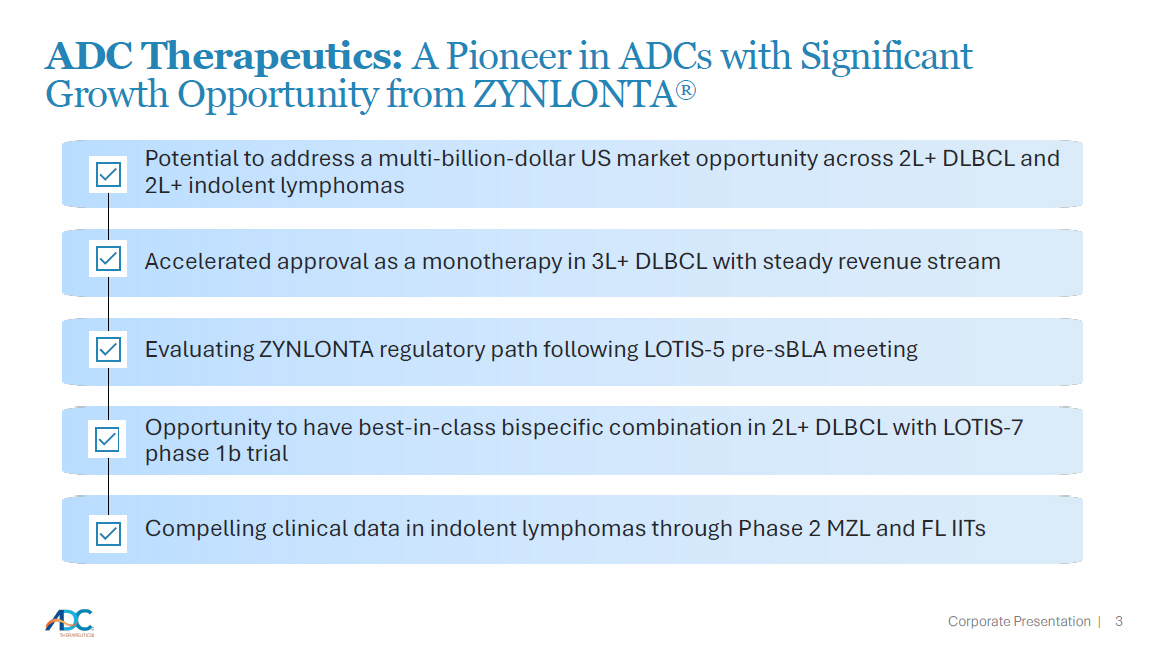
Potential to address a multi - billion - dollar US market opportunity across 2L+ DLBCL and 2L+ indolent lymphomas Accelerated approval as a monotherapy in 3L+ DLBCL with steady revenue stream Evaluating ZYNLONTA regulatory path following LOTIS - 5 pre - sBLA meeting Opportunity to have best - in - class bispecific combination in 2L+ DLBCL with LOTIS - 7 phase 1b trial Compelling clinical data in indolent lymphomas through Phase 2 MZL and FL IITs ADC Therapeutics: A Pioneer in ADCs with Significant Growth Opportunity from ZYNLONTA ® Corporate Presentation | 3
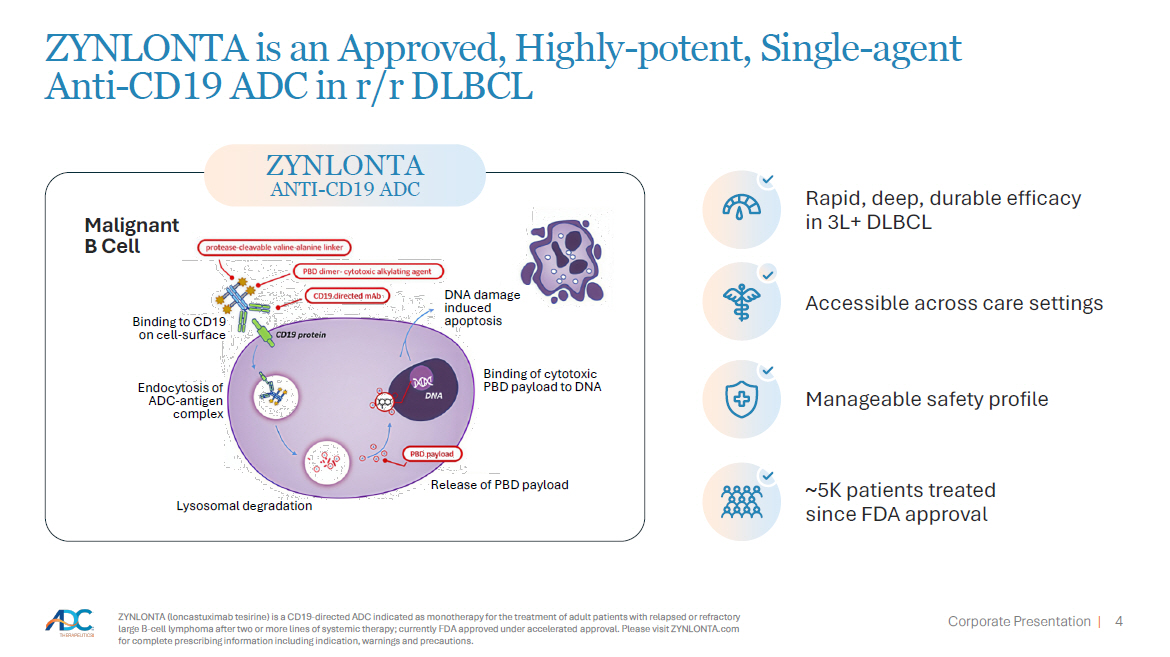
Corporate Presentation | 4 ZYNLONTA ANTI - CD19 ADC Binding of cytotoxic PBD payload to DNA DNA damage induced apoptosis Release of PBD payload Lysosomal degradation Endocytosis of ADC - antigen complex Binding to CD19 on cell - surface Rapid, deep, durable efficacy in 3L+ DLBCL Manageable safety profile Accessible across care settings Malignant B Cell ZYNLONTA (loncastuximab tesirine) is a CD 19 - directed ADC indicated as monotherapy for the treatment of adult patients with relapsed or refractory large B - cell lymphoma after two or more lines of systemic therapy ; currently FDA approved under accelerated approval . Please visit ZYNLONTA . com for complete prescribing information including indication, warnings and precautions . ZYNLONTA is an Approved, Highly - potent, Single - agent Anti - CD19 ADC in r/r DLBCL ~5K patients treated since FDA approval
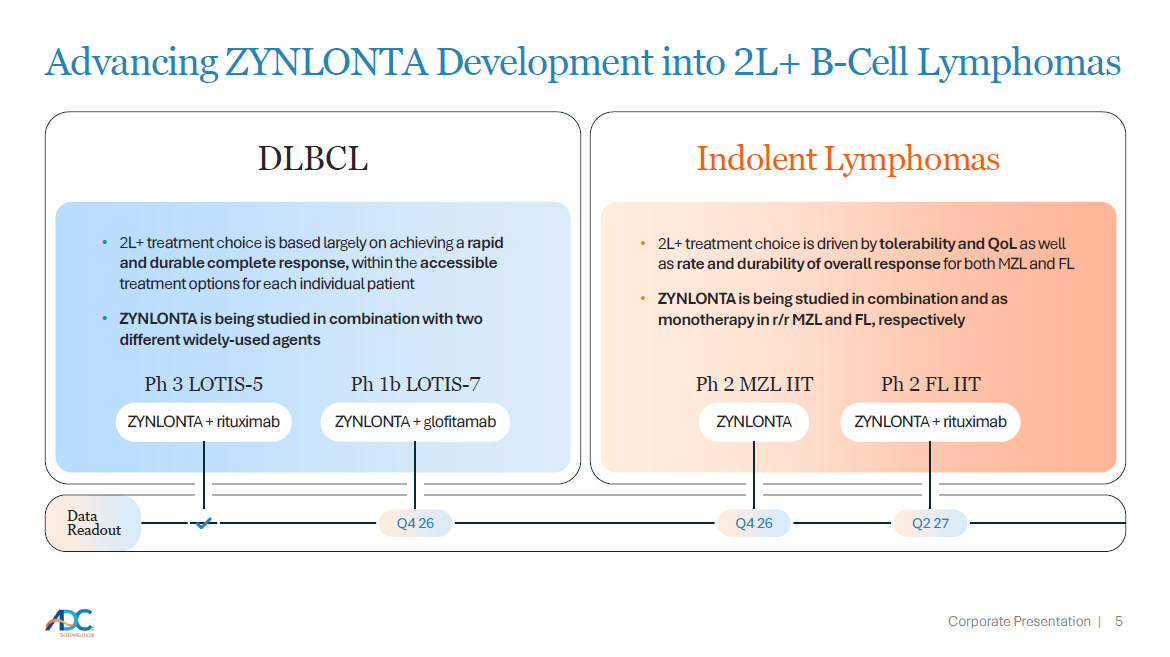
Corporate Presentation | 5 Advancing ZYNLONTA Development into 2L+ B - Cell Lymphomas DLBCL Indolent Lymphomas • 2L+ treatment choice is driven by tolerability and QoL as well as rate and durability of overall response for both MZL and FL • ZYNLONTA is being studied in combination and as monotherapy in r/r MZL and FL, respectively • 2L+ treatment choice is based largely on achieving a rapid and durablecomplete response, within the accessible treatment options for each individual patient • ZYNLONTA is being studied in combination with two different widely - used agents Ph 3 LOTIS - 5 ZYNLONTA + rituximab Ph 1b LOTIS - 7 ZYNLONTA + glofitamab Ph 2 MZL IIT ZYNLONTA Ph 2 FL IIT ZYNLONTA + rituximab Data Readout Q4 26 Q4 26 Q2 27
DLBCL
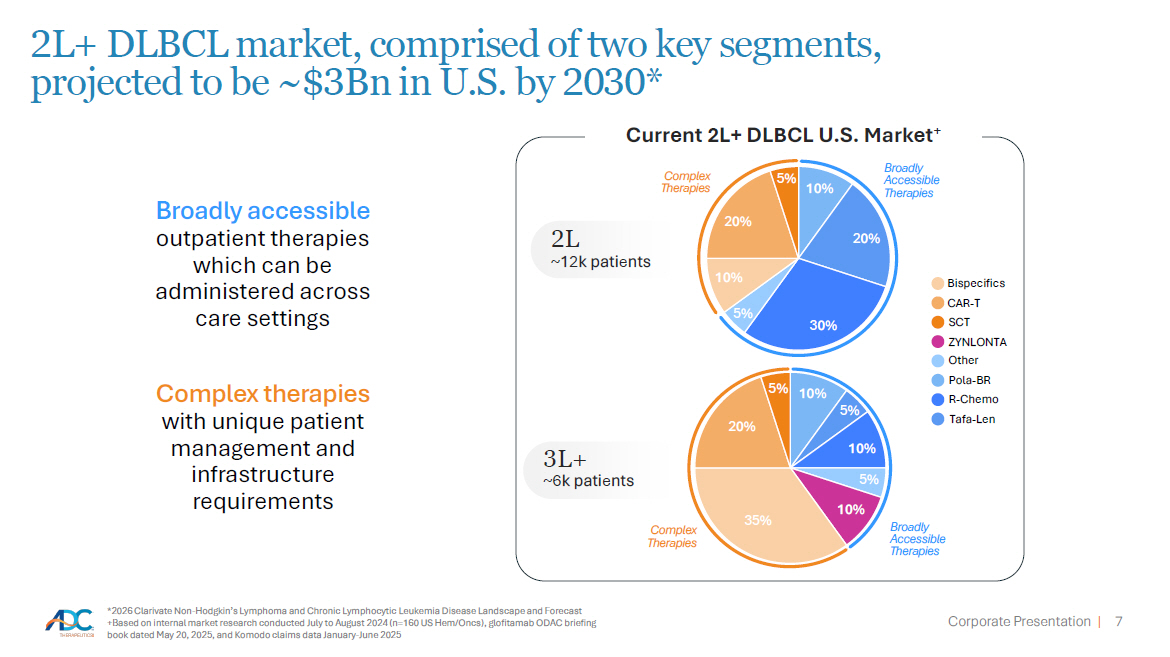
Corporate Presentation | 7 10% 5% 10% 5% 10% 35% 20% 5% 10% 20% 30% 5% 10% 20% 5% 2L ~12k patients Complex Therapies Broadly Accessible Therapies Broadly accessible outpatient therapies which can be administered across care settings Complex therapies with unique patient management and infrastructure requirements 3L+ ~6k patients R - Chemo Tafa - Len Bispecifics CAR - T SCT ZYNLONTA Other Pola - BR Complex Therapies Broadly Accessible Therapies Current 2L+ DLBCL U.S. Market + *2026 Clarivate Non - Hodgkin’s Lymphoma and Chronic Lymphocytic Leukemia Disease Landscape and Forecast +Based on internal market research conducted July to August 2024 (n=160 US Hem/Oncs), glofitamab ODAC briefing book dated May 20, 2025, and Komodo claims data January - June 2025 2L+ DLBCL market, comprised of two key segments, projected to be ~$3Bn in U.S. by 2030*
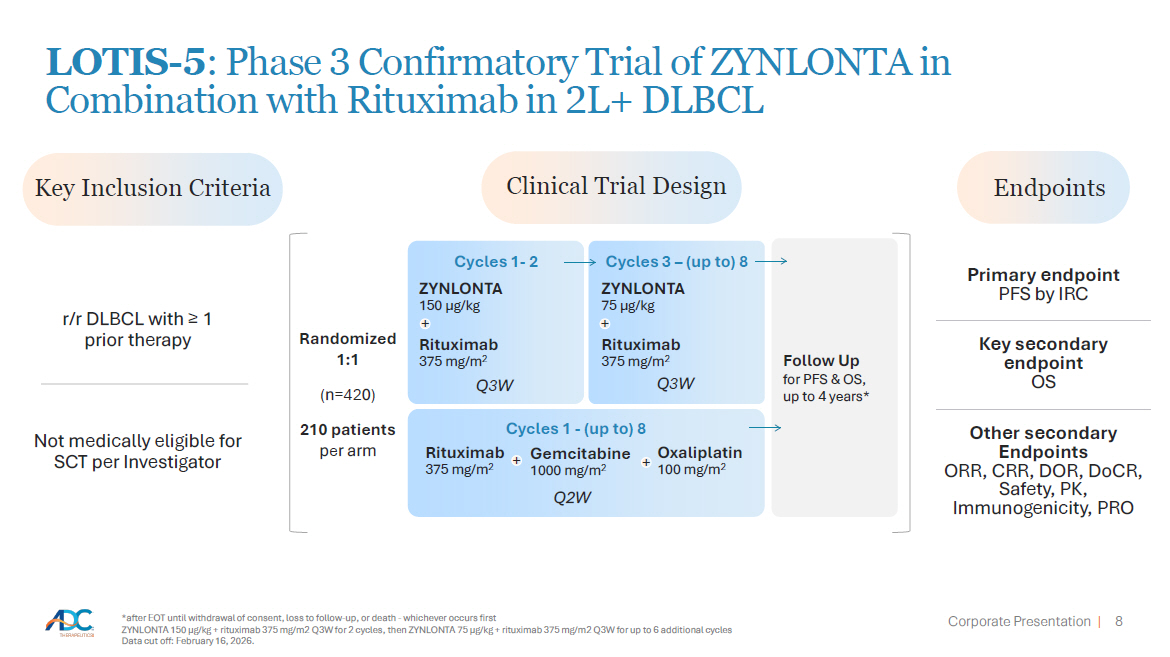
Corporate Presentation | 8 LOTIS - 5 : Phase 3 Confirmatory Trial of ZYNLONTA in Combination with Rituximab in 2L+ DLBCL *after EOT until withdrawal of consent, loss to follow - up, or death - whichever occurs first ZYNLONTA 150 µg/kg + rituximab 375 mg/m2 Q3W for 2 cycles, then ZYNLONTA 75 µg/kg + rituximab 375 mg/m2 Q3W for up to 6 additional cycles Data cut off: February 16, 2026. Primary endpoint PFS by IRC Key secondary endpoint OS Randomized 1:1 (n=420) 210 patients per arm 100 mg/m 2 375 mg/m 2 Key Inclusion Criteria Clinical Trial Design Endpoints Other secondary Endpoints ORR, CRR, DOR, DoCR, Safety, PK, Immunogenicity, PRO r/r DLBCL with ≥ 1 prior therapy Not medically eligible for SCT per Investigator Cycles 1 - (up to) 8 Follow Up for PFS & OS, up to 4 years* 1000 mg/m 2 Q2W Cycles 1 - 2 ZYNLONTA 150 µg/kg + Rituximab 375 mg/m 2 Q3W Cycles 3 – (up to) 8 ZYNLONTA 75 µg/kg + Rituximab 375 mg/m 2 Q3W Rituximab + Gemcitabine + Oxaliplatin
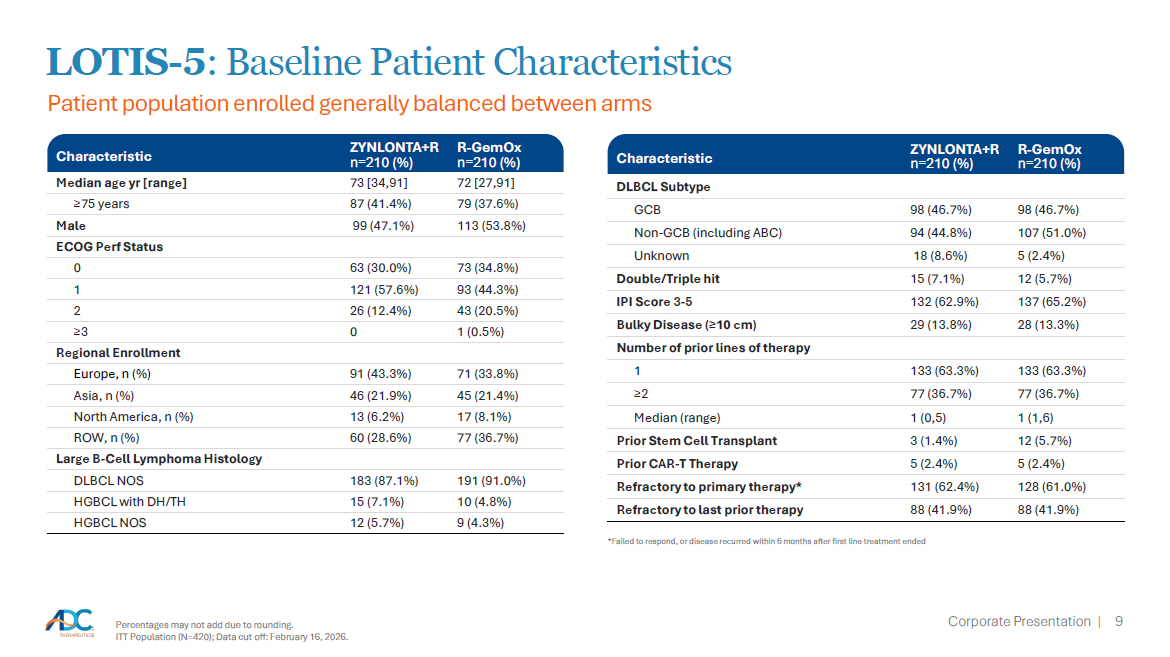
Corporate Presentation | 9 LOTIS - 5 : Baseline Patient Characteristics Patient population enrolled generally balanced between arms R - GemOx n=210 (%) ZYNLONTA+R n=210 (%) Characteristic 72 [27,91] 73 [34,91] Median age yr [range] 79 (37.6%) 87 (41.4%) ≥75 years 113 (53.8%) 99 (47.1%) Male ECOG Perf Status 73 (34.8%) 63 (30.0%) 0 93 (44.3%) 121 (57.6%) 1 43 (20.5%) 26 (12.4%) 2 1 (0.5%) 0 ≥3 Regional Enrollment 71 (33.8%) 91 (43.3%) Europe, n (%) 45 (21.4%) 46 (21.9%) Asia, n (%) 17 (8.1%) 13 (6.2%) North America, n (%) 77 (36.7%) 60 (28.6%) ROW, n (%) Large B - Cell Lymphoma Histology 191 (91.0%) 183 (87.1%) DLBCL NOS 10 (4.8%) 15 (7.1%) HGBCL with DH/TH 9 (4.3%) 12 (5.7%) HGBCL NOS R - GemOx n=210 (%) ZYNLONTA+R n=210 (%) Characteristic DLBCL Subtype 98 (46.7%) 98 (46.7%) GCB 107 (51.0%) 94 (44.8%) Non - GCB (including ABC) 5 (2.4%) 18 (8.6%) Unknown 12 (5.7%) 15 (7.1%) Double/Triple hit 137 (65.2%) 132 (62.9%) IPI Score 3 - 5 28 (13.3%) 29 (13.8%) Bulky Disease (≥10 cm) Number of prior lines of therapy 133 (63.3%) 133 (63.3%) 1 77 (36.7%) 77 (36.7%) ≥2 1 (1,6) 1 (0,5) Median (range) 12 (5.7%) 3 (1.4%) Prior Stem Cell Transplant 5 (2.4%) 5 (2.4%) Prior CAR - T Therapy 128 (61.0%) 131 (62.4%) Refractory to primary therapy* 88 (41.9%) 88 (41.9%) Refractory to last prior therapy Percentages may not add due to rounding. ITT Population (N=420); Data cut off: February 16, 2026. *Failed to respond, or disease recurred within 6 months after first line treatment ended
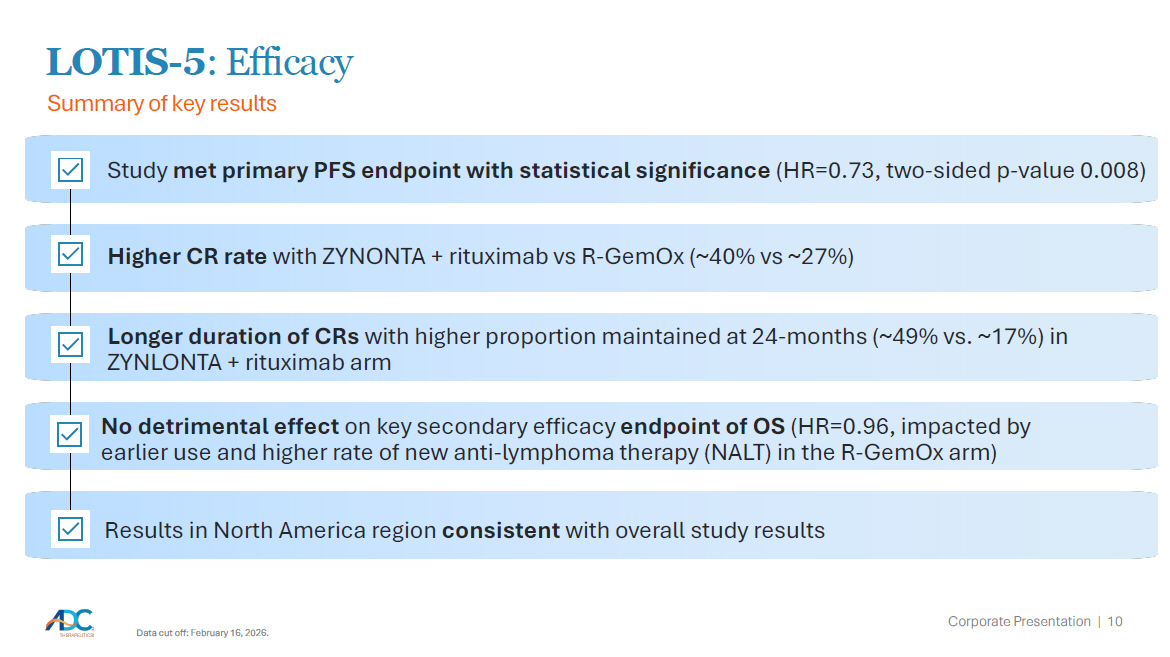
Corporate Presentation | 10 LOTIS - 5 : Efficacy Summary of key results Data cut off: February 16, 2026. Study met primary PFS endpoint with statistical significance (HR=0.73, two - sided p - value 0.008) Higher CR rate with ZYNONTA + rituximab vs R - GemOx (~40% vs ~27%) Longer duration of CRs with higher proportion maintained at 24 - months (~49% vs. ~17%) in ZYNLONTA + rituximab arm No detrimental effect on key secondary efficacy endpoint of OS (HR=0.96, impacted by earlier use and higher rate of new anti - lymphoma therapy (NALT) in the R - GemOx arm) Results in North America region consistent with overall study results
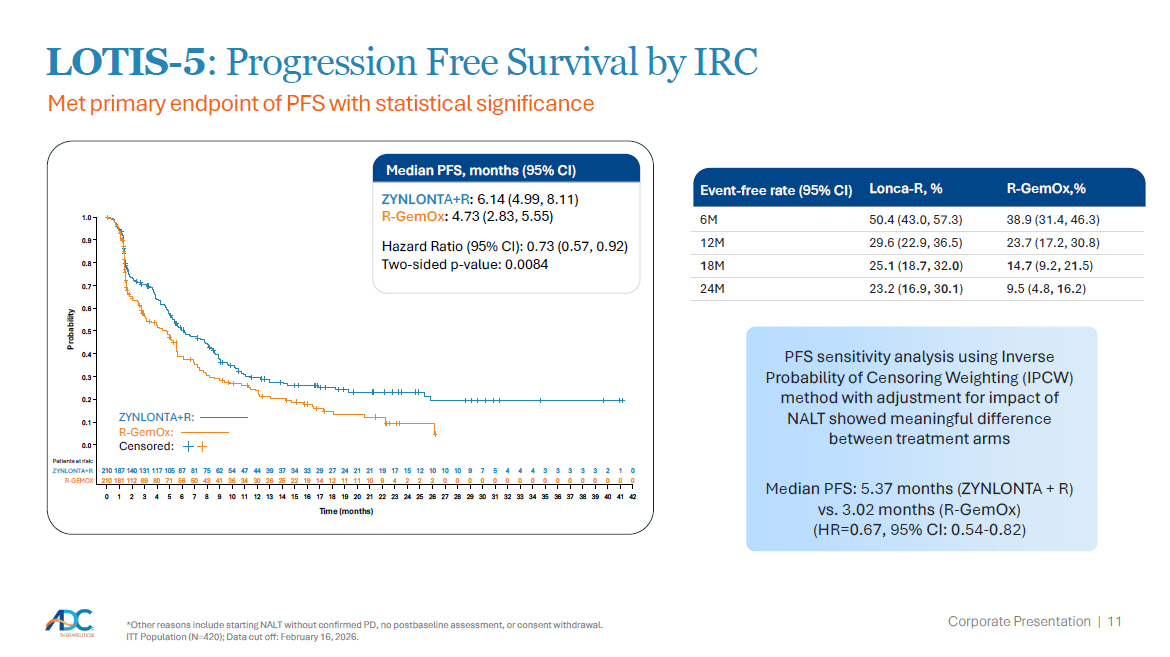
LOTIS - 5 : Progression Free Survival by IRC Met primary endpoint of PFS with statistical significance 0.1 0.2 0.3 0.4 0.7 0.6 0.5 0.8 0.9 1.0 At risk : 0 1 2 3 4 5 6 7 8 9 10 11 12 13 14 15 16 17 18 19 20 21 22 23 24 25 26 27 28 29 30 31 32 33 34 35 36 37 38 39 40 41 42 Time (months) LONCA - R R - GEMOX 210 181 112 89 80 71 56 50 43 41 36 34 30 26 25 22 19 14 12 11 11 10 9 4 2 2 2 0 0 0 0 0 0 0 0 0 0 0 0 0 0 0 0 Probability ZYNLONTA+R: R - GemOx: 0.0 Patients at risk: Median PFS, months (95% CI) ZYNLONTA+R : 6.14 (4.99, 8.11) R - GemOx : 4.73 (2.83, 5.55) Hazard Ratio (95% CI): 0.73 (0.57, 0.92) Two - sided p - value: 0.0084 Censored: ZYNLONTA+R 210 187 140 131 117 105 87 81 75 62 54 47 44 39 37 34 33 29 27 24 21 21 19 17 15 12 10 10 10 9 7 5 4 4 4 3 3 3 3 3 2 1 0 PFS sensitivity analysis using Inverse Probability of Censoring Weighting (IPCW) method with adjustment for impact of NALT showed meaningful difference between treatment arms Median PFS: 5.37 months (ZYNLONTA + R) vs. 3.02 months (R - GemOx) (HR=0.67, 95% CI: 0.54 - 0.82) R - GemOx,% Lonca - R, % Event - free rate (95% CI) 38.9 (31.4, 46.3) 50.4 (43.0, 57.3) 6M 23.7 (17.2, 30.8) 29.6 (22.9, 36.5) 12M 14.7 (9.2, 21.5) 25.1 (18.7, 32.0) 18M 9.5 (4.8, 16.2) 23.2 (16.9, 30.1) 24M Corporate Presentation | 11 *Other reasons include starting NALT without confirmed PD, no postbaseline assessment, or consent withdrawal. ITT Population (N=420); Data cut off: February 16, 2026.
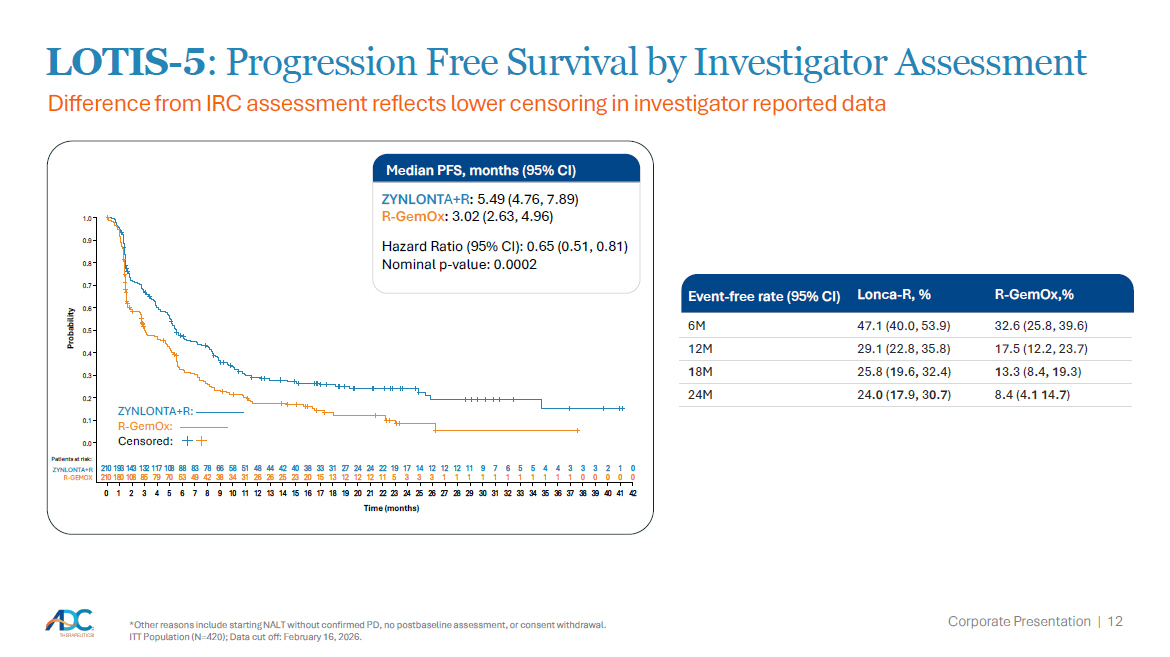
LOTIS - 5 : Progression Free Survival by Investigator Assessment Difference from IRC assessment reflects lower censoring in investigator reported data LONCA - R 0.0 0.1 0.7 0.6 0.5 0.4 0.3 0.2 0.8 0.9 1.0 Probability At risk ZYNLONTA+R: R - GemOx: Censored: Median PFS, months (95% CI) ZYNLONTA+R : 5.49 (4.76, 7.89) R - GemOx : 3.02 (2.63, 4.96) Hazard Ratio (95% CI): 0.65 (0.51, 0.81) Nominal p - value: 0.0002 Patients at risk: : ZYNLONTA+R 210 193 143 132 117 108 88 83 78 66 58 51 48 44 42 40 38 33 31 27 24 24 22 19 17 14 12 12 12 11 9 7 6 5 5 4 4 3 3 3 2 1 0 R - GEMOX 210 180 108 85 79 70 53 49 42 38 34 31 26 26 25 23 20 15 13 12 12 12 11 5 3 3 3 1 1 1 1 1 1 1 1 1 1 1 0 0 0 0 0 0 1 2 3 4 5 6 7 8 9 10 11 12 13 14 15 16 17 18 19 20 21 22 23 24 25 26 27 28 29 30 31 32 33 34 35 36 37 38 39 40 41 42 Time (months) R - GemOx,% Lonca - R, % Event - free rate (95% CI) 32.6 (25.8, 39.6) 47.1 (40.0, 53.9) 6M 17.5 (12.2, 23.7) 29.1 (22.8, 35.8) 12M 13.3 (8.4, 19.3) 25.8 (19.6, 32.4) 18M 8.4 (4.1 14.7) 24.0 (17.9, 30.7) 24M Corporate Presentation | 12 *Other reasons include starting NALT without confirmed PD, no postbaseline assessment, or consent withdrawal. ITT Population (N=420); Data cut off: February 16, 2026.
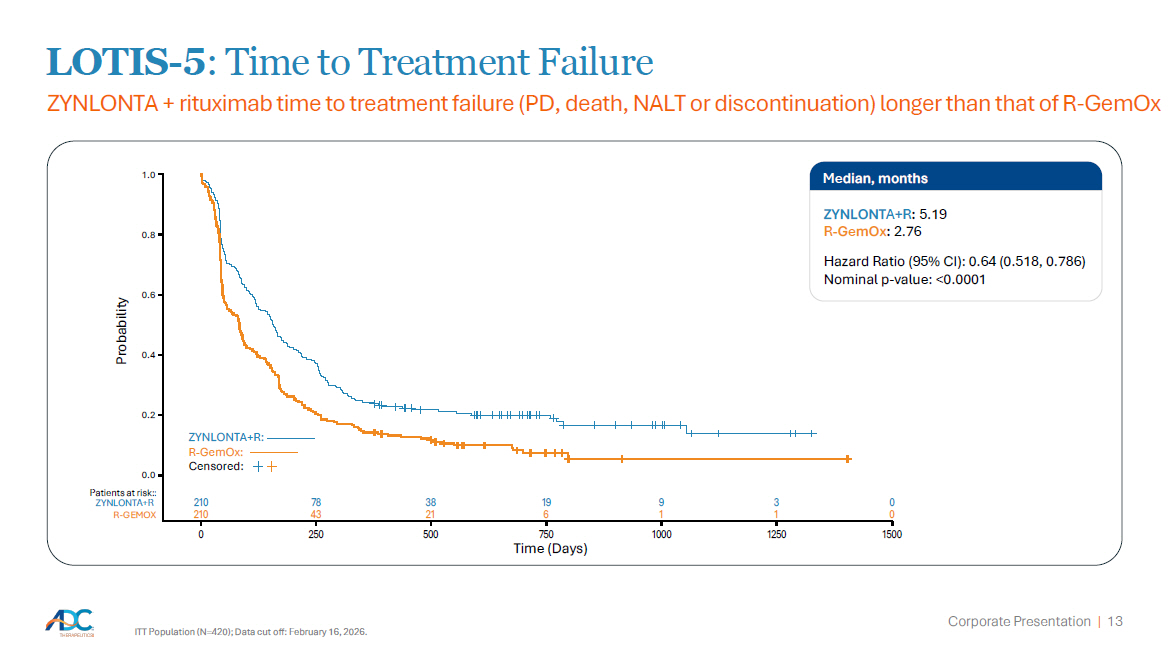
With Number of Subjects at Risk 0.4 0.6 0.8 1.0 Survival Probability At risk LONCA - R R - GEMOX 210 210 78 43 38 21 19 6 9 1 3 1 0 0 0 250 500 750 1000 1250 1500 LOTIS - 5 : Time to Treatment Failure ZYNLONTA + rituximab time to treatment failure (PD, death, NALT or discontinuation) longer than that of R - GemOx Probability Time (Days) ZYNLONTA+R : 5.19 R - GemOx : 2.76 Hazard Ratio (95% CI): 0.64 (0.518, 0.786) Nominal p - value: <0.0001 0.2 ZYNLONTA+R: R - GemOx: Censored: Median, months 0.0 Patients at risk: : ZYNLONTA+R Corporate Presentation | 13 ITT Population (N=420); Data cut off: February 16, 2026.
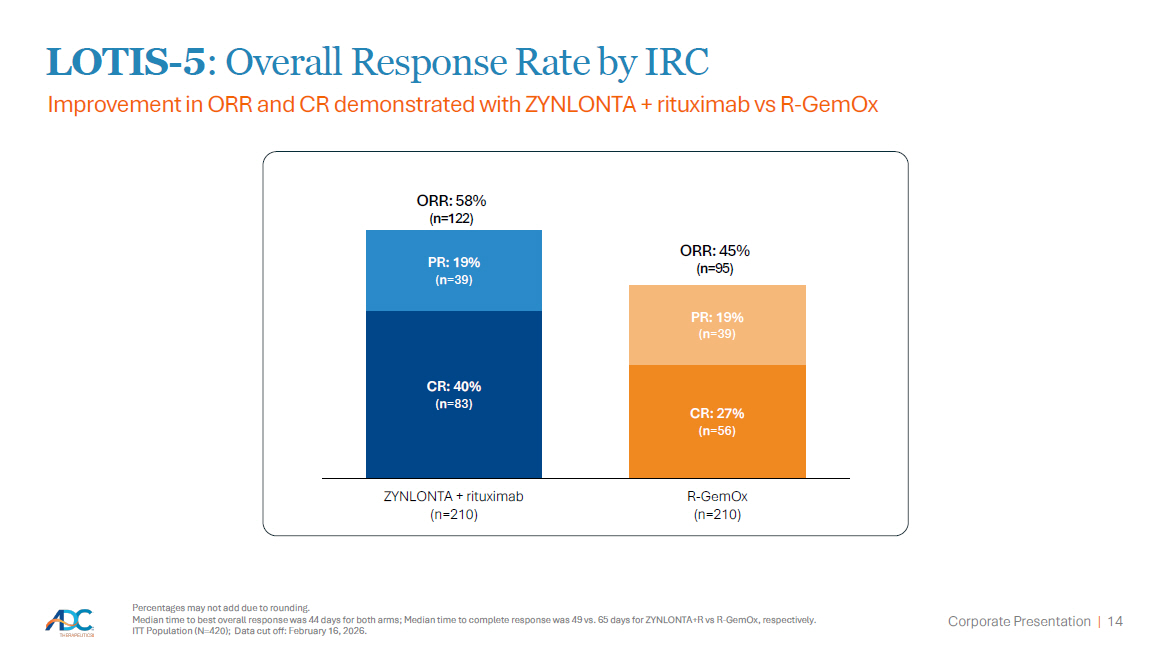
CR: 40% (n=83) CR: 27% (n=56) PR: 19% (n=39) PR: 19% (n=39) ZYNLONTA + rituximab (n=210) R - GemOx (n=210) LOTIS - 5 : Overall Response Rate by IRC Improvement in ORR and CR demonstrated with ZYNLONTA + rituximab vs R - GemOx Percentages may not add due to rounding. ORR: 58% (n=122) Corporate Presentation | 14 Median time to best overall response was 44 days for both arms; Median time to complete response was 49 vs. 65 days for ZYNLONTA+R vs R - GemOx, respectively. ITT Population (N=420); Data cut off: February 16, 2026. ORR: 45% (n=95)
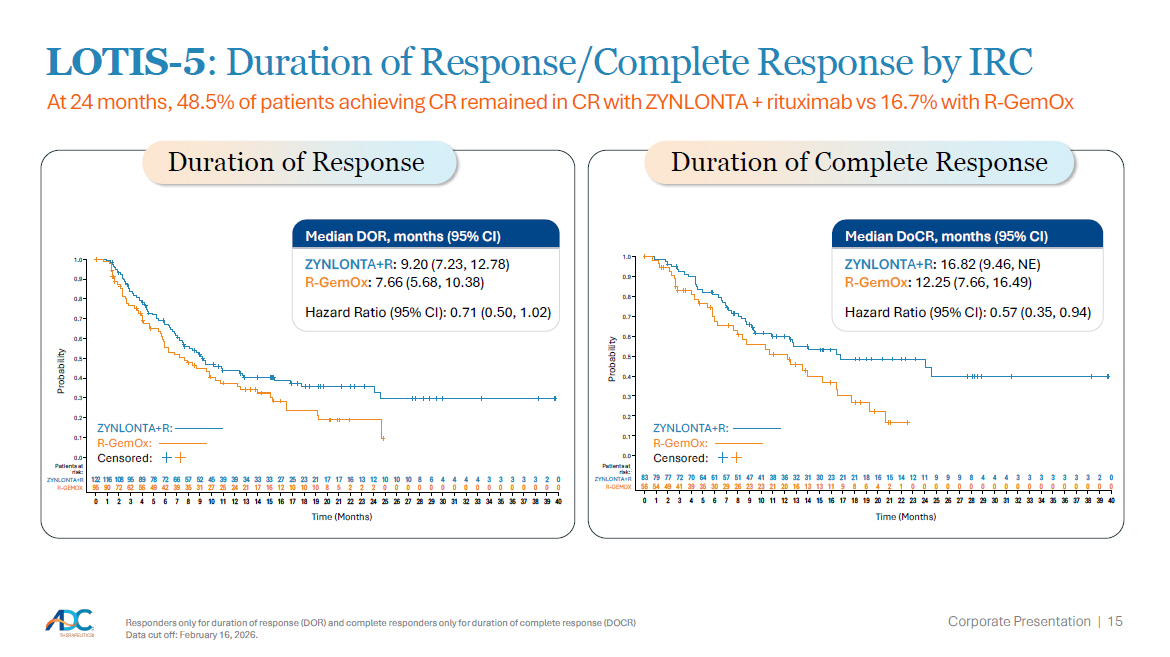
Corporate Presentation | 15 LOTIS - 5 : Duration of Response/Complete Response by IRC At 24 months, 48.5% of patients achieving CR remained in CR with ZYNLONTA + rituximab vs 16.7% with R - GemOx Responders only for duration of response (DOR) and complete responders only for duration of complete response (DOCR) Data cut off: February 16, 2026. Time (months) LONCA - R 0.1 0.2 0.3 0.4 0.5 0.6 0.7 0.8 0.9 1.0 At risk : R - GEMOX 95 90 72 62 56 49 42 39 35 31 27 25 24 21 17 16 12 10 10 10 8 5 2 2 2 0 0 0 0 0 0 0 0 0 0 0 0 0 0 0 0 0 1 2 3 4 5 6 7 8 9 10 11 12 13 14 15 16 17 18 19 20 21 22 23 24 25 26 27 28 29 30 31 32 33 34 35 36 37 38 39 40 Prob P a r b o i b l a it b y ility Time (Months) 0.0 Patients at risk: Time (months) LONCA - R 0.0 0.1 0.2 0.3 0.4 0.5 0.6 0.7 0.8 0.9 1.0 Probability At risk 83 79 77 72 70 64 61 57 51 47 41 38 36 32 31 30 23 21 21 18 16 15 14 12 11 9 9 9 8 4 4 4 3 3 3 3 3 3 3 2 0 R - GEMOX 56 54 49 41 39 35 30 29 26 23 23 21 20 16 13 13 11 9 8 6 4 2 1 0 0 0 0 0 0 0 0 0 0 0 0 0 0 0 0 0 0 0 1 2 3 4 5 6 7 8 9 10 11 12 13 14 15 16 17 18 19 20 21 22 23 24 25 26 27 28 29 30 31 32 33 34 35 36 37 38 39 40 Patients at : risk: Probability Time (Months) ZYNLONTA+R: R - GemOx: Censored: Median DOR, months (95% CI) ZYNLONTA+R : 9.20 (7.23, 12.78) R - GemOx : 7.66 (5.68, 10.38) Hazard Ratio (95% CI): 0.71 (0.50, 1.02) ZYNLONTA+R: R - GemOx: Censored: R - GemOx : 12.25 (7.66, 16.49) Hazard Ratio (95% CI): 0.57 (0.35, 0.94) Median DoCR, months (95% CI) ZYNLONTA+R : 16.82 (9.46, NE) ZYNLONTA+R 122 116 108 95 89 78 72 66 57 52 45 39 39 34 33 33 27 25 23 21 17 17 16 13 12 10 10 10 8 6 4 4 4 4 3 3 3 3 3 2 0 ZYNLONTA+R Duration of Response Duration of Complete Response
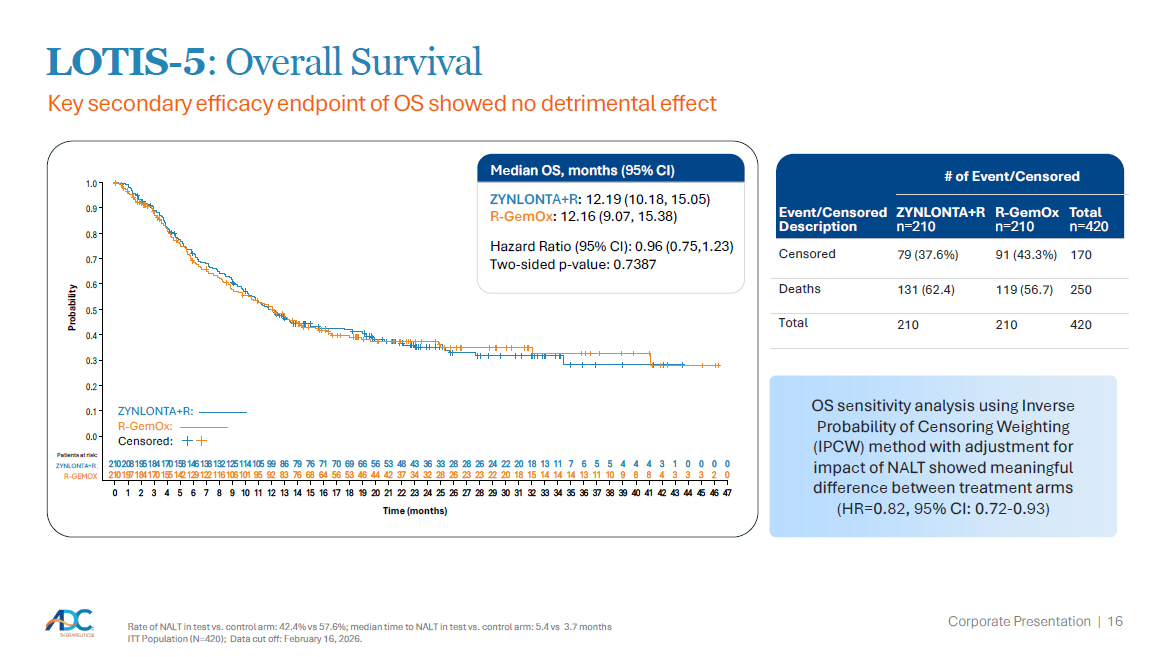
Corporate Presentation | 16 LOTIS - 5 : Overall Survival Key secondary efficacy endpoint of OS showed no detrimental effect Rate of NALT in test vs. control arm: 42.4% vs 57.6%; median time to NALT in test vs. control arm: 5.4 vs 3.7 months ITT Population (N=420); Data cut off: February 16, 2026. LONCA - R R - GEMOX 0.0 0.6 0.5 0.4 0.3 0.2 0.7 0.8 0.9 1.0 Probability At risk : 0 1 2 3 4 5 6 7 8 9 10 11 12 13 14 15 16 17 18 19 20 21 22 23 24 25 26 27 28 29 30 31 32 33 34 35 36 37 38 39 40 41 42 43 44 45 46 47 Time (months) 210208195184170158146138132125114105 99 86 79 76 71 70 69 66 56 53 48 43 36 33 28 28 26 24 22 20 18 13 11 7 6 5 5 4 4 4 3 1 0 0 0 0 210197184170155142129122116106101 95 92 83 76 68 64 56 53 46 44 42 37 34 32 28 26 23 23 22 20 18 15 14 14 14 13 11 10 9 8 8 4 3 3 3 2 0 Patients at risk: 0.1 ZYNLONTA+R: R - GemOx: Censored: ZYNLONTA+R : 12.19 (10.18, 15.05) R - GemOx : 12.16 (9.07, 15.38) Hazard Ratio (95% CI): 0.96 (0.75,1.23) Two - sided p - value: 0.7387 Median OS, months (95% CI) OS sensitivity analysis using Inverse Probability of Censoring Weighting (IPCW) method with adjustment for impact of NALT showed meaningful difference between treatment arms (HR=0.82, 95% CI: 0.72 - 0.93) # of Event/Censored Event/Censored Description Total n=420 R - GemOx n=210 ZYNLONTA+R n=210 170 91 (43.3%) 79 (37.6%) Censored 250 119 (56.7) 131 (62.4) Deaths 420 210 210 Total ZYNLONTA+R
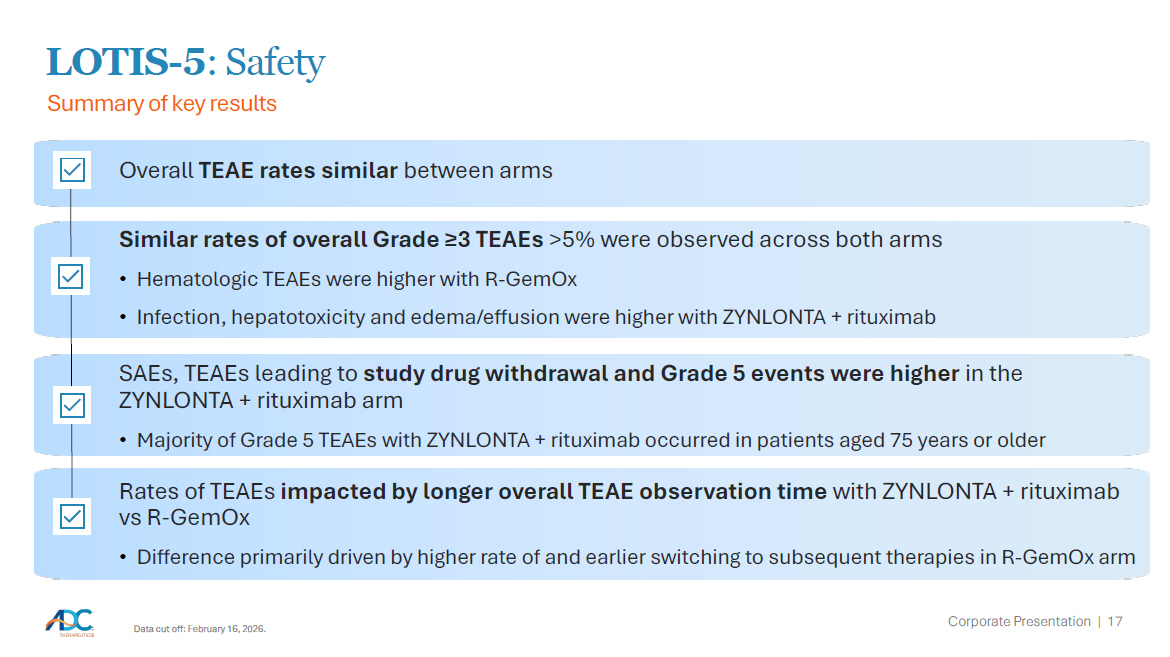
Corporate Presentation | 17 LOTIS - 5 : Safety Summary of key results Data cut off: February 16, 2026. Overall TEAE rates similar between arms Similar rates of overall Grade ≥3 TEAEs >5% were observed across both arms • Hematologic TEAEs were higher with R - GemOx • Infection, hepatotoxicity and edema/effusion were higher with ZYNLONTA + rituximab SAEs, TEAEs leading to study drug withdrawal and Grade 5 events were higher in the ZYNLONTA + rituximab arm • Majority of Grade 5 TEAEs with ZYNLONTA + rituximab occurred in patients aged 75 years or older Rates of TEAEs impacted by longer overall TEAE observation time with ZYNLONTA + rituximab vs R - GemOx • Difference primarily driven by higher rate of and earlier switching to subsequent therapies in R - GemOx arm
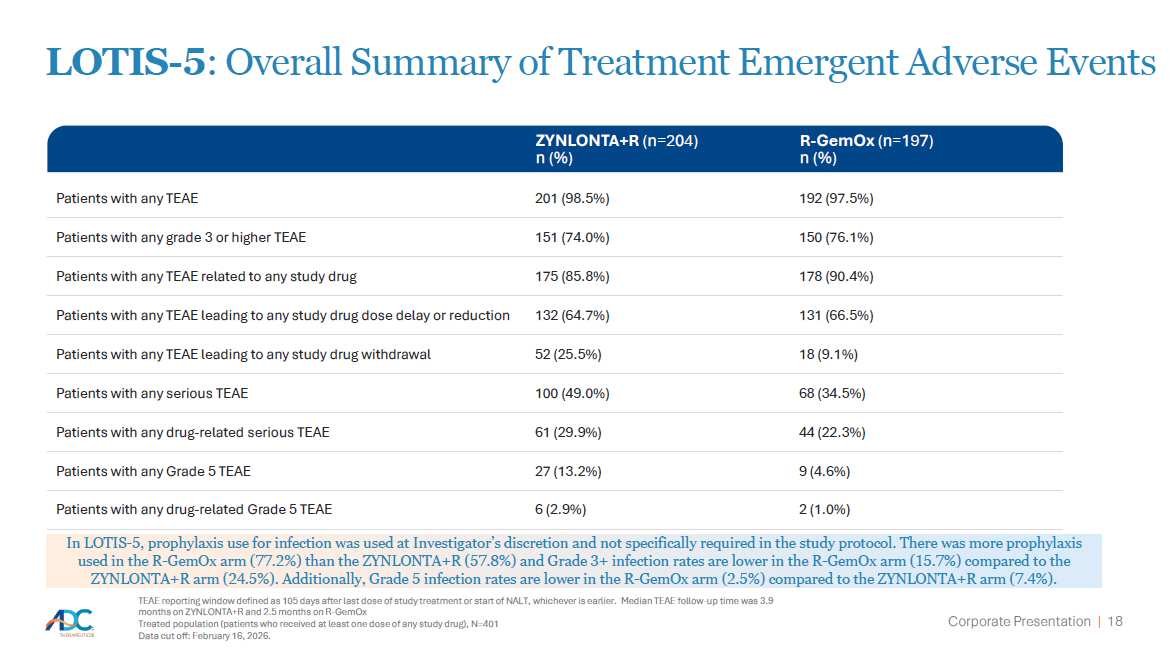
Corporate Presentation | 18 R - GemOx (n=197) n (%) ZYNLONTA+R (n=204) n (%) 192 (97.5%) 201 (98.5%) Patients with any TEAE 150 (76.1%) 151 (74.0%) Patients with any grade 3 or higher TEAE 178 (90.4%) 175 (85.8%) Patients with any TEAE related to any study drug 131 (66.5%) 132 (64.7%) Patients with any TEAE leading to any study drug dose delay or reduction 18 (9.1%) 52 (25.5%) Patients with any TEAE leading to any study drug withdrawal 68 (34.5%) 100 (49.0%) Patients with any serious TEAE 44 (22.3%) 61 (29.9%) Patients with any drug - related serious TEAE 9 (4.6%) 27 (13.2%) Patients with any Grade 5 TEAE 2 (1.0%) 6 (2.9%) Patients with any drug - related Grade 5 TEAE LOTIS - 5 : Overall Summary of Treatment Emergent Adverse Events TEAE reporting window defined as 105 days after last dose of study treatment or start of NALT, whichever is earlier. Median TEAE follow - up time was 3.9 months on ZYNLONTA+R and 2.5 months on R - GemOx Treated population (patients who received at least one dose of any study drug), N=401 In LOTIS - 5, prophylaxis use for infection was used at Investigator’s discretion and not specifically required in the study protocol. There was more prophylaxis used in the R - GemOx arm (77.2%) than the ZYNLONTA+R (57.8%) and Grade 3+ infection rates are lower in the R - GemOx arm (15.7%) compared to the ZYNLONTA+R arm (24.5%). Additionally, Grade 5 infection rates are lower in the R - GemOx arm (2.5%) compared to the ZYNLONTA+R arm (7.4%). Data cut off: February 16, 2026.
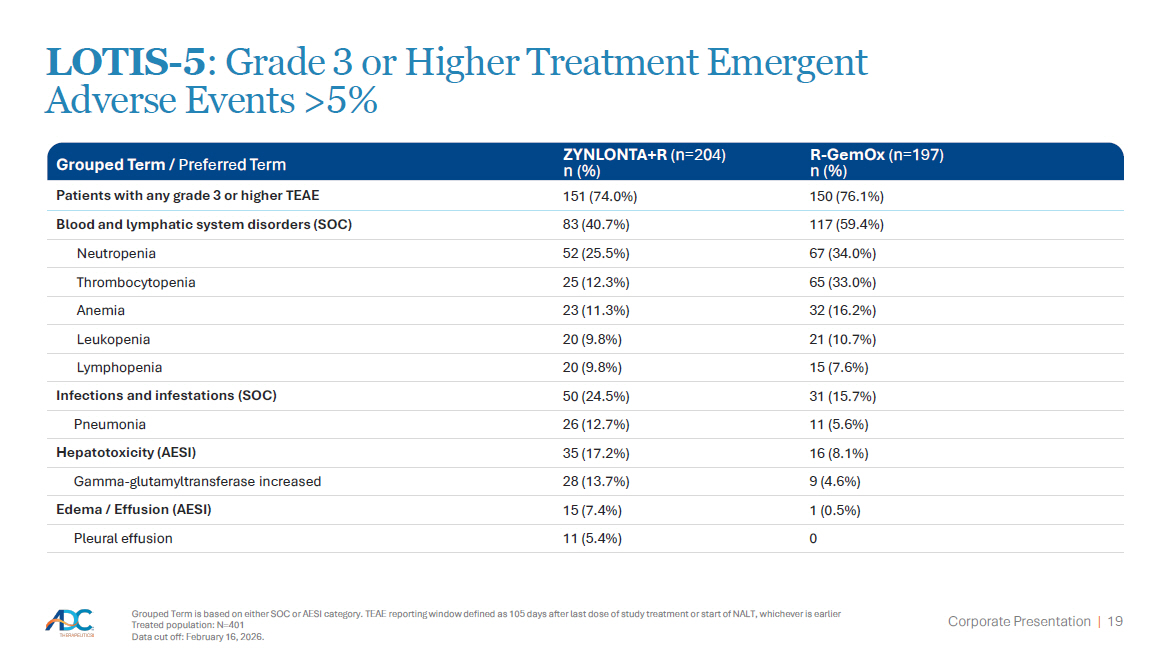
Corporate Presentation | 19 LOTIS - 5 : Grade 3 or Higher Treatment Emergent Adverse Events >5% Grouped Term is based on either SOC or AESI category. TEAE reporting window defined as 105 days after last dose of study treatment or start of NALT, whichever is earlier Treated population: N=401 R - GemOx (n=197) n (%) ZYNLONTA+R (n=204) n (%) Grouped Term / Preferred Term 150 (76.1%) 151 (74.0%) Patients with any grade 3 or higher TEAE 117 (59.4%) 83 (40.7%) Blood and lymphatic system disorders (SOC) 67 (34.0%) 52 (25.5%) Neutropenia 65 (33.0%) 25 (12.3%) Thrombocytopenia 32 (16.2%) 23 (11.3%) Anemia 21 (10.7%) 20 (9.8%) Leukopenia 15 (7.6%) 20 (9.8%) Lymphopenia 31 (15.7%) 50 (24.5%) Infections and infestations (SOC) 11 (5.6%) 26 (12.7%) Pneumonia 16 (8.1%) 35 (17.2%) Hepatotoxicity (AESI) 9 (4.6%) 28 (13.7%) Gamma - glutamyltransferase increased 1 (0.5%) 15 (7.4%) Edema / Effusion (AESI) 0 11 (5.4%) Pleural effusion Data cut off: February 16, 2026.
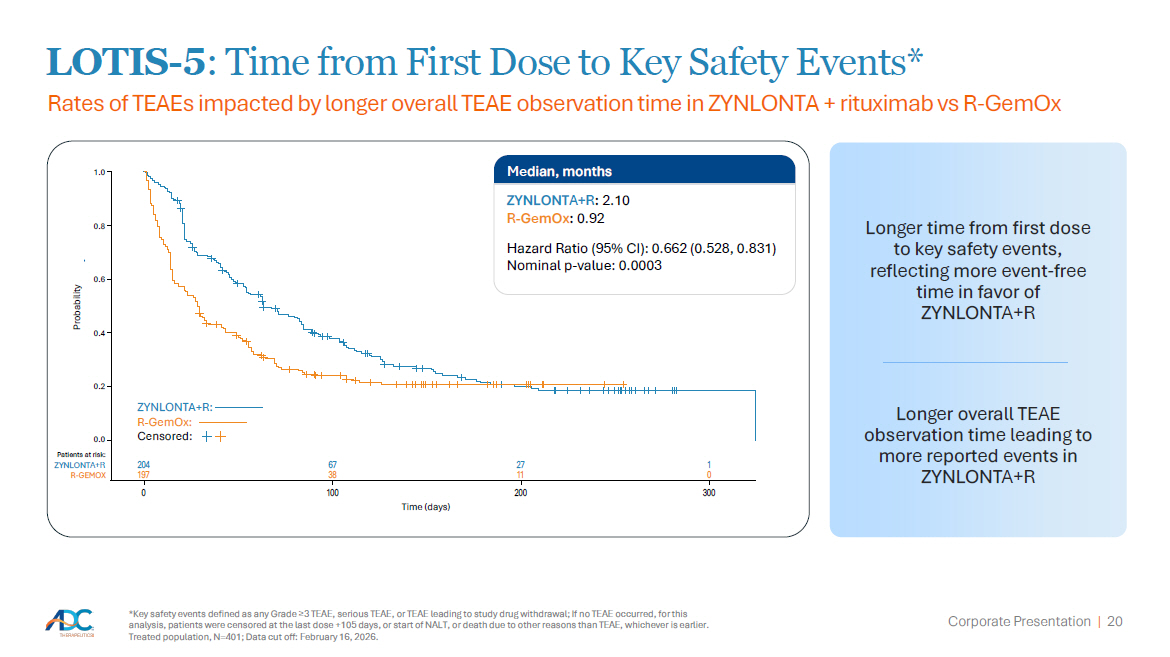
Corporate Presentation | 20 0.0 0.2 0.4 0.6 0.8 1.0 At risk : LONCA - R R - GEMOX 204 197 67 38 27 11 1 0 0 100 200 300 With Number of Subjects at Risk LOTIS - 5 : Time from First Dose to Key Safety Events* Rates of TEAEs impacted by longer overall TEAE observation time in ZYNLONTA + rituximab vs R - GemOx *Key safety events defined as any Grade ≥3 TEAE, serious TEAE, or TEAE leading to study drug withdrawal; If no TEAE occurred, for this analysis, patients were censored at the last dose +105 days, or start of NALT, or death due to other reasons than TEAE, whichever is earlier. Patients at risk: Sur P v r i o va b l a P b r il o it b y ability Time (days) ZYNLONTA+R: R - GemOx: Censored: ZYNLONTA+R : 2.10 R - GemOx : 0.92 Hazard Ratio (95% CI): 0.662 (0.528, 0.831) Nominal p - value: 0.0003 Median, months Longer time from first dose to key safety events, reflecting more event - free time in favor of ZYNLONTA+R Longer overall TEAE observation time leading to more reported events in ZYNLONTA+R ZYNLONTA+R Treated population, N=401; Data cut off: February 16, 2026.
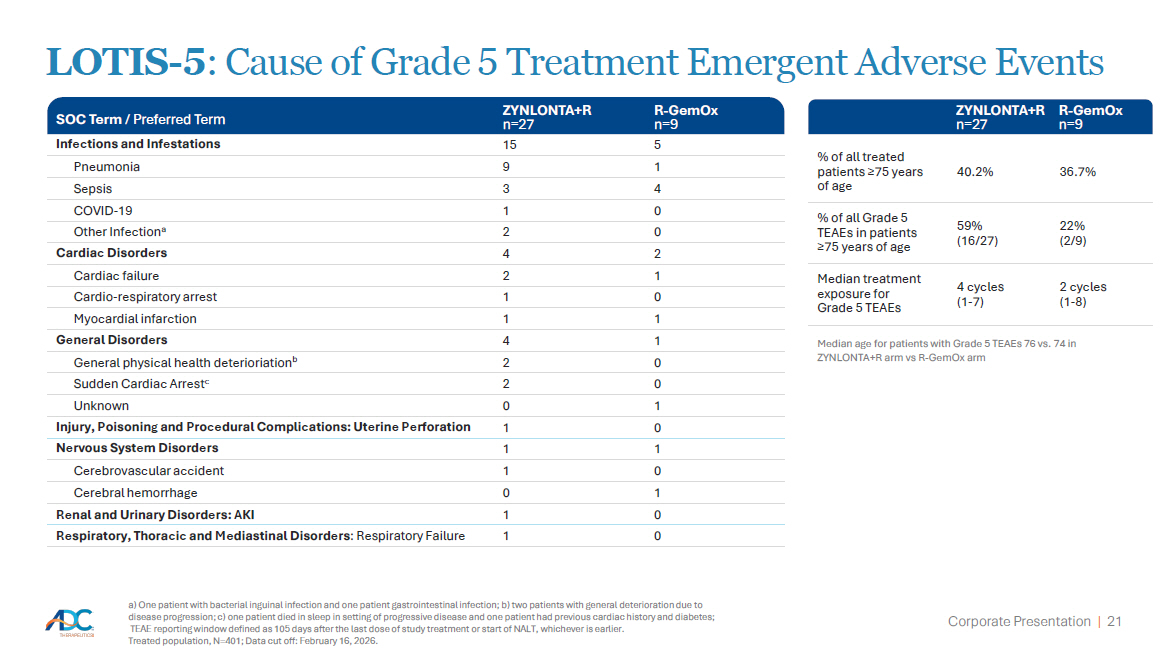
Corporate Presentation | 21 R - GemOx n=9 ZYNLONTA+R n=27 36.7% 40.2% % of all treated patients ≥75 years of age 22% (2/9) 59% (16/27) % of all Grade 5 TEAEs in patients ≥75 years of age 2 cycles (1 - 8) 4 cycles (1 - 7) Median treatment exposure for Grade 5 TEAEs LOTIS - 5 : Cause of Grade 5 Treatment Emergent Adverse Events a) One patient with bacterial inguinal infection and one patient gastrointestinal infection; b) two patients with general deterioration due to disease progression; c) one patient died in sleep in setting of progressive disease and one patient had previous cardiac history and diabetes; TEAE reporting window defined as 105 days after the last dose of study treatment or start of NALT, whichever is earlier. R - GemOx n=9 ZYNLONTA+R n=27 SOC Term / Preferred Term 5 15 Infections and Infestations 1 9 Pneumonia 4 3 Sepsis 0 1 COVID - 19 0 2 Other Infection a 2 4 Cardiac Disorders 1 2 Cardiac failure 0 1 Cardio - respiratory arrest 1 1 Myocardial infarction 1 4 General Disorders 0 2 General physical health deterioriation b 0 2 Sudden Cardiac Arrest c 1 0 Unknown 0 1 Injury, Poisoning and Procedural Complications: Uterine Perforation 1 1 Nervous System Disorders 0 1 Cerebrovascular accident 1 0 Cerebral hemorrhage 0 1 Renal and Urinary Disorders: AKI 0 1 Respiratory, Thoracic and Mediastinal Disorders : Respiratory Failure Treated population, N=401; Data cut off: February 16, 2026. Median age for patients with Grade 5 TEAEs 76 vs. 74 in ZYNLONTA+R arm vs R - GemOx arm
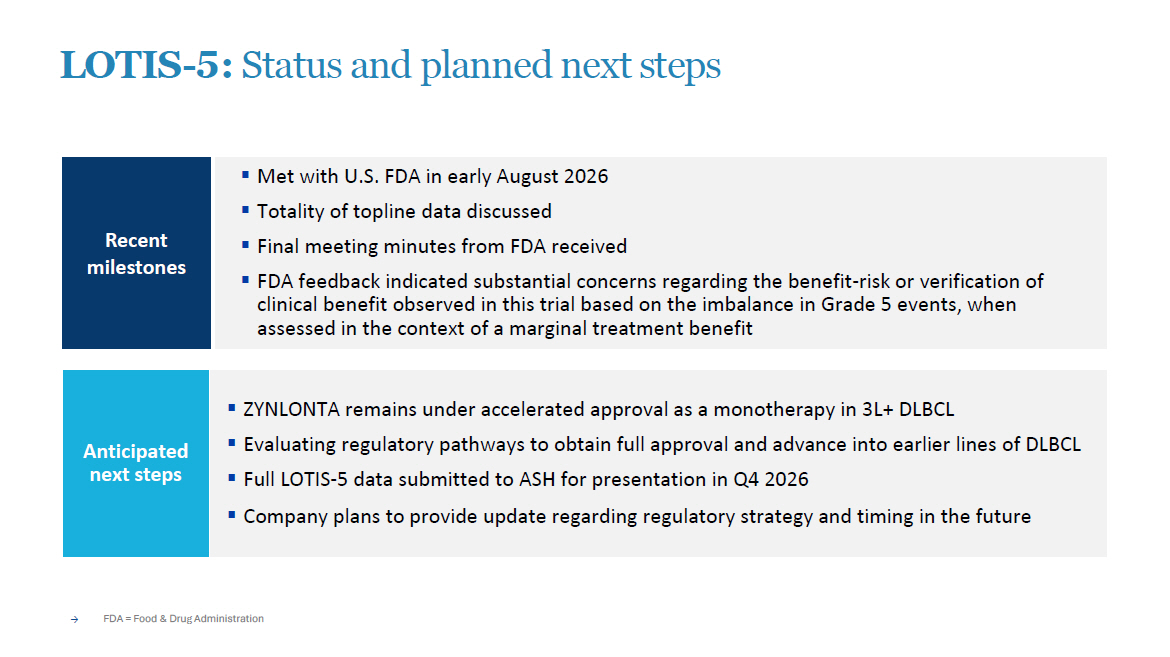
LOTIS - 5: Status and planned next steps → FDA = Food & Drug Administration ▪ Met with U.S. FDA in early August 2026 ▪ Totality of topline data discussed ▪ Final meeting minutes from FDA received ▪ FDA feedback indicated substantial concerns regarding the benefit - risk or verification of clinical benefit observed in this trial based on the imbalance in Grade 5 events, when assessed in the context of a marginal treatment benefit Recent milestones Anticipated next steps ▪ ZYNLONTA remains under accelerated approval as a monotherapy in 3L+ DLBCL ▪ Evaluating regulatory pathways to obtain full approval and advance into earlier lines of DLBCL ▪ Full LOTIS - 5 data submitted to ASH for presentation in Q4 2026 ▪ Company plans to provide update regarding regulatory strategy and timing in the future
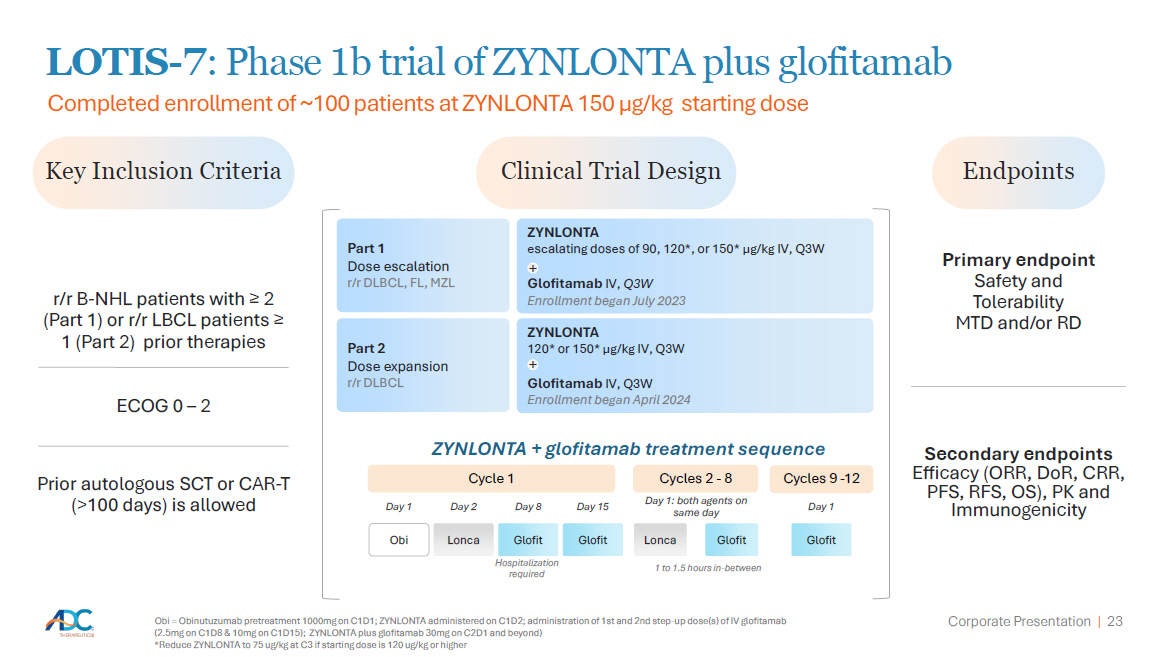
Corporate Presentation | 23 Obi = Obinutuzumab pretreatment 1000mg on C1D1; ZYNLONTA administered on C1D2; administration of 1st and 2nd step - up dose(s) of IV glofitamab (2.5mg on C1D8 & 10mg on C1D15); ZYNLONTA plus glofitamab 30mg on C2D1 and beyond) *Reduce ZYNLONTA to 75 ug/kg at C3 if starting dose is 120 ug/kg or higher r/r B - NHL patients with ≥ 2 (Part 1) or r/r LBCL patients ≥ 1 (Part 2) prior therapies ECOG 0 – 2 Prior autologous SCT or CAR - T (>100 days) is allowed ZYNLONTA + glofitamab treatment sequence Obi Lonca Glofit Glofit Day 1 Cycle 1 Day 2 Day 8 Day 15 Cycles 2 - 8 Day 1: both agents on same day Cycles 9 - 12 Day 1 Glofit Hospitalization required Lonca Glofit 1 to 1.5 hours in - between LOTIS - 7 : Phase 1b trial of ZYNLONTA plus glofitamab Completed enrollment of ~100 patients at ZYNLONTA 150 µg/kg starting dose Key Inclusion Criteria Clinical Trial Design Primary endpoint Safety and Tolerability MTD and/or RD Secondary endpoints Efficacy (ORR, DoR, CRR, PFS, RFS, OS), PK and Immunogenicity Endpoints Part 1 Dose escalation r/r DLBCL, FL, MZL Part 2 Dose expansion r/r DLBCL ZYNLONTA escalating doses of 90, 120*, or 150* µg/kg IV, Q3W + Glofitamab IV, Q3W Enrollment began July 2023 ZYNLONTA 120* or 150* µg/kg IV, Q3W + Glofitamab IV, Q3W Enrollment began April 2024
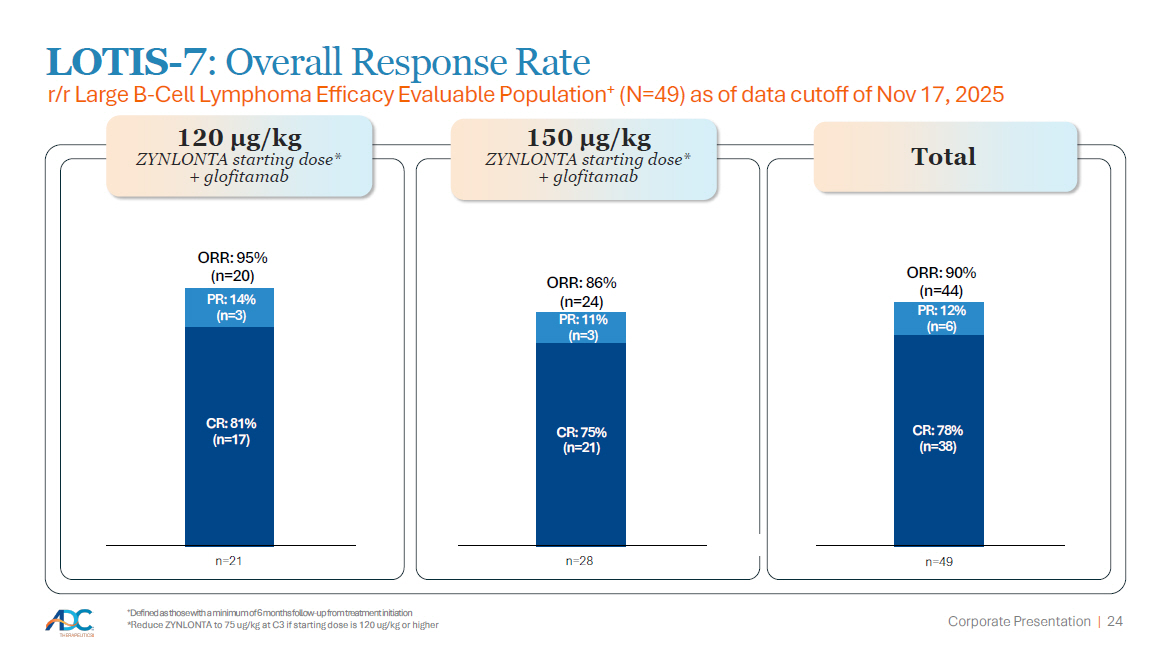
LOTIS - 7 : Overall Response Rate 120 µg/kg ZYNLONTA starting dose* + glofitamab 150 µg/kg ZYNLONTA starting dose* + glofitamab Total + Definedasthosewithaminimumof6monthsfollow - upfromtreatmentinitiation *Reduce ZYNLONTA to 75 ug/kg at C3 if starting dose is 120 ug/kg or higher Corporate Presentation | 24 PR: 14% (n=3) ORR: 95% (n=20) CR: 81% (n=17) PR: 11% (n=3) ORR: 86% (n=24) CR: 75% (n=21) PR: 12% (n=6) ORR: 90% (n=44) CR: 78% (n=38) n=21 n=28 n=49 r/r Large B - Cell Lymphoma Efficacy Evaluable Population + (N=49) as of data cutoff of Nov 17, 2025
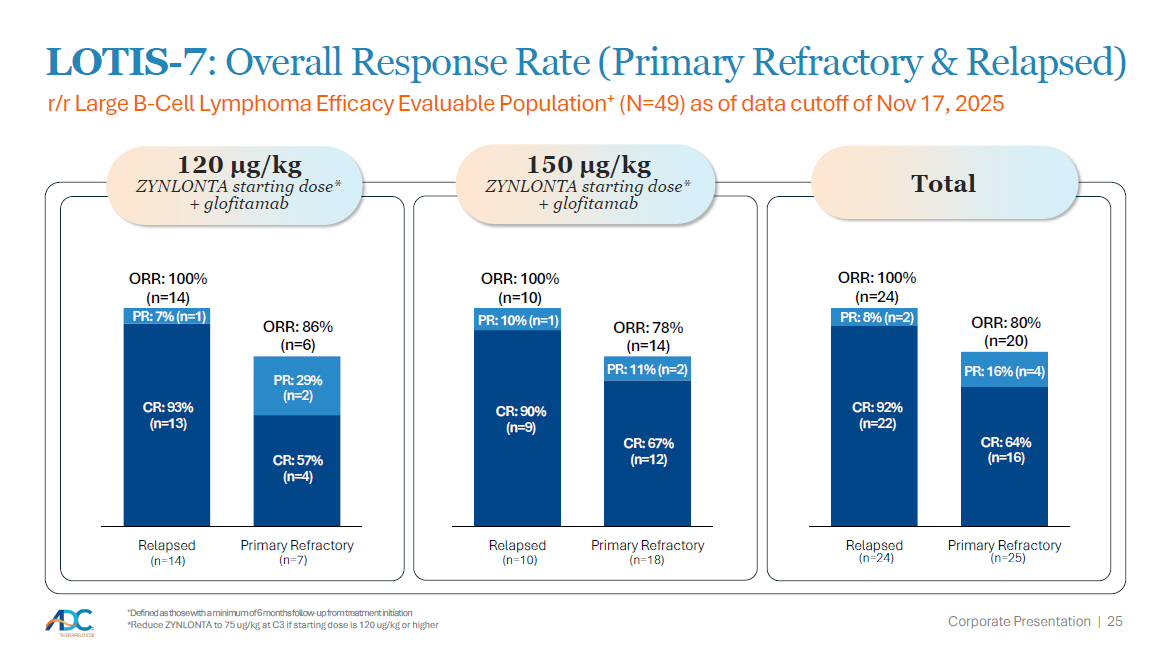
LOTIS - 7 : Overall Response Rate (Primary Refractory & Relapsed) r/r Large B - Cell Lymphoma Efficacy Evaluable Population + (N=49) as of data cutoff of Nov 17, 2025 PR: 7% (n=1) ORR: 100% (n=14) CR: 93% (n=13) PR: 29% (n=2) ORR: 86% (n=6) CR: 57% (n=4) PR: 10% (n=1) ORR: 100% (n=10) CR: 90% (n=9) PR: 11% (n=2) ORR: 78% (n=14) CR: 67% (n=12) PR: 8% (n=2) ORR: 100% (n=24) CR: 92% (n=22) PR: 16% (n=4) ORR: 80% (n=20) CR: 64% (n=16) Relapsed (n=14) Primary Refractory (n=7) Relapsed (n=10) Primary Refractory (n=18) Relapsed (n=24) Primary Refractory (n=25) 120 µg/kg ZYNLONTA starting dose* + glofitamab 150 µg/kg ZYNLONTA starting dose* + glofitamab Total + Definedasthosewithaminimumof6monthsfollow - upfromtreatmentinitiation *Reduce ZYNLONTA to 75 ug/kg at C3 if starting dose is 120 ug/kg or higher Corporate Presentation | 25
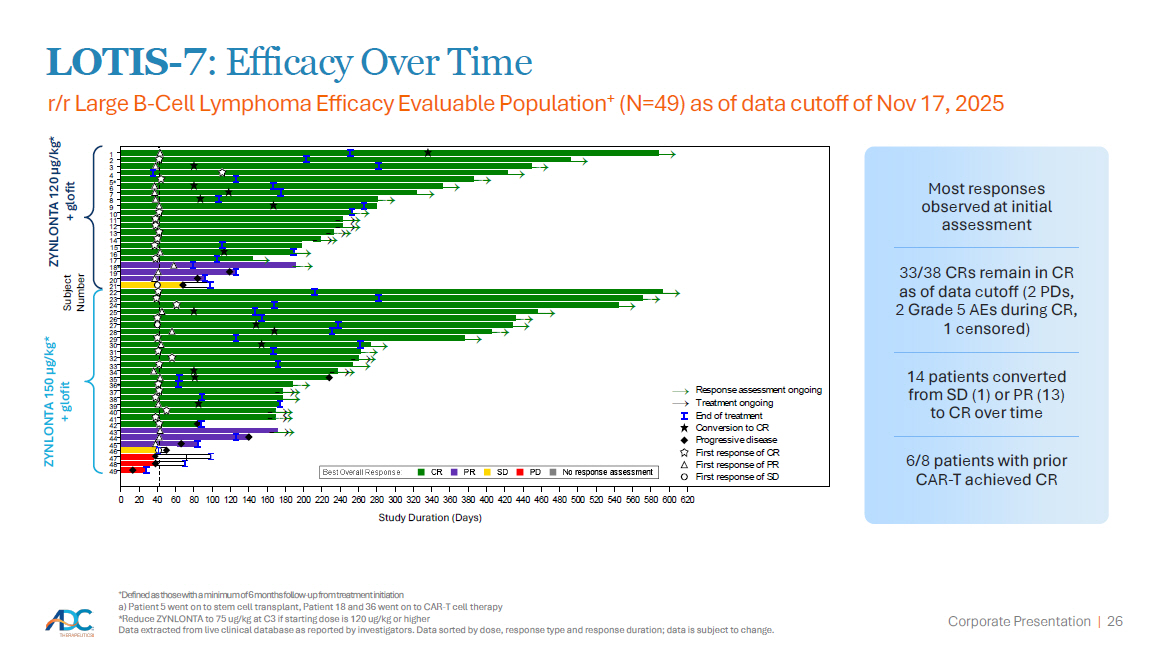
Corporate Presentation | 26 LOTIS - 7 : Efficacy Over Time → → → → → → → → → → → → → → → → → → → → → → → → → → → → → →→ →→ →→ → → → → → → → →→ → →→ → → → → → → → → → → → → → → → →→ →→ →→ →→ → → → → → → → → → → → → First scheduled assessment at 6 weeks → Response assessment ongoing → Treatment ongoing End of treatment Conversion to CR Progressive disease First response of CR First response of PR First response of SD 21 20 6 Subject Number ZYNLONTA 120 µg/kg* + glofit ZYNLONTA 150 µg/kg* + glofit 33 34 35 36 a 5 a 7 8 9 10 11 12 13 14 15 1 22 23 24 25 26 27 28 29 30 31 32 0 20 40 60 80 100 120 140 160 180 200 220 240 260 280 300 320 340 360 380 400 420 440 460 480 500 520 540 560 580 600 620 Study Duration (Days) 2 3 4 16 17 18 a 19 37 38 39 40 41 42 43 44 45 46 47 48 49 Most responses observed at initial assessment 33 / 38 CRs remain in CR as of data cutoff ( 2 PDs, 2 Grade 5 AEs during CR, 1 censored) 14 patients converted from SD (1) or PR (13) to CR over time 6/8 patients with prior CAR - T achieved CR + Definedasthosewithaminimumof6monthsfollow - upfromtreatmentinitiation a) Patient 5 went on to stem cell transplant, Patient 18 and 36 went on to CAR - T cell therapy *Reduce ZYNLONTA to 75 ug/kg at C3 if starting dose is 120 ug/kg or higher Data extracted from live clinical database as reported by investigators. Data sorted by dose, response type and response duration; data is subject to change. r/r Large B - Cell Lymphoma Efficacy Evaluable Population + (N=49) as of data cutoff of Nov 17, 2025
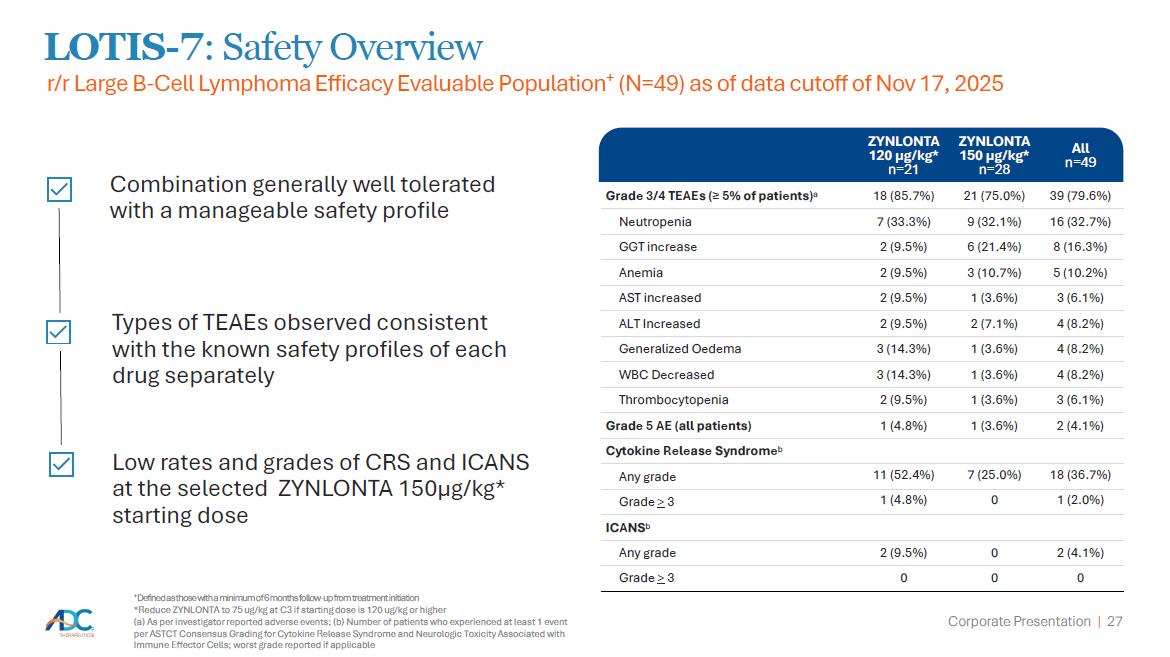
Corporate Presentation | 27 LOTIS - 7 : Safety Overview r/r Large B - Cell Lymphoma Efficacy Evaluable Population + (N=49) as of data cutoff of Nov 17, 2025 Combination generally well tolerated with a manageable safety profile Types of TEAEs observed consistent with the known safety profiles of each drug separately Low rates and grades of CRS and ICANS at the selected ZYNLONTA 150µg/kg* starting dose + Definedasthosewithaminimumof6monthsfollow - upfromtreatmentinitiation *Reduce ZYNLONTA to 75 ug/kg at C3 if starting dose is 120 ug/kg or higher (a) As per investigator reported adverse events ; (b) Number of patients who experienced at least 1 event per ASTCT Consensus Grading for Cytokine Release Syndrome and Neurologic Toxicity Associated with Immune Effector Cells ; worst grade reported if applicable All n=49 ZYNLONTA 150 µg/kg* n=28 ZYNLONTA 120 µg/kg* n=21 39 (79.6%) 21 (75.0%) 18 (85.7%) Grade 3/4 TEAEs (≥ 5% of patients) a 16 (32.7%) 9 (32.1%) 7 (33.3%) Neutropenia 8 (16.3%) 6 (21.4%) 2 (9.5%) GGT increase 5 (10.2%) 3 (10.7%) 2 (9.5%) Anemia 3 (6.1%) 1 (3.6%) 2 (9.5%) AST increased 4 (8.2%) 2 (7.1%) 2 (9.5%) ALT Increased 4 (8.2%) 1 (3.6%) 3 (14.3%) Generalized Oedema 4 (8.2%) 1 (3.6%) 3 (14.3%) WBC Decreased 3 (6.1%) 1 (3.6%) 2 (9.5%) Thrombocytopenia 2 (4.1%) 1 (3.6%) 1 (4.8%) Grade 5 AE (all patients) Cytokine Release Syndrome b 18 (36.7%) 7 (25.0%) 11 (52.4%) Any grade 1 (2.0%) 0 1 (4.8%) Grade > 3 ICANS b 2 (4.1%) 0 2 (9.5%) Any grade 0 0 0 Grade > 3
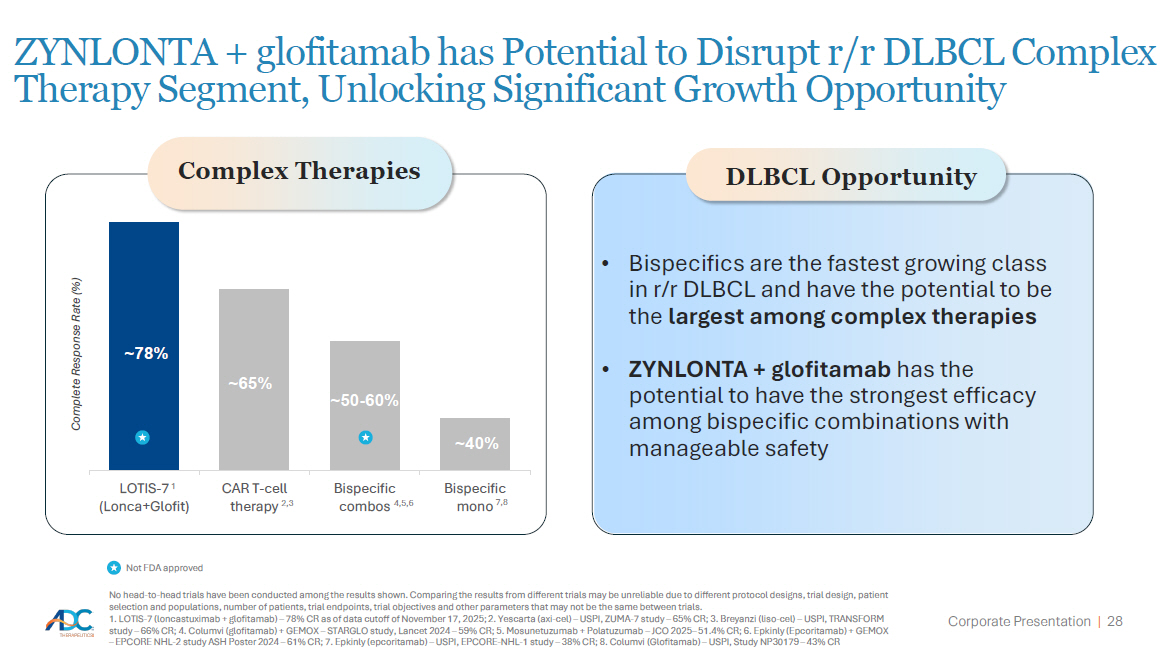
Corporate Presentation | 28 Complete Response Rate (%) • Bispecifics are the fastest growing class in r/r DLBCL and have the potential to be the largest among complex therapies • ZYNLONTA + glofitamab has the potential to have the strongest efficacy among bispecific combinations with manageable safety ZYNLONTA + glofitamab has Potential to Disrupt r/r DLBCL Complex Therapy Segment, Unlocking Significant Growth Opportunity Complex Therapies DLBCL Opportunity Not FDA approved ~78% ~65% ~50 - 60% ~40% LOTIS - 7 1 (Lonca+Glofit) CAR T - cell therapy 2,3 Bispecific combos 4,5,6 Bispecific mono 7,8 No head - to - head trials have been conducted among the results shown. Comparing the results from different trials may be unreliable due to different protocol designs, trial design, patient selection and populations, number of patients, trial endpoints, trial objectives and other parameters that may not be the same between trials. 1. LOTIS - 7 (loncastuximab + glofitamab) – 78% CR as of data cutoff of November 17, 2025; 2. Yescarta (axi - cel) – USPI, ZUMA - 7 study – 65% CR; 3. Breyanzi (liso - cel) – USPI, TRANSFORM study – 66% CR; 4. Columvi (glofitamab) + GEMOX – STARGLO study, Lancet 2024 – 59% CR; 5. Mosunetuzumab + Polatuzumab – JCO 2025 – 51.4% CR; 6. Epkinly (Epcoritamab) + GEMOX – EPCORE NHL - 2 study ASH Poster 2024 – 61% CR; 7. Epkinly (epcoritamab) – USPI, EPCORE - NHL - 1 study – 38% CR; 8. Columvi (Glofitamab) – USPI, Study NP30179 – 43% CR
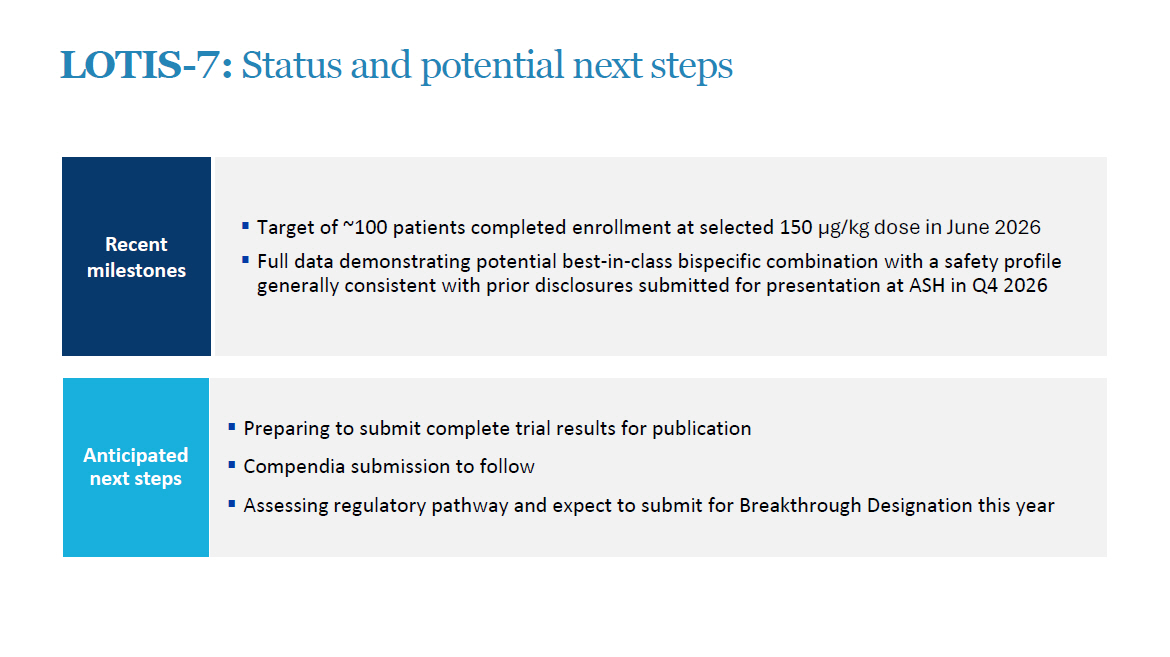
LOTIS - 7: Status and potential next steps ▪ Target of ~100 patients completed enrollment at selected 150 µg/kg dose in June 2026 ▪ Full data demonstrating potential best - in - class bispecific combination with a safety profile generally consistent with prior disclosures submitted for presentation at ASH in Q4 2026 Recent milestones Anticipated next steps ▪ Preparing to submit complete trial results for publication ▪ Compendia submission to follow ▪ Assessing regulatory pathway and expect to submit for Breakthrough Designation this year
Indolent Lymphomas
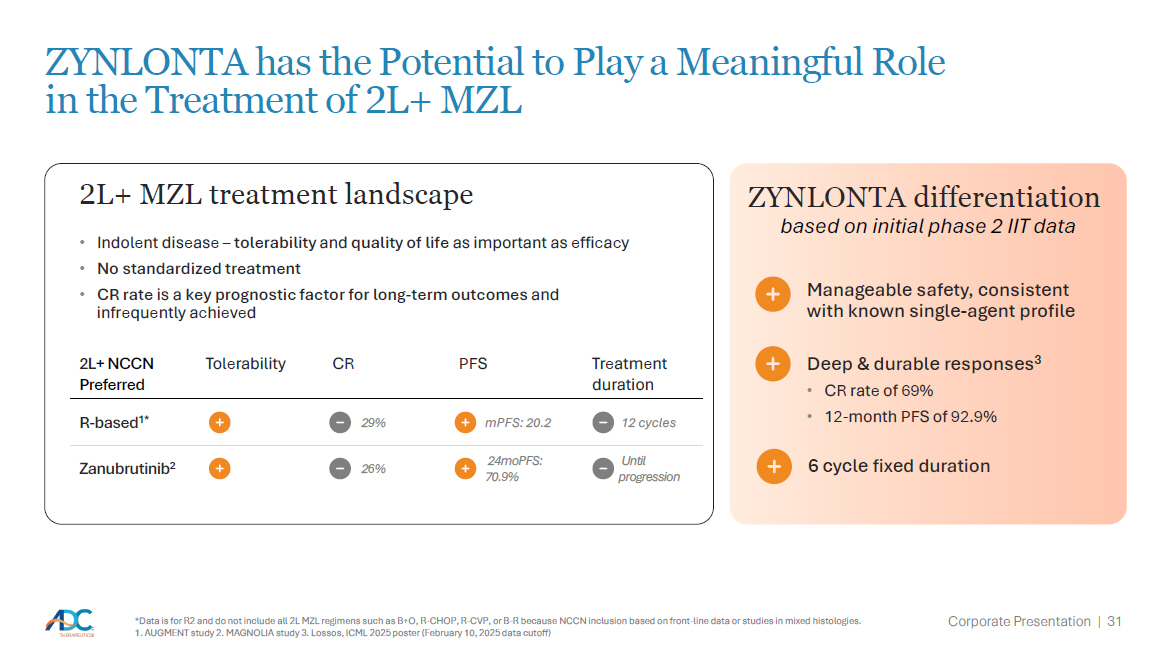
Corporate Presentation | 31 *Data is for R2 and do not include all 2L MZL regimens such as B+O, R - CHOP, R - CVP, or B - R because NCCN inclusion based on front - line data or studies in mixed histologies. 1. AUGMENT study 2. MAGNOLIA study 3. Lossos, ICML 2025 poster (February 10, 2025 data cutoff) 2L+ MZL treatment landscape • Indolent disease – tolerability and quality of life as important as efficacy • No standardized treatment • CR rate is a key prognostic factor for long - term outcomes and infrequently achieved Treatment duration PFS CR Tolerability 2L + NCCN Preferred 12 cycles mPFS: 20.2 29% R - based 1* Until progression 24moPFS: 70.9% 26% Zanubrutinib 2 Manageable safety, consistent with known single - agent profile Deep & durable responses 3 • CR rate of 69% • 12 - month PFS of 92.9% 6 cycle fixed duration ZYNLONTA differentiation based on initial phase 2 IIT data ZYNLONTA has the Potential to Play a Meaningful Role in the Treatment of 2L+ MZL
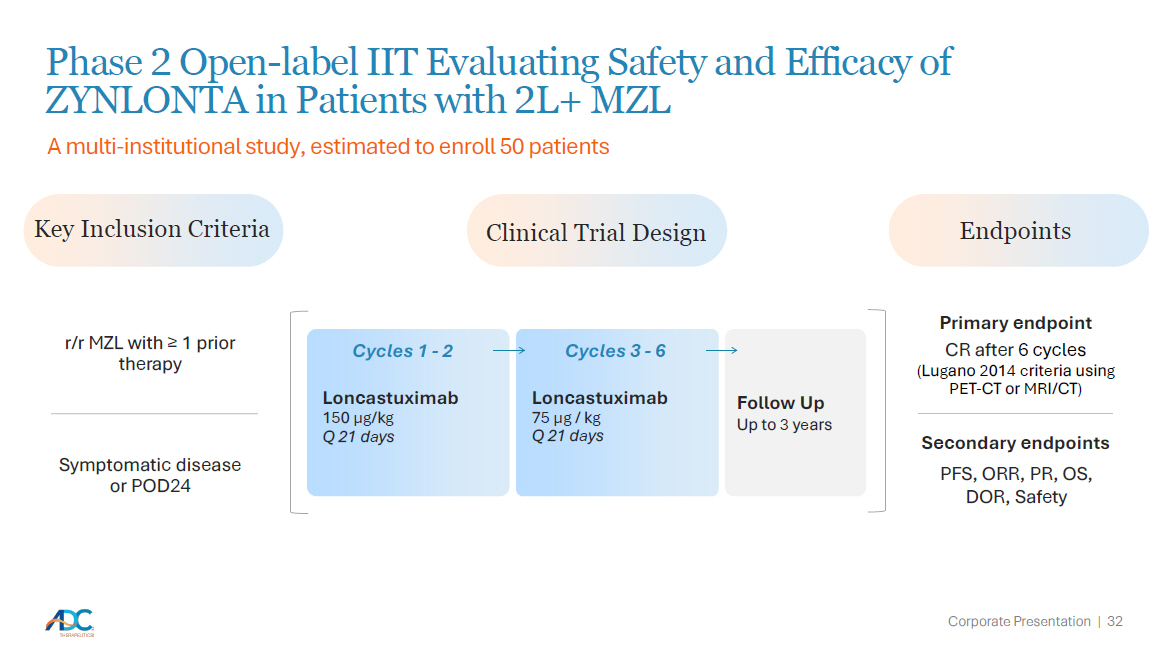
Corporate Presentation | 32 Phase 2 Open - label IIT Evaluating Safety and Efficacy of ZYNLONTA in Patients with 2L+ MZL A multi - institutional study, estimated to enroll 50 patients Primary endpoint CR after 6 cycles (Lugano 2014 criteria using PET - CT or MRI/CT) Secondary endpoints PFS, ORR, PR, OS, DOR, Safety Follow Up Up to 3 years Loncastuximab 150 µg/kg Q 21 days Cycles 1 - 2 Key Inclusion Criteria Clinical Trial Design Endpoints r/r MZL with ≥ 1 prior therapy Symptomatic disease or POD24 Loncastuximab 75 μg / kg Q 21 days Cycles 3 - 6
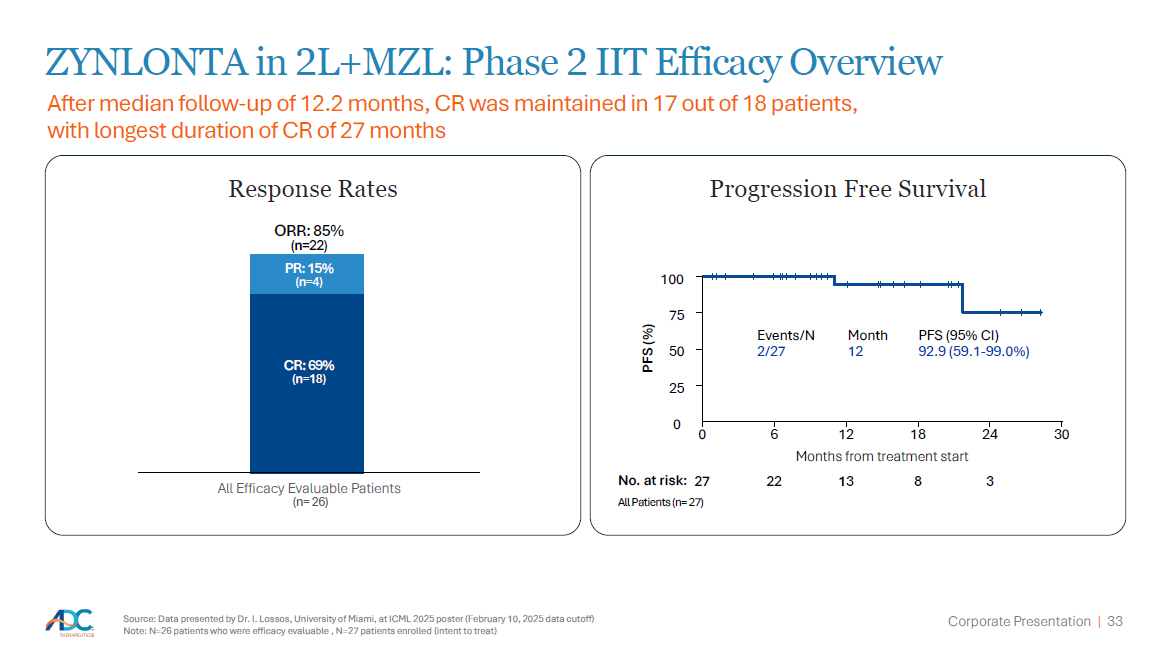
Corporate Presentation | 33 ZYNLONTA in 2L+MZL: Phase 2 IIT Efficacy Overview After median follow - up of 12.2 months, CR was maintained in 17 out of 18 patients, with longest duration of CR of 27 months Progression Free Survival Source: Data presented by Dr. I. Lossos, University of Miami, at ICML 2025 poster (February 10, 2025 data cutoff) Note: N=26 patients who were efficacy evaluable , N=27 patients enrolled (intent to treat) 0 6 24 30 0 25 50 75 100 PFS (%) 22 12 18 Months from treatment start 13 8 3 Events/N 2/27 Month PFS (95% CI) 12 92.9 (59.1 - 99.0%) No. at risk: 27 All Patients (n= 27) All Efficacy Evaluable Patients (n= 26) PR: 15% (n=4) Response Rates ORR: 85% (n=22) CR: 69% (n=18)
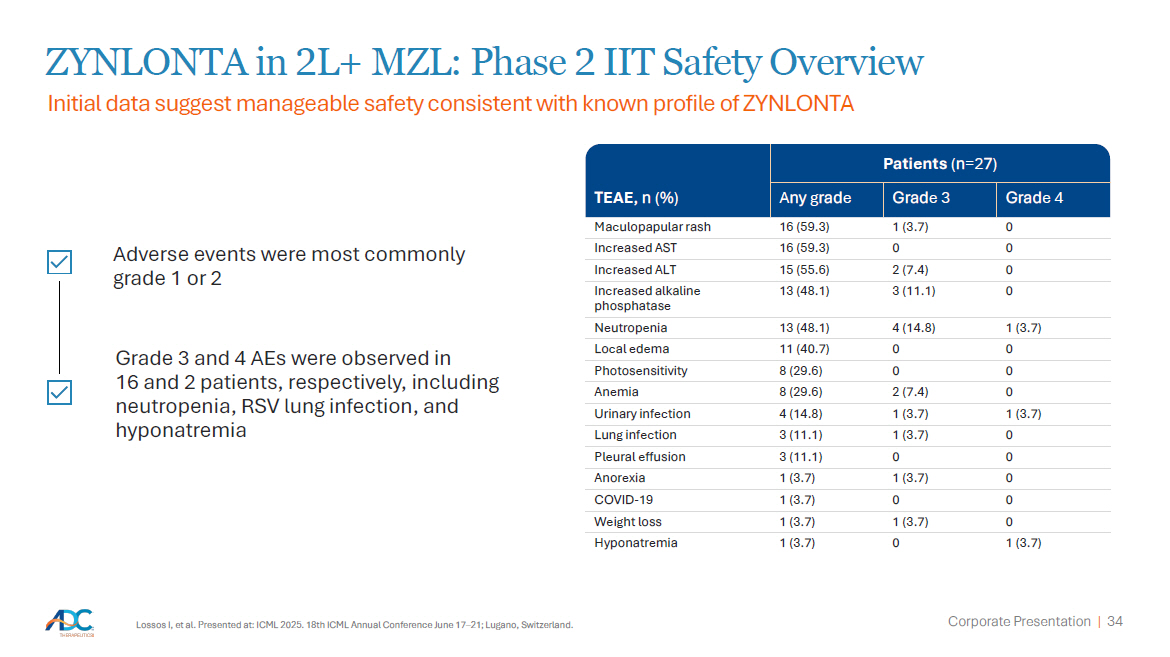
Corporate Presentation | 34 ZYNLONTA in 2L+ MZL: Phase 2 IIT Safety Overview Initial data suggest manageable safety consistent with known profile of ZYNLONTA Adverse events were most commonly grade 1 or 2 Grade 3 and 4 AEs were observed in 16 and 2 patients, respectively, including neutropenia, RSV lung infection, and hyponatremia Lossos I, et al. Presented at: ICML 2025. 18th ICML Annual Conference June 17 – 21; Lugano, Switzerland. Patients (n=27) TEAE , n (%) Grade 4 Grade 3 Any grade 0 1 (3.7) 16 (59.3) Maculopapular rash 0 0 16 (59.3) Increased AST 0 2 (7.4) 15 (55.6) Increased ALT 0 3 (11.1) 13 (48.1) Increased alkaline phosphatase 1 (3.7) 4 (14.8) 13 (48.1) Neutropenia 0 0 11 (40.7) Local edema 0 0 8 (29.6) Photosensitivity 0 2 (7.4) 8 (29.6) Anemia 1 (3.7) 1 (3.7) 4 (14.8) Urinary infection 0 1 (3.7) 3 (11.1) Lung infection 0 0 3 (11.1) Pleural effusion 0 1 (3.7) 1 (3.7) Anorexia 0 0 1 (3.7) COVID - 19 0 1 (3.7) 1 (3.7) Weight loss 1 (3.7) 0 1 (3.7) Hyponatremia
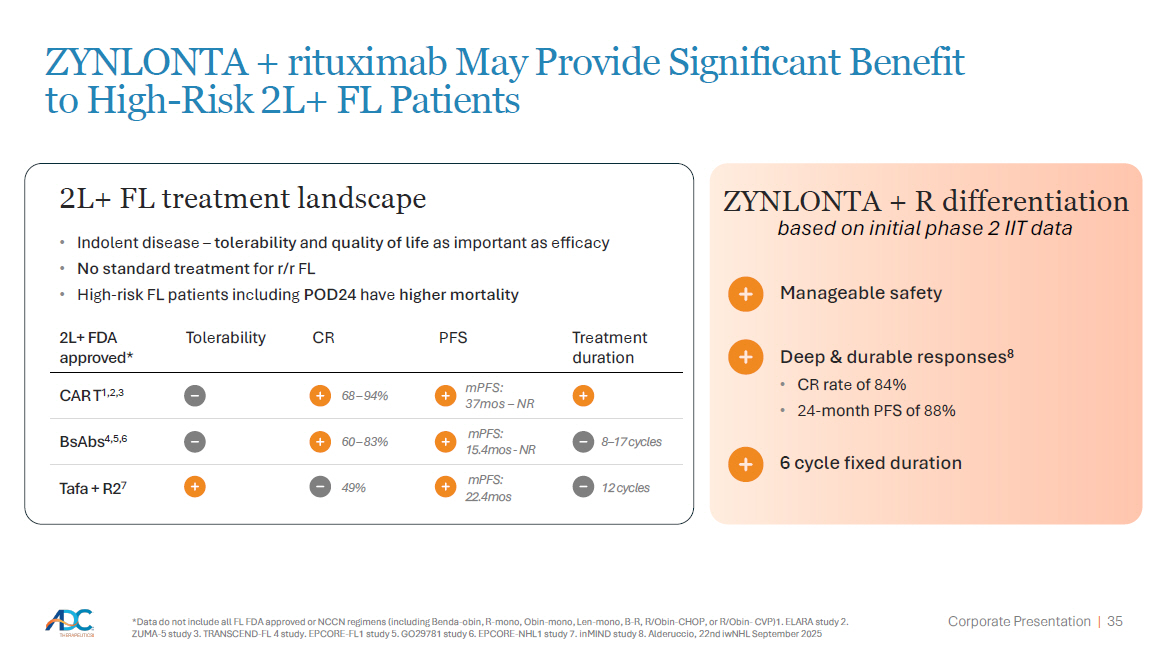
Corporate Presentation | 35 *Data do not include all FL FDA approved or NCCN regimens (including Benda - obin, R - mono, Obin - mono, Len - mono, B - R, R/Obin - CHOP, or R/Obin - CVP)1. ELARA study 2. ZUMA - 5 study 3. TRANSCEND - FL 4 study. EPCORE - FL1 study 5. GO29781 study 6. EPCORE - NHL1 study 7. inMIND study 8. Alderuccio, 22nd iwNHL September 2025 2L+ FL treatment landscape • Indolent disease – tolerability and quality of life as important as efficacy • No standard treatment for r/r FL • High - risk FL patients including POD24 have higher mortality Treatment duration PFS CR Tolerability 2L+ FDA approved* mPFS: 37mos – NR 68 – 94% CAR T 1,2,3 8 – 17 cycles mPFS: 15.4mos - NR 60 – 83% BsAbs 4,5,6 12 cycles mPFS: 22.4mos 49% Tafa + R2 7 Manageable safety Deep & durable responses 8 • CR rate of 84% • 24 - month PFS of 88% 6 cycle fixed duration ZYNLONTA + R differentiation based on initial phase 2 IIT data ZYNLONTA + rituximab May Provide Significant Benefit to High - Risk 2L+ FL Patients
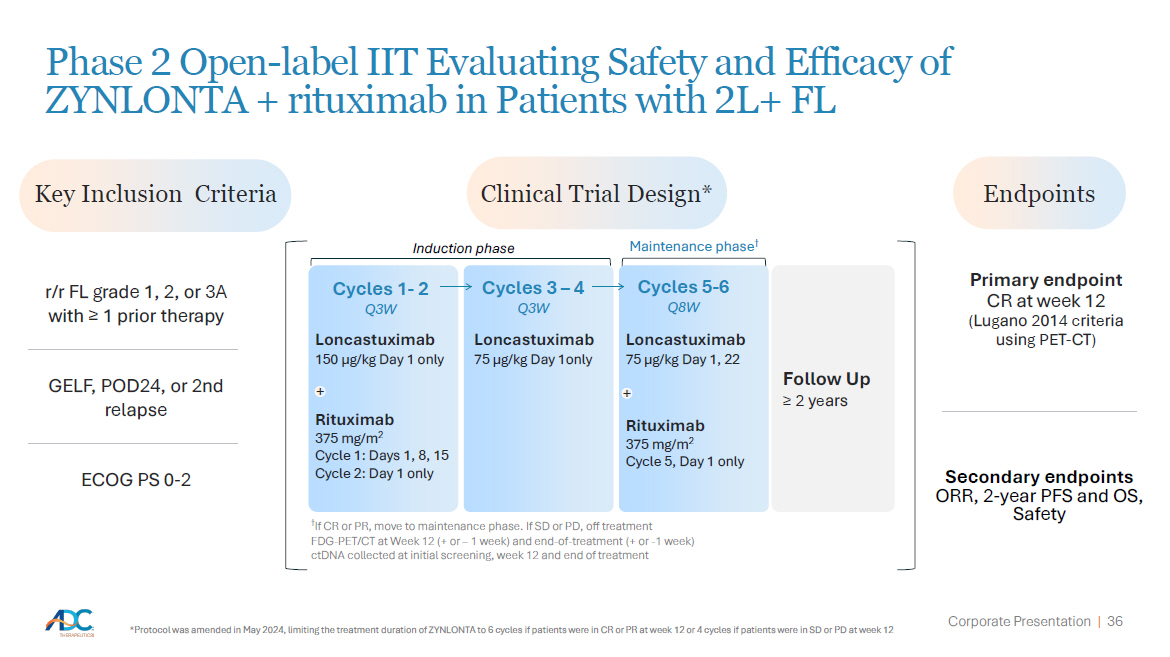
Phase 2 Open - label IIT Evaluating Safety and Efficacy of ZYNLONTA + rituximab in Patients with 2L+ FL Primary endpoint CR at week 12 (Lugano 2014 criteria using PET - CT) Secondary endpoints ORR, 2 - year PFS and OS, Safety Follow Up ≥ 2 years Key Inclusion Criteria Clinical Trial Design* Endpoints r/r FL grade 1, 2, or 3A with ≥ 1 prior therapy GELF, POD24, or 2nd relapse ECOG PS 0 - 2 † If CR or PR, move to maintenance phase. If SD or PD, off treatment FDG - PET/CT at Week 12 (+ or – 1 week) and end - of - treatment (+ or - 1 week) ctDNA collected at initial screening, week 12 and end of treatment Cycles 1 - 2 Q3W Cycles 3 – 4 Q3W Loncastuximab 75 μg/kg Day 1only Induction phase Maintenance phase † Cycles 5 - 6 Q8W Loncastuximab 75 μg/kg Day 1, 22 Loncastuximab 150 µg/kg Day 1 only + Rituximab 375 mg/m 2 Cycle 1: Days 1, 8, 15 Cycle 2: Day 1 only + Rituximab 375 mg/m 2 Cycle 5, Day 1 only Corporate Presentation | 36 *Protocol was amended in May 2024, limiting the treatment duration of ZYNLONTA to 6 cycles if patients were in CR or PR at week 12 or 4 cycles if patients were in SD or PD at week 12
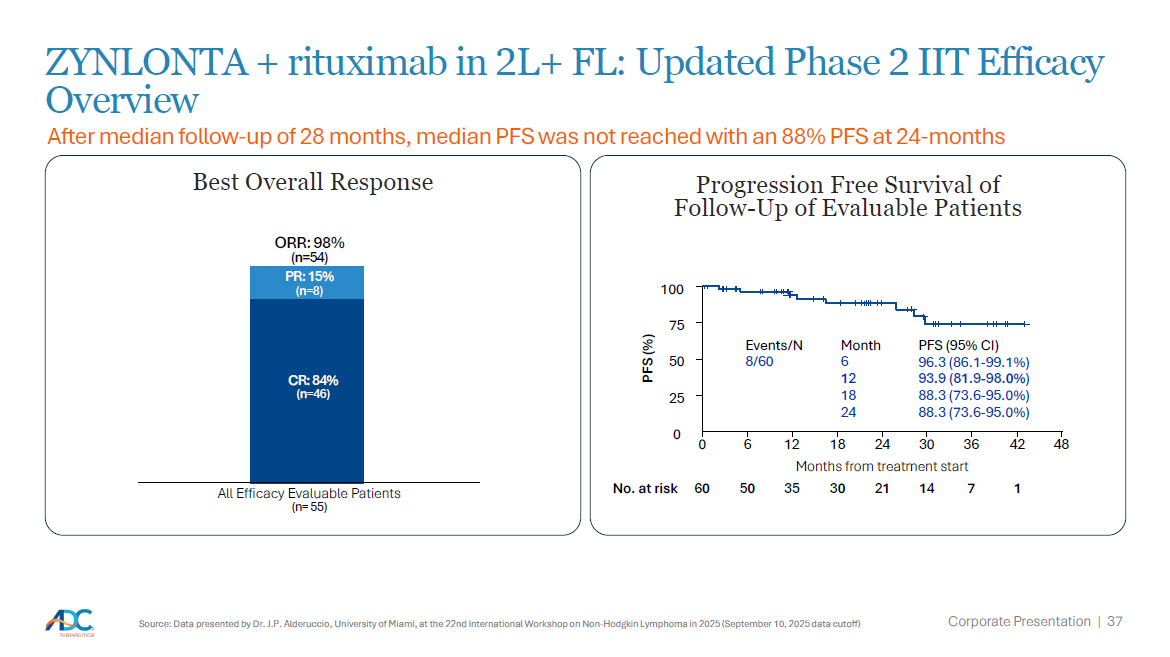
ZYNLONTA + rituximab in 2L+ FL: Updated Phase 2 IIT Efficacy Overview After median follow - up of 28 months, median PFS was not reached with an 88% PFS at 24 - months Best Overall Response Progression Free Survival of Follow - Up of Evaluable Patients 0 6 0 25 50 75 100 PFS (%) No. at risk 12 18 24 30 36 42 48 Months from treatment start 60 50 35 30 21 14 7 1 Events/N 8/60 Month 6 12 18 24 PFS (95% CI) 96.3 (86.1 - 99.1%) 93.9 (81.9 - 98.0%) 88.3 (73.6 - 95.0%) 88.3 (73.6 - 95.0%) All Efficacy Evaluable Patients (n= 55) Corporate Presentation | 37 Source: Data presented by Dr. J.P. Alderuccio, University of Miami, at the 22nd International Workshop on Non - Hodgkin Lymphoma in 2025 (September 10, 2025 data cutoff) PR: 15% (n=8) ORR: 98% (n=54) CR: 84% (n=46)
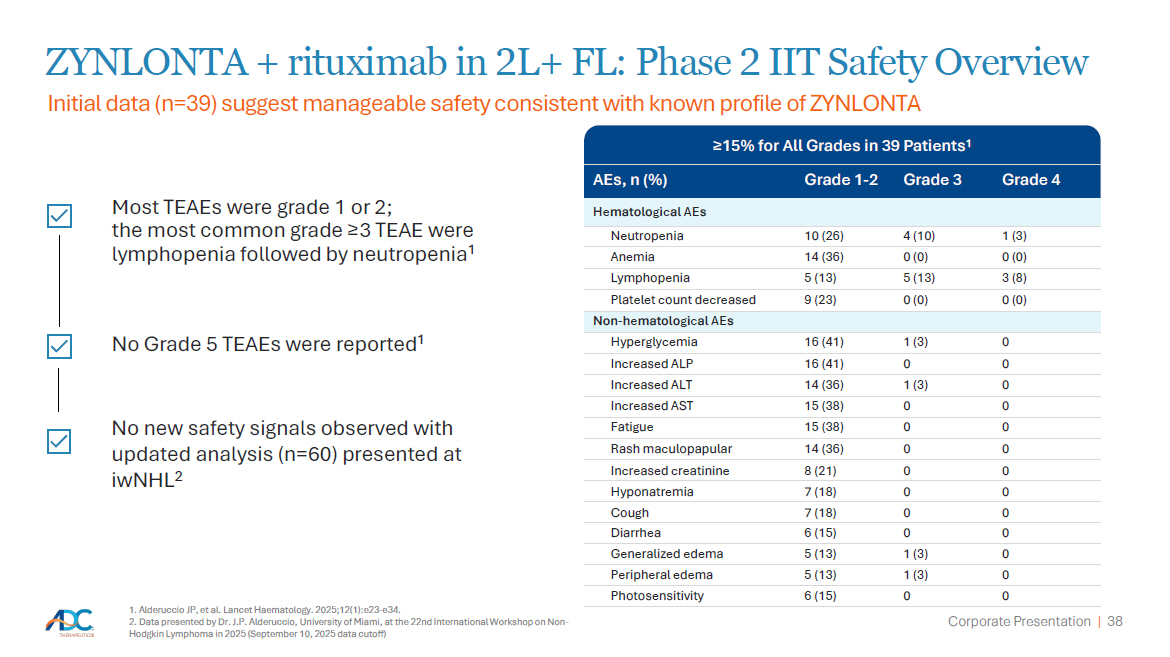
Corporate Presentation | 38 ZYNLONTA + rituximab in 2L+ FL: Phase 2 IIT Safety Overview Initial data (n=39) suggest manageable safety consistent with known profile of ZYNLONTA Most TEAEs were grade 1 or 2; the most common grade ≥3 TEAE were lymphopenia followed by neutropenia 1 No Grade 5 TEAEs were reported 1 No new safety signals observed with updated analysis (n=60) presented at iwNHL 2 1. Alderuccio JP, et al. Lancet Haematology. 2025;12(1):e23 - e34. 2. Data presented by Dr. J.P. Alderuccio, University of Miami, at the 22nd International Workshop on Non - Hodgkin Lymphoma in 2025 (September 10, 2025 data cutoff) ≥15% for All Grades in 39 Patients 1 Grade 4 Grade 3 Grade 1 - 2 AEs, n (%) Hematological AEs 1 (3) 4 (10) 10 (26) Neutropenia 0 (0) 0 (0) 14 (36) Anemia 3 (8) 5 (13) 5 (13) Lymphopenia 0 (0) 0 (0) 9 (23) Platelet count decreased Non - hematological AEs 0 1 (3) 16 (41) Hyperglycemia 0 0 16 (41) Increased ALP 0 1 (3) 14 (36) Increased ALT 0 0 15 (38) Increased AST 0 0 15 (38) Fatigue 0 0 14 (36) Rash maculopapular 0 0 8 (21) Increased creatinine 0 0 7 (18) Hyponatremia 0 0 7 (18) Cough 0 0 6 (15) Diarrhea 0 1 (3) 5 (13) Generalized edema 0 1 (3) 5 (13) Peripheral edema 0 0 6 (15) Photosensitivity

Backup slides
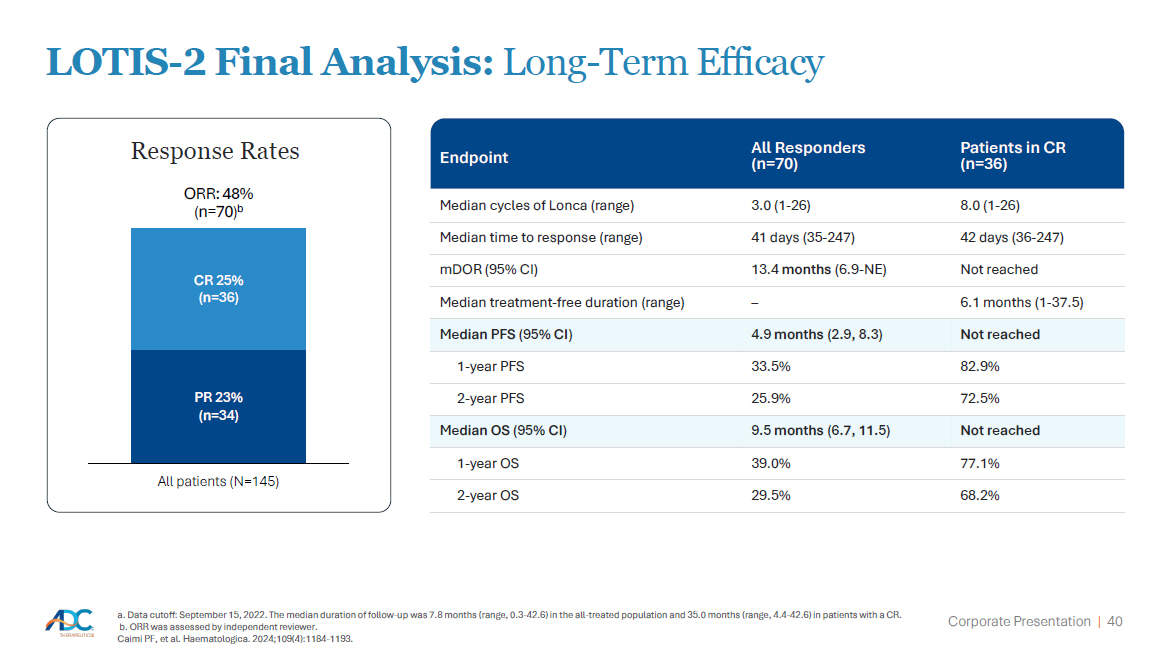
Corporate Presentation | 40 LOTIS - 2 Final Analysis: Long - Term Efficacy a. Data cutoff: September 15, 2022. The median duration of follow - up was 7.8 months (range, 0.3 - 42.6) in the all - treated population and 35.0 months (range, 4.4 - 42.6) in patients with a CR. b. ORR was assessed by independent reviewer. Caimi PF, et al. Haematologica. 2024;109(4):1184 - 1193. PR 23% (n=34) CR 25% (n=36) All patients (N=145) Response Rates ORR: 48% (n=70) b Patients in CR (n=36) All Responders (n=70) Endpoint 8.0 (1 - 26) 3.0 (1 - 26) Median cycles of Lonca (range) 42 days (36 - 247) 41 days (35 - 247) Median time to response (range) Not reached 13.4 months (6.9 - NE) mDOR (95% CI) 6.1 months (1 - 37.5) – Median treatment - free duration (range) Not reached 4.9 months (2.9, 8.3) Median PFS (95% CI) 82.9% 33.5% 1 - year PFS 72.5% 25.9% 2 - year PFS Not reached 9.5 months (6.7, 11.5) Median OS (95% CI) 77.1% 39.0% 1 - year OS 68.2% 29.5% 2 - year OS
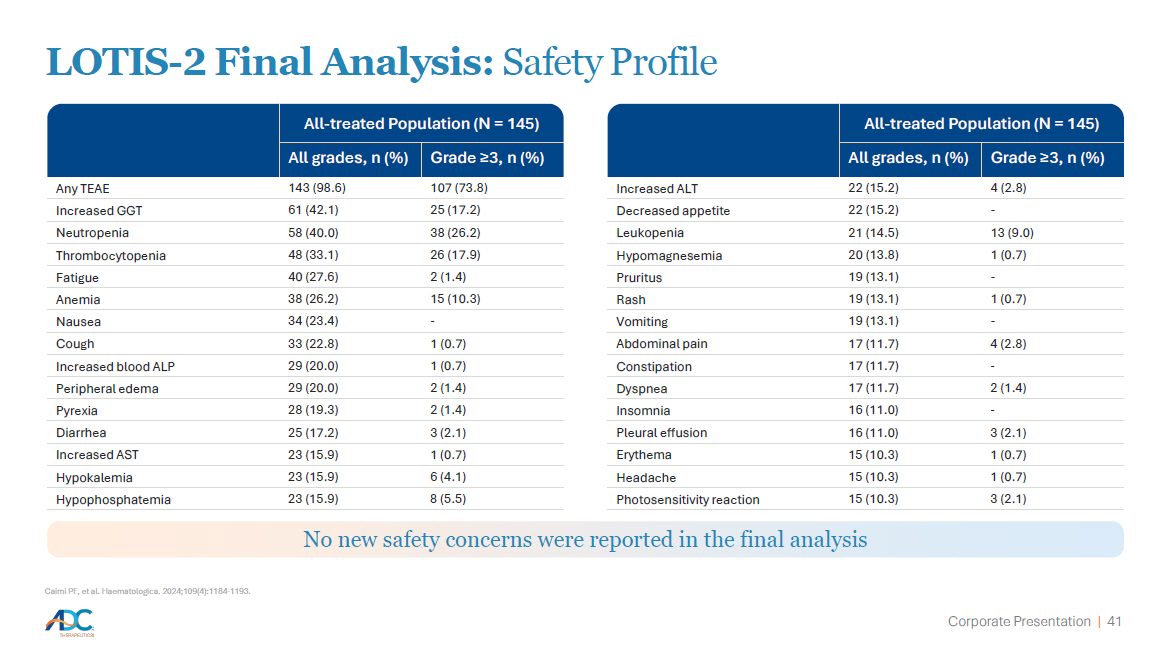
LOTIS - 2 Final Analysis: Safety Profile Caimi PF, et al. Haematologica. 2024;109(4):1184 - 1193. All - treated Population (N = 145) Grade ≥3, n (%) All grades, n (%) 107 (73.8) 143 (98.6) Any TEAE 25 (17.2) 61 (42.1) Increased GGT 38 (26.2) 58 (40.0) Neutropenia 26 (17.9) 48 (33.1) Thrombocytopenia 2 (1.4) 40 (27.6) Fatigue 15 (10.3) 38 (26.2) Anemia - 34 (23.4) Nausea 1 (0.7) 33 (22.8) Cough 1 (0.7) 29 (20.0) Increased blood ALP 2 (1.4) 29 (20.0) Peripheral edema 2 (1.4) 28 (19.3) Pyrexia 3 (2.1) 25 (17.2) Diarrhea 1 (0.7) 23 (15.9) Increased AST 6 (4.1) 23 (15.9) Hypokalemia 8 (5.5) 23 (15.9) Hypophosphatemia All - treated Population (N = 145) Grade ≥3, n (%) All grades, n (%) 4 (2.8) 22 (15.2) Increased ALT - 22 (15.2) Decreased appetite 13 (9.0) 21 (14.5) Leukopenia 1 (0.7) 20 (13.8) Hypomagnesemia - 19 (13.1) Pruritus 1 (0.7) 19 (13.1) Rash - 19 (13.1) Vomiting 4 (2.8) 17 (11.7) Abdominal pain - 17 (11.7) Constipation 2 (1.4) 17 (11.7) Dyspnea - 16 (11.0) Insomnia 3 (2.1) 16 (11.0) Pleural effusion 1 (0.7) 15 (10.3) Erythema 1 (0.7) 15 (10.3) Headache 3 (2.1) 15 (10.3) Photosensitivity reaction No new safety concerns were reported in the final analysis Corporate Presentation | 41
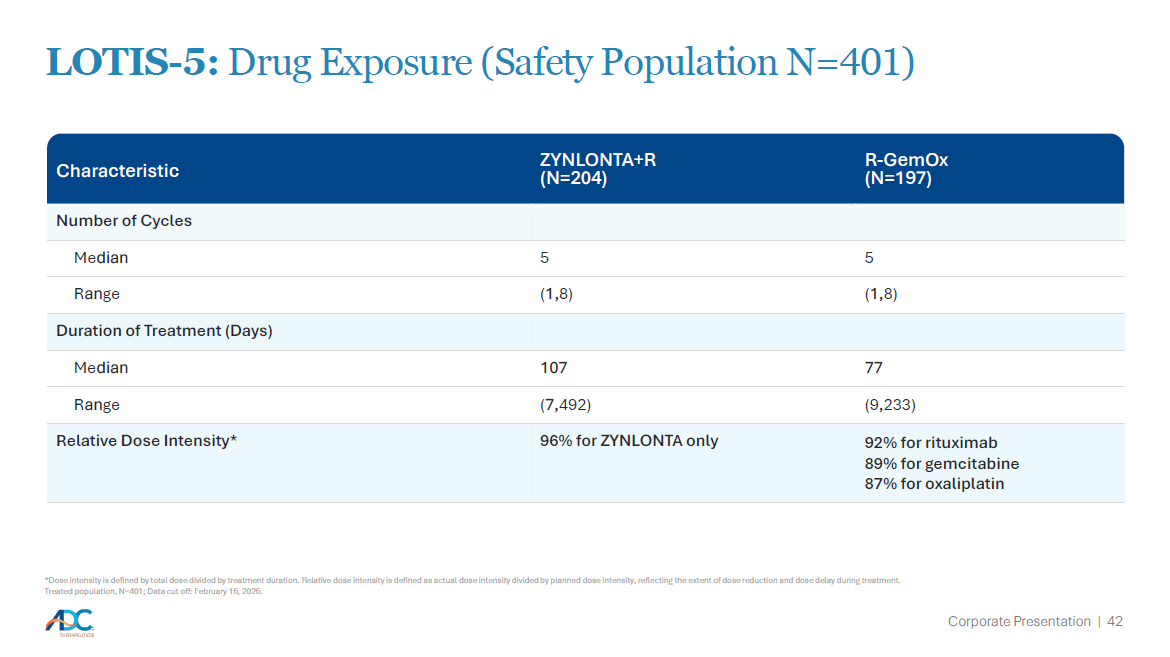
LOTIS - 5: Drug Exposure (Safety Population N=401) *Dose intensity is defined by total dose divided by treatment duration. Relative dose intensity is defined as actual dose intensity divided by planned dose intensity, reflecting the extent of dose reduction and dose delay during treatment. Treated population, N=401; Data cut off: February 16, 2026. R - GemOx (N=197) ZYNLONTA+R (N=204) Characteristic Number of Cycles 5 5 Median (1,8) (1,8) Range Duration of Treatment (Days) 77 107 Median (9,233) (7,492) Range 92% for rituximab 89% for gemcitabine 87% for oxaliplatin 96% for ZYNLONTA only Relative Dose Intensity* Corporate Presentation | 42
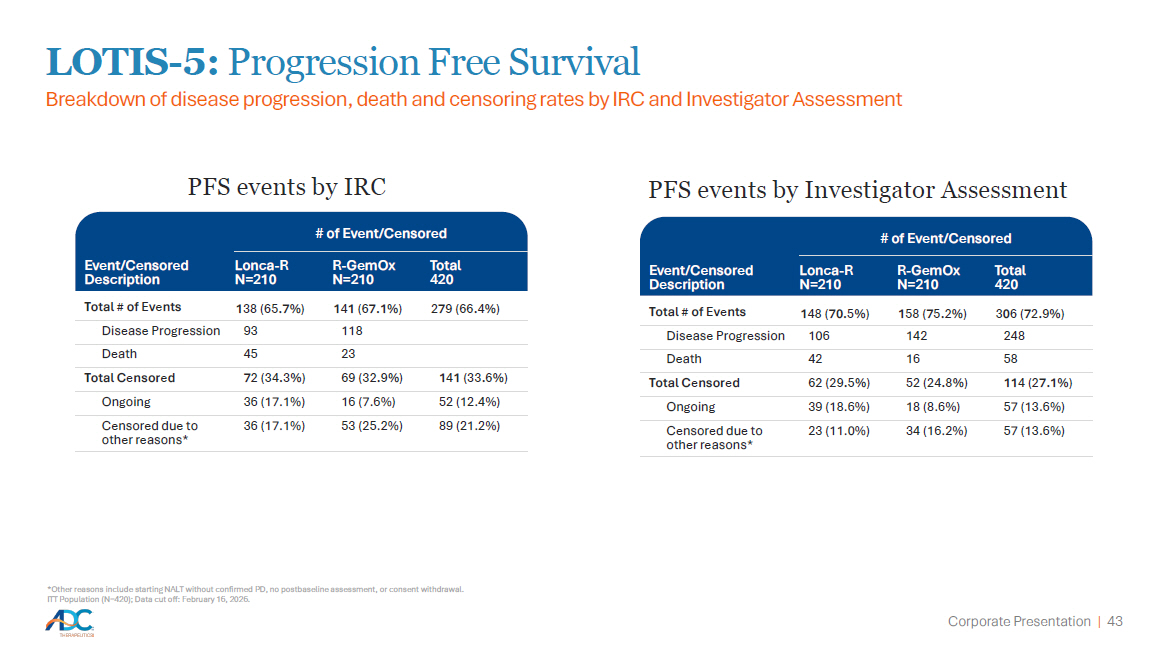
LOTIS - 5: Progression Free Survival Breakdown of disease progression, death and censoring rates by IRC and Investigator Assessment *Other reasons include starting NALT without confirmed PD, no postbaseline assessment, or consent withdrawal. ITT Population (N=420); Data cut off: February 16, 2026. # of Event/Censored Total 420 R - GemOx N=210 Lonca - R N=210 Event/Censored Description 279 (66.4%) 141 (67.1%) 138 (65.7%) Total # of Events 118 93 Disease Progression 23 45 Death 141 (33.6%) 69 (32.9%) 72 (34.3%) Total Censored 52 (12.4%) 16 (7.6%) 36 (17.1%) Ongoing 89 (21.2%) 53 (25.2%) 36 (17.1%) Censored due to other reasons* # of Event/Censored Event/Censored Description Total 420 R - GemOx N=210 Lonca - R N=210 306 (72.9%) 158 (75.2%) 148 (70.5%) Total # of Events 248 142 106 Disease Progression 58 16 42 Death 114 (27.1%) 52 (24.8%) 62 (29.5%) Total Censored 57 (13.6%) 18 (8.6%) 39 (18.6%) Ongoing 57 (13.6%) 34 (16.2%) 23 (11.0%) Censored due to other reasons* Corporate Presentation | 43 PFS events by IRC PFS events by Investigator Assessment
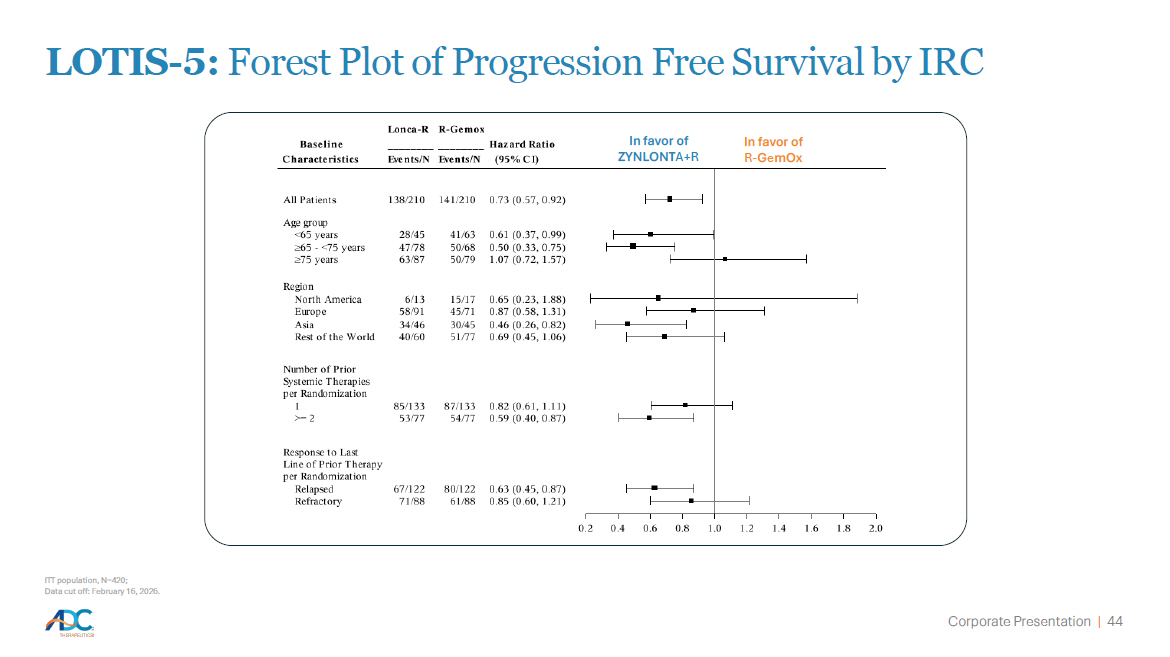
LOTIS - 5: Forest Plot of Progression Free Survival by IRC In favor of ZYNLONTA+R In favor of R - GemOx ITT population, N=420; Data cut off: February 16, 2026. Corporate Presentation | 44
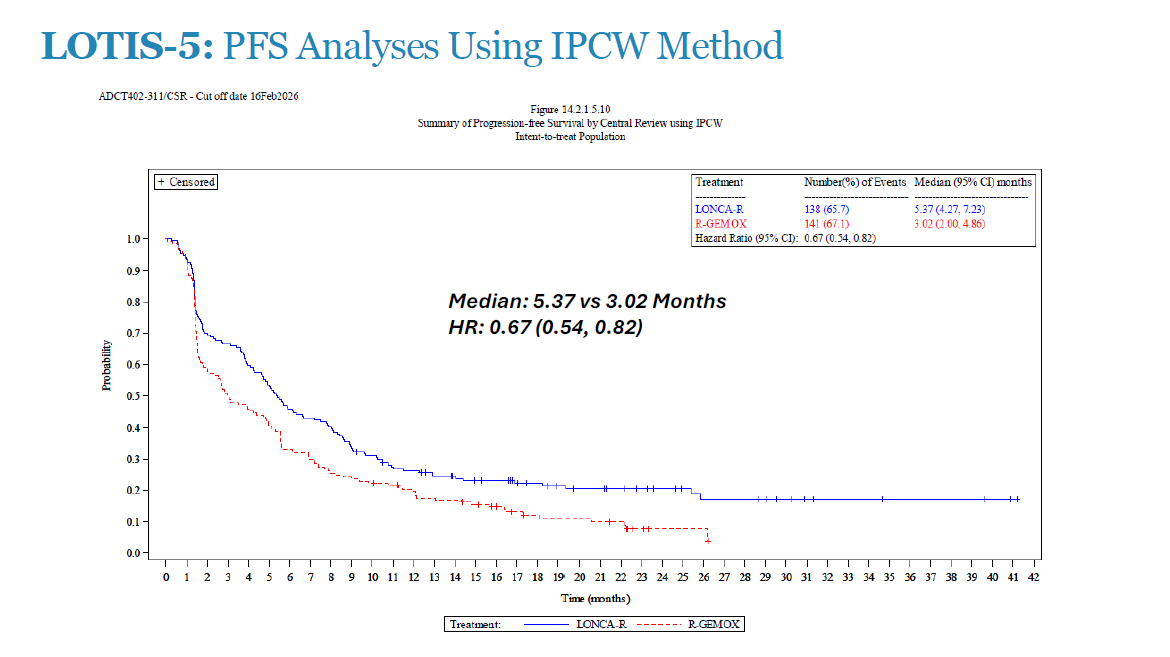
LOTIS - 5: PFS Analyses Using IPCW Method Median: 5.37 vs 3.02 Months HR: 0.67 (0.54, 0.82) Median: 5.37 vs 3.02 Months HR: 0.67 (0.54, 0.82)
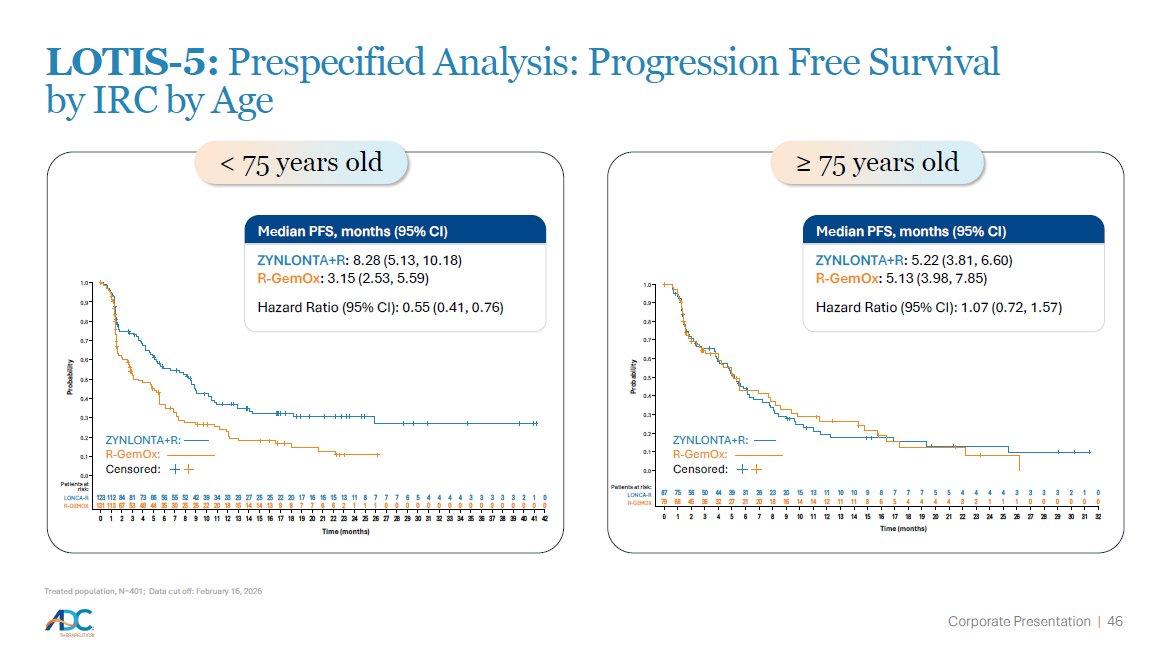
LOTIS - 5: Prespecified Analysis: Progression Free Survival by IRC by Age 0 1 2 3 4 5 6 7 8 9 10 11 12 13 14 15 16 17 18 19 20 21 22 23 24 25 26 27 28 29 30 31 32 33 34 35 36 37 38 39 40 41 42 Time (months) 0.1 0.2 0.3 0.4 0.5 0.6 0.7 0.8 0.9 1.0 Probability At risk : LONCA - R 123 112 84 81 73 66 56 55 52 42 39 34 33 29 27 25 25 22 20 17 16 16 15 13 11 8 7 7 7 6 5 4 4 4 4 3 3 3 3 3 2 1 0 R - GEMOX 131 113 67 53 48 44 35 30 25 25 22 20 18 15 14 14 13 9 8 7 7 6 6 2 1 1 1 0 0 0 0 0 0 0 0 0 0 0 0 0 0 0 0 0.0 Patients at risk: 0.0 0.1 0.2 0.3 0.4 0.5 0.6 0.7 0.8 0.9 1.0 Probability At risk : LONCA - R R - GEMOX 87 75 56 50 44 39 31 26 23 20 15 13 11 10 10 9 8 7 7 7 5 5 4 4 4 4 3 3 3 3 2 1 0 79 68 45 36 32 27 21 20 18 16 14 14 12 11 11 8 6 5 4 4 4 4 3 2 1 1 1 0 0 0 0 0 0 0 1 2 3 4 5 6 7 8 9 10 11 12 13 14 15 16 17 18 19 20 21 22 23 24 25 26 27 28 29 30 31 32 Time (months) Patients at risk: ZYNLONTA+R: R - GemOx: Censored: ZYNLONTA+R : 8.28 (5.13, 10.18) R - GemOx : 3.15 (2.53, 5.59) Hazard Ratio (95% CI): 0.55 (0.41, 0.76) Median PFS, months (95% CI) ZYNLONTA+R: R - GemOx: Censored: ZYNLONTA+R : 5.22 (3.81, 6.60) R - GemOx : 5.13 (3.98, 7.85) Hazard Ratio (95% CI): 1.07 (0.72, 1.57) Median PFS, months (95% CI) < 75 years old ≥ 75 years old Treated population, N=401; Data cut off: February 16, 2026 Corporate Presentation | 46
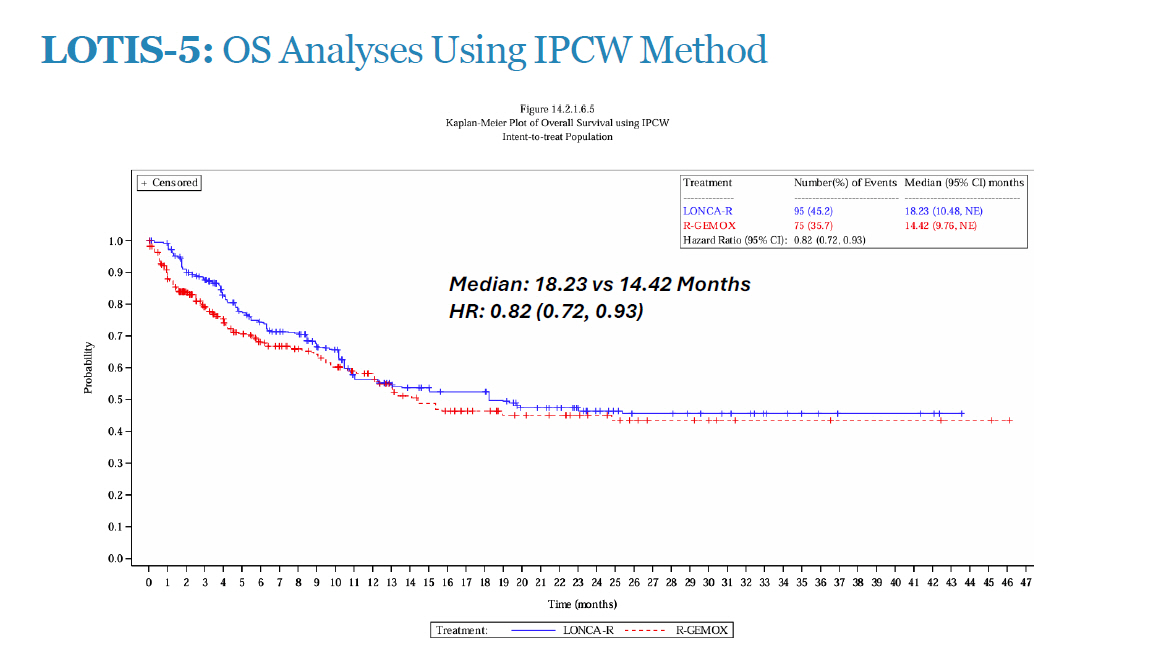
LOTIS - 5: OS Analyses Using IPCW Method Median: 18.23 vs 14.42 Months HR: 0.82 (0.72, 0.93)
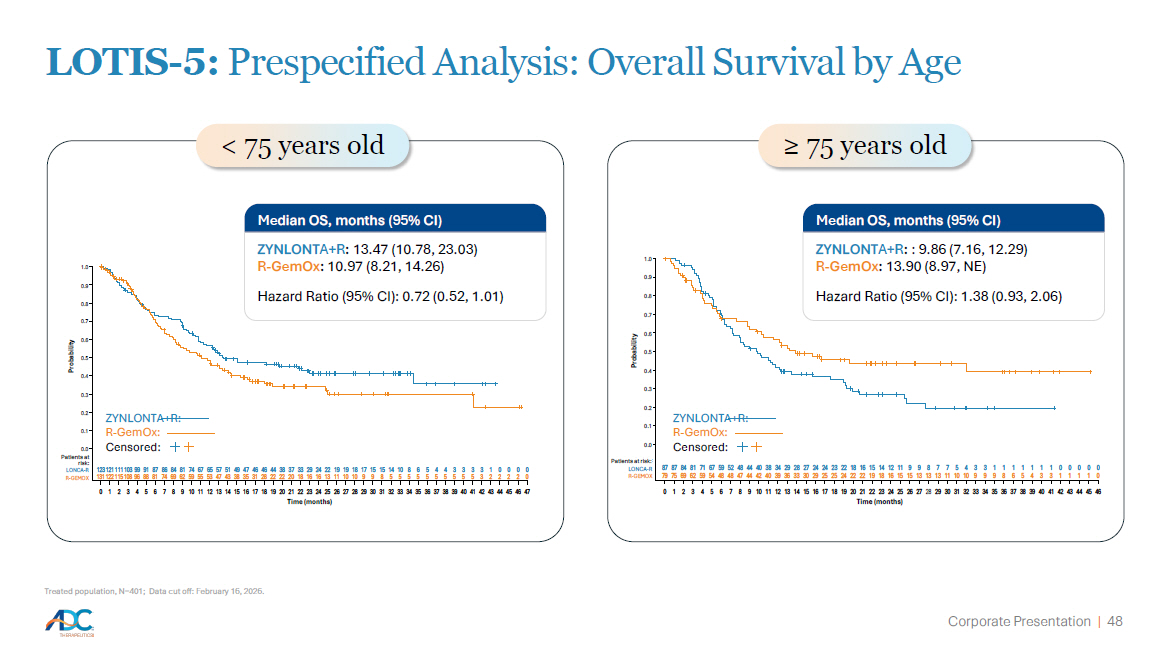
LOTIS - 5: Prespecified Analysis: Overall Survival by Age 0.1 0.2 0.3 0.4 0.5 0.6 0.7 0.8 0.9 1.0 Probability At risk : LONCA - R R - GEMOX 131 122 115 108 96 88 81 74 69 62 59 55 53 47 43 38 35 31 28 22 22 20 18 16 16 13 11 10 10 9 9 8 5 5 5 5 5 5 5 5 5 5 3 2 2 2 2 0 0 1 2 3 4 5 6 7 8 9 10 11 12 13 14 15 16 17 18 19 20 21 22 23 24 25 26 27 28 29 30 31 32 33 34 35 36 37 38 39 40 41 42 43 44 45 46 47 Time (months) Patients at risk: 123 121 111 103 99 91 87 86 84 81 74 67 65 57 51 49 47 46 46 44 38 37 33 29 24 22 19 19 18 17 15 15 14 10 8 6 5 4 4 3 3 3 3 1 0 0 0 0 0.0 0.1 0.2 0.3 0.4 0.5 0.6 0.7 0.8 0.9 1.0 Probability At risk LONCA - R R - GEMOX 87 87 84 81 71 67 59 52 48 44 40 38 34 29 28 27 24 24 23 22 18 16 15 14 12 11 9 9 8 7 7 5 4 3 3 1 1 1 1 1 1 1 0 0 0 0 0 79 75 69 62 59 54 48 48 47 44 42 40 39 36 33 30 29 25 25 24 22 22 19 18 16 15 15 13 13 13 11 10 10 9 9 9 8 6 5 4 3 3 1 1 1 1 0 0 1 2 3 4 5 6 7 8 9 10 11 12 13 14 15 16 17 18 19 20 21 22 23 24 25 26 27 28 29 30 31 32 33 34 35 36 37 38 39 40 41 42 43 44 45 46 Time (months) Patients at risk:: ZYNLONTA+R: R - GemOx: 0.0 Censored: ZYNLONTA+R: R - GemOx: Censored: ZYNLONTA+R : 13.47 (10.78, 23.03) R - GemOx : 10.97 (8.21, 14.26) Hazard Ratio (95% CI): 0.72 (0.52, 1.01) Median OS, months (95% CI) ZYNLONTA+R : : 9.86 (7.16, 12.29) R - GemOx : 13.90 (8.97, NE) Hazard Ratio (95% CI): 1.38 (0.93, 2.06) Median OS, months (95% CI) < 75 years old ≥ 75 years old Treated population, N=401; Data cut off: February 16, 2026. Corporate Presentation | 48
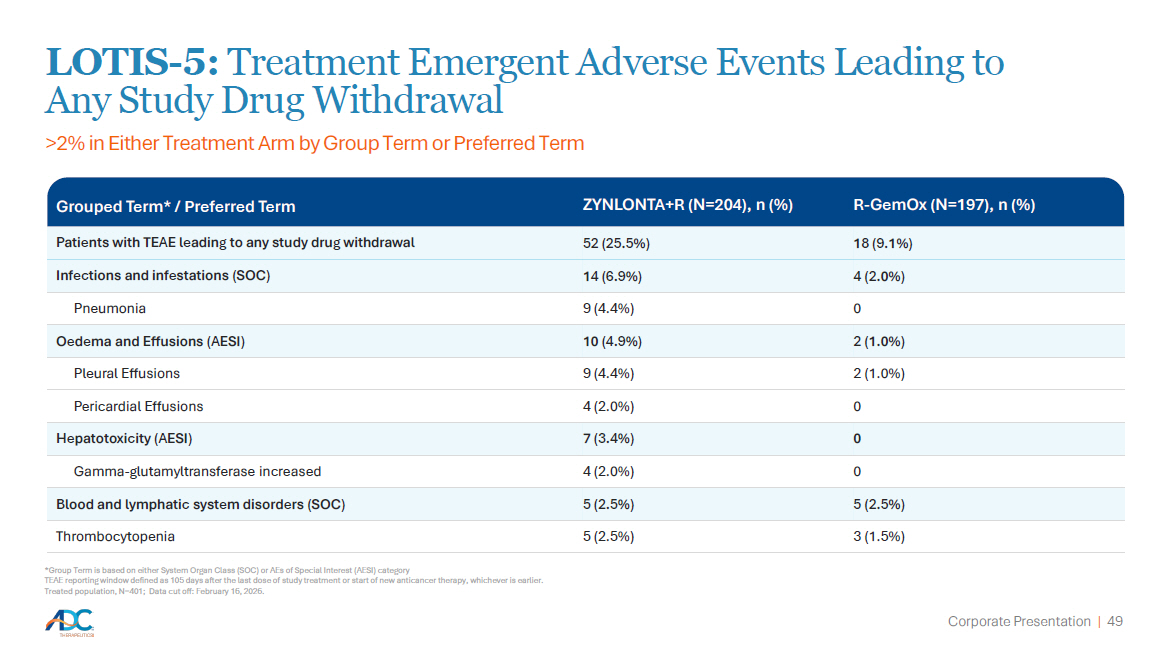
LOTIS - 5: Treatment Emergent Adverse Events Leading to Any Study Drug Withdrawal >2% in Either Treatment Arm by Group Term or Preferred Term R - GemOx (N=197), n (%) ZYNLONTA+R (N=204), n (%) Grouped Term* / Preferred Term 18 (9.1%) 52 (25.5%) Patients with TEAE leading to any study drug withdrawal 4 (2.0%) 14 (6.9%) Infections and infestations (SOC) 0 9 (4.4%) Pneumonia 2 (1.0%) 10 (4.9%) Oedema and Effusions (AESI) 2 (1.0%) 9 (4.4%) Pleural Effusions 0 4 (2.0%) Pericardial Effusions 0 7 (3.4%) Hepatotoxicity (AESI) 0 4 (2.0%) Gamma - glutamyltransferase increased 5 (2.5%) 5 (2.5%) Blood and lymphatic system disorders (SOC) 3 (1.5%) 5 (2.5%) Thrombocytopenia Treated population, N=401; Data cut off: February 16, 2026. Corporate Presentation | 49 *Group Term is based on either System Organ Class (SOC) or AEs of Special Interest (AESI) category TEAE reporting window defined as 105 days after the last dose of study treatment or start of new anticancer therapy, whichever is earlier.
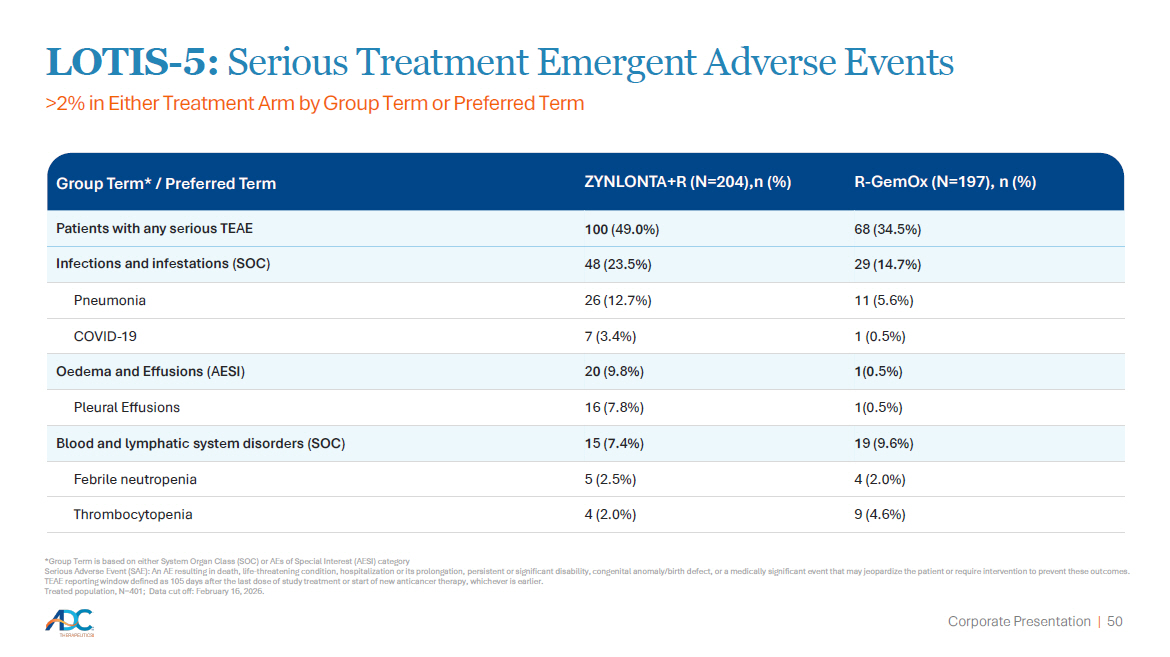
LOTIS - 5: Serious Treatment Emergent Adverse Events >2% in Either Treatment Arm by Group Term or Preferred Term *Group Term is based on either System Organ Class (SOC) or AEs of Special Interest (AESI) category R - GemOx (N=197), n (%) ZYNLONTA+R (N=204),n (%) Group Term* / Preferred Term 68 (34.5%) 100 (49.0%) Patients with any serious TEAE 29 (14.7%) 48 (23.5%) Infections and infestations (SOC) 11 (5.6%) 26 (12.7%) Pneumonia 1 (0.5%) 7 (3.4%) COVID - 19 1(0.5%) 20 (9.8%) Oedema and Effusions (AESI) 1(0.5%) 16 (7.8%) Pleural Effusions 19 (9.6%) 15 (7.4%) Blood and lymphatic system disorders (SOC) 4 (2.0%) 5 (2.5%) Febrile neutropenia 9 (4.6%) 4 (2.0%) Thrombocytopenia Serious Adverse Event (SAE): An AE resulting in death, life - threatening condition, hospitalization or its prolongation, persistent or significant disability, congenital anomaly/birth defect, or a medically significant event that may jeopardize the patient or require intervention to prevent these outcomes. TEAE reporting window defined as 105 days after the last dose of study treatment or start of new anticancer therapy, whichever is earlier. Treated population, N=401; Data cut off: February 16, 2026. Corporate Presentation | 50
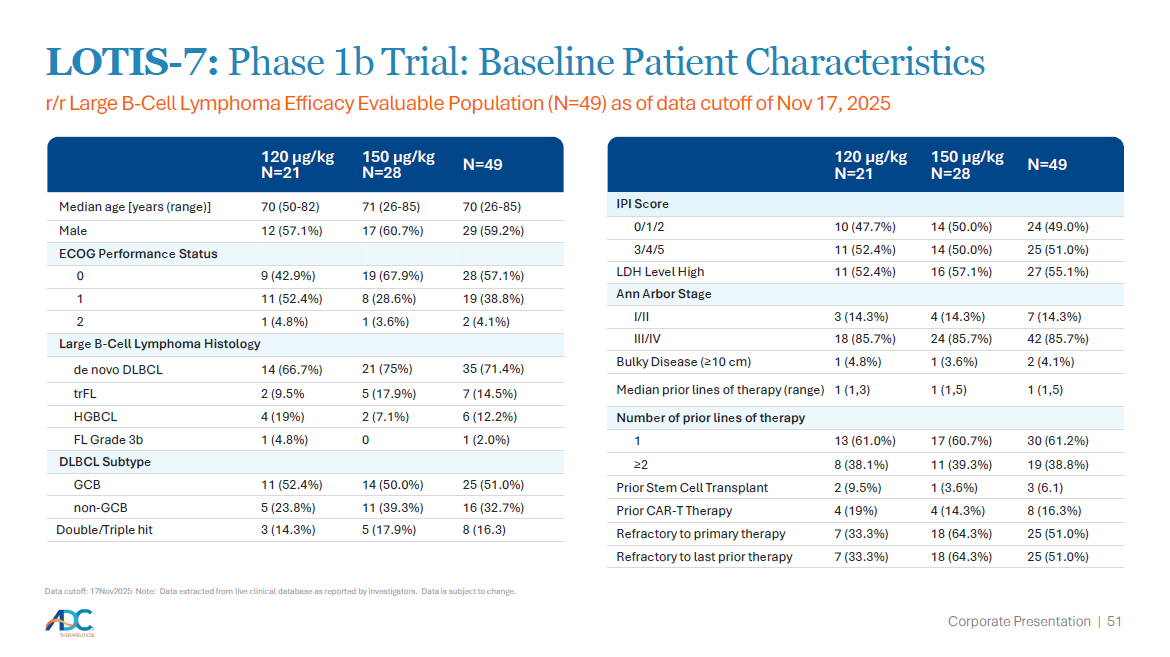
LOTIS - 7: Phase 1b Trial: Baseline Patient Characteristics r/r Large B - Cell Lymphoma Efficacy Evaluable Population (N=49) as of data cutoff of Nov 17, 2025 N=49 150 µg/kg N=28 120 µg/kg N=21 70 (26 - 85) 71 (26 - 85) 70 (50 - 82) Median age [years (range)] 29 (59.2%) 17 (60.7%) 12 (57.1%) Male ECOG Performance Status 28 (57.1%) 19 (67.9%) 9 (42.9%) 0 19 (38.8%) 8 (28.6%) 11 (52.4%) 1 2 (4.1%) 1 (3.6%) 1 (4.8%) 2 Large B - Cell Lymphoma Histology 35 (71.4%) 21 (75%) 14 (66.7%) de novo DLBCL 7 (14.5%) 5 (17.9%) 2 (9.5% trFL 6 (12.2%) 2 (7.1%) 4 (19%) HGBCL 1 (2.0%) 0 1 (4.8%) FL Grade 3b DLBCL Subtype 25 (51.0%) 14 (50.0%) 11 (52.4%) GCB 16 (32.7%) 11 (39.3%) 5 (23.8%) non - GCB 8 (16.3) 5 (17.9%) 3 (14.3%) Double/Triple hit N=49 150 µg/kg N=28 120 µg/kg N=21 IPI Score 24 (49.0%) 14 (50.0%) 10 (47.7%) 0/1/2 25 (51.0%) 14 (50.0%) 11 (52.4%) 3/4/5 27 (55.1%) 16 (57.1%) 11 (52.4%) LDH Level High Ann Arbor Stage 7 (14.3%) 4 (14.3%) 3 (14.3%) I/II 42 (85.7%) 24 (85.7%) 18 (85.7%) III/IV 2 (4.1%) 1 (3.6%) 1 (4.8%) Bulky Disease (≥10 cm) 1 (1,5) 1 (1,5) 1 (1,3) Median prior lines of therapy (range) Number of prior lines of therapy 30 (61.2%) 17 (60.7%) 13 (61.0%) 1 19 (38.8%) 11 (39.3%) 8 (38.1%) ≥2 3 (6.1) 1 (3.6%) 2 (9.5%) Prior Stem Cell Transplant 8 (16.3%) 4 (14.3%) 4 (19%) Prior CAR - T Therapy 25 (51.0%) 18 (64.3%) 7 (33.3%) Refractory to primary therapy 25 (51.0%) 18 (64.3%) 7 (33.3%) Refractory to last prior therapy Data cutoff: 17Nov2025 Note: Data extracted from live clinical database as reported by investigators. Data is subject to change. Corporate Presentation | 51
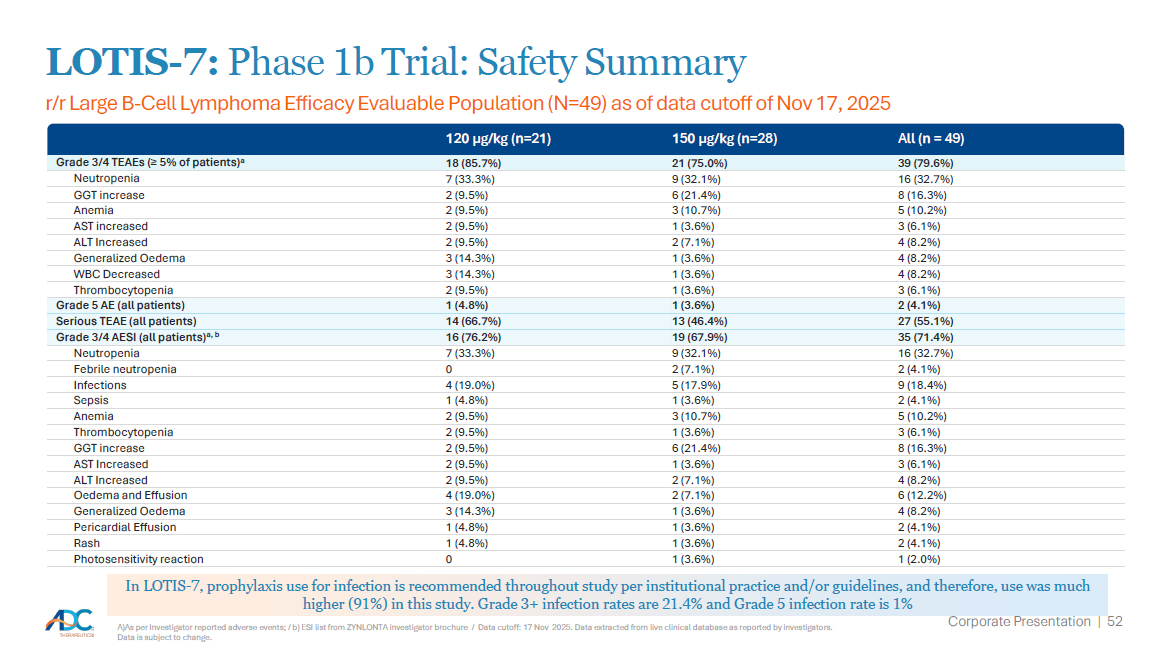
Corporate Presentation | 52 LOTIS - 7: Phase 1b Trial: Safety Summary r/r Large B - Cell Lymphoma Efficacy Evaluable Population (N=49) as of data cutoff of Nov 17, 2025 A)As per Investigator reported adverse events; / b) ESI list from ZYNLONTA investigator brochure / Data cutoff: 17 Nov 2025. Data extracted from live clinical database as reported by investigators. Data is subject to change. All (n = 49) 150 µg/kg (n=28) 120 µg/kg (n=21) 39 (79.6%) 21 (75.0%) 18 (85.7%) Grade 3/4 TEAEs (≥ 5% of patients) a 16 (32.7%) 9 (32.1%) 7 (33.3%) Neutropenia 8 (16.3%) 6 (21.4%) 2 (9.5%) GGT increase 5 (10.2%) 3 (10.7%) 2 (9.5%) Anemia 3 (6.1%) 1 (3.6%) 2 (9.5%) AST increased 4 (8.2%) 2 (7.1%) 2 (9.5%) ALT Increased 4 (8.2%) 1 (3.6%) 3 (14.3%) Generalized Oedema 4 (8.2%) 1 (3.6%) 3 (14.3%) WBC Decreased 3 (6.1%) 1 (3.6%) 2 (9.5%) Thrombocytopenia 2 (4.1%) 1 (3.6%) 1 (4.8%) Grade 5 AE (all patients) 27 (55.1%) 13 (46.4%) 14 (66.7%) Serious TEAE (all patients) 35 (71.4%) 19 (67.9%) 16 (76.2%) Grade 3/4 AESI (all patients) a, b 16 (32.7%) 9 (32.1%) 7 (33.3%) Neutropenia 2 (4.1%) 2 (7.1%) 0 Febrile neutropenia 9 (18.4%) 5 (17.9%) 4 (19.0%) Infections 2 (4.1%) 1 (3.6%) 1 (4.8%) Sepsis 5 (10.2%) 3 (10.7%) 2 (9.5%) Anemia 3 (6.1%) 1 (3.6%) 2 (9.5%) Thrombocytopenia 8 (16.3%) 6 (21.4%) 2 (9.5%) GGT increase 3 (6.1%) 1 (3.6%) 2 (9.5%) AST Increased 4 (8.2%) 2 (7.1%) 2 (9.5%) ALT Increased 6 (12.2%) 2 (7.1%) 4 (19.0%) Oedema and Effusion 4 (8.2%) 1 (3.6%) 3 (14.3%) Generalized Oedema 2 (4.1%) 1 (3.6%) 1 (4.8%) Pericardial Effusion 2 (4.1%) 1 (3.6%) 1 (4.8%) Rash 1 (2.0%) 1 (3.6%) 0 Photosensitivity reaction In LOTIS - 7, prophylaxis use for infection is recommended throughout study per institutional practice and/or guidelines, and therefore, use was much higher (91%) in this study. Grade 3+ infection rates are 21.4% and Grade 5 infection rate is 1%
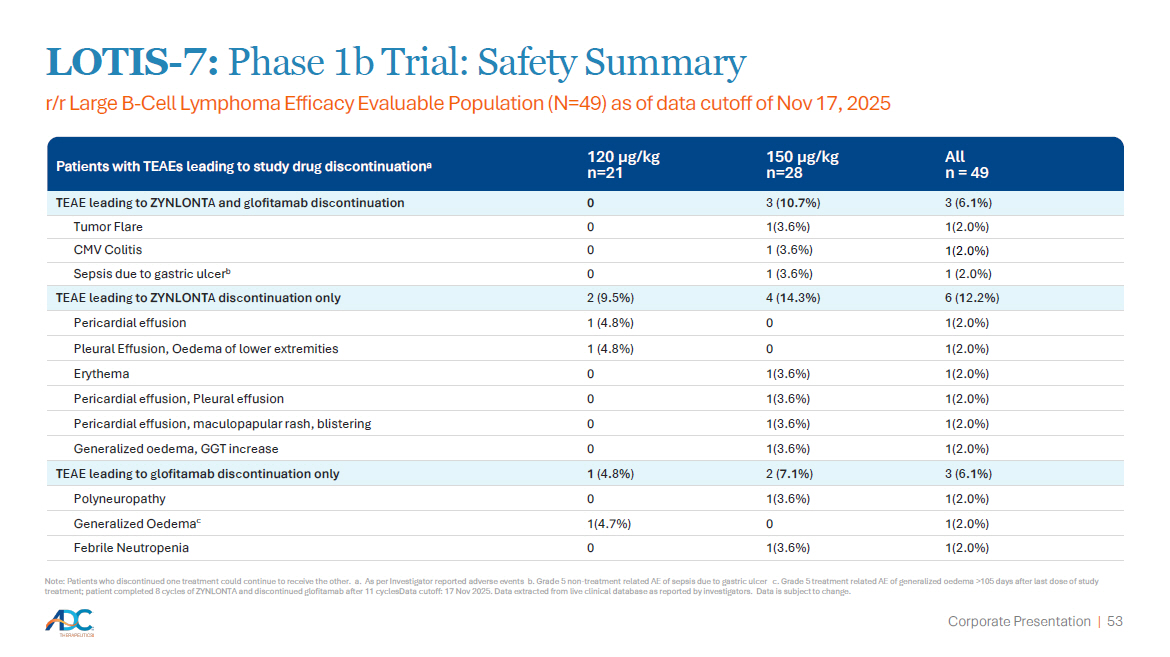
LOTIS - 7: Phase 1b Trial: Safety Summary r/r Large B - Cell Lymphoma Efficacy Evaluable Population (N=49) as of data cutoff of Nov 17, 2025 Note: Patients who discontinued one treatment could continue to receive the other. a. As per Investigator reported adverse events b. Grade 5 non - treatment related AE of sepsis due to gastric ulcer c. Grade 5 treatment related AE of generalized oedema >105 days after last dose of study treatment; patient completed 8 cycles of ZYNLONTA and discontinued glofitamab after 11 cyclesData cutoff: 17 Nov 2025. Data extracted from live clinical database as reported by investigators. Data is subject to change. All n = 49 150 µg/kg n=28 120 µg/kg n=21 Patients with TEAEs leading to study drug discontinuation a 3 (6.1%) 3 (10.7%) 0 TEAE leading to ZYNLONTA and glofitamab discontinuation 1(2.0%) 1(3.6%) 0 Tumor Flare 1(2.0%) 1 (3.6%) 0 CMV Colitis 1 (2.0%) 1 (3.6%) 0 Sepsis due to gastric ulcer b 6 (12.2%) 4 (14.3%) 2 (9.5%) TEAE leading to ZYNLONTA discontinuation only 1(2.0%) 0 1 (4.8%) Pericardial effusion 1(2.0%) 0 1 (4.8%) Pleural Effusion, Oedema of lower extremities 1(2.0%) 1(3.6%) 0 Erythema 1(2.0%) 1(3.6%) 0 Pericardial effusion, Pleural effusion 1(2.0%) 1(3.6%) 0 Pericardial effusion, maculopapular rash, blistering 1(2.0%) 1(3.6%) 0 Generalized oedema, GGT increase 3 (6.1%) 2 (7.1%) 1 (4.8%) TEAE leading to glofitamab discontinuation only 1(2.0%) 1(3.6%) 0 Polyneuropathy 1(2.0%) 0 1(4.7%) Generalized Oedema c 1(2.0%) 1(3.6%) 0 Febrile Neutropenia Corporate Presentation | 53
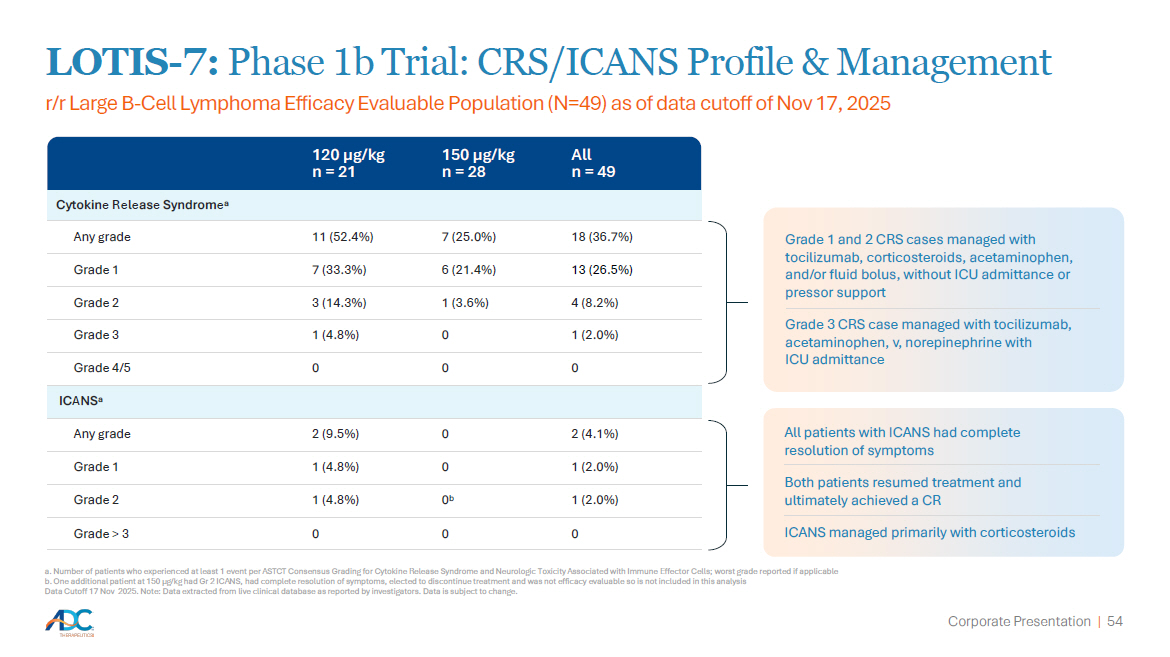
LOTIS - 7: Phase 1b Trial: CRS/ICANS Profile & Management r/r Large B - Cell Lymphoma Efficacy Evaluable Population (N=49) as of data cutoff of Nov 17, 2025 a. Number of patients who experienced at least 1 event per ASTCT Consensus Grading for Cytokine Release Syndrome and Neurologic Toxicity Associated with Immune Effector Cells; worst grade reported if applicable b. One additional patient at 150 µg/kg had Gr 2 ICANS, had complete resolution of symptoms, elected to discontinue treatment and was not efficacy evaluable so is not included in this analysis Data Cutoff 17 Nov 2025. Note: Data extracted from live clinical database as reported by investigators. Data is subject to change. All n = 49 150 µg/kg n = 28 120 µg/kg n = 21 Cytokine Release Syndrome a 18 (36.7%) 7 (25.0%) 11 (52.4%) Any grade 13 (26.5%) 6 (21.4%) 7 (33.3%) Grade 1 4 (8.2%) 1 (3.6%) 3 (14.3%) Grade 2 1 (2.0%) 0 1 (4.8%) Grade 3 0 0 0 Grade 4/5 ICANS a 2 (4.1%) 0 2 (9.5%) Any grade 1 (2.0%) 0 1 (4.8%) Grade 1 1 (2.0%) 0 b 1 (4.8%) Grade 2 0 0 0 Grade > 3 Grade 1 and 2 CRS cases managed with tocilizumab, corticosteroids, acetaminophen, and/or fluid bolus, without ICU admittance or pressor support Grade 3 CRS case managed with tocilizumab, acetaminophen, v, norepinephrine with ICU admittance All patients with ICANS had complete resolution of symptoms Both patients resumed treatment and ultimately achieved a CR ICANS managed primarily with corticosteroids Corporate Presentation | 54
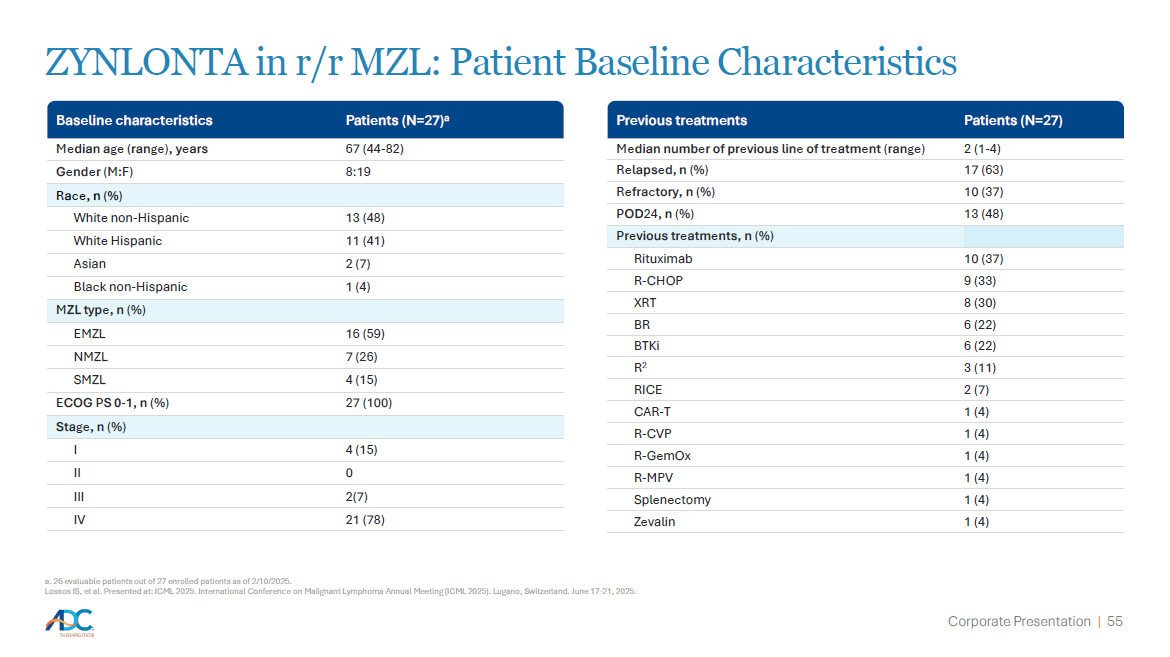
ZYNLONTA in r/r MZL: Patient Baseline Characteristics a. 26 evaluable patients out of 27 enrolled patients as of 2/10/2025. Patients (N=27) a Baseline characteristics 67 (44 - 82) Median age (range), years 8:19 Gender (M:F) Race, n (%) 13 (48) White non - Hispanic 11 (41) White Hispanic 2 (7) Asian 1 (4) Black non - Hispanic MZL type, n (%) 16 (59) EMZL 7 (26) NMZL 4 (15) SMZL 27 (100) ECOG PS 0 - 1, n (%) Stage, n (%) 4 (15) I 0 II 2(7) III 21 (78) IV Patients (N=27) Previous treatments 2 (1 - 4) Median number of previous line of treatment (range) 17 (63) Relapsed, n (%) 10 (37) Refractory, n (%) 13 (48) POD24, n (%) Previous treatments, n (%) 10 (37) Rituximab 9 (33) R - CHOP 8 (30) XRT 6 (22) BR 6 (22) BTKi 3 (11) R 2 2 (7) RICE 1 (4) CAR - T 1 (4) R - CVP 1 (4) R - GemOx 1 (4) R - MPV 1 (4) Splenectomy 1 (4) Zevalin Lossos IS, et al. Presented at: ICML 2025. International Conference on Malignant Lymphoma Annual Meeting (ICML 2025). Lugano, Switzerland. June 17 - 21, 2025. Corporate Presentation | 55
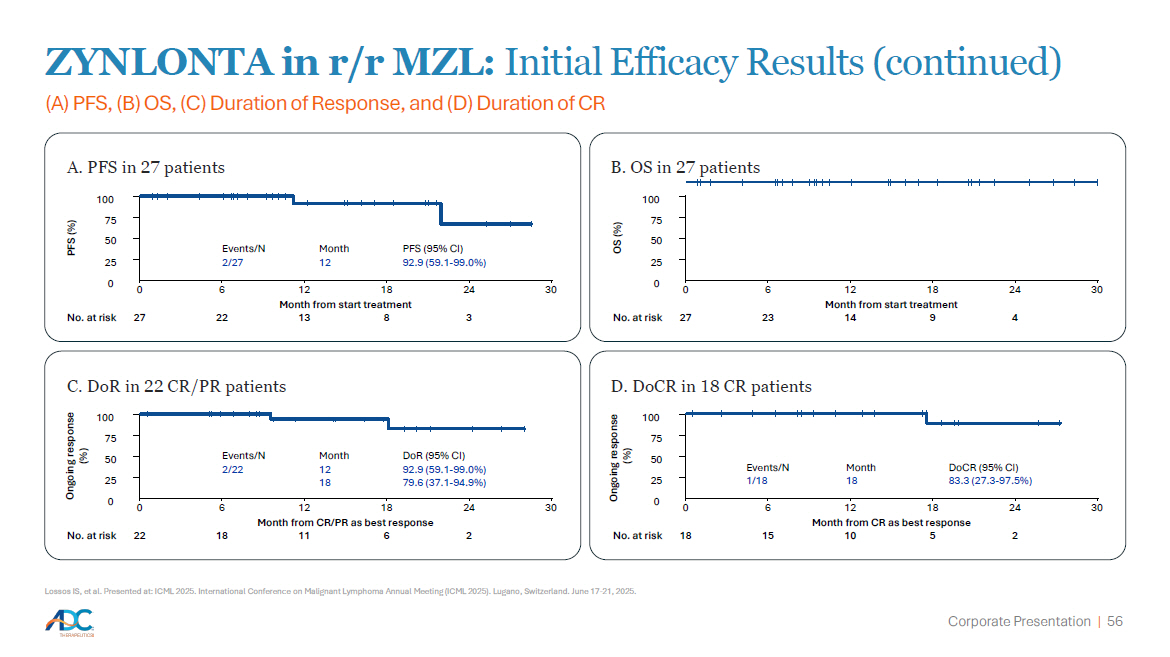
ZYNLONTA in r/r MZL: Initial Efficacy Results (continued) C. DoR in 22 CR/PR patients B. OS in 27 patients D. DoCR in 18 CR patients A. PFS in 27 patients 0 6 12 18 24 30 100 75 50 25 0 PFS (%) No. at risk 27 22 Month from start treatment 13 8 Events/N 2/27 Month 12 PFS (95% CI) 92.9 (59.1 - 99.0%) 3 0 6 12 18 24 30 100 75 50 25 0 OS (%) No. at risk 27 23 Month from start treatment 14 9 4 0 6 12 18 24 30 100 75 50 25 0 Ongoing response (%) No. at risk 22 18 Month from CR/PR as best response 11 6 Events/N 2/22 2 Month 12 18 DoR (95% CI) 92.9 (59.1 - 99.0%) 79.6 (37.1 - 94.9%) 0 6 12 18 24 30 100 75 50 25 0 Ongoing response (%) No. at risk 18 15 Month from CR as best response 10 5 Events/N 1/18 Lossos IS, et al. Presented at: ICML 2025. International Conference on Malignant Lymphoma Annual Meeting (ICML 2025). Lugano, Switzerland. June 17 - 21, 2025. Corporate Presentation | 56 Month 18 DoCR (95% CI) 83.3 (27.3 - 97.5%) 2 (A) PFS, (B) OS, (C) Duration of Response, and (D) Duration of CR
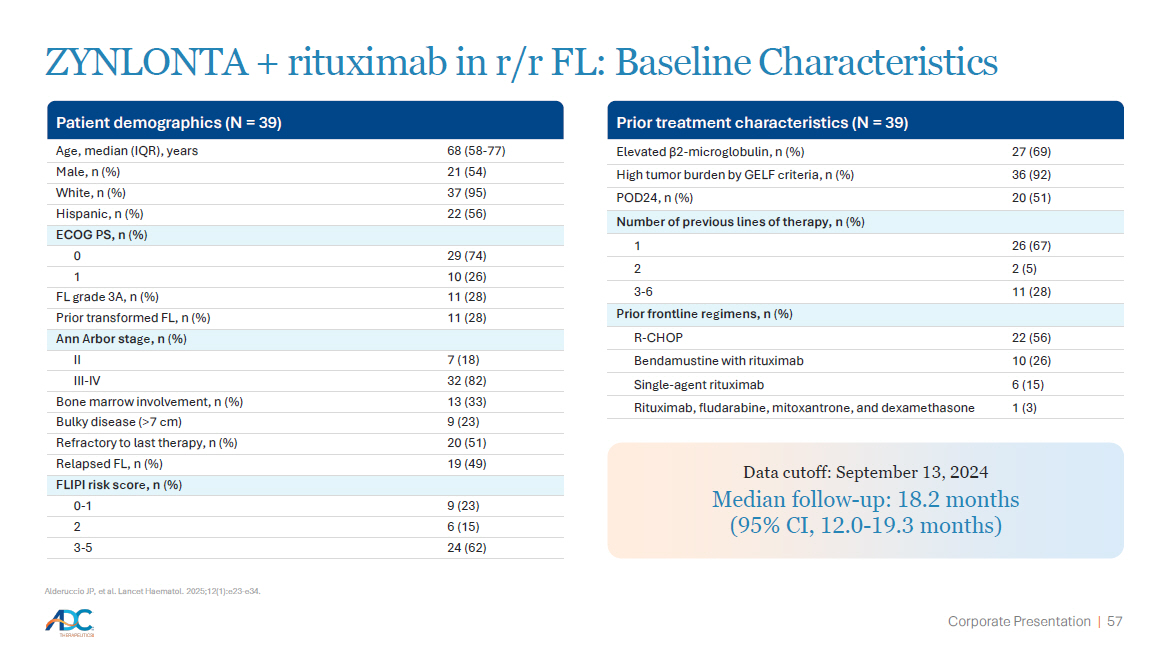
ZYNLONTA + rituximab in r/r FL: Baseline Characteristics Patient demographics (N = 39) 68 (58 - 77) Age, median (IQR), years 21 (54) Male, n (%) 37 (95) White, n (%) 22 (56) Hispanic, n (%) ECOG PS, n (%) 29 (74) 0 10 (26) 1 11 (28) FL grade 3A, n (%) 11 (28) Prior transformed FL, n (%) Ann Arbor stage, n (%) 7 (18) II 32 (82) III - IV 13 (33) Bone marrow involvement, n (%) 9 (23) Bulky disease (>7 cm) 20 (51) Refractory to last therapy, n (%) 19 (49) Relapsed FL, n (%) FLIPI risk score, n (%) 9 (23) 0 - 1 6 (15) 2 24 (62) 3 - 5 Prior treatment characteristics (N = 39) 27 (69) Elevated β2 - microglobulin, n (%) 36 (92) High tumor burden by GELF criteria, n (%) 20 (51) POD24, n (%) Number of previous lines of therapy, n (%) 26 (67) 1 2 (5) 2 11 (28) 3 - 6 Prior frontline regimens, n (%) 22 (56) R - CHOP 10 (26) Bendamustine with rituximab 6 (15) Single - agent rituximab 1 (3) Rituximab, fludarabine, mitoxantrone, and dexamethasone Data cutoff: September 13, 2024 Median follow - up: 18.2 months (95% CI, 12.0 - 19.3 months) Alderuccio JP, et al. Lancet Haematol. 2025;12(1):e23 - e34. Corporate Presentation | 57
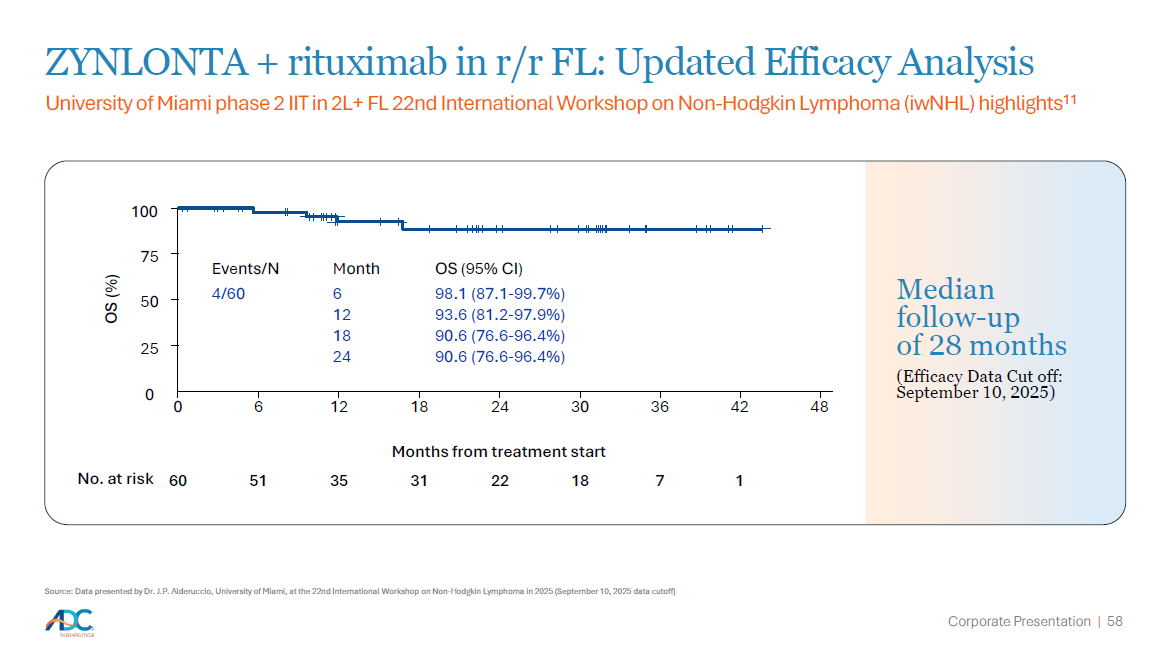
ZYNLONTA + rituximab in r/r FL: Updated Efficacy Analysis University of Miami phase 2 IIT in 2L+ FL 22nd International Workshop on Non - Hodgkin Lymphoma (iwNHL) highlights 11 0 25 50 75 100 OS (%) No. at risk 60 51 35 Events/N 4/60 0 6 12 30 36 42 48 Month 6 12 18 24 Source: Data presented by Dr. J.P. Alderuccio, University of Miami, at the 22nd International Workshop on Non - Hodgkin Lymphoma in 2025 (September 10, 2025 data cutoff) Corporate Presentation | 58 OS (95% CI) 98.1 (87.1 - 99.7%) 93.6 (81.2 - 97.9%) 90.6 (76.6 - 96.4%) 90.6 (76.6 - 96.4%) 18 24 Months from treatment start 31 22 18 7 1 Median follow - up of 28 months (Efficacy Data Cut off: September 10, 2025)
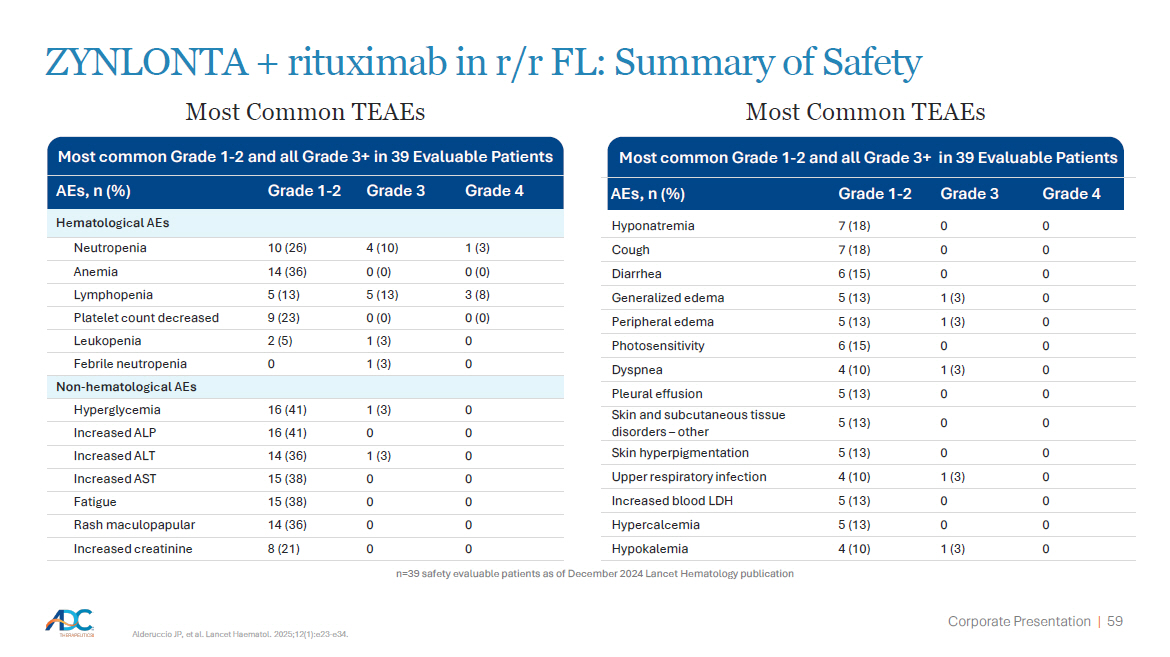
Corporate Presentation | 59 ZYNLONTA + rituximab in r/r FL: Summary of Safety Most common Grade 1 - 2 and all Grade 3+ in 39 Evaluable Patients Grade 4 Grade 3 Grade 1 - 2 AEs, n (%) Hematological AEs 1 (3) 4 (10) 10 (26) Neutropenia 0 (0) 0 (0) 14 (36) Anemia 3 (8) 5 (13) 5 (13) Lymphopenia 0 (0) 0 (0) 9 (23) Platelet count decreased 0 1 (3) 2 (5) Leukopenia 0 1 (3) 0 Febrile neutropenia Non - hematological AEs 0 1 (3) 16 (41) Hyperglycemia 0 0 16 (41) Increased ALP 0 1 (3) 14 (36) Increased ALT 0 0 15 (38) Increased AST 0 0 15 (38) Fatigue 0 0 14 (36) Rash maculopapular 0 0 8 (21) Increased creatinine Most Common TEAEs Most Common TEAEs Most common Grade 1 - 2 and all Grade 3+ in 39 Evaluable Patients Grade 4 Grade 3 Grade 1 - 2 AEs, n (%) 0 0 7 (18) Hyponatremia 0 0 7 (18) Cough 0 0 6 (15) Diarrhea 0 1 (3) 5 (13) Generalized edema 0 1 (3) 5 (13) Peripheral edema 0 0 6 (15) Photosensitivity 0 1 (3) 4 (10) Dyspnea 0 0 5 (13) Pleural effusion 0 0 5 (13) Skin and subcutaneous tissue disorders – other 0 0 5 (13) Skin hyperpigmentation 0 1 (3) 4 (10) Upper respiratory infection 0 0 5 (13) Increased blood LDH 0 0 5 (13) Hypercalcemia 0 1 (3) 4 (10) Hypokalemia Alderuccio JP, et al. Lancet Haematol. 2025;12(1):e23 - e34. n=39 safety evaluable patients as of December 2024 Lancet Hematology publication
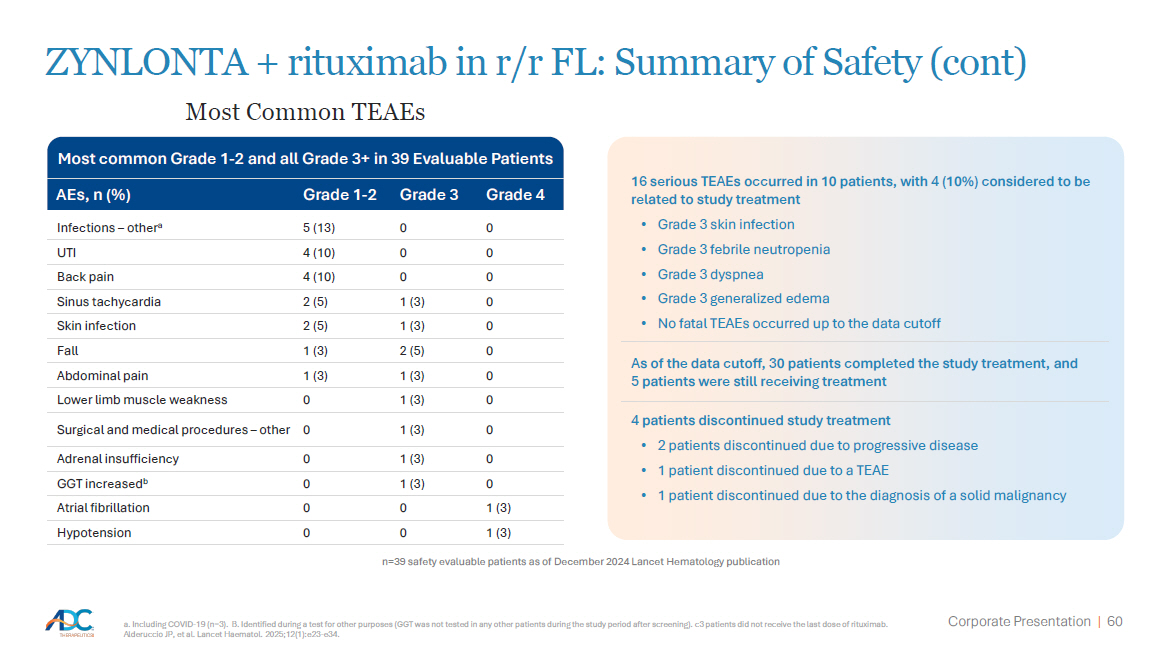
Corporate Presentation | 60 ZYNLONTA + rituximab in r/r FL: Summary of Safety (cont) a. Including COVID - 19 (n=3). B. Identified during a test for other purposes (GGT was not tested in any other patients during the study period after screening). c3 patients did not receive the last dose of rituximab. Most common Grade 1 - 2 and all Grade 3+ in 39 Evaluable Patients Grade 4 Grade 3 Grade 1 - 2 AEs, n (%) 0 0 5 (13) Infections – other a 0 0 4 (10) UTI 0 0 4 (10) Back pain 0 1 (3) 2 (5) Sinus tachycardia 0 1 (3) 2 (5) Skin infection 0 2 (5) 1 (3) Fall 0 1 (3) 1 (3) Abdominal pain 0 1 (3) 0 Lower limb muscle weakness 0 1 (3) 0 Surgical and medical procedures – other 0 1 (3) 0 Adrenal insufficiency 0 1 (3) 0 GGT increased b 1 (3) 0 0 Atrial fibrillation 1 (3) 0 0 Hypotension Most Common TEAEs 16 serious TEAEs occurred in 10 patients, with 4 (10%) considered to be related to study treatment • Grade 3 skin infection • Grade 3 febrile neutropenia • Grade 3 dyspnea • Grade 3 generalized edema • No fatal TEAEs occurred up to the data cutoff As of the data cutoff, 30 patients completed the study treatment, and 5 patients were still receiving treatment 4 patients discontinued study treatment • 2 patients discontinued due to progressive disease • 1 patient discontinued due to a TEAE • 1 patient discontinued due to the diagnosis of a solid malignancy n=39 safety evaluable patients as of December 2024 Lancet Hematology publication Alderuccio JP, et al. Lancet Haematol. 2025;12(1):e23 - e34.

Thank You
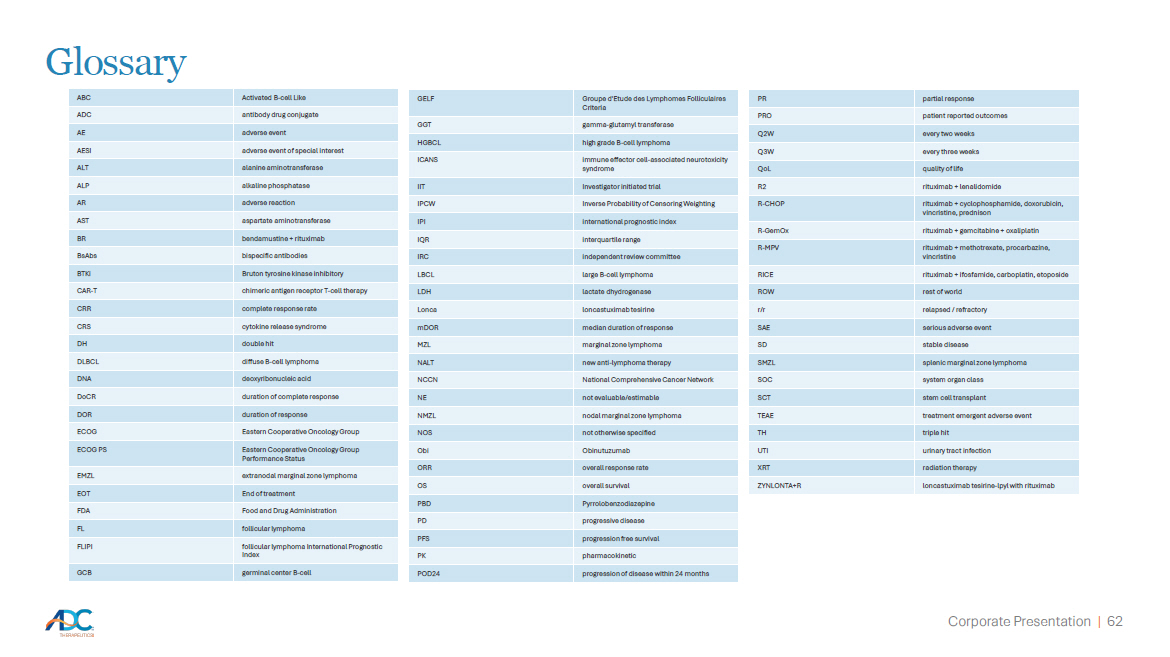
Corporate Presentation | 62 Glossary Activated B - cell Like ABC antibody drug conjugate ADC adverse event AE adverse event of special interest AESI alanine aminotransferase ALT alkaline phosphatase ALP adverse reaction AR aspartate aminotransferase AST bendamustine + rituximab BR bispecific antibodies BsAbs Bruton tyrosine kinase inhibitory BTKi chimeric antigen receptor T - cell therapy CAR - T complete response rate CRR cytokine release syndrome CRS double hit DH diffuse B - cell lymphoma DLBCL deoxyribonucleic acid DNA duration of complete response DoCR duration of response DOR Eastern Cooperative Oncology Group ECOG Eastern Cooperative Oncology Group Performance Status ECOG PS extranodal marginal zone lymphoma EMZL End of treatment EOT Food and Drug Administration FDA follicular lymphoma FL follicular lymphoma International Prognostic Index FLIPI germinal center B - cell GCB Groupe d'Etude des Lymphomes Folliculaires Criteria GELF gamma - glutamyl transferase GGT high grade B - cell lymphoma HGBCL immune effector cell - associated neurotoxicity syndrome ICANS Investigator initiated trial IIT Inverse Probability of Censoring Weighting IPCW international prognostic index IPI interquartile range IQR independent review committee IRC large B - cell lymphoma LBCL lactate dhydrogenase LDH loncastuximab tesirine Lonca median duration of response mDOR marginal zone lymphoma MZL new anti - lymphoma therapy NALT National Comprehensive Cancer Network NCCN not evaluable/estimable NE nodal marginal zone lymphoma NMZL not otherwise specified NOS Obinutuzumab Obi overall response rate ORR overall survival OS Pyrrolobenzodiazepine PBD progressive disease PD progression free survival PFS pharmacokinetic PK progression of disease within 24 months POD24 partial response PR patient reported outcomes PRO every two weeks Q2W every three weeks Q3W quality of life QoL rituximab + lenalidomide R2 rituximab + cyclophosphamide, doxorubicin, vincristine, prednison R - CHOP rituximab + gemcitabine + oxaliplatin R - GemOx rituximab + methotrexate, procarbazine, vincristine R - MPV rituximab + ifosfamide, carboplatin, etoposide RICE rest of world ROW relapsed / refractory r/r serious adverse event SAE stable disease SD splenic marginal zone lymphoma SMZL system organ class SOC stem cell transplant SCT treatment emergent adverse event TEAE triple hit TH urinary tract infection UTI radiation therapy XRT loncastuximab tesirine - lpyl with rituximab ZYNLONTA+R