Exhibit 99.1
| TARGETED LENDING CO., LLC Financial Statements For the Years Ended December 31, 2025 and 2024 with Independent Auditors’ Reports |
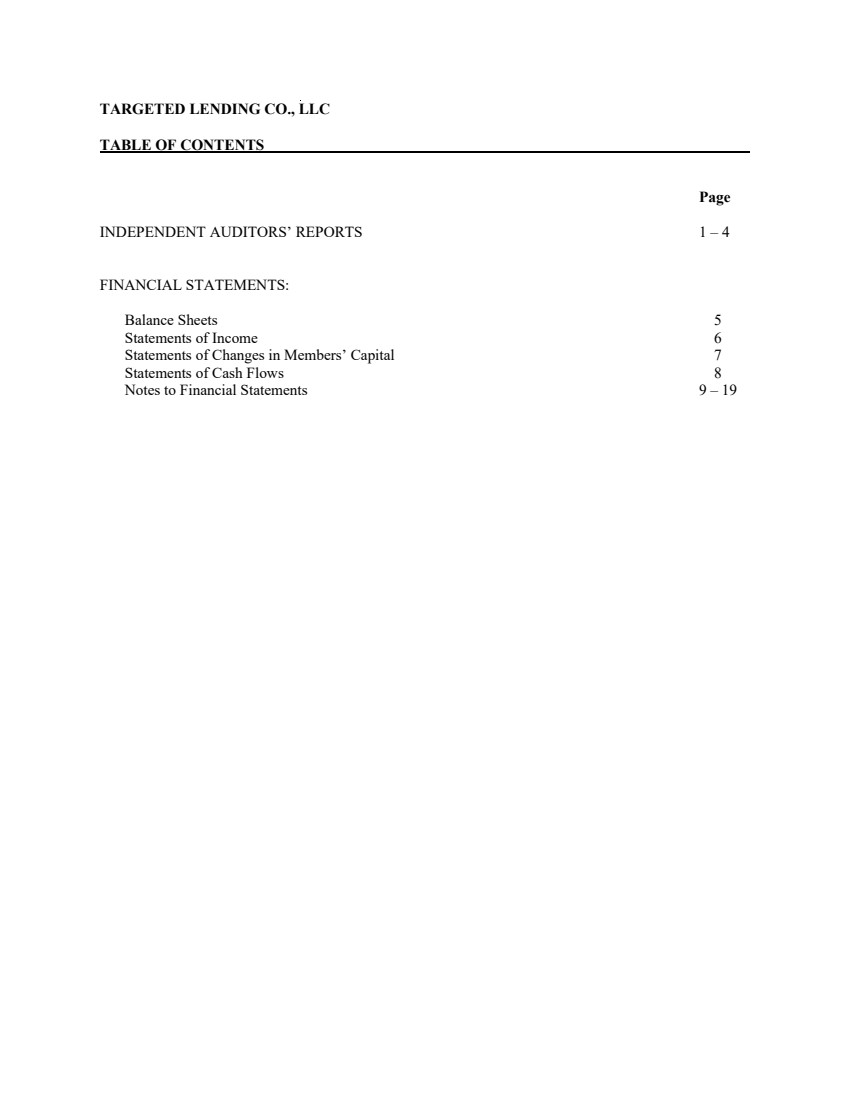
| TARGETED LENDING CO., LLC TABLE OF CONTENTS Page INDEPENDENT AUDITORS’ REPORTS 1 – 4 FINANCIAL STATEMENTS: Balance Sheets 5 Statements of Income 6 Statements of Changes in Members’ Capital 7 Statements of Cash Flows 8 Notes to Financial Statements 9 – 19 |
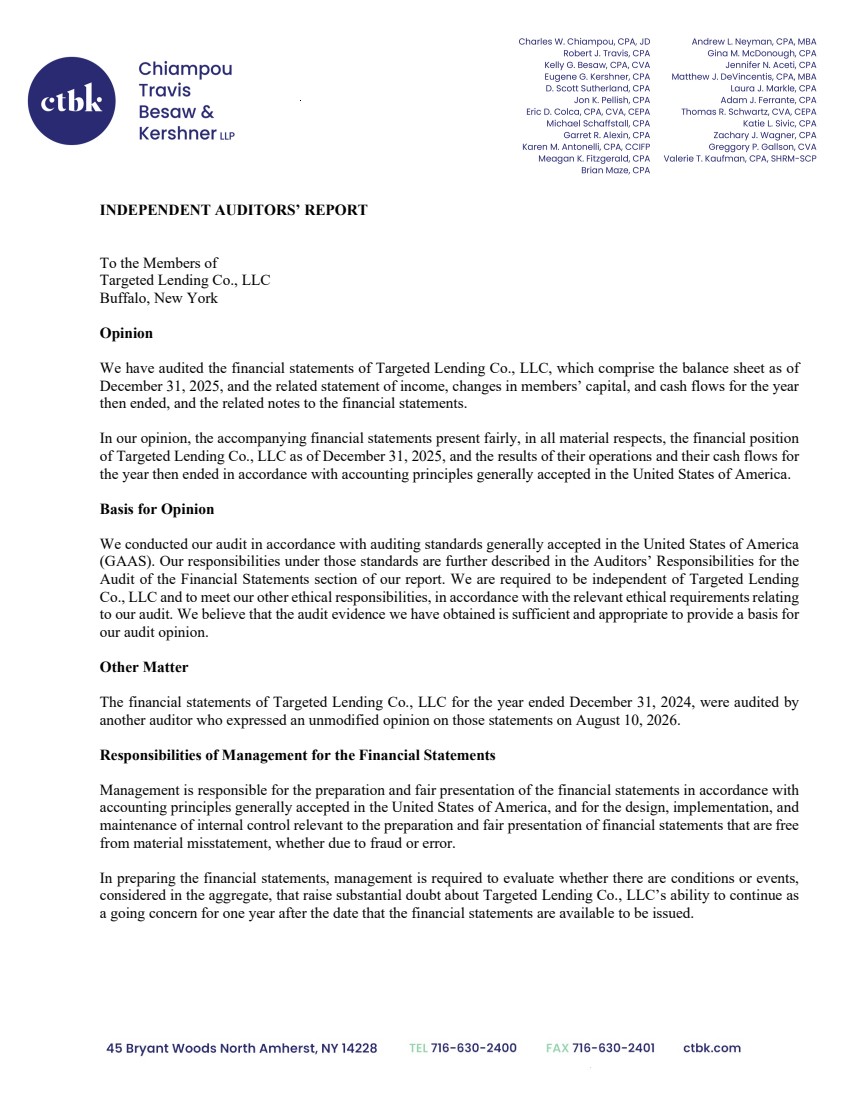
| INDEPENDENT AUDITORS’ REPORT To the Members of Targeted Lending Co., LLC Buffalo, New York Opinion We have audited the financial statements of Targeted Lending Co., LLC, which comprise the balance sheet as of December 31, 2025, and the related statement of income, changes in members’ capital, and cash flows for the year then ended, and the related notes to the financial statements. In our opinion, the accompanying financial statements present fairly, in all material respects, the financial position of Targeted Lending Co., LLC as of December 31, 2025, and the results of their operations and their cash flows for the year then ended in accordance with accounting principles generally accepted in the United States of America. Basis for Opinion We conducted our audit in accordance with auditing standards generally accepted in the United States of America (GAAS). Our responsibilities under those standards are further described in the Auditors’ Responsibilities for the Audit of the Financial Statements section of our report. We are required to be independent of Targeted Lending Co., LLC and to meet our other ethical responsibilities, in accordance with the relevant ethical requirements relating to our audit. We believe that the audit evidence we have obtained is sufficient and appropriate to provide a basis for our audit opinion. Other Matter The financial statements of Targeted Lending Co., LLC for the year ended December 31, 2024, were audited by another auditor who expressed an unmodified opinion on those statements on August 10, 2026. Responsibilities of Management for the Financial Statements Management is responsible for the preparation and fair presentation of the financial statements in accordance with accounting principles generally accepted in the United States of America, and for the design, implementation, and maintenance of internal control relevant to the preparation and fair presentation of financial statements that are free from material misstatement, whether due to fraud or error. In preparing the financial statements, management is required to evaluate whether there are conditions or events, considered in the aggregate, that raise substantial doubt about Targeted Lending Co., LLC’s ability to continue as a going concern for one year after the date that the financial statements are available to be issued. |
| Auditors’ Responsibilities for the Audit of the Financial Statements Our objectives are to obtain reasonable assurance about whether the financial statements as a whole are free from material misstatement, whether due to fraud or error, and to issue an auditors’ report that includes our opinion. Reasonable assurance is a high level of assurance but is not absolute assurance and therefore is not a guarantee that an audit conducted in accordance with GAAS will always detect a material misstatement when it exists. The risk of not detecting a material misstatement resulting from fraud is higher than for one resulting from error, as fraud may involve collusion, forgery, intentional omissions, misrepresentations, or the override of internal control. Misstatements are considered material if there is a substantial likelihood that, individually or in the aggregate, they would influence the judgment made by a reasonable user based on the financial statements. In performing an audit in accordance with GAAS, we: Exercise professional judgment and maintain professional skepticism throughout the audit. Identify and assess the risks of material misstatement of the financial statements, whether due to fraud or error, and design and perform audit procedures responsive to those risks. Such procedures include examining, on a test basis, evidence regarding the amounts and disclosures in the financial statements. Obtain an understanding of internal control relevant to the audit in order to design audit procedures that are appropriate in the circumstances, but not for the purpose of expressing an opinion on the effectiveness of Targeted Lending Co., LLC’s internal control. Accordingly, no such opinion is expressed. Evaluate the appropriateness of accounting policies used and the reasonableness of significant accounting estimates made by management, as well as evaluate the overall presentation of the financial statements. Conclude whether, in our judgment, there are conditions or events, considered in the aggregate, that raise substantial doubt about Targeted Lending Co., LLC’s ability to continue as a going concern for a reasonable period of time. We are required to communicate with those charged with governance regarding, among other matters, the planned scope and timing of the audit, significant audit findings, and certain internal control-related matters that we identified during the audit. /s/ Chiampou Travis Besaw & Kershner LLP August 10, 2026 |
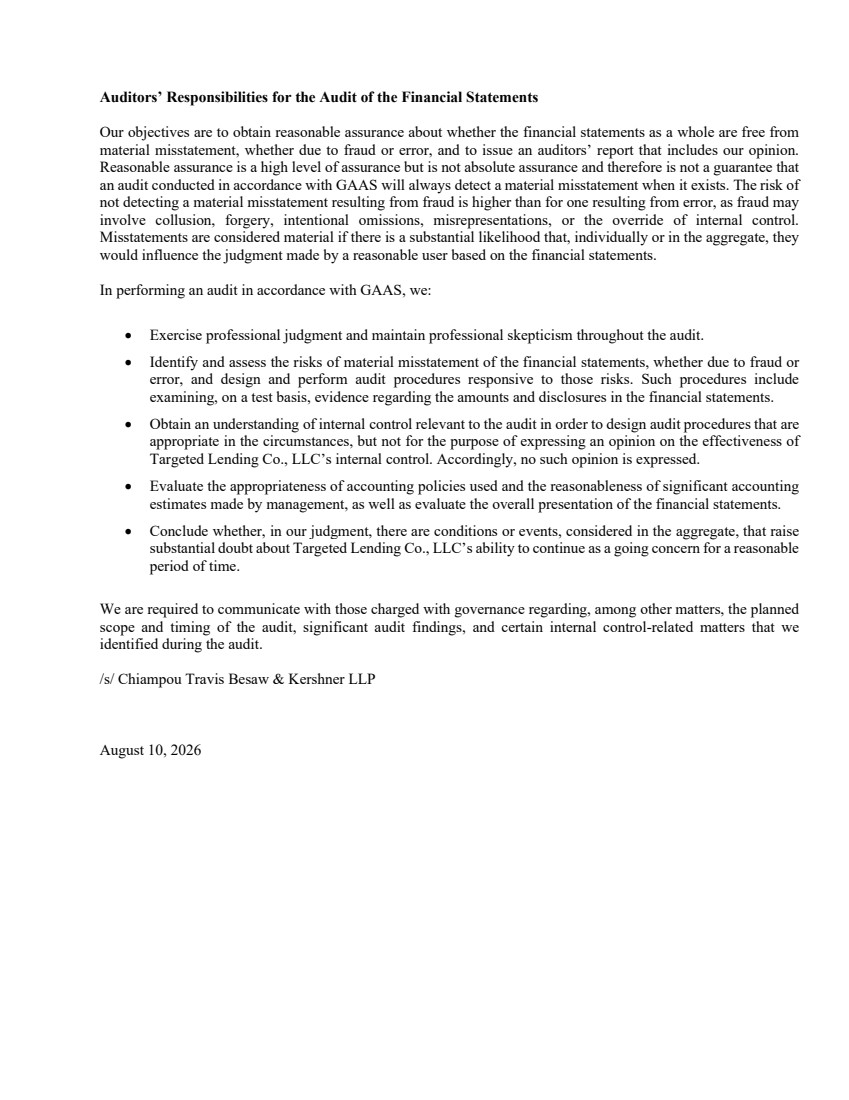
| 2399 SWEET HOMEROAD I AMHERST, NEW YORK 14228 I T: 716.839.9001 I F: 716.839.9002 I rhc:lcgrnup.rnm INDEPENDENT AUDITORS’ REPORT To the Members’ of Targeted Lending Co., LLC Opinion We have audited the accompanying financial statements of Targeted Lending Co., LLC (a Delaware Limited Liability Company), which comprise the balance sheet as of December 31, 2024, and the related statement of income, members' capital, and cash flows for the year then ended, and the related notes to the financial statements. In our opinion, the financial statements referred to above present fairly, in all material respects, the financial position of Targeted Lending Co., LLC as of December 31, 2024, and the results of its operations and its cash flows for the year then ended in accordance with accounting principles generally accepted in the United States of America. Basis for Opinion We conducted our audits in accordance with auditing standards generally accepted in the United States of America. Our responsibilities under those standards are further described in the Auditor's Responsibilities for the Audit of the Financial Statements section of our report. We are required to be independent of Targeted Lending Co., LLC and to meet our other ethical responsibilities in accordance with the relevant ethical requirements relating to our audits. We believe that the audit evidence we have obtained is sufficient and appropriate to provide a basis for our audit opinion. Responsibilities of Management for the Financial Statements Management is responsible for the preparation and fair presentation of the financial statements in accordance with accounting principles generally accepted in the United States of America, and for the design, implementation, and maintenance of internal control relevant to the preparation and fair presentation of financial statements that are free from material misstatement, whether due to fraud or error. |
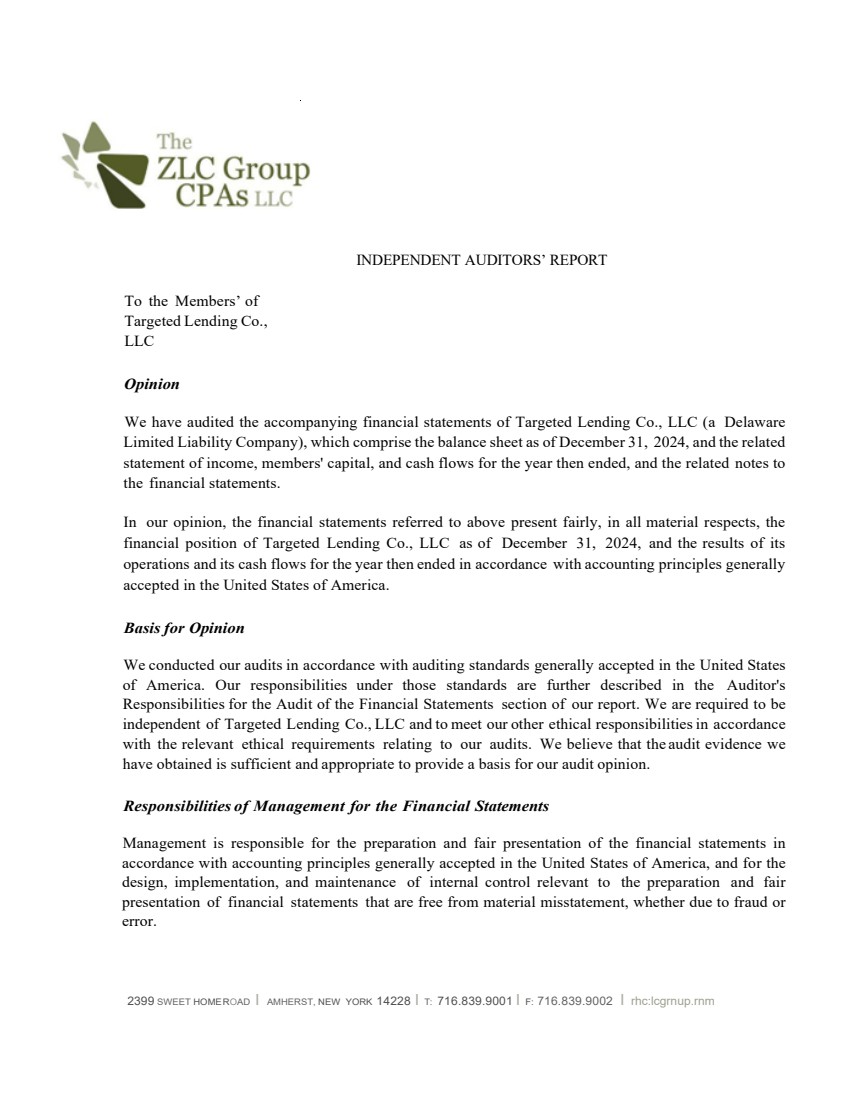
| In preparing the financial statements, management is required to evaluate whether there are conditions or events, considered in the aggregate, that raise substantial doubt about Targeted Lending Co., LLC's ability to continue as a going concern within one year after the date that the financial statements are available to be issued. Auditors’ Responsibilitiesfor the Audit of the Financial Statements Our objectives are to obtain reasonable assurance about whether the financial statements, as a whole, are free from material misstatement, whether due to fraud or error, and to issue an auditor's report that includes our opinion. Reasonable assurance is a high level of assurance but is not absolute assurance and therefore is not a guarantee that an audit conducted in accordance with generally accepted auditing standards will always detect a material misstatement when it exists. The risk of not detecting a material misstatement resulting from fraud is higher than for one resulting from error, as fraud may involve collusion, forgery, intentional omissions, misrepresentations, or the override of internal control. Misstatements, including omissions, are considered material if there is a substantial likelihood that, individually or in the aggregate, they would influence the judgment made by a reasonable user based on the financial statements. In performing an audit in accordance with generally accepted auditing standards, we: Exercise professional judgment and maintain professional skepticism throughout the audit. Identify and assess the risks of material misstatement of the financial statements, whether due to fraud or error, and design and perform audit procedures responsive to those risks. Such procedures include examining, on a test basis, evidence regarding the amounts and disclosures in the financial statements. Obtain an understanding of internal control relevant to the audit in order to design audit procedures that are appropriate in the circumstances, but not for the purpose of expressing an opinion on the effectiveness of Targeted Lending Co., LLC's internal control. Accordingly, no such opinion is expressed. Evaluate the appropriateness of accounting policies used and the reasonableness of significant accounting estimates made by management, as well as evaluate the overall presentation of the financial statements. Conclude whether, in our judgment, there are conditions or events, considered in the aggregate, that raise substantial doubt about Targeted Lending Co., LLC’s ability to continue as a going concern for a reasonable period of time. We are required to communicate with those charged with governance regarding, among other matters, the planned scope and timing of the audit, significant audit findings, and certain internal control-related matters that we identified during the audit. /s/ The ZLC Group, CPAs, LLC Buffalo, New York August 10, 2026 2399 SWEET HOMEROAD I AMHERST, NEW YORK 14228 I T: 716.839.9001 I F: 716.839.9002 I rhc:lcgrnup.rnm |
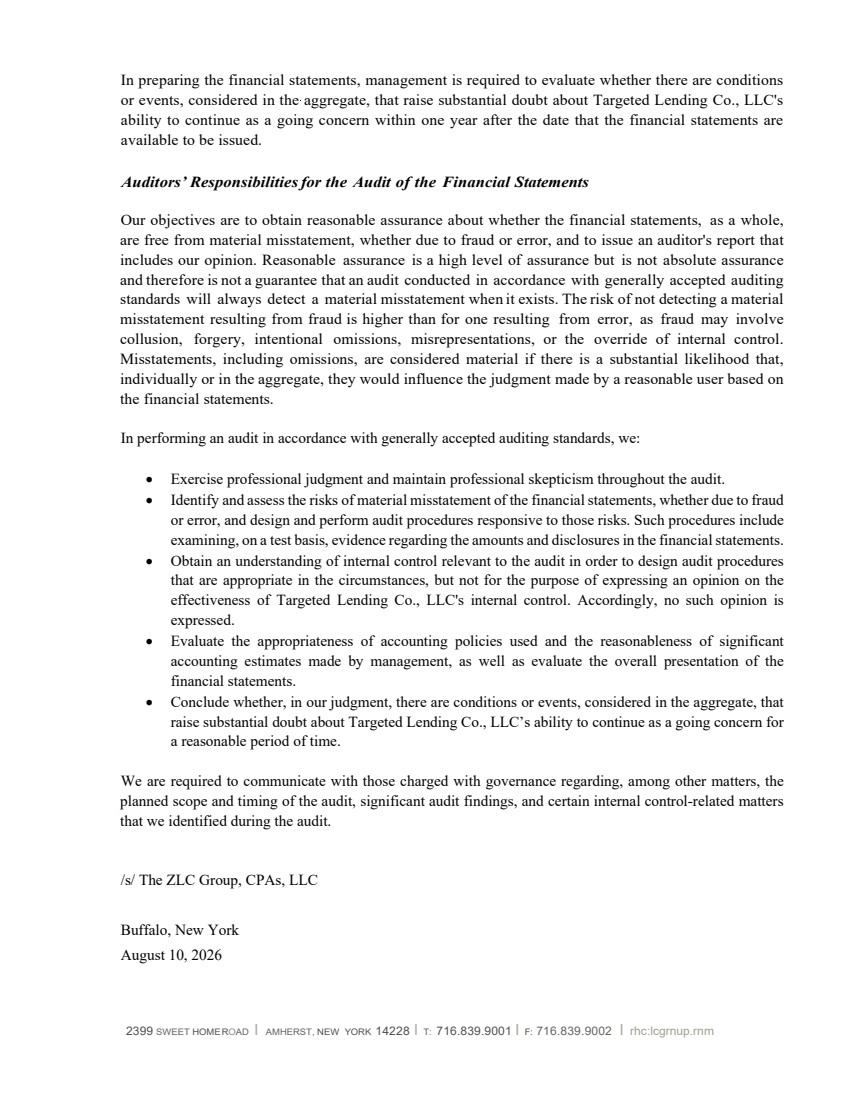
| TARGETED LENDING CO., LLC BALANCE SHEETS DECEMBER 31, 2025 AND 2024 2025 2024 ASSETS Cash $ 303,372 $ 1,068,897 Prepaid expenses 83,765 68,474 Loans receivable 104,158,107 58,700,381 Allowance for credit losses (1,665,821) (939,206) Loans receivable, net 102,492,286 57,761,175 Accrued interest receivable 245,598 109,879 Restricted cash 752,611 750,105 Property and equipment, net 37,673 18,594 Right-of-use asset 158,245 213,536 Deferred tax assets 359,446 201,107 Other assets, net 445,133 437,927 $ 104,878,129 $ 60,629,694 LIABILITIES AND MEMBERS’ CAPITAL Line of credit $ 69,162,043 $ 37,787,310 Accounts payable 2,274,726 1,529,503 Accrued expenses 798,551 770,000 Accrued income taxes 95,076 530,666 Recourse reserve on loan sales 752,611 750,105 Advance payments 31,211 48,766 Long term debt, net 9,918,358 10,037,566 Operating lease liability 158,883 213,536 Total liabilities 83,191,459 51,667,452 MEMBERS’ CAPITAL 21,686,670 8,962,242 $ 104,878,129 $ 60,629,694 See notes to financial statements. 5 |
| TARGETED LENDING CO., LLC STATEMENTS OF INCOME FOR THE YEARS ENDED DECEMBER 31, 2025 AND 2024 2025 2024 REVENUE: Interest income on equipment loans $ 10,071,995 $ 6,563,289 Gain on sale of loans 2,617,920 2,811,595 Portfolio management income 2,390,058 2,137,052 Servicing income 27,110 57,597 Total revenue 15,107,083 11,569,533 ALLOWANCE FOR CREDIT LOSSES 2,179,836 2,113,653 SELLING, GENERAL, AND ADMINISTRATIVE EXPENSES 4,569,770 3,514,600 INTEREST EXPENSE 5,034,000 3,849,401 INCOME BEFORE INCOME TAXES 3,323,477 2,091,879 INCOME TAX EXPENSE 763,726 458,988 NET INCOME $ 2,559,751 $ 1,632,891 See notes to financial statements. 6 |
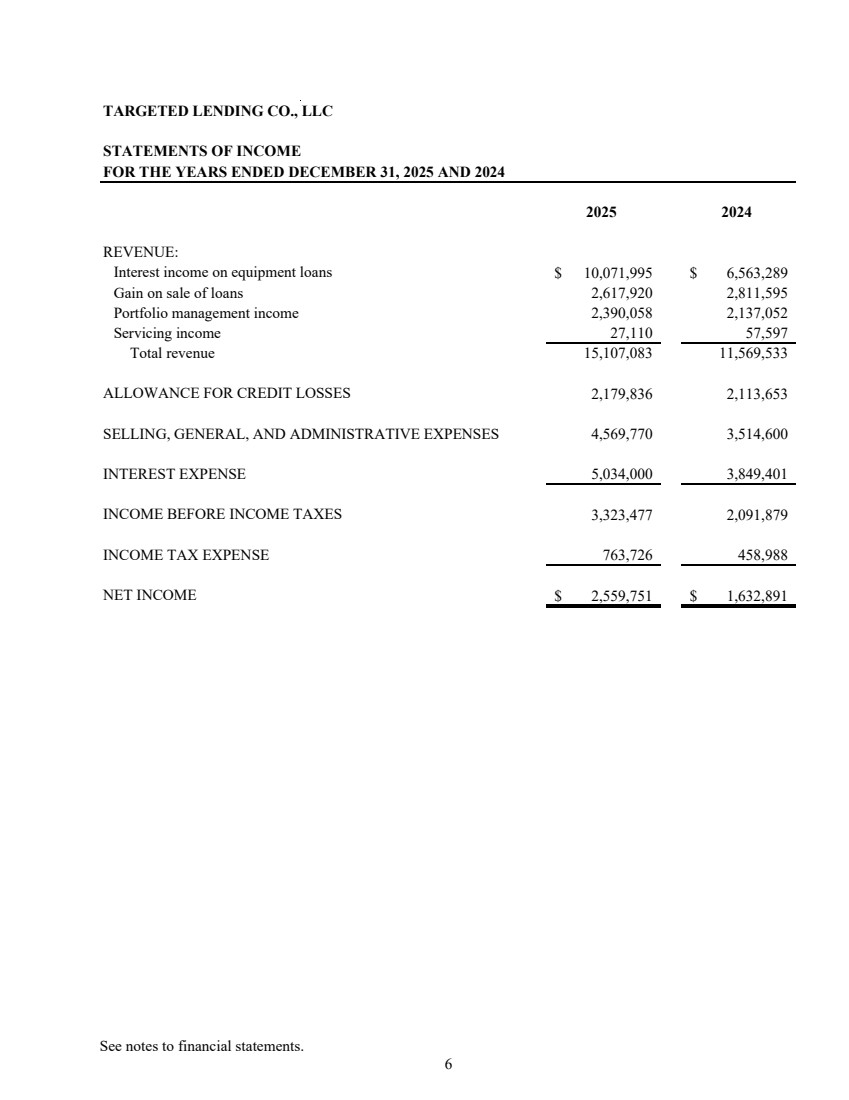
| TARGETED LENDING CO., LLC STATEMENTS OF CHANGES IN MEMBERS’ CAPITAL FOR THE YEARS ENDED DECEMBER 31, 2025 AND 2024 2025 2024 MEMBERS’ CAPITAL - BEGINNING OF YEAR $ 8,962,242 $ 5,410,530 Net income 2,559,751 1,632,891 Sale of preferred membership interest 12,000,000 3,126,436 Purchase of common membership interest - (126,436) Distributions - common membership interests (1,237,573) (1,081,179) Distributions - preferred membership interests (597,750) - MEMBERS’ CAPITAL - END OF YEAR $ 21,686,670 $ 8,962,242 See notes to financial statements 7 |
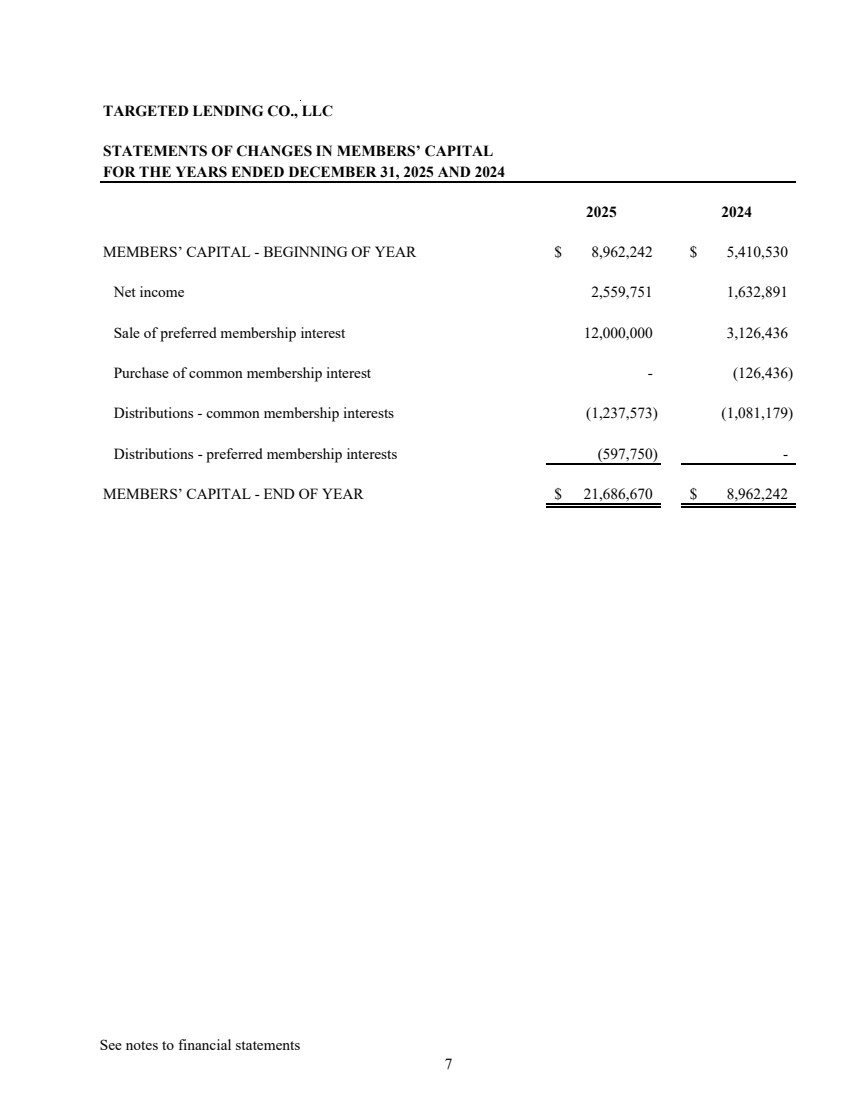
| TARGETED LENDING CO., LLC STATEMENTS OF CASH FLOWS FOR THE YEARS ENDED DECEMBER 31, 2025 AND 2024 2025 2024 CASH FLOWS FROM OPERATING ACTIVITIES: Net income $ 2,559,751 $ 1,632,891 Adjustments to reconcile net income to net cash used in operating activities: Depreciation and amortization 13,916 10,101 Amortization of right-of-use asset 55,291 65,953 Amortization of debt issuance costs 333,656 261,502 Deferred tax asset (158,339) (68,172) Changes to operating assets and liabilities: Loans receivable (44,731,111) (18,213,087) Prepaid expenses (15,291) 44,695 Accrued interest receivable (135,719) (109,879) Other assets (25,000) (70,000) Accounts payable 745,223 261,441 Accrued expenses 28,551 210,326 Accrued income taxes (435,590) 316,128 Recourse reserve on loan sales 2,506 294,893 Advance payments (17,555) (157) Operating lease liability (54,653) (65,953) Net cash used in operating activities (41,834,364) (15,429,318) CASH FLOWS FROM INVESTING ACTIVITIES: Purchases of property and equipment (32,995) (13,859) CASH FLOWS FROM FINANCING ACTIVITIES: Net borrowings on line of credit 31,374,733 14,987,310 Debt issuance costs (227,074) (540,641) Repayments of long-term debt (207,996) - Repurchase of common membership interests - (126,436) Proceeds from sale of preferred membership interests 12,000,000 3,126,436 Distributions to common membership interests (1,237,573) (1,081,179) Distributions to preferred membership interests (597,750) - Net cash provided by financing activities 41,104,340 16,365,490 NET CHANGE IN CASH AND RESTRICTED CASH (763,019) 922,313 CASH AND RESTRICTED CASH, beginning of year 1,819,002 896,689 CASH AND RESTRICTED CASH, end of year $ 1,055,983 $ 1,819,002 Included in the accompanying balance sheets under the following captions: Cash $ 303,372 $ 1,068,897 Restricted cash 752,611 750,105 CASH AND RESTRICTED CASH, end of year $ 1,055,983 $ 1,819,002 SUPPLEMENTAL DISCLOSURE OF CASH FLOW INFORMATION: Interest paid $ 5,034,000 $ 3,581,647 Income taxes paid $ 1,350,618 $ 223,422 Right-of-use asset obtained in exchange for lease obligations: Operating leases $ - $ 486,231 See notes to financial statements. 8 |
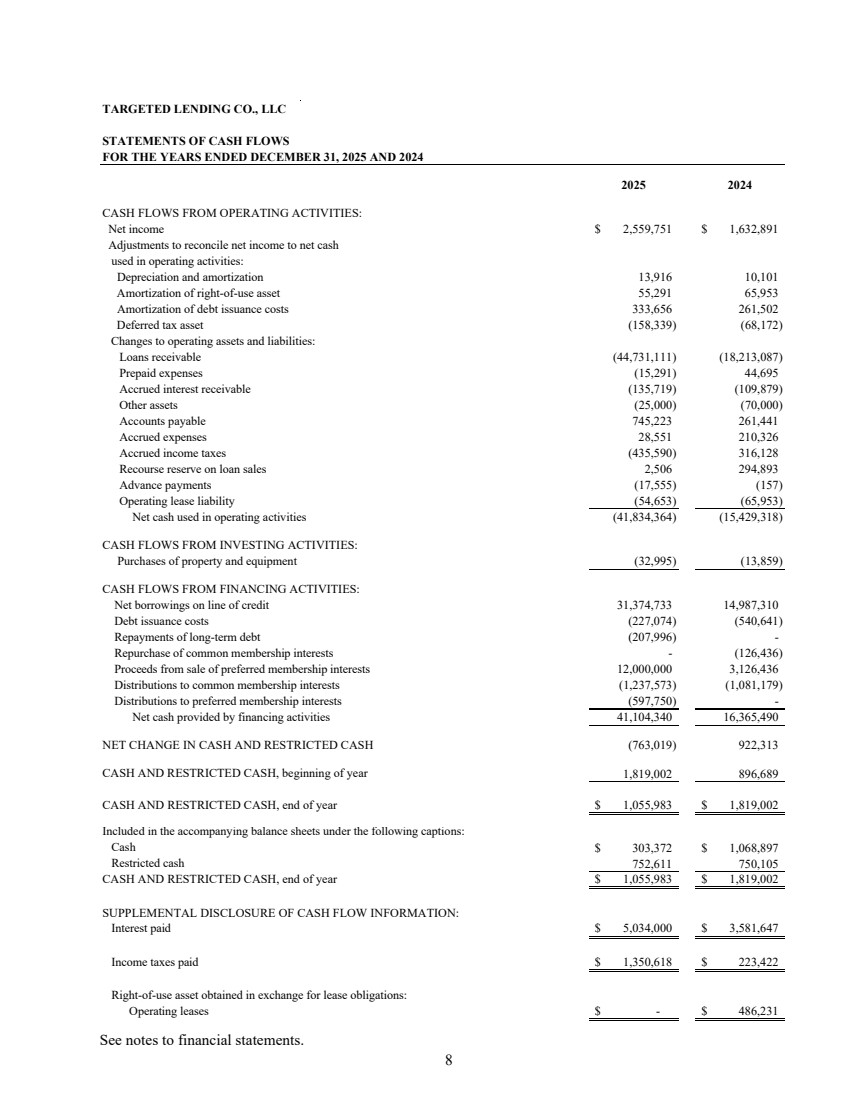
| 9 TARGETED LENDING CO., LLC NOTES TO FINANCIAL STATEMENTS FOR THE YEARS ENDED DECEMBER 31, 2025 AND 2024 1. DESCRIPTION OF BUSINESS Nature of Business – Targeted Lending Co., LLC (the “Company”) was organized as a Delaware Limited Liability Company in 2015 and is registered as a foreign entity in New York, California, Colorado, Florida, Texas, Washington, Minnesota, Utah, and Tennessee. The Company’s main office is in Buffalo, New York. The Company offers financing for essential equipment to businesses across the United States. The Company is governed by its operating agreement which provides, among other things, that the holder of a membership interest, officer, director, employee and others classified as “covered” (as defined in the operating agreement) are liable to the Company or any other covered person for any loss, damage or claim incurred for acts or omissions of such covered persons in connection with the business or affairs of the Company, except for actions or omissions that constitute fraud, gross negligence or willful misconduct by such covered person. Covered persons are fully protected and justified in acting or failing to act in accordance with the advice or opinion of any attorneys or accountants that are consulted with regard to the Company’s affairs, provided that such attorneys and/or accountants have been selected with reasonable care. Furthermore, covered persons are not liable for the acts or omissions of any nominee, custodian or other third party retained or used in connection with the business, except on account of gross negligence or willful misconduct in their selection. 2. SUMMARY OF SIGNIFICANT ACCOUNTING POLICIES Basis of Accounting – The accompanying financial statements have been prepared on the accrual basis of accounting in conformity with accounting principles generally accepted in the United States of America. Net Investment in Equipment Loans – Net investment in equipment loans represents the total of all outstanding equipment loans receivable less a loan loss reserve (see Note 5). Interest income on loans is not recognized when considered doubtful of collection by management (generally, when principal or interest payments are ninety one days or more past due). Past due status is based on the contractual terms of the loan. Partial payments are applied in accordance with the terms of the loan agreement, and a loan remains past due until the scheduled payment obligation has been substantially satisfied. A loan is moved to non-accrual status in accordance with the Company’s policy if full repayment of principal and interest is unlikely, typically after 91 days of non-payment, unless specific facts and circumstances of each loan support the collection of principal and interest, including the borrower's financial condition, collateral value, payment history, bankruptcy status, workout arrangements, repossession activity, and the likelihood of collection. Accordingly, certain loans may remain on accrual status beyond 90 days when supported by documented collection expectations. In all cases, loans are placed on nonaccrual or charged-off at an earlier date if collection of principal or interest is considered doubtful. All interest accrued but not received for loans placed on nonaccrual is reversed against interest income. Interest received on such loans is accounted for on a cost recovery method, until qualifying for return to accrual. Loans are returned to accrual status when all the principal and interest amounts contractually due are brought current and future payments are reasonably assured. |
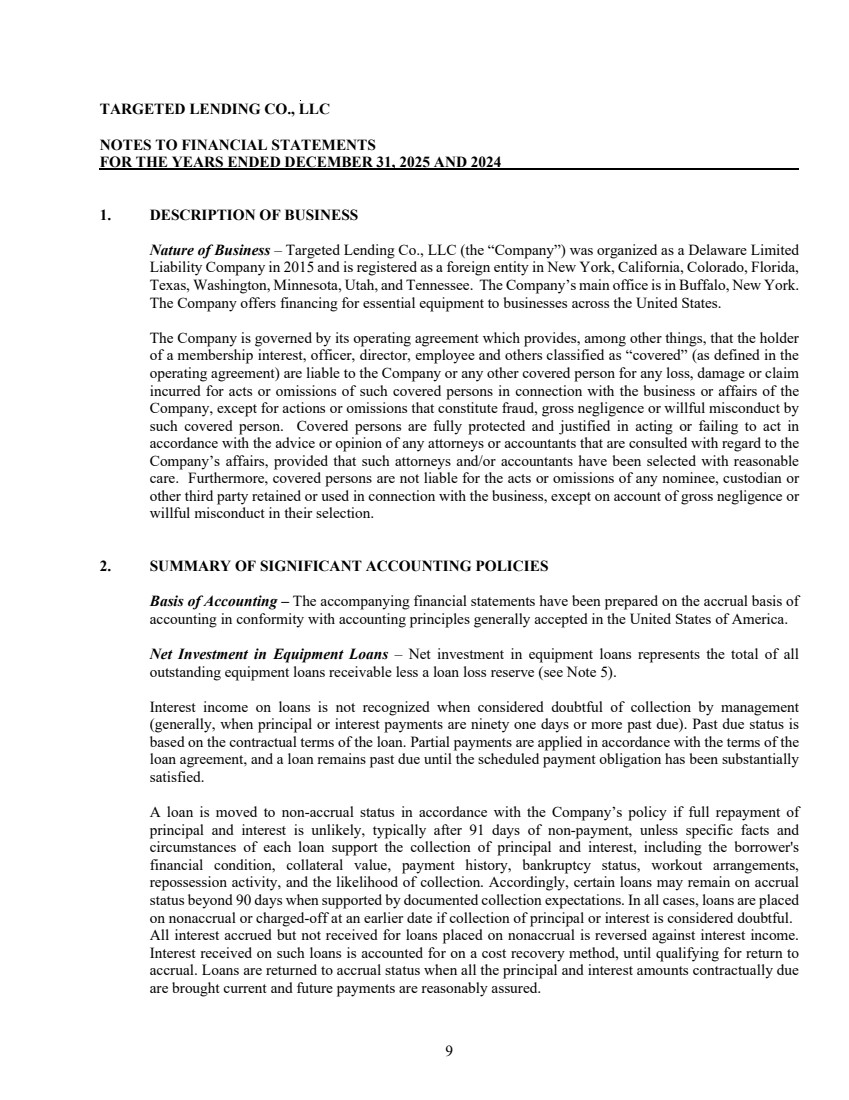
| 10 2. SUMMARY OF SIGNIFICANT ACCOUNTING POLICIES (continued) Allowance for Loan Losses – The allowance for loan loss reserve is based on the Company’s assessment of the collectability of the customer accounts in accordance with ASC 326, Financial Instruments – Credit Losses. The Company regularly reviews the loan loss reserve by considering factors such as the age of the receivable balances, historical experience, credit quality, current economic conditions, and reasonable and supportable forecasts of future economic conditions that may affect a customer’s ability to pay. Based on this analysis, the allowance for loan losses approximated 1.6% of the net investment in equipment loans at December 31, 2025 and 2024. Property and Equipment – Property and equipment is stated at cost, less accumulated depreciation. Depreciation is computed using the straight-line method based on the estimated useful lives of the related assets, which range from 3 – 7 years. Expenditures for maintenance and repairs are charged to expense as incurred, whereas major betterments are capitalized. Other Assets – Other assets consist of debt issuance costs incurred in conjunction with the Company’s line of credit and are amortized using the straight-line method over the term of the credit agreement which approximates the effective interest method. Amortization expense is included within interest expense on the accompanying statements of income. Amortization expense amounted to $244,868 and $172,714 for the years ended December 31, 2025 and 2024, respectively. Debt Issuance Costs – Debt issuance costs incurred in connection with the issuance of long-term debt are recorded as a direct deduction from the carrying amount of the related debt on the balance sheet. These costs are amortized using the straight-line method over the term of the debt agreement which approximates the effective interest method. Amortization expense amounted to $88,788 for each of the years ended December 31, 2025 and 2024, and is included within interest expense on the accompanying statements of income. Income Taxes – The Company has elected to be taxed as a C-Corporation. The Company accounts for income taxes using the asset and liability method in accordance with U.S. generally accepted accounting principles. Under this method, deferred tax assets and liabilities are recognized for the expected future tax consequences of temporary differences between the financial statement carrying amounts of existing assets and liabilities and their respective tax bases. Deferred tax assets and liabilities are measured using enacted tax rates expected to apply to taxable income in the years in which those temporary differences are expected to be recovered or settled. Use of Estimates – The preparation of financial statements in conformity with accounting principles generally accepted in the United States of America requires management to make estimates and assumptions that affect certain reported amounts of assets and liabilities and disclosure of contingent assets and liabilities at the date of the financial statements and the reported amounts of revenues and expenses during the reported period. Actual results could differ from those estimates. Revenue Recognition – Revenue consists of interest income, portfolio management income, including loan fees and commissions, servicing income, and gains on the sale of equipment financing contracts and is recognized when earned. The Company sells equipment contracts to third parties. Sales are negotiated on a portfolio basis with varying terms. These transactions are accounted for as sales when control of the contracts have been surrendered in accordance with ASC 860, Transfers and Servicing, as the Company does not maintain effective control over the transferred assets. Advertising – All costs associated with advertising are expensed in the period incurred. Advertising expense totaled approximately $282,000 and $136,000 for the years ended December 31, 2025 and 2024, respectively. |
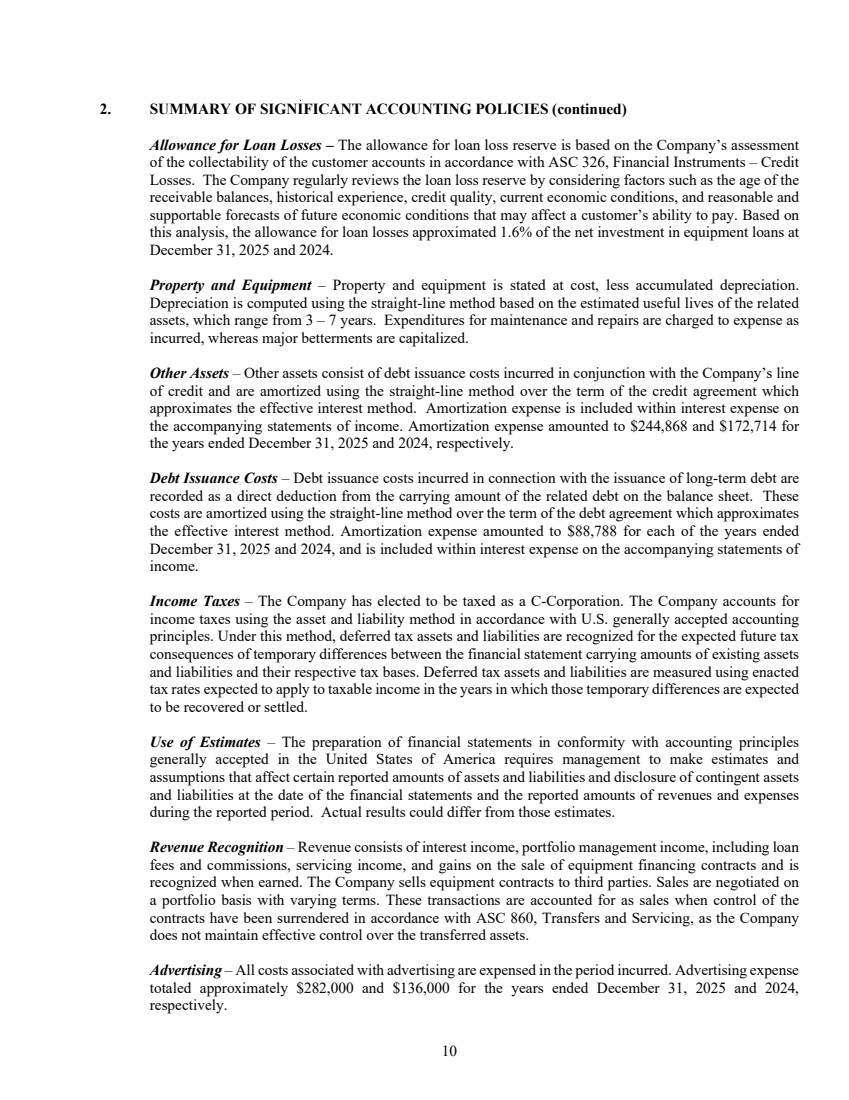
| 11 2. SUMMARY OF SIGNIFICANT ACCOUNTING POLICIES (continued) Recourse Reserve on Loan Sales – The Company maintains a reserve for potential losses related to loans sold with recourse. The reserve is estimated based on the outstanding principal balance of loans sold to two financial institutions that remain subject to recourse provisions (Note 3). Cash – Cash consists of demand deposits with multiple banks. Cash in bank deposit accounts may, at times, exceed federally insured limits. The Company believes it is not exposed to any significant credit risk with regard to its cash. Subsequent Events – Management has evaluated the effects of all subsequent events through August 10, 2026, the date the financial statements were available to be issued, to determine if events or transactions occurring through that date require potential adjustment or disclosure in the financial statements. On April 24, 2026, 100% of the equity interest of the Company was acquired by Pioneer Bank, National Association, a wholly owned subsidiary of Pioneer Bancorp, Inc. 3. RESTRICTED CASH The Company has two agreements with financial institutions for sales of finance contracts. One of the agreements requires a 3% cash reserve to be deducted from the purchase price to be paid by the Company at each sale closing, while the other agreement requires a 1% cash reserve. Proceeds received from sales of such finance contracts totaled $22,226,272 and $25,379,014 for the years ended December 31, 2025 and 2024, respectively. Restricted cash is held in non-interest bearing reserve accounts held by the banks as collateral. At December 31, 2025 and 2024, the reserves amounted to $752,611 and $750,105, respectively. The cash reserves will be released upon payment in full of all sums due and owed under the agreement. 4. NET INVESTMENT IN EQUIPMENT LOANS The Company currently only offers non-cancellable equipment finance agreements. The breakdown of the Company’s net investment in equipment loans is as follows for the years ended December 31: 2025 2024 Loans receivable $ 104,158,107 $ 58,700,381 Less allowance for loan losses (1,665,821) (939,206) Loans receivable, net 102,492,286 57,761,175 The Company’s net investment in equipment loans by industry as of December 31 were as follows: 2025 2024 Commercial and Institutional Building Construction $ 25,719,635 $ 13,385,648 Local Delivery 9,250,233 2,813,868 Landscaping Services 8,920,597 5,409,097 Poured Concrete Foundation and Structure Contractors 6,991,007 4,271,532 All Other Miscellaneous Manufacturing 6,771,053 4,347,675 Long Haul Trucking 688,045 1,309,244 Other 45,817,537 27,163,317 $ 104,158,107 $ 58,700,381 |
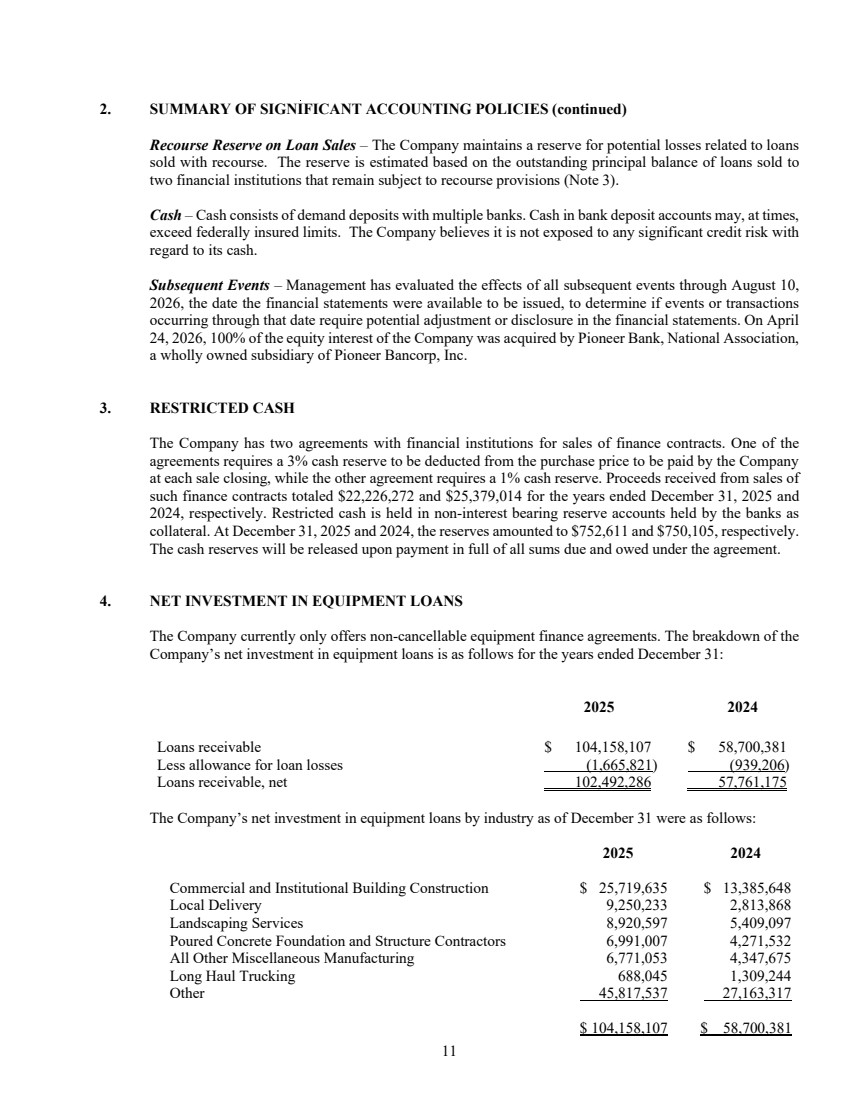
| 12 5. ALLOWANCE FOR LOAN LOSSES The allowance for loan losses is a valuation account that is deducted from equipment loans’ amortized cost basis to present the net amount expected to be collected on the loans. Loans are charged off against the allowance when management deems them uncollectible. Management estimates the allowance by considering historical credit loss patterns, adjusted for current economic conditions, portfolio composition, portfolio durations, equipment valuation trends, and portfolio performance. The allowance for loan losses is measured on a collective (pool) basis. The Company’s net investment in equipment loans is presented net of an allowance for loan losses totaling $1,665,821 and $939,206 as of December 31, 2025 and 2024, respectively. Changes in the allowance for loan losses were as follows for the years ended December 31: Beginning balance $ 939,206 $ 640,007 Charge-offs (1,647,840) (1,951,333) Recoveries 194,619 136,879 Accruals for credit losses 2,179,836 2,113,653 Ending balance $ 1,665,821 $ 939,206 A loan is considered delinquent if a scheduled payment has not been received by the date the payment was contractually due. The loans are collateralized by the corresponding asset that is funded through the loan. The Company generally has the right to repossess the asset in the event the customer defaults on the payment terms of the contract. The following tables are a consolidated summary of the delinquency status of the outstanding amortized cost of the equipment loans at December 31: 2025 Current 1-30 days 31-60 days 61-90 days > 90 days Total Equipment loans 101,440,769 1,265,096 943,866 25,521 482,855 104,158,107 2024 Current 1-30 days 31-60 days 61-90 days > 90 days Total Equipment loans 57,245,496 630,959 349,875 197,116 276,935 58,700,381 |
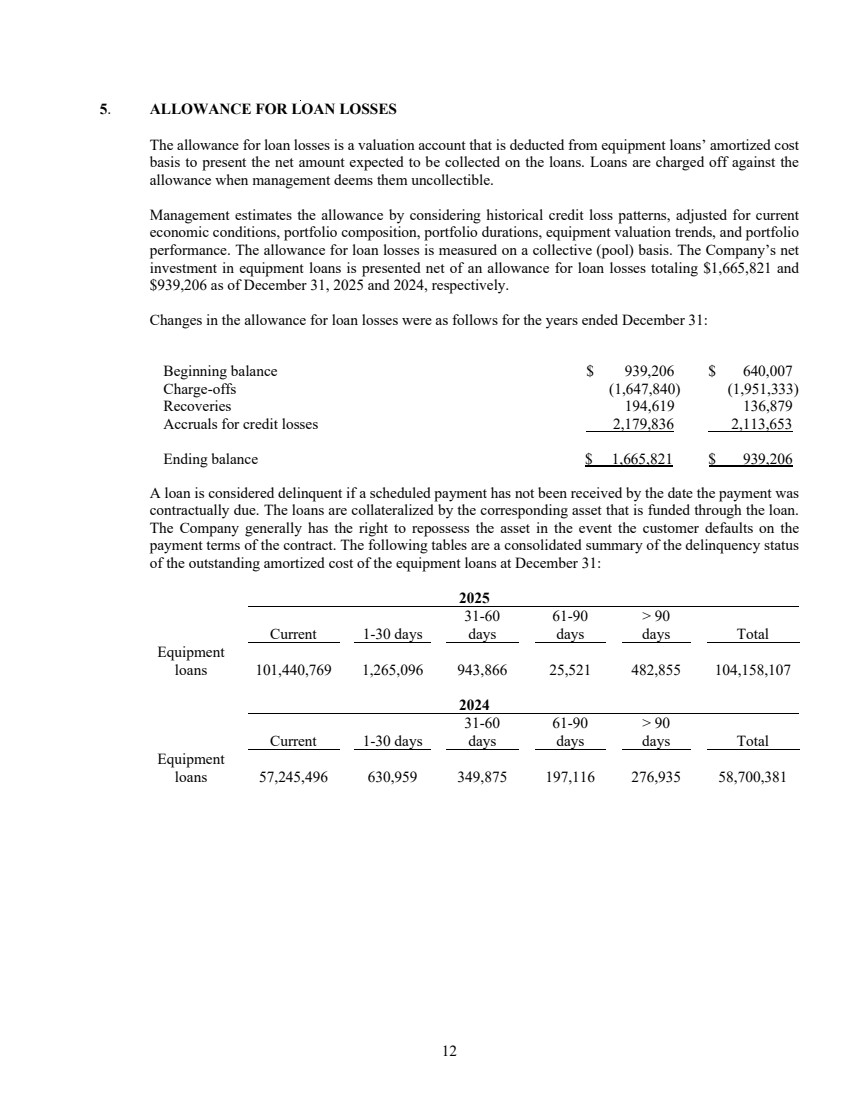
| 13 5. ALLOWANCE FOR LOAN LOSSES (continued) The following table presents the recorded investment in nonaccrual loans and loans past due over 90 days still on accrual by class of loans at December 31: 2025 Nonaccrual Nonaccrual with No Related Allowance Past Due 90 Days Still on Accrual Recognized Interest Income 689,686 - 79,018 - 2024 Nonaccrual Nonaccrual with No Related Allowance Past Due 90 Days Still on Accrual Recognized Interest Income 189,935 - 284,115 - The Company manages credit risk through established underwriting policies and ongoing monitoring and collection activities. In evaluating credit risk, the Company considers economic and industry conditions using both internal and external data sources. Each loan is assigned a credit quality indicator at origination and is subsequently updated based on the borrower’s performance and other relevant factors. Credit quality indicators range from Tier 1 to Tier 3, with Tier 1 representing lower credit risk and Tier 3 representing higher credit risk. The amortized cost of the Company’s net investment in equipment loans by credit quality indicator as of December 31, were as follows: Term Loans Amortized Cost Basis by Origination Year 2025 2025 2024 2023 2022 2021 Prior Total Tier 1 $31,984,311 $11,817,259 $1,530,132 $ 243,308 $ 30,625 $ - $ 45,605,635 Tier 2 26,604,416 11,402,620 4,062,809 711,605 55,435 - 42,836,885 Tier 3 6,886,331 4,158,313 4,295,811 296,935 78,197 - 15,715,587 Total 65,475,058 27,378,192 9,888,752 1,251,848 164,257 - 104,158,107 Current Period Gross Charge-Offs - 604,061 780,923 249,022 12,939 895 1,647,840 Term Loans Amortized Cost Basis by Origination Year 2024 2024 2023 2022 2021 2020 Prior Total Tier 1 $16,710,967 $ 2,727,844 $ 489,196 $ 97,234 $ 45,809 $ - $20,071,050 Tier 2 16,245,577 6,692,731 1,581,449 172,942 38,362 - 24,731,061 Tier 3 5,576,265 7,261,842 848,425 201,984 9,754 - 13,898,270 Total 38,532,809 16,682,417 2,919,070 472,160 93,925 - 58,700,381 Current Period Gross Charge-Offs 197,965 1,343,319 396,406 3,029 - 10,614 1,951,333 |
| 14 6. PROPERTY AND EQUIPMENT Property and equipment consisted of the following at December 31: 2025 2024 Furniture and fixtures $ 92,110 $ 81,842 Computer equipment and software 152,353 129,626 244,463 211,468 Less accumulated depreciation and amortization 206,790 192,874 $ 37,673 $ 18,594 Depreciation and amortization expense amounted to $13,916 and $10,101 for the years ended December 31, 2025 and 2024, respectively. 7. LINE OF CREDIT During 2024, the Company entered into a revolving credit facility providing for borrowings of up to $50,000,000 including an accordion feature that permitted an increase in the total commitment of up to an additional $25,000,000, subject to lender approval. The credit facility accrues interest at the Secured Overnight Financing Rate (“SOFR”) plus 2.25% (6.12% at December 31, 2025). During 2025, the Company amended the credit facility to increase the total revolving commitment to $75,000,000. The credit facility expires on January 11, 2027. As of December 31, 2025 and 2024, draws on the line were $69,162,043 and $37,787,310, respectively. The line of credit is subject to financial covenants. The Company was in compliance with these covenants at December 31, 2025. On January 14, 2026, the Company amended its revolving line of credit agreement to increase the total borrowing capacity from $75,000,000 to $125,000,000. The maturity date of the credit agreement remained January 11, 2027. |
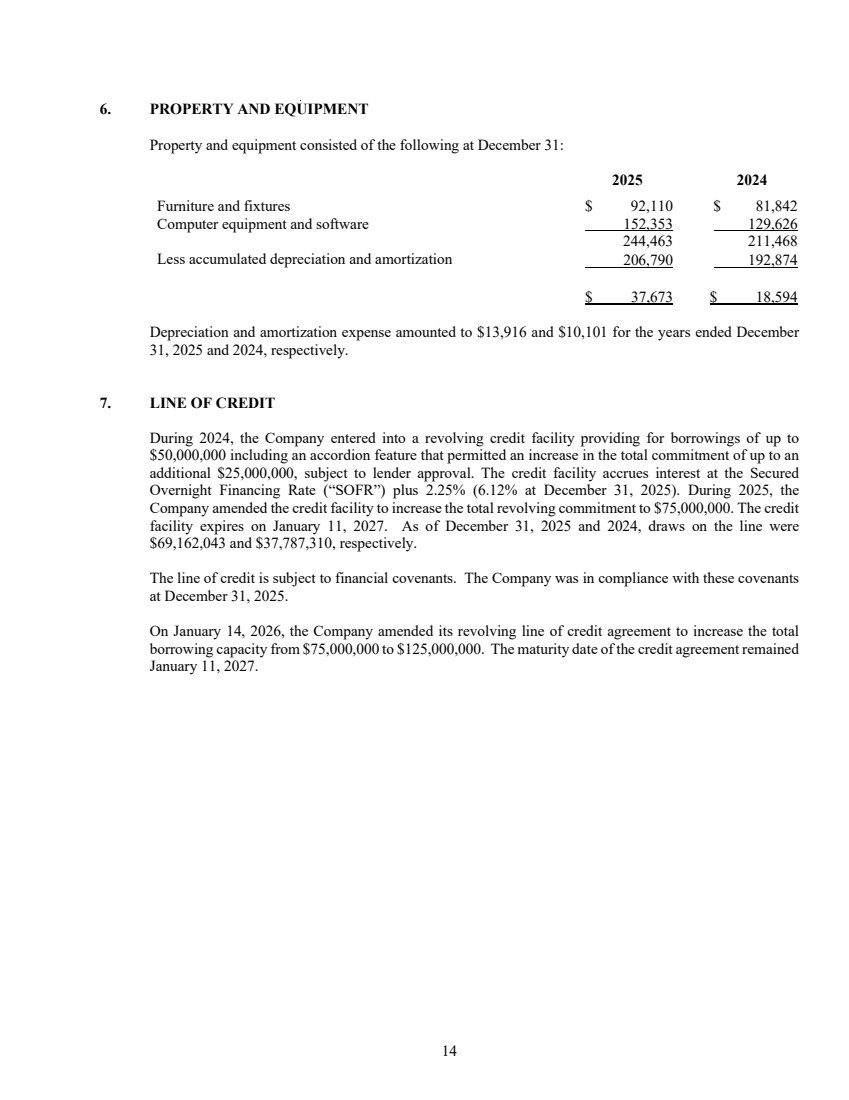
| 15 8. LONG-TERM DEBT Long-term debt consisted of the following as of December 31: 2025 2024 Senior unsecured note payable to a finance company. Interest only payments are payable quarterly on the first day of March, June, September, and December at a rate of 9.50% per annum until the loan matures. The interest rate is subject to adjustment. The rate will increase by 0.25% for each credit rating downgrade, or increase by 1.00% if the note is not rated by a nationally recognized rating organization. The note payable matures in December 2026. $ 5,000,000 $ 5,000,000 Senior unsecured note payable to a finance company. Interest only payments are payable quarterly on the first day of February, May, August and November at a rate of 9.50% per annum until the loan matures February 2027. The interest rate is subject to adjustment. The rate will increase by 0.25% for each credit rating downgrade, or increase by 1.00% if the note is not rated by a nationally recognized rating organization. 5,000,000 5,000,000 Note repaid in full during 2025. - 207,996 Total 10,000,000 10,207,996 Less debt issuance costs, net (81,642) (170,430) Less current portion, net (4,967,254) (207,996) $ 4,951,104 $ 9,829,570 In April 2020, the Company received a Paycheck Protection Program loan in the amount of $207,996 under a program established by the Coronavirus Aid, Relief, and Economic Security (CARES) Act. The Company applied for forgiveness of the loan; however, the forgiveness application was denied in 2023. As a result, the loan remained payable and the Company repaid the outstanding balance in full during the year ended December 31, 2025. The Company’s senior unsecured notes payable contain certain covenants. Under these covenants, the Company must maintain certain levels of net worth and other financial ratios. At December 31, 2025 and 2024, the Company was in compliance with these covenants. Principal maturities of long-term debt and amortization of debt issuance costs related to the notes payable for the years subsequent to December 31, 2025, are as follows: Principal 2026 $ 5,000,000 2027 5,000,000 $ 10,000,000 |
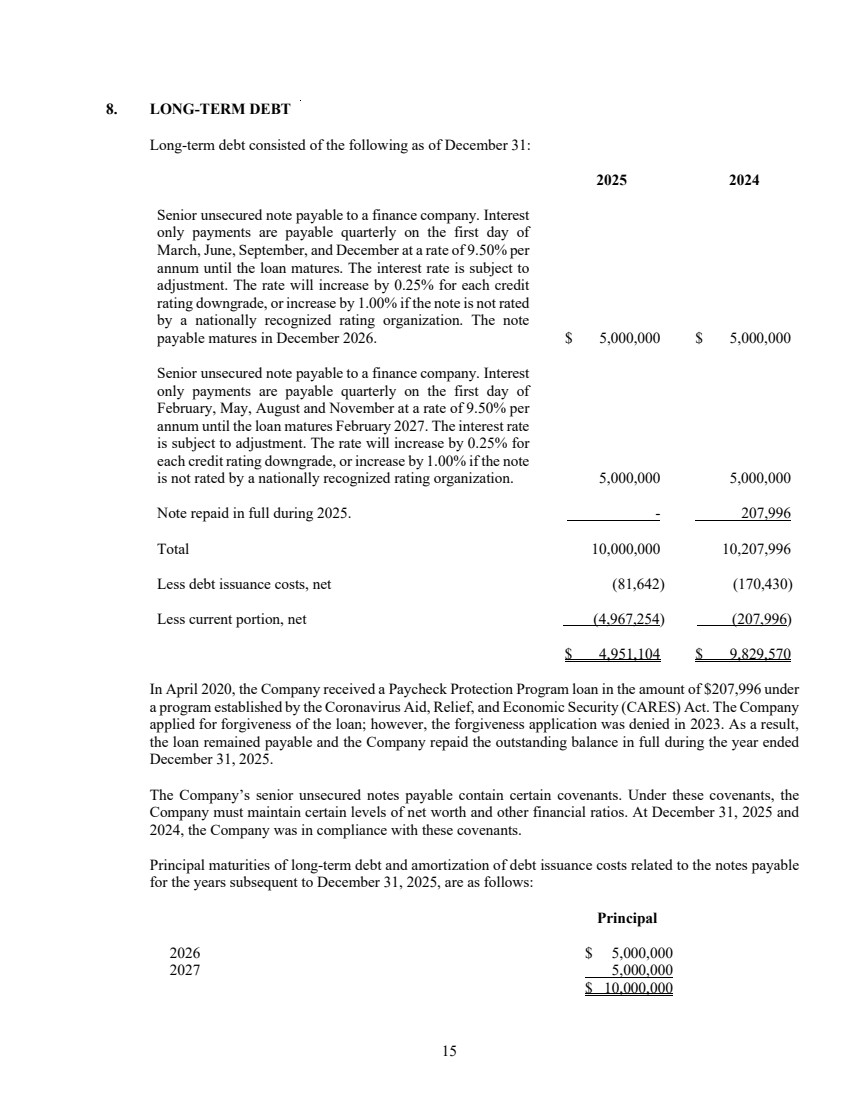
| 16 9. MEMBERS’ CAPITAL Holders of common membership interests have voting rights on matters presented to the members and participate in the management of the Company. Holders of Series A preferred membership interests do not have voting rights on matters submitted to the holders of common membership interests. However, the Company may not issue any membership interests that are senior to the Series A preferred membership interests without the approval of a majority of the Series A preferred membership interest holders, voting separately as a class. Dividends to each type of membership interest are determined and approved by the board of directors. Approved dividends may be paid out on a pro rata or non-pro rata basis, which is left to the board’s discretion. In the event the Company dissolves, holders of Series A preferred membership interests are entitled to receive prior to, and in preference to, any distribution to the holders of common membership interests, an amount equal to unpaid dividends and the aggregate amount of capital contributions attributable to the holders of Series A preferred membership interests. In the event that upon dissolution, the assets and funds of the Company are insufficient to permit the payment to the holders of Series A preferred membership interests of the full preferential amounts, then the entire assets and funds of the Company legally available for distribution are to be distributed ratably among the Series A preferred members (first for unpaid dividends, followed by capital contributions) in proportion to the members’ holdings of Series A preferred interests. The liquidation preference as of December 31, 2025 is $17,646,436 for the Class A preferred membership interest. After the distributions described above have been paid in full, the remaining assets of the Company available for distribution shall be distributed pro-rata to the holders of common membership interests for the aggregate amount of their capital contributions. Any residual assets available after common members’ capital contributions have been fully remitted will also be ratably distributed to common members in proportion to their aggregate holdings of membership units. 10. INCOME TAXES The provision for (benefit from) income taxes is as follows for the years ended December 31: 2025 2024 Current: Federal $ 840,003 $ 499,963 State 82,062 922,065 27,197 527,160 Deferred: Federal (149,038) (64,167) State (9,301) (4,005) (158,339) (68,172) $ 763,726 $ 458,988 |
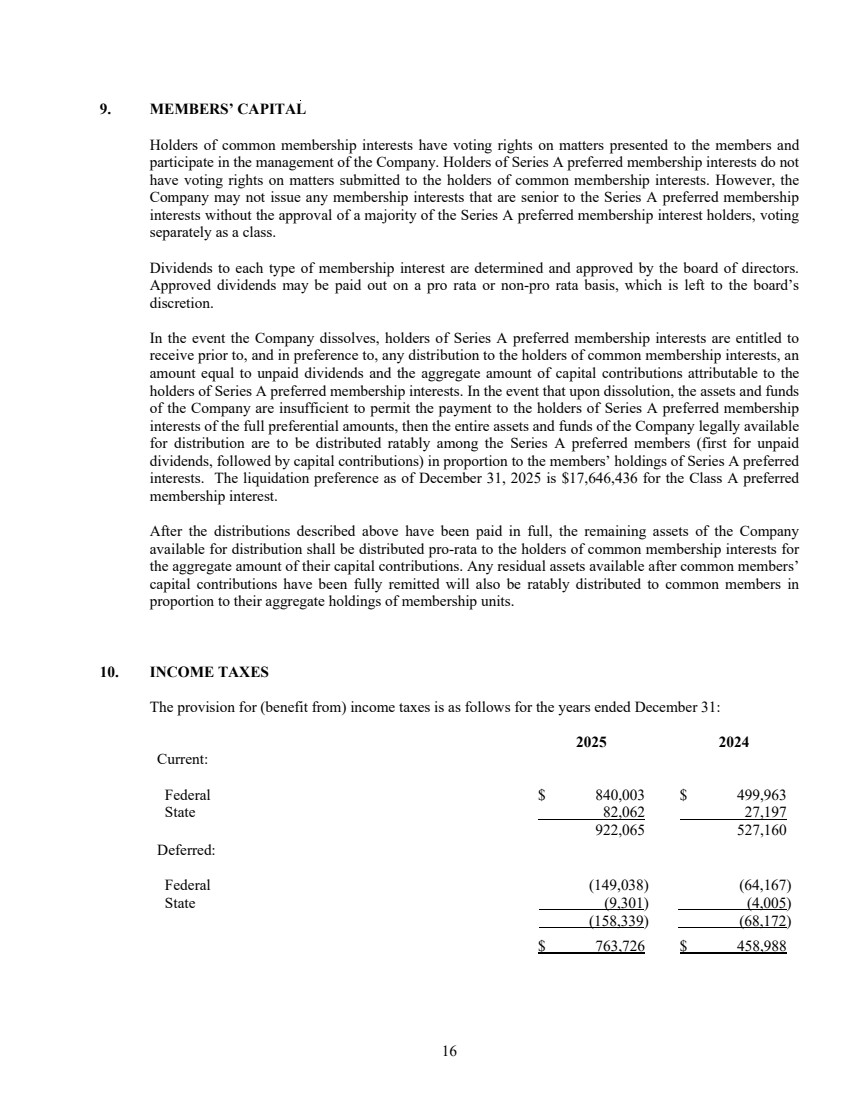
| 17 10. INCOME TAXES (continued) Actual income tax expense differs from that expected (computed by applying the statutory federal rate of 21% to earnings before income taxes) due to the following: 2025 Amount Rate Income before tax at the federal rate $ 697,931 21.0% State tax expense, net of federal benefit 39,922 1.1% Other, net 25,873 0.8% $ 763,726 22.9% 2024 Amount Rate Income before tax at the federal rate $ 439,295 21.0% State tax expense, net of federal benefit 19,693 0.9% $ 458,988 21.9% Other, net, for the year ended December 31, 2025 includes meals and entertainment. The tax effects that give rise to significant portions of the deferred tax assets and deferred tax liabilities are presented below for December 31: 2025 2024 Deferred tax assets: Allowance for credit losses $ 368,646 207,842 Right-of-use liability 35,161 - 403,807 207,842 Deferred tax liabilities: Depreciation (7,789) (2,726) Net deferred debt origination costs (1,552) (4,009) Right-of-use asset (35,020) - (44,361) (6,735) Net deferred tax assets 359,446 201,107 In assessing the realizability of deferred tax assets, management considers whether it is more likely than not that some or all of the assets may not be realized. Management considers the scheduled reversal of deferred tax liabilities, projections of future taxable income, and the ability to utilize tax credits in making this assessment. Based upon the level of historical taxable income and projections for future taxable income, management believes it is more likely than not that the Company will realize the benefit of these temporary differences in future periods, and therefore no offsetting valuation allowance has been reflected at December 31, 2025 and 2024. The Company’s income tax returns for the tax years 2022 through 2025 remain subject to examination by applicable taxing authorities. |
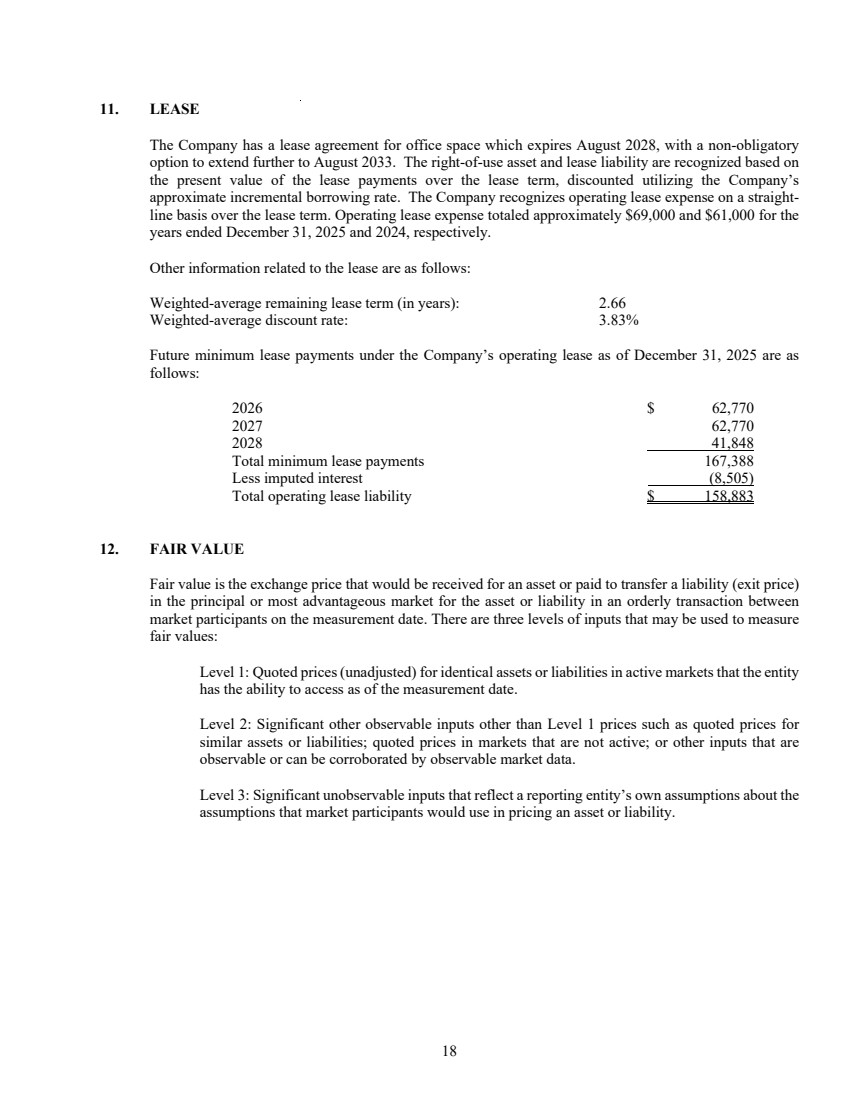
| 18 11. LEASE The Company has a lease agreement for office space which expires August 2028, with a non-obligatory option to extend further to August 2033. The right-of-use asset and lease liability are recognized based on the present value of the lease payments over the lease term, discounted utilizing the Company’s approximate incremental borrowing rate. The Company recognizes operating lease expense on a straight-line basis over the lease term. Operating lease expense totaled approximately $69,000 and $61,000 for the years ended December 31, 2025 and 2024, respectively. Other information related to the lease are as follows: Weighted-average remaining lease term (in years): 2.66 Weighted-average discount rate: 3.83% Future minimum lease payments under the Company’s operating lease as of December 31, 2025 are as follows: 2026 $ 62,770 2027 62,770 2028 41,848 Total minimum lease payments 167,388 Less imputed interest (8,505) Total operating lease liability $ 158,883 12. FAIR VALUE Fair value is the exchange price that would be received for an asset or paid to transfer a liability (exit price) in the principal or most advantageous market for the asset or liability in an orderly transaction between market participants on the measurement date. There are three levels of inputs that may be used to measure fair values: Level 1: Quoted prices (unadjusted) for identical assets or liabilities in active markets that the entity has the ability to access as of the measurement date. Level 2: Significant other observable inputs other than Level 1 prices such as quoted prices for similar assets or liabilities; quoted prices in markets that are not active; or other inputs that are observable or can be corroborated by observable market data. Level 3: Significant unobservable inputs that reflect a reporting entity’s own assumptions about the assumptions that market participants would use in pricing an asset or liability. |
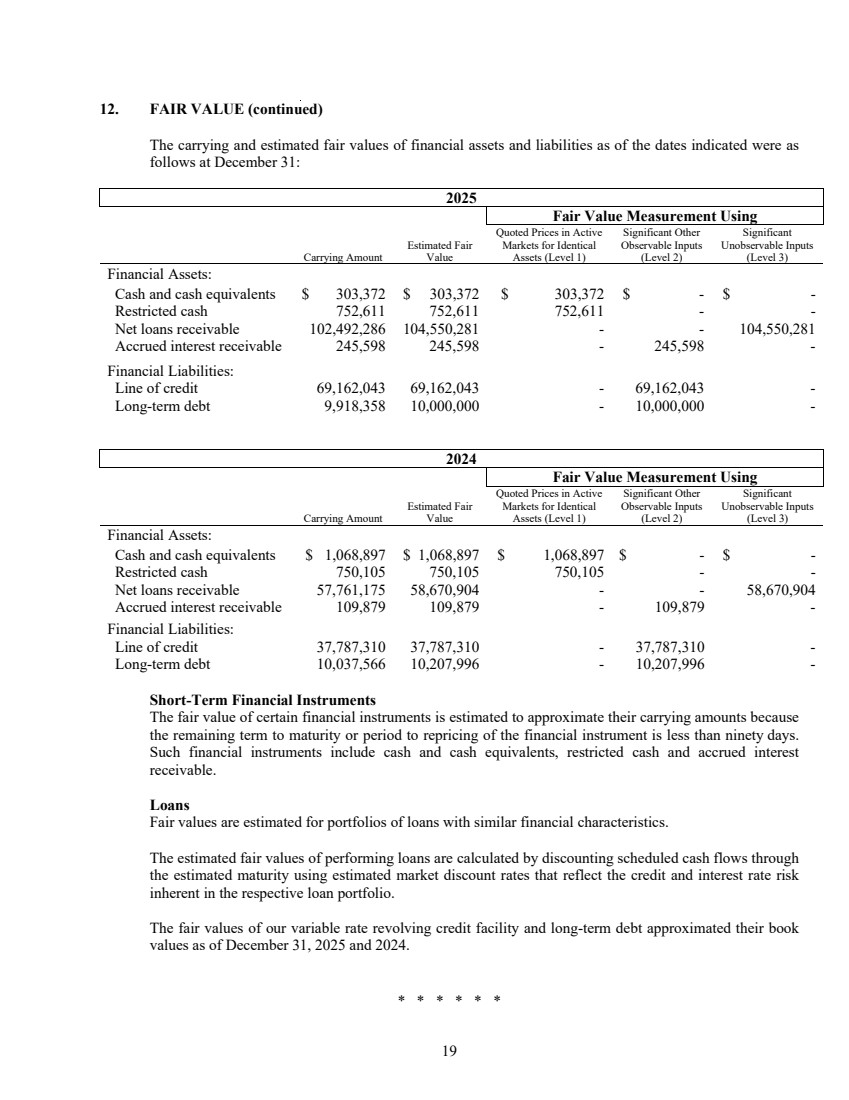
| 19 12. FAIR VALUE (continued) The carrying and estimated fair values of financial assets and liabilities as of the dates indicated were as follows at December 31: 2025 Fair Value Measurement Using Carrying Amount Estimated Fair Value Quoted Prices in Active Markets for Identical Assets (Level 1) Significant Other Observable Inputs (Level 2) Significant Unobservable Inputs (Level 3) Financial Assets: Cash and cash equivalents $ 303,372 $ 303,372 $ 303,372 $ - $ - Restricted cash 752,611 752,611 752,611 - - Net loans receivable 102,492,286 104,550,281 - - 104,550,281 Accrued interest receivable 245,598 245,598 - 245,598 - Financial Liabilities: Line of credit 69,162,043 69,162,043 - 69,162,043 - Long-term debt 9,918,358 10,000,000 - 10,000,000 - 2024 Fair Value Measurement Using Carrying Amount Estimated Fair Value Quoted Prices in Active Markets for Identical Assets (Level 1) Significant Other Observable Inputs (Level 2) Significant Unobservable Inputs (Level 3) Financial Assets: Cash and cash equivalents $ 1,068,897 $ 1,068,897 $ 1,068,897 $ - $ - Restricted cash 750,105 750,105 750,105 - - Net loans receivable 57,761,175 58,670,904 - - 58,670,904 Accrued interest receivable 109,879 109,879 - 109,879 - Financial Liabilities: Line of credit 37,787,310 37,787,310 - 37,787,310 - Long-term debt 10,037,566 10,207,996 - 10,207,996 - Short-Term Financial Instruments The fair value of certain financial instruments is estimated to approximate their carrying amounts because the remaining term to maturity or period to repricing of the financial instrument is less than ninety days. Such financial instruments include cash and cash equivalents, restricted cash and accrued interest receivable. Loans Fair values are estimated for portfolios of loans with similar financial characteristics. The estimated fair values of performing loans are calculated by discounting scheduled cash flows through the estimated maturity using estimated market discount rates that reflect the credit and interest rate risk inherent in the respective loan portfolio. The fair values of our variable rate revolving credit facility and long-term debt approximated their book values as of December 31, 2025 and 2024. * * * * * * |