N-4
Aug. 10, 2026
USD ($)
yr
Dec. 31, 2025
Dec. 31, 2024
Dec. 31, 2023
Dec. 31, 2022
Dec. 31, 2021
Dec. 31, 2020
Dec. 31, 2019
Dec. 31, 2018
Dec. 31, 2017
Dec. 31, 2016
Positive returns are credited based on a
“
Crediting Strategy
” that may limit or enhance
your
returns on the
Term End Date
. An
IPCS
may also
include a
Performance Lock
feature that allows
you
to lock in the value of the
IPCS
before the end of
the
Strategy Term
.
You
could lose a significant amount of money if the
Index
declines in value.
The
Buffer
Protection Strategy
absorbs negative
Index Performance
by protecting against losses up to the
Buffer Rate
on the
Term End Date
. The
Buffer Rate
is the
maximum loss we will protect
you
from at the end of the
Strategy Term
.
If the
Index Performance
on the
Term End Date
is negative,
you
will be subject to any loss that exceeds the
Buffer Rate
.
For
example, if the
Index
return is -25% and the
Buffer Rate
is -10%, we will credit -15% (the amount
that exceeds the
Buffer Rate
) at the end of the
Strategy Term
, meaning the amount
you
invested in
the
IPCS
will decrease by 15%.
FEES, EXPENSES, AND ADJUSTMENTS |
LOCATION IN THE PROSPECTUS | |
Are There Charges or Adjustments for Early Withdrawals? |
Yes. If you withdraw money from your Contract within 6 years following Contract issuance, you may be assessed a surrender charge of up to 8% of the amount withdrawn in excess of the free withdrawal amount. The free withdrawal amount is the greater of (i) 10% of your Contract Value as of the most recent Contract Anniversary (or, in the first Contract Year , 10% of your premium payment) or (ii) your RMD under our automatic RMD program. For example, if you take an early withdrawal, you could pay a surrender charge of up to $7,200 on a $100,000 investment, assuming your Contract Value is $100,000 at the time of the withdrawal. This loss will be greater if there is a negative Interim Value adjustment, taxes, or tax penalties. If all or a portion of your Contract Value is removed from an IPCS prior to the end of the Strategy Term , it will be subject to an adjustment due to the Interim Value , which may be negative. Interim Value adjustment could result in losses as high as 100%. The maximum loss could occur in extreme circumstances due to a negative Interim Value adjustment.. For example, if you allocate $100,000 to an IPCS with a 3 year Strategy Term and later withdraw the entire amount before the 3 years have ended, you could lose up to $100,000 of your investment. This loss will be greater if you also have to pay a surrender charge, taxes, and tax penalties. Transactions that are subject to an Interim Value adjustment include (i) taking a withdrawal or surrendering your Contract, including the deduction of applicable surrender charges and/or premium taxes, (ii) exercising the Performance Lock feature (if available), (iii) annuitization, (iv) the payment of the Standard Death Benefit, and (v) exercising your right to return the Contract (unless the return of premium is greater). |
Fee Tables Charges and Adjustments |
Are There Transaction Charges? |
No. Other than surrender charges and any negative Interim Value adjustments, th ere are no charges for other Contract transactions. |
|
Are There Ongoing Fees and Expenses? |
Yes . Although we do not charge you a direct fee to invest in the IPCS optio ns, there is an implicit ongoing fee associated with the IPCS because the amount you can earn on an IPCS will be limited to the extent the Index return exceeds (i) the Cap Rate (if any) under the Cap with Par Crediting Strategy or the Cap with Par & Spread Crediting Strategy , or (ii) the Dual Direction Trigger Rate or the Step-Up Trigger Rate under the Dual Direction Trigger Rate Crediting Strategy or the Step-Up Trigger Rate Crediting Strategy , respectfully. Your returns will also be reduced by the Spread under the Cap with Par & Spread Crediting Strategy . The application of the Crediting Strategy may cause your returns under the IPCS to be lower than the Index’s returns. In return for accepting this limit on Index gains, you receive some protection from Index losses through the Protection Strategy . Your returns could be limited if the Participation Rate is below 100%. |
Investment Strategies – Crediting Strategies. |
Yes.
If
you
withdraw money from
your
Contract within 6 years following Contract
issuance,
you
may be assessed a surrender charge of up to 8% of the amount
withdrawn in excess of the free withdrawal amount. The free withdrawal
amount is the greater of (i) 10% of
your
Contract Value
as of the most recent
Contract Anniversary
(or, in the first
Contract Year
, 10% of
your
premium
payment) or (ii)
your
RMD under our automatic RMD program.
For example, if
you
take an early withdrawal,
you
could pay a surrender charge
of up to $7,200 on a $100,000 investment, assuming
your
Contract Value
is
$100,000 at the time of the withdrawal. This loss will be greater if there is a
negative
Interim Value
adjustment, taxes, or tax penalties.
If all or a portion of
your
Contract Value
is removed from an
IPCS
prior to the
end of the
Strategy Term
, it will be subject to an adjustment due to the
Interim
Value
, which may be negative. A negative
Interim Value
adjustment could
result in losses as high as 100%. The maximum loss could occur in extreme
circumstances due to a negative
Interim Value
adjustment..
For example, if
you
allocate $100,000 to an
IPCS
with a 3 year
Strategy Term
and later withdraw
the entire amount before the 3 years have ended,
you
could lose up to $100,000
of
your
investment. This loss will be greater if
you
also have to pay a surrender
charge, taxes, and tax penalties. Transactions that are subject to an
Interim
Value
adjustment include (i) taking a withdrawal or surrendering
your
Contract,
including the deduction of applicable surrender charges and/or premium taxes,
(ii) exercising the
Performance Lock
feature (if available), (iii) annuitization,
(iv) the payment of the Standard Death Benefit, and (v) exercising
your
right to
return the Contract (unless the return of premium is greater).
If all or a portion of
your
Contract Value
is removed from an
IPCS
prior to the
end of the
Strategy Term
, it will be subject to an adjustment due to the
Interim
Valuewhichmaybe negative.
For example, if
you
allocate $100,000 to an
IPCS
with a 3 year
Strategy Term
and later withdraw
the entire amount before the 3 years have ended,
you
could lose up to $100,000
No.
Other than surrender charges and any negative
Interim Value
adjustments, th
ere
are no charges for other Contract transactions.
Yes
.
Although we do not charge
you
a direct fee to invest in the
IPCS
optio
ns,
there is an implicit ongoing fee associated with the
IPCS
because the
amount
you
can earn on an
IPCS
will be limited to the extent the
Index
return exceeds (i) the
Cap Rate
(if any) under the
Cap with Par
Crediting
Strategy
or the
Cap with Par & Spread
Crediting Strategy
, or (ii) the
Dual
Direction Trigger Rate
or the
Step-Up Trigger Rate
under the
Dual
Direction Trigger Rate
Crediting Strategy
or the
Step-Up Trigger Rate
Crediting Strategy
, respectfully.
Your
returns will also be reduced by the
Spread
under the
Cap with Par & Spread
Crediting Strategy
.
The
application of the
Crediting Strategy
may cause
your
returns under the
IPCS
to be lower than the
Index’s
returns.
In return for accepting this
limit on
Index
gains,
you
receive some protection from
Index
losses
through the
Protection Strategy
.
Your
returns could be limited if the
Participation Rate
is below 100%.
Although we do not charge
you
a direct fee to invest in the
IPCS
optio
ns,
there is an implicit ongoing fee associated with the
IPCS
because the
amount
you
can earn on an
IPCS
will be limited to the extent the
Index
return exceeds (i) the
Cap Rate
(if any) under the
Cap with Par
Crediting
Strategy
or the
Cap with Par & Spread
Crediting Strategy
, or (ii) the
Dual
Direction Trigger Rate
or the
Step-Up Trigger Rate
under the
Dual
Direction Trigger Rate
Crediting Strategy
or the
Step-Up Trigger Rate
Crediting Strategy
, respectfully.
Your
returns will also be reduced by the
Spread
under the
Cap with Par & Spread
Crediting Strategy
.
The
application of the
Crediting Strategy
may cause
your
returns under the
IPCS
to be lower than the
Index’s
returns.
In return for accepting this
limit on
Index
gains,
you
receive some protection from
Index
losses
through the
Protection Strategy
.
Your
returns could be limited if the
Participation Rate
is below 100%.
The
application of the
Crediting Strategy
may cause
your
returns under the
IPCS
to be lower than the
Index’s
returns.
In return for accepting this
limit on
Index
gains,
you
receive some protection from
Index
losses
through the
Protection Strategy
.
This Contract is not a short-term investment and is not appropriate for an
investor who needs ready access to cash. Withdrawals could result in surrender
charges during the first six years
you
own the Contract, and may be subject to
taxes and tax penalties (including a 10% tax penalty before age 59
1
∕
2
).
In addition, amounts removed from an
IPCS
prior to the end of the
Strategy
Term
may be subject to a negative
Interim Value
adjustment, which could result
in a loss that is greater than the level of protection the
Protection Strategy
would provide on the
Term End Date
, or a gain that is lower than the return the
Crediting Strategy
would provide on the
Term End Date
. The calculation of the
Interim Value
in connection with a withdrawal could result in the loss of
principal and previously credited earnings, even if the
Index
is performing
positively, and such losses could be substantial.
Contract Value
that is allocated to an
IPCS
may only be reallocated on the
Term End Date
(which is also a
Contract Anniversary
) unless
you
exercise the
Performance Lock
feature (if available).
Contract Value
that is allocated to the
FRS
and any locked-in
Index Strategy Value
pursuant to the exercise of the
Performance Lock
feature may be reallocated on the next
Contract Anniversary
.
If we do not receive
your
reallocation instructions at our
Customer Service
Office
by the close of business on the date the reallocation will be effected,
your
Contract Value
will be automatically reinvested in the same Investment
Strategies, if available (i.e., the
Fixed Rate Strategy Value
will be reinvested in
the
FRS
, the
Index Strategy Value
will be reinvested in the same
IPCS
), subject
to the new crediting rates. If the same
IPCS
is not available, the amount will be
automatically reallocated to an
IPCS
with the same
Strategy Term
,
Index
,
Protection Strategy
, and
Crediting Strategy
, if available (i.e., only the
availability of the
Performance Lock
feature is different). If such an
IPCS
is
not available, the amount will be automatically reallocated to the 1-Year
Strategy Term
/ -10%
Buffer
/ S&P 500
Index
/
Cap with Par
/ with or without
Performance Lock
(depending on availability). Any reallocation absent
your
instruction may not be satisfactory to
you
.
Yes
.
Contract Value
that is allocated to an
IPCS
may only be reallocated on the
Term End Date
(which is also a
Contract Anniversary
), unless
you
exercise the
Performance Lock
feature (if available).
Contract Value
that is allocated to the
FRS
and any locked-in
Index Strategy Value
pursuant to the exercise of the
Performance Lock
feature may be reallocated on the next
Contract Anniversary
.
●
Currently all
IPCS
options and Contract features are available through
financial professionals selling the Contract.
Your
financial professional
may not recommend certain
IPCS
options.
You
may obtain information
about the
IPCS
options that are available to
you
by contacting
your
financial professional or our
Customer Service Office
.
●
Certain
IPCS
or Contract features may not be available in
your
state. See
Appendix B for state variations that may apply.
●
You
may not allocate
Contract Value
to an
IPCS
if the
Term End Date
would occur after the latest
Annuity Commencement Date
(i.e., the
Contract Anniversary
immediately following the
Annuitant’s
100th
birthday).
In addition, we reserve the right to:
●
Add or remove
IPCS
options;
●
Limit the availability of certain
IPCS
options to new Contract purchases;
●
Not include a
Performance Lock
feature in the future on certain or any
IPCS
options;
●
Declare new
Cap Rates
,
Participation Rates
,
Dual Direction Trigger Rates
and
Step-Up Trigger Rates
for each new
Strategy Term
, subject to the
stated minimum guaranteed rates for that
IPCS
option;
We may not declare a
Cap Rate
for a particular
Cap with Par and Spread
Strategy Term
. For any such
Strategy Term
which we do declare a
Cap Rate
,
the
Participation Rate
will always equal 100% (which means it will never be
greater than the minimum guaranteed rate of 100%).
●
Stop offering or replace a reference
Index
(including during a
Strategy
Term
) if it is discontinued, if the
Index
is substantially changed, if the
Index Values
become unavailable, if we no longer have a license
agreement with the publishers of the
Index
, or if hedging instruments
become difficult to acquire or the cost of hedging becomes excessive. If
we replace an
Index
, we will attempt to select a new
Index
that has a
similar investment objective and risk profile to the original
Index
. The
replacement
Index
we select may not be satisfactory to
you
; and
●
Limit the number of
IPCS
options offered to one. We always intend to
offer the 1-Year / -10%
Buffer
/ S&P 500
Index
/
Cap with Par
IPCS
option, subject to our right to substitute the
Index
with one that is
substantially similar, which means we will always offer a strategy with a
-10%
Buffer
. If we exercise our right to offer only this
IPCS
option and
you
are not satisfied,
you
may invest in the
FRS
or surrender the Contract,
but the surrender may incur surrender charges, may be subject to taxes
(including a 10% tax penalty before age 59
1
∕
2
) and, with respect to
amounts surrendered from an
IPCS
that has not been locked in prior to the
Term End Date
, will be subject to an
Interim Value
adjustment.
The availability of
IPCS
may vary depending on the broker-dealer through
which the contract is sold.
Yes
.
The
Performance Lock
feature may not be available in the future on certain or
any
IPCS
options. The automatic
Performance Lock
is not available with the
Dual Direction Trigger Rate
Crediting Strategy
or the
Step-Up Trigger Rate
Crediting Strategy
.
The Return of Premium Payment Death Benefit is subject to withdrawal
adjustments (including any applicable surrender charges), which may be more,
even significantly more, then the dollar amount withdrawn.
Although
you
may request a withdrawal at any time, withdrawals will always
be taken first from the
FRS
, then proportionally from locked-in
IPCS
options,
then proportionally from
IPCS
options that are at the
Term End Date
, and
finally proportionally from
IPCS
options that are not at the
Term End Date
.
You
may not request a partial withdrawal to be withdrawn from a particular
Investment Strategy
. This means that if
you
wish to withdraw money from a
specific
IPCS
without the
Performance Lock
feature before the
Term End Date
,
your
only option will be to surrender the Contract, which may incur surrender
charges, may be subject to taxes (including a 10% additional tax before age
59
1
∕
2
), and, with respect to amounts surrendered from an
IPCS
prior to the
Term End Date
, will be subject to an
Interim Value
adjustment.
The availability of
IPCS
options may vary depending on the broker-dealer
through which the contract is sold.
You
should consult with a tax professional to determine the tax implications of
an investment in, withdrawals from, and payments received under the Contract.
There is no tax penalty benefit if
you
purchase the Contract through a
Traditional IRA or Roth IRA. Withdrawals are subject to ordinary income tax,
and
you
may be subject to a 10% tax penalty if
you
withdraw money before
age 59
1
∕
2
.
Your
financial professional may receive compensation for selling the Contract
to
you
in the form of commissions and non-cash compensation. This
compensation may influence
your
financial professional to recommend the
Contract over another investment.
Some financial professionals may have a financial incentive to offer
you
a new
contract in place of the one
you
own.
You
should only exchange
your
contract
if
you
determine, after comparing the features, fees and risks of both contracts,
and any fees or penalties to terminate the existing contract, that it is better for
you
to purchase the new contract rather than continue to own
your
existing
contract.
FEE TABLES
The following tables describe the fees, expenses, and adjustments that
you
will pay when buying, owning,
and surrendering or making withdrawals from an
IPCS
or from the Contract. Please refer to
your
Contract specifications page for information about the specific fees
you
will pay each year based on the
options
you
have elected.
The first table describes the fees and expenses that
you
will pay at the time that
you
surrender or make
withdrawals from the Contract. State premium taxes may also be deducted.
Transaction Expenses
Surrender Charge (as a percentage of amount surrendered) 1 |
8% |
1
The surrender charge will be imposed when
you
take a partial withdrawal or surrender
your
Contract during the first six
Contract
Years
, unless an exception applies. Each year during the first six
Contract Years
, however,
you
may take withdrawals up to the “free
withdrawal amount” without incurring a surrender charge. The free withdrawal amount is the greater of (i) 10% of
your
Contract Value
as of the most recent
Contract Anniversary
(or, in the first
Contract Year
, 10% of
your
total premiums paid) or (ii)
your
RMD under
our automatic RMD program.
The surrender charge grades to 0% according to the following schedule:
Contract Year |
1 |
2 |
3 |
4 |
5 |
6 |
7+ |
Surrender Charge Percentage |
8% |
8% |
7% |
6% |
5% |
4% |
0% |
See "Charges and Adjustments" for more information.
The next table describes the adjustments, in addition to any transaction expenses, that apply if all or a
portion of the
Contract Value
is removed from an
IPCS
before the end of the
Strategy Term
.
Adjustments
Interim Value Adjustment Maximum Potential Loss (as a percentage of Contract Value ) 1 |
100% |
1
The maximum loss could occur in extreme circumstances due to a negative
Interim Value
adjustment. Transactions that are subject to
an
Interim Value
adjustment include (i) taking a withdrawal or surrendering
your
Contract, including the deduction of applicable
surrender charges and/or premium taxes, (ii) exercising the
Performance Lock
feature (if available), (iii) annuitization, (iv) the
payment of the Standard Death Benefit, and (v) exercising
your
right to return the Contract (unless the return of premium is greater).
See “Charges and Adjustments” for more information.
In addition to the fees described above, the amount
you
can earn on an
IPCS
will be limited to the extent
the
Index
return exceeds (i) the
Cap Rate
(if any) under the
Cap with Par
Crediting Strategy
or the
Cap
with Par & Spread
Crediting Strategy
; (ii) the
Dual Direction Trigger Rate
under the
Dual Direction
Trigger Rate
Crediting Strategy
; or (iii) the
Step-Up Trigger Rate
under the
Step-Up Trigger Rate
Crediting Strategy
.
Your
returns will also be reduced by the
Spread
under the
Cap with Par & Spread
Crediting Strategy
. The application of the
Crediting Strategy
may cause
your
returns under the
IPCS
to
be lower than the
Index’s
returns. In return for accepting this limit on
Index
gains,
you
will receive some
protection from
Index
losses through the
Protection Strategy
.
Transaction Expenses
Surrender Charge (as a percentage of amount surrendered) 1 |
8% |
1
The surrender charge will be imposed when
you
take a partial withdrawal or surrender
your
Contract during the first six
Contract
Years
, unless an exception applies. Each year during the first six
Contract Years
, however,
you
may take withdrawals up to the “free
withdrawal amount” without incurring a surrender charge. The free withdrawal amount is the greater of (i) 10% of
your
Contract Value
as of the most recent
Contract Anniversary
(or, in the first
Contract Year
, 10% of
your
total premiums paid) or (ii)
your
RMD under
our automatic RMD program.
The maximum loss could occur in extreme circumstances due to a negative
Interim Value
adjustment. Transactions that are subject to
an
Interim Value
adjustment include (i) taking a withdrawal or surrendering
your
Contract, including the deduction of applicable
surrender charges and/or premium taxes, (ii) exercising the
Performance Lock
feature (if available), (iii) annuitization, (iv) the
payment of the Standard Death Benefit, and (v) exercising
your
right to return the Contract (unless the return of premium is greater).
See “Charges and Adjustments” for more information.
Contract Year |
1 |
2 |
3 |
4 |
5 |
6 |
7+ |
Surrender Charge Percentage |
8% |
8% |
7% |
6% |
5% |
4% |
0% |
PRINCIPAL RISKS
An investment in the Contract involves certain risks that you should consider prior to purchasing the Contract
or
making investment decisions.
Market Risk
There is a risk of loss of principal and previously-credited earnings due to poor investment performance, and
such losses may be substantial. In recent years, the financial markets have experienced periods of significant
volatility and negative returns, contributing to an uncertain and evolving economic environment. Financial
markets have been impacted by several interrelating factors, including (but not limited to) pandemics,
geopolitical turmoil, rising inflation, economic recessions, interest rate fluctuations, and actions by governmental
authorities. Depending on the Investment Strategies you select and the timing of transactions you request (e.g.,
reallocations, withdrawals, exercise of the Performance Lock feature), you may experience significant negative
returns under the Contract.
Index – Linked Option Risks
Protection Strategies
The Protection Strategies provide downside protection from negative Index performance only on the Term End
Date, so your risk of loss is greater on any other date during the Strategy Term. For multi-year Strategy Terms,
the Protection Strategies are
not
applied on an annual basis; any negative Index Performance is measured from
the Term Start Date to the Term End Date. In other words, the limits on downside loss provided by the Protection
Strategy are applied to the Index Performance at the end of the Strategy Term, not during the Strategy Term or
over the life of the Contract.
If you invest in an IPCS, you will bear the portion of loss that exceeds your
Buffer Rate. If you invest in an IPCS with the lowest level of protection currently offered (the -10%
Buffer), you could experience losses up to 90% at the end of the Strategy Term due to negative Index
Performance. We always intend to offer the 1-Year / -10% Buffer / S&P 500 Index / Cap with Par IPCS
option, subject to our right to substitute the Index with one that is substantially similar, which means we
will always offer a strategy with a -10% Buffer.
If you reinvest your money in the same IPCS over the course
of multiple Strategy Terms, you may incur greater losses than the protection level provided by that IPCS over the
course of a single Strategy Term.
Crediting Strategies
The Crediting Strategies determine how positive Index performance is credited on the Term End Date, and may
limit or enhance your returns under the IPCS. The amount you can earn on an IPCS will be limited to the extent
the Index return exceeds (i) the Cap Rate (if any) under the Cap with Par Crediting Strategy or the Cap with Par
& and Spread Crediting Strategy, (ii) the Dual Direction Trigger Rate under the Dual Direction Trigger Rate
Crediting Strategy, or (iii) the Step-Up Trigger Rate under the Step-Up Trigger Rate Crediting Strategy. Your
returns will also be reduced by the Spread under the Cap with Par & Spread Crediting Strategy. The application
of the Crediting Strategy may cause your returns under the IPCS to be lower than the Index’s returns. For
multi-year Strategy Terms, the Crediting Strategies are
not
applied on an annual basis; any positive Index
Performance is measured from the Term Start Date to the Term End Date. In other words, the Crediting Strategy
will be applied to the Index Performance at the end of the Strategy Term, not during the Strategy Term or over
the life of the Contract. Your investment in an IPCS is not an investment in the Index or the securities tracked by
the Index.
Liquidity and Early Withdrawal Risk
The Contract is not designed to be a short-term investment, and it is not appropriate for an investor who intends
to take early or frequent withdrawals.
●
Surrender Charges.
If you take withdrawals or surrender your Contract during the first six Contract
Years, a surrender charge will apply to amounts that exceed the free withdrawal amount, unless an
exception applies
●
Negative Interim Value Adjustments.
If you withdraw money from an IPCS prior to the Term E
nd
Date, the amount available for withdrawal from that IPCS is the Interim Value.
●
We calculate the Interim Value based on the value of a hypothetical portfolio of financial
instruments designed to replicate the Maturity Value (which is the Index Strategy Value on the
Term End Date). The Interim Value could be less than your investment even if the Index is
performing positively.
●
If you take a withdrawal, the calculation of the Interim Value could result in the loss of principal
and previously-credited earnings, and such losses could be substantial. A negative Interim Value
adjustment could result in losses as high as 100%. The maximum loss could occur in extreme
circumstances due to a negative Interim Value adjustment. Extreme circumstances causing a
negative Interim Value Adjustment can be connected to several factors, including but not limited to
trading costs and market price changes.
●
Partial withdrawals (including systematic withdrawals, RMDs, and any associated charges
deducted) from an IPCS that has not been locked in pursuant to exercise of the Performance Lock
feature on any day during the Strategy Term other than the Term Start Date and the Term End Date
will reduce the Strategy Value Base for the IPCS (which is the base amount that is used to
calculate the Interim Value prior to the Term End Date and the Maturity Value on the Term End
Date) by the same percentage that the withdrawal reduced the Index Strategy Value for that IPCS,
which may be more, even significantly more, than the dollar amount withdrawn. This means that if
you take a withdrawal at a time when the Interim Value is less than the Strategy Value Base, the
Strategy Value Base will be reduced by more than the amount withdrawn.
●
Because surrender charges are imposed when withdrawals are taken during the surrender charge
period and adjustments associated with the Interim Value calculation are applied when withdrawals
are taken prior to the Term End Date, these withdrawals can result in a loss of principal and
previously-credited earnings even if the Index has been performing positively.
●
In addition, the Interim Value calculation could result in a loss that is greater than the level of
protection the Protection Strategy would provide on the Term End Date, or a gain that is lower
than the return the Crediting Strategy would provide on the Term End Date.
●
The Interim Value is also the amount available from an IPCS if you surrender or annuitize the
Contract, exercise of the Performance Lock feature (if available) or your right to return the
Contract (unless the return of premium is greater), or if a Standard Death Benefit is paid prior to
the Term End Date.
●
Strategy Value Base.
●
Partial withdrawals (including systematic withdrawals, RMDs, and any associated charges deducted)
from an IPCS that has not been locked in pursuant to exercise of the Performance Lock feature on any
day during the Strategy Term other than the Term Start Date and the Term End Date will reduce the
Strategy Value Base for the IPCS by the same percentage that the withdrawal reduced the Index
Strategy Value for that IPCS. Such a reduction could be more, even significantly more, than the dollar
amount withdrawn.
●
The proportional reduction in your Strategy Value Base could be greater than the dollar amount of the
withdrawal depending on whether the Interim Value of the IPCS is higher or lower than the Strategy
Value Base of that IPCS at the time of the withdrawal. When the Interim Value is less than the Strategy
Value Base at the time of the withdrawal, the proportional reduction will always be greater than the
dollar amount withdrawn.
●
Withdrawals may have more of an adverse impact on the remaining Interim Value the earlier in the
Strategy Term a withdrawal is taken.
●
A lower Strategy Value Base will reduce any credit amount that may be applied on the Term End Date.
●
You cannot reallocate Contract Value into the IPCS to increase your Strategy Value Base during the
Strategy Term.
●
Death Benefit.
●
Withdrawals will reduce the Standard Death Benefit on a dollar-for-dollar basis.
●
The Return of Premium Payment Death Benefit is subject to withdrawal adjustments (including any
applicable surrender charges), which may be more, even significantly more, than the dollar amount
withdrawn. (See “Benefits Available Under the Contract – Death Benefit.”)
●
Withdrawal Limitation.
Amounts are withdrawn from the Investment Strategies in the order described in the
“Reallocations and Withdrawals” section. You may not request a partial withdrawal be withdrawn from a
particular Investment Strategy. This means that if you wish to withdraw money from a specific IPCS without
the Performance Lock feature before the Term End Date, your only option will be to surrender the Contract,
which may incur surrender charges, may be subject to taxes (including a 10% tax penalty before age 59
1
∕
2
),
and, with respect to any amounts surrendered from an IPCS prior to the Term End Date, will be based on the
Interim Value. The Interim Value could be less than your investment in the IPCS even if the Index is
performing positively. See “Charges and Adjustments – Interim Value Adjustment” for more information
about the calculation of the Interim Value.
●
Taxes.
Withdrawals and surrenders may result in adverse tax consequences, including a 10% tax penalty
before age 59
1
∕
2
.
●
Minimum Account Value.
If you take a withdrawal that would cause your Contract Value to fall below
$2,000, we may terminate your Contract.
Reallocation Restrictions
Contract Value that is allocated to an IPCS may only be reallocated on the Term End Date, unless (1) you
exercise the Performance Lock feature (if available) or (2) the IPCS is matured early and its value reallocated to
the FRS due to discontinuation of an Index. Contract Value that is allocated to the FRS and any locked-in Index
Strategy Value pursuant to the exercise of the Performance Lock feature may only be reallocated on the next
Contract Anniversary. Because of these restrictions, you may not be able to change your investment selections in
response to changes in market conditions during the investment term.
If you do not want to remain invested in your current allocations until these dates, you may surrender the Contract, which may incur surrender charges,
may be subject to taxes (including a 10% tax penalty before age 59
1
∕
2
), and, with respect to any amounts
surrendered from an IPCS prior to the Term End Date, will be based on the Interim Value. The Interim Value
could be less than your investment in the IPCS even if the Index is performing positively. See “Charges and
Adjustments – Interim Value Adjustment” for more information about the calculation of the Interim Value.
If we do not receive reallocation instructions in Good Order by the close of business on the Term End Date, your
current allocations will be reinvested for a new term (in the same IPCS, if available) using the new crediting
rates. If the Term End Date is a non-Business Day, reallocation instructions must be received in Good Order no
later than the close of business on the Business Day prior to the Term End Date. If the same IPCS is not
available, the amount will be automatically reallocated to an IPCS with the same Strategy Term, Index,
Protection Strategy, and Crediting Strategy, if available (i.e., only the availability of the Performance Lock
feature will differ). If such an IPCS is not available, the amount will be automatically reallocated to the 1-Year
Strategy Term / -10% Buffer / S&P 500 Index / Cap with Par / with or without the Performance Lock feature
(depending on availability). This reallocation may not be satisfactory to you.
Availability of IPCS Options
We reserve the right to add or remove IPCS investment options. We also reserve the right to limit the availability
of certain IPCS to new Contract purchases. An IPCS that is currently available may not be available for
reallocations or reinvestment at the end of the Strategy Term (or the next Contract Anniversary after you exercise
the Performance Lock feature, if applicable). Certain IPCS may not be available through your financial
professional. You may obtain information about the IPCS options that are available to you by contacting your
financial professional or our Customer Service Office.
We may limit the number of IPCS options offered to one. We intend always to offer the 1-Year / -10% Buffer /
S&P 500 Index / Cap with Par / with or without the Performance Lock feature (depending on availability),
subject to our right to substitute the Index, which means we will always offer a strategy with a -10% Buffer. This
means that it is possible that we may not offer IPCS options in the future that are attractive to you based on your
personal preferences, risk tolerances, or time horizon. If there are no investment options you wish to select, you
may surrender the Contract, but the surrender may incur surrender charges, may be subject to taxes (including a
10% tax penalty before age 59
1
∕
2
), and, with respect to any amounts surrendered from an IPCS prior to the Term
End Date, will be based on the Interim Value. The Interim Value could be less than your investment in the IPCS
even if the Index is performing positively. See “Charges and Adjustments – Interim Value Adjustment” for more
information about the calculation of the Interim Value.
Crediting Rates
We set crediting rates (including Cap Rates, Participation Rates, Dual Direction Trigger Rates and Step-Up
Trigger Rates, and the FRS interest rate) at our discretion. The crediting rates for new Strategy Terms may be
lower than your initial crediting rates, subject to guaranteed minimums. You assume the risk that the crediting
rates we set will be less favorable than you find acceptable. Crediting rates for new Contract purchases may be
more favorable than the crediting rates for reallocations. We may declare different crediting rates for
reallocations based on your Contract Date.
Performance Lock Risk
You may only exercise the Performance Lock feature once during a Strategy Term for each IPCS. After you
exercise the Performance Lock feature, your locked-in Index Strategy Value will not increase under any
circumstances (even if the Index Performance is positive), and your decision to exercise the Performance Lock
feature cannot be revoked. Withdrawals and charges deducted from a locked-in IPCS will reduce the locked-in
Index Strategy Value by the amount withdrawn or charge assessed, including any applicable surrender charge.
You will not know the Interim Value used to lock in your Index Strategy Value in advance. We use the Interim
Value calculated at the end of the Business Day on which we receive your request. You assume the risk that the
Interim Value that gets locked in will be lower than the Interim Value you last obtained. Reallocations are only
permitted on Contract Anniversaries. Depending on when you exercised the Performance Lock feature, your
investment might not participate in Index Performance for as long as one year. There may not be an optimal time
to exercise the Performance Lock feature. Your Maturity Value may be higher if you do not exercise the
Performance Lock feature. If the Performance Lock feature is exercised for an IPCS, no Crediting or Protection
Strategy is applied to the IPCS
at any time
, including at the time you exercise the Performance Lock feature, on
the next Contract Anniversary when the locked-in value will be reallocated or on its Term End Date.
The Performance Lock feature may not be available in the future on certain or any IPCS options. There is a risk
that the Performance Lock feature will not be available for a new Strategy Term of the same IPCS option when
your current Strategy Term ends and your money is eligible for reinvestment or reallocation. We will send you a
notice 30 calendar days in advance of your Contract Anniversary that explains the investment options available
to you, including the availability of the Performance Lock feature. You may also contact us at
1-888-GUARDIAN (1-888-482-7342) for information about the investment options available to you. If we do
not receive your reallocation instructions at our Customer Service Office by the close of business on the date
reallocation will be effected, the amount will be automatically reinvested for a new Strategy Term in the same
IPCS, if available, subject to new crediting rates that we declare for the applicable Crediting Strategy. If the
Term End Date is a non-Business Day, reallocation instructions must be received in Good Order no later than the
close of business on the prior Business Day. If the same IPCS is not available, the amount will be automatically
reallocated to an IPCS with the same Strategy Term, Index, Protection Strategy, and Crediting Strategy, if
available (i.e., only the availability of the Performance Lock feature will differ).
This means that if you do not
provide reallocation instructions, your money could be reinvested into a new Strategy Term (up to 6 years,
depending on your investment selections)
without the Performance Lock feature
. Amounts are withdrawn
from the Investment Strategies in the order described in the “Reallocations and Withdrawals” section.
You may not request a partial withdrawal be withdrawn from a particular Investment Strategy. This
means that if you wish to withdraw money from a specific IPCS without the Performance Lock feature
before the Term End Date, your only option will be to surrender the Contract, which may incur surrender
charges, may be subject to taxes (including a 10% tax penalty before age 59
1
∕
2
), and, with respect to any
amounts surrendered from an IPCS prior to the Term End Date, will be based on the Interim Value.
Risks Related to the Indices
An investment in the Contract is subject to risks related to the reference Indices, such as:
●
Discontinuation or Substitution.
An Index may not be available the entire time you own your Contract.
If an Index is discontinued or substantially changed, or if the Index Values become unavailable, or if we
no longer have a license agreement with the publishers of the Index, or if hedging instruments become
difficult to acquire or the cost of hedging becomes excessive, we may substitute the Index with a new
Index. If we replace an Index, we will attempt to select a new Index that has a similar investment
objective and risk profile to the original Index. Such replacement Index may not be satisfactory to you.
An Index substitution will not affect the Protection Strategy or Crediting Strategy for the IPCS.
However, the performance of the new Index may differ from the original Index. This may negatively
affect the amount credited to the IPCS at the end of the Strategy Term or the Interim Value available for
Performance Lock. Because reallocations are only permitted at the end of the Strategy Term, if you do
not want to remain invested in the IPCS for the remainder of the Strategy Term or exercise the
Performance Lock feature (if available) after we substitute the Index, you may surrender the Contract,
which may incur surrender charges, may be subject to taxes (including a 10% tax penalty before age
59
1
∕
2
), and, with respect to any amounts surrendered from an IPCS prior to the Term End Date, will be
based on the Interim Value. The Interim Value could be less than your investment in the IPCS even if
the Index is performing positively. See “Charges and Adjustments – Interim Value Adjustment” for
more information about the calculation of the Interim Value.
●
Index Performance.
The value of each IPCS depends, in part, on the performance of a reference Index.
The performance of each Index is based on the value of its component securities, which are subject to a
variety of complex and interrelated investment risks that you are indirectly exposed to. These risks may
impact financial markets generally, specific market segments, or specific issuers. The historical
performance of an Index does not guarantee future results. Because we measure Index Performance
from the Term Start Date to the Term End Date, there is a risk that the Index Performance may be
negative or zero even if the Index performed positively at times during the Strategy Term.
●
S&P 500® Price Return Index.
This Index is comprised of equity securities issued by large-capitalization U.S. companies. In
general, it is more difficult for large-capitalization companies to change their strategies quickly in
response to changes in their industries. Large-capitalization companies are typically more
well-established and have lower growth rates than small-capitalization companies.
●
Nasdaq-100® Price Return Index.
This Index is comprised of equity securities issued by large-capitalization U.S. and non-U.S.
companies, excluding financial companies. In general, it is more difficult for large-capitalization
companies to change their strategies quickly in response to changes in their industries.
Large-capitalization companies are typically more well-established and have lower growth rates
than small-capitalization companies. Political, social and economic developments abroad and
differences between the regulations and reporting standards and practices to which foreign issuers
are subject as compared to U.S. issuers may affect the Index Performance. In addition, to the extent
the component securities are denominated in foreign currencies, their values may be subject to
risks related to changes in currency exchange rates. Finally, companies in a particular sector may
not perform as well as companies in other sectors or the market as a whole.
●
MSCI® EAFE® Price Return Index
This Index is designed to follow the performance of large- and mid-capitalization companies across
21 developed markets around the world but excluding the U.S. and Canada. Political, social and
economic developments abroad and differences between the regulations and reporting standards
and practices to which foreign issuers are subject as compared to U.S. issuers may affect the Index
Performance. In addition, to the extent the component securities are denominated in foreign
currencies, their values may be subject to risks related to changes in currency exchange rates. Risks
of investing in foreign securities are generally increased by investing in emerging market countries.
●
SG Smart Climate Index.
This Index provides investment exposure to the performance of large-capitalization U.S. stocks
through its underlying index, the SG Climate Transition Risk Index (the “Underlying SG Index”).
These stocks are selected based on proprietary climate risk preparedness scores and certain
environmental, social, and governance (“ESG”) filters. In general, it is more difficult for
large-capitalization companies to change their strategies quickly in response to changes in their
industries. Large-capitalization companies are typically more well-established and have lower
growth rates than small-capitalization companies. This Index is also subject to several unique risks,
including:
●
ESG Methodology.
The Underlying SG Index is composed of stocks that are selected based on
an ESG methodology that includes climate risk scores and ESG exclusion filters. Investors’
views about ESG matters vary, and the Underlying SG Index’s ESG methodology may not
reflect your beliefs or values. There is no guarantee that the ESG methodology will ultimately
enhance the performance of the Index. Companies with lower ESG ratings may perform better
than companies with higher ESG ratings over the short or long term. Due to the inherent
difficulty of forecasting within complex systems and the general unpredictability of future
events, there is no guarantee that the predictive climate risk models used by the Underlying
SG Index will identify stocks that will perform well if climate events occur.
●
Performance Drag.
The performance of the Index will always be worse than the performance
of the Underlying SG Index. The Index reflects deductions that reduce performance, including
a 1.50% negative performance adjustment and 0.50% fixed replication costs, each as an
annualized percentage of Index Value. In addition, the performance of the Index is reduced by
assumed costs of borrowing equal to the U.S. Federal Funds Rate. As of October 6, 2025, the
U.S. Federal Funds Rate was 4.09%. The U.S. Federal Funds Rate will fluctuate over time,
and may be higher or lower in the future. Without these deductions, the performance of the
Index over any one year period would be higher. While these deductions are not charges under
the Contract, they result in lower Index Values and may therefore negatively impact the
performance of your investment.
●
Index Disruption.
Disruptive and extraordinary events could impair the operation of the Index
or the Underlying SG Index. For example, these events could relate to the unavailability of
necessary data to apply the ESG methodology, an insufficient number of eligible stocks, or the
termination or breach of a third-party licensing agreement. Should a disruptive or
extraordinary event occur, the Index publisher may take any actions permitted by the Index
rules, such as postponing calculations or rebalances, adjusting the terms of the Index to
preserve its economic characteristics, restating Index Values, or discontinuing the Index.
●
New Index.
The Index and the Underlying SG Index have limited performance histories.
Generally, there is less publicly available information about the Index and the Underlying SG
Index compared to more established market indices.
●
In addition, although the SG Smart Climate seeks to track the performance of companies with
ESG characteristics, amounts invested in an IPCS linked to this Index are not an investment in
the Index, the Underlying SG Index, or the component companies of the Underlying SG
Index. Amounts you invest in the Contract become assets of the Company. The Company’s
assets that support its payment obligations under the Contract are not invested based on ESG
considerations.
●
iShares® Russell 2000 ETF.
This Index references the performance of the iShares® Russell 2000 ETF, which is an ETF that
seeks to track the investment results of the Russell 2000 Index, an index composed of
small-capitalization U.S. equities. The Russell 2000 Index measures the performance of the small
capitalization sector of the U.S. equity market, as defined by FTSE Russell. Compared to mid- and
large-capitalization companies, small-capitalization companies may be less stable and more
susceptible to adverse developments. The securities of small-capitalization companies may be more
volatile and less liquid than those of mid- and large-capitalization companies. As a result, the
Index’s performance may be more volatile than that of an index with greater focus on large- or
mid-capitalization stocks. An ETF is also subject to several unique risks, including:
●
Fees and Expenses.
An ETF is subject to fees and expenses, including management fees and
transaction costs, that reduce the performance of the ETF. These fees and expenses may cause
the Index to underperform a direct investment in the securities in which the ETF invests.
●
Tracking Error Risk.
Tracking Error Risk. An ETF seeks to track the investment results of a
specific market index. There is no guarantee that an ETF’s investment results will have a high
degree of correlation to the index it seeks to track or that an ETF will achieve its investment
objective. An ETF may be subject to tracking error, which is the divergence of an ETF’s
performance from that of the index it seeks to track. This risk may be heightened during times
of increased market volatility or other unusual market conditions. Among other reasons,
tracking error may result because an ETF incurs fees and expenses while the index does not.
●
Market Trading Risk.
An ETF faces numerous market trading risks, including the potential
lack of an active market for fund shares, losses from trading in secondary markets, periods of
high volatility, and disruptions in the creation/redemption process. Any of these factors,
among others, may lead to an ETF’s shares trading at a premium or discount to net asset value.
●
No Dividends.
The Index Value of a price return index generally does not include income from
dividends or other distributions paid by the Index’s component companies, and therefore the Index
Value does not fully reflect the performance of the securities that compose the Index. If dividends
and other distributions were included, the Index Value would be higher. As a result, a price return
Index will underperform similar portfolios from which dividends are reinvested. The SG Smart
Climate Index Value reflects a negative performance adjustment, in the form of a “synthetic
dividend,” intended to replicate the impact that an annual dividend would have on the Index Value.
If this “synthetic dividend” was not applied, the Index Value would be higher. This deduction
results in performance drag that will cause the Index to underperform a direct investment in the
securities that compose the Index. Index Values of the iShares® Russell 2000 ETF do not include
income from dividends or other distributions paid by the ETF’s component companies or any
dividends or distributions paid by the ETF and therefore the Index Value does not fully reflect the
performance of the securities that compose the ETF. If dividends and other distributions were
included, the Index Value would be higher. As a result, The ETF will underperform similar
portfolios from which the ETF’s dividends and other distributions are reinvested.
●
Rights in the Index.
An investment in an IPCS is not an investment in the Index or any of its
component companies. You have no voting, dividend, liquidation, or other rights with respect to
the Index, its publisher, or any of the component companies. When the Index is an ETF, you are
not a shareholder in the ETF and you have no voting, dividend, liquidation, or other rights that
belong to shareholders in the ETF.
For more information about the Indices, see Appendix C.
Risks Related to the Company
An investment in the Contract is subject to risks related to the Company, such as:
●
Financial Strength and Claims-Paying Ability.
Any obligations (including under the FRS), guarantees
or benefits of the Contract are subject to our financial strength and claims-paying ability. Our
obligations under the Contract are supported by the assets of our general account and the separate
account, both of which are subject to the claims of our creditors. You may obtain information about our
financial condition by reviewing our financial statements included in the Statement of Additional
Information.
●
Cybersecurity and Business Continuity.
Our business is highly dependent on the effective operation of
our computer systems and those of our service providers and intermediaries. We are vulnerable to
disruptions from utility outages, systems failures (e.g., hardware and software malfunctions) and
cyberattacks (including ransomware and malware attacks). Cyberattacks may be systemic (e.g.,
affecting the internet, cloud services, or other infrastructure) or targeted (e.g., failures in or breach of
our systems or those of third parties on whom we rely). The risk of cyberattacks may be higher during
periods of geopolitical turmoil, and the continuing use of remote or flexible work arrangements, remote
access tools, and mobile technology have expanded potential cyberattack surfaces. Due to the increasing
sophistication of cyberattacks, such cybersecurity incidents could occur and persist for an extended
period of time without detection Cybersecurity incidents may result in the loss, theft, misuse, release,
corruption, and destruction of data (including confidential customer or business information),
interference with or denial of service, interfere with our ability to process Contract-related transactions
(including our ability to calculate Contract Values), and may subject us to regulatory fines, litigation,
and financial losses or cause reputational damage. We have established robust and tested plans,
procedures and controls to identify potential threats and protect our operations. However, there can be
no assurance that we or our service providers and intermediaries will be able to prevent cybersecurity
risks from affecting your Contract.
We are also exposed to the risk of natural or man-made disasters, including (but not limited to) storms, fires,
floods, earthquakes, public health crises, pandemics (e.g., COVID-19), malicious acts, and terrorist acts, any
of which could disrupt our operations and interfere with our ability to administer the Contra
ct.
Contract Value that is allocated to an IPCS may only be reallocated on the Term End Date, unless (1) you
exercise the Performance Lock feature (if available) or (2) the IPCS is matured early and its value reallocated to
the FRS due to discontinuation of an Index. Contract Value that is allocated to the FRS and any locked-in Index
Strategy Value pursuant to the exercise of the Performance Lock feature may only be reallocated on the next
Contract Anniversary. Because of these restrictions, you may not be able to change your investment selections in
response to changes in market conditions during the investment term.
The value of each IPCS depends, in part, on the performance of a reference Index.
The performance of each Index is based on the value of its component securities, which are subject to a
variety of complex and interrelated investment risks that you are indirectly exposed to. These risks may
impact financial markets generally, specific market segments, or specific issuers. The historical
performance of an Index does not guarantee future results. Because we measure Index Performance
from the Term Start Date to the Term End Date, there is a risk that the Index Performance may be
negative or zero even if the Index performed positively at times during the Strategy Term.
BENEFITS AVAILABLE UNDER THE CONTRACT
The following table summarizes information about the standard benefits available under the Contract.
The availability of standard benefits may vary depending on the broker-dealer through which the
Contract is sold. See Distributions- Broker-Dealer Contract
Variations
.
Name of Benefit |
Purpose |
Maximum Fee |
Brief Description of Restrictions/Limitations |
Performance Lock |
Locks in the Interim Value of an IPCS during the Strategy Term. Locked in value may be reallocated among the available Investment Strategies on the next Contract Anniversary. |
No Charge |
● May not be available in the future on certain or any IPCS options. ● May not be exercised on the Term Start Date or the Term End Date. ● May only be exercised once during a Strategy Term for each IPCS with the Performance Lock feature, and cannot be revoked once exercised. ● Locked-in Index Strategy Value will no longer participate in any Index Performance (positive or negative). ● No Crediting or Protection Strategy will be applied to the locked-in IPCS at any time. ● Locked-in Index Strategy Value will remain in the locked-in IPCS and may not be reallocated or reinvested until the next Contract Anniversary. ● Locked-in Index Strategy Value is calculated at the end of the Business Day on which we receive your request, and therefore may be higher or lower than the Interim Value you last obtained. You will not know the Interim Value used to lock in your Index Strategy Value in advance. ● Automatic trigger of Performance Lock is not available for IPCS with a Dual Direction Trigger Rate Crediting Strategy and Step-Up Trigger Rate Crediting Strategy. |
Standard Death Benefit |
Pays a death benefit to your designated Beneficiaries equal to the Contract Value, subject to the FRS Guaranteed Surrender Value. |
No Charge |
● Owner must be 76 or older on the date the application is signed. |
Return of Premium Death Benefit |
Pays a death benefit to your designated Beneficiaries equal to the greater of (i) the Standard Death Benefit described above or (ii) the premium payment, subject to withdrawal adjustments. |
No Charge |
● Owner must be younger than 76 years old on the date the application is signed. ● Withdrawals may reduce the benefit by more, even significantly more, than the dollar amount withdrawn. |
The following table summarizes information about the standard benefits available under the Contract.
The availability of standard benefits may vary depending on the broker-dealer through which the
Contract is sold. See Distributions- Broker-Dealer Contract
Variations
.
Name of Benefit |
Purpose |
Maximum Fee |
Brief Description of Restrictions/Limitations |
Performance Lock |
Locks in the Interim Value of an IPCS during the Strategy Term. Locked in value may be reallocated among the available Investment Strategies on the next Contract Anniversary. |
No Charge |
● May not be available in the future on certain or any IPCS options. ● May not be exercised on the Term Start Date or the Term End Date. ● May only be exercised once during a Strategy Term for each IPCS with the Performance Lock feature, and cannot be revoked once exercised. ● Locked-in Index Strategy Value will no longer participate in any Index Performance (positive or negative). ● No Crediting or Protection Strategy will be applied to the locked-in IPCS at any time. ● Locked-in Index Strategy Value will remain in the locked-in IPCS and may not be reallocated or reinvested until the next Contract Anniversary. ● Locked-in Index Strategy Value is calculated at the end of the Business Day on which we receive your request, and therefore may be higher or lower than the Interim Value you last obtained. You will not know the Interim Value used to lock in your Index Strategy Value in advance. ● Automatic trigger of Performance Lock is not available for IPCS with a Dual Direction Trigger Rate Crediting Strategy and Step-Up Trigger Rate Crediting Strategy. |
Standard Death Benefit |
Pays a death benefit to your designated Beneficiaries equal to the Contract Value, subject to the FRS Guaranteed Surrender Value. |
No Charge |
● Owner must be 76 or older on the date the application is signed. |
Return of Premium Death Benefit |
Pays a death benefit to your designated Beneficiaries equal to the greater of (i) the Standard Death Benefit described above or (ii) the premium payment, subject to withdrawal adjustments. |
No Charge |
● Owner must be younger than 76 years old on the date the application is signed. ● Withdrawals may reduce the benefit by more, even significantly more, than the dollar amount withdrawn. |
Index Protection and Crediting Strategies
The following is a list of
IPCS
currently available under the Contract. We may change the features of the
IPCS
listed below (including the
Index
and the current limits on
Index
gains and losses), offer new
IPCS
, and
terminate existing
IPCS
. We will provide you with written notice before making any changes other than changes
to current limits on
Index
gains. Information about current limits on
Index
gains is available at
www.guardianlife.com/annuities/rates. See “Investment Strategies –
Index Protection and Crediting Strategies
(“IPCS”)
” in the prospectus for more information about the features of the
IPCS
.
The availability of
IPCS
may vary depending on the broker-dealer through which the contract is sold. See
Distributions- Broker-Dealer Contract
Variations
.
Note: If amounts are removed from an
IPCS
before the end of its
Strategy Term
, we will apply an
Interim
Value
adjustment. This may result in a significant reduction in your
Contract Value
that could exceed any
protection from
Index
loss that would be in place if you held the option until the end of the
Strategy Term
.
See “Charges and Adjustments –
Interim Value
Adjustment” in the prospectus for more information
about
Interim Value
adjustments.
Index |
Type of Index |
Strategy Term |
Crediting Strategy |
Current Protection Strategy Rates (if held until end of Strategy Term ) |
Minimum Crediting Strategy Rates (for the life of the IPCS ) |
S&P 500® Price Return Index 1 |
U.S. Large Cap Equities |
One Year |
Cap with Par |
-10% Buffer |
1.50% Cap 100% Participation |
S&P 500® Price Return Index 1;3;5 |
U.S. Large Cap Equities |
One Year |
Cap with Par & Spread |
-10% Buffer |
1.50% Cap 100% Participation 1.00% Spread |
S&P 500® Price Return Index 1;3;6 |
U.S. Large Cap Equities |
One Year |
Dual Direction Trigger Rate |
-10% Buffer |
0.75% |
S&P 500® Price Return Index 1;5 |
U.S. Large Cap Equities |
One Year |
Step-Up Trigger Rate |
-10% Buffer |
1.00% Trigger |
S&P 500® Price Return Index 1 |
U.S. Large Cap Equities |
One Year |
Cap with Par |
-20% Buffer |
1.50% Cap 100% Participation |
S&P 500® Price Return Index 1;3;5 |
U.S. Large Cap Equities |
One Year |
Cap with Par & Spread |
-20% Buffer |
1.50% Cap 100% Participation 1.00% Spread |
S&P 500® Price Return Index 1;3; 6 |
U.S. Large Cap Equities |
One Year |
Dual Direction Trigger Rate |
-20% Buffer |
0.75% Trigger |
S&P 500® Price Return Index 1;5 |
U.S. Large Cap Equities |
One Year |
Step-Up Trigger Rate |
-20% Buffer |
1.00% Trigger |
S&P 500® Price Return Index 1 |
U.S. Large Cap Equities |
Three Year |
Cap with Par |
-10% Buffer |
5.00% Cap 100% Participation |
S&P 500® Price Return Index 1;3;5 |
U.S. Large Cap Equities |
Three Year |
Cap with Par & Spread |
-10% Buffer |
5.00% Cap 100% Participation 3.00% Spread |
Index |
Type of Index |
Strategy Term |
Crediting Strategy |
Current Protection Strategy Rates (if held until end of Strategy Term) |
Minimum Crediting Strategy Rates (for the life of the IPCS) |
S&P 500® Price Return Index 1 |
U.S. Large Cap Equities |
Three Year |
Cap with Par |
-20% Buffer |
5.00% Cap 100% Participation |
S&P 500® Price Return Index 1;3;5 |
U.S. Large Cap Equities |
Three Year |
Cap with Par & Spread |
-20% Buffer |
5.00% Cap 100% Participation 3.00% Spread |
S&P 500® Price Return Index 1 |
U.S. Large Cap Equities |
Six Year |
Cap with Par |
-10% Buffer |
10.00% Cap 100% Participation |
S&P 500® Price Return Index 1;3;5 |
U.S. Large Cap Equities |
Six Year |
Cap with Par & Spread |
-10% Buffer |
10.00% Cap 100% Participation 6.00% Spread |
S&P 500® Price Return Index 1 |
U.S. Large Cap Equities |
Six Year |
Cap with Par |
-20% Buffer |
10.00% Cap 100% Participation |
S&P 500® Price Return Index 1;3;5 |
U.S. Large Cap Equities |
Six Year |
Cap with Par & Spread |
-20% Buffer |
10.00% Cap 100% Participation 6.00% Spread |
S&P 500® Price Return Index 1 |
U.S. Large Cap Equities |
Six Year |
Cap with Par |
-30% Buffer |
10.00% Cap 100% Participation |
S&P 500® Price Return Index 1;3;5 |
U.S. Large Cap Equities |
Six Year |
Cap with Par & Spread |
-30% Buffer |
10.00% Cap 100% Participation 6.00% Spread |
Nasdaq-100® Price Return Index 1 |
Non-Financial Large Cap Equities |
One Year |
Cap with Par |
-10% Buffer |
1.50% Cap 100% Participation |
Nasdaq-100® Price Return Index 1;3;5 |
Non-Financial Large Cap Equities |
One Year |
Cap with Par & Spread |
-10% Buffer |
1.50% Cap 100% Participation 1.00% Spread |
Nasdaq-100® Price Return Index 1 |
Non-Financial Large Cap Equities |
One Year |
Cap with Par |
-20% Buffer |
1.50% Cap 100% Participation |
Nasdaq-100® Price Return Index 1;3;5 |
Non-Financial Large Cap Equities |
One Year |
Cap with Par & Spread |
-20% Buffer |
1.50% Cap 100% Participation 1.00% Spread |
Nasdaq-100® Price Return Index 1;4 |
Non-Financial Large Cap Equities |
Three Year |
Cap with Par |
-10% Buffer |
5% Cap 100% Participation |
Nasdaq-100® Price Return Index 1;3;5 |
Non-Financial Large Cap Equities |
Three Year |
Cap with Par & Spread |
-10% Buffer |
5% Cap 100% Participation 3.00% Spread |
Nasdaq-100® Price Return Index 1;4 |
Non-Financial Large Cap Equities |
Three Year |
Cap with Par |
-20% Buffer |
5% Cap 100% Participation |
Nasdaq-100® Price Return Index 1;3;5 |
Non-Financial Large Cap Equities |
Three Year |
Cap with Par & Spread |
-20% Buffer |
5% Cap 100% Participation 3.00% Spread |
Index |
Type of Index |
Strategy Term |
Crediting Strategy |
Current Protection Strategy Rates (if held until end of Strategy Term) |
Minimum Crediting Strategy Rates (for the life of the IPCS) |
Nasdaq-100® Price Return Index 1;4 |
Non-Financial Large Cap Equities |
Six Year |
Cap with Par |
-10% Buffer |
10% Cap 100% Participation |
Nasdaq-100® Price Return Index 1;3;5 |
Non-Financial Large Cap Equities |
Six Year |
Cap with Par & Spread |
-10% Buffer |
10% Cap 100% Participation 6.00% Spread |
Nasdaq-100® Price Return Index 1;4 |
Non-Financial Large Cap Equities |
Six Year |
Cap with Par |
-20% Buffer |
10% Cap 100% Participation |
Nasdaq-100® Price Return Index 1;3;5 |
Non-Financial Large Cap Equities |
Six Year |
Cap with Par & Spread |
-20% Buffer |
10% Cap 100% Participation 6.00% Spread |
Nasdaq-100® Price Return Index 1;4 |
Non-Financial Large Cap Equities |
Six Year |
Cap with Par |
-30% Buffer |
10% Cap 100% Participation |
Nasdaq-100® Price Return Index 1;3;5 |
Non-Financial Large Cap Equities |
Six Year |
Cap with Par & Spread |
-30% Buffer |
10% Cap 100% Participation 6.00% Spread |
MSCI EAFE Price Return Index 1 |
International Equities |
One Year |
Cap with Par |
-10% Buffer |
1.50% Cap 100% Participation |
MSCI EAFE Price Return Index 1 |
International Equities |
One Year |
Cap with Par |
-20% Buffer |
1.50% Cap 100% Participation |
SG Smart Climate Index 2;3;8 |
U.S. Large Cap Equities with ESG Characteristics |
One Year |
Cap with Par |
-10% Buffer |
1.50% Cap 100% Participation |
SG Smart Climate Index 2;3;8 |
U.S. Large Cap Equities with ESG Characteristics |
One Year |
Cap with Par |
-20% Buffer |
1.50% Cap 100% Participation |
SG Smart Climate Index 2;3;8 |
U.S. Large Cap Equities with ESG Characteristics |
Three Year |
Cap with Par |
-10% Buffer |
5.00% Cap 100% Participation |
SG Smart Climate Index 2;3;8 |
U.S. Large Cap Equities with ESG Characteristics |
Three Year |
Cap with Par |
-20% Buffer |
5.00% Cap 100% Participation |
SG Smart Climate Index 2;3;8 |
U.S. Large Cap Equities with ESG Characteristics |
Six Year |
Cap with Par |
-10% Buffer |
10.00% Cap 100% Participation |
SG Smart Climate Index 2;3;8 |
U.S. Large Cap Equities with ESG Characteristics |
Six Year |
Cap with Par |
-20% Buffer |
10.00% Cap 100% Participation |
SG Smart Climate Index 2;3;8 |
U.S. Large Cap Equities with ESG Characteristics |
Six Year |
Cap with Par |
-30% Buffer |
10.00% Cap 100% Participation |
iShares Russell 2000 ETF 2;3;6;7 |
U.S. Small Cap Equities |
One Year |
Cap with Par |
10% Buffer |
1.50% Cap 100% Participation |
Index |
Type of Index |
Strategy Term |
Crediting Strategy |
Current Protection Strategy Rates (if held until end of Strategy Term) |
Minimum Crediting Strategy Rates (for the life of the IPCS) |
iShares Russell 2000 ETF 2;3;6;7 |
U.S. Small Cap Equities |
One Year |
Cap with Par |
20% Buffer |
1.50% Cap 100% Participation |
iShares Russell 2000 ETF 2;3;6;7 |
U.S. Small Cap Equities |
Six Year |
Cap with Par |
10% Buffer |
1.50% Cap 100% Participation |
iShares Russell 2000 ETF 2;3;6;7 |
U.S. Small Cap Equities |
Six Year |
Cap with Par |
20% Buffer |
1.50% Cap 100% Participation |
1
The
Index
is a “price return”
index
, not a “total return”
index
, and therefore the performance of the
Index
does not reflect dividends
declared by any of the companies included in the
Index
, reducing the
Index
return. As a result, the
Index
will underperform a direct
investment in the securities composing the
Index
.
2
The
Index
deducts fees and costs when calculating the
Index
return, reducing the
Index
return. As a result, the
Index
will
underperform a direct investment in the securities composing the
Index
.
3
This
IPCS
is not available under Contracts issued in the state of New York.
4
This
IPCS
is only available for Contracts issued in conjunction with applications signed on or after May 1, 2025.
5
This
IPCS
is only available for Contracts issued in conjunction with applications signed on or after December 8, 2025.
6
This
IPCS
is only available for Contracts issued in conjunction with applications signed on or after
August 10, 2026
.
7
This
Index
is an exchange-traded fund (ETF), and performance does not include income from dividends or other distributions paid by
the ETF’s component companies or any dividends or distributions paid by the ETF, reducing the
Index
return. As a result, the
Index
will underperform a direct investment in the securities composing the
Index
.
8
This
IPCS
is no longer available for renewal allocations effective
August 1, 2026
,
and is not available to new Contracts issued on or
after
August 10, 2026
.
We always intend to offer the 1-Year / -10%
Buffer
/ S&P 500
Index
/
Cap with Par
IPCS
option, subject
to our right to substitute the
Index
with one that is substantially similar, which means we will always offer
a strategy with a -10%
Buffer
.
If
you
invest in an
IPCS
with the
Cap with Par
Crediting Strategy
, we guarantee that the
Participation
Rate
will never be less than 100%, and the
Cap Rate
will never be less than 1.50% for any
IPCS
with a 1
year
Strategy
Term
, 5.00% for any
IPCS
with a 3 year
Strategy
Term
, and 10.00% for any
IPCS
with a 6
year
Strategy
Term
. If
you
invest in an
IPCS
with the
Cap with Par & Spread
Crediting Strategy
, we
guarantee that (i) the
Participation Rate
will never be less than 100%; (ii) the
Cap Rate
will never be less
than 1.50% for any
IPCS
with a 1 year
Strategy
Term
, 5.00% for any
IPCS
with a 3 year
Strategy
Term
,
and 10.00% for any
IPCS
with a 6 year
Strategy
Term
; and (iii) the
Spread
will never be greater than
1.00% for any
IPCS
with a 1 year
Strategy
Term
. If
you
invest in an
IPCS
with the
Dual Direction Trigger
Rate
Crediting Strategy
or the
Step-Up Trigger Rate
Crediting Strategy
, we guarantee that the
Dual
Direction Trigger Rate
will never be less than 0.75% and the
Step-Up Trigger Rate
will never be less than
1.00% for any
IPCS
with a 1 year
Strategy
Term
.
See Appendix B for state variations that may apply.
Fixed Rate Strategy
The following describes the
Fixed Rate Strategy
currently available under the Contract. We may change the
features of the
FRS
, offer new
FRS
options, and terminate the existing
FRS
. We will provide
you
with written
notice before doing so.
Name |
Term |
Minimum Guaranteed Interest Rate |
Fixed Rate Strategy |
One Year |
0.15% |
The following is a list of
IPCS
currently available under the Contract. We may change the features of the
IPCS
listed below (including the
Index
and the current limits on
Index
gains and losses), offer new
IPCS
, and
terminate existing
IPCS
. We will provide you with written notice before making any changes other than changes
to current limits on
Index
gains. Information about current limits on
Index
gains is available at
www.guardianlife.com/annuities/rates. See “Investment Strategies –
Index Protection and Crediting Strategies
(“IPCS”)
” in the prospectus for more information about the features of the
IPCS
.
The availability of
IPCS
may vary depending on the broker-dealer through which the contract is sold. See
Distributions- Broker-Dealer Contract
Variations
.
Note: If amounts are removed from an
IPCS
before the end of its
Strategy Term
, we will apply an
Interim
Value
adjustment. This may result in a significant reduction in your
Contract Value
that could exceed any
protection from
Index
loss that would be in place if you held the option until the end of the
Strategy Term
.
See “Charges and Adjustments –
Interim Value
Adjustment” in the prospectus for more information
about
Interim Value
adjustments.
Index |
Type of Index |
Strategy Term |
Crediting Strategy |
Current Protection Strategy Rates (if held until end of Strategy Term ) |
Minimum Crediting Strategy Rates (for the life of the IPCS ) |
S&P 500® Price Return Index 1 |
U.S. Large Cap Equities |
One Year |
Cap with Par |
-10% Buffer |
1.50% Cap 100% Participation |
S&P 500® Price Return Index 1;3;5 |
U.S. Large Cap Equities |
One Year |
Cap with Par & Spread |
-10% Buffer |
1.50% Cap 100% Participation 1.00% Spread |
S&P 500® Price Return Index 1;3;6 |
U.S. Large Cap Equities |
One Year |
Dual Direction Trigger Rate |
-10% Buffer |
0.75% |
S&P 500® Price Return Index 1;5 |
U.S. Large Cap Equities |
One Year |
Step-Up Trigger Rate |
-10% Buffer |
1.00% Trigger |
S&P 500® Price Return Index 1 |
U.S. Large Cap Equities |
One Year |
Cap with Par |
-20% Buffer |
1.50% Cap 100% Participation |
S&P 500® Price Return Index 1;3;5 |
U.S. Large Cap Equities |
One Year |
Cap with Par & Spread |
-20% Buffer |
1.50% Cap 100% Participation 1.00% Spread |
S&P 500® Price Return Index 1;3; 6 |
U.S. Large Cap Equities |
One Year |
Dual Direction Trigger Rate |
-20% Buffer |
0.75% Trigger |
S&P 500® Price Return Index 1;5 |
U.S. Large Cap Equities |
One Year |
Step-Up Trigger Rate |
-20% Buffer |
1.00% Trigger |
S&P 500® Price Return Index 1 |
U.S. Large Cap Equities |
Three Year |
Cap with Par |
-10% Buffer |
5.00% Cap 100% Participation |
S&P 500® Price Return Index 1;3;5 |
U.S. Large Cap Equities |
Three Year |
Cap with Par & Spread |
-10% Buffer |
5.00% Cap 100% Participation 3.00% Spread |
Index |
Type of Index |
Strategy Term |
Crediting Strategy |
Current Protection Strategy Rates (if held until end of Strategy Term) |
Minimum Crediting Strategy Rates (for the life of the IPCS) |
S&P 500® Price Return Index 1 |
U.S. Large Cap Equities |
Three Year |
Cap with Par |
-20% Buffer |
5.00% Cap 100% Participation |
S&P 500® Price Return Index 1;3;5 |
U.S. Large Cap Equities |
Three Year |
Cap with Par & Spread |
-20% Buffer |
5.00% Cap 100% Participation 3.00% Spread |
S&P 500® Price Return Index 1 |
U.S. Large Cap Equities |
Six Year |
Cap with Par |
-10% Buffer |
10.00% Cap 100% Participation |
S&P 500® Price Return Index 1;3;5 |
U.S. Large Cap Equities |
Six Year |
Cap with Par & Spread |
-10% Buffer |
10.00% Cap 100% Participation 6.00% Spread |
S&P 500® Price Return Index 1 |
U.S. Large Cap Equities |
Six Year |
Cap with Par |
-20% Buffer |
10.00% Cap 100% Participation |
S&P 500® Price Return Index 1;3;5 |
U.S. Large Cap Equities |
Six Year |
Cap with Par & Spread |
-20% Buffer |
10.00% Cap 100% Participation 6.00% Spread |
S&P 500® Price Return Index 1 |
U.S. Large Cap Equities |
Six Year |
Cap with Par |
-30% Buffer |
10.00% Cap 100% Participation |
S&P 500® Price Return Index 1;3;5 |
U.S. Large Cap Equities |
Six Year |
Cap with Par & Spread |
-30% Buffer |
10.00% Cap 100% Participation 6.00% Spread |
Nasdaq-100® Price Return Index 1 |
Non-Financial Large Cap Equities |
One Year |
Cap with Par |
-10% Buffer |
1.50% Cap 100% Participation |
Nasdaq-100® Price Return Index 1;3;5 |
Non-Financial Large Cap Equities |
One Year |
Cap with Par & Spread |
-10% Buffer |
1.50% Cap 100% Participation 1.00% Spread |
Nasdaq-100® Price Return Index 1 |
Non-Financial Large Cap Equities |
One Year |
Cap with Par |
-20% Buffer |
1.50% Cap 100% Participation |
Nasdaq-100® Price Return Index 1;3;5 |
Non-Financial Large Cap Equities |
One Year |
Cap with Par & Spread |
-20% Buffer |
1.50% Cap 100% Participation 1.00% Spread |
Nasdaq-100® Price Return Index 1;4 |
Non-Financial Large Cap Equities |
Three Year |
Cap with Par |
-10% Buffer |
5% Cap 100% Participation |
Nasdaq-100® Price Return Index 1;3;5 |
Non-Financial Large Cap Equities |
Three Year |
Cap with Par & Spread |
-10% Buffer |
5% Cap 100% Participation 3.00% Spread |
Nasdaq-100® Price Return Index 1;4 |
Non-Financial Large Cap Equities |
Three Year |
Cap with Par |
-20% Buffer |
5% Cap 100% Participation |
Nasdaq-100® Price Return Index 1;3;5 |
Non-Financial Large Cap Equities |
Three Year |
Cap with Par & Spread |
-20% Buffer |
5% Cap 100% Participation 3.00% Spread |
Index |
Type of Index |
Strategy Term |
Crediting Strategy |
Current Protection Strategy Rates (if held until end of Strategy Term) |
Minimum Crediting Strategy Rates (for the life of the IPCS) |
Nasdaq-100® Price Return Index 1;4 |
Non-Financial Large Cap Equities |
Six Year |
Cap with Par |
-10% Buffer |
10% Cap 100% Participation |
Nasdaq-100® Price Return Index 1;3;5 |
Non-Financial Large Cap Equities |
Six Year |
Cap with Par & Spread |
-10% Buffer |
10% Cap 100% Participation 6.00% Spread |
Nasdaq-100® Price Return Index 1;4 |
Non-Financial Large Cap Equities |
Six Year |
Cap with Par |
-20% Buffer |
10% Cap 100% Participation |
Nasdaq-100® Price Return Index 1;3;5 |
Non-Financial Large Cap Equities |
Six Year |
Cap with Par & Spread |
-20% Buffer |
10% Cap 100% Participation 6.00% Spread |
Nasdaq-100® Price Return Index 1;4 |
Non-Financial Large Cap Equities |
Six Year |
Cap with Par |
-30% Buffer |
10% Cap 100% Participation |
Nasdaq-100® Price Return Index 1;3;5 |
Non-Financial Large Cap Equities |
Six Year |
Cap with Par & Spread |
-30% Buffer |
10% Cap 100% Participation 6.00% Spread |
MSCI EAFE Price Return Index 1 |
International Equities |
One Year |
Cap with Par |
-10% Buffer |
1.50% Cap 100% Participation |
MSCI EAFE Price Return Index 1 |
International Equities |
One Year |
Cap with Par |
-20% Buffer |
1.50% Cap 100% Participation |
SG Smart Climate Index 2;3;8 |
U.S. Large Cap Equities with ESG Characteristics |
One Year |
Cap with Par |
-10% Buffer |
1.50% Cap 100% Participation |
SG Smart Climate Index 2;3;8 |
U.S. Large Cap Equities with ESG Characteristics |
One Year |
Cap with Par |
-20% Buffer |
1.50% Cap 100% Participation |
SG Smart Climate Index 2;3;8 |
U.S. Large Cap Equities with ESG Characteristics |
Three Year |
Cap with Par |
-10% Buffer |
5.00% Cap 100% Participation |
SG Smart Climate Index 2;3;8 |
U.S. Large Cap Equities with ESG Characteristics |
Three Year |
Cap with Par |
-20% Buffer |
5.00% Cap 100% Participation |
SG Smart Climate Index 2;3;8 |
U.S. Large Cap Equities with ESG Characteristics |
Six Year |
Cap with Par |
-10% Buffer |
10.00% Cap 100% Participation |
SG Smart Climate Index 2;3;8 |
U.S. Large Cap Equities with ESG Characteristics |
Six Year |
Cap with Par |
-20% Buffer |
10.00% Cap 100% Participation |
SG Smart Climate Index 2;3;8 |
U.S. Large Cap Equities with ESG Characteristics |
Six Year |
Cap with Par |
-30% Buffer |
10.00% Cap 100% Participation |
iShares Russell 2000 ETF 2;3;6;7 |
U.S. Small Cap Equities |
One Year |
Cap with Par |
10% Buffer |
1.50% Cap 100% Participation |
Index |
Type of Index |
Strategy Term |
Crediting Strategy |
Current Protection Strategy Rates (if held until end of Strategy Term) |
Minimum Crediting Strategy Rates (for the life of the IPCS) |
iShares Russell 2000 ETF 2;3;6;7 |
U.S. Small Cap Equities |
One Year |
Cap with Par |
20% Buffer |
1.50% Cap 100% Participation |
iShares Russell 2000 ETF 2;3;6;7 |
U.S. Small Cap Equities |
Six Year |
Cap with Par |
10% Buffer |
1.50% Cap 100% Participation |
iShares Russell 2000 ETF 2;3;6;7 |
U.S. Small Cap Equities |
Six Year |
Cap with Par |
20% Buffer |
1.50% Cap 100% Participation |
1
The
Index
is a “price return”
index
, not a “total return”
index
, and therefore the performance of the
Index
does not reflect dividends
declared by any of the companies included in the
Index
, reducing the
Index
return. As a result, the
Index
will underperform a direct
investment in the securities composing the
Index
.
2
The
Index
deducts fees and costs when calculating the
Index
return, reducing the
Index
return. As a result, the
Index
will
underperform a direct investment in the securities composing the
Index
.
3
This
IPCS
is not available under Contracts issued in the state of New York.
4
This
IPCS
is only available for Contracts issued in conjunction with applications signed on or after May 1, 2025.
5
This
IPCS
is only available for Contracts issued in conjunction with applications signed on or after December 8, 2025.
6
This
IPCS
is only available for Contracts issued in conjunction with applications signed on or after
August 10, 2026
.
7
This
Index
is an exchange-traded fund (ETF), and performance does not include income from dividends or other distributions paid by
the ETF’s component companies or any dividends or distributions paid by the ETF, reducing the
Index
return. As a result, the
Index
will underperform a direct investment in the securities composing the
Index
.
8
This
IPCS
is no longer available for renewal allocations effective
August 1, 2026
,
and is not available to new Contracts issued on or
after
August 10, 2026
.
1
The
Index
is a “price return”
index
, not a “total return”
index
, and therefore the performance of the
Index
does not reflect dividends
declared by any of the companies included in the
Index
, reducing the
Index
return. As a result, the
Index
will underperform a direct
investment in the securities composing the
Index
.
2
The
Index
deducts fees and costs when calculating the
Index
return, reducing the
Index
return. As a result, the
Index
will
underperform a direct investment in the securities composing the
Index
.
3
This
IPCS
is not available under Contracts issued in the state of New York.
4
This
IPCS
is only available for Contracts issued in conjunction with applications signed on or after May 1, 2025.
5
This
IPCS
is only available for Contracts issued in conjunction with applications signed on or after December 8, 2025.
6
This
IPCS
is only available for Contracts issued in conjunction with applications signed on or after
August 10, 2026
.
7
This
Index
is an exchange-traded fund (ETF), and performance does not include income from dividends or other distributions paid by
the ETF’s component companies or any dividends or distributions paid by the ETF, reducing the
Index
return. As a result, the
Index
will underperform a direct investment in the securities composing the
Index
.
8
This
IPCS
is no longer available for renewal allocations effective
August 1, 2026
,
and is not available to new Contracts issued on or
after
August 10, 2026
.
Standard Death
Benefit
Pays a death benefit to your
designated Beneficiaries
equal to the Contract Value,
subject to the FRS
Guaranteed Surrender Value.
●
Owner must be 76 or older on the
date the application is signed.
Standard Death
Benefit
Performance
Lock
Locks in the Interim Value of
an IPCS during the Strategy
Term. Locked in value may
be reallocated among the
available Investment
Strategies on the next
Contract Anniversary.
●
May not be available in the future on
certain or any IPCS options.
●
May not be exercised on the Term
Start Date or the Term End Date.
●
May only be exercised once during a
Strategy Term for each IPCS with
the Performance Lock feature, and
cannot be revoked once exercised.
●
Locked-in Index Strategy Value will
no longer participate in any Index
Performance (positive or negative).
●
No Crediting or Protection Strategy
will be applied to the locked-in IPCS
at any time.
●
Locked-in Index Strategy Value will
remain in the locked-in IPCS and
may not be reallocated or reinvested
until the next Contract Anniversary.
●
Locked-in Index Strategy Value is
calculated at the end of the Business
Day on which we receive your
request, and therefore may be higher
or lower than the Interim Value you
last obtained. You will not know the
Interim Value used to lock in your
Index Strategy Value in advance.
●
Automatic trigger of Performance
Lock is not available for IPCS with a
Dual Direction Trigger Rate
Crediting Strategy and Step-Up
Trigger Rate Crediting Strategy.
Performance
Lock
Return of
Premium Death
Benefit
Pays a death benefit to your
designated Beneficiaries
equal to the greater of (i) the
Standard Death Benefit
described above or (ii) the
premium payment, subject to
withdrawal adjustments.
●
Owner must be younger than 76
years old on the date the application
is signed.
●
Withdrawals may reduce the benefit
by more, even significantly more,
than the dollar amount withdrawn.
Return of
Premium Death
Benefit
The surrender charge will be imposed when
you
take a partial withdrawal or surrender
your
Contract during the first six
Contract
Years
, unless an exception applies. Each year during the first six
Contract Years
, however,
you
may take withdrawals up to the “free
withdrawal amount” without incurring a surrender charge. The free withdrawal amount is the greater of (i) 10% of
your
Contract Value
as of the most recent
Contract Anniversary
(or, in the first
Contract Year
, 10% of
your
total premiums paid) or (ii)
your
RMD under
our automatic RMD program.
Yes
.
You
can lose money by investing in the Contract, including the loss of
principal and previously credited earnings.
If
you
invest in an
IPCS
with the
lowest level of protection currently offered (the -10%
Buffer
),
you
could
experience losses up to 90% at the end of the
Strategy Term
. We always
intend to offer the 1-Year / -10%
Buffer
/ S&P 500
Index
/
Cap with Par
IPCS
option, subject to our right to substitute the
Index
with one that is
substantially similar, which means we will always offer a strategy with a
-10%
Buffer
.
No.
This Contract is not a short-term investment and is not appropriate for an
investor who needs ready access to cash. Withdrawals could result in surrender
charges during the first six years
you
own the Contract, and may be subject to
taxes and tax penalties (including a 10% tax penalty before age 59
1
∕
2
).
In addition, amounts removed from an
IPCS
prior to the end of the
Strategy
Term
may be subject to a negative
Interim Value
adjustment, which could result
in a loss that is greater than the level of protection the
Protection Strategy
would provide on the
Term End Date
, or a gain that is lower than the return the
Crediting Strategy
would provide on the
Term End Date
. The calculation of the
Interim Value
in connection with a withdrawal could result in the loss of
principal and previously credited earnings, even if the
Index
is performing
positively, and such losses could be substantial.
Contract Value
that is allocated to an
IPCS
may only be reallocated on the
Term End Date
(which is also a
Contract Anniversary
) unless
you
exercise the
Performance Lock
feature (if available).
Contract Value
that is allocated to the
FRS
and any locked-in
Index Strategy Value
pursuant to the exercise of the
Performance Lock
feature may be reallocated on the next
Contract Anniversary
.
If we do not receive
your
reallocation instructions at our
Customer Service
Office
by the close of business on the date the reallocation will be effected,
your
Contract Value
will be automatically reinvested in the same Investment
Strategies, if available (i.e., the
Fixed Rate Strategy Value
will be reinvested in
the
FRS
, the
Index Strategy Value
will be reinvested in the same
IPCS
), subject
to the new crediting rates. If the same
IPCS
is not available, the amount will be
automatically reallocated to an
IPCS
with the same
Strategy Term
,
Index
,
Protection Strategy
, and
Crediting Strategy
, if available (i.e., only the
availability of the
Performance Lock
feature is different). If such an
IPCS
is
not available, the amount will be automatically reallocated to the 1-Year
Strategy Term
/ -10%
Buffer
/ S&P 500
Index
/
Cap with Par
/ with or without
Performance Lock
(depending on availability). Any reallocation absent
your
instruction may not be satisfactory to
you
.
An investment in the Contract is subject to the risk of poor investment
performance and can vary based on the performance of the Investment
Strategies available under the Contract. Each
Investment Strategy
(including
the
FRS
) has its own unique risks.
You
should review each of the available
Investment Strategies before making an investment decision.
The
Crediting Strategy
of an
IPCS
will limit positive
Index
returns on the
Term
End Date
.
The application of the
Crediting Strategy
may cause
your
returns under the
IPCS
to be lower than the
Index’s
returns.
Under the
Cap with Par
Crediting Strategy
,
your
return will be limited to the
extent the
Index
return exceeds the
Cap Rate
(if any). For example, if the
Index
return is 25%, the
Cap Rate
is 20%, and the
Participation Rate
is 100%, we
will credit 20% in interest at the end of the
Strategy Term
, meaning the amount
you
invested in the
IPCS
will increase by 20%. If we do not declare a
Cap
Rate
for a particular
Strategy Term
,
your
return will not be limited. For
example, if the
Index
return is 25%, we do not declare a
Cap Rate
, and the
Participation Rate
is 125%, we will credit 31.25% in interest at the end of the
Strategy Term
, meaning the amount
you
invested in the
IPCS
will increase by
31.25%.
Under the
Cap with Par & Spread
Crediting Strategy
,
your
return will be
reduced by the
Spread
and will be limited to the extent the
Index
return
exceeds the
Cap Rate
(if any). For example, if the
Index
return is 25%, the
Cap
Rate
is 20%, the
Participation Rate
is 100%, and the
Spread
is 1%, we will
credit 19% in interest at the end of the
Strategy Term
. If we do not declare a
Cap Rate
for a particular
Strategy Term
,
your
return will not be limited, but
will still be reduced by the
Spread
. For example, if the
Index
return is 25%, we
do not declare a
Cap Rate
, the
Participation Rate
is 125%, and the
Spread
is
1%, we will credit 30% in interest at the end of the
Strategy Term
.
Under the
Dual Direction Trigger Rate
Crediting Strategy
,
your
return will be
limited to the extent the
Index
return exceeds the
Dual Direction Trigger Rate
.
For example, if the
Index
return is 25% and the
Dual Direction Trigger Rate
is
10%, we will credit 10% in interest at the end of the
Strategy Term
.
Under the
Step-Up Trigger Rate
Crediting Strategy
,
your
return will be limited
to the extent the
Index
return exceeds the
Step-Up Trigger Rate
. For example,
if the
Index
return is 25% and the
Step-Up Trigger Rate
is 12%, we will credit
12% in interest at the end of the
Strategy Term
.
The
Protection Strategy
of an
IPCS
will limit negative
Index
returns on the
Term End Date
. Under the
Buffer
Protection Strategy
, if the
Index Performance
on the
Term End Date
is negative,
you
will be subject to any loss that exceeds
the
Buffer Rate
. For example, if the
Index
return is -25% and the
Buffer Rate
is
-10%, we will credit -15% (the amount that exceeds the
Buffer Rate
) at the end
of the
Strategy Term
, meaning the amount
you
invested in the
IPCS
will
decrease by 15%.
The
Indices
, except the SG Smart Climate
Index
, are “price return”
indices
, not
“total return”
indices
, and therefore they do not include income from dividends
or other distributions paid by their component companies. Similarly, the
iShares® Russell 2000 ETF does not include income from dividends or other
distributions paid by the ETF’s component companies or any dividends or
distributions paid by the ETF. If dividends and other distributions were
included, the
Index
returns would be higher. The SG Smart Climate
Index
Value
reflects a negative performance adjustment, in the form of a “synthetic
dividend,” intended to replicate the impact that an annual dividend would have
on the
Index
return. If this “synthetic dividend” was not applied, the
Index
return would be higher. As a result of these calculations, the
Indices
will
underperform a direct investment in the securities that compose them.
Market Risk
There is a risk of loss of principal and previously-credited earnings due to poor investment performance, and
such losses may be substantial. In recent years, the financial markets have experienced periods of significant
volatility and negative returns, contributing to an uncertain and evolving economic environment. Financial
markets have been impacted by several interrelating factors, including (but not limited to) pandemics,
geopolitical turmoil, rising inflation, economic recessions, interest rate fluctuations, and actions by governmental
authorities. Depending on the Investment Strategies you select and the timing of transactions you request (e.g.,
reallocations, withdrawals, exercise of the Performance Lock feature), you may experience significant negative
returns under the Contract.
Index – Linked Option Risks
Protection Strategies
The Protection Strategies provide downside protection from negative Index performance only on the Term End
Date, so your risk of loss is greater on any other date during the Strategy Term. For multi-year Strategy Terms,
the Protection Strategies are
not
applied on an annual basis; any negative Index Performance is measured from
the Term Start Date to the Term End Date. In other words, the limits on downside loss provided by the Protection
Strategy are applied to the Index Performance at the end of the Strategy Term, not during the Strategy Term or
over the life of the Contract.
If you invest in an IPCS, you will bear the portion of loss that exceeds your
Buffer Rate. If you invest in an IPCS with the lowest level of protection currently offered (the -10%
Buffer), you could experience losses up to 90% at the end of the Strategy Term due to negative Index
Performance. We always intend to offer the 1-Year / -10% Buffer / S&P 500 Index / Cap with Par IPCS
option, subject to our right to substitute the Index with one that is substantially similar, which means we
will always offer a strategy with a -10% Buffer.
If you reinvest your money in the same IPCS over the course
of multiple Strategy Terms, you may incur greater losses than the protection level provided by that IPCS over the
course of a single Strategy Term.
Crediting Strategies
The Crediting Strategies determine how positive Index performance is credited on the Term End Date, and may
limit or enhance your returns under the IPCS. The amount you can earn on an IPCS will be limited to the extent
the Index return exceeds (i) the Cap Rate (if any) under the Cap with Par Crediting Strategy or the Cap with Par
& and Spread Crediting Strategy, (ii) the Dual Direction Trigger Rate under the Dual Direction Trigger Rate
Crediting Strategy, or (iii) the Step-Up Trigger Rate under the Step-Up Trigger Rate Crediting Strategy. Your
returns will also be reduced by the Spread under the Cap with Par & Spread Crediting Strategy. The application
of the Crediting Strategy may cause your returns under the IPCS to be lower than the Index’s returns. For
multi-year Strategy Terms, the Crediting Strategies are
not
applied on an annual basis; any positive Index
Performance is measured from the Term Start Date to the Term End Date. In other words, the Crediting Strategy
will be applied to the Index Performance at the end of the Strategy Term, not during the Strategy Term or over
the life of the Contract. Your investment in an IPCS is not an investment in the Index or the securities tracked by
the Index.
An investment in the Contract is subject to the risks related to GIAC. Any
obligations (including under the
FRS
and
IPCS
), guarantees, and benefits of the
Contract are subject to our claims-paying ability. If we experience financial
distress, we may not be able to meet our obligations to
you
. More information
about GIAC, including our financial strength ratings, is available by contacting
us at 1-888-GUARDIAN (1-888-482-7342).
Reallocation Restrictions
Contract Value that is allocated to an IPCS may only be reallocated on the Term End Date, unless (1) you
exercise the Performance Lock feature (if available) or (2) the IPCS is matured early and its value reallocated to
the FRS due to discontinuation of an Index. Contract Value that is allocated to the FRS and any locked-in Index
Strategy Value pursuant to the exercise of the Performance Lock feature may only be reallocated on the next
Contract Anniversary. Because of these restrictions, you may not be able to change your investment selections in
response to changes in market conditions during the investment term.
If you do not want to remain invested in your current allocations until these dates, you may surrender the Contract, which may incur surrender charges,
may be subject to taxes (including a 10% tax penalty before age 59
1
∕
2
), and, with respect to any amounts
surrendered from an IPCS prior to the Term End Date, will be based on the Interim Value. The Interim Value
could be less than your investment in the IPCS even if the Index is performing positively. See “Charges and
Adjustments – Interim Value Adjustment” for more information about the calculation of the Interim Value.
If we do not receive reallocation instructions in Good Order by the close of business on the Term End Date, your
current allocations will be reinvested for a new term (in the same IPCS, if available) using the new crediting
rates. If the Term End Date is a non-Business Day, reallocation instructions must be received in Good Order no
later than the close of business on the Business Day prior to the Term End Date. If the same IPCS is not
available, the amount will be automatically reallocated to an IPCS with the same Strategy Term, Index,
Protection Strategy, and Crediting Strategy, if available (i.e., only the availability of the Performance Lock
feature will differ). If such an IPCS is not available, the amount will be automatically reallocated to the 1-Year
Strategy Term / -10% Buffer / S&P 500 Index / Cap with Par / with or without the Performance Lock feature
(depending on availability). This reallocation may not be satisfactory to you.
Availability of IPCS Options
We reserve the right to add or remove IPCS investment options. We also reserve the right to limit the availability
of certain IPCS to new Contract purchases. An IPCS that is currently available may not be available for
reallocations or reinvestment at the end of the Strategy Term (or the next Contract Anniversary after you exercise
the Performance Lock feature, if applicable). Certain IPCS may not be available through your financial
professional. You may obtain information about the IPCS options that are available to you by contacting your
financial professional or our Customer Service Office.
We may limit the number of IPCS options offered to one. We intend always to offer the 1-Year / -10% Buffer /
S&P 500 Index / Cap with Par / with or without the Performance Lock feature (depending on availability),
subject to our right to substitute the Index, which means we will always offer a strategy with a -10% Buffer. This
means that it is possible that we may not offer IPCS options in the future that are attractive to you based on your
personal preferences, risk tolerances, or time horizon. If there are no investment options you wish to select, you
may surrender the Contract, but the surrender may incur surrender charges, may be subject to taxes (including a
10% tax penalty before age 59
1
∕
2
), and, with respect to any amounts surrendered from an IPCS prior to the Term
End Date, will be based on the Interim Value. The Interim Value could be less than your investment in the IPCS
even if the Index is performing positively. See “Charges and Adjustments – Interim Value Adjustment” for more
information about the calculation of the Interim Value.
Crediting Rates
We set crediting rates (including Cap Rates, Participation Rates, Dual Direction Trigger Rates and Step-Up
Trigger Rates, and the FRS interest rate) at our discretion. The crediting rates for new Strategy Terms may be
lower than your initial crediting rates, subject to guaranteed minimums. You assume the risk that the crediting
rates we set will be less favorable than you find acceptable. Crediting rates for new Contract purchases may be
more favorable than the crediting rates for reallocations. We may declare different crediting rates for
reallocations based on your Contract Date.
Performance Lock Risk
You may only exercise the Performance Lock feature once during a Strategy Term for each IPCS. After you
exercise the Performance Lock feature, your locked-in Index Strategy Value will not increase under any
circumstances (even if the Index Performance is positive), and your decision to exercise the Performance Lock
feature cannot be revoked. Withdrawals and charges deducted from a locked-in IPCS will reduce the locked-in
Index Strategy Value by the amount withdrawn or charge assessed, including any applicable surrender charge.
You will not know the Interim Value used to lock in your Index Strategy Value in advance. We use the Interim
Value calculated at the end of the Business Day on which we receive your request. You assume the risk that the
Interim Value that gets locked in will be lower than the Interim Value you last obtained. Reallocations are only
permitted on Contract Anniversaries. Depending on when you exercised the Performance Lock feature, your
investment might not participate in Index Performance for as long as one year. There may not be an optimal time
to exercise the Performance Lock feature. Your Maturity Value may be higher if you do not exercise the
Performance Lock feature. If the Performance Lock feature is exercised for an IPCS, no Crediting or Protection
Strategy is applied to the IPCS
at any time
, including at the time you exercise the Performance Lock feature, on
the next Contract Anniversary when the locked-in value will be reallocated or on its Term End Date.
The Performance Lock feature may not be available in the future on certain or any IPCS options. There is a risk
that the Performance Lock feature will not be available for a new Strategy Term of the same IPCS option when
your current Strategy Term ends and your money is eligible for reinvestment or reallocation. We will send you a
notice 30 calendar days in advance of your Contract Anniversary that explains the investment options available
to you, including the availability of the Performance Lock feature. You may also contact us at
1-888-GUARDIAN (1-888-482-7342) for information about the investment options available to you. If we do
not receive your reallocation instructions at our Customer Service Office by the close of business on the date
reallocation will be effected, the amount will be automatically reinvested for a new Strategy Term in the same
IPCS, if available, subject to new crediting rates that we declare for the applicable Crediting Strategy. If the
Term End Date is a non-Business Day, reallocation instructions must be received in Good Order no later than the
close of business on the prior Business Day. If the same IPCS is not available, the amount will be automatically
reallocated to an IPCS with the same Strategy Term, Index, Protection Strategy, and Crediting Strategy, if
available (i.e., only the availability of the Performance Lock feature will differ).
This means that if you do not
provide reallocation instructions, your money could be reinvested into a new Strategy Term (up to 6 years,
depending on your investment selections)
without the Performance Lock feature
. Amounts are withdrawn
from the Investment Strategies in the order described in the “Reallocations and Withdrawals” section.
You may not request a partial withdrawal be withdrawn from a particular Investment Strategy. This
means that if you wish to withdraw money from a specific IPCS without the Performance Lock feature
before the Term End Date, your only option will be to surrender the Contract, which may incur surrender
charges, may be subject to taxes (including a 10% tax penalty before age 59
1
∕
2
), and, with respect to any
amounts surrendered from an IPCS prior to the Term End Date, will be based on the Interim Value.
Risks Related to the Company
An investment in the Contract is subject to risks related to the Company, such as:
●
Financial Strength and Claims-Paying Ability.
Any obligations (including under the FRS), guarantees
or benefits of the Contract are subject to our financial strength and claims-paying ability. Our
obligations under the Contract are supported by the assets of our general account and the separate
account, both of which are subject to the claims of our creditors. You may obtain information about our
financial condition by reviewing our financial statements included in the Statement of Additional
Information.
●
Cybersecurity and Business Continuity.
Our business is highly dependent on the effective operation of
our computer systems and those of our service providers and intermediaries. We are vulnerable to
disruptions from utility outages, systems failures (e.g., hardware and software malfunctions) and
cyberattacks (including ransomware and malware attacks). Cyberattacks may be systemic (e.g.,
affecting the internet, cloud services, or other infrastructure) or targeted (e.g., failures in or breach of
our systems or those of third parties on whom we rely). The risk of cyberattacks may be higher during
periods of geopolitical turmoil, and the continuing use of remote or flexible work arrangements, remote
access tools, and mobile technology have expanded potential cyberattack surfaces. Due to the increasing
sophistication of cyberattacks, such cybersecurity incidents could occur and persist for an extended
period of time without detection Cybersecurity incidents may result in the loss, theft, misuse, release,
corruption, and destruction of data (including confidential customer or business information),
interference with or denial of service, interfere with our ability to process Contract-related transactions
(including our ability to calculate Contract Values), and may subject us to regulatory fines, litigation,
and financial losses or cause reputational damage. We have established robust and tested plans,
procedures and controls to identify potential threats and protect our operations. However, there can be
no assurance that we or our service providers and intermediaries will be able to prevent cybersecurity
risks from affecting your Contract.
We are also exposed to the risk of natural or man-made disasters, including (but not limited to) storms, fires,
floods, earthquakes, public health crises, pandemics (e.g., COVID-19), malicious acts, and terrorist acts, any
of which could disrupt our operations and interfere with our ability to administer the Contra
ct.
●
S&P 500® Price Return Index.
The S&P 500 includes 500 large-capitalization stocks from leading companies in leading industries of the U.S. economy.
This Index does not include dividends declared by any of the component companies. As a
result, the Index will underperform a direct investment in the securities composing the Index. Additional
information about the Index can be found at www.spglobal.com.
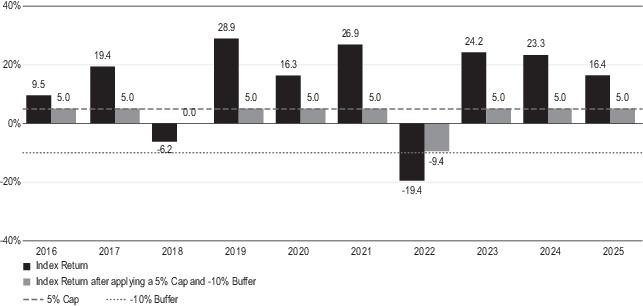
This Index does not include dividends declared by any of the component companies. As a
result, the Index will underperform a direct investment in the securities composing the Index. Additional
information about the Index can be found at www.spglobal.com.
●
Nasdaq-100® Price Return Index.
The Nasdaq-100 Index® is designed to measure the performance of 100 of the largest Nasdaq-listed
non-financial companies and is home to many companies from sectors like technology, healthcare, consumer goods & services, and industrials.
This Index does not include dividends declared by any of the component
companies. As a result, the Index will underperform a direct investment in the securities composing the
Index. Additional information about the Index can be found at www.nasdaq.com.
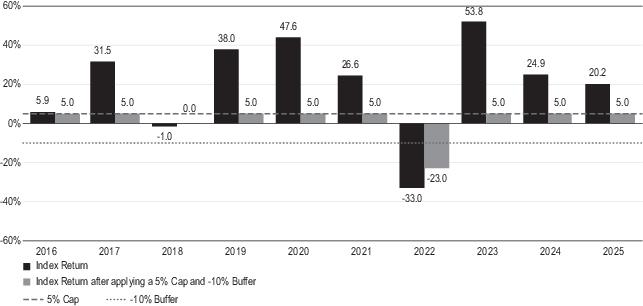
This Index does not include dividends declared by any of the component
companies. As a result, the Index will underperform a direct investment in the securities composing the
Index. Additional information about the Index can be found at www.nasdaq.com.
●
MSCI® EAFE® Price Return Index.
The MSCI EAFE includes large- and mid-capitalization companies across 21 developed markets around the world, including countries in Europe, Australia, and the Far East, but excluding the U.S. and Canada.
This
Index does not include dividends declared by any of the component companies. As a result, the Index will
underperform a direct investment in the securities composing the Index. Additional information about the
Index can be found at www.nasdaq.com.
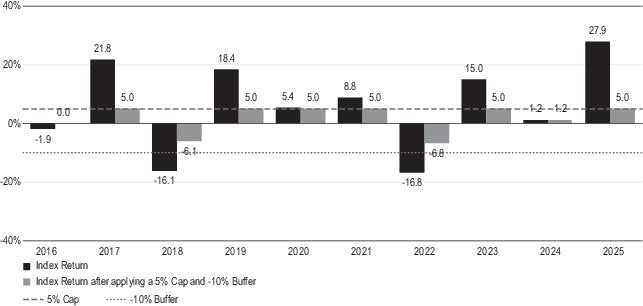
This
Index does not include dividends declared by any of the component companies. As a result, the Index will
underperform a direct investment in the securities composing the Index. Additional information about the
Index can be found at www.nasdaq.com.
●
SG Smart Climate Index.
The SG Smart Climate provides investment exposure to the performance of large-capitalization U.S. stocks
through the Underlying SG Index. These stocks are selected based on proprietary climate risk preparedness
scores and certain ESG filters. Climate risk generally refers to the risk of negative impacts on a company’s
business or financial condition due to climate-related conditions around the globe or the transition to a lower
carbon economy. The climate risk models used in connection with the Index seek to identify large U.S.
companies that are more likely to perform well in future climate scenarios. This Index is an “excess return”
Index. Its returns reflect the total return on an investment in the underlying component companies (includi
ng
reinvestment of all dividends, interest, and other income) less certain negative adjustments and deductions
that reduce the performance of the Index. As a result, the Index will underperform a direct investment in the
securities composing the Index.
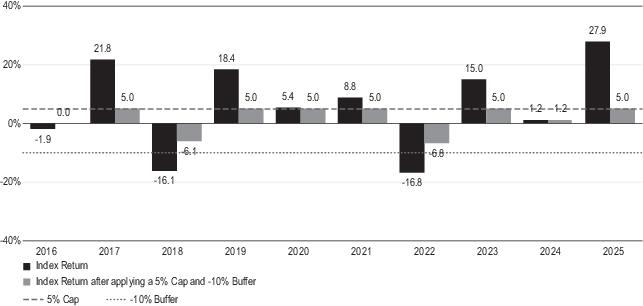
S&P 500® Price
Return
Index
1
S&P 500® Price
Return
Index
1
S&P 500® Price
Return
Index
1
S&P 500® Price
Return
Index
1
S&P 500® Price
Return
Index
1
S&P 500® Price
Return
Index
1
S&P 500® Price
Return
Index
1
S&P 500® Price
Return
Index
1;3;5
S&P 500® Price
Return
Index
1;3;5
S&P 500® Price
Return
Index
1;3;5
S&P 500® Price
Return
Index
1;3;5
S&P 500® Price
Return
Index
1;3;5
S&P 500® Price
Return
Index
1;3;5
S&P 500® Price
Return
Index
1;3;5
S&P 500® Price
Return
Index
1;3;6
S&P 500® Price
Return
Index
1;3; 6
S&P 500® Price
Return
Index
1;5
S&P 500® Price
Return
Index
1;5
Nasdaq-100® Price
Return
Index
1
Nasdaq-100® Price
Return
Index
1
Nasdaq-100® Price
Return
Index
1;3;5
Nasdaq-100® Price
Return
Index
1;3;5
Nasdaq-100® Price
Return
Index
1;3;5
Nasdaq-100® Price
Return
Index
1;3;5
Nasdaq-100® Price
Return
Index
1;3;5
Nasdaq-100® Price
Return
Index
1;3;5
Nasdaq-100® Price
Return
Index
1;3;5
Nasdaq-100® Price
Return
Index
1;4
Nasdaq-100® Price
Return
Index
1;4
Nasdaq-100® Price
Return
Index
1;4
Nasdaq-100® Price
Return
Index
1;4
Nasdaq-100® Price
Return
Index
1;4
MSCI EAFE Price
Return
Index
1
MSCI EAFE Price
Return
Index
1
SG Smart Climate
Index
2;3;8
SG Smart Climate
Index
2;3;8
SG Smart Climate
Index
2;3;8
SG Smart Climate
Index
2;3;8
SG Smart Climate
Index
2;3;8
SG Smart Climate
Index
2;3;8
SG Smart Climate
Index
2;3;8
iShares Russell
2000 ETF
2;3;6;7
iShares Russell
2000 ETF
2;3;6;7
iShares Russell
2000 ETF
2;3;6;7
iShares Russell
2000 ETF
2;3;6;7
| [1] | The maximum loss could occur in extreme circumstances due to a negative Interim Value adjustment. Transactions that are subject to an Interim Value adjustment include (i) taking a withdrawal or surrendering your Contract, including the deduction of applicable surrender charges and/or premium taxes, (ii) exercising the Performance Lock feature (if available), (iii) annuitization, (iv) the payment of the Standard Death Benefit, and (v) exercising your right to return the Contract (unless the return of premium is greater). See “Charges and Adjustments” for more information. |
| [2] | The surrender charge will be imposed when you take a partial withdrawal or surrender your Contract during the first six Contract Years, unless an exception applies. Each year during the first six Contract Years, however, you may take withdrawals up to the “free withdrawal amount” without incurring a surrender charge. The free withdrawal amount is the greater of (i) 10% of your Contract Value as of the most recent Contract Anniversary (or, in the first Contract Year, 10% of your total premiums paid) or (ii) your RMD under our automatic RMD program. |