DISTRIBUTED TECHNOLOGIES RESEARCH GLOBAL LTD Nicosia, Cyprus Consolidated Financial Statements and Reports For the year ended 31 December 2025
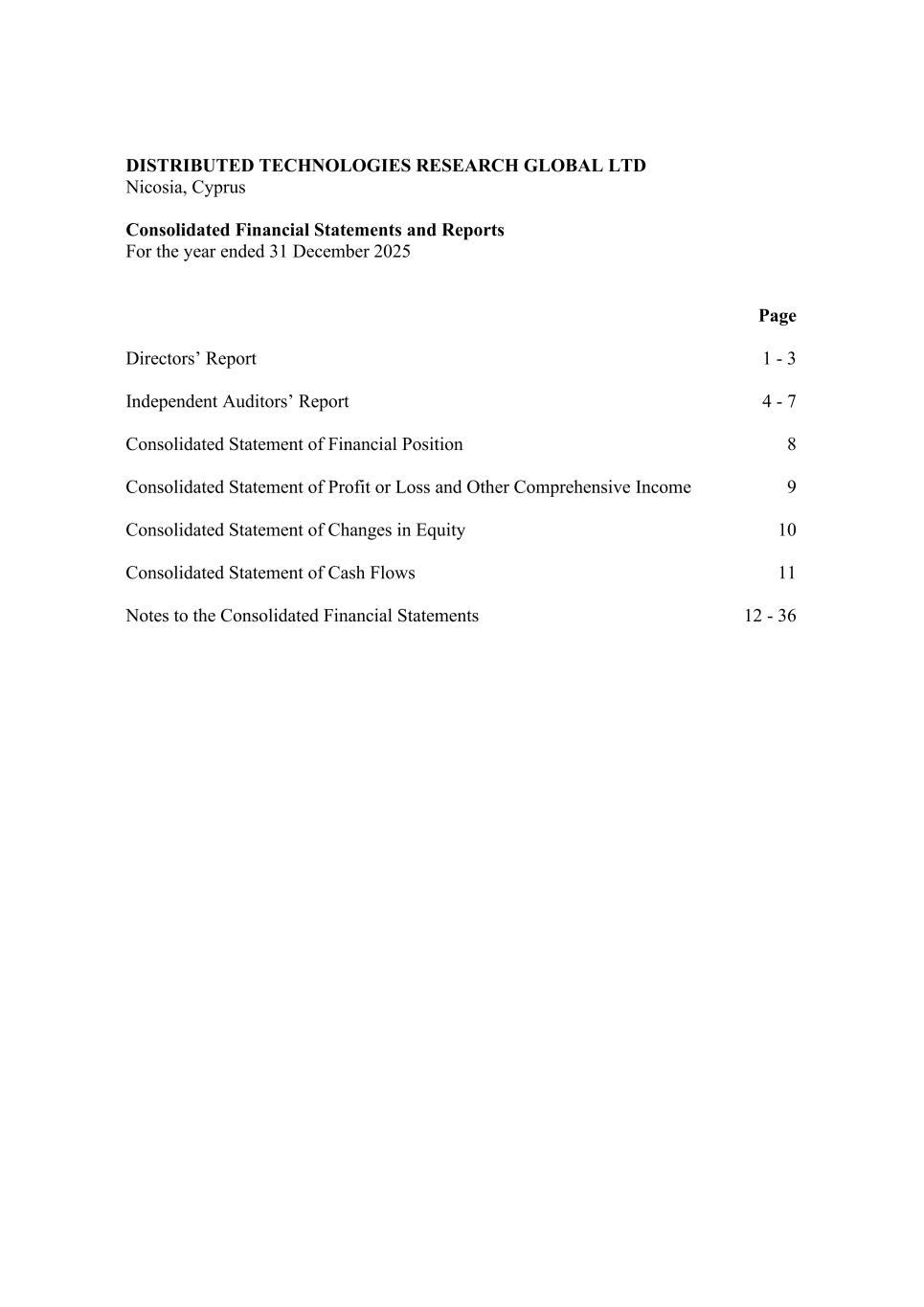
DISTRIBUTED TECHNOLOGIES RESEARCH GLOBAL LTD Nicosia, Cyprus Consolidated Financial Statements and Reports For the year ended 31 December 2025 Page Directors’ Report 1 - 3 Independent Auditors’ Report 4 - 7 Consolidated Statement of Financial Position 8 Consolidated Statement of Profit or Loss and Other Comprehensive Income 9 Consolidated Statement of Changes in Equity 10 Consolidated Statement of Cash Flows 11 Notes to the Consolidated Financial Statements 12 - 36
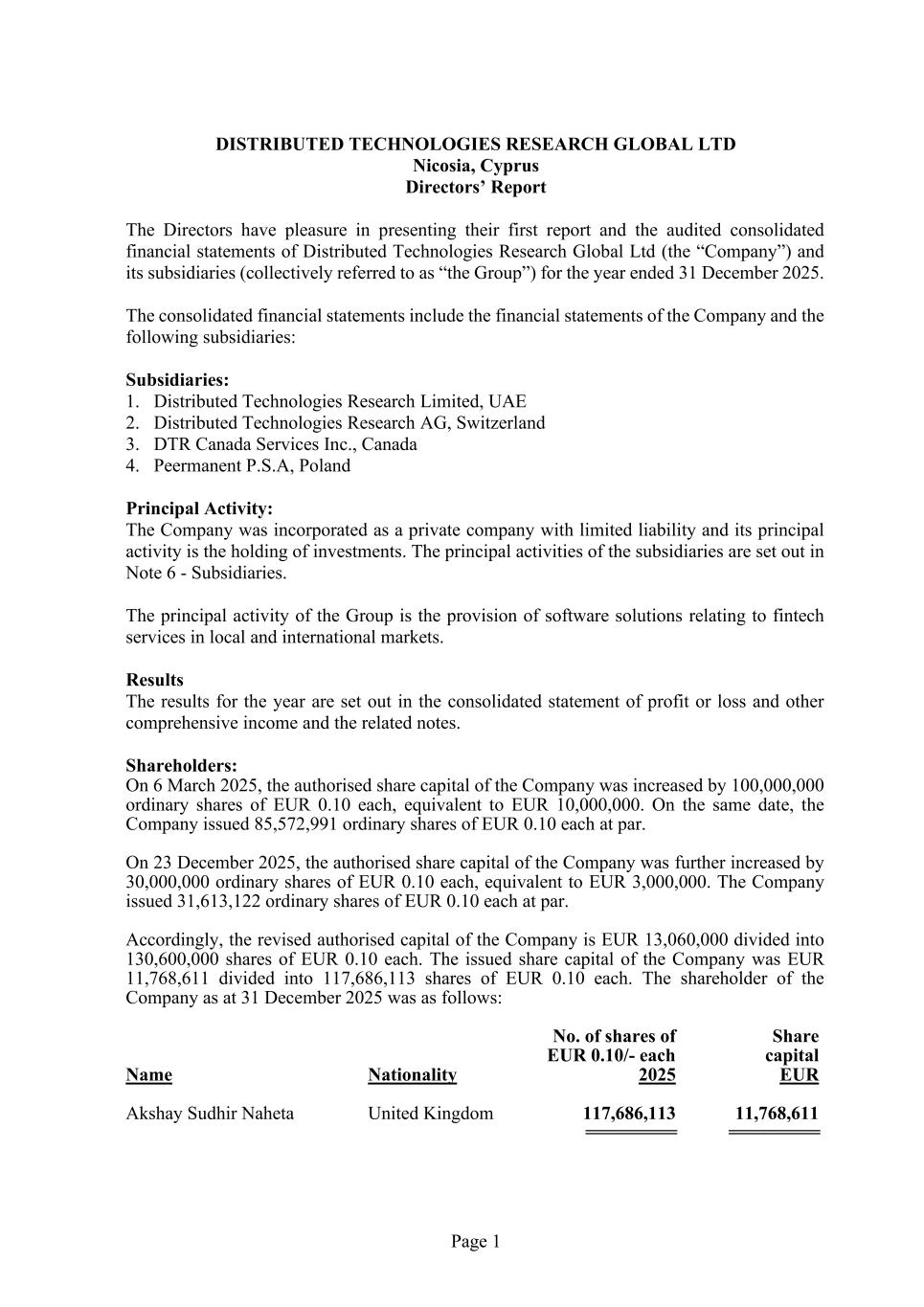
Page 1 DISTRIBUTED TECHNOLOGIES RESEARCH GLOBAL LTD Nicosia, Cyprus Directors’ Report The Directors have pleasure in presenting their first report and the audited consolidated financial statements of Distributed Technologies Research Global Ltd (the “Company”) and its subsidiaries (collectively referred to as “the Group”) for the year ended 31 December 2025. The consolidated financial statements include the financial statements of the Company and the following subsidiaries: Subsidiaries: 1. Distributed Technologies Research Limited, UAE 2. Distributed Technologies Research AG, Switzerland 3. DTR Canada Services Inc., Canada 4. Peermanent P.S.A, Poland Principal Activity: The Company was incorporated as a private company with limited liability and its principal activity is the holding of investments. The principal activities of the subsidiaries are set out in Note 6 - Subsidiaries. The principal activity of the Group is the provision of software solutions relating to fintech services in local and international markets. Results The results for the year are set out in the consolidated statement of profit or loss and other comprehensive income and the related notes. Shareholders: On 6 March 2025, the authorised share capital of the Company was increased by 100,000,000 ordinary shares of EUR 0.10 each, equivalent to EUR 10,000,000. On the same date, the Company issued 85,572,991 ordinary shares of EUR 0.10 each at par. On 23 December 2025, the authorised share capital of the Company was further increased by 30,000,000 ordinary shares of EUR 0.10 each, equivalent to EUR 3,000,000. The Company issued 31,613,122 ordinary shares of EUR 0.10 each at par. Accordingly, the revised authorised capital of the Company is EUR 13,060,000 divided into 130,600,000 shares of EUR 0.10 each. The issued share capital of the Company was EUR 11,768,611 divided into 117,686,113 shares of EUR 0.10 each. The shareholder of the Company as at 31 December 2025 was as follows: No. of shares of Share EUR 0.10/- each capital Name Nationality 2025 EUR Akshay Sudhir Naheta United Kingdom 117,686,113 11,768,611 ========== ==========
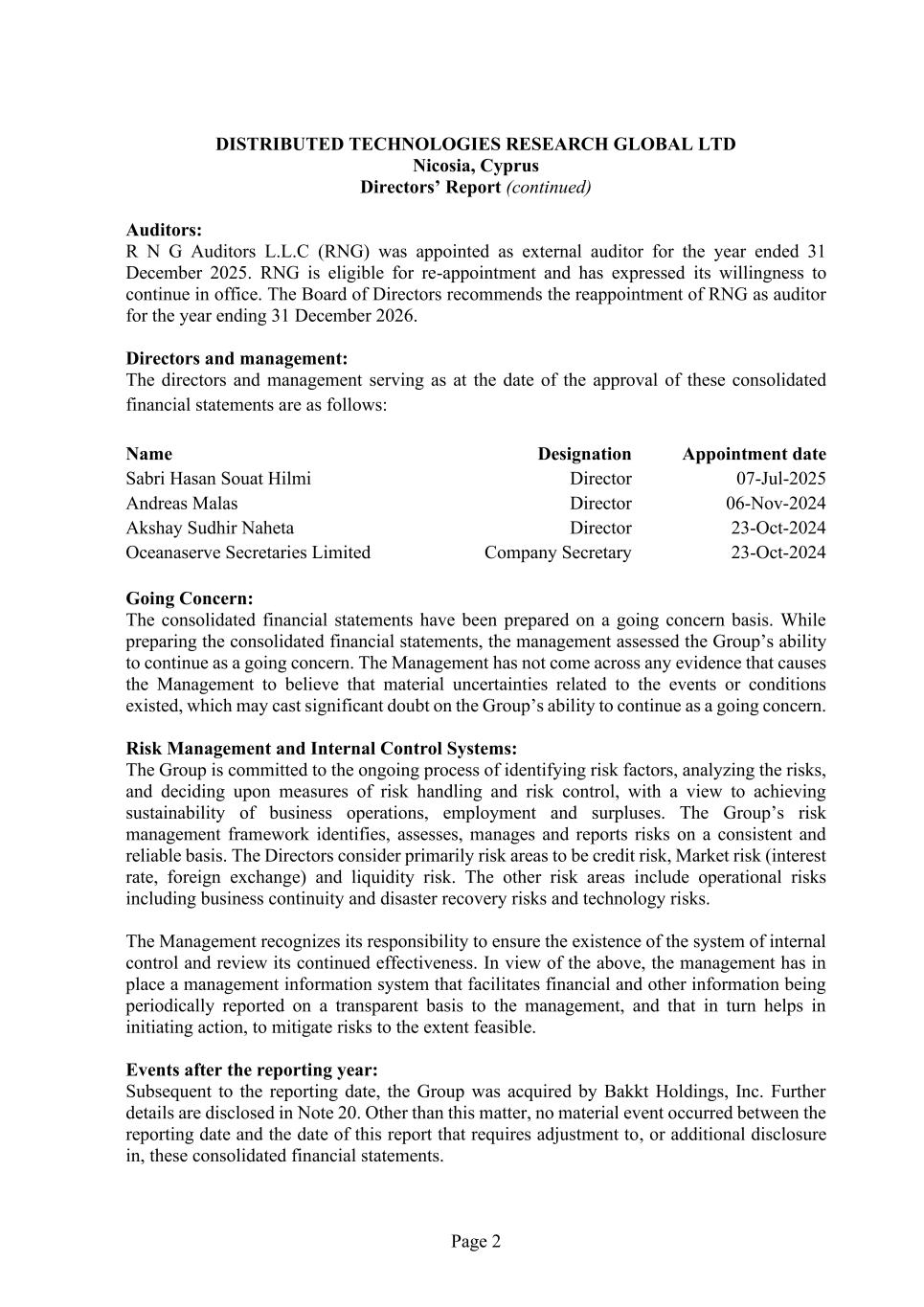
Page 2 DISTRIBUTED TECHNOLOGIES RESEARCH GLOBAL LTD Nicosia, Cyprus Directors’ Report (continued) Auditors: R N G Auditors L.L.C (RNG) was appointed as external auditor for the year ended 31 December 2025. RNG is eligible for re-appointment and has expressed its willingness to continue in office. The Board of Directors recommends the reappointment of RNG as auditor for the year ending 31 December 2026. Directors and management: The directors and management serving as at the date of the approval of these consolidated financial statements are as follows: Name Designation Appointment date Sabri Hasan Souat Hilmi Director 07-Jul-2025 Andreas Malas Director 06-Nov-2024 Akshay Sudhir Naheta Director 23-Oct-2024 Oceanaserve Secretaries Limited Company Secretary 23-Oct-2024 Going Concern: The consolidated financial statements have been prepared on a going concern basis. While preparing the consolidated financial statements, the management assessed the Group’s ability to continue as a going concern. The Management has not come across any evidence that causes the Management to believe that material uncertainties related to the events or conditions existed, which may cast significant doubt on the Group’s ability to continue as a going concern. Risk Management and Internal Control Systems: The Group is committed to the ongoing process of identifying risk factors, analyzing the risks, and deciding upon measures of risk handling and risk control, with a view to achieving sustainability of business operations, employment and surpluses. The Group’s risk management framework identifies, assesses, manages and reports risks on a consistent and reliable basis. The Directors consider primarily risk areas to be credit risk, Market risk (interest rate, foreign exchange) and liquidity risk. The other risk areas include operational risks including business continuity and disaster recovery risks and technology risks. The Management recognizes its responsibility to ensure the existence of the system of internal control and review its continued effectiveness. In view of the above, the management has in place a management information system that facilitates financial and other information being periodically reported on a transparent basis to the management, and that in turn helps in initiating action, to mitigate risks to the extent feasible. Events after the reporting year: Subsequent to the reporting date, the Group was acquired by Bakkt Holdings, Inc. Further details are disclosed in Note 20. Other than this matter, no material event occurred between the reporting date and the date of this report that requires adjustment to, or additional disclosure in, these consolidated financial statements.
Page 3 DISTRIBUTED TECHNOLOGIES RESEARCH GLOBAL LTD Nicosia, Cyprus Directors’ Report (continued) Statement of disclosure to the auditor: The directors at the date of approval of their annual report confirm that: • so far as the directors are aware, there is no relevant audit information of which the Group's auditor is unaware, and • the directors have taken all the steps that they ought to have taken as directors in order to make themselves aware of any relevant audit information and to establish that the Group's auditor is aware of that information. Statements of Directors’ Responsibilities: The Cyprus Companies Law, Cap. 113 requires the Directors to prepare the consolidated financial statements for each financial year which gives a true and fair view of the state of affairs of the Group and of the net profit or loss for the financial year. The audited consolidated financial statements for the year ended 31 December 2025, have been prepared in conformity and in compliance with the requirements of the International Financial Reporting Standards (IFRS), relevant statutory requirements and other governing laws. The Directors confirm that sufficient care has been taken for the maintenance of proper and adequate accounting records that discloses with reasonable accuracy at any time, the financial position of the Group and enables them to ensure that the consolidated financial statements comply with the requirements of applicable statute. The Directors also confirm that appropriate accounting policies have been selected and applied consistently in order that the consolidated financial statements reflect fairly the form and substance of the transactions carried out during the year under review and reasonably presents the Group’s financial conditions and results of its operations. For Distributed Technologies Research Global Ltd ______________________ Sabri Hasan Souat Hilmi Director Place: Nicosia, Cyprus Date: 6 August 2026
Page 4 INDEPENDENT AUDITORS' REPORT TO THE SHAREHOLDER OF DISTRIBUTED TECHNOLOGIES RESEARCH GLOBAL LTD Report on the Audit of the Consolidated Financial Statements Opinion We have audited the accompanying consolidated financial statements of Distributed Technologies Research Global Ltd (the “Company”) and its subsidiaries (together, the “Group”), which comprise the consolidated statement of financial position as of 31 December 2025, the consolidated statement of profit or loss and other comprehensive income, consolidated statement of changes in equity, and consolidated statement of cash flows for the year then ended, and the related notes to the consolidated financial statements, including material accounting policy information, which, as described in Note 5, have been prepared in accordance with IFRS Accounting Standards as issued by the International Accounting Standards Board (IASB). In our opinion, the accompanying consolidated financial statements present fairly, in all material respects, the consolidated financial position of the Group as of 31 December 2025, and its consolidated financial performance and consolidated cash flows for the year then ended in accordance with IFRS Accounting Standards as issued by the International Accounting Standards Board (IASB). Basis for Opinion We conducted our audit in accordance with auditing standards generally accepted in the United States of America (GAAS). Our responsibilities under those standards are further described in the Auditor’s Responsibilities for the Audit of the Consolidated Financial Statements section of our report. We are required to be independent of the Group and to meet our other ethical responsibilities in accordance with the relevant ethical requirements relating to our audit. We believe that the audit evidence we have obtained is sufficient and appropriate to provide a basis for our audit opinion. Other information Management is responsible for other information. The other information comprises the information included in the Directors’ Report, but does not include the consolidated financial statements and our auditors’ report thereon. Our opinion on the consolidated financial statements does not cover the other information and we do not express any form of assurance conclusion thereon. In connection with our audit of the consolidated financial statements, our responsibility is to read the other information and, in doing so, consider whether the other information is materially inconsistent with the consolidated financial statements, or our knowledge obtained in the audit, or otherwise appears to be materially misstated. If, based on the work we have performed on the other information that we obtained prior to the date of this auditor’s report, we conclude that there is a material misstatement of the other information, we are required to report that fact. We have nothing to report in this regard.
Page 5 INDEPENDENT AUDITORS' REPORT TO THE SHAREHOLDER OF DISTRIBUTED TECHNOLOGIES RESEARCH GLOBAL LTD (continued) Report on the Audit of the Consolidated Financial Statements (continued) Responsibilities of Management and Those Charged With Governance for preparation of the Consolidated Financial Statements Management is responsible for the preparation and fair presentation of the consolidated financial statements in accordance with IFRS Accounting Standards as issued by the International Accounting Standards Board (IASB), and for the design, implementation, and maintenance of internal control relevant to the preparation and fair presentation of consolidated financial statements that are free from material misstatement, whether due to fraud or error. In preparing the consolidated financial statements, management is required to evaluate whether there are conditions or events, considered in the aggregate, that raise substantial doubt about the Group’s ability to continue as a going concern for at least twelve months from the end of the reporting year. Those charged with governance are responsible for overseeing the Group’s financial reporting process. Auditors’ Responsibilities for the Audit of the Consolidated Financial Statements Our objectives are to obtain reasonable assurance about whether the consolidated financial statements as a whole are free from material misstatement, whether due to fraud or error, and to issue an auditor’s report that includes our opinion. Reasonable assurance is a high level of assurance but is not absolute assurance and therefore is not a guarantee that an audit conducted in accordance with GAAS will always detect a material misstatement when it exists. The risk of not detecting a material misstatement resulting from fraud is higher than for one resulting from error, because fraud may involve collusion, forgery, intentional omissions, misrepresentations, or the override of internal control. Misstatements are considered material if there is a substantial likelihood that, individually or in the aggregate, they would influence the judgment made by a reasonable user based on the consolidated financial statements. As part of an audit in accordance with GAAS, we exercise professional judgement and maintain professional skepticism throughout the audit. We also: • Identify and assess the risks of material misstatement of the consolidated financial statements, whether due to fraud or error, design and perform audit procedures responsive to those risks, and obtain audit evidence that is sufficient and appropriate to provide a basis for our opinion. The risk of not detecting a material misstatement resulting from fraud is higher than for one resulting from error, as fraud may involve collusion, forgery, intentional omission, misrepresentations, or the override of internal control. • Obtain an understanding of internal control relevant to the audit in order to design audit procedures that are appropriate in the circumstances, but not for the purpose of expressing an opinion on the effectiveness of the Group’s internal control.
Page 6 INDEPENDENT AUDITORS' REPORT TO THE SHAREHOLDER OF DISTRIBUTED TECHNOLOGIES RESEARCH GLOBAL LTD (continued) Report on the Audit of the Consolidated Financial Statements (continued) Auditors’ Responsibilities for the Audit of the Consolidated Financial Statements (continued) • Evaluate the appropriateness of accounting policies used, and the reasonableness of accounting estimates and related disclosures made by management. • Evaluate the overall presentation, structure and content of the consolidated financial statements, including the disclosures, and whether the consolidated financial statements represent the underlying transactions and events in a manner that achieves fair presentation. • Conclude on the appropriateness of management’s use of the going concern basis of accounting and, based on the audit evidence obtained, whether a material uncertainty exists related to events or conditions that may cast significant doubts on the Group’s ability to continue as a going concern. If we conclude that a material uncertainty exists, we are required to draw attention in our auditors’ report to related disclosures in the consolidated financial statements or, if such disclosures are inadequate, to modify our opinion. Our conclusions are based on the audit evidence obtained up to the date of our auditor's report. However, future events or conditions may cause the Group to cease to continue as a going concern. • Obtain sufficient and appropriate audit evidence regarding the financial information of the Group to express an opinion on the consolidated financial statements. • Plan and perform the group audit to obtain sufficient appropriate audit evidence regarding the financial information of the companies within the group as a basis for forming an opinion on the group financial statements. We are responsible for the direction, supervision and review of the audit work performed for purposes of the group audit. We remain solely responsible for our audit opinion. We communicate with those charged with governance regarding, among other matters, the planned scope and timing of the audit and significant audit findings, including any significant deficiencies in internal control that we identify during our audit.
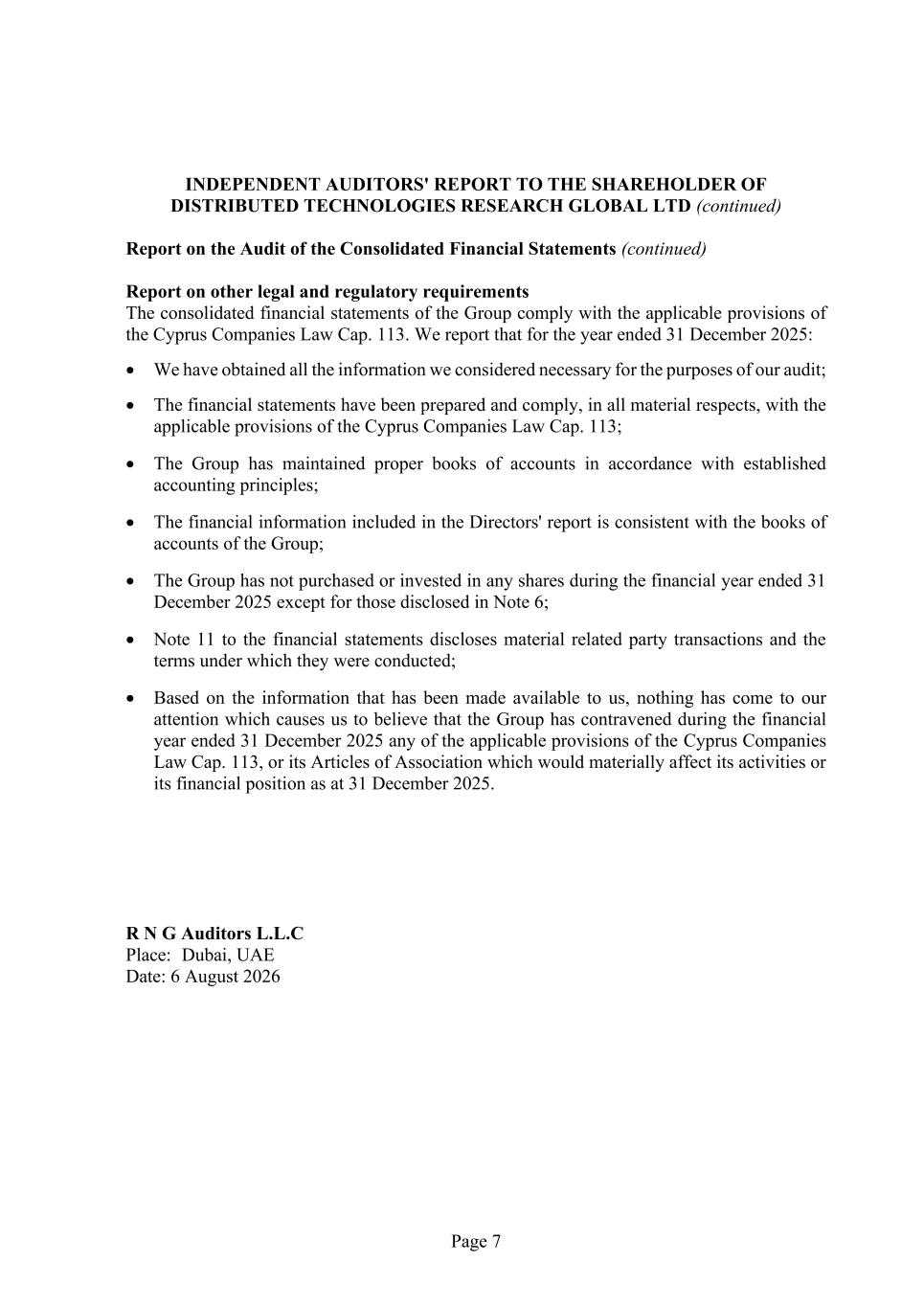
Page 7 INDEPENDENT AUDITORS' REPORT TO THE SHAREHOLDER OF DISTRIBUTED TECHNOLOGIES RESEARCH GLOBAL LTD (continued) Report on the Audit of the Consolidated Financial Statements (continued) Report on other legal and regulatory requirements The consolidated financial statements of the Group comply with the applicable provisions of the Cyprus Companies Law Cap. 113. We report that for the year ended 31 December 2025: • We have obtained all the information we considered necessary for the purposes of our audit; • The financial statements have been prepared and comply, in all material respects, with the applicable provisions of the Cyprus Companies Law Cap. 113; • The Group has maintained proper books of accounts in accordance with established accounting principles; • The financial information included in the Directors' report is consistent with the books of accounts of the Group; • The Group has not purchased or invested in any shares during the financial year ended 31 December 2025 except for those disclosed in Note 6; • Note 11 to the financial statements discloses material related party transactions and the terms under which they were conducted; • Based on the information that has been made available to us, nothing has come to our attention which causes us to believe that the Group has contravened during the financial year ended 31 December 2025 any of the applicable provisions of the Cyprus Companies Law Cap. 113, or its Articles of Association which would materially affect its activities or its financial position as at 31 December 2025. R N G Auditors L.L.C Place: Dubai, UAE Date: 6 August 2026
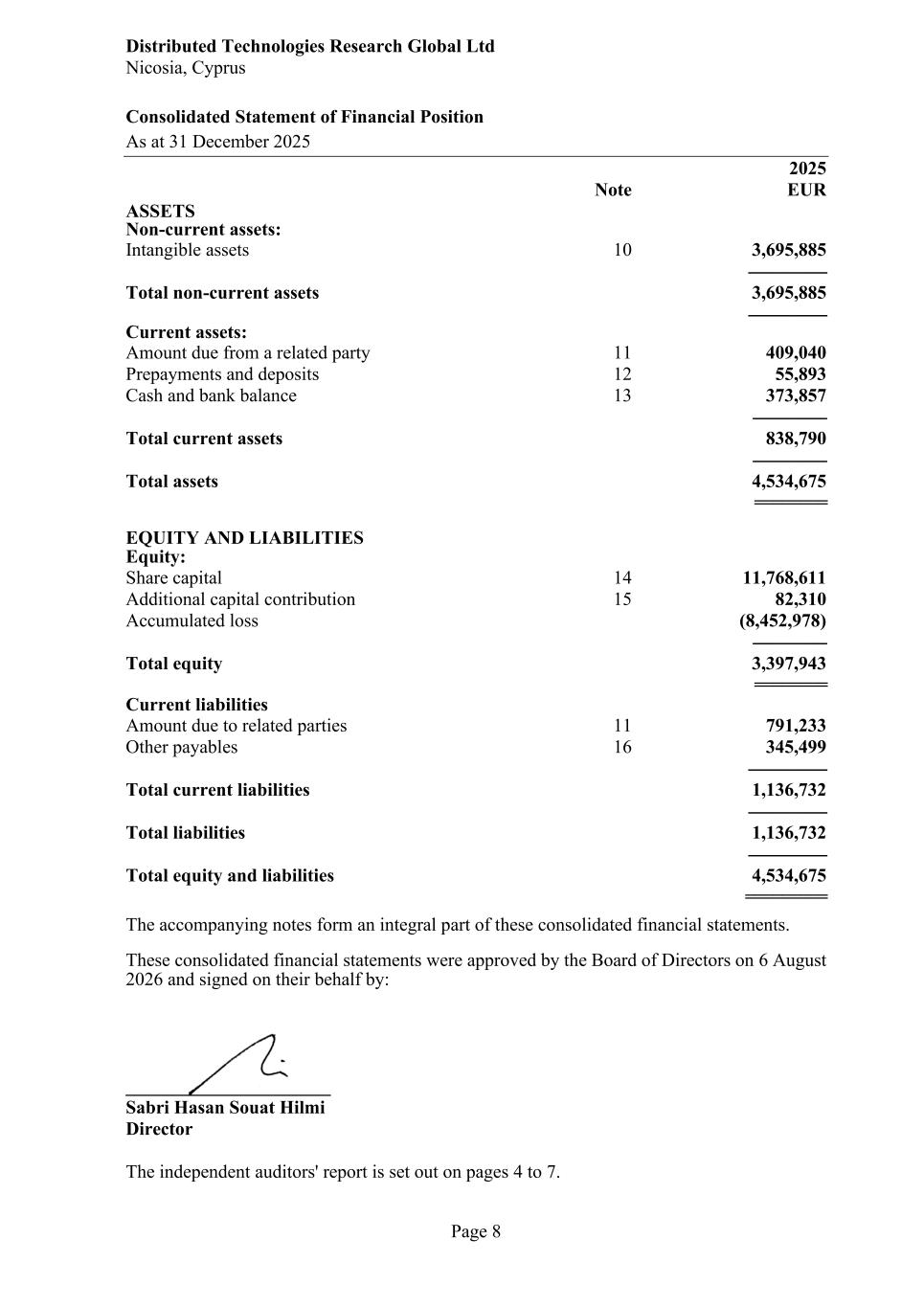
Distributed Technologies Research Global Ltd Nicosia, Cyprus Consolidated Statement of Financial Position As at 31 December 2025 Page 8 2025 Note EUR ASSETS Non-current assets: Intangible assets 10 3,695,885 ----------------- Total non-current assets 3,695,885 ----------------- Current assets: Amount due from a related party 11 409,040 Prepayments and deposits 12 55,893 Cash and bank balance 13 373,857 ---------------- Total current assets 838,790 ---------------- Total assets 4,534,675 ======== EQUITY AND LIABILITIES Equity: Share capital 14 11,768,611 Additional capital contribution 15 82,310 Accumulated loss (8,452,978) ---------------- Total equity 3,397,943 ======== Current liabilities Amount due to related parties 11 791,233 Other payables 16 345,499 ----------------- Total current liabilities 1,136,732 ----------------- Total liabilities 1,136,732 ----------------- Total equity and liabilities 4,534,675 ========= The accompanying notes form an integral part of these consolidated financial statements. These consolidated financial statements were approved by the Board of Directors on 6 August 2026 and signed on their behalf by: ______________________ Sabri Hasan Souat Hilmi Director The independent auditors' report is set out on pages 4 to 7.
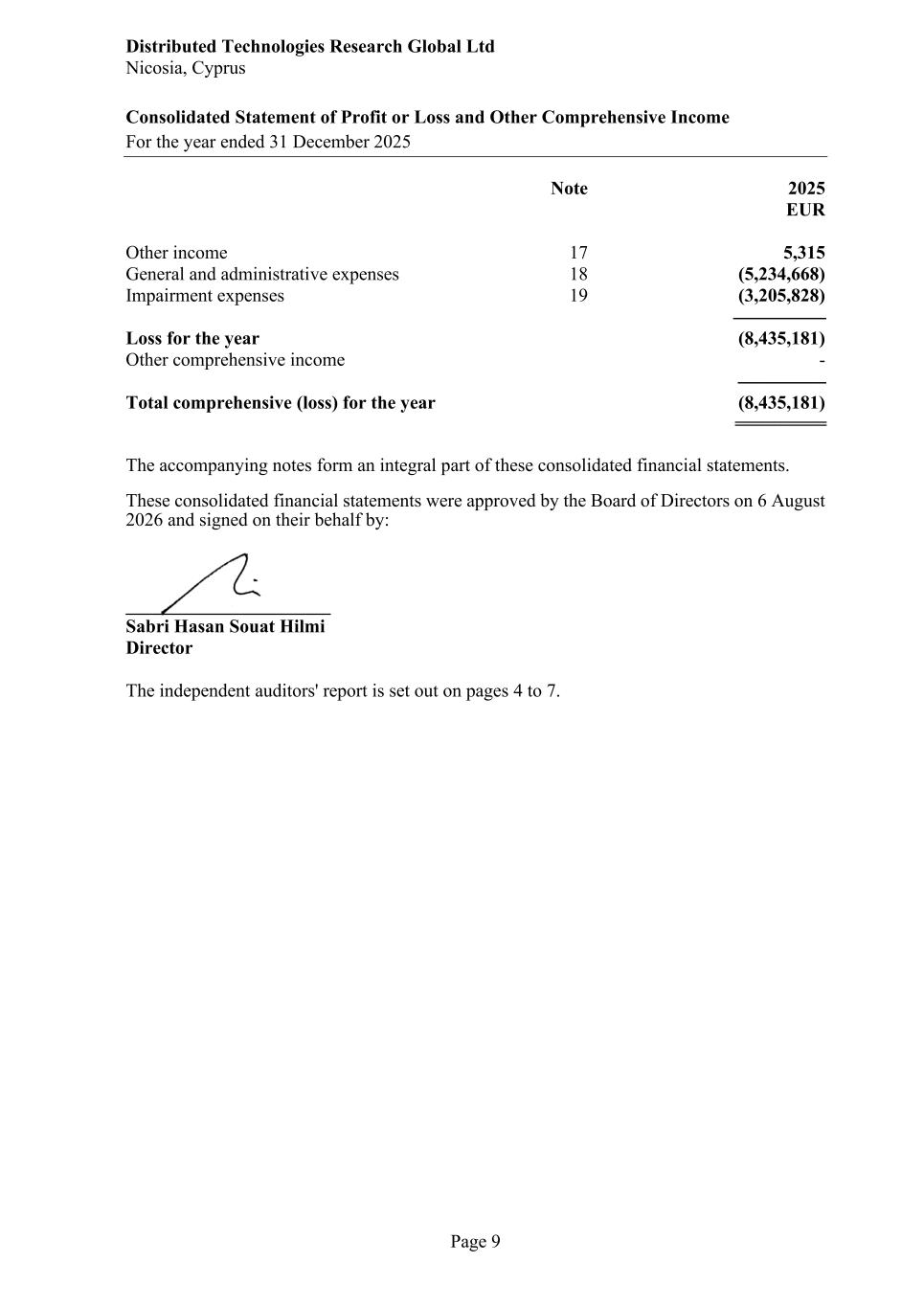
Distributed Technologies Research Global Ltd Nicosia, Cyprus Consolidated Statement of Profit or Loss and Other Comprehensive Income For the year ended 31 December 2025 Page 9 Note 2025 EUR Other income 17 5,315 General and administrative expenses 18 (5,234,668) Impairment expenses 19 (3,205,828) -------------------- Loss for the year (8,435,181) Other comprehensive income - ------------------- Total comprehensive (loss) for the year (8,435,181) ========== The accompanying notes form an integral part of these consolidated financial statements. These consolidated financial statements were approved by the Board of Directors on 6 August 2026 and signed on their behalf by: ______________________ Sabri Hasan Souat Hilmi Director The independent auditors' report is set out on pages 4 to 7.
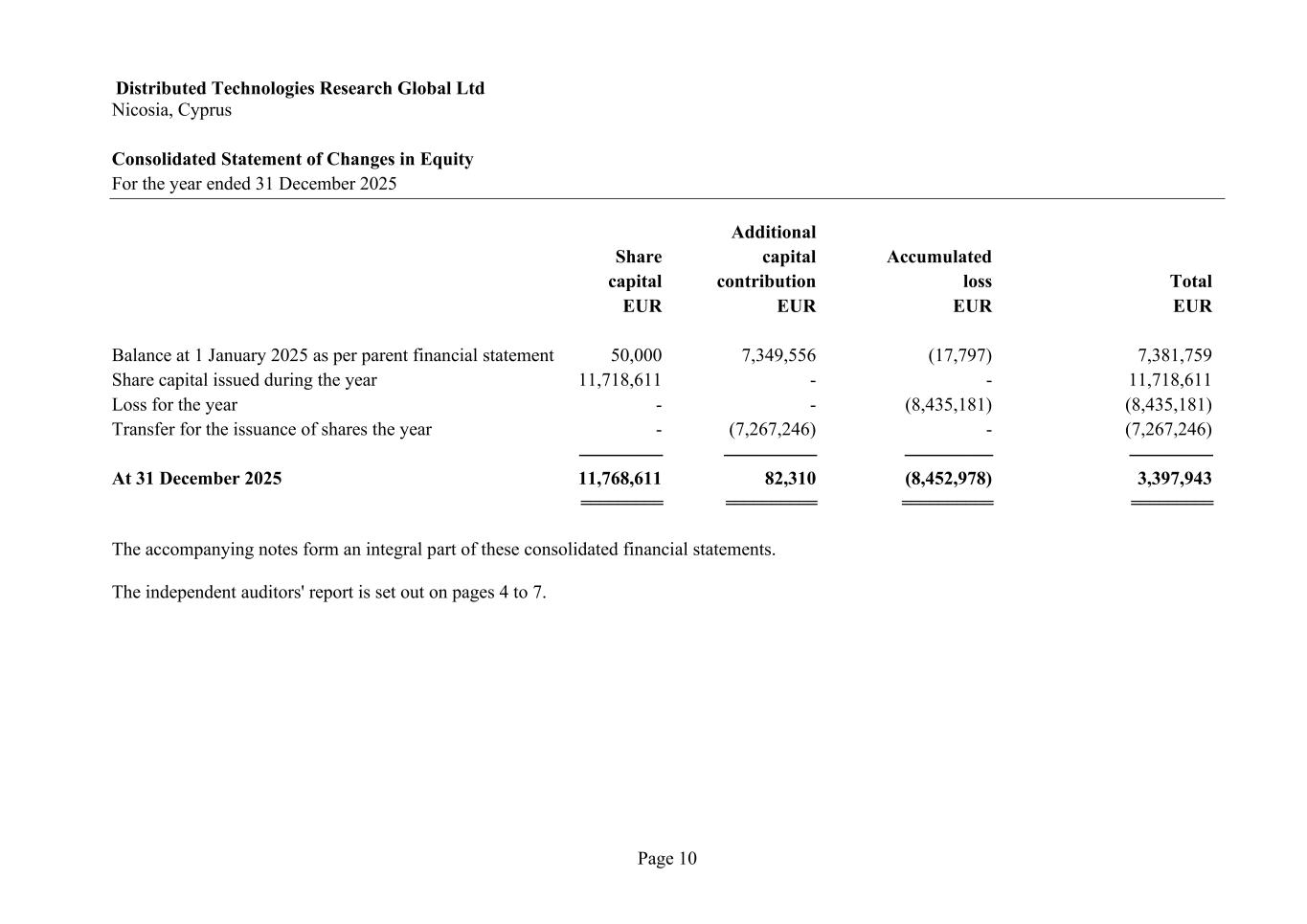
Distributed Technologies Research Global Ltd Nicosia, Cyprus Consolidated Statement of Changes in Equity For the year ended 31 December 2025 Page 10 Additional Share capital Accumulated capital contribution loss Total EUR EUR EUR EUR Balance at 1 January 2025 as per parent financial statement 50,000 7,349,556 (17,797) 7,381,759 Share capital issued during the year 11,718,611 - - 11,718,611 Loss for the year - - (8,435,181) (8,435,181) Transfer for the issuance of shares the year - (7,267,246) - (7,267,246) ------------------ -------------------- ------------------- ------------------ At 31 December 2025 11,768,611 82,310 (8,452,978) 3,397,943 ========= ========== ========== ========= The accompanying notes form an integral part of these consolidated financial statements. The independent auditors' report is set out on pages 4 to 7.
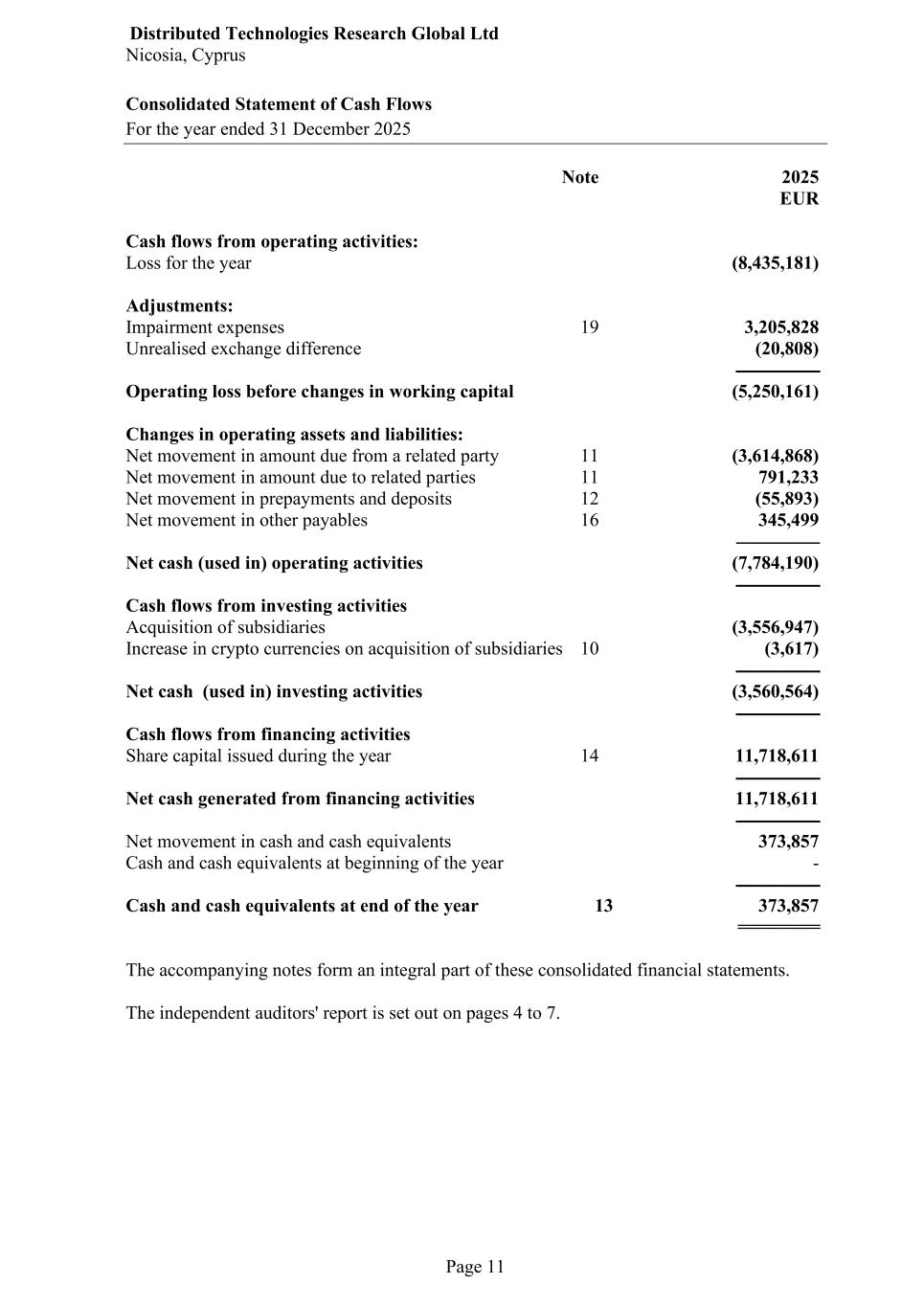
Distributed Technologies Research Global Ltd Nicosia, Cyprus Consolidated Statement of Cash Flows For the year ended 31 December 2025 Page 11 Note 2025 EUR Cash flows from operating activities: Loss for the year (8,435,181) Adjustments: Impairment expenses 19 3,205,828 Unrealised exchange difference (20,808) ------------------ Operating loss before changes in working capital (5,250,161) Changes in operating assets and liabilities: Net movement in amount due from a related party 11 (3,614,868) Net movement in amount due to related parties 11 791,233 Net movement in prepayments and deposits 12 (55,893) Net movement in other payables 16 345,499 ------------------ Net cash (used in) operating activities (7,784,190) ------------------ Cash flows from investing activities Acquisition of subsidiaries (3,556,947) Increase in crypto currencies on acquisition of subsidiaries 10 (3,617) ------------------ Net cash (used in) investing activities (3,560,564) ------------------ Cash flows from financing activities Share capital issued during the year 14 11,718,611 ------------------ Net cash generated from financing activities 11,718,611 ------------------ Net movement in cash and cash equivalents 373,857 Cash and cash equivalents at beginning of the year - ------------------ Cash and cash equivalents at end of the year 13 373,857 ========= The accompanying notes form an integral part of these consolidated financial statements. The independent auditors' report is set out on pages 4 to 7.
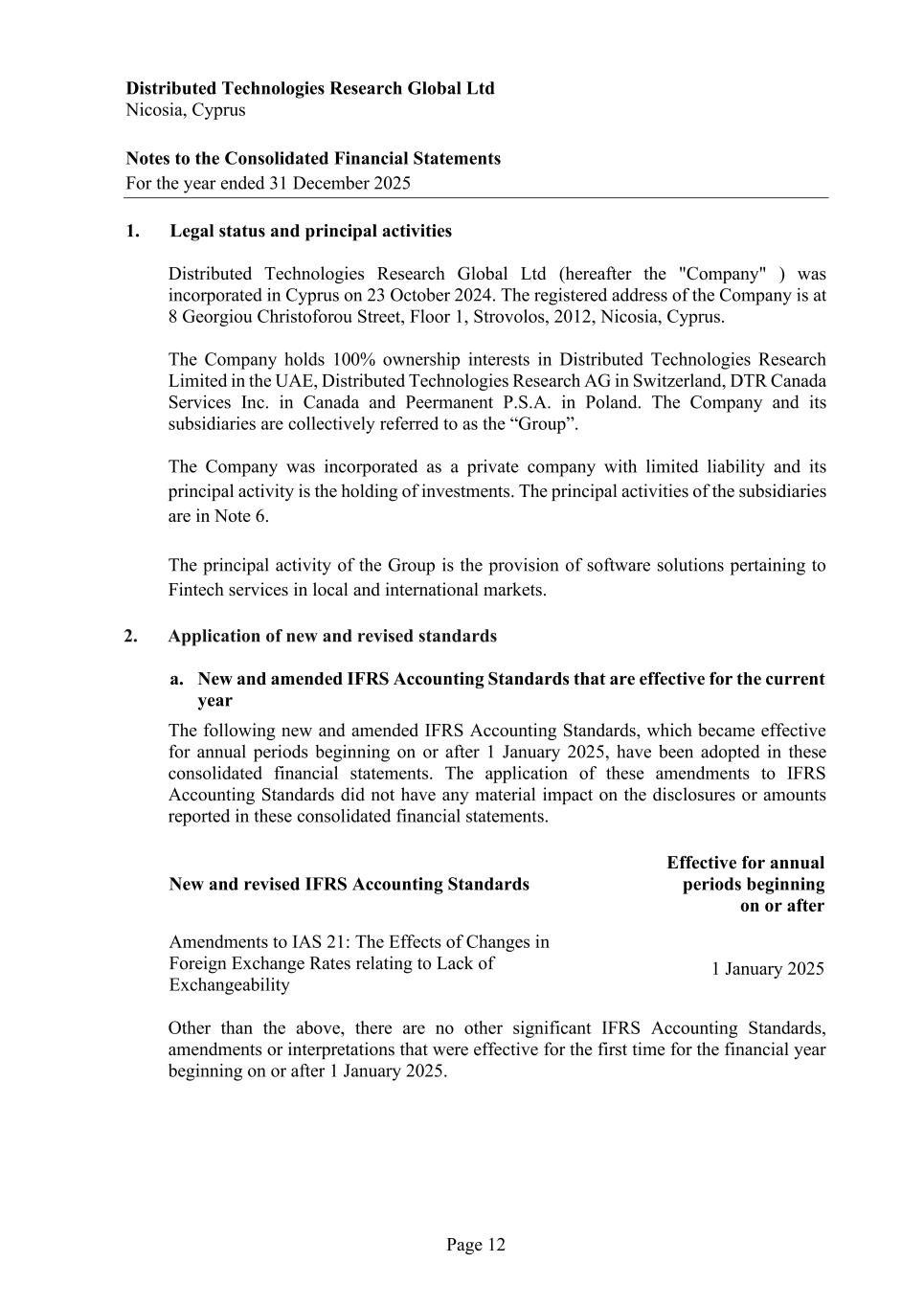
Distributed Technologies Research Global Ltd Nicosia, Cyprus Notes to the Consolidated Financial Statements For the year ended 31 December 2025 Page 12 1. Legal status and principal activities Distributed Technologies Research Global Ltd (hereafter the "Company" ) was incorporated in Cyprus on 23 October 2024. The registered address of the Company is at 8 Georgiou Christoforou Street, Floor 1, Strovolos, 2012, Nicosia, Cyprus. The Company holds 100% ownership interests in Distributed Technologies Research Limited in the UAE, Distributed Technologies Research AG in Switzerland, DTR Canada Services Inc. in Canada and Peermanent P.S.A. in Poland. The Company and its subsidiaries are collectively referred to as the “Group”. The Company was incorporated as a private company with limited liability and its principal activity is the holding of investments. The principal activities of the subsidiaries are in Note 6. The principal activity of the Group is the provision of software solutions pertaining to Fintech services in local and international markets. 2. Application of new and revised standards a. New and amended IFRS Accounting Standards that are effective for the current year The following new and amended IFRS Accounting Standards, which became effective for annual periods beginning on or after 1 January 2025, have been adopted in these consolidated financial statements. The application of these amendments to IFRS Accounting Standards did not have any material impact on the disclosures or amounts reported in these consolidated financial statements. New and revised IFRS Accounting Standards Effective for annual periods beginning on or after Amendments to IAS 21: The Effects of Changes in Foreign Exchange Rates relating to Lack of Exchangeability 1 January 2025 Other than the above, there are no other significant IFRS Accounting Standards, amendments or interpretations that were effective for the first time for the financial year beginning on or after 1 January 2025.
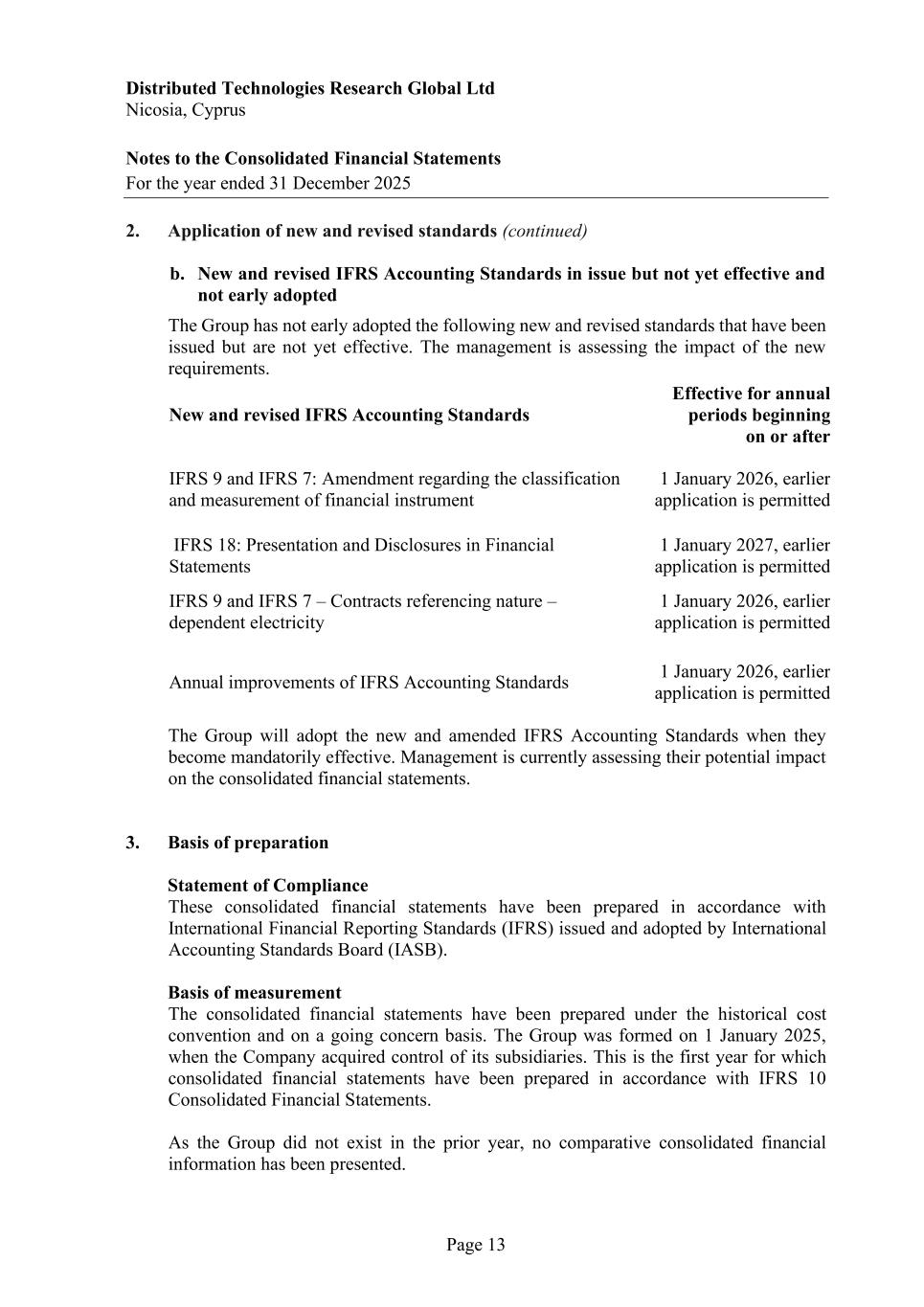
Distributed Technologies Research Global Ltd Nicosia, Cyprus Notes to the Consolidated Financial Statements For the year ended 31 December 2025 Page 13 2. Application of new and revised standards (continued) b. New and revised IFRS Accounting Standards in issue but not yet effective and not early adopted The Group has not early adopted the following new and revised standards that have been issued but are not yet effective. The management is assessing the impact of the new requirements. New and revised IFRS Accounting Standards Effective for annual periods beginning on or after IFRS 9 and IFRS 7: Amendment regarding the classification and measurement of financial instrument 1 January 2026, earlier application is permitted IFRS 18: Presentation and Disclosures in Financial Statements 1 January 2027, earlier application is permitted IFRS 9 and IFRS 7 – Contracts referencing nature – dependent electricity 1 January 2026, earlier application is permitted Annual improvements of IFRS Accounting Standards 1 January 2026, earlier application is permitted The Group will adopt the new and amended IFRS Accounting Standards when they become mandatorily effective. Management is currently assessing their potential impact on the consolidated financial statements. 3. Basis of preparation Statement of Compliance These consolidated financial statements have been prepared in accordance with International Financial Reporting Standards (IFRS) issued and adopted by International Accounting Standards Board (IASB). Basis of measurement The consolidated financial statements have been prepared under the historical cost convention and on a going concern basis. The Group was formed on 1 January 2025, when the Company acquired control of its subsidiaries. This is the first year for which consolidated financial statements have been prepared in accordance with IFRS 10 Consolidated Financial Statements. As the Group did not exist in the prior year, no comparative consolidated financial information has been presented.
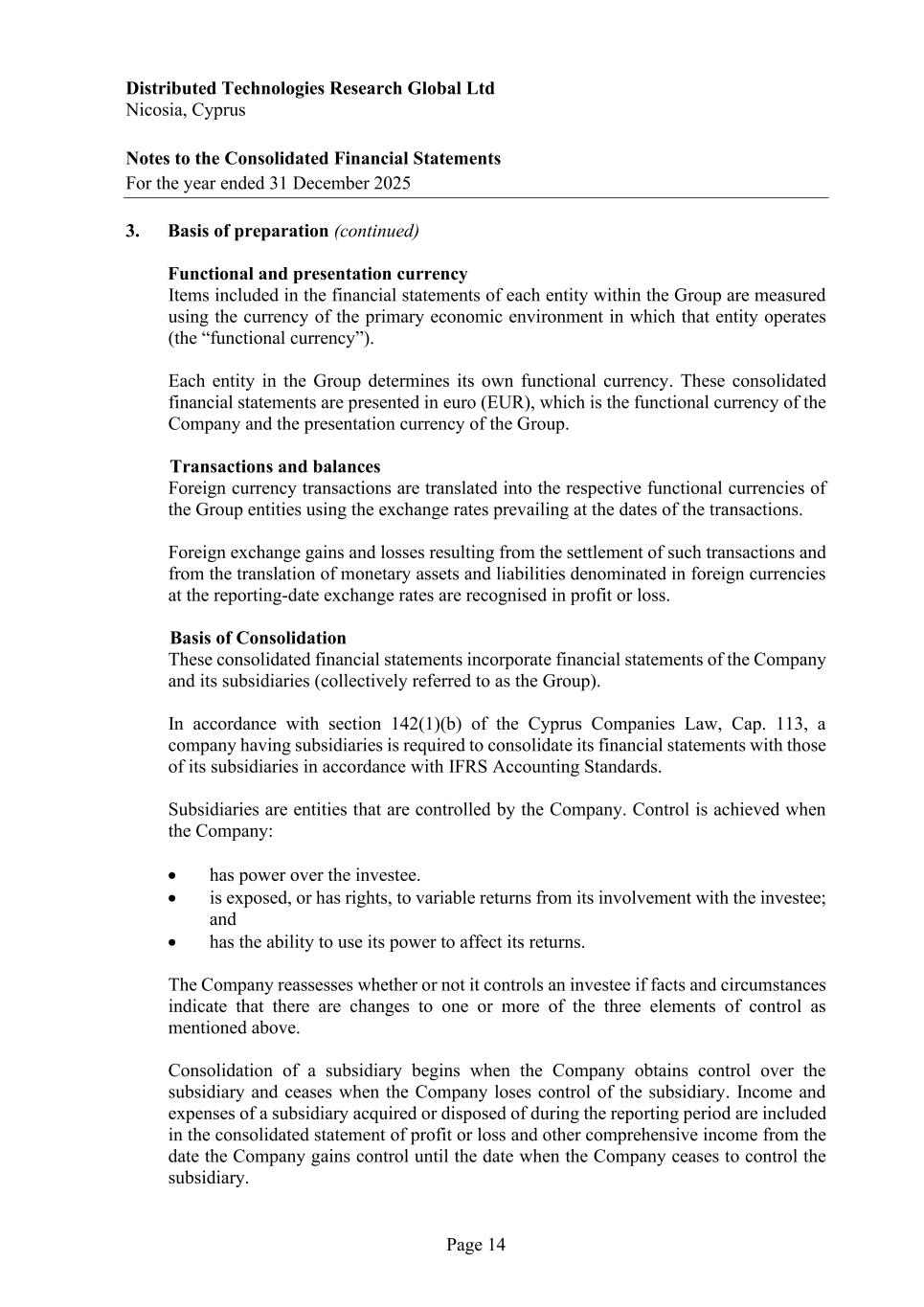
Distributed Technologies Research Global Ltd Nicosia, Cyprus Notes to the Consolidated Financial Statements For the year ended 31 December 2025 Page 14 3. Basis of preparation (continued) Functional and presentation currency Items included in the financial statements of each entity within the Group are measured using the currency of the primary economic environment in which that entity operates (the “functional currency”). Each entity in the Group determines its own functional currency. These consolidated financial statements are presented in euro (EUR), which is the functional currency of the Company and the presentation currency of the Group. Transactions and balances Foreign currency transactions are translated into the respective functional currencies of the Group entities using the exchange rates prevailing at the dates of the transactions. Foreign exchange gains and losses resulting from the settlement of such transactions and from the translation of monetary assets and liabilities denominated in foreign currencies at the reporting-date exchange rates are recognised in profit or loss. Basis of Consolidation These consolidated financial statements incorporate financial statements of the Company and its subsidiaries (collectively referred to as the Group). In accordance with section 142(1)(b) of the Cyprus Companies Law, Cap. 113, a company having subsidiaries is required to consolidate its financial statements with those of its subsidiaries in accordance with IFRS Accounting Standards. Subsidiaries are entities that are controlled by the Company. Control is achieved when the Company: • has power over the investee. • is exposed, or has rights, to variable returns from its involvement with the investee; and • has the ability to use its power to affect its returns. The Company reassesses whether or not it controls an investee if facts and circumstances indicate that there are changes to one or more of the three elements of control as mentioned above. Consolidation of a subsidiary begins when the Company obtains control over the subsidiary and ceases when the Company loses control of the subsidiary. Income and expenses of a subsidiary acquired or disposed of during the reporting period are included in the consolidated statement of profit or loss and other comprehensive income from the date the Company gains control until the date when the Company ceases to control the subsidiary.
Distributed Technologies Research Global Ltd Nicosia, Cyprus Notes to the Consolidated Financial Statements For the year ended 31 December 2025 Page 15 3. Basis of preparation (continued) Basis of Consolidation (continued) When necessary, adjustments are made to the financial statements of subsidiaries to align their accounting policies with the Company’s accounting policies. All intragroup balances and income, expenses and cash flows resulting from intragroup transactions are eliminated in full on consolidation. 4. Use of estimates and judgements The preparation of the financial statements in conformity with IFRS requires management to make judgements, estimates and assumptions that affect the application of accounting policies and reported amounts of assets, liabilities, income and expenses and the disclosure of contingent liabilities, at the end of the reporting year. However, uncertainty about these assumptions and estimates could result in outcomes that require a material adjustment to the carrying amount of the asset or liability affected in future years. The estimates and associated assumptions are based on historical experience and various other factors that are believed to be reasonable under the circumstances, the results of which form the basis of making the judgements about carrying values of assets and liabilities that are not readily apparent from other sources. Actual results may differ from these estimates. Estimates and underlying assumptions are reviewed on an on-going basis. Revisions to accounting estimates are recognized in the year in which the estimate is revised and in any future years affected. In particular, information about significant areas of estimation, uncertainty and critical judgements in applying accounting policies that may have a material effect on the amounts recognized in the consolidated financial statements are described as a separate note subsequently. The key assumptions concerning the future and other key sources of estimation uncertainty at the end of the reporting period, that have a significant risk of causing a material adjustment to the carrying amounts of assets and liabilities within the next financial year are described below: Impairment of goodwill Determining whether goodwill is impaired requires an estimation of the value in use of the cash-generating units of the Group to which the goodwill has been allocated. The value-in-use calculation requires the Group to estimate the future cash flows expected to arise from the cash-generating units using a suitable discount rate in order to calculate their present value.
Distributed Technologies Research Global Ltd Nicosia, Cyprus Notes to the Consolidated Financial Statements For the year ended 31 December 2025 Page 16 4. Use of estimates and judgements (continued) Impairment of financial assets The loss allowances for financial assets are based on assumptions about the risk of default and expected loss rates. The Group uses judgement in making these assumptions and selecting the inputs to the impairment calculation, based on the Group’s past history, existing market conditions and forward-looking estimates at the end of each reporting period. Calculation of loss allowance When measuring expected credit losses, the Group uses reasonable and supportable forward-looking information, which is based on assumptions regarding the future movement of different economic drivers and how these drivers will affect each other. Loss given default is an estimate of the loss arising on default. It is based on the difference between the contractual cash flows due and those that the lender would expect to receive, taking into account cash flows from collateral and integral credit enhancements. Probability of default is a key input in measuring expected credit losses. It represents an estimate of the likelihood of default over a given time horizon, based on historical data, assumptions and expectations of future conditions. 5. Material accounting policies a. Financial instruments Financial assets and financial liabilities are initially recognized in the consolidated financial statements when the Group becomes a party to the contractual provisions of the instrument. Financial assets and financial liabilities are initially measured at fair value. Transaction cost that are directly attributable to the acquisition or issue of financial assets and financial liabilities (other than financial assets and financial liabilities at fair value through profit or loss) are added to or deducted from the fair value of the financial assets or financial liabilities, as appropriate, on initial recognition. Transaction costs directly attributable to the acquisition of financial assets or financial liabilities at fair value through profit or loss are recognized immediately in profit or loss. Financial assets All regular way purchase or sale of financial assets are recognized and derecognized on a trade date basis. Regular way purchases or sales are purchases or sales of financial assets that require delivery of assets within the time frame established by regulation or convention in the marketplace.
Distributed Technologies Research Global Ltd Nicosia, Cyprus Notes to the Consolidated Financial Statements For the year ended 31 December 2025 Page 17 5. Material accounting policies (continued) a. Financial instruments (continued) Financial assets (continued) All recognized financial assets are measured subsequently in their entirety at either at amortized cost or fair value, depending on the classification of the financial assets. Subsequent measurement The Group’s financial assets comprise of cash and bank balances, deposits and amount due from a related party, which are measured at amortized cost. The amortized cost of a financial asset is the amount at which the financial asset is measured at initial recognition minus the principal repayment, plus the cumulative amortization using the effective interest rate method of any difference between that initial amount and the maturity amount, adjusted for any impairment allowance. The gross carrying amount of a financial asset is the amortized cost of a financial asset before adjusting for any impairment loss allowance. Interest income, foreign exchange gains or losses and impairment are recognized in profit or loss. Any gain or loss on de-recognition is recognized in profit or loss. Financial assets are not reclassified subsequent to their initial recognition, except if and in the period the Group changes its business model for managing the financial assets. The Group makes an assessment of the objective of the business model in which a financial asset is held at a portfolio level because this best reflects the way the business is managed, and information is provided to the Management. Effective Interest Rate Method The effective interest rate method is a method of calculating the amortized cost of a debt instrument and of allocating interest income over the relevant year. The financial assets other than purchased or originated credit impaired financial assets (i.e. assets that are credit impaired on initial recognition), the effective interest rate is the rate that exactly discounts estimated future cash receipts (including all fees and points paid or received that form an integral part of the effective interest rate, transactions costs and other premiums or discounts) excluding expected credit losses, through the expected life of the debt instrument, or where appropriate, a shorter period, to the gross carrying amount of the debt instrument on initial recognition. For purchased or originated credit impaired financial assets, a credit adjusted effective interest rate is calculated by discounting the estimated future cash flows, including expected credit losses, to the amortized cost of the debt instrument on initial recognition.
Distributed Technologies Research Global Ltd Nicosia, Cyprus Notes to the Consolidated Financial Statements For the year ended 31 December 2025 Page 18 5. Material accounting policies (continued) a. Financial instruments (continued) Impairment of financial assets (including receivables) IFRS 9: Financial Instruments requires to follows an Expected Credit Loss (“ECL”) model for the impairment of financial assets. The ECL model requires the Group to account for expected credit losses and changes to those expected credit losses at each reporting date to reflect changes in credit risk since initial recognition. Expected losses shall be measured and provided either at an amount equal to (a) 12 month expected losses; or (b) life time expected losses. If the credit risk of the financial instrument has not increased significantly since inception, then an amount equal to 12 month expected credit loss is provided. In other cases, life time credit losses shall be provided. For trade receivables without a significant financing component a simplified approach is available, whereby an assessment of increase in credit risk need not be performed at each reporting date. Instead, a Group can choose to provide for expected losses based on lifetime expected losses. The Group makes use of simplified approach for accounting for trade and other receivables and records the loss allowance as lifetime expected credit losses. These are the expected shortfall in contractual cash flows, considering the potential for default at any point during the life of the financial instruments. In calculating, the Group uses its historical experience, external indicators and forward-looking information to calculate the expected credit losses using a provision matrix. The Group assesses impairment of trade receivables on a collective basis as they possess shared risk characteristics, they have been grouped based on the number of days past due. Write off The Group writes off a financial asset when there is information indicating that the debtors is in severe financial difficulty and there is no realistic prospect of recovery, e.g. when the debtor has been placed under liquidation or has entered into bankruptcy proceeding. Financial assets written off may still be subject to enforcement activities under the Group’s recovery procedures taking into account legal advice where appropriate. Any recoveries made are recognized in profit or loss. Financial liabilities and equity Classification as debt or equity Debt and equity instruments are classified as either financial liabilities or as equity in accordance with the substance of the contractual arrangements and the definitions of a financial liability and an equity instrument.
Distributed Technologies Research Global Ltd Nicosia, Cyprus Notes to the Consolidated Financial Statements For the year ended 31 December 2025 Page 19 5. Material accounting policies (continued) a. Financial instruments (continued) Equity instruments An equity instrument is any contract that evidences a residual interest in the asset of the Group after deducting all of its liabilities. Financial liabilities - Classification, subsequent measurement and gains or losses Financial liabilities are classified as measured at amortized cost or fair value through profit or loss (FVTPL). A financial liability is classified as at FVTPL if it is contingent consideration of an acquirer in a business combination or classified as held for trading, or it is a derivative or it is designated as at FVTPL on initial recognition. Financial liabilities at amortized cost are initially measured at fair value and subsequently measured at amortized cost using effective interest rate method. Interest expenses and foreign exchange gain and losses are recognized in profit or loss. Any gain or loss on de- recognition is also recognized in profit or loss. Financial liabilities at FVTPL are measured at fair value and net gains and losses, including any interest expense, are recognized in profit or loss to the extent that they are part of a designated hedging relationship. Significant financial liabilities of the Group include amount due to related parties and trade and other payables which is initially measured at fair value and subsequently at amortized cost using the effective interest method. De-recognition of financial assets The Group derecognizes a financial asset when the contractual rights to the cash flows from the financial asset expire, or it transfer the rights to financial assets and substantially all the risks and rewards of ownership of the financial assets to another Group or in which the Group neither transfer nor retains substantially all of the risks and rewards of ownership and does not retain control of the financial assets. If the Group neither transfers nor retains substantially all the risk and rewards of ownership and continues to control the transferred assets, the Group recognizes it’s retained interest in the asset and an associated liability for the amounts it may have to pay. If the Group retains substantially all the risks and rewards of ownership of a transferred financial asset, the Group continues to recognize the financial asset and also recognizes a collateralized borrowing for the proceeds received.
Distributed Technologies Research Global Ltd Nicosia, Cyprus Notes to the Consolidated Financial Statements For the year ended 31 December 2025 Page 20 5. Material accounting policies (continued) a. Financial instruments (continued) De-recognition of financial assets (continued) On de-recognition of a financial asset measured at amortized cost, the difference between the asset’s carrying amount and the sum of the consideration received and receivable is recognized in profit or loss. In addition, on de-recognition of an interest in a debt instrument classified as fair value through other comprehensive income (“FVTOCI”) the cumulative gain or loss previously accumulated in the investment revaluation reserve is reclassified to profit or loss. In contrast, on de- recognition of an investment in equity instrument which the Group has elected on initial recognition to measure at FVTOCI, the cumulative gain or loss previously accumulated in the investment revaluation reserve is not reclassified to profit or loss but is transferred to retained earnings. De-recognition of financial liabilities The Group de-recognizes financial liabilities when and only when its’ contractual obligations are discharged or cancelled or have expired. The difference between the carrying amount of a financial liability derecognized and the consideration paid and payable is recognized in profit or loss. The Group also derecognizes financial liability when its terms are modified and the cash flows under the modified terms are substantially different. In this case, a new financial liability based on the modified terms is recognized at fair value. It is assumed that the terms are substantially different if the discounted present value of the cash flows under the new terms including any fees paid net of any fees received and discounted using the original effective interest rate is at least ten percent different from the discounted present value of the remaining cash flows of the original financial liability. The difference between the carrying amounts of the financial liability extinguishes and the new financial liability with modified terms is recognized in the profit or loss. Offsetting of financial instruments Financial assets and financial liabilities are offset, and the net amount is presented in the statement of financial position when and only when the Group: • currently has a legally enforceable right to set off the recognized amounts; and • intends either to settle on a net basis or to realize the asset and settle the liabilities simultaneously. Income and expenses are not offset in profit or loss unless required or permitted by IFRS.
Distributed Technologies Research Global Ltd Nicosia, Cyprus Notes to the Consolidated Financial Statements For the year ended 31 December 2025 Page 21 5. Material accounting policies (continued) b. Intangible assets Intangible assets acquired separately are measured on initial recognition at cost. The cost of intangible assets acquired in a business combination is fair value as at the date of acquisition. Following initial recognition, intangible assets are carried at cost less any accumulated amortisation and any accumulated impairment losses. Internally generated intangible assets, excluding capitalised development costs, are not capitalised and expenditure is reflected in profit or loss in the year in which the expenditure is incurred. The useful lives of intangible assets are assessed to be either finite or indefinite. Intangible assets with finite lives are amortised over the useful economic life and assessed for impairment whenever there is an indication that the intangible asset may be impaired. The amortisation period and the amortisation method for an intangible asset with a finite useful life is reviewed at least at each financial year end. Changes in the expected useful life or the expected pattern of consumption of future economic benefits embodied in the asset is accounted for by changing the amortisation period or method, as appropriate, and are treated as changes in accounting estimates. The amortisation expense on intangible assets with finite lives is recognised in profit or loss in the expense category consistent with the function of the intangible asset. Intangible assets with indefinite useful lives are tested for impairment annually either individually or at the cash generating unit level. Such intangibles are not amortised. The useful life of an intangible asset with an indefinite life is reviewed annually to determine whether indefinite life assessment continues to be supportable. If not, the change in the useful life assessment from indefinite to finite is made on a prospective basis. Gains or losses arising from derecognition of an intangible asset are measured as the difference between the net disposal proceeds and the carrying amount of the asset and are recognised in profit or loss when the asset is derecognised. c. Impairment of intangible assets At the end of each reporting period, the Group reviews the carrying amount of its intangible assets to determine whether there is any indication that those assets have suffered an impairment loss. If any such indication exists, the recoverable amount of the asset is estimated in order to determine the extent of the impairment loss, if any. Recoverable amount is the higher of fair value less costs to sell and value in use. If the recoverable amount of an asset is estimated to be less than its carrying amount, the carrying amount of the asset is reduced to its recoverable amount. An impairment loss is recognized immediately in the profit or loss, unless the relevant asset is carried at a revalued amount, in which case the impairment loss is treated as a revaluation decrease.
Distributed Technologies Research Global Ltd Nicosia, Cyprus Notes to the Consolidated Financial Statements For the year ended 31 December 2025 Page 22 5. Material accounting policies (continued) c. Impairment of intangible assets (continued) Where an impairment loss subsequently reverses, the carrying amount of the asset is increased to the revised estimate of its recoverable amount, so that the increased carrying amount does not exceed the carrying amount that would have been determined had no impairment loss been recognized for the asset in prior years. A reversal of an impairment loss is recognized immediately in the profit or loss, unless the relevant asset is carried at a revalued amount, in which case, the reversal of the impairment loss is treated as a revaluation increase. An impairment loss recognised for goodwill is not reversed in a subsequent period. d. Provisions Provisions are recognized when the Group has a present legal or constructive obligation as a result of past events; it is probable that an outflow of resources embodying economic benefits will be required to settle the obligation and a reliable estimate can be made of the amount of the obligation. The expenses relating to any provision is recognized in the profit or loss, net of any reimbursement. The amount recognized as a provision is the best estimate of the consideration required to settle the present obligation at the end of the reporting year, taking into account the risks and uncertainties surrounding the obligation. Where a provision is measured using the cash flows estimated to settle the present obligation, its carrying amount is the present value of those cash flows. Provisions are not recognized for future operating losses. e. Cash and cash equivalents Cash and cash equivalents consist of cash at bank free of encumbrance with a maturity date of three months or less from the date of deposit, which are subject to insignificant risk of change in their fair value and are used by the Management for its short-term commitments. f. Foreign currency transactions Transactions denominated in foreign currencies are translated into the functional currency using the exchange rate prevailing at the date of the transaction. Foreign exchange gains and losses resulting from the settlement of outstanding amounts of such transactions are recognized in the profit or loss. Monetary assets and liabilities denominated in foreign currencies at the statement of financial position date are translated into the functional currency at the foreign exchange rate ruling at that date. Gains or losses resulting from such transactions are also recognized in the profit or loss.
Distributed Technologies Research Global Ltd Nicosia, Cyprus Notes to the Consolidated Financial Statements For the year ended 31 December 2025 Page 23 5. Material accounting policies (continued) f. Foreign currency transactions (continued) Non-monetary assets and liabilities denominated in foreign currencies, which are stated at historical cost, are translated into the functional currency at the foreign exchange rate prevailing at the date of the initial transaction. Non-monetary assets and liabilities carried at fair value that are denominated in foreign currencies are re-measured at the rates prevailing at the date when the fair value was determined. The gain or loss arising on translation of non-monetary items measured at fair value is treated in line with the recognition of the gain or loss on the change in the fair value of the item. g. Revenue recognition Contract revenue and revenue from the provision of services: The Group recognizes revenue from contracts with customers based on the five steps model as set out in IFRS-15: Step 1 – Identify the contract(s) with a customer. A contract is defined as an agreement between two or more parties that creates enforceable rights and obligations and sets out the criteria for every contract that must be met. Step 2 – Identify the performance obligation in the contract: A performance obligation is a promise in a contract with a customer to transfer a goods or service to the customer. Step 3 – Determine the transaction price: The transaction price is the amount of consideration to which the Group expects to be entitled in exchange for transferring promised goods or services to customer, excluding amounts collected on behalf of third parties. Step 4 – Allocate the transaction price to the performance obligation in the contract: For a contract that has more than one performance obligations, the Group will allocate the transaction price to each performance obligation in an amount that depicts the amount of consideration to which the Group expects to be entitled in exchange for satisfying each performance obligation. Step 5 – Recognize revenue when (or as) the Group satisfies a performance obligation at a point in time or overtime.
Distributed Technologies Research Global Ltd Nicosia, Cyprus Notes to the Consolidated Financial Statements For the year ended 31 December 2025 Page 24 5. Material accounting policies (continued) g. Revenue recognition (continued) Contract revenue and revenue from the provision of services (continued) The Group satisfies a performance obligation and recognizes revenue over time, if one of the following criteria is met: • The customer simultaneously receives and consumes the benefits provided by the Group’s performance as the Group performs; or • The Group’s performance creates or enhances an asset that the customer controls as the asset is created or enhances; or • The Group’s performance does not create an asset with an alternative use to the Group and the Group has an enforceable right to payment for performance completed to date. The performance obligation, where one of the above conditions is not met, revenue is recognized at the point in time at which the performance obligation is satisfied. The Group is required to assess each of its contracts with customers to determine whether performance obligations are satisfied overtime or at a point in time in order to determine the appropriate method of recognizing revenue. When the Group satisfies a performance obligation by delivering the promised services, it creates a contract asset based on the amount of consideration earned by the performance. Where the amount of consideration received from a customer exceeds the amount of revenue recognized this gives rise to contract liability. Revenue is measured at fair value of the consideration received or receivable, taking into account contractually defined terms of payment and excludes taxes and duty. The Group assesses its revenue arrangement against specific criteria to determine if it is acting as principal or agent. The Group has concluded that it is acting as a principal in all of its revenue arrangements. Revenue is recognized in the statement of comprehensive income to the extent that it is highly probable that a significant reversal in the amount of cumulative revenue recognized will not occur and the revenue and costs, if applicable, can be measured reliably.
Distributed Technologies Research Global Ltd Nicosia, Cyprus Notes to the Consolidated Financial Statements For the year ended 31 December 2025 Page 25 5. Material accounting policies (continued) h. Current versus non-current classification The Group presents assets and liabilities in the consolidated statement of financial position based on current/non-current classification. An asset is current when it is: • Expected to be realized or intended to be sold or consumed in normal operating cycle; • Held primarily for the purpose of trading; • Expected to be realized within twelve months after the reporting year, or; • Cash or cash equivalents unless restricted from being exchanged or used to settle a liability for at least twelve months after the reporting year. All other assets are classified as non-current. A liability is current when: • It is expected to be settled in the normal operating cycle; • It is held primarily for the purpose of trading; • It is due to be settled within twelve months after the reporting year, or; • There is no unconditional right to defer the settlement of the liability for at least twelve months after the reporting year. The Group classifies all other liabilities as non-current. i. Business combination Acquisitions of businesses are accounted for using the acquisition method. The consideration transferred in a business combination is measured at fair value, calculated as the sum of the acquisition-date fair values of the assets transferred by the Group, liabilities incurred by the Group to the former owners of the acquiree and equity interests issued by the Group in exchange for control of the acquiree. Acquisition-related costs are generally recognised in profit or loss as incurred. At the acquisition date, the identifiable assets acquired and the liabilities assumed are recognised at their fair value at the acquisition date, except that: • deferred tax assets or liabilities and liabilities or assets related to employee benefit arrangements are recognised and measured in accordance with IAS 12 Income Taxes and IAS 19 Employee Benefits respectively; • liabilities or equity instruments related to share-based payment arrangements of the acquiree or share-based payment arrangements of the Group entered into to replace share-based payment arrangements of the acquiree are measured in accordance with IFRS 2 Share-based Payment at the acquisition date; and
Distributed Technologies Research Global Ltd Nicosia, Cyprus Notes to the Consolidated Financial Statements For the year ended 31 December 2025 Page 26 5. Material accounting policies (continued) i. Business combination (continued) • assets (or disposal groups) that are classified as held for sale in accordance with IFRS 5 Non-current Assets Held for Sale and Discontinued Operations are measured in accordance with that Standard. Goodwill is measured as the excess of the sum of the consideration transferred, the amount of any non-controlling interests in the acquiree, and the fair value of the acquirer's previously held equity interest in the acquiree (if any) over the net of the acquisition-date amounts of the identifiable assets acquired and the liabilities assumed. If, after reassessment, the net of the acquisition-date amounts of the identifiable assets acquired and liabilities assumed exceeds the sum of the consideration transferred, the amount of any non-controlling interests in the acquiree and the fair value of the acquirer's previously held interest in the acquiree (if any), the excess is recognised immediately in profit or loss as a bargain purchase gain. Non-controlling interests that are present ownership interests and entitle their holders to a proportionate share of the entity's net assets in the event of liquidation may be initially measured either at fair value or at the non-controlling interests' proportionate share of the recognised amounts of the acquiree's identifiable net assets. The choice of measurement basis is made on a transaction-by-transaction basis. Other types of non-controlling interests are measured at fair value or, when applicable, on the basis specified in another IFRS. When the consideration transferred by the Group in a business combination includes assets or liabilities resulting from a contingent consideration arrangement, the contingent consideration is measured at its acquisition-date fair value and included as part of the consideration transferred in a business combination. Changes in the fair value of the contingent consideration that qualify as measurement period adjustments are adjusted retrospectively, with corresponding adjustments against goodwill. Measurement period adjustments are adjustments that arise from additional information obtained during the ‘measurement period’ (which cannot exceed one year from the acquisition date) about facts and circumstances that existed at the acquisition date. The subsequent accounting for changes in the fair value of contingent consideration that do not qualify as measurement period adjustments depends on how the contingent consideration is classified. Contingent consideration that is classified as equity is not remeasured at subsequent reporting dates and its subsequent settlement is accounted for within equity. Contingent consideration that is classified as an asset or a liability is remeasured at subsequent reporting dates in accordance with IFRS 9, or IAS 37 Provisions, Contingent Liabilities and Contingent Assets, as appropriate, with the corresponding gain or loss being recognised in profit or loss.
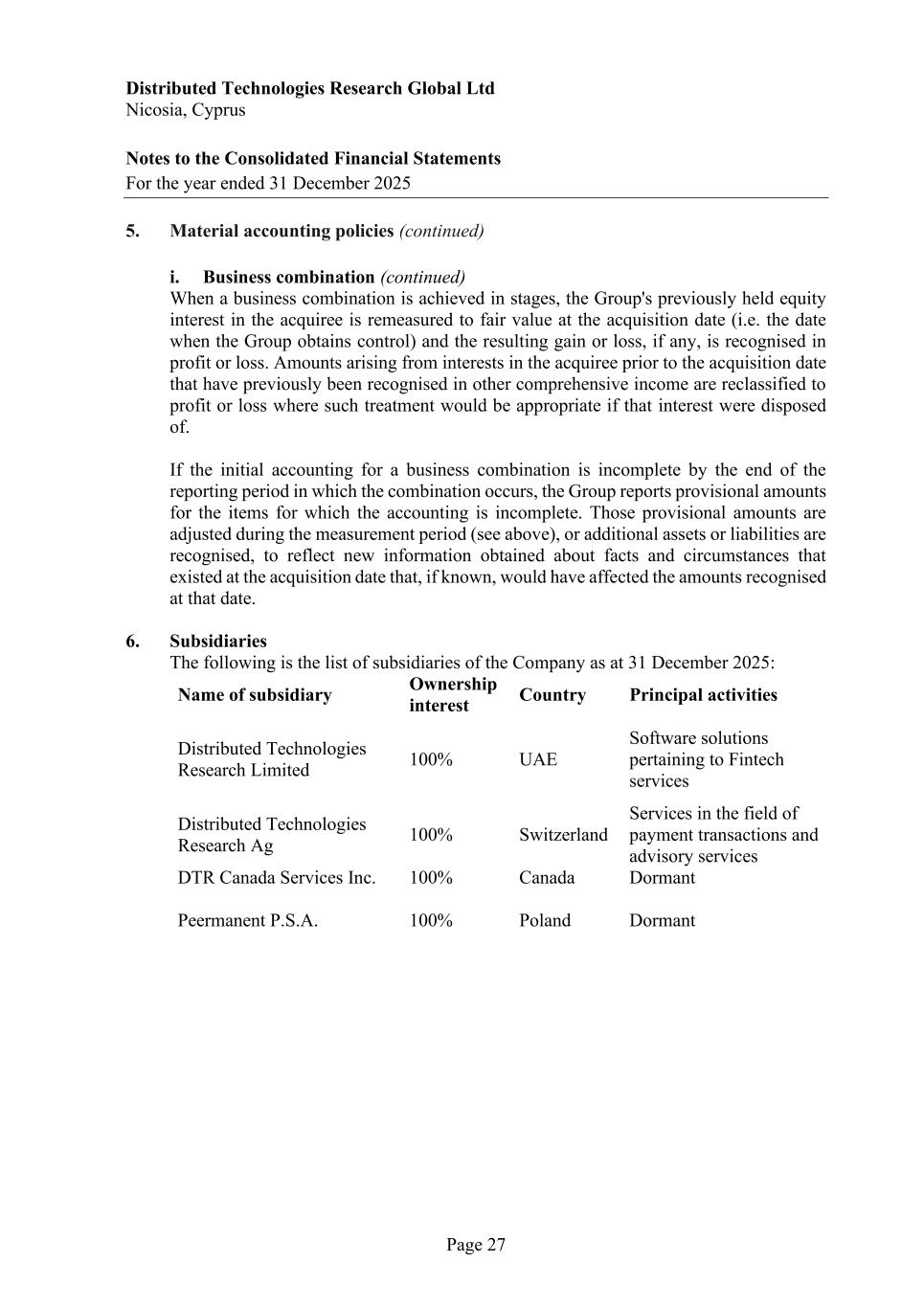
Distributed Technologies Research Global Ltd Nicosia, Cyprus Notes to the Consolidated Financial Statements For the year ended 31 December 2025 Page 27 5. Material accounting policies (continued) i. Business combination (continued) When a business combination is achieved in stages, the Group's previously held equity interest in the acquiree is remeasured to fair value at the acquisition date (i.e. the date when the Group obtains control) and the resulting gain or loss, if any, is recognised in profit or loss. Amounts arising from interests in the acquiree prior to the acquisition date that have previously been recognised in other comprehensive income are reclassified to profit or loss where such treatment would be appropriate if that interest were disposed of. If the initial accounting for a business combination is incomplete by the end of the reporting period in which the combination occurs, the Group reports provisional amounts for the items for which the accounting is incomplete. Those provisional amounts are adjusted during the measurement period (see above), or additional assets or liabilities are recognised, to reflect new information obtained about facts and circumstances that existed at the acquisition date that, if known, would have affected the amounts recognised at that date. 6. Subsidiaries The following is the list of subsidiaries of the Company as at 31 December 2025: Name of subsidiary Ownership interest Country Principal activities Distributed Technologies Research Limited 100% UAE Software solutions pertaining to Fintech services Distributed Technologies Research Ag 100% Switzerland Services in the field of payment transactions and advisory services DTR Canada Services Inc. 100% Canada Dormant Peermanent P.S.A. 100% Poland Dormant
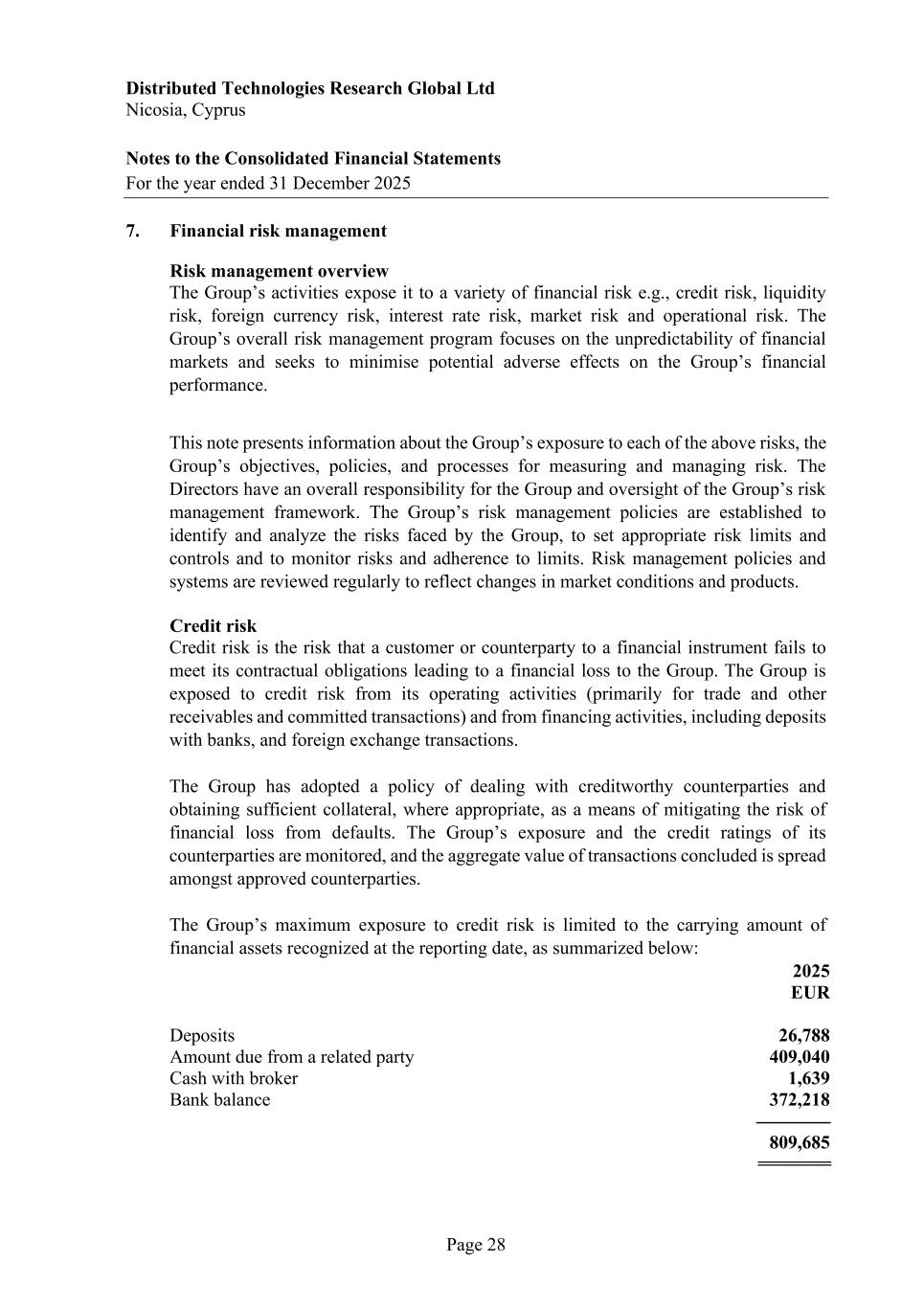
Distributed Technologies Research Global Ltd Nicosia, Cyprus Notes to the Consolidated Financial Statements For the year ended 31 December 2025 Page 28 7. Financial risk management Risk management overview The Group’s activities expose it to a variety of financial risk e.g., credit risk, liquidity risk, foreign currency risk, interest rate risk, market risk and operational risk. The Group’s overall risk management program focuses on the unpredictability of financial markets and seeks to minimise potential adverse effects on the Group’s financial performance. This note presents information about the Group’s exposure to each of the above risks, the Group’s objectives, policies, and processes for measuring and managing risk. The Directors have an overall responsibility for the Group and oversight of the Group’s risk management framework. The Group’s risk management policies are established to identify and analyze the risks faced by the Group, to set appropriate risk limits and controls and to monitor risks and adherence to limits. Risk management policies and systems are reviewed regularly to reflect changes in market conditions and products. Credit risk Credit risk is the risk that a customer or counterparty to a financial instrument fails to meet its contractual obligations leading to a financial loss to the Group. The Group is exposed to credit risk from its operating activities (primarily for trade and other receivables and committed transactions) and from financing activities, including deposits with banks, and foreign exchange transactions. The Group has adopted a policy of dealing with creditworthy counterparties and obtaining sufficient collateral, where appropriate, as a means of mitigating the risk of financial loss from defaults. The Group’s exposure and the credit ratings of its counterparties are monitored, and the aggregate value of transactions concluded is spread amongst approved counterparties. The Group’s maximum exposure to credit risk is limited to the carrying amount of financial assets recognized at the reporting date, as summarized below: 2025 EUR Deposits 26,788 Amount due from a related party 409,040 Cash with broker 1,639 Bank balance 372,218 ---------------- 809,685 ========
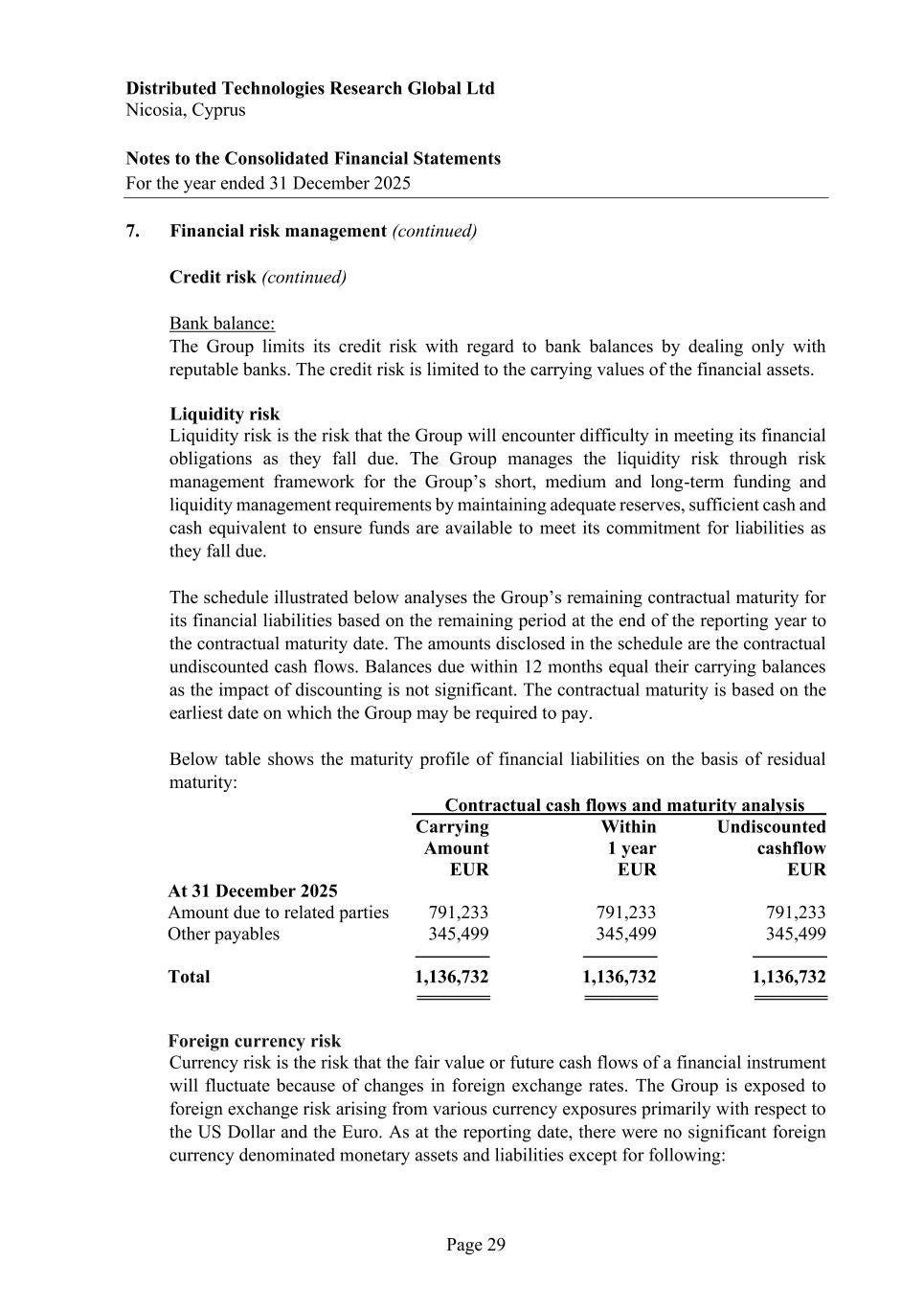
Distributed Technologies Research Global Ltd Nicosia, Cyprus Notes to the Consolidated Financial Statements For the year ended 31 December 2025 Page 29 7. Financial risk management (continued) Credit risk (continued) Bank balance: The Group limits its credit risk with regard to bank balances by dealing only with reputable banks. The credit risk is limited to the carrying values of the financial assets. Liquidity risk Liquidity risk is the risk that the Group will encounter difficulty in meeting its financial obligations as they fall due. The Group manages the liquidity risk through risk management framework for the Group’s short, medium and long-term funding and liquidity management requirements by maintaining adequate reserves, sufficient cash and cash equivalent to ensure funds are available to meet its commitment for liabilities as they fall due. The schedule illustrated below analyses the Group’s remaining contractual maturity for its financial liabilities based on the remaining period at the end of the reporting year to the contractual maturity date. The amounts disclosed in the schedule are the contractual undiscounted cash flows. Balances due within 12 months equal their carrying balances as the impact of discounting is not significant. The contractual maturity is based on the earliest date on which the Group may be required to pay. Below table shows the maturity profile of financial liabilities on the basis of residual maturity: Contractual cash flows and maturity analysis Carrying Within Undiscounted Amount 1 year cashflow EUR EUR EUR At 31 December 2025 Amount due to related parties 791,233 791,233 791,233 Other payables 345,499 345,499 345,499 ---------------- ---------------- ---------------- Total 1,136,732 1,136,732 1,136,732 ======== ======== ======== Foreign currency risk Currency risk is the risk that the fair value or future cash flows of a financial instrument will fluctuate because of changes in foreign exchange rates. The Group is exposed to foreign exchange risk arising from various currency exposures primarily with respect to the US Dollar and the Euro. As at the reporting date, there were no significant foreign currency denominated monetary assets and liabilities except for following:
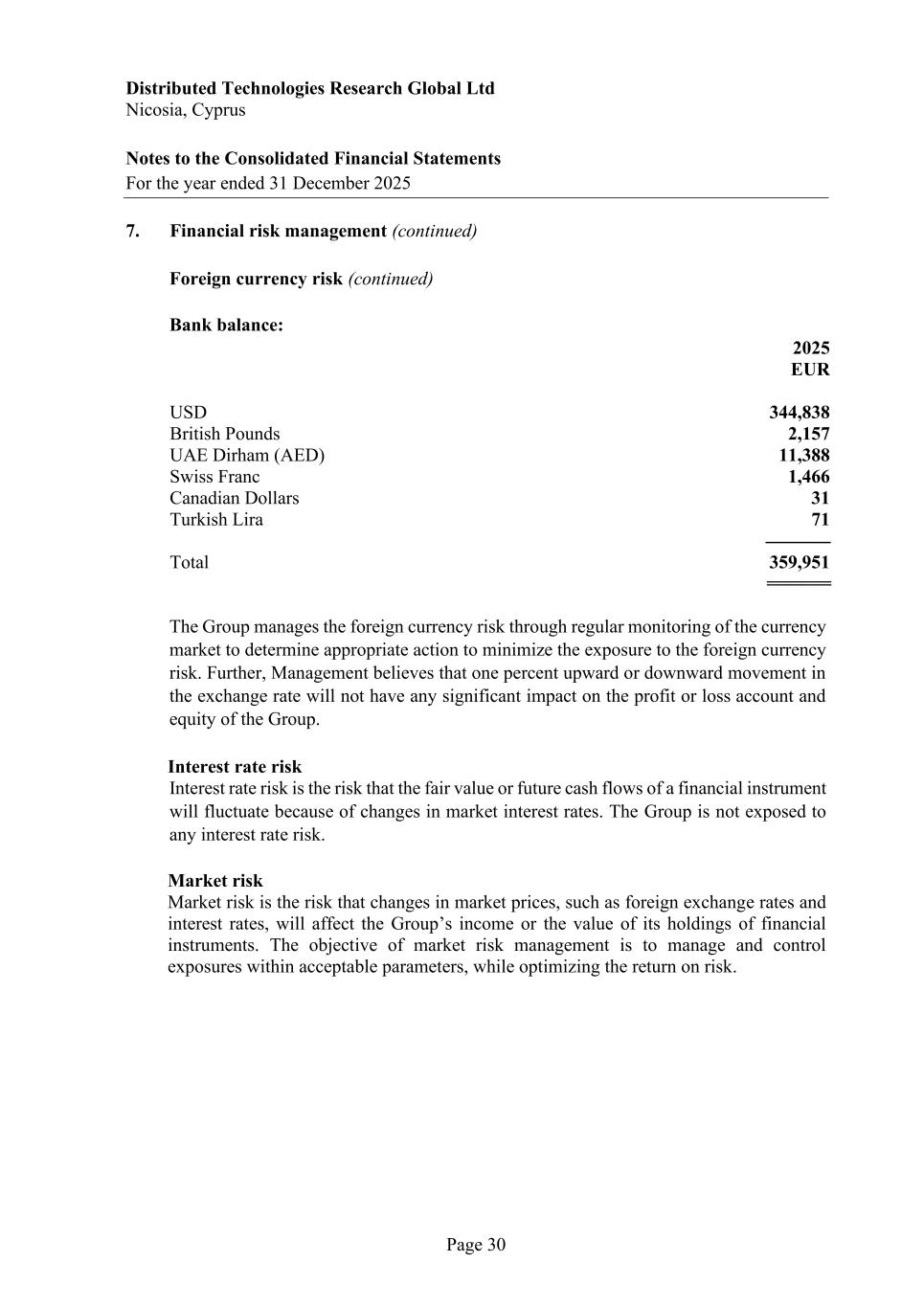
Distributed Technologies Research Global Ltd Nicosia, Cyprus Notes to the Consolidated Financial Statements For the year ended 31 December 2025 Page 30 7. Financial risk management (continued) Foreign currency risk (continued) Bank balance: 2025 EUR USD 344,838 British Pounds 2,157 UAE Dirham (AED) 11,388 Swiss Franc 1,466 Canadian Dollars 31 Turkish Lira 71 -------------- Total 359,951 ======= The Group manages the foreign currency risk through regular monitoring of the currency market to determine appropriate action to minimize the exposure to the foreign currency risk. Further, Management believes that one percent upward or downward movement in the exchange rate will not have any significant impact on the profit or loss account and equity of the Group. Interest rate risk Interest rate risk is the risk that the fair value or future cash flows of a financial instrument will fluctuate because of changes in market interest rates. The Group is not exposed to any interest rate risk. Market risk Market risk is the risk that changes in market prices, such as foreign exchange rates and interest rates, will affect the Group’s income or the value of its holdings of financial instruments. The objective of market risk management is to manage and control exposures within acceptable parameters, while optimizing the return on risk.
Distributed Technologies Research Global Ltd Nicosia, Cyprus Notes to the Consolidated Financial Statements For the year ended 31 December 2025 Page 31 7. Financial risk management (continued) Operational risk Operational risk is the risk of direct or indirect loss arising from the Group’s operations coming from a wide variety of reasons associated with the Group’s processes, personnel, technology and infrastructure and from external factors other than credit, market and liquidity risks such as those arising from legal and regulatory requirements and generally accepted standards of corporate behavior. The Group’s objective is to manage operational risks so as to balance the avoidance of financial losses and damage to the Group’s reputation with overall cost effectiveness and to avoid control procedures that restrict initiative and creativity. 8. Determination of fair values Certain of the Group’s accounting policies and disclosures require the determination of fair value of financial and non-financial assets. Fair values have been determined for measurement and / or disclosure purposes based on the prescribed methods. When applicable, further information about the assumptions made in determining fair values is disclosed in the notes specific to that asset. Fair values reflect the credit risk of the instrument and include adjustments to take account of the credit risk of the Group and counterparty when appropriate. At the statement of financial position date, there is no significant difference in the fair values of financial assets and liabilities. 9. Capital Management The Group’s main objective when managing capital is to safeguard the Group’s ability to continue as a going concern. The shareholder of the Group ensures that the Group will be able to continue as a going concern while providing maximum return to shareholders through the optimization of the debt and equity balance and to maintain an optimal capital structure to reduce the cost of the capital. The capital structure of the Group consists of equity funds as presented in the statement of financial position. The Group manages its capital structure and makes adjustments to it in light of changes in economic conditions and the risk characteristics of the underlying assets. There were no changes in the Group’s approach to capital management during the year. Capital comprises share capital, additional capital contribution, and accumulated loss, which together amounted to EUR 3,397,943/- at 31 December 2025.
Distributed Technologies Research Global Ltd Nicosia, Cyprus Notes to the Consolidated Financial Statements For the year ended 31 December 2025 Page 32 10. Intangible assets Crypto Goodwill currency Total EUR EUR EUR Cost: Additions during the year 3,692,268 3,617 3,695,885 ---------------- -------------- ---------------- At 31 December 2025 3,692,268 3,617 3,695,885 ======== ======= ======== Accumulated amortisation: Amortisation charge for the year - - - ------------ ------------ -------------- At 31 December 2025 - - - ====== ====== ======= Net book value: At 31 December 2025 3,692,268 3,617 3,695,885 ======== ======= ======== Goodwill arose on the acquisition of: • Distributed Technologies Research Limited; • Distributed Technologies Research AG; • DTR Canada Services Inc.; and • Peermanent P.S.A. Goodwill represents the excess of the consideration transferred over the fair value of the identifiable net assets acquired. The amounts recognised have been determined provisionally in accordance with IFRS 3. 11. Related party balances and transactions The Group enters into transactions with persons and entities that fall within the definition of a related party in IAS 24, Related Party Disclosures. Related parties include the shareholder, key management personnel and entities controlled directly or indirectly by the shareholder or over which the shareholder exercises significant influence. The Management decides the terms and conditions of the transactions and services received from and rendered to related parties as well as other charges, if applicable. These terms correspond to those on normal arms-length transactions with third parties.
Distributed Technologies Research Global Ltd Nicosia, Cyprus Notes to the Consolidated Financial Statements For the year ended 31 December 2025 Page 33 11. Related party balances and transactions (continued) The following balances were outstanding at the end of the reporting year: A) Amount due from a related party Current asset 2025 Name of related party Nature of transactions EUR Unblock LT UAB, Lithuania Finance 409,040 ======= B) Amount due to related parties Current liability 2025 Name of related party Nature of transactions EUR Unblock LT UAB, Sister concern Finance 42,441 Akshay Sudhir Naheta, Director Finance 748,792 -------------- 791,233 ======= C) Significant transactions with related parties during the year: General and administrative expenses 2025 Name of related party Nature of transactions EUR Akshay Sudhir Naheta, Director Managerial remuneration 425,123 Andreas Malas Managerial remuneration 6,000 MD Solutions & Advisory GmbH Managerial remuneration 11,335 -------------- 442,458 ======= 12. Prepayments and deposits 2025 EUR Deposits 26,788 Prepayments 29,105 ------------ 55,893 ======
Distributed Technologies Research Global Ltd Nicosia, Cyprus Notes to the Consolidated Financial Statements For the year ended 31 December 2025 Page 34 13. Cash and bank balance 2025 EUR Cash with broker 1,639 Bank balance 372,218 -------------- 373,857 ======= 14. Share capital The shareholder of the Company as at 31 December 2025 was as follows: 2025 Name Nationality No. of shares EUR Akshay Sudhir Naheta United Kingdom 117,686,113 11,768,611 ========== ========== On 6 March 2025, the authorised share capital of the Company was increased by 100,000,000 ordinary shares of EUR 0.10 each, equivalent to EUR 10,000,000. On the same date, the Company issued 85,572,991 ordinary shares of EUR 0.10 each at par. On 23 December 2025, the authorised share capital of the Company was further increased by 30,000,000 ordinary shares of EUR 0.10 each, equivalent to EUR 3,000,000. The Company issued 31,613,122 ordinary shares of EUR 0.10 each at par. Accordingly, the revised authorised capital of the Company is EUR 13,060,000 divided into 130,600,000 shares of EUR 0.10 each. The issued share capital of the Company was EUR 11,768,611 divided into 117,686,113 shares of EUR 0.10 each. Authorised share capital Particulars Number of shares 2025 Issued on incorporation 600,000 60,000 Increase on 6 March 100,000,000 10,000,000 Increase on 23 December 30,000,000 3,000,000 -------------------- ------------------ Total authorised share capital 130,600,000 13,060,000 ========== =========
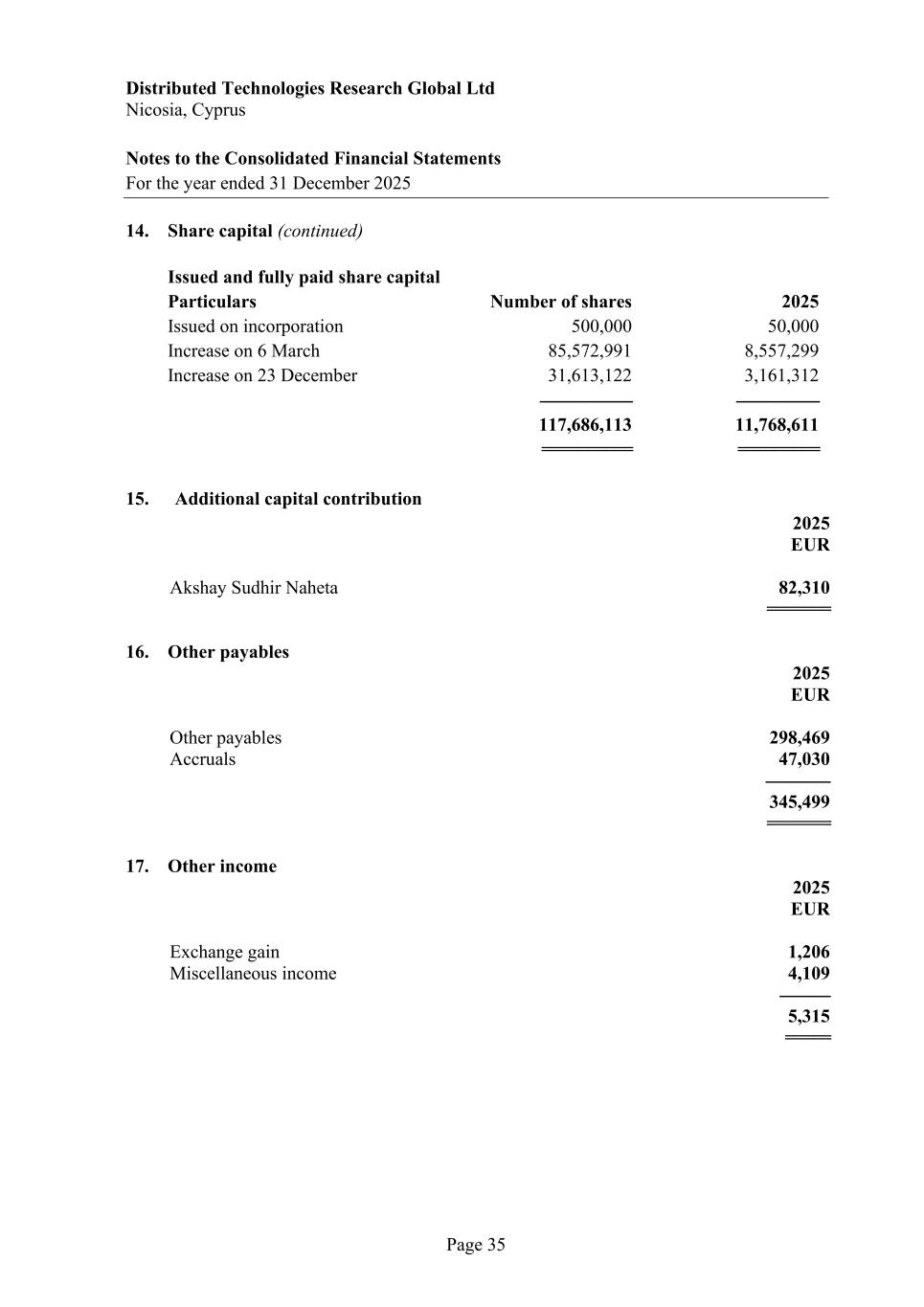
Distributed Technologies Research Global Ltd Nicosia, Cyprus Notes to the Consolidated Financial Statements For the year ended 31 December 2025 Page 35 14. Share capital (continued) Issued and fully paid share capital Particulars Number of shares 2025 Issued on incorporation 500,000 50,000 Increase on 6 March 85,572,991 8,557,299 Increase on 23 December 31,613,122 3,161,312 -------------------- ------------------ 117,686,113 11,768,611 ========== ========= 15. Additional capital contribution 2025 EUR Akshay Sudhir Naheta 82,310 ======= 16. Other payables 2025 EUR Other payables 298,469 Accruals 47,030 -------------- 345,499 ======= 17. Other income 2025 EUR Exchange gain 1,206 Miscellaneous income 4,109 ----------- 5,315 =====
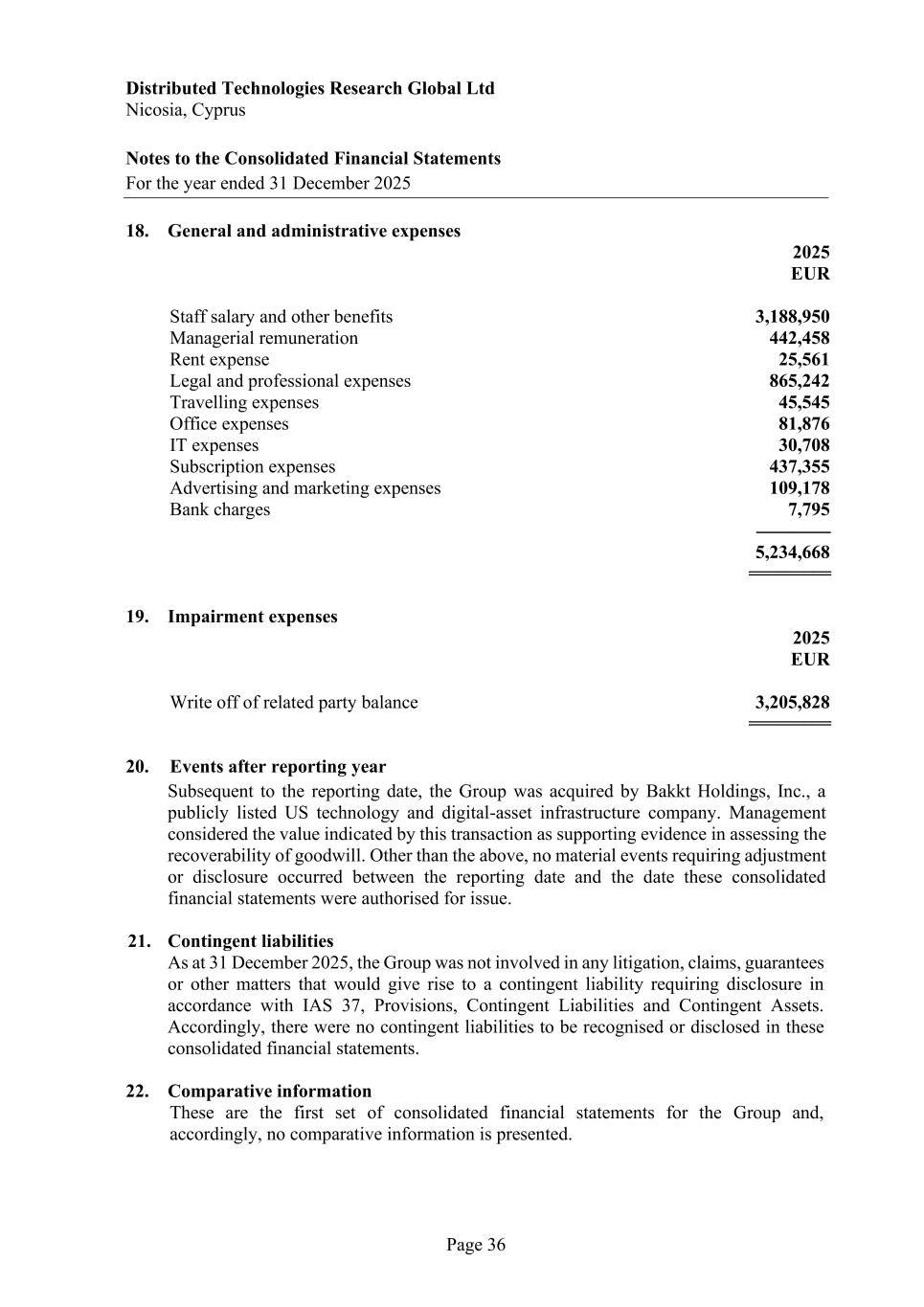
Distributed Technologies Research Global Ltd Nicosia, Cyprus Notes to the Consolidated Financial Statements For the year ended 31 December 2025 Page 36 18. General and administrative expenses 2025 EUR Staff salary and other benefits 3,188,950 Managerial remuneration 442,458 Rent expense 25,561 Legal and professional expenses 865,242 Travelling expenses 45,545 Office expenses 81,876 IT expenses 30,708 Subscription expenses 437,355 Advertising and marketing expenses 109,178 Bank charges 7,795 ---------------- 5,234,668 ========= 19. Impairment expenses 2025 EUR Write off of related party balance 3,205,828 ========= 20. Events after reporting year Subsequent to the reporting date, the Group was acquired by Bakkt Holdings, Inc., a publicly listed US technology and digital-asset infrastructure company. Management considered the value indicated by this transaction as supporting evidence in assessing the recoverability of goodwill. Other than the above, no material events requiring adjustment or disclosure occurred between the reporting date and the date these consolidated financial statements were authorised for issue. 21. Contingent liabilities As at 31 December 2025, the Group was not involved in any litigation, claims, guarantees or other matters that would give rise to a contingent liability requiring disclosure in accordance with IAS 37, Provisions, Contingent Liabilities and Contingent Assets. Accordingly, there were no contingent liabilities to be recognised or disclosed in these consolidated financial statements. 22. Comparative information These are the first set of consolidated financial statements for the Group and, accordingly, no comparative information is presented.