Exhibit 99.2
Micware Co., Ltd. (MWC , Nasdaq) Japan's Embedded SDV Software Partner — Engineering Moat, Business Model at an Inflection Alphaterra Advisory – Company Initiation The core engineering business is structurally more durable than it appears. Honda Motor Co., Ltd. (“Honda”) and Toyota Motor Corporation (“Toyota”) each hold approximately 12% of Micware's equity, co - develop their flagship SDV (“software defined vehicle”) platforms through its engineers, and have done so continuously across more than two decades. The switching cost is architectural, not contractual — replacing Micware would require rebuilding platform architectures developed across multiple vehicle generations. The central investment debate is whether strategic importance can be converted into scalable economics. Micware's current business is headcount - dependent: approximately 80% of FY2/26 revenue derives from effort - based software development services. micAuto PF — a production - validated SDV platform framework — is the company's mechanism for introducing per - vehicle royalties and shifting toward recurring software economics. No external OEM (“original equipment manufacturers”) contracts have been signed thus far, and MWC has several ongoing discussions with several OEMs. Location intelligence is an underappreciated asset; DynaPlanet is long - duration optionality. The LBS segment is not a legacy navigation business in decline — location data is becoming a foundational layer within SDV architectures as ADAS (“advanced driver assistance systems”) adoption grows. DynaPlanet, Micware's AI - generated 3D spatial data initiative, is in development - stage and should be evaluated on a three - to - five - year horizon as a structural hedge against OEM concentration. The financial profile reflects a business on solid footing, investing ahead of a potential transition. Micware enters FY2/27 net cash positive at ¥2.9 billion, with operating income growing consistently across three years to ¥2.4 billion in FY2/26 and gross margin expanding from 30.4% to 36.8% over the same period. The company is funding elevated R&D investment in micAuto PF and DynaPlanet from operating cash flows, without leverage or external capital dependence — the IPO (“initial public offering”) proceeds provide additional runway on top of an already self - funded investment program. The risks are real and should be held clearly. Customer concentration is the most immediate structural risk: Honda alone accounts for approximately 50% of consolidated revenue, and Honda's revised EV strategy introduces near - term program uncertainty. Micware's current economics are headcount - dependent — transitioning to volume - driven royalty economics through micAuto PF is the central evolution in its business model, and the timeline for that transition remains unresolved. Bottom line Micware is a Japanese automotive software company with a structural position that is genuinely difficult to replicate — and an investment debate that is genuinely unresolved . This report is designed to give investors the analytical foundation to assess it independently . ©2026 Alphaterra Advisory, Inc | 1 August 7, 2026
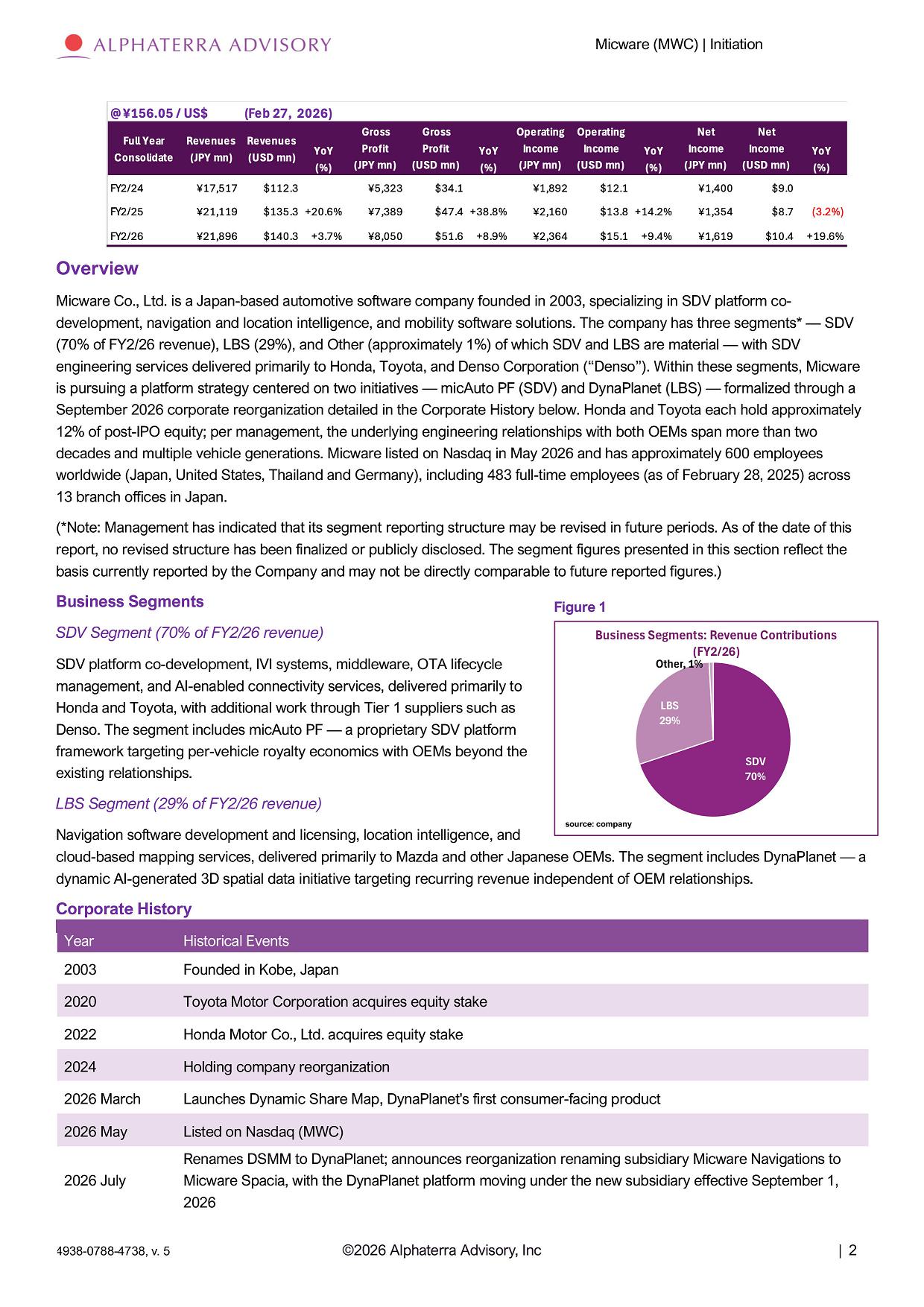
Micware (MWC) | Initiation Overview Micware Co., Ltd. is a Japan - based automotive software company founded in 2003, specializing in SDV platform co - development, navigation and location intelligence, and mobility software solutions. The company has three segments* — SDV (70% of FY2/26 revenue), LBS (29%), and Other (approximately 1%) of which SDV and LBS are material — with SDV engineering services delivered primarily to Honda, Toyota, and Denso Corporation (“Denso”). Within these segments, Micware is pursuing a platform strategy centered on two initiatives — micAuto PF (SDV) and DynaPlanet (LBS) — formalized through a September 2026 corporate reorganization detailed in the Corporate History below. Honda and Toyota each hold approximately 12% of post - IPO equity; per management, the underlying engineering relationships with both OEMs span more than two decades and multiple vehicle generations. Micware listed on Nasdaq in May 2026 and has approximately 600 employees worldwide (Japan, United States, Thailand and Germany), including 483 full - time employees (as of February 28, 2025) across 13 branch offices in Japan. (*Note: Management has indicated that its segment reporting structure may be revised in future periods. As of the date of this report, no revised structure has been finalized or publicly disclosed. The segment figures presented in this section reflect the basis currently reported by the Company and may not be directly comparable to future reported figures.) Business Segments SDV Segment (70% of FY2/26 revenue) SDV platform co - development, IVI systems, middleware, OTA lifecycle management, and AI - enabled connectivity services, delivered primarily to Honda and Toyota, with additional work through Tier 1 suppliers such as Denso. The segment includes micAuto PF — a proprietary SDV platform framework targeting per - vehicle royalty economics with OEMs beyond the existing relationships. LBS Segment (29% of FY2/26 revenue) Navigation software development and licensing, location intelligence, and cloud - based mapping services, delivered primarily to Mazda and other Japanese OEMs. The segment includes DynaPlanet — a dynamic AI - generated 3D spatial data initiative targeting recurring revenue independent of OEM relationships. Corporate History Year Historical Events 2003 Founded in Kobe, Japan 2020 Toyota Motor Corporation acquires equity stake 2022 Honda Motor Co., Ltd. acquires equity stake 2024 Holding company reorganization 2026 March Launches Dynamic Share Map, DynaPlanet's first consumer - facing product 2026 May Listed on Nasdaq (MWC) 2026 July Renames DSMM to DynaPlanet ; announces reorganization renaming subsidiary Micware Navigations to Micware Spacia, with the DynaPlanet platform moving under the new subsidiary effective September 1 , 2026 Figure 1 Business Segments: Revenue Contributions (FY2/26) Other, 1% L B S 29% S D V 70% source: company ©2026 Alphaterra Advisory, Inc | 2 4938 - 0788 - 4738, v. 5
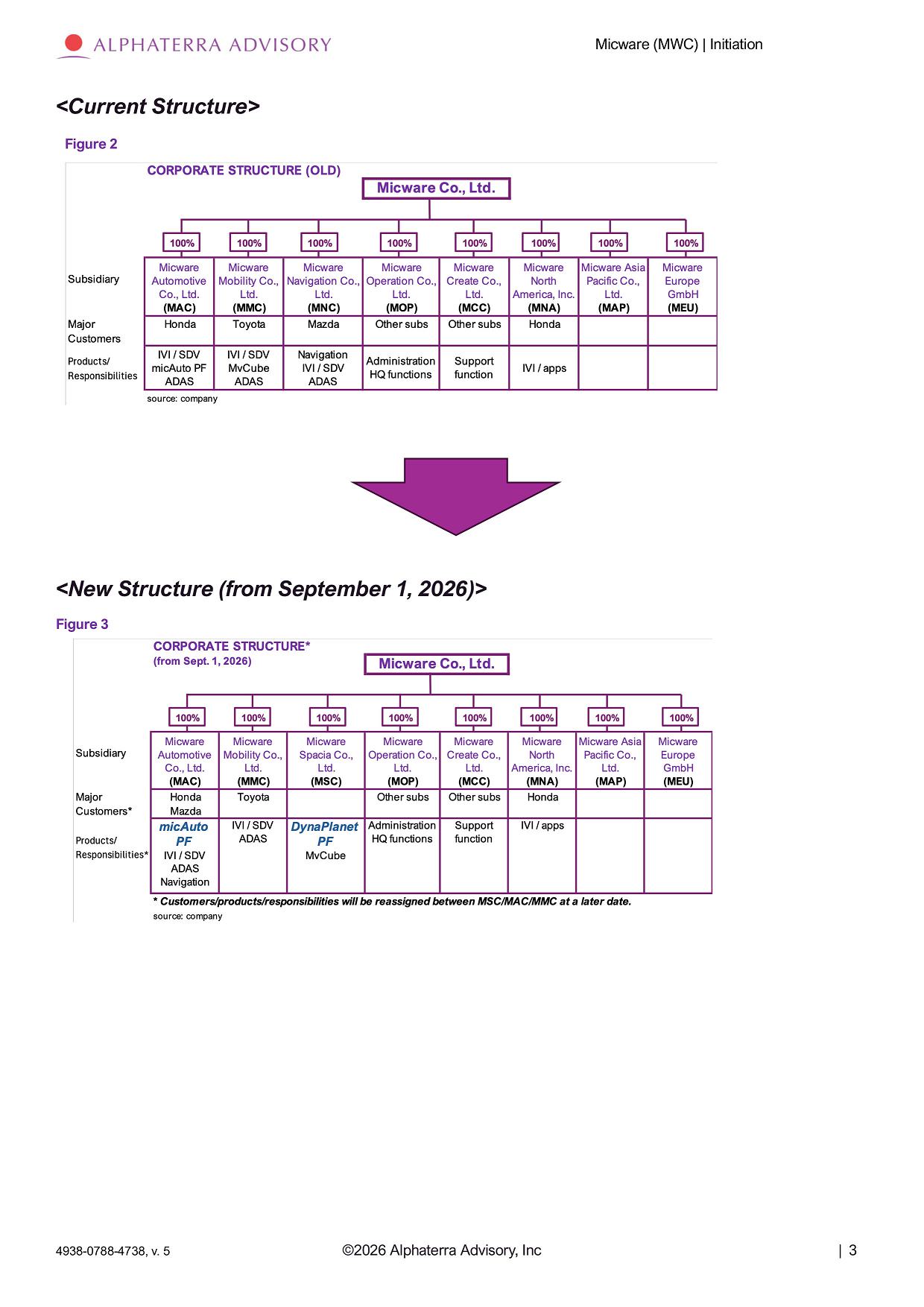
Micware (MWC) | Initiation <New Structure (from September 1, 2026)> Figure 3 <Current Structure> Figure 2 ©2026 Alphaterra Advisory, Inc | 3 4938 - 0788 - 4738, v. 5
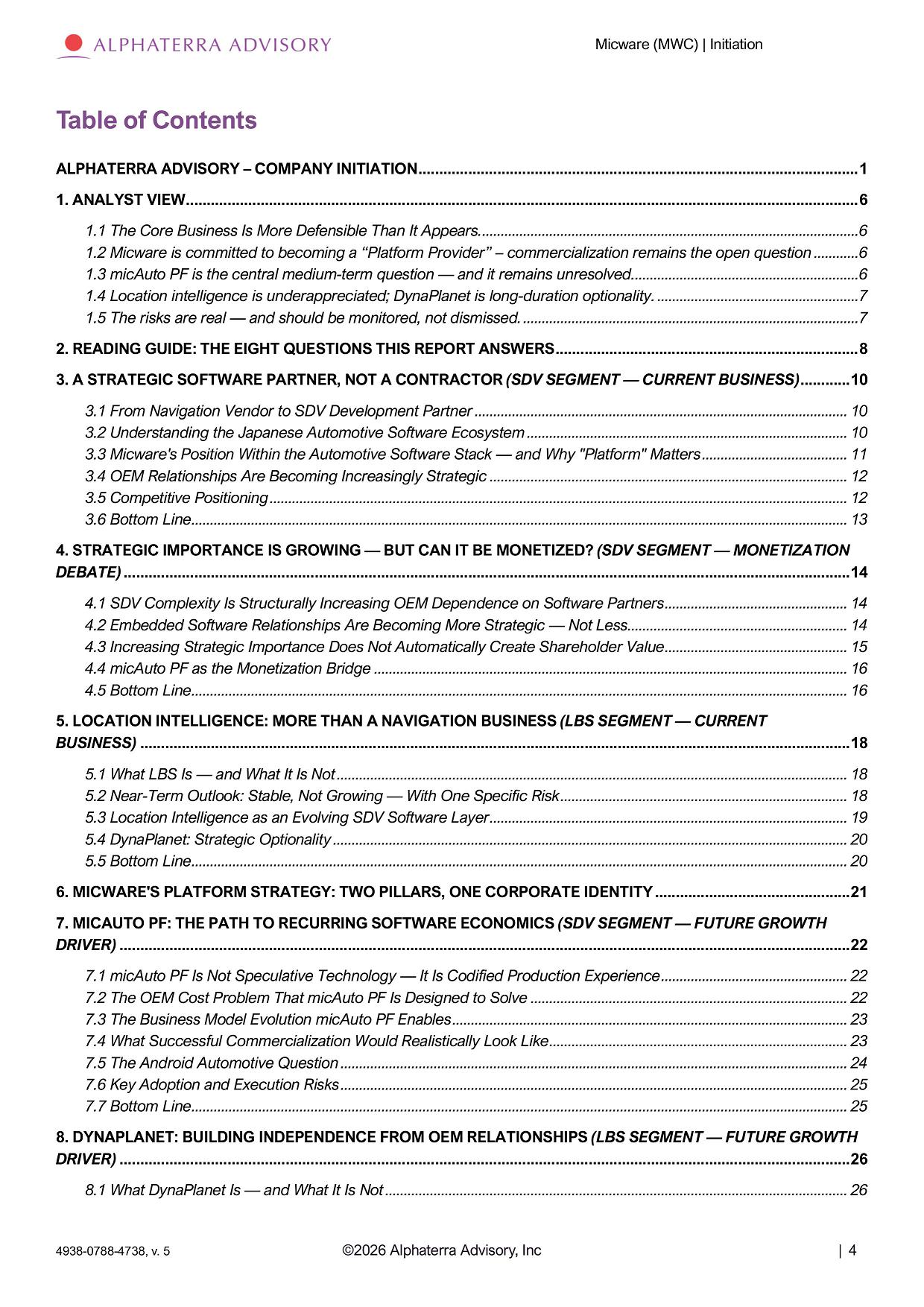
Micware (MWC) | Initiation ©2026 Alphaterra Advisory, Inc | 4 4938 - 0788 - 4738, v. 5 Table of Contents ALPHATERRA ADVISORY – COMPANY INITIATION..........................................................................................................1 1. ANALYST VIEW......................................................................................................................... ... ......................................6 1.1 The Core Business Is More Defensible Than It Appears......................................................................................................6 1 . 2 Micware is committed to becoming a “Platform Provider” – commercialization remains the open question ............ 6 1 . 3 micAuto PF is the central medium - term question — and it remains unresolved ............................................................. 6 1 . 4 Location intelligence is underappreciated ; DynaPlanet is long - duration optionality . ...................................................... 7 1 . 5 The risks are real — and should be monitored, not dismissed . .......................................................................................... 7 2. READING GUIDE: THE EIGHT QUESTIONS THIS REPORT ANSWERS.........................................................................8 3. A STRATEGIC SOFTWARE PARTNER, NOT A CONTRACTOR (SDV SEGMENT — CURRENT BUSINESS) ............10 3 . 1 From Navigation Vendor to SDV Development Partner .................................................................................................... 10 3 . 2 Understanding the Japanese Automotive Software Ecosystem ...................................................................................... 10 3 . 3 Micware's Position Within the Automotive Software Stack — and Why "Platform" Matters ....................................... 11 3 . 4 OEM Relationships Are Becoming Increasingly Strategic ................................................................................................ 12 3 . 5 Competitive Positioning ............................................................................................................................. ... ........................... 12 3 . 6 Bottom Line ............................................................................................................................. ... ................................................ 13 4. STRATEGIC IMPORTANCE IS GROWING — BUT CAN IT BE MONETIZED? (SDV SEGMENT — MONETIZATION DEBATE) ............................................................................................................................. ... ...............................................14 4 . 1 SDV Complexity Is Structurally Increasing OEM Dependence on Software Partners ................................................. 14 4 . 2 Embedded Software Relationships Are Becoming More Strategic — Not Less ........................................................... 14 4 . 3 Increasing Strategic Importance Does Not Automatically Create Shareholder Value ................................................. 15 4 . 4 micAuto PF as the Monetization Bridge ............................................................................................................................. .. 16 4 . 5 Bottom Line ............................................................................................................................. ... ................................................ 16 5. LOCATION INTELLIGENCE: MORE THAN A NAVIGATION BUSINESS (LBS SEGMENT — CURRENT BUSINESS) ............................................................................................................................. ... ...........................................18 5 . 1 What LBS Is — and What It Is Not ............................................................................................................................. ... ......... 18 5 . 2 Near - Term Outlook : Stable, Not Growing — With One Specific Risk ............................................................................. 18 5 . 3 Location Intelligence as an Evolving SDV Software Layer ................................................................................................ 19 5 . 4 DynaPlanet : Strategic Optionality ............................................................................................................................. ... .......... 20 5 . 5 Bottom Line ............................................................................................................................. ... ................................................ 20 6. MICWARE'S PLATFORM STRATEGY: TWO PILLARS, ONE CORPORATE IDENTITY ...............................................21 7. MICAUTO PF: THE PATH TO RECURRING SOFTWARE ECONOMICS (SDV SEGMENT — FUTURE GROWTH DRIVER) ............................................................................................................................. ... ................................................22 7 . 1 micAuto PF Is Not Speculative Technology — It Is Codified Production Experience .................................................. 22 7 . 2 The OEM Cost Problem That micAuto PF Is Designed to Solve ..................................................................................... 22 7 . 3 The Business Model Evolution micAuto PF Enables .......................................................................................................... 23 7 . 4 What Successful Commercialization Would Realistically Look Like ................................................................................ 23 7 . 5 The Android Automotive Question ............................................................................................................................. ... ........ 24 7 . 6 Key Adoption and Execution Risks ............................................................................................................................. ... ........ 25 7 . 7 Bottom Line ............................................................................................................................. ... ................................................ 25 8. DYNAPLANET: BUILDING INDEPENDENCE FROM OEM RELATIONSHIPS (LBS SEGMENT — FUTURE GROWTH DRIVER) ............................................................................................................................. ... ................................................26 8 . 1 What DynaPlanet Is — and What It Is Not ............................................................................................................................ 26
Micware (MWC) | Initiation 8 . 2 Why Management Is Pursuing This — The Strategic Logic ............................................................................................. 26 8 . 3 Technology Architecture and Data Infrastructure .............................................................................................................. 27 8 . 4 Phases of Commercialization and Revenue Model ............................................................................................................ 28 8 . 5 The Investment Cost and Financial Implications ................................................................................................................. 28 8 . 6 Why DynaPlanet Should Be Evaluated as Optionality ........................................................................................................ 29 8 . 7 Bottom Line ............................................................................................................................. ... ................................................ 29 9. FINANCIAL PROFILE: WHAT THE DISCLOSED NUMBERS SHOW (SDV SEGMENT AND LBS SEGMENT — HISTORICAL FINANCIAL BASELINE) ............................................................................................................................. ... 30 9 . 1 Revenue : Growth Profile and Segment Mix ......................................................................................................................... 30 9 . 2 Profitability : Six Distinct Stories ............................................................................................................................. ... .............. 31 9 . 3 Balance Sheet and Capital Structure ............................................................................................................................. ... .... 32 9 . 4 Cash Flow ............................................................................................................................. ... ................................................... 33 9 . 5 What the Numbers Establish — and What They Do Not ................................................................................................... 33 10. WHAT TO WATCH: MILESTONES THAT WILL DEFINE THE THESIS........................................................................34 10 . 1 micAuto PF : The Most Important Near - Term Milestone — and How to Read It ......................................................... 34 10 . 2 OEM Relationship Health : Watch the Operations, Not the Contracts ........................................................................... 34 10 . 3 Gross Margin Trajectory : Signal and Ceiling ..................................................................................................................... 35 10 . 4 LBS and DynaPlanet : Different Timelines, Different Indicators ...................................................................................... 35 10 . 5 Governance : Succession in Progress ............................................................................................................................. ... . 35 10 . 6 Bottom Line ............................................................................................................................. ... ............................................. 36 11. RISKS: FACTORS THAT CAN PREVENT THE THESIS FROM PLAYING OUT ..........................................................37 1. Customer Concentration : A Single - Customer Dependency That Equity Alignment Mitigates but Does Not Eliminate ............................................................................................................................. ... ............................................................ 37 2. micAuto PF Adoption Risk : The Central Execution Variable Remains Unresolved .................................................... 38 11 . 3 OEM Internalization Risk : Structurally Reduced — but Not Eliminated ........................................................................ 38 11 . 4 OEM Strategy Shifts and Automotive Industry Cyclicality .............................................................................................. 39 5. Talent Risk : The Engineering Moat Requires Continuous Investment to Maintain ..................................................... 39 6. Governance and Succession Risk : A Plan Is in Place — Execution Remains to Be Demonstrated ....................... 40 11 . 7 Small - Cap Liquidity Risk ............................................................................................................................. ... ....................... 41 11 . 8 Bottom Line ............................................................................................................................. ... ............................................. 41 APPENDIX ............................................................................................................................. ... ............................................42 A) Financial Statements ............................................................................................................................. ... ........................... 42 B) Micware (MWC) — Competitive Landscape .................................................................................................................. 46 C) Global Automotive SDV Ecosystem ............................................................................................................................. ... . 49 GLOSSARY OF KEY TERMS ............................................................................................................................. ... ...............52 DISCLAIMER ............................................................................................................................. ... ........................................53 ©2026 Alphaterra Advisory, Inc | 5 4938 - 0788 - 4738, v. 5
Micware (MWC) | Initiation 1. Analyst View Micware is a Japanese automotive software company with a structural position that is genuinely difficult to replicate. Honda and Toyota each hold approximately 12% of its equity, co - develop their flagship SDV platforms through its engineers — equity commitments that followed years of prior engineering collaboration, and have deepened alongside relationships spanning multiple vehicle generations. The core business is durable. The investment debate is whether Micware can translate that structural importance into recurring software economics — or whether it remains a high - quality but headcount - dependent engineering business. That question is unresolved, and this report is designed to give investors the analytical foundation to assess it independently. 1.1 The Core Business Is More Defensible Than It Appears. Micware's engineering relationships with Honda, Toyota, and Denso are not conventional outsourcing. They are multi - generational, equity - reinforced, and increasingly embedded in architecture discussions with OEMs at the program planning stage. The engineers Micware deploys into Honda and Toyota programs accumulate institutional knowledge — of platform architecture, development culture, program history, and engineering expectations — that a competing vendor cannot replicate by hiring additional headcount. As SDV complexity grows, the cost and difficulty of replacing that embedded knowledge base increases. In our view, the core engineering business is structurally more durable than the market typically ascribes to automotive software services companies. The primary near - term risk to that durability is Honda's scaling back of its electric vehicle (“EV”) ambitions, which Alphaterra Advisory expects to put some pressure on Honda - related revenue in FY2/27. Honda accounts for approximately 50% of consolidated revenues, making its program trajectory the single most important variable in the near - term financial picture. 1.2 Micware is committed to becoming a “Platform Provider” – commercialization remains the open question In July 2026, Micware announced a reorganization establishing Micware Spacia Co., Ltd. as a dedicated subsidiary for its DynaPlanet platform, effective September 2026, with co - founder and CTO Masahide Shigeno as its CEO. Management frames this as the latest step in a stated multi - decade arc — from software developer, to Tier 1 software supplier, to platform provider — organized around two pillars: micAuto PF within the SDV segment and DynaPlanet within the location - based service (“LBS”) segment. In our view, this is best read as an organizational commitment to the strategy, not evidence that either pillar has yet been commercially validated; Sections 7 and 8 examine that separately for each platform. 1.3 micAuto PF is the central medium - term question — and it remains unresolved. micAuto PF is an SDV software framework built from production - tested co - development experience with Honda and other Japanese OEMs. This product allows other OEMs to launch SDV systems faster and at lower cost while retaining software ownership control. If successfully commercialized, it introduces per - vehicle royalties alongside the existing engineering and customization fees, shifting the underlying economics from effort - based to production - volume - driven, which will materially change the financial character of the business. No OEM contracts have been signed thus far. Alphaterra Advisory expects the first revenue contribution to come from within the Honda ecosystem given the depth of that relationship and the platform’s development foundation across Honda and other Japanese OEMs — which would be a meaningful first step but would not constitute independent commercial validation. The threshold that changes the analytical picture is a signed contract with an OEM outside the Honda relationship. ©2026 Alphaterra Advisory, Inc | 6 4938 - 0788 - 4738, v. 5
Micware (MWC) | Initiation 1.4 Location intelligence is underappreciated; DynaPlanet is long - duration optionality. Micware's LBS segment — navigation, mapping, and location intelligence — is often characterized as a legacy business in structural decline. In our view, that framing is increasingly inaccurate. As SDV architectures deepen, location data is evolving from a standalone navigation function into a foundational software layer, interfacing with functions such as ADAS coordination, EV range optimization, OTA triggers, and vehicle - level orchestration. Micware is already embedded in the software layers where location data becomes actionable at the vehicle level. DynaPlanet — the company's dynamic 3D spatial data initiative — is in development - stage and should be evaluated as long - duration optionality rather than as a near - term earnings contributor. Management has now disclosed a phased roadmap: full - scale service and platform development through FY2/27, with feature expansion, market deployment and revenue scaling from FY2/28 onward. Management has also stated that approximately 70% of growth investment is directed to the LBS domain and 30% to SDV, which places the larger share of discretionary capital behind the pillar this report treats as optionality. The strategic logic is sound: a proprietary spatial data asset that reduces structural dependence on OEM relationships. The commercial reality is that it will take years of investment and execution before DynaPlanet generates revenue at a scale that is meaningful relative to the consolidated business. 1.5 The risks are real — and should be monitored, not dismissed. Customer concentration is the most immediate structural risk: Honda, Toyota, and Uni Electronics (the direct counterparty for Mazda - related work) collectively account for approximately 80% of revenue, and Honda alone accounts for approximately 50%. The micAuto PF commercialization timeline is uncertain, competitors include established global vendors, and OEM software internalization — while not the base case — is a documented industry trend that Micware is not immune to. The company is investing ahead of commercialization and R&D is elevated. These are not reasons to dismiss the investment case — they are the analytical variables that any investor in Micware must hold clearly and monitor consistently. ©2026 Alphaterra Advisory, Inc | 7 4938 - 0788 - 4738, v. 5
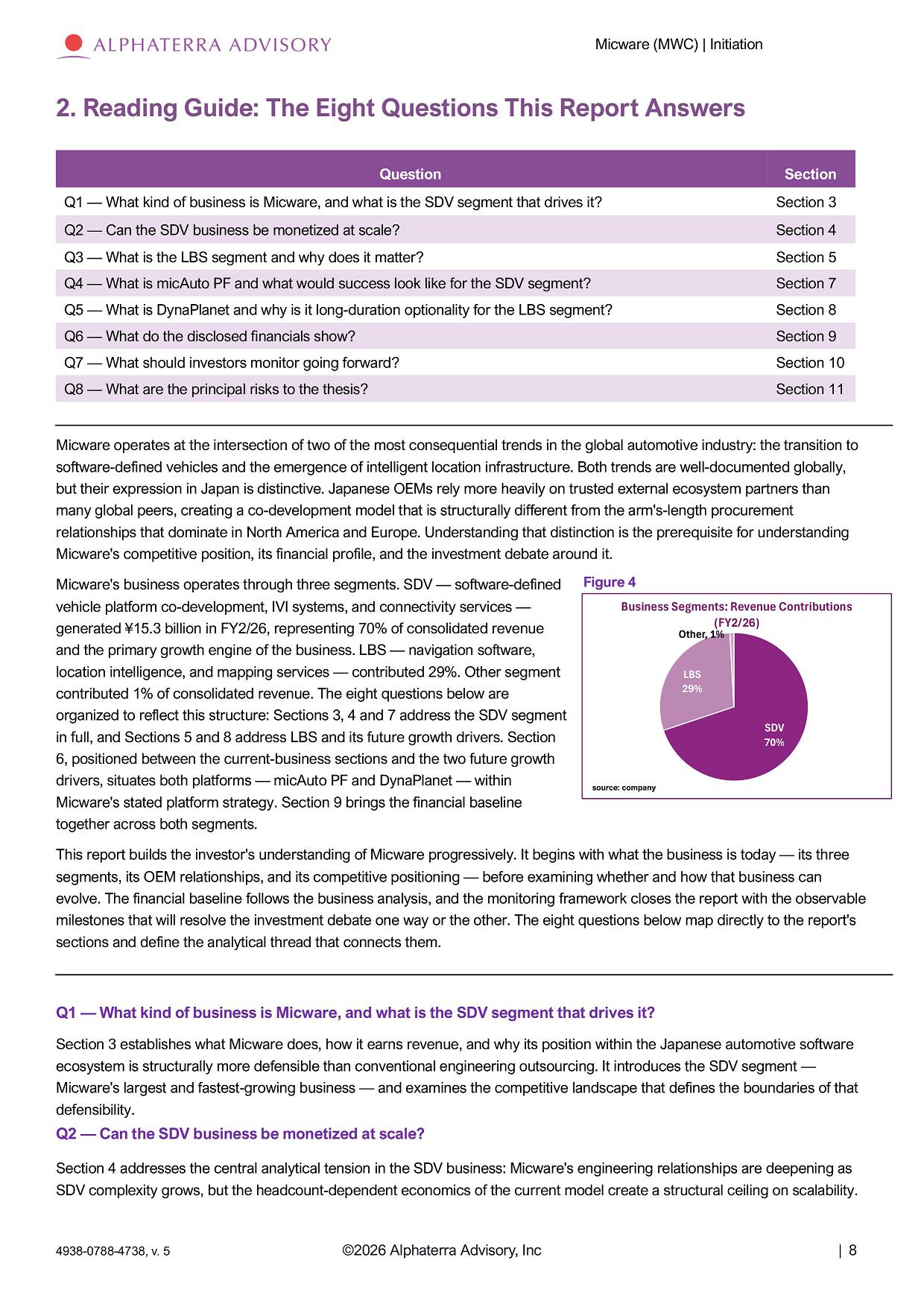
Micware (MWC) | Initiation 2. Reading Guide: The Eight Questions This Report Answers Micware operates at the intersection of two of the most consequential trends in the global automotive industry: the transition to software - defined vehicles and the emergence of intelligent location infrastructure. Both trends are well - documented globally, but their expression in Japan is distinctive. Japanese OEMs rely more heavily on trusted external ecosystem partners than many global peers, creating a co - development model that is structurally different from the arm's - length procurement relationships that dominate in North America and Europe. Understanding that distinction is the prerequisite for understanding Micware's competitive position, its financial profile, and the investment debate around it. Micware's business operates through three segments. SDV — software - defined vehicle platform co - development, IVI systems, and connectivity services — generated ¥15.3 billion in FY2/26, representing 70% of consolidated revenue and the primary growth engine of the business. LBS — navigation software, location intelligence, and mapping services — contributed 29%. Other segment contributed 1% of consolidated revenue. The eight questions below are organized to reflect this structure: Sections 3, 4 and 7 address the SDV segment in full, and Sections 5 and 8 address LBS and its future growth drivers. Section 6, positioned between the current - business sections and the two future growth drivers, situates both platforms — micAuto PF and DynaPlanet — within Micware's stated platform strategy. Section 9 brings the financial baseline together across both segments. This report builds the investor's understanding of Micware progressively. It begins with what the business is today — its three segments, its OEM relationships, and its competitive positioning — before examining whether and how that business can evolve. The financial baseline follows the business analysis, and the monitoring framework closes the report with the observable milestones that will resolve the investment debate one way or the other. The eight questions below map directly to the report's sections and define the analytical thread that connects them. Q1 — What kind of business is Micware, and what is the SDV segment that drives it? Section 3 establishes what Micware does, how it earns revenue, and why its position within the Japanese automotive software ecosystem is structurally more defensible than conventional engineering outsourcing. It introduces the SDV segment — Micware's largest and fastest - growing business — and examines the competitive landscape that defines the boundaries of that defensibility. Q2 — Can the SDV business be monetized at scale? Section 4 addresses the central analytical tension in the SDV business: Micware's engineering relationships are deepening as SDV complexity grows, but the headcount - dependent economics of the current model create a structural ceiling on scalability. Question Section Q1 — What kind of business is Micware, and what is the SDV segment that drives it? Section 3 Q2 — Can the SDV business be monetized at scale? Section 4 Q3 — What is the LBS segment and why does it matter? Section 5 Q4 — What is micAuto PF and what would success look like for the SDV segment? Section 7 Q5 — What is DynaPlanet and why is it long - duration optionality for the LBS segment? Section 8 Q6 — What do the disclosed financials show? Section 9 Q7 — What should investors monitor going forward? Section 10 Q8 — What are the principal risks to the thesis? Section 11 Business Segments: Revenue Contributions (FY2/26) Other, 1% LB S 29% SD V 70% source: company ©2026 Alphaterra Advisory, Inc | 8 4938 - 0788 - 4738, v. 5 Figure 4
Micware (MWC) | Initiation Examines the industry evidence for and against OEM software internalization, the barriers to monetization at scale, and what a credible transition pathway looks like. Q3 — What is the LBS segment and why does it matter? Section 5 introduces Micware's second segment — location - based services, encompassing navigation, mapping, and location intelligence — and challenges the common investor characterization of LBS as a legacy business in structural decline. Examines how location data is evolving within SDV architectures and what the LBS segment's strategic role may become as vehicle software integration deepens. Q4 — What is micAuto PF and what would success look like for the SDV segment? Section 7 examines micAuto PF — Micware's proprietary SDV software platform and the primary vehicle for business model transition — in detail. Covers the platform's architecture, its commercial positioning against established competitors, the realistic commercialization pathway, and what a first contract would and would not prove analytically. Section 7 is the chapter investors should engage with most actively when forming a view on the business model transition. Q5 — What is DynaPlanet and why is it long - duration optionality for the LBS segment? Section 8 Examines the Dynamic Street Map and Market Place initiative — Micware's effort to build a proprietary 3D spatial data asset that generates recurring revenue independent of OEM relationships. Establishes why DynaPlanet should be evaluated on a three - to - five - year horizon rather than near - term financial contribution, and what observable milestones would indicate the initiative is on track. Q6 — What do the disclosed financials show? Section 9 Presents Micware's three - year financial track record across FY2/24, FY2/25, and FY2/26. No forecasts are presented. Establishes the revenue growth profile, margin trajectory, balance sheet strength, and cash flow characteristics of the business as it stands today — and makes explicit what the numbers do and do not yet show about the business model transition. Q7 — What should investors monitor going forward? Section 10 Identifies the specific milestones that will resolve the investment debate — organized by analytical priority rather than chronological sequence. Distinguishes between signals that would genuinely change the investment picture and those that would not, and provides investors with a concrete monitoring framework tied to observable events rather than financial projections. Q8 — What are the principal risks to the thesis? Section 11 Presents the principal risks to the investment case directly: what each risk is, what the evidence says about its magnitude, and what would constitute a meaningful deterioration. The risks are the mirror image of the investment case — the same structural features that make Micware defensible also define its risk profile — and understanding them clearly is a prerequisite for evaluating the thesis accurately. ©2026 Alphaterra Advisory, Inc | 9 4938 - 0788 - 4738, v. 5
Micware (MWC) | Initiation 3. A Strategic Software Partner, Not a Contractor (SDV Segment — Current Business) The SDV segment generated revenue of ¥15.3 billion in FY2/26 — 70% of consolidated totals — making it both the primary growth engine and the central analytical focus of this report. The first question a disciplined investor must answer about Micware's engineering business is deceptively simple: is this a contractor or a partner? The distinction matters because it determines how durable the existing revenue stream is under competitive pressure, budget cycles, and the evolving technical demands of SDV development. This section builds the analytical foundation for addressing that question — whether Micware's OEM relationships constitute structural partnership or substitutable outsourcing. 3.1 From Navigation Vendor to SDV Development Partner Micware's evolution over two decades is best understood as a series of deepening commitments, each of which made the relationship more technically integrated and operationally embedded than the one before. The company entered automotive software in 2003 developing audio, digital television, and subsequently navigation software — a period when automotive software was still relatively discrete and separable. A navigation module could be specified, sourced, and in principle replaced. Competitive differentiation was primarily on data quality and integration cost, and the competitive set — AISIN, Matsushita (Panasonic), ALPINE ELECTRONICS, FUJITSU TEN — was well - defined and largely interchangeable from an OEM's procurement perspective. The shift to first - generation IVI in 2016 changed the nature of the engagement fundamentally. IVI systems required integration across multiple vehicle functions simultaneously — navigation, entertainment, smartphone connectivity, voice recognition, instrument cluster, and OTA update management — and the software could no longer be treated as a standalone deliverable. Micware engineers began participating in architecture discussions, not just implementation. Coordinating across vehicle subsystems required deep familiarity with the OEM's internal development organization, its processes, and its program management culture. The relationship with Honda in particular deepened from specification - driven delivery into genuine co - design across multiple simultaneous programs. Second - generation IVI in 2021 added connectivity (smartphone integration, internet, telematics control units), vehicle data integration, instrument cluster and HUD software, and OTA update management for the IVI layer. The current SDV generation, launching in 2026, represents a further deepening of the same dynamic. OTA updates now extend beyond IVI to vehicle - level control systems. Connectivity, AI - enabled personalization, and vehicle - to - everything integration are architectural requirements across the full vehicle software stack. Micware engineers are no longer managing discrete deliverables against fixed program schedules; they are embedded participants in a continuously evolving software lifecycle that spans multiple vehicle generations and crosses functional boundaries within the OEM's organization. The role has evolved from module supplier to co - developer of the OEM's own proprietary platform — a distinction with profound implications for switching costs, revenue durability, and the nature of competitive risk. 3.2 Understanding the Japanese Automotive Software Ecosystem To assess Micware's competitive position accurately, the structure of the Japanese automotive software supply chain must be understood on its own terms — because it differs materially from the global norm in ways that directly affect how Micware's moat should be evaluated. Honda and Toyota have approached software development with a philosophy consistent with their broader manufacturing culture: build deep, long - term relationships with a small number of strategic partners rather than optimizing for cost through broad competitive procurement. Rather than adopting externally owned platforms — as many Western OEMs have done with vendors such as Elektrobit and Wind River — Honda and Toyota chose to co - develop their own proprietary platforms from the ©2026 Alphaterra Advisory, Inc | 10 4938 - 0788 - 4738, v. 5
Micware (MWC) | Initiation ground up, with Micware as the co - development partner, retaining full platform IP (“intellectual property”) ownership. The consequence is that Honda's and Toyota's software architectures are genuinely distinct systems, built on different design philosophies and deeply integrated with each OEM's specific vehicle hardware and development processes. The switching cost is not simply the cost of retraining engineers — it is the cost of rebuilding a platform architecture co - developed across multiple vehicle generations. The consequence of Honda’s and Toyota’s co - development approach is structural. Because each OEM built its platform from scratch in close collaboration with Micware, Honda’s software architecture and Toyota’s are genuinely distinct systems — built on different design philosophies and different integration approaches. Honda’s platform uses Android as its underlying OS layer; Toyota’s does not. Neither platform is a variant of the other, and neither is a variant of any commercially available third - party platform. This matters for competitive analysis because it means the switching cost is not simply the cost of retraining engineers — it is the cost of rebuilding a platform architecture that has been co - developed across multiple vehicle generations and is deeply integrated with each OEM’s specific vehicle hardware, vehicle control systems, and development processes. Within this ecosystem, Micware operates primarily as a Software Tier 1 supplier — delivering complete IVI and SDV software solutions directly to OEMs. Per Micware’s own operational model, development work is conducted primarily from Micware’s own offices, with a small coordination layer of engineers formally seconded to OEM facilities to manage requirements, specifications, and integration. This model — concentrated platform expertise in Micware’s own engineering organization, with a liaison layer at the OEM — is structurally more scalable than conventional on - site staffing, and reflects a co - development relationship rather than staff augmentation. Compensation is based on development work performed, not on units produced. Development programs are structured as periodic contracts — approximately three - month cycles for Toyota and annual cycles for Honda — with continuous renewal reflecting program continuity rather than a static long - term contractual guarantee. Micware's organizational structure reflects this ecosystem logic directly. The three primary operating subsidiaries — Micware Automotive Co., Ltd. (MAC) for Honda, Micware Mobility Co., Ltd. (MMC) for Toyota and Denso, and Micware Navigations Co., Ltd. (MNC, renamed Micware Spacia Co., Ltd. effective September 1, 2026) for navigation and other OEM relationships — were established as separate entities at the explicit request of Honda and Toyota, who required a clear organizational boundary between their respective co - development programs to prevent the leakage of proprietary software architecture information. An OEM that demands its software partner restructure its organization to protect platform confidentiality is not managing a vendor relationship — it is protecting a strategic asset. The subsidiary structure is therefore not administrative complexity; it is observable evidence of how deeply each OEM's software platform is embedded in Micware's operations. 3.3 Micware's Position Within the Automotive Software Stack — and Why "Platform" Matters A persistent source of investor confusion about Micware is where exactly it sits within the automotive software stack. The answer requires understanding a technically precise and analytically critical distinction: the difference between middleware and platform in the automotive context. Unlike smartphones, where software layers are cleanly separated and middleware is interchangeable, automotive software is deeply woven into the OEM's specific vehicle hardware configuration, control architecture, and accumulated integration decisions across multiple development cycles. Micware's management describes the automotive platform as closer to an operating system than to middleware — technically accurate, because replacing it requires rebuilding the OEM's entire software architecture from a clean start rather than swapping a discrete component. The practical implication for competitive analysis is significant. An OEM that has built multiple vehicle programs on a given platform framework has embedded that framework into its development processes, quality assurance procedures, OTA update pathways, and the institutional memory of its engineering organization. A new software partner cannot access that accumulated context through documentation or staff transfers. The switching cost derives from the architectural embeddedness of the platform — not from contractual lock - in — and it compounds with each additional vehicle program built on the same foundation. ©2026 Alphaterra Advisory, Inc | 11 4938 - 0788 - 4738, v. 5
Micware (MWC) | Initiation 3.4 OEM Relationships Are Becoming Increasingly Strategic The evidence that Micware's relationships with Honda and Toyota have crossed from conventional outsourcing into structural partnership is both observable and well - documented. Toyota was the first OEM to take an equity stake in Micware, investing on December 1, 2020. Honda followed roughly a year and a half later, formalizing its equity position through a capital and business alliance agreement executed on March 15, 2022. Both investments came well into the SDV transition — a period in which the broader automotive industry was already grappling with the CASE agenda (connectivity, autonomous, shared, electrification) and the scaling complexity of software - defined vehicle development. Per the company's own characterization in its SEC filings, these equity investments "testify to Micware's brand reputation in the industry," reflecting the trust OEM customers placed in Micware as a long - term software development partner, rather than an interchangeable parts or engineering - services supplier. Honda and Toyota each hold approximately 12% of Micware's post - IPO equity. What this chronology suggests is convergence, not differentiated rationale: two of the world's largest automakers, within roughly eighteen months of each other, independently reached the same conclusion — that SDV development had become too complex to manage entirely in - house, and that a long - term, equity - reinforced relationship with a trustworthy, capable software partner was preferable to sourcing that capability through the open market (as Section 4 examines in more detail). The nature of the engineering engagement reinforces this characterization. Micware currently deploys approximately 450 engineers and programmers across its programs, organized through dedicated subsidiaries for each primary OEM relationship. Management has stated that Micware's engineers have engaged in multi - year co - development programs that have enabled them to build deep familiarity with automotive software development lifecycles, testing protocols, and regulatory compliance requirements specific to each OEM. That accumulated knowledge — of the platform architecture, the OEM's internal requirements culture, and the integration decisions made across previous program cycles — has no value outside the OEM relationship and cannot be replicated by a new entrant regardless of engineering headcount. Denso's engagement with Micware adds a further dimension to the Toyota relationship. As one of Toyota's primary Tier 1 engineering partner, Denso subcontracts software development work to Micware, and management has indicated Denso’s scope of work may grow as program complexity increases. This indirect channel — Micware embedded in Toyota's supply chain through Denso as well as directly — reinforces that Micware's strategic relevance within the Toyota ecosystem extends beyond the direct contractual relationship. 3.5 Competitive Positioning Micware's competitive differentiation is depth and structural embeddedness within the Honda and Toyota ecosystems — not product breadth, engineering headcount, or geographic reach. The competitor landscape is organized across three tiers by the nature of competitive overlap. Tier 1 — Embedded OS and Middleware Vendors QNX (BlackBerry subsidiary) competes at the OS and middleware layer directly below Micware's IVI and SDV platform work. OEMs adopting QNX as their embedded OS foundation may in some cases choose QNX's own higher - level IVI platform rather than Micware's micAuto PF. Competitive threat: Medium - High. eSol (TSE: 4420) is an independent Japanese company providing automotive - grade real - time operating systems and middleware, operating primarily within the Japanese OEM and Tier 1 supplier ecosystem including Toyota and Honda supply chains. Its overlap with Micware is real but narrower — eSol does not offer a full IVI platform — representing adjacency rather than direct competition. Competitive threat: Low - Medium. Tier 2 — IVI and SDV Platform and Development Vendors Elektrobit (subsidiary of AUMOVIO, the automotive software spin - off of Continental AG) offers one of the broadest automotive software portfolios of any specialist vendor, with primary OEM relationships concentrated in Europe and North America. Its ©2026 Alphaterra Advisory, Inc | 12 4938 - 0788 - 4738, v. 5
Micware (MWC) | Initiation partnership with Sony Honda Mobility (AFEELA) creates a direct point of intersection with Micware's Honda relationship and is the clearest current example of Elektrobit competing within a Honda - adjacent program. Competitive threat: High. Tier 3 — Automotive Engineering R&D Services KPIT (listed in Bombay Stock Exchange (BSE)/National Stock Exchange of India (NSE)) is the most directly comparable business model to Micware's. Within Honda specifically, Micware leads flagship IVI and SDV co - development, while Honda separately maintains a broader software partnership with KPIT that Honda and KPIT have publicly described as spanning next - generation vehicle architecture, safety systems, and IVI. That Honda continues to rely on Micware for its flagship co - development work, even while maintaining this parallel relationship, is consistent with Micware's moat functioning as described. Competitive threat: High. Tata Elxsi (subsidiary of Tata Sons, BSE/NSE listed) mirrors Micware's engineering services model with OEM clients but has limited established presence in the Honda and Toyota ecosystems. It represents the incumbent competitive model that any OEM considering micAuto PF adoption would likely already have in place. Competitive threat: High in the broader OEM market context. Management has identified domestic Japanese competitors in software development services — SCSK Corporation, SKY Corporation, and Panasonic Corporation — and in software licensing — Aisin Corporation, Pioneer Corporation, and ZENRIN DataCom. These competitors operate at specific functional layers but do not represent the same depth of co - development platform threat as the vendors above. (See Appendix B for full competitive profiles.) 3.6 Bottom Line The evidence supports characterizing Micware as a strategic software partner within the Honda and Toyota ecosystems rather than a conventional engineering contractor — with one qualification that deserves stating plainly. The strategic partner characterization is well - supported within those two OEM relationships specifically. Platform non - interchangeability, accumulated institutional engineering knowledge, a co - development model that leaves platform IP with the OEM, and dual equity ownership by both Honda and Toyota all reinforce the same conclusion. The chronology of OEM equity investments — Toyota in December 2020, Honda in March 2022, both well into the SDV transition — demonstrates convergence rather than divergent strategic rationale: two major OEMs, within roughly eighteen months of each other, independently reached the same conclusion about the value of Micware's embedded partnership model. Honda's continued reliance on Micware for flagship IVI and SDV co - development, even as it maintains a separate, broader software partnership with KPIT, is consistent with the embedded - partner moat described above. Outside Honda and Toyota, Micware has limited established relationships and no proven record of co - developing a platform with an OEM it did not grow alongside from the ground up. That concentration defines the boundaries of the moat as it currently stands. micAuto PF commercialization represents the potential to extend the same structural dynamic to a broader OEM base — one that remains unproven outside the existing Honda and Toyota relationships. ©2026 Alphaterra Advisory, Inc | 13 4938 - 0788 - 4738, v. 5
Micware (MWC) | Initiation 4. Strategic Importance Is Growing — But Can It Be Monetized? (SDV Segment — Monetization Debate) 4.1 SDV Complexity Is Structurally Increasing OEM Dependence on Software Partners The automotive software development problem has become, in a meaningful sense, unsolvable through conventional in - house strategies. A modern software - defined vehicle requires continuous maintenance and evolution of an IVI stack, multiple connectivity protocols, OTA update infrastructure, ADAS integration layers, telematics pipelines, AI - enabled personalization features, and vehicle - level orchestration across tens of millions of lines of code — all of which must be co - developed, tested, and validated at the cadence of vehicle program cycles that have themselves shortened. The engineering headcount required to sustain that capability entirely in - house, across all vehicle programs simultaneously, is economically prohibitive for most OEMs. The global evidence for this is unambiguous. Volkswagen's Cariad subsidiary and Ford's FNV4 program are the most documented examples — both were resourced at scale, both accumulated multi - year delays and cost overruns, and both ultimately required a fundamental strategic pivot away from full in - house development. These are not outliers — they are the predictable outcome of a structural mismatch between the cost trajectory of OEM - managed software development and the complexity trajectory of SDV architectures. (See Appendix C for full OEM internalization evidence.) Japanese OEMs face the same structural reality. Toyota has committed substantial resources to Woven by Toyota for ADAS and autonomous driving, while simultaneously channeling IVI and SDV platform engineering through Denso, which in turn subcontracts to Micware as engineering complexity scales. Honda's approach reflects a similar pattern: it maintains parallel external software partnerships, working with Micware on flagship IVI and SDV co - development while also partnering with KPIT on a broader software development mandate that Honda and KPIT have publicly described as spanning next - generation vehicle architecture, safety systems, and IVI. Both structures reflect the same underlying acknowledgment — that the full stack of automotive software development cannot be economically internalized, and that deep external software partnerships are a structural feature of the SDV era, not a temporary expedient. The talent dimension reinforces this conclusion independently. Software engineers increasingly prefer software companies over automotive manufacturers: faster career development, more transparent technical culture, and more competitive compensation. Japanese OEMs have historically relied on lifetime employment models and internal promotion structures that are poorly suited to competing for software talent against pure - play technology and software firms. Micware's own experience is instructive: the company employs over 580 full - time employees globally, approximately 450 of whom are engineers, and has established a multi - city office network explicitly to access engineering talent across Japan rather than confining recruitment to commutable distance from its Kobe and Osaka headquarters. Management has indicated that Micware deliberately positions its compensation package at the high end of the software industry in Japan to attract and retain engineering talent. 4.2 Embedded Software Relationships Are Becoming More Strategic — Not Less The increasing difficulty of in - house software development does not benefit all external software suppliers equally. The benefit accrues disproportionately to suppliers who are already embedded in OEM development workflows at the platform level — not to transactional vendors who can be replaced through standard procurement. The distinction between being embedded and merely outsourced is decisive. A conventional outsourced software contractor delivers defined work products under a purchase order and is evaluated on cost and schedule. A deeply embedded software partner participates in upstream requirements definition, system architecture planning, and multi - generational platform evolution — activities that generate institutional knowledge that cannot be transferred to a replacement vendor without restarting programs from a clean architectural slate. The switching cost is not contractual: it is architectural. Each vehicle generation built on a shared platform framework compounds the accumulated context — development culture, engineering ©2026 Alphaterra Advisory, Inc | 14 4938 - 0788 - 4738, v. 5
Micware (MWC) | Initiation expectations, testing protocols, OTA update pathways, program history — that exists between the OEM and the embedded partner. No alternative vendor can access that context through documentation or staff transfers. Micware's position within both Honda and Toyota is firmly on the embedded side of that distinction. At Honda, Micware engineers are the primary architects of flagship IVI and SDV platform co - development across Honda's vehicle hierarchy. Headcount at MMC (Micware Mobility Co., Ltd.) — Micware's Toyota - focused internal division — was 109 as of Feb 2026, most of which are engineers with a few engineers stationed at Toyota facilities at any given time, to support program coordination. It is important to note that MMC engineers are not executing against a fixed statement of work; they are co - developing within Toyota's software organization in a manner that blurs the organizational boundary between OEM and software partner. Per management commentary, Toyota's quasi - delegation contract structure — organized around three - month iterative development cycles rather than fixed long - term deliverables — reflects agile co - development methodology, not the procurement posture of a buyer managing a fungible supplier. That Denso — itself a Toyota group company and one of the world's largest automotive Tier 1 suppliers — subcontracts IVI and SDV engineering work to Micware is analytically significant. Denso has substantial software capability of its own, which makes the subcontracting relationship meaningful data point: it suggests the scale of the SDV engineering challenge exceeds what even a large, well - resourced Tier 1 supplier can fully absorb internally and it reflects Micware's recognized standing within the Toyota software ecosystem. This is not a commodity subcontract relationship; it is an extension of the Toyota co - development model through an additional layer of ecosystem alignment. The same logic explains why Honda and Toyota each hold approximately 12% of Micware's post - IPO equity. Equity stakes in software suppliers are not standard practice in the automotive industry. They represent a deliberate institutional signal that the relationship is managed and protected rather than transactionally evaluated — and that the OEM has made a long - term commitment to the co - development model the supplier represents. As SDV complexity increases and the cost of platform transition rises with each additional vehicle generation built on shared architecture, the structural logic of equity - aligned co - development relationships becomes more compelling, not less. 4.3 Increasing Strategic Importance Does Not Automatically Create Shareholder Value The analysis in 4.1 and 4.2 establishes that SDV complexity is increasing OEM dependence on deeply embedded software partners, and that Micware occupies that position within the Honda and Toyota ecosystems. The investment question is whether that structural position translates into shareholder value — and the honest answer is that strategic importance and economic value creation are analytically separable. The constraint is straightforward. Micware's engineering business is fundamentally headcount dependent. Approximately 80% of FY2/26 revenue was generated from software development services — effort - based work billed in relation to engineer - hours. Revenue scales with headcount, headcount scales with cost, and operating leverage in pure engineering services businesses is structurally limited. Revenue from software development services grew approximately 31% from FY2/24 to FY2/26, but that growth was supported by headcount expansion and wage investment, not by a fundamental change in the economics of value delivery. This is reflected in the FY2/26 operating margin of 10.8% that remained flat versus FY2/24. OEM bargaining power is a second structural constraint. Management has acknowledged directly: OEMs possess significant bargaining power due to their size, procurement scale, and internal technical capabilities. Large - scale OEMs are able to demand favorable terms, including lower pricing, extended payment terms, and compressed development schedules. That observation applies to Micware's bilateral co - development relationships with Honda and Toyota even when those relationships are equity - aligned. Equity ownership confers institutional protection against displacement; it does not eliminate the OEM's pricing leverage in contract negotiations. The result is that even as Micware's strategic value within OEM software ecosystems deepens, the ability to convert that deepening strategic value into meaningfully higher per - engineer margins is constrained by the bilateral structure of the relationship. IP ownership is the third constraint, and the most important for understanding the nature of Micware's moat. Micware does not own the OEM's software intellectual property. The IVI and SDV platforms co - developed with Honda and Toyota belong to Honda and Toyota. Micware's value is integration depth, institutional knowledge, and engineering execution capability — not ©2026 Alphaterra Advisory, Inc | 15 4938 - 0788 - 4738, v. 5
Micware (MWC) | Initiation proprietary IP that generates royalties independently of ongoing work. This is not a criticism of the business model; it is a precise description of it. The moat is real and structurally durable. But it is a relationship moat and an execution moat — not a software IP moat — and the distinction matters for how the business can be monetized beyond its current headcount - dependent form. A pure - play engineering services business — even one with Micware's structural durability, customer quality, and relationship depth — is valued on the economics of engineering services, not software platforms. Bridging to software platform economics requires a mechanism by which Micware captures value from SDV production volumes rather than exclusively from engineering effort. That mechanism is micAuto PF. 4.4 micAuto PF as the Monetization Bridge The distinction between being strategically important and being economically scalable is the central tension of the Micware investment thesis. micAuto PF is the company's explicit attempt to resolve that tension. The logic is architecturally sound. Micware has spent more than a decade co - developing SDV and IVI platform architecture alongside Honda and other Japanese OEMs, accumulating engineering know - how that is embedded in production vehicles across multiple vehicle generations. That accumulated know - how — the modular component architecture, the Android - and Linux - compatible integration framework, the OTA lifecycle management protocols, the testing and validation toolchains — can be codified into a reusable software development platform. An OEM that adopts micAuto PF gains the ability to deploy SDV systems faster and at lower cost than building from a proprietary clean - sheet architecture, while retaining full ownership and customization control of its own software ecosystem. Micware, in exchange, collects per - vehicle royalties tied to production volumes across the adopting OEM's programs — economics that persist through OTA updates, feature additions, and connectivity expansion over the vehicle's production lifecycle. This is the model that converts a portion of Micware's revenue from effort - based to production - volume economics. It does not replace the underlying engineering relationship — OEM - specific customization, lifecycle management, and program support continue to generate engineering fees alongside the royalty stream. What it adds is a recurring revenue layer that scales with OEM production rather than with Micware's headcount. Per management commentary, gross margins on per - unit royalty economics should be materially higher than the current blended gross margin of the engineering services business. The magnitude of the margin differential explains why successful micAuto PF commercialization would constitute a genuine business model transformation rather than an incremental revenue addition. No OEM contracts have been signed thus far. The company is in active discussions with multiple OEMs, and no timeline has been publicly disclosed. The structural rationale for OEM adoption is credible — micAuto PF addresses a real and growing cost problem, with a platform derived from production - validated co - development with Honda and other Japanese OEMs. But credible rationale and executed contracts are not the same thing. All target OEMs already have primary SDV vendors; the realistic initial commercial position for micAuto PF is as a second - vendor alternative — a qualifying platform for OEMs seeking software ownership and customization control without bearing the full cost of a proprietary stack. That is a viable go - to - market position, but it is a more constrained one than full primary - vendor displacement of established relationships. The monetization question is therefore open, not resolved. Section 7 addresses what successful commercialization would look like in detail — the customer profile, the go - to - market structure, and the observable milestones that would validate or challenge the platform transition thesis. For the purposes of this section, the relevant analytical conclusion is: micAuto PF is the credible mechanism by which Micware bridges from strategic importance to scalable economics, but it remains a thesis rather than a demonstrated business outcome. 4.5 Bottom Line Strategic importance and shareholder value are not synonymous. Micware's position within the Honda and Toyota software ecosystems is structurally embedded, equity - reinforced, and deepening as SDV complexity increases. The engineering ©2026 Alphaterra Advisory, Inc | 16 4938 - 0788 - 4738, v. 5

Micware (MWC) | Initiation business that results from that positioning is durable, high - quality, and more defensible than conventional engineering outsourcing. What it is not, in its current form, is a business with the scalable economics of a software platform company. OEMs are actively seeking ways to reduce the cost and complexity of SDV development. Micware has a platform derived from production - validated experience that directly addresses that need. Whether that structural opportunity translates into signed contracts and recurring royalty economics is the unanswered question. Section 7 examines what successful commercialization would look like and what evidence investors should require before concluding it is underway. ©2026 Alphaterra Advisory, Inc | 17 4938 - 0788 - 4738, v. 5
Micware (MWC) | Initiation 5 . L o c a t i o n I n t e lli g e nc e : M o r e T h a n a N a v i g a t i o n B u s i n e s s ( L B S Segment — Current Business) Micware's LBS (Location Based Services) segment tends to be read by investors as a legacy navigation business in gradual decline — a secondary cash flow stream of diminishing relevance as the SDV platform thesis plays out. This reading is not unreasonable given the segment's customer concentration in Mazda and its modest near - term growth profile, but it understates both the current revenue reality and the longer - term strategic trajectory of the segment. This section examines what LBS actually is, how it is currently performing, where it is going, and why it matters to the overall investment case. 5.1 What LBS Is — and What It Is Not Micware's LBS segment covers the development and licensing of in - vehicle navigation software systems and other geographic data - based services for B2B customers, with end users primarily being vehicle owners. The segment has three revenue streams: software development services (navigation customization work for OEM customers), licensing (navigation software and map data licensed on a per - unit or royalty basis), and software - related services (cloud services, connectivity, and increasingly ADAS - adjacent navigation functions). The core product is NaviCore — Micware's proprietary navigation software engine — combined with map data sourced from Toyota Mapmaster Incorporated (“Toyota Map Master”). Navigation maps are updated over - the - air, and software is preinstalled at the factory while map data activation occurs at the dealer level. Approximately 99% of Micware's navigation units have their software pre - installed during vehicle production, with map data installation and activation completed at the dealership as a dealer option. This channel structure has an important implication for the revenue model: because the installation decision occurs at the dealership after the vehicle is built — rather than being a committed line item in the OEM's vehicle production plan — navigation software spend is subject to dealer discretion and consumer demand at the point of sale, making it less directly tied to OEM production volumes than factory - integrated software. Micware holds approximately 15% of the Japanese in - vehicle navigation software market*. The primary competitive benchmark is Aisin Corporation, which commands an estimated 60 – 70% market share and benefits from Toyota Group captive relationships. Micware's navigation revenues flow primarily through Mazda — the dominant customer within the LBS segment — with smaller volumes through Daihatsu, Yamaha, and retail channels including Kenwood - branded systems. Honda and Toyota, despite their equity relationships with Micware, do not use Micware's navigation software for their own vehicles. Honda's navigation is developed by Honda Access Corporation, a wholly owned Honda subsidiary. Toyota relies on navigation systems of Aisin Corporation and Denso Ten Limited, both of which are Toyota Group companies in which Toyota holds equity stakes. Micware has made ongoing attempts to sell navigation software to both OEMs, but structural OEM preferences for keeping navigation within the group supply chain have made penetration difficult to date. (*Source: Car Watch, "JEITA Releases Market Forecasts for Car Navigation Systems and Drive Recorders through 2028," March 4, 2024.) 5.2 Near - Term Outlook: Stable, Not Growing — With One Specific Risk The near - term LBS revenue trajectory is best described as stable, not growing, with a specific customer risk that investors should understand clearly. The Japanese in - vehicle navigation market has structural resilience that is not well - appreciated by investors approaching it through a Western lens. Japan's road network is among the most complex in the world — dense urban layouts, frequent route changes, extensive expressway systems, and address conventions that do not translate directly into GPS coordinate logic — making smartphone navigation substitution significantly more difficult than in the United States or Western Europe. Google Maps and Apple Maps perform well in North American and European contexts but remain materially inferior to dedicated in - ©2026 Alphaterra Advisory, Inc | 18 4938 - 0788 - 4738, v. 5
Micware (MWC) | Initiation vehicle navigation systems for Japanese roads, a point management makes explicitly. This is attributable not only to the specific characteristics of Japan's road network, but also to functional roles, such as feeding data into ADAS systems, that general - purpose mapping apps cannot fulfill. Against this backdrop, Micware's management views the on - board navigation market in Japan as unlikely to shrink meaningfully over a five - to - ten - year horizon. This view is consistent with the market data: the Japanese automotive navigation system market grew from USD 1.34 billion in 2020 to USD 1.79 billion in 2024 at a CAGR of 7.6%, per the Frost & Sullivan report commissioned for Micware's IPO prospectus (Form 424B4, filed with the U.S. Securities and Exchange Commission). The structural resilience of the Japanese market does not, however, eliminate a specific near - term risk: Mazda's posture toward next - generation navigation investment. Mazda recently released a new - generation navigation system, and while Micware is currently in discussions about the next generation, management commented that Mazda's limited investment capacity (relative to larger OEMs) introduces uncertainty about the size and timing of new program mandates. Management characterizes the near - term LBS revenue outlook as showing a slight increase, primarily driven by revenue from customers other than Mazda. Management also anticipates new Mazda projects in FY2/27 and FY2/28, which are expected to further support baseline revenue. Per management commentary, licensing revenue is expected to remain roughly flat over this horizon, with growth efforts focused on margin improvement following the elimination of the lower - margin SD card procurement and preloading business in FY2/25. 5.3 Location Intelligence as an Evolving SDV Software Layer The more important question for investors is whether the accumulated competencies within the LBS segment have strategic value within the emerging SDV ecosystem that the current navigation revenue framing does not capture. Company management stated that navigation data are linked to ADAS and that demand for onboard navigation data will increase as ADAS adoption grows — not decrease. This is consistent with the 424b4's industry analysis, which notes that high - definition (“HD”) mapping services support ADAS and autonomous vehicles by providing precise lane - level data, traffic signs, and road geometry. The same analysis identifies EV - specific navigation integration — including charging station location, route - based range optimization, and energy consumption prediction — as a growing functional requirement embedded in modern infotainment systems. Navigation data, in other words, is not separating from the vehicle software stack as SDV architectures mature; it is becoming more deeply integrated within it. The LBS segment's strategic relevance is therefore a function of how central location intelligence becomes to the broader SDV platform — a question that is directionally positive but not yet quantified in terms of incremental revenue opportunity for Micware specifically. Micware has already built connectivity infrastructure that positions it within this evolving layer. Since 2014, the company has provided differential OTA map update technology — updating only changed portions of a map via mobile network connectivity rather than requiring full map downloads. In 2022, it launched online navigation systems using live cloud data rather than static onboard maps. In 2023, it deployed large - scale cloud infrastructure to support the data demands of connected and autonomous vehicles. These capabilities form the operational backbone of a cloud - connected navigation ecosystem that interfaces naturally with the OTA update orchestration, telematics, and connectivity layers that Micware's SDV engineers manage on the other side of the business. The LBS and SDV segments are not organizationally or technically isolated from each other — they share underlying infrastructure and are increasingly serving overlapping functions within the same vehicle software environment. Micware's MNC (Micware Navigations Co., Ltd. — renamed Micware Spacia Co., Ltd. effective September 1, 2026) division, which operates the LBS segment, has identified three areas of incremental revenue opportunity adjacent to the core navigation business. First, cloud services: using the navigation cloud infrastructure as the basis for AI - powered analytics and usage monitoring services sold to OEMs on a licensing basis — small wins have already been booked, and revenue from this stream is growing, though from a small base. Second, ADAS - adjacent navigation integration: specifically, cockpit domain controller work that expands LBS's hardware and system coverage toward ADAS - adjacent functions, in collaboration with partners. Third, navigation - related data services targeting non - automotive industries — driving diagnostics for insurance companies being the specific example cited by management. None of these represents a near - term step - change in LBS revenue, but together they indicate a segment actively seeking adjacencies rather than managing a passive runoff. ©2026 Alphaterra Advisory, Inc | 19 4938 - 0788 - 4738, v. 5
Micware (MWC) | Initiation The longer - term opportunity that management identifies but has not yet been able to access is Honda and Toyota navigation. The commercial logic is straightforward: an OEM co - developing its SDV platform with Micware has natural reasons to consider using Micware's navigation software as well, given the cost synergies of joint development and the functional integration between navigation data and SDV architecture. Management acknowledges the logic is sound. The practical barriers remain Honda Access's proprietary navigation development and Toyota's group captive navigation suppliers. These are not immovable — they are OEM capital allocation and organizational decisions that can evolve — but they represent a genuine impediment that investors should not assume away. 5.4 DynaPlanet: Strategic Optionality DynaPlanet, previously known as DSMM or “Dynamic Street Map & Market Place", represents management's vision for how Micware's location intelligence competencies could evolve into a recurring revenue platform independent of OEM budgets. The technology uses AI - enabled 3D spatial reconstruction from dashcam and user - contributed visual inputs — a lower - cost, higher - frequency alternative to the dedicated mapping vehicles used by conventional HD map providers. Micware has explicitly identified the significant buying power of OEMs and the risk of being relegated to a subcontractor role as structural concerns, and DynaPlanet is a deliberate initiative to build revenue streams not contingent on OEM relationships. DynaPlanet is in development stage. The first commercial product, Dynamic Share Map, is available in the Microsoft Store and Google Play Store. No B2B, B2G (business to government) or OEM contracts have been announced thus far. Management has indicated that it has been developing DynaPlanet's core technologies for the past several years, and from FY2/27 plans to gradually transition its focus toward commercialization and globalization, with the aim of announcing initial commercial contracts over the next few years. Section 8 provides the full analytical treatment of DynaPlanet, including the technology architecture, commercialization phasing, partnership infrastructure, and the appropriate framework for evaluating it as a long - duration optionality scenario. 5.5 Bottom Line The LBS segment is strategically more significant to the overall Micware investment case than its navigation - business framing or current revenue contribution suggests — though the timeline for that strategic importance to translate into measurable economics remains long. The core navigation business is structurally stable in Japan, underpinned by road complexity that limits smartphone substitution and by a market that has grown consistently at mid - to - high single digit rates. The Mazda concentration and near - term investment pullback represents the primary near - term risk to segment revenue. Incremental opportunities in cloud services, ADAS - adjacent navigation integration, and data services are real and beginning to contribute, but currently small relative to the overall segment. The more significant point for the investment thesis is directional: as ADAS adoption grows, the technical interdependence between navigation data and vehicle control systems deepens in ways that make Micware's onboard navigation expertise increasingly relevant to the SDV engineering work performed on the other side of the business. Whether that interdependence generates incremental revenue specifically within the LBS segment — or reinforces Micware's strategic value to OEM customers in ways captured in the SDV segment — is an open question whose answer depends in part on whether Micware eventually penetrates Honda or Toyota navigation supply chains. That outcome remains unresolved and should not be assumed. What can be said with confidence is that the LBS segment is not in structural decline — it is in strategic transition, the direction of which is consistent with the broader SDV convergence thesis. DynaPlanet is optionality. It should be evaluated as such — neither dismissed as management distraction nor treated as a near - term earnings contributor before commercial evidence emerges. ©2026 Alphaterra Advisory, Inc | 20 4938 - 0788 - 4738, v. 5
Micware (MWC) | Initiation 6. Micware's Platform Strategy: Two Pillars, One Corporate Identity Micware frames its growth strategy as a progression in corporate identity: from a software developer at its 2003 founding, to a Tier 1 software supplier over the following two decades, to what management now describes as the company's next stage — platform provider. The company organizes this stage around two platforms: micAuto - PF within the SDV segment, and DynaPlanet within the LBS segment. *( Note: Management has indicated that its segment reporting structure may be revised in future periods. As of the date of this report, no revised structure has been finalized or publicly disclosed. The segment figures presented in this section reflect the basis currently reported by the Company and may not be directly comparable to future reported figures.) S o f t w a r e D e v e l o p er (2003 ~ 2013) Ti e r 1 S oft w ar e S uppl i e r (2013 ~ 2026) Platform Provider (2026 ~) On July 10, 2026, Micware announced a reorganization to formalize this structure. Effective September 1, 2026, Micware Navigations Co., Ltd. (MNC) — the subsidiary that has housed the company's navigation business — will be renamed Micware Spacia Co., Ltd. (MSC) and will become the dedicated entity for the DynaPlanet platform. Masahide Shigeno, Micware's co - founder and Chief Technology Officer, will serve as Micware Spacia's Representative Director, President and CEO, while continuing to serve as Micware's CTO. Concurrently, a portion of Micware Navigations' existing business will transfer to Micware Automotive Co., Ltd. to strengthen the micAuto PF platform business. In Alphaterra Advisory view, establishing a dedicated subsidiary with named, senior leadership is an observable organizational commitment to the platform strategy — though it does not by itself change the underlying commercialization timeline for DynaPlanet discussed in Section 8. Figure 5 ©2026 Alphaterra Advisory, Inc | 21 4938 - 0788 - 4738, v. 5 Source: Company Management has also disclosed a capital allocation framework consistent with this two - pillar structure: growth investment capital — comprising IPO proceeds and operating cash flow — is allocated approximately 30% to the SDV segment and approximately 70% to the LBS segment, the latter directed primarily toward DynaPlanet. Micware's stated medium - term growth strategy consists of two parallel priorities. The first is evolving from an IVI Tier 1 software supplier to an SDV Tier 1 software supplier, addressed in Sections 4 and 7 of this report. The second is expanding and monetizing the DynaPlanet platform toward a recurring - revenue business model, addressed in Section 8. Sections 7 and 8 examine each platform in turn — micAuto PF within the SDV segment, then DynaPlanet within the LBS segment.
Micware (MWC) | Initiation 7. micAuto PF: The Path to Recurring Software Economics (SDV Segment — Future Growth Driver) 7.1 micAuto PF Is Not Speculative Technology — It Is Codified Production Experience The starting point for understanding micAuto PF is understanding what it is not. It is not a new technology platform developed in anticipation of a market that has not yet materialized. It is not a whiteboard architecture assembled for sales purposes. It is the codification of engineering know - how that Micware has accumulated over more than a decade of co - developing Honda and other Japanese OEM’s IVI and SDV platform architecture — know - how that is already embedded in production vehicles across multiple vehicle generations, across hundreds of thousands of units in active operation. The substantive content of that codification is specific. The modular component architecture that allows software elements to be reused across vehicle programs without full re - engineering. The Android - and Linux - compatible integration framework that maps third - party application ecosystems onto the vehicle's software layer. The OTA lifecycle management protocols that govern how software updates are distributed, validated, and rolled back across a live production fleet. The testing and validation toolchains that compress the time required to certify new software builds against automotive safety and quality standards. Individually, each of these capabilities represents years of engineering iteration within a demanding OEM environment. Assembled as a reusable platform, they constitute a development infrastructure that would take a new entrant many years and several hundred million dollars to replicate from scratch — and that a new entrant still could not replicate without the production - fleet feedback loop that only active OEM deployment provides. The platform architecture is modular by design, which matters for commercial viability. An OEM adopting micAuto PF does not acquire a fixed, non - customizable software stack; it acquires a foundation and a development framework onto which it layers its own vehicle - specific configurations, supplier integrations, and feature priorities. The OEM retains full ownership and control of its resulting software ecosystem. Micware's role in that structure is not software IP holder — it is platform licensor and development infrastructure provider. This distinction is important: micAuto PF's commercial proposition is not that the OEM buys Micware's software and ships it; it is that the OEM uses Micware's platform as the development substrate from which it builds and owns its own software. 7.2 The OEM Cost Problem That micAuto PF Is Designed to Solve The structural case for OEM adoption of micAuto PF rests on a straightforward cost arithmetic. A full proprietary SDV platform development program typically spans approximately three years. Honda's annual SDV and IVI engineering spend with Micware has run in excess of ¥10 billion in recent years. From this, Alphaterra Advisory estimates that a full OEM - led proprietary platform development program carries a total investment cost on the order of ¥50 to 80 billion per program. Management has guided that an OEM adopting micAuto PF as its development foundation would incur approximately one - third of a ‘full development’ cost — which would imply a cost in the range of ¥15 to 25 billion — compressing both timeline and engineering resource requirements significantly. The industry backdrop that creates demand for this proposition is no longer speculative — it is visible in the operating decisions of OEMs worldwide. As Section 4 documented, OEMs across the global automotive industry have repeatedly discovered that the cost of building and sustaining full - stack SDV development capability in - house is economically prohibitive. Volkswagen's Cariad experience and Ford's FNV4 cancellation are the most visible examples of a broader pattern: even well - resourced OEMs find that the complexity trajectory of SDV architectures outruns the scalability of internal software organizations. The response has been a structural shift toward external software ecosystems and shared development platforms. Japanese OEMs are no exception to this dynamic, and in certain respects they face a more acute version of it. Per management commentary, OEM interest in internalizing SDV software development peaked in the early part of this decade and has since retreated as the true cost of doing so became apparent. The conclusion — that OEMs need a scalable external ©2026 Alphaterra Advisory, Inc | 22 4938 - 0788 - 4738, v. 5
Micware (MWC) | Initiation development foundation, not just outsourced headcount — is the industry - level predicate that creates the market for micAuto PF. The OEM's motivating requirement, as Micware's go - to - market is structured, is specifically software ownership. OEMs are acutely aware that ceding platform control to a large - scale technology provider — whether an established automotive software vendor or a consumer technology company — creates long - term strategic dependence that carries risks analogous to those already experienced in adjacent domains. An OEM that builds its SDV stack on micAuto PF retains full ownership of the resulting platform and the customization decisions made within it. It is not locked into Micware's software ecosystem in the way that it would be locked into a proprietary, non - customizable platform sold by a larger vendor. This is a deliberate positioning decision and a structural feature of how micAuto PF is designed. 7.3 The Business Model Evolution micAuto PF Enables The existing Micware engineering business generates revenue in a single form: development fees, negotiated with OEMs on a program - by - program basis and tied primarily to engineering scope and feature complexity rather than to a cost - plus model. Revenue scales with engineering effort. As complexity increases and programs grow in scope, revenue grows — but so does the cost base, because delivering more complex software requires more engineers. The relationship between revenue and profitability is therefore structurally constrained by headcount economics. micAuto PF introduces a fundamentally different revenue architecture alongside the existing engineering fee model. The platform model generates three distinct revenue streams. The first is a customization fee — the OEM - specific engineering work required to adapt the micAuto PF foundation to a particular vehicle architecture, supplier configuration, and program specification. This is economically similar to the current engineering services model and reflects the continuing labor intensity of OEM - specific integration work. The second is a per - vehicle royalty — a unit - level fee collected for each vehicle produced using the micAuto PF platform, persisting across the full production lifecycle of the program. The third is maintenance revenue — ongoing support and lifecycle management services covering the platform's evolution through OTA cycles, feature additions, and connectivity updates over the vehicle's operational life. The royalty layer is the analytically significant element. Unlike customization fees, which require engineering effort and scale with labor, per - vehicle royalties scale with the OEM's production volume. Micware collects a royalty for each vehicle that rolls off the line, regardless of whether additional engineering work was performed on that specific unit. Per management commentary, gross margins on the per - vehicle royalty stream are expected to be materially higher compared to the current blended gross margin of the engineering services business. The magnitude of that differential explains why even modest initial adoption of micAuto PF would have a disproportionate impact on Micware's aggregate margin profile, and why full commercialization at scale would constitute a genuine business model transformation rather than incremental revenue. One aspect of micAuto PF's financials that investors should understand before the first contract is signed is how the accounting treatment will shift at the moment of commercialization. Currently, micAuto PF development costs are booked as R&D expense, because no customer contracts exist — development is being conducted for general platform purposes rather than for a specific program. Once a customer contract is signed, the customization costs associated with that contract will be reclassified into cost of revenues, while the ongoing development of the underlying platform will be amortized over three years. The precise allocation between the two categories is, per management commentary, still being finalized with Micware's accounting advisers. Investors evaluating near - term financial results should be aware that the first commercial contract will trigger reclassification effects in the cost structure that are accounting - driven rather than operational. 7.4 What Successful Commercialization Would Realistically Look Like The commercialization pathway for micAuto PF is not a story about displacing incumbent platform vendors from day one. That is not a credible first - phase outcome, and framing it as such would misrepresent what the commercial opportunity realistically looks like in the near term. Every major OEM that micAuto PF is targeting already has a primary SDV platform vendor relationship — either an established IVI/SDV specialist, an internal software unit, or a Tier 1 partner. Displacing a primary ©2026 Alphaterra Advisory, Inc | 23 4938 - 0788 - 4738, v. 5
Micware (MWC) | Initiation vendor relationship is a multi - year process that requires a demonstrated track record of production - level reliability at scale, which micAuto PF has yet to accumulate with a non - Honda customer. The realistic initial commercial position for micAuto PF is as a second - vendor platform — the qualifying alternative that an OEM adopts for a specific vehicle program or a sub - segment of its lineup where it wants software ownership control, cost efficiency, and vendor diversification without undertaking a full proprietary stack development program. This is a viable and commercially meaningful position. Second - vendor dynamics in automotive software procurement are well - established: OEMs routinely qualify multiple vendors across their program portfolio to manage supply chain risk, retain pricing leverage, and preserve optionality as technology evolves. For OEMs currently over - exposed to a single SDV platform relationship, micAuto PF offers a credible qualification path. The most natural initial customer profile, based on the structural logic of the proposition, is a mid - scale Japanese OEM that faces the cost challenge of SDV development without the engineering resources of Honda or Toyota, has existing familiarity with the Japanese OEM ecosystem and co - development culture, and has a genuine strategic interest in retaining software ownership rather than ceding platform control to a larger vendor. Micware is in active discussions with multiple OEMs across Japan, North America, and Europe; no contracts have been signed as of the date of this report, and no timeline has been publicly disclosed. The significance of a first commercial contract extends beyond the revenue it would generate directly. A signed contract with a new OEM would constitute the first independent production validation of micAuto PF outside the Honda relationship — evidence that the platform is genuinely portable, commercially viable at a competitive price point, and adopted by a customer that had alternative options. That validation changes the analytical status of the platform from credible thesis to demonstrated commercial reality. The market's response to a first OEM win would likely reflect not just the direct revenue impact of that contract but the revision of probability - weighted assessments about whether micAuto PF can achieve the scale required for the platform thesis to fully play out. Longer term, the platform's evolution is intended to extend its addressable scope. Management has stated that Micware plans to integrate autonomous driving and ADAS features into micAuto PF as part of its ongoing development, and to open - source select components to enable broader ecosystem contribution and adoption. Open - sourcing specific components reduces the risk premium for prospective OEM adopters — a platform with an active external developer community is more sustainable than a wholly proprietary one — while preserving Micware's commercial position on the proprietary integration, customization, and royalty layers. The ADAS integration roadmap, if executed, would extend micAuto PF's relevance beyond the IVI and infotainment stack into the broader SDV architecture, materially widening the total addressable value per vehicle program. 7.5 The Android Automotive Question A recurring element of the bear case on micAuto PF is the argument that accelerating Android Automotive adoption across the OEM landscape reduces the addressable need for a platform like micAuto PF — that if OEMs are converging on Android as the IVI standard, the need for a separate integration and orchestration layer diminishes, and with it the commercial rationale for Micware's platform. This argument rests on a mischaracterization of where micAuto PF operates within the software stack. micAuto PF is not an operating system. It does not compete with Android Automotive for the role of foundational OS. It operates within Android - and Linux - based environments as an integration and orchestration layer: the framework that maps OEM - specific vehicle hardware, supplier integrations, safety and compliance requirements, and connected service configurations onto the Android runtime. The work that micAuto PF codifies and accelerates is precisely the work that every OEM must perform regardless of which underlying OS it uses — and that work is not simplified by Android Automotive standardization; in many respects it is made more complex, as the integration surface between the Android ecosystem and the vehicle's proprietary systems grows with each generation of features. Per the 424b4, micAuto PF is explicitly designed with Android compatibility as a core technical characteristic, including support for Google Automotive Services application lifecycle management. Increasing Android standardization at the OEM level makes micAuto PF more portable across the OEM base, not less relevant. The more uniformly OEMs adopt Android as the underlying OS, the more valuable a well - engineered Android - compatible integration platform becomes as a cost - reduction and ©2026 Alphaterra Advisory, Inc | 24 4938 - 0788 - 4738, v. 5
Micware (MWC) | Initiation development acceleration tool — precisely because more OEMs are facing the same integration challenge on the same underlying substrate. 7.6 Key Adoption and Execution Risks The structural rationale for micAuto PF is well - grounded. The risks are equally concrete. No OEM contracts have been signed. The platform's commercial viability with customers outside the Honda relationship has not been demonstrated in production. The customization fee, per - vehicle royalty, and maintenance revenue streams that constitute the platform's economics exist as a model, not as a historical revenue base. Investors evaluating micAuto PF as a commercial thesis are underwriting a transition that remains entirely unproven in practice. The competitive environment is not open. The most directly comparable platform - level competitor, Elektrobit (now operating as AUMOVIO under Continental), has a materially larger customer base, an established presence with European and North American OEMs, and a well - resourced parent. KPIT — which maintains its own broader software partnership with Honda, spanning next - generation vehicle architecture, safety systems, and IVI — competes for the same OEM software engineering mandates across the global automotive supply chain. Both competitors have head starts in building the kind of production - validated track record that OEM platform procurement decisions require. micAuto PF's competitive positioning relies on the cost advantage of its development foundation in Honda and other Japanese OEMs, and the software ownership proposition it offers to OEMs concerned about platform dependency — neither of which is unique enough to guarantee contract wins against established incumbents. The timeline is uncertain. Per management commentary, the company expects micAuto PF to begin contributing to revenue from FY2/27, with growth continuing annually thereafter. That timeline implies a first contract win within the current fiscal year. While the ramp may follow the stated trajectory, automotive platform procurement decisions are rarely linear — OEM program cycles, internal budget approvals, and supplier qualification processes introduce timing variability that is not fully within Micware's control. An initial contract with a mid - scale OEM covering a sub - segment of its lineup is a meaningful first step but not a business - transforming event on its own . The platform thesis requires a trajectory toward multiple OEM relationships across material production volumes . Whether micAuto PF achieves that trajectory — and how quickly — is the central open question . 7.7 Bottom Line micAuto PF gives Micware a credible path from strategic importance to scalable economics. The platform is built from production - tested co - development experience with Honda and other Japanese OEMs, and it offers OEMs a cost - efficient way to deploy SDV systems while retaining full ownership of their software stack. No OEM contracts have been signed, which implies the royalty economics that would constitute a genuine business model transformation have not yet been demonstrated. Second - vendor positioning — entering an OEM's supplier base alongside an incumbent rather than displacing it outright — is a credible, lower - friction path to new customer relationships: OEMs routinely qualify multiple vendors to manage supply chain risk and preserve pricing leverage, which lowers the bar to initial adoption relative to full incumbent displacement. A first commercial contract would shift micAuto PF from thesis to demonstrated reality — the single most important near - term observable event for investors evaluating Micware. Section 10 identifies the specific contract characteristics that would constitute genuine commercial validation and those that would not. ©2026 Alphaterra Advisory, Inc | 25 4938 - 0788 - 4738, v. 5
Micware (MWC) | Initiation 8. DynaPlanet: Building Independence from OEM Relationships (LBS Segment — Future Growth Driver) 8.1 What DynaPlanet Is — and What It Is Not Previously known as “Dynamic Street Map & Market Place” or “DSMM", DynaPlanet is Micware's initiative to build a geospatial data platform independent of OEM budgets and OEM procurement relationships. The technology reconstructs wide - area 3D spatial data from limited visual inputs — images and video collected from dashcams, ADAS cameras, smartphones, and user - contributed sources — using proprietary AI algorithms developed by Micware. The output is a dynamic, continuously updated 3D spatial data that are generated at a fraction of the cost of conventional HD mapping approaches, which rely on dedicated LiDAR - equipped (“Light Detection and Ranging”) survey vehicles operated by providers such as HERE Technologies and TomTom. Effective September 1, 2026, DynaPlanet will operate under a dedicated subsidiary, Micware Spacia Co., Ltd. (renamed from Micware Navigations), with co - founder and CTO Masahide Shigeno serving as its Representative Director, President and CEO. This is a governance and organizational change rather than a change to the commercialization roadmap described below. The distinction between DynaPlanet and HD mapping is important and is frequently mischaracterized. DynaPlanet is not a precision autonomous driving map. Per management commentary, DynaPlanet's 3D rendering output is not suitable for ADAS or autonomous driving guidance systems, which require centimeter - level lane accuracy for safety - critical vehicle control decisions — the kind of precision that HERE HD Live Map provides at 17 cm lane - level accuracy for BMW's Level 3 systems, or that TomTom's Orbis Maps 3D delivers across 86 million km of roads. DynaPlanet is a visually rich, contextually detailed 3D representation of urban environments — a continuously updated spatial data layer targeting navigation display, smart city visualization, and location - based applications. Where Google Street View provides photographic street - level imagery, DynaPlanet generates AI - reconstructed 3D geometry of physical space: a fundamentally different data product, built from crowdsourced inputs and owned outright by Micware rather than licensed from a third party. This distinction clarifies the addressable market and customer profile. DynaPlanet is not competing with HERE or TomTom for autonomous driving data contracts. It is competing — eventually — for geospatial data applications in navigation visualization, smart city digital twins, tourism, municipal planning, logistics, and insurance. The total addressable market is broad and structurally growing; the competitive landscape is less concentrated than HD mapping; and the cost structure, if the crowdsourcing model scales, is significantly more favorable than survey - vehicle - based approaches. Micware owns the reconstructed map data that DynaPlanet generates. This is analytically significant: unlike the core engineering business, where IP ownership resides with the OEM, DynaPlanet creates a proprietary data asset that Micware controls and can monetize across multiple customer types without dependence on any single bilateral relationship. 8.2 Why Management Is Pursuing This — The Strategic Logic Micware's decision to invest in DynaPlanet is not purely a growth initiative. It is a structural hedge against the single most enduring risk in the company's business model: OEM concentration and the bargaining power imbalance that comes with it. Micware views the significant buying power held by OEMs as a structural feature of the automotive software industry that, without active mitigation, carries the risk of relegating the company to a permanent subcontractor role — technically embedded but economically constrained. The core engineering business, valuable as it is, generates revenues exclusively through OEM relationships. Pricing leverage sits with Honda and Toyota. Contract renewal risk is managed rather than eliminated. IP ownership resides with the OEM. The business is, by its nature, bilaterally dependent. DynaPlanet is management's deliberate attempt to build a revenue stream with different structural characteristics: independent of OEM procurement decisions, potentially scalable with data volume rather than headcount, and generating proprietary data assets that compound over time as geographic coverage expands. The first target customers are not automotive OEMs — per ©2026 Alphaterra Advisory, Inc | 26 4938 - 0788 - 4738, v. 5
Micware (MWC) | Initiation management commentary, the primary initial targets are B2C (smartphone navigation applications) and B2G (business - to - government: smart city and municipal applications). Automotive OEMs are a subsequent opportunity, not the initial commercialization anchor. This strategic positioning matters for how investors should evaluate DynaPlanet. It is not a product being developed for Honda or Toyota. It is a product being built to reduce structural dependence on Honda and Toyota. The two initiatives — micAuto PF deepening OEM relationships, DynaPlanet diversifying away from them — are complementary rather than contradictory expressions of the same underlying concern about long - term business durability. 8.3 Technology Architecture and Data Infrastructure The DynaPlanet technology stack has three layers : “data acquisition”, “data processing”, “data distribution”. The first is “data acquisition”: visual and spatial inputs are collected from Micware's Mvcube connected dashcam service (currently the primary proprietary data source), ADAS cameras embedded in connected vehicles, user - contributed smartphone and dashcam footage, and third - party data partnerships. The most significant current third - party partnership is with Vizzion Enterprises Inc. (“Vizzion”), a Canadian company specializing in the collection and distribution of vehicle - mounted camera data across more than 30 countries outside Japan. Micware holds a worldwide, non - exclusive license to use traffic data sourced by Vizzion in all its products, providing an initial international content footprint without requiring Micware to build its own international data collection infrastructure from scratch. The second layer is “data processing”: Micware's proprietary AI algorithm converts 2D image and video inputs into 3D spatial reconstructions in the cloud. Currently the reconstruction is static — a processed 3D model generated from collected inputs — with the roadmap targeting dynamic reconstruction, meaning near - real - time updating of the 3D model as new visual inputs arrive. The transition from static to dynamic processing is the key technical milestone on the DynaPlanet development roadmap: it is the capability that converts DynaPlanet from a periodically updated mapping product into a continuously evolving spatial data platform. The third layer is “data distribution”: Micware has already established systems capable of dynamically delivering and updating DynaPlanet - based spatial data and software to vehicles and smartphones. The delivery infrastructure is operational. The constraint is the data richness of the map itself, which scales with geographic coverage, input volume, and AI processing improvement — all of which are a function of time and continued R&D investment. The R&D roadmap management has disclosed reflects a deliberate multi - year build. Foundational research commenced in FY2/23. Conceptual design was completed in FY2/24. The development framework and foundational technology development were established in FY2/25. Full - scale service and platform development is planned to begin in FY2/27, followed by service enhancement and global expansion from FY2/28 onward. The first commercial product — Dynamic Share Map — launched in Microsoft Store and Google Play Store with limited features ahead of the official March 2026 release, when the platform was also launched for the B2B market (showcased at MWC Barcelona 2026). A second DynaPlanet - based product, PreSpot — a web based service that allows stadium and venue visitors to preview seat views, navigate within the venue, and access visit guidance — was launched on July 1, 2026. To expand content availability internationally, Micware has secured a worldwide, non - exclusive license to use traffic data collected by Vizzion — a specialist in vehicle - mounted camera data operating across more than 30 countries — providing DynaPlanet with international geographic coverage without building its own data collection infrastructure abroad. Micware has registered patents, trademarks, and designs in Japan, the United States, Germany, and Thailand, and maintains an active joint research agreement with Institute of Science Tokyo. The geographic prioritization follows a practical logic: Japan first, urban centers first, with expansion to overseas markets following as coverage density improves. Management expects to complete initial Japan urban coverage within a few years. Overseas expansion is expected to leverage the Vizzion partnership for data sourcing rather than requiring Micware to deploy independent data collection operations in each target market. ©2026 Alphaterra Advisory, Inc | 27 4938 - 0788 - 4738, v. 5
Micware (MWC) | Initiation 8.4 Phases of Commercialization and Revenue Model The DynaPlanet commercialization trajectory can be understood in three sequential phases, though management has explicitly noted that the phasing is not strictly linear and that multiple customer categories are being pursued simultaneously. The current phase is R&D and early commercial pilot. Dynamic Share Map is live in limited - feature form, with the full official release having occurred in March 2026. No B2B or OEM contracts have been announced. Initial commercial discussions are at lead qualification stage, with Micware in conversation with parties in the municipal and planning sector. Management expects the revenue trajectory to ramp from FY2/27 onward as geographic coverage increases, product quality improves, and the customer pipeline matures. Per management's long - term framework, DynaPlanet is eventually expected to represent the bulk of LBS segment revenue, with that transition materializing over the next 3 - 5 years. The second phase encompasses OEM and B2B adoption. As DynaPlanet's urban coverage deepens and data quality improves, the platform becomes relevant to OEM navigation programs as a supplemental 3D visualization layer — enriching in - vehicle navigation displays without requiring the centimeter - level precision of ADAS - grade HD maps. Management has also identified tourism, advertising, and third - party developer applications as licensing candidates. The monetization model in this phase is expected to include transaction commissions on the marketplace (where individuals and organizations can upload, purchase, and sell location - anchored digital assets) and licensing fees for third - party use of DynaPlanet spatial data. The third phase is the longer - duration opportunity: non - automotive applications including smart city digital twins, municipal infrastructure monitoring, logistics planning, and insurance analytics. Japan's smart city initiatives provide a concrete near - term context for this opportunity: government - supported programs including Project PLATEAU — targeting 3D city models for 500 Japanese cities by 2027 — and Tokyo's Digital Twin Project represent infrastructure - scale demand for precisely the kind of AI - generated urban spatial data that DynaPlanet is designed to produce. Whether Micware's platform achieves the coverage density, accuracy, and institutional relationships required to participate meaningfully in these programs is unresolved, but the addressable opportunity is real and structurally growing. The revenue model across all three phases converges on recurring economics: subscriptions, usage - based licensing, and marketplace transaction commissions rather than one - time product sales. This is by design — management has explicitly stated the ambition to transform the digital mapping business into recurring revenue models, positioning DynaPlanet as the primary vehicle for that transition within the LBS segment. 8.5 The Investment Cost and Financial Implications DynaPlanet is absorbing a meaningful and growing share of Micware's R&D budget. R&D expenses rose from ¥961 million in FY2/24, ¥1,058 million in FY2/25, to ¥1,537 million in FY2/26 with the increase driven primarily by DynaPlanet - related activities. Management has disclosed that R&D expenses are expected to increase continuously, with DynaPlanet - related activity increasing through FY2/27. Of the approximately $26.2 million in IPO gross proceeds (full over - allotment exercised), management has allocated approximately 44% to the DynaPlanet project and the expansion of micAuto PF combined — covering commercialization and scaling of both initiatives, strategic investments in supporting technologies and market access, and continued development of the underlying platforms. Management has indicated that the R&D portion of proceeds will be deployed over a period determined by DynaPlanet program needs rather than a fixed timeline. When DynaPlanet begins generating revenue, development costs will shift from being expensed as incurred to being capitalized and amortized — likely over three years, though the amortization schedule is subject to finalization with Micware's accounting advisers — reducing the annual P&L (profit & loss) charge relative to the current full - expensing treatment. The near - term financial impact of DynaPlanet is therefore a drag on current margins through elevated R&D expense, with the benefit deferred to the period when geographic coverage, data quality, and customer pipeline combine to generate sustainable ©2026 Alphaterra Advisory, Inc | 28 4938 - 0788 - 4738, v. 5
Micware (MWC) | Initiation commercial revenue. In Alphaterra Advisory's view, that inflection point is, at minimum, two to three years away from the current date, and potentially longer. 8.6 Why DynaPlanet Should Be Evaluated as Optionality DynaPlanet requires even firmer optionality discipline than micAuto PF in Alphaterra Advisory’s view. micAuto PF addresses a defined OEM cost problem, operates within Micware's existing customer relationships, and has a plausible near - term contract scenario. DynaPlanet is a new product category, targeting a new customer base, with a commercialization timeline that extends well beyond the medium - term horizon relevant to most investors today. The long - term opportunity is structurally interesting. A proprietary, AI - generated 3D urban spatial dataset, continuously updated through crowdsourced dashcam inputs and owned outright by Micware, addresses a real and growing demand across smart cities, navigation, logistics, and tourism. The recurring revenue model it targets — subscription and usage - based licensing rather than one - time product sales — is the right economic model for a data platform with improving quality over time. The strategic logic of reducing OEM dependence through a non - automotive revenue stream is sound and reflects management's clear - eyed assessment of its own structural vulnerabilities. What DynaPlanet does not yet have is any of the following: a signed commercial contract, demonstrated data quality at scale, proven customer willingness to pay at economically meaningful rates, or a track record of delivery against its commercialization timeline. Initial commercial contracts, if signed over the next few years, is a proof - of - concept data point, not a business - transforming inflection. The trajectory from that starting point to a position where DynaPlanet constitutes the majority of LBS revenue requires sustained execution, investment, and market development over many years — management has not provided a specific timeline, and the path is unlikely to be linear. Investors who wish to assign value to DynaPlanet in their analytical framework should do so as long - duration optionality — a probability - weighted scenario evaluated separately from the core engineering business and the micAuto PF commercialization question. Management has articulated, as a medium - term vision, the expectation that LBS and SDV will contribute similarly to profitability once the business reaches maturity. This implies that management has high expectations for DynaPlanet’s long - term potential. That said, this project remains at the stage of a strategic vision, and until it is demonstrated, DynaPlanet belongs in the strategic ambition column, not the financial model. 8.7 Bottom Line DynaPlanet is a strategically coherent initiative built on real technology, a genuine market opportunity, and a clear - eyed management understanding of Micware's structural vulnerabilities. The initiative addresses the company's most fundamental long - term risk — OEM concentration — by building a proprietary data asset and a recurring revenue model that are structurally independent of automotive procurement relationships. The commercialization timeline is long, the execution requirements are substantial, and the early revenue contributions are modest by any measure relevant to the current investment debate. DynaPlanet should be evaluated as long - duration optionality: a scenario worth monitoring and assigning conditional weight to, but not one that belongs in the near to medium - term analysis. The investment case in the near to medium term stands or falls on the core engineering business and micAuto PF. DynaPlanet is the question investors may be asking about Micware in three to five years. ©2026 Alphaterra Advisory, Inc | 29 4938 - 0788 - 4738, v. 5
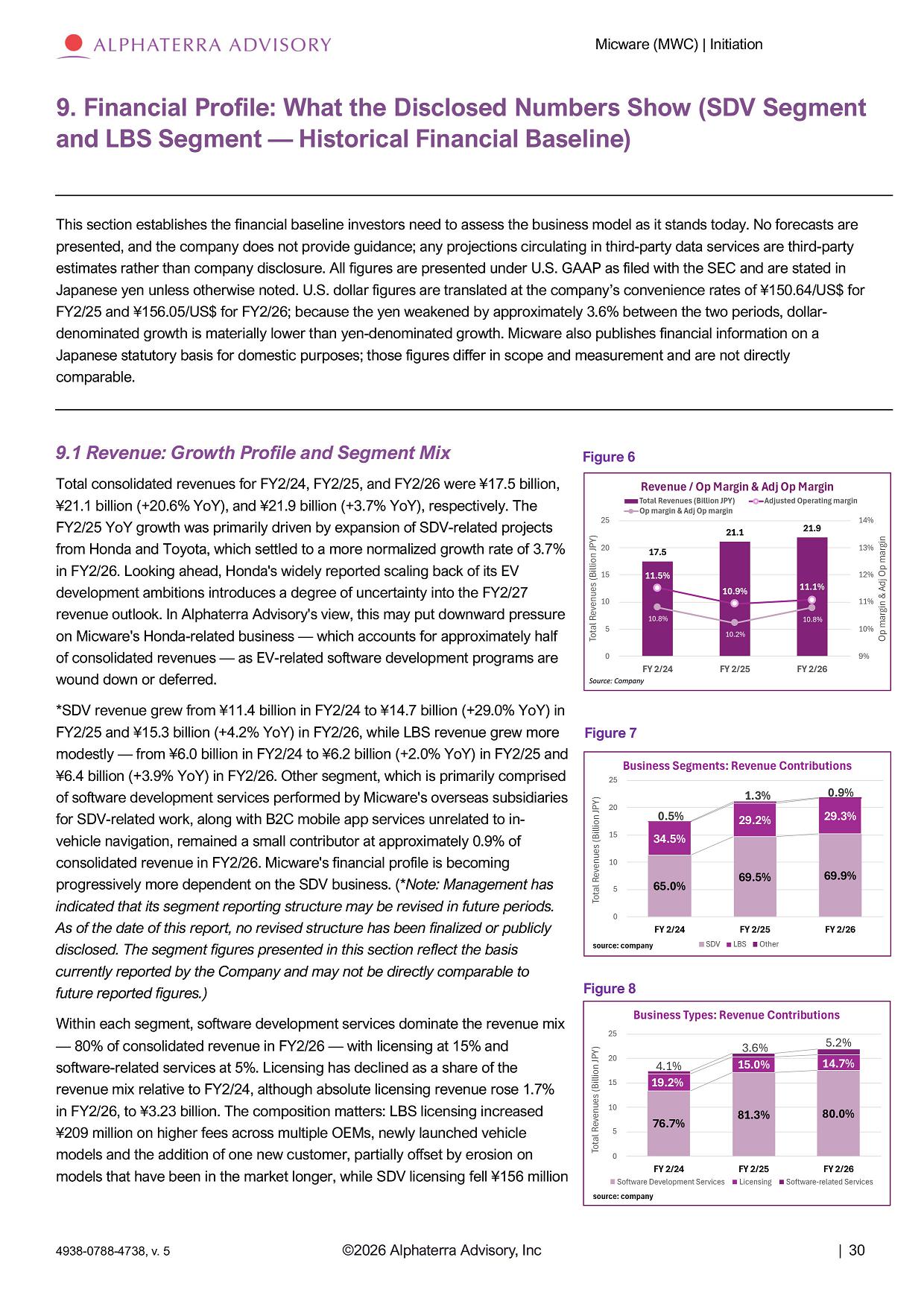
Micware (MWC) | Initiation 9. Financial Profile: What the Disclosed Numbers Show (SDV Segment and LBS Segment — Historical Financial Baseline) This section establishes the financial baseline investors need to assess the business model as it stands today. No forecasts are presented, and the company does not provide guidance; any projections circulating in third - party data services are third - party estimates rather than company disclosure. All figures are presented under U.S. GAAP as filed with the SEC and are stated in Japanese yen unless otherwise noted. U.S. dollar figures are translated at the company’s convenience rates of ¥150.64/US$ for FY2/25 and ¥156.05/US$ for FY2/26; because the yen weakened by approximately 3.6% between the two periods, dollar - denominated growth is materially lower than yen - denominated growth. Micware also publishes financial information on a Japanese statutory basis for domestic purposes; those figures differ in scope and measurement and are not directly comparable. 9.1 Revenue: Growth Profile and Segment Mix Total consolidated revenues for FY2/24, FY2/25, and FY2/26 were ¥17.5 billion, ¥21.1 billion (+20.6% YoY), and ¥21.9 billion (+3.7% YoY), respectively. The FY2/25 YoY growth was primarily driven by expansion of SDV - related projects from Honda and Toyota, which settled to a more normalized growth rate of 3.7% in FY2/26. Looking ahead, Honda's widely reported scaling back of its EV development ambitions introduces a degree of uncertainty into the FY2/27 revenue outlook. In Alphaterra Advisory's view, this may put downward pressure on Micware's Honda - related business — which accounts for approximately half of consolidated revenues — as EV - related software development programs are wound down or deferred. *SDV revenue grew from ¥11.4 billion in FY2/24 to ¥14.7 billion (+29.0% YoY) in FY2/25 and ¥15.3 billion (+4.2% YoY) in FY2/26, while LBS revenue grew more modestly — from ¥6.0 billion in FY2/24 to ¥6.2 billion (+2.0% YoY) in FY2/25 and ¥6.4 billion (+3.9% YoY) in FY2/26. Other segment, which is primarily comprised of software development services performed by Micware's overseas subsidiaries for SDV - related work, along with B2C mobile app services unrelated to in - vehicle navigation, remained a small contributor at approximately 0.9% of consolidated revenue in FY2/26. Micware's financial profile is becoming progressively more dependent on the SDV business. (* Note: Management has indicated that its segment reporting structure may be revised in future periods. As of the date of this report, no revised structure has been finalized or publicly disclosed. The segment figures presented in this section reflect the basis currently reported by the Company and may not be directly comparable to future reported figures.) Within each segment, software development services dominate the revenue mix — 80% of consolidated revenue in FY2/26 — with licensing at 15% and software - related services at 5%. Licensing has declined as a share of the revenue mix relative to FY2/24, although absolute licensing revenue rose 1.7% in FY2/26, to ¥3.23 billion. The composition matters: LBS licensing increased ¥209 million on higher fees across multiple OEMs, newly launched vehicle models and the addition of one new customer, partially offset by erosion on models that have been in the market longer, while SDV licensing fell ¥156 million Figure 7 Figure 8 Figure 6 17.5 21.1 21.9 11.5% 10.9% 11.1% 10.2 % 10.8 % 10. 8% 9% 10% 11% 12% 13% 0 5 10 15 20 25 14% FY 2/25 FY 2/26 Op margin & Adj Op margin Total Revenues (Billion JPY) Revenue / Op Margin & Adj Op Margin Total Revenues (Billion JPY) Adjusted Operating margin Op margin & Adj Op margin FY 2/24 Source: Company 76.7% 81.3% 80.0% 4.1% 19.2% 5.2% 14.7% 0 5 10 15 3.6 % 20 15.0% Total Revenues (Billion JPY) Business Types: Revenue Contributions 25 FY 2 / 25 Li c e nsi ng FY 2/26 Software - related Services FY 2/24 Software Development Services source: company 65.0% 69.5% 69.9% 0.5% 34.5% 0.9% 29.3% 1.3% 29.2% 0 5 10 15 20 FY 2/24 FY 2/26 Total Revenues (Billion JPY) Business Segments: Revenue Contributions 25 FY 2/25 SDV LBS Other source: company ©2026 Alphaterra Advisory, Inc | 30 4938 - 0788 - 4738, v. 5
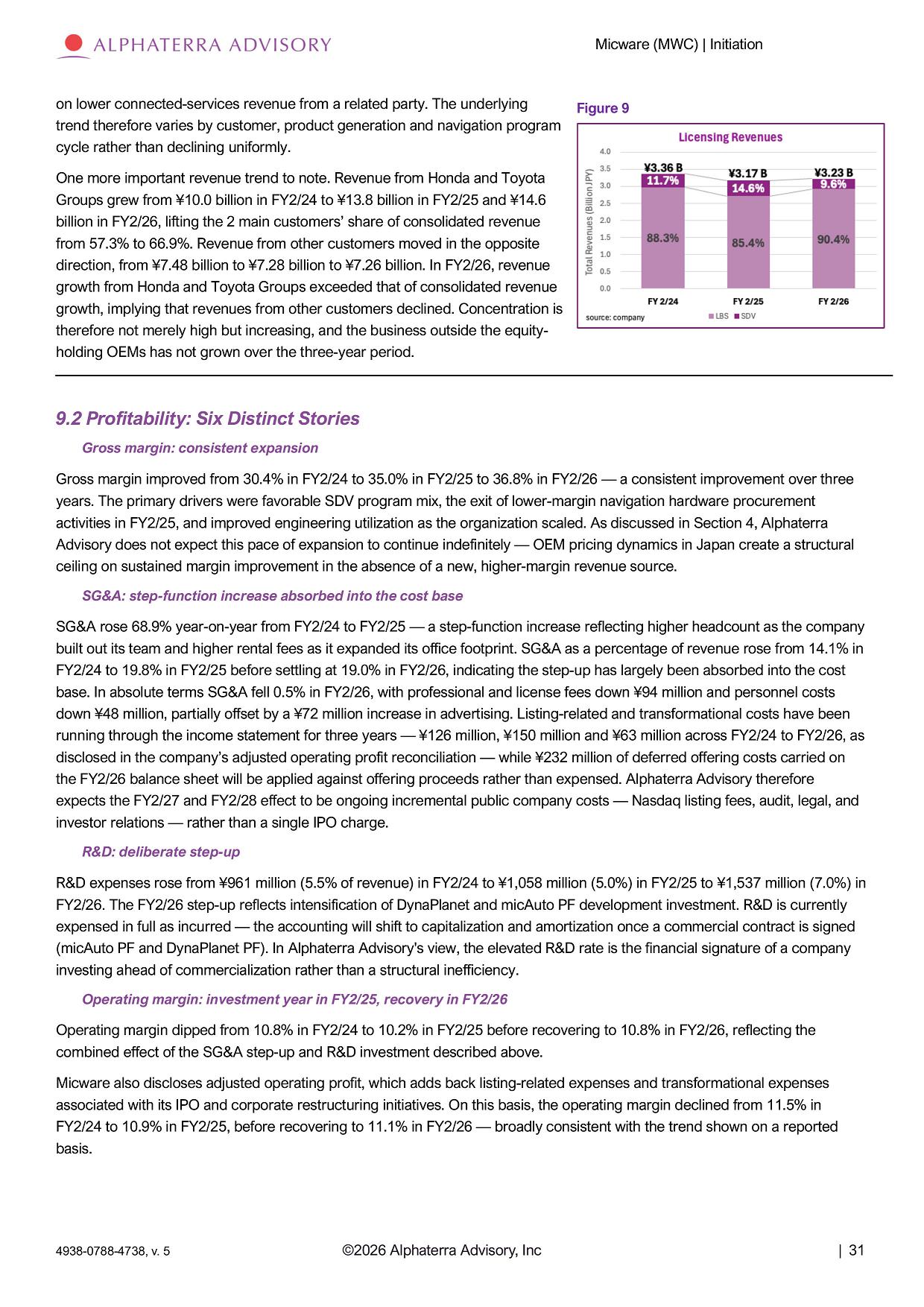
Micware (MWC) | Initiation on lower connected - services revenue from a related party. The underlying trend therefore varies by customer, product generation and navigation program cycle rather than declining uniformly. One more important revenue trend to note. Revenue from Honda and Toyota Groups grew from ¥10.0 billion in FY2/24 to ¥13.8 billion in FY2/25 and ¥14.6 billion in FY2/26, lifting the 2 main customers’ share of consolidated revenue from 57.3% to 66.9%. Revenue from other customers moved in the opposite direction, from ¥7.48 billion to ¥7.28 billion to ¥7.26 billion. In FY2/26, revenue growth from Honda and Toyota Groups exceeded that of consolidated revenue growth, implying that revenues from other customers declined. Concentration is therefore not merely high but increasing, and the business outside the equity - holding OEMs has not grown over the three - year period. 9.2 Profitability: Six Distinct Stories Gross margin: consistent expansion Gross margin improved from 30.4% in FY2/24 to 35.0% in FY2/25 to 36.8% in FY2/26 — a consistent improvement over three years. The primary drivers were favorable SDV program mix, the exit of lower - margin navigation hardware procurement activities in FY2/25, and improved engineering utilization as the organization scaled. As discussed in Section 4, Alphaterra Advisory does not expect this pace of expansion to continue indefinitely — OEM pricing dynamics in Japan create a structural ceiling on sustained margin improvement in the absence of a new, higher - margin revenue source. SG&A: step - function increase absorbed into the cost base SG&A rose 68.9% year - on - year from FY2/24 to FY2/25 — a step - function increase reflecting higher headcount as the company built out its team and higher rental fees as it expanded its office footprint. SG&A as a percentage of revenue rose from 14.1% in FY2/24 to 19.8% in FY2/25 before settling at 19.0% in FY2/26, indicating the step - up has largely been absorbed into the cost base. In absolute terms SG&A fell 0.5% in FY2/26, with professional and license fees down ¥94 million and personnel costs down ¥48 million, partially offset by a ¥72 million increase in advertising. Listing - related and transformational costs have been running through the income statement for three years — ¥126 million, ¥150 million and ¥63 million across FY2/24 to FY2/26, as disclosed in the company’s adjusted operating profit reconciliation — while ¥232 million of deferred offering costs carried on the FY2/26 balance sheet will be applied against offering proceeds rather than expensed. Alphaterra Advisory therefore expects the FY2/27 and FY2/28 effect to be ongoing incremental public company costs — Nasdaq listing fees, audit, legal, and investor relations — rather than a single IPO charge. R&D: deliberate step - up R&D expenses rose from ¥961 million (5.5% of revenue) in FY2/24 to ¥1,058 million (5.0%) in FY2/25 to ¥1,537 million (7.0%) in FY2/26. The FY2/26 step - up reflects intensification of DynaPlanet and micAuto PF development investment. R&D is currently expensed in full as incurred — the accounting will shift to capitalization and amortization once a commercial contract is signed (micAuto PF and DynaPlanet PF). In Alphaterra Advisory's view, the elevated R&D rate is the financial signature of a company investing ahead of commercialization rather than a structural inefficiency. Operating margin: investment year in FY2/25, recovery in FY2/26 Operating margin dipped from 10.8% in FY2/24 to 10.2% in FY2/25 before recovering to 10.8% in FY2/26, reflecting the combined effect of the SG&A step - up and R&D investment described above. Micware also discloses adjusted operating profit, which adds back listing - related expenses and transformational expenses associated with its IPO and corporate restructuring initiatives. On this basis, the operating margin declined from 11.5% in FY2/24 to 10.9% in FY2/25, before recovering to 11.1% in FY2/26 — broadly consistent with the trend shown on a reported basis. Figure 9 ©2026 Alphaterra Advisory, Inc | 31 4938 - 0788 - 4738, v. 5
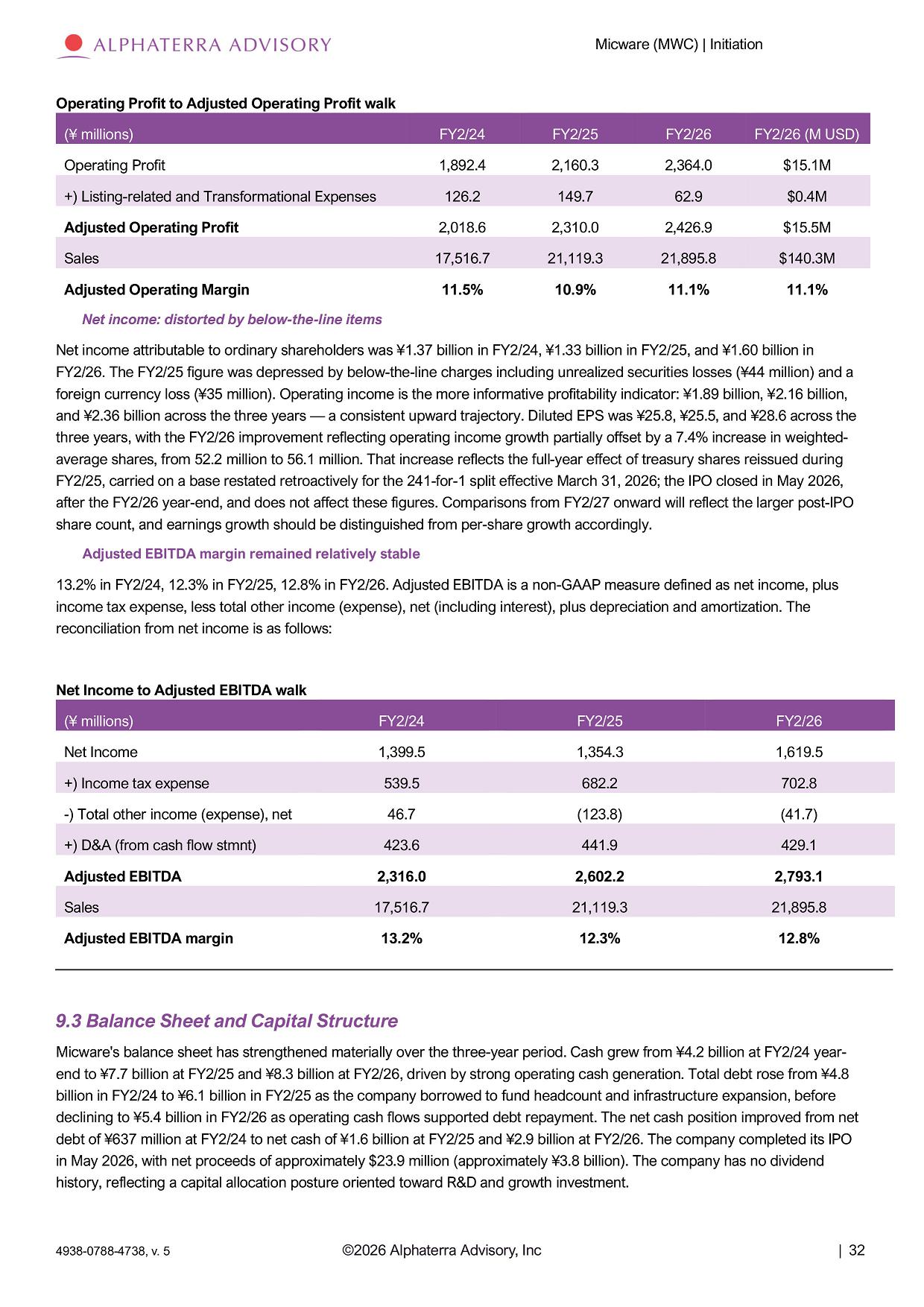
Micware (MWC) | Initiation Operating Profit to Adjusted Operating Profit walk FY2/26 (M USD) FY2 / 26 FY2/25 FY2 / 24 (¥ millions) $15.1M 2 , 364 . 0 2,160.3 1 , 892 . 4 Operating Profit $0.4M 62.9 149.7 126.2 +) Listing - related and Transformational Expenses $15.5M 2 , 426 . 9 2,310.0 2 , 018 . 6 Adjusted Operating Profit $140.3M 21 , 895 . 8 21,119.3 17 , 516 . 7 Sales 11.1% 11.1% 10.9% 11 . 5% Adjusted Operating Margin Net income: distorted by below - the - line items Net income attributable to ordinary shareholders was ¥1.37 billion in FY2/24, ¥1.33 billion in FY2/25, and ¥1.60 billion in FY2/26. The FY2/25 figure was depressed by below - the - line charges including unrealized securities losses (¥44 million) and a foreign currency loss (¥35 million). Operating income is the more informative profitability indicator: ¥1.89 billion, ¥2.16 billion, and ¥2.36 billion across the three years — a consistent upward trajectory. Diluted EPS was ¥25.8, ¥25.5, and ¥28.6 across the three years, with the FY2/26 improvement reflecting operating income growth partially offset by a 7.4% increase in weighted - average shares, from 52.2 million to 56.1 million. That increase reflects the full - year effect of treasury shares reissued during FY2/25, carried on a base restated retroactively for the 241 - for - 1 split effective March 31, 2026; the IPO closed in May 2026, after the FY2/26 year - end, and does not affect these figures. Comparisons from FY2/27 onward will reflect the larger post - IPO share count, and earnings growth should be distinguished from per - share growth accordingly. Adjusted EBITDA margin remained relatively stable 13.2% in FY2/24, 12.3% in FY2/25, 12.8% in FY2/26. Adjusted EBITDA is a non - GAAP measure defined as net income, plus income tax expense, less total other income (expense), net (including interest), plus depreciation and amortization. The reconciliation from net income is as follows: Net Income to Adjusted EBITDA walk FY2/26 FY2/25 FY2/24 (¥ millions) 1,619.5 1,354.3 1,399.5 Net Income 702.8 682.2 539.5 +) Income tax expense (41.7) (123.8) 46.7 - ) Total other income (expense), net 429.1 441.9 423.6 +) D&A (from cash flow stmnt) 2,793.1 2,602.2 2,316.0 Adjusted EBITDA 21,895.8 21,119.3 17,516.7 Sales 12.8% 12.3% 13.2% Adjusted EBITDA margin 9.3 Balance Sheet and Capital Structure Micware's balance sheet has strengthened materially over the three - year period. Cash grew from ¥4.2 billion at FY2/24 year - end to ¥7.7 billion at FY2/25 and ¥8.3 billion at FY2/26, driven by strong operating cash generation. Total debt rose from ¥4.8 billion in FY2/24 to ¥6.1 billion in FY2/25 as the company borrowed to fund headcount and infrastructure expansion, before declining to ¥5.4 billion in FY2/26 as operating cash flows supported debt repayment. The net cash position improved from net debt of ¥637 million at FY2/24 to net cash of ¥1.6 billion at FY2/25 and ¥2.9 billion at FY2/26. The company completed its IPO in May 2026, with net proceeds of approximately $23.9 million (approximately ¥3.8 billion). The company has no dividend history, reflecting a capital allocation posture oriented toward R&D and growth investment. ©2026 Alphaterra Advisory, Inc | 32 4938 - 0788 - 4738, v. 5
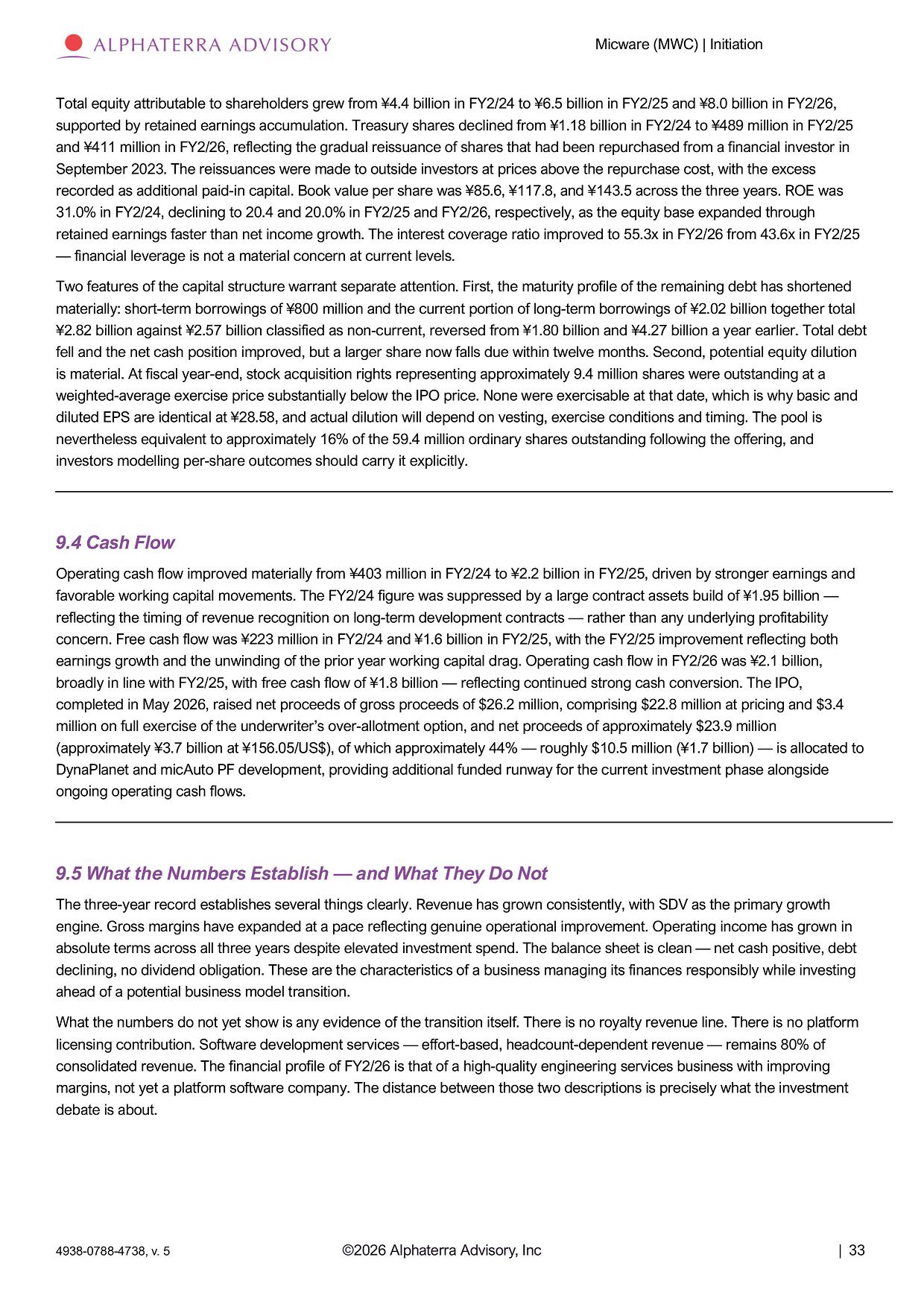
Micware (MWC) | Initiation Total equity attributable to shareholders grew from ¥4.4 billion in FY2/24 to ¥6.5 billion in FY2/25 and ¥8.0 billion in FY2/26, supported by retained earnings accumulation. Treasury shares declined from ¥1.18 billion in FY2/24 to ¥489 million in FY2/25 and ¥411 million in FY2/26, reflecting the gradual reissuance of shares that had been repurchased from a financial investor in September 2023. The reissuances were made to outside investors at prices above the repurchase cost, with the excess recorded as additional paid - in capital. Book value per share was ¥85.6, ¥117.8, and ¥143.5 across the three years. ROE was 31.0% in FY2/24, declining to 20.4 and 20.0% in FY2/25 and FY2/26, respectively, as the equity base expanded through retained earnings faster than net income growth. The interest coverage ratio improved to 55.3x in FY2/26 from 43.6x in FY2/25 — financial leverage is not a material concern at current levels. Two features of the capital structure warrant separate attention. First, the maturity profile of the remaining debt has shortened materially: short - term borrowings of ¥800 million and the current portion of long - term borrowings of ¥2.02 billion together total ¥2.82 billion against ¥2.57 billion classified as non - current, reversed from ¥1.80 billion and ¥4.27 billion a year earlier. Total debt fell and the net cash position improved, but a larger share now falls due within twelve months. Second, potential equity dilution is material. At fiscal year - end, stock acquisition rights representing approximately 9.4 million shares were outstanding at a weighted - average exercise price substantially below the IPO price. None were exercisable at that date, which is why basic and diluted EPS are identical at ¥28.58, and actual dilution will depend on vesting, exercise conditions and timing. The pool is nevertheless equivalent to approximately 16% of the 59.4 million ordinary shares outstanding following the offering, and investors modelling per - share outcomes should carry it explicitly. 9.4 Cash Flow Operating cash flow improved materially from ¥403 million in FY2/24 to ¥2.2 billion in FY2/25, driven by stronger earnings and favorable working capital movements. The FY2/24 figure was suppressed by a large contract assets build of ¥1.95 billion — reflecting the timing of revenue recognition on long - term development contracts — rather than any underlying profitability concern. Free cash flow was ¥223 million in FY2/24 and ¥1.6 billion in FY2/25, with the FY2/25 improvement reflecting both earnings growth and the unwinding of the prior year working capital drag. Operating cash flow in FY2/26 was ¥2.1 billion, broadly in line with FY2/25, with free cash flow of ¥1.8 billion — reflecting continued strong cash conversion. The IPO, completed in May 2026, raised net proceeds of gross proceeds of $26.2 million, comprising $22.8 million at pricing and $3.4 million on full exercise of the underwriter’s over - allotment option, and net proceeds of approximately $23.9 million (approximately ¥3.7 billion at ¥156.05/US$), of which approximately 44% — roughly $10.5 million (¥1.7 billion) — is allocated to DynaPlanet and micAuto PF development, providing additional funded runway for the current investment phase alongside ongoing operating cash flows. 9.5 What the Numbers Establish — and What They Do Not The three - year record establishes several things clearly. Revenue has grown consistently, with SDV as the primary growth engine. Gross margins have expanded at a pace reflecting genuine operational improvement. Operating income has grown in absolute terms across all three years despite elevated investment spend. The balance sheet is clean — net cash positive, debt declining, no dividend obligation. These are the characteristics of a business managing its finances responsibly while investing ahead of a potential business model transition. What the numbers do not yet show is any evidence of the transition itself. There is no royalty revenue line. There is no platform licensing contribution. Software development services — effort - based, headcount - dependent revenue — remains 80% of consolidated revenue. The financial profile of FY2/26 is that of a high - quality engineering services business with improving margins, not yet a platform software company. The distance between those two descriptions is precisely what the investment debate is about. ©2026 Alphaterra Advisory, Inc | 33 4938 - 0788 - 4738, v. 5
Micware (MWC) | Initiation 10. What to Watch: Milestones That Will Define the Thesis Micware's investment case hinges on a small number of observable events. This section identifies the milestones that matter most, what each reveals analytically, and how to distinguish a genuine signal from noise. 10.1 micAuto PF: The Most Important Near - Term Milestone — and How to Read It The single most consequential near - term event is a first commercial micAuto PF contract. Not all first contracts are equal, however, and investors should apply a deliberate hierarchy when evaluating whatever is announced. Honda internal mandate . Alphaterra Advisory expects micAuto PF's initial revenue contribution to come from within the Honda ecosystem — specifically, programs currently not handled by Micware, using micAuto PF as the development foundation. In Alphaterra Advisory's view, Honda's primary motivation is cost reduction. This is a commercially meaningful first step — it validates platform economics and establishes a royalty revenue baseline — but it demonstrates that micAuto PF works within a relationship Micware has spent two decades building, not that it is portable to a new OEM. Investors should also note that some portion of this revenue may represent a reclassification of existing Honda engineering work rather than incremental top - line contribution. Japanese mid - scale OEM win . A contract with an independent Japanese OEM outside Honda ad Toyota would be a materially stronger signal — the threshold that moves micAuto PF from a credible thesis to a demonstrated independent commercial product. It proves the platform competes on merit beyond Micware's established relationships, within a familiar co - development culture. Non - Japanese OEM win . The strongest available validation — full portability across a different technical culture, a denser competitive environment, and established incumbent relationships. Nissan, despite its Japanese heritage, sits closer to this category given its Renault Alliance governance ties and exposure to European procurement standards, in our view. Displacing or qualifying alongside Elektrobit or KPIT in a non - Japanese OEM program would be a particularly meaningful signal. The threshold for genuine validation in all three cases: a signed agreement tied to a defined production program with a disclosed royalty structure. Letters of intent and pilot agreements do not meet this threshold. Management expects micAuto PF to begin contributing to revenues in the fiscal year ending February 2027. Micware reports semi - annually — consistent with standard Japanese practice, with full - year results released in late June and half - year results expected in fall — so investors should monitor these reporting events and interim IR communications for pipeline progression. 10.2 OEM Relationship Health: Watch the Operations, Not the Contracts The Honda Development Agreement renewal is expected as a matter of course given Honda's 12% equity position and depth of co - development. It carries limited incremental analytical information. At Honda, the meaningful signal is program scope. An expansion into OTA infrastructure management, AI - enabled personalization, or ADAS - adjacent software layers would indicate Honda is deepening its reliance on Micware. At Toyota, near - term budget tightening under the new CEO is expected to create some variability in MMC revenue — not a relationship signal, but a near - term financial one. Watch the Denso subcontracting channel: sustained growth in Denso - sourced work would indicate that SDV engineering demand within the Toyota supply chain is outpacing Denso's own absorption capacity, a structurally positive signal for Micware's ecosystem position. ©2026 Alphaterra Advisory, Inc | 34 4938 - 0788 - 4738, v. 5
Micware (MWC) | Initiation 10.3 Gross Margin Trajectory: Signal and Ceiling Gross margin expanded consistently from 30.4% in FY2/24 to 35.0% in FY2/25 to 36.8% in FY2/26. The key transformation signal to watch is whether gross margin begins expanding faster than topline growth — an outcome that would only occur once high - margin per - vehicle royalties start flowing which should have materially higher gross margin rate. That divergence, accompanied by a disclosed royalty revenue line, is the clearest financial confirmation that the business model evolution is underway in practice. In Alphaterra Advisory's view, however, the recent pace of margin expansion is unlikely to be sustained independently of royalty contribution — and investors should not be surprised to see gross margins come under pressure in the near to medium term. Honda and Toyota each hold approximately 12% of Micware's equity and, as active commercial partners, have meaningful visibility into Micware's profitability through the relationship itself. The pressure on suppliers to return margin improvements to OEM customers is deeply embedded in Japanese automotive procurement culture. Both OEMs have both the visibility and the commercial incentive to ensure Micware's margin improvement does not persist beyond what the relationship economics support. This is not a thesis - breaking risk — it is a normal feature of the OEM - vendor dynamic in Japan — but investors should not extrapolate the three - year gross margin trend without accounting for it. A secondary signal: when a micAuto PF contract is signed, development costs shift from full expensing to capitalization and amortization. That accounting transition is itself a confirmation signal — it marks the moment the platform moves from general development to customer - specific program work. 10.4 LBS and DynaPlanet: Different Timelines, Different Indicators For LBS, the near - term signal is Mazda program continuity. If those programs are delayed or reduced in scope, LBS revenue will face pressure that DynaPlanet's development - stage contributions cannot offset. The milestone that would genuinely surprise the market is any indication that Honda or Toyota is considering Micware's navigation software for their own vehicles — today structurally blocked by Honda Access and Toyota group captive suppliers, but not permanently immovable as SDV convergence deepens the integration between navigation data and vehicle software layers. That outcome would represent a material expansion of Micware's addressable revenue within existing customer relationships without requiring a single new OEM contract. It is a low - probability near - term event, but one investors should recognize as a genuinely significant signal if it materializes. For DynaPlanet, the right milestones are not near - term revenue. The milestones that matter are: a first signed B2B or B2G institutional contract (demonstrating data quality sufficient for professional use cases); geographic coverage progress in Japan's urban centers (the operational precondition for institutional monetization); and any announced engagement with Japan's government - supported smart city programs, specifically Project PLATEAU and Tokyo's Digital Twin Project. Investors evaluating DynaPlanet should set a monitoring horizon of three to five years and focus on these qualitative markers rather than near - term revenue figures. The September 2026 establishment of Micware Spacia as DynaPlanet's dedicated operating subsidiary, with named senior leadership, is a further organizational data point worth monitoring alongside the commercial milestones above — though, consistent with the milestones already identified, it is not itself a substitute for commercial validation. 10.5 Governance: Succession in Progress Micware is evaluating a range of internal and external management talent as potential successors to CEO Kenji Narushima . Among the candidates under consideration are executives with overseas experience at major trading houses and electronics companies, bringing substantial backgrounds in global business operations and market development. This type of experience is directly relevant to Micware's ongoing international expansion and the broadening of its business platform. ©2026 Alphaterra Advisory, Inc | 35 4938 - 0788 - 4738, v. 5
Micware (MWC) | Initiation Executives leading Micware's group companies also stand out as a strong pool of succession talent. Notably, this includes management personnel with many years of leadership experience in IVI system development, who have overseen Android IVI development for OEMs and led development organizations numbering in the hundreds. Their track record of leading large - scale projects with global OEMs and Tier 1 suppliers reflects a combination of commercial, technical, and organizational management experience that represents a significant asset in sustaining the company's SDV strategy going forward. The signal to monitor is the degree to which these executives take on expanded responsibility and decision - making authority across key strategic areas — including the micAuto PF pipeline, DynaPlanet, and international expansion — ahead of any formal CEO transition. A substantive, pre - transition build - up of operational authority among the candidates under consideration is a positive signal for management continuity. At this stage, no formal successor or transition timeline has been disclosed. Accordingly, rather than focusing on any single individual, investors are better served by tracking the broader progression of authority - sharing and management development across the executive team. 6. Bottom Line The business quality is not in question. The open question is whether Micware can translate structural importance into scalable economics. The milestones below are the framework for answering that question with evidence. micAuto PF contract — primary catalyst; weight the signal by customer type: Honda internal mandate < Japanese mid - scale OEM < non - Japanese OEM Honda and Toyota program trajectory — mandate expansion signals deepening reliance; internalization signals the opposite; monitor the Denso channel at Toyota Gross margin — royalty - driven divergence from topline growth is the confirmation signal; expect OEM pricing pressure to limit organic expansion LBS — Mazda continuity near - term; Honda/Toyota navigation penetration the upside surprise; cloud services a secondary recurring revenue indicator DynaPlanet — institutional contract, coverage progress, and smart city engagement are the qualitative milestones; near - term revenue figures are secondary Succession — watch for which internal candidate takes on an expanding role ahead of the formal CEO transition. ©2026 Alphaterra Advisory, Inc | 36 4938 - 0788 - 4738, v. 5
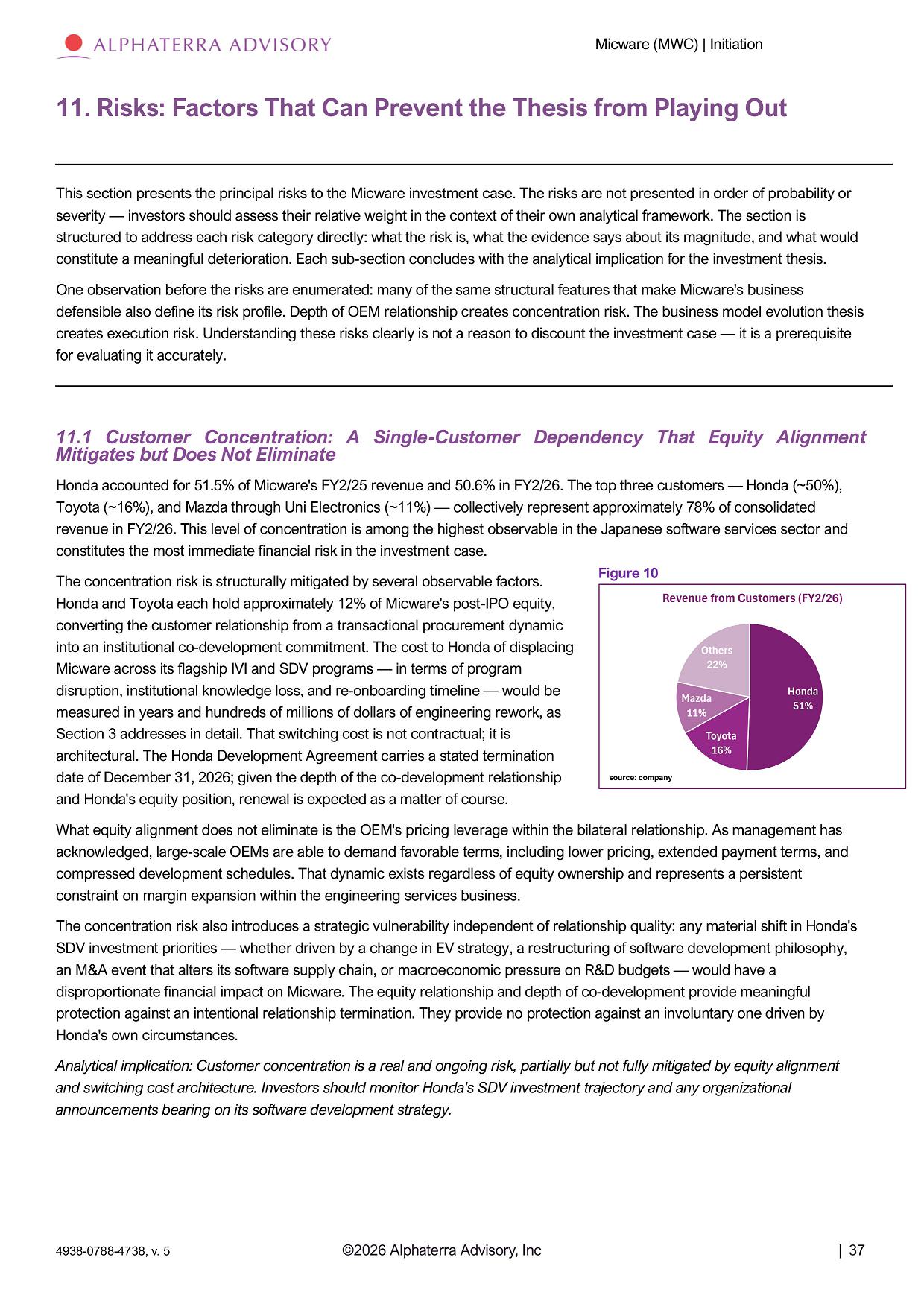
Micware (MWC) | Initiation 11. Risks: Factors That Can Prevent the Thesis from Playing Out This section presents the principal risks to the Micware investment case. The risks are not presented in order of probability or severity — investors should assess their relative weight in the context of their own analytical framework. The section is structured to address each risk category directly: what the risk is, what the evidence says about its magnitude, and what would constitute a meaningful deterioration. Each sub - section concludes with the analytical implication for the investment thesis. One observation before the risks are enumerated: many of the same structural features that make Micware's business defensible also define its risk profile. Depth of OEM relationship creates concentration risk. The business model evolution thesis creates execution risk. Understanding these risks clearly is not a reason to discount the investment case — it is a prerequisite for evaluating it accurately. 11.1 Customer Concentration: A Single - Customer Dependency That Equity Alignment Mitigates but Does Not Eliminate Honda accounted for 51.5% of Micware's FY2/25 revenue and 50.6% in FY2/26. The top three customers — Honda (~50%), Toyota (~16%), and Mazda through Uni Electronics (~11%) — collectively represent approximately 78% of consolidated revenue in FY2/26. This level of concentration is among the highest observable in the Japanese software services sector and constitutes the most immediate financial risk in the investment case. The concentration risk is structurally mitigated by several observable factors. Honda and Toyota each hold approximately 12% of Micware's post - IPO equity, converting the customer relationship from a transactional procurement dynamic into an institutional co - development commitment. The cost to Honda of displacing Micware across its flagship IVI and SDV programs — in terms of program disruption, institutional knowledge loss, and re - onboarding timeline — would be measured in years and hundreds of millions of dollars of engineering rework, as Section 3 addresses in detail. That switching cost is not contractual; it is architectural. The Honda Development Agreement carries a stated termination date of December 31, 2026; given the depth of the co - development relationship and Honda's equity position, renewal is expected as a matter of course. What equity alignment does not eliminate is the OEM's pricing leverage within the bilateral relationship. As management has acknowledged, large - scale OEMs are able to demand favorable terms, including lower pricing, extended payment terms, and compressed development schedules. That dynamic exists regardless of equity ownership and represents a persistent constraint on margin expansion within the engineering services business. The concentration risk also introduces a strategic vulnerability independent of relationship quality: any material shift in Honda's SDV investment priorities — whether driven by a change in EV strategy, a restructuring of software development philosophy, an M&A event that alters its software supply chain, or macroeconomic pressure on R&D budgets — would have a disproportionate financial impact on Micware. The equity relationship and depth of co - development provide meaningful protection against an intentional relationship termination. They provide no protection against an involuntary one driven by Honda's own circumstances. Analytical implication: Customer concentration is a real and ongoing risk, partially but not fully mitigated by equity alignment and switching cost architecture. Investors should monitor Honda's SDV investment trajectory and any organizational announcements bearing on its software development strategy. Figure 10 Hon da 51% Ot h e r s 22% Ma z d a 11% T oy o t a 16% Revenue from Customers (FY2/26) source: company ©2026 Alphaterra Advisory, Inc | 37 4938 - 0788 - 4738, v. 5
Micware (MWC) | Initiation 11.2 micAuto PF Adoption Risk: The Central Execution Variable Remains Unresolved No external OEM contracts have been signed as of the date of this report. The discussions that management characterizes as an active pipeline across multiple OEMs in Japan, North America, and Europe remain precisely that — discussions. Until a contract is announced, the platform commercialization thesis is an expectation, not a demonstrated business outcome. The adoption risk has several distinct dimensions. The first — and most fundamental — is the question of how Micware sells micAuto PF to OEMs that already have their own platforms in place. Displacing an incumbent primary vendor is not a realistic near - term objective: every OEM that micAuto PF is targeting is already served by an internal unit, an established Tier 1 partner, or a dedicated IVI specialist, and displacing that relationship requires a production - level track record with a non - Honda customer that micAuto PF has yet to accumulate. The objective, therefore, is not displacement — it is qualification as a secondary source. Automotive OEMs consistently prefer to maintain multiple qualified software vendors rather than consolidating on a single supplier, precisely because multi - sourcing preserves pricing leverage and development continuity. That procurement posture is structural and deeply embedded in how OEMs manage critical supply relationships. SDV platform sourcing is unlikely to be an exception. micAuto PF's near - term commercial opportunity is to occupy that secondary position — a qualified alternative that an OEM adopts for a specific vehicle program or market segment where it wants software ownership control and vendor diversification without bearing the full cost of a proprietary stack. That is a commercially meaningful and structurally motivated entry point, even if it is not the primary vendor position. The second dimension is timeline uncertainty. Management has indicated that micAuto PF is expected to begin contributing to revenues from FY2/27. The gap between an active discussion and a signed production contract in the automotive industry is historically long — vehicle program cycles operate on multi - year timescales, procurement decisions involve multiple stakeholder layers, and the cost of committing to a new platform vendor is significant enough that OEMs evaluate carefully before committing. The third dimension is royalty rate and volume uncertainty. Management has guided to a royalty gross margin in the range of 70 – 80% — a structurally attractive economics profile that would, at scale, materially transform Micware's aggregate margin profile. But the per - vehicle royalty rate, the vehicle production volumes to which it would apply, and the contractual structure governing how customization fees interact with the royalty layer are all unresolved until an actual contract is negotiated and disclosed. Analytical implication: micAuto PF adoption risk is the central execution variable in the Micware investment thesis. Investors must decide how much probability weight to assign to successful commercialization on the timeline and at the economics that a first contract would imply. Section 10 identifies the observable milestones that will resolve that question. 11.3 OEM Internalization Risk: Structurally Reduced — but Not Eliminated The risk that OEMs reverse course and rebuild in - house software development capability is a legitimate analytical question, even if the evidence of the prior decade points firmly in the opposite direction. Volkswagen's Cariad, Ford's FNV4, and similar flagship internalization initiatives have collectively produced cost overruns, program delays, and strategic retreats that have materially shifted industry consensus on the feasibility of full - stack in - house software development. The talent market dynamics — software engineers structurally preferring software companies over automotive manufacturers — reinforce the case against large - scale OEM internalization. The risk, however, is not binary. OEMs do not need to internalize entirely to reduce their dependence on Micware. Selective repatriation of specific sub - programs or capability domains — while maintaining co - development relationships for flagship programs — is a more plausible scenario than full displacement. Toyota's continued investment in Woven by Toyota for ADAS and autonomous driving, while simultaneously maintaining its Denso - to - Micware co - development pipeline for IVI, is already an example of targeted internalization operating alongside deep external partnership. The risk is less that Micware is displaced from its programs entirely, and more that individual program scopes are gradually absorbed as OEM software capability matures in specific domains. ©2026 Alphaterra Advisory, Inc | 38 4938 - 0788 - 4738, v. 5
Micware (MWC) | Initiation A related risk is OEM consolidation of supplier relationships at the Tier 1 level — channeling a greater share of SDV software through a single integrator in ways that compress Micware's direct program scope without constituting an explicit displacement. This scenario is unlikely given that Honda and Toyota both requested Micware to maintain organizational separation between operating subsidiaries specifically to prevent cross - customer information leakage — a structural arrangement that signals both OEMs actively want to preserve direct, independent co - development relationships rather than routing work through a single intermediary. Analytical implication: Internalization risk is structurally reduced relative to the levels observable in Western OEM markets, but investors should monitor program scope evolution at Honda and Toyota for any signs of capability repatriation in specific software domains. 11.4 OEM Strategy Shifts and Automotive Industry Cyclicality The more consequential near - term risk is not macroeconomic cyclicality but the possibility of a sudden shift in OEM strategic priorities that alters the composition of Micware's program portfolio. This risk is not theoretical — it has already materialized in the current fiscal year. Honda's revised EV strategy resulted in the cancellation of certain EV - related development programs at Micware, representing roughly 20% of this fiscal year's project pipeline based on Alphaterra Advisory's estimate. Per management commentary, Honda has since redirected that capacity toward other program requests, such that the overall program volume for the fiscal year is expected to remain broadly whole. The episode is nonetheless instructive: a single strategic pivot at Honda can materially reshape Micware's near - term revenue mix, even if the aggregate volume is ultimately preserved through reallocation. A similar dynamic is visible at Toyota. Per management commentary, the new Toyota CEO is tightening operating budgets more broadly; however, MMC does not anticipate a resulting slowdown, and instead expects to offset this through the acquisition of new Toyota development mandates. The analytical context matters here: SDV development is a strategic priority for Toyota, and the company's long - term commitment to software capability is not in question. Toyota also retains the option to route more work through Denso rather than directly to Micware, which would limit the financial impact on Micware without representing a deterioration of the underlying relationship. Nonetheless, the pattern is clear — a change in OEM leadership priorities, even a temporary budget tightening, creates near - term revenue uncertainty that is difficult to anticipate from current program commitments alone. In regard to the impact of tariffs, management commentary indicates Micware's major OEM customers are minimally affected by current trade policy disruptions, and near - term R&D spending from Honda and Toyota is not expected to be curtailed as a result. The exposure is more pronounced for smaller OEM relationships — management noted that customers such as Yamaha and Kawasaki, which sell ATV and marine products primarily into the US market, may reduce R&D spending in a sustained tariff environment, representing a longer - dated risk to that segment of the customer base. Analytical implication: The risk from sudden OEM strategy shifts is more proximate than conventional automotive cyclicality. Investors should monitor Honda's program reallocation trajectory following its EV strategy revision and Toyota's budget posture under new leadership, as both represent observable near - term variables. 11.5 Talent Risk: The Engineering Moat Requires Continuous Investment to Maintain Micware's competitive position rests on the depth and specificity of its engineering talent — engineers who have accumulated years of platform - specific institutional knowledge within a single OEM's development ecosystem. That talent base is the moat. It is also a risk: the depth of OEM - specific knowledge that makes Micware's engineers irreplaceable within a given program also makes them attractive acquisition targets for OEMs and competing software vendors seeking to accelerate platform capability through talent rather than organic development. Competition for automotive software engineers in Japan is intensifying. Micware has responded by positioning its compensation structure at the high end of the Japanese software industry. The multi - city office network across 13 locations in Japan is similarly structured to broaden the talent pool beyond the geographic constraints of a single headquarters, enabling recruitment ©2026 Alphaterra Advisory, Inc | 39 4938 - 0788 - 4738, v. 5
Micware (MWC) | Initiation across the country. Importantly, Micware's retention record to date has been favorable — per management commentary, engineer attrition is low and tenure is high, consistent with a culture where engineers develop deep program expertise and find the work content compelling. The combination of above - market compensation, in - person team culture, and technically challenging work has, thus far, supported the institutional knowledge accumulation that underpins the strategic moat. The forward - looking risk is whether this track record is sustainable as competition for software talent intensifies. Japan's structural shortage of software engineers is unlikely to ease materially in the medium term, and Micware's growth strategy explicitly calls for accelerating talent acquisition and retention through geographic expansion and recruitment from adjacent sectors such as electronics, robotics, and aerospace — which will require sustained recruitment at a pace above historical norms. An additional and more specific risk is that the OEM - specific specialization model means engineer attrition from a specific program team carries asymmetric consequences: the loss of an engineer with a decade of Honda platform knowledge is not replaced by onboarding a generalist software developer. Analytical implication: Talent risk is a structural constraint to be treated as an ongoing cost - of - moat. The key observable metrics are the trajectory of engineer headcount growth relative to revenue growth, and any evidence of elevated attrition in senior program engineering ranks. 11.6 Governance and Succession Risk: A Plan Is in Place — Execution Remains to Be Demonstrated Micware is effectively a founder - led company. CEO Kenji Narushima holds approximately 12.2% of ordinary shares post - IPO, with co - founder and CTO Masahide Shigeno at approximately 9.2% and founding CFO Takuma Segawa at approximately 7.2%. The founding team collectively holds approximately 28% of the post - IPO share count, reflecting a concentration of ownership and operational authority typical among recently listed Japanese technology companies but notable in the context of international institutional investment standards. Micware is broadening its bench of senior management talent across several distinct areas of expertise, including international business development, in - vehicle software development, and operational management. Going forward, the relevant question for investors is not the timing of a formal change at the top, but rather the degree to which authority and responsibility over key growth initiatives, new business lines, and international expansion are progressively delegated to the next generation of leaders. A gradual broadening of executive responsibility — evidenced through ownership of major projects and external - facing roles — would represent a positive signal of both management continuity and organizational maturity. At this stage, neither the specifics of the succession plan nor a timeline for the transfer of authority have been disclosed. Nonetheless, the broader effort to deepen management bench strength across the leadership team is a meaningful factor for investors to weigh in assessing Micware's medium - to long - term corporate value. The governance structure introduces a second distinct consideration: the customer - shareholder conflict of interest. An aggregate beneficial ownership of Honda, Toyota, and O - Well (parent of Uni Electronics) is approximately 29% of post - IPO equity while also representing approximately 80% of consolidated revenue. Management has acknowledged that the dual role of these entities as both significant customers and significant shareholders creates the potential for actual or perceived conflicts of interest — including the risk that customer - shareholders seek to influence contract terms, pricing, or strategic direction in ways that favor their commercial interests over the interests of other shareholders. Micware's board of directors includes eight members, five of whom are independent outside directors, providing a governance buffer. The structural tension nonetheless exists and is unlikely to be fully resolved by board composition alone. Micware follows Japanese home country corporate governance practices in areas where these differ from Nasdaq requirements. International institutional investors accustomed to US governance standards should be aware of the key differences outlined below. Japanese vs. US Corporate Governance: Key Differences for International Investors Shareholder approval for dilutive events: Under Nasdaq Listing Rule 5635, US - listed companies are generally required to obtain shareholder approval before issuing shares in connection with acquisitions, equity compensation, change - of - control transactions, or other potentially dilutive events. Under Japanese corporate law and Micware's articles of ©2026 Alphaterra Advisory, Inc | 40 4938 - 0788 - 4738, v. 5
Micware (MWC) | Initiation incorporation, the board of directors retains broader discretion to approve share issuances without shareholder vote in many of these circumstances, subject to certain price - protection requirements. Micware follows Japanese home country practice on this point, meaning share dilution can occur at the board's discretion in contexts where a US company would require shareholder authorization. Board nomination: Nasdaq Listing Rule 5605(e) requires that a listed company's nomination and governance committee be composed solely of independent directors. Under Japanese law, Micware has instead established a Nominating and Compensation Committee that advises the full board — which includes a non - independent executive director — rather than exercising independent authority over nominations. The board collectively participates in the nomination process, with the committee providing advisory input. Audit structure: In lieu of a Nasdaq - compliant audit committee, Micware maintains a separate Board of Corporate Auditors as permitted under the Companies Act — an accepted Japanese governance structure that performs the oversight functions of an audit committee but operates as a distinct body from the board of directors. Analytical implication: Succession risk is partially mitigated by the presence of multiple internal candidates, including Mr. Mori, though the transition execution — including which candidate is ultimately selected — remains ahead. The customer - shareholder conflict structure and Japanese governance practices are investor - awareness items rather than acute risks, but they warrant factoring into the governance considerations that international institutional investors typically apply to recently listed Japanese companies. 11.7 Small - Cap Liquidity Risk Micware is a small - cap ADS with limited float and a short trading history — liquidity risk is real and independent of operating performance. If micAuto PF commercialization is delayed, if royalty economics disappoint, or if near - term earnings are compressed by OEM strategy shifts, the consequences are meaningful. Section 10 identifies the observable milestones that will determine whether the business model transition is progressing as expected. 11.8 Bottom Line The risks in this section are structurally linked to Micware's strengths — deep OEM relationships create concentration risk, and a business model transition thesis creates execution risk. None of the risks individually breaks the investment case. Taken together, these risks demand conviction — investors without a clear view on micAuto PF commercialization should reflect that uncertainty in position sizing. The risks are known. The question is how to weigh them. ©2026 Alphaterra Advisory, Inc | 41 4938 - 0788 - 4738, v. 5
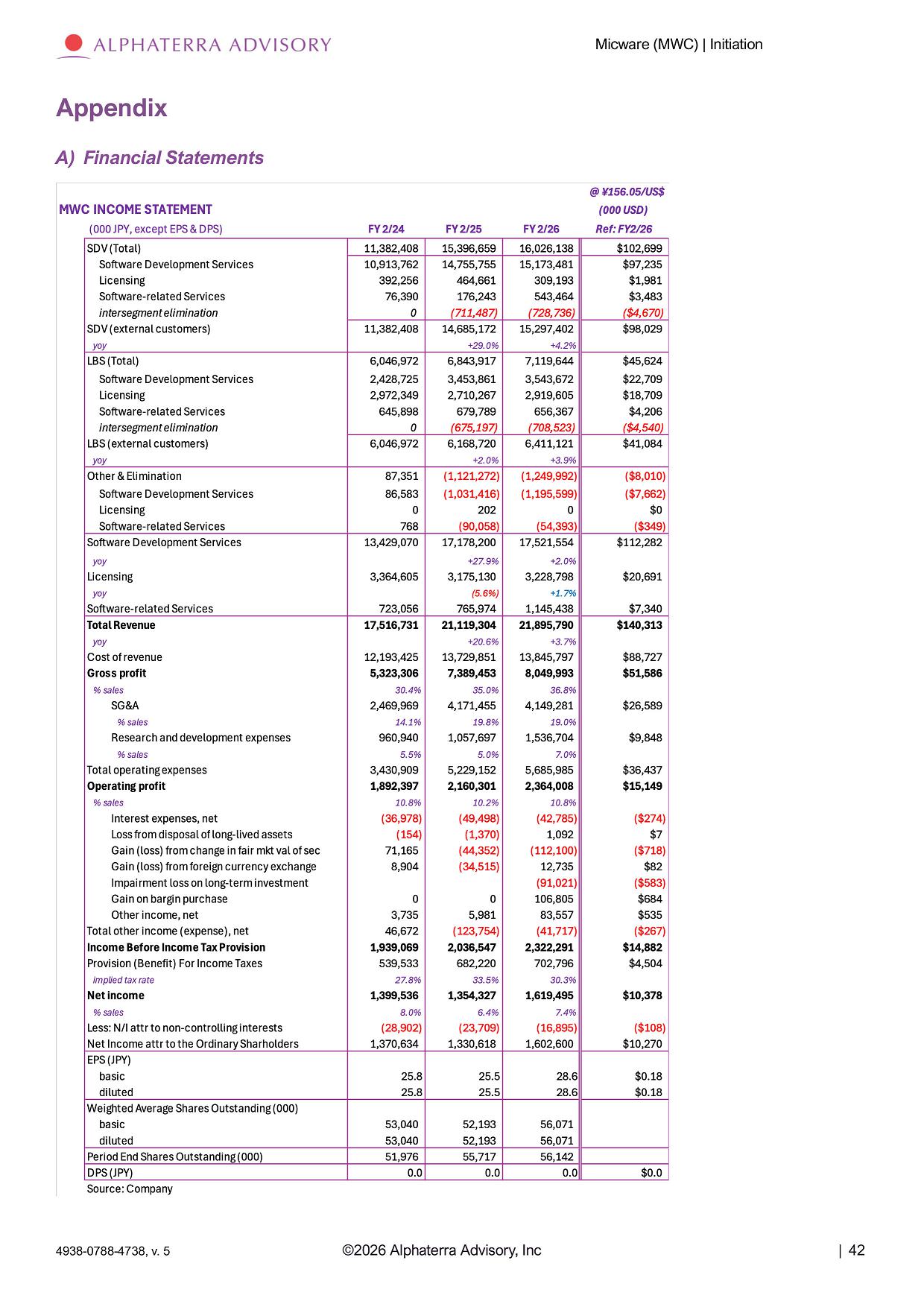
Micware (MWC) | Initiation Appendix A) Financial Statements ©2026 Alphaterra Advisory, Inc | 42 4938 - 0788 - 4738, v. 5
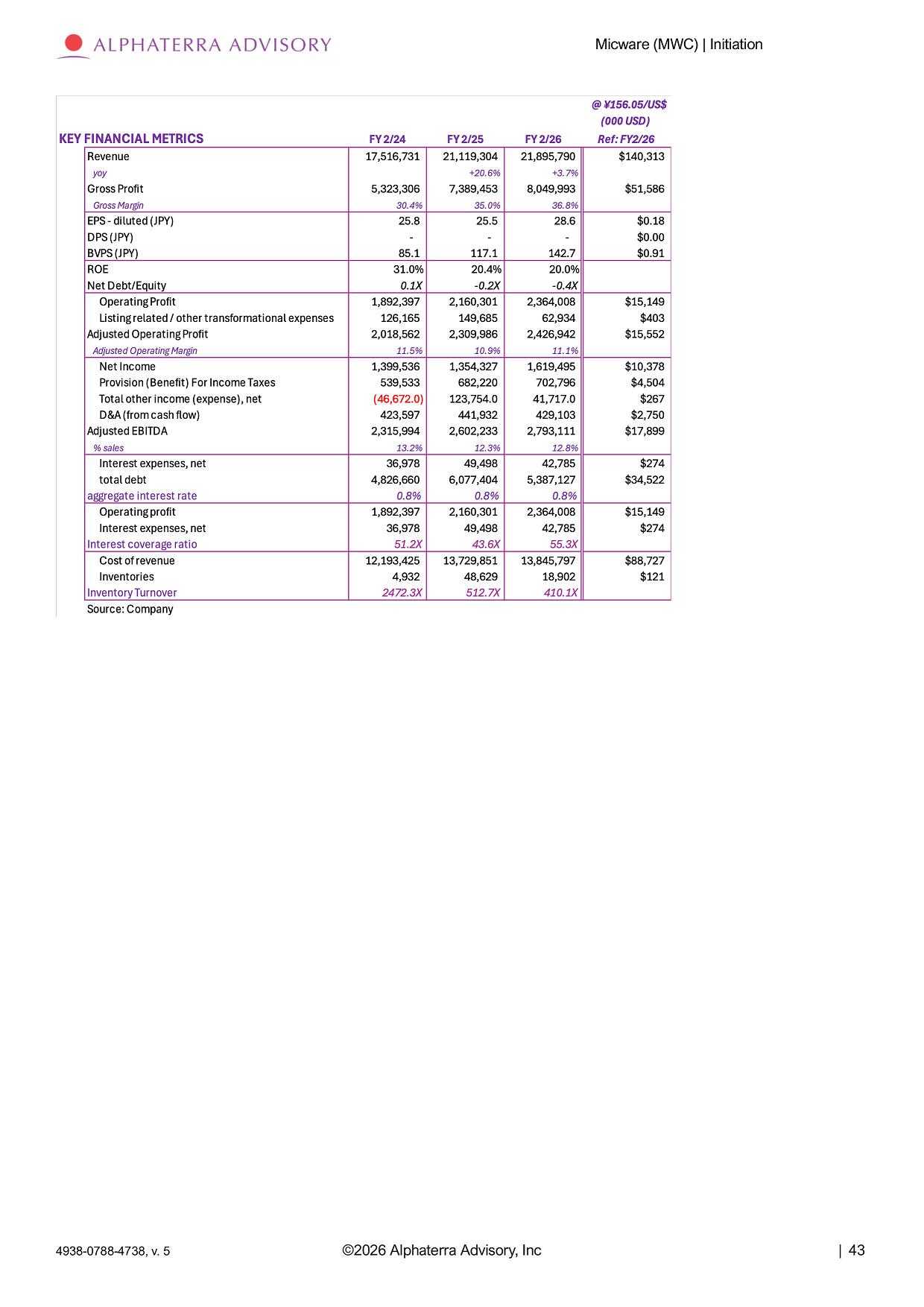
Micware (MWC) | Initiation ©2026 Alphaterra Advisory, Inc | 43 4938 - 0788 - 4738, v. 5
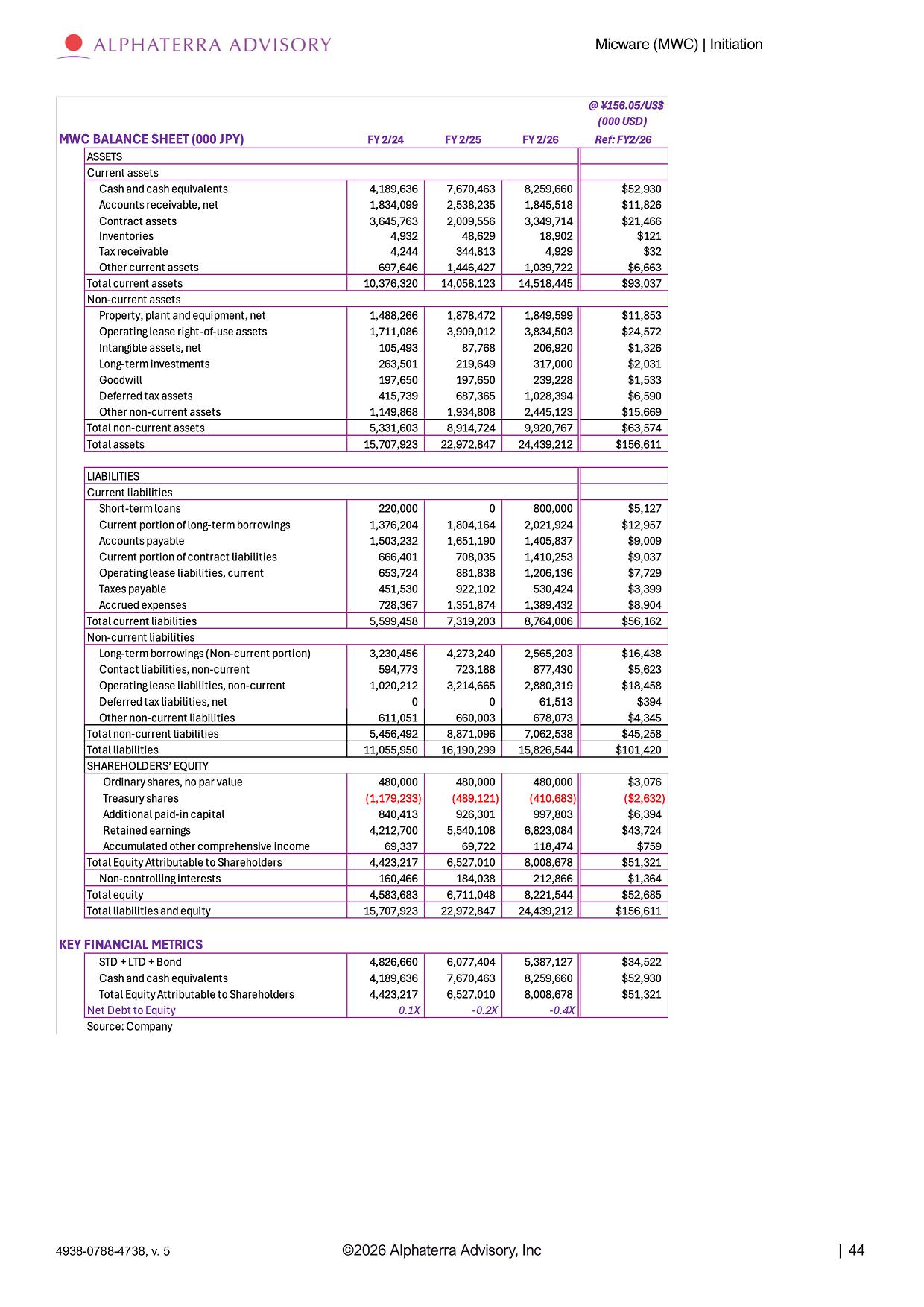
Micware (MWC) | Initiation ©2026 Alphaterra Advisory, Inc | 44 4938 - 0788 - 4738, v. 5
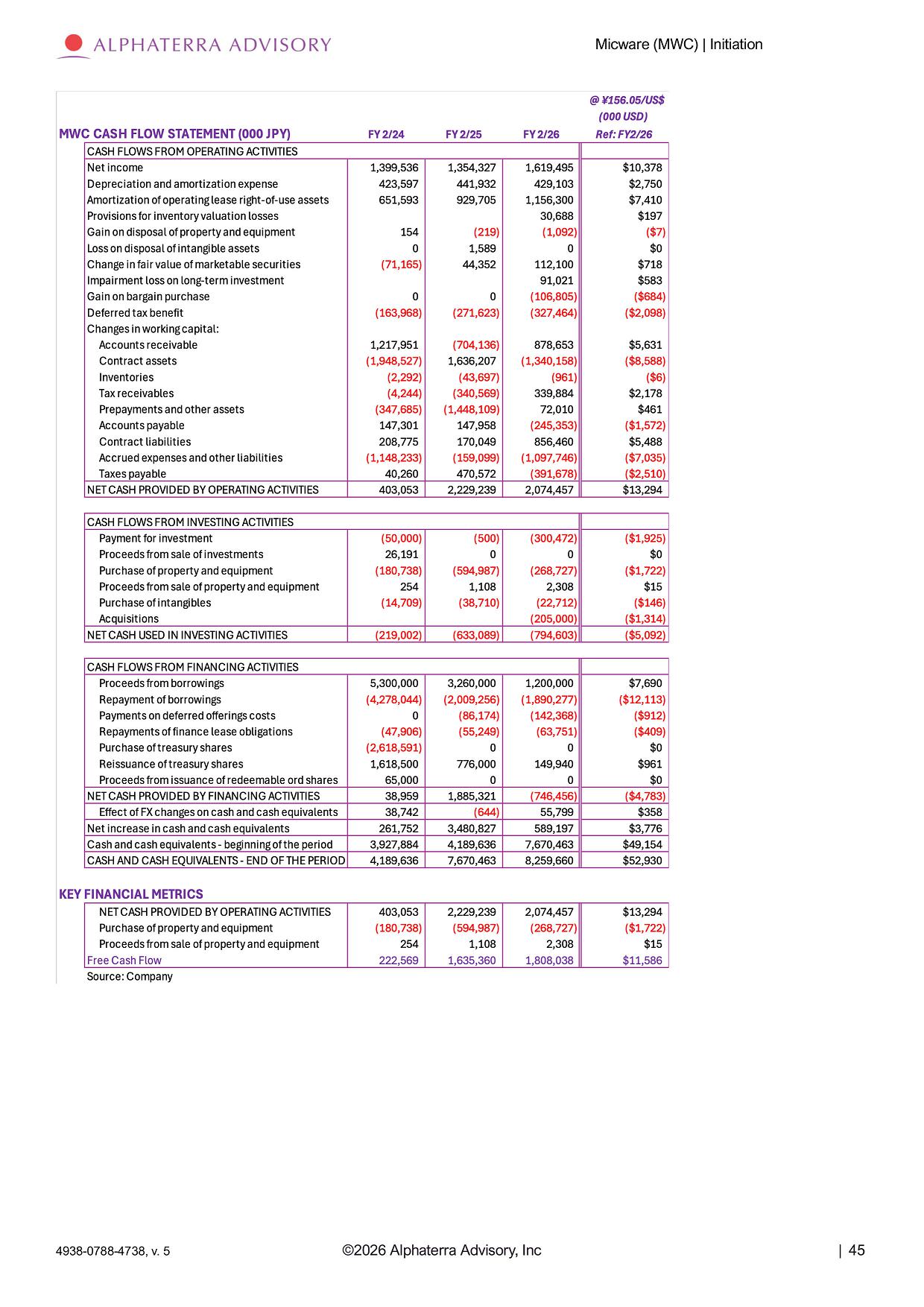
Micware (MWC) | Initiation ©2026 Alphaterra Advisory, Inc | 45 4938 - 0788 - 4738, v. 5
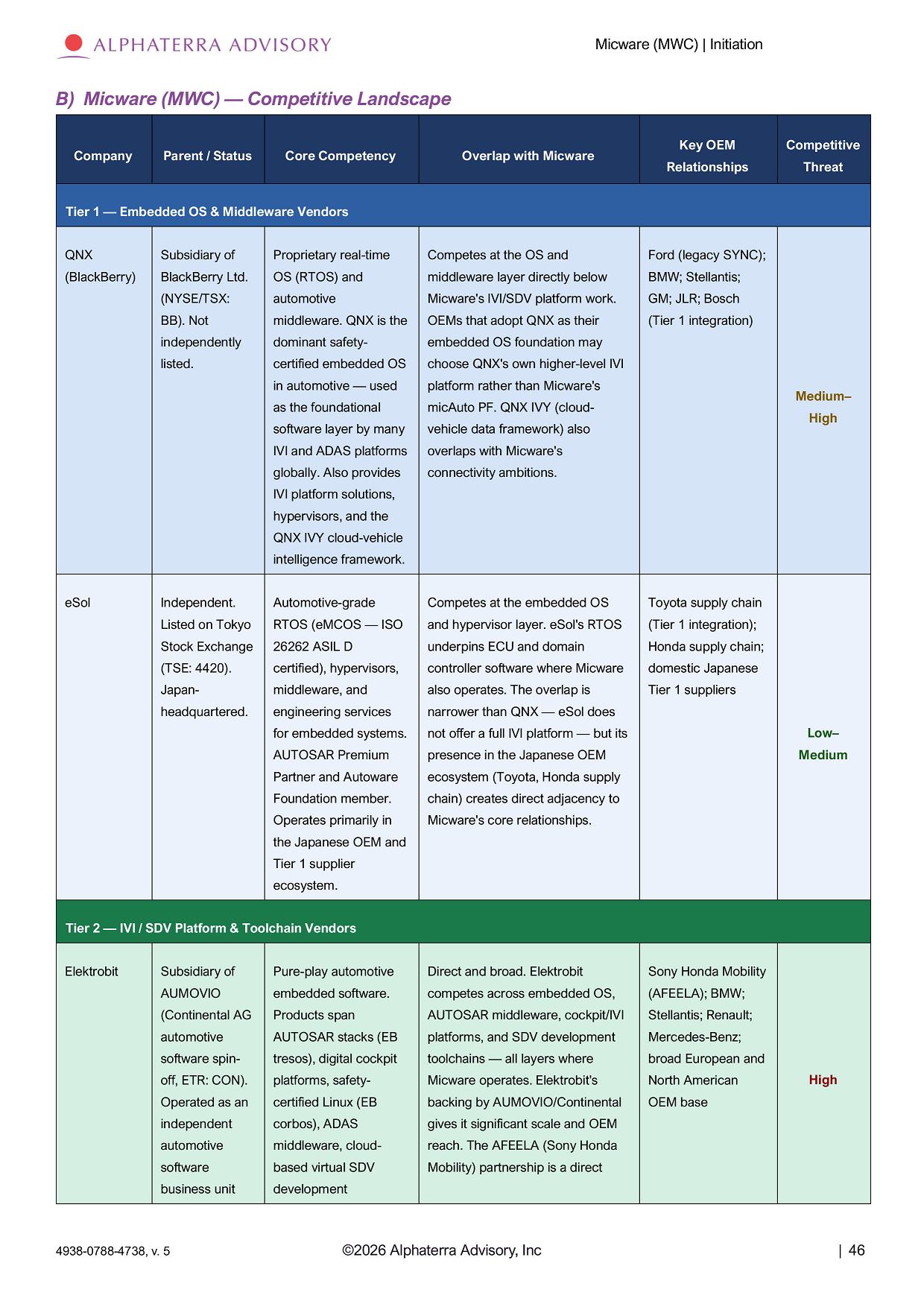
Micware (MWC) | Initiation ©2026 Alphaterra Advisory, Inc | 46 4938 - 0788 - 4738, v. 5 B) Micware (MWC) — Competitive Landscape Compe titi v e Threat Key OEM Re l a ti on s h i p s Overlap with Micware Core Competency Parent / Status Company Tier 1 — Embedded OS & Middleware Vendors Ford (legacy SYNC); Competes at the OS and Proprietary real - time Subsidiary of QNX BMW; Stellantis; middleware layer directly below OS (RTOS) and BlackBerry Ltd. (BlackBerry) GM; JLR; Bosch Micware's IVI/SDV platform work. automotive (NYSE/TSX: (Tier 1 integration) OEMs that adopt QNX as their middleware. QNX is the BB). Not embedded OS foundation may dominant safety - independently choose QNX's own higher - level IVI certified embedded OS listed. Med i um – High platform rather than Micware's micAuto PF. QNX IVY (cloud - vehicle data framework) also in automotive — used as the foundational software layer by many overlaps with Micware's IVI and ADAS platforms connectivity ambitions. globally. Also provides IVI platform solutions, hypervisors, and the QNX IVY cloud - vehicle intelligence framework. Toyota supply chain Competes at the embedded OS Automotive - grade Independent. eSol (Tier 1 integration); and hypervisor layer. eSol's RTOS RTOS (eMCOS — ISO Listed on Tokyo Honda supply chain; underpins ECU and domain 26262 ASIL D Stock Exchange domestic Japanese controller software where Micware certified), hypervisors, (TSE: 4420). Tier 1 suppliers also operates. The overlap is middleware, and Japan - narrower than QNX — eSol does engineering services headquartered. Low – not offer a full IVI platform — but its for embedded systems. Medium presence in the Japanese OEM AUTOSAR Premium ecosystem (Toyota, Honda supply Partner and Autoware chain) creates direct adjacency to Foundation member. Micware's core relationships. Operates primarily in the Japanese OEM and Tier 1 supplier ecosystem. Tier 2 — IVI / SDV Platform & Toolchain Vendors Sony Honda Mobility Direct and broad. Elektrobit Pure - play automotive Subsidiary of Elektrobit (AFEELA); BMW; competes across embedded OS, embedded software. AUMOVIO Stellantis; Renault; AUTOSAR middleware, cockpit/IVI Products span (Continental AG Mercedes - Benz; platforms, and SDV development AUTOSAR stacks (EB automotive broad European and toolchains — all layers where tresos), digital cockpit software spin - High North American Micware operates. Elektrobit's platforms, safety - off, ETR: CON). OEM base backing by AUMOVIO/Continental certified Linux (EB Operated as an gives it significant scale and OEM corbos), ADAS independent reach. The AFEELA (Sony Honda middleware, cloud - automotive Mobility) partnership is a direct based virtual SDV software development business unit
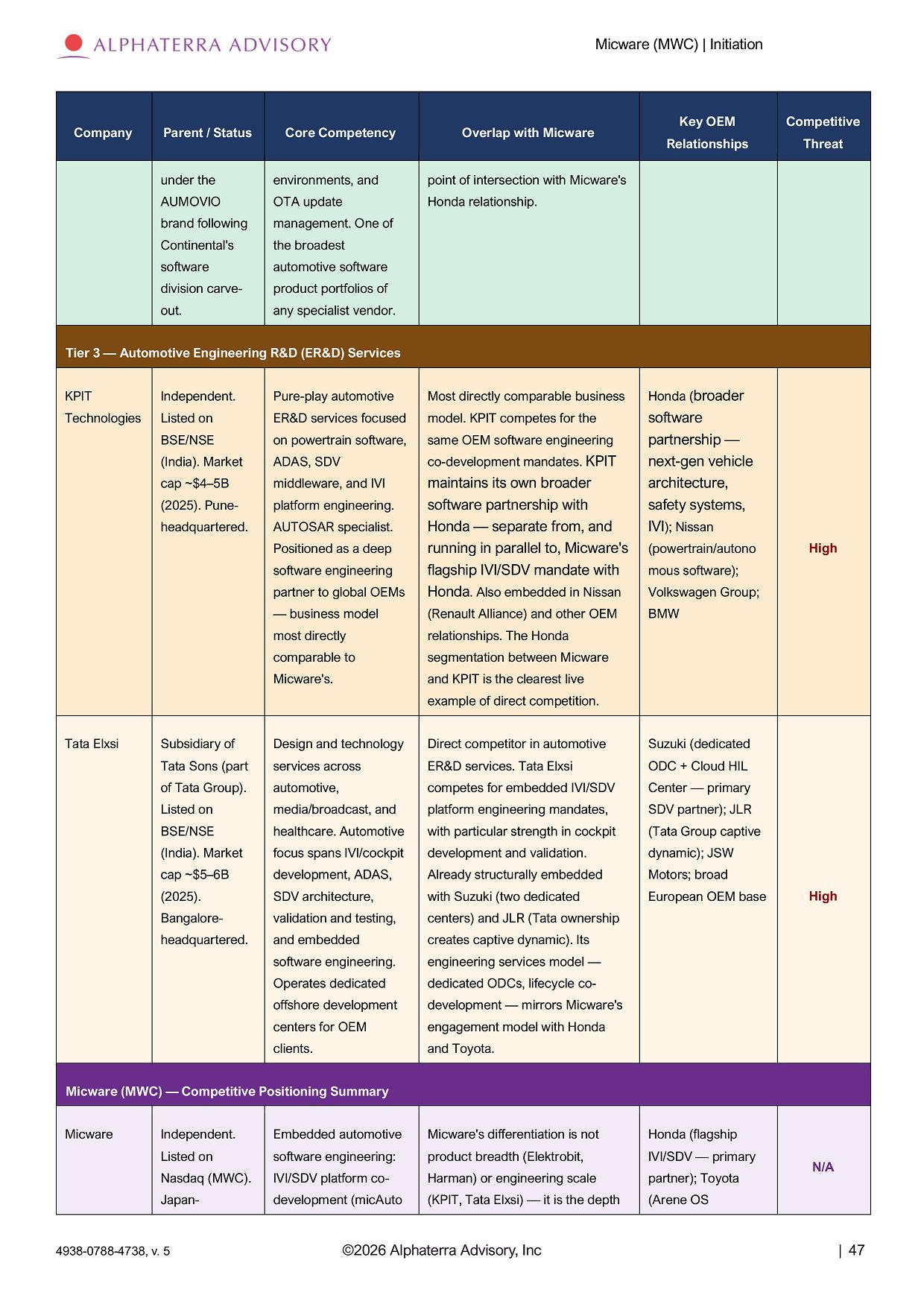
Micware (MWC) | Initiation ©2026 Alphaterra Advisory, Inc | 47 4938 - 0788 - 4738, v. 5 Compe titi v e Threat Key OEM Re l a ti on s h i p s Overlap with Micware Core Competency Parent / Status Company point of intersection with Micware's Honda relationship. environments, and OTA update management. One of the broadest automotive software product portfolios of any specialist vendor. under the AUMOV I O brand following Continental's software division carve - out. Tier 3 — Automotive Engineering R&D (ER&D) Services High Honda ( broader software partnership — next - gen vehicle architecture, safety systems, IVI ); Nissan ( powe rtr a i n / au t on o mous software); Volkswagen Group; BMW Most directly comparable business model. KPIT competes for the same OEM software engineering co - development mandates. KPIT maintains its own broader software partnership with Honda — separate from, and running in parallel to, Micware's flagship IVI/SDV mandate with Honda . Also embedded in Nissan (Renault Alliance) and other OEM relationships. The Honda segmentation between Micware and KPIT is the clearest live example of direct competition. Pure - play automotive ER&D services focused on powertrain software, ADAS, SDV middleware, and IVI platform engineering. AUTOSAR specialist. Positioned as a deep software engineering partner to global OEMs — business model most directly comparable to Micware's. I ndependen t . Listed on BSE/NSE (India). Market cap ~$4 – 5B (2025). Pune - headquartered. KPIT Technologies High Suzuki (dedicated ODC + Cloud HIL Center — primary SDV partner); JLR (Tata Group captive dynamic); JSW Motors; broad European OEM base Direct competitor in automotive ER&D services. Tata Elxsi competes for embedded IVI/SDV platform engineering mandates, with particular strength in cockpit development and validation. Already structurally embedded with Suzuki (two dedicated centers) and JLR (Tata ownership creates captive dynamic). Its engineering services model — dedicated ODCs, lifecycle co - development — mirrors Micware's engagement model with Honda and Toyota. Design and technology services across automotive, media/broadcast, and healthcare. Automotive focus spans IVI/cockpit development, ADAS, SDV architecture, validation and testing, and embedded software engineering. Operates dedicated offshore development centers for OEM clients. Subsidiary of Tata Sons (part of Tata Group). Listed on BSE/NSE (India). Market cap ~$5 – 6B (2025). Bangalore - he a dqua rt e r ed . Tata Elxsi Micware (MWC) — Competitive Positioning Summary N/A Honda (flagship IVI/SDV — primary partner); Toyota (Arene OS Micware's differentiation is not product breadth (Elektrobit, Harman) or engineering scale (KPIT, Tata Elxsi) — it is the depth Embedded automotive software engineering: IVI/SDV platform co - development (micAuto Independent. Listed on Nasdaq (MWC). Japan - Micware
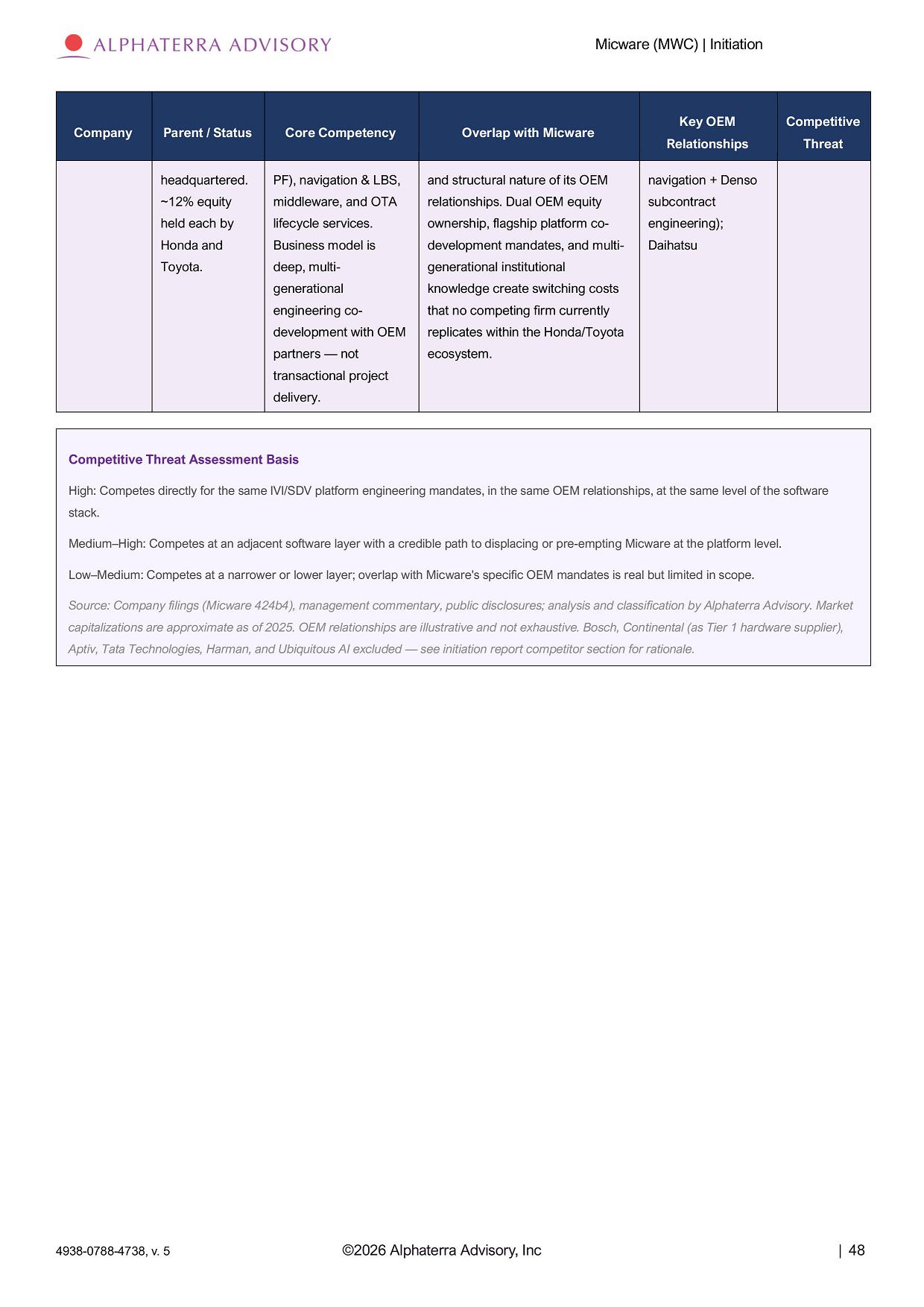
Micware (MWC) | Initiation ©2026 Alphaterra Advisory, Inc | 48 4938 - 0788 - 4738, v. 5 Compe titi v e Threat Key OEM Re l a ti on s h i p s Overlap with Micware Core Competency Parent / Status Company navigation + Denso and structural nature of its OEM PF), navigation & LBS, headquartered. subcontract relationships. Dual OEM equity middleware, and OTA ~12% equity engineering); ownership, flagship platform co - lifecycle services. held each by Daihatsu development mandates, and multi - Business model is Honda and generational institutional deep, multi - Toyota. knowledge create switching costs generational that no competing firm currently engineering co - replicates within the Honda/Toyota development with OEM ecosystem. partners — not transactional project delivery. Competitive Threat Assessment Basis High: Competes directly for the same IVI/SDV platform engineering mandates, in the same OEM relationships, at the same level of the software stack. Medium – High: Competes at an adjacent software layer with a credible path to displacing or pre - empting Micware at the platform level. Low – Medium: Competes at a narrower or lower layer; overlap with Micware's specific OEM mandates is real but limited in scope. Source: Company filings (Micware 424b4), management commentary, public disclosures; analysis and classification by Alphaterra Advisory. Market capitalizations are approximate as of 2025. OEM relationships are illustrative and not exhaustive. Bosch, Continental (as Tier 1 hardware supplier), Aptiv, Tata Technologies, Harman, and Ubiquitous AI excluded — see initiation report competitor section for rationale.
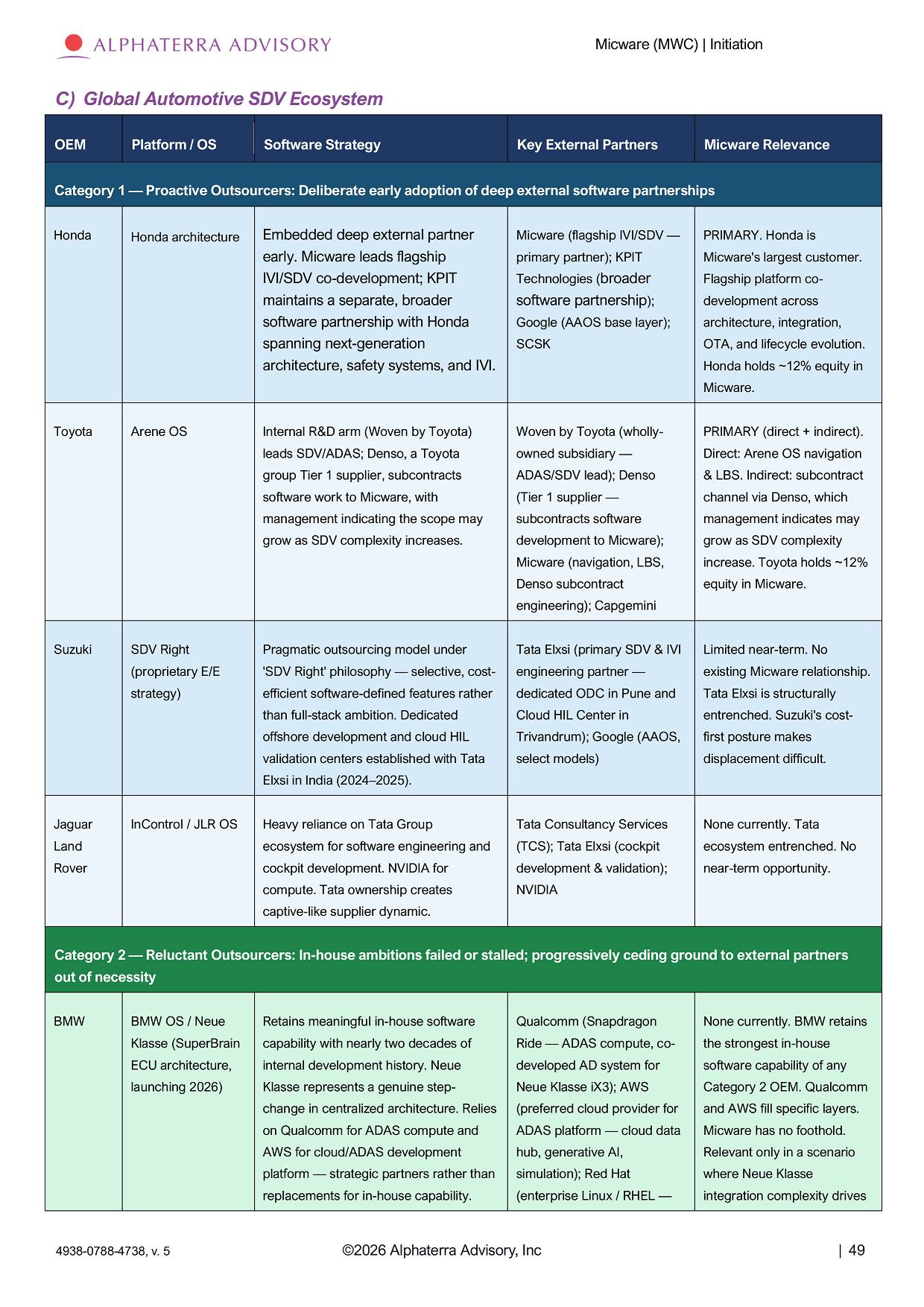
Micware (MWC) | Initiation ©2026 Alphaterra Advisory, Inc | 49 4938 - 0788 - 4738, v. 5 C) Global Automotive SDV Ecosystem Micware Relevance Key External Partners Software Strategy Platform / OS OEM Category 1 — Proactive Outsourcers: Deliberate early adoption of deep external software partnerships PRIMARY. Honda is Micware's largest customer. Flagship platform co - development across architecture, integration, OTA, and lifecycle evolution. Honda holds ~12% equity in Micware. Micware (flagship IVI/SDV — primary partner); KPIT Technologies ( broader software partnership ); Google (AAOS base layer); SCSK Embedded deep external partner early. Micware leads flagship IVI/SDV co - development; KPIT maintains a separate, broader software partnership with Honda spanning next - generation architecture, safety systems, and IVI. Honda architecture Honda PRIMARY (direct + indirect). Direct: Arene OS navigation & LBS. Indirect: subcontract channel via Denso, which management indicates may grow as SDV complexity increase. Toyota holds ~12% equity in Micware. Woven by Toyota (wholly - owned subsidiary — ADAS/SDV lead); Denso (Tier 1 supplier — subcontracts software development to Micware); Micware (navigation, LBS, Denso subcontract engineering); Capgemini Internal R&D arm (Woven by Toyota) leads SDV/ADAS; Denso, a Toyota group Tier 1 supplier, subcontracts software work to Micware, with management indicating the scope may grow as SDV complexity increases. Arene OS Toyota Limited near - term. No existing Micware relationship. Tata Elxsi is structurally entrenched. Suzuki's cost - first posture makes displacement difficult. Tata Elxsi (primary SDV & IVI engineering partner — dedicated ODC in Pune and Cloud HIL Center in Trivandrum); Google (AAOS, select models) Pragmatic outsourcing model under 'SDV Right' philosophy — selective, cost - efficient software - defined features rather than full - stack ambition. Dedicated offshore development and cloud HIL validation centers established with Tata Elxsi in India (2024 – 2025). SDV Right (proprietary E/E strategy) Suzuki None currently. Tata ecosystem entrenched. No near - term opportunity. Tata Consultancy Services (TCS); Tata Elxsi (cockpit development & validation); NVIDIA Heavy reliance on Tata Group ecosystem for software engineering and cockpit development. NVIDIA for compute. Tata ownership creates captive - like supplier dynamic. InControl / JLR OS Ja gua r Land Rover Category 2 — Reluctant Outsourcers: In - house ambitions failed or stalled; progressively ceding ground to external partners out of necessity None currently. BMW retains the strongest in - house software capability of any Category 2 OEM. Qualcomm and AWS fill specific layers. Micware has no foothold. Relevant only in a scenario where Neue Klasse integration complexity drives Qualcomm (Snapdragon Ride — ADAS compute, co - developed AD system for Neue Klasse iX3); AWS (preferred cloud provider for ADAS platform — cloud data hub, generative AI, simulation); Red Hat (enterprise Linux / RHEL — Retains meaningful in - house software capability with nearly two decades of internal development history. Neue Klasse represents a genuine step - change in centralized architecture. Relies on Qualcomm for ADAS compute and AWS for cloud/ADAS development platform — strategic partners rather than replacements for in - house capability. BMW OS / Neue Klasse (SuperBrain ECU architecture, launching 2026) BMW
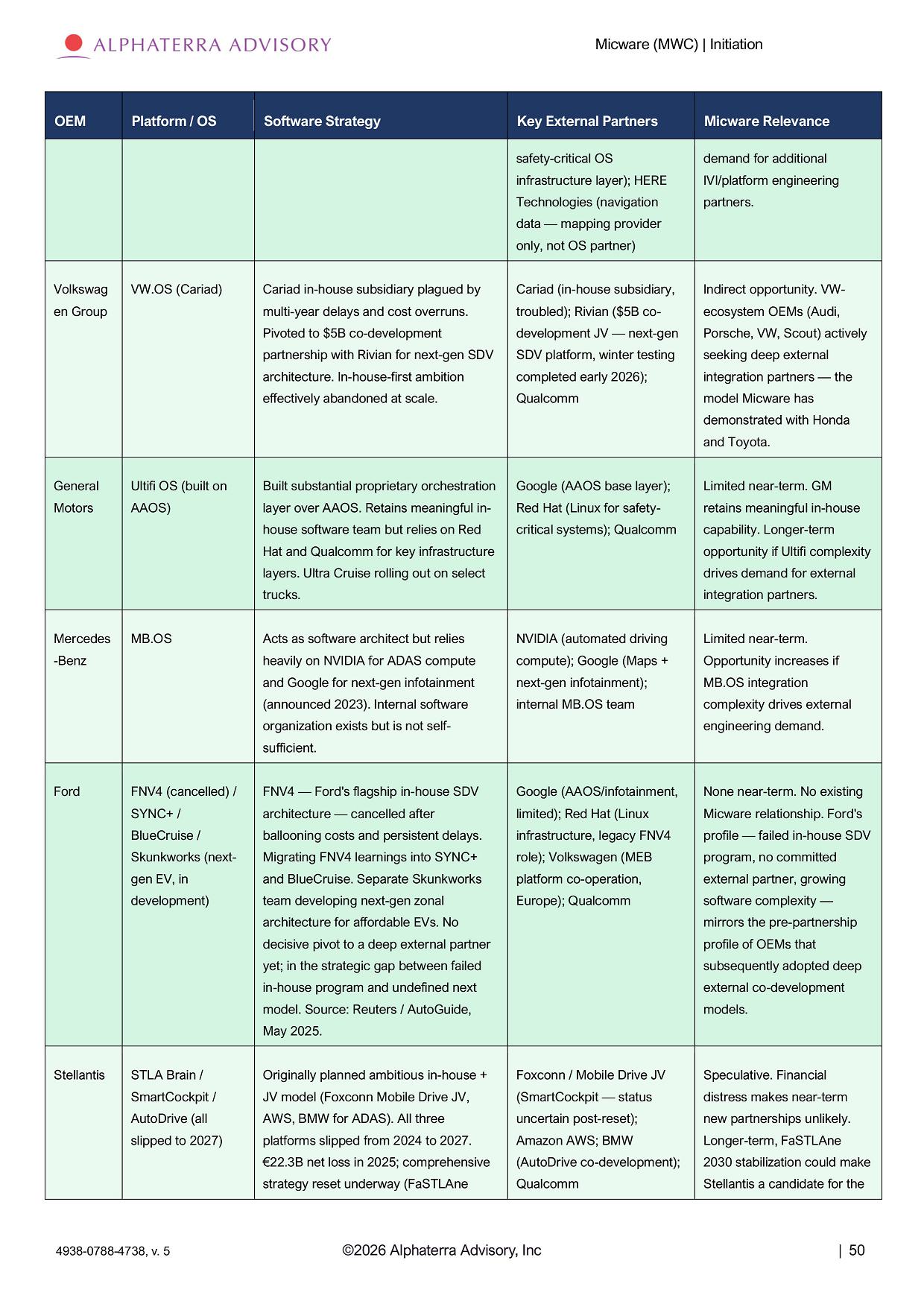
Micware (MWC) | Initiation ©2026 Alphaterra Advisory, Inc | 50 4938 - 0788 - 4738, v. 5 Micware Relevance Key External Partners Software Strategy Platform / OS OEM demand for additional safety - critical OS IVI/platform engineering infrastructure layer); HERE partners. Technologies (navigation data — mapping provider only, not OS partner) Indirect opportunity. VW - Cariad (in - house subsidiary, Cariad in - house subsidiary plagued by VW.OS (Cariad) Volkswag ecosystem OEMs (Audi, troubled); Rivian ($5B co - multi - year delays and cost overruns. en Group Porsche, VW, Scout) actively development JV — next - gen Pivoted to $5B co - development seeking deep external SDV platform, winter testing partnership with Rivian for next - gen SDV integration partners — the completed early 2026); architecture. In - house - first ambition model Micware has Qualcomm effectively abandoned at scale. demonstrated with Honda and Toyota. Limited near - term. GM Google (AAOS base layer); Built substantial proprietary orchestration Ultifi OS (built on General retains meaningful in - house Red Hat (Linux for safety - layer over AAOS. Retains meaningful in - AAOS) Motors capability. Longer - term critical systems); Qualcomm house software team but relies on Red opportunity if Ultifi complexity Hat and Qualcomm for key infrastructure drives demand for external layers. Ultra Cruise rolling out on select integration partners. trucks. Limited near - term. NVIDIA (automated driving Acts as software architect but relies MB.OS Mercedes Opportunity increases if compute); Google (Maps + heavily on NVIDIA for ADAS compute - Benz MB.OS integration next - gen infotainment); and Google for next - gen infotainment complexity drives external internal MB.OS team (announced 2023). Internal software engineering demand. organization exists but is not self - sufficient. None near - term. No existing Google (AAOS/infotainment, FNV4 — Ford's flagship in - house SDV FNV4 (cancelled) / Ford Micware relationship. Ford's limited); Red Hat (Linux architecture — cancelled after SYNC+ / profile — failed in - house SDV infrastructure, legacy FNV4 ballooning costs and persistent delays. BlueCruise / program, no committed role); Volkswagen (MEB Migrating FNV4 learnings into SYNC+ Skunkworks (next - external partner, growing platform co - operation, and BlueCruise. Separate Skunkworks gen EV, in software complexity — Europe); Qualcomm team developing next - gen zonal development) mirrors the pre - partnership architecture for affordable EVs. No profile of OEMs that decisive pivot to a deep external partner subsequently adopted deep yet; in the strategic gap between failed external co - development in - house program and undefined next models. model. Source: Reuters / AutoGuide, May 2025. Speculative. Financial Foxconn / Mobile Drive JV Originally planned ambitious in - house + STLA Brain / Stellantis distress makes near - term (SmartCockpit — status JV model (Foxconn Mobile Drive JV, SmartCockpit / new partnerships unlikely. uncertain post - reset); AWS, BMW for ADAS). All three AutoDrive (all Longer - term, FaSTLAne Amazon AWS; BMW platforms slipped from 2024 to 2027. slipped to 2027) 2030 stabilization could make (AutoDrive co - development); €22.3B net loss in 2025; comprehensive Stellantis a candidate for the Qualcomm strategy reset underway (FaSTLAne
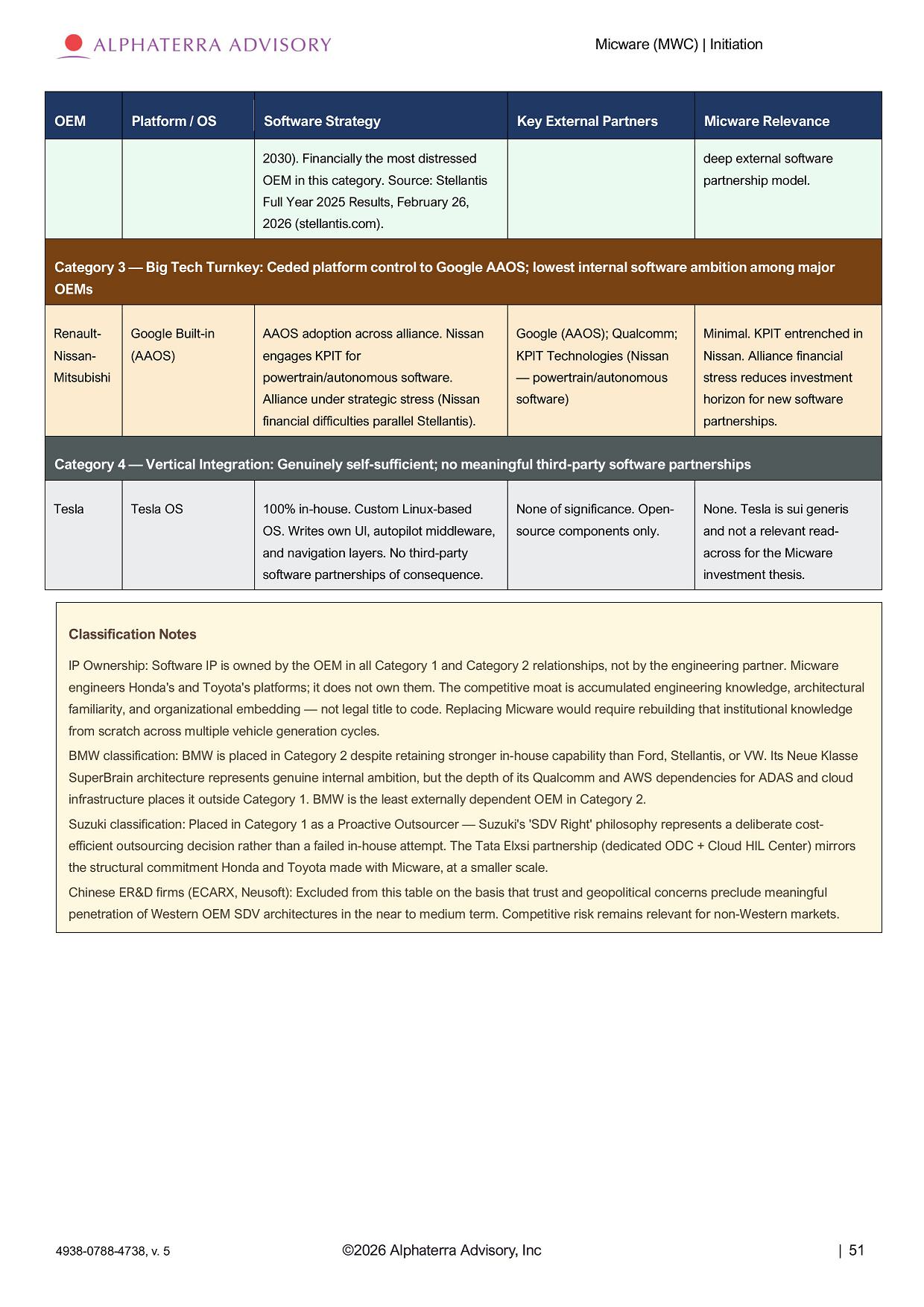
Micware (MWC) | Initiation ©2026 Alphaterra Advisory, Inc | 51 4938 - 0788 - 4738, v. 5 Micware Relevance Key External Partners Software Strategy Platform / OS OEM deep external software partnership model. 2030). Financially the most distressed OEM in this category. Source: Stellantis Full Year 2025 Results, February 26, 2026 (stellantis.com). Category 3 — Big Tech Turnkey: Ceded platform control to Google AAOS; lowest internal software ambition among major OEMs Minimal. KPIT entrenched in Nissan. Alliance financial stress reduces investment horizon for new software partnerships. Google (AAOS); Qualcomm; KPIT Technologies (Nissan — powertrain/autonomous software) AAOS adoption across alliance. Nissan engages KPIT for powertrain/autonomous software. Alliance under strategic stress (Nissan financial difficulties parallel Stellantis). Google Built - in (AAOS) Renault - Nissan - M its ub is h i Category 4 — Vertical Integration: Genuinely self - sufficient; no meaningful third - party software partnerships None. Tesla is sui generis and not a relevant read - across for the Micware investment thesis. None of significance. Open - source components only. 100% in - house. Custom Linux - based OS. Writes own UI, autopilot middleware, and navigation layers. No third - party software partnerships of consequence. Tesla OS Tesla Classification Notes IP Ownership: Software IP is owned by the OEM in all Category 1 and Category 2 relationships, not by the engineering partner. Micware engineers Honda's and Toyota's platforms; it does not own them. The competitive moat is accumulated engineering knowledge, architectural familiarity, and organizational embedding — not legal title to code. Replacing Micware would require rebuilding that institutional knowledge from scratch across multiple vehicle generation cycles. BMW classification: BMW is placed in Category 2 despite retaining stronger in - house capability than Ford, Stellantis, or VW. Its Neue Klasse SuperBrain architecture represents genuine internal ambition, but the depth of its Qualcomm and AWS dependencies for ADAS and cloud infrastructure places it outside Category 1. BMW is the least externally dependent OEM in Category 2. Suzuki classification: Placed in Category 1 as a Proactive Outsourcer — Suzuki's 'SDV Right' philosophy represents a deliberate cost - efficient outsourcing decision rather than a failed in - house attempt. The Tata Elxsi partnership (dedicated ODC + Cloud HIL Center) mirrors the structural commitment Honda and Toyota made with Micware, at a smaller scale. Chinese ER&D firms (ECARX, Neusoft): Excluded from this table on the basis that trust and geopolitical concerns preclude meaningful penetration of Western OEM SDV architectures in the near to medium term. Competitive risk remains relevant for non - Western markets.
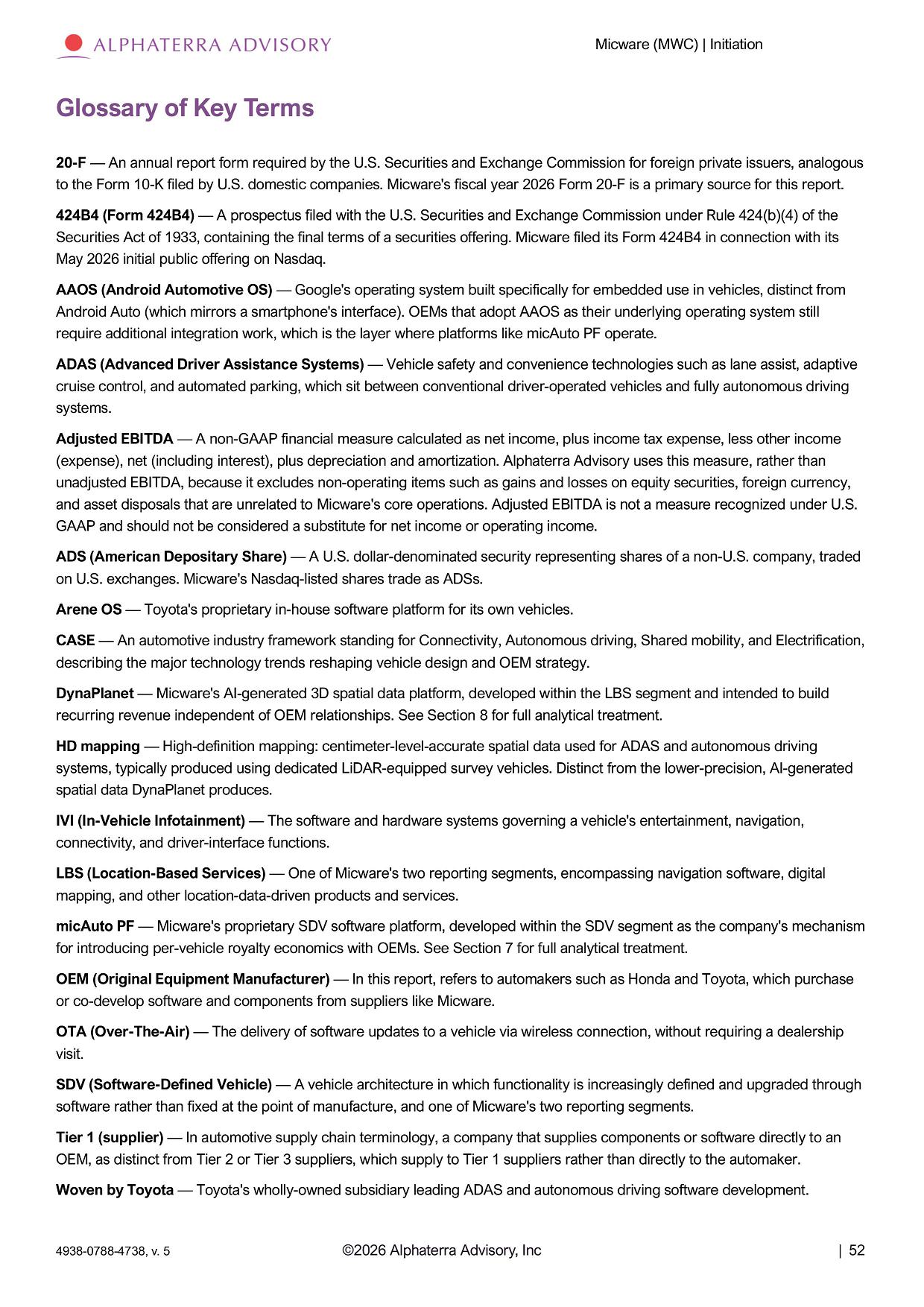
Micware (MWC) | Initiation ©2026 Alphaterra Advisory, Inc | 52 4938 - 0788 - 4738, v. 5 Glossary of Key Terms 20 - F — An annual report form required by the U.S. Securities and Exchange Commission for foreign private issuers, analogous to the Form 10 - K filed by U.S. domestic companies. Micware's fiscal year 2026 Form 20 - F is a primary source for this report. 424 B 4 (Form 424 B 4 ) — A prospectus filed with the U . S . Securities and Exchange Commission under Rule 424 (b)( 4 ) of the Securities Act of 1933 , containing the final terms of a securities offering . Micware filed its Form 424 B 4 in connection with its May 2026 initial public offering on Nasdaq . AAOS (Android Automotive OS) — Google's operating system built specifically for embedded use in vehicles, distinct from Android Auto (which mirrors a smartphone's interface). OEMs that adopt AAOS as their underlying operating system still require additional integration work, which is the layer where platforms like micAuto PF operate. ADAS (Advanced Driver Assistance Systems) — Vehicle safety and convenience technologies such as lane assist, adaptive cruise control, and automated parking, which sit between conventional driver - operated vehicles and fully autonomous driving systems. Adjusted EBITDA — A non - GAAP financial measure calculated as net income, plus income tax expense, less other income (expense), net (including interest), plus depreciation and amortization. Alphaterra Advisory uses this measure, rather than unadjusted EBITDA, because it excludes non - operating items such as gains and losses on equity securities, foreign currency, and asset disposals that are unrelated to Micware's core operations. Adjusted EBITDA is not a measure recognized under U.S. GAAP and should not be considered a substitute for net income or operating income. ADS (American Depositary Share) — A U.S. dollar - denominated security representing shares of a non - U.S. company, traded on U.S. exchanges. Micware's Nasdaq - listed shares trade as ADSs. Arene OS — Toyota's proprietary in - house software platform for its own vehicles. CASE — An automotive industry framework standing for Connectivity, Autonomous driving, Shared mobility, and Electrification, describing the major technology trends reshaping vehicle design and OEM strategy. DynaPlanet — Micware's AI - generated 3D spatial data platform, developed within the LBS segment and intended to build recurring revenue independent of OEM relationships. See Section 8 for full analytical treatment. HD mapping — High - definition mapping: centimeter - level - accurate spatial data used for ADAS and autonomous driving systems, typically produced using dedicated LiDAR - equipped survey vehicles. Distinct from the lower - precision, AI - generated spatial data DynaPlanet produces. IVI (In - Vehicle Infotainment) — The software and hardware systems governing a vehicle's entertainment, navigation, connectivity, and driver - interface functions. LBS (Location - Based Services) — One of Micware's two reporting segments, encompassing navigation software, digital mapping, and other location - data - driven products and services. micAuto PF — Micware's proprietary SDV software platform, developed within the SDV segment as the company's mechanism for introducing per - vehicle royalty economics with OEMs. See Section 7 for full analytical treatment. OEM (Original Equipment Manufacturer) — In this report, refers to automakers such as Honda and Toyota, which purchase or co - develop software and components from suppliers like Micware. OTA (Over - The - Air) — The delivery of software updates to a vehicle via wireless connection, without requiring a dealership visit. SDV (Software - Defined Vehicle) — A vehicle architecture in which functionality is increasingly defined and upgraded through software rather than fixed at the point of manufacture, and one of Micware's two reporting segments. Tier 1 (supplier) — In automotive supply chain terminology, a company that supplies components or software directly to an OEM, as distinct from Tier 2 or Tier 3 suppliers, which supply to Tier 1 suppliers rather than directly to the automaker. Woven by Toyota — Toyota's wholly - owned subsidiary leading ADAS and autonomous driving software development.
Micware (MWC) | Initiation D i s c l a i m e r This report has been prepared by Alphaterra Advisory Inc. (“Alphaterra”) at the request of, and for a fee paid by, Micware Co., Ltd. (the “Company”). Alphaterra received $50,000 in cash from the Company for the preparation and publication of this report. This report is provided for general information purposes only and does not constitute a solicitation, recommendation, personal investment advice, or brokerage/dealer advice or service with respect to any securities. Alphaterra is not a registered broker - dealer or investment adviser and is not a financial instruments business operator in the United States and is not registered as a Financial Instruments Business Operator under Japan’s Financial Instruments and Exchange Act. This report does not assign a rating, price target or investment recommendation of any kind. Information and opinions are based on sources believed to be reliable and/or publicly available; however, no representation or warranty is made as to accuracy, completeness, or timeliness. Forward - looking statements are as of the date hereof and are subject to change without notice. As of the publication date, Alphaterra and its author/analyst do not hold any securities of the Company. Alphaterra accepts no liability for any loss arising from the use of this report. Any investment decision is made solely at the reader’s own risk. Copyright and all related rights in this report are owned by the Company, and no part of this report may be copied, reproduced, or redistributed without the Company’s prior consent. Distribution may be restricted in certain jurisdictions; recipients are responsible for compliance with applicable laws. Prepared by: Alphaterra Advisory Inc. (Alphaterra) Website: https://alphaterraadvisory.com Email: info@alphaterraadvisory.com ©2026 Alphaterra Advisory, Inc | 53 4938 - 0788 - 4738, v. 5