Risk and Capital Management - Pillar 3 Second quarter of 2026
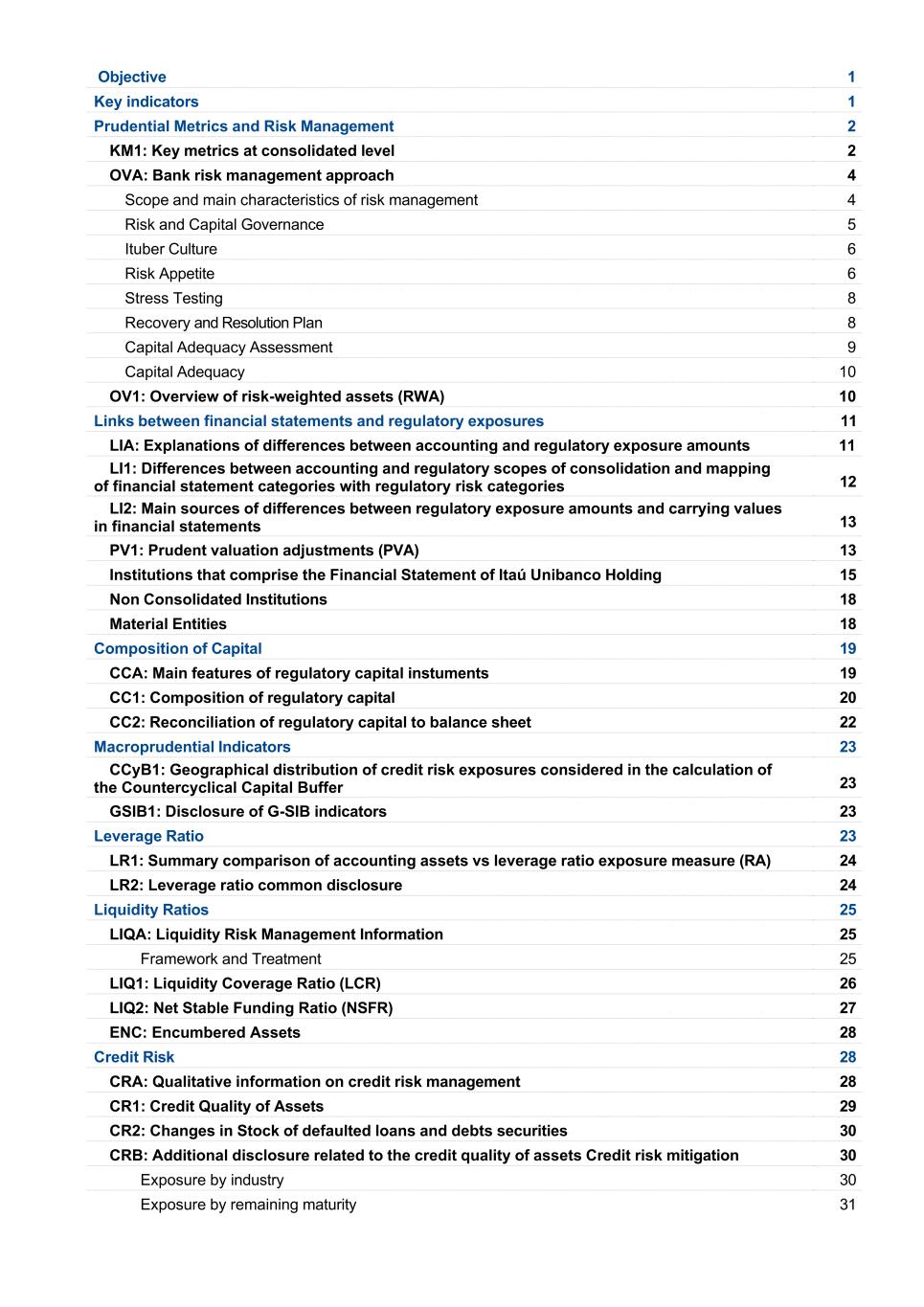
Objective 1 Key indicators 1 Prudential Metrics and Risk Management 2 KM1: Key metrics at consolidated level 2 OVA: Bank risk management approach 4 Scope and main characteristics of risk management 4 Risk and Capital Governance 5 Ituber Culture 6 Risk Appetite 6 Stress Testing 8 Recovery and Resolution Plan 8 Capital Adequacy Assessment 9 Capital Adequacy 10 OV1: Overview of risk-weighted assets (RWA) 10 Links between financial statements and regulatory exposures 11 LIA: Explanations of differences between accounting and regulatory exposure amounts 11 LI1: Differences between accounting and regulatory scopes of consolidation and mapping of financial statement categories with regulatory risk categories 12 LI2: Main sources of differences between regulatory exposure amounts and carrying values in financial statements 13 PV1: Prudent valuation adjustments (PVA) 13 Institutions that comprise the Financial Statement of Itaú Unibanco Holding 15 Non Consolidated Institutions 18 Material Entities 18 Composition of Capital 19 CCA: Main features of regulatory capital instuments 19 CC1: Composition of regulatory capital 20 CC2: Reconciliation of regulatory capital to balance sheet 22 Macroprudential Indicators 23 CCyB1: Geographical distribution of credit risk exposures considered in the calculation of the Countercyclical Capital Buffer 23 GSIB1: Disclosure of G-SIB indicators 23 Leverage Ratio 23 LR1: Summary comparison of accounting assets vs leverage ratio exposure measure (RA) 24 LR2: Leverage ratio common disclosure 24 Liquidity Ratios 25 LIQA: Liquidity Risk Management Information 25 Framework and Treatment 25 LIQ1: Liquidity Coverage Ratio (LCR) 26 LIQ2: Net Stable Funding Ratio (NSFR) 27 ENC: Encumbered Assets 28 Credit Risk 28 CRA: Qualitative information on credit risk management 28 CR1: Credit Quality of Assets 29 CR2: Changes in Stock of defaulted loans and debts securities 30 CRB: Additional disclosure related to the credit quality of assets Credit risk mitigation 30 Exposure by industry 30 Exposure by remaining maturity 31
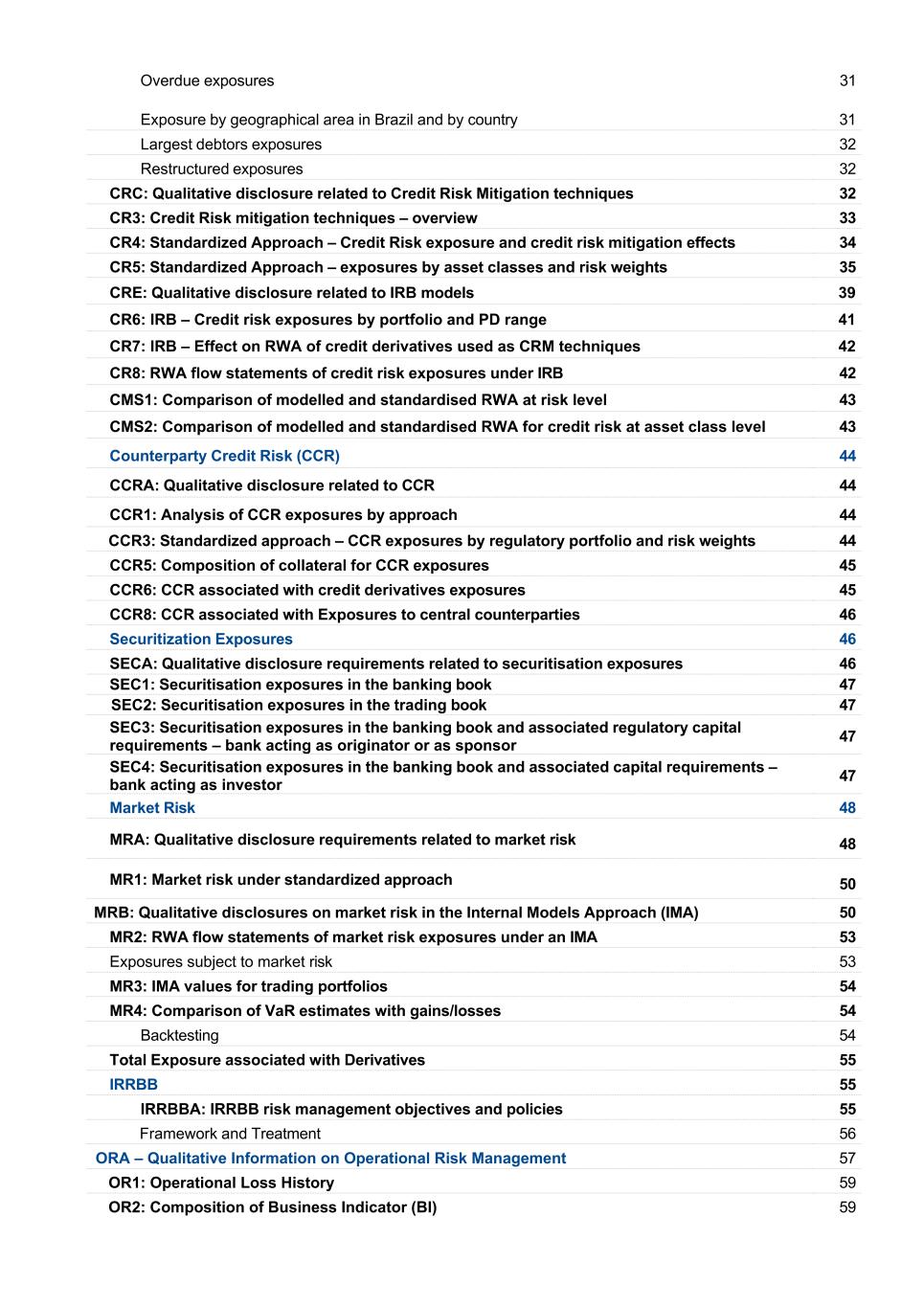
Overdue exposures 31 Exposure by geographical area in Brazil and by country 31 Largest debtors exposures 32 Restructured exposures 32 CRC: Qualitative disclosure related to Credit Risk Mitigation techniques 32 CR3: Credit Risk mitigation techniques – overview 33 CR4: Standardized Approach – Credit Risk exposure and credit risk mitigation effects 34 CR5: Standardized Approach – exposures by asset classes and risk weights 35 CRE: Qualitative disclosure related to IRB models 39 CR6: IRB – Credit risk exposures by portfolio and PD range 41 CR7: IRB – Effect on RWA of credit derivatives used as CRM techniques 42 CR8: RWA flow statements of credit risk exposures under IRB 42 CMS1: Comparison of modelled and standardised RWA at risk level 43 CMS2: Comparison of modelled and standardised RWA for credit risk at asset class level 43 Counterparty Credit Risk (CCR) 44 CCRA: Qualitative disclosure related to CCR 44 CCR1: Analysis of CCR exposures by approach 44 CCR3: Standardized approach – CCR exposures by regulatory portfolio and risk weights 44 CCR5: Composition of collateral for CCR exposures 45 CCR6: CCR associated with credit derivatives exposures 45 CCR8: CCR associated with Exposures to central counterparties 46 Securitization Exposures 46 SECA: Qualitative disclosure requirements related to securitisation exposures 46 SEC1: Securitisation exposures in the banking book 47 SEC2: Securitisation exposures in the trading book 47 SEC3: Securitisation exposures in the banking book and associated regulatory capital requirements – bank acting as originator or as sponsor 47 SEC4: Securitisation exposures in the banking book and associated capital requirements – bank acting as investor 47 Market Risk 48 MRA: Qualitative disclosure requirements related to market risk 48 MR1: Market risk under standardized approach 50 MRB: Qualitative disclosures on market risk in the Internal Models Approach (IMA) 50 MR2: RWA flow statements of market risk exposures under an IMA 53 Exposures subject to market risk 53 MR3: IMA values for trading portfolios 54 MR4: Comparison of VaR estimates with gains/losses 54 Backtesting 54 Total Exposure associated with Derivatives 55 IRRBB 55 IRRBBA: IRRBB risk management objectives and policies 55 Framework and Treatment 56 ORA – Qualitative Information on Operational Risk Management 57 OR1: Operational Loss History 59 OR2: Composition of Business Indicator (BI) 59
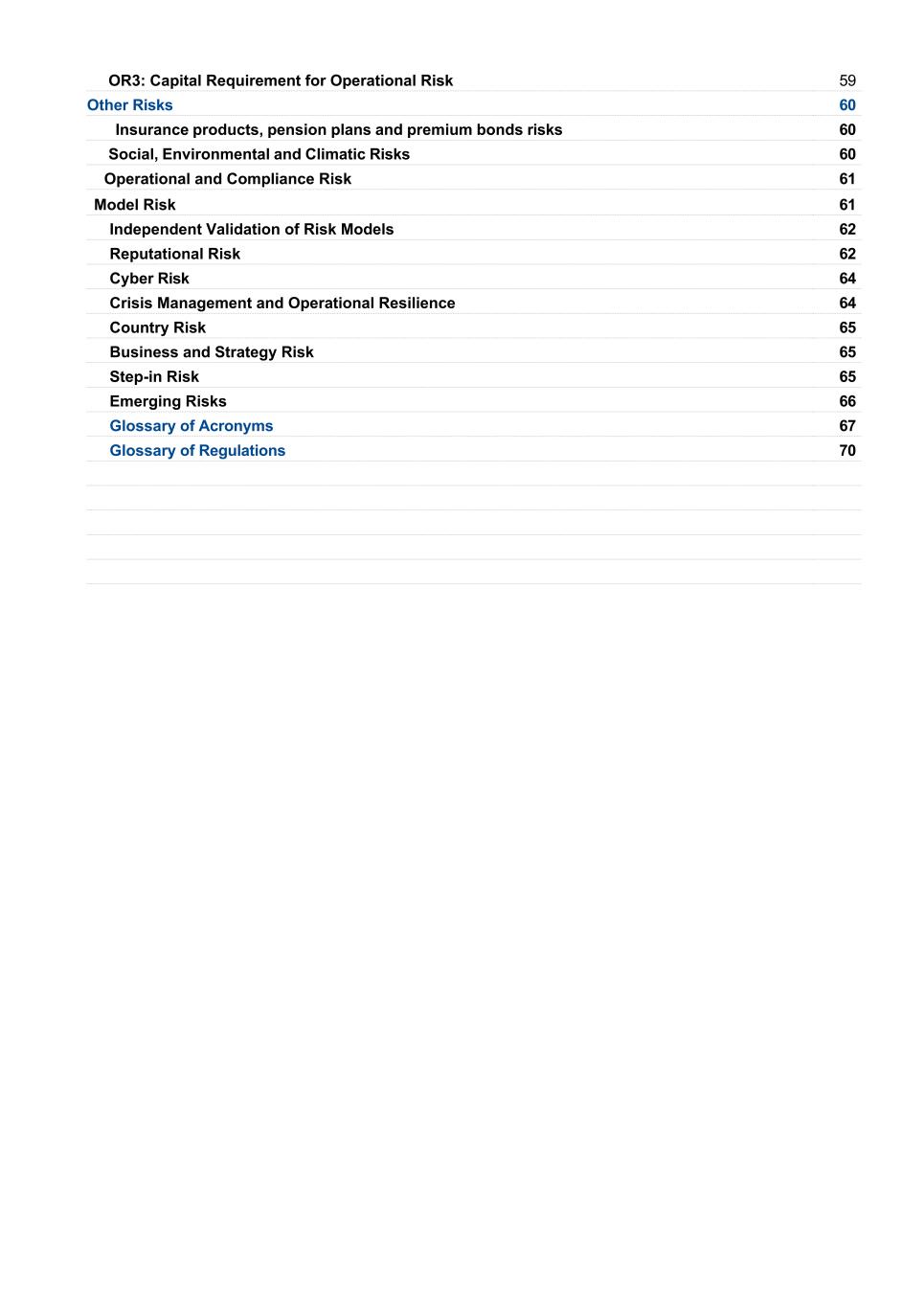
OR3: Capital Requirement for Operational Risk 59 Other Risks 60 Insurance products, pension plans and premium bonds risks 60 Social, Environmental and Climatic Risks 60 Operational and Compliance Risk 61 Model Risk 61 Independent Validation of Risk Models 62 Reputational Risk 62 Cyber Risk 64 Crisis Management and Operational Resilience 64 Country Risk 65 Business and Strategy Risk 65 Step-in Risk 65 Emerging Risks 66 Glossary of Acronyms 67 Glossary of Regulations 70
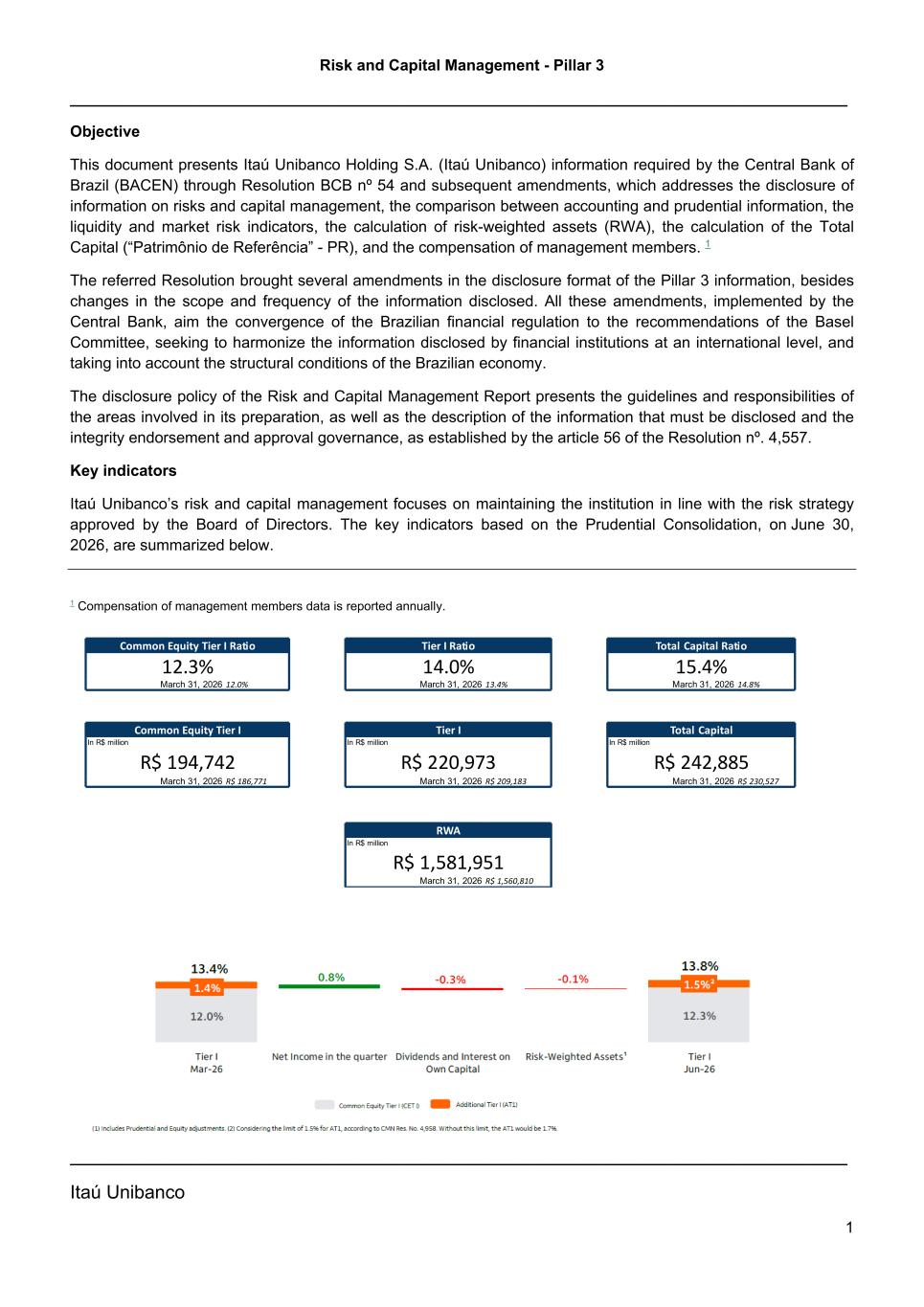
Risk and Capital Management - Pillar 3 __________________________________________________________________________________________ __________________________________________________________________________________________ Itaú Unibanco 1 Objective This document presents Itaú Unibanco Holding S.A. (Itaú Unibanco) information required by the Central Bank of Brazil (BACEN) through Resolution BCB nº 54 and subsequent amendments, which addresses the disclosure of information on risks and capital management, the comparison between accounting and prudential information, the liquidity and market risk indicators, the calculation of risk-weighted assets (RWA), the calculation of the Total Capital (“Patrimônio de Referência” - PR), and the compensation of management members. 1 The referred Resolution brought several amendments in the disclosure format of the Pillar 3 information, besides changes in the scope and frequency of the information disclosed. All these amendments, implemented by the Central Bank, aim the convergence of the Brazilian financial regulation to the recommendations of the Basel Committee, seeking to harmonize the information disclosed by financial institutions at an international level, and taking into account the structural conditions of the Brazilian economy. The disclosure policy of the Risk and Capital Management Report presents the guidelines and responsibilities of the areas involved in its preparation, as well as the description of the information that must be disclosed and the integrity endorsement and approval governance, as established by the article 56 of the Resolution nº. 4,557. Key indicators Itaú Unibanco’s risk and capital management focuses on maintaining the institution in line with the risk strategy approved by the Board of Directors. The key indicators based on the Prudential Consolidation, on June 30, 2026, are summarized below. 1 Compensation of management members data is reported annually. Common Equity Tier I Ratio Tier I Ratio Total Capital Ratio 12.3% 14.0% 15.4% March 31, 2026 12.0% March 31, 2026 13.4% March 31, 2026 14.8% Common Equity Tier I Tier I Total Capital In R$ million In R$ million In R$ million R$ 194,742 R$ 220,973 R$ 242,885 March 31, 2026 R$ 186,771 March 31, 2026 R$ 209,183 March 31, 2026 R$ 230,527 RWA In R$ million R$ 1,581,951 March 31, 2026 R$ 1,560,810
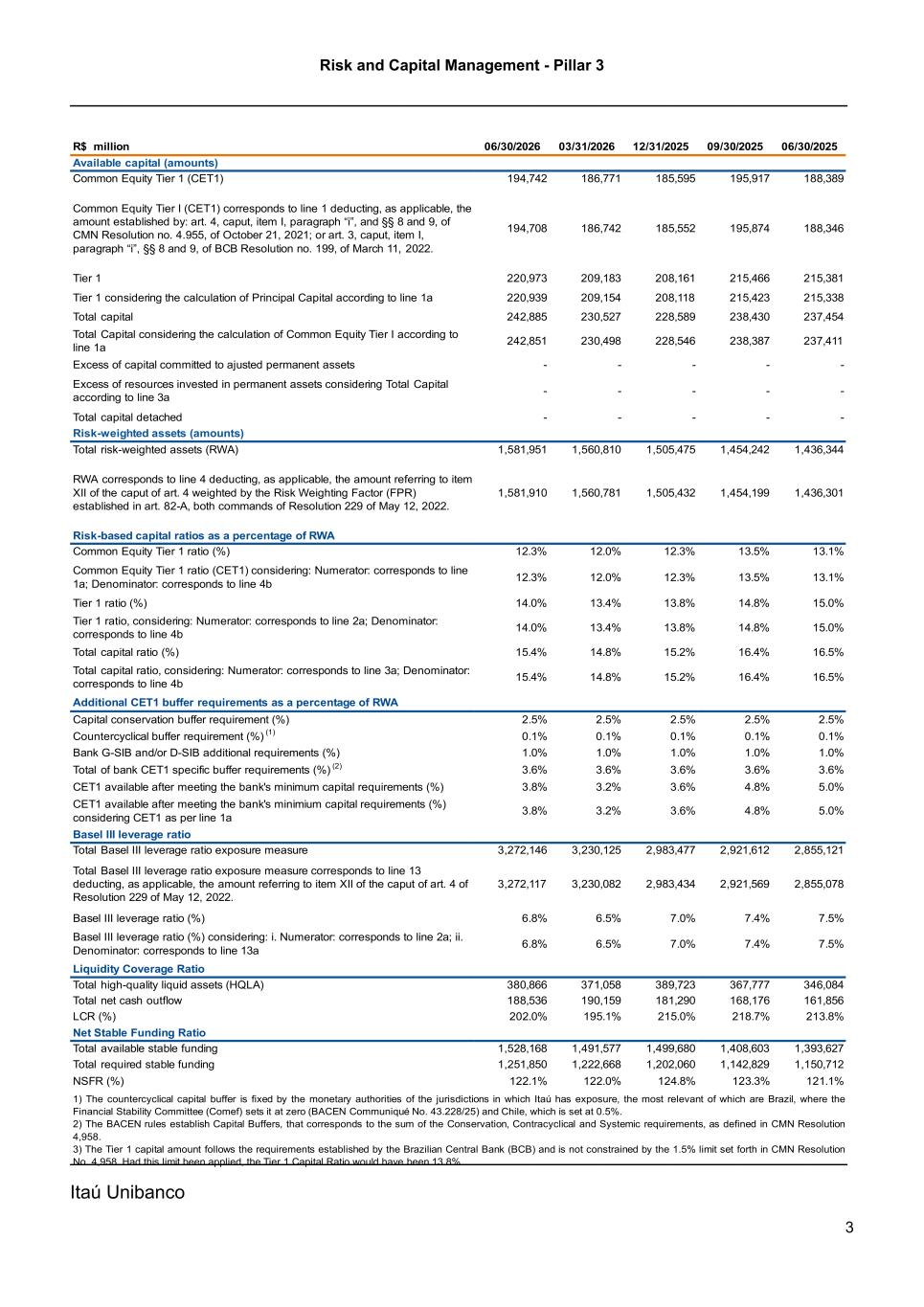
Risk and Capital Management - Pillar 3 __________________________________________________________________________________________ __________________________________________________________________________________________ Itaú Unibanco 2 Prudential Metrics and Risk Management Itaú Unibanco invests in robust and company-wide risk management processes to serve as a basis for its strategic decisions intended to ensure business sustainability. The key prudential metrics related to regulatory capital and information on the bank’s integrated risk management are presented below. KM1: Key metrics at consolidated level In order to ensure the soundness of Itaú Unibanco and the availability of capital to support business growth, Itaú Unibanco maintains capital levels above the minimum requirements, as demonstrated by the Common Equity Tier I, Tier I Capital and Total CapitaI ratios. On June 30, 2026, the Total Capital (PR) reached R$ 242,885 million, R$ 220,973 million of Tier I and R$ 21,912 million of Tier II.
Risk and Capital Management - Pillar 3 __________________________________________________________________________________________ __________________________________________________________________________________________ Itaú Unibanco 3 a b c d e R$ million 06/30/2026 03/31/2026 12/31/2025 09/30/2025 06/30/2025 Available capital (amounts) Common Equity Tier 1 (CET1) 194,742 186,771 185,595 195,917 188,389 Common Equity Tier I (CET1) corresponds to line 1 deducting, as applicable, the amount established by: art. 4, caput, item I, paragraph “i”, and §§ 8 and 9, of CMN Resolution no. 4.955, of October 21, 2021; or art. 3, caput, item I, paragraph “i”, §§ 8 and 9, of BCB Resolution no. 199, of March 11, 2022. 194,708 186,742 185,552 195,874 188,346 Tier 1 220,973 209,183 208,161 215,466 215,381 Tier 1 considering the calculation of Principal Capital according to line 1a 220,939 209,154 208,118 215,423 215,338 Total capital 242,885 230,527 228,589 238,430 237,454 Total Capital considering the calculation of Common Equity Tier I according to line 1a 242,851 230,498 228,546 238,387 237,411 Excess of capital committed to ajusted permanent assets - - - - - Excess of resources invested in permanent assets considering Total Capital according to line 3a - - - - - Total capital detached - - - - - Risk-weighted assets (amounts) Total risk-weighted assets (RWA) 1,581,951 1,560,810 1,505,475 1,454,242 1,436,344 RWA corresponds to line 4 deducting, as applicable, the amount referring to item XII of the caput of art. 4 weighted by the Risk Weighting Factor (FPR) established in art. 82-A, both commands of Resolution 229 of May 12, 2022. 1,581,910 1,560,781 1,505,432 1,454,199 1,436,301 Risk-based capital ratios as a percentage of RWA Common Equity Tier 1 ratio (%) 12.3% 12.0% 12.3% 13.5% 13.1% Common Equity Tier 1 ratio (CET1) considering: Numerator: corresponds to line 1a; Denominator: corresponds to line 4b 12.3% 12.0% 12.3% 13.5% 13.1% Tier 1 ratio (%) 14.0% 13.4% 13.8% 14.8% 15.0% Tier 1 ratio, considering: Numerator: corresponds to line 2a; Denominator: corresponds to line 4b 14.0% 13.4% 13.8% 14.8% 15.0% Total capital ratio (%) 15.4% 14.8% 15.2% 16.4% 16.5% Total capital ratio, considering: Numerator: corresponds to line 3a; Denominator: corresponds to line 4b 15.4% 14.8% 15.2% 16.4% 16.5% Additional CET1 buffer requirements as a percentage of RWA Capital conservation buffer requirement (%) 2.5% 2.5% 2.5% 2.5% 2.5% Countercyclical buffer requirement (%) (1) 0.1% 0.1% 0.1% 0.1% 0.1% Bank G-SIB and/or D-SIB additional requirements (%) 1.0% 1.0% 1.0% 1.0% 1.0% Total of bank CET1 specific buffer requirements (%) (2) 3.6% 3.6% 3.6% 3.6% 3.6% CET1 available after meeting the bank's minimum capital requirements (%) 3.8% 3.2% 3.6% 4.8% 5.0% CET1 available after meeting the bank's minimium capital requirements (%) considering CET1 as per line 1a 3.8% 3.2% 3.6% 4.8% 5.0% Basel III leverage ratio Total Basel III leverage ratio exposure measure 3,272,146 3,230,125 2,983,477 2,921,612 2,855,121 Total Basel III leverage ratio exposure measure corresponds to line 13 deducting, as applicable, the amount referring to item XII of the caput of art. 4 of Resolution 229 of May 12, 2022. 3,272,117 3,230,082 2,983,434 2,921,569 2,855,078 Basel III leverage ratio (%) 6.8% 6.5% 7.0% 7.4% 7.5% Basel III leverage ratio (%) considering: i. Numerator: corresponds to line 2a; ii. Denominator: corresponds to line 13a 6.8% 6.5% 7.0% 7.4% 7.5% Liquidity Coverage Ratio Total high-quality liquid assets (HQLA) 380,866 371,058 389,723 367,777 346,084 Total net cash outflow 188,536 190,159 181,290 168,176 161,856 LCR (%) 202.0% 195.1% 215.0% 218.7% 213.8% Net Stable Funding Ratio Total available stable funding 1,528,168 1,491,577 1,499,680 1,408,603 1,393,627 Total required stable funding 1,251,850 1,222,668 1,202,060 1,142,829 1,150,712 NSFR (%) 122.1% 122.0% 124.8% 123.3% 121.1% 1) The countercyclical capital buffer is fixed by the monetary authorities of the jurisdictions in which Itaú has exposure, the most relevant of which are Brazil, where the Financial Stability Committee (Comef) sets it at zero (BACEN Communiqué No. 43.228/25) and Chile, which is set at 0.5%. 2) The BACEN rules establish Capital Buffers, that corresponds to the sum of the Conservation, Contracyclical and Systemic requirements, as defined in CMN Resolution 4,958. 3) The Tier 1 capital amount follows the requirements established by the Brazilian Central Bank (BCB) and is not constrained by the 1.5% limit set forth in CMN Resolution No. 4,958. Had this limit been applied, the Tier 1 Capital Ratio would have been 13.8%.
Risk and Capital Management - Pillar 3 __________________________________________________________________________________________ __________________________________________________________________________________________ Itaú Unibanco 4 The Basel Ratio reached 15.4% as of June 30, 2026, an increase of 0.6 percentage points compared to March 2026, mainly reflecting the earnings generated during the period and the issuance of perpetual subordinated debt instruments, partially offset by the payment of interest on capital and the increase in RWA. In June 2026, Itaú Unibanco Holding issued R$3 billion in Perpetual Subordinated Financial Bills, which are callable from 2031. These instruments contributed to Tier 1 Capital, with a positive impact of 0.19 percentage points Besides, Itaú Unibanco has a R$ 116,329 million capital excess in relation to its minimum required Total Capital. It corresponds to 7,4 p.p. above the minimum requirement (8%) and higher than the Capital Buffer requirement of 3.6% (R$ 56,285 million). Considering the Capital Buffers, the capital excess would be 3,8 p.p. The fixed assets ratio shows the commitment percentage of adjusted Total Capital with the adjusted permanent assets. Itaú Unibanco falls within the maximum limit of 50% of adjusted Total Capital, established by BACEN. On June 30, 2026, fixed assets ratio reached 18.2%, showing a surplus of R$ 77,195 million. OVA – Bank risk management approach Scope and Key Features of Risk Management Taking and managing risks is one of Itaú Unibanco’s activities, and to do so effectively, the institution must have well-established objectives for risk management. In this context, the Risk Appetite articulates the set of guidelines from the Board of Directors (BoD) regarding strategy and risk-taking, defining the nature and level of acceptable risks for the organization, while the risk culture guides the necessary attitudes for managing them. Itaú Unibanco invests in robust risk and capital management processes that permeate the entire institution and form the foundation for strategic decisions to ensure business sustainability and maximize shareholder value. Among the processes for proper risk and capital management, the following stand out: the implementation of a continuous and integrated risk management framework; the Risk Appetite Framework, which consists of the Risk Appetite Statement (RAS) from the BoD, the Risk Appetite Policy, and a set of metrics for monitoring key risks according to defined limits; the stress testing program; the establishment of a Risk Committee; and the appointment, before the Central Bank of Brazil (BACEN), of a Chief Risk Officer (CRO) with clearly defined roles, responsibilities, and independence requirements. These processes are aligned with the guidelines of the BoD and Executives, who, through collegiate bodies, define global objectives expressed in goals and limits for the risk-managing business units. The capital control and management units, in turn, support Itaú Unibanco’s management through risk and capital monitoring and analysis processes. The principles that underpin risk management, Risk Appetite, and the guidelines for how Itaú Unibanco employees should act in their daily decision-making are: • Sustainability and customer satisfaction: Itaú Unibanco's vision is to be the leading bank in sustainable performance and customer satisfaction. Therefore, it is committed to generating shared value for employees, customers, shareholders, and society, ensuring business continuity. Itaú Unibanco is focused on conducting business that benefits both the customer and the institution. • Risk culture: The institution's risk culture goes beyond policies, procedures, and processes, aiming to strengthen the individual and collective responsibility of all employees to do the right thing, at the right time, and in the right way, respecting ethical business practices. It is based on four principles (conscious risk-taking, discussion and action on institutional risks, and everyone's responsibility for risk management), which encourage open understanding and discussion of risks, keeping them within the levels determined by the Risk Appetite, and ensuring that each employee, regardless of position, area, or function, also assumes responsibility for managing the risks of their business. The Risk Culture is detailed in the "Risk Culture" section.
Risk and Capital Management - Pillar 3 __________________________________________________________________________________________ __________________________________________________________________________________________ Itaú Unibanco 5 • Risk Pricing: Itaú Unibanco operates and assumes risks in businesses that are well-known and understood, avoiding risks in which it lacks knowledge or competitive advantage, carefully evaluating the risk- return relationship. • Diversification: The institution has a low appetite for volatility in results and therefore operates on a diversified base of customers, products, and businesses, seeking risk differentiation and prioritizing less risky ventures. • Operational excellence: Itaú Unibanco aims to be an agile bank with robust and stable infrastructure to offer high-quality services. • Ethics and respect for regulations: For Itaú Unibanco, ethics are non-negotiable. The institution promotes an environment of integrity, guiding all employees to cultivate ethics in relationships and business and respect regulations, safeguarding the institution's reputation. Risk and Capital Governance The Board of Directors is the highest authority responsible for establishing guidelines, policies, and limits for risk and capital management. The Risk and Capital Management Committee (CGRC) supports the Board in fulfilling its duties related to risk and capital oversight. At the executive level, collegiate bodies chaired by Itaú Unibanco's Chief Executive Officer (CEO) are responsible for risk and capital management, exercising delegated responsibilities in these areas, and their decisions are monitored within the scope of the CGRC. To support this structure, the Risk Area has specialized departments aimed at ensuring, independently and centrally, that the institution’s risks and capital are managed in accordance with established policies and procedures. Itaú Unibanco’s risk management organizational structure complies with current regulations in Brazil and abroad. Domestically, the Bank follows the rules established by the Central Bank of Brazil (BACEN), particularly Resolution No. 4,557/17, which addresses the risk and capital management framework for financial institutions, as well as regulations from the Brazilian Securities and Exchange Commission (CVM) and the Private Insurance Superintendence (SUSEP), among other regulators and applicable standards. Internationally, Itaú Unibanco adheres to standards set by the Basel Committee on Banking Supervision, the United States Securities and Exchange Commission (SEC), and local regulations in the countries where it operates. Additionally, Itaú Unibanco complies with guidelines such as the Foreign Account Tax Compliance Act (FATCA), the Principles for Responsible Banking (PRB) of the United Nations Environment Programme – Finance Initiative, and the Guidelines for Multinational Enterprises of the Organization for Economic Cooperation and Development (OECD), among other representative examples. The Bank also adopts practices aligned with International Financial Reporting Standards (IFRS) and globally recognized corporate governance best practices. Furthermore, Itaú Unibanco has a governance framework for identifying and monitoring emerging risks—those newly identified risks with potentially material medium- to long-term impacts on the business, but for which there is still insufficient information for full assessment due to the number of unknown factors and impacts, as they are unprecedented and have not been addressed in the past. Risk management responsibilities at Itaú Unibanco are structured according to the three lines of governance model: • 1st line of governance: Business and corporate support areas are directly responsible for identifying, measuring, assessing, monitoring, reporting, controlling, and mitigating the risks they originate;
Risk and Capital Management - Pillar 3 __________________________________________________________________________________________ __________________________________________________________________________________________ Itaú Unibanco 6 • 2nd line of governance: The Risk Area aims to ensure, independently and centrally, that the institution’s risks are managed according to established policies and procedures, defining parameters for the risk management process and its supervision. This control provides the BoD and executives with a comprehensive view of Itaú Unibanco’s exposures, optimizing and accelerating corporate decision-making; • 3rd line of governance: Internal Audit, which reports to the Board of Directors, conducts independent evaluations of the activities carried out within the institution, enabling senior management to assess the adequacy of controls, the effectiveness of risk management, and compliance with internal policies and regulatory requirements. Itaú Unibanco uses robust, automated systems to fully comply with capital regulations and to measure risks, in accordance with current regulatory models and requirements. It also coordinates actions to ensure compliance with both qualitative and quantitative requirements set by regulators for minimum capital observation and risk monitoring. Ituber Culture Risk management is an intrinsic and transversal element in Ituber culture, which emphasizes the individual responsibility of each employee, regardless of hierarchical level, guiding decisions and attitudes based on ethics and the reduction of risks that may affect the business, customers and society. As an essential part of organizational culture, risk management influences performance evaluation, which considers each employee's alignment with the company's values, with emphasis on the following aspects: • For us, ethics are non-negotiable: integrity permeates all decisions and actions, strengthening risk management • We are driven by results: sustainable growth is prioritized, with attention to the risks and impacts of solutions, ensuring security and long-term vision • We don't have all the answers: decision making is data-driven, enabling risk identification and mitigation • We have each other’s back: teamwork and flagging critical issues at the right time are essential to avoid or mitigate risks • We treasure diversity and inclusion: knowledge of socio-environmental opportunities and risks is essential for the development of responsible business. Ituber culture reinforces that risk management is not just a practice, but a value that permeates all dimensions of the business. To understand more about how Ituber culture and risk management support our business, access the Integrated Annual Report. Risk Appetite The Risk Appetite articulates the set of guidelines from the Board of Directors (BoD) regarding strategy and risk- taking, defining the nature and level of acceptable risks for the organization while considering the capacity for effective and prudent management, strategic objectives, competitive conditions, and the regulatory environment. The Risk Appetite framework consists of the Risk Appetite Statement (RAS) from the BoD, the Risk Appetite Policy, and a set of metrics for monitoring key risks according to defined limits. Considering Itaú Unibanco’s strategic guidelines, the Risk Appetite and its dimensions are based on the following statement:
Risk and Capital Management - Pillar 3 __________________________________________________________________________________________ __________________________________________________________________________________________ Itaú Unibanco 7 “We are a universal bank, operating predominantly in Latin America. Supported by our risk culture, we operate based on rigorous ethical and regulatory compliance standards, seeking high and growing results, with low volatility, by means of the long-lasting relationship with clients, correctly pricing risks, well-distributed fund-raising and proper use of capital.” To make the RAS tangible, the Risk Appetite is organized in six dimensions, each composed of a set of metrics associated with the key risks involved, combining complementary measurement methods to obtain a comprehensive view of our exposures to acceptable types and levels of risk: • Capitalization: Reflects the Bank’s level of protection against significant losses that could lead to regulatory non-compliance or insolvency. It establishes that Itaú Unibanco must have sufficient capital to withstand a severe recession or stress event without needing to adjust its capital structure under adverse circumstances. It is monitored through the tracking of Itaú Unibanco’s capital ratios under normal and stressed conditions, as well as the institution’s debt issuance ratings. • Liquidity: Reflects the Bank’s level of protection against a prolonged funding stress period that could lead to a liquidity shortfall and eventual bankruptcy. It establishes that Itaú Unibanco’s liquidity must endure extended periods of stress. It is monitored through the tracking of liquidity indicators. • Breakdown of results: Aims to ensure stability and sustainability of results, restricting excessive volatility and avoiding portfolio concentrations and significant deviations in pricing and provisions. It defines that business will primarily focus on Latin America, where Itaú Unibanco will have a diversified range of customers and products, with low appetite for results volatility and high risk. It monitors Credit risk indicators, including social, environmental, and climate dimensions, Market and IRRBB risks, Underwriting risks, and Business & Profitability risks. The monitored metrics aim to ensure, through exposure concentration limits (e.g., industry sectors, counterparty quality, countries and geographic regions, and risk factors), an appropriate portfolio composition, targeting low earnings volatility and business sustainability. • Operational risk: Addresses operational risks that could compromise the Bank’s business and operations, focusing on controlling events that could negatively impact business strategy and operations. • Reputation: Addresses risks that could impact the value of our brand and the institution’s reputation among customers, employees, regulators, investors, and the general public. Risk monitoring in this dimension is carried out through ethical behavior and conservative adherence to regulatory standards. • Clients: Addresses risks that could impact customer satisfaction and experience, monitored through customer satisfaction tracking, events with direct customer impact, and suitability indicators. The metrics translate the RAS and dimensions into measurable indicators that capture the main risks incurred by the institution. They are periodically monitored and reported to the executive level, the Risk and Capital Management Committee (CGRC), and the BoD, which guide preventive actions to ensure exposures remain within established limits and aligned with our strategy. The Board of Directors is responsible for establishing and approving the Risk Appetite guidelines and limits, performing its duties with the support of the CGRC and the Chief Risk Officer (CRO). The Risk Appetite governance is documented in an internal policy, which is also established, reviewed, and approved by the BoD.
Risk and Capital Management - Pillar 3 __________________________________________________________________________________________ __________________________________________________________________________________________ Itaú Unibanco 8 Stress Testing The stress test is a process of simulating extreme economic and market conditions on Itaú Unibanco’s results, liquidity and capital. The institution has been carrying out this test in order to assess its solvency in plausible scenarios of crisis, as well as to identify areas that are more susceptible to the impact of stress that may be the subject of risk mitigation. For the purposes of the test, the economic research area estimates macroeconomic variables for each stress scenario. The elaboration of stress scenarios considers the qualitative analysis of the Brazilian and the global conjuncture, historical and hypothetical elements, short- and long- term risks, among other aspects, as defined in CMN Resolution 4,557. In this process, the main potential risks to the economy are assessed based on the judgment of the bank's team of economists, endorsed by the Chief Economist of Itaú Unibanco and approved by the Board of Directors. Projections for the macroeconomic variables (such as GDP, the basic interest rate and inflation) and for variables in the credit market (such as raisings, lending, rates of default, margins and charges) used are based on exogenous shocks or through use of models validated by an independent area. Then, the stress scenarios adopted are used to influence the budgeted result and balance sheet. In addition to the scenario analysis methodology, sensitivity analysis and the Reverse Stress Test are also used. Itaú Unibanco uses the simulations to manage its portfolio risks, considering Brazil (segregated into wholesale and retail) and External Units, from which the risk-weighted assets and the capital and liquidity ratios are derived. The stress test is also an integral part of the ICAAP (Internal Capital Adequacy Process), the main purpose of which is to assess whether, even in severely adverse situations, the institution would have adequate levels of capital and liquidity, without any impact on the development of its activities. This information enables potential offenders to the business to be identified and provides support for the strategic decisions of the Board of Directors, the budgeting and risk management process, as well as serving as an input for the institution’s risk appetite metrics. Recovery and Resolution Plan In response to recent international financial crises, the Central Bank of Brazil issued Resolution No. 5,187 and BCB Resolution No. 440/24, requiring financial institutions classified within Segment 1 whose total exposure exceeds 10% of Brazil’s GDP to develop a Recovery and Orderly Exit Plan (PRSO). The Recovery Plan aims to restore adequate levels of capital and liquidity, above regulatory operating limits, in the event of severe systemic or idiosyncratic stress scenarios.The Orderly Exit Plan, in turn, consists of a set of measures adopted or determined by the Central Bank of Brazil when an institution is deemed non-viable or is expected to become non- viable, with the objective of mitigating adverse effects on the stability of the National Financial System (SFN), the Brazilian Payment System (SPB), and the real economy arising from the discontinuation of the institution’s activities. Itaú Unibanco has a report that contemplates the entire Conglomerate and contains the description of the following items: I. Critical functions: activities performed by the entities within the scope of recovery and resolution planning for third parties, whose discontinuity could compromise the stability of the National Financial System (SFN), the Brazilian Payment System (SPB), or the real economy, due to their market share, interconnections, complexity, or other factors that prevent them from being immediately replaced by the market.
Risk and Capital Management - Pillar 3 __________________________________________________________________________________________ __________________________________________________________________________________________ Itaú Unibanco 9 II. Institution's essential services: services provided to one or more entities within the scope of recovery and resolution planning, whose disruption would impair the functioning of a core business line; III. Bridge institution: an entity established or reorganized to which assets, rights, and obligations of the institution under resolution are transferred, in whole or in part, aiming at the general or partial continuity of its business or activity. IV. Core business lines: activities essential to the viability of the prudential conglomerate or economic group under normal conditions, as they are material sources of revenue, capital gains, or market value. V. Monthly monitoring program, establishing critical levels for a set of indicators, with a view to risk monitoring and eventual trigger for the execution of the Recovery and Resolution Plan; VI. Stress scenarios, contemplating events that may threaten the business continuity and the viability of the institution, including reverse tests, which seek to identify remote risk scenarios, contributing to an increase of the management sensitivity; VII. Recovery and Resolution strategies in response to different stress scenarios, including the main risks and barriers, as well as the mitigators of the latter and the procedures for the operationalization of each strategy; VIII. Communication plan with stakeholders, seeking its timely execution with the market, regulators and other stakeholders; IX. Governance mechanisms necessary for the coordination and execution of the Recovery and Resolution Plan, such as the definition of the director responsible for the exercise at Itaú Unibanco. This plan is reviewed biennially, whenever there are material changes or as determined by Bacen, and is subjected to the approval of the Board of Directors. With this practice, Itaú Unibanco has been able to continuously demonstrate, that even in severe scenarios, with remote probability of occurrence, it has strategies capable of generating sufficient resources to ensure the sustainable maintenance of critical activities and essential services, without losses to customers, to the financial system and to other participants in the markets in which it operates. Itaú Unibanco ensures the exercise maintenance to guarantee that strategies remain up-to-date and viable in the face of organizational, competitive or systemic changes. Capital Adequacy Assessment For its capital adequacy assessment process, the annual Itaú Unibanco’s procedure is as follows: • Identification of material risks and assessment of the need for additional capital; • Preparation of the capital plan, both in normality and stress situations; • Internal assessment of capital adequacy; • Structuring of capital contingency and recovery and resolution plans; • Preparation of management and regulatory reports. By adopting a prospective stance regarding capital management, Itaú Unibanco implemented its capital management structure and its ICAAP in order to comply with National Monetary Council (CMN) Resolution 4,557, BACEN Circular 3,846 and Normative Instruction 322.
Risk and Capital Management - Pillar 3 __________________________________________________________________________________________ __________________________________________________________________________________________ Itaú Unibanco 10 The result of the last ICAAP, which includes stress tests – dated as of December 2024 – showed that, in addition to having enough capital to face all material risks, Itaú Unibanco has a significant buffer, thus ensuring the soundness of its equity position. Capital Adequacy Itaú Unibanco, through the ICAAP process, assesses the adequacy of its capital to face the incurred risks, composed by regulatory capital for credit, market and operational risks and by the necessary capital to face other risks. In order to ensure the soundness and the availability of Itaú Unibanco’s capital to support business growth, the Total Capital levels were maintained above the minimum requirements. OV1 – Overview of risk-weighted assets (RWA) According to CMN Resolution 4,958 and subsequent amendments, for assessing the minimum capital requirements, the RWA must be calculated by adding the following risk exposures: • RWACPAD = portion related to exposures to credit risk, calculated using standardized approach. • RWACIRB = portion related to exposures to credit risk, calculated according to internal credit risk rating systems (IRB - Internal Ratings-Based approaches), authorized by the Central Bank of Brazil. • RWAMPAD = portion related to the market risk capital requirement, calculated using stardardized approach. • RWAMINT = portion related to the market risk capital requirement, calculated according to internal model approaches, authorized by the Central Bank of Brazil. • RWAOPAD = portion related to the operational risk capital requirement, calculated using standardized approach.
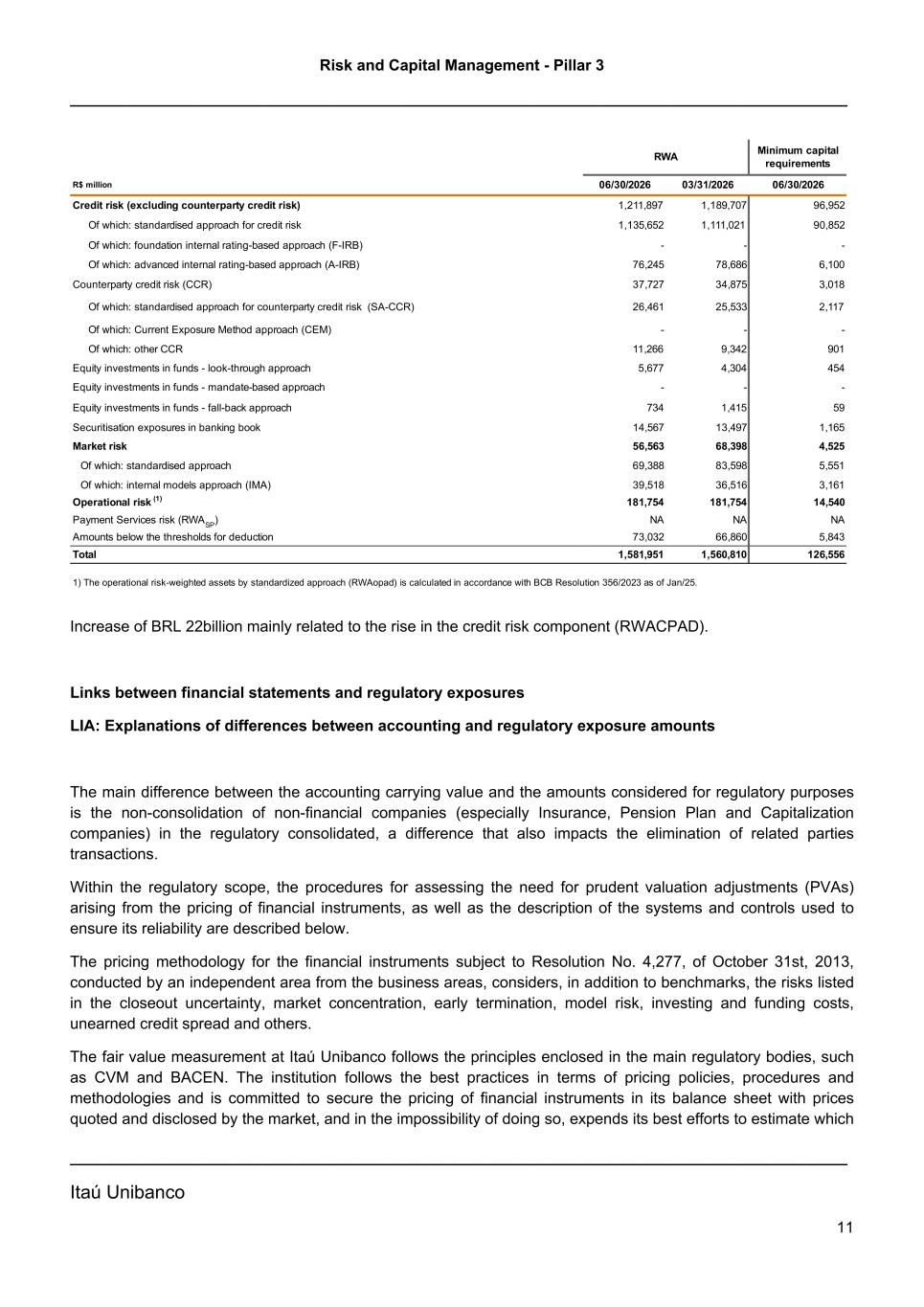
Risk and Capital Management - Pillar 3 __________________________________________________________________________________________ __________________________________________________________________________________________ Itaú Unibanco 11 a b c RWA Minimum capital requirements R$ million 06/30/2026 03/31/2026 06/30/2026 Credit risk (excluding counterparty credit risk) 1,211,897 1,189,707 96,952 Of which: standardised approach for credit risk 1,135,652 1,111,021 90,852 Of which: foundation internal rating-based approach (F-IRB) - - - Of which: advanced internal rating-based approach (A-IRB) 76,245 78,686 6,100 Counterparty credit risk (CCR) 37,727 34,875 3,018 Of which: standardised approach for counterparty credit risk (SA-CCR) 26,461 25,533 2,117 Of which: Current Exposure Method approach (CEM) - - - Of which: other CCR 11,266 9,342 901 Equity investments in funds - look-through approach 5,677 4,304 454 Equity investments in funds - mandate-based approach - - - Equity investments in funds - fall-back approach 734 1,415 59 Securitisation exposures in banking book 14,567 13,497 1,165 Market risk 56,563 68,398 4,525 Of which: standardised approach 69,388 83,598 5,551 Of which: internal models approach (IMA) 39,518 36,516 3,161 Operational risk (1) 181,754 181,754 14,540 Payment Services risk (RWASP) NA NA NA Amounts below the thresholds for deduction 73,032 66,860 5,843 Total 1,581,951 1,560,810 126,556 1) The operational risk-weighted assets by standardized approach (RWAopad) is calculated in accordance with BCB Resolution 356/2023 as of Jan/25. Increase of BRL 22billion mainly related to the rise in the credit risk component (RWACPAD). Links between financial statements and regulatory exposures LIA: Explanations of differences between accounting and regulatory exposure amounts The main difference between the accounting carrying value and the amounts considered for regulatory purposes is the non-consolidation of non-financial companies (especially Insurance, Pension Plan and Capitalization companies) in the regulatory consolidated, a difference that also impacts the elimination of related parties transactions. Within the regulatory scope, the procedures for assessing the need for prudent valuation adjustments (PVAs) arising from the pricing of financial instruments, as well as the description of the systems and controls used to ensure its reliability are described below. The pricing methodology for the financial instruments subject to Resolution No. 4,277, of October 31st, 2013, conducted by an independent area from the business areas, considers, in addition to benchmarks, the risks listed in the closeout uncertainty, market concentration, early termination, model risk, investing and funding costs, unearned credit spread and others. The fair value measurement at Itaú Unibanco follows the principles enclosed in the main regulatory bodies, such as CVM and BACEN. The institution follows the best practices in terms of pricing policies, procedures and methodologies and is committed to secure the pricing of financial instruments in its balance sheet with prices quoted and disclosed by the market, and in the impossibility of doing so, expends its best efforts to estimate which
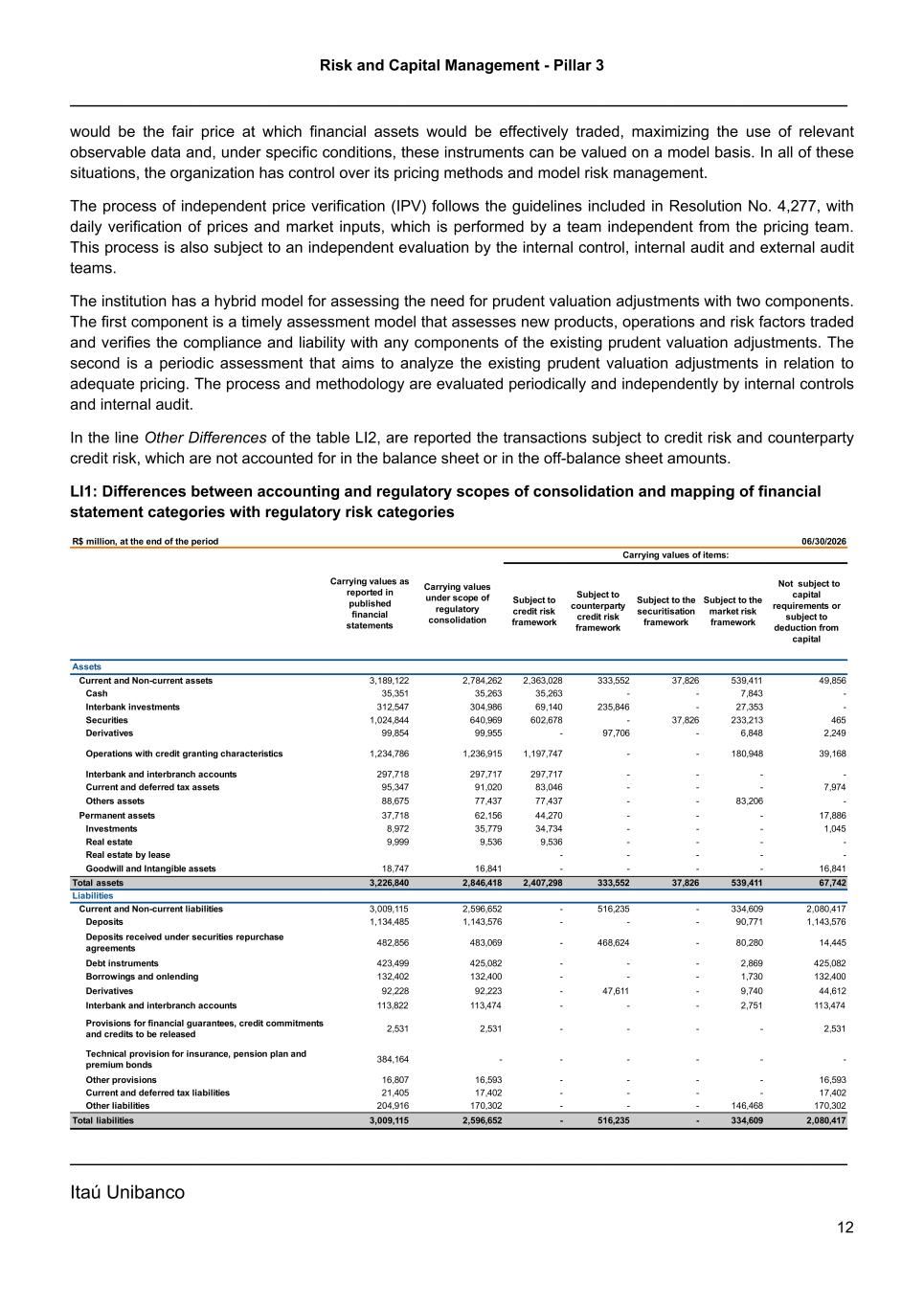
Risk and Capital Management - Pillar 3 __________________________________________________________________________________________ __________________________________________________________________________________________ Itaú Unibanco 12 would be the fair price at which financial assets would be effectively traded, maximizing the use of relevant observable data and, under specific conditions, these instruments can be valued on a model basis. In all of these situations, the organization has control over its pricing methods and model risk management. The process of independent price verification (IPV) follows the guidelines included in Resolution No. 4,277, with daily verification of prices and market inputs, which is performed by a team independent from the pricing team. This process is also subject to an independent evaluation by the internal control, internal audit and external audit teams. The institution has a hybrid model for assessing the need for prudent valuation adjustments with two components. The first component is a timely assessment model that assesses new products, operations and risk factors traded and verifies the compliance and liability with any components of the existing prudent valuation adjustments. The second is a periodic assessment that aims to analyze the existing prudent valuation adjustments in relation to adequate pricing. The process and methodology are evaluated periodically and independently by internal controls and internal audit. In the line Other Differences of the table LI2, are reported the transactions subject to credit risk and counterparty credit risk, which are not accounted for in the balance sheet or in the off-balance sheet amounts. LI1: Differences between accounting and regulatory scopes of consolidation and mapping of financial statement categories with regulatory risk categories R$ million, at the end of the period 06/30/2026 Carrying values as reported in published financial statements Carrying values under scope of regulatory consolidation Carrying values of items: Subject to credit risk framework Subject to counterparty credit risk framework Subject to the securitisation framework Subject to the market risk framework Not subject to capital requirements or subject to deduction from capital Assets Current and Non-current assets 3,189,122 2,784,262 2,363,028 333,552 37,826 539,411 49,856 Cash 35,351 35,263 35,263 - - 7,843 - Interbank investments 312,547 304,986 69,140 235,846 - 27,353 - Securities 1,024,844 640,969 602,678 - 37,826 233,213 465 Derivatives 99,854 99,955 - 97,706 - 6,848 2,249 Operations with credit granting characteristics 1,234,786 1,236,915 1,197,747 - - 180,948 39,168 Interbank and interbranch accounts 297,718 297,717 297,717 - - - - Current and deferred tax assets 95,347 91,020 83,046 - - - 7,974 Others assets 88,675 77,437 77,437 - - 83,206 - Permanent assets 37,718 62,156 44,270 - - - 17,886 Investments 8,972 35,779 34,734 - - - 1,045 Real estate 9,999 9,536 9,536 - - - - Real estate by lease - - - - - Goodwill and Intangible assets 18,747 16,841 - - - - 16,841 Total assets 3,226,840 2,846,418 2,407,298 333,552 37,826 539,411 67,742 Liabilities Current and Non-current liabilities 3,009,115 2,596,652 - 516,235 - 334,609 2,080,417 Deposits 1,134,485 1,143,576 - - - 90,771 1,143,576 Deposits received under securities repurchase agreements 482,856 483,069 - 468,624 - 80,280 14,445 Debt instruments 423,499 425,082 - - - 2,869 425,082 Borrowings and onlending 132,402 132,400 - - - 1,730 132,400 Derivatives 92,228 92,223 - 47,611 - 9,740 44,612 Interbank and interbranch accounts 113,822 113,474 - - - 2,751 113,474 Provisions for financial guarantees, credit commitments and credits to be released 2,531 2,531 - - - - 2,531 Technical provision for insurance, pension plan and premium bonds 384,164 - - - - - - Other provisions 16,807 16,593 - - - - 16,593 Current and deferred tax liabilities 21,405 17,402 - - - - 17,402 Other liabilities 204,916 170,302 - - - 146,468 170,302 Total liabilities 3,009,115 2,596,652 - 516,235 - 334,609 2,080,417
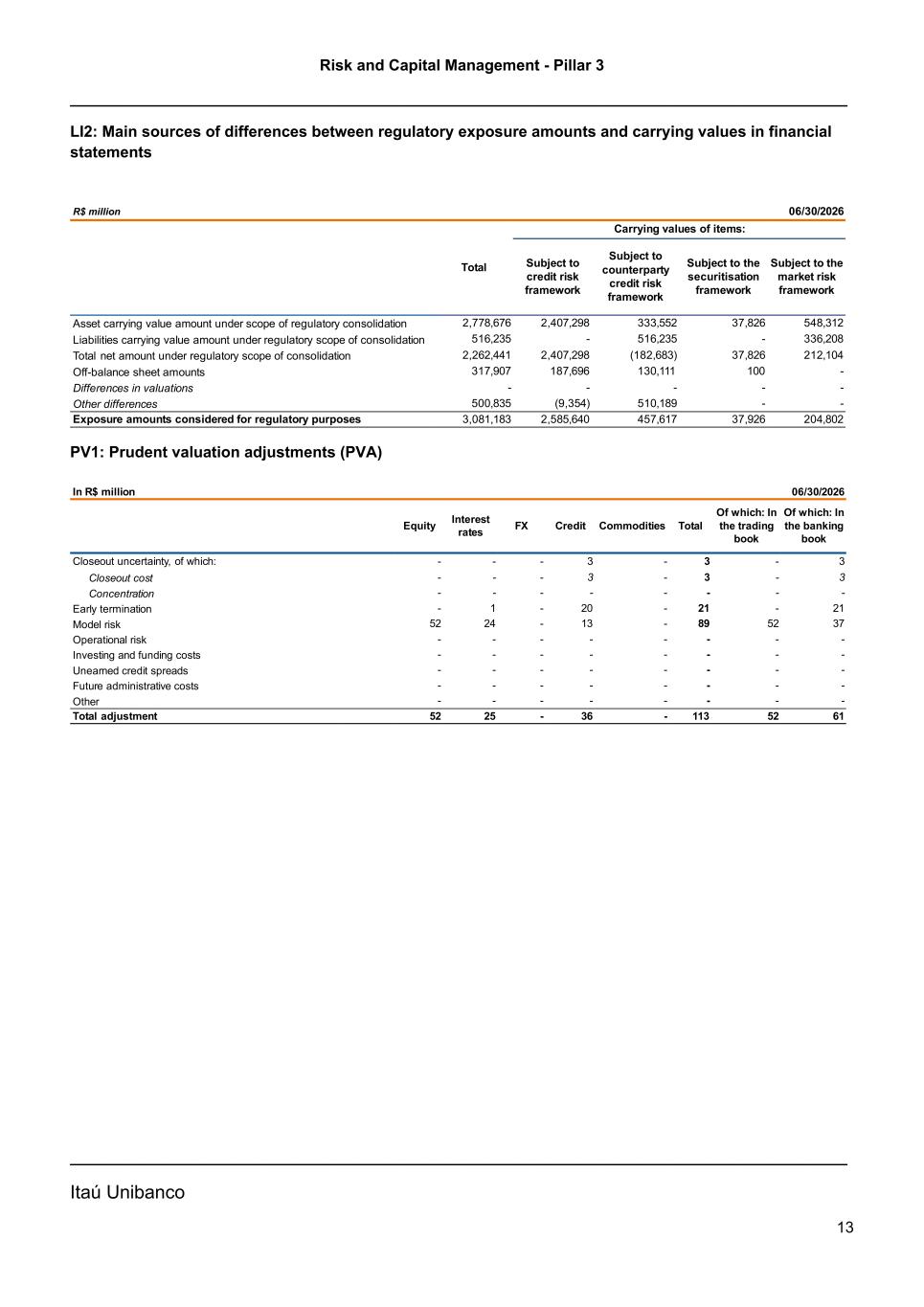
Risk and Capital Management - Pillar 3 __________________________________________________________________________________________ __________________________________________________________________________________________ Itaú Unibanco 13 LI2: Main sources of differences between regulatory exposure amounts and carrying values in financial statements R$ million 06/30/2026 Total Carrying values of items: Subject to credit risk framework Subject to counterparty credit risk framework Subject to the securitisation framework Subject to the market risk framework Asset carrying value amount under scope of regulatory consolidation 2,778,676 2,407,298 333,552 37,826 548,312 Liabilities carrying value amount under regulatory scope of consolidation 516,235 - 516,235 - 336,208 Total net amount under regulatory scope of consolidation 2,262,441 2,407,298 (182,683) 37,826 212,104 Off-balance sheet amounts 317,907 187,696 130,111 100 - Differences in valuations - - - - - Other differences 500,835 (9,354) 510,189 - - Exposure amounts considered for regulatory purposes 3,081,183 2,585,640 457,617 37,926 204,802 PV1: Prudent valuation adjustments (PVA) In R$ million 06/30/2026 Equity Interest rates FX Credit Commodities Total Of which: In the trading book Of which: In the banking book Closeout uncertainty, of which: - - - 3 - 3 - 3 Closeout cost - - - 3 - 3 - 3 Concentration - - - - - - - - Early termination - 1 - 20 - 21 - 21 Model risk 52 24 - 13 - 89 52 37 Operational risk - - - - - - - - Investing and funding costs - - - - - - - - Unearned credit spreads - - - - - - - - Future administrative costs - - - - - - - - Other - - - - - - - - Total adjustment 52 25 - 36 - 113 52 61
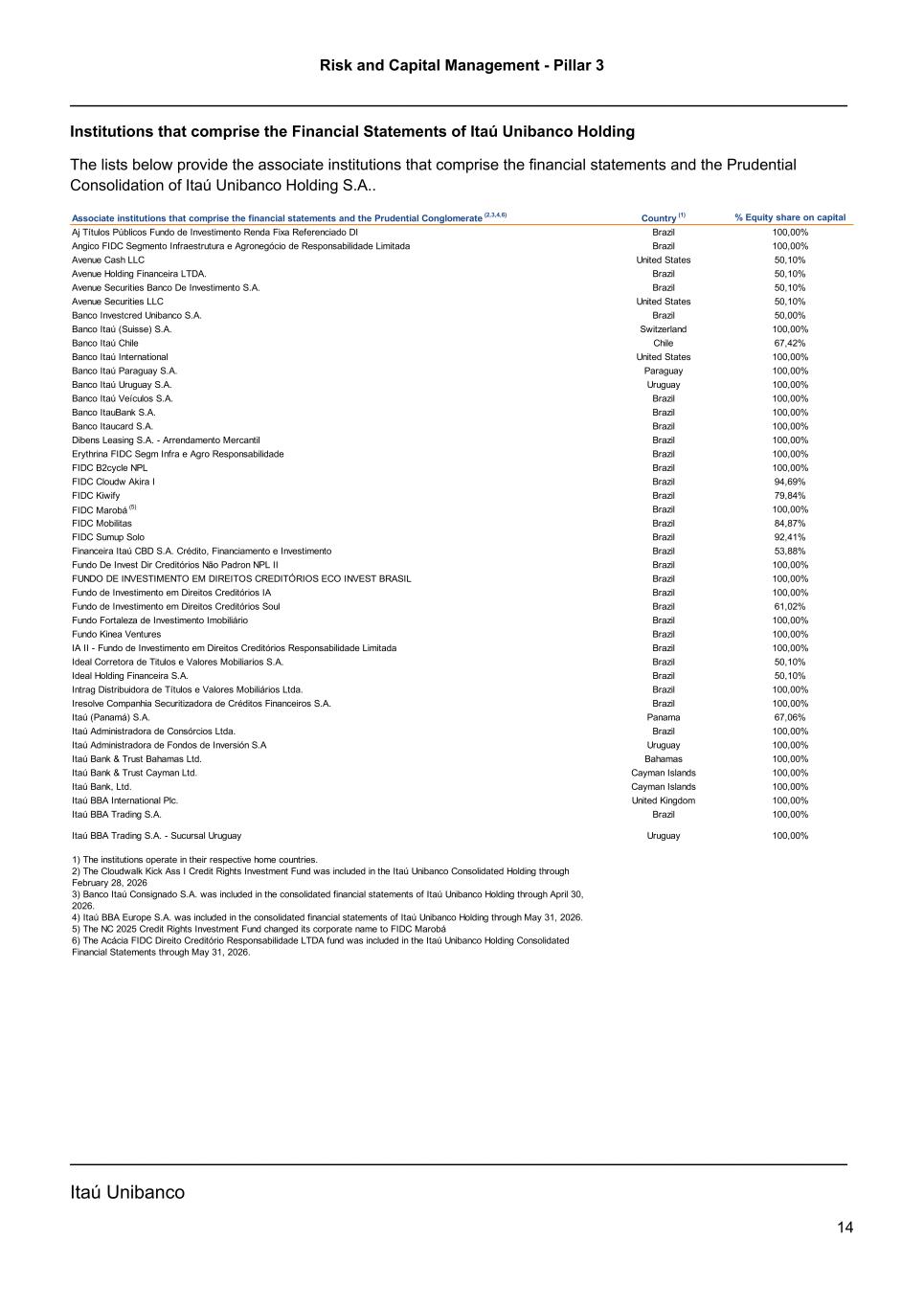
Risk and Capital Management - Pillar 3 __________________________________________________________________________________________ __________________________________________________________________________________________ Itaú Unibanco 14 Institutions that comprise the Financial Statements of Itaú Unibanco Holding The lists below provide the associate institutions that comprise the financial statements and the Prudential Consolidation of Itaú Unibanco Holding S.A.. Associate institutions that comprise the financial statements and the Prudential Conglomerate (2,3,4,6) Country (1) % Equity share on capital Aj Títulos Públicos Fundo de Investimento Renda Fixa Referenciado DI Brazil 100,00% Angico FIDC Segmento Infraestrutura e Agronegócio de Responsabilidade Limitada Brazil 100,00% Avenue Cash LLC United States 50,10% Avenue Holding Financeira LTDA. Brazil 50,10% Avenue Securities Banco De Investimento S.A. Brazil 50,10% Avenue Securities LLC United States 50,10% Banco Investcred Unibanco S.A. Brazil 50,00% Banco Itaú (Suisse) S.A. Switzerland 100,00% Banco Itaú Chile Chile 67,42% Banco Itaú International United States 100,00% Banco Itaú Paraguay S.A. Paraguay 100,00% Banco Itaú Uruguay S.A. Uruguay 100,00% Banco Itaú Veículos S.A. Brazil 100,00% Banco ItauBank S.A. Brazil 100,00% Banco Itaucard S.A. Brazil 100,00% Dibens Leasing S.A. - Arrendamento Mercantil Brazil 100,00% Erythrina FIDC Segm Infra e Agro Responsabilidade Brazil 100,00% FIDC B2cycle NPL Brazil 100,00% FIDC Cloudw Akira I Brazil 94,69% FIDC Kiwify Brazil 79,84% FIDC Marobá (5) Brazil 100,00% FIDC Mobilitas Brazil 84,87% FIDC Sumup Solo Brazil 92,41% Financeira Itaú CBD S.A. Crédito, Financiamento e Investimento Brazil 53,88% Fundo De Invest Dir Creditórios Não Padron NPL II Brazil 100,00% FUNDO DE INVESTIMENTO EM DIREITOS CREDITÓRIOS ECO INVEST BRASIL Brazil 100,00% Fundo de Investimento em Direitos Creditórios IA Brazil 100,00% Fundo de Investimento em Direitos Creditórios Soul Brazil 61,02% Fundo Fortaleza de Investimento Imobiliário Brazil 100,00% Fundo Kinea Ventures Brazil 100,00% IA II - Fundo de Investimento em Direitos Creditórios Responsabilidade Limitada Brazil 100,00% Ideal Corretora de Titulos e Valores Mobiliarios S.A. Brazil 50,10% Ideal Holding Financeira S.A. Brazil 50,10% Intrag Distribuidora de Títulos e Valores Mobiliários Ltda. Brazil 100,00% Iresolve Companhia Securitizadora de Créditos Financeiros S.A. Brazil 100,00% Itaú (Panamá) S.A. Panama 67,06% Itaú Administradora de Consórcios Ltda. Brazil 100,00% Itaú Administradora de Fondos de Inversión S.A Uruguay 100,00% Itaú Bank & Trust Bahamas Ltd. Bahamas 100,00% Itaú Bank & Trust Cayman Ltd. Cayman Islands 100,00% Itaú Bank, Ltd. Cayman Islands 100,00% Itaú BBA International Plc. United Kingdom 100,00% Itaú BBA Trading S.A. Brazil 100,00% Itaú BBA Trading S.A. - Sucursal Uruguay Uruguay 100,00% 1) The institutions operate in their respective home countries. 2) The Cloudwalk Kick Ass I Credit Rights Investment Fund was included in the Itaú Unibanco Consolidated Holding through February 28, 2026 3) Banco Itaú Consignado S.A. was included in the consolidated financial statements of Itaú Unibanco Holding through April 30, 2026. 4) Itaú BBA Europe S.A. was included in the consolidated financial statements of Itaú Unibanco Holding through May 31, 2026. 5) The NC 2025 Credit Rights Investment Fund changed its corporate name to FIDC Marobá 6) The Acácia FIDC Direito Creditório Responsabilidade LTDA fund was included in the Itaú Unibanco Holding Consolidated Financial Statements through May 31, 2026.
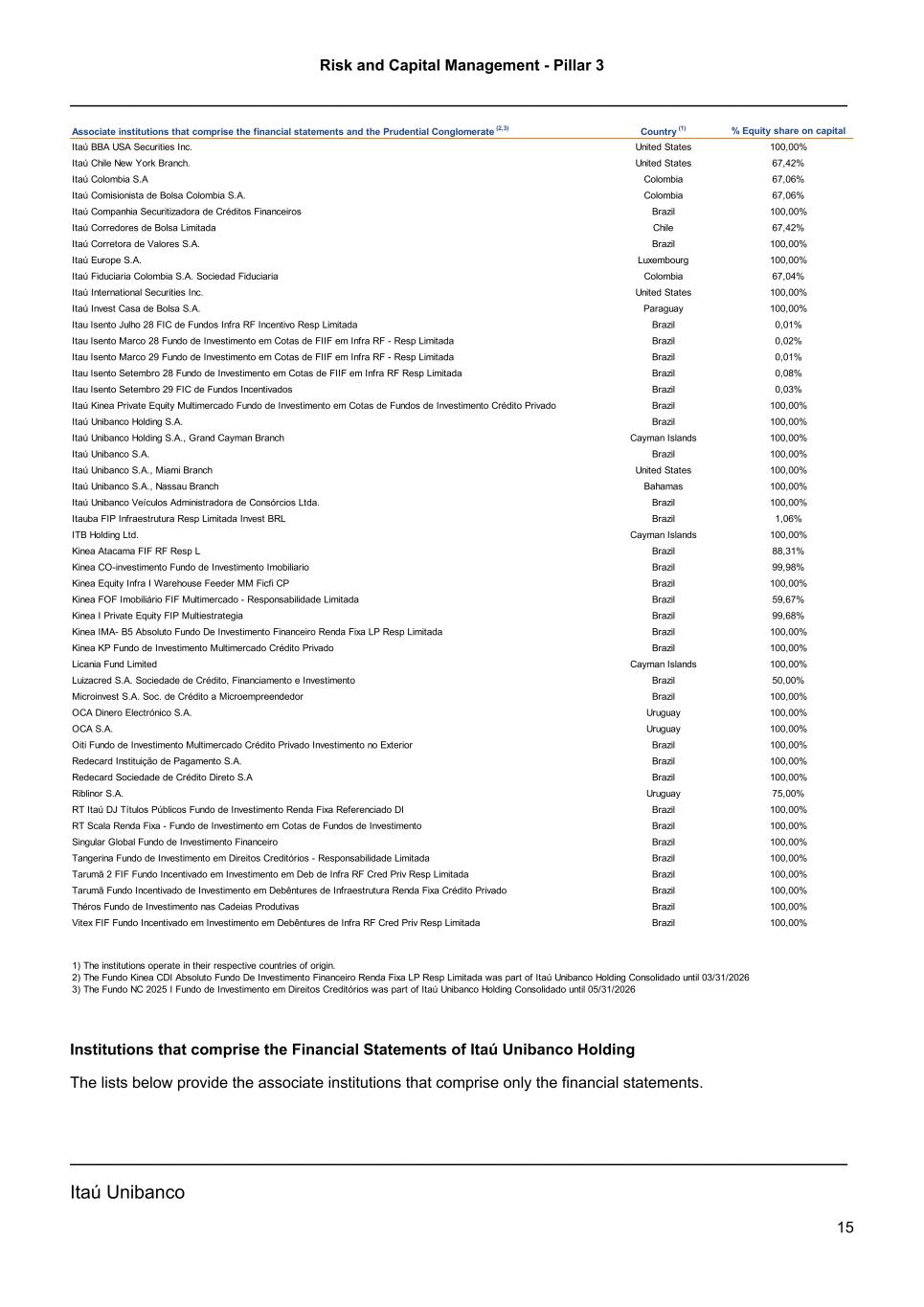
Risk and Capital Management - Pillar 3 __________________________________________________________________________________________ __________________________________________________________________________________________ Itaú Unibanco 15 Institutions that comprise the Financial Statements of Itaú Unibanco Holding The lists below provide the associate institutions that comprise only the financial statements. Associate institutions that comprise the financial statements and the Prudential Conglomerate (2,3) Country (1) % Equity share on capital Itaú BBA USA Securities Inc. United States 100,00% Itaú Chile New York Branch. United States 67,42% Itaú Colombia S.A Colombia 67,06% Itaú Comisionista de Bolsa Colombia S.A. Colombia 67,06% Itaú Companhia Securitizadora de Créditos Financeiros Brazil 100,00% Itaú Corredores de Bolsa Limitada Chile 67,42% Itaú Corretora de Valores S.A. Brazil 100,00% Itaú Europe S.A. Luxembourg 100,00% Itaú Fiduciaria Colombia S.A. Sociedad Fiduciaria Colombia 67,04% Itaú International Securities Inc. United States 100,00% Itaú Invest Casa de Bolsa S.A. Paraguay 100,00% Itau Isento Julho 28 FIC de Fundos Infra RF Incentivo Resp Limitada Brazil 0,01% Itau Isento Marco 28 Fundo de Investimento em Cotas de FIIF em Infra RF - Resp Limitada Brazil 0,02% Itau Isento Marco 29 Fundo de Investimento em Cotas de FIIF em Infra RF - Resp Limitada Brazil 0,01% Itau Isento Setembro 28 Fundo de Investimento em Cotas de FIIF em Infra RF Resp Limitada Brazil 0,08% Itau Isento Setembro 29 FIC de Fundos Incentivados Brazil 0,03% Itaú Kinea Private Equity Multimercado Fundo de Investimento em Cotas de Fundos de Investimento Crédito Privado Brazil 100,00% Itaú Unibanco Holding S.A. Brazil 100,00% Itaú Unibanco Holding S.A., Grand Cayman Branch Cayman Islands 100,00% Itaú Unibanco S.A. Brazil 100,00% Itaú Unibanco S.A., Miami Branch United States 100,00% Itaú Unibanco S.A., Nassau Branch Bahamas 100,00% Itaú Unibanco Veículos Administradora de Consórcios Ltda. Brazil 100,00% Itauba FIP Infraestrutura Resp Limitada Invest BRL Brazil 1,06% ITB Holding Ltd. Cayman Islands 100,00% Kinea Atacama FIF RF Resp L Brazil 88,31% Kinea CO-investimento Fundo de Investimento Imobiliario Brazil 99,98% Kinea Equity Infra I Warehouse Feeder MM Ficfi CP Brazil 100,00% Kinea FOF Imobiliário FIF Multimercado - Responsabilidade Limitada Brazil 59,67% Kinea I Private Equity FIP Multiestrategia Brazil 99,68% Kinea IMA- B5 Absoluto Fundo De Investimento Financeiro Renda Fixa LP Resp Limitada Brazil 100,00% Kinea KP Fundo de Investimento Multimercado Crédito Privado Brazil 100,00% Licania Fund Limited Cayman Islands 100,00% Luizacred S.A. Sociedade de Crédito, Financiamento e Investimento Brazil 50,00% Microinvest S.A. Soc. de Crédito a Microempreendedor Brazil 100,00% OCA Dinero Electrónico S.A. Uruguay 100,00% OCA S.A. Uruguay 100,00% Oiti Fundo de Investimento Multimercado Crédito Privado Investimento no Exterior Brazil 100,00% Redecard Instituição de Pagamento S.A. Brazil 100,00% Redecard Sociedade de Crédito Direto S.A Brazil 100,00% Riblinor S.A. Uruguay 75,00% RT Itaú DJ Títulos Públicos Fundo de Investimento Renda Fixa Referenciado DI Brazil 100,00% RT Scala Renda Fixa - Fundo de Investimento em Cotas de Fundos de Investimento Brazil 100,00% Singular Global Fundo de Investimento Financeiro Brazil 100,00% Tangerina Fundo de Investimento em Direitos Creditórios - Responsabilidade Limitada Brazil 100,00% Tarumã 2 FIF Fundo Incentivado em Investimento em Deb de Infra RF Cred Priv Resp Limitada Brazil 100,00% Tarumã Fundo Incentivado de Investimento em Debêntures de Infraestrutura Renda Fixa Crédito Privado Brazil 100,00% Théros Fundo de Investimento nas Cadeias Produtivas Brazil 100,00% Vitex FIF Fundo Incentivado em Investimento em Debêntures de Infra RF Cred Priv Resp Limitada Brazil 100,00% 1) The institutions operate in their respective countries of origin. 2) The Fundo Kinea CDI Absoluto Fundo De Investimento Financeiro Renda Fixa LP Resp Limitada was part of Itaú Unibanco Holding Consolidado until 03/31/2026 3) The Fundo NC 2025 I Fundo de Investimento em Direitos Creditórios was part of Itaú Unibanco Holding Consolidado until 05/31/2026
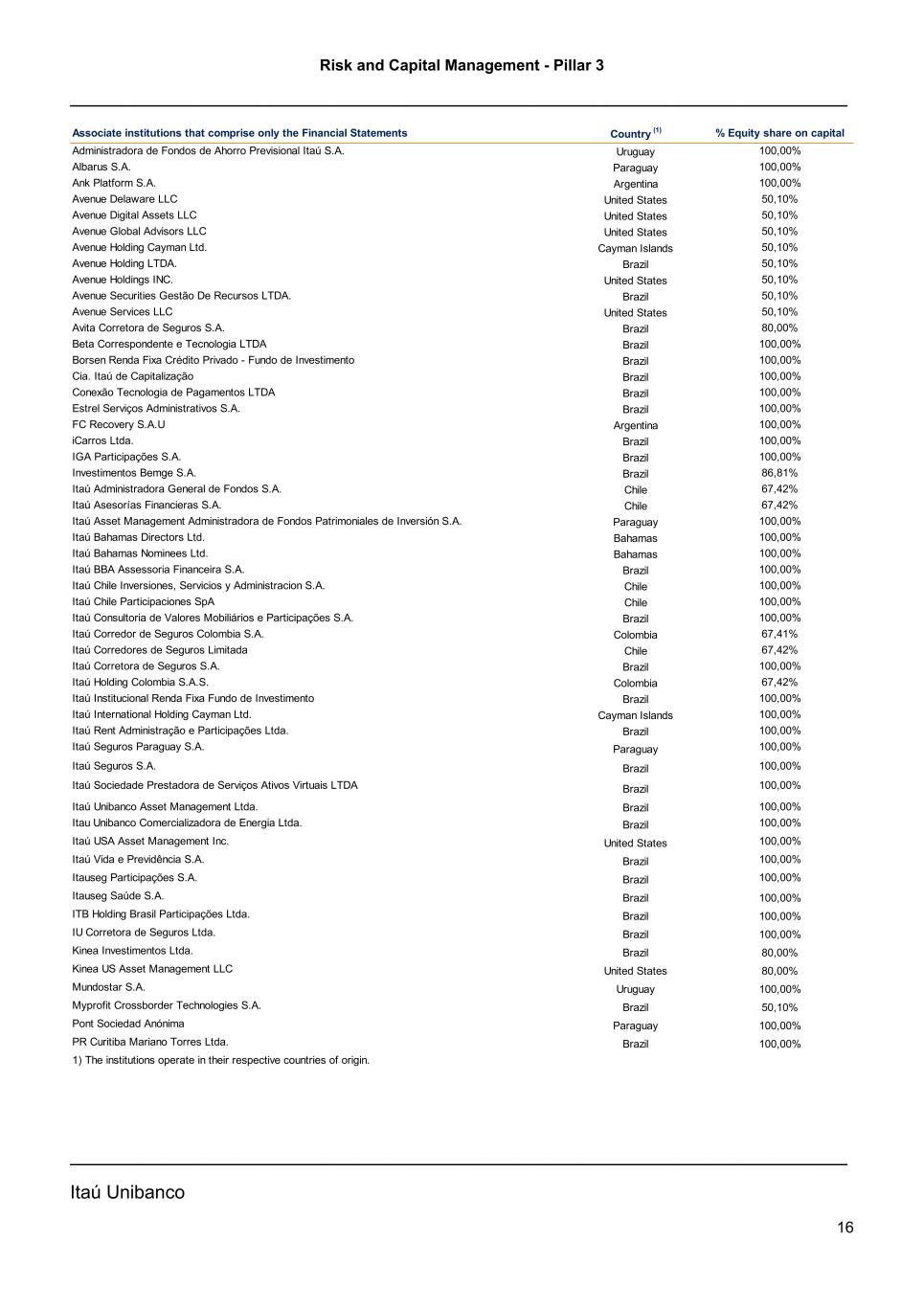
Risk and Capital Management - Pillar 3 __________________________________________________________________________________________ __________________________________________________________________________________________ Itaú Unibanco 16 Associate institutions that comprise only the Financial Statements Country (1) % Equity share on capital Administradora de Fondos de Ahorro Previsional Itaú S.A. Uruguay 100,00% Albarus S.A. Paraguay 100,00% Ank Platform S.A. Argentina 100,00% Avenue Delaware LLC United States 50,10% Avenue Digital Assets LLC United States 50,10% Avenue Global Advisors LLC United States 50,10% Avenue Holding Cayman Ltd. Cayman Islands 50,10% Avenue Holding LTDA. Brazil 50,10% Avenue Holdings INC. United States 50,10% Avenue Securities Gestão De Recursos LTDA. Brazil 50,10% Avenue Services LLC United States 50,10% Avita Corretora de Seguros S.A. Brazil 80,00% Beta Correspondente e Tecnologia LTDA Brazil 100,00% Borsen Renda Fixa Crédito Privado - Fundo de Investimento Brazil 100,00% Cia. Itaú de Capitalização Brazil 100,00% Conexão Tecnologia de Pagamentos LTDA Brazil 100,00% Estrel Serviços Administrativos S.A. Brazil 100,00% FC Recovery S.A.U Argentina 100,00% iCarros Ltda. Brazil 100,00% IGA Participações S.A. Brazil 100,00% Investimentos Bemge S.A. Brazil 86,81% Itaú Administradora General de Fondos S.A. Chile 67,42% Itaú Asesorías Financieras S.A. Chile 67,42% Itaú Asset Management Administradora de Fondos Patrimoniales de Inversión S.A. Paraguay 100,00% Itaú Bahamas Directors Ltd. Bahamas 100,00% Itaú Bahamas Nominees Ltd. Bahamas 100,00% Itaú BBA Assessoria Financeira S.A. Brazil 100,00% Itaú Chile Inversiones, Servicios y Administracion S.A. Chile 100,00% Itaú Chile Participaciones SpA Chile 100,00% Itaú Consultoria de Valores Mobiliários e Participações S.A. Brazil 100,00% Itaú Corredor de Seguros Colombia S.A. Colombia 67,41% Itaú Corredores de Seguros Limitada Chile 67,42% Itaú Corretora de Seguros S.A. Brazil 100,00% Itaú Holding Colombia S.A.S. Colombia 67,42% Itaú Institucional Renda Fixa Fundo de Investimento Brazil 100,00% Itaú International Holding Cayman Ltd. Cayman Islands 100,00% Itaú Rent Administração e Participações Ltda. Brazil 100,00% Itaú Seguros Paraguay S.A. Paraguay 100,00% Itaú Seguros S.A. Brazil 100,00% Itaú Sociedade Prestadora de Serviços Ativos Virtuais LTDA Brazil 100,00% Itaú Unibanco Asset Management Ltda. Brazil 100,00% Itau Unibanco Comercializadora de Energia Ltda. Brazil 100,00% Itaú USA Asset Management Inc. United States 100,00% Itaú Vida e Previdência S.A. Brazil 100,00% Itauseg Participações S.A. Brazil 100,00% Itauseg Saúde S.A. Brazil 100,00% ITB Holding Brasil Participações Ltda. Brazil 100,00% IU Corretora de Seguros Ltda. Brazil 100,00% Kinea Investimentos Ltda. Brazil 80,00% Kinea US Asset Management LLC United States 80,00% Mundostar S.A. Uruguay 100,00% Myprofit Crossborder Technologies S.A. Brazil 50,10% Pont Sociedad Anónima Paraguay 100,00% PR Curitiba Mariano Torres Ltda. Brazil 100,00% 1) The institutions operate in their respective countries of origin.
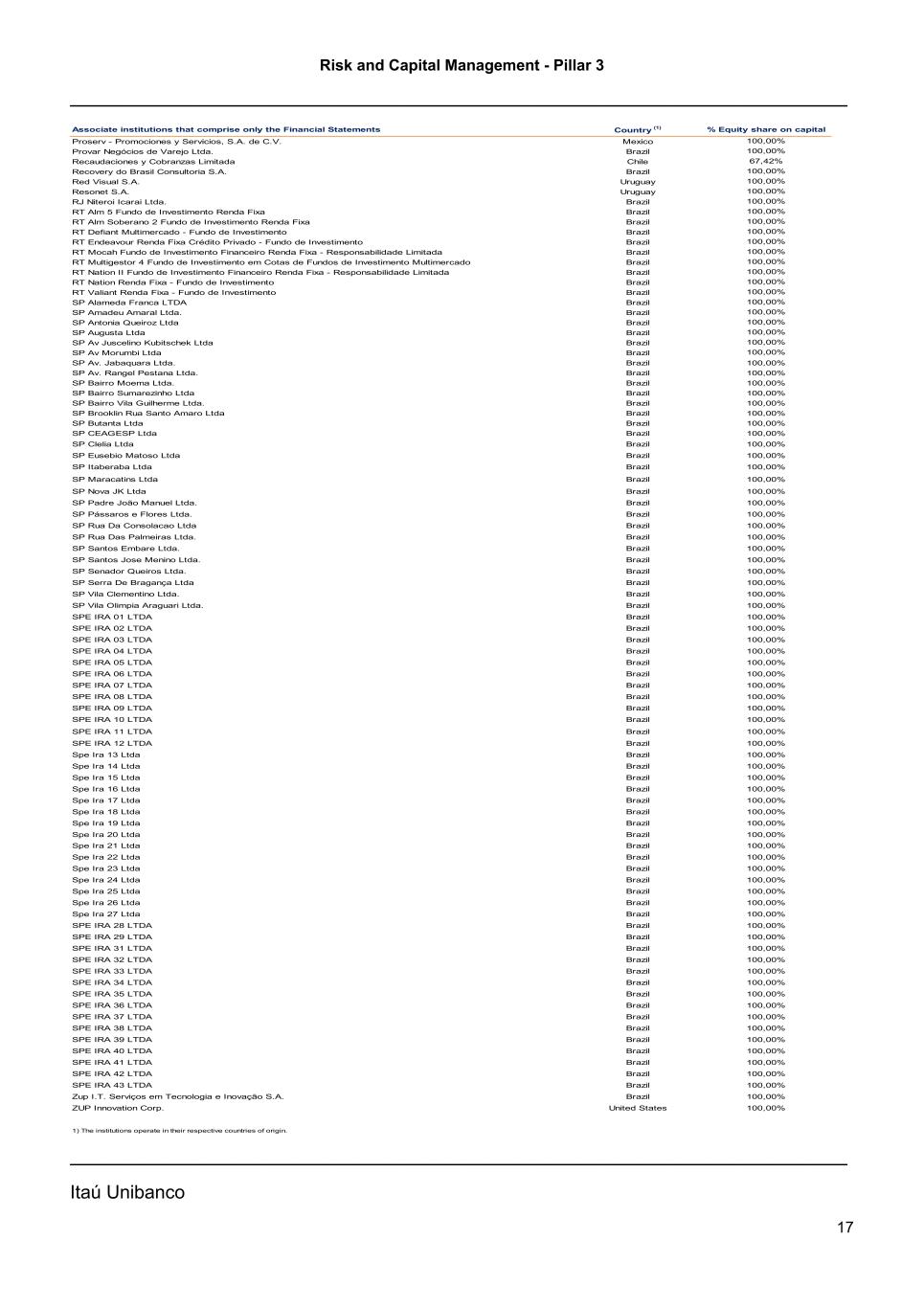
Risk and Capital Management - Pillar 3 __________________________________________________________________________________________ __________________________________________________________________________________________ Itaú Unibanco 17 Associate institutions that comprise only the Financial Statements Country (1) % Equity share on capital Proserv - Promociones y Servicios, S.A. de C.V. Mexico 100,00% Provar Negócios de Varejo Ltda. Brazil 100,00% Recaudaciones y Cobranzas Limitada Chile 67,42% Recovery do Brasil Consultoria S.A. Brazil 100,00% Red Visual S.A. Uruguay 100,00% Resonet S.A. Uruguay 100,00% RJ Niteroi Icarai Ltda. Brazil 100,00% RT Alm 5 Fundo de Investimento Renda Fixa Brazil 100,00% RT Alm Soberano 2 Fundo de Investimento Renda Fixa Brazil 100,00% RT Defiant Multimercado - Fundo de Investimento Brazil 100,00% RT Endeavour Renda Fixa Crédito Privado - Fundo de Investimento Brazil 100,00% RT Mocah Fundo de Investimento Financeiro Renda Fixa - Responsabilidade Limitada Brazil 100,00% RT Multigestor 4 Fundo de Investimento em Cotas de Fundos de Investimento Multimercado Brazil 100,00% RT Nation II Fundo de Investimento Financeiro Renda Fixa - Responsabilidade Limitada Brazil 100,00% RT Nation Renda Fixa - Fundo de Investimento Brazil 100,00% RT Valiant Renda Fixa - Fundo de Investimento Brazil 100,00% SP Alameda Franca LTDA Brazil 100,00% SP Amadeu Amaral Ltda. Brazil 100,00% SP Antonia Queiroz Ltda Brazil 100,00% SP Augusta Ltda Brazil 100,00% SP Av Juscelino Kubitschek Ltda Brazil 100,00% SP Av Morumbi Ltda Brazil 100,00% SP Av. Jabaquara Ltda. Brazil 100,00% SP Av. Rangel Pestana Ltda. Brazil 100,00% SP Bairro Moema Ltda. Brazil 100,00% SP Bairro Sumarezinho Ltda Brazil 100,00% SP Bairro Vila Guilherme Ltda. Brazil 100,00% SP Brooklin Rua Santo Amaro Ltda Brazil 100,00% SP Butanta Ltda Brazil 100,00% SP CEAGESP Ltda Brazil 100,00% SP Clelia Ltda Brazil 100,00% SP Eusebio Matoso Ltda Brazil 100,00% SP Itaberaba Ltda Brazil 100,00% SP Maracatins Ltda Brazil 100,00% SP Nova JK Ltda Brazil 100,00% SP Padre João Manuel Ltda. Brazil 100,00% SP Pássaros e Flores Ltda. Brazil 100,00% SP Rua Da Consolacao Ltda Brazil 100,00% SP Rua Das Palmeiras Ltda. Brazil 100,00% SP Santos Embare Ltda. Brazil 100,00% SP Santos Jose Menino Ltda. Brazil 100,00% SP Senador Queiros Ltda. Brazil 100,00% SP Serra De Bragança Ltda Brazil 100,00% SP Vila Clementino Ltda. Brazil 100,00% SP Vila Olimpia Araguari Ltda. Brazil 100,00% SPE IRA 01 LTDA Brazil 100,00% SPE IRA 02 LTDA Brazil 100,00% SPE IRA 03 LTDA Brazil 100,00% SPE IRA 04 LTDA Brazil 100,00% SPE IRA 05 LTDA Brazil 100,00% SPE IRA 06 LTDA Brazil 100,00% SPE IRA 07 LTDA Brazil 100,00% SPE IRA 08 LTDA Brazil 100,00% SPE IRA 09 LTDA Brazil 100,00% SPE IRA 10 LTDA Brazil 100,00% SPE IRA 11 LTDA Brazil 100,00% SPE IRA 12 LTDA Brazil 100,00% Spe Ira 13 Ltda Brazil 100,00% Spe Ira 14 Ltda Brazil 100,00% Spe Ira 15 Ltda Brazil 100,00% Spe Ira 16 Ltda Brazil 100,00% Spe Ira 17 Ltda Brazil 100,00% Spe Ira 18 Ltda Brazil 100,00% Spe Ira 19 Ltda Brazil 100,00% Spe Ira 20 Ltda Brazil 100,00% Spe Ira 21 Ltda Brazil 100,00% Spe Ira 22 Ltda Brazil 100,00% Spe Ira 23 Ltda Brazil 100,00% Spe Ira 24 Ltda Brazil 100,00% Spe Ira 25 Ltda Brazil 100,00% Spe Ira 26 Ltda Brazil 100,00% Spe Ira 27 Ltda Brazil 100,00% SPE IRA 28 LTDA Brazil 100,00% SPE IRA 29 LTDA Brazil 100,00% SPE IRA 31 LTDA Brazil 100,00% SPE IRA 32 LTDA Brazil 100,00% SPE IRA 33 LTDA Brazil 100,00% SPE IRA 34 LTDA Brazil 100,00% SPE IRA 35 LTDA Brazil 100,00% SPE IRA 36 LTDA Brazil 100,00% SPE IRA 37 LTDA Brazil 100,00% SPE IRA 38 LTDA Brazil 100,00% SPE IRA 39 LTDA Brazil 100,00% SPE IRA 40 LTDA Brazil 100,00% SPE IRA 41 LTDA Brazil 100,00% SPE IRA 42 LTDA Brazil 100,00% SPE IRA 43 LTDA Brazil 100,00% Zup I.T. Serviços em Tecnologia e Inovação S.A. Brazil 100,00% ZUP Innovation Corp. United States 100,00% 1) The institutions operate in their respective countries of origin.
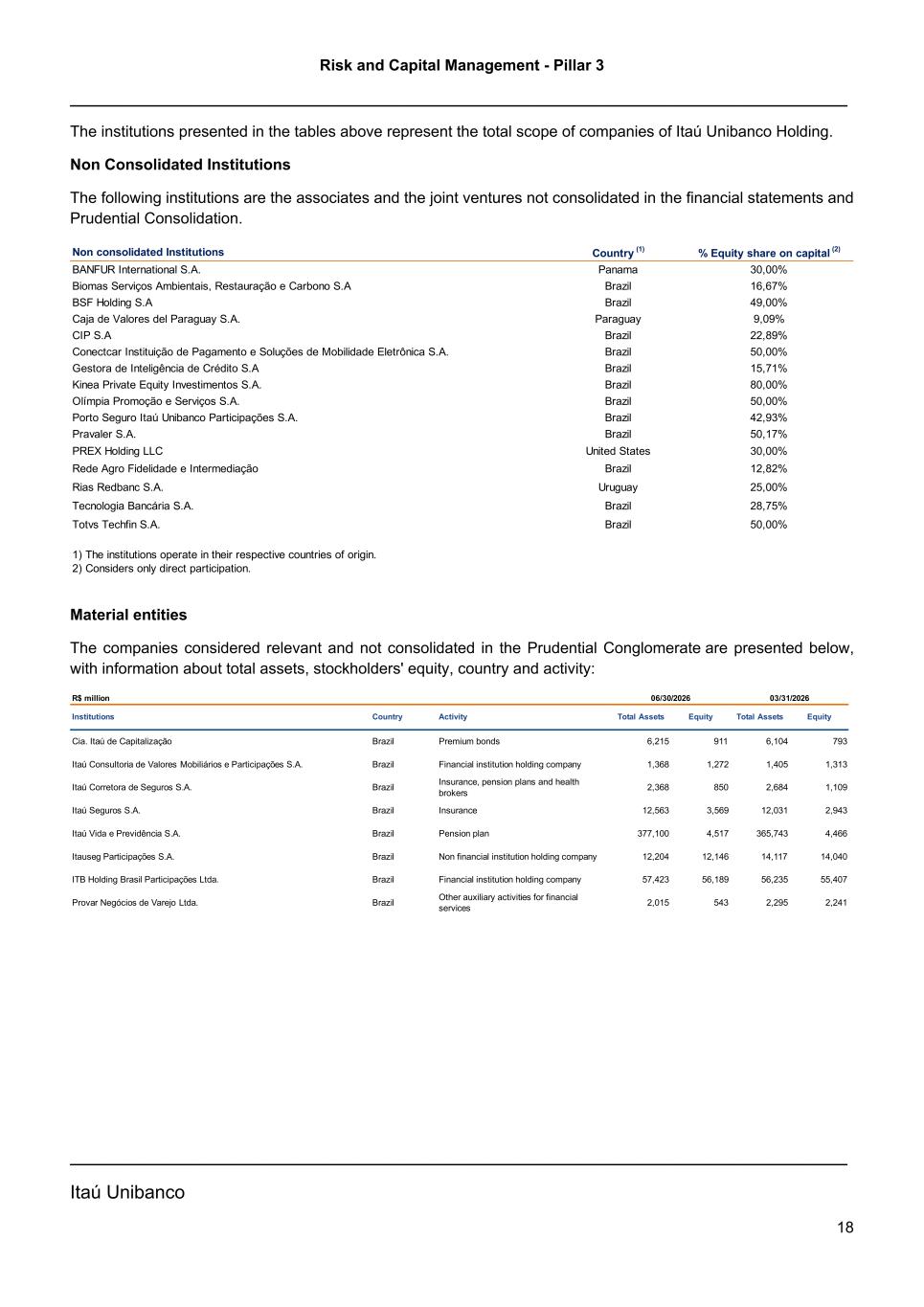
Risk and Capital Management - Pillar 3 __________________________________________________________________________________________ __________________________________________________________________________________________ Itaú Unibanco 18 The institutions presented in the tables above represent the total scope of companies of Itaú Unibanco Holding. Non Consolidated Institutions The following institutions are the associates and the joint ventures not consolidated in the financial statements and Prudential Consolidation. Material entities The companies considered relevant and not consolidated in the Prudential Conglomerate are presented below, with information about total assets, stockholders' equity, country and activity: R$ million 06/30/2026 03/31/2026 Institutions Country Activity Total Assets Equity Total Assets Equity Cia. Itaú de Capitalização Brazil Premium bonds 6,215 911 6,104 793 Itaú Consultoria de Valores Mobiliários e Participações S.A. Brazil Financial institution holding company 1,368 1,272 1,405 1,313 Itaú Corretora de Seguros S.A. Brazil Insurance, pension plans and health brokers 2,368 850 2,684 1,109 Itaú Seguros S.A. Brazil Insurance 12,563 3,569 12,031 2,943 Itaú Vida e Previdência S.A. Brazil Pension plan 377,100 4,517 365,743 4,466 Itauseg Participações S.A. Brazil Non financial institution holding company 12,204 12,146 14,117 14,040 ITB Holding Brasil Participações Ltda. Brazil Financial institution holding company 57,423 56,189 56,235 55,407 Provar Negócios de Varejo Ltda. Brazil Other auxiliary activities for financial services 2,015 543 2,295 2,241 Non consolidated Institutions Country (1) % Equity share on capital (2) BANFUR International S.A. Panama 30,00% Biomas Serviços Ambientais, Restauração e Carbono S.A Brazil 16,67% BSF Holding S.A Brazil 49,00% Caja de Valores del Paraguay S.A. Paraguay 9,09% CIP S.A Brazil 22,89% Conectcar Instituição de Pagamento e Soluções de Mobilidade Eletrônica S.A. Brazil 50,00% Gestora de Inteligência de Crédito S.A Brazil 15,71% Kinea Private Equity Investimentos S.A. Brazil 80,00% Olímpia Promoção e Serviços S.A. Brazil 50,00% Porto Seguro Itaú Unibanco Participações S.A. Brazil 42,93% Pravaler S.A. Brazil 50,17% PREX Holding LLC United States 30,00% Rede Agro Fidelidade e Intermediação Brazil 12,82% Rias Redbanc S.A. Uruguay 25,00% Tecnologia Bancária S.A. Brazil 28,75% Totvs Techfin S.A. Brazil 50,00% 1) The institutions operate in their respective countries of origin. 2) Considers only direct participation.
Risk and Capital Management - Pillar 3 __________________________________________________________________________________________ __________________________________________________________________________________________ Itaú Unibanco 19 Composition of Capital CCA: Main features of regulatory capital instruments The authorized regulatory capital instruments may be extinguished according to the criteria established in Resolution nº 4,955, such as non-compliance with the minimum regulatory ratios, decree of temporary special administration regime or intervention, application of public resources or upon the Central Bank of Brazil determination. Should any criteria for the extinction of subordinated instruments be triggered, the area responsible for Itaú Unibanco's Capital management will activate the areas involved to execute the following action plan: • Treasury and products, through the payment agent of the subordinated instruments or straight through the central depository, will notify its holders and take actions to ensure that Itaú Unibanco's trading desks cease to trade such instruments; • The operational and accounting areas will carry out the necessary procedures for the proper treatment of the extinction; and • The Investor Relations area will communicate to the market of the extinction of the subordinated instruments. The table CCA - Main features of regulatory capital instruments, is available at www.itau.com.br/investor-relations, section “Results and Reports”, “Regulatory Reports”, “Pillar 3”.
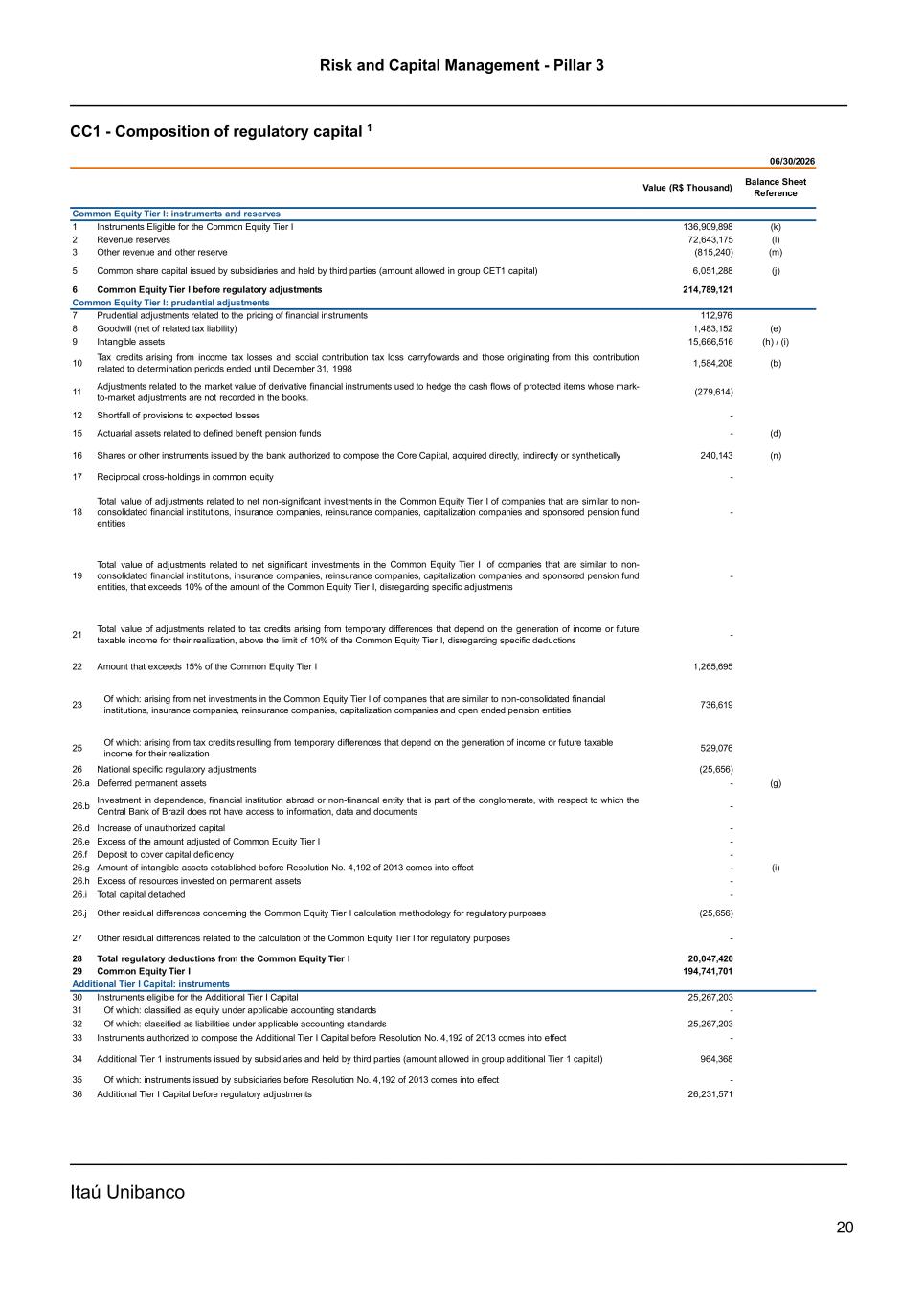
Risk and Capital Management - Pillar 3 __________________________________________________________________________________________ __________________________________________________________________________________________ Itaú Unibanco 20 CC1 - Composition of regulatory capital 1 06/30/2026 Value (R$ Thousand) Balance Sheet Reference Common Equity Tier I: instruments and reserves 1 Instruments Eligible for the Common Equity Tier I 136,909,898 (k) 2 Revenue reserves 72,643,175 (l) 3 Other revenue and other reserve (815,240) (m) 5 Common share capital issued by subsidiaries and held by third parties (amount allowed in group CET1 capital) 6,051,288 (j) 6 Common Equity Tier I before regulatory adjustments 214,789,121 Common Equity Tier I: prudential adjustments 7 Prudential adjustments related to the pricing of financial instruments 112,976 8 Goodwill (net of related tax liability) 1,483,152 (e) 9 Intangible assets 15,666,516 (h) / (i) 10 Tax credits arising from income tax losses and social contribution tax loss carryfowards and those originating from this contribution related to determination periods ended until December 31, 1998 1,584,208 (b) 11 Adjustments related to the market value of derivative financial instruments used to hedge the cash flows of protected items whose mark- to-market adjustments are not recorded in the books. (279,614) 12 Shortfall of provisions to expected losses - 15 Actuarial assets related to defined benefit pension funds - (d) 16 Shares or other instruments issued by the bank authorized to compose the Core Capital, acquired directly, indirectly or synthetically 240,143 (n) 17 Reciprocal cross-holdings in common equity - 18 Total value of adjustments related to net non-significant investments in the Common Equity Tier I of companies that are similar to non- consolidated financial institutions, insurance companies, reinsurance companies, capitalization companies and sponsored pension fund entities - 19 Total value of adjustments related to net significant investments in the Common Equity Tier I of companies that are similar to non- consolidated financial institutions, insurance companies, reinsurance companies, capitalization companies and sponsored pension fund entities, that exceeds 10% of the amount of the Common Equity Tier I, disregarding specific adjustments - 21 Total value of adjustments related to tax credits arising from temporary differences that depend on the generation of income or future taxable income for their realization, above the limit of 10% of the Common Equity Tier I, disregarding specific deductions - 22 Amount that exceeds 15% of the Common Equity Tier I 1,265,695 23 Of which: arising from net investments in the Common Equity Tier I of companies that are similar to non-consolidated financial institutions, insurance companies, reinsurance companies, capitalization companies and open ended pension entities 736,619 25 Of which: arising from tax credits resulting from temporary differences that depend on the generation of income or future taxable income for their realization 529,076 26 National specific regulatory adjustments (25,656) 26.a Deferred permanent assets - (g) 26.b Investment in dependence, financial institution abroad or non-financial entity that is part of the conglomerate, with respect to which the Central Bank of Brazil does not have access to information, data and documents - 26.d Increase of unauthorized capital - 26.e Excess of the amount adjusted of Common Equity Tier I - 26.f Deposit to cover capital deficiency - 26.g Amount of intangible assets established before Resolution No. 4,192 of 2013 comes into effect - (i) 26.h Excess of resources invested on permanent assets - 26.i Total capital detached - 26.j Other residual differences concerning the Common Equity Tier I calculation methodology for regulatory purposes (25,656) 27 Other residual differences related to the calculation of the Common Equity Tier I for regulatory purposes - 28 Total regulatory deductions from the Common Equity Tier I 20,047,420 29 Common Equity Tier I 194,741,701 Additional Tier I Capital: instruments 30 Instruments eligible for the Additional Tier I Capital 25,267,203 31 Of which: classified as equity under applicable accounting standards - 32 Of which: classified as liabilities under applicable accounting standards 25,267,203 33 Instruments authorized to compose the Additional Tier I Capital before Resolution No. 4,192 of 2013 comes into effect - 34 Additional Tier 1 instruments issued by subsidiaries and held by third parties (amount allowed in group additional Tier 1 capital) 964,368 35 Of which: instruments issued by subsidiaries before Resolution No. 4,192 of 2013 comes into effect - 36 Additional Tier I Capital before regulatory adjustments 26,231,571
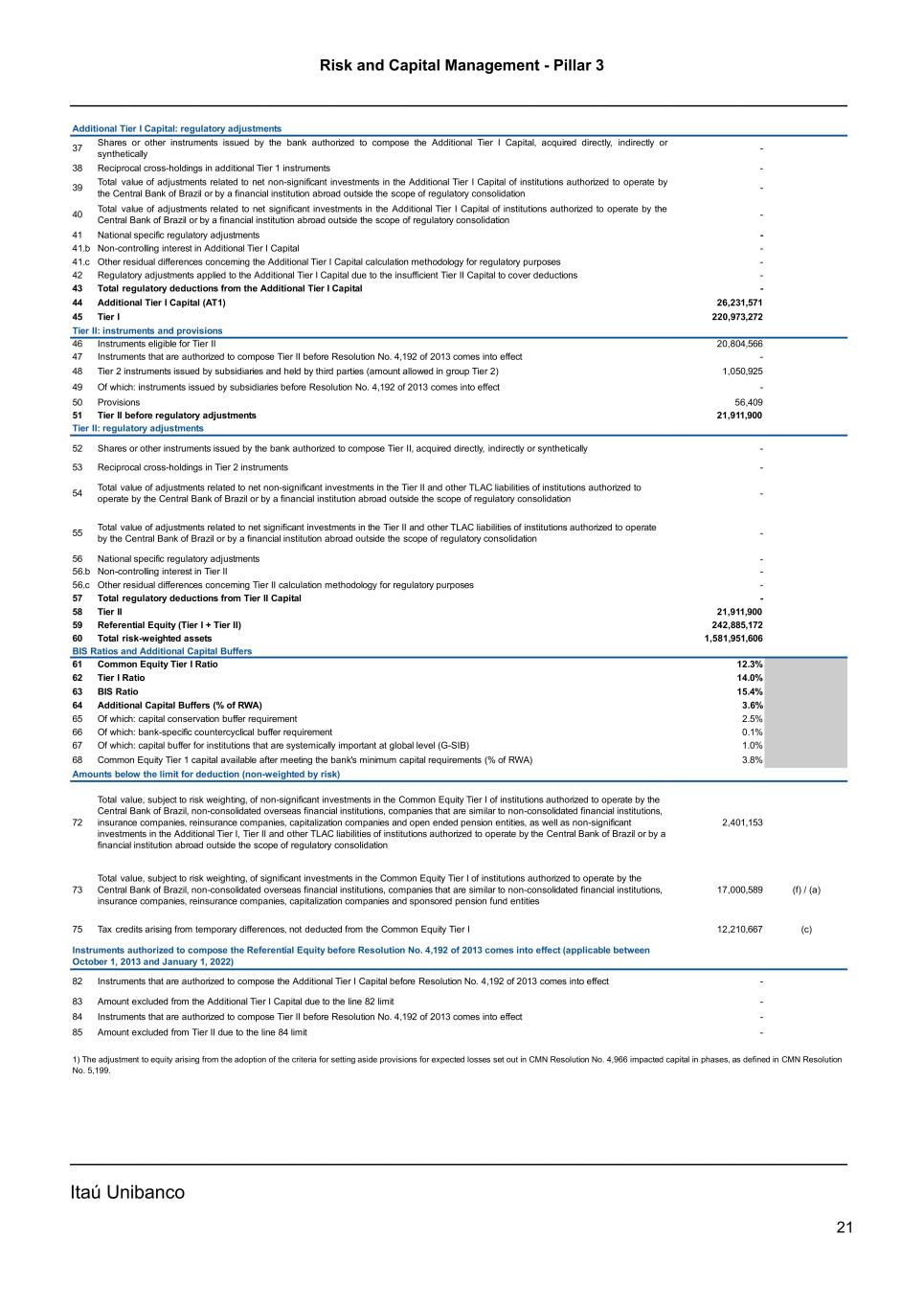
Risk and Capital Management - Pillar 3 __________________________________________________________________________________________ __________________________________________________________________________________________ Itaú Unibanco 21 Additional Tier I Capital: regulatory adjustments 37 Shares or other instruments issued by the bank authorized to compose the Additional Tier I Capital, acquired directly, indirectly or synthetically - 38 Reciprocal cross-holdings in additional Tier 1 instruments - 39 Total value of adjustments related to net non-significant investments in the Additional Tier I Capital of institutions authorized to operate by the Central Bank of Brazil or by a financial institution abroad outside the scope of regulatory consolidation - 40 Total value of adjustments related to net significant investments in the Additional Tier I Capital of institutions authorized to operate by the Central Bank of Brazil or by a financial institution abroad outside the scope of regulatory consolidation - 41 National specific regulatory adjustments - 41.b Non-controlling interest in Additional Tier I Capital - 41.c Other residual differences concerning the Additional Tier I Capital calculation methodology for regulatory purposes - 42 Regulatory adjustments applied to the Additional Tier I Capital due to the insufficient Tier II Capital to cover deductions - 43 Total regulatory deductions from the Additional Tier I Capital - 44 Additional Tier I Capital (AT1) 26,231,571 45 Tier I 220,973,272 Tier II: instruments and provisions 46 Instruments eligible for Tier II 20,804,566 47 Instruments that are authorized to compose Tier II before Resolution No. 4,192 of 2013 comes into effect - 48 Tier 2 instruments issued by subsidiaries and held by third parties (amount allowed in group Tier 2) 1,050,925 49 Of which: instruments issued by subsidiaries before Resolution No. 4,192 of 2013 comes into effect - 50 Provisions 56,409 51 Tier II before regulatory adjustments 21,911,900 Tier II: regulatory adjustments 52 Shares or other instruments issued by the bank authorized to compose Tier II, acquired directly, indirectly or synthetically - 53 Reciprocal cross-holdings in Tier 2 instruments - 54 Total value of adjustments related to net non-significant investments in the Tier II and other TLAC liabilities of institutions authorized to operate by the Central Bank of Brazil or by a financial institution abroad outside the scope of regulatory consolidation - 55 Total value of adjustments related to net significant investments in the Tier II and other TLAC liabilities of institutions authorized to operate by the Central Bank of Brazil or by a financial institution abroad outside the scope of regulatory consolidation - 56 National specific regulatory adjustments - 56.b Non-controlling interest in Tier II - 56.c Other residual differences concerning Tier II calculation methodology for regulatory purposes - 57 Total regulatory deductions from Tier II Capital - 58 Tier II 21,911,900 59 Referential Equity (Tier I + Tier II) 242,885,172 60 Total risk-weighted assets 1,581,951,606 BIS Ratios and Additional Capital Buffers 61 Common Equity Tier I Ratio 12.3% 62 Tier I Ratio 14.0% 63 BIS Ratio 15.4% 64 Additional Capital Buffers (% of RWA) 3.6% 65 Of which: capital conservation buffer requirement 2.5% 66 Of which: bank-specific countercyclical buffer requirement 0.1% 67 Of which: capital buffer for institutions that are systemically important at global level (G-SIB) 1.0% 68 Common Equity Tier 1 capital available after meeting the bank's minimum capital requirements (% of RWA) 3.8% Amounts below the limit for deduction (non-weighted by risk) 72 Total value, subject to risk weighting, of non-significant investments in the Common Equity Tier I of institutions authorized to operate by the Central Bank of Brazil, non-consolidated overseas financial institutions, companies that are similar to non-consolidated financial institutions, insurance companies, reinsurance companies, capitalization companies and open ended pension entities, as well as non-significant investments in the Additional Tier I, Tier II and other TLAC liabilities of institutions authorized to operate by the Central Bank of Brazil or by a financial institution abroad outside the scope of regulatory consolidation 2,401,153 73 Total value, subject to risk weighting, of significant investments in the Common Equity Tier I of institutions authorized to operate by the Central Bank of Brazil, non-consolidated overseas financial institutions, companies that are similar to non-consolidated financial institutions, insurance companies, reinsurance companies, capitalization companies and sponsored pension fund entities 17,000,589 (f) / (a) 75 Tax credits arising from temporary differences, not deducted from the Common Equity Tier I 12,210,667 (c) Instruments authorized to compose the Referential Equity before Resolution No. 4,192 of 2013 comes into effect (applicable between October 1, 2013 and January 1, 2022) 82 Instruments that are authorized to compose the Additional Tier I Capital before Resolution No. 4,192 of 2013 comes into effect - 83 Amount excluded from the Additional Tier I Capital due to the line 82 limit - 84 Instruments that are authorized to compose Tier II before Resolution No. 4,192 of 2013 comes into effect - 85 Amount excluded from Tier II due to the line 84 limit - 1) The adjustment to equity arising from the adoption of the criteria for setting aside provisions for expected losses set out in CMN Resolution No. 4,966 impacted capital in phases, as defined in CMN Resolution No. 5,199.
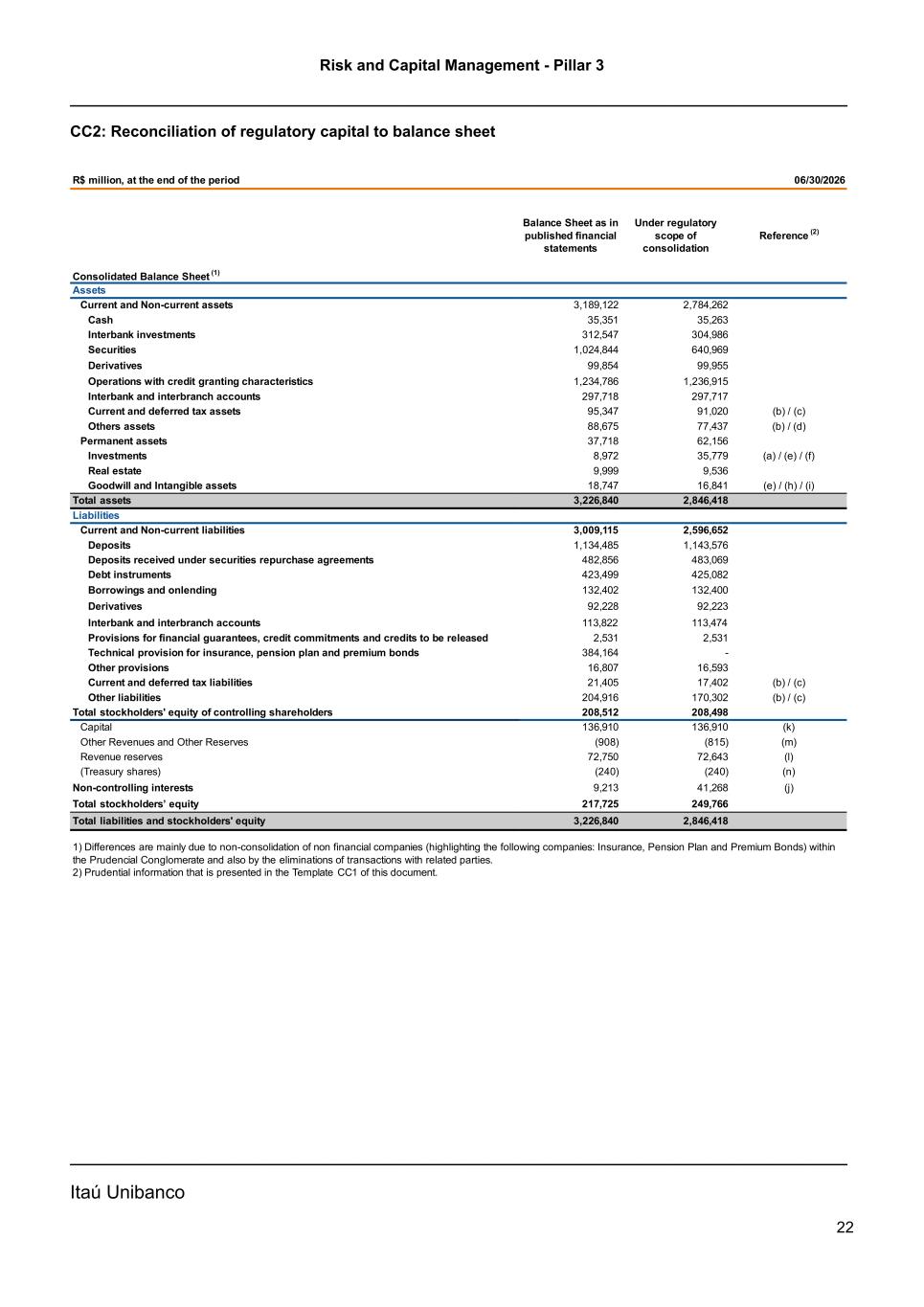
Risk and Capital Management - Pillar 3 __________________________________________________________________________________________ __________________________________________________________________________________________ Itaú Unibanco 22 CC2: Reconciliation of regulatory capital to balance sheet R$ million, at the end of the period 06/30/2026 Consolidated Balance Sheet (1) Balance Sheet as in published financial statements Under regulatory scope of consolidation Reference (2) Assets Current and Non-current assets 3,189,122 2,784,262 Cash 35,351 35,263 Interbank investments 312,547 304,986 Securities 1,024,844 640,969 Derivatives 99,854 99,955 Operations with credit granting characteristics 1,234,786 1,236,915 Interbank and interbranch accounts 297,718 297,717 Current and deferred tax assets 95,347 91,020 (b) / (c) Others assets 88,675 77,437 (b) / (d) Permanent assets 37,718 62,156 Investments 8,972 35,779 (a) / (e) / (f) Real estate 9,999 9,536 Goodwill and Intangible assets 18,747 16,841 (e) / (h) / (i) Total assets 3,226,840 2,846,418 Liabilities Current and Non-current liabilities 3,009,115 2,596,652 Deposits 1,134,485 1,143,576 Deposits received under securities repurchase agreements 482,856 483,069 Debt instruments 423,499 425,082 Borrowings and onlending 132,402 132,400 Derivatives 92,228 92,223 Interbank and interbranch accounts 113,822 113,474 Provisions for financial guarantees, credit commitments and credits to be released 2,531 2,531 Technical provision for insurance, pension plan and premium bonds 384,164 - Other provisions 16,807 16,593 Current and deferred tax liabilities 21,405 17,402 (b) / (c) Other liabilities 204,916 170,302 (b) / (c) Total stockholders' equity of controlling shareholders 208,512 208,498 Capital 136,910 136,910 (k) Other Revenues and Other Reserves (908) (815) (m) Revenue reserves 72,750 72,643 (l) (Treasury shares) (240) (240) (n) Non-controlling interests 9,213 41,268 (j) Total stockholders’ equity 217,725 249,766 Total liabilities and stockholders' equity 3,226,840 2,846,418 1) Differences are mainly due to non-consolidation of non financial companies (highlighting the following companies: Insurance, Pension Plan and Premium Bonds) within the Prudencial Conglomerate and also by the eliminations of transactions with related parties. 2) Prudential information that is presented in the Template CC1 of this document.
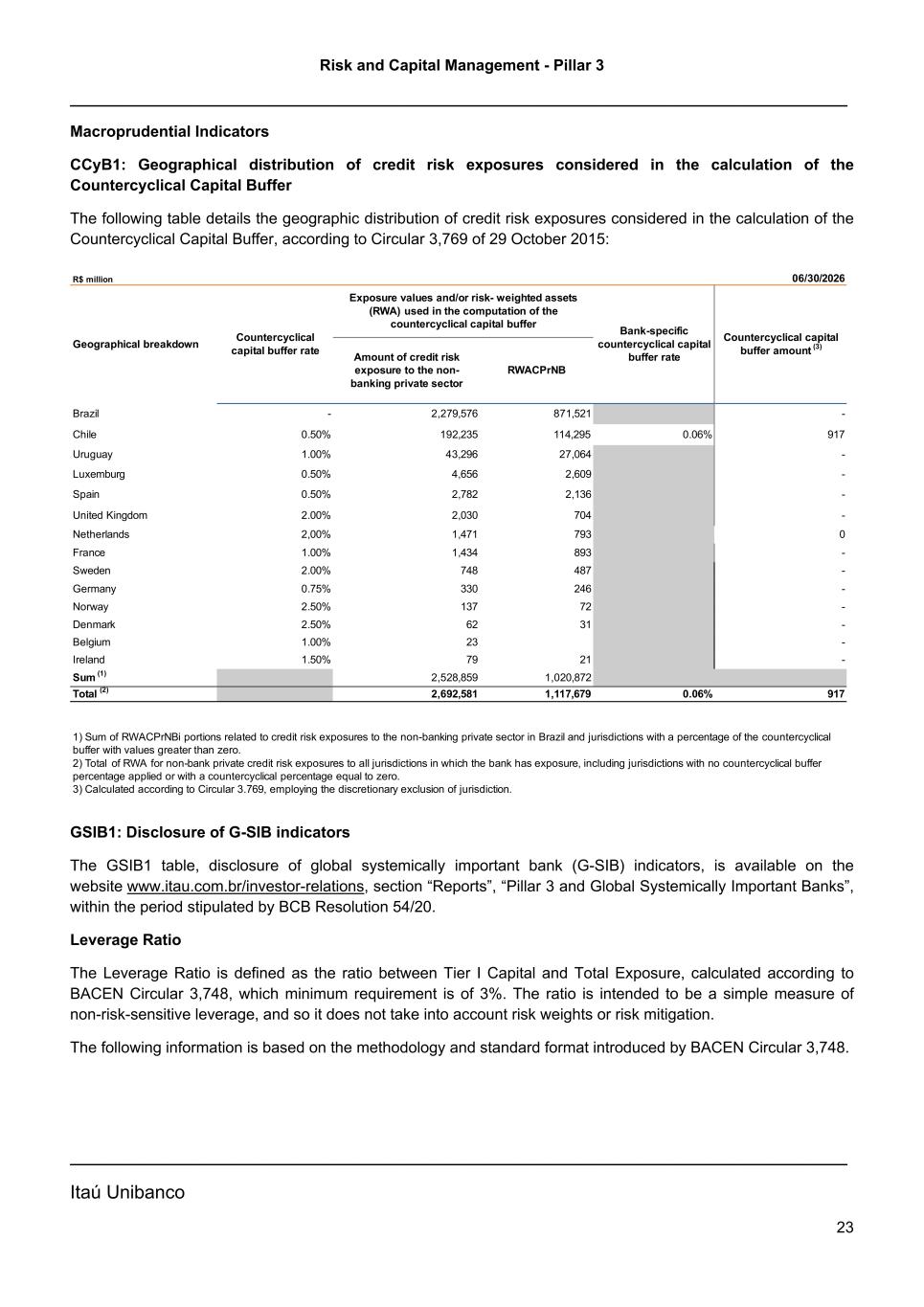
Risk and Capital Management - Pillar 3 __________________________________________________________________________________________ __________________________________________________________________________________________ Itaú Unibanco 23 Macroprudential Indicators CCyB1: Geographical distribution of credit risk exposures considered in the calculation of the Countercyclical Capital Buffer The following table details the geographic distribution of credit risk exposures considered in the calculation of the Countercyclical Capital Buffer, according to Circular 3,769 of 29 October 2015: R$ million 06/30/2026 Geographical breakdown Countercyclical capital buffer rate Exposure values and/or risk- weighted assets (RWA) used in the computation of the countercyclical capital buffer Bank-specific countercyclical capital buffer rate Countercyclical capital buffer amount (3) Amount of credit risk exposure to the non- banking private sector RWACPrNB Brazil - 2,279,576 871,521 - Chile 0.50% 192,235 114,295 0.06% 917 Uruguay 1.00% 43,296 27,064 - Luxemburg 0.50% 4,656 2,609 - Spain 0.50% 2,782 2,136 - United Kingdom 2.00% 2,030 704 - Netherlands 2,00% 1,471 793 0 France 1.00% 1,434 893 - Sweden 2.00% 748 487 - Germany 0.75% 330 246 - Norway 2.50% 137 72 - Denmark 2.50% 62 31 - Belgium 1.00% 23 - Ireland 1.50% 79 21 - Sum (1) 2,528,859 1,020,872 Total (2) 2,692,581 1,117,679 0.06% 917 1) Sum of RWACPrNBi portions related to credit risk exposures to the non-banking private sector in Brazil and jurisdictions with a percentage of the countercyclical buffer with values greater than zero. 2) Total of RWA for non-bank private credit risk exposures to all jurisdictions in which the bank has exposure, including jurisdictions with no countercyclical buffer percentage applied or with a countercyclical percentage equal to zero. 3) Calculated according to Circular 3.769, employing the discretionary exclusion of jurisdiction. GSIB1: Disclosure of G-SIB indicators The GSIB1 table, disclosure of global systemically important bank (G-SIB) indicators, is available on the website www.itau.com.br/investor-relations, section “Reports”, “Pillar 3 and Global Systemically Important Banks”, within the period stipulated by BCB Resolution 54/20. Leverage Ratio The Leverage Ratio is defined as the ratio between Tier I Capital and Total Exposure, calculated according to BACEN Circular 3,748, which minimum requirement is of 3%. The ratio is intended to be a simple measure of non-risk-sensitive leverage, and so it does not take into account risk weights or risk mitigation. The following information is based on the methodology and standard format introduced by BACEN Circular 3,748.
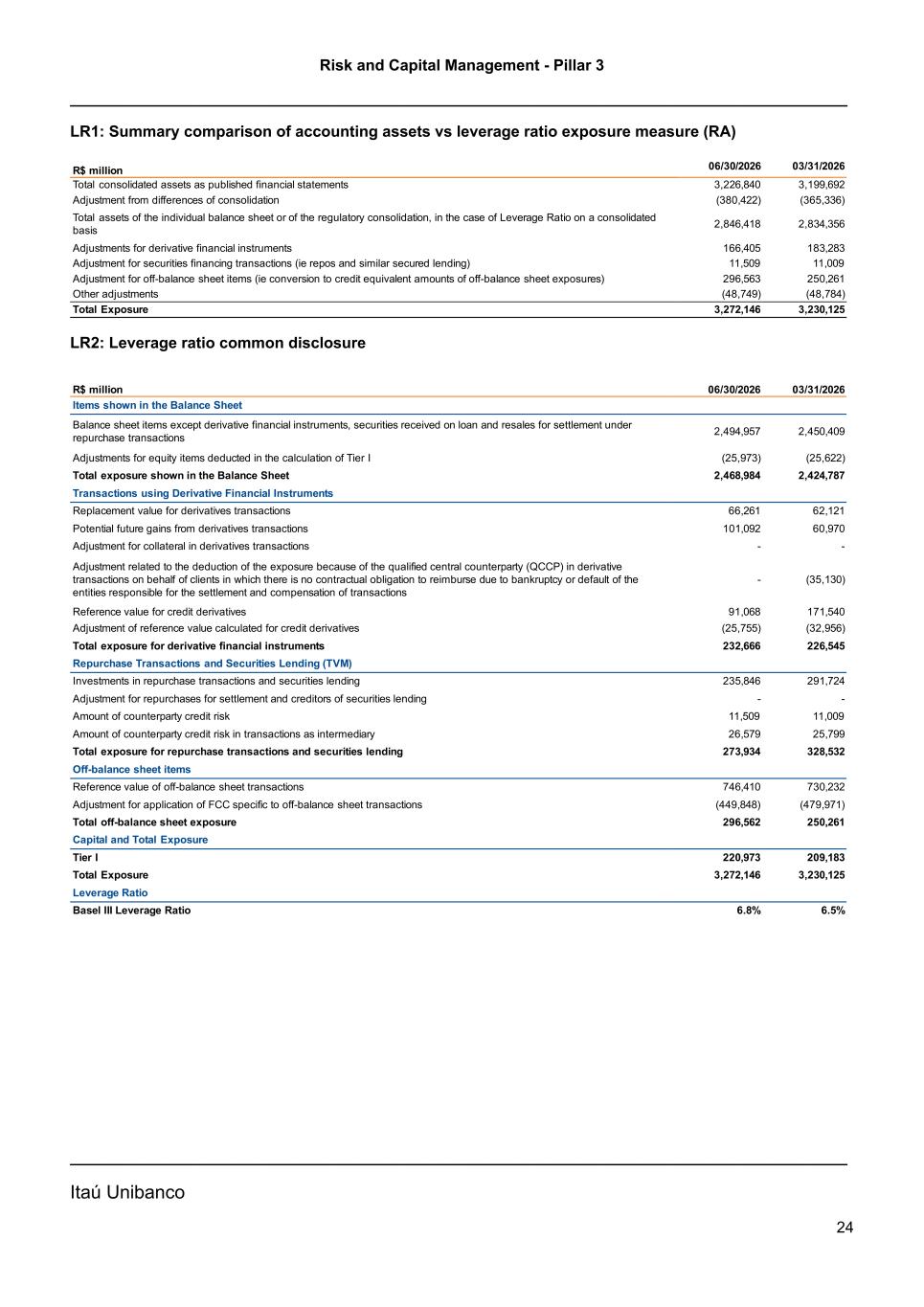
Risk and Capital Management - Pillar 3 __________________________________________________________________________________________ __________________________________________________________________________________________ Itaú Unibanco 24 LR1: Summary comparison of accounting assets vs leverage ratio exposure measure (RA) R$ million 06/30/2026 03/31/2026 Total consolidated assets as published financial statements 3,226,840 3,199,692 Adjustment from differences of consolidation (380,422) (365,336) Total assets of the individual balance sheet or of the regulatory consolidation, in the case of Leverage Ratio on a consolidated basis 2,846,418 2,834,356 Adjustments for derivative financial instruments 166,405 183,283 Adjustment for securities financing transactions (ie repos and similar secured lending) 11,509 11,009 Adjustment for off-balance sheet items (ie conversion to credit equivalent amounts of off-balance sheet exposures) 296,563 250,261 Other adjustments (48,749) (48,784) Total Exposure 3,272,146 3,230,125 LR2: Leverage ratio common disclosure a b R$ million 06/30/2026 03/31/2026 Items shown in the Balance Sheet Balance sheet items except derivative financial instruments, securities received on loan and resales for settlement under repurchase transactions 2,494,957 2,450,409 Adjustments for equity items deducted in the calculation of Tier I (25,973) (25,622) Total exposure shown in the Balance Sheet 2,468,984 2,424,787 Transactions using Derivative Financial Instruments Replacement value for derivatives transactions 66,261 62,121 Potential future gains from derivatives transactions 101,092 60,970 Adjustment for collateral in derivatives transactions - - Adjustment related to the deduction of the exposure because of the qualified central counterparty (QCCP) in derivative transactions on behalf of clients in which there is no contractual obligation to reimburse due to bankruptcy or default of the entities responsible for the settlement and compensation of transactions - (35,130) Reference value for credit derivatives 91,068 171,540 Adjustment of reference value calculated for credit derivatives (25,755) (32,956) Total exposure for derivative financial instruments 232,666 226,545 Repurchase Transactions and Securities Lending (TVM) Investments in repurchase transactions and securities lending 235,846 291,724 Adjustment for repurchases for settlement and creditors of securities lending - - Amount of counterparty credit risk 11,509 11,009 Amount of counterparty credit risk in transactions as intermediary 26,579 25,799 Total exposure for repurchase transactions and securities lending 273,934 328,532 Off-balance sheet items Reference value of off-balance sheet transactions 746,410 730,232 Adjustment for application of FCC specific to off-balance sheet transactions (449,848) (479,971) Total off-balance sheet exposure 296,562 250,261 Capital and Total Exposure Tier I 220,973 209,183 Total Exposure 3,272,146 3,230,125 Leverage Ratio Basel III Leverage Ratio 6.8% 6.5%
Risk and Capital Management - Pillar 3 __________________________________________________________________________________________ __________________________________________________________________________________________ Itaú Unibanco 25 Liquidity Ratios LIQA: Liquidity Risk Management Information Framework and Treatment Liquidity risk is defined as the likelihood of the institution not being able to effectively honor its expected and unexpected obligations, current and future, including those from guarantees commitment, without affecting its daily operations or incurring in significant losses. In line with the fundraising strategy, Itaú Unibanco has diversified and stable sources of funding available, monitored through concentration and maturity indicators, in order to mitigate liquidity risks, in accordance with the institution's risk appetite. The governance of the liquidity risk management is based on advisory boards, subordinated to the Board of Directors or the executive structure of Itaú Unibanco. Such boards establish the institution's risk appetites, define the limits related to the liquidity control and monitor the liquidity indicators. The control of the liquidity risk is carried out by an area that is independent of the business areas, responsible for defining the composition of the reserve, estimating the cash flow and the exposure to liquidity risk in different time horizons and monitoring short and long term liquidity indicators (LCR and NSFR respectively). In addition, it proposes minimum limits to absorb losses in stress scenarios for each country where Itaú Unibanco operates and reports any non-compliance to the competent authorities. All activities are subject to verification by the independent validation, internal controls and audit departments. Additionally, and pursuant to the requirements of Resolution 4,557, BACEN Circular 3,749 and Circular 3,869, the Liquidity Risk Statement (DRL - LCR) and the Long Term Liquidity Statement (DLP - NSFR) are monthly sent to BACEN. Finally, the following items are periodically prepared and submitted to senior management for monitoring and decision support: • Stress of liquidity indicators based on macroeconomic scenarios, simulation of reverse stress based on risk appetite, and projection of the main liquidity indicators to support decisions; • Contingency and recovery plans for crisis situations, with actions that provide for a gradation according to the level of criticality determined by the easiness of implementation, taking into account the characteristics of the local market in which it operates, seeking a rapid restoration of liquidity indicators; • Reports and graphs that describe risk positions; • Concentration indicators of funding providers and time. The document "Public Access Report - Liquidity Risk Management and Control Policy" that details the liquidity risk control institutional policy is on the Investor Relations website https://www.itau.com.br/investor-relations,section “Itaú Unibanco”, under “Corporate Governance”, “Policies", "Reports”.
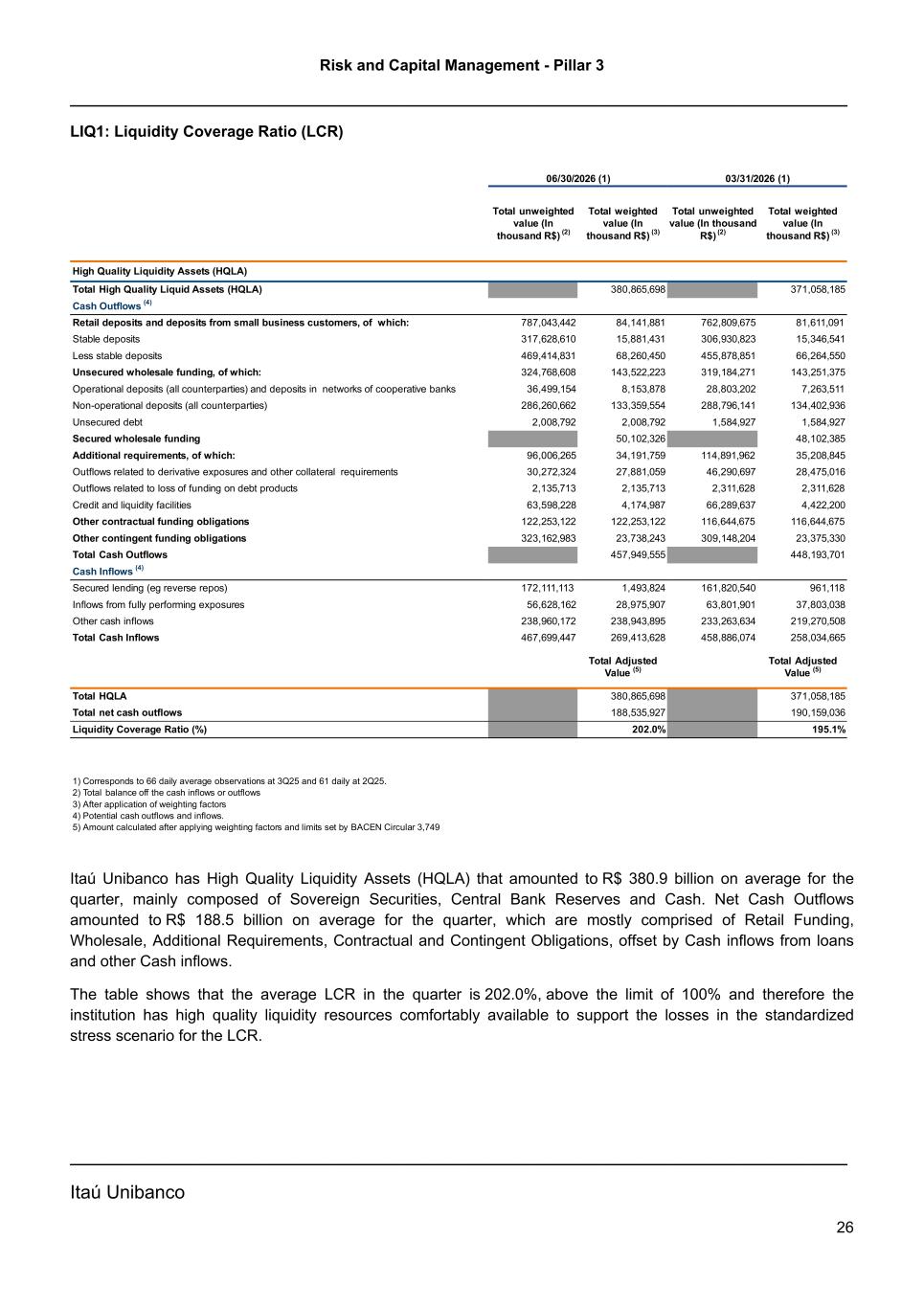
Risk and Capital Management - Pillar 3 __________________________________________________________________________________________ __________________________________________________________________________________________ Itaú Unibanco 26 LIQ1: Liquidity Coverage Ratio (LCR) 06/30/2026 (1) 03/31/2026 (1) Total unweighted value (In thousand R$) (2) Total weighted value (In thousand R$) (3) Total unweighted value (In thousand R$) (2) Total weighted value (In thousand R$) (3) High Quality Liquidity Assets (HQLA) Total High Quality Liquid Assets (HQLA) 380,865,698 371,058,185 Cash Outflows (4) . . Retail deposits and deposits from small business customers, of which: 787,043,442 84,141,881 762,809,675 81,611,091 Stable deposits 317,628,610 15,881,431 306,930,823 15,346,541 Less stable deposits 469,414,831 68,260,450 455,878,851 66,264,550 Unsecured wholesale funding, of which: 324,768,608 143,522,223 319,184,271 143,251,375 Operational deposits (all counterparties) and deposits in networks of cooperative banks 36,499,154 8,153,878 28,803,202 7,263,511 Non-operational deposits (all counterparties) 286,260,662 133,359,554 288,796,141 134,402,936 Unsecured debt 2,008,792 2,008,792 1,584,927 1,584,927 Secured wholesale funding 50,102,326 48,102,385 Additional requirements, of which: 96,006,265 34,191,759 114,891,962 35,208,845 Outflows related to derivative exposures and other collateral requirements 30,272,324 27,881,059 46,290,697 28,475,016 Outflows related to loss of funding on debt products 2,135,713 2,135,713 2,311,628 2,311,628 Credit and liquidity facilities 63,598,228 4,174,987 66,289,637 4,422,200 Other contractual funding obligations 122,253,122 122,253,122 116,644,675 116,644,675 Other contingent funding obligations 323,162,983 23,738,243 309,148,204 23,375,330 Total Cash Outflows 457,949,555 448,193,701 Cash Inflows (4) Secured lending (eg reverse repos) 172,111,113 1,493,824 161,820,540 961,118 Inflows from fully performing exposures 56,628,162 28,975,907 63,801,901 37,803,038 Other cash inflows 238,960,172 238,943,895 233,263,634 219,270,508 Total Cash Inflows 467,699,447 269,413,628 458,886,074 258,034,665 Total Adjusted Value (5) Total Adjusted Value (5) Total HQLA 380,865,698 371,058,185 Total net cash outflows 188,535,927 190,159,036 Liquidity Coverage Ratio (%) 202.0% 195.1% 1) Corresponds to 66 daily average observations at 3Q25 and 61 daily at 2Q25. 2) Total balance off the cash inflows or outflows 3) After application of weighting factors 4) Potential cash outflows and inflows. 5) Amount calculated after applying weighting factors and limits set by BACEN Circular 3,749 Itaú Unibanco has High Quality Liquidity Assets (HQLA) that amounted to R$ 380.9 billion on average for the quarter, mainly composed of Sovereign Securities, Central Bank Reserves and Cash. Net Cash Outflows amounted to R$ 188.5 billion on average for the quarter, which are mostly comprised of Retail Funding, Wholesale, Additional Requirements, Contractual and Contingent Obligations, offset by Cash inflows from loans and other Cash inflows. The table shows that the average LCR in the quarter is 202.0%, above the limit of 100% and therefore the institution has high quality liquidity resources comfortably available to support the losses in the standardized stress scenario for the LCR.
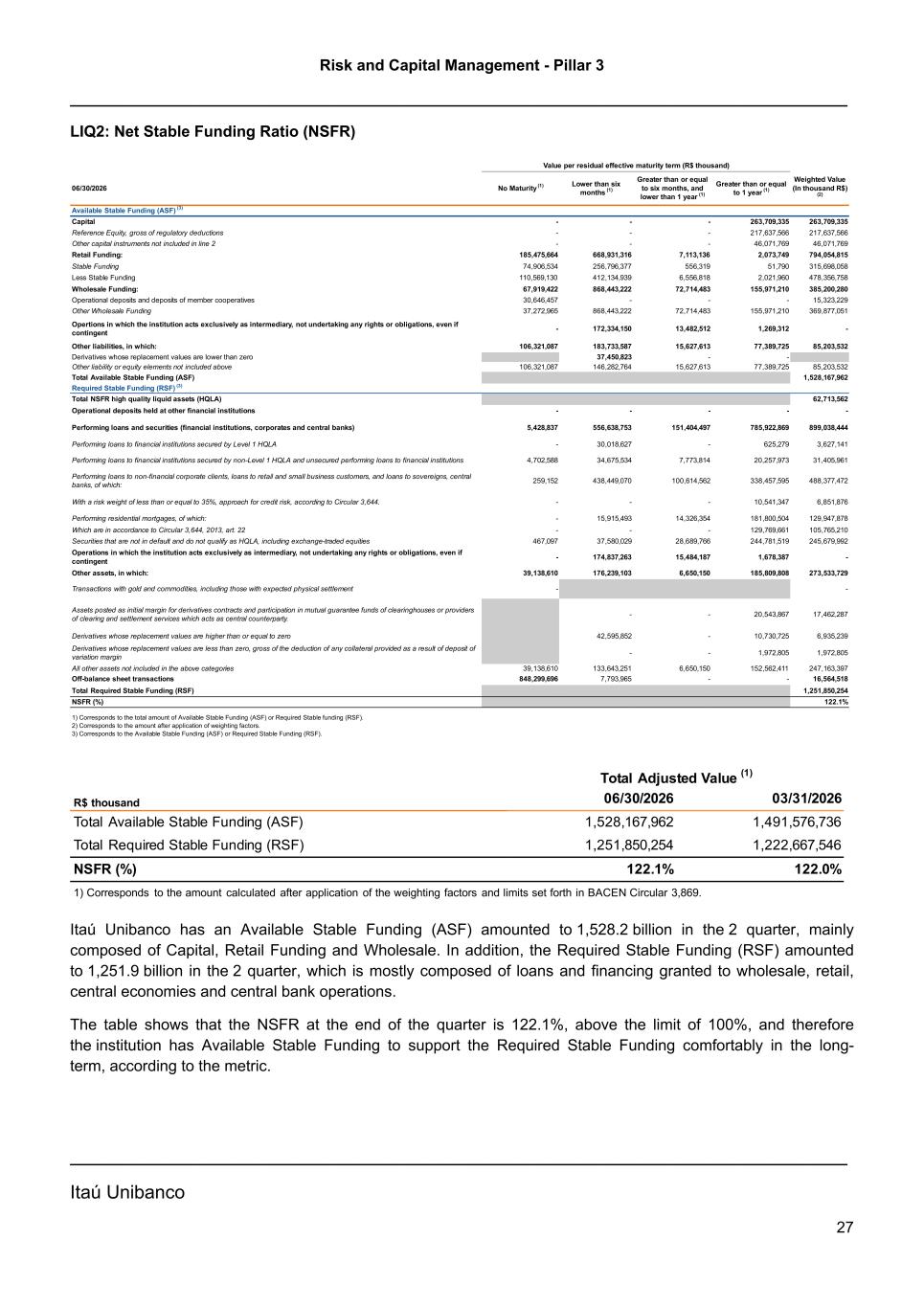
Risk and Capital Management - Pillar 3 __________________________________________________________________________________________ __________________________________________________________________________________________ Itaú Unibanco 27 LIQ2: Net Stable Funding Ratio (NSFR) a b c d e Value per residual effective maturity term (R$ thousand) 06/30/2026 No Maturity (1) Lower than six months (1) Greater than or equal to six months, and lower than 1 year (1) Greater than or equal to 1 year (1) Weighted Value (In thousand R$) (2) Available Stable Funding (ASF) (3) Capital - - - 263,709,335 263,709,335 Reference Equity, gross of regulatory deductions - - - 217,637,566 217,637,566 Other capital instruments not included in line 2 - - - 46,071,769 46,071,769 Retail Funding: 185,475,664 668,931,316 7,113,136 2,073,749 794,054,815 Stable Funding 74,906,534 256,796,377 556,319 51,790 315,698,058 Less Stable Funding 110,569,130 412,134,939 6,556,818 2,021,960 478,356,758 Wholesale Funding: 67,919,422 868,443,222 72,714,483 155,971,210 385,200,280 Operational deposits and deposits of member cooperatives 30,646,457 - - - 15,323,229 Other Wholesale Funding 37,272,965 868,443,222 72,714,483 155,971,210 369,877,051 Opertions in which the institution acts exclusively as intermediary, not undertaking any rights or obligations, even if contingent - 172,334,150 13,482,512 1,269,312 - Other liabilities, in which: 106,321,087 183,733,587 15,627,613 77,389,725 85,203,532 Derivatives whose replacement values are lower than zero 37,450,823 - - Other liability or equity elements not included above 106,321,087 146,282,764 15,627,613 77,389,725 85,203,532 Total Available Stable Funding (ASF) 1,528,167,962 Required Stable Funding (RSF) (3) Total NSFR high quality liquid assets (HQLA) 62,713,562 Operational deposits held at other financial institutions - - - - - Performing loans and securities (financial institutions, corporates and central banks) 5,428,837 556,638,753 151,404,497 785,922,869 899,038,444 Performing loans to financial institutions secured by Level 1 HQLA - 30,018,627 - 625,279 3,627,141 Performing loans to financial institutions secured by non-Level 1 HQLA and unsecured performing loans to financial institutions 4,702,588 34,675,534 7,773,814 20,257,973 31,405,961 Performing loans to non-financial corporate clients, loans to retail and small business customers, and loans to sovereigns, central banks, of which: 259,152 438,449,070 100,614,562 338,457,595 488,377,472 With a risk weight of less than or equal to 35%, approach for credit risk, according to Circular 3,644. - - - 10,541,347 6,851,876 Performing residential mortgages, of which: - 15,915,493 14,326,354 181,800,504 129,947,878 Which are in accordance to Circular 3,644, 2013, art. 22 - - - 129,769,661 105,765,210 Securities that are not in default and do not qualify as HQLA, including exchange-traded equities 467,097 37,580,029 28,689,766 244,781,519 245,679,992 Operations in which the institution acts exclusively as intermediary, not undertaking any rights or obligations, even if contingent - 174,837,263 15,484,187 1,678,387 - Other assets, in which: 39,138,610 176,239,103 6,650,150 185,809,808 273,533,729 Transactions with gold and commodities, including those with expected physical settlement - - Assets posted as initial margin for derivatives contracts and participation in mutual guarantee funds of clearinghouses or providers of clearing and settlement services which acts as central counterparty. - - 20,543,867 17,462,287 Derivatives whose replacement values are higher than or equal to zero 42,595,852 - 10,730,725 6,935,239 Derivatives whose replacement values are less than zero, gross of the deduction of any collateral provided as a result of deposit of variation margin - - 1,972,805 1,972,805 All other assets not included in the above categories 39,138,610 133,643,251 6,650,150 152,562,411 247,163,397 Off-balance sheet transactions 848,299,696 7,793,965 - - 16,564,518 Total Required Stable Funding (RSF) 1,251,850,254 NSFR (%) 122.1% 1) Corresponds to the total amount of Available Stable Funding (ASF) or Required Stable funding (RSF). 2) Corresponds to the amount after application of weighting factors. 3) Corresponds to the Available Stable Funding (ASF) or Required Stable Funding (RSF). R$ thousand Total Adjusted Value (1) 06/30/2026 03/31/2026 Total Available Stable Funding (ASF) 1,528,167,962 1,491,576,736 Total Required Stable Funding (RSF) 1,251,850,254 1,222,667,546 NSFR (%) 122.1% 122.0% 1) Corresponds to the amount calculated after application of the weighting factors and limits set forth in BACEN Circular 3,869. Itaú Unibanco has an Available Stable Funding (ASF) amounted to 1,528.2 billion in the 2 quarter, mainly composed of Capital, Retail Funding and Wholesale. In addition, the Required Stable Funding (RSF) amounted to 1,251.9 billion in the 2 quarter, which is mostly composed of loans and financing granted to wholesale, retail, central economies and central bank operations. The table shows that the NSFR at the end of the quarter is 122.1%, above the limit of 100%, and therefore the institution has Available Stable Funding to support the Required Stable Funding comfortably in the long- term, according to the metric.
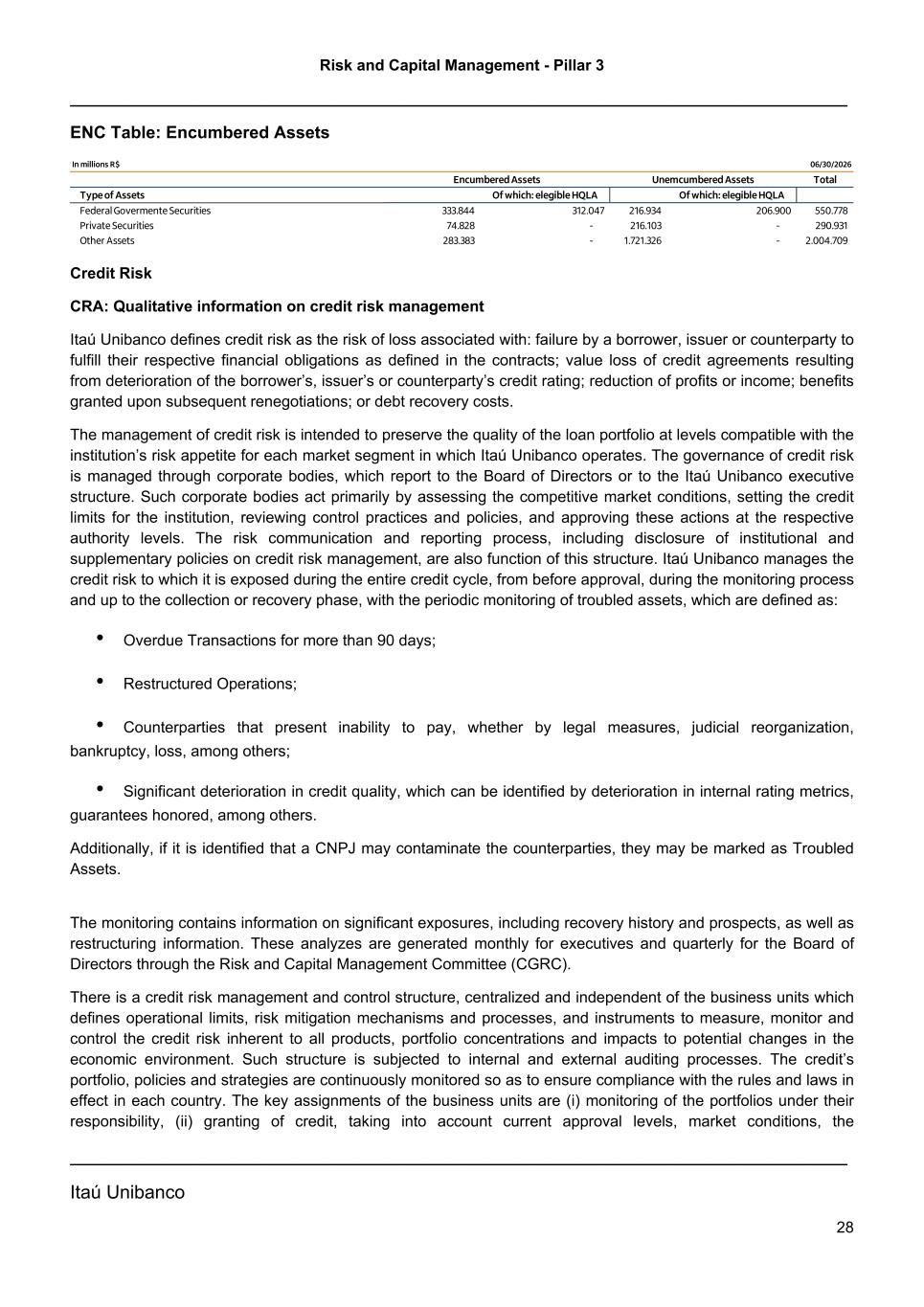
Risk and Capital Management - Pillar 3 __________________________________________________________________________________________ __________________________________________________________________________________________ Itaú Unibanco 28 ENC Table: Encumbered Assets Credit Risk CRA: Qualitative information on credit risk management Itaú Unibanco defines credit risk as the risk of loss associated with: failure by a borrower, issuer or counterparty to fulfill their respective financial obligations as defined in the contracts; value loss of credit agreements resulting from deterioration of the borrower’s, issuer’s or counterparty’s credit rating; reduction of profits or income; benefits granted upon subsequent renegotiations; or debt recovery costs. The management of credit risk is intended to preserve the quality of the loan portfolio at levels compatible with the institution’s risk appetite for each market segment in which Itaú Unibanco operates. The governance of credit risk is managed through corporate bodies, which report to the Board of Directors or to the Itaú Unibanco executive structure. Such corporate bodies act primarily by assessing the competitive market conditions, setting the credit limits for the institution, reviewing control practices and policies, and approving these actions at the respective authority levels. The risk communication and reporting process, including disclosure of institutional and supplementary policies on credit risk management, are also function of this structure. Itaú Unibanco manages the credit risk to which it is exposed during the entire credit cycle, from before approval, during the monitoring process and up to the collection or recovery phase, with the periodic monitoring of troubled assets, which are defined as: • Overdue Transactions for more than 90 days; • Restructured Operations; • Counterparties that present inability to pay, whether by legal measures, judicial reorganization, bankruptcy, loss, among others; • Significant deterioration in credit quality, which can be identified by deterioration in internal rating metrics, guarantees honored, among others. Additionally, if it is identified that a CNPJ may contaminate the counterparties, they may be marked as Troubled Assets. The monitoring contains information on significant exposures, including recovery history and prospects, as well as restructuring information. These analyzes are generated monthly for executives and quarterly for the Board of Directors through the Risk and Capital Management Committee (CGRC). There is a credit risk management and control structure, centralized and independent of the business units which defines operational limits, risk mitigation mechanisms and processes, and instruments to measure, monitor and control the credit risk inherent to all products, portfolio concentrations and impacts to potential changes in the economic environment. Such structure is subjected to internal and external auditing processes. The credit’s portfolio, policies and strategies are continuously monitored so as to ensure compliance with the rules and laws in effect in each country. The key assignments of the business units are (i) monitoring of the portfolios under their responsibility, (ii) granting of credit, taking into account current approval levels, market conditions, the In millions R$ 06/30/2026 Total Type of Assets Of which: elegible HQLA Of which: elegible HQLA Federal Govermente Securities 333.844 312.047 216.934 206.900 550.778 Private Securities 74.828 - 216.103 - 290.931 Other Assets 283.383 - 1.721.326 - 2.004.709 Encumbered Assets Unemcumbered Assets
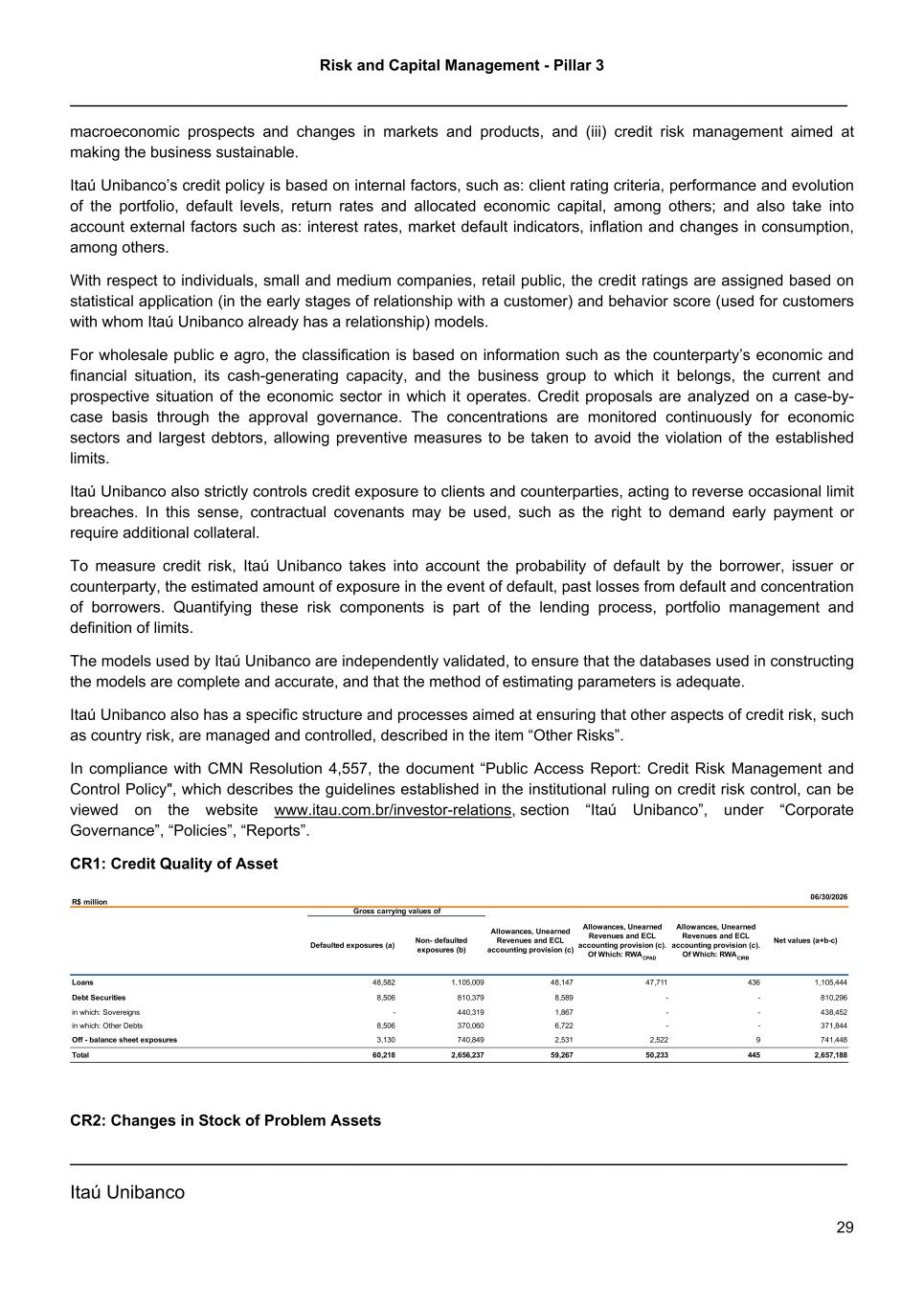
Risk and Capital Management - Pillar 3 __________________________________________________________________________________________ __________________________________________________________________________________________ Itaú Unibanco 29 macroeconomic prospects and changes in markets and products, and (iii) credit risk management aimed at making the business sustainable. Itaú Unibanco’s credit policy is based on internal factors, such as: client rating criteria, performance and evolution of the portfolio, default levels, return rates and allocated economic capital, among others; and also take into account external factors such as: interest rates, market default indicators, inflation and changes in consumption, among others. With respect to individuals, small and medium companies, retail public, the credit ratings are assigned based on statistical application (in the early stages of relationship with a customer) and behavior score (used for customers with whom Itaú Unibanco already has a relationship) models. For wholesale public e agro, the classification is based on information such as the counterparty’s economic and financial situation, its cash-generating capacity, and the business group to which it belongs, the current and prospective situation of the economic sector in which it operates. Credit proposals are analyzed on a case-by- case basis through the approval governance. The concentrations are monitored continuously for economic sectors and largest debtors, allowing preventive measures to be taken to avoid the violation of the established limits. Itaú Unibanco also strictly controls credit exposure to clients and counterparties, acting to reverse occasional limit breaches. In this sense, contractual covenants may be used, such as the right to demand early payment or require additional collateral. To measure credit risk, Itaú Unibanco takes into account the probability of default by the borrower, issuer or counterparty, the estimated amount of exposure in the event of default, past losses from default and concentration of borrowers. Quantifying these risk components is part of the lending process, portfolio management and definition of limits. The models used by Itaú Unibanco are independently validated, to ensure that the databases used in constructing the models are complete and accurate, and that the method of estimating parameters is adequate. Itaú Unibanco also has a specific structure and processes aimed at ensuring that other aspects of credit risk, such as country risk, are managed and controlled, described in the item “Other Risks”. In compliance with CMN Resolution 4,557, the document “Public Access Report: Credit Risk Management and Control Policy", which describes the guidelines established in the institutional ruling on credit risk control, can be viewed on the website www.itau.com.br/investor-relations, section “Itaú Unibanco”, under “Corporate Governance”, “Policies”, “Reports”. CR1: Credit Quality of Asset R$ million 06/30/2026 Gross carrying values of Allowances, Unearned Revenues and ECL accounting provision (c) Allowances, Unearned Revenues and ECL accounting provision (c). Of Which: RWACPAD Allowances, Unearned Revenues and ECL accounting provision (c). Of Which: RWACIRB Net values (a+b-c)Defaulted exposures (a) Non- defaulted exposures (b) Loans 48,582 1,105,009 48,147 47,711 436 1,105,444 Debt Securities 8,506 810,379 8,589 - - 810,296 in which: Sovereigns - 440,319 1,867 - - 438,452 in which: Other Debts 8,506 370,060 6,722 - - 371,844 Off - balance sheet exposures 3,130 740,849 2,531 2,522 9 741,448 Total 60,218 2,656,237 59,267 50,233 445 2,657,188 CR2: Changes in Stock of Problem Assets
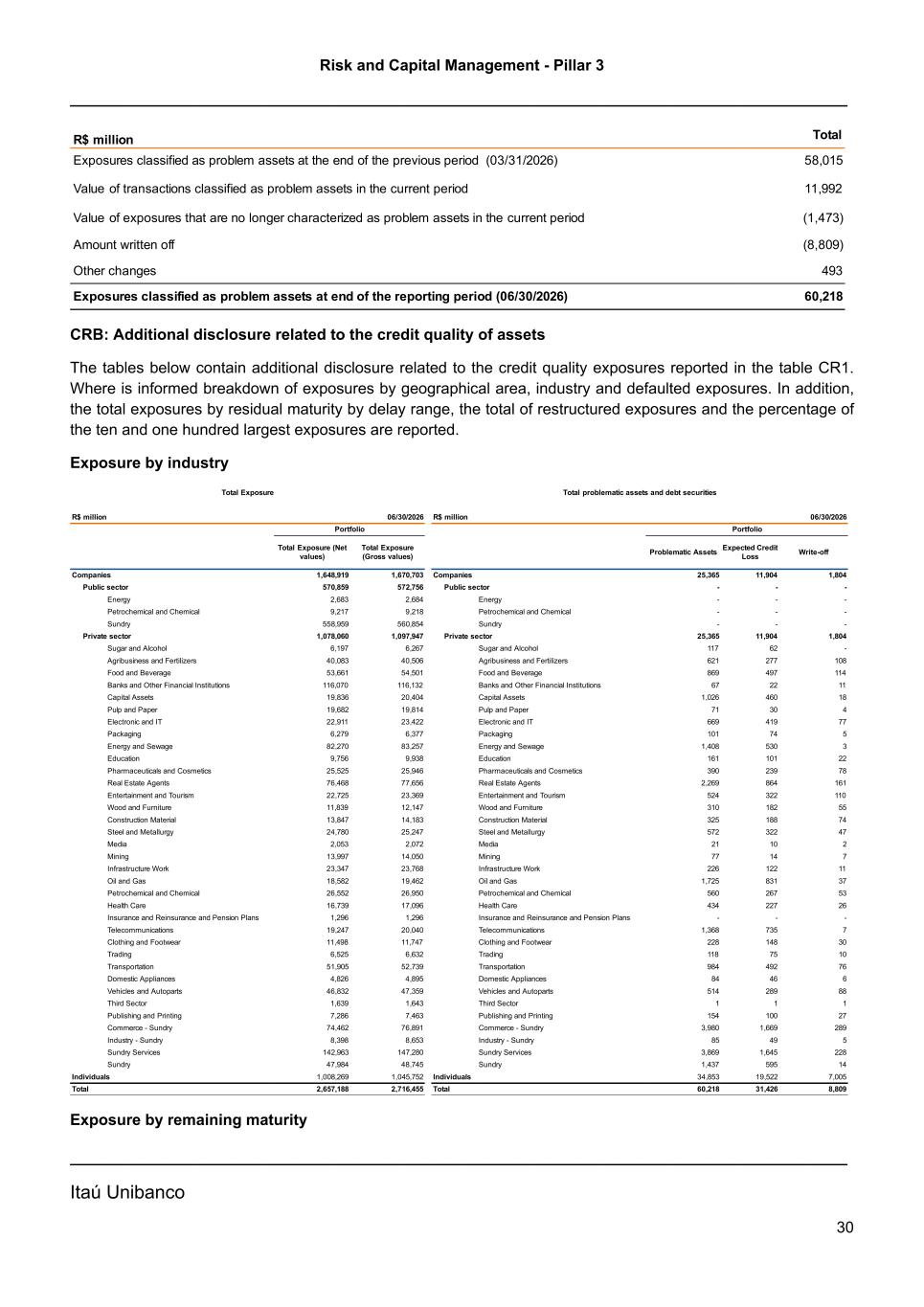
Risk and Capital Management - Pillar 3 __________________________________________________________________________________________ __________________________________________________________________________________________ Itaú Unibanco 30 R$ million Total Exposures classified as problem assets at the end of the previous period (03/31/2026) 3 58,015 Value of transactions classified as problem assets in the current period 11,992 Value of exposures that are no longer characterized as problem assets in the current period (1,473) Amount written off (8,809) Other changes 493 Exposures classified as problem assets at end of the reporting period (06/30/2026) 3 60,218 CRB: Additional disclosure related to the credit quality of assets The tables below contain additional disclosure related to the credit quality exposures reported in the table CR1. Where is informed breakdown of exposures by geographical area, industry and defaulted exposures. In addition, the total exposures by residual maturity by delay range, the total of restructured exposures and the percentage of the ten and one hundred largest exposures are reported. Exposure by industry Total Exposure Total problematic assets and debt securities R$ million 06/30/2026 R$ million 06/30/2026 Portfolio Portfolio Total Exposure (Net values) Total Exposure (Gross values) Problematic Assets Expected Credit Loss Write-off Companies 1,648,919 1,670,703 Companies 25,365 11,904 1,804 Public sector 570,859 572,756 Public sector - - - Energy 2,683 2,684 Energy - - - Petrochemical and Chemical 9,217 9,218 Petrochemical and Chemical - - - Sundry 558,959 560,854 Sundry - - - Private sector 1,078,060 1,097,947 Private sector 25,365 11,904 1,804 Sugar and Alcohol 6,197 6,267 Sugar and Alcohol 117 62 - Agribusiness and Fertilizers 40,083 40,506 Agribusiness and Fertilizers 621 277 108 Food and Beverage 53,661 54,501 Food and Beverage 869 497 114 Banks and Other Financial Institutions 116,070 116,132 Banks and Other Financial Institutions 67 22 11 Capital Assets 19,836 20,404 Capital Assets 1,026 460 18 Pulp and Paper 19,682 19,814 Pulp and Paper 71 30 4 Electronic and IT 22,911 23,422 Electronic and IT 669 419 77 Packaging 6,279 6,377 Packaging 101 74 5 Energy and Sewage 82,270 83,257 Energy and Sewage 1,408 530 3 Education 9,756 9,938 Education 161 101 22 Pharmaceuticals and Cosmetics 25,525 25,946 Pharmaceuticals and Cosmetics 390 239 78 Real Estate Agents 76,468 77,656 Real Estate Agents 2,269 864 161 Entertainment and Tourism 22,725 23,369 Entertainment and Tourism 524 322 110 Wood and Furniture 11,839 12,147 Wood and Furniture 310 182 55 Construction Material 13,847 14,183 Construction Material 325 188 74 Steel and Metallurgy 24,780 25,247 Steel and Metallurgy 572 322 47 Media 2,053 2,072 Media 21 10 2 Mining 13,997 14,050 Mining 77 14 7 Infrastructure Work 23,347 23,768 Infrastructure Work 226 122 11 Oil and Gas 18,582 19,462 Oil and Gas 1,725 831 37 Petrochemical and Chemical 26,552 26,950 Petrochemical and Chemical 560 267 53 Health Care 16,739 17,096 Health Care 434 227 26 Insurance and Reinsurance and Pension Plans 1,296 1,296 Insurance and Reinsurance and Pension Plans - - - Telecommunications 19,247 20,040 Telecommunications 1,368 735 7 Clothing and Footwear 11,498 11,747 Clothing and Footwear 228 148 30 Trading 6,525 6,632 Trading 118 75 10 Transportation 51,905 52,739 Transportation 984 492 76 Domestic Appliances 4,826 4,895 Domestic Appliances 84 46 6 Vehicles and Autoparts 46,832 47,359 Vehicles and Autoparts 514 289 88 Third Sector 1,639 1,643 Third Sector 1 1 1 Publishing and Printing 7,286 7,463 Publishing and Printing 154 100 27 Commerce - Sundry 74,462 76,891 Commerce - Sundry 3,980 1,669 289 Industry - Sundry 8,398 8,653 Industry - Sundry 85 49 5 Sundry Services 142,963 147,280 Sundry Services 3,869 1,645 228 Sundry 47,984 48,745 Sundry 1,437 595 14 Individuals 1,008,269 1,045,752 Individuals 34,853 19,522 7,005 Total 2,657,188 2,716,455 Total 60,218 31,426 8,809 Exposure by remaining maturity
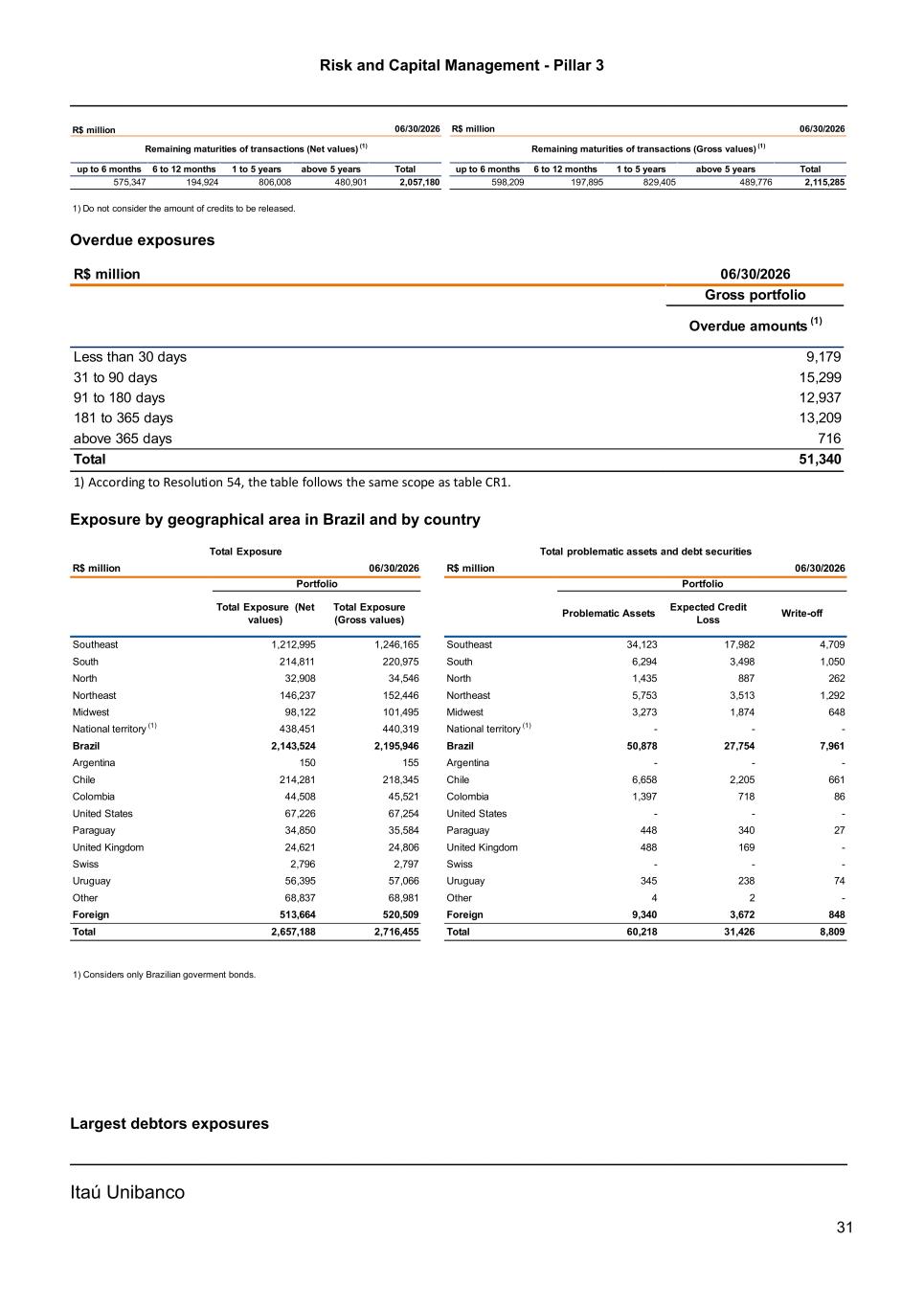
Risk and Capital Management - Pillar 3 __________________________________________________________________________________________ __________________________________________________________________________________________ Itaú Unibanco 31 R$ million 06/30/2026 R$ million 06/30/2026 Remaining maturities of transactions (Net values) (1) Remaining maturities of transactions (Gross values) (1) up to 6 months 6 to 12 months 1 to 5 years above 5 years Total up to 6 months 6 to 12 months 1 to 5 years above 5 years Total 575,347 194,924 806,008 480,901 2,057,180 598,209 197,895 829,405 489,776 2,115,285 1) Do not consider the amount of credits to be released. Overdue exposures R$ million 06/30/2026 Gross portfolio Overdue amounts (1) Less than 30 days 9,179 31 to 90 days 15,299 91 to 180 days 12,937 181 to 365 days 13,209 above 365 days 716 Total 51,340 1) According to Resolution 54, the table follows the same scope as table CR1. Exposure by geographical area in Brazil and by country Total Exposure Total problematic assets and debt securities R$ million 06/30/2026 R$ million 06/30/2026 Portfolio Portfolio Total Exposure (Net values) Total Exposure (Gross values) Problematic Assets Expected Credit Loss Write-off Southeast 1,212,995 1,246,165 Southeast 34,123 17,982 4,709 South 214,811 220,975 South 6,294 3,498 1,050 North 32,908 34,546 North 1,435 887 262 Northeast 146,237 152,446 Northeast 5,753 3,513 1,292 Midwest 98,122 101,495 Midwest 3,273 1,874 648 National territory (1) 438,451 440,319 National territory (1) - - - Brazil 2,143,524 2,195,946 Brazil 50,878 27,754 7,961 Argentina 150 155 Argentina - - - Chile 214,281 218,345 Chile 6,658 2,205 661 Colombia 44,508 45,521 Colombia 1,397 718 86 United States 67,226 67,254 United States - - - Paraguay 34,850 35,584 Paraguay 448 340 27 United Kingdom 24,621 24,806 United Kingdom 488 169 - Swiss 2,796 2,797 Swiss - - - Uruguay 56,395 57,066 Uruguay 345 238 74 Other 68,837 68,981 Other 4 2 - Foreign 513,664 520,509 Foreign 9,340 3,672 848 Total 2,657,188 2,716,455 Total 60,218 31,426 8,809 1) Considers only Brazilian goverment bonds. Largest debtors exposures
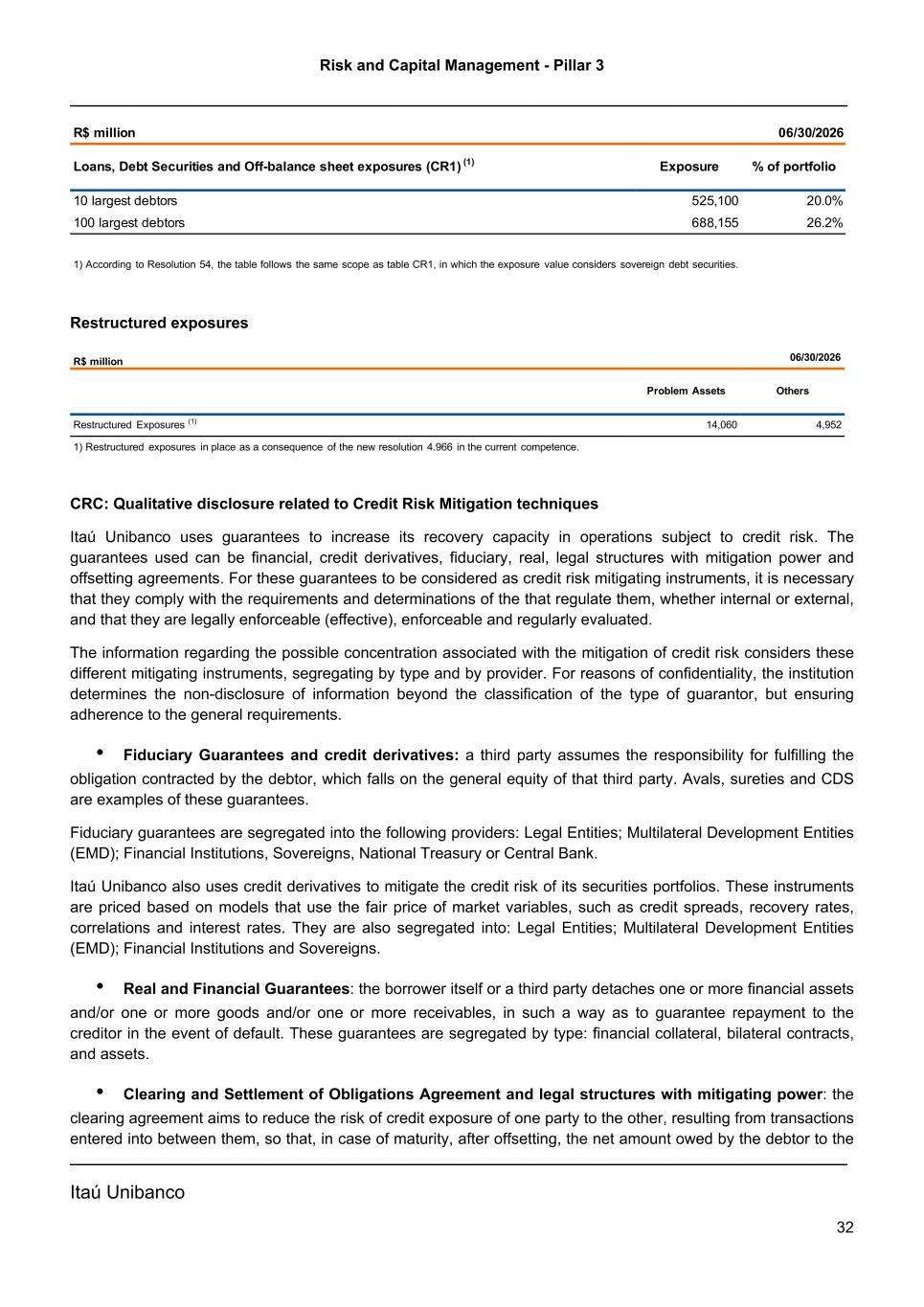
Risk and Capital Management - Pillar 3 __________________________________________________________________________________________ __________________________________________________________________________________________ Itaú Unibanco 32 R$ million 06/30/2026 Loans, Debt Securities and Off-balance sheet exposures (CR1) (1) Exposure % of portfolio 10 largest debtors 525,100 20.0% 100 largest debtors 688,155 26.2% 1) According to Resolution 54, the table follows the same scope as table CR1, in which the exposure value considers sovereign debt securities. Restructured exposures R$ million 06/30/2026 Problem Assets Others Restructured Exposures (1) 14,060 4,952 1) Restructured exposures in place as a consequence of the new resolution 4.966 in the current competence. CRC: Qualitative disclosure related to Credit Risk Mitigation techniques Itaú Unibanco uses guarantees to increase its recovery capacity in operations subject to credit risk. The guarantees used can be financial, credit derivatives, fiduciary, real, legal structures with mitigation power and offsetting agreements. For these guarantees to be considered as credit risk mitigating instruments, it is necessary that they comply with the requirements and determinations of the that regulate them, whether internal or external, and that they are legally enforceable (effective), enforceable and regularly evaluated. The information regarding the possible concentration associated with the mitigation of credit risk considers these different mitigating instruments, segregating by type and by provider. For reasons of confidentiality, the institution determines the non-disclosure of information beyond the classification of the type of guarantor, but ensuring adherence to the general requirements. • Fiduciary Guarantees and credit derivatives: a third party assumes the responsibility for fulfilling the obligation contracted by the debtor, which falls on the general equity of that third party. Avals, sureties and CDS are examples of these guarantees. Fiduciary guarantees are segregated into the following providers: Legal Entities; Multilateral Development Entities (EMD); Financial Institutions, Sovereigns, National Treasury or Central Bank. Itaú Unibanco also uses credit derivatives to mitigate the credit risk of its securities portfolios. These instruments are priced based on models that use the fair price of market variables, such as credit spreads, recovery rates, correlations and interest rates. They are also segregated into: Legal Entities; Multilateral Development Entities (EMD); Financial Institutions and Sovereigns. • Real and Financial Guarantees: the borrower itself or a third party detaches one or more financial assets and/or one or more goods and/or one or more receivables, in such a way as to guarantee repayment to the creditor in the event of default. These guarantees are segregated by type: financial collateral, bilateral contracts, and assets. • Clearing and Settlement of Obligations Agreement and legal structures with mitigating power: the clearing agreement aims to reduce the risk of credit exposure of one party to the other, resulting from transactions entered into between them, so that, in case of maturity, after offsetting, the net amount owed by the debtor to the
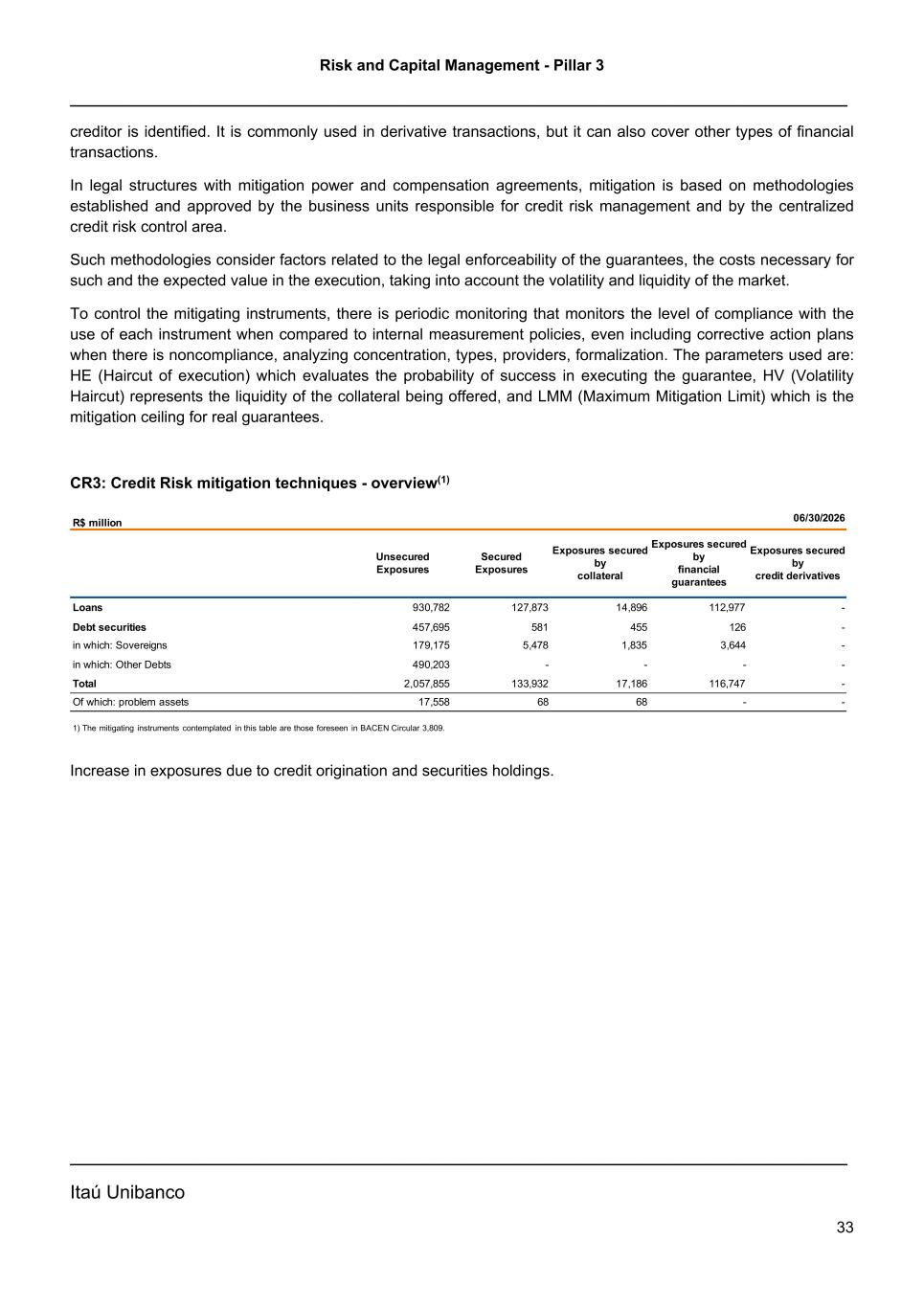
Risk and Capital Management - Pillar 3 __________________________________________________________________________________________ __________________________________________________________________________________________ Itaú Unibanco 33 creditor is identified. It is commonly used in derivative transactions, but it can also cover other types of financial transactions. In legal structures with mitigation power and compensation agreements, mitigation is based on methodologies established and approved by the business units responsible for credit risk management and by the centralized credit risk control area. Such methodologies consider factors related to the legal enforceability of the guarantees, the costs necessary for such and the expected value in the execution, taking into account the volatility and liquidity of the market. To control the mitigating instruments, there is periodic monitoring that monitors the level of compliance with the use of each instrument when compared to internal measurement policies, even including corrective action plans when there is noncompliance, analyzing concentration, types, providers, formalization. The parameters used are: HE (Haircut of execution) which evaluates the probability of success in executing the guarantee, HV (Volatility Haircut) represents the liquidity of the collateral being offered, and LMM (Maximum Mitigation Limit) which is the mitigation ceiling for real guarantees. CR3: Credit Risk mitigation techniques - overview(1) R$ million 06/30/2026 Unsecured Exposures Secured Exposures Exposures secured by collateral Exposures secured by financial guarantees Exposures secured by credit derivatives Loans 930,782 127,873 14,896 112,977 - Debt securities 457,695 581 455 126 - in which: Sovereigns 179,175 5,478 1,835 3,644 - in which: Other Debts 490,203 - - - - Total 2,057,855 133,932 17,186 116,747 - Of which: problem assets 17,558 68 68 - - 1) The mitigating instruments contemplated in this table are those foreseen in BACEN Circular 3,809. Increase in exposures due to credit origination and securities holdings.
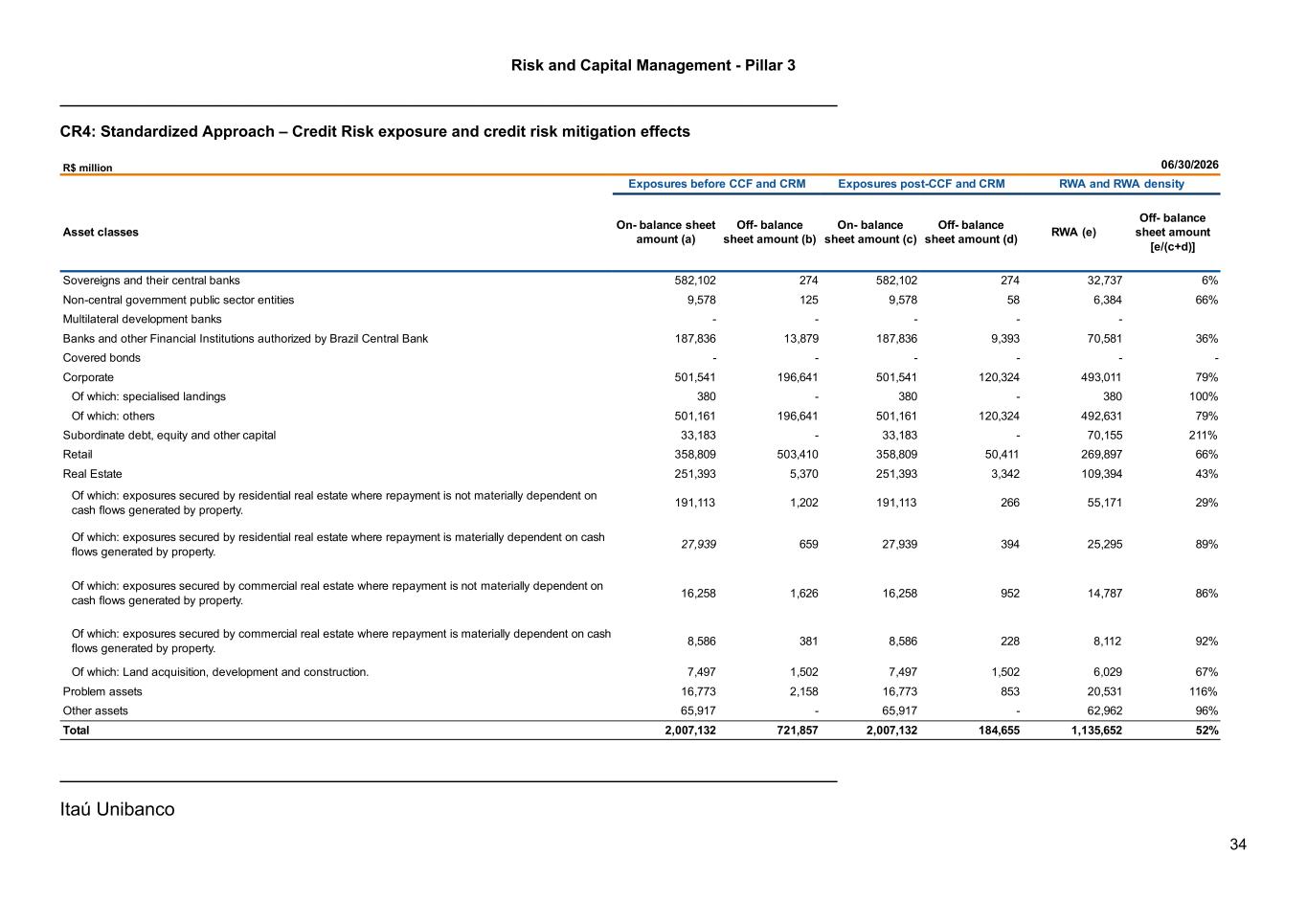
Risk and Capital Management - Pillar 3 __________________________________________________________________________________________ __________________________________________________________________________________________ Itaú Unibanco 34 CR4: Standardized Approach – Credit Risk exposure and credit risk mitigation effects R$ million 06/30/2026 Exposures before CCF and CRM Exposures post-CCF and CRM RWA and RWA density Asset classes On- balance sheet amount (a) Off- balance sheet amount (b) On- balance sheet amount (c) Off- balance sheet amount (d) RWA (e) Off- balance sheet amount [e/(c+d)] Sovereigns and their central banks 582,102 274 582,102 274 32,737 6% Non-central government public sector entities 9,578 125 9,578 58 6,384 66% Multilateral development banks - - - - - Banks and other Financial Institutions authorized by Brazil Central Bank 187,836 13,879 187,836 9,393 70,581 36% Covered bonds - - - - - - Corporate 501,541 196,641 501,541 120,324 493,011 79% Of which: specialised landings 380 - 380 - 380 100% Of which: others 501,161 196,641 501,161 120,324 492,631 79% Subordinate debt, equity and other capital 33,183 - 33,183 - 70,155 211% Retail 358,809 503,410 358,809 50,411 269,897 66% Real Estate 251,393 5,370 251,393 3,342 109,394 43% Of which: exposures secured by residential real estate where repayment is not materially dependent on cash flows generated by property. 191,113 1,202 191,113 266 55,171 29% Of which: exposures secured by residential real estate where repayment is materially dependent on cash flows generated by property. 27,939 659 27,939 394 25,295 89% Of which: exposures secured by commercial real estate where repayment is not materially dependent on cash flows generated by property. 16,258 1,626 16,258 952 14,787 86% Of which: exposures secured by commercial real estate where repayment is materially dependent on cash flows generated by property. 8,586 381 8,586 228 8,112 92% Of which: Land acquisition, development and construction. 7,497 1,502 7,497 1,502 6,029 67% Problem assets 16,773 2,158 16,773 853 20,531 116% Other assets 65,917 - 65,917 - 62,962 96% Total 2,007,132 721,857 2,007,132 184,655 1,135,652 52%
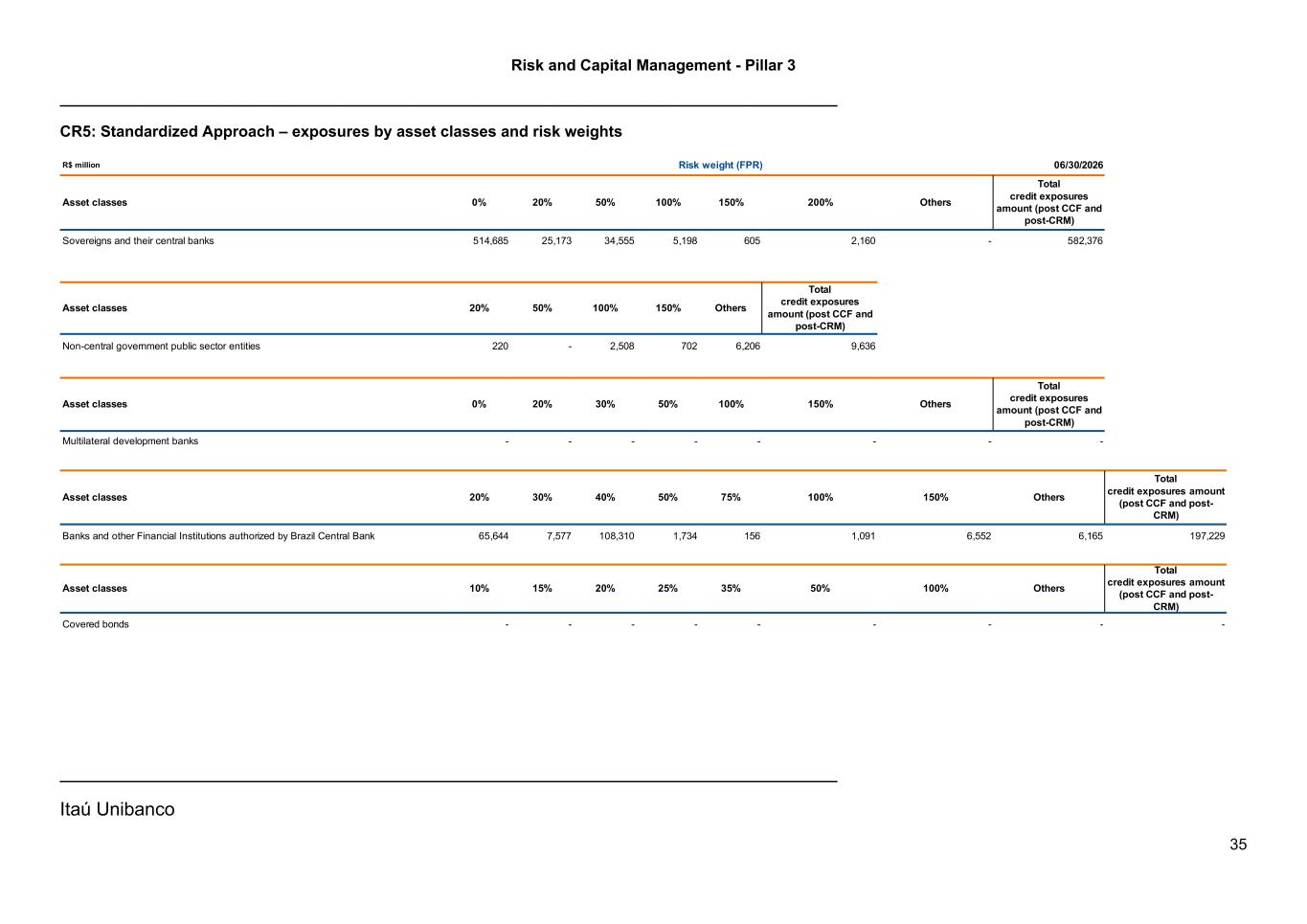
Risk and Capital Management - Pillar 3 __________________________________________________________________________________________ __________________________________________________________________________________________ Itaú Unibanco 35 CR5: Standardized Approach – exposures by asset classes and risk weights R$ million Risk weight (FPR) 06/30/2026 Asset classes 0% 20% 50% 100% 150% 200% Others Total credit exposures amount (post CCF and post-CRM) Sovereigns and their central banks 514,685 25,173 34,555 5,198 605 2,160 - 582,376 Asset classes 20% 50% 100% 150% Others Total credit exposures amount (post CCF and post-CRM) Non-central government public sector entities 220 - 2,508 702 6,206 9,636 Asset classes 0% 20% 30% 50% 100% 150% Others Total credit exposures amount (post CCF and post-CRM) Multilateral development banks - - - - - - - - Asset classes 20% 30% 40% 50% 75% 100% 150% Others Total credit exposures amount (post CCF and post- CRM) Banks and other Financial Institutions authorized by Brazil Central Bank 65,644 7,577 108,310 1,734 156 1,091 6,552 6,165 197,229 Asset classes 10% 15% 20% 25% 35% 50% 100% Others Total credit exposures amount (post CCF and post- CRM) Covered bonds - - - - - - - - -
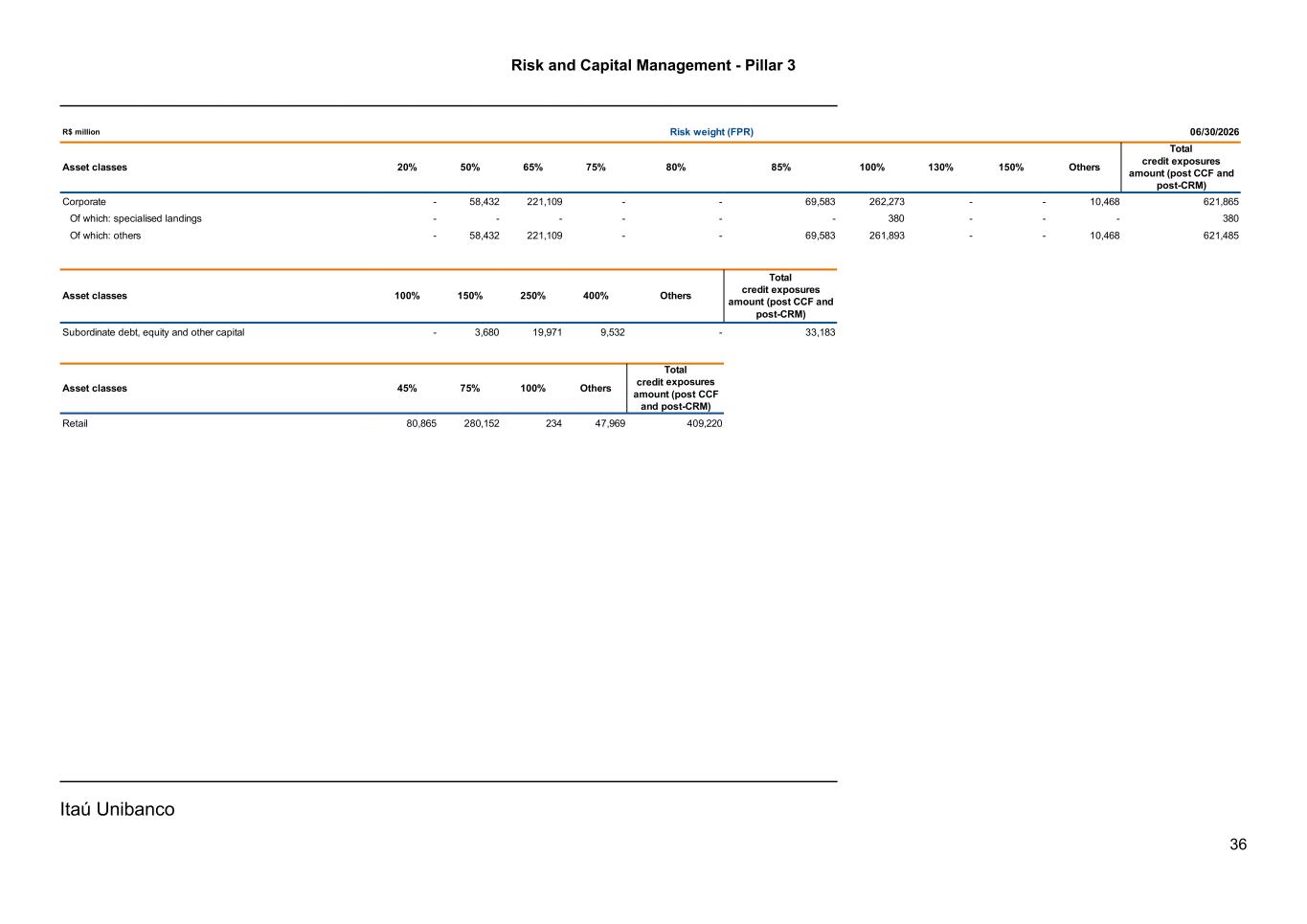
Risk and Capital Management - Pillar 3 __________________________________________________________________________________________ __________________________________________________________________________________________ Itaú Unibanco 36 R$ million Risk weight (FPR) 06/30/2026 Asset classes 20% 50% 65% 75% 80% 85% 100% 130% 150% Others Total credit exposures amount (post CCF and post-CRM) Corporate - 58,432 221,109 - - 69,583 262,273 - - 10,468 621,865 Of which: specialised landings - - - - - - 380 - - - 380 Of which: others - 58,432 221,109 - - 69,583 261,893 - - 10,468 621,485 Asset classes 100% 150% 250% 400% Others Total credit exposures amount (post CCF and post-CRM) Subordinate debt, equity and other capital - 3,680 19,971 9,532 - 33,183 Asset classes 45% 75% 100% Others Total credit exposures amount (post CCF and post-CRM) Retail 80,865 280,152 234 47,969 409,220
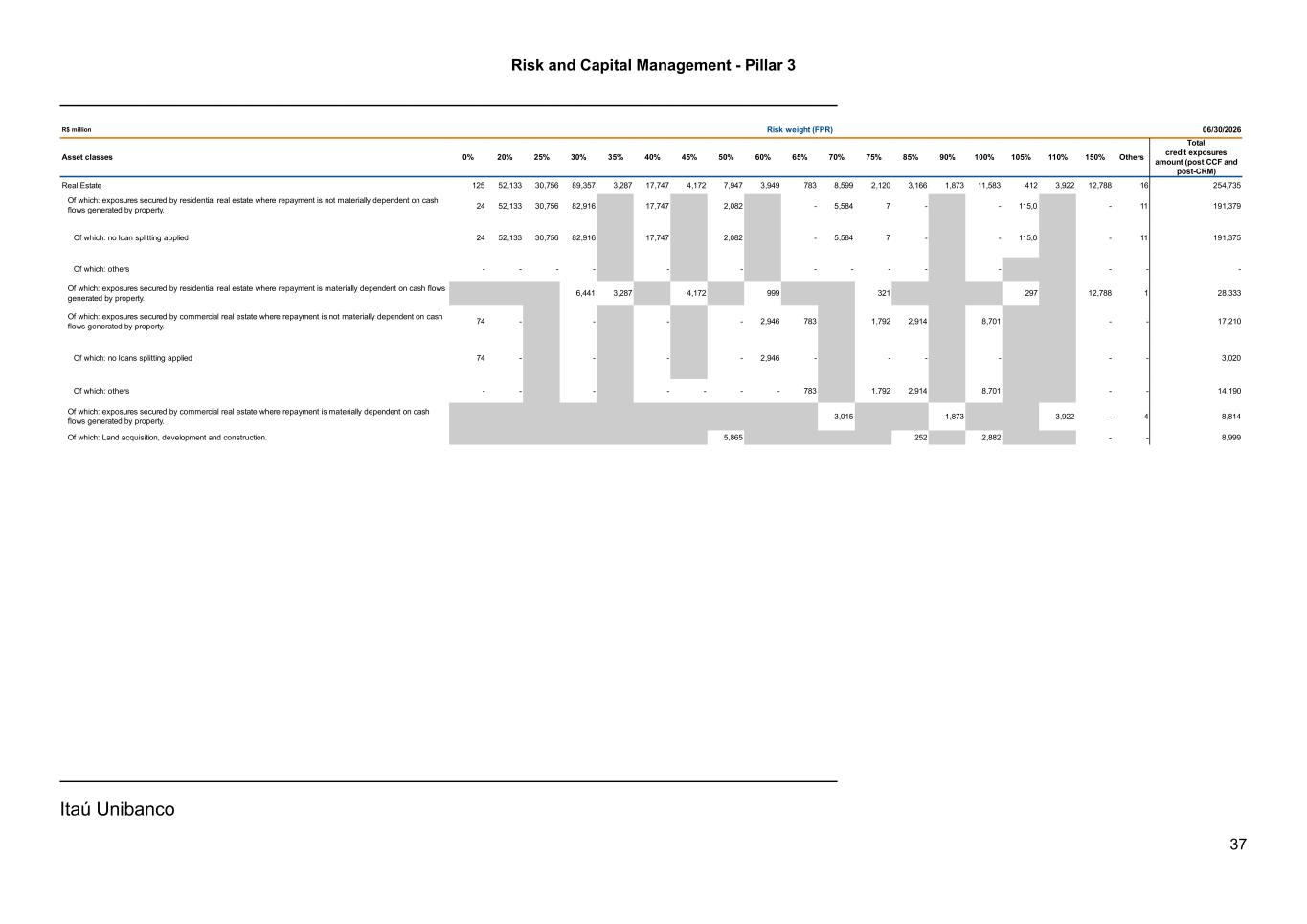
Risk and Capital Management - Pillar 3 __________________________________________________________________________________________ __________________________________________________________________________________________ Itaú Unibanco 37 R$ million Risk weight (FPR) 06/30/2026 Asset classes 0% 20% 25% 30% 35% 40% 45% 50% 60% 65% 70% 75% 85% 90% 100% 105% 110% 150% Others Total credit exposures amount (post CCF and post-CRM) Real Estate 125 52,133 30,756 89,357 3,287 17,747 4,172 7,947 3,949 783 8,599 2,120 3,166 1,873 11,583 412 3,922 12,788 16 254,735 Of which: exposures secured by residential real estate where repayment is not materially dependent on cash flows generated by property. 24 52,133 30,756 82,916 17,747 2,082 - 5,584 7 - - 115,0 - 11 191,379 Of which: no loan splitting applied 24 52,133 30,756 82,916 17,747 2,082 - 5,584 7 - - 115,0 - 11 191,375 Of which: others - - - - - - - - - - - - - - Of which: exposures secured by residential real estate where repayment is materially dependent on cash flows generated by property. 6,441 3,287 4,172 999 321 297 12,788 1 28,333 Of which: exposures secured by commercial real estate where repayment is not materially dependent on cash flows generated by property. 74 - - - - 2,946 783 1,792 2,914 8,701 - - 17,210 Of which: no loans splitting applied 74 - - - - 2,946 - - - - - - 3,020 Of which: others - - - - - - - 783 1,792 2,914 8,701 - - 14,190 Of which: exposures secured by commercial real estate where repayment is materially dependent on cash flows generated by property. 3,015 1,873 3,922 - 4 8,814 Of which: Land acquisition, development and construction. 5,865 252 2,882 - - 8,999
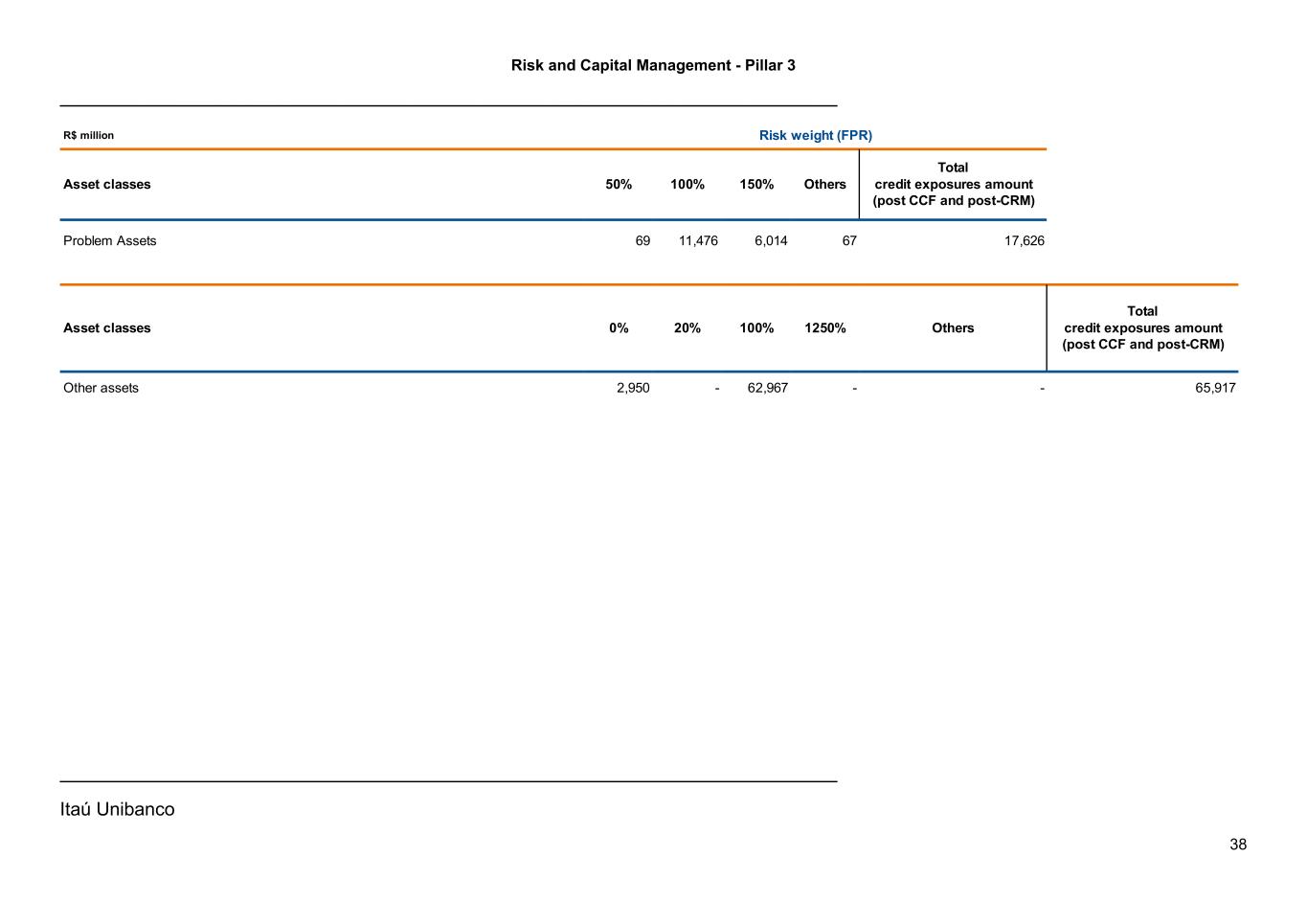
Risk and Capital Management - Pillar 3 __________________________________________________________________________________________ __________________________________________________________________________________________ Itaú Unibanco 38 R$ million Risk weight (FPR) Asset classes 50% 100% 150% Others Total credit exposures amount (post CCF and post-CRM) Problem Assets 69 11,476 6,014 67 17,626 Asset classes 0% 20% 100% 1250% Others Total credit exposures amount (post CCF and post-CRM) Other assets 2,950 - 62,967 - - 65,917
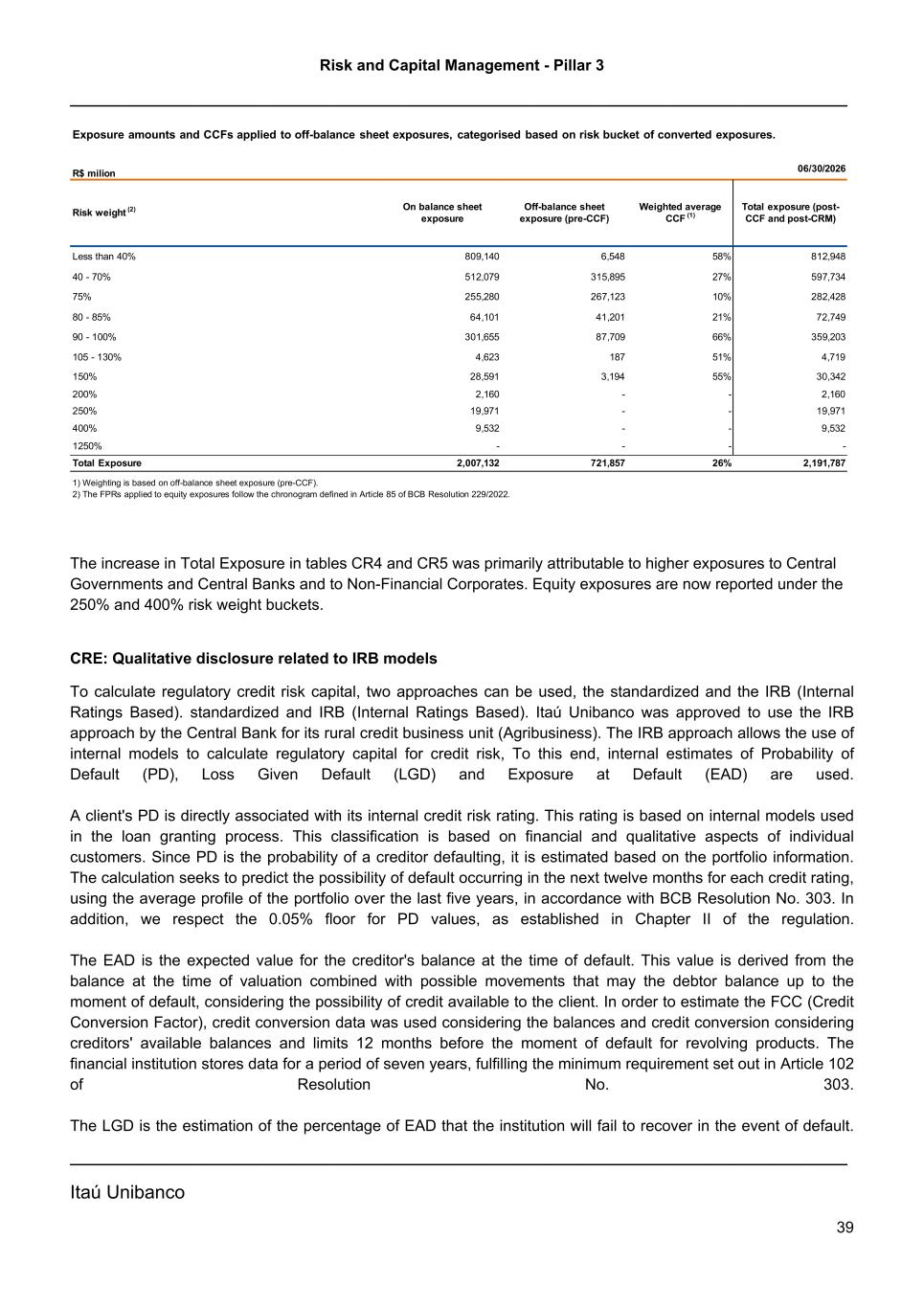
Risk and Capital Management - Pillar 3 __________________________________________________________________________________________ __________________________________________________________________________________________ Itaú Unibanco 39 Exposure amounts and CCFs applied to off-balance sheet exposures, categorised based on risk bucket of converted exposures. R$ milion 06/30/2026 Risk weight (2) On balance sheet exposure Off-balance sheet exposure (pre-CCF) Weighted average CCF (1) Total exposure (post- CCF and post-CRM) Less than 40% 809,140 6,548 58% 812,948 40 - 70% 512,079 315,895 27% 597,734 75% 255,280 267,123 10% 282,428 80 - 85% 64,101 41,201 21% 72,749 90 - 100% 301,655 87,709 66% 359,203 105 - 130% 4,623 187 51% 4,719 150% 28,591 3,194 55% 30,342 200% 2,160 - - 2,160 250% 19,971 - - 19,971 400% 9,532 - - 9,532 1250% - - - - Total Exposure 2,007,132 721,857 26% 2,191,787 1) Weighting is based on off-balance sheet exposure (pre-CCF). 2) The FPRs applied to equity exposures follow the chronogram defined in Article 85 of BCB Resolution 229/2022. The increase in Total Exposure in tables CR4 and CR5 was primarily attributable to higher exposures to Central Governments and Central Banks and to Non-Financial Corporates. Equity exposures are now reported under the 250% and 400% risk weight buckets. CRE: Qualitative disclosure related to IRB models To calculate regulatory credit risk capital, two approaches can be used, the standardized and the IRB (Internal Ratings Based). standardized and IRB (Internal Ratings Based). Itaú Unibanco was approved to use the IRB approach by the Central Bank for its rural credit business unit (Agribusiness). The IRB approach allows the use of internal models to calculate regulatory capital for credit risk, To this end, internal estimates of Probability of Default (PD), Loss Given Default (LGD) and Exposure at Default (EAD) are used. A client's PD is directly associated with its internal credit risk rating. This rating is based on internal models used in the loan granting process. This classification is based on financial and qualitative aspects of individual customers. Since PD is the probability of a creditor defaulting, it is estimated based on the portfolio information. The calculation seeks to predict the possibility of default occurring in the next twelve months for each credit rating, using the average profile of the portfolio over the last five years, in accordance with BCB Resolution No. 303. In addition, we respect the 0.05% floor for PD values, as established in Chapter II of the regulation. The EAD is the expected value for the creditor's balance at the time of default. This value is derived from the balance at the time of valuation combined with possible movements that may the debtor balance up to the moment of default, considering the possibility of credit available to the client. In order to estimate the FCC (Credit Conversion Factor), credit conversion data was used considering the balances and credit conversion considering creditors' available balances and limits 12 months before the moment of default for revolving products. The financial institution stores data for a period of seven years, fulfilling the minimum requirement set out in Article 102 of Resolution No. 303. The LGD is the estimation of the percentage of EAD that the institution will fail to recover in the event of default.
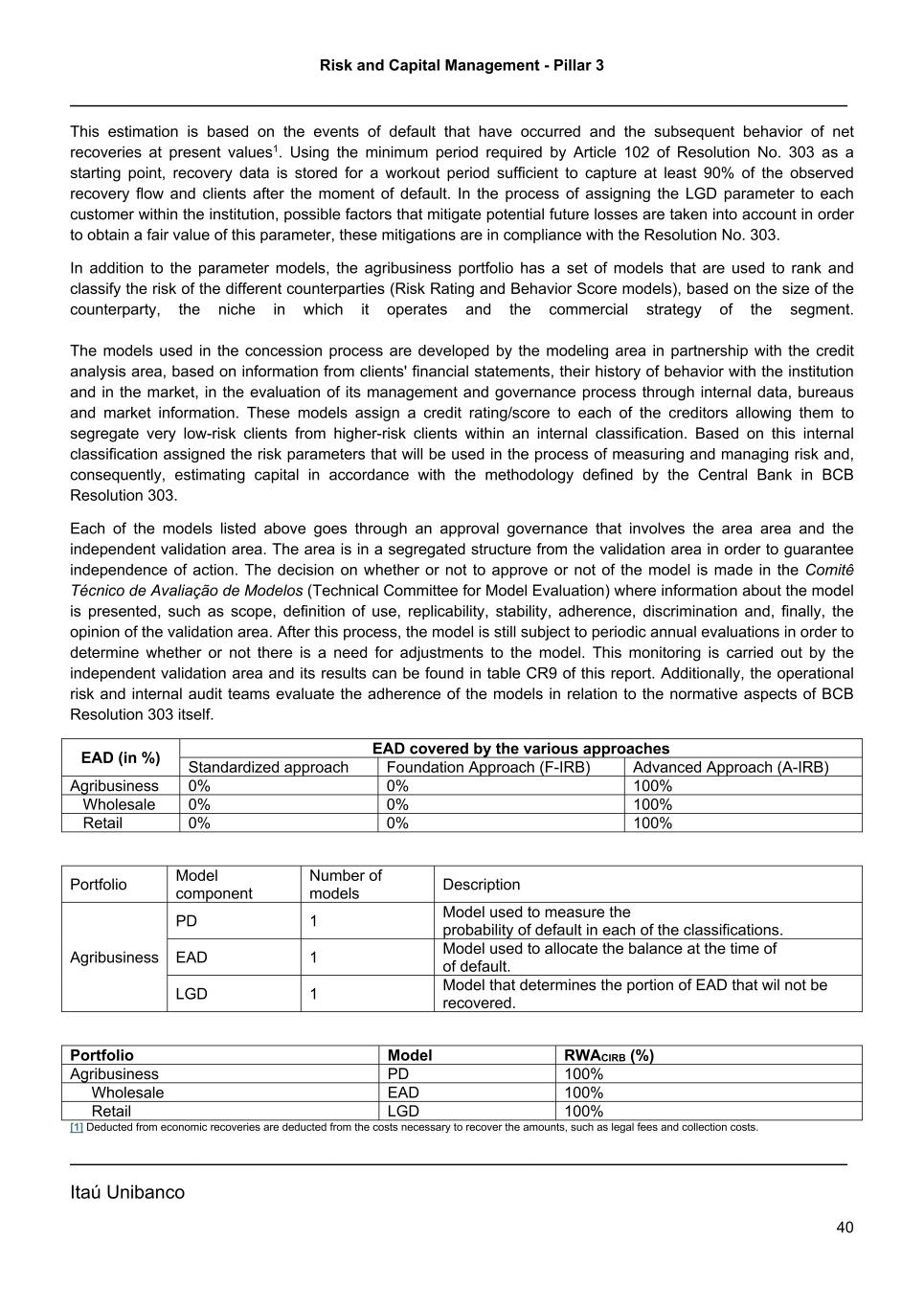
Risk and Capital Management - Pillar 3 __________________________________________________________________________________________ __________________________________________________________________________________________ Itaú Unibanco 40 This estimation is based on the events of default that have occurred and the subsequent behavior of net recoveries at present values1. Using the minimum period required by Article 102 of Resolution No. 303 as a starting point, recovery data is stored for a workout period sufficient to capture at least 90% of the observed recovery flow and clients after the moment of default. In the process of assigning the LGD parameter to each customer within the institution, possible factors that mitigate potential future losses are taken into account in order to obtain a fair value of this parameter, these mitigations are in compliance with the Resolution No. 303. In addition to the parameter models, the agribusiness portfolio has a set of models that are used to rank and classify the risk of the different counterparties (Risk Rating and Behavior Score models), based on the size of the counterparty, the niche in which it operates and the commercial strategy of the segment. The models used in the concession process are developed by the modeling area in partnership with the credit analysis area, based on information from clients' financial statements, their history of behavior with the institution and in the market, in the evaluation of its management and governance process through internal data, bureaus and market information. These models assign a credit rating/score to each of the creditors allowing them to segregate very low-risk clients from higher-risk clients within an internal classification. Based on this internal classification assigned the risk parameters that will be used in the process of measuring and managing risk and, consequently, estimating capital in accordance with the methodology defined by the Central Bank in BCB Resolution 303. Each of the models listed above goes through an approval governance that involves the area area and the independent validation area. The area is in a segregated structure from the validation area in order to guarantee independence of action. The decision on whether or not to approve or not of the model is made in the Comitê Técnico de Avaliação de Modelos (Technical Committee for Model Evaluation) where information about the model is presented, such as scope, definition of use, replicability, stability, adherence, discrimination and, finally, the opinion of the validation area. After this process, the model is still subject to periodic annual evaluations in order to determine whether or not there is a need for adjustments to the model. This monitoring is carried out by the independent validation area and its results can be found in table CR9 of this report. Additionally, the operational risk and internal audit teams evaluate the adherence of the models in relation to the normative aspects of BCB Resolution 303 itself. EAD (in %) EAD covered by the various approaches Standardized approach Foundation Approach (F-IRB) Advanced Approach (A-IRB) Agribusiness 0% 0% 100% Wholesale 0% 0% 100% Retail 0% 0% 100% Portfolio Model component Number of models Description Agribusiness PD 1 Model used to measure the probability of default in each of the classifications. EAD 1 Model used to allocate the balance at the time of of default. LGD 1 Model that determines the portion of EAD that wil not be recovered. Portfolio Model RWACIRB (%) Agribusiness PD 100% Wholesale EAD 100% Retail LGD 100% [1] Deducted from economic recoveries are deducted from the costs necessary to recover the amounts, such as legal fees and collection costs.
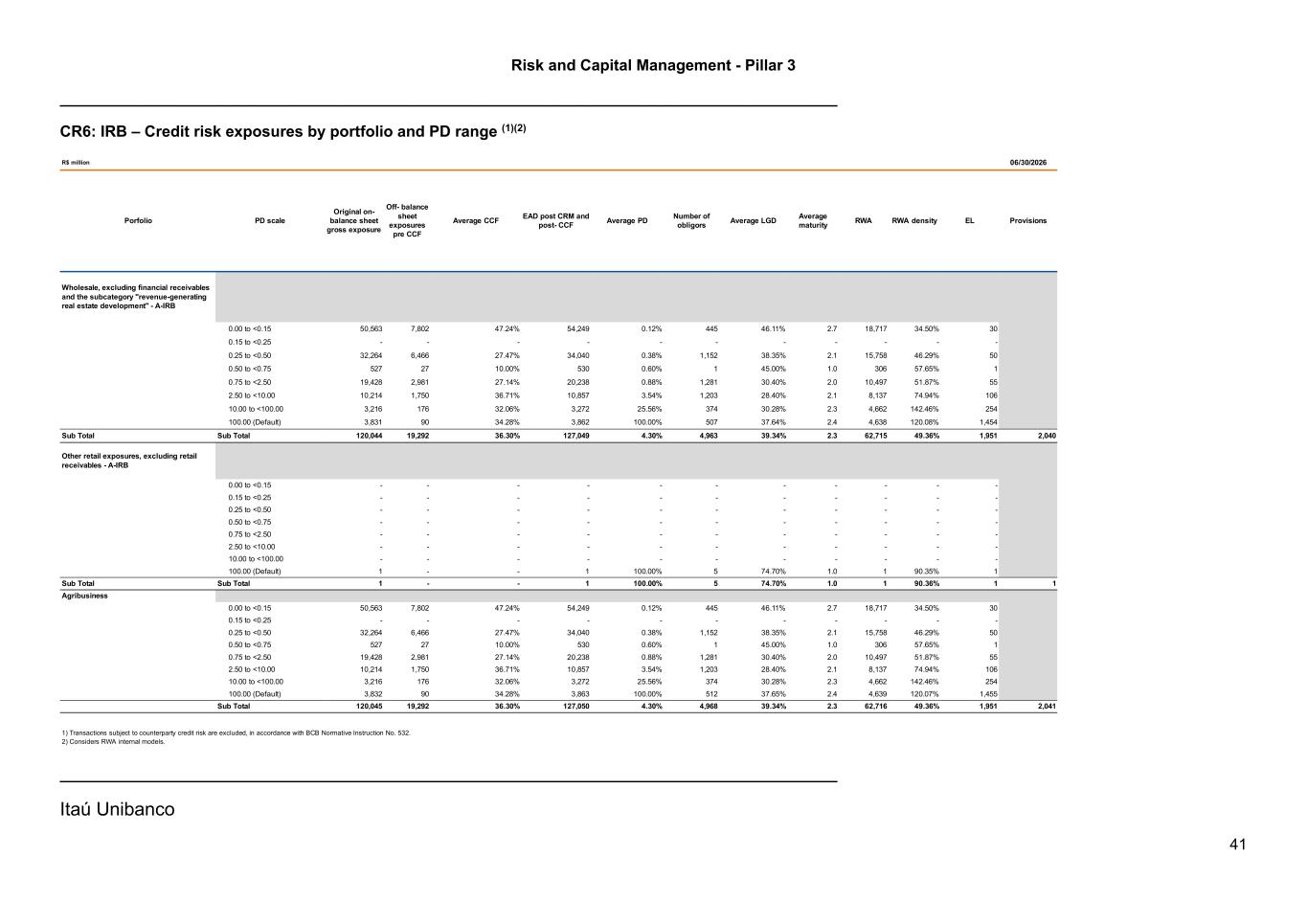
Risk and Capital Management - Pillar 3 __________________________________________________________________________________________ __________________________________________________________________________________________ Itaú Unibanco 41 CR6: IRB – Credit risk exposures by portfolio and PD range (1)(2) R$ million 06/30/2026 Porfolio PD scale Original on- balance sheet gross exposure Off- balance sheet exposures pre CCF Average CCF EAD post CRM and post- CCF Average PD Number of obligors Average LGD Average maturity RWA RWA density EL Provisions Wholesale, excluding financial receivables and the subcategory "revenue-generating real estate development" - A-IRB 0.00 to <0.15 50,563 7,802 47.24% 54,249 0.12% 445 46.11% 2.7 18,717 34.50% 30 0.15 to <0.25 - - - - - - - - - - - 0.25 to <0.50 32,264 6,466 27.47% 34,040 0.38% 1,152 38.35% 2.1 15,758 46.29% 50 0.50 to <0.75 527 27 10.00% 530 0.60% 1 45.00% 1.0 306 57.65% 1 0.75 to <2.50 19,428 2,981 27.14% 20,238 0.88% 1,281 30.40% 2.0 10,497 51.87% 55 2.50 to <10.00 10,214 1,750 36.71% 10,857 3.54% 1,203 28.40% 2.1 8,137 74.94% 106 10.00 to <100.00 3,216 176 32.06% 3,272 25.56% 374 30.28% 2.3 4,662 142.46% 254 100.00 (Default) 3,831 90 34.28% 3,862 100.00% 507 37.64% 2.4 4,638 120.08% 1,454 Sub Total Sub Total 120,044 19,292 36.30% 127,049 4.30% 4,963 39.34% 2.3 62,715 49.36% 1,951 2,040 Other retail exposures, excluding retail receivables - A-IRB 0.00 to <0.15 - - - - - - - - - - - 0.15 to <0.25 - - - - - - - - - - - 0.25 to <0.50 - - - - - - - - - - - 0.50 to <0.75 - - - - - - - - - - - 0.75 to <2.50 - - - - - - - - - - - 2.50 to <10.00 - - - - - - - - - - - 10.00 to <100.00 - - - - - - - - - - - 100.00 (Default) 1 - - 1 100.00% 5 74.70% 1.0 1 90.35% 1 Sub Total Sub Total 1 - - 1 100.00% 5 74.70% 1.0 1 90.36% 1 1 Agribusiness 0.00 to <0.15 50,563 7,802 47.24% 54,249 0.12% 445 46.11% 2.7 18,717 34.50% 30 0.15 to <0.25 - - - - - - - - - - - 0.25 to <0.50 32,264 6,466 27.47% 34,040 0.38% 1,152 38.35% 2.1 15,758 46.29% 50 0.50 to <0.75 527 27 10.00% 530 0.60% 1 45.00% 1.0 306 57.65% 1 0.75 to <2.50 19,428 2,981 27.14% 20,238 0.88% 1,281 30.40% 2.0 10,497 51.87% 55 2.50 to <10.00 10,214 1,750 36.71% 10,857 3.54% 1,203 28.40% 2.1 8,137 74.94% 106 10.00 to <100.00 3,216 176 32.06% 3,272 25.56% 374 30.28% 2.3 4,662 142.46% 254 100.00 (Default) 3,832 90 34.28% 3,863 100.00% 512 37.65% 2.4 4,639 120.07% 1,455 Sub Total 120,045 19,292 36.30% 127,050 4.30% 4,968 39.34% 2.3 62,716 49.36% 1,951 2,041 1) Transactions subject to counterparty credit risk are excluded, in accordance with BCB Normative Instruction No. 532. 2) Considers RWA internal models.
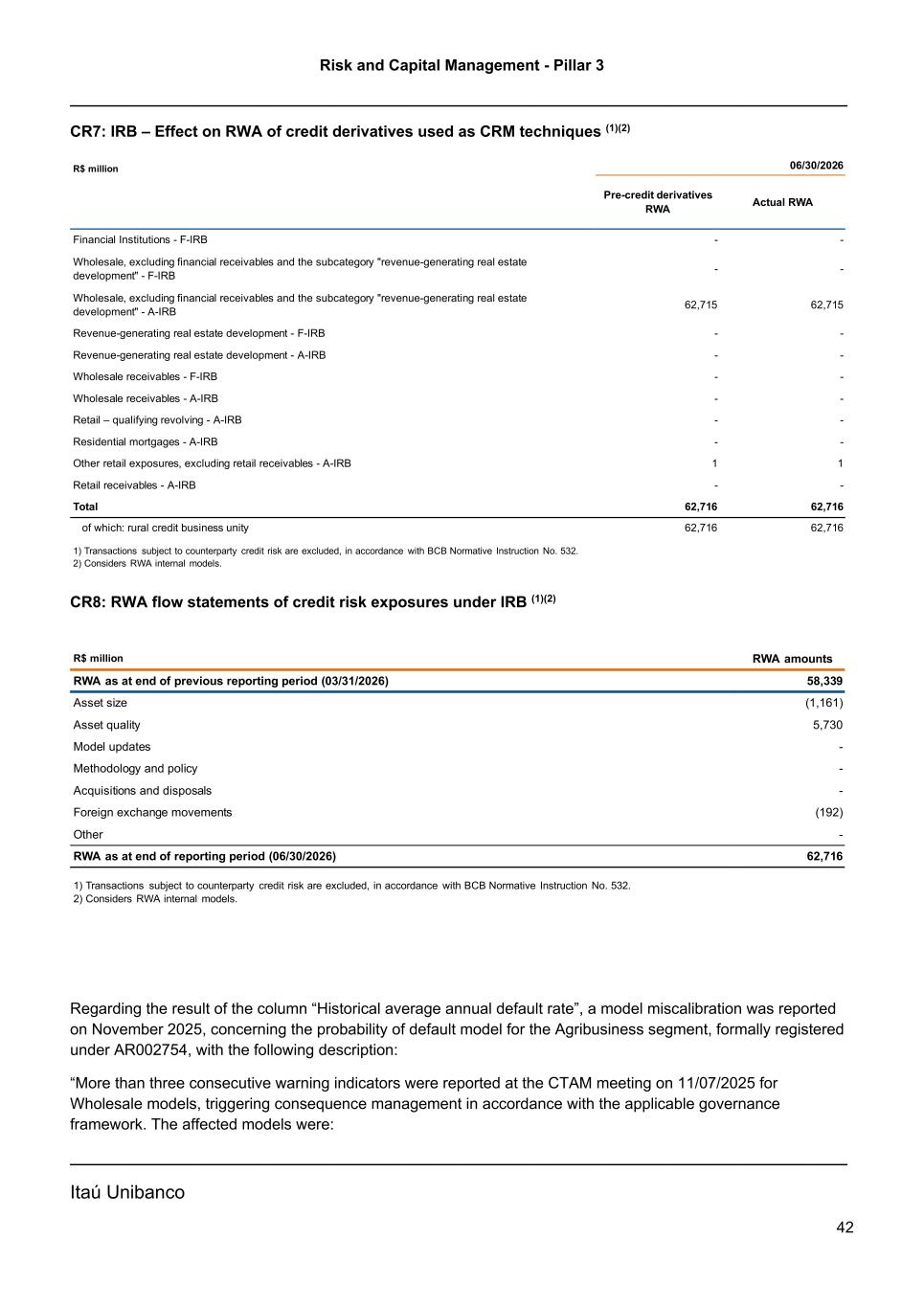
Risk and Capital Management - Pillar 3 __________________________________________________________________________________________ __________________________________________________________________________________________ Itaú Unibanco 42 CR7: IRB – Effect on RWA of credit derivatives used as CRM techniques (1)(2) R$ million 06/30/2026 Pre-credit derivatives RWA Actual RWA Financial Institutions - F-IRB - - Wholesale, excluding financial receivables and the subcategory "revenue-generating real estate development" - F-IRB - - Wholesale, excluding financial receivables and the subcategory "revenue-generating real estate development" - A-IRB 62,715 62,715 Revenue-generating real estate development - F-IRB - - Revenue-generating real estate development - A-IRB - - Wholesale receivables - F-IRB - - Wholesale receivables - A-IRB - - Retail – qualifying revolving - A-IRB - - Residential mortgages - A-IRB - - Other retail exposures, excluding retail receivables - A-IRB 1 1 Retail receivables - A-IRB - - Total 62,716 62,716 of which: rural credit business unity 62,716 62,716 1) Transactions subject to counterparty credit risk are excluded, in accordance with BCB Normative Instruction No. 532. 2) Considers RWA internal models. CR8: RWA flow statements of credit risk exposures under IRB (1)(2) a R$ million RWA amounts RWA as at end of previous reporting period (03/31/2026) 1/2 58,339 Asset size (1,161) Asset quality 5,730 Model updates - Methodology and policy - Acquisitions and disposals - Foreign exchange movements (192) Other - RWA as at end of reporting period (06/30/2026) 0/2 62,716 1) Transactions subject to counterparty credit risk are excluded, in accordance with BCB Normative Instruction No. 532. 2) Considers RWA internal models. Regarding the result of the column “Historical average annual default rate”, a model miscalibration was reported on November 2025, concerning the probability of default model for the Agribusiness segment, formally registered under AR002754, with the following description: “More than three consecutive warning indicators were reported at the CTAM meeting on 11/07/2025 for Wholesale models, triggering consequence management in accordance with the applicable governance framework. The affected models were:
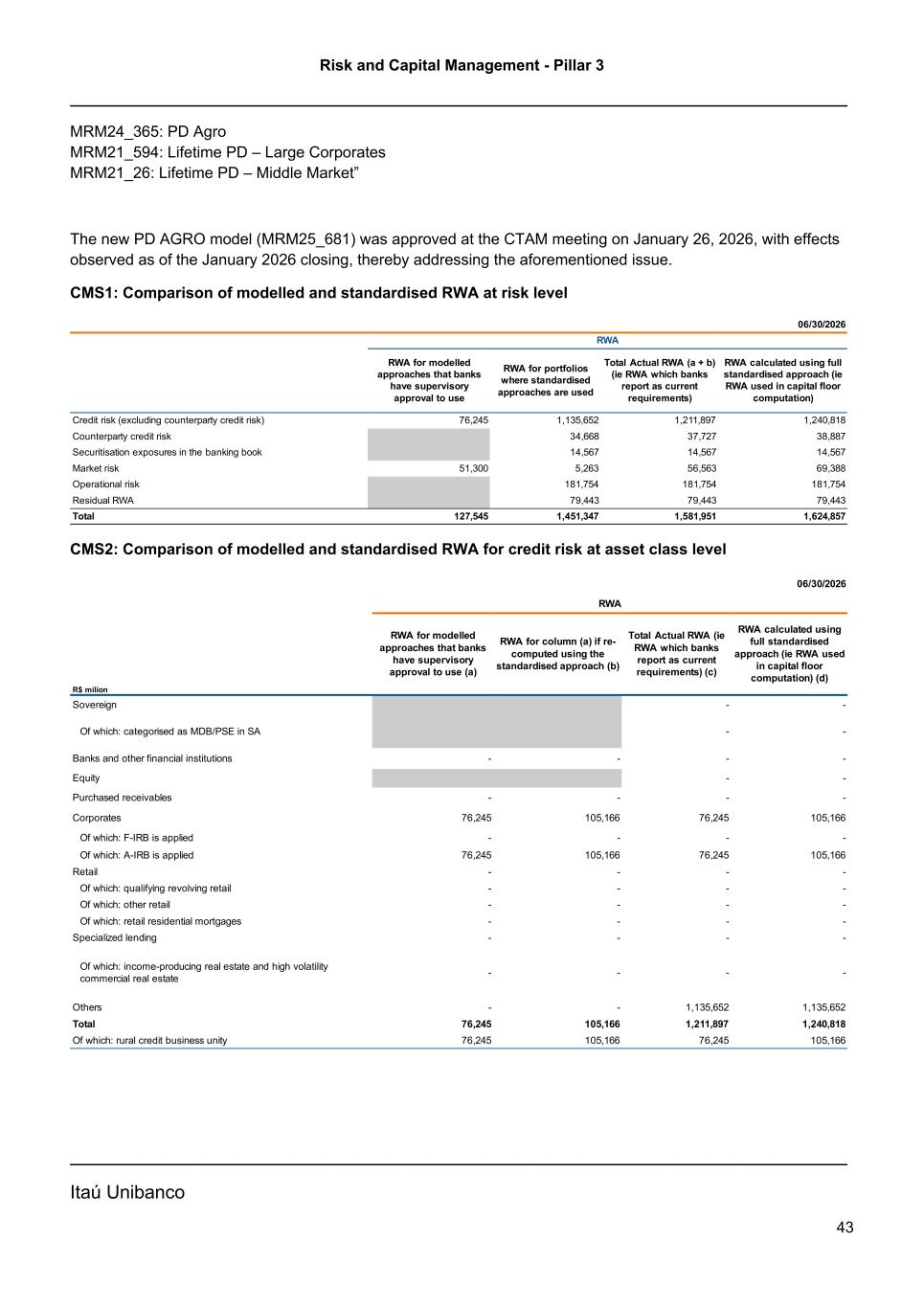
Risk and Capital Management - Pillar 3 __________________________________________________________________________________________ __________________________________________________________________________________________ Itaú Unibanco 43 MRM24_365: PD Agro MRM21_594: Lifetime PD – Large Corporates MRM21_26: Lifetime PD – Middle Market” The new PD AGRO model (MRM25_681) was approved at the CTAM meeting on January 26, 2026, with effects observed as of the January 2026 closing, thereby addressing the aforementioned issue. CMS1: Comparison of modelled and standardised RWA at risk level 06/30/2026 RWA RWA for modelled approaches that banks have supervisory approval to use RWA for portfolios where standardised approaches are used Total Actual RWA (a + b) (ie RWA which banks report as current requirements) RWA calculated using full standardised approach (ie RWA used in capital floor computation) Credit risk (excluding counterparty credit risk) 76,245 1,135,652 1,211,897 1,240,818 Counterparty credit risk 34,668 37,727 38,887 Securitisation exposures in the banking book 14,567 14,567 14,567 Market risk 51,300 5,263 56,563 69,388 Operational risk 181,754 181,754 181,754 Residual RWA 79,443 79,443 79,443 Total 127,545 1,451,347 1,581,951 1,624,857 CMS2: Comparison of modelled and standardised RWA for credit risk at asset class level 06/30/2026 RWA R$ milion RWA for modelled approaches that banks have supervisory approval to use (a) RWA for column (a) if re- computed using the standardised approach (b) Total Actual RWA (ie RWA which banks report as current requirements) (c) RWA calculated using full standardised approach (ie RWA used in capital floor computation) (d) Sovereign - - Of which: categorised as MDB/PSE in SA - - Banks and other financial institutions - - - - Equity - - Purchased receivables - - - - Corporates 76,245 105,166 76,245 105,166 Of which: F-IRB is applied - - - - Of which: A-IRB is applied 76,245 105,166 76,245 105,166 Retail - - - - Of which: qualifying revolving retail - - - - Of which: other retail - - - - Of which: retail residential mortgages - - - - Specialized lending - - - - Of which: income-producing real estate and high volatility commercial real estate - - - - Others - - 1,135,652 1,135,652 Total 76,245 105,166 1,211,897 1,240,818 Of which: rural credit business unity 76,245 105,166 76,245 105,166
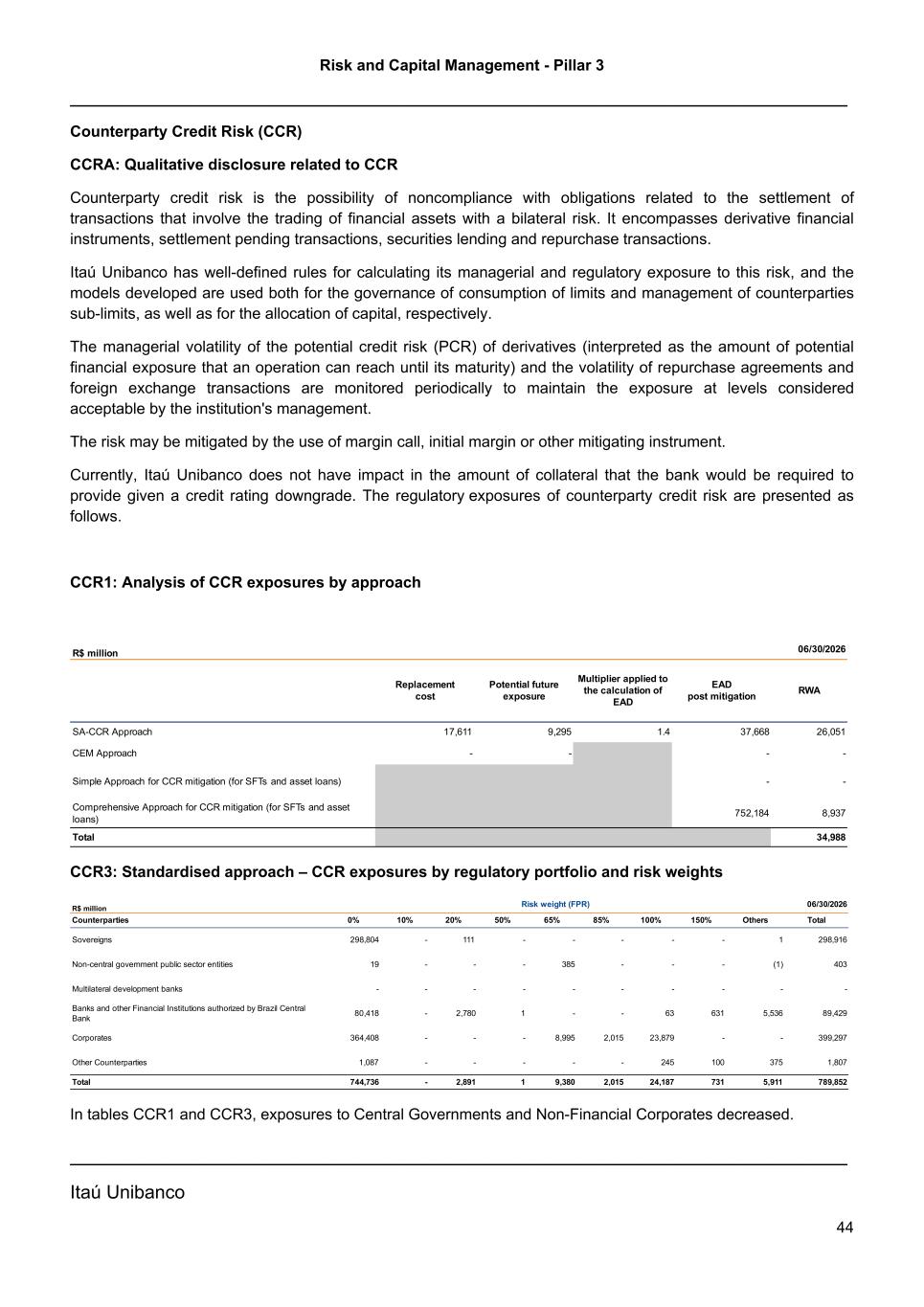
Risk and Capital Management - Pillar 3 __________________________________________________________________________________________ __________________________________________________________________________________________ Itaú Unibanco 44 Counterparty Credit Risk (CCR) CCRA: Qualitative disclosure related to CCR Counterparty credit risk is the possibility of noncompliance with obligations related to the settlement of transactions that involve the trading of financial assets with a bilateral risk. It encompasses derivative financial instruments, settlement pending transactions, securities lending and repurchase transactions. Itaú Unibanco has well-defined rules for calculating its managerial and regulatory exposure to this risk, and the models developed are used both for the governance of consumption of limits and management of counterparties sub-limits, as well as for the allocation of capital, respectively. The managerial volatility of the potential credit risk (PCR) of derivatives (interpreted as the amount of potential financial exposure that an operation can reach until its maturity) and the volatility of repurchase agreements and foreign exchange transactions are monitored periodically to maintain the exposure at levels considered acceptable by the institution's management. The risk may be mitigated by the use of margin call, initial margin or other mitigating instrument. Currently, Itaú Unibanco does not have impact in the amount of collateral that the bank would be required to provide given a credit rating downgrade. The regulatory exposures of counterparty credit risk are presented as follows. CCR1: Analysis of CCR exposures by approach R$ million 06/30/2026 Replacement cost Potential future exposure Multiplier applied to the calculation of EAD EAD post mitigation RWA SA-CCR Approach 17,611 9,295 1.4 37,668 26,051 CEM Approach - - - - Simple Approach for CCR mitigation (for SFTs and asset loans) - - Comprehensive Approach for CCR mitigation (for SFTs and asset loans) 752,184 8,937 Total 34,988 CCR3: Standardised approach – CCR exposures by regulatory portfolio and risk weights R$ million Risk weight (FPR) 06/30/2026 Counterparties 0% 10% 20% 50% 65% 85% 100% 150% Others Total Sovereigns 298,804 - 111 - - - - - 1 298,916 Non-central government public sector entities 19 - - - 385 - - - (1) 403 Multilateral development banks - - - - - - - - - - Banks and other Financial Institutions authorized by Brazil Central Bank 80,418 - 2,780 1 - - 63 631 5,536 89,429 Corporates 364,408 - - - 8,995 2,015 23,879 - - 399,297 Other Counterparties 1,087 - - - - - 245 100 375 1,807 Total 744,736 - 2,891 1 9,380 2,015 24,187 731 5,911 789,852 In tables CCR1 and CCR3, exposures to Central Governments and Non-Financial Corporates decreased.
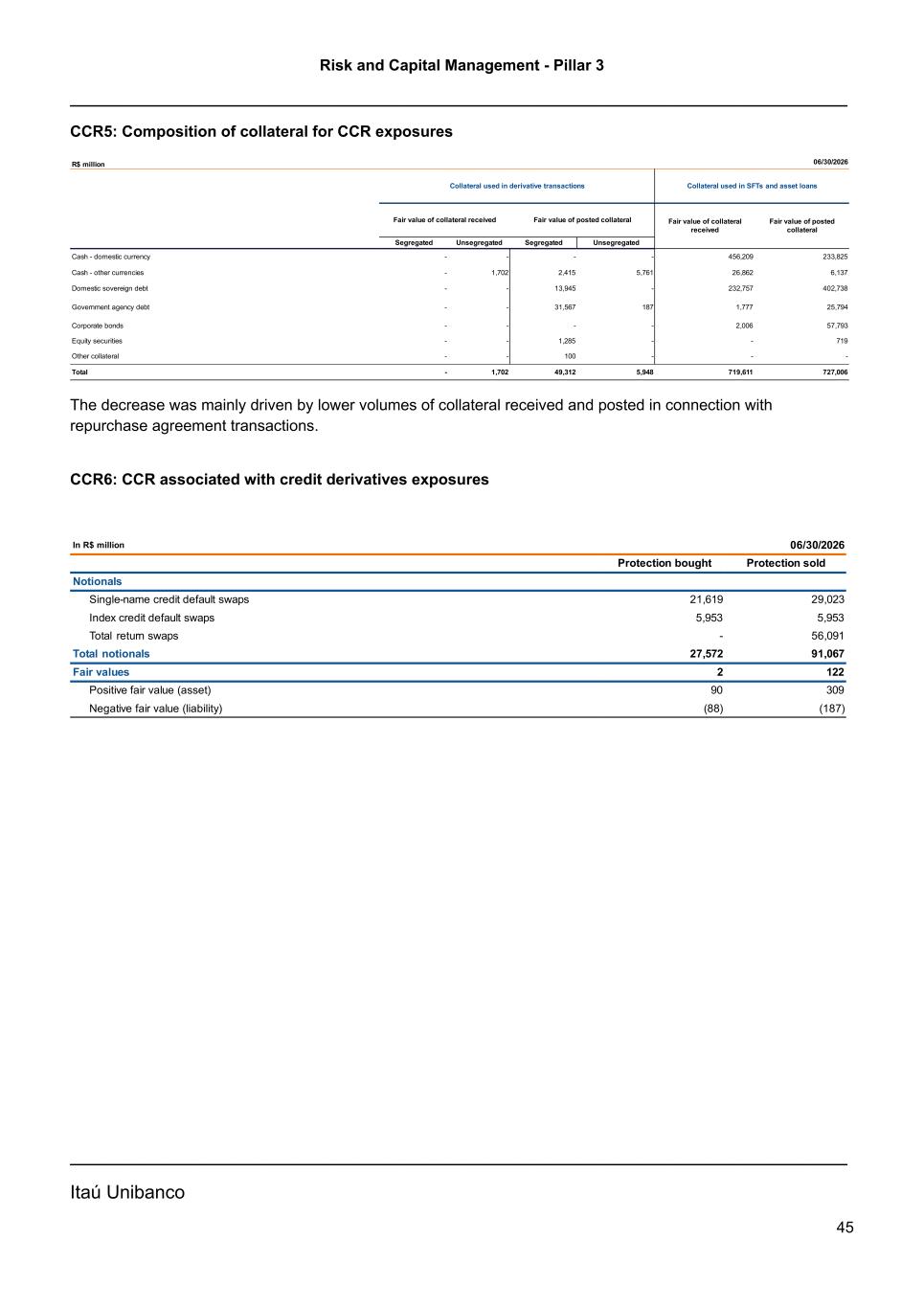
Risk and Capital Management - Pillar 3 __________________________________________________________________________________________ __________________________________________________________________________________________ Itaú Unibanco 45 CCR5: Composition of collateral for CCR exposures R$ million 06/30/2026 Collateral used in derivative transactions Collateral used in SFTs and asset loans Fair value of collateral received Fair value of posted collateral Fair value of collateral received Fair value of posted collateral Segregated Unsegregated Segregated Unsegregated Cash - domestic currency - - - - 456,209 233,825 Cash - other currencies - 1,702 2,415 5,761 26,862 6,137 Domestic sovereign debt - - 13,945 - 232,757 402,738 Government agency debt - - 31,567 187 1,777 25,794 Corporate bonds - - - - 2,006 57,793 Equity securities - - 1,285 - - 719 Other collateral - - 100 - - - Total - 1,702 49,312 5,948 719,611 727,006 The decrease was mainly driven by lower volumes of collateral received and posted in connection with repurchase agreement transactions. CCR6: CCR associated with credit derivatives exposures In R$ million 06/30/2026 Protection bought Protection sold Notionals Single-name credit default swaps 21,619 29,023 Index credit default swaps 5,953 5,953 Total return swaps - 56,091 Total notionals 27,572 91,067 Fair values 2 122 Positive fair value (asset) 90 309 Negative fair value (liability) (88) (187)
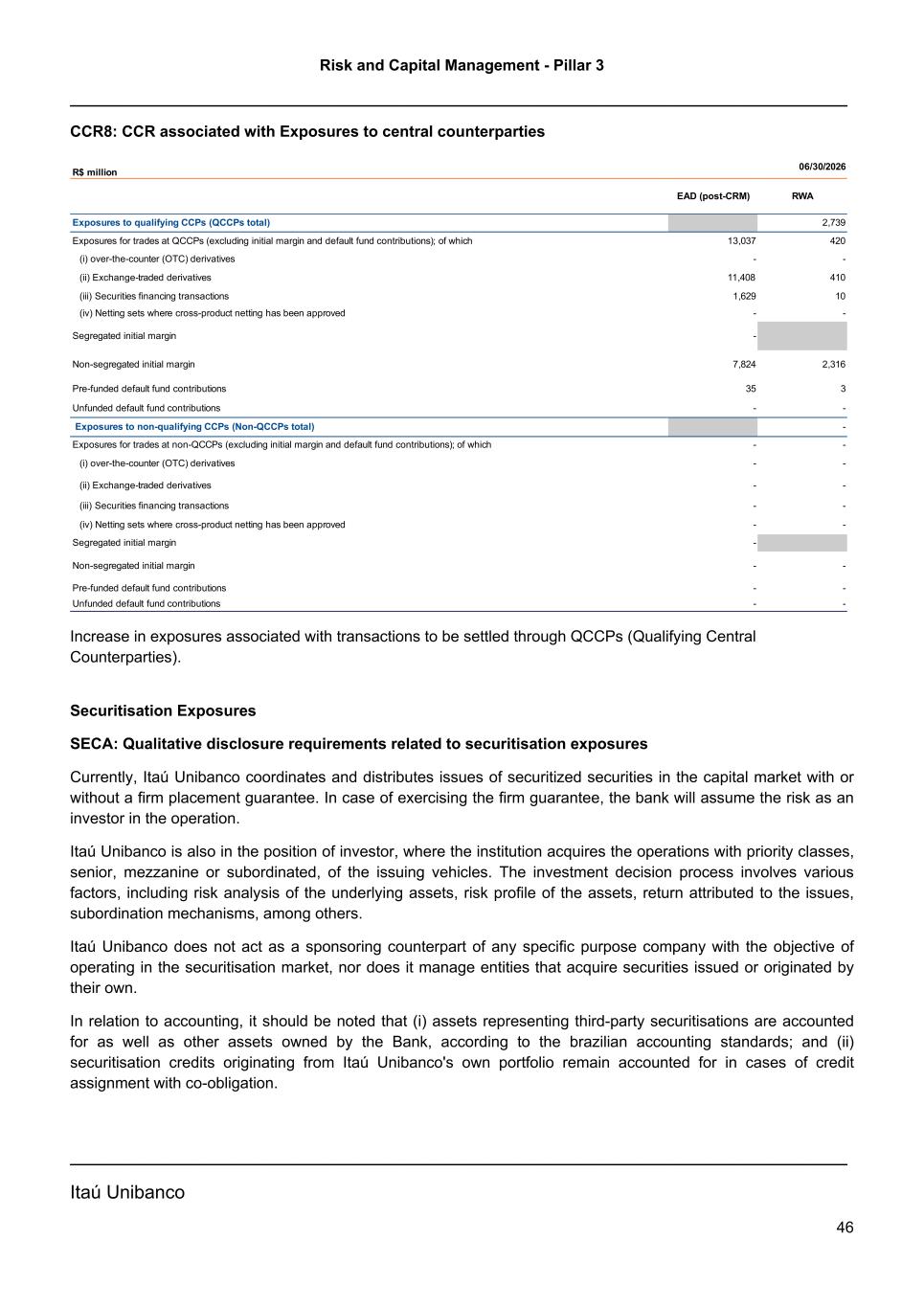
Risk and Capital Management - Pillar 3 __________________________________________________________________________________________ __________________________________________________________________________________________ Itaú Unibanco 46 CCR8: CCR associated with Exposures to central counterparties R$ million 06/30/2026 EAD (post-CRM) RWA Exposures to qualifying CCPs (QCCPs total) 2,739 Exposures for trades at QCCPs (excluding initial margin and default fund contributions); of which 13,037 420 (i) over-the-counter (OTC) derivatives - - (ii) Exchange-traded derivatives 11,408 410 (iii) Securities financing transactions 1,629 10 (iv) Netting sets where cross-product netting has been approved - - Segregated initial margin - Non-segregated initial margin 7,824 2,316 Pre-funded default fund contributions 35 3 Unfunded default fund contributions - - Exposures to non-qualifying CCPs (Non-QCCPs total) - Exposures for trades at non-QCCPs (excluding initial margin and default fund contributions); of which - - (i) over-the-counter (OTC) derivatives - - (ii) Exchange-traded derivatives - - (iii) Securities financing transactions - - (iv) Netting sets where cross-product netting has been approved - - Segregated initial margin - Non-segregated initial margin - - Pre-funded default fund contributions - - Unfunded default fund contributions - - Increase in exposures associated with transactions to be settled through QCCPs (Qualifying Central Counterparties). Securitisation Exposures SECA: Qualitative disclosure requirements related to securitisation exposures Currently, Itaú Unibanco coordinates and distributes issues of securitized securities in the capital market with or without a firm placement guarantee. In case of exercising the firm guarantee, the bank will assume the risk as an investor in the operation. Itaú Unibanco is also in the position of investor, where the institution acquires the operations with priority classes, senior, mezzanine or subordinated, of the issuing vehicles. The investment decision process involves various factors, including risk analysis of the underlying assets, risk profile of the assets, return attributed to the issues, subordination mechanisms, among others. Itaú Unibanco does not act as a sponsoring counterpart of any specific purpose company with the objective of operating in the securitisation market, nor does it manage entities that acquire securities issued or originated by their own. In relation to accounting, it should be noted that (i) assets representing third-party securitisations are accounted for as well as other assets owned by the Bank, according to the brazilian accounting standards; and (ii) securitisation credits originating from Itaú Unibanco's own portfolio remain accounted for in cases of credit assignment with co-obligation.
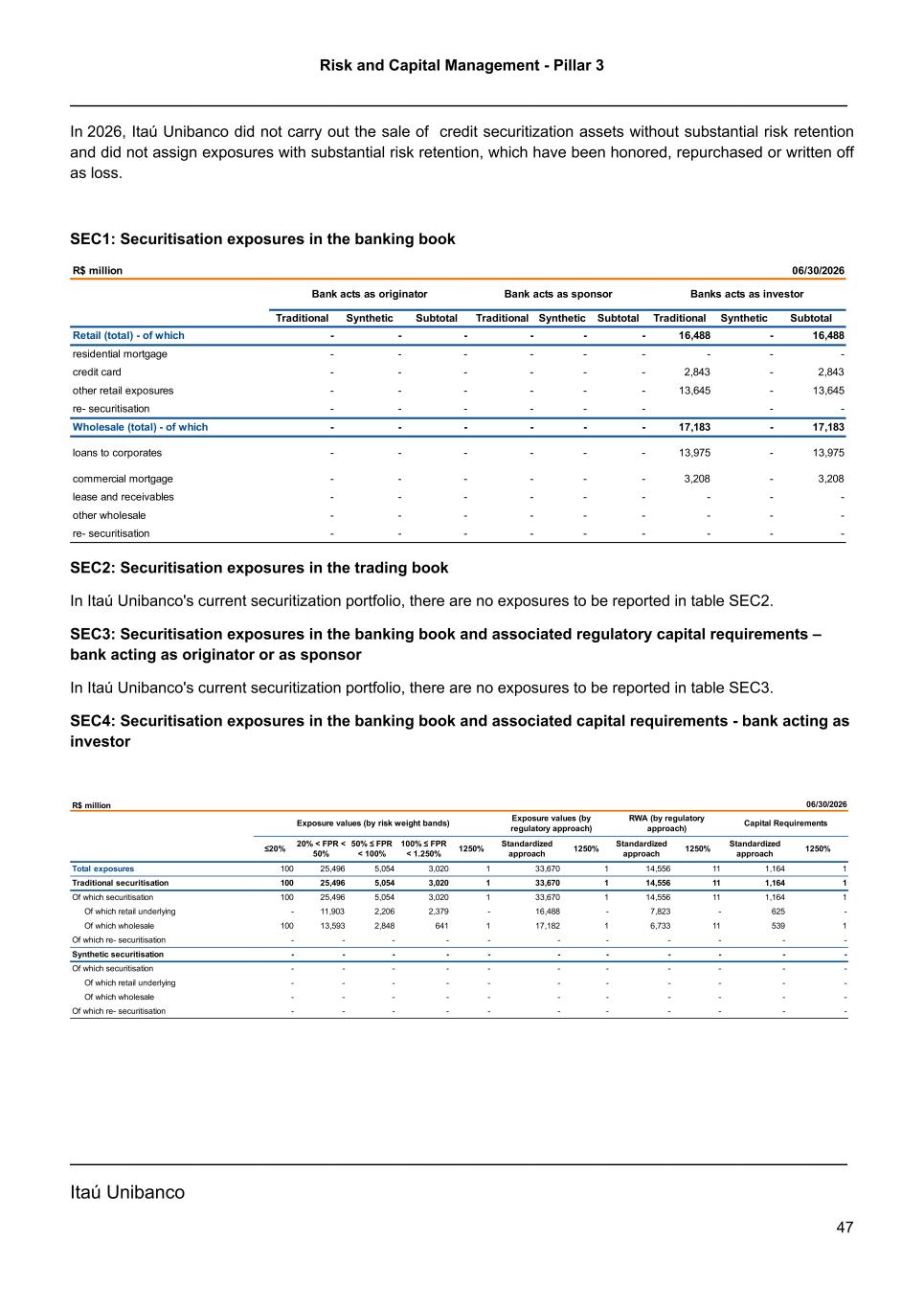
Risk and Capital Management - Pillar 3 __________________________________________________________________________________________ __________________________________________________________________________________________ Itaú Unibanco 47 In 2026, Itaú Unibanco did not carry out the sale of credit securitization assets without substantial risk retention and did not assign exposures with substantial risk retention, which have been honored, repurchased or written off as loss. SEC1: Securitisation exposures in the banking book R$ million a c d e g h i k 06/30/2026 Bank acts as originator Bank acts as sponsor Banks acts as investor Traditional Synthetic Subtotal Traditional Synthetic Subtotal Traditional Synthetic Subtotal Retail (total) - of which - - - - - - 16,488 - 16,488 residential mortgage - - - - - - - - - credit card - - - - - - 2,843 - 2,843 other retail exposures - - - - - - 13,645 - 13,645 re- securitisation - - - - - - - - Wholesale (total) - of which - - - - - - 17,183 - 17,183 loans to corporates - - - - - - 13,975 - 13,975 commercial mortgage - - - - - - 3,208 - 3,208 lease and receivables - - - - - - - - - other wholesale - - - - - - - - - re- securitisation - - - - - - - - - SEC2: Securitisation exposures in the trading book In Itaú Unibanco's current securitization portfolio, there are no exposures to be reported in table SEC2. SEC3: Securitisation exposures in the banking book and associated regulatory capital requirements – bank acting as originator or as sponsor In Itaú Unibanco's current securitization portfolio, there are no exposures to be reported in table SEC3. SEC4: Securitisation exposures in the banking book and associated capital requirements - bank acting as investor R$ million a b c d e h i l m p 06/30/2026 Exposure values (by risk weight bands) Exposure values (by regulatory approach) RWA (by regulatory approach) Capital Requirements ≤20% 20% < FPR < 50% 50% ≤ FPR < 100% 100% ≤ FPR < 1.250% 1250% Standardized approach 1250% Standardized approach 1250% Standardized approach 1250% Total exposures 100 25,496 5,054 3,020 1 33,670 1 14,556 11 1,164 1 Traditional securitisation 100 25,496 5,054 3,020 1 33,670 1 14,556 11 1,164 1 Of which securitisation 100 25,496 5,054 3,020 1 33,670 1 14,556 11 1,164 1 Of which retail underlying - 11,903 2,206 2,379 - 16,488 - 7,823 - 625 - Of which wholesale 100 13,593 2,848 641 1 17,182 1 6,733 11 539 1 Of which re- securitisation - - - - - - - - - - - Synthetic securitisation - - - - - - - - - - - Of which securitisation - - - - - - - - - - - Of which retail underlying - - - - - - - - - - - Of which wholesale - - - - - - - - - - - Of which re- securitisation - - - - - - - - - - -
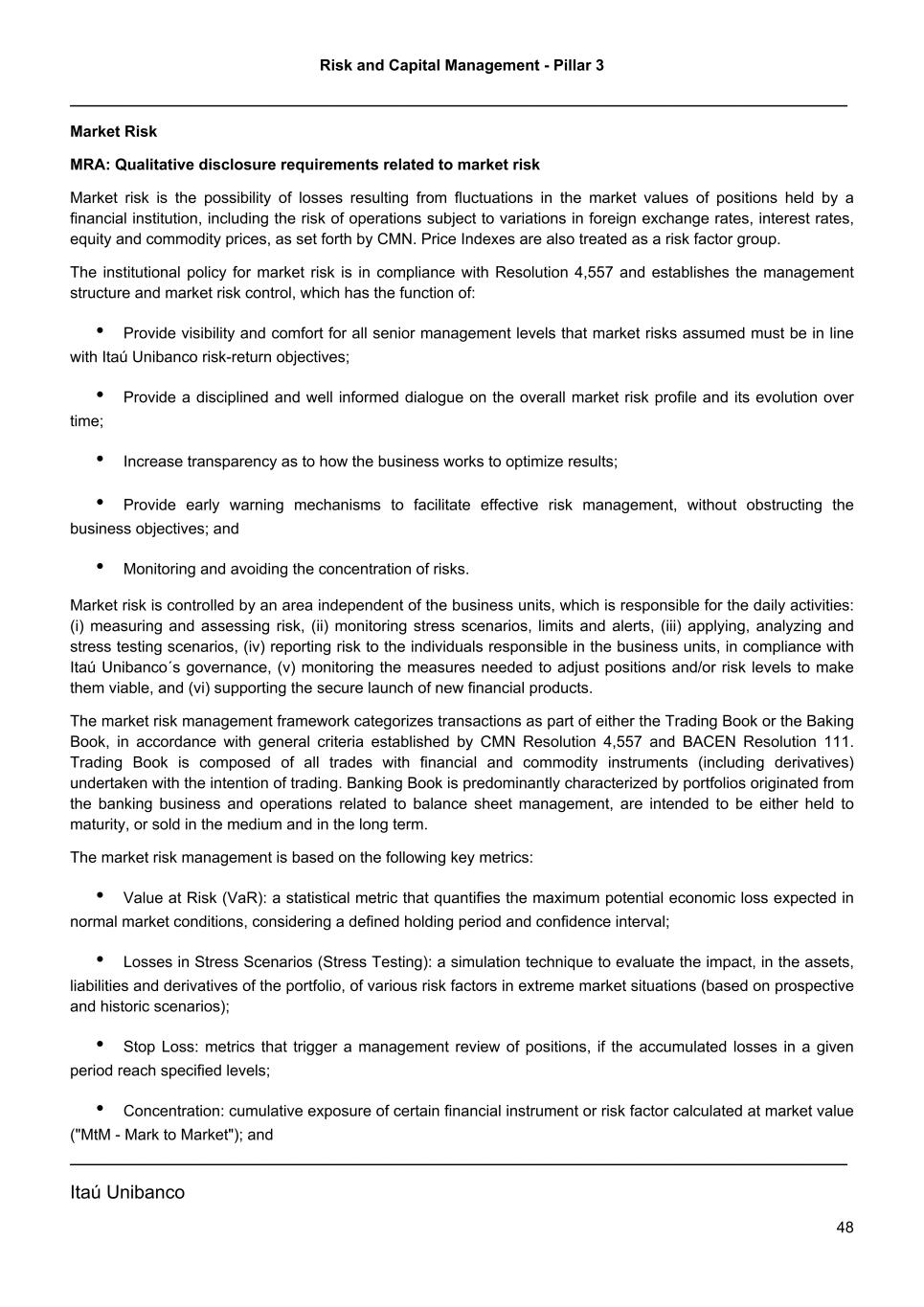
Risk and Capital Management - Pillar 3 __________________________________________________________________________________________ __________________________________________________________________________________________ Itaú Unibanco 48 Market Risk MRA: Qualitative disclosure requirements related to market risk Market risk is the possibility of losses resulting from fluctuations in the market values of positions held by a financial institution, including the risk of operations subject to variations in foreign exchange rates, interest rates, equity and commodity prices, as set forth by CMN. Price Indexes are also treated as a risk factor group. The institutional policy for market risk is in compliance with Resolution 4,557 and establishes the management structure and market risk control, which has the function of: • Provide visibility and comfort for all senior management levels that market risks assumed must be in line with Itaú Unibanco risk-return objectives; • Provide a disciplined and well informed dialogue on the overall market risk profile and its evolution over time; • Increase transparency as to how the business works to optimize results; • Provide early warning mechanisms to facilitate effective risk management, without obstructing the business objectives; and • Monitoring and avoiding the concentration of risks. Market risk is controlled by an area independent of the business units, which is responsible for the daily activities: (i) measuring and assessing risk, (ii) monitoring stress scenarios, limits and alerts, (iii) applying, analyzing and stress testing scenarios, (iv) reporting risk to the individuals responsible in the business units, in compliance with Itaú Unibanco´s governance, (v) monitoring the measures needed to adjust positions and/or risk levels to make them viable, and (vi) supporting the secure launch of new financial products. The market risk management framework categorizes transactions as part of either the Trading Book or the Baking Book, in accordance with general criteria established by CMN Resolution 4,557 and BACEN Resolution 111. Trading Book is composed of all trades with financial and commodity instruments (including derivatives) undertaken with the intention of trading. Banking Book is predominantly characterized by portfolios originated from the banking business and operations related to balance sheet management, are intended to be either held to maturity, or sold in the medium and in the long term. The market risk management is based on the following key metrics: • Value at Risk (VaR): a statistical metric that quantifies the maximum potential economic loss expected in normal market conditions, considering a defined holding period and confidence interval; • Losses in Stress Scenarios (Stress Testing): a simulation technique to evaluate the impact, in the assets, liabilities and derivatives of the portfolio, of various risk factors in extreme market situations (based on prospective and historic scenarios); • Stop Loss: metrics that trigger a management review of positions, if the accumulated losses in a given period reach specified levels; • Concentration: cumulative exposure of certain financial instrument or risk factor calculated at market value ("MtM - Mark to Market"); and
Risk and Capital Management - Pillar 3 __________________________________________________________________________________________ __________________________________________________________________________________________ Itaú Unibanco 49 • Stressed VaR: statistical metric derived from VaR calculation, aimed at capturing the biggest risk in simulations of the current trading portfolio, taking into consideration the observable returns in historical scenarios of extreme volatility. In addition to the risk metrics described above, sensitivity and loss control measures are also analyzed. They include: • Gap Analysis: accumulated exposure of the cash flows by risk factor, which are marked-to-market and positioned by settlement dates; • Sensitivity (DV01 – Delta Variation Risk): impact on the market value of cash flows when a 1 basis point change is applied to current interest rates or on the index rates; and • Sensitivities to Various Risk Factors (Greeks): partial derivatives of a portfolio of options on the prices of the underlying assets, implied volatilities, interest rates and time. In an attempt to fit the transactions into the defined limits, Itaú Unibanco hedges its client transactions and proprietary positions, including investments overseas. Derivatives are the most commonly used instruments for carrying out these hedging activities, and can be characterized as either accounting or economic hedge, both of which are governed by institutional regulations at Itaú Unibanco. The structure of limits and alerts is in alignment with the board of directors' guidelines, being reviewed and approved on an annual basis. This structure extends to specific limits and is aimed at improving the process of risk monitoring and understanding as well as preventing risk concentration. Limits and alerts are calibrated based on projections of future balance sheets, stockholders’ equity, liquidity, complexity and market volatility, as well as the Itaú Unibanco’s risk appetite. The consumption of market risk limits is monitored and disclosed daily through exposure and sensitivity maps. The market risk area analyzes and controls the adherence of these exposures to limits and alerts and reports them timely to the Treasury desks and other structures foreseen in the governance. Itaú Unibanco uses proprietary systems to measure the consolidated market risk. The processing of these systems takes place in an access-controlled environment, being highly available, which has data safekeeping and recovery processes, and counts on an infrastructure to ensure the continuity of business in contingency (disaster recovery) situations.
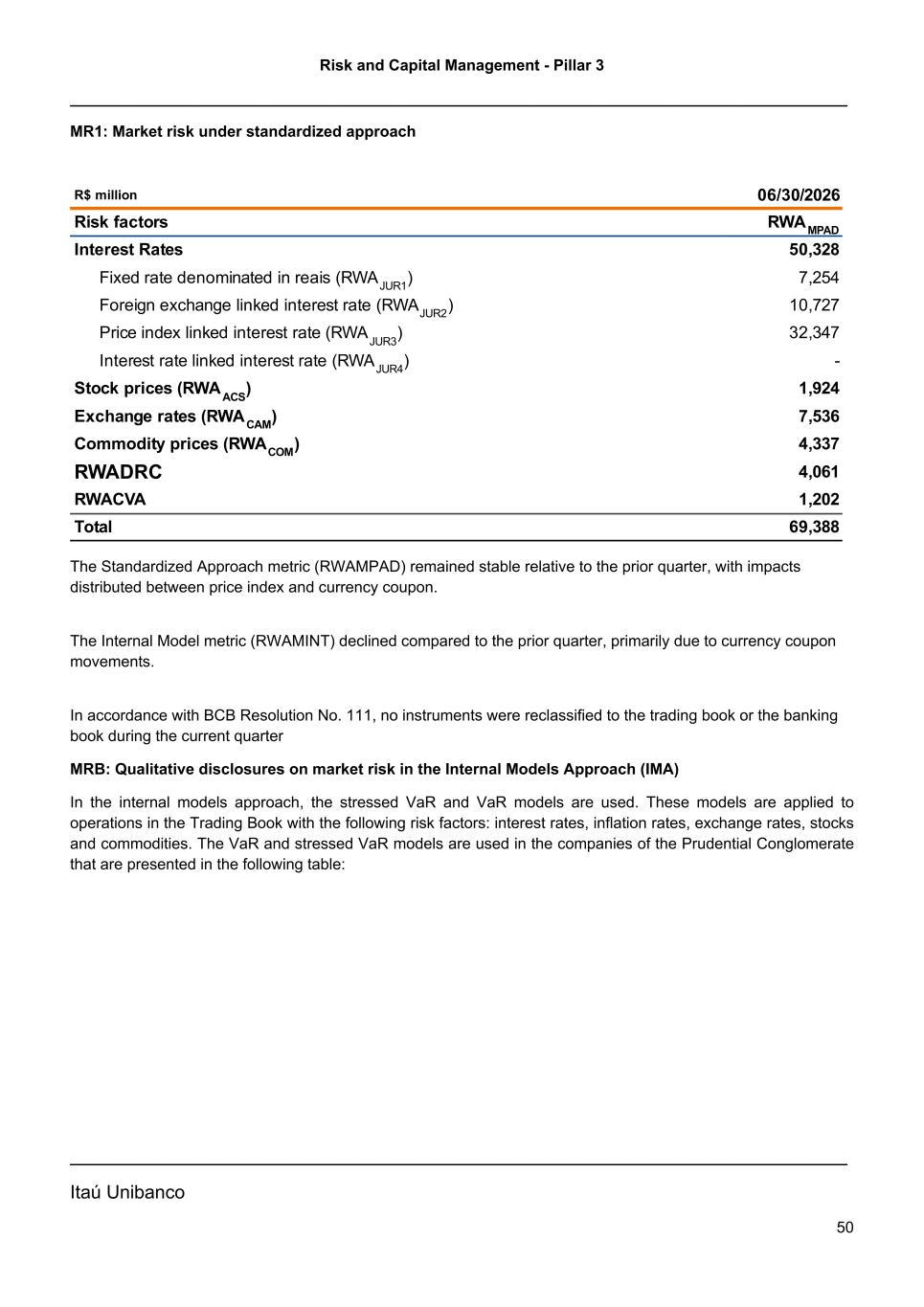
Risk and Capital Management - Pillar 3 __________________________________________________________________________________________ __________________________________________________________________________________________ Itaú Unibanco 50 MR1: Market risk under standardized approach R$ million 06/30/2026 Risk factors RWAMPAD Interest Rates 50,328 Fixed rate denominated in reais (RWAJUR1) 7,254 Foreign exchange linked interest rate (RWAJUR2) 10,727 Price index linked interest rate (RWAJUR3) 32,347 Interest rate linked interest rate (RWAJUR4) - Stock prices (RWAACS) 1,924 Exchange rates (RWACAM) 7,536 Commodity prices (RWACOM) 4,337 RWADRC 4,061 RWACVA 1,202 Total 69,388 The Standardized Approach metric (RWAMPAD) remained stable relative to the prior quarter, with impacts distributed between price index and currency coupon. The Internal Model metric (RWAMINT) declined compared to the prior quarter, primarily due to currency coupon movements. In accordance with BCB Resolution No. 111, no instruments were reclassified to the trading book or the banking book during the current quarter MRB: Qualitative disclosures on market risk in the Internal Models Approach (IMA) In the internal models approach, the stressed VaR and VaR models are used. These models are applied to operations in the Trading Book with the following risk factors: interest rates, inflation rates, exchange rates, stocks and commodities. The VaR and stressed VaR models are used in the companies of the Prudential Conglomerate that are presented in the following table:
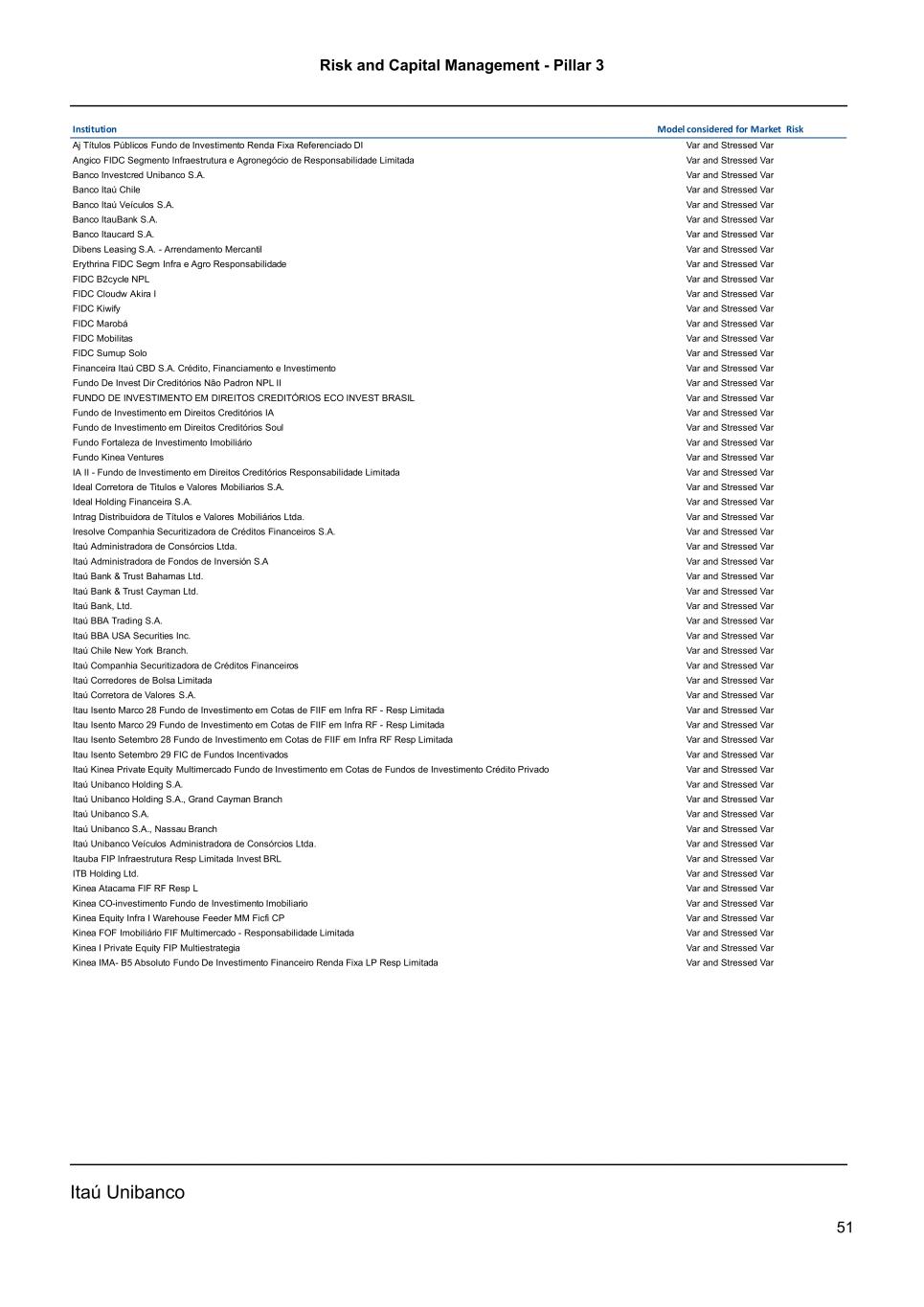
Risk and Capital Management - Pillar 3 __________________________________________________________________________________________ __________________________________________________________________________________________ Itaú Unibanco 51 Institution Model considered for Market Risk Aj Títulos Públicos Fundo de Investimento Renda Fixa Referenciado DI Var and Stressed Var Angico FIDC Segmento Infraestrutura e Agronegócio de Responsabilidade Limitada Var and Stressed Var Banco Investcred Unibanco S.A. Var and Stressed Var Banco Itaú Chile Var and Stressed Var Banco Itaú Veículos S.A. Var and Stressed Var Banco ItauBank S.A. Var and Stressed Var Banco Itaucard S.A. Var and Stressed Var Dibens Leasing S.A. - Arrendamento Mercantil Var and Stressed Var Erythrina FIDC Segm Infra e Agro Responsabilidade Var and Stressed Var FIDC B2cycle NPL Var and Stressed Var FIDC Cloudw Akira I Var and Stressed Var FIDC Kiwify Var and Stressed Var FIDC Marobá Var and Stressed Var FIDC Mobilitas Var and Stressed Var FIDC Sumup Solo Var and Stressed Var Financeira Itaú CBD S.A. Crédito, Financiamento e Investimento Var and Stressed Var Fundo De Invest Dir Creditórios Não Padron NPL II Var and Stressed Var FUNDO DE INVESTIMENTO EM DIREITOS CREDITÓRIOS ECO INVEST BRASIL Var and Stressed Var Fundo de Investimento em Direitos Creditórios IA Var and Stressed Var Fundo de Investimento em Direitos Creditórios Soul Var and Stressed Var Fundo Fortaleza de Investimento Imobiliário Var and Stressed Var Fundo Kinea Ventures Var and Stressed Var IA II - Fundo de Investimento em Direitos Creditórios Responsabilidade Limitada Var and Stressed Var Ideal Corretora de Titulos e Valores Mobiliarios S.A. Var and Stressed Var Ideal Holding Financeira S.A. Var and Stressed Var Intrag Distribuidora de Títulos e Valores Mobiliários Ltda. Var and Stressed Var Iresolve Companhia Securitizadora de Créditos Financeiros S.A. Var and Stressed Var Itaú Administradora de Consórcios Ltda. Var and Stressed Var Itaú Administradora de Fondos de Inversión S.A Var and Stressed Var Itaú Bank & Trust Bahamas Ltd. Var and Stressed Var Itaú Bank & Trust Cayman Ltd. Var and Stressed Var Itaú Bank, Ltd. Var and Stressed Var Itaú BBA Trading S.A. Var and Stressed Var Itaú BBA USA Securities Inc. Var and Stressed Var Itaú Chile New York Branch. Var and Stressed Var Itaú Companhia Securitizadora de Créditos Financeiros Var and Stressed Var Itaú Corredores de Bolsa Limitada Var and Stressed Var Itaú Corretora de Valores S.A. Var and Stressed Var Itau Isento Marco 28 Fundo de Investimento em Cotas de FIIF em Infra RF - Resp Limitada Var and Stressed Var Itau Isento Marco 29 Fundo de Investimento em Cotas de FIIF em Infra RF - Resp Limitada Var and Stressed Var Itau Isento Setembro 28 Fundo de Investimento em Cotas de FIIF em Infra RF Resp Limitada Var and Stressed Var Itau Isento Setembro 29 FIC de Fundos Incentivados Var and Stressed Var Itaú Kinea Private Equity Multimercado Fundo de Investimento em Cotas de Fundos de Investimento Crédito Privado Var and Stressed Var Itaú Unibanco Holding S.A. Var and Stressed Var Itaú Unibanco Holding S.A., Grand Cayman Branch Var and Stressed Var Itaú Unibanco S.A. Var and Stressed Var Itaú Unibanco S.A., Nassau Branch Var and Stressed Var Itaú Unibanco Veículos Administradora de Consórcios Ltda. Var and Stressed Var Itauba FIP Infraestrutura Resp Limitada Invest BRL Var and Stressed Var ITB Holding Ltd. Var and Stressed Var Kinea Atacama FIF RF Resp L Var and Stressed Var Kinea CO-investimento Fundo de Investimento Imobiliario Var and Stressed Var Kinea Equity Infra I Warehouse Feeder MM Ficfi CP Var and Stressed Var Kinea FOF Imobiliário FIF Multimercado - Responsabilidade Limitada Var and Stressed Var Kinea I Private Equity FIP Multiestrategia Var and Stressed Var Kinea IMA- B5 Absoluto Fundo De Investimento Financeiro Renda Fixa LP Resp Limitada Var and Stressed Var
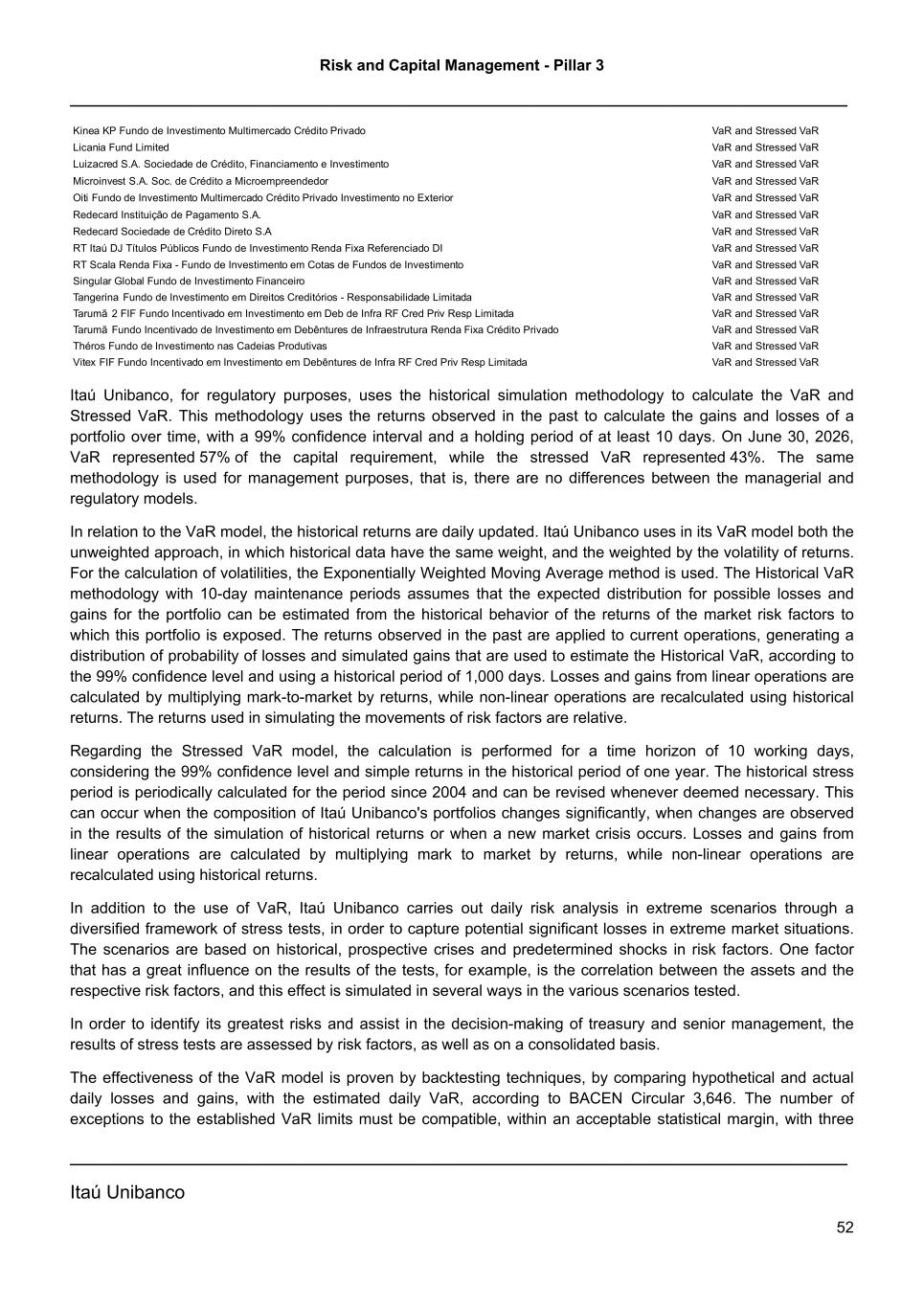
Risk and Capital Management - Pillar 3 __________________________________________________________________________________________ __________________________________________________________________________________________ Itaú Unibanco 52 Kinea KP Fundo de Investimento Multimercado Crédito Privado VaR and Stressed VaR Licania Fund Limited VaR and Stressed VaR Luizacred S.A. Sociedade de Crédito, Financiamento e Investimento VaR and Stressed VaR Microinvest S.A. Soc. de Crédito a Microempreendedor VaR and Stressed VaR Oiti Fundo de Investimento Multimercado Crédito Privado Investimento no Exterior VaR and Stressed VaR Redecard Instituição de Pagamento S.A. VaR and Stressed VaR Redecard Sociedade de Crédito Direto S.A VaR and Stressed VaR RT Itaú DJ Títulos Públicos Fundo de Investimento Renda Fixa Referenciado DI VaR and Stressed VaR RT Scala Renda Fixa - Fundo de Investimento em Cotas de Fundos de Investimento VaR and Stressed VaR Singular Global Fundo de Investimento Financeiro VaR and Stressed VaR Tangerina Fundo de Investimento em Direitos Creditórios - Responsabilidade Limitada VaR and Stressed VaR Tarumã 2 FIF Fundo Incentivado em Investimento em Deb de Infra RF Cred Priv Resp Limitada VaR and Stressed VaR Tarumã Fundo Incentivado de Investimento em Debêntures de Infraestrutura Renda Fixa Crédito Privado VaR and Stressed VaR Théros Fundo de Investimento nas Cadeias Produtivas VaR and Stressed VaR Vitex FIF Fundo Incentivado em Investimento em Debêntures de Infra RF Cred Priv Resp Limitada VaR and Stressed VaR Itaú Unibanco, for regulatory purposes, uses the historical simulation methodology to calculate the VaR and Stressed VaR. This methodology uses the returns observed in the past to calculate the gains and losses of a portfolio over time, with a 99% confidence interval and a holding period of at least 10 days. On June 30, 2026, VaR represented 57% of the capital requirement, while the stressed VaR represented 43%. The same methodology is used for management purposes, that is, there are no differences between the managerial and regulatory models. In relation to the VaR model, the historical returns are daily updated. Itaú Unibanco uses in its VaR model both the unweighted approach, in which historical data have the same weight, and the weighted by the volatility of returns. For the calculation of volatilities, the Exponentially Weighted Moving Average method is used. The Historical VaR methodology with 10-day maintenance periods assumes that the expected distribution for possible losses and gains for the portfolio can be estimated from the historical behavior of the returns of the market risk factors to which this portfolio is exposed. The returns observed in the past are applied to current operations, generating a distribution of probability of losses and simulated gains that are used to estimate the Historical VaR, according to the 99% confidence level and using a historical period of 1,000 days. Losses and gains from linear operations are calculated by multiplying mark-to-market by returns, while non-linear operations are recalculated using historical returns. The returns used in simulating the movements of risk factors are relative. Regarding the Stressed VaR model, the calculation is performed for a time horizon of 10 working days, considering the 99% confidence level and simple returns in the historical period of one year. The historical stress period is periodically calculated for the period since 2004 and can be revised whenever deemed necessary. This can occur when the composition of Itaú Unibanco's portfolios changes significantly, when changes are observed in the results of the simulation of historical returns or when a new market crisis occurs. Losses and gains from linear operations are calculated by multiplying mark to market by returns, while non-linear operations are recalculated using historical returns. In addition to the use of VaR, Itaú Unibanco carries out daily risk analysis in extreme scenarios through a diversified framework of stress tests, in order to capture potential significant losses in extreme market situations. The scenarios are based on historical, prospective crises and predetermined shocks in risk factors. One factor that has a great influence on the results of the tests, for example, is the correlation between the assets and the respective risk factors, and this effect is simulated in several ways in the various scenarios tested. In order to identify its greatest risks and assist in the decision-making of treasury and senior management, the results of stress tests are assessed by risk factors, as well as on a consolidated basis. The effectiveness of the VaR model is proven by backtesting techniques, by comparing hypothetical and actual daily losses and gains, with the estimated daily VaR, according to BACEN Circular 3,646. The number of exceptions to the established VaR limits must be compatible, within an acceptable statistical margin, with three
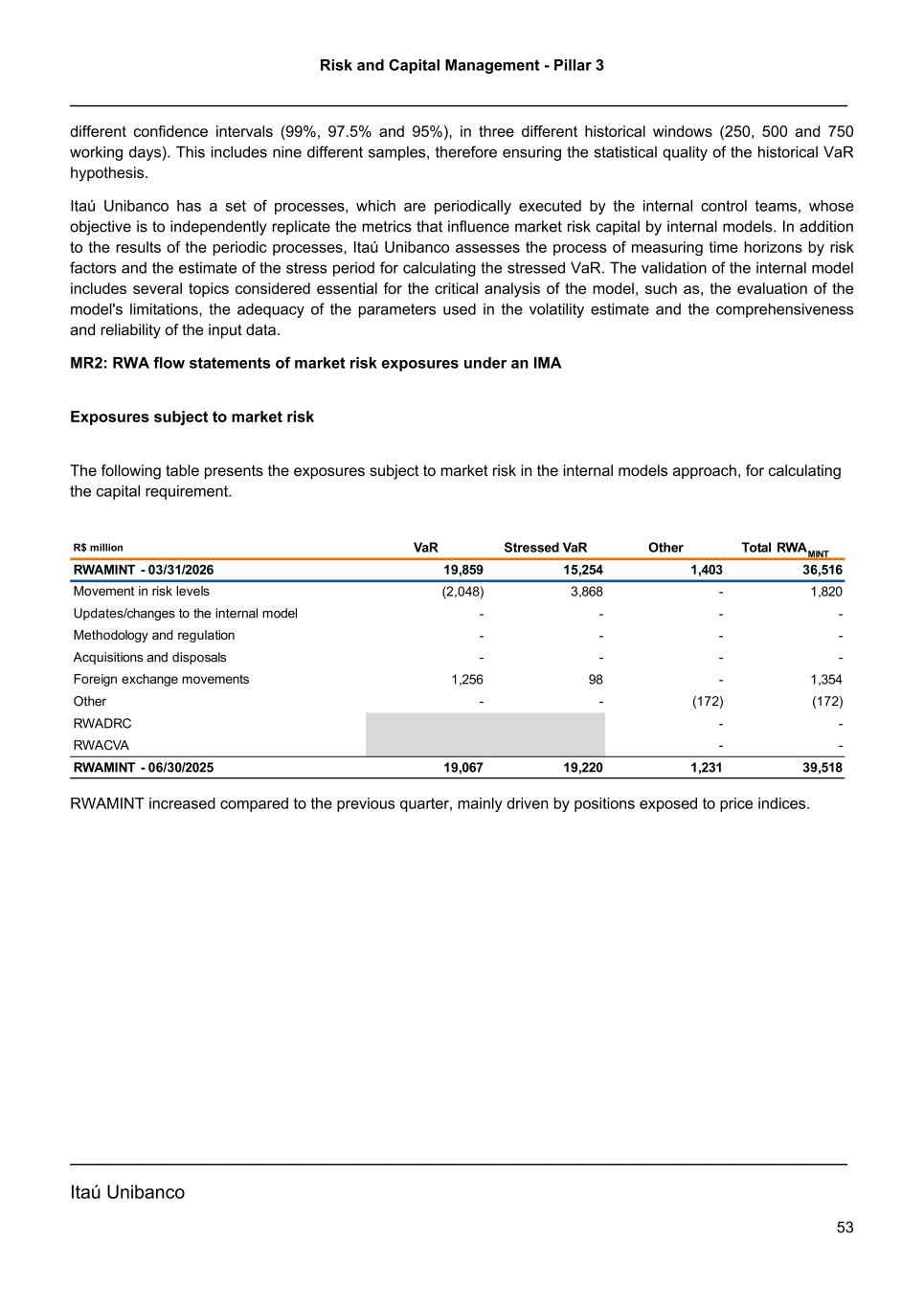
Risk and Capital Management - Pillar 3 __________________________________________________________________________________________ __________________________________________________________________________________________ Itaú Unibanco 53 different confidence intervals (99%, 97.5% and 95%), in three different historical windows (250, 500 and 750 working days). This includes nine different samples, therefore ensuring the statistical quality of the historical VaR hypothesis. Itaú Unibanco has a set of processes, which are periodically executed by the internal control teams, whose objective is to independently replicate the metrics that influence market risk capital by internal models. In addition to the results of the periodic processes, Itaú Unibanco assesses the process of measuring time horizons by risk factors and the estimate of the stress period for calculating the stressed VaR. The validation of the internal model includes several topics considered essential for the critical analysis of the model, such as, the evaluation of the model's limitations, the adequacy of the parameters used in the volatility estimate and the comprehensiveness and reliability of the input data. MR2: RWA flow statements of market risk exposures under an IMA Exposures subject to market risk The following table presents the exposures subject to market risk in the internal models approach, for calculating the capital requirement. a b e f R$ million VaR Stressed VaR Other Total RWAMINT RWAMINT - 03/31/2026 31 19,859 15,254 1,403 36,516 Movement in risk levels (2,048) 3,868 - 1,820 Updates/changes to the internal model - - - - Methodology and regulation - - - - Acquisitions and disposals - - - - Foreign exchange movements 1,256 98 - 1,354 Other - - (172) (172) RWADRC - - RWACVA - - RWAMINT - 06/30/2025 30 19,067 19,220 1,231 39,518 RWAMINT increased compared to the previous quarter, mainly driven by positions exposed to price indices.
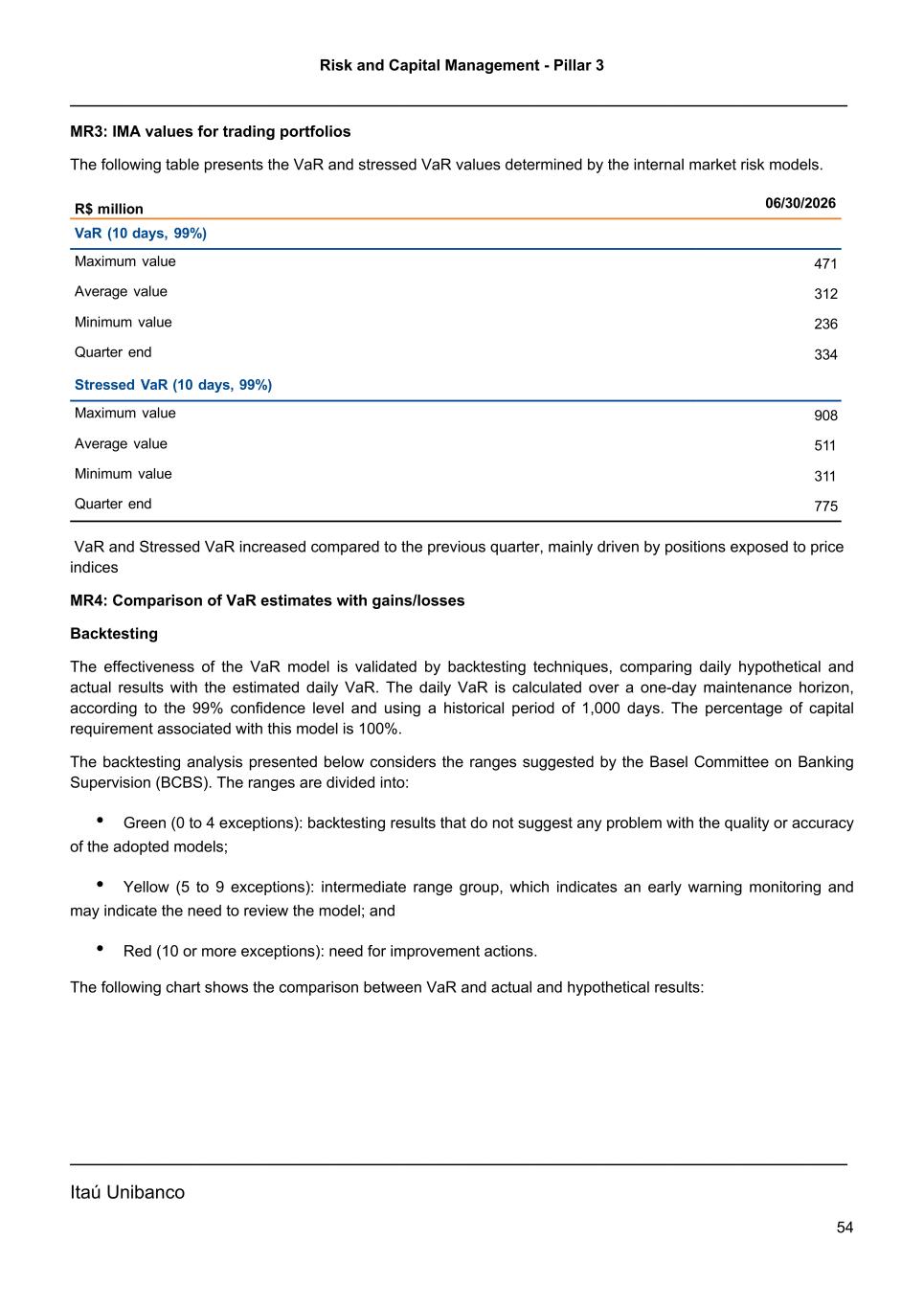
Risk and Capital Management - Pillar 3 __________________________________________________________________________________________ __________________________________________________________________________________________ Itaú Unibanco 54 MR3: IMA values for trading portfolios The following table presents the VaR and stressed VaR values determined by the internal market risk models. R$ million 06/30/2026 VaR (10 days, 99%) Maximum value 471 Average value 312 Minimum value 236 Quarter end 334 Stressed VaR (10 days, 99%) Maximum value 908 Average value 511 Minimum value 311 Quarter end 775 VaR and Stressed VaR increased compared to the previous quarter, mainly driven by positions exposed to price indices MR4: Comparison of VaR estimates with gains/losses Backtesting The effectiveness of the VaR model is validated by backtesting techniques, comparing daily hypothetical and actual results with the estimated daily VaR. The daily VaR is calculated over a one-day maintenance horizon, according to the 99% confidence level and using a historical period of 1,000 days. The percentage of capital requirement associated with this model is 100%. The backtesting analysis presented below considers the ranges suggested by the Basel Committee on Banking Supervision (BCBS). The ranges are divided into: • Green (0 to 4 exceptions): backtesting results that do not suggest any problem with the quality or accuracy of the adopted models; • Yellow (5 to 9 exceptions): intermediate range group, which indicates an early warning monitoring and may indicate the need to review the model; and • Red (10 or more exceptions): need for improvement actions. The following chart shows the comparison between VaR and actual and hypothetical results:
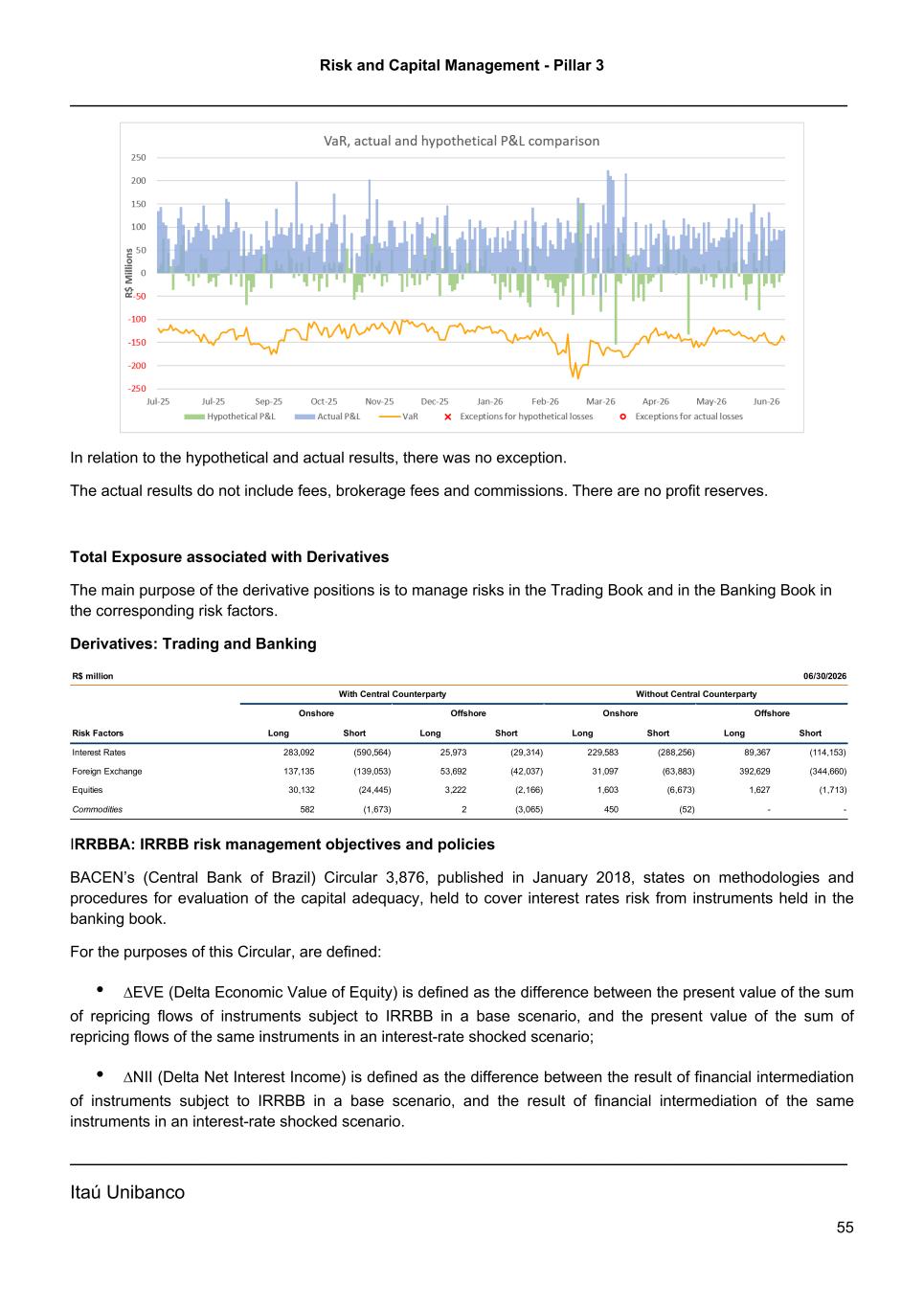
Risk and Capital Management - Pillar 3 __________________________________________________________________________________________ __________________________________________________________________________________________ Itaú Unibanco 55 In relation to the hypothetical and actual results, there was no exception. The actual results do not include fees, brokerage fees and commissions. There are no profit reserves. Total Exposure associated with Derivatives The main purpose of the derivative positions is to manage risks in the Trading Book and in the Banking Book in the corresponding risk factors. Derivatives: Trading and Banking R$ million 06/30/2026 With Central Counterparty Without Central Counterparty Onshore Offshore Onshore Offshore Risk Factors Long Short Long Short Long Short Long Short Interest Rates 283,092 (590,564) 25,973 (29,314) 229,583 (288,256) 89,367 (114,153) Foreign Exchange 137,135 (139,053) 53,692 (42,037) 31,097 (63,883) 392,629 (344,660) Equities 30,132 (24,445) 3,222 (2,166) 1,603 (6,673) 1,627 (1,713) Commodities 582 (1,673) 2 (3,065) 450 (52) - - IRRBBA: IRRBB risk management objectives and policies BACEN’s (Central Bank of Brazil) Circular 3,876, published in January 2018, states on methodologies and procedures for evaluation of the capital adequacy, held to cover interest rates risk from instruments held in the banking book. For the purposes of this Circular, are defined: • ∆EVE (Delta Economic Value of Equity) is defined as the difference between the present value of the sum of repricing flows of instruments subject to IRRBB in a base scenario, and the present value of the sum of repricing flows of the same instruments in an interest-rate shocked scenario; • ∆NII (Delta Net Interest Income) is defined as the difference between the result of financial intermediation of instruments subject to IRRBB in a base scenario, and the result of financial intermediation of the same instruments in an interest-rate shocked scenario.
Risk and Capital Management - Pillar 3 __________________________________________________________________________________________ __________________________________________________________________________________________ Itaú Unibanco 56 The sensibility analysis introduced here are just a static evaluation of the portfolio interest rate exposure, and, therefore, don´t consider the dynamic management of the treasury desk and risk control areas, which hold the responsibility for measures to mitigate risk under an adverse situation, minimizing significant losses. Moreover, it is highlighted, though, the results presented do not translate into accountable or economic results for certain, because this analysis has, only, an interest rate risk disclosure purpose and to demonstrate the principle protection actions, considering the instruments fair value, apart from any accounting practices adopted by Itaú Unibanco. The institution uses an internal model to measure ∆EVE and ∆NII. ∆EVE results do not represent immediate impact in the stockholders’ equity. Meanwhile, ∆NII results indicate potential volatility in the projected interest rates results. In compliance with the circular 3,876, the following demonstrates qualitative and quantitative details of risk management for IRRBB in Itaú Unibanco. Framework and Treatment Interest rate risk in the banking book refers to the potential risk of impact on capital sufficiency and/or on the results of financial intermediation due to adverse movements in interest rates, taking into account the principal flows of instruments held in the banking book. The main point of assets and liabilities management is to maximize the risk-return ratio of positions held in the banking book, taking into account the economic value of these assets/liabilities and the impact on actual and future bank’s results. The interest rate risk managing on transactions held in the banking book occurs within the governance and hierarchy of decision-making bodies and under a limits structure and alerts approved specifically for these purpose, which is sensitive due to different levels and classes of market risk. The management structure of IRRBB has it owns risk policies and controls intended to ensure adherence to the bank’s risk appetite. The IRRBB framework has granular management limits for several other risk metrics and consolidated limits for ∆EVE and ∆NII results, besides the limits associated with stress tests. The asset and liability management unit is responsible for managing timing mismatches between asset and liability flows, and minimizes interest rate risk by through strategies as economic hedge and accounting hedge. All the models associated with IRRBB have a robust independent validation process and are approved by a CTAM (Technical Model Assessment Commission). In addition, all the models and processes are assessed by internal audit. The interest rate risk framework in the banking book uses management measurements that are calculated daily for limit control. The ∆EVE and ∆NII metrics are calculated according to the risk appetite limits and the other risk metrics in terms of management risk limits. In the process of managing interest rate risk of the banking book, transactions subject to automatic options are calculated according to internal market models which split the products, as far as possible, into linear and non- linear payoffs. The linear payoffs are treated similarly to any other instruments without options, and for non-linear payoffs an additional value is computed and added on the ∆EVE and ∆NII metrics. In general terms, transactions subject to behavioral options are classified as deposits with no contractual maturity date defined or products subject to early repayment. Non-maturity deposits are classified according to their nature and stability to guarantee compliance with regulatory limits. A survival analysis model treats the products subject to pre-payment, using the historical dataset to calibrate its parameters. The instruments flows with homogeneous
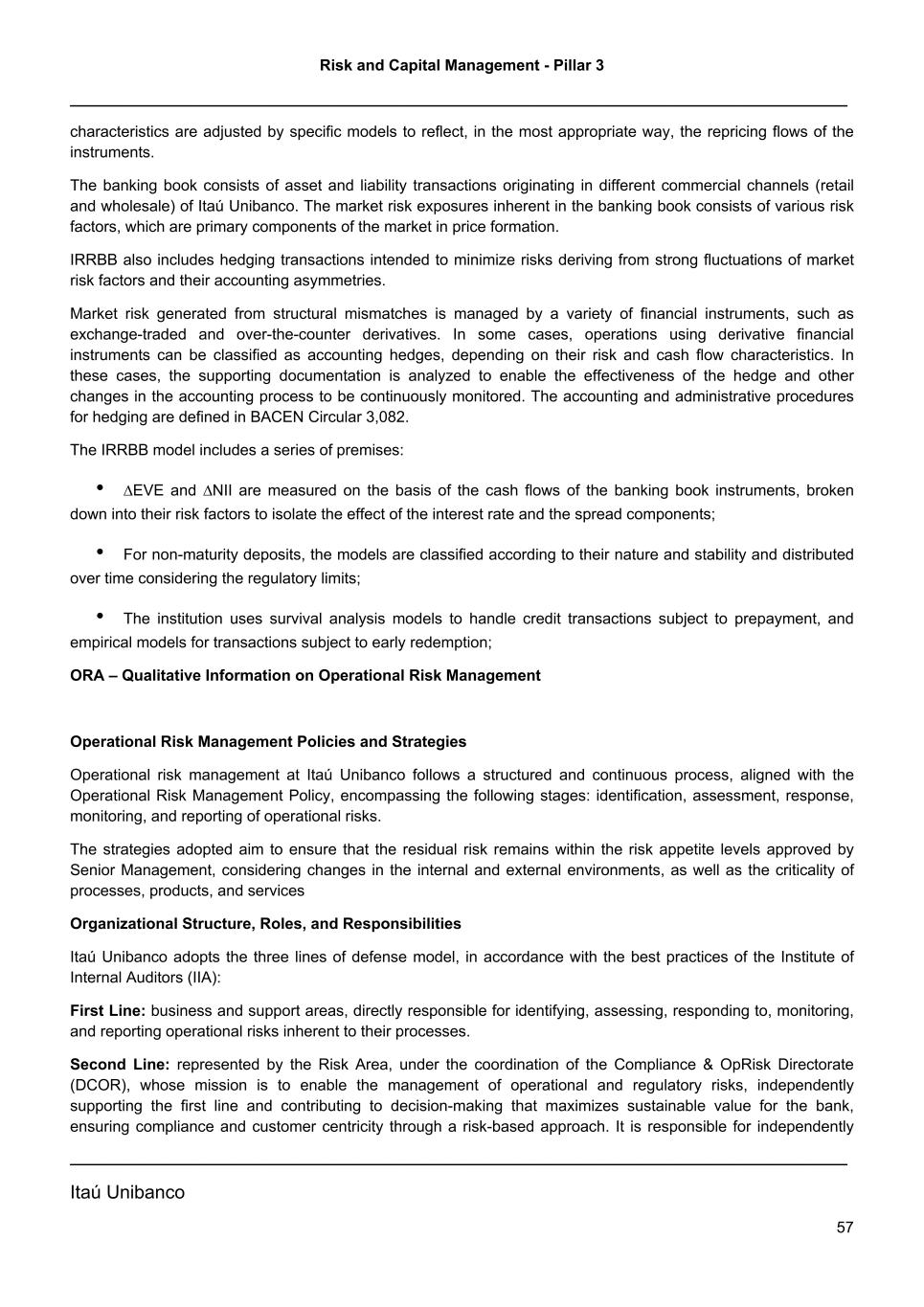
Risk and Capital Management - Pillar 3 __________________________________________________________________________________________ __________________________________________________________________________________________ Itaú Unibanco 57 characteristics are adjusted by specific models to reflect, in the most appropriate way, the repricing flows of the instruments. The banking book consists of asset and liability transactions originating in different commercial channels (retail and wholesale) of Itaú Unibanco. The market risk exposures inherent in the banking book consists of various risk factors, which are primary components of the market in price formation. IRRBB also includes hedging transactions intended to minimize risks deriving from strong fluctuations of market risk factors and their accounting asymmetries. Market risk generated from structural mismatches is managed by a variety of financial instruments, such as exchange-traded and over-the-counter derivatives. In some cases, operations using derivative financial instruments can be classified as accounting hedges, depending on their risk and cash flow characteristics. In these cases, the supporting documentation is analyzed to enable the effectiveness of the hedge and other changes in the accounting process to be continuously monitored. The accounting and administrative procedures for hedging are defined in BACEN Circular 3,082. The IRRBB model includes a series of premises: • ∆EVE and ∆NII are measured on the basis of the cash flows of the banking book instruments, broken down into their risk factors to isolate the effect of the interest rate and the spread components; • For non-maturity deposits, the models are classified according to their nature and stability and distributed over time considering the regulatory limits; • The institution uses survival analysis models to handle credit transactions subject to prepayment, and empirical models for transactions subject to early redemption; ORA – Qualitative Information on Operational Risk Management Operational Risk Management Policies and Strategies Operational risk management at Itaú Unibanco follows a structured and continuous process, aligned with the Operational Risk Management Policy, encompassing the following stages: identification, assessment, response, monitoring, and reporting of operational risks. The strategies adopted aim to ensure that the residual risk remains within the risk appetite levels approved by Senior Management, considering changes in the internal and external environments, as well as the criticality of processes, products, and services Organizational Structure, Roles, and Responsibilities Itaú Unibanco adopts the three lines of defense model, in accordance with the best practices of the Institute of Internal Auditors (IIA): First Line: business and support areas, directly responsible for identifying, assessing, responding to, monitoring, and reporting operational risks inherent to their processes. Second Line: represented by the Risk Area, under the coordination of the Compliance & OpRisk Directorate (DCOR), whose mission is to enable the management of operational and regulatory risks, independently supporting the first line and contributing to decision-making that maximizes sustainable value for the bank, ensuring compliance and customer centricity through a risk-based approach. It is responsible for independently
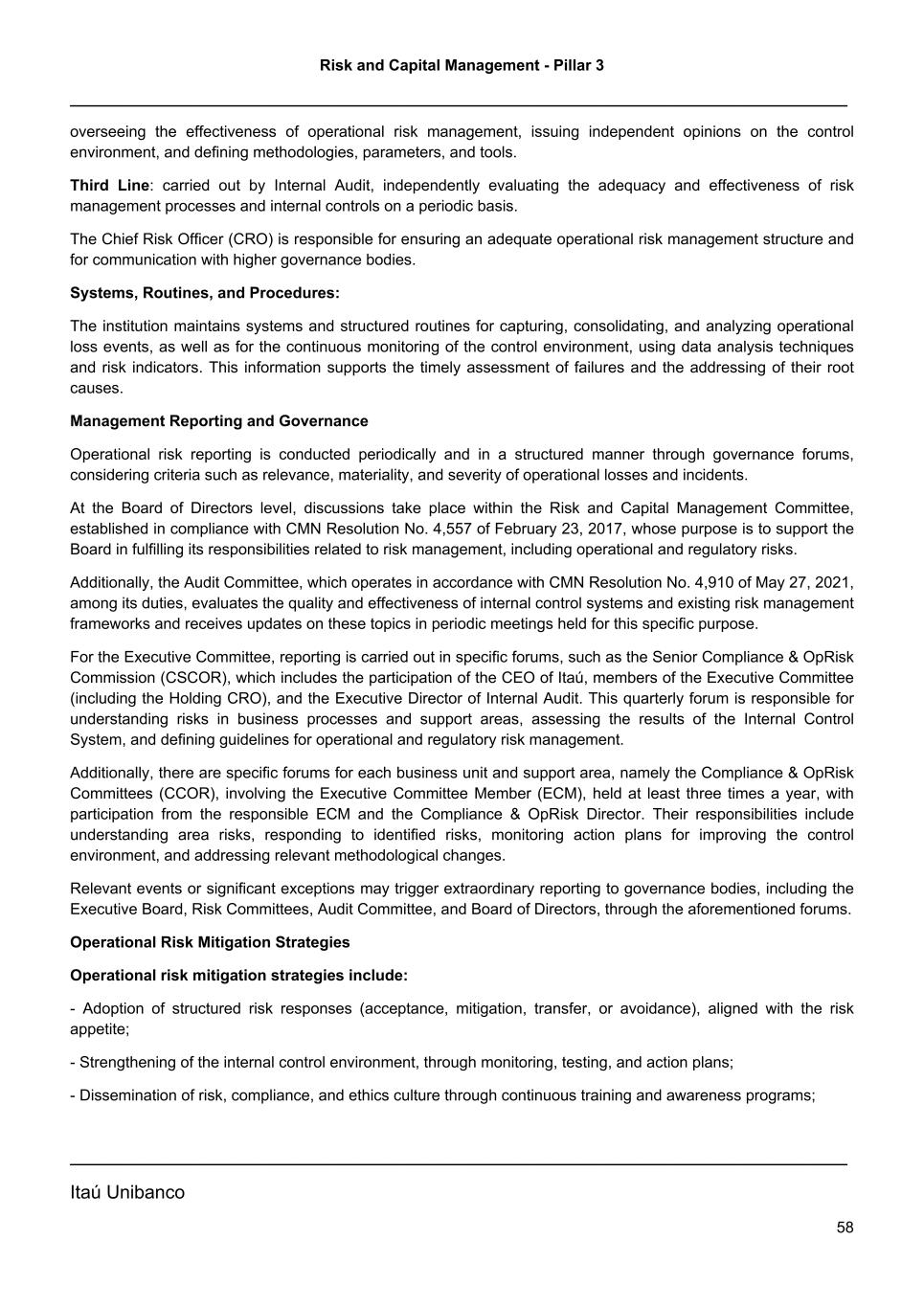
Risk and Capital Management - Pillar 3 __________________________________________________________________________________________ __________________________________________________________________________________________ Itaú Unibanco 58 overseeing the effectiveness of operational risk management, issuing independent opinions on the control environment, and defining methodologies, parameters, and tools. Third Line: carried out by Internal Audit, independently evaluating the adequacy and effectiveness of risk management processes and internal controls on a periodic basis. The Chief Risk Officer (CRO) is responsible for ensuring an adequate operational risk management structure and for communication with higher governance bodies. Systems, Routines, and Procedures: The institution maintains systems and structured routines for capturing, consolidating, and analyzing operational loss events, as well as for the continuous monitoring of the control environment, using data analysis techniques and risk indicators. This information supports the timely assessment of failures and the addressing of their root causes. Management Reporting and Governance Operational risk reporting is conducted periodically and in a structured manner through governance forums, considering criteria such as relevance, materiality, and severity of operational losses and incidents. At the Board of Directors level, discussions take place within the Risk and Capital Management Committee, established in compliance with CMN Resolution No. 4,557 of February 23, 2017, whose purpose is to support the Board in fulfilling its responsibilities related to risk management, including operational and regulatory risks. Additionally, the Audit Committee, which operates in accordance with CMN Resolution No. 4,910 of May 27, 2021, among its duties, evaluates the quality and effectiveness of internal control systems and existing risk management frameworks and receives updates on these topics in periodic meetings held for this specific purpose. For the Executive Committee, reporting is carried out in specific forums, such as the Senior Compliance & OpRisk Commission (CSCOR), which includes the participation of the CEO of Itaú, members of the Executive Committee (including the Holding CRO), and the Executive Director of Internal Audit. This quarterly forum is responsible for understanding risks in business processes and support areas, assessing the results of the Internal Control System, and defining guidelines for operational and regulatory risk management. Additionally, there are specific forums for each business unit and support area, namely the Compliance & OpRisk Committees (CCOR), involving the Executive Committee Member (ECM), held at least three times a year, with participation from the responsible ECM and the Compliance & OpRisk Director. Their responsibilities include understanding area risks, responding to identified risks, monitoring action plans for improving the control environment, and addressing relevant methodological changes. Relevant events or significant exceptions may trigger extraordinary reporting to governance bodies, including the Executive Board, Risk Committees, Audit Committee, and Board of Directors, through the aforementioned forums. Operational Risk Mitigation Strategies Operational risk mitigation strategies include: - Adoption of structured risk responses (acceptance, mitigation, transfer, or avoidance), aligned with the risk appetite; - Strengthening of the internal control environment, through monitoring, testing, and action plans; - Dissemination of risk, compliance, and ethics culture through continuous training and awareness programs;
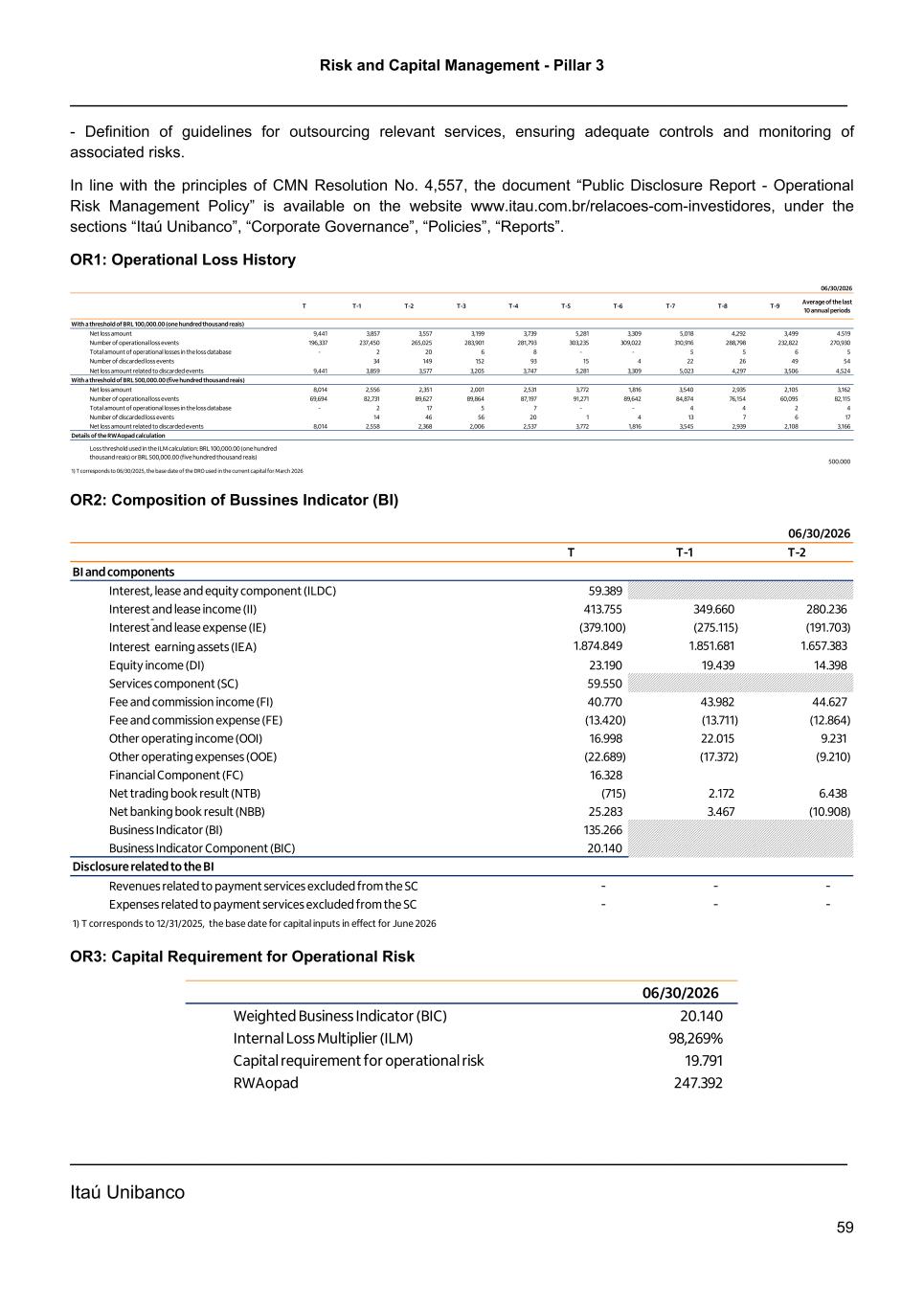
Risk and Capital Management - Pillar 3 __________________________________________________________________________________________ __________________________________________________________________________________________ Itaú Unibanco 59 - Definition of guidelines for outsourcing relevant services, ensuring adequate controls and monitoring of associated risks. In line with the principles of CMN Resolution No. 4,557, the document “Public Disclosure Report - Operational Risk Management Policy” is available on the website www.itau.com.br/relacoes-com-investidores, under the sections “Itaú Unibanco”, “Corporate Governance”, “Policies”, “Reports”. OR1: Operational Loss History OR2: Composition of Bussines Indicator (BI) OR3: Capital Requirement for Operational Risk 06/30/2026 T T-1 T-2 T-3 T-4 T-5 T-6 T-7 T-8 T-9 Average of the last 10 annual periods With a threshold of BRL 100,000.00 (one hundred thousand reais) Net loss amount 9,441 3,857 3,557 3,199 3,739 5,281 3,309 5,018 4,292 3,499 4.519 Number of operational loss events 196,337 237,450 265,025 283,901 281,793 303,235 309,022 310,916 288,798 232,822 270,930 Total amount of operational losses in the loss database - 2 20 6 8 - - 5 5 6 5 Number of discarded loss events 34 149 152 93 15 4 22 26 49 54 Net loss amount related to discarded events 9,441 3,859 3,577 3,205 3,747 5,281 3,309 5,023 4,297 3,506 4,524 With a threshold of BRL 500,000.00 (five hundred thousand reais) Net loss amount 8,014 2,556 2,351 2,001 2,531 3,772 1,816 3,540 2,935 2,105 3,162 Number of operational loss events 69,694 82,731 89,627 89,864 87,197 91,271 89,642 84,874 76,154 60,095 82,115 Total amount of operational losses in the loss database - 2 17 5 7 - - 4 4 2 4 Number of discarded loss events 14 46 56 20 1 4 13 7 6 17 Net loss amount related to discarded events 8,014 2,558 2,368 2,006 2,537 3,772 1,816 3,545 2,939 2,108 3,166 Details of the RWAopad calculation Loss threshold used in the ILM calculation: BRL 100,000.00 (one hundred thousand reais) or BRL 500,000.00 (five hundred thousand reais) 500.000 1) T corresponds to 06/30/2025, the base date of the DRO used in the current capital for March 2026 06/30/2026 T T-1 T-2 BI and components Interest, lease and equity component (ILDC) 59.389 Interest and lease income (II) 413.755 349.660 280.236 Interest and lease expense (IE) (379.100) (275.115) (191.703) Interest ‑ earning assets (IEA) 1.874.849 1.851.681 1.657.383 Equity income (DI) 23.190 19.439 14.398 Services component (SC) 59.550 Fee and commission income (FI) 40.770 43.982 44.627 Fee and commission expense (FE) (13.420) (13.711) (12.864) Other operating income (OOI) 16.998 22.015 9.231 Other operating expenses (OOE) (22.689) (17.372) (9.210) Financial Component (FC) 16.328 Net trading book result (NTB) (715) 2.172 6.438 Net banking book result (NBB) 25.283 3.467 (10.908) Business Indicator (BI) 135.266 Business Indicator Component (BIC) 20.140 Disclosure related to the BI Revenues related to payment services excluded from the SC - - - Expenses related to payment services excluded from the SC - - - 1) T corresponds to 12/31/2025, the base date for capital inputs in effect for June 2026 06/30/2026 Weighted Business Indicator (BIC) 20.140 Internal Loss Multiplier (ILM) 98,269% Capital requirement for operational risk 19.791 RWAopad 247.392
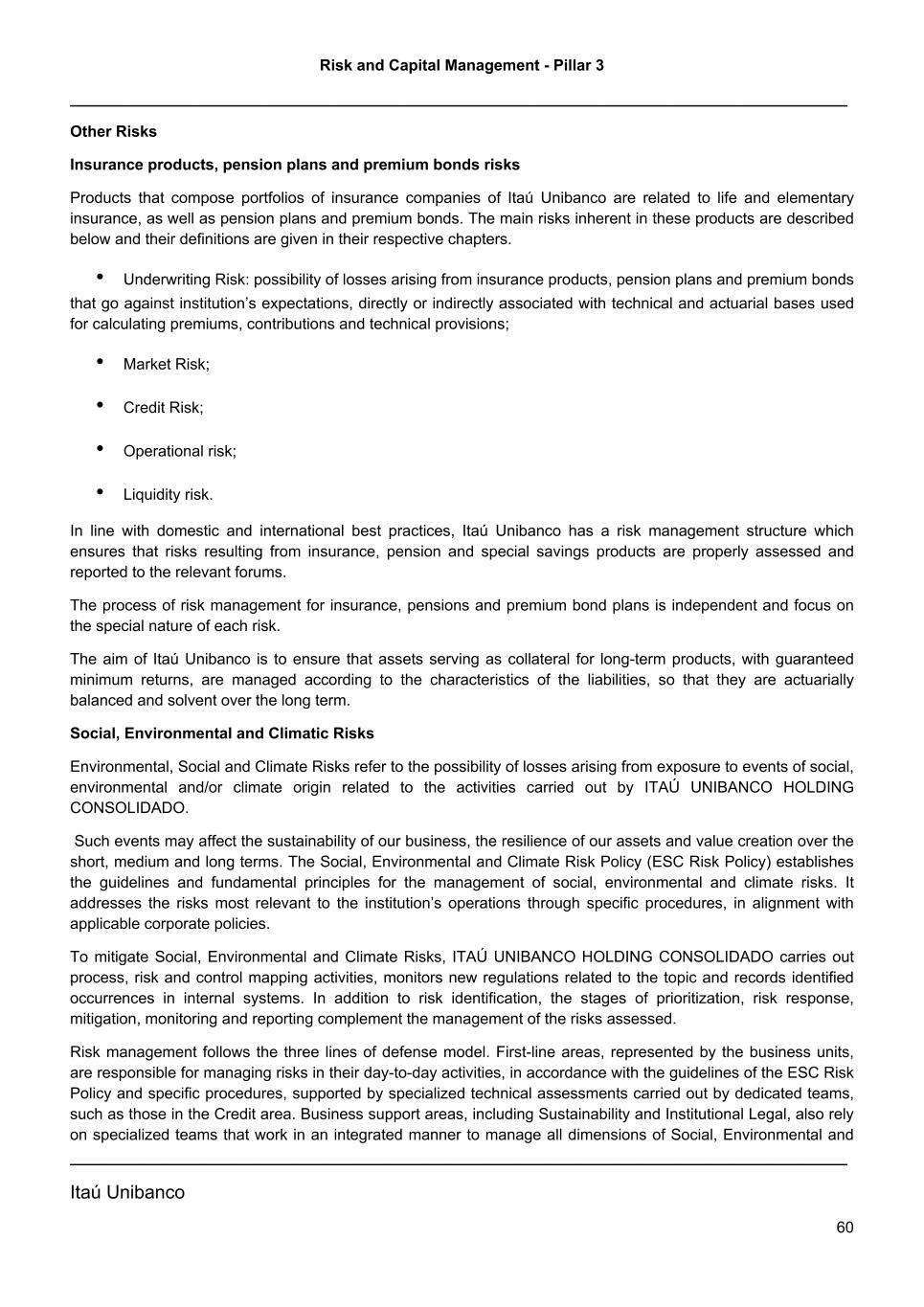
Risk and Capital Management - Pillar 3 __________________________________________________________________________________________ __________________________________________________________________________________________ Itaú Unibanco 60 Other Risks Insurance products, pension plans and premium bonds risks Products that compose portfolios of insurance companies of Itaú Unibanco are related to life and elementary insurance, as well as pension plans and premium bonds. The main risks inherent in these products are described below and their definitions are given in their respective chapters. • Underwriting Risk: possibility of losses arising from insurance products, pension plans and premium bonds that go against institution’s expectations, directly or indirectly associated with technical and actuarial bases used for calculating premiums, contributions and technical provisions; • Market Risk; • Credit Risk; • Operational risk; • Liquidity risk. In line with domestic and international best practices, Itaú Unibanco has a risk management structure which ensures that risks resulting from insurance, pension and special savings products are properly assessed and reported to the relevant forums. The process of risk management for insurance, pensions and premium bond plans is independent and focus on the special nature of each risk. The aim of Itaú Unibanco is to ensure that assets serving as collateral for long-term products, with guaranteed minimum returns, are managed according to the characteristics of the liabilities, so that they are actuarially balanced and solvent over the long term. Social, Environmental and Climatic Risks Environmental, Social and Climate Risks refer to the possibility of losses arising from exposure to events of social, environmental and/or climate origin related to the activities carried out by ITAÚ UNIBANCO HOLDING CONSOLIDADO. Such events may affect the sustainability of our business, the resilience of our assets and value creation over the short, medium and long terms. The Social, Environmental and Climate Risk Policy (ESC Risk Policy) establishes the guidelines and fundamental principles for the management of social, environmental and climate risks. It addresses the risks most relevant to the institution’s operations through specific procedures, in alignment with applicable corporate policies. To mitigate Social, Environmental and Climate Risks, ITAÚ UNIBANCO HOLDING CONSOLIDADO carries out process, risk and control mapping activities, monitors new regulations related to the topic and records identified occurrences in internal systems. In addition to risk identification, the stages of prioritization, risk response, mitigation, monitoring and reporting complement the management of the risks assessed. Risk management follows the three lines of defense model. First-line areas, represented by the business units, are responsible for managing risks in their day-to-day activities, in accordance with the guidelines of the ESC Risk Policy and specific procedures, supported by specialized technical assessments carried out by dedicated teams, such as those in the Credit area. Business support areas, including Sustainability and Institutional Legal, also rely on specialized teams that work in an integrated manner to manage all dimensions of Social, Environmental and
Risk and Capital Management - Pillar 3 __________________________________________________________________________________________ __________________________________________________________________________________________ Itaú Unibanco 61 Climate Risks associated with the conglomerate’s activities. Second-line areas, such as Social, Environmental and Climate Risk and Internal Controls, provide oversight, methodological support and ensure the appropriate governance of business and credit activities. In the third line, Internal Audit operates independently, performing assessments of risk management, controls and governance. The institution has specific procedures in place for the management of Social, Environmental and Climate risks in its own operations — including assets, branch infrastructure, technology and suppliers — as well as within traditional risk categories such as credit, investments and key subsidiaries. These procedures are designed in accordance with the principles of relevance and proportionality and range from the verification of information in applicable public databases for clients and suppliers to in-depth individual analyses for selected clients, depending on the segment or type of product. The governance structure also includes the Social, Environmental and Climate Risk Committee, whose primary responsibility is to assess and deliberate on institutional and strategic matters, as well as on products, operations and services that involve Social, Environmental and Climate Risks. Given the relevance of climate risk, ITAÚ UNIBANCO HOLDING CONSOLIDADO supports the Task Force on Climate-related Financial Disclosures (TCFD) and is committed to maintaining a process of continuous improvement aligned with its recommendations. In addition, the institution measures the sensitivity of its loan portfolio to climate risks through the application of the Climate Risk Sensitivity Scale, which categorizes clients and sectors by considering both physical risks — arising from changes in climate patterns, such as increased rainfall, rising temperatures and extreme weather events — and transition risks, resulting from economic changes driven by climate-related actions, including carbon pricing, climate regulation, market risks and reputational risks. Operational and Compliance Risk Compliance and operational risks are defined as the possibility of losses resulting from external events or failures in internal processes, people, or systems, or from non-compliance with legal and regulatory requirements. The methodology supporting the management of these risks adheres to market best practices, trends, and applicable regulations, with emphasis on the principles of Basel, COSO (Committee of Sponsoring Organizations of the Treadway Commission), COBIT (Control Objectives for Information and Related Technologies), and IIA (The Institute of Internal Auditors), as well as the intensive use of artificial intelligence to challenge the status quo. Model Risk Model risk is the fianancial risk, regulatory and reputational impact arising from errors in the production of models, their use, or associated with the data required for their application. The use of models has become increasingly prevalent within the institution, supporting strategic decisions in various contexts such as credit approval, transaction pricing, volatility curve estimation, capital calculation, among others. Due to the growing use of models—driven by the application of new technologies and the expanded use of data— Itaú Unibanco continues to enhance its governance related to the development, implementation, use, and monitoring of these models by defining guidelines, policies, and procedures aimed at ensuring quality and mitigating risks associated with each new methodology. The work performed by the areas responsible for models is assessed by the Operational Risk and Internal Audit teams to ensure adherence to these policies. Opportunities for improvement identified throughout these
Risk and Capital Management - Pillar 3 __________________________________________________________________________________________ __________________________________________________________________________________________ Itaú Unibanco 62 assessments are properly addressed through action plans, which are monitored by the three lines and senior management until their completion. Independent Validation of Risk Models Itaú Unibanco performs independent validation of its risk processes and risk models. This activity is carried out by a department that is segregated from both the business areas and the risk control areas, ensuring independence in the assessments. The validation methodology, defined in a specific internal policy, complies with regulatory requirements, such as those established in BACEN Circulars 303, 3,646, 3,674, 3,876 and Resolutions 4,966, 4,277, and 4,557. The validation stages include, among others: 1. Verification of the technical soundness and assumptions used in the models; 2. Qualitative and quantitative analysis of the models, including variable declaration, development of an independent calculator, and assessment of the adequacy of the technical references used; 3. When applicable, comparison with alternative models and external benchmarks; 4. Historical backtesting of the model; 5. Assessment of the adequacy of the model implementation in the systems used. Additionally, the validation area evaluates the stress testing program. The work performed by the independent validation area, as well as the validations of processes and models, is assessed by Internal Audit and submitted to specific committees composed of senior management members. Opportunities for improvement identified throughout the independent validation process are addressed through action plans, which are monitored by the three lines and senior management until their completion. Reputational Risk Itaú Unibanco understands reputational risk as the risk arising from internal practices and/or external factors that may generate a negative perception of Itaú Unibanco by customers, employees, shareholders, investors, regulatory bodies, government, suppliers, the press and the society in general. It can impact the bank's reputation, the value of its brand and/or result in financial losses. Besides, this can affect the maintenance of existing business relationships, access to sources of fundraising, the attraction of new business and talent to compose the company's staff or even the license to operate. The institution believes that its reputation is extremely important for achieving its long-term goals, which is why it seeks the alignment of the speech, the action and the ethical and transparent practice, essential to raise the confidence of Itaú Unibanco’s stakeholders. Itaú Unibanco’s reputation depends on its strategy (vision, culture and skills) and derives from direct or indirect experience of the relationship between Itaú Unibanco and its stakeholders. Since the reputational risk directly or indirectly permeates all operations and processes of the institution, Itaú Unibanco’s governance is structured in a way to ensure that potential risks are identified, analyzed and managed still in the initial phases of its operations and analysis of new products, including the use of new technologies. The treatment given to reputational risk is structured by means of many processes and internal initiatives, which, in turn, are supported by internal policies, and their main purpose is to provide mechanisms for the monitoring, management, control and mitigation of the main reputational risks. Among them are (i) risk appetite statement; (ii)
Risk and Capital Management - Pillar 3 __________________________________________________________________________________________ __________________________________________________________________________________________ Itaú Unibanco 63 process for the prevention and fight against unlawful acts; (iii) crisis management process and business continuity; (iv) processes and guidelines of the governmental and institutional relations; (v) corporate communication process; (vi) brand management process; (vii) ombudsman offices initiatives and commitment to customer satisfaction; and (vii) ethics guidelines and prevention of corruption. Financial institutions play a key role in preventing and fighting illegal acts, in particular money laundering, terrorist financing and fraud, in which the challenge is to identify and suppress increasingly sophisticated operations that seek to conceal the origin, location, disposition, ownership and movement of goods and money derived, directly or indirectly, from illegal activities. Itaú Unibanco has introduced a corporate policy in order to prevent its involvement in illegal acts and to protect its reputation and image towards employees, clients, strategic partners, suppliers, service providers, regulators and society, through a governance structure based on transparency, strict compliance with rules and regulations, including BACEN Circular 3,978/20 among others, and cooperation with police and judicial authorities. It also seeks a continuously alignment with local and international best practices for preventing and fighting against illegal acts, through investing and training eligible employees. In compliance with the guidelines of this corporate policy, Itaú Unibanco established a program to prevent and fight against illegal acts based on the following pillars: • Policies and Procedures; • Client Identification Process; • Know Your Customer (KYC) Process; • Know Your Partner (KYP) Process; • Know Your Supplier (KYS) Process; • Know Your Employee (KYE) Process; • Assessment of New Products and Services; • Compliance with Sanctions; • Monitoring, Selection and Analysis of Suspicious Operations or Situations; • Reporting Suspicious Transactions to the Regulatory Bodies; and • Training. This program applies to the entire institution, including subsidiaries and affiliates in Brazil and abroad. The preventing and combating unlawful acts governance is carried out by the Board of Directors, Audit Committee, Operational Risk Committee, Risk and Capital Management Commitee and Anti-Money Laundering Committees. The document that presents the guidelines established in the corporate program to prevent and combat unlawful acts may be seen on the www.itau.com.br/investor-relations, section Itaú Unibanco, under "Corporate Governance", "Policies", "Corporate Policy for the Prevention of Unlawful Acts". Additionally, Itaú Unibanco has been developing several data analytics models to enhance its customer risk classification methodology, transaction monitoring, and KYC processes, with a focus on increasing analytical accuracy, reducing false positives, and strengthening an integrated risk view. Itaú Unibanco has also been innovating its modeling solutions through the use of advanced machine learning and Artificial Intelligence techniques, including Generative AI, enabling greater correlation across multiple information sources, improved timeliness in analyses and investigations, more efficient alert prioritization, and qualified support for decision- making, resulting in AML processes that are more robust, efficient, and aligned with regulatory best practices.
Risk and Capital Management - Pillar 3 __________________________________________________________________________________________ __________________________________________________________________________________________ Itaú Unibanco 64 Cyber Risk Cyber risks refer to events that may cause financial losses, operational disruptions, data extraction, or damage to information stored in our systems. These risks may arise from intrusions by malicious individuals, infiltration of malware (such as computer viruses), intentional or accidental contamination of our networks and systems by third parties with whom we exchange information, exploitation of vulnerabilities, unauthorized access to confidential customer data and/or proprietary information by individuals inside or outside the Organization, as well as cyberattacks that compromise the availability of our services and the integrity of our information. Itaú Unibanco is committed to protecting corporate information and ensuring the privacy of customers and the general public in all operations. To achieve this, we adopt strict control processes focused on detecting, preventing, continuously monitoring, and responding immediately to threats and intrusion attempts into our infrastructure. These actions ensure effective risk management, support digital transformation, and are aligned with key regulators, external audits, market best practices, and certifications. As part of this strategy, we have adopted the concept of expanded perimeter protection, which considers that information must be protected wherever it resides: within the bank’s infrastructure, in a cloud service provided by a third party, or in an international unit. This approach covers the entire information lifecycle — from collection, through processing, transmission, storage, analysis, and ultimately, destruction. The area responsible for this strategy is the Cyber Security Department, created to address the challenge of protecting the bank in an increasingly digital, complex, and constantly evolving environment. The Corporate Information Security and Cyber Security Policy is available at www.itau.com.br/relacoes-com- investidores, under the sections “Itaú Unibanco” > “Corporate Governance” > “Policies” > “Corporate Information Security and Cyber Security Policy”. Crisis Management and Operational Resilience Itaú Unibanco's Operational Resilience Program’s purpose is to protect its employees, ensure the continuity of the critical functions of its business lines and sustain both the stability of the markets in which it operates and the confidence of its customers and strategic partners in its provision of services and products.To this end, it has policies that establish procedures, roles and responsibilities to be followed by the areas of Itaú Unibanco. The Program establishes the Business Continuity Plan (BCP), which consists of modular procedures that are available for use in the event of incidents.In order for the recovery to take place quickly and safely, PCN has defined corporate and customized actions for its business lines. In order for the BCP to reflect the priorities for resuming the business environment that supports the delivery of products and services, BIA (Business Impact Analysis) is applied. BIA identifies and assesses the impact on the business of process interruptions caused by failures due to human, natural, climatic, environmental, social and/or technological risks. Considering the dependence that some processes have on third-party services, the Operational Resilience Program conducts an assessment of the risk of unavailability of services provided with a view to resilience to threats of interruption. To assess the efficiency and identify points for improvement in contingency actions, contingency plan exercises are carried out throughout the year. The frequency of the exercises is established by the plan manager and can be: annual, biannual or shorter (bimonthly, quarterly, monthly, etc.), taking into account the criticality of the process or the complexity of the contingency.
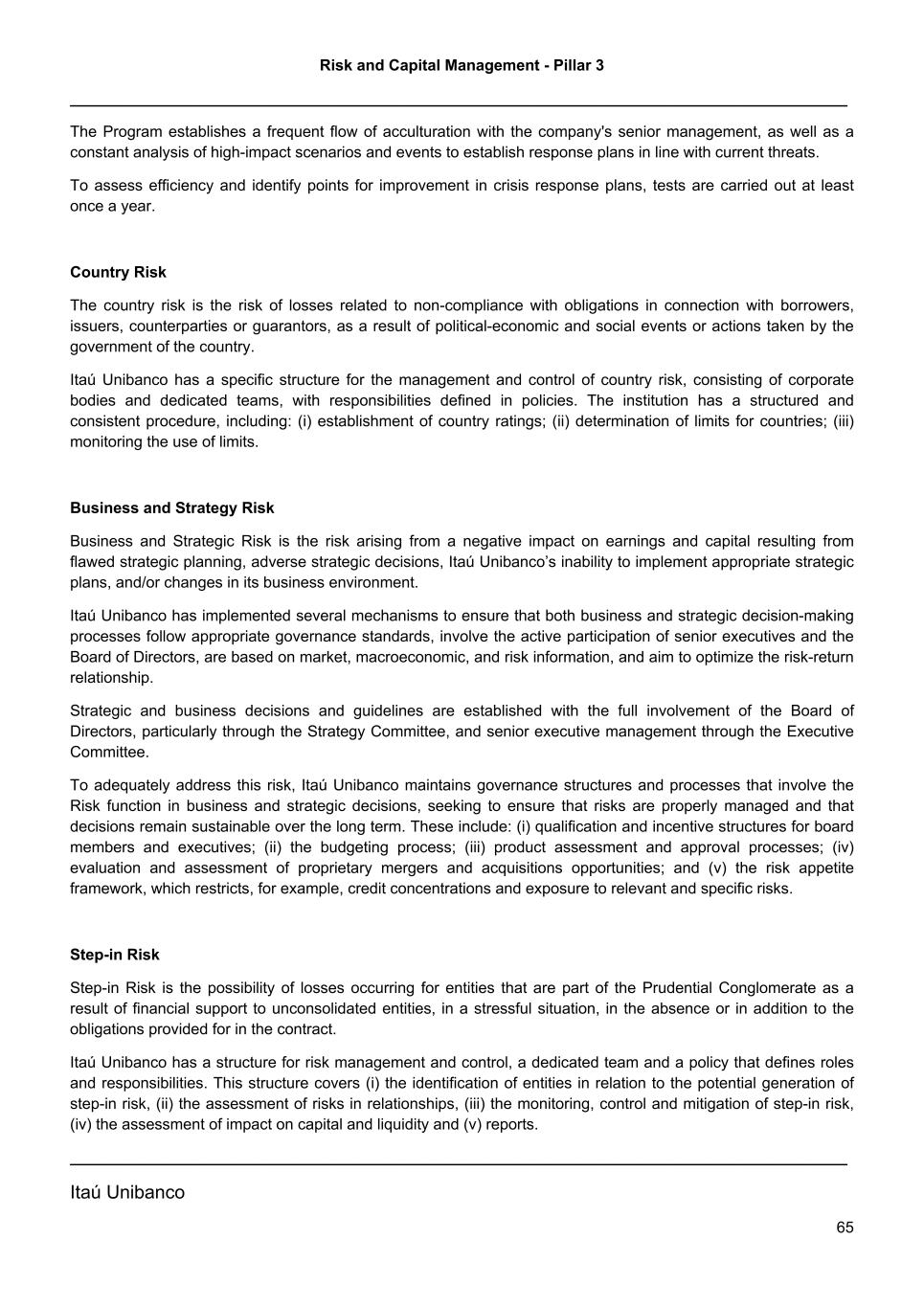
Risk and Capital Management - Pillar 3 __________________________________________________________________________________________ __________________________________________________________________________________________ Itaú Unibanco 65 The Program establishes a frequent flow of acculturation with the company's senior management, as well as a constant analysis of high-impact scenarios and events to establish response plans in line with current threats. To assess efficiency and identify points for improvement in crisis response plans, tests are carried out at least once a year. Country Risk The country risk is the risk of losses related to non-compliance with obligations in connection with borrowers, issuers, counterparties or guarantors, as a result of political-economic and social events or actions taken by the government of the country. Itaú Unibanco has a specific structure for the management and control of country risk, consisting of corporate bodies and dedicated teams, with responsibilities defined in policies. The institution has a structured and consistent procedure, including: (i) establishment of country ratings; (ii) determination of limits for countries; (iii) monitoring the use of limits. Business and Strategy Risk Business and Strategic Risk is the risk arising from a negative impact on earnings and capital resulting from flawed strategic planning, adverse strategic decisions, Itaú Unibanco’s inability to implement appropriate strategic plans, and/or changes in its business environment. Itaú Unibanco has implemented several mechanisms to ensure that both business and strategic decision-making processes follow appropriate governance standards, involve the active participation of senior executives and the Board of Directors, are based on market, macroeconomic, and risk information, and aim to optimize the risk-return relationship. Strategic and business decisions and guidelines are established with the full involvement of the Board of Directors, particularly through the Strategy Committee, and senior executive management through the Executive Committee. To adequately address this risk, Itaú Unibanco maintains governance structures and processes that involve the Risk function in business and strategic decisions, seeking to ensure that risks are properly managed and that decisions remain sustainable over the long term. These include: (i) qualification and incentive structures for board members and executives; (ii) the budgeting process; (iii) product assessment and approval processes; (iv) evaluation and assessment of proprietary mergers and acquisitions opportunities; and (v) the risk appetite framework, which restricts, for example, credit concentrations and exposure to relevant and specific risks. Step-in Risk Step-in Risk is the possibility of losses occurring for entities that are part of the Prudential Conglomerate as a result of financial support to unconsolidated entities, in a stressful situation, in the absence or in addition to the obligations provided for in the contract. Itaú Unibanco has a structure for risk management and control, a dedicated team and a policy that defines roles and responsibilities. This structure covers (i) the identification of entities in relation to the potential generation of step-in risk, (ii) the assessment of risks in relationships, (iii) the monitoring, control and mitigation of step-in risk, (iv) the assessment of impact on capital and liquidity and (v) reports.
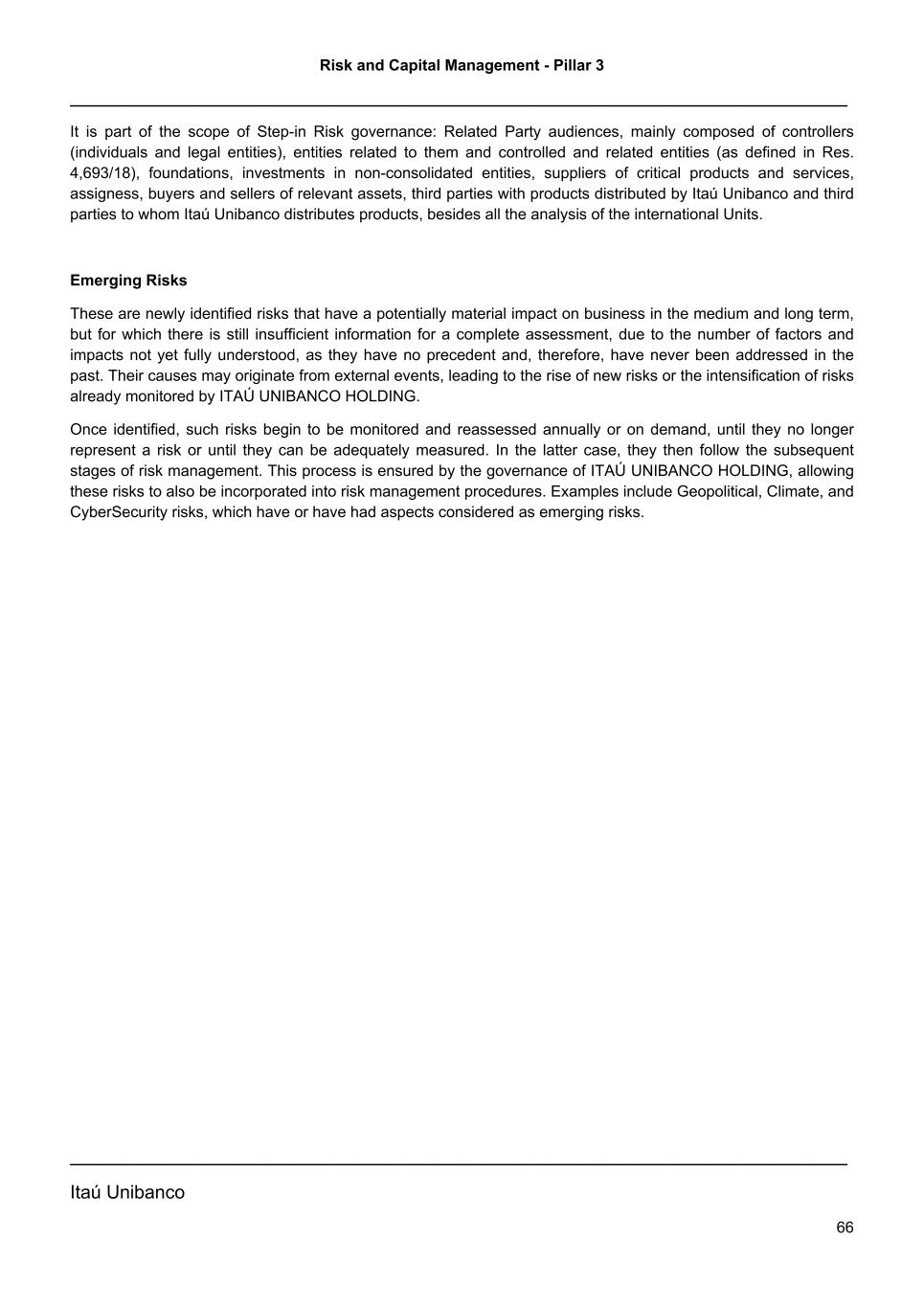
Risk and Capital Management - Pillar 3 __________________________________________________________________________________________ __________________________________________________________________________________________ Itaú Unibanco 66 It is part of the scope of Step-in Risk governance: Related Party audiences, mainly composed of controllers (individuals and legal entities), entities related to them and controlled and related entities (as defined in Res. 4,693/18), foundations, investments in non-consolidated entities, suppliers of critical products and services, assigness, buyers and sellers of relevant assets, third parties with products distributed by Itaú Unibanco and third parties to whom Itaú Unibanco distributes products, besides all the analysis of the international Units. Emerging Risks These are newly identified risks that have a potentially material impact on business in the medium and long term, but for which there is still insufficient information for a complete assessment, due to the number of factors and impacts not yet fully understood, as they have no precedent and, therefore, have never been addressed in the past. Their causes may originate from external events, leading to the rise of new risks or the intensification of risks already monitored by ITAÚ UNIBANCO HOLDING. Once identified, such risks begin to be monitored and reassessed annually or on demand, until they no longer represent a risk or until they can be adequately measured. In the latter case, they then follow the subsequent stages of risk management. This process is ensured by the governance of ITAÚ UNIBANCO HOLDING, allowing these risks to also be incorporated into risk management procedures. Examples include Geopolitical, Climate, and CyberSecurity risks, which have or have had aspects considered as emerging risks.
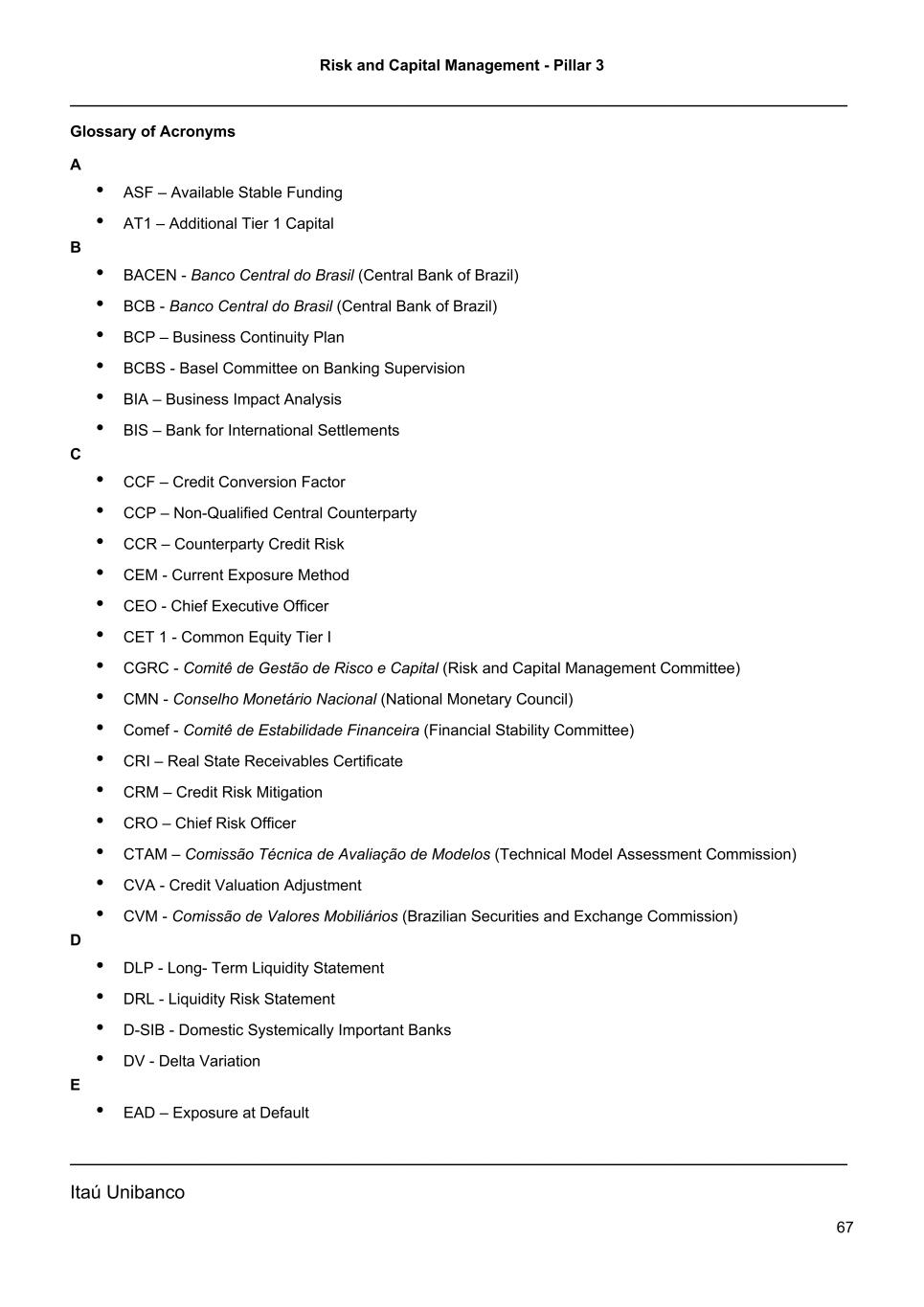
Risk and Capital Management - Pillar 3 __________________________________________________________________________________________ __________________________________________________________________________________________ Itaú Unibanco 67 Glossary of Acronyms A • ASF – Available Stable Funding • AT1 – Additional Tier 1 Capital B • BACEN - Banco Central do Brasil (Central Bank of Brazil) • BCB - Banco Central do Brasil (Central Bank of Brazil) • BCP – Business Continuity Plan • BCBS - Basel Committee on Banking Supervision • BIA – Business Impact Analysis • BIS – Bank for International Settlements C • CCF – Credit Conversion Factor • CCP – Non-Qualified Central Counterparty • CCR – Counterparty Credit Risk • CEM - Current Exposure Method • CEO - Chief Executive Officer • CET 1 - Common Equity Tier I • CGRC - Comitê de Gestão de Risco e Capital (Risk and Capital Management Committee) • CMN - Conselho Monetário Nacional (National Monetary Council) • Comef - Comitê de Estabilidade Financeira (Financial Stability Committee) • CRI – Real State Receivables Certificate • CRM – Credit Risk Mitigation • CRO – Chief Risk Officer • CTAM – Comissão Técnica de Avaliação de Modelos (Technical Model Assessment Commission) • CVA - Credit Valuation Adjustment • CVM - Comissão de Valores Mobiliários (Brazilian Securities and Exchange Commission) D • DLP - Long- Term Liquidity Statement • DRL - Liquidity Risk Statement • D-SIB - Domestic Systemically Important Banks • DV - Delta Variation E • EAD – Exposure at Default
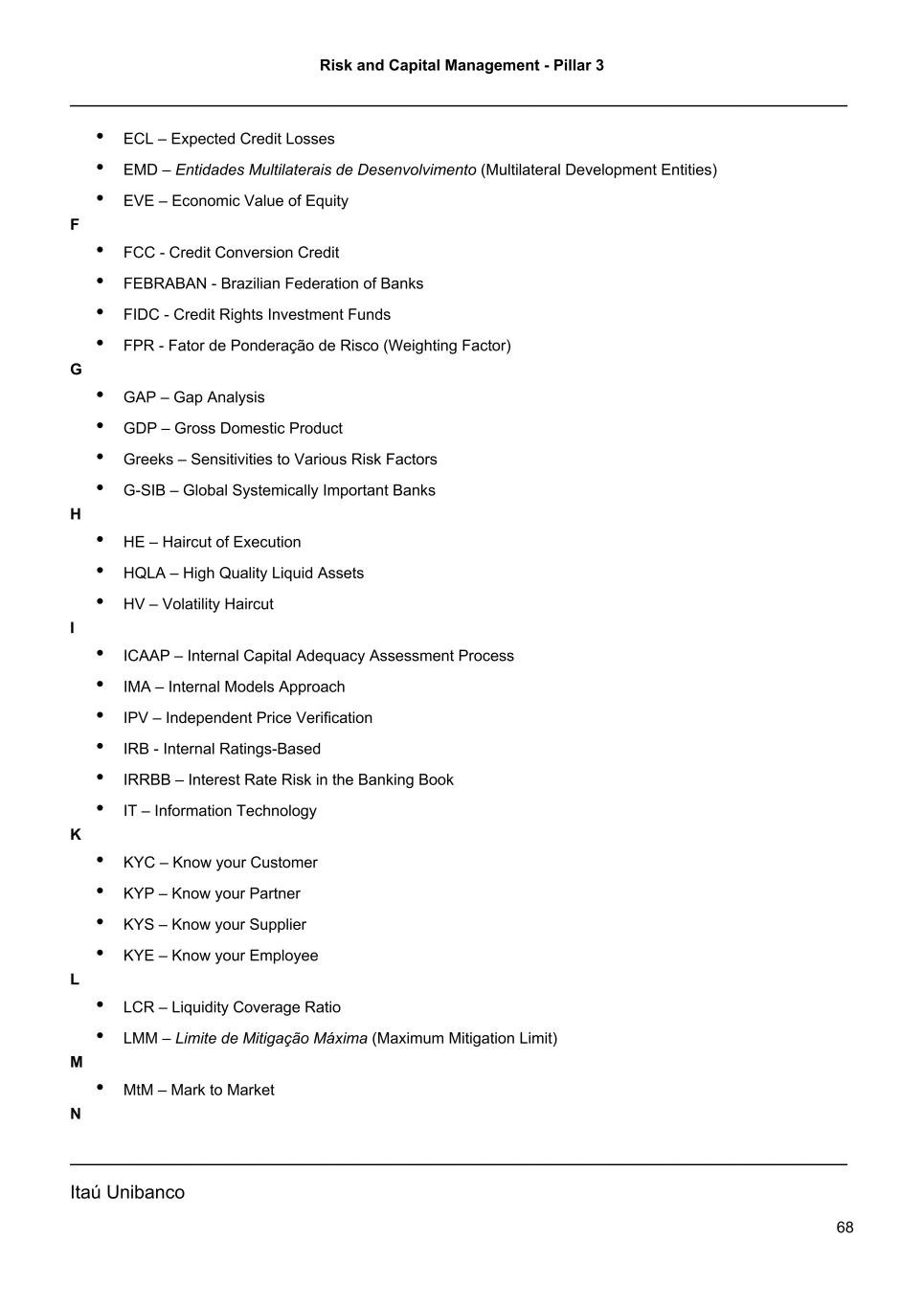
Risk and Capital Management - Pillar 3 __________________________________________________________________________________________ __________________________________________________________________________________________ Itaú Unibanco 68 • ECL – Expected Credit Losses • EMD – Entidades Multilaterais de Desenvolvimento (Multilateral Development Entities) • EVE – Economic Value of Equity F • FCC - Credit Conversion Credit • FEBRABAN - Brazilian Federation of Banks • FIDC - Credit Rights Investment Funds • FPR - Fator de Ponderação de Risco (Weighting Factor) G • GAP – Gap Analysis • GDP – Gross Domestic Product • Greeks – Sensitivities to Various Risk Factors • G-SIB – Global Systemically Important Banks H • HE – Haircut of Execution • HQLA – High Quality Liquid Assets • HV – Volatility Haircut I • ICAAP – Internal Capital Adequacy Assessment Process • IMA – Internal Models Approach • IPV – Independent Price Verification • IRB - Internal Ratings-Based • IRRBB – Interest Rate Risk in the Banking Book • IT – Information Technology K • KYC – Know your Customer • KYP – Know your Partner • KYS – Know your Supplier • KYE – Know your Employee L • LCR – Liquidity Coverage Ratio • LMM – Limite de Mitigação Máxima (Maximum Mitigation Limit) M • MtM – Mark to Market N
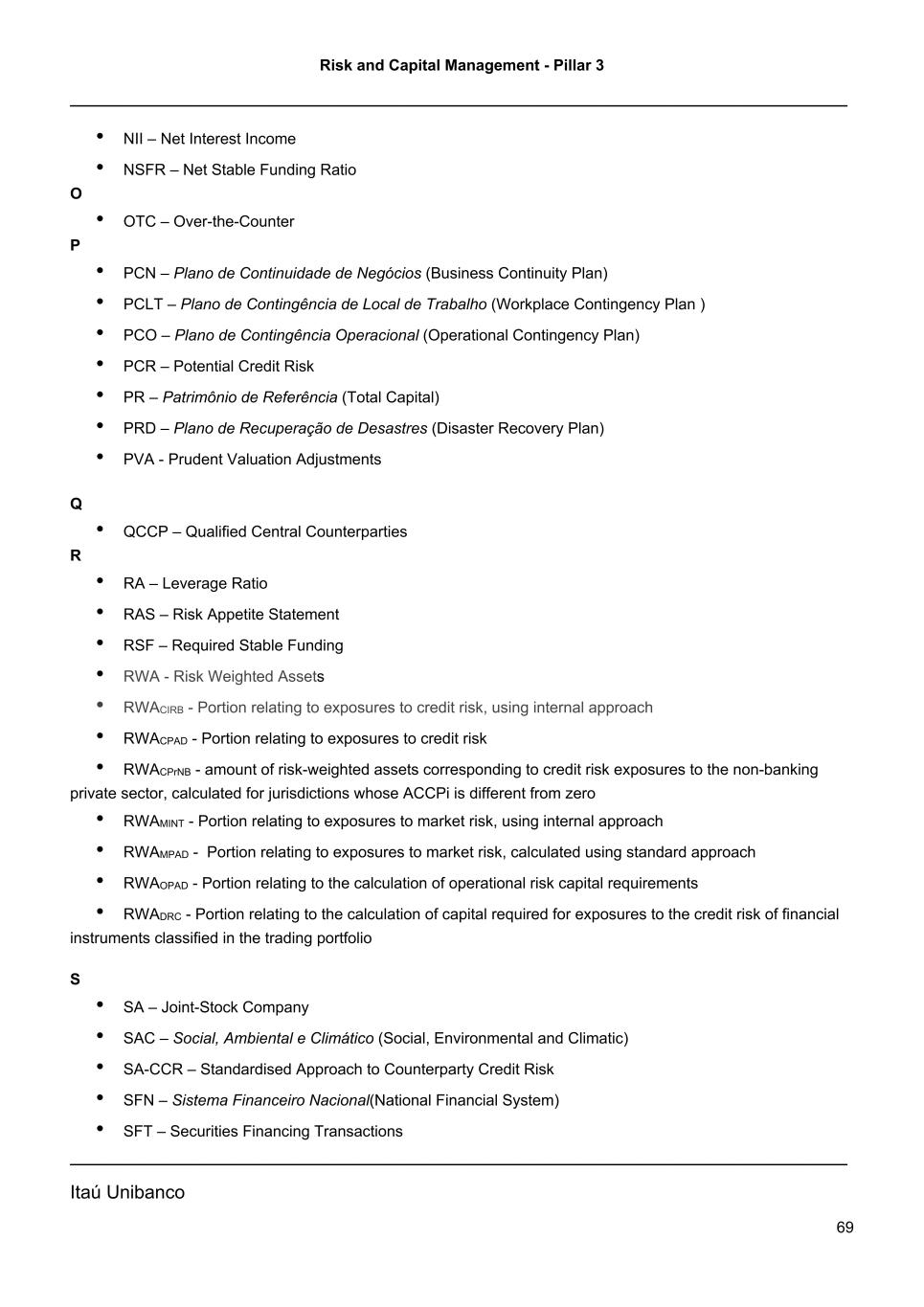
Risk and Capital Management - Pillar 3 __________________________________________________________________________________________ __________________________________________________________________________________________ Itaú Unibanco 69 • NII – Net Interest Income • NSFR – Net Stable Funding Ratio O • OTC – Over-the-Counter P • PCN – Plano de Continuidade de Negócios (Business Continuity Plan) • PCLT – Plano de Contingência de Local de Trabalho (Workplace Contingency Plan ) • PCO – Plano de Contingência Operacional (Operational Contingency Plan) • PCR – Potential Credit Risk • PR – Patrimônio de Referência (Total Capital) • PRD – Plano de Recuperação de Desastres (Disaster Recovery Plan) • PVA - Prudent Valuation Adjustments Q • QCCP – Qualified Central Counterparties R • RA – Leverage Ratio • RAS – Risk Appetite Statement • RSF – Required Stable Funding • RWA - Risk Weighted Assets • RWACIRB - Portion relating to exposures to credit risk, using internal approach • RWACPAD - Portion relating to exposures to credit risk • RWACPrNB - amount of risk-weighted assets corresponding to credit risk exposures to the non-banking private sector, calculated for jurisdictions whose ACCPi is different from zero • RWAMINT - Portion relating to exposures to market risk, using internal approach • RWAMPAD - Portion relating to exposures to market risk, calculated using standard approach • RWAOPAD - Portion relating to the calculation of operational risk capital requirements • RWADRC - Portion relating to the calculation of capital required for exposures to the credit risk of financial instruments classified in the trading portfolio S • SA – Joint-Stock Company • SAC – Social, Ambiental e Climático (Social, Environmental and Climatic) • SA-CCR – Standardised Approach to Counterparty Credit Risk • SFN – Sistema Financeiro Nacional(National Financial System) • SFT – Securities Financing Transactions
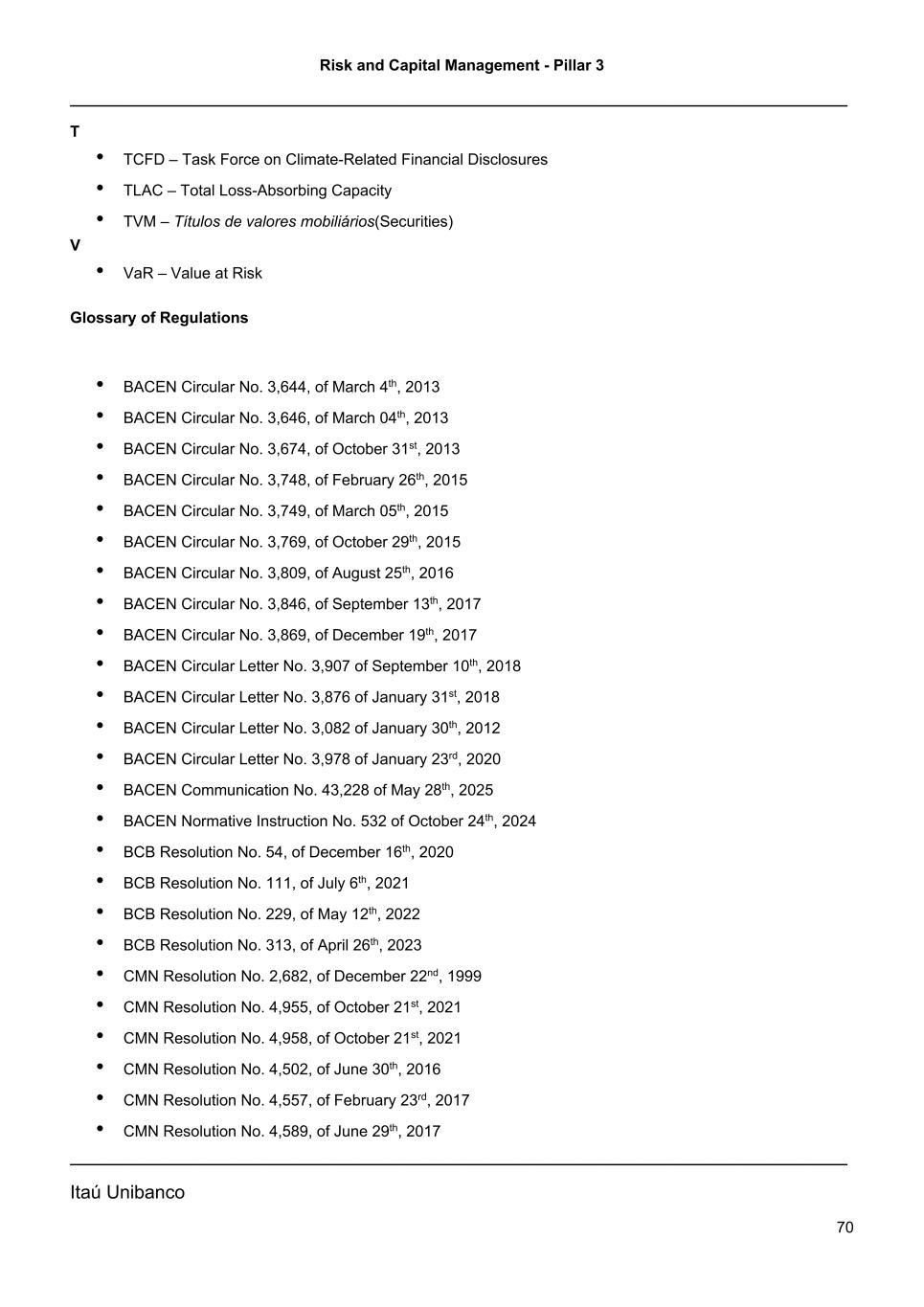
Risk and Capital Management - Pillar 3 __________________________________________________________________________________________ __________________________________________________________________________________________ Itaú Unibanco 70 T • TCFD – Task Force on Climate-Related Financial Disclosures • TLAC – Total Loss-Absorbing Capacity • TVM – Títulos de valores mobiliários(Securities) V • VaR – Value at Risk Glossary of Regulations • BACEN Circular No. 3,644, of March 4th, 2013 • BACEN Circular No. 3,646, of March 04th, 2013 • BACEN Circular No. 3,674, of October 31st, 2013 • BACEN Circular No. 3,748, of February 26th, 2015 • BACEN Circular No. 3,749, of March 05th, 2015 • BACEN Circular No. 3,769, of October 29th, 2015 • BACEN Circular No. 3,809, of August 25th, 2016 • BACEN Circular No. 3,846, of September 13th, 2017 • BACEN Circular No. 3,869, of December 19th, 2017 • BACEN Circular Letter No. 3,907 of September 10th, 2018 • BACEN Circular Letter No. 3,876 of January 31st, 2018 • BACEN Circular Letter No. 3,082 of January 30th, 2012 • BACEN Circular Letter No. 3,978 of January 23rd, 2020 • BACEN Communication No. 43,228 of May 28th, 2025 • BACEN Normative Instruction No. 532 of October 24th, 2024 • BCB Resolution No. 54, of December 16th, 2020 • BCB Resolution No. 111, of July 6th, 2021 • BCB Resolution No. 229, of May 12th, 2022 • BCB Resolution No. 313, of April 26th, 2023 • CMN Resolution No. 2,682, of December 22nd, 1999 • CMN Resolution No. 4,955, of October 21st, 2021 • CMN Resolution No. 4,958, of October 21st, 2021 • CMN Resolution No. 4,502, of June 30th, 2016 • CMN Resolution No. 4,557, of February 23rd, 2017 • CMN Resolution No. 4,589, of June 29th, 2017

Risk and Capital Management - Pillar 3 __________________________________________________________________________________________ __________________________________________________________________________________________ Itaú Unibanco 71 • CMN Resolution No. 4,693, of October 29th, 2018 • CMN Resolution No. 4,277, of October 31th, 2013 • CMN Resolution No. 5,177, of September 26th, 2024 • BCB Resolution No. 303, of March 16th, 2023 • BCB Resolution No. 356, of November 28th, 2023 • CMN Resolution No. 4,966, of November 25th, 2021 • CMN Resolution No. 5,199, of December 23th, 2024