| | |
|
Notice of Annual General Meeting of Shareholders and Management Information Circular
July 13, 2026
Exhibit 99.1 |
Letter to Shareholders
Dear shareholders,
It is our pleasure to invite you to Alithya’s 2026 Annual General Meeting of Shareholders to be held virtually on September 9, 2026 (the “Meeting”).
This past fiscal year, completed on March 31, 2026 (“fiscal 2026”), was a year of disciplined execution and strategic repositioning for the Company, set against a complex and evolving geopolitical and macroeconomic environment that demanded operational discipline and capital efficiency. Despite these headwinds, throughout the year, management remained focused on strengthening our business fundamentals, prioritized high-impact initiatives, and invested in areas driving sustainable growth.
Our results reflect this approach. While Adjusted EBITDA1 was slightly lower than last year at 9.9% for the full year, we made meaningful progress in improving our gross margin to 37.8% in the fourth quarter and to 34.0% for the full fiscal 2026. Revenue remained resilient at $477.4 million, led primarily by growth both via the acquisition of eVerge Interests, Inc. and its subsidiaries ("eVerge") as well as organic growth in offerings that help clients modernize mission-critical systems with AI and IP accelerators and hyperscaler partners.
While our reported results reflected a non-cash goodwill impairment charge, our underlying profitability remained stable year over year, with Adjusted Net Earnings1 increasing to $28.8 million. Across the organization, management remains committed to operational efficiency, prudent capital allocation, and executing on our strategic priorities. We are confident in our business potential and the opportunities ahead, while mindful of the need for careful execution in the current environment. Our teams maintained a strong focus on delivering mission-critical projects while supporting clients in their digital transformation journeys.
We also made progress in strengthening our platform for future growth. The integration of eVerge has progressed well, enhancing our Salesforce and Oracle capabilities and expanding our access to larger, multi-practice opportunities. During the year, we also streamlined our portfolio through the divestiture of Datum Consulting Group, LLC and its affiliates, sharpening our focus on our core, higher-value offering.
Our investments in artificial intelligence ("AI") have accelerated across both our client engagements and internal operations. We are increasingly embedding AI into our delivery model, improving productivity, scalability, and consistency. These efforts, combined with the expansion of our smart-shoring footprint, are strengthening our ability to deliver efficiently.
Looking ahead, we remain focused on executing our strategy with rigor. Our Board of Directors remains deeply engaged, ensuring strong governance and oversight. We remain particularly vigilant in monitoring global geopolitical developments, addressing emerging challenges with care and diligence to safeguard our business.
At the upcoming Meeting, we will review the Company’s financial position, business operations and value delivered to shareholders, and address your comments and questions. As a shareholder, you have the right to vote your shares on all items that come before the Meeting. Whether or not you plan to attend, we invite you to review the accompanying management information circular dated July 13, 2026 and vote your shares.
Thank you for your continued trust and support of our long-term vision. The Board values your input and looks forward to ongoing dialogue.
| | | | | | | | | | | |
| | | |
| | |
Pierre Turcotte Chair of the board | | Paul Raymond President and Chief Executive Officer |
1 These are financial measures that are not in accordance with International Financial Reporting Standards (“IFRS”). The definitions of Adjusted EBITDA and Adjusted Net Earnings can be found in Section 5 entitled “Non-IFRS Measures and Other Financial Measures” of Alithya’s Management’s Discussion and Analysis for fiscal 2026 (“MD&A”). Please also refer to Sections 7.6 and 8.8 of the MD&A entitled “Adjusted Net Earnings and Adjusted Net Earnings per Share” and “EBITDA and Adjusted EBITDA” for a quantitative reconciliation of the Adjusted Net Earnings and Adjusted EBITDA for the year and fourth quarter of fiscal 2026 to their respective most directly comparable IFRS measures. Sections 5, 7.6 and 8.8 of the MD&A are hereby incorporated by reference. The MD&A has been filed and is available on SEDAR+ at www.sedarplus.ca and on EDGAR at www.sec.gov.
ALITHYA ׀ Notice of Meeting and of Availability of Materials II
Notice of Annual General Meeting of Shareholders and of Availability of Proxy Materials
Notice is hereby given that the annual general meeting of shareholders (the “Meeting”) of Alithya Group inc. (the “Company”) will be held as a virtual meeting on Wednesday, September 9, 2026 at 10:00 a.m. (Eastern Daylight Time) for the purposes of:
| | | | | | | | |
ITEMS OF BUSINESS | FOR MORE DETAILS, PLEASE REFER TO |
1 | Receiving the audited consolidated financial statements of the Company for the fiscal year ended March 31, 2026 and the auditor’s report thereon (the “Annual Financial Statements”); | Section entitled “Business of the Meeting – Financial Statements” of the management information circular dated July 13, 2026 (the “Information Circular”). |
2 | Electing the directors of the Company; | Sections entitled “Business of the Meeting – Election of Directors” and “Nominees for Election to the Board” of the Information Circular. |
3 | Appointing the auditor for the year ending March 31, 2027 and authorizing the Board of Directors to fix the auditor’s compensation; and | Section entitled “Business of the Meeting – Appointment of the Auditor” of the Information Circular. |
4 | Considering such other business that may properly come before the Meeting or any adjournment or postponement thereof. | Section entitled “Business of the Meeting – Other Business” of the Information Circular. |
The Information Circular provides additional information relating to the matters to be dealt with at the Meeting and forms an integral part of this notice. The Board of Directors has fixed the close of business on July 13, 2026 as the record date for the determination of the shareholders entitled to receive notice of the Meeting and vote at the Meeting and at any adjournment or postponement thereof. To maximize the number of participants at the Meeting, the Company will be holding the Meeting virtually via a live audio webcast available online at meetings.lumiconnect.com/400-133-563-744, where all shareholders regardless of geographic location will have an equal opportunity to participate and vote.
Notice-and-Access
As permitted under Canadian securities rules, management is using “Notice-and-Access” to deliver the Information Circular prepared in connection with the Meeting and the Annual Financial Statements to both registered and non-registered shareholders. This means that instead of mailing paper copies of the Information Circular and the Annual Financial Statements, these are posted online for shareholders to access them, which reduces mailing and printing costs, and is more environmentally friendly as it reduces paper use. Shareholders will therefore receive by mail (i) this notice, which explains how to access the Information Circular and the Annual Financial Statements electronically and request paper copies, and how to vote and/or attend the Meeting, (ii) a form of proxy (for registered shareholders) or a voting instruction form (“VIF”) (for non-registered shareholders), with instructions on how to vote, and (iii) an additional document explaining how to attend and vote at the Meeting (the “Virtual Meeting User Guide”). Shareholders who previously signed up for electronic delivery of Meeting materials will receive them via email.
How to Access the Information Circular and Annual Financial Statements
The Information Circular and Annual Financial Statements and other Meeting materials are available on our website at www.alithya.com/en/alithya/investors, on the website of our transfer agent, TSX Trust Company (“TSX Trust”), at docs.tsxtrust.com/ALYA/EN, as well as on SEDAR+ at
www.sedarplus.ca and on EDGAR at www.sec.gov. Please review the Information Circular before voting.
How to Request Paper Copies
Shareholders may request paper copies of the Information Circular and Annual Financial Statements at no cost.
Before the Meeting, shareholders may request paper copies on the website of TSX Trust at docs.tsxtrust.com/ALYA/EN or by contacting TSX Trust at 1-888-433-6443 (toll free in Canada and the U.S.) or 1-416-682-3801. The Information Circular and/or Annual Financial Statements, as applicable, will be sent within three business days of receipt of the request. To receive a paper copy of the Information Circular prior to the 10:00 a.m. (Eastern Daylight Time) voting deadline on September 4, 2026, requests must be received by no later than 10:00 a.m. (Eastern Daylight Time) on August 28, 2026. Shareholders who request paper copies of these documents will not receive a new form of proxy or VIF and should therefore keep the form that was sent to them to vote their shares. After the Meeting, requests for paper copies may be made by email at secretariat@alithya.com, by mail at Corporate Secretariat, Alithya Group inc., 700, René-Lévesque Blvd West, Suite 400, Montréal, Québec, H3B 1X8, or by phone at 1-844-985-5552. Paper copies of the documents will be sent within ten business days of receipt of the request.
How to Vote
Shareholders may vote prior to the Meeting or at the Meeting. It is however recommended that shareholders vote prior to the Meeting using all forms of proxy or VIFs received even if they intend to attend the Meeting. Shareholders should read the Information Circular and other Meeting materials before voting and refer to the instructions on their form of proxy or VIF and in the Information Circular for details on how to vote. Voting instructions must be received by the 10:00 a.m. (Eastern Daylight Time) voting deadline on September 4, 2026 (or if the Meeting is adjourned or postponed, at least 48 hours (excluding Saturdays, Sundays and holidays) before the start of the adjourned or postponed meeting).
ALITHYA ׀ Letter to Shareholders I
How to Attend the Meeting
The Meeting will be held virtually via a live audio webcast available online at meetings.lumiconnect.com/400-133-563-744 and will be open to all shareholders as well as to the general public, except that only registered shareholders and duly appointed and registered proxyholders will have the opportunity to vote and ask questions. The process to attend the Meeting is different for registered shareholders and non-registered shareholders.
Please refer to the information contained in this notice, the Information Circular and the Virtual Meeting User Guide. It is recommended to undertake all required steps at least one week before the Meeting and to join the Meeting at least 15 minutes before it begins to avoid missing the beginning due to technical difficulties.
REGISTERED SHAREHOLDERS
Shareholders who received a form entitled “Form of Proxy” or an email directed to registered shareholders from TSX Trust are registered shareholders. To attend the Meeting, registered shareholders may visit meetings.lumiconnect.com/400-133-563-744 on the day of the Meeting, select the option “I have a login” and enter the 13-digit control number that appears on their form of proxy or in the email they received, as their username, and “alithya2026” (case sensitive) as their password.
Registered shareholders who appointed someone other than the persons named by management as their proxyholder to represent them at the Meeting must, after having submitted their proxy, either contact or have their proxyholder contact TSX Trust by phone at 1-866-751-6315 (toll free in Canada and the U.S.) or 1-416-682-3860, or complete the online form at www.tsxtrust.com/control-number-request, by no later than 10:00 a.m. (Eastern Daylight Time) on September 4, 2026 to register such other person and provide an email address at which TSX Trust will send a 13-digit proxyholder control number 24 to 48 hours before the Meeting.
NON-REGISTERED SHAREHOLDERS
Shareholders who received a form entitled “Voting Instruction Form” from TSX Trust or their intermediary or an email requesting voting instructions from their intermediary, and shareholders who participate in the Company’s Employee Share Purchase Plan (“ESPP Participants”) are non-registered shareholders. Non-registered shareholders are shareholders whose shares are registered in the name of their intermediary (such as a securities broker or a financial institution) which holds them on their behalf. As the Company and TSX Trust do not typically have a record of such shareholders, and, as a result, of their entitlement to vote, non-registered shareholders who wish to vote and ask questions at the Meeting or appoint someone else than the persons named by management must follow the following two steps:
Step 1: Submit their voting instructions and appoint themselves or someone else as their proxyholder by mail, internet, fax or email, as applicable, by no later than 10:00 a.m. (Eastern Daylight Time) on September 4, 2026 or such other deadline their intermediary may fix. Voting by phone is not recommended as it is not possible to appoint someone else than the persons named by management by phone.
Important Note: U.S. non-registered shareholders who are not ESPP Participants and who wish to appoint themselves or a
proxyholder must obtain a legal proxy form from their intermediary and submit it to TSX Trust by no later than 10:00 a.m. (Eastern Daylight Time) on September 4, 2026.
Step 2: Once their voting instructions or legal proxy form has been submitted, non-registered shareholders or their proxyholder must contact TSX Trust either by phone at 1-866-751-6315 (toll free in Canada and the U.S.) or 1-416-682-3860, or complete the online form at www.tsxtrust.com/control-number-request, by no later than 10:00 a.m. (Eastern Daylight Time) on September 4, 2026 to register and provide an email address at which TSX Trust will send a 13-digit proxyholder control number 24 to 48 hours before the Meeting.
Once these steps are completed and a proxyholder control number has been received, non-registered shareholders or their proxyholder will be able to attend the Meeting at meetings.lumiconnect.com/400-133-563-744 by selecting the option “I have a login” and entering their 13-digit proxyholder control number as their username and “alithya2026” (case sensitive) as their password. Without a proxyholder control number, non-registered shareholders and their proxyholders will only be able to attend the Meeting by selecting the option “I am a guest”, which will not entitle them to vote or ask questions. Non-registered shareholders who do not complete the above two steps by 10:00 a.m. (Eastern Daylight Time) on September 4, 2026 will not be able to obtain a proxyholder control number. The control number appearing on their VIF is NOT a proxyholder control number and may not be used to attend the Meeting.
Questions
For questions about “Notice-and-Access” or assistance with the process to vote or attend the Meeting, shareholders may contact TSX Trust by phone at 1-800-387-0825. For live technical assistance in operating the Meeting platform and voting during the Meeting, please contact Lumi Canada Inc. at support-ca@lumiglobal.com.
Montréal, Québec
July 13, 2026
By Order of the Board of Directors,

David Torralbo
Chief Legal Officer and Corporate SecretaryALITHYA ׀ Notice of Meeting and of Availability of Materials III
ALITHYA ׀ Table of Contents 1
General Information
This management information circular (the “Information Circular”) is provided in connection with the solicitation of proxies by the management of Alithya Group inc. for use at its annual general meeting of shareholders which will be held on Wednesday, September 9, 2026, at 10:00 a.m. (Eastern Daylight Time), for the purposes set forth in the foregoing Notice of Meeting, or at any adjournment or postponement thereof (the “Meeting”). To maximize the number of participants at the Meeting, the Company will be holding the Meeting virtually via a live audio webcast available online, where all shareholders regardless of geographic location will have an equal opportunity to participate and vote.
The record date for determination of shareholders entitled to receive notice of, and vote at, the Meeting is July 13, 2026 (the “Record Date”).
In this document “you” and “your” refer to the shareholders of Alithya Group inc. and “Alithya”, the “Company”, “we”, “us”, or “our” refer to Alithya Group inc. (and, where the context so requires, Alithya Group inc. and its subsidiaries).
The information provided in this Information Circular that relates to financial information is provided as at March 31, 2026. Except as otherwise stated, all other information is provided as at July 13, 2026 and all dollar amounts shown are in Canadian dollars.
As permitted under Canadian securities rules, management is using “Notice-and-Access” to deliver this Information Circular and the annual financial statements to both registered and non-registered shareholders. This means that instead of mailing paper copies of this Information Circular to shareholders holding Class A subordinate voting shares (“subordinate voting shares”) or Class B multiple voting shares (“multiple voting shares” and, collectively with the subordinate voting shares, the “Shares”) as of the Record Date, this Information Circular is being posted online for shareholders to access it electronically, which reduces printing and mailing costs and is more environmentally friendly as it reduces paper use. Shareholders will therefore receive by mail (i) a notice explaining how to electronically access the Information Circular and the audited consolidated financial statements of the Company for the fiscal year ended March 31, 2026 (“fiscal 2026”) and the auditor’s report thereon (the “Annual Financial Statements”), how to request paper copies thereof, and how to vote and/or attend the Meeting, (ii) a form of proxy (for registered shareholders) or a voting instruction form (“VIF”) (for non-registered shareholders) with instructions on how to vote, and (iii) a document explaining how to attend the Meeting. Shareholders who previously signed up for electronic delivery of Meeting materials will receive them by email.
Non-registered shareholders are either objecting beneficial owners who object that intermediaries disclose information about their ownership in the Company, or non-objecting beneficial owners who do not object to such disclosure. Alithya is sending proxy-related materials directly to registered shareholders and non-registered shareholders who are non-objecting beneficial owners and is paying for intermediaries to deliver such materials to non-registered shareholders who are objecting beneficial owners.
HOW TO ACCESS THE INFORMATION CIRCULAR AND THE ANNUAL FINANCIAL STATEMENTS ELECTRONICALLY
This Information Circular and the Annual Financial Statements are available on our website at www.alithya.com/en/alithya/investors, on the website of our transfer agent, TSX Trust Company (“TSX Trust”) at docs.tsxtrust.com/ALYA/EN on SEDAR+ at www.sedarplus.ca and on EDGAR at www.sec.gov.
HOW TO REQUEST A PAPER COPY OF THE INFORMATION CIRCULAR AND ANNUAL FINANCIAL STATEMENTS
You may request a paper copy of the Information Circular and the Annual Financial Statements at no cost up to one year from the date the Information Circular was filed on SEDAR+ and EDGAR.
Before the Meeting, shareholders may request paper copies of the Information Circular and the Annual Financial Statements prior to the Meeting on the website of TSX Trust at docs.tsxtrust.com/ALYA/EN or by contacting TSX Trust at 1-888-433-6443 (toll free in Canada and the U.S.) or 1-416-682-3801. The Information Circular and/or Annual Financial Statements, as applicable, will be sent within three business days of receipt of the request. Your request should be received no later than 10:00 a.m. (Eastern Daylight Time) on August 28, 2026 to receive the Information Circular prior to the 10:00 a.m. (Eastern Daylight Time) voting deadline on September 4, 2026. Shareholders who request paper copies of the Information Circular and Annual Financial Statements will not receive a new form of proxy or VIF and should therefore keep the original form sent to them to vote their Shares.
After the Meeting, requests for paper copies may be made by email at secretariat@alithya.com, by mail at Corporate Secretariat, Alithya Group inc., 700, René-Lévesque Blvd West, Suite 400, Montréal, Québec, H3B 1X8 or by phone at 1-844-985-5552. Paper copies will be sent within ten business days of receipt of the request.
QUESTIONS?
For questions about “Notice-and-Access” or for assistance with the process to vote or attend the Meeting, please contact TSX Trust by phone at 1-800-387-0825. For live technical assistance in operating the Meeting platform and voting during the Meeting, please contact Lumi Canada Inc. (“Lumi”) at support-ca@lumiglobal.com. If you have questions about the information contained in this Information Circular, please contact our Corporate Secretariat team by email at secretariat@alithya.com or by mail at the address indicated in the section above.
| | |
GENERAL PROXY MATTERS AND VIRTUAL MEETING MATTERS |
Who Can Vote
Shareholders holding subordinate voting shares or multiple voting shares as at the close of business on the Record Date are entitled to vote at the Meeting and at any adjournment or postponement thereof. Your vote is important. Voting by proxy prior to the Meeting is the easiest way to vote your Shares. As a shareholder, it is important that you read this Information Circular carefully and vote your Shares either prior to the Meeting by proxy or at the Meeting by following the steps explained below.
Depending on how your Shares are registered, you may be a registered shareholder for a portion of your Shares and a non-registered shareholder for the balance thereof and may accordingly receive both a form of proxy and a VIF. It is recommended to vote using all forms received to ensure that all of your Shares are voted.
Employees who participate in the Company’s Employee Share Purchase Plan and have their shares managed by TSX Trust, in its capacity of plan administrator, (“ESPP Participants”) will receive the Meeting materials electronically from TSX Trust with instructions on how to vote using the internet.
How to Vote
REGISTERED SHAREHOLDERS
You are a registered shareholder if your Shares are registered in your name (i.e. your name appears on your share certificate or Direct Registration System (DRS) statement) and you received a form entitled “Form of Proxy” or an email directed to registered shareholders from TSX Trust.
If you are a registered shareholder, you can vote using any of the following options:
Option 1 - Voting by Proxy Prior to the Meeting (Form of Proxy)
Voting by proxy means appointing a proxyholder (i.e. the persons named by management, yourself or someone else) to vote as per your voting specifications, if any, at the Meeting. You may vote by proxy using one of the methods described below:
| | | | | |
| Internet: Go to www.meeting-vote.com and follow the instructions. You will need your 13-digit control number that appears on your form of proxy or in the email TSX Trust sent you, if you signed up for electronic delivery |
| Phone: Call 1-888-489-7352 (toll free in Canada and the U.S.). You will need your 13-digit control number that appears on your form of proxy or in the email you received from TSX Trust. If you vote by phone, you will not be able to appoint anyone other than the persons named by management as your proxyholder to represent you at the Meeting. Therefore, if you wish to appoint someone else as your proxyholder to attend the Meeting, this voting method is not recommended. |
| | | | | |
| |
| |
| Fax or email: Complete your form of proxy and send it to TSX Trust by fax at 1-416-607-7964 or scan and email it to TSX Trust at proxyvote@tmx.com. |
| Mail: Complete and return your form of proxy in the prepaid envelope provided. |
Your duly completed form of proxy must be received by TSX Trust, or you must have voted on the internet, by phone, by fax or by email by no later than 10:00 a.m. (Eastern Daylight Time) on September 4, 2026 or, if the Meeting is adjourned or postponed, at least 48 hours (excluding Saturdays, Sundays and holidays) before the start of the adjourned or postponed meeting). The Chair of the Meeting may waive or extend the proxy cut-off without notice. If you elect to vote through the internet or by phone, you do not need to return your form of proxy.
When completing your form of proxy, make sure to indicate the name of the person you wish to appoint as your proxyholder to attend the Meeting on your behalf or leave the space for the appointment blank if you wish to appoint the persons named by management. In both cases, it is recommended to indicate how you wish to vote for each item to be voted on, otherwise your proxyholder will have the discretion to vote as he or she sees fit. If you appoint a proxyholder who is not the persons named by management, once your form is submitted, please contact, or ask your proxyholder to contact, TSX Trust either by phone at 1-866-751-6315 (toll free in Canada and the U.S.) or 1-416-682-3860, or complete the online form available at www.tsxtrust.com/control-number-request, by no later than 10:00 a.m. (Eastern Daylight Time) on September 4, 2026 in order to register your proxyholder and provide an email address at which TSX Trust will send a 13-digit proxyholder control number for your proxyholder to be able to join the Meeting. Proxyholder control numbers will be distributed by TSX Trust 24 to 48 hours before the Meeting. Without a proxyholder control number, your proxyholder will be unable to join the Meeting and if your proxyholder does not join the Meeting, your voting rights will not be exercised, as your proxyholder is required to attend the Meeting for them to be exercised.
Option 2 – Attending and Voting at the Meeting
If you wish to attend and vote at the Meeting, you do not need to complete or submit your form of proxy. You may simply visit meetings.lumiconnect.com/400-133-563-744 on the day of the Meeting, select the option “I have a login” and enter the 13-digit control number that appears on your form of proxy or in the email TSX Trust sent you, if you signed up for electronic delivery, as your control number and “alithya2026” (case sensitive) as your password. Once logged in, simply follow the instructions on the screen during the Meeting. Joining the Meeting by selecting the option “I am a guest” will not allow you to vote or ask questions at the Meeting.
If you wish to appoint someone else to attend the Meeting on your behalf, please follow the instructions indicated in the preceding section entitled “Option 1 – Voting by Proxy Prior to the Meeting (Form of Proxy)”.
NON-REGISTERED SHAREHOLDERS
You are a non-registered shareholder if your Shares are not registered in the records of the Company directly in your name, but instead in the name of an intermediary (such as a securities broker or a financial institution) which holds them on your behalf. If you received a form entitled “Voting Instruction Form” from TSX Trust or your intermediary or an email requesting voting instructions from your intermediary, your Shares are not registered in your name.
Employees who participate in the Company’s Employee Share Purchase Plan and have their shares managed by TSX Trust, in its capacity of plan administrator, are non-registered shareholders and will receive the Meeting materials electronically from TSX Trust with instructions on how to vote using the internet, which instructions are similar to those described below.
If you are a non-registered shareholder, you can vote using any of the following options:
Option 1 - Voting by Proxy Prior to the Meeting (Voting Instruction Form)
Voting by proxy means appointing a proxyholder (i.e. the persons named by management, yourself or someone else) to vote as per your voting instructions, if any, at the Meeting. Instructions for voting by proxy prior to the Meeting vary depending on whether you received a VIF from TSX Trust or your intermediary.
If you received a VIF from TSX Trust, you may vote by proxy by giving your voting instructions using one of the methods described below:
| | | | | |
| Internet: Go to www.meeting-vote.com and follow the instructions. You will need your 13-digit control number that appears on your VIF or in the email TSX Trust sent you, if you signed up for electronic delivery |
| Phone: Call 1-888-489-7352 (toll free in Canada and the U.S.). You will need your 13-digit control number that appears on your VIF or in the email you received from TSX Trust. If you vote by phone, you will not be able to appoint anyone other than the persons named by management as your proxyholder to represent you at the Meeting. Therefore, if you wish to appoint someone else as your proxyholder to attend the Meeting, this voting method is not recommended. |
| Fax or email: Complete your VIF and send it to TSX Trust by fax at 1-416-607-7964, or scan and email it to TSX Trust at proxyvote@tmx.com. |
| Mail: Complete and return your VIF in the prepaid envelope provided. |
Your duly completed VIF must be received by TSX Trust or your intermediary, as applicable, or you must have voted on the internet, by phone, by fax or by email, as applicable, by no later than 10:00 a.m. (Eastern Daylight Time) on September 4, 2026 or such other deadline your intermediary may fix or, if the Meeting is adjourned or postponed, at least 48 hours (excluding Saturdays, Sundays and holidays) before the start of the adjourned or postponed meeting. Please contact your intermediary to ensure you do not miss your applicable voting
deadline. If you elect to vote on the internet or by phone, you do not need to return your VIF.
When completing your VIF, make sure to indicate the name of the person you wish to appoint as your proxyholder to attend the Meeting on your behalf or leave the space for the appointment blank if you wish to appoint the persons named by management. In both cases, it is recommended to indicate how you wish to vote for each item to be voted on, otherwise your proxyholder will have the discretion to vote as he or she sees fit. If you appoint a proxyholder who is not the persons named by management, once your form is submitted, please contact, or ask your proxyholder to contact, TSX Trust either by phone at 1-866-751-6315 (toll free in Canada and the U.S.) or 1-416-682-3860, or complete the online form available at www.tsxtrust.com/control-number-request, by no later than 10:00 a.m. (Eastern Daylight Time) on September 4, 2026 in order to register your proxyholder and provide an email address at which TSX Trust will send a 13-digit proxyholder control number for your proxyholder to be able to join the Meeting. Proxyholder control numbers will be distributed by TSX Trust 24 to 48 hours before the Meeting. Without a proxyholder control number, your proxyholder will be unable to join the Meeting and if your proxyholder does not join the Meeting, your voting rights will not be exercised, as your proxyholder is required to attend the Meeting for them to be exercised.
Option 2 – Attending and Voting at the Meeting
As we do not have access to the names or holdings of our non-registered shareholders, if you wish to attend and vote at the Meeting or to appoint someone else to do so on your behalf, you must follow the following two steps:
Step 1: Submit to TSX Trust or your intermediary, as applicable, your voting instructions and appoint yourself or another person (who need not be a shareholder) as your proxyholder before the Meeting by inserting your name or such other person’s name in the space provided for such purpose. Although optional for shareholders who intend to attend the Meeting or have someone else attend it on their behalf, it is recommended to also specify how you wish to vote for each item to be voted on, otherwise your proxyholder will have the discretion to vote as he or she sees fit. Please refer to the section entitled “Option 1 – Voting by Proxy Prior to the Meeting (Voting Instruction Form)” earlier for further details on how to submit your voting instructions. Voting by phone is not recommended as it is not possible to appoint someone other than the persons named by management as proxyholder by phone. TSX Trust or your intermediary, as applicable, must receive your instructions by no later than 10:00 a.m. (Eastern Daylight Time) on September 4, 2026 or such other deadline your intermediary may fix for your proxyholder’s appointment to be effective. Please contact your intermediary to ensure you do not miss your applicable voting deadline.
Important Note: U.S. non-registered shareholders who are not ESPP Participants and who wish to appoint themselves or a proxyholder must obtain a legal proxy form from their intermediary and submit it to TSX Trust either by no later than 10:00 a.m. (Eastern Daylight Time) on September 4, 2026 or, if the Meeting is adjourned or postponed, at least 48 hours (excluding Saturdays, Sundays and holidays) before the start of the adjourned or postponed meeting.
Step 2: Once your voting instructions or legal proxy form has been submitted, contact, or ask your proxyholder to contact,
TSX Trust either by phone at 1-866-751-6315 (toll free in Canada and the U.S.) or 1-416-682-3860, or complete the online form available at www.tsxtrust.com/control-number-request, by no later than 10:00 a.m. (Eastern Daylight Time) on September 4, 2026 or, if the Meeting is adjourned or postponed, at least 48 hours (excluding Saturdays, Sundays and holidays) before the start of the adjourned or postponed meeting in order to register yourself or your proxyholder and provide an email address at which TSX Trust will send a 13-digit proxyholder control number to be able to join the Meeting. Proxyholder control numbers will be distributed by TSX Trust 24 to 48 hours before the Meeting. Intermediaries do not provide proxyholder control numbers. Therefore, shareholders who appointed themselves or someone else as their proxyholder through their intermediary must still contact TSX Trust thereafter.
Once these two steps are completed and a proxyholder control number is received from TSX Trust, you or your proxyholder will be able to attend the Meeting online at meetings.lumiconnect.com/400-133-563-744 by selecting the option “I have a login” and entering the proxyholder control number in the space provided for the control number and “alithya2026” (case sensitive) as password.
Without a proxyholder control number, you or your proxyholder will not be able to attend the Meeting as a shareholder and will only be able to view the Meeting as a guest, which will not entitle you or your proxyholder to vote or ask any questions. If you do not complete the above two steps by 10:00 a.m. (Eastern Daylight Time) on September 4, 2026, you will not be able to obtain a proxyholder control number. The control number appearing on your VIF is NOT a proxyholder control number and may therefore not be used to attend the Meeting.
How to Complete your Form and How Your Shares Will Be Voted
You can choose to vote FOR or WITHHOLD on the items to be voted on.
When you vote by proxy prior to the Meeting, you may appoint either the persons named by management as your proxyholder (namely, the Chair of the Board or the President and Chief Executive Officer of the Company) or you may appoint someone else to represent you at the Meeting and vote on your behalf. You have the right to appoint any other person (who need not be a shareholder) to attend and act on your behalf at the Meeting. That right may be exercised by writing the name of such person in the space provided for such purpose in your form of proxy or VIF.
If you do not intend to attend the Meeting or be represented at the Meeting, you may appoint the persons named by management to represent you at the Meeting and complete your form completely by indicating how you wish to vote for each item to be voted on. If you leave the section for the appointment of your proxyholder blank, you will be deemed having appointed the persons named by management as your proxyholder.
If you intend to attend the Meeting or have someone else than the persons named by management represent you as your proxyholder at the Meeting and vote on your behalf, although you could only indicate your name or the name of such other person in the space provided on your form of proxy or VIF and
submit it without indicating how you wish to vote for each item to be voted on, it is still recommended to complete your form and indicate how you wish to vote for each item.
If you have NOT specified how you wish your proxyholder to vote on a particular matter at the Meeting, your proxyholder will be entitled to vote your Shares as he or she sees fit or, in the case of the Chair of the Board or the President and Chief Executive Officer of the Company, your vote will be exercised as follows:
•FOR the election of management’s nominees as directors; and
•FOR the appointment of KPMG LLP as auditor and authorizing the Board to fix their compensation.
The proxy confers discretionary authority in respect of amendments to any of the foregoing matters and such other matters as may properly come before the Meeting. Management is not aware of any such amendments or of other matters to be submitted at the Meeting.
If you appointed a proxyholder other than the persons named by management to represent you at the Meeting and vote on your behalf, please make sure your proxyholder obtains his or her proxyholder control number and joins the Meeting, otherwise your voting rights will not be exercised, as your proxyholder is required to attend the Meeting for them to be exercised.
Voting at the Meeting
Registered shareholders who voted prior to the Meeting and who decide to attend the Meeting using their control number do not need to vote again using the voting buttons appearing on their screen during the Meeting. If they vote again at the Meeting, their vote will, however, be taken into account and replace their vote transmitted before the Meeting.
Proxyholders (including non-registered shareholders who appointed themselves as proxyholder and third parties who were appointed as proxyholders by registered shareholders or non-registered shareholders) do not have to vote again at the Meeting if the shareholder they represent already indicated on his, her or its VIF how they wish to vote. They may, however, if they wish, vote at the Meeting by voting in accordance with the voting instructions of the shareholder they represent or as they see fit, if the shareholder they represent has not indicated how to vote. If the shareholder who is represented by a proxyholder indicated how to vote for each item through voting instructions submitted prior to the Meeting and the proxyholder votes differently at the Meeting, the proxyholder’s vote will automatically be changed to follow the shareholder’s voting instructions submitted prior to the Meeting once the Meeting will have ended and the votes are compiled by the scrutineers.
Changing your Vote
If you change your mind about how you want to vote your Shares, you can revoke your proxy by any of the methods outlined below, or by any other means permitted by law.
Registered shareholders may change their vote by:
•voting again on the internet, by phone, by fax or by email, as applicable, by the 10:00 a.m. (Eastern Daylight Time) voting deadline on September 4, 2026;
•completing a new form of proxy with a later date than the form previously submitted and mailing it as soon
as possible so that it is received by TSX Trust by the 10:00 a.m. (Eastern Daylight Time) voting deadline on September 4, 2026;
•sending a written notice signed by them or their authorized attorney to the Corporate Secretary of the Company at the registered office of the Company (700, René-Lévesque Blvd West, Suite 400, Montréal, Québec, H3B 1X8) so that it is received by 10:00 a.m. (Eastern Daylight Time) on September 4, 2026; or
•attending the Meeting at meetings.lumiconnect.com/400-133-563-744 on the day of the Meeting by selecting the option “I have a login” and entering the 13-digit control number that appears on their form of proxy as their username and “alithya2026” (case sensitive) as their password and voting at the Meeting.
Non-registered shareholder may change their vote by:
•voting again on the internet, by phone, by fax or by email, as applicable, by no later than 10:00 a.m. (Eastern Daylight Time) on September 4, 2026 or such other deadline their intermediary may fix;
•completing a new VIF with a later date than the one previously submitted and mailing it as soon as possible at the address directed by TSX Trust or their intermediary, as applicable, by no later than 10:00 a.m. (Eastern Daylight Time) on September 4, 2026 or such other deadline their intermediary may fix; or
•sending a written notice signed by them or their authorized attorney to the Corporate Secretary of the Company at the registered office of the Company (700, René-Lévesque Blvd West, Suite 400, Montréal, Québec, H3B 1X8) so that it is received by 10:00 a.m. (Eastern Daylight Time) on September 4, 2026.
Although proxyholders (including non-registered shareholders who appointed themselves as proxyholder and third parties who were appointed as proxyholder by registered shareholders and non-registered shareholders) could vote differently at the Meeting using the online voting buttons, please note that if such votes differ from the last voting instructions processed by TSX Trust or their intermediary before the proxy voting deadline of 10:00 a.m. (Eastern Daylight Time) on September 4, 2026 or such other deadline their intermediary may fix, the vote of the proxyholder will automatically be modified once the Meeting will have ended and the votes are compiled to reflect the last voting instructions received from the shareholder before such deadline.
Conduct at the Meeting & Asking Questions
The Company’s by-laws describe the requirements for the Meeting and the Chair of the Meeting will conduct the meeting consistent with those requirements. As such, we will strictly follow the items to be covered at the Meeting and which are set forth in the section entitled “Business of the Meeting” of this Information Circular.
Shareholders and guests will be able to join the Meeting on the day of the Meeting at meetings.lumiconnect.com/400-133-563-744. For a better experience, it is recommended to use a high-speed internet connection and the latest version of Chrome, Safari, Edge or Firefox. Internet Explorer is not supported. It is also
recommended to ensure your browser is compatible by trying to log in at least 15 minutes before the Meeting.
Only registered shareholders and duly appointed and registered proxyholders will be eligible to vote while participating at the Meeting. Registered shareholders should use their 13-digit control number appearing on their form of proxy and non-registered shareholders should use their 13-digit proxyholder control number received by email from TSX Trust.
The voting polls will be open during the formal part of the Meeting. The Chair of the Meeting will indicate the time of opening and closure of the polls for the items to be voted on. Voting options will be visible on your screen and you will simply have to select your voting option. Your choice will be highlighted.
During the Meeting, only registered shareholders and duly appointed and registered proxyholders who have joined the Meeting using their 13-digit control number or proxyholder control number will have the opportunity to ask questions by typing and submitting questions through the field available for such purpose, and it will only be possible to submit questions in writing.
Guests and non-registered shareholders who did not appoint themselves as proxyholder by the 10:00 a.m. (Eastern Daylight Time) voting deadline on September 4, 2026 will not be able to log in to the Meeting and submit questions or vote at the Meeting. They will only be able to join the audio webcast as guests.
It is recommended that shareholders send their question as soon as possible during the Meeting so that these can be addressed at the appropriate time. Questions relating to matters to be voted on will be addressed by the Chair of the Meeting and other members of management present at the Meeting before those items are voted on while general questions will be addressed at the end of the Meeting, after the adjournment of the formal business of the Meeting and management’s presentation about the Company’s business.
To respect both time constraints and other shareholders, when submitting questions, shareholders are asked to be brief and as much to the point as possible. To allow us to answer questions from as many shareholders as possible, shareholders and proxyholders are kindly asked to cover only one topic per question. Questions from multiple shareholders on the same topic or that are otherwise related may be grouped, summarized and answered together.
All shareholder questions are welcome, but conducting the business set out in the Meeting’s agenda for the benefit of all shareholders will be paramount. The Company does not intend to address any questions that are, among other things:
•irrelevant to the business of the Company or to the business of the Meeting;
•related to material non-public information of the Company;
•related to personal grievances;
•derogatory references to individuals or that are otherwise in bad taste;
•repetitious statements already made by another shareholder;
•in furtherance of the shareholder’s personal or business interests; or
•out of order or not otherwise suitable for the conduct of the Meeting as determined by the Chair or the Secretary of the Meeting in their reasonable judgment.
If there are any matters of individual concern to a shareholder and not of general concern to all shareholders or if a question asked was not otherwise answered, such matters may be raised separately after the Meeting by contacting the Company’s Corporate Secretary at secretariat@alithya.com. The Company is committed to offering a forum where, to the fullest extent possible using available electronic solutions, shareholders may communicate adequately through the course of the Meeting.
For assistance with your control number to join the Meeting, please contact TSX Trust at 1-800-387-0825. For live technical assistance in operating the Meeting platform and voting, please contact Lumi at support-ca@lumiglobal.com.
In the event of technical malfunction or other significant problem that disrupts the Meeting, the Chair of the Meeting may adjourn, recess, or expedite the Meeting, or take such other action that the Chair determines is appropriate considering the circumstances.
An audio webcast playback will be available on the Company’s website in the Investors section after the Meeting.
Proxy Solicitation
The solicitation of proxies by management is being made primarily by mail, but directors, officers or employees of the Company may also solicit proxies at a nominal cost. The Company does not intend to retain the services of a proxy advisory firm for the solicitation of proxies.
Transfer Agent
You can contact TSX Trust, the Company’s transfer agent, either by mail at 1700 – 1190 des Canadiens-de-Montreal Avenue, Montreal, Quebec, H3B 0G7, by telephone at 1-800-387-0825, by fax at 1-416-361-0470, or by email at shareholderinquiries@tmx.com.
Authorized Share Capital
The authorized share capital of the Company consists of (i) an unlimited number of subordinate voting shares, without par value, which are listed under the symbol ALYA on the Toronto Stock Exchange (“TSX”), (ii) an unlimited number of multiple voting shares, without par value, which are held by a limited number of holders, provided however that no further multiple voting shares can be issued, except pursuant to the exercise of options to purchase multiple voting shares that were issued and outstanding as at November 1, 2018, and (iii) an unlimited number of preferred shares, without par value, issuable in series. On January 1, 2025, in connection with an internal reorganization, the Company amended its articles to create two series of preferred shares, each consisting of an unlimited number of shares: the Series A preferred shares and the Series B preferred shares. As at July 13, 2026, 89,438,673 subordinate voting shares, 7,326,880 multiple voting shares and no preferred shares were issued and outstanding.
The following summary of the material features of the Company’s authorized share capital is given subject to the detailed provisions of its articles.
VOTING RIGHTS
Each subordinate voting share entitles its holder to one vote per share, and each multiple voting share entitles its holder to ten votes per share at any meeting of shareholders, other than meetings at which only the holders of a particular class or series of shares are entitled to vote due to statutory provisions or the specific attributes of this class or series. If and when issued, preferred shares will have such voting rights as may be determined by the Board at the time of issuance thereof. Subject to the provisions of the Business Corporations Act (Québec) or as otherwise provided in the Company’s articles, the Series A preferred shares and Series B preferred shares
are not entitled to receive notice of, nor to attend or vote at, meetings of the shareholders of the Company.
The subordinate voting shares are “restricted securities” within the meaning of such term under applicable Canadian securities laws in that they do not carry equal voting rights with the multiple voting shares. In the aggregate, all voting rights associated with the subordinate voting shares represented, as at July 13, 2026, 54.97% of the voting rights attached to all issued and outstanding Shares.
RIGHTS TO DIVIDENDS AND RIGHTS UPON WINDING-UP AND DISSOLUTION
Subject to the prior rights of holders of preferred shares which rank prior to subordinate voting shares and multiple voting shares, if and when issued, holders of subordinate voting shares and multiple voting shares are entitled to receive pari passu any dividends and the remainder of the Company’s property in the event of a voluntary or involuntary winding-up or dissolution, or any other distribution of assets among shareholders for the purposes of winding up the Company’s affairs.
The holders of Series A preferred shares and Series B preferred shares are entitled to receive, as and when declared by the Board, non-cumulative preferential dividends in preference and priority to any payment of distributions on the subordinate voting shares, the multiple voting shares and any other class of shares ranking junior to the Series A preferred shares and Series B preferred shares. Such entitlement ranks equally, on a pari passu basis, with each series of preferred shares.
In the event of a voluntary or involuntary liquidation, dissolution or winding up of the Corporation or any other distribution of assets to shareholders for the purposes of winding up the Company’s affairs, the holders of Series A preferred shares and Series B preferred shares are entitled to receive for each such shares held, in preference and priority to any distribution of the property of the Company to the holders of subordinate voting shares, multiple voting shares or to any other class of shares ranking junior to the Series A or Series B preferred shares, an amount equal to the Series A or Series B Preferred Redemption Price (as defined in Section C paragraph 6.1 of the Company’s articles) plus any declared and unpaid dividends thereon. Such entitlement ranks equally, on a pari passu basis, with each series of preferred shares. The holders of Series A and Series B preferred shares are not entitled to participate in any further distribution of the property of the Company.
CONVERSION RIGHTS
Multiple voting shares are, at the holder’s entire discretion, convertible into subordinate voting shares on a share for share basis and shall be automatically converted upon their transfer to a person who is not a Permitted Holder (as defined below) or upon the death of a Permitted Holder, unless acquired by any of the remaining Permitted Holders in accordance with the terms of the voting agreement dated November 1, 2018 entered into between the Permitted Holders (the “Voting Agreement”), a copy of which is available on SEDAR+ at www.sedarplus.ca and on EDGAR at www.sec.gov. For further information on the Voting Agreement, please refer to the section entitled “Principal Shareholders” below. The multiple voting shares are not convertible into any other class of shares. Under applicable Canadian laws, an offer to purchase multiple voting shares would not necessarily require that an offer be made to purchase subordinate voting shares. However, as indicated above, multiple voting shares shall be automatically converted into subordinate voting shares on a share for share basis upon their transfer to a person who is not a Permitted Holder. For purposes of this section, a “Permitted Holder” means each of Paul Raymond, Ghyslain Rivard and Pierre Turcotte, and the entities over which they have control.
If and when issued, preferred shares will have such conversion rights as may be determined by the Board at the time of
issuance thereof. The Series A and Series B preferred shares are not convertible into, or exchangeable for, any other class of shares of the Company.
RESTRICTIONS ON TRANSFER
Subject to the terms of the Voting Agreement, Permitted Holders cannot sell or otherwise transfer multiple voting shares to a person who is not a Permitted Holder, unless they first convert those shares into subordinate voting shares on a share for share basis, and then transfer such subordinate voting shares.
Normal Course Issuer Bid
On September 9, 2025, the Company announced the implementation of a Normal Course Issuer Bid (“NCIB”) to purchase for cancellation up to 5,939,183 subordinate voting shares, representing 10% of the Company’s public float as of the close of markets on September 2, 2025. The NCIB commenced on September 12, 2025 and will end on the earlier of September 11, 2026 and the date on which the maximum number of shares permitted under the NCIB has been purchased. As at March 31, 2026, 3,226,902 subordinate voting shares were purchased and cancelled under the NCIB.
Principal Shareholders
As at July 13, 2026, to the knowledge of the Company, based on the most recent publicly available information, the only persons who beneficially owned, directly or indirectly, or exercised control or direction over 10% or more of the subordinate voting shares or multiple voting shares of the Company were Paul Raymond, Ghyslain Rivard, and Pierre Turcotte, Beneva Inc. (“Beneva”), 9429-1143 Québec Inc. (a subsidiary of Quebecor Media inc.) (“Quebecor”) and Financière Outremont Inc., two companies controlled by Pierre Karl Péladeau, and Investissement Québec. Their respective holdings are set out in the table that follows.
| | | | | | | | | | | | | | | | | | | | | | | | | | |
| SUBORDINATE VOTING SHARES | MULTIPLE VOTING SHARES | SUBORDINATE VOTING SHARES AND MULTIPLE VOTING SHARES | VOTING RIGHTS |
| (#) | (%) | (#) | (%) | (#) | (%) | (#) | (%) |
Paul Raymond | 686,202 | 0.77 | 1,080,138 | 14.74 | 1,766,340 | | 1.83 | 11,487,582 | | 7.06 |
Ghyslain Rivard | - | - | 4,412,000 | 60.22 | 4,412,000 | | 4.56 | 44,120,000 | | 27.12 |
Pierre Turcotte | 490,700 | 0.55 | 1,834,742 | 25.04 | 2,325,442 | | 2.40 | 18,838,120 | | 11.58 |
Beneva Inc. | 9,983,276 | 11.16 | - | - | 9,983,276 | | 10.32 | 9,983,276 | | 6.14 |
9429-1143 Québec Inc.(1) | 9,983,276 | 11.16 | - | - | 9,983,276 | | 10.32 | 9,983,276 | | 6.14 |
Financière Outremont Inc.(1) | 6,514,658 | 7.28 | - | - | 6,514,658 | | 6.73 | 6,514,658 | | 4.00 |
Investissement Québec | 8,945,769 | 10.00 | - | - | 8,945,769 | 9.24 | 8,945,769 | 5.50 | |
(1)9429-1143 Québec Inc. and Financière Outremont Inc. are both controlled by Pierre Karl Péladeau. As at July 13, 2026, they collectively beneficially owned, directly or indirectly, or exercised control or direction over Shares representing approximately 18.45% of the subordinate voting shares and 10.14% of the total voting rights of Alithya Group inc.
Each of Paul Raymond, Ghyslain Rivard and Pierre Turcotte (collectively, the “Group of 3”) are party to the Voting Agreement pursuant to which each of them has agreed to vote, or cause to be voted, all of the Shares of the Company over which they have direct or indirect voting control from time to time and at all times (the “Controlled Shares”) at any shareholders meeting of the Company in a manner as will be decided upon by the decision of at least two of the three members of the Group of 3 (the “Majority Decision”). The Voting Agreement does not, however, apply to votes for the election of any of Messrs. Raymond, Rivard or Turcotte to the Board. It also does not apply in respect of a particular matter if, for that matter, (i) there is no Majority Decision notified to them by the deadline specified in the Voting Agreement, or (ii) a member of the Group of 3 holding Controlled Shares is not permitted by applicable law to vote on the matter.
As at July 13, 2026, the Group of 3 beneficially owned, directly or indirectly, or exercised control or direction over approximately 45.75% of the voting rights attached to the Shares of the Company. As at July 13, 2026, the directors and executive officers of the Company, as a group, beneficially owned, directly or indirectly, or exercised control or direction over 2,962,217 subordinate voting shares and 7,326,880 multiple voting shares, representing approximately 3.31% of the issued and outstanding subordinate voting shares and 100% of the issued and outstanding multiple voting shares respectively, and which shareholding interest carried approximately 46.85% of the total voting rights attached to the Shares of the Company.
Business of the Meeting
Four items will be covered at the Meeting:
•presentation of the audited consolidated financial statements of the Company for fiscal 2026 (the “Annual Financial Statements”) and the auditor’s report thereon;
•election of the directors of the Company;
•appointment of the auditor of the Company for the fiscal year ending March 31, 2027 and authorization to the Board of Directors to fix their compensation; and
•consideration of such other business, if any, that may properly come before the meeting or any adjournment or postponement thereof.
Financial Statements
The Annual Financial Statements and the auditor’s report thereon are available on our website at www.alithya.com, on SEDAR+ at www.sedarplus.ca, in the Company’s annual report on Form 40-F available on EDGAR at www.sec.gov, and in print, free of charge, to any shareholder who requests a copy to the Company by email at secretariat@alithya.com, or by mail at Corporate Secretariat, Alithya Group inc., 700, René-Lévesque Blvd West, Suite 400, Montréal, Québec, H3B 1X8, or by phone at 1-844-985-5552.
Election of Directors
The Board may consist of not less than three and not more than 15 directors. The Board has fixed at eight the number of directors to be elected at the Meeting. The persons named in the section entitled “Nominees for Election to the Board” of this Information Circular (“Nominee Directors”) are currently directors of the Company and were elected at the last meeting of shareholders. The Nominee Directors are, in the opinion of the Board and management, well qualified to act as directors of the Company for the ensuing year and have confirmed their willingness to serve as directors.
Unless otherwise indicated, the persons designated by management will vote FOR the election of the persons in the section entitled “Nominees for Election to the Board” of this Information Circular.
Appointment of the Auditor
The Board, on the recommendation of the Audit and Risk Management Committee (the “Audit Committee”), recommends that KPMG LLP (“KPMG”) be reappointed to serve as the Company’s auditor until the next annual meeting of shareholders. KPMG was first appointed as the Company’s auditor on September 15, 2021.
PRE-APPROVAL POLICY FOR EXTERNAL AUDITOR SERVICES
The Audit Committee has adopted procedures for the pre-approval of engagement for services of its external auditor, which list prohibited services that the external auditor may not provide and require pre-approval of all audit and non-audit services provided by the external auditor. The Audit Committee also recommends to the Board, and the Board approves, on an annual basis, the fees to be charged to the Company by the external auditor. For more details on the Company’s pre-approval policy and procedures, please refer to the section entitled “Audit and Risk Management Committee – Pre-approval Policy and Procedures” of the Company’s annual
information form dated June 10, 2026, which is hereby incorporated by reference.
EXTERNAL AUDITOR SERVICE FEE
KPMG is the external auditor who prepared the report relating to the audit of the Company’s annual consolidated financial statements for fiscal 2026 and notes thereto, presented under the International Financial Reporting Standards.
For fiscal 2026 and 2025, the following fees were billed by KPMG:
| | | | | | | | |
| FISCAL 2026 | FISCAL 2025 |
Audit fees(1) | $2,332,592 | | $1,557,118 | |
Audit-related fees(2) | — | | $133,750 | |
Tax fees(3) | — | | — | |
All other fees(4) | — | | — | |
Total | $2,332,592 | | $1,690,868 | |
(1)“Audit fees” means the aggregate fees billed for professional services rendered by the auditor for the audit of the Company’s annual consolidated financial statements and internal controls over financial reporting and the review of the Company’s interim condensed consolidated financial statements.
(2)“Audit-related fees” includes assurance and related services reasonably related to the audit of the Company’s annual consolidated financial statements and that are not included in audit services which are included in the “Audit fees” category. For fiscal 2025, audit-related fees consisted of fees billed in connection with financial due diligence assistance.
(3)“Tax fees” means the aggregate fees billed for professional services rendered by the auditor for tax compliance and tax advice.
(4)“All other fees” includes the aggregate of all other fees.
Unless otherwise indicated, the persons designated by management will vote FOR the appointment of KPMG as the auditor of the Company and authorizing the Board to fix their compensation.
Other Business
Following the conclusion of the business to be conducted at the Meeting, shareholders will be invited to ask questions. Management is not aware of any changes to the foregoing items or of other matters to be submitted at the Meeting. If, however, there are changes or new items that properly come before the Meeting, your proxyholder will have the authority to vote your Shares on these items as he or she sees fit.
Nominees for Election to the Board
| | |
DESCRIPTION OF THE NOMINEE DIRECTORS |
The following pages include a profile of each Nominee Director which provides an overview of his or her experience, qualifications, record of attendance at Board and committee meetings, ownership of Alithya securities, as well as their compliance with the minimum share ownership requirement applicable to directors. Each nominee is currently a director and, if elected, will hold office until the next annual meeting of shareholders. Information relating to Shares and deferred share units (“DSUs”) and, in the case of the executive director, options, performance share units (“PSUs”) and restricted share units (“RSUs”), beneficially owned by the nominees, or over which they exercise control or direction, is provided as at July 13, 2026.
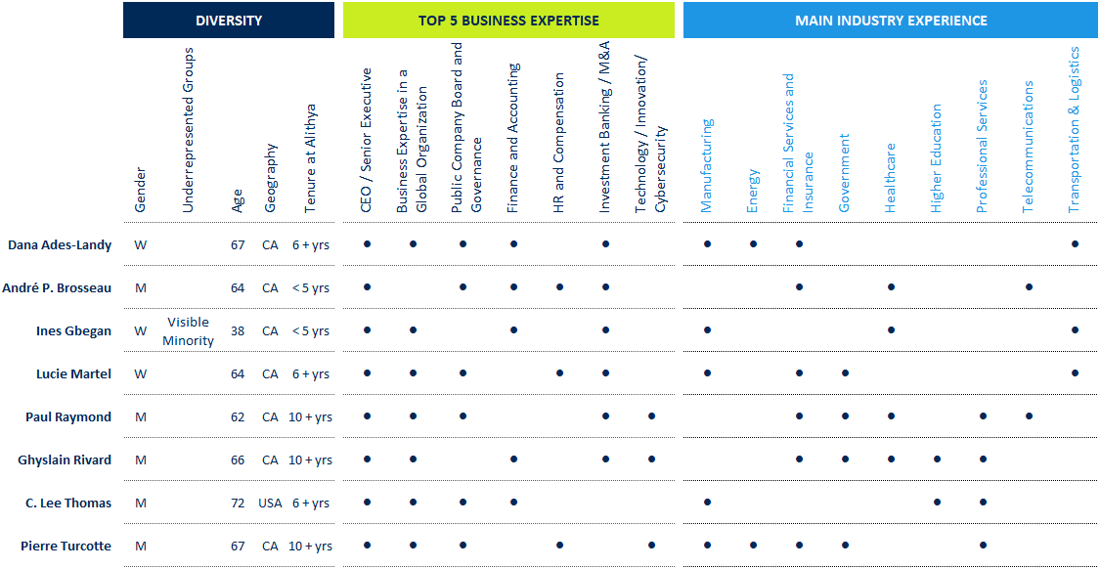
Here are a few highlights regarding the eight Nominee Directors:
| | | | | | | | | | | | | | | | | | | | | | | | | | |
87.5%
INDEPENDENT DIRECTORS |
| 37.5%
WOMEN ON BOARD |
| 62.5
YEARS OLD AVERAGE AGE |
| 96%
AVERAGE BOARD ATTENDANCE(1) |
| 98.7%
AVERAGE 2025 VOTING RESULTS |
| | | | | | | | | | | | | | | | | | | | | | | | | | | | | | | | | | | |
Dana Ades-Landy, Québec, Canada | | Age: 67 | Director since:
November 2016 | Last year’s voting results: 99.1% | | | | |
| Dana Ades-Landy returned to the National Bank of Canada, a Canadian chartered bank, in August 2020 to work in the Special Loans Group which she had previously run over seven years. Prior to this, she was the Chief Executive Officer of the Heart & Stroke Foundation of Canada (Québec). Ms. Ades-Landy has more than 25 years of experience as an executive in the banking industry, including executive leadership positions at Scotiabank, Laurentian Bank and National Bank of Canada. Ms. Ades-Landy currently serves as director and member of the Audit Committee of Sagen MI Canada Inc. and as member of the Departmental Audit Committee of the National Research Council of Canada. She previously served as director and Chair of the Audit Committee of First Lion Holdings Inc., the parent company of BFL Canada Risk and Insurance Inc., as well as Chair of the Audit Committee of the Canada Mortgage and Housing Corporation. Ms. Ades-Landy holds a Bachelor’s degree in Microbiology and Immunology from McGill University and a Master of Business Administration in Finance and Accounting from Concordia University and is a member of the Institute of Corporate Directors. | | BOARD/COMMITTEE MEMBERSHIP | ATTENDANCE(1) | | | | |
| Board | 6 of 6 | 100% | | | | |
| Audit and Risk Management Committee | 4 of 4 | 100% | | | | |
| SECURITIES HELD OR CONTROLLED | | | | |
| Subordinate Voting Shares | 12,725 | | | | |
| DSUs(2) | 174,413 | | | | |
| Value at Risk(3) | $187,138 | | | | |
| | Minimum Share Ownership Requirement(4) | Met | | | | |
| | Independent | Yes | | | | |
| | | | | | | | | | |
| | | | | | | | | | | | | | | | | | | | | | | | | | | | | | | | | | | | | | |
| André P. Brosseau(5), Québec, Canada | | Age: 64 | Director since:
September 2022 | Last year’s voting results: 99.65% | | | | |
| | André P. Brosseau is Vice Chair of Quebecor Inc. and Quebecor Media Inc. He also currently serves as Chair of the Board and President and Chief Executive Officer of Du Musée Investments Inc., a family office with private investments in Canada, the U.S. and Brazil. Mr. Brosseau is also Vice Chair and owner of Qintess, an IT company specializing in digital transformation and telecommunication infrastructure management. Previously, he served as Chair of Québec Capital Markets from 2009 to 2010 and President of Blackmont Capital Markets in Toronto from 2007 to 2009 and was an executive at CIBC World Markets Inc. from 1994 through 2007. He is also a director of Videotron Ltd. Blackmont Capital Markets in Toronto from 2007 to 2009 and was an executive at CIBC World Markets Inc. from 1994 through 2007. He is also a director of Videotron Ltd. Mr. Brosseau previously served as member of the Audit and Risk Management Committee and of the Human Resources and Corporate Governance Committee of Quebecor Inc. and Quebecor Media Inc., as well as member of the Audit and Risk Management Committee of Videotron Ltd. Mr. Brosseau holds a Bachelor’s degree in Politics and a Master’s degree in Political Science from Université de Montréal, and is a member of the Institute of Corporate Directors. | | BOARD/COMMITTEE MEMBERSHIP | ATTENDANCE(1) | | | | |
| | Board | 5 of 6 | 83% | | | | |
| | | | | | | | | | |
| | SECURITIES HELD OR CONTROLLED | | | | |
| | Subordinate Voting Shares | 350,000 | | | | |
| | DSUs(2) | 176,025 | | | | |
| | Value at Risk(3) | $526,025 | | | | |
| | Minimum Share Ownership Requirement(4) | Met | | | | |
| | | Independent | Yes | | | | |
| | | | | | | | | | | |
| | | | | | | | | | |
| | | | | | | | | | | |
| | | | | | | | | | | | | | | | | | | | | | | | | | | | | | | | | | | |
Ines Gbegan(6), Québec, Canada | | Age: 38 | Director since:
March 2024 | Last year’s voting results: 99.56% | | | | |
| Ines Gbegan is a Senior Finance Advisor providing select strategic finance and CFO-advisory mandates to private-equity-backed and growth-stage companies. She previously served as Vice President, Finance of Biron Health Group Inc., a Québec-based medical laboratory expertise company, from October 2023 to October 2025, having held the role on an interim basis since November 2022. Ms. Gbegan has more than 18 years of chartered accountant experience in audits, corporate accounting, and financial reporting. She previously held senior accounting roles at Transdev Canada Inc., a company in the transportation and logistics sector, from 2021 to 2022, at Enerkem Inc., a company in the renewable energy sector, from 2018 to 2021; at CGI Inc., a global IT and business consulting services firm, from 2014 to 2018, and at PwC, a global accounting firm, prior to 2014. She also previously taught accounting at HEC Montréal for more than five years. In 2022, Ms. Gbegan became an “Aces of Finance” recipient, a distinction awarded by Financial Executives International Canada in recognition of distinguished financial management officials. She holds a Bachelor’s degree in Accounting and Finance, a specialized graduate diploma in public accounting, and a Master’s degree in Professional Accounting. Ms. Gbegan is a Chartered Professional Accountant (CPA) auditor and is a member of the Institute of Corporate Directors. Since September 2024, she has also served on the board of Group DMV, a private-equity-backed network of approximately 70 veterinary hospitals, emergency reference centres and specialty clinics. | | BOARD/COMMITTEE MEMBERSHIP | ATTENDANCE(1) | | | | |
| Board | 6 of 6 | 100% | | | | |
| Audit and Risk Management Committee | 2 of 2 | 100% | | | | |
| SECURITIES HELD OR CONTROLLED | | | | |
| Subordinate Voting Shares | - | | | | |
| DSUs(2) | 87,764 | | | | |
| Value at Risk(3) | $87,764 | | | | |
| | Minimum Share Ownership Requirement(4) | On track
| | | | |
| | Independent | Yes | | | | |
| | | | | | | | | | |
| | | | | | | | | | | | | | | | | | | | | | | | | | | | | | | | | | | |
Lucie Martel, Québec, Canada | | Age: 64 | Director since:
September 2019 | Last year’s voting results: 99.58% | | | | |
| Lucie Martel is a corporate director. Before becoming a corporate director in 2022, she acted as Senior Vice President and Chief Human Resources Officer of Intact Financial Corporation between September 2011 and December 2021 and previously as Senior Vice President at AXA Canada, which was acquired by Intact Financial Corporation in September 2011. She has more than 30 years of experience in strategic management of human resources and labour relations, with corporations including Laurentian Bank (where she was Vice President, Human Resources Management and Development), Direct Film and Uniroyal. Ms. Martel currently serves as director and Chair of the Human Resources Committee of the Board of Directors of Fiera Capital Corporation. She also previously served as director and Chair of the Human Resources Committee of the Société des alcools du Québec and the Montreal Heart Institute Foundation. Ms. Martel holds a Bachelor’s degree in Industrial Relations from Université de Montréal and is a member of the Institute of Corporate Directors. | | BOARD/COMMITTEE MEMBERSHIP | ATTENDANCE(1) | | | | |
| Board | 5 of 6 | 83% | | | | |
| Human Capital and Compensation Committee (Chair) | 5 of 5 | 100% | | | | |
| Corporate Governance and Nominating Committee | 5 of 5 | 100% | | | | |
| SECURITIES HELD OR CONTROLLED | | | | |
| Subordinate Voting Shares | - | | | | |
| DSUs(2) | 188,071 | | | | |
| Value at Risk(3) | $188,071 | | | | |
| | Minimum Share Ownership Requirement(4) | | | Met | | | | |
| | Independent | | | Yes | | | | |
| | | | | | | | | | | | | | | | | | | | | | | | | | | | | | | | | | | |
Paul Raymond, Québec, Canada | | Age: 62 | Director since:
June 2011 | Last year’s voting results: 99.14% | | | | |
| Paul Raymond is the President and Chief Executive Officer of Alithya since April 2012. He joined Alithya as its President and Chief Operating Officer in April 2011, a position he held until March 2012, and has been a member of the Board of Alithya since April 2011. Prior to joining Alithya, Mr. Raymond held several key senior management positions in a major information technology firm and served as an officer in the Canadian Armed Forces. During his career, he worked in Canada, the U.S. as well as in Europe. Mr. Raymond currently serves as director of the Institute of Corporate Directors, Québec chapter, and previously served as director and member of the Audit Committee of WSP Global Inc. and as director of the Chamber of Commerce of Metropolitan Montréal. Mr. Raymond received the 2020 Investissement Québec CEO of the Year Award from the Quebec Technology Association. He is a computer engineering graduate from the Royal Military College of Canada, and a member of the Institute of Corporate Directors. Mr. Raymond holds an interest in Alithya’s multiple voting shares (please refer to the section entitled “General Information – Additional Information — Principal Shareholders”). | | BOARD/COMMITTEE MEMBERSHIP | ATTENDANCE(1) | | | | |
| Board | 6 of 6 | 100% | | | | |
| SECURITIES HELD OR CONTROLLED | | | | |
| Subordinate Voting Shares | 686,202 | | | | |
| Multiple Voting Shares | 1,080,138 | | | | | |
| Options to purchase Subordinate Voting Shares(7) | 922,691 | | | | | |
| Options to purchase Multiple Voting Shares(7) | 200,000 | | | | | |
| PSUs(8) | 1,288,111 | | | | | |
| RSUs(9) | 936,074 | | | | | |
| DSUs(2) | 236,786 | | | | | |
| Value at Risk(3) | $2,003,126 | | | | |
| | Minimum Share Ownership Requirement(4) | | | Met | | | | |
| | Independent | No(10) | | | | |
| | | | | | | | | | | | | | | | | | | | | | | | | | | | | | | | | | | |
Ghyslain Rivard, Québec, Canada | | Age: 66 | Director since:
April 1992 | Last year’s voting results: 95.70% | | | | |
| Ghyslain Rivard is a corporate director. He founded Alithya and acted as its President and Chief Executive Officer from its constitution in April 1992 until his retirement from all employment roles in 2012, after more than 35 years in the IT and business services sectors. He currently serves as an independent director on the Board of Alithya and has no employment or consulting arrangements, nor is he a party to a related party transaction with Alithya. He also currently serves as Chair of the Board of Inogeni Inc. and as a member of the Board of Villéco inc., both private companies. He previously served as Chair of the Board of Progitek Dev Inc., Facilis Inc. and Action SST Inc., all private companies. Mr. Rivard holds a Bachelor's degree in Computer Science and Mathematics from Sherbrooke University and is a member of the Institute of Corporate Directors. Mr. Rivard holds an interest in Alithya’s multiple voting shares (please refer to the section entitled “General Information – Additional Information — Principal Shareholders”). | | BOARD/COMMITTEE MEMBERSHIP | ATTENDANCE(1) | | | | |
| Board | 6 of 6 | 100% | | | | |
| Corporate Governance and Nominating Committee | 5 of 5 | 100% | | | | |
| Human Capital and Compensation Committee | 5 of 5 | 100% | | | | |
| SECURITIES HELD OR CONTROLLED | | | | |
| Multiple Voting Shares | 4,412,000 | | | | |
| DSUs(2) | 149,346 | | | | |
| Value at Risk(3) | $4,561,346 | | | | |
| | Minimum Share Ownership Requirement(4) | Met | | | | |
| | Independent | Yes | | | | |
| | | | | | | | | | | | | | | | | | | | | | | | | | | | | | | | | | | |
C. Lee Thomas, Ohio, USA | | Age: 72 | Director since:
November 2018 | Last year’s voting results: 99.61% | | | | |
| C. Lee Thomas is a corporate director and a member of the Board of Trustees at Baldwin Wallace University, having recently completed his three-year term as Chair. Before becoming a corporate director, Mr. Thomas held various roles with Ernst & Young LLP from 1976 to June 2014, including Managing Partner of its Cleveland office, Leader of its Northeast Ohio Market Segment, and global client serving audit partner. Mr. Thomas currently acts as a financial consultant for Regional Brands Inc. He previously served as director and Chair of the Audit Committee of Technical Consumer Products International. Mr. Thomas is a Certified Public Accountant (CPA) and holds a bachelor’s degree in accounting from Baldwin Wallace University. He is also a member of the Institute of Corporate Directors. | | BOARD/COMMITTEE MEMBERSHIP | ATTENDANCE(1) | | | | |
| Board | 6 of 6 | 100% | | | | |
| Audit and Risk Management Committee | 4 of 4 | 100% | | | | |
| SECURITIES HELD OR CONTROLLED | | | | |
| Subordinate Voting Shares | 51,000 | | | | |
| DSUs(2) | 193,751 | | | | |
| Value at Risk(3) | $244,751 | | | | |
| | Minimum Share Ownership Requirement(4) | Met | | | | |
| | Independent | Yes | | | | |
| | | | | | | | | | | | | | | | | | | | | | | | | | | | | | | | | | | |
Pierre Turcotte, Québec, Canada | | Age: 67 | Director since:
June 2011 | Last year’s voting results:97.8% | | | | |
| Pierre Turcotte is a corporate director and the Chair of the Board of Alithya. Prior to joining Alithya in 2011, he served as Senior Vice President and General Manager at CGI Inc. in Canada, the U.S. and Europe for more than 27 years and as President and Chief Executive Officer and Chair of the Board of ReadBooks Technologies SAS. Mr. Turcotte currently serves as Chair of Trustees of the Pointe-à-Callière Foundation, as Vice-Chair of the Board of Trustees and Chair of the Human Resources Committee of the Pointe-à-Callière, Montreal Museum of Archeology and History, and as director of the Théâtre du Nouveau Monde. Previously, he served as an independent member of McGill University's Board of Governors' IT Committee, and served as director of Poudre Noire Inc. and Xpertdoc Technologies Inc. Mr. Turcotte holds a Bachelor’s degree in Computer Science and Mathematics from Laval University and is a member of the Institute of Corporate Directors. Mr. Turcotte holds an interest in Alithya’s multiple voting shares (please refer to the section entitled “General Information – Additional Information — Principal Shareholders”). | | BOARD/COMMITTEE MEMBERSHIP | ATTENDANCE(1) | | | | |
| Board | 6 of 6 | 100% | | | | |
| Corporate Governance and Nominating Committee (Chair) | 5 of 5 | 100% | | | | |
| Human Capital and Compensation Committee | 5 of 5 | 100% | | | | |
| SECURITIES HELD OR CONTROLLED | | | | |
| Subordinate Voting Shares | 490,700 | | | | |
| Multiple Voting Shares | 1,834,742 | | | | |
| DSUs(2) | 348,922 | | | | |
| Value at Risk(3) | $2,674,364 | | | | |
| | Minimum Share Ownership Requirement(4) | Met | | | | |
| | Independent | Yes | | | | |
| | | | | | | | | | | |
(1)For an overview of Board and committee meetings attendance by all directors, please refer to the section entitled “Board and Committee Attendance”.
(2)DSUs held by directors, other than Paul Raymond, are issued under Alithya’s Long Term Incentive Plan (“LTIP”). DSUs held by Paul Raymond are issued under Alithya’s Share Unit Plan (“SUP”). For a summary of the material terms of the LTIP, please refer to Schedule A of this Information Circular. For additional information regarding grants of DSUs to directors, please refer to the section entitled “Director Compensation — Structure of Compensation — Long Term Incentive Plan – DSUs”. For additional information regarding grants of DSUs to Paul Raymond, please refer to the section entitled “Compensation Discussion and Analysis – Executive Compensation Framework – Executive Compensation Description – Short-Term Incentives (Annual Bonuses)”.
(3)The Value at Risk represents the total value of Shares and vested equity grants (such as DSUs, PSUs and RSUs). It is based on the closing price of the subordinate voting shares on the TSX on July 13, 2026 ($1.00). Options are not taken into account in the Value at Risk and the minimum share ownership requirement.
(4)All directors, except Paul Raymond, are subject to the minimum share ownership requirement applicable to directors, as detailed in the section entitled “Director Compensation – Director Share Ownership Requirement”. For information regarding the minimum share ownership requirement applicable to Mr. Raymond, please refer to the section entitled “Compensation Discussion and Analysis – Executive Compensation Framework – Executive Compensation Approach – Executive Share Ownership Requirement”.
(5)André Brosseau is being proposed as Nominee Director in accordance with the terms of the Investor Rights Agreement entered into by the Company and Quebecor on April 1, 2021, pursuant to which the Company shall propose for election a candidate designated by Quebecor until Quebecor ceases to beneficially own at least 10% of the issued and outstanding subordinate voting shares of the Company.
(6)Ines Gbegan is being proposed as Nominee Director in accordance with the terms of the Investor Rights Agreement entered into by the Company and Beneva on April 1, 2021, pursuant to which the Company shall propose for election a candidate designated by Beneva until Beneva ceases to beneficially own at least 10% of the issued and outstanding subordinate voting shares of the Company.
(7)Options to purchase subordinate voting shares are governed by the LTIP and options to purchase multiple voting shares, which are options that were originally granted by the Company before it went public (“Pre-IPO Alithya”), are governed by the Pre-IPO Alithya 2011 Stock Option Plan. For more details regarding options, please refer to the section entitled “Compensation Discussion and Analysis – Executive Compensation Framework – Long Term Incentives” and the summary of the material terms of the LTIP included in Schedule A.
(8)Paul Raymond holds PSUs issued under the LTIP and the SUP, all of which shall be settled in subordinate voting shares or cash, at the Company’s option. For more details on PSUs, please refer to the section entitled “Compensation Discussion and Analysis – Executive Compensation Framework – Long Term Incentives” and, for PSUs issued under the LTIP, the summary of the material terms of the LTIP included in Schedule A.
(9)RSUs are issued under the SUP and shall be settled in subordinate voting shares or cash, at the Company’s option. For more details on RSUs, please refer to the section entitled “Compensation Discussion and Analysis – Executive Compensation Framework – Long Term Incentives”.
(10)Paul Raymond is considered non-independent as he is the President and Chief Executive Officer of the Company.
| | |
CEASE TRADE ORDERS, BANKRUPTCIES, PENALTIES OR SANCTIONS |
To the knowledge of the Company and based upon information provided to it by the Company’s Nominee Directors, no Nominee Director (including any personal holding company), is or has been, in the last ten years, a director, chief executive officer or chief financial officer of a company (including Alithya) that: (a) was the subject of a cease trade or similar order or an order that denied the relevant company access to any exemption under securities legislation for a period of more than 30 consecutive days while the director or executive officer was acting in that capacity; or (b) was the subject of a cease trade or similar order or an order that denied the relevant company access to any exemption under securities legislation for a period of more than 30 consecutive days that was issued after the director or executive officer ceased to act in that capacity, but which resulted from an event that occurred while the director or executive officer was acting in that capacity.
Other than as disclosed below, to the knowledge of the Company and based upon information provided to it by the Company’s Nominee Directors, no Nominee Director (including any personal holding company): (a) is, or has been in the last ten years, a director or executive officer of a company (including Alithya) that, while that Nominee Director was acting in that capacity, or within a year of that Nominee Director ceasing to act in that capacity, became bankrupt, made a proposal under any legislation relating to bankruptcy or insolvency or was subject to or instituted any proceedings, arrangement or compromise with creditors or had a receiver, receiver manager or trustee appointed to hold its assets; or (b) has, in the last ten years, become bankrupt, made a proposal under any legislation relating to bankruptcy or insolvency, or become subject to or instituted any proceedings, arrangement or compromise with creditors, or had a receiver, receiver manager or trustee appointed to hold their assets. Ghyslain Rivard was a director of Facilis Inc. (“Facilis”) from November 1, 2021 to March 8, 2023. On March 8, 2023, Facilis initiated bankruptcy proceedings and a trustee was appointed to hold its assets.
To the knowledge of the Company and based upon information provided to it by the Company’s directors, no Nominee Director (including any personal holding company) has been subject to: (a) any penalties or sanctions imposed by a court relating to securities legislation or by a securities regulatory authority or has entered into a settlement agreement with a securities regulatory authority; or (b) any other penalties or sanctions imposed by a court or regulatory body that would likely be considered important to a reasonable securityholder in deciding whether to vote for a Nominee Director.
| | |
BOARD AND COMMITTEE ATTENDANCE |
The following table indicates the attendance of the current directors of the Company at regularly scheduled Board and committee meetings for fiscal 2026.
| | | | | | | | | | | | | | | | | | | | | | | | | | | | | | | | | | | |
NAME OF DIRECTOR | BOARD | AUDIT AND RISK MANAGEMENT COMMITTEE | CORPORATE GOVERNANCE AND NOMINATING COMMITTEE | HUMAN CAPITAL AND COMPENSATION COMMITTEE | OVERALL ATTENDANCE |
Dana Ades-Landy | 6 of 6 | 100% | 4 of 4 | 100% | - | - | - | - | 10 of 10 | 100% | |
André Brosseau | 5 of 6 | 83% | - | - | - | - | - | - | 5 of 6 | 83% | |
Robert Comeau(1) | 3 of 3 | 100% | 2 of 2 | 100% | - | - | - | - | 5 of 5 | 100% | |
Ines Gbegan(2) | 6 of 6 | 100% | 2 of 2 | 100% | - | - | - | - | 8 of 8 | 100% |
Lucie Martel | 5 of 6 | 83% | - | - | 5 of 5 | 100% | 5 of 5 | 100% | 15 of 16 | 94% | |
Paul Raymond | 6 of 6 | 100% | - | - | - | - | - | - | 6 of 6 | 100% | |
Ghyslain Rivard | 6 of 6 | 100% | - | - | 5 of 5 | 100% | 5 of 5 | 100% | 16 of 16 | 100% | |
C. Lee Thomas | 6 of 6 | 100% | 4 of 4 | 100% | - | - | - | - | 10 of 10 | 100% | |
Pierre Turcotte | 6 of 6 | 100% | - | - | 5 of 5 | 100% | 5 of 5 | 100% | 16 of 16 | 100% | |
| | 96% | | 100% |
| 100% |
| 100% |
| 97% | |
(1)Robert Comeau did not stand for re-election at the annual general meeting held on September 10, 2025, and ceased to be a director as of that date. Accordingly, he attended no board or committee meetings thereafter.
(2)Ines Gbegan replaced Robert Comeau on the Audit and Risk Management Committee on September 10, 2025. As such, she did not attend any committee meetings prior to such date.
The following table identifies the competencies of each Nominee Director, together with their gender, age, geographical representation, and tenure at Alithya.
Director Compensation
The compensation program of the Board is designed to align the interests of directors with the long-term interests of the Company’s shareholders and aims at providing fair, reasonable and competitive total compensation required to attract and retain experienced and competent directors.
To assist in determining the appropriate compensation for members of the Board, the Human Capital and Compensation Committee (the “Compensation Committee”) reviews competitive practices from time to time with the assistance of independent compensation consultants as discussed in the section entitled “Compensation Discussion and Analysis – Executive Compensation Framework – Compensation Review Process – Compensation Consultant”.
In the fiscal year ended March 31, 2025 (“fiscal 2025”), the Compensation Committee, retained the services of Willis Towers Watson (“WTW”), as compensation consultant, to conduct a review of the Board’s compensation to assess the competitiveness of its compensation policy, including a review of its comparator group.
Following such review process, a new comparator group was selected to be used for the review of director compensation
and the Compensation Committee recommended, and the Board approved, changes beginning in fiscal 2025. The changes principally aimed at progressively adjusting the directors’ total compensation with the median of the new comparator group over three years, from fiscal 2025 to 2027, to ensure compensation competitiveness.
For an overview of the Company’s structure of compensation and Board retainers as well as a list of the companies comprised in the comparator group, please refer to the section entitled “Structure of Compensation” below.
Any director who is also an employee of the Company or of any of its affiliates does not receive any compensation as a director. As such, this section excludes the compensation earned by Paul Raymond who is also the President and Chief Executive Officer of the Company. For information regarding the compensation of Mr. Raymond, please refer to the section entitled “Compensation Discussion and Analysis – Executive Compensation Framework – Compensation of the NEOs”.
| | |
STRUCTURE OF COMPENSATION |
The compensation of the directors is structured as an all-inclusive annual retainer payable in cash (“Cash-Based Component”) and in share-based awards in the form of DSUs (“Share-Based Component”). The Cash-Based Component varies based on role(s) held by the directors on the Board (e.g. chairing the Board or a committee and/or being a committee member), while the Share-Based Component is fixed. For fiscal 2026, the Share-Based Component was increased from $60,000 to $75,000 for all directors, except the Chair of the Board whose Share-Based Component was increased from $100,000 to $117,500. The Cash-Based Component was increased from $45,000 to $50,000 for all directors and from $85,000 to $97,500 for the Chair of the Board. This flat-fee approach is consistent with compensation trends, adds predictability to compensation paid to directors, and is simpler to administer. Until a director has achieved his or her minimum share ownership requirement, 50% of his or her annual Cash-Based Component is paid in DSUs.
Directors are also reimbursed for reasonable travel and other out-of-pocket expenses incurred for attendance at Board and committee meetings.
Comparator Group
In fiscal 2025, the Compensation Committee selected a new comparator group which was used for the review of director compensation. Such comparator group was comprised of 26 companies: 12 Canadian companies and 14 U.S. companies; all publicly listed at the time of the review, with an operating business model similar to Alithya's, operating in the IT consulting services or other services with an operating segment in IT consulting and services.
Based on the Company’s footprint and operations, the new comparator group is composed of the following companies:
| | | | | |
CANADIAN COMPANIES | U.S. COMPANIES |
Calian Group Limited | Box, Inc. |
Converge Technology Solutions Corp(1) | Grid Dynamics Holdings, Inc. |
Docebo Inc. | Huron Consulting Group Inc. |
Enghouse Systems Limited | Information Services Group, Inc. |
Kinaxis Inc. | N-able, Inc. |
Lightspeed Commerce Inc. | Perficient, Inc.(1) |
Lumine Group Inc. | Qualys, Inc. |
Nuvei Corporation(1) | RCM Technologies, Inc. |
Quisitive Technology Solutions, Inc.(1) | Resources Connection, Inc. |
Softchoice Corporation(1) | SolarWinds Corporation(1) |
The Descartes Systems Group Inc. | TaskUs, Inc. |
Vecima Networks Inc. | The Hackett Group, Inc. |
| Upland Software, Inc. |
| Willdan Group, Inc. |
(1)Companies that have been privatized or were subject to a proposed going-private transaction since the comparator group update in fiscal 2025.
Annual Retainer
The following table shows the Cash-Based Component and the Share-Based Component of the annual retainer of all directors for fiscal 2026:
| | | | | | | | |
DIRECTOR POSITION | ANNUAL RETAINER |
CASH-BASED COMPONENT(1) | SHARE-BASED COMPONENT |
Chair of the Board | $97,500 | | $117,500 | |
Director | $50,000 | | $75,000 | |
Committee Chair | $35,000 | | - | |
Committee Member | $10,000 | | - | |
(1)Directors may elect to receive all or part of the Cash-Based Component of their annual retainer either in cash, in DSUs or a combination of both. Until a director has achieved his or her minimum share ownership requirement, 50% of his or her annual Cash-Based Component is paid in DSUs.
Long Term Incentive Plan – DSUs
In addition to the Share-Based Component of their annual retainer, directors may, subject to the Director Share Ownership Requirement (as defined below), prior to the beginning of each calendar year, elect to receive all or part of the Cash-Based Component of their annual retainer either in cash, in DSUs issued pursuant to the Company’s Long Term Incentive Plan (the “LTIP”), or a combination of both.
DSUs are credited to each director’s account on the last day of each quarter and the number to be credited is calculated by dividing the dollar amount to be received in DSUs for such quarter by the closing price of the subordinate voting share on the TSX, on the last trading day immediately preceding the
date of grant. Each DSU entitles the beneficiary thereof to receive upon resignation, retirement or death, one subordinate voting share of the Company. Each director has an account where DSUs are credited and held until the director leaves the Board.
The issuance of DSUs to directors is considered a key component to enhance the Company’s ability to attract and retain talented individuals to serve as members of the Board, to promote alignment of interests between directors and the Company’s shareholders and to assist directors in fulfilling the Director Share Ownership Requirement.
Detailed information on the LTIP is included in Schedule A of this Information Circular.
| | |
DIRECTOR COMPENSATION TABLE |
The table below shows the compensation earned by each individual who served as a non-executive director during fiscal 2026. The compensation of Paul Raymond, who is a director, but also the Company’s President and Chief Executive Officer, is discussed in the section entitled “Compensation Discussion and Analysis – Compensation of the NEOs – Summary Compensation Table”.
| | | | | | | | | | | | | | |
NAME OF DIRECTOR | TOTAL COMPENSATION PAID IN CASH
($) | TOTAL COMPENSATION PAID IN DSUs
($) | ALL OTHER COMPENSATION ($) | TOTAL FEES EARNED ($) |
Dana Ades-Landy | 74,250 | 60,750 | - | 135,000 |
André P. Brosseau | 31,250 | 93,750 | - | 125,000 |
Robert Comeau(1) | 36,617 | 34,688 | - | 71,304 |
Ines Gbegan(2) | 54,035 | 76,535 | - | 130,571 |
Lucie Martel | 113,750 | 56,250 | - | 170,000 |
Ghyslain Rivard | 88,750 | 56,250 | - | 145,000 |
C. Lee Thomas(3) | 79,507 | 69,419 | - | 148,926 |
Pierre Turcotte | 90,313 | 124,688 | - | 215,000 |
(1)Robert Comeau stepped down from the board of directors of the Company on September 10, 2025, the date of the AGM. As such, he only received a pro-rated portion of his annual retainer.
(2)Ines Gbegan joined the Audit committee on September 10, 2025. As such, her annual retainer therefore included a prorated amount for her service on the Audit Committee during fiscal 2026.
(3)C. Lee Thomas joined as Chair of the Audit committee on September 10, 2025. As such, his annual retainer therefore included a prorated amount for his service as Chair of the Audit Committee during fiscal 2026.
| | |
INCENTIVE PLAN AWARDS – OUTSTANDING AWARDS |
The following table shows the market value as at March 31, 2026 of vested DSUs (share-based awards) held by each individual who served as a non-executive director during fiscal 2026. The Company’s directors do not hold, and did not receive any option-based awards in respect of their compensation for fiscal 2026.
| | | | | | | | | | | |
NAME | MARKET OR PAYOUT VALUE OF SHARE-BASED AWARDS THAT HAVE NOT VESTED ($) | MARKET OR PAYOUT VALUE OF VESTED SHARE-BASED AWARDS NOT PAID OUT OR DISTRIBUTED(1) ($) | |
Dana Ades-Landy | - | | 247,666 | | |
André P. Brosseau | - | | 249,956 | | |
Ines Gbegan | - | | 124,625 | | |
Lucie Martel | - | | 267,061 | | |
Ghyslain Rivard | - | | 212,071 | | |
C. Lee Thomas | - | | 275,126 | | |
Pierre Turcotte | - | | 495,469 | | |
(1)Shows the aggregate market value of DSUs held as at March 31, 2026 based on $1.42, the closing price of the subordinate voting shares on the TSX on March 31, 2026, the last trading day of fiscal 2026. All DSUs are fully vested at the time of grant.
| | |
INCENTIVE PLAN AWARDS – VALUE VESTED OR EARNED DURING THE YEAR |
The table below shows the value of DSUs (share-based awards) held as at March 31, 2026(1) by each individual who served as a non-executive director during the fiscal year then ended and which vested during the fiscal year. Directors do not hold, and did not receive any option-based awards or non-equity incentives during fiscal 2026.
| | | | | |
NAME | SHARE-BASED AWARDS -
VALUE VESTED DURING THE YEAR ($) |
Dana Ades-Landy | 60,750 | |
André P. Brosseau | 93,750 | |
Ines Gbegan | 76,535 | |
Lucie Martel | 56,250 | |
Ghyslain Rivard | 56,250 | |
C. Lee Thomas | 69,419 | |
Pierre Turcotte | 124,688 | |
(1)Robert Comeau did not stand for re-election and retired as a director on September 10, 2025 and therefore did not hold any DSUs as at March 31, 2026. During fiscal 2026, the value vested of Robert Comeau's share-based awards was $34,688.
| | |
DIRECTOR SHARE OWNERSHIP REQUIREMENT |
The directors of the Company play a central role in enhancing shareholder value and are therefore required to acquire and maintain a certain level of ownership in the Company in accordance with the Company’s minimum share ownership requirement for directors (the “Director Share Ownership Requirement”). Such policy was adopted to better align the directors’ economic interests with those of shareholders. The Director Share Ownership Requirement is three times the Cash-Based Component of their annual retainer, regardless of whether it is paid in cash or in DSUs, which shall be reached within a five-year period starting on the later of July 1, 2021 and their election or appointment on the Board.
To assess the Director Share Ownership Requirement, Shares and vested equity grants such as DSUs are valued at the greater of (i) the price of the subordinate voting shares at the time those Shares or DSUs were acquired and (ii) the market
value of the Shares or DSUs using the average closing price of the subordinate voting shares on the TSX for the five trading days preceding the date on which the share ownership level is assessed.
Alithya securities held to comply with the Director Share Ownership Requirement shall not be, during the directors’ tenure, the object of specific monetization procedures or other hedging procedures to reduce the exposure related to their ownership.
Directors may elect to receive up to 100% of the Cash-Based Component of their annual retainer in DSUs. Until they meet the Director Share Ownership Requirement, directors are required to receive at least 50% of the Cash-Based Component of their annual retainer in DSUs.
Director Share Ownership Table
The following table provides information on the number and the value of Shares and DSUs owned by each non-executive Nominee Director as at July 13, 2026, and indicates whether they meet the Director Share Ownership Requirement.
| | | | | | | | | | | | | | | | | | | | | | | | | | | | | |
DIRECTOR | NUMBER OF SHARES(1) OWNED, CONTROLLED OR DIRECTED | TOTAL VALUE OF SHARES(1)(2)($) | NUMBER OF
DSUs HELD | TOTAL VALUE
OF DSUs(2)($) | TOTAL NUMBER OF SHARES(1) OWNED, CONTROLLED OR DIRECTED AND DSUs | TOTAL VALUE OF SHARES(1) AND DSUs(2)($) | MINIMUM SHARE OWNERSHIP VALUE REQUIRED(3) | TOTAL SHARE AND DSUs OWNERSHIP VALUE AT THE TIME OF PURCHASES(4) | DIRECTOR SHARE OWNERSHIP REQUIREMENT ASSESSMENT(5) |
Dana Ades-Landy | 12,725 | | 12,725 | | 174,413 | | 174,413 | | 187,138 | | 187,138 | | 180,000 | | 473,066 | | |
André P. Brosseau | 350,000 | | 350,000 | | 176,025 | | 176,025 | | 526,025 | | 526,025 | | 150,000 | | 1,328,950 | | |
Ines Gbegan | - | | - | | 87,764 | | 87,764 | | 87,764 | | 87,764 | | 180,000 | | 161,226 | | On track |
Lucie Martel | - | | - | | 188,071 | | 188,071 | | 188,071 | | 188,071 | | 285,000 | | 450,000 | | |
Ghyslain Rivard | 4,412,000 | | 4,412,000 | | 149,346 | | 149,346 | | 4,561,346 | | 4,561,346 | | 210,000 | | 20,204,833 | | |
C. Lee Thomas | 51,000 | | 51,000 | | 193,751 | | 193,751 | | 244,751 | | 244,751 | | 255,000 | | 639,069 | | |
Pierre Turcotte | 2,325,442 | | 2,325,442 | | 348,922 | | 348,922 | | 2,674,364 | | 2,674,364 | | 292,500 | | 9,578,000 | | |
(1)Subordinate voting shares and/or multiple voting shares, as applicable.
(2)Value based on $1.00, the closing price of the subordinate voting shares on the TSX on July 13, 2026. Although the Director Share Ownership Requirement assessment is calculated based on the total value of the greater of the price of the Shares and DSUs at the time they were acquired and the market value of the Shares and DSUs using the average closing price of the subordinate voting shares on the TSX for the five trading days preceding July 13, 2026 (which was $1.03), the above table shows the total value of Shares or DSUs owned based on the closing price of the subordinate voting shares on the TSX on July 13, 2026 (which was $1.00), solely to be consistent with the value at-risk disclosed in the section entitled “Nominees for Election to the Board”.
(3)The minimum Director Share Ownership Requirement value required is equal to three times the Cash-Based Component of the director’s annual retainer, regardless of whether it is paid in cash or DSUs. The value indicated takes into account the Nominee Directors’ Cash-Based Component as at July 13, 2026.
(4)The value shown in this column corresponds to the applicable Shares and DSUs ownership value to be considered for the purposes of the minimum Director Share Ownership Requirement assessment in accordance with the Director Share Ownership Requirement policy, which for all directors corresponded to the value of the Shares and/or DSUs owned determined by using the price of the Shares and/or DSUs at the time they were acquired.
(5)The minimum Director Share Ownership Requirement assessment is based on the total value of the greater of the price of the Shares or DSUs at the time they were acquired and the market value of the Shares and/or DSUs using the average closing price of the subordinate voting shares on the TSX for the five trading days preceding July 13, 2026 (which was $1.03).
Statement of Corporate Governance Practices
We believe our success relies on our reputation and the trust placed in our Company by our clients, employees, suppliers and others we interact with in our operations. Our commitment to specific core values such as respect, trust and integrity guide our actions and the way we operate responsibly and with integrity. As such, we are committed to adhering to high standards of corporate governance and designed our corporate governance practices consistent with this objective. The role, specific mandate and functioning rules of the Board and its committees are set forth in our corporate governance guidelines (“Corporate Governance Guidelines”) and their respective mandate adopted by the Board, which are available on our website at www.alithya.com. They are reviewed at least annually with a view to continually improving our practices by assessing their effectiveness and comparing them with evolving best practices, changing circumstances and our needs.
As a Canadian reporting issuer whose subordinate voting shares are listed on the TSX and still registered with the U.S. Securities and Exchange Commission (“SEC”), our corporate
governance practices comply with applicable rules adopted by the Canadian securities regulators (“CSA”), applicable provisions of the U.S. Sarbanes-Oxley Act of 2002 and related rules of the SEC. While we are no longer subject to Nasdaq independence requirements, the company assesses the independence of its board members in light of Nasdaq requirements annually solely to comply with certain disclosure requirements in its annual report filed with the SEC.
The Board is of the opinion that the Company’s corporate governance practices are well designed to assist the Company in achieving its principal corporate objective, which is the enhancement of shareholder value, and that its corporate governance practices meet the requirements of National Instrument 58-101 – Disclosure of Corporate Governance Practices (“NI 58-101”) and National Policy 58-201 – Corporate Governance Guidelines.
Here are a few highlights of our corporate governance practices as at July 13, 2026:
| | | | | | | | | | | | | | | | | | | | | | | | | | |
87.5% OF INDEPENDENT DIRECTORS
|
| 37.5% OF WOMEN AND ONE MEMBER OF OTHER DIVERSITY GROUPS ON THE BOARD |
| ANNUAL
BOARD
EVALUATION PROCESS |
| OVERBOARDING AND BOARD INTERLOCK POLICIES |
| MINIMUM OF 75% OF BOARD AND COMMITTEE ATTENDANCE AS RE-ELECTION ELIGIBILITY CRITERIA |
Mandate of the Board
The Board has clearly delineated its role and the role of management. The Board is elected by the shareholders and is responsible for the stewardship of the business and affairs of the Company, while management’s role is to conduct its day-to-day operations. The mandate of the Board, which is fulfilled directly or through one of its three committees, is to supervise the management of the business and affairs of the Company, and includes (i) the approval of strategic goals and objectives, (ii) the review of operations, disclosure and communication policies, (iii) the oversight of financial reporting, internal controls and risks, (iv) the review of corporate governance practices, (v) executive compensation and oversight, (vi) director nomination, compensation and assessment, and (vii) director orientation and education. Board committees’ recommendations are generally subject to Board approval. Meetings of the Board are held at least six times a year and as necessary.
The Board annually reviews the adequacy of its mandate. The text of the Board’s mandate is set out in Schedule B to this Information Circular.
Please refer to the section entitled “Strategic Oversight” for more details on the Board’s strategic oversight activities and to the section entitled “Risk Management” for more details on the Board’s oversight of risks.
Composition of the Board
BOARD SIZE
The Board is currently comprised of eight members, namely: Dana Ades-Landy, André P. Brosseau, Ines Gbegan, Lucie Martel, Paul Raymond, Ghyslain Rivard, C. Lee Thomas and Pierre Turcotte. Robert Comeau did not stand for re-election and retired as a director on September 10, 2025. The Board has fixed at eight the number of directors to be elected at the Meeting, a size the Board considers both adequate in consideration of the Company’s size and functional to maintain an efficient Board. All Nominee Directors are currently members of the Board and were elected at the last annual meeting of shareholders.
INDEPENDENCE OF DIRECTORS
In determining whether a director is independent, the Board applies the standards developed by Canadian laws and regulations, considering all relevant facts.
87.5% of the Nominee Directors are independent. Except for Paul Raymond, who is the Company’s President and Chief Executive Officer, the Board determined that the seven other Nominee Directors are independent. In particular, except for Mr. Raymond, the Board noted that none of the Nominee Directors has been employed by Alithya for at least 10 years,
nor is any of them a party to any related party transaction with Alithya.
| | | | | |
INDEPENDENT | NON-INDEPENDENT |
Dana Ades-Landy André P. Brosseau Ines Gbegan Lucie Martel Ghyslain Rivard C. Lee Thomas Pierre Turcotte | Paul Raymond(1) |
(1)Mr. Raymond is the President and Chief Executive Officer of the Company. |
In-Camera Meetings
The Board holds an in-camera meeting of the non-executive directors and an in-camera meeting of the independent directors at every regular meeting of the Board. During fiscal 2026, in-camera meetings of the non-executive and independent directors were held after each regular meeting.
DIRECTORSHIPS OF OTHER ISSUERS AND BOARD INTERLOCKS
As indicated in our Corporate Governance Guidelines, the Company recognizes that the Board can benefit from a director also serving on the board of other issuers, so long as such service does not conflict with the Company’s interests or affect the director’s ability to serve as a director of the Board (i.e. overboarding). Accordingly, no director shall serve as a director, officer or employee of one of the Company’s competitors. Also, each non-executive director is expected to hold no more than four directorships with other publicly listed issuers, and each executive director is expected to hold no more than two such directorships. In addition, members of the Audit Committee (as defined hereinafter) may not serve on the audit committee of more than two other publicly listed issuers, unless the Board has first determined that such simultaneous service would not impair the ability of the applicable director to serve on the Audit Committee.
A director wishing to join any other board of directors, whether of a private or public corporation, must also first request permission of the Chair of the Board so that an appropriate review can be undertaken to ensure that there is no potential conflict or any other legal or business concerns.
As at July 13, 2026, certain Nominee Directors were directors of other publicly listed issuers, as outlined in the following table:
| | | | | | | | |
NAME | PUBLIC ENTITY | COMMITTEES |
Dana Ades-Landy | Sagen MI Canada Inc. (TSX) | Member of the Audit Committee |
André P. Brosseau | Quebecor Inc. (TSX) | - |
Lucie Martel | Fiera Capital Corporation (TSX) | Chair of the Human Resources Committee |
The Company’s Corporate Governance Guidelines further provide that there may not be more than two board interlocks at any given time. A board interlock is considered to occur when two of the Company’s directors serve together on the board of another public company or investment company. The Governance Committee (as defined hereinafter) and the Board also evaluate interlocks between directors and executive officers and their close family members through an annual questionnaire. As of July 13, 2026, there were no board interlocks. The Governance Committee also reviews external board and committee memberships of all directors at least annually.
POSITION DESCRIPTIONS
The Board has developed written position descriptions for the Chair of the Board, and President and Chief Executive Officer, the complete text of which can be found on the Company’s website at www.alithya.com. Summaries of the foregoing position descriptions are included below. The position description of the Chair of the Board is reviewed annually by the Governance Committee, and the position description of the President and Chief Executive Officer is reviewed annually by the Compensation Committee (as defined hereinafter). They are updated as required.
Chair of the Board
The Company’s Board is led by a non-executive Chair, who, as per our Corporate Governance Guidelines, must be appointed by the Board upon the recommendation of the Governance Committee. The prime responsibility of the Chair of the Board is to provide leadership to the Board and enhance Board effectiveness. As such, the Chair of the Board prepares and presides Board meetings and ensures the efficient conduct of the Board’s work. In fulfilling his responsibilities, the Chair of the Board acts as a liaison between the Board and management and takes steps to foster the Board’s understanding of its responsibilities and boundaries with management. The Chair of the Board also oversees the responsibilities delegated to Board committees. Pierre Turcotte is the current Chair of the Board.
Lead Director
The Board previously established the role of an independent lead director to support the Chair of the Board in evaluating and improving the Board’s effectiveness every year. This position was established when the Chair of the Board was not independent, but even after the Chair of the Board became independent, the lead director role continued as it enhanced the Board discussions and operations. Now, since Robert Comeau did not stand for re-election and retired as a director on September 10, 2025, the Board has decided to discontinue the lead director position. Since September 10, 2025, the Chair of the Board, along with existing governance structures, took over the responsibilities previously held by the lead director.
President and Chief Executive Officer
The President and Chief Executive Officer is responsible for leading the growth and success of the Company. In fulfilling his responsibilities, the President and Chief Executive Officer develops the Company’s strategic plan, considering emerging opportunities and risks and with a view to the Company’s sustained profitable growth and long-term value creation and oversees the implementation of such plan once approved by the Board. The President and Chief Executive Officer ensures that the Company achieves and maintains a satisfactory level of competitiveness both through organic growth, by strengthening existing client partnerships and fostering new relationships, and through strategic acquisitions. Paul Raymond is the current President and Chief Executive Officer. He reports to the Company’s Board.
Committees’ Mandates and Membership
The Board has established three committees to assist it in fulfilling its mandate: the Audit and Risk Management Committee (the “Audit Committee”), the Corporate Governance and Nominating Committee (the “Governance Committee”) and the Human Capital and Compensation Committee (the “Compensation Committee”). Each committee reports to the Board. The role and responsibilities of committee Chairs and the mandate of the committees are described below.
ROLE AND RESPONSIBILITIES OF COMMITTEE CHAIRS
The text of the mandates of the Audit Committee, the Governance Committee and the Compensation Committee, which can be found on the Company’s website at www.alithya.com, each contain a description of the position of the Chairs. The prime responsibility of committee Chairs is to be responsible for the leadership of the committee assignments, including preparing the agenda, presiding over the meetings, making committee assignments, and reporting to the Board following meetings of the committee on matters considered by the committee, its activities and compliance with its mandate. C. Lee Thomas is the Chair of the Audit Committee, Pierre Turcotte is the Chair of the Governance Committee and Lucie Martel is the Chair of the Compensation Committee.
The following is a summary of the mandate of each committee of the Board. Each committee annually reviews the adequacy of its mandate.
AUDIT AND RISK MANAGEMENT COMMITTEE
The primary mandate of the Audit Committee is to review the financial statements of the Company and public disclosure documents containing financial information and to report on such review to the Board, to be satisfied that adequate procedures are in place for the review of the Company’s public disclosure documents that contain financial information, to oversee the work and review the independence of the external auditor, and to oversee the Company’s internal control over financial reporting. The Audit Committee is also responsible for ensuring that appropriate risk management processes are in place across the Company, including for the management of IT systems and infrastructure and security and cybersecurity risks. In performing its duties and exercising its powers, the Audit Committee considers and addresses the risks related to the establishment, maintenance and implementation of disclosure controls and procedures and internal control over financial reporting and the risks related to security that would reasonably be expected to have a material effect on the Company. With regard to security, the Audit Committee receives periodic updates from the Company’s Chief Information Security Officer in order to review and monitor (i) management’s practices and policies with respect to the Company’s major security risks, including physical and cyber security risks and risks related to the use and development of artificial intelligence, and control thereof, in accordance with applicable legal and regulatory requirements and good practices, (ii) security trends that may impact the Company’s operations and business and its evolving environment, (iii) contingency plans in the event of a security threat or breach, and (iv) initiatives in terms of development and implementation of appropriate communications and training. The Audit Committee then reports to the Board on the Company’s compliance with such practices and policies and progress in remedying any identified significant deficiencies, if
any. Updates by the Chief Information Security Officer allow the Audit Committee to better understand cybersecurity risks and controls, identified or potential security breaches, if any, and Company initiatives and mitigation measures, and keep its members informed of new threats, trends and evolving risks. The Chief Information Security Officer also addresses the Board directly on such topics from time to time. Please refer to Appendix A of the Company’s Annual Information Form (“AIF”) for the text of the Audit Committee’s charter. The AIF is available on the Company’s website at www.alithya.com and on SEDAR+ at www.sedarplus.ca and EDGAR at www.sec.gov. The charter of the Audit Committee is also available on the Company’s website at www.alithya.com.
The membership of the Audit Committee is as follows:
| | | | | |
MEMBERSHIP | INDEPENDENT |
C. Lee Thomas (Chair) Dana Ades-Landy Ines Gbegan | ü ü ü |
Below details the main qualifications of the members of the Audit Committee as of July 13, 2026 to effectively contribute to the Audit Committee:
•C. Lee Thomas brings significant financial expertise to the Audit Committee. Over his distinguished career at Ernst & Young LLP from 1976 to 2014, he held several key positions, including Managing Partner of the Cleveland office, Leader of the Northeast Ohio Market Segment, and global serving audit partner. Mr. Thomas is currently a member of the Board of Trustees at Baldwin Wallace University, having recently completed his three-year term as Chair, and serves as a financial consultant for Regional Brands Inc. He has also previously served as director and Chair of the Audit Committee at Technical Consumer Products International. Mr. Thomas holds a Bachelor’s degree in Accounting from Baldwin Wallace University and is a Certified Public Accountant (CPA).
•Dana Ades-Landy has extensive financial expertise. With more than 25 years of experience as an executive in the banking industry, including executive leadership positions at Scotiabank, Laurentian Bank and National Bank of Canada, she currently works in the Special Loans Group of National Bank of Canada which she had run for over 7 years in her previous time at this institution. Ms. Ades-Landy also serves as director and member of the Audit Committee of Sagen MI Canada Inc. since 2021 and as member of the Departmental Audit Committee of the National Research Council of Canada since September 2024. She previously acted as director and member of the Audit Committee of First Lion Holdings Inc. from 2018 to 2024, as Chair of the Audit Committee of First Lion Holdings Inc. from 2018 to 2022, as well as director and Chair of the Audit Committee of the Canada Mortgage and Housing Corporation from 2017 to 2020. Ms. Ades-Landy holds a Master of Business Administration in Finance and Accounting from Concordia University.
•Ines Gbegan adds valuable financial expertise to the Audit Committee. With more than 18 years of experience as a chartered accountant, she specialized in audits, corporate accounting, and financial reporting. Ms. Gbegan has held senior finance
positions at Transdev Canada Inc., Enerkem Inc., CGI Inc., and PwC. Most recently, Ms. Gbegan served as Vice President, Finance at Biron Health Group Inc. Currently, she is a Senior Finance Advisor providing select strategic finance and CFO-advisory mandates to private-equity-backed and growth-stage companies. She also spent more than five years teaching accounting at HEC Montréal. Ms. Gbegan holds a Bachelor’s degree in Accounting and Finance, a specialized graduate diploma in public accounting and a Master’s degree in Professional Accounting, and is a Chartered Professional Accountant (CPA) auditor.
The mandate of the Audit Committee provides that it must be composed of a minimum of three members, all of whom shall be independent within the meaning of applicable Canadian securities laws. The Board has determined that all members of the Audit Committee, as at July 13, 2026, meet the independence requirements under NI 58-101.
No member of the Audit Committee receives, other than in his or her capacity as a director or member of a Board committee, directly or indirectly, any fee from the Company or any subsidiary of the Company, nor is an affiliated person of the Company, or any subsidiary of the Company.
Only Dana Ades-Landy, who is a member the Audit Committee of Sagen MI Canada Inc., serves on the Audit Committee of another public company.
CORPORATE GOVERNANCE AND NOMINATING COMMITTEE
The primary mandate of the Governance Committee is to oversee the Company’s approach to corporate governance issues, to recommend to the Board corporate governance practices consistent with the Company’s commitment to high standards of corporate governance and to address potential risks related to corporate governance matters. The Governance Committee is, among others, responsible for assessing at least annually the performance and effectiveness of the Board and committees to ensure that they are fulfilling their respective responsibilities and duties efficiently. The Governance Committee is also responsible for identifying, and recommending to the Board, potential director candidates who possess the qualifications and skills to fulfill the Board responsibilities and for oversight over the Company’s corporate sustainability initiatives and strategy. Please refer to the section entitled “Corporate Sustainability Matters” for more details on the Board’s oversight over corporate sustainability.
The membership of the Governance Committee is as follows:
| | | | | |
MEMBERSHIP | INDEPENDENT |
Pierre Turcotte (Chair) Lucie Martel Ghyslain Rivard | ü ü ü |
Below are details of committee members’ career highlights that make them qualified and effective corporate governance decision-makers:
•Pierre Turcotte has extensive managerial and directorship experience within both private and public companies and not-for-profit organizations. He was also a director at the time the Company went public and underwent its corporate governance transformation to comply with all rules applicable to
public companies. Mr. Turcotte is a member of the Institute of Corporate Directors.
•Ghyslain Rivard has more than 35 years of experience in the IT and business services sector and is the founder of the Company. As such, he has at heart the long-term sustainability of the Company leveraging the highest ethical and governance standards in the IT industry. Like Pierre Turcotte, he was also a director at the time the Company went public, and is also a member of the Institute of Corporate Directors.
•Lucie Martel has more than 30 years of experience in strategic management of human resources and labour relations and more than 10 years of experience with a public company, Intact Financial Corporation, where she was Senior Vice President and Chief Human Resources Officer from 2011 until her retirement in 2021. She brings valuable insight on key governance topics of interest to public companies and which are tightly intertwined with human capital and compensation matters. She is also a director of Fiera Capital Corporation. She holds a Bachelor’s degree in Industrial Relations from Université de Montréal and is a member of the Institute of Corporate Directors.
The mandate of the Governance Committee provides that it must be composed of at least three members, a majority of whom shall be independent within the meaning of applicable Canadian securities laws. The Board has determined that all three members of the Governance Committee meet the independence requirements under NI 58-101.
HUMAN CAPITAL AND COMPENSATION COMMITTEE
The primary mandate of the Compensation Committee is to approve, and recommend to the Board, compensation programs for the Company’s executive officers, members of senior management and the directors. The Compensation Committee is responsible for, among other things, reviewing the compensation structure of the Company’s executive officers and members of senior management; establishing and reviewing the employment agreements of the members of the executive committee (“Executive Committee”) which consists of the President and Chief Executive Officer, the Chief Financial Officer, the Chief Operating Officer, the Chief Information Officer, the Chief Legal Officer and Corporate Secretary, and the Chief Human Capital Officer; recommending to the Board compensation policies and processes, as well as, where applicable, amendments to current incentive compensation and equity compensation plans or the adoption of new plans, in order to retain senior management employees with the skills and expertise needed to enable Alithya to achieve its goals and strategies at a fair and competitive compensation. The Compensation Committee reviews, and recommends to the Board, target performance measures respecting incentive compensation payable to members of the Executive Committee of the Company as well as compensation to be paid out. It is responsible for overseeing the transparency of compensation through the disclosure of various compensatory elements, including the overall disclosure of arrangements, pay-for-performance and use of compensation consultants. It is also responsible for the oversight of internal controls in executive compensation process and the identification and development of talent to ensure that Alithya identifies and adequately prepares potential successors at the executive and senior management levels.
| | | | | |
MEMBERSHIP | INDEPENDENT |
Lucie Martel (Chair) Ghyslain Rivard Pierre Turcotte | ü ü ü |
Below are details of committee members’ career highlights that make them qualified and effective human capital and compensation decision-makers:
•Lucie Martel has more than 30 years of experience in strategic management of human resources and labour relations acquired at Intact Financial Corporation where she was Senior Vice President and Chief Human Resources Officer from 2011 until her retirement in 2021, as well as previously at AXA Canada, Laurentian Bank, Direct Film and Uniroyal. She is also a director and the Chair of the Human Resources Committee of Fiera Capital Corporation and previously served as director and Chair of the Human Resources Committee of the Montréal Heart Institute Foundation and the Société des Alcools du Québec. Ms. Martel holds a Bachelor’s degree in Industrial Relations from Université de Montréal.
•Ghyslain Rivard has more than 35 years of experience in the IT and business services sector and is the founder and former President and Chief Executive Officer of the Company. As such, and although the compensation practices of the company have significantly evolved, he has in-depth knowledge of human capital considerations in the day-to-day operations of the Company, as well as extensive historical knowledge about the Company.
•Pierre Turcotte has extensive managerial and directorship experience within both private, public and not-for-profit companies.
The mandate of the Compensation Committee provides that it must be composed of at least three members, a majority of whom shall be independent within the meaning of applicable Canadian securities laws. The Board has determined that all three members of the Compensation Committee meet the independence requirements under NI 58-101.
Board Renewal
BOARD TENURE AND TERM LIMITS
It is the Board’s view that imposing fixed term limits for directors is not in the best interest of the Company, as such a policy would have the effect of forcing off directors who would have developed, over a period of service, key insight into the Company and who, therefore, could be expected to provide a valuable contribution to the Board. At the same time, the Board recognizes the value of some turnover in Board memberships to provide ongoing input of fresh ideas and views. The Governance Committee annually reviews the composition of the Board and, where appropriate, recommends changes to its composition.
RETIREMENT FROM THE BOARD
Notwithstanding the foregoing view regarding Board tenure and term limits, the Board has adopted in its Corporate Governance Guidelines a mandatory retirement age for directors. As such, a director shall not, unless otherwise determined by the Board, at its discretion, be appointed or nominated for election as a director once that person has reached 75 years of age.
BOARD ASSESSMENT
The Governance Committee is responsible for assessing the overall performance and effectiveness of the Board, committees and individual directors. The objective of the assessment is to ensure the continued effectiveness of the Board in the execution of its responsibilities and to contribute to a process of continuing improvement. The annual Board assessment process is conducted very thoroughly following these four steps:
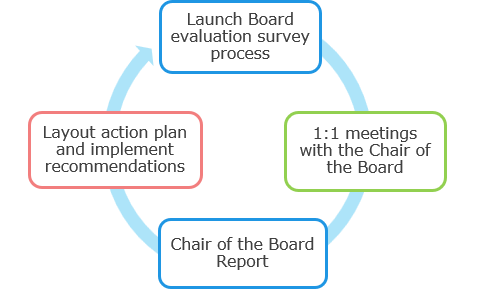
•First, the Governance Committee approves a confidential comprehensive Board evaluation questionnaire to solicit feedback from all the directors on the operation and effectiveness of the Board and its committees, the Chair of the Board and the committees, as well as their individual performance. The questionnaire includes questions regarding matters such as the Board structure and efficiency, the Board’s relationship with management, the adequacy of information provided to directors and agenda planning for Board and committee meetings. Once approved, the questionnaire is launched through the Office of the Corporate Secretary and completed by each of the directors.
•Second, once all evaluation questionnaires are submitted, the responses are analyzed by the Chair of the Board who then holds confidential one-on-one conversations with each director.
•Third, the Chair of the Board reports the results to the Governance Committee and the Board, as well as identifies areas of improvements to enhance the performance of the Board and of the committees.
•Lastly, the Board reviews and discusses the Chair of the Board’s report and approves an action plan, where relevant.
Nomination to the Board
NOMINATION PROCESS
When identifying potential director candidates, the Governance Committee and the Board Chair (who is also the Chair of the Governance Committee) focus on expanding and completing the Board’s overall knowledge, expertise and diversity, while maintaining a size that allows efficient functioning. Board renewal and succession planning is an item in the work program of the Governance Committee and is subject to regular discussions. In proposing a list of director candidates, the Board is guided by the process described in the Company’s Corporate Governance Guidelines.
The nomination process is as follows:
| | | | | |
NOVEMBER | The Governance Committee reviews and discusses the following items in connection with the composition of the Board and its committees: -the size of the Board and any considerations to increase or decrease it while aiming at maintaining a size that allows efficient functioning; -the voting results for the election of the directors at the last annual meeting of shareholders; -the Board skills matrix, with a focus on expanding and enhancing the Board’s overall knowledge, business expertise and industry experience, as well as set diversity targets to achieve and maintain, while giving careful consideration to each director’s record of attendance, independence status, financial acumen, business judgment, board dynamics, other diversity criteria (including age with regards to the Company’s retirement policy set forth in the Corporate Governance Guidelines) and their most recent director performance self-assessment; and -the potential need to retain a director search firm to assist in identifying director candidates that meet the Board’s objectives, where deemed necessary. |
NOVEMBER – JUNE | If applicable, the members of the Governance Committee, together with the Board Chair, identify potential director candidates to fill any vacancy or need on the Board and submit their proposed candidates to the Chair of the Governance Committee. |
If applicable, the Governance Committee Chair presents a list of potential candidates to the Governance Committee and selects one or more candidates to be approached by the Board Chair and the President and Chief Executive Officer. |
If applicable, the Board Chair, together with the President and Chief Executive Officer, meet with and interview each candidate to assess the candidate’s fit with the Board and his or her interest and willingness to serve on the Board, potential conflicts of interest, and ability to devote sufficient time and energy to the Board. |
JUNE – JULY | The Board Chair, together with the President and Chief Executive Officer, propose to the Governance Committee the director candidate(s) to be proposed as nominee(s) for election to the Board at the next annual meeting of shareholders, the Governance Committee approves their nomination, and the Governance Committee Chair reports the same to the Board. |
| The management proxy circular containing the nominees for election to the Board is proposed and approved by the Board. |
SEPTEMBER | The nominees to the Board are presented for election to the shareholders at the annual meeting of shareholders and each nominee is elected to serve as a director on the Board upon receiving a majority of votes in their favour. |
As part of the process, the Board Chair, in consultation with the Governance Committee, has developed a skills matrix based on types of business expertise and industry experience and diversity criteria, which aims at identifying gaps to be addressed in the director nomination process. Such process ensures that the skill set developed by directors, through their business expertise and experience, meets the needs of the Board.
For an overview of the competencies of each Nominee Director, together with their gender, age, geographical representation, Board tenure and underrepresented group they self-identify themselves to, where applicable, please refer to the Board Skills Matrix presented in the section entitled “Nominees for Election to the Board – Board Skills Matrix”. The Governance Committee reviews at least annually its skills matrix with the Board Chair with a view to (i) ensuring that the Board’s overall expertise and experience remain diversified, (ii) ensuring that the matrix itself remains accurate and relevant to the evolving needs of the Company, and (iii) filling any gaps so that the needs of the Board are met.
IDENTIFICATION OF POTENTIAL DIRECTOR CANDIDATES
The Governance Committee has the mandate to identify and recruit qualified director candidates and to make recommendations to the Board for their nomination for election
or appointment. The Chair of the Board and the President and Chief Executive Officer are consulted and have input throughout the selection process. The Board, however, retains the ultimate responsibility for giving its approval for its composition and size and the selection of candidates nominated for election or appointed as directors. An invitation to stand as a nominee director is made to a candidate by the Board through the Chair of the Board.
The Governance Committee is mandated to review annually the competencies, skills and personal qualities applicable to candidates to be considered for nomination to the Board. The objective of this review is to maintain the composition of the Board in a way that provides, in the judgment of the Board, an appropriate variety of skills and experience to overview the overall stewardship of the Company. Results of the Board assessment are taken into consideration when assessing the Board composition. For more details on such assessment, please refer to the section entitled “Board Renewal – Board Assessment”.
NOMINATION OF DIRECTORS FOR RE-ELECTION
Alithya’s Corporate Governance Guidelines provide that each director must have a combined attendance rate of 75% or more at Board and committee meetings to stand for re-election, unless exceptional circumstances arise such as illness, death in the family or other like circumstances, failing which such director must tender a written offer to resign. As of July 13, 2026, all Nominee Directors met such condition.
DIVERSITY
In an increasingly complex global market, the ability to draw on a wide range of viewpoints, backgrounds, skills, and experience is critical to the Company’s success. Further, diversity helps to ensure that a wide variety of different perspectives are brought to bear on issues, while enhancing the likelihood that proposed solutions will be nuanced, inclusive and comprehensive.
The Company believes that diversity at the Board, executive officer and senior management levels (and at all levels within the Company) can provide a number of potential benefits, including:
•access to a significant part of a potentially relevant talent pool that can contribute to and lead in a variety of technical and other functional areas;
•unique and tangible contributions, resulting from different perspectives, experiences, concerns and sensibilities, in finance, strategy, marketing, client relations, technology, mentoring and employee relations in a world of diverse clients and workforces;
•potential for richer discussion and debate that may ultimately increase effectiveness in decision-making and advising functions;
•increased likelihood that the perspectives and concerns of all stakeholders are represented in discussions; and
•signaling Alithya’s values to various stakeholders, including employees at all levels, shareholders, clients, communities, regulators and other government officials, and the public.
The Board believes that diversity of personal characteristics such as age, gender, origin, geographical representation and culture is an important attribute of a well-functioning Board. Alithya believes that increasing the diversity of the Board to
reflect the communities and clients Alithya serves is essential in maintaining a competitive focus and that a diverse board also signals that diverse perspectives are important to the Company, and that Alithya is committed to inclusion.
The Governance Committee, which is responsible for recommending director candidates to the Board, considers candidates on merit, based on a balance of skills, background, experience, knowledge and personal characteristics. Alithya has adopted a written policy on Board diversity which is contained in its Corporate Governance Guidelines and which initially set as a target that at least 30% of directors on the Board should self-identify as women and that there should be at least one director who self-identifies as a member of a visible minority, an Indigenous person or a person with a disability by the end of fiscal 2024 and to maintain such minimum level of diversity and deploy efforts to increase diversity when opportunities arise. Such target was met by the end of fiscal 2024 with 33⅓% of the Board self-identifying as women and at least one director self-identifying as a person of a visible minority. At the end of fiscal 2026, 37.5% of the Board self-identified as women and one director self-identified as a person of a visible minority. The Governance Committee considers the level of representation of women and other diversity groups on the Board by overseeing the selection process and ensuring that women and other diverse candidates are included in the list of candidates proposed to the Board as potential directors.
The table below outlines information on the voluntary self-identified gender and other diversity groups of the Company’s Nominee Directors:
| | | | | | | | | | | | | | |
BOARD DIVERSITY MATRIX |
Total Number of Nominee Directors: | 8 |
Gender Diversity | Female | Male | Non-Binary | Did Not Disclose |
Nominee Directors | 3 | 5 | - | - |
Other diversity groups |
Person of a visible minority | 1 |
Indigenous person | - |
Person with a disability | - |
Did Not Disclose | - |
MAJORITY VOTING POLICY
The Board has adopted a policy, which forms part of our Corporate Governance Guidelines, to the effect that any nominee director who receives a greater number of votes “withheld” than votes “for”, with respect to the election of directors by shareholders, shall tender his or her resignation to the Board promptly following the meeting of shareholders at which the director was elected. The directors, other than those who also received a majority withheld vote at the same election, shall consider and, within 90 days following the election, determine whether to accept the resignation. The Board will make its decision and promptly announce it in a press release within 90 days following the shareholders meeting, a copy of which will be provided to the TSX. The Board shall, however, accept such resignation absent exceptional circumstances and the resignation shall be effective when accepted by the Board. This policy only applies in circumstances involving an uncontested election of directors. An “uncontested election of directors” means that the number of director nominees is the same as the number of directors to be elected to the Board.
ADVANCE NOTICE BY-LAW
As per sections 26 to 32 of the Company’s by-laws, only persons who are nominated in accordance with the procedures contained therein shall be eligible for election as directors of the Company. Such nomination process sets a deadline before a shareholders’ meeting for a shareholder to notify the Company of his, her or its intention to nominate directors, and lists the information that must be included with such nominations’ notice to be valid. Such provisions apply at any shareholders meeting that was called for the election of directors but may be waived by the Board at its sole discretion.
The Board believes that this requirement establishes a transparent and fair process for all shareholders to follow if they intend to nominate directors, and allows all shareholders, including those participating by proxy, to have sufficient time and information before they vote for the election of directors. It is also intended to facilitate an orderly and efficient meeting process. A copy of the Company’s by-laws, including the advance notice provisions, is available on the Company’s website at www.alithya.com, on SEDAR+ at www.sedarplus.ca and on EDGAR at www.sec.gov.
Director Orientation and Continuing Education
The Governance Committee is mandated to oversee an orientation and education program for new directors and ongoing educational opportunities for all directors as required.
ORIENTATION
Our orientation program includes (i) meetings with members of Alithya’s executive officers, including the President and Chief Executive Officer, the Chief Financial Officer, the Chief Operating Officer, the Chief Human Capital Officer, the Chief Information Officer, and the Chief Legal Officer and Corporate Secretary, to discuss Alithya’s business and strategic plan and ensure that new directors benefit from an in-depth understanding of the Company’s organizational structure and the nature and operation of its business, including the Company’s reporting structure, strategic plan, enterprise risk management program, compensation frameworks as well of its relationship with its external auditor, and (ii) meetings with the Board Chair to discuss the role of the Board and its committees, as well as of the Board Chair, and to discuss the contribution individual directors are expected to make.
New directors are provided with a reference manual containing corporate and other information required to familiarize themselves with the Company, its organization and operations and Alithya’s key corporate governance and public disclosure documents, including Alithya’s Corporate Governance Guidelines, and Board and committee mandates; information regarding its committees and their Chairs, and individual directors; Alithya’s material policies and procedures; as well as organizational charts and more.
In addition, new directors are invited to visit Alithya’s offices for a better understanding of day-to-day management of the Company’s operations.
CONTINUING EDUCATION
Considering the rapidly changing technology and competitive environment in which the Company operates, the Board and the Governance Committee recognize the importance of ongoing director education and the need for each director to take personal responsibility for this process.
To facilitate ongoing education, the Company’s management team:
•provides to the Board quarterly reports on the operations and finances of the Company, as well as on its operating markets, the industry in general and the competitive environment in which it operates, and an annual in-depth review of the operations of the principal divisions of the Company;
•regularly updates the Board and its committees on material developments related to topics of interest, including changes in law and regulatory requirements, new trends, industry news and other matters of interest by making presentations to the relevant committee(s) and/or the Board, as applicable, and circulating, on an ad hoc basis, relevant information , including articles, reports and studies, for their information and to initiate discussions; and
•organizes, when deemed necessary, presentations by outside experts to the Board or committees on matters of importance or emerging significance.
The following activities were conducted during fiscal 2026:
| | | | | | | | | | | |
DATE | TOPICS | PRESENTERS | ATTENDEES |
June 2025 | Cybersecurity | Management | Audit Committee |
June 2025 | Recent Legal Developments (including on best practices trends) | Management | Governance Committee |
August 2025 | Brazil Macroeconomic and Political | External consultant | Board |
August 2025 | Cybersecurity | Management | Audit Committee |
August 2025 | Recent Legal Developments | Management | Governance Committee |
November 2025 | Data Privacy Update | Management | Board |
November 2025 | Corporate Sustainability Update | Management | Board |
November 2025 | Recent Legal Developments | Management | Governance Committee |
February 2026 | ESG Landscape | Management | Board |
February 2026 | Recent Legal Developments (including on reporting for foreign private issuers) | Management | Governance Committee |
February 2026 | Impacts of AI on board conduct and governance | Management | Governance Committee |
February 2026 | Cybersecurity | Management | Audit Committee |
March 2026 | Company Divisions Overview | Management | Board |
The directors also have regular access to the Company’s executive officers to discuss Board presentations and other matters of interest and are encouraged to attend Company events relevant to their understanding of the Company’s business, affairs and culture, including internal annual meetings of employees, leadership training sessions and other events on an ad hoc basis. In fiscal 2026, the Company held a showcase event during which the directors had the opportunity to meet and discuss with members of senior management and selected employees and learn more about key initiatives.
The directors are also encouraged to attend conferences, seminars or courses whether they be industry-specific to Alithya or relevant to fulfill their role as directors, such as the conferences of the Institute of Corporate Directors, the cost of which is borne by Alithya.
Talent Management and Succession Planning
Effective talent management, leadership development, succession planning, and employee engagement remain key priorities for the Board and the Compensation Committee. A comprehensive framework, focusing on the identification, assessment, and development of talent and high potential employees is used to ensure a strong and diverse pipeline of potential successors at the executive and management levels.
Alithya prepares talent for broader and more complex roles by tailoring development plans and providing meaningful, high-impact experiences. When required, the Company may also use external hiring to address succession gaps and procure critical skills.
The Compensation Committee receives regular updates on talent and leadership development across all functions, including the readiness and diversity of succession pools for key leadership roles across Alithya. A complete review of the contingency as well as short-, medium- and long-term succession plans for executive officers and senior management is conducted annually, and detailed plans to address identified gaps are reviewed.
In fiscal 2026, Alithya strengthened its focus on the identification and development of future leaders to ensure effective succession planning for a strong talent pipeline.
Alithya continues to evolve its career development programs to provide targeted training and practical work experience that will support the development of talent.
The Compensation Committee periodically reviews succession plans for the position of President and Chief Executive Officer and other senior leadership roles and makes recommendations to the Board, as needed, with respect to the selection of potential candidates to occupy these positions, when required.
EXECUTIVE OFFICERS AND SENIOR MANAGEMENT DIVERSITY
The Company continues to place emphasis on identifying and developing high performing, high potential talent, with particular focus on strengthening the pipeline of women in leadership roles and supporting their advancement through targeted development opportunities.
Alithya recognizes the importance of having a diverse senior management team which offers a depth of perspectives and enhances the Company’s operations. In fulfilling part of its oversight role, the Compensation Committee periodically reviews Alithya’s integrated approach applicable to executive officers and senior management positions and its talent management and succession planning. The Compensation Committee considers processes and practices for leadership development and reviews the depth of succession pools for senior management positions across the Company, while taking into consideration a diversity of personal characteristics (gender, age, origin, background, geographical representation, and expertise).
Alithya is committed to creating an environment of inclusion that respects the contributions and differences of every individual by encouraging collaboration, creative thinking and innovation. Alithya’s core values recognize the importance of all its people, regardless of gender, beliefs or origin. We also believe in diversity of perspectives and thought and that providing a safe environment to exchange these ideas will enable Alithya to embrace an organizational culture of respect. Instead of adopting specific gender diversity targets and
diversity targets for underrepresented groups at the executive officer and senior management levels, Alithya promotes an inclusive and diverse talent attraction approach that embraces our vision and objective of fostering diversity, including gender and other underrepresented groups, and providing opportunities for their development and advancement.
To promote diversity and develop a healthy pipeline of women, Alithya:
•implements development plans for high-potential women;
•ensures pay equity;
•actively seeks the talent attraction of women;
•monitors the number of women in senior management positions and those in the pipeline as future leaders;
•holds ongoing events and communications to celebrate and promote diversity and encourage
employees to foster our diversity and our culture of inclusion; and
•connects identified high potential women with senior leaders to accelerate their development and advancement.
As at March 31, 2026, women represented approximately 20% of Alithya’s NEOs and 25% of Alithya’s overall senior management team (which group includes the members of the Executive Committee, senior vice presidents and vice president positions). As at July 13, 2026, women still represented 20% of Alithya’s NEOs.
Shareholder engagement by Management
The Company has a disclosure policy (the “Disclosure Policy”) which sets guidelines regarding communications with its stakeholders, including shareholders, employees, analysts, the media, institutional investors, governments and the public. For more details on our disclosure policy, please refer to the section entitled “Ethical Business Conduct – Disclosure Policy”.
Through our Disclosure Policy and procedures, the Company engages and communicates with shareholders and other stakeholders on an ongoing basis and through various channels, including by the dissemination and filing of news releases and other continuous disclosure documents, the posting of diverse publications on its website at www.alithya.com and the holding of periodic meetings with shareholders, financial analysts and members of the financial community in accordance with applicable securities laws and stock exchange rules.
Conference calls are also held with the investment community on a quarterly basis to review the financial results and the business strategy of the Company, and the President and Chief Executive Officer, Chief Operating Officer and the Chief Financial Officer are regularly invited to speak at such conferences.
The Company is committed to meeting with shareholders and listening to their opinion and feedback and understanding their concerns. Shareholders may communicate with the Company
in this regard by email at investorrelations@alithya.com or by mail at:
Investor Relations
Alithya Group inc.
700, René-Lévesque Blvd West
Suite 400
Montréal, Québec, H3B 1X8
Tel.: 1-844-985-5552
Shareholder engagement by Directors
The Company’s shareholders are a pillar of its governance structure and processes. Shareholders are invited to attend and ask questions to the Chair of the Board at each annual meeting of shareholders. At each annual meeting of shareholders, they are also given the ultimate power to elect the directors and to give them the mandate to oversee the management of the Company for the next year.
The Company also has a majority voting policy further to which any director who receives a greater number of votes “withheld” than votes “for”, with respect to their election as director, shall tender his or her resignation to the Board promptly following the meeting at which the director was elected. For more details on our majority voting policy, please refer to the section “Board of Directors – Nomination to the Board – Majority Voting Policy”.
Alithya’s strategic process starts with an agile approach to aligning its offerings with the most pressing challenges in the sectors it serves. This approach continuously strengthens its foundational trusted relationships with its clients, employees, investors and partners.
Led by the President and Chief Executive Officer, the management team works with the Board to set a three-year strategic business plan from which is derived an annual business plan. The Board and management meet regularly to discuss strategy, and the President and Chief Executive Officer seeks insight from each director.
At each regularly scheduled Board meeting, the President and Chief Executive Officer and the Chief Operating Officer, update
the Board on the execution of the business strategy and related matters. These updates cover industry trends, growth initiatives, financial forecast, risks and opportunities, and mergers and acquisitions prospects.
These regular discussions enable the Board to stay informed about market and industry trends and ensure the alignment of Alithya’s business strategy. One Board meeting each year is also dedicated to discussing business strategy. During this meeting, leaders from Alithya’s various divisions present the opportunities and challenges their teams and markets face. At this meeting, the Board also approves the budget for the upcoming fiscal year and, if applicable, the three-year strategic plan.
In March 2026, the Board held this meeting entirely focused on strategy and approved the budget for the fiscal year ended March 31, 2027 (“fiscal 2027”). The Board also engaged in in-depth discussions about Alithya’s business offerings, its
artificial intelligence (“AI”) and smart-shoring capabilities and initiatives, and its strategic positioning related to customer-driven trends, risks and opportunities.
Alithya operates in an environment that presents a variety of risks and uncertainties and is affected by a number of factors which could have a material adverse effect on its business, financial condition and results of operations, cash flows, business or reputation. Alithya’s risk management strategy is aligned with its business strategy and its activities are conducted with the understanding that appropriate risk-taking and effective management of risks are necessary and integral to achieving strategic objectives and managing business operations.
The Board has delegated the oversight of specific risks to the Board committees, each responsible for monitoring risks within their designated areas of responsibility, as detailed in the table below. The committee chairs, along with management, regularly update the Board on these risks and the effectiveness of the controls in place to mitigate them.
| | | | | | | | |
Audit Committee | Compensation Committee | Governance Committee |
Oversees the enterprise risk oversight practices, as well as financial and cybersecurity risks and risks related to artificial intelligence | Oversees executive compensation, executive talent management strategy and succession risks | Oversees governance risks, corporate sustainability risks and overall risk disclosure |
Early identification of risks helps Alithya to be proactive and prevent major incidents and adverse consequences. The Board continually aims at enhancing its risk oversight and gaining a better understanding of management’s enterprise risk oversight practices, processes and controls.
Alithya’s management and discussion analysis for fiscal 2026 provides the list of risks that Alithya currently believes could
materially affect it. They are grouped in the following categories:
•risks related to the market: includes risks arising from the market in general and which could have a material impact on Alithya’s business;
•risks related to Alithya’s business: includes risks specific to the way in which Alithya’s business is structured and operates;
•risks related to Alithya’s industry: includes risks to which companies providing digital technology consulting services are subject to; and
•risks related to subordinate voting shares and liquidity: includes risks specific to holding subordinate voting shares and liquidity.
In addition to its general risk review, in fiscal 2026, the Audit Committee and the Board focused on risks relating to the market, the industry and the economy in general, in light of ongoing economic and geopolitical uncertainty in the North American market, as well as risks associated to cybersecurity and artificial intelligence. Oversight of risks related to corporate sustainability matters was also a core discussion at all Board committees, as well as at the annual meeting of the Governance Committee with the chair of each other Board committee during which corporate sustainability initiatives and strategy are discussed.
Alithya strives to be a model of corporate responsibility and is committed to implementing progressive corporate sustainability initiatives that meet the expectations of its stakeholders, and which embody the social consciousness of its employees and the communities in which it operates.
A comprehensive overview of Alithya’s corporate sustainability strategy and priorities and update on the progress of specific initiatives is available in a report published by Alithya in September 2024. The below outlines Alithya’s Board and management oversight of corporate sustainability matters and fiscal 2026 highlights.
Board and Management Oversight
Alithya’s Board is responsible for the oversight of corporate sustainability matters. To perform its duties, it relies on the assistance of the Board committees which have specific roles in relation to Alithya’s five material topics. Of note, the Governance Committee is responsible for overseeing Alithya’s overall corporate sustainability and other public disclosure, as well as monitoring the Company’s approach to governance. It provides oversight over corporate sustainability initiatives and monitors progress. The Governance Committee meets at least annually with the Chairs of the Audit Committee and the Compensation Committee to review developments, assess
performance and reports to the Board on strategic priorities for the year.
The Board and its committees work closely with Alithya’s executive team, which is actively engaged in ongoing initiatives, to determine those which are most material to Alithya and its stakeholders. Alithya’s executive team is responsible for developing Alithya’s corporate sustainability strategy, as well as for identifying and managing its corporate sustainability priorities. Alithya’s executive officers play a leadership role in managing its priorities and provide functional oversight of priority areas, with coordination led by the Chief Legal Officer and Corporate Secretary.
Please refer to the chart below for an overview of Alithya’s sustainability governance structure as at July 13, 2026:
Material Topics and Recent Developments
TALENT
Alithya places a strong emphasis on human capital, recognizing that employee development and well-being are essential to the Company’s success. Alithya provides employees with the resources they need to thrive, supporting both their professional growth and personal wellbeing. By fostering a collaborative and inclusive culture that encourages ownership, accountability and continuous learning, Alithya seeks to invest in developing leaders, strengthen organizational capabilities, and empower employees to shape their own career path within the Company.
Alithya is also committed to cultivating a diverse and socially responsible workforce and has implemented programs aimed at supporting employee well-being that promote an inclusive, supportive and engaging work environment, including the following programs and opportunities:
•Udemy Online Platform: an external partner providing training and development courses on various topics,
including technical and soft skills as well as management development;
•Alithya Leadership Academy ("ALA") & Leading@Alithya as a People Manager ("LPA"): developed in partnership with McGill University and Alithya ambassadors, these programs support leadership development across the organization globally. The ALA focuses on building leadership capabilities while the LPA equips managers with practical tools to effectively lead and support their teams;
•The A Effect: an external partner program supporting the advancement of women through initiatives that strengthen leadership capabilities, build confidence and enhance strategic influence;
•PROLANG: an external partner program that provides French and English language training accessible to all employees;
•Lunch and Learn Webinars: employee-led sessions on relevant topics, including wellness programs, financial planning, and the employee management cycle, etc.;
•Alithya Wellness Portal: an external platform which provides a wide range of resources, tools, and services for employees to address their physical, mental, emotional, financial and social well-being; and
•Voice of the Employee Portal: an external platform for ongoing employee engagement surveys, providing employees the opportunity to address ongoing issues and share their sentiments on the main drivers of engagement and workplace priorities.
Alithya promotes an equitable and inclusive workplace that reflects diverse perspectives across its global workforce. This focus is reflected in the Company's talent attraction, development and succession planning processes. 37.5% of the directors nominated for election at the Meeting self-identify as women and, as at March 31, 2026, women represented approximately 20% of Alithya’s NEOs and 25% of Alithya’s overall senior management team (which group includes the members of the Executive Committee, senior vice presidents and vice president positions). Please refer to the section entitled “Executive Officers and Senior Management Diversity” for more details.
Advancing women and supporting underrepresented groups remain key priorities for the Company, supported through various initiatives such as:
•Employee Resource Groups, including the Empowering Women at Alithya Committee, the Indigenous Relations Committee and the LGBTQ+ Committee;
•Participation in the Women in Governance's parity program, with a Silver certification in Canada and Bronze certification in the United States; and
•Participation in the Progressive Aboriginal Relations program, for which the Company has received the Bronze Certification.
ORGANIZATIONAL CULTURE
For over 30 years, Alithya has built its culture on core values such as trust, respect, integrity, creativity, well-being, and passion. These values are reinforced through a sense of accountability and by empowering individuals to live these values in their daily work and interactions. While Alithya focuses on innovation, excellence, and helping clients reach
their business objectives, its values-based framework supports such focus by shaping its global recruitment strategies and acquisition approach. This ensures that new integrations not only deliver value but also strengthen the Company’s culture.
CYBERSECURITY AND DATA PRIVACY
Customer confidence is essential for building the reputational capital that Alithya needs to ensure the longevity of its business. Accordingly, as a trusted advisor in delivering digital transformation services, Alithya’s commitment to being a model of cybersecurity and data privacy starts within. Alithya’s business model depends on the effective management of its own systems and data.
As the risk of cyber-attacks intensifies, the need to proactively deploy systems that protect employees and customers is vital. Internally, Alithya monitors its network and tracks security events, incidents, and potential threats in near real time within a security management framework based on ISO 27001 standards. This framework provides a full overview of risks and responses based on asset classification, with vigilant monitoring of assets, external threats and attacks, system vulnerabilities, and internal risks. Key initiatives of the Company’s cybersecurity and data privacy culture program include the following:
•the implementation, review and regular improvements of frameworks, policies, processes, standards and controls to maintain information security, data privacy, physical security and business continuity;
•the implementation of policies and procedures to prevent, detect, investigate, respond to and mitigate security breaches; and
•the deployment of security awareness campaigns and trainings on security and data privacy risks.
TRANSITIONING TO A LOWER-CARBON ECONOMY
Alithya recognizes that a successful global transition to a lower-carbon economy relies on the collective efforts of all organizations. As such, the Company acknowledges its responsibility to operate sustainably, both by aiming to meet stakeholder expectations and by minimizing the environmental impact of its products and services as part of the global shift to a lower-carbon economy.
As a service provider in the digital transformation space, Alithya operates with a relatively low-carbon footprint, while being mindful of the use of energy-efficient infrastructure, adoption of hybrid work models, virtual service delivery, and other sustainable business practices. Additionally, the Company supports customers as they transition toward lower-carbon operations.
The Company’s environmental program ongoing or planned key initiatives include the following:
•calculating the Company’s carbon footprint with the help of an accredited third party, in accordance with the principles and requirements of ISO 14064-1:2018 and of the GHG Protocol;
•promoting the efficient use of energy and natural resources through initiatives such as waste reduction programs and recycling efforts, and the collection of specific office and personal items for recycling at company locations;
•encouraging the use of electronic documents over paper;
•minimizing the use of non-recyclable items at its office; and
•promoting and facilitating remote work opportunities, including hybrid options.
GOVERNANCE
Alithya upholds strong corporate governance policies and guidelines and regularly reviews them to ensure alignment with industry best practices. The Board and the Governance
Committee actively monitor governance standards in both Canada and the U.S., making updates as needed to meet new requirements from the Canadian Securities Administrators and other applicable regulatory authorities. In addition, Alithya considers recommendations from voting agencies and other governance organizations, adopting practices that serve the best interests of the Company and its stakeholders.
Committed to maintaining and instilling a strong ethical culture, the Board and the Company’s management adopted codes and policies to provide a framework for ethical behaviour based on our values, applicable laws and regulations. This section summarizes key significant corporate-wide policies.
Codes of Business Conduct
CODE OF BUSINESS CONDUCT
The Company has a code of business conduct (the “Code of Business Conduct”) which sets out uniform foundation for the way all directors, officers, employees and subcontractors of the Company and its subsidiaries shall conduct themselves in their role at Alithya, including standards regarding ethics and business practices.
The Company expects everyone working on its behalf to comply with applicable law and adhere to the highest ethical standards. The Code of Business Conduct, together with the other Company policies it refers to, addresses many important topics and sets Alithya’s expectations in connection therewith, including with regard to: (i) respect, inclusiveness and fairness, (ii) health, safety and forced labour, (iii) drugs, alcohol and impairment, (iv) privacy, (v) environment, (vi) conflicts of interest, (vii) outside activities and employment, (viii) gifts and other benefits, (ix) anti-corruption and anti-bribery, (x) fair competition and anti-trust, (xi) money laundering, criminal activities, and economic sanctions, (xii) external communications, (xiii) protection and proper use of Company and clients’ assets, (xiv) intellectual property, (xv) cybersecurity and the responsible use of data and new technologies, (xvi) confidentiality, (xvii) insider trading, (xviii) community engagement, (xix) political activities, (xx) lobbying, (xxi) compliance with laws, and (xxii) reporting of any illegal or unethical behaviour.
The Governance Committee reviews at least annually and, where deemed necessary, recommends to the Board amendments to the Code of Business Conduct and other material policies to ensure they remain consistent with current industry reality, standards and trends, clearly communicate Alithya’s organizational mission, values, and principles, and serve as reference guides for employees to govern everyday business conduct and decision making.
Exceptions and waivers from the provisions of the Code of Business Conduct for directors or executive officers may only be made by the Board upon recommendation from the Governance Committee and exceptions and waivers for employees and subcontractors may only be made by the Chief Legal Officer and Corporate Secretary. As of July 13, 2026, no waiver had been granted to a director or executive officer in connection with the Company’s Code of Business Conduct.
Management periodically reports to the Governance Committee on compliance with the Code of Business Conduct within the
organization and the Governance Committee reviews management’s monitoring of such compliance. The Governance Committee also oversees the disclosure relating to the Company’s Code of Business Conduct.
Employees and subcontractors are required to perform their tasks or mandates with fairness and integrity, to contribute to the achievement of the Company’s goals to the best of their abilities and make decisions without compromise. Employees are expected to report any real or potential violation of the Code of Business Conduct.
SUPPLIER CODE OF BUSINESS CONDUCT
Alithya also has a Supplier Code of Business Conduct that applies to suppliers who are not otherwise subject to the Code of Business Conduct. Alithya believes this is necessary to ensure that its suppliers follow rigorous ethical and socially responsible practices and support its core values of trust, respect, well-being, and integrity. The Supplier Code of Business Conduct applies to all suppliers of goods and services. It outlines standards and expectations similar to those set forth in the Code of Business Conduct.
WHISTLEBLOWER POLICY
The Board also has a whistleblower policy that puts in place a communication channel for (i) the reporting of actual or suspected unethical conduct or improper activities such as accounting, auditing or other financial reporting fraud or misrepresentation, violations of laws that could result in fines or damages, or that could adversely impact Alithya’s reputation, unethical business conduct in violation of the Code of Business Conduct or any Alithya policies or our clients’ code of conduct and policies, or danger to the health, safety or well-being of our professionals and/or the general public, and (ii) contacting the Chair of the Audit Committee who oversees the Company’s Whistleblower Policy.
The Company’s Code of Business Conduct and related policies are available on our website at www.alithya.com.
Related Party Transactions
Under the Company’s Code of Business Conduct, directors, officers and employees are required to refrain from any undertakings that would place them in a conflict of interest. Every director and executive officer is also required to disclose any direct or indirect interest they have in any organization, business or association, which could place them in a conflict of interest.
Each year, the directors and executive officers of the Company complete a questionnaire that requests them to list every organization where they serve as a director, officer or hold a similar position, as well as any entities over which they exercise control or significant influence and which have conducted transactions with Alithya.
The purpose of such questions is to identify potential conflict of interest and related party transactions. The Board annually reviews a list of the principal occupation and outside interests (e.g. directorships and officerships) of the Company’s directors and officers as well as related-party transactions, and discusses actions to be taken if conflicts of interests or related-party transactions are identified. The Corporate Governance Guidelines also provide that a non-management director who makes a major change in his or her principal occupation shall promptly disclose this information to the Board and submit, where his or her interests could be perceived as in conflict with those of the Company, his or her resignation to the Board for consideration. It is not intended that non-management directors who retire or whose professional positions change should necessarily leave the Board. Rather, the Board believes it is appropriate in such circumstances to conduct a review, with the assistance of the Governance Committee, of the continued appropriateness of Board membership under such circumstances.
Any director or officer that has a material interest in a transaction or agreement involving Alithya must disclose their interest to the Chair of the Board or the President and Chief Executive Officer. Should there be a discussion or decision relating to an organization, business or association in which a director or executive officer has an interest, such director or executive officer will not be allowed to participate or vote in any such discussion or decision.
In fiscal 2026, no transaction was entered into between Alithya and a director or executive officer.
Insider Trading Policy
The Company has an insider trading policy (“Insider Trading Policy”) designed to prevent directors, officers, employees and subcontractors of Alithya from buying, selling, or otherwise trading in securities of Alithya when in possession of undisclosed material information related to Alithya, and from disclosing such information to anyone or recommending anyone to trade in securities of Alithya when in possession of such information.
In order to reduce appearance of improper trading, directors, executive officers and certain other officers and employees designated from time to time by the Chief Legal Officer and Corporate Secretary are prohibited from buying, selling or otherwise trading in securities of Alithya, including exercising options on securities of Alithya, during regular black-out periods which start on the first day that follows the end of a quarter and end two full trading days after the Company’s financial results have been made public. Special black-out periods may also be declared if there are pending material developments with respect to Alithya, or for any other reason determined by the President and Chief Executive Officer and the Chief Legal Officer and Corporate Secretary. Reporting insiders who wish to buy, sell or otherwise trade in securities of Alithya, including exercise options on securities of Alithya, may only do so after clearing such trades with the Chief Legal Officer and Corporate Secretary.
The Company’s Insider Trading Policy also prohibits directors, officers, employees and subcontractors from engaging in hedging activities or any other arrangements that are designed to hedge or offset a decrease in market value of any securities of Alithya. The restriction applies to all forms of derivatives, including "calls", "puts" and "short sales".
Disclosure Policy
As stated in the Corporate Governance Guidelines of the Company, the Board believes it is a function of management to speak for the Company in its communications with its stakeholders, including shareholders, employees, analysts, the media, institutional investors, governments and the public in general. As such, the Company has adopted a disclosure policy (“Disclosure Policy”) which establishes a committee (“Disclosure Committee”) comprised of the President and Chief Executive Officer, the Chief Financial Officer, the Chief Operating Officer, the Chief Legal Officer and Corporate Secretary and a designated representative of Alithya’s Communications Department, and which is responsible for ensuring that the Company’s public communications with its stakeholders and documents it files with regulators are timely, accurate and broadly disseminated, in accordance with applicable legal and regulatory requirements. The Disclosure Policy establishes procedures for the verification of the accuracy and completeness of information disclosed publicly and other guidelines dealing with various matters including confidentiality, material information, news releases, conference calls, electronic communications and rumours.
Clawback Policy
The Company has a clawback policy (“Clawback Policy”) which allows it to seek repayment of incentive compensation received by a current or former (i) Chief Executive Officer, (ii) executive officer, (iii) senior officer, and (iv) any employee as determined by the Board (each, a “Covered Person”).
Under the Clawback Policy, the Board may, in its sole discretion, direct the Company to recoup, in part or in full, the benefit received by a Covered Person as a result of incentive compensation awarded under the Company’s short- and long-term incentive plans, in the following situations:
•in the event of an accounting restatement of any interim or annual consolidated financial statements of the Company, which includes accounting restatements to correct a material non-compliance with financial reporting requirements, if the Covered Person engaged in Misconduct (as defined hereinafter) which caused or contributed to said restatement, received an incentive compensation that would have been lower had the financial statements been properly reported (a “Restatement”);
•the Covered Person was involved in misconduct, including (i) fraud, or (ii) intentional and/or reckless non-compliance with applicable laws, rules or regulations, or the violation of the Company’s Code of Business Conduct, or (iii) any failure to report or take action to stop the same of another individual in respect of which the Board reasonably determines that the Covered Person had actual knowledge or was willfully blind (“Misconduct”); or
•it is required by applicable laws or regulations, stock exchange rules or a regulatory agency having jurisdiction, in which case, those shall govern and supersede the Clawback Policy.
In the event of a Restatement, recoupment may target all incentive compensation paid, granted or awarded to, or received or earned by, or vested in favour of, the Covered Person during the current fiscal year and three completed fiscal years that immediately precede the date on which the Board
determined a Restatement is required, In the event of a Misconduct not giving rise to a Restatement, recoupment may target incentive compensation paid, granted, awarded to, or received or earned, or vested in favour of, the Covered Person during the 24 months preceding the date on which the Board determined that the Misconduct occurred and any award that was exercised, settled or paid after the Misconduct.
Recoupment under the Clawback Policy may be effected through deduction from any amounts or grants due or to be paid to the Covered Person, cancellation or forfeiture of the Covered Person’s outstanding share-based awards, as well as requiring direct reimbursement from the Covered Person.
Compensation Discussion and Analysis
| | |
LETTER FROM THE CHAIR OF THE HUMAN CAPITAL AND COMPENSATION COMMITTEE |
On behalf of the Human Capital and Compensation Committee (the “Compensation Committee”), I am pleased to provide an overview of Alithya’s executive compensation framework for fiscal 2026.
Compensation Philosophy and Objectives
At Alithya, attracting and retaining talented and engaged employees is critical to our long-term success. Our executive compensation strategy is designed to provide competitive total rewards, combining base salary with short- and long-term incentives linked to performance measures aligned with our strategic priorities. The approach supports the creation of sustainable shareholder value, while maintaining a balanced and disciplined framework that discourages excessive risk-taking.
Compensation Framework
The Compensation Committee remains committed to aligning executive officers’ interests with those of our shareholders and continues to monitor our programs to ensure they reflect sound governance and market practices. Following the comprehensive review conducted in fiscal 2025, supported by Willis Towers Watson (“WTW”), which assessed the design and competitiveness of Alithya’s executive compensation framework against an updated comparator group of Canadian and U.S. companies, no changes were made to the framework in the current year.
Following the review conducted in fiscal 2025, the Compensation Committee recommended, and the Board approved, certain enhancements to strengthen alignment between executive compensation and long-term value creation:
•Long-Term Incentive Structure: A balanced mix of long-term incentives vehicles, including: restricted share units (“RSUs”) and performance share units (“PSUs”).
•Compensation Mix: Greater emphasis on long-term compensation.
•Short-Term Incentive Adjustments: Revised weighting among enterprise and divisional performance criteria within short-term incentive plan.
•PSU Metrics: Performance metrics based on three-year cumulative organic growth and, for members of the executive committee (the "Executive Committee"), M&A-driven growth, measured through revenues and Adjusted EBITDA.
To align with the updated comparator group, the Compensation Committee established a target positioning whereby cash compensation (base salary and short-term incentives) is set at the median of the comparator group, while long-term incentives are anchored around the 25th percentile, resulting in a total direct compensation positioned between the 25th percentile and the median of the comparator group. As outlined in previous years, WTW recommended a progressive three-year approach to gradually increase long-term incentive targets towards the median. As no changes were made in the current year, this approach remains in place. The level of
progression for the fiscal years ending March 31, 2026 and March 31, 2027 is not formulaic and continues to be subject to the discretion of the Compensation Committee and the Board, taking into account the Company’s performance against its three-year strategic plan.
Fiscal 2026 Performance Highlights
In fiscal 2026, the executive leadership team delivered solid performance across key metrics, including margin, expansion of higher-value service offerings, enhanced operational efficiencies, and disciplined execution for strategic priorities. The leadership team continued to advance the Company's long-term strategy while completing a strategic acquisition and managing ongoing global geopolitical and market uncertainties with rigour.
These outcomes were reflected under the Company’s incentive programs. In select cases, the Compensation Committee also approved limited additional recognition to acknowledge exceptional contributions related to strategic transactions, consistent with the framework established in prior years.
Overall, the Compensation Committee remains focused on maintaining a strong alignment between pay and performance, supporting the retention of talent, and reinforcing the creation of sustainable shareholder value.
Fiscal 2027 Outlook
For fiscal 2027, the Compensation Committee maintained the executive compensation framework introduced in fiscal 2025 with no structural changes to the program. In line with the progressive three-year approach outlined at that time, the Compensation Committee approved a measured-increase in long-term incentive targets for Executive Committee members. RSUs, DSUs and PSUs were granted under the share unit plan (“SUP”). The Compensation Committee and the Board remain confident that this unchanged framework continues to support our pay-for-performance philosophy and the effective execution of our strategic priorities.
We welcome your feedback on our compensation programs and disclosure.
Sincerely,
Lucie Martel
Chair of the Human Capital and Compensation Committee
| | |
EXECUTIVE COMPENSATION FRAMEWORK |
Executive Compensation Approach
The Company’s executive compensation framework is designed to attract, retain and motivate high-performing executive talent, while also incorporating effective risk management measures and strong governance practices. This approach supports the Company’s strategy and its commitment to generating sustainable value for shareholders.
The Compensation Committee is responsible for defining and approving the Company’s executive compensation framework guided by the following objectives:
•attract and retain executives having the knowledge, expertise and leadership required to develop and execute business strategies to create long-term value for shareholders;
•offer a total compensation package, which includes a market-competitive equitable base salary, short- and long-term incentives, and benefits;
•ensure that long-term incentives are a significant component of total compensation; and
•reward based on achievable goals and performance metrics that support the successful execution of Alithya’s strategic plan.
The Company’s executive compensation framework comprises the following elements: (i) base salary; (ii) short-term incentives; (iii) long-term incentives; and (iv) other elements, such as Employee Share Purchase Plan (“ESPP”) employer contributions, group benefits and limited perquisites.
To support its objective of maintaining competitive executive compensation, the Company aims to progressively position total direct compensation at approximately the median of its comparator group by the fiscal year ending March 31, 2027, subject to the Company’s performance as set in its three-year strategic plan. For more details on how compensation is reviewed and the comparator group, please refer to the section “Compensation Review Process”.
RISK MITIGATION IN OUR COMPENSATION FRAMEWORK
As part of its mandate, the Compensation Committee carefully evaluates and addresses any elements of the executive compensation program that could encourage inappropriate or excessive risk-taking, or that could negatively impact the Company. With the support of independent consultants, as appropriate, the Compensation Committee regularly reviews and assesses the compensation framework to ensure it aligns with sound risk management principles and the Company's overall risk profile. The Compensation Committee has determined that the Company’s compensation framework and practices do not promote undue or excessive risk-taking that could negatively impact shareholders. To further reduce risk, the Company has implemented several protection measures and structured executive compensation to maintain the right balance between fixed and variable pay and short- and long-term goals, as well as between fixed base salary and short- and long-term incentives.
PROTECTION MECHANISMS
The Company has implemented a number of governance features and policies designed to mitigate risk and reinforce alignment with shareholder interests, including:
•Double Trigger Change of Control. Accelerated vesting of awards granted under the Company’s LTIP and SUP occurs only following a change of control and subsequent termination of employment.
•Minimum Share Ownership Requirement. To further align their interests with those of shareholders, executive officers are required to meet a minimum share ownership requirement (please refer to the section entitled “Executive Share Ownership Requirement” below).
•Anti-Hedging Policy. The Company’s Insider Trading Policy prohibits executive officers (as well as directors and employees) from engaging in hedging activities against Alithya securities.
•Clawback Policy. The Board can recover incentive compensation from executive officers in cases of misconduct or if a financial restatement occurs (please refer to the section entitled “Statement of Corporate Governance – Ethical Business Conduct – Clawback Policy” above).
BALANCED PROGRAM
The Compensation Committee believes that the Company’s executive compensation framework provides a balanced program and supports both short-term performance and long-term value creation, based on the following considerations:
•Balanced Pay Mix - The executive compensation framework appropriately balances fixed and variable pay, as well as short- and long-term incentives. For fiscal 2026, the proportion of target total direct compensation for named executive officers linked to the Company’s performance increased by approximately 3.73%. This excludes the Interim Chief Financial Officer’s compensation mix, which is different given her interim status.
•Short-Term Incentive Design - The short-term incentive program includes both a minimum threshold, which must be met for any payout to occur, and a maximum cap, thereby reinforcing disciplined performance while limiting excessive risk-taking.
•Long-Term Incentive Mix - For fiscal 2026, the long-term incentive mix for executive officers consisted of 50% PSUs granted under the SUP and 50% RSUs granted under the SUP, or 40% PSUs and 60% RSUs for Debbie Di Gregorio whose allocation reflected the mix for Vice Presidents given her interim status.
•Performance-Based PSU Structure - PSUs cliff vest in full after three years, with the final payout ranging from 0% and 150% of the initial grant, depending on performance targets achieved. This structure ensures that PSUs awards are closely tied to Alithya’s share performance, strengthening the long-term alignment between executive compensation and shareholders interests. It also focuses executive rewards on performance outcomes that are within their influence, rather than relying solely on the Company’s share price.
•Evolution of Long-Term Incentives - Since the fiscal year ended March 31, 2024, the Company no longer grants options as long-term incentives. Outstanding
options previously granted under the LTIP have a 10-year term and vest over a four-year period, motivating executive officers to focus on creating longer-term shareholder value by enhancing share performance.
EXECUTIVES SHARE OWNERSHIP REQUIREMENT
The Compensation Committee believes that executive officers should hold a meaningful amount of Company equity to ensure their interests are closely aligned with those of shareholders and to support a long-term ownership mindset.
Accordingly, the Company’s executive officers are required to hold, within five years of joining senior management, Shares with an aggregate minimum value determined as follows (the “Executive Share Ownership Requirement”):
| | | | | |
MINIMUM SHARE OWNERSHIP REQUIREMENT(1) | MULTIPLE OF ANNUAL BASE SALARY 5-YEAR TARGET |
President and Chief Executive Officer | 5x |
Other Members of the Executive Committee(2) | 3x |
Other Executive Officers | 1.5x |
(1)For fiscal 2026, the Executive Share Ownership Requirement did not apply to the Interim Chief Financial Officer, given her interim role.
(2)The Executive Committee consists of the President and Chief Executive Officer, the Chief Financial Officer, the Chief Operating Officer, the Chief Information Officer, the Chief Legal Officer and Corporate Secretary, and the Chief Human Capital Officer.
These ownership requirements are expressed as a multiple of base salary and must be satisfied through the holding of Shares and other qualifying equity-based instruments, as applicable. When assessing compliance with the Executive Share Ownership Requirement, the value of vested or unvested option-based awards (if any) is excluded, while the value of vested share-based awards (if any) is included. Shares and vested equity grants such as PSUs, RSUs and DSUs are valued at the greater of their value at the time they were acquired or granted, as applicable, and their market value using the average closing price of the subordinate voting shares on the TSX for the five trading days preceding the date on which the share ownership level is assessed.
All Company’s executive officers either meet or are within their 5-year period to meet the Company’s Executive Share Ownership Requirement.
Compensation Review Process
The Compensation Committee annually reviews the compensation framework for executive officers to ensure continued alignment with the Company's strategy, market practices and performance outcomes.
For fiscal 2026, the review process included the following:
•a review of the Company's three-year strategic plan for the fiscal years ending March 31, 2025 to 2027 (the “F2025-F2027 Strategic Plan”) to ensure alignment between executive compensation and long-term priorities;
•a review of the Company’s annual business plan to validate short-term performance objectives;
•the update and validation comparator group of Canadian and U.S. companies;
•the continued application of a consistent compensation framework;
•a review of the weighting of the short-term incentive enterprise (and division) performance factors used to determine the short-term incentive payout;
•the implementation and validation of performance metrics for the final determination of PSUs, including the 3-year cumulative organic growth of the Company, and for members of the Executive Committee, the 3-year cumulative M&A-driven growth, both measured against revenues and adjusted EBITDA targets as per Alithya’s annual business plan and F2025-F2027 Strategic Plan;
•the individual performance assessment of the members of the Executive Committee, including leadership impact, retention risk, succession management and other contextual factors; and
•a review of pay-positioning relative to internal equity and external competitiveness and historical compensation decisions.
The Compensation Committee may use discretion to adjust compensation outcomes, where appropriate, taking into account market dynamic, exceptional performance or other special circumstances.
COMPENSATION CONSULTANT
The Compensation Committee periodically retains an independent consultant to review the Company’s compensation programs. This consultant provides guidance on compensation trends and best practices, to support a competitive, pay-for-performance-driven compensation framework aligned with long-term value creation.
For fiscal 2026, the Compensation Committee continued to engage WTW to support the ongoing assessment of the executive compensation framework, comparing it against relevant market benchmarks. Building on the comprehensive review conducted in fiscal 2025, the Compensation Committee maintained its positioning approach, including: target total cash compensation (base salary and shot-term incentives) around the median of the comparator group; and maintaining long-term incentive (“LTI”) positioning below the median, generally around the 25th percentile, resulting in total direct compensation positioned between the 25th percentile and the median. As part of its review, WTW supported the Compensation Committee in monitoring the three-year plan to gradually increase long-term incentive targets towards the median over time. The pace and extent of this progression for fiscal 2026 and 2027 remain status quo and remain subject to the discretion of the Compensation Committee and the Board taking into account the Company’s performance as set in its three-year strategic plan, business priorities and market conditions.
The Compensation Committee reviewed WTW's independence for fiscal 2026 and determined that WTW was independent, and the advice received objective.
The Compensation Committee must pre-approve the mandate, scope of work and terms of engagement for any executive compensation consultant retained for services at the request of the Compensation Committee or management.
ALITHYA ׀ Compensation Discussion and Analysis 35
WTW was first retained by the Compensation Committee in the fiscal year ended March 31, 2021. WTW’s fees for services rendered during fiscal 2026 and 2025 were as follows:
| | | | | | | | |
| FISCAL 2026 | FISCAL 2025 |
Executive compensation-related fees(1) | $21,751 | | $107,025 | |
All other fees | - | | - | |
(1)The executive compensation-related fees billed by WTW for fiscal 2026 and 2025 include work related to the compensation review for the Company’s executive officers and directors for fiscal 2026 and 2025.
BENCHMARKING USING A COMPARATOR GROUP
In fiscal 2025, the Compensation Committee updated the comparator group used for the executive compensation review. This ensures that total compensation for executive officers remains competitive within the markets where the Company operates. The comparator group was comprised of 26 companies: 12 Canadian companies and 14 U.S. companies; all publicly listed, with an operating business model similar to Alithya, operating in the IT consulting services or other services, but with an operating segment in IT consulting and services.
Based on the Company’s footprint, the comparator group is composed of the following companies:
| | | | | |
CANADIAN COMPANIES | U.S. COMPANIES |
Calian Group Limited | Box, Inc. |
Converge Technology Solutions Corp.(1) | Grid Dynamics Holdings, Inc. |
Docebo Inc. | Huron Consulting Group Inc. |
Enghouse Systems Limited | Information Services Group, Inc. |
Kinaxis Inc. | N-able, Inc. |
Lightspeed Commerce Inc. | Perficient, Inc.(1) |
Lumine Group Inc. | Qualys, Inc. |
Nuvei Corporation(1) | RCM Technologies, Inc. |
Quisitive Technology Solutions, Inc.(1) | Resources Connection, Inc. |
Softchoice Corporation(1) | SolarWinds Corporation(1) |
The Descartes Systems Group Inc. | TaskUs, Inc. |
Vecima Networks Inc. | The Hackett Group, Inc. |
| Upland Software, Inc. |
| Willdan Group, Inc. |
(1)Companies privatized or who were subject to a proposed going-private transaction since the comparator group update in fiscal 2025.
While some of the companies listed above have since become private or were subject to a proposed going-private transaction, they were publicly traded at the time the comparator group was last updated, which is why they remain included in the current list.
This group served as the benchmark for compensation decisions made by the Compensation Committee following their review for fiscal 2026. Each year, the Compensation Committee evaluates whether the executive compensation framework, performance targets, and metrics remain appropriate, and considers if the comparator group needs to be revised. Updates to the comparator group are made as necessary, based on these ongoing assessments.
Named Executive Officers
This Compensation Discussion and Analysis section presents the compensation awarded to, earned by, paid or payable to the persons who served as President and Chief Executive Officer and Chief Financial Officer during fiscal 2026 and the three other most highly compensated executive officers of the Company and its subsidiaries during fiscal 2026 (collectively, the “NEOs”). For fiscal 2026, the three other most highly compensated executive officers of the Company and its
subsidiaries were the Chief Operating Officer, the Senior Vice President, Enterprise Applications and Transformation and the Chief Human Capital Officer.
Executive Compensation Description
The four components of the Company’s executive compensation framework are detailed below.
BASE SALARY
To determine base salary adjustments for the NEOs for fiscal 2026, the Compensation Committee considered multiple factors, including the updated comparator group, relevant market data, the Consumer Price Index, and each NEOs’ scope of responsibility, experience, and leadership performance. Based on this assessment, most NEOs received base salary increases ranging from 3.3% to 4.0%, reflecting market alignment and performance. Exceptions to this adjustment included Ms. Di Gregorio (Former Interim Chief Financial Officer) and Mr. Raymond (President and Chief Executive Officer) who received increases of 12.5% and 8.3% respectively. Ms. Di Gregorio’s base salary increase reflects her appointment to the Interim Chief Financial Officer role and Mr. Raymond's base salary increase reflects improved alignment to market median and comparator group.
SHORT-TERM INCENTIVES
Executive officers are eligible for annual bonuses, under the Company's short-term incentive plan, based on predetermined financial and operational criteria and targets as well as individual performance. Performance criteria, weighting and target outcomes are approved by the Board upon the recommendation of the Compensation Committee and the President and Chief Executive Officer.
For fiscal 2026, the minimum target and maximum potential payouts of the NEOs under the short-term incentive plan, expressed as a percentage of base salary, were as follows:
| | | | | | | | | | | |
| MINIMUM | TARGET(1) | MAXIMUM(1) |
Paul Raymond President and Chief Executive Officer | 0% | 100% | 195% |
Debbie Di Gregorio Former Interim Chief Financial Officer | 0% | 30% | 58.5% |
Pierre Blanchette Chief Financial Officer | 0% | 70% | 136.5% |
C. Bernard Dockrill Chief Operating Officer | 0% | 75% | 146.25% |
Mike Feldman Senior Vice President, Enterprise Applications and Transformation | 0% | 75% | 146.25% |
Giulia Cirillo Chief Human Capital Officer | 0% | 50% | 97.5% |
(1)As a percentage of base salary as at March 31, 2026.
For fiscal 2026, the annual bonus for members of the Executive Committee and the Interim Financial Officer was determined solely by the Company’s overall financial performance known as the “Enterprise Performance Factor”. The payout amount was calculated using the following formula:
| | | | | | | | | | | | | | | | | | | | |
Annual Base Salary | X | Target Bonus(1) | X | Enterprise Performance Factor | X | Individual Performance Score |
(1)The target bonus is expressed as a percentage of the base salary.
For executive officers who oversee a specific division, such as Mike Feldman, the annual bonus payment was determined
ALITHYA ׀ Compensation Discussion and Analysis 36
using a balanced approach: 50% was based on the Enterprise Performance Factor, and the other 50% on the financial performance of their own division (the “Division Performance Factor”). The payout amount was calculated based on the following formula:
| | | | | | | | | | | | | | | | | | | | | | | | | | | | | | | | |
Annual Base Salary | X | Target Bonus (1) | X | [ | 50% Enterprise Performance Factor | + | 50%
Division Performance Factor | ] | X | Individual Performance Score |
(1)The target bonus is expressed as a percentage of the base salary.
For fiscal 2026, (i) the Enterprise Performance Factor depended on five criteria: Adjusted EBITDA, Revenues, Days Sales Outstanding (DSO), Client Satisfaction, and Employee Engagement; and (ii) the Division Performance Factor depended on five criteria at the level of the division: contribution to the Company’s Adjusted EBITDA, Revenues, Days Sales Outstanding (DSO), Client Satisfaction, and Employee Engagement. The trigger for the Enterprise Performance Factor payout was 90% of the Adjusted EBITDA target of the Company, while the trigger for the Division Performance Factor payout was 90% of the targeted contribution to the Company’s Adjusted EBITDA for the division. In addition, for executive officers who are responsible for a division, below the threshold of 85% of the targeted contribution to the Company’s Adjusted EBITDA for the division, the Enterprise Performance Factor and Division Performance Factor would both be zero, resulting in no payout.
The following tables show the weight attributed to each criterion composing the Enterprise Performance Factor and the Division Performance Factor for fiscal 2026 as well as the respective thresholds to be met.
| | | | | | | | | | | |
ENTERPRISE PERFORMANCE FACTOR |
CRITERIA | WEIGHT | THRESHOLD | MAX |
Adjusted EBITDA(1) | 50% | 90% | 175% |
Revenues(2) | 35% | 90% | 150% |
Days Sales Outstanding (DSO)(3) | 5% | 100% | 100% |
Employee Engagement | 5% | 100% | 100% |
Client Satisfaction | 5% | 100% | 100% |
(1)Adjusted EBITDA does not have any standardized meaning under International Financial Reporting Standards (“IFRS”) and may not be comparable to similar measures used by other issuers. Management, however, believes that this measure is useful for executive compensation purposes as it best reflects the Company’s performance. The definition of Adjusted EBITDA can be found in section 5 entitled “Non-IFRS Measures and Other Financial Measures” of Alithya’s Management’s Discussion and Analysis for fiscal 2026 (“MD&A”), which section is incorporated by reference in this document. The MD&A has been filed and is available on SEDAR+ at www.sedarplus.ca and on EDGAR at www.sec.gov.
(2)The revenues criterion is the target revenues fixed by the Company in its annual budget. It is an IFRS measure.
(3)Days Sales Outstanding does not have any standardized meaning under IFRS and may not be comparable to similar measures used by other issuers. Management, however, believes that this measure is useful for executive compensation purposes as it helps monitor the Company’s liquidity. The definition of Days Sales Outstanding (DSO) can be found in section 5 entitled “Non-IFRS Measures and Other Financial Measures” of Alithya’s MD&A, which section is incorporated by reference in this document.
| | | | | | | | | | | |
DIVISION PERFORMANCE FACTOR |
CRITERIA | WEIGHT | THRESHOLD | MAX |
Contribution to the Company’s Adjusted EBITDA | 50% | 90% | 175% |
Revenues | 35% | 90% | 150% |
Days Sales Outstanding (DSO) | 5% | 100% | 100% |
Employee Engagement | 5% | 100% | 100% |
Client Satisfaction | 5% | 100% | 100% |
For the Enterprise Performance Factor, while the maximum levels of achievement of the DSO, Client Satisfaction and Employee Engagement criteria were set at 100%, the Adjusted EBITDA and Revenues criteria could reach up to 175% and 150%, respectively, which allowed for increased payout in the event of exceptional financial performance of the Company. Similarly, under the Division Performance Factor, while the maximum levels of achievement of the DSO, Client Satisfaction and Employee Engagement criteria were set at 100%, the achievement levels for the contribution to the Company’s Adjusted EBITDA could reach up to 175% and Revenues up to 150%, enabling increased payouts in the event of exceptional financial divisional performance. Although the criteria used to determine the Enterprise Performance Factor and Division Performance Factor suggest a maximum possible payout of 150% of the target annual bonus, the individual performance score modifies this ceiling. With individual performance scores ranging from 0 to 130%, the aggregate maximum payout can reach up to 195% of the target annual bonus in the event of exceptional individual performance.
The Company does not disclose specific objectives as doing so could create a competitive disadvantage that would arise from such disclosures. In particular, disclosing the specific objectives set in line with the Company’s annual budget would expose the Company to serious prejudice and negatively impact its competitive advantage. For example, it may impair the Company’s ability to negotiate accretive business agreements, putting incremental pressure on its profit margins.
Consistent with this approach, for fiscal 2026, the Company met the Adjusted EBITDA threshold of 90% for the Enterprise Performance Factor, resulting in a payout of 67.9% of the target bonus of all NEOs (except Mike Feldman) after applying an individual performance score of 1.0. For Mike Feldman, the Company also met the 90% threshold for the Division Performance Factor, resulting in a payout of 107.5% of his target bonus, after applying an individual performance score of 1.1.
Furthermore, since the fiscal year ended March 31, 2023 (“fiscal 2023”), executive officers can elect to receive up to 50% of their annual bonus in DSUs issued under the SUP to be settled following the end of their employment (the “Bonus Election Program”). Although it is currently the Company’s intent to settle DSUs in market-purchased shares purchased on the TSX, the Company may settle DSUs in cash. The Bonus Election Program is designed to further align executive officers’ interests with those of the Company’s shareholders and to support compliance with their minimum share ownership requirement. As an additional incentive to participate in the Bonus Election Program, executive officers who elect to receive a portion of their annual bonus in DSUs receive a matching grant of additional DSUs equal to 25% of the amount
ALITHYA ׀ Compensation Discussion and Analysis 37
of the portion of their annual bonus they elected to receive in DSUs (the “Matching DSUs”). These Matching DSUs vest on the one-year anniversary of the grant award date and unvested Matching DSUs are forfeited if the executive officer resigns (other than in connection with an eligible retirement) or is terminated for cause.
The NEOs made the following elections as part of the Bonus Election Program for their annual bonus for fiscal 2026 and received the following bonus DSUs and Matching DSUs:
| | | | | | | | | | | |
Name and Title(1) | Portion of annual bonus elected to be received
in DSUs (%) | Value of DSUs elected to be received in DSUs ($) | Value of Matching DSUs ($) |
Paul Raymond President and Chief Executive Officer | 50% | 231,688 | 57,922 |
Pierre Blanchette Chief Financial Officer | 50% | 101,001 | 25,250 |
C. Bernard Dockrill Chief Operating Officer | 30% | 74,631 | 18,658 |
Mike Feldman Senior Vice President, Enterprise Applications and Transformation | 0% | - | - |
Giulia Cirillo Chief Human Capital Officer | 50% | 64,505 | 16,126 |
(1)Debbie Di Gregorio did not participate in the Bonus Election Program due to the interim nature of her role.
In addition to the annual bonus awarded under the Company’s performance-based framework, the Compensation Committee may, in limited and exceptional circumstances, recommend to the Board the approval of a discretionary bonus. In fiscal 2026, following the successful closing of the acquisition of eVerge, the Compensation Committee recommended, and the Board approved, a discretionary bonus in recognition of the additional efforts associated with this strategic transaction. Any amounts paid as discretionary bonuses are not eligible for participation in the Bonus Election Program.
Long-Term Incentives
The Board considers several factors to assess the Company’s long-term incentive strategy, including the balance between sustained long-term shareholder value creation, the required level of ownership under the Executive Share Ownership Requirement, executive retention, and dilution impact on the total number of subordinate voting shares reserved for issuances under the LTIP for awards made under the LTIP.
The annual grant of long-term incentive awards to NEOs and other eligible employees is reviewed and approved by the Compensation Committee and the Board. When determining individual awards for each NEO, the Compensation Committee considers factors such as retention risk, succession planning considerations, the overall compensation philosophy and prevailing practices within the comparator group. For details on the companies comprised in the comparator group, please refer to the section entitled “Executive Compensation Framework” above.
For fiscal 2026, the long-term incentives target of the NEOs expressed as a percentage of base salary were as follows:
| | | | | |
| TARGET |
Paul Raymond President and Chief Executive Officer | 325% |
Debbie Di Gregorio Former Interim Chief Financial Officer | 15% |
Pierre Blanchette Chief Financial Officer | 100% |
C. Bernard Dockrill Chief Operating Officer | 250% |
Mike Feldman Senior Vice President, Enterprise Applications and Transformation | 40% |
Giulia Cirillo Chief Human Capital Officer | 100% |
For fiscal 2026, long-term incentive awards were allocated equally, with 50% granted as PSUs and 50% as RSUs, both issued under the SUP. The allocation excluded Debbie Di Gregorio, Interim Chief Financial Officer, whose compensation mix reflected the Vice President structure given her interim status. Accordingly, she received 40% of her long-term incentive award as PSUs and 60% as RSUs.
Effective November 13, 2025, the LTIP was amended. The amendments were administrative and clarifying in nature, including updating the black-out period and specifying that RSUs and PSUs shall be settled based on the "Market Price" as defined in the LTIP as at the time of vesting, rather than at the time of settlement, to enable automatic settlements. These amendments were made in accordance with the amendment provisions of the LTIP. The material terms of the LTIP, as amended, are summarized in Schedule A.
PSUs
PSUs are granted to NEOs and other designated employees to incentivize the creation of sustainable, long-term shareholder value while supporting the Company's ability to attract and retain key personnel.
PSUs granted up to fiscal 2025 fall under the LTIP, with a standard vesting period of three years from the date of grant. Vested PSUs shall be settled as soon as practicable following vesting according with their settlement schedule by issuing from treasury one subordinate voting share for each PSU held.
While the Company currently intends to settle PSUs by issuing subordinate voting shares from treasury, it retains the option to settle them in cash instead. In such cases, the cash payment for each PSU is determined based on the five-day volume weighted average trading price of the shares on the TSX (the “5-day VWAP”) prior to and including the vesting date.
Annual awards of PSUs are granted at the discretion of the Board based on the executive officer’s performance, level of expertise, responsibilities.
Until fiscal 2023, PSUs were granted using the price equal to the closing price of the subordinate voting shares on the TSX on the day immediately preceding the date of grant. Starting in fiscal 2024, the price at which PSUs and RSUs were granted was equal to the 5-day VWAP immediately prior to the date of grant.
Please refer to the section entitled “Long Term Incentives – Performance Share Units Features” for a summary of the key terms of PSUs granted through fiscal 2025.
For PSUs issued through the end of fiscal 2024, performance criteria were based on two performance metrics: Alithya’s Quarterly Revenue Run Rate and the Relative Total Shareholder Return (“TSR”). The Quarterly Revenue Run Rate metric was based on achieving target revenues for each fiscal quarter of the performance period and the TSR measure was
ALITHYA ׀ Compensation Discussion and Analysis 38
determined based on the TSR realized over the performance period compared to the TSR over the same performance period for each company included in the TSR performance peer group over the same period.
For members of the Executive Committee, PSUs issued in fiscal 2025 and 2026 are subject to the achievement of four specific performance metrics: a 3-year cumulative (i) organic growth in terms of revenues, (ii) organic growth in terms of Adjusted EBITDA, (iii) M&A growth in terms of revenues, and (iv) M&A growth in terms of Adjusted EBITDA. The final multiplier is based on the following formula:
| | | | | | | | | | | | | | | | | | | | |
40% 3-year cumulative organic growth - revenues | + | 40% 3-year cumulative organic growth - Adjusted EBITDA | + | 10% 3-year cumulative M&A growth - revenues | + | 10% 3-year cumulative M&A growth - Adjusted EBITDA |
For other eligible LTIP participants, PSUs issued in fiscal 2025 are subject to the achievement of two specific performance metrics: a 3-year cumulative (i) organic growth in terms of revenues, and (ii) organic growth in terms of Adjusted EBITDA. The final multiplier is based on the following formula:
| | | | | | | | |
50% 3-year cumulative organic growth - revenues | + | 50% 3-year cumulative organic growth - Adjusted EBITDA |
In either case, the multiplier for each performance metric is determined as follows:
| | | | | | | | |
PERFORMANCE LEVEL | REVENUES | MULTIPLIER |
Minimum | <90% of target | 0% |
Threshold | 90% of target | 50% |
Target | 100% of target | 100% |
Maximum | 120% of target | 150% |
As such, the maximum final multiplier is 150% and can be achieved if all performance criteria reach 120% during the performance period.
For greater certainty, the 3-year cumulative organic growth revenues and Adjusted EBITDA performance metrics are calculated by excluding the trailing twelve-month baseline revenues and Adjusted EBITDA of any business acquired by the Company during the performance period. This ensures that only the growth generated during the performance period by the acquired business, above its trailing twelve-month baseline revenues and Adjusted EBITDA at the time of acquisition, is considered as organic growth.
If the percentage achievement of a performance metric for the performance period falls between two levels, the multiplier is calculated on a straight-line interpolation between the two levels. If the percentage achievement of a performance metric during the performance period does not reach 90%, the multiplier for that performance metric is zero.
The Company does not disclose specific annual revenues objectives to avoid significant competitive disadvantage that would arise from such disclosures. Disclosing the specific objectives set in line with the Company’s annual budget would expose the Company to serious prejudice and negatively impact its competitive advantage. For example, it may impair the Company’s ability to negotiate accretive business agreements, putting incremental pressure on its profit margins.
RSUs
For fiscal 2026, the Company granted RSUs under the SUP as part of its annual grant of long-term incentives. The vesting period of RSUs granted as part of the Company’s annual grant of long-term incentives for fiscal 2026 is three years from the date of grant and vested RSUs shall automatically be settled as soon as practicable following their vesting date.
Although it is the Company’s current intent to settle RSUs in subordinate voting share purchased on the TSX, RSUs can also be settled in cash, at the election of the Company, in which case the cash amount paid for each RSU is based on the 5-day VWAP prior to and including the vesting date.
RSUs issued under the SUP are non-dilutive as no subordinate voting shares are issued from treasury in connection with their settlement.
Please refer to the section entitled “Long Term Incentives – Restricted Share Units Features” for a summary of the key terms of RSUs.
Options
Options to purchase subordinate voting shares were granted until fiscal 2023 with the objective of aligning the interests of the NEOs and other designated employees with the creation of sustainable shareholder value. Such options have a realizable value where the value of subordinate voting shares exceeds the exercise price at the grant date. The gain realized upon exercise and subsequent dispositions of the underlying shares is equal to the difference between the selling price and the exercise prices of the shares, multiplied by the number of options exercised.
The exercise price of options granted until fiscal 2023 was equal to the closing price of the subordinate voting shares on the TSX on the day immediately preceding the date of grant. The LTIP was amended on February 13, 2023 to amend the definition of “Market Price” which is used to determine the exercise price. The exercise price of options to be granted in the future, if any, will therefore be equal to the 5-day VWAP.
Please refer to the section entitled “Long Term Incentives – Option Features” for a summary of the key terms of options issued under the LTIP until fiscal 2023.
OTHER BENEFITS
Share Purchase Plan
Through its ESPP, the Company offers all its eligible employees and those of its subsidiaries, including the NEOs, the opportunity to purchase subordinate voting shares through payroll deductions. The Company also matches the participants’ contributions, up to a prescribed maximum percentage of the employee’s gross salary. Such subordinate voting shares are purchased on the open market. For a summary of the material provisions of the Company’s ESPP, please refer to Schedule A of this Information Circular.
Group Insurance Benefits
The NEOs are eligible to participate in the Company's group insurance program, which includes long-term and short-term disability coverage, medical and dental insurance (including coverage for eligible dependents) and life insurance. The actual value of these benefits varies from time to time depending, among other things, on applicable costs.
401(k) Tax Deferred Savings Plan
NEOs based in the United States are entitled to participate in the Company’s 401(k) tax deferred savings plan (“401(k) Plan”) which is available to all eligible U.S. employees and
ALITHYA ׀ Compensation Discussion and Analysis 39
through which the Company matches a certain percentage of each participant’s annual contribution made under the 401(k) Plan, up to 1.8% of each participant’s annual base salary.
Perquisites
The Company also provides its NEOs a limited range of perquisites and personal benefits, the nature and value of which, in the view of the Compensation Committee, are appropriate and consistent with prevailing market practices.
ALITHYA ׀ Compensation Discussion and Analysis 40
The following briefly presents the Company’s NEOs and the key compensation components of their target total direct compensation for fiscal 2026.
PAUL RAYMOND
PRESIDENT AND CHIEF EXECUTIVE OFFICER
| | | | | |
| Paul Raymond has served as President and Chief Executive Officer of Alithya since April 2012 and previously served as Chief Operating Officer from April 2011 to March 2012. Before joining Alithya, Mr. Raymond held several key senior management positions in a major information technology firm. Mr. Raymond is a computer engineering graduate from the Royal Military College of Canada. |
| | | | | | | | |
2026 TARGET TOTAL DIRECT COMPENSATION(1) |
COMPONENTS | FIXED | AT-RISK |
Salary | 19.05% | - |
Annual Bonus | - | 19.05% |
Long-Term Incentives(2) | - | 61.90% |
Total Direct Compensation | 19.05% | 80.95% |
DEBBIE DI GREGORIO(3)
FORMER INTERIM CHIEF FINANCIAL OFFICER
| | | | | |
| Debbie Di Gregorio served as Interim Chief Financial Officer of Alithya between June 2024 and December 2024 and March 2025 and July 2025. On January 31, 2026, Ms. Di Gregorio ceased to work for the Company. Prior to this, Ms. Di Gregorio served as Vice President, Finance of Alithya, a position she had held since she first joined Alithya in October 2018. Before joining Alithya, she held senior finance positions, including Vice President, Audit, at Richter LLP, for nearly 25 years. Ms. Di Gregorio is a Chartered Professional Accountant (CPA). She holds a Bachelor of Commerce from Concordia University and a Graduate Diploma in accounting from McGill University. |
| | | | | | | | |
| | |
2026 TARGET TOTAL DIRECT COMPENSATION(1) |
COMPONENTS | FIXED | AT-RISK |
Salary | 68.97% | - |
Annual Bonus | - | 20.69% |
Long-Term Incentives(2) | - | 10.34% |
Total Direct Compensation | 68.97% | 31.03% |
PIERRE BLANCHETTE
CHIEF FINANCIAL OFFICER
| | | | | |
| Pierre Blanchette has served as Chief Financial Officer of Alithya since July 2025. Prior to joining Alithya, Mr. Blanchette served as Chief Financial Officer of Colabor Group Inc. and held several senior finance leadership positions at Fiera Capital Corporation. He holds a Bachelor of Commerce from the Université du Québec à Montréal and is a Chartered Professional Accountant (CPA). |
| | | | | | | | |
| | |
2026 TARGET TOTAL DIRECT COMPENSATION(1) |
COMPONENTS | FIXED | AT-RISK |
Salary | 28.36% | - |
Annual Bonus | - | 29.50% |
Long-Term Incentives(2) | - | 42.14% |
Total Direct Compensation | 28.36% | 71.64% |
C. BERNARD DOCKRILL
CHIEF OPERATING OFFICER
| | | | | |
| C. Bernard Dockrill is the Chief Operating Officer of Alithya, a position he has held since January 2023 when he joined Alithya. Before joining Alithya, Mr. Dockrill held a senior management position at a major information technology firm. Mr. Dockrill holds a Bachelor of Science in mechanical engineering from Queen’s University in Kingston, Ontario. |
| | | | | | | | |
| | |
2026 TARGET TOTAL DIRECT COMPENSATION(1) |
COMPONENTS | FIXED | AT-RISK |
Salary | 23.53% | - |
Annual Bonus | - | 17.65% |
Long-Term Incentives(2) | - | 58.82% |
Total Direct Compensation | 23.53% | 76.47% |
ALITHYA ׀ Compensation Discussion and Analysis 41
MIKE FELDMAN
SENIOR VICE PRESIDENT, ENTERPRISE APPLICATIONS AND TRANSFORMATION | | | | | |
| Mike Feldman is Senior Vice President, Enterprise Applications and Transformation of Alithya, a position he has held since April 2025. Previously, he served as Senior Vice President, Oracle at Alithya between January 2021 and April 2025 and Vice President, Alithya Oracle Healthcare between December 2019 and January 2021. He first joined Alithya in December 2019 through the acquisition of Travercent, LLC in December 2019, a company he had founded. Mr. Feldman holds a Bachelor of Business Administration and a Master in Professional Accounting from the University of Texas. |
| | | | | | | | |
| | |
2026 TARGET TOTAL DIRECT COMPENSATION(1) |
COMPONENTS | FIXED | AT-RISK |
Salary | 46.51% | - |
Annual Bonus | - | 34.88% |
Long-Term Incentives(2) | - | 18.60% |
Total Direct Compensation | 46.51% | 53.49% |
GIULIA CIRILLO
CHIEF HUMAN CAPITAL OFFICER | | | | | |
| Giulia Cirillo has served as Chief Human Capital Officer of Alithya since April 2023 when she first joined Alithya. Prior to joining Alithya, she served as Senior Vice President and Chief Human Resources and Global Communications Officer and Executive Advisor at PSP Investments between 2016 and 2023. Ms. Cirillo holds a Bachelor's degree in Economics and Industrial Relations from McGill University, and a Certificate in Human Resources Management from McGill University as well as a Master of Business Administration from the joint Executive program of HEC Montréal/McGill University |
| | | | | | | | |
2026 TARGET TOTAL DIRECT COMPENSATION(1) |
COMPONENTS | FIXED | AT-RISK |
Salary | 40.00% | - |
Annual Bonus | - | 20.00% |
Long-Term Incentives(2) | - | 40.00% |
Total Direct Compensation | 40.00% | 60.00% |
(1)The total direct compensation excludes compensation received and which is reflected in the “All Other Compensation” column of the Summary Compensation Table.
(2)For fiscal 2026, the long-term incentives target of each NEO is comprised of PSUs and RSUs granted under the SUP.
(3)Debbie Di Gregorio ceased to serve as Vice President, Finance effective January 31, 2026. Although the table shows both short- and long-term incentives targets for Ms. Di Gregorio, as part of her termination allowance, she only received a pro rated annual bonus for fiscal 2026, corresponding to her service from April 1, 2025 to January 31, 2026.
SUMMARY COMPENSATION TABLE
The following table sets forth the annual total compensation for the NEOs:
| | | | | | | | | | | | | | | | | | | | | | | |
NAME AND TITLE | FISCAL YEAR | SALARY
($) | SHARE-BASED AWARDS(1)
($) | OPTION-BASED AWARDS
($) | NON-EQUITY INCENTIVE PLAN COMPENSATION – ANNUAL INCENTIVE PLAN(2)
($) | ALL OTHER COMPENSATION(3)
($) | TOTAL COMPENSATION
($) |
Paul Raymond President and Chief Executive Officer | 2026 | 682,239 | 2,275,852 | - | 498,377 | 47,789 | 3,504,256 |
2025 | 630,000 | 1,626,739 | - | 443,910 | 40,352 | 2,741,001 |
2024 | 600,288 | 810,389 | - | - | 38,542 | 1,449,219 |
| | | | | | |
Debbie Di Gregorio(4) Former Interim Chief Financial Officer | 2026 | 273,505 | 42,159 | - | - | 385,365 | 701,029 |
2025 | 255,542 | 32,430 | - | 60,520 | 11,523 | 360,015 |
2024 | 209,600 | 29,783 | - | - | 12,467 | 251,850 |
| | | | | | |
Pierre Blanchette(5) Chief Financial Officer | 2026 | 286,058 | 450,250 | - | 202,003 | 146,014 | 1,084,325 |
| | | | | | |
C. Bernard Dockrill(6) Chief Operating Officer | 2026 | 674,054 | 1,173,180 | - | 392,083 | 64,910 | 2,844,228 |
2025 | 638,416 | 1,176,307 | - | 366,116 | 65,724 | 2,246,563 |
2024 | 566,162 | 1,175,349 | - | - | 55,651 | 1,797,162 |
| | | | | | |
Mike Feldman(7) Senior Vice President, Enterprise Applications and Transformation | 2026 | 537,986 | 215,545 | - | 519,577 | 54,447 | 1,327,556 |
2025 | 521,004 | 156,566 | - | 317,047 | 58,664 | 1,053,281 |
2024 | 483,904 | 56,729 | - | 177,150 | 52,622 | 770,405 |
| | | | | | |
Giulia Cirillo Chief Human Capital Officer | 2026 | 379,952 | 396,126 | - | 164,010 | 23,563 | 963,651 |
2025 | 367,500 | 290,716 | - | 150,724 | 19,672 | 828,612 |
2024 | 325,096 | 224,249 | - | - | 19,044 | 568,389 |
(1)The amounts shown in this column include PSUs awarded in fiscal 2024, 2025 and 2026, Matching DSUs awarded for fiscal 2025 and 2026, RSUs awarded in fiscal 2026 and the discretionary RSUs granted under the SUP as recruitment incentive awards to C. Bernard Dockrill in fiscal 2024.
(i) Awards of PSUs are determined as a percentage of the NEOs’ base salary. To determine the number of units granted for PSUs granted for fiscal 2026, fiscal 2025 and fiscal 2024, the value awarded was divided by the 5-day VWAP prior to the date of grant. The number of performance share rights earned pursuant to a PSU may increase or decrease depending on whether the performance metrics are reached or exceeded during the performance period. The target number of PSUs granted represents a fair estimate of the potential
vesting of such grants, which is a common approach. For fiscal 2024, 2025 and 2026, the PSU target amounts awarded to each of the NEO was as follows:
ALITHYA ׀ Compensation Discussion and Analysis 42
| | | | | | | | | | | |
| Fiscal 2024 ($) | Fiscal 2025 ($) | Fiscal 2026 ($) |
Paul Raymond | 810,389 | 787,500 | 1,108,965 |
Debbie Di Gregorio | 29,784 | 12,972 | 16,864 |
Pierre Blanchette | - | - | 212,500 |
C. Bernard Dockrill | 443,722 | 575,990 | 843,701 |
Mike Feldman | 55,556 | 78,283 | 107,773 |
Giulia Cirillo | 224,249 | 137,813 | 190,000 |
(ii) Awards of RSUs are determined as a percentage of the NEOs’ base salary. To determine the number of units granted for RSUs granted for fiscal 2026, the value awarded was divided by the 5-day VWAP prior to the date of grant. For fiscal 2025, the RSU amounts awarded to each of the NEO were the same as those for PSUs in the preceding table, as NEOs received 50% of their share-based awards in the form of PSUs and 50% in the form of RSUs, except for Debbie Di Gregorio who received $25,295 in the form of RSUs as her mix was of 60% in the form of RSUs and 40% in the form of PSUs.
(iii) For fiscal 2025 and 2026, the Matching DSUs amounts awarded to each of the NEOs was a follows:
| | | | | | | | |
| Fiscal 2025 ($) | Fiscal 2026 ($) |
Paul Raymond | 51,739 | 57,922 |
Debbie Di Gregorio | - | - |
Pierre Blanchette | - | 6,797 |
C. Bernard Dockrill | 24,327 | 25,779 |
Mike Feldman | - | - |
Giulia Cirillo | 15,091 | 16,126 |
For fiscal 2024, no Matching DSUs were awarded as eligible participants to the Bonus Election Program did not receive a short-term incentive payout. For fiscal 2025 and 2026, Debbie Di Gregorio was not an executive officer at the time of election, and Mike Feldman elected not to participate in the Bonus Election Program. To determine the number of units granted for Matching DSUs, the amount awarded was divided by the 5-day VWAP prior to the date of grant. The amounts showed in this column do not include DSUs issued in lieu of an annual bonus pursuant to the Bonus Election Program for fiscal 2025 and 2026 as such amounts have to be reflected in the “Non-Equity Incentive Plan Compensation – Annual Incentive Plan” column. For additional details on the Bonus Election Program, please refer to the “Short-Term Incentives (Annual Bonuses)” section.
(iv) The special recruitment award of RSUs to C. Bernard Dockrill awarded in fiscal 2024 has a value of $731,627. For additional details on such award, please refer to the “Long Term Incentives – Restricted Share Units Features” section.
(2)This column shows the amounts of the annual bonuses awarded to the NEOs for fiscal 2024, 2025 and 2026 determined in accordance with the formula described under the section entitled “Executive Compensation Description – Short-Term Incentives (Annual Bonus)” as well as, for Paul Raymond, Debbie Di Gregorio, C. Bernard Dockrill, Mike Feldman and Giulia Cirillo, discretionary bonuses in connection with the closing of the acquisition of eVerge for fiscal 2026. Since fiscal 2023, certain executives are entitled to elect to receive up to 50% of their annual bonus payout into DSUs issued pursuant to the Share Unit Plan as part of the Bonus Election Program, on a voluntary basis, and the Company matches 25% of the amount of units received by issuing Matching DSUs, which Matching DSUs vest on the first anniversary of the date of grant. For fiscal 2024, there was no bonus payout, except for Mike Feldman who had however elected not to participate in the Bonus Election Program. For fiscal 2025, Paul Raymond and Giulia Cirillo elected to receive 50% of their annual bonus in DSUs, C. Bernard Dockrill elected to receive 30% of his annual bonus in DSUs and Mike Feldman elected not to participate in the Bonus Election Program. Debbie Di Gregorio did not participate in the Bonus Election Program due to the interim nature of her role. For fiscal 2026, Paul Raymond, Pierre Blanchette and Giulia Cirillo elected to receive 50% of their annual bonus in DSUs, C. Bernard Dockrill elected to receive 30% of his annual bonus in DSUs and Mike Feldman elected not to participate in the Bonus Election Program. Amounts shown in this column do not take into account such elections and do not include Matching DSUs which are included in the “Share-Based Awards” column.
(3)This column includes Alithya’s contributions under the ESPP and towards health insurance benefits and related insurance coverage but excludes the value of perquisites and other personal benefits which in the aggregate was less than $50,000 or 10% of the total salary for the applicable fiscal year and which is not required to be disclosed under CSA rules.
For C. Bernard Dockrill, this column includes $8,623 for fiscal 2024, $9,063 for fiscal 2025 and $8,997 for fiscal 2026 in respect of employer matching contributions to the 401(k) Plan. For Mike Feldman, this column includes
$7,506 for fiscal 2024, $7,830 for fiscal 2025 and $7,774 for fiscal 2026 in respect of employer matching contributions to the 401(k) Plan. 401(k) Plan matching contributions are made in U.S. dollars.
(4)For fiscal 2025, Debbie Di Gregorio served as Interim Chief Financial Officer from June 28, 2024 to December 9, 2024, and again from March 26 to 31, 2025 and finally from April 28 to July 28, 2025. Her reported compensation for fiscal 2026 and 2025 includes an honorarium received during these periods in addition to her regular base salary. For fiscal 2024, her reported compensation reflects her compensation as Vice President, Finance. For fiscal 2026, the amount shown in the "All Other Compensation" column includes $351,810 paid as severance in connection with the end of her employment. Please refer to the section entitled "Termination Without Cause, Voluntary Resignation, Retirement, Termination for Cause and Change of Control Payments" for more details on her severance.
(5)Pierre Blanchette joined Alithya on July 28, 2025. Accordingly, no compensation is presented for him for fiscal 2024 and 2025.
(6)While C. Bernard Dockrill and Mike Feldman are paid in U.S. dollars, the amounts included in the table are in Canadian dollars, converted on the basis of the average exchange rate used in the Company’s audited consolidated financial statements for fiscal 2026, 2025 and 2024 which was $1.3817, $1.3917 and $1.3485 for each U.S. dollar respectively.
ALITHYA ׀ Compensation Discussion and Analysis 43
Incentive Plan Awards Held and Vested
INCENTIVE PLAN AWARDS – OUTSTANDING AWARDS HELD
The following table shows all options-based awards and share-based awards held by Alithya’s NEOs as at March 31, 2026:
| | | | | | | | | | | | | | | | | | | | | | | |
| OPTION-BASED AWARDS(1) | SHARE-BASED AWARDS |
NAME AND TITLE | NUMBER OF SECURITIES UNDERLYING UNEXERCISED OPTIONS
(#) | OPTION EXERCISE PRICE
($) | OPTION EXPIRATION DATE | VALUE OF UNEXERCISED
IN-THE-MONEY OPTIONS(2)
($) | NUMBER OF SHARES OR UNITS OF SHARES THAT HAVE NOT VESTED(3)
(#) | MARKET OR PAYOUT VALUE OF SHARE-BASED AWARDS THAT HAVE NOT VESTED(4)
($) | MARKET OR PAYOUT VALUE OF VESTED SHARE-BASED AWARDS NOT PAID OUT OR DISTRIBUTED(5)
($) |
Paul Raymond(6) Chief Executive Officer | 100,000 | 2.96 | March 31, 2026
| — |
| |
|
100,000 | 3.80 | May 16, 2027 | — | | | |
| 135,000 | 4.50 | October 31, 2028 | — | | | |
| 100,000 | 3.64 | June 20, 2029 | — | | | |
| 150,000 | 2.26 | June 22, 2030 | — | | | |
| 311,617 | 3.23 | June 13, 2031 | — | | | |
| 226,074 | 3.25 | June 20, 2032 | — | | | |
| 1,122,691 | |
| — | 2,245,753 | 3,188,970 | 305,609 |
|
| |
|
|
| |
|
Debbie Di Gregorio(7) Former Interim Chief Financial Officer | 10,000 | 4.50 | April 30, 2026
| — |
| |
|
5,000 | 3.64 | April 30, 2026 | — | | | |
9,000 | 2.26 | April 30, 2026 | — | | | |
| 8,000 | 3.23 | April 30, 2026 | — | | | |
| 4,500 | 3.25 | April 30, 2026 | — | | | |
| 36,500 | | — | — | — | — | — |
|
| |
|
|
| |
|
Pierre Blanchette Chief Financial Officer | — | — | — | — |
| |
|
— |
|
| — | 218,422 | 310,159 | — |
|
| |
|
|
| |
|
C. Bernard Dockrill(8) Chief Operating Officer | — | — | — | — |
| |
|
— |
|
| — | 1,710,880 | 2,429,449 | 56,822 |
|
| |
|
|
| |
|
Mike Feldman(9) Senior Vice President, Enterprise Applications and Transformation | 10,000 | 2.27 | June 22, 2030
| — |
| |
|
22,000 | 3.24 | June 13, 2031 | — | | | |
17,000 | 3.25 | June 20, 2032 | — | | | |
49,000 | |
| — | 209,288 | 297,189 | — |
|
| |
|
|
| |
|
Giulia Cirillo Chief Human Capital Officer | — | — | — | — |
| |
|
— |
|
| — | 427,938 | 607,672 | 35,732 |
| | | | | | | |
(1)The option-based awards section of the table includes (i) options originally granted by the Company before it went public (“Pre-IPO Alithya”), which were converted, on substantially the same terms and conditions as were applicable under the outstanding incentive plans of Pre-IPO Alithya immediately prior to the acquisition of Edgewater Technology, Inc. (“Edgewater”) (the “Edgewater Acquisition”), into options to acquire a number of subordinate voting shares equal to the number of shares subject to such options for options of Pre-IPO Alithya, and (ii) options issued as part of the NEOs’ compensation until fiscal 2023.
(2)No value is shown as the options’ exercise prices were all greater than the closing price of the subordinate voting shares on the TSX on March 31, 2026, the last trading day of fiscal 2026 ($1.42). The actual value realized will be based on the actual in-the-money value upon exercise of the options, if any. C. Bernard Dockrill, Pierre Blanchette and Giulia Cirillo do not hold any options as they were not employees at the time of awards of fiscal 2023, the last year options were granted.
(3)This column shows the number of PSUs, DSUs and RSUs held by each NEO which were unvested as at March 31, 2026. It includes Matching DSUs received during fiscal 2026.
(4)The value shown is established by multiplying the number of unvested PSUs, DSUs and RSUs by the closing price of the subordinate voting shares on the TSX on March 31, 2026 ($1.42), the last trading day of fiscal 2026 and, for PSUs, assumes that target performance and vesting conditions will be fully met and result in a payout of 100%. The actual value realized will be based on actual performance at settlement.
(5)As all PSUs and RSUs were unvested as at March 31, 2026, this column only shows the value of vested DSUs issued pursuant to the Bonus Election Program. The value shown is established by multiplying the number of vested DSUs by the closing price of the subordinate voting shares on the TSX on March 31, 2026 ($1.42), the last trading day of fiscal 2026. DSUs were awarded to Paul Raymond, Giulia Cirillo and C. Bernard Dockrill during fiscal 2026 pursuant to the Bonus Election Program, including Matching DSUs, which are unvested at the moment of grant and vest one year after the date of grant.
(6)Except for those options of Paul Raymond which expire on October 31, 2028 and thereafter and entitle him to acquire subordinate voting shares, all other options held by Mr. Raymond are options which were originally granted by Pre-IPO Alithya prior to the Edgewater Acquisition and converted in options of the Company. Each such option entitles him to acquire multiple voting shares.
(7)Debbie Di Gregorio served as Interim Chief Financial Officer from June 28, 2024 to December 9, 2024, and March 26, 2025 to July 28, 2025. Her options were all granted while she was serving in capacity as Vice President, Finance. Although she ceased to serve as Interim Chief Financial Officer on July 28, 2025, she continued as an employee until January 31, 2026. On the date she ceased to be employed, unvested awards were forfeited and cancelled. As a result, the table above shows values of her vested awards held as of March 31, 2026. All of Ms. Di Gregorio’s options included in this table expired on April 30, 2026.
(8)For C. Bernard Dockrill, the number of shares or units that have not vested and related market or payout value include the special recruitment award of RSUs awarded in fiscal 2024 with a value of $731,627. For additional details on such award, please refer to the “Long Term Incentives – Restricted Share Units Features” section.
(9)The exercise price of Mike Feldman’s options slightly differs from options granted to other NEOs on the same date as his options were originally granted in U.S. dollars and, following the delisting from Nasdaq, the Company converted the U.S. dollar exercise prices in Canadian dollars in accordance with applicable laws and regulations.
ALITHYA ׀ Compensation Discussion and Analysis 44
INCENTIVE PLAN AWARDS – VALUE VESTED OR EARNED DURING THE YEAR
The following table shows the value from incentive plans vested or earned, as well as the gain earned from options exercised, by the NEOs under the Company’s incentive plans during fiscal 2026.
| | | | | | | | | | | | | | | | | |
NAME AND TITLE | OPTION-BASED AWARDS –
VALUE VESTED DURING THE YEAR(1)
($) | NUMBER OF OPTIONS EXERCISED DURING THE YEAR(2) | VALUE REALIZED ON EXERCISE OF OPTIONS DURING THE YEAR(2)
($) | SHARE-BASED AWARDS -
VALUE VESTED DURING THE YEAR(3)
($) | NON-EQUITY INCENTIVE PLAN COMPENSATION – VALUE EARNED DURING THE YEAR(4)
($) |
Paul Raymond President and Chief Executive Officer | - | 56,632 | 28,948 | 122,511 | 498,377 |
Debbie Di Gregorio(5) Former Interim Chief Financial Officer | - | - | - | - | - |
Pierre Blanchette Chief Financial Officer | - | - | - | - | 202,003 |
C. Bernard Dockrill Chief Operating Officer | - | - | - | 56,822 | 392,083 |
Mike Feldman Senior Vice President, Enterprise Applications and Transformation | - | - | - | - | 519,577 |
Giulia Cirillo Chief Human Capital Officer | - | - | - | 35,733 | 164,010 |
(1)This column shows the value of options held by the NEOs which vested during fiscal 2026. No amount is shown, as all options held by the NEOs that vested during fiscal 2026 had exercise prices above the closing price of the subordinate voting shares on the TSX on the day the options vested.
(2)During fiscal 2026, Mr. Raymond exercised 52,632 options to acquire multiple voting shares on June 27, 2025. The value realized on exercise represents the aggregate value realized upon exercise, calculated as the difference between the closing price of the subordinate voting shares, into which the multiple voting shares are convertible, on the TSX on the date of exercise ($2.45) and the exercise price of the options ($1.90), multiplied by the number of options exercised, for a total value realized of $28,948. No other options were exercised by the NEOs during fiscal 2026.
(3)This column shows the value of share-based awards held by the NEOs which vested during fiscal 2026. It includes, for Paul Raymond, C. Bernard Dockrill and Giulia Cirillo, DSUs granted in fiscal 2026 under the Bonus Election Program (not including Matching DSUs, which are not vested at the time of granting) in respect of their compensation for fiscal 2025 and which vested at the date of grant, i.e. in fiscal 2026. DSUs become payable once employment with the Company is terminated.
(4)This column shows the amount of annual bonus paid out to the NEOs.
(5)Debbie Di Gregorio served as Interim Chief Financial Officer from March 26, 2025 to July 28, 2025.
Performance Graph
The subordinate voting shares are listed for trading on the TSX under the symbol ALYA. The following performance graph illustrates the cumulative return on a $100 investment in the subordinate voting shares from April 1, 2021 until March 31, 2026, compared with the cumulative return on the S&P/TSX Smallcap Index for the same period.
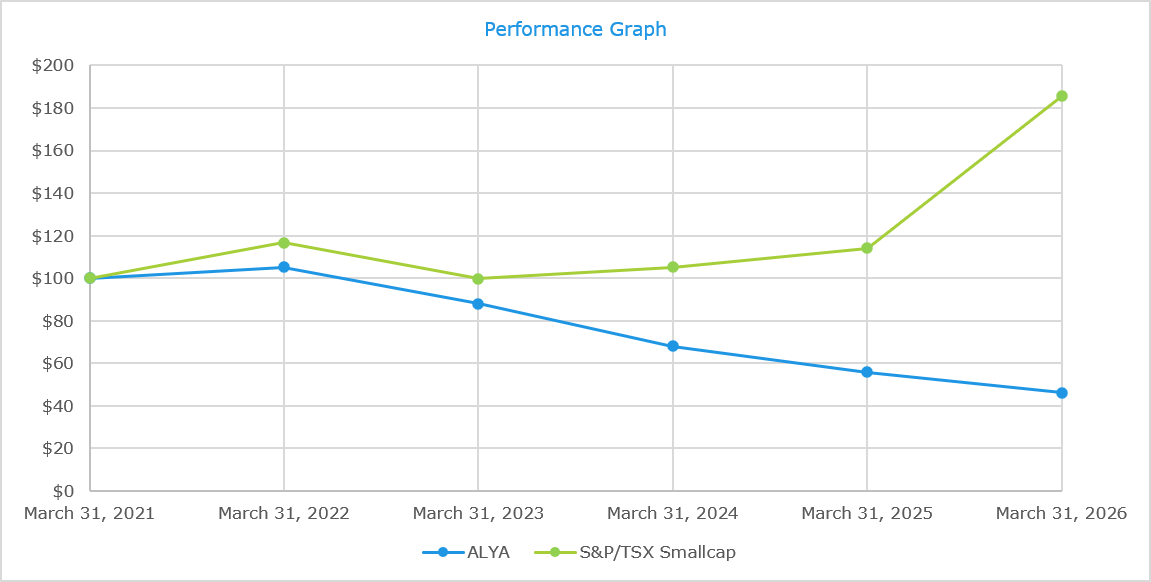
For the period between March 31, 2021 to March 31, 2023, the cumulative shareholder return on an investment in the subordinate voting shares followed a modest correlation with an investment on the S&P/TSX Smallcap Index, except that the cumulative shareholder return on an investment in the subordinate voting shares showed a marginal increase, in part, in management’s view, due to the adverse impacts of the COVID-19 pandemic and overall high capital markets volatility and economic uncertainty. For the period between March 31, 2023 to March 31, 2026, the cumulative shareholder return on an investment in the subordinate voting shares shows a decrease while the cumulative shareholder return on an investment on the S&P/TSX Smallcap Index shows an increase.
ALITHYA ׀ Compensation Discussion and Analysis 45
Trends in Compensation
The following graph illustrates the trend in the aggregate total compensation paid to the then current NEOs compared to (i) the cumulative return on a $100 investment in the subordinate voting shares and (ii) the cumulative return on the S&P/TSX Smallcap Index over the period from March 31, 2021 to March 31, 2026.
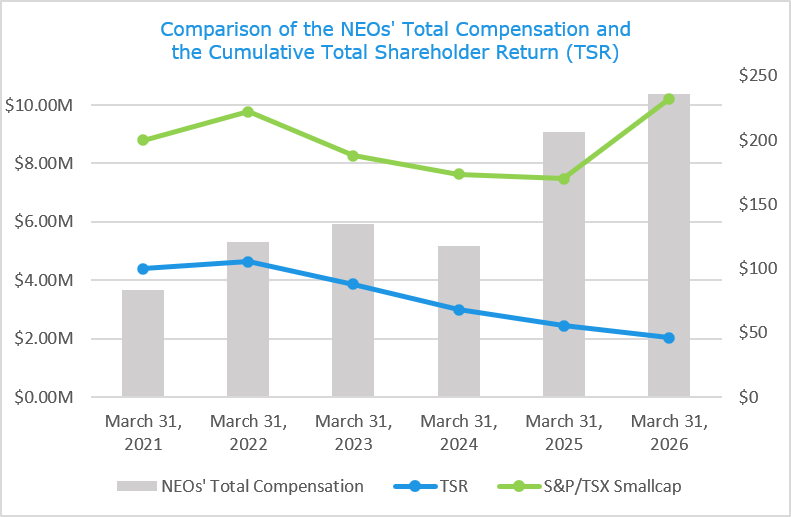
From March 31, 2021 to March 31, 2024, the Company maintained a general alignment between total compensation provided to NEOs and its cumulative total shareholder return (“TSR”). Beginning in fiscal 2023, the Company introduced a more structured share-based compensation program, specifically PSUs, to enhance retention and strengthen the link between pay and long-term performance. These equity-based awards are designed with multi-year vesting and are only paid out if certain performance goals are met, tying executive rewards to sustained results rather than short-term share price changes. This approach reflects the Compensation Committee’s commitment to incentivizing long-term performance.
For the year ended March 31, 2024, total NEO compensation decreased mainly because no annual incentive bonuses were paid out, which was consistent with the Company’s TSR performance for the year and the Company’s pay-for-performance philosophy. For the year ended March 31, 2025, total NEO compensation rose significantly due to two main factors: first, following a comprehensive market review of executive compensation practices, the Compensation Committee and Board decided to increase the proportion of at-risk compensation by allocating more PSUs; and second, the number of NEOs increased from five to seven due to leadership transitions in the Chief Financial Officer role which also led to the payment of a severance package. These unusual and temporary short-term factors were the primary drivers behind the higher compensation for fiscal 2025. For the year ended March 31, 2026, the total NEO compensation rose in accordance with the progressive three-year approach to gradually increase long-term incentive targets towards the median recommended by the Compensation Committee following the comprehensive market review of executive compensation practices conducted in fiscal 2025.
Long Term Incentives
SECURITIES AUTHORIZED FOR ISSUANCE
The table below indicates, as at March 31, 2026, certain information with respect to the Company’s LTIP. The table below does not include DSUs, PSUs and RSUs issued to executive officers under the Company’s SUP as those are not settled in subordinate voting shares from treasury.
| | | | | | | | | | | |
| NUMBER OF SECURITIES TO BE ISSUED UPON EXERCISE OF OUTSTANDING SECURITIES (#) | WEIGHTED AVERAGE EXERCISE PRICE OF OUTSTANDING SECURITIES ($) | NUMBER OF SECURITIES REMAINING AVAILABLE FOR FUTURE ISSUANCE UNDER EQUITY COMPENSATION PLANS (EXCLUDING SECURITIES REFLECTED IN THE FIRST COLUMN)(1) (#) |
Equity awards approved by security holders (issuable under the LTIP) | | | |
Options(2) | 2,980,892 | | 3.37 | | - | |
DSUs | 1,318,292 | | N/A | - | |
PSUs | 2,365,639 | | N/A | - | |
Total | 6,664,823 | | - | | 2,882,224 | |
Equity compensation plans not approved by security holders | - | | - | | - | |
(1)Based on 10% of the issued and outstanding Shares as at March 31, 2026.
(2)Consists of 2,780,892 options to purchase subordinate voting shares and 200,000 options to purchase multiple voting shares.
ALITHYA ׀ Compensation Discussion and Analysis 46
BURN RATE
The following table presents the burn rate of awards granted under the LTIP for fiscal 2026, 2025 and 2024:
| | | | | | | | | | | |
| FISCAL 2026 | FISCAL 2025 | FISCAL 2024 |
Number of awards granted during the year | 300,395 | 1,911,164 | 1,629,852 |
Weighted average number of issued and outstanding subordinate voting shares and multiple voting shares | 97,864 | 96,313,316 | 95,527,385 |
Burn rate | 0.31% | 1.98% | 1.71% |
PERFORMANCE SHARE UNITS FEATURES
The following table shows the key terms of PSUs issued under the LTIP:
| | | | | |
Shares Issuable | Subordinate voting shares. |
Performance Period | Three fiscal years starting from April 1 of the fiscal year in respect of which the PSUs are issued. Please refer to the section entitled “Executive Compensation Description – Long-Term Incentives –PSUs” for a description of the performance criteria of PSUs. |
Number of PSUs | An initial number of PSUs is granted. The final number of PSUs is subject to adjustment based on the extent to which the performance goals set out in the grant letter are achieved at the end of the performance period. |
Vesting Criteria | Cliff vest on the third anniversary date of the date of grant. |
Form of Settlement | Subordinate voting shares, unless the Board elects to settle them in cash. |
Settlement Date | As soon as practicable following the third anniversary date of the date of grant, but in no event later than December 15 of the year of the third anniversary date. |
Termination | Please refer to Schedule A for a description of the termination conditions. |
OPTION FEATURES
The following table shows the key terms of options under the LTIP:
| | | | | |
Shares Issuable | Subordinate voting shares. |
Exercise Price | For options granted until fiscal 2023, equal to the closing price of the subordinate voting shares on the TSX on the date immediately preceding the date of grant. For options granted starting fiscal 2024, if any, equal to the volume weighted average price of the subordinate voting shares on the TSX for the five-trading day immediately preceding the date of grant. |
Term | 10 years. |
Vesting Criteria | Vest and are exercisable in the manner set out in the applicable award agreement, subject to the participant continuing to be an employee or director, as applicable, or as otherwise agreed to by the Board. Options outstanding under the LTIP vest over a four-year period at a rate of 25% on each of the second and third anniversary dates of their grant and 50% on the fourth anniversary date of their grant. |
Termination | Please refer to Schedule A for a description of the termination conditions. |
LEGACY OPTION PLANS
Options granted under the Pre-IPO Alithya Stock Option Plan and Edgewater incentive plans (collectively, the “Legacy Plans”) that were outstanding immediately prior to the Edgewater Acquisition were converted into options to acquire Shares of Alithya at closing.
No further grants may be made under the Legacy Plans and an aggregate of 296,000 options, representing 0.33% of the outstanding Shares as at March 31, 2026, remained outstanding under the Pre-IPO Alithya Stock Option Plan and continue to be governed by the terms and conditions of such plan. As at March 31, 2026, there were no options outstanding under the Edgewater incentive plans.
Under the Pre-IPO Alithya Stock Option Plan:
•options generally have a term of 10 years from their grant date and outstanding options are all fully vested;
•there were no limits on grants to insiders;
•the option exercise price was determined by the Board in its discretion and could be above or below the market price of the underlying shares at the time of the grant; and
•options are not assignable in whole or in part, except pursuant to laws of descent or distribution.
The Board may amend the Pre-IPO Alithya Stock Option Plan at any time, provided that no amendment shall materially impair the rights of option holders in respect of previously granted options.
RESTRICTED SHARE UNITS FEATURES
The following table shows the key terms of the RSUs issued under the SUP:
| | | | | |
Vesting Criteria | Cliff vest on the third anniversary date of the date of grant.(1) |
Form of Settlement | Although it is currently the Company’s intent to settle RSUs in market-purchased shares purchased on the TSX, the Company may settle RSUs in cash. In the event of a cash payment, such payment shall be equal to the 5-day VWAP prior to and including the date of vesting multiplied by the number of RSUs. |
Settlement Date | As soon as practicable following each vesting date. |
Termination | Please refer to Schedule A for a description of the termination conditions. |
ALITHYA ׀ Compensation Discussion and Analysis 47
(1)For certain grants made exceptionally upon hiring, vesting takes place in three equal tranches on each of the first, second and third anniversary date of the date of grant or hiring.
Employment Arrangements of the NEOs
The terms and conditions of the employment of each NEO are set forth in their employment agreement. Their employment is for an indefinite term (or at will) and include confidentiality, non-solicitation and non-competition covenants.
TERMINATION AND CHANGE OF CONTROL BENEFITS
The following table summarizes the non-solicitation and non-competition covenants, severance payable upon termination without cause and change of control provisions applicable to the NEOs as at March 31, 2026.
| | | | | | | | | | | | | | |
NAME AND TITLE(1) | NON-SOLICITATION COVENANT | NON-COMPETITION COVENANT | PAYMENT IN THE EVENT OF A TERMINATION WITHOUT CAUSE(2) | PAYMENT IN THE EVENT OF A TERMINATION FOLLOWING A CHANGE OF CONTROL(2)(3) |
Paul Raymond President and Chief Executive Officer | 12 months | 12 months | 24 months of base salary and average of annual bonuses paid for the last two fiscal years | 24 months of base salary and average of annual bonuses paid for the last two fiscal years |
Pierre Blanchette Chief Financial Officer | 12 months | 12 months | 12 months plus one month per year of service (subject to a maximum of 24 months) of base salary and average of annual bonuses paid for the last two fiscal years | 24 months of base salary and average of annual bonuses paid for the last two fiscal years |
C. Bernard Dockrill Chief Operating Officer | 12 months | 12 months | 12 months plus one month per year of service (subject to a maximum of 24 months) of base salary and average of annual bonuses paid for the last two fiscal years | 24 months of base salary and average of annual bonuses paid for the last two fiscal years |
Mike Feldman Senior Vice President, Enterprise Applications and Transformation | 12 months | 12 months | 4 months plus one month per year of service (subject to a maximum of 12 months) of base salary | - |
Giulia Cirillo Chief Human Capital Officer | 12 months | 12 months | 12 months plus one month per year of service (subject to a maximum of 18 months) of base salary and average of annual bonuses paid for the last two fiscal years | 24 months of base salary and average of annual bonuses paid for the last two fiscal years |
(1)Information in the above table was omitted for Debbie Di Gregorio as she was not serving as Interim Chief Financial Officer as at March 31, 2026.
(2)Paul Raymond, Pierre Blanchette, C. Bernard Dockrill, Mike Feldman and Giulia Cirillo would also be entitled to the continuity of certain benefits such as group insurance and outplacement services.
(3)For Paul Raymond, Pierre Blanchette, C. Bernard Dockrill and Giulia Cirillo, applies in the event of termination without cause or resignation for good reason within 12 months following a change of control. Resignation for good reason includes the following: (i) if their compensation, including social benefits, is considerably reduced, (ii) if they suffer a significant diminution of their responsibilities, authority, status or hierarchy, taken as a whole, without their prior written consent, and (iii) if their principal place of work is relocated to a place located more than 100 kilometers from their usual principal place of work. Mike Feldman’s terms and conditions of employment do not contain specific provisions in the event of a termination following a change of control, the terms and conditions applicable in the event of a termination without cause or with cause would therefore apply by default.
ALITHYA ׀ Compensation Discussion and Analysis 48
INCENTIVE COMPENSATION PAYMENTS IN THE EVENT OF TERMINATION, RESIGNATION, RETIREMENT, DEATH OR DISABILITY
Unless otherwise determined by the Board, the options, DSUs, RSUs and PSUs held by the NEOs would be treated as follows upon termination, resignation, retirement, death or disability, assuming a termination date of March 31, 2026:
| | | | | | | | | | | | | | | | | | | | | | | | | | | | | |
PLAN(1) | TERMINATION WITHOUT CAUSE | VOLUNTARY RESIGNATION | RETIREMENT(2) | TERMINATION FOR CAUSE | TERMINATION FOLLOWING CHANGE OF CONTROL | DEATH OR DISABILITY | | | |
LTIP(Options granted since November 1, 2018 and PSUs granted prior to March 31, 2025) | Vested options are exercisable until the earlier of their expiration date and 90 days after termination Vested PSUs are settled in accordance with their terms Unvested options and PSUs are immediately forfeited and cancelled | Vested options are exercisable until the earlier of their expiration date and 90 days after resignation Vested PSUs are settled in accordance with their terms Unvested options and PSUs are immediately forfeited and cancelled | Unvested options continue to vest and remain exercisable until the earlier of their expiration date and the date that is 90 days following the last vesting date Unvested PSUs continue to vest and are settled in accordance with their terms | Vested and unvested options and PSUs are immediately forfeited and cancelled | Unvested options and PSUs vest immediately if the NEO is terminated without cause within 24 months of the change of control Vested PSUs are settled, and options remain exercisable, in accordance with their terms | Unvested options and PSUs vest immediately Options remain exercisable until the earlier of their expiration date and the date that is 90 days after the date of disability or 180 days after the day of death | | | |
Pre-IPO Alithya Stock Option Plan(3) (Options originally issued by Pre-IPO Alithya which were converted) | Options remain exercisable until the earlier of their expiration date and the date that is 60 days following the termination | Options remain exercisable until the earlier of their expiration date and the date that is 60 days following the resignation | Options remain exercisable until the earlier of their expiration date and the date that is 60 days following the retirement(4) | Options are immediately forfeited and cancelled | Options remain exercisable in accordance with their terms | Options remain exercisable until the date that is 60 days following the death or disability | | | |
SUP (DSUs and RSUs granted since June 2023 and PSUs granted since June 2025) | Unvested Matching DSUs vest immediately, while unvested discretionary DSUs and discretionary RSUs are immediately forfeited and cancelled Vested awards are settled in accordance with their terms | Unvested Matching DSUs, discretionary DSUs and discretionary RSUs are immediately forfeited and cancelled Vested awards are settled in accordance with their terms | Unvested Matching DSUs, discretionary DSUs and discretionary RSUs continue to vest and are settled in accordance with their terms | Unvested Matching DSUs, discretionary DSUs and discretionary RSUs are immediately forfeited and cancelled Vested awards are settled in accordance with their terms | Unvested Matching DSUs, discretionary DSUs and discretionary RSUs vest immediately if the NEO is terminated without cause within 24 months of the change of control Vested awards are settled in accordance with their terms | Unvested Matching DSUs, discretionary DSUs and discretionary RSUs vest immediately | | | |
(1)As at March 31, 2026, the NEOs only had outstanding options and PSUs governed by the terms and conditions of the LTIP and the Pre-IPO Alithya Stock Option Plan as well as DSUs, PSUs and RSUs governed by the terms and conditions of the SUP.
(2)Under the LTIP and the SUP, in the event the participant commences employment with a direct competitor of the Company or breaches a non-competition or non-solicitation obligation during the retirement, all awards that have not been exercised or settled are forfeited and cancelled.
(3)Options to acquire Shares originally issued under the Pre-IPO Alithya Stock Option Plan that were outstanding immediately prior to the Edgewater Acquisition are subject to the terms of the Pre-IPO Alithya Stock Option Plan. The table does not provide for the treatment of unvested options as all options governed by the Pre-IPO Alithya Stock Option Plan are vested and no further options may be granted thereunder.
(4)The Pre-IPO Alithya Stock Option Plan does not contain any specific provisions with regards to retirement. The provisions applicable in the event of a voluntary resignation therefore apply by default.
TERMINATION WITHOUT CAUSE, VOLUNTARY RESIGNATION, RETIREMENT, TERMINATION FOR CAUSE AND CHANGE OF CONTROL PAYMENTS
The following table summarizes the severance and incremental amounts payable to each NEO in the event of a termination without cause and a termination following a change of control assuming a termination date of March 31, 2026. No severance or incremental amount is payable in the event of a voluntary resignation, retirement or termination for cause.
| | | | | | | | | | | | | | |
NAME AND TITLE(1) | TERMINATION WITHOUT CAUSE ($) | TERMINATION FOLLOWING A CHANGE OF CONTROL(2) ($) |
SEVERANCE(3) | INCENTIVE PLANS(4) | SEVERANCE(3) | INCENTIVE PLANS(5) |
Paul Raymond President and Chief Executive Officer | 1,778,790 | 30,628 | 1,778,790 | 3,188,970 |
Pierre Blanchette Chief Financial Officer | 425,000 | 8,933 | 850,000 | 310,159 |
C. Bernard Dockrill(6) Chief Operating Officer | 1,044,972 | 14,205 | 1,671,955 | 1,928,573 |
Mike Feldman(6) Senior Vice President, Enterprise Applications and Transformation | 493,958 | - | 449,053 | 297,189 |
Giulia Cirillo Chief Human Capital Officer | 513,756 | - | 880,724 | 607,672 |
(1)Information in the above table was omitted for Debbie Di Gregorio as she ceased to serve as an Interim Chief Financial Officer on July 28, 2025 and as an employee of Alithya on January 31, 2026. Please refer to the section entitled “Former Interim Chief Financial Officer Severance Agreement” below for more details on Debbie Di Gregorio’s severance.
(2)As indicated in the table in the preceding section entitled “Incentive Compensation Payments in the Event of Termination, Resignation, Retirement, Death or Disability”, Paul Raymond, Pierre Blanchette, C. Bernard Dockrill and Giulia Cirillo are entitled to the severance shown in this column in the event of a termination without cause or resignation for good reason within 12 months following a change of control. As Mike Feldman’s terms and conditions of employment do not contain specific provisions in
ALITHYA ׀ Compensation Discussion and Analysis 49
the event of a termination following a change of control, the terms and conditions applicable in the event of a termination without cause or with cause would therefore apply by default. The amount indicated in the table above for Mr. Feldman assumes a termination without cause scenario.
(3)The amounts shown as severance do not include the costs associated with the continuity of certain benefits such as group insurance and outplacement services.
(4)This column shows the value of Matching DSUs held by each NEO as of March 31, 2026 determined by multiplying the number of units by the closing price of the subordinate voting shares on the TSX on March 31, 2026 ($1.42) as in the event of a termination without cause, unvested awards under the LTIP and SUP are forfeited and cancelled, except for Matching DSUs issued under the SUP, which would vest immediately under the SUP. There is no impact for options governed by the Pre-IPO Alithya Stock Option Plan as all are already fully vested.
(5)For a termination following a change of control, the amounts shown for the incentive plans include the value of unvested PSUs, RSUs and DSUs held by the NEO as at March 31, 2026 determined by multiplying the number of units by the closing price of the subordinate voting shares on the TSX on March 31, 2026 ($1.42) and assuming that PSUs would vest immediately with performance goals having been met at 100% of the specified target level of performance. No amount is included for unvested options as no unvested options were in-the-money as at March 31, 2026. The incentive plans provide for double trigger vesting upon termination of employment within 24 months following a change of control. NEOs would be eligible for immediate vesting only if no proper substitute is granted, or if the NEO is terminated without cause within 24 months of the change of control. For more detail on the value attributed to the options, PSUs, RSUs and DSUs, please refer to the table under the section entitled “Incentive Plan Awards – Outstanding Awards Held”.
(6)C. Bernard Dockrill and Mike Feldman are paid in U.S. dollars. The amounts shown as severance are in Canadian dollars converted based on the average exchange rate used in the Company’s audited consolidated financial statements for fiscal 2026 which was $1.3817 for each U.S. dollar. For more detail on the value attributed to the options, PSUs, RSUs and DSUs, please refer to the table under the section entitled “Incentive Plan Awards – Outstanding Awards Held”.
FORMER INTERIM CHIEF FINANCIAL OFFICER SEVERANCE AGREEMENT
Debbie Di Gregorio ceased to serve as Interim Chief Financial Officer effective July 28, 2025 and her employment at the Company ended on January 31, 2026. The terms of her severance were agreed to in a severance agreement pursuant to which she was paid a severance indemnity totaling $351,810. While Ms. Di Gregorio did not hold the position of Interim Chief Financial Officer at the time her departure, the severance indemnity amount was reflected in the “All Other Compensation” column of the Summary Compensation Table earlier in this document given that she was a NEO during a portion of fiscal 2026.
ALITHYA ׀ Compensation Discussion and Analysis 50
Other Information
Indebtedness of Directors and Executive Officers
No director or executive officer of the Company, or any former director or executive officer of the Company, or any associate of any of the foregoing, is, or has been at any time during the fiscal year ended March 31, 2026, excluding routine indebtedness, indebted to the Company or its subsidiaries, either in connection with the purchase of securities of the Company or otherwise.
Interest of Informed Persons and Others in Material Transactions
The management of the Company is not aware of any material interest, direct or indirect, of any directors or executive officers of the Company, person that beneficially own, or control, directly or indirectly, more than 10% of the voting rights attached to Alithya’s Shares, or any associate or affiliate of such persons in any transaction since the commencement of the Company’s most recently completed financial year, or in any proposed transaction, that has materially affected or would materially affect the Company or any of its affiliates or subsidiaries.
Shareholder Proposals
The Company will include, as applicable, proposals from shareholders that comply with applicable laws and its advance notice by-law in its management information circular for its next annual meeting of shareholders to be held in respect of the fiscal year ending March 31, 2027. Shareholders who wish to submit a proposal, other than with regard to the nomination of directors, should send their proposal to the Corporate Secretary at the head office of the Company (700 René-Lévesque Blvd West, Suite 400, Montréal, Québec, H3B 1X8) with a copy at secretariat@alithya.com, by April 14, 2027. Shareholders who wish to propose the nomination of directors should abide by the prescribed timeframe provided for in the advance notice by-law of the Company.
Availability of Documents
The Company is a reporting issuer in Canada and the U.S. and is required to file various documents, including financial statements. Financial information is provided in the Company’s comparative financial statements and Management’s Discussion and Analysis for its most recently completed financial year. Copies of these documents and additional information relating to the Company are available on the Company’s website at www.alithya.com, on SEDAR+ at www.sedarplus.ca and on EDGAR at www.sec.gov, or may be obtained from the Company on request by email at secretariat@alithya.com or by mail or by phone as follows:
Corporate Secretariat
Alithya Group inc.
700 René-Lévesque Blvd West
Suite 400
Montréal, Québec, H3B 1X8
Tel: 1-844-985-5552
Approval
The Board of the Company has approved the contents of this Information Circular and its sending to the shareholders of the Company.
David Torralbo
Chief Legal Officer and Corporate Secretary
July 13, 2026
Schedule A | Long Term Incentive Plan and Share Purchase Plan Description
Long Term Incentive Plan
The following summary describes the material terms of the Long Term Incentive Plan of Alithya (the “LTIP”). This summary is, however, not a complete description of all the provisions of the LTIP and is qualified in its entirety by reference to the LTIP.
ADMINISTRATION
The LTIP is administered by the Board. The Board has the authority to, among other things, determine eligibility for awards to be granted, determine, modify or waive the type or types of, form of settlement of, and terms and conditions of awards, to accelerate the vesting or exercisability of awards, to adopt rules, guidelines and practices governing the operation of the LTIP as the Board deems advisable, to interpret the terms and provisions of the LTIP and any award agreement, and to otherwise do all things necessary or appropriate to carry out the purposes of the LTIP. To the extent permitted by applicable law, the Board may, from time to time, delegate to a committee of the Board all or any of the powers conferred on it pursuant to the LTIP.
ELIGIBILITY
Certain Alithya employees and directors, and those of its designated affiliates, are eligible to participate in the LTIP. However, eligibility to participate will not confer any right to receive any grant of an award pursuant to the LTIP. The Board has the sole discretion, to determine the individuals to whom grants may be made.
AUTHORIZED SHARES
Shares issued upon the exercise or settlement of awards granted under the LTIP are issued from treasury and, in the case of restricted share units (“RSUs”) and performance share units (“PSUs”), may be settled in cash. Subject to adjustment, as described below, the maximum number of subordinate voting shares issuable under the LTIP is equal to 10% of the number of Shares that are issued and outstanding from time to time.
Subordinate voting shares subject to an award that, for any reason, (i) expires without having been exercised, (ii) is cancelled, forfeited, surrendered, or terminated, (iii) or otherwise is settled will again be available for grant under the LTIP.
As of March 31, 2026, there were 2,980,8921 outstanding options, which represented 3.08% of the issued and outstanding Shares, 1,318,292 outstanding deferred share units (“DSUs”), which represented 1.36% of the issued and outstanding Shares, and 2,365,639 PSUs, which represented 2.44% of the issued and outstanding Shares. As of March 31, 2026, 2,882,224 Shares remained available for issuance pursuant to awards under the LTIP, which represented 2.98% of the issued and outstanding Shares.
TYPES OF AWARDS
The LTIP provides for awards of (i) options, (ii) restricted shares, (iii) RSUs, (iv) PSUs, (v) DSUs, and (vi) share appreciation rights.
•Options. The exercise price of options may not be less than the market price of the subordinate voting shares at the time of grant. For options granted on or before the fiscal year ended March 31, 2023, the market price was equal to the closing price of the subordinate voting shares on the TSX on the day immediately preceding the date of grant.
•For options granted on or after the fiscal year ended March 31, 2024, the market price is equal to the volume weighted average price of the subordinate voting shares on the TSX for the five-trading days immediately preceding the date of grant. The Board determines at the time of grant the vesting conditions that impact the time or times at which options become exercisable and the terms on which options remain exercisable. Subject to any accelerated termination as set forth in the LTIP, or extension pursuant to a black-out period, the maximum term of a stock option is 10 years.
•Restricted Shares. An award of restricted shares is an award of subordinate voting shares subject to certain restrictions and to a risk of forfeiture.
•Restricted Share Units. An award of RSUs is an award denominated in subordinate voting shares that entitles the participant to receive subordinate voting shares in the future. The delivery of subordinate voting shares under a RSUs award may be subject to vesting conditions as determined by the Board.
•Performance Share Units. An award of PSUs is an award the vesting and settlement of which is subject to performance objectives and other vesting conditions. Performance objectives may be based upon the achievement of corporate, divisional or individual goals determined by the Board.
•Deferred Share Units. An award of DSUs is an award of a notional investment in subordinate voting shares reflected on an unfunded, book-entry account maintained by Alithya. DSUs may be subject to vesting conditions. DSUs are settled in subordinate voting shares on the 90th day of the participant’s termination date.
•Share Appreciation Rights. An award of share appreciation rights is an award that, subject to determination by the Board, will upon exercise provide the participant with a right to receive a specified number of subordinate voting shares equal in value to a specified increase in the market value of the subordinate voting shares. Subject to any accelerated termination as set forth in the LTIP, the maximum term of a share appreciation right is 10 years.
Awards granted under the LTIP are settled in newly issued subordinate voting shares, and, in the case of RSUs and PSUs, may also be settled in cash at the Company’s discretion. In the event of a cash payment, such payment shall be equal to the 5-day VWAP prior to and including the date of vesting
ALITHYA ׀ Schedule A ׀ 52
multiplied by the number of RSUs or PSUs as applicable. RSUs, PSUs and DSUs are entitled to dividend equivalents in the form of additional RSUs, PSUs and DSUs, respectively, as normal cash dividends are paid on Shares. Such dividend equivalents shall be computed by dividing: (a) the amount obtained by multiplying the amount of the dividend declared and paid per Share by the number of RSUs, PSUs and DSUs, as applicable, held on the record date for the payment of such dividend, by (b) the market price of a subordinate voting share at the close of the first business day immediately following the dividend record date, with fractions computed to three decimals. For further details on the term, vesting and termination of options and PSUs, please refer to the section entitled “Compensation Discussion and Analysis – Executive Compensation Framework – Long Term Incentives”.
LIMITS ON GRANTS OF AWARDS
The maximum aggregate number of subordinate voting shares issuable, at any time to insiders of Alithya under the LTIP and any other Alithya security-based compensation arrangements involving newly issued subordinate voting shares may not exceed 10% of the issued and outstanding Shares. In addition, the maximum aggregate number of subordinate voting shares issued within any one-year period to insiders of Alithya under the LTIP and any other Alithya security-based compensation arrangements involving newly issued subordinate voting shares may not exceed 10% of the issued and outstanding Shares.
BLACK-OUT PERIOD
If an award expires or is settled during, or within 5 business days after, a period during which a participant is prohibited from trading in Alithya’s securities pursuant to a blackout period established by Alithya (a "Black-out Period"), then the award shall expire ten business days after the trading black-out period is lifted by the Alithya. If the grant date of an award falls during a Black-out Period or within the 5 trading days following the end of a Black-out Period, the date of grant will be deemed to be the 6th trading day following the end of the Black-out Period.
TERMINATION OF EMPLOYMENT OR DIRECTORSHIP
The Board has the authority to determine the vesting schedule applicable to each award and to accelerate the vesting or exercisability of any award. The Board may also determine the effect of termination of employment or directorship on an award. Unless otherwise provided by the Board, whether in the award agreement or whether before or after the time of granting an award, in an employment agreement or other written agreement, upon a termination of a participant’s employment or directorship under the following circumstances, the following treatment will apply:
•Death or Disability. All awards shall immediately vest (or cease to be restricted) as of the termination date, and each option or share appreciation right held will continue to be exercisable until the earliest of: (i) the award expiration date and (ii) the date that is 90 days after the date of disability or the date that is 180 days after the date of death. Any performance targets associated with any award will be deemed to have been met at the target performance level.
•Retirement of an Employee. All unvested awards shall continue to vest and be settled and exercised in accordance with their terms, except that each option or share appreciation right held will continue to be
exercisable until the earlier of (i) the award expiration date and (ii) the date that is 90 days (or such longer period as the Board in its sole discretion may permit) following the later of (a) the date such option or share appreciation right became fully vested and (b) the termination date and, if not exercised on or before such date, will be forfeited and cancelled.
•Voluntary Resignation of Employment (other than pursuant to a Retirement). All unvested awards will be forfeited and cancelled as of the termination date. Options and share appreciation rights, that have vested but have not been exercised, will remain exercisable until the earlier of (i) the date that is 90 days after the participant’s termination of employment or (ii) the award’s expiration date.
•Termination of Employment by Alithya for Cause. All awards, whether vested or unvested, will be forfeited and cancelled as of the termination date.
•Termination of Employment by Alithya other than for Cause. All unvested awards will be forfeited and cancelled as of the termination date. Options and share appreciation rights, that have vested but have not been exercised, will remain exercisable until the earlier of (i) the date that is 90 days after the participant’s termination of employment, or such longer period as permitted by the Board, or (ii) the award’s expiration date.
•Termination of Directorship by Alithya for Breach of Fiduciary Duty. All awards, whether vested or unvested, will be forfeited and cancelled as of the termination date.
•Termination of Directorship for any reason other than Death, Disability, or Breach of Fiduciary Duty. The Board may, in its sole discretion, at any time prior to or following the date of termination of directorship, provide for the exercise, vesting or settlement of any or all awards held by the director on the date of termination.
NON-TRANSFERABILITY OF AWARDS
Awards under the LTIP may not be sold, assigned, transferred, alienated, pledged, mortgaged, charged, or otherwise encumbered, and may not be subject to attachment or legal process for the payment of any debts or obligations of the participant other than to a permitted assign or with the approval of the Board. A permitted assign means, a spouse or a holding entity, RRSP, RRIIF or a trustee, custodian, or administrator acting on behalf of, or for the benefit of the participant or the participant’s spouse (“Permitted Assign”).
RECOVERY OF COMPENSATION
Awards are subject to potential cancellation, recoupment, rescission, payback or other action in accordance with the terms of Alithya’s Clawback Policy. For further information on the Clawback Policy, please refer to the section entitled “Statement of Corporate Governance – Ethical Business Conduct – Clawback Policy” of this Information Circular.
CHANGE IN CONTROL
In the event of a Change in Control (as such term is defined in the LTIP), the Board may, without the consent of any participant, take such steps as it deems necessary or desirable, including to cause (i) the conversion or exchange of any outstanding awards into or for, rights or other securities of
ALITHYA ׀ Schedule A ׀ 53
substantially equivalent value (or greater value), as determined by the Board in its discretion, in any entity participating in or resulting from a Change in Control; (ii) the termination of an award in exchange for an amount of cash and/or property, if any, equal in value to the amount that would have been attained upon the exercise or settlement of such award or realization of the participant’s rights as of the date of the occurrence of such Change in Control (and, for the avoidance of doubt, if as of the date of the occurrence of such Change in Control the Board determines in good faith that no amount would have been attained upon the exercise of such award or realization of the participant’s rights, then such award may be terminated by Alithya without payment); (iii) the replacement of such award with other rights or property selected by the Board in its sole discretion; or (iv) any combination of the foregoing. In taking any of these actions, the Board will not be required to treat all awards similarly. If an employee is terminated from employment within 24 months following a Change in Control, awards granted to the employee prior to the Change in Control will immediately vest. No acceleration of vesting occurs on a Change in Control unless there is no publicly traded successor entity.
CERTAIN ADJUSTMENTS
Should Alithya effect a subdivision or consolidation of shares or any similar capital reorganization or a payment of a stock dividend (other than a stock dividend that is in lieu of a cash dividend), or should any other change be made in the capitalization of Alithya that does not constitute a Change in Control and would warrant the amendment or replacement of any existing awards in order to adjust the number of subordinate voting shares that may be acquired on the vesting of outstanding awards and/or the terms of any award in order to preserve proportionately the rights and obligations of the participants holding such awards, the Board will, subject to the prior approval of the applicable stock exchange, as applicable, authorize such steps to be taken as it may consider to be equitable and appropriate to that end.
AMENDMENT, SUSPENSION OR TERMINATION OF THE PLAN
The Board may from time to time, without notice to or approval of the holders of voting shares of Alithya, amend, modify, change, suspend or terminate the LTIP or any outstanding award, as the Board determines appropriate. However, the Board shall not alter, suspend or terminate the LTIP or any outstanding award without the participant’s consent, if such alteration, suspension or termination of the LTIP or any outstanding award would materially impair the participant’s rights or materially increase the participant’s obligations under the LTIP (unless the Board determines that such adjustment is required or desirable in order to comply with any applicable securities law or stock exchange requirements). Shareholder approval will be required, in addition to the extent required by law, for any amendment, modification or change that (i) increases the percentage of subordinate voting shares reserved for issuance under the LTIP (except with respect to the adjustments described above), (ii) increases or removes the 10% limits on subordinate voting shares issuable or issued to insiders as described above, (iii) reduces the exercise price of an award (except with respect to the adjustments described above), (iv) extends the term of any award granted under the LTIP beyond its original expiration date (except where an expiration date would have fallen within a black-out period applicable to the participant or within five business days following the expiry of such a black-
out period), (v) permits awards to be transferred to a person other than a Permitted Assign or other than for normal estate settlement purposes, or (vi) deletes or reduces the range of amendments which require approval of the holders of voting shares of Alithya.
The Board may, without shareholder approval, amend the LTIP for purposes of, (a) making any amendments to the general vesting provisions or restricted period of each Award; (b) making any amendments to the termination of employment or director mandate; (c) making any amendments to add covenants of Alithya for the protection of an employee or director, provided that the Board shall be of the good faith opinion that such additions will not be prejudicial to the rights or interests of the employee or director; (d) making any amendments not inconsistent with the LTIP as may be necessary or desirable with respect to matters or questions which, in the good faith opinion of the Board, having in mind the best interests of the employee or director it may be expedient to make, including amendments that are desirable as a result of changes in law in any jurisdiction where an employee or director resides, provided that the Board shall be of the opinion that such amendments and modifications will not be prejudicial to the interests of the employee or director; or (e) making such changes or corrections which, on the advice of counsel to Alithya, are required for the purpose of curing or correcting any ambiguity or defect or inconsistent provision or clerical omission or mistake or manifest error, provided that the Board shall be of the opinion that such changes or corrections will not be prejudicial to the rights and interests of the employees or directors.
Employee Share Purchase Plan
The following summary describes the material terms of the Company’s Employee Share Purchase Plan (“ESPP”). It is, however, not a complete description of all provisions of the ESPP and is qualified in its entirety by reference to the ESPP.
PURPOSE AND SCOPE
The purpose of the ESPP is to encourage and assist eligible employees of Alithya to acquire a proprietary interest in Alithya by providing such eligible employees with a convenient and regular method of acquiring subordinate voting shares. The ESPP enables participants to make regular personal investments in subordinate voting shares by way of payroll deduction. The ESPP also provides for matching employer contributions, up to a certain amount, that are also invested in subordinate voting shares.
ADMINISTRATION
The ESPP is administered by the Board in its sole and complete authority. Subject to applicable law, the Board may, from time to time, delegate to a committee of the Board all or any of the powers of the Board under the ESPP. Alithya has appointed TSX Trust Company as administrative agent to assist in the administration of the ESPP, including to purchase subordinate voting shares in the open market and hold them on behalf of participants as well as maintain records respecting such shares.
ELIGIBILITY
All permanent employees of Alithya or any designated affiliate are eligible to participate in the ESPP. Alithya reserves the right to restrict eligibility or otherwise limit the number of persons eligible for participation in the ESPP at any time.
ALITHYA ׀ Schedule A ׀ 54
TERMINATION
A participant’s participation in the ESPP shall be terminated immediately upon (i) the participant’s death, (ii) the participant’s cessation of active employment for any reason (including retirement or permanent disability) with Alithya or a designated affiliate, (iii) any judgment, attachment, garnishment or other court order affecting the participant’s compensation or the participant’s account under the ESPP is filed or levied upon Alithya, the employer or the administrative agent, or the participant is legally adjudged incompetent or becomes bankrupt, or (iv) the employer ceases to be a designated affiliate of Alithya. A participant may also elect voluntarily to terminate his or her participation at any time.
NO ASSIGNMENT
The interest of any participant under the ESPP is not transferable, assignable or alienable by pledge, assignment or in any manner whatsoever.
AMENDMENT, SUSPENSION OR TERMINATION OF THE PLAN
The ESPP may be amended by the Board at any time in accordance with applicable securities laws or stock exchange rules, and without shareholder approval unless required by such laws or rules. The Board may also suspend the ESPP in whole or in part from time to time or terminate it at any time. However, any amendment, suspension or termination shall not adversely affect the entitlement of the participants to the full balance of their accounts, without their written consent.
ALITHYA ׀ Schedule A ׀ 55
Schedule B | Mandate of the Board
| | |
MANDATE FOR THE BOARD OF DIRECTORS |
GENERAL
The board of directors (the “Board”) of Alithya Group Inc. (the “Company”) is elected by the shareholders and is responsible for the stewardship of the business and affairs of the Company. The Board fulfill such obligation by reviewing, discussing and approving the Company’s strategic planning and organizational structure and supervising management to oversee that the strategic planning and organizational structure enhance and preserve the business of the Company and its underlying value.
Although directors may be elected by the shareholders to bring special expertise or a point of view to Board deliberations, they are not chosen to represent a particular constituency. The best interests of the Company must be paramount at all times.
COMPOSITION
The Board shall be constituted at all times of a majority of directors who are independent directors within the meaning of applicable Canadian securities laws.
RESPONSIBILITIES
The Board fulfills its responsibility for overseeing the management of the Company’s business by delegating to the Company’s senior officers the responsibility of its day-to-day management. The Board meets its obligations both directly and through its committees, the Audit and Risk Management Committee, the Corporate Governance and Nominating Committee, and the Human Capital and Compensation Committee. In addition to these regular committees, the Board may appoint ad hoc committees periodically to address certain issues of a more short-term nature. The Board’s primary roles are overseeing corporate performance and providing quality, depth and continuity of management to meet the Company’s strategic objectives. Other principal duties include, but are not limited to the following categories:
APPOINTMENT AND COMPENSATION OF OFFICERS
1.The Board is responsible for approving the appointment of the Chief Executive Officer, other executive officers and other officers of the Company, following a review of the recommendations of the Human Capital and Compensation Committee.
2.In approving the appointment of the Chief Executive Officer, other executive officers and other officers, the Board shall, to the extent feasible, satisfy itself as to the integrity of these individuals and ensure that they create a culture of integrity throughout the Company and do not impact the independence of the external auditor.
3.The Board shall also annually review and approve, on the recommendation of the Human Capital and Compensation Committee, compensation plans and policies (including performance measures for long-term and short-term incentive compensation) as well as targets and payouts for the compensation of the Company’s executive officers (including the Chief Executive Officer). The Board shall also annually
approve the position description of the Chief Executive Officer.
4.The Board may authorize certain officers to enter into certain types of transactions, subject to specified limits. The Board has adopted and shall review from time to time its delegation of authorities that sets forth the required authority within management and employees to approve certain types of transactions. Transactions above the specified limits, and material transactions outside the ordinary course of business shall, however, be reviewed by and are subject to the prior approval of the Board.
5.The Board oversees that succession planning programs are in place for the Chief Executive Officer and senior management, including programs to train and develop management.
BOARD ORGANIZATION
6.The Board will receive recommendations from the Corporate Governance and Nominating Committee, but retains responsibility for managing its own affairs by giving its approval for its composition and size, the position description and selection of the Chair of the Board, candidates nominated for election to the Board, the composition of committees and appointment of committees’ chairs, committees’ and Board’s mandate and charters as well as their work program, and director compensation. On an annual basis, the Board shall also, on the recommendations of the Corporate Governance and Nominating Committee, review the directors’ independence status and expertise as well as confirm that all members of the Audit and Risk Management Committee are “financially literate” and that at least one member is an “audit committee financial expert” (as such terms are defined from time to time under the requirements or guidelines for audit committee service under applicable Canadian and United States securities laws and the rules of the Toronto Stock Exchange and Nasdaq), review the Board’s skills matrix, assess the overall performance of the Board, review major changes in the directors’ principal occupation and review other board memberships.
7.The Board may delegate to Board committees matters it is responsible for, including the approval of compensation of the Board and management, the conduct of performance evaluations, and the oversight of internal control over financial reporting and disclosure controls and procedures, but the Board retains its oversight function and ultimate responsibility for these matters and all other delegated responsibilities.
8.The Board shall annually review and approve a calendar for the meetings of the Board and its committees.
9.The Board shall maintain and periodically review a Board orientation program for new directors as well as
ALITHYA ׀ Schedule B ׀ 56
a Board continuing education program for directors in office.
STRATEGIC PLANNING
10.The Board has oversight responsibility to participate directly, and through its committees, in reviewing, questioning and approving the mission of the Company and its objectives and goals.
11.The Board is responsible for reviewing, providing input to, and approving, on an annual basis, the business, financial and strategic plans by which it is proposed that the Company may reach those goals.
MONITORING OF FINANCIAL PERFORMANCE AND OTHER FINANCIAL REPORTING MATTERS
12.The Board is responsible for enhancing congruence between shareholders’ expectations, the Company’s long-term strategy and business plans and management performance.
13.The Board is responsible for adopting processes for monitoring the Company’s progress toward its strategic and operational goals, and to revise and alter its direction to management in light of changing circumstances affecting the Company.
14.The Board is responsible for approving the audited annual financial statements and the non-audited interim financial statements as well as the notes, management’s discussion and analysis and press release accompanying such financial statements.
15.The Board is responsible for reviewing and approving material transactions outside the ordinary course of business and those matters which the Board is required to approve under the Company’s governing statute, including the payment of dividends, purchase and redemptions of securities, acquisitions and dispositions of material capital assets and material capital expenditures.
RISK MANAGEMENT
16.The Board is responsible for overseeing the identification of the material risks of the Company’s business and ensuring the implementation of appropriate systems to effectively monitor and manage such risks with a view to the long-term viability of the Company and while achieving, where applicable, a proper balance between the risks incurred and the potential return to the Company’s shareholders.
POLICIES AND PROCEDURES
17.The Board is responsible for:
(a)approving and monitoring compliance with all significant policies and procedures by which the Company is operated; and
(b)approving policies and procedures designed to ensure that the Company operates at all times within applicable laws and regulations.
18.The Board shall enforce its policy respecting confidential treatment of the Company’s proprietary information and the confidentiality of Board deliberations.
COMMUNICATIONS AND REPORTING
19.The Board has approved a disclosure policy which addresses communications with shareholders, employees, financial analysts, governments and regulatory authorities, and the public in general and shall review it on an annual basis.
20.The Board is responsible for:
(a)overseeing the accurate reporting of the financial performance of the Company to shareholders, other security holders and regulators on a timely and regular basis;
(b)taking steps to enhance the timely disclosure of any other developments that have a significant and material impact on the Company;
(c)reporting annually to shareholders on its stewardship for the preceding year, including reviewing and approving the Company’s management circular and other material disclosure documents; and
(d)overseeing the Company’s implementation of systems which accommodate feedback from shareholders.
CORPORATE SUSTAINABILITY MATTERS
21.The Board shall annually review the Company’s overall corporate sustainability approach, including the initiatives and strategy under its identified material topics, and approve the Company’s disclosure relating thereto.
RELATED-PARTIES TRANSACTIONS
22.The Board shall review all transactions that involve the Company on one hand and an officer, a director or a principal shareholder on the other hand, or a company controlled by an officer, a director or a principal shareholder or over which such person exercises significant influence.
MEETINGS
23.The Board will meet as often as necessary and in accordance with the Company’s bylaws.
DATED November 1, 2018, as amended on November 12, 2019, November 11, 2020, November 9, 2022, November 13, 2023, July 23, 2024, November 13, 2024, July 29, 2025 and November 13, 2025.
ALITHYA ׀ Schedule B ׀ 57