Long-Term Annual Growth Targets August 4, 2026 Exhibit 99.1
FORWARD LOOKING STATEMENTS In addition to historical information, this presentation may contain a number of “forward-looking statements” as defined in the Private Securities Litigation Reform Act of 1995, which are subject to known and unknown risks, uncertainties and other important factors that may cause actual results to be materially different from the statements made herein. All statements other than statements of historical fact are forward-looking statements. Forward-looking statements discuss our current expectations and projections relating to our financial position, results of operations, plans, objectives, future performance and business. You can identify forward-looking statements by the fact that they do not relate strictly to any historical or current facts. These statements may include words such as “aim,” “anticipate,” “believe,” “estimate,” “expect,” “forecast,” “future,” “intend,” “outlook,” “potential,” “project,” “projection,” “plan,” “seek,” “may,” “could,” “would,” “will,” “should,” “can,” “can have,” “likely,” the negatives thereof and other similar expressions. You should evaluate all forward-looking statements made in this presentation in the context of the risks and uncertainties disclosed in our filings with the Securities and Exchange Commission (the “SEC”), accessible on the SEC’s website at www.sec.gov and the Investors Relations section of the Company’s website at https://investors.firstwatch.com/financial-information/sec- filings. Important factors that could cause actual results to differ materially from those in the forward-looking statements include the following: our vulnerability to changes in consumer preferences and economic conditions such as inflation and recession; our inability to successfully open new restaurants or establish new markets; our inability to effectively manage our growth; potential negative impacts on sales at our and our franchisees’ restaurants as a result of our opening new restaurants in existing markets; a decline in visitors to any of the retail centers, lifestyle centers, or entertainment centers where our restaurants are located; lower than expected same-restaurant sales growth; unsuccessful marketing programs and limited time new offerings; changes in the cost of food; unprofitability or closure of new restaurants or lower than previously experienced performance in existing restaurants; our inability to compete effectively for customers; our vulnerability to food safety and food-borne illness concerns; unsuccessful financial performance of our franchisees, our limited control over our franchisees’ operations, our inability to maintain good relationships with our franchisees and conflicts of interest with our franchisees; the geographic concentration of our system-wide restaurant base in the southeast portion of the United States; damage to our reputation and negative publicity; our inability or failure to recognize, respond to and effectively manage the accelerated impact of social media and artificial intelligence; our limited number of suppliers and distributors for several of our frequently used ingredients and shortages or disruptions in the supply or delivery of such ingredients; information technology system failures or breaches of our network security; our failure to comply with federal and state laws and regulations relating to privacy, data protection, advertising and consumer protection, or the expansion of current or the enactment of new laws or regulations relating to privacy, data protection, advertising and consumer protection; our potential liability with our gift cards under the property laws of some states; our failure to enforce and maintain our trademarks and protect our other intellectual property; litigation with respect to intellectual property assets; our dependence on our executive officers and certain other key employees; our inability to identify, hire, train and retain qualified individuals for our workforce; our failure to obtain or to properly verify the employment eligibility of our employees; our failure to maintain our corporate culture as we grow; unionization activities among our employees; employment and labor law proceedings; labor shortages or increased labor costs or health care costs; risks associated with leasing property subject to long-term and non-cancelable leases; risks related to our sale of alcoholic beverages; costly and complex compliance with federal, state and local laws, including trade and tax policies; changes in accounting principles applicable to us; our vulnerability to natural disasters, unusual weather conditions, pandemic outbreaks, political events, war and terrorism; our inability to secure additional capital to support business growth; our level of indebtedness; failure to comply with covenants under our credit facility; and uncertainty regarding the Russia and Ukraine war, war and unrest in the Middle East and the related impact on macroeconomic conditions, including inflation, as a result of such conflicts or other related events. The forward-looking statements included in this presentation are made only as of the date hereof and are expressly qualified in their entirety by these cautionary statements. We undertake no obligation to publicly update or revise any forward-looking statement as a result of new information, future events or otherwise, except as otherwise required by law. NON-GAAP FINANCIAL MEASURES (UNAUDITED) To supplement the consolidated financial statements, which are prepared in accordance with accounting principles generally accepted in the United States of America (“GAAP”), we use the following non-GAAP measures, which present operating results on an adjusted basis: (i) Adjusted EBITDA, (ii) Adjusted EBITDA margin, (iii) Restaurant level operating profit and (iv) Restaurant level operating profit margin. Our presentation of these non-GAAP measures includes isolating the effects of some items that are either nonrecurring in nature or have no meaningful correlation to our ongoing core operating performance. These supplemental measures of performance are not required by or presented in accordance with GAAP. Management believes these non-GAAP measures provide investors with additional visibility into our operations, facilitate analysis and comparisons of our ongoing business operations because they exclude items that may not be indicative of our ongoing operating performance, help to identify operational trends and allow for greater transparency with respect to key metrics used by Management in our financial and operational decision making. Our non-GAAP measures may not be comparable to similarly titled measures used by other companies and have important limitations as analytical tools. These non-GAAP measures should not be considered in isolation or as substitutes for analysis of our results as reported under GAAP as they may not provide a complete understanding of our performance. These non-GAAP measures should be reviewed in conjunction with our consolidated financial statements prepared in accordance with GAAP. This presentation does not constitute an offer to sell or a solicitation of an offer to buy any securities. 2 CAUTIONARY NOTE ON FORWARD-LOOKING STATEMENTS AND NON-GAAP FINANCIAL MEASURES
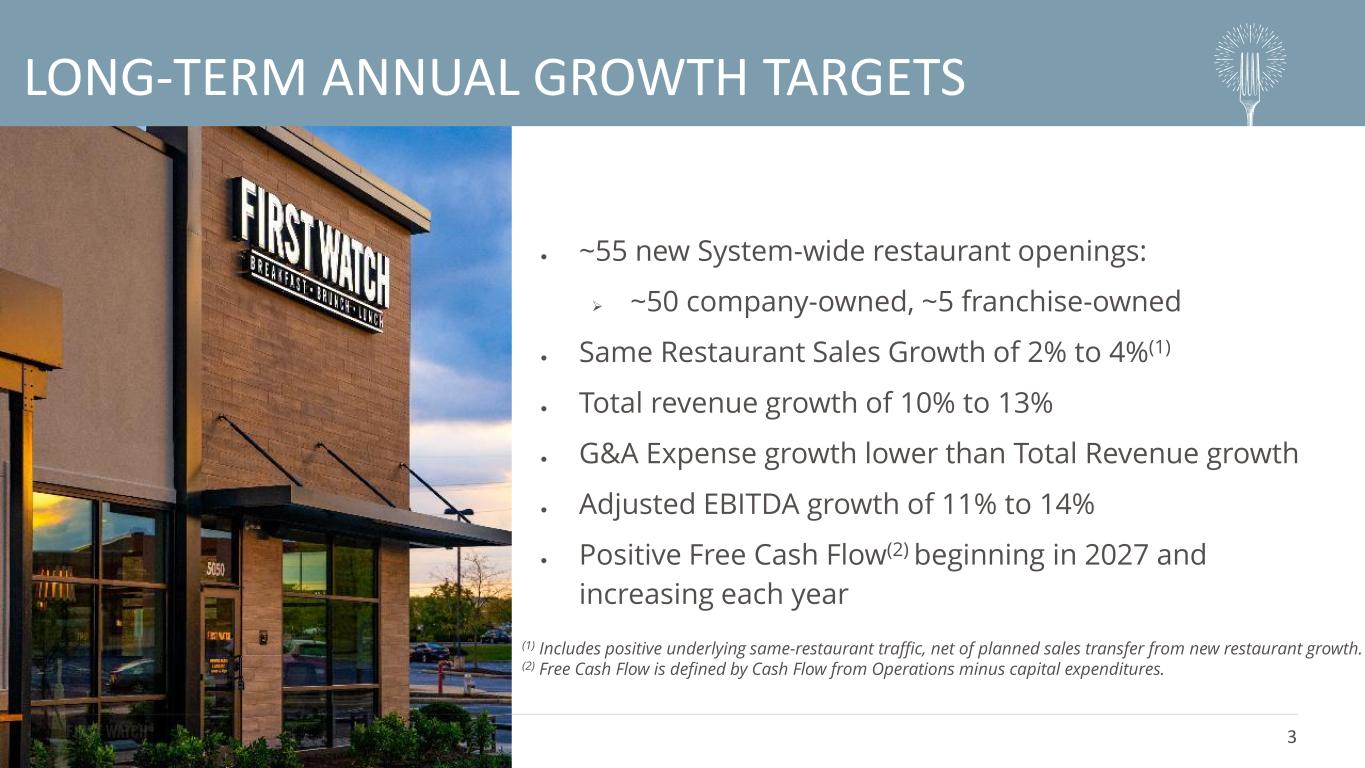
3 LONG-TERM ANNUAL GROWTH TARGETS • ~55 new System-wide restaurant openings: ➢ ~50 company-owned, ~5 franchise-owned • Same Restaurant Sales Growth of 2% to 4%(1) • Total revenue growth of 10% to 13% • G&A Expense growth lower than Total Revenue growth • Adjusted EBITDA growth of 11% to 14% • Positive Free Cash Flow(2) beginning in 2027 and increasing each year (1) Includes positive underlying same-restaurant traffic, net of planned sales transfer from new restaurant growth. (2) Free Cash Flow is defined by Cash Flow from Operations minus capital expenditures.
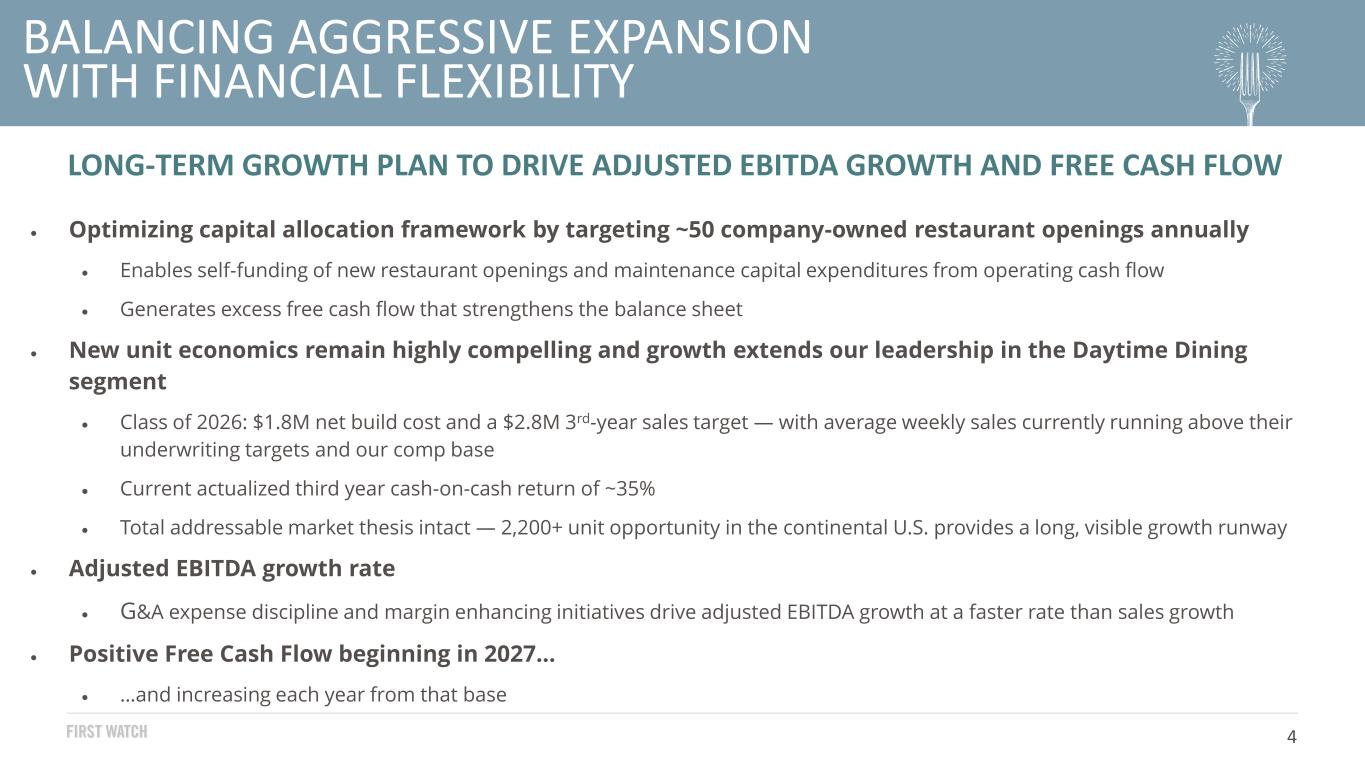
4 BALANCING AGGRESSIVE EXPANSION WITH FINANCIAL FLEXIBILITY LONG-TERM GROWTH PLAN TO DRIVE ADJUSTED EBITDA GROWTH AND FREE CASH FLOW • Optimizing capital allocation framework by targeting ~50 company-owned restaurant openings annually • Enables self-funding of new restaurant openings and maintenance capital expenditures from operating cash flow • Generates excess free cash flow that strengthens the balance sheet • New unit economics remain highly compelling and growth extends our leadership in the Daytime Dining segment • Class of 2026: $1.8M net build cost and a $2.8M 3rd-year sales target — with average weekly sales currently running above their underwriting targets and our comp base • Current actualized third year cash-on-cash return of ~35% • Total addressable market thesis intact — 2,200+ unit opportunity in the continental U.S. provides a long, visible growth runway • Adjusted EBITDA growth rate • G&A expense discipline and margin enhancing initiatives drive adjusted EBITDA growth at a faster rate than sales growth • Positive Free Cash Flow beginning in 2027… • …and increasing each year from that base

For more information, visit investors.firstwatch.com or email investors@firstwatch.com