UNITED STATES DISTRICT COURT
SOUTHERN DISTRICT OF NEW YORK
| | | | | |
TEADS HOLDING CO.,
Plaintiff,
-against-
GOOGLE LLC and ALPHABET INC.,
Defendants. |
Case No. 1:26-cv-06591
COMPLAINT FOR DAMAGES AND INJUNCTIVE RELIEF
JURY TRIAL DEMANDED |
TABLE OF CONTENTS
INTRODUCTION
1.In January 2023, the United States and seventeen States sued Google for, among other things, monopolization of the publisher ad server market and monopolization of the ad-exchange market in violation of Section 2 of the Sherman Act, and illegal tying in violation of both Section 1 and Section 2 of that Act.
2.In April 2025, after a three-week trial that featured live testimony from thirty-nine witnesses, deposition testimony from another twenty, and hundreds of exhibits, Judge Brinkema of the United States District Court for the Eastern District of Virginia issued a 115-page opinion holding that Google had “willfully engaged in a series of anticompetitive acts to acquire and maintain monopoly power in the publisher ad server and ad exchange markets for open-web display advertising,” and unlawfully tied “its publisher ad server and ad exchange together.” United States v. Google LLC, 778 F. Supp. 3d 797, 873 (E.D. Va. Apr. 17, 2025) (“EDVA Op.”). Judge Brinkema specifically held that Google’s unlawful conduct “depriv[ed] rivals of the ability to compete” for customers and harmed “the competitive process,” “thereby reducing its rivals’ scale” and “limiting their ability to compete.” Id. at 865, 873.
3.Plaintiff Teads Holding Co. (“Teads”) is one of Google’s excluded ad-server and ad-exchange rivals. Teads is an innovative advertising technology company that has operated in the digital advertising industry since 2006, when it was founded as Outbrain Inc. (“Outbrain”). In February 2025, Outbrain acquired TEADS, a Luxembourg limited liability company referred to herein as “Legacy Teads,” which had operated as an advertising technology company since 2005. Outbrain adopted the Teads brand and became Teads Holding Co., with its common stock trading on the Nasdaq Stock Market under the ticker “TEAD.”
4.Approximately 10,000 publishers, more than 10,000 advertisers, and approximately 2,000 ad agencies worldwide use Teads’ products to sell and buy digital advertising across the open Internet. Teads’ publisher customers include household names like Sports Illustrated, The Atlantic, The Washington Post, and ESPN. Teads’ advertiser customers range from Fortune 500 brands to small-to-medium sized businesses. Teads’ products have been recognized throughout the digital advertising industry. In 2025 alone, Teads’ innovative advertising solutions were recognized with numerous international awards from the Association of Online Publishers, Digiday, the Online Media and Marketing Awards, the Native Advertising Institute, and Global Performance Marketing Awards.
5.Teads operates both publisher-facing and advertiser-facing products. On the publisher side, Teads operates an advertising exchange called Teads SSP that gives publishers the tools to sell innovative and high-value ad formats. Teads SSP facilitates publishers’ sale of Teads’ custom advertising formats and creatives. Those ad formats increase reader engagement, improve the user experience on ad-supported websites and apps, and are more valuable to advertisers and thus increase the value of ad space on publishers’ pages. Indeed, Teads’ custom ad formats command 49% higher attention from readers. Teads SSP transacts approximately 10 billion advertising impressions every month. Publishers trust Teads’ exchange — Teads’ top 20 publisher partners have used Teads’ products for an average of 7 years.
6.On the advertiser side, Teads operates its own demand side platform (“DSP”) — called Teads Ad Manager — that advertisers use to bid for advertising inventory available through Teads SSP. On average each month during 2025, approximately 4,500 active advertisers and 2,000 active agencies used Teads Ad Manager to run approximately 5,200 campaigns, winning nearly 7 billion advertising impressions. Teads Ad Manager provides end-to-end
campaign management — including planning, activation, and reporting — and offers capabilities that distinguish it from other demand-side platforms, including omnichannel execution across desktop, mobile and connected TV from a single interface; advanced interactive ad formats; branding-focused features such as direct optimization for attention and enforcement of brand guidelines; and cookieless targeting that operates alongside cookie-based targeting within a single campaign. Teads was first to market with several of these innovations. In addition to Teads Ad Manager, Teads provides hands-on, consultative services for its advertisers. Teads designs more than 70,000 bespoke advertisements for its clients each year. Teads also helps improve its advertiser customers’ targeting strategies and helps those advertisers measure the effectiveness of their campaigns.
7.Outbrain, founded in 2006, also operated publisher-facing and advertiser-facing products. On the publisher side Outbrain operated Outbrain Engage Network, a tool publishers could use to access advertising demand aggregated by Outbrain’s sales teams. Outbrain also developed a sophisticated publisher ad server for native ads – ads designed to look like the content around them and that are highly engaging. Outbrain’s Native Ad Server provided publishers with cutting-edge tools to sell, manage, and monitor native ad campaigns. On the advertiser side, Outbrain operated two demand-side platforms — Amplify and Zemanta — that advertisers could use to purchase advertising from Outbrain Engage Network or from third-party advertising exchanges.
8.Digital advertising is a nearly $1 trillion business worldwide. Yet, despite Teads’ innovative ad server and exchange technology, its revenues and growth have been hamstrung by Google’s unlawful conduct. Google uses these ad tech monopolies to prevent publishers from selling their ad slots through Teads’ exchange, forcing publishers to sell — and advertisers to
buy — large shares of that ad space through Google instead. Google also has defeated nascent competitive threats to its ad server like Outbrain’s Native Ad Server. The result is dramatically less revenue and scale for Teads — and less choice for publishers and advertisers — while Google reaps exorbitant monopoly profits. For example, in 2022 alone, Google made $30 billion from its ad tech business.
9.With control over the largest ad exchange and the largest ad server — both of which Google acquired rather than developed — Google has carried out a sophisticated, anticompetitive, and deceptive scheme for well over a decade.
10.First, Google unlawfully tied its demand side platform for small-to-medium advertisers (Google Ads) to its ad exchange (AdX). As the Virginia Court explained, “Google made AdX the only ad exchange into which [Google Ads] advertising demand was permitted to bid.” EDVA Op. at 825. Google did so “despite internal recognition that allowing [Google Ads] to bid on other exchanges” — like Teads SSP — “would be valuable for [Google Ads’] advertiser customers.” Id. at 854. As a result, Google forced advertisers to do business with AdX rather than rival exchanges like Teads SSP, which cut off Teads from many billions of advertising transactions and deprived advertisers of Teads’ innovative exchange services. Google, meanwhile, secured unshakable monopoly power in the market for ad exchanges.
11.Second, Google unlawfully tied its publisher ad server (DFP) to AdX. As a result, the entire publishing industry cannot practically reach millions of advertisers without using DFP. Predictably, Google’s tie has forced publishers to use DFP, which has eliminated virtually every remaining publisher-ad-serving rival, including Teads.
12.Third, with control over ad serving, Google stifles competition among exchanges and deprives rivals of advertising inventory to buy and sell. Google makes it difficult for
publishers to solicit competitive bids from rival exchanges, while at the same time rigging AdX’s bids to its own advantage by trading on inside information from DFP. For example, Google secretly has rigged auctions for more than a decade through a program called Project Bernanke, which manipulates auctions to funnel ad impressions to AdX and away from Google’s exchange rivals like Teads. Internally, Google employees explained that Project Bernanke was a “kind of collusion” and a “bidding ring which the [Federal Trade Commission] has declared illegal in many instances.” Others explained that the Bernanke “bidding club” was “going to grow out of control and marginalize the exchanges.”
13.Google’s market manipulations have evolved over the years, but the goal has remained the same: Google acquires more inventory at more favorable prices at the expense of its exchange rivals, like Teads. Google substantially has eroded Teads’ ability to compete for the business of millions of publishers and advertisers worldwide.
14.This should not occur in a healthy, competitive market. For that reason, and now for years, antitrust enforcers in the United States and throughout the world have recognized that Google’s unlawful monopolization must be stopped:
a.The U.K. Competition and Markets Authority identified Google’s misconduct and the harm to ad exchanges and ad servers but concluded it had insufficient injunctive authority to implement a remedy. See Online Platforms and Digital Advertising Market Study Final Report at 20, 60, 394-406 (July 1, 2020) (“Google’s strong position at each level of the intermediation value chain creates clear conflicts of interest, as it has the ability and incentive to exploit its position on both sides of a transaction to favour its own sources of supply and demand.”).
b.The Australian Competition and Consumer Commission identified Google’s misconduct and the ad tech rivals, and it proposed various measures to remedy some of Google’s practices. See Digital Advertising Services Inquiry Final Report at 5-15 (Sept. 2021) (concluding that “the cumulative effect of [Google’s] conduct . . . has been to prevent both actual and future rivals of Google’s ad tech services from competing effectively with Google’s vertically integrated services,” and “[n]ew rules should apply to Google’s supply of ad tech services to address its dominance and problematic conduct”); see also Digital Platform Services Inquiry Final Report at § 3.4 (Mar. 2025).
c.The U.S. House Antitrust Subcommittee studied the conduct of Google and other platforms, collecting 1.3 million documents and holding seven hearings. The House Subcommittee raised concerns regarding Google’s conduct in the markets for ad tech tools, including Google’s “[l]everaging its market power in search advertising to compel advertisers to use Google’s products in the display market” rather than rival products and Google’s “[i]nhibiting interoperability between Google’s ad platforms and non-Google ad platforms.” Final Report and Recommendations, Investigation of Competition in Digital Markets at 176 (Apr. 15, 2021).
d.In December 2020, the State of Texas and a bipartisan group of sixteen other State Attorneys General filed suit against Google in the Eastern District of Texas alleging monopolization and misrepresentations similar to those described in this Complaint. See Texas v. Google LLC, No. 20-cv-00957 (E.D. Tex., Complaint filed Dec. 16, 2020, Fourth Amended Complaint filed May 5, 2023).
e.Between 2022 and 2023, the leadership of both the House and Senate Antitrust Subcommittees introduced bills that, among other things, would break Google’s
unlawfully acquired dominance over several advertising technology markets and provide additional resources to antitrust enforcers to address Google’s conduct. See, e.g., Competition and Transparency in Digital Advertising Act, S. 4258, 117th Cong. (2022).
f.In June 2023, the European Commission filed a case against Google alleging unlawful abuse of monopoly power in digital advertising and seeking a breakup of the components of that business as a legal remedy. In a statement, the head of the Commission explained why divestiture of Google’s ad-tech tools is necessary: “As long as these conflicts of interest remain in place, Google could continue such self-preferencing practices or it could engage in new ones. This market is a highly technical market. It is very dynamic. The detection of these behaviours can therefore be very challenging. We have seen this play out concretely: each time a practice was detected by the industry, Google subtly modified its behaviour so as to make it more difficult to detect, but with the same objectives, with the same effects. A remedy requiring Google just to change its behaviour would allow Google to continue doing what it has been doing so far, just under a different disguise.” Remarks by Executive Vice President Vestager on the Statement of Objections sent to Google over practices in the online advertising technology industry (June 14, 2023). Even more recently, the European Commission fined Google nearly €3 billion and ordered such a remedy, directing Google to “bring these self-preferencing practices to an end” and “implement measures to cease its inherent conflicts of interest.” European Commission Press Release, “Commission fines Google €2.95 billion over abusive practices in online advertising technology” (Sept. 4, 2025).
15.Further, as discussed above, the United States and seventeen State Attorneys General won a suit against Google in the Eastern District of Virginia for unlawful monopolization of the same advertising technology markets at issue in this Complaint. See EDVA Op. This Complaint alleges the same relevant product markets (a publisher ad server market and an ad-exchange market), in the same geographic market (worldwide), and much of the same anticompetitive conduct (an ad-server/ad-exchange tie and other schemes to enforce Google’s ad-server and ad-exchange monopolies) that the Eastern District of Virginia has already held as anticompetitive. All that remains in the Eastern District of Virginia case is to decide the appropriate remedy, including a potential breakup of Google’s digital advertising monopolies. A recent ruling by this Court gave preclusive effect to factual and legal findings in the Eastern District of Virginia opinion. See In re Google Digit. Advert. Antitrust Litig., 2025 WL 3012840 (S.D.N.Y. Oct. 27, 2025) (“Preclusion Order”).
16.Teads seeks compensation for the harms it has sustained as Google’s rival in the monopolized exchange and ad server markets. Teads also requests injunctive relief to restore competition in the monopolized markets, and to protect advertisers and publishers that rely on digital advertising to sell their products and fund the creation of content users value.
PARTIES
17.Plaintiff Teads Holding Co. is a Delaware corporation with its headquarters and principal place of business at 111 West 19th Street, New York, NY 10011. More than 100 of Teads’ employees work in New York City. Many of Teads’ publisher partners and advertiser clients are based in New York — including the New York Post, Hearst, Condé Nast, the Wall Street Journal, and American Express — and huge numbers of New Yorkers view ads bought and sold using Teads’ products each month.
18.Defendant Google LLC (“Google”) is a limited liability company organized and existing under the laws of the State of Delaware, with its principal place of business in Mountain View, California. Google is, among other things, an online advertising company providing Internet-related products, including various online advertising technologies, directly and through subsidiaries and business units it owns and controls. Google maintains an office in this District at 111 8th Avenue, New York, New York 10011.
19.Defendant Alphabet Inc. (“Alphabet”) is a publicly traded company incorporated and existing under the laws of the State of Delaware and headquartered in Mountain View, California. Alphabet was created as a holding company for Google in late 2015, and Alphabet controls Google’s day-to-day operations. Virtually all of Alphabet’s revenue comes from Google. Since December 2019, Alphabet and Google have had the same Chief Executive Officer. As a result of Alphabet’s operational control, Google is Alphabet’s alter ego. This Complaint refers to Google and Alphabet together as “Google.”
JURISDICTION AND VENUE
20.This action arises under Sections 1 and 2 of the Sherman Act, 15 U.S.C. §§ 1-2, and Sections 4 and 16 of the Clayton Act, 15 U.S.C. §§ 15 and 26. The Court has subject-matter jurisdiction under 15 U.S.C. § 4, and 28 U.S.C. §§ 1331 and 1337(a).
21.In addition to pleading violations of federal antitrust law, Plaintiff alleges violations of state law and seeks relief thereunder. All claims under federal and state law are based upon a common nucleus of operative facts, and the entire action commenced by this Complaint constitutes a single case that ordinarily would be tried in one judicial proceeding. This Court therefore has jurisdiction over the state-law claims under 28 U.S.C. § 1367(a).
Exercising jurisdiction over the state-law claims will avoid unnecessary duplication of actions and furthers the interests of judicial economy, convenience, and fairness.
22.The Court may exercise personal jurisdiction over Google because Google does extensive business within this District — including by providing the monopolized products to publishers and advertisers in this District — and this action arises out of Google’s contacts within this District.
23.Venue is proper in this District under Sections 4 and 12 of the Clayton Act, 15 U.S.C. §§ 15 and 22, and 28 U.S.C. § 1391, because a substantial part of the events or omissions giving rise to Plaintiff’s claims occurred in this District, and because Google transacts business and is found within and resides in this District.
24.Plaintiff has offices in this District, and numerous of its employees work in this District. Google has admitted that its conduct occurred in this District; and non-party witnesses, including major digital publishers, advertisers, and many of Google’s other rivals, are or were located in this District. Indeed, in support of a motion to transfer the Department of Justice’s lawsuit to this District, Google averred that “Google’s second-largest corporate presence is in New York (where much of its ad tech business is located)” and that many of its witnesses are based in New York. See Mem. at 21, United States v. Google LLC, No. 1:23-cv-00108, Dkt. No. 44-2 (E.D. Va. Feb. 17, 2023).
25.Google’s conduct affects interstate trade and commerce.
26.Google’s conduct has a direct, substantial, and reasonably foreseeable effect on commerce within the United States, which in turn injures Teads’ foreign and domestic revenue.
FACTUAL ALLEGATIONS
I.BACKGROUND
A.The Sale of Online Display Advertising
27.Digital publishers and advertisers use ad tech tools to present what are known as “display ads” to readers — image, text, and video-based ads that appear alongside the publisher’s content. Those ads come in different formats, including banner ads along the top and bottom of a page; native ads that present in-text advertising content; and video ads that play in a video player on the reader’s screen. Publishers and advertisers can display unique ads on each page and to each reader who visits their sites.
28.Specifically, publishers sell their ad space to advertisers on an “impression-by-impression” basis. As readers load publishers’ webpages, those publishers can fill each ad slot (called an “impression”) with an ad responsive to that user’s behavior, intent, or interests. So, different readers viewing the same page can see different ads that are relevant to them. That makes publishers’ digital ad space particularly valuable to many advertisers, who can target specific types of customers, and to readers, who are more likely to see advertisements in line with their interests. Additionally, with the ability to change ads depending on the user, there are many more opportunities for publishers to generate advertising revenue.
29.Generally, publishers sell impressions through two sales channels: the “direct” and “indirect” channels. Direct sales are person-to-person, pre-negotiated deals between publishers and advertisers, including advertising campaigns sold by the publisher’s internal sales staff. Among other deal types, direct sales transactions occur in the following ways:
a.Insertion order: Publishers and advertisers negotiate contracts specifying the start and end date of a campaign, the number of impressions to be sold, targeting criteria, and other terms. The publisher then creates an “insertion order” and configures the campaign in the ad server. The publisher and advertiser handle billing separately via an invoice. Usually, for a direct campaign served via insertion order, the volume of
impressions is guaranteed. In other words, the publisher promises the advertiser that it will display a guaranteed volume of impressions.
b.Programmatic Guaranteed and Preferred Deals: As with insertion orders, publishers and advertisers negotiate the terms of an ad campaign directly. But rather than create an insertion order, the publisher and advertiser execute the transaction through software from ad-tech providers. Google offers different transaction types for direct deals via its exchange, including Programmatic Guaranteed (“PG”) and Preferred Deals (“PD”). The main difference between PG and PD deals is that only the former guarantees the advertiser an impression volume.
c.Private Marketplaces: Other exchanges, including Teads, permit publishers to transact direct deals in a similar manner to PG deals, PD deals, or both. Often, ad-tech providers call these deals “Programmatic Direct” or “Private Marketplaces” (“PMPs”). Teads’ PMP offering is called Publisher Direct Deals, which is part of its “Teads for Publishers” suite of products.
30.Publishers and advertisers typically consider transactions via insertion order, PG, PD, Programmatic Direct, and PMP to be interchangeable forms of direct deals.
31.Indirect sales, by contrast, do not involve any prior negotiation between publisher and advertiser. Instead, publishers auction off their ad space in real time through “ad exchanges,” such as Google’s AdX or Teads SSP. When a reader arrives at a website, the publisher solicits bids from exchanges, which contact their participating demand-side platforms and solicit their offers for the impression. At the conclusion of this process, the publisher’s ad server chooses the winning ad and loads it onto the webpage. Auctioning off impression
“inventory” happens in milliseconds, and the overall process of serving and loading the ad takes a few seconds or less.
32.The process of selling and buying ad inventory — whether directly or indirectly — is repeated for each reader, each page the reader visits, and each impression generated on a website. Further, every page has several slots where publishers can serve an ad.
33.Both in the past and now, any revenue generated from subscriptions and other non-advertising sources could not, alone, fund publishers’ content. Nor are other forms of advertising inventory substitutes for ad space on the open Internet. Digital advertising plays a critical role in funding publishers’ operations and in advertisers’ campaigns.
B.The Relevant Ad-Tech Products
34.To facilitate the sale of these impressions, all within milliseconds, publishers and advertisers use a series of specialized and distinct products.
35.Certain publishers sell their advertising inventory using “ad networks,” which pool inventory across the internet for sale to advertisers affiliated with the network. Ad networks offer relatively limited functionality and do not permit publishers to sell impressions to advertisers outside the network.
36.Other publishers who either have a larger supply of ad inventory, desire greater control over their inventory, or both, do not primarily rely on ad networks. Instead, they license several different ad tech tools with the goal of exercising greater control over their inventory and reaching a broader base of advertisers.
37.The core tool for large publishers is the “publisher ad server,” which organizes and sells their ad inventory both directly and indirectly across all digital platforms: desktop, mobile web, and mobile applications.
38.When a user visits a webpage through any of those channels, the publisher ad server determines whether and how to fill the advertising inventory on the visited webpage. Depending on how publishers have prioritized different demand sources in the ad server (and depending on the technological limitations and requirements of the ad server), the ad server may first seek to place a direct deal. If no direct-deal ad is available to serve, the ad server then solicits bids from — or “calls” — ad exchanges (also called supply-side platforms or “SSPs”) to organize auctions for each impression. Alternatively, the ad server might bypass or defer the direct sales channel and begin by calling ad exchanges.
39.Once called, each exchange requests participating demand-side platforms to place bids on behalf of their advertisers. A DSP is automated ad-buying software that advertisers use to buy display ad inventory. The DSPs, based on advertiser demand and any available targeting information, then enter bids for the impression. To determine those bids, DSPs can run an internal auction among their participating advertisers. In that way, the DSPs run an auction before placing a bid in the exchange auction.
40.Each ad exchange collects the available bids, picks a winning DSP, and submits the winning bid to the publisher ad server. When exchanges return bids for individual impressions, each bid is priced in terms of its “Cost-Per-Mille” (“CPM”), or the price for one thousand impressions. So, for example, when an exchange wants to bid $0.01 for an individual impression, the bid is communicated to the ad server as $10 CPM.
41.Finally, the ad server decides which exchange’s bid to accept. If the ad server rejects all bids, it can place a “house ad” — e.g., an ad from publishers advertising their own brands — to fill the impression.
42.At the conclusion of this auction process, publishers make money when ads are loaded on their pages rather than when users click on them. That is because advertisers typically pay for impressions — i.e., the right to display their ads on a publisher’s webpage. Each ad tech product then exacts a fee for its services, often on a per-impression basis. For example, the ad server charges the publisher monthly depending on the volume of impressions served. Exchanges, meanwhile, typically charge the publisher a percentage (called a “revenue share” or “take rate”) of each impression’s sale price. To account for that revenue share, exchanges submit bids to the ad server on a “net” basis, i.e., the winning bid submitted by its DSPs less the revenue share. Finally, DSPs charge their advertisers a fee (often a share of the advertiser’s budget for a given campaign) for their services — including identifying relevant users and then assessing whether the ads shown were effective.
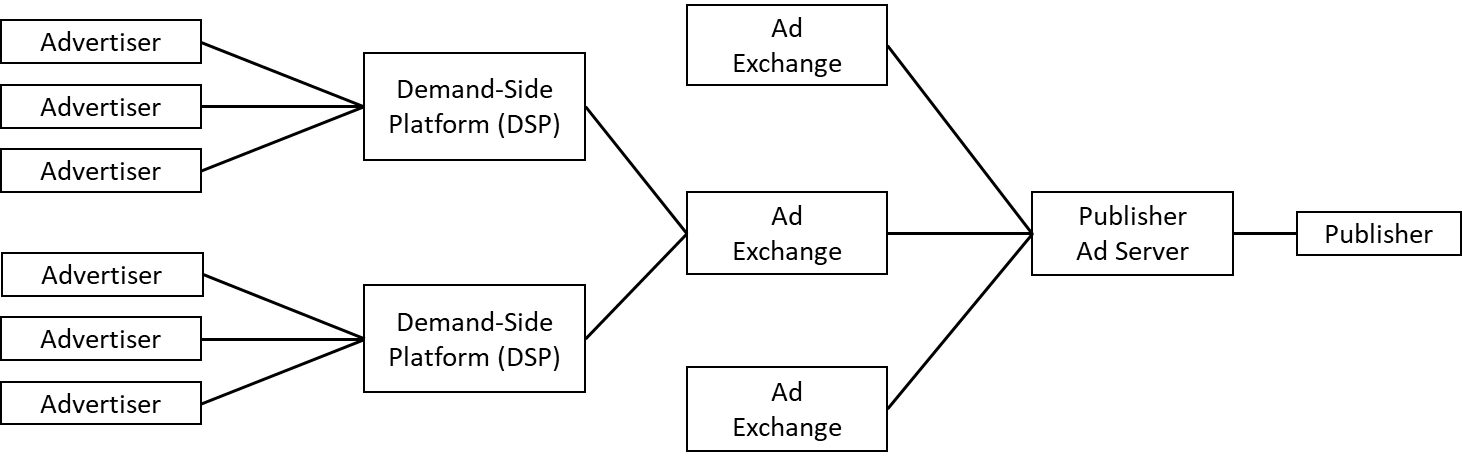
43.The below graphic depicts the relevant ad tech products, with buyers (i.e., advertisers) on the left and sellers (i.e., publishers) on the right.
Figure 1: Ad-Tech Products
44.Google participates in the markets for all of these ad tech products, and the Eastern District of Virginia has already found Google to be a monopolist in two of the markets. Google thus controls the buying and selling of display ad inventory across most of the Internet.
45.As the Eastern District of Virginia held, Google’s publisher ad server — “DoubleClick for Publishers” (“DFP”) — controls a “dominant” share of more than 90% of the market for publisher ad serving worldwide. EDVA Op., 778 F. Supp. 3d at 850. Google offers both a free version of DFP and a paid version for large publishers that require certain additional features to monetize their inventory.
46.The Eastern District of Virginia also held that Google’s exchange — “DoubleClick Ad Exchange” (“AdX”) — “has monopoly power” through its control of more than 60% of the exchange market. EDVA Op., 778 F. Supp. 3d at 855. Recent discovery in related cases has revealed that Google’s share of the exchange market eclipses 70%.
47.Google also offers two dominant DSPs — “Google Ads” (the dominant tool for smaller advertisers) and “Display & Video 360” (“DV360”) (the dominant tool for larger advertisers). The U.K. Competition and Markets Authority concluded that Google’s DSPs together controlled “50-60% of the value of ads purchased through DSPs.” See Online Platforms and Digital Advertising Market Study Final Report at 266 (July 1, 2020) (cleaned up).
48.Google acquired rather than built its ad tech dominance. Google purchased the leading ad server and ad exchange when it acquired DoubleClick (DFP) in 2008. Google then acquired rival AdMeld — which publishers had started to use to introduce competition among exchanges — in 2011. And Google has acquired several other ad tech services over the years — including the leading ad-serving technology for small mobile app developers (AdMob) and the forerunner of Google’s data management platform (Google Analytics).
49.Because Google charges revenue shares, it exacts an exchange fee from publishers only if AdX wins the right to intermediate the transaction. Likewise, its DSP exacts a fee only if it provides an ad to fill the impression. And DFP can charge an ad-serving fee only if
it serves an impression. As a result, Google has every incentive to steal transactions from rivals. The result is more money for Google and less inventory and scale, and a reduced opportunity to compete, for Google’s rivals like Teads.
C.Teads Is Google’s Direct Competitor
50.Teads directly competes with Google in each of the relevant markets. For more than two decades, Teads has been an industry-leading innovator in ad-serving technology, ad exchanges, and DSPs.
1.Publisher Ad Servers
51.In 2009, Outbrain launched Engage Network, which was designed to allow publishers to solicit bids for and serve native ads from Outbrain’s Amplify DSP and from numerous third-party DSPs and exchanges, including AppNexus (now Xandr), Index Exchange, PubMatic, Magnite, The Trade Desk, Criteo, and more. Using Engage Network, publishers could serve those native ads without using DFP.
52.Engage Network gave publishers access to nearly all sources of third-party advertising demand, but there was one notable exception: AdX. Because Google did not permit publishers to solicit bids from AdX through any publisher ad server other than DFP, Engage Network did not have access to the unique and essential demand that was available only through AdX. For years, Google forcing publishers to use DFP prohibited Teads from competing for millions of dollars in publisher business.
53.In 2019, Outbrain sought to expand Engage Network by launching its Native Ad Server. While Engage Network allowed publishers to manage and serve programmatically sold native ad campaigns, the Native Ad Server gave publishers the ability to facilitate direct-sold native campaigns alongside those programmatic campaigns. It also included innovative features that allowed publishers to offer advertisers advanced user-targeting capabilities and the ability to
serve highly engaging ad formats not available through DFP. And the Native Ad Server had sophisticated tools that allowed publishers to monitor the performance of their native campaigns and to deliver detailed reporting to advertisers.
54.Outbrain’s Native Ad Server was valuable for publishers. For example, one publisher saw a 200% increase in revenue from native ad campaigns. By 2021, a number of large publishers worldwide had adopted the Native Ad Server, and Outbrain was in the process of responding to multiple requests for proposals from major multinational publishers.
55.Internally, Outbrain planned to develop its Native Ad Server to enter the market for general publisher ad servers; in other words, to sell the display, app, and video formats also served by DFP. Outbrain understood that native advertising was a fast-growing segment of the digital advertising industry. If Outbrain could establish itself as the leader in native ad serving, it could use that position to offer publishers a tool that would serve not only native advertising, but standard display and video ads as well. Ultimately, however, Outbrain’s Native Ad Server could not gain traction because of Google’s unlawful tie between DFP and AdX.
56.Following Outbrain’s merger with Legacy Teads, Teads has continued to look for ways to break into the market for general publisher ad servers. In June 2026, Teads launched EngageOS, a tool that allows publishers to manage their direct-sold ad deals and their programmatic ad sales in one platform. EngageOS is a product that maximizes publishers total revenue by smartly managing placements in the feed of each article. It dynamically balances editorial content and both native and display ads to generate maximum revenue per session which is an innovative and unique capability in the market. Using EngageOS, the publisher does not need to reserve a fixed amount of space on its pages for ads — instead EangageOS dynamically decides where on the page to place ads and how many ads to place for each user and
each pageview. Despite EngageOS’s innovative features, it too will face headwinds from Google’s unlawful tie between DFP and AdX. Prospective publisher clients have told Teads that without access to AdX and/or GAM, EngageOS is not a viable full solution for them.
2.Ad Exchanges
57.Teads’ ad exchange, Teads SSP, competes directly with Google’s AdX exchange. Like AdX, Teads SSP allows publishers to sell several ad formats, including standard display ads, video ads, in-app ads, and more. Teads SSP also permits publishers to sell innovative, custom ad formats that increase reader engagement. Advertisers are willing to pay more for those high-impact ads and publishers can thus sell them at higher prices than ads available through other exchanges.
58.Publishers solicit bids from Teads SSP, and that bid is sent to the publisher’s ad server — which is nearly always Google’s DFP. DFP then decides which ad to serve: AdX’s, Teads SSP’s, or an ad from a different demand source.
59.Despite Teads SSP’s higher-quality and higher-value ads, Google’s conduct has hamstrung Teads SSP’s growth. As described below, DFP and AdX manipulate the auctions in which Teads SSP participates to funnel impressions away from Teads SSP and to AdX instead. In a fair auction, Teads SSP could more effectively compete for impressions. And because Teads SSP’s ads are more valuable to advertisers, more profitable for publishers, and more effective for users, a fair auction would reward Teads SSP with a greater share of those impressions.
60.Likewise, Google’s tie of its Google Ads DSP to AdX harms Teads SSP by depriving it of the ability to effectively compete for advertising demand that is essential to any exchange hoping to win publisher business. Without the ability to compete for demand from
Google Ads, Teads SSP cannot offer publishers the full scope of advertising demand that publishers must have to effectively monetize their web properties.
3.DSPs
61.Teads operates and, prior to the merger, Outbrain operated, DSPs that compete with Google’s DV360 and Google Ads in exchange auctions for publisher inventory. Teads operates Teads Ad Manager, a DSP that advertisers use to buy high-impact ads through Teads SSP. Outbrain operated two DSPs: Amplify and Zemanta. Advertisers could use both DSPs to purchase impressions through Outbrain’s Engage Network as well as third-party exchanges, including AdX. When Amplify and Zemanta bid through third-party exchanges, their bids often were in direct competition with bids from DV360. And when they submitted bids to AdX, they were in competition with bids from both DV360 and Google Ads.
62.Today, Teads operates its demand-side offerings under the names Teads Enterprise and Outbrain Direct Response, but the underlying functionality remains the same. Amplify and Zemanta continue to bid through third-party exchanges, often in competition with Google’s DV360. TAM continues to provide advertisers access to inventory sold on Teads SSP.
II.RELEVANT MARKETS AND GOOGLE’S MARKET POWER IN EACH
A.General Publisher Ad Servers for Open Display Inventory
1.Market Definition
63.General publisher ad servers for open display inventory worldwide form a relevant antitrust product market. Publisher ad servers are inventory management systems that publishers use to manage their online display ad inventory available on desktops, mobile web, and mobile applications. Among other features, ad servers: (1) collect user-identification information, if available; (2) manage direct and indirect sales channels; (3) forecast what inventory will be available to sell; (4) permit a publisher’s sales team to input requirements and
parameters for the publisher’s display ads; (5) allocate inventory among exchanges; (6) generate reports on ad inventory performance; (7) load ads on the publisher’s website or mobile app, across a variety of ad formats and types; (8) create invoices for a publisher’s direct sales; and (9) manage display ad inventory for both websites and mobile applications.
64.Most publishers use only one ad server to manage their ad inventory across all inventory types. “Multihoming” among multiple ad servers is impracticable, including using different ad servers for different kinds of ad inventory (e.g., one ad server for desktop inventory and a separate ad server for mobile app inventory). For example, using multiple ad servers can create conflicts within a publisher’s inventory. Further, it is too costly to use different ad servers to sell different kinds of inventory. For these reasons, among others, publishers have historically used only one ad server (Google’s DFP) for all display advertising across their web properties and mobile apps.
65.Publisher ad servers also are unique — they are not interchangeable with ad exchanges or ad networks. For example, an exchange cannot load advertisements on the publisher’s webpage or provide reports regarding inventory performance across multiple sources of demand. Nor does an exchange pick the winning bid among all demand sources or choose between the indirect and direct sales channels; only an ad server can serve as the final decider of which ad will fill an impression on the page. Ad networks likewise do not typically manage and organize multiple demand sources. For ad-supported websites and apps, a publisher ad server is the only tool publishers can use to manage their digital ad inventory.
66.Internally, Google recognizes that the market for ad servers is distinct from markets for other ad tech products. Google calculates its share of the ad-server market without accounting for ad exchanges or ad networks.
67.Google has publicly recognized that publisher ad servers form a distinct market. When Google acquired DoubleClick and its leading ad server, Google represented to the FTC that an ad server was “not [a] direct substitute[]” for an ad network, calling any assertion to the contrary “seriously flawed and utterly divorced from commercial reality.” According to Google, an increase in the price for DoubleClick’s ad server would cause publishers to “switch to other publisher-side ad serving products, such as those” available at the time from “24/7 Real Media [and] Atlas/aQuantive.”
68.Publishers cannot build their own ad servers as a substitute. Building an ad server from scratch requires scale, substantial capital, and deep access to highly sophisticated engineering resources; it is not a viable option for website publishers. EDVA Op., 778 F. Supp. 3d at 836-37 (“The ‘extremely major investment’ required to develop a publisher ad server makes doing so infeasible for companies that do not specialize in enterprise software development.”). And, once built, the time, energy, resources, and cost of maintaining and updating an in-house ad server are prohibitive for publishers.
69.The Eastern District of Virginia also identified a virtually identical market for “publisher ad servers for open-web display advertising.” See EDVA Op., 778 F. Supp. 3d at 833-34. The Eastern District of Virginia’s relevant product market includes the same products: ad servers that allow publishers to manage web inventory. See EDVA Op., 778 F. Supp. 3d at 835-36 (market includes ad servers that are “capable of performing ad-serving functions for websites”). The Eastern District of Virginia’s relevant product market does not include ad servers capable only of serving instream video ads, mobile ads, or social media ads. See EDVA Op., 778 F. Supp. 3d at 836. Nor does it include in-house technology. EDVA Op., 778 F. Supp. 3d at 836-37.
70.The relevant geographic market is global, with the exception of certain regions subject to economic or political sanctions. Ad servers in countries and regions subject to U.S. embargoes like Cuba, Iran, North Korea, Syria, Russia, Crimea, Donetsk, and Luhansk are typically barred from the open web. They neither can compete with other ad servers nor are likely to transact a significant quantity of advertising impressions. Ad servers in regions subject to certain illiberal regimes that impose onerous restrictions on the production and distribution of digital content (e.g., China) are also not substitutes. Accordingly, the relevant geographic market is global, with limited exceptions.
71.The Eastern District of Virginia also identified the same relevant geographic market as worldwide with the exception of “countries where the operation of ad tech companies is substantially restricted by government censorship of the Internet (e.g., China) or U.S. economic sanctions (e.g., Iran).” EDVA Op., 778 F. Supp. 3d at 847 & n.26. This Complaint excludes the same countries and regions from the geographic market definition as did the market identified by the Eastern District of Virginia.
2.Monopoly Power
72.Google is a monopolist in the relevant publisher-ad-serving market. Google’s DFP today has more than 90% of the market share. Google’s market share nearly has doubled since it purchased DoubleClick in 2008. Since then, several ad-serving rivals — including 24/7 Real Media, aQuantive, and ValueClick — have exited the market. There are no meaningful ad-serving competitors left. And Google has protected its ad server monopoly from potential entrants like Outbrain’s Native Ad Server.
73.Google’s market share has grown consistently since it acquired DoubleClick’s ad server. In 2010, just two years after acquiring DFP, Google internally estimated that its ad server managed 78% of gross spending on display advertising across the top 400 publishers in North
America. By 2012, approximately 85% of publishers in the United States licensed Google’s ad server. That number grew to more than 90% by 2015. The Eastern District of Virginia found that Google has been “proven” to possess monopoly power in the publisher ad server market and that Google’s “industry participants perceive DFP to be the ‘dominant’ publisher ad server.” EDVA Op., 778 F. Supp. 3d at 850.
74.Google’s monopoly power is confirmed by direct evidence. Google charges a substantially higher ad-serving fee than its rivals — at least eight times higher. For video ad serving, specifically, Google charges an ad-serving fee eleven times higher than other forms of display advertising, despite offering no different functionality or service.
75.Further, for years, Google has degraded the quality of its ad server with severe limitations despite widespread dissatisfaction among publishers. Google has, inter alia, (1) degraded publishers’ ability to measure performance among exchanges; (2) limited publishers’ ability to set higher prices for their inventory; (3) reduced real-time competition between exchanges; and (4) permitted Google’s exchange to return bids based on rivals’ bid information.
76.For example, prior to Google’s acquisition of DFP, publishers could take the unique user IDs that it assigned to website visitors and share those IDs with ad exchanges and ad-buying tools to improve user identification and tracking. Access to user IDs allowed exchanges and DSPs to identify the best matches between advertisers and publishers, increasing the value of inventory for advertisers and the prices paid to publishers. But after Google acquired DoubleClick, Google prohibited publishers from sharing DFP-assigned user IDs with non-Google tools, like Teads SSP and Teads’ DSPs. Meanwhile, DFP continued to share user IDs only with AdX, enabling AdX to identify better matches between advertiser and impression.
77.To take another example, the Eastern District of Virginia specifically identified Google’s removal of publishers’ ability to set higher price floors as a degradation of service about which “Google was not concerned” because publishers had no credible alternatives to DFP. See EDVA Op., 778 F. Supp. 3d at 852.
78.Google’s monopoly in publisher ad serving is protected by high barriers to entry. Building an ad server is a technically complicated and expensive endeavor that most companies — and certainly publishers — cannot reasonably undertake. Teads devoted significant resources to build Native Ad Server, only for it to make no inroads into Google’s ad-serving monopoly.
79.Switching ad-serving technology is costly, extremely complex, and resource-intensive. Publishers would need to reconfigure their entire technology stacks to account for tens of millions of ad auctions per day across webpages to change ad servers — and there would be a significant risk to revenue if there were any glitch during the transition process. Indeed, publishers frequently cited the complexity of switching ad servers as a reason they did not adopt Outbrain’s Native Ad Server. Paired with the potential loss of revenue and integrations with other Google products, services, and third-party vendors, switching ad servers is an unrealistic option.
80.Another barrier to entry is that Google has tied its ad server to AdX, which is the dominant exchange in the ad-exchange market. Today, publishers cannot access real-time bids from AdX without using DFP. See infra § III.A.2. Any ad-serving competitor therefore would have to enter the ad-exchange and ad-serving markets simultaneously — and at sufficient scale to convince publishers to forgo AdX. Such simultaneous entry into the exchange and ad-serving markets is all but impossible. Publishers explicitly told Outbrain, for instance, that they could not leave Google’s ad server because it would cut off their access to must-have Google demand.
81.The Eastern District of Virginia has already found that Google has monopoly power in the ad server market. The court found that “Google’s publisher ad server DFP has a durable and ‘predominant share of the market’ that is protected by high barriers both to entry and expansion.” EDVA Op., 778 F. Supp. 3d at 850. The court further found that its conclusion was “reinforced by evidence that Google has acted to degrade DFP’s features without fear that its customers would switch to alternative publisher ad servers.” Id.
B.Ad Exchanges for Open Display Inventory
1.Market Definition
82.The market for advertising exchanges for open display inventory is also a relevant antitrust product market. These exchanges are marketplaces that auction publishers’ display inventory (for website and mobile apps, and including video) to advertisers through ad-buying tools (including DSPs) on an impression-by-impression basis.
83.Ad exchanges are not interchangeable with ad networks, which are marketplaces designed for smaller publishers and smaller advertisers. Unlike ad networks, ad exchanges do not bear inventory risk and are designed to integrate with multiple DSPs so that publishers can entertain more bids for their inventory. Further, most large advertisers buy inventory primarily through exchanges rather than ad networks. Reflecting that ad networks are not a substitute for ad exchanges, publishers sell almost all of their indirect display inventory to exchanges, not networks.
84.Ad exchanges also are not interchangeable with the direct sales channel. Buying and selling ad inventory directly is costly; a publisher must employ a dedicated sales staff to manage, sell, and serve online ad campaigns. It would be infeasible for publishers to scale up their direct deals to substitute for their indirect deals.
85.Additionally, cost aside, it remains commercially infeasible for large digital publishers to sell advertising inventory only through direct sales. Publishers’ supply of impressions can expand or contract depending on traffic — it would be difficult to pre-negotiate the sale of a moving target. Advertisers negotiating direct deals also do not want to appear alongside certain types of content that, while important, are not well suited for certain advertising campaigns. Advertisers thus ultimately prefer the flexibility of indirect programmatic sales for a portion of their advertising spend.
86.Google itself analyzes the ad-exchange market without reference to ad servers, ad networks, DSPs, or direct deals. Specifically, Google measures AdX’s market share by tracking its percentage of overall exchange market revenue and exchange impression volume, i.e., how many impressions AdX intermediates as compared with other exchanges. Meanwhile, Google describes direct sales and ad networks as separate channels with “distinct characteristics.”
87.The Eastern District of Virginia has already identified a virtually identical market for “ad exchanges for open-web display advertising.” See EDVA Op., 778 F. Supp. 3d at 837-38. The Eastern District of Virginia held that “[a]d exchanges play a distinct role in the open-web display ad tech stack by connecting publishers using publisher ad servers with advertisers using programmatic buying tools such as demand-side platforms and ad networks.” Id. The court also held that “there is no other ad tech tool that is reasonably interchangeable with ad exchanges.” Id.
88.The relevant geographic market is global, with the exception of certain regions subject to economic or political sanctions. Ad exchanges in countries and regions subject to U.S. embargoes like Cuba, Iran, North Korea, Syria, Russia, Crimea, Donetsk, and Luhansk are typically barred from the open web. They neither can compete with other ad exchanges nor are
likely to transact a significant quantity of advertising impressions. Ad exchanges in regions subject to certain illiberal regimes that impose onerous restrictions on the production and distribution of digital content (e.g., China) are also not substitutes. Accordingly, the relevant geographic market is global, with some limited exceptions. This Complaint excludes the same countries and regions from the geographic market definition as did the market sustained by the court in the Eastern District of Virginia.
89.The Eastern District of Virginia also identified the same relevant geographic market as worldwide with the exception of “countries where the operation of ad tech companies is substantially restricted by government censorship of the Internet (e.g., China) or U.S. economic sanctions (e.g., Iran).” EDVA Op., 778 F. Supp. 3d at 847 & n.26.
2.Monopoly Power
90.Google is a monopolist in the relevant ad-exchange market. Google’s exchange (AdX) transacts more than 60%, and likely more than 70%, of all display ad inventory sold on ad exchanges. For instance, from October 2018 to October 2019, AdX transacted more than 60% of all display inventory sold through exchanges in the United States. Another market study shows that AdX presides over upwards of 64% of display advertising spending. Confirming these findings, the Eastern District of Virginia found that “from 2018 to 2022, AdX was the exchange for 63% to 71% of the worldwide open-web display transactions among the ad exchanges that produced data for [that] litigation.” EDVA Op., 778 F. Supp. 3d at 855.
91.AdX likewise historically transacted the lion’s share of publishers’ programmatic ad inventory. AdX’s next largest competitors — Rubicon (now Magnite), AppNexus (now Xandr), and Index Exchange — have transacted a much smaller share of display impressions for most publishers over the relevant time period. Google likewise has transacted many times the volume of impressions as Teads SSP. In 2018, Google’s exchange transacted $7.6 billion in
gross revenue — more than all other exchanges combined. And many rivals (e.g., Microsoft, Yahoo!) have exited the market.
92.Additionally, “AdX’s durable 20% take rate constitutes direct evidence of monopoly power.” EDVA Op., 778 F. Supp. 3d at 854. Google’s AdX has offered its publisher customers no meaningful improvements in service over many years, yet it continues to charge an unshakable 20% take rate. AdX’s publisher customers repeatedly have tried to negotiate lower take rates in vain. Teads SSP and other exchange rivals, by contrast, have competed on price and on quality of service, offering superior exchange offerings than AdX, yet have made no inroads on AdX’s market share. To the contrary, AdX’s share continually has grown.
93.Google internally recognized that AdX’s take rate is not the price that would prevail in a competitive market. Its employees admitted that “20% for just sell-side platform/exchange isn’t likely justified by value.” Yet AdX’s average take rate has not budged. Google therefore can impose substantial, non-transitory price increases without losing (and, in fact, while increasing) its share of the exchange market.
94.Google’s market power in the exchange market is protected by barriers to entry. Like building an ad server, building an ad exchange is a costly endeavor that requires substantial capital investment and technological knowhow that is not easily built by other companies — and certainly not by exchanges’ publisher customers.
95.Further, as discussed below, Google’s ad exchange is uniquely powerful because it includes all advertisers who also are buying search ad inventory on Google’s monopoly search results pages. See EDVA Op., 778 F. Supp. 3d at 862-63 (“Google has been able to amass this unparalleled group of mostly small and medium-sized advertisers in large part due to the dominance of Search”). Those advertisers are not available through any other exchange. To
compete for those unique advertisers buying through Google’s AdX, rival exchanges would need to offer them search inventory at a similar scale to Google and then handle their complementary demand for display inventory, which is impossible in the foreseeable future.
96.Another barrier to entry is network effects. An exchange must connect publishers to advertisers and vice versa. Exchanges must access publishers’ supply of ad inventory, on the one hand, and advertiser demand, on the other. Advertisers will work with an exchange only if it offers a significant supply of publisher inventory, and publishers will work with an exchange only if it offers significant advertiser demand. “Scale and network effects are crucial for ad exchanges.” EDVA Op., 778 F. Supp. 3d at 856.
97.Google’s anticompetitive conduct has erected additional barriers to entry. Google’s ad server, DFP, insulates AdX from competition as discussed at length below, meaning that a better ad exchange, including Teads SSP, still would not have the same access to publishers’ inventory as AdX.
98.The Eastern District of Virginia has already found that Google has monopoly power in the ad-exchange market. The court held that “Google’s AdX has long been the dominant exchange for facilitating open-web display advertising.” EDVA Op., 778 F. Supp. 3d at 852. This conclusion was reinforced by direct evidence of market power, namely that AdX has been able to charge “a durable 20% take rate for well over a decade,” id., and that Google has “used its market power in adjacent segments of the ad tech ecosystem to make it more difficult for customers on both sides of the ad exchange market to switch to rival exchanges,” id. at 854.
99.The court’s conclusion that Google possesses market power in the ad-exchange market was further reinforced by indirect evidence, namely a market share of up to “71% of the
worldwide open-web display transactions among the ad exchanges that produced data for [the] litigation,” and “high barriers to entry and expansion.” EDVA Op., 778 F. Supp. 3d at 855.
C.Buy-Side Markets for Open Display Advertising
1.DSPs for Small Advertisers
100.The market for DSPs for small advertisers is also a relevant antitrust product market. DSPs for small advertisers are tools that enable small- to medium-sized businesses to buy open display advertising across one or more ad exchanges. Small advertisers use those DSPs to manage advertising campaigns, set targeting parameters to reach their desired users, and place bids for impressions. The tools provide small advertisers with a simple user interface that enables them to set up display ad campaigns, identify the types of audiences they are targeting, and receive reports on the performance of their advertising campaigns. The small advertiser DSP then automatically bids on the advertisers’ behalf.
101.Small advertiser DSPs are not interchangeable with ad exchanges. Small advertiser DSPs’ customers are small- to medium-sized businesses, not publishers. Small advertiser DSPs thus have tools that advertisers use to create, manage, and monitor advertising campaigns. Ad exchanges do not provide that functionality. Further, unlike ad exchanges, small advertiser DSPs do not integrate with multiple other DSPs so that publishers can entertain more bids for their inventory. Instead, small advertiser DSPs represent advertisers in auctions across multiple exchanges.
102.Small advertiser DSPs also are not interchangeable with the direct sales channel. Buying ad inventory directly is costly; an advertiser must employ an advertising agency or a dedicated staff to manage and purchase online ad campaigns directly. Small- and medium-sized businesses do not have the resources necessary to purchase direct deals at scale and prefer the
flexibility of programmatic sales facilitated by small advertiser DSPs for a portion of their advertising spend.
103.Small advertiser DSPs are not interchangeable with DSPs used by large advertisers and advertising agencies. Large advertiser DSPs require significant expense and expertise to operate. Large advertiser DSPs thus typically are operated by dedicated in-house teams or by third-party ad agencies with experience managing campaigns through large advertiser DSPs. Small advertisers typically lack the resources and sophistication to use a large advertiser DSP or to employ an ad agency to do so on their behalf. Most often, small- and medium-sized businesses’ advertising needs are relatively simple and can be handled by a single small advertiser DSP. The costs associated with large advertiser DSPs (like Google’s DV360) are too high for small advertisers. DSPs for large advertisers also often have minimum spend requirements — sometimes exceeding $10 million each month — that small advertisers cannot meet. As one former Google employee has explained: “The best analogy is that DBM [DV360] is like driving a manual transmission race car and using AdWords [Google Ads] would be like driving an automatic. If you’re a more sophisticated driver, you’ll want to use DBM [DV360]. If you’re more simplistic, you’ll want to use AdWords [Google Ads].”
104.Finally, DSPs for small advertisers are not interchangeable with ad-buying tools that permit advertisers to place ads only on search results pages (i.e., search ads) or social media websites like Instagram or TikTok (i.e., social media ads). Although advertisers may purchase display, search, and social media ads, they do so for different purposes and to meet different business objectives. “The fact that advertisers may move money between” various advertising types “to achieve varying goals does not make them substitutes.” United States v. Google LLC, 747 F. Supp. 3d 1, 129-30 (D.D.C. Aug. 5, 2024) (“DDC Op.”). A small- or medium-sized
advertiser does not consider search and social ads as substitutes for open display ads, and therefore cannot abandon open display DSPs for tools that purchase only those kinds of advertisements.
105.Search ads serve a different purpose than display ads. The United States District Court for the District of Columbia found, following a multi-week trial, that search advertising was distinct from other forms of advertising because they are “generated in response to a user query” and are designed to respond to “a direct expression of a user’s specific motivation or interest at the time [the query] is entered.” DDC Op., 747 F. Supp. 3d at 125-26. Display ads serve a different function for advertisers — they help an advertiser build general awareness of their brand or target “a user’s latent intent” to purchase products sold by the advertiser. Id. at 126. As a result of those differing functions, there is widespread recognition that search ads are distinct from display ads, search ads and display ads “use different pricing models,” and search ads “are produced differently” than display ads. Id. at 126-32.
106.Social media ads and display ads likewise serve different purposes and are therefore not substitutes, as a Court in this District recently found. See FTC v. IQVIA Holdings Inc., 710 F. Supp. 3d 329, 367-68 (S.D.N.Y. 2024). Social media ads appear in a user’s social media feed and are targeted to users based on the social media content they read or watch. Display ads, by contrast, are often targeted based on behavioral or demographic information about the reader, rather than the content on the page. These ads are targeted differently because advertisers have different goals when placing them. Advertising agencies also have different budgets and teams that handle social and open display campaigns, indicating that the industry recognizes them as separate forms of advertising. Finally, social media ads and display ads are
priced independently — i.e., if the price of a display ad increases, many advertisers will continue to buy display ads rather than substitute to social media ads.
107.As with ad servers and ad exchanges, the relevant geographic market is global, with the exception of certain regions subject to economic or political sanctions. DSPs in countries and regions subject to U.S. embargoes like Cuba, Iran, North Korea, Syria, Russia, Crimea, Donetsk, and Luhansk are typically barred from the open web. They neither can compete with other DSPs nor are likely to purchase a significant quantity of advertising impressions. DSPs in regions subject to certain illiberal regimes that impose onerous restrictions on the production and distribution of digital content (e.g., China) are also not substitutes. Accordingly, the relevant geographic market is global, with some limited exceptions.
2.DSPs for Large Advertisers
108.The market for DSPs for large advertisers is also a relevant antitrust product market. Large advertiser DSPs enable sophisticated large advertisers and advertising agencies to buy open display advertising across one or more ad exchanges. Large advertiser DSPs can manage complex ad campaigns and offer numerous features that small advertiser DSPs do not have. Large advertiser DSPs “provide large advertisers with significant control over the sources of inventory from which they purchase impressions and how they bid on those impressions.” EDVA Op., 778 F. Supp. 3d at 817.
109.Large advertiser DSPs are not interchangeable with ad exchanges. Large advertiser DSPs’ customers are advertisers and their agencies, not publishers. Large advertiser DSPs thus have tools that advertisers and agencies use to create, manage, and monitor advertising campaigns. Unlike ad exchanges, large advertiser DSPs do not integrate multiple
other DSPs so that publishers can entertain more bids for their inventory. Instead, large advertiser DSPs represent advertisers in auctions across multiple exchanges.
110.Large advertiser DSPs also are not interchangeable with the direct sales channel. Buying ad inventory directly is costly; an advertiser must employ an advertising agency or a dedicated staff to manage and purchase online ad campaigns directly. Large advertisers use DSPs because they prefer the flexibility of indirect programmatic sales that large advertiser DSPs can facilitate for a portion of their advertising spend.
111.Large advertiser DSPs are not interchangeable with small advertiser DSPs. Small advertiser DSPs do not offer the kinds of sophisticated features that large advertisers and agencies need to design and implement their ad campaigns. Large advertiser DSPs allow their users to “control where and when [their] ads appear and to which user they are displayed” to a degree that small advertiser DSPs cannot facilitate. EDVA Op., 778 F. Supp. 3d at 817.
112.Finally, as with small advertiser DSPs, large advertiser DSPs are not substitutable with ad-buying tools for only search or social media ads. For the reasons described above, search and social media ads each serve different functions than display ads. Large advertisers view search and social media ads as complementary to, not as substitutes for, display ads.
113.As with ad servers and ad exchanges, the relevant geographic market is global, with the exception of certain regions subject to economic or political sanctions. DSPs in countries and regions subject to U.S. embargoes like Cuba, Iran, North Korea, Syria, Russia, Crimea, Donetsk, and Luhansk are typically barred from the open web. They neither can compete with other DSPs nor are likely to purchase a significant quantity of advertising impressions. DSPs in regions subject to certain illiberal regimes that impose onerous restrictions
on the production and distribution of digital content (e.g., China) are also not substitutes. Accordingly, the relevant geographic market is global, with some limited exceptions.
3.Google Ads’ Market Power
114.Google Ads has market power in the market for small advertiser DSPs. Google Ads is the largest self-service ad-buying tool in the world and is “the leading source of small and medium-sized online advertiser[]” demand. EDVA Op., 778 F. Supp. 3d at 831. Today, “[o]ver four million advertisers use only [Google Ads] to purchase open-web display advertising.” Id. at 841. From 2018 to 2022, among small advertiser DSPs, Google Ads consistently won more than 85% of display advertisements sold on websites worldwide. Google Ads’ market share in 2022 was six times larger than its next closest rival in the market for small advertiser DSPs.
115.There is also direct evidence of Google’s monopoly power. Google Ads charges advertisers up to a 32% take rate without losing advertisers’ business. Google has enjoyed that pricing power for many years. Indeed, Google Ads charges more than three times what DV360 charges larger advertisers, despite offering less sophisticated services. Google also has performed internal analyses showing that Google could increase its margin without losing market share. For example, in 2014, Google ran an experiment showing that a 7.1% increase in Google Ads’ margin would result in Google losing only 0.15% of its impressions.1 And Google internally recognized that Google Ads “ha[s] not historically faced price pressure on [its] 32% revenue share.”2
116.Google Ads’ share of the market for small advertiser DSPs is protected by barriers to entry. Small- and medium-sized businesses do not typically use multiple small advertiser
1 See GOOG-DOJ-AT-02096186 (PTX1808), https://www.justice.gov/atr/media/
1369676/dl.
2 GOOG-DOJ-28501644 at -645 (PTX0712), https://www.justice.gov/atr/media/
1369831/dl.
DSPs. Indeed, more than 90% of Google Ads advertisers use only Google Ads and no other DSP. So, to serve the millions of advertisers using Google Ads, a rival small advertiser DSP must displace Google Ads entirely.
117.That is presently impracticable. As discussed above, Google Ads serves all advertisers that also are buying search ad inventory on Google’s monopoly search results pages. In order to compete with Google Ads, rival small advertiser DSPs would have to provide search inventory at a similar scale to Google and then handle the complementary demand for display inventory, which is impossible in the foreseeable future.
118.Another barrier to entry is scale and network effects. Advertisers will work with a small advertiser DSP only if it offers a significant supply of publisher inventory. Google Ads has access to the publisher inventory sold through Google’s monopoly exchange, AdX. To effectively compete with Google Ads, a rival small advertiser DSP must be able to access a similar breadth of publisher inventory on behalf of small- and medium-sized advertisers.
119.Significant computing costs and capital investments are another barrier to entry. Operating a small advertiser DSP that can serve millions of small- and medium-sized businesses and purchase billions of ad impressions each day requires significant computing resources and expense. To enter and compete in the market for small advertiser DSPs, a rival would have to have computing resources similar in scale to those used by Google to operate Google Ads.
120.Google Ads also gives Google sufficient market power to harm competition in the markets for ad exchanges and ad servers. For years, Google has required advertisers using Google Ads to purchase open display ad inventory nearly exclusively through AdX. At no point has Google Ads’ transaction volume shrunk; to the contrary, it has grown. Google’s share of impressions among small advertiser impressions has remained above 80% since at least 2015 and
reached 87% by 2022. Further, more than 90% of all Google Ads purchases of display inventory are transacted via AdX. An advertiser using Google Ads but not AdX to buy open display inventory is exceedingly uncommon. Google therefore has sufficient power to coerce advertisers to use AdX, which harms Teads and other exchange rivals that cannot meaningfully compete for that advertiser business.
121.Google Ads also wields sufficient power to force publishers to use AdX. Although Google Ads’ customers are almost exclusively small- and medium-sized businesses, it purchases approximately 30% of all impressions sold programmatically. Publishers cannot forgo AdX and sacrifice that revenue, as several publishers testified in the Eastern District of Virginia. See DOJ Tr. (9/18/24 AM Session) (Wheatland) 129:8-9 (explaining AdX “demand was unique and not coming through other channels”); id. at 130:22-24 (“So we concluded that we would lose roughly 28 percent of our programmatic revenue . . . [i]f we didn’t have access to AdX[.]”); DOJ Tr. (9/9/24 AM Session) (Wolfe) 104:20-23 (“Q. [I]s there any other way for Gannette to access the Google ad words or Google Ads demand other than through AdX? A. I don’t believe so, no.”); DOJ Tr. (9/10/24 AM Session) (Layser) 11:11-22 (describing significant “revenue risk” if publisher lost access to “Google Ads demand”). For that reason, the Eastern District of Virginia found that, “[b]y effectively restricting the unique advertising demand offered by [Google Ads] advertisers to AdX, Google has ensured that publishers would lose significant revenue if they did not use AdX.” EDVA Op., 778 F. Supp. 3d at 863. Simply put, publishers must do business with AdX because they need access to the millions of small- and medium-sized advertisers that purchase inventory nearly exclusively through AdX.
122.Google’s demonstrated ability to coerce publishers deprives Teads and other exchange rivals of the opportunity meaningfully to compete for publisher business. By abusing
Google Ads, Google actually coerces publishers and advertisers to use AdX rather than rival exchange offers from Teads and others.
123.Google’s control over the exchange market then gives it control over ad serving. As discussed, and as found by the Eastern District of Virginia, publishers must do business with AdX and therefore must use DFP as their one (and only) open display ad server.
124.Google understands Google Ads’ market power and has used that power to cement its dominance in the markets for ad servers and ad exchanges. When Google employees advocated to permit Google Ads to bid on non-Google ad exchanges (the way DV360 does), “Google shut down the plan” because it would “undermine AdX and DFP’s dominance among publishers.” EDVA Op., 778 F. Supp. 3d at 868.
III.UNLAWFUL CONDUCT
A.Google Engages in Unlawful Tying To Monopolize the Markets for Ad Exchanges and Publisher Ad Servers
125.Google has implemented two separate unlawful ties: First, it tied its Google Ads small advertiser DSP to AdX in order to monopolize the market for ad exchanges and exclude rival exchanges like Teads SSP. Second, it tied its monopoly exchange, AdX, to its publisher ad server, DFP, in order to monopolize the market for publisher ad servers and exclude potential ad server rivals like Engage Network, Native Ad Server, and EangageOS.
1.Google Ties Google Ads to AdX To Monopolize the Exchange Market (2009 – Present)
126.Google leverages its search monopoly to lock advertiser demand for display inventory into AdX. Google requires advertisers to use Google Ads to purchase Google’s search ad inventory. For small- and medium-sized advertisers — Google Ads’s typical customers — multihoming among several DSPs is difficult and costly. As a result, the vast majority of Google Ads advertisers use only Google Ads and no other DSP. To capitalize on its control over
advertisers, Google permitted advertisers to purchase publishers’ online display inventory through Google Ads, but only by bidding through AdX.
127.The link between Google Ads and AdX remains today. In 2016, Google started routing Google Ads advertiser demand to non-Google exchanges, but only on a limited and ultimately immaterial basis. Recent evidence from the Eastern District of Virginia confirms that about 90% of Google Ads demand flows exclusively through AdX. See Plaintiffs’ Remedies Exhibit (“PRX”) 133A, Robin S. Lee, Initial Remedies Report fig. 2 (July 7, 2025), United States v. Google LLC, No. 1:23-cv-00108 (E.D. Va.). And, as before, most small- or medium-sized advertisers continue to use only one DSP, which is usually Google Ads. Consequently, millions of small- to medium-sized advertisers now use Google Ads (and no other DSP) to bid on and purchase digital ad space. That demand is available to publishers only if they sell inventory through AdX.
128.Google forces its small- and medium-sized advertiser customers to use AdX as the only ad exchange through which they purchase open display advertising. Small- and medium-sized advertisers cannot forgo purchasing search-based ads on Google’s search results pages. And because it is not feasible for those advertisers to use more than one DSP, they must use Google Ads for their purchase of display advertising, too. Google Ads does not permit advertisers to purchase those display advertisements through any non-Google exchanges.
129.Small- and medium-sized advertisers need a small advertiser DSP and access to inventory sold through ad exchanges, but they do not want their DSP limited to a single exchange. Indeed, Google has recognized that its advertisers would be better served if Google Ads were not tied to AdX. As one Google employee put it, Google “artificially handicapp[ed] [its] buyside ([Google Ads]) to boost [its] sellside (AdX).” EDVA Op., 778 F. Supp. 3d at 868
(third alteration added). As another put it, limiting Google Ads demand to AdX was “purely [a] decision to hold back a set of advertisers ([Google Ads] customers) in order to promote [AdX].”). Id. (second alteration added). But because advertisers cannot forgo the access to search inventory facilitated by Google Ads and cannot practically use multiple small advertiser DSPs, they must accede to Google’s requirement that Google Ads bid almost exclusively through AdX.
130.Google likewise forces publishers to transact through AdX if they want to sell their inventory to Google Ads advertisers. Publishers do not have an alternative way to access advertising spending from the long tail of small- or medium-sized advertisers who buy mostly, or exclusively, through Google Ads. Smaller advertisers are disproportionately likely to use Google Ads as their DSP. Publishers cannot forgo the significant revenue they earn from the Google Ads demand available only through AdX. Without access to that revenue, publishers would need to cut back on their operations.
131.As a result of the tie between Google Ads and AdX, today AdX is by far the largest exchange. When Google acquired AdX as part of the DoubleClick acquisition, it was a nascent product without significant market presence. Today, AdX transacts more than 60%, and likely more than 70%, of all display ad inventory sold on ad exchanges.
132.There is no technological or legitimate business reason for a DSP to decline to bid on multiple exchanges. Nearly all non-Google DSPs — including those operated by Teads — bid through multiple exchanges. Indeed, even Google’s other DSP — DV360 — bids through multiple exchanges. Not only is permitting Google Ads to bid through non-Google exchanges technologically feasible, but Google employees advocated to permit Google Ads to do just that. As discussed above, Google blocked those efforts to undo the tie between Google Ads and AdX.
Any non-Google exchange readily would accept bids from Google Ads, because that would permit it to offer a competitive ad exchange without having simultaneously to secure the advertising demand Google has obtained through its monopoly search-advertising business.
133.The tie between Google Ads and AdX also has deprived rival exchanges of scale. One analysis showed that if Google Ads bids through both Google and non-Google exchanges — the way DV360 does — rival exchanges would have won 6.88 trillion more impressions between 2017 and 2023. The Google Ads-AdX tie thus has decreased rival exchanges’ scale by more than 25% compared to a competitive market in which Google Ads was no longer tied to AdX and free to bid through non-Google exchanges.
134.Google separately has taken steps to lock even large advertisers into AdX. Google makes many of the features in DV360 (for example, the ability to use Chrome browsing history to target ads to readers) unavailable to advertisers if they participate in exchanges other than AdX. As a result, advertisers must move more of their spending into AdX, thereby enhancing its market power. AdX has intermediated more than half of DV360’s advertising spend on publishers’ websites.
2.Google Ties DFP to AdX To Monopolize the Market for Publisher Ad Servers (2009 – Present)
135.Google also engages in unlawful tying to monopolize the ad server market. Google permits AdX to bid in real time only if a publisher licenses DFP. With a different ad server, AdX does not enter bids in real time. See EDVA Op., 778 F. Supp. 3d at 826, 854 (“Google limited AdX to send real-time bids only to DFP”).
136.Google thereby forces publishers to use DFP — and not rival publisher ad servers — for each and every auction for their ad inventory. Publishers cannot afford to forgo the most valuable real-time bids from the largest exchange, even though they did not want to hand over
control of their inventory to Google. Indeed, when Outbrain sought to enter the ad server market, numerous publishers explained that, although they wanted an alternative to DFP, they could not switch from Google’s ad server because they would lose access to AdX demand.
137.Additionally, Google never has confirmed that all demand that ordinarily participates in AdX is available if a publisher uses a different publisher ad server. In fact, the full slate of AdX demand is not available if a publisher uses a different publisher ad server. For example, in 2023, Google announced that Google Ads would no longer bid if a publisher used a third-party ad server to call AdX. Google made a similar announcement regarding DV360 in 2024.
138.The DFP-AdX tie described above remains in effect through today. Since 2018, Google has rebranded DFP and AdX as a single offering called “Google Ad Manager” (“GAM”), which Google sells pursuant to a form contract. Google entered GAM contracts with publishers to phase out separate AdX and DFP agreements and thereby force publishers to agree to a combined contract for both DFP and AdX. Now that DFP and AdX are contractually linked as GAM, it is impossible for a publisher with a GAM account to access AdX without also purchasing DFP. And Google still prohibits its publisher customers from using any other ad server besides DFP to access real-time bids from Google through AdX. In other words, if a publisher is to access the largest source of available advertiser demand, it still must license DFP and use it as its ad server.
139.Despite the GAM rebranding, DFP and AdX remain separate products. DFP and AdX continue to function as before, providing the same respective ad-serving and exchange functionality that existed before Google introduced GAM. DFP and AdX have provided no
material performance benefits to publishers since the introduction of GAM. Google continues to charge separate fees for ad-serving and ad-exchange services.
140.GAM is the culmination of the tying arrangement Google first enacted after the DoubleClick merger. Google coerced most publishers to use its ad server by offering real-time bids from AdX only to DFP. Now, to sweep in any stragglers and entrench its control over ad serving, Google does not permit any bids from AdX into real-time auctions unless a publisher uses DFP.
141.The tie plainly worked: while DFP was roughly 50% of the publisher-ad-serving market when Google acquired it, it now controls more than 90% and has driven other publisher ad servers out of business. See EDVA Op., 778 F. Supp. 3d at 863-64. Google did not acquire that market share by building a better ad server — indeed, DFP causes publishers to lose significant revenue — but rather by capitalizing on the fact that publishers must do business with AdX.
142.This arrangement makes no short-term economic sense for Google because an exchange placing static bids, which are systematically lower than real-time bids, is less likely to win an impression. A lower win rate, in turn, generates less money for the exchange, as an exchange can take its revenue share only if it wins the impression. Google therefore forgoes immediate revenue from real-time bids in order to exert control in the publisher-ad-serving market. As the Eastern District of Virginia held, “[b]y restricting AdX’s submission of real-time bids only to DFP, and by not allowing AdX to provide real-time bids to other publisher ad servers, Google [has] made AdX ineffective at its core function when used by publishers who did not also use DFP.” EDVA Op., 778 F. Supp. 3d at 861.
143.There is no technological or legitimate business reason for an exchange to decline to bid in real time depending on the publisher ad server. AdX is the only exchange that limits real-time functionality to a particular ad server. All non-Google exchanges submit real-time bids to the ad server of the publisher’s choosing. Moreover, any ad-serving rival readily would accept real-time bids from AdX, because that would permit it to offer a competitive ad server without having simultaneously to develop its own powerful exchange.
144.Nor is there any technological or legitimate business reason for an exchange to withhold demand based on which ad server the publisher licenses. No other exchange operates in that manner. That Google ties real-time bids from AdX to DFP is an exercise of power, not a technological or business necessity.
145.Google has asserted that it has created a way for publishers not using DFP to access AdX demand called “AdX Direct.” However, this product only had “rudimentary functionality, did not show the price that AdX was offering, did not provide access to real-time bids, increased latency, and did not permit publishers to place bids from AdX into real-time auctions with bids from other exchanges.” EDVA Op., 778 F. Supp. 3d at 825 n.16. In other words, as described by Google’s Nitish Korula, it is simply a “concept for antitrust.” Id.
146.Judge Brinkema found, following a trial, that Google unlawfully tied its ad exchange to its publisher ad server. See EDVA Op., 778 F. Supp. 3d at 859-64 (“[T]he AdX-DFP tie has violated both Section 1 and Section 2 of the Sherman Act.”). And this Court ruled that Google is precluded from relitigating that finding. See Preclusion Order, 2025 WL 3012840, at *17.
B.Google Abuses DFP To Monopolize the Market for Ad Exchanges and Entrench Its Monopoly in the Publisher Ad Server Market
147.The goal of monopolizing publisher ad serving is to give Google control over access to publishers’ inventory. Google then funnels publishers’ inventory to its exchange and away from rival exchanges, like Teads SSP.
148.Google has an economic incentive to manipulate the market in favor of its own exchange. Google generally takes a 20% revenue cut from publishers for every transaction routed through its exchange. If another exchange manages the transaction, Google makes nothing.
149.To stay ahead of publishers and rivals and further its control over the exchange market, Google has subjected rival exchanges to ever-changing auction rules in DFP for many years. But Google’s scheme has retained the same basic core: Exclude rival exchanges from submitting bids for publishers’ inventory in real time and reduce the number of ad slots available for rivals. Then, Google takes a growing share of that pie. As the Eastern District of Virginia recognized, Google’s changes to the auction rules “decreased product quality and harmed competition by further entrenching Google as the dominant company in open-web display advertising. Google made these changes, despite customer complaints, by exploiting its durable monopoly power in the open-web display ad exchange and publisher ad server markets.” EDVA Op., 778 F. Supp. 3d at 864.
1.First Look (2009 – 2014)
150.Shortly after acquiring DoubleClick in 2008, Google used it to introduce “Dynamic Allocation.” Dynamic Allocation was the decision rule governing how AdX competed against non-Google exchanges. First, Dynamic Allocation required publishers to estimate a historical average CPM (a “static bid”) for each non-Google exchange it used.
Second, once an impression became available, DFP sent the highest static bid as a “price floor” to AdX, and called AdX to run a real-time auction and submit a bid. AdX would win the impression if its real-time bid was equal to or higher (even one penny higher) than the highest static bid. Once AdX beat the highest static price, no other exchange was permitted to compete for the impression. Thus, with DFP, AdX was the only exchange that could bid in real time for each impression; AdX bid dynamically, while all other exchanges bid statically. The Eastern District of Virginia referred to this Google-imposed rule as “First Look.” EDVA Op., 778 F. Supp. 3d at 826 (“In addition to giving AdX the opportunity to bid before other exchanges, DFP permitted AdX to bid in real-time, whereas other exchanges were required to make static bids that were set in advance and could not account for contemporaneous information.”).
151.Dynamic Allocation caused substantial financial harm to Google’s exchange rivals, including Teads’ exchange (now called Teads SSP). Because publishers could call exchanges only one at a time, they could not compare offers between exchanges. That left publishers to accept AdX’s bid even though, had another exchange been permitted to bid, it could have offered more for and won the impression.
152.Further, even though AdX was bidding in real time, it was competing against only the highest static bid. A static bid is just a publisher’s estimate of an exchange’s historical, average bidding price, so it systematically underestimates the exchange’s willingness to pay for valuable impressions. Real-time bids, meanwhile, respond to the value of the particular impression and thus are higher than static bids for valuable inventory. As a result, competing against static bids only, AdX could buy publishers’ most valuable inventory at one penny above rival exchanges’ average prices. And Dynamic Allocation left low-value impressions for Google’s rivals — rivals won impressions only when AdX’s bid was below the rivals’ historical
average bids, meaning the impression likely was less valuable. In an auction where all exchanges competed in real time, rival exchanges could have effectively competed for high-value inventory and would have won more impressions.
2.Last Look (2014 – 2019)
153.To work around some of the inadequacies in Google’s ad server, publishers developed a solution called “client-side header bidding.” Before contacting DFP, publishers could configure an auction in the user’s browser, which allowed multiple exchanges to bid in real time for each impression. Because header bidding occurred before the publisher asked DFP to fill the impression, publishers could collect header bidding’s per-impression bids, compare them, and then reflect the highest header bid in the ad server by activating a corresponding “line item” in DFP — a publisher-configured component of the ad server that identifies pricing information and other details about ad inventory — so that the header bid could compete against AdX. Google required publishers using header bidding to use line items within DFP to reflect the bid of the winning client-side header bidding exchange.
154.In the years since, some companies have introduced “server-side” header bidding, where exchanges compete in real time on a third party’s servers rather than on the user’s browser. For example, Amazon offers a server-side header-bidding JavaScript code (a “wrapper”) called “Amazon TAM.” As with client-side header bidding, Google requires publishers to reflect the results of a server-side header-bidding auction as line items in the ad server in the same way as bids from client-side header bidding.3 Publishers thus must reflect the bid of the winning server-side header bidding exchange as a line item within DFP.
3 Google’s server-side header bidding product, originally called “Exchange Bidding” and now called “Open Bidding,” does not use line items to compete on price. Instead, Open Bidding and Exchange Bidding are integrated directly with AdX.
155.Header bidding was the first opportunity for Google’s exchange rivals to compete on price, rather than on static bids that systematically understated their willingness to pay. Even Google recognized that “pitting multiple exchanges against one another fostered price competition.” To counteract that price competition and “avoid[] direct head-to-head competition between AdX and other ad exchanges,” Google imposed Last Look. EDVA Op., 778 F. Supp. 3d at 828.
156.When publishers introduced client-side header bidding, exchanges typically ran second-price auctions: the DSP with the highest bid would pay one penny higher than the second highest bid. With Dynamic Allocation, AdX knew the winning bid from header bidding (i.e., the price to beat) before it called its DSPs to submit bids for the impression. AdX could run a second-price auction but adjust the clearing price when needed to outbid a competitor by a penny. Because the header-bidding auction was conducted first, AdX’s access to rivals’ inside information was called “Last Look.” EDVA Op., 778 F. Supp. 3d at 829.
157.“Being able to view its competitors’ bids provided Google and its advertising customers with a significant informational advantage that significantly disadvantaged other competitors in the ad exchange space.” EDVA Op., 778 F. Supp. 3d at 829 (citation modified). Last Look insulated AdX from “compet[ing] with third-party exchanges (i.e., non-Google exchanges) on a level playing field.” Id. As Judge Brinkema explained:
In what was otherwise a sealed auction, Last Look let AdX “open the envelope for the winning bid, know what the winning bid [wa]s, and be able . . . to bid after everybody else.”
. . .
This DFP feature, which gave AdX the ability to see competing exchanges’ bids in an otherwise sealed auction before AdX would bid, harmed publishers, rival ad exchanges, and advertisers using non-Google ad buying technologies.
EDVA Op., 778 F. Supp. 3d at 829, 864 (citations omitted).
158.Last Look also permitted AdX to maintain its 20% revenue share despite price and quality competition from rivals. Because exchanges present bids to the ad server on a “net” basis, i.e., with the revenue share subtracted out, DSPs submit their bids to AdX knowing that the ad server will see only 80% of the actual bid that wins in AdX. So, if a DSP wins the $6.00 impression for $4.01, it actually must pay $5.01. That is still a good deal because AdX is trading with Last Look. But, without that advantage, a $6.00 bid through AdX is more expensive than a $6.00 bid through a lower-priced rival exchange. DSPs naturally would have moved spending to rival exchanges unless AdX lowered its revenue share.
159.Google studies confirm that Last Look increased the volume of transactions that AdX won and diverted away from rivals like Teads SSP. And Google has admitted internally that “Last Look is inherently unfair.” In 2019, Google internally recognized that Last Look gave AdX a substantial competitive advantage and that moving away from it would promote fairness and transparency for publishers.4
160.Google’s Last Look behavior was monopsonistic: rather than bid at competitive prices and compete in real time with rivals for advertiser demand, Google secured more advertisers bidding in AdX at reduced prices. Thus, Google was able to take exchange volume from rivals and intermediate a higher share of lower-value transactions. In short, Last Look
4 See, e.g., GOOG-DOJ-AT-00597161 (PTX0816) (admitting that “[t]he fact that AdX buyers can bid using information that comes out of DFP ranking (EDA price, remnant line items w/ their prices, etc.) is a significant informational advantage”), https://www.justice.gov/atr/media/1370321/dl.
“entrenched Google’s monopoly power, disadvantaged Google’s publisher customers, and harmed the competitive process.” EDVA Op., 778 F. Supp. 3d at 864.
161.Google now claims that it ended Last Look in 2019. Its assurances are false. As discussed at length below, Google has enacted additional auction rules across publisher inventory that substantively parallel Last Look.
3.Projects Bernanke & Alchemist (2013 – Present)
162.In parallel with Last Look, Google has developed an additional bid-rigging scheme that capitalizes on AdX’s unlawful access to inside information. In 2013, Google’s “gTrade” team launched “Project Bernanke,” which dramatically increased AdX’s win rate and Google’s revenues at the expense of rival exchanges. Google uses its access to rivals’ bids to manipulate the bids submitted by Google Ads. When Google knows that rivals are not bidding or are bidding low for an impression, Google takes additional revenue from the auction. That happens in auctions for billions of impressions every month. Google then uses those ill-gotten gains to bankroll AdX in billions of other auctions in which Google’s rivals are bidding higher and that otherwise would have been won by rival exchanges, like Teads SSP. Google’s bid manipulation increased AdX’s market share, not as a consequence of a superior product, but of auction manipulations.
163.In fall 2019, Google updated the Bernanke algorithm — sometimes called “Alchemist” — so the same scheme continued to work after AdX moved to a first-price auction. Google continues to update the Bernanke/Algorithm to this day. All told, for nearly a decade, Google kept Bernanke and Alchemist completely secret from publishers and exchanges. Google estimated that Bernanke made it many hundreds of millions of dollars in additional profit.
164.Bernanke operates by manipulating Google Ads’ bids in the AdX auction. Prior to 2013, Google Ads would submit the two highest Google Ads bids to the AdX auction, less a
revenue share. For example, if the highest bids in Google Ads were $7.06 and $4.71, then Google Ads would submit $6 and $4 net bids to AdX. The second-price AdX auction would clear at a price no lower than $4. Then, with a $4 clearing price, publishers would be paid $3.20 after AdX took out its 20% take rate. Meanwhile, because Google Ads ran (and continues to run) a second-price auction, the winning advertiser would be charged $4.71.
165.Starting in 2013, Project Bernanke would deflate the second-highest Google Ads bid — often eliminating it entirely — and inflate the highest Google Ads bid before submitting them to the second-price AdX auction. As an example, suppose for the same $7.06 and $4.71 bids described above, Google Ads could submit an inflated $18 bid and a deflated $1 bid to AdX. With $18 and $1 bids, the AdX auction would clear at $1.00, and publishers would be paid $0.80. At the same time, Google would continue to charge advertisers as if the bid manipulation did not occur — here, $4.71. That meant Google could increase its profits several times over. In this example, Google would more than double its profit from $1.51 ($4.71 − $3.20) to $3.90 ($4.71 − $0.80).
166.For more than a decade, Google repeated this bid depression scheme billions of times. Google applied Bernanke on an auction-by-auction basis, recalculating a rigged bid each time, thereby separately and independently manipulating the price paid to publishers on billions of ad auctions. Google used its access to rival bid information to find the auctions that were less competitive — i.e., auctions in which rivals were not bidding or were bidding lower. In those less competitive auctions, Google Ads depressed its lowest bid as much as possible and boosted its highest bid as little as possible. This maximized the amount of money Google earned Bernanke. Google then held these Bernanke earnings for use in future auctions. Internally, Google referred to the slush fund it generated as the Bernanke “pool.”
167.Next, in other auctions, Google would spend the pool to beat out rival exchanges even when it made no rational economic sense to do so. For example, if the winning header bid was $10 in a subsequent auction, and Google once again submitted $18 and $1 bids, AdX would take the $10 bid as a price floor (via Last Look), and the AdX auction would clear at $10.01 (net of AdX’s revenue share). In this scenario, AdX would pay publishers $10.01 to beat out the rival exchange, but charge advertisers the same $4.71 as before. As a result, Google lost money in this auction (and billions of others like it), with the sole purpose of increasing AdX’s market share at the expense of rivals. As with Bernanke’s bid depression, Google recalculated the bid needed to beat out rivals by a penny on an auction-by-auction basis, thereby separately and independently manipulating billions of auctions to foreclose competition from rivals.
168.Google repeatedly modified the Project Bernanke algorithm to increase its harm to rival exchanges — including to the present day. The original version of Bernanke, from 2013 until 2015, generated and spent the Bernanke pool on a publisher-by-publisher basis. Then, in May 2015, Google imposed “Global” Bernanke, which generated and spent the pool across all publishers. That dramatically increased the opportunities Google had to manipulate its bids, which caused further harm to publishers and to its exchange rivals. Then, in 2016, Google introduced a variation of Bernanke known internally as “Bell v.2.” Google depressed Google Ads’ bids even further for certain publishers engaged in “multi-calling” — i.e., publishers that called AdX multiple times to bid on the same impression to see if, despite Bernanke and Last Look, AdX would bid more than a penny above its rivals.
169.Bernanke persisted even after Google moved AdX to a first-price auction in 2019. In first-price auctions, the highest bidder wins and pays what it bid. Accordingly, Google Ads submitting two bids no longer would change the clearing price of the AdX auction. For that
reason, Google created a modified “first-price Bernanke,” which it sometimes called “Alchemist,” and is still in operation to this day. Internally, Google recognized that Alchemist is “very similar” to the prior Bernanke scheme: Underpay publishers and build up the “pool” in trillions of auctions, and then use the pool to displace higher-CPM bids from rival exchanges when needed. And Alchemist continues to use inside information, which Google accesses from its ad server monopoly, to power its bid rigging cartel. Google continues to secretly update and modify the Alchemist algorithm to this day.
170.Each iteration of Bernanke (including Alchemist) directly harmed Google’s rival exchanges, including Teads SSP. Google used its access to inside information on rivals’ bids to rig auctions in order to deprive those rivals of impressions they would have won without Bernanke and Alchemist. Bernanke and Alchemist deprived rivals of billions of impressions. And the impressions Google did leave for rivals were less valuable and less profitable.
171.Bernanke, in its various forms, is irrational but for its destruction of competition. By subsidizing bids in auctions that Google Ads would have otherwise lost — to the point where Google deliberately loses money — AdX spends down the “Bernanke pool” in order to exclude competitors from winning impressions, secure in the knowledge that it can recoup its losses and replenish the “Bernanke pool” by trading on inside information to deflate bids in future auctions. In other words, Google intentionally lost money in certain auctions for the sole purpose of depriving rivals like Teads SSP of impressions they otherwise would have won.
172.Google’s manipulations were also deceptive. For example, from 2010 to 2019, Google publicly and repeatedly professed that AdX ran a “sealed bid second-price auction.” Scott Spencer, a Google executive, represented in a media interview that “AdX is a second price auction with minimum CPMs set by the publisher.” Other senior Google executives made
similar representations in an academic paper published in 2014 in American Economic Review. Yet, in effect, the result of Bernanke was to silently impose a third-price auction: Google would pay the third highest price available for publishers’ inventory (or something close to it) because Google either deflated the second-highest price or (in many cases) removed it entirely.
173.And after 2019, although Google transitioned to a first-price auction and represented it was “fair” and “transparent,” Google was secretly running a “first-price” version of Bernanke that it called Alchemist. As discussed above, Alchemist secretly rigged Google Ads’ bids so that the resulting auction was not fair to publishers or ad-exchange rivals.
174.Exchange rivals had no way to discover that Google was engaging in bid-rigging. Google never disclosed Project Bernanke or its successors; indeed, Google forbade disclosure of Bernanke to publishers in any way, shape, or form. In the words of one Google employee, “the first rule of Bernanke is we don’t talk about Bernanke.” Internally, Google warned against disclosing Bernanke and how it operated. Google introduced Bernanke slowly to prevent publishers and rivals from detecting it. Google also withheld auction data that publishers and rivals might have used to uncover Google Ads’ rigged bids.
175.This Court has previously held that such actions by Google plausibly resulted in harm to competition and to Google’s exchange rivals. See In re Google Digit. Advert. Antitrust Litig., 627 F. Supp. 3d 346, 389 (S.D.N.Y. 2022) (denying motion to dismiss claims that Project Bernanke, Global Bernanke, and Bell “were anticompetitive measures that harmed competition in the ad-exchange market by using AdX to selectively transact publishers’ higher-value impressions and leaving lower-value impressions for competing exchanges.”).
4.Dynamic Revenue Share (2014 – Present)
176.Much like Last Look and Bernanke allow Google to rig AdX’s bids to increase AdX’s share of the exchange market, Google also developed a program to manipulate AdX’s
revenue share also to increase its impression volume. In 2014, Google introduced “Dynamic Revenue Share,” which permitted Google to reduce its revenue share when necessary to win an impression it otherwise would lose to a rival exchange like Teads SSP. Two versions of DRS (DRS v2 and tDRS) allowed Google to reduce its revenue share in the auction of more sought-after impressions but make up the shortfall by increasing its fee for less competitive impressions. Across all versions of DRS, Google continued to charge very close to its contracted revenue share (typically 20%) on average over the billing period.
177.Dynamic Revenue Share, like Last Look and Bernanke, operates by trading on rival exchanges’ bid information. For example, under the rules of DRS v2 or tDRS, if header bidding returns a bid of $4.00, and the highest available bid in AdX (net of Google’s fees) is $3.57, AdX could forgo its entire revenue share (20%) and win the auction with a bid of up to $4.46. However, because AdX knows the floor is $4.00, it can charge a reduced fee of 10% and still win the auction at $4.01. Conversely, for the next auction, if AdX clears at $4.20 (net of Google’s fees) and the highest bid from header bidding is $3.67, Google can increase its revenue share to 30% and win the impression for $3.68. Google thus wins both impressions and makes $2.02 ($0.45 from the first auction in which it dropped its revenue share plus $1.57 from the auction in which it increased its revenue share).
178.Google can tailor its revenue share to win impressions only if it can access information from DFP about rival exchanges’ bidding behavior. Without access to rivals’ bids, Google could not selectively modify its revenue share, and would either charge a flat 20% fee or reduce its fee across the board in order to win both impressions. To take the prior example, if Google keeps its 20% revenue share, a rival exchange wins the first impression and Google wins
only the second impression. In a fair auction without Dynamic Revenue Share, Google’s rivals would win more impressions and thus earn more revenue.
179.Dynamic Revenue Share insulates AdX from price competition and entrenches Google’s monopoly in the exchange market. Even if a rival like Teads SSP lowers its revenue share across the board, AdX need not respond in kind because it can lower its fee on any particular impression, only to make up for lost revenue by charging a higher fee for less competitive impressions. The result is that AdX can preserve an average 20% revenue share and process a greater share of impressions. By contrast, without access to rivals’ bids, Google would have to make a choice: compete by lowering its fee overall or preserve the higher fee and lose market share to rivals. Either way, the competitive process would work, because impressions would be routed to the most efficient exchange.
180.But instead, in each auction manipulated by each version of DRS, Google entrenched its ad-exchange monopoly by taking more impressions that would have gone to rivals like Teads SSP in a fair auction. Google applied DRS on an auction-by-auction basis, recalculating a rigged bid each time, thereby separately and independently manipulating the price paid to publishers on billions of ad auctions. As the Eastern District of Virginia found, “dynamic revenue share . . . helped mitigate the risk that header bidding posed to [Google’s] ad tech products, and enabled AdX to remain the world’s largest ad exchange.” EDVA Op., 778 F. Supp. 3d at 830.
181.Google hid Dynamic Revenue Share for the first two years of its operation. Google began rolling out Dynamic Revenue Share without discussion in 2014. By the fall of 2015, Google had expanded the program to all publishers, but still disclosed nothing about it.
When Google finally announced Dynamic Revenue Share publicly in 2016, it did so with little explanation.
182.Both at the time and later, Google’s publicly available website threatened that disabling Dynamic Revenue Share would “reduce Ad Exchange yield.” For reasons discussed above, however, Google’s representations were false. That is because the upside to the publisher from Google winning the first impression over a rival ($0.01) pales in comparison to the downside of Google raising its revenue share on the second impression it would have won anyway (-$0.52). That misled publishers into keeping DRS activated even though it excluded rival exchanges and ultimately hurt their bottom line. Rather than “create matches for impressions that would not have sold to any advertisers without it,” the “primary purpose” of the program was to “exploit [Google’s] [L]ast [L]ook advantage” and harm rival exchanges. EDVA Op., 778 F. Supp. 3d at 870.
183.Google’s misrepresentations continued for years. Google’s publicly available website now states that “revenue share optimizations” were “paused” in September 2019. That statement is false or at best misleading, as Dynamic Revenue Share remained operative in DFP’s user interface until at least 2021.
184.Google employees also warned against referring to the specifics of Dynamic Revenue Share externally and disclosing details about how Dynamic Revenue Share actually worked, lest publishers disable it, which would have allowed rival exchanges to compete more fairly for those publishers’ inventory.
185.Judge Brinkema held that Dynamic Revenue Share was anticompetitive and “further enhanced AdX’s market power at the expense of rivals” like Teads SSP. EDVA Op.,
778 F. Supp. 3d at 865. Google is precluded from relitigating that holding. See Preclusion Order, 2025 WL 3012840, at *17.
5.Exchange Bidding (2018 – Present)
186.As mentioned above, in 2018, Google publicly launched a server-side alternative to header bidding called “Exchange Bidding,” later re-named “Open Bidding.” Exchange Bidding purportedly permits certain non-Google exchanges (and certain DSPs) to bid against AdX in real-time. Google charges publishers a 10% fee for video ad space sold through Exchange Bidding, and a 5% fee for other kinds of impressions (e.g., text, banners). Either way, that fee is additional to the take rate charged by non-Google exchanges. Meanwhile, Google does not charge an extra 5% or 10% fee for impressions sold through AdX. Judge Brinkema found that Exchange Bidding “discriminated against non-AdX exchanges, including by extracting a 5% fee from their bids, by prohibiting them from submitting any bids that originated from their own demand-side platforms or ad networks, and by requiring them to share their bid data with Google.” EDVA Op., 778 F. Supp. 3d at 829.
187.Google also has attempted to cajole publishers into abandoning client-side header bidding in favor of Exchange Bidding. For example, Google represented to publishers publicly that Exchange Bidding would lead to higher revenue.5 Internally, however, Google employees recognized that its representations were merely a story to discourage publishers from using client-side header bidding. Google also recognized that publishers were reporting significant revenue from header bidding at the cost of minimal increase in latency — a fair tradeoff, in Google’s own view. As one Google executive cautioned the company’s employees: “I would
5 See Jonathan Bellack, Exchange Bidding now available to all customers using DoubleClick for Publishers, Google Ad Manager (Apr. 4, 2018) (“With Exchange Bidding, publishers can increase revenue by allowing multiple exchanges to compete with each other -- and with DoubleClick Ad Exchange -- in a unified auction.”), https://blog.google/products/admanager/exchange-bidding-now-available-to-a/.
suggest being very careful here what we say to publishers. Remember, [Exchange Bidding] negatively impacting header bidding is a Google desired outcome. Publishers are likely fine with header bidding, they make more money with it.”
188.Google excluded innovative rivals like Teads from Exchange Bidding. Legacy Teads approached Google to be included in Exchange Bidding, but Google refused. Google claimed that, because Legacy Teads had developed its own renderer — the technology that allowed Teads SSP’s innovative custom ad formats to be placed on publishers’ pages — Google could not integrate with Teads SSP. That explanation was pretextual. On information and belief, Google refused to permit Teads SSP to participate in Exchange Bidding because Google was losing a significant amount of outstream video opportunities to Teads.
189.Google imposed other restrictions that excluded Teads from Exchange Bidding. After purporting to allow Zemanta and Amplify to participate as authorized buyers in Exchange Bidding, Google banned them because Teads permitted its own advertisers — so-called “first party demand” — to buy through its DSPs. Google, by contrast, always permitted its own first-party demand to bid through AdX. Further, the added 5% and 10% taxes discriminated against Teads exactly as Google intended: it quickly became economically impossible to compete against Google.
6.Minimum Bid To Win (2019 – Present)
190.Google also has represented that AdX, as a participant in Exchange Bidding, no longer benefits from Last Look. But, in 2019, Google gave itself a new Last Look advantage, with the same harm to competition that deprives rival exchanges of impressions.
191.In fall 2019, Google introduced a so-called “Unified Auction.” Google represented that AdX would move to a first-price auction and assured that no buyer would access inside bidding information. Google’s Sam Cox further represented that it would run a “fair and
transparent market for everyone,” in which “[a]n advertising buyer’s bid will not be shared with another buyer before the auction.”6
192.But, as part of the Unified Auction, Google simultaneously introduced a feature called “Minimum Bid to Win.” After an auction concludes, DFP now tells the winning bidder — if it is an “Authorized Bidder,” i.e., an exchange or DSP participant in Google AdX or Exchange Bidding — what the minimum price to win the impression would have been. This is not merely the price at which the impression sold; rather, Google tells the winning bidder the second highest price that was placed in the auction, i.e., the cheapest price at which the winning DSP could have won the impression. Minimum Bid to Win thus provides functionally the same information as Last Look: the next highest price to beat.
193.The only difference from Last Look is that Google now knows the minimum winning price immediately after, rather than before, an auction closes. But that difference is immaterial. Once an auction closes, Google can use the Minimum Bid to Win to inform its bids on millions of similar auctions. For instance, Google uses Minimum Bid to Win to power a bidding algorithm that caps AdX’s bids as closely as possible to bids from rival exchanges — precisely the same goal as Last Look. As one Google planning document states: “If we knew our competitor’s bid exactly, we can simply bid a cent above that[.] But we don’t have this information before the auction, so we need to predict [the] competitor’s bid.” Indeed, Google tested Minimum Bid to Win and determined that it would restore Google’s last look advantage.
194.Just like Last Look, Minimum Bid to Win gives AdX an informational advantage gained only through Google’s dominance of the ad server market and consequent access to rival
6 See Sam Cox, Simplifying programmatic: first price auctions for Google Ad Manager (Mar. 6, 2019), https://blog.google/products/admanager/simplifying-programmatic-first-price-auctions-google-ad-manager.
bids. That informational advantage discourages advertisers from using non-Google exchanges like Teads SSP. Google nominally makes Minimum Bid to Win data available to other exchanges that participate in Exchange Bidding. But, as described above, Legacy Teads was excluded from Google’s Exchange Bidding. And even though other exchanges may have access to Minimum Bid to Win data, AdX is advantaged by Minimum Bid to Win more than any other exchange: its bids for publisher inventory are more likely to be as close as possible to the next-highest bid than the bids from any other exchange.
195.Over the years, Google has introduced additional programs that make Minimum Bid to Win even more powerful. For example, in or around 2022, Google introduced “Header Bidding Trafficking,” which permits DFP to see and “pull” all bids submitted by exchanges participating in header bidding — like Teads — into the ad server. Previously, Google could view only the highest bid from header bidding that was “pushed” into the ad server. Google can use Header Bidding Trafficking information, along with Minimum Bid to Win, to better predict rival exchanges’ bids on future impressions so it can outbid them by a penny.
196.Google has unique access to other information, too, which likewise powers its bid prediction algorithms. For example, DFP can see the kinds of inventory for which rival exchanges submit bids (e.g., banner, native), the time of day they are likely to bid, and numerous other characteristics about rivals’ bidding behavior. Google can access (and use) this information only because it is the dominant publisher ad server. Then Google sends this information to its exchange and its buy-side tools (e.g., Google Ads), which use it to predict rival bids.
197.In essence, Google used its monopoly power in the market for publisher ad servers to amass bidding data across rival exchanges; then, on an auction-by-auction basis, it
calculated the minimum price that its authorized buyers should pay in order to win a first-price auction for each particular impression. The informational advantage conveyed by Minimum Bid to Win drove advertisers to use Google’s ad exchange, foreclosing competition in that market.
198.This Court has recognized the anticompetitive potential of Minimum Bid to Win, and held that allegations outlining how Google “us[ed] bid data obtained through the publisher ad servers and the historical bids of advertisers” plausibly explain how Minimum Bid to Win “prevent[ed] publishers from competing across ad exchanges to sell impressions.” In re Google Digit. Advert. Antitrust Litig., 721 F. Supp. 3d 230, 259-60 (S.D.N.Y. 2024) (emphasis removed).
7.Project Poirot (2018 – Present)
199.In yet another move to eliminate exchange rivals, Google designed another secret program to ensure that DV360, its DSP for large advertisers, offered depressed bids on non-Google ad exchanges. In that way, Google coerced publishers to sell inventory through AdX. Google named this so-called “[a]uction [d]efense” “Project Poirot.”
200.Poirot employed an algorithm to detect whether an exchange was running a “clean” second-price auction. If the exchange was not running a “clean” second-price auction, DV360 deflated its bids on that exchange. Although Google acknowledged in various internal documents that AdX itself did not run a “clean” second-price auction, Google did not use Poirot to deflate DV360 bids into AdX.
201.In implementing Poirot, Google determined that the “optimal bid multiplier” was below 1x for many third-party exchanges — i.e., Google would take the DV360 bid but submit only a fraction of it to the third-party exchange. As Poirot lowered DV360 bids on certain third-party exchanges, but not on AdX, the ultimate effect was to shift DV360 spend toward AdX and away from third-party exchanges.
202.Poirot lost Google revenue in the short run, because DSPs charge a revenue share much like exchanges. So, no profit-minded DSP would want to deflate its bids. But Google was willing to sacrifice short-term profits because Poirot harmed rival ad exchanges even more. According to Google, Poirot caused a “revenue drop in the range of 20-30%” for header-bidding exchanges like Teads, while DV360 lost 1.9% of its revenue as a result of Poirot. Ultimately, Poirot accomplished its evident goal, as DV360 spent “7% more on AdX and reduc[ed] spend on most other exchanges.”
203.Google continued to refine Project Poirot after launch. For example, as established during trial in the Eastern District of Virginia, Google launched Poirot Version 2 in 2018 and increased the amount of bid deflation to as much as 90%.
204.Also as recognized by the Eastern District of Virginia, “Project Poirot . . . enhanced AdX’s market power by adjusting some of DV360’s bids in a way that preferenced AdX over third-party ad exchanges.” EDVA Op., 778 F. Supp. 3d at 865 n.29. And Google understood — indeed, intended — this effect. Together, Google estimates that Poirot and another auction defense mechanism, Project Elmo, cost rival exchanges 21% of their revenue. That made rival exchanges like Teads SSP less viable options for publishers and kept client-side header bidding from developing into a competitive threat to Google’s ad-server monopoly. Indeed, this Court already has recognized the potential anticompetitive effect of Poirot, concluding it was plausible that “Poirot . . . harmed competition in the ad-exchange market” by “us[ing] DV360 to obtain information about rival exchanges and direct[ing] spending away from rival exchanges and toward AdX.” In re Google Digit. Advert. Antitrust Litig., 627 F. Supp. 3d at 398.
8.Google Eliminates Price Floors and Imposes Unified Pricing Rules (2019 – Present)
205.For several years, publishers could set unique price floors for each exchange (including AdX), each DSP participating in that exchange (including Google Ads), and each advertiser participating in that DSP (e.g., Coca-Cola). By setting a unique price floor, a publisher could establish a new minimum price (other than the next best price) that the buyer would have to meet in order to win an impression.
206.Publishers used this tool to offset Google’s Last Look advantage and sell more inventory to non-Google exchanges. “Google knew . . . that many publishers using DFP had been setting higher pricing floors for AdX than for other exchanges so that they could reduce their high dependence on Google's ad tech stack.” EDVA Op., 778 F. Supp. 3d at 831. And “Google recognized that publisher ‘revenue diversity’ was beneficial, and that publishers were willing to ‘tolerate some revenue loss in exchange for reduced dependance’ on Google.” Id.
207.Nonetheless, in 2019, Google disabled differential price floors at the exchange- and DSP-level. As part of the Unified Auction, Google introduced “Unified Pricing Rules” (“UPR”). Google asserted that, because it was moving AdX to a first-price auction, “floor prices no longer serve the purpose of closing the gap between the highest bid and the second bid.” Google also asserted that eliminating differential price floors would “establish[] a level playing field for advertisers, simplif[y] the ad tech bidding landscape for publishers, improve[] matches, and increase[] publisher revenue.” Id. at 870.
208.As the Eastern District of Virginia recognized, Google implemented UPR over the protests of its publisher customers, offering “strong evidence that Google implemented Unified Pricing Rules to enhance the [DFP-AdX] tie, and not for its proffered justifications of helping its publisher customers simplify their decision-making, receive better matches, and increase
revenue.” Id. at 871. The court found that Google took away differential floors in order to restrict its customers’ ability to deal with its rivals and remove “a primary tool that publishers had used to maintain revenue diversity and to mitigate Google’s dominance of the ad exchange market.” Id. at 865. In other words, Google implemented UPR to deprive rivals like Teads SSP of impressions they would have won if publishers were permitted to implement differential floors.
209.Google’s implementation of UPR was successful, as Judge Brinkema found:
Unified Pricing Rules increased the number of impressions AdX won and the revenue it received, while decreasing impressions won and revenue received by third-party exchanges. . . . The overall result of Unified Pricing Rules was that Google’s ad tech products continued to gain scale in the display advertising space while rival ad tech products lost scale. This was consistent with what one Google employee said was the “primary objective” of the 2019 changes to DFP: “to help the buyside” of Google’s ad tech products, namely AdWords and DV360.
Id. at 831 (citations omitted).
210.Google’s justifications for UPR also defy logic. If differential price floors truly made no difference to Google, there would have been no reason to eliminate them. Google enforced UPR because these price floors did make a difference. Without them, Google took a growing share of impressions at rivals’ expense.
211.UPR also puts rival exchanges at a disadvantage by limiting the kinds of agreements they could enter with publishers. For example, if differential floors were available, exchanges and publishers could reach agreements for publishers to adjust floors downward for certain exchanges to account for other benefits that exchange provides. For example, Teads SSP had more advanced tools to guard against low-quality and malicious advertising. Publishers could use differential floors in order to obtain more high-quality advertising from rival exchanges like Teads SSP and less low-quality advertising from other exchanges, like AdX.
212.Entering exchange-specific agreements regarding price floors could be in a publisher’s interest for any number of reasons, including to diversify its demand partners or to secure what it believes is a higher quality ad from a different exchange. But, with UPR, publishers could not enter those exchange-specific arrangements.
213.Ultimately, UPR is irrational but for its destruction of competition. In a competitive market, no ad server would limit a publisher’s ability to set prices — particularly based on the promise that bidders for inventory are competing fairly. Permitting publishers maximum flexibility to set price floors encourages competition among exchanges. This Court has recognized that Google’s use of its “right to restrict publishers’ pricing decisions does not appear to have a legitimate business purpose other than to restrict competition in the ad exchange market.” In re Google Digit. Advert. Antitrust Litig., 627 F. Supp. 3d at 401. Instead, “Google imposed Unified Pricing Rules . . . at the request of the AdX team, who wanted to use the termination of Last Look as an opportunity to significantly limit the ability of publishers to set floor prices per buyers.” EDVA Op., 778 F. Supp. 3d at 871 (quotation marks omitted). And indeed, for each auction in which Google restricted publishers’ pricing decisions, it enhanced its monopoly in the exchange market at the expense of exchange rivals like Teads SSP.
214.Judge Brinkema held that UPR was anticompetitive and “deprive[d] [Google’s] publisher customers of a choice that they had previously exercised to promote competition” among exchanges. EDVA Op., 778 F. Supp. 3d at 865. Google is precluded from relitigating that holding. See Preclusion Order, 2025 WL 3012840, at *17.
9.Google Works To Eliminate Header Bidding (2014 – Present)
215.With control over publisher ad serving, Google has reduced competition from its greatest threat: header bidding. As discussed at length above (see supra § III.B), Google insulates AdX from competition against header-bidding exchanges — like Teads — and thereby
secures for AdX additional publisher inventory. As a result, there are fewer participants and less investment in header bidding than would occur in a competitive market.
216.Google’s attack on header bidding maintains Google’s monopoly in publisher ad serving because, as Google recognized for years, header bidding offers one critical function much like DFP — routing publisher inventory to exchanges. Google recognized that “header bidding ‘gives many publishers better yield, so it’s a no-brainer for a publisher to adopt it.’” EDVA Op., 778 F. Supp. 3d at 828. And so, Google executives fretted that “[i]f header bidding consolidates all non-Google demand, we could lose our must-call status and be disintermediated.”
217.In a competitive market with adequate investment, publishers, header-bidding developers, or a well-funded rival could have expanded header bidding’s functionality to make it a viable DFP alternative. Google’s repeated efforts to stave off header bidding over many years have stymied the entry of such a potential competitor.
IV.ANTICOMPETITIVE EFFECTS
218.Google’s unlawful conduct has resulted in significant anticompetitive effects in the markets for publisher ad serving and ad exchanges. Teads operates (and Outbrain operated) a likely entrant to the market for ad servers through their Engage Network, Native Ad Server, and EangageOS products. But because of Google’s unlawful tie between its ad server and its monopoly ad exchange, Teads’ innovative products cannot effectively enter and compete in the market for publisher ad servers. And Teads SSP, as a direct competitor to Google in the market for ad exchanges, has suffered substantial economic harm as a direct and proximate result of Google’s unlawful conduct. AdX has capitalized on Last Look, Minimum Bid to Win, Unified Pricing Rules, and other improper advantages and manipulations to deprive Teads SSP of scale
and revenue. Absent Google’s conduct, Teads SSP would compete with AdX on a level playing field and would intermediate a far larger number of impressions at higher prices.
A.Publisher Ad Servers
219.As Judge Brinkema found, Google substantially has increased barriers to entry in the market for publisher ad servers, in large part by tying DFP to AdX. See EDVA Op., 778 F. Supp. 3d at 863-64 (“The limitations on [Google Ads] and AdX expanded Google’s dominance in the publisher ad server market[.]”). Any entrant into the publisher-ad-serving market now must be able to offer an equally powerful ad exchange to encourage publishers to switch publisher ad servers. Such two-level market entry is all but impossible, especially for an entrant that lacks search-derived demand that it can lock into its ad exchange.
220.Google recognized this internally. It admitted that “limit[ing] where its advertisers could bid” was intended to “‘[p]rotect [DFP’s] position’ as the dominant ‘operating system for publishers globally’ and to disincentivize publishers from switching away from DFP.” Id. at 863 (brackets by court). As a result, Google’s unlawful AdX-DFP tie has made “it difficult for rival publisher ad servers to compete on the merits,” “significantly reduc[ed] rivals’ market share,” and “has had a substantial anticompetitive effect in the publisher ad server market.” Id. at 864.
221.The anticompetitive effect of Google’s conduct on the publisher ad server market is evident from the exit of competitors and limited entry over the past decade. Several large ad-tech firms used to offer publisher ad servers, including substantial competitive offerings from Yahoo!, AppNexus, and OpenX. Today, few competitors to Google remain in the market for publisher ad servers. The Yahoo! and OpenX ad servers were shuttered in 2019, and AppNexus (since rebranded as Xandr) faces an uncertain future. Although Xandr was acquired by Microsoft in June 2022, few publishers have adopted Xandr’s publisher ad server, in large
measure because switching would require forgoing AdX demand. As the Eastern District of Virginia found: “[A]lmost ‘every other publisher ad server either went out of business or was sold for scrap’ because Google has ‘destroyed all competition’ in the ad server market through its [DFP-AdX] tie and associated activities.” EDVA Op., 778 F. Supp. 3d at 864 (quoting Brian O’Kelley, founder of AppNexus). Meanwhile, there have been no new entrants into the publisher-ad-serving market for many years.
222.Google’s monopolization of the market for publisher ad servers has directly harmed Teads. As described above, Teads has made numerous attempts to enter the market for publisher ad servers: Engage Network, the Native Ad Server, and now EangageOS all have sought to offer publishers an alternative to Google’s DFP. But despite Teads’ innovative ad-serving technology — including technology that would allow publishers’ granular controls over advertising campaign not available from any other ad server — it is impossible to compete effectively in the market for general publisher ad servers without the AdX inventory that publishers must have to monetize their content.
223.Outbrain’s Native Ad Server — an evolution of its Engage Network product — could not gain traction because of Google’s unlawful tie between DFP and AdX. Publishers told Outbrain that they wanted a solution that would replace Google not just for native ad serving, but also for display, video, and other forms of advertising. But those publishers could not switch from DFP because it would mean losing access to must-have AdX demand. Because Google restricted real-time AdX bids to DFP, Outbrain’s Native Ad Server could not provide publishers with real-time access to publishers’ most important demand source. As a result, Outbrain’s ad server was not an economically viable option for publishers and the Native Ad Server business foundered.
224.Google’s restriction of AdX to DFP likewise limits Teads’ ability to provide a general publisher ad server alternative to publishers through its new EangageOS product. Without access to AdX demand, EangageOS cannot effectively compete in the market for publisher ad servers and its growth will be inhibited. Absent Google’s tie, Teads would use EangageOS to enter the market for general publisher ad servers and would provide publishers an innovative and sophisticated ad-serving product.
225.Google’s monopoly control over ad serving permits Google to systematically route publisher inventory to its own exchange at the expense of rival exchanges. Publishers have little ability to change the auction rules in DFP. Indeed, each time publishers find a way to work around Google’s latest anticompetitive move — e.g., using house line items post-UPR — Google quickly finds a way to kill it. As a result, rival exchanges are hamstrung in their efforts to compete with Google.
226.Google’s conduct was intended to cause, and did cause, a direct, substantial, and reasonably foreseeable effect on United States commerce through the monopolization of the worldwide market for publisher ad servers, which caused underinvestment in and exits from the market by U.S.-based ad server providers. These domestic effects in turn damaged Teads’s domestic and foreign revenues. Google’s unlawful tie of its publisher ad server to its advertising exchange excludes numerous United States rivals from the ad-server market, including Engage Network, the Native Ad Server, and EangageOS. See supra § III.A.2. Absent Google’s unlawful tie, Outbrain and Teads could have developed those products into general publisher ad servers and U.S. publishers could have licensed those products to serve both their United States and foreign advertising inventory. Instead, publishers are forced to license DFP as their publisher ad server for their inventory worldwide.
227.As a result of Google’s monopolization of the worldwide ad-server market, Google has excluded nearly all competitive publisher ad servers, including Teads’ innovative ad-serving products. Without competition in the publisher ad server market publishers have no choice but to use DFP. In the absence of competition in the ad server market, DFP has not needed to innovate or improve in order to keep its customers. As a result, DFP causes publishers’ ad inventories to sell at depressed prices. This reduces publishers’ domestic revenues, which in turn necessarily reduces publishers’ investment in content for readers and, ultimately, publishers’ output of advertising impressions. That decrease in impression output leaves fewer impressions for Teads to sell through its ad-serving and ad-exchange products.
B.Ad Exchanges
228.Google likewise has harmed competition in the market for ad exchanges. Google has tied its powerful small advertiser DSP — Google Ads — to AdX in order to monopolize the ad-exchange market. And by rigging the auction rules in DFP, Google has insulated AdX from competition with other exchanges. Judge Brinkema held — and this Court held that Google is estopped to relitigate — that Google’s use of Dynamic Allocation, Dynamic Revenue Share, and UPR are anticompetitive and contributed to Google’s monopolization of the market for ad exchanges. See EDVA Op., 778 F. Supp. 3d at 864-65; Preclusion Order, 2025 WL 3012840, at *17. This Court also has previously held that Google’s use of Bernanke, Poirot, and Minimum Bid to Win — which were not at issue in the DOJ trial — all plausibly caused harm to the ad-exchange market. See In re Google Digit. Advert. Antitrust Litig., 627 F. Supp. 3d at 389 (Bernanke), 398 (Poirot); In re Google Digit. Advert. Antitrust Litig., 721 F. Supp. 3d at 259 (Minimum Bid to Win).
229.As Google excludes rivals like Teads from competition, it has increased its share of the exchange market. Google’s increasing share gives it access to bid and win data at a scale
that it can use to develop and enforce features that benefit AdX over rival exchanges. For example, Google has recast its Last Look advantage as Minimum Bid to Win. That, in combination with UPR, allows Google to intermediate an even greater share of publishers’ impressions in AdX at significantly lower prices, which only exacerbates a negative feedback loop to the detriment of rivals and readers. In short, “Google’s use of its monopoly power to impose artificial technical limitations that made it harder for customers to do business with rivals, instead of competing on the merits by ‘making [its ad exchange] more attractive to customers,’ constituted anticompetitive conduct.” EDVA Op., 778 F. Supp. 3d at 859.
230.Competing exchanges consequently have exited the market. Those that remain — like Teads — and new entrants are unable to compete. More than a decade ago, Microsoft, Yahoo!, and top Silicon Valley venture funds competed in the exchange market, with the AdECN, AdBrite, and ASDAQ exchanges. All three of these exchanges have since ceased operations. Meanwhile, competition from new entrants is weak because Google has obstructed competition among exchanges. Competitors have lowered their revenue shares to half and even a quarter of Google’s, yet Google’s share of the exchange market continues to increase. That is because, inter alia, Google can capitalize on Last Look and its variations and selectively modify its revenue share when needed to take impressions from rivals, only to charge even higher fees on less competitive impressions. Google thus has power to raise prices without losing (and indeed, while gaining) market share.
231.Neither publishers nor advertisers are a source of competitive discipline for Google. Publishers cannot withhold their inventory from DFP because they need access to AdX, and almost all rivals for publisher ad serving have exited the market. As to advertisers, because Google can trade on inside information to win impressions more cheaply than rivals, DSPs that
optimize their campaigns necessarily will increase their ad spending in AdX at the expense of other exchanges. Google’s ability to underpay publishers increases the amount of advertiser demand it can control. Indeed, the Eastern District of Virginia previously recognized that only “other two-sided platforms can compete with ad exchanges for transactions,” and AdX was not constrained by DSPs or other tools that do not directly mediate auction transactions between buyers and sellers. See EDVA Op., 778 F. Supp. 3d at 844.
232.Teads has suffered substantial economic injury as a direct and proximate result of Google’s unlawful conduct. Google’s tying of Google Ads to AdX has cost rival exchanges trillions of impressions. Google’s Last Look, Project Bernanke, Alchemist, and Dynamic Revenue Share, have resulted in rivals losing out on trillions more. When publishers tried to counteract Google’s unlawful conduct with differential price floors, Google disabled that practice by imposing UPR. The result is a dramatic reduction in the scale of rival exchanges, including Teads, less investment in publisher content and, ultimately, fewer impressions for sale through ad exchanges — Google’s AdX or otherwise.
233.Google’s conduct was intended to cause, and did cause, a direct, substantial, and reasonably foreseeable effect on United States commerce through the monopolization of the worldwide market for ad exchanges, which caused underinvestment in and exits from the market by U.S.-based ad exchanges. These domestic effects in turn damaged Teads’ domestic and foreign revenues. Google’s unlawful tie of Google Ads to its advertising exchange excludes numerous United States rivals from the ad-exchange market and deprives existing U.S. rivals of significant scale. See supra § III.A.1. Absent Google’s unlawful tie, U.S. publishers could have accessed demand from Google Ads advertisers (both foreign and domestic) through other ad exchanges outside of AdX. Absent Google’s unlawful auction manipulations and other conduct
designed to monopolize the market for ad exchanges, Teads would have traded substantially more impressions both in the United States and abroad.
234.As a result of Google’s monopolization of the worldwide ad-exchange market and the exclusion of United States ad-exchange competitors, Teads has sold fewer impressions at lower prices worldwide.
CLAIMS
I.COUNT 1 — MONOPOLIZATION OF THE MARKET FOR GENERAL PUBLISHER AD SERVERS FOR OPEN DISPLAY INVENTORY IN VIOLATION OF THE SHERMAN ACT, 15 U.S.C. § 2
235.Teads repeats and incorporates by reference each of the foregoing allegations of this Complaint.
236.Google unlawfully acquired and now unlawfully maintains a monopoly in the market for publisher ad serving by, inter alia, tying its publisher ad server (DFP) to its ad exchange (AdX). Google has forced publishers to use DFP and erected barriers to entry in the ad-serving market. Most ad-serving rivals have exited the market, and any new entrant simultaneously would have to provide a similarly powerful ad exchange.
237.Google has implemented an unlawful tying arrangement: (1) AdX and DFP are separate products in separate markets; (2) AdX has market power in the relevant exchange market; (3) Google has coerced publishers to use DFP in order to access AdX, even though they otherwise would not do so in a competitive market; and (4) as a result of the tie, Google has monopolized, and maintains a monopoly in, the market for publisher ad serving. The effect of the tie has been to eliminate all meaningful competition in the market for publisher ad servers.
238.Google’s various anticompetitive tactics to undermine client-side header bidding also have stymied investment in and/or entry by a potential ad-serving competitor.
239.Plaintiff’s Engage Network and Native Ad Server were likely entrants into the market for general publisher ad servers. Plaintiff’s EangageOS product would enter the market for general publisher ad servers but for Google’s unlawful tie. Google’s unlawful tie blocked Plaintiff’s entry into the market and ultimately doomed Plaintiff’s investments in its Native Ad Server product. It also has prevented Plaintiff from developing EangageOS into a viable general publisher ad server alternative to DFP.
240.As a result of Google’s unlawful conduct, Plaintiff suffered, and continues to suffer, monetary harm in an amount to be proved at trial.
II.COUNT 2 — MONOPOLIZATION OF THE MARKET FOR AD EXCHANGES FOR OPEN DISPLAY INVENTORY IN VIOLATION OF THE SHERMAN ACT, 15 U.S.C. § 2
241.Teads repeats and incorporates by reference each of the foregoing allegations of this Complaint.
242.Google has implemented an unlawful tying arrangement to monopolize the market for ad exchanges: (1) AdX and Google Ads are separate products in separate markets; (2) Google Ads has market power in the relevant DSP market; (3) Google has coerced publishers to use AdX in order to access Google Ads demand, even though they otherwise would not do so in a competitive market; (4) Google has coerced Google Ads advertisers to use only AdX in order to buy publisher inventory, even though they otherwise would not do so in a competitive market; and (5) as a result of the tie, Google has monopolized, and maintains a monopoly in, the market for ad exchanges. The effect of the tie has been to reduce the number of impressions transacted via non-Google exchanges like Plaintiff’s.
243.Google unlawfully acquired and now unlawfully maintains a monopoly in the market for ad exchanges. By exploiting its monopoly in publisher ad serving, Google has, inter alia, (1) restricted publishers from routing inventory to multiple exchanges; (2) forcibly routed
publisher inventory to Google’s exchange (e.g., Dynamic Allocation, Dynamic Revenue Share, Project Bernanke) even though a fair and transparent auction would yield higher revenues for publishers; (3) traded on inside information (e.g., Last Look, Minimum Bid to Win); and (4) disabled publishers’ efforts to introduce more competition for their inventory and route their inventory through rival exchanges like Plaintiff’s.
244.With these tactics, Google has acquired monopoly power in the exchange market, depressed prices for publisher inventory below competitive levels, and ultimately reduced the output of impressions available for exchanges to intermediate and advertisers to buy. Of the impressions that remain, Google now controls a greater and growing share.
245.As a result of Google’s unlawful conduct, Plaintiff has suffered, and continues to suffer, monetary harm in an amount to be proved at trial.
III.COUNT 3 — ATTEMPTED MONOPOLIZATION OF THE MARKET FOR AD EXCHANGES FOR OPEN DISPLAY INVENTORY IN VIOLATION OF THE SHERMAN ACT, 15 U.S.C. § 2
246.Teads repeats and incorporates by reference each of the foregoing allegations of this Complaint.
247.To the extent that Google contends it does not have a monopoly in the market for ad exchanges, Plaintiff asserts in the alternative that Google intentionally and unlawfully has attempted to monopolize the market for ad exchanges.
248.The anticompetitive conduct set forth herein evidences a specific intent to monopolize and a dangerous probability of monopolizing the market for ad exchanges.
249.Over several years, Google’s share of the exchange market has grown substantially while rivals, like Plaintiff, have not made any appreciable gains.
250.As a result of Google’s unlawful conduct, Plaintiff has suffered, and continues to suffer, monetary harm in an amount to be proved at trial.
IV.COUNT 4 — UNLAWFUL TYING IN VIOLATION OF THE SHERMAN ACT (DFP – AdX), 15 U.S.C. § 1
251.Teads repeats and incorporates by reference each of the foregoing allegations of this Complaint.
252.Google tied its DFP ad server to its AdX exchange, thereby coercing publishers to license DFP.
253.Google’s DFP and Google AdX are separate and distinct products in separate product markets.
254.Google AdX has monopoly power or, in the alternative, sufficient market power in the exchange market to coerce publishers to license DFP, thus restraining competition in the market for publisher ad servers.
255.Google’s tying arrangement affects a substantial volume of commerce in the ad-server market and has substantially foreclosed competition in that market.
256.Google’s tying arrangement has excluded competition in the publisher-ad-server market — including Plaintiff’s Engage Network, Native Ad Server, and EangageOS products — and caused Plaintiff substantial harm. For example, Google’s tying arrangement has permitted Google to enact numerous schemes that have funneled publisher inventory to AdX and away from rival exchanges, like Plaintiff’s.
257.As a result of Google’s unlawful conduct, Plaintiff has suffered, and continues to suffer, monetary harm in an amount to be proved at trial.
V.COUNT 5 — UNLAWFUL TYING IN VIOLATION OF THE SHERMAN ACT (GOOGLE ADS – ADX), 15 U.S.C. § 1
258.Teads repeats and incorporates by reference each of the foregoing allegations of this Complaint.
259.Google tied its AdX exchange to its DSP Google Ads, thereby coercing publishers to sell inventory via AdX and coercing Google Ads advertisers to use only AdX to purchase open display advertising.
260.Google’s AdX and Google Ads are separate and distinct products in separate product markets.
261.Google Ads has market power in the DSP market to coerce publishers to transact via AdX and advertisers to buy only via AdX, thus restraining competition in the market for ad exchanges.
262.Google’s tying arrangement affects a substantial volume of commerce in the ad-exchange market and has substantially foreclosed competition in that market.
263.Google’s tying arrangement has excluded competition in the ad-exchange market and caused Plaintiff substantial harm by significantly reducing the number of impressions Plaintiff’s exchange transacts and thus significantly reducing Plaintiff’s revenues.
264.As a result of Google’s unlawful conduct, Plaintiff has suffered, and continues to suffer, monetary harm in an amount to be proved at trial.
VI.COUNT 6 — UNLAWFUL DECEPTIVE ACTS OR PRACTICES IN VIOLATION OF NEW YORK GENERAL BUSINESS LAW §§ 349-350
265.Teads repeats and incorporates by reference each of the foregoing allegations of this Complaint.
266.At all relevant times and for all acts alleged in this Complaint, Google was and is doing business in the State of New York and is subject to New York law. Google offered and advertised its ad-tech products (e.g., DFP and AdX) to consumers operating in the State of New York. Google specifically assigned New York employees to sell and make representations about its ad-tech products to publishers, advertisers, and competitors (including Teads). These New
York-based employees planned, enforced, and crafted misleading communications and advertisements about the anticompetitive and deceptive acts alleged in this Complaint. Google has acknowledged that much of its conduct occurred in this District, see Texas v. Google, No. 20-cv-00957, Dkt. No. 28, at 4-5 (E.D. Tex. Jan. 19, 2021), and that the largest share of its witnesses is located in this District, see id., Dkt. No. 90, at 49-50 (Mar. 18, 2021).
267.Teads is a New York-headquartered company that serves thousands of publisher and advertiser clients based in New York, including, for example, the New York Post and Condé Nast. Teads also has contracted with Google’s sales teams, which include New York-based employees, concerning Google’s ad-tech products at issue in this Complaint.
268.Google’s anticompetitive and deceptive conduct has harmed and continues to harm many thousands of publishers, advertisers, ad tech competitors, and website users throughout the United States, including in New York. Given Google’s overwhelming share of these markets, there is no corner of U.S. publishing or advertising that has escaped Google’s unlawful conduct.
269.Google has for years secretly rigged auctions to exclude rival exchanges like Teads SSP. For example, with Project Bernanke, Google ran billions of rigged auctions in a manner that was undetectable. Project Bernanke diverted impressions to AdX at the expense of rivals like Teads SSP. Google similarly has enforced other auction mechanics (e.g., Dynamic Revenue Share) meant to secretly divert impressions to AdX and away from rival exchanges. With each auction that Google has manipulated using one or more of its anticompetitive strategies, it has engaged in an independent, deceptive commercial act.
270.By foreclosing competition from innovative rivals like Teads, Google’s deceptively rigging auctions for advertisements means New York publishers cannot effectively
monetize their properties, New York advertisers cannot effectively place their advertisements in front of consumers, and everyday New Yorkers are not seeing the advertisements that are most relevant and valuable to them.
271.Over many years, Google has made a series of misrepresentations to publishers, advertisers, and rivals regarding the operation of its ad-tech products, often in publicly available marketing and advertising materials. Google knew and discussed internally how its practices allowed Google to reduce rivals’ abilities to compete effectively for impressions and allowed Google to increase its scale without competing on price. Google also falsely claimed that it was not trading on inside information, and that it was running a second-price auction when, in reality, it routinely traded on rivals’ bids and ran manipulated auctions for billions of impressions every month.
272.Google made these misrepresentations and omissions with the goal of funneling impressions to AdX and away from rivals like Teads SSP, causing Teads substantial financial injury. For example:
a.In its implementation of Dynamic Revenue Share, Google intentionally hid that it was altering the revenue shares and floor prices in auctions for advertising inventory.
b.Google falsely represented that AdX ran a true second-price auction, when in reality, Project Bernanke and its variants converted AdX’s auction into a manipulated auction.
c.Google intentionally withheld information regarding all versions of Project Bernanke — which it continues to operate in secret to this day.
d.Google represented to the public that it had eliminated Last Look advantages in 2019. But in fact, Google’s Last Look, in the form of Minimum Bid to Win, persists to this day.
273.Rivals, like Teads, cannot counteract or forestall Google’s deceptive and anticompetitive practices. Because Google controls publisher ad serving, nearly all open display advertising is funneled through DFP and thus subject to Google’s auction manipulations, which are intended to deprive rival exchanges, like Teads SSP, of scale.
274.Google’s misrepresentations and omissions are material and have resulted in a significant loss of revenue for Teads. Teads’ injuries persist today.
275.Google knowingly and intentionally has engaged in these deceptive practices with the purpose and effect of monopolizing the relevant ad-tech markets, depriving Teads of revenue, and deceiving Teads regarding the true impacts of its unlawful practices.
276.Likewise, the public’s interest in a fair and competitive marketplace for display advertising is harmed by Google’s deceptive acts and practices. Google’s anticompetitive conduct undermines New York’s interest in an honest marketplace in which economic activity is conducted in a competitive manner.
VII.COUNT 7 — UNJUST ENRICHMENT
277.Plaintiff repeats and incorporates by reference each of the foregoing allegations of this Complaint.
278.Google was unjustly enriched and benefited by manipulating its online advertising auctions. For years, Google employed Dynamic Allocation, Project Bernanke, Alchemist, Dynamic Revenue Share, UPR, and other schemes to monopolize the ad-serving and exchange markets, and to depress prices for publishers’ inventory. In executing these schemes, Google
used DFP to prevent publishers from soliciting competitive bids from rival exchanges and rigged AdX’s bids by trading on inside information.
279.Google’s conduct was not within the scope of Plaintiff’s contracts with Google. Google’s contracts do not disclose or suggest that Google would rig bids through programs like Bernanke and Alchemist to favor Google Ads bidders in competitive auctions or that Google would secretly depress bids on non-Google exchanges to coerce publishers to sell inventory to AdX (e.g., Project Poirot).
280.The enrichment and benefit to Google came at the expense of Plaintiff. Plaintiff relied on Google to operate honest advertising auctions. By manipulating auctions run by DFP and intermediated through AdX, Google funneled inventory away from Plaintiff’s ad exchange and to AdX to Google’s benefit.
281.Equity and good conscience require that Google make restitution to Plaintiff. Fairness thus requires that Google make restitution to Plaintiff.
PRAYER FOR RELIEF
282.WHEREFORE, Plaintiff requests the Court to enter judgment in its favor against Defendants, awarding all such relief as the Court deems appropriate and just.
283.Plaintiff requests the following relief:
a.That the Court enter an order declaring that Defendants’ actions, as alleged herein, violate the Sherman Act and New York law;
b.That the Court enjoin Defendants from continuing to violate the Sherman Act and enter relief to restore competition;
c.That the Court enjoin Defendants from continuing to violate New York law and enter relief to protect the public from Defendants’ deceptive practices;
d.That the Court enjoin Defendants from taking additional actions that will further harm competition;
e.That the Court award Plaintiff damages, treble damages, punitive damages, and/or restitution in an amount to be determined at trial;
f.That the Court award Plaintiff pre- and post-judgment interest;
g.That the Court award Plaintiff their costs of suit, including reasonable attorneys’ fees and expenses; and
h.That the Court award any and all such other relief as the Court may deem proper.
DEMAND FOR JURY TRIAL
284.Pursuant to Rule 38(b) of the Federal Rules of Civil Procedure, Plaintiff demands a jury trial of all issues so triable.
| | | | | |
| Dated: August 3, 2026 | Respectfully submitted, |
| /s/ John Thorne |
| John Thorne Joseph S. Hall Christopher C. Goodnow Eric J. Maier KELLOGG, HANSEN, TODD, FIGEL & FREDERICK, P.L.L.C. 1615 M Street, N.W. Suite 400
Washington, D.C. 20036
Tel.: (202) 326-7900 Fax: (202) 326-7999 Email: jthorne@kellogghansen.com jhall@kellogghansen.com cgoodnow@kellogghansen.com emaier@kellogghansen.com |
| |
| Counsel for Teads Holding Co. |