INSIDER TRADING POLICY This document is the property of Curaleaf Holdings, Inc. and contains confidential and/or proprietary information of Curaleaf Holdings, Inc. It shall not be disclosed, duplicated, used, in whole or in part for any purpose other than internal use and distribution. © 2019-2025 Curaleaf
Insider Trading Policy Version: 5.0 July 2025 1. Scope The Board of Directors (the “Board”) of Curaleaf Holdings, Inc. (the “Company”) has adopted this Insider Trading Policy (the “Policy”) to help prevent the illegal use or disclosure of confidential or other non-public information about the Company as well as other companies with which we have a business relationship. This Policy sets forth the rules to follow concerning the trading in securities of the Company, a publicly traded company subject to securities laws in Canada. It applies to all transactions in securities of the Company, including shares, options to purchase shares (including the exercise of options), and any other securities that may be issued from time to time (collectively, “Company Securities”). This Policy applies to directors, officers, employees, consultants and contractors of the Company, its subsidiaries, and its controlled affiliates. Such individuals are referred to in this Policy as “insiders.” Insiders must ensure that all restrictions applicable to them under this Policy are also observed by family members who reside with them, anyone else who lives in their households and any family members who do not live in their households but whose transactions in Company Securities are directed by them or are subject to their influence or control (such as parents or children who consult with them before they trade in Company Securities). This Policy also applies to any person who receives material non-public information, directly or indirectly, from an insider. Any person who possesses material non-public information regarding the Company is deemed an insider for purposes of this Policy for so long as the information has not been publicly disclosed. 2. Definitions Material Non-Public Information: Non-public information is information that has not been previously generally disseminated to the public. Information is material if there is a substantial likelihood that a reasonable investor would consider it important in deciding whether to buy, hold or sell a security. Any information that could reasonably be expected to affect the price of the security is material. Material information may be either positive or negative information. Examples: • Sales results; earnings or estimates (including reaffirmations or changes to previously released earnings information) • Strategic plans • New products ideas and planned launches • Important personnel changes • Potential acquisitions and divestiture plan or developments in any proposed transaction
Insider Trading Policy Version: 5.0 July 2025 • Potential issues of debt or securities or developments in such plans • Marketing plans and joint ventures • Material risks to the business such a government actions and material litigation or material developments in such proceedings • Applications for licenses or the status of such applications (approval/denial) 3. Expectations It is the personal responsibility of each insider and any other person subject to this Policy to ensure that, when they trade or propose to trade in Company Securities or securities of companies with which the Company has business dealings, they comply with all applicable securities laws and insider trading restrictions including those referred to in this Policy. The provisions of this Policy are qualified by the specific provisions of applicable law, which shall always apply regardless of this Policy. For greater certainty and without limiting the responsibilities of any person under this Policy, any breach of insider trading or tipping laws shall be deemed to be a breach of this Policy. The Company prohibits the unauthorized disclosure of any non-public information regarding the Company and the trading of any Company Securities by any person in possession of material non-public information. 4. Process 4.1 No Trading on Material Non-Public Information Insiders shall not, directly, or indirectly, engage in any transaction involving a purchase or sale of Company Securities, during any period commencing upon possession of material non-public information about the Company and ending as of the close of business on the second (2nd) Trading Day following public disclosure by the Company of said information. “Trading Day” shall mean a day on which the Toronto Stock Exchange (“TSX”) is open for trading. 4.2 No Tipping No insider shall, directly or indirectly, disclose (“tip”) material non-public information about the Company to any other person (including members of his or her immediate family or household, other employees, or outside professional advisors), nor shall such insider make, directly or indirectly, recommendations or express opinions on the basis of material non-public information as to trading in Company Securities. This should be read in conjunction with the Company’s Disclosure Policy. 4.3 No Hedging Transactions or Short Sales Hedging or monetization transactions can be accomplished through a number of possible mechanisms. Such hedging transactions may permit an insider to continue to own Company
Insider Trading Policy Version: 5.0 July 2025 Securities obtained through employee benefit plans or otherwise, but without the full risks and rewards of ownership. When that occurs, the insider may no longer have the same objectives as the Company’s other shareholders. Therefore, insiders are prohibited from engaging in any hedging or monetization activities including, without limitation, any use of financial instruments (such as options, puts, calls, forward contracts, futures, swaps, collars or units of exchange funds) or any other transactions that are designed to hedge or offset a decrease in the market value of any Company Securities beneficially owned by the insider, directly or indirectly, or in the value of any equity-based compensation awards of the insider (such as stock options, deferred share units, restricted share units and performance share units). Similarly, insiders are prohibited from short selling any Company Securities as such transactions may allow insiders to offset, or benefit from, a decrease in the market value of Company Securities. 4.4 No Margin Accounts or Pledged Securities Securities held in a margin account or pledged as collateral for a loan may be sold without the holder’s consent by the broker if the holder fails to meet a margin call or by the lender in foreclosure if the holder defaults on the loan. Because a margin or foreclosure sale may occur when an insider is aware of material non-public information or otherwise is not permitted to trade, insiders are prohibited from holding Company Securities in a margin account or pledging Company Securities as collateral for a loan without first seeking pre-approval from the Audit Committee of the Board. An exception may be granted where an insider wishes to pledge Company Securities as collateral for a loan (not including margin debt) and clearly demonstrates the financial capacity to repay the loan without resort to the pledged securities. An insider wishing to pledge Company Securities as collateral for a loan must submit a request for approval to the Legal Department at least two weeks prior to the proposed execution of documents evidencing the proposed pledge. 4.5 Speculative Trading The Company recognizes that insiders may trade in Company Securities from time to time in compliance with the terms and conditions of this Policy including trading in subordinate voting shares of the Company acquired or received pursuant to equity compensation arrangements and through the implementation of automatic securities disposition plans. However, insiders should refrain from frequent trading in Company Securities that would give rise to appearances of speculation. 4.6 Trading Restrictions In addition to the general prohibition against trading while in the possession of material non- public information, certain additional trading restrictions apply. 4.6.1 Scheduled Blackout Periods The periods beginning on the first (1st) day of every new quarter (January 1, April 1, July 1 and October 1) and ending at the close of business on the second (2nd) Trading Day following the public disclosure of the financial results for the preceding quarter (each, a “Scheduled Blackout
Insider Trading Policy Version: 5.0 July 2025 Period”) 1 are particularly sensitive, as members of the Board and certain employees will often possess material non-public information about the expected financial results for the quarter. Accordingly, to ensure compliance with this Policy and applicable securities laws, members of the Board and all (i) officers and senior vice-presidents of the Company, and (ii) all other employees of the Company (including in a non-managerial role) working in the Legal or Finance department and having access to Company sales and financial data points in the ordinary course of their services in accordance with the list of such employees to be maintained by the Legal Department, are prohibited from trading in Company Securities during Scheduled Blackout Periods, whether or not they possess material non-public information. The Scheduled Blackout Period may be shortened or extended at the discretion of the Chief Legal Officer, however, absent written notification by the Chief Legal Officer of any change to the Scheduled Blackout Period, the above timeframe shall be imposed. 4.6.2 Additional Blackout Periods From time to time, the Company may also require that members of the Board and selected employees, consultants, contractors, and others suspend trading activities because of the existence or potential existence of material non-public information (an “Additional Blackout Period”). In the event of any such Additional Blackout Period, the Legal Department may distribute a notice, in writing or by email, instructing those people not to engage in any trading of Company Securities until further notice, without disclosing the facts giving rise to the imposition of such trading suspension. Alternatively, any Additional Blackout Period may be imposed, without any notice, through the procedures for pre-clearance of trades described herein. Notice of an Additional Blackout Period is confidential and should not be disclosed. Even outside of Scheduled Blackout Periods or Additional Blackout Periods, any person possessing material non-public information on the Company shall not engage in any transactions involving Company Securities until the close of business on the second (2nd) Trading Day following public disclosure by the Company of such information in compliance with applicable securities laws. Members of the Board, officers, employees, consultants, and contractors are expected to use their judgment in interpreting this Policy, and to err on the side of caution at all times. 4.6.3 Automatic Securities Disposition Plans Insiders may be permitted from time to time to establish an Automatic Securities Disposition Plan (“ASDP”) and/or a pre-arranged trading plan that complies with applicable securities laws and regulations, or such other terms and conditions as determined by the Legal Department on a case-by-case basis. Such plans must be properly documented, and all of the procedural conditions of the relevant securities laws (ex. Canadian Securities Laws or SEC Rule 10b5-1) must be satisfied. These plans, whether ASDPs or their equivalents, must be pre-cleared by the Legal Department and must be established at a time when the insider is not aware of any material non-public information. _____________________________________ 1 As revised by the Board of Directors on December 17, 2018
Insider Trading Policy Version: 5.0 July 2025 4.6.4 Pre-Clearance of Trades It is mandatory for members of the Board, all officers and senior vice-presidents of the Company and other employees in accordance with the list to be maintained by the Legal Department, Securities with the Chief Legal Officer, or in his or her absence, the Chief Financial Officer or such other person as may be designated from time to time. When in doubt, Company directors, officers, employees, consultants, contractors, and other insiders are strongly encouraged to contact the Chief Legal Officer, or in his or her absence, the Chief Financial Officer in order to determine if, during a given period, they have the right to trade in Company Securities. Each proposed transaction will be evaluated to determine if it raises insider trading concerns or other concerns under applicable securities laws. Clearance of a transaction is valid only for a 48- hour period. If the transaction order is not completed within that 48-hour period, clearance of the proposed transaction must be re-requested. If clearance is denied, the mere fact of such denial must be kept confidential by the person requesting such clearance. Reasons for denial of clearance need not be provided. 4.6.5 Designated Employees The Chief Legal Officer may from time-to-time designate employees or categories of employees (such as non-managerial finance or legal personnel) who will be subject to this Policy (in all or in part) on the same basis as officers and senior vice-presidents, including, without limitation, as it relates to Scheduled Blackout Periods and pre-clearance of trades. 4.6.6 Material Non-Public Information Regarding Other Companies This Policy and the guidelines described herein also apply to material non-public information relating to other companies, including potential joint venture partners, customers, dealers, distributors, and suppliers of the Company, as well as potential merger or acquisition candidates. Information that may not be material to the Company may nevertheless be material to one of those other companies and would accordingly prohibit trading or tipping. For the purposes of this Policy, information about such business partners should be treated in the same way as information related directly to the Company. 4.7 Post-Termination Transactions This Policy continues to apply to transactions in Company Securities even after an individual has terminated employment or other services to the Company or a subsidiary as follows: if he or she is aware of material non-public information when the employment or service relationship terminates, he or she may not trade in Company Securities until that information has become public or is no longer material. 4.8 Transactions Under Company Plans 4.8.1 Employee Share Purchase Plans
Insider Trading Policy Version: 5.0 July 2025 This Policy’s trading restrictions do not apply to periodic purchases under the Company’s employee share purchase plan, if such a plan exists, that are made as the result of an election made at the beginning of the purchase period. This Policy’s trading restrictions would apply, however, to a decision to participate or cease to participate in the plan or a decision to increase or decrease the level of contribution in a subsequent purchase period. It would also apply to any transactions involving Company Securities purchased under the plan. 4.8.2 RRSP’s and 401(k) Plans This Policy’s trading restrictions do not apply to purchases of securities in the Company’s Registered Retirement Saving Plan (“RRSP”), 401(k) Plan or other similar type plans, if any exist, as a result of periodic contributions made pursuant to payroll deductions. This Policy’s trading restrictions do apply, however, to an election to participate or to cease to participate in such plans, to increases or decreases in the level of participation in such plans and transfers in or out of such plans (including in connection with a plan loan). 4.9 Transactions Not Involving a Purchase or Sale Subject to all applicable restrictions under securities legislation, bona fide gifts of securities are not subject to this Policy unless the person making the gift has reasons to believe that the recipient intends to sell the securities at a time when the person making the gift (or a family member or other related person or entity) would be prohibited from doing so. There are no restrictions on trading the shares of a mutual fund that invests in Company Securities at any time. 4.10 Insider Reports Certain insiders of the Company, such as directors, certain senior officers and certain significant shareholders (collectively, the “Reporting Insiders”), are subject to insider reporting requirements under Canadian securities laws. Reporting Insiders are required to file an initial report with each of the Canadian securities regulatory authorities within ten (10) days after such persons become Reporting Insiders of the Company, disclosing any direct or indirect beneficial ownership of, or control or direction over, any Company Securities, including an interest in, or right or obligation associated with, a related financial instrument involving Company Securities. Reporting Insiders must also file additional reports of any changes in ownership of, or control or direction over, any Company Securities, including an interest in, or right or obligation associated with, a related financial instrument involving Company Securities, with each of the Canadian securities regulatory authorities not later than five (5) days following the date of the change. Any Reporting Insider failing to file reports within these time frames is subject to penalties from securities regulators, including fines and possible suspension from being eligible to act as an officer of a public company. Even though Company personnel may assist Reporting Insiders with such filings, the preparation and filing of these reports remains the sole responsibility of the individuals pursuant to applicable securities laws.
Insider Trading Policy Version: 5.0 July 2025 4.11 Potential Criminal and Civil Liability and/or Disciplinary Action 4.11.1 Liability for Insider Trading and Tipping Canadian securities laws and U.S. federal and state securities laws prohibit the purchase or sale of a company’s securities by persons who are aware of material information about that company that is not generally known or available to the public. These laws also prohibit persons who are aware of such material non-public information from disclosing this information to others who may trade securities and from making recommendations or expressing opinions on the basis of such information. Violations of these laws can result in civil and criminal penalties including significant fines and penalties and imprisonment. Large penalties have been imposed even when the disclosing person did not profit personally from the trading. Companies and their controlling persons are also subject to liability if they fail to take reasonable steps to prevent insider trading by company personnel. It is important that insiders understand the breadth of activities that constitute illegal insider trading and the consequences, which can be severe. The securities authorities in Canada and Securities and Exchange Commission and the Financial Industry Regulatory Authority in the United States, investigate and are very effective at detecting insider trading. These agencies, along with government prosecutors, pursue insider trading violations vigorously. Cases have been successfully prosecuted against trading by employees and others through foreign accounts, trading by family members and friends, and trading involving only a small number of shares. 4.11.2 Possible Disciplinary Action Directors, officers, employees, consultants, and contractors of the Company who violate this Policy may be subject to disciplinary action by the Company, up to and including termination of employment or their service with the Company. If it appears that any insider or other person may have violated securities laws, the Company may refer the matter to the appropriate regulatory authorities, which could lead to penalties, fines, or imprisonment. 4.11.3 Administration of Insider Trading Policy This Policy is owned and sponsored by the Chief Legal Officer. All questions regarding this Policy should be referred to the Legal Department.
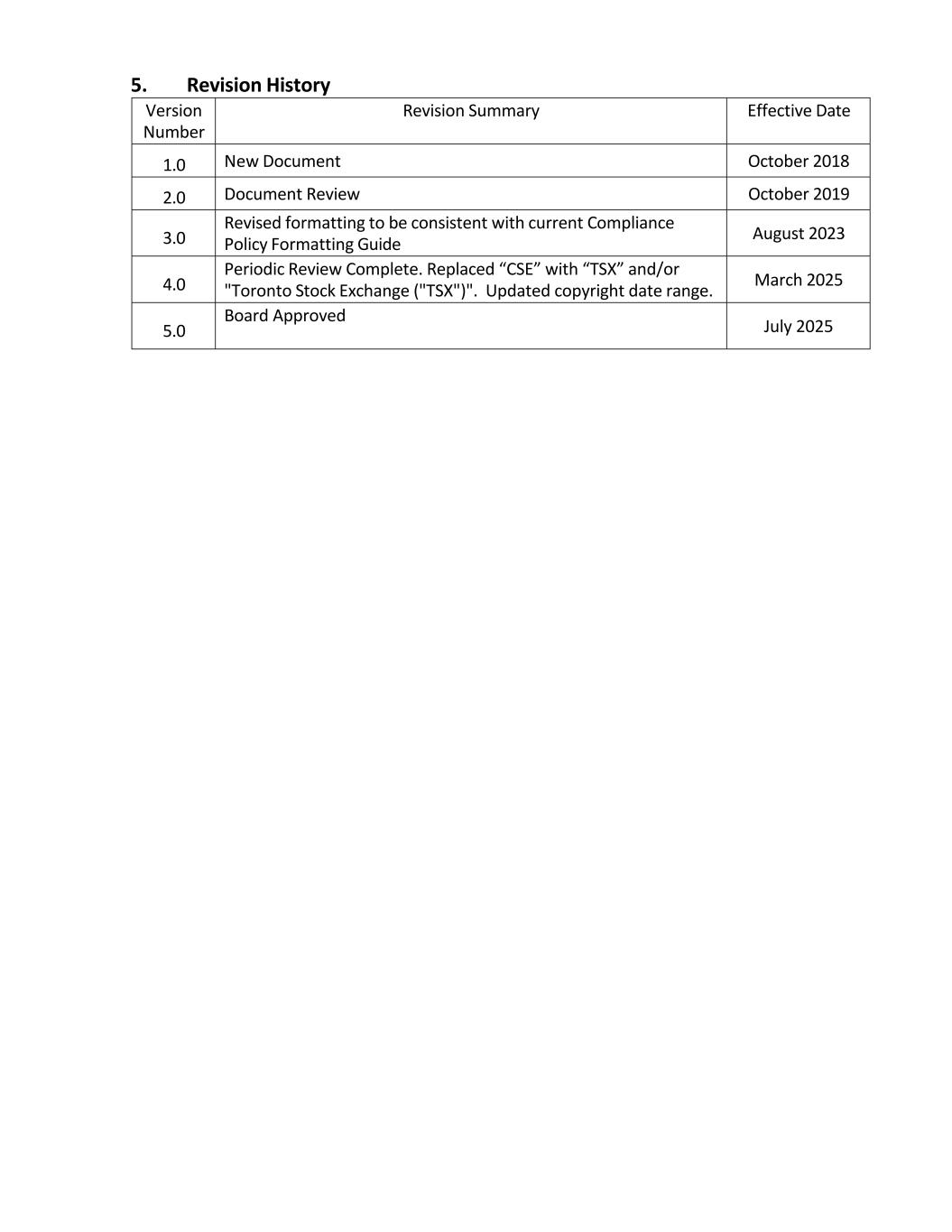
5. Revision History Version Number Revision Summary Effective Date 1.0 New Document October 2018 2.0 Document Review October 2019 3.0 Revised formatting to be consistent with current Compliance Policy Formatting Guide August 2023 4.0 Periodic Review Complete. Replaced “CSE” with “TSX” and/or "Toronto Stock Exchange ("TSX")". Updated copyright date range. March 2025 5.0 Board Approved July 2025