Exhibit 99.2
Evan Spiegel, Co-Founder and Chief Executive Officer Snapchat is now one of the largest Internet communities in the world, approaching one billion people using our service every month. Over the past few years, we have worked intensely to rebuild our monetization platform and improve our go-to-market strategy, and those efforts are producing stronger results. Our objective now is to turn our scale into durable growth and stronger cash generation, while demonstrating the long-term value of our investment in SPECS. We are approaching this work with a more focused, AI-enabled operating model. AI is helping us improve our service faster, deepening engagement and improving outcomes for advertisers. That supports revenue growth, margin expansion, and Free Cash Flow. Free Cash Flow gives us the flexibility to continue investing in long-term opportunities, offset dilution, and strengthen our balance sheet. That is why Free Cash Flow per share will be our primary financial objective going forward. Our largest long-term opportunity is SPECS, a new kind of computer built into see-through glasses. SPECS are designed for a future in which AI does more work on our behalf and people spend less time operating screens. I believe we can pursue that future from a much stronger position by continuing to improve our core business and remaining disciplined about how we invest. Last fall, I outlined three priorities for Snap: strengthen our community and engagement, accelerate and diversify revenue growth, and build a more profitable, cash-generative core business. Q2 was a meaningful step forward across all three. Monthly Active Users grew to 971 million, and Daily Active Users reached 493 million. Revenue increased 19% year-over-year to $1.60 billion. Advertising Revenue grew 9% to $1.28 billion, while Other Revenue grew 85% to $316 million. Gross Margin reached 58%, Net Loss was $164 million, and Operating Cash Flow was $176 million. Adjusted EBITDA was $250 million, and Free Cash Flow was $121 million. At its core, Snapchat helps close friends and family stay connected. Over time, we have built Spotlight, Snap Map, and augmented reality around that foundation, giving our community more reasons to open Snapchat, discover something new, and share it with the people they care about. I think about this as a simple flywheel that drives the growth of Snapchat. Sharing starts conversations, conversations strengthen friendships, and stronger friendships lead to more sharing and creativity. Spotlight is becoming a more important part of that flywheel. In the United States, the number of people posting to Spotlight grew more than 115% year-over-year, while Spotlight daily active viewers grew more than 20%. This growth was supported by our investment in creators and AI-powered recommendations. We also saw improving momentum in our advertising business. After several quarters of improving our ad products and go-to-market approach, we saw better momentum with large advertisers in North America and stronger revenue growth internationally. World Cup-related spending contributed during the quarter, alongside continued strength among small and medium-sized businesses. Smart Campaign Solutions, our suite of AI-powered automation and optimization tools, is making it easier for advertisers to achieve better outcomes with less manual work. SNAP INC. | Q2 2026 | PREPARED REMARKS 1
Those outcomes continue to improve. For app advertisers, cost per install declined 8% year-over-year, cost per purchase declined 18%, and app purchase volume increased 128%. Greater adoption by retailers also drove 43% growth in Dynamic Product Ads revenue. Advertisers increased spending across native surfaces such as Sponsored Snaps, where roughly one-third of the Snapchatters reached were incremental to other surfaces on Snapchat. These results reflect the progress we are making across automation, optimization, measurement, and attribution. Our audience in the United States continues to broaden quarter-over-quarter, led by people aged 35 and older. That is increasing our relevance in categories such as automotive, healthcare, home goods, financial services, insurance, and business-to-business services, while helping us diversify our advertiser base. An independent third-party study from Measured also found that, for the brands in their portfolio, Snapchat delivered approximately 19.3% higher incremental return on ad spend than the blended incremental return from their social advertising overall. Taken together, these results give us confidence that advertisers are seeing more value on Snapchat and increasing their investment as we improve the platform across the full funnel. We have also built a meaningful second revenue stream. Snapchat+, Memories Storage, and Lens+ helped drive 85% year-over-year growth in Other Revenue to $316 million in Q2. Less than 3% of our monthly active users are paying subscribers, and we see substantial room to grow direct revenue over time through premium features, AI-powered creative tools, and additional subscription products. AI is transforming Snapchat and the way Snap operates. It powers better recommendations, more automated and performant advertising campaigns, and new creative tools for our community. Internally, it is helping our smaller, more focused team move faster and accomplish more. In Q2, code commits per engineer increased 75% year-over-year, while major reliability issues declined 57%. Our internal AI code reviewer now reviews 90% of pull requests across Snap and has saved an estimated 30,000 hours of code-review time. Our AI-powered support agent answers approximately 3.9 million questions from Snapchatters each month and has reduced support ticket volume by approximately 62% since the start of the year. In advertising, AI increased first-pass image-review automation from 40% in Q2 2025 to nearly 90% in Q2 2026, resulting in faster approvals for advertisers, stronger content safety, and lower operating costs. In addition to leveraging AI to improve how we operate today, we are building toward the future of computing with SPECS. I believe AI will fundamentally change our relationship with computers. We will spend less time operating them and more time supervising intelligent systems that understand context and complete work on our behalf. SPECS are built for that future. Unveiling SPECS in June was an important milestone after more than a decade of work. SPECS are a new kind of computer built into see-through glasses, more capable than today’s limited AI glasses and more wearable than bulky VR headsets. SPECS can understand the world around you and help with work, learning, entertainment, and shared experiences without pulling you away from the real world. SNAP INC. | Q2 2026 | PREPARED REMARKS 2
We are excited to share much more about how SPECS work and what they can do at our launch event in Los Angeles on September 16th. Doug Hott, Chief Financial Officer In Q2, revenue increased 19% year-over-year to $1.6 billion, including 9% growth in Advertising Revenue. This growth reflected progress with large advertisers in North America, broader adoption of our AI-powered Smart Campaign Solutions, continued SMB momentum, and 85% growth in Other Revenue, led by Snapchat+, Memories Storage, and our Lens+ subscription. In early Q2, we restructured our cost base so Snap can scale more efficiently, and those changes are increasingly visible in our results. Our total adjusted cost structure increased just 4% year-over-year, as operating efficiencies offset investments in long-term revenue drivers. Gross Margin expanded seven percentage points year-over-year to 58%, Net Loss improved by $99 million to $164 million, and Adjusted EBITDA increased by $208 million year-over-year to $250 million. Our focus is to sustain this operating leverage by maintaining disciplined cost growth as we scale revenue, expand margins, and increase Free Cash Flow. That operating leverage translates into stronger cash generation. In Q2, Operating Cash Flow was $176 million and Free Cash Flow was $121 million. Over the past twelve months, Operating Cash Flow reached $919 million and Free Cash Flow reached $706 million. We have now generated positive Free Cash Flow for eight consecutive quarters, while limiting fully diluted share-count growth to approximately 2% over the past five years through our share repurchase program. Over that period, we repaid more than $2 billion of convertible notes due in 2027 and 2028, as well as the $47 million in convertible notes that were due in August 2026, reducing future debt obligations and strengthening our balance sheet. We ended Q2 with approximately $2.7 billion in cash and marketable securities, giving us the capacity to invest in our core business and long-term opportunities while maintaining a healthy cash balance. Our planned investment in SPECS is included within our existing operating expense outlook. Over time, we intend to pace that investment based on product, ecosystem, and economic milestones, while preserving the improving profitability and cash generation of our core business and supporting a stable share count. Going forward, our financial objective is Free Cash Flow per share. We believe this is the right objective because it connects operating performance, disciplined capital allocation, and long-term shareholder value creation. Our goal is to generate enough Free Cash Flow to invest in Snap's long-term potential, offset stock-based compensation dilution, and strengthen our balance sheet. We support these objectives by growing revenue faster than costs, investing with discipline, and using our share repurchase program to offset dilution and compound per-share value. Financial Outlook As we move into Q3, we remain focused on accelerating top-line growth, growing our community, deepening engagement, improving financial efficiency, and advancing toward the commercial launch of SPECS later this fall. SNAP INC. | Q2 2026 | PREPARED REMARKS 3
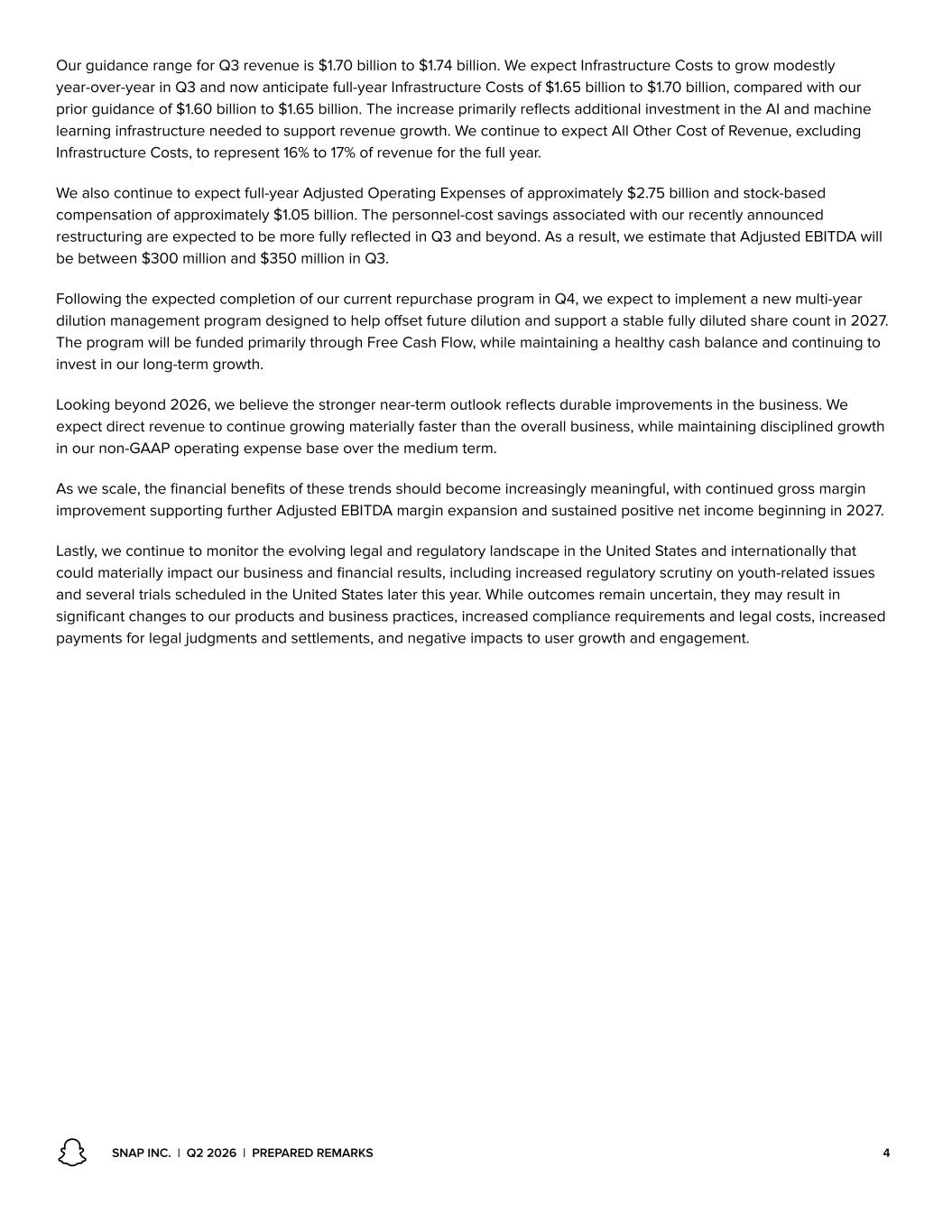
Our guidance range for Q3 revenue is $1.70 billion to $1.74 billion. We expect Infrastructure Costs to grow modestly year-over-year in Q3 and now anticipate full-year Infrastructure Costs of $1.65 billion to $1.70 billion, compared with our prior guidance of $1.60 billion to $1.65 billion. The increase primarily reflects additional investment in the AI and machine learning infrastructure needed to support revenue growth. We continue to expect All Other Cost of Revenue, excluding Infrastructure Costs, to represent 16% to 17% of revenue for the full year. We also continue to expect full-year Adjusted Operating Expenses of approximately $2.75 billion and stock-based compensation of approximately $1.05 billion. The personnel-cost savings associated with our recently announced restructuring are expected to be more fully reflected in Q3 and beyond. As a result, we estimate that Adjusted EBITDA will be between $300 million and $350 million in Q3. Following the expected completion of our current repurchase program in Q4, we expect to implement a new multi-year dilution management program designed to help offset future dilution and support a stable fully diluted share count in 2027. The program will be funded primarily through Free Cash Flow, while maintaining a healthy cash balance and continuing to invest in our long-term growth. Looking beyond 2026, we believe the stronger near-term outlook reflects durable improvements in the business. We expect direct revenue to continue growing materially faster than the overall business, while maintaining disciplined growth in our non-GAAP operating expense base over the medium term. As we scale, the financial benefits of these trends should become increasingly meaningful, with continued gross margin improvement supporting further Adjusted EBITDA margin expansion and sustained positive net income beginning in 2027. Lastly, we continue to monitor the evolving legal and regulatory landscape in the United States and internationally that could materially impact our business and financial results, including increased regulatory scrutiny on youth-related issues and several trials scheduled in the United States later this year. While outcomes remain uncertain, they may result in significant changes to our products and business practices, increased compliance requirements and legal costs, increased payments for legal judgments and settlements, and negative impacts to user growth and engagement. SNAP INC. | Q2 2026 | PREPARED REMARKS 4
SNAP INC. | Q2 2026 | PREPARED REMARKS 5
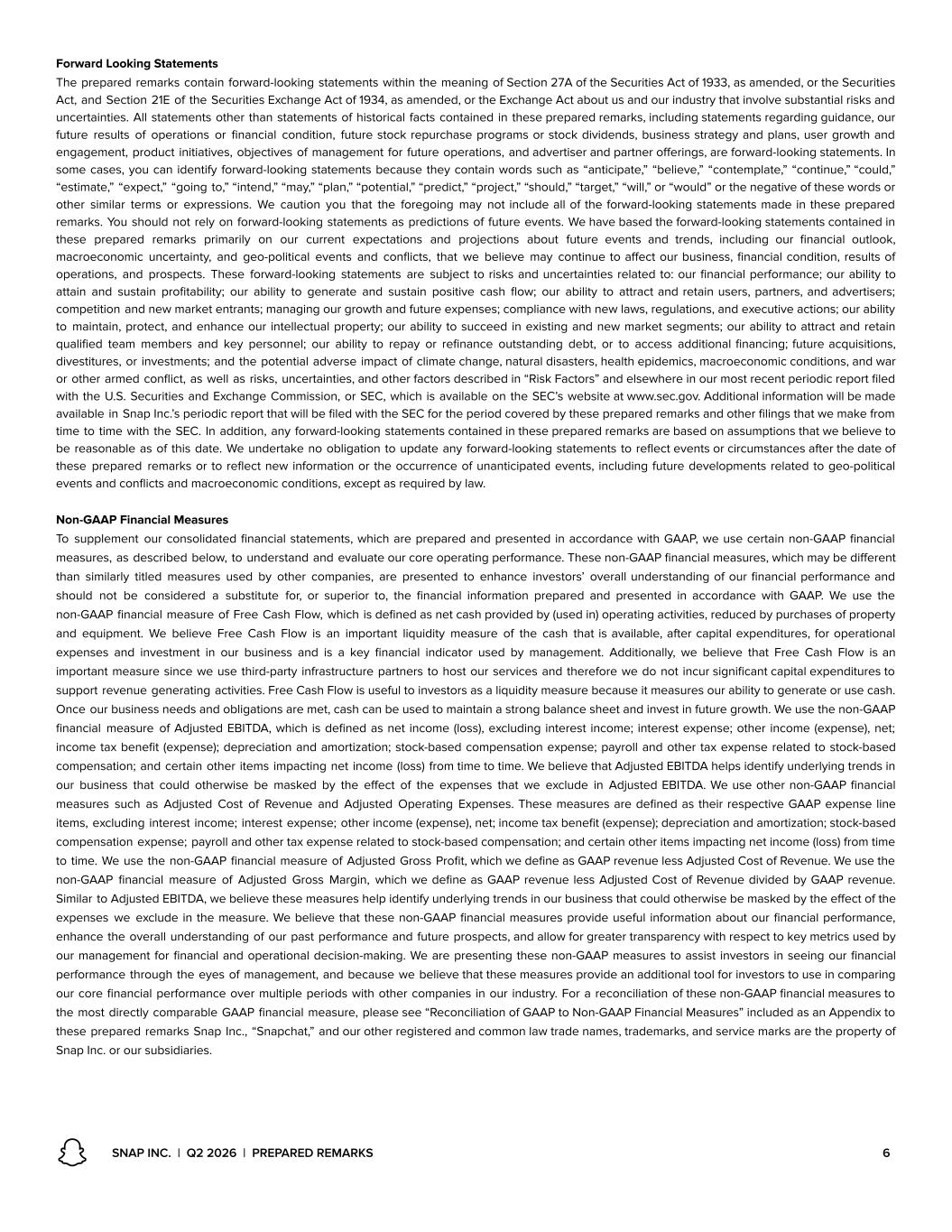
Forward Looking Statements The prepared remarks contain forward-looking statements within the meaning of Section 27A of the Securities Act of 1933, as amended, or the Securities Act, and Section 21E of the Securities Exchange Act of 1934, as amended, or the Exchange Act about us and our industry that involve substantial risks and uncertainties. All statements other than statements of historical facts contained in these prepared remarks, including statements regarding guidance, our future results of operations or financial condition, future stock repurchase programs or stock dividends, business strategy and plans, user growth and engagement, product initiatives, objectives of management for future operations, and advertiser and partner offerings, are forward-looking statements. In some cases, you can identify forward-looking statements because they contain words such as “anticipate,” “believe,” “contemplate,” “continue,” “could,” “estimate,” “expect,” “going to,” “intend,” “may,” “plan,” “potential,” “predict,” “project,” “should,” “target,” “will,” or “would” or the negative of these words or other similar terms or expressions. We caution you that the foregoing may not include all of the forward-looking statements made in these prepared remarks. You should not rely on forward-looking statements as predictions of future events. We have based the forward-looking statements contained in these prepared remarks primarily on our current expectations and projections about future events and trends, including our financial outlook, macroeconomic uncertainty, and geo-political events and conflicts, that we believe may continue to affect our business, financial condition, results of operations, and prospects. These forward-looking statements are subject to risks and uncertainties related to: our financial performance; our ability to attain and sustain profitability; our ability to generate and sustain positive cash flow; our ability to attract and retain users, partners, and advertisers; competition and new market entrants; managing our growth and future expenses; compliance with new laws, regulations, and executive actions; our ability to maintain, protect, and enhance our intellectual property; our ability to succeed in existing and new market segments; our ability to attract and retain qualified team members and key personnel; our ability to repay or refinance outstanding debt, or to access additional financing; future acquisitions, divestitures, or investments; and the potential adverse impact of climate change, natural disasters, health epidemics, macroeconomic conditions, and war or other armed conflict, as well as risks, uncertainties, and other factors described in “Risk Factors” and elsewhere in our most recent periodic report filed with the U.S. Securities and Exchange Commission, or SEC, which is available on the SEC’s website at www.sec.gov. Additional information will be made available in Snap Inc.’s periodic report that will be filed with the SEC for the period covered by these prepared remarks and other filings that we make from time to time with the SEC. In addition, any forward-looking statements contained in these prepared remarks are based on assumptions that we believe to be reasonable as of this date. We undertake no obligation to update any forward-looking statements to reflect events or circumstances after the date of these prepared remarks or to reflect new information or the occurrence of unanticipated events, including future developments related to geo-political events and conflicts and macroeconomic conditions, except as required by law. Non-GAAP Financial Measures To supplement our consolidated financial statements, which are prepared and presented in accordance with GAAP, we use certain non-GAAP financial measures, as described below, to understand and evaluate our core operating performance. These non-GAAP financial measures, which may be different than similarly titled measures used by other companies, are presented to enhance investors’ overall understanding of our financial performance and should not be considered a substitute for, or superior to, the financial information prepared and presented in accordance with GAAP. We use the non-GAAP financial measure of Free Cash Flow, which is defined as net cash provided by (used in) operating activities, reduced by purchases of property and equipment. We believe Free Cash Flow is an important liquidity measure of the cash that is available, after capital expenditures, for operational expenses and investment in our business and is a key financial indicator used by management. Additionally, we believe that Free Cash Flow is an important measure since we use third-party infrastructure partners to host our services and therefore we do not incur significant capital expenditures to support revenue generating activities. Free Cash Flow is useful to investors as a liquidity measure because it measures our ability to generate or use cash. Once our business needs and obligations are met, cash can be used to maintain a strong balance sheet and invest in future growth. We use the non-GAAP financial measure of Adjusted EBITDA, which is defined as net income (loss), excluding interest income; interest expense; other income (expense), net; income tax benefit (expense); depreciation and amortization; stock-based compensation expense; payroll and other tax expense related to stock-based compensation; and certain other items impacting net income (loss) from time to time. We believe that Adjusted EBITDA helps identify underlying trends in our business that could otherwise be masked by the effect of the expenses that we exclude in Adjusted EBITDA. We use other non-GAAP financial measures such as Adjusted Cost of Revenue and Adjusted Operating Expenses. These measures are defined as their respective GAAP expense line items, excluding interest income; interest expense; other income (expense), net; income tax benefit (expense); depreciation and amortization; stock-based compensation expense; payroll and other tax expense related to stock-based compensation; and certain other items impacting net income (loss) from time to time. We use the non-GAAP financial measure of Adjusted Gross Profit, which we define as GAAP revenue less Adjusted Cost of Revenue. We use the non-GAAP financial measure of Adjusted Gross Margin, which we define as GAAP revenue less Adjusted Cost of Revenue divided by GAAP revenue. Similar to Adjusted EBITDA, we believe these measures help identify underlying trends in our business that could otherwise be masked by the effect of the expenses we exclude in the measure. We believe that these non-GAAP financial measures provide useful information about our financial performance, enhance the overall understanding of our past performance and future prospects, and allow for greater transparency with respect to key metrics used by our management for financial and operational decision-making. We are presenting these non-GAAP measures to assist investors in seeing our financial performance through the eyes of management, and because we believe that these measures provide an additional tool for investors to use in comparing our core financial performance over multiple periods with other companies in our industry. For a reconciliation of these non-GAAP financial measures to the most directly comparable GAAP financial measure, please see “Reconciliation of GAAP to Non-GAAP Financial Measures” included as an Appendix to these prepared remarks Snap Inc., “Snapchat,” and our other registered and common law trade names, trademarks, and service marks are the property of Snap Inc. or our subsidiaries. SNAP INC. | Q2 2026 | PREPARED REMARKS 6
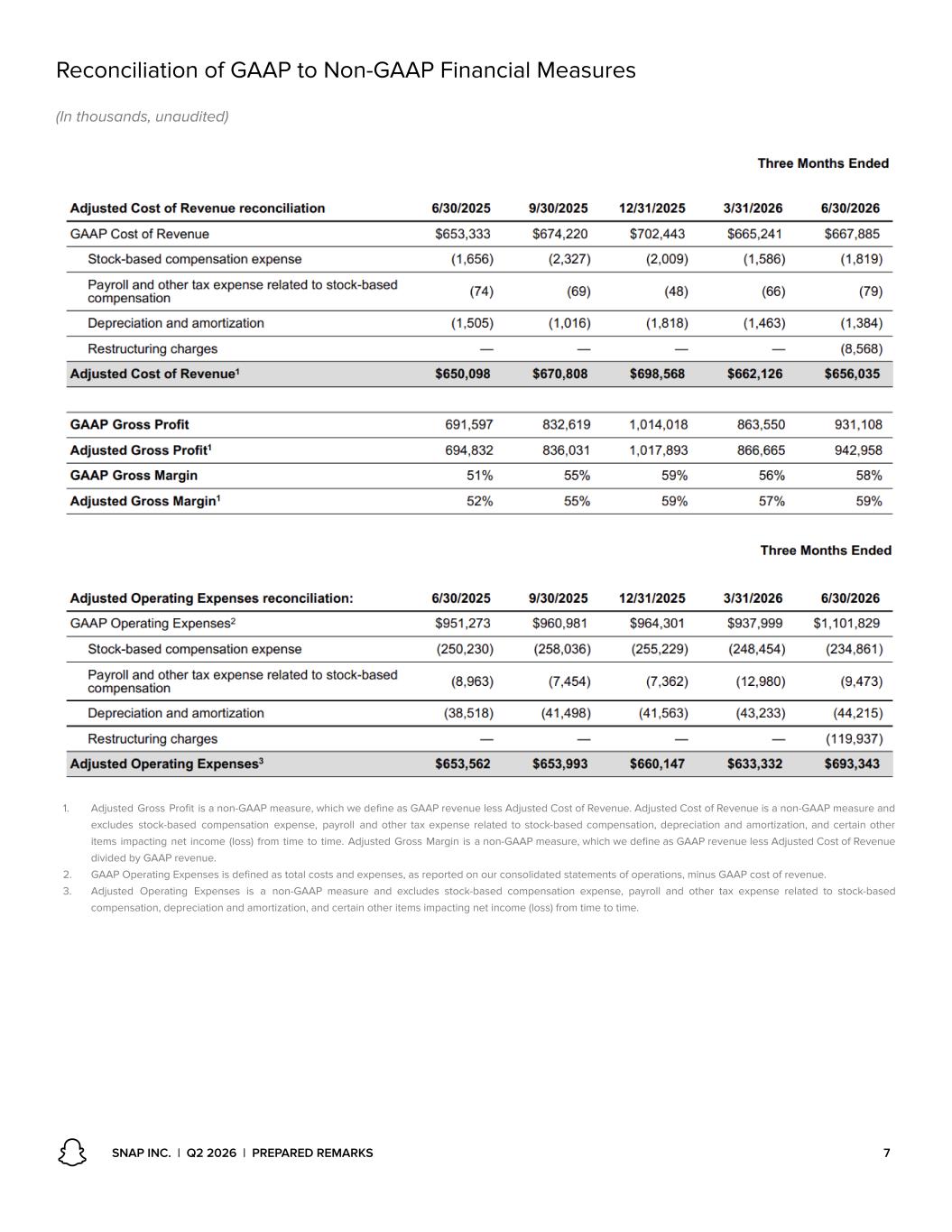
Reconciliation of GAAP to Non-GAAP Financial Measures (In thousands, unaudited) 1. Adjusted Gross Profit is a non-GAAP measure, which we define as GAAP revenue less Adjusted Cost of Revenue. Adjusted Cost of Revenue is a non-GAAP measure and excludes stock-based compensation expense, payroll and other tax expense related to stock-based compensation, depreciation and amortization, and certain other items impacting net income (loss) from time to time. Adjusted Gross Margin is a non-GAAP measure, which we define as GAAP revenue less Adjusted Cost of Revenue divided by GAAP revenue. 2. GAAP Operating Expenses is defined as total costs and expenses, as reported on our consolidated statements of operations, minus GAAP cost of revenue. 3. Adjusted Operating Expenses is a non-GAAP measure and excludes stock-based compensation expense, payroll and other tax expense related to stock-based compensation, depreciation and amortization, and certain other items impacting net income (loss) from time to time. SNAP INC. | Q2 2026 | PREPARED REMARKS 7
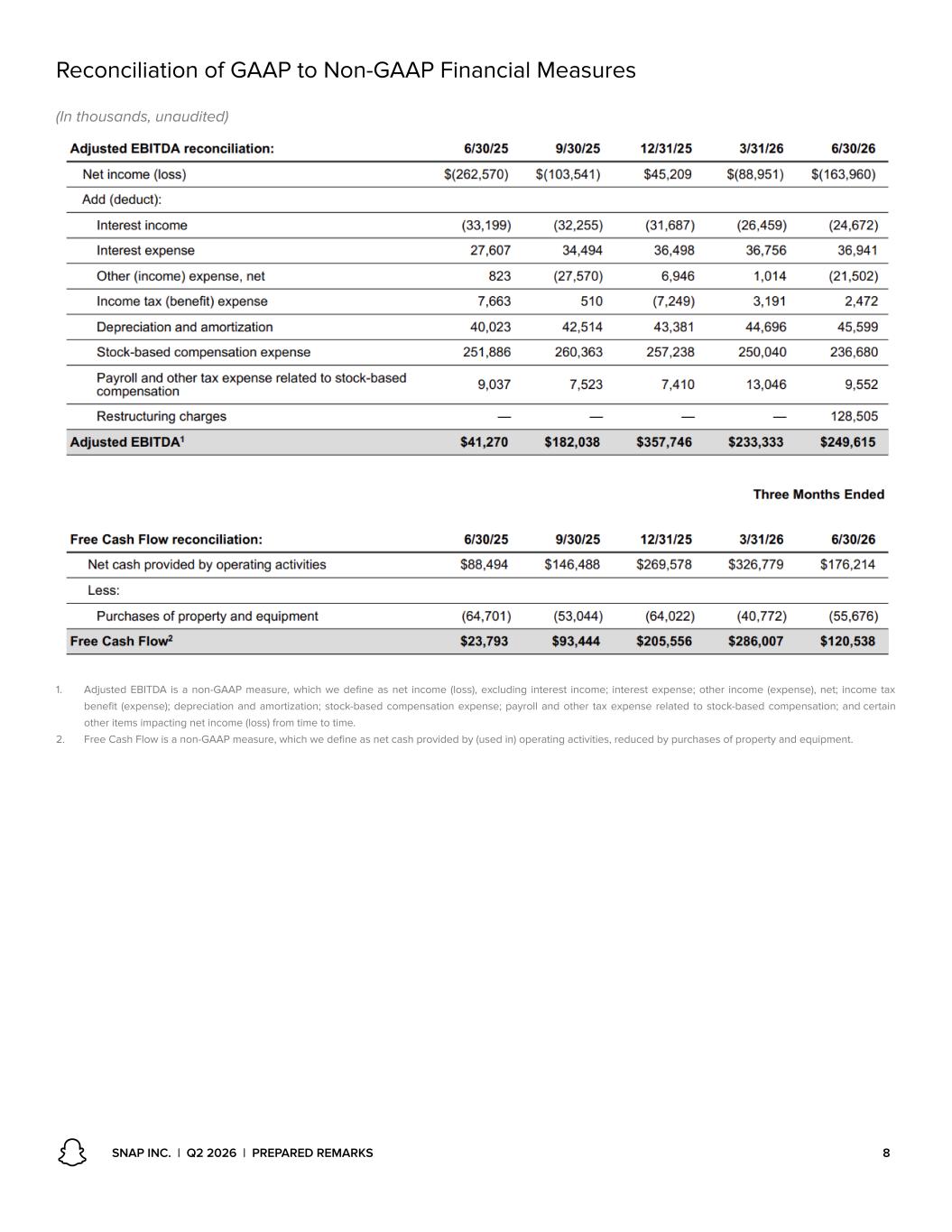
Reconciliation of GAAP to Non-GAAP Financial Measures (In thousands, unaudited) 1. Adjusted EBITDA is a non-GAAP measure, which we define as net income (loss), excluding interest income; interest expense; other income (expense), net; income tax benefit (expense); depreciation and amortization; stock-based compensation expense; payroll and other tax expense related to stock-based compensation; and certain other items impacting net income (loss) from time to time. 2. Free Cash Flow is a non-GAAP measure, which we define as net cash provided by (used in) operating activities, reduced by purchases of property and equipment. SNAP INC. | Q2 2026 | PREPARED REMARKS 8