Clearing Operations
Jun. 30, 2026
We operate six clearing houses, each of which acts as a central counterparty that becomes the buyer to every seller and the seller to every buyer for its clearing members, participants, or contracting parties, or collectively, Members. Through this central counterparty function, the clearing houses provide financial security for each transaction for the duration of the position by limiting counterparty credit risk.
Our clearing houses are responsible for providing clearing services to each of our futures exchanges, and in some cases to third-party execution venues, and are as follows, referred to herein collectively as "the ICE Clearing Houses":
| Clearing House | Products Cleared | Execution Venues | Location | |||||||||||||||||
| ICE Clear Europe | Energy, agricultural, interest rates and equity index futures and options contracts | ICE Futures Europe, ICE Futures U.S., ICE Endex, ICE Futures Abu Dhabi and ICE Endex Spot Ltd | U.K. | |||||||||||||||||
| ICE Clear U.S. | Agricultural, metals, foreign exchange, or FX, interest rate and equity index futures and options contracts | ICE Futures U.S. | U.S. | |||||||||||||||||
| ICE Clear Credit | OTC North American, European, Asian-Pacific and Emerging Market CDS instruments | ICE Swap Trade and other unaffiliated third-party venues | U.S. | |||||||||||||||||
| ICE Clear Netherlands | Equity, equity indices and interest rate derivatives | ICE Endex and ICE Futures Europe | The Netherlands | |||||||||||||||||
| ICE Clear Singapore | Energy, metals and financial futures products | ICE Futures Singapore | Singapore | |||||||||||||||||
| ICE NGX | Physical North American natural gas, environmental commodities and physical and financial electricity | ICE NGX | Canada | |||||||||||||||||
Each ICE Clearing House bears financial counterparty credit risk and provides a central counterparty guarantee, or performance guarantee, to its Members. In its guarantor role, each ICE Clearing House stands as the central counterparty on every contract cleared, having equal and offsetting claims to and from Members on opposite sides of each contract. To reduce their exposure, the ICE Clearing Houses have risk management programs and defined rules covering initial and ongoing membership standards, original or initial margin requirements, collateral and liquidity management, a variation margin process, intraday risk monitoring, ICE contribution to the guaranty fund, and default insurance (where applicable). In addition, with the exception of ICE NGX, which offers only a direct-access clearing model, each ICE Clearing House has defined rules on customer segregation and portability, a mutualized guaranty fund, and powers of assessment.
Each of the ICE Clearing Houses is a separate legal entity and is not subject to the liabilities of the others, or the obligations of Members of the other ICE Clearing Houses.
Members' Collateral
The amounts that Members are required to maintain are determined by proprietary risk models established by each ICE Clearing House and reviewed by the relevant regulators, independent model validators, and the risk committee and board of each respective ICE Clearing House. The amounts required may fluctuate over time. Generally, margin requirements for Members consist of the following:
•Original margin (referred to as "initial margin" by certain ICE Clearing Houses, and collectively as "original margin" herein): Represents the collateralization of market risk determined such that a portfolio the ICE Clearing House may be required to liquidate following a Member default can be closed or auctioned without recourse to resources other than those deposited by the defaulting Member, assuming an appropriate risk confidence level and liquidation period.
•Variation margin: The daily profits and losses to and from the ICE Clearing Houses by Members due to the marking-to-market of open contracts.
•Guaranty fund (mutualized ICE Clearing Houses only): Contributions from Members proportional to the risk of their positions and sized pursuant to the mutualized ICE Clearing Houses' guaranty fund methodology with the purpose to cover losses which exceed the resources of a defaulting Member.
Of the six ICE Clearing Houses that we operate, five require Members to contribute to a guaranty fund which mutualizes the risk of default among all Members. ICE NGX operates a non-mutualized, direct clearing operation.
Mutualized Clearing Houses
Each mutualized ICE Clearing House sets rules on the type of collateral Members can deposit to satisfy the margin requirements described above. Member cash deposits are received and held at central banks, highly-rated financial institutions or secured through reverse repurchase agreements with primarily overnight maturities or direct investments primarily in U.S. Treasury and other highly-rated non-U.S. government securities. Reverse repurchase agreements are valued daily and are subject to collateral maintenance provisions pursuant to which the counterparty must provide additional collateral, if needed, to maintain sufficient collateralization. Coinciding with our cash and cash equivalent policy, cash deposits that qualify as cash and cash equivalents are recorded as current assets in "Cash and cash equivalent margin deposits and guaranty funds" with an equal offset in current liabilities in "Margin deposits and guaranty funds" within our consolidated balance sheets. Member cash deposits which we secure via direct investments that do not qualify as cash equivalents are recorded as current assets in "Invested deposits, delivery contracts receivable and unsettled variation margin" with an equal offset in current liabilities in "Invested deposits, delivery contracts payable and unsettled variation margin" within our consolidated balance sheets.
Member non-cash collateral can be in the form of government obligations or European emission allowance certificates. These non-cash collateral deposits are not reflected in our consolidated balance sheets as the risks and rewards of these assets remain with the Member that deposited the assets unless the respective ICE Clearing House has sold or re-pledged the assets (which the ICE Clearing Houses do not do in the ordinary course of business) or in the event of default of the Member, where the Member is no longer entitled to the collateral assets. For certain deposits, we may impose discount or “haircut” rates to ensure adequate collateral if market values fluctuate.
ICE NGX
ICE NGX requires its Members to maintain cash or letters of credit to serve as collateral in the event of default, including as original margin. The cash is maintained in a segregated bank account for the benefit of the Member separate from ICE NGX funds. Since ICE NGX can only use the cash or draw from the letters of credit in the event of a default by the Member, these balances are not included in our consolidated balance sheets.
For the majority of the contracts cleared at ICE NGX, variation margin is not settled daily; instead, it is accrued daily to each Member's account and ICE NGX requires full collateralization of net accrued variation losses. The fair value of open contracts, or unsettled variation margin, and the contract value of delivered but unpaid contracts, or delivery contracts receivable, are recorded as current assets in "Invested deposits, delivery contracts receivable and unsettled variation margin" with an equal offset in current liabilities in "Invested deposits, delivery contracts payable and unsettled variation margin" within our consolidated balance sheets.
Cash Collateral (Mutualized Clearing Houses) and Delivery Contracts Receivable and Unsettled Variation Margin (ICE NGX) Balances
The unsettled variation margin and delivered contracts receivable balance at ICE NGX and the cash collateral posted by Members at our mutualized clearing houses are broken out by margin requirement and clearing house as follows (in millions):
| As of June 30, 2026 | |||||||||||||||||||||||||||||||||||
| ICE Clear Europe | ICE Clear Credit | ICE Clear U.S. | ICE NGX | Other ICE Clearing Houses | Total | ||||||||||||||||||||||||||||||
Original margin | $ | 69,296 | $ | 27,594 | $ | 9,535 | $ | — | $ | 5 | $ | 106,430 | |||||||||||||||||||||||
Unsettled variation margin, net | — | — | — | 341 | — | 341 | |||||||||||||||||||||||||||||
Guaranty fund | 4,138 | 4,799 | 784 | — | 4 | 9,725 | |||||||||||||||||||||||||||||
Delivery contracts receivable, net | — | — | — | 416 | — | 416 | |||||||||||||||||||||||||||||
Total | $ | 73,434 | $ | 32,393 | $ | 10,319 | $ | 757 | $ | 9 | $ | 116,912 | |||||||||||||||||||||||
| As of December 31, 2025 | |||||||||||||||||||||||||||||||||||
| ICE Clear Europe | ICE Clear Credit | ICE Clear U.S. | ICE NGX | Other ICE Clearing Houses | Total | ||||||||||||||||||||||||||||||
Original margin | $ | 40,627 | $ | 23,965 | $ | 7,088 | $ | — | $ | 4 | $ | 71,684 | |||||||||||||||||||||||
Unsettled variation margin, net | — | — | — | 740 | — | 740 | |||||||||||||||||||||||||||||
Guaranty fund | 3,075 | 3,986 | 817 | — | 6 | 7,884 | |||||||||||||||||||||||||||||
Delivery contracts receivable, net | — | — | — | 918 | — | 918 | |||||||||||||||||||||||||||||
Total | $ | 43,702 | $ | 27,951 | $ | 7,905 | $ | 1,658 | $ | 10 | $ | 81,226 | |||||||||||||||||||||||
Details of our deposits are as follows (in millions):
| Cash and Cash Equivalent Margin Deposits and Guaranty Funds | ||||||||||||||||||||
| Clearing House | Investment Type | As of June 30, 2026 | As of December 31, 2025 | |||||||||||||||||
| ICE Clear Europe | National bank account | $ | 5,609 | $ | 5,368 | |||||||||||||||
| ICE Clear Europe | Reverse repo | 58,525 | 33,020 | |||||||||||||||||
| ICE Clear Europe | Sovereign debt | 7,644 | 2,359 | |||||||||||||||||
| ICE Clear Europe | Demand deposits | 100 | 176 | |||||||||||||||||
| ICE Clear Credit | National bank account | 22,992 | 19,422 | |||||||||||||||||
| ICE Clear Credit | Reverse repo | 5,882 | 4,965 | |||||||||||||||||
| ICE Clear Credit | Demand deposits | 3,519 | 3,564 | |||||||||||||||||
| ICE Clear U.S. | Reverse repo | 9,822 | 7,342 | |||||||||||||||||
| ICE Clear U.S. | Sovereign debt | 497 | 563 | |||||||||||||||||
| Other ICE Clearing Houses | Demand deposits | 9 | 10 | |||||||||||||||||
| Total cash and cash equivalent margin deposits and guaranty funds | $ | 114,599 | $ | 76,789 | ||||||||||||||||
| Invested Deposits, Delivery Contracts Receivable and Unsettled Variation Margin | ||||||||||||||||||||
| Clearing House | Investment Type | As of June 30, 2026 | As of December 31, 2025 | |||||||||||||||||
| ICE NGX | Unsettled variation margin and delivery contracts receivable | $ | 757 | $ | 1,658 | |||||||||||||||
| ICE Clear Europe | Invested deposits - sovereign debt | 1,556 | 2,779 | |||||||||||||||||
| Total invested deposits, delivery contracts receivable and unsettled variation margin | $ | 2,313 | $ | 4,437 | ||||||||||||||||
ICE Clear Europe periodically enters into foreign currency swaps in order to rebalance liquidity buffers for certain currencies. As of June 30, 2026, a total of $1.1 billion notional remained outstanding, which settled during the first week of July 2026 at a predetermined forward rate. The foreign currency swap is accounted for as a derivative instrument measured at fair value using level 2 inputs. The fair value of the derivative was recorded within other current liabilities in our consolidated balance sheets and was immaterial as of June 30, 2026.
Non-cash Collateral (Mutualized Clearing Houses) and Cash and Letters of Credit (ICE NGX) Balances
These pledged assets are not reflected in our balance sheets and are as follows (in millions):
| As of June 30, 2026 | |||||||||||||||||||||||||||||
ICE Clear Europe | ICE Clear Credit | ICE Clear U.S. | ICE NGX | Total | |||||||||||||||||||||||||
Original margin: | |||||||||||||||||||||||||||||
Government securities at face value | $ | 47,175 | $ | 41,535 | $ | 21,535 | $ | — | $ | 110,245 | |||||||||||||||||||
Letters of credit | — | — | — | 3,028 | 3,028 | ||||||||||||||||||||||||
Emissions certificates at fair value | 982 | — | — | — | 982 | ||||||||||||||||||||||||
ICE NGX cash deposits | — | — | — | 555 | 555 | ||||||||||||||||||||||||
| Total | $ | 48,157 | $ | 41,535 | $ | 21,535 | $ | 3,583 | $ | 114,810 | |||||||||||||||||||
Guaranty fund: | |||||||||||||||||||||||||||||
Government securities at face value | $ | 1,022 | $ | 2,253 | $ | 301 | $ | — | $ | 3,576 | |||||||||||||||||||
| As of December 31, 2025 | |||||||||||||||||||||||||||||
ICE Clear Europe | ICE Clear Credit | ICE Clear U.S. | ICE NGX | Total | |||||||||||||||||||||||||
Original margin: | |||||||||||||||||||||||||||||
Government securities at face value | $ | 26,797 | $ | 38,504 | $ | 14,337 | $ | — | $ | 79,638 | |||||||||||||||||||
Letters of credit | — | — | — | 3,960 | 3,960 | ||||||||||||||||||||||||
Emissions certificates at fair value | 1,399 | — | — | — | 1,399 | ||||||||||||||||||||||||
ICE NGX cash deposits | — | — | — | 947 | 947 | ||||||||||||||||||||||||
| Total | $ | 28,196 | $ | 38,504 | $ | 14,337 | $ | 4,907 | $ | 85,944 | |||||||||||||||||||
Guaranty fund: | |||||||||||||||||||||||||||||
Government securities at face value | $ | 736 | $ | 1,944 | $ | 287 | $ | — | $ | 2,967 | |||||||||||||||||||
Total Collateral
As of June 30, 2026 and December 31, 2025, the ICE Clearing Houses had received or had been pledged $235.3 billion and $170.1 billion, respectively, in cash and non-cash collateral in original margin and guaranty fund deposits to cover price movements of underlying contracts for both periods.
ICE Clearing Houses' Liquidity Facilities
As of June 30, 2026, the following facilities were in place at the respective ICE Clearing House to support liquidity needs:
•ICE Clear Europe: $1.0 billion in committed repurchase agreement facilities, or Committed Repo, to have the ability to convert securities held as collateral into U.S. dollar, euro and pound sterling deposits with same day liquidity.
•ICE Clear Credit: $300 million in Committed Repo (U.S. dollar based) to have the ability to convert U.S. dollar/euro denominated sovereign debt held as collateral into U.S. dollar/euro deposits with same day liquidity, €250 million in Committed Repo (euro based) to have the ability to convert euro/U.S. dollar denominated sovereign debt deposits held as collateral into euro/U.S. dollar denominated deposits with same day liquidity, and €1.9 billion in committed FX facilities to have the ability to convert available U.S. dollar denominated cash into euro denominated cash to meet a euro denominated payment obligation with same day liquidity.
•ICE Clear U.S.: $250 million in Committed Repo to have the ability to convert U.S. dollar denominated sovereign debt deposits held as collateral into U.S. dollar deposits with same day liquidity.
•ICE Clear Netherlands: €10 million in committed FX facilities to have the ability to convert available non-euro denominated cash into euro denominated cash to meet euro denominated payment obligations with same day liquidity.
•ICE NGX: $100 million committed with an additional $200 million uncommitted daylight-overnight liquidity facility with a third-party Canadian chartered bank to provide liquidity in the event of a settlement shortfall, subject to certain conditions.
ICE Contributions to the Guaranty Funds and Default Insurance
We have contributed our own capital to each ICE Clearing House's respective guaranty fund that could be used if a defaulting Member’s original margin and guaranty fund deposits are insufficient. Such amounts, referred to as skin in the game or SITG contributions, are recorded as long-term restricted cash and cash equivalents and long-term restricted investments in our consolidated balance sheets.
We also maintain default insurance at ICE Clear Europe, ICE Clear U.S. and ICE Clear Credit as an additional layer of clearing member default protection. The default insurance for these three ICE Clearing Houses was renewed in September 2025 and has a three-year term. Similar to the SITG contribution, the default insurance layer is not intended to replace or reduce the position risk-based amount of the guaranty fund. As a result, the default insurance layer is not a factor that is included in the calculation of the Members' guaranty fund contribution requirement. Instead, it serves as an additional, distinct, and separate default resource that should serve to further protect the non-defaulting Members’ guaranty fund contributions from being mutualized in the event of a default.
As of June 30, 2026, ICE NGX maintains a guaranty fund of $215 million funded by a $200 million letter of credit issued by a major Canadian chartered bank and backed by default insurance underwritten by Export Development Canada, a Crown corporation operated at arm’s length from the Canadian government, plus $15 million held as restricted cash to fund the first loss amount that ICE NGX is responsible for under the default insurance policy. In the event of a Member default where the defaulting Member’s collateral is depleted, the shortfall would be covered by a draw down on the letter of credit following which ICE NGX would file a claim under the default insurance to recover additional losses up to $200 million beyond the $15 million first-loss amount that ICE NGX is responsible for under the default insurance policy. ICE NGX has also set aside $30 million of its own capital that could be used for liquidity purposes in the event of a Member default.
ICE's contribution to the respective guaranty funds and default insurance is broken out by each ICE Clearing House as follows (in millions):
| ICE Portion of Guaranty Fund Contribution | Default insurance | |||||||||||||||||||||||||
| Clearing House | As of June 30, 2026 | As of December 31, 2025 | As of June 30, 2026 | As of December 31, 2025 | ||||||||||||||||||||||
| ICE Clear Europe | $208 | $197 | $100 | $100 | ||||||||||||||||||||||
| ICE Clear U.S. | 80 | 75 | 25 | 25 | ||||||||||||||||||||||
| ICE Clear Credit | 50 | 50 | 75 | 75 | ||||||||||||||||||||||
| ICE Clear Netherlands | 12 | 13 | N/A | N/A | ||||||||||||||||||||||
| ICE Clear Singapore | 1 | 1 | N/A | N/A | ||||||||||||||||||||||
| ICE NGX | 45 | 45 | 200 | 200 | ||||||||||||||||||||||
| Total | $396 | $381 | $400 | $400 | ||||||||||||||||||||||
Clearing House Exposure
Each ICE Clearing House has defined default management rules and procedures. Our financial exposure as guarantor represents the risk that a Member default generates losses that exhaust the defaulting Member's resources and require the use of our SITG contribution and, in an extreme scenario, generates losses that exceed all available default waterfall resources, including at a mutualized ICE Clearing House, the non-defaulting Members' guaranty fund contributions and powers of assessment. Below is a depiction of our default waterfall which summarizes the lines of defense and layers of protection we maintain for our clearing houses:
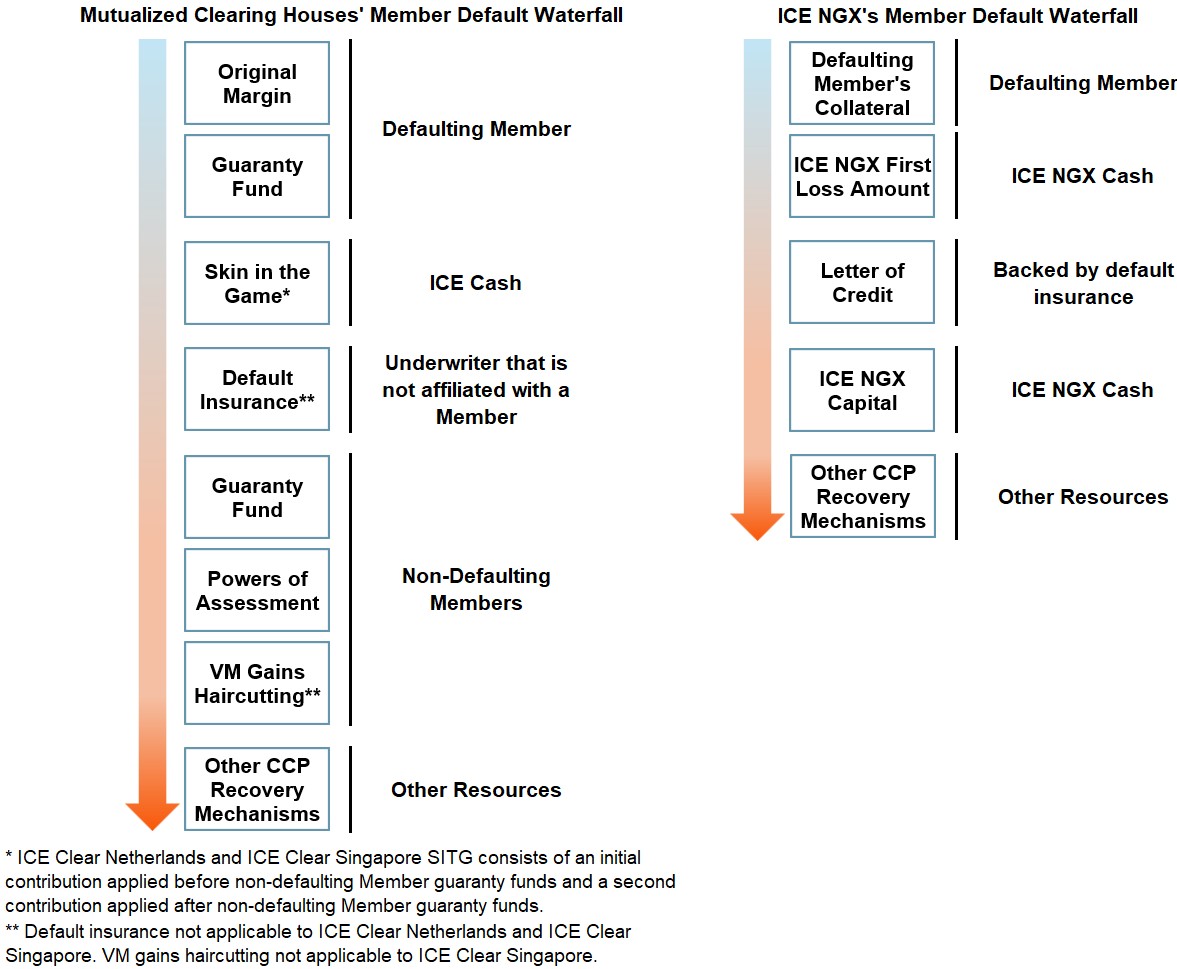
Through the clearing operations described above, each ICE Clearing House provides a performance guarantee to its Members. Excluding the effects of the default management protections depicted above, each ICE Clearing House's maximum estimated exposure for this guarantee would be the intra-day or full-day change in fair value if all Members who have open positions with unrealized losses simultaneously defaulted, which is an extremely unlikely scenario. The levels of original margin are calibrated such that a portfolio the ICE Clearing House may be required to liquidate following a Member default can be closed or auctioned without recourse to resources other than those deposited by the defaulting Member, assuming an appropriate risk confidence level and liquidation period. In addition to the base margin model, each ICE Clearing House, depending on its products, employs a number of margin add-ons related to position concentration, Member capital, volatility, spread responses, recovery rate sensitivity, jump-to-default, and wrong-way risk.
We also assessed the fair value of our performance guarantee, considering factors including daily settlement of contracts, margining and collateral requirements, other elements of our risk management program, historical evidence of default payments, and estimated probability of potential default payouts by each ICE Clearing House. Based on these analyses, the estimated performance guarantee liability was determined to be nominal, and no liability was recorded as of June 30, 2026. None of the ICE Clearing Houses has ever experienced a Member default that required the use of the guaranty funds of non-defaulting Members or the assets of the ICE Clearing Houses, including our SITG contribution.