NOTE 2 — SUMMARY OF SIGNIFICANT ACCOUNTING POLICIES
Basis of Presentation
The accompanying unaudited condensed consolidated financial statements are presented in conformity with accounting principles generally accepted in the United States of America (“US GAAP”) and pursuant to the rules and regulations of the Securities and Exchange Commission (“SEC”). These interim financial statements have been prepared on the same basis as the Company’s annual financial statements and, in the opinion of management, reflect all adjustments, consisting only of normal recurring adjustments, which are necessary for a fair statement of the Company’s financial information. These interim results are not necessarily indicative of the results to be expected for the year ending December 31, 2026 or any other interim periods or for any other future years. These unaudited consolidated financial statements should be read in conjunction with the Company’s audited consolidated financial statements and the notes thereto included in the Company’s Form 10-K for the year ended December 31, 2025 filed on March 26, 2026.
Basis of Consolidation
The condensed consolidated financial statements include all accounts of the Company and its majority owned and controlled subsidiaries. The Company consolidates entities in which it owns more than 50% of the voting common stock and controls operations. All intercompany transactions and balances among consolidated subsidiaries have been eliminated.
The following chart describes the Company’s ownership of various entities:
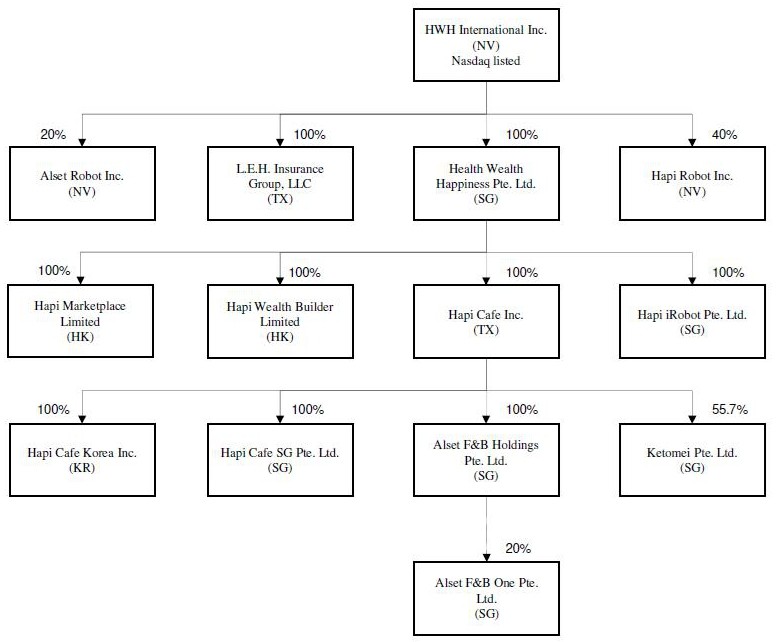
Hapi Marketplace Ltd. (“HML”) was incorporated in Hong Kong on March 18, 2026, and remains dormant as of June 30, 2026.
Functional and Reporting Currency
The functional and reporting currency of the Company is the United States dollar (“$”). The financial records of the Company’s subsidiaries located in South Korea, Singapore, Hong Kong and Malaysia are maintained in their local currencies, the Korean Won (₩), Singapore Dollar (S$), Hong Kong Dollar (HK$) and Malaysian Ringgit (MYR), which are also the functional currencies of these entities.
Use of Estimates
The preparation of the financial statements in conformity with U.S. GAAP requires the Company’s management to make estimates and assumptions that affect the reported amounts of assets and liabilities and disclosure of contingent assets and liabilities at the date of the balance sheet.
Making estimates requires management to exercise significant judgment. It is at least reasonably possible that the estimate of the effect of a condition, situation or set of circumstances that existed at the date of the balance sheet, which management considered in formulating its estimate, could change in the near term due to one or more future confirming events. Accordingly, the actual results could differ significantly from those estimates.
Revision of Previously Issued Financial Statements
In connection with the preparation of the condensed consolidated financial statements for the six months ended June 30, 2026, the Company identified that payroll and related employee benefit costs of personnel who directly support the business of the F&B operation had been classified within general and administrative (“G&A”) expenses rather than within cost of revenue in prior periods. Under U.S. generally accepted accounting principles, these costs are properly presented within cost of revenue to align with the functional activities of the personnel involved. Accordingly, the accompanying condensed consolidated financial statements for the three and six months ended June 30, 2026, reflect the appropriate classification, and the prior period comparative amounts have been revised to conform to the current-period presentation
The Company evaluated this misclassification, both quantitatively and qualitatively, in accordance with SEC Staff Accounting Bulletin No. 99, and concluded that it was not material to the previously issued financial statements. Accordingly, the Company has revised the prior period comparative amounts presented herein to correct the classification. As a result of the revision, cost of revenue increased by $104,813 and $219,974, and general and administrative expenses decreased by the same amounts, for the three and six months ended June 30, 2025, respectively, resulting in a corresponding decrease in gross profit; there was no effect on previously reported total revenues, total operating expenses, loss from operations, net income (loss), total assets, total liabilities, stockholders’ equity, or net cash flows from operating, investing, or financing activities.
Cash and Cash Equivalents
The Company considers all short-term investments with an original maturity of three months or less when purchased to be cash equivalents. The Company had cash of $1,506,036 and $2,085,918 as of June 30, 2026 and December 31, 2025, respectively. The Company had no cash equivalents as of June 30, 2026 and December 31, 2025.
Fair Value of Financial Instruments
The Company adopted Accounting Standards Codification (“ASC”) 820, “Fair Value Measurements and Disclosures”, for assets and liabilities measured at fair value on a recurring basis. ASC 820 defines fair value as the exchange price that would be received for an asset or paid to transfer a liability (an exit price) in the principal or most advantageous market for the asset or liability in an orderly transaction between market participants on the measurement date. ASC 820 also establishes a fair value hierarchy, which requires an entity to maximize the use of observable inputs and minimize the use of unobservable inputs when measuring fair value. ASC 820 describes three levels of inputs that may be used to measure fair value:
Level 1: Observable inputs such as quoted market prices in active markets for identical assets or liabilities
Level 2: Observable market-based inputs or unobservable inputs that are corroborated by market data
Level 3: Unobservable inputs for which there is little or no market data, which require the use of the reporting entity’s own assumptions
Level 1 marketable securities are liquid and transparent financial instruments with readily observable market prices. Their value is based on unadjusted quoted prices in active markets for identical assets. Examples often include U.S. treasury securities, listed equities, exchange-traded funds and open-end mutual funds, foreign currencies, and gold bullion. An active market is defined by sufficient transaction frequency and volume to provide ongoing pricing information.
For purpose of this disclosure, the fair value of a financial instrument is the amount at which the instrument could be exchanged in a current transaction between willing parties, other than in a forced sale or liquidation. The carrying values reported in balance sheets for current assets and liabilities approximate their estimated fair market values based on the short-term maturity of these instruments.
The Company has a portfolio of trading level 1 marketable securities. The objective is to generate profits on short-term differences in market prices. The Company does not have significant influence over any trading securities in our portfolio and fair value of these trading securities are determined by quoted stock prices.
Investment Securities at Cost
Investments in equity securities without readily determinable fair values are measured at cost minus impairment adjusted by observable price changes in orderly transactions for the identical or similar investments of the same issuer. These investments are measured at fair value on a nonrecurring basis when there are events or changes in circumstances that may have a significant adverse effect. An impairment is recognized in the consolidated statements of comprehensive income equal to the amount by which the carrying value exceeds the fair value of the investment.
Investment Securities under Equity Method Accounting
The Company accounts for equity investments in certain entities with significant influence under equity-method accounting. Under this method, the Group’s pro rata share of income (loss) from investment is recognized in the consolidated statements of comprehensive income. Dividends received reduce the carrying amount of the investment. When the Company’s share of loss in an equity-method investee equals or exceeds its carrying value of the investment in that entity, the equity method investment can be reduced below zero based on losses if the Company either be liable for the obligations of the investee or provide for losses in excess of the investment when imminent return to profitable operations by the investee appears to be assured. Otherwise, the Company does not recognize its share of equity method losses exceeding its carrying amount of the investment. Equity-method investment is reviewed for impairment by assessing if the decline in market value of the investment below the carrying value is other-than-temporary. In making this determination, factors are evaluated in determining whether a loss in value should be recognized. These include consideration of the intent and ability of the Group to hold investment and the ability of the investee to sustain an earnings capacity, justifying the carrying amount of the investment. Impairment losses are recognized in other expense when a decline in value is deemed to be other-than-temporary.
Inventory
Inventory is stated at the lower of cost or net realizable value. Cost is determined using the first-in, first-out method and includes all costs in bringing the inventories to their present location and condition. Net realizable value is an estimated selling price in the ordinary course of business less the estimated costs necessary to make the sale. As of June 30, 2026 and December 31, 2025, inventory consisted of finished goods procured from suppliers. The Company continuously evaluates the need for reserve for obsolescence and possible price concessions required to write-down inventory to its net realizable value.
Leases
The Company follows FASB ASC Topic 842 in accounting for its operating lease right-of-use assets and operating lease liabilities. At inception of a contract, the Company assesses whether a contract is, or contains, a lease. A contract is or contains a lease if it conveys the right to control the use of an identified asset for a period of time in exchange of a consideration. To assess whether a contract is or contains a lease, the Company assesses whether the contract involves the use of an identified asset, whether it has the right to obtain substantially all of the economic benefits from the use of the asset and whether it has the right to control the use of the asset. The right-of-use assets and related lease liabilities are recognized at the lease commencement date. The Company recognizes operating lease expenses on a straight-line basis over the lease term. For leases that contain related non-lease components, such as maintenance, the Company will account for these payments as a single lease component.
Right-of-use of Assets
The right-of-use of asset is measured at cost, which comprises the amount of the lease liability adjusted for any lease payments made at or before the commencement date, plus any initial direct costs incurred and less any lease incentive received.
Lease Liabilities
Lease liability is measured at the present value of the outstanding lease payments at the commencement date, discounted using the Company’s incremental borrowing rate. Lease payments included in the measurement of the lease liability comprise mainly of fixed lease payments.
Short-term Leases and Leases of Low Value Assets
The Company has elected to not recognize right-of-use assets and lease liabilities for short-term leases that have a lease term of 12 months or less at inception and leases of low value assets. Lease payments associated with these leases are expensed as incurred.
Property and Equipment
Property and equipment are recorded at cost, less depreciation. Repairs and maintenance are expensed as incurred. Expenditures incurred as a consequence of acquiring or using the asset, or that increase the value or productive capacity of assets are capitalized. When property and equipment is retired, sold, or otherwise disposed of, the asset’s carrying amount and related accumulated depreciation are removed from the accounts and any gain or loss is included in statement of operations. Depreciation is computed by the reducing balance method (after considering their respective estimated residual values) over the estimated useful lives of the respective assets as follows:
| Office Equipment | 3 – 5 years | |
| Furniture and Fittings | 3 – 5 years | |
| Kitchen Equipment | 3 – 5 years | |
| Operating Equipment | 3 – 5 years | |
| Leasehold Improvements |
The Company reviews the carrying value of property and equipment for impairment whenever events and circumstances indicate that the carrying value of an asset may not be recoverable from the estimated future cash flows expected to result from its use and eventual disposition. In cases where undiscounted expected future cash flows are less than the carrying value, an impairment loss is recognized, equaling an amount by which the carrying value exceeds the fair value of assets. The factors considered by management in performing this assessment include current operating results, trends, and prospects, as well as the effects of obsolescence, demand, competition, and other economic factors.
Deposits
Deposits represent rental security deposits paid for the Company’s office and café locations, which are refundable upon expiration of the respective lease terms. Deposits are classified as current or non-current based on the expected timing of refund. Deposits related to leases expiring within the next twelve months are classified as current, while deposits related to leases expiring after twelve months are classified as non-current. As of June 30, 2026, current deposits totaled $21,057 and non-current deposits totaled $97,304.
Revenue Recognition
ASC 606 – Revenue from Contracts with Customers (“ASC 606”), establishes principles for reporting information about the nature, amount, timing and uncertainty of revenue and cash flows arising from the entity’s contracts to provide goods or services to customers.
In accordance with ASC 606, revenue is recognized when a customer obtains control of promised goods or services. The amount of revenue recognized reflects the consideration to which the Company expects to be entitled to receive in exchange for these goods or services. The provisions of ASC 606 include a five-step process by which the determination of revenue recognition, depicting the transfer of goods or services to customers in amounts reflecting the payment to which the Company expects to be entitled in exchange for those goods or services. ASC 606 requires the Company to apply the following steps:
(1) identify the contract with the customer; (2) identify the performance obligations in the contract; (3) determine the transaction price; (4) allocate the transaction price to the performance obligations in the contract; and (5) recognize revenue when, or as, performance obligations are satisfied.
The Company generates its revenue primarily from and F&B business.
Food and Beverage: The Company’s performance obligation is to transfer ownership of its F&B products to its customers. The Company generally recognizes revenue when F&B products are delivered to its customers. Revenue is recorded net of applicable taxes, allowances, refunds or returns. The Company receives the net sales price in cash or through credit card payments at the point of sale or from web-based ordering system.
Accounts Receivable
Accounts receivable is recorded at invoiced amounts net of an allowance for credit losses and does not bear interest. The allowance for credit losses is the Company’s best estimate of the amount of probable credit losses in the Company’s existing account receivable. The measurement and recognition of credit losses involves the use of judgment. Management’s assessment of expected credit losses includes consideration of current and expected economic conditions, market and industry factors affecting the Company’s customers (including their financial condition), the aging of account balances, historical credit loss experience, customer concentrations, customer creditworthiness, and the existence of sources of payment. The Company also establishes an allowance for credit losses for specific receivables when it is probable that the receivable will not be collected and the loss can be reasonably estimated. Account receivable considered uncollectible is charged against the allowance after all means of collection have been exhausted and the potential for recovery is considered remote.
Value-added Tax
The Company is subject to value-added tax (“VAT”) on purchases of inventory, rent payments, professional fees, and certain other taxable expenditures. As of June 30, 2026 and December 31, 2025, included in other receivables was VAT paid of $3,392 and $3,027, respectively, due primarily to the purchase of inventory and payment of rents and accounting fees.
Cost of Revenue
Cost of revenue consists of the cost of procuring finished goods from suppliers and related shipping and handling fees from third-party money platforms, and contractor fees for part-time staff.
Below is a breakdown of the Company’s cost of revenue for the three and six months ended June 30, 2026 and 2025.
For the three months ended:
| Total | ||||
| June 30, 2026 | ||||
| Finished goods | $ | 10,488 | ||
| Handling fee | 3,975 | |||
| Contractor fee | 101 | |||
| Employee wages, salaries and benefits | 27,225 | |||
| Depreciation | 2,047 | |||
| Total of Cost of revenue | $ | 43,836 | ||
| June 30, 2025 | ||||
| Finished goods | $ | 119,720 | ||
| Related shipping | 13,396 | |||
| Handling fee | 13,741 | |||
| Contractor fee | 8,554 | |||
| Franchise commission | 3,453 | |||
| Employee wages, salaries and benefits | 104,813 | |||
| Depreciation | 2,637 | |||
| Total of Cost of revenue | $ | 266,314 | ||
For the six months ended:
| Total | ||||
| June 30, 2026 | ||||
| Finished goods | $ | 21,387 | ||
| Handling fee | 7,867 | |||
| Contractor fee | 132 | |||
| Employee wages, salaries and benefits | 68,727 | |||
| Depreciation | 4,137 | |||
| Total of Cost of revenue | $ | 102,250 | ||
| June 30, 2025 | ||||
| Finished goods | $ | 228,726 | ||
| Related shipping | 26,327 | |||
| Handling fee | 25,307 | |||
| Contractor fee | 16,808 | |||
| Franchise commission | 6,803 | |||
| Employee wages, salaries and benefits | 219,974 | |||
| Depreciation | 5,133 | |||
| Total of Cost of revenue | $ | 529,078 | ||
Shipping and Handling Fees
The Company utilizes the practical expedient under ASC 606-10-25-18B to account for its shipping and handling as fulfillment activities, and not a promised service (a revenue element). Shipping and handling fees are included in costs of revenue within the statements of operations.
Advertising Expenses
Advertising costs are charged to operations as incurred. Advertising expenses for the three months ended June 30, 2026 and 2025 were $666 and $38,249, respectively. Advertising expenses for the six months ended June 30, 2026 and 2025 were $1,667 and $107,094, respectively.
Income Taxes
The Company accounts for income taxes pursuant to the provision of ASC 740-10, “Accounting for Income Taxes” (“ASC 740-10”), which requires, among other things, assets and liabilities approach to calculating deferred income taxes. The assets and liabilities approach requires the recognition of deferred tax assets and liabilities for the expected future tax consequences of temporary differences between the carrying amounts and the tax bases of assets and liabilities. A valuation allowance is provided to offset any net deferred tax assets for which management believes it is more likely than not that the net deferred tax assets will not be realized. Tax positions that meet the more likely than not recognition threshold are measured at the largest amount of tax benefit that is more than 50 percent likely of being realized upon settlement with the applicable taxing authority.
The Company follows the provision of ASC 740-10 related to Accounting for Uncertain Income Tax Positions. When tax returns are filed, there may be uncertainty about the merits of positions taken or the amount of the position that would be ultimately sustained. In accordance with the guidance of ASC 740-10, the benefit of a tax position is recognized in the financial statements in the period during which, based on all available evidence, management believes it is more likely than not that the position will be sustained upon examination, including the resolution of appeals or litigation processes, if any. Tax positions taken are not offset or aggregated with other positions.
The Company has not recorded any unrecognized tax benefits. The Company’s policy is to recognize interest and penalties related to income taxes in income tax expense.
The Company’s tax returns for 2022, 2023, 2024 and 2025 remain open to examination.
Franchise Tax
The Company was reincorporated in the State of Nevada on November 14, 2025, through a reincorporation merger. As a Nevada corporation, we are no longer subject to the Delaware franchise tax. Prior to the reincorporation the Company was subject to annual Delaware franchise taxes, which are a privilege fee and not an income tax. During the year ended December 31, 2025 the Company received a refund of prepaid Delaware franchise tax of $41,349.
The Company presents basic and diluted earnings (loss) per share for its common shares. Basic earnings (loss) per share is calculated by dividing net income (loss) attributable to common shareholders of the Company by the weighted-average number of common shares outstanding during the period, adjusted for treasury shares held by the Company.
Diluted earnings (loss) per share is computed by dividing net income (loss) attributable to common stockholders by the weighted-average number of shares of common stock outstanding during the period, adjusted to give effect to all potentially dilutive securities, including stock options, warrants, and convertible debt securities. During the six months ended June 30, 2026 and 2025 there were potentially dilutive warrants outstanding.
For the periods ended June 30, 2026 and 2025, basic and diluted earnings per share (EPS) were the same, as the effect of potentially dilutive securities was anti-dilutive during periods of net loss and therefore did not reduce the loss per share.
Non-controlling Interests
Non-controlling interests represent the equity in a subsidiary not attributable, directly or indirectly, to owners of the Company, and are presented separately in the Consolidated Statements of Operations and Other Comprehensive Loss, and within equity in the Consolidated Balance Sheets, separately from equity attributable to owners of the Company.
Liquidity and Capital Resources
In the six months ended June 30, 2026, we incurred a net loss, a loss from operations and negative cash flow from operating cafés during the period. These factors raise substantial doubt about our ability to continue as a going concern.
Notwithstanding the above, the Company believes that the available cash in the Company’s bank accounts, anticipated cash from operations, and financing availability from related parties are sufficient to alleviate substantial doubt about the Company’s ability to continue as a going concern for at least the next 12 months. The Company’s capital requirements for the planned expansion are based on, among other items, location-specific property costs, team requirements, and marketing steps needed. Our expansion includes plans to take over leases of existing Hapi Cafes that we currently do not own, with a goal to add additional Hapi Cafes over the next two years. Executing these plans will require a minimum investment for each Hapi Café location. There is no guarantee, however, that we will be able to achieve these plans as described.
The accompanying financial statements have been prepared assuming the Company will continue as a going concern and do not contain any adjustments that might be required should the Company be unable to continue as a going concern.
On April 24, 2024, the Company entered into a Credit Facility Agreement (the “Credit Agreement”) with Alset Inc., a Texas corporation and the Company’s majority stockholder, pursuant to which Alset Inc. provided the Company a non-revolving line of credit facility (the “Credit Facility”), which provided a maximum, aggregate credit line of up to $1,000,000. During 2024, $300,000 was drawn from the loan, which was converted to equity on September 24, 2024. The remaining credit of $700,000 expired on April 14, 2026.
Pursuant to the Credit Agreement, the Company may request an advance (each, an “Advance”) on the Credit Facility. Each Advance shall bear a simple interest rate of three percent (3%) per annum. Each Advance and all accrued but unpaid interest shall be due and payable at the first (1st) anniversary of the effective date of the Credit Agreement. The Company may at any time during the term of the Credit Agreement prepay a portion or all amounts of its indebtedness without penalty. Each advance shall not be secured by a lien or other encumbrance on any of the Company’s assets, but shall be solely a general unsecured debt obligation of the Company.
On April 14, 2025, the Company entered into an amendment (the “Amendment”) to this Credit Agreement. Under the terms of the Amendment, the date upon which each advance made under the Credit Facility and all accrued but unpaid interest shall be due and payable was extended from April 24, 2025 to April 14, 2026. As of the issuance of these quarterly condensed consolidated financial statements, the Company is still in discussion with Alset Inc. regarding the possible extension of the Amendment to the Credit Agreement.
The Company obtained letters of financial support from Alset Inc. pursuant to which Alset Inc. committed to provide any additional funding required by the Company and would not demand repayment through twelve months from the filing of this Form 10-Q.
Recent Accounting Pronouncement
Management does not believe that any recently issued, but not effective, accounting standards, if currently adopted, would have a material effect on the Company’s condensed consolidated financial statements.
Segment reporting
On November 27, 2023, the Financial Accounting Standards Board (“FASB”) issued Accounting Standards Update No. 2023-07, Improvements to Reportable Segment Disclosures (“ASU 2023-07”). ASU 2023-07 amends ASC 280, Segment Reporting (“ASC 280”) to expand segment disclosures by requiring disclosure of significant segment expenses that are regularly provided to the Company’s chief operating decision maker (“CODM”), the amount and description of other segment items, the title and position of the CODM, and an explanation of how the CODM uses the reported measure(s) of segment profit or loss in assessing segment performance and deciding how to allocate resources. ASU 2023-07 further permits disclosure of more than one measure of segment profit or loss and extends the full disclosure requirements of ASC 280 to companies with single reportable segments. The Company adopted ASU 2023-07 on December 31, 2025 on a retrospective basis. See —Segment reporting below for additional information.
In December 2023, the FASB issued ASU No. 2023-09, Income Taxes (Topic 740) – Improvements to Income Tax Disclosures (“ASU 2023-09”). ASU 2023-09 requires that an entity, on an annual basis, disclose additional income tax information, primarily related to the rate reconciliation and income taxes paid. The amendment in the ASU is intended to enhance the transparency and decision usefulness of income tax disclosures. The ASU’s amendments are effective for annual periods beginning after December 15, 2024. The Company adopted ASU 2023-09 for the year ended December 31, 2025. The adoption of this ASU did not have a material impact on our condensed consolidated financial statements.
In November 2024, the FASB issued ASU 2024-04—Debt—Debt with Conversion and Other Options (Subtopic 470-20): Induced Conversions of Convertible Debt Instruments (“ASU 2024-04”) to improve the relevance and consistency in the application of induced conversion guidance in Subtopic 470-20, Debt—Debt with Conversion and Other Options. The amendments in ASU 2024-04 clarify the requirements for determining whether certain settlements of convertible debt instruments should be accounted for as an induced conversion. The amendments in ASU 2024-04 affect entities that settle convertible debt instruments for which the conversion privileges were changed to induce conversion. The amendments in ASU 2024-04 are effective for all entities for annual reporting periods beginning after December 15, 2025, and interim reporting periods within those annual reporting periods. Early adoption is permitted for all entities that have adopted the amendments in ASU 2020-06. The amendments in ASU 2024-04 permit an entity to apply the new guidance on either a prospective or a retrospective basis. The adoption of this ASU did not have a material impact on our condensed consolidated financial statements.
Accounting pronouncements pending adoption
On November 4, 2024, the FASB issued ASU No. 2024-03, Expense Disaggregation Disclosures (“ASU 2024-03”). ASU 2024-03 amends ASC 220, Comprehensive Income to expand income statement expense disclosures and require disclosure in the notes to the financial statements of specified information about certain costs and expenses. ASU 2024-03 is required to be adopted for fiscal years commencing after December 15, 2026, with early adoption permitted. The Company is currently evaluating the impact of adopting the standard on the condensed consolidated financial statements.
In December 2025, the FASB issued ASU 2025-11, Interim Reporting (Topic 270). This update enhances the clarity and organization of interim reporting and the applicability of Topic 270. It also clarifies the required form and content of interim financial statements, including requiring entities to disclose events since the end of the last annual reporting period that have a material impact on the entity. The standard is effective for interim reporting periods within annual periods beginning after December 15, 2027, with early adoption permitted. Entities may apply the update either prospectively or retrospectively. We are currently evaluating the impact of adopting this standard on our condensed consolidated financial statements and disclosures.
Segment Reporting
The Company reports its segment information to reflect the manner in which the CODM reviews and assesses performance. The Company’s Chief Executive Officer and President and Chief Operating Officer have joint responsibility as the CODM and review and assess the performance of the Company as a whole.
The primary financial measures used by the CODM to evaluate performance and allocate resources are net income (loss) and operating income (loss). The CODM uses net income (loss) and operating income (loss) to evaluate the performance of the Company’s ongoing operations and as part of the Company’s internal planning and forecasting processes. Information on Net income (loss) and Operating income (loss) is disclosed in the Consolidated Statements of Operations. Segment expenses and other segment items are provided to the CODM on the same basis as disclosed in the Consolidated Statements of Operations.