Class S | Class D | Class I |
| ||||
Shares | Shares | Shares |
| ||||
Shareholder transaction expenses (fees paid directly from your investment) |
| |
| |
| | |
Maximum sales load(1) |
| — |
| — |
| — | |
Maximum Early Repurchase Deduction(2) |
| 2.0 | % | 2.0 | % | 2.0 | % |
Annual expenses (as a percentage of net assets attributable to our Common Shares)(3) |
| |
| |
| | |
Base management fees(4)(9) |
| 2.50 | % | 2.50 | % | 2.50 | % |
Incentive fees(5)(9) |
| 1.33 | % | 1.33 | % | 1.33 | % |
Shareholder servicing and/or distribution fees(6) |
| 0.85 | % | 0.25 | % | 0.00 | % |
Interest payment on borrowed funds(7) |
| 7.14 | % | 7.14 | % | 7.14 | % |
Other Expenses(8) |
| 1.00 | % | 1.00 | % | 1.00 | % |
Total annual expenses(9) |
| 12.83 | % | 12.23 | % | 11.98 | % |
| (1) | Neither the Fund nor the Managing Dealer charges an upfront sales load with respect to Class S shares, Class D shares or Class I shares; however, if you buy Class S shares or Class D shares through certain financial intermediaries, they may directly charge you transaction or other fees, including upfront placement fees or brokerage commissions, in such amount as they may determine, provided that they limit such charges to a 3.5% cap on NAV for Class S shares and a 1.5% cap on NAV for Class D shares. Please consult your selling agent for additional information. Any transaction or other fees assessed by a financial intermediary on Class S shares or Class D shares are not reflected in the above fee table or in the fee example below. |
| (2) | Under our share repurchase program, to the extent we offer to repurchase shares in any particular quarter, we expect to repurchase shares pursuant to tender offers using a purchase price equal to the NAV per share as of the last calendar day of the applicable month designated by the Board, except that the Fund deducts 2.00% from such NAV for shares that have not been outstanding for at least one year. We refer to this as the Early Repurchase Deduction. The one-year holding period is measured as of the subscription closing date immediately following the prospective repurchase date. The Early Repurchase Deduction will not apply to shares acquired through our distribution reinvestment plan and may be waived in the case of repurchase requests: (i) arising from the death or qualified disability of the holder; (ii) submitted by discretionary model portfolio management programs (and similar arrangements); (iii) from feeder funds (or similar vehicles) primarily created to hold our Common Shares, which are offered to non-U.S. persons, where such funds seek to avoid imposing such a deduction because of administrative or systems limitations; (iv) in the event that a shareholder’s Common Shares are repurchased because the shareholder has failed to maintain the $500 minimum account balance; or (v) due to trade or operational error. The Early Repurchase Deduction will be retained by the Fund for the benefit of remaining shareholders. |
Class S | Class D | Class I |
| ||||
Shares | Shares | Shares |
| ||||
Shareholder transaction expenses (fees paid directly from your investment) |
| |
| |
| | |
Maximum sales load(1) |
| — |
| — |
| — | |
Maximum Early Repurchase Deduction(2) |
| 2.0 | % | 2.0 | % | 2.0 | % |
Annual expenses (as a percentage of net assets attributable to our Common Shares)(3) |
| |
| |
| | |
Base management fees(4)(9) |
| 2.50 | % | 2.50 | % | 2.50 | % |
Incentive fees(5)(9) |
| 1.33 | % | 1.33 | % | 1.33 | % |
Shareholder servicing and/or distribution fees(6) |
| 0.85 | % | 0.25 | % | 0.00 | % |
Interest payment on borrowed funds(7) |
| 7.14 | % | 7.14 | % | 7.14 | % |
Other Expenses(8) |
| 1.00 | % | 1.00 | % | 1.00 | % |
Total annual expenses(9) |
| 12.83 | % | 12.23 | % | 11.98 | % |
| (3) | Average net assets employed as the denominator for expense ratio computation is approximately $102.4 million, which represents average net assets for the three months ended March 31, 2026. |
| (4) | The management fee under the Advisory Agreement with MC Advisors is payable monthly in arrears at an annual rate of 1.25% of the Fund’s average total assets, which includes assets financed using leverage; provided, however, that no management fee will be charged on the value of the Fund’s total assets that is below an asset coverage ratio of 200% calculated in accordance with Sections 18 and 61 of the 1940 Act. This has the effect of not charging management fees on the value of the portion of the Fund’s total assets financed with borrowed funds or other forms of leverage in excess of regulatory leverage of 1:1 debt-to-equity. The base management fees in the table above assumes the base management fees remain consistent with fees incurred for the three months ended March 31, 2026 of $0.6 million, based on average total assets for the period of $211.7 million, as a percentage of our average net assets for the period of $102.4 million. |
(5) | This item represents MC Advisor’s incentive fee based on investment income and capital gains. The incentive fees under the Advisory Agreement with MC Advisors, if any, are divided into two parts: |
| ● | The first part of the incentive fee is based on income, whereby we pay MC Advisors quarterly in arrears 12.5% of our Pre-Incentive Fee Net Investment Income Returns for each calendar quarter subject to a 6.0% annualized hurdle rate, with a catch-up. |
| ● | The second part of the incentive fee is based on realized capital gains, whereby we pay MC Advisors at the end of each calendar year in arrears 12.5% of cumulative realized capital gains from inception through the end of such calendar year, computed net of all realized capital losses and unrealized capital depreciation on a cumulative basis, less the aggregate amount of any previously paid incentive fee on capital gains. We will accrue (but not pay) an expense for potential payment of capital gain incentive fees with respect to any unrealized appreciation on our portfolio. |
The incentive fees referenced in the table above are estimated by annualizing the incentive fees accrued for the three months ended March 31, 2026 of $0.3 million, as a percentage of our average net assets of $102.4 million. As incentive fees accrued for three months ended March 31, 2026 were based on actual returns for the three months ended March 31, 2026, including both Part I and accrued Part II incentive fees based on unrealized appreciation, and returns can vary over time, this estimate may not be indicative of future performance.
(6) | Subject to FINRA limitations on underwriting compensation, we also pay the following shareholder servicing and/or distribution fees to the Managing Dealer and/or a participating broker: (a) for Class S shares, shareholder servicing and/or distribution fees equal to 0.85% per annum of the aggregate NAV as of the beginning of the first calendar day of the month for the Class S shares and (b) for Class D shares, shareholder servicing and/or distribution fees equal to 0.25% per annum of the aggregate NAV as of the beginning of the first calendar day of the month for the Class D shares, in each case, payable monthly. No shareholder servicing or distribution fees are paid with respect to the Class I shares. The distribution and servicing expenses borne by the participating brokers may be different from and substantially less than the amount of shareholder servicing and/or distribution fees charged. All or a portion of the shareholder servicing and/or distribution fees may be used to pay for sub-transfer agency, sub-accounting and certain other administrative services. The Fund also may pay for these sub- transfer agency, sub-accounting and certain other administrative services outside of the shareholder servicing and/or distribution fees and its Distribution and Servicing Plan. No shareholder servicing and/or distribution fees are paid with respect to the Class I shares. In addition, as set forth in and pursuant to the Managing Dealer Agreement, we pay the Managing Dealer certain fees for its services as Managing Dealer, which are borne indirectly by all shareholders of the Fund. See “Plan of Distribution — Underwriting Compensation.” Such additional amounts are reflected in “Other Expenses.” The total amount that will be paid over time for underwriting compensation depends on the average length of time for which shares remain outstanding, the term over which such amount is measured and the performance of our investments. We will cease paying the shareholder servicing and/or distribution fees on the Class S shares and Class D shares on the earlier to occur of the following: (i) a listing of Class I shares, (ii) our merger or consolidation with or into another entity, or the sale or other disposition of all or substantially all of our assets or (iii) the date following the completion of the primary portion of this offering on which, in the aggregate, underwriting compensation from all sources in connection with this offering, including the shareholder servicing and/or distribution fee and other underwriting compensation, is equal to 10% of the gross proceeds from our primary offering. See “Plan of Distribution” and “Use of Proceeds.” The total underwriting compensation and total organization and offering expenses will not exceed 10% and 15%, respectively, of the gross proceeds from this offering. |
(7) | We have and may from time to time borrow funds to make investments, including before we have fully invested the proceeds of this continuous offering. The costs associated with such borrowing will be indirectly borne by shareholders. The interest payment on borrowed funds referenced in the table above is based on actual amounts of the interest expense on borrowed funds incurred during the three months ended March 31, 2026 (including unused commitment fees, other fees under the DB Credit Facility, and amortization of debt issuance costs), annualized, divided by total average net assets of $102.4 million. Our ability to incur leverage depends, in large part, on the amount of money we are able to raise through the sale of Common Shares registered in this offering, and the availability of financing in the market and available investment opportunities. |
(8) | “Other expenses” include, but are not limited to, accounting, legal and auditing fees, custodian and transfer agent fees, reimbursement of expenses to our Administrator, organization and offering expenses, insurance costs, underwriting compensation paid outside of the distribution and servicing fee described above and fees payable to our Trustees, as discussed in “Management’s Discussion and Analysis.” The amount presented in the table includes our estimated overhead expenses, |
including payments under the Administration Agreement based on our allocable portion of overhead and other expenses incurred by MC Management. The table above assumes “other expenses” remain consistent with the $0.3 million ($0.6 million, net of $0.3 million expense support as described in further detail below) incurred during the three months ended March 31, 2026 and average net assets for the period of $102.4 million.
We have entered into the Expense Support Agreement with MC Advisors, pursuant to which, MC Advisors is obligated to advance all of our Operating Expenses (each, a “Required Expense Payment”) to the extent that such expenses exceed 1.00% (on an annualized basis) of the Fund’s average NAV.
Any Required Expense Payment must be paid by MC Advisors to us in any combination of cash or other immediately available funds and/or offset against amounts due from us to MC Advisors or its affiliates. MC Advisors may elect to pay certain additional expenses on our behalf (each, a “Voluntary Expense Payment” and together with a Required Expense Payment, the “Expense Payments”), provided that no portion of the payment will be used to pay any interest expense or distribution and/or shareholder servicing fees of the Fund. Any Voluntary Expense Payment that MC Advisors has committed to pay must be paid by MC Advisors to us in any combination of cash or other immediately available funds no later than forty-five days after such commitment was made in writing, and/or offset against amounts due from us to MC Advisors or its affiliates. MC Advisors will be entitled to reimbursement of Expense Payments from us if Available Operating Funds (as defined below) exceed the cumulative distributions accrued to the Fund’s shareholders, among other conditions. See “Management’s Discussion and Analysis — Expenses — Expense Support and Conditional Reimbursement Agreement” for additional information regarding the Expense Support Agreement. Because MC Advisors’ obligation to make Voluntary Expense Payments is voluntary, the table above does not reflect the impact of any Voluntary Expense Payments from MC Advisors.
(9) | During the Advisory Fee Waiver Period, which commences on the date of effectiveness of the Advisory Agreement and is scheduled to end on December 31, 2026, MC Advisors has voluntarily agreed to waive a portion of the management fee such that, during the Advisory Fee Waiver Period, the management fee will be payable monthly in arrears at an annual rate of 0.95% of the Fund’s average total assets, which includes assets financed using leverage; provided, however, that no management fee will be charged on the value of our total assets that is below an asset coverage ratio of 200% calculated in accordance with Sections 18 and 61 of the 1940 Act. Additionally, during the Advisory Fee Waiver Period, MC Advisors has voluntarily agreed to waive all or any portion of the incentive fee based on Pre-Incentive Fee Net Investment Income Returns it would be entitled to receive under the Advisory Agreement. Amounts waived by the Adviser during the Advisory Fee Waiver Period are not subject to recoupment by the Adviser. The fee waiver letter agreement setting forth the terms of the Advisory Fee Waiver Period may not be terminated prior to December 31, 2026 without the approval of the Board, including each of the Trustees who are not “interested persons” of the Fund. The amounts set forth in these line items of the Fees and Expenses table above do not reflect any effect of the Advisory Fee Waiver Period because the Advisory Fee Waiver Period is scheduled to end on December 31, 2026, which is less than one year from the date of the period presented. |
The following table is intended to assist you in understanding the costs and expenses that an investor in Common Shares will bear, directly or indirectly. Other expenses are estimated and may vary. Actual expenses may be greater or less than shown.
(8) | “Other expenses” include, but are not limited to, accounting, legal and auditing fees, custodian and transfer agent fees, reimbursement of expenses to our Administrator, organization and offering expenses, insurance costs, underwriting compensation paid outside of the distribution and servicing fee described above and fees payable to our Trustees, as discussed in “Management’s Discussion and Analysis.” The amount presented in the table includes our estimated overhead expenses, |
including payments under the Administration Agreement based on our allocable portion of overhead and other expenses incurred by MC Management. The table above assumes “other expenses” remain consistent with the $0.3 million ($0.6 million, net of $0.3 million expense support as described in further detail below) incurred during the three months ended March 31, 2026 and average net assets for the period of $102.4 million.
We have entered into the Expense Support Agreement with MC Advisors, pursuant to which, MC Advisors is obligated to advance all of our Operating Expenses (each, a “Required Expense Payment”) to the extent that such expenses exceed 1.00% (on an annualized basis) of the Fund’s average NAV.
Any Required Expense Payment must be paid by MC Advisors to us in any combination of cash or other immediately available funds and/or offset against amounts due from us to MC Advisors or its affiliates. MC Advisors may elect to pay certain additional expenses on our behalf (each, a “Voluntary Expense Payment” and together with a Required Expense Payment, the “Expense Payments”), provided that no portion of the payment will be used to pay any interest expense or distribution and/or shareholder servicing fees of the Fund. Any Voluntary Expense Payment that MC Advisors has committed to pay must be paid by MC Advisors to us in any combination of cash or other immediately available funds no later than forty-five days after such commitment was made in writing, and/or offset against amounts due from us to MC Advisors or its affiliates. MC Advisors will be entitled to reimbursement of Expense Payments from us if Available Operating Funds (as defined below) exceed the cumulative distributions accrued to the Fund’s shareholders, among other conditions. See “Management’s Discussion and Analysis — Expenses — Expense Support and Conditional Reimbursement Agreement” for additional information regarding the Expense Support Agreement. Because MC Advisors’ obligation to make Voluntary Expense Payments is voluntary, the table above does not reflect the impact of any Voluntary Expense Payments from MC Advisors.
| (4) | The management fee under the Advisory Agreement with MC Advisors is payable monthly in arrears at an annual rate of 1.25% of the Fund’s average total assets, which includes assets financed using leverage; provided, however, that no management fee will be charged on the value of the Fund’s total assets that is below an asset coverage ratio of 200% calculated in accordance with Sections 18 and 61 of the 1940 Act. This has the effect of not charging management fees on the value of the portion of the Fund’s total assets financed with borrowed funds or other forms of leverage in excess of regulatory leverage of 1:1 debt-to-equity. The base management fees in the table above assumes the base management fees remain consistent with fees incurred for the three months ended March 31, 2026 of $0.6 million, based on average total assets for the period of $211.7 million, as a percentage of our average net assets for the period of $102.4 million. |
| Total Amount | | | | Involuntary | | | |||
Outstanding | Liquidating | |||||||||
Exclusive of Treasury | Asset Coverage | Preference | Average Market | |||||||
Class and period | Securities(1) | | per Unit(2) | | per Unit(3) | | Value per Unit(4) | |||
DB Credit Facility |
| |
| |
| |
| | ||
March 31, 2026 (unaudited) | $ | 113,500 | $ | 1,912 |
| — |
| N/A | ||
December 31, 2025 |
| 99,400 |
| 2,019 |
| — |
| N/A | ||
| (1) | Total amount of each class of senior securities outstanding at the end of the periods presented. |
| (2) | The asset coverage ratio for a class of senior securities representing indebtedness is calculated as our consolidated total assets, less all liabilities and indebtedness not represented by senior securities, divided by total senior securities representing indebtedness. This asset coverage ratio is multiplied by $1,000 to determine the “Asset Coverage Per Unit”. |
| (3) | The amount to which such class of senior security would be entitled upon our involuntary liquidation in preference to any security junior to it. The “—” in this column indicates that the SEC expressly does not require this information to be disclosed for certain types of senior securities. |
| (4) | Not applicable because the securities are not registered for public trading on a stock exchange. |
SENIOR SECURITIES
Information about our senior securities is shown in the following table as of March 31, 2026 and December 31, 2025 (dollars in thousands). The information as of March 31, 2026 is unaudited. The information as of December 31, 2025 has been derived from our audited consolidated financial statements, which have been audited by Grant Thornton LLP, our independent registered public accounting firm, and is included in this prospectus.
The information about our senior securities should be read in conjunction with our consolidated financial statements and notes thereto and “Management’s Discussion and Analysis of Financial Condition and Results of Operations” included in this prospectus.
| Total Amount | | | | Involuntary | | | |||
Outstanding | Liquidating | |||||||||
Exclusive of Treasury | Asset Coverage | Preference | Average Market | |||||||
Class and period | Securities(1) | | per Unit(2) | | per Unit(3) | | Value per Unit(4) | |||
DB Credit Facility |
| |
| |
| |
| | ||
March 31, 2026 (unaudited) | $ | 113,500 | $ | 1,912 |
| — |
| N/A | ||
December 31, 2025 |
| 99,400 |
| 2,019 |
| — |
| N/A | ||
| (1) | Total amount of each class of senior securities outstanding at the end of the periods presented. |
| (2) | The asset coverage ratio for a class of senior securities representing indebtedness is calculated as our consolidated total assets, less all liabilities and indebtedness not represented by senior securities, divided by total senior securities representing indebtedness. This asset coverage ratio is multiplied by $1,000 to determine the “Asset Coverage Per Unit”. |
| (3) | The amount to which such class of senior security would be entitled upon our involuntary liquidation in preference to any security junior to it. The “—” in this column indicates that the SEC expressly does not require this information to be disclosed for certain types of senior securities. |
| (4) | Not applicable because the securities are not registered for public trading on a stock exchange. |
INVESTMENT OBJECTIVE AND STRATEGIES
We were formed on March 3, 2025, as a Delaware statutory trust. We have filed an election to be regulated as a BDC under the 1940 Act. We intend to elect to be treated, and intend to qualify annually thereafter, as a RIC under Subchapter M of the Code. As a BDC and a RIC, we will be required to comply with certain regulatory requirements. We commenced investment operations following the closing on the Seed Contribution and, prior to the BDC Election Date, we conducted our investment activities and operations pursuant to an exclusion from the definition of “investment company” in Section 3(c)(1) or Section 3(c)(7) of the 1940 Act. Proceeds from the Seed Contribution were invested in accordance with the Fund’s investment objective.
Our investment objective is to provide investors with consistent current income and attractive risk-adjusted returns that are less correlated with public markets. To achieve this, we seek to construct a diversified portfolio primarily comprised of senior secured loans to lower middle market companies with durable cash flow profiles, resilient business models, and strong competitive positions. Our investment strategy involves primarily investing in directly originated assets, including senior secured loans and club transactions (generally investments made by a small group of investment firms) and, to a lesser extent, syndicated loans, made to or issued by U.S. lower middle market companies, which we generally define as companies with between $50 million and $350 million in annual revenue and/or $3 million and $35 million of annual EBITDA, although we may invest outside these ranges where appropriate.
We seek to invest in companies with durable cash flow profiles, resilient business models, and strong competitive positions. Our underwriting emphasizes seniority in the capital structure, structural protections, and disciplined credit selection, with a focus on businesses that can withstand changing market conditions and support long-term value creation.
We also seek opportunities in companies benefiting from technology adoption, automation, digital transformation, or other secular shifts that may enhance efficiency, improve operating leverage, and support growth. This may include businesses that are adjacent to technology-enabled workflows or are adapting to innovation across their end markets, without limiting the Fund to any particular sector or business model.
The Fund seeks diversification across industries, borrowers, and transaction types, with an emphasis on opportunities where we believe we have a sourcing, structuring, or underwriting advantage. We may invest in companies with higher or lower revenue and/or EBITDA where we believe the opportunity presents an attractive risk-adjusted return.
As a general rule, the Fund does not expect to focus on agriculture, mineral extraction, energy, and other industries that the Adviser, in its sole discretion, deems to be speculative, reliant on macroeconomic or geopolitical factors outside the company’s control, and/or requiring expertise Monroe Capital’s investment team may not contain. It is expected that borrowers’ investments will generally be structured with significant equity cushions (loan-to-value ratio of <40%) and sound covenant and lender protections. We seek opportunities to partner with businesses with the potential for high returns on investment that offer essential products to end customers, balance sheets with minimal capital expenditure and low/negative working capital.
Under normal circumstances, we expect that our investments will typically range in size between 0.5% – 2.0% of our entire portfolio at cost. We will opportunistically pursue larger investments depending on market conditions and the size of our capital base.
The Fund expects to invest primarily in: (i) senior secured loans, notes, and bonds; (ii) unitranche secured loans and securities (a combination of senior secured and junior secured debt in the same facility in which we syndicate a “first out” portion of the loan to an investor and retain a “last out” portion of the loan); (iii) syndicated loans; and (iv) equity in relation to financing independent sponsor transactions where we typically provide a combination of both senior debt and equity. The Fund may invest without limit in directly originated loans. To a lesser extent, we may make investments in subordinated secured and unsecured loans, subordinated debt, which in some cases includes equity and/or preferred components and other types of credit instruments, made to or issued by U.S. lower middle market companies, or in more liquid credit investment opportunities, including in publicly traded debt instruments, for cash management purposes. We may also invest in foreign instruments and illiquid and restricted securities. While most of our investments will be in private U.S. companies (we generally have to invest at least 70% of our total assets in “qualifying assets,” including private U.S. companies), we also expect to invest from time to time in non-U.S. companies.
The principal elements of the Fund’s strategy are unique transaction sourcing and strategic relationships, investment structure, and an active investor and operating approach. Each of these elements is described below:
Transaction Sourcing and Strategic Relationships
The Adviser has access to a substantial level of deal flow through Monroe’s proprietary national, regional and local network of industry relationships formed throughout the past two decades. Monroe’s investment committee averages 36 years of middle market investment experience and its members have developed a broad and robust referral network of over 16,500 private equity firms, regional banks, consultants, investment bankers, turnaround professionals, and individuals, resulting in approximately 2,100 investment referrals annually, including both club and direct opportunities. Monroe has full-time origination employees in five of its U.S. locations in the following cities: Chicago, Farmington, CT, Los Angeles, New York, and San Francisco. As of March 31, 2026, the origination platform consists of 24 dedicated senior professionals who average 25 years of experience.
Monroe’s national origination platform is expected to provide a considerable advantage for the Fund. It has executed transactions in all major regions of the United States. Further, Monroe’s origination platform is comprised of not only regional coverage throughout the United States, but also specialists in several large industries such as healthcare, technology and specialty finance, and a vertical that is focused on independent sponsor transactions. Monroe’s origination team makes it a point to attend local trade meetings, regional conferences and lower middle market focused organization events throughout the United States. This origination platform approach has historically generated approximately 2,100 potential deals per year and has enabled Monroe to obtain referrals that are not broadly auctioned to the larger national competitors.
The Fund’s strategy is to execute investment transactions that drive returns for Fund investors without reliance on any particular private equity firms. Monroe has completed transactions with over 310 unique private equity sponsors. The Monroe origination approach and coverage model allows for Monroe to review not only private equity sponsored deals, but also non-sponsored transactions. This ability to execute non-sponsored transactions in the middle market drives additional yield through higher coupons, larger original issue discounts and equity-like upside, largely due to the less competitive nature of non-sponsored transactions. Further, Monroe’s broad sourcing network allows it to adapt its focus based on changes in the economic environment, thereby maintaining strong, consistent deal flow in various economic and investing cycles. For example, during expansionary economic environments, Monroe may have more deal flow from private equity firms as is the case in a more robust M&A environment. During more challenging economic conditions and less robust M&A environments, Monroe may have more deal flow from regional banks, consultants and turnaround professionals as private equity firms may be more inclined to slow new deal activity and focus more on existing portfolio companies.
Investment Structure
Protection of Capital: The Fund’s focus is on the safety and protection of invested capital which directly results from Monroe Capital’s underwriting process. A loan will typically have a first lien on all of the borrower’s tangible and intangible assets, and a pledge of all company stock. Covenants in typical transactions will generally provide the ability for early intervention in the event of deteriorating financial performance of the borrower. Other types of transactions will be protected by detailed analysis and on-going monitoring of collateral and enterprise value.
Conservative Structure: Loans are expected to have modest leverage ratios, conservative loan-to-value and significant equity capital support, based on Monroe’s criteria. When applicable, loans will also have amortization and excess cash-flow recapture based on a conservative estimate of the borrower’s projected free cash-flow as determined in Monroe’s judgment. The Adviser will endeavor to document each transaction to provide the Fund with what Monroe perceives to be the optimal structure for the specific industry under the totality of the circumstances relating to that transaction.
Predictable Exit Strategy. In addition to the Fund’s conservative approach to structuring and an emphasis on the protection of capital, the Fund will seek a predictable exit for its investment. Monroe typically includes scheduled amortization payments and mandatory prepayments, including excess cash-flow recapture provisions, in its loan structures, which allow for deleveraging post close. The Fund’s investments are not expected to be dependent on event-driven or purely market-driven exit strategies such as a robust M&A market or a functioning initial public offering (“IPO”) market.
Strong Current Income. The Fund primarily targets a consistent and sustainable current cash income distribution generated from contractual coupon and loan fees. Substantially all loans are expected to be based on a floating benchmark interest rate.
Return Enhancement: Certain transactions may provide the Fund with potential additional yield generation through upfront fees, OID, warrants, equity co-investments, PIK interest, GP carried interest, success fees and prepayment fees.
Portfolio Diversification. Monroe intends to structure the portfolio in a manner that will have broad diversification across industries, geographies, obligors, and sponsors. While our investment strategy primarily focuses on companies in the United States, we also leverage Monroe’s global presence to invest in companies in Europe, the Middle East, Australia and other locations outside the United States, subject to compliance with BDC requirements to invest at least 70% of our total assets in “qualifying assets,” including private U.S. companies.
Investment Identification
The Adviser has access to a substantial level of deal flow through Monroe’s proprietary national, regional and local network of industry relationships formed throughout the past two decades. Monroe’s investment committee averages 36 years of middle market investment experience and its members have developed a broad and robust referral network of over 16,500 private equity firms, regional banks, consultants, investment bankers, turnaround professionals, and individuals, resulting in approximately 2,100 investment referrals annually, including both club and direct opportunities. Monroe has full-time origination employees in five of its U.S. locations in the following cities: Chicago, Farmington, CT, Los Angeles, New York, and San Francisco. As of March 31, 2026, the origination platform consists of 24 dedicated senior professionals who average 25 years of experience.
Monroe’s national origination platform is expected to provide a considerable advantage for the Fund. It has executed transactions in all major regions of the United States. Further, Monroe’s origination platform is comprised of not only regional coverage throughout the United States, but also specialists in several large industries such as healthcare, technology and specialty finance, and a vertical that is focused on independent sponsor transactions. Monroe’s origination team makes it a point to attend local trade meetings, regional conferences and lower middle market focused organization events throughout the United States. This origination platform approach has historically generated approximately 2,100 potential deals per year and has enabled Monroe to obtain referrals that are not broadly auctioned to the larger national competitors.
The Fund’s strategy is to execute investment transactions that drive returns for Fund investors without reliance on any particular private equity firms. Monroe has completed transactions with over 310 unique private equity sponsors. The Monroe origination approach and coverage model allows for Monroe to review not only private equity sponsored deals, but also non-sponsored transactions. This ability to execute non-sponsored transactions in the middle market drives additional yield through higher coupons, larger original issue discounts and equity-like upside, largely due to the less competitive nature of non-sponsored transactions. Further, Monroe’s broad sourcing network allows it to adapt its focus based on changes in the economic environment, thereby maintaining strong, consistent deal flow in various economic and investing cycles. For example, during expansionary economic environments, Monroe may have more deal flow from private equity firms as is the case in a more robust M&A environment. During more challenging economic conditions and less robust M&A environments, Monroe may have more deal flow from regional banks, consultants and turnaround professionals as private equity firms may be more inclined to slow new deal activity and focus more on existing portfolio companies.
ESG Considerations
The Adviser will assess ESG risks on an investment-by-investment basis in conjunction with Monroe’s underwriting process. The likely impacts of sustainability risks on our returns will depend on our exposure to investments that are vulnerable to sustainability risks and the materiality of the sustainability risks. Monroe considers ESG issues and risks throughout the course of the underwriting process, including during initial due diligence and also throughout the ongoing monitoring of the portfolio investments. Monroe considers risk factors relating, but not limited to, potential environmental impact, health and safety, business integrity and social issues to determine the appropriate level of management and monitoring required. The following is a non-comprehensive list of ESG sub-issues which risk materiality is evaluated as part of the investment decision-making process: Anti-Bribery and Corruption, Climate Change, Data Privacy and Security, Diversity and Equal Employment Opportunity, Environmental Management, Product/Food Safety, Social and Labor Conditions, Supply Chain Management, Sustainable Branding, Worker Health and Safety, Ethics and Compliance.
Monroe considers all ESG issues and risks through the course of its underwriting process, including diligence requests of private equity sponsors related to their own ESG diligence on potential borrowers. Further, Monroe has a know-your-customer (“KYC”) policy that requires customary KYC diligence and ongoing monitoring on all material owners of our borrowers. Further, background checks are performed on key managers to mitigate governance risk.
While Monroe may consider such ESG-related factors when making an investment decision in the same way it considers other business-relevant topics that it considers most significant for maximizing and protecting value, the Fund does not pursue a
sustainability-based investment strategy or limit its investments to those that meet specific sustainability criteria or standards. Any reference in this prospectus to ESG-related considerations is not intended to qualify the Fund’s focus on seeking investments that it believes will generate attractive risk-adjusted returns, and sustainability is not a principal investment strategy of the Fund.
Industry Focus
The Fund’s investment strategy focuses on a broad group of industries and is expected to have material exposure to technology-enabled businesses and the exclusion of certain others. Monroe has historically focused on the following industry sectors:
| ● | Healthcare |
| ● | Business Services |
| ● | Technology |
| ● | Media |
| ● | Consumer Services |
| ● | Distribution |
However, the Fund may find opportunities in other industry sectors than listed above. As a general rule, the Fund does not expect to focus on agriculture, mineral extraction, energy, and other industries that the Adviser in its sole discretion deems to be speculative, reliant on macroeconomic or geopolitical factors outside the company’s control, and/or requiring expertise Monroe Capital’s investment team may not contain.
Geographic Emphasis
Monroe has historically executed transactions primarily throughout the United States where the Fund benefits from strategically placed offices that generate a diverse set of potential opportunities throughout the country. While the Fund primarily makes loans to U.S.-based borrowers, it may, to a lesser extent, have exposure to non-U.S. based borrowers.
Subject to the limitations of the 1940 Act, we may invest in loans or other securities, the proceeds of which may refinance or otherwise repay debt or securities of companies whose debt is owned by other Monroe funds. From time to time, we may co-invest with other Monroe funds. See “Regulation—Affiliated Transactions” and “Conflicts of Interest—Co-Investment Relief.”
Our investments are subject to a number of risks. See “Risk Factors.”
Investment Process Overview
We view our investment process as consisting of the phases described below:
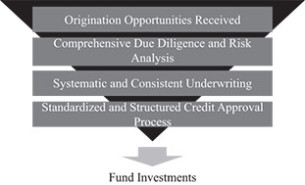
Origination. The Adviser develops investment opportunities through extensive relationships with regional banks, private equity firms, financial intermediaries, management teams and other turn-around advisors. Monroe Capital has developed this network since its formation in 2004. The Adviser manages these leads through personal visits and calls by its senior deal professionals. It is these professionals’ responsibility to identify specific opportunities, refine opportunities through due diligence regarding the underlying facts and circumstances and utilize innovative thinking and flexible terms to solve the financing issues of prospective clients. Monroe Capital’s origination professionals are broadly dispersed with 12 offices across the United States, Middle East, Asia and Australia. Certain of Monroe Capital’s originators are responsible for covering a specified target market based on geography and others focus on specialized industry verticals. We believe Monroe Capital’s origination professionals’ experience is vital to enable us to provide our borrowers with innovative financing solutions. We further believe that their strength and breadth of relationships across a wide range of markets will generate numerous financing opportunities and enable us to be highly selective in our lending activities.
Due Diligence. For each of our investments, the Adviser prepares a comprehensive new business presentation, which summarizes the investment opportunity and its due diligence and risk analysis, all from the perspective of strengths, weaknesses, opportunities and threats presented by the opportunity. This presentation assesses the borrower and its management, including products and services offered, market position, sales and marketing capabilities and distribution channels; key contracts, customers and suppliers, meetings with management and facility tours; background checks on key executives; customer calls; and an evaluation of exit strategies. The Adviser’s presentation typically evaluates historical financial performance of the borrower and includes projections, including operating trends, an assessment of the quality of financial information, capitalization and liquidity measures and debt service capacity. The financial analysis also includes sensitivity analysis against management projections and an analysis of potential downside scenarios, particularly for cyclical businesses. The Adviser also reviews the dynamics of the borrowers’ industry and assess the maturity, market size, competition, technology and regulatory issues confronted by the industry. As part of this analysis, the Adviser also reviews the ESG considerations of the industry and the specific business of the borrower. Finally, the Adviser’s new business presentation includes all relevant third-party reports and assessments, including, as applicable, analyses of the quality of earnings of the prospective borrower, a review of the business by industry and ESG experts and third-party valuations. The Adviser also includes in this due diligence, if relevant, field exams, collateral appraisals and environmental reviews, as well as a review of comparable private and public transactions.
Underwriting. The Adviser uses the systematic, consistent approach to credit evaluation developed in house by Monroe Capital with a particular focus on determining the value of a business in a downside scenario. In this process, the senior investment professionals at the Adviser bring to bear extensive lending experience with emphasis on lessons learned from the past credit cycles. We believe that the extensive credit and debt work-out experience of Monroe Capital’s senior management enables us to anticipate problems and minimize risks. Monroe Capital’s underwriting professionals work closely with its origination professionals to identify individual deal strengths, risks and any risk mitigants. The Adviser preliminarily screens transactions based on cash flow, enterprise value and asset-based characteristics, and each of these measures is developed on a proprietary basis using thorough credit analysis focused on sustainability and predictability of cash flow to support enterprise value, barriers to entry, market position, competition, customer and supplier relationships, management strength, private equity sponsor track record and industry dynamics. For asset-based transactions, the Adviser seeks to understand current and future collateral value, opening availability and ongoing liquidity. The Adviser documents this preliminary analysis, which is thoroughly reviewed by at least one member of its Investment Committee prior to proposing a formal term sheet. We believe this early involvement of the Investment Committee ensures that our resources and those of third parties are deployed appropriately and efficiently during the investment process and lowers execution risk for our clients. With respect to transactions reviewed by the Adviser, we expect that only approximately 10% of our sourced deals will reach the formal term sheet stage.
Credit Approval/Investment Committee Review. The Adviser employs a standardized, structured process developed by Monroe Capital when evaluating and underwriting new investments for our portfolio. The Investment Committee considers its comprehensive new business presentation to approve or decline each investment. The committee is committed to providing a prompt turnaround on investment decisions. Each investment opportunity requires the unanimous approval of the Investment Committee. Follow-on investments in existing portfolio companies require the Investment Committee’s approval beyond that obtained when the initial investment in the company was made.
The following chart illustrates the stages of the Adviser’s evaluation process:
Evaluation Process
Execution. We believe Monroe Capital has developed a strong reputation for closing deals as proposed, and we intend to continue this tradition. Through the Adviser’s consistent approach to credit evaluation and underwriting, we seek to close deals as fast or faster than competitive financing providers while maintaining the discipline with respect to credit, pricing and structure necessary to ensure the ultimate success of the financing.
Monitoring. We benefit from the portfolio management system in place at Monroe Capital. This monitoring includes regular meetings between the responsible analyst and our portfolio company to discuss market activity and current events. The Adviser’s portfolio management staff closely monitors all credits, with senior portfolio managers covering agented and more complex investments with the support of junior portfolio management staff. The Adviser segregates our capital markets investments by industry. The Adviser’s monitoring process developed by Monroe Capital has daily, weekly, monthly and quarterly components and related reports, each to evaluate performance against historical, budget and underwriting expectations. The Adviser’s analysts monitor performance using standard industry software tools to provide consistent disclosure of performance. When necessary, the Adviser updates our internal risk ratings, borrowing base criteria and covenant compliance reports.
As part of the monitoring process, the Adviser regularly assesses the risk profile of each of our investments and rates each of them based on an internal proprietary system that uses the categories listed below, which we refer to as the Adviser’s investment performance risk rating. For any investment rated in Grades 3, 4 or 5, the Adviser, through its internal Portfolio Management Group (“PMG”), will increase its monitoring intensity and prepare regular updates for the Investment Committee, summarizing current operating results and material impending events and suggesting recommended actions. The PMG is responsible for oversight and management of any investments rated in Grades 3, 4 or 5. The Adviser monitors and, when appropriate, changes the investment ratings assigned to each investment in our portfolio. In connection with our valuation process, the Adviser reviews these investment performance risk ratings on a quarterly basis. The investment performance risk rating system is described as follows:
Investment | | Summary Description |
Grade 1 | Includes investments exhibiting the least amount of risk in our portfolio. The issuer is performing above expectations or the issuer’s operating trends and risk factors are generally positive. | |
Grade 2 | Includes investments exhibiting an acceptable level of risk that is similar to the risk at the time of origination. The issuer is generally performing as expected or the risk factors are neutral to positive. | |
Grade 3 | Includes investments performing below expectations and indicates that the investment’s risk has increased somewhat since origination. The issuer may be out of compliance with debt covenants; however, scheduled loan payments are generally not past due. | |
Grade 4 | Includes an issuer performing materially below expectations and indicates that the issuer’s risk has increased materially since origination. In addition to the issuer being generally out of compliance with debt covenants, scheduled loan payments may be past due (but generally not more than six months past due). | |
Grade 5 | Indicates that the issuer is performing substantially below expectations and the investment risk has substantially increased since origination. Most or all of the debt covenants are out of compliance or payments are substantially delinquent. Investments graded 5 are not anticipated to be repaid in full. |
Our investment performance risk ratings do not constitute any rating of investments by a nationally recognized statistical rating organization or reflect or represent any third-party assessment of any of our investments.
In the event of a delinquency or a decision to rate an investment Grade 4 or Grade 5, the PMG, in consultation with the Investment Committee, will develop an action plan. Such a plan may require a meeting with the borrower’s management or the lender group to discuss reasons for the default and the steps management is undertaking to address the under-performance, as well as amendments and waivers that may be required. In the event of a dramatic deterioration of a credit, the Adviser and the PMG will form a team or engage outside advisors to analyze, evaluate and take further steps to preserve our value in the credit. In this regard, we would expect to explore all options, including in a private equity sponsored investment, assuming certain responsibilities for the private equity sponsor or a formal sale of the business with oversight of the sale process by us. The PMG and the Investment Committee have extensive experience in running debt work-out transactions and bankruptcies.
Monroe Capital, the Adviser and the Administrator
The Fund’s investment activities are managed by MC Advisors, an investment adviser registered with the SEC under the Advisers Act, and an affiliate of Monroe Capital. Our Adviser is responsible for sourcing potential investments, conducting due diligence on
prospective investments, analyzing investment opportunities, structuring investments and monitoring our portfolio on an ongoing basis.
Monroe Capital, LLC is an asset management firm specializing in private credit markets across various strategies, including direct lending, asset-based lending, specialty finance, alternative credit solutions, structured credit, venture debt, and equity. Since 2004, Monroe has provided capital solutions to clients in the U.S. and Canada. Monroe prides itself on being a value-added and user-friendly partner to business owners, management, and both private equity and independent sponsors. Monroe’s platform offers a wide variety of investment products for both institutional and high net worth investors that seek to generate high quality “alpha” returns irrespective of business or economic cycles. Monroe is headquartered in Chicago and maintains locations in Austin, Boston, Farmington, Los Angeles, Miami, Naples, New York, San Francisco, Seoul, South Korea, Sydney, Australia and Abu Dhabi, United Arab Emirates.
Monroe was founded in 2004 by Theodore Koenig, Michael Egan and Thomas Aronson (together, the “Founders”) in Chicago, IL. Prior to that, the Founders had worked together (Mr. Koenig and Mr. Egan since 1999 and Mr. Aronson since 2002) at Hilco Capital, an alternative credit solutions, hard-money lender providing various types of junior and distressed private loan transactions. Since Monroe’s formation, the investment team has grown to more than 110 professionals as of March 31, 2026, with senior management averaging over 28 years of private middle market credit experience. As of March 31, 2026, Monroe has invested in over 2,350 loans and related investments with an aggregate principal value of approximately $58.5 billion.
Since Monroe’s inception, the Founders have facilitated the growth of Monroe’s committed and managed assets under management to approximately $24.1 billion as of April 1, 2026. Monroe’s senior management team (“Senior Management”) has significant experience in directly originating investments and possesses complementary skill sets in transaction sourcing, underwriting, structuring and negotiations, work-out and distressed investing. Senior Management will seek to leverage this experience and harness the entire Monroe platform in order to effectively execute transactions.
MC Advisors, a registered investment adviser under the Advisers Act, serves as the Fund’s investment adviser pursuant to the Advisory Agreement. MC Management, an affiliate of MC Advisors, serves as the Fund’s administrator pursuant to the Administration Agreement. Each of MC Advisors and MC Management is an affiliate of Monroe Capital, LLC.
Market Opportunity
Monroe believes that the turmoil that occurred in the credit markets in 2008, and the impact it had on banks and specialty finance firms, created an opportunity in the credit markets that continues to exist. Similar opportunities were created in the late 1980s, early 1990s and early 2000s. Monroe believes that such turmoil had a structural impact on banks and other traditional regulated sources of senior debt, hedge funds, and specialty finance companies that will continue into the foreseeable future.
Despite the steady growth in non-bank lending and private credit’s establishment as a sizable and attractive asset class, the impact of these changes is still especially present in the lower middle market. Specifically, there is a shortage of available debt capital in the market for borrowers with less than $350 million in revenue and/or $35 million of EBITDA. Traditional lenders tend to avoid financing these companies that are at the heart of Monroe’s target market. Many competitors in the private loan market lack the resources necessary to invest in a diverse pool of smaller transactions or the infrastructure necessary to support comprehensive due diligence practices, customized loan structuring efforts, and substantial underwriting and portfolio management staffing.
Compounding the opportunity set across the lower middle market is the increasing digitization of society over the next several decades, a trend that will continue to drive private equity M&A activity within technology specifically. We expect this trajectory to create attractive long-term opportunities for those with deep expertise and networks within these sectors as businesses continue to upgrade technology in order to maximize efficiency across their platforms. Such investments typically offer higher coupons relative to traditional middle market loans due to the expertise required to originate and underwrite these businesses.
Monroe believes that the Fund’s target investment focus presents a highly compelling risk-adjusted return opportunity within direct lending. The following credit market dynamics demonstrate the compelling nature of the lower middle market in comparison to the broader loan market for larger obligors:
Premium Returns: Private loan returns in the lower middle market remain higher than those available in the syndicated loan market or the larger end of the middle market. Monroe seeks opportunities that provide both premium pricing and relatively low risk.
In Monroe’s experience, private loan borrowers generally offer more attractive economics than larger companies in terms of interest rate, upfront fees and prepayment penalties. Monroe focuses on less liquid, private credit transactions that can generate “alpha” versus larger market transactions.
Conservative Capital Structures and Attractive Terms: Private lower middle market loan investments have historically included lower leverage and higher equity contributions than larger corporate loans. Historically, equity contributions as a percentage of the capital structure are larger for lower middle market loans. Lower middle market borrowers also tend to utilize more traditional capital structures and lenders tend to benefit from full financial covenant packages.
Lower Historical Default Rates: Not only have lower middle market loans produced premium historical returns, but they also have lower historical default rates and principal recovery rates generally in-line with those in the syndicated loan market. In addition to more conservative capital structures, Monroe attributes the improved downside protection of lower middle market loans to a variety of factors. Private lower middle market loans are typically originated by a lender that retains the entire loan or by a small lending group, or “club.” These types of lending relationships facilitate superior communication among the group, better information flow, heightened oversight and monitoring and direct access to borrowers’ management teams, as well as opportunities to obtain board seats or board observation rights with respect to borrowers. These transactions allow lenders to customize covenant and default provisions in loan documents tailored to suit individual borrowers. Monroe believes these factors result in a better “fit” for borrowers, easier monitoring, and improved overall performance for these investments, especially in the event financial performance of a portfolio company declines.
Potential Competitive Strengths
Monroe Capital believes that the Fund represents an attractive investment opportunity and has several distinct potential competitive advantages, including the following:
| ● | Top Tier Independent Private Credit Investment Management Firm — The Fund will leverage the full capabilities of Monroe Capital’s integrated investment management and origination platform and infrastructure in order to seek to achieve continued success in investment performance. Monroe originates deals through a proprietary U.S. national deal platform. Monroe Capital is one of the leading lower middle market direct lenders in the United States and continues to be recognized by the direct lending industry. |
| ● | Middle Market Direct Lending Focus — Regulations that were imposed on banks and other financial institutions as a result of the 2008 financial crisis continue to create a supply-demand credit imbalance throughout the broader financing markets, which is especially evident in the traditional and lower middle market direct lending space where regional banks have largely exited the market with regards to cash-flow and enterprise value loans and loans that are too small to appeal to the syndicated loan market. Specifically, there is a structural void for middle market companies looking for cash-flow and/or enterprise value-based loans, which is the primary target of the Fund. |
Many lenders target borrowers with larger EBITDA levels, and do not have the resources to invest in multiple smaller transactions, which, while offering attractive risk-adjusted returns, often require substantial due diligence and structuring efforts and expertise (which Monroe has institutionalized over its 20-year history with its lower middle market direct lending focus). This supply/demand imbalance in the traditional and lower middle market loan segment results in attractive investment terms for the Fund (such as relatively higher contractual coupon, typically less leverage and higher equity contributions, the ability to obtain warrants and equity co-investments in select transactions, and the presence of superior lender protections, including financial maintenance covenants).
Additionally, according to S&P LSTA data, default rates are lower while recovery rates in the lower middle market private loan segment are in-line with the syndicated loan market in general.
| ● | National Deal Sourcing Platform — The Fund has access to a substantial volume of proprietary deal flow through Monroe Capital’s national origination platform in addition to the Fund’s investment team’s own origination network. Monroe Capital’s origination team, with a referral network of over 16,000 firms and key individuals throughout the United States and Canada, includes seasoned professionals focused on both regional relationships as well as deep industry vertical relationships. Monroe Capital’s multiple offices allow for a direct connection to deal flow in those regions to preempt the deal from being “shopped” to other lenders or the need to rely on Wall Street arrangers of debt. This broad sourcing network has generated abundant investment opportunities for prior Monroe advised funds and is expected to allow the Fund the ability |
| to be successful in both growing and contracting economic environments by maintaining strong, consistent deal flow in various market conditions and cycles. Additionally, Monroe’s origination team is particularly focused on certain key industries poised for growth, including technology and healthcare, and has built an expertise in the independent sponsor market. Historically, Monroe Capital has found that regional and local institutions, such as banks, investment banks and sponsors, have been a strong source of proprietary deal flow. This results in Monroe Capital reviewing approximately 2,100 deals annually and gives the Adviser the ability to select what is believes to be the best possible opportunities that will allow the Fund to achieve premium pricing while investing in conservative capital structures. The Adviser believes that this platform will generate a significant number of high-quality opportunities, resulting in a portfolio that is diversified by borrower, referral source, industry, and investment size, among other factors. |
| ● | Differentiated Strategy — The Fund expects to take a conservative approach to loan structuring, with an emphasis on protection and preservation of capital. Monroe’s typical investment is secured by substantially all of the assets of the borrower, a pledge of the borrower’s stock, and guarantees from the borrower’s parent and operating subsidiaries. This type of collateral and security package, enhanced by financial covenants, is typically not granted to traditional high-yield, fixed income, or corporate mezzanine debt investors. Monroe expects to protect invested capital by obtaining similar collateral and security pledges to back the secured loan investments of the Fund. These loans typically have large equity cushions in the capital structure providing the ability to achieve a full recovery in situations when the value of the business unexpectedly declines. A key aspect of the Fund’s approach to structuring will be to seek shorter holding periods (typical contractual maturity of approximately 5 years with an average hold period of 2–4 years), across businesses with attractive contractual cash returns of interest and fees, and predictable exits. The Fund will focus on potential exit strategies in connection with the origination and structuring of each transaction and will continue to monitor these on an ongoing basis. The Fund’s strategy is designed to achieve its target investment returns even if the public equity and credit markets are challenging. |
| ● | Compelling Credit Attributes in Recurring Revenue Businesses — Technology-enabled companies with recurring revenue streams typically have a number of compelling credit characteristics. In particular, Monroe seeks to lend to companies that offer mission critical, high return-on- investment products with high switching costs. Together with long-term contractual revenue streams, the revenue model is highly recurring, resulting in predictable and stable cash flows. Furthermore, the mission critical nature of the products makes customer purchase decisions less discretionary and less cyclical than other sectors, contributing to the lower default rates in technology relative to most industries. The sector is also generally characterized by low variable costs as the replicable nature of products creates sustainable operating leverage and high margins as well as low capital expenditure needs which results in high free cash-flow. Coupled with the strong underlying industry growth rates, technology-enabled businesses tend to command higher equity valuations and lower loan-to-values as compared with other industries. Despite these attractive credit attributes and the rise in dedicated technology private equity firms, there remains a limited set of middle market lenders with the experience and expertise necessary to originate, underwrite, and monitor prospective borrowers in the technology industry, resulting in attractive risk-adjusted returns. |
| ● | Technology Sector Expertise — Monroe’s investment team has a long track record of investing in technology-enabled companies, with $14.0 billion invested across ARR and cash-flow loans within these sectors.4 While there are many tailwinds supporting the industry, the technology sector is dynamic, characterized by rapidly evolving markets, intense competition, and unique accounting subtleties, among other factors, all of which require industry specialization in origination, underwriting, and portfolio management. The Fund benefits from Monroe’s technology-dedicated industry investment professionals, as well as Monroe’s broader in-house industry expertise, institutionalized over 20 years of investing in this growing segment of the middle market. |
| ● | Non-Sponsored Transaction Capabilities — Monroe has the infrastructure in place for the Fund to invest in both private equity sponsored and non-sponsored transactions. Depending on the market conditions, business cycle and/or merger and acquisition volume, Monroe has the unique capability to not be solely reliant on private equity sponsored transactions, unlike many direct lending peers. Non-sponsored transactions usually generate greater risk-adjusted returns for Monroe’s fund investors because they are typically sourced through a less competitive process, which usually allows for higher pricing and a more conservative structure relative to a similar company owned by a financial sponsor. |
4 | Includes technology investments made by funds managed by the Adviser and affiliated investment advisers (the “Monroe Funds”), excluding deals held exclusively in Monroe collateralized loan obligations, since inception of the firm in 2004 through March 31, 2026, which comprise only a subset of the entire investment portfolio of the Monroe Funds and do not represent the Monroe Funds’ entire portfolio. |
| ● | Uncorrelated Total Returns — The Fund seeks to achieve optimal risk-adjusted returns by investing in secured private credit transactions that pay quarterly cash coupons which contribute to steady, predictable cash distributions. The Fund’s investment velocity based on Monroe Capital’s origination and underwriting infrastructure is expected to deliver stable and uncorrelated returns compared to the broader financial markets. This is expected to minimize, and potentially eliminate, the “J-Curve” effect (the tendency for a fund’s NAV to decline moderately during the early years of the fund’s life as investment-related fees and expenses are incurred before investment gains have been realized) for the investors in the Fund. Certain transactions are expected to provide the Fund with the potential to generate additional upside return through upfront fees, original issue discount, warrants, equity co-investments, prepayment fees, success fees, GP carried interest and PIK interest. |
The Board
Overall responsibility for the Fund’s oversight rests with the Board. We have entered into the Advisory Agreement with MC Advisors, pursuant to which MC Advisors manages the Fund on a day-to-day basis. The Board is responsible for overseeing the Adviser and other service providers in our operations in accordance with the provisions of the 1940 Act, the Fund’s Declaration of Trust and bylaws and applicable provisions of state and other laws. The Adviser keeps the Board informed as to the Adviser’s activities on our behalf and our investment operations and provides the Board with additional information as the Board may, from time to time, request. The Board is currently composed of three members, two of whom are Trustees who are not “interested persons” of the Fund or the Adviser as defined in the 1940 Act. The Board is divided into three classes, each serving staggered, three-year terms. The initial terms of the Fund’s Class I trustees will expire at the 2026 annual meeting of stockholders; the initial terms of the Fund’s Class II trustees will expire at the 2027 annual meeting of stockholders; and the initial term of the Fund’s Class III trustee will expire at the 2028 annual meeting of stockholders.
Allocation of Investment Opportunities General
The Adviser and its affiliates provide investment management services to other investment funds and client accounts. The Adviser will share any investment and sale opportunities with the Fund and Other Accounts in accordance with applicable law, including the Advisers Act, firm-wide allocation policies, and an exemptive order from the SEC permitting co-investment activities (as further described below), which generally provide for sharing eligible investments pro rata based on the available capital of eligible participating funds and accounts, subject to certain allocation factors.
In addition, as a BDC regulated under the 1940 Act, the Fund is subject to certain limitations relating to co-investments and joint transactions with affiliates, which, in certain circumstances, limit the Fund’s ability to make investments or enter into other transactions alongside Other Accounts.
The Adviser conducts the investment activities of the Fund in a manner similar to the manner in which it conducts the investment activities of its (or its affiliates’) investment funds and other managed accounts with similar investment objectives and strategies. The existence of multiple clients necessarily creates a number of potential conflicts of interest. As a BDC, we are subject to certain regulatory restrictions in negotiating certain investments alongside entities with which we may be restricted from doing so under the 1940 Act, such as the Adviser and its affiliates. Subject to the provisions below, and subject to compliance with the terms of the 2025 Co-Investment Order, which permits the Fund and other accounts sponsored or managed by the Adviser or its affiliates to co-invest in portfolio companies with each other and with affiliated investment vehicles, the Adviser will present to the Fund all investment opportunities which meet the investment objective of the Fund in the good faith judgment of the Adviser; provided, that the Fund has sufficient capital, such investment opportunity fits the investment parameters of the Fund and the Fund is otherwise capable of making such investment. The classification of an investment opportunity as appropriate or inappropriate for the Fund will be made by the Adviser, in good faith, at the time the opportunity is presented. Such determination may be subjective in nature. In cases where a limited amount of a loan, security, instrument or claim is available for purchase, the allocation of such loan, security, instrument or claim among the Fund and such other funds or accounts may necessarily reduce the amount thereof available for purchase by the Fund. Co-investments made under the 2025 Co-Investment Order are subject to compliance with certain conditions and other requirements, which could limit our ability to participate in a co-investment transaction. We may also otherwise participate in aggregated transactions with vehicles managed by the Adviser or its affiliates subject to compliance with existing regulatory guidance, applicable regulations and the Adviser’s allocation policy.
Subject to the above considerations, when it is determined by the Adviser that it would be appropriate for the Fund and one or more other Monroe Capital clients to participate in an investment opportunity, the Adviser will generally allocate such investment
opportunity among the Fund and such other Monroe Capital clients on a “fair and equitable” basis in proportion to the relative amounts of available capital for new investments, taking into account such various factors as it may determine appropriate in accordance with the Allocation Criteria. The Adviser will generally allocate follow-on investments among the Fund and such other Monroe Capital clients pro rata based on their respective outstanding investment size immediately preceding the follow-on investment, subject to certain considerations including but not limited to the Fund’s or such other Monroe Capital client’s desired maximum hold position or any other considerations or factors in accordance with the Allocation Criteria. For the avoidance of doubt, certain transactions in which other Monroe Capital clients invest may not meet the Fund’s return parameters if the Fund will not secure financing to fund its investments (other than use of a subscription facility).
In any case where the Fund and one or more other Monroe Capital clients invest in the same investment opportunity, such investment will generally be made at the same time and on the same terms and conditions at the investment level, except as permitted pursuant to the Allocation Criteria and the 2025 Co-Investment Order. Furthermore, when it is determined by the Adviser that it would be appropriate (whether pursuant to a previously agreed upon arrangement or otherwise) for a third-party to participate in an investment opportunity in which the Fund and/or the other Monroe Capital clients will participate, the Adviser will use its business judgment and act in a manner that it considers fair and reasonable in seeking to allocate such investment opportunity on an equitable basis, taking into account any such considerations that it deems necessary or appropriate in light of the circumstances at such time.
Co-Investment Relief
The Fund expects to co-invest on a concurrent basis with other affiliates of the Fund and the Adviser, unless doing so is impermissible with existing regulatory guidance, applicable regulations, the terms of any exemptive relief granted to the Fund and Monroe Capital’s allocation procedures as described below. On December 17, 2025, the Adviser, the Fund and certain affiliated entities received an updated form of co-investment exemptive relief from the SEC to allow certain managed funds and investment vehicles, each of whose investment adviser is the Adviser or an investment adviser controlling, controlled by or under common control with the Adviser, to participate in negotiated co-investment transactions where doing so is consistent with regulatory requirements and other pertinent factors, and pursuant to the conditions of the exemptive relief (the “2025 Co-Investment Order”). The 2025 Co-Investment Order, which supersedes the co-investment order issued to the Monroe Capital platform on January 10, 2023, is a new form of co-investment exemptive relief that adopts a more flexible requirement that allocations be “fair and equitable” to us and that the Adviser (or the applicable investment adviser) considers the interests of us and other affiliated 1940 Act-regulated funds that rely on the 2025 Co-Investment Order in allocations. Under the 2025 Co-Investment Order, among other requirements, the terms, conditions, price, class of securities to be purchased in respect of a particular investment, the date on which such investment is to be made and any registration rights applicable thereto, must be generally the same for us and each other participating affiliated entity. The requirements of the 2025 Co-Investment Order (including any requirements for board approval thereunder), as well as other regulatory requirements associated with us and other affiliated 1940 Act-regulated funds that rely on the 2025 Co-Investment Order, potentially will impact the investment allocations among participating entities (including, for the avoidance of doubt, us) or otherwise impact allocation results. Any changes to the 2025 Co-Investment Order or the rules and other guidance promulgated by the SEC and its staff under the 1940 Act could impact allocations made available to us and thereby affect (and potentially decrease) the allocation made to us or otherwise impact the process for allocations in transactions in which we participate.
Competition
The business of investing in debt investments is highly competitive and involves a high degree of uncertainty. Market competition for investment opportunities includes traditional lending institutions, including commercial and investment banks, as well as a growing number of non-traditional participants, such as hedge funds, private equity funds, mezzanine funds, and other private investors, as well as BDCs, and debt-focused competitors, such as issuers of collateralized loan obligations, or CLOs, and other structured loan funds. In addition, given the Fund’s target investment size and investment type, the Adviser expects a large number of competitors for investment opportunities. Some of these competitors may have access to greater amounts of capital and to capital that may be committed for longer periods of time or may have different return thresholds than the Fund, and thus these competitors may have advantages not shared by the Fund. In addition, competitors may have incurred, or may in the future incur, leverage to finance their debt investments at levels or on terms more favorable than those available to the Fund. Furthermore, competitors may offer loan terms that are more favorable to borrowers, such as less onerous borrower financial and other covenants, borrower rights to cure defaults, and other terms more favorable to borrowers than current or historical norms. Strong competition for investments could result in fewer investment opportunities for the Fund, as certain of these competitors have established or are establishing investment vehicles that target the same or similar investments that the Fund intends to purchase.
Over the past several years, many investment funds have been formed with investment objectives similar to those of the Fund, and many such existing funds have grown in size and have added larger successor funds to their platform. These and other investors may make competing offers for investment opportunities identified by the Adviser which may affect the Fund’s ability to participate in attractive investment opportunities and/or cause the Fund to incur additional risks when competing for investment opportunities. Moreover, identifying attractive investment opportunities is difficult and involves a high degree of uncertainty. The Adviser may identify an investment that presents an attractive investment opportunity but may not be able to complete such investment in a manner that meets the objectives of the Fund. The Fund may incur significant expenses in connection with the identification of investment opportunities and investigating other potential investments that are ultimately not consummated, including expenses related to due diligence, transportation and legal, accounting and other professional services as well as the fees of other third-party advisers.
Non-Exchange Traded, Perpetual-Life BDC
The Fund is non-exchange traded, meaning its shares are not listed for trading on a stock exchange or other securities market and a perpetual-life BDC, meaning it is an investment vehicle of indefinite duration, whose common shares are intended to be sold by the BDC monthly on a continuous basis at a price generally equal to the BDC’s monthly NAV per share. In our perpetual-life structure, we may, at our discretion, offer investors an opportunity to repurchase their shares on a quarterly basis through voluntary tender offers in accordance with the Exchange Act tender offer rules, but we are not obligated to offer to repurchase any in any particular quarter. Aside from the limited liquidity offered by quarterly share repurchases, investors generally should not expect to be able to sell their Common Shares regardless of how well the Fund performs. We believe that our perpetual nature enables us to execute a patient and opportunistic strategy and be able to invest across different market environments. This may reduce the risk of the Fund being a forced seller of assets in market downturns compared to non-perpetual funds. While we may consider a liquidity event at any time in the future, we currently do not intend to undertake a liquidity event, and we are not obligated by our declaration of trust or otherwise to effect a liquidity event at any time.
FINRA Rule 2310(b)(3)(D) requires that we disclose the liquidity of prior public programs sponsored by Monroe Capital. In addition to us, Monroe Capital has sponsored the following other public programs: Monroe Capital Corporation and Monroe Capital Income Plus Corporation. Monroe Capital Corporation was a closed-end management investment company that elected to be regulated as a BDC under the 1940 Act, with its common stock traded on The NASDAQ Global Select Market under the symbol “MRCC” and which did not have a date or time period at which it expected to consider a liquidity event. On April 14, 2026, pursuant to the Agreement and Plan of Merger, dated as of August 7, 2025, by and among Monroe Capital Corporation, Horizon Technology Finance Corporation, HMMS, Inc., Monroe Capital BDC Advisors, LLC, and Horizon Technology Finance Management LLC, Monroe Capital Corporation merged, in a multi-step process, with and into Horizon Technology Finance Corporation, with Horizon Technology Finance Corporation as the surviving corporation, at which time the separate corporate existence of Monroe Capital Corporation ceased. Monroe Capital Income Plus Corporation is a closed-end management investment company that has elected to be regulated as a BDC under the 1940 Act. Monroe Capital Income Plus Corporation is a perpetual life vehicle and does not have a date or time period at which it expects to consider a liquidity event.
RISK FACTORS
Investments in our Common Shares involve a high degree of risk. The following information is a discussion of material risk factors associated with an investment in our Common Shares specifically, as well as those factors generally associated with an investment in a company with investment objectives, investment policies, capital structure or trading markets similar to ours. In addition to the other information contained in this prospectus, you should consider carefully the following information before making an investment in our Common Shares. The risks below are not the only risks we face but do represent the known material risks and uncertainties that we believe are most significant to our business, operating results, financial condition, prospects and forward-looking statements. Additional risks and uncertainties not presently known to us or not presently deemed material by us may also impair our operations and performance. In addition, there will be occasions when the Adviser and its affiliates may encounter potential conflicts of interest in connection with the Fund. The following considerations should be carefully evaluated before making an investment in our Common Shares. If any of these risks actually occur, the Fund’s business, financial condition and results of operations could be materially and adversely affected, and you may lose all or part of your investment.
Risks Relating to Our Business and Structure
We are a new company and have a limited operating history.
We are a closed-end management investment company organized as a Delaware statutory trust. We have elected to be regulated as a BDC under the 1940 Act. We have a limited operating history. As a result, prospective investors have limited financial information on which to base their investment decision. We are subject to the business risks and uncertainties associated with recently formed businesses, including the risk that we will not achieve our investment objective and the value of a shareholder’s investment could decline substantially or become worthless. Further, our investment adviser has not previously offered a non-traded, publicly offered BDC. While we believe that the past professional experiences of our investment adviser’s investment team, including investment and financial experience of our investment adviser’s senior management, will increase the likelihood that our investment adviser will be able to manage us successfully, there can be no assurance that this will be the case.
We depend upon the Adviser’s senior management for our success, and upon its access to the investment professionals of Monroe Capital and its affiliates.
We do not have any internal management capacity or employees. We depend on the investment expertise, skill and network of business contacts of the senior investment professionals of the Adviser, who evaluate, negotiate, structure, execute, monitor and service our investments in accordance with the terms of an investment advisory agreement. Our success depends to a significant extent on the continued service and coordination of the senior investment professionals of the Adviser, particularly those individuals who comprise the Investment Committee. These individuals may have other demands on their time now and in the future, and we cannot assure you that they will continue to be actively involved in our management. Each of these individuals is an employee of MC Management and is not subject to an employment contract. The departure of any of these individuals or competing demands on their time in the future could have a material adverse effect on our ability to achieve our investment objective.
The Adviser evaluates, negotiates, structures, closes and monitors our investments in accordance with the terms of an investment advisory agreement. We can offer no assurance, however, that the Adviser’s senior investment professionals will continue to provide investment advice to us. If these individuals do not maintain their existing relationships with Monroe Capital and its affiliates and do not develop new relationships with other sources of investment opportunities, we may not be able to grow our investment portfolio or achieve our investment objective. In addition, individuals with whom Monroe Capital’s senior investment professionals have relationships are not obligated to provide us with investment opportunities. Therefore, we can offer no assurance that such relationships will generate investment opportunities for us.
The Investment Committee that oversees our investment activities is provided by the Adviser in connection with its investment advisory services. The loss of any member of the Investment Committee or of other Monroe Capital senior investment professionals would limit our ability to achieve our investment objective and operate as we anticipate. This could have a material adverse effect on our financial condition and results of operations.
MC Advisors is dependent upon key investment personnel and resources provided to it by MC Management under a staffing agreement.
MC Management and MC Advisors have entered into a staffing agreement pursuant to which MC Management provides MC Advisors with investment professionals and access to their resources (the “Staffing Agreement”). Because MC Advisors does not have any employees, it depends solely on the investment professionals provided to it by MC Management pursuant to the Staffing Agreement for its infrastructure, business relationships and management expertise in connection with its provision of investment advisory services to us. MC Advisors depends on the investment professionals provided to it by MC Management under the Staffing Agreement for the identification, review, final selection, structuring, closing and monitoring of our investments. These investment professionals have significant investment expertise and relationships that MC Advisors relies on to implement its and our business plan. We cannot guarantee that any of these investment professionals will remain available to MC Advisors. If MC Advisors loses the services of the investment professionals provided by MC Management, it and we may not be able to operate our respective businesses as we expect, and our ability to compete could be harmed, which could cause our operating results to suffer.
MC Advisors also depends upon Monroe Capital to obtain access to deal flow generated by the investment professionals of Monroe Capital and its affiliates. We are not a party to the Staffing Agreement and cannot assure you that MC Management will continue to fulfill its obligations under the agreement. Furthermore, the Staffing Agreement may be terminated by either party without penalty upon 60 days’ written notice to the other party. If MC Management fails to perform, we cannot assure you that MC Advisors will enforce the Staffing Agreement or that such agreement will not be terminated by either party or that we will continue to have access to the investment professionals of Monroe Capital and its affiliates or their information and deal flow.
Our business model depends to a significant extent upon strong referral relationships with financial institutions, sponsors and investment professionals. Any inability of the Adviser to maintain or develop these relationships, or the failure of these relationships to generate investment opportunities, could adversely affect our business.
We depend upon the senior investment professionals of the Adviser to maintain their relationships with financial institutions, sponsors and investment professionals, and we rely to a significant extent upon these relationships to provide us with potential investment opportunities. If the senior investment professionals of the Adviser fail to maintain such relationships, or to develop new relationships with other sources of investment opportunities, we will not be able to grow our investment portfolio. In addition, individuals with whom the senior investment professionals of the Adviser have relationships are not obligated to provide us with investment opportunities, and, therefore, we can offer no assurance that these relationships will generate investment opportunities for us in the future.
Our financial condition and results of operations depend on our ability to manage our business effectively.
Our ability to achieve our investment objective and grow depends on our ability to manage our business. This depends, in turn, on the Adviser’s ability to identify, invest in and monitor companies that meet our investment criteria. The achievement of our investment objectives depends upon the Adviser’s execution of our investment process, its ability to provide competent, attentive and efficient services to us and, to a lesser extent, our access to financing on acceptable terms. The Adviser has substantial responsibilities under the investment advisory agreement with the Fund. The senior origination professionals and other personnel of the Adviser and its affiliates may be called upon to provide managerial assistance to our portfolio companies. These activities may distract them or slow our rate of investment. Any failure to manage our business and our future growth effectively could have a material adverse effect on our business, financial condition, results of operations and prospects. Our results of operations depend on many factors, including the availability of opportunities for investment, readily accessible short and long-term funding alternatives in the financial markets and economic conditions. Furthermore, if we cannot successfully operate our business or implement our investment policies and strategies, it could negatively impact our ability to pay dividends or other distributions and you may lose all or part of your investment.
There may be conflicts related to obligations that the Adviser’s senior investment professionals and members of the Investment Committee have to other clients.
The senior investment professionals and members of the Investment Committee serve or may serve as officers, directors or principals of entities that operate in the same or a related line of business as we do, or of investment funds, accounts or other investment vehicles sponsored or managed by the Adviser or its affiliates. In serving in these multiple capacities, they may have obligations to other clients or investors in those entities, the fulfillment of which may not be in our best interests or in the best interest of our shareholders. For example, such senior investment professionals and/or members of the Investment Committee have and will
continue to have management responsibilities for other investment funds, accounts or other investment vehicles sponsored or managed by affiliates of the Adviser. In serving in these multiple capacities, they may have obligations to other clients or investors in those entities, the fulfillment of which may not be in the best interests of us or our shareholders. The Adviser seeks to allocate investment opportunities among eligible accounts in a manner that is fair and equitable over time and consistent with its allocation policy.
The Adviser and/or affiliates of the Adviser manage other assets in funds that also have an investment strategy focused primarily on senior, unitranche and junior secured debt and, to a lesser extent, unsecured subordinated debt to lower middle-market companies. In addition, the Adviser and/or its affiliates may manage other entities in the future with an investment strategy that has the same or similar focus as ours.
Monroe Capital and its affiliates seek to allocate investment opportunities among the participating funds, including us, in proportion to the relative amounts of capital available for new investments, taking into account such factors as Monroe Capital may determine appropriate in accordance with the Allocation Criteria. We expect that Monroe Capital will follow the Allocation Criteria with respect to all of its funds under management, including us.
In situations where co-investment with other entities sponsored or managed by the Adviser or its affiliates is not permitted or appropriate, such as when there is an opportunity to invest in securities of the same issuer that have different priorities or liens, the Adviser will need to decide whether we or such other entity or entities will proceed with the investment. The Adviser will make these determinations based on its policies and procedures that require that such opportunities be offered to eligible accounts on a basis that is fair and equitable over time. However, there can be no assurance that we will be able to participate in all investment opportunities that are suitable to us.
The Adviser or the members of the Investment Committee may, from time to time, possess material nonpublic information, limiting our investment discretion.
The managing members and the senior origination professionals of the Adviser, the senior professionals at Monroe Capital (including its investment committee) and members of the Investment Committee may serve as directors of, or in a similar capacity with, companies in which we invest, the securities of which are purchased or sold on our behalf. In the event that material nonpublic information is obtained with respect to such companies, or we become subject to trading restrictions under the internal trading policies of those companies or as a result of applicable law or regulations, we could be prohibited for a period of time from purchasing or selling the securities of such companies, and this prohibition may have a material adverse effect on us.
Our management and incentive fee structure may create incentives for the Adviser that are not fully aligned with the interests of our shareholders.
In the course of our investing activities, we pay management and incentive fees to the Adviser.
Management fees are based on our average total assets (which include assets financed using leverage). As a result, investors in our common shares invest on a “gross” basis and receive distributions on a “net” basis after expenses, resulting in a lower rate of return than one might achieve through direct investments. Because these fees are based on our total assets, including assets financed using leverage, the Adviser benefits when we incur debt or otherwise use leverage. This fee structure may encourage the Adviser to cause us to borrow money to finance additional investments or to maintain leverage when it would otherwise be appropriate to pay off our indebtedness. Under certain circumstances, the use of borrowed money may increase the likelihood of default, which would disfavor our shareholders. Our Board is charged with protecting our interests by monitoring how the Adviser addresses these and other conflicts of interest associated with its management services and compensation. While our Board is not expected to review or approve each investment, our Independent Trustees periodically review the Adviser’s services and fees as well as its portfolio management decisions and portfolio performance. In connection with these reviews, our Independent Trustees consider whether our fees and expenses (including those related to leverage) remain appropriate.
As a result of this arrangement, the Adviser or its affiliates may from time to time have interests that differ from those of our shareholders, giving rise to a conflict.
The part of the incentive fee payable to the Adviser that relates to our net investment income is computed and paid on income that may include interest income that has been accrued but not yet received in cash. This fee structure may be considered to involve a conflict of interest for the Adviser to the extent that it may encourage the Adviser to favor debt financings that provide for deferred
interest, rather than current cash payments of interest. The Adviser may have an incentive to invest in PIK interest securities in circumstances where it would not have done so but for the opportunity to continue to earn the incentive fee even when the issuers of the deferred interest securities would not be able to make actual cash payments to us on such securities. This risk could be increased because the Adviser is not obligated to reimburse us for any incentive fees received even if we subsequently incur losses or never receive in cash the deferred income that was previously accrued. In addition, the part of the incentive fee payable to the Adviser that relates to our net investment income generally does not include any realized capital gains or losses or unrealized capital gains or losses. Any net investment income incentive fee would not be subject to repayment.
Our incentive fee may induce the Adviser to make certain investments, including speculative investments.
The Adviser receives an incentive fee based, in part, upon net capital gains realized on our investments. Unlike that portion of the incentive fee based on income, there is no hurdle rate applicable to the portion of the incentive fee based on net capital gains. As a result, the Adviser may have a tendency to invest more capital in investments that are likely to result in capital gains as compared to income producing securities. Such a practice could result in our investing in more speculative securities than would otherwise be the case, which could result in higher investment losses, particularly during economic downturns.
The investment advisory agreement with the Adviser and the administration agreement with MC Management were not negotiated on an arm’s length basis and may not be as favorable to us as if they had been negotiated with an unaffiliated third-party.
We negotiated our investment advisory agreement and administration agreement with related parties. Consequently, their terms, including fees payable to the Adviser, may not be as favorable to us as if they had been negotiated with an unaffiliated third-party. In addition, we may choose not to enforce, or to enforce less vigorously, our rights and remedies under these agreements because of our desire to maintain our ongoing relationship with MC Advisors and MC Management. Any such decision, however, would breach our fiduciary obligations to our shareholders.
Our ability to enter into transactions with our affiliates is restricted, which may limit the scope of investments available to us.
We are prohibited under the 1940 Act from participating in certain transactions with our affiliates without the prior approval of our Independent Trustees and, in some cases, of the SEC. Any person that owns, directly or indirectly, five percent or more of our outstanding voting securities is our affiliate for purposes of the 1940 Act, and we are generally prohibited from buying or selling any security from or to such affiliate, absent the prior approval of our Independent Trustees. The 1940 Act also prohibits certain “joint” transactions with certain of our affiliates, which could include investments in the same portfolio company, without prior approval of our Independent Trustees and, in some cases, of the SEC. We are prohibited from buying or selling any security from or to any person who owns more than 25% of our voting securities or certain of that person’s affiliates, or entering into prohibited joint transactions with such persons, absent the prior approval of the SEC. As a result of these restrictions, we may be prohibited from buying or selling any security (other than any security of which we are the issuer) from or to any portfolio company of a private equity fund managed by the Adviser or its affiliates without the prior approval of the SEC, which may limit the scope of investment opportunities that would otherwise be available to us.
We may, however, participate in aggregated transactions with the Adviser and its affiliates’ other clients in certain circumstances where doing so is consistent with applicable law and SEC staff interpretations. For example, we may participate in aggregated transactions with such accounts consistent with guidance promulgated by the SEC staff permitting us and such other accounts to purchase interests in a single class of privately placed securities so long as certain conditions are met, including that the Adviser, acting on our behalf and on behalf of other clients, negotiates no term other than price. We may also co-invest with the Adviser’s affiliates’ other clients as otherwise permissible under regulatory guidance, applicable regulations, exemptive relief granted to the Adviser and our affiliates by the 2025 Co-Investment Order, and the Adviser’s allocation policy, which the Investment Committee maintains in writing. The allocation policy further provides that allocations among us and these other funds are generally made in proportion to the relative amounts of capital available for new investments taking into account the Allocation Criteria. We expect that Monroe Capital will follow the Allocation Criteria with respect to all of its funds under management, including us. However, we can offer no assurance that investment opportunities will be allocated to us fairly or equitably in the short-term or over time.
In situations where co-investment with other entities sponsored or managed by the Adviser or its affiliates is not permitted or appropriate, such as when there is an opportunity to invest in securities of the same issuer that have different priorities or liens, the Adviser will need to decide whether we or such other entity or entities will proceed with the investment. The Adviser will make these determinations based on its policies and procedures that require that such opportunities be offered to eligible accounts on a basis that is fair and equitable over time. Moreover, except in certain circumstances, we are unable to invest in any issuer in which a fund
managed by the Adviser or its affiliates has previously invested. Similar restrictions limit our ability to transact business with our officers or trustees or their affiliates.
We may also be prohibited under the 1940 Act from knowingly participating in certain transactions with our affiliates without the prior approval of the majority of the members of our Board who are not interested persons and, in some cases, prior approval by the SEC. The SEC has interpreted the BDC regulations governing transactions with affiliates to prohibit certain “joint transactions” between entities that share a common investment adviser.
We operate in a highly competitive market for investment opportunities, which could reduce returns and result in losses.
We compete with a number of specialty and commercial finance companies to make the types of investments that we make in middle-market companies, including BDCs, traditional commercial banks, private investment funds, regional banking institutions, small business investment companies, investment banks and insurance companies. Additionally, with increased competition for investment opportunities, alternative investment vehicles such as hedge funds may seek to invest in areas they have not traditionally invested in or from which they had withdrawn during the economic downturn, including investing in middle-market companies. As a result, competition for investments in middle-market and lower middle-market companies has intensified, and we expect that trend to continue. Many of our existing and potential competitors are substantially larger and have considerably greater financial, technical and marketing resources than we do. For example, some competitors may have a lower cost of funds and access to funding sources that are not available to us. In addition, some of our competitors may have higher risk tolerances or different risk assessments, which could allow them to consider a wider variety of investments and establish more relationships than us. These characteristics could allow our competitors to consider a wider variety of investments, establish more relationships and offer better pricing and more flexible structuring than we offer. We may lose investment opportunities if we do not match our competitors’ pricing, terms and structure. If we are forced to match our competitors’ pricing, terms and structure, however, we may not be able to achieve acceptable returns on our investments or may bear substantial risk of capital loss. A significant part of our competitive advantage stems from the fact that the middle-market and lower middle-market is underserved by traditional commercial and investment banks and generally has less access to capital. A significant increase in the number and/or the size of our competitors in this target market could force us to accept less attractive investment terms.
Furthermore, many of our competitors are not subject to the regulatory restrictions that the 1940 Act imposes on us as a BDC or the source of income, asset diversification and distribution requirements we must satisfy to maintain our RIC status. The competitive pressures we face may have a material adverse effect on our business, financial condition and results of operations. As a result of this competition, we may not be able to take advantage of attractive investment opportunities from time to time, and we may not be able to identify and make investments that are consistent with our investment objective.
We will be subject to U.S. federal income tax imposed at corporate rates if we are unable to qualify or maintain qualification as a RIC under Subchapter M of the Code.
We intend to elect to be treated as a RIC under Subchapter M of the Code, and intend to continue to qualify annually thereafter to be treated as a RIC; however, no assurance can be given that we will be able to qualify for and maintain RIC status. To receive RIC tax treatment under the Code and to be relieved of U.S. federal taxes on income and gains timely distributed to our shareholders, we must meet certain requirements, including source-of-income, asset diversification and distribution requirements. The annual distribution requirement applicable to RICs is satisfied if we distribute at least 90% of our net ordinary income and net short-term capital gains in excess of net long-term capital losses, if any, to our shareholders on a tax year basis. In addition, we will be subject to a 4% nondeductible U.S. federal excise tax to the extent that we do not satisfy certain additional minimum distribution requirements on a calendar year basis. To the extent we use debt financing, we will be subject to certain asset coverage ratio requirements under the 1940 Act and may be subject to financial covenants under loan and credit agreements, each of which could, under certain circumstances, restrict us from making distributions necessary to qualify for RIC tax treatment. If we are unable to obtain cash from other sources, we may fail to be taxed as a RIC and, thus, may be subject to U.S. federal income tax at corporate rates on our entire taxable income without regard to any distributions made by us. In order to be taxed as a RIC, we must also meet certain asset diversification requirements at the end of each quarter of the taxable year. Failure to meet these tests may result in us having to dispose of certain investments quickly in order to prevent the loss of our RIC status. Because most of our investments are in private or thinly traded public companies, any such dispositions could be made at disadvantageous prices and may result in substantial losses. If we fail to be taxed as a RIC for any reason and become subject to corporate U.S. federal income tax, the resulting corporate U.S. federal income taxes could substantially reduce our net assets, the amount of income available for distributions to shareholders and the amount of our distributions and the amount of funds available for new investments. Such a failure would have a material adverse effect on us and our shareholders.
We could raise capital through other channels.
The Board may determine to raise additional capital through other channels, including through additional public offerings, private offerings or a liquidity event. Capital raised through other channels could subject us to additional regulatory requirements. These additional provisions could, among other things, affect our shareholders and limit the ability of the Fund and the Adviser to take certain actions. In addition, if capital is raised through other channels, we would have to use financial and other resources to file any required registration statements and to comply with any additional regulatory requirements. For example, we have received exemptive relief from the SEC that permits us to offer multiple classes of Common Shares with varying sales loads and asset-based service and/or distribution fees. Compliance with such relief will subject us to additional regulatory requirements, and we will incur additional costs related to such additional regulatory requirements.
We may have difficulty paying our required distributions if we recognize income before, or without, receiving cash representing such income.
For U.S. federal income tax purposes, we may be required to include in income certain amounts that we have not yet received in cash, such as original issue discount, or contracted PIK interest (which represents contractual interest added to the loan balance and due at the end of the loan term). Original issue discount, or increases in loan balances as a result of contracted PIK arrangements, which could be significant to our overall income from investments, are included in income before we receive the corresponding cash payments. We also may be required to include in income certain other amounts that we do not receive in cash.
That part of the incentive fee payable by us that relates to our net investment income is computed and paid on income that may include interest that has been accrued but not yet received in cash, such as original issue discount and PIK interest. If we pay a net investment income incentive fee on interest that has been accrued, but not yet received in cash, it will increase the basis of our investment in that loan, which will reduce the capital gain incentive fee that we would otherwise pay in the future. Nevertheless, if we pay a net investment income incentive fee on interest that has been accrued but not yet received, and if that portfolio company defaults on such a loan, it is possible that accrued interest previously included in the calculation of the incentive fee will become uncollectible.
Because we may recognize income before or without receiving cash representing such income, we may have difficulty meeting the distribution requirements applicable to RICs. In such a case, we may have to sell some of our investments at times and/or at prices we would not consider advantageous, raise additional debt or equity capital or reduce new investment originations and sourcings to meet these distribution requirements. In such a case, we may also choose to pay a portion of dividends in shares of our common shares on which a U.S. shareholder may be required to pay tax in excess of any cash received. If we are not able to obtain such cash from other sources or to otherwise make sufficient distributions, we may fail to qualify for the tax benefits available to RICs and thus be subject to U.S. federal income tax at corporate rates.
Regulations governing our operation as a BDC affect our ability to and the way in which we raise additional capital.
We may issue debt securities or preferred shares and/or borrow money from banks or other financial institutions, which we refer to collectively as “senior securities,” up to the maximum amount permitted by the 1940 Act. Under the provisions of the 1940 Act, we are permitted as a BDC to issue senior securities in amounts such that our asset coverage ratio, as defined in the 1940 Act, equals at least 150% of total assets less all liabilities and indebtedness not represented by senior securities, immediately after each issuance of senior securities. If the value of our assets declines, we may be unable to satisfy this test. If that happens, we may be required to sell a portion of our investments and, depending on the nature of our leverage, repay a portion of our indebtedness at a time when such sales may be disadvantageous. This could have a material adverse effect on our operations, and we may not be able to make distributions in an amount sufficient to be subject to taxation as a RIC, or at all. In addition, issuance of securities could dilute the percentage ownership of our current shareholders in us.
No person or entity from which we borrow money will have a veto power or a vote in approving or changing any of our fundamental policies. If we issue preferred shares, the preferred shares would rank “senior” to common shares in our capital structure, preferred shareholders would have separate voting rights on certain matters and might have other rights, preferences or privileges more favorable than those of our common shareholders, and the issuance of preferred shares could have the effect of delaying, deferring or preventing a transaction or a change of control that might involve a premium price for holders of our common shares or otherwise be in your best interest. Holders of the Common Shares will directly or indirectly bear all of the costs associated with offering and servicing any preferred shares that we issue. In addition, any interests of preferred shareholders may not necessarily align
with the interests of holders of the Common Shares and the rights of holders of shares of preferred shares to receive dividends would be senior to those of holders of the Common Shares.
As a BDC, we generally are not able to issue our common shares at a price below net asset value per share without first obtaining the approval of our shareholders and our Independent Trustees. If we raise additional funds by issuing more common shares or senior securities convertible into, or exchangeable for, our common shares, then percentage ownership of our shareholders at that time would decrease, and shareholders might experience dilution. We may seek shareholder approval to sell shares below net asset value in the future.
The 1940 Act allows us to incur leverage, which could increase the risk of investing in us.
The 1940 Act generally prohibits us from incurring indebtedness unless immediately after such borrowing we have an asset coverage for total borrowings of at least 150% (i.e., the amount of our debt may not exceed 66-2/3% of the value of our total assets) if certain requirements are met, including approval by our Board and shareholders.
Our Board and the Initial Seed Investor, the Fund’s initial sole shareholder, approved a proposal to adopt an asset coverage ratio of 150% in connection with our organization. Incurring additional indebtedness could increase the risk of investing in us.
Leverage is generally considered a speculative investment technique and may increase the risk of investing in our securities. Leverage magnifies the potential for loss on investments in our indebtedness and on invested equity capital. As we use leverage to partially finance our investments, you will experience increased risks of investing in our securities. If the value of our assets increases, then leveraging would cause the net asset value attributable to our common shares to increase more sharply than it would have had we not leveraged.
Conversely, if the value of our assets decreases, leveraging would cause the net asset value to decline more sharply than it otherwise would have had we not leveraged our business. Similarly, any increase in our income in excess of interest payable on the borrowed funds would cause our net investment income to increase more than it would without the leverage, while any decrease in our income would cause net investment income to decline more sharply than it would have had we not borrowed. Such a decline could negatively affect our ability to pay distributions, scheduled debt payments or other payments related to our securities. The effects of leverage would cause any decrease in net asset value for any losses to be greater than any increase in net asset value for any corresponding gains. If we incur additional leverage, shareholders will experience increased risks of investing in our common shares.
As of March 31, 2026, we had $113.5 million of outstanding borrowings under the DB Credit Facility.
We intend to borrow under the DB Credit Facility in the future and we may increase the size of the DB Credit Facility or issue debt securities or other evidences of indebtedness (although there can be no assurance that we will be successful in doing so). For more information on our indebtedness, see “Management’s Discussion and Analysis — Financial Condition, Liquidity and Capital Resources.”
We have entered into the DB Credit Facility and expect to enter into one or more revolving credit facilities and may use other borrowed funds to make investments or fund our business operations, which exposes us to risks typically associated with leverage and increases the risk of investing in us.
We have entered into the DB Credit Facility and expect to enter into one or more revolving credit facilities and may borrow other funds, which is generally considered a speculative investment technique. As a result:
| ● | the Common Shares are exposed to an increased risk of loss because a decrease in the value of our investments would have a greater negative impact on the value of the Common Shares than if we did not use leverage; |
| ● | if we do not appropriately match the assets and liabilities of our business, adverse changes in interest rates could reduce or eliminate the incremental income we make with the proceeds of any leverage; |
| ● | our ability to pay distributions on the Common Shares may be restricted if our asset coverage ratio, as provided in the 1940 Act, is not at least 150% and any amounts used to service indebtedness would not be available for such distributions; |
| ● | any credit facility will be subject to periodic renewal by its lenders, whose continued participation cannot be guaranteed; |
| ● | any credit facility or other financing arrangement we may enter into would likely be subject to various financial and operating covenants; and |
| ● | we bear the cost of issuing and paying interest on any revolving credit facility or other financing arrangement, which costs are entirely borne by our common shareholders. |
The following table illustrates the effect of leverage on returns from an investment in our Common Shares assuming various annual returns on our portfolio, net of expenses. The calculations in the table below are hypothetical, and actual returns may be higher or lower than those appearing in the table below.
Assumed Return on Portfolio (Net of Expenses)(1) | | -10 | % | -5 | % | 0 | % | 5 | % | 10 | % |
Corresponding Return to Common Shareholders(2)(3) |
| -27.56 | % | -16.86 | % | -6.16 | % | 4.53 | % | 15.23 | % |
(1) | The assumed portfolio return is required by SEC regulations and is not a prediction of, and does not represent, our projected or actual performance. Actual returns may be greater or less than those appearing in the table. Pursuant to SEC regulations, this table is calculated as of March 31, 2026. As a result, it has not been updated to take into account any changes in assets or leverage since March 31, 2026. |
(2) | The “Corresponding Return to Common Shareholders” is calculated as of March 31, 2026. The table assumes $221.3 million in total assets, $117.9 million of debt outstanding, of which $113.5 million is principal debt outstanding, $103.5 million in net assets and an average cost of funds of 5.41%, which was the weighted average interest rate under the DB Credit Facility as of March 31, 2026. The interest rate on the DB Credit Facility is variable. Actual interest payments may be different. The above “Corresponding Return to Common Shareholders” figures are shown as a percentage of total net assets attributable to Common Shares. |
(3) | In order for us to cover our annual interest payments on indebtedness, we must achieve annual returns on our March 31, 2026 total portfolio assets of at least 2.88%. |
See “Prospectus Summary — Recent Developments” and “Management’s Discussion and Analysis — Financial Condition, Liquidity and Capital Resources” for more information regarding our borrowings.
Provisions in any credit facility or other financing arrangement may limit discretion.
The DB Credit Facility under which we may borrow imposes financial and operating covenants that restrict our business activities, including limitations that could hinder our ability to finance additional loans and investments or to make the distributions required to maintain our status as a RIC. A failure to renew any such debt facilities or to add new or replacement debt facilities or to issue additional debt securities or other evidences of indebtedness could have a material adverse effect on our business, financial condition and results of operations.
At our discretion, we intend to utilize leverage available under the DB Credit Facility and under any future credit facility or other financing arrangement for investment and operating purposes. To the extent that we borrow money to make investments, such borrowings may be backed by all or a portion of our loans and securities on which the lenders will have a security interest. We may pledge up to 100% of our assets and may grant a security interest in all of our assets under the terms of any debt instrument we enter into with lenders. We expect that any security interests we grant will be set forth in a pledge and security agreement and evidenced by the filing of financing statements by the agent for the lenders. In addition, we expect that the custodian for our securities serving as collateral for such loan would include in its electronic systems notices indicating the existence of such security interests and, following notice of occurrence of an event of default, if any, and during its continuance, will only accept transfer instructions with respect to any such securities from the lender or its designee. If we were to default under the terms of any debt instrument, the agent for the applicable lenders would be able to assume control of the timing of disposition of any or all of our assets securing such debt, which would have a material adverse effect on our business, financial condition, results of operations and cash flows.
In addition, any security interests and/or negative covenants required by a credit facility or other financing arrangement may limit our ability to create liens on assets to secure additional debt and may make it difficult for us to restructure or refinance indebtedness at
or prior to maturity or obtain additional debt or equity financing. In addition, if our borrowing base under a credit facility or other financing arrangement were to decrease, we may be required to secure additional assets in an amount sufficient to cure any borrowing base deficiency. In the event that all of our assets are secured at the time of such a borrowing base deficiency, we could be required to repay advances under a credit facility or other financing arrangement or make deposits to a collection account, either of which could have a material adverse impact on our ability to fund future investments and to make distributions.
In addition, we may be subject to limitations as to how borrowed funds may be used, which may include restrictions on geographic and industry concentrations, loan size, payment frequency and status, average life, collateral interests and investment ratings, as well as regulatory restrictions on leverage, which may affect the amount of funding that may be obtained. There may also be certain requirements relating to portfolio performance, including required minimum portfolio yield and limitations on delinquencies and charge-offs, a violation of which could limit further advances and, in some cases, result in an event of default. An event of default under a credit facility, including the DB Credit Facility, or other financing arrangement could result in an accelerated maturity date for all amounts outstanding thereunder, which could have a material adverse effect on our business and financial condition. This could reduce our liquidity and cash flow and impair our ability to grow our business.
A substantial amount of our assets may be subject to security interests under a credit facility or other financing arrangement, and if we default on our obligations under such facility or other financing arrangement, we may suffer adverse consequences, including foreclosure on our assets.
A substantial portion of our assets may be pledged as collateral under a revolving credit facility or other financing arrangement, including indirectly through a special purpose financing vehicle (e.g., in connection with the DB Credit Facility). If we default on our obligations under any such facility or arrangement, the lenders may have the right to foreclose upon and sell, or otherwise transfer, the collateral subject to their security interests or their superior claim. In such event, we may be forced to sell our investments to raise funds to repay our outstanding borrowings in order to avoid foreclosure and these forced sales may be at times and at prices we would not consider advantageous. Moreover, such deleveraging of our company could significantly impair our ability to effectively operate our business in the manner in which we expect to operate. As a result, we could be forced to curtail or cease new investment activities and lower or eliminate any distributions paid to our shareholders.
In addition, if the lenders exercise any right to sell the assets pledged under a revolving credit facility or other financing arrangement, such sales may be completed at distressed sale prices, thereby diminishing or potentially eliminating the amount of cash available to us after repayment of the amounts outstanding under the credit facility or other financing arrangement.
We are subject to risks related to corporate social responsibility.
Our business faces increasing public scrutiny related to environmental, social and governance (“ESG”) activities, which are increasingly considered to contribute to the long-term sustainability of a company’s performance. A variety of organizations measure the performance of companies on ESG topics, and the results of these assessments are widely publicized. In addition, investment in funds that specialize in companies that perform well in such assessments are increasingly popular, and major institutional investors have publicly emphasized the importance of such ESG measures to their investment decisions.
We risk damage to our brand and reputation if we fail to act responsibly in a number of areas, such as environmental stewardship, corporate governance and transparency and considering ESG factors in our investment processes. Adverse incidents with respect to ESG activities could impact the value of our brand, the cost of our operations and relationships with investors, all of which could adversely affect our business and results of operations.
The Adviser will assess ESG risks on an investment-by-investment basis. The likely impacts of sustainability risks on our returns will depend on our exposure to investments that are vulnerable to sustainability risks and the materiality of the sustainability risks. The negative impacts of sustainability risks on us may be mitigated by the Adviser’s approach to integrating sustainability risks in its investment decision-making. However, there is no guarantee that these measures will mitigate or prevent sustainability risks from materializing.
The likely impact on our returns from an actual or potential material decline in the value of an investment due to an ESG event or condition will vary and depend on several factors including, but not limited to, the type, extent, complexity and duration of the event or condition, prevailing market conditions and the existence of any mitigating factors.
The ESG information used to determine whether companies are managed and behave responsibly may be provided by third-party sources and is based on backward-looking analysis. The subjective nature of non-financial ESG criteria means a wide variety of outcomes are possible. The data may not adequately address material sustainability factors. The analysis is also dependent on companies disclosing relevant data and the availability of this data can be limited.
Additionally, new regulatory initiatives related to ESG could adversely affect our business. The SEC has previously proposed rules that, among other matters, would establish a framework for the reporting of climate-related risks. At this time, there is uncertainty regarding the scope of such proposals or when they would become effective (if at all). Compliance with any new laws or regulations increases our regulatory burden and could make compliance more difficult and expensive, affect the manner in which we or our portfolio companies conduct our businesses and adversely affect our profitability.
We are exposed to risks associated with changes in interest rates.
Interest rate fluctuations may have a substantial negative impact on our investments, the value of our common shares and our rate of return on invested capital. A reduction in the interest rates on new investments relative to interest rates on current investments could have an adverse impact on our net interest income.
However, an increase in interest rates could decrease the value of any investments we hold that earn fixed interest rates, including subordinated loans, senior and junior secured debt securities and loans and high yield bonds, and also could increase our interest expense, thereby decreasing our net income.
In periods of rising interest rates, to the extent we borrow money subject to a floating interest rate, our cost of funds would increase, which could reduce our net investment income. Further, rising interest rates could also adversely affect our performance if such increases cause our borrowing costs to rise at a rate in excess of the rate that our investments yield. Further, rising interest rates could also adversely affect our performance if we hold investments with floating interest rates, subject to specified minimum interest rates (such as a Secured Overnight Financing Rate (“SOFR”) floor), while at the same time engaging in borrowings subject to floating interest rates not subject to such minimums. In such a scenario, rising interest rates may increase our interest expense, even though our interest income from investments is not increasing in a corresponding manner as a result of such minimum interest rates.
If general interest rates rise, there is a risk that the portfolio companies in which we hold floating rate securities will be unable to pay escalating interest amounts, which could result in a default under their loan documents with us. Rising interest rates could also cause portfolio companies to shift cash from other productive uses to the payment of interest, which may have a material adverse effect on their business and operations and could, over time, lead to increased defaults. In addition, rising interest rates may increase pressure on us to provide fixed rate loans to our portfolio companies, which could adversely affect our net investment income, as increases in our cost of borrowed funds would not be accompanied by increased interest income from such fixed-rate investments.
We may use interest rate risk management techniques in an effort to limit our exposure to interest rate fluctuations. We may utilize instruments such as forward contracts, currency options and interest rate swaps, caps, collars and floors to seek to hedge against fluctuations in the relative values of our portfolio positions from changes in currency exchange rates and market interest rates to the extent permitted by the 1940 Act.
To the extent that we make floating rate debt investments, a rise in the general level of interest rates would lead to higher interest rates applicable to our debt investments. Accordingly, an increase in interest rates may result in an increase in the amount of the incentive fee payable to the Adviser.
General interest rate fluctuations may have a substantial negative impact on our investments and investment opportunities and, accordingly, may have a material adverse effect on our ability to achieve our investment objective and the rate of return on invested capital.
If we do not invest a sufficient portion of our assets in qualifying assets, we could fail to qualify as a BDC, which would have a material adverse effect on our business, financial condition and results of operations.
As a BDC, we may not acquire any assets other than “qualifying assets” unless, at the time of and after giving effect to such acquisition, at least 70% of our total assets are qualifying assets, as defined in Section 55(a) of the 1940 Act. We believe that most of the investments that we may acquire in the future will constitute qualifying assets. However, we may be precluded from investing in
what we believe are attractive investments if such investments are not qualifying assets for purposes of the 1940 Act. If we do not invest a sufficient portion of our assets in qualifying assets, we could violate the 1940 Act provisions applicable to BDCs. As a result of such violation, specific rules under the 1940 Act could prevent us, for example, from making follow-on investments in existing portfolio companies, which could result in the dilution of our position or could require us to dispose of investments at inappropriate times in order to come into compliance with the 1940 Act. If we need to dispose of investments quickly, it could be difficult to dispose of such investments on favorable terms. We may not be able to find a buyer for such investments and, even if we do find a buyer, we may have to sell the investments at a substantial loss. Any such outcomes would have a material adverse effect on our business, financial condition, results of operations, and cash flows.
Many of our portfolio investments are recorded at fair value as determined in good faith by the Valuation Designee and, as a result, there may be uncertainty as to the value of our portfolio investments.
Under the 1940 Act, we are required to carry our portfolio investments at market value, or if there is no readily available market value, at fair value as determined by MC Advisors in its capacity as our “Valuation Designee” under Rule 2a-5 of the 1940 Act. Many of our portfolio investments may take the form of securities that are not publicly traded. The fair value of securities and other investments that are not publicly traded may not be readily determinable, and we value these securities at fair value as determined in good faith by the Valuation Designee, including to reflect significant events affecting the value of our securities. As part of the valuation process, the Valuation Designee may take into account the following types of factors, if relevant, in determining the fair value of our investments:
| ● | a comparison of the portfolio company’s securities to publicly traded securities; |
| ● | the enterprise value of a portfolio company; |
| ● | the nature and realizable value of any collateral; |
| ● | the portfolio company’s ability to make payments and its earnings and discounted cash flow; |
| ● | the markets in which the portfolio company does business; and |
| ● | changes in the interest rate environment and the credit markets generally that may affect the price at which similar investments may be made in the future and other relevant factors. |
We expect that most of our investments (other than cash and cash equivalents) will be classified as Level 3 in the fair value hierarchy and require disclosures about the level of disaggregation along with the inputs and valuation techniques we use to measure fair value. Level 3 is the lowest priority level in the fair value hierarchy and as such has greater measurement uncertainty. Level 3 means that our portfolio valuations are based on unobservable inputs and our own assumptions about how market participants would price the asset or liability in question. Inputs into the determination of fair value of our portfolio investments require significant management judgment or estimation. Even if observable market data is available, such information may be the result of consensus pricing information or broker quotes, which include a disclaimer that the broker would not be held to such a price in an actual transaction. The non-binding nature of consensus pricing and/or quotes accompanied by disclaimers materially reduces the reliability of such information. We employ the services of one or more independent service providers to conduct fair value appraisals of material investments for which market quotations are not readily available. These fair value appraisals for material investments are received at least once every calendar year for each portfolio company investment, but are generally received quarterly or, in some cases, more frequently. The types of factors that the Valuation Designee may take into account in determining the fair value of our investments generally include, as appropriate, comparison to publicly traded securities including such factors as yield, maturity and measures of credit quality, the enterprise value of a portfolio company, the nature and realizable value of any collateral, the portfolio company’s ability to make payments and its earnings and discounted cash flow, the markets in which the portfolio company does business and other relevant factors. Because such valuations, and particularly valuations of private securities and private companies, are inherently uncertain, may fluctuate over short periods of time and may be based on estimates, our determinations of fair value may differ materially from the values that would have been used if a ready market for these securities existed. Due to this uncertainty in the value of our portfolio investments, a fair value determination may cause net asset value on a given date to materially understate or overstate the value that we may ultimately realize upon one or more of our investments. As a result, investors purchasing our common shares based on an overstated net asset value would pay a higher price than the value of the investments might warrant. Conversely, investors
selling shares during a period in which the net asset value understates the value of investments will receive a lower price for their shares than the value the investment portfolio might warrant.
We adjust quarterly, or in some cases more frequently, the valuation of our portfolio to reflect the determination of our Valuation Designee of the fair value of each investment in our portfolio. Any changes in fair value are recorded in our consolidated statements of operations as net change in unrealized gain (loss) on investments.
Legislative or regulatory tax changes could adversely affect investors.
At any time, the U.S. federal income tax laws governing RICs or the administrative interpretations of those laws or regulations may be amended. Matters pertaining to U.S. federal income taxation are constantly under review by persons involved in the legislative process, and by the Internal Revenue Service, and the U.S. Treasury Department. The likelihood of any new legislation being enacted is uncertain, and any such new legislation and any U.S. Treasury regulations, administrative or interpretations or court decisions interpreting such legislation could have adverse consequences, including affecting our ability to qualify as a RIC or otherwise impacting the U.S. federal income tax consequences applicable to us and our investors. Therefore, changes in tax laws, regulations or administrative interpretations or any amendments thereto could diminish the value of an investment in our shares or the value or the resale potential of our investments. Investors are urged to consult with their tax advisor regarding tax legislative, regulatory, or administrative developments and proposals and their potential effect on an investment in our shares.
We may experience fluctuations in our quarterly operating results.
We could experience fluctuations in our quarterly operating results due to a number of factors, including our ability or inability to make investments in companies that meet our investment criteria, the interest rate payable to us on the debt securities we acquire, the default rate on such securities, the level of our expenses, including the cost of our indebtedness, variations in and the timing of the recognition of realized and unrealized gains or losses, the degree to which we encounter competition in our markets and general economic conditions. As a result of these factors, results for any period should not be relied upon as being indicative of performance in future periods.
Changes in laws or regulations governing our operations may adversely affect our business or cause us to alter our business strategy.
We and our portfolio companies are subject to regulation at the local, state and federal level. These laws and regulations, as well as their interpretation, may change from time to time, including as the result of interpretive guidance or other directives from the U.S. President and others in the executive branch, and new laws, regulations and interpretations may also come into effect, including those governing the types of investments we or our portfolio companies are permitted to make, any of which could have a material adverse effect on our business and political uncertainty could increase regulatory uncertainty in the near term. The effects of legislative and regulatory proposals directed at the financial services industry or affecting taxation may negatively impact the operations, cash flows or financial condition of us or our portfolio companies, impose additional costs on us or our portfolio companies, intensify the regulatory supervision of us or our portfolio companies or otherwise adversely affect our business or the business of our portfolio companies. In addition, if we do not comply with applicable laws and regulations, we could lose any licenses that we then hold for the conduct of our business and may be subject to civil fines and criminal penalties.
Additionally, changes to the laws and regulations governing our operations, including those associated with RICs, may cause us to alter our investment strategy in order to avail ourselves of new or different opportunities or result in the imposition of Fund-level taxes on us. Such changes could result in material differences to the strategies and plans set forth herein and may shift our investment focus from the areas of expertise of the Adviser to other types of investments in which the Adviser may have little or no expertise or experience. Any such changes, if they occur, could have a material adverse effect on our results of operations and the value of your investment.
Over the last several years, there also has been an increase in regulatory attention to the extension of credit outside of the traditional banking sector, raising the possibility that some portion of the non-bank financial sector will be subject to new regulation. While it cannot be known at this time whether any regulation will be implemented or what form it will take, increased regulation of non-bank credit extension could negatively impact our operations, cash flows or financial condition, impose additional costs on us, intensify the regulatory supervision of us or otherwise adversely affect our business, financial condition and results of operations.
In June 2024, the U.S. Supreme Court reversed its longstanding approach under the Chevron doctrine, which provided for judicial deference to regulatory agencies. As a result of this decision, we cannot be sure whether there will be increased challenges to existing agency regulations or how lower courts will apply the decision in the context of other regulatory schemes without more specific guidance from the U.S. Supreme Court. For example, the decision could significantly impact consumer protection, advertising, privacy, artificial intelligence, anti-corruption and anti-money laundering practices and other regulatory regimes with which we and our portfolio companies are or may be required to comply. Any such regulatory developments could result in uncertainty about and changes in the ways such regulations apply to us and our portfolio companies, and may require additional resources to ensure continued compliance. We cannot predict which, if any, of these actions will be taken or, if taken, their effect on the financial stability of the United States. Such actions could have a significant adverse effect on our business, financial condition and results of operations.
Uncertainty about U.S. government initiatives could negatively impact our business, financial condition and results of operations.
The U.S. government has recently called for significant changes to U.S. trade, healthcare, immigration, foreign and government regulatory policy. In this regard, there is significant uncertainty with respect to legislation, regulation and government policy at the federal level, as well as the state and local levels. Recent events have created a climate of heightened uncertainty and introduced new and difficult-to-quantify macroeconomic and political risks with potentially far-reaching implications. There has been a corresponding meaningful increase in the uncertainty surrounding interest rates, inflation, foreign exchange rates, treaties, tariffs, trade volumes and fiscal and monetary policy. To the extent the U.S. Congress or the current administration implements changes to U.S. policy, those changes may impact, among other things, the U.S. and global economy, international trade and relations, unemployment, immigration, corporate taxes, healthcare, the U.S. regulatory environment, inflation and other areas. Although we cannot predict the impact, if any, of these changes to our business, they could adversely affect our business, financial condition, operating results and cash flows. Until we know what policy changes are made and how those changes impact our business and the business of our competitors over the long term, we will not know if, overall, we will benefit from them or be negatively affected by them.
Our Board may change our investment objective, operating policies and strategies without prior notice or shareholder approval, the effects of which may be adverse.
Our Board has the authority, except as otherwise prohibited by the 1940 Act, to modify or waive certain of our operating policies and strategies without prior notice and without shareholder approval. However, absent shareholder approval, we may not change the nature of our business so as to cease to be, or withdraw our election as, a BDC. Under our Declaration of Trust (as amended, restated or otherwise modified from time to time, the “Declaration of Trust”), we also cannot be dissolved without prior shareholder approval. We cannot predict the effect any changes to our current operating policies and strategies would have on our business, operating results and the price value of our common shares. However, the effects might be adverse, which could negatively impact our ability to pay you distributions and cause you to lose all or part of your investment. Moreover, we have significant flexibility in investing the net proceeds from our continuous offering and may use the net proceeds from our continuous offering in ways with which investors may not agree or for purposes other than those contemplated in this Registration Statement.
Our Board may, subject to certain exceptions, amend or supplement our Declaration of Trust without shareholder approval.
So long as an amendment to our Declaration of Trust does not materially alter or change the powers, preferences, or special rights of our Common Shares so as to affect them adversely, our Board of Trustees may, without shareholder vote, subject to certain exceptions, amend or otherwise supplement our Declaration of Trust by making an amendment, a Declaration of Trust supplemental thereto or an amended and restated Declaration of Trust, including without limitation to require super-majority approval of transactions with significant shareholders or other provisions that may be characterized as anti-takeover in nature.
Our Declaration of Trust includes exclusive forum and jury trial waiver provisions that could limit a shareholder’s ability to bring a claim or, if such provisions are deemed inapplicable or unenforceable by a court, may cause the Fund to incur additional costs associated with such action.
Our Declaration of Trust provides that each Trustee, each officer, each shareholder and each other person legally or beneficially owning a share or an interest in a share of the Fund (whether through a broker, dealer, bank, trust company or clearing corporation or an agent of any of the foregoing or otherwise), to the fullest extent permitted by law, (i) irrevocably agrees that the sole and exclusive forum for any claims, suits, actions or proceedings asserting a claim governed by the internal affairs (or similar) doctrine or arising out of or relating in any way to the Fund, the Delaware Statutory Trust Statute, the Fund’s bylaws or the Declaration of Trust (including, without limitation, any claims, suits, actions or proceedings to interpret, apply or enforce (A) the provisions of the Declaration of Trust
or the Fund’s bylaws, (B) the duties (including fiduciary duties), obligations or liabilities of the Fund to the shareholders or the Board of Trustees, or of officers or the Board of Trustees to the Fund, to the shareholders or each other, (C) the rights or powers of, or restrictions on, the Fund, the officers, the Board of Trustees or the shareholders, (D) any provision of the Delaware Statutory Trust Statute or other laws of the State of Delaware pertaining to trusts made applicable to the Fund pursuant to Section 3809 of the Delaware Statutory Trust Statute, (E) any other instrument, document, agreement or certificate contemplated by any provision of the Delaware Statutory Trust Statute, the Declaration of Trust or the Fund’s bylaws relating in any way to the Fund or (F) the federal securities laws of the United States, including, without limitation, the 1940 Act, or the securities or antifraud laws of any international, national, state, provincial, territorial, local or other governmental or regulatory authority, including, in each case, the applicable rules and regulations promulgated thereunder (regardless, in each case, of whether such claims, suits, actions or proceedings (x) sound in contract, tort, fraud or otherwise, (y) are based on common law, statutory, equitable, legal or other grounds or (z) are derivative or direct claims)), shall be exclusively brought in the Court of Chancery of the State of Delaware or, if such court does not have subject matter jurisdiction thereof, any other court in the State of Delaware with subject matter jurisdiction, (ii) irrevocably submits to the exclusive jurisdiction of such courts in connection with any such claim, suit, action or proceeding, (iii) irrevocably agrees not to, and waives any right to, assert in any such claim, suit, action or proceeding that (A) it is not personally subject to the jurisdiction of such courts or any other court to which proceedings in such courts may be appealed, (B) such claim, suit, action or proceeding is brought in an inconvenient forum or (C) the venue of such claim, suit, action or proceeding is improper and (iv) consents to process being served in any such claim, suit, action or proceeding by mailing, certified mail, return receipt requested, a copy thereof to such party at the address in effect for notices hereunder, and agrees that such service shall constitute good and sufficient service of process and notice thereof; provided, the Fund reserves the right to serve process in any other manner permitted by law.
Our Declaration of Trust also includes an irrevocable waiver of the right to trial by jury in all such claims, suits, actions or proceedings. Any person purchasing or otherwise acquiring any of our Common Shares shall be deemed to have notice of and to have consented to these provisions of our Declaration of Trust. These provisions may limit a shareholder’s ability to bring a claim in a judicial forum or in a manner that it finds favorable for disputes with the Fund or the Fund’s Trustees or officers, which may discourage such lawsuits. Alternatively, if a court were to find the exclusive forum provision or the jury trial waiver provision to be inapplicable or unenforceable in an action, we may incur additional costs associated with resolving such action in other jurisdiction or in other manners, which could have a material adverse effect on our business, financial condition and results of operations.
Notwithstanding any of the foregoing, neither we nor any of our investors are permitted to waive compliance with any provision of the U.S. federal securities laws or state securities laws and the rules and regulations promulgated thereunder.
MC Advisors can resign on 120 days’ notice, and we may not be able to find a suitable replacement within that time, resulting in a disruption in our operations that could adversely affect our financial condition, business and results of operations.
MC Advisors has the right to resign under the Advisory Agreement without penalty at any time upon 120 days’ written notice to us, whether we have found a replacement or not. If MC Advisors resigns, we may not be able to find a new investment advisor or hire internal management with similar expertise and ability to provide the same or equivalent services on acceptable terms within 120 days, or at all. If we are unable to do so quickly, our operations are likely to experience a disruption, our financial condition, business and results of operations as well as our ability to pay distributions are likely to be adversely affected and our net asset value may decline. In addition, the coordination of our internal management and investment activities is likely to suffer if we are unable to identify and reach an agreement with a single institution or group of executives having the expertise possessed by MC Advisors and its affiliates. Even if we were able to retain comparable management, whether internal or external, the integration of such management and their lack of familiarity with our investment objective may result in additional costs and time delays that may adversely affect our financial condition, business and results of operations.
MC Management can resign on 120 days’ notice from its role as our administrator under the Administration Agreement, and we may not be able to find a suitable replacement within that time, resulting in a disruption in our operations that could adversely affect our financial condition, business and results of operations.
MC Management has the right to resign under the Administration Agreement without penalty upon 120 days’ written notice to us, whether we have found a replacement or not. If MC Management resigns, we may not be able to find a new administrator or hire internal management with similar expertise and ability to provide the same or equivalent services on acceptable terms, or at all. If we are unable to do so quickly, our operations are likely to experience a disruption, our financial condition, business and results of operations as well as our ability to pay distributions are likely to be adversely affected and our net asset value may decline. In addition, the coordination of our internal management and administrative activities is likely to suffer if we are unable to identify and
reach an agreement with a service provider or individuals with the expertise possessed by MC Management. Even if we were able to retain a comparable service provider or individuals to perform such services, whether internal or external, their integration into our business and lack of familiarity with our investment objective may result in additional costs and time delays that may adversely affect our financial condition, business and results of operations.
There are significant financial and other resources necessary to comply with the requirements of being a public reporting entity, and non-compliance with such requirements may adversely affect us.
We are subject to the reporting requirements of the Exchange Act and requirements of the Sarbanes-Oxley Act of 2002 (the “Sarbanes-Oxley Act”). These requirements may place a strain on our systems and resources. The Exchange Act requires that we file annual, quarterly and current reports with respect to our business and financial condition. The Sarbanes-Oxley Act requires that we maintain effective disclosure controls and procedures and internal control over financial reporting, which are discussed below. In order to maintain and improve the effectiveness of our disclosure controls and procedures and internal controls, significant resources and management oversight will be required. We have implemented procedures, processes, policies and practices for the purpose of addressing the standards and requirements applicable to public reporting companies. These activities may divert management’s attention from other business concerns, which could have a material adverse effect on our business, financial condition, results of operations and cash flows. We expect to incur significant additional annual expenses related to these steps and, among other things, trustees’ and officers’ liability insurance, trustee fees, reporting requirements of the SEC, transfer agent fees, additional administrative expenses payable to MC Management, as administrator, to compensate them for hiring additional accounting, legal and administrative personnel, increased auditing and legal fees and similar expenses. In the event that we are unable to develop or maintain an effective system of internal controls and maintain or achieve compliance with the Sarbanes-Oxley Act and related rules, we may be adversely affected.
We are an “emerging growth company” under the JOBS Act, and we cannot be certain if the reduced disclosure requirements applicable to emerging growth companies will make our shares less attractive to investors.
We are an “emerging growth company” under the Jumpstart Our Business Startups Act of 2012 (the “JOBS Act”). As an emerging growth company, we are eligible to take advantage of certain exemptions from various reporting and disclosure requirements that are applicable to public companies that are not emerging growth companies. For so long as we remain an emerging growth company, we will not be required to, among other things, have an auditor attestation report on our internal control over financial reporting pursuant to Section 404(b) of the Sarbanes-Oxley Act.
In addition, the JOBS Act provides that an emerging growth company may take advantage of an extended transition period for complying with new or revised accounting standards that have different effective dates for public and private companies. This means that an emerging growth company can delay adopting certain accounting standards until such standards are otherwise applicable to private companies.
We will remain an emerging growth company until the earliest of:
| ● | the last day of our fiscal year in which the fifth anniversary of the date of the first sale of our common equity securities pursuant to an effective registration statement occurs; |
| ● | the end of the fiscal year in which our total annual gross revenues first equal or exceed $1.235 billion; |
| ● | the date on which we have, during the prior three-year period, issued more than $1.0 billion in non-convertible debt; and |
| ● | December 31 of the fiscal year in which we become a “large accelerated filer” as defined in Rule 12b-2 under the Exchange Act. |
We do not believe that being an emerging growth company will have a significant impact on our business or this offering. As stated above, we have elected to opt-in to the extended transition period for complying with new or revised accounting standards available to emerging growth companies. Also, because we are not a large accelerated filer or an accelerated filer under Section 12b-2 of the Exchange Act, and will not be for so long as our Common Shares are not traded on a securities exchange, we will not be subject to auditor attestation requirements of Section 404(b) of the Sarbanes-Oxley Act even once we are no longer an emerging growth company. In addition, so long as we are externally managed by the Adviser and we do not directly compensate our executive officers,
we do not expect to include disclosures relating to executive compensation in our periodic reports or proxy statements and, as a result, do not expect to be required to seek shareholder approval of executive compensation and golden parachute compensation arrangements pursuant to Section 14A(a) and (b) of the Exchange Act.
We cannot predict if investors will find our shares less attractive because we will rely on some or all of these exemptions. If some investors find our shares less attractive as a result, there may be a less active market for an investment in our shares. In addition, because we will take advantage of the extended transition period for complying with new or revised accounting standards, it may be more difficult for investors and securities analysts to evaluate us since our financial statements may not be comparable to companies that comply with public company effective dates and may result in less investor confidence.
Efforts to comply with the Sarbanes-Oxley Act involve significant expenditures, and non-compliance with the Sarbanes-Oxley Act may adversely affect us and the value of the Common Shares.
As a public reporting company, we incur legal, accounting and other expenses, including costs associated with the periodic reporting requirements applicable to a company whose securities are registered under the Exchange Act, as well as additional corporate governance requirements, including requirements under the Sarbanes-Oxley Act and other rules implemented by the SEC.
We are subject to the Sarbanes-Oxley Act, and the related rules and regulations promulgated by the SEC. Under current SEC rules, after being subject to the reporting requirements of the Exchange Act for a specified period of time, our management will be required to report on its internal controls over financial reporting pursuant to Section 404 of the Sarbanes-Oxley Act and rules and regulations of the SEC thereunder. We are required to review on an annual basis our internal controls over financial reporting, and on a quarterly and annual basis to evaluate and disclose changes in our internal controls over financial reporting. As a result, we expect to continue to incur associated expenses, which may negatively impact our financial performance and our ability to make distributions. This process also will result in a diversion of our management’s time and attention. We cannot be certain as to the timing of completion of our evaluation, testing and remediation actions or the impact of the same on our operations and may not be able to ensure that the process is effective or that the internal controls are or will be effective in a timely manner. There can be no assurance that our quarterly reviews and annual audits will not identify additional material weaknesses. In the event that we are unable to maintain or achieve compliance with the Sarbanes-Oxley Act and related rules, our value and results of operations may be adversely affected. As a result, we expect to incur significant associated expenses, which may negatively impact our financial performance and our ability to make distributions.
Our independent registered public accounting firm will not be required to formally attest to the effectiveness of our internal control over financial reporting until the later of the year following our first annual report required to be filed with the SEC, or the date we are no longer an emerging growth company under the JOBS Act. Because we do not currently have comprehensive documentation of our internal controls and have not yet tested our internal controls in accordance with Section 404, we cannot conclude in accordance with Section 404 that we do not have a material weakness in our internal controls or a combination of significant deficiencies that could result in the conclusion that we have a material weakness in our internal controls.
Global economic, political and market conditions could have a significant adverse effect on our business, financial condition and results of operations.
The global financial markets and business climate have experienced deterioration in the past and may again deteriorate, including due to continued interest rate volatility, increases in inflation, reduced availability of credit, recession risk, regional and international bank failures, changes in laws and regulation, terrorism or political uncertainty, war (including the ongoing conflicts between Russia and Ukraine, Israel and Hamas and with Iran), and potential recession. For example, inflation in the U.S. could remain high or increase, and heightened competition for workers, supply chain issues and rising energy and commodity prices have contributed to increasing wages and other inputs, which may put pressure on the financial condition of our portfolio companies. The extent and impact of any sanctions imposed in connection with such conflicts may also cause additional financial market volatility and impact the global economy. Volatility and disruption in the equity and credit markets can adversely affect the portfolio companies in which we invest and adversely affect our investment performance.
The ongoing invasion of Ukraine by Russia and related sanctions have increased global political and economic uncertainty. Because Russia is a major exporter of oil and natural gas, the invasion and related economic sanctions have reduced the supply, and increased the price, of energy, which has a material effect on inflation and may continue to exacerbate ongoing supply chain issues. There is also the ongoing risk of retaliatory actions by Russia against countries which have enacted sanctions, including cyberattacks
against financial and governmental institutions, which could result in business disruptions and further economic turbulence. Although we expect to have limited, if any direct exposure to Russia or Ukraine, the broader consequences of the invasion may have a material adverse impact on our portfolio and the value of an investment in our Common Shares. Moreover, sanctions and export control laws and regulations are complex, frequently changing, and increasing in number, and they may impose additional legal compliance costs or business risks associated with our operations.
Similarly, conflicts in the Middle East, including the conflicts between Israel and Hamas and with Iran, could have a negative impact on the economy and business activity globally, and therefore could adversely impact the performance of our investments. The severity and duration of any such conflict and its future impact on global economic and market conditions (including, for example, oil prices and/or the shipping industry) are impossible to predict, and as a result, present material uncertainty and risk with respect to us, the performance of our investments and operations, and our ability to achieve our investment objectives. Similar risks exist to the extent that any portfolio companies, service providers, vendors or certain other parties have material operations or assets in the Middle East or the immediate surrounding areas.
MC Advisors’ financial condition may be adversely affected by a significant general economic downturn and it may be subject to legal, regulatory, reputational and other unforeseen risks that could have a material adverse effect on MC Advisors’ businesses and operations (including ours). A recession, slowdown and/or sustained downturn in the global economy (or any particular segment thereof) could have a pronounced impact on us and could adversely affect our profitability, impede our and our portfolio companies’ ability to perform under or refinance their existing obligations and impair our ability to effectively deploy our capital or realize our investments on favorable terms.
Any of the foregoing events could result in substantial or total losses to us in respect of certain investments, which losses will likely be exacerbated by the presence of leverage in a portfolio company’s capital structure.
Our ability to manage our exposure to market conditions is limited. Market deterioration could cause us or our portfolio companies to experience reduced liquidity, earnings and cash flow, recognize impairment charges, or face challenges in raising additional capital, obtaining investment financing and making investments on attractive terms. Adverse market conditions can also affect our ability and the ability of our portfolio companies to liquidate positions in a timely and efficient manner. More costly and restrictive financing also may adversely affect our financial results and results of operations.
Our business may generate lower investment income as a result of recent and prospective economic contractions, decreases in equity markets and tightening of global credit markets. These events may result in reduced opportunities to find suitable investments and make it more difficult for us to exit and realize value from existing investments, potentially resulting in a decline in the value of our investments. Such a decline could cause our investment income and net income to slow in growth or even to decline by causing a reduction in the pace of capital raising activity in connection with this offering if investors or potential investors perceive other investments as offering greater opportunity or lower risk, which could result in greater difficulty obtaining funding for additional investments at attractive rates.
Our profitability may also be adversely affected by our fixed costs and the possibility that we would be unable to reduce other costs within a time frame sufficient to match any decreases in investment income relating to changes in market and economic conditions. If our investment income declines without a commensurate reduction in our expenses, our net income will be lower.
A major public health crisis, including a resurgence of the COVID-19 pandemic or a similar pandemic, could again severely disrupt the global financial markets and business climate and adversely affect our business, financial condition and results of operations.
A major public health crisis can have unpredictable and adverse impacts on global, national and local economies. Disruptions to commercial activity (such as the imposition of quarantines or travel restrictions) or, more generally, a failure to contain or effectively manage a public health crisis, has, and may in the future, adversely impact our business activity and that of our portfolio companies. For example, such disruptions could adversely affect our ability to effectively identify, monitor, make or dispose of investments. Additionally, while restrictions have generally been lifted globally, and the World Health Organization has declared the end of the COVID-19 global health emergency, the COVID-19 pandemic contributed, and any future public health crisis could contribute, to extreme volatility in financial markets. Such volatility could adversely affect our and our portfolio companies’ business, which could have material and adverse effect on our performance.
The extent of the impact of any public health emergency, including a pandemic, on our and our portfolio companies’ operational and financial performance will depend on many factors, including the duration and scope of such public health emergency, the actions taken by governmental authorities to contain the financial and economic impact of the public health emergency, the extent of any related travel advisories and restrictions implemented, the impact of such public health emergency on overall supply and demand, goods and services, investor liquidity, consumer confidence and levels of economic activity, and the extent of the public health emergency’s disruption to important global, regional and local supply chains and economic markets, all of which are highly uncertain and cannot be predicted. In addition, our and our portfolio companies’ operations may be significantly impacted, or even temporarily or permanently halted, as a result of government quarantine measures, voluntary and precautionary restrictions on travel or meetings and other factors related to a public health emergency, including the potential adverse impact of the public health emergency on the health of any of our or our portfolio companies’ personnel. This could create widespread business continuity issues for us and our portfolio companies.
Capital markets may experience periods of disruption and instability. Such market conditions may materially and adversely affect the debt and equity capital markets, which may have a negative impact on our business and operations.
From time to time, capital markets may experience periods of disruption and instability. Such disruptions may result in, amongst other things, write-offs, the re-pricing of credit risk, the failure of financial institutions or worsening general economic conditions, any of which could materially and adversely impact the broader financial and credit markets and reduce the availability of debt and equity capital for the market as a whole and financial services firms in particular. There can be no assurance these market conditions will not occur or worsen in the future, including economic and political events in or affecting the world’s major economies, such as the ongoing war between Russia and Ukraine and conflicts in the Middle East. Sanctions imposed by the U.S. and other countries in connection with hostilities between Russia and Ukraine and the tensions between China and Taiwan have caused additional financial market volatility and affected the global economy. Concerns over future increases in inflation, economic recession, as well as interest rate volatility and fluctuations in oil and gas prices resulting from global production and demand levels, as well as geopolitical tension, have exacerbated market volatility. Market uncertainty and volatility have also been magnified as a result of the 2024 U.S. presidential and congressional elections and resulting uncertainties regarding actual and potential shifts in U.S. foreign investment, trade, economic and other policies, including with respect to treaties and tariffs.
As a BDC, it is necessary for us to maintain our ability to raise additional capital for investment purposes. Without sufficient access to the public or private capital markets or credit markets, we may be forced to curtail our business operations, or we may not be able to pursue new business opportunities. The public capital markets and the credit markets have experienced periods of extreme volatility and disruption and, accordingly, there has been and may in the future be uncertainty in the financial markets in general. Ongoing disruptive conditions in the financial industry, including the bankruptcy of, the acquisition of, or government intervention in the affairs of financial institutions, and the impact of new legislation in response to those conditions could restrict our business operations or the business operations of our portfolio companies and could adversely impact our results of operations and financial condition or results of operations and financial condition of our portfolio companies.
We may need additional capital to fund new investments and grow our portfolio of investments. As such, we are offering the Common Shares in a continuous public offering and expect to enter into a revolving credit facility or other financing arrangement in order to obtain additional capital. Unfavorable economic conditions could increase our funding costs, limit our access to the capital markets or result in a decision by lenders not to extend credit to us. A reduction in the availability of new capital could limit our ability to pursue new business opportunities and grow our business. In addition, we are required to distribute at least 90% of our net ordinary income and net short-term capital gains in excess of net long-term capital losses, if any, to our shareholders to qualify for the tax benefits available to RICs. As a result, these earnings will not be available to fund new investments. An inability to access the capital markets successfully could limit our ability to grow our business and execute our business strategy fully and could decrease our earnings, if any, which may have an adverse effect on the value of our securities.
Volatility and dislocation in the capital markets can also create a challenging environment in which to raise or access debt capital. Such conditions could make it difficult to extend the maturity of or refinance our existing indebtedness or obtain new indebtedness with similar terms and any failure to do so could have a material adverse effect on our business. The debt capital that will be available to us in the future, if at all, may be at a higher cost, including as a result of the current interest rate environment, and on less favorable terms and conditions than what we have historically experienced. If we are unable to raise or refinance debt, then our equity investors may not benefit from the potential for increased returns on equity resulting from leverage and we may be limited in our ability to make new commitments or to fund existing commitments to our portfolio companies.
A prolonged period of market illiquidity may cause us to reduce the volume of loans we originate and/or fund below expected levels and adversely affect the value of our portfolio investments, which could have a material and adverse effect on our business, financial condition, and results of operations. The spread between the yields realized on riskier debt securities and those realized on securities perceived as being risk-free has remained narrow on a relative basis recently. If these spreads were to widen or if there were deterioration of market conditions, these events could materially and adversely affect our business.
Significant disruption or volatility in the capital markets may also have a negative effect on the valuations of our investments. While most of our investments are not publicly traded, applicable accounting standards require us to assume as part of our valuation process that our investments are sold in a principal market to market participants (even if we plan on holding an investment through its maturity) and impairments of the market values or fair market values of our investments, even if unrealized, must be reflected in our financial statements for the applicable period, which could result in significant reductions to our net asset value for the period. Significant disruption or volatility in the capital markets may also affect the pace of our investment activity and the potential for liquidity events involving our investments. Thus, the illiquidity of our investments may make it difficult for us to sell such investments to access capital if required, and as a result, we could realize significantly less than the value at which we have recorded our investments if we were required to sell them for liquidity purposes. An inability to raise or access capital could have a material adverse effect on our business, financial condition or results of operations.
Downgrades of the U.S. credit rating, impending automatic spending cuts or another government shutdown could negatively impact our liquidity, financial condition and earnings.
U.S. debt ceiling and budget deficit concerns have increased the possibility of credit-rating downgrades and economic slowdowns, or a recession in the United States. Although U.S. lawmakers passed legislation to raise the federal debt ceiling on multiple occasions, ratings agencies have lowered or threatened to lower the long-term sovereign credit rating on the United States.
The impact of this or any further downgrades to the U.S. government’s sovereign credit rating or its perceived creditworthiness could adversely affect the U.S. and global financial markets and economic conditions. Absent further quantitative easing by the Federal Reserve, these developments could cause interest rates and borrowing costs to rise, which may negatively impact our ability to access the debt markets on favorable terms. In addition, disagreement over the federal budget has caused the U.S. federal government to shut down for periods of time. Continued adverse political and economic conditions could have a material adverse effect on our business, financial condition and results of operations.
The failure in cyber security systems, as well as the occurrence of events unanticipated in our disaster recovery systems and management continuity planning, could impair our ability to conduct business effectively.
Cybersecurity incidents and cyber-attacks have been occurring globally at a more frequent and severe level, and will likely continue to increase in frequency in the future. The occurrence of a disaster such as a cyber-attack, a natural catastrophe, an industrial accident, a terrorist attack or war, events unanticipated in our disaster recovery systems, or a support failure from external providers, could have an adverse effect on our ability to conduct business and on our results of operations and financial condition, particularly if those events affect our computer-based data processing, transmission, storage, and retrieval systems or destroy data. If a significant number of Monroe Capital employees were unavailable in the event of a disaster, our ability to effectively conduct our business could be severely compromised.
We, and our portfolio companies, depend heavily upon computer systems to perform necessary business functions. Despite the implementation of a variety of security measures, our computer systems could be subject to cyber-attacks and unauthorized access, such as physical and electronic break-ins or unauthorized tampering. Like other companies, we may experience threats to our data and systems, including malware and computer virus attacks, unauthorized access, system failures and disruptions. If one or more of these events occurs, it could potentially jeopardize the confidential, proprietary and other information processed and stored in, and transmitted through, our computer systems and networks, or otherwise cause interruptions or malfunctions in our operations, which could result in damage to our reputation, financial losses, litigation, increased costs, regulatory penalties and/or customer dissatisfaction or loss.
A disaster or a disruption in the infrastructure that supports our business, including a disruption involving electronic communications or other services used by us or third parties with whom we conduct business, or directly affecting our headquarters, could have a material adverse impact on our ability to continue to operate our business without interruption. Our disaster recovery
programs may not be sufficient to mitigate the harm that may result from such a disaster or disruption. In addition, insurance and other safeguards might only partially reimburse us for our losses, if at all.
Third parties with which we do business may also be sources of cybersecurity or other technological risk. We outsource certain functions and these relationships allow for the storage and processing of our information, as well as client, counterparty, employee, and borrower information. While we engage in actions to reduce our exposure resulting from outsourcing, ongoing threats may result in unauthorized access, loss, exposure, destruction, or other cybersecurity incident that affects our data, resulting in increased costs and other consequences as described above.
Moreover, the increased use of mobile and cloud technologies due to the proliferation of remote work resulting from the COVID-19 pandemic could heighten these and other operational risks as certain aspects of the security of such technologies may be complex and unpredictable. Reliance on mobile or cloud technology or any failure by mobile technology and cloud service providers to adequately safeguard their systems and prevent cyber-attacks could disrupt our operations, the operations of a portfolio company or the operations of our or their service providers and result in misappropriation, corruption or loss of personal, confidential or proprietary information or the inability to conduct ordinary business operations. In addition, there is a risk that encryption and other protective measures may be circumvented, particularly to the extent that new computing technologies increase the speed and computing power available. Extended periods of remote working, whether by us or by our service providers, could strain technology resources, introduce operational risks and otherwise heighten the risks described above. Remote working environments may be less secure and more susceptible to hacking attacks, including phishing and social engineering attempts. Accordingly, the risks described above are heightened under current conditions.
We have implemented processes, procedures and internal controls to help mitigate cybersecurity risks and cyber intrusions, but these measures, as well as our increased awareness of the nature and extent of a risk of a cyber-incident, do not guarantee that a cyber-incident will not occur and/or that our financial results, operations or confidential information will not be negatively impacted by such an incident.
In addition, cybersecurity has become a top priority for regulators around the world, and some jurisdictions have enacted laws requiring companies to notify individuals of data security breaches involving certain types of personal data. Compliance with such laws and regulations may result in cost increases due to system changes and the development of new administrative processes. If we or the Adviser or certain of its affiliates fail to comply with the relevant laws and regulations, we could suffer financial losses, a disruption of our businesses, liability to investors, regulatory intervention or reputational damage.
A data breach could negatively impact our business and result in significant penalties.
MC Advisors is subject to numerous laws in various jurisdictions relating to privacy and the storage, sharing, use, processing, disclosure and protection of information that we and our affiliates hold. The European Union’s (the “EU”) General Data Protection Regulation, the Cayman Islands Data Protection Law, 2017, and the California Consumer Privacy Act of 2018 are recent examples of such laws, and MC Advisors anticipates new privacy and data protection laws will be passed in other jurisdictions in the future. In general, these laws introduce many new obligations on MC Advisors and its affiliates and service providers and create new rights for parties who have given us their personal information, such as investors and others.
Breach of these laws could result in significant financial penalties for MC Advisors and/or us. As interpretation of these laws evolves and new laws are passed, MC Advisors could be required to make changes to its business practices, which could result in additional risks, costs and liabilities to us and adversely affect investment returns. While MC Advisors intends to comply with its privacy and data protection obligations under the privacy and data protection laws that are applicable to it, it is possible that MC Advisors will not be able to accurately anticipate the ways in which regulators and courts will apply or interpret these laws. A violation of applicable privacy and data protection law could result in negative publicity and/or subject MC Advisors or us, to significant costs associated with litigation, settlements, regulatory action, judgments, liabilities and/or penalties.
We may incur lender liability as a result of our lending activities.
In recent years, a number of judicial decisions have upheld the right of borrowers and others to sue lending institutions on the basis of various evolving legal theories, collectively termed “lender liability.” Generally, lender liability is founded on the premise that a lender has either violated a duty, whether implied or contractual, of good faith and fair dealing owed to the borrower or has assumed a degree of control over the borrower resulting in the creation of a fiduciary duty owed to the borrower or its other creditors or
shareholders. We may be subject to allegations of lender liability, which could be time-consuming and expensive to defend and result in significant liability.
We may incur liability as a result of providing managerial assistance to our portfolio companies.
In the course of providing significant managerial assistance to certain portfolio companies, certain of our management and trustees may serve as directors on the boards of such companies. To the extent that litigation arises out of investments in these companies, our management and trustees may be named as defendants in such litigation, which could result in an expenditure of our funds, through our indemnification of such officers and trustees, and the diversion of management time and resources.
Changes to United States tariff and import/export regulations could negatively affects us and our portfolio companies.
The U.S has recently enacted and proposed to enact significant new tariffs. Additionally, the U.S. administration has directed various federal agencies to further evaluate key aspects of U.S. trade policy and there has been ongoing discussion and commentary regarding potential significant changes to U.S. trade policies, treaties and tariffs. There continues to exist significant uncertainty about the future relationship between the U.S. and other countries with respect to such trade policies, treaties and tariffs. These developments, or the perception that any of them could occur, may have a material adverse effect on global economic conditions and the stability of global financial markets, and may significantly reduce global trade and trade between the impacted nations and the U.S.
The Adviser may not be able to achieve the same or similar returns as those achieved by our senior management and investment teams while they were employed at prior positions.
The track record and achievements of the senior investment professionals of Monroe Capital are not necessarily indicative of future results that will be achieved by the Adviser. As a result, the Adviser may not be able to achieve the same or similar returns as those achieved by the senior investment professionals of Monroe Capital.
We are subject to risks relating to our third-party service providers.
We are reliant on the performance of third-party service providers, including MC Advisors, MC Management, auditors, legal advisers, lenders, bankers, transfer agents, fund administrators, brokers, consultants, sourcing and operating partners and other service providers (collectively, “Service Providers”). Further information regarding the duties and roles of certain of these Service Providers is provided in this prospectus. We may bear the risk of any errors or omissions by such Service Providers. In addition, misconduct by such Service Providers may result in reputational damage, litigation, business disruption and/or financial losses to us. Each shareholder’s contractual relationship in respect of its investment in our Common Shares is with us only, and our shareholders are not in contractual privity with the Service Providers. Therefore, generally, our shareholders will not have any contractual claim against any Service Provider with respect to such Service Provider’s default or breach. Accordingly, our shareholders must generally rely upon the Adviser to enforce our rights against Service Providers. In certain circumstances, which are generally not expected to prevail, our shareholders may have limited rights to enforce our rights on a derivative basis or may have rights against Service Providers if they can establish that such Service Providers owe duties to our shareholders. In addition, our shareholders will have no right to participate in our day-to-day operation and decisions regarding the selection of Service Providers. Rather, the Adviser, with oversight from our Board, will select our Service Providers and determine the retention and compensation of such providers without the review by or consent of our shareholders. Our shareholders must therefore rely on the ability of the Adviser to select and compensate Service Providers and to make investments and manage and dispose of investments.
There is a possibility of different information rights.
Certain shareholders may request information from the Adviser relating to us and our portfolio investments and the Adviser may, subject to applicable law, including Regulation FD promulgated by the SEC, provide such shareholders with the information requested (subject to availability, confidentiality obligations and other similar considerations). Shareholders may also be entitled to receive additional or customized reporting relating to their investment in us pursuant to their side letters, which are particular to such shareholders and may not be available to other shareholders, subject to applicable law, including Regulation FD promulgated by the SEC. Any such shareholders that request and receive such information will consequently possess information regarding our business and affairs that are not generally known to other shareholders. As a result, certain shareholders may be able to take actions on the basis of such information which, in the absence of such information, other shareholders do not take.
We may enter into arrangements or other agreements with a particular shareholder modifying such shareholder’s rights.
The Fund, and in certain cases the Adviser, will have the discretion to modify the application of, or grant special or more favorable rights with respect to, any provision of the Fund’s governing documents to the extent permitted by applicable law to shareholders or certain financial intermediaries. Certain such modifications or grants of special or more favorable rights may also be effected by the Fund, and, in certain cases, the Adviser, through side letter agreements. Although certain shareholders may invest in the Fund with different material terms, the Fund and the Adviser will only offer such terms if they believe other shareholders of the Fund will not be materially disadvantaged.
The Fund and/or the Adviser (on behalf of the Fund and itself) may enter into agreements known as side letters with shareholders of the Fund. As a result of such side letters, certain shareholders of the Fund may be provided with certain terms that other shareholders of the Fund may not receive. None of these side letters will have the effect of creating different investment terms in the Fund and will primarily concern administrative, tax and other operational matters. The Fund represents that neither the Fund nor the Adviser have entered or will enter into side letters with shareholders of the Fund related to their investment in the Fund that contravene applicable law, including the 1940 Act and the Advisers Act.
We are subject to risks associated with artificial intelligence and machine learning technology.
Artificial intelligence, including machine learning and similar tools and technologies that collect, aggregate, analyze or generate data or other materials (collectively, “AI”) and its current and potential future applications including in the private investment and financial industries, as well as the legal and regulatory frameworks within which AI operates, continue to rapidly evolve.
Recent technological advances in AI pose risks to us, the Adviser, and our portfolio investments. We and our portfolio investments could also be exposed to the risks of AI if third-party service providers or any counterparties, whether or not known to us, also use AI in their business activities. We and our portfolio companies may not be in a position to control the use of AI technology in third-party products or services.
Use of AI could include the input of confidential information in contravention of applicable policies, contractual or other obligations or restrictions, resulting in such confidential information becoming part accessible by other third-party AI applications and users. While the Adviser does not currently use AI to make investment recommendations, the use of AI could also exacerbate or create new and unpredictable risks to our business, the Adviser’s business, and the business of our portfolio companies, including by potentially significantly disrupting the markets in which we and our portfolio companies operate, disrupting portfolio company’s business models or subjecting us, our portfolio companies and the Adviser to increased competition and regulation, which could materially and adversely affect business, financial condition or results of operations of us, our portfolio companies and the Adviser. In addition, the use of AI by bad actors could heighten the sophistication and effectiveness of cyber and security attacks experienced by our portfolio companies and the Adviser.
Independent of its context of use, AI technology is generally highly reliant on the collection and analysis of large amounts of data, and it is not possible or practicable to incorporate all relevant data into the model that AI technology utilizes to operate. Certain data in such models will inevitably contain a degree of inaccuracy and error—potentially materially so—and could otherwise be inadequate or flawed, which would be likely to degrade the effectiveness of AI technology. To the extent that we or our portfolio investments are exposed to the risks of AI use, any such inaccuracies or errors could have adverse impacts on us or our investments.
AI technology and its applications, including in the private investment and financial sectors, continue to develop rapidly, and it is impossible to predict the future risks that may arise from such developments.
Risks Related to Our Investments
Our investments may be risky and, subject to compliance with our 80% test and the 70% test for Qualifying Assets under Section 55(a) of the 1940 Act, or as otherwise may be required to comply with the terms of any financing arrangements we may enter into, there is no limit on the amount of any such investments in which we may invest.
We and our affiliates expect to hold controlling and non-controlling interests in other private fund managers which could preclude us from pursuing certain investments. In addition, from time to time, we may lend to, or otherwise invest in, unaffiliated registered investment advisors, which may create conflicts of interest.
We and our affiliates expect to hold interests in, or otherwise acquire, other private fund managers (“Target Managers”). A Target Manager may have access to material non-public information that may be attributable to us, MC Advisors, MC Management and their affiliates and thus preclude us from pursuing certain investments that could be attractive and profitable for us. In addition, a Target Manager’s advisory clients may make investments or take positions that conflict or compete with investments held or targeted by us.
While the Adviser will perform diligence on Target Managers (including background checks on key personnel of the management team), it will be difficult, and likely impossible, for the Adviser to protect itself and us from the risk of Target Manager fraud, misrepresentation, failure to comply with applicable legal, registration, tax or regulatory requirements. Target Managers, and the funds they manage, might become involved in litigation or regulatory actions for any number of reasons. If any Target Manager or its fund(s) are so involved, they could be exposed to substantial liabilities or losses, which could in turn materially and adversely affect the Adviser and us and cause reputational damage to the Adviser and/or us.
In addition, we may lend to, or otherwise invest in, currently unaffiliated registered investment advisers (“RIAs”) from time to time, subject to the restrictions under the 1940 Act. Such RIAs may include wealth managers or other advisers who do or could offer to, or acquire for, their end clients (through a platform or otherwise) our common shares or the limited partner interests or other similar interests in funds or other investment vehicles managed by MC Advisors, MC Management or their affiliates (collectively, “Monroe Interests”). As such, a conflict of interest may arise because either the Adviser could be perceived to lend or otherwise invest in the RIA, to incentivize the RIA to sell Monroe Interests or the RIA could be perceived to offer or acquire Monroe Interests to incentivize the Adviser cause us to make a loan to the RIA.
Economic recessions or downturns could impair our portfolio companies and harm our operating results.
Many of the portfolio companies in which we have invested or expect to make investments are likely to be susceptible to economic slowdowns or recessions and may be unable to repay our loans during such periods. These portfolio companies may face intense competition, including competition from companies with greater financial resources, more extensive research and development, manufacturing, marketing and service capabilities and greater number of qualified and experienced managerial and technical personnel. They may need additional financing that they are unable to secure and that we are unable or unwilling to provide, or they may be subject to adverse developments unrelated to the technologies they acquire.
Therefore, our non-performing assets are likely to increase, and the value of our portfolio is likely to decrease during these periods. Adverse economic conditions may decrease the value of collateral securing some of our loans and the value of our equity investments and could lead to financial losses in our portfolio and a corresponding decrease in revenues, net income and assets.
Unfavorable economic conditions also could increase our funding costs, limit our access to the capital markets or result in a decision by lenders not to extend credit to us. These events could prevent us from increasing our investments and harm business, financial condition, operating results and prospects.
Impairment or failure of one or more banks with whom we, our portfolio companies, and/or the Adviser transact may inhibit the ability of us or our portfolio companies to access depository accounts. In such cases, we may be forced to delay or forgo investments, resulting in lower performance. In the event of such a failure of a banking institution where we or one or more of our portfolio companies holds depository accounts, access to such accounts could be restricted, and U.S. Federal Deposit Insurance Corporation (“FDIC”) protection may not be available for balances in excess of amounts insured by the FDIC. In such instances, we and our affected portfolio companies would not recover such excess, uninsured amounts. To the extent that we or our portfolio companies are impacted, our or their ability to access existing cash, cash equivalents and investments, or to access existing or enter into new banking arrangements or facilities to service our portfolio companies, may be threatened.
A portfolio company’s failure to satisfy financial or operating covenants imposed by us or other lenders could lead to defaults and, potentially, acceleration of its loans and foreclosure on its assets, which could trigger cross-defaults under other agreements and jeopardize our portfolio company’s ability to meet its obligations under the debt securities that we hold. We may incur expenses to the extent necessary to seek recovery upon default or to negotiate new terms with a defaulting portfolio company. It is possible that we could become subject to a lender liability claim, including as a result of actions taken if we or the Adviser renders significant
managerial assistance to the borrower. Furthermore, if one of our portfolio companies were to file for bankruptcy protection, even though we may have structured our investment as senior secured debt, depending on the facts and circumstances, including the extent to which we or the Adviser provided managerial assistance to that portfolio company or otherwise exercise control over it, a bankruptcy court might re-characterize our debt as a form of equity and subordinate all or a portion of our claim to claims of other creditors.
We and our portfolio companies may maintain cash balances at financial institutions and exceed federally insured limits and may otherwise be materially affected by adverse developments affecting the financial services industry, such as actual events or concerns involving liquidity, defaults or non-performance by financial institutions or transactional counterparties.
Cash held by us and by our portfolio companies in non-interest-bearing and interest-bearing operating accounts may exceed the FDIC insurance limits. If the banking institutions in which we or our portfolio companies deposit our cash were to fail, we or our portfolio companies could lose all or a portion of those amounts held in excess of such insurance limitations. In addition, actual events involving limited liquidity, defaults, non-performance or other adverse developments that affect financial institutions, transactional counterparties or other companies in the financial services industry or the financial services industry generally, or concerns or rumors about any events of these kinds or other similar risks, have in the past and may in the future lead to market-wide liquidity problems, which could adversely affect our and our portfolio companies’ business, financial condition, results of operations, or prospects.
Although we assess our portfolio companies’ banking relationships as we believe necessary or appropriate, our and our portfolio companies’ access to funding sources and other credit arrangements in amounts adequate to finance or capitalize our respective current and projected future business operations could be significantly impaired by factors that affect us or our portfolio companies, the financial institutions with which we or our portfolio companies have arrangements directly, or the financial services industry or economy in general. These factors could include, among others, events such as liquidity constraints or failures, the ability to perform obligations under various types of financial, credit or liquidity agreements or arrangements, disruptions or instability in the financial services industry or financial markets, or concerns or negative expectations about the prospects for companies in the financial services industry. These factors could involve financial institutions or financial services industry companies with which we or our portfolio companies have financial or business relationships, but could also include factors involving financial markets or the financial services industry generally.
In addition, investor concerns regarding the U.S. or international financial systems could result in less favorable commercial financing terms, including higher interest rates or costs and tighter financial and operating covenants, or systemic limitations on access to credit and liquidity sources, thereby making it more difficult for us or our portfolio companies to acquire financing on acceptable terms or at all.
Inflation may adversely affect the business, results of operations and financial condition of our portfolio companies.
Recent inflationary pressures have increased the costs of labor, energy and raw materials and have adversely affected consumer spending, economic growth and our portfolio companies’ operations. Certain of our portfolio companies may be in industries that have been, or are expected to be, impacted by inflation.
If such portfolio companies are unable to pass any increases in their costs along to their customers, it could adversely affect their results and impact their ability to pay interest and principal on our loans. In addition, any projected future decreases in our portfolio companies’ operating results due to inflation could adversely impact the fair value of those investments. Any decreases in the fair value of our investments could result in future realized or unrealized losses and therefore reduce our net assets resulting from operations.
Additionally, the Federal Reserve has raised certain benchmark interest rates in an effort to combat inflation. See “We are exposed to risks associated with changes in interest rates.”
Our portfolio companies consist primarily of lower middle-market, privately owned companies, which may present a greater risk of loss than loans to larger companies.
Our portfolio consists primarily of loans to lower middle-market, privately owned companies. Compared to larger, publicly traded firms, these companies generally have more limited access to capital and higher funding costs, may be in a weaker financial position and may need more capital to expand, compete and operate their business. In addition, many of these companies may be unable to
obtain financing from public capital markets or from traditional sources, such as commercial banks. Accordingly, loans made to these types of borrowers may entail higher risks than loans made to companies that have larger businesses, greater financial resources or are otherwise able to access traditional credit sources on more attractive terms.
Investing in middle-market companies involves a number of significant risks, including that middle-market companies:
| ● | may have shorter operating histories, narrower product lines and smaller market shares than larger businesses, which tend to render them more vulnerable to competitors’ actions and market conditions, as well as general economic downturns; |
| ● | are more likely to depend on the management talents and efforts of a small group of persons; therefore, the death, disability, resignation or termination of one or more of these persons could have a material adverse impact on our portfolio company and, in turn, on us; |
| ● | typically have more limited access to the capital markets, which may hinder their ability to refinance borrowings; |
| ● | will be unable to refinance or repay at maturity the unamortized loan balance as we structure our loans such that a significant balance remains due at maturity; |
| ● | generally have less predictable operating results, may be particularly vulnerable to changes in customer preferences or market conditions, depend on one or a limited number of major customers; |
| ● | may from time to time be parties to litigation, may be engaged in rapidly changing businesses with products subject to a substantial risk of obsolescence, and may require substantial additional capital to support their operations, finance expansion or maintain their competitive position; and |
| ● | generally have less publicly available information about their businesses, operations and financial condition. If we are unable to uncover all material information about these companies, we may not make a fully informed investment decision, and may lose all or part of our investment. |
Any of these factors or changes thereto could impair a portfolio company’s financial condition, results of operation, cash flow or result in other adverse events, such as bankruptcy, any of which could limit a portfolio company’s ability to make scheduled payments on loans from us. This, in turn, may lead to their inability to make payments on outstanding borrowings, which could result in losses in our loan portfolio and a decrease in our net interest income and book value.
We invest primarily in securities that are rated below investment grade by rating agencies or that would be rated below investment grade if they were rated.
We invest in securities that are rated below investment grade by rating agencies or that would be rated below investment grade if they were rated. Below investment grade securities, which are often referred to as “junk,” have predominantly speculative characteristics with respect to the issuer’s capacity to pay interest and repay principal. They may also be difficult to value and illiquid. The major risks of below investment grade securities include:
| ● | Below investment grade securities may be issued by less creditworthy issuers. Issuers of below investment grade securities may have a larger amount of outstanding debt relative to their assets than issuers of investment grade securities. In the event of an issuer’s bankruptcy, claims of other creditors may have priority over the claims of holders of below investment grade securities, leaving few or no assets available to repay holders of below investment grade securities. |
| ● | Prices of below investment grade securities are subject to extreme price fluctuations. Adverse changes in an issuer’s industry and general economic conditions may have a greater impact on the prices of below investment grade securities than on other higher-rated fixed-income securities. |
| ● | Issuers of below investment grade securities may be unable to meet their interest or principal payment obligations because of an economic downturn, specific issuer developments or the unavailability of additional financing. |
| ● | Below investment grade securities will frequently have redemption features that permit an issuer to repurchase the security from us before it matures. If the issuer redeems below investment grade securities, we may have to invest the proceeds in securities with lower yields and may lose income. |
| ● | Below investment grade securities may be less liquid than higher-rated fixed-income securities, even under normal economic conditions. There are fewer dealers in the below investment grade securities market, and there may be significant differences in the prices quoted by the dealers. Judgment may play a greater role in valuing these securities and we may be unable to sell these securities at an advantageous time or price. |
| ● | We may incur expenses to the extent necessary to seek recovery upon default or to negotiate new terms with a defaulting issuer. |
The credit rating of a high-yield security does not necessarily address its market value risk. Ratings and market value may change from time to time, positively or negatively, to reflect new developments regarding the issuer.
We may be subject to risks associated with our investments in senior secured loans.
We invest in senior secured loans. Senior secured loans are usually rated below investment grade or may also be unrated. As a result, the risks associated with senior secured loans may be considered by credit rating agencies to be similar to the risks of below investment grade fixed income instruments, although senior secured loans are senior and secured in contrast to other below investment grade fixed income instruments, which are often subordinated or unsecured. Investment in senior secured loans rated below investment grade is considered speculative because of the credit risk of their issuers. Such companies are more likely than investment grade issuers to default on their payments of interest and principal owed to us, and such defaults could have a material adverse effect on our performance. An economic downturn would generally lead to a higher non-payment rate, and a senior secured loan may lose significant market value before a default occurs. Moreover, any specific collateral used to secure a senior secured loan may decline in value or become illiquid, which would adversely affect the senior secured loan’s value.
There may be less readily available and reliable information about most senior secured loans than is the case for many other types of securities, including securities issued in transactions registered under the Securities Act or registered under the Exchange Act. As a result, the Adviser will rely primarily on its own evaluation of a borrower’s credit quality rather than on any available independent sources. Therefore, we are particularly dependent on the analytical abilities of the Adviser.
In general, the secondary trading market for senior secured loans is not well developed. No active trading market may exist for certain senior secured loans, which may make it difficult to value them. Illiquidity and adverse market conditions may mean that we may not be able to sell senior secured loans quickly or at a fair price. To the extent that a secondary market does exist for certain senior secured loans, the market for them may be subject to irregular trading activity, wide bid/ask spreads and extended trade settlement periods.
We may be subject to risks associated with our investments in junior debt securities.
We may invest in junior debt securities. Although certain junior debt securities are typically senior to common shares or other equity securities, the equity and debt securities in which we will invest may be subordinated to substantial amounts of senior debt, all or a significant portion of which may be secured. Such subordinated investments may be characterized by greater credit risks than those associated with the senior obligations of the same issuer. These subordinated securities may not be protected by all of the financial covenants, such as limitations upon additional indebtedness, typically protecting such senior debt. Holders of junior debt generally are not entitled to receive full payments in bankruptcy or liquidation until senior creditors are paid in full. Holders of equity are not entitled to payments until all creditors are paid in full. In addition, the remedies available to holders of junior debt are normally limited by restrictions benefiting senior creditors. In the event any portfolio company cannot generate adequate cash flow to meet senior debt service, we may suffer a partial or total loss of capital invested.
We may be subject to risks associated with “covenant-lite” loans.
Certain loans in which we invest may be “covenant-lite.” We use the term “covenant-lite” loans to refer generally to loans that do not have a complete set of financial maintenance covenants. Generally, “covenant-lite” loans provide borrower companies more freedom to negatively impact lenders because their covenants are incurrence-based, which means they are only tested and can only be
breached following an affirmative action of the borrower, rather than by a deterioration in the borrower’s financial condition. Accordingly, to the extent we are exposed to “covenant-lite” loans, we may have a greater risk of loss on such investments as compared to investments in or exposure to loans with financial maintenance covenants.
We may be subject to risks associated with our investments in unitranche secured loans and securities.
We may invest in unitranche secured loans, which are a combination of senior secured and junior secured debt in the same facility in which we syndicate a “first out” portion of the loan to an investor and retain a “last out” portion of the loan. Unitranche secured loans provide all of the debt needed to finance a leveraged buyout or other corporate transaction, both senior and junior, but generally in a first lien position, while the borrower generally pays a blended, uniform interest rate rather than different rates for different tranches. Unitranche secured debt generally requires payments of both principal and interest throughout the life of the loan. Generally, we expect these securities to carry a blended yield that is between senior secured and junior debt interest rates. Unitranche secured loans provide a number of advantages for borrowers, including the following: simplified documentation, greater certainty of execution and reduced decision-making complexity throughout the life of the loan. In some cases, a portion of the total interest may accrue or be paid in kind. Because unitranche secured loans combine characteristics of senior and junior financing, unitranche secured loans have risks similar to the risks associated with senior secured and second lien loans and junior debt in varying degrees according to the combination of loan characteristics of the unitranche secured loan.
We may be subject to risks associated with our investments in bank loans.
We invest in bank loans and participations. These obligations are subject to unique risks, including:
| ● | the possible invalidation of an investment transaction as a fraudulent conveyance under relevant creditors’ rights laws, |
| ● | so-called lender-liability claims by the issuer of the obligations, |
| ● | environmental liabilities that may arise with respect to the collateral securing the obligations, and |
| ● | limitations on our ability to directly enforce its rights with respect to participations. |
In addition, the illiquidity of bank loans may make it difficult for us to sell such investments to access capital if required. As a result, we could realize significantly less than the value at which we have recorded our investments if we were required to sell them for liquidity purposes. Compared to securities and to certain other types of financial assets, purchases and sales of loans take relatively longer to settle. This extended settlement process can (i) increase the counterparty credit risk borne by us; (ii) leave us unable to timely vote, or otherwise act with respect to, loans it has agreed to purchase; (iii) delay us from realizing the proceeds of a sale of a loan; (iv) inhibit our ability to re-sell a loan that it has agreed to purchase if conditions change (leaving us more exposed to price fluctuations); (v) prevent us from timely collecting principal and interest payments; and (vi) expose us to adverse tax or regulatory consequences. To the extent the extended loan settlement process gives rise to short-term liquidity needs, we may hold cash, sell investments or temporarily borrow from banks or other lenders.
In purchasing participations, we generally will have no right to enforce compliance by the borrower with the terms of the loan agreement, nor any rights of set-off against the borrower, and we may not directly benefit from the collateral supporting the debt obligation in which we have purchased the participation. As a result, we will assume the credit risk of both the borrower and the institution selling the participation.
In analyzing each bank loan or participation, the Adviser compares the relative significance of the risks against the expected benefits of the investment. Successful claims by third parties arising from these and other risks will be borne by us.
Loans may become nonperforming for a variety of reasons.
A loan or debt obligation may become non-performing for a variety of reasons. Such non-performing loans may require substantial workout negotiations or restructuring that may entail, among other things, a substantial reduction in the interest rate, a substantial write-down of the principal amount of the loan and/or the deferral of payments. In addition, such negotiations or restructuring may be quite extensive and protracted over time, and therefore may result in substantial uncertainty with respect to the ultimate recovery. We may also incur additional expenses to the extent that it is required to seek recovery upon a default on a loan or
participate in the restructuring of such obligation. The liquidity for defaulted loans may be limited, and to the extent that defaulted loans are sold, it is highly unlikely that the proceeds from such sale will be equal to the amount of unpaid principal and interest thereon. In connection with any such defaults, workouts or restructuring, although we exercise voting rights with respect to an individual loan, we may not be able to exercise votes in respect of a sufficient percentage of voting rights with respect to such loan to determine the outcome of such vote.
The lack of liquidity in our investments may adversely affect our business.
All of our assets may be invested in illiquid securities, and a substantial portion of our investments in leveraged companies will be subject to legal and other restrictions on resale or will otherwise be less liquid than more broadly traded public securities. The illiquidity of these investments may make it difficult for us to sell such investments when desired. In addition, if we are required to liquidate all or a portion of our portfolio quickly, we may realize significantly less than the value at which we have previously recorded these investments. As a result, we do not expect to achieve liquidity in our investments in the near-term. However, to maintain the election to be regulated as a BDC and qualify as a RIC, we may have to dispose of investments if we do not satisfy one or more of the applicable criteria under the respective regulatory frameworks. We may also face other restrictions on our ability to liquidate an investment in a portfolio company to the extent that we or the Adviser have material nonpublic information regarding such portfolio company.
Price declines and illiquidity in the corporate debt markets may adversely affect the fair value of our portfolio investments, reducing our net asset value through increased net unrealized losses.
As a BDC, we are required to carry our investments at market value or, if no market value is ascertainable, at fair value as determined in good faith by the Valuation Designee. When an external event such as a purchase transaction, public offering or subsequent equity sale occurs, we use the pricing indicated by the external event to corroborate our valuation. We record decreases in the market values or fair values of our investments as unrealized losses. Declines in prices and liquidity in the corporate debt markets may result in significant net unrealized losses on our portfolio. The effect of all of these factors on our portfolio may reduce our net asset value by increasing net unrealized losses on our portfolio. Depending on market conditions, we could incur substantial realized losses and may suffer additional unrealized losses in future periods, which could have a material adverse effect on our business, financial condition and results of operations.
Our portfolio companies may prepay loans, which prepayment may reduce stated yields if capital returned cannot be invested in transactions with equal or greater expected yields.
The loans underlying our portfolio may be callable at any time, and many of them can be repaid with no premium to par. It is generally not clear and highly unpredictable when or if any loan might be called. Whether a loan is called will depend both on the continued positive performance of the portfolio company and the existence of favorable financing market conditions that allow such company the ability to replace existing financing with less expensive capital. As market conditions change frequently, it is unknown when, and if, this may be possible for each portfolio company. Risks associated with owning loans include the fact that prepayments may occur at any time, sometimes without premium or penalty, and that the exercise of prepayment rights during periods of declining spreads could cause us to reinvest prepayment proceeds in lower-yielding instruments. In the case of some of these loans, having the loan called early may reduce our achievable yield if the capital returned cannot be invested in transactions with equal or greater expected yields.
We may be subject to risks associated with our investments in the business services industry.
A substantial portion of our investment portfolio may be invested in the in the business services industry. Portfolio companies in the business services sector are subject to many risks, including the negative impact of regulation, changing technology, a competitive marketplace and difficulty in obtaining financing. Portfolio companies in the business services industry must respond quickly to technological changes and understand the impact of these changes on customers’ preferences. Adverse economic, business, or regulatory developments affecting the business services sector could have a negative impact on the value of our investments in portfolio companies operating in this industry, and therefore could negatively impact our business and results of operations.
We may be subject to risks associated with our investments in the technology industry.
A substantial portion of our investment portfolio may comprise of investments in the technology industry. There are risks in investing in companies that operate in this market, including the negative impact of regulation, changing technology, a competitive marketplace and difficulty in obtaining financing. Any of these factors could materially and adversely affect the operations of a portfolio company in this industry and, in turn, impair our ability to timely collect principal and interest payments owed to us.
We may be subject to risks associated with our investments in the healthcare and pharmaceuticals industry.
A substantial portion of our investment portfolio may be invested in the healthcare and pharmaceuticals industry. Any of our portfolio companies operating in the healthcare information and services industry are subject to extensive government regulation and certain other risks particular to that industry. As part of our investment strategy, we plan to invest in companies in the healthcare information and services industry.
Such portfolio companies provide technology to companies that are subject to extensive regulation, including Medicare and Medicaid payment rules and regulation, the False Claims Act and federal and state laws regarding the collection, use and disclosure of patient health information and the storage handling and administration of pharmaceuticals. If any of our portfolio companies or the companies to which they provide such technology fail to comply with applicable regulations, they could be subject to significant penalties and claims that could materially and adversely affect their operations. Portfolio companies in the healthcare information or services industry are also subject to the risk that changes in applicable regulations will render their technology obsolete or less desirable in the marketplace.
Portfolio companies in the healthcare information and services industry may also have a limited number of suppliers of necessary components or a limited number of manufacturers for their products, and therefore face a risk of disruption to their manufacturing process if they are unable to find alternative suppliers when needed. Any of these factors could materially and adversely affect the operations of a portfolio company in this industry and, in turn, impair our ability to timely collect principal and interest payments owed to us.
Our investments may be concentrated in the technology industry, which involve significant risks, including highly volatile markets and extensive government regulation, which expose us to the risk of significant loss if this industry sector experiences a downturn.
We expect to have substantial exposure to portfolio companies concentrated in the technology industry. The technology industry is challenged by various factors, including rapidly changing market conditions and/or participants, new competing products, services and/or improvements in existing products, and evolving global trade regulations and restrictions, privacy and other regulations and restrictions. Technology- enabled companies may be particularly vulnerable to data and data privacy concerns and regulations, system failures, cybersecurity risks, and similar concerns. Our portfolio companies will compete in this volatile environment. There can be no assurance that products or services sold by the portfolio companies will not be rendered obsolete or adversely affected by competing products and services (which risk is heightened when investing in technology or tech-enabled companies) or that the portfolio companies will not be adversely affected by other challenges including from the global macro environment. Technology-enabled companies may be particularly vulnerable to market disruption from technological and market innovation and rapid technological innovation. Assessing the risks and opportunities associated with the technology industry or companies in this industry requires a high level of expertise. In the event that such portfolio companies are impacted as a whole or are impacted in similar ways, for example due to generally applicable regulations or restrictions, or market events, our portfolio companies, and their ability to repay borrowings from the Fund, may be adversely impacted.
Technology companies are generally subject to more volatile markets than companies in other industries. The technology industry can be significantly affected by intense competitive pricing pressures, changing global demand, research and development costs, the ability to attract and maintain skilled employees, component prices, short product cycles and rapid obsolescence of technology. Thus, the ultimate success of a technology company may depend on its ability to continually innovate in increasingly competitive markets. In addition, some technology companies may also be negatively affected by failure to obtain timely regulatory approvals, and may be subject to large capital expenditures. It is possible that certain technology companies will not be able to raise additional financing to meet capital-expenditure requirements or may be able to do so only at a price or on terms which are unfavorable to us. These risks generate substantial volatility in the fair value of the securities of technology companies that are inherently difficult to predict and, accordingly, investments in the technology industry may lead to substantial losses.
In addition, portfolio companies in the technology industry may be subject to extensive regulation by foreign and U.S. federal, state and/or local agencies. Changes in existing laws, rules or regulations, or judicial or administrative interpretations thereof, or new laws, rules or regulations could have an adverse impact on the business and industries of our portfolio companies. In addition, changes in government priorities or limitations on government resources could also adversely impact our portfolio companies. It is not possible to predict whether any such changes in laws, rules or regulations will occur and, if they do occur, the impact of these changes on our portfolio companies and our investment returns. Furthermore, if any of our portfolio companies were to fail to comply with applicable regulations, they could be subject to significant penalties and claims that could materially and adversely affect their operations. Furthermore, our portfolio companies may be subject to the expense, delay and uncertainty of the regulatory approval process for their products and, even if approved, these products may not be accepted in the marketplace.
We may be subject to risks associated with our investments in the media and entertainment industry.
Companies in the media and entertainment industry encompass a variety of services and products including television broadcasting, gaming products, social media, networking platforms, online classifieds, online review websites, and internet search engines. Companies in this industry may be affected by industry competition, substantial capital requirements, government regulation, and obsolescence of communications products and services due to technological advancement. Fluctuating domestic and international demand, shifting demographics and often unpredictable changes in consumer tastes can drastically affect a company’s profitability. In addition, while all companies may be susceptible to network security breaches, certain companies in the media and entertainment industry may be particular targets of hacking and potential theft of proprietary or consumer information or disruptions in service, which could have a material adverse effect on their businesses.
Companies in the media and entertainment industries can be significantly affected by several factors, including competition, particularly in formulation of products and services using new technologies, cyclicality of revenues and earnings, a potential decrease in the discretionary income of targeted individuals, changing consumer tastes and interests, and the potential increase in government regulation. Companies in the media and entertainment industries may become obsolete quickly. Advertising spending can be an important revenue source for media and entertainment companies. During economic downturns advertising spending typically decreases and, as a result, media and entertainment companies tend to generate less revenue. The media and entertainment industry is regulated and changes to rules regarding advertising and the content produced by media and entertainment companies can increase overall production and distribution costs.
We may be subject to risks associated with our investments in the consumer goods and services industry.
Many consumer goods and services companies (“consumer companies”) rely heavily on disposable household income and consumer spending and may be impacted by social trends, marketing campaigns, demographic shifts and other factors affecting consumer preferences and demand. In addition, damage to a brand or a reputation crisis can have a substantial adverse impact on consumer companies.
Certain consumer companies, such as those providing discretionary goods or services, may depend more on business cycles, overall economic conditions and consumer confidence. Many consumer goods and services are subject to government regulation and the related compliance costs, and consumer companies also face the risk of product liability claims. Consumer companies also may be adversely affected by volatility in commodity prices, supply chain disruptions and labor shortages.
We may be subject to risks associated with our investments in the distribution industry.
Companies in the distribution industry include companies that are in the business of moving goods and services, including but not limited to warehousing, logistics and inventory management. Companies that operate warehouses or distribution storage facilities can be adversely affected by factors beyond their control, such as fire, natural disasters, disease outbreaks, pandemics, armed conflict, strikes and stoppages, power shortages, failures in the systems, forest fires and deforestation. Any significant interruptions, failures or changes in the logistics infrastructure that a company uses to deliver products could prevent the timely or successful delivery of products to its clients. If the operating entity is not able to expand or adjust the existing distribution networks in order to meet supply needs, the company’s business could be adversely affected. Companies in the distribution industry are also subject to risks associated with supply chain solutions and logistics services and operations, including the following: potential disruptions to the operation of the warehousing and logistics facilities operated by the company or other third-party transportation companies and couriers that facilitate logistics services, or to the development of new warehousing and logistics facilities; risk that the company’s customers may reduce their expenditure on third-party supply chain solutions and logistics services or increase utilization of their internal solutions;
tightening of the labor market, increases in labor costs or any labor unrest; failure to maintain positive relationships with third-party logistics service providers; risks associated with the items that the company delivers and the contents of shipments and inventories handled through the company’s logistics networks; and risks inherent in the logistics industry, including personal injury, product damage, and transportation-related incidents. The occurrence of any such risks may damage the business and reputation of a company in the distribution industry, and may have a material and adverse impact on the company’s financial condition and results of operations.
To the extent original issue discount and payment-in-kind interest constitute a portion of our income, we will be exposed to typical risks associated with such income being required to be included in taxable and accounting income prior to receipt of cash representing such income.
Our investments may include original issue discount (“OID”) components and may include PIK interest or PIK dividend components. To the extent original issue discount constitutes a portion of our income, we are exposed to typical risks associated with such income being required to be included in taxable and accounting income prior to receipt of cash, including the following:
| ● | We must include in income each year a portion of the OID that accrues over the life of the obligation, regardless of whether cash representing such income is received by us in the same taxable year. Because any OID or other amounts accrued will be included in investment company taxable income for the year of the accrual, we may be required to make a distribution to our shareholders in order to satisfy our annual distribution requirements, even though we will not have received any corresponding cash amount. As a result, we may have to sell some of our investments at times or at prices that would not be advantageous to us, raise additional debt or equity capital or forgo new investment opportunities. |
| ● | The higher yield of OID instruments reflect the payment deferral and credit risk associated with these instruments. |
| ● | Even if the accounting conditions for income accrual are met, the borrower could still default when our actual collection is supposed to occur at the maturity of the obligation. |
| ● | OID instruments may have unreliable valuations because their continuing accruals require continuing judgments about the collectability of the deferred payments and the value of the collateral. |
| ● | Market prices of PIK instruments and other zero coupon instruments are affected to a greater extent by interest rate changes, and may be more volatile than instruments that pay interest periodically in cash. While PIK instruments are usually less volatile than zero coupon debt instruments, PIK instruments are generally more volatile than cash pay securities; |
| ● | OID instruments generally represent a significantly higher credit risk than coupon loans. |
| ● | OID income received by us may create uncertainty about the source of our cash distributions to shareholders. For accounting purposes, any cash distributions to shareholders representing OID or market discount income are not treated as coming from paid-in capital, even though the cash to pay them comes from the offering proceeds. Thus, although a distribution of OID or market discount interest comes from the cash invested by the shareholders, Section 19(a) of the 1940 Act does not require that shareholders be given notice of this fact by reporting it as a return of capital. |
| ● | The deferral of PIK interest has a negative impact on liquidity, as it represents non-cash income that may require distribution of cash dividends to shareholders in order to maintain our RIC status. In addition, the deferral of PIK interest also increases the loan-to-value (“LTV”) ratio at a compounding rate, thus, increasing the risk that we will absorb a loss in the event of foreclosure. |
| ● | OID and market discount instruments create the risk of non-refundable incentive fee payments to the Adviser based on non-cash accruals that we may not ultimately realize. |
We are a non-diversified investment company within the meaning of the 1940 Act, and therefore we are not limited by the 1940 Act with respect to the proportion of our assets that may be invested in securities of a single issuer, and our portfolio may lack diversification among portfolio companies, which may subject us to a risk of significant loss if one or more of these companies default on their obligations under any of their debt instruments.
We are classified as a non-diversified investment company within the meaning of the 1940 Act, which means that we are not limited by the 1940 Act with respect to the proportion of our assets that we may invest in securities of a single issuer. Beyond the asset diversification requirements associated with our qualification as a RIC under the Code and any concentration limitations we have agreed to or may agree to be subject to as part of any future financing arrangement or other indebtedness, we do not have fixed guidelines for diversification, and our investments may be concentrated in relatively few industries or companies. Similarly, from time to time, we may concentrate investments in a particular industry, asset type, geography or other similar classification. Accordingly, our assets may be subject to greater risk of loss than if they were more widely diversified, since the failure of one or a limited number of investments or type of investments could have a material adverse effect on us. To the extent that we assume large positions in the securities of a small number of issuers, our net asset value may fluctuate to a greater extent than that of a diversified investment company as a result of changes in the financial condition or the market’s assessment of the issuer. We may also be more susceptible to any single economic or regulatory occurrence than a diversified investment company. As a result, the aggregate returns we realize may be significantly adversely affected if a small number of investments perform poorly or if we need to write down the value of any one investment. Additionally, our investments may be concentrated in relatively few industries. As a result, a downturn in any particular industry in which we are invested could also significantly impact the aggregate returns we realize.
We may hold the debt securities of leveraged companies that may, due to the significant volatility of such companies, enter into bankruptcy proceedings.
Leveraged companies may experience bankruptcy or similar financial distress, and leveraged companies, including middle-market and lower middle-market companies, in which we invest may have limited financial resources and may be unable to meet their obligations under their debt securities that we hold. Such developments may be accompanied by a deterioration in the value of any collateral and a reduction in the likelihood of our realizing any guarantees that we may have obtained in connection with our investment. In addition, our junior secured loans are generally subordinated to senior loans. As such, other creditors may rank senior to us in the event of an insolvency.
The bankruptcy process has a number of significant inherent risks. Many events in a bankruptcy proceeding are the product of contested matters and adversary proceedings and are beyond the control of the creditors. A bankruptcy filing by a portfolio company may adversely and permanently affect the portfolio company. If the proceeding is converted to a liquidation, the value of the issuer may not equal the liquidation value that was believed to exist at the time of the investment. The duration of a bankruptcy proceeding is also difficult to predict, and a creditor’s return on investment can be adversely affected by delays until the plan of reorganization or liquidation ultimately becomes effective. The administrative costs in connection with a bankruptcy proceeding are frequently high and would be paid out of the debtor’s estate prior to any return to creditors. Because the standards for classification of claims under bankruptcy law are vague, our influence with respect to the class of securities or other obligations we own may be lost by increases in the number and amount of claims in the same class or by different classification and treatment. In the early stages of the bankruptcy process, it is often difficult to estimate the extent of, or even to identify, any contingent claims that might be made. In addition, certain claims that have priority by law (for example, claims for taxes) may be substantial.
Our failure to make follow-on investments in our portfolio companies could impair the value of our portfolio.
Following an initial investment in a portfolio company, we may make additional investments in that portfolio company as “follow-on” investments, in seeking to:
| ● | increase or maintain in whole or in part our position as a creditor or equity ownership percentage in a portfolio company; |
| ● | exercise warrants, options or convertible securities that were acquired in the original or subsequent financing; or |
| ● | preserve or enhance the value of our investment. |
We have discretion to make follow-on investments, subject to the availability of capital resources and the provisions of the 1940 Act. Failure on our part to make follow-on investments may, in some circumstances, jeopardize the continued viability of a portfolio
company and our initial investment, or may result in a missed opportunity for us to increase our participation in a successful operation. Even if we have sufficient capital to make a desired follow-on investment, we may elect not to make a follow-on investment because we may not want to increase our level of risk, because we prefer other opportunities or because we are inhibited by compliance with BDC requirements or the desire to maintain our RIC status. Our ability to make follow-on investments may also be limited by the Adviser’s allocation policy.
Because we do not expect to hold controlling equity interests in the majority of our portfolio companies, we may not be able to exercise control over our portfolio companies or to prevent decisions by management of our portfolio companies, which could decrease the value of our investments.
Although we may do so in the future, we generally do not expect to hold controlling equity positions in the majority of our portfolio companies. Our debt investments may provide limited control features such as restrictions, for example, on the ability of a portfolio company to assume additional debt, or to use the proceeds of our investment for other than certain specified purposes. “Control” under the 1940 Act is presumed at more than 25% ownership of voting equity, and may also be present at lower ownership levels where we provide managerial assistance. When we do not acquire a controlling equity position in a portfolio company, we may be subject to the risk that a portfolio company may make business decisions with which we disagree, and that the management and/or shareholders of a portfolio company may take risks or otherwise act in ways that are adverse to our interests. Due to the lack of liquidity of the debt and equity investments that we typically hold in our portfolio companies, we may not be able to dispose of our investments in the event we disagree with the actions of a portfolio company and may therefore suffer a decrease in the value of our investments.
Defaults by our portfolio companies will harm our operating results.
A portfolio company’s failure to satisfy financial or operating covenants imposed by us or other lenders could lead to defaults and, potentially, termination of its loans and foreclosure on its assets. This could trigger cross-defaults under other agreements and jeopardize such portfolio company’s ability to meet its obligations under the debt or equity securities that we hold. We may incur expenses to the extent necessary to seek recovery upon default or to negotiate new terms, which may include the waiver of certain financial covenants, with a defaulting portfolio company.
In addition, many of our investments will likely have a principal amount outstanding at maturity, which could result in a substantial loss to us if the borrower is unable to refinance or repay.
Our portfolio companies may incur debt that ranks equally with, or senior to, our investments in such companies.
We generally seek to invest capital in senior, unitranche and junior secured loans. The portfolio companies in which we invest usually have, or may be permitted to incur, other debt that ranks equally with, or senior to, the debt securities in which we invest. By their terms, such debt instruments may provide that the holders are entitled to receive payment of interest or principal on or before the dates on which we are entitled to receive payments in respect of the debt securities in which we invest. Also, in the event of insolvency, liquidation, dissolution, reorganization or bankruptcy of a portfolio company, holders of debt instruments ranking senior to our investment in that portfolio company would typically be entitled to receive payment in full before we receive any distribution in respect of our investment. After repaying senior creditors, the portfolio company may not have any remaining assets to use for repaying its obligation to us. In the case of debt ranking equally with debt securities in which we invest, we would have to share any distributions on an equal and ratable basis with other creditors holding such debt in the event of an insolvency, liquidation, dissolution, reorganization or bankruptcy of the relevant portfolio company.
Additionally, certain loans that we make to portfolio companies may be secured on a second-priority basis by the same collateral securing senior secured debt of such companies. The first-priority liens on the collateral will secure the portfolio company’s obligations under any outstanding senior debt and may secure certain other future debt that may be permitted to be incurred by the portfolio company under the agreements governing the loans. The holders of obligations secured by first-priority liens on the collateral will generally control the liquidation of, and be entitled to receive proceeds from, any realization of the collateral to repay their obligations in full before us. In addition, the value of the collateral in the event of liquidation will depend on market and economic conditions, the availability of buyers and other factors. There can be no assurance that the proceeds, if any, from sales of all of the collateral would be sufficient to satisfy the loan obligations secured by the second-priority liens after payment in full of all obligations secured by the first-priority liens on the collateral. If such proceeds were not sufficient to repay amounts outstanding under the loan
obligations secured by the second-priority liens, then, to the extent not repaid from the proceeds of the sale of the collateral, we will only have an unsecured claim against the portfolio company’s remaining assets, if any.
The rights we may have with respect to the collateral securing the loans we make to our portfolio companies with senior debt outstanding may also be limited pursuant to the terms of one or more intercreditor agreements that we enter into with the holders of such senior debt, including in unitranche secured transactions. Under a typical intercreditor agreement, at any time that obligations that have the benefit of the first-priority liens are outstanding, any of the following actions that may be taken in respect of the collateral will be at the direction of the holders of the obligations secured by the first-priority liens:
| ● | the ability to cause the commencement of enforcement proceedings against the collateral; |
| ● | the ability to control the conduct of such proceedings; |
| ● | the approval of amendments to collateral documents; |
| ● | releases of liens on the collateral; and |
| ● | waivers of past defaults under collateral documents. |
We may not have the ability to control or direct such actions, even if our rights are adversely affected. In addition, a bankruptcy court may choose not to enforce an intercreditor agreement or other agreement with creditors.
We may also make subordinated investments that rank below other obligations of the obligor in right of payment. Subordinated investments are generally more volatile than secured loans and are subject to greater risk of default than senior obligations as a result of adverse changes in the financial condition of the obligor or in general economic conditions. If we make a subordinated investment in a portfolio company, the portfolio company may be highly leveraged, and its relatively high LTV ratio may create increased risks that its operations might not generate sufficient cash flow to service all of its debt obligations.
We may be subject to risks associated with syndicated loans.
From time to time, our investments may consist of syndicated loans. Under the documentation for such loans, a financial institution or other entity typically is designated as the administrative agent and/or collateral agent. This agent is granted a lien on any collateral on behalf of the other lenders and distributes payments on the indebtedness as they are received. The agent is the party responsible for administering and enforcing the loan and generally may take actions only in accordance with the instructions of a majority or two-thirds in commitments and/or principal amount of the associated indebtedness. In most cases, we do not expect to hold a sufficient amount of the indebtedness to be able to compel any actions by the agent. Accordingly, we may be precluded from directing such actions unless we act together with other holders of the indebtedness. If we are unable to direct such actions, we cannot assure you that the actions taken will be in our best interests.
There is a risk that a loan agent may become bankrupt or insolvent. Such an event would delay, and possibly impair, any enforcement actions undertaken by holders of the associated indebtedness, including attempts to realize upon the collateral securing the associated indebtedness and/or direct the agent to take actions against the related obligor or the collateral securing the associated indebtedness and actions to realize on proceeds of payments made by obligors that are in the possession or control of any other financial institution. In addition, we may be unable to remove the agent in circumstances in which removal would be in our best interests. Moreover, agented loans typically allow for the agent to resign with certain advance notice.
We may be subject to risks associated with our investments in special situation companies.
We may make investments in companies involved in (or the target of) acquisition attempts or tender offers, or companies involved in spin-offs and similar transactions. In any investment opportunity involving any such type of business enterprise, there exists the risk that the transaction in which such business enterprise is involved will either be unsuccessful, take considerable time or result in a distribution of cash or a new security, the value of which will be less than the purchase price to us of the security or other financial instrument in respect of which such distribution is received. Similarly, if an anticipated transaction does not in fact occur, we may be required to sell our investment at a loss. In connection with such transactions (or otherwise), we may purchase securities on a when-issued basis, which means that delivery and payment take place sometime after the date of the commitment to purchase and are
often conditioned upon the occurrence of a subsequent event, such as approval and consummation of a merger, reorganization or debt restructuring. The purchase price and/or interest rate receivable with respect to a when-issued security are fixed when we enter into the commitment. Such securities are subject to changes in market value prior to their delivery.
The disposition of our investments may result in contingent liabilities.
A significant portion of our investments involve private securities. In connection with the disposition of an investment in private securities, we may be required to make representations about the business and financial affairs of the portfolio company typical of those made in connection with the sale of a business. We may also be required to indemnify the purchasers of such investment to the extent that any such representations turn out to be inaccurate or with respect to potential liabilities. These arrangements may result in contingent liabilities that ultimately result in funding obligations that we must satisfy through our return of distributions previously made to us.
We may be subject to additional risks if we engage in hedging transactions and/or invest in foreign securities.
The 1940 Act generally requires that 70% of our investments be in issuers each of whom, in addition to other requirements, is organized under the laws of, and has its principal place of business in, any state of the United States, the District of Columbia, Puerto Rico, the Virgin Islands or any other territory of the United States. Our investment strategy does not contemplate a significant number of investments in securities of non-U.S. companies. We expect that these investments would focus on the same investments that we make in U.S. middle-market companies and, accordingly, would be complementary to our overall strategy and enhance the diversity of our holdings.
To the extent that these investments are denominated in a foreign currency, we may engage in hedging transactions. Engaging in either hedging transactions or investing in foreign securities would entail additional risks to our shareholders. We may, for example, use instruments such as interest rate swaps, caps, collars and floors, forward contracts or currency options or borrow under a revolving credit facility in foreign currencies to minimize our foreign currency exposure. In each such case, we generally would seek to hedge against fluctuations of the relative values of our portfolio positions from changes in market interest rates or currency exchange rates. Hedging against a decline in the values of our portfolio positions would not eliminate the possibility of fluctuations in the values of such positions or prevent losses if the values of the positions declined. However, such hedging could establish other positions designed to gain from those same developments, thereby offsetting the decline in the value of such portfolio positions. Such hedging transactions could also limit the opportunity for gain if the values of the underlying portfolio positions increased. Moreover, it might not be possible to hedge against an exchange rate or interest rate fluctuation that was so generally anticipated that we would not be able to enter into a hedging transaction at an acceptable price.
While we may enter into such transactions to seek to reduce currency exchange rate and interest rate risks, unanticipated changes in currency exchange rates or interest rates could result in poorer overall investment performance than if we had not engaged in any such hedging transactions. In addition, the degree of correlation between price movements of the instruments used in a hedging strategy and price movements in the portfolio positions being hedged could vary. Moreover, for a variety of reasons, we might not seek to establish a perfect correlation between the hedging instruments and the portfolio holdings being hedged. Any such imperfect correlation could prevent us from achieving the intended hedge and expose us to risk of loss. In addition, it might not be possible to hedge fully or perfectly against currency fluctuations affecting the value of securities denominated in non-U.S. currencies because the value of those securities would likely fluctuate as a result of factors not related to currency fluctuations.
We may not realize gains from our equity investments.
We may make investments that include warrants or other equity or equity-related securities. In addition, we may from time to time make non-control, equity co-investments in companies in conjunction with private equity sponsors. Our goal is ultimately to realize gains upon our disposition of such equity interests. However, the equity interests we receive may not appreciate in value and, in fact, may decline in value. Accordingly, we may not be able to realize gains from our equity interests, and any gains that we do realize on the disposition of any equity interests may not be sufficient to offset any other losses we experience. We also may be unable to realize any value if a portfolio company does not have a liquidity event, such as a sale of the business, recapitalization or public offering, which would allow us to sell the underlying equity interests. We often seek puts or similar rights to give us the right to sell our equity securities back to the portfolio company issuer. We may be unable to exercise these put rights for the consideration provided in our investment documents if the issuer is in financial distress.
We may be subject to risk associated with margin calls in connection with our hedging derivatives transactions.
We may be subject to margin calls in connection with our hedging derivative transactions that are subject to initial and/or variation margin requirements. The dynamic nature of the margin models utilized in such transactions and the fact that the margin models might be changed at any time could subject us to an unexpected increase in collateral obligations to counterparties during a volatile market environment, which could have a detrimental effect on us.
Commodity Futures Trading Commission rules may have a negative impact on us and MC Advisors.
The U.S. Commodity Futures Trading Commission (“CFTC”) and the SEC have issued rules establishing that certain swap transactions are subject to CFTC regulation. Engaging in such swap or other commodity interest transactions such as futures contracts or options on futures contracts will cause us to fall within the definition of “commodity pool” under the Commodity Exchange Act and related CFTC regulations. MC Advisors has claimed relief from CFTC registration and regulation as a commodity pool operator pursuant to CFTC Rule 4.5 with respect to our operations, with the result that we will be limited in our ability to use futures contracts or options on futures contracts or engage in swap transactions. Specifically, CFTC Rule 4.5 imposes strict limitations on using such derivatives other than for hedging purposes, whereby the use of derivatives not used solely for hedging purposes is generally limited to situations where (i) the aggregate initial margin and premiums required to establish such positions does not exceed five percent of the liquidation value of our portfolio, after taking into account unrealized profits and unrealized losses on any such contracts it has entered into; or (ii) the aggregate net notional value of such derivatives does not exceed 100% of the liquidation value of our portfolio. We anticipate entering into transactions involving such derivatives to a very limited extent solely for hedging purposes or otherwise within the limitations of CFTC Rule 4.5.
Our ability to enter into transactions involving derivatives and financial commitment transactions may be limited.
Under SEC Rule 18f-4, related to the use of derivatives, short sales, reverse repurchase agreements and certain other transactions by registered investment companies, we are permitted to enter into derivatives and other transactions that create future payment or delivery obligations, including short sales, notwithstanding the senior security provisions of the 1940 Act if we comply with certain value-at-risk leverage limits and derivatives risk management program and board oversight and reporting requirements or comply with a “limited derivatives users” exception. We intend to rely on the limited derivatives users exception. We may change this election and comply with the other provisions of Rule 18f-4 related to derivatives transactions at any time and without notice. To satisfy the limited derivatives users exception, we have adopted and implemented written policies and procedures reasonably designed to manage our derivatives risk and limit our derivatives exposure in accordance with Rule 18f-4. Rule 18f-4 also permits us to enter into reverse repurchase agreements or similar financing transactions notwithstanding the senior security provisions of the 1940 Act if we aggregate the amount of indebtedness associated with our reverse repurchase agreements or similar financing transactions with the aggregate amount of any other senior securities representing indebtedness when calculating our asset coverage ratios as discussed above. In addition, we are permitted to invest in a security on a when-issued or forward-settling basis, or with a non-standard settlement cycle, and the transaction will be deemed not to involve a senior security under the 1940 Act, provided that (i) we intend to physically settle the transaction and (ii) the transaction will settle within 35 days of its trade date (the “Delayed-Settlement Securities Provision”). We may otherwise engage in such transactions that do not meet the conditions of the Delayed-Settlement Securities Provision so long as we treat any such transaction as a “derivatives transaction” for purposes of compliance with the rule. Furthermore, we are permitted to enter into an unfunded commitment agreement, and such unfunded commitment agreement will not be subject to the asset coverage requirements under the 1940 Act, if we reasonably believe, at the time we enter into such agreement, that we will have sufficient cash and cash equivalents to meet our obligations with respect to all such agreements as they come due.
Future legislation or rules may modify how we treat derivatives and other financial arrangements for purposes of our compliance with the leverage limitations of the 1940 Act. Future legislation or rules may modify how leverage is calculated under the 1940 Act and, therefore, may increase or decrease the amount of leverage currently available to us under the 1940 Act, which may be materially adverse to us and our shareholders.
Our portfolio companies, including those in the technology industry, may have limited operating histories.
We may invest in portfolio companies in the technology industry that may have limited operating histories. These portfolio companies may be particularly vulnerable to U.S. and foreign economic downturns, may have more limited access to capital and higher funding costs, may have weaker financial positions and may need more capital to expand or compete. These portfolio companies may also experience substantial variations in operating results. They may face intense competition, including from larger,
more established companies with greater financial, technical and marketing resources. Furthermore, some of these companies do business in regulated industries and could be affected by changes in government regulation applicable to their given industry. Accordingly, these factors could impair the portfolio companies’ cash flow or result in other events, such as bankruptcy, which could limit their ability to repay their obligations to us, and may adversely affect the return on, or the recovery of, our investment in these portfolio companies.
Our portfolio companies, including those in the technology industry, may not be able to commercialize their technology, products or business concepts.
We may invest in portfolio companies, particularly those in the technology industry, which companies may not be able to commercialize their technology, products or business concepts, which in turn presents significant risks to the value of our investment in such portfolio companies. In addition, while some of our portfolio companies may already have a commercially successful product or product line at the time we invest, technology-related products and services often have a more limited market or life span than products in other industries. Therefore, the ultimate success of these portfolio companies frequently depends on their ability to continually innovate or raise additional capital in increasingly competitive markets, and their inability to do so could affect our investment return. In addition, the intellectual property held by such portfolio companies may represent a substantial portion of the collateral, if any, securing our investments in such portfolio companies. There is no assurance that any of such portfolio companies will successfully acquire or develop any new technologies, or that the intellectual property the companies currently hold will remain viable. Even if these portfolio companies are able to develop commercially viable products, the market for new products and services is highly competitive and rapidly changing. Neither the portfolio companies nor the Fund has any control over the pace of technology development. Commercial success is difficult to predict, and the marketing efforts of our portfolio companies may not be successful.
Our portfolio companies in the technology industry may be highly dependent upon intellectual property.
Companies in the technology or related industries are often highly dependent upon intellectual property. Accordingly, an investment in our Common Shares involves a higher level of exposure to intellectual property related risks than an investment that is diversified across sectors that are less dependent upon intellectual property value. Adverse impacts on a portfolio company’s intellectual property portfolio or rights, may render a portfolio company less able to repay loans from us, or otherwise adversely impact our investments. Intellectual property rights and their value may be particularly difficult to assess or may be impacted by unexpected developments. Portfolio companies may incur substantial costs to protect intellectual property, including litigation to enforce intellectual property rights and defend against intellectual property violation claims from other companies. Litigation involves a high degree of uncertainty. If the portfolio companies are unable to protect the value of their intellectual property or are found to violate other companies’ intellectual property rights, or incur substantial legal costs, the portfolio companies’ ability to repay loans or the value of our investments may be adversely impacted.
Risks Relating to the Common Shares
The liquidity of your investment in our Common Shares is limited.
An investment our Common Shares is suitable only for certain sophisticated investors that have no need for immediate liquidity in respect of their investment and who can accept the risks associated with investing in illiquid investments.
Our Common Shares are illiquid investments for which there is not and will likely not be a secondary market. Liquidity for our Common Shares will be limited to participation in our discretionary share repurchase program, which we have no obligation to maintain. When we make quarterly repurchase offers through voluntary tender offers in accordance with the Exchange Act tender offer rules pursuant to the share repurchase program, we will offer to repurchase Common Shares at a price that will be disclosed in accordance with Exchange Act tender offer rules, which may be lower than the price that you paid for our Common Shares. As a result, to the extent you paid a price that includes the related sales load and to the extent you have the ability to sell your Common Shares pursuant to our share repurchase program, the price at which you may sell Common Shares may be lower than the amount you paid in connection with the purchase of Common Shares in this offering.
Beginning no later than the quarter ending December 31, 2027, we intend to commence a share repurchase program in which we intend, subject to market conditions and the discretion of the Board, to offer to repurchase, in each quarter, up to 5% of the outstanding Common Shares (by number of shares) as of the close of the previous calendar quarter. The Board may amend or suspend the share repurchase program at any time if in its reasonable judgment it deems such action to be in our best interest and the best
interest of our shareholders. As a result, share repurchases may not be available each quarter, such as when a repurchase offer would place an undue burden on our liquidity, adversely affect our operations or risk having an adverse impact on us that would outweigh the benefit of the repurchase offer. We intend to conduct such repurchase offers in accordance with the requirements of Rule 13e-4 promulgated under the Exchange Act and the 1940 Act. All Common Shares purchased by us pursuant to the terms of each tender offer will be re-acquired by us and thereafter will be authorized and unissued Common Shares.
We anticipate that the majority of our assets will be private debt and as such, current liquidity with respect to such assets will be driven by interest and amortization payments on such private debt rather than the sale of such assets. In addition, such assets cannot generally be readily liquidated without impacting our ability to realize full value upon disposition. We may also be required to reserve sufficient amounts to ensure that we do not default on any commitment under a loan.
Therefore, we may not always have sufficient liquid resources to make repurchase offers. In order to provide liquidity for share repurchases, we intend to generally maintain under normal circumstances an allocation to syndicated loans, which will generally be liquid. We may fund repurchase requests from sources other than cash flow from operations, including the sale of assets, borrowings, return of capital or offering proceeds, and although we generally expect to fund distributions from cash flow from operations, we have not established any limits on the amounts we may pay from such sources. Should making repurchase offers, in the Board’s judgment, place an undue burden on our liquidity, adversely affect our operations or risk having an adverse impact on the Fund as a whole, or should we otherwise determine that investing our liquid assets in originated loans or other illiquid investments rather than repurchasing Common Shares is in the best interests of the Fund as a whole, then we may choose to offer to repurchase fewer shares than described above, or none at all. See “Share Repurchase Program.”
The timing of our repurchase offers pursuant to our discretionary share repurchase program may be at a time that is disadvantageous to our shareholders.
In the event a shareholder chooses to participate in our discretionary share repurchase program, the shareholder will be required to provide us with notice of intent to participate prior to knowing what the net asset value per share of the Common Shares will be on the effective repurchase date. Although a shareholder will have the ability to withdraw a repurchase request prior to the expiration date, to the extent a shareholder seeks to sell Common Shares to us as part of our periodic discretionary share repurchase program, the shareholder will be required to do so without knowledge of what the repurchase price of our shares will be on the effective repurchase date.
Our shareholders may experience dilution.
Our shareholders will not have preemptive rights to subscribe to or purchase any shares issued in the future. To the extent we issue additional equity interests, including pursuant to this offering or future public or private offerings, a shareholder’s percentage ownership interest will be diluted. In addition, depending upon the terms and pricing of any additional offerings and the value of our investments, a shareholder may also experience dilution in the net asset value and fair value of our shares.
Our common shareholders will experience dilution in their ownership percentage if they do not opt into our distribution reinvestment plan.
All distributions declared in cash payable to shareholders that are participants in our distribution reinvestment plan are automatically reinvested in our Common Shares. As a result, our common shareholders that do not opt into our distribution reinvestment plan will experience dilution in their ownership percentage of our Common Shares over time. See “Distribution Reinvestment Plan.”
We may not be able to pay distributions, our distributions may not grow over time and/or a portion of our distributions may be a return of capital.
We intend to make distributions on a monthly basis to our shareholders out of assets legally available for distribution, including offering proceeds, borrowings, net investment income from operations, capital gains proceeds from the sale of assets, non-capital gains proceeds from the sale of assets, dividends or other distributions paid to us on account of equity investments in portfolio companies and fee and expense reimbursement or fee waivers from the Adviser, if any. We cannot assure you that we will achieve investment results that will allow us to make a specified level of cash distributions or year-to-year increases in cash distributions. Any distributions made from sources other than cash flow from operations or relying on fee waivers or expense reimbursement, if any,
from the Adviser are not based on our investment performance, and can be sustained only if we achieve positive investment performance in future periods and/or the Adviser continues to waive such fees or make such expense reimbursements, if any. The extent to which we pay distributions from sources other than cash flow from operations will depend on various factors, including the performance of our investments, the level of participation in our distribution reinvestment plan and how quickly we invest the proceeds from any offering. Shareholders should also understand that any future repayments to the Adviser, if applicable, will reduce the distributions that shareholders would otherwise receive. There can be no assurance that we will achieve such performance in order to sustain our distributions, or be able to pay distributions at all.
We may pay distributions to our shareholders out of assets legally available for distribution. We cannot assure you that we will achieve investment results that will allow us to sustain a specified level of cash distributions or make periodic increases in cash distributions. Our ability to pay distributions might be adversely affected by, among other things, the impact of one or more of the risk factors described herein. In addition, the inability to satisfy the asset coverage test applicable to us as a BDC could limit our ability to pay distributions. All distributions will be paid at the discretion of our Board and will depend on our earnings, our financial condition, maintenance of our RIC status, compliance with applicable BDC regulations and such other factors as our Board may deem relevant from time to time. We cannot assure you that we will continue to pay distributions to our shareholders.
When we make distributions, we will be required to determine the extent to which such distributions are paid out of current or accumulated earnings and profits. Distributions in excess of current and accumulated earnings and profits will be treated as a non-taxable return of capital to the extent of an investor’s adjusted tax basis in our shares and, assuming that an investor holds our shares as a capital asset, thereafter as a capital gain.
We may choose to pay a portion of our dividends in our own shares, in which case you may be required to pay tax in excess of the cash you receive.
We may distribute taxable dividends that are payable in part in our shares. Taxable shareholders receiving such dividends will be required to include the full amount of the dividend as ordinary income (or as long-term capital gain or qualified dividend income to the extent such distribution is properly reported as such) to the extent of our current and accumulated earnings and profits for U.S. federal income tax purposes. The tax rate for ordinary income will vary depending on a shareholder’s particular characteristics.
As a result of receiving dividends in the form of our common shares, a U.S. shareholder may be required to pay tax with respect to such dividends in excess of any cash received. If a U.S. shareholder sells the shares it receives as a dividend in order to pay this tax, the sales proceeds may be less than the amount included in income with respect to the dividend, depending on the market price of our shares at the time of the sale. Furthermore, with respect to non-U.S. shareholders, we may be required to withhold U.S. federal tax with respect to such dividends, including in respect of all or a portion of such dividend that is payable in shares of our common shares.
We may defer dividend payments to a subsequent taxable year.
As a BDC, we are not required to make any distributions to shareholders other than in connection with our election to be taxed as a RIC under Subchapter M of the Code. In order to maintain tax treatment as a RIC, we must distribute to shareholders for each taxable year at least 90% of our investment company taxable income (i.e., net ordinary income plus realized net short-term capital gains in excess of realized net long-term capital losses). If we qualify for taxation as a RIC, we generally will not be subject to U.S. federal income tax on our investment company taxable income and net capital gains (i.e., realized net long-term capital gains in excess of realized net short-term capital losses) that we timely distribute to shareholders. We will be subject to a 4% U.S. federal excise tax on undistributed earnings of a RIC unless we distribute each calendar year at least the sum of (i) 98.0% of our ordinary income for the calendar year, (ii) 98.2% of our capital gains in excess of capital losses for the one-year period ending on October 31 of the calendar year, and (iii) any ordinary income and net capital gains recognized for preceding years, but were not distributed during such years and on which we paid no U.S. federal income tax.
Under the Code, we may satisfy certain of our RIC distributions with dividends paid after the end of the current year. In particular, if we pay a distribution in January of the following year that was declared in October, November, or December of the current year and is payable to shareholders of record in the current year, the dividend will be treated for all U.S. federal income tax purposes as if it were paid on December 31 of the current year. In addition, under the Code, we may pay dividends, referred to as “spillover dividends,” that are paid during the following taxable year that will allow us to maintain its qualification for taxation as a RIC and eliminate our liability for U.S. federal income tax. Under these spillover dividend procedures, we may defer distribution of income earned during the current year until December of the following year. For example, in certain circumstances we may be able to
defer distributions of income earned during 2025 until as late as December 31, 2026. If we choose to pay a spillover dividend, we will incur the 4% U.S. federal excise tax on some or all of the distribution.
We may take certain actions with respect to the timing and amounts of distributions in order to preserve cash and maintain flexibility. For example, we may defer our dividends to the following taxable year. If we defer our dividends, we may choose to utilize the spillover dividend rules discussed above and incur the 4% U.S. federal excise tax on such amounts. To further preserve cash, we may combine these deferrals of dividends with one or more distributions that are payable partially in Common Shares as discussed above under — “We may choose to pay a portion of our dividends in our own shares, in which case you may be required to pay tax in excess of the cash you receive.”
Investing in our Common Shares may involve an above-average degree of risk.
The investments we make in accordance with our investment objective may result in a higher amount of risk than alternative investment options and a higher risk of volatility or loss of principal. Our investments in portfolio companies may be highly speculative and aggressive and, therefore, an investment in our common shares may not be suitable for someone with lower risk tolerance.
Our future credit ratings may not reflect all risks of an investment in our debt securities.
Our credit ratings are an assessment by third parties of our ability to pay our obligations. Consequently, real or anticipated changes in our credit ratings will generally affect the market value of our debt securities. Our future credit ratings, however, may not reflect the potential impact of risks related to market conditions generally or other factors discussed above on the market value of or trading market for the publicly issued debt securities.
Provisions of our Declaration of Trust could deter takeover attempts and have an adverse effect on the value of the Common Shares.
Our Declaration of Trust contains provisions that could make it more difficult for a potential acquirer to acquire us by means of a tender offer, proxy contest or otherwise. For example, the Board is divided into three classes, each serving staggered, three-year terms. In addition, our Board may, without shareholder action, authorize the issuance of shares in one or more classes or series, including preferred shares. These provisions may inhibit a takeover of us, which could limit the price investors might be willing to pay in the future for our Common Shares and could entrench management.
We may be required to disclose confidential information about our shareholders to certain governmental authorities or service providers.
We, the Adviser or our or their respective affiliates, Service Providers, or agents may from time to time be required or may, in our or their discretion, determine that it is advisable to disclose certain information about us and our investors, including investments held directly or indirectly by us and the names and level of beneficial ownership of certain of our investors, to (i) regulatory or taxing authorities of certain jurisdictions, which have or assert jurisdiction over the disclosing party or in which we directly or indirectly invest, or (ii) any lenders, counterparty of, or service provider to, the Adviser or us (and our subsidiaries). Disclosure of confidential information under such circumstances will not be regarded as a breach of any duty of confidentiality and, in certain circumstances, we, the Adviser or any of our or their affiliates, Service Providers or agents, may be prohibited from disclosing to any of our shareholders that any such disclosure has been made.
Risks Related to the Offering
If we are unable to raise substantial funds, then we will be more limited in the number and type of investments we may make, our expenses may be higher relative to our total assets, and the value of your investment in us may be reduced in the event our assets under-perform.
Amounts that we raise may not be sufficient for us to purchase a broad portfolio of investments. To the extent that less than the maximum number of Common Shares is subscribed for, the opportunity for us to purchase a broad portfolio of investments may be decreased and the returns achieved on those investments may be reduced as a result of allocating all of our expenses among a smaller capital base. If we are unable to raise substantial funds, we may not achieve certain economies of scale and our expenses may represent a larger proportion of our total assets.
We may have difficulty sourcing investment opportunities.
We cannot assure investors that we will be able to locate a sufficient number of suitable investment opportunities to allow us to deploy the net proceeds received in this offering successfully. In addition, privately negotiated investments in loans and illiquid securities of private middle-market companies require substantial due diligence and structuring, and we cannot assure investors that we will achieve our anticipated investment pace. As a result, investors will be unable to evaluate any future portfolio company investments prior to purchasing our Common Shares. Additionally, our investment adviser will select our investments subsequent to this offering, and our common shareholders will have no input with respect to such investment decisions. These factors increase the uncertainty, and thus the risk, of investing in our Common Shares. To the extent we are unable to deploy all investments, our investment income and, in turn, our results of operations, will likely be materially adversely affected.
Shareholders may be subject to filing requirements under the Exchange Act as a result of an investment in us.
Because the Common Shares are registered under the Exchange Act, ownership information for any person who beneficially owns 5% or more of our common shares must be disclosed under Section 13 of the Exchange Act. Beneficial ownership for these purposes is determined in accordance with the rules of the SEC, and includes having voting or investment power over the securities. In some circumstances, investors who reinvest their dividends in additional Common Shares may see their percentage stake in us increased to more than 5%, thus triggering this filing requirement. Although we provide in our quarterly financial statements the amount of outstanding shares and the amount of the investor’s shares, the responsibility for determining the filing obligation and preparing the filing remains with the investor. In addition, owners of more than 10% of our outstanding Common Shares are subject to reporting obligations under Section 16(a) of the Exchange Act and may be subject to Section 16(b) of the Exchange Act, which recaptures for the benefit of the Fund profits from the purchase and sale of registered stock (and securities convertible or exchangeable into such registered stock) within a six-month period.
We have broad discretion over the use of proceeds of this offering and will use proceeds in part to satisfy operating expenses.
We have significant flexibility in applying the proceeds of this offering and may use the net proceeds from this offering in ways with which you may not agree, or for purposes other than those contemplated at this time. We will also pay operating expenses, and may pay other expenses such as due diligence expenses of potential new investments, from net proceeds. Our ability to achieve our investment objective may be limited to the extent that net proceeds of this offering, pending full investment, are used to pay operating expenses.
Each prospective Fund investor should read this entire prospectus, the Declaration of Trust of the Fund and consult with its advisers before deciding whether to invest in the Fund. In addition, as the Fund’s investment program develops and changes over time, an investment in the Fund may be subject to additional and different risk factors.
The following table illustrates the effect of leverage on returns from an investment in our Common Shares assuming various annual returns on our portfolio, net of expenses. The calculations in the table below are hypothetical, and actual returns may be higher or lower than those appearing in the table below.
Assumed Return on Portfolio (Net of Expenses)(1) | | -10 | % | -5 | % | 0 | % | 5 | % | 10 | % |
Corresponding Return to Common Shareholders(2)(3) |
| -27.56 | % | -16.86 | % | -6.16 | % | 4.53 | % | 15.23 | % |
(1) | The assumed portfolio return is required by SEC regulations and is not a prediction of, and does not represent, our projected or actual performance. Actual returns may be greater or less than those appearing in the table. Pursuant to SEC regulations, this table is calculated as of March 31, 2026. As a result, it has not been updated to take into account any changes in assets or leverage since March 31, 2026. |
(2) | The “Corresponding Return to Common Shareholders” is calculated as of March 31, 2026. The table assumes $221.3 million in total assets, $117.9 million of debt outstanding, of which $113.5 million is principal debt outstanding, $103.5 million in net assets and an average cost of funds of 5.41%, which was the weighted average interest rate under the DB Credit Facility as of March 31, 2026. The interest rate on the DB Credit Facility is variable. Actual interest payments may be different. The above “Corresponding Return to Common Shareholders” figures are shown as a percentage of total net assets attributable to Common Shares. |
Common Shares
Under the terms of our Declaration of Trust, all Common Shares will have equal rights as to voting and, when they are issued, will be duly authorized, validly issued, fully paid and nonassessable. Dividends and distributions may be paid to the holders of our Common Shares if, as and when authorized by our Board and declared by us out of funds legally available therefore. Except as may be provided by our Board in setting the terms of classified or reclassified shares, our Common Shares have no preemptive, exchange, conversion, appraisal or redemption rights and will be freely transferable, except where their transfer is restricted by federal or state securities laws or by contract and except that, in order to avoid the possibility that our assets could be treated as “plan assets,” we may require any person proposing to acquire Common Shares to furnish such information as may be necessary to determine whether such person is a benefit plan investor or a controlling person, restrict or prohibit transfers of such shares or redeem any outstanding shares for such price and on such other terms and conditions as may be determined by or at the direction of the Board. In the event of our liquidation, dissolution or winding up, each share of our Common Shares would be entitled to share pro rata in all of our assets that are legally available for distribution after we pay all debts and other liabilities and subject to any preferential rights of holders of our preferred shares, if any preferred shares are outstanding at such time. Subject to the rights of holders of any other class or series of shares, each share of our Common Shares is entitled to one vote on all matters submitted to a vote of shareholders, including the election of Trustees. Except as may be provided by the Board in setting the terms of classified or reclassified shares, and subject to the express terms of any class or series of preferred shares, the holders of our Common Shares possess exclusive voting power. There is no cumulative voting in the election of Trustees. Subject to the special rights of the holders of any class or series of preferred shares to elect Trustees, each Trustee will be elected by a plurality of the votes cast with respect to such Trustee’s election except where the number of nominees for the trusteeships (or, if applicable, the trusteeships of a particular class of trustees) exceeds the number of such trustees to be elected, in which case a majority of all votes cast shall be required to elect such nominee. Pursuant to our Declaration of Trust, our Board may amend our Bylaws to alter the vote required to elect Trustees; provided, that if any amendment or new addition to our Bylaws adversely affects the voting rights of shareholders as identified in Article II, Section 7 of our Bylaws, such amendment or addition must be approved by the affirmative vote of holders of a majority of our outstanding voting securities entitled to vote on the matter.
Class S Shares
Neither the Fund nor the Managing Dealer, will charge upfront selling commissions for sales of any Class S shares; however, if an investor purchases Class S shares from certain financial intermediaries, they may directly charge the investor transaction or other fees, including upfront placement fees or brokerage commissions, in such amount as they may determine, provided that they limit such charges to a 3.5% cap on NAV for Class S shares.
We pay the Managing Dealer selling commissions over time as shareholder servicing and/or distribution fees with respect to our outstanding Class S shares equal to 0.85% per annum of the aggregate NAV of our outstanding Class S shares, including any Class S shares issued pursuant to our distribution reinvestment plan. The shareholder servicing and/or distribution fees are paid monthly in arrears. The Managing Dealer reallows (pays) all or a portion of the shareholder servicing and/or distribution fees to participating brokers and servicing brokers for ongoing shareholder services performed by such brokers, and will waive shareholder servicing and/or distribution fees to the extent a broker is not eligible to receive it for failure to provide such services.
Class S shares are available through brokerage and transaction-based accounts.
Class D Shares
Neither the Fund nor the Managing Dealer will charge upfront selling commissions for sales of any Class D shares; however, if an investor purchases Class D shares from certain financial intermediaries, they may directly charge the investor transaction or other fees,
including upfront placement fees or brokerage commissions, in such amount as they may determine, provided that they limit such charges to a 1.5% cap on NAV for Class D shares.
We pay the Managing Dealer selling commissions over time as shareholder servicing and/or distribution fees with respect to our outstanding Class D shares equal to 0.25% per annum of the aggregate NAV of all our outstanding Class D shares, including any Class D shares issued pursuant to our distribution reinvestment plan. The shareholder servicing and/or distribution fees are paid monthly in arrears. The Managing Dealer reallows (pays) all or a portion of the shareholder servicing and/or distribution fees to participating brokers and servicing brokers for ongoing shareholder services performed by such brokers, and will waive shareholder servicing and/or distribution fees to the extent a broker is not eligible to receive it for failure to provide such services.
Class D shares are generally available for purchase in this offering only (1) through fee-based programs, also known as wrap accounts, sponsored by participating brokers or other intermediaries that provide access to Class D shares, (2) through participating brokers that have alternative fee arrangements with their clients to provide access to Class D shares, (3) through transaction/ brokerage platforms at participating brokers, (4) through certain registered investment advisers, (5) through bank trust departments or any other organization or person authorized to act in a fiduciary capacity for its clients or customers or (6) by other categories of investors that we name in an amendment or supplement to this prospectus.
Class I Shares
Neither the Fund nor the Managing Dealer will charge upfront selling commissions or shareholder servicing and/or distribution fees for sales of any Class I shares and financial intermediaries will not charge an investor transaction or other such fees on Class I Shares.
Class I shares are generally available for purchase in this offering only (1) through fee-based programs, also known as wrap accounts, sponsored by participating brokers or other intermediaries that provide access to Class I shares, (2) by endowments, foundations, pension funds and other institutional investors, (3) through participating brokers that have alternative fee arrangements with their clients to provide access to Class I shares, (4) through certain registered investment advisers and/or transaction/brokerage platforms at participating brokers, (5) by our executive officers and trustees and their immediate family members, as well as officers and employees of the Adviser, or other affiliates and their immediate family members, and, if approved by our Board, joint venture partners, consultants and other service providers, or (6) by other categories of investors that we name in an amendment or supplement to this prospectus. In certain cases, where a holder of Class S shares or Class D shares exits a relationship with a participating broker for this offering and does not enter into a new relationship with a participating broker for this offering, such holder’s shares may be exchanged into an equivalent NAV amount of Class I shares. We may also offer Class I shares to certain feeder vehicles primarily created to hold our Class I shares, which in turn offer interests in themselves to investors; we expect to conduct such offerings pursuant to exceptions to registration under the Securities Act and not as a part of this offering. Such feeder vehicles may have additional costs and expenses, which would be disclosed in connection with the offering of their interests. We may also offer Class I shares to other investment vehicles.
Exchange of Common Shares Between Classes
A shareholder may be permitted to exchange Common Shares between classes of shares of the Fund, provided that, among other things: (1) the shareholder’s aggregate investment would have met the minimum initial investment requirements in the applicable class at the time of purchase and continues to meet those requirements; (2) the Common Shares are otherwise available for offer and sale; and (3) the investment meets all other requirements for investing in the applicable class. When an individual shareholder cannot meet the minimum initial investment requirements of the applicable class, exchanges of Common Shares from one class to the applicable class may be permitted if such shareholder’s investment is made by an intermediary that has discretion over the account and has invested other clients’ assets in the Fund, which when aggregated together with such investor’s investment, meet the minimum initial investment requirements for the applicable class. Investors will not be charged any fees by the Fund for such exchanges. Ongoing fees and expenses incurred by a given class will differ from those of other share classes, and an investor receiving new Common Shares in an exchange may be subject to lower total expenses charged by the Fund following such exchange. Exchange transactions will be effected only into an identically registered account. While exchange transactions will generally not be treated as a redemption for federal income tax purposes, investors should consult their tax advisors as to the federal, foreign, state and local tax consequences of an exchange. The Fund also reserves the right to revise or terminate the exchange privilege, limit the amount or number of exchanges or reject any exchange.
Assuming the exchange meets the eligibility requirements of the class into which such shareholder seeks to exchange and the Fund has received proper instruction from the financial intermediary to effect such exchange and consents to such exchange, (i) a financial intermediary may, in its discretion, determine to exchange a shareholder’s Common Shares at such shareholder’s request and (ii) in certain cases, where a holder of Class S shares or Class D shares is no longer eligible to hold such class of shares based on the shareholder’s arrangements with its financial intermediary, (a) such holder’s Class S shares may be exchanged into an equivalent net asset value amount of Class D shares or Class I shares and (b) such holder’s Class D shares may be exchanged into an equivalent net asset value amount of Class I shares.
Other Terms of Common Shares
We will cease paying the shareholder servicing and/or distribution fees on the Class S shares and Class D shares on the earlier to occur of the following: (i) a listing of Class I shares, (ii) our merger or consolidation with or into another entity, or the sale or other disposition of all or substantially all of our assets or (iii) the date following the completion of the primary portion of this offering on which, in the aggregate, underwriting compensation from all sources in connection with this offering, including the shareholder servicing and/or distribution fee and other underwriting compensation, is equal to 10% of the gross proceeds from our primary offering. In addition, immediately before any liquidation, dissolution or winding up, each Class S share and Class D share will automatically convert into a number of Class I shares (including any fractional shares) with an equivalent NAV as such share.
Preferred Shares
This offering does not include an offering of preferred shares. However, under the terms of the Declaration of Trust, our Board may authorize us to issue preferred shares in one or more classes or series without shareholder approval, to the extent permitted by the Investment Company Act of 1940, as amended (the “1940 Act”). The Board has the power to fix the preferences, conversion and other rights, voting powers, restrictions, limitations as to dividends and other distributions, qualifications and terms and conditions of redemption of each class or series of preferred shares. We do not currently anticipate issuing preferred shares in the near future, including within the first year after the effective date of this prospectus. In the event we issue preferred shares, we will make any required disclosure to shareholders. We will not offer preferred shares to the Adviser or our affiliates except on the same terms as offered to all other shareholders.
Preferred shares could be issued with terms that would adversely affect the shareholders, provided that we may not issue any preferred shares that would limit or subordinate the voting rights of holders of our Common Shares. Preferred shares could also be used as an anti-takeover device through the issuance of shares of a class or series of preferred shares with terms and conditions which could have the effect of delaying, deferring or preventing a transaction or a change in control. Every issuance of preferred shares will be required to comply with the requirements of the 1940 Act. The 1940 Act requires, among other things, that: (1) immediately after issuance and before any dividend or other distribution is made with respect to common shares and before any purchase of common shares is made, such preferred shares together with all other senior securities must not exceed an amount equal to 50% of our total assets after deducting the amount of such dividend, distribution or purchase price, as the case may be, and (2) the holders of shares of preferred shares, if any are issued, must be entitled as a class voting separately to elect two Trustees at all times and to elect a majority of the Trustees if distributions on such preferred shares are in arrears by two full years or more. Certain matters under the 1940 Act require the affirmative vote of the holders of at least a majority of the outstanding shares of preferred shares (as determined in accordance with the 1940 Act) voting together as a separate class. For example, the vote of such holders of preferred shares would be required to approve a proposal involving a plan of reorganization adversely affecting such securities.
The issuance of any preferred shares must be approved by a majority of the Independent Trustees not otherwise interested in the transaction, who will have access, at our expense, to our legal counsel or to independent legal counsel.
Risks Relating to Our Business and Structure
We are a new company and have a limited operating history.
We are a closed-end management investment company organized as a Delaware statutory trust. We have elected to be regulated as a BDC under the 1940 Act. We have a limited operating history. As a result, prospective investors have limited financial information on which to base their investment decision. We are subject to the business risks and uncertainties associated with recently formed businesses, including the risk that we will not achieve our investment objective and the value of a shareholder’s investment could decline substantially or become worthless. Further, our investment adviser has not previously offered a non-traded, publicly offered BDC. While we believe that the past professional experiences of our investment adviser’s investment team, including investment and financial experience of our investment adviser’s senior management, will increase the likelihood that our investment adviser will be able to manage us successfully, there can be no assurance that this will be the case.
We depend upon the Adviser’s senior management for our success, and upon its access to the investment professionals of Monroe Capital and its affiliates.
We do not have any internal management capacity or employees. We depend on the investment expertise, skill and network of business contacts of the senior investment professionals of the Adviser, who evaluate, negotiate, structure, execute, monitor and service our investments in accordance with the terms of an investment advisory agreement. Our success depends to a significant extent on the continued service and coordination of the senior investment professionals of the Adviser, particularly those individuals who comprise the Investment Committee. These individuals may have other demands on their time now and in the future, and we cannot assure you that they will continue to be actively involved in our management. Each of these individuals is an employee of MC Management and is not subject to an employment contract. The departure of any of these individuals or competing demands on their time in the future could have a material adverse effect on our ability to achieve our investment objective.
The Adviser evaluates, negotiates, structures, closes and monitors our investments in accordance with the terms of an investment advisory agreement. We can offer no assurance, however, that the Adviser’s senior investment professionals will continue to provide investment advice to us. If these individuals do not maintain their existing relationships with Monroe Capital and its affiliates and do not develop new relationships with other sources of investment opportunities, we may not be able to grow our investment portfolio or achieve our investment objective. In addition, individuals with whom Monroe Capital’s senior investment professionals have relationships are not obligated to provide us with investment opportunities. Therefore, we can offer no assurance that such relationships will generate investment opportunities for us.
The Investment Committee that oversees our investment activities is provided by the Adviser in connection with its investment advisory services. The loss of any member of the Investment Committee or of other Monroe Capital senior investment professionals would limit our ability to achieve our investment objective and operate as we anticipate. This could have a material adverse effect on our financial condition and results of operations.
MC Advisors is dependent upon key investment personnel and resources provided to it by MC Management under a staffing agreement.
MC Management and MC Advisors have entered into a staffing agreement pursuant to which MC Management provides MC Advisors with investment professionals and access to their resources (the “Staffing Agreement”). Because MC Advisors does not have any employees, it depends solely on the investment professionals provided to it by MC Management pursuant to the Staffing Agreement for its infrastructure, business relationships and management expertise in connection with its provision of investment advisory services to us. MC Advisors depends on the investment professionals provided to it by MC Management under the Staffing Agreement for the identification, review, final selection, structuring, closing and monitoring of our investments. These investment professionals have significant investment expertise and relationships that MC Advisors relies on to implement its and our business plan. We cannot guarantee that any of these investment professionals will remain available to MC Advisors. If MC Advisors loses the services of the investment professionals provided by MC Management, it and we may not be able to operate our respective businesses as we expect, and our ability to compete could be harmed, which could cause our operating results to suffer.
MC Advisors also depends upon Monroe Capital to obtain access to deal flow generated by the investment professionals of Monroe Capital and its affiliates. We are not a party to the Staffing Agreement and cannot assure you that MC Management will continue to fulfill its obligations under the agreement. Furthermore, the Staffing Agreement may be terminated by either party without penalty upon 60 days’ written notice to the other party. If MC Management fails to perform, we cannot assure you that MC Advisors will enforce the Staffing Agreement or that such agreement will not be terminated by either party or that we will continue to have access to the investment professionals of Monroe Capital and its affiliates or their information and deal flow.
Our business model depends to a significant extent upon strong referral relationships with financial institutions, sponsors and investment professionals. Any inability of the Adviser to maintain or develop these relationships, or the failure of these relationships to generate investment opportunities, could adversely affect our business.
We depend upon the senior investment professionals of the Adviser to maintain their relationships with financial institutions, sponsors and investment professionals, and we rely to a significant extent upon these relationships to provide us with potential investment opportunities. If the senior investment professionals of the Adviser fail to maintain such relationships, or to develop new relationships with other sources of investment opportunities, we will not be able to grow our investment portfolio. In addition, individuals with whom the senior investment professionals of the Adviser have relationships are not obligated to provide us with investment opportunities, and, therefore, we can offer no assurance that these relationships will generate investment opportunities for us in the future.
Our financial condition and results of operations depend on our ability to manage our business effectively.
Our ability to achieve our investment objective and grow depends on our ability to manage our business. This depends, in turn, on the Adviser’s ability to identify, invest in and monitor companies that meet our investment criteria. The achievement of our investment objectives depends upon the Adviser’s execution of our investment process, its ability to provide competent, attentive and efficient services to us and, to a lesser extent, our access to financing on acceptable terms. The Adviser has substantial responsibilities under the investment advisory agreement with the Fund. The senior origination professionals and other personnel of the Adviser and its affiliates may be called upon to provide managerial assistance to our portfolio companies. These activities may distract them or slow our rate of investment. Any failure to manage our business and our future growth effectively could have a material adverse effect on our business, financial condition, results of operations and prospects. Our results of operations depend on many factors, including the availability of opportunities for investment, readily accessible short and long-term funding alternatives in the financial markets and economic conditions. Furthermore, if we cannot successfully operate our business or implement our investment policies and strategies, it could negatively impact our ability to pay dividends or other distributions and you may lose all or part of your investment.
There may be conflicts related to obligations that the Adviser’s senior investment professionals and members of the Investment Committee have to other clients.
The senior investment professionals and members of the Investment Committee serve or may serve as officers, directors or principals of entities that operate in the same or a related line of business as we do, or of investment funds, accounts or other investment vehicles sponsored or managed by the Adviser or its affiliates. In serving in these multiple capacities, they may have obligations to other clients or investors in those entities, the fulfillment of which may not be in our best interests or in the best interest of our shareholders. For example, such senior investment professionals and/or members of the Investment Committee have and will
continue to have management responsibilities for other investment funds, accounts or other investment vehicles sponsored or managed by affiliates of the Adviser. In serving in these multiple capacities, they may have obligations to other clients or investors in those entities, the fulfillment of which may not be in the best interests of us or our shareholders. The Adviser seeks to allocate investment opportunities among eligible accounts in a manner that is fair and equitable over time and consistent with its allocation policy.
The Adviser and/or affiliates of the Adviser manage other assets in funds that also have an investment strategy focused primarily on senior, unitranche and junior secured debt and, to a lesser extent, unsecured subordinated debt to lower middle-market companies. In addition, the Adviser and/or its affiliates may manage other entities in the future with an investment strategy that has the same or similar focus as ours.
Monroe Capital and its affiliates seek to allocate investment opportunities among the participating funds, including us, in proportion to the relative amounts of capital available for new investments, taking into account such factors as Monroe Capital may determine appropriate in accordance with the Allocation Criteria. We expect that Monroe Capital will follow the Allocation Criteria with respect to all of its funds under management, including us.
In situations where co-investment with other entities sponsored or managed by the Adviser or its affiliates is not permitted or appropriate, such as when there is an opportunity to invest in securities of the same issuer that have different priorities or liens, the Adviser will need to decide whether we or such other entity or entities will proceed with the investment. The Adviser will make these determinations based on its policies and procedures that require that such opportunities be offered to eligible accounts on a basis that is fair and equitable over time. However, there can be no assurance that we will be able to participate in all investment opportunities that are suitable to us.
The Adviser or the members of the Investment Committee may, from time to time, possess material nonpublic information, limiting our investment discretion.
The managing members and the senior origination professionals of the Adviser, the senior professionals at Monroe Capital (including its investment committee) and members of the Investment Committee may serve as directors of, or in a similar capacity with, companies in which we invest, the securities of which are purchased or sold on our behalf. In the event that material nonpublic information is obtained with respect to such companies, or we become subject to trading restrictions under the internal trading policies of those companies or as a result of applicable law or regulations, we could be prohibited for a period of time from purchasing or selling the securities of such companies, and this prohibition may have a material adverse effect on us.
Our management and incentive fee structure may create incentives for the Adviser that are not fully aligned with the interests of our shareholders.
In the course of our investing activities, we pay management and incentive fees to the Adviser.
Management fees are based on our average total assets (which include assets financed using leverage). As a result, investors in our common shares invest on a “gross” basis and receive distributions on a “net” basis after expenses, resulting in a lower rate of return than one might achieve through direct investments. Because these fees are based on our total assets, including assets financed using leverage, the Adviser benefits when we incur debt or otherwise use leverage. This fee structure may encourage the Adviser to cause us to borrow money to finance additional investments or to maintain leverage when it would otherwise be appropriate to pay off our indebtedness. Under certain circumstances, the use of borrowed money may increase the likelihood of default, which would disfavor our shareholders. Our Board is charged with protecting our interests by monitoring how the Adviser addresses these and other conflicts of interest associated with its management services and compensation. While our Board is not expected to review or approve each investment, our Independent Trustees periodically review the Adviser’s services and fees as well as its portfolio management decisions and portfolio performance. In connection with these reviews, our Independent Trustees consider whether our fees and expenses (including those related to leverage) remain appropriate.
As a result of this arrangement, the Adviser or its affiliates may from time to time have interests that differ from those of our shareholders, giving rise to a conflict.
The part of the incentive fee payable to the Adviser that relates to our net investment income is computed and paid on income that may include interest income that has been accrued but not yet received in cash. This fee structure may be considered to involve a conflict of interest for the Adviser to the extent that it may encourage the Adviser to favor debt financings that provide for deferred
interest, rather than current cash payments of interest. The Adviser may have an incentive to invest in PIK interest securities in circumstances where it would not have done so but for the opportunity to continue to earn the incentive fee even when the issuers of the deferred interest securities would not be able to make actual cash payments to us on such securities. This risk could be increased because the Adviser is not obligated to reimburse us for any incentive fees received even if we subsequently incur losses or never receive in cash the deferred income that was previously accrued. In addition, the part of the incentive fee payable to the Adviser that relates to our net investment income generally does not include any realized capital gains or losses or unrealized capital gains or losses. Any net investment income incentive fee would not be subject to repayment.
Our incentive fee may induce the Adviser to make certain investments, including speculative investments.
The Adviser receives an incentive fee based, in part, upon net capital gains realized on our investments. Unlike that portion of the incentive fee based on income, there is no hurdle rate applicable to the portion of the incentive fee based on net capital gains. As a result, the Adviser may have a tendency to invest more capital in investments that are likely to result in capital gains as compared to income producing securities. Such a practice could result in our investing in more speculative securities than would otherwise be the case, which could result in higher investment losses, particularly during economic downturns.
The investment advisory agreement with the Adviser and the administration agreement with MC Management were not negotiated on an arm’s length basis and may not be as favorable to us as if they had been negotiated with an unaffiliated third-party.
We negotiated our investment advisory agreement and administration agreement with related parties. Consequently, their terms, including fees payable to the Adviser, may not be as favorable to us as if they had been negotiated with an unaffiliated third-party. In addition, we may choose not to enforce, or to enforce less vigorously, our rights and remedies under these agreements because of our desire to maintain our ongoing relationship with MC Advisors and MC Management. Any such decision, however, would breach our fiduciary obligations to our shareholders.
Our ability to enter into transactions with our affiliates is restricted, which may limit the scope of investments available to us.
We are prohibited under the 1940 Act from participating in certain transactions with our affiliates without the prior approval of our Independent Trustees and, in some cases, of the SEC. Any person that owns, directly or indirectly, five percent or more of our outstanding voting securities is our affiliate for purposes of the 1940 Act, and we are generally prohibited from buying or selling any security from or to such affiliate, absent the prior approval of our Independent Trustees. The 1940 Act also prohibits certain “joint” transactions with certain of our affiliates, which could include investments in the same portfolio company, without prior approval of our Independent Trustees and, in some cases, of the SEC. We are prohibited from buying or selling any security from or to any person who owns more than 25% of our voting securities or certain of that person’s affiliates, or entering into prohibited joint transactions with such persons, absent the prior approval of the SEC. As a result of these restrictions, we may be prohibited from buying or selling any security (other than any security of which we are the issuer) from or to any portfolio company of a private equity fund managed by the Adviser or its affiliates without the prior approval of the SEC, which may limit the scope of investment opportunities that would otherwise be available to us.
We may, however, participate in aggregated transactions with the Adviser and its affiliates’ other clients in certain circumstances where doing so is consistent with applicable law and SEC staff interpretations. For example, we may participate in aggregated transactions with such accounts consistent with guidance promulgated by the SEC staff permitting us and such other accounts to purchase interests in a single class of privately placed securities so long as certain conditions are met, including that the Adviser, acting on our behalf and on behalf of other clients, negotiates no term other than price. We may also co-invest with the Adviser’s affiliates’ other clients as otherwise permissible under regulatory guidance, applicable regulations, exemptive relief granted to the Adviser and our affiliates by the 2025 Co-Investment Order, and the Adviser’s allocation policy, which the Investment Committee maintains in writing. The allocation policy further provides that allocations among us and these other funds are generally made in proportion to the relative amounts of capital available for new investments taking into account the Allocation Criteria. We expect that Monroe Capital will follow the Allocation Criteria with respect to all of its funds under management, including us. However, we can offer no assurance that investment opportunities will be allocated to us fairly or equitably in the short-term or over time.
In situations where co-investment with other entities sponsored or managed by the Adviser or its affiliates is not permitted or appropriate, such as when there is an opportunity to invest in securities of the same issuer that have different priorities or liens, the Adviser will need to decide whether we or such other entity or entities will proceed with the investment. The Adviser will make these determinations based on its policies and procedures that require that such opportunities be offered to eligible accounts on a basis that is fair and equitable over time. Moreover, except in certain circumstances, we are unable to invest in any issuer in which a fund
managed by the Adviser or its affiliates has previously invested. Similar restrictions limit our ability to transact business with our officers or trustees or their affiliates.
We may also be prohibited under the 1940 Act from knowingly participating in certain transactions with our affiliates without the prior approval of the majority of the members of our Board who are not interested persons and, in some cases, prior approval by the SEC. The SEC has interpreted the BDC regulations governing transactions with affiliates to prohibit certain “joint transactions” between entities that share a common investment adviser.
We operate in a highly competitive market for investment opportunities, which could reduce returns and result in losses.
We compete with a number of specialty and commercial finance companies to make the types of investments that we make in middle-market companies, including BDCs, traditional commercial banks, private investment funds, regional banking institutions, small business investment companies, investment banks and insurance companies. Additionally, with increased competition for investment opportunities, alternative investment vehicles such as hedge funds may seek to invest in areas they have not traditionally invested in or from which they had withdrawn during the economic downturn, including investing in middle-market companies. As a result, competition for investments in middle-market and lower middle-market companies has intensified, and we expect that trend to continue. Many of our existing and potential competitors are substantially larger and have considerably greater financial, technical and marketing resources than we do. For example, some competitors may have a lower cost of funds and access to funding sources that are not available to us. In addition, some of our competitors may have higher risk tolerances or different risk assessments, which could allow them to consider a wider variety of investments and establish more relationships than us. These characteristics could allow our competitors to consider a wider variety of investments, establish more relationships and offer better pricing and more flexible structuring than we offer. We may lose investment opportunities if we do not match our competitors’ pricing, terms and structure. If we are forced to match our competitors’ pricing, terms and structure, however, we may not be able to achieve acceptable returns on our investments or may bear substantial risk of capital loss. A significant part of our competitive advantage stems from the fact that the middle-market and lower middle-market is underserved by traditional commercial and investment banks and generally has less access to capital. A significant increase in the number and/or the size of our competitors in this target market could force us to accept less attractive investment terms.
Furthermore, many of our competitors are not subject to the regulatory restrictions that the 1940 Act imposes on us as a BDC or the source of income, asset diversification and distribution requirements we must satisfy to maintain our RIC status. The competitive pressures we face may have a material adverse effect on our business, financial condition and results of operations. As a result of this competition, we may not be able to take advantage of attractive investment opportunities from time to time, and we may not be able to identify and make investments that are consistent with our investment objective.
We will be subject to U.S. federal income tax imposed at corporate rates if we are unable to qualify or maintain qualification as a RIC under Subchapter M of the Code.
We intend to elect to be treated as a RIC under Subchapter M of the Code, and intend to continue to qualify annually thereafter to be treated as a RIC; however, no assurance can be given that we will be able to qualify for and maintain RIC status. To receive RIC tax treatment under the Code and to be relieved of U.S. federal taxes on income and gains timely distributed to our shareholders, we must meet certain requirements, including source-of-income, asset diversification and distribution requirements. The annual distribution requirement applicable to RICs is satisfied if we distribute at least 90% of our net ordinary income and net short-term capital gains in excess of net long-term capital losses, if any, to our shareholders on a tax year basis. In addition, we will be subject to a 4% nondeductible U.S. federal excise tax to the extent that we do not satisfy certain additional minimum distribution requirements on a calendar year basis. To the extent we use debt financing, we will be subject to certain asset coverage ratio requirements under the 1940 Act and may be subject to financial covenants under loan and credit agreements, each of which could, under certain circumstances, restrict us from making distributions necessary to qualify for RIC tax treatment. If we are unable to obtain cash from other sources, we may fail to be taxed as a RIC and, thus, may be subject to U.S. federal income tax at corporate rates on our entire taxable income without regard to any distributions made by us. In order to be taxed as a RIC, we must also meet certain asset diversification requirements at the end of each quarter of the taxable year. Failure to meet these tests may result in us having to dispose of certain investments quickly in order to prevent the loss of our RIC status. Because most of our investments are in private or thinly traded public companies, any such dispositions could be made at disadvantageous prices and may result in substantial losses. If we fail to be taxed as a RIC for any reason and become subject to corporate U.S. federal income tax, the resulting corporate U.S. federal income taxes could substantially reduce our net assets, the amount of income available for distributions to shareholders and the amount of our distributions and the amount of funds available for new investments. Such a failure would have a material adverse effect on us and our shareholders.
We could raise capital through other channels.
The Board may determine to raise additional capital through other channels, including through additional public offerings, private offerings or a liquidity event. Capital raised through other channels could subject us to additional regulatory requirements. These additional provisions could, among other things, affect our shareholders and limit the ability of the Fund and the Adviser to take certain actions. In addition, if capital is raised through other channels, we would have to use financial and other resources to file any required registration statements and to comply with any additional regulatory requirements. For example, we have received exemptive relief from the SEC that permits us to offer multiple classes of Common Shares with varying sales loads and asset-based service and/or distribution fees. Compliance with such relief will subject us to additional regulatory requirements, and we will incur additional costs related to such additional regulatory requirements.
We may have difficulty paying our required distributions if we recognize income before, or without, receiving cash representing such income.
For U.S. federal income tax purposes, we may be required to include in income certain amounts that we have not yet received in cash, such as original issue discount, or contracted PIK interest (which represents contractual interest added to the loan balance and due at the end of the loan term). Original issue discount, or increases in loan balances as a result of contracted PIK arrangements, which could be significant to our overall income from investments, are included in income before we receive the corresponding cash payments. We also may be required to include in income certain other amounts that we do not receive in cash.
That part of the incentive fee payable by us that relates to our net investment income is computed and paid on income that may include interest that has been accrued but not yet received in cash, such as original issue discount and PIK interest. If we pay a net investment income incentive fee on interest that has been accrued, but not yet received in cash, it will increase the basis of our investment in that loan, which will reduce the capital gain incentive fee that we would otherwise pay in the future. Nevertheless, if we pay a net investment income incentive fee on interest that has been accrued but not yet received, and if that portfolio company defaults on such a loan, it is possible that accrued interest previously included in the calculation of the incentive fee will become uncollectible.
Because we may recognize income before or without receiving cash representing such income, we may have difficulty meeting the distribution requirements applicable to RICs. In such a case, we may have to sell some of our investments at times and/or at prices we would not consider advantageous, raise additional debt or equity capital or reduce new investment originations and sourcings to meet these distribution requirements. In such a case, we may also choose to pay a portion of dividends in shares of our common shares on which a U.S. shareholder may be required to pay tax in excess of any cash received. If we are not able to obtain such cash from other sources or to otherwise make sufficient distributions, we may fail to qualify for the tax benefits available to RICs and thus be subject to U.S. federal income tax at corporate rates.
Regulations governing our operation as a BDC affect our ability to and the way in which we raise additional capital.
We may issue debt securities or preferred shares and/or borrow money from banks or other financial institutions, which we refer to collectively as “senior securities,” up to the maximum amount permitted by the 1940 Act. Under the provisions of the 1940 Act, we are permitted as a BDC to issue senior securities in amounts such that our asset coverage ratio, as defined in the 1940 Act, equals at least 150% of total assets less all liabilities and indebtedness not represented by senior securities, immediately after each issuance of senior securities. If the value of our assets declines, we may be unable to satisfy this test. If that happens, we may be required to sell a portion of our investments and, depending on the nature of our leverage, repay a portion of our indebtedness at a time when such sales may be disadvantageous. This could have a material adverse effect on our operations, and we may not be able to make distributions in an amount sufficient to be subject to taxation as a RIC, or at all. In addition, issuance of securities could dilute the percentage ownership of our current shareholders in us.
No person or entity from which we borrow money will have a veto power or a vote in approving or changing any of our fundamental policies. If we issue preferred shares, the preferred shares would rank “senior” to common shares in our capital structure, preferred shareholders would have separate voting rights on certain matters and might have other rights, preferences or privileges more favorable than those of our common shareholders, and the issuance of preferred shares could have the effect of delaying, deferring or preventing a transaction or a change of control that might involve a premium price for holders of our common shares or otherwise be in your best interest. Holders of the Common Shares will directly or indirectly bear all of the costs associated with offering and servicing any preferred shares that we issue. In addition, any interests of preferred shareholders may not necessarily align
with the interests of holders of the Common Shares and the rights of holders of shares of preferred shares to receive dividends would be senior to those of holders of the Common Shares.
As a BDC, we generally are not able to issue our common shares at a price below net asset value per share without first obtaining the approval of our shareholders and our Independent Trustees. If we raise additional funds by issuing more common shares or senior securities convertible into, or exchangeable for, our common shares, then percentage ownership of our shareholders at that time would decrease, and shareholders might experience dilution. We may seek shareholder approval to sell shares below net asset value in the future.
The 1940 Act allows us to incur leverage, which could increase the risk of investing in us.
The 1940 Act generally prohibits us from incurring indebtedness unless immediately after such borrowing we have an asset coverage for total borrowings of at least 150% (i.e., the amount of our debt may not exceed 66-2/3% of the value of our total assets) if certain requirements are met, including approval by our Board and shareholders.
Our Board and the Initial Seed Investor, the Fund’s initial sole shareholder, approved a proposal to adopt an asset coverage ratio of 150% in connection with our organization. Incurring additional indebtedness could increase the risk of investing in us.
Leverage is generally considered a speculative investment technique and may increase the risk of investing in our securities. Leverage magnifies the potential for loss on investments in our indebtedness and on invested equity capital. As we use leverage to partially finance our investments, you will experience increased risks of investing in our securities. If the value of our assets increases, then leveraging would cause the net asset value attributable to our common shares to increase more sharply than it would have had we not leveraged.
Conversely, if the value of our assets decreases, leveraging would cause the net asset value to decline more sharply than it otherwise would have had we not leveraged our business. Similarly, any increase in our income in excess of interest payable on the borrowed funds would cause our net investment income to increase more than it would without the leverage, while any decrease in our income would cause net investment income to decline more sharply than it would have had we not borrowed. Such a decline could negatively affect our ability to pay distributions, scheduled debt payments or other payments related to our securities. The effects of leverage would cause any decrease in net asset value for any losses to be greater than any increase in net asset value for any corresponding gains. If we incur additional leverage, shareholders will experience increased risks of investing in our common shares.
As of March 31, 2026, we had $113.5 million of outstanding borrowings under the DB Credit Facility.
We intend to borrow under the DB Credit Facility in the future and we may increase the size of the DB Credit Facility or issue debt securities or other evidences of indebtedness (although there can be no assurance that we will be successful in doing so). For more information on our indebtedness, see “Management’s Discussion and Analysis — Financial Condition, Liquidity and Capital Resources.”
We have entered into the DB Credit Facility and expect to enter into one or more revolving credit facilities and may use other borrowed funds to make investments or fund our business operations, which exposes us to risks typically associated with leverage and increases the risk of investing in us.
We have entered into the DB Credit Facility and expect to enter into one or more revolving credit facilities and may borrow other funds, which is generally considered a speculative investment technique. As a result:
| ● | the Common Shares are exposed to an increased risk of loss because a decrease in the value of our investments would have a greater negative impact on the value of the Common Shares than if we did not use leverage; |
| ● | if we do not appropriately match the assets and liabilities of our business, adverse changes in interest rates could reduce or eliminate the incremental income we make with the proceeds of any leverage; |
| ● | our ability to pay distributions on the Common Shares may be restricted if our asset coverage ratio, as provided in the 1940 Act, is not at least 150% and any amounts used to service indebtedness would not be available for such distributions; |
| ● | any credit facility will be subject to periodic renewal by its lenders, whose continued participation cannot be guaranteed; |
| ● | any credit facility or other financing arrangement we may enter into would likely be subject to various financial and operating covenants; and |
| ● | we bear the cost of issuing and paying interest on any revolving credit facility or other financing arrangement, which costs are entirely borne by our common shareholders. |
The following table illustrates the effect of leverage on returns from an investment in our Common Shares assuming various annual returns on our portfolio, net of expenses. The calculations in the table below are hypothetical, and actual returns may be higher or lower than those appearing in the table below.
Assumed Return on Portfolio (Net of Expenses)(1) | | -10 | % | -5 | % | 0 | % | 5 | % | 10 | % |
Corresponding Return to Common Shareholders(2)(3) |
| -27.56 | % | -16.86 | % | -6.16 | % | 4.53 | % | 15.23 | % |
(1) | The assumed portfolio return is required by SEC regulations and is not a prediction of, and does not represent, our projected or actual performance. Actual returns may be greater or less than those appearing in the table. Pursuant to SEC regulations, this table is calculated as of March 31, 2026. As a result, it has not been updated to take into account any changes in assets or leverage since March 31, 2026. |
(2) | The “Corresponding Return to Common Shareholders” is calculated as of March 31, 2026. The table assumes $221.3 million in total assets, $117.9 million of debt outstanding, of which $113.5 million is principal debt outstanding, $103.5 million in net assets and an average cost of funds of 5.41%, which was the weighted average interest rate under the DB Credit Facility as of March 31, 2026. The interest rate on the DB Credit Facility is variable. Actual interest payments may be different. The above “Corresponding Return to Common Shareholders” figures are shown as a percentage of total net assets attributable to Common Shares. |
(3) | In order for us to cover our annual interest payments on indebtedness, we must achieve annual returns on our March 31, 2026 total portfolio assets of at least 2.88%. |
See “Prospectus Summary — Recent Developments” and “Management’s Discussion and Analysis — Financial Condition, Liquidity and Capital Resources” for more information regarding our borrowings.
Provisions in any credit facility or other financing arrangement may limit discretion.
The DB Credit Facility under which we may borrow imposes financial and operating covenants that restrict our business activities, including limitations that could hinder our ability to finance additional loans and investments or to make the distributions required to maintain our status as a RIC. A failure to renew any such debt facilities or to add new or replacement debt facilities or to issue additional debt securities or other evidences of indebtedness could have a material adverse effect on our business, financial condition and results of operations.
At our discretion, we intend to utilize leverage available under the DB Credit Facility and under any future credit facility or other financing arrangement for investment and operating purposes. To the extent that we borrow money to make investments, such borrowings may be backed by all or a portion of our loans and securities on which the lenders will have a security interest. We may pledge up to 100% of our assets and may grant a security interest in all of our assets under the terms of any debt instrument we enter into with lenders. We expect that any security interests we grant will be set forth in a pledge and security agreement and evidenced by the filing of financing statements by the agent for the lenders. In addition, we expect that the custodian for our securities serving as collateral for such loan would include in its electronic systems notices indicating the existence of such security interests and, following notice of occurrence of an event of default, if any, and during its continuance, will only accept transfer instructions with respect to any such securities from the lender or its designee. If we were to default under the terms of any debt instrument, the agent for the applicable lenders would be able to assume control of the timing of disposition of any or all of our assets securing such debt, which would have a material adverse effect on our business, financial condition, results of operations and cash flows.
In addition, any security interests and/or negative covenants required by a credit facility or other financing arrangement may limit our ability to create liens on assets to secure additional debt and may make it difficult for us to restructure or refinance indebtedness at
or prior to maturity or obtain additional debt or equity financing. In addition, if our borrowing base under a credit facility or other financing arrangement were to decrease, we may be required to secure additional assets in an amount sufficient to cure any borrowing base deficiency. In the event that all of our assets are secured at the time of such a borrowing base deficiency, we could be required to repay advances under a credit facility or other financing arrangement or make deposits to a collection account, either of which could have a material adverse impact on our ability to fund future investments and to make distributions.
In addition, we may be subject to limitations as to how borrowed funds may be used, which may include restrictions on geographic and industry concentrations, loan size, payment frequency and status, average life, collateral interests and investment ratings, as well as regulatory restrictions on leverage, which may affect the amount of funding that may be obtained. There may also be certain requirements relating to portfolio performance, including required minimum portfolio yield and limitations on delinquencies and charge-offs, a violation of which could limit further advances and, in some cases, result in an event of default. An event of default under a credit facility, including the DB Credit Facility, or other financing arrangement could result in an accelerated maturity date for all amounts outstanding thereunder, which could have a material adverse effect on our business and financial condition. This could reduce our liquidity and cash flow and impair our ability to grow our business.
A substantial amount of our assets may be subject to security interests under a credit facility or other financing arrangement, and if we default on our obligations under such facility or other financing arrangement, we may suffer adverse consequences, including foreclosure on our assets.
A substantial portion of our assets may be pledged as collateral under a revolving credit facility or other financing arrangement, including indirectly through a special purpose financing vehicle (e.g., in connection with the DB Credit Facility). If we default on our obligations under any such facility or arrangement, the lenders may have the right to foreclose upon and sell, or otherwise transfer, the collateral subject to their security interests or their superior claim. In such event, we may be forced to sell our investments to raise funds to repay our outstanding borrowings in order to avoid foreclosure and these forced sales may be at times and at prices we would not consider advantageous. Moreover, such deleveraging of our company could significantly impair our ability to effectively operate our business in the manner in which we expect to operate. As a result, we could be forced to curtail or cease new investment activities and lower or eliminate any distributions paid to our shareholders.
In addition, if the lenders exercise any right to sell the assets pledged under a revolving credit facility or other financing arrangement, such sales may be completed at distressed sale prices, thereby diminishing or potentially eliminating the amount of cash available to us after repayment of the amounts outstanding under the credit facility or other financing arrangement.
We are subject to risks related to corporate social responsibility.
Our business faces increasing public scrutiny related to environmental, social and governance (“ESG”) activities, which are increasingly considered to contribute to the long-term sustainability of a company’s performance. A variety of organizations measure the performance of companies on ESG topics, and the results of these assessments are widely publicized. In addition, investment in funds that specialize in companies that perform well in such assessments are increasingly popular, and major institutional investors have publicly emphasized the importance of such ESG measures to their investment decisions.
We risk damage to our brand and reputation if we fail to act responsibly in a number of areas, such as environmental stewardship, corporate governance and transparency and considering ESG factors in our investment processes. Adverse incidents with respect to ESG activities could impact the value of our brand, the cost of our operations and relationships with investors, all of which could adversely affect our business and results of operations.
The Adviser will assess ESG risks on an investment-by-investment basis. The likely impacts of sustainability risks on our returns will depend on our exposure to investments that are vulnerable to sustainability risks and the materiality of the sustainability risks. The negative impacts of sustainability risks on us may be mitigated by the Adviser’s approach to integrating sustainability risks in its investment decision-making. However, there is no guarantee that these measures will mitigate or prevent sustainability risks from materializing.
The likely impact on our returns from an actual or potential material decline in the value of an investment due to an ESG event or condition will vary and depend on several factors including, but not limited to, the type, extent, complexity and duration of the event or condition, prevailing market conditions and the existence of any mitigating factors.
The ESG information used to determine whether companies are managed and behave responsibly may be provided by third-party sources and is based on backward-looking analysis. The subjective nature of non-financial ESG criteria means a wide variety of outcomes are possible. The data may not adequately address material sustainability factors. The analysis is also dependent on companies disclosing relevant data and the availability of this data can be limited.
Additionally, new regulatory initiatives related to ESG could adversely affect our business. The SEC has previously proposed rules that, among other matters, would establish a framework for the reporting of climate-related risks. At this time, there is uncertainty regarding the scope of such proposals or when they would become effective (if at all). Compliance with any new laws or regulations increases our regulatory burden and could make compliance more difficult and expensive, affect the manner in which we or our portfolio companies conduct our businesses and adversely affect our profitability.
We are exposed to risks associated with changes in interest rates.
Interest rate fluctuations may have a substantial negative impact on our investments, the value of our common shares and our rate of return on invested capital. A reduction in the interest rates on new investments relative to interest rates on current investments could have an adverse impact on our net interest income.
However, an increase in interest rates could decrease the value of any investments we hold that earn fixed interest rates, including subordinated loans, senior and junior secured debt securities and loans and high yield bonds, and also could increase our interest expense, thereby decreasing our net income.
In periods of rising interest rates, to the extent we borrow money subject to a floating interest rate, our cost of funds would increase, which could reduce our net investment income. Further, rising interest rates could also adversely affect our performance if such increases cause our borrowing costs to rise at a rate in excess of the rate that our investments yield. Further, rising interest rates could also adversely affect our performance if we hold investments with floating interest rates, subject to specified minimum interest rates (such as a Secured Overnight Financing Rate (“SOFR”) floor), while at the same time engaging in borrowings subject to floating interest rates not subject to such minimums. In such a scenario, rising interest rates may increase our interest expense, even though our interest income from investments is not increasing in a corresponding manner as a result of such minimum interest rates.
If general interest rates rise, there is a risk that the portfolio companies in which we hold floating rate securities will be unable to pay escalating interest amounts, which could result in a default under their loan documents with us. Rising interest rates could also cause portfolio companies to shift cash from other productive uses to the payment of interest, which may have a material adverse effect on their business and operations and could, over time, lead to increased defaults. In addition, rising interest rates may increase pressure on us to provide fixed rate loans to our portfolio companies, which could adversely affect our net investment income, as increases in our cost of borrowed funds would not be accompanied by increased interest income from such fixed-rate investments.
We may use interest rate risk management techniques in an effort to limit our exposure to interest rate fluctuations. We may utilize instruments such as forward contracts, currency options and interest rate swaps, caps, collars and floors to seek to hedge against fluctuations in the relative values of our portfolio positions from changes in currency exchange rates and market interest rates to the extent permitted by the 1940 Act.
To the extent that we make floating rate debt investments, a rise in the general level of interest rates would lead to higher interest rates applicable to our debt investments. Accordingly, an increase in interest rates may result in an increase in the amount of the incentive fee payable to the Adviser.
General interest rate fluctuations may have a substantial negative impact on our investments and investment opportunities and, accordingly, may have a material adverse effect on our ability to achieve our investment objective and the rate of return on invested capital.
If we do not invest a sufficient portion of our assets in qualifying assets, we could fail to qualify as a BDC, which would have a material adverse effect on our business, financial condition and results of operations.
As a BDC, we may not acquire any assets other than “qualifying assets” unless, at the time of and after giving effect to such acquisition, at least 70% of our total assets are qualifying assets, as defined in Section 55(a) of the 1940 Act. We believe that most of the investments that we may acquire in the future will constitute qualifying assets. However, we may be precluded from investing in
what we believe are attractive investments if such investments are not qualifying assets for purposes of the 1940 Act. If we do not invest a sufficient portion of our assets in qualifying assets, we could violate the 1940 Act provisions applicable to BDCs. As a result of such violation, specific rules under the 1940 Act could prevent us, for example, from making follow-on investments in existing portfolio companies, which could result in the dilution of our position or could require us to dispose of investments at inappropriate times in order to come into compliance with the 1940 Act. If we need to dispose of investments quickly, it could be difficult to dispose of such investments on favorable terms. We may not be able to find a buyer for such investments and, even if we do find a buyer, we may have to sell the investments at a substantial loss. Any such outcomes would have a material adverse effect on our business, financial condition, results of operations, and cash flows.
Many of our portfolio investments are recorded at fair value as determined in good faith by the Valuation Designee and, as a result, there may be uncertainty as to the value of our portfolio investments.
Under the 1940 Act, we are required to carry our portfolio investments at market value, or if there is no readily available market value, at fair value as determined by MC Advisors in its capacity as our “Valuation Designee” under Rule 2a-5 of the 1940 Act. Many of our portfolio investments may take the form of securities that are not publicly traded. The fair value of securities and other investments that are not publicly traded may not be readily determinable, and we value these securities at fair value as determined in good faith by the Valuation Designee, including to reflect significant events affecting the value of our securities. As part of the valuation process, the Valuation Designee may take into account the following types of factors, if relevant, in determining the fair value of our investments:
| ● | a comparison of the portfolio company’s securities to publicly traded securities; |
| ● | the enterprise value of a portfolio company; |
| ● | the nature and realizable value of any collateral; |
| ● | the portfolio company’s ability to make payments and its earnings and discounted cash flow; |
| ● | the markets in which the portfolio company does business; and |
| ● | changes in the interest rate environment and the credit markets generally that may affect the price at which similar investments may be made in the future and other relevant factors. |
We expect that most of our investments (other than cash and cash equivalents) will be classified as Level 3 in the fair value hierarchy and require disclosures about the level of disaggregation along with the inputs and valuation techniques we use to measure fair value. Level 3 is the lowest priority level in the fair value hierarchy and as such has greater measurement uncertainty. Level 3 means that our portfolio valuations are based on unobservable inputs and our own assumptions about how market participants would price the asset or liability in question. Inputs into the determination of fair value of our portfolio investments require significant management judgment or estimation. Even if observable market data is available, such information may be the result of consensus pricing information or broker quotes, which include a disclaimer that the broker would not be held to such a price in an actual transaction. The non-binding nature of consensus pricing and/or quotes accompanied by disclaimers materially reduces the reliability of such information. We employ the services of one or more independent service providers to conduct fair value appraisals of material investments for which market quotations are not readily available. These fair value appraisals for material investments are received at least once every calendar year for each portfolio company investment, but are generally received quarterly or, in some cases, more frequently. The types of factors that the Valuation Designee may take into account in determining the fair value of our investments generally include, as appropriate, comparison to publicly traded securities including such factors as yield, maturity and measures of credit quality, the enterprise value of a portfolio company, the nature and realizable value of any collateral, the portfolio company’s ability to make payments and its earnings and discounted cash flow, the markets in which the portfolio company does business and other relevant factors. Because such valuations, and particularly valuations of private securities and private companies, are inherently uncertain, may fluctuate over short periods of time and may be based on estimates, our determinations of fair value may differ materially from the values that would have been used if a ready market for these securities existed. Due to this uncertainty in the value of our portfolio investments, a fair value determination may cause net asset value on a given date to materially understate or overstate the value that we may ultimately realize upon one or more of our investments. As a result, investors purchasing our common shares based on an overstated net asset value would pay a higher price than the value of the investments might warrant. Conversely, investors
selling shares during a period in which the net asset value understates the value of investments will receive a lower price for their shares than the value the investment portfolio might warrant.
We adjust quarterly, or in some cases more frequently, the valuation of our portfolio to reflect the determination of our Valuation Designee of the fair value of each investment in our portfolio. Any changes in fair value are recorded in our consolidated statements of operations as net change in unrealized gain (loss) on investments.
Legislative or regulatory tax changes could adversely affect investors.
At any time, the U.S. federal income tax laws governing RICs or the administrative interpretations of those laws or regulations may be amended. Matters pertaining to U.S. federal income taxation are constantly under review by persons involved in the legislative process, and by the Internal Revenue Service, and the U.S. Treasury Department. The likelihood of any new legislation being enacted is uncertain, and any such new legislation and any U.S. Treasury regulations, administrative or interpretations or court decisions interpreting such legislation could have adverse consequences, including affecting our ability to qualify as a RIC or otherwise impacting the U.S. federal income tax consequences applicable to us and our investors. Therefore, changes in tax laws, regulations or administrative interpretations or any amendments thereto could diminish the value of an investment in our shares or the value or the resale potential of our investments. Investors are urged to consult with their tax advisor regarding tax legislative, regulatory, or administrative developments and proposals and their potential effect on an investment in our shares.
We may experience fluctuations in our quarterly operating results.
We could experience fluctuations in our quarterly operating results due to a number of factors, including our ability or inability to make investments in companies that meet our investment criteria, the interest rate payable to us on the debt securities we acquire, the default rate on such securities, the level of our expenses, including the cost of our indebtedness, variations in and the timing of the recognition of realized and unrealized gains or losses, the degree to which we encounter competition in our markets and general economic conditions. As a result of these factors, results for any period should not be relied upon as being indicative of performance in future periods.
Changes in laws or regulations governing our operations may adversely affect our business or cause us to alter our business strategy.
We and our portfolio companies are subject to regulation at the local, state and federal level. These laws and regulations, as well as their interpretation, may change from time to time, including as the result of interpretive guidance or other directives from the U.S. President and others in the executive branch, and new laws, regulations and interpretations may also come into effect, including those governing the types of investments we or our portfolio companies are permitted to make, any of which could have a material adverse effect on our business and political uncertainty could increase regulatory uncertainty in the near term. The effects of legislative and regulatory proposals directed at the financial services industry or affecting taxation may negatively impact the operations, cash flows or financial condition of us or our portfolio companies, impose additional costs on us or our portfolio companies, intensify the regulatory supervision of us or our portfolio companies or otherwise adversely affect our business or the business of our portfolio companies. In addition, if we do not comply with applicable laws and regulations, we could lose any licenses that we then hold for the conduct of our business and may be subject to civil fines and criminal penalties.
Additionally, changes to the laws and regulations governing our operations, including those associated with RICs, may cause us to alter our investment strategy in order to avail ourselves of new or different opportunities or result in the imposition of Fund-level taxes on us. Such changes could result in material differences to the strategies and plans set forth herein and may shift our investment focus from the areas of expertise of the Adviser to other types of investments in which the Adviser may have little or no expertise or experience. Any such changes, if they occur, could have a material adverse effect on our results of operations and the value of your investment.
Over the last several years, there also has been an increase in regulatory attention to the extension of credit outside of the traditional banking sector, raising the possibility that some portion of the non-bank financial sector will be subject to new regulation. While it cannot be known at this time whether any regulation will be implemented or what form it will take, increased regulation of non-bank credit extension could negatively impact our operations, cash flows or financial condition, impose additional costs on us, intensify the regulatory supervision of us or otherwise adversely affect our business, financial condition and results of operations.
In June 2024, the U.S. Supreme Court reversed its longstanding approach under the Chevron doctrine, which provided for judicial deference to regulatory agencies. As a result of this decision, we cannot be sure whether there will be increased challenges to existing agency regulations or how lower courts will apply the decision in the context of other regulatory schemes without more specific guidance from the U.S. Supreme Court. For example, the decision could significantly impact consumer protection, advertising, privacy, artificial intelligence, anti-corruption and anti-money laundering practices and other regulatory regimes with which we and our portfolio companies are or may be required to comply. Any such regulatory developments could result in uncertainty about and changes in the ways such regulations apply to us and our portfolio companies, and may require additional resources to ensure continued compliance. We cannot predict which, if any, of these actions will be taken or, if taken, their effect on the financial stability of the United States. Such actions could have a significant adverse effect on our business, financial condition and results of operations.
Uncertainty about U.S. government initiatives could negatively impact our business, financial condition and results of operations.
The U.S. government has recently called for significant changes to U.S. trade, healthcare, immigration, foreign and government regulatory policy. In this regard, there is significant uncertainty with respect to legislation, regulation and government policy at the federal level, as well as the state and local levels. Recent events have created a climate of heightened uncertainty and introduced new and difficult-to-quantify macroeconomic and political risks with potentially far-reaching implications. There has been a corresponding meaningful increase in the uncertainty surrounding interest rates, inflation, foreign exchange rates, treaties, tariffs, trade volumes and fiscal and monetary policy. To the extent the U.S. Congress or the current administration implements changes to U.S. policy, those changes may impact, among other things, the U.S. and global economy, international trade and relations, unemployment, immigration, corporate taxes, healthcare, the U.S. regulatory environment, inflation and other areas. Although we cannot predict the impact, if any, of these changes to our business, they could adversely affect our business, financial condition, operating results and cash flows. Until we know what policy changes are made and how those changes impact our business and the business of our competitors over the long term, we will not know if, overall, we will benefit from them or be negatively affected by them.
Our Board may change our investment objective, operating policies and strategies without prior notice or shareholder approval, the effects of which may be adverse.
Our Board has the authority, except as otherwise prohibited by the 1940 Act, to modify or waive certain of our operating policies and strategies without prior notice and without shareholder approval. However, absent shareholder approval, we may not change the nature of our business so as to cease to be, or withdraw our election as, a BDC. Under our Declaration of Trust (as amended, restated or otherwise modified from time to time, the “Declaration of Trust”), we also cannot be dissolved without prior shareholder approval. We cannot predict the effect any changes to our current operating policies and strategies would have on our business, operating results and the price value of our common shares. However, the effects might be adverse, which could negatively impact our ability to pay you distributions and cause you to lose all or part of your investment. Moreover, we have significant flexibility in investing the net proceeds from our continuous offering and may use the net proceeds from our continuous offering in ways with which investors may not agree or for purposes other than those contemplated in this Registration Statement.
Our Board may, subject to certain exceptions, amend or supplement our Declaration of Trust without shareholder approval.
So long as an amendment to our Declaration of Trust does not materially alter or change the powers, preferences, or special rights of our Common Shares so as to affect them adversely, our Board of Trustees may, without shareholder vote, subject to certain exceptions, amend or otherwise supplement our Declaration of Trust by making an amendment, a Declaration of Trust supplemental thereto or an amended and restated Declaration of Trust, including without limitation to require super-majority approval of transactions with significant shareholders or other provisions that may be characterized as anti-takeover in nature.
Our Declaration of Trust includes exclusive forum and jury trial waiver provisions that could limit a shareholder’s ability to bring a claim or, if such provisions are deemed inapplicable or unenforceable by a court, may cause the Fund to incur additional costs associated with such action.
Our Declaration of Trust provides that each Trustee, each officer, each shareholder and each other person legally or beneficially owning a share or an interest in a share of the Fund (whether through a broker, dealer, bank, trust company or clearing corporation or an agent of any of the foregoing or otherwise), to the fullest extent permitted by law, (i) irrevocably agrees that the sole and exclusive forum for any claims, suits, actions or proceedings asserting a claim governed by the internal affairs (or similar) doctrine or arising out of or relating in any way to the Fund, the Delaware Statutory Trust Statute, the Fund’s bylaws or the Declaration of Trust (including, without limitation, any claims, suits, actions or proceedings to interpret, apply or enforce (A) the provisions of the Declaration of Trust
or the Fund’s bylaws, (B) the duties (including fiduciary duties), obligations or liabilities of the Fund to the shareholders or the Board of Trustees, or of officers or the Board of Trustees to the Fund, to the shareholders or each other, (C) the rights or powers of, or restrictions on, the Fund, the officers, the Board of Trustees or the shareholders, (D) any provision of the Delaware Statutory Trust Statute or other laws of the State of Delaware pertaining to trusts made applicable to the Fund pursuant to Section 3809 of the Delaware Statutory Trust Statute, (E) any other instrument, document, agreement or certificate contemplated by any provision of the Delaware Statutory Trust Statute, the Declaration of Trust or the Fund’s bylaws relating in any way to the Fund or (F) the federal securities laws of the United States, including, without limitation, the 1940 Act, or the securities or antifraud laws of any international, national, state, provincial, territorial, local or other governmental or regulatory authority, including, in each case, the applicable rules and regulations promulgated thereunder (regardless, in each case, of whether such claims, suits, actions or proceedings (x) sound in contract, tort, fraud or otherwise, (y) are based on common law, statutory, equitable, legal or other grounds or (z) are derivative or direct claims)), shall be exclusively brought in the Court of Chancery of the State of Delaware or, if such court does not have subject matter jurisdiction thereof, any other court in the State of Delaware with subject matter jurisdiction, (ii) irrevocably submits to the exclusive jurisdiction of such courts in connection with any such claim, suit, action or proceeding, (iii) irrevocably agrees not to, and waives any right to, assert in any such claim, suit, action or proceeding that (A) it is not personally subject to the jurisdiction of such courts or any other court to which proceedings in such courts may be appealed, (B) such claim, suit, action or proceeding is brought in an inconvenient forum or (C) the venue of such claim, suit, action or proceeding is improper and (iv) consents to process being served in any such claim, suit, action or proceeding by mailing, certified mail, return receipt requested, a copy thereof to such party at the address in effect for notices hereunder, and agrees that such service shall constitute good and sufficient service of process and notice thereof; provided, the Fund reserves the right to serve process in any other manner permitted by law.
Our Declaration of Trust also includes an irrevocable waiver of the right to trial by jury in all such claims, suits, actions or proceedings. Any person purchasing or otherwise acquiring any of our Common Shares shall be deemed to have notice of and to have consented to these provisions of our Declaration of Trust. These provisions may limit a shareholder’s ability to bring a claim in a judicial forum or in a manner that it finds favorable for disputes with the Fund or the Fund’s Trustees or officers, which may discourage such lawsuits. Alternatively, if a court were to find the exclusive forum provision or the jury trial waiver provision to be inapplicable or unenforceable in an action, we may incur additional costs associated with resolving such action in other jurisdiction or in other manners, which could have a material adverse effect on our business, financial condition and results of operations.
Notwithstanding any of the foregoing, neither we nor any of our investors are permitted to waive compliance with any provision of the U.S. federal securities laws or state securities laws and the rules and regulations promulgated thereunder.
MC Advisors can resign on 120 days’ notice, and we may not be able to find a suitable replacement within that time, resulting in a disruption in our operations that could adversely affect our financial condition, business and results of operations.
MC Advisors has the right to resign under the Advisory Agreement without penalty at any time upon 120 days’ written notice to us, whether we have found a replacement or not. If MC Advisors resigns, we may not be able to find a new investment advisor or hire internal management with similar expertise and ability to provide the same or equivalent services on acceptable terms within 120 days, or at all. If we are unable to do so quickly, our operations are likely to experience a disruption, our financial condition, business and results of operations as well as our ability to pay distributions are likely to be adversely affected and our net asset value may decline. In addition, the coordination of our internal management and investment activities is likely to suffer if we are unable to identify and reach an agreement with a single institution or group of executives having the expertise possessed by MC Advisors and its affiliates. Even if we were able to retain comparable management, whether internal or external, the integration of such management and their lack of familiarity with our investment objective may result in additional costs and time delays that may adversely affect our financial condition, business and results of operations.
MC Management can resign on 120 days’ notice from its role as our administrator under the Administration Agreement, and we may not be able to find a suitable replacement within that time, resulting in a disruption in our operations that could adversely affect our financial condition, business and results of operations.
MC Management has the right to resign under the Administration Agreement without penalty upon 120 days’ written notice to us, whether we have found a replacement or not. If MC Management resigns, we may not be able to find a new administrator or hire internal management with similar expertise and ability to provide the same or equivalent services on acceptable terms, or at all. If we are unable to do so quickly, our operations are likely to experience a disruption, our financial condition, business and results of operations as well as our ability to pay distributions are likely to be adversely affected and our net asset value may decline. In addition, the coordination of our internal management and administrative activities is likely to suffer if we are unable to identify and
reach an agreement with a service provider or individuals with the expertise possessed by MC Management. Even if we were able to retain a comparable service provider or individuals to perform such services, whether internal or external, their integration into our business and lack of familiarity with our investment objective may result in additional costs and time delays that may adversely affect our financial condition, business and results of operations.
There are significant financial and other resources necessary to comply with the requirements of being a public reporting entity, and non-compliance with such requirements may adversely affect us.
We are subject to the reporting requirements of the Exchange Act and requirements of the Sarbanes-Oxley Act of 2002 (the “Sarbanes-Oxley Act”). These requirements may place a strain on our systems and resources. The Exchange Act requires that we file annual, quarterly and current reports with respect to our business and financial condition. The Sarbanes-Oxley Act requires that we maintain effective disclosure controls and procedures and internal control over financial reporting, which are discussed below. In order to maintain and improve the effectiveness of our disclosure controls and procedures and internal controls, significant resources and management oversight will be required. We have implemented procedures, processes, policies and practices for the purpose of addressing the standards and requirements applicable to public reporting companies. These activities may divert management’s attention from other business concerns, which could have a material adverse effect on our business, financial condition, results of operations and cash flows. We expect to incur significant additional annual expenses related to these steps and, among other things, trustees’ and officers’ liability insurance, trustee fees, reporting requirements of the SEC, transfer agent fees, additional administrative expenses payable to MC Management, as administrator, to compensate them for hiring additional accounting, legal and administrative personnel, increased auditing and legal fees and similar expenses. In the event that we are unable to develop or maintain an effective system of internal controls and maintain or achieve compliance with the Sarbanes-Oxley Act and related rules, we may be adversely affected.
We are an “emerging growth company” under the JOBS Act, and we cannot be certain if the reduced disclosure requirements applicable to emerging growth companies will make our shares less attractive to investors.
We are an “emerging growth company” under the Jumpstart Our Business Startups Act of 2012 (the “JOBS Act”). As an emerging growth company, we are eligible to take advantage of certain exemptions from various reporting and disclosure requirements that are applicable to public companies that are not emerging growth companies. For so long as we remain an emerging growth company, we will not be required to, among other things, have an auditor attestation report on our internal control over financial reporting pursuant to Section 404(b) of the Sarbanes-Oxley Act.
In addition, the JOBS Act provides that an emerging growth company may take advantage of an extended transition period for complying with new or revised accounting standards that have different effective dates for public and private companies. This means that an emerging growth company can delay adopting certain accounting standards until such standards are otherwise applicable to private companies.
We will remain an emerging growth company until the earliest of:
| ● | the last day of our fiscal year in which the fifth anniversary of the date of the first sale of our common equity securities pursuant to an effective registration statement occurs; |
| ● | the end of the fiscal year in which our total annual gross revenues first equal or exceed $1.235 billion; |
| ● | the date on which we have, during the prior three-year period, issued more than $1.0 billion in non-convertible debt; and |
| ● | December 31 of the fiscal year in which we become a “large accelerated filer” as defined in Rule 12b-2 under the Exchange Act. |
We do not believe that being an emerging growth company will have a significant impact on our business or this offering. As stated above, we have elected to opt-in to the extended transition period for complying with new or revised accounting standards available to emerging growth companies. Also, because we are not a large accelerated filer or an accelerated filer under Section 12b-2 of the Exchange Act, and will not be for so long as our Common Shares are not traded on a securities exchange, we will not be subject to auditor attestation requirements of Section 404(b) of the Sarbanes-Oxley Act even once we are no longer an emerging growth company. In addition, so long as we are externally managed by the Adviser and we do not directly compensate our executive officers,
we do not expect to include disclosures relating to executive compensation in our periodic reports or proxy statements and, as a result, do not expect to be required to seek shareholder approval of executive compensation and golden parachute compensation arrangements pursuant to Section 14A(a) and (b) of the Exchange Act.
We cannot predict if investors will find our shares less attractive because we will rely on some or all of these exemptions. If some investors find our shares less attractive as a result, there may be a less active market for an investment in our shares. In addition, because we will take advantage of the extended transition period for complying with new or revised accounting standards, it may be more difficult for investors and securities analysts to evaluate us since our financial statements may not be comparable to companies that comply with public company effective dates and may result in less investor confidence.
Efforts to comply with the Sarbanes-Oxley Act involve significant expenditures, and non-compliance with the Sarbanes-Oxley Act may adversely affect us and the value of the Common Shares.
As a public reporting company, we incur legal, accounting and other expenses, including costs associated with the periodic reporting requirements applicable to a company whose securities are registered under the Exchange Act, as well as additional corporate governance requirements, including requirements under the Sarbanes-Oxley Act and other rules implemented by the SEC.
We are subject to the Sarbanes-Oxley Act, and the related rules and regulations promulgated by the SEC. Under current SEC rules, after being subject to the reporting requirements of the Exchange Act for a specified period of time, our management will be required to report on its internal controls over financial reporting pursuant to Section 404 of the Sarbanes-Oxley Act and rules and regulations of the SEC thereunder. We are required to review on an annual basis our internal controls over financial reporting, and on a quarterly and annual basis to evaluate and disclose changes in our internal controls over financial reporting. As a result, we expect to continue to incur associated expenses, which may negatively impact our financial performance and our ability to make distributions. This process also will result in a diversion of our management’s time and attention. We cannot be certain as to the timing of completion of our evaluation, testing and remediation actions or the impact of the same on our operations and may not be able to ensure that the process is effective or that the internal controls are or will be effective in a timely manner. There can be no assurance that our quarterly reviews and annual audits will not identify additional material weaknesses. In the event that we are unable to maintain or achieve compliance with the Sarbanes-Oxley Act and related rules, our value and results of operations may be adversely affected. As a result, we expect to incur significant associated expenses, which may negatively impact our financial performance and our ability to make distributions.
Our independent registered public accounting firm will not be required to formally attest to the effectiveness of our internal control over financial reporting until the later of the year following our first annual report required to be filed with the SEC, or the date we are no longer an emerging growth company under the JOBS Act. Because we do not currently have comprehensive documentation of our internal controls and have not yet tested our internal controls in accordance with Section 404, we cannot conclude in accordance with Section 404 that we do not have a material weakness in our internal controls or a combination of significant deficiencies that could result in the conclusion that we have a material weakness in our internal controls.
Global economic, political and market conditions could have a significant adverse effect on our business, financial condition and results of operations.
The global financial markets and business climate have experienced deterioration in the past and may again deteriorate, including due to continued interest rate volatility, increases in inflation, reduced availability of credit, recession risk, regional and international bank failures, changes in laws and regulation, terrorism or political uncertainty, war (including the ongoing conflicts between Russia and Ukraine, Israel and Hamas and with Iran), and potential recession. For example, inflation in the U.S. could remain high or increase, and heightened competition for workers, supply chain issues and rising energy and commodity prices have contributed to increasing wages and other inputs, which may put pressure on the financial condition of our portfolio companies. The extent and impact of any sanctions imposed in connection with such conflicts may also cause additional financial market volatility and impact the global economy. Volatility and disruption in the equity and credit markets can adversely affect the portfolio companies in which we invest and adversely affect our investment performance.
The ongoing invasion of Ukraine by Russia and related sanctions have increased global political and economic uncertainty. Because Russia is a major exporter of oil and natural gas, the invasion and related economic sanctions have reduced the supply, and increased the price, of energy, which has a material effect on inflation and may continue to exacerbate ongoing supply chain issues. There is also the ongoing risk of retaliatory actions by Russia against countries which have enacted sanctions, including cyberattacks
against financial and governmental institutions, which could result in business disruptions and further economic turbulence. Although we expect to have limited, if any direct exposure to Russia or Ukraine, the broader consequences of the invasion may have a material adverse impact on our portfolio and the value of an investment in our Common Shares. Moreover, sanctions and export control laws and regulations are complex, frequently changing, and increasing in number, and they may impose additional legal compliance costs or business risks associated with our operations.
Similarly, conflicts in the Middle East, including the conflicts between Israel and Hamas and with Iran, could have a negative impact on the economy and business activity globally, and therefore could adversely impact the performance of our investments. The severity and duration of any such conflict and its future impact on global economic and market conditions (including, for example, oil prices and/or the shipping industry) are impossible to predict, and as a result, present material uncertainty and risk with respect to us, the performance of our investments and operations, and our ability to achieve our investment objectives. Similar risks exist to the extent that any portfolio companies, service providers, vendors or certain other parties have material operations or assets in the Middle East or the immediate surrounding areas.
MC Advisors’ financial condition may be adversely affected by a significant general economic downturn and it may be subject to legal, regulatory, reputational and other unforeseen risks that could have a material adverse effect on MC Advisors’ businesses and operations (including ours). A recession, slowdown and/or sustained downturn in the global economy (or any particular segment thereof) could have a pronounced impact on us and could adversely affect our profitability, impede our and our portfolio companies’ ability to perform under or refinance their existing obligations and impair our ability to effectively deploy our capital or realize our investments on favorable terms.
Any of the foregoing events could result in substantial or total losses to us in respect of certain investments, which losses will likely be exacerbated by the presence of leverage in a portfolio company’s capital structure.
Our ability to manage our exposure to market conditions is limited. Market deterioration could cause us or our portfolio companies to experience reduced liquidity, earnings and cash flow, recognize impairment charges, or face challenges in raising additional capital, obtaining investment financing and making investments on attractive terms. Adverse market conditions can also affect our ability and the ability of our portfolio companies to liquidate positions in a timely and efficient manner. More costly and restrictive financing also may adversely affect our financial results and results of operations.
Our business may generate lower investment income as a result of recent and prospective economic contractions, decreases in equity markets and tightening of global credit markets. These events may result in reduced opportunities to find suitable investments and make it more difficult for us to exit and realize value from existing investments, potentially resulting in a decline in the value of our investments. Such a decline could cause our investment income and net income to slow in growth or even to decline by causing a reduction in the pace of capital raising activity in connection with this offering if investors or potential investors perceive other investments as offering greater opportunity or lower risk, which could result in greater difficulty obtaining funding for additional investments at attractive rates.
Our profitability may also be adversely affected by our fixed costs and the possibility that we would be unable to reduce other costs within a time frame sufficient to match any decreases in investment income relating to changes in market and economic conditions. If our investment income declines without a commensurate reduction in our expenses, our net income will be lower.
A major public health crisis, including a resurgence of the COVID-19 pandemic or a similar pandemic, could again severely disrupt the global financial markets and business climate and adversely affect our business, financial condition and results of operations.
A major public health crisis can have unpredictable and adverse impacts on global, national and local economies. Disruptions to commercial activity (such as the imposition of quarantines or travel restrictions) or, more generally, a failure to contain or effectively manage a public health crisis, has, and may in the future, adversely impact our business activity and that of our portfolio companies. For example, such disruptions could adversely affect our ability to effectively identify, monitor, make or dispose of investments. Additionally, while restrictions have generally been lifted globally, and the World Health Organization has declared the end of the COVID-19 global health emergency, the COVID-19 pandemic contributed, and any future public health crisis could contribute, to extreme volatility in financial markets. Such volatility could adversely affect our and our portfolio companies’ business, which could have material and adverse effect on our performance.
The extent of the impact of any public health emergency, including a pandemic, on our and our portfolio companies’ operational and financial performance will depend on many factors, including the duration and scope of such public health emergency, the actions taken by governmental authorities to contain the financial and economic impact of the public health emergency, the extent of any related travel advisories and restrictions implemented, the impact of such public health emergency on overall supply and demand, goods and services, investor liquidity, consumer confidence and levels of economic activity, and the extent of the public health emergency’s disruption to important global, regional and local supply chains and economic markets, all of which are highly uncertain and cannot be predicted. In addition, our and our portfolio companies’ operations may be significantly impacted, or even temporarily or permanently halted, as a result of government quarantine measures, voluntary and precautionary restrictions on travel or meetings and other factors related to a public health emergency, including the potential adverse impact of the public health emergency on the health of any of our or our portfolio companies’ personnel. This could create widespread business continuity issues for us and our portfolio companies.
Capital markets may experience periods of disruption and instability. Such market conditions may materially and adversely affect the debt and equity capital markets, which may have a negative impact on our business and operations.
From time to time, capital markets may experience periods of disruption and instability. Such disruptions may result in, amongst other things, write-offs, the re-pricing of credit risk, the failure of financial institutions or worsening general economic conditions, any of which could materially and adversely impact the broader financial and credit markets and reduce the availability of debt and equity capital for the market as a whole and financial services firms in particular. There can be no assurance these market conditions will not occur or worsen in the future, including economic and political events in or affecting the world’s major economies, such as the ongoing war between Russia and Ukraine and conflicts in the Middle East. Sanctions imposed by the U.S. and other countries in connection with hostilities between Russia and Ukraine and the tensions between China and Taiwan have caused additional financial market volatility and affected the global economy. Concerns over future increases in inflation, economic recession, as well as interest rate volatility and fluctuations in oil and gas prices resulting from global production and demand levels, as well as geopolitical tension, have exacerbated market volatility. Market uncertainty and volatility have also been magnified as a result of the 2024 U.S. presidential and congressional elections and resulting uncertainties regarding actual and potential shifts in U.S. foreign investment, trade, economic and other policies, including with respect to treaties and tariffs.
As a BDC, it is necessary for us to maintain our ability to raise additional capital for investment purposes. Without sufficient access to the public or private capital markets or credit markets, we may be forced to curtail our business operations, or we may not be able to pursue new business opportunities. The public capital markets and the credit markets have experienced periods of extreme volatility and disruption and, accordingly, there has been and may in the future be uncertainty in the financial markets in general. Ongoing disruptive conditions in the financial industry, including the bankruptcy of, the acquisition of, or government intervention in the affairs of financial institutions, and the impact of new legislation in response to those conditions could restrict our business operations or the business operations of our portfolio companies and could adversely impact our results of operations and financial condition or results of operations and financial condition of our portfolio companies.
We may need additional capital to fund new investments and grow our portfolio of investments. As such, we are offering the Common Shares in a continuous public offering and expect to enter into a revolving credit facility or other financing arrangement in order to obtain additional capital. Unfavorable economic conditions could increase our funding costs, limit our access to the capital markets or result in a decision by lenders not to extend credit to us. A reduction in the availability of new capital could limit our ability to pursue new business opportunities and grow our business. In addition, we are required to distribute at least 90% of our net ordinary income and net short-term capital gains in excess of net long-term capital losses, if any, to our shareholders to qualify for the tax benefits available to RICs. As a result, these earnings will not be available to fund new investments. An inability to access the capital markets successfully could limit our ability to grow our business and execute our business strategy fully and could decrease our earnings, if any, which may have an adverse effect on the value of our securities.
Volatility and dislocation in the capital markets can also create a challenging environment in which to raise or access debt capital. Such conditions could make it difficult to extend the maturity of or refinance our existing indebtedness or obtain new indebtedness with similar terms and any failure to do so could have a material adverse effect on our business. The debt capital that will be available to us in the future, if at all, may be at a higher cost, including as a result of the current interest rate environment, and on less favorable terms and conditions than what we have historically experienced. If we are unable to raise or refinance debt, then our equity investors may not benefit from the potential for increased returns on equity resulting from leverage and we may be limited in our ability to make new commitments or to fund existing commitments to our portfolio companies.
A prolonged period of market illiquidity may cause us to reduce the volume of loans we originate and/or fund below expected levels and adversely affect the value of our portfolio investments, which could have a material and adverse effect on our business, financial condition, and results of operations. The spread between the yields realized on riskier debt securities and those realized on securities perceived as being risk-free has remained narrow on a relative basis recently. If these spreads were to widen or if there were deterioration of market conditions, these events could materially and adversely affect our business.
Significant disruption or volatility in the capital markets may also have a negative effect on the valuations of our investments. While most of our investments are not publicly traded, applicable accounting standards require us to assume as part of our valuation process that our investments are sold in a principal market to market participants (even if we plan on holding an investment through its maturity) and impairments of the market values or fair market values of our investments, even if unrealized, must be reflected in our financial statements for the applicable period, which could result in significant reductions to our net asset value for the period. Significant disruption or volatility in the capital markets may also affect the pace of our investment activity and the potential for liquidity events involving our investments. Thus, the illiquidity of our investments may make it difficult for us to sell such investments to access capital if required, and as a result, we could realize significantly less than the value at which we have recorded our investments if we were required to sell them for liquidity purposes. An inability to raise or access capital could have a material adverse effect on our business, financial condition or results of operations.
Downgrades of the U.S. credit rating, impending automatic spending cuts or another government shutdown could negatively impact our liquidity, financial condition and earnings.
U.S. debt ceiling and budget deficit concerns have increased the possibility of credit-rating downgrades and economic slowdowns, or a recession in the United States. Although U.S. lawmakers passed legislation to raise the federal debt ceiling on multiple occasions, ratings agencies have lowered or threatened to lower the long-term sovereign credit rating on the United States.
The impact of this or any further downgrades to the U.S. government’s sovereign credit rating or its perceived creditworthiness could adversely affect the U.S. and global financial markets and economic conditions. Absent further quantitative easing by the Federal Reserve, these developments could cause interest rates and borrowing costs to rise, which may negatively impact our ability to access the debt markets on favorable terms. In addition, disagreement over the federal budget has caused the U.S. federal government to shut down for periods of time. Continued adverse political and economic conditions could have a material adverse effect on our business, financial condition and results of operations.
The failure in cyber security systems, as well as the occurrence of events unanticipated in our disaster recovery systems and management continuity planning, could impair our ability to conduct business effectively.
Cybersecurity incidents and cyber-attacks have been occurring globally at a more frequent and severe level, and will likely continue to increase in frequency in the future. The occurrence of a disaster such as a cyber-attack, a natural catastrophe, an industrial accident, a terrorist attack or war, events unanticipated in our disaster recovery systems, or a support failure from external providers, could have an adverse effect on our ability to conduct business and on our results of operations and financial condition, particularly if those events affect our computer-based data processing, transmission, storage, and retrieval systems or destroy data. If a significant number of Monroe Capital employees were unavailable in the event of a disaster, our ability to effectively conduct our business could be severely compromised.
We, and our portfolio companies, depend heavily upon computer systems to perform necessary business functions. Despite the implementation of a variety of security measures, our computer systems could be subject to cyber-attacks and unauthorized access, such as physical and electronic break-ins or unauthorized tampering. Like other companies, we may experience threats to our data and systems, including malware and computer virus attacks, unauthorized access, system failures and disruptions. If one or more of these events occurs, it could potentially jeopardize the confidential, proprietary and other information processed and stored in, and transmitted through, our computer systems and networks, or otherwise cause interruptions or malfunctions in our operations, which could result in damage to our reputation, financial losses, litigation, increased costs, regulatory penalties and/or customer dissatisfaction or loss.
A disaster or a disruption in the infrastructure that supports our business, including a disruption involving electronic communications or other services used by us or third parties with whom we conduct business, or directly affecting our headquarters, could have a material adverse impact on our ability to continue to operate our business without interruption. Our disaster recovery
programs may not be sufficient to mitigate the harm that may result from such a disaster or disruption. In addition, insurance and other safeguards might only partially reimburse us for our losses, if at all.
Third parties with which we do business may also be sources of cybersecurity or other technological risk. We outsource certain functions and these relationships allow for the storage and processing of our information, as well as client, counterparty, employee, and borrower information. While we engage in actions to reduce our exposure resulting from outsourcing, ongoing threats may result in unauthorized access, loss, exposure, destruction, or other cybersecurity incident that affects our data, resulting in increased costs and other consequences as described above.
Moreover, the increased use of mobile and cloud technologies due to the proliferation of remote work resulting from the COVID-19 pandemic could heighten these and other operational risks as certain aspects of the security of such technologies may be complex and unpredictable. Reliance on mobile or cloud technology or any failure by mobile technology and cloud service providers to adequately safeguard their systems and prevent cyber-attacks could disrupt our operations, the operations of a portfolio company or the operations of our or their service providers and result in misappropriation, corruption or loss of personal, confidential or proprietary information or the inability to conduct ordinary business operations. In addition, there is a risk that encryption and other protective measures may be circumvented, particularly to the extent that new computing technologies increase the speed and computing power available. Extended periods of remote working, whether by us or by our service providers, could strain technology resources, introduce operational risks and otherwise heighten the risks described above. Remote working environments may be less secure and more susceptible to hacking attacks, including phishing and social engineering attempts. Accordingly, the risks described above are heightened under current conditions.
We have implemented processes, procedures and internal controls to help mitigate cybersecurity risks and cyber intrusions, but these measures, as well as our increased awareness of the nature and extent of a risk of a cyber-incident, do not guarantee that a cyber-incident will not occur and/or that our financial results, operations or confidential information will not be negatively impacted by such an incident.
In addition, cybersecurity has become a top priority for regulators around the world, and some jurisdictions have enacted laws requiring companies to notify individuals of data security breaches involving certain types of personal data. Compliance with such laws and regulations may result in cost increases due to system changes and the development of new administrative processes. If we or the Adviser or certain of its affiliates fail to comply with the relevant laws and regulations, we could suffer financial losses, a disruption of our businesses, liability to investors, regulatory intervention or reputational damage.
A data breach could negatively impact our business and result in significant penalties.
MC Advisors is subject to numerous laws in various jurisdictions relating to privacy and the storage, sharing, use, processing, disclosure and protection of information that we and our affiliates hold. The European Union’s (the “EU”) General Data Protection Regulation, the Cayman Islands Data Protection Law, 2017, and the California Consumer Privacy Act of 2018 are recent examples of such laws, and MC Advisors anticipates new privacy and data protection laws will be passed in other jurisdictions in the future. In general, these laws introduce many new obligations on MC Advisors and its affiliates and service providers and create new rights for parties who have given us their personal information, such as investors and others.
Breach of these laws could result in significant financial penalties for MC Advisors and/or us. As interpretation of these laws evolves and new laws are passed, MC Advisors could be required to make changes to its business practices, which could result in additional risks, costs and liabilities to us and adversely affect investment returns. While MC Advisors intends to comply with its privacy and data protection obligations under the privacy and data protection laws that are applicable to it, it is possible that MC Advisors will not be able to accurately anticipate the ways in which regulators and courts will apply or interpret these laws. A violation of applicable privacy and data protection law could result in negative publicity and/or subject MC Advisors or us, to significant costs associated with litigation, settlements, regulatory action, judgments, liabilities and/or penalties.
We may incur lender liability as a result of our lending activities.
In recent years, a number of judicial decisions have upheld the right of borrowers and others to sue lending institutions on the basis of various evolving legal theories, collectively termed “lender liability.” Generally, lender liability is founded on the premise that a lender has either violated a duty, whether implied or contractual, of good faith and fair dealing owed to the borrower or has assumed a degree of control over the borrower resulting in the creation of a fiduciary duty owed to the borrower or its other creditors or
shareholders. We may be subject to allegations of lender liability, which could be time-consuming and expensive to defend and result in significant liability.
We may incur liability as a result of providing managerial assistance to our portfolio companies.
In the course of providing significant managerial assistance to certain portfolio companies, certain of our management and trustees may serve as directors on the boards of such companies. To the extent that litigation arises out of investments in these companies, our management and trustees may be named as defendants in such litigation, which could result in an expenditure of our funds, through our indemnification of such officers and trustees, and the diversion of management time and resources.
Changes to United States tariff and import/export regulations could negatively affects us and our portfolio companies.
The U.S has recently enacted and proposed to enact significant new tariffs. Additionally, the U.S. administration has directed various federal agencies to further evaluate key aspects of U.S. trade policy and there has been ongoing discussion and commentary regarding potential significant changes to U.S. trade policies, treaties and tariffs. There continues to exist significant uncertainty about the future relationship between the U.S. and other countries with respect to such trade policies, treaties and tariffs. These developments, or the perception that any of them could occur, may have a material adverse effect on global economic conditions and the stability of global financial markets, and may significantly reduce global trade and trade between the impacted nations and the U.S.
The Adviser may not be able to achieve the same or similar returns as those achieved by our senior management and investment teams while they were employed at prior positions.
The track record and achievements of the senior investment professionals of Monroe Capital are not necessarily indicative of future results that will be achieved by the Adviser. As a result, the Adviser may not be able to achieve the same or similar returns as those achieved by the senior investment professionals of Monroe Capital.
We are subject to risks relating to our third-party service providers.
We are reliant on the performance of third-party service providers, including MC Advisors, MC Management, auditors, legal advisers, lenders, bankers, transfer agents, fund administrators, brokers, consultants, sourcing and operating partners and other service providers (collectively, “Service Providers”). Further information regarding the duties and roles of certain of these Service Providers is provided in this prospectus. We may bear the risk of any errors or omissions by such Service Providers. In addition, misconduct by such Service Providers may result in reputational damage, litigation, business disruption and/or financial losses to us. Each shareholder’s contractual relationship in respect of its investment in our Common Shares is with us only, and our shareholders are not in contractual privity with the Service Providers. Therefore, generally, our shareholders will not have any contractual claim against any Service Provider with respect to such Service Provider’s default or breach. Accordingly, our shareholders must generally rely upon the Adviser to enforce our rights against Service Providers. In certain circumstances, which are generally not expected to prevail, our shareholders may have limited rights to enforce our rights on a derivative basis or may have rights against Service Providers if they can establish that such Service Providers owe duties to our shareholders. In addition, our shareholders will have no right to participate in our day-to-day operation and decisions regarding the selection of Service Providers. Rather, the Adviser, with oversight from our Board, will select our Service Providers and determine the retention and compensation of such providers without the review by or consent of our shareholders. Our shareholders must therefore rely on the ability of the Adviser to select and compensate Service Providers and to make investments and manage and dispose of investments.
There is a possibility of different information rights.
Certain shareholders may request information from the Adviser relating to us and our portfolio investments and the Adviser may, subject to applicable law, including Regulation FD promulgated by the SEC, provide such shareholders with the information requested (subject to availability, confidentiality obligations and other similar considerations). Shareholders may also be entitled to receive additional or customized reporting relating to their investment in us pursuant to their side letters, which are particular to such shareholders and may not be available to other shareholders, subject to applicable law, including Regulation FD promulgated by the SEC. Any such shareholders that request and receive such information will consequently possess information regarding our business and affairs that are not generally known to other shareholders. As a result, certain shareholders may be able to take actions on the basis of such information which, in the absence of such information, other shareholders do not take.
We may enter into arrangements or other agreements with a particular shareholder modifying such shareholder’s rights.
The Fund, and in certain cases the Adviser, will have the discretion to modify the application of, or grant special or more favorable rights with respect to, any provision of the Fund’s governing documents to the extent permitted by applicable law to shareholders or certain financial intermediaries. Certain such modifications or grants of special or more favorable rights may also be effected by the Fund, and, in certain cases, the Adviser, through side letter agreements. Although certain shareholders may invest in the Fund with different material terms, the Fund and the Adviser will only offer such terms if they believe other shareholders of the Fund will not be materially disadvantaged.
The Fund and/or the Adviser (on behalf of the Fund and itself) may enter into agreements known as side letters with shareholders of the Fund. As a result of such side letters, certain shareholders of the Fund may be provided with certain terms that other shareholders of the Fund may not receive. None of these side letters will have the effect of creating different investment terms in the Fund and will primarily concern administrative, tax and other operational matters. The Fund represents that neither the Fund nor the Adviser have entered or will enter into side letters with shareholders of the Fund related to their investment in the Fund that contravene applicable law, including the 1940 Act and the Advisers Act.
We are subject to risks associated with artificial intelligence and machine learning technology.
Artificial intelligence, including machine learning and similar tools and technologies that collect, aggregate, analyze or generate data or other materials (collectively, “AI”) and its current and potential future applications including in the private investment and financial industries, as well as the legal and regulatory frameworks within which AI operates, continue to rapidly evolve.
Recent technological advances in AI pose risks to us, the Adviser, and our portfolio investments. We and our portfolio investments could also be exposed to the risks of AI if third-party service providers or any counterparties, whether or not known to us, also use AI in their business activities. We and our portfolio companies may not be in a position to control the use of AI technology in third-party products or services.
Use of AI could include the input of confidential information in contravention of applicable policies, contractual or other obligations or restrictions, resulting in such confidential information becoming part accessible by other third-party AI applications and users. While the Adviser does not currently use AI to make investment recommendations, the use of AI could also exacerbate or create new and unpredictable risks to our business, the Adviser’s business, and the business of our portfolio companies, including by potentially significantly disrupting the markets in which we and our portfolio companies operate, disrupting portfolio company’s business models or subjecting us, our portfolio companies and the Adviser to increased competition and regulation, which could materially and adversely affect business, financial condition or results of operations of us, our portfolio companies and the Adviser. In addition, the use of AI by bad actors could heighten the sophistication and effectiveness of cyber and security attacks experienced by our portfolio companies and the Adviser.
Independent of its context of use, AI technology is generally highly reliant on the collection and analysis of large amounts of data, and it is not possible or practicable to incorporate all relevant data into the model that AI technology utilizes to operate. Certain data in such models will inevitably contain a degree of inaccuracy and error—potentially materially so—and could otherwise be inadequate or flawed, which would be likely to degrade the effectiveness of AI technology. To the extent that we or our portfolio investments are exposed to the risks of AI use, any such inaccuracies or errors could have adverse impacts on us or our investments.
AI technology and its applications, including in the private investment and financial sectors, continue to develop rapidly, and it is impossible to predict the future risks that may arise from such developments.
Risks Related to Our Investments
Our investments may be risky and, subject to compliance with our 80% test and the 70% test for Qualifying Assets under Section 55(a) of the 1940 Act, or as otherwise may be required to comply with the terms of any financing arrangements we may enter into, there is no limit on the amount of any such investments in which we may invest.
We and our affiliates expect to hold controlling and non-controlling interests in other private fund managers which could preclude us from pursuing certain investments. In addition, from time to time, we may lend to, or otherwise invest in, unaffiliated registered investment advisors, which may create conflicts of interest.
We and our affiliates expect to hold interests in, or otherwise acquire, other private fund managers (“Target Managers”). A Target Manager may have access to material non-public information that may be attributable to us, MC Advisors, MC Management and their affiliates and thus preclude us from pursuing certain investments that could be attractive and profitable for us. In addition, a Target Manager’s advisory clients may make investments or take positions that conflict or compete with investments held or targeted by us.
While the Adviser will perform diligence on Target Managers (including background checks on key personnel of the management team), it will be difficult, and likely impossible, for the Adviser to protect itself and us from the risk of Target Manager fraud, misrepresentation, failure to comply with applicable legal, registration, tax or regulatory requirements. Target Managers, and the funds they manage, might become involved in litigation or regulatory actions for any number of reasons. If any Target Manager or its fund(s) are so involved, they could be exposed to substantial liabilities or losses, which could in turn materially and adversely affect the Adviser and us and cause reputational damage to the Adviser and/or us.
In addition, we may lend to, or otherwise invest in, currently unaffiliated registered investment advisers (“RIAs”) from time to time, subject to the restrictions under the 1940 Act. Such RIAs may include wealth managers or other advisers who do or could offer to, or acquire for, their end clients (through a platform or otherwise) our common shares or the limited partner interests or other similar interests in funds or other investment vehicles managed by MC Advisors, MC Management or their affiliates (collectively, “Monroe Interests”). As such, a conflict of interest may arise because either the Adviser could be perceived to lend or otherwise invest in the RIA, to incentivize the RIA to sell Monroe Interests or the RIA could be perceived to offer or acquire Monroe Interests to incentivize the Adviser cause us to make a loan to the RIA.
Economic recessions or downturns could impair our portfolio companies and harm our operating results.
Many of the portfolio companies in which we have invested or expect to make investments are likely to be susceptible to economic slowdowns or recessions and may be unable to repay our loans during such periods. These portfolio companies may face intense competition, including competition from companies with greater financial resources, more extensive research and development, manufacturing, marketing and service capabilities and greater number of qualified and experienced managerial and technical personnel. They may need additional financing that they are unable to secure and that we are unable or unwilling to provide, or they may be subject to adverse developments unrelated to the technologies they acquire.
Therefore, our non-performing assets are likely to increase, and the value of our portfolio is likely to decrease during these periods. Adverse economic conditions may decrease the value of collateral securing some of our loans and the value of our equity investments and could lead to financial losses in our portfolio and a corresponding decrease in revenues, net income and assets.
Unfavorable economic conditions also could increase our funding costs, limit our access to the capital markets or result in a decision by lenders not to extend credit to us. These events could prevent us from increasing our investments and harm business, financial condition, operating results and prospects.
Impairment or failure of one or more banks with whom we, our portfolio companies, and/or the Adviser transact may inhibit the ability of us or our portfolio companies to access depository accounts. In such cases, we may be forced to delay or forgo investments, resulting in lower performance. In the event of such a failure of a banking institution where we or one or more of our portfolio companies holds depository accounts, access to such accounts could be restricted, and U.S. Federal Deposit Insurance Corporation (“FDIC”) protection may not be available for balances in excess of amounts insured by the FDIC. In such instances, we and our affected portfolio companies would not recover such excess, uninsured amounts. To the extent that we or our portfolio companies are impacted, our or their ability to access existing cash, cash equivalents and investments, or to access existing or enter into new banking arrangements or facilities to service our portfolio companies, may be threatened.
A portfolio company’s failure to satisfy financial or operating covenants imposed by us or other lenders could lead to defaults and, potentially, acceleration of its loans and foreclosure on its assets, which could trigger cross-defaults under other agreements and jeopardize our portfolio company’s ability to meet its obligations under the debt securities that we hold. We may incur expenses to the extent necessary to seek recovery upon default or to negotiate new terms with a defaulting portfolio company. It is possible that we could become subject to a lender liability claim, including as a result of actions taken if we or the Adviser renders significant
managerial assistance to the borrower. Furthermore, if one of our portfolio companies were to file for bankruptcy protection, even though we may have structured our investment as senior secured debt, depending on the facts and circumstances, including the extent to which we or the Adviser provided managerial assistance to that portfolio company or otherwise exercise control over it, a bankruptcy court might re-characterize our debt as a form of equity and subordinate all or a portion of our claim to claims of other creditors.
We and our portfolio companies may maintain cash balances at financial institutions and exceed federally insured limits and may otherwise be materially affected by adverse developments affecting the financial services industry, such as actual events or concerns involving liquidity, defaults or non-performance by financial institutions or transactional counterparties.
Cash held by us and by our portfolio companies in non-interest-bearing and interest-bearing operating accounts may exceed the FDIC insurance limits. If the banking institutions in which we or our portfolio companies deposit our cash were to fail, we or our portfolio companies could lose all or a portion of those amounts held in excess of such insurance limitations. In addition, actual events involving limited liquidity, defaults, non-performance or other adverse developments that affect financial institutions, transactional counterparties or other companies in the financial services industry or the financial services industry generally, or concerns or rumors about any events of these kinds or other similar risks, have in the past and may in the future lead to market-wide liquidity problems, which could adversely affect our and our portfolio companies’ business, financial condition, results of operations, or prospects.
Although we assess our portfolio companies’ banking relationships as we believe necessary or appropriate, our and our portfolio companies’ access to funding sources and other credit arrangements in amounts adequate to finance or capitalize our respective current and projected future business operations could be significantly impaired by factors that affect us or our portfolio companies, the financial institutions with which we or our portfolio companies have arrangements directly, or the financial services industry or economy in general. These factors could include, among others, events such as liquidity constraints or failures, the ability to perform obligations under various types of financial, credit or liquidity agreements or arrangements, disruptions or instability in the financial services industry or financial markets, or concerns or negative expectations about the prospects for companies in the financial services industry. These factors could involve financial institutions or financial services industry companies with which we or our portfolio companies have financial or business relationships, but could also include factors involving financial markets or the financial services industry generally.
In addition, investor concerns regarding the U.S. or international financial systems could result in less favorable commercial financing terms, including higher interest rates or costs and tighter financial and operating covenants, or systemic limitations on access to credit and liquidity sources, thereby making it more difficult for us or our portfolio companies to acquire financing on acceptable terms or at all.
Inflation may adversely affect the business, results of operations and financial condition of our portfolio companies.
Recent inflationary pressures have increased the costs of labor, energy and raw materials and have adversely affected consumer spending, economic growth and our portfolio companies’ operations. Certain of our portfolio companies may be in industries that have been, or are expected to be, impacted by inflation.
If such portfolio companies are unable to pass any increases in their costs along to their customers, it could adversely affect their results and impact their ability to pay interest and principal on our loans. In addition, any projected future decreases in our portfolio companies’ operating results due to inflation could adversely impact the fair value of those investments. Any decreases in the fair value of our investments could result in future realized or unrealized losses and therefore reduce our net assets resulting from operations.
Additionally, the Federal Reserve has raised certain benchmark interest rates in an effort to combat inflation. See “We are exposed to risks associated with changes in interest rates.”
Our portfolio companies consist primarily of lower middle-market, privately owned companies, which may present a greater risk of loss than loans to larger companies.
Our portfolio consists primarily of loans to lower middle-market, privately owned companies. Compared to larger, publicly traded firms, these companies generally have more limited access to capital and higher funding costs, may be in a weaker financial position and may need more capital to expand, compete and operate their business. In addition, many of these companies may be unable to
obtain financing from public capital markets or from traditional sources, such as commercial banks. Accordingly, loans made to these types of borrowers may entail higher risks than loans made to companies that have larger businesses, greater financial resources or are otherwise able to access traditional credit sources on more attractive terms.
Investing in middle-market companies involves a number of significant risks, including that middle-market companies:
| ● | may have shorter operating histories, narrower product lines and smaller market shares than larger businesses, which tend to render them more vulnerable to competitors’ actions and market conditions, as well as general economic downturns; |
| ● | are more likely to depend on the management talents and efforts of a small group of persons; therefore, the death, disability, resignation or termination of one or more of these persons could have a material adverse impact on our portfolio company and, in turn, on us; |
| ● | typically have more limited access to the capital markets, which may hinder their ability to refinance borrowings; |
| ● | will be unable to refinance or repay at maturity the unamortized loan balance as we structure our loans such that a significant balance remains due at maturity; |
| ● | generally have less predictable operating results, may be particularly vulnerable to changes in customer preferences or market conditions, depend on one or a limited number of major customers; |
| ● | may from time to time be parties to litigation, may be engaged in rapidly changing businesses with products subject to a substantial risk of obsolescence, and may require substantial additional capital to support their operations, finance expansion or maintain their competitive position; and |
| ● | generally have less publicly available information about their businesses, operations and financial condition. If we are unable to uncover all material information about these companies, we may not make a fully informed investment decision, and may lose all or part of our investment. |
Any of these factors or changes thereto could impair a portfolio company’s financial condition, results of operation, cash flow or result in other adverse events, such as bankruptcy, any of which could limit a portfolio company’s ability to make scheduled payments on loans from us. This, in turn, may lead to their inability to make payments on outstanding borrowings, which could result in losses in our loan portfolio and a decrease in our net interest income and book value.
We invest primarily in securities that are rated below investment grade by rating agencies or that would be rated below investment grade if they were rated.
We invest in securities that are rated below investment grade by rating agencies or that would be rated below investment grade if they were rated. Below investment grade securities, which are often referred to as “junk,” have predominantly speculative characteristics with respect to the issuer’s capacity to pay interest and repay principal. They may also be difficult to value and illiquid. The major risks of below investment grade securities include:
| ● | Below investment grade securities may be issued by less creditworthy issuers. Issuers of below investment grade securities may have a larger amount of outstanding debt relative to their assets than issuers of investment grade securities. In the event of an issuer’s bankruptcy, claims of other creditors may have priority over the claims of holders of below investment grade securities, leaving few or no assets available to repay holders of below investment grade securities. |
| ● | Prices of below investment grade securities are subject to extreme price fluctuations. Adverse changes in an issuer’s industry and general economic conditions may have a greater impact on the prices of below investment grade securities than on other higher-rated fixed-income securities. |
| ● | Issuers of below investment grade securities may be unable to meet their interest or principal payment obligations because of an economic downturn, specific issuer developments or the unavailability of additional financing. |
| ● | Below investment grade securities will frequently have redemption features that permit an issuer to repurchase the security from us before it matures. If the issuer redeems below investment grade securities, we may have to invest the proceeds in securities with lower yields and may lose income. |
| ● | Below investment grade securities may be less liquid than higher-rated fixed-income securities, even under normal economic conditions. There are fewer dealers in the below investment grade securities market, and there may be significant differences in the prices quoted by the dealers. Judgment may play a greater role in valuing these securities and we may be unable to sell these securities at an advantageous time or price. |
| ● | We may incur expenses to the extent necessary to seek recovery upon default or to negotiate new terms with a defaulting issuer. |
The credit rating of a high-yield security does not necessarily address its market value risk. Ratings and market value may change from time to time, positively or negatively, to reflect new developments regarding the issuer.
We may be subject to risks associated with our investments in senior secured loans.
We invest in senior secured loans. Senior secured loans are usually rated below investment grade or may also be unrated. As a result, the risks associated with senior secured loans may be considered by credit rating agencies to be similar to the risks of below investment grade fixed income instruments, although senior secured loans are senior and secured in contrast to other below investment grade fixed income instruments, which are often subordinated or unsecured. Investment in senior secured loans rated below investment grade is considered speculative because of the credit risk of their issuers. Such companies are more likely than investment grade issuers to default on their payments of interest and principal owed to us, and such defaults could have a material adverse effect on our performance. An economic downturn would generally lead to a higher non-payment rate, and a senior secured loan may lose significant market value before a default occurs. Moreover, any specific collateral used to secure a senior secured loan may decline in value or become illiquid, which would adversely affect the senior secured loan’s value.
There may be less readily available and reliable information about most senior secured loans than is the case for many other types of securities, including securities issued in transactions registered under the Securities Act or registered under the Exchange Act. As a result, the Adviser will rely primarily on its own evaluation of a borrower’s credit quality rather than on any available independent sources. Therefore, we are particularly dependent on the analytical abilities of the Adviser.
In general, the secondary trading market for senior secured loans is not well developed. No active trading market may exist for certain senior secured loans, which may make it difficult to value them. Illiquidity and adverse market conditions may mean that we may not be able to sell senior secured loans quickly or at a fair price. To the extent that a secondary market does exist for certain senior secured loans, the market for them may be subject to irregular trading activity, wide bid/ask spreads and extended trade settlement periods.
We may be subject to risks associated with our investments in junior debt securities.
We may invest in junior debt securities. Although certain junior debt securities are typically senior to common shares or other equity securities, the equity and debt securities in which we will invest may be subordinated to substantial amounts of senior debt, all or a significant portion of which may be secured. Such subordinated investments may be characterized by greater credit risks than those associated with the senior obligations of the same issuer. These subordinated securities may not be protected by all of the financial covenants, such as limitations upon additional indebtedness, typically protecting such senior debt. Holders of junior debt generally are not entitled to receive full payments in bankruptcy or liquidation until senior creditors are paid in full. Holders of equity are not entitled to payments until all creditors are paid in full. In addition, the remedies available to holders of junior debt are normally limited by restrictions benefiting senior creditors. In the event any portfolio company cannot generate adequate cash flow to meet senior debt service, we may suffer a partial or total loss of capital invested.
We may be subject to risks associated with “covenant-lite” loans.
Certain loans in which we invest may be “covenant-lite.” We use the term “covenant-lite” loans to refer generally to loans that do not have a complete set of financial maintenance covenants. Generally, “covenant-lite” loans provide borrower companies more freedom to negatively impact lenders because their covenants are incurrence-based, which means they are only tested and can only be
breached following an affirmative action of the borrower, rather than by a deterioration in the borrower’s financial condition. Accordingly, to the extent we are exposed to “covenant-lite” loans, we may have a greater risk of loss on such investments as compared to investments in or exposure to loans with financial maintenance covenants.
We may be subject to risks associated with our investments in unitranche secured loans and securities.
We may invest in unitranche secured loans, which are a combination of senior secured and junior secured debt in the same facility in which we syndicate a “first out” portion of the loan to an investor and retain a “last out” portion of the loan. Unitranche secured loans provide all of the debt needed to finance a leveraged buyout or other corporate transaction, both senior and junior, but generally in a first lien position, while the borrower generally pays a blended, uniform interest rate rather than different rates for different tranches. Unitranche secured debt generally requires payments of both principal and interest throughout the life of the loan. Generally, we expect these securities to carry a blended yield that is between senior secured and junior debt interest rates. Unitranche secured loans provide a number of advantages for borrowers, including the following: simplified documentation, greater certainty of execution and reduced decision-making complexity throughout the life of the loan. In some cases, a portion of the total interest may accrue or be paid in kind. Because unitranche secured loans combine characteristics of senior and junior financing, unitranche secured loans have risks similar to the risks associated with senior secured and second lien loans and junior debt in varying degrees according to the combination of loan characteristics of the unitranche secured loan.
We may be subject to risks associated with our investments in bank loans.
We invest in bank loans and participations. These obligations are subject to unique risks, including:
| ● | the possible invalidation of an investment transaction as a fraudulent conveyance under relevant creditors’ rights laws, |
| ● | so-called lender-liability claims by the issuer of the obligations, |
| ● | environmental liabilities that may arise with respect to the collateral securing the obligations, and |
| ● | limitations on our ability to directly enforce its rights with respect to participations. |
In addition, the illiquidity of bank loans may make it difficult for us to sell such investments to access capital if required. As a result, we could realize significantly less than the value at which we have recorded our investments if we were required to sell them for liquidity purposes. Compared to securities and to certain other types of financial assets, purchases and sales of loans take relatively longer to settle. This extended settlement process can (i) increase the counterparty credit risk borne by us; (ii) leave us unable to timely vote, or otherwise act with respect to, loans it has agreed to purchase; (iii) delay us from realizing the proceeds of a sale of a loan; (iv) inhibit our ability to re-sell a loan that it has agreed to purchase if conditions change (leaving us more exposed to price fluctuations); (v) prevent us from timely collecting principal and interest payments; and (vi) expose us to adverse tax or regulatory consequences. To the extent the extended loan settlement process gives rise to short-term liquidity needs, we may hold cash, sell investments or temporarily borrow from banks or other lenders.
In purchasing participations, we generally will have no right to enforce compliance by the borrower with the terms of the loan agreement, nor any rights of set-off against the borrower, and we may not directly benefit from the collateral supporting the debt obligation in which we have purchased the participation. As a result, we will assume the credit risk of both the borrower and the institution selling the participation.
In analyzing each bank loan or participation, the Adviser compares the relative significance of the risks against the expected benefits of the investment. Successful claims by third parties arising from these and other risks will be borne by us.
Loans may become nonperforming for a variety of reasons.
A loan or debt obligation may become non-performing for a variety of reasons. Such non-performing loans may require substantial workout negotiations or restructuring that may entail, among other things, a substantial reduction in the interest rate, a substantial write-down of the principal amount of the loan and/or the deferral of payments. In addition, such negotiations or restructuring may be quite extensive and protracted over time, and therefore may result in substantial uncertainty with respect to the ultimate recovery. We may also incur additional expenses to the extent that it is required to seek recovery upon a default on a loan or
participate in the restructuring of such obligation. The liquidity for defaulted loans may be limited, and to the extent that defaulted loans are sold, it is highly unlikely that the proceeds from such sale will be equal to the amount of unpaid principal and interest thereon. In connection with any such defaults, workouts or restructuring, although we exercise voting rights with respect to an individual loan, we may not be able to exercise votes in respect of a sufficient percentage of voting rights with respect to such loan to determine the outcome of such vote.
The lack of liquidity in our investments may adversely affect our business.
All of our assets may be invested in illiquid securities, and a substantial portion of our investments in leveraged companies will be subject to legal and other restrictions on resale or will otherwise be less liquid than more broadly traded public securities. The illiquidity of these investments may make it difficult for us to sell such investments when desired. In addition, if we are required to liquidate all or a portion of our portfolio quickly, we may realize significantly less than the value at which we have previously recorded these investments. As a result, we do not expect to achieve liquidity in our investments in the near-term. However, to maintain the election to be regulated as a BDC and qualify as a RIC, we may have to dispose of investments if we do not satisfy one or more of the applicable criteria under the respective regulatory frameworks. We may also face other restrictions on our ability to liquidate an investment in a portfolio company to the extent that we or the Adviser have material nonpublic information regarding such portfolio company.
Price declines and illiquidity in the corporate debt markets may adversely affect the fair value of our portfolio investments, reducing our net asset value through increased net unrealized losses.
As a BDC, we are required to carry our investments at market value or, if no market value is ascertainable, at fair value as determined in good faith by the Valuation Designee. When an external event such as a purchase transaction, public offering or subsequent equity sale occurs, we use the pricing indicated by the external event to corroborate our valuation. We record decreases in the market values or fair values of our investments as unrealized losses. Declines in prices and liquidity in the corporate debt markets may result in significant net unrealized losses on our portfolio. The effect of all of these factors on our portfolio may reduce our net asset value by increasing net unrealized losses on our portfolio. Depending on market conditions, we could incur substantial realized losses and may suffer additional unrealized losses in future periods, which could have a material adverse effect on our business, financial condition and results of operations.
Our portfolio companies may prepay loans, which prepayment may reduce stated yields if capital returned cannot be invested in transactions with equal or greater expected yields.
The loans underlying our portfolio may be callable at any time, and many of them can be repaid with no premium to par. It is generally not clear and highly unpredictable when or if any loan might be called. Whether a loan is called will depend both on the continued positive performance of the portfolio company and the existence of favorable financing market conditions that allow such company the ability to replace existing financing with less expensive capital. As market conditions change frequently, it is unknown when, and if, this may be possible for each portfolio company. Risks associated with owning loans include the fact that prepayments may occur at any time, sometimes without premium or penalty, and that the exercise of prepayment rights during periods of declining spreads could cause us to reinvest prepayment proceeds in lower-yielding instruments. In the case of some of these loans, having the loan called early may reduce our achievable yield if the capital returned cannot be invested in transactions with equal or greater expected yields.
We may be subject to risks associated with our investments in the business services industry.
A substantial portion of our investment portfolio may be invested in the in the business services industry. Portfolio companies in the business services sector are subject to many risks, including the negative impact of regulation, changing technology, a competitive marketplace and difficulty in obtaining financing. Portfolio companies in the business services industry must respond quickly to technological changes and understand the impact of these changes on customers’ preferences. Adverse economic, business, or regulatory developments affecting the business services sector could have a negative impact on the value of our investments in portfolio companies operating in this industry, and therefore could negatively impact our business and results of operations.
We may be subject to risks associated with our investments in the technology industry.
A substantial portion of our investment portfolio may comprise of investments in the technology industry. There are risks in investing in companies that operate in this market, including the negative impact of regulation, changing technology, a competitive marketplace and difficulty in obtaining financing. Any of these factors could materially and adversely affect the operations of a portfolio company in this industry and, in turn, impair our ability to timely collect principal and interest payments owed to us.
We may be subject to risks associated with our investments in the healthcare and pharmaceuticals industry.
A substantial portion of our investment portfolio may be invested in the healthcare and pharmaceuticals industry. Any of our portfolio companies operating in the healthcare information and services industry are subject to extensive government regulation and certain other risks particular to that industry. As part of our investment strategy, we plan to invest in companies in the healthcare information and services industry.
Such portfolio companies provide technology to companies that are subject to extensive regulation, including Medicare and Medicaid payment rules and regulation, the False Claims Act and federal and state laws regarding the collection, use and disclosure of patient health information and the storage handling and administration of pharmaceuticals. If any of our portfolio companies or the companies to which they provide such technology fail to comply with applicable regulations, they could be subject to significant penalties and claims that could materially and adversely affect their operations. Portfolio companies in the healthcare information or services industry are also subject to the risk that changes in applicable regulations will render their technology obsolete or less desirable in the marketplace.
Portfolio companies in the healthcare information and services industry may also have a limited number of suppliers of necessary components or a limited number of manufacturers for their products, and therefore face a risk of disruption to their manufacturing process if they are unable to find alternative suppliers when needed. Any of these factors could materially and adversely affect the operations of a portfolio company in this industry and, in turn, impair our ability to timely collect principal and interest payments owed to us.
Our investments may be concentrated in the technology industry, which involve significant risks, including highly volatile markets and extensive government regulation, which expose us to the risk of significant loss if this industry sector experiences a downturn.
We expect to have substantial exposure to portfolio companies concentrated in the technology industry. The technology industry is challenged by various factors, including rapidly changing market conditions and/or participants, new competing products, services and/or improvements in existing products, and evolving global trade regulations and restrictions, privacy and other regulations and restrictions. Technology- enabled companies may be particularly vulnerable to data and data privacy concerns and regulations, system failures, cybersecurity risks, and similar concerns. Our portfolio companies will compete in this volatile environment. There can be no assurance that products or services sold by the portfolio companies will not be rendered obsolete or adversely affected by competing products and services (which risk is heightened when investing in technology or tech-enabled companies) or that the portfolio companies will not be adversely affected by other challenges including from the global macro environment. Technology-enabled companies may be particularly vulnerable to market disruption from technological and market innovation and rapid technological innovation. Assessing the risks and opportunities associated with the technology industry or companies in this industry requires a high level of expertise. In the event that such portfolio companies are impacted as a whole or are impacted in similar ways, for example due to generally applicable regulations or restrictions, or market events, our portfolio companies, and their ability to repay borrowings from the Fund, may be adversely impacted.
Technology companies are generally subject to more volatile markets than companies in other industries. The technology industry can be significantly affected by intense competitive pricing pressures, changing global demand, research and development costs, the ability to attract and maintain skilled employees, component prices, short product cycles and rapid obsolescence of technology. Thus, the ultimate success of a technology company may depend on its ability to continually innovate in increasingly competitive markets. In addition, some technology companies may also be negatively affected by failure to obtain timely regulatory approvals, and may be subject to large capital expenditures. It is possible that certain technology companies will not be able to raise additional financing to meet capital-expenditure requirements or may be able to do so only at a price or on terms which are unfavorable to us. These risks generate substantial volatility in the fair value of the securities of technology companies that are inherently difficult to predict and, accordingly, investments in the technology industry may lead to substantial losses.
In addition, portfolio companies in the technology industry may be subject to extensive regulation by foreign and U.S. federal, state and/or local agencies. Changes in existing laws, rules or regulations, or judicial or administrative interpretations thereof, or new laws, rules or regulations could have an adverse impact on the business and industries of our portfolio companies. In addition, changes in government priorities or limitations on government resources could also adversely impact our portfolio companies. It is not possible to predict whether any such changes in laws, rules or regulations will occur and, if they do occur, the impact of these changes on our portfolio companies and our investment returns. Furthermore, if any of our portfolio companies were to fail to comply with applicable regulations, they could be subject to significant penalties and claims that could materially and adversely affect their operations. Furthermore, our portfolio companies may be subject to the expense, delay and uncertainty of the regulatory approval process for their products and, even if approved, these products may not be accepted in the marketplace.
We may be subject to risks associated with our investments in the media and entertainment industry.
Companies in the media and entertainment industry encompass a variety of services and products including television broadcasting, gaming products, social media, networking platforms, online classifieds, online review websites, and internet search engines. Companies in this industry may be affected by industry competition, substantial capital requirements, government regulation, and obsolescence of communications products and services due to technological advancement. Fluctuating domestic and international demand, shifting demographics and often unpredictable changes in consumer tastes can drastically affect a company’s profitability. In addition, while all companies may be susceptible to network security breaches, certain companies in the media and entertainment industry may be particular targets of hacking and potential theft of proprietary or consumer information or disruptions in service, which could have a material adverse effect on their businesses.
Companies in the media and entertainment industries can be significantly affected by several factors, including competition, particularly in formulation of products and services using new technologies, cyclicality of revenues and earnings, a potential decrease in the discretionary income of targeted individuals, changing consumer tastes and interests, and the potential increase in government regulation. Companies in the media and entertainment industries may become obsolete quickly. Advertising spending can be an important revenue source for media and entertainment companies. During economic downturns advertising spending typically decreases and, as a result, media and entertainment companies tend to generate less revenue. The media and entertainment industry is regulated and changes to rules regarding advertising and the content produced by media and entertainment companies can increase overall production and distribution costs.
We may be subject to risks associated with our investments in the consumer goods and services industry.
Many consumer goods and services companies (“consumer companies”) rely heavily on disposable household income and consumer spending and may be impacted by social trends, marketing campaigns, demographic shifts and other factors affecting consumer preferences and demand. In addition, damage to a brand or a reputation crisis can have a substantial adverse impact on consumer companies.
Certain consumer companies, such as those providing discretionary goods or services, may depend more on business cycles, overall economic conditions and consumer confidence. Many consumer goods and services are subject to government regulation and the related compliance costs, and consumer companies also face the risk of product liability claims. Consumer companies also may be adversely affected by volatility in commodity prices, supply chain disruptions and labor shortages.
We may be subject to risks associated with our investments in the distribution industry.
Companies in the distribution industry include companies that are in the business of moving goods and services, including but not limited to warehousing, logistics and inventory management. Companies that operate warehouses or distribution storage facilities can be adversely affected by factors beyond their control, such as fire, natural disasters, disease outbreaks, pandemics, armed conflict, strikes and stoppages, power shortages, failures in the systems, forest fires and deforestation. Any significant interruptions, failures or changes in the logistics infrastructure that a company uses to deliver products could prevent the timely or successful delivery of products to its clients. If the operating entity is not able to expand or adjust the existing distribution networks in order to meet supply needs, the company’s business could be adversely affected. Companies in the distribution industry are also subject to risks associated with supply chain solutions and logistics services and operations, including the following: potential disruptions to the operation of the warehousing and logistics facilities operated by the company or other third-party transportation companies and couriers that facilitate logistics services, or to the development of new warehousing and logistics facilities; risk that the company’s customers may reduce their expenditure on third-party supply chain solutions and logistics services or increase utilization of their internal solutions;
tightening of the labor market, increases in labor costs or any labor unrest; failure to maintain positive relationships with third-party logistics service providers; risks associated with the items that the company delivers and the contents of shipments and inventories handled through the company’s logistics networks; and risks inherent in the logistics industry, including personal injury, product damage, and transportation-related incidents. The occurrence of any such risks may damage the business and reputation of a company in the distribution industry, and may have a material and adverse impact on the company’s financial condition and results of operations.
To the extent original issue discount and payment-in-kind interest constitute a portion of our income, we will be exposed to typical risks associated with such income being required to be included in taxable and accounting income prior to receipt of cash representing such income.
Our investments may include original issue discount (“OID”) components and may include PIK interest or PIK dividend components. To the extent original issue discount constitutes a portion of our income, we are exposed to typical risks associated with such income being required to be included in taxable and accounting income prior to receipt of cash, including the following:
| ● | We must include in income each year a portion of the OID that accrues over the life of the obligation, regardless of whether cash representing such income is received by us in the same taxable year. Because any OID or other amounts accrued will be included in investment company taxable income for the year of the accrual, we may be required to make a distribution to our shareholders in order to satisfy our annual distribution requirements, even though we will not have received any corresponding cash amount. As a result, we may have to sell some of our investments at times or at prices that would not be advantageous to us, raise additional debt or equity capital or forgo new investment opportunities. |
| ● | The higher yield of OID instruments reflect the payment deferral and credit risk associated with these instruments. |
| ● | Even if the accounting conditions for income accrual are met, the borrower could still default when our actual collection is supposed to occur at the maturity of the obligation. |
| ● | OID instruments may have unreliable valuations because their continuing accruals require continuing judgments about the collectability of the deferred payments and the value of the collateral. |
| ● | Market prices of PIK instruments and other zero coupon instruments are affected to a greater extent by interest rate changes, and may be more volatile than instruments that pay interest periodically in cash. While PIK instruments are usually less volatile than zero coupon debt instruments, PIK instruments are generally more volatile than cash pay securities; |
| ● | OID instruments generally represent a significantly higher credit risk than coupon loans. |
| ● | OID income received by us may create uncertainty about the source of our cash distributions to shareholders. For accounting purposes, any cash distributions to shareholders representing OID or market discount income are not treated as coming from paid-in capital, even though the cash to pay them comes from the offering proceeds. Thus, although a distribution of OID or market discount interest comes from the cash invested by the shareholders, Section 19(a) of the 1940 Act does not require that shareholders be given notice of this fact by reporting it as a return of capital. |
| ● | The deferral of PIK interest has a negative impact on liquidity, as it represents non-cash income that may require distribution of cash dividends to shareholders in order to maintain our RIC status. In addition, the deferral of PIK interest also increases the loan-to-value (“LTV”) ratio at a compounding rate, thus, increasing the risk that we will absorb a loss in the event of foreclosure. |
| ● | OID and market discount instruments create the risk of non-refundable incentive fee payments to the Adviser based on non-cash accruals that we may not ultimately realize. |
We are a non-diversified investment company within the meaning of the 1940 Act, and therefore we are not limited by the 1940 Act with respect to the proportion of our assets that may be invested in securities of a single issuer, and our portfolio may lack diversification among portfolio companies, which may subject us to a risk of significant loss if one or more of these companies default on their obligations under any of their debt instruments.
We are classified as a non-diversified investment company within the meaning of the 1940 Act, which means that we are not limited by the 1940 Act with respect to the proportion of our assets that we may invest in securities of a single issuer. Beyond the asset diversification requirements associated with our qualification as a RIC under the Code and any concentration limitations we have agreed to or may agree to be subject to as part of any future financing arrangement or other indebtedness, we do not have fixed guidelines for diversification, and our investments may be concentrated in relatively few industries or companies. Similarly, from time to time, we may concentrate investments in a particular industry, asset type, geography or other similar classification. Accordingly, our assets may be subject to greater risk of loss than if they were more widely diversified, since the failure of one or a limited number of investments or type of investments could have a material adverse effect on us. To the extent that we assume large positions in the securities of a small number of issuers, our net asset value may fluctuate to a greater extent than that of a diversified investment company as a result of changes in the financial condition or the market’s assessment of the issuer. We may also be more susceptible to any single economic or regulatory occurrence than a diversified investment company. As a result, the aggregate returns we realize may be significantly adversely affected if a small number of investments perform poorly or if we need to write down the value of any one investment. Additionally, our investments may be concentrated in relatively few industries. As a result, a downturn in any particular industry in which we are invested could also significantly impact the aggregate returns we realize.
We may hold the debt securities of leveraged companies that may, due to the significant volatility of such companies, enter into bankruptcy proceedings.
Leveraged companies may experience bankruptcy or similar financial distress, and leveraged companies, including middle-market and lower middle-market companies, in which we invest may have limited financial resources and may be unable to meet their obligations under their debt securities that we hold. Such developments may be accompanied by a deterioration in the value of any collateral and a reduction in the likelihood of our realizing any guarantees that we may have obtained in connection with our investment. In addition, our junior secured loans are generally subordinated to senior loans. As such, other creditors may rank senior to us in the event of an insolvency.
The bankruptcy process has a number of significant inherent risks. Many events in a bankruptcy proceeding are the product of contested matters and adversary proceedings and are beyond the control of the creditors. A bankruptcy filing by a portfolio company may adversely and permanently affect the portfolio company. If the proceeding is converted to a liquidation, the value of the issuer may not equal the liquidation value that was believed to exist at the time of the investment. The duration of a bankruptcy proceeding is also difficult to predict, and a creditor’s return on investment can be adversely affected by delays until the plan of reorganization or liquidation ultimately becomes effective. The administrative costs in connection with a bankruptcy proceeding are frequently high and would be paid out of the debtor’s estate prior to any return to creditors. Because the standards for classification of claims under bankruptcy law are vague, our influence with respect to the class of securities or other obligations we own may be lost by increases in the number and amount of claims in the same class or by different classification and treatment. In the early stages of the bankruptcy process, it is often difficult to estimate the extent of, or even to identify, any contingent claims that might be made. In addition, certain claims that have priority by law (for example, claims for taxes) may be substantial.
Our failure to make follow-on investments in our portfolio companies could impair the value of our portfolio.
Following an initial investment in a portfolio company, we may make additional investments in that portfolio company as “follow-on” investments, in seeking to:
| ● | increase or maintain in whole or in part our position as a creditor or equity ownership percentage in a portfolio company; |
| ● | exercise warrants, options or convertible securities that were acquired in the original or subsequent financing; or |
| ● | preserve or enhance the value of our investment. |
We have discretion to make follow-on investments, subject to the availability of capital resources and the provisions of the 1940 Act. Failure on our part to make follow-on investments may, in some circumstances, jeopardize the continued viability of a portfolio
company and our initial investment, or may result in a missed opportunity for us to increase our participation in a successful operation. Even if we have sufficient capital to make a desired follow-on investment, we may elect not to make a follow-on investment because we may not want to increase our level of risk, because we prefer other opportunities or because we are inhibited by compliance with BDC requirements or the desire to maintain our RIC status. Our ability to make follow-on investments may also be limited by the Adviser’s allocation policy.
Because we do not expect to hold controlling equity interests in the majority of our portfolio companies, we may not be able to exercise control over our portfolio companies or to prevent decisions by management of our portfolio companies, which could decrease the value of our investments.
Although we may do so in the future, we generally do not expect to hold controlling equity positions in the majority of our portfolio companies. Our debt investments may provide limited control features such as restrictions, for example, on the ability of a portfolio company to assume additional debt, or to use the proceeds of our investment for other than certain specified purposes. “Control” under the 1940 Act is presumed at more than 25% ownership of voting equity, and may also be present at lower ownership levels where we provide managerial assistance. When we do not acquire a controlling equity position in a portfolio company, we may be subject to the risk that a portfolio company may make business decisions with which we disagree, and that the management and/or shareholders of a portfolio company may take risks or otherwise act in ways that are adverse to our interests. Due to the lack of liquidity of the debt and equity investments that we typically hold in our portfolio companies, we may not be able to dispose of our investments in the event we disagree with the actions of a portfolio company and may therefore suffer a decrease in the value of our investments.
Defaults by our portfolio companies will harm our operating results.
A portfolio company’s failure to satisfy financial or operating covenants imposed by us or other lenders could lead to defaults and, potentially, termination of its loans and foreclosure on its assets. This could trigger cross-defaults under other agreements and jeopardize such portfolio company’s ability to meet its obligations under the debt or equity securities that we hold. We may incur expenses to the extent necessary to seek recovery upon default or to negotiate new terms, which may include the waiver of certain financial covenants, with a defaulting portfolio company.
In addition, many of our investments will likely have a principal amount outstanding at maturity, which could result in a substantial loss to us if the borrower is unable to refinance or repay.
Our portfolio companies may incur debt that ranks equally with, or senior to, our investments in such companies.
We generally seek to invest capital in senior, unitranche and junior secured loans. The portfolio companies in which we invest usually have, or may be permitted to incur, other debt that ranks equally with, or senior to, the debt securities in which we invest. By their terms, such debt instruments may provide that the holders are entitled to receive payment of interest or principal on or before the dates on which we are entitled to receive payments in respect of the debt securities in which we invest. Also, in the event of insolvency, liquidation, dissolution, reorganization or bankruptcy of a portfolio company, holders of debt instruments ranking senior to our investment in that portfolio company would typically be entitled to receive payment in full before we receive any distribution in respect of our investment. After repaying senior creditors, the portfolio company may not have any remaining assets to use for repaying its obligation to us. In the case of debt ranking equally with debt securities in which we invest, we would have to share any distributions on an equal and ratable basis with other creditors holding such debt in the event of an insolvency, liquidation, dissolution, reorganization or bankruptcy of the relevant portfolio company.
Additionally, certain loans that we make to portfolio companies may be secured on a second-priority basis by the same collateral securing senior secured debt of such companies. The first-priority liens on the collateral will secure the portfolio company’s obligations under any outstanding senior debt and may secure certain other future debt that may be permitted to be incurred by the portfolio company under the agreements governing the loans. The holders of obligations secured by first-priority liens on the collateral will generally control the liquidation of, and be entitled to receive proceeds from, any realization of the collateral to repay their obligations in full before us. In addition, the value of the collateral in the event of liquidation will depend on market and economic conditions, the availability of buyers and other factors. There can be no assurance that the proceeds, if any, from sales of all of the collateral would be sufficient to satisfy the loan obligations secured by the second-priority liens after payment in full of all obligations secured by the first-priority liens on the collateral. If such proceeds were not sufficient to repay amounts outstanding under the loan
obligations secured by the second-priority liens, then, to the extent not repaid from the proceeds of the sale of the collateral, we will only have an unsecured claim against the portfolio company’s remaining assets, if any.
The rights we may have with respect to the collateral securing the loans we make to our portfolio companies with senior debt outstanding may also be limited pursuant to the terms of one or more intercreditor agreements that we enter into with the holders of such senior debt, including in unitranche secured transactions. Under a typical intercreditor agreement, at any time that obligations that have the benefit of the first-priority liens are outstanding, any of the following actions that may be taken in respect of the collateral will be at the direction of the holders of the obligations secured by the first-priority liens:
| ● | the ability to cause the commencement of enforcement proceedings against the collateral; |
| ● | the ability to control the conduct of such proceedings; |
| ● | the approval of amendments to collateral documents; |
| ● | releases of liens on the collateral; and |
| ● | waivers of past defaults under collateral documents. |
We may not have the ability to control or direct such actions, even if our rights are adversely affected. In addition, a bankruptcy court may choose not to enforce an intercreditor agreement or other agreement with creditors.
We may also make subordinated investments that rank below other obligations of the obligor in right of payment. Subordinated investments are generally more volatile than secured loans and are subject to greater risk of default than senior obligations as a result of adverse changes in the financial condition of the obligor or in general economic conditions. If we make a subordinated investment in a portfolio company, the portfolio company may be highly leveraged, and its relatively high LTV ratio may create increased risks that its operations might not generate sufficient cash flow to service all of its debt obligations.
We may be subject to risks associated with syndicated loans.
From time to time, our investments may consist of syndicated loans. Under the documentation for such loans, a financial institution or other entity typically is designated as the administrative agent and/or collateral agent. This agent is granted a lien on any collateral on behalf of the other lenders and distributes payments on the indebtedness as they are received. The agent is the party responsible for administering and enforcing the loan and generally may take actions only in accordance with the instructions of a majority or two-thirds in commitments and/or principal amount of the associated indebtedness. In most cases, we do not expect to hold a sufficient amount of the indebtedness to be able to compel any actions by the agent. Accordingly, we may be precluded from directing such actions unless we act together with other holders of the indebtedness. If we are unable to direct such actions, we cannot assure you that the actions taken will be in our best interests.
There is a risk that a loan agent may become bankrupt or insolvent. Such an event would delay, and possibly impair, any enforcement actions undertaken by holders of the associated indebtedness, including attempts to realize upon the collateral securing the associated indebtedness and/or direct the agent to take actions against the related obligor or the collateral securing the associated indebtedness and actions to realize on proceeds of payments made by obligors that are in the possession or control of any other financial institution. In addition, we may be unable to remove the agent in circumstances in which removal would be in our best interests. Moreover, agented loans typically allow for the agent to resign with certain advance notice.
We may be subject to risks associated with our investments in special situation companies.
We may make investments in companies involved in (or the target of) acquisition attempts or tender offers, or companies involved in spin-offs and similar transactions. In any investment opportunity involving any such type of business enterprise, there exists the risk that the transaction in which such business enterprise is involved will either be unsuccessful, take considerable time or result in a distribution of cash or a new security, the value of which will be less than the purchase price to us of the security or other financial instrument in respect of which such distribution is received. Similarly, if an anticipated transaction does not in fact occur, we may be required to sell our investment at a loss. In connection with such transactions (or otherwise), we may purchase securities on a when-issued basis, which means that delivery and payment take place sometime after the date of the commitment to purchase and are
often conditioned upon the occurrence of a subsequent event, such as approval and consummation of a merger, reorganization or debt restructuring. The purchase price and/or interest rate receivable with respect to a when-issued security are fixed when we enter into the commitment. Such securities are subject to changes in market value prior to their delivery.
The disposition of our investments may result in contingent liabilities.
A significant portion of our investments involve private securities. In connection with the disposition of an investment in private securities, we may be required to make representations about the business and financial affairs of the portfolio company typical of those made in connection with the sale of a business. We may also be required to indemnify the purchasers of such investment to the extent that any such representations turn out to be inaccurate or with respect to potential liabilities. These arrangements may result in contingent liabilities that ultimately result in funding obligations that we must satisfy through our return of distributions previously made to us.
We may be subject to additional risks if we engage in hedging transactions and/or invest in foreign securities.
The 1940 Act generally requires that 70% of our investments be in issuers each of whom, in addition to other requirements, is organized under the laws of, and has its principal place of business in, any state of the United States, the District of Columbia, Puerto Rico, the Virgin Islands or any other territory of the United States. Our investment strategy does not contemplate a significant number of investments in securities of non-U.S. companies. We expect that these investments would focus on the same investments that we make in U.S. middle-market companies and, accordingly, would be complementary to our overall strategy and enhance the diversity of our holdings.
To the extent that these investments are denominated in a foreign currency, we may engage in hedging transactions. Engaging in either hedging transactions or investing in foreign securities would entail additional risks to our shareholders. We may, for example, use instruments such as interest rate swaps, caps, collars and floors, forward contracts or currency options or borrow under a revolving credit facility in foreign currencies to minimize our foreign currency exposure. In each such case, we generally would seek to hedge against fluctuations of the relative values of our portfolio positions from changes in market interest rates or currency exchange rates. Hedging against a decline in the values of our portfolio positions would not eliminate the possibility of fluctuations in the values of such positions or prevent losses if the values of the positions declined. However, such hedging could establish other positions designed to gain from those same developments, thereby offsetting the decline in the value of such portfolio positions. Such hedging transactions could also limit the opportunity for gain if the values of the underlying portfolio positions increased. Moreover, it might not be possible to hedge against an exchange rate or interest rate fluctuation that was so generally anticipated that we would not be able to enter into a hedging transaction at an acceptable price.
While we may enter into such transactions to seek to reduce currency exchange rate and interest rate risks, unanticipated changes in currency exchange rates or interest rates could result in poorer overall investment performance than if we had not engaged in any such hedging transactions. In addition, the degree of correlation between price movements of the instruments used in a hedging strategy and price movements in the portfolio positions being hedged could vary. Moreover, for a variety of reasons, we might not seek to establish a perfect correlation between the hedging instruments and the portfolio holdings being hedged. Any such imperfect correlation could prevent us from achieving the intended hedge and expose us to risk of loss. In addition, it might not be possible to hedge fully or perfectly against currency fluctuations affecting the value of securities denominated in non-U.S. currencies because the value of those securities would likely fluctuate as a result of factors not related to currency fluctuations.
We may not realize gains from our equity investments.
We may make investments that include warrants or other equity or equity-related securities. In addition, we may from time to time make non-control, equity co-investments in companies in conjunction with private equity sponsors. Our goal is ultimately to realize gains upon our disposition of such equity interests. However, the equity interests we receive may not appreciate in value and, in fact, may decline in value. Accordingly, we may not be able to realize gains from our equity interests, and any gains that we do realize on the disposition of any equity interests may not be sufficient to offset any other losses we experience. We also may be unable to realize any value if a portfolio company does not have a liquidity event, such as a sale of the business, recapitalization or public offering, which would allow us to sell the underlying equity interests. We often seek puts or similar rights to give us the right to sell our equity securities back to the portfolio company issuer. We may be unable to exercise these put rights for the consideration provided in our investment documents if the issuer is in financial distress.
We may be subject to risk associated with margin calls in connection with our hedging derivatives transactions.
We may be subject to margin calls in connection with our hedging derivative transactions that are subject to initial and/or variation margin requirements. The dynamic nature of the margin models utilized in such transactions and the fact that the margin models might be changed at any time could subject us to an unexpected increase in collateral obligations to counterparties during a volatile market environment, which could have a detrimental effect on us.
Commodity Futures Trading Commission rules may have a negative impact on us and MC Advisors.
The U.S. Commodity Futures Trading Commission (“CFTC”) and the SEC have issued rules establishing that certain swap transactions are subject to CFTC regulation. Engaging in such swap or other commodity interest transactions such as futures contracts or options on futures contracts will cause us to fall within the definition of “commodity pool” under the Commodity Exchange Act and related CFTC regulations. MC Advisors has claimed relief from CFTC registration and regulation as a commodity pool operator pursuant to CFTC Rule 4.5 with respect to our operations, with the result that we will be limited in our ability to use futures contracts or options on futures contracts or engage in swap transactions. Specifically, CFTC Rule 4.5 imposes strict limitations on using such derivatives other than for hedging purposes, whereby the use of derivatives not used solely for hedging purposes is generally limited to situations where (i) the aggregate initial margin and premiums required to establish such positions does not exceed five percent of the liquidation value of our portfolio, after taking into account unrealized profits and unrealized losses on any such contracts it has entered into; or (ii) the aggregate net notional value of such derivatives does not exceed 100% of the liquidation value of our portfolio. We anticipate entering into transactions involving such derivatives to a very limited extent solely for hedging purposes or otherwise within the limitations of CFTC Rule 4.5.
Our ability to enter into transactions involving derivatives and financial commitment transactions may be limited.
Under SEC Rule 18f-4, related to the use of derivatives, short sales, reverse repurchase agreements and certain other transactions by registered investment companies, we are permitted to enter into derivatives and other transactions that create future payment or delivery obligations, including short sales, notwithstanding the senior security provisions of the 1940 Act if we comply with certain value-at-risk leverage limits and derivatives risk management program and board oversight and reporting requirements or comply with a “limited derivatives users” exception. We intend to rely on the limited derivatives users exception. We may change this election and comply with the other provisions of Rule 18f-4 related to derivatives transactions at any time and without notice. To satisfy the limited derivatives users exception, we have adopted and implemented written policies and procedures reasonably designed to manage our derivatives risk and limit our derivatives exposure in accordance with Rule 18f-4. Rule 18f-4 also permits us to enter into reverse repurchase agreements or similar financing transactions notwithstanding the senior security provisions of the 1940 Act if we aggregate the amount of indebtedness associated with our reverse repurchase agreements or similar financing transactions with the aggregate amount of any other senior securities representing indebtedness when calculating our asset coverage ratios as discussed above. In addition, we are permitted to invest in a security on a when-issued or forward-settling basis, or with a non-standard settlement cycle, and the transaction will be deemed not to involve a senior security under the 1940 Act, provided that (i) we intend to physically settle the transaction and (ii) the transaction will settle within 35 days of its trade date (the “Delayed-Settlement Securities Provision”). We may otherwise engage in such transactions that do not meet the conditions of the Delayed-Settlement Securities Provision so long as we treat any such transaction as a “derivatives transaction” for purposes of compliance with the rule. Furthermore, we are permitted to enter into an unfunded commitment agreement, and such unfunded commitment agreement will not be subject to the asset coverage requirements under the 1940 Act, if we reasonably believe, at the time we enter into such agreement, that we will have sufficient cash and cash equivalents to meet our obligations with respect to all such agreements as they come due.
Future legislation or rules may modify how we treat derivatives and other financial arrangements for purposes of our compliance with the leverage limitations of the 1940 Act. Future legislation or rules may modify how leverage is calculated under the 1940 Act and, therefore, may increase or decrease the amount of leverage currently available to us under the 1940 Act, which may be materially adverse to us and our shareholders.
Our portfolio companies, including those in the technology industry, may have limited operating histories.
We may invest in portfolio companies in the technology industry that may have limited operating histories. These portfolio companies may be particularly vulnerable to U.S. and foreign economic downturns, may have more limited access to capital and higher funding costs, may have weaker financial positions and may need more capital to expand or compete. These portfolio companies may also experience substantial variations in operating results. They may face intense competition, including from larger,
more established companies with greater financial, technical and marketing resources. Furthermore, some of these companies do business in regulated industries and could be affected by changes in government regulation applicable to their given industry. Accordingly, these factors could impair the portfolio companies’ cash flow or result in other events, such as bankruptcy, which could limit their ability to repay their obligations to us, and may adversely affect the return on, or the recovery of, our investment in these portfolio companies.
Our portfolio companies, including those in the technology industry, may not be able to commercialize their technology, products or business concepts.
We may invest in portfolio companies, particularly those in the technology industry, which companies may not be able to commercialize their technology, products or business concepts, which in turn presents significant risks to the value of our investment in such portfolio companies. In addition, while some of our portfolio companies may already have a commercially successful product or product line at the time we invest, technology-related products and services often have a more limited market or life span than products in other industries. Therefore, the ultimate success of these portfolio companies frequently depends on their ability to continually innovate or raise additional capital in increasingly competitive markets, and their inability to do so could affect our investment return. In addition, the intellectual property held by such portfolio companies may represent a substantial portion of the collateral, if any, securing our investments in such portfolio companies. There is no assurance that any of such portfolio companies will successfully acquire or develop any new technologies, or that the intellectual property the companies currently hold will remain viable. Even if these portfolio companies are able to develop commercially viable products, the market for new products and services is highly competitive and rapidly changing. Neither the portfolio companies nor the Fund has any control over the pace of technology development. Commercial success is difficult to predict, and the marketing efforts of our portfolio companies may not be successful.
Our portfolio companies in the technology industry may be highly dependent upon intellectual property.
Companies in the technology or related industries are often highly dependent upon intellectual property. Accordingly, an investment in our Common Shares involves a higher level of exposure to intellectual property related risks than an investment that is diversified across sectors that are less dependent upon intellectual property value. Adverse impacts on a portfolio company’s intellectual property portfolio or rights, may render a portfolio company less able to repay loans from us, or otherwise adversely impact our investments. Intellectual property rights and their value may be particularly difficult to assess or may be impacted by unexpected developments. Portfolio companies may incur substantial costs to protect intellectual property, including litigation to enforce intellectual property rights and defend against intellectual property violation claims from other companies. Litigation involves a high degree of uncertainty. If the portfolio companies are unable to protect the value of their intellectual property or are found to violate other companies’ intellectual property rights, or incur substantial legal costs, the portfolio companies’ ability to repay loans or the value of our investments may be adversely impacted.
Risks Relating to the Common Shares
The liquidity of your investment in our Common Shares is limited.
An investment our Common Shares is suitable only for certain sophisticated investors that have no need for immediate liquidity in respect of their investment and who can accept the risks associated with investing in illiquid investments.
Our Common Shares are illiquid investments for which there is not and will likely not be a secondary market. Liquidity for our Common Shares will be limited to participation in our discretionary share repurchase program, which we have no obligation to maintain. When we make quarterly repurchase offers through voluntary tender offers in accordance with the Exchange Act tender offer rules pursuant to the share repurchase program, we will offer to repurchase Common Shares at a price that will be disclosed in accordance with Exchange Act tender offer rules, which may be lower than the price that you paid for our Common Shares. As a result, to the extent you paid a price that includes the related sales load and to the extent you have the ability to sell your Common Shares pursuant to our share repurchase program, the price at which you may sell Common Shares may be lower than the amount you paid in connection with the purchase of Common Shares in this offering.
Beginning no later than the quarter ending December 31, 2027, we intend to commence a share repurchase program in which we intend, subject to market conditions and the discretion of the Board, to offer to repurchase, in each quarter, up to 5% of the outstanding Common Shares (by number of shares) as of the close of the previous calendar quarter. The Board may amend or suspend the share repurchase program at any time if in its reasonable judgment it deems such action to be in our best interest and the best
interest of our shareholders. As a result, share repurchases may not be available each quarter, such as when a repurchase offer would place an undue burden on our liquidity, adversely affect our operations or risk having an adverse impact on us that would outweigh the benefit of the repurchase offer. We intend to conduct such repurchase offers in accordance with the requirements of Rule 13e-4 promulgated under the Exchange Act and the 1940 Act. All Common Shares purchased by us pursuant to the terms of each tender offer will be re-acquired by us and thereafter will be authorized and unissued Common Shares.
We anticipate that the majority of our assets will be private debt and as such, current liquidity with respect to such assets will be driven by interest and amortization payments on such private debt rather than the sale of such assets. In addition, such assets cannot generally be readily liquidated without impacting our ability to realize full value upon disposition. We may also be required to reserve sufficient amounts to ensure that we do not default on any commitment under a loan.
Therefore, we may not always have sufficient liquid resources to make repurchase offers. In order to provide liquidity for share repurchases, we intend to generally maintain under normal circumstances an allocation to syndicated loans, which will generally be liquid. We may fund repurchase requests from sources other than cash flow from operations, including the sale of assets, borrowings, return of capital or offering proceeds, and although we generally expect to fund distributions from cash flow from operations, we have not established any limits on the amounts we may pay from such sources. Should making repurchase offers, in the Board’s judgment, place an undue burden on our liquidity, adversely affect our operations or risk having an adverse impact on the Fund as a whole, or should we otherwise determine that investing our liquid assets in originated loans or other illiquid investments rather than repurchasing Common Shares is in the best interests of the Fund as a whole, then we may choose to offer to repurchase fewer shares than described above, or none at all. See “Share Repurchase Program.”
The timing of our repurchase offers pursuant to our discretionary share repurchase program may be at a time that is disadvantageous to our shareholders.
In the event a shareholder chooses to participate in our discretionary share repurchase program, the shareholder will be required to provide us with notice of intent to participate prior to knowing what the net asset value per share of the Common Shares will be on the effective repurchase date. Although a shareholder will have the ability to withdraw a repurchase request prior to the expiration date, to the extent a shareholder seeks to sell Common Shares to us as part of our periodic discretionary share repurchase program, the shareholder will be required to do so without knowledge of what the repurchase price of our shares will be on the effective repurchase date.
Our shareholders may experience dilution.
Our shareholders will not have preemptive rights to subscribe to or purchase any shares issued in the future. To the extent we issue additional equity interests, including pursuant to this offering or future public or private offerings, a shareholder’s percentage ownership interest will be diluted. In addition, depending upon the terms and pricing of any additional offerings and the value of our investments, a shareholder may also experience dilution in the net asset value and fair value of our shares.
Our common shareholders will experience dilution in their ownership percentage if they do not opt into our distribution reinvestment plan.
All distributions declared in cash payable to shareholders that are participants in our distribution reinvestment plan are automatically reinvested in our Common Shares. As a result, our common shareholders that do not opt into our distribution reinvestment plan will experience dilution in their ownership percentage of our Common Shares over time. See “Distribution Reinvestment Plan.”
We may not be able to pay distributions, our distributions may not grow over time and/or a portion of our distributions may be a return of capital.
We intend to make distributions on a monthly basis to our shareholders out of assets legally available for distribution, including offering proceeds, borrowings, net investment income from operations, capital gains proceeds from the sale of assets, non-capital gains proceeds from the sale of assets, dividends or other distributions paid to us on account of equity investments in portfolio companies and fee and expense reimbursement or fee waivers from the Adviser, if any. We cannot assure you that we will achieve investment results that will allow us to make a specified level of cash distributions or year-to-year increases in cash distributions. Any distributions made from sources other than cash flow from operations or relying on fee waivers or expense reimbursement, if any,
from the Adviser are not based on our investment performance, and can be sustained only if we achieve positive investment performance in future periods and/or the Adviser continues to waive such fees or make such expense reimbursements, if any. The extent to which we pay distributions from sources other than cash flow from operations will depend on various factors, including the performance of our investments, the level of participation in our distribution reinvestment plan and how quickly we invest the proceeds from any offering. Shareholders should also understand that any future repayments to the Adviser, if applicable, will reduce the distributions that shareholders would otherwise receive. There can be no assurance that we will achieve such performance in order to sustain our distributions, or be able to pay distributions at all.
We may pay distributions to our shareholders out of assets legally available for distribution. We cannot assure you that we will achieve investment results that will allow us to sustain a specified level of cash distributions or make periodic increases in cash distributions. Our ability to pay distributions might be adversely affected by, among other things, the impact of one or more of the risk factors described herein. In addition, the inability to satisfy the asset coverage test applicable to us as a BDC could limit our ability to pay distributions. All distributions will be paid at the discretion of our Board and will depend on our earnings, our financial condition, maintenance of our RIC status, compliance with applicable BDC regulations and such other factors as our Board may deem relevant from time to time. We cannot assure you that we will continue to pay distributions to our shareholders.
When we make distributions, we will be required to determine the extent to which such distributions are paid out of current or accumulated earnings and profits. Distributions in excess of current and accumulated earnings and profits will be treated as a non-taxable return of capital to the extent of an investor’s adjusted tax basis in our shares and, assuming that an investor holds our shares as a capital asset, thereafter as a capital gain.
We may choose to pay a portion of our dividends in our own shares, in which case you may be required to pay tax in excess of the cash you receive.
We may distribute taxable dividends that are payable in part in our shares. Taxable shareholders receiving such dividends will be required to include the full amount of the dividend as ordinary income (or as long-term capital gain or qualified dividend income to the extent such distribution is properly reported as such) to the extent of our current and accumulated earnings and profits for U.S. federal income tax purposes. The tax rate for ordinary income will vary depending on a shareholder’s particular characteristics.
As a result of receiving dividends in the form of our common shares, a U.S. shareholder may be required to pay tax with respect to such dividends in excess of any cash received. If a U.S. shareholder sells the shares it receives as a dividend in order to pay this tax, the sales proceeds may be less than the amount included in income with respect to the dividend, depending on the market price of our shares at the time of the sale. Furthermore, with respect to non-U.S. shareholders, we may be required to withhold U.S. federal tax with respect to such dividends, including in respect of all or a portion of such dividend that is payable in shares of our common shares.
We may defer dividend payments to a subsequent taxable year.
As a BDC, we are not required to make any distributions to shareholders other than in connection with our election to be taxed as a RIC under Subchapter M of the Code. In order to maintain tax treatment as a RIC, we must distribute to shareholders for each taxable year at least 90% of our investment company taxable income (i.e., net ordinary income plus realized net short-term capital gains in excess of realized net long-term capital losses). If we qualify for taxation as a RIC, we generally will not be subject to U.S. federal income tax on our investment company taxable income and net capital gains (i.e., realized net long-term capital gains in excess of realized net short-term capital losses) that we timely distribute to shareholders. We will be subject to a 4% U.S. federal excise tax on undistributed earnings of a RIC unless we distribute each calendar year at least the sum of (i) 98.0% of our ordinary income for the calendar year, (ii) 98.2% of our capital gains in excess of capital losses for the one-year period ending on October 31 of the calendar year, and (iii) any ordinary income and net capital gains recognized for preceding years, but were not distributed during such years and on which we paid no U.S. federal income tax.
Under the Code, we may satisfy certain of our RIC distributions with dividends paid after the end of the current year. In particular, if we pay a distribution in January of the following year that was declared in October, November, or December of the current year and is payable to shareholders of record in the current year, the dividend will be treated for all U.S. federal income tax purposes as if it were paid on December 31 of the current year. In addition, under the Code, we may pay dividends, referred to as “spillover dividends,” that are paid during the following taxable year that will allow us to maintain its qualification for taxation as a RIC and eliminate our liability for U.S. federal income tax. Under these spillover dividend procedures, we may defer distribution of income earned during the current year until December of the following year. For example, in certain circumstances we may be able to
defer distributions of income earned during 2025 until as late as December 31, 2026. If we choose to pay a spillover dividend, we will incur the 4% U.S. federal excise tax on some or all of the distribution.
We may take certain actions with respect to the timing and amounts of distributions in order to preserve cash and maintain flexibility. For example, we may defer our dividends to the following taxable year. If we defer our dividends, we may choose to utilize the spillover dividend rules discussed above and incur the 4% U.S. federal excise tax on such amounts. To further preserve cash, we may combine these deferrals of dividends with one or more distributions that are payable partially in Common Shares as discussed above under — “We may choose to pay a portion of our dividends in our own shares, in which case you may be required to pay tax in excess of the cash you receive.”
Investing in our Common Shares may involve an above-average degree of risk.
The investments we make in accordance with our investment objective may result in a higher amount of risk than alternative investment options and a higher risk of volatility or loss of principal. Our investments in portfolio companies may be highly speculative and aggressive and, therefore, an investment in our common shares may not be suitable for someone with lower risk tolerance.
Our future credit ratings may not reflect all risks of an investment in our debt securities.
Our credit ratings are an assessment by third parties of our ability to pay our obligations. Consequently, real or anticipated changes in our credit ratings will generally affect the market value of our debt securities. Our future credit ratings, however, may not reflect the potential impact of risks related to market conditions generally or other factors discussed above on the market value of or trading market for the publicly issued debt securities.
Provisions of our Declaration of Trust could deter takeover attempts and have an adverse effect on the value of the Common Shares.
Our Declaration of Trust contains provisions that could make it more difficult for a potential acquirer to acquire us by means of a tender offer, proxy contest or otherwise. For example, the Board is divided into three classes, each serving staggered, three-year terms. In addition, our Board may, without shareholder action, authorize the issuance of shares in one or more classes or series, including preferred shares. These provisions may inhibit a takeover of us, which could limit the price investors might be willing to pay in the future for our Common Shares and could entrench management.
We may be required to disclose confidential information about our shareholders to certain governmental authorities or service providers.
We, the Adviser or our or their respective affiliates, Service Providers, or agents may from time to time be required or may, in our or their discretion, determine that it is advisable to disclose certain information about us and our investors, including investments held directly or indirectly by us and the names and level of beneficial ownership of certain of our investors, to (i) regulatory or taxing authorities of certain jurisdictions, which have or assert jurisdiction over the disclosing party or in which we directly or indirectly invest, or (ii) any lenders, counterparty of, or service provider to, the Adviser or us (and our subsidiaries). Disclosure of confidential information under such circumstances will not be regarded as a breach of any duty of confidentiality and, in certain circumstances, we, the Adviser or any of our or their affiliates, Service Providers or agents, may be prohibited from disclosing to any of our shareholders that any such disclosure has been made.
Risks Related to the Offering
If we are unable to raise substantial funds, then we will be more limited in the number and type of investments we may make, our expenses may be higher relative to our total assets, and the value of your investment in us may be reduced in the event our assets under-perform.
Amounts that we raise may not be sufficient for us to purchase a broad portfolio of investments. To the extent that less than the maximum number of Common Shares is subscribed for, the opportunity for us to purchase a broad portfolio of investments may be decreased and the returns achieved on those investments may be reduced as a result of allocating all of our expenses among a smaller capital base. If we are unable to raise substantial funds, we may not achieve certain economies of scale and our expenses may represent a larger proportion of our total assets.
We may have difficulty sourcing investment opportunities.
We cannot assure investors that we will be able to locate a sufficient number of suitable investment opportunities to allow us to deploy the net proceeds received in this offering successfully. In addition, privately negotiated investments in loans and illiquid securities of private middle-market companies require substantial due diligence and structuring, and we cannot assure investors that we will achieve our anticipated investment pace. As a result, investors will be unable to evaluate any future portfolio company investments prior to purchasing our Common Shares. Additionally, our investment adviser will select our investments subsequent to this offering, and our common shareholders will have no input with respect to such investment decisions. These factors increase the uncertainty, and thus the risk, of investing in our Common Shares. To the extent we are unable to deploy all investments, our investment income and, in turn, our results of operations, will likely be materially adversely affected.
Shareholders may be subject to filing requirements under the Exchange Act as a result of an investment in us.
Because the Common Shares are registered under the Exchange Act, ownership information for any person who beneficially owns 5% or more of our common shares must be disclosed under Section 13 of the Exchange Act. Beneficial ownership for these purposes is determined in accordance with the rules of the SEC, and includes having voting or investment power over the securities. In some circumstances, investors who reinvest their dividends in additional Common Shares may see their percentage stake in us increased to more than 5%, thus triggering this filing requirement. Although we provide in our quarterly financial statements the amount of outstanding shares and the amount of the investor’s shares, the responsibility for determining the filing obligation and preparing the filing remains with the investor. In addition, owners of more than 10% of our outstanding Common Shares are subject to reporting obligations under Section 16(a) of the Exchange Act and may be subject to Section 16(b) of the Exchange Act, which recaptures for the benefit of the Fund profits from the purchase and sale of registered stock (and securities convertible or exchangeable into such registered stock) within a six-month period.
We have broad discretion over the use of proceeds of this offering and will use proceeds in part to satisfy operating expenses.
We have significant flexibility in applying the proceeds of this offering and may use the net proceeds from this offering in ways with which you may not agree, or for purposes other than those contemplated at this time. We will also pay operating expenses, and may pay other expenses such as due diligence expenses of potential new investments, from net proceeds. Our ability to achieve our investment objective may be limited to the extent that net proceeds of this offering, pending full investment, are used to pay operating expenses.
Each prospective Fund investor should read this entire prospectus, the Declaration of Trust of the Fund and consult with its advisers before deciding whether to invest in the Fund. In addition, as the Fund’s investment program develops and changes over time, an investment in the Fund may be subject to additional and different risk factors.
| 1 Year | | 3 Years | | 5 Years | | 10 Years | |||||
Total cumulative expenses you would pay on a $1,000 investment assuming a reinvested 5.0% net return comprised solely of investment income: | $ | 128 | $ | 355 | $ | 548 | $ | 913 | ||||
Total cumulative expenses you would pay on a $1,000 investment assuming a reinvested 5.0% net return comprised solely of capital gains: | $ | 135 | $ | 370 | $ | 568 | $ | 933 | ||||
| 1 Year | | 3 Years | | 5 Years | | 10 Years | |||||
Total cumulative expenses you would pay on a $1,000 investment assuming a reinvested 5.0% net return comprised solely of investment income: | $ | 122 | $ | 341 | $ | 529 | $ | 893 | ||||
Total cumulative expenses you would pay on a $1,000 investment assuming a reinvested 5.0% net return comprised solely of capital gains: | $ | 129 | $ | 356 | $ | 549 | $ | 914 | ||||
| 1 Year | | 3 Years | | 5 Years | | 10 Years | |||||
Total cumulative expenses you would pay on a $1,000 investment assuming a reinvested 5.0% net return comprised solely of investment income: | $ | 120 | $ | 335 | $ | 521 | $ | 884 | ||||
Total cumulative expenses you would pay on a $1,000 investment assuming a reinvested 5.0% net return comprised solely of capital gains: | $ | 126 | $ | 350 | $ | 541 | $ | 906 | ||||
Common Shares
Preferred Shares