|
The Fund’s strategy is designed to provide investors with the opportunity over a limited period of time (the “Outcome Period”) to benefit up to a certain extent (the “Cap”) from increases in the total return of the Underlying ETF with only a portion of the risk (the “Buffer”) otherwise attendant to investing in the asset class represented by the Underlying ETF, which is China Internet Companies.
The Cap seeks to provide shareholders with up to 40% (prior to taking into account any fees and expenses) of increases in the total return of the Underlying ETF (i.e., the performance of the secondary market share price including any distributions) (its “total return”) during the Outcome Period. When the Fund’s annual management fee of 0.25% of the Fund’s average daily net assets is taken into account, the Cap is approximately 39.32%. The Cap will be further reduced by any other expenses charged to the Fund and any shareholder transaction fees. The Cap represents the maximum total return an investor can achieve from an investment in the Fund over the duration of the Outcome Period. The Fund’s total return will not appreciate beyond the Cap and Fund shareholders may underperform the Underlying ETF.
The Buffer seeks to protect shareholders that hold shares for the entire Outcome Period from declines in the Fund’s total return by providing a buffer against 90% of decreases in the total return of the Underlying ETF. Stated differently, if the total return of the Underlying ETF’s shares decreased by more than 10% during the Outcome Period, the Buffer seeks to limit Fund NAV losses to 10%. When the Fund’s annual management fee of 0.25% of the Fund’s average daily net assets is taken into account, the Buffer is approximately 89.31%. The Buffer will be further reduced by any other expenses charged to the Fund and any shareholder transaction fees. There is no guarantee that the Fund will be successful in providing the Buffer.
Under normal circumstances, the Fund will invest at least 80% of its net assets (plus borrowings for investment purposes) in the KraneShares CSI China Internet ETF (the “Underlying ETF”) and options, including FLexible EXchange® Options (“FLEX options”), that reference the Underlying ETF. The Underlying ETF is an exchange-traded fund advised by Krane Funds Advisors, LLC (“Krane” or the “Adviser”) that seeks to track the CSI Overseas China Internet Index (the “Index”). The Index is designed to measure the equity market performance of China Internet Companies listed outside of mainland China, as determined by China Securities Index Co., Ltd. (“Index Provider”). The reference asset for all of the Fund’s options is the Underlying ETF. More information about the Underlying ETF and its Index is included at the end of this section.
There is no guarantee that investors in the Fund will experience the sought-after outcomes based on the Cap and Buffer (“Outcomes”) over the Outcome Period: |
China Internet Companies:
Outcome Period: The period of January 27, 2025 through January 15, 2027 is referred to as the Outcome Period. The Buffer and the Cap are based on the total return of the Underlying ETF and are set on the first day of the Outcome Period.
Options Contract: An agreement between a buyer and seller that gives the purchaser of the option the right to buy or sell a particular asset at a specified future date at an agreed upon price. FLEX options are customizable exchange-traded option contracts guaranteed for settlement by the Options Clearing Corporation (“OCC”). |
| ● | The Fund’s strategy is designed to produce the Outcomes based upon the total return of the Underlying ETF from the first day of the Outcome Period to the last day of the Outcome Period. The Outcomes may only be realized by investors who continuously hold shares from the beginning of the Outcome Period until the end of the Outcome Period. Investors that purchase shares after the Outcome Period has begun or sell shares prior to the Outcome Period ends may experience investment returns very different from those that the Fund seeks to provide. |
| ● | When establishing an Outcome Period the Fund cannot anticipate any corporate actions that may affect the secondary market share price of the Underlying ETF, such as significant distributions by the Underlying ETF, and that may cause the strike price of the options held by the Fund to be adjusted by the OCC. An adjustment of the strike price of the options held by the Fund by the OCC may adversely impact the Outcomes. |
Although the Fund’s investment adviser, Krane, generally anticipates that the Fund’s net asset value (“NAV”) will increase on days when the secondary market share price of the Underlying ETF increases and will decrease on days when the secondary market share price of the Underlying ETF decreases, the rate of such increase or decrease is expected to be less than that experienced by the Underlying ETF. This is because the Fund’s NAV is based upon the value of its portfolio, which is composed principally of the Underlying ETF and options; and while the secondary market share price of the Underlying ETF is a significant component of the value of the Fund’s options, the time remaining until those options expire also affects their value. As a result, the Fund’s NAV is not expected to increase or decrease at the same rate as the secondary market share price of the Underlying ETF.
Further, as the Fund gets closer to the end of the Outcome Period, the value of the Underlying ETF, the put options and the calls options may differ from the values at the beginning of the Outcome Period. Such shift in the value of the Fund’s holdings over time may increase risks to one type of exposure in the Fund compared to the other.
The two hypothetical graphical illustrations provided below are designed to illustrate the Outcomes, before any fees and expenses, that the Fund seeks to provide for investors who hold shares for the entirety of the Outcome Period. There is no guarantee that the Fund will be successful in its attempt to provide the Outcomes for an Outcome Period.
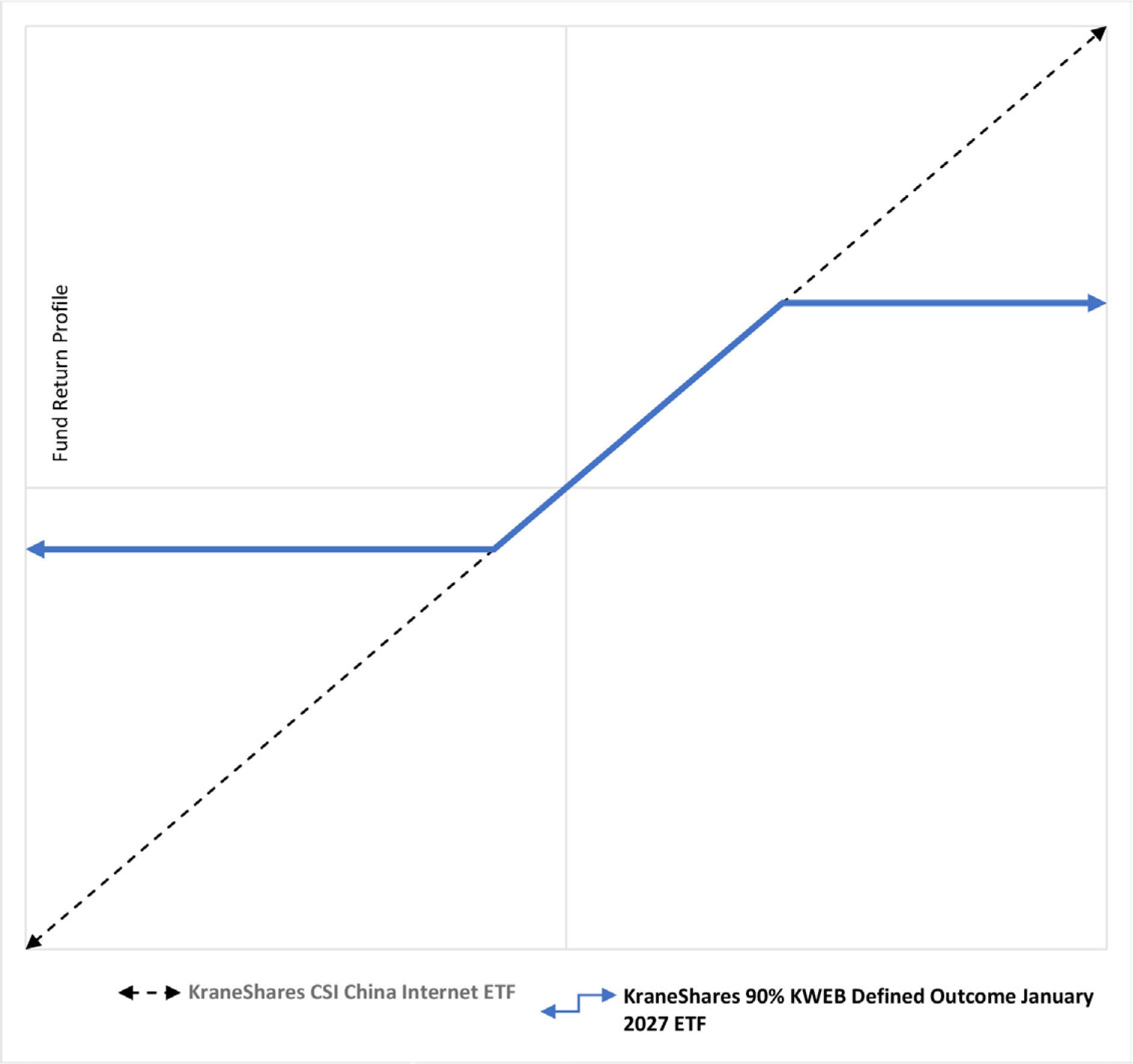
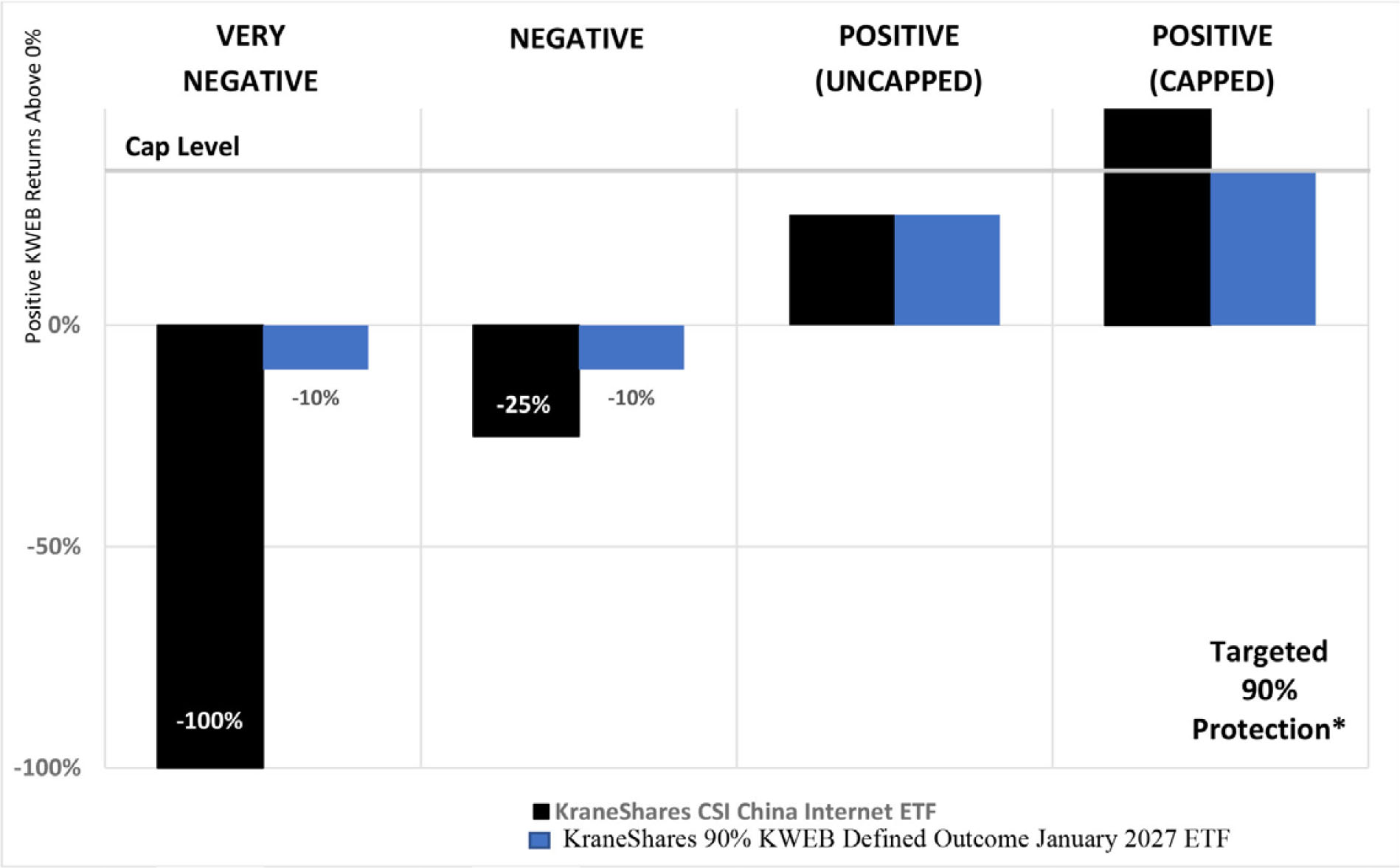
| * | Please note: this graph is provided merely to illustrate the Outcomes that the Fund seeks to provide based upon the performance of the KraneShares CSI China Internet ETF. There is no guarantee that these outcomes will be achieved over the Outcome Period. |
The following table is designed to illustrate the Outcomes the Fund seeks to provide over an Outcome Period, assuming the hypothetical performance of the Underlying ETF (from -100% to 100%) shown in the first line of the table. The table is provided for illustrative purposes only and does not provide every possible performance scenario for shares over the course of an Outcome Period. The table is not intended to predict or project the performance of the Fund or the Underlying ETF. Fund shareholders should not take this information as an assurance of the expected performance of the Underlying ETF or return on the Fund’s shares. There is no guarantee that the Fund will be successful in its attempt to provide the Outcomes for an Outcome Period.
| Hypothetical Underlying ETF Performance | (100)% | (50)% | (20)% | (5)% | 0% | 5% | 10% | 15% | 20% | 50% | 100% |
| Fund Performance | (10)%** | (10)%** | (10)%** | (5)% | 0% | 5% | 10% | 15% | 20% | 40%* | 40%* |
| * | When the Fund’s annual management fee of 0.25% of the Fund’s average daily net assets is taken into account, the Cap is approximately 39.32%. The Cap will be further reduced by any other expenses charged to the Fund and any shareholder transaction fees. | |
| ** | When the Fund’s annual management fee of 0.25% of the Fund’s average daily net assets is taken into account, the Buffer is approximately 89.31%. The Buffer will be further reduced by any other expenses charged to the Fund and any shareholder transaction fees. |
Since the Fund invests in the Underlying ETF, the Fund will receive distributions made by the Underlying ETF. These distributions paid by the Underlying ETF may cause the OCC to make adjustments to the strike price of the Fund’s options. If this occurs, then such an adjustment can cause changes to the Fund’s Buffer and Cap and may adversely affect the Outcomes. As a result, the Fund may not perform as expected and Fund shareholders could be adversely impacted, especially Fund shareholders that purchase shares after the start of the Outcome Period and Fund shareholders who do not hold shares for the entire Outcome Period.
The following hypothetical tables are designed to illustrate the impact of strike price adjustments on the Fund’s Buffer and Cap due to distributions by the Underlying ETF. These tables are provided for illustrative purposes only and do not provide every possible scenario over the course of an Outcome Period. These tables are not intended to predict or project any distributions by the Fund or the Underlying ETF or the performance of the Fund or the Underlying ETF. Fund shareholders should not take this information as an assurance of the expected distributions or performance of the Underlying ETF or the Fund. The tables assume the Underlying ETF’s market price is $30 for each period shown and the Underlying ETF distributes $3 in capital gains to the Fund, which distributes the same amount to Fund shareholders. The tables assume the OCC adjusts the strike price of the Fund’s options as shown due to such distributions. The tables also assumes a shareholder purchases Fund shares on the first day of the Outcome Period and continuously holds Fund shares until the end of the Outcome Period. While these tables assumes that the Fund distributes the same amount of distribution received from the Underlying ETF, the Fund may not always distribute the entire amount of the distribution received from the Underlying ETF.
Impact on Buffer With Strike Price Adjustment Due to Distributions
| Period | Distribution | Adjustment to Strike Price | Distribution as a % of Strike Price | Buffer* | Buffer* with Distribution Included |
| First Day | - | - | - | 90% | - |
| End of First Year | $3 | Strike Price Reduced by $3 | 10% | 80% | 90% |
| End of Second Year | $3 | Strike Price Reduced by $3 | 10% | 70% | 90% |
| * | When the Fund’s annual management fee of 0.25% of the Fund’s average daily net assets is taken into account, the Buffer is approximately 89.31%. The Buffer will be further reduced by any other expenses charged to the Fund and any shareholder transaction fees. |
As shown in the table, while the amount of the “Buffer” is expected to decrease due to such strike price adjustments, the “Buffer with the Distribution Included” is expected to approximate the Buffer on the first day if a shareholder includes the distribution they were paid by the Fund in the Buffer amount.
Impact on Cap With Strike Price Adjustment Due to Distribution
| Period | Distribution | Adjustment to Strike Price | Distribution as a % of Strike Price | Cap* | Cap* with Distribution Included |
| First Day | - | - | - | 40% | - |
| End of First Year | $3 | Strike Price Reduced by $3 | 10% | 30% | 40% |
| End of Second Year | $3 | Strike Price Reduced by $3 | 10% | 20% | 40% |
| * | When the Fund’s annual management fee of 0.25% of the Fund’s average daily net assets is taken into account, the Cap is approximately 39.32%. The Cap will be further reduced by any other expenses charged to the Fund and any shareholder transaction fees. |
As shown in the table, while the amount of the “Cap” is expected to decrease due to such strike price adjustments, the “Cap with the Distribution Included” is expected to approximate the Cap on the first day if a shareholder includes the distribution they were paid by the Fund in the Cap amount.
If the Underlying ETF makes distributions and the OCC does not make adjustments to the strike price of the Fund’s options, a shareholder will need to include the amount of the distributions to achieve the sought after Outcomes. As a result, Fund shareholders that purchase shares after the start of the Outcome Period could be adversely impacted, especially those Fund shareholders that purchase shares after the Fund has made any distributions.
|
Use of Options, including FLEX Options. The Adviser will construct a portfolio principally composed of the Underlying ETF and options, including FLEX options, that reference the Underlying ETF and are set to expire on the last day of the Outcome Period. Each of the options purchased and sold throughout the Outcome Period are expected to have the same or similar terms (i.e., strike price and expiration) as the options purchased and sold on the first day of the Outcome Period.
At the commencement of the Outcome Period, the Adviser selects the strike price for each option such that when the options are exercised on the final day of the Outcome Period, the Outcomes may be obtained. The customizable nature of FLEX options allows the Adviser to make the FLEX options exercisable only on the expiration date of the option contract (i.e., European style option contracts). The Fund will only write (sell) FLEX options that are European style option contracts. The Fund may purchase options that are European style option contracts and options that are exercisable at any time (i.e., American style option contracts).
To achieve the Outcomes, the Fund may purchase and sell a combination of call option contracts and put option contracts.
The Outcome Period. The Outcomes sought by the Fund are based upon the total return of the Underlying ETF at the start of the Outcome Period. The next Outcome Period begins on January 27, 2025 and ends on January 15, 2027. As the terms of the options do not change during each Outcome Period, the Cap and Buffer both will be measured to the total return of the Underlying ETF on the first day of the Outcome Period. A shareholder that purchases shares after the commencement of the Outcome Period will likely have purchased shares at a different NAV than the NAV on the first day of the Outcome Period and therefore may experience investment outcomes that are very different from those sought by the Fund. Since the Fund will only exercise options on the final day of the Outcome Period, a shareholder that sells shares prior to the end of the Outcome Period may also experience investment outcomes very different from those sought by the Fund. To achieve the Outcomes sought by the Fund for the Outcome Period, an investor must hold shares continuously throughout the Outcome Period. There is no guarantee that the Fund will be successful in its attempt to provide the Outcomes. |
Strike Price: Generally, the price at which an option holder may exercise the right to purchase or sell the reference asset of an option contract upon expiration of the contract. For the Fund, the strike price will be the total return of the Underlying ETF at which the Fund may exercise an option at the end of the Outcome Period.
Call Option Contract: A call option contract gives the buyer of the call option contract the right (but not the obligation) to buy, and the seller of the call option contract (i.e., the “writer”) the obligation to sell, a specified amount of an underlying security at a pre-determined price.
Put Option Contract: A put option contract gives the buyer of the put option contract the right (but not the obligation) to sell, and the writer of the put option contract the obligation to buy, a specified amount of an underlying security at a pre-determined price. |
The Fund will invest at least 80% of its net assets (plus borrowings for investment purposes) in the Underlying ETF and options, including FLEX options, on the Underlying ETF. However, because a component of an option’s value is the number of days remaining until its expiration, during the Outcome Period, the Fund’s NAV will not directly correlate on a day-to-day basis with the secondary market share price of the Underlying ETF. The Adviser generally anticipates that the Fund’s NAV will increase on days when the secondary market share price of the Underlying ETF increases and will decrease on days when the secondary market share price of the Underlying ETF decreases, but that the rate of such increase or decrease will be less than that experienced by the Underlying ETF. For the same reasons, the impact of the Buffer on the Fund, may not be in full effect prior to the end of the Outcome Period. Since the options do not expire until approximately two years after the commencement of the Outcome Period, the degree of correlation between the value of the options and the secondary market share price of the Underlying ETF may be lower than if the options had a shorter term. The Fund seeks to provide the Outcomes only for the entirety of the Outcome Period and investors should not expect the sought-after Outcomes at any point prior to the end of the Outcome Period.
The Buffer on Losses. The Buffer seeks to protect shareholders that hold shares for the entire Outcome Period from declines in the Fund’s total return by providing a buffer against 90% of decreases in the total return of the Underlying ETF, not including any other expenses charged to the Fund and any shareholder transaction fees. There is no guarantee that the Fund will be successful in its attempt to provide buffered returns. The Fund seeks to produce the Outcomes for the Outcome Period upon the expiration of its options investments on the last day of the Outcome Period. Therefore, it should not be expected that the Buffer, including the net effect of the Fund’s annual management fee, will be provided at any point prior to the last day of the Outcome Period. If an investor purchases shares at a time during an Outcome Period when the total return of the Underlying ETF has already increased, then the investor will incur losses notwithstanding the Buffer since the Buffer only seeks to protect against declines in the total return of the Underlying ETF from the beginning of the Outcome Period. Similarly, if an investor sells shares prior to the end of the Outcome Period, the Buffer that the Fund seeks to provide may not protect against losses. When the Fund’s annual management fee of 0.25% of the Fund’s average daily net assets is taken into account, the Buffer is approximately 89.31%. The Buffer will be further reduced by any other expenses charged to the Fund and any shareholder transaction fees. In addition, any changes in the Fund’s options due to material corporate actions, including material distributions, could reduce the Buffer during an Outcome Period.
The Cap on Upside Returns. Unlike other investment products, the potential upside total return an investor can receive from an investment in the Fund over the Outcome Period is limited by the Cap. The Cap represents the maximum total return an investor can achieve from an investment in the Fund over the duration of the Outcome Period. Therefore, even though the Fund’s total returns are expected to approximate the total return of the Underlying ETF, in the event that the total return of the Underlying ETF exceeds the Cap for the Outcome Period, the Fund will not appreciate beyond the Cap. The Cap is determined on the first day of the Outcome Period and is 40.01% prior to taking into account any fees or expenses. When the Fund’s annual management fee of 0.25% of the Fund’s average daily net assets is taken into account, the Cap is approximately 39.32%. The Cap will be further reduced by any other expenses charged to the Fund, including any extraordinary expenses, and any shareholder transaction fees. For the purpose of this prospectus, “extraordinary expenses” are non-recurring expenses that may be incurred by the Fund outside of the ordinary course of its business, including, without limitation, costs incurred in connection with any claim, litigation, arbitration, mediation, government investigation or similar proceedings, indemnification expenses and expenses in connection with holding and/or soliciting proxies for a meeting of Fund shareholders. In addition, any changes in the Fund’s options due to material corporate actions, including material distributions, could have the effect of reducing the Cap for an Outcome Period.
The Cap is a result of the design of the Fund’s principal investment strategy. In order to provide the sought-after Buffer, the Fund purchases a series of options. As the purchaser of these options, the Fund is obligated to pay a premium to the seller of those options. However, the strategy is designed so that any premiums that the Fund is obligated to pay are offset by premiums it receives in connection with selling options that established the Cap. These transactions occur on the first day of the Outcome Period: the Adviser calculates the amount of premium that the Fund owes in order to buy options to provide the Buffer, and then sells options with terms that entitle the Fund to receive that same amount as a premium to determine the Cap. The Cap is the strike price of the written options, which is determined based upon prevailing market conditions at the time, most notably current interest rate levels, volatility in the secondary market share price of the Underlying ETF, time remaining until the options expire, and the relationship of put and call options on the Underlying ETF.
The Cap will change from one Outcome Period to the next based upon prevailing market conditions at the beginning of the Outcome Period. The Cap, and the Fund’s position relative to it, should be considered before investing in the Fund.
Subsequent Outcome Periods. The Fund is designed to be a continuous investment vehicle. It is not expected to terminate and distribute its assets at the conclusion of an Outcome Period. Rather, at the end of each Outcome Period, a subsequent Outcome Period is expected to begin.
At the end of each Outcome Period, the Fund will receive the cash value of all the options it held for the prior Outcome Period. It will then invest in a new series of options with an expiration date of approximately two years in the future, and a new Outcome Period will begin. Since the Cap for any Outcome Period is based upon prevailing market conditions at the beginning of an Outcome Period, the Cap will rise or fall from one Outcome Period to the next.
Investors who hold shares of the Fund at the end of an Outcome Period will receive two notices of the commencement of the subsequent Outcome Period. Approximately one week prior to the end of an Outcome Period, the Fund will file a prospectus supplement alerting existing shareholders that an Outcome Period is ending. The supplement will disclose the new name of the Fund, which will be revised to reflect the dates of the next Outcome Period, and the anticipated ranges for the Cap for the next Outcome Period. After the close of business on the last day of the Outcome Period, the Fund will file another prospectus supplement that discloses the Fund’s final Cap (both gross and net of the management fee) for the next Outcome Period and the change in the Fund’s name to reflect the new Outcome Period.
The Fund may invest up to 20% of its net assets in instruments that are not included in the 80% test noted above. These investments include equity securities, depositary receipts, derivative instruments, other investment companies (including exchange traded funds or “ETFs”) and cash or cash equivalents (including money market funds).
The Fund is non-diversified.
Additional Information About the Underlying ETF. The Underlying ETF seeks to provide investment results that, before fees and expenses, correspond generally to the price and yield performance of the Index, which is designed to measure the equity market performance of China Internet Companies.
| ● | The Index Provider defines China-based companies as those that: (i) are incorporated in mainland China; (ii) have their headquarters in mainland China; or (iii) derive at least 50% of its revenue from goods produced or sold, or services performed, in mainland China. |
| ● | China Internet Companies include, but are not limited to, companies that develop and market Internet software and/or provide Internet services; manufacture home entertainment software and educational software for home use; provide retail or commercial services primarily through the Internet; and develop and market mobile Internet software and/or provide mobile Internet services. |
The Index excludes securities that during the past year had a daily average trading value of less than $3 million or a daily average market cap of less than $2 billion. Constituents of the Index are ranked by free-float market capitalization in U.S. Dollars and then weighted so that no constituent exceeds 10% at each rebalance with the top five constituents capped at 40%.
The following China-related securities may be included in the Index:
| ● | China A-Shares, which are shares of companies incorporated in mainland China that are traded on the Chinese exchanges and denominated in domestic renminbi. China A-Shares are primarily purchased and sold in the domestic Chinese market. To the extent the Fund invests in China A-Shares, it expects to do so through the trading and clearing facilities of a participating exchange located outside of mainland China (“Stock Connect Programs”). A Qualified Foreign Investor (“QFI”) license may also be acquired to invest directly in China A-Shares. |
| ● | China B-Shares, which are shares of companies listed on the Shanghai or Shenzhen Stock Exchange but quoted and traded in foreign currencies (such as Hong Kong Dollars or U.S. Dollars), which were primarily created for trading by foreign investors. |
| ● | China H-Shares, which are shares of companies incorporated in mainland China and listed on the Hong Kong Stock Exchange (“H-Shares”), where they are traded in Hong Kong dollars and may be traded by foreign investors. |
| ● | China N-Shares, which are shares of companies with business operations in mainland China and listed on an American stock exchange, such as NYSE or NASDAQ (“N-Shares”). |
| ● | P-Chips, which are shares of private sector companies with a majority of their business operations in mainland China and controlling private Chinese shareholders, which are incorporated outside of mainland China and traded on the Hong Kong Stock Exchange in Hong Kong dollars. |
| ● | Red Chips, which are shares of companies with a majority of their business operations in mainland China and controlled by the central, provincial or municipal governments of the People’s Republic of China (“PRC”), whose shares are traded on the Hong Kong Stock Exchange in Hong Kong dollars. |
| ● | S-Chips, which are shares of companies with business operations in mainland China and listed on the Singapore Exchange. S-Chip shares are issued by companies incorporated anywhere, but many are registered in Singapore, the British Virgin Islands, the Cayman Islands, or Bermuda. |
As of March 31, 2026, the Underlying Index included 33 securities of companies with a market capitalization range of approximately $546.0 million to $561.8 billion and an average market capitalization of approximately $43.0 billion. The Underlying Index is rebalanced and reconstituted semi-annually. The Fund is non-diversified. To the extent the Underlying Index is concentrated in a particular industry, the Fund is expected to be concentrated in that industry. As of March 31, 2026, issuers in the Consumer Discretionary sector (41.4%) and Communication Services sector (37.4%) represented significant portions of the Underlying Index.
Although the Underlying ETF expects to replicate (or hold all constituents of) the Index, the Underlying ETF reserves the right to use representative sampling to track the Index. “Representative sampling” is a strategy that involves investing in a representative sample of securities that collectively have an investment profile similar to the Index. In addition, the Underlying ETF may invest up to 20% of its assets in instruments that are not included in the Index, but that Krane believes will help the Underlying ETF track the Index. The Underlying ETF’s prospectus and other reports are available on the SEC’s website, www.sec.gov. The Underlying ETF is traded on the NYSE Arca, Inc. under the ticker symbol KWEB.
|
The Fund’s strategy is designed to provide investors with the opportunity over a limited period of time (the “Outcome Period”) to benefit up to a certain extent (the “Cap”) from increases in the total return of the Underlying ETF with only a portion of the risk (the “Buffer”) otherwise attendant to investing in the asset class represented by the Underlying ETF, which is China Internet Companies.
The Cap seeks to provide shareholders with up to 20% (prior to taking into account any fees and expenses) of increases in the total return of the Underlying ETF (i.e., the performance of the secondary market share price including any distributions) (its “total return”) during the Outcome Period. When the Fund’s annual management fee of 0.25% of the Fund’s average daily net assets is taken into account, the Cap is approximately 19.42%. The Cap will be further reduced by any other expenses charged to the Fund and any shareholder transaction fees. The Cap represents the maximum total return an investor can achieve from an investment in the Fund over the duration of the Outcome Period. The Fund’s total return will not appreciate beyond the Cap and Fund shareholders may underperform the Underlying ETF.
The Buffer seeks to protect shareholders that hold shares for the entire Outcome Period from declines in the Fund’s total return by providing a buffer against approximately 100% of decreases in the total return of the Underlying ETF. When the Fund’s annual management fee of 0.25% of the Fund’s average daily net assets is taken into account, the Buffer is approximately 99.41%. The Buffer will be further reduced by any other expenses charged to the Fund and any shareholder transaction fees. There is no guarantee that the Fund will be successful in providing the Buffer.
Under normal circumstances, the Fund will invest at least 80% of its net assets (plus borrowings for investment purposes) in the KraneShares CSI China Internet ETF (the “Underlying ETF”) and options, including FLexible EXchange® Options (“FLEX options”), that reference the Underlying ETF. The Underlying ETF is an exchange-traded fund advised by Krane Funds Advisors, LLC (“Krane” or the “Adviser”) that seeks to track the CSI Overseas China Internet Index (the “Index”). The Index is designed to measure the equity market performance of China Internet Companies listed outside of mainland China, as determined by China Securities Index Co., Ltd. (“Index Provider”). The reference asset for all of the Fund’s options is the Underlying ETF. More information about the Underlying ETF and its Index is included at the end of this section.
There is no guarantee that investors in the Fund will experience the sought-after outcomes based on the Cap and Buffer (“Outcomes”) over the Outcome Period: |
China Internet Companies:
Outcome Period: The period of January 27, 2025 through January 15, 2027 is referred to as the Outcome Period. The Buffer and the Cap are based on the total return of the Underlying ETF and are set on the first day of the Outcome Period.
Options Contract: An agreement between a buyer and seller that gives the purchaser of the option the right to buy or sell a particular asset at a specified future date at an agreed upon price. FLEX options are customizable exchange-traded option contracts guaranteed for settlement by the Options Clearing Corporation (“OCC”). |
| ● | The Fund’s strategy is designed to produce the Outcomes based upon the total return of the Underlying ETF from the first day of the Outcome Period to the last day of the Outcome Period. The Outcomes may only be realized by investors who continuously hold shares from the beginning of the Outcome Period until the end of the Outcome Period. Investors that purchase shares after the Outcome Period has begun or sell shares prior to the Outcome Period ends may experience investment returns very different from those that the Fund seeks to provide. |
| ● | When establishing an Outcome Period the Fund cannot anticipate any corporate actions that may affect the secondary market share price of the Underlying ETF, such as significant distributions by the Underlying ETF, and that may cause the strike price of the options held by the Fund to be adjusted by the OCC. An adjustment of the strike price of the options held by the Fund by the OCC may adversely impact the Outcomes. |
Although the Fund’s investment adviser, Krane, generally anticipates that the Fund’s net asset value (“NAV”) will increase on days when the secondary market share price of the Underlying ETF increases and will decrease on days when the secondary market share price of the Underlying ETF decreases, the rate of such increase or decrease is expected to be less than that experienced by the Underlying ETF. This is because the Fund’s NAV is based upon the value of its portfolio, which is composed principally of the Underlying ETF and options; and while the secondary market share price of the Underlying ETF is a significant component of the value of the Fund’s options, the time remaining until those options expire also affects their value. As a result, the Fund’s NAV is not expected to increase or decrease at the same rate as the secondary market share price of the Underlying ETF.
Further, as the Fund gets closer to the end of the Outcome Period, the value of the Underlying ETF, the put options and the calls options may differ from the values at the beginning of the Outcome Period. Such shift in the value of the Fund’s holdings over time may increase risks to one type of exposure in the Fund compared to the other.
The two hypothetical graphical illustrations provided below are designed to illustrate the Outcomes, before any fees and expenses, that the Fund seeks to provide for investors who hold shares for the entirety of the Outcome Period. There is no guarantee that the Fund will be successful in its attempt to provide the Outcomes for an Outcome Period.
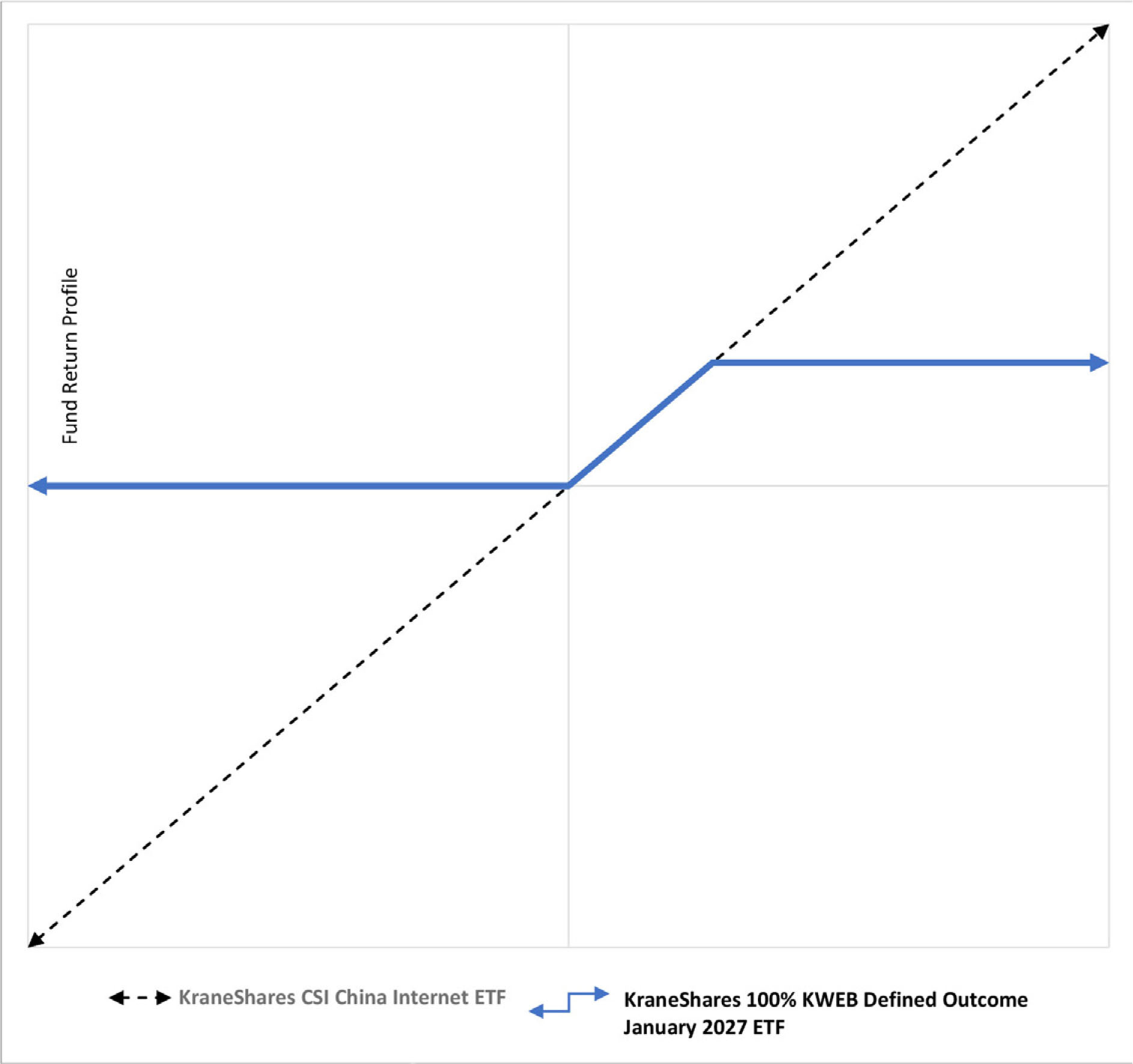
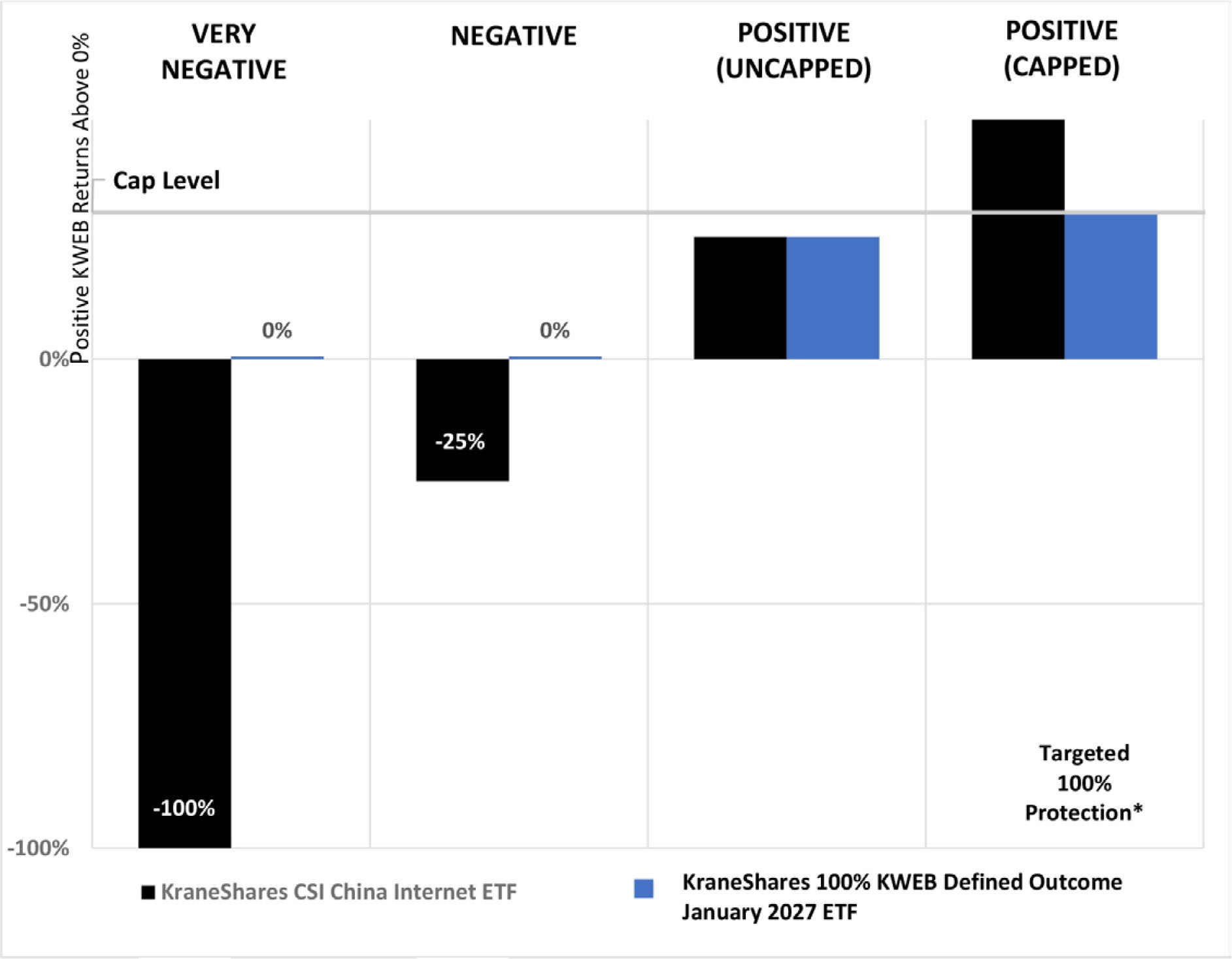
| * | Please note: this graph is provided merely to illustrate the Outcomes that the Fund seeks to provide based upon the performance of the KraneShares CSI China Internet ETF. There is no guarantee that these outcomes will be achieved over the Outcome Period. |
The following table is designed to illustrate the Outcomes the Fund seeks to provide over an Outcome Period, assuming the hypothetical performance of the Underlying ETF (from -100% to 100%) shown in the first line of the table. The table is provided for illustrative purposes only and does not provide every possible performance scenario for shares over the course of an Outcome Period. The table is not intended to predict or project the performance of the Fund or the Underlying ETF. Fund shareholders should not take this information as an assurance of the expected performance of the Underlying ETF or return on the Fund’s shares. There is no guarantee that the Fund will be successful in its attempt to provide the Outcomes for an Outcome Period.
| Hypothetical Underlying ETF Performance | (100)% | (50)% | (20)% | (5)% | 0% | 5% | 10% | 15% | 25% | 50% | 100% |
| Fund Performance | 0%** | 0%** | 0%** | 0%** | 0% | 5% | 10% | 15% | 20%* | 20%* | 20%* |
| * | When the Fund’s annual management fee of 0.25% of the Fund’s average daily net assets is taken into account, the Cap is approximately 19.42%. The Cap will be further reduced by any other expenses charged to the Fund and any shareholder transaction fees. | |
| ** | When the Fund’s annual management fee of 0.25% of the Fund’s average daily net assets is taken into account, the Buffer is approximately 99.41%. The Buffer will be further reduced by any other expenses charged to the Fund and any shareholder transaction fees. |
Since the Fund invests in the Underlying ETF, the Fund will receive distributions made by the Underlying ETF. These distributions paid by the Underlying ETF may cause the OCC to make adjustments to the strike price of the Fund’s options. If this occurs, then such an adjustment can cause changes to the Fund’s Buffer and Cap and may adversely affect the Outcomes. As a result, the Fund may not perform as expected and Fund shareholders could be adversely impacted, especially Fund shareholders that purchase shares after the start of the Outcome Period and Fund shareholders who do not hold shares for the entire Outcome Period.
The following hypothetical tables are designed to illustrate the impact of strike price adjustments on the Fund’s Buffer and Cap due to distributions by the Underlying ETF. These tables are provided for illustrative purposes only and do not provide every possible scenario over the course of an Outcome Period. These tables are not intended to predict or project any distributions by the Fund or the Underlying ETF or the performance of the Fund or the Underlying ETF. Fund shareholders should not take this information as an assurance of the expected distributions or performance of the Underlying ETF or the Fund. The tables assume the Underlying ETF’s market price is $30 for each period shown and the Underlying ETF distributes $3 in capital gains to the Fund, which distributes the same amount to Fund shareholders. The tables assume the OCC adjusts the strike price of the Fund’s options as shown due to such distributions. The tables also assume a shareholder purchases Fund shares on the first day of the Outcome Period and continuously holds Fund shares until the end of the Outcome Period. While these tables assume that the Fund distributes the same amount of distribution received from the Underlying ETF, the Fund may not always distribute the entire amount of the distribution received from the Underlying ETF.
Impact on Buffer With Strike Price Adjustment Due to Distributions
| Period | Distribution | Adjustment to Strike Price | Distribution as a % of Strike Price | Buffer* | Buffer* with Distribution Included |
| First Day | - | - | - | 100% | - |
| End of First Year | $3 | Strike Price Reduced by $3 | 10% | 90% | 100% |
| End of Second Year | $3 | Strike Price Reduced by $3 | 10% | 80% | 100% |
| * | When the Fund’s annual management fee of 0.25% of the Fund’s average daily net assets is taken into account, the Buffer is approximately 99.41%. The Buffer will be further reduced by any other expenses charged to the Fund and any shareholder transaction fees. |
As shown in the table, while the amount of the “Buffer” is expected to decrease due to such strike price adjustments, the “Buffer with the Distribution Included” is expected to approximate the Buffer on the first day if a shareholder includes the distribution they were paid by the Fund in the Buffer amount.
Impact on Cap With Strike Price Adjustment Due to Distribution
| Period | Distribution | Adjustment to Strike Price | Distribution as a % of Strike Price | Cap* | Cap* with Distribution Included |
| First Day | - | - | - | 20% | - |
| End of First Year | $3 | Strike Price Reduced by $3 | 10% | 10% | 20% |
| End of Second Year | $3 | Strike Price Reduced by $3 | 10% | 0% | 20% |
| * | When the Fund’s annual management fee of 0.25% of the Fund’s average daily net assets is taken into account, the Cap is approximately 19.42%. The Cap will be further reduced by any other expenses charged to the Fund and any shareholder transaction fees. |
As shown in the table, while the amount of the “Cap” is expected to decrease due to such strike price adjustments, the “Cap with the Distribution Included” is expected to approximate the Cap on the first day if a shareholder includes the distribution they were paid by the Fund in the Cap amount.
If the Underlying ETF makes distributions and the OCC does not make adjustments to the strike price of the Fund’s options, a shareholder will need to include the amount of the distributions to achieve the sought after Outcomes. As a result, Fund shareholders that purchase shares after the start of the Outcome Period could be adversely impacted, especially those Fund shareholders that purchase shares after the Fund has made any distributions.
|
Use of Options, including FLEX Options. The Adviser will construct a portfolio principally composed of the Underlying ETF and options, including FLEX options, that reference the Underlying ETF and are set to expire on the last day of the Outcome Period. Each of the options purchased and sold throughout the Outcome Period are expected to have the same or similar terms (i.e., strike price and expiration) as the options purchased and sold on the first day of the Outcome Period.
At the commencement of the Outcome Period, the Adviser selects the strike price for each option such that when the options are exercised on the final day of the Outcome Period, the Outcomes may be obtained. The customizable nature of FLEX options allows the Adviser to make the FLEX options exercisable only on the expiration date of the option contract (i.e., European style option contracts). The Fund will only write (sell) FLEX options that are European style option contracts. The Fund may purchase options that are European style option contracts and options that are exercisable at any time (i.e., American style option contracts).
To achieve the Outcomes, the Fund may purchase and sell a combination of call option contracts and put option contracts.
The Outcome Period. The Outcomes sought by the Fund are based upon the total return of the Underlying ETF at the start of the Outcome Period. The next Outcome Period begins on January 27, 2025 and ends on January 15, 2027. As the terms of the options do not change during each Outcome Period, the Cap and Buffer both will be measured to the total return of the Underlying ETF on the first day of the Outcome Period. A shareholder that purchases shares after the commencement of the Outcome Period will likely have purchased shares at a different NAV than the NAV on the first day of the Outcome Period and therefore may experience investment outcomes that are very different from those sought by the Fund. Since the Fund will only exercise options on the final day of the Outcome Period, a shareholder that sells shares prior to the end of the Outcome Period may also experience investment outcomes very different from those sought by the Fund. To achieve the Outcomes sought by the Fund for the Outcome Period, an investor must hold shares continuously throughout the Outcome Period. There is no guarantee that the Fund will be successful in its attempt to provide the Outcomes. |
Strike Price: Generally, the price at which an option holder may exercise the right to purchase or sell the reference asset of an option contract upon expiration of the contract. For the Fund, the strike price will be the total return of the Underlying ETF at which the Fund may exercise an option at the end of the Outcome Period.
Call Option Contract: A call option contract gives the buyer of the call option contract the right (but not the obligation) to buy, and the seller of the call option contract (i.e., the “writer”) the obligation to sell, a specified amount of an underlying security at a pre-determined price.
Put Option Contract: A put option contract gives the buyer of the put option contract the right (but not the obligation) to sell, and the writer of the put option contract the obligation to buy, a specified amount of an underlying security at a pre-determined price. |
The Fund will invest at least 80% of its net assets (plus borrowings for investment purposes) in the Underlying ETF and options, including FLEX options, on the Underlying ETF. However, because a component of an option’s value is the number of days remaining until its expiration, during the Outcome Period, the Fund’s NAV will not directly correlate on a day-to-day basis with the secondary market share price of the Underlying ETF. The Adviser generally anticipates that the Fund’s NAV will increase on days when the secondary market share price of the Underlying ETF increases and will decrease on days when the secondary market share price of the Underlying ETF decreases, but that the rate of such increase or decrease will be less than that experienced by the Underlying ETF. For the same reasons, the impact of the Buffer on the Fund, may not be in full effect prior to the end of the Outcome Period. Since the options do not expire until approximately two years after the commencement of the Outcome Period, the degree of correlation between the value of the options and the secondary market share price of the Underlying ETF may be lower than if the options had a shorter term. The Fund seeks to provide the Outcomes only for the entirety of the Outcome Period and investors should not expect the sought-after Outcomes at any point prior to the end of the Outcome Period.
The Buffer on Losses. The Buffer seeks to protect shareholders that hold shares for the entire Outcome Period from declines in the Fund’s total return by providing a buffer against 100% of decreases in the total return of the Underlying ETF, not including any other expenses charged to the Fund and any shareholder transaction fees. There is no guarantee that the Fund will be successful in its attempt to provide buffered returns. The Fund seeks to produce the Outcomes for the Outcome Period upon the expiration of its options investments on the last day of the Outcome Period. Therefore, it should not be expected that the Buffer, including the net effect of the Fund’s annual management fee, will be provided at any point prior to the last day of the Outcome Period. If an investor purchases shares at a time during an Outcome Period when the total return of the Underlying ETF has already increased, then the investor will incur losses notwithstanding the Buffer since the Buffer only seeks to protect against declines in the total return of the Underlying ETF from the beginning of the Outcome Period. Similarly, if an investor sells shares prior to the end of the Outcome Period, the Buffer that the Fund seeks to provide may not protect against losses. When the Fund’s annual management fee of 0.25% of the Fund’s average daily net assets is taken into account, the Buffer is approximately 99.41%. The Buffer will be further reduced by any other expenses charged to the Fund and any shareholder transaction fees. In addition, any changes in the Fund’s options due to material corporate actions, including material distributions, could reduce the Buffer during an Outcome Period.
The Cap on Upside Returns. Unlike other investment products, the potential upside total return an investor can receive from an investment in the Fund over the Outcome Period is limited by the Cap. The Cap represents the maximum total return an investor can achieve from an investment in the Fund over the duration of the Outcome Period. Therefore, even though the Fund’s total returns are expected to approximate the total return of the Underlying ETF, in the event that the total return of the Underlying ETF exceeds the Cap for the Outcome Period, the Fund will not appreciate beyond the Cap. The Cap is determined on the first day of the Outcome Period and is 20.01% prior to taking into account any fees or expenses. When the Fund’s annual management fee of 0.25% of the Fund’s average daily net assets is taken into account, the Cap is approximately 19.42%. The Cap will be further reduced by any other expenses charged to the Fund, including any extraordinary expenses, and any shareholder transaction fees. For the purpose of this prospectus, “extraordinary expenses” are non-recurring expenses that may be incurred by the Fund outside of the ordinary course of its business, including, without limitation, costs incurred in connection with any claim, litigation, arbitration, mediation, government investigation or similar proceedings, indemnification expenses and expenses in connection with holding and/or soliciting proxies for a meeting of Fund shareholders. In addition, any changes in the Fund’s options due to material corporate actions, including material distributions, could have the effect of reducing the Cap for an Outcome Period.
The Cap is a result of the design of the Fund’s principal investment strategy. In order to provide the sought-after Buffer, the Fund purchases a series of options. As the purchaser of these options, the Fund is obligated to pay a premium to the seller of those options. However, the strategy is designed so that any premiums that the Fund is obligated to pay are offset by premiums it receives in connection with selling options that established the Cap. These transactions occur on the first day of the Outcome Period: the Adviser calculates the amount of premium that the Fund owes in order to buy options to provide the Buffer, and then sells options with terms that entitle the Fund to receive that same amount as a premium to determine the Cap. The Cap is the strike price of the written options, which is determined based upon prevailing market conditions at the time, most notably current interest rate levels, volatility in the secondary market share price of the Underlying ETF, time remaining until the options expire, and the relationship of put and call options on the Underlying ETF.
The Cap will change from one Outcome Period to the next based upon prevailing market conditions at the beginning of the Outcome Period. The Cap, and the Fund’s position relative to it, should be considered before investing in the Fund.
Subsequent Outcome Periods. The Fund is designed to be a continuous investment vehicle. It is not expected to terminate and distribute its assets at the conclusion of an Outcome Period. Rather, at the end of each Outcome Period, a subsequent Outcome Period is expected to begin.
At the end of each Outcome Period, the Fund will receive the cash value of all the options it held for the prior Outcome Period. It will then invest in a new series of options with an expiration date of approximately two years in the future, and a new Outcome Period will begin. Since the Cap for any Outcome Period is based upon prevailing market conditions at the beginning of an Outcome Period, the Cap will rise or fall from one Outcome Period to the next.
Investors who hold shares of the Fund at the end of an Outcome Period will receive two notices of the commencement of the subsequent Outcome Period. Approximately one week prior to the end of an Outcome Period, the Fund will file a prospectus supplement alerting existing shareholders that an Outcome Period is ending. The supplement will disclose the new name of the Fund, which will be revised to reflect the dates of the next Outcome Period, and the anticipated ranges for the Cap for the next Outcome Period. After the close of business on the last day of the Outcome Period, the Fund will file another prospectus supplement that discloses the Fund’s final Cap (both gross and net of the management fee) for the next Outcome Period and the change in the Fund’s name to reflect the new Outcome Period.
The Fund may invest up to 20% of its net assets in instruments that are not included in the 80% test noted above. These investments include equity securities, depositary receipts, derivative instruments, other investment companies (including exchange traded funds or “ETFs”) and cash or cash equivalents (including money market funds).
The Fund is non-diversified.
Additional Information About the Underlying ETF. The Underlying ETF seeks to provide investment results that, before fees and expenses, correspond generally to the price and yield performance of the Index, which is designed to measure the equity market performance of China Internet Companies.
| ● | The Index Provider defines China-based companies as those that: (i) are incorporated in mainland China; (ii) have their headquarters in mainland China; or (iii) derive at least 50% of its revenue from goods produced or sold, or services performed, in mainland China. |
| ● | China Internet Companies include, but are not limited to, companies that develop and market Internet software and/or provide Internet services; manufacture home entertainment software and educational software for home use; provide retail or commercial services primarily through the Internet; and develop and market mobile Internet software and/or provide mobile Internet services. |
The Index excludes securities that during the past year had a daily average trading value of less than $3 million or a daily average market cap of less than $2 billion. Constituents of the Index are ranked by free-float market capitalization in U.S. Dollars and then weighted so that no constituent exceeds 10% at each rebalance with the top five constituents capped at 40%.
The following China-related securities may be included in the Index:
| ● | China A-Shares, which are shares of companies incorporated in mainland China that are traded on the Chinese exchanges and denominated in domestic renminbi. China A-Shares are primarily purchased and sold in the domestic Chinese market. To the extent the Fund invests in China A-Shares, it expects to do so through the trading and clearing facilities of a participating exchange located outside of mainland China (“Stock Connect Programs”). A Qualified Foreign Investor (“QFI”) license may also be acquired to invest directly in China A-Shares. |
| ● | China B-Shares, which are shares of companies listed on the Shanghai or Shenzhen Stock Exchange but quoted and traded in foreign currencies (such as Hong Kong Dollars or U.S. Dollars), which were primarily created for trading by foreign investors. |
| ● | China H-Shares, which are shares of companies incorporated in mainland China and listed on the Hong Kong Stock Exchange (“H-Shares”), where they are traded in Hong Kong dollars and may be traded by foreign investors. |
| ● | China N-Shares, which are shares of companies with business operations in mainland China and listed on an American stock exchange, such as NYSE or NASDAQ (“N-Shares”). |
| ● | P-Chips, which are shares of private sector companies with a majority of their business operations in mainland China and controlling private Chinese shareholders, which are incorporated outside of mainland China and traded on the Hong Kong Stock Exchange in Hong Kong dollars. |
| ● | Red Chips, which are shares of companies with a majority of their business operations in mainland China and controlled by the central, provincial or municipal governments of the People’s Republic of China (“PRC”), whose shares are traded on the Hong Kong Stock Exchange in Hong Kong dollars. |
| ● | S-Chips, which are shares of companies with business operations in mainland China and listed on the Singapore Exchange. S-Chip shares are issued by companies incorporated anywhere, but many are registered in Singapore, the British Virgin Islands, the Cayman Islands, or Bermuda. |
As of March 31, 2026, the Underlying Index included 33 securities of companies with a market capitalization range of approximately $546.0 million to $561.8 billion and an average market capitalization of approximately $43.0 billion. The Underlying Index is rebalanced and reconstituted semi-annually. The Fund is non-diversified. To the extent the Underlying Index is concentrated in a particular industry, the Fund is expected to be concentrated in that industry. As of March 31, 2026, issuers in the Consumer Discretionary sector (41.4%) and Communication Services sector (37.4%) represented significant portions of the Underlying Index.
Although the Underlying ETF expects to replicate (or hold all constituents of) the Index, the Underlying ETF reserves the right to use representative sampling to track the Index. “Representative sampling” is a strategy that involves investing in a representative sample of securities that collectively have an investment profile similar to the Index. In addition, the Underlying ETF may invest up to 20% of its assets in instruments that are not included in the Index, but that Krane believes will help the Underlying ETF track the Index. The Underlying ETF’s prospectus and other reports are available on the SEC’s website, www.sec.gov. The Underlying ETF is traded on the NYSE Arca, Inc. under the ticker symbol KWEB.
Under normal circumstances, the Fund will invest at least 80% of its total assets (plus borrowings for investment purposes) in U.S. dollar-denominated fixed income securities of issuers located in the Asia-Pacific region and other instruments that have economic characteristics similar to such securities. The Fund may invest in fixed income securities, of any credit quality, duration or maturity, issued by corporate, quasi-sovereign (including government-linked agencies, supranational organizations, etc.) and sovereign issuers, including convertible bonds. The Fund seeks to invest in high income producing instruments and will seek to invest primarily in fixed income securities, including in Regulation S offerings outside of the U.S., that are below investment grade (commonly known as “junk bonds”) or unrated. Below investment grade securities are generally defined as those fixed income securities that, at the time of investment, are rated below the four highest categories (i.e., rated Ba1/BB+ or lower) by at least one independent credit rating agency or, if unrated, are determined by Amova Asset Management Americas, Inc. or its affiliates (the “Sub-Adviser”) to be of comparable quality.
The Asia-Pacific region is defined to encompass countries represented in the J.P. Morgan Asia Credit Index or countries classified in Bloomberg’s country of risk from the Asia-Pacific or Central Asia regions, including developed and emerging market countries. An issuer is considered to be “located” in a country or a region, and a security or instrument is deemed to be an Asia-Pacific (or specific country) security or instrument, if it has substantial ties to that country or region. The Sub-Adviser currently makes that determination based primarily on one or more of the following criteria: (A) with respect to a company or issuer, whether (i) it is organized under the laws of that country or any country in that region; (ii) it derives at least 50% of its revenues or profits from goods produced or sold, investments made, or services performed, or has at least 50% of its assets located, within that country or region; (iii) it has the primary trading markets for its securities in that country or region; (iv) it has its principal place of business in or is otherwise headquartered in that country or region; or (v) it is a governmental entity or an agency, instrumentality or a political subdivision of that country or any country in that region; and (B) with respect to an instrument or issue, whether (i) its issuer is headquartered or organized in that country or region; (ii) it is issued to finance a project with significant assets or operations in that country or region; (iii) it is principally secured or backed by assets located in that country or region; (iv) it is a component of or its issuer is included in a recognized securities index for the country or region; or (v) it is denominated in the currency of an Asia-Pacific country and addresses at least one of the other above criteria. The term “located” and the associated criteria listed above have been defined in such a way that the Sub-Adviser has latitude in determining whether an issuer should be included within a region or country.
The Sub-Adviser uses top-down macro research and bottom-up credit research to construct the Fund’s portfolio using a proprietary process that involves, among other factors, a combination of quantitative and qualitative factors to assess an issuer’s credit profile, and the Sub-Adviser’s assessment of a security’s value and relative value compared to other similar securities. The Sub-Adviser monitors the Fund’s portfolio securities to ensure that the investment thesis remains valid and will exit a position if its assessment of a security has changed.
The Fund may invest a large percentage of its net assets in issuers in a single region or country within the Asia-Pacific region and may invest in issuers of any market capitalization. The Fund currently expects to invest more than 25% of its assets in the real estate sector. The Fund may invest in other investment companies, including exchange-traded funds (“ETFs”), if the investment companies invest principally in the types of investments in which the Fund may invest directly.
The Fund may also invest in derivative instruments (including swaps, futures, forwards, structured notes and options) as a means of hedging risk and/or for investment purposes, which may include altering the Fund’s exposure to currencies, interest rates, sectors and individual issuers.
Under normal circumstances, the Fund will invest at least 80% of its net assets (plus borrowings for investment purposes) in securities of the Underlying Index and other instruments that have economic characteristics similar to such securities, including depositary receipts. The Underlying Index reflects the large- and mid-cap Chinese renminbi (“RMB”)-denominated equity securities listed on the Shenzhen or Shanghai Stock Exchanges (“A-Shares”) that are accessible through the Shanghai-Hong Kong Stock Connect or Shenzhen-Hong Kong Stock Connect programs (together, the “Stock Connect Programs”). The Underlying Index is constructed by selecting the two securities with the largest weights in each of the 11 Global Industry Classification Standard (GICS®) sectors in the large-capitalization portion of the MSCI China A Index (the “Parent Index”). The remaining securities are selected from the Parent Index by largest security weight until the total security count reaches 50. The Underlying Index constituents are then weighted based on (a) the free-float market capitalization weights of the Parent Index and (b) the GICS sector weight allocation of the Parent Index.
A-Shares are issued by companies incorporated in mainland China. Under current regulations in the People’s Republic of China (“China” or the “PRC”), foreign investors can invest in A-Shares only through certain institutional investors that have obtained a license from the Chinese regulators or through the Stock Connect Programs. Bosera Asset Management (International) Co., Ltd. (“Bosera”), the Fund’s sub-adviser, has received a license as a Qualified Foreign Investor (“QFI”) from the China Securities Regulatory Commission (“CSRC”). In addition, the Fund may invest in A-Shares through the Stock Connect Programs.
The Fund may invest up to 20% of its assets in instruments that are not included in the Underlying Index, but that Krane and/or Bosera believes will help the Fund track the Underlying Index. These investments may include equity securities and depositary receipts of issuers whose securities are not constituents of the Underlying Index, derivative instruments (including swaps, futures, forwards, structured notes and options), other investment companies (including exchange traded funds or “ETFs”) and cash or cash equivalents (including money market funds). The other investment companies in which the Fund may invest may be advised, sponsored or otherwise serviced by Krane, Bosera and/or its affiliates.
In addition to China A-Shares, which are described above, the Fund may invest in the following China-related securities:
| ● | China B-Shares, which are shares of companies listed on the Shanghai or Shenzhen Stock Exchange but quoted and traded in foreign currencies (such as Hong Kong Dollars or U.S. Dollars), which were primarily created for trading by foreign investors. |
| ● | China H-Shares, which are shares of companies incorporated in mainland China and listed on the Hong Kong Stock Exchange (“H-Shares”), where they are traded in Hong Kong dollars and may be traded by foreign investors. |
| ● | China N-Shares, which are shares of companies with business operations in mainland China and listed on an American stock exchange, such as NYSE or NASDAQ (“N-Shares”). |
| ● | P-Chips, which are shares of private sector companies with a majority of their business operations in mainland China and controlling private Chinese shareholders, which are incorporated outside of mainland China and traded on the Hong Kong Stock Exchange in Hong Kong dollars. |
| ● | Red Chips, which are shares of companies with a majority of their business operations in mainland China and controlled by the central, provincial or municipal governments of the PRC, whose shares are traded on the Hong Kong Stock Exchange in Hong Kong dollars. |
| ● | S-Chips, which are shares of companies with business operations in mainland China and listed on the Singapore Exchange. S-Chip shares are issued by companies incorporated anywhere, but many are registered in Singapore, the British Virgin Islands, the Cayman Islands, or Bermuda. |
Although the Fund expects to replicate (or hold all constituents of) the Underlying Index, the Fund reserves the right to use representative sampling to track the Underlying Index. “Representative sampling” is a strategy that involves investing in a representative sample of securities that collectively have an investment profile similar to the Underlying Index.
As of March 31, 2026, the Underlying Index included 50 securities of companies with a market capitalization range of approximately $10.1 billion to $374.6 billion and an average market capitalization of approximately $86.8 billion. The Underlying Index is rebalanced and reconstituted quarterly. To the extent the Underlying Index is concentrated in a particular industry, the Fund is expected to be concentrated in that industry. As of March 31, 2026, issuers in the Financials sector (20.0%), Information Technology sector (24.0%), Industrials sector (16.8%), and Consumer Staples sector (11.6%) represented significant portions of the Underlying Index. The Underlying Index is provided by MSCI Inc. (“Index Provider”).
The Fund may engage in securities lending.
|
In seeking to achieve its investment objective, the Fund attempts to maintain exposure to carbon credit futures that are substantially the same as those included in the Index, which is an index comprised of futures contracts on emission allowances issued by a “cap-and-invest” program that seeks to reduce greenhouse gas emissions over time. The Index is designed to measure the performance of a portfolio of futures contracts on carbon credits issued under the California Carbon Allowance “cap-and-invest” program (“carbon credit futures”). An emission allowance or carbon credit is a unit of emissions (typically one ton of CO2) that the owner of the allowance or credit is permitted to emit. A cap and trade regime seeks to gradually reduce such emission allowances or carbon credits over time to incentivize companies to reduce greenhouse gas emissions in an effort to curb climate change. The Index includes only carbon credit futures that mature in December of the next one to two years. The Fund may also invest directly and indirectly in certain debt instruments.
Carbon credits issued under the California Carbon Allowance “cap-and-invest” program include carbon credits issued by Quebec since the California and Quebec markets were linked pursuant to the Western Climate Initiative in 2014. Currently, carbon credits issued by Quebec each year consist of approximately 17-18% of the carbon credits issued under the California Carbon Allowance “cap-and-invest” program. This percentage is subject to change and it is possible for additional markets to be added in the future.
The Fund utilizes a subsidiary (the “Subsidiary”) for purposes of investing in carbon credit futures. The Subsidiary is a corporation operating under Cayman Islands law that is wholly-owned and controlled by the Fund. The Subsidiary is advised by the Adviser. The Fund’s investment in the Subsidiary may not exceed 25% of the value of its total assets (ignoring any subsequent market appreciation in the Subsidiary’s value), which limitation is imposed by the Internal Revenue Code of 1986, as amended, and is measured at the end of each quarter. The Subsidiary has the same investment objective as the Fund and follows the same investment policies and restrictions as the Fund. Except as noted, for purposes of this Prospectus, references to the Fund’s investment strategies and risks include those of its Subsidiary, and references to the Fund include the Subsidiary.
While the Fund generally seeks to obtain exposure to the same carbon credit futures that are in the Index, the Fund and Subsidiary may not replicate the Index. For example, the Fund may invest in carbon credit futures with different maturity dates (i.e., not one of the next two Decembers), the Fund may weight the carbon credit futures differently than the Index, or the Fund may purchase carbon credit futures on different dates than the rebalancing date for the Index.
The Fund may also invest in other instruments that are consistent with its investment objective. For example, the Fund may invest in emission allowances issued under a cap and trade regime, futures contracts that are not carbon credit futures, options on futures contracts, swap contracts, and other investment companies and notes, which may or may not be exchange-traded.
The debt instruments in which the Fund intends to invest include government securities and corporate or other non-government fixed-income securities with maturities of up to 12 months. The Fund may invest in debt instruments indirectly through short-term bond funds and exchange-traded funds (“ETFs”), which can include affiliated ETFs. The Fund may also invest in cash and cash equivalents, including money market funds. |
What is a “cap-and-invest” program ?
In a “cap-and-invest” program, a limit (“cap”) is typically set by a regulator, such as a government entity or supranational organization, on the total amount of specific greenhouse gases, such as CO2, that can be emitted by regulated entities, such as manufacturers or energy producers. Capping and reducing the cap on greenhouse gases is viewed as a key policy tool for reaching climate change objectives. The regulator then issues or sells “emission allowances” to regulated entities which may then buy or sell (“trade”) the emission allowances on the open market.
To the extent that the regulator may then reduce the cap on emission allowances, regulated entities are thereby incentivized to reduce their emissions; otherwise they must purchase emission allowances on the open market, where the price of such allowances will likely be increasing as a result of demand, and regulated entities that reduce their emissions will be able to sell unneeded emission allowances for profit.
The opposite could also occur and the regulator may increase the cap on emission allowances, which would likely increase emissions and decrease the price of allowances. Commodity futures contracts linked to the value of emission allowances are known as carbon credit futures.
|
The Commodities Futures Trading Commission (the “CFTC”) has adopted certain requirements that subject registered investment companies and their advisers to regulation by the CFTC if a registered investment company invests more than a prescribed level of its net assets in CFTC-regulated futures, options and swaps, or if a registered investment company markets itself as providing investment exposure to such instruments. Due to the Fund’s use of CFTC-regulated futures and swaps above CFTC Rule 4.5 limits, it is considered a “commodity pool” under the Commodity Exchange Act.
Under normal circumstances, the Fund will invest at least 80% of its net assets (plus borrowings, if any) in instruments that provide exposure to California Carbon Allowances. The notional value of any investments by the Fund (including its Subsidiary) that provide such exposure, including investments in derivatives (such as futures contracts on California Carbon Allowances), will be counted toward satisfaction of this 80% policy.
The Fund is non-diversified. To the extent the Index is concentrated in a particular industry, the Fund is expected to be concentrated in that industry (using the notional value of any futures in which it invests). The Index is rebalanced and reconstituted annually. The Index is provided by S&P Dow Jones Indices LLC (“Index Provider”).
Under normal circumstances, the Fund invests at least 80% of its net assets (plus borrowings for investment purposes) in securities of the Underlying Index and other instruments that have economic characteristics similar to those in the Underlying Index.
The Underlying Index seeks to provide a total return that exceeds the CSI 300 Index using an automated algorithmic machine learning investment process (“AI Process”) developed by Quant Insight Ltd. (“Index Provider”). The CSI 300 Index is a free-float capitalization-weighted index that tracks the performance of China A-Shares issued by the 300 largest companies by market capitalization and liquidity traded on the Shanghai Stock Exchange and Shenzhen Stock Exchange.
The “Index Universe” for the Underlying Index is comprised of all companies listed on the Shanghai Stock Exchange and Shenzhen Stock Exchange that have a minimum market capitalization of $1 billion, a minimum average 30-day turnover of $5 million, and are China A-Shares not subject to U.S. sanctions. From this Index Universe, the Underlying Index chooses a maximum of 50 securities and caps the weight of any one constituent at 5% of the index weight. The constituent securities and their weights within the Underlying Index are determined by the AI Process.
The AI Process used by the Underlying Index relies on, among other data inputs, historical prices, financial indicators, market trends, mathematical parameters, market capitalization and sector classification, in selecting securities and security weights for the Underlying Index. The AI Process algorithmically seeks to identify the combination of stocks and stock weights most likely to provide a total return that exceeds that of the CSI 300 Index by using historical data to train the model to systematically optimize the securities selected and their weights. The Underlying Index is reconstituted and rebalanced monthly.
Direct investments in China A-Shares are possible only through the trading and clearing facilities of a participating exchange located outside of mainland China (“Stock Connect Programs”) or Qualified Foreign Investor (“QFI”) license. Exposure to A-Shares can also be obtained indirectly by investing in funds that invest in A-Shares. Currently, the Fund plans to achieve its investment objective principally by investing in China A-Shares through the Stock Connect Programs.
The Fund may invest up to 20% of its assets in instruments that are not included in the Underlying Index, but that the Fund’s investment adviser, Krane Funds Advisors, LLC (“Krane” or “Adviser”) believes will help the Fund track the Underlying Index. These investments may include equity securities and depositary receipts of issuers whose securities are not constituents of the Underlying Index, derivative instruments (including swaps, futures, forwards, structured notes and options), other investment companies (including exchange traded funds or “ETFs”) and cash or cash equivalents (including money market funds). Certain other investment companies in which the Fund may invest may be advised, sponsored or otherwise serviced by Krane and/or its affiliates.
Although the Fund expects to replicate (or hold all components of) the Underlying Index, the Fund reserves the right to use representative sampling to track the Underlying Index. “Representative sampling” is a strategy that involves investing in a representative sample of securities that collectively have an investment profile similar to the Underlying Index.
The Underlying Index is provided by the Index Provider, and the Underlying Index is calculated by Solactive AG.
As of March 31, 2026, the Underlying Index included 41 securities of companies with a market capitalization range of approximately $12 billion to $375 billion and an average market capitalization of approximately $59 billion. The Fund is non-diversified. To the extent the Underlying Index is concentrated in a particular industry, the Fund is expected to be concentrated in that industry. As of March 31, 2026, issuers in the Financials sector (41%), Industrials sector (21%), Materials sector (14%) and Information Technology sector (14%) represented significant portions of the Underlying Index.
The Fund may engage in securities lending.
Under normal circumstances, the Fund will invest at least 80% of its net assets (plus borrowings for investment purposes) in instruments in its Underlying Index or in instruments that have economic characteristics similar to those in the Underlying Index. The Underlying Index includes the stocks of the top 50 companies by free-float market capitalizations listed on the SSE Science and Technology Innovation Board (the “STAR Market”). The STAR Market is a listing exchange run by the Shanghai Stock Exchange that focuses on Chinese science and technology, including biotechnology and semiconductor companies. According to the Shanghai Stock Exchange, companies listed on the STAR Market are mainly from high-tech and strategic emerging industries, and most focus on next-generation information technology, biomedicine, high-end equipment and similar industries.
To be eligible for inclusion in the Underlying Index, a STAR Market company’s securities must meet certain market capitalization and liquidity screens and have been trading for at least one month. Once included, Underlying Index constituents are weighted based on their free-float market capitalization on the STAR Market, subject to a 10% cap. Although, the Underlying Index is designed to include 50 constituents, it may include as few as 30 constituents, if there are an insufficient number of STAR Market companies whose securities satisfy the screening and trading requirements.
The stocks included in the Underlying Index will consist of China A-Shares. China A-Shares are Chinese renminbi (“RMB”)-denominated equity securities (“A-Shares”) issued by companies incorporated in mainland China. Direct investments in A-Shares are currently possible only through the trading and clearing facilities of a participating exchange located outside of mainland China (“Stock Connect Programs”) or Qualified Foreign Investor (“QFI”) license. Bosera Asset Management (International) Co.,Ltd. (“Bosera”), the Fund’s sub-adviser, has received a license as a QFI from the China Securities Regulatory Commission (“CSRC”). In addition, the Fund may invest in A-Shares through the Stock Connect Programs.
The Fund may invest up to 20% of its assets in instruments that are not included in the Underlying Index, but that the Fund’s investment adviser, Krane Funds Advisors, LLC (“Krane” or “Adviser”) and/or Bosera believes will help the Fund track the Underlying Index. These investments may include equity securities and depositary receipts of issuers whose securities are not constituents of the Underlying Index, derivative instruments (including swaps, futures, forwards, structured notes and options), other investment companies (including exchange traded funds or “ETFs”) and cash or cash equivalents (including money market funds). Certain other investment companies in which the Fund may invest may be advised, sponsored or otherwise serviced by Krane, Bosera and/or their affiliates.
In addition to China A-Shares, which are described above, the following China-related securities may be included in this 20% basket:
| ● | China B-Shares, which are shares of companies listed on the Shanghai or Shenzhen Stock Exchange but quoted and traded in foreign currencies (such as Hong Kong Dollars or U.S. Dollars), which were primarily created for trading by foreign investors. |
| ● | China H-Shares, which are shares of companies incorporated in mainland China and listed on the Hong Kong Stock Exchange (“H-Shares”), where they are traded in Hong Kong dollars and may be traded by foreign investors. |
| ● | China N-Shares, which are shares of companies with business operations in mainland China and listed on an American stock exchange, such as NYSE or NASDAQ (“N-Shares”). |
| ● | P-Chips, which are shares of private sector companies with a majority of their business operations in mainland China and controlling private Chinese shareholders, which are incorporated outside of mainland China and traded on the Hong Kong Stock Exchange in Hong Kong dollars. |
| ● | Red Chips, which are shares of companies with a majority of their business operations in mainland China and controlled by the central, provincial or municipal governments of the PRC, whose shares are traded on the Hong Kong Stock Exchange in Hong Kong dollars. |
| ● | S-Chips, which are shares of companies with business operations in mainland China and listed on the Singapore Exchange. S-Chip shares are issued by companies incorporated anywhere, but many are registered in Singapore, the British Virgin Islands, the Cayman Islands, or Bermuda. |
Although the Fund expects to replicate (or hold all constituents of) the Underlying Index, the Fund reserves the right to use representative sampling to track the Underlying Index. “Representative sampling” is a strategy that involves investing in a representative sample of securities that collectively have an investment profile similar to the Underlying Index.
As of March 31, 2026, the Underlying Index included 50 securities of companies with a market capitalization range of approximately $3 billion to $130 billion and an average market capitalization of approximately $18 billion. The Fund is non-diversified. To the extent the Underlying Index is concentrated in a particular industry, the Fund is expected to be concentrated in that industry. As of March 31, 2026, issuers in the Information Technology sector (85.8%) and Healthcare sector (7.5%) represented significant portions of the Underlying Index. The Underlying Index is rebalanced and reconstituted quarterly.
The Fund may engage in securities lending.
Under normal circumstances, the Fund will invest at least 80% of its net assets (plus borrowings for investment purposes) in instruments in its Underlying Index or in instruments that have economic characteristics similar to those in the Underlying Index. The Underlying Index is designed to measure the equity market performance of investable publicly traded “China-based companies” whose primary business or businesses are in the Internet and Internet-related sectors (“China Internet Companies”) (as defined below), and are listed outside of mainland China, as determined by the index provider, China Securities Index Co., Ltd. (“Index Provider”).
| ● | The Index Provider defines China-based companies as those that: (i) are incorporated in mainland China; (ii) have their headquarters in mainland China; or (iii) derive at least 50% of its revenue from goods produced or sold, or services performed, in mainland China. |
| ● | China Internet Companies include, but are not limited to, companies that develop and market Internet software and/or provide Internet services; manufacture home entertainment software and educational software for home use; provide retail or commercial services primarily through the Internet; and develop and market mobile Internet software and/or provide mobile Internet services. |
The Underlying Index excludes securities that during the past year had a daily average trading value of less than $3 million or a daily average market cap of less than $2 billion. Constituents of the Underlying Index are ranked by free-float market capitalization in U.S. Dollars and then weighted so that no constituent exceeds 10% at each rebalance with the top five constituents capped at 40%. Under normal circumstances, the Fund invests at least 80% of its net assets, plus the amount of any borrowings for investment purposes, in securities of China Internet Companies.
The Fund may invest up to 20% of its assets in instruments that are not included in the Underlying Index, but that Krane believes will help the Fund track the Underlying Index. These investments may include equity securities and depositary receipts of issuers whose securities are not constituents of the Underlying Index, derivative instruments (including swaps, futures, forwards, structured notes and options), other investment companies (including exchange traded funds or “ETFs”) and cash or cash equivalents (including money market funds). The other investment companies in which the Fund may invest may be advised, sponsored or otherwise serviced by Krane and/or its affiliates.
The following China-related securities may be included in the Underlying Index and/or represent investments of the Fund:
| ● | China A-Shares, which are shares of companies incorporated in mainland China that are traded on the Chinese exchanges and denominated in domestic renminbi. China A-Shares are primarily purchased and sold in the domestic Chinese market. To the extent the Fund invests in China A-Shares, it expects to do so through the trading and clearing facilities of a participating exchange located outside of mainland China (“Stock Connect Programs”). A Qualified Foreign Investor (“QFI”) license may also be acquired to invest directly in China A-Shares. |
| ● | China B-Shares, which are shares of companies listed on the Shanghai or Shenzhen Stock Exchange but quoted and traded in foreign currencies (such as Hong Kong Dollars or U.S. Dollars), which were primarily created for trading by foreign investors. |
| ● | China H-Shares, which are shares of companies incorporated in mainland China and listed on the Hong Kong Stock Exchange (“H-Shares”), where they are traded in Hong Kong dollars and may be traded by foreign investors. |
| ● | China N-Shares, which are shares of companies with business operations in mainland China and listed on an American stock exchange, such as NYSE or NASDAQ (“N-Shares”). |
| ● | P-Chips, which are shares of private sector companies with a majority of their business operations in mainland China and controlling private Chinese shareholders, which are incorporated outside of mainland China and traded on the Hong Kong Stock Exchange in Hong Kong dollars. |
| ● | Red Chips, which are shares of companies with a majority of their business operations in mainland China and controlled by the central, provincial or municipal governments of the PRC, whose shares are traded on the Hong Kong Stock Exchange in Hong Kong dollars. |
| ● | S-Chips, which are shares of companies with business operations in mainland China and listed on the Singapore Exchange. S-Chip shares are issued by companies incorporated anywhere, but many are registered in Singapore, the British Virgin Islands, the Cayman Islands, or Bermuda. |
Although the Fund expects to replicate (or hold all constituents of) the Underlying Index, the Fund reserves the right to use representative sampling to track the Underlying Index. “Representative sampling” is a strategy that involves investing in a representative sample of securities that collectively have an investment profile similar to the Underlying Index.
As of March 31, 2026, the Index included 33 securities of companies with a market capitalization range of approximately $523 million to $564 billion and an average market capitalization of approximately $44 billion. The Index is rebalanced and reconstituted semi-annually. The Fund is non-diversified. To the extent the Underlying Index is concentrated in a particular industry, the Fund is expected to be concentrated in that industry. As of March 31, 2026, issuers in the Consumer Discretionary sector (41.4%) and Communication Services sector (37.4%) represented significant portions of the Underlying Index.
The Fund may engage in securities lending.
Under normal circumstances, the Fund invests at least 80% of its net assets (plus borrowings for investment purposes) in securities of the Underlying Index and other instruments that have economic characteristics similar to those in the Underlying Index. The Underlying Index is designed to measure the performance of stocks and foreign exchange-traded funds (“ETFs”) that are listed on the Ho Chi Minh City Stock Exchange (“HOSE”) and available for investment by U.S. investors, notwithstanding foreign ownership limits (“FOLs”). The Underlying Index’s foreign ETFs consist of the Diamond ETFs, which are foreign ETFs that track the VN Diamond Index. The VN Diamond Index is designed to measure the performance of HOSE-listed companies that attract significant foreign capital and, therefore, are or may become subject to a FOL. The Fund intends to invest in foreign ETFs advised by an affiliate of Dragon Capital Management (HK) Limited, the Fund’s Sub-Adviser (“Sub-Adviser”).
From this universe of eligible equity securities, MerQube (the “Index Provider”) screens stocks based on the fundamental criteria and growth criteria as described below.
With respect to the fundamental criteria, the Index Provider screens for certain ranges of both price-to-earnings ratios and asset-to-equity ratios. The price-to-earnings ratios look at both one year and three-year periods and must be within certain ranges. The asset-to-equity ratio must be with certain ranges, except that companies in the banks industry are automatically included and companies in the capital markets industry have a different threshold than companies in other industries, which is more favorable.
With respect to the growth criteria, the Index Provider selects securities with the highest proprietary growth ratio and selects a minimum of 40 stocks with foreign room available (i.e., companies that have not reached their FOL). The growth ratio is calculated by the Index Provider based on total equity growth and corporate actions including stock dividends and stock bonuses.
Stocks that have reached or are nearing their FOL and meet all criteria will be replaced by the Diamond ETFs as an index constituent, with the Diamond ETFs capped at 24% of the Underlying Index. The Index Provider calculate weights for the Underlying Index using an optimization process that considers factors such as market capitalization, liquidity, the growth ratio and other fundamental factors (e.g., net profit). In addition, preference is given to existing index constituents of the Underlying Index versus new entrants.
The Fund may invest up to 20% of its assets in instruments that are not included in the Underlying Index, but that the Fund’s investment adviser, Krane Funds Advisors, LLC (“Krane” or “Adviser”), or the Sub-Adviser believes will help the Fund track the Underlying Index. These investments may include equity securities and depositary receipts of issuers whose securities are not constituents of the Underlying Index, derivative instruments (including swaps, futures, forwards, structured notes and options), other investment companies (including ETFs), foreign ETFs and cash or cash equivalents (including money market funds). Certain other investment companies or foreign ETFs in which the Fund may invest may be advised, sponsored or otherwise serviced by Krane, the Sub-Adviser and/or their affiliates.
Although the Fund expects to replicate (or hold all constituents of) the Underlying Index, the Fund reserves the right to use a representative sampling strategy to track the Underlying Index. “Representative sampling” is a strategy that involves investing in a representative sample of securities that collectively have an investment profile similar to that of the Underlying Index.
As of March 31, 2026, the Underlying Index included one foreign fund and 55 securities of companies with a market capitalization range of approximately $73 million to $18 billion and an average market capitalization of approximately $2.4 billion. The Fund is non-diversified. To the extent the Underlying Index is concentrated in a particular industry, the Fund is expected to be concentrated in that industry. As of March 31, 2026, issuers in the Financials sector (38.6%), Consumer Discretionary sector (27.8%), Industrials sector (16.1%) and Information Technology sector (11.4%) represented significant portions of the Underlying Index. The Underlying Index is rebalanced quarterly and reconstituted biannually.
The Fund may engage in securities lending.
Under normal circumstances, the Fund will invest at least 80% of its net assets (plus borrowings for investment purposes) in instruments in its Underlying Index or in instruments that have economic characteristics similar to those in the Underlying Index. The Underlying Index is designed to measure the equity market performance of companies engaged in the production of electric vehicles or their components or in other initiatives that are expected to change the future of mobility, as determined by Bloomberg Indices, the provider of the Underlying Index (“Index Provider”). This includes companies that are expected to derive significant revenues from electric vehicles, energy storage technologies, lithium and copper mining, and hydrogen fuel cells.
To be eligible for inclusion in the Underlying Index, a security must be a member of the Bloomberg World Aggregate Index and classified as belonging to the vehicles, electrical vehicle components, batteries, hydrogen fuel cells, or raw materials sector classifications as determined by the Bloomberg Intelligence Theme-Basket committee. To determine eligibility, Bloomberg Intelligence uses a multistep process that (1) proposes companies and key terms associated with the above-named sector classifications; (2) searches filings of actively traded public companies for occurrences of key terms to affirm proposed companies and find missing companies; and (3) back-tests to see how closely the identified companies trade together as a group. Finally, the Bloomberg Intelligence Theme-Basket committee reviews the results to determine the final composition of the Underlying Index. The securities are screened for extreme event controversy, United Nations Global Compact violations, and controversial business involvements.
Electric vehicles and mobility are not recognized industries, sub-industries or sectors. Therefore, to identify issuers engaged in those industries, the Index Provider cannot solely rely on traditional categorizations such as the Global Industry Classification Standard.
The Underlying Index is a modified market capitalization weighted index. The initial weight of each security is determined by dividing the free float market capitalization of each security by the sum of the free float market capitalizations of all the securities in the index. Using a three-step capping process, the initial weights are distributed such that the top eight securities are subject to a 4% cap and must achieve a proprietary thematic score of 2 or lower. Securities after the top eight are subject to a 2.5% cap and must also achieve a proprietary thematic score of 2 or lower. Securities with a thematic score of 3 are subject to a 1.0% cap. Any excess weight from capping is then redistributed proportionally to the remaining uncapped issuers. If there are multiple securities per issuer, then the issuer weight is redistributed proportionally to all of the securities within the issuer based on the free float market capitalization of each security.
The Fund may invest up to 20% of its assets in instruments that are not included in the Underlying Index, but that Krane believes will help the Fund track the Underlying Index. These investments may include equity securities and depositary receipts of issuers whose securities are not constituents of the Underlying Index, derivative instruments (including swaps, futures, forwards, structured notes and options), other investment companies (including exchange traded funds or “ETFs”) and cash or cash equivalents (including money market funds). The other investment companies in which the Fund may invest may be advised, sponsored or otherwise serviced by Krane and/or its affiliates.
Although the Fund expects to replicate (or hold all constituents of) the Underlying Index, the Fund reserves the right to use representative sampling to track the Underlying Index. “Representative sampling” is a strategy that involves investing in a representative sample of securities that collectively have an investment profile similar to the Underlying Index.
To the extent the Underlying Index is concentrated in a particular industry, the Fund is expected to be concentrated in that industry. As of March 31, 2026, the Underlying Index included 81 securities of companies with a market capitalization range of approximately $498 million to $1.4 trillion and an average market capitalization of approximately $35 billion. As of March 31, 2026, issuers in the Consumer Discretionary sector (50.7%), Materials sector (31.4%) and Information Technology sector (13.0%) represented significant portions of the Underlying Index. As of March 31, 2026, the largest markets represented in the Underlying Index were China, United States and South Korea. The Underlying Index is reconstituted and rebalanced quarterly.
The Fund may engage in securities lending.
|
In seeking to achieve its investment objective, the Fund attempts to maintain exposure to carbon credit futures that are substantially the same as those included in the Index, which is an index comprised of futures contracts on emission allowances issued by various “cap-and-invest” program s that seek to reduce greenhouse gas emissions over time. The Fund may also invest directly or indirectly in certain debt instruments.
The Index is designed to measure the performance of a portfolio of liquid carbon credit futures that require “physical delivery” of emission allowances issued under cap and trade regimes. An emission allowance or carbon credit is a unit of emissions (typically one ton of CO2) that the owner of the allowance or credit is permitted to emit. A cap and trade regime seeks to gradually reduce such emission allowances or carbon credits over time to incentivize companies to reduce greenhouse gas emissions in an effort to curb climate change. The Index includes only carbon credit futures that mature in December of the next one to two years and that have a minimum average monthly trading volume over the previous six months of at least $10 million. The Index weights eligible carbon credit futures based on their average monthly trading volume during the relevant six-month period, subject to a 5% minimum weight per regime and a 65% maximum weight to any one of the following geographic regions: (1) Europe, the Middle East and Africa, (2) the Americas, and (3) the Asia-Pacific. In addition, no single carbon credit futures contract expiring in a particular year will receive an allocation of less than 5% or more than 60% at the semi-annual rebalancing or annual reconstitution of the Index.
As of June 30, 2025, the Index included carbon credit futures linked to the value of emissions allowances issued under the following cap and trade regimes: the European Union Emissions Trading System; the California Cap and Trade; Washington’s Cap-and-Invest Program; Regional Greenhouse Gas Initiative; and the UK Emissions Trading System. As the global carbon credit market grows, additional carbon credit futures, are expected to enter the Index, and the Fund’s portfolio when they have a minimum average monthly trading volume of at least $10 million over the relevant six-month period.
The Fund utilizes a subsidiary (the “Subsidiary”) for purposes of investing in carbon credit futures. The Subsidiary is a corporation operating under Cayman Islands law that is wholly-owned and controlled by the Fund. The Subsidiary is advised by the Adviser. The Fund’s investment in the Subsidiary may not exceed 25% of the value of its total assets (ignoring any subsequent market appreciation in the Subsidiary’s value), which limitation is imposed by the Internal Revenue Code of 1986, as amended, and is measured at the end of each quarter. The Subsidiary has the same investment objective as the Fund and follows the same investment policies and restrictions as the Fund. Except as noted, for purposes of this Prospectus, references to the Fund’s investment strategies and risks include those of its Subsidiary, and references to the Fund include the Subsidiary. |
What is a “cap-and-invest” program ?
In a “cap-and-invest” program, a limit (“cap”) is typically set by a regulator, such as a government entity or supranational organization, on the total amount of specific greenhouse gases, such as CO2, that can be emitted by regulated entities, such as manufacturers or energy producers. Capping and reducing the cap on greenhouse gases is viewed as a key policy tool for reaching climate change objectives. The regulator then issues or sells “emission allowances” to regulated entities which may then buy or sell (“trade”) the emission allowances on the open market.
To the extent that the regulator may then reduce the cap on emission allowances, regulated entities are thereby incentivized to reduce their emissions; otherwise they must purchase emission allowances on the open market, where the price of such allowances will likely be increasing as a result of demand, and regulated entities that reduce their emissions will be able to sell unneeded emission allowances for profit.
The opposite could also occur and the regulator may increase the cap on emission allowances, which would likely increase emissions and decrease the price of allowances. Commodity futures contracts linked to the value of emission allowances are known as carbon credit futures. |
While the Fund generally seeks to obtain exposure to the same carbon credit futures that are in the Index, the Fund and Subsidiary may not replicate the Index. For example, the Fund may invest in carbon credit futures with different maturity dates (i.e., not one of the next two Decembers), the Fund may weight the carbon credit futures differently than the Index, or the Fund may purchase carbon credit futures on different dates than the rebalancing date for the Index. The Fund may also use various instruments, including futures, forward contracts, swaps, notes and reverse repurchase agreements, to manage its exposure to currencies.
The Fund may also invest in other instruments that are consistent with its investment objective. For example, the Fund may invest in emission allowances issued under a cap and trade regime, futures contracts that are not carbon credit futures, options on futures contracts, swap contracts, and other investment companies and notes, which may or may not be exchange-traded. The debt instruments in which the Fund intends to invest indirectly, through short-term bond funds and exchange-traded funds (“ETFs”), which can include affiliated ETFs, include government securities and corporate or other non-government fixed-income securities with maturities of up to 12 months. The Fund may also invest in cash and cash equivalents, including money market funds and repurchase agreements.
The Commodities Futures Trading Commission (the “CFTC”) has adopted certain requirements that subject registered investment companies and their advisers to regulation by the CFTC if a registered investment company invests more than a prescribed level of its net assets in CFTC-regulated futures, options and swaps, or if a registered investment company markets itself as providing investment exposure to such instruments. Due to the Fund’s use of CFTC-regulated futures and swaps above CFTC Rule 4.5 limits, it is considered a “commodity pool” under the Commodity Exchange Act.
The Fund is non-diversified. To the extent the Index is concentrated in a particular industry, the Fund is expected to be concentrated in that industry (using the notional value of any futures in which it invests). The Index is provided by S&P Dow Jones Indices LLC (“Index Provider”).
Under normal circumstances, the Fund will invest at least 80% of its net assets (plus borrowings for investment purposes) in securities of the Underlying Index and other instruments that have economic characteristics similar to those in the Underlying Index. The Underlying Index is an equal weighted index designed to measure the performance of companies involved in the advancement of humanoid and embodied intelligence technology (i.e., robots and drones), including companies in the supply chain solution such technologies. Humanoid and embodied intelligence technologies refer to the AI systems, which can learn and adapt through direct interaction with the environment using sensors or other inputs, that are integrated into physical systems, such as robotics systems and autonomous vehicles.
The Underlying Index draws constituents from the following activity groups within The Refinitiv® Business Classification (“Humanoid Activity Groups”):
Rare Earth Minerals; Specialty Mining & Metals; Lead Ore Mining; Copper Ore Mining; Nickel Ore Mining; Zinc Ore Mining; Nonferrous Metal Mining; Nonferrous Metal Processing; Specialty Mining & Metals Wholesale; Aerospace & Defense; Industrial Machinery & Equipment; Industrial Components; Industrial Machinery; Ball & Roller Bearings; Testing & Measuring Equipment; Pump & Pumping Equipment; Air & Gas Compressors; Welding & Soldering Equipment; Industrial Process Furnace & Ovens; Fluid Power Cylinder & Actuators; Automatic Vending Machines; Industrial Moulds; Machine Tools; Industrial Valve Manufacturing; Industrial Machinery & Equipment Wholesale; Commercial Equipment; Electrical Components & Equipment; Batteries & Uninterruptible Power Supplies; Wires & Cables; Electrical Components; Lighting Equipment; Heating, Ventilation & Air Conditioning Systems; Electrical Insulators; Switchgear; Portable Motors & Generators; Electrical Measuring & Testing Instruments; Electric Equipment Wholesale; Auto, Truck & Motorcycle Parts; Automotive Body Parts; Engine & Powertrain Systems; Automotive Batteries; Automotive Systems; Automotive Accessories; Motorcycle Parts & Accessories; Auto & Truck Parts Wholesale; Semiconductors; Electronic Equipment & Parts; Biometric Products; Advanced Electronic Equipment; Display Screens; Electronic Components; 3D Printers; Auto & Truck Manufacturers; Motorcycles & Scooters; Automobiles & Multi Utility Vehicles; Light Trucks; Electric (Alternative) Vehicles; Luxury Vehicles; Auto & Truck Wholesale; and Integrated Hardware & Software.
From the companies in the Humanoid Activity Groups at each reconstitution date (“Universe”), the Underlying Index ranks companies that, among other things, meet certain minimum market capitalization and liquidity requirements (as measured by the one and six month average daily value traded), based on a combination of their market capitalization as of five business days prior to reconstitution and their Thematic Relevance Score and selects the top 50 companies as Underlying Index constituents.
For purposes of the ranking, the Fund’s adviser, Krane Funds Advisors, LLC (“Adviser”) provides MerQube, Inc. (“Index Provider”) the Thematic Relevance Score for each company in the Universe. The Thematic Relevance Score is determined by the Adviser based on each company’s public filings, statements and press releases, disclosed contracts, news items and other sources. The Thematic Relevance Score attempts to measure the extent to which a company is involved in the following activities supporting the advancement of humanoid and embodied intelligence technologies:
| (1) | Humanoid Integration and Manufacturing: companies in this category focus on designing, assembling and commercializing complete humanoid robots; |
| (2) | Actuation Systems: companies in this category focus on the actuation systems that enable the precise movement and force control of humanoid robots. This category includes components critical for joint articulation, energy efficiency and compact design; |
| (3) | Mechanical Systems: companies in this category focus on the mechanical components that form the structural foundation of humanoid robots, ensuring durability, weight optimization and smooth motion transmission; |
| (4) | Sensing & Perception: companies in this category focus on the sensors and perception systems that allow humanoid robots to interpret their environment, enabling tasks like navigation, object manipulation and human interaction; |
| (5) | Semiconductors and Technology: companies in this category provide the computational backbone for humanoid and embodied intelligence, motor control and sensor processing; and |
| (6) | Critical Material: companies in this category supply the critical materials used in high-performance motors and humanoid robot manufacturing. |
The Fund may invest up to 20% of its assets in instruments that are not included in the Underlying Index, but that Krane believes will help the Fund track the Underlying Index. These investments may include equity securities and depositary receipts of issuers whose securities are not components of the Underlying Index, derivative instruments (including swaps, futures, forwards, structured notes and options), other investment companies (including exchange traded funds or “ETFs”) and cash or cash equivalents (including money market funds). The other investment companies in which the Fund may invest may be advised, sponsored or otherwise serviced by Krane and/or its affiliates.
Although the Fund expects to replicate (or hold all constituents of) the Underlying Index, the Fund reserves the right to use a representative sampling strategy to track the Underlying Index. “Representative sampling” is a strategy that involves investing in a representative sample of securities that collectively have an investment profile similar to that of the Underlying Index.
To the extent the Underlying Index is concentrated in a particular industry, the Fund is expected to be concentrated in that industry. As of March 31, 2026, the Underlying Index included 50 securities of companies with a market capitalization range of approximately $1.6 billion to $4.3 trillion and an average market capitalization of approximately $137.3 billion. As of March 31, 2026, issuers in the Information Technology sector (42.0%), Industrials sector (36.9%), and Consumer Discretionary sector (16.0%) represented significant portions of the Underlying Index. The Underlying Index is rebalanced and reconstituted quarterly. The Fund is non-diversified. As of March 31, 2026, the largest country representations in the Underlying Index were the United States (35.8%), China (20.7%) and Japan (12.2%).
The Fund may engage in securities lending.
Under normal circumstances, the Fund will invest at least 80% of its net assets (plus borrowings for investment purposes) in instruments in its Underlying Index or in instruments that have economic characteristics similar to those in the Underlying Index. The Underlying Index is composed of the equity securities of the 30 technology companies with the largest free float market capitalization that are listed on the Hong Kong Stock Exchange with significant exposure to internet, fintech, cloud computing, e-commerce and digital technology. To be eligible for inclusion in the Underlying Index, companies must either (1) be “technology-enabled” (i.e., operate primarily on an internet or mobile platform); (2) have a research & development expenses-to-revenue ratio that is greater than or equal to 5%; or (3) have year-over-year revenue growth that is greater than or equal to 10%. Only Greater China companies (as defined below) in the industrials, consumer discretionary, healthcare, financials and information technology sectors are considered for inclusion in the Underlying Index. Greater China companies are defined as companies that either (a) are incorporated in Hong Kong, (b) derive 50% of their revenue from mainland China; or (c) have their headquarters or principal place of business in Hong Kong, Macau or mainland China. The Underlying Index components will be weighted according to their free float market capitalization, with no issuer representing more than 8% of the Underlying Index at the time the Underlying Index is rebalanced. The Underlying Index is rebalanced quarterly and reconstituted at least quarterly. For initial public offerings (“IPOs”), if the IPO ranks within the top ten of the existing constituents in the Underlying Index on the first day of the IPO’s trading and meets the other criteria, the IPO will be added to the Underlying Index approximately ten trading days after the IPO.
The Fund may invest up to 20% of its assets in instruments that are not included in the Underlying Index, but that Krane believes will help the Fund track the Underlying Index. These investments may include equity securities and depositary receipts of issuers whose securities are not components of the Underlying Index, derivative instruments (including swaps, futures, forwards, structured notes and options), other investment companies (including exchange traded funds or “ETFs”) and cash or cash equivalents (including money market funds). The other investment companies in which the Fund may invest may be advised, sponsored or otherwise serviced by Krane and/or its affiliates. The Fund will not purchase shares of an investment company if it would cause the Fund to (i) own more than 3% of such investment company’s voting shares; (ii) invest more than 5% of its total assets in such investment company; or (iii) invest more than 10% of its total assets in investment companies.
The Underlying Index invests primarily in China H Shares (as described below) and following additional China-related securities may represent investments of the Fund:
| ● | China A-Shares, which are shares of companies incorporated in mainland China that are traded on the Chinese exchanges and denominated in domestic renminbi. China A-Shares are primarily purchased and sold in the domestic Chinese market. To the extent the Fund invests in China A-Shares, it expects to do so through the trading and clearing facilities of a participating exchange located outside of mainland China (“Stock Connect Programs”). A Qualified Foreign Investor (“QFI”) license may also be acquired to invest directly in China A-Shares. | |
| ● | China B Shares, which are shares of companies listed on the Shanghai or Shenzhen Stock Exchange but quoted and traded in foreign currencies (such as Hong Kong Dollars or U.S. Dollars), which were primarily created for trading by foreign investors. |
| ● | China H Shares, which are shares of companies incorporated in mainland China and listed on the Hong Kong Stock Exchange (“H-Shares”), where they are traded in Hong Kong dollars and may be traded by foreign investors. | |
| ● | China N Shares, which are shares of companies with business operations in mainland China and listed on an American stock exchange, such as NYSE or NASDAQ (“N-Shares”). | |
| ● | P-Chips, which are shares of private sector companies with a majority of their business operations in mainland China and controlling private Chinese shareholders, which are incorporated outside of mainland China and traded on the Hong Kong Stock Exchange in Hong Kong dollars. |
| ● | Red Chips, which are shares of companies with a majority of their business operations in mainland China and controlled by the central, provincial or municipal governments of the PRC, whose shares are traded on the Hong Kong Stock Exchange in Hong Kong dollars. | |
| ● | S-Chips, which are shares of companies with business operations in mainland China and listed on the Singapore Exchange. S-Chip shares are issued by companies incorporated anywhere, but many are registered in Singapore, the British Virgin Islands, the Cayman Islands, or Bermuda. |
Although the Fund expects to replicate (or hold all constituents of) the Underlying Index, the Fund reserves the right to use representative sampling to track the Underlying Index. “Representative sampling” is a strategy that involves investing in a representative sample of securities that collectively have an investment profile similar to the Underlying Index.
As of March 31, 2026, the Underlying Index included 30 securities of companies with a security market capitalization range of approximately $3.4 billion to $511 billion and an average security market capitalization of approximately $59 billion. The Fund is non-diversified. To the extent the Underlying Index is concentrated in a particular industry, the Fund is expected to be concentrated in that industry. As of March 31, 2026, issuers in the Consumer Discretionary sector (45.8%), Communication Services sector (26.0%), and Information Technology sector (25.7%) represented significant portions of the Underlying Index.
The Underlying Index is provided by Hang Seng Indexes Company Limited (“Index Provider”).
The Fund may engage in securities lending.
Under normal circumstances, the Fund invests at least 80% of its net assets (plus borrowings for investment purposes) in securities of the Underlying Index and other instruments that have economic characteristics similar to those in the Underlying Index.
|
The Underlying Index is designed to track the performance of a portfolio of large cap securities that is subject to downside hedging and seeks to exhibit less volatility than would a portfolio of large cap securities alone. The Underlying Index models an investment in the S&P 500 Index, the purchase and sale of put options on the S&P 500 Index, and the sale of call options on the S&P 500 Index. Fund assets that are not invested in options will be invested in an exchange-traded fund (“ETF”) that seeks to track the S&P 500 Index. The Fund will utilize both European-style exchange-traded options on the S&P 500 Index and FLexible EXchange® Options (“FLEX options”) on an ETF that seeks to track the S&P 500 Index or a similar large cap securities index.
The Underlying Index uses Hedgeye Risk Management, LLC’s (“Hedgeye” or “HRM”) Risk Range™ signals to determine whether to buy and/or sell such put and call options, and at what strike prices. Hedgeye’s Risk Range™ signals are proprietary signals developed by Hedgeye suggesting market entry and exit points for investable assets. The Underlying Index changes its option position as changes occur in the Risk Range signals or if the expiration date of the options is within 7 calendar days. The Fund may weight the put and call options differently than the Underlying Index and may buy and sell put and call options on different dates than the Underlying Index. |
Options contracts are an agreement between a buyer and seller that gives the purchaser of the option the right to buy or sell a particular asset at a specified future date at an agreed upon price. The strike price of an option is generally, the price at which an option holder may exercise the right to purchase or sell the reference asset of an option contract upon expiration of the contract.
European-style options are option contracts, which are exercisable at the strike price only on the expiration date.
FLEX options are customizable exchange-traded option contracts guaranteed for settlement by the Options Clearing Corporation. |
The Underlying Index’s options positions are modeled to provide downside protection, while frequently foregoing some upside potential. The premiums received from writing options are modeled to provide income to offset the cost of buying options. For the Fund, writing call options may reduce its ability to profit from increases in the value of its equity portfolio in rising markets, while writing put options may reduce its ability to provide downside protection in falling markets.
The S&P 500 Index is a float-adjusted market capitalization weighted index containing equity securities and is generally regarded as representative of the U.S. stock market.
The Fund may invest up to 20% of its assets in instruments that are not included in the Underlying Index, but that the Fund’s investment adviser, Krane Funds Advisors, LLC (“Krane” or “Adviser”) believes will help the Fund track the Underlying Index. These investments may include equity securities of issuers whose securities are not constituents of the Underlying Index, derivative instruments (including swaps, futures, forwards, structured notes and options), other investment companies (including ETFs) and cash or cash equivalents (including money market funds). Certain other investment companies in which the Fund may invest may be advised, sponsored or otherwise serviced by Krane and/or its affiliates.
Although the Fund reserves the right to replicate (or hold all constituents of) the Underlying Index, the Fund expects to use a representative sampling strategy to track the Underlying Index. “Representative sampling” is a strategy that involves investing in a representative sample of securities that collectively have an investment profile similar to that of the Underlying Index.
As of March 31, 2026, the S&P 500 Index included 503 securities of companies with a market capitalization range of approximately $6.6 billion to $4.2 trillion and an average market capitalization of approximately $125.5 billion. The Underlying Index will be rebalanced and reconstituted when the Hedgeye’s Risk Range™ signal changes, which may be as frequently as daily, and if the expiration date of the options is within 7 calendar days. The Underlying Index is provided by Hedgeye Asset Management, LLC (the “Index Provider” or “HAM”) and the Underlying Index is calculated by Solactive AG (the “Calculation Agent”). HAM is a subsidiary of HRM, the provider of the Risk Range™ signals. The Fund is non-diversified. To the extent the Underlying Index is concentrated in a particular industry, the Fund is expected to be concentrated in that industry. As of March 31, 2026, issuers in the Information Technology sector (32.9%), Financials sector (12.6%), and Communication Services sector (10.3%) represented significant portions of the Underlying Index.
The Fund may engage in securities lending.
Under normal circumstances, the Fund invests at least 80% of its net assets (plus borrowings for investment purposes) in the equity securities of High-Bandwidth Memory companies and instruments that have economic characteristics similar to the equity securities of High-Bandwidth Memory companies. The notional value of such other instruments including derivatives, such as options, futures and swap contracts, on the equity securities of High-Bandwidth Memory companies will be counted toward satisfaction of this 80% policy.
The Fund defines High-Bandwidth Memory companies as those that derive at least 50% of their annual revenues or gross profits from the development, manufacturing, or sale of one or more of the following:
| (1) | High-bandwidth memory (“HBM”) technology, including existing and successor generations thereof; |
| (2) | Dynamic random-access technology (“DRAM”), including existing and successor standards thereof; |
| (3) | Not-And (“NAND”) flash memory or solid-state drive (“SSD”) technologies that utilize NAND flash memory; and |
| (4) | Semiconductor intellectual property, controller, interface, buffer or module chips, and capital equipment, in each case designed principally for use in, or in the manufacture, assembly, packaging or testing of, the products described in (1) through (3) above. |
The Fund is actively managed, and the Fund’s investment adviser, Krane Funds Advisors, LLC (“Krane” or “Adviser”), selects and weights the Fund’s portfolio companies based on its proprietary analysis of, among other factors, a company’s revenue composition, competitive positioning within the memory semiconductor supply chain, exposure to HBM demand driven, including that driven by artificial intelligence (“AI”) infrastructure buildout, and current and projected market share. The Adviser revises the Fund’s portfolio at its discretion, including to adjust individual position weights to reflect evolving competitive dynamics within the HBM market, including qualification status with major AI accelerator customers, generation-over-generation yield rates, and capacity allocation to leading AI infrastructure providers. The Adviser will select the Fund’s investments using internal research and analysis based on company disclosure (such as annual reports, regulatory filings, investor presentations, capital markets materials, and earnings transcripts) as well as other publicly available information, including industry publications, scientific literature, sell-side research, and proprietary data sources.
The Fund may invest in common stock and depositary receipts, including depositary receipts whose underlying securities are non-voting preferred securities, of companies of any market capitalization, derivative instruments (including swaps and futures), spot currencies and currency forwards (including for hedging), other investment companies (including exchange traded funds or “ETFs”) and cash or cash equivalents (including money market funds) as consistent with the Fund’s investment objective and/or for cash management purposes. Certain other investment companies in which the Fund may invest may be advised, sponsored or otherwise serviced by Krane and/or its affiliates.
Under normal circumstances, the Fund’s portfolio is expected to consist of more than 15 but fewer than 100 companies from any U.S. or foreign market, whether developed or emerging. The Fund defines emerging markets as those included in the MSCI Emerging Markets Index. The Fund limits its investments in any single company to 25% of the Fund’s net assets. The Fund primarily will invest in companies that have a market capitalization of at least $100 million and a three-month average daily traded value of at least $500,000. The Fund is non-diversified and will concentrate (i.e., invest more than 25% of its total assets) its investments in the Information Technology sector.
The Fund may engage in securities lending.
Under normal circumstances, the Fund invests at least 80% of its net assets (plus borrowing for investment purposes) in securities of the Underlying Index and other instruments that have economic characteristics similar to those in the Underlying Index, including derivatives, such as swaps. For purposes of the 80% policy, derivatives will be counted based on their notional value. The Underlying Index is designed to track the performance of a systematic enhanced collar strategy that seeks to limit losses while providing option income.
The Underlying Index models a strategy that includes these components:
●
total return exposure to the Nasdaq-100 Index®;
●
short call options (i.e., selling call options) on the Nasdaq-100 Index®, which involve the selling of a series of short-dated call options (i.e., five days or less) to generate option income, with new call options being sold each day; and
●
short futures positions (i.e., selling futures) on the Nasdaq-100 Futures Excess Return™ Index, which is dynamically adjusted on a daily basis as it seeks to replicate the effect of rolling monthly put options on the Nasdaq-100 Index® and provide downside protection against losses.
The Nasdaq-100 Index® is a modified market capitalization weighted index containing equity securities of 100 of the largest non-financial companies listed on the Nasdaq Stock Market based on market capitalization.
Options contracts are an agreement between a buyer and seller that gives the purchaser of the option the right to buy or sell a particular asset at a specified future date at an agreed upon price.
The Nasdaq-100 Futures Excess Return™ Index measures the performance of the nearest expiring quarterly E-mini Nasdaq-100 futures contract trading on the Chicago Mercantile Exchange.
Rolling a put option is the simultaneous closing of an existing put option and opening of a new one to adjust the expiration date and/or strike price.
A total return swap will exchange a floating interest rate for the total return of a reference instrument.
The Fund may invest directly in any component of the Nasdaq-100 Index® or may invest in an exchange-traded fund (“ETF”) that seeks to track the Nasdaq-100 Index®. The Fund utilizes total return swaps to gain exposure to the short call options and the short futures positions in the Underlying Index. However, the Fund may invest directly in any component of the Underlying Index or obtain some or all of the exposures through investments in equity securities or derivative instruments, including swaps, futures, forwards, notes or options. In addition, the Fund may obtain exposures or invest in positions with different terms than the Underlying Index and may weight positions differently than the Underlying Index.
The Fund may invest up to 20% of its assets in instruments that are not included in the Underlying Index, but that the Fund’s investment adviser, Krane Funds Advisors, LLC (“Krane” or “Adviser”) believes will help the Fund track the Underlying Index. These investments may include equity securities of issuers whose securities are not constituents of the Underlying Index, derivative instruments (including swaps, futures, forwards, notes and options), other investment companies (including ETFs) and cash or cash equivalents (including money market funds). Certain other investment companies in which the Fund may invest may be advised, sponsored or otherwise serviced by Krane and/or its affiliates.
The Fund reserves the right to replicate (or hold all constituents of) the Underlying Index or use a representative sampling strategy to track the Underlying Index. “Representative sampling” is a strategy that involves investing in a representative sample of securities that collectively have an investment profile similar to that of the Underlying Index.
As of March 31, 2026, the Nasdaq-100 Index® included 100 securities of companies with a market capitalization range of approximately $16.93 billion to $4.24 trillion and an average market capitalization of approximately $349.18 billion. The Fund is non-diversified. To the extent the Underlying Index is concentrated in a particular industry, the Fund is expected to be concentrated in that industry. As of March 31, 2026, issuers in the Information Technology sector (50.38%), the Communication Services sector (15.30%), and the Consumer Discretionary sector (12.57%) each represented a significant portion of the Underlying Index. The Underlying Index will be rebalanced and reconstituted daily.
The Fund may engage in securities lending.
In seeking to achieve its investment objective, the Fund employs a covered call strategy. Under normal circumstances, the Fund invests at least 80% of its net assets (plus borrowings for investment purposes) in the component securities of the CSI Overseas China Internet Index (“Index”) or in instruments that have economic characteristics similar to those in the Index and writes (sells) covered call options on the Index or in instruments that have economic characteristics similar to writing covered call options on the Index. Currently, the Fund intends to invest in KraneShares CSI China Internet ETF (“Underlying Fund”), which is an exchange-traded fund advised by Krane that seeks to track the Index, and to write (sell) covered call options on the Underlying Fund. The Fund intends to write covered call options on the Underlying Fund on the full amount of its investment in the Underlying Fund.
Each month, the Fund will write (sell) at the money FLexible EXchange® call options (“FLEX options”) on the Underlying Fund. The Fund will cover such options by holding the Underlying Fund. FLEX options are exchange-traded options contracts with uniquely customizable terms like exercise price, style, and expiration date. Each FLEX option written will generally (i) have an expiration date greater than 30 days; (ii) have an exercise price generally at the prevailing market price of the Underlying Fund; and (iii) be traded on a national securities exchange. The Fund will attempt to hold each FLEX option written until expiration. However, if there are redemptions in the Fund, it may not be able to hold such options until expiration. In addition, each FLEX option written generally will only be subject to exercise on its expiration date.
A covered call strategy is generally considered to be an investment strategy in which an investor buys a security, and sells (or “writes”) a call option on that security in an attempt to generate more income. Each time the Fund writes a covered call option, the Fund receives a payment of money from the investor who buys the option from the Fund, which is called the premium. If the value of the Fund declines because of a decline in the value of the Index, the premium that the Fund received for writing the call option offsets this loss to some extent. By writing covered call options in return for the receipt of premiums, the Fund will give up the opportunity to benefit from potential increases in the value of the Underlying Fund above the exercise prices of such options, but will continue to bear the risk of declines in the value of the Underlying Fund.
The Fund currently intends to distribute on a monthly basis its option premium income so that the Fund’s monthly distribution percentage does not exceed 2% of net asset value. The Fund’s distribution in December may exceed this amount in order for the Fund to continue to qualify as a regulated investment company.
The Fund’s covered call options may partially protect the Fund from a decline in the price of the Index through means of the premiums received by the Fund. However, when the Index is rallying rapidly, the Fund is expected to underperform the Index.
The Index is designed to measure the equity market performance of investable publicly traded “China-based companies” whose primary business or businesses are in the Internet and Internet-related sectors (“China Internet Companies”) (as defined below), and are listed outside of mainland China, as determined by China Securities Index Co., Ltd. (“Index Provider”).
| ● | The Index Provider defines China-based companies as those that: (i) are incorporated in mainland China; (ii) have their headquarters in mainland China; or (iii) derive at least 50% of its revenue from goods produced or sold, or services performed, in mainland China. |
| ● | China Internet Companies include, but are not limited to, companies that develop and market Internet software and/or provide Internet services; manufacture home entertainment software and educational software for home use; provide retail or commercial services primarily through the Internet; and develop and market mobile Internet software and/or provide mobile Internet services. |
The Index excludes securities that during the past year had a daily average trading value of less than $3 million or a daily average market cap of less than $2 billion. Constituents of the Index are ranked by free-float market capitalization in U.S. Dollars and then weighted so that no constituent exceeds 10% at each rebalance with the top five constituents capped at 40%.
Although the Underlying Fund expects to replicate (or hold all constituents of) the Index, the Underlying Fund reserves the right to use representative sampling to track the Index. “Representative sampling” is a strategy that involves investing in a representative sample of securities that collectively have an investment profile similar to the Index. In addition, the Underlying Fund may invest up to 20% of its assets in instruments that are not included in the Index, but that Krane believes will help the Underlying Fund track the Index. The Underlying Fund’s prospectus and other reports are available on the SEC’s website, www.sec.gov. The Underlying Fund is traded on the NYSE Arca, Inc. under the ticker symbol KWEB.
The Fund may invest up to 20% of its net assets in instruments that are not included in the 80% test noted above. These investments include equity securities and depositary receipts of issuers that are not constituents of the Index, derivative instruments (including swaps, futures, forwards, structured notes and options) that do not have economic characteristics similar to writing covered call options on the Index, other investment companies (including exchange traded funds or “ETFs”) and cash or cash equivalents (including money market funds). The Fund may write (sell) covered call options on these investments. The investment companies in which the Fund will invest may be advised, sponsored or otherwise serviced by Krane and/or its affiliates.
The following China-related securities may be included in the Index and/or represent investments of the Fund:
| ● | China A-Shares, which are shares of companies incorporated in mainland China that are traded on the Chinese exchanges and denominated in domestic renminbi. China A-Shares are primarily purchased and sold in the domestic Chinese market. To the extent the Fund invests in China A-Shares, it expects to do so through the trading and clearing facilities of a participating exchange located outside of mainland China (“Stock Connect Programs”). A Qualified Foreign Investor (“QFI”) license may also be acquired to invest directly in China A-Shares. |
| ● | China B-Shares, which are shares of companies listed on the Shanghai or Shenzhen Stock Exchange but quoted and traded in foreign currencies (such as Hong Kong Dollars or U.S. Dollars), which were primarily created for trading by foreign investors. |
| ● | China H-Shares, which are shares of companies incorporated in mainland China and listed on the Hong Kong Stock Exchange (“H-Shares”), where they are traded in Hong Kong dollars and may be traded by foreign investors. |
| ● | China N-Shares, which are shares of companies with business operations in mainland China and listed on an American stock exchange, such as NYSE or NASDAQ (“N-Shares”). |
| ● | P-Chips, which are shares of private sector companies with a majority of their business operations in mainland China and controlling private Chinese shareholders, which are incorporated outside of mainland China and traded on the Hong Kong Stock Exchange in Hong Kong dollars. |
| ● | Red Chips, which are shares of companies with a majority of their business operations in mainland China and controlled by the central, provincial or municipal governments of the PRC, whose shares are traded on the Hong Kong Stock Exchange in Hong Kong dollars. |
| ● | S-Chips, which are shares of companies with business operations in mainland China and listed on the Singapore Exchange. S-Chip shares are issued by companies incorporated anywhere, but many are registered in Singapore, the British Virgin Islands, the Cayman Islands, or Bermuda. |
As of March 31, 2026, the Index included 33 securities of companies with a market capitalization range of approximately $523 million to $564.0 billion and an average market capitalization of approximately $43.5 billion. The Fund is non-diversified. To the extent the Index is concentrated in a particular industry, the Fund is expected to be concentrated in that industry. As of March 31, 2026, issuers in the Consumer Discretionary sector (41.4%) and Communication Services sector (37.4%) represented significant portions of the Index. The Index is rebalanced and reconstituted semi-annually.
Under normal circumstances, the Fund will invest at least 80% of its net assets (plus borrowings for investment purposes) in instruments in its Underlying Index or in instruments that have economic characteristics similar to those in the Underlying Index.
The Underlying Index is designed to provide a proxy for private equity performance and risk exposures by focusing on small- and mid-capitalization stocks that have characteristics similar to companies in private equity buyout funds. A “buyout” fund is a type of fund that targets companies for acquisition or control in an attempt to enhance the value of those acquired companies. The Fund does not invest directly in private equity funds or the private equity of companies and the Fund will not attempt to acquire or control private companies.
The Underlying Index begins with the largest 3000 U.S. public equities by total market capitalization, then excludes the largest 500 equities. From this universe, the Underlying Index screens for companies that have characteristics similar to companies in private equity buyout funds by:
| ● | looking at industry classification; |
| ● | using fundamental screens related to valuation, profitability, debt capacity, cash management and growth potential; and |
| ● | using additional screens that are designed to identify publicly traded securities similar to those sought by private equity buyout funds such as a company’s supply chain and competitive environment. |
The Underlying Index will utilize inputs from the Index Provider and use a systematic process to build a portfolio of publicly traded equity securities that have characteristics similar to companies sought by private equity buyout funds. The Underlying Index employs both (a) a top-down process that seeks to provide the Underlying Index with industry exposures that are similar to the U.S. buyout segment of the private equity market and (b) a suite of bottom-up company selection models (i.e., the fundamental and additional screens discussed above that seek to screen for companies with characteristics similar to companies sought by private equity buyout funds) that seek to take advantage of dynamic public market data in selecting securities for the Underlying Index. The Underlying Index is market capitalization weighted and caps the weight of any one constituent at 5% of the Underlying Index’s weight.
The Fund may invest up to 20% of its assets in instruments that are not included in the Underlying Index, but the Fund’s adviser, Krane Funds Advisors, LLC (“Krane” or “Adviser”), believes will help the Fund track the Underlying Index. These investments may include equity securities of issuers whose securities are not components of the Underlying Index, derivative instruments (including swaps, futures, forwards, structured notes and options), other investment companies (including ETFs) and cash or cash equivalents (including money market funds). The other investment companies in which the Fund may invest may be advised, sponsored or otherwise serviced by Krane and/or its affiliates.
Although the Fund expects to replicate (or hold all constituents of) the Underlying Index, the Fund reserves the right to use a representative sampling strategy to track the Underlying Index. “Representative sampling” is a strategy that involves investing in a representative sample of securities that collectively have an investment profile similar to that of the Underlying Index.
As of March 31, 2026, the Underlying Index included 289 securities of companies with a market capitalization range of approximately $91 million to $85 billion and an average market capitalization of approximately $7 billion. The Fund is non-diversified. To the extent the Underlying Index is concentrated in a particular industry, the Fund is expected to be concentrated in that industry. As of March 31, 2026, issuers in the Industrials sector (22.4%), Information Technology sector (20.9%), and Consumer Discretionary sector (13.1%)represented significant portions of the Underlying Index. The Underlying Index is rebalanced and reconstituted monthly.
The Fund may engage in securities lending.
The Fund seeks to achieve its goal by investing in commodity, currency, and global fixed income futures contracts traded on U.S. and foreign exchanges that are the same as or similar to those included in the Index.
The Index is a modified version of the MLM Index, which is an affiliated index that measures the performance of a portfolio of commodity, currency, and global fixed income futures contracts traded on U.S. and foreign exchanges using a trend following methodology. The Index determines weightings of these three types of futures contracts by the relative historical volatility of each type of futures contract as determined by the MLM Index Committee. Within each type of futures contract, the underlying constituent markets are equal dollar weighted.
The Index will roll futures contracts forward on a market by market basis as each constituent market nears expiration. The selection of the constituent markets occurs annually. The constituent markets of the futures contracts for the Index currently consist of the following commodities (corn, crude oil, copper, gold, heating oil, cattle, natural gas, soybeans, sugar, wheat and gasoline), currencies (British pound, Canadian dollar, Australian dollar, Euro, Japanese Yen, and Swiss francs), and global bond markets (Canadian government bond, Euro bund, Japanese government bond, Long gilt and Ten-year Treasuries). Constituent markets are traded both long and short based on each market’s trading signals.
The Index evaluates market trading signals on a daily basis and rebalances on the first day of the month. In addition, the Index has a target average annualized volatility of 15% over time.
The Fund invests in futures contracts on commodities, currencies and global bond markets. The Fund utilizes a subsidiary (the “Subsidiary”) for purposes of investing in futures contracts on commodities. The Subsidiary is a corporation operating under Cayman Islands law that is wholly-owned and controlled by the Fund. The Subsidiary is advised by the Fund’s investment adviser, Krane Funds Advisors, LLC (“Krane” or “Adviser”) and is sub-advised by Mount Lucas Index Advisers LLC, the Fund’s sub-adviser (“MLIA” or “Sub-Adviser”). The Fund’s investment in the Subsidiary may not exceed 25% of the value of its total assets (ignoring any subsequent market appreciation in the Subsidiary’s value), which limitation is imposed by the Internal Revenue Code of 1986, as amended, and is measured at the end of the quarter. The Subsidiary has the same investment objective as the Fund and follows the same investment policies and restrictions as the Fund. Except as noted, for purposes of this Prospectus, references to the Fund’s investment strategies and risks include those of its Subsidiary, and references to the Fund include the Subsidiary. While the Fund generally seeks to maintain exposure to the same futures contracts as those included in the Index, the Fund and Subsidiary may not replicate the Index. For example, the Fund may invest in futures with different maturity dates, the Fund may weigh the futures differently than the Index, or the Fund may purchase futures on different dates than the rebalancing date for the Index. Fund assets not invested in futures contracts or the Subsidiary generally will be invested in debt instruments, exchange-traded funds (“ETFs”), cash or cash equivalent instruments, or money market mutual funds.
The Fund may also invest directly and indirectly in certain debt instruments. The debt instruments in which the Fund intends to invest include government securities and corporate or other non-government fixed-income securities with maturities of up to 12 months. The Fund may invest in debt instruments indirectly through short-term bond funds and ETFs. The Fund may also invest in cash and cash equivalents, including money market funds. Currently, the Fund expects to invest in ETFs to gain exposure to debt instruments.
The Fund may also invest in instruments that are not included in the Index. These investments may include equity securities, derivative instruments (including swaps, futures, forwards, structured notes and options), other investment companies (including ETFs) and cash or cash equivalents (including money market funds). The other investment companies in which the Fund may invest may be advised, sponsored or otherwise serviced by Krane and/or its affiliates.
The Commodities Futures Trading Commission (the “CFTC”) has adopted certain requirements that subject registered investment companies and their advisers to regulation by the CFTC if a registered investment company invests more than a prescribed level of its net assets in CFTC-regulated futures, options and swaps, or if a registered investment company markets itself as providing investment exposure to such instruments. Due to the Fund’s use of CFTC-regulated futures and swaps above CFTC Rule 4.5 limits, the Fund is considered a “commodity pool” under the Commodity Exchange Act.
The Fund is non-diversified. To the extent the Index is concentrated in a particular industry, the Fund is expected to be concentrated in that industry. As of March 31, 2026, the Index was invested in the futures contracts of the 11 commodities, six currencies, and five global bond markets listed above. The Index is provided by MLIA (“Index Provider”), and the Index is calculated by Fuzzy Logix, Inc. (doing business as “FastINDX”).
Under normal circumstances, the Fund will invest at least 80% of its net assets (plus borrowings for investment purposes) in instruments in its Underlying Index or in instruments that have economic characteristics similar to those in the Underlying Index. The Underlying Index is a free float adjusted market capitalization weighted index, subject to the 10/40 Constraint (as defined below), which is designed to measure the equity market performance of Chinese companies in the healthcare sector, as classified by the Global Industry Classification Standard. The securities eligible for inclusion in the Underlying Index include all types of publicly issued shares of Chinese issuers, such as A-Shares, B-Shares, H-Shares, P-Chips and Red Chips, which are described below. The issuers included in the Underlying Index may include mid-cap and large-cap companies.
To determine the investable universe of Chinese equity securities for the Underlying Index, the index provider, MSCI Inc. (“Index Provider”), applies investability screens to securities within the healthcare sector based on the MSCI Global Investable Market Indexes Methodology, along with MSCI’s investability and minimum size criteria for emerging markets. To be included in the Underlying Index, at the time of each rebalance, securities must, among other things: (1) be within the top 85% of the investable universe (based on market capitalization); and (2) meet certain liquidity requirements as measured by the three-month annual traded value ratio, the twelve-month annual traded value ratio and three-month frequency of trading percentage.
Underlying Index constituents are weighted by the security’s free-float adjusted market capitalization, as calculated based on MSCI’s Foreign Inclusion Factor (“FIF”) and subject to Foreign Ownership Limits (“FOLs”), but is modified so that, as of the rebalance date, no issuer constitutes more than 10% of the Underlying Index and so that the cumulative weight of all constituents with a weight of over 5% does not exceed 40% of the Underlying Index (“10/40 Constraint”). The FIF of a security is defined as the proportion of shares outstanding that is available for investment in the public equity markets by foreign investors. For China A-Shares, an FIF of 100% is applied to their free-float adjusted market capitalization for calculating their final weight in the Underlying Index. The FOL of a security is defined as the proportion of share capital of the security that is available for purchase to foreign investors.
The Fund may invest up to 20% of its assets in instruments that are not included in the Underlying Index, but that Krane believes will help the Fund track the Underlying Index. These investments may include equity securities and depositary receipts of issuers whose securities are not constituents of the Underlying Index, derivative instruments (including swaps, futures, forwards, structured notes and options), other investment companies (including exchange traded funds or “ETFs”) and cash or cash equivalents (including money market funds). The other investment companies in which the Fund may invest may be advised, sponsored or otherwise serviced by Krane and/or its affiliates.
The following China-related securities may be included in the Underlying Index and/or represent investments of the Fund:
| ● | China A-Shares, which are shares of companies incorporated in mainland China that are traded on the Chinese exchanges and denominated in domestic renminbi. China A-Shares are primarily purchased and sold in the domestic Chinese market. To the extent the Fund invests in China A-Shares, it expects to do so through the trading and clearing facilities of a participating exchange located outside of mainland China (“Stock Connect Programs”). A Qualified Foreign Investor (“QFI”) license may also be acquired to invest directly in China A-Shares. |
| ● | China B-Shares, which are shares of companies listed on the Shanghai or Shenzhen Stock Exchange but quoted and traded in foreign currencies (such as Hong Kong Dollars or U.S. Dollars), which were primarily created for trading by foreign investors. |
| ● | China H-Shares, which are shares of companies incorporated in mainland China and listed on the Hong Kong Stock Exchange (“H-Shares”), where they are traded in Hong Kong dollars and may be traded by foreign investors. |
| ● | China N-Shares, which are shares of companies with business operations in mainland China and listed on an American stock exchange, such as NYSE or NASDAQ (“N-Shares”). |
| ● | P-Chips, which are shares of private sector companies with a majority of their business operations in mainland China and controlling private Chinese shareholders, which are incorporated outside of mainland China and traded on the Hong Kong Stock Exchange in Hong Kong dollars. |
| ● | Red Chips, which are shares of companies with a majority of their business operations in mainland China and controlled by the central, provincial or municipal governments of the PRC, whose shares are traded on the Hong Kong Stock Exchange in Hong Kong dollars. |
| ● | S-Chips, which are shares of companies with business operations in mainland China and listed on the Singapore Exchange. S-Chip shares are issued by companies incorporated anywhere, but many are registered in Singapore, the British Virgin Islands, the Cayman Islands, or Bermuda. |
Although the Fund expects to replicate (or hold all constituents of) the Underlying Index, the Fund reserves the right to use representative sampling to track the Underlying Index. “Representative sampling” is a strategy that involves investing in a representative sample of securities that collectively have an investment profile similar to the Underlying Index.
As of March 31, 2026, the Underlying Index included 46 securities of companies with a market capitalization range of approximately $2.1 billion to $53.2 billion and an average market capitalization of approximately $12.4 billion. The Underlying Index is rebalanced quarterly and whenever the 10/40 Constraint is breached, which may occur due to market movements. The Fund is non-diversified. To the extent the Underlying Index is concentrated in a particular industry, the Fund is expected to be concentrated in that industry. As of March 31, 2026, the Underlying Index was concentrated in the Healthcare sector (100%).
The Fund may engage in securities lending.
Under normal circumstances, the Fund will invest at least 80% of its net assets (plus borrowings for investment purposes) in instruments in its Underlying Index or in instruments that have economic characteristics similar to those in the Underlying Index. The Underlying Index is a free-float adjusted market capitalization weighted index modified per the 10/40 Constraint (as defined below) designed to measure the equity market performance of Chinese companies in the industrial, utility, real estate and technology sectors that contribute to a more environmentally sustainable economy by making more efficient use of scarce natural resources or by mitigating environmental degradation (“clean technologies”). Companies in the Underlying Index derive at least 50% of their revenues, as determined by MSCI Inc. (the “Index Provider”) from (1) alternative energy; (2) sustainable water; (3) pollution prevention; and (4) energy efficiency. The issuers included in the Underlying Index may include small-cap, mid-cap and large-cap companies.
The Underlying Index is modified so that, as of the rebalance date, no issuer constitutes more than 10% of the Underlying Index and so that the cumulative weight of all constituents with a weight of over 5% does not exceed 40% of the Underlying Index (the “10/40 Constraint”).
The Fund may invest up to 20% of its assets in instruments that are not included in the Underlying Index, but that the Fund’s investment adviser, Krane Funds Advisors, LLC (“Krane” or “Adviser”), believes will help the Fund track the Underlying Index. These investments may include equity securities and depositary receipts of issuers whose securities are not constituents of the Underlying Index, derivative instruments (including swaps, futures, forwards, structured notes and options), other investment companies (including exchange traded funds or “ETFs”) and cash or cash equivalents (including money market funds). The other investment companies in which the Fund may invest may be advised, sponsored or otherwise serviced by Krane and/or its affiliates.
The following China-related securities may be included in the Underlying Index and/or represent investments of the Fund:
| ● | China A-Shares, which are shares of companies incorporated in mainland China that are traded on the Chinese exchanges and denominated in domestic renminbi. China A-Shares are primarily purchased and sold in the domestic Chinese market. To the extent the Fund invests in China A-Shares, it expects to do so through the trading and clearing facilities of a participating exchange located outside of mainland China (“Stock Connect Programs”). A Qualified Foreign Investor (“QFI”) license may also be acquired to invest directly in China A-Shares. |
| ● | China B-Shares, which are shares of companies listed on the Shanghai or Shenzhen Stock Exchange but quoted and traded in foreign currencies (such as Hong Kong Dollars or U.S. Dollars), which were primarily created for trading by foreign investors. |
| ● | China H-Shares, which are shares of companies incorporated in mainland China and listed on the Hong Kong Stock Exchange (“H-Shares”), where they are traded in Hong Kong dollars and may be traded by foreign investors. |
| ● | China N-Shares, which are shares of companies with business operations in mainland China and listed on an American stock exchange, such as NYSE or NASDAQ (“N-Shares”). |
| ● | P-Chips, which are shares of private sector companies with a majority of their business operations in mainland China and controlling private Chinese shareholders, which are incorporated outside of mainland China and traded on the Hong Kong Stock Exchange in Hong Kong dollars. |
| ● | Red Chips, which are shares of companies with a majority of their business operations in mainland China and controlled by the central, provincial or municipal governments of the PRC, whose shares are traded on the Hong Kong Stock Exchange in Hong Kong dollars. |
| ● | S-Chips, which are shares of companies with business operations in mainland China and listed on the Singapore Exchange. S-Chip shares are issued by companies incorporated anywhere, but many are registered in Singapore, the British Virgin Islands, the Cayman Islands, or Bermuda. |
Although the Fund expects to replicate (or hold all constituents of) the Underlying Index, the Fund reserves the right to use representative sampling to track the Underlying Index. “Representative sampling” is a strategy that involves investing in a representative sample of securities that collectively have an investment profile similar to the Underlying Index.
As of March 31, 2026, the Underlying Index included 50 securities of companies with a market capitalization range of approximately $1.1 billion to $268.9 billion and an average market capitalization of approximately $27.9 billion.
The Fund is non-diversified. To the extent the Underlying Index is concentrated in a particular industry, the Fund is expected to be concentrated in that industry. As of March 31, 2026, issuers in the Consumer Discretionary sector (39.2%), Industrials sector (26.2%), Utilities sector (20.0%), and Information Technology sector (14.5%) represented significant portions of the Underlying Index. The Underlying Index is rebalanced quarterly.
The Fund may engage in securities lending.
Under normal circumstances, the Fund will invest at least 80% of its net assets (plus borrowings for investment purposes) in instruments in its Underlying Index or in instruments that have economic characteristics similar to those in the Underlying Index. The Underlying Index is a free float-adjusted market capitalization weighted index designed to measure the equity market performance of mid- and large-cap companies of emerging market countries as defined by the MSCI Emerging Markets Index, but excluding China. The Underlying Index generally classifies an issuer as coming from a particular country based on where it is incorporated and where its stock is primarily listed. When an issuer’s securities are primarily listed outside of its country of incorporation, the Underlying Index also considers the following factors, among others, in determining where the issuer is from: (1) the secondary listings, if any, of the issuer’s securities; (2) the geographic distribution of the issuer’s shareholder base; (3) the location of its headquarters; (4) the geographic distribution of its operations (in terms of assets and revenues); (5) the issuer’s history, and (6) the country with which investors associate the issuer. Each issuer and its securities are classified in only one country.
The Underlying Index, as of each rebalance, includes equity securities that, among other matters: (1) are issued by companies from Emerging Market countries (as defined below); and (2) are issued by companies whose free-float market capitalizations are in the top 85% of the Emerging Market from which they come. As of March 31, 2026, the Underlying Index included issuers from the following “Emerging Markets”: Brazil, Chile, Colombia, Czech Republic, Egypt, Greece, Hungary, India, Indonesia, Korea, Kuwait, Malaysia, Mexico, Peru, Philippines, Poland, Qatar, Saudi Arabia, South Africa, Taiwan, Thailand, Turkey and United Arab Emirates.
The Fund may invest up to 20% of its assets in instruments that are not included in the Underlying Index, but that Krane believes will help the Fund track the Underlying Index. These investments may include equity securities and depositary receipts of issuers whose securities are not constituents of the Underlying Index, derivative instruments (including swaps, futures, forwards, structured notes and options), other investment companies (including exchange traded funds or “ETFs”) and cash or cash equivalents (including money market funds). The other investment companies in which the Fund may invest may be advised, sponsored or otherwise serviced by Krane and/or its affiliates.
Although the Fund reserves the right to replicate (or hold all constituents of) the Underlying Index, the Fund expects to use representative sampling to track the Underlying Index. “Representative sampling” is a strategy that involves investing in a representative sample of securities that collectively have an investment profile similar to the Underlying Index.
To the extent the Underlying Index is concentrated in a particular industry, the Fund is expected to be concentrated in that industry. As of March 31, 2026, the Underlying Index included 625 securities of companies with a market capitalization range of approximately $13.3 billion to $1.8 trillion and an average market capitalization of approximately $27.0 billion. As of March 31, 2026, the largest country representations in the Underlying Index were Taiwan (30.2%), Korea (20.8%), and India (16.9%). As of March 31, 2026, issuers in the Information Technology sector (39.7%) and Financials sector (22.3%) represented significant portions of the Underlying Index. The Underlying Index is rebalanced quarterly.
The Fund intends to be diversified in approximately the same proportion as the Underlying Index is diversified. The Fund may become “non-diversified,” as defined under the 1940 Act, solely as a result of a change in relative market capitalization or index weighting of one or more constituents of the Underlying Index. Shareholder approval will not be sought if the Fund becomes “non-diversified” due solely to a change in the relative market capitalization or index weighting of one or more constituents of the Underlying Index.
The Fund may engage in securities lending.
Under normal circumstances, the Fund will invest at least 80% of its net assets (plus borrowings for investment purposes) in instruments in its Underlying Index or in instruments that have economic characteristics similar to those in the Underlying Index. The Underlying Index is designed to measure the equity market performance of listed companies with high revenue exposure to the Chinese government’s “One Belt, One Road” initiative, as determined by the provider of the Underlying Index, MSCI Inc. (“Index Provider”) based on companies’ industry classifications. The One Belt, One Road initiative is designed to increase the interconnectedness between China and other Eurasian countries by making infrastructure investments that are expected to increase such interconnectedness, such as building new roads and improved communications networks. The Underlying Index is designed generally to include the securities of issuers from emerging and frontier markets and exclude issuers from developed markets, such as the Americas, most European markets, Australia, Hong Kong, Japan, Korea and Taiwan.
The Underlying Index is modified so that as of each Underlying Index rebalance, 45% of the weight of the Underlying Index is allocated to Chinese issuers and 55% is allocated to issuers of other countries. Within these allocations, issuers are weighted based on their free-float market capitalization, except that no country’s issuers (except for China) will represent more than 10% of the Underlying Index as of each Underlying Index rebalance. The Underlying Index may include the securities of small-cap, mid-cap and large-cap issuers, subject to a minimum market capitalization screen for liquidity.
The Fund may invest up to 20% of its assets in instruments that are not included in the Underlying Index, but that the Fund’s investment adviser, Krane Funds Advisors, LLC (“Krane” or “Adviser”), believes will help the Fund track the Underlying Index. These investments may include equity securities and depositary receipts of issuers whose securities are not constituents of the Underlying Index, derivative instruments (including swaps, futures, forwards, structured notes and options), other investment companies (including exchange traded funds or “ETFs”) and cash or cash equivalents (including money market funds). The other investment companies in which the Fund may invest may be advised, sponsored or otherwise serviced by Krane and/or its affiliates. The Fund will not purchase shares of an investment company if it would cause the Fund to (i) own more than 3% of such investment company’s voting shares; (ii) invest more than 5% of its total assets in such investment company; or (iii) invest more than 10% of its total assets in investment companies.
The following China-related securities may be included in the Underlying Index and/or represent investments of the Fund:
| ● | China A-Shares, which are shares of companies incorporated in mainland China that are traded on the Chinese exchanges and denominated in domestic renminbi. China A-Shares are primarily purchased and sold in the domestic Chinese market. To the extent the Fund invests in China A-Shares, it expects to do so through the trading and clearing facilities of a participating exchange located outside of mainland China (“Stock Connect Programs”). A Qualified Foreign Investor (“QFI”) license may also be acquired to invest directly in China A-Shares. |
| ● | China B-Shares, which are shares of companies listed on the Shanghai or Shenzhen Stock Exchange but quoted and traded in foreign currencies (such as Hong Kong Dollars or U.S. Dollars), which were primarily created for trading by foreign investors. |
| ● | China H-Shares, which are shares of companies incorporated in mainland China and listed on the Hong Kong Stock Exchange (“H-Shares”), where they are traded in Hong Kong dollars and may be traded by foreign investors. |
| ● | China N-Shares, which are shares of companies with business operations in mainland China and listed on an American stock exchange, such as NYSE or NASDAQ (“N-Shares”). |
| ● | P-Chips, which are shares of private sector companies with a majority of their business operations in mainland China and controlling private Chinese shareholders, which are incorporated outside of mainland China and traded on the Hong Kong Stock Exchange in Hong Kong dollars. |
| ● | Red Chips, which are shares of companies with a majority of their business operations in mainland China and controlled by the central, provincial or municipal governments of the PRC, whose shares are traded on the Hong Kong Stock Exchange in Hong Kong dollars. |
| ● | S-Chips, which are shares of companies with business operations in mainland China and listed on the Singapore Exchange. S-Chip shares are issued by companies incorporated anywhere, but many are registered in Singapore, the British Virgin Islands, the Cayman Islands, or Bermuda. |
Although the Fund expects to replicate (or hold all constituents of) the Underlying Index, the Fund reserves the right to use representative sampling to track the Underlying Index. “Representative sampling” is a strategy that involves investing in a representative sample of securities that collectively have an investment profile similar to the Underlying Index.
As of March 31, 2026, the Underlying Index included 114 securities of companies with a market capitalization range of approximately $378 million to $96.4 billion and an average market capitalization of approximately $13.7 billion. As of March 31, 2026, the largest country representations in the Underlying Index were China (43.3%), South Africa (11.7%) and Singapore (11.1%). To the extent the Underlying Index is concentrated in a particular industry, the Fund is expected to be concentrated in that industry. As of March 31, 2026, issuers in the Materials sector (28.2%), Industrials sector (15.1%), Financials sector (23.0%), Utilities sector (15.1%) and Energy sector (10.4%) represented significant portions of the Underlying Index. The Underlying Index is rebalanced and reconstituted semi-annually, except that the index composition may change quarterly due to changes in the parent index of the Underlying Index.
The Fund may engage in securities lending.
Under normal circumstances, the Fund invests at least 80% of its net assets (plus borrowings for investment purposes) in the publicly-traded or privately-offered securities of “Artificial Intelligence (“AI”) and Technology” companies and other instruments that have economic characteristics similar to such securities. With respect to publicly-traded securities, the Fund considers a company to be an “AI and Technology” company if it meets the following two criteria:
| (1) | The company is classified in the Technology economy within the FactSet Revere Business Industry Classification system (“RBICS”). This RBICS classification requires a company to generate at least 50% of its revenue from within the Technology economy; and |
| (2) | The company has an AI Exposure Score greater than zero. |
The Fund’s investment sub-adviser, Etna Capital Management Company Ltd. (“Sub-Adviser”), has developed a proprietary methodology for assigning companies an “AI Exposure Score.” The AI Exposure Score is designed to quantify the exposure of a company to AI. Zero implies minimal to no exposure of the company to AI. Five implies that a company is materially exposed to AI. In order to assign AI Exposure Scores to companies, the Sub-Adviser reviews the public business descriptions, public filings, press releases, and financial disclosures made by companies in the Eligible Universe (defined below) for information regarding the companies’ involvement in AI-related businesses or the incorporation of AI technologies in their key operations, offerings, and research and development activities. The Sub-Adviser then uses its discretion to assign each company in the Eligible Universe a proprietary AI Exposure Score.
Solactive AG (“Solactive” or “Index Calculator”), which is not affiliated with the Fund, the Sub-Adviser or the Fund’s investment adviser, Krane Funds Advisors, LLC (“Krane” or “Adviser”), determines the Eligible Universe by identifying companies that meet the following criteria:
| (a) | The company is headquartered, located or primarily listed in a developed market, which Solactive defines to mean Australia, Austria, Belgium, Canada, Denmark, Finland, France, Germany, Hong Kong, Ireland, Israel, Italy, Japan, Netherlands, New Zealand, Norway, Poland, Portugal, Singapore, South Korea, Spain, Sweden, Switzerland, Taiwan, United Kingdom, or United States; |
| (b) | The company’s equity securities are a constituent of the Solactive GBS Global Markets All Cap USD Index PR; |
| (c) | The company is classified by RBICS as being in the Technology economy and in one of the following industries: biotechnology, computer peripherals, data processing services, information technology services, internet retail, internet software/services, motor vehicles, packaged software, semiconductors, or telecommunications equipment; and |
| (d) | The company has a free-float market capitalization of at least $2 billion, has been publicly-listed for at least one month and has an average daily trading volume of at least $2 million over the last one-month and six-month periods. |
The Sub-Adviser categorizes each of the companies that is in the Eligible Universe and has an AI Exposure Score greater than zero as an AI Applications, AI Hardware or AI Infrastructure company.
| ● | AI Applications companies are those that leverage AI technologies within their business models, products and services to drive efficiencies cost savings, new revenue streams or improved customer experience services. |
| ● | AI Hardware companies are semiconductor and data center companies that power the training of large language models. |
| ● | AI Infrastructure companies are those that provide cloud, security and data management for large language models. |
The Sub-Adviser then provides the list of companies in each category to Solactive along with each such company’s AI Exposure Score, and Solactive calculates the Solactive Etna Artificial General Intelligence Index (“Underlying Index”) by multiplying each company’s AI Exposure Score by its free-float adjusted market capitalization to establish its weight in the Underlying Index, subject to the following limits:
| ● | No category comprises more than 40% of weight of the Underlying Index. |
| ● | Each constituent’s weight must be less than 10% and more than 0.5%. |
| ● | If any weights above 5% add up to more than 50% of the Underlying Index, the Index Calculator will cap such weights at 10%, 9%, 8%, 7%, 6% and 4.5%, accordingly. |
Under normal circumstances, the Fund invests primarily in the constituents in the Underlying Index and, with respect to such investments, seeks to provide investment results that, before fees and expenses, track the performance of the Underlying Index. Although the Fund expects to replicate (or hold all components of) the Underlying Index, the Fund reserves the right to use representative sampling for the portion of the Fund that tracks the Underlying Index. “Representative sampling” is a strategy that involves investing in a representative sample of securities that collectively have an investment profile similar to the Underlying Index.
The Fund intends to invest, directly or indirectly (such as through special purpose vehicles (“SPVs”)), approximately 10% of net assets in privately offered securities, as measured at the time of investment. Such privately offered securities will not be in the Underlying Index. In selecting securities of private companies, the Adviser looks for companies that are engaged in the same artificial intelligence-related business activities as the companies in the Underlying Index that may be preparing for an initial public offering or may be in earlier stages of development. The Fund may also invest in publicly-traded equity securities and depositary receipts not in the Underlying Index, derivative instruments (including swaps and futures), spot currencies and currency forwards (including for hedging), other investment companies (including SPVs, exchange traded funds or “ETFs”) and cash or cash equivalents (including money market funds). Certain other investment companies in which the Fund may invest may be advised, sponsored or otherwise serviced by Krane and/or its affiliates.
As of March 31, 2026, the Underlying Index included 55 securities of companies with a market capitalization range of approximately $5.0 billion to $5.2 trillion and an average market capitalization of approximately $657.8 billion. The Fund is non-diversified. To the extent the Underlying Index is concentrated in a particular industry, the Fund is expected to be concentrated in that industry. As of March 31, 2026, the Index was concentrated in the Technology sector, as defined by FactSet/RBICS.
The Fund may engage in securities lending.
Under normal circumstances, the Fund invests at least 80% of its net assets (plus borrowings for investment purposes) in the publicly-traded or privately offered securities of Emerging Market Internet and Technology companies and other instruments that have economic characteristics similar to such securities. In the case of publicly-traded securities, the Fund’s investment adviser, Krane Funds Advisors, LLC (“Krane” or “Adviser”) determines whether a company is an Emerging Market Internet and Technology company based on whether it is eligible for inclusion in the Solactive Emerging Markets Internet and Technology Index (“Underlying Index”). The Underlying Index classifies an issuer as from an emerging market if it primarily derives revenue from one or more of the following countries:
Argentina, Brazil, Chile, China, Colombia, Cyprus, the Czech Republic, Egypt, Greece, Hungary, India, Indonesia, Mexico, Malaysia, Peru, the Philippines, Poland, Puerto Rico, Qatar, Russia, South Africa, South Korea, Taiwan, Thailand, Turkey and the United Arab Emirates, except stocks whose primary listing exchange is the Shanghai or the Shenzhen Stock Exchange and stocks or that are primarily traded over the counter are excluded.
The Underlying Index classifies an issuer as an internet and technology company if it is classified by the FactSet Revere Business Industry Classification system as in one of the following industries:
Administrative Software and Services, Business Intelligence Software, Colocation and Data Center Services, Communications Infrastructure Software, Consumer Content Providers, Customer Premises Network Security Equipment, Customer Relationship Management Software, Educational Software, Electronic Components Distributors, Electronic Transaction Processing/Clearinghouses, Enterprise Resource Planning Software, Food Delivery Services, Gaming Industries, General Carrier Edge and Access Equipment, General Communications Equipment, Handheld and Smart Phone Software, Handheld/Smart Phone Games Software, Information and News Content Providers and Sites, Internet Support Services, Internet Pharmacies and Drug Retail, Multi-Type Home and Office Software, Network Infrastructure Software, Online Game Websites and Software, Other Educational Services, Other Enterprise Management Software, Travel Agencies, Video Entertainment and Programming Providers, Web-Related Content Providers, or Internet Department Stores industries, or the Aerospace and Defense IT Services, Online Marketing and Advertising Support Services, Media Download and Streaming Digital Content Sites, Semiconductor Foundry Services, or Volatile Memory Semiconductors sub-industries; or by the FactSet Standard Classification system as being in the Internet Retail, Internet Software/Services, or Catalog/Specialty Distribution.
All securities that are from an emerging market and in one of the above industries are eligible for inclusion in the Underlying Index (the “Eligible Universe”). The Underlying Index is comprised of the equity securities of the 50 largest companies by market capitalization in the Eligible Universe and, at each quarterly reconstitution and rebalance date, weights constituents based on their market capitalization as follows:
| Rank | Weight |
| 1 to 10 | 3.5% |
| 11 to 30 | 2.5% |
| 31 to 50 | 0.75% |
Under normal market conditions, the Fund invests primarily in the constituents of the Underlying Index or in instruments that have economic characteristics similar to those in the Underlying Index and, with respect to such investments, seeks to provide investment results that, before fees and expenses, track the performance of the Underlying Index. Although the Fund expects to replicate (or hold all components of) the Underlying Index, the Fund reserves the right to use representative sampling for the portion of the Fund that tracks the Underlying Index. “Representative sampling” is a strategy that involves investing in a representative sample of securities that collectively have an investment profile similar to the Underlying Index.
The Fund is actively managed and intends to invest directly or indirectly (such as through special purpose vehicles (“SPVs”)) approximately 10% of net assets in privately offered securities, as measured at the time of investment. In selecting securities of private companies, the Adviser looks for companies that are similar to companies in the Underlying Index that may be preparing for an initial public offering or are in earlier stages of development. The Adviser deems an issuer to be from an emerging market if it has headquarters, is listed or earns a majority of its revenue or profits from the countries identified by the Underlying Index as emerging markets; and to evaluate whether a private company is an Internet and Technology company, it considers whether the company, once public, is likely to be classified by the FactSet Revere Business Industry Classification system in one of the industries identified by the Underlying Index as internet and technology industries. The Fund may also invest in publicly-traded equity securities and depositary receipts not in the Underlying Index and derivative instruments (including swaps and futures), spot currencies and currency forwards (including for hedging), other investment companies (including SPVs, exchange traded funds or “ETFs”) and cash or cash equivalents (including money market funds). Certain other investment companies in which the Fund may invest may be advised, sponsored or otherwise serviced by Krane and/or its affiliates.
The following China-related securities may be included in the portfolio:
| ● | China A-Shares, which are shares of companies incorporated in mainland China that are traded on the Chinese exchanges and denominated in domestic renminbi. China A-Shares are primarily purchased and sold in the domestic Chinese market. To the extent the Fund invests in China A-Shares, it expects to do so through the trading and clearing facilities of a participating exchange located outside of mainland China (“Stock Connect Programs”). A Qualified Foreign Investor (“QFI”) license may also be acquired to invest directly in China A-Shares. |
| ● | China B-Shares, which are shares of companies listed on the Shanghai or Shenzhen Stock Exchange but quoted and traded in foreign currencies (such as Hong Kong Dollars or U.S. Dollars), which were primarily created for trading by foreign investors. |
| ● | China N-Shares, which are shares of companies with business operations in mainland China and listed on an American stock exchange, such as NYSE or NASDAQ (“N-Shares”). |
| ● | P-Chips, which are shares of private sector companies with a majority of their business operations in mainland China and controlling private Chinese shareholders, which are incorporated outside of mainland China and traded on the Hong Kong Stock Exchange in Hong Kong dollars. |
| ● | Red Chips, which are shares of companies with a majority of their business operations in mainland China and controlled by the central, provincial or municipal governments of the PRC, whose shares are traded on the Hong Kong Stock Exchange in Hong Kong dollars. |
| ● | S-Chips, which are shares of companies with business operations in mainland China and listed on the Singapore Exchange. S-Chip shares are issued by companies incorporated anywhere, but many are registered in Singapore, the British Virgin Islands, the Cayman Islands, or Bermuda. |
As of March 31, 2026, the Underlying Index included 50 securities of companies with a market capitalization range of approximately $200 million to $1.42 trillion and an average market capitalization of approximately $72.7 billion. The Fund is non-diversified. To the extent the Underlying Index is concentrated in a particular industry, the Fund is expected to be concentrated in that industry. As of March 31, 2026, the largest markets represented in the Underlying Index were China, South Korea and Taiwan, and issuers in each of the Technology and Consumer Discretionary sectors, as determined by Industry Classification Benchmark, represented more than 25% of the Underlying Index.
The Fund may engage in securities lending.
Under normal circumstances, the Fund invests at least 80% of its net assets (plus borrowings for investment purposes) in securities of the Underlying Index and other instruments that have economic characteristics similar to those in the Underlying Index.
The Underlying Index is designed to measure the performance of U.S. dollar denominated investment grade corporate debt securities with a maturity of up to one year that are compatible with the principal objective of the Paris Agreement, which seeks to limit temperature increases in this century to well below 2 degrees Celsius, preferably to 1.5 degrees Celsius, above pre-industrial levels (i.e., carbon reduction target levels).
To be eligible for inclusion in the Underlying Index, a bond or issuer must be a constituent of the Solactive 0-1 Year USD Corporate IG Index (the “Parent Index”), which requires constituent securities to have a credit rating from BBB- to AAA, as rated by Moody’s Investors Service, Inc., or Standard & Poor’s Financial Services LLC, and a maturity of one year or less. The Index Provider utilizes data from Institutional Shareholder Services Inc. (“ISS”) to exclude debt securities of the following issuers:
| ● | Companies that fail to respect established norms such as the United Nations Global Compact principles, the organization for Economic Co-operations and Development guidelines, or UN Guiding Principles for Business and Human Rights; |
| ● | Companies with verified or alleged ongoing involvement in controversial weapons research, such as chemical weapons, biological weapons, nuclear weapons, cluster munitions, anti-personnel mines, or depleted uranium; |
| ● | Companies that generate revenue from certain activities, such as gambling, tobacco, cannabis, firearms and weapons, adult entertainment, fossil fuel power generation, fossil fuel production, thermal coal or genetic engineering; or |
| ● | Companies that have a significant negative impact with respect to certain sustainable development goals. |
Some of these exclusions are categorical, and others are based on ownership or revenue thresholds. The Underlying Index updates the data from ISS related to the exclusions above on an annual basis. Additional information regarding these exclusions is contained in the “Additional Information about the Fund’s Underlying Index” section.
The Index Provider uses an optimization process to identify security weights that seeks (a) to ensure the Underlying Index’s compliance with carbon reduction target levels, (b) to minimize portfolio turnover, and (c) to minimize weight deviations from the Parent Index with respect to: (1) ratings, (2) sectors, and (3) issuers. Each security included in the Underlying Index will have a minimum weight of at least 0.01%.
The Fund may invest up to 20% of its assets in instruments that are not included in the Underlying Index, but that the Fund’s investment adviser, Krane Funds Advisors, LLC (“Krane” or “Adviser”) believes will help the Fund track the Underlying Index. These investments may include securities of issuers whose securities are not constituents of the Underlying Index, derivative instruments (including swaps, futures, forwards, structured notes and options), other investment companies (including exchange-traded funds or “ETFs”) and cash or cash equivalents (including money market funds). Certain other investment companies in which the Fund may invest may be advised, sponsored or otherwise serviced by Krane and/or its affiliates.
Although the Fund reserves the right to replicate (or hold all constituents of) the Underlying Index, the Fund expects to use a representative sampling strategy to track the Underlying Index. “Representative sampling” is a strategy that involves investing in a representative sample of securities that collectively have an investment profile similar to that of the Underlying Index.
To the extent the Underlying Index is concentrated in a particular industry, the Fund is expected to be concentrated in that industry. As of March 31, 2026, the Underlying Index was concentrated in the Financials sector. As of March 31, 2026 the Underlying Index was comprised of 466 bonds with a modified duration of 0.423 years. The Fund’s average duration will be below one year (i.e., short duration). Duration is a measure of a fixed income security’s sensitivity to changes in interest rates. For every 1% change in interest rates, a bond’s price generally changes approximately 1% in the opposite direction for every year of duration. For example, if a portfolio of fixed income securities has an average weighted duration of three years, its value can be expected to fall about 3% if interest rates rise by 1%. Conversely, the portfolio’s value can be expected to rise approximately 3% if interest rates fall by 1%. The Underlying Index is provided and calculated by Solactive AG. The Underlying Index is rebalanced and reconstituted monthly.
The Fund is non-diversified. The Fund may engage in securities lending.
Under normal circumstances, the Fund will invest at least 80% of its net assets (plus borrowings for investment purposes) in instruments in its Underlying Index or in instruments that have economic characteristics similar to those in the Underlying Index.
The Underlying Index begins with the universe of stocks that Value Line® ranks. All companies with an equity market capitalization of less than $1 billion, registered investment companies, American Depositary Receipts, limited partnerships and foreign securities not listed in the U.S. are eliminated from this universe. From this investable universe, the Underlying Index establishes a dividend target, which is the trailing 12-month dividend yield of stocks in the 25th percentile of yield in this universe. Each company in the investable universe is assigned a score based on its Safety™ Rank and Timeliness™ Rank.
| ● | The Value Line® Safety™ Ranking System measures the total risk of a company relative to others in the universe based on Value Line’s ranking of the company’s price stability, financial strength and other factors. Companies with high Safety ranks may be larger and more financially sound and may have lower growth prospects. |
| ● | The Value Line® Timeliness™ Ranking System ranks companies relative to each other in the universe for price performance during the next six to 12 months by using components such as historical stock-price performance, financial results, and earnings surprises. |
Each Ranking System ranks companies on a scale of 1 to 5 with 1 being the highest rank and 5 being the lowest rank. The Underlying Index assigns the highest scores to Rank 1 companies and the lower scores, progressively, to Rank 2 through 5 companies.
The Underlying Index optimizes the weighting of companies using the score assigned to them to maximize the overall score for the Underlying Index while seeking a yield that will be no less than the dividend target. The weighting of a company can be zero and no individual company will be weighted more than 1.5% greater than its weighting in the broad-based large cap equity index. The Underlying Index is rebalanced during the first full week of each calendar month.
The Fund may invest up to 20% of its assets in instruments that are not included in the Underlying Index, but that Fund’s adviser, Krane Funds Advisors, LLC (“Krane” or “Adviser”), believes will help the Fund track the Underlying Index. These investments may include equity securities of issuers whose securities are not components of the Underlying Index, derivative instruments (including swaps, futures, forwards, structured notes and options), other investment companies (including ETFs) and cash or cash equivalents (including money market funds). The other investment companies in which the Fund may invest may be advised, sponsored or otherwise serviced by Krane Funds Advisors, LLC (“Krane” or “Adviser”) and/or its affiliates.
Although the Fund expects to replicate (or hold all constituents of) the Underlying Index, the Fund reserves the right to use representative sampling to track the Underlying Index. “Representative sampling” is a strategy that involves investing in a representative sample of securities that collectively have an investment profile similar to the Underlying Index.
As of March 31, 2026, the Underlying Index included 75 securities of companies with a market capitalization range of approximately $1.0 billion to $4.3 trillion and an average market capitalization of approximately $337.2 billion. The Fund is diversified. To the extent the Underlying Index is concentrated in a particular industry, the Fund is expected to be concentrated in that industry. As of March 31, 2026, issuers in the Information Technology sector (26.6%), Industrials sector (11.7%), Financials sector (11.7%), Consumer Discretionary sector (10.8%) and Real Estate sector (10.4%) represented significant portions of the Underlying Index. The Underlying Index is provided by EULAV Asset Management (“Index Provider”), and the Underlying Index is calculated by Fuzzy Logix, Inc. (doing business as “FastINDX”). The Underlying Index is rebalanced and reconstituted monthly.
The Fund may engage in securities lending.
Under normal circumstances, the Fund will invest at least 80% of its net assets (plus borrowings for investment purposes) in instruments in its Underlying Index or in instruments that have economic characteristics similar to those in the Underlying Index.
The Underlying Index is designed to produce income which meet the requirements of Shariah and are consistent with Islamic principles as interpreted by Wahed Invest LLC (the “Sub-Adviser”). The Underlying Index consists of long positions in U.S. equity securities, the characteristics of which meet the requirements of Shariah and are consistent with Islamic principles as interpreted by the Sub-Adviser (“Shariah-compliant companies”). The Underlying Index’s long positions in U.S. equity securities will be equal-weighted at each rebalancing.
The Underlying Index uses a business activity screen and financial ratio screen to determine if a company is a Shariah-compliant company. The business activity screen excludes companies based on their industry classification, where such classification indicates a company’s primary involvement in non-permissible activities (as described below). The financial ratio screen excludes companies that do not meet a financial leverage ratio requirement.
Non-permissible activities include companies involved in conventional financial services (e.g., banks, conventional insurance companies and entities primarily engaged in interest-based financing and lending), alcohol, pork-related products, tobacco, gambling and gaming, weapons and arms manufacturing, adult entertainment and media or entertainment sectors generally deemed inconsistent with Islamic values. In addition to the business activity screen discussed above, the Underlying Index also excludes a company from inclusion in the Underlying Index if such company derives 5% or more of total revenue from non-permissible activities, or where, in the Sub-Adviser’s assessment, business practices are inconsistent with Islamic values and ethical principles. The Underlying Index also excludes dividend-paying stocks from inclusion in the Underlying Index.
The Underlying Index will create synthetic short positions in those same long positions in approximately a 1:1 to ratio through the use of options, including Flexible Exchange® Options (“FLEX options”). This will be done by selling a call option and buying a put option on the long positions to create the synthetic short position while also generating option income, which will be the difference in the amount received for the call option and the price paid for the put option. FLEX options are exchange-traded options contracts with uniquely customizable terms like exercise price, style, and expiration date.
The Sub-Adviser will review the Underlying Index methodology and, at its discretion, certain related constituent securities on a periodic basis to ensure that the Fund is investing in securities of Shariah-compliant companies and generating Shariah-compliant income. The Sub-Adviser will oversee the Shariah compliance of the Underlying Index constituents and methodology by reviewing the Shariah-compliant screening rules described above.
The Fund may invest up to 20% of its assets in instruments that are not included in the Underlying Index which will be compatible with Shariah investment principles, but that the Fund’s adviser, Krane Funds Advisors, LLC (“Krane” or “Adviser”), believes will help the Fund track the Underlying Index. These investments may include equity securities and depositary receipts of issuers whose securities are not constituents of the Underlying Index, derivative instruments (including options), other investment companies (including exchange traded funds (“ETFs”)) and cash or cash equivalents. Certain other investment companies in which the Fund may invest may be advised, sponsored or otherwise serviced by Krane and/or its affiliates. Uninvested monies will be held in non-interest-bearing accounts.
Although the Fund expects to replicate (or hold all constituents of) the Underlying Index, the Fund reserves the right to use a representative sampling strategy to track the Underlying Index. “Representative sampling” is a strategy that involves investing in a representative sample of securities that collectively have an investment profile similar to that of the Underlying Index.
As of March 31, 2026, the Underlying Index included 25 securities of companies with a market capitalization range of approximately $9.8 billion to $2.2 trillion and an average market capitalization of approximately $224 billion. The Fund is non-diversified. To the extent the Underlying Index is concentrated in a particular industry, the Fund is expected to be concentrated in that industry. As of March 31, 2026, issuers in the Information Technology sector (63.4%) and Consumer Discretionary sector (19.8%) represented significant portions of the Underlying Index. The Underlying Index is provided by MerQube. The Underlying Index is rebalanced and reconstituted quarterly.
The Fund is actively managed and, under normal circumstances, seeks to achieve its investment objective primarily by investing, directly or indirectly, in a mix of U.S. Treasury Inflation-Protected Securities (“TIPS”) and long options tied to the shape of the U.S. interest rate curve (described below). A “long option” refers to the purchase of an option, as opposed to the sale of an option not previously owned by the Fund, which would be referred to as a “short option.” The Fund’s strategy is designed to hedge against inflation risk and generate positive returns from the Fund’s options during periods when interest rate volatility increases and/or the U.S. interest rate curve steepens (i.e., the spread between interest rates on U.S. long-term debt instruments and U.S. shorter-term debt instruments widens). Because equity and real estate market corrections tend to be correlated with interest rate volatility and a steepening of the interest rate curve, the Fund’s strategy may also serve to hedge against the risks of such market corrections.
The Fund invests in TIPS directly or through other exchange-traded funds (“ETFs”) that invest in TIPS. TIPS are U.S. government bonds (specifically, Treasury securities) whose principal amount increases with inflation, as measured by the Consumer Price Index (“CPI”), and are designed to protect investors from inflation risk. The Fund may purchase TIPS of any maturity.
The Fund also invests in long options which are cash settled and tied to an index referencing the shape of the U.S. SOFR interest rate curve. The options are non-cleared, European style, and are cash settled based on a formulaic calculation referencing a snapshot of interest rates on different maturities at expiration date. The Fund buys options and pays a fixed upfront premium. The long only options used by the fund do not require any additional payment or delivery of cash during the life of the instrument. Such options are expected to (i) appreciate in value as the curve steepens or interest rate volatility increases and (ii) decrease in value or become worthless as the curve flattens or inverts or interest rate volatility declines or as time value decreases as the options approach their expiration dates. The U.S. interest rate SOFR curve “steepens” when the spread between SOFR rates on longer-term debt instruments and shorter-term debt instruments widens, “flattens” when such spread narrows, and “inverts” when SOFR rates on longer-term debt instruments become lower than those for shorter-term debt instruments (i.e., the spread is negative).
When the Fund purchases an option, the Fund pays a cost (premium) to purchase the option. The Fund’s investments in options will be traded in the over-the-counter (“OTC”) market. OTC derivative instruments generally have more flexible terms negotiated between the buyer and the seller. These instruments would generally be subject to greater counterparty risk. Many of the protections afforded to exchange participants will not be available for OTC options and there are no daily price fluctuation limits. OTC instruments also may be subject to greater liquidity risk. Under the Fund’s option contracts, the Fund pays upfront for the option contracts (i.e., the premium), and counterparties are not required to post variation margin. There is no potential additional cash outflow or future liability for the Fund under the options; the Fund’s only potential loss on such options is the premium paid in advance and any post appreciate in value. However, the Fund’s options contracts are subject to counterparty risk, which is the risk of non-performance by an options counterparty. Such non-performance could result in a material loss to the Fund. The Fund is also subject to custodial risk as a result of (1) holding cash at the Fund’s custodian because such cash deposits are unsecured liabilities of the custodian and (2) the custodian, at times, sweeping excess cash to other banks, which would be unsecured liabilities of those other banks.
Options contracts, by their terms, have stated expirations; therefore, to maintain consistent exposure to options, the Fund must periodically migrate out of options nearing expiration and into options with later expirations — a process referred to as “rolling.” The Fund’s investment sub-adviser, Quadratic Capital Management LLC (“Quadratic” or the “Sub-Adviser”), expects that the Fund will typically purchase options with a time-to-expiration of between six months and three years, though the Fund may purchase options with shorter or longer expirations.
Under normal circumstances, the Sub-Adviser generally expects to invest less than 20% of the Fund’s assets in option premiums (as defined below) and to actively manage the Fund’s options investments to reduce the weight of such options in the Fund’s portfolio if their value increases above the desired amount. Similarly, the Sub-Adviser generally expects to sell portfolio investments and reinvest proceeds in options if the value of such options declines below the desired amount.
Investments in derivative instruments, such as options, have the economic effect of creating financial leverage in the Fund’s portfolio because such investments may give rise to gains or losses that are disproportionate to the amount the Fund has invested in those instruments. Because the Fund only invests in long options as part of its principal investment strategy, the maximum loss for the Fund’s options position is the “options premium,” which is defined as the premium paid for the options and any post-purchase appreciation in value. Thus, any disproportionate returns are generally expected to exist only when the value of such options appreciates. However, following such appreciation, even small changes in the shape of the U.S. interest rate curve or interest rate volatility may result in a significant decline in the value of such options with a maximum loss equal to the options premium. The Fund is likely to be significantly more volatile than a fund holding only long positions in the same U.S. government bonds as the Fund because the options component of the Fund could result in significant gains for the Fund or in a complete loss of the premium for the Fund’s options.
The Fund is non-diversified and therefore may invest a larger percentage of its assets in the securities of a single issuer or smaller number of issuers than diversified funds.
The Fund is actively managed by the Fund’s investment sub-adviser, Quadratic Capital Management LLC (“Quadratic” or the “Sub-Adviser”), and seeks to achieve its investment objective primarily by investing, directly or indirectly, in a mix of U.S. Treasury securities (“Treasuries”) and option strategies (as defined below) tied to the shape of the U.S. interest rate SOFR curve (described below). The Fund’s strategy is designed to hedge against deflation risk and generate positive returns from the Fund’s options during periods when the U.S. interest rate curve flattens (i.e., the spread between interest rates on U.S. long-term debt instruments and U.S. shorter-term debt instruments tightens) or inverts.
The Fund invests in Treasuries of various maturities directly or through other exchange-traded funds (“ETFs”) that invest in Treasuries. The “option strategies” used by the Fund are structured to limit the loss to the Fund and include long options, long spreads and butterflies and are cash settled and tied to an index referencing the shape of the U.S. SOFR interest rate curve. The options are non-cleared, European style, and are cash settled based on a formulaic calculation referencing a snapshot of interest rates on different maturities at expiration date. The Fund buys options and options strategies and pays a fixed upfront premium. The options and options strategies used by the fund do not require any additional payment or delivery of cash during the life of the instrument. Such options are expected to (i) appreciate in value as the curve flattens or inverts and (ii) decrease in value or become worthless as the curve steepens or with adverse interest rate volatility movements or if time value decreases as the options approach their expiration dates. The U.S. interest rate SOFR curve “steepens” when the spread between SOFR rates on longer-term debt instruments and shorter-term debt instruments widens, “flattens” when such spread narrows, and “inverts” when SOFR rates on longer-term debt instruments become lower than those for shorter-term debt instruments (i.e., the spread is negative).
The Fund may buy options, long spreads and “butterflies”. Long spreads involve buying one call (put) option and selling another call (put) option to create a range consisting of a lower (higher) strike price and an upper (lower) strike price and the maximum loss should be limited to the premium paid. Butterflies involve buying a call (put) with a lower (higher) strike price, selling two call (put) options with an intermediate strike price, and buying one additional call (put) option with a higher (lower) strike price and the maximum loss should be limited to the premium paid.
When the Fund purchases an option, the Fund pays a cost (premium) to purchase the option. The Fund’s investments in options will be traded in the over-the-counter (“OTC”) market. OTC derivative instruments generally have more flexible terms negotiated between the buyer and the seller. These instruments would generally be subject to greater counterparty risk. Many of the protections afforded to exchange participants will not be available for OTC options and there are no daily price fluctuation limits. OTC instruments also may be subject to greater liquidity risk. Under the Fund’s option contracts, the Fund pays upfront for the option contracts (i.e., the premium), and counterparties are not required to post variation margin. There is no potential additional cash outflow or future liability for the Fund under the options; the Fund’s only potential loss on such options is the premium paid in advance and any post-purchase appreciation in value. However, the Fund’s options contracts are subject to counterparty risk, which is the risk of non-performance by an options counterparty. Such non-performance could result in a material loss to the Fund. The Fund is also subject to significant counterparty risk as a result of holding cash at the Fund’s custodian because such cash deposits are unsecured liabilities of the custodian.
Options contracts, by their terms, have stated expirations; therefore, to maintain consistent exposure to options, the Fund will periodically migrate out of existing positions and into different positions with different strike prices and maturities — a process referred to as “rolling.” Quadratic will use its discretion to implement option strategies with a time-to-expiration of any maturity.
Under normal circumstances, the Sub-Adviser generally expects to invest less than 20% of the Fund’s assets in option premiums (as defined below) and to actively manage the Fund’s options investments to reduce the weight of such options in the Fund’s portfolio if their value increases above the desired amount. Similarly, the Sub-Adviser generally expects to sell portfolio investments and reinvest proceeds in options if the value of such options declines below the desired amount.
Investments in derivative instruments, such as the options used in the options strategies, have the economic effect of creating financial leverage in the Fund’s portfolio because such investments may give rise to gains or losses that are disproportionate to the amount the Fund has invested in those instruments. Because the Fund only invests in option strategies structured to limit the potential loss to the Fund as part of its principal investment strategy, the maximum loss for the Fund’s options position is the “options premium,” which is defined as the net premium paid for the options and any post-purchase appreciation in value. Thus, any disproportionate returns are generally expected to exist only when the value of such options appreciates. However, following such appreciation, even small changes in the shape of the U.S. interest rate curve or interest rate volatility may result in a significant decline in the value of such options with a maximum loss equal to the options premium at risk. Even small changes in the shape of the U.S. interest rate curve or changes to interest rate volatility levels may result in a significant decline in the value of such options. While the options strategies used by the Fund are structured to limit the potential loss to the Fund, there is no guarantee that this will occur.
The Fund is non-diversified and therefore may invest a larger percentage of its assets in the securities of a single issuer or smaller number of issuers than diversified funds.
Under normal circumstances, the Fund invests at least 80% of its net assets (plus any borrowings for investment purposes) in the Underlying Stock and financial instruments, such as swap agreements and options, that, in combination, provide notional investment exposure of two times (200%) the performance of the Underlying Stock. For purposes of this 80% policy, derivatives will be counted based on their notional value.
Generally, the Fund will invest in the Underlying Stock and enter into swap agreements on the Underlying Stock as it attempts to replicate two times (200%) the daily percentage change of the Underlying Stock. The Fund aims to generate two times the daily performance of the Underlying Stock for a single day. A “single day” is defined as being calculated “from the close of regular trading on one trading day to the close on the next trading day.”
The Fund will enter into one or more swap agreements with major financial institutions for a specified period ranging from a day to more than one year whereby the Fund and the financial institution will agree to exchange the return (or differentials in rates of return) earned or realized on the Underlying Stock. The gross return to be exchanged or “swapped” between the parties is calculated with respect to a “notional amount,” e.g., the return on or change in value of a particular dollar amount representing the Underlying Stock.
The Fund will attempt to achieve its investment objective without regard to overall market movement or the increase or decrease of the value of the Underlying Stock. Generally, the Fund pursues its investment objective regardless of market conditions and does not generally take defensive positions. If the Fund needs to take a temporary defensive position, it may result in the Fund not achieving its investment objective.
The impact of the Underlying Stock’s price movements during the day will affect whether the Fund’s portfolio needs to be rebalanced. For example, if the price of the Underlying Stock has risen on a given day, net assets of the Fund should rise, meaning that the Fund’s exposure will need to be increased. Conversely, if the price of the Underlying Stock has fallen on a given day, net assets of the Fund should fall, meaning the Fund’s exposure will need to be reduced. This daily rebalancing typically results in high portfolio turnover.
The Fund may invest in: (1) government securities, such as bills, notes and bonds issued by the U.S. Treasury; (2) cash and cash equivalents, including money market funds and repurchase agreements; (3) short-term bond funds and exchange-traded funds (“ETFs”), which can include affiliated ETFs; and/or (4) corporate or other non-government fixed-income securities, such as commercial paper and other short-term unsecured promissory notes. These may serve as collateral for the Fund’s investments in financial instruments, such as swap agreements and options.
The Fund is non-diversified. Due to the Fund’s investment strategies, the Fund will concentrate its investment in the particular industry to which its Underlying Stock is assigned (i.e., hold 25% of more its total assets in investments that provide exposure to which the Underlying Stock is assigned). As of March 31, 2026, the Underlying Stock is assigned to the consumer discretionary sector and the consumer discretionary distribution and retail industry.
Because of daily rebalancing and the compounding of each day’s return over time, the return of the Fund for periods longer than a single day will be the result of each day’s returns compounded over the period, which will very likely differ from 200% of the return of the Underlying Stock over the same period. The Fund will lose money if the Underlying Stock’s performance is flat over time. It is even possible, due to the result of daily rebalancing, the Underlying Stock’s volatility and the effects of compounding, that the Fund will lose money over time while the Underlying Stock’s performance increases over a period longer than a single day.
THE FUND, KRANESHARES TRUST, AND KRANE FUNDS ADVISORS, LLC (“KRANE” OR “ADVISER”) ARE NOT AFFILIATED WITH THE UNDERLYING STOCK.
Alibaba Group Holding Limited is a Chinese multinational technology company that specializes in e-commerce, retail, internet, and technology services. BABA is registered under the Securities Exchange Act of 1934, as amended (the “Exchange Act”). Information provided to or filed with the Securities and Exchange Commission by Alibaba Group Holding Limited pursuant to the Exchange Act can be located by reference to the Securities and Exchange Commission file number 001-36614 through the Securities and Exchange Commission’s website at www.sec.gov. In addition, information regarding Alibaba Group Holding Limited may be obtained from other sources including, but not limited to, press releases, newspaper articles and other publicly disseminated documents.
The Fund has derived all disclosures contained in this document regarding Alibaba Group Holding Limited (BABA) from the publicly available documents described above. Neither the Fund, the Trust, the Adviser nor any affiliate has participated in the preparation of such documents. Neither the Fund, the Trust, the Adviser nor any affiliate makes any representation that such publicly available documents or any other publicly available information regarding Alibaba Group Holding Limited is accurate or complete. Furthermore, the Fund cannot give any assurance that all events occurring prior to the date of the prospectus (including events that would affect the accuracy or completeness of the publicly available documents described above) that would affect the trading price of BABA have been publicly disclosed. Subsequent disclosure of any such events or the disclosure of, or failure to disclose, material future events concerning Alibaba Group Holding Limited could affect the value of the Fund’s investments with respect to BABA and therefore the value of the Fund.
Under normal circumstances, the Fund invests at least 80% of its net assets (plus any borrowings for investment purposes) in the Underlying Stock and financial instruments, such as swap agreements and options, that, in combination, provide notional investment exposure of two times (200%) the performance of the Underlying Stock. For purposes of this 80% policy, derivatives will be counted based on their notional value.
Generally, the Fund will invest in the Underlying Stock and enter into swap agreements on the Underlying Stock as it attempts to replicate two times (200%) the daily percentage change of the Underlying Stock. The Fund aims to generate two times the daily performance of the Underlying Stock for a single day. A “single day” is defined as being calculated “from the close of regular trading on one trading day to the close on the next trading day.”
The Fund will enter into one or more swap agreements with major financial institutions for a specified period ranging from a day to more than one year whereby the Fund and the financial institution will agree to exchange the return (or differentials in rates of return) earned or realized on the Underlying Stock. The gross return to be exchanged or “swapped” between the parties is calculated with respect to a “notional amount,” e.g., the return on or change in value of a particular dollar amount representing the Underlying Stock.
The Fund will attempt to achieve its investment objective without regard to overall market movement or the increase or decrease of the value of the Underlying Stock. Generally, the Fund pursues its investment objective regardless of market conditions and does not generally take defensive positions. If the Fund needs to take a temporary defensive position, it may result in the Fund not achieving its investment objective.
The impact of the Underlying Stock’s price movements during the day will affect whether the Fund’s portfolio needs to be rebalanced. For example, if the price of the Underlying Stock has risen on a given day, net assets of the Fund should rise, meaning that the Fund’s exposure will need to be increased. Conversely, if the price of the Underlying Stock has fallen on a given day, net assets of the Fund should fall, meaning the Fund’s exposure will need to be reduced. This daily rebalancing typically results in high portfolio turnover.
The Fund may invest in: (1) government securities, such as bills, notes and bonds issued by the U.S. Treasury; (2) cash and cash equivalents, including money market funds and repurchase agreements; (3) short-term bond funds and exchange-traded funds (“ETFs”), which can include affiliated ETFs; and/or (4) corporate or other non-government fixed-income securities, such as commercial paper and other short-term unsecured promissory notes. These may serve as collateral for the Fund’s investments in financial instruments, such as swap agreements and options.
The Fund is non-diversified. Due to the Fund’s investment strategies, the Fund will concentrate its investment in the particular industry to which its Underlying Stock is assigned (i.e., hold 25% of more its total assets in investments that provide exposure to which the Underlying Stock is assigned). As of March 31, 2026, the Underlying Stock is assigned to the communication services sector and the media and entertainment industry.
Because of daily rebalancing and the compounding of each day’s return over time, the return of the Fund for periods longer than a single day will be the result of each day’s returns compounded over the period, which will very likely differ from 200% of the return of the Underlying Stock over the same period. The Fund will lose money if the Underlying Stock’s performance is flat over time. It is even possible, due to the result of daily rebalancing, the Underlying Stock’s volatility and the effects of compounding, that the Fund will lose money over time while the Underlying Stock’s performance increases over a period longer than a single day.
THE FUND, KRANESHARES TRUST, AND KRANE FUNDS ADVISORS, LLC (“KRANE” OR “ADVISER”) ARE NOT AFFILIATED WITH THE UNDERLYING STOCK.
Baidu Inc. is a Chinese multinational technology company that specializes in artificial intelligence and internet services. BIDU is registered under the Securities Exchange Act of 1934, as amended (the “Exchange Act”). Information provided to or filed with the Securities and Exchange Commission by Baidu Inc. pursuant to the Exchange Act can be located by reference to the Securities and Exchange Commission file number 000-51469 through the Securities and Exchange Commission’s website at www.sec.gov. In addition, information regarding Baidu Inc. may be obtained from other sources including, but not limited to, press releases, newspaper articles and other publicly disseminated documents.
The Fund has derived all disclosures contained in this document regarding Baidu Inc. (BIDU) from the publicly available documents described above. Neither the Fund, the Trust, the Adviser nor any affiliate has participated in the preparation of such documents. Neither the Fund, the Trust, the Adviser nor any affiliate makes any representation that such publicly available documents or any other publicly available information regarding Baidu Inc. is accurate or complete. Furthermore, the Fund cannot give any assurance that all events occurring prior to the date of the prospectus (including events that would affect the accuracy or completeness of the publicly available documents described above) that would affect the trading price of BIDU have been publicly disclosed. Subsequent disclosure of any such events or the disclosure of, or failure to disclose, material future events concerning Baidu Inc. could affect the value of the Fund’s investments with respect to BIDU and therefore the value of the Fund.
Under normal circumstances, the Fund invests at least 80% of its net assets (plus any borrowings for investment purposes) in the Underlying Stock and financial instruments, such as swap agreements and options, that, in combination, provide notional investment exposure of two times (200%) the performance of the Underlying Stock. For purposes of this 80% policy, derivatives will be counted based on their notional value.
Generally, the Fund will invest in the Underlying Stock and enter into swap agreements on the Underlying Stock as it attempts to replicate two times (200%) the daily percentage change of the Underlying Stock. The Fund aims to generate two times the daily performance of the Underlying Stock for a single day. A “single day” is defined as being calculated “from the close of regular trading on one trading day to the close on the next trading day.”
The Fund will enter into one or more swap agreements with major financial institutions for a specified period ranging from a day to more than one year whereby the Fund and the financial institution will agree to exchange the return (or differentials in rates of return) earned or realized on the Underlying Stock. The gross return to be exchanged or “swapped” between the parties is calculated with respect to a “notional amount,” e.g., the return on or change in value of a particular dollar amount representing the Underlying Stock.
The Fund will attempt to achieve its investment objective without regard to overall market movement or the increase or decrease of the value of the Underlying Stock. Generally, the Fund pursues its investment objective regardless of market conditions and does not generally take defensive positions. If the Fund needs to take a temporary defensive position, it may result in the Fund not achieving its investment objective.
The impact of the Underlying Stock’s price movements during the day will affect whether the Fund’s portfolio needs to be rebalanced. For example, if the price of the Underlying Stock has risen on a given day, net assets of the Fund should rise, meaning that the Fund’s exposure will need to be increased. Conversely, if the price of the Underlying Stock has fallen on a given day, net assets of the Fund should fall, meaning the Fund’s exposure will need to be reduced. This daily rebalancing typically results in high portfolio turnover.
The Fund may invest in: (1) government securities, such as bills, notes and bonds issued by the U.S. Treasury; (2) cash and cash equivalents, including money market funds and repurchase agreements; (3) short-term bond funds and exchange-traded funds (“ETFs”), which can include affiliated ETFs; and/or (4) corporate or other non-government fixed-income securities, such as commercial paper and other short-term unsecured promissory notes. These may serve as collateral for the Fund’s investments in financial instruments, such as swap agreements and options.
The Fund is non-diversified. Due to the Fund’s investment strategies, the Fund will concentrate its investment in the particular industry to which its Underlying Stock is assigned (i.e., hold 25% of more its total assets in investments that provide exposure to which the Underlying Stock is assigned). As of March 31, 2026, the Underlying Stock is assigned to the consumer discretionary sector and the consumer discretionary distribution and retail industry.
Because of daily rebalancing and the compounding of each day’s return over time, the return of the Fund for periods longer than a single day will be the result of each day’s returns compounded over the period, which will very likely differ from 200% of the return of the Underlying Stock over the same period. The Fund will lose money if the Underlying Stock’s performance is flat over time. It is even possible, due to the result of daily rebalancing, the Underlying Stock’s volatility and the effects of compounding, that the Fund will lose money over time while the Underlying Stock’s performance increases over a period longer than a single day.
THE FUND, KRANESHARES TRUST, AND KRANE FUNDS ADVISORS, LLC (“KRANE” OR “ADVISER”) ARE NOT AFFILIATED WITH THE UNDERLYING STOCK.
JD.com Inc. is a Chinese company that provides e-commerce, technology and financial services. JD is registered under the Securities Exchange Act of 1934, as amended (the “Exchange Act”). Information provided to or filed with the Securities and Exchange Commission by JD.com, Inc. pursuant to the Exchange Act can be located by reference to the Securities and Exchange Commission file number 001-36450 through the Securities and Exchange Commission’s website at www.sec.gov. In addition, information regarding JD.com, Inc. may be obtained from other sources including, but not limited to, press releases, newspaper articles and other publicly disseminated documents.
The Fund has derived all disclosures contained in this document regarding JD.com, Inc. (JD) from the publicly available documents described above. Neither the Fund, the Trust, the Adviser nor any affiliate has participated in the preparation of such documents. Neither the Fund, the Trust, the Adviser nor any affiliate makes any representation that such publicly available documents or any other publicly available information regarding JD.com, Inc. is accurate or complete. Furthermore, the Fund cannot give any assurance that all events occurring prior to the date of the prospectus (including events that would affect the accuracy or completeness of the publicly available documents described above) that would affect the trading price of JD have been publicly disclosed. Subsequent disclosure of any such events or the disclosure of, or failure to disclose, material future events concerning JD.com, Inc. could affect the value of the Fund’s investments with respect to JD and therefore the value of the Fund.
Under normal circumstances, the Fund invests at least 80% of its net assets (plus any borrowings for investment purposes) in the Underlying Stock and financial instruments, such as swap agreements and options, that, in combination, provide notional investment exposure of two times (200%) the performance of the Underlying Stock. For purposes of this 80% policy, derivatives will be counted based on their notional value.
Generally, the Fund will invest in the Underlying Stock and enter into swap agreements on the Underlying Stock as it attempts to replicate two times (200%) the daily percentage change of the Underlying Stock. The Fund aims to generate two times the daily performance of the Underlying Stock for a single day. A “single day” is defined as being calculated “from the close of regular trading on one trading day to the close on the next trading day.”
The Fund will enter into one or more swap agreements with major financial institutions for a specified period ranging from a day to more than one year whereby the Fund and the financial institution will agree to exchange the return (or differentials in rates of return) earned or realized on the Underlying Stock. The gross return to be exchanged or “swapped” between the parties is calculated with respect to a “notional amount,” e.g., the return on or change in value of a particular dollar amount representing the Underlying Stock.
The Fund will attempt to achieve its investment objective without regard to overall market movement or the increase or decrease of the value of the Underlying Stock. Generally, the Fund pursues its investment objective regardless of market conditions and does not generally take defensive positions. If the Fund needs to take a temporary defensive position, it may result in the Fund not achieving its investment objective.
The impact of the Underlying Stock’s price movements during the day will affect whether the Fund’s portfolio needs to be rebalanced. For example, if the price of the Underlying Stock has risen on a given day, net assets of the Fund should rise, meaning that the Fund’s exposure will need to be increased. Conversely, if the price of the Underlying Stock has fallen on a given day, net assets of the Fund should fall, meaning the Fund’s exposure will need to be reduced. This daily rebalancing typically results in high portfolio turnover.
The Fund may invest in: (1) government securities, such as bills, notes and bonds issued by the U.S. Treasury; (2) cash and cash equivalents, including money market funds and repurchase agreements; (3) short-term bond funds and exchange-traded funds (“ETFs”), which can include affiliated ETFs; and/or (4) corporate or other non-government fixed-income securities, such as commercial paper and other short-term unsecured promissory notes. These may serve as collateral for the Fund’s investments in financial instruments, such as swap agreements and options.
The Fund is non-diversified. Due to the Fund’s investment strategies, the Fund will concentrate its investment in the particular industry to which its Underlying Stock is assigned (i.e., hold 25% of more its total assets in investments that provide exposure to which the Underlying Stock is assigned). As of March 31, 2026, the Underlying Stock is assigned to the consumer discretionary sector and the consumer discretionary distribution and retail industry.
Because of daily rebalancing and the compounding of each day’s return over time, the return of the Fund for periods longer than a single day will be the result of each day’s returns compounded over the period, which will very likely differ from 200% of the return of the Underlying Stock over the same period. The Fund will lose money if the Underlying Stock’s performance is flat over time. It is even possible, due to the result of daily rebalancing, the Underlying Stock’s volatility and the effects of compounding, that the Fund will lose money over time while the Underlying Stock’s performance increases over a period longer than a single day.
THE FUND, KRANESHARES TRUST, AND KRANE FUNDS ADVISORS, LLC (“KRANE” OR “ADVISER”) ARE NOT AFFILIATED WITH THE UNDERLYING STOCK.
MercadoLibre, Inc. operates the largest online e-commerce ecosystem in Latin America, serving as an integrated regional platform and as a provider of digital and technology tools that allow businesses and individuals to advertise, trade and pay for products and services in the region. MELI is registered under the Securities Exchange Act of 1934, as amended (the “Exchange Act”). Information provided to or filed with the Securities and Exchange Commission by MercadoLibre, Inc. pursuant to the Exchange Act can be located by reference to the Securities and Exchange Commission file number 001-33647 through the Securities and Exchange Commission’s website at www.sec.gov. In addition, information regarding MercadoLibre, Inc. may be obtained from other sources including, but not limited to, press releases, newspaper articles and other publicly disseminated documents.
The Fund has derived all disclosures contained in this document regarding MercadoLibre, Inc. (MELI) from the publicly available documents described above. Neither the Fund, the Trust, the Adviser nor any affiliate has participated in the preparation of such documents. Neither the Fund, the Trust, the Adviser nor any affiliate makes any representation that such publicly available documents or any other publicly available information regarding MercadoLibre, Inc. is accurate or complete. Furthermore, the Fund cannot give any assurance that all events occurring prior to the date of the prospectus (including events that would affect the accuracy or completeness of the publicly available documents described above) that would affect the trading price of MELI have been publicly disclosed. Subsequent disclosure of any such events or the disclosure of, or failure to disclose, material future events concerning MercadoLibre, Inc. could affect the value of the Fund’s investments with respect to MELI and therefore the value of the Fund.
Under normal circumstances, the Fund invests at least 80% of its net assets (plus any borrowings for investment purposes) in the Underlying Stock and financial instruments, such as swap agreements and options, that, in combination, provide notional investment exposure of two times (200%) the performance of the Underlying Stock. For purposes of this 80% policy, derivatives will be counted based on their notional value.
Generally, the Fund will invest in the Underlying Stock and enter into swap agreements on the Underlying Stock as it attempts to replicate two times (200%) the daily percentage change of the Underlying Stock. The Fund aims to generate two times the daily performance of the Underlying Stock for a single day. A “single day” is defined as being calculated “from the close of regular trading on one trading day to the close on the next trading day.”
The Fund will enter into one or more swap agreements with major financial institutions for a specified period ranging from a day to more than one year whereby the Fund and the financial institution will agree to exchange the return (or differentials in rates of return) earned or realized on the Underlying Stock. The gross return to be exchanged or “swapped” between the parties is calculated with respect to a “notional amount,” e.g., the return on or change in value of a particular dollar amount representing the Underlying Stock.
The Fund will attempt to achieve its investment objective without regard to overall market movement or the increase or decrease of the value of the Underlying Stock. Generally, the Fund pursues its investment objective regardless of market conditions and does not generally take defensive positions. If the Fund needs to take a temporary defensive position, it may result in the Fund not achieving its investment objective.
The impact of the Underlying Stock’s price movements during the day will affect whether the Fund’s portfolio needs to be rebalanced. For example, if the price of the Underlying Stock has risen on a given day, net assets of the Fund should rise, meaning that the Fund’s exposure will need to be increased. Conversely, if the price of the Underlying Stock has fallen on a given day, net assets of the Fund should fall, meaning the Fund’s exposure will need to be reduced. This daily rebalancing typically results in high portfolio turnover.
The Fund may invest in: (1) government securities, such as bills, notes and bonds issued by the U.S. Treasury; (2) cash and cash equivalents, including money market funds and repurchase agreements; (3) short-term bond funds and exchange-traded funds (“ETFs”), which can include affiliated ETFs; and/or (4) corporate or other non-government fixed-income securities, such as commercial paper and other short-term unsecured promissory notes. These may serve as collateral for the Fund’s investments in financial instruments, such as swap agreements and options.
The Fund is non-diversified. Due to the Fund’s investment strategies, the Fund will concentrate its investment in the particular industry to which its Underlying Stock is assigned (i.e., hold 25% of more its total assets in investments that provide exposure to which the Underlying Stock is assigned). As of March 31, 2026, the Underlying Stock is assigned to the consumer discretionary sector and the consumer discretionary distribution and retail industry.
Because of daily rebalancing and the compounding of each day’s return over time, the return of the Fund for periods longer than a single day will be the result of each day’s returns compounded over the period, which will very likely differ from 200% of the return of the Underlying Stock over the same period. The Fund will lose money if the Underlying Stock’s performance is flat over time. It is even possible, due to the result of daily rebalancing, the Underlying Stock’s volatility and the effects of compounding, that the Fund will lose money over time while the Underlying Stock’s performance increases over a period longer than a single day.
THE FUND, KRANESHARES TRUST, AND KRANE FUNDS ADVISORS, LLC (“KRANE” OR “ADVISER”) ARE NOT AFFILIATED WITH THE UNDERLYING STOCK.
PDD Holdings Inc. is a multinational commerce group that owns and operates a diverse portfolio of businesses. The company provides an e-commerce platform, which offers a wide selection of merchandise and promotes an interactive shopping experience through its team purchase model. PDD is registered under the Securities Exchange Act of 1934, as amended (the “Exchange Act”). Information provided to or filed with the Securities and Exchange Commission by PDD Holdings Inc. pursuant to the Exchange Act can be located by reference to the Securities and Exchange Commission file number 001-38591 through the Securities and Exchange Commission’s website at www.sec.gov. In addition, information regarding PDD Holdings Inc. may be obtained from other sources including, but not limited to, press releases, newspaper articles and other publicly disseminated documents.
The Fund has derived all disclosures contained in this document regarding PDD Holdings Inc. (PDD) from the publicly available documents described above. Neither the Fund, the Trust, the Adviser nor any affiliate has participated in the preparation of such documents. Neither the Fund, the Trust, the Adviser nor any affiliate makes any representation that such publicly available documents or any other publicly available information regarding PDD Holdings Inc. is accurate or complete. Furthermore, the Fund cannot give any assurance that all events occurring prior to the date of the prospectus (including events that would affect the accuracy or completeness of the publicly available documents described above) that would affect the trading price of PDD have been publicly disclosed. Subsequent disclosure of any such events or the disclosure of, or failure to disclose, material future events concerning PDD Holdings Inc. could affect the value of the Fund’s investments with respect to PDD and therefore the value of the Fund.