
Exhibit 4.6
No securities regulatory authority has expressed an opinion about these securities and it is an offense to claim otherwise.
ANNUAL INFORMATION
FORM
for the fiscal year ended December 31, 2024
SPROTT PHYSICAL COPPER TRUST
(the “Trust”)
March 14, 2025
TABLE OF CONTENTS
| CAUTIONARY STATEMENT REGARDING FORWARD-LOOKING STATEMENTS | 1 | |
| CURRENCY | 1 | |
| THE TRUST | 1 | |
| INVESTMENT RESTRICTIONS AND OPERATING RESTRICTIONS | 3 | |
| OVERVIEW OF THE COPPER SECTOR | 4 | |
| DESCRIPTION OF UNITS | 10 | |
| CALCULATION OF NET ASSET VALUE | 13 | |
| MARKET FOR THE UNITS | 17 | |
| REDEMPTION OF UNITS | 18 | |
| RESPONSIBILITY FOR OPERATION OF THE TRUST | 23 | |
| PRINCIPAL HOLDERS OF SECURITIES | 44 | |
| TRUST GOVERNANCE | 45 | |
| FEES AND EXPENSES | 46 | |
| DISTRIBUTION POLICY | 48 | |
| MATERIAL INCOME TAX CONSIDERATIONS | 51 | |
| RISK FACTORS | 62 | |
| REMUNERATION OF DIRECTORS, OFFICERS, TRUSTEE AND THE INDEPENDENT REVIEW COMMITTEE | 74 | |
| MATERIAL CONTRACTS | 74 | |
| LEGAL AND ADMINISTRATIVE PROCEEDINGS | 75 | |
| TERMINATION OF THE TRUST | 75 | |
| EXEMPTIONS AND APPROVALS | 75 |
CAUTIONARY STATEMENT REGARDING FORWARD-LOOKING STATEMENTS
The statements contained in this annual information form that are not purely historical are forward-looking statements. The Trust’s forward-looking statements include, but are not limited to, statements regarding its or its management’s expectations, hopes, beliefs, intentions or strategies regarding the future. In addition, any statements that refer to projections, forecasts or other characterizations of future events or circumstances, including any underlying assumptions, are forward-looking statements. The words “anticipates”, “believe”, “continue”, “could”, “estimate”, “expect”, “intends”, “may”, “might”, “plan”, “possible”, “potential”, “predicts”, “project”, “should”, “would” and similar expressions may identify forward-looking statements, but the absence of these words does not mean that a statement is not forward-looking.
The forward-looking statements contained in this annual information form are based on the current expectations and beliefs of the Trust and Sprott Asset Management LP (the “Manager”) concerning future developments and their potential effects on the Trust. There can be no assurance that future developments affecting the Trust will be those that it or the Manager has anticipated. These forward-looking statements involve a number of risks, uncertainties (some of which are beyond the Trust’s control) or other assumptions that may cause actual results or performance to be materially different from those expressed or implied by these forward-looking statements. These risks and uncertainties include, but are not limited to, those factors described under the heading “Risk Factors”. Should one or more of these risks or uncertainties materialize, or should any of the Trust’s or the Manager’s assumptions prove incorrect, actual results may vary in material respects from those projected in these forward looking statements. Each of the Trust and the Manager undertakes no obligation to update or revise any forward-looking statements, whether as a result of new information, future events or otherwise, except as may be required under applicable securities laws.
CURRENCY
Unless otherwise noted herein, all references to “$”, “US$” or “dollars” are to the currency of the United States of America (the “United States” or the “U.S.”) and all references to “CDN$” or “Canadian dollars” are to the currency of Canada. On December 31, 2024, the daily rate of exchange as reported by the Bank of Canada for the conversion of U.S. dollars into Canadian dollars was US$1.00 equals CDN$1.4389.
THE TRUST
History and Development of the Trust
Sprott Physical Copper Trust (the “Trust”) was established on April 12, 2024 under the laws of the Province of Ontario, Canada. It is governed by an amended and restated trust agreement dated May 10, 2024 among as the Trust’s settlor, the Manager and RBC Investor Services Trust (the “Trustee”), as trustee (the “Trust Agreement”).
On June 6, 2024, the Trust completed its initial public offering of 10,000,000 trust units of the Trust (“Units”) at a price of US$10.00 per Unit (the “IPO”) for gross proceeds of US$100.0 million. Canaccord Genuity Corp., BMO Nesbitt Burns Inc. and Cantor Fitzgerald Canada Corporation, RBC Dominion Securities Inc. and TD Securities Inc. (collectively, the “Underwriters”) acted as underwriters of the IPO. On June 20, 2024, the Underwriters partially exercised their over-allotment option resulting in the purchase of an additional 1,000,000 Units at the IPO price of US$10.00 per Unit, generating gross proceeds of US$10.0 million.
The Trust has received relief (the “Exemptive Relief”) from certain provisions of National Instrument 81-102 – Investment Funds (“NI 81-102”), and, as such, the Trust is not subject to certain policies and regulations of the Canadian Securities Administrators that apply to other non-redeemable investment funds (as defined under applicable Canadian securities legislation).
The Trust invests and holds substantially all of its assets in in physical copper metal in either Grade 1 Cathode form or Grade A Cathode form (“Copper”) that is fully allocated or stored at a Facility (as defined below), and does not, nor does it anticipate, holding any other similar metal or related chemical compounds. For the purposes of this annual information form, “Grade 1 Cathode” means physical copper metal cathode that, at the time of purchase by the Trust, satisfies the Chicago Mercantile Exchange (“CME”) standards for classification as a Grade 1 electrolytic copper cathode, and “Grade A Cathode” means a physical copper metal cathode that, at the time of purchase by the Trust, satisfies the London Metals Exchange (“LME”) standards for classification as Grade A copper.
The Trust’s Copper is held at various CME or LME-approved storage or similar facilities owned by different organizations (the “Facilities”) designated by the Manager on behalf of the Trust and located in the Netherlands, Belgium, Germany, Spain, Sweden, Italy, the United States, Canada, the United Arab Emirates, Singapore, South Korea or Malaysia (the “Storage Jurisdictions”). The Trust’s assets other than Copper are held by the Trustee, as the Trust’s custodian.
On July 8, 2024, the Trust entered into a sales agreement (the “Sales Agreement”), with Cantor Fitzgerald Canada Corporation, Virtu Canada Corp., Canaccord Genuity Corp. and BMO Nesbitt Burns Inc. (collectively, the “Agents”) whereby the Trust may, in its sole discretion and subject to its operating and investment restrictions, offer and sell up to US$1.0 billion in value of Units through an “at the market offering” program. Under the Sales Agreement, the Trust will pay to the Agents in cash, upon each sale of Units, an amount equal to up to 3.0% of the aggregate gross proceeds from each sale of Units.
During the period from June 6, 2024 to December 31, 2024, the Trust sold an aggregate of 202,900 units of the Trust through the ATM Program.
The Trust’s office is located at Royal Bank Plaza, South Tower, 200 Bay Street, Suite 2600, Toronto, Ontario, Canada M5J 2J1. The Manager’s office is located at Royal Bank Plaza, South Tower, Suite 2600, 200 Bay Street, Toronto, Ontario, Canada M5J 2J1 and its telephone number is (416) 943-8099 (toll free: 1-855-943-8099). The Trustee is located at 155 Wellington Street West, Street Level, Toronto, Ontario, Canada M5V 3L3. The custodian for the Trust’s assets other than its Cooper, RBC Investor Services (the “Custodian”), is located at 155 Wellington Street West, Street Level, Toronto, Ontario, Canada M5V 3L3.
Investment Objectives of the Trust
The Trust seeks to provide a secure, convenient and exchange-traded investment alternative for investors interested in holding Copper. The Trust does not anticipate making regular cash distributions to unitholders.
Investment Strategies of the Trust
The Trust’s principal investment strategy is to invest primarily in long-term holdings of Copper and will not speculate with regard to short-term changes in Copper prices. The Trust is expressly prohibited from investing in units or shares of other investment funds or collective investment schemes other than money market mutual funds and then only to the extent that its interest does not exceed 10% of the total net assets of the Trust.
The Trust may not borrow funds except under limited circumstances as set out in NI 81-102 and, in any event, not in excess of 10% of the total net assets of the Trust.
-2
Borrowing Arrangements
The Trust has no borrowing arrangements in place and is unleveraged. The Trust has historically not used leverage and the Manager has no intention of doing so in the future (save for the short-term borrowings to settle trades). Unitholders will be notified of any changes to the Trust’s use of leverage.
INVESTMENT RESTRICTIONS AND OPERATING RESTRICTIONS
Non-redeemable investment funds are subject to certain restrictions and practices contained in securities legislation, including NI 81-102, that are designed in part to ensure that the investments of the investment fund are diversified and relatively liquid and to ensure the proper administration of the investment fund. Subject to the specific exceptions from NI 81-102 set out under the section entitled “Exemptions and Approvals” of this annual information form, the Trust will be managed in accordance with these restrictions and practices.
In making investments on behalf of the Trust, the Manager is subject to certain investment and operating restrictions (the “Investment and Operating Restrictions”) set out in the Trust Agreement. The Investment and Operating Restrictions may not be changed without the prior approval of unitholders in accordance with the Trust Agreement.
The Investment and Operating Restrictions are intended to be conducted in accordance with, among other things, the following investment and operating restrictions, and they provide that the Trust:
| (a) | will invest in and hold a minimum of 90% of the total net assets of the Trust in Copper (whether in physical from or through Financial Instruments (as defined below) that represent Copper) and invest in and hold no more than 10% of the total net assets of the Trust, at the discretion of the Manager, in debt obligations guaranteed by the Government of the United States or a state thereof or by the Government of Canada or a province of Canada, short-term commercial paper obligations of a corporation or other person whose short-term commercial paper is rated R-1 (or its equivalent, or higher) by Dominion Bond Rating Service Limited or its successors or assigns or F1 (or its equivalent, or higher) by Fitch Ratings or its successors or assigns or A-1 (or its equivalent, or higher) by Standard & Poor’s or its successors or assigns or P-1 (or its equivalent, or higher) by Moody’s Investor Service or its successors or assigns, interest-bearing accounts and short-term certificates of deposit issued or guaranteed by a Canadian chartered bank or trust company, money market mutual funds, short-term government debt or short-term investment grade corporate debt, cash or other short-term debt obligations approved by the Manager from time to time (for the purpose of this paragraph, the term “short-term” means having a date of maturity or call for payment not more than 182 days from the date on which the investment is made), except during the 60-day period following the closing of the Offering or additional offerings or prior to the distribution of the assets of the Trust; |
| (b) | will not issue Units except (i) if the net proceeds per Unit to be received by the Trust are not less than 100% of the most recently calculated Net Asset Value (as defined below in the section titled “Calculation of Class Net Asset Value and Class Net Asset Value per Unit”) per Unit prior to, or upon, the determination of the pricing of such issuance or (ii) by way of Unit distribution in connection with a distribution; |
-3
| (c) | will not invest in financial instruments that represent Copper or that may be exchanged for Copper, other than for the purposes of Copper optimization transactions, including the use of futures, warrants, CME or LME warehouse receipts, and other financial instruments (collectively, “Financial Instruments”), to complement the Trust’s Copper procurement strategy, so long as these transactions provide value to the Trust and the risk associated with each transaction is minimized to the satisfaction of the Manager taking into account all relevant tax considerations. For the avoidance of doubt, Copper optimization transactions include futures contracts that correspond to a Copper purchase agreement; |
| (d) | may not lend Copper except to other market participants, of sufficient credit quality and/or with appropriate credit enhancing measures, so that the risk associated with any such transaction and to the Trust is minimized to the satisfaction of the Manager taking into account all relevant tax considerations; |
| (e) | will ensure that the storage of Copper is governed by agreements with the Facilities having generally customary terms for agreements of such nature; |
| (f) | subject to (e) above, will ensure that the Copper remains unencumbered; |
| (g) | will not guarantee the securities or obligations of any person other than the Manager, and then only in respect of the activities of the Trust; |
| (h) | will not use leverage other than for short-term borrowings to settle trades; |
| (i) | in connection with requirements of the Income Tax Act (Canada) (the “Tax Act”), will not invest in any security that would be a tax shelter investment within the meaning of Section 143.2 of the Tax Act; |
| (j) | in connection with requirements of the Tax Act, will not invest in the securities of any non-resident corporation, trust or other non-resident entity (or of any partnership that holds such securities) if the Trust (or the partnership) would be required to include any significant amount in income under Sections 94, 94.1 or 94.2 of the Tax Act; and |
| (k) | in connection with requirements of the Tax Act, will not carry on any business and make or hold any investments that would result in the Trust itself being subject to the tax for SIFT trusts as provided for in Section 122 of the Tax Act. |
OVERVIEW OF THE COPPER SECTOR
Unless otherwise specified, in this “Overview of the Copper Sector” section references to “copper” refers to physical copper metal in any form.
Copper Industry
Copper is a metallic element that occurs naturally in sulfide, carbonate and silicate deposits. Copper’s physical, chemical and aesthetic properties make it the material of choice in a diverse range of electrical, communication, construction, transportation, industrial machinery and equipment, and general consumer applications. These properties include:
| · | Electrical conductivity: Copper has the highest electrical conductivity of any non-precious metal. Because of its electrical conductivity, copper is often used in electrical wiring and conductors, and has become a key component in clean power generation technologies including solar, wind and batteries. |
| · | Heat conductivity: Copper is one of the best performing metals for heat conductivity, leading to its frequent use in heat exchange equipment, radiators, and cooling systems. |
-4
| · | Corrosion resistance: Copper is naturally resistant to corrosion, making it suitable for use in marine and other challenging environments, such as underwater vessels, tanks, piping exposed to seawater, propellers, oil platforms and coastal power stations. |
| · | Malleability and ductility: Copper can be shaped into various forms without breaking or compromising its performance, leading to its frequent use in the manufacturing of wiring, tubing, and other industrial components. |
| · | Strength: Copper has sufficient strength and durability to withstand mechanical stresses without easily deforming or breaking, making it suitable for certain structural applications. |
| · | Antimicrobial properties: Copper has antimicrobial properties which inhibit microorganism growth on its surface, allowing for use in healthcare, food processing and HVAC applications. |
In addition, when alloyed with other metals, such as zinc (to form brass), aluminum or tin (to form bronzes), or nickel, copper acquires new characteristics for use in specialized applications such as shipbuilding, automobiles and home appliances.
Copper is typically produced into and sold in the form of cathodes for which globally accepted specification standards apply. Market quotations exist for the base price of copper on exchanges such as the LME and CME, which are further supplemented by cathode premia for specific locations and grades of copper. In 2023, global copper usage amounted to approximately 31.2Mt, making the copper market one of the largest base metals markets in the world.
Copper Supply
Primary Copper Production
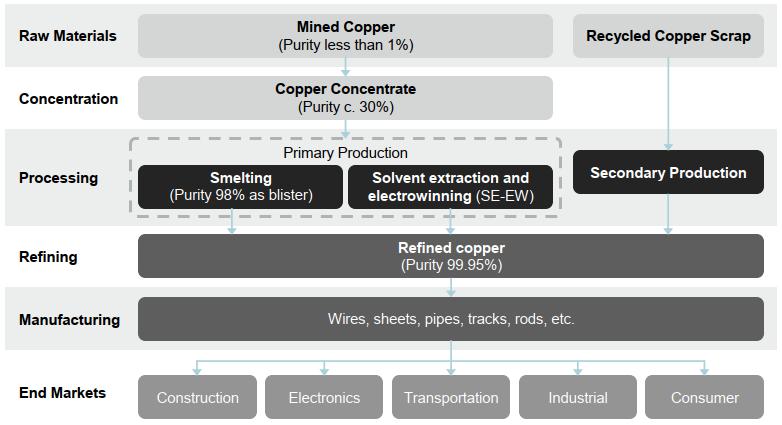
Copper production begins with the mining of copper-bearing ores. The most common form of copper mining is open-pit mining, particularly where the ore bodies are close to the Earth’s surface. Underground mining is used where the ore bodies are deep below the Earth’s surface. Once the copper-bearing ores are mined, there are two main processes for producing refined copper:
| · | Electro-refining process: This process begins with the copper-bearing ore being crushed and ground, followed by a flotation process that produces copper concentrates. These concentrates typically have a copper content of approximately 30%. The copper concentrates then undergo smelting, sometimes with an initial roasting step, converting it into a 'matte' having 50-70% copper content. The matte is further refined in a converter to create blister copper, with an approximate 99% purity. The blister copper is then processed and casted into anodes for electro-refining, culminating in the production of refined copper cathodes with a purity of over 99.99%. |
| · | Hydrometallurgical process: This process primarily focuses on extracting copper from low-grade oxide ores and, to a lesser extent, sulfide ores through a combination of leaching, solvent extraction and electrowinning. The hydrometallurgical process also results in the production of refined copper cathodes with a purity of over 99.99%. |
In 2023, Chile produced approximately 24% of global mined copper production, the most of any country. Peru and the Democratic Republic of Congo each produced approximately 12% of global mined copper production, followed by China and the United States at approximately 8% and 5%, respectively.
In terms of refined copper, in 2023, approximately 45% of global production came from China.
-5
Secondary Copper Production
Secondary copper is produced by recycling copper scrap from copper discarded in fabrication and manufacturing processes as well as from obsolete end-of-life products. Once reprocessed, secondary copper cannot be distinguished from copper originating from ores. Recycling copper extends the lifecycle of the metal, results in energy savings and contributes to ensuring a sustainable source of metal supply for future use.
It is estimated that approximately 5.5Mt of copper scrap was consumed for direct-use in 2023, which amount is forecasted to grow at a compound annual growth rate of over 3.4% from 2023 through 2028. Although the secondary copper market is growing, it faces supply challenges due to the long lifecycle of primary copper currently in use. For instance, in traditional copper applications such as construction, the primary lifecycle of copper can be more than 30 years.
Copper Inventories
Copper supply is also impacted by commodity exchanges (e.g., the LME and CME) as well as commodity traders. Commodity exchanges are a key component of the copper market, as they provide pricing transparency as well as liquidity through warrants (i.e., a derivative trading product) that represent physical copper.
However, commodity exchange inventories do not result in a net increase of copper supply. Commodity exchange inventories act as a buffer, balancing short term supply and demand fluctuations. In addition, global refined copper stocks have fallen from a peak of approximately 2.2Mt in 2013, to 1.2Mt as of February 2024, with the timeline for inventory consumption down from six weeks in 2013, to two weeks as of the fourth quarter of 2023.
Supply Challenges
The global copper supply currently faces challenges, including due to declining ore grades of existing copper mines and the long lead time required for new mine developments. In addition, the ore bodies of existing copper mines have been declining in quality, which increases production costs and makes mine expansion challenging.
To maintain global copper supply, the development of new copper mines is necessary due to the limited potential for expansion of existing mining operations and the limited recycling options due to the long lifecycle of primary copper currently in use. However, obstacles such as high capital expenditure requirements, political risk, complex permitting processes, and infrastructure limitations hinder new mine development. On average, it takes over 16 years to bring new mining projects from discovery to initial production, highlighting the substantial challenges facing the copper industry in meeting future demand. Moreover, given the history and maturity of the global copper mining industry, the Technical Advisor and the Manager believe that many desirable mine sites have already been discovered and developed leaving less desirable mine sites (e.g., in jurisdictions with higher political risk) available for development, which requires a higher market price environment to incentivize new development.
Copper Demand
Demand from Conventional Applications
Demand for copper arises from diverse industry sectors and end-uses, including:
| · | Construction: A large source of demand for copper is the construction industry, where copper is used for its high electrical conductivity, corrosion resistance, and malleability, particularly in electrical wiring, plumbing, roofing and heating systems. Since copper has antimicrobial qualities, it is also often used for touch surfaces in public and healthcare settings. |
-6
| · | Electronics and telecommunications: Copper is a key component in the manufacturing of electronics and telecommunication equipment. Due to copper's high electrical conductivity, it is used in the manufacturing of computers, smartphones, televisions, printed circuit boards, connectors, and cables. Copper is also used in the manufacturing of telephone lines and data cables. |
| · | Transportation: The automotive industry uses copper in the manufacturing of vehicles, particularly for electrical wiring, connectors, and motors. Copper is also used in the manufacturing of components for aircraft, trains and ships. |
| · | Industrial machinery and equipment: Copper and its alloys are used in the production of industrial machinery and equipment, particularly in the electrical components that power electric motors, transformers, and generators. |
| · | Consumer products: Copper is used in a wide array of consumer goods, including home appliances, cookware, and decorative items. Its high heat conductivity is ideal for cookware, and its aesthetic qualities make it a material of choice in home fixtures and other consumer goods. |
In 2023, global copper consumption was approximately 31.2Mt. The civil and construction sector accounted for approximately 27% of global copper demand, followed by the utilities sector at approximately 17%, and the machinery sector at approximately 15%. Global demand for copper is correlated to GDP growth, with global copper consumption forecasted to increase to approximately 35Mt by 2028.
Demand from China
Geographically, most refined copper demand comes from China which represents approximately 57% of global market consumption. Copper plays an important role as a raw material in the construction of new buildings, especially for wiring, cabling and piping for water and heating. In recent years, activity in the real estate sector in China has slowed (in part due to China’s population peaking) and, as a result, China’s copper demand from traditional sectors has slowed. CRU projects short-term support to the sector through approximately US$50 billion of funding towards key construction projects.
CRU forecasts China’s GDP to grow at 4.8% in 2024, slightly below China’s own target of 5%. Within the overall growth of the Chinese’s economy, various factors are expected to contribute positively to China’s copper demand including: (i) electrification, specifically solar and wind electricity generation, and increasing demand for electric vehicles; (ii) consumer products like air conditioners and refrigerators (with generally increasing global temperatures expected to further increase demand); and (iii) China becoming a net exporter of semi-fabricated products including wires and cables. Overall, China’s demand for refined copper is expected to grow by 3.2% in 2024.
Global Energy Transition
Under the Paris Climate Agreement, which was initially adopted in 2015, over 190 countries have committed to limiting global warming through the reduction of their respective GHG emissions. In addition, more than 140 countries, including China, the United States, as well as the European Union, have adopted “net zero” targets, which means cutting GHG emissions to as close to zero as possible, with any remaining emissions re-absorbed from the atmosphere by carbon dioxide removal.
-7
The energy sector, which includes transportation, electricity and heating, buildings, manufacturing and construction, emits approximately 73% of the world’s GHG emissions, and as a result, there is pressure on energy producers and consumers to increase their use of renewable energy and other clean technologies. The International Energy Agency (“IEA”) expects the percentage of renewable electricity generation to increase from 30% in 2022, to 50% by 2030, based on the latest global policy.
Global scale clean energy systems will require a constant supply of applicable raw materials, including copper, to enable clean energy applications and products. The IEA projects that by 2050, the demand for these critical raw materials for clean energy applications and products will increase by at least 350% in a “net zero” scenario. Among these critical raw materials, copper is essential to electricity grids as well as a key component in clean power generation technologies including solar, wind and batteries. For instance, offshore wind energy generation requires 8,000kg/MW of copper as opposed to only 1,100kg/MW of copper for energy generation powered by natural gas. It is estimated that the demand for copper used in the global energy transition (as a percentage of global copper demand) will increase from 10% in 2023 to 25% by 2030.
Artificial Intelligence
Growth in the artificial intelligence sector is also expected to create additional demand for copper. The IEA projects that the artificial intelligence industry’s electricity consumption will grow tenfold from 2023 to 2026, forecasting an increase in demand from data centres, which utilize copper wiring and copper in their power and cooling systems to allow for additional computing capacity.
There are a range of estimates regarding increased copper demand arising from the growth in demand for data centres and artificial intelligence applications.
Limited Substitution Risk from Copper Alternatives
Although alternatives to copper exist for specific applications, there is no universal substitute for copper. The lack of copper substitutes arises due to its distinctive properties, including electrical and thermal conductivity, ductility, malleability, and corrosion resistance, in addition to considerations of cost and availability. However, in limited cases, aluminum and silver can be used as copper substitutes. Research conducted by CRU for the International Copper Association estimated that the total potential for copper substitution by 2035 will amount to approximately 1.7 percent of total global copper use.
Aluminum’s electrical conductivity is 40% lower than copper. Consequently, aluminum conductors require larger diameters to accommodate equivalent electric currents compared to copper, resulting in bulkier installations. However, aluminum can be considered for certain applications due to cost considerations. Similar considerations apply to thermal conductivity, with aluminum demonstrating thermal conductive properties that fall short of copper’s efficiency.
Silver has the highest electrical conductivity among all metallic elements; 3% higher than copper. Therefore, silver can be used as a substitute for copper in high-end electronics and specialized applications where maximal conductivity is essential. However, the higher cost associated with silver confines its use to specific use cases, and accordingly risk of copper substitution in existing applications is considered minimal.
-8
Supply and Demand
Copper Value Chain Overview
A schematic of the copper value chain is shown below.
Copper Value Chain Overview
Supply and Demand Estimates
In 2023, copper supply and demand returned to relative equilibrium, following a supply deficit in 2022. Due to the supply deficit, copper prices on the LME reached a high of approximately US$11,000 in the first quarter of 2022, before falling to approximately US$8,000 in 2023.
From 2024 to 2026, the copper market is forecasted to be in a slight supply deficit, which deficit is expected to increase in subsequent years due to supply and demand dynamics. From 2027 to 2028, there may be a significant supply deficit driven by lower growth in copper supply.
Operation of the Copper Market
The copper market is one of the largest and most liquid base metal markets globally. For the North American market, COMEX (owned by CME) is the leading market venue for copper in the United States while the LME is the leading market venue for other regions, including Europe and Asia. Standards for copper have been established by CME (i.e., Grade 1 Cathode) and LME (i.e., Grade A Cathode) that are based on the chemical composition of the copper as recognized by market participants around the world. Any copper purchased by the Trust will be, at the time of purchase, either Grade 1 Cathode or Grade A Cathode, or equivalent quality of cathodes.
-9
The LME and COMEX publish prices for copper on a daily basis. These prices are then generally subject to either a premium or discount, which is determined by various commercial and logistical factors. As copper is used in many different industrial processes, its location relative to the place of consumption is highly important for determining the premium or discount. Different premium levels are published by price reporters for different locations reflecting the supply and demand dynamics of the specific location. In addition, specific brands of copper can also trade at a premium or discount subject to a buyer’s preference for that brand. Fundamentally, copper that is stored in a location that is low in supply and high in demand will carry a higher premium than copper that is stored in a location where supply is generally high and demand is low.
The Trust will purchase Grade A Cathodes or Grade 1 Cathodes.
DESCRIPTION OF UNITS
General
The Trust is authorized to issue an unlimited number of units in one or more classes and series of a class. Currently, the Trust has issued only one class of Units. Subject to amendment in accordance with the Trust Agreement, the Manager shall have sole discretion in determining whether the capital of the Trust is divided into one or more classes of units and into one or more series of each such class of units, the attributes that shall attach to each class or series of units and whether any class or series of units should be redesignated as a different class or series from time to time.
Each unit of a class or series of a class represents a beneficial interest in the net assets of the Trust attributable to that class or series of a class of units. Units are transferable and redeemable at the option of the unitholder in accordance with the provisions set forth in the Trust Agreement. All units of the same class or series of a class have equal rights and privileges with respect to all matters, including voting, receipt of distributions from the Trust, liquidation and other events in connection with the Trust. Units and fractions thereof are issued only as fully paid and non-assessable. Units have no preference, conversion, exchange or pre-emptive rights. Each whole unit of a particular class or series of a class entitles the holder thereof to a vote at meetings of unitholders where all classes vote together, or to a vote at meetings of unitholders where that particular class or series of a class of unitholders votes separately as a class.
Voting
Subject to the restrictions described above, each unitholder shall be entitled to one vote for each whole Unit held.
Meetings of Unitholders
Meetings of unitholders shall be held by the Manager or the Trustee at such time and on such day as the Manager or the Trustee may from time to time determine for the purpose of considering the matters required to be placed before such meetings in accordance with the Trust Agreement or applicable laws and for the transaction of such other related matters as the Manager or the Trustee determines. unitholders representing not less than 50% of the Net Asset Value of the Trust (as defined below in the section titled “Calculation of Net Asset Value”) may requisition a meeting of unitholders by giving a written notice to the Manager or the Trustee setting out in detail the reason(s) for calling and holding such a meeting. The Trustee shall, upon the written request of the Manager or unitholders representing not less than 50% of the Net Asset Value of the Trust, requisition a meeting of unitholders, provided that in the event of a request to call a meeting of unitholders made by such unitholders, the Trustee shall not be obligated to call any such meeting until it has been satisfactorily indemnified by such unitholders against all costs of calling and holding such meeting. Unless otherwise required under applicable laws or stock exchange rules, the Trust need only to hold meetings of unitholders as described above and is not required to hold annual or other periodic meetings.
-10
Meetings of unitholders are to be held at the principal office of the Trust or elsewhere in the municipality in which its office is located or, if the Manager so determines, at any other place in Canada.
Subject to the Trust Agreement, notice of the time and place of each meeting of unitholders shall be given not less than 21 days before the day on which the meeting is to be held to each unitholder of record at 4:00 p.m. (Toronto time) on the day on which the notice is given. Notice of a meeting of unitholders shall state the general nature of the matters to be considered by the meeting. The Trustee, the auditor, any Technical Advisor and any Investment Manager (each as defined in the Trust Agreement) are entitled to receive all notices and other communications relating to any meeting of unitholders that any unitholder is entitled to receive and shall be entitled to attend at any meeting of unitholders.
A quorum for the transaction of business at any meeting of unitholders shall be at least two unitholders holding not less than 5% of the outstanding Units on such date present in person or represented by proxy and entitled to vote thereat. If a quorum is not present at a meeting within 30 minutes after the time fixed for the meeting, the meeting, if convened on the requisition of unitholders, shall be cancelled but in any other case shall be adjourned to such place and time on a date fixed by the chairman of the meeting not later than 14 days thereafter (which, for greater certainty, can be at a later time on the date of the originally scheduled meeting) at which adjourned meeting unitholders present in person or represented by proxy shall be deemed to constitute a quorum.
At any meeting of unitholders, every person shall be entitled to vote who, as at the end of the business day immediately preceding the date of the meeting, is entered in the register maintained in accordance with the Trust Agreement, unless in the notice of meeting and accompanying materials sent to unitholders in respect of the meeting a record date is established for persons entitled to vote thereat.
For the purpose of determining unitholders who are entitled to receive notice of and to vote at any meeting, or any adjournment thereof, or for the purpose of any action other than as provided in the Trust Agreement, the Manager may fix a date not more than 60 days nor fewer than 30 days prior to the date of any meeting of unitholders, or other action, as a record date for the determination of unitholders entitled to receive notice of and vote at such meeting, or any adjournment thereof, or to receive such distributions, or to be treated as unitholders of record for purposes of such other action, and any unitholder who was a unitholder at the time so fixed shall be entitled to receive notice of and vote at such meeting, or any adjournment thereof, or to be treated as a unitholder of record for purposes of such other action, even though the unitholder has since that date disposed of their Units and no unitholder becoming such after that date shall be entitled to receive notice of and vote at such meeting, or any adjournment thereof, or to be treated as a unitholder of record for purposes of such other action.
At any meeting of unitholders, any unitholder entitled to vote thereat may vote by proxy and a proxy need not be a unitholder, provided that no proxy shall be voted at any meeting unless it shall have been placed on file with the Manager, or with such other agent of the Trust as the Manager may direct, prior to the commencement of such meeting. If approved by the Manager, proxies may be solicited naming the Manager as proxy and the cost of such solicitation shall be paid out of the property of the Trust (the “Trust Property”). When any Unit is held jointly by several persons, any one of them may vote at any meeting in person or by proxy in respect of such Unit, but if more than one of them shall be present at such meeting in person or by proxy, and such joint owners or their proxies so present disagree as to any vote to be cast, such vote shall not be received in respect of such Unit. The instrument appointing any proxy shall be in such form and executed in such manner as the Manager may from time to time determine.
-11
At any meeting of unitholders every question shall, unless otherwise required by the Trust Agreement or applicable laws, be determined by an “ordinary resolution” approved, in person or by proxy, by unitholders representing not less than 50% of the Net Asset Value of the Trust, or in the case of a separate vote by a particular class or series of a class of units, 50% of the Class Net Asset Value, as determined in accordance with the Trust Agreement, at a duly constituted meeting of unitholders, or at any adjournment thereof, called and held in accordance with the Trust Agreement, or a written resolution signed by unitholders holding Units representing not less than 50% of the Net Asset Value of the Trust, or in the case of a separate vote by a particular class or series of a class of Units, 50% of the Class Net Asset Value, as determined in accordance with the Trust Agreement;
Subject to the provisions of the Trust Agreement or applicable laws, any question at a meeting of unitholders shall be decided by a show of hands unless a poll thereon is required or demanded as hereinafter provided. Upon a show of hands every person who is present and entitled to vote shall have one vote. Whenever a vote by show of hands shall have been taken upon a question, unless a poll thereon is so required or demanded, a declaration by the chairman of the meeting that the vote upon the question has been carried or carried by a particular majority or not carried and an entry to that effect in the minutes of the meeting shall be prima face evidence of the fact without proof of the number or proportion of the votes recorded in favour of or against any resolution or other proceeding in respect of the said question, and the result of the vote so taken shall be the decision of unitholders upon the said question.
A resolution in writing forwarded to all unitholders entitled to vote on such resolution at a meeting of unitholders and signed by the requisite number of unitholders required to obtain approval of the matter addressed in such resolution is as valid as if it had been passed at a meeting of unitholders in accordance with the Trust Agreement.
Any resolution passed in accordance with the provisions of the Trust Agreement shall be binding on all unitholders and their respective heirs, executors, administrators, other legal representatives, successors and assigns, whether or not such unitholder was present or represented by proxy at the meeting at which such resolution was passed and whether or not such unitholder voted against such resolution.
Unitholder Liability
The Trust Agreement provides that no unitholder shall be held to have any personal liability as such and no resort shall be had to the unitholder’s private property for satisfaction of any obligation or claim arising out of or in connection with any contract or obligation of any of the Trust, the Manager or the Trustee or any obligation which a unitholder would otherwise have to indemnify the Trustee for any personal liability incurred by the Trustee as such, but rather, only the Trust Property is intended to be liable and subject to levy or execution for such satisfaction. If the Trust acquires any investments subject to existing contractual obligations, the Manager, or the Trustee on the direction of the Manager, as the case may be, shall use its best efforts to have any obligations modified so as to achieve disavowal of contractual liability. Further, the Manager shall cause the operations of the Trust to be conducted, with the advice of counsel, in such a way and in such jurisdictions as to avoid, as far as possible, any material risk of liability on unitholders of claims against the Trust and shall, to the extent it determines to be possible and reasonable, including the cost of premiums, cause the Trust to carry insurance for the benefit of unitholders in such amounts as it considers adequate to cover any such foreseeable non-contractual or non-excluded contractual liability.
Unitholder Reporting
The Manager will forward to unitholders a copy of the audited annual financial statements of the Trust within 90 days of each fiscal year-end as well as unaudited semi-annual interim financial statements of the Trust, within the timelines required under applicable securities legislation. The Manager will also prepare, file and deliver to unitholders (if required) all management reports of fund performance and other continuous disclosure documents required by applicable securities legislation.
-12
CALCULATION OF NET ASSET VALUE
The calculation of the Net Asset Value of the Trust shall be the responsibility of the Manager, who may consult with the valuation agent, which is RBC Investor Services Trust (the “Valuation Agent”), any Investment Manager, any Technical Advisor, the Facilities and the Custodian and/or the auditor. The Net Asset Value of the Trust shall be determined for the purposes of subscriptions as at the time (the “Valuation Time”) and the date (the “Valuation Date”) as the Manager determines, in U.S. dollars. The Net Asset Value of the Trust determined on the last Valuation Date of each year shall include all income, common expenses, class expenses or any other items to be accrued to December 31 of each year and since the last calculation of the Net Asset Value per Unit (as defined below) or the Class Net Asset Value (as defined below) per Unit for the purpose of the distribution of net income and net realized capital gains of the Trust to unitholders.
The “Net Asset Value of the Trust” as at the Valuation Time on each Valuation Date shall be the amount obtained by deducting from the aggregate fair market value of the assets of the Trust as of such Valuation Date an amount equal to the value of the liabilities of the Trust as of such Valuation Date. The “Net Asset Value per Unit” shall be determined by dividing the Net Asset Value of the Trust on a Valuation Date by the total number of Units then outstanding. The Net Asset Value of the Trust as at the Valuation Time on a Valuation Date shall be determined in accordance with the following:
| (a) | The assets of the Trust shall be deemed to include the following property: |
| (i) | all Copper owned by or contracted for the Trust; |
| (ii) | all cash on hand or on deposit, including any interest accrued thereon adjusted for accruals deriving from trades executed but not yet settled; |
| (iii) | all bills, notes and accounts receivable; |
| (iv) | all interest accrued on any interest-bearing securities owned by the Trust other than interest, the payment of which is in default; and |
| (v) | prepaid expenses. |
| (b) | The market value of the assets of the Trust shall be determined as follows: |
| (i) | the fair market value of the Copper held by the Trust will be determined based on reported Copper spot prices from one, or more, price reporters that are most commonly used by the market subject to adjustment, as described below. The price reporters are private business organizations that offer subscription services to which most Copper market participants subscribe and the spot prices reported by such price reporters are used by such market participants as a basis on which to negotiate or settle contracted prices for Copper. The LME, the largest base metals commodity exchange in the world, is a regulated commodities exchange in the United Kingdom and provides public pricing information for base prices on Copper. COMEX (owned by CME) is the leading market venue for Copper in the United States. The Manager and Technical Advisor may use the LME or CME prices for Copper or may determine to use a different price reporter (or price reporters), depending on any changes in market conditions. If the Trust purchases Copper in a location or with other characteristics for which none of the price reporters report a spot price, the Trust will use the best available alternative spot price, as determined by the Manager and the Technical Advisor, to determine the fair market value of such Copper; |
-13
| (ii) | the value of any cash on hand or on deposit, bills, demand notes, accounts receivable, prepaid expenses, and interest accrued and not yet received, shall be deemed to be the full amount thereof, unless the Manager shall have determined that any such deposit, bill, demand note, account receivable, prepaid expense or interest is not worth the full amount thereof, in which event the value thereof shall be deemed to be such value as the Manager shall determine to be the fair value thereof; |
| (iii) | short-term investments including notes and money market instruments shall be valued at cost plus accrued interest; |
| (iv) | the value of any security or other property for which no price quotations are available or, in the opinion of the Manager, to which the above valuation principles cannot or should not be applied, shall be the fair value thereof determined from time to time in such manner as the Manager shall from time to time provide; and |
| (v) | the value of all assets and liabilities of the Trust valued in terms of a currency other than the currency used to calculate the Net Asset Value of the Trust shall be converted to the currency used to calculate the Net Asset Value of the Trust by applying the rate of exchange obtained from the best available sources to the Valuation Agent as agreed upon by the Manager including, but not limited to, the Trustee or any of its affiliates. |
| (c) | The liabilities of the Trust shall be calculated on a fair value basis and shall be deemed to include the following: |
| (i) | all bills, notes and accounts payable; |
| (ii) | all fees (including Management Fees (as defined in the below section titled “Fees and Expenses Payable by the Trust”)) and administrative and operating expenses and applicable taxes payable and/or accrued by the Trust; |
| (iii) | all contractual obligations for the payment of money or property, including distributions of net income and net realized capital gains, if any, declared, accrued or credited to unitholders but not yet paid on the day before the Valuation Date as of which the Net Asset Value of the Trust is being determined; |
| (iv) | all allowances authorized or approved by the Manager or the Trustee for taxes or contingencies; and |
| (v) | all other liabilities of the Trust of whatsoever kind and nature. |
| (d) | For the purposes of determining the market value of any security or property pursuant to (b) above which, in the opinion of the Valuation Agent in consultation with the Manager, the above valuation principles cannot be applied (because no price or yield equivalent quotations are available as provided above, or the current pricing option is not appropriate, or for any other reason), shall be the fair value as determined in such manner by the Valuation Agent in consultation with the Manager and generally adopted by the marketplace from time to time, provided that any change to the standard pricing principles as set out above shall require prior consultation and written agreement with the Manager. For greater certainty, fair valuing an investment comprising the Trust Property may be appropriate if: (i) market quotations do not accurately reflect the fair value of an investment; (ii) an investment’s value has been materially affected by events occurring after the close of the exchange or market on which the investment is principally traded; (iii) a trading halt closes an exchange or market early; or (iv) other events result in an exchange or market delaying its normal close. |
-14
| (e) | Portfolio transactions (investment purchases and sales) will be reflected in the first computation of the Net Asset Value of the Trust made after the date on which the transaction becomes binding. |
| (f) | The Net Asset Value of the Trust and Net Asset Value per Unit on the first business day following a Valuation Date shall be deemed to be equal to the Net Asset Value of the Trust (or the Net Asset Value per Unit, as the case may be) on such Valuation Date after payment of all fees and applicable taxes, including Management Fees, and after processing of all subscriptions of Units in respect of such Valuation Date. |
| (g) | The Net Asset Value of the Trust and the Net Asset Value per Unit determined by the Manager in accordance with the provisions of this section shall be conclusive and binding on all unitholders. |
Calculation of Class Net Asset Value and Class Net Asset Value per Unit
| (a) | The Net Asset Value for a particular class or series of a class of units of the Trust (the “Class Net Asset Value”) as at the Valuation Time on a Valuation Date shall be determined for the purposes of subscriptions in accordance with the following calculation: |
| (i) | the Class Net Asset Value last calculated for that class or series of a class; plus |
| (ii) | the increase in the assets attributable to that class or series of a class as a result of the issue of Units of that class or series of a class or the redesignation of Units into that class or series of a class since the last calculation; minus |
| (iii) | the decrease in the assets attributable to that class or series of a class as a result of the redesignation of Units out of that class or series of a class since the last calculation; plus (in the case of an increase) or minus (in the case of a decrease) |
| (iv) | the proportionate share of the net change in non-portfolio assets attributable to that class or series of a class since the last calculation; plus (in the case of an increase) or minus (in the case of a decrease) |
| (v) | the proportionate share of market appreciation or depreciation of the portfolio assets attributable to that class or series of a class since the last calculation; minus |
| (vi) | the proportionate share of the common expenses and applicable taxes allocated to that class or series of a class since the last calculation; minus |
| (vii) | any class expenses and applicable taxes allocated to that class or series of a class since the last calculation. |
-15
| (b) | A Unit of a class or series of a class being issued or a Unit that has been redesignated as a part of that class or series of a class shall be deemed to become outstanding as of the next calculation of the applicable Class Net Asset Value immediately following the Valuation Date at which the applicable Class Net Asset Value per Unit that is the issue price or redesignation basis of such Unit is determined and the issue price received or receivable for the issuance of the Unit shall then be deemed to be an asset of the Trust attributable to the applicable class or series of a class. |
| (c) | A Unit of a class or series of a class that has been redesignated as no longer being a part of that class or series of a class shall be deemed to remain outstanding as part of that class or series of a class until immediately following the Valuation Date as of which the applicable Class Net Asset Value per Unit that is the redesignation basis of such Unit is determined; thereafter, the Unit which has been redesignated will be deemed to be outstanding as a part of the class or series of a class into which it has been redesignated. |
| (d) | On any Valuation Date that a distribution is paid to unitholders of a class or series of a class, a second Class Net Asset Value shall be calculated for that class or series of a class, which shall be equal to the first Class Net Asset Value calculated on that Valuation Date minus the amount of the distribution. For greater certainty, the second Class Net Asset Value shall be used for determining the Class Net Asset Value per Unit on such Valuation Date for purposes of determining the issue price for Units on such Valuation Date, as well as the redesignation basis for Units being redesignated into or out of such class or series of a class, and Units redesignated out of that class or series of a class as at such Valuation Date shall participate in such distribution while Units subscribed for or redesignated into such class or series of a class as at such Valuation Date shall not. |
| (e) | The Class Net Asset Value per Unit of a particular class or series of a class of units as at any Valuation Date is the quotient obtained by dividing the applicable Class Net Asset Value as at such Valuation Date by the total number of Units of that class or series of a class outstanding at such Valuation Date. This calculation shall be made without taking into account any issuance or redesignation of Units of that class or series of a class to be processed by the Trust immediately after the Valuation Time of such calculation on that Valuation Date. The Class Net Asset Value per Unit for each class or series of a class of Units for the purpose of the issue of Units shall be calculated on each Valuation Date by or under the authority of the Manager as at the Valuation Time on every Valuation Date as shall be fixed from time to time by the Manager and the Class Net Asset Value per Unit so determined for each class or series of a class shall remain in effect until the Valuation Time as of which the Class Net Asset Value per Unit for that class or series of a class is next determined. |
For the purposes of the foregoing disclosure the following capitalized terms have the meanings set forth below:
“Net change in non-portfolio assets” on a date means:
| (a) | the aggregate of all income accrued by the Trust as of that date, including cash dividends and distributions, interest and compensation since the last calculation of Class Net Asset Value or Class Net Asset Value per unit, as the case may be; minus |
| (b) | the common expenses of the Trust (other than expenses that are specifically chargeable to a particular class or series of a class) to be accrued by the Trust as of that date which have been accrued since the last calculation of Class Net Asset Value or Class Net Asset Value per unit, as the case may be; plus or minus |
| (c) | any change in the value of any non-portfolio assets or liabilities stated in any foreign currency accrued on that date since the last calculation of Class Net Asset Value or Class Net Asset Value per unit, as the case may be, including, without limitation, cash, accrued dividends or interest and any receivables or payables; plus or minus |
-16
| (d) | any other item accrued on that date determined by the Manager to be relevant in determining the net change in non-portfolio assets. |
“Proportionate share”, when used to describe: (i) an amount to be allocated to any one class or series of a class of the Trust, means the total amount to be allocated to all classes or series of classes of the Trust multiplied by a fraction, the numerator of which is the Class Net Asset Value of such class or series of a class and the denominator of which is the value of the net assets of the Trust at such time; and (ii) a unitholder’s interest in or share of any amount, means, after an allocation has been made to each class or series of a class as provided in clause (i), that allocated amount multiplied by a fraction, the numerator of which is the number of units of that class or series of a class registered in the name of that unitholder and the denominator of which is the total number of units of that class or series of a class then outstanding (if such unitholder holds units of more than one class or series of a class, then such calculation is made in respect of each class or series of a class and aggregated).
The calculation of the value of the net assets of the Trust and the NAV for each class or series of a class of units as of the valuation time on each valuation date is for the purposes of determining subscription prices and redemption values of units and not for the purposes of accounting in accordance with IFRS Accounting Standards as issued by the International Accounting Standards Board (“IFRS”). The value of the net assets of the Trust calculated in this manner will be used for the purpose of calculating the Manager’s and other service providers’ fees and will be published net of all paid and payable fees.
Suspension of Calculation of Net Asset Value Per Unit
During any period in which the right of unitholders to request a redemption of their Units for Copper and/or cash is suspended, the Manager, on behalf of the Trust, will direct the Valuation Agent to suspend the calculation of the Net Asset Value, the Net Asset Value per Unit, the Class Net Asset Value and the Class Net Asset Value per Unit for each class or series of a class of Units. During any such period of suspension, the Trust shall not issue or redeem any Units. As noted in ‘‘Redemption of Units – Suspension of Redemptions’’, in the event of any such suspension or termination thereof, the Manager shall issue a press release announcing the suspension or the termination of such suspension, as the case may be.
Reporting of Net Asset Value of the Trust
The value of the net assets of the Trust (the “NAV”) is updated on each business day or as determined by the Manager in accordance with the Trust Agreement and is made available as soon as practicable at no cost on the Trust’s website (www.sprott.com/copper) or by calling the Manager at (416) 943-6707 or toll free at 1-866-299-9906 (9:00 a.m. to 5:00 p.m., Toronto time). Information contained in, or connected to, the Manager’s website is not incorporated into, and does not form part of, this annual information form.
MARKET FOR THE UNITS
The trust units are traded on the Toronto Stock Exchange (the “TSX”) under the symbols “COP.UN” (Canadian dollar denominated) and “COP.U” (U.S. dollar denominated), respectively. Purchases of Units can be made on the TSX. Purchases of Units are made through registered dealers. Please contact your dealer to find out how to place an order. Some dealers may charge you a fee for their services.
The following table sets forth, for the periods indicated, the reported high and low daily trading prices and the monthly average trading volume of the Units on the TSX (as reported by TSX) for 2024.
-17
TSX | ||||||||||||||||||||||||
| Calendar Period | High (US$ - U.U) | Low (US$ - U.U) | Average Volume | High (CDN$ - U.UN) | Low (CDN$ - U.UN) | Average Volume | ||||||||||||||||||
| June 10 – 30, 2024 | 9.85 | 9.20 | 6,496 | 13.79 | 12.75 | 1,256 | ||||||||||||||||||
| July 2024 | 9.74 | 8.25 | 7,856 | 13.00 | 11.41 | 3,855 | ||||||||||||||||||
| August 2024 | 8.61 | 8.10 | 4,024 | 11.95 | 11.13 | 3,324 | ||||||||||||||||||
| September 2024 | 9.05 | 8.11 | 4,330 | 12.48 | 11.00 | 4,423 | ||||||||||||||||||
| October 2024 | 8.83 | 8.15 | 2,012 | 12.36 | 11.29 | 5,185 | ||||||||||||||||||
| November 2024 | 8.35 | 7.01 | 1,824 | 11.56 | 9.80 | 4,874 | ||||||||||||||||||
| December 2024 | 7.36 | 6.01 | 10,036 | 10.50 | 8.90 | 17,234 | ||||||||||||||||||
REDEMPTION OF UNITS
Subject to the terms of the Trust Agreement and the Manager’s right to suspend redemptions in the circumstances described below, and the other limitations to which redemptions are subject as described below, Units may be redeemed at the option of a unitholder on a semi-annual basis for physical Copper or cash. All redemptions will be determined using U.S. dollars, regardless of whether the redeemed Units were acquired on the TSX or another exchange or trading facility.
Redemptions for Copper
Unitholders whose Units are redeemed for Copper will be entitled to receive a redemption price equal to the aggregate value of the Class Net Asset Value per Unit of the redeemed Units as at the Valuation Time on the applicable Redemption Date for the Notice Period during which the redemption request is received. Except as provided under ‘‘Redemption of Units—-Semi-annual Limitation on Redemptions’’ below, redemption requests must be for amounts that are at least equivalent to the value of one Minimum Physical Redemption Lot or an integral multiple thereof, plus applicable expenses. A ‘‘Minimum Physical Redemption Lot’’ means the equivalent of 100 metric tonnes of Copper. Any fractional amount of redemption proceeds (adjusted for applicable expenses) payable in excess of a Minimum Physical Redemption Lot or an integral multiple thereof, but below an incremental Minimum Physical Redemption Lot (or, if reduced pursuant to the limitations described below in ‘‘Redemption of Units—Semi-annual Limitation on Redemptions’’ to a fractional amount that is less than a Minimum Physical Redemption Lot), will, in the Manager’s sole discretion, be paid in Copper or the equivalent value in cash at a rate equal to 100% of the Class Net Asset Value of the redeemed Units as at the Valuation Time on the applicable Redemption Date that represents such excess amount. A unitholder redeeming Units for Copper will be responsible for the expenses incurred in connection with effecting the redemption including, to the extent required, sales or other value-added taxes (as determined by the Manager in its sole discretion) and applicable transfer and delivery expenses, including the handling, logistical requirements and administration of the Copper Redemption Notice (as defined below), the transfer of the Copper for the Units that are being redeemed and the applicable fees charged by, for any redemption of Units for Copper in accordance with the Trust Agreement, the Facility or Facilities where the transfer of Copper will occur, as designated by the Manager in accordance with the Trust Agreement (the “Designated Facility”) in connection with such redemption, including but not limited to ownership transfer fees.
-18
For the purposes of this AIF, “Redemption Date” means, in respect of a redemption request received during the H1 Notice Period, the last day of May when the TSX is open for trading, or, in respect of a redemption request received during the H2 Notice Period, the last day of November when the TSX is open for trading. “Notice Period” means the H1 Notice Period or the H2 Notice Period, as applicable. “H1 Notice Period” means the period from April 15 up to and including the last day of April when the TSX is open for trading. “H2 Notice Period” means the period from October 15 up to and including the last day of October when the TSX is open for trading.
From inception to December 31, 2024, No Units have been redeemed for Copper.
Procedure to Redeem for Copper
Except as provided under ‘‘Redemption of Units—Semi-annual Limitation on Redemptions’’ below, a unitholder that owns a sufficient number of Units who desires to exercise redemption privileges for physical Copper must do so by instructing his, her or its broker, who must be a CDS Clearing and Depository Services Inc. (“CDS”) participant, to deliver to the registrar and transfer agent on behalf of the unitholder a written notice (the “Copper Redemption Notice”) of the unitholder’s intention to redeem units for Copper. A Copper Redemption Notice must be received by the registrar and transfer agent between 9:00 a.m. on the first day of the applicable Notice Period and 4:00 p.m. on the last day of the applicable Notice Period. Any Copper Redemption Notice received outside of a Notice Period will not be processed, will be void and, in order to be processed, must be re-submitted during the next Notice Period. Any Copper Redemption Notice must include a valid signature guarantee to be deemed valid by the Trust.
Except as provided under ‘‘Redemption of Units—Suspension of Redemptions’’ below, by instructing a broker, who must be a CDS participant, to deliver to the registrar and transfer agent a Copper Redemption Notice, the unitholder will be deemed to have irrevocably surrendered his, her or its Units for redemption and appointed such broker to act as his, her or its exclusive settlement agent with respect to the exercise of such redemption privilege and the receipt of payment in connection with the settlement of obligations arising from such exercise.
Once a Copper Redemption Notice is received by the registrar and transfer agent, the registrar and transfer agent, together with the Manager, will determine whether such Copper Redemption Notice complies with the applicable requirements, is, subject to the limitations described in ‘‘Redemption of Units—Semi-annual Limitation on Redemptions’’ below, for an amount of Copper that is equal to at least one Minimum Physical Redemption Lot plus applicable expenses, contains “in warehouse” transfer and delivery instructions that are acceptable to the Designated Facility (including an identified account in good standing with the Designated Facility), and, to the extent required (as determined by the Manager in its sole discretion), any tax identification information, resale certificate or other sales or value-added tax related information. If the registrar and transfer agent and the Manager determine that the Copper Redemption Notice complies with all applicable requirements, the registrar and transfer agent will provide a notice to such redeeming unitholder’s broker, who must be a CDS participant, confirming that the Copper Redemption Notice was received and determined to be complete.
Any Copper Redemption Notice delivered to the registrar and transfer agent regarding a unitholder’s intent to redeem Units that the registrar and transfer agent or the Manager, in their sole discretion, determines to be incomplete, not in proper form, not duly executed or, subject to the limitations described in ‘‘Redemption of Units—Semi-annual Limitation on Redemptions’’ below, for an amount (taking into account applicable expenses) of Copper less than at least one Minimum Physical Redemption Lot shall for all purposes be void and of no effect, and the redemption privilege to which it relates shall be considered for all purposes not to have been exercised thereby. If the registrar and transfer agent and the Manager determine that the Copper Redemption Notice does not comply with the applicable requirements, the registrar and transfer agent will provide a notice explaining the deficiency to the unitholder’s broker. If the Copper Redemption Notice is determined to have complied with the applicable requirements, the registrar and transfer agent and the Manager will determine as at the Valuation Time on the applicable Redemption Date the amount of Copper and the amount of cash that will be delivered to the redeeming unitholder. Also on such applicable Redemption Date, the redeeming unitholder’s broker, who must be a CDS participant, will deliver the redeemed Units to CDS for cancellation.
-19
Based on instructions from the Manager, the Designated Facility will arrange for “in warehouse” transfer and delivery of the requisite amount of Copper from the Trust’s holdings of Copper at the Designated Facility to the unitholder’s account at the Designated Facility. As directed by the Manager, any cash to be received by a redeeming unitholder in connection with a redemption of Units for Copper will be delivered or caused to be delivered by the Manager to the unitholder’s brokerage account within approximately 15 Business Days of the applicable Redemption Date.
Transfer of Copper to the Redeeming Unitholder
On or before the fifth Business Day of April of each year and on or before the fifth Business Day of October of each year, the Manager shall designate the Facility where the transfer of Copper will occur for, and which shall be the Designated Facility for the purposes of, the nearest following Redemption Date. Such designation shall be made available on the website established by the Manager from time to time for the Trust, which as of the date hereof is: www.sprott.com/copper.
A unitholder redeeming Units for Copper will receive the Copper via an “in warehouse” transfer and delivery from the Trust’s holdings of Copper at the Designated Facility to the unitholder’s account at the Designated Facility. Copper received by a unitholder as a result of a redemption of Units will be transferred pursuant to delivery instructions provided by the unitholder and shall only be delivered to an account established by the unitholder at the Designated Facility. The Designated Facility shall be engaged by, or on behalf of, the redeeming unitholder.
Costs associated with the redemption of Units and the transfer of Copper will be borne by the redeeming unitholder. The redeeming unitholder will also be responsible for any and all fees charged by the Designated Facility, including any transfer or setup fees. Upon request, the Manager will provide unitholders interested in redeeming Units for Copper with an estimate of the current costs associated with the transfer of Copper pursuant to the unitholder’s transfer and delivery instructions.
The transfer of Copper in connection with a redemption of Units will occur as soon as practicable and, in any event, approximately 15 Business Days after the applicable Redemption Date, subject to the timelines, policies and procedures at any Designated Facility.
Exceptions to Redemption for Copper
Unitholders that are constituted and authorized as undertakings for collective investment in transferable securities (UCITS) or are otherwise prohibited by their investment policies, guidelines or restrictions from receiving Copper may only redeem Units for cash pursuant to the Trust Agreement.
Redemptions for Cash
Unitholders whose Units are redeemed for cash will be entitled to receive a redemption price per Unit equal to 95% of the lesser of (i) the volume-weighted average trading price (in U.S. dollars) of the Units traded on the TSX, for the five trading days ending on the applicable Redemption Date; and (ii) the Class Net Asset Value of the redeemed Units as at the Valuation Time on the applicable Redemption Date, less an administration fee payable to the Trust equal to the out-of-pocket fees, costs and expenses of the Trust associated with such redemption, including amounts payable under the Management Agreement in connection with the sale of Copper to fund the cash redemption amount, and a further administration fee payable to the Manager equal to 1.0% of the aggregate Class Net Asset Value of the redeemed Units as at the Valuation Time on the applicable Redemption Date to offset the handling, logistical requirements and administration in connection with a redemption of Units for cash.
-20
Cash proceeds from the redemption of Units will be transferred to a redeeming unitholder approximately 15 Business Days following the applicable Redemption Date, subject to the terms of and conditions of the sales of Copper by the Trust to fund the cash redemption amount.
From inception to December 31, 2024, 168,043 Units have been redeemed for cash.
Procedure to Redeem for Cash
To redeem Units for cash, a unitholder must instruct the unitholder’s broker, who must be a CDS participant, to deliver a notice to redeem units for cash (the “Cash Redemption Notice”) to the registrar and transfer agent. A Cash Redemption Notice must be received by the registrar and transfer agent between 9:00 a.m. on the first day of the applicable Notice Period and 4:00 p.m. on the last day of the applicable Notice Period. Any Cash Redemption Notice received outside of a Notice Period will not be processed, will be void and, in order to be processed, must be re-submitted during a Notice Period. Any Cash Redemption Notice must include a valid signature guarantee to be deemed valid by the Trust.
Except as provided under ‘‘Redemption of Units—Suspension of Redemptions’’ below, by instructing his, her or its broker, who must be a CDS participant, to deliver to the registrar and transfer agent a Cash Redemption Notice, the redeeming unitholder will be deemed to have irrevocably surrendered his, her or its Units for redemption and appointed such broker to act as his, her or its exclusive settlement agent with respect to the exercise of such redemption privilege and the receipt of payment in connection with the settlement of obligations arising from such exercise.
Any Cash Redemption Notice delivered to the registrar and transfer agent regarding a unitholder’s intent to redeem Units that the registrar and transfer agent or the Manager determines to be incomplete, not in proper form or not duly executed will for all purposes be void and of no effect and the redemption privilege to which it relates will be considered for all purposes not to have been exercised thereby. For each Cash Redemption Notice, the registrar and transfer agent will notify the redeeming unitholder’s broker, who must be a CDS participant, that such Cash Redemption Notice has been deemed insufficient or accepted and duly processed, as the case may be.
The registrar and transfer agent and the Manager will determine as at the Valuation Time on the applicable Redemption Date the amount of cash that will be delivered to the redeeming unitholder. Also on such Redemption Date, the redeeming unitholder’s broker, who must be a CDS participant, will deliver the redeemed Units to CDS for cancellation.
Canadian Tax Implications of Redemption
Pursuant to the Trust Agreement, the Manager, in its sole discretion, may allocate and, where applicable, designate to a unitholder who has redeemed Units during a year an amount equal to any net income or net realized capital gains realized by the Trust for the year as a result of the disposition of any of the Trust’s property to satisfy the Copper Redemption Notice or the Cash Redemption Notice, as the case may be, given by such unitholder or such other amount that is determined by the Manager to be reasonable. See ‘‘Material Canadian Federal Income Tax Considerations’’.
Suspension of Redemptions
The Manager, on behalf of the Trust, may suspend the right of unitholders to request a redemption of their Units or postpone the date of delivery or payment of the redemption proceeds (whether Copper and/or cash, as the case may be) with the prior approval of Canadian securities regulatory authorities having jurisdiction, where required, for any period during which the Manager determines that conditions exist which render impractical the sale of assets of the Trust or which impair the ability of the Manager to determine the Net Asset Value of the Trust and the Net Asset Value per Unit.
-21
In the event of any such suspension, the Manager shall issue a press release announcing the suspension and shall advise the Trustee, the Trust’s valuation agent and any other agents appointed by the Manager, as applicable. The suspension may apply to all requests for redemption received prior to the suspension, but as for which payment has not been made, as well as to all requests received while the suspension is in effect. All unitholders making such requests will be advised by the Manager of the suspension and that the redemption shall be effected at a price determined on the first Valuation Date that the Net Asset Value per Unit is calculated following the termination of the suspension. All such unitholders will have, and will be advised that during such suspension of redemptions that they have, the right to withdraw their requests for redemption. The suspension will terminate in any event on the first Business Day on which the condition giving rise to the suspension has ceased to exist or when the Manager has determined that such condition no longer exists, provided that no other condition under which a suspension is authorized then exists, at which time the Manager shall issue a press release announcing the termination of the suspension and will advise the Trustee, the Trust’s valuation agent and any other agents appointed by the Manager, as applicable. Subject to applicable Canadian and U.S. securities laws, any declaration of suspension made by the Manager, on behalf of the Trust, will be conclusive.
Suspension of Calculation of Net Asset Value Per Unit
During any period in which the right of unitholders to request a redemption of their Units for Copper and/or cash is suspended, the Manager, on behalf of the Trust, will direct the Trust’s valuation agent to suspend the calculation of the Net Asset Value of the Trust, the Net Asset Value per Unit, the Class Net Asset Value and the Class Net Asset Value per Unit. During any such period of suspension, the Trust will not issue or redeem any Units. In the event of any such suspension or termination thereof, the Manager shall issue a press release announcing the suspension or the termination of such suspension, as the case may be. See “Calculation of Net Asset Value – Suspension of Calculation of Net Asset Value Per Unit”.
Semi-annual Limitation on Redemptions
Pursuant to the terms of the Trust Agreement, the aggregate number of Units that may be redeemed on any Redemption Date shall not exceed 1.5% of the number of Units outstanding as at the close of business on the last day of the applicable Notice Period. In the event that the aggregate number of Units originally set out in valid Copper Redemption Notices and valid Cash Redemption Notices received during the applicable Notice Period exceeds 1.5% of the number of Units outstanding as at the close of business on the last day of the applicable Notice Period, then the number of Units to be redeemed pursuant to any valid Copper Redemption Notice or valid Cash Redemption Notice received during the applicable Notice Period shall be deemed for all purposes (other than determining the validity of a Copper Redemption Notice on the basis of such Copper Redemption Notice being for an amount of Copper that is equal to at least one Minimum Physical Redemption Lot plus applicable expenses) to be a pro rata amount (rounded down to the nearest whole number of Units) of an amount equal to 1.5% of the number of Units outstanding at the close of business on the last day of the applicable Notice Period. Such pro-rationing will be equal to the product (rounded down to the nearest whole number) of (i) the number of Units originally set out in such valid Copper Redemption Notice or valid Cash Redemption Notice received during the applicable Notice Period, multiplied by (ii) the quotient of (A) the number of Units originally set out in such valid Copper Redemption Notice or valid Cash Redemption Notice, divided by (B) the aggregate number of Units originally set out in valid Copper Redemption Notices and valid Cash Redemption Notices received during the applicable Notice Period. The applicable pro rata amounts shall be calculated by the Manager and be subject to adjustment at the discretion of the Manager acting in good faith to give effect to the intention of this provision of the Trust Agreement.
-22
RESPONSIBILITY FOR OPERATION OF THE TRUST
The Manager
Pursuant to the management agreement between the Trust and Sprott Asset Management LP dated as of May 10, 2024 (the “Management Agreement”), the Manager will act as the manager of the Trust. The Manager is a limited partnership formed and organized under the laws of the Province of Ontario, Canada, pursuant to the Limited Partnerships Act (Ontario) by declaration dated September 17, 2008. The general partner of the Manager is Sprott Asset Management GP Inc. (“SAM GP”), which is a corporation incorporated under the laws of the Province of Ontario, Canada, on September 17, 2008. SAM GP is a wholly-owned subsidiary of Sprott Inc., which is a corporation incorporated under the laws of the Province of Ontario, Canada, on February 13, 2008. Sprott Inc. is also the sole limited partner of the Manager. Pursuant to an internal corporate reorganization of Sprott Inc. completed on June 1, 2009, the Manager acquired the assets related to Sprott Asset Management Inc.’s portfolio management business.
As of December 31, 2024, the Manager, together with its affiliates and related entities, had assets under management totaling an estimated US$ 31.5 billion, and provides management and investment advisory services to many entities, including private investment funds, the Sprott Inc. mutual funds, the Sprott Inc. discretionary managed accounts, and management of certain companies. The Manager also acts as: (A) manager of (i) the Sprott Physical Uranium Trust, a non-redeemable investment fund whose trust units are listed and posted on the TSX that invests and holds substantially all of its assets in physical uranium, (ii) the Sprott Physical Silver Trust, a closed-end mutual fund trust whose trust units are listed and posted for trading on the TSX and the NYSE Arca that invests and holds substantially all of its assets in physical silver bullion, (iii) the Sprott Physical Gold Trust, a closed-end mutual fund trust whose trust units are listed and posted for trading on the TSX and the NYSE Arca that invests and holds substantially all of its assets in physical gold bullion, (iv) the Sprott Physical Gold and Silver Trust, a closed-end mutual fund trust whose trust units are listed and posted for trading on the TSX and the NYSE Arca that invests and holds substantially all of its assets in physical gold and silver bullion, and (v) the Sprott Physical Platinum and Palladium Trust, a closed-end mutual fund trust whose units are listed and posted for trading on the TSX and the NYSE Arca that invests and holds substantially all of its assets in physical platinum and palladium bullion; and (B) sub-advisor for certain funds managed by Ninepoint LP, a Canadian public mutual fund manager. The corporate structure of Sprott Inc. and its material subsidiaries are as indicated in the following chart:
-23
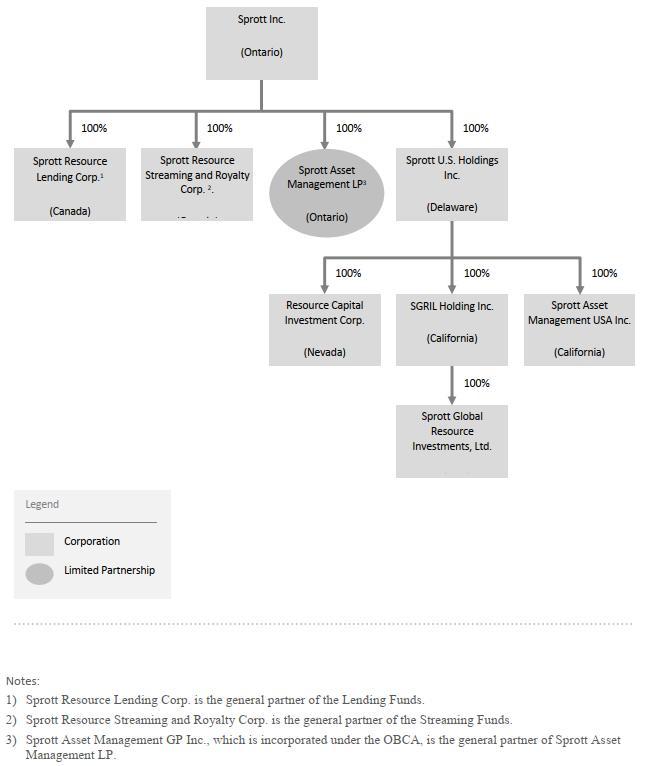
The registered office of the Manager is located at Suite 2700, South Tower, Royal Bank Plaza, 200 Bay Street, Toronto, Ontario, Canada M5J 2J1. Further contact information of the Manager is as follows:
Tel: (416) 943 6707
Fax: (416) 943 6497
Email: invest@sprott.com
-24
Website: www.sprott.com
Toll free number: 1-855-943-8099
The names, places of residence and present positions held by the directors and officers of the Manager and/or of the SAM GP are listed below.
| Name and Municipality of Residence |
Position with the Manager |
Position with SAM GP |
Principal Occupation |
| John Ciampaglia Caledon, Ontario, Canada | Chief Executive Officer, and Director | Chief Executive Officer and Director | Chief Executive Officer of the Manager and SAM GP |
| Kevin Hibbert Toronto, Ontario, Canada | Director | Director | Chief Financial Officer of Sprott Inc. |
| Whitney George Darien, Connecticut, USA | Director | Director | President and Chief Executive Officer of Sprott Inc. |
| Maria Smirnova Toronto, Ontario, Canada | Chief Investment Officer | Chief Investment Officer | Chief Investment Officer of the Manager and GP |
| Varinder Bhathal Toronto, Ontario, Canada | Chief Financial Officer | Chief Financial Officer | Chief Controller of Sprott Inc. |
| Lara Misner Toronto, Ontario, Canada | Chief Compliance Officer | Chief Compliance Officer | Chief Compliance Officer of the Manager and SAM GP |
Mr. Hibbert served as the Vice-President, Finance of Sprott from January 2014 to December 4, 2015. Prior thereto, he served as the Director, Finance of the Royal Bank of Canada.
Mr. Ciampaglia has served as the Chief Executive Officer of the Manager since August 1, 2017.
Mr. George previously served as the Chief Investment Officer of the Manager since from April 2018 until December 2021, and as President of Sprott Inc. from January 2019 until June 2022.
Ms. Smirnova was appointed Chief Investment Officer of the Manager in December 2021. She also currently serves as Senior Portfolio Manager for a number of precious metals strategies sub-advised by the Manager and has been with the firm since 2005.
Ms. Bhathal previously served as the Vice President of Finance for Sprott Inc. from December 2015 to October 2017.
Ms. Misner joined the Manager in June 2020 as Chief Compliance Officer. She has over 25 years of investment industry experience and prior to joining the Manager was the Chief Compliance Officer of WisdomTree Asset Management Canada and Purpose Investments.
-25
Duties and Services Provided by the Manager
The Manager is responsible for the day-to-day business and administration of the Trust, including management of the Trust’s portfolio and all clerical, administrative and operational services. The Trust maintains a public website that contains information about the Trust and the Units. The internet address of the website is www.sprott.com/copper.
The long-time experience in the commodity industries of the Manager, its predecessor, Sprott Asset Management Inc., and its affiliates has permitted them to gain an extensive knowledge base in the business of commodities, including buying, selling, valuing, pricing, securing or storing commodity-related assets.
Powers and Duties of the Manager
Pursuant to the Trust Agreement and Management Agreement, the Manager reserves and retains full authority and exclusive power to manage and direct the undertaking and affairs of the Trust including, without limitation, to provide the Trust with all necessary investment management services to the Trust Property and all clerical, administrative and operational services to the Trust as set forth in the Trust Agreement or in the Management Agreement, including the power to further delegate certain investment management, clerical, administrative and operational services of the Trust (including without limitation to the Technical Advisor and/or Investment Manager), where in the sole discretion of the Manager, it would be in the best interests of the Trust.
The Manager shall have the following duties with respect to the Trust and shall, subject to the provisions of the Trust Agreement, be able to delegate such duties to one or more Technical Advisors, at the Manager’s sole discretion:
| (a) | to determine the investment objectives and strategies, including any restrictions on investments, which it deems advisable to implement the Investment Policy (as defined in the Trust Agreement), as may be amended from time to time; |
| (b) | to ensure that the Trust complies with applicable laws including those relating to the investment of the Trust Property, the distribution of the Units and applicable stock exchange listing requirements; |
| (c) | to comply with applicable laws in connection with its duties and actions as manager of the Trust, including applicable anti-bribery and anti-corruption laws; |
| (d) | to monitor the performance of Copper and other Trust Property; |
| (e) | to provide investor relations, sales and marketing support for the Trust, as well as client service support; |
| (f) | to arrange for, and complete, through industry-standard tenders or through direct negotiations in off-market transactions, the purchase and sale of Copper at the best prices available over a prudent period of time, and to enter into any contracts or commitments related thereto; |
| (g) | obtain brokerage and other services (including without limitation from the Technical Advisor) with respect to the purchase and sale of Copper, as well as other services aimed at optimizing the value of the Trust’s portfolio; |
-26
| (h) | to provide services in respect of the Trust’s daily operations, including the processing of and determination of procedures applicable to subscriptions of Units (including the acceptance and rejection of subscriptions) and to submit such subscriptions to the registrar and transfer agent for processing, and any other services not otherwise specifically contemplated by the Trust Agreement; |
| (i) | to offer Units for sale to prospective purchasers including the power and authority to enter into arrangements regarding the distribution and sale of Units and other arrangements relating to the right to charge fees of any nature or kind (including, without limitation, sales commissions, distribution fees and transfer fees) in connection with the distribution or sale of Units. Any such fees may be deducted from the amount of a subscription or a distribution if not paid separately by a unitholder; |
| (j) | to determine from time to time the form of unit certificates; |
| (k) | to conduct or cause to be conducted the day-to-day correspondence and administration of the Trust; |
| (l) | to provide to the Trust, adequate for carrying on the undertaking of the Trust, all requisite office accommodation, office facilities and personnel, telephone and telecommunication services, stationery, office supplies, statistical and research services, record-keeping services, bookkeeping and internal accounting and audit services in respect of the operations of the Trust and other usual and ordinary office services that may be required to properly and efficiently carry out its duties set forth in the Trust Agreement and the Management Agreement; |
| (m) | to provide for the Trust all other administrative and other services and facilities required by the Trust in relation to the unitholders and be responsible for all aspects of the Trust’s relationship with unitholders, including the preparation for and holding of meetings of unitholders, and other services for the provision of information to unitholders; |
| (n) | to establish general matters of policy and governance of the Trust subject, where specifically provided in the Trust Agreement, to the approval of the Trustee; |
| (o) | to establish the Trust’s operating expense budgets and to authorize the payment of actual operating expenses incurred; |
| (p) | to appoint the auditor and to change the auditor (with the prior consent of the Trustee and the Independent Review Committee (as defined below in the section titled “Independent Review Committee”), and after providing notice to the unitholders); |
| (q) | to maintain the accounting records for the Trust and to cause the financial statements of the Trust to be audited for each fiscal year; |
| (r) | to appoint an advisor, Technical Advisor, consultant, or other service provider to provide certain services to the Trust, pursuant to an advisory, consultant or other agreement in respect of matters relating to the Trust’s holding, purchases and sales of Copper; |
| (s) | to appoint the bankers of the Trust and to establish banking procedures to be implemented by the Trustee; |
| (t) | to appoint a Facility or Facilities pursuant to Storage Agreements with respect to the movement and safe storage of Copper, and appoint the Custodian to hold the Trust Property other than Copper, all of which appointments shall be subject to the approval of any applicable Securities Authorities having jurisdiction over the Trust, and for greater certainty, the appointment of the Custodian shall also be subject to the approval of the Trustee; |
-27
| (u) | provide for the Trust delivery and payment particulars in respect of each purchase and sale of Copper and arrange with the Facilities for the storage of Copper held by or for the account of the Trust; |
| (v) | to maintain market standard insurance coverage for 100% of the full value of the Copper owned by the Trust for loss of, theft of and damage to the Copper stored with Warehouse Providers; |
| (w) | to conduct due diligence on, and create a risk profile for, each Warehouse Provider before entering into any Storage Agreement, which analysis will include the following in respect of such Warehouse Provider: |
| (i) | a business profile of the Facility detailing its corporate history, reputation in the market, location of facilities and ownership structure; |
| (ii) | a financial profile of the Warehouse Provider that includes a review of available financial statements and financial ratios, an assessment of the Facility’s credit worthiness and a review of financial news; |
| (iii) | confirmation of the CME-approved or LME-approved status of the respective facility the Warehouse Provider and the Manager agree are acceptable to use for the purpose of storing Copper on behalf of the Trust, pursuant to Storage Agreements; |
| (x) | to request audited financial statements of the Facility as part of the due diligence process before entering into any Storage Agreement; |
| (y) | to ensure that each Storage Agreement contains provisions as to who bears the responsibility for the loss that is consistent with industry practice and covenants with respect to maintaining the necessary insurance policies; |
| (z) | to use reasonable commercial efforts to ensure that, pursuant to each Storage Agreement, the terms with respect to liability of the parties thereto continue to apply after the termination of the Storage Agreement until all the Copper stored is transferred from the Trust’s account; |
| (aa) | to negotiate a requirement that each respective Facility maintain its CME or LME-approved status, as well as inspection and information rights to, among other things, maintain proper visibility on the financial standing of the Facility; |
| (bb) | to use reasonable commercial efforts to ensure that the Storage Agreements it enters into impose a standard of care on each Facility such that each Facility is required to exercise: (i) the degree of care, diligence and skill in safeguarding the Copper as any reasonably prudent person acting as custodian of the Copper would exercise in the circumstances; or (ii) at least the same degree of care as they exercise with respect to the property of CME or LME warehouse receipt holders, if this is a higher degree of care than the degree of care referred to in (i); |
-28
| (cc) | to negotiate a condition in each Storage Agreement that the relevant Warehouse Provider will not be entitled to an indemnity from the Trust in the event the Warehouse Provider breaches the standard of care; |
| (dd) | to include industry standard termination provisions in each Storage Agreement, including for termination in the event of a material breach of the Storage Agreement by the Facility that is not cured within a prescribed number of days following the giving of written notice to the Facility of such material breach; |
| (ee) | as part of the ongoing due diligence activities, to ensure that the Copper stored with Facilities will be subject to a physical count by a representative of the Manager or the Technical Advisor periodically on a spot-inspection basis as well as subject to audit procedures by the Trust’s external auditors (which audit procedures may include a site inspection); |
| (ff) | to ensure that the Storage Agreements will restrict a Warehouse Provider from transferring Copper without the Trust’s consent and/or assigning any of the Warehouse Provider’s obligations under the Storage Agreements; |
| (gg) | to monitor relationships with the Facilities (and any other service providers) that have been appointed to hold and store Copper that is owned by the Trust; |
| (hh) | to calculate the Net Asset Value of the Trust, the Net Asset Value per Unit, the Class Net Asset Value and the Class Net Asset Value per Unit in accordance with the Trust Agreement, as applicable, to appoint the Valuation Agent, to review the valuation of the Trust Property as calculated by such Valuation Agent on each Valuation Date and, from time to time, consider the appropriateness of the valuation policies adopted by the Trust; |
| (ii) | to appoint a registrar and transfer agent and distribution agent (which may be the registrar and transfer agent or an affiliate thereof) to make distributions of net income and net realized capital gains and other distributions in accordance with the Trust Agreement; |
| (jj) | to authorize, negotiate, enter into and execute all agreements, instruments or other documents relating to the affairs of the Trust including, without limitation, any loan agreement, granting of a security interest and supporting documentation, or to perform any act or deed which the Manager deems necessary or advisable in the best interests of the Trust; |
| (kk) | to apply for listing of the Units on the TSX, to, if deemed appropriate, apply for listing of the Units on a U.S. stock exchange and to prepare, execute and file with the appropriate Securities Authorities or stock exchanges any other documents that are required or appropriate under relevant securities legislation or stock exchange rules and regulations in respect of the Trust; |
| (ll) | to prepare, execute and file with the appropriate Securities Authorities the disclosure documents, annual information forms, management reports of fund performance or such other continuous disclosure documents relating to the Trust, and any amendments thereto, as may be required under applicable securities legislation; |
-29
| (mm) | to prepare, certify, execute and distribute to unitholders and file with the Securities Authorities and applicable tax authorities all such documents as may be necessary or desirable in connection with the issue, sale and distribution of Units, including such interim financial statements, audited annual financial statements, reports to unitholders and other disclosure as may be required under applicable securities legislation, and to make all designations, elections, determinations, allocations and applications under the Tax Act as the Manager considers to be reasonable in the circumstances; |
| (nn) | to determine and compute for distribution purposes the net income and net realized capital gains of the Trust and determine when, to what extent, and in what manner distributions shall be made payable to unitholders, as well as determine whether distributions are payable out of the income, dividends received from taxable Canadian corporations, capital gains, capital or otherwise of the Trust; |
| (oo) | to authorize the issuance of additional Units and the consolidation of the Units outstanding after such a distribution; |
| (pp) | to direct the registrar and transfer agent regarding the allotment and issue of Units; |
| (qq) | on or before March 31 in each year, other than a leap year in which case on or before March 30 in such year, to prepare and deliver to unitholders the information pertaining to the Trust, including all distributions and allocations which is required by the Tax Act or which is necessary to permit unitholders to complete their individual tax returns for the preceding year; |
| (rr) | on or before March 31 in each year, other than a leap year in which case on or before March 30 in such year, and such other date(s) in each year, to prepare and deliver to the appropriate taxation authorities in Canada and the United States, all relevant tax filings and/or returns for the Trust that are required by applicable laws; |
| (ss) | within 60 days from the end of each taxable year of the Trust, to provide unitholders with all information necessary to enable unitholders or beneficial owners of Units, as applicable, to elect to treat the Trust as a QEF for U.S. federal income tax purposes, including a completed “PFIC Annual Information Statement”; |
| (tt) | to keep proper records relating to the performance of its duties as Manager hereunder, which records shall be accessible for inspection by the Trustee, its agents, or the Manager’s agents, including an Investment Manager, the Technical Advisor and the auditor, at any time, upon reasonable notice, during ordinary business hours; |
| (uu) | to determine and compute any pro rata amount of Units to be redeemed pursuant to the provisions of the Trust Agreement in accordance with the limitations set out in the Trust Agreement; |
| (vv) | on or before 90 days following December 31 in each year, to provide the Trustee with a certificate of compliance and a copy of the audited annual financial statements of the Trust, together with the report of the auditor thereon; |
| (ww) | on or before 90 days following June 30 in each year, to provide the Trustee with an interim certificate of compliance; and |
| (xx) | to do all such other acts and things as are incidental to the foregoing, and to exercise all powers which are necessary or useful to carry on the undertaking of the Trust, to promote any of the purposes for which the Trust is formed and to carry out the provisions of the Trust Agreement and the Management Agreement. |
-30
The Manager may act as the Investment Manager to the Trust with responsibility for implementing the Investment Policy, including providing investment advisory and portfolio management services to the Trust, or arrange for the implementation of such Investment Policy or portfolio management services by appointing, on behalf of the Trust, one or more Investment Managers, and delegating any of its investment advisory responsibilities to such Investment Managers. The Manager, on behalf of the Trust, shall enter, in its sole discretion, into an investment management agreement with any such Investment Manager to act for all or part of the portfolio investments of the Trust and shall advise the Trustee of such appointment. The appointment of any such Investment Manager shall be deemed to be effective upon the later of the date of receipt by the Trustee of a direction notifying the Trustee of such appointment or the effective date specified therein and such appointment shall continue in force until receipt by the Trustee of a direction containing notice to the contrary. Any instructions from an Investment Manager shall be deemed to be instructions of the Manager pursuant to the provisions of the Trust Agreement. The Trustee shall also be entitled to rely conclusively on and shall be fully protected in acting in accordance with the direction of the Investment Manager in the exercise of powers conferred by the Trust Agreement. The Investment Manager will be a person or persons who, if required by applicable laws, will be duly registered and qualified as a portfolio manager under applicable securities legislation and will determine, in its sole discretion, which portfolio securities and other assets of the Trust shall be purchased, held or sold and shall execute or cause the execution of purchase and sale orders in respect such determinations. The Manager shall ensure that any Investment Manager appointed hereunder shall act in accordance with the Investment Policy and applicable laws.
Any Investment Manager shall have the right to resign as Investment Manager of the Trust by giving notice in writing to the Manager and the Trustee not less than 60 days prior to the date on which such resignation is to take effect. The Manager may at any time terminate the appointment of any Investment Manager of the Trust by giving notice in writing to the Trustee and the Investment Manager not less than 60 days prior to the date on which such resignation is to take effect. The Manager, in its sole discretion, may appoint a successor Investment Manager of the Trust. If prior to the effective date of the Investment Manager’s resignation, a successor Investment Manager is not appointed, the Manager shall assume the duties and responsibilities of such Investment Manager until such time as a successor shall be appointed and/or approved, as the case may be.
The Manager may from time to time employ or retain any other person where the Manager has determined, in its sole discretion, that it would be in the best interests of the Trust to do so (including without limitation any Technical Advisor or Investment Manager), to perform any of the duties of the Manager set out in the Trust Agreement (including without limitation any technical advisor or Investment Manager).
Standard of Care and Indemnification of the Manager
The Manager shall exercise the powers and discharge the duties of its office honestly, in good faith and in the best interests of the Trust and in connection therewith shall exercise the degree of care, diligence and skill that a reasonably prudent professional manager would exercise in comparable circumstances.
The Manager may employ or engage, and rely and act on information or advice received from any Technical Advisor, any Investment Manager, auditor, the Underwriters, other distributors, brokers, depositories, a Facility, the Custodian, electronic data processors, advisers, counsel and others and shall not be responsible or liable for the acts or omissions of such persons or for any other matter, including any loss or depreciation in the Net Asset Value of the Trust or any particular asset of the Trust, provided that the Manager acted in good faith in accordance with its standard of care in relying on such information or advice.
-31
The Manager shall be entitled to assume that any information received from the Trustee, any Technical Advisor, a Facility, any Custodian or any sub-custodian, or their respective authorized representatives associated with the day-to-day operation of the Trust is accurate and complete and no liability shall be incurred by the Manager as a result of any error in such information or any failure to receive any notices required to be delivered pursuant to the Trust Agreement, except to the extent that any such information provided to, or failure to receive any notices by, the Manager arises or results from the Manager’s failure to comply with the terms of the Trust Agreement or the Management Agreement in providing any required directions or information related thereto.
In the event that the Manager, its partners, employees, associates and affiliates or any of them now or hereafter carry on activities competitive with those of the Trust or buy, sell or trade in assets and portfolio securities of the Trust or of other investment funds, none of them shall be under any liability to the Trust or to unitholders for so acting. The Manager is not required to devote its efforts exclusively to or for the benefit of the Trust and may engage in other business interests and may engage in other activities similar or in addition to those relating to the activities to be performed for the Trust.
The Manager, its affiliates and agents, and their respective directors, partners, officers and employees are indemnified and held harmless by the Trust from and against all legal fees, judgments and amounts paid in settlement, actually and reasonably incurred by them in connection with the Manager’s services provided to the Trust pursuant to the Trust Agreement and the Management Agreement, provided that the Trust has reasonable grounds to believe that the action or inaction that caused the payment of the legal fees, judgments and amounts paid in settlement was in the best interests of the Trust and provided that such person(s) shall not be indemnified by the Trust where:
| (a) | there has been negligence, willful misconduct, willful neglect, default, bad faith or dishonesty on the part of the Manager or such other person; |
| (b) | a claim is made as a result of a misrepresentation contained in any current disclosure documents or continuous disclosure documents of the Trust distributed or filed in connection with the issuance of Units or under applicable securities legislation; or |
| (c) | the Manager has failed to fulfill its standard of care or its other obligations in accordance with applicable laws or the provisions set forth in the Trust Agreement and the Management Agreement, |
unless in an action brought against the Manager or such persons they have achieved complete or substantial success as a defendant.
In order for the Trust, acting through the Trustee, to satisfy itself as to whether the indemnification provided for in the Trust Agreement is in the best interests of the Trust, before paying out any such indemnity, the Trust, acting through the Trustee, may obtain a satisfactory legal opinion that the Trust has reasonable grounds to believe that the indemnification is in the best interests of the Trust, and instead of or in addition to the obtainment of such a legal opinion, the Trustee in its sole discretion and at the expense of the Trust, may call a meeting of unitholders pursuant to the Trust Agreement to direct the Trustee as to any such payments out of the Trust.
Conflicts of Interest of the Manager
The Manager is responsible for the management, administration and investment management of the portfolio held by the Trust. The Manager provides, and may in the future provide, management and/or investment advisory services to other corporations, limited partnerships or other investment funds or managed accounts in addition to the Trust. In the event that the Manager elects to undertake such activities and other business activities in the future, the Manager and its principals may be subject to conflicting demands in respect of allocating management time, services and other functions. The Manager and its principals and affiliates endeavor to treat each client, investment pool and managed account fairly and not to favor one client, investment pool or managed account over another.
-32
To avoid any conflict of interest, or the appearance of a conflict of interest, the Manager has adopted a policy pursuant to which any entity or account that is: (a) managed; or (b) for whom investment decisions are made, directly or indirectly, by a person that is involved in the decision-making process of, or has non-public information about, follow-on offerings of the Trust is prohibited from investing in the Trust, and no such decision-making person is permitted to invest in the Trust for that decision-making person’s benefit, directly or indirectly. In addition, the policy requires that any sales of Units owned by such persons must be precleared by the Independent Review Committee.
In executing its duties on behalf of the Trust, the Manager is subject to the provisions of the Trust Agreement, the Management Agreement and the Manager’s Code of Ethics (a copy of which is available for review upon request at the offices of the Manager), which provide that the Manager will execute its duties in good faith and with a view to the best interests of the Trust and unitholders.
Regulation of the Manager
The Manager is registered with the OSC as an investment fund manager, a portfolio manager, and an exempt market dealer. It is also registered as an investment fund manager, portfolio manager and/or exempt market dealer in certain other provinces. The Manager’s operations are subject to the rules, regulations and policies of the Canadian Securities Administrators. The distribution of the securities of the various investment funds managed by the Manager is also subject to regulation under the securities legislation of those jurisdictions where such funds are sold.
The Manager is subject to regulations that cover all aspects of the securities business, including sales methods, trading practices, use and safekeeping of funds and securities, capital structure, record keeping, conflicts of interest and the conduct of directors, officers and employees. The OSC, as the Manager’s principal regulator, has jurisdiction over the Manager and its activities and is empowered to conduct administrative proceedings that can result in censure, fine, the issuance of cease-and-desist orders or the suspension of registration of the Manager or its directors, officers or employees. The Manager is also subject to rules respecting the maintenance of minimum regulatory working capital and insurance. The Manager regularly reviews its policies, practices and procedures to ensure that they comply with current regulatory requirements and employees are routinely updated on all relevant legal requirements.
The Manager is also subject to Canadian federal and provincial privacy laws regarding the collection, use, disclosure and protection of client information. The Personal Information Protection and Electronic Documents Act (Canada) (“PIPEDA”), which is the Canadian federal privacy legislation governing the private sector, requires that organizations only use personal information for purposes that a reasonable person would consider appropriate in the circumstances and for the purposes for which it is collected. The Trust complies with the applicable requirements of PIPEDA and all applicable provincial personal information laws. The Manager, on behalf of the Trust, collects personal information directly from the investors or through their financial advisor and/or dealer in order to provide such investor with services in connection with their investment, to meet legal and regulatory requirements and for any other purposes to which such investor may consent.
The Manager does not sell, lease, barter or otherwise deal with personal information collected by it with third parties. The Manager carefully safeguards all personal information collected and retained by it and, to that end, restricts access to personal information to those employees and other persons who need to know the information to enable the Manager to provide its services. Employees are responsible for ensuring the confidentiality of all personal information they may access. Annually, each of the Manager’s employees is required to sign a code of conduct, which contains policies on the protection of personal information.
-33
The Trustee
The Trustee has authority to delegate the performance of custody functions to sub-custodians who are members of its international custody network or, with the consent of the Manager, to other persons.
In general, the Trustee, subject only to the specific limitations contained in the Trust Agreement, has the full, absolute, and exclusive power, control and authority over the Trust Property to do all such acts and things as it, in its sole judgment and discretion deems necessary or incidental to, or desirable for, the carrying out of any of the purposes of the Trust or conducting the undertaking of the Trust, including varying the investments of the Trust in accordance with the Investment Policy.
Subject to the specific limitations contained in the Trust Agreement, including the Investment Policy, and without any action or consent by unitholders, the Trustee shall have and may exercise, at any time and from time to time, the following powers and authorities which may or may not be exercised by it in its sole judgment and discretion, and in such manner and upon such terms and conditions as it may from time to time deem proper:
| (a) | to hold the Trust Property other than Copper that it may acquire hereunder exercising the same degree of care which it gives to its own property of a similar kind under its own custody; |
| (b) | to deliver any cash at any time held by it as directed by the Manager or the Technical Advisor to purchase, or otherwise acquire, on behalf of the Trust, Copper and to retain the same in trust hereunder in its capacity as Trustee; provided, however, that the Trustee shall have no responsibility for the custody, authenticity or validity of title of any Trust Property consisting of such Copper held at the Facilities; |
| (c) | subject to certain other provisions of the Trust Agreement, with any cash at any time held by it to purchase, or otherwise acquire, and to sell, on behalf of the Trust, any securities, currencies, assets or other such Trust Property (other than Copper) of a kind permitted pursuant to the Investment Policy and to hold and retain the same in trust hereunder in its capacity as Trustee; |
| (d) | to enter into and settle foreign exchange transactions on behalf of the Trust for purposes of facilitating settlement of trades of such Trust Property held by it at any time and any such transactions may be entered into with such counterparties as the Trustee may choose, in its sole discretion, including its affiliates; |
| (e) | to sell, convey, exchange for other securities or other property, convert, transfer, assign, pledge, encumber or otherwise dispose of any such Trust Property held by it at any time, by any means considered reasonable by the Trustee and to receive the consideration and grant discharges therefor; |
| (f) | to commence, defend, adjust or settle suits or legal proceedings in connection with the Trust and to represent the Trust in any such suits or legal proceedings and to keep the Manager informed; provided, however, that the Trustee shall not be obliged or required to do so unless it has been indemnified to its satisfaction against all expenses and liabilities sustained or anticipated by the Trustee by reason thereof; |
| (g) | subject to applicable securities legislation, to lend money whether secured or unsecured; |
-34
| (h) | to exercise any corporate action in connection with any such Trust Property at any time held by the Trustee, and to make any payments incidental thereto; to consent to, or otherwise participate in or dissent from, the reorganization, consolidation, amalgamation or merger of any corporation, company or association, or to the sale, mortgage, pledge or lease of the property of any corporation, company or association, or of any of the securities of which may at any time be held by it, and to do any act with reference thereto, including the delegation of discretionary powers, the exercise of options, the making of agreements or subscriptions and the payment of expenses, assessments or subscriptions which it may deem necessary or advisable in connection therewith; to hold any such Trust Property which it may so acquire and generally to exercise any of the powers of any owner with respect to such Trust Property, provided that where direction from the Manager is not provided within the time frame specified by the Trustee in any notice provided in accordance with the Trust Agreement, the Trustee shall take no action; |
| (i) | to vote personally, or by general or by limited proxy, any such Trust Property which may be held by it at any time, and similarly to exercise personally or by general or by limited power of attorney any right appurtenant to any Trust Property held by it at any time, provided that where direction is not provided by the Manager within the time frame as set out in the voting materials forwarded to it in accordance with the Trust Agreement, the Trustee shall take no action; |
| (j) | to incur and pay out of such Trust Property held by it at any time any charges or expenses and disburse any assets of the Trust, which charges, expenses or disbursements are, in the opinion of the Trustee, the Manager or the Technical Advisor, as the case may be, necessary or incidental to or desirable for the carrying out of any of the purposes of the Trust or conducting the undertaking of the Trust including, without limitation, the Management Fee, fees payable to the Facilities, the Custodian, the Valuation Agent and the registrar and transfer agent, custodian settlement fees, any expenses related to the implementation and on-going operation of the Independent Review Committee, brokerage fees and commissions, federal and provincial income taxes, goods and services taxes and withholding taxes, or other governmental levies, charges and assessments of whatever kind or nature, imposed upon or against the Trustee in connection with the Trust or such Trust Property or upon or against such Trust Property or any part thereof and for any of the purposes in the Trust Agreement; |
| (k) | to renew or extend or participate in the renewal or extension of any such Trust Property held by it at any time, upon such terms as it may deem advisable, and to agree to a reduction in the rate of interest on any such Trust Property or of any guarantee pertaining thereto, in any manner and to any extent that it may deem advisable; to waive any default whether in the performance of any covenant or condition of any such Trust Property, or in the performance of any guarantee, or to enforce rights in respect of any such default in such manner and to such extent as it may deem advisable; to exercise and enforce any and all rights of foreclosure, to bid on property on sale or foreclosure with or without paying a consideration therefore and in connection therewith to release the obligation on the covenant secured by such security and to exercise and enforce in any action, suit or proceeding at law or in equity any rights or remedies in respect of any such security or guarantee pertaining thereto; |
| (l) | to make, execute, acknowledge and deliver any and all deeds, leases, mortgages, conveyances, contracts, waivers, releases of other documents of transfer and any and all other instruments in writing that may be necessary or proper for the accomplishment of any of the powers granted under the Trust Agreement, whether for a term extending beyond the office of the Trustee or beyond the possible termination of the Trust or for a lesser term; |
-35
| (m) | in its sole discretion, to advance monies to the Trust for the purposes of settlement of transactions and overdrafts against such Trust Property held by it at any time, on such terms and conditions as the Trustee may, in its sole discretion, determine, provided that, in order to secure the obligations of the Trust to repay such borrowings, the principal of and interest charged on such borrowing shall be paid out of the Trust Property and shall constitute a charge against the Trust Property until paid; |
| (n) | to purchase, hold, sell or exercise call or put options on securities, indices of shares or other securities, financial and stock index futures contracts, securities or currency futures or forward contracts or other financial or derivative instruments, all whether or not any such options, indices, contracts or instruments are traded on a regular exchange and in connection therewith to deposit such Trust Property held by it at any time with the counterparty as margin and to grant security interest therein; |
| (o) | to deposit any such Trust Property, including securities and documents of title held by it under the Trust Agreement, with the Custodian, including the Trustee, any of its affiliates, a sub-custodian appointed by the Trustee or a depository; |
| (p) | to employ in respect of the Trust such counsel, auditors, advisors, agents or other person as the Trustee may deem necessary from time to time for the purpose of discharging its duties hereunder and to pay out of the Trust their reasonable expenses and compensation; |
| (q) | to issue Units for consideration and redeem Units as set forth in the Trust Agreement; |
| (r) | to dispose of any Trust Property for the purpose of paying obligations of the Trust or for repaying any loan authorized hereby and the Trustee shall give prompt notice to the Manager and the Technical Advisor of any such disposition; |
| (s) | to hold such portion of such Trust Property held by it at any time that is uninvested in cash and, from time to time, to retain such cash balances on deposit with the Trustee or any of its affiliates or with a chartered bank or other depository, in such account as the Trustee, in its sole discretion determines, whether or not such deposits will earn interest; |
| (t) | to delegate any of the powers and duties of the Trustee to any one or more agents, representatives, officers, employees, independent contractors or other persons without liability to the Trustee except as specifically provided in the Trust Agreement; and |
| (u) | to do all such acts, to take all such proceedings and to exercise all such rights and privileges, although not specifically mentioned herein, as the Trustee may deem necessary to administer the Trust, and to carry out the purposes of the Trust established under the Trust Agreement. |
The exercise of any one or more of the foregoing powers or any combination thereof from time to time will not be deemed to exhaust the rights of the Trustee to exercise such power or powers or combination of them thereafter from time to time.
The following enumerated powers shall only be exercised by the Trustee on the direction of the Manager or any Investment Manager: Subsections (c), (d), (e), (f), (g), (h), (i), (j) as applicable, (k), (l), (n) and (q), and with respect to Subsection (n), to the extent that the Trustee is required to execute any documents relating to such investments which the Trustee did not negotiate or in respect to which the Trustee is not responsible hereunder, upon an indemnity being provided from the Manager acceptable to the Trustee in the circumstances.
-36
The Trustee may, and is expressly authorized from time to time, in its sole discretion, to appoint, employ, invest in, contract or deal with any individual, firm, partnership, association, trust or body corporate with which it may be directly or indirectly affiliated or in which it may be directly or indirectly interested, whether on its own account or for the account of another (in a fiduciary capacity or otherwise) and, without limiting the generality of the foregoing, the Trustee may:
| (a) | purchase, hold, sell, invest in or otherwise deal with securities or other property of the same class and nature as may be held by the Trust, whether on the Trustee’s own account or for the account of another (in a fiduciary capacity or otherwise); |
| (b) | use in other capacities, knowledge gained in its capacity as Trustee hereunder; provided that such use does not adversely affect the interests of the Trust and provided further that the Trustee may not make use of any specific confidential information for its own benefit or advantage that, if generally known, might be expected to affect materially the value of the Trust Property or Units; |
| (c) | retain cash balances from time to time on hand in the Trust and pay interest to the Trust on such balances and the Trustee may, in its sole discretion: |
| (i) | hold the same on a pooled basis and pay interest thereon at the rate from time to time established by the Trustee and paid with respect to cash balances so held for similar accounts; or |
| (ii) | hold such cash balances on deposit with a Canadian chartered bank or such other deposit-taking institution in any jurisdiction, including itself or its affiliates, in such interest bearing account as the Trustee, in its sole discretion, may determine; and |
| (d) | provide financial, investment or brokerage services related to any securities which form part of the Trust Property or to the issuer of any securities forming part of the Trust Property, invest in the securities or other property of any body corporate with which the Trustee may be directly or indirectly associated, affiliated or interested, or earn profits from any of the activities listed in the Trust Agreement, |
all without being liable to account therefor and without being in breach of the trust established under the Trust Agreement.
Standard of Care and Indemnification of the Trustee
The Trustee shall exercise the powers and discharge the duties of its office honestly and in good faith and in connection therewith shall exercise the degree of care, diligence and skill that a reasonably prudent Canadian trust company would exercise in comparable circumstances.
The Trustee may rely and act upon any statement, report or opinion prepared by or any advice received from the auditor, counsel or other professional advisors of the Trust and shall not be responsible nor held liable for any loss or damage resulting from so relying or acting if the advice was within the area of professional competence of the person from whom it was received, the Trustee acted in good faith in relying thereon and the professional advisor was aware that the Trustee was receiving the advice in its capacity as trustee of the Trust and the Trustee acted in good faith in relying thereon.
The Trustee shall in no way be responsible for, nor incur any liability based on, the action or failure to act or for acting pursuant to or in reliance on instructions of the Manager, any Investment Manager, the Technical Advisor, a Facility, the Custodian (if not the Trustee), the Valuation Agent (if not the Trustee), the registrar and transfer agent (if not the Trustee), or any person to whom its responsibilities are delegated pursuant to the Trust Agreement.
-37
The Trustee shall not be liable to the Trust or to any unitholder for any loss or damage relating to any matter regarding the Trust, including any loss or diminution in the Net Asset Value of the Trust or to any particular asset of the Trust, except to the extent that the Trustee does not meet its standard of care set out in the Trust Agreement. In no event shall the Trustee be liable for indirect, consequential or special damages including, but not limited to, loss of reputation, goodwill or business.
The Trust Agreement provides that the Trustee shall:
| (i) | be fully protected in acting upon any instrument, certificate or other writing believed by it to be genuine and to be signed or presented by the proper person or persons; |
| (ii) | be under no duty to make any investigation or inquiry as to any statement contained in any such writing but may accept the same as conclusive evidence of the truth and accuracy of the statements therein contained; |
| (iii) | not be responsible for or liable for: |
| (A) | the proper application by any unitholder of any part of its interests in the Trust if payments are made in accordance with written directions of such unitholder as herein provided; |
| (B) | the adequacy of the Trust to meet and discharge any and all payments and liabilities in respect of a unitholder; |
| (C) | the compliance by any unitholder with the rules under the Tax Act or any Applicable Laws including limits on investments in non-Canadian securities; |
| (D) | the validity of title to any Trust Property which the Trustee did not arrange itself to have registered; |
| (E) | any act or omission (other than an act or omission related solely to the Trustee) required or demanded by any governmental, taxing regulatory or other competent authority in any country in which all or part of the Trust Property is held or which has jurisdiction over the Trustee, the Manager or the Trust; |
| (F) | any loss or damage of any nature whatsoever resulting from official action, war or threat of war, insurrection or civil disturbance, interruption in postal, telephone, telegraph, telex or other electromechanical communication systems or power supply, or any other factor beyond the Trustee’s control which obstructs, affects, prohibits or delays the Trustee, its directors, officers, employees or agents in carrying out the responsibilities provided for herein, in whole or in part; |
| (G) | any ongoing monitoring of the Investment Policy of the Trust as set out in the Trust Agreement or any risk factor whatsoever related thereto; |
-38
| (H) | any Trust Property which it does not hold or which is not directly controlled by it, its affiliates or its appointed agents (including any sub-custodians), including any assets pledged or loaned to a third party or Copper held by a Facility; or |
| (I) | any compliance, reporting or filings in accordance with applicable Securities Legislation or United States tax laws, regulations, rules or policies that apply to the Trust, including for greater certainty the additional Trustee duties. |
Without limiting any protection or indemnity of the Trustee under any other provision of the Trust Agreement, or otherwise at law, the Trustee, its affiliates, nominees and agents and each of their respective directors, officers and employees shall at all times be indemnified and held harmless by the Trust and to the extent that the Trust Property is insufficient for such purpose, by the Manager, from and against:
| (a) | all claims whatsoever (including costs, losses, damages, penalties, actions, suits, judgments, charges and expenses, including legal fees in connection therewith) brought, commenced or prosecuted against any of them for or in respect of any act, deed, matter or thing whatsoever made, done, acquiesced in or omitted in or about or in relation to the execution of the Trustee’s duties as Trustee, and |
| (b) | all other liabilities, costs, charges and expenses which any of them sustains or incurs in or about or in relation to the affairs of the Trust. |
For greater certainty, the commencement of formal legal proceedings shall not be a precondition for indemnification under the Trust Agreement.
With respect to any references in the Trust Agreement to (i) distributions being at the discretion of the Trustee acting on the direction of the Manager or (ii) the Trustee having the power to vary the investments of the Trust in accordance with the Investment Policy together with any duties, obligations or responsibilities related thereto, the Manager agrees that:
| (a) | the Trustee shall not have any liability with respect to such additional Trustee duties; and |
| (b) | in addition to the indemnity provided to the Trustee in the Trust Agreement, the Manager agrees to indemnify the Trustee and its directors, officers, employees and agents for: |
| (i) | all claims whatsoever (including costs, losses, damages, penalties, actions, suits, judgments, charges and expenses, including legal fees in connection therewith) brought, commenced or prosecuted against any of them for or in respect of any act, deed, matter or thing whatsoever made, done, acquiesced in or omitted in or about or in relation to the additional Trustee duties; and |
| (ii) | all other liabilities, costs, charges and expenses which any of them sustains or incurs in or about or in relation to such additional Trustee duties, |
that arise or result from any conflict between such additional Trustee duties and the Trustee’s defined duties, obligations and responsibilities as set out in the Trust Agreement (excluding such additional Trustee duties) and agreed upon by the Manager.
-39
Resignation or Removal of the Trustee and Successor Trustees
The Trustee or any successor trustee may resign as Trustee of the Trust created by the Trust Agreement by giving notice to unitholders and to the Manager not less than 90 days prior to the date when such resignation shall take effect. Such resignation shall take effect on the date specified in such notice unless at or prior to such date a successor trustee is appointed by the Manager in which case such resignation shall take effect immediately upon the appointment of such successor trustee.
The Trustee may be removed by the Manager at any time by notice to the Trustee and unitholders not less than 90 days prior to the date that such removal is to take effect; provided a successor trustee is appointed or the Trust is terminated and dissolved in accordance with the Trust Agreement.
In the event that the Trustee resigns or is removed or becomes incapable of acting or if for any cause a vacancy shall occur in the office of the Trustee, a successor trustee shall forthwith be appointed by the Manager to fill such vacancy. Forthwith following such appointment of a successor trustee, the Trustee shall execute and deliver such documents as the Manager may reasonably require for the conveyance of any Trust Property (other than Copper) held in the Trustee’s name to the successor trustee and, shall account to the Manager for all of the Trust Property which the Trustee retains as trustee and shall thereupon be discharged as trustee. The successor trustee shall be a resident of Canada for the purposes of the Tax Act.
In the event that the Manager shall fail to appoint a successor to the Trustee, the Trust shall be terminated and dissolved upon the effective date of the resignation or removal of the Trustee (which shall be considered to be the effective date on which the Trust is to be terminated for the purposes of the Trust Agreement), and, after providing for all liabilities of the Trust, the Trust Property shall be distributed to unitholders in accordance with the termination provisions set out in the Trust Agreement and the Trustee shall continue to act as trustee of the Trust until such Trust Property has been so distributed. Fees and expenses of the Trustee shall be a charge, to the extent permitted by applicable law, on the Trust Property or the interests of unitholders to secure payment thereof.
Amendments to the Trust Agreement
Any provision of the Trust Agreement may be amended, deleted, expanded or varied by the Manager, with the approval of the Trustee, upon notice to unitholders, if the amendment, in the opinion of counsel for either the Trustee or the Manager, does not constitute a material change and does not relate to any of the matters that require unitholder approval, but no amendment shall be made which adversely affects the pecuniary value of the interest of any unitholder or restricts any protection provided to the Trustee or increases the responsibilities of the Trustee under the Trust Agreement.
The Trust Agreement may also be amended by the Manager without the approval of, or notice to, unitholders for the following purposes:
| (a) | to remove any conflicts or other inconsistencies which may exist between any terms of the Trust Agreement and any provisions of any applicable law affecting the Trust; |
| (b) | to make any change or correction in the Trust Agreement which is of a typographical nature or is required to cure or correct any ambiguity or defective or inconsistent provision, clerical omission, mistake or manifest error contained therein; |
| (c) | to bring the Trust Agreement into conformity with applicable laws, rules and policies of Securities Authorities, stock exchanges on which the Units are listed or with current practice within the securities industry, provided that any such amendment does not adversely affect the rights, privileges or interests of any unitholder; |
-40
| (d) | where the Exemptive Relief has been amended, modified, supplemented or replaced, to reflect any changes to the definitions of “Facility”, “Storage Agreements”, “Storage Jurisdictions” or “Warehouse Provider”, to the extent permitted by such amended, modified, supplemented or replaced Exemptive Relief; |
| (e) | to add or amend a redemption feature for any class of units that is necessary or advisable in connection with the Trust undertaking to list such class of units on a U.S. stock exchange, or so that the Trust may qualify as a “unit trust” for purposes of the Tax Act, in either case as determined by the Manager in its discretion; or |
| (f) | to provide added protection or benefit to unitholders. |
Unitholder Approval
Subject to the provisions of the Trust Agreement, certain matters relating to the Trust and the Trust Agreement require approval by unitholders. Such approval must be given at a meeting duly called for that purpose or by written resolution. Any provision of the Trust Agreement may be amended, deleted, expanded or varied with the approval of unitholders for the following purposes by resolution passed by an ordinary resolution, other than (a) and (b) below which require approval of unitholders by an extraordinary resolution:
| (a) | a change in the investment objective of the Trust or the investment strategy; |
| (b) | a change in the Investment and Operating Restrictions of the Trust, unless such change or changes are necessary to ensure compliance with Applicable Laws or other requirements imposed from time to time by stock exchanges on which the Units are listed; |
| (c) | any change in the basis of calculating a fee or expense that is charged to the Trust or directly to unitholders by the Trust or the Manager in connection with the holding of Units which could result in an increase in charges to the Trust or to unitholders; |
| (d) | the introduction of a fee or expense to be charged to the Trust or directly to unitholders by the Trust or the Manager in connection with the holding of Units which could result in an increase in charges to the Trust or to unitholders; |
| (e) | a reduction in the frequency of calculating the Net Asset Value of the Trust, the Net Asset Value per Unit, the Class Net Asset Value or the Class Net Asset Value per Unit; |
| (f) | a change in the Manager, unless the successor manager is an affiliate of the current Manager or the successor manager occurs primarily as a result of a Manager reorganization; |
| (g) | the Trust undertakes a reorganization with, or transfers its assets to, another investment fund, if |
| (i) | the Trust ceases to continue after the reorganization or transfer of assets, and |
| (ii) | the transaction results in unitholders becoming unitholders in the other investment fund; or |
| (h) | the Trust undertakes a reorganization with, or acquires assets from, another investment fund, if |
-41
| (i) | the Trust continues after the reorganization or acquisition of assets, |
| (ii) | the transaction results in the unitholders of the other investment fund becoming unitholders of the Trust, and |
| (iii) | the transaction would be a material change to the Trust. |
Despite the foregoing, the approval of unitholders is not required to be obtained for a change referred to in (c) above if
| (a) | the Trust is at arm’s length to the person charging the fee or expense to the Trust which is changed; |
| (b) | the disclosure documents disclose that, although the approval of unitholders will not be obtained before making the change, unitholders will be sent a written notice at least 60 days before the effective date of the change that is to be made which could result in an increase in charges to the Trust; and |
| (c) | the notice referred to above is sent 60 days before the effective date of the change. |
Despite the foregoing, the approval of unitholders is not required to be obtained for a change referred to in (g) above if
| (a) | the Independent Review Committee has approved the change in accordance with NI 81-107 – Independent Review Committee for Investment Funds (“NI 81-107”); |
| (b) | the Trust is being reorganized with, or its assets are being transferred to, another investment fund to which NI 81-102 and NI 81-107 apply and that is managed by the Manager or its affiliate; |
| (c) | the reorganization or transfer of assets of the Trust complies with the criteria set forth in NI 81-102; |
| (d) | the disclosure documents disclose that, although the approval of unitholders will not be obtained before making the change, unitholders will be sent a written notice at least 60 days before the effective date of the change; and |
| (e) | the notice to unitholders referred to above is sent 60 days before the effective date of the change. |
Any reorganization or transfer of assets pursuant to (g) or (h) above, including a transaction approved by the Independent Review Committee, must satisfy certain additional criteria as set forth in the Trust Agreement.
In addition, any material amendment, modification or variation in the provisions of, or rights attaching to, a particular class or series of a class of units must be approved by an extraordinary resolution of the unitholders of that class or series of a class of units, as the case may be.
The approval of unitholders of any amendment, deletion, expansion or variation of the Trust Agreement reasonably required or advisable (as determined by the Manager acting in good faith) for, or in connection with, the listing or potential listing of the Units on a U.S. stock exchange shall only require a resolution approved, in person or by proxy, by unitholders representing not less than 50% of the Units or a written resolution signed by unitholders holding not less than 50% of the Units.
-42
Notice of any amendment shall be given in writing to unitholders and any such amendment shall take effect on a date to be specified therein, which date shall be not less than 60 days after notice of the amendment is given to unitholders, except that the Manager and the Trustee may agree that any amendment shall become effective at an earlier date if, in the opinion of the Manager and the Trustee, an earlier date is desirable, provided such amendment does not adversely affect the rights, privileges or interests of any unitholder.
Asset Management
Storage of the Trust’s Copper
The Trust’s Copper shall be held at Facilities in accordance with the terms of the applicable storage and transfer agreements. The Manager, with the consent of the Trustee, may determine to change the storage arrangements of the Trust. Currently, the Trust has its Copper stored with Access World, C. Steinweg Handelsveem and P Global Services.
Custodian for the Trust’s Assets Other Than Copper
As compensation for the custodial services rendered to the Trust, the Trustee will receive such fees as mutually agreed upon with the Manager from time to time. These fees will be paid by the Trust out of the cash reserve held for ongoing expenses. The Trustee is responsible for the safekeeping of all of the assets of the Trust delivered to it and will act as the custodian of such assets. The Manager, in accordance with applicable law and with the consent of the Trustee, will have the authority to change the custodial arrangement described above including, but not limited to, the appointment of a replacement custodian or additional custodians. The Trustee carries such insurance as it deems appropriate for its businesses and its position as custodian of the Trust’s assets. The Trust Agreement does not require the Trustee to carry insurance in connection with any claims the Trust or unitholders may have against the Trustee in its capacity as custodian of the Trust’s assets other than Copper.
Technical Advisor
WMC Energy B.V. (“WMC”) was appointed as the technical advisor to the Manager pursuant to a technical advisory agreement dated as of May 10, 2024 between the Manager and WMC, which agreement renews annually unless terminated.
WMC was established in 2016 to provide supply chain solutions to the nuclear industry. The team brings experience with sourcing, storing, financing, and arranging deliveries of physical commodities worldwide, particularly with respect to Copper.
Auditors
KPMG LLP was appointed as the Trust’s auditors effective as of April 19, 2024. KPMG LLP’s principal office is located at 333 Bay Street, Suite 4600, Toronto, Ontario, Canada, M5H 2S5.
The auditor will annually audit the financial statements of the Trust to determine whether they fairly represent, in all material respects, the Trust’s financial position, financial performance, and cash flows in accordance with IFRS.
Transfer Agent and Registrar
Pursuant to a service agreement entered into between TSX Trust Company (“TSX Trust”) and the Manager on May 31, 2024, TSX Trust is the transfer agent and registrar for the Units. TSX Trust’s principal office is located at 301-100 Adelaide St. W, Toronto, Ontario, Canada M5H 4H1, and the register of Units are kept at such address. TSX Trust Company will receive fees for the transfer agent and registrar related services provided to the Trust.
-43
The service agreement to be entered into may be terminated by either party to such agreement on three months’ written notice. Notwithstanding the foregoing, the service agreement may be terminated by TSX Trust for non-payment f fees on two months’ written notice..
TSX Trust will receive fees for the transfer agent and registrar-related services provided to the Trust.
Valuation Agent
The Valuation Agent is responsible for providing valuation services to the Trust and calculating the value of the net assets of the Trust and NAV pursuant to the terms of the valuation services agreement. See “Calculation of Net Asset Value”.
In carrying out its duties as valuation agent, the Valuation Agent is required to exercise the powers and discharge the duties of its office honestly and in good faith and, in connection therewith, must exercise the degree of care, diligence and skill that a reasonably prudent person would exercise in comparable circumstances.
Except to the extent any liability arises directly out of the negligence, willful misconduct or lack of good faith of the Valuation Agent, the Valuation Agent is not liable for any act or omission in the course of, or connected with, rendering the services under the valuation services agreement. In no event will the Valuation Agent be liable for any consequential or special damages including, but not limited to, loss of reputation, goodwill or business. The Manager will indemnify and hold harmless the Valuation Agent, its affiliates and agents, and their respective directors, officers, and employees from and against all taxes, duties, charges, costs, expenses, damages, claims, actions, demands and any other liability whatsoever to which any such persons or entities may become subject, including legal fees, judgments and amounts paid in settlement in respect of anything done or omitted to be done in connection with the valuation services provided under the valuation services agreement, except to the extent incurred as a result of the negligence, willful misconduct or lack of good faith of the indemnified party. Notwithstanding the foregoing or any other provision of the valuation services agreement, the Valuation Agent’s liability of under the valuation services agreement will in no event exceed the aggregate amount of fees received by the Valuation Agent from the Manager with respect to the services provided during the immediately preceding 12 months.
The valuation services agreement provides that it may be terminated by either party without penalty at any time by providing at least 60 days’ prior written notice to the other party of such termination unless the parties mutually agree in writing to a different period. Either party is able to terminate the valuation services agreement immediately upon notice in the event that either party is declared bankrupt or will be insolvent, the assets or the business of either party become liable to seizure or confiscation by a public or governmental authority, or the Manager’s power and authority to act on behalf of, or to represent, the Trust has been revoked, terminated or is otherwise no longer in full force and effect.
The Valuation Agent receives fees for the valuation services provided to the Trust.
PRINCIPAL HOLDERS OF SECURITIES
| (a) | no person or company owns of record or beneficially, directly or indirectly, or is known by the Manager to own beneficially, directly or indirectly, more than 10% of the issued and outstanding Units, other than Andurand Capital Management Ltd, on behalf and for sole benefit of Andurand Climate and Energy Transition Master Fund, which owns or record approximately 1,821,957 Units, representing 16.5% of the issued and outstanding Units, and Phoenix Holdings Ltd., which owns or record approximately 3,000,000 Units, representing 27.2% of the issued and outstanding Units; |
-44
| (b) | no person or company owns of record or beneficially, directly or indirectly, or is known by the Manager to own beneficially, directly or indirectly, more than 10% of the issued and outstanding units of the Manager, other than Sprott Inc. which owns of record approximately 1,342,803,464 units of the Manager, representing 99.99% of the issued and outstanding units of the Manager; |
| (c) | the Trustee, and the directors and senior officers of the Manager beneficially own, in the aggregate: (i) less than 10% of the issued and outstanding Units; (ii) none of the issued and outstanding units of the Manager; and (iii) none of the voting or equity securities of any person or company that provides services to the Trust or the Manager; and |
| (d) | the members of the Independent Review Committee do not own, directly or indirectly, any securities of the Manager or any Units. Further, none of the Independent Review Committee members beneficially own, directly or indirectly, any voting or equity securities in any person or company that provides services to the Trust or the Manager. |
TRUST GOVERNANCE
Under applicable Canadian securities laws, the Trust is considered a non-redeemable investment fund and subject to the Investment Fund Regime. The Manager has established appropriate policies, procedures and guidelines to ensure the proper management of the Trust. The systems implemented monitor and manage the business and sales practices, risks and internal conflicts of interest relating to the Trust while ensuring compliance with regulatory and corporate requirements.
Independent Review Committee
In accordance with applicable securities legislation, the Manager has established an Independent Review Committee for all investment funds managed by the Manager, which includes the Trust. The Independent Review Committee is composed of three members, each of whom is independent of the Manager and its affiliates, and free from any interest and any business or other relationship which could, or could be reasonably perceived to, materially interfere with the exercise of an Independent Review Committee member’s judgment.
The mandate of the Independent Review Committee is to consider and provide recommendations to the Manager on conflicts of interest to which the Manager may be subject when managing the mutual funds and non-redeemable investment funds managed by the Manager. The Manager refers all conflict of interest matters to the Independent Review Committee for its review and/or approval. The Manager has established a written charter for the Independent Review Committee, which includes its mandate, responsibilities and functions, and the written policies and procedures it will follow when performing its functions, including dealing with conflict of interest matters. The Manager maintains records in respect of these matters and provides assistance to the Independent Review Committee in carrying out its functions. The Independent Review Committee conducts regular assessments and provides reports, at least annually, to the Trust and to unitholders in respect of its functions. The report prepared by the Independent Review Committee is made available on the Trust’s website or, at a unitholder’s request, sent to the unitholder at no cost.
-45
The Independent Review Committee:
| (a) | reviews and provides input on the Manager’s written policies and procedures that deal with conflict of interest matters; |
| (b) | reviews conflict of interest matters referred to it by the Manager and makes recommendations to the Manager regarding whether the Manager’s proposed actions in connection with the conflict of interest matter achieve a fair and reasonable result for the Trust; |
| (c) | considers and, if deemed appropriate, approves the Manager’s decision on a conflict of interest matter that the Manager refers to the Independent Review Committee for approval; and |
| (d) | performs such other duties as may be required of the Independent Review Committee under applicable securities legislation. |
All fees and expenses of the Independent Review Committee incurred in connection with its duties with respect to the Trust shall be paid by the Trust and the Independent Review Committee shall have the authority to retain, at the expense of the Trust, independent counsel or other advisors if the Independent Review Committee deems it appropriate to do so. The members of the Independent Review Committee shall be indemnified by the Trust, except in cases of wilful misconduct, bad faith, negligence or breach of their standard of care.
The current members of the Independent Review Committee and their principal occupations are as follows:
| Name and Municipality of Residence | Principal Occupation |
| Michele D. McCarthy Toronto, Ontario, Canada |
Consultant |
| Kevin Drynan Toronto, Ontario, Canada |
Consultant |
| Fraser Howell Toronto, Ontario, Canada |
Consultant |
FEES AND EXPENSES
This table lists the fees and expenses that the Trust will pay for the continued operation of its business and that unitholders may have to pay if they invest in the Trust. Payment of these fees and expenses will reduce the value of unitholders’ investment in the Trust. Unitholders will have to pay fees and expenses directly if they redeem their units.
-46
Fees and Expenses Payable by the Trust
| Type of Fee | Amount and Description |
| Management Fee and Additional Fees: | Pursuant to the Management Agreement, the ongoing operation of the Trust is managed by the Manager and the Trust will pay the Manager the Management Fee, which is equal to 1/12 of 0.50% of the NAV of the Trust plus any applicable federal and provincial taxes. The Management Fee shall be calculated and accrued daily and payable monthly in arrears on the last day of each month. In addition, the Manager will be entitled to: (i) the Procurement Fee, which is equal to 1.0% of the total purchase price of the Copper purchased or sold, less brokerage costs, plus any applicable federal and provincial sales taxes; and (ii) an Enhancement Fee, equal to 50% of the profit on all other transactions involving Copper, which are not outright purchases or sales of Copper, such as lending and exchange transactions. In addition to the Management Fee, Procurement Fees and Enhancement Fees, the Trust shall reimburse the Manager for all reasonable out-of-pocket expenses (plus applicable federal and provincial taxes) incurred by the Manager in accordance with the Management Agreement. |
| Technical Advisory Fees: | Fees payable to the Technical Advisor will be paid by, and be the sole responsibility of, the Manager. In addition, the Manager will reimburse the Technical Advisor for out-of-pocket expenditures (including, legal costs, costs for marketing materials and market data, and travel expenses) that are directly related to the Technical Advisory Services and which the Manager can recover from the Trust, including any such expenditures incurred prior to signing the Technical Advisory Agreement. |
| Operating Expenses: |
The Trust is responsible for paying the filing and listing fees of the applicable Securities Authorities and stock exchanges and the fees and expenses payable to the registrar and transfer agent.
Except as otherwise described in this prospectus, the Trust is responsible for all costs and expenses incurred in connection with the ongoing operation and administration of the Trust including, but not limited to: the fees and expenses payable to and incurred by the Trustee, the Manager, any Investment Manager, the Custodian, any sub-custodians, the registrar and transfer agent, the Facilities (including the costs of all insurance policies obtained and administrative expenses incurred in connection with storing the Copper at such Facilities), the valuation agent of the Trust; transaction and handling costs for Copper; storage fees for Copper; counterparty fees; custodian settlement fees; legal, audit, accounting, bookkeeping and record keeping fees and expenses; costs and expenses of reporting to unitholders and conducting unitholder meetings; printing and mailing costs; filing and listing fees payable to applicable Securities Authorities and stock exchanges; other administrative expenses and costs incurred in connection with the Trust’s continuous disclosure public filing requirements and investor relations; any applicable Canadian or foreign taxes payable by the Trust or to which the Trust may be subject; interest expenses and borrowing costs, if any; brokerage expenses and commissions; costs and expenses relating to the issuance of Units; costs and expenses of preparing financial and other reports; any expenses associated with the implementation and ongoing operation of the Independent Review Committee; costs and expenses arising as a result of complying with all applicable laws; and any expenditures incurred upon the termination of the Trust. |
-47
| Type of Fee | Amount and Description |
| Other Fees and Expenses: | The Trust is responsible for the fees and expenses of any action, suit or other proceedings in which, or in relation to which, the Trustee, the Manager, the Technical Advisor, the Facilities, any Investment Manager, the Custodian, any sub-custodians, the registrar and transfer agent, the Valuation Agent or the Underwriters and/or any of their respective officers, directors, employees, consultants or agents is entitled to indemnity by the Trust. |
DISTRIBUTION POLICY
Distribution of Net Income and Net Realized Capital Gains to Unitholders
As at the Valuation Time on the last Valuation Date in each taxation year or such other date as the Manager may, in its sole discretion determine (a “Distribution Date”), the Manager shall determine the amount of the net income and the net realized capital gains of the Trust for the period since the immediately preceding Distribution Date (or in the case of the first Distribution Date, from the inception date of the Trust).
The net income and the net realized capital gains of the Trust shall be computed as of the Valuation Time on each Distribution Date in accordance with the following:
“net income” for any taxation year of the Trust shall be the net income for the year determined pursuant to the provisions of the Tax Act having regard to the provisions thereof that relate to the calculation of income of a trust, other than subsection 104(6), and taking into account such adjustments thereto as are determined by the Manager; provided, however, that capital gains and capital losses shall be excluded from the computation of net income.
“net realized capital gains” of the Trust for any taxation year of the Trust shall be determined as the amount, if any, by which the aggregate of the capital gains of the Trust in the taxation year exceeds:
| (a) | the aggregate of the capital losses of the Trust in the taxation year; and |
| (b) | the amount determined by the Manager in respect of any unapplied net capital losses or non-capital losses for prior taxation years which the Trust is permitted by the Tax Act to deduct in computing the taxable income of the Trust for the applicable taxation year and provided that, in the sole discretion of the Manager, the net realized capital gains of the Trust for a taxation year may be calculated without subtracting the full amount of the net capital losses or any non-capital losses of the Trust carried forward from previous taxation years. |
-48
The Manager intends to cause the Trust to make distributions to unitholders of net income, if any, for each taxation year calculated in accordance with the Trust Agreement.
The Manager also intends to cause the Trust to make distributions to unitholders of net realized capital gains, if any, for each taxation year as determined in accordance with the Trust Agreement. If the Trust qualifies as a mutual fund trust as defined in the Tax Act throughout a taxation year, the amount of net realized capital gains to be distributed to unitholders for such year shall be reduced to take into account the Trust’s entitlement to a capital gains refund, if any. All such distributions to unitholders, including the amount of net income and net realized capital gains, as applicable, payable to each unitholder, are in the discretion of the Trustee, acting on the direction of the Manager.
Having regard to the present intention of the Manager to allocate, distribute and make payable to unitholders all net income or net realized capital gains so that the Trust will not have any liability for tax under Part I of the Tax Act in any taxation year (other than alternative minimum tax), it is the intention of the Manager that the total amount due and payable on the last Distribution Date in any taxation year shall not be less than the amount necessary to ensure that the Trust will not be liable for income tax under Part I of the Tax Act for such year (other than alternative minimum tax) after taking into account the Trust’s entitlement to a capital gains refund, if any.
The Manager may direct that such distribution or payment shall be due and payable by the Trust in cash or in additional Units. Where distributions are payable in additional Units, the registrar and transfer agent, acting on the direction of the Manager, may round up or round down the number of Units in order to avoid the Trust issuing fractional Units. Any additional Units that are issued in this manner shall be of the same class or series of a class at a price equal to the Net Asset Value per Unit as at the Valuation Time on the applicable Distribution Date and the Units shall be immediately consolidated so that the number of outstanding Units following the distribution shall equal the number of Units outstanding prior to the distribution, and the Manager is hereby irrevocably constituted attorney for each unitholder to so apply such distributions on behalf of each unitholder on the relevant Distribution Date. Notwithstanding the foregoing, where Canadian tax is required to be withheld in respect of a unitholder’s share of a distribution paid in Units, the consolidation will result in such unitholder holding that number of Units equal to the product of (i) the sum of the number of Units held by such unitholder prior to the distribution and the number of Units received by such unitholder in connection with the distribution (net of the total of the number of whole or fractional Units withheld by the Trust to satisfy the Trust’s withholding obligations and the number of whole or fractional Units withheld on account of the reasonable expenses incurred in respect of the sale of such Units withheld on account of withholding taxes); and (ii) a quotient, the numerator of which is the aggregate number of Units outstanding prior to the distribution, and the denominator of which is the aggregate number of Units that would be outstanding following distribution and before the consolidation if no withholding were required in respect of any part of the distribution payable to any unitholders. Such Unitholder will be required to surrender the Unit certificates, if any, representing such unitholder’s original Units in exchange for a Unit certificate representing such unitholder’s post-consolidation Units.
Distributions, if any, of net income or net realized capital gains will be made to unitholders who were unitholders of record as of 5:00 p.m. (Toronto time) on the last business day prior to any relevant Distribution Date. The amounts to be paid to a unitholder shall be the amount of net income or net realized capital gains divided by the total number of Units outstanding on the Distribution Date, multiplied by the number of Units held by such unitholder on the applicable Distribution Date and the unitholder shall have the right to enforce payment thereof on the Distribution Date.
All distributions, if declared and paid, shall be converted into and, if a cash distribution, paid in United States currency.
-49
Additional Distributions, Designations, Determinations, Allocations and Elections
In addition to any distributions made to unitholders as described above, on the direction of the Manager, the Trust shall at such times and in such manner as directed by the Manager make such additional distributions of monies or properties of the Trust including, without restriction, returns of capital, in such amounts per Unit, payable at such time or times and to unitholders of record on such Distribution Date, as from time to time may be determined by the Manager, and also make such designations, determinations, allocations and elections for tax purposes of amounts or portions of amounts which it has received, paid, declared payable or allocated to unitholders and of expenses incurred by the Trust and of tax deductions of which the Trust may be entitled, as the Manager may, in its sole discretion, determine.
Withholding Taxes
The Manager will deduct or withhold from distributions payable to any unitholder all amounts required by applicable law to be withheld from such distributions, whether such distributions are in the form of cash, additional Units or otherwise. In the event of a distribution in the form of additional Units, the Manager may sell Units of such unitholder to pay such withholding taxes and to pay all reasonable expenses in respect of such sale and the Manager will have the power of attorney of such unitholder to do so. Any such sale will be made in compliance with applicable securities legislation on any stock exchange on which the Units are then listed and upon such sale, the affected unitholder will cease to be the holder of such Units. In the event that the net proceeds of any such sale of a unitholder’s Units exceed the statutory withholding required and the reasonable expenses incurred in respect of such sale, the Manager will remit such excess to the unitholder.
Income Tax Statements
On or before March 31 in each year, or in the case of a leap year on or before March 30 in such year, if applicable, or as otherwise required, the Manager will prepare and deliver or make available electronically, or cause to be prepared and delivered or be made available electronically, to unitholders information pertaining to the Trust, including all distributions, designations, determinations, allocations and elections, which is required by the Tax Act or which is necessary to permit unitholders to complete their individual income tax returns for the preceding year.
In the event that amounts that were allocated, distributed or paid to unitholders as capital gains or as non-taxable payments are, for any reason, subsequently determined (including as a result of an assessment or reassessment by any taxation authorities) to have been fully includible in the taxable income of the Trust for the relevant taxation year, then the Manager shall have the discretion to declare that all or part of such amounts shall be retroactively deemed to have been allocated, distributed and paid to unitholders out of the income of the Trust, and the Manager may issue new or amended tax reporting slips to the relevant unitholders or former unitholders to report any such distributions to them.
Unclaimed Interest, Dividends or Distributions
In the event that the registrar and transfer agent holds distributions which are unclaimed or which cannot be paid for any reason, the registrar and transfer agent will not be under any obligation to invest or reinvest the same but will administer such unclaimed amounts as directed by the Manager in accordance with applicable laws. Any unitholder making a claim in respect of any amount payable pursuant to the Trust Agreement is required to give notice in writing of such claim to the registrar and transfer agent and/or the Manager no later than the second anniversary of the date on which the amount was payable. Such notice must set out the basis for the claim, the amount claimed and the specific grounds for the claim. The registrar and transfer agent will, unless otherwise required by applicable law, pay over to the Trust any such amounts which have been held for more than six years. The Trust will indemnify and save harmless the registrar and transfer agent in respect of any claim made for such amounts.
-50
MATERIAL INCOME TAX CONSIDERATIONS
Material Canadian Federal Income Tax Considerations
The following is, as of the date hereof, a general description of the principal Canadian federal income tax considerations generally applicable under the Tax Act to the acquisition, holding and disposition of Units. This description is generally applicable to a unitholder who deals at arm’s length and is not affiliated with the Trust and holds Units as capital property (a “Unitholder”). Units will generally be considered capital property to a Unitholder unless the Unitholder holds the Units in the course of carrying on a business of trading or dealing in securities or has acquired the Units in a transaction or transactions considered to be an adventure in the nature of trade.
This description is not applicable to a Unitholder: (i) that is a “financial institution”; (ii) that is a “specified financial institution”; (iii) that has elected to determine its Canadian tax results in accordance with the “functional currency” rules; (iv) an interest in which is a “tax shelter investment”; or (v) who enters into a “derivative forward agreement” with respect to the Units (as all such terms are defined in the Tax Act). This description assumes that the Trust is not subject to a “loss restriction event”, as defined in the Tax Act. In addition, this description does not address the deductibility of interest by a Unitholder who has borrowed to acquire Units. All such Unitholders should consult with their own tax advisors.
This description is also based on the assumption (discussed below under “Material Income Tax Considerations — Material Canadian Federal Income Tax Considerations — SIFT Trust Rules”) that the Trust will at no time be a “SIFT trust” as defined in the Tax Act.
This description is based on the current provisions of the Tax Act, the regulations thereunder, all specific proposals to amend the Tax Act and the regulations publicly announced by the Minister of Finance (Canada) prior to the date hereof (the “Tax Proposals”), and counsel’s understanding of the current administrative policies of the Canada Revenue Agency (the “CRA”). There can be no assurance that the Tax Proposals will be implemented in their current form or at all, nor can there be any assurance that the CRA will not change its administrative or assessing policies. This description further assumes that the Trust will comply with the Trust Agreement and that the Manager and the Trust will comply with a certificate issued to Canadian counsel regarding certain factual matters. Except for the Tax Proposals, this description does not otherwise take into account or anticipate any change in the law, whether by legislative, governmental or judicial decision or action, which may adversely affect any income tax consequences described herein, and does not take into account provincial, territorial or foreign tax considerations, which may differ significantly from those described herein.
This description is not exhaustive of all possible Canadian federal tax considerations applicable to an investment in Units. Moreover, the income and other tax consequences of acquiring, holding or disposing of Units will vary depending on a taxpayer’s particular circumstances. Accordingly, this description is of a general nature only and is not intended to constitute legal or tax advice to any Unitholder or prospective purchaser of Units. You should consult with your own tax advisors about the tax consequences of an investment in Units based on your particular circumstances.
For the purposes of the Tax Act, all amounts relating to the acquisition, holding or disposition of Units (including distributions, adjusted cost base and proceeds of disposition), or to transactions of the Trust, must be expressed in Canadian dollars. Amounts denominated in U.S. dollars must be converted into Canadian dollars using the rate of exchange quoted by the Bank of Canada on the day on which the amount first arose or such other rate of exchange as is acceptable to the CRA.
-51
Status of the Trust
Although interests in the Trust are described by reference to units, the Trust is not a “unit trust” as defined in the Tax Act and therefore is not a “mutual fund trust” as defined in the Tax Act. The consequences of not qualifying for such designations under the Tax Act are described below under the heading “Canadian Taxation of the Trust”.
Pursuant to the Trust Agreement, the Trust shall take such steps as necessary or advisable so that the Trust may qualify as a “unit trust” for purposes of the Tax Act prior to April 11, 2045, as determined by the Manager in its discretion. If such event does not occur, the adverse income tax considerations applicable to the Trust could be material. However, the discussion of Canadian tax consequences herein describes the tax consequences of the Trust not qualifying as a unit trust and a mutual fund trust, as is currently the case, and does not anticipate any changes to the status of the Trust.
Canadian Taxation of the Trust
The Trust will generally be subject to tax in each taxation year under Part I of the Tax Act on the amount of its income for the year, including net realized taxable capital gains, less the portion thereof that it claims in respect of the amount paid or payable to Unitholders in such taxation year. An amount will be considered to be payable to a Unitholder in a taxation year if it is paid in the year by the Trust or the Unitholder is entitled in that year to enforce payment of it.
In computing its income for purposes of the Tax Act, the Trust may deduct reasonable administrative costs and other reasonable expenses incurred by it for the purpose of earning income. However, because the Trust does not qualify as a unit trust, it may not deduct from its income for the year a portion of any reasonable expenses incurred by the Trust to issue the Units.
Subject to certain Tax Proposals discussed below (the “Capital Gains Proposals”), one-half of the amount of any capital gain (a “taxable capital gain”) realized by the Trust in a taxation year must be included in computing the Trust’s income for the year, and one-half of the amount of any capital loss (an “allowable capital loss”) realized by the Trust in a taxation year must be deducted against any taxable capital gains realized by the Trust in the year. Any excess of allowable capital losses over taxable capital gains for a taxation year may be carried forward and deducted in any subsequent taxation year against net taxable capital gains realized by the Trust to the extent and under the circumstances described in the Tax Act. Because the Trust will not qualify as a mutual fund trust, it will not be entitled to reduce (or receive a refund in respect of) its liability, if any, for any tax arising on its capital gains for a particular taxation year.
The CRA has expressed the opinion that gains (or losses) of trusts resulting from transactions in commodities should generally be treated for purposes of the Tax Act as being derived from an adventure in the nature in trade, so that such transactions give rise to ordinary income rather than capital gains — although the treatment in each particular case remains a question of fact to be determined having regard to all the circumstances. In the view of Canadian counsel, the holding by the Trust of Copper with no intention of disposing of such Copper likely would not represent an adventure in the nature of trade so that a disposition of Copper that previously had been acquired without such intention would likely give rise to a capital gain (or capital loss) to the Trust. As the Manager intends for the Trust to be a long-term holder of Copper and does not anticipate that the Trust will sell its Copper (otherwise than on a redemption of Units or where necessary to fund expenses of the Trust), the Manager anticipates that the Trust generally will treat gains (or losses) as a result of dispositions of Copper as capital gains (or capital losses), although depending on the circumstances, the Trust may instead include (or deduct) the full amount of such gains or losses in computing its income. If the CRA were to assess or re-assess the Trust on the basis that gains realized on dispositions of Copper were not on capital account, then the Trust could be required to pay Canadian income tax on such gains under Part I of the Tax Act to the extent such gains were not distributed to Unitholders, which could reduce the NAV for all Unitholders.
-52
Gains or losses of the Trust in respect of derivatives will generally be on income account except where such derivatives are used to hedge investments or other transactions on capital account and there is sufficient linkage to such investments or other transactions, in which case such gains or losses will be treated as capital gains or capital losses, subject to certain rules in the Tax Act (the “DFA Rules”) that target certain financial arrangements (defined in the DFA Rules as “derivative forward agreements”) that seek to reduce tax by converting, through the use of derivative contracts, the return on an investment that would have the character of ordinary income into capital gains. The DFA Rules are broad in scope and could apply to other types of agreements or transactions. If the DFA Rules were to apply in respect of derivative contracts entered into by the Trust, gains realized in respect of the property underlying such derivatives could be treated as ordinary income. However, the DFA Rules generally should not apply to foreign currency hedging transactions in respect of properties held by the Trust as capital properties.
Losses incurred by the Trust in a taxation year cannot be allocated to Unitholders, but may be deducted by the Trust in future years in accordance with the Tax Act.
Having regard to the Trust Agreement, the Trust is required to make distributions in each year to Unitholders in an amount sufficient to ensure that the Trust will generally not be liable for tax under Part I of the Tax Act in any year. Income of the Trust payable to Unitholders, whether in cash, additional Units or otherwise, will generally be deductible by the Trust in computing its taxable income. However, there are circumstances in which the Trust, despite making such distributions, may be liable to alternative minimum tax.
If the Trust does not qualify as a unit trust within the meaning of the Tax Act, on the day that is 21 years after the date of its creation (or on each 21-year anniversary day thereafter) the Trust may be deemed at that time to have disposed of, and reacquired, certain capital property for fair market value for the purposes of the Tax Act. Accordingly, the Trust would be subject to tax under Part I of the Tax Act on the taxable capital gains arising from such deemed disposition, less the portion thereof that it claims in respect of amounts paid or payable to Unitholders in the taxation year.
SIFT Trust Rules
The Trust will be a “SIFT trust” as defined in the Tax Act for a taxation year of the Trust if in that year the Units are listed or traded on a stock exchange or other public market and the Trust holds one or more “non-portfolio properties,” as defined in the Tax Act. If the Trust were a SIFT trust for a taxation year of the Trust, it would effectively be taxed similarly to a corporation on income and capital gains in respect of such non-portfolio properties at a combined federal/provincial tax rate comparable to rates that apply to income earned and distributed by Canadian corporations. Distributions of such income received by Unitholders would be treated as dividends from a taxable Canadian corporation.
Copper and other property of the Trust would be non-portfolio property if such property were used by the Trust (or by a person or partnership with which it does not deal at arm’s length within the meaning of the Tax Act) in the course of carrying on a business in Canada. In some circumstances, significant holdings of “securities” (the term “security” is broadly defined in the Tax Act) of other entities could also be non-portfolio property.
The Trust is subject to investment restrictions, including a prohibition against carrying on any business, that are intended to ensure that it will not be a SIFT trust. The mere holding by the Trust of Copper as capital property (or as an adventure or concern in the nature of trade) would not represent the use of such property in the course of carrying on a business in Canada, and therefore would not by itself cause the Trust to be a SIFT trust.
-53
Canadian Taxation of Unitholders
Unitholders Resident in Canada
This portion of the general description of the principal Canadian federal income tax considerations is applicable to a Unitholder who, for the purposes of the Tax Act and any applicable tax treaty, is, or is deemed to be, resident in Canada at all relevant times (a “Canadian Unitholder”). This portion of the description is primarily directed at Unitholders who are individuals (other than trusts). Unitholders who are Canadian resident corporations, trusts or other entities should consult their own tax advisors regarding their particular circumstances.
Canadian Unitholders will generally be required to include in their income for tax purposes for a particular year an amount equal to the portion of the income of the Trust for that particular taxation year, including net realized taxable capital gains, if any, that is paid or payable to the Canadian Unitholder in the particular taxation year, whether such amount is received as additional Units or in cash. Provided that appropriate designations are made by the Trust, such portion of its net taxable capital gains that is paid or payable to a Canadian Unitholder will effectively retain its character and be treated as such in the hands of the Unitholder for purposes of the Tax Act.
The non-taxable portion of any net realized capital gains of the Trust that is paid or payable to a Canadian Unitholder in a taxation year will not be included in computing the Canadian Unitholder’s income for the year. Any other amount in excess of the income of the Trust that is paid or payable to a Canadian Unitholder in such year also will not generally be included in the Canadian Unitholder’s income for the year. However, where any such other amount is paid or payable to a Canadian Unitholder, the Canadian Unitholder generally will be required to reduce the adjusted cost base of a Unit to the Canadian Unitholder by such amount. To the extent that the adjusted cost base of a Unit would otherwise become a negative amount (i.e., be less than zero), the negative amount will be deemed to be a capital gain realized by the Canadian Unitholder from the disposition of the Unit and the Canadian Unitholder’s adjusted cost base in respect of the Unit will be increased by the amount of such deemed capital gain to become equal to zero.
Upon the actual or deemed disposition of a Unit, including on redemption, a capital gain (or a capital loss) will generally be realized to the extent that the proceeds of disposition of the Unit exceed (or are exceeded by) the aggregate of the adjusted cost base of the Unit to the Canadian Unitholder and any reasonable costs of disposition. For the purpose of determining the adjusted cost base to a Canadian Unitholder of a Unit, when a Unit is acquired, the cost of the newly acquired Unit will be averaged with the adjusted cost base of all Units owned by the Canadian Unitholder as capital property that were acquired before that time. For this purpose, the cost of additional Units that have been issued by the Trust as a distribution of income and/or capital gains will generally be equal to the amount of the income and/or capital gains distributed to the Canadian Unitholder in the form of additional Units. A consolidation of Units following a distribution paid in the form of additional Units will not be regarded as a disposition of Units and will not affect the aggregate adjusted cost base to a Canadian Unitholder of Units.
Under the Tax Act, taxable capital gains are included in an individual’s income and allowable capital losses are generally deductible only against taxable capital gains. Any unused allowable capital losses may be carried back up to three taxation years and forward indefinitely and deducted against net taxable capital gains realized in any such other year to the extent and under the circumstances described in the Tax Act. Capital gains realized by individuals may give rise to alternative minimum tax.
The Capital Gains Proposals propose to generally increase the proportion of a capital gain that would be included in income as a taxable capital gain, or the proportion of a capital loss that would constitute an allowable capital loss, from one-half to two-thirds for any capital gains or losses realized on or after January 1, 2026. The one-half inclusion of capital gains will continue to apply to individuals (other than most types of trusts) up to a maximum of $250,000 of net capital gains per year.
-54
If, at any time, the Trust delivers physical metal copper to any Canadian Unitholder upon a redemption of a Canadian Unitholder’s Units, the Canadian Unitholder’s proceeds of disposition of the Units will generally be equal to the aggregate of the fair market value of the distributed physical metal copper and the amount of any cash received, less the amount of any capital gain or income realized by the Trust as a result of the disposition of such physical metal copper which is allocated to the Canadian Unitholder. The cost of any physical metal copper distributed by the Trust in specie will generally be equal to the fair market value of such physical metal copper at the time of the distribution. Pursuant to the Trust Agreement, the Trust has the authority to distribute, allocate and designate any taxable capital gains or income of the Trust to a Canadian Unitholder who has redeemed Units during a year in an amount equal to the taxable capital gains or income realized by the Trust as a result of such redemption (including any taxable capital gain or income realized by the Trust in distributing physical metal copper to a Unitholder who has redeemed Units for such physical metal copper, and any taxable capital gains or income realized by the Trust before, at or after the redemption as a result of selling physical metal copper in order to fund the payment of the cash redemption proceeds), or such other amount that is determined by the Trust to be reasonable. Any such allocations will reduce the redeeming Canadian Unitholder’s proceeds of disposition Units for the purposes of the Tax Act.
Unitholders Not Resident in Canada
This portion of the general description of the principal Canadian federal income tax considerations is applicable to a Unitholder who, at all relevant times for purposes of the Tax Act, is not resident in Canada or deemed to be resident in Canada and does not use or hold, and is not deemed to use or hold, Units in connection with a business that the Unitholder carries on, or is deemed to carry on, in Canada at any time, and is not an insurer or bank who carries on (or is deemed to carry on) an insurance or banking business in Canada and elsewhere (a “Non-Canadian Unitholder”). Non-Canadian Unitholders should consult their own tax advisors to determine their entitlement to relief under any income tax treaty between Canada and their jurisdiction of residence, based on their particular circumstances.
Any amount paid or credited by the Trust to a Non-Canadian Unitholder as income of or from the Trust (including the taxable portion of capital gains realized by the Trust), whether such amount is received in additional Units or cash, generally will be subject to Canadian withholding tax at a rate of 25%, unless such rate is reduced under the provisions of an income tax treaty between Canada and the Non-Canadian Unitholder’s jurisdiction of residence. Pursuant to the Convention Between Canada and the United States of America With Respect to Taxes on Income and on Capital, as amended (the “Treaty”), a Non-Canadian Unitholder who is a resident of the United States and entitled to benefits under the Treaty will generally be entitled to have the rate of Canadian withholding tax reduced to 15% of the amount of any distribution that is paid or credited as income of or from the Trust. A Non-Canadian Unitholder that is a religious, scientific, literary, educational or charitable organization that is resident in, and exempt from tax in, the United States may be exempt from Canadian withholding tax under the Treaty, provided that certain administrative procedures are observed regarding the registration of such Unitholder.
Any amount in excess of the income of the Trust that is paid or payable by the Trust to a Non-Canadian Unitholder (including the non-taxable portion of capital gains realized by the Trust) generally will not be subject to Canadian withholding tax. Where such excess amount is paid or becomes payable to a Non-Canadian Unitholder, the amount generally will reduce the adjusted cost base of the Units held by such Non-Canadian Unitholder. If, as a result of such reduction, the adjusted cost base to the Non-Canadian Unitholder in any taxation year of Units would otherwise become a negative amount, the Non-Canadian Unitholder will be deemed to realize a capital gain equal to such negative amount for that year from the disposition of his or her Units. Such capital gain will not be subject to tax under the Tax Act unless the Units constitute “taxable Canadian property” to such Non-Canadian Unitholder. The Non-Canadian Unitholder’s adjusted cost base in respect of Units will, immediately after the deemed realization of such capital gain, be increased by the amount of such capital gain to become equal to zero.
-55
Any capital gain realized on a disposition or deemed disposition of a Unit by a Non-Canadian Unitholder, whether on redemption or otherwise, will not be subject to tax under the Tax Act, provided that the Unit does not constitute “taxable Canadian property” of the Non-Canadian Unitholder for purposes of the Tax Act. Units will not be “taxable Canadian property” of a Non-Canadian Unitholder unless, at any time during the 60-month period immediately preceding their disposition by such Non-Canadian Unitholder, the Units derived directly or indirectly more than 50% of their fair market value from any combination of “Canadian resource properties” (the definition of which in the Tax Act does not include Copper), real or immovable property situated in Canada, timber resource properties (as defined in the Tax Act) or options or interests in such properties, or the Units were otherwise deemed to be taxable Canadian property. Assuming that the Trust adheres to its mandate to invest and hold substantially all of its assets in Copper, the Units should not be taxable Canadian property.
Even if Units held by a Non-Canadian Unitholder were to constitute “taxable Canadian property”, a capital gain realized on the disposition of Units may be exempt from Canadian income tax pursuant to an applicable income tax treaty or convention between Canada and the Non-Canadian Unitholder’s jurisdiction of residence.
Non-Canadian Unitholders whose Units constitute “taxable Canadian property” and who are not entitled to relief under an applicable income tax treaty are referred to the discussion above under “Material Tax Considerations – Canadian Taxation of Unitholders – Unitholders Resident in Canada” relating to the Canadian tax consequences in respect of a disposition of a Unit.
Material U.S. Federal Income Tax Considerations
The following are the material U.S. federal income tax consequences to U.S. Holders (as defined below), of the ownership and disposition of units. This discussion does not purport to deal with the tax consequences of owning units to all categories of investors, some of which, such as dealers in securities, regulated investment companies, tax-exempt organizations, investors whose functional currency is not the U.S. dollar and investors that own, actually or under applicable constructive ownership rules, 10% or more of the units, may be subject to special rules. This discussion does not address U.S. state or local tax, U.S. federal estate or gift tax or foreign tax consequences of the ownership and disposition of units. This discussion deals only with holders who hold the units as a capital asset. You are encouraged to consult your own tax advisors concerning the overall tax consequences arising in your own particular situation under U.S. federal, state, local or foreign law of the ownership of units.
The following discussion of U.S. federal income tax matters is based on the U.S. Internal Revenue Code of 1986, as amended (the “Code”), judicial decisions, administrative pronouncements, and existing and proposed regulations issued by the U.S. Department of the Treasury (the “Treasury Regulations”), all of which are subject to change, possibly with retroactive effect.
U.S. Federal Income Tax Classification of the Trust
The Trust has filed an affirmative election with the Internal Revenue Service (“IRS”) to be classified as an association taxable as a corporation for U.S. federal income tax purposes.
U.S. Federal Income Taxation of U.S. Holders
As used herein, the term “U.S. Holder” means a beneficial owner of less than 10% of trust units that is a U.S. citizen or resident for U.S. federal income tax purposes, a U.S. corporation or other U.S. entity taxable as a corporation, an estate the income of which is subject to U.S. federal income taxation regardless of its source, or a trust if a court within the United States is able to exercise primary jurisdiction over the administration of the trust and one or more U.S. persons have the authority to control all substantial decisions of the trust.
-56
If a partnership (including an entity treated as a partnership for U.S. federal income tax purposes) holds the units, the tax treatment of a partner will generally depend upon the status of the partner and upon the activities of the partnership. However, a U.S. person that is an individual, trust or estate and that owns units through a partnership generally will be eligible for the reduced rates of taxation described below that are applicable to U.S. Individual Holders (as defined below). If a unitholder is a partner in a partnership holding the units, such unitholder should consult with his, her or its tax advisor.
Distributions
As discussed under “Distribution Policy”, the Trust does not anticipate making regular cash distributions to unitholders. Subject to the PFIC discussion below, any distributions made by the Trust with respect to the units to a U.S. Holder will generally constitute dividends, which will generally be taxable as ordinary income to the extent of the Trust’s current or accumulated earnings and profits, as determined under U.S. federal income tax principles. Distributions in excess of the Trust’s earnings and profits will be treated first as a non-taxable return of capital to the extent of the U.S. Holder’s tax basis in his, her or its units on a dollar-for-dollar basis and thereafter as gain from the disposition of units. Since the Trust will be a PFIC, as described below, dividends paid on the units to a U.S. Holder who is an individual, trust or estate, or a U.S. Individual Holder, will generally not be treated as “qualified dividend income” that is taxable to U.S. Individual Holders at preferential tax rates. Any dividends generally will be treated as foreign source income for U.S. foreign tax credit limitation purposes.
PFIC Status and Significant Tax Consequences
Special U.S. federal income tax rules apply to a U.S. Holder that holds stock in a foreign corporation classified as a PFIC for U.S. federal income tax purposes. In general, the Trust will be treated as a PFIC with respect to a U.S. Holder if, for any taxable year in which such U.S. Holder held the units, either:
| · | at least 75% of the Trust’s gross income for such taxable year consists of passive income; or |
| · | at least 50% of the average value of the assets held by the Trust during such taxable year produce, or are held for the production of, passive income. |
For purposes of these tests, “passive income” includes dividends, interest, and gains from the sale or exchange of investment property (including commodities). The income that the Trust derives from its sales of Copper is expected to be treated as passive income for this purpose. Since substantially all of the Trust’s assets consist of Copper and the Trust expects to derive substantially all of its income from the sales of Copper, it is expected the Trust will be treated as a PFIC for each of its taxable years.
Assuming the Trust is a PFIC, a U.S. Holder will be subject to different taxation rules depending on whether the U.S. Holder: (1) makes an election to treat the Trust as a QEF (a “QEF election”); (2) makes a mark-to-market election with respect to the units, or (3) makes no election and therefore is subject to the Default PFIC Regime. As discussed in detail below, making a QEF election or a mark-to-market election generally will mitigate the otherwise adverse U.S. federal income tax consequences under the Default PFIC Regime. However, the mark-to-market election may not be as favourable as the QEF election because a U.S. Holder generally will recognize income each year attributable to any appreciation in the U.S. Holder’s units without a corresponding distribution of cash or other property.
Assuming that the Trust is a PFIC, for taxable years beginning on or after March 18, 2010, a U.S. Holder will be required to file an annual report with IRS reporting his, her or its investment in the Trust.
-57
Taxation of U.S. Holders Making a Timely QEF Election
Making the Election. A U.S. Holder would make a QEF election with respect to any year that the Trust is a PFIC by filing IRS Form 8621 with his, her or its U.S. federal income tax return. The Trust intends to annually provide each U.S. Holder with all necessary information in order to make and maintain a QEF election. A U.S. Holder who makes a QEF election for the first taxable year in which he, she or it owns units, or an Electing Holder, will not be subject to the Default PFIC Regime for any taxable year. We will refer to an Electing Holder that is a U.S. Individual Holder as a Non-Corporate Electing Holder. A U.S. Holder who does not make a timely QEF election would be subject to the Default PFIC Regime for taxable years during his, her or its holding period in which a QEF election was not in effect, unless such U.S. Holder makes a special “purging” election. A U.S. Holder who does not make a timely QEF election is encouraged to consult such U.S. Holder’s tax advisor regarding the availability of such purging election.
Current Taxation and Dividends. An Electing Holder must report each year for U.S. federal income tax purposes his, her or its pro rata share of the Trust’s ordinary earnings and the Trust’s net capital gain, if any, for the Trust’s taxable year that ends with or within the taxable year of the Electing Holder, regardless of whether or not distributions were received from the Trust by the Electing Holder. A Non-Corporate Electing Holder’s pro rata share of the Trust’s net capital gain generally will be taxable at a maximum rate of 28% under current law to the extent attributable to sales of Copper by the Trust if the Trust has held the Copper for more than one year. Otherwise, such gain generally will be treated as ordinary income.
Income inclusions under the QEF rules described above generally should be treated as foreign source income for U.S. foreign tax credit limitation purposes, but Electing Holders should consult their tax advisors in this regard.
Sale, Exchange or Other Disposition. An Electing Holder will generally recognize capital gain or loss on the sale, exchange, or other disposition of the units in an amount equal to the excess of the amount realized on such disposition over the Electing Holder’s adjusted tax basis in the units. Such gain or loss will be treated as long-term capital gain or loss if the Electing Holder’s holding period in the units is greater than one year at the time of the sale, exchange or other disposition. Long-term capital gains of Non-Corporate Electing Holders currently are taxable at a maximum rate of 15%, or 20% in the case of certain high income Non-Corporate Electing Holders. An Electing Holder’s ability to deduct capital losses is subject to certain limitations. Any gain or loss generally will be treated as U.S. source gain or loss for U.S. foreign tax credit limitation purposes.
Taxation of U.S. Holders Making a Mark-to-Market Election
Making the Election. Alternatively, if, as is anticipated, the units are treated as “marketable stock”, a U.S. Holder would be allowed to make a mark-to-market election with respect to the units, provided the U.S. Holder completes and files IRS Form 8621 in accordance with the relevant instructions and related Treasury Regulations. The units will be treated as marketable stock for this purpose if they are regularly traded on a qualified exchange or other market. The units will be regularly traded on a qualified exchange or other market for any calendar year during which they are traded (other than in de minimis quantities) on at least 15 days during each calendar quarter. A qualified exchange or other market means either a U.S. national securities exchange that is registered with the SEC, the NASDAQ, or a foreign securities exchange that is regulated or supervised by a governmental authority of the country in which the market is located and which satisfies certain regulatory and other requirements. The Trust believes that both the TSX and NYSE Arca should be treated as a qualified exchange or other market for this purpose.
-58
Current Taxation and Dividends. If the mark-to-market election is made, the U.S. Holder generally would include as ordinary income in each taxable year the excess, if any, of the fair market value of the units at the end of the taxable year over such U.S. Holder’s adjusted tax basis in the units. The U.S. Holder would also be permitted an ordinary loss in respect of the excess, if any, of the U.S. Holder’s adjusted tax basis in the units over their fair market value at the end of the taxable year, but only to the extent of the net amount previously included in income as a result of the mark-to-market election. Any income inclusion or loss under the preceding rules should be treated as a gain or loss from the sale of units for purposes of determining the source of the income or loss. Accordingly, any such gain or loss generally should be treated as U.S. source income or loss for U.S. foreign tax credit limitation purposes. A U.S. Holder’s tax basis in his, her or its units would be adjusted to reflect any such income or loss amount. Distributions by the Trust to a U.S. Holder who has made a mark-to-market election generally will be treated as discussed above under “Material Income Tax Considerations – Material U.S. Federal Income Tax Considerations – U.S. Federal Income Taxation of U.S. Holders – Distributions”.
Sale, Exchange or Other Disposition. Gain realized on the sale, exchange, redemption or other disposition of the units would be treated as ordinary income, and any loss realized on the sale, exchange, redemption or other disposition of the units would be treated as ordinary loss to the extent that such loss does not exceed the net mark-to-market gains previously included by the U.S. Holder. Any loss in excess of such previous inclusions would be treated as a capital loss by the U.S. Holder. A U.S. Holder’s ability to deduct capital losses is subject to certain limitations. Any such gain or loss generally should be treated as U.S. source income or loss for U.S. foreign tax credit limitation purposes.
Taxation of U.S. Holders Not Making a Timely QEF or Mark-to-Market Election
Finally, a U.S. Holder who does not make either a QEF election or a mark-to-market election for that year, or a Non-Electing Holder, would be subject to special rules (the “Default PFIC Regime”), with respect to: (1) any excess distribution (i.e., the portion of any distributions received by the Non-Electing Holder on the units in a taxable year in excess of 125% of the average annual distributions received by the Non-Electing Holder in the three preceding taxable years, or, if shorter, the Non-Electing Holder’s holding period for the units); and (2) any gain realized on the sale, exchange, redemption or other disposition of the units.
Under the Default PFIC Regime:
| · | the excess distribution or gain would be allocated rateably over the Non-Electing Holder’s aggregate holding period for the units; |
| · | the amount allocated to the current taxable year and any taxable year before the Trust became a PFIC would be taxed as ordinary income; and |
| · | the amount allocated to each of the other taxable years would be subject to tax at the highest rate of tax in effect for the applicable class of taxpayer for that year, and an interest charge for the deemed tax deferral benefit would be imposed with respect to the resulting tax attributable to each such other taxable year. |
Any distributions other than “excess distributions” by the Trust to a Non-Electing Holder will be treated as discussed above under “Material Income Tax Considerations – Material U.S. Federal Income Tax Considerations – U.S. Federal Income Taxation of U.S. Holders – Distributions”.
The Default PFIC Regime would not apply to a pension or profit-sharing trust or other tax-exempt organization that did not borrow funds or otherwise utilize leverage in connection with its acquisition of the units. If a Non-Electing Holder who is an individual dies while owning the units, such Non-Electing Holder’s successor generally would not receive a step-up in tax basis with respect to the units.
-59
3.8% Tax on Net Investment Income
For taxable years beginning after December 31, 2012, a U.S. Holder that is an individual, estate, or, in certain cases, a trust, will generally be subject to a 3.8% tax on the lesser of: (1) the U.S. Holder’s net investment income for the taxable year; and (2) the excess of the U.S. Holder’s modified adjusted gross income for the taxable year over a certain threshold (which in the case of individuals will be between $125,000 and $250,000). A U.S. Holder’s net investment income will generally include dividends distributed by the Trust and capital gains from the sale, redemption or other disposition of the units. This tax is in addition to any income taxes due on such investment income.
Under Treasury Regulations generally effective for taxable years after December 31, 2013, income inclusions under the QEF rules would not be considered “net investment income” unless: (1) the Electing Holder holds the units in connection with a trade or business of trading in financial instruments or commodities; or (2) the Electing Holder elects to treat the income inclusion under the QEF rules as “net investment income”. If an Electing Holder does not make this election, such holder’s tax basis in the units would not be increased by the amount of income inclusions under the QEF rules for purposes of calculating “net investment income” upon the sale, redemption or other disposition of the units. With respect to a U.S. Holder that has made a mark-to-market election with respect to the units, income inclusions under the mark-to-market election would be included in the calculation of “net investment income”. An excess distribution made to a U.S. Holder subject to the Default PFIC Regime would be included in “net investment income” to the extent that such distribution constitutes a dividend for U.S. federal income tax purposes.
If you are a U.S. Holder that is an individual, estate or trust, you are encouraged to consult your tax advisors regarding the applicability of the 3.8% tax on net investment income to your units.
Foreign Taxes
Distributions, if any, by the Trust may be subject to Canadian withholding taxes as discussed under “Material Income Tax Considerations – Material Canadian Federal Income Tax Considerations – Canadian Taxation of Unitholders – Unitholders Not Resident in Canada”. A U.S. Holder may elect to either treat such taxes as a credit against U.S. federal income taxes, subject to certain limitations, or deduct his, her or its share of such taxes in computing such U.S. Holder’s U.S. federal taxable income. No deduction for foreign taxes may be claimed by an individual who does not itemize deductions.
Backup Withholding and Information Reporting
Payments made within the United States, or by a U.S. payor or U.S. middleman, of dividends on, or proceeds arising from the sale or other taxable disposition of, units generally will be subject to information reporting and backup withholding, currently at the rate of 24%, if a U.S. Holder fails to furnish its correct U.S. taxpayer identification number (generally on IRS Form W-9), and to make certain certifications, or otherwise fails to establish an exemption. Backup withholding tax is not an additional tax. Rather, a U.S. Holder generally may obtain a refund of any amounts withheld under backup withholding rules that exceed his, her, or its U.S. federal income tax liability by filing a refund claim with the IRS.
U.S. Holders may be subject to certain IRS filing requirements as a result of holding units in the Trust. For example, a U.S. person who transfers property (including cash) to a foreign corporation in exchange for stock in the corporation is in some cases required to file an information return on IRS Form 926 with the IRS with respect to such transfer. Accordingly, a U.S. Holder may be required to file Form 926 with respect to its acquisition of units in an offering. Depending on the number of units held, acquired or disposed of by a U.S. Holder, the U.S. Holder may also be required to file an information return on IRS Form 5471 with the IRS. U.S. Holders also may be required to file FinCEN Report 114 (Report of Foreign Bank and Financial Accounts) with respect to their investment in the Trust.
-60
U.S. Holders who are individuals (and to the extent specified in applicable Treasury Regulations, certain U.S. entities) who hold “specified foreign financial assets” (as defined in Section 6038D of the Code) are required to file IRS Form 8938 with information relating to the asset for each taxable year in which the aggregate value of all such assets exceeds $75,000 at any time during the taxable year or $50,000 on the last day of the taxable year (or such higher dollar amount as prescribed by applicable Treasury Regulations). Specified foreign financial assets would include, among other assets, the trust units, unless the trust units are held through an account maintained with a U.S. financial institution. Substantial penalties apply to any failure to timely file IRS Form 8938, unless the failure is shown to be due to reasonable cause and not due to willful neglect. Additionally, in the event a U.S. Holder who is an individual (and to the extent specified in applicable Treasury regulations, a U.S. entity) that is required to file IRS Form 8938 does not file such form, the statute of limitations on the assessment and collection of U.S. federal income taxes of such holder for the related tax year may not close until three years after the date that the required information is filed. U.S. Holders should consult their own tax advisors with respect to their reporting obligations under this legislation or any other applicable filing requirements.
Foreign Account Tax Compliance Act
Under an Intergovernmental Agreement between the United States and Canada implementing the U.S. Hiring Incentives to Restore Employment Act (the “HIRE Act”), the Trust will be required to annually report certain information regarding certain U.S. Holders to the Canada Revenue Agency which will automatically provide such information to the IRS. U.S. Holders are encouraged to consult their tax advisers regarding the HIRE Act.
Exchange of Tax Information
Part XIX of the Tax Act implements the Organisation for Economic Co-operation and Development Common Reporting Standard. Pursuant to Part XIX of the Tax Act, “Canadian financial institutions” that are not “non-reporting financial institutions” (as both terms are defined in Part XIX of the Tax Act) are required to have procedures in place to identify accounts held by residents of foreign countries (other than the U.S.) or by certain entities the “controlling persons” of which are resident in a foreign country and to report required information to the CRA. Such information is expected to be exchanged on a reciprocal, bilateral, basis with the tax authorities of the foreign country in which the account holders or such controlling persons are resident, pursuant to the Multilateral Convention on Mutual Administrative Assistance in Tax Matters or the relevant bilateral tax treaty. As long as Units are registered in the name of CDS, the Trust should not have any reportable accounts and, as a result, should not be required to provide information to the CRA in respect of its Unitholders. Unitholders, however, will be required to provide certain information including their tax identification numbers to their dealer for the purpose of such information exchange unless their investment is held within a Registered Plan.
The U.S. Foreign Account Tax Compliance Act (“FATCA”) imposes certain reporting requirements on non-U.S. financial institutions. The governments of Canada and the United States have entered into an Intergovernmental Agreement (the “IGA”) which establishes a framework for cooperation and information sharing between the two countries and may provide relief from a 30% U.S. withholding tax under U.S. tax law (the “FATCA Tax”) for Canadian entities such as the Trust, provided that: (i) the Trust complies with the terms of the IGA and the Canadian legislation implementing the IGA in Part XVIII of the Tax Act, and (ii) the government of Canada complies with the terms of the IGA. The Trust will endeavor to comply with the requirements imposed under the IGA and Part XVIII of the Tax Act. Under Part XVIII of the Tax Act, Unitholders of the Trust are required to provide identity and residency and other information to the Trust and/or their dealers (and may be subject to penalties for failing to do so), which, in the case of “Specified U.S. Persons” or certain non-U.S. entities controlled by Specified U.S. Persons, such information and certain financial information (for example, account balances) will be provided to the CRA and from the CRA to the IRS, unless the Units are held within a Registered Plan. However, the Trust may be subject to FATCA Tax if it cannot satisfy the applicable requirements under the IGA or Part XVIII of the Tax Act, or if the Canadian government is not in compliance with the IGA and if the Trust is otherwise unable to comply with any relevant and applicable U.S. legislation. Any such FATCA Tax in respect of the Trust would reduce the Trust’s distributable cash flow and NAV.
-61
Taxation of Registered Plans
Provided that the Units are listed on a “designated stock exchange” (which currently includes the TSX) for purposes of the Tax Act, the Units will be qualified investments under the Tax Act and the regulations thereunder for deferred profit sharing plans, tax-free savings accounts (“TFSAs”), first home savings accounts (“FHSAs”), registered disability savings plans (“RDSPs”), registered education savings plans (“RESPs”), registered retirement savings plan (“RRSPs”) and registered retirement income funds (“RRIFs”) (collectively, “Registered Plans”).
Notwithstanding that the Units may be qualified investments for RRSPs, RRIFs, RESPs, RDSPs, FHSAs, and TFSAs, the subscriber of a RESP, the holder of a RDSP, FHSA or TFSA, as the case may be, or the annuitant under a RRSP or RRIF, as the case may be, will be subject to penalty taxes in respect of the Units if such Units are a “prohibited investment” (as defined in the Tax Act) for the RESP, RDSP, TFSA, RRSP, FHSA or RRIF, as applicable. Units will not generally be a prohibited investment provided that the subscriber, holder or annuitant, as applicable, deals at arm’s length with the Trust for purposes of the Tax Act and does not have a “significant interest” (within the meaning of the Tax Act) in the Trust. Generally, a subscriber, holder or annuitant, as the case may be, will not have a “significant interest” in the Trust unless the subscriber, holder, or annuitant, as the case may be, owns interests as a beneficiary under the Trust that have a fair market value of 10% or more of the fair market value of the interests of all beneficiaries under the Trust, either alone or together with persons and partnerships with which the subscriber, holder or annuitant, as the case may be, does not deal at arm’s length. In addition, the Units will not be a “prohibited investment” if such Units are “excluded property” as defined in the Tax Act for a trust governed by a RESP, RDSP, TFSA, FHSA, RRSP or RRIF.
Amounts of income and capital gains included in a Registered Plan’s income are generally not taxable under Part I of the Tax Act, provided that the Units are qualified investments for the Registered Plan. Unitholders should consult their own advisors regarding the tax implications of establishing, amending, terminating or withdrawing amounts from a Registered Plan.
RISK FACTORS
You should consider carefully the risks described below before making an investment decision. You should also refer to the other information of the Trust including the Trust’s financial statements and the related note.
The trading price of the trust units could potentially be more volatile relative to NAV.
The trading price of the trust units may become more volatile relative to NAV and could be impacted by various factors which may be unrelated or disproportionate to the price of Copper, including market trends and the sentiment of investors towards Copper.
An investment in the Trust will yield long-term gains only if the value of Copper increases in an amount in excess of the Trust’s expenses.
The Trust will not actively trade Copper to take advantage of short-term market fluctuations in the price of Copper or generate other income. Accordingly, the Trust’s long-term performance is dependent on the long-term performance of the price of Copper. As a result, an investment in the Trust will yield long-term gains only if the value of Copper increases in an amount in excess of the Trust’s expenses.
-62
The Trust may conduct further offerings of Units from time to time, at which time it will offer Units at a price that will be at or above the most recently calculated NAV at the time of the offering but that may be below the trading price of Units on the TSX at that time.
The Trust may conduct further offerings of Units from time to time. Under the provisions of the Trust Agreement, the net proceeds per Unit to be received by the Trust are not less than 100% of the most recently calculated Net Asset Value of the Trust per Unit prior to, or upon, the determination of the pricing of such issuance, including any future at-the-market offerings of Units. Follow-on offerings of securities of issuers that are traded on an exchange are usually priced below the trading price of such securities at the time of an offering to induce investors to purchase securities in the follow-on offering rather than through the exchange on which such securities are traded. Consequently, the price to the public at which such Units are offered likely will be below the trading price of Units on the TSX at the time of the offering, which may have the effect of lowering the trading price of Units immediately after the pricing of such follow-on offering. In addition, if, and as long as the trading price of the Units is below NAV, it is unlikely that the Trust will be able to conduct a further offering of Units, because the Trust Agreement governing the Trust provides such Units would have to be offered at a price above the trading price of Units. The Manager may, from time to time and in its sole discretion, pay some or all of the expenses associated with an offering of Units.
The trading price of Units on the TSX is not predictable and may be affected by factors beyond the control of the Trust.
The Trust cannot predict whether the Units will trade above, at or below NAV. The trading price of Units may not closely track the price of Copper, and Units may trade on the TSX at a significant premium or discount from time to time. In addition to changes in the price of Copper, the trading price of Units may be affected by other factors beyond the control of the Trust, which may include the following: macroeconomic developments in North America and globally; market perceptions of attractiveness of Copper as an investment; the lessening in trading volume and general market interest in the Units which may affect a unitholder’s ability to trade significant numbers of Units; and the size of the Trust’s public float which may limit the ability of some institutions to invest in Units.
Information available in public media that is published by third parties, including blogs, articles, message boards and social and other media may include statements not attributable to the Trust or the Manager and may not be reliable or accurate.
The Trust has received, and may continue to receive, an increased degree of media coverage that is published or otherwise disseminated by third parties, including blogs, articles, message boards and social and other media. This includes coverage that is not attributable to statements made by representatives of the Trust or the Manager. Information provided by third parties may not be reliable or accurate and could materially impact the trading price of Units.
Price reporters are used to calculate published NAV.
The value of Copper held by the Trust for the purposes of calculating the NAV of the Trust is based on the prices provided by widely recognized price reporters or an average of such services as directed by the Manager or the Technical Advisor. As the Trust’s NAV is calculated using such price reporters (including an average thereof), it will not necessarily be reflective of the price of Copper available for purchase or sale. In addition, Copper can trade 24 hours a day and the Trust’s NAV is calculated daily based on such price reporters. As such, the published NAV may not be reflective of market events and other developments that occur after the NAV pricing and publication and thus may not be reflective of the then-available market price or value of Copper.
-63
Unitholders have no direct ownership interest in Copper.
An investment in Units does not constitute an investment by unitholders in the Copper included in the Trust’s investment portfolio. Unitholders will not have a direct ownership interest in the Copper held by the Trust. Accordingly, unitholders will have no recourse or rights against the Copper held by the Trust.
Insurance policies procured by the Trust may not ultimately cover all losses suffered by the Trust.
While the Trust is required under the Exemptive Relief to maintain, and expects to maintain, at all times, a separate market standard insurance policy that insures the Copper held with a Warehouse Provider, unitholders cannot be assured that such insurance policies will be sufficient to satisfy any or all losses incurred by the Trust or that coverage provided by such insurance policies will be applicable in all circumstances giving rise to losses suffered by the Trust, including, the exclusions from such policies such as losses, damages, liabilities and expenses related to war, chemical, biological and similar weapons, terrorism, and communicable diseases, among others.
In the event the Trust’s Copper is lost, damaged, stolen or destroyed, recovery may be limited to the market value of the Copper at the time the loss is discovered.
If there is a loss due to loss, theft, damage, destruction or fraud or otherwise with respect to the Trust’s Copper held by one of the Warehouse Providers and such loss is found to be the fault of the Facility, the Trust may not be able to recover more than the market value of the Copper at the time the loss is discovered. If the market value of Copper increases between the time the loss is discovered and the time the Trust receives payment for its loss and purchases Copper to replace the losses, less Copper will be acquired by the Trust and the value of the net assets of the Trust will be negatively affected.
The Trustee, Warehouse Providers, and other service providers engaged by the Trust may not carry adequate insurance to cover claims against them by the Trust.
Unitholders cannot be assured that the Trustee, Warehouse Providers, or other service providers engaged by the Trust will maintain any insurance with respect to the Trust’s assets held or the services that such parties provide to the Trust and, if they maintain insurance, that such insurance is sufficient to satisfy any losses incurred by them in respect of their relationship with the Trust. In addition, none of the Trust’s service providers is required to include the Trust as a named beneficiary of any such insurance policies that are purchased. Accordingly, the Trust will have to rely on the efforts of the service provider to recover from their insurer compensation for any losses incurred by the Trust in connection with such arrangements. In addition, given that Warehouse Providers are located in foreign jurisdictions, the Trust may not be able to enforce any rights of recovery it may have against any Warehouse Provider in connection with losses suffered.
A redemption of Units for cash will yield a lesser amount than selling the Units on the TSX or another exchange or trading facility, if such a sale is possible.
The cash redemption value of the Units is based on 95% of the lesser of (i) the volume-weighted average trading price (in U.S. dollars) of the Units traded on the TSX, for the five trading days ending on the applicable Redemption Date; and (ii) the Class Net Asset Value of the redeemed Units as at the Valuation Time on the applicable Redemption Date, less an administration fee payable to the Trust equal to the out-of-pocket fees, costs and expenses of the Trust associated with such redemption, including amounts payable under the Management Agreement in connection with the sale of Copper to fund the cash redemption amount, and a further administration fee payable to the Manager equal to 1.0% of the aggregate Class Net Asset Value of the redeemed Units as at the Valuation Time on the applicable Redemption Date to offset the handling, logistical requirements and administration in connection with a redemption of Units for cash. Therefore, a redemption of Units for cash will yield a lesser amount than selling the Units on the TSX or another exchange or trading facility, if such a sale is possible. As such, unitholders should consider the manner in which the cash redemption value is determined before exercising their right to redeem their Units for cash.
-64
Cash Redemption Notices and Copper Redemption Notices are irrevocable.
In order to redeem Units, a unitholder must provide a Cash Redemption Notice or a Copper Redemption Notice, as applicable, to the registrar and transfer agent. Except when redemptions have been suspended by the Manager, once a Cash Redemption Notice or Copper Redemption Notice has been received by the registrar and transfer agent, it cannot be revoked by the unitholder under any circumstances, though it may be rejected by the registrar and transfer agent if it does not comply with the requirements for a Cash Redemption Notice or Copper Redemption Notice, as applicable. See ‘‘Redemption of Units’’.
All redemption amounts will be determined using U.S. dollars, which will expose redeeming Canadian dollar denominated Unitholders to currency risk.
All redemption amounts will be determined using U.S. dollars. All redeeming unitholders will receive any cash amount to which the unitholder is entitled in connection with the redemption in U.S. dollars, and will be exposed to the risk that the exchange rate between the U.S. dollar and the other currency in which the unitholder generally operates will result in a lesser redemption amount than the unitholder would have received if the redemption amount had been calculated and delivered in Canadian dollars. In addition, because any cash as a result of the redemption will be delivered in U.S. dollars, the redeeming unitholder may be required to open or maintain an account that can receive deposits of U.S. dollars.
The Trust’s remedies against a Warehouse Provider that loses its CME or LME approved status may be limited.
In the event a Warehouse Provider has its CME or LME approval revoked, the Trust will endeavour to transfer the Copper stored with such Warehouse Provider to another Facility operated by a CME or LME approved Warehouse Provider as soon as practical. If such Warehouse Provider refuses to transfer the Copper, the Trust would seek to enforce its contractual rights and pursue available civil remedies but would not be able to avail of regulatory remedies to enforce the transfer. Until such time as the Copper was transferred, the Trust’s Copper would remain at a Facility that is not subject to the requirements or oversight of the CME or LME, as applicable.
Because the Trust primarily invests in Copper, an investment in the Trust may be more volatile than an investment in a more broadly diversified portfolio.
The Trust will primarily invested at all times in Copper. As a result, the Trust’s holdings will not be diversified. Accordingly, the NAV may be more volatile than another investment vehicle with a more broadly diversified portfolio and may fluctuate substantially over time. An investment in the Trust may be deemed speculative and is not intended as a complete investment program. An investment in Units should be considered only by persons financially able to maintain their investment and who can bear the risk of loss associated with an investment in the Trust. Investors should review closely the objective and strategy, the Investment and Operating Restrictions set out under the heading “Investment Restrictions” and the redemption provisions of the Trust as outlined herein, and familiarize themselves with the risks associated with an investment in the Trust.
-65
The Trust’s obligation to reimburse the Trustee, the Manager, the Underwriters or certain parties related to them for certain liabilities could adversely affect an investment in Units.
Under certain circumstances, the Trust might be subject to significant indemnification obligations in favor of the Trustee, the Manager or an Underwriter as a result of an offering or certain parties related to them. The Trust does not carry any insurance to cover such potential obligations and, to the Manager’s knowledge, none of the foregoing parties are insured for losses for which the Trust has agreed to indemnify them. Any indemnification paid by the Trust would reduce the value of net assets of the Trust and, accordingly, the NAV.
Unitholders are not entitled to participate in management of the Trust.
Unitholders are not entitled to participate in the management or control of the Trust or its operations, except to the extent of exercising their right to vote their Units when applicable. Unitholders do not have any input into the Trust’s daily activities.
The rights of Unitholders differ from those of shareholders of a corporation.
Because the Trust is organized as a trust rather than a corporation, the rights of unitholders are set forth in the Trust Agreement rather than in a corporate statute. This means that unitholders do not have the statutory rights normally associated with the ownership of shares in an Ontario corporation. For example, the Trust is not subject to minimum quorum requirements, is not required to hold annual meetings, and has no officers or directors. Unitholders have the right to vote on matters brought before unitholders in accordance with the Trust Agreement but do not have a right to elect the Manager, though unitholders do have the right to remove the Manager in certain circumstances. In addition, unitholders do not have the right to bring “oppression” or “derivative” suits.
Substantial redemptions of Units may affect the liquidity and trading price of Units and increase the pro rata expenses per Unit.
Notwithstanding that aggregate redemptions shall not exceed 1.5% of NAV on each Redemption Date, substantial redemptions of Units could result in a decrease in the trading liquidity of the Units and increase the amount of Trust expenses allocated to each remaining Unit. Such increased expenses may reduce the Net Asset Value and the Net Asset Value per Unit.
The Trust may be subject to taxation in the jurisdictions in which it acquires, stores or sells Copper.
The Trust may acquire, store, and sell Copper in various foreign jurisdictions outside of Canada and around the world. It is possible the Trust may be subject to direct or indirect taxes in any of these jurisdictions, which taxes, if they were to apply, would increase the Trust’s expenses. Further, tax laws and regulations in such jurisdictions are subject to differences in interpretation or change, either on a prospective or retroactive basis, and there can be no guarantee that applicable tax authorities would agree with the Trust’s position as to the application or non-application of any particular tax. To the extent any such direct or indirect taxes are applied to the Trust in the future and / or applicable tax authorities disagree with the Trust’s position as to the applicability of a particular tax, the Trust’s business, financial condition and results of operations could be materially and adversely affected.
-66
Fluctuation in foreign exchange rates may have an adverse effect on the Trust and on the trading price of Units.
The Trust maintains its accounting records, purchases Copper and reports its financial position and results in U.S. dollars. Because certain of the Trust’s expenses are paid in Canadian dollars and the local currencies applicable in the Storage Jurisdictions and jurisdictions from which the Trust purchases Copper, some of which may be subject to significant volatility, any increase in the value of the Canadian dollar or other local currencies would increase the reported expenses of the Trust that are payable in Canadian dollars or the local currency, which could result in the Trust being required to sell more Copper to pay its expenses. Further, such appreciation could adversely affect the Trust’s reported financial results, which may have an adverse effect on the trading price of Units.
The value of the Units relates directly to the value of Copper held by the Trust, and fluctuations in the price of Copper could materially adversely affect an investment in the Units.
The principal factors affecting the value of the Units are factors that affect the price of Copper. Copper is traded internationally and its price is generally quoted in U.S. dollars. The price of the Units will depend on, and typically fluctuate with, the prices of Copper. The Manager expects the price of Copper may be affected at any time by many international, economic, monetary and political factors, many of which are unpredictable. These factors include, without limitation:
| · | Copper demand, especially from China and from the global energy transition; |
| · | global supply and demand, which is influenced by such factors as: (i) forward selling of Copper by Copper producers; (ii) purchases made by Copper producers to unwind Copper hedge positions; (iii) production and cost levels in major Copper-producing countries; (iv) new production projects; and (v) industrial demand for Copper; |
| · | investors’ expectations for future inflation rates; |
| · | exchange rate volatility of the U.S. dollar, the principal currency in which the price of Copper is generally quoted; |
| · | interest rate volatility; and |
| · | unexpected global, or regional, political or economic incidents. |
Changing tax, royalty, land and mineral rights ownership and leasing regulations in countries in which Copper is produced may have an impact on market functions and expectations for future Copper supply. This can affect both share prices of Copper mining companies and the relative prices of other commodities, which are both factors that may affect investor decisions in respect of investing in Copper.
The Copper market is volatile and cyclical and consumption of Copper is influenced by global economic growth, trends in industrial production, conditions in the housing and automotive industries, economic growth in China, which is the largest consumer of refined Copper in the world, and the energy transition away from traditional sources to alternative, sustainable and less carbon intensive sources which inherently utilize more Copper. Notably, China is increasingly seeking strategic self-sufficiency in key commodities, including investments in existing businesses or new developments in other countries. These investments may adversely impact future Copper demand and supply balances and prices. Should demand weaken and consumption patterns change, in particular if consumers seek out lower cost substitute materials, the price of Copper could be materially adversely affected, which could negatively affect the Trust’s business and results of operations.
The current trading prices of Copper may not be sustained.
The Manager anticipates that the price of Copper going forward and, in turn, the future NAV and the NAV per Unit, will be dependent upon factors such as global Copper supply and demand, investors’ inflation expectations, exchange rate volatility and interest rate volatility. An adverse development with regard to one or more of these factors may lead to a decrease in Copper trading prices. A decline in prices of Copper would decrease the NAV and the NAV per Unit.
-67
Natural disasters, unusually adverse weather, cyber incidents, boycotts and geo-political events could materially adversely affect the operations of the Trust or the Copper owned by the Trust.
The occurrence of one or more natural disasters, such as fires, hurricanes and earthquakes, unusually adverse weather, cyber incidents such as ransomware attacks, boycotts and geo-political events, such as civil unrest and acts of terrorism (including cyber terrorism or other cyber incidents), or similar disruptions could materially adversely affect the supply, transportation, storage, and demand for Copper, which may result in an adverse effect to the value of the Copper held by the Trust or the operations of the Manager, Technical Advisor and other service providers. These events could result in physical damage to property, an increase in energy prices, temporary or permanent closure of one or more of the Facilities, temporary lack of an adequate workforce in a market, temporary or long-term disruption in the supply of or demands for Copper, temporary disruption in transport, or disruption to information systems relied upon by the Manager and Technical Advisor, each of which may have an adverse effect on the operations of the Trust and the value of the Trust’s Copper.
Global events outside the Trust’s control may adversely affect the Trust’s business, financial condition and results of operations.
The Trust cautions that global events outside the Trust’s control may have a significant negative effect on the Trust and may negatively impact the Trust’s business, financial condition and results of operations, including the ability of the Trust to provide services. The success of the Trust’s activities may be affected by general market conditions, the outbreak of pandemics or contagious diseases, armed conflict, flooding and other natural disasters, interest rates, availability of credit, inflation rates, economic uncertainty, changes in laws, trade laws and tariffs, global disruptions to information technology systems and national and international political circumstances. Examples of recent global events include the COVID-19 pandemic, Russia’s invasion of Ukraine, the Israel-Hamas war, the conflict between Israel and Iran and the CrowdStrike outage. In addition, unexpected volatility or illiquidity could have a significant negative effect on the Trust. These as well as other global or macroeconomic events may also result in market uncertainty, which could have a material adverse impact on taxation, liquidity of Units and other unitholder rights generally.
The Trust’s reliance on third-party service providers and key information technology systems could have an adverse effect on the Trust’s business.
The Trust depends on key information technology systems to accurately and efficiently transact the Trust’s business, provide information to management and prepare financial reports. It relies on third-party providers for various networking, application hosting and related business process services that support the Trust’s key information systems, as well as those that collect, maintain and process data about customers, employees, business partners and others, including information about individuals, as well as proprietary information belonging to the Trust’s business such as trade secrets. The Trust’s business activities may be materially disrupted in the event of a partial or complete failure of any of these systems, or those of the Trust’s third-party providers, which could result from, among other things, natural disasters, war, terrorism or other hostile acts, software malfunctions, equipment or telecommunications failures, processing errors, computer viruses, ransomware, phishing, hackers, other security issues or supplier defaults, increased bandwidth requirements or other events beyond the Trust’s control. For example, the recent global CrowdStrike outage resulted in prolonged interruptions to the availability and functionality of Microsoft applications, which the Trust and the Trust’s third-party providers rely upon to perform a number of operations. In addition, cyberattacks are expected to accelerate on a global basis in frequency and magnitude as threat actors are becoming increasingly sophisticated in using techniques and tools – including artificial intelligence - that circumvent security controls, evade detection and remove forensic evidence. As a result, the Trust may be unable to detect, investigate, remediate or recover from future attacks or incidents, or to avoid a material adverse impact to the Trust’s business.
-68
Any damage, significant disruption or breach of our third-party providers’ information technology systems, preventing them to perform as expected, could potentially lead to improper use of the Trust’s information technology systems, unauthorized access, use, disclosure, loss, modification or destruction of confidential information, information about the Trust’s customers, employees, and other individuals and operational disruptions. In addition, a cyber-related attack or other system disruption could result in other negative consequences, including damage to the Trust’s reputation or competitiveness, costly and time-consuming remediation or increased protection actions, compliance and regulatory costs, fines, and penalties, litigation (including class actions), or regulatory action. The Trust’s security measures, backup and disaster recovery capabilities, business continuity plans and crisis management procedures may not be adequate or implemented properly to avoid such disruptions or failures. The Trust cannot guarantee that any costs and liabilities incurred in relation to an attack or incident will be covered by the Trust’s existing insurance policies or that applicable insurance will be available to it in the future on economically reasonable terms or at all.
Operational and similar risks faced by producers of Copper may adversely affect the global supply of Copper, which in turn may adversely affect the Trust’s ability to procure Copper and, consequently, could impact the value of the Units.
The Trust’s ability to procure Copper is generally contingent on there being a sufficient supply of Copper. The global supply of Copper is subject to numerous risks, including operational and similar risks associated with developing and operating mining properties, including the following: insufficient copper reserves; increased capital or operating costs; declines in the price of copper; construction or development delays; operational disruptions, including those caused by pandemics or other global or local health crises; inability to obtain or maintain necessary permits; inability to replace or increase reserves as properties are mined; inability to maintain, or challenges to, exploration or mining rights; changes in mining taxes and royalties payable to governments; significant changes to environmental, permitting, or other regulatory requirements; challenges to operations, permits, or mining rights by local communities, indigenous populations, non-government organizations, or others; litigation between operators and third parties relating to the properties; community or civil unrest, including protests and blockades; labour shortages, increased labor costs, labor disputes, strikes, or work stoppages; fires, explosions, or other industrial accidents; injuries to humans, property, or the environment; natural catastrophes and environmental hazards such as earthquakes, droughts, floods, forest fires, hurricanes, weather, or climate events; physical effects of climate change and regulatory changes designed to reduce the effects of climate change; uncertain political and economic environments; economic downturns; insufficient financing or inability to obtain financing; default by an operator on its obligations to us or its other creditors; insolvency, bankruptcy, or other financial difficulty of the operator; changes in laws or regulations or the enforcement of laws or regulations; unavailability of mining, drilling, or other equipment; unanticipated geological conditions or metallurgical characteristics; unanticipated ground or water conditions, including lack of access to sufficient water; inadequate supplies of power or other raw materials; or pit wall or tailings dam failures or underground stability issues.
The occurrence of any of these events could adversely impact operations at mining properties that produce Copper, which, in turn, could impact the global supply of Copper and the Trust’s ability to source, purchase, transport or trade Copper. In these circumstances, the Trust may face delays when purchasing Copper, be unable to purchase Copper, or may procure Copper at a higher cost than the market price for such Copper at the time of the Offering (or any subsequent offering of Units). In the event the Trust is delayed or unable to procure Copper with the funds raised in the Offering (or subsequent offerings of Units), the value of the Units may be adversely affected.
-69
The CRA tax treatment of realized gains and losses.
The CRA has expressed the opinion that gains (or losses) resulting from certain transactions in commodities should generally be treated for purposes of the Tax Act as being derived from an adventure in the nature in trade, so that, subject to the particular facts, such transactions give rise to ordinary income rather than capital gains. As the Manager intends for the Trust to be a long-term holder of Copper and does not anticipate that the Trust will sell its Copper (otherwise than on a redemption of Units or where necessary to fund expenses of the Trust), the Manager anticipates that the Trust generally will treat gains (or losses) as a result of dispositions of Copper as capital gains (or capital losses). If any transactions of the Trust are reported by it on capital account but are subsequently determined by the CRA to be on income account, there may be an increase in the net income of the Trust for tax purposes and the taxable component of any amounts distributed to Unitholders, with the result that Canadian-resident unitholders could be reassessed by the CRA to increase their taxable income by the amount of such increase, and non-resident unitholders potentially could be assessed directly by the CRA for Canadian withholding tax on the amount of net gains on such transactions that were treated by the CRA as having been distributed to them. The CRA can assess the Trust for a failure of the Trust to withhold tax on distributions made by it to non-resident unitholders that are subject to withholding tax, and typically would do so rather than assessing the non-resident unitholders directly. Accordingly, any such redetermination by the CRA may result in the Trust being liable for unremitted withholding taxes on prior distributions made to unitholders who were not resident in Canada for the purposes of the Tax Act at the time of the distribution.
The Trust will not qualify as a “unit trust” or a “mutual fund trust” as defined in the Tax Act
Although interests in the Trust are described by reference to units, the Trust will not be a “unit trust” and therefore will not be a “mutual fund trust”, each as defined in the Tax Act. The failure of the Trust to qualify as a “mutual fund trust” will give rise to certain additional risks and uncertainties relating to the Trust and to the Trust unitholders. Certain of these risks are set out below.
Deemed disposition
If the Trust does not qualify as a unit trust, within the meaning of the Tax Act, on the day that is 21 years after the date of its creation (or on each 21 year anniversary day thereafter) the Trust may be deemed at that time to have disposed of, and reacquired, certain capital property for fair market value for the purposes of the Tax Act. Accordingly, the Trust would be subject to tax under Part I of the Tax Act on the taxable capital gains arising from such deemed disposition, including the deemed disposition of Copper then held by the Trust, less the portion thereof that it claims in respect of amounts paid or payable to the unitholders in the taxation year. Pursuant to the Trust Agreement, the Trust shall take such steps as necessary or advisable so that the Trust may qualify as a “unit trust” for purposes of the Tax Act prior to April 11, 2045, as determined by the Manager in its discretion. If such event does not occur, the adverse income tax considerations applicable to the Trust could be material.
Election concerning “Canadian Securities”
Unitholders who are residents of Canada for the purposes of the Tax Act are generally entitled to make an irrevocable election under subsection 39(4) of the Tax Act, the effect of which may be to deem to be capital property any “Canadian security”, as defined in the Tax Act, owned by such investor in the taxation year in which the election is made and in all subsequent taxation years. So long as the Trust is not a “mutual fund trust” within the meaning of the Tax Act, Units will not constitute “Canadian securities” for the purposes of subsection 39(4), and therefore unitholders will not be eligible to benefit from deemed capital gains treatment under subsection 39(4) in respect of such Units.
-70
If the Trust were to carry on a business in Canada in a taxation year or acquire securities that were “non-portfolio properties”, it could become subject to tax at full corporate tax rates on some or all of its income for that year.
The Manager anticipates that the Trust will make sufficient distributions in each year of any income (including taxable capital gains) realized by the Trust for Canadian tax purposes in the year so as to ensure that it will not be subject to Canadian income tax on such income. Such income generally will become subject to Canadian income tax at full corporate rates if the Trust becomes a “SIFT trust”, as defined in the Tax Act, even if distributed in full. If the Trust, contrary to its investment restrictions, were to carry on a business in Canada in a taxation year and use its property in the course of any such business, or acquire securities that were “non-portfolio properties”, it could become a SIFT trust. The anticipated activities of the Trust, as described in this prospectus, are intended to avoid having the Trust characterized as a SIFT trust. The CRA may take a different (and adverse) view of this issue and characterize the Trust as a SIFT trust. If the Trust were a SIFT trust for a taxation year of the Trust, it would effectively be taxed similarly to a corporation on income and capital gains in respect of such non-portfolio properties at a combined federal/provincial tax rate comparable to rates that apply to income earned and distributed by Canadian corporations. Distributions of such income received by unitholders would be treated as dividends from a taxable Canadian corporation. The likely effect of the SIFT rules on the market for Units and on the Trust’s ability to finance future acquisitions through the issue of Units or other securities is uncertain. If the SIFT rules were to apply to the Trust, they may adversely affect the marketability of the Units, the amount of cash available for distribution, and the after-tax return to unitholders.
If the Trust experiences a “loss restriction event” (as defined in the Tax Act) it could result in unintended tax consequences for Unitholders.
The Tax Act contains loss restriction rules that could result in unintended tax consequences for unitholders, including an unscheduled allocation of income or capital gains that must be included in a unitholder’s income for Canadian income tax purposes. If the Trust experiences a “loss restriction event”, it will: (i) be deemed to have a year-end for Canadian tax purposes whether or not the Trust has losses (which would trigger a distribution of the Trust’s net income and net realized capital gains to unitholders to ensure that the Trust itself is not subject to tax on such amounts); and (ii) the Trust will become subject to the Canadian loss restriction rules that generally apply to corporations, including a deemed realization of any unrealized capital losses and disallowance of its ability to carry forward capital losses. Generally, the Trust will be subject to a loss restriction event if a person becomes a “majority-interest beneficiary”, or a group of persons becomes a “majority-interest group of beneficiaries”, of the Trust, as those terms are defined in the affiliated persons rules contained in the Tax Act, with certain modifications. Generally, a majority-interest beneficiary of a Trust is a beneficiary in the income or capital, as the case may be, of the Trust who, together with the beneficial interests of persons and partnerships with whom the beneficiary is affiliated, has a fair market value that is greater than 50% of the fair market value of all the interests in the income or capital, as the case may be, of the Trust. A loss restriction event could occur because a particular unitholder or an affiliate acquires Units. Please see “Material Income Tax Considerations – Material Canadian Federal Income Tax Considerations — Canadian Taxation of Unitholders” for the tax consequences of a distribution to unitholders.
Tax laws could change in a manner that adversely affects the Trust and Unitholders.
Statements herein concerning the Canadian federal income taxation of the Trust and unitholders are of a general nature and are based upon current tax law and published practice. There can be no assurance that Canadian federal income tax laws, the judicial interpretation thereof, the terms of any applicable tax treaty or the administrative policies and assessing practices of the CRA will not be changed in a manner that adversely affects the Trust or unitholders. Any such change may increase the amount of tax payable by the Trust, could otherwise adversely affect unitholders by reducing the amount available to pay distributions or changing the tax treatment applicable to unitholders in respect of such distributions, and could apply with retrospective or retroactive effect.
-71
The investment objectives and restrictions of the Trust and the attributes of a particular class or series of a class of Units may be changed by way of an extraordinary resolution of all Unitholders and Unitholders of such class or series of a class of Units, respectively.
The investment objectives and restrictions of the Trust and the attributes of a particular class or series of a class of Units may be changed with the approval, in person or by proxy, of all unitholders and unitholders of that class or series of a class, as the case may be, representing in aggregate not less than 66 2/3% of Net Asset Value or that class or series of a class of the Trust, respectively, as determined in accordance with the Trust Agreement, at a duly constituted meeting of unitholders, or at any adjournment thereof, called and held in accordance with the Trust Agreement, or a written resolution signed by unitholders representing in aggregate not less than 66 2/3% of the Net Asset Value or of that class or series of a class of the Trust, as determined in accordance with the Trust Agreement. Such changes to the investment objectives or restrictions of the Trust or the attributes of the Units may be more favorable or less favorable to unitholders than the investment objectives or restrictions of the Trust or the attributes of the Units, as the case may be, as described in this prospectus. The value of the Units sold in a future offering of the Trust may decrease as a result of such changes.
The sale of Copper by the Trust to pay expenses and to cover certain redemptions will reduce the amount of Copper represented by each Unit on an ongoing basis irrespective of whether the trading price of the Units rises or falls in response to changes in the price of Copper.
Each outstanding Unit will represent an equal, fractional, beneficial interest in the net assets of the Trust attributable to the Units. As the Trust does not expect to generate any net income and will sell Copper over time on an as-needed basis to pay for its ongoing expenses and to cover certain redemptions, the amount of Copper represented by each Unit will, and the NAV per Unit may, gradually decline over time. This is true even if additional Units are issued in future offerings of Units by the Trust from time to time, as the amount of Copper acquired by the proceeds of any such future offering of Units will proportionately reflect the amount of Copper represented by such Units. Assuming constant Copper prices, the trading price of the Units would be expected to gradually decline as the amount of Copper represented by the Units gradually declines. The Units will only maintain their original value if the price of Copper increases enough to offset the Trust’s expenses.
Investors should be aware that the gradual decline in the amount of Copper held by the Trust will occur regardless of whether the trading price of the Units rises or falls in response to changes in the price of such. The estimated ordinary operating expenses of the Trust, which accrue daily commencing after the first day of trading of the Units on the TSX, are described under the heading, “Fees and Expenses”.
The sale of the Trust’s Copper to pay expenses or to cover certain redemptions at a time of low Copper prices will adversely affect the Net Asset Value.
The Manager intends to sell Copper held by the Trust in proportion to the value of its Copper holdings (to the extent practicable) to pay Trust expenses or to cover certain redemptions on an as-needed basis irrespective of then-current prices of such, and no attempt will be made to buy or sell Copper to protect against or to take advantage of fluctuations in the prices of Copper. Consequently, the Trust’s Copper may be sold at a time when Copper prices are low. Sales at relatively lower prices for such Copper will require the sale of more Copper, which in turn will have an adverse effect on the NAV and the NAV per Unit.
-72
The lack of a market for the Units may limit the ability of Unitholders to sell the Units.
Prior to the date of this prospectus, there has been no market for the Units. An active public market for the Units may not develop. If an active public market for the Units does not develop or continue, the market prices and liquidity of the Units may be adversely affected.
The Trust may terminate and liquidate at a time that is disadvantageous to Unitholders.
If the Trust is required to terminate and liquidate, or the Manager determines to terminate and liquidate the Trust, such termination and liquidation could occur at a time which is disadvantageous to unitholders, such as when Copper prices are lower than the prices for such Copper at the time when unitholders purchased their Units. In such a case, when the Trust’s Copper are sold as part of the Trust’s liquidation, the resulting proceeds distributed to unitholders will be less than if the prices for such Copper were higher at the time of sale. In certain circumstances, the Manager has the ability to terminate the Trust without the consent of unitholders. The Manager’s interests may differ from those of the unitholders, and the Manager may terminate the Trust at a time that is not advantageous for the unitholder.
Unitholders may be liable for obligations of the Trust to the extent the Trust’s obligations are not satisfied out of the Trust’s assets.
The Trust Agreement provides that no unitholder will be subject to any liability whatsoever, in tort, contract or otherwise, to any person in connection with the investment obligations, affairs or assets of the Trust and all such persons will look solely to the Trust’s assets for satisfaction of claims of any nature arising out of or in connection therewith. Also, under the Trust Beneficiaries’ Liability Act, 2004 (Ontario), holders of Units of a trust governed by the laws of the Province of Ontario that is a reporting issuer under the Securities Act (Ontario) (as the Trust will be on the issuance by Canadian securities regulatory authorities of a receipt in respect of the final prospectus filed in respect of the offering) are not, as beneficiaries, liable for any act, default, obligation or liability of the trust. Notwithstanding the above, there is a risk that a unitholder could be held personally liable for obligations of the Trust to the extent that claims are not satisfied out of the assets of the Trust if a court finds: (i) that Ontario law does not govern the ability of a third party to make a claim against a beneficiary of a trust and that the applicable governing law permits such a claim; or (ii) that the unitholder was acting in a capacity other than as a beneficiary of the trust. In the event that a unitholder should be required to satisfy any obligation of the Trust, under the Trust Agreement, such unitholder will be entitled to reimbursement from any available assets of the Trust.
Canadian registered plans that redeem their Units for Copper may be subject to adverse consequences.
Copper received by a Canadian registered plan, such as a registered retirement savings plan, on a redemption of Units for Copper will not be a qualified investment for such plan. Accordingly, such plans (and in the case of certain plans, the annuitants or beneficiaries thereunder or holders thereof) may be subject to adverse Canadian tax consequences including, in the case of registered education savings plans, revocation of such plans.
The Trust may suspend redemptions, which may affect the trading price of the Units.
In certain circumstances, the Manager, on behalf of the Trust, may suspend the right of unitholders to request a redemption of their Units or postpone the date of delivery or payment of the redemption proceeds of the Trust (whether Copper and/or cash, as the case may be) with the prior approval of Canadian securities regulatory authorities having jurisdiction, where required. Such circumstances include any period during which the Manager determines that conditions exist which render impractical the sale of assets of the Trust or which impair the ability of the Manager to determine the value of the assets of the Trust or the redemption amount for the Units. See ‘‘Redemption of Units – Suspension of Redemptions’’. This may affect the trading price of the Units at a time when an investor wishes to sell its Units on the TSX or another exchange or trading facility. Accordingly, Units may not be an appropriate investment for investors who seek immediate liquidity.
-73
The market for Units and the liquidity of Units may be adversely affected by competition from other methods of investing in Copper.
The Trust will compete with other financial vehicles, including traditional debt and equity securities issued by companies in the resource industry and other securities backed by or linked to Copper, direct investments in Copper and investment vehicles similar to the Trust. Market and financial conditions, and other conditions beyond the Manager’s control, may make it more attractive to invest in other financial vehicles or to invest in Copper directly, which could limit the market for the Units and reduce the liquidity of the Units and, accordingly, the price received for sales of Units on the TSX.
The Manager and its affiliates also manage other funds that may invest in Copper and conflicts of interest by the Manager or its affiliates may occur.
Pursuant to the Management Agreement and the Trust Agreement, the Manager is responsible for the day-to-day business and operation of the Trust and, therefore, exercises significant control over the Trust. The Manager may have different interests than the unitholders and consequently may act in a manner that is not advantageous to unitholders at any particular time.
The Manager and its general partner, the general partner’s directors and officers, and their respective affiliates and associates may engage in the promotion, management or investment management of other accounts, funds or trusts that invest in producers, warehousers, brokers, distributors or end-users of Copper. The Manager currently manages other investment funds which may include Copper as part of their portfolios from time to time. The staff of the Manager may have conflicts in allocating their time and services among the Trust and the other accounts, funds or trusts managed by the Manager.
REMUNERATION OF DIRECTORS, OFFICERS, TRUSTEE AND THE INDEPENDENT REVIEW COMMITTEE
No payment or reimbursement has been made to the directors and officers of the Manager by the Trust in the 2024 financial year. The Trustee is entitled to receive from the Trust, pursuant to the Trust Agreement, trustee fees, custody, administration and securityholder reporting fees. For the financial year ended December 31, 2024, the Trust paid to the Trustee, in the aggregate, approximately $2,000 for the Trustee’s services as trustee, and the aggregate compensation paid to the Independent Review Committee by the Trust amounted to $9,000.
MATERIAL CONTRACTS
Copies of the material contracts of the Trust, listed below, are available for inspection during normal business hours at the offices of the Manager at Royal Bank Plaza, South Tower, Suite 2600, 200 Bay Street, Toronto, Ontario, Canada M5J 2J1:
| 1. | the Trust Agreement; |
| 2. | the Management Agreement; and |
| 3. | the Sales Agreement. |
-74
Each of the Agents and the Trust has the right, by giving 10 days’ notice, to terminate the Sales Agreement. In addition, the Agents may terminate the Sales Agreement, by notice to the Trust and the Manager, at any time, if (1) if there has been, since the date of the Sales Agreement or since the date as of which information is given in the Base Shelf Prospectus, any change, or any development or event involving a prospective change, in the condition, financial or otherwise, or in the business, properties, earnings, results of operations or prospects of the Trust considered as one enterprise, whether or not arising in the ordinary course of business, which individually or in the aggregate, in the sole judgment of such Agent is material and adverse and makes it impractical or inadvisable to market the Units or to enforce contracts for the sale of the Units, (2) if there has occurred any material adverse change in the financial markets in the United States or the international financial markets, any outbreak of hostilities or escalation thereof or other calamity or crisis or any change or development involving a prospective change in national or international political, financial or economic conditions, in each case the effect of which is such as to make it, in the judgment of the such Agent, impracticable or inadvisable to market the Units or to enforce contracts for the sale of the Units, (3) if trading in the Units has been suspended or limited by securities commissions or the TSX or if trading generally on the TSX has been suspended or limited, or minimum prices for trading have been fixed on the TSX, (4) if any suspension of trading of any securities of the Trust on any exchange or in the over-the-counter market shall have occurred and be continuing, (5) if a major disruption of securities settlements or clearance services in Canada shall have occurred and be continuing, or (6) if a banking moratorium has been declared by Canadian authorities.
LEGAL AND ADMINISTRATIVE PROCEEDINGS
There are currently no ongoing legal or administrative proceedings involving the Manager which may be material to the Trust, nor are there any such proceedings known to be contemplated as of the date of this annual information form.
TERMINATION OF THE TRUST
The Trust does not have a fixed termination date but will be terminated in the event there are no Units outstanding; the Trustee resigns or is removed and no successor trustee is appointed by the Manager by the time the resignation or removal becomes effective; the Manager resigns and no successor manager is appointed by the Manager and approved by unitholders by the time the resignation becomes effective; the Manager is, in the opinion of the Trustee, in material default of its obligations under the Trust Agreement and such default continues for 120 days from the date that the Manager receives notice of such default from the Trustee and no successor manager has been appointed by unitholders; the Manager experiences certain insolvency events; or the assets of the Manager are seized or confiscated by a public or governmental authority. In addition, the Manager may, in its discretion, terminate the Trust, without unitholder approval, if, in the opinion of the Manager, after consulting with the Independent Review Committee, the value of the net assets of the Trust has been reduced such that it is no longer economically feasible to continue the Trust and it would be in the best interests of the unitholders to terminate the Trust, by giving the Trustee and each holder of Units at the time at least 90 days’ notice. To the extent such termination in the discretion of the Manager may involve a matter that would be a “conflict of interest matter” as set forth under applicable securities legislation, the matter will be referred by the Manager to Independent Review Committee for its recommendation. In connection with the termination of the Trust, the Trust will, to the extent possible, convert its assets into cash and, after paying or making adequate provision for all of the Trust’s liabilities, distribute the net assets of the Trust to unitholders, on a pro rata basis, as soon as practicable after the termination date.
EXEMPTIONS AND APPROVALS
Pursuant to a decision of the Ontario Securities
Commission dated May 30, 2024, the Trust has obtained exemptive relief from the Canadian securities regulatory authorities for relief
from NI 81-102 and the Securities Act (Ontario), as applicable, to permit the Trust to appoint the Facilities as custodians of
the Trust’s Copper.
-75
SPROTT PHYSICAL COPPER TRUST
Manager
Sprott Asset Management LP
Royal Bank Plaza, South Tower
200 Bay Street, Suite 2600
Toronto, Ontario
M5J 2J1
Tel: (416) 943-8099
Toll Free: 1-855-943-8099
Fax: (416) 977-9555
Additional information about the Trust is available in the Trust’s management reports of fund performance and financial statements. You may obtain a copy of these documents, at no cost by calling toll free: 1-855-943-8099 from your dealer, or by email at: invest@sprott.com. These documents and other information about the Trust, such as information circulars and material contracts, are also available on the Sprott Asset Management LP internet site at: www.sprott.com or at www.sedarplus.ca.
-76