Exhibit 96.5
Exhibit 96.5
Technical Report Summary | |
|
Notice
Weir International, Inc. (WEIR) was retained by Ramaco Resources, Inc. (Ramaco, NASDAQ: METC, METCB) to prepare a Technical Report Summary (TRS) related to Ramaco’s Brook Mine located near Sheridan, Wyoming. This TRS serves as a revision to a TRS dated September 17, 2025, effective June 30, 2025, and filed on February 26, 2026 (September 2025 TRS). This revised TRS updates the effective date to December 31, 2025 with respect to assumptions and the knowledge of Qualified Persons (QPs) and it supersedes all prior technical reports filed by the registrant concerning this property. This revision is prepared in response to comment letters received from the United States Securities and Exchange Commission (SEC) and serves to address requests for additional information and/or clarification. This TRS maintains the modeling data cut-off date of June 30, 2025 used in the September 2025 TRS.
This report provides an Initial Assessment of Ramaco’s critical mineral deposit located within the Brook Mine. This TRS has been prepared in accordance with the SEC Regulation S-K 1300 for Mining Property Disclosure (S-K 1300) and 17 Code of Federal Regulations (CFR) § 229.601(b)(96)(iii)(B) reporting requirements. This report was prepared for Ramaco, and its affiliates.
This report was prepared by WEIR and Ramaco personnel who meet the SEC’s definition of QPs, with sufficient experience in the relevant type of mineralization and deposit under consideration in this report. WEIR is a third-party firm comprising mining experts. In preparing this report, WEIR relied upon data, written reports and statements provided by Ramaco. WEIR has taken all appropriate steps, in its professional opinion, to ensure the information provided by Ramaco is reasonable and reliable for use in this report.
This Technical Report Summary has been prepared for the purpose of supporting disclosures pursuant to Regulation S-K 1300 and should not be construed as an independent valuation of the mineral property, the issuer, or the issuer’s securities.
The estimates and projections presented in this report are based on geological, engineering, economic, and other information available as of the effective date of this report. While the QPs consider the estimates and assumptions used herein to be reasonable, additional data, changes in operating conditions, market factors, regulatory requirements, or other circumstances may result in revisions to the estimates and conclusions presented, which may be material.
Certain information contained in this report constitutes forward-looking information, including, but not limited to, estimates of mineral resources, production forecasts, operating and capital cost estimates, economic analyses, and mine plans. Forward-looking information is based on assumptions believed to be reasonable at the time of preparation; however, actual results may differ materially from those
| |
July 24, 2026 | Page i |
Technical Report Summary | |
|
projected. The assumptions and factors affecting such forward-looking information are discussed throughout this report.
WEIR and its personnel are not affiliates of Ramaco or any other entity with ownership, royalty or other interest in the subject property of this report. Mr. Mike Woloschuk is a full time employee of Ramaco Resources, Inc.
This report titled Technical Report Summary - Brook Mine - Initial Assessment, with an effective date of December 31, 2025, was prepared and signed by:
/s/ Weir International Inc. | | |
Weir International Inc. | | |
July 24, 2026 | | |
/s/ Mike Woloschuk
Mr. Mike Woloschuk, P.Eng. | | |
Executive VP Critical Minerals Operations | | |
Ramaco Resources, Inc. | | |
July 24, 2026 | | |
| |
July 24, 2026 | Page ii |
Technical Report Summary | |
|
List of Abbreviations | |
|---|---|
$/kg | US dollars per kilogram |
$/t | US dollars per metric tonne |
AOC | Approximate Original Contour |
AR | As-Received |
ARD% | Absolute Relative Difference (percent) |
ARO | Asset Retirement Obligation |
AVF | Alluvial Valley Floor |
BIL | Billings Logan International Airport |
BNSF | Burlington Northern Santa Fe Railroad |
CBM | Coalbed Methane |
CCV | Continuing Calibration Verification |
CFR | Code of Federal Regulations |
cm | Centimeter |
CMO | Critical Mineral Oxide |
CMRR | Coal Mine Roof Rating |
CPI-U | Consumer Price Index for All Urban Consumers |
CRM | Certified Reference Material |
DCF | Discounted Cash Flow |
EPA | United States Environmental Protection Agency |
FLIR | Forward-Looking Infrared |
FOB | Free on Board (Mine) |
g/t | Grams per metric tonne |
GaAs | Gallium Arsenide |
GaN | Gallium Nitride |
Gj | Gigajoule |
Gt | Gigatonne |
HG | High-Grade |
HPAL | High-Pressure Acid Leaching |
HWM | Highwall Mining |
ICP-MS | Inductively Coupled Plasma – Mass Spectrometry |
ICP-OES | Inductively Coupled Plasma – Optical Emission Spectrometry |
IDS | Inverse Distance Squared |
IRR | Internal Rate of Return |
IX | Ion Exchange |
kg | Kilogram |
km | Kilometer |
kt | Kilotonne |
kWh | Kilowatt-hour |
LDL | Lower Detection Limit |
| |
July 24, 2026 | Page iii |
Technical Report Summary | |
|
List of Abbreviations | |
LG | Low-Grade |
LOM | Life of Mine |
LQD | Land Quality Division |
m | Meter |
MCAF | Mining Cost Adjustment Factor |
MDU | Montana Dakota Utilities |
MEL | Mechanical Equipment List |
Mlb | Million pounds |
MOCVD | Metal-Organic Chemical Vapor Deposition |
MSHA | Mine Safety and Health Administration |
Mt | Million metric tonnes |
Mtpa | Million metric tonnes per annum |
MW | Megawatt |
NETL | National Energy Technology Laboratory (US Department of Energy) |
NOAA | National Oceanic and Atmospheric Administration |
NPV | Net Present Value |
NSR | Net Smelter Return |
OEWS | Occupational Employment and Wage Statistics |
PRB | Powder River Basin |
pXRF | Portable X-ray Fluorescence |
QA/QC | Quality Assurance / Quality Control |
QEMSCAN | Quantitative Evaluation of Materials by Scanning Electron Microscopy |
QP | Qualified Person |
QXRD | Quantitative X-Ray Diffraction |
REE | Rare Earth Element |
ROM | Run of Mine |
ROW | Right of Way |
RQD | Rock Quality Designation |
SCC | Standards Council of Canada |
ScSZ | Scandium-Stabilized Zirconia |
SEC | United States Securities and Exchange Commission |
SEM | Scanning Electron Microscopy |
SHR | Sheridan County Airport |
SMCRA | Surface Mining Control and Reclamation Act of 1977 |
SOFC | Solid Oxide Fuel Cell |
SWCC | Sheridan-Wyoming Coal Company |
SX | Solvent Extraction |
t | Metric tonne |
t/y | Tonnes per year |
| |
July 24, 2026 | Page iv |
Technical Report Summary | |
|
List of Abbreviations | |
TCM | Targeted Critical Mineral |
TEGa | Triethylgallium |
TMGa | Trimethylgallium |
TREE | Total Rare Earth Element |
TRS | Technical Report Summary |
UCS | Uniaxial (Unconfined) Compressive Strength |
UOP | Units of Production |
USACE | United States Army Corps of Engineers |
USGS | United States Geological Survey |
WDEQ | Wyoming Department of Environmental Quality |
WEIR | Weir International, Inc. |
WRCC | Western Regional Climate Center |
WYPDES | Wyoming Pollutant Discharge Elimination System |
| |
July 24, 2026 | Page v |
Technical Report Summary | |
|
Table Of Contents | Page | |
| | |
1.0 | Executive Summary | 1 |
1.1 | Property Description | 1 |
1.2 | Geological Setting and Mineralization | 4 |
1.3 | Exploration | 5 |
1.4 | Development | 6 |
1.5 | Mineral Resource Estimate | 8 |
1.6 | Economic Evaluation | 10 |
1.7 | Environmental Studies and Permitting Requirements | 12 |
1.8 | Conclusions and Recommendations | 14 |
1.8.1 | Interpretations and Conclusions | 14 |
1.8.2 | Significant Risks and Uncertainties | 15 |
1.8.3 | Recommendations | 15 |
| | |
2.0 | Introduction | 17 |
2.1 | Registrant | 17 |
2.2 | Terms of Reference and Purpose | 17 |
2.3 | Sources of Information and Data | 18 |
2.4 | Details of the Personal Inspection of the Property | 19 |
2.5 | Previous Technical Report Summaries | 19 |
2.6 | Qualified Persons | 20 |
| | |
3.0 | Property Description | 22 |
3.1 | Property Location | 22 |
3.2 | Property Area | 22 |
3.3 | Surface Control | 23 |
3.4 | Mineral Control | 27 |
3.5 | Significant Property Encumbrances and Permit Status | 31 |
3.6 | Significant Property Factors and Risks | 32 |
3.7 | Royalty Interest | 33 |
| | |
4.0 | Accessibility, Climate, Local Resources, Infrastructure, and Physiography | 34 |
4.1 | Topography, Elevation, and Vegetation | 34 |
4.2 | Property Access | 34 |
4.3 | Climate and Operating Season | 35 |
| |
July 24, 2026 | Page vi |
Technical Report Summary | |
|
4.4 | Infrastructure | 35 |
4.4.1 | Water Supply | 35 |
4.4.2 | Electrical Power | 35 |
4.4.3 | Personnel | 36 |
4.4.4 | Procurement | 36 |
| | |
5.0 | History | 37 |
5.1 | Previous Operations | 37 |
5.2 | Previous Exploration and Development | 38 |
| | |
6.0 | Geological Setting, Mineralization, and Deposit | 39 |
6.1 | Regional, Local, and Property Geology | 39 |
6.1.1 | Regional Geology | 39 |
6.1.2 | Local Geology | 40 |
6.1.3 | Property Geology | 40 |
6.2 | Mineral Deposit Type | 41 |
6.2.1 | TCM Resources | 41 |
6.2.2 | Coal Resources | 42 |
6.3 | Geological Modeling | 42 |
6.3.1 | Stratigraphic Model | 43 |
6.3.2 | Block Model | 44 |
6.3.3 | Coal Quality Model | 44 |
6.4 | Stratigraphic Column and Cross Sections | 44 |
| | |
7.0 | Exploration | 48 |
7.1 | Non-Drilling Exploration | 48 |
7.2 | Drilling | 49 |
7.2.1 | General Methodology | 49 |
7.2.2 | Drilling Program Summaries | 51 |
7.2.3 | Planned Drilling | 55 |
7.3 | Hydrogeological Data | 55 |
7.3.1 | Surface Water | 55 |
7.3.2 | Ground Water | 56 |
7.4 | Geotechnical Data | 58 |
7.5 | Drilling Results | 59 |
7.5.1 | TCM Commodities | 59 |
7.5.2 | Coal Commodities | 63 |
7.6 | Uncertainty in Resource Estimates | 65 |
| |
July 24, 2026 | Page vii |
Technical Report Summary | |
|
7.7 | Additional Commodities | 66 |
7.8 | Conclusions | 67 |
| | |
8.0 | Sample Preparation, Analyses, and Security | 69 |
8.1 | Sample Preparation Methods, Analysis, and Quality Control | 69 |
8.2 | Laboratory Sample Preparation, Assaying, and Analytical Procedures | 69 |
8.3 | Quality Control Procedures and Quality Assurance | 71 |
8.3.1 | Certified Reference Material | 71 |
8.3.2 | Duplicates | 72 |
8.3.3 | Instrument Calibration | 74 |
8.3.4 | Reagent Blanks | 74 |
8.4 | Sample Preparation, Security, and Analytical Procedures Adequacy | 75 |
| | |
9.0 | Data Verification | 76 |
9.1 | Data Verification Procedures | 76 |
9.2 | Data Verification Limitations | 78 |
9.3 | Adequacy of Data | 79 |
| | |
10.0 | Mineral Processing and Metallurgical Testing | 81 |
10.1 | Mineral Processing, Testing, and Analytical Procedures | 81 |
10.2 | Mineralization Sample Representation | 82 |
10.3 | Analytical Laboratories | 83 |
10.4 | Relevant Results and Processing Factors | 83 |
10.5 | Data Adequacy | 84 |
| | |
11.0 | Mineral Resource Estimates | 85 |
11.1 | Key Assumptions, Parameters, and Methods | 85 |
11.1.1 | Resource Database | 86 |
11.1.2 | Coal Stratigraphic Grid Model | 87 |
11.1.3 | TCM Block Model Construction | 87 |
11.2 | Technical and Economic Factors for Determining Reasonable Prospects of Economic Extraction | 88 |
11.3 | Estimates of Mineral Resources | 90 |
11.4 | Mineral Resource Classification | 93 |
11.5 | Uncertainty in Estimates of Mineral Resources | 94 |
11.6 | Additional Commodities or Mineral Equivalents | 96 |
11.7 | Risks Regarding Technical and Economic Factors | 96 |
| | |
12.0 | Mineral Reserve Estimates | 98 |
| |
July 24, 2026 | Page viii |
Technical Report Summary | |
|
13.0 | Mining Methods | 99 |
13.1 | Geotechnical and Hydrological Models | 99 |
13.1.1 | Geotechnical Model | 99 |
13.1.2 | Hydrogeological Model | 102 |
13.2 | Production Mine Life, Dimensions, Recovery, and Dilution | 104 |
13.2.1 | Production Rates | 104 |
13.2.2 | Expected Mine Life | 105 |
13.2.3 | Mine Design Dimensions | 105 |
13.2.4 | Mining Recovery and Dilution | 106 |
13.2.5 | Life of Mine Plan | 107 |
13.3 | Development Requirements | 108 |
13.4 | Mining Equipment and Personnel | 109 |
13.4.1 | Mining Equipment | 109 |
13.4.2 | Staffing | 110 |
13.5 | Life of Mine Plan Map | 110 |
| | |
14.0 | Processing and Recovery Methods | 113 |
14.1 | Material Handling Process and Flowsheet | 113 |
14.2 | Production | 115 |
14.3 | Utilities | 116 |
14.3.1 | Power Requirements | 116 |
14.3.2 | Water Supply | 116 |
14.4 | Process Plant Buildings | 118 |
| | |
15.0 | Infrastructure | 121 |
15.1 | Roads | 121 |
15.2 | Rail | 121 |
15.3 | Power Supply | 122 |
15.4 | Water | 122 |
15.5 | Pipelines | 122 |
15.6 | Waste Management | 122 |
15.7 | Fuel Supply | 123 |
15.8 | Map of Infrastructure | 124 |
| | |
16.0 | Market Studies | 126 |
16.1 | Scandium | 127 |
16.1.1 | Scandium Demand and Supply | 127 |
16.1.2 | Scandium Pricing | 132 |
| |
July 24, 2026 | Page ix |
Technical Report Summary | |
|
16.2 | Gallium | 133 |
16.2.1 | Gallium Demand and Supply | 133 |
16.2.2 | Gallium Pricing | 136 |
16.3 | Germanium | 138 |
16.3.1 | Germanium Demand and Supply | 138 |
16.3.2 | Germanium Pricing | 141 |
16.4 | Neodymium and Praseodymium | 142 |
16.4.1 | Neodymium and Praseodymium Demand and Supply | 142 |
16.4.2 | Neodymium and Praseodymium Pricing | 145 |
16.5 | Dysprosium and Terbium | 146 |
16.5.1 | Dysprosium and Terbium Demand and Supply | 146 |
16.5.2 | Dysprosium and Terbium Pricing | 150 |
| | |
17.0 | Environmental Studies, Permitting, and Plans, Negotiations, or Agreements with Local Individuals or Groups | 152 |
17.1 | Environmental Studies | 152 |
17.1.1 | Groundwater Inventory and Baseline Quality | 154 |
17.1.2 | Surface Water Baseline Quality, Quantity, and Runoff Analysis | 154 |
17.1.3 | Probable Hydrologic Consequences | 155 |
17.1.4 | United States Army Corps of Engineers | 155 |
17.2 | Refuse Disposal and Water Management | 156 |
17.2.1 | Refuse Disposal | 156 |
17.2.2 | Water Monitoring and Management | 156 |
17.3 | Bonding and Asset Retirement Obligations | 157 |
17.4 | Local Stakeholders | 158 |
17.5 | Mine Closure Plans | 158 |
17.6 | Environmental Compliance, Permitting, and Local Individuals or Groups Issues | 159 |
| | |
18.0 | Capital and Operating Costs | 161 |
18.1 | Capital Expenditures | 161 |
18.1.1 | Estimate Methodology | 161 |
18.1.2 | General Assumptions and Qualifications | 161 |
18.1.3 | General Exclusions | 162 |
18.1.4 | Conclusions | 163 |
18.2 | Operating Costs | 163 |
18.2.1 | Basis of Estimate | 164 |
18.2.2 | General Exclusions | 165 |
| |
July 24, 2026 | Page x |
Technical Report Summary | |
|
18.2.3 | Direct Labor Costs | 165 |
18.2.4 | Cost Estimation Risk | 165 |
| | |
19.0 | Economic Analysis | 166 |
19.1 | Methodology | 166 |
19.1.1 | Modeling Framework | 166 |
19.2 | Financial Model Parameters | 166 |
19.2.1 | Cut-Off Grade | 166 |
19.2.2 | Metallurgical Recoveries and Product Quality | 167 |
19.2.3 | Commodity Prices | 167 |
19.2.4 | Mineral Resource and Mine Plan | 167 |
19.2.5 | Operating Costs | 168 |
19.2.6 | Capital Costs | 168 |
19.2.7 | Taxes and Royalties | 168 |
19.2.8 | Depreciation | 169 |
19.2.9 | Others | 169 |
19.3 | Economic Analysis | 169 |
19.3.1 | Sensitivities | 171 |
19.4 | Cautionary Statement | 172 |
| | |
20.0 | Adjacent Properties | 173 |
| | |
21.0 | Other Relevant Data and Information | 174 |
| | |
22.0 | Interpretations and Conclusions | 175 |
22.1 | Summary of Interpretations and Conclusions | 175 |
22.2 | Significant Risks and Uncertainties | 179 |
| | |
23.0 | Recommendations | 182 |
23.1 | Recommended Work Program | 182 |
23.2 | Implementation Considerations and Study Advancement | 184 |
| | |
24.0 | References | 185 |
| | |
25.0 | Reliance on Information Provided by the Registrant | 191 |
| |
July 24, 2026 | Page xi |
Technical Report Summary | |
|
FIGURES | | Page |
| | |
1-1 | General Location Map | 3 |
1-2 | Mine Plan Area | 7 |
3-1 | Surface Property Control | 26 |
3-2 | Mineral Control | 30 |
6-1 | Brook Mine Generalized Stratigraphic Column | 45 |
6-2 | Typical Stratigraphic Sections | 46 |
6-3 | Block Model Sections with Targeted Critical Mineral Concentrations | 47 |
7-1 | Drill Hole Locations | 54 |
7-2 | Schematic TCM Grade Cross Section | 62 |
8-1 | GRE-005 CRM X-Charts | 72 |
8-2 | Duplicate QQ Plots | 73 |
11-1 | Model Prediction versus Drill Hole Comparison | 95 |
13-1 | Mine Plan Area | 111 |
13-2 | Block Model NSR Cross Sections | 112 |
14-1 | Block Flow Diagram | 115 |
15-1 | Infrastructure Map | 125 |
19-1 | After-Tax NPV Sensitivity | 171 |
19-2 | After-Tax IRR Sensitivity | 172 |
TABLES | | Page |
| | |
1-1 | Brook Mine TCM Sample Statistics | 5 |
1-2 | Brook Mine Drilling Programs | 5 |
1-3 | TCM Recovery and Pricing Assumptions | 9 |
1-4 | In-Place TCM Resource Tonnage and Grade Estimate, as of December 31, 2025 | 9 |
1-5 | In-Place Coal Resource Tonnage and Quality Estimate, as of December 31, 2025 | 10 |
1-6 | Economic Analysis Summary | 11 |
1-7 | Sensitivity Metrics | 12 |
1-8 | Recommended Work Program Summary | 16 |
2-1 | Targeted Critical Minerals | 18 |
3-1 | Surface Property Control | 24 |
3-2 | Mineral Control | 28 |
6-1 | Stratigraphic Model Interpolators | 43 |
7-1 | Average TCM Metal Grade Comparison by Sampling Type | 49 |
| |
July 24, 2026 | Page xii |
Technical Report Summary | |
|
7-2 | Brook Mine Drilling Programs | 51 |
7-3 | TCM Sample Statistics | 60 |
7-4 | TCM Metal Sample Statistics by Domain | 61 |
7-5 | Drill Hole Coal Statistics | 64 |
7-6 | Drill Hole Coal Quality Summary | 65 |
8-1 | ICP-MS Testing Laboratories | 70 |
8-2 | ICP-MS Assay Minimum Limits of Detection | 71 |
8-3 | Estimated Precision by Element | 73 |
10-1 | Estimated Overall Plant Recovery by Element | 84 |
11-1 | Scandium Regression Statistics | 86 |
11-2 | Average Block Model versus Sample Statistics | 88 |
11-3 | FOB Mine Product Pricing and Recoveries | 89 |
11-4 | Pit Optimization Physical and Cost Parameters | 90 |
11-5 | Summary of Brook Mine TCM Mineral Resources, as of December 31, 2025 | 91 |
11-6 | In-Place Coal Resource Tonnage and Quality Estimate, as of December 31, 2025 | 92 |
13-1 | Geotechnical Core Hole Statistics | 100 |
13-2 | Ancillary Feature Geotechnical Parameters | 101 |
13-3 | Conceptual LOM Plan Schedule | 107 |
13-4 | Conceptual LOM Plan Summary | 108 |
13-5 | Brook Mine Equipment List | 109 |
13-6 | Brook Mine Staffing | 110 |
14-1 | Targeted Critical Mineral Oxide Production | 115 |
16-1 | TCM Product Pricing and Specifications | 126 |
16-2 | Scandium Oxide: Global Long-Term Supply and Demand Forecast | 131 |
16-3 | Gallium Oxide: Global Long-Term Supply and Demand Forecast | 135 |
16-4 | Germanium Oxide: Global Long-Term Supply and Demand Forecast | 141 |
16-5 | NdPr Oxide: Global Long-Term Supply and Demand Forecast | 145 |
16-6 | Dysprosium Oxide: Global Long-Term Supply and Demand Forecast | 149 |
16-7 | Terbium Oxide: Global Long-Term Supply and Demand Forecast | 150 |
18-1 | Mine Capital Cost Estimate Summary | 162 |
18-2 | Total Initial Capital Cost Estimate Summary | 163 |
18-3 | Typical Annual Operating Costs | 163 |
18-4 | TCM Process Plant Annual Operating Costs | 164 |
19-1 | Commodity Prices and Recoveries | 167 |
19-2 | Financial Model Key Metric Summary | 169 |
19-3 | Cash Flow Model | 170 |
| |
July 24, 2026 | Page xiii |
Technical Report Summary | |
|
22-1 | Brook Mine Risk Assessment Summary | 179 |
23-1 | Recommended Work Program Summary | 182 |
23-2 | Continued Study Budget | 184 |
25-1 | Information Relied Upon from Registrant | 191 |
| |
July 24, 2026 | Page xiv |
Technical Report Summary | |
|
1.0 | Executive Summary |
WEIR was retained by Ramaco (Nasdaq: METC) to prepare this TRS which provides an Initial Assessment of Ramaco’s critical mineral and coal deposit located within its Brook Mine. The Brook Mine is located within Ramaco’s mineral holdings located approximately seven miles north of Sheridan, Wyoming.
This TRS serves as a revision to a TRS dated September 17, 2025, effective June 30, 2025, and filed on February 26, 2026. This revised TRS updates the effective date to December 31, 2025 with respect to assumptions and the knowledge of Qualified Persons (QPs) and it supersedes all prior technical reports filed by the registrant concerning this property. This revision is prepared in response to comment letters received from the United States Securities and Exchange Commission (SEC) and serves to address requests for additional information and/or clarification. This TRS maintains the resource modeling data cut-off date of June 30, 2025 used in the previous TRS.
This report has been prepared in accordance with the SEC Regulation S-K 1300 for Mining Property Disclosure (S-K 1300) and 17 Code of Federal Regulations (CFR) § 229.601(b)(96)(iii)(B) reporting requirements for a TRS.
1.1 | Property Description |
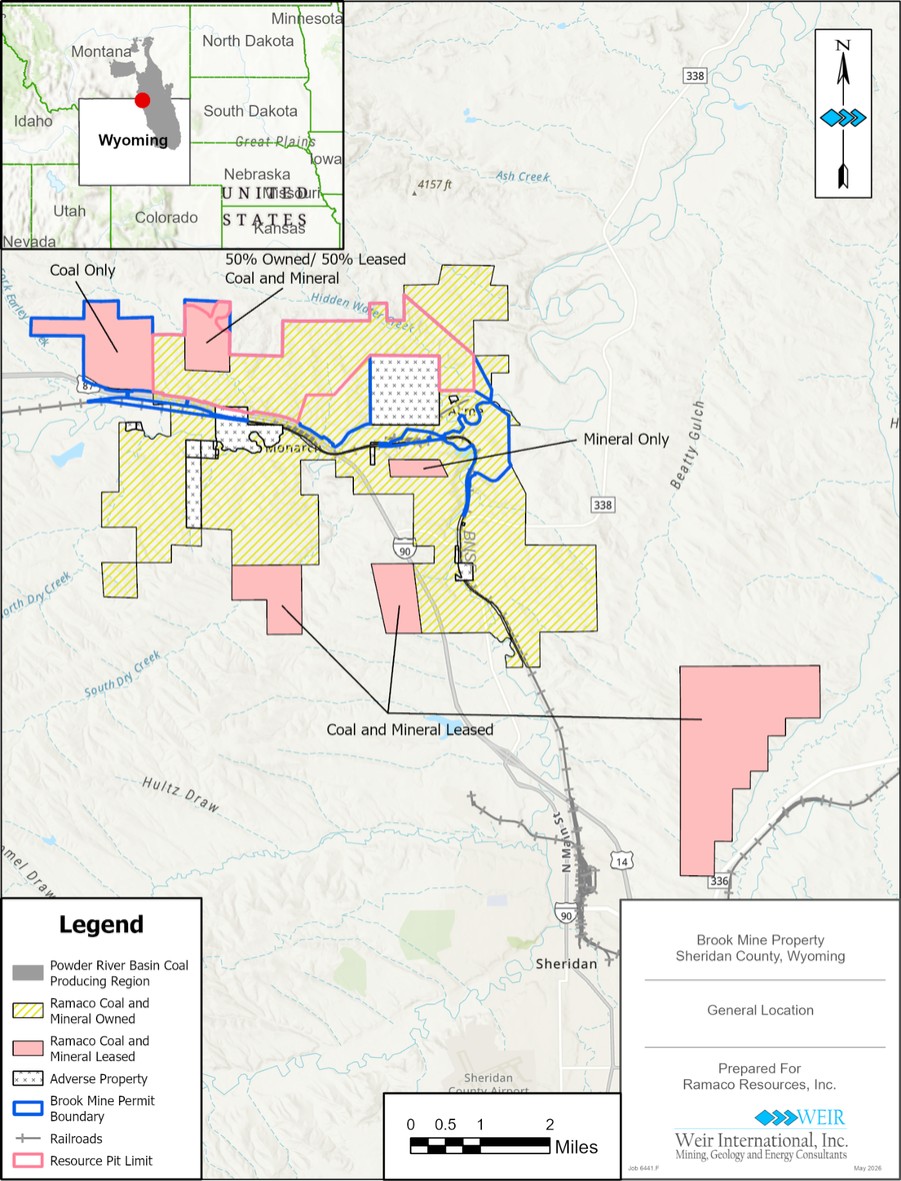
Ramaco’s Brook Mine is located within Ramaco’s mineral holdings located approximately seven miles north of Sheridan, Wyoming in Sheridan County. The Brook Mine is situated in the Sheridan Coal Field in the northwestern portion of the Powder River Basin (PRB) coal producing region of the United States (see Figure 1-1). The United States Geological Survey (USGS) 7.5-minute quadrangle maps are Acme, Hultz Draw, Monarch, and Sheridan.
The Brook Mine consists of approximately 15,800 acres of Ramaco controlled surface and mineral holdings located in Sheridan County, Wyoming. Ramaco acquired the Brook Mine in 2011 from the Sheridan-Wyoming Coal Company (SWCC). SWCC retained a nonparticipating coal royalty in the amount of $0.10 per clean coal ton. When Ramaco began development of the Brook Mine in 2012, Ramaco originally permitted approximately 4,500 acres that it regarded as the optimal area for a new surface coal mine. As Ramaco began further core drilling exploration in 2021 and 2022 relative to critical mineral exploration, Ramaco continued to drill in areas within the original coal mining permit boundary in order to leverage the existing drill core available for sampling.
| |
July 24, 2026 | Page 1 |
Technical Report Summary | |
|
As a result of the drilling concentration within the current coal mining permit boundary, the current Brook Mine Mineral Resource falls generally within the aerial extent of the existing coal mining permit boundary. This surface area represents less than 30 percent of the total acreage controlled by Ramaco in and around the Brook Mine.
Ramaco owns 93 percent of the mineral rights and controls the remaining 7 percent associated with the Brook Mine Mineral Resource estimate described in this TRS. Ramaco intends to purchase the remaining 7 percent un-owned portion of mineral rights. Acquisition costs have been included in the financial model in lieu of mineral royalties. Ramaco also owns 40 percent of the surface property with the balance controlled through surface access agreements and leases. The Burlington Northern Santa Fe (BNSF) Railroad and Interstate 90 are located along the southern boundary of the Brook Mine’s permit area.
Significant property encumbrances include: (i) the Laya coal lease area, excluded from resource estimation as the lease does not expressly provide the right to extract critical mineral oxides (CMO); (ii) a portion of the Padlock Surface Use Agreement area is subject to a surface mining restriction; and (iii) various railroad, highway, utility, and oil-and-gas rights-of-way with minimal impact on the current resource boundary. Ramaco holds no royalty interest in any property owned or operated by another party.
All existing permits for development of the Brook Mine are active and current for surface coal mining. A revision to the Mining and Reclamation Plan in the existing permit (WDEQ/LQD Permit No. 841-T1) will be required to specifically authorize CMO extraction and associated processing and tailings facilities.
| |
July 24, 2026 | Page 2 |
Technical Report Summary | |
|
Figure 1-1General Location Map
| |
July 24, 2026 | Page 3 |
Technical Report Summary | |
|
1.2 | Geological Setting and Mineralization |
The regional geology of this area is characterized by a sequence of sedimentary rocks that formed during the Late Cretaceous to early Paleocene Period. The stratigraphic sequence consists of interbedded sandstones, mudstones, and coal seams that were deposited in fluvial, deltaic, and lacustrine environments.
The primary coal seams that are associated with CMOs in the Brook Mine, in descending stratigraphic order, are the Dietz 1, Dietz 2, Dietz 3, Monarch, Upper Carney, Lower Carney, and Masters. There are also seven unnamed minor coal seams lying below the Masters Seam. The CMOs are understood to have been incorporated into the coal during its formation and are found in association with clay minerals and organic matter in the coal seams. The adjacent interburden strata directly above and below the coal seams contain elevated levels of CMOs, primarily in clays, carbonaceous clays, shales, and siltstones.
The United States Department of Energy National Energy Technology Laboratory (NETL) has proposed that CMOs may have migrated upward from depth through heated circulating fluids, leaching CMOs from primary source minerals and re-precipitating them at geochemical transition boundaries (coal-to-clay interfaces and pH/temperature gradients). This mechanism is consistent with the elevated concentrations observed at seam contacts.
For the purposes of this TRS, Mineral Resource estimation is limited to coal and seven Targeted Critical Minerals (TCMs) that have been determined to have reasonable prospects for economic extraction: dysprosium, gallium, germanium, neodymium, praseodymium, scandium, and terbium.
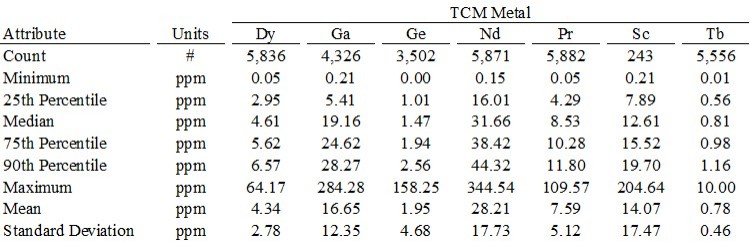
Summary statistics on an elemental basis for each of the TCMs from the drill hole assay database are shown in Table 1-1.
| |
July 24, 2026 | Page 4 |
Technical Report Summary | |
|
Table 1-1Brook Mine TCM Sample Statistics
1.3 | Exploration |
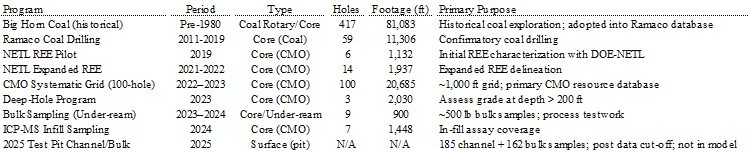
Ramaco’s exploration program for CMOs at the Brook Mine has evolved from an initial NETL-partnered characterization effort in 2019 into a systematic grid-based delineation drilling program. A summary of the Brook Mine drilling programs is provided in Table 1-2.
Table 1-2Brook Mine Drilling Programs
Ramaco’s CMO exploration has primarily relied on diamond core drilling on an approximate 1,000-foot north-south grid. Core recovery of 90 percent or greater are required; holes with lower recovery in targeted intervals are reviewed and may be excluded from grade modeling. Portable X-ray fluorescence (pXRF) screening of core was used to identify intervals for submission to ICP-MS assay laboratories. All geological, geophysical, and assay data are stored on a Ramaco server.
As of the June 30, 2025 data cutoff, the Brook Mine database includes 615 drill holes (including 417 historical Big Horn Coal rotary/cored holes adopted into the database), of which 128 holes contained ICP-MS CMO assay data comprising 5,903 individual sample analyses. The 128 CMO-assayed holes form the primary basis for the TCM block model and Mineral Resource estimate.
| |
July 24, 2026 | Page 5 |
Technical Report Summary | |
|
In the second half of 2025, Ramaco initiated a test mining pit in the south-central portion of the Brook Mine targeting the Dietz and Carney seams. This program yielded 185 channel samples and 162 bulk samples (approximately one ton each). Analysis of these samples was received in 2026 and, as results post-date the June 30, 2025 data cutoff, these samples are not incorporated into the resource model presented in this TRS. WEIR has reviewed the channel and bulk sample data and concludes that the results generally support the continuity of TCM grade across larger sampling areas.
Hydrogeological and geotechnical data programs supporting mine design are summarized in Sections 7.3 and 7.4 of this TRS. Groundwater monitoring (Carney and Masters seam wells, alluvium wells, underburden wells) has been active since 2013. Current data are appropriate for the permitted highwall mining configuration; additional hydrogeological characterization will be required as the mine plan advances to a deeper truck-and-shovel open-pit layout.
1.4 | Development |
The Brook Mine, as proposed in this TRS, will be developed as a conventional truck-and-shovel open-pit mine. Overburden and TCM Resources will be excavated by large hydraulic shovels and loaded into haul trucks. Waste material will be managed in external spoil piles with future potential for in-pit placement as mining advances. Blasting will be required for overburden removal however, dozers are expected to rip TCM Resources to facilitate selective loading and minimize dilution.
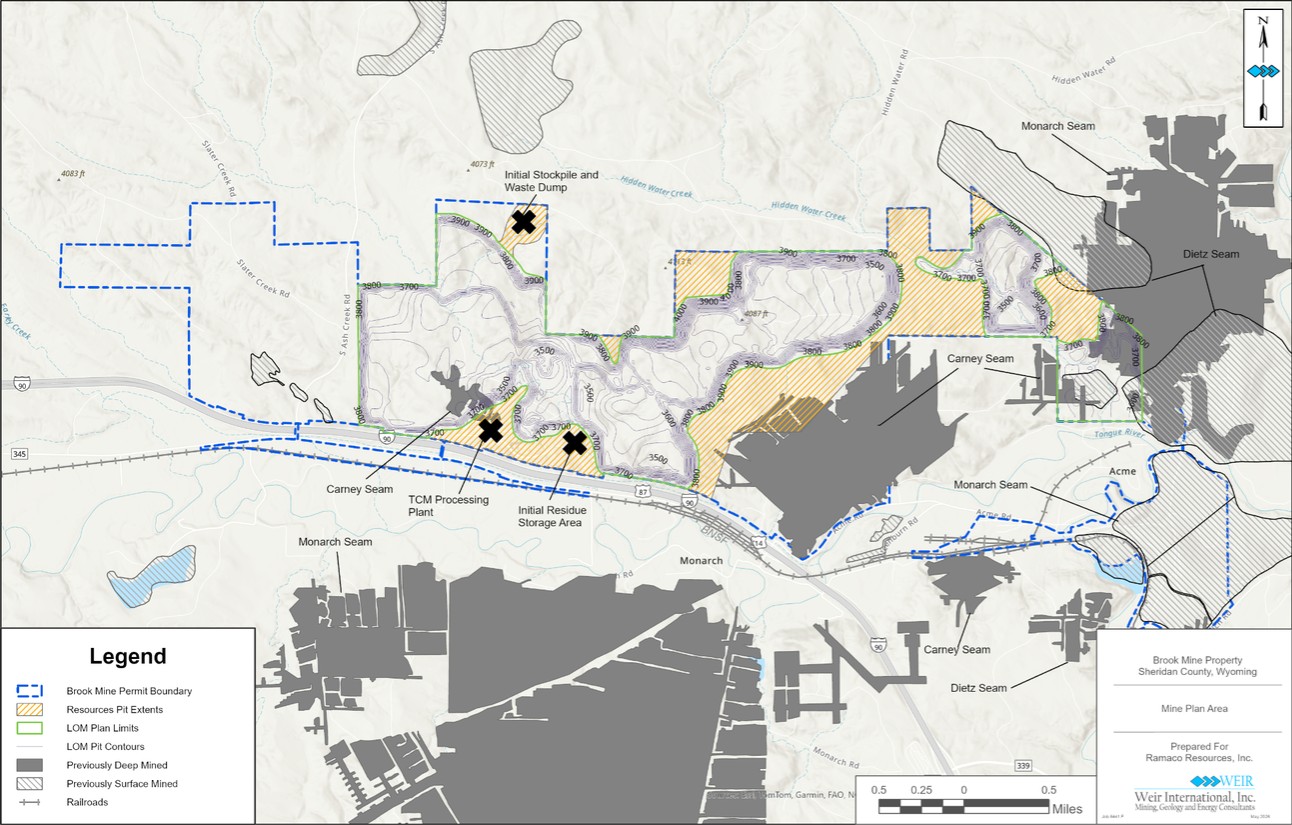
The conceptual Life-of-Mine (LOM) Plan is based on a revenue-factor 0.68 pit shell and encompasses approximately 1.09 billion tonnes of total material that would be mined over a 40-year production period. The operation targets a steady-state TCM process plant feed of approximately 2.63 million tonnes per annum (Mtpa). Mining commences in the northwest portion of the resource area and advances southeast and eastward through a series of nested pit phases.
Coal Resources will be mined concurrently with the TCM Resource and sold as a direct-shipped run-of-mine (ROM) thermal coal product without additional processing. The mine will require a total workforce of approximately 190 personnel (70 mine, 100 processing, 20 G&A) at full production.
The LOM Plan pit extents in conjunction with the TCM Resource pit extents are shown in Figure 1-2.
| |
July 24, 2026 | Page 6 |
Technical Report Summary | |
|
Figure 1-2Mine Plan Area
| |
July 24, 2026 | Page 7 |
| | |
Technical Report Summary | |
|
A multi-stage hydrometallurgical leaching process has been designed to recover TCMs from ROM feed material. The proposed flowsheet includes feed handling and comminution (mineral sizers and open-circuit ball mill), pretreatment, primary and secondary leaching and filtration, impurity removal via precipitation and ion exchange, and rare earth separation via solvent extraction. Gallium and germanium are recovered via selective solvent extraction in parallel circuits. The process plant is designed for a ROM throughput of 2.63 Mtpa and estimated power consumption of 9.3 MW. Filtered (dry-stack) tailings management is planned; heap leaching is not proposed.
Key infrastructure is detailed in Sections 4 and 15 of this TRS. The Brook Mine benefits from existing highway (I-90, US-87) and BNSF rail access, proximity to the Sheridan labor market, and established power supply from Montana-Dakota Utilities (MDU).
1.5 | Mineral Resource Estimate |
Mineral Resources for the Brook Mine are current as of December 31, 2025 (geological modeling data cutoff: June 30, 2025) and classified in accordance with SEC Regulation S-K Item 1302(d)(1)(iii)(A). All Mineral Resources are reported in the Inferred category. There are no Measured or Indicated Mineral Resources.
The Inferred classification reflects: (i) a sample spacing wider than what WEIR considers necessary to demonstrate the geological and grade continuity required for an Indicated classification; and (ii) the early-stage nature of metallurgical and economic studies at the Initial Assessment level.
Resources were constrained within a Revenue Factor 1.0 pit shell generated by Datamine Studio NPVS pit optimization using the commodity prices, processing recoveries, and cost parameters described in Section 11 of this TRS. A Net Smelter Return (NSR) marginal TCM cutoff of $67.69 per tonne was applied to classify TCM resources. All resources are reported on an in-situ (in-place) basis.
Pricing and recovery estimates for the seven TCM oxides and thermal coal (by-product) considered in the Resource estimate are summarized in Table 1-3:
| |
July 24, 2026 | Page 8 |
| | |
Technical Report Summary | |
|
Table 1-3TCM Recovery and Pricing Assumptions
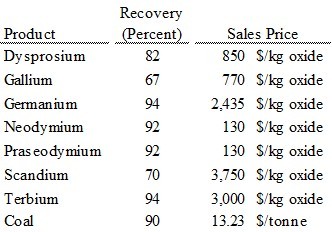
Table 1-4 presents the in-place TCM Mineral Resource estimate, and Table 1-5 presents the in-place Coal Resource estimate, both as of December 31, 2025.
Table 1-4In-Place TCM Resource Tonnage and Grade Estimate, as of December 31, 2025

Notes:
· | Coal and TCM resources are considered collectively in the evaluation of reasonable prospects of economic extraction with estimated revenues as follows: $850/kg Dy2O3, $770/kg Ga2O3, $2,435/kg GeO2, $130/kg Nd2O3, $130/kg Pr6O11, $3,750/kg Sc2O3, $3,000/kg Tb4O7, and $13.23/tonne coal. |
· | TCM processing recoveries are as follows: 82% Dy2O3, 67% Ga2O3, 94% GeO2, 92% Nd2O3, 92% Pr6O11, 70% Sc2O3, 94% Tb4O7. An overall recovery of 90 percent was applied to the coal. |
· | Mining costs of $1.33 per tonne were used for resource pit shell generation. A mining cost adjustment factor (MCAF) of 0.90 was used for TCM and waste rock types to account for the 45X production tax credit assumed. |
· | A Net Smelter Return (NSR) marginal TCM cutoff of $67.69 per metric tonne of rock was used to classify TCM resources as an Inferred Mineral Resource within the optimized pit shell. The marginal TCM cutoff consists of $69.80 per tonne of processing costs, $1.44 per tonne of G&A and $3.97 per tonne of TCM residue handling costs as well as an offset to the costs of 10 percent (-$7.52 per tonne) from the 45X production tax credit. NSR = (69.80 + 1.44 + 3.97) × (1 − 10%) |
· | TCM Resources were constrained within the revenue factor 1.0 pit shell described in Section 11.2. |
· | Numbers in the table have been rounded to reflect the accuracy of the estimate and may not sum due to rounding. |
| |
July 24, 2026 | Page 9 |
| | |
Technical Report Summary | |
|
Table 1-5In-Place Coal Resource Tonnage and Quality Estimate, as of December 31, 2025

Notes:
· | Coal and TCM resources are considered collectively in the evaluation of reasonable prospects of economic extraction with estimated revenues as follows: $850/kg Dy2O3, $770/kg Ga2O3, $2,435/kg GeO2, $130/kg Nd2O3, $130/kg Pr6O11, $3,750/kg Sc2O3, $3,000/kg Tb4O7, and $13.23/tonne coal. |
· | TCM processing recoveries are as follows: 82% Dy2O3, 67% Ga2O3, 94% GeO2, 92% Nd2O3, 92% Pr6O11, 70% Sc2O3, 94% Tb4O7. An overall recovery of 90 percent was applied to the coal. |
· | Mining costs of $1.33 per tonne were used for resource pit shell generation. A mining cost adjustment factor (MCAF) of 0.90 was used for TCM and waste rock types to account for the 45X production tax credit assumed. |
· | The effective marginal cutoff for coal resources is $0.05/tonne consisting of coal selling costs. Coal is sold as ROM product, and no additional processing is planned. |
· | A minimum seam thickness of two feet and the revenue factor 1.0 pit shell described in Section 11.2 were used to constrain the coal Inferred Resources. |
· | Numbers in the table have been rounded to reflect the accuracy of the estimate and may not sum due to rounding. |
The Mineral Resources reported herein are not Mineral Reserves and do not have demonstrated economic viability. The estimate is classified entirely as Inferred and is considered too speculative geologically to have the economic considerations applied that would enable conversion to Mineral Reserves. There is no certainty that any part of an Inferred Mineral Resources will ever be converted to Mineral Reserves. However, WEIR has a reasonable expectation that the majority of the Inferred Mineral Resources could be upgraded to Indicated or Measured Mineral Resources with continued exploration. Quantity and grade estimates have low confidence by definition.
1.6 | Economic Evaluation |
A preliminary discounted cash flow (DCF) economic analysis was conducted as part of this Initial Assessment to confirm reasonable prospects of economic extraction for the Brook Mine. The financial model was prepared by Mr. Woloschuk, P.Eng. (QP), based on the conceptual LOM mine plan developed by WEIR, cost estimates prepared by Fluor Enterprises, Inc. (Fluor)
| |
July 24, 2026 | Page 10 |
| | |
Technical Report Summary | |
|
and Mr. Woloschuk, and commodity pricing supported by internal and third-party western market studies.
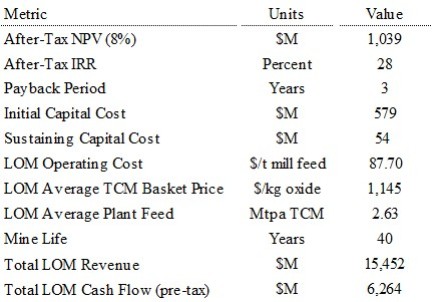
The model is structured on an annual basis over a 40-year LOM in real (constant-dollar) terms, excluding project financing costs. Key model parameters include: steady-state plant feed of 2.63 Mtpa; weighted average TCM oxide basket price of $1,145/kg oxide equivalent; initial capital expenditure of $579 million (including $106 million contingency; accuracy range -30 percent to +50 percent); LOM total operating cost of approximately $87.70 per tonne of TCM plant feed; and Wyoming state and federal taxes as applicable (no state income tax, 6 percent coal severance, 4 percent coal ad valorem, 4 percent TCM extractive taxes, 21 percent federal corporate tax). Section 45X Advanced Manufacturing Production Tax Credits are incorporated at 10 percent of the TCM mining and processing costs. Applicable coal royalties are included in operating costs.
Key economic metrics from the financial model are summarized in Table 1-6:
Table 1-6Economic Analysis Summary
A sensitivity analysis was conducted on after-tax basis for NPV at an eight percent discount rate (NPV8) and IRR over a +/−20 percent range for commodity prices, capital costs, and operating costs, as presented on Figures 19-1 and 19-2 of this TRS. The key sensitivity metrics are summarized in Table 1-7 below:
| |
July 24, 2026 | Page 11 |
| | |
Technical Report Summary | |
|
Table 1-7Sensitivity Metrics
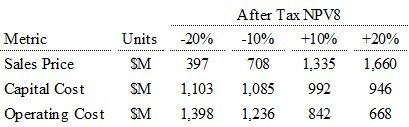
This economic analysis is an Initial Assessment based entirely (100 percent) on Inferred Mineral Resources. Unlike Mineral Reserves, Mineral Resources do not have demonstrated economic viability. An Initial Assessment cannot be used as the basis for disclosure of Mineral Reserves. The results should be considered preliminary and are subject to risk given the early-stage nature of the project, including the risks detailed throughout this report and summarized in Section 22.2.
1.7 | Environmental Studies and Permitting Requirements |
Environmental baseline studies for the Brook Mine were conducted in support of WDEQ/LQD Permit to Mine No. 841-T1 (issued July 7, 2020), which covers 4,541 acres and authorizes surface coal mining in Sheridan County, Wyoming. Baseline studies include land-use inventory, cultural resources review, climatology baseline, topography and geologic hazard assessment, comprehensive hydrology baseline (surface and groundwater), soil resources, vegetation inventory, wildlife baseline, wetlands delineation, and alluvial valley floor investigation. These studies represent a regulator-reviewed environmental characterization.
Active permits and environmental authorizations as of the effective date of this TRS include:
· | WDEQ/LQD Surface Mining Permit No. 841-T1 (July 7, 2020) - surface coal mining; 4,541 acres; active and current. |
· | WDEQ/AQD Air Quality Permit No. P0025939 (July 20, 2020) - active and current. |
· | WYPDES Industrial Stormwater Permit - issued for existing operations. |
· | MSHA ID# 4801799 - assigned to the planned Brook Mine. |
Additional permits and regulatory approvals required prior to CMO mining and processing operations include:
· | Revision to Mine Plan Permit No. 841-T1 to specifically authorize CMO extraction, deeper pit development (Masters Seam and below), and revised reclamation plan, |
| |
July 24, 2026 | Page 12 |
| | |
Technical Report Summary | |
|
including updated surety bond sized to cover full reclamation including CMO process plant and tailings.
· | WYPDES permit(s) for point-source discharges from the CMO process plant, tailings underdrains, stormwater contact areas, and pit dewatering. |
· | Air quality permit revision or new permit for CMO processing emissions. |
· | Additional groundwater monitoring well program (Wall Seam wells) to support future permit revision. |
Bonding and Asset Retirement Obligations (ARO):
· | Current reclamation bond: approximately $1.47 million (WDEQ bond matrix, as of December 31, 2025). |
· | Current ARO estimate: $240,475 (as of October 2025). Ramaco plans to update for the LOM Plan once CMO processing and waste management facility designs are completed. |
· | Preliminary conceptual mine closure cost estimate: approximately $100 million, based on benchmark projects of similar scale and commodity in the region. This estimate will require updating as engineering advances. |
There are no anticipated adverse effects on the alluvial valley floor of the Tongue River or other major streams adjacent to the permit boundary. Overburden geochemical analysis indicates no significant acid mine drainage risk. Ramaco has not been cited for any permit non-compliance at the Brook Mine.
The primary pre-mining and approved post-mining land use for the Brook Mine permit area is grazing land. Reclamation will follow coal and TCM extraction to near Approximate Original Contour (AOC) in accordance with WDEQ/LQD permit requirements. An internal Ramaco budget supports advancement through the Preliminary Feasibility Study phase, at which time updated environmental studies, engineering designs, and permitting applications will be prepared.
Ramaco currently employs 12 personnel at the Brook Mine and projects maximum employment of approximately 190 personnel at full production, representing a significant economic contribution to the Sheridan, Wyoming community. No outstanding disputes with local individuals or groups have been identified.
| |
July 24, 2026 | Page 13 |
| | |
Technical Report Summary | |
|
1.8 | Conclusions and Recommendations |
1.8.1 | Interpretations and Conclusions |
Based on the geological, technical, and economic work summarized in this TRS, WEIR and Mr. Woloschuk draw the following principal conclusions:
The Brook Mine hosts laterally continuous coal seams together with adjacent carbonaceous claystone, clay, shale, and siltstone intervals that carry TCM mineralization consistent with the Initial Assessment described herein. Geological modeling and block model validation confirm that the Inferred Mineral Resource classification is appropriate given current data density and confidence levels.
Ramaco controls sufficient mineral rights and associated surface access to support the reported Inferred Mineral Resource and the proposed mining operations. Excluded lease and surface-restricted areas have been removed from the resource estimation boundary.
The Brook Mine is favorably situated with respect to infrastructure, including highway and rail access, electric power, water supply, and proximity to the Sheridan community, providing a supportive foundation for project development.
Metallurgical testwork completed to date (bench scale, eight months of testing by Hazen Research; process engineering by Fluor and Hatch) indicates that the TCMs can be recovered using the proposed hydrometallurgical flowsheet based on established unit operations. Testwork is at an early stage and additional optimization, and variability testing are required.
The conceptual open-pit mine plan using conventional truck-and-shovel methods is appropriate for the multi-seam stratigraphic section. The Initial Assessment economics are supported by a positive after-tax NPV at an eight percent discount rate. These results confirm reasonable prospects of economic extraction sufficient to support the Inferred classification.
The Brook Mine is an exploration stage property at an early stage of development. All Resources are Inferred. No Mineral Reserves have been declared, and none can be declared based on an Initial Assessment.
| |
July 24, 2026 | Page 14 |
| | |
Technical Report Summary | |
|
1.8.2 | Significant Risks and Uncertainties |
The Brook Mine is subject to risks and uncertainties typical of an early-stage mining project, augmented by the novel nature of coal-hosted TCM mineralization and the proposed recovery process. Key risks include:
· | Geological confidence: limited geological evidence of grade or quality continuity associated with Inferred Resources; grade and seam continuity remain to be confirmed with additional infill drilling. |
· | Metallurgical and process risk: bench-scale testwork is not fully representative of all mineralized domains; additional variability testing and pilot testing is necessary to confirm recoveries and product quality. |
· | Permitting: revision to existing mining permit required for TCM extraction; additional permits required for processing and tailings facilities; timeline and outcome uncertain. |
· | Commodity price volatility: TCM prices are subject to significant variability based on supply-demand dynamics, Chinese export policy, and western market developments; pricing may differ from long-term price forecast assumptions used. |
· | Capital and operating cost uncertainty: Capital expenditure estimate accuracy is -30 percent / +50 percent with a contingency of 25%; actual costs may differ materially as engineering advances. |
· | Geotechnical and hydrogeological: limited site-specific pit-wall slope-stability data for the revised open-pit design; deeper hydrogeological characterization required. |
· | Mineral rights: potential need for permit amendment to cover TCM mining rights under existing mineral conveyances; Pine Mountain Oil and Gas holds oil, gas, and coalbed methane rights across the property. |
1.8.3 | Recommendations |
The QPs of this TRS recommend that Ramaco continue to advance the Brook Mine through a focused, integrated program targeting the activities listed in Table 1-8. The program is designed to improve geological confidence, reduce technical risk, and support the economic assumptions
| |
July 24, 2026 | Page 15 |
| | |
Technical Report Summary | |
|
used in this Initial Assessment, with the objective of advancing the project to a Preliminary Feasibility Study level.
Table 1-8Recommended Work Program Summary
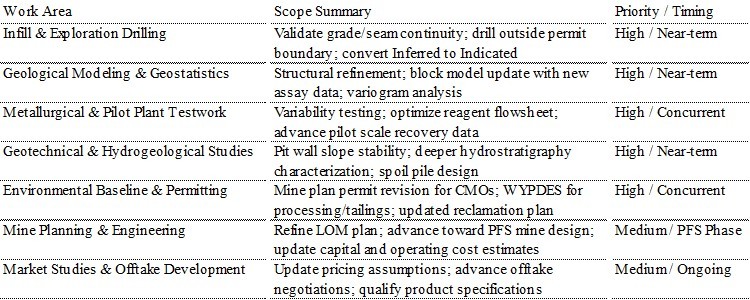
These recommendations should be pursued as an integrated program rather than as isolated technical tasks. Geological drilling, quality assurance and quality control (QA/QC), and geostatistical analysis should proceed in parallel with metallurgical variability testing so that updated resource models, mine plans, and process assumptions can be developed concurrently.
These recommendations are intended to reduce the material risks and uncertainties identified above and to improve the technical basis for future decision-making.
| |
July 24, 2026 | Page 16 |
| | |
Technical Report Summary | |
|
2.0 | Introduction |
2.1 | Registrant |
WEIR was retained by Ramaco (Nasdaq: METC) to prepare this TRS which provides an Initial Assessment of Ramaco’s critical mineral and coal deposit located within the Brook Mine. The Brook Mine is located within Ramaco’s mineral holdings located approximately seven miles north of Sheridan, Wyoming.
2.2 | Terms of Reference and Purpose |
This TRS was prepared specifically for Ramaco’s Brook Mine to support the first-time disclosure of Mineral Resources within the Brook Mine, and it describes the results of an Initial Assessment which supports those Mineral Resources, including a conceptual mine plan, process description, cost estimates, and an economic analysis of the Mineral Resources.
Mineral Resources have been classified in accordance with SEC mining property disclosure rules under Subpart 1300 and Item 601 (96)(iii)(B) of Regulation S-K.
This Initial Assessment is preliminary in nature. It includes Inferred Mineral Resources that are considered too speculative geologically to have the economic considerations applied that would enable these Inferred Mineral Resources to be categorized as Mineral Reserves, and there is no certainty that the Initial Assessment will be realized. Mineral Resources are not Mineral Reserves and do not have demonstrated economic viability.
This TRS utilizes mixed units of measure as noted. Resource grades are presented in parts per million (ppm) while resource and product tonnages are expressed in Metric Tonnes (tonnes) unless otherwise noted. The primary linear distance units are feet (ft) or miles unless otherwise noted. Currency units are in United States dollars ($) and CMO pricing is presented in United States dollars per kilogram ($/Kg). All costs are presented in United States dollars ($).
Geographical coordinates within this TRS are projected in the Wyoming East Central system utilizing the horizontal North American Datum of 1983 (NAD83) in feet.
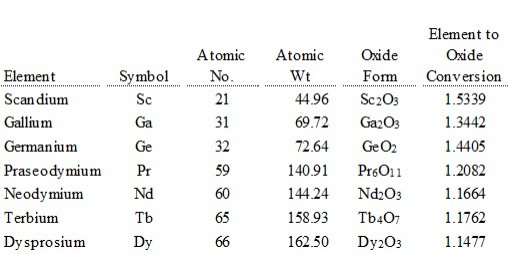
For purposes of this TRS, Mineral Resource estimation is limited to a select group of seven CMOs referred to as the TCMs, which have been determined to have reasonable prospects for economic extraction, and are detailed in Table 2-1 as follows:
| |
July 24, 2026 | Page 17 |
| | |
Technical Report Summary | |
|
Table 2-1Targeted Critical Minerals
2.3 | Sources of Information and Data |
The primary information used in this study was obtained from the following sources:
· | Drilling geological data provided by Ramaco. The geological data includes drill hole information such as driller’s logs, geologist’s logs, both full and partial scans of geophysical logs, survey data, and MS Excel™ (Excel) versions of drill hole survey and lithology data. |
· | ICP-MS CMO quality laboratory analysis certificates and Excel versions |
· | Other data provided by Ramaco and fully relied upon by the QPs when preparing their findings and conclusions regarding aspects of modifying factors includes: |
· | Macroeconomic data, including corporate tax rates, and discount rates for determining NPV |
Ø | Marketing information regarding the target commodities that will be produced by the Brook Mine (specifications on product quality, form of product to be sold, long-term market price) |
Ø | Legal information such as mineral rights, surface rights, property agreements, encumbrances on the properties, royalties, depreciation, and government taxes or credits reflected in various economic assumptions. |
Ø | Environmental information such as permitting requirements and status |
Ø | Government information such as Section 45X tax credit applicability and duration, State/Local severance and ad valorem taxes |
A detailed list of all data received and reviewed for this study is provided in Sections 24 and 25 of this TRS.
| |
July 24, 2026 | Page 18 |
| | |
Technical Report Summary | |
|
2.4 | Details of the Personal Inspection of the Property |
WEIR personnel, including QPs, most recently visited the site on April 28, 2026. WEIR met with various Ramaco personnel at Ramaco’s site office and discussed project status and plans.
While on-site, WEIR personnel conducted interviews with Ramaco Personnel, including its:
· | Executive VP - Western Operations |
· | Senior VP - Engineering & Permitting |
· | VP - Critical Minerals & Carbon Products |
· | Field Geologists |
· | Contract Drillers |
During these interviews, WEIR collected information relative to past, present and future exploration plans, sampling practices and procedures, land and mineral rights ownership and control, and other field information to meet regulatory requirements to progress the project.
WEIR personnel visited the Brook Mine site to observe drilling equipment and activities, and general site layout and conditions, including the test pit location. WEIR personnel visited the Ramaco Innovating Carbon Advanced Materials (iCAM) Center, which serves as the Brook Mine field office. WEIR also visited the Brook Mine core logging facility, pilot plant (under construction), and core storage locations.
WEIR concluded that Ramaco has facilities and equipment that are more than adequate to perform the tasks required for Ramaco’s exploration programs. At the time of the site visit, four drilling rigs were onsite with two operational drilling portions of the fence section in the central portion of the property.
Mr. Woloschuk first visited the Brook Mine on October 24, 2024 and has conducted approximately four visits through December 31, 2025. During these visits Mr. Woloschuk visited the Brook Mine test pit to observe exposures of the mineralized zones and the site topography.
2.5 | Previous Technical Report Summaries |
Ramaco previously filed the following Technical Report Summaries on the Brook Mine:
| |
July 24, 2026 | Page 19 |
| | |
Technical Report Summary | |
|
· | Technical Report Summary - Brook Mine Property - Rare Earth Exploration Target, dated 5/2/2023 |
· | Technical Report Summary - Brook Mine Property - Rare Earth Exploration Target, dated 3/21/2024 |
· | Technical Report Summary - Brook Mine Property - Rare Earth Exploration Target, dated 3/31/2025 |
Further, this TRS revises a TRS dated September 17, 2025, effective June 30, 2025, and filed on February 26, 2026. This revised TRS updates the effective date to December 31, 2025 with respect to assumptions and the knowledge of QPs. This report supersedes all prior technical report summaries filed by the registrant concerning this property.
2.6 | Qualified Persons |
This report was compiled by WEIR, with contributions from Mr. Mike Woloschuk of Ramaco. WEIR meets the requirements of a third-party firm comprising mining experts in accordance with 17 CFR § 229.1302(b)(1)(iii) and Mr. Woloschuk meets the definition of a Qualified Person in 17 CFR §1300 for those sections of the report that each is responsible for preparing.
WEIR prepared the following sections of the report:
· | Section 1 (Executive Summary) |
· | Section 2 (Introduction) |
· | Section 3 (Property Description) |
· | Section 4 (Accessibility, Climate, Local Resources, Infrastructure & Physiography) |
· | Section 5 (History) |
· | Section 6 (Geological Setting, Mineralization, and Deposit) |
· | Section 7 (Exploration) |
· | Section 8 (Sample Preparation, Methods, Analysis, and Security) |
· | Section 9 (Data Verification) |
· | Section 11 (Mineral Resource Estimates) |
· | Section 12 (Mineral Reserve Estimates) |
· | Section 13 (Mining Methods) |
· | Section 17 (Environmental Studies, Permitting, and Plans) |
· | Section 20 (Adjacent Properties) |
· | Section 21 (Other Relevant Data and Information) |
· | Section 22 (Interpretations and Conclusions) |
· | Section 23 (Recommendations) |
· | Section 24 (References) |
· | Section 25 (Reliance on Information Provided by the Registrant) |
In sections of this report prepared by WEIR, references to the Author, Qualified Person, or QP are references to WEIR and not to any individual employed at WEIR.
| |
July 24, 2026 | Page 20 |
| | |
Technical Report Summary | |
|
Mr. Woloschuk prepared the following sections of the report:
· | Section 10 (Mineral Processing and Metallurgical Testwork) |
· | Section 14 (Processing and Recovery Methods) |
· | Section 15 (Project Infrastructure) |
· | Section 16 (Market Studies and Contracts) |
· | Section 18 (Capital and Operating Cost Estimates) |
· | Section 19 (Economic Analysis) |
· | Related contributions to Section 1 (Executive Summary), Section 2 (Introduction), Section 22 (Interpretation and Conclusions), Section 23 (Recommendations), Section 24 (References), and Section 25 (Reliance on Information Provided by Registrant) |
| |
July 24, 2026 | Page 21 |
| | |
Technical Report Summary | |
|
3.0 | Property Description |
3.1 | Property Location |
The Brook Mine is located within Ramaco’s mineral holdings in Sheridan County, Wyoming, approximately seven miles north of the city of Sheridan. The BNSF Railroad and Interstate 90 are located along the southern boundary of the Brook Mine’s permit area.
The Brook Mine is situated in the Sheridan Coal Field in the northwestern portion of the PRB coal producing region of the United States (see Figure 1-1). The USGS 7.5-minute quadrangle map sheets are Acme, Hultz Draw, Monarch, and Sheridan, and the property lies within Townships 56 and 57 North, Ranges 84 and 85 West. The test pit within the Brook Mine is located near a latitude of 44 degrees 55 minutes North and longitude of 103 degrees and 3 minutes West.
3.2 | Property Area |
The Brook Mine covers a portion of the approximately 15,800 acres of Ramaco owned and leased mineral holdings located in Sheridan County, Wyoming. Ramaco acquired the mineral holdings in 2011 from the SWCC, then a subsidiary of The Brinks Company.
When Ramaco began development of the Brook Mine as a thermal coal resource in 2012, Ramaco permitted approximately 4,500 acres that it regarded as the optimal area for a new surface coal mine. As Ramaco began further core drilling exploration in 2021 and 2022 relative to CMO exploration, Ramaco decided to continue to drill in areas within the original permit boundary and at comparable depths related to coal mining in order to leverage the existing drilling core available for sampling.
As a result of the drilling concentration within the existing mining permit boundary, the current Brook Mine Mineral Resource falls within the aerial extent of the current coal mining permit boundary. This Brook Mine surface area represents less than 30 percent of the total mineral acreage controlled by Ramaco in Sheridan County.
Ramaco owns 93 percent of the mineral rights and controls the remaining 7 percent associated with the Brook Mine Mineral Resource estimate described in this TRS. Ramaco also owns 40 percent of the surface rights associated with the Brook Mine Mineral Resource. The remaining
| |
July 24, 2026 | Page 22 |
| | |
Technical Report Summary | |
|
60 percent of surface rights are controlled through reserved surface access rights, surface access agreements, and leases.
No coal, mineral, or surface estate within the Brook Mine is federally owned or federally leased as of December 31, 2025. Accordingly, the federal regulatory framework that applies to leasable federal coal under the Mineral Leasing Act of 1920 (30 U.S.C. §181 et seq.; 43 CFR Group 3400) and to federal coal leasing decisions does not apply.
Ramaco’s owned facilities in the Sheridan, Wyoming area include its operations office, which also houses the Ramaco iCAM Center. The iCAM Center is an integrated carbon resource, research and development, and production facility. Ramaco also has numerous Conex trailers as well as rental storage units for storage of drill hole cores.
3.3 | Surface Control |
Ramaco was granted a mineral deed from the SWCC on August 17, 2011. The SWCC had previously deeded the surface rights, as described in Table 3-1, to Big Horn Coal Company on June 28, 1954, and recorded in Deed Book 98, Page 127 in the Sheridan County Courthouse. The deed grants Ramaco all coal and other minerals contained in all of the lands included in the lease, together with the right to mine, explore, drill, extract, and remove the same. The deed also grants Ramaco the right to use surface lands, as needed, to mine, explore, drill, extract, and remove said coal and other minerals.
Further, the deed grants that should Ramaco mine, drill, explore, extract, process, and remove coal or other minerals and utilize any part of the surface lands in connection with those activities, Ramaco will remain free from any liability or claim for damage to the surface of said lands related to subsidence or other injury to the surface of said lands resulting from such operations, however, Ramaco will be responsible for complying with statutory obligations under the Wyoming Environmental Quality Act, the Wyoming Land Quality Division coal rules, the Surface Mining Control and Reclamation Act of 1977 (SMCRA) as implemented by Wyoming’s approved program, and Wyoming water-quality law.
Ramaco was granted a Surface Owner Consent and Surface Use Agreement from Padlock Ranch Company on September 1, 2016. The agreement provided Ramaco with surface owner consent to mining certain surface lands located in Sheridan County, Wyoming, which can be extended five years up to four times. There is an area within Sections 17 and 20 where Ramaco agreed not to surface mine. These surface mining exclusion areas are excluded from Mineral
| |
July 24, 2026 | Page 23 |
| | |
Technical Report Summary | |
|
Resource estimation at this time. The Surface Use Agreement requires an annual payment of $43,500 for surface disturbance. After the fifth anniversary and every five years thereafter, the annual payment is adjusted by the Consumer Price Index for All Urban Consumers (CPI-U).
Ramaco Wyoming Coal Co., LLC (Ramaco) was also granted by Warranty Deed from Taylor Investments, LLC (Taylor) on September 17, 2025, the surface lands, coal and mineral rights, improvements, appurtenant water rights and related permits, and ditch rights controlled by Taylor.
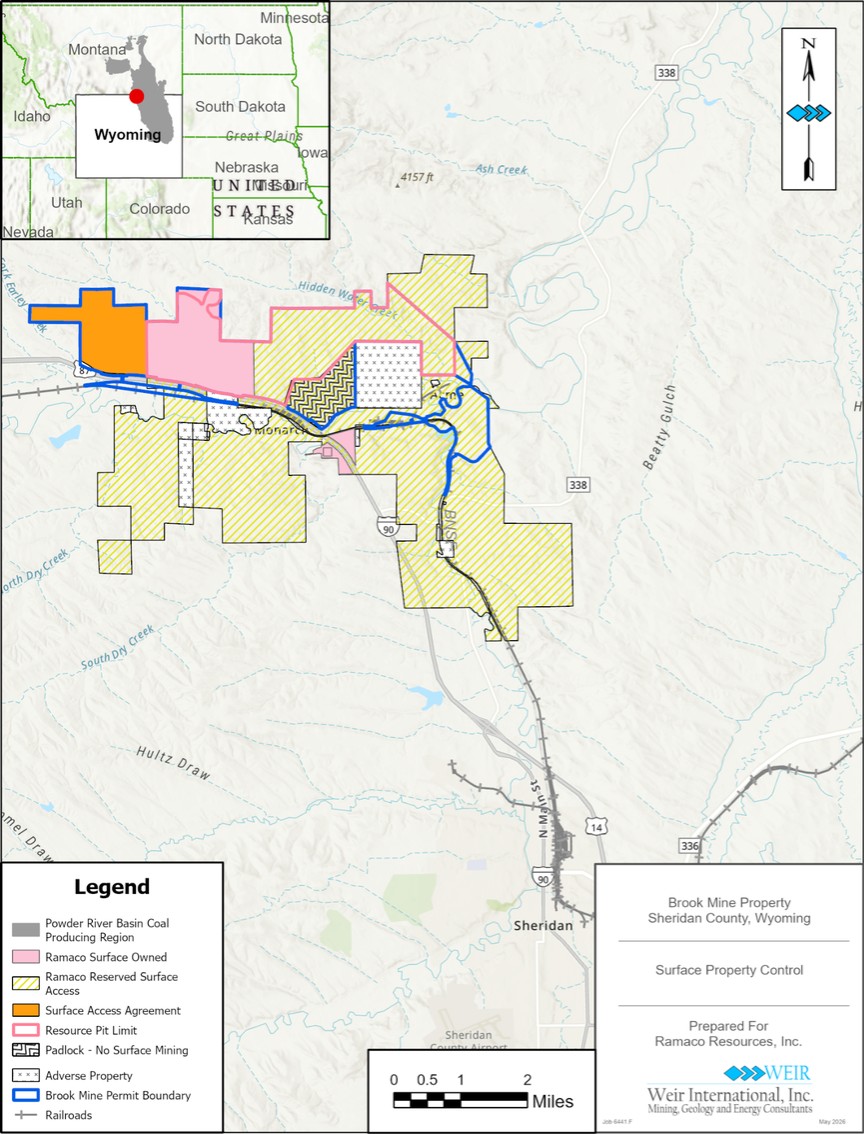
The details of surface property control relative to these deeds and leases are described in Table 3-1 and shown on Figure 3-1, as follows:
Table 3-1Surface Property Control
Bighorn Coal Company Surface Lands | |
Township 57 North, Range 84 West, 6th P.M., Sheridan County, WY | |
Section 3: | SW¼SE¼, S½SW¼ |
Section 7: | E½SE¼ |
Section 8: | S½ |
Section 9: | NE¼, SW¼NW¼, S½ |
Section 10: | NE¼, SW¼NW¼ |
Section 14: | That part of SW¼SW¼ lying south of the Tongue River |
Section 15: | NE¼NE¼, W½NE¼, NW¼, W½SE¼, E½SE¼ south or Tongue River, the SW¼ excepting therefrom (i) the Acme townsite sold to Gothard Bylund in certain Agreement for Warranty Deed and Bill of Sale dated July 15, 1953, and (ii) certain tracts of land deeded to Montana-Dakota Utilities Company, described as follows: Beginning at a point 50 feet north 26° 54’ 30” west of a point which is 1984.5 feet north 31° 23’ east from the southwest corner; thence south 69° 6’ west 100.51 feet; thence north 26° 54’ 30” west 420.82 feet; thence north 24° 54’ east 127.24 feet; thence south 86° 14’ west 509.5 feet; thence south 26° 55’ east 363.2 feet; thence south 69° 6’ west 477.6 feet to the point of beginning. |
Section 17: | All |
Section 18: | E½ |
Section 19: | NE¼NE¼, All of SE¼NE¼ except the SW¼ thereof sold to William Long, also all that portion of NW¼NE¼ lying East of Tongue River |
Section 20: | NW¼, NW¼SW¼, All NE¼ north of C. B. & Q. Railroad Company right-of-way |
Section 21: | All except tracts and lots of Model Townsite owned by parties of record, and except that portion of SW¼NW¼ lying between the North line of the C. B. & Q. Railroad right-of-way and the North line of said SW¼NW¼, consisting of 4 acres, more or less, as conveyed to Bruno Romeo. |
Section 22: | All |
Section 27: | N½SE½, and the N½ except a tract of land described as .follows: Beginning 535.5 feet north 59° 30’ east from the West Quarter corner of said Sec. 27; thence north 16° 12’ east 200 feet; thence south 73° 48’ east 200 feet; thence south 16° 12’ west 200 feet; thence north 73° 48’ west 200 feet to the point of beginning. |
Section 28: | NE¼, N½SE¼ |
Township 57 North, Range 85 West, 6th P.M., Sheridan County, Wyoming: | |
A certain tract in Sections 14 and 23 as described in Warranty Deed dated January 26, 1916 from George Masters to Peter Kooi, recorded in Book Z of Deeds, Page 214 County Clerk’s Office | |
Padlock Surface Lands | |
Township 57 North, Range 84 West, 6th P.M., Sheridan County, WY | |
Section 7: | E½SE¼ |
Section 8: | S½ |
Section 15: | SE¼SW¼ Part Containing 5 acres more or less |
Section 17: | All |
Section 18: | E½ lying north of I-90 ROW |
| |
July 24, 2026 | Page 24 |
| | |
Technical Report Summary | |
|
Section 20: | That portion of N½ located north of I-90 ROW and north of Acme Road ROW containing 81 acres more or less |
Section 21: | NW¼ Part and W1/2NE¼ Part Containing 4 acres more or less |
Ramaco Wyoming Coal Co., LLC Surface Lands | |
Township 57 North, Range 84 West, 6th P.M., Sheridan County, Wyoming: | |
Section 18: | NW¼, N½SW¼ and SE¼SW¼ |
ALSO, All that portion of Lot 4 (SW¼SW¼) lying north of the northerly right of way line of Interstate Highway No. 90, said northerly right of way line being of hereinafter stated distances to the left or northerly side measured at right angles or radially to the following described survey line of highway, said parallel right of way line beginning on the west boundary and ending on the east boundary of said Lot 4; beginning at a point on said west boundary from which the southwest corner of Section 18 bears S. 0° 30’ E. a distance of 862.5 feet; thence with said parallel right of way lines 270 feet to the left or northerly side, S. 81° 23.6’ E. a distance of 876.2 feet; thence with said parallel right of way line 210 feet to the left or northerly side, continuing S. 81° 23.6’ E. a distance of 455 feet, more or less, to a point on said east boundary. | |
EXCEPTING THEREFROM a parcel of land conveyed to The State of Wyoming Highway Commission of Wyoming by Warranty Deed recorded February 10, 1981 in Book 255, Page 70. | |
Township 57 North, Range 85 West, 6th P.M., Sheridan County, Wyoming: | |
Section 11: | SE¼SE¼ |
Section 12: | SW¼SW¼, S½NE¼, SE¼NW¼, SE¼, E½SW¼ |
Section 13: | N½, NE¼SE¼, All of the SW¼ and W½SE¼ lying North of Interstate 90; also all that portion of the SE¼SE¼ lying north of the northerly right of way line of Interstate Highway No. 90, said northerly right of way line being 270 feet to the right or northerly side when measured at right angles to the following described survey line of highway, said northerly right of way begins on the east boundary and ends on the north boundary of said SE¼SE¼; beginning at a point on said east boundary from which the southeast corner of said Section 13, bears S0° 30’E, a distance of 862.5 feet; thence N81° 23.6’W a distance of 82.9 feet to the point of beginning of a 1° 00’ circular curve to the right, the radius of which is 5,729.6 feet; thence along said curve through a central angle of 10° 38.4’ a distance of 1,064.1 feet to the point of ending of said curve; thence N70° 45.1’W a distance of 45 feet, more or less, to a point on the west boundary of said SE¼SE¼ from which the northwest corner thereof bears northerly a distance of 230 feet, more or less. |
Section 14: | E½NE¼, and all of the NE¼SE¼ excepting therefrom the following tract of land, to-wit: Beginning at the Southeast corner of said NE¼SE¼; thence West to the Southwest corner of said NE¼SE¼; thence North 205 feet to the South line of the County Road; thence Southeasterly along said road to the East line of said Section 14; thence South 27 feet to the point of beginning. |
EXCEPTING THEREFROM a parcel of land conveyed to G.B. Masters in a Warranty Deed recorded October 17, 1902 in Book M, Page 57. | |
EXCEPTING THEREFROM a parcel of land conveyed to The State Highway Commission of Wyoming by Warranty Deed recorded February 10, 1981 in Book 255, Page 70. | |
TOGETHER WITH all (a) coal and mineral rights owned by the Grantor, (b) executive rights for all coal and mineral rights owned by the Grantor (c) improvements, (d) appurtenant water rights and related permits, (e) ditch rights, if any, (f) and all other privileges, hereditaments and appurtenances thereunto belonging to or appertaining; and, | |
SUBJECT TO: (a) record reservations and exceptions in patents from the United States or the State of Wyoming; (b) prior recorded mineral reservations in any patents or allotment instruments or in the chain of title thereafter; (c) easements, leases, restrictions, covenants and rights-of-way of record; (d) any state of facts which would be disclosed by an accurate survey and/or physical inspection of the premises; (e) an assigned unrecorded grazing lease between Grantor and Sean Carroll dated September 8, 2025 and expiring by its terms on February 28, 2026; (f) an assigned unrecorded Scoria Mine Licensing Agreement dated November 4, 2019, thereafter extended on September 12, 2025; and, | |
FURTHER SUBJECT TO a reserved personal possessory right in LeRoy Taylor aka LeRoy Dale Taylor in a thirty foot (30‘) wide access easement to and use of the existing Cleary Building on part of the Property, the use of said building and associated fixtures, and an area approximately fifty-one feet (51‘) around said building and associated fixtures as is more specifically described and depicted in the attached Exhibit “1” (the Premises”). Said interest terminates and expires by its terms on September 15, 2027, and is more specifically set forth and conditioned in a First Amendment to Real Estate Purchase Agreement dated September 15, 2025, which terms and conditions shall not merge in this instrument upon its delivery and acceptance. | |
| |
July 24, 2026 | Page 25 |
| | |
Technical Report Summary | |
|
Figure 3-1Surface Property Control
| |
July 24, 2026 | Page 26 |
| | |
Technical Report Summary | |
|
3.4 | Mineral Control |
Ramaco was granted a mineral deed from SWCC on August 17, 2011. The mineral deed granted Ramaco all of Grantor’s right, title and interest in the coal and other minerals, except the oil, gas and coalbed methane for the mineral. The mineral deed also reserved a nonparticipating coal royalty in the amount of $0.10 per clean coal ton payable to SWCC.
In addition to Ramaco’s surface use rights, Taylor granted Ramaco, by Warranty Deed from Taylor on September 17, 2025, the surface lands, coal and mineral rights, improvements, appurtenant water rights and related permits, and ditch rights controlled by Taylor. As part of the Taylor purchase, Ramaco assumed executive rights of the remaining mineral interest alongside the 50 percent interest purchased from Taylor.
In addition to the SWCC and Taylor agreements, Ramaco was granted a Coal Mining Lease Agreement, originally executed on November 16, 2012, by and between William J. Laya and Joyce J. Laya, Trustees of the William J. Laya Trust under Trust Agreement dated November 19, 1993, and Joyce J. Laya and William J. Laya, Trustees of the Joyce J. Laya Trust under Trust Agreement dated November 19, 1993 and Thomas C. Laya (collectively, Laya). The Laya Agreement granted Ramaco the exclusive right and privilege to mine, extract, and remove all of the coal deposits, and other minerals commingled therewith in and under the land for a period of 20 years, and from year to year thereafter until all mineable and merchantable coal has been exhausted. The Laya lease requires a minimum royalty of $5,000 per year, which is recoupable during the life of the lease. In addition, the Laya Lease requires a production royalty of 8.0 percent of gross value of all coal mined from the lease, FOB mine, by surface, underground, or highwall mining methods.
As the Laya lease does not expressly provide Ramaco the right to extract CMOs other than the minerals commingled with the coal, the TCM Mineral Resources estimated in this TRS exclude TCMs within this property.
The Laya lease provides Ramaco the right, during the life of the agreement, to remove coal from adjoining, adjacent or nearby lands in conjunction or connection with coal operations on the Lands and to haul and transport said coal and any other materials over, under, upon and through or across any part of the Lands in conjunction or connection with operations carried on or conducted by Ramaco.
| |
July 24, 2026 | Page 27 |
| | |
Technical Report Summary | |
|
The details of mineral control relative to these deeds and leases are described in Table 3-2 and shown on Figure 3-2, as follows:
Table 3-2Mineral Control
Sheridan-Wyoming Coal Company Mineral | |
Township 56 North, Range 84 West, 6th P.M., Sheridan County, Wyoming: | |
Section 3: | All that part of the NW¼ lying East of the right of way of the BNSF Railway (formerly Chicago, Burlington and Quincy Railroad); |
Sections 3 and 4: | All that part of the West Half of the Northwest Quarter of Section 3 and East Half of the Northeast Quarter of Section 4 lying east of the center of the channel of Big Goose Creek and West of the County Road which parallels the right-of-way of the BNSF Railway (formerly Chicago, Burlington and Quincy Railroad), as more specifically described in that certain Warranty Deed recorded in Book 15, Page 202 of the Sheridan County records. |
Township 57 North, Range 84 West, 6th P.M., Sheridan County, Wyoming: | |
Section 34: | NE¼, E½NW¼, SW¼NW¼, S½ and all that portion of the NW¼NW¼ described as follows: |
Beginning at the Northwest corner of said Section 34, thence East along section line a distance of 220 feet to the Westerly right of way line of the BNSF Railway (formerly Chicago, Burlington and Quincy Railroad), thence Southeasterly along said right of way line on a 2° curve to the left a distance of 1,145 feet; thence West a distance of 108 feet to the East bank of Big Goose Creek; thence following the general course of Big Goose Creek as follows: North 53° West 500 feet, South 86° West 130 feet, South 29° West 327 feet. South 70° West 104 feet, North 79° West 150 feet, North 69° West 275 feet, North 36° East 1215 feet, to a point on the North line of said Section 33; thence East along said North Line a distance of 235 feet to the point of beginning, containing 19.2 acres, more or less. | |
Section 35: | All |
Township 57 North, Range 85 West, 6th P.M., Sheridan County, Wyoming: | |
Section 11: | SE¼SE¼ |
Section 12: | SW¼SW¼ |
Section 13: | NW¼NW¼, S½N½, N½S½, that portion of S½SW¼, SE¼SW¼ lying North of State Highway US 87 as at present located. |
That portion of SW¼SE¼, S½SW¼ lying South of State Highway US 87 as at present located. | |
Section 14: | E½NE¼, and the NE¼SE¼ except the following described tract: |
Beginning at the Southeast Corner of the Northeast quarter of the Southeast quarter (NE¼SE¼) of said Section 14, thence West to Southwest Corner of the Northeast quarter of the Southeast Quarter of said Section, thence North 205 feet to the South line of the County Road; Thence Southeasterly along said Road to the East line of said Section 14, thence South 27 feet to the point of beginning. | |
Section 23: | That portion of the N½NE¼, NE¼NW¼ lying South of the Tongue River, S½NE¼, SE¼NW¼, NE¼SW¼, SE¼SW¼, SE¼ |
Section 24: | Those portions of NW¼NE¼, N½NW¼ lying South of the Tongue River; SW¼NW¼, W½SW¼, SE¼ and that portion of SE¼NE¼ lying South of the Tongue River except the three parcels described immediately above. |
That portion of NW¼NE¼, N½NW¼ lying North of the Tongue River. | |
Section 25: | NE¼, W½NW¼, N½SW¼ |
Section 26: | N½, SE¼ |
Section 35: | NW¼ |
Ramaco Wyoming Coal Co., LLC Coal and Mineral Rights | |
Township 57 North, Range 85 West, 6th P.M., Sheridan County, Wyoming: | |
Section 12: | S½NE¼, SE¼NW¼, SE¼, E½SW¼ |
Section 13: | N½, NE¼SE¼ |
Laya Leased Mineral | |
Township 56 North, Range 84 West, 6th P.M., Sheridan County, Wyoming: | |
Section 15: | E½NE¼ |
Excepting, therefrom two (2) parcels conveyed to The State Highway Commission of Wyoming in Book 291 of Deeds at page 545, and more particularly described as follows: | |
Parcel 1- | |
All that portion of the SE¼NE¼ of Section 15, T57N, R85W, of the 6th P.M., Wyoming lying south of a parallel right-of-way line of hereinafter stated distances to the right or northerly side when measured at right angles or | |
| |
July 24, 2026 | Page 28 |
| | |
Technical Report Summary | |
|
| radially to the following described survey line of highway, said parallel right-of-way line begins on the east boundary and ends on the west boundary of said SE¼NE¼: |
Beginning at a point on the east boundary of said Section 15 from which the east quarter corner thereof bears N 0 degrees 28’ 05.6” W a distance of 149.81 feet, said point of beginning also being located on a 1 degree 00’ circular curve concave to the north, the radius of which is 5,729.58 feet and at which point a line tangent to said curve bears N 72 degrees 30’ 36.7” W; | |
thence with said parallel right-of-way lines 275 feet to the right or northerly side along said curve through a central angle of 5 degrees 43’ 32.4” a distance of 572.57 feet; | |
thence with said parallel right-of-way line 200 feet to the right or northerly side continuing along said curve through a central angle of 2 degrees 22’ 02.6” a distance of 236.74 feet to the point of ending of said curve; | |
thence continuing with said parallel right-of-way line 200 feet to the right or northerly side, N 64 degrees 25’ 01.6” W a distance of 720 feet, more or less, until said parallel right-of-way line intersects said west boundary. | |
Parcel 2- | |
All those portions of the SW¼NW¼ of Section 14, T57N, R85W of the 6th P.M. and of a tract of land lying in the S½ of said Section 14 as described in Book 54 at page 569 of the Sheridan County Records, lying between the southerly right-of-way boundary as described in Book 102 at page 72 of the Sheridan County Records and a parallel right-of-way line of hereinafter stated distances to the left or northerly side when measured at right angles or radially to the following described survey line of highway, said parallel right-of-way line begins on the west boundary of said Section 14 and ends on the east boundary of the NW¼SE¼ of said Section 14: | |
Commencing at a point on the west boundary of said Section 14 from which the west quarter corner thereof bears N 0 degrees 28’ 05.6” W a distance of 149.81 feet; | |
thence N 72 degrees 02’ 27.0” W a distance of 93.87 feet to the True Point of Beginning. Said True Point of Beginning also being located on a 1 degree 00’ circular curve concave to the north, the radius of which is 5,729.58 feet and at which point a line tangent to said curve bears S 71 degrees 34’ 17.4” E; | |
thence with said parallel right-of-way line 275 feet to the left or northerly side, southeasterly along said curve through a central angle of 4 degrees 12’ 46.9” a distance of 421.30 feet; | |
thence with said parallel right-of-way line 175 feet to the left or northerly side continuing southeasterly along said curve through a central angle of 12 degrees 04’ 09.8” a distance of 1,206.94 feet to the point of ending of said curve; | |
thence continuing with said parallel right-of-way line 175 feet to the left or northerly side, S 87 degrees 51’ 14.1” E a distance of 93.06 feet; | |
thence with said parallel right-of-way line 200 feet to the left or northerly side continuing S 87 degrees 51’ 14.1” E a distance of 800 feet; | |
thence with said parallel right-of-way line 300 feet to the left or northerly side, continuing S 87 degrees 51’ 14.1” E a distance of 438.99 feet to the point of beginning of a 0 degrees 45’ circular curve concave to the south, the radius of which is 7,639.44 feet; | |
thence continuing with said parallel right-of-way line 300 feet to the left or northerly side, southeasterly along said curve through a central angle of 5 degrees 26’ 54.8” a distance of 726.47 feet, to the point of ending of said curve; | |
thence continuing with said parallel right-of-way line 300 feet to the left or northerly side, S 82 degrees 24’ 19.3” E a distance of 435 feet, more or less, until said southerly right-of-way boundary as described in Book 102 at page 72 intersects the east boundary of said NW¼SE¼. | |
Note: | |
All bearings and distances in these descriptions are based on the Wyoming State Plane Coordinate System, East Central Zone, modified to Wyoming Highway Department Coordinate System by an adjustment factor of 1.0003000. |
| |
July 24, 2026 | Page 29 |
| | |
Technical Report Summary | |
|
Figure 3-2Mineral Control
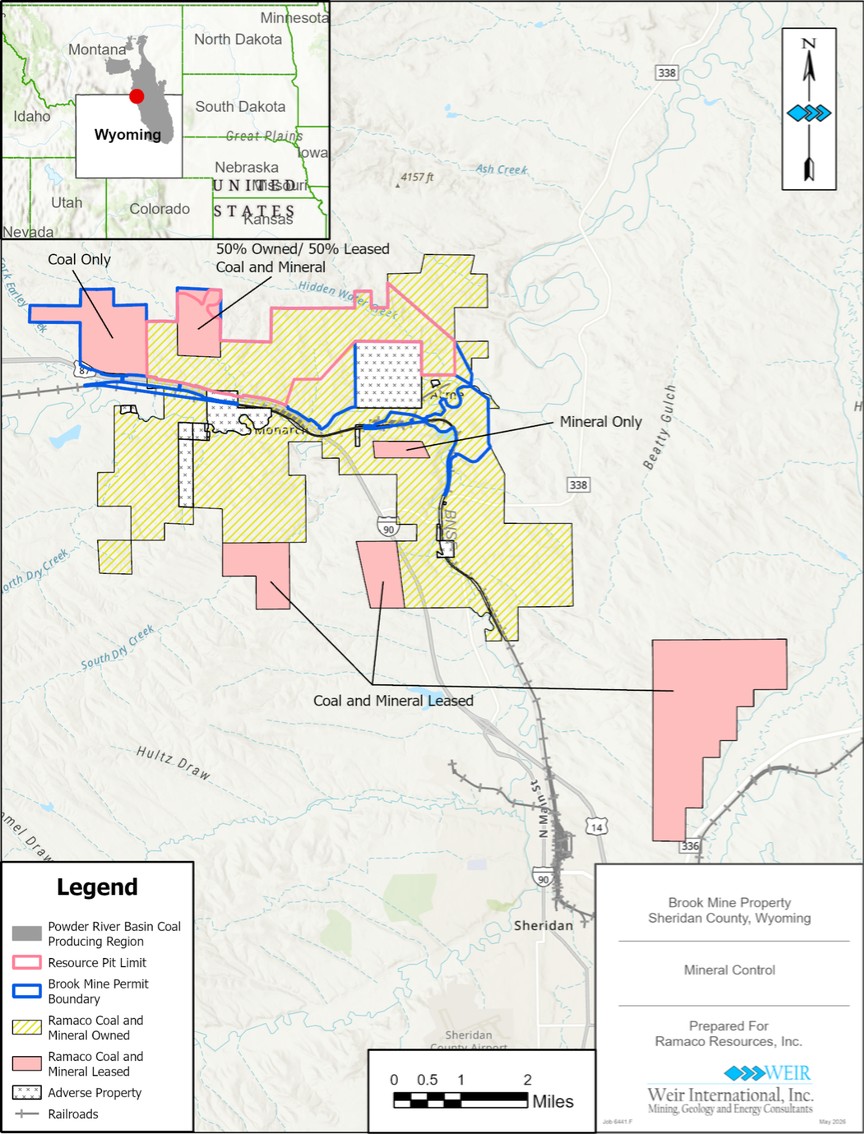
| |
July 24, 2026 | Page 30 |
| | |
Technical Report Summary | |
|
3.5 | Significant Property Encumbrances and Permit Status |
There are certain property encumbrances identified within the Brook Mine, which include the following:
· | The Laya coal lease area is excluded from Mineral Resource estimation as the mineral lease does not explicitly provide for the mining of CMOs. |
· | A portion of the Padlock Surface Use Agreement is excluded from Mineral Resource estimation as it carries a restriction on surface mining rights. |
· | Other property encumbrances, with minimal impact on current Mineral Resource pit designs, exist relative to the following: |
Ø | Railroad Right of Ways (ROW) - BNSF (operating Grand Island & Northern Wyoming RR, Chicago, Burlington & Quincy, Burlington Northern lines) crosses Sec. 18, 21, 22, 27 of T57N-R84W; Grand Island & Northern Wyoming RR also holds an Oil, Gas, Coal, and Mineral reservation in W½ Sec. 22. |
Ø | Highway/road ROWs - Interstate 90 (WYDOT), County Road #1260 (Acme/Old US-87), Monarch/Hidden Water-Ash Creek Road, and Slater Creek County Road 95. |
Ø | Electric utility ROWs - Sheridan County Electric Co. c/o Montana-Dakota Utilities Co. (with a 0.2-acre substation parcel in NE¼NE¼ Sec. 21 excepted from the permit), Powder River Energy Corp., and Sheridan-Johnson REA. |
Ø | Telecom ROWs - Mountain States Telephone & Telegraph (CenturyLink/Lumen successor), defunct Sheridan-Montana Telephone Co., and a Verizon Wireless tower-site lease in NW¼SE¼ Sec. 13. |
Ø | Grazing leases - Padlock Ranch holds grazing leases over BLM lands (Sec. 5) and State Trust Lands (Sec. 10). |
Ø | Oil, Gas, Coal Bed Methane severances - Pine Mountain Oil & Gas (broad coverage); plus reservations in favor of the Lynch family heirs, Welch Foundation Trust, Lonabaugh/Kelloway/Powder River Oil & Gas Ventures II, the Hitson family, Ruth Schreibes, the Owen/ Carroll/Reed/ McPhillamey/ Dawdy group, and the Laya Family Trusts. |
Ø | Federal/State interests - BLM federal coal in Sec. 4 S½ and Sec. 5 S½SE¼; State of Wyoming surface and minerals in Sec. 10 (with Coal Lease to Black Gold Land Co. LLC). |
Ø | Surface use agreements/orders in lieu of consent - recorded with the Laya Trusts, Padlock Ranch, and Big Horn Coal. The order in lieu of consent granted Ramaco the |
| |
July 24, 2026 | Page 31 |
| | |
Technical Report Summary | |
|
right to use the surface of Big Horn Coal for surface mining by the Wyoming Environmental Quality Council.
Ø | Water rights - 67 listed records (WR-1 through WR-67). The 1891 Hanover Ditch and the C.B. & Q. Pipeline/Tongue River Ditch are senior surface rights crossing Sec. 19, T57N-R85W. |
Ramaco was issued Permit No. 841-T1 on July 7, 2020, by the Land Quality Division of the Wyoming Department of Environmental Quality for surface mining of coal in Sheridan County, Wyoming. Permit No. 841-T1 consists of 4,541 acres. The permit boundary is shown on Figure 1-1. The Brook Mine has a Mine Safety and Health Administration (MSHA) ID# of 4801799. WPDES permit No. WYR001608 allows discharge of stormwater from the permit area.
Ramaco was issued Air Quality Permit P0025939 for the Brook Mine on July 20, 2020 by the Air Quality Division of the Wyoming Department of Environmental Quality, as described in Wyoming Permit No. 841-T1.
All permits for development of the Brook Mine are active and up to date in order to mine coal. However, to allow mining deeper seams, as well as to specifically allow the extraction of CMOs, Ramaco will be required to revise its mine plan, which will require a revision to the Mining and Reclamation Plan in Permit No. 841-T1.
Additionally, Ramaco will require permitting approvals for its CMO processing and tailings facilities, once design of those have been completed.
3.6 | Significant Property Factors and Risks |
WEIR assesses that there are certain property risks that could affect Ramaco’s ability to execute its mine plans. Property risks which Ramaco will need to address include the following:
· | Current mining permit approves surface mining of only coal and does not specifically identify CMO mining rights. Coverage of CMO mining under existing mineral conveyances may require an amendment to the existing mining permit. |
· | Revising the Brook Mine Permit to include CMO processing and tailings facilities will require detailed engineering design and environmental study, including an updated reclamation plan, additional self-bonding or surety bond sized to cover full reclamation, long-term tailings closure, and water treatment, if needed. A WYPDES permit is |
| |
July 24, 2026 | Page 32 |
| | |
Technical Report Summary | |
|
required for any point-source discharge from the process plant, tailings underdrains, stormwater contact areas, or pit dewatering. A construction permit is needed before building the process plant to cover emission sources. An Industrial Siting Permit from the Wyoming Industrial Siting Council may also be required.
· | Pine Mountain Oil and Gas, Inc. holds oil, gas, and coalbed methane rights across the property. Currently, there are no producing wells, plugged wells, Coalbed Methane (CBM) wells, gathering lines, compressor stations, injection wells, or future well commitments on the Brook Mine site. To date, no oil and gas company has commenced operations within the Brook Mine site, nor have any filings for development occurred with the Wyoming Oil & Gas Commission. Areas adjacent to the Brook Mine had experienced historical CBM development, but none are active at present. Additionally, all gathering lines and infrastructure have been removed in the adjacent areas, and wells, if not plugged, have been released to landowners. Should Pine Mountain, or any other oil and gas company, pursue development of their oil, gas, or coalbed methane rights, Ramaco could accommodate those rights by mining around any active facility, relocating wells, or reaching an agreement with the company. Currently, the potential development of oil, gas, or CBM is unlikely. |
WEIR did not conduct an independent verification of property control, nor has it independently surveyed the mining locations. WEIR has relied on information compiled from documents, maps, and summaries of the owned and leased properties prepared by Ramaco. WEIR did not conduct a legal title investigation relative to Ramaco’s mineral and surface rights.
3.7 | Royalty Interest |
Ramaco, at the Brook Mine, holds no royalty or similar interest in property that is owned or operated by another party.
Further, Ramaco intends to purchase the remaining minor mineral ownership interest not currently owned by Ramaco. As a result, no private interest mineral royalties are anticipated for the extraction of TCMs. The non-participating coal royalty owned by SWCC has been included in the operating cost estimates. Ramaco has assessed various federal, state, and local royalties and/or taxes that will be applicable and which are considered in the Brook Mine economic analysis. These taxes are described further in Section 18.2.
| |
July 24, 2026 | Page 33 |
| | |
Technical Report Summary | |
|
4.0 | Accessibility, Climate, Local Resources, Infrastructure, and Physiography |
4.1 | Topography, Elevation, and Vegetation |
The Brook Mine is located on the western edge of a broad plain that extends from the Bighorn Mountains to the Black Hills of South Dakota. This area is characterized by high plateaus, which have been dissected by meandering streams, leaving ridges between the main watersheds. Surface elevations range from a low of 3,600 feet above mean sea level (MSL) on the eastern edge of the property to a high of 4,080 feet above MSL in the northwest area of the property. The main drainages in the area are the eastward flowing Tongue River, and Goose Creek, flowing to the north. The confluence of these drainages is near the old town of Acme, Wyoming.
The landscape is dominated by grasslands and sagebrush communities, with Upland Grassland, Big Sagebrush Shrubland, Scoria Grassland, Reclaimed Grassland on previously mined ground, Rough Breaks Mixed Shrubland, and Prairie Dog Modified Grassland accounting for most of the Brook Mine Permit Area. Smaller components include Pine and Juniper Woodland, Riparian Woodland along the Tongue River and Slater Creek, Bottomland Sagebrush Grassland, Rabbitbrush Shrubland, Agricultural Land, and minor disturbance and water features. Native cool-season perennial grasses, chiefly western wheatgrass and bluebunch wheatgrass, dominate herbaceous cover, with Wyoming big sagebrush the principal shrub on uplands and common snowberry, eastern cottonwood, green ash, and peachleaf willow defining the riparian corridors. Cheatgrass, an introduced annual, is prominent on Scoria and Upland Grassland sites, while smooth brome and crested wheatgrass dominate Reclaimed Grassland and bottomland areas. No prime cropland or pastureland of statewide importance occurs within the permit area, and no federally listed threatened or endangered plant species were documented during the surveys.
4.2 | Property Access |
Access to the property is from Interstate Highway 90, which crosses the property from west to south. State Highway 338, which connects Sheridan to Decker, Montana, crosses the southeastern portion of the Brook Mine’s permit area. Secondary roads and trails provide access to the remaining lands. Rail access is by the BNSF Railroad, which is located in the Tongue River and Goose Creek valleys.
| |
July 24, 2026 | Page 34 |
| | |
Technical Report Summary | |
|
The nearest airport is the Sheridan County Airport (SHR), which is located in Sheridan, Wyoming, approximately seven miles southeast of the Brook Mine. The Billings Logan International Airport (BIL) in Billings, Montana, is located approximately 95 miles northwest of the Brook Mine.
The waterways surrounding the property are not navigable for commercial traffic.
4.3 | Climate and Operating Season |
The Brook Mine has a semi-arid climate with four distinct seasons. The summers are warm and dry, with temperatures ranging from the mid-80’s to low 90 degrees Fahrenheit (28-33 Celsius) in July and August. The winters are cold and snowy, with temperatures averaging 20-30 degrees Fahrenheit (-7 to -1 Celsius) in December and January. Spring and fall are transitional seasons, with cooler temperatures and occasional rain and snow.
Coal mining operations in the region operate year-round, regardless of weather conditions.
4.4 | Infrastructure |
4.4.1 | Water Supply |
Water used in the Brook Mine facilities will include potable water and industrial water. Potable water at surface facilities is and will be provided from on-site wells.
Industrial water will be used for dust suppression on the haul roads, equipment wash down, and process plant. This water will be obtained from on-site wells, collection basins constructed on site and other nearby sources, including old underground mine workings.
4.4.2Electrical Power
Ramaco currently purchases electricity from MDU for its surface facilities. Services from MDU are currently being upgraded for electrical supply to pilot processing facilities. This will require further expansion for commercial operations. The basis for power consumption and cost is discussed in Sections 14 and 15.
| |
July 24, 2026 | Page 35 |
| | |
Technical Report Summary | |
|
4.4.3 | Personnel |
Acquiring suitable personnel to operate the mine and process plant may prove to be a challenge for Ramaco. The Brook Mine is close to Sheridan, Wyoming, and as of 2025, its population is approximately 20,000. There are also other smaller towns surrounding the Brook Mine. As such, the availability of experienced new hires may be limited. Some experienced personnel may be available from Gillette, Wyoming (110 miles southeast) which, over the last few years, has experienced a reduction in mining personnel. Ramaco may also need to recruit from towns further away from the Brook Mine. However, WEIR believes that with concentrated recruitment efforts, Ramaco will be able to fully staff the Brook Mine as planned.
4.4.4 | Procurement |
There are many mining supply and heavy equipment vendors in the surrounding area. Ramaco currently uses local vendors in Sheridan, Wyoming (seven miles to the south) for most of its current heavy equipment needs. Gillette, Wyoming is 110 miles to the southeast and has many mining supply and heavy equipment vendors that can serve as an alternative source of equipment and maintenance needs. Casper, Wyoming is 160 miles to the south and is home to several heavy equipment and mine supply vendors as well.
| |
July 24, 2026 | Page 36 |
| | |
Technical Report Summary | |
|
5.0 | History |
5.1 | Previous Operations |
Much of the history of coal mining in the Sheridan Coal Field was provided in a John T. Boyd Company report, Potentially Strip Mineable Coal Reserves Contained on the Sheridan-Wyoming Coal Company Property, dated November 20, 1979 (Boyd Report).
The Boyd Report indicated that underground coal mining began in the Sheridan coal field around 1894 and lasted until 1953. During this period, there were 14 deep mines in the vicinity of the Brook Mine. The coal was used domestically in the Sheridan area, and to supply the railroad. Most of the mines were individually owned until 1920 when the major mines, the Dietz, Acme, Model, Carney, Monarch and Kooi, were consolidated and incorporated under the Sheridan-Wyoming Coal Company, a subsidiary of United States Distributing Corporation. This corporation and the subsidiary, Sheridan-Wyoming Coal Company, merged with The Pittston Company in 1943.
Information on these mines is very sparce and consists of mine maps for six of the mines, with boundaries available for all of the mines. In March 1978, John T. Boyd Company engineers visited the Wyoming Inspector of Mines in Rock Springs and reviewed mine maps of the Monarch Mine 45, Monarch Mine 45-2, Acme Mine 42, Hotchkiss, Model, and Armstrong mines.
Bottom of seam elevations were shown for all the mines except Model and Armstrong; seam heights were available only for the Acme Mine 42. Available data indicates that the bottom 14 feet of the Monarch Seam was mined in the Monarch Mine 45-2. The maps also indicate that pillars were pulled during retreat mining; i.e., the majority of pillars in Monarch Mine 45 and Acme Mine 42, and 20 percent in Monarch Mine 45-2. Excessive subsidence of surface above the Acme Mine 42 and Dietz No. 1 and 2 mines can be seen in aerial photographs.
In 1943, Peter Kiewit Sons’ Company formed a coal mining subsidiary, the Big Horn Coal Company (Big Horn). Operations commenced on a Wyoming state lease in Section 36 (T. 58N., R. 85W.), located approximately three miles north of the northwest corner of the Brook Mine. In 1954, Big Horn entered into a coal lease agreement with the SWCC and operations commenced in Section 22 (T. 57N., R. 84W.). From 1954 through 1969, coal production averaged about 350,000 tons per year. In 1970, coal production increased to approximately one
| |
July 24, 2026 | Page 37 |
| | |
Technical Report Summary | |
|
million tons per year due to increased demand for western coal. Big Horn abandoned its mining operations in year 2000.
No CMO mining has occurred historically in or around the Brook Mine.
5.2 | Previous Exploration and Development |
Exploration of the Brook Mine, prior to Ramaco’s ownership, was limited to coal exploration drilling. Bighorn Coal, over the timespan of its operation of the property, drilled 417 coal exploration drill holes prior to 2011 that Ramaco incorporated into their drill hole database as a result of information transfer.
| |
July 24, 2026 | Page 38 |
| | |
Technical Report Summary | |
|
6.0 | Geological Setting, Mineralization, and Deposit |
6.1 | Regional, Local, and Property Geology |
6.1.1 | Regional Geology |
The Sheridan Coal Field is located within the northwestern portion of the PRB. The regional geology of this area is characterized by a sequence of sedimentary rocks that formed during the Late Cretaceous to early Paleocene Periods. The stratigraphic sequence consists of interbedded sandstones, mudstones, and coal seams that were deposited in fluvial, deltaic, and lacustrine environments.
The Sheridan Coal Field is situated within the Tongue River Member of the Fort Union Formation. This formation is composed of interbedded sandstones, shales, and coals that were deposited during the Paleocene Period. The thickness of the Tongue River Member varies from 150 to 400 feet and contains several coal seams that range in thickness from 1 to 30 feet. These seams exist down to depths of approximately 1,200 feet across the property.
The coal seams in the Sheridan Coal Field are classified as low-sulfur, sub-bituminous coal. These coals have a low ash content, high calorific value, and low sulfur content, making the coal ideal fuel for power generation. The coal seams are generally continuous over large areas and are flat-lying, and amenable to surface mining.
The sedimentary rocks in the Sheridan Coal Field were deposited in a series of ancient rivers and lakes that once covered the area. These rivers and lakes were fed by the highlands to the west and north, and the sediment was deposited as the water slowed and lost its carrying capacity. The sandstones were deposited in the channels of the rivers, while the shales and mudstones were deposited in the floodplains and lakes.
The regional geology of the Sheridan Coal Field has been influenced by tectonic activity in the region. The area has experienced several episodes of uplift and subsidence, which have created a series of fault blocks and basins. The coal seams in the Sheridan Coal Field are located in these basins, which has preserved the coal seams from erosion.
| |
July 24, 2026 | Page 39 |
| | |
Technical Report Summary | |
|
6.1.2 | Local Geology |
The Brook Mine is located on the western edge of a broad plain that extends from the Bighorn Mountains to the Black Hills of South Dakota. This area is characterized by high plateaus, which have been dissected by meandering streams, leaving ridges between the main watersheds. Surface elevations range from a low of 3,600 feet above MSL on the eastern edge of the property to a high of 4,080 feet above MSL in the northwest area of the property. The main drainages in the area are the eastward flowing Tongue River, and the northward flowing Goose Creek. The confluence of these drainages is near the old town of Acme, Wyoming.
Structurally, the coal seams dip to the southeast between one to four degrees. Locally the dip may reverse due to differential compaction. Fault traces over the Brook Mine have been presented in past studies, however, there has been insufficient data collected to accurately estimate dip and throw of the faults. In reviewing the structural model based on the available data, there are no apparent discontinuities present with faulting most likely producing localized displacement. Additional exploration and mapping should be conducted to confirm the location and extent of these previously presented fault traces.
Interpretation of local faults using existing geophysical drill hole data is currently being performed to improve the structural accuracy of the geological model for future mine planning purposes and is anticipated to improve understanding of mineral continuity within the Brook Mine.
6.1.3 | Property Geology |
The primary coal seams associated with CMOs on the Brook Mine, in descending stratigraphic order, are the Dietz 1, Dietz 2, Dietz 3, Monarch, Upper Carney, Lower Carney, and Masters. There are also seven unnamed seams below the Masters Seam that have been included in the models. There are several other coal seams found below this to depths of approximately 1,200 feet, based on data available from historical oil well logs. Most of these seams are thin (1-2 feet) and unnamed. However, within this lower group, the Upper Pawnee, Lower Pawnee, and Wall seams may be found.
| |
July 24, 2026 | Page 40 |
| | |
Technical Report Summary | |
|
6.2 | Mineral Deposit Type |
6.2.1 | TCM Resources |
The TCMs are believed to have been incorporated into the coal during its formation and are found in association with clay minerals and organic matter in the coal seams. Interburden between the coal seams also contain elevated levels of TCMs, primarily in clays, carbonaceous clays, and siltstones not necessarily associated with the coal seams. It is assumed that the TCMs are hosted within the clays, carbonaceous clays and siltstones through ion adsorption.
Various coals within the Brook Mine have TCM concentrations far surpassing those observed in coals worldwide. It is hypothesized that the concentrated TCMs within the coals may be attributed to the infiltration of fluids through permeable and porous coal zones (via cleat fracturing) and other carrier beds, such as sandstones. These fractured zones have been identified in core, but not mapped and correlated to the highest concentration zones. The fluid flow is believed to have induced an acidic environment within the coals, due to the inherent organic concentrations, while transporting dissolved metals in solution. This is evidenced by the identification of gypsum within the mineralized coal zones. The TCM metals could have precipitated and accumulated within oxide minerals at coal/clay boundaries, where varying redox conditions and pH differences facilitated the TCMs’ aggregation and concentration. The thickness of these mineralized zones can reach up to eight feet in the cores analyzed. Additionally, there is an inherent reducing and acidic environment associated with the coals during deposition. There is likely significant dissolution of detrital minerals and reprecipitation within the carbonaceous shales and claystones during early diagenesis.
An important component of this hypothesis is establishing whether the mineralization is primary or secondary. It could be possible that the source of the TCMs is by primary deposition via airborne particles of volcanic origin, proximal to this particular peat system, and incorporated into the coals during deposition. The substantial volume of coal, reaching a thickness of 30-feet in some zones, certainly implies a dominant airborne input, although no evidence to date has been found of existing ash layers. A comprehensive understanding of the cleat systems is imperative to substantiate the viability of fluid flow through coals as carrier beds.
Based on this depositional theory of TCM enriched fluids flowing through the coal strata and depositing concentrated TCM mineralization into the clays and siltstones immediately surrounding the coal seams, it is inferred that geologic and grade continuity is present for the
| |
July 24, 2026 | Page 41 |
| | |
Technical Report Summary | |
|
TCM mineralization in connection with the continuity of the coal seams throughout the Brook Mine. Exploration and sampling have confirmed elevated TCM concentrations within approximately five feet above and below the coal seams. Elevated TCM concentrations have also been sampled at distances greater than five feet from a coal seam, however these occurrences have been sporadic and unable to be correlated across large areas unlike the mineralization immediately adjacent to the coal seams.
6.2.2 | Coal Resources |
The regional geology of this area is characterized by a sequence of sedimentary rocks that formed during the Late Cretaceous to early Paleocene Periods. The stratigraphic sequence consists of interbedded sandstones, mudstones, and coal seams that were deposited in fluvial, deltaic, and lacustrine environments.
For internal purposes, Ramaco produces geologic resource models using the Carlson® mine planning software package. WEIR has modeled the resources using Datamine MineScape® Stratmodel (MineScape) geological modeling software.
6.3 | Geological Modeling |
Ramaco provided WEIR drill hole data, which included survey, lithology, and TCM and coal quality information. This data was provided in different formats including Excel, ASCII files and PDFs. Geophysical logs, coal quality certificates, driller’s logs, geologist’s logs, and drill hole survey records were provided as scanned PDF files and AutoCAD drawing files. Of the 770 drill holes provided to WEIR by Ramaco, 155 were rejected primarily due to missing coordinates or lack of acceptable lithology data.
Coal quality data for 92 drill holes was provided by Ramaco, all of which WEIR considered suitable, and were used in WEIR’s geological model. ICP-MS data was provided for 128 drill holes which involved 5,903 analyses. Similarly to coal quality drill holes, none of these TCM quality drill holes were rejected by WEIR. The data provided by Ramaco was in Excel and ASCII format along with quality certificates in PDF format.
Two geological models were constructed using Datamine’s MineScape® software. This involved a primary stratigraphical model and a resultant block model. The primary stratigraphical model delineates coal seams and interburdens as zone input for the block model.
| |
July 24, 2026 | Page 42 |
| | |
Technical Report Summary | |
|
This stratigraphical model was directly used for coal tonnage and quality estimates. The block model was specifically created for TCM tonnage estimates.
6.3.1 | Stratigraphic Model |
The MineScape® stratigraphic model was created based on ArcGIS® World3D topography. In the United States, this incorporates topography from the USGS 3-D elevation project. Topography data was gridded using MineScape® software and a grid cell size of 50 feet by 50 feet from the USGS on-line 3-D Elevation Project data source. The resolution of the topography data is 1/3 arc-second, which results in approximately 30 feet by 30 feet data point spacing. The gridded USGS topography contours were compared to drill hole collars. WEIR investigated and resolved significant collar elevation discrepancies.
The seam surfaces and thicknesses were created by loading the drilling and mine measurement data into MineScape® and gridding the seam intercepts using a grid cell size of 50 feet by 50 feet. The parameters used to create the model are defined in the MineScape® modeling schema, which is a specification of modeling rules created for the site. The MineScape® interpolators that were used in this study are common in most mine planning software. The Planar interpolator is a triangulation method with extrapolation enabled. The Height interpolator is a variant on the trend surface and inverse distance interpolators. The data points are weighted, thus producing a different plane at each sample point. By using a weighting curve that is infinite at zero distance, data honoring can be assured. Due to the least squares fit, the effect of data clustering is minimized. A trend surface is used in MineScape® to promote conformability for the modeled seams to regional structures, such as synclines, anticlines, or simply seam dip. MineScape® caters to using different interpolators for thickness, roof and floor surfaces, and the selected trend surface as all are modeled separately. The interpolator used for each of these items is selected on the basis of appropriateness to the data sets involved, as well as modeling experience. Stratigraphic Model Interpolators are shown in Table 6-1, as follows:
Table 6-1Stratigraphic Model Interpolators
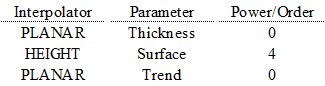
| |
July 24, 2026 | Page 43 |
| | |
Technical Report Summary | |
|
6.3.2 | Block Model |
A MineScape® block model was constructed using a cell size of 50 feet by 50 feet by 0.5 feet (i, j, k vectors) using the zones defined by the coal seams as modeled in the stratigraphic model described above. The vertical k-component of the block model (0.5 feet) was selected to closely reflect the average pXRF and ICP-MS sample intervals of 0.25 feet. An inverse distance interpolator with the power of 2 was used to interpolate TCM grades into the block model. A search radius of 2,800 feet was utilized based on twice the average drill hole sample spacing to ensure sufficient samples were utilized to inform each block within the model. Insufficient sampling has been conducted to complete a comprehensive geostatistical analysis at this time. Ramaco is in the process of drilling and sampling three sets of perpendicular geostatistical fence sections with drill holes spaced between 100 and 200 feet apart in order to collect sufficient data to inform a comprehensive geostatistical and drill hole spacing analysis.
6.3.3 | Coal Quality Model |
To create the coal quality model, coal quality data from previous exploration and from Ramaco coal exploration drilling was used. The drill holes were verified to ensure that the seam depths used in the lithology file matched the sample depths in the quality file. Coal quality samples were loaded into MineScape® and composited against the drill hole thicknesses. The composited values were then gridded using a grid cell size of 200 feet by 200 feet and the inverse distance weighted (squared) interpolator. In addition to raw density and total moisture, the following quality data was modeled for all seams for which quality data was available:
· | Ash (weight percent), on a dry basis and As-Received (AR) |
· | Calorific Content (Btu/lb), on a dry basis and AR |
· | Total Sulfur (weight percent), on a dry basis and AR |
· | Volatile Matter (weight percent), on a dry basis and AR |
6.4 | Stratigraphic Column and Cross Sections |
Figure 6-1 shows the stratigraphic column for the Brook Mine. Typical stratigraphy of the Brook Mine can be seen on Figure 6-2. Typical block model cross sections with estimated TCM concentrations displayed can be found on Figure 6-3.
| |
July 24, 2026 | Page 44 |
| | |
Technical Report Summary | |
|
Figure 6-1Brook Mine Generalized Stratigraphic Column
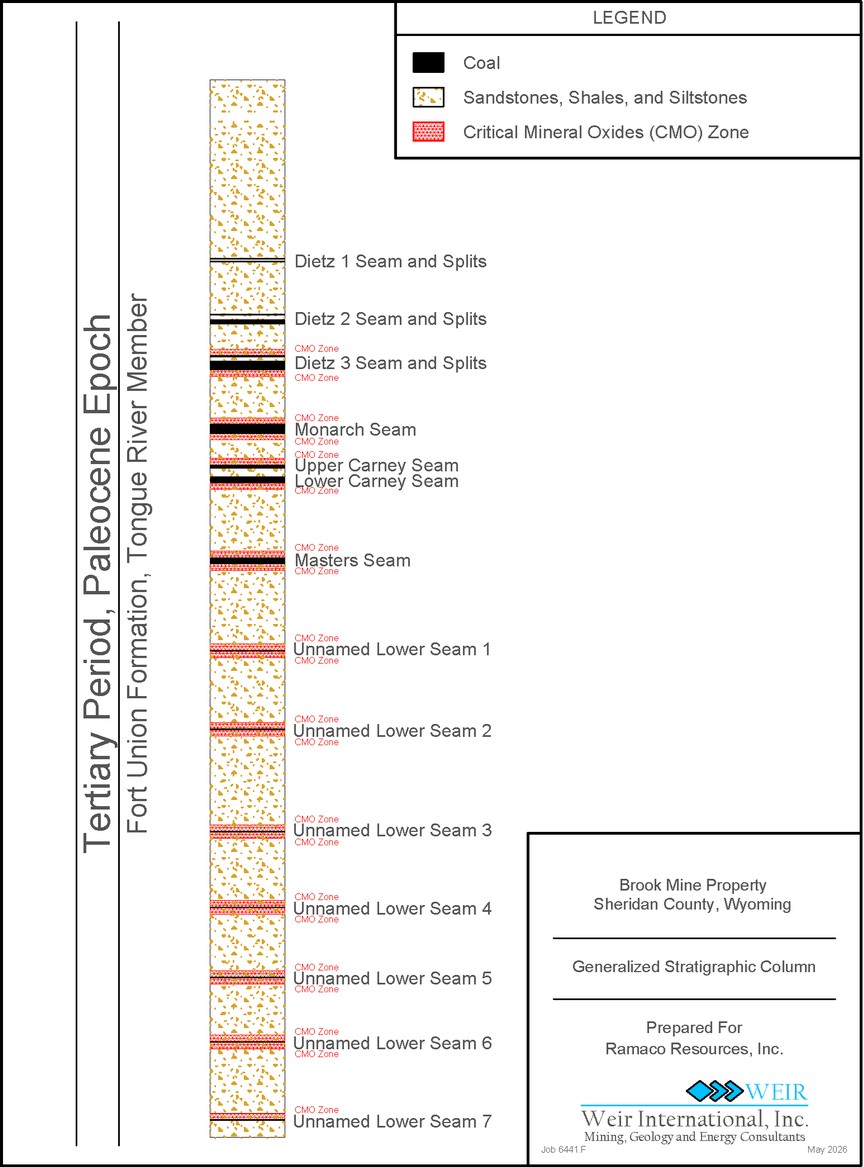
| |
July 24, 2026 | Page 45 |
| | |
Technical Report Summary | |
|
Figure 6-2Typical Stratigraphic Sections
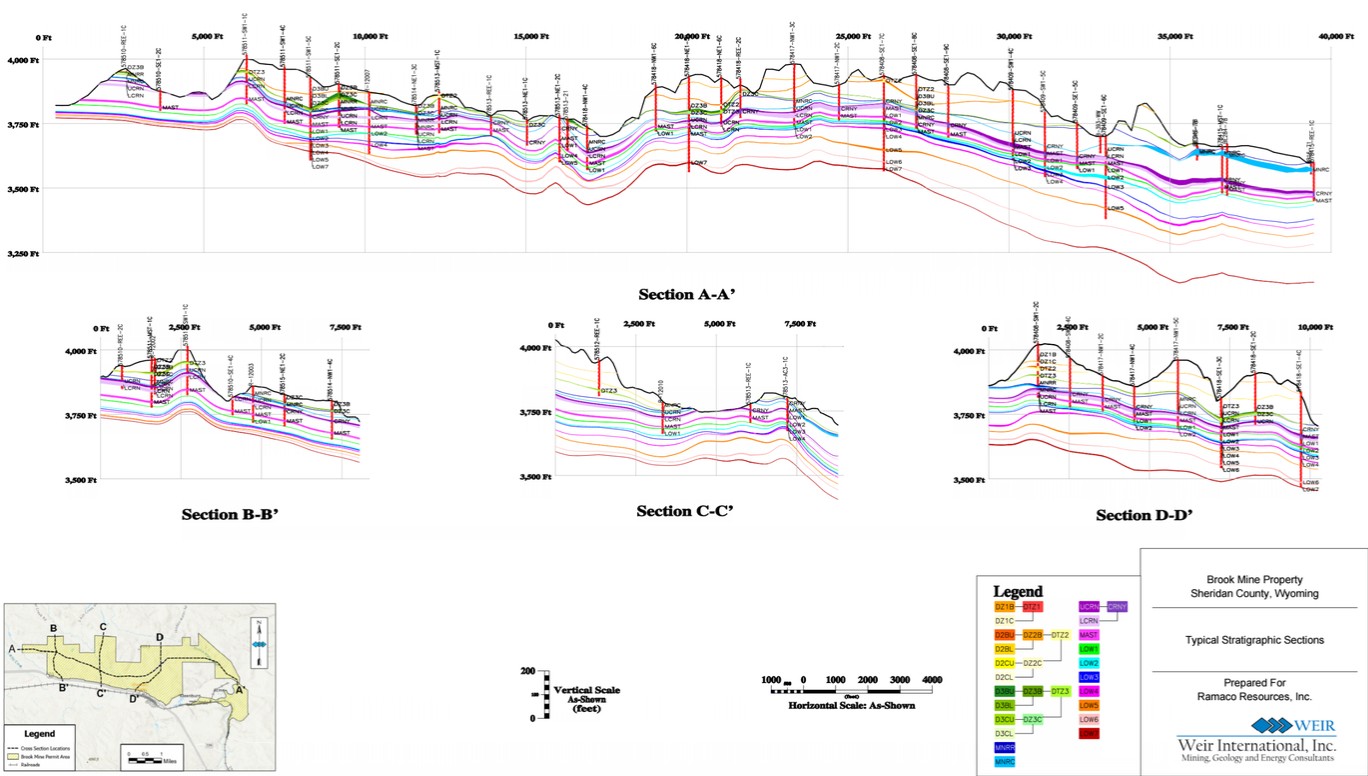
| |
July 24, 2026 | Page 46 |
| | |
Technical Report Summary | |
|
Figure 6-3Block Model Sections with Targeted Critical Mineral Concentrations
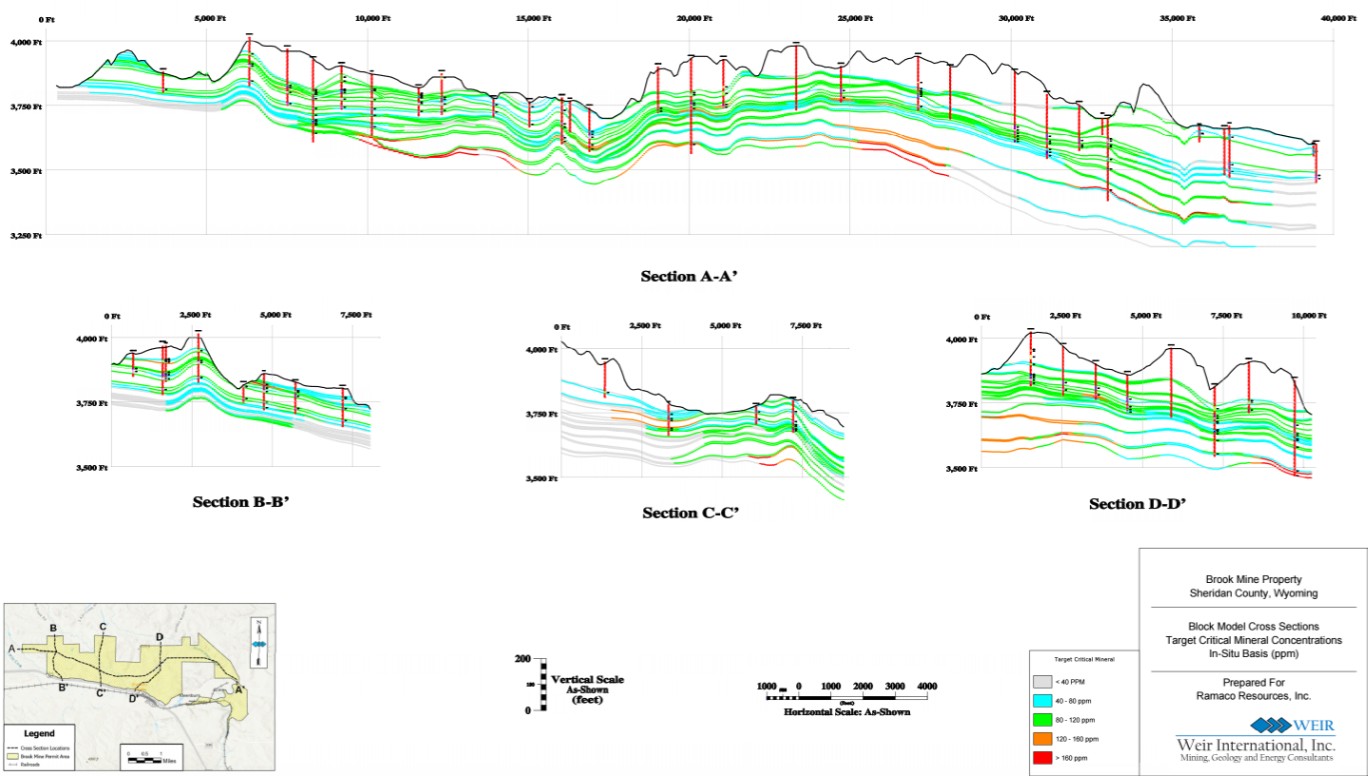
| |
July 24, 2026 | Page 47 |
| | |
Technical Report Summary | |
|
7.0 | Exploration |
7.1 | Non-Drilling Exploration |
Drilling has served as Ramaco’s primary form of exploration within the Brook Mine. However, nine bulk samples were obtained through under-reaming from nine drill holes across two locations (see Figure 7-1). An average of approximately 500-pound samples were obtained from each of the nine drill holes. The samples were bagged in approximately three feet intervals, photographed, labeled, and shipped to the lab for analyses.
Additional channel and bulk samples were collected in the second half of 2025 as Ramaco began development of a test mining pit targeting the Dietz and Carney seams in the south-central portion of the Brook Mine. A total of 185 channel samples were taken from nine locations across the test pit covering an area 150 feet wide by 200 feet long. Channel samples were collected vertically as the pit was developed to collect samples through the Dietz and Monarch coal and interburden zones on approximately one foot intervals. Overall thicknesses sampled by the channel samples ranged from eight feet to 48 feet and averaged 28 feet. Channel samples were taken by hand utilizing hand tools to break out a predetermined width and depth of material from the sample location. Material removed was collected on a tarp setup to capture as much of the material removed as possible, however some sample loss as well as dilution was observed.
Material was excavated by scrapers from the pit area and stockpiled by horizon before being systematically sampled with a backhoe to collect 162 bulk samples (approximately one ton each) from three horizons (Dietz 3 Seam mixed coal and interburden, Monarch Seam interburden, and Upper Carney interburden). Samples were predominantly collected from the Monarch and Dietz 3 Seam interburdens with only 18 samples collected from the Upper Carney interburden. Bulk samples represent up to 20 feet vertically of material.
Analysis of these samples was conducted and received in 2026 following the effective date of this report and as such are not incorporated into any of the modeling presented in this TRS. WEIR has prepared a summary of the channel and bulk samples compared to adjacent core hole drilling to demonstrate grade continuity over larger areas and sample quantities. A comparison of average drill hole TCM grades, channel sample TCM grades and bulk sample TCM grades by available mineralization zone is presented in Table 7-1.
| |
July 24, 2026 | Page 48 |
| | |
Technical Report Summary | |
|
Table 7-1Average TCM Metal Grade Comparison by Sampling Type
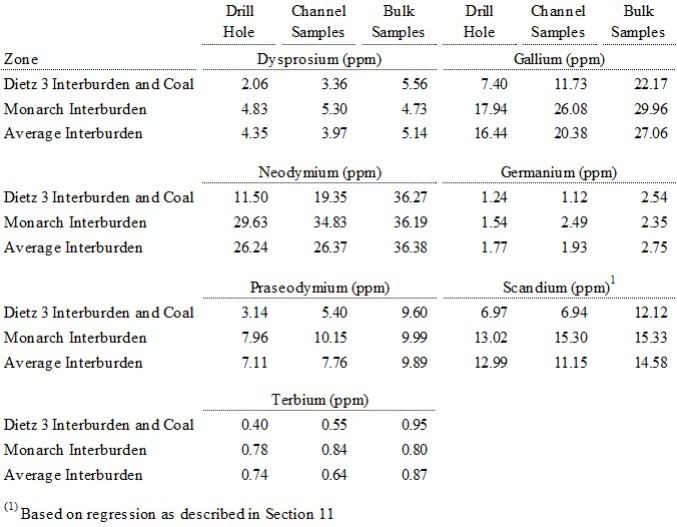
As shown in Table 7-1, there is some variability between the three sample types but generally the channel and bulk samples show higher concentrations of TCMs supporting the continuity of grade across larger areas. WEIR believes this data supports grade continuity across larger areas and the ability to extract TCMs from the Brook Mine with minimal dilution.
7.2 | Drilling |
7.2.1 | General Methodology |
Ramaco’s exploration activities for CMOs at its Brook Mine primarily involve drilling. Drilling that targets CMOs has generally been on a 1,000 feet north/south grid. CMO exploration drill holes are cored from surface to full depth to ensure all potential mineralization is captured for sampling. A 2.5-inch diameter core is extracted in roughly 10 to 20 foot core runs.
| |
July 24, 2026 | Page 49 |
| | |
Technical Report Summary | |
|
The first Ramaco coal exploration drilling program carried out at the Brook Mine, prior to the 2019 CMO interest, involved drilling a rotary pilot hole to establish coal seam depths. The pilot hole information was used to drill a near-duplicate drill hole which alternated between rotary and core drilling where cores were obtained for the coal seams and coal roof and floors.
During core drilling, a split-tube core barrel of up to approximately 20 feet length is retrieved from depth and then opened. The core is washed down if necessary, and the driller’s reported length of core that was actually cut is compared to the measured length of core actually recovered. If a section of core greater than 10 feet, or less if in a critical zone, is lost, the hole is re-drilled to obtain data for the lost interval. All core samples are boxed, labeled, photographed, and stored in an on-site enclosed building.
A hole with significant lost core or crushed core can result in misleading data. Drill holes with core recovery of less than 90 percent of targeted interests are noted and subsequently reviewed and potentially excluded from geological and coal quality modeling. WEIR did not exclude any drill holes for poor core recovery, since all of the holes provided to WEIR within the Brook Mine attained core recovery of at least 90 percent.
For the original CMO exploration drill holes, pXRF analysis was performed on 3-inch to 12-inch increments for the cores, depending on mineral concentrations being found at those locations. Based on the pXRF analysis, sections of core were selected for ICP-MS analysis. Core samples were then sent to laboratories for ICP-MS analyses. As of January 2024, new procedures were put in place where the core was sampled on even increments, 3-inch or 6-inch, independent of pXRF analysis. All new core drilled as of January 2025 were halved and sampled on 6-inch composites and sent for ICP-MS analysis. In late 2025 the sampling regiment was changed to 1-foot composites taken within the current sampling zone consisting of five feet above and below the coal seam as well as two feet of coal from both the roof and floor of the seam.
For coal exploration drill holes, cores are taken of the seam in approximately 2-foot intervals. Core splits are bagged, labeled, and sent to laboratories for proximate analyses on both a dry and as-received basis.
Select holes are geophysically logged with a standard coal suite tool consisting of gamma, density, caliper, and resistivity. Geophysical logging contractors provide paper copies, .TIF files, .DWG files, and .LAS files. After the 2022-2023 100-hole drilling program, all newer
| |
July 24, 2026 | Page 50 |
| | |
Technical Report Summary | |
|
holes have been geophysically logged as a result of revised best practice standard operating procedures.
All original drill hole, survey, geological, geophysical, and quality data is scanned and stored on a Ramaco server, which can be accessed by select Ramaco personnel and quickly checked against the database, the geological model, or mine mappings. Each drill hole collar location is surveyed using RTK GPS for accurate map coordinate and elevation data.
Table 7-2 summarizes Ramaco’s drilling programs that have been completed at the Brook Mine. In addition to Ramaco’s drilling programs, historical coal drilling data obtained from Bighorn Coal is also shown. Ramaco has relied upon portions of the historical drilling data where it has been validated by Ramaco.
Table 7-2Brook Mine Drilling Programs
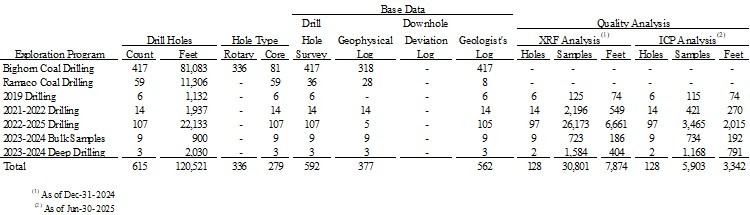
7.2.2 | Drilling Program Summaries |
From 2012 through 2018, Ramaco drilled 59 coal exploration drill holes to in-fill the Bighorn Coal data after acquiring the property. The assaying of drilled core was targeted at testing thermal coal quality, including moisture, ash, sulfur, and calorific value. No sampling was conducted at the time relative to CMO concentrations for any of these coal exploration drill holes. WEIR has reviewed these historical drill holes and confirmed the coal seam data was representative with drilling conducted by Ramaco.
Starting in 2019, interest in REEs was initiated on the property by NETL as part of its study of REEs within the PRB. Specifically, a 2019 6-corehole program was later expanded by an additional 14-corehole REE-targeted cored drill hole program during 2021-2022. These two initial REE-targeted programs sparked further interest in potential REE resources for the property.
| |
July 24, 2026 | Page 51 |
| | |
Technical Report Summary | |
|
In 2019, Ramaco provided drill cores from the Brook Mine for a battery of qualitative and quantitative analyses conducted by the NETL. Analysis conducted by NETL included the following:
· | High resolution photographic analysis |
· | Analysis of stratigraphic logs from existing coring |
· | Lithologic description and analysis |
· | Elemental analyses, including: |
Ø | REE, trace and major element analysis |
Ø | Thermogravimetric analysis |
Ø | Bulk X-Ray Diffraction/X-Ray Fluorescence analysis |
Ø | Inductively Coupled Plasma Mass Spectrometry |
· | Microscopy and Microanalysis by: |
Ø | Imaging (small and large area) |
Ø | Elemental analysis |
Ø | Phase Identification |
As a result of the preliminary analysis conducted in conjunction with the NETL, between November 2021 and February 2022, Ramaco completed a comprehensive exploration drilling and coring program consisting of 14 new drill holes that resulted in 1,937 linear feet of 2.5-inch core drilling. This exploration program targeted the Monarch, Upper Carney, and Masters coal seams across the Brook Mine, and marked the first time the Masters Seam had been sampled and analyzed for REEs within the Brook Mine.
In April 2022, Ramaco initiated an additional 100-hole exploration program at the Brook Mine. This continued exploration was designed to establish an approximate 1,000 feet sampling grid for the Dietz, Monarch, Carney, and Masters coal seams within the Resource Area. Planned analysis of the new drill core data included pXRF analysis, as well as targeted secondary ICP-MS sampling and analyses on historical cores. This 100-hole drilling program was completed in July 2023 with seven additional holes drilled and sampled in 2024. The targeted secondary ICP-MS sampling and analysis program was completed in January 2024.
In late 2023, Ramaco conducted a deep hole drilling program. The program was designed to assess if REE grade could increase at depths beyond the approximate 200-foot average hole depths that had previously been completed. The deep core hole program involved three drill holes at planned depths of approximately 850 feet. Two of these holes were successfully completed to planned depths, while the other was not. These deep core holes were analyzed
| |
July 24, 2026 | Page 52 |
| | |
Technical Report Summary | |
|
using ICP-MS along their full length. Geophysical logging was performed on all three drill holes as well. Results from the deep core hole drilling program did not reveal any substantially higher grade TCM zones at depth. The levels of critical minerals below the Lower 7 Seam were generally lower than those above the Lower 7 Seam, on average.
After completing the deep core and 100-hole programs, Ramaco drilled an additional nine holes for bulk sampling purposes. In order to collect the large bulk samples, Ramaco utilized underreaming of the holes to collect approximately 500-pound samples within the target zones. These holes were analyzed using ICP-MS and were geophysically logged. The bulk samples were intended to assist in analyzing mineral extraction and recovery options, but it was found the underreaming introduced significant dilution and the samples are not representative of the targeted horizons. The bulk sampling program was performed during the 2024 calendar year.
In addition to the deep core and bulk sampling programs, cores from the 100-hole program were extensively sampled and analyzed using both pXRF and ICP-MS to in-fill previously unsampled areas within the geological model. This sampling/analysis program continued through most of 2024.
The location of all exploration drill holes at the Brook Mine is provided on Figure 7-1. All 615 drill holes on Figure 7-1 were used to develop a comprehensive geologic structural model. This geologic structural model was in turn used to define the TCMs using the 5,903 ICP-MS samples assayed from 128 drill holes.
| |
July 24, 2026 | Page 53 |
| | |
Technical Report Summary | |
|
Figure 7-1Drill Hole Locations
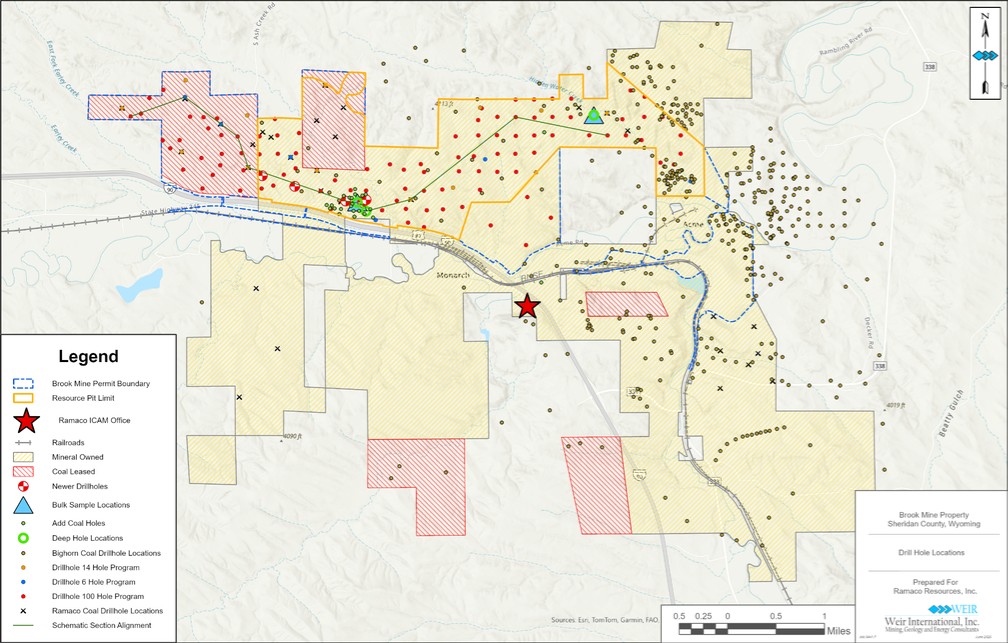
| |
July 24, 2026 | Page 54 |
| | |
Technical Report Summary | |
|
7.2.3 | Planned Drilling |
Infill drilling will continue to be conducted to validate continuity and delineate the higher grade TCM zones that are beginning to emerge based on elemental testing and geologic mapping. There is also planned drilling for outside the permit boundary to begin extending known mineralization trends.
A drilling program in 2025 and 2026 is ongoing with three sets of perpendicular fence drilling programs planned and numerous groundwater monitoring wells to be installed to the Wall Seam.
7.3 | Hydrogeological Data |
7.3.1 | Surface Water |
For drainage structure design parameters, Ramaco used data from several sources in combination:
· | Topography generated from LiDAR data collected by FugroEarthData, Inc. on October 16, 2013. The LiDAR data accuracy meets the National Map Accuracy Standards (United States Bureau of the Budget, 1947) for 1”=100’ scale, 2 foot contour interval mapping. |
· | To estimate runoff curves, data was used from the soils study that was prepared by James Nyenhuis, Certified Professional Soil Scientist, of Fort Collins, Colorado July 2015. Soils mapping, soil profile and map unit description, taxonomic classification, and soil sampling was conducted in accordance with the procedures and standards of the National Cooperative Soil Survey (Soil Survey Staff, 1993, 1997, 1998, 1999, and 2010; and Schoeneberger et al., 2012), and “Guideline No. 1, Soils and Overburden” (WDEQ-LQD,1996). |
· | Also to estimate runoff curves, data was used from the vegetation assessment of RAMACO’s Brook Mine that was conducted by BKS Environmental Associates, Inc. (BKS) of Gillette, Wyoming in 2013. All sampling procedures were designed according to the Wyoming Department of Environmental Quality, Land Quality Division (WDEQ/LQD) Rules and Regulations for Coal Permitting, Chapter 2 (WDEQ/LQD, 2012), and multiple consultations with the WDEQ/LQD. Baseline vegetation assessment sampling methodology derived by BKS was approved by WDEQ/LQD prior |
| |
July 24, 2026 | Page 55 |
| | |
Technical Report Summary | |
|
to fieldwork. All sampling procedures outlined in the approved WDEQ/LQD baseline vegetation sampling methodology were executed as approved.
· | For both the regional and site climate analysis, meteorological data were compiled for five sites surrounding the Brook Mine. These sites are all within a 15-mile radius of the mine permit area. Data was acquired through the Western Regional Climate Center (WRCC), the National Climatic Data Center administered by the National Oceanic and Atmospheric Administration (NOAA), Inter-Mountain Labs (IML Air Science, 2015) and the Wyoming Climate Atlas (Curtis & Grimes, 2004). Due to the proximity of the project area to the regional meteorological station locations, and since the climatology within the project area is similar to these stations, baseline climatology data at the project site was not collected. Since this time, a meteorological station has been established at the iCAM which will be incorporated into the site’s climatology database. |
Once established, Ramaco input this data into the HEC-HMS (United States Army Corps of Engineers, 2009) for analysis. HEC-HMS uses a triangular Hydrograph Method, parametric method of estimating flood peaks and runoff volumes from site-specific data, in addition to providing watershed routing parameters. The Hydrograph Method is an industry standard for this type of work.
The planned Brook Mine established four surface water monitoring stations in September 2013, two sites on Slater Creek and two sites on Hidden Water Creek. Ramaco also uses data from five USGS gaging stations outside of the permit area. The data collected by the gaging stations is useful for observing and verifying water quantity trends in addition to monitoring surface water quality.
7.3.2 | Ground Water |
Construction of the baseline groundwater monitoring network began in the third quarter of 2013 and was completed early in the fourth quarter 2013. The groundwater monitoring network consists of nine Carney Seam wells, 10 Masters Seam wells, eight alluvium wells, one underburden well, and one well perforated in both the Masters and Carney coal seams. No monitoring wells were completed in the overburden or interburden as no water was found in these units during drilling operations. The Groundwater monitor wells/piezometers were completed using air rotary methods in accordance with WDEQ/LQD guidelines.
Saturated hydraulic conductivity of the Carney and Masters coal confining intervals was measured on undisturbed core (boreholes 578513-5, R13-019, R13-023) using flexible-wall
| |
July 24, 2026 | Page 56 |
| | |
Technical Report Summary | |
|
constant-head permeameter testing per ASTM D 5084 (Method C), the standard test for fine-grained clays, claystones, and clayey sandstones. Formation-scale properties were obtained from constant-rate multi-well pumping tests (Section 9 cluster) and single-well slug tests, both accepted methods.
Each ASTM D 5084 test recorded sample geometry, dry density, moisture, saturation, gradient, and temperature, with a minimum of four to five sequential constant-head readings averaged at 20 deg C, and reports were independently reviewed. Field sampling required wellhead inspection, three-casing-volume purging (low-flow methods for wells under 0.5 gpm), pH/EC/temperature/DO/turbidity stabilization within 10 percent, ice preservation, chain-of-custody, and laboratory delivery within two days. Data validation included field-versus-lab EC and turbidity comparison, measured-versus-calculated TDS, ion balance, and holding-time checks. Pumping-test data were independently fit using Theis, Theis Recovery, and Cooper-Jacob solutions, and the regional aquifer-test population was screened to remove a small number of anomalously high values (interpreted as fractured-coal outliers).
Core permeabilities of the Carney and Masters confining clays and claystones averaged between 1.4E-6 and 2.0E-4 ft/day (one Masters lower-confining sandstone at 0.252 ft/day). Pumping-test results yielded T = 2.9 to 3.6 ft2/day and K = 0.48 to 0.60 ft/day for the Masters coal, and T = 5.6 to 6.0 ft2/day with K = 0.31 to 0.33 ft/day for the Carney coal, with storativities of 2.0E-4 to 3.8E-4 indicating a confined response. Material assumptions include the following:
· | Permeable zones / aquifers: Carney coal, Masters coal, Tongue River alluvium, Slater Creek alluvium, and Big Horn Coal spoils. Overburden, interburden, and underburden are predominantly dry and treated as non-aquifers; the intervening claystones are confining units. |
· | Flow rates: regional flow is northwest to southeast down geologic dip, with local north-south offsets at faults. Hydraulic gradients are 0.008 to 0.016 ft/ft (Masters) and 0.017 to 0.07 ft/ft (Carney). Using K of 1.4 ft/day (Masters) and 0.097 ft/day (Carney) and a porosity of 0.10, seepage velocities are 40 to 80 ft/yr (Masters) and 6 to 25 ft/yr (Carney); Darcy fluxes are 4 to 8 ft/yr and 0.6 to 2.5 ft/yr, respectively. Vertical migration through confining units is estimated at less than 0.5 ft/yr. Tongue River alluvium T is 9,000 to 60,000 gpd/ft. |
· | In-situ saturation: overburden mostly dry; Carney partially saturated to dry (saturated mainly in the eastern permit area); Masters partially saturated; Slater Creek alluvium partially saturated; Big Horn spoils partially saturated. |
| |
July 24, 2026 | Page 57 |
| | |
Technical Report Summary | |
|
· | Recharge and water balance: Carney recharge from clinker contact, alluvial sub-crop, historic surface-mine pits, and Monarch-burn infiltration; Masters has no in-permit recharge or discharge boundary; vertical leakage is minimal because of the dry overburden/interburden and the low confining-clay K. Pre-mining drawdown of 40 to 80 ft on the eastern permit edge is attributable to 2000-2012 CBNG production. |
WWC built a numerical groundwater flow model in 2014 to predict mining-induced drawdown. Following EQC review, WWC reconstructed the model in 2018; the 2018 model supersedes the 2014 model and is included in the permit. Material assumptions are: only the Carney and Masters coals are continuous saturated aquifers; the bounding claystones are confining units with vertical K consistent with the ASTM D 5084 results (about 1E-5 to 1E-4 ft/day); coal T, K, and S values are those from Addenda D6-8 and D6-15 in the permit, with porosity of 0.10; flow is from northwest recharge toward southeast down dip with fault-controlled local offsets; the Carney is recharged from clinker, alluvial sub-crop, historic mine pits, and Monarch-burn infiltration, while the Masters has no in-permit recharge or discharge; the Tongue River alluvium is hydraulically isolated from the Carney by the confining claystones; and the post-CBNG potentiometric surface is used as the initial condition so that mining-induced drawdown is additive to the existing depressed surface.
7.4 | Geotechnical Data |
Ramaco typically does not collect geotechnical-based data at its mines, however, due to the auger/highwall mine method originally planned in Ramaco’s mining permit, existing coal exploration cores were sampled and analyzed for geotechnical parameters. Coal roof and floor samples were obtained for structural analysis from locations within the permit area during coal exploration coring. Laboratory strength analysis was conducted on four samples from two locations (R13-019 and R13-023). These specific sample sites were chosen due to their central locality to the permit area.
Existing core was also used to analyze tensile strength by method of the Brazilian Disk ASTM D3967. This method gauges tensile strength by subjecting a circular disk sample with a thickness to diameter ratio between 0.2 and 0.75 to diametral line compression to the point of failure.
Future rock strength analyses are not likely due to their lack of significance to the proposed truck-and-shovel mining methods. However, Rock Quality Designation (RQD) analysis of drill hole cores has recently been incorporated into Ramaco’s core logging practices. RQD
| |
July 24, 2026 | Page 58 |
| | |
Technical Report Summary | |
|
provides additional description of drill hole core that may help to further classify potential TCM mineralized zones.
An assessment of the quality of the non-coal material within the mineable sequence was prepared based on samples collected during the 2012 and 2013 coring programs. This data is used to determine the suitability of material used for final reclamation backfill in terms of establishing minimum groundwater quality levels and final revegetation success. The standard sample frequency for this non-coal was reduced from Guideline 1, based on agreement with WDEQ/LQD.
The current agreed frequency is one sample per 80 acres (eight per section), composited at 10-foot vertical intervals (instead of the 5-foot intervals normally required by Guideline No. 1), drawn from a combination of drill chips and coring. Twenty-five locations were sampled and seventeen were sent to the lab.
Tests performed were pH, Electrical Conductivity, Saturation %, Texture, Sodium Adsorption Ratio (or Exchangeable Sodium Percentage), Selenium, Boron, Nitrate-N, Molybdenum, Acid-Base Potential, Arsenic, and Total Organic Carbon.
7.5 | Drilling Results |
Ramaco’s drilling programs at the Brook Mine demonstrate that both TCMs and coal exist at the site in quantity and quality that justify consideration of having reasonable prospects of economic extraction. The drilling results for TCM and coal commodities are discussed below.
7.5.1 | TCM Commodities |
Drill hole samples were analyzed for a suite of TCMs with Table 7-3 showing a summary of the sample analysis statistics on a whole-rock basis.
| |
July 24, 2026 | Page 59 |
| | |
Technical Report Summary | |
|
Table 7-3TCM Sample Statistics
The distribution of TCM samples by geologic domain (in descending stratigraphic order), are displayed in Table 7-4, with average metal concentrations on a whole rock basis. As shown in Table 7-4 there are varying sample counts by element due to the various sampling programs and inclusion or exclusion of elements for assaying within those sampling programs. This was primarily driven by the changes in market pricing for various critical minerals and as certain minerals increased in market value, they were added to the suite of elements assayed.
As can be seen in Table 7-3 and Table 7-4, the REE’s within the TCMs have the largest sample count as they were the initial target of exploration. As Gallium and Germanium began seeing elevated market pricing, those elements were added to the elements assayed. Similarly, as Scandium pricing increased, it too was added to the list of elements for assay.
| |
July 24, 2026 | Page 60 |
| | |
Technical Report Summary | |
|
Table 7-4TCM Metal Sample Statistics by Domain
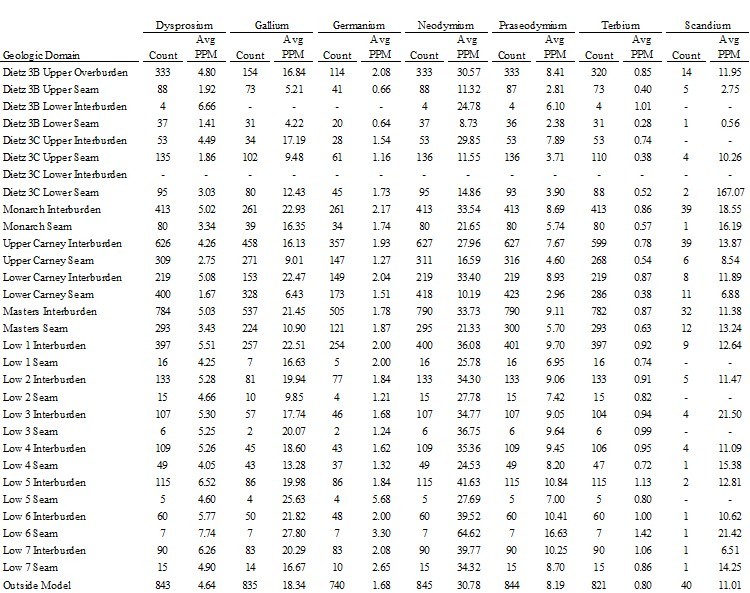
Concentrations of Uranium (U) and Thorium (Th), radioactive contaminants, were sampled during pXRF scanning and with ICP-MS analyses. The results of both methods of analysis indicate these elements exist in low quantities. The results of the more accurate ICP-MS analyses for 3,857 Th samples and 4,399 U samples show an average of 11 ppm for Th and an average of 4 ppm for U. These levels are slightly above typical upper crustal abundance (10.5 ppm Th and 2.7 ppm U) as published by the International Atomic Energy Agency.
A schematic cross section (location identified on Figure 7-1) based on a selection of drill holes from within the exploration area showing the coal seam correlations as well as TCM sample grade histograms is presented on Figure 7-2. As can be seen in Figure 7-2, higher grade zones are exhibited above and below the coal seams and in some cases extend for upwards of 10 to 20 feet from the coal seam contact.
| |
July 24, 2026 | Page 61 |
| | |
Technical Report Summary | |
|
Figure 7-2Schematic TCM Grade Cross Section
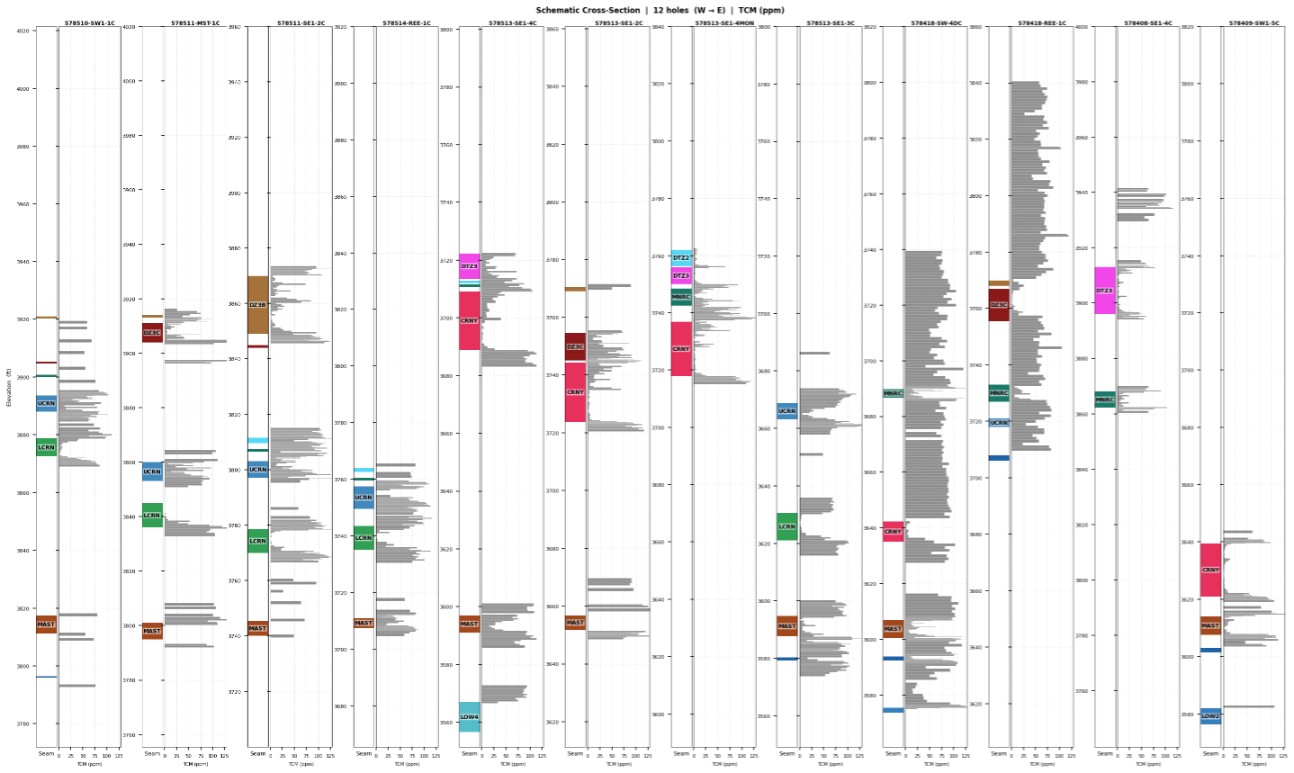
| |
July 24, 2026 | Page 62 |
| | |
Technical Report Summary | |
|
7.5.2 | Coal Commodities |
The TCMs are associated with both coal intervals and intervals outside of the coal intervals. However, coal will be mined as a separate commodity from the TCM oxides and sold into thermal coal markets. The coal seams of interest at the Brook Mine are, in descending stratigraphic order, the Dietz 1, 2, and 3, Monarch, and Carney. The Masters Seam and several thinner unnamed underlying seams are not included in the current permit. A mine permit revision to include mining coal seams underlying the Carney Seam is required and will be prepared and submitted to state agencies once sufficient groundwater data has been collected in the aquifers below the Masters Seam. Ramaco has planned to drill and install the ground water monitoring wells required for this permit revision during the 2026 drilling season.
Within the current permit area, the Dietz seams are not prevalent, and they primarily exist to the south and east of the current permit area where they have not been eroded away. They generally do not exist in the permit area nor have they been oxidized, other than the eastern margin. The Monarch seam, similar to the Dietz, is only prevalent in certain portions of the permit area, specifically the northwest, east, and southeast. The Carney seams are fairly continuous across the permit area. The Carney Seam splits towards the western portion of the permit area. Table 7-5 shows drill hole statistics for the Brook Mine and includes areas to the south of the existing permit (see Figure 7-1), which explains the abundance of Dietz Seam data. This table also shows that the three Dietz seams have numerous splits where the Dietz seams exist. The Monarch and Carney seams are both relatively thick, each averaging approximately 15 feet, and are relatively clean with some partings found in certain areas.
| |
July 24, 2026 | Page 63 |
| | |
Technical Report Summary | |
|
Table 7-5Drill Hole Coal Statistics
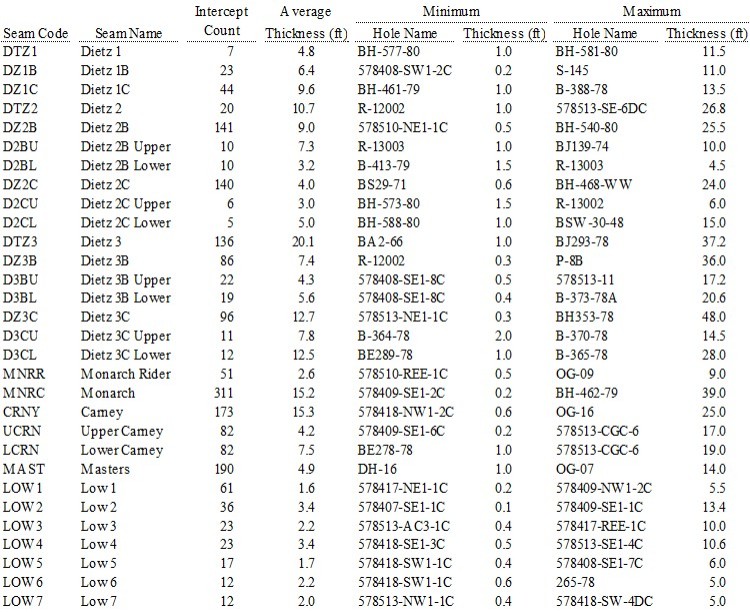
Ramaco provided 92 drill holes with coal quality data. This data was used to interpolate coal qualities as shown in Table 7-6. The coal quality data for the Monarch and Carney seams shows a high Btu/lb, low sulfur, low ash thermal coal which is typical of PRB coal. The abundance of data for the Dietz seams in Table 7-6 is a result of the stratigraphic model’s inclusion of all drill holes for Ramaco-controlled property and encompasses areas south of the current mine permit area (see Figure 7-1). A portion of these drill holes are from areas that have previously been mined with historical mining concentrated in the south and eastern portions of the Brook Mine. Previous surface mining along the eastern edge of the Brook Mine was concentrated in the Dietz and Monarch seams with underground mining occurring along the southern and eastern edges of the Brook Mine in the Carney and Monarch seams respectively.
| |
July 24, 2026 | Page 64 |
| | |
Technical Report Summary | |
|
Table 7-6Drill Hole Coal Quality Summary
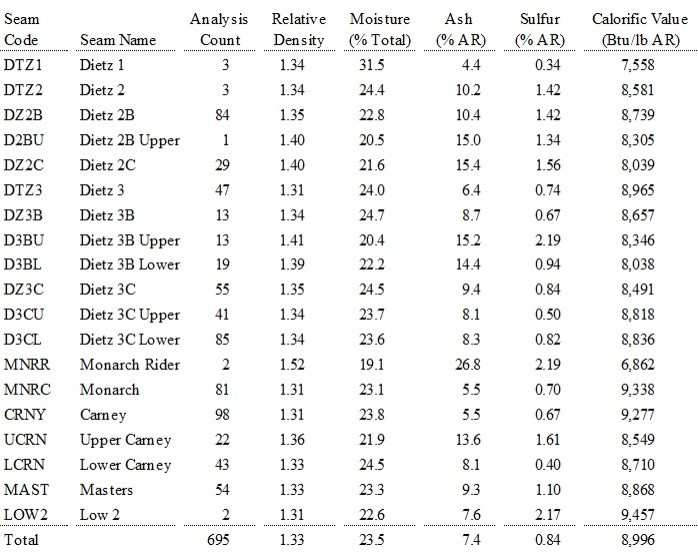
7.6 | Uncertainty in Resource Estimates |
Mining is a high risk, capital-intensive venture and each mineral deposit is unique in its geographic, social, economic, political, environmental, and geologic aspects. At the base of any mining project is the Mineral Resource itself. Potential risk factors and uncertainties in geologic data serving as the basis for deposit quantity and quality estimates are significant considerations when assessing the potential success of a mining project.
Geological confidence may be considered in the framework of both the natural variability of the mineral occurrence, and the uncertainty in the estimation process and data behind it. The mode of mineralization, mineral assemblage, geologic structure, and homogeneity naturally vary for each deposit. Structured variability like cyclic depositional patterns in sedimentary rock can be delineated mathematically with solutions like trend surface analysis or variography. Unstructured variability, in the distribution of igneous rock composition, for example, is more random and less predictable.
| |
July 24, 2026 | Page 65 |
| | |
Technical Report Summary | |
|
The reliability of mineral tonnage estimation is related to uncertainties introduced at different phases of exploration. An exploration program comprises several stages of progressive data collection, analysis, and estimation, including:
· | Geological data collection |
· | Geotechnical data collection |
· | Sampling and assaying procedures |
· | Bulk density determination |
· | Geological interpretation and modeling |
· | Tonnage and quality estimation |
· | Validation |
· | Confidence Classification |
Error may be introduced at any phase. Data acquisition and methodologies should be properly documented and subject to regular quality control and assurance protocols at all stages, from field acquisition through resource estimation. Managing uncertainty requires frequent review of process standards, conformance, correctional action, and continuous improvement planning. Risk can be minimized with consistent exploration practices that provide transparent, backwards traceable results that ultimately deliver acceptable resource estimates for tonnage and quality.
As discussed in Sections 8 and 9, it is WEIR’s opinion that Ramaco’s methodology of data acquisition, record-keeping, and QA/QC protocols are adequate and reasonable for tonnage and grade estimation related to TCMs within the Brook Mine.
The drill hole data and quality assays of TCM attributes at the Brook Mine are demonstrated to be professionally developed, well maintained, quantitative, and qualitative data. WEIR finds no material reason, regarding geologic uncertainty, that would prohibit acceptably accurate estimation of mineral tonnage or grade.
7.7 | Additional Commodities |
In addition to TCM commodity interests, there is subbituminous coal that is of economic interest within the Brook Mine. While TCM resources are present both within and outside of the coal seams, this TRS only considers those TCMs present outside of the coal seams and considers the coal to be a separate product from the TCMs. Therefore, this TRS includes estimates for both TCM and coal tonnage and quality.
| |
July 24, 2026 | Page 66 |
| | |
Technical Report Summary | |
|
In addition to the TCMs identified in this report, the following CMOs are present within the property and have been assayed with the samples collected:
· | Yttrium |
· | Lanthanum |
· | Cerium |
· | Samarium |
· | Europium |
· | Gadolinium |
· | Holmium |
· | Erbium |
· | Thulium |
· | Ytterbium |
· | Lutetium |
At present market conditions, these CMOs do not demonstrate Reasonable Prospects for Economic Extraction.
7.8 | Conclusions |
Drilling results presented in this TRS demonstrate TCM concentrations which support further evaluation. The drilling results also demonstrate a high-quality thermal coal that warrants further evaluation.
WEIR did not have direct involvement with the implementation or supervision of Ramaco’s drilling or sampling programs. To the best of WEIR’s knowledge and observations, Ramaco’s exploration drilling, sample collection, preparation, security, and testing protocols are well documented and sufficient to provide consistent, reliable, and verifiable data. These protocols are planned to be maintained and improved throughout any subsequent extensions of the current exploration program.
The adequacy of sample preparation, security, and analytical procedures are generally unknown for the coal exploration holes that were drilled prior to Ramaco acquiring the property. However, the geologist’s logs for these holes contain sampling descriptions and lithologic descriptions that are sufficiently detailed to ascertain that an experienced geologist supervised the drilling and sampling, and WEIR supports the use of these drill holes to better define the structure of the deposit.
| |
July 24, 2026 | Page 67 |
| | |
Technical Report Summary | |
|
Having reviewed the details of each drilling and sampling program, WEIR finds the planning, implementation and supervision of Ramaco’s coal drilling and sampling programs to be consistent with industry standards, and is sufficient and relevant for use in the estimation of coal resources.
Ramaco’s initial CMO exploration and sampling regime was targeted to determine if sufficient quantities of elevated CMO mineralization were present on the property to warrant additional exploration. Based on this exploration, the initial samples of CMOs were conducted on a targeted basis until which point, Ramaco had determined that sufficient mineralization was present on the property and adjusted their drilling and sampling protocols to collect systematic data across the property. While the initial CMO drilling and sampling was conducted outside of normal industry standards, Ramaco has altered their drilling and sampling regime to align with current industry best practices and as such, WEIR finds that the TCM data collected is sufficient for estimation of TCM resources in the Inferred category.
| |
July 24, 2026 | Page 68 |
| | |
Technical Report Summary | |
|
8.0 | Sample Preparation, Analyses, and Security |
8.1 | Sample Preparation Methods, Analysis, and Quality Control |
Relative to the drilling overseen by Ramaco, once 3-inch diameter core samples are obtained, the cores are placed in plastic sleeves or tubing, measured and marked every two feet, photographed, and logged. The sleeved cores are transferred to a cardboard core box and labeled. Full core boxes are closed, secured, and transported to one of two secure storage locations. At the secure locations, the full boxes are checked in and added to the secure storage location inventory. Subsequently, and at the Ramaco iCAM secure location, cores are logged by geologic technicians and then reviewed by a professional geologist.
For preparation of ICP-MS analysis, the geologic technician logs the core within lithological boundaries. Once logging of the drill hole is completed, a sampling list is made. This sample list is determined by the current sampling regimen (currently, 5 feet above and below coal seams with 2 feet sampled into the coal seam). Samples are chosen within lithology boundaries and kept as close to one foot thick as possible. Then intervals are measured, marked, and split in half (currently splitting is done by hand with hammer and wide chisel by a staff geologist). Once core has been split in half, half of the core is put into a corresponding labelled sample bag and placed in a box to be shipped to the lab for analysis. The sample bag is recorded into which box in the shipment it resides. The other half of the core stays within the core box and is kept for record, and if needed, for re-logging. The ICP-MS analysis protocol utilized in the sampling of the Brook Mine drill holes provides accurate data relative to the concentrations of all TCMs.
8.2 | Laboratory Sample Preparation, Assaying, and Analytical Procedures |
Third-party ICP-MS testing has been conducted at the independent ISO/IEC 17025-accredited commercial laboratories listed in Table 8-1 as follows:
| |
July 24, 2026 | Page 69 |
| | |
Technical Report Summary | |
|
Table 8-1ICP-MS Testing Laboratories
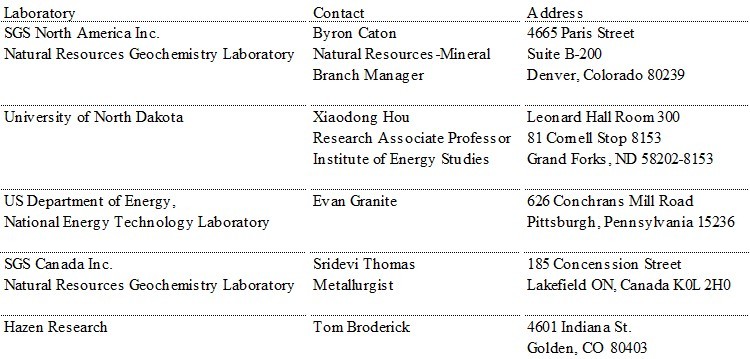
The NETL served as the initial laboratory for Ramaco’s ICP-MS testing, however, for the 100-hole exploration program, Ramaco utilized Hazen, UND, and SGS interchangeably based on availability at each facility.
All of these laboratories have documented procedures on chain of custody verification and sample receipts, login, preparation, storage, and disposal, and these laboratories are also ASTM certified.
The NETL and SGS both utilize the ICP-Mass Spectrometry (ICP-MS) technology for elemental analysis, employing a Sodium Peroxide Fusion process in preparing samples for testing. The UND utilizes an ICP-Optical Emission Spectrometry (ICP-OES) technology for elemental analysis, employing microwave acid digestion in preparing samples for testing.
The minimum limits of detection associated with each laboratory elemental ICP-MS analysis are summarized in Table 8-2 as follows:
| |
July 24, 2026 | Page 70 |
| | |
Technical Report Summary | |
|
Table 8-2ICP-MS Assay Minimum Limits of Detection
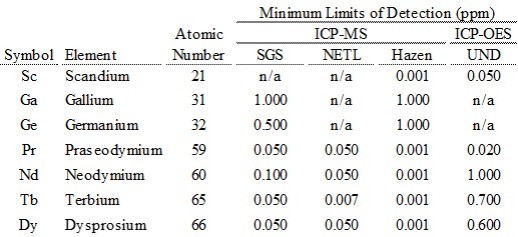
8.3 | Quality Control Procedures and Quality Assurance |
Quality Control is generally analyzed on a 10 percent basis with Certified Reference Materials (CRMs), sample duplicates, Continuing Calibration Verification (CCV), and blanks. Ramaco has historically relied on the quality control procedures implemented by each laboratory but is in the process of developing and implementing their own quality control procedures for use in future sampling. As part of this TRS, WEIR reviewed quality assurance and quality control (QA/QC) procedures of the SGS laboratory.
8.3.1 | Certified Reference Material |
The SGS laboratory utilized three internal CRMs (GRE-005, REE-003, and REE-2) that were inserted at a frequency of one per analytical batch (typical analytical batches are approximately 60 samples) and analyzed alongside project samples to monitor analytical accuracy and detect calibration drift across the program. Across the period of record (March 2025 through April 2026), 32 CRM analyses were reported for each standard. Results were provided as percentage recoveries (bias estimates) relative to the laboratory’s expected values rather than as raw assay results, and process control charts (X-charts) were constructed for each element on each standard. For GRE-005, mean recoveries were within ±5 percent of expected values for the principal REEs (e.g., Y avg = 100%, La avg = 97%, Ce avg = 96%, Yb avg = 101%), with upper and lower control limits generally falling within ±10 percent of the mean. A discrete shift in the central tendency was observed beginning at sample position 10-11 (February 3, 2026) and was visible on all three CRMs to varying degrees, with the largest deviations on GRE-005; this pattern is interpreted as a re-calibration of the analytical instrument rather than a sample-handling problem. Select X-charts are presented on Figure 8-1.
| |
July 24, 2026 | Page 71 |
| | |
Technical Report Summary | |
|
Figure 8-1GRE-005 CRM X-Charts
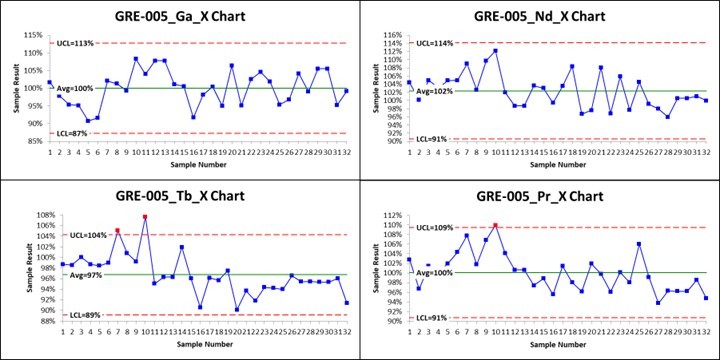
Two limitations were: (1) raw assay values and the certified grade ranges of the three CRMs were not disclosed by the laboratory, so the standards’ coverage of the project’s anticipated economic grade range cannot yet be confirmed; and (2) the date and time of analysis at the digestion/instrument level were not provided in the laboratory metadata. Both items have been requested from the laboratory and will be addressed in the next data release.
8.3.2 | Duplicates |
Analytical duplicates are inserted by SGS at a frequency of approximately one per analytical batch and are used to estimate the precision of the assay results. WEIR reviewed 128 duplicate samples inserted by SGS for analysis. Minimum and maximum graphs were prepared for Gallium (Ga), Germanium (Ge), Praseodymium (Pr), Neodymium (Nd), Terbium (Tb), and Dysprosium (Dy). The graphs include a 10 percent limit line (solid red) and a 20 percent limit line (dashed red) and are shown on Figure 8-2:
| |
July 24, 2026 | Page 72 |
| | |
Technical Report Summary | |
|
Figure 8-2Duplicate QQ Plots
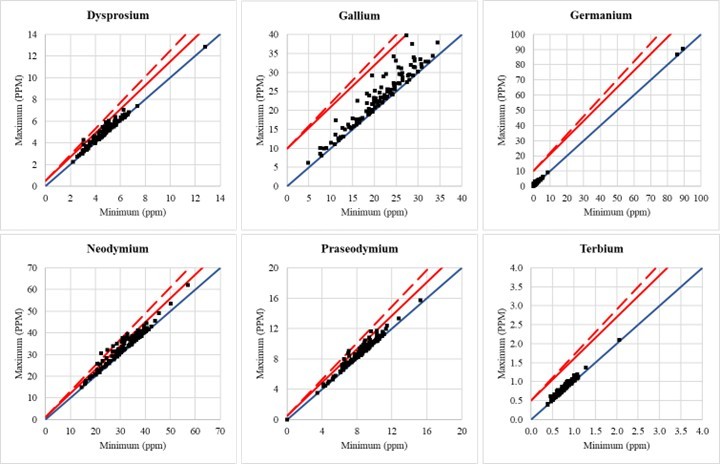
Across the period of record (March 2025 through April 2026), 128 duplicate pairs were generated; the duplicate is identified within the laboratory data stream by an “a” / “b” suffix and a D1 designator and is processed concurrently with the parent sample through the sodium peroxide fusion/ICP-MS workflow. Precision is estimated using the 90th percentile of the absolute relative difference (ARD%) calculated on duplicate pairs in which both results exceed thirty times the lower detection limit (LDL); this approach is consistent with industry practice and allows direct comparison of precision between elements and between programs. The estimated precision for the principal rare earth elements is summarized in Table 8-3.
Table 8-3Estimated Precision by Element
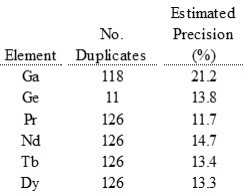
| |
July 24, 2026 | Page 73 |
| | |
Technical Report Summary | |
|
On a min-max basis, the majority of duplicate pairs fall inside ±20 percent of the parent value, and most lie inside ±10 percent. The estimated precision values fall in the range of approximately ±11-15 percent, with gallium at the upper end. These values are within the range expected for trace critical mineral assays at the grades observed and are considered acceptable for the purposes of this TRS. A principal limitation of the duplicates study is that the duplicate population covers a narrow and relatively low-grade range; precision at potentially economic grades therefore cannot be extrapolated with confidence from the current dataset, and additional duplicates spanning a wider grade range are recommended for future drilling programs.
8.3.3 | Instrument Calibration |
Calibration of the ICP-MS instrument is verified at the start of each analytical batch and is monitored through the batch by means of a second-source initial calibration verification standard (2nd Source ICV). The 2nd Source ICV is a 10 ppm reference solution prepared from a stock independent of the calibration standards, providing an unbiased check on the calibration curve and on instrumental drift between batches. Thirty-two 2nd Source ICV analyses were reviewed across the period of record. Recoveries cluster tightly around the 10 ppm target for the principal rare earth elements, with the great majority of results falling within ±10 percent of the nominal concentration and no sustained directional drift outside that envelope. Three batches reported on February 3, 2026 (batches 2600986 / 2600987 / 2601002) returned anomalous CRM, blank, and 2nd Source ICV results in the same window in which the calibration shift was observed and have been flagged for laboratory follow-up; pending that explanation, results from these batches are reported but treated with caution for resource purposes. Subject to receipt of the raw 2nd Source ICV data, certified values for the three CRMs, and the laboratory’s response on the February 3, 2026 batches, WEIR is of the opinion that the QA/QC procedures applied by SGS are consistent with industry practice for rare earth element exploration and that the analytical data are of suitable quality to support the TCM Inferred Resources contained in this TRS.
8.3.4 | Reagent Blanks |
Reagent blanks are inserted by SGS at a frequency of approximately one per analytical batch and are used to monitor the analytical workflow for cross-contamination, reagent contamination, and instrument carry-over. Thirty-three blank analyses were reported across the period of record. With the limited exceptions noted below, blank results are at or below the lower detection limit for the suite of elements of interest, and there is no evidence of systematic
| |
July 24, 2026 | Page 74 |
| | |
Technical Report Summary | |
|
contamination within the analytical process affecting the project samples. Two specific exceptions were identified: (1) the blank reported with batches 2600986 / 2600987 / 2601002 on February 3, 2026 returned anomalous results across multiple elements in the same window in which a calibration shift was observed in the certified reference materials and the second-source initial calibration verification, and (2) gallium results in three blanks from batch 2500791 reported on 14, 17, and 18 of November 2025 were elevated to between approximately 10 and 16 ppm and are interpreted as analytical errors rather than evidence of program-wide contamination. Both items have been identified for SGS, with explanation pending. A separate reporting observation, that a portion of blank results were returned as positive values below the LDL or as negative numbers, has also been raised with the laboratory; WEIR recommends that all such results be reported as “<LDL” in subsequent data releases. Subject to receipt of the laboratory’s response on the items above, the blank performance is considered consistent with industry practice for rare earth element exploration and adequate to support the conclusions of this TRS.
8.4 | Sample Preparation, Security, and Analytical Procedures Adequacy |
The verification procedures described above did not identify any systemic error, transcription error, or systematic bias in the resource database that would prevent its use as the basis for an Inferred Mineral Resource estimate. Analytical precision estimated from the duplicate population is within the range typically expected for trace critical mineral assays by sodium peroxide fusion/ICP-MS at the grades observed and is adequate to support an Inferred classification. Reagent blanks, with the documented exceptions of the February 3, 2026 batch group and the three elevated gallium values in batch 2500791, show no evidence of systematic contamination of the project sample stream. The principal items requiring laboratory follow-up, provision of raw standard data, certified standard grades, date-and-time-of-analysis metadata, an explanation of the February 3, 2026 batch anomaly, and reporting of all sub-LDL values as “<LDL”, have been formally raised with SGS by Ramaco, and WEIR recommends that Ramaco implement an externally-controlled QA/QC program (blind insertion of certified reference materials, coarse blanks, and pulp duplicates by Ramaco geologists at industry-standard insertion rates, typically on the order of 5 percent of routine samples for each control type) for all subsequent drilling campaigns and review results in a timely manner to catch any anomalous samples as quickly as possible and determine the source of the anomalies.
WEIR finds that the TCM samples have been collected and analyzed in a manner that is sufficient for estimation of TCM Inferred Resources.
| |
July 24, 2026 | Page 75 |
| | |
Technical Report Summary | |
|
9.0 | Data Verification |
9.1 | Data Verification Procedures |
Ramaco provided WEIR copies of all available drilling records related to its Brook Mine, which included Excel spreadsheets, driller’s log, field geologist’s logs, core photographs, quality results sheets from the qualitative analysis laboratories, as well as drawing files or PDFs of the e-logs. Each hole in the database was individually checked by WEIR against a copy of the driller’s and/or geologist’s log to confirm data accuracy.
Geological reviews performed by WEIR included:
· | Drill hole lithology database comparison to geophysical logs |
· | Drill hole TCM and coal quality database comparison to quality/assay certificates |
After completing the precursory verifications and validations described, the drill hole data was loaded into Datamine’s MineScape® Stratmodel, a geological modeling software. MineScape provides robust error checking features during the initial data load, which include confirmations of seam continuity, total depth versus hole header file data, interval overlap, and quality sample continuity with TCM zones. Once the drill hole data was loaded, a stratigraphic model was created. A block model was subsequently produced using zones from the stratigraphic model which contains all TCM concentrations at coordinates of corehole analyses.
Further verifications were then possible, which included:
· | Creating cross sections through both the stratigraphic and block models to visually inspect if anomalies occur due to miscorrelation of seams and the associated TCM mineralization immediately above and below the coal seams |
· | Creating structural and quality contour plots to visually check for other anomalies due to faulty seam elevations or quality data entry mistakes in the drill hole database |
Typical errors that may impact resource estimates relate to discrepancies in original data entry, and may include:
· | Incorrect drill hole coordinates (including elevation) |
· | Mislabeled drill hole lithology |
| |
July 24, 2026 | Page 76 |
| | |
Technical Report Summary | |
|
· | Unnoticed erroneous quality analyses where duplicate analyses were not requested |
· | Excessive drill hole core loss |
WEIR conducted a detailed independent geological evaluation of data provided by Ramaco to identify and correct errors of the nature listed above. Where errors are identified and cannot be successfully resolved, it is WEIR’s policy to exclude that data from the geological model.
The pXRF scanning technology only provides reliable analysis of Lanthanum, Cerium, and Yttrium (LaCeY). It does not detect or accurately determine the concentration levels of most of the remaining REEs. As such, no pXRF data was incorporated into the geological model or Mineral Resource database utilized in estimating TCM tonnage and grade, but rather, the model relied on results of the ICP-MS sampling analyses. All available ICP-MS sample analyses were included in the drill hole assay/quality database.
The resource database underpinning the TCM estimate at the Brook Mine consists of three principal digital files maintained by Ramaco and reviewed by WEIR: a drillhole collar file (hole identifier, easting, northing, surface elevation, and total depth), a lithology log and lithologic type, and a multi-element assay file reporting yttrium, gallium, germanium, Scandium and the lanthanide series (La, Ce, Pr, Nd, Sm, Eu, Gd, Tb, Dy, Ho, Er, Tm, Yb, Lu), together with tantalum, thorium, and uranium, all determined by sodium peroxide fusion and ICP-MS at lower detection limits ranging from 0.05 ppm (most lanthanides) to 2 ppm (uranium). WEIR has performed data verification on this database to a level commensurate with industry-accepted practice for an Initial Assessment supporting an Inferred Mineral Resource.
WEIR performed the following verification steps on the resource database. First, WEIR reviewed and audited Ramaco’s written sampling and core-handling procedures (logging within lithologic boundaries, lithology-controlled sample selection, half-core sampling of nominal one-foot intervals extending five feet above and below each coal seam and continuing at two-foot intervals through the coals, retention of the remaining half-core in the original core box for verification, and chain-of-custody documentation linking each sample bag to its shipment box) and confirmed that these procedures are reasonable to support Inferred Mineral Resource classification. Second, WEIR loaded the collar, lithology, and assay files into the resource database management system and ran a battery of internal-consistency checks, including hole-name uniqueness, monotonic and non-overlapping interval depths, lithology-to-interval consistency, agreement of total interval length with reported total depth, plausibility of collar coordinates against the property polygon, and screening for out-of-range, blank, or
| |
July 24, 2026 | Page 77 |
| | |
Technical Report Summary | |
|
below-detection-limit assay values. Third, WEIR performed random spot checks of digital records against the original laboratory certificates of analysis to confirm that values had been transferred to the database without transcription error. Fourth, WEIR performed independent geologic plausibility checks by inspecting a representative subset of the retained half-core and comparing logged lithology against the corresponding digital lithology log. Finally, WEIR reviewed the SGS laboratory QA/QC dataset and evaluated the three reference standards (GRE-005, REE-003, and REE-2), the population of approximately 128 analytical duplicate pairs, the reagent-blank population, and the second-source initial calibration verification (2nd Source ICV) population, and is summarized in Section 8.3 of this TRS.
Further to these desktop verifications, WEIR personnel conducted several site visits to the property with the most recent site visit conducted on April 28, 2026 where drilling and sampling procedures were observed and found to be in accordance with industry accepted practice. Additionally, several previously drilled holes were viewed and collar coordinates verified and confirmed with handheld GPS.
9.2 | Data Verification Limitations |
Limitations of data verification included incomplete or missing records for some drill holes. The primary reason for this situation is incomplete data transfers upon change in property ownership. Based on its modeling results, WEIR found some of the drill holes with incomplete data, for example lacking geologist’s logfiles and/or e-logs, to be consistent with the deposit and appropriate to include in WEIR’s geological model.
Verification of assay results was subject to the following limitations, which WEIR has taken into account in forming the opinion stated below:
· | Raw analytical results for the three reference standards were not provided by the laboratory; the values supplied appear to be percentage recoveries (bias estimates) referenced to the laboratory’s internal expected values, which are sufficient for process control but do not permit WEIR to independently confirm absolute analytical accuracy. |
· | The certified grades and the grade ranges of the three reference standards are not yet documented, so WEIR cannot yet confirm that the standards bracket the deposit’s anticipated economic TCM grades. |
· | Date and time of analysis are not reported in the laboratory metadata accompanying the digital results, which limits the ability to correlate analytical drift with specific instrument or operator changes. It is noted, however, that the calibration shift centered |
| |
July 24, 2026 | Page 78 |
| | |
Technical Report Summary | |
|
on February 3, 2026 is visible across all three standards and coincides with the anomalous batch group (2600986 / 2600987 / 2601002), and samples have been flagged in that batch group for confirmation by the laboratory.
· | The grade range covered by the duplicate population is narrow and lies near the lower end of the deposit’s reported grade range, so analytical precision at the upper end of potentially economic TCM grades cannot, at present, be extrapolated with high confidence from the current duplicate dataset. |
· | The QA/QC program operating during the period of record is laboratory-internal; Ramaco geologists have not yet inserted blind certified reference materials, blind coarse blanks, or blind pulp duplicates into the sample stream, meaning the QA/QC dataset does not yet quantify variability introduced upstream of the laboratory’s receiving department (sample preparation, packaging, transport, and laboratory log-in). |
· | The laboratory’s 2nd Source ICV data type is not yet formally documented in support provided by SGS. |
None of these limitations prevented WEIR from completing the verification work required to support an Inferred Resource classification; each is, however, a matter that must be resolved before any portion of the Mineral Resource can be advanced to the Indicated or Measured category.
9.3 | Adequacy of Data |
The collar, lithology, and assay files are internally consistent and reconcile with their underlying source records on the sampling basis tested.
It is WEIR’s opinion that the adequacy of sample preparation, security, and analytical procedures for holes that were drilled by Ramaco after acquiring the property are acceptable and that these procedures meet typical industry standards. Ramaco employs detailed processes and procedures, described in Section 8, that are followed each time a core hole is to be sampled. The geologist’s logs for these holes contain sampling descriptions and lithologic descriptions that are sufficiently detailed to ascertain that an experienced geologist supervised the drilling and sampling. Ramaco TCM quality analyses performed by the NETL, SGS, Hazen, or UND are to ASTM standards, as noted in Section 8.
The adequacy of sample preparation, security, and analytical procedures are generally unknown for drill holes that were drilled prior to Ramaco acquiring the property in 2011. However, the geologist’s logs for these holes contain sampling descriptions and lithological
| |
July 24, 2026 | Page 79 |
| | |
Technical Report Summary | |
|
descriptions that are sufficiently detailed to ascertain that an experienced geologist supervised the drilling and sampling. All TCM quality analyses have been performed since Ramaco’s acquisition of the property and these analyses have followed the procedures detailed in Section 8. The legacy drill hole information was not used for TCM quality analyses; however, the drill holes were used for coal seam structure and thickness modeling. Model verifications further support WEIR’s confidence that a representative, valid, and accurate drill hole database and geological model(s) have been generated for the Brook Mine that can be relied upon to estimate TCM tonnage to an accuracy that is acceptable for this report’s specified standards.
On the basis of the verification procedures described above, the analytical precision demonstrated by the duplicate population, the absence of evidence of systematic contamination or bias outside the documented and disclosed exceptions, the consistency of the digital database with the original source records inspected on a sampling basis, and the conservative Inferred Mineral Resource classification adopted, WEIR is of the opinion that the resource database is adequate, in its current form and subject to the limitations disclosed in this section, for the purposes for which it is being used in this TRS, namely the geological characterization of the Brook Mine property and the estimation and reporting of an Inferred Mineral Resource as an Initial Assessment under Item 1302(d) and Item 601(b)(96)(iii)(A) of Regulation S-K.
Consistent with the definitions of an Inferred Mineral Resource and an Initial Assessment in §229.1300, WEIR cautions that an Inferred Mineral Resource has the lowest level of geological confidence and may not be converted directly to Mineral Reserves. Closure of the verification limitations and recommendations identified above will be required before any portion of the Inferred Mineral Resource can be considered for upgrade to a higher Mineral Resource confidence category.
| |
July 24, 2026 | Page 80 |
| | |
Technical Report Summary | |
|
10.0 | Mineral Processing and Metallurgical Testing |
10.1 | Mineral Processing, Testing, and Analytical Procedures |
Ramaco has been performing preliminary metallurgical testing on Brook Mine samples since May 2023. These testwork programs were executed at SGS Lakefield in Canada (SGS) and Hazen Research Inc. (Hazen) in Colorado.
Mineralogical analysis at Hazen via quantitative x-ray diffraction (QXRD), quantitative evaluation of materials by scanning electron microscopy (QEMSCAN) and scanning electron microscopy (SEM) revealed a predominantly aluminosilicate structure comprised of a mineral mixture of kaolinite, K-felspar, muscovite, and quartz.
Analytical and mineralogical assessments have clearly shown that Scandium, Gallium and Germanium are associated with aluminosilicates where the Gallium specifically displaces aluminum by isomorphous substitution and scandium possibly through interlayer or ferric isomorphous substitution. Germanium is present by isomorphous substitution of silicon in the aluminosilicates. REEs were identified to be associated with monazite and xenotime. Several weaker acids like citric acid and oxalic acid as well as stronger acids like hydrochloric acid and sulfuric acid were all tested at Hazen and SGS. Stronger acids provided good extractions for the REE’s but were unable to achieve high extractions for Scandium, Gallium and Germanium.
Extraction of Scandium, Gallium and Germanium are only possible through the destruction of the aluminosilicate matrix. Acid alone is ineffective in achieving this and the leaching testwork has verified this assumption. Furthermore, alternate lixiviants were effective at dissolving aluminosilicates and extraction of the critical minerals more than doubled and even tripled compared to acid only extractions.
Deleterious elements include any element that is acid or alkali consuming but does not contribute to the product revenue. Iron and aluminum are unavoidable in this context and aluminum is targeted to extract entrained critical elements. Quartz is present but is unreactive in this process.
Approximately 40 bench scale leach tests were conducted on the feed samples. Grind size, reaction temperature, residence time, and slurry solid concentrations were varied to determine optimal leach conditions.
| |
July 24, 2026 | Page 81 |
| | |
Technical Report Summary | |
|
A pre-treatment followed by a two-stage leach achieved higher recoveries for TCMs. The details of the reagent sequence used to achieve high extractions were reviewed by this QP, however those details are considered Ramaco’s intellectual property and not fully detailed in this TRS.
Results of the testwork conducted by SGS and Hazen and as directed by Fluor, were incorporated into the conceptual process plant design basis described in the Fluor study. The Fluor study includes both a flowsheet design as well as the corresponding mass balance analysis generated from utilization of Metso’s HSC Chemistry Software to simulate various circuit performance.
Coal recovered at the planned Brook Mine will be sold as a run-of-mine (ROM) thermal coal product. As such, mineral processing and metallurgical testing do not apply.
10.2 | Mineralization Sample Representation |
The bulk samples used for mineralogical, physical testing, and extractive leach tests include raw coal and other mineralized zones outside of the coal intervals. The various mineralization types across the deposit appear to be well represented in the bulk test samples. As the project advances, additional variability testing will be required to determine metallurgical response to different mineralization types to the selected flowsheet.
Samples selected for testing included the four primary mining-related zones across multiple coal seams. These include mineralized coal, “roof” and “floor” zones comprising carbonaceous clays and shales, and “partings” containing a mixture of mineralized coal, carbonaceous clays, shales and silts.
To ensure the samples reflected the broader deposit and mining conditions, sample selection focused on major coal seams and associated zones considered reasonably mineable within the deposit. These include the Dietz 3, Monarch, Carney, and Masters Seams.
Using a resampling program and geochemical data as the foundation for sample selection, continuity and consistency of target material across each seam and mining zone was evaluated. Emphasis was placed on identifying vertically continuous intervals that could provide representative material for hydrometallurgical testing and to support flowsheet development. By incorporating samples from multiple seams, stratigraphic zones, and drill holes distributed
| |
July 24, 2026 | Page 82 |
| | |
Technical Report Summary | |
|
across representative areas of each seam, the program was designed to capture both the vertical and lateral variability present throughout the deposit into a bulk deposit for scoping tests.
10.3 | Analytical Laboratories |
The same laboratories identified in Section 8.2 were involved in mineral processing analyses and metallurgical testing. Please see Section 8.2 for further details.
The following two independent third-party laboratories performed comminution, pre-treatment, and multi-stage extractive leaching tests:
· | Hazen Research, Inc. Hazen Research, Inc. is an employee-owned industrial R&D firm located at 4601 Indiana Street, Golden, Colorado 80403. The Hazen Analytical Laboratory holds certifications from various state regulatory agencies and from the US Environmental Protection Agency (EPA), participating in performance evaluation studies to demonstrate competence. Reference materials are maintained from NIST, CANMET, and the EPA to underpin analytical accuracy. |
· | SGS Canada Inc. - Minerals - Lakefield. The full registered name under Standards Council of Canada (SCC) accreditation is SGS Canada Inc. - Natural Resources - Minerals - Lakefield. The facility is located at 185 Concession Street, Lakefield, Ontario, K0L 2H0, Canada. The Lakefield laboratory conforms to the requirements of ISO/IEC 17025 for specific registered tests (the international standard for analytical testing laboratories). SCC accreditation has been held since 1995 (File No. 15254). The Lakefield facility serves as the Centre of Excellence within SGS’s global network of over 440 mining-dedicated laboratories and offices. |
10.4 | Relevant Results and Processing Factors |
Overall recovery for the initial block flow is driven predominantly by leach extractions and estimates for full scale recovery. Multi-stage leaching test results have yielded percentage recoveries of TCMs into the low 90s. The overall plant recovery of the TCMs averages 82 percent using downstream commercial scale recovery assumptions from benchmarks for similar flowsheets.
Optimum recoveries were achieved after feed pretreatment followed by muti-stage leaching. Various lixiviants, reaction temperatures and residence times were tested. Grind size P80 varied from 10 microns for the ultrafine grind to 200 microns. The bench scale test program
| |
July 24, 2026 | Page 83 |
| | |
Technical Report Summary | |
|
did not include additional testing for recovery optimization. Overall plant recoveries were discounted by 1-3 percent to account for losses anticipated in commercial plant operations and presented in Table 10-1.
Table 10-1Estimated Overall Plant Recovery by Element
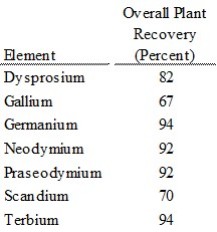
The bulk samples TCM head grade used for metallurgical testing was within 6 percent of the mill feed grade generated from Mineral Resources within the optimized pit shell.
Further tests are planned in future phases to complete full flowsheet bench scale testing and variability testing to optimize and determine full flowsheet recoveries. Recovery percentage highly influences project profitability.
10.5 | Data Adequacy |
The Brook Mine deposit hosts rare earths and critical minerals in minerals seen in many other conventional rare earth deposits. The flowsheet uses conventional unit operations found in other conventional mineral processing and hydrometallurgical flowsheets. A specific sequencing of these conventional unit operations is used to affect favorable metallurgical response.
The impact of deleterious elements on final product purity was not tested at this phase of the project but it should be tested in future phases of testing.
The analytical procedures used in the analysis are conventional industry practice. Recovery assumptions are reasonable, with data adequacy and testing suitable to support an Initial Assessment of the TCM Mineral Resources for the Brook Mine.
| |
July 24, 2026 | Page 84 |
| | |
Technical Report Summary | |
|
11.0 | Mineral Resource Estimates |
The point of reference of the TCM and coal resources, as of December 31, 2025, are reported as in-place resources (point of reference). Coal and TCM Mineral Resources are reported in the Inferred category for tonnage and grade/quality, in accordance with Regulation S-K Item 1302(d)(1)(iii)(A).
11.1 | Key Assumptions, Parameters, and Methods |
Based on WEIR’s review and evaluation of the data relative to the Brook Mine, relevant technical and economic factors were applied to the Mineral Resource estimates to ensure reported Mineral Resource tonnage and grade/quality has reasonable prospects for economic extraction. General resource classification criteria and parameters are as follows:
· | All resources (TCM and coal) were estimated on an in-situ basis as of December 31, 2025, utilizing a data cut-off date of June 30, 2025. |
· | All resources (TCM and coal) are based on recovery of the TCM and coal resources from the Lower 7 Seam and above. |
· | Previous underground mine workings within the coal measures were excluded from the resource estimates based on a 200 ft buffer around mapped historical mining extents. |
· | TCM and coal tonnage estimates were limited to areas of mineral control within the vicinity of the Brook Mine permit boundary and avoided surface encumbrances such as the Interstate Highway south of the permit as well as the surface mining exclusion area within the Padlock Surface Use Agreement along the southeast side of the permit. |
· | Coal density (pounds per cubic foot) is based on apparent specific gravity data from analyses of drill hole samples and channel samples, where available. Otherwise, it is based on raw coal ash (dry basis) using the formula [1.25+(Ash/100)]. The TCM containing strata utilized an average relative density of 2.4. |
· | TCM and coal resources were constrained within a revenue factor 1.0 pit shell based on the results of a pit optimization exercise. |
· | For the purposes of this TRS, WEIR assigned an Inferred confidence category to all TCM and coal resources due to the preliminary nature of the geological study and associated TCM processing study and design work. TCM grade continuity is assumed based on the present mineralization assumption of mineralized fluids moving through the coal seams and depositing TCM mineralization in the strata immediately above and below the coal seams as discussed in Section 6. |
| |
July 24, 2026 | Page 85 |
| | |
Technical Report Summary | |
|
11.1.1 | Resource Database |
The resource database used to support the Mineral Resource estimates comprises drill hole collar, survey, lithology, and assay records that have been verified by WEIR as described in Sections 7, 8, and 9. The database cutoff date for the current estimate is June 30, 2025. Drilling and sampling protocols, assay procedures, and QA/QC results are summarized in Sections 7, 8, and 9, respectively.
As noted in Section 7, Scandium was not consistently assayed until late 2024/early 2025 with the database containing only 243 Scandium assays. As such, Ramaco developed a regression formula utilizing 231 of the 243 Scandium assays to predict Scandium values for samples where Scandium was not previously assayed. The formula utilized is based on total rare earth element (TREE) concentration consisting of the following elements: Ce, Dy, Er, Eu, Gd, Ho, La, Lu, Nd, Pr, Sm, Tb, Tm, Yb, and Y. The Scandium regression formula is as follows:

This estimation was then capped on the downside at zero to eliminate negative assays in samples with low TREE values. A comparison of the distribution of assayed Scandium versus the calculated Scandium is presented in Table 11-1:
Table 11-1Scandium Regression Statistics
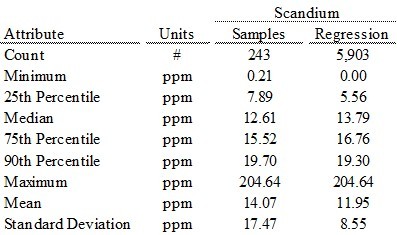
Additionally, 12 samples in the database were excluded from modeling due to having a zero sample thickness. The QP considers the resultant sample database to be of sufficient quality and quantity to support the Inferred Mineral Resource classification reported in this TRS.
| |
July 24, 2026 | Page 86 |
| | |
Technical Report Summary | |
|
11.1.2 | Coal Stratigraphic Grid Model |
Coal Mineral Resources were estimated using a stratigraphic grid model in which each target seam is represented by separate top and bottom elevations, density and quality grids. The grid model was constructed in Datamine’s MineScape® software package at a grid cell size of 50 ft square for the structure and 200 ft square for the quality parameters. Section 6.3 details the coal stratigraphic grid model construction process.
The grid model was validated by visual inspection of the seam roof and floor grids against drill hole intercepts and comparison of modeled seam thicknesses against drill hole intercepts. Cross sections were prepared across strike and dip and reviewed to confirm seam correlations and structural features were accurately reflected in the gridded model from the source drill hole data.
11.1.3 | TCM Block Model Construction |
The TCM Block Model was constructed using Datamine’s MineScape ® Software package as described in Section 6.3.2. TCM mineralization zones were limited to five feet above and below the modeled coal seams for interpolation of TCM grades. TCM assays used to interpolate the model were coded with the zone they were associated with to ensure assays associated with one coal seam were not used to inform a mineralized zone of another seam.
TCM grades were interpolated into the blocks using sample thickness weighting to account for variation in sample thickness from the various sampling campaigns as described in Section 7. Inverse Distance Squared was used as the interpolation function with the following parameters:
· | Search Ellipsoid: X and Y <= 2,800 ft, Z <= 5 ft |
· | Minimum samples per model cell: 3 |
· | Minimum octants: 1 |
· | Minimum samples per octant of 2 with a maximum of 3 |
The resultant TCM block model was validated using a combination of visual inspection against the assay database and comparison of interpolated block grades to thickness-weighted average sample grades by domain as presented in Table 11-2. Overall, modeled grades compared favorably to the sample database with most domains and elements being within +/- 20 percent The Low 7 Interburden exhibited higher variances due to the low sample count (90 samples).
| |
July 24, 2026 | Page 87 |
| | |
Technical Report Summary | |
|
Table 11-2Average Block Model versus Sample Statistics
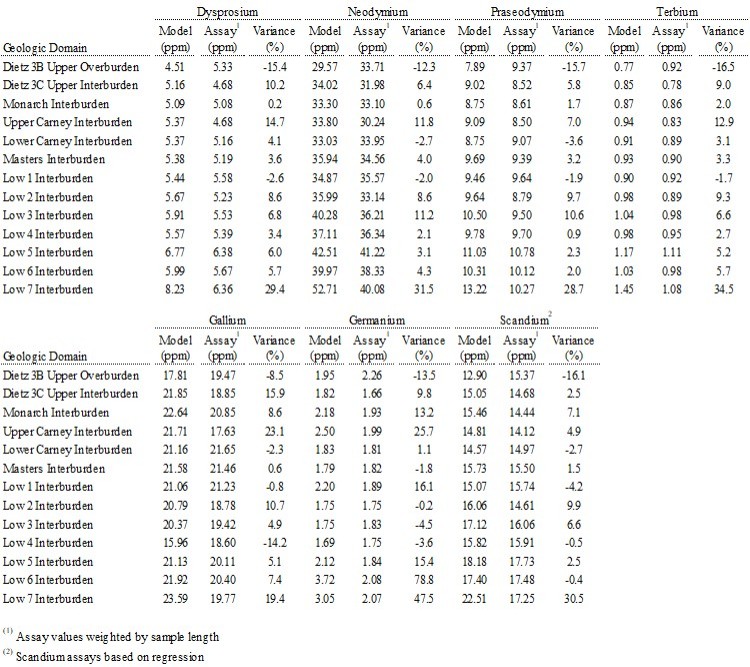
The validation results indicated that the model sufficiently reproduces the sample analyses on a domain-by-domain basis and is acceptable for use in estimation of Inferred Mineral Resources.
11.2 | Technical and Economic Factors for Determining Reasonable Prospects of Economic Extraction |
Several factors are involved in determining reasonable prospects of economic extraction for both TCMs and coal at the Brook Mine. These items are summarized below:
| |
July 24, 2026 | Page 88 |
| | |
Technical Report Summary | |
|
· | Coal sales price: The Free on Board (FOB) Mine coal sales price of $13.23 per tonne was utilized in assessing the economic extraction of the Brook Mine coal, based on sales of a thermal coal product. |
· | TCM sales price: The FOB Mine TCM sales prices used in assessing the economic extraction of the planned Brook Mine TCMs are based on assumptions from Ramaco as presented in the Fluor Study and as detailed in Table 11-3. |
· | Operating costs for mining and processing are presented in Table 11-4, and are discussed further in Section 18. |
FOB Mine Sales pricing and recovery for each product are summarized in Table 11-3 as follows:
Table 11-3FOB Mine Product Pricing and Recoveries
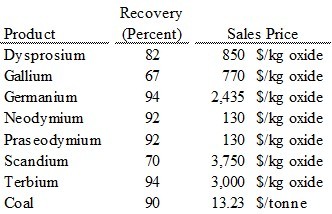
Coal and TCM pricing was provided by Ramaco and developed in a manner consistent with those described in Section 16. TCM pricing is based on Western Pricing for sales of TCMs produced outside of China. Pricing used in determining reasonable prospects of economic extraction is reflective of early 2025 market pricing as provided by Ramaco and deemed reasonable by WEIR. Ramaco developed the pricing based on the methodology and supply/demand forecasting as detailed in Section 16. As the TCM markets are in constant flux, pricing used in the economic analysis (Section 19) reflects pricing changes through the end of 2025 which exhibited continued growth through 2025, further confirming the reasonableness of the pricing shown in Table 11-3 for use in demonstrating reasonable prospects of economic extraction. The TCM pricing was held constant over the life of the Resource.
In order to demonstrate reasonable prospects of economic extraction, WEIR utilized Datamine’s Studio NPVS software to develop a series of nested pit shells based on the product pricing and recovery estimates in Table 11-3 and the physical and economic parameters shown in Table 11-4.
| |
July 24, 2026 | Page 89 |
| | |
Technical Report Summary | |
|
Table 11-4Pit Optimization Physical and Cost Parameters
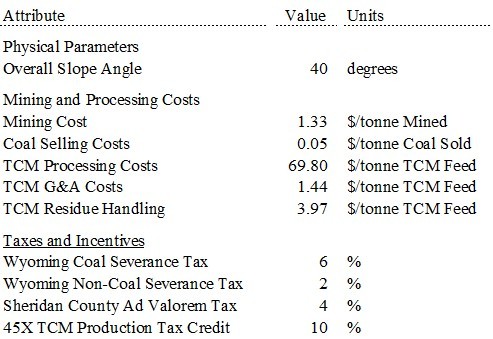
A mining cost adjustment factor (MCAF) of 0.9 was applied to the waste and TCM resource costs to account for the 45X Production Tax Credits that allow for a tax credit on the production of critical minerals in the amount of 10 percent of production and processing costs associated with domestic critical mineral production and processing. Further details on the 45X Tax Credits can be found in Section 19. The mining and processing costs were provided by Ramaco and deemed reasonable by WEIR based on general experience with other mining operations. The unit costs were held constant over the life of the Resource.
11.3 | Estimates of Mineral Resources |
The Inferred Mineral Resources reported in this TRS are not Mineral Reserves and are considered too speculative geologically to have modifying factors applied to the Mineral Resources that would allow for conversion to Mineral Reserves. The QP responsible for the estimates has a reasonable expectation that the majority of the Inferred Mineral Resources could be upgraded to Indicated or Measured Mineral Resources with continued exploration. There is no certainty that any part of the Mineral Resources estimated will be converted into Mineral Reserves in the future. The Inferred TCM Mineral Resources, as of December 31, 2025, are reported as in-place resources (point of reference). TCM Mineral Resources are summarized in Table 11-5:
| |
July 24, 2026 | Page 90 |
| | |
Technical Report Summary | |
|
Table 11-5Summary of Brook Mine TCM Mineral Resources, as of December 31, 2025
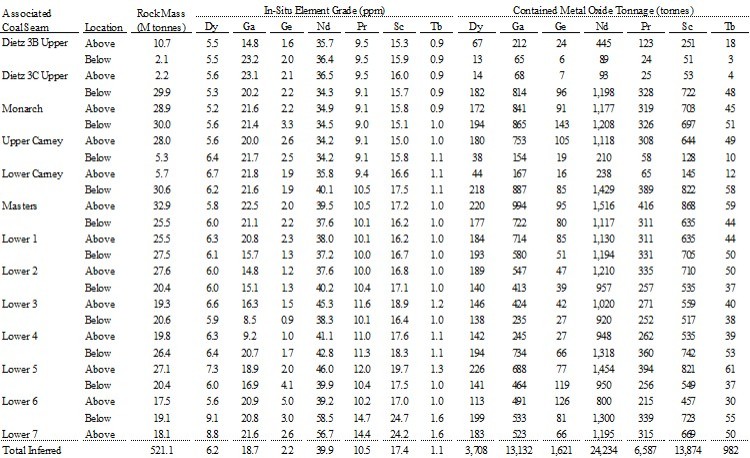
Notes:
· | Coal and TCM resources are considered collectively in the evaluation of reasonable prospects of economic extraction with estimated revenues as follows: $850/kg Dy2O3, $770/kg Ga2O3, $2,435/kg GeO2, $130/kg Nd2O3, $130/kg Pr6O11, $3,750/kg Sc2O3, $3,000/kg Tb4O7, and $13.23/tonne coal. |
· | TCM processing recoveries are as follows: 82% Dy2O3, 67% Ga2O3, 94% GeO2, 92% Nd2O3, 92% Pr6O11, 70% Sc2O3, 94% Tb4O7. An overall recovery of 90 percent was applied to the coal. |
· | Mining costs of $1.33 per tonne were used for resource pit shell generation. A mining cost adjustment factor (MCAF) of 0.90 was used for TCM and waste rock types to account for the 45X production tax credit assumed. |
· | A Net Smelter Return (NSR) marginal TCM cutoff of $67.69 per metric tonne of rock was used to classify TCM resources as an Inferred Mineral Resource within the optimized pit shell. The marginal TCM cutoff consists of $69.80 per tonne of processing costs, $1.44 per tonne of G&A and $3.97 per tonne of TCM residue handling costs as well as an offset to the costs of 10 percent (-$7.52 per tonne) from the 45X production tax credit. NSR = (69.80 + 1.44 + 3.97) × (1 − 10%) |
· | TCM Resources were constrained within the revenue factor 1.0 pit shell described in Section 11.2. |
· | Numbers in the table have been rounded to reflect the accuracy of the estimate and may not sum due to rounding. |
The pit optimization produced for the TCM resource included both coal and TCM resource costs and revenues generating ultimate surface to limit all resources within. As coal will be extracted from the pit as part of the TCM mining process, it is assumed that the coal will be
| |
July 24, 2026 | Page 91 |
| | |
Technical Report Summary | |
|
recovered and sold as a separate product to the TCMs. The coal resources, as of December 31, 2025, are reported as in-place tonnage (point of reference) and summarized in Table 11-6 as follows:
Table 11-6In-Place Coal Resource Tonnage and Quality Estimate, as of December 31, 2025
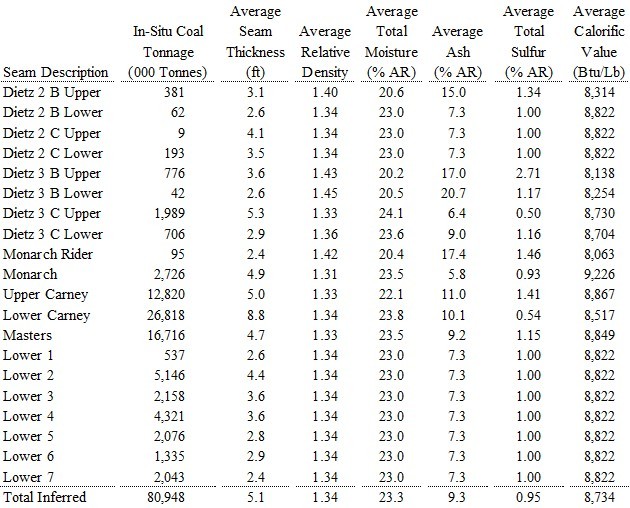
Notes:
· | Coal and TCM resources are considered collectively in the evaluation of reasonable prospects of economic extraction with estimated revenues as follows: $850/kg Dy2O3, $770/kg Ga2O3, $2,435/kg GeO2, $130/kg Nd2O3, $130/kg Pr6O11, $3,750/kg Sc2O3, $3,000/kg Tb4O7, and $13.23/tonne coal. |
· | TCM processing recoveries are as follows: 82% Dy2O3, 67% Ga2O3, 94% GeO2, 92% Nd2O3, 92% Pr6O11, 70% Sc2O3, 94% Tb4O7. An overall recovery of 90 percent was applied to the coal. |
· | Mining costs of $1.33 per tonne were used for resource pit shell generation. A mining cost adjustment factor (MCAF) of 0.90 was used for TCM and waste rock types to account for the 45X production tax credit assumed. |
· | The effective marginal cutoff for coal resources is $0.05/tonne consisting of coal selling costs. Coal is sold as ROM product and no additional processing is planned. |
· | A minimum seam thickness of two feet and the revenue factor 1.0 pit shell described in Section 11.2 were used to constrain the coal Inferred Resources. |
· | Numbers in the table have been rounded to reflect the accuracy of the estimate and may not sum due to rounding. |
| |
July 24, 2026 | Page 92 |
| | |
Technical Report Summary | |
|
11.4 | Mineral Resource Classification |
Mineral Resource estimates prepared for the Brook Mine are in accordance with SEC Regulation S-K Item 1302(d)(1)(iii)(A), which established definitions and guidance for Mineral Resources, Mineral Reserves, and mining studies used in the United States. The definitions relevant to the Mineral Resources are as follows:
Mineral Resource:
Mineral resource is a concentration or occurrence of material of economic interest in or on the Earth’s crust in such form, grade or quality, and quantity that there are reasonable prospects for economic extraction. A Mineral Resource is a reasonable estimate of mineralization, taking into account relevant factors such as cut-off grade, likely mining dimensions, location or continuity, that, with the assumed and justifiable technical and economic conditions, is likely to, in whole or in part, become economically extractable. It is not merely an inventory of all mineralization drilled or sampled.
· | Inferred Mineral Resource is that part of a Mineral Resource for which quantity and grade or quality are estimated on the basis of limited geological evidence and sampling. The level of geological uncertainty associated with an Inferred Mineral Resource is too high to apply relevant technical and economic factors likely to influence the prospects of economic extraction in a manner useful for evaluation of economic viability. Because an Inferred Mineral Resource has the lowest level of geological confidence of all Mineral Resources, which prevents the application of the modifying factors in a manner useful for evaluation of economic viability, an Inferred Mineral Resource may not be considered when assessing the economic viability of a mining project, and may not be converted to a Mineral Reserve. |
Geostatistical methods were applied to drill hole coal thickness and quality data for the Monarch and Masters Seam at the planned Brook Mine to develop variogram ranges (radii) used for coal resource classification. Variograms were generated for the Monarch, Carney, and Masters seams. An overall average between these seams resulted in WEIR selecting 1,000 and 3,000 feet for measured and indicated radii, respectively. Given the preliminary nature of this geological study, these radii were not used to determine confidence categories, but rather to support a reasonable assumption of lateral continuity to be applied in WEIR’s resource modeling of the Brook Mine.
| |
July 24, 2026 | Page 93 |
| | |
Technical Report Summary | |
|
All Mineral Resources reported in this TRS have been classified as Inferred. The Inferred classification reflects (i) sample spacing that is wider than what WEIR considers necessary to demonstrate the geological and grade or quality continuity required for an Indicated classification; and (ii) the early stage of project definition consistent with an Initial Assessment. No portion of the TCM or Coal tonnage has been classified as a Measured or Indicated Resource.
11.5 | Uncertainty in Estimates of Mineral Resources |
Mining is a high risk, capital-intensive venture and each mineral deposit is unique in its geographic, social, economic, political, environmental, and geologic aspects. At the base of any mining project is the Mineral Resource itself. Potential risk factors and uncertainties in the geologic data serving as the basis for deposit volume and quality estimations are significant considerations when assessing the potential success of a mining project.
Geological confidence may be considered in the framework of both the natural variability of the mineral occurrence and the uncertainty in the estimation process and data behind it. The mode of mineralization, mineral assemblage, geologic structure, and homogeneity naturally vary for each deposit. Structured variability like cyclic depositional patterns in sedimentary rock can be delineated mathematically with solutions like trend surface analysis or variography. Unstructured variability, in the distribution of igneous rock composition, for example, is more random and less predictable.
The reliability of Mineral Resource estimation is related to uncertainties introduced at different phases of exploration. Resources meeting criteria for Measured, Indicated, and Inferred categories are determined by the quality of modeled input data, both raw and interpreted. An exploration program comprises several stages of progressive data collection, analysis, and estimation, including:
· | Geological data collection |
· | Geotechnical and metallurgical data collection |
· | Sampling and assaying procedures |
· | Bulk density determination |
· | Geological interpretation and modeling |
· | Volume and quality estimation |
· | Validation |
· | Resource classification and estimation |
| |
July 24, 2026 | Page 94 |
| | |
Technical Report Summary | |
|
Error may be introduced at any phase. Data acquisition and methodologies should be properly documented and subject to regular quality control and assurance protocols at all stages, from field acquisition through resource estimation. Managing uncertainty requires frequent review of process standards, conformance, correctional action, and continuous improvement planning. Risk can be minimized with consistent exploration practices that provide transparent, backwards traceable results that ultimately deliver acceptable resource estimates for tonnage and quality.
Subsequent to the data cutoff date of June 30, 2025 and prior to the issuance of this TRS, additional drilling and assaying has been completed by Ramaco. WEIR has not incorporated this additional information into the modeling presented within this TRS, but has reviewed the data. WEIR compared the assay results of several drill holes completed in January 2026 to what was predicted by the existing TCM block model to determine if the model was working as expected. The results of this comparison for three holes in the southwest of the resource pit shell and several seam groups are shown on Figure 11-1.
Figure 11-1Model Prediction versus Drill Hole Comparison
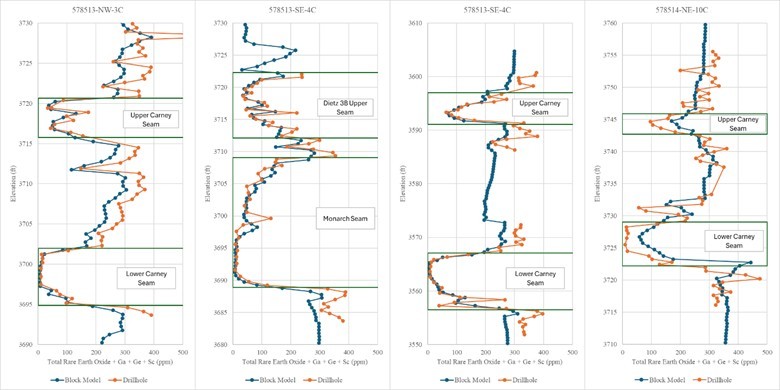
Figure 11-1 provides validation that the current TCM block model is reasonably accurate in predicting grades as the new assay results (orange lines) show similar spikes of high and low grades (Total Rare Earth Oxides plus Gallium, Germanium and Scandium oxides) at similar elevations and thicknesses. In hole 578514-NE-10C, a slight variation in seam elevations can
| |
July 24, 2026 | Page 95 |
| | |
Technical Report Summary | |
|
be seen however, the grade spikes are of similar orientation and magnitude between the new assays and the interpolated block model grades. This further validates the grade continuity of the TCM mineralization as drillhole 578514-NE-10C is approximately 250 feet away from the nearest set of samples used to inform the TCM block model.
In summary, WEIR has reviewed all geologic, metallurgical and geotechnical data inputs, collection protocols, sampling, assaying, and laboratory procedures serving as the basis for the deposit model, its interpretation, and the estimation and validation of the quantity and quality of TCM and coal resources within the Brook Mine. While the continuity of an Inferred Resource is by definition a low confidence assumption, current Coal and TCM continuity is supported by professionally developed, well maintained, quantitative and qualitative data. WEIR has considered all uncertainties involved in drilling and sampling methods, data processing and handling, geologic modeling, and estimation in the final classification in the Inferred Resource category and finds no material reason related to geologic uncertainty that prohibits estimation of Inferred Resources.
11.6 | Additional Commodities or Mineral Equivalents |
There are no commodities or minerals of economic interest within the Brook Mine beyond the TCM and coal deposits discussed in this TRS.
11.7 | Risks Regarding Technical and Economic Factors |
By definition, the quantity, grade, and continuity of Inferred Resources have low confidence.
The low confidence level associated with Inferred Resources is in part due to certain identifiable risks. At the Brook Mine, risks associated with Mineral Resource estimates include the following:
· | Implied spatial and grade continuity of the TCM mineralization |
· | On-going seam and lithology correlation and structural definition |
· | Identification and quantification of faulting throughout the deposit |
· | Areas of low ICP-MS sampling coverage, in particular below the Masters Seam |
· | Geotechnical evaluations of surface mining feasibility and mineral recovery at significant depths |
· | Metallurgical testwork may not be fully representative of all mineralized domains and may result in variable TCM recovery |
| |
July 24, 2026 | Page 96 |
| | |
Technical Report Summary | |
|
· | TCM process plant may not meet design specifications resulting in lower throughput and/or higher costs |
· | Volatility of TCM and coal sales prices, coal resources are dependent on TCMs being economically mineable |
· | Significant variations in operating cost, processing recoveries, capital expenditures, and productivity can preclude the economic mineability of the Brook Mine |
· | Unforeseen changes in legislation and new industry developments could positively or negatively alter the performance of Ramaco by impacting thermal coal or TCM demand, mining regulations, permitting, and taxes |
The QPs responsible for the Mineral Resource estimates believe all relevant technical and economic factors likely to influence the prospect of economic extraction can be resolved with further work.
| |
July 24, 2026 | Page 97 |
| | |
Technical Report Summary | |
|
12.0 | Mineral Reserve Estimates |
An Initial Assessment cannot be used as the basis for disclosure of Mineral Reserves. The Brook Mine only has Inferred Mineral Resources estimated. There are no Mineral Reserves estimated.
[The remainder of this page is intentionally left blank]
| |
July 24, 2026 | Page 98 |
| | |
Technical Report Summary | |
|
13.0 | Mining Methods |
The Brook Mine, as proposed in this TRS, will be a conventional truck-and-shovel open-pit mine. Material will be excavated with large hydraulic-shovels and loaded into haul trucks. Waste material, or burden, will be initially removed to stockpiles, however, once enough storage space is made available within the mining pits, burden material will be placed back into mined-out pits. Burden material will be removed to uncover both TCM Mineral Resources and thermal Coal Resources.
Coal will be mined using a standard truck/loader equipment spread (see Table 13-5). Coal mined from the pit will be placed in a stockpile and loaded onto rail cars or trucks. This same equipment spread will also be used to recover TCM Mineral Resources for transport to the process plant.
The overburden will require blasting for removal. However, it is anticipated that dozers will rip targeted TCM resources to facilitate loading and reduce dilution.
The Brook Mine permit, as currently approved by WDEQ/LQD, contemplates a combination of trench excavation plus ADDCAR-style highwall mining (HWM) of the Carney Seam, with limited surface mining. Ramaco intends to file a permit revision replacing the trench/HWM method with a convention truck-and-shovel open-pit mining method, additionally, the revised permit will incorporate mining provisions for additional coal seams and recovery of TCMs.
13.1 | Geotechnical and Hydrological Models |
13.1.1 | Geotechnical Model |
The geotechnical analysis developed historically for the Brook Mine centers almost entirely around HWM pillar stability and HWM-induced subsidence (Agapito Associates, Inc. 2018, AAI 2018). That body of work is therefore largely mining method-specific and must be updated for the revised open-pit mining plan.
Although the existing test program was designed around HWM pillar and roof characterization, certain underlying samples and laboratory data remain useful for open-pit slope and spoil design. The data set consists of:
| |
July 24, 2026 | Page 99 |
| | |
Technical Report Summary | |
|
· | Geotechnical core hole 2017-4 (Boart Longyear, May 25, 2018, total depth 160 ft), drilled within the proposed mining footprint and shipped to the AAI rock-mechanics laboratory in Grand Junction, Colorado. |
· | Twenty uniaxial (unconfined) compressive strength (UCS) tests on the four principal lithologies (sandstone, mudstone-sandstone, mudstone, carbonaceous mudstone, plus coal), of which fourteen included measurement of Young’s modulus and Poisson’s ratio. |
· | Two axial point-load compressive strength tests and nine diametral point-load tests. |
· | Five slake-durability tests (second-cycle index) characterizing the carbonaceous mudstone, floor mudstone, and other moisture-sensitive lithologies. |
· | Bulk density and gravimetric moisture content on representative lithologies. |
· | Geologist’s logging supporting Coal Mine Roof Rating (CMRR) and Rock Quality Designation (RQD) determinations from core. |
The 2017-4 geotechnical core hole data is summarized in Table 13-1 as follows:
Table 13-1Geotechnical Core Hole Statistics
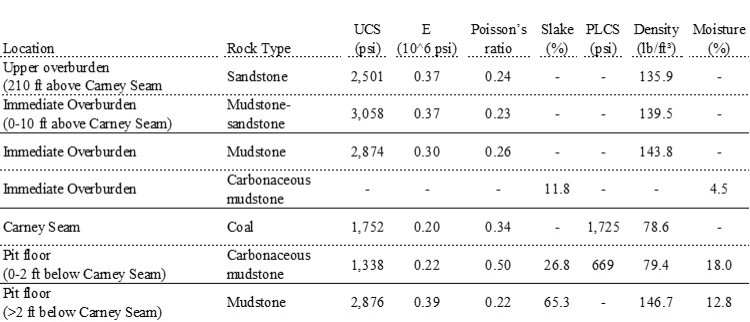
Overburden strength is moderate (UCS 2,500-3,060 psi in sandstone and mudstone), consistent with other PRB surface mines, supporting moderately steep but not aggressive pit-wall designs. The Carney Seam immediate overburden carbonaceous mudstone is weak and weathering-sensitive (slake durability 11.8 percent is very low under Franklin & Chandra 1971), and the pit-floor carbonaceous mudstone is also low-durability (26.8 percent) with 18 percent moisture. Both of these present constraints on bench-face stability, on trafficability of the pit floor under shovels and loaders, and on the quality of overburden that will form the spoil.
| |
July 24, 2026 | Page 100 |
| | |
Technical Report Summary | |
|
Several default geometries already exist in the current permit for ancillary features such as haul roads, stockpiles, and sediment-control structures, and remain directly applicable to truck-and-shovel operations. These are summarized in Table 13-2 as follows:
Table 13-2Ancillary Feature Geotechnical Parameters
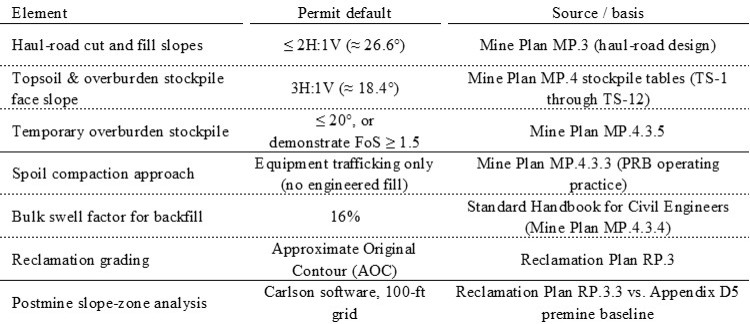
The defaults described in Table 13-2 were not derived from a site-specific pit-wall slope-stability analysis, rather, they reflect generic earthwork practice within PRB operations. While they are appropriate for ancillary cut/fill features, these defaults are not sufficient as design parameters for the final mining pit walls themselves.
WEIR recommends the following workflow for the Brook Mine truck-and-shovel mine plan:
· | Final pit limit definition - Determine the revised pit-shell geometry (cut/fill volumes, ramp configuration, bench heights) so the geotechnical investigation can be sited along the actual proposed wall lines. |
· | Pit-wall geotechnical drilling - Core holes along the proposed final highwall, with full geotechnical logging (UCS, point-load, slake, density, moisture, RQD, discontinuity orientation, condition and infill), plus shallower auger / split-spoon holes for trafficability characterization of the immediate floor. |
· | Structural mapping - ATV/OTV imaging of core holes; surface scanline or window mapping of any exposed Tongue River Member benches; stereographic analysis of discontinuity sets relative to the proposed pit-wall orientations. |
| |
July 24, 2026 | Page 101 |
| | |
Technical Report Summary | |
|
· | Slope-stability analyses - Limit-equilibrium analyses for circular and non-circular failure surfaces; kinematic analyses (planar, wedge, toppling) for rock-mass-controlled sectors; numerical analyses for any critical or sensitive sections. |
· | Spoil-pile stability analyses - Site-specific spoil strength; foundation-condition mapping; static and pseudo-static stability analyses of permanent spoil heights; selective-handling specifications and spontaneous-combustion mitigation. |
· | Reclamation/postmining stability - Long-term stability of the AOC landform under static and seismic loading, with allowance for settlement |
13.1.2 | Hydrogeological Model |
The hydrogeological model for the Brook Mine is anchored on a network of dedicated groundwater monitoring wells installed by WWC and its predecessors between 2013 and 2019. The baseline network was established in September and October 2013 with eighteen wells distributed across Sections 8, 9, 10, 11, 12, 13, 15, 17, and 18 of Township 57N Range 84W and Range 85W (Sheridan County, Wyoming), targeting the Carney Seam, the Masters Seam, the Masters underburden, and the Tongue River alluvium. The network was supplemented in 2014 and 2015 (well 578421-3-MAS and three Tongue River alluvial wells), again in May and June 2018 (Big Horn Coal spoil wells 578415-SPL-1/-2, overburden well 578513-OVB-1, paired alluvial/Carney pump-test wells 578420-AL-1/578420-CRN-PUMP and 578524-AL-1/578524-CRN-PUMP), and in July 2019 (downgradient alluvial well 578415-AL-1). Wells are 2-inch and 5-inch diameter, completed with factory-slotted PVC screen, hydrated bentonite-chip annular seals, and in piezometers installed in core-hole clusters R13-012 and R13-018, an 8/12 silica sand filter pack. Construction follows Wyoming Department of Environmental Quality (WDEQ) Land Quality Division guidelines.
Four constant-rate pumping tests have been conducted on the site to date. Single-well slug (rising- and falling-head) tests were performed on the majority of the monitoring wells, and water levels have been measured quarterly across the network since fall 2013, with continuous coverage at the 578409 cluster and most other locations through 2018-2019.
The wells, tests, and monitoring data together support a three-unit hydrostratigraphic conceptualization within the mine footprint: (i) a discontinuous Tongue River and Slater Creek alluvium that is the principal shallow aquifer; (ii) the Carney and Masters coal seams within the Tongue River Member of the Fort Union Formation, which are the only laterally continuous bedrock aquifers above 1,000 feet depth and which behave as confined to semi-confined units separated by approximately 20 to 60 feet of low-permeability claystone interburden; and (iii)
| |
July 24, 2026 | Page 102 |
| | |
Technical Report Summary | |
|
a mostly dry overburden and a generally dry Masters Seam underburden (the latter producing measurable water in only one tested well, 578409-UBN). The Carney Seam potentiometric surface lies approximately 100 to 150 feet below the alluvial water table across the eastern portion of the permit area, and the two 2018 pump tests demonstrate no measurable hydraulic communication between the coal and the alluvium across the intervening claystone. Recharge is interpreted to occur principally through clinker (scoria) outcrops and at the limited western coal subcrops; flow is southeast, down-dip into the greater Powder River Basin.
The well network and test program described above were designed to support the permitted trench/HWM layout, in which excavation depth is limited and the Masters Seam underburden and deeper claystone aquitards are not routinely exposed. The planned conversion to a truck-and-shovel surface mining method increases pit depth and pit-wall length per unit time and thereby alters the hydrogeologic exposure in three respects that the existing dataset addresses only partially, detailed as follows:
The program characterizes the Carney and Masters seams but provides only a single completed well in the Masters underburden (578409-UBN); a truck-and-shovel pit that routinely floors below the Masters Seam will require additional underburden characterization to confirm the regional interpretation that this unit is dry to low-yielding.
The existing tests confirm that the 100 to 150 ft of claystone separating the Carney from the Tongue River alluvium is an effective aquitard under the current pit geometry; a deeper truck-and-shovel pit advancing toward the western Carney subcrops will progressively shorten that pathway and warrants pit-specific re-evaluation.
Slug-test failures at the Big Horn Coal Pits 1-3 spoils indicate that any portion of the Brook Mine pit that intersects legacy spoils will encounter materials with very high hydraulic conductivity and direct continuity with the Tongue River/Goose Creek alluvial system.
WEIR recommends Ramaco complete detailed hydrogeological characterization for revised Brook Mine pit walls, including piezometer nests in the proposed final pit walls, packer/slug-test characterization of the coal-aquifer/sandstone-aquifer hydraulic conductivities, and a pit-inflow/depressurization model coupled to the slope-stability analyses.
| |
July 24, 2026 | Page 103 |
| | |
Technical Report Summary | |
|
13.2 | Production Mine Life, Dimensions, Recovery, and Dilution |
The truck-and-shovel method planned for the Brook Mine effectively accommodates the multi-seam stratigraphic section (the Dietz, Monarch, Carney, Masters and Low Seams), provides flexible access to the full coal-bearing column for TCM processing, achieves higher overall coal recovery, and matches the productivity required to maintain a steady Run-of-Mine (ROM) feed to the planned TCM process plant.
To support the Brook Mine Resource estimate, WEIR has developed a conceptual LOM Plan production schedule covering a subset of the Mineral Resources extending from west to east. WEIR utilized the revenue factor 0.68 pit shell developed as part of the pit optimization process described in Section 11.2. This pit shell was chosen to provide approximately 40 years of mining at the total production capacity of the planned fleet as described in this section.
The LOM Plan schedule is a year-by-year balance of material mined, coal recovered for sale, TCM resources mined, TCM resources direct-to-plant feed, higher-grade (HG) and lower-grade (LG) TCM resource stockpile movements, and the associated head grades of the seven TCM elements that meet the threshold of reasonable prospects for economic extraction (Dy, Ga, Ge, Nd, Pr, Sc, and Tb). The LOM Plan is sized to deliver a constant TCM mill feed to the planned process plant and to recover the in-situ coal resource on a schedule consistent with surface mining equipment productivity and pit advance rates. The LOM Plan serves as the quantitative basis for the production, mine life, recovery, and dilution discussion that follows.
13.2.1 | Production Rates |
The conceptual LOM Plan is governed by a steady-state TCM resource plant feed of approximately 2.63 million tonnes per annum (Mtpa). To support that plant feed and to recover the associated coal resources, the operation moves an average of approximately 27.2 Mtpa of total material, comprising approximately 18.8 Mtpa of waste (non-mineralized overburden, parting, and interburden), approximately 7.3 Mtpa of TCM resources (plant feed), and approximately 1.1 Mtpa of in-situ coal resources. Depending on the grade, the TCM resources mined are routed to direct plant feed, the HG stockpile, or the LG stockpile. In-situ coal resources are processed to a saleable thermal coal product averaging approximately 1.0 Mtpa over the LOM. Annual coal production varies materially across the schedule (approximately 0.0 to 3.2 Mtpa as recovered coal sold, and 0.0 to 3.5 Mtpa as in-situ coal mined) because coal resource availability is a function of seam intersection within the strip-by-strip pit advance, while TCM plant feed is held constant by drawing from the HG and LG stockpiles when in-pit
| |
July 24, 2026 | Page 104 |
| | |
Technical Report Summary | |
|
TCM mined in a given year is below plant capacity. Total material movement is held to a narrow band of approximately 27.2 Mtpa throughout the schedule, reflecting the design productivity of the truck-and-shovel fleet defined in Table 13-5.
13.2.2 | Expected Mine Life |
The conceptual LOM Plan extends over 40 years of full-scale production, during which approximately 1.09 billion tonnes of total material is moved, approximately 293 million tonnes of TCM resources are mined, and approximately 105.2 million tonnes of TCM resources are delivered to the process plant as plant feed. The in-situ coal resource within the LOM Plan footprint totals approximately 45.4 million tonnes, of which approximately 40.8 million tonnes is recovered as saleable coal product over the 40-year schedule. The LOM Plan is focused on recovering high grade TCM resources to improve project economics and extracts nearly three times the required TCM resource over the course of the LOM. The lower grade TCM resource is stockpiled in segregated areas within mined out portions of the pit for later processing.
The 40-year LOM Plan is based on the revenue factor 0.68 pit shell targeting approximately 1.1 billion tonnes of total material, and the planned process plant capacity rather than by any single-pit geometric limit. Mining begins in the northwest portion of the LOM Plan pit and progresses eastward over the 40-year duration of mining. Closing stockpile balances at the end of the 40-year LOM Plan are approximately 10.8 million tonnes of HG TCM resource and approximately 177 million tonnes of LG TCM resource; the disposition and post-Year-40 processing potential of the residual HG and LG stockpiles are not included in the current LOM Plan schedule and are identified as a future planning item. It is anticipated that the stockpiled TCM resource will be placed in mined-out areas and shaped to conform with potential reclamation requirements in the event that the stockpiled TCM resources are not reclaimed and processed. Stockpiled TCM resources will be segregated from waste material in the mined-out areas. TCM resources remaining in stockpiles at the end of the 40-year LOM Plan do not contribute revenue in the economic analysis described in Section 19.
13.2.3 | Mine Design Dimensions |
The mine will be developed as a series of nested pit phases developing from the northwest to the south and then advancing towards the eastern extent of the resource area. Pre-mining surface elevations across the LOM Plan pit area range from approximately 3,630 to 4,080 feet above mean sea level, the lowest area of the LOM Plan pit lies near elevation 3,410 feet, the
| |
July 24, 2026 | Page 105 |
| | |
Technical Report Summary | |
|
maximum pit depth is on the order of 490 feet at the deepest point. Final highwalls range from 60 to 400 feet in height depending on the location and overlying topography.
The conceptual truck-and-shovel design replaces the 150-foot wide trench-floor geometry and 65-degree single-bench highwall of the permitted plan with a benched, multi-lift open-pit configuration that uses overburden working benches on the order of 40 to 60 feet in height, individual bench-face angles of approximately 65 to 70 degrees, an overall highwall slope angle of approximately 40 to 45 degrees, pending final geotechnical confirmation, in-pit haul ramps constructed at sustained grades of 8 to 10 percent on a minimum running width sized for two-way haul truck travel, and spoil placement at the angle of repose (nominally 37 degrees) with a 16-percent material swell factor. Cross-pit and out-of-pit spoiling will be used as dictated by haul distance and reclamation contour requirements. Final pit geometry, bench widths, slope angles, and spoil-dump geometry will be confirmed through site-specific slope-stability analyses as part of the permit revision.
13.2.4 | Mining Recovery and Dilution |
The conceptual LOM Plan applies a coal mining recovery factor of approximately 90 percent, reflecting typical industry performance for PRB truck-and-shovel operations with drill-and-blast preparation of the coal seams and selective end loader- and excavator-cleaning of the roof and floor to limit out-of-seam contamination. The 90-percent recovery factor is consistent with the surface-mining recovery cited in the currently permitted plan. TCM resources within five feet of the roof and floor of the coal seam are recovered using front-end loaders and hydraulic excavators and routed to the TCM process plant feed or to HG/LG stockpile based on the block-by-block grade in the geologic model. Mining dilution is captured in the LOM Plan based on the inherent dilution incorporated within the geologic block model through the aggregation of blocks within the block model to the mineable horizons. No external dilution has been applied at this stage. Material reporting to process plant feed therefore reflects the weighted average grade of the mineralized horizons. The LOM Plan average TCM metal head grades delivered to the plant are approximately 48.3 g/t Nd, 23.4 g/t Ga, 21.1 g/t Sc, 12.3 g/t Pr, 7.5 g/t Dy, 3.6 g/t Ge, and 1.3 g/t Tb. These plant-feed grades are the basis for the economic analysis presented in Section 19. The waste-to-coal strip ratio over the LOM Plan averages approximately 18.4 tonnes of waste per tonne of recovered coal; on a combined coal-plus-TCM product basis the LOM strip ratio averages approximately 2.2 tonnes of waste per tonne of mineralized product mined. These recovery, dilution, and mining limits carry forward into the economic model in Section 19 and will be refined as the geologic block model, the pit-optimization shell, and the geotechnical slope design are advanced in the next phase of mine planning.
| |
July 24, 2026 | Page 106 |
| | |
Technical Report Summary | |
|
13.2.5 | Life of Mine Plan |
Based on the mine design and production parameters discussed previously, a LOM Plan was developed that produces the mining and TCM process plant feed schedules and head grade summary shown in Table 13-3 and an overall summary of the conceptual LOM Plan is shown in Table 13-4.
Table 13-3Conceptual LOM Plan Schedule
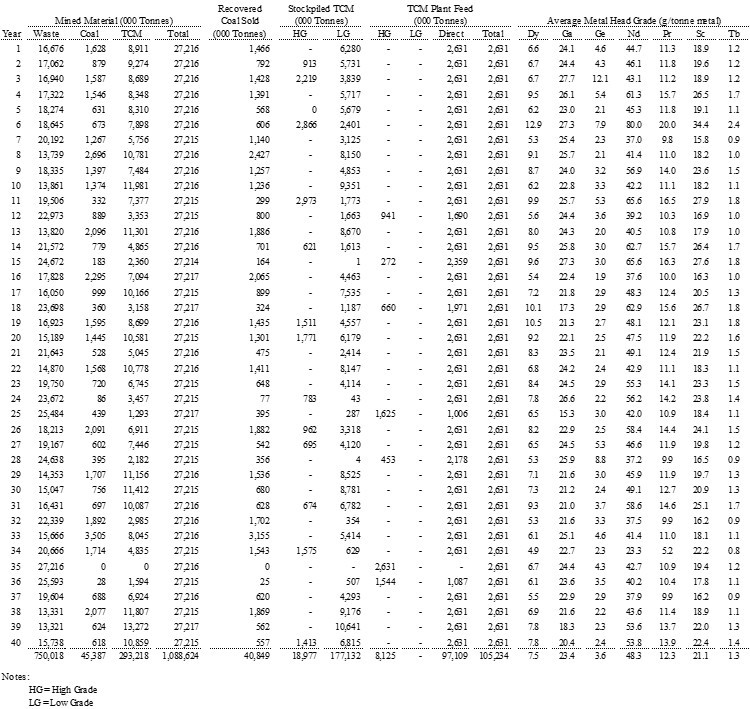
| |
July 24, 2026 | Page 107 |
| | |
Technical Report Summary | |
|
Table 13-4Conceptual LOM Plan Summary
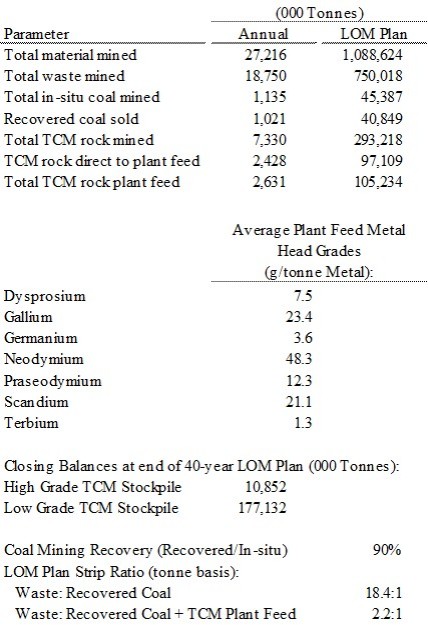
13.3 | Development Requirements |
As appropriate for an Initial Assessment, the development requirements for the Brook Mine are conceptual in nature. Based on the geology of the deposit, TCM resources and coal resources are present at relatively shallow depths requiring minimal stripping of waste. As such, no pre-production waste stripping has been planned.
The Brook Mine currently has primitive access roads available across much of the resource area allowing initial access to the mining areas, however, these primitive access roads will need to be upgraded to accommodate large mining equipment. Additionally, surface water control structures will need to be constructed in a similar manner to those currently approved in Ramaco’s WDEQ and WPDES permits. Permit modifications will be necessary to accommodate the revised mining method and mine plan.
| |
July 24, 2026 | Page 108 |
| | |
Technical Report Summary | |
|
Mine support facilities will need to be constructed as well consisting primarily of a mine office, mobile equipment maintenance facilities, fuel storage and dispensing stations, warehouse and storage facilities for maintenance spares and supplies and mine employee bathhouse.
It is anticipated that these pre-production development activities will require 12 to 24 months to design and construct prior to commencement of mining activities.
13.4 | Mining Equipment and Personnel |
13.4.1 | Mining Equipment |
The removal of overburden, TCM resources, and coal resources will be conducted utilizing surface mining equipment. The planned Brook Mine is projected to use the following surface mining equipment as shown in Table 13-5.
Table 13-5Brook Mine Equipment List
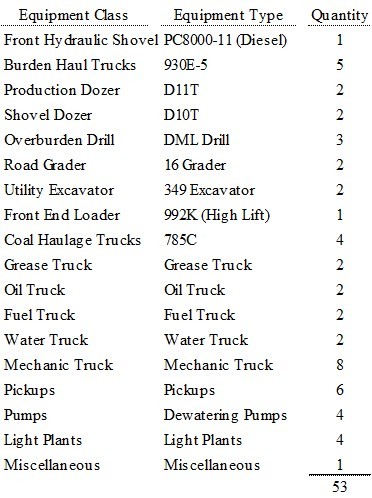
| |
July 24, 2026 | Page 109 |
| | |
Technical Report Summary | |
|
13.4.2 | Staffing |
The Brook Mine is planned to produce coal and TCM resource during two production shifts each day, with three rotating crews working 12-hour shifts per day, seven days a week, 365 days a year. Table 13-6 indicates anticipated staffing requirements after mine startup.
Table 13-6Brook Mine Staffing
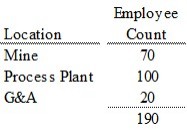
As of December 31, 2025, there were 10 people employed at the iCAM facility. Recruiting suitable personnel to operate the mine and process plant may prove to be a challenge for Ramaco. The Brook Mine is close to Sheridan, Wyoming, with a 2025 population of approximately 20,000. There are also other smaller towns surrounding the Brook Mine. As such, the availability of experienced new hires may be limited. Some experienced personnel may be available from Gillette, Wyoming (110 miles southeast) which, over the last few years, has experienced mining personnel reductions.
13.5 | Life of Mine Plan Map |
WEIR produced a conceptual LOM Plan sequencing a logical mining progression through a subset of the Brook Mine Resource Area. The extent of the conceptual LOM Plan is shown on Figure 13-1. Cross sections through the LOM Plan pit shell and resource pit shell along with NSR of the TCM resources are shown on Figure 13-2.
| |
July 24, 2026 | Page 110 |
| | |
Technical Report Summary | |
|
Figure 13-1Mine Plan Area
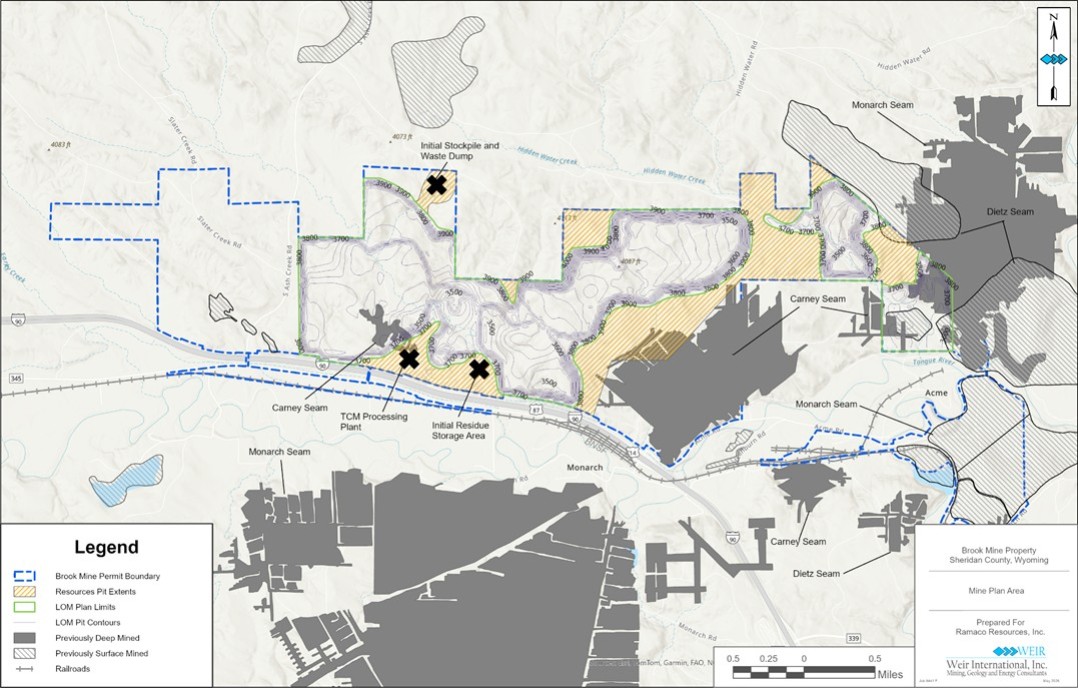
| |
July 24, 2026 | Page 111 |
| | |
Technical Report Summary | |
|
Figure 13-2Block Model NSR Cross Sections
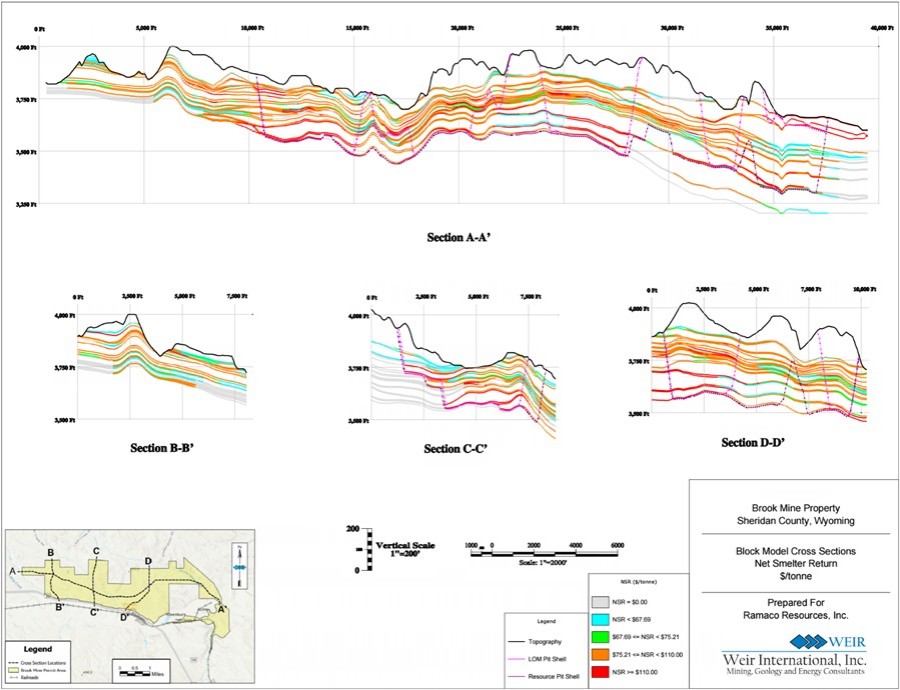
| |
July 24, 2026 | Page 112 |
| | |
Technical Report Summary | |
|
14.0 | Processing and Recovery Methods |
A multi-stage leaching process produces high extraction efficiencies from the TCM plant feed. The flowsheet design was supported by preliminary metallurgical testing conducted by Hazen. TCM process plant feed grades were generated from the LOM Plan completed by WEIR.
The processing method and plant design used in this flow sheet are similar to what is commercially being used elsewhere, with some modifications to address specific mineral characteristics of the TCM mineralization at the Brook Mine. The pre-treatment method and the reagents and operating conditions for the multi-stage leach is considered Ramaco intellectual property and has not been disclosed. Therefore, detailed descriptions of the flowsheet and equipment are not publicly disclosed. The QP has reviewed these documents and supports the process designs, costs and recoveries used in the Initial Assessment.
The mine and process plant requires a total headcount of 190 personnel, encompassing the mine (70), mineral processing (100), and general and administration (20) functions.
14.1 | Material Handling Process and Flowsheet |
The rare earth and critical minerals extraction process at the planned Brook Mine involves several sequential steps to extract TCMs from the run-of-mine (ROM) material. In their preliminary form, these steps are detailed as follows:
1. | Feed Handling and Comminution - The ROM material, which has high crushability and a low Crushing and Grinding Work Index, is processed. Mineral sizers are used as primary and secondary size reduction to handle the high clay and moisture content material. An open circuit ball mill is used to achieve a target p80 of 200 µm for the leach feed. |
2. | Pretreatment - The ball mill discharge, primarily composed of kaolinite clay and quartz with minor iron oxides and coal, undergoes a pretreatment step that aims to assist liberation of critical minerals and enhance leach kinetics for subsequent steps. |
3. | Primary Leaching and Filtration - A primary leaching agent is applied to pretreated feed to solubilize the host mineral matrix, liberating gallium and germanium, and also attacking a portion of the liberated REEs. The resulting slurry is then filtered, with the residue containing most of the REE content sent for secondary leaching. |
| |
July 24, 2026 | Page 113 |
| | |
Technical Report Summary | |
|
4. | Secondary Leaching and Filtration - The filter cake from the primary leach is re-pulped and treated with a secondary leaching agent to solubilize the remaining REEs. Some gangue minerals are also leached during this reaction. The impure REE solution is filtered, producing a PLS Filtrate and a final leach residue, which is washed and discarded as cake to a lined dry stack storage area. |
5. | Impurity Removal - Precipitation and Ion Exchange: |
a. | Impurity Precipitation: The impure REE solution is transferred to purification reactors where some impurities are removed by pH adjustment, leading to their precipitation. This constitutes the first stage of purification, yielding a partially purified REE filtrate for the Solvent Extraction (SX) circuit. The filter cake from this stage is combined with the leach residue and sent to the residue storage area. |
b. | Ion Exchange (IX): Other contaminants in the filtrate from the impurity precipitation stage are removed using an ion exchange process. Specific resins absorb these impurities, allowing REE ions to pass through to the SX circuit. Loaded resin is then stripped, with the effluent enriched in impurities sent to waste treatment. |
6. | Rare Earth Separation - Solvent Extraction: After IX, the REEs, now free from impurities, are still dilute. They are re-precipitated by adjusting the pH, forming a concentrated REE precipitate including Scandium, which is filtered out. This filter cake is then re-leached in hydrochloric acid to feed the SX with a high REE chloride solution. The exact number of contact mixer settlers for the SX circuit will be determined based on future metallurgical testwork. |
7. | Gallium & Germanium Processing - Gallium and germanium are selectively removed from the REE metals during the filtration step in the Primary Leach Section. Gallium is recovered using the industry-established SX with Kelex 100, which offers high selectivity. Both gallium and germanium are recovered in hydroxide form and then calcined, potentially using the REE calcining systems with measures to avoid cross-contamination. |
A high-level block flow diagram of the proposed processing steps is provided on Figure 14-1, as follows:
| |
July 24, 2026 | Page 114 |
| | |
Technical Report Summary | |
|
Figure 14-1Block Flow Diagram
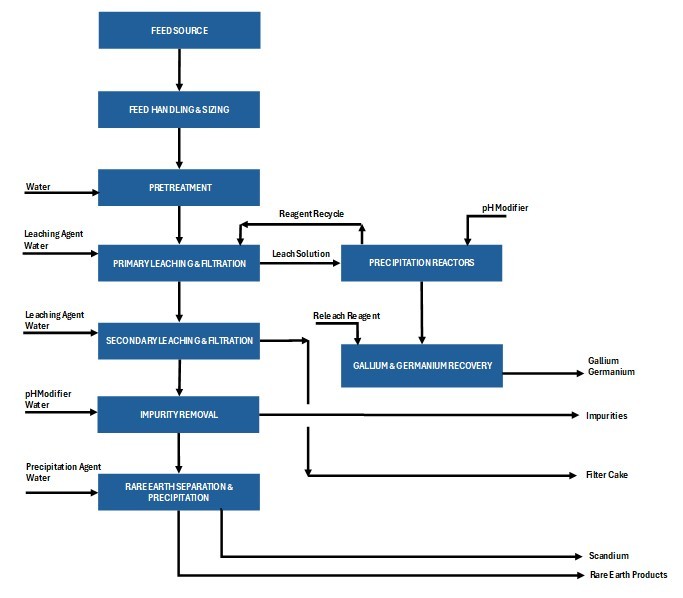
14.2 | Production |
The Brook Mine TCM process plant is designed with a ROM throughput of 2.6 million tonnes per year. Annual average production of the TCMs is summarized in Table 14-1, as follows:
Table 14-1Targeted Critical Mineral Oxide Production
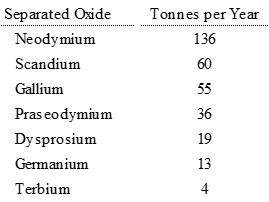
| |
July 24, 2026 | Page 115 |
| | |
Technical Report Summary | |
|
Other critical mineral oxides are not separated into final products and thus, have not been assigned any value in this flowsheet.
14.3 | Utilities |
14.3.1 | Power Requirements |
Power consumption of 9.3 MW is estimated from the mechanical equipment list, based on equipment run times and absorbed power.
All process electrical rooms are modular units assembled offsite. The rooms are installed outdoors on elevated steel structures adjacent to process areas or indoors on elevated structures. The rooms are self-supporting, designed and packaged for road shipment to site. All electrical controls and instrumentation equipment are installed, wired, and completely tested before shipment.
The rooms are built to meet a one-hour fire rating. All openings are sealed and made water- and dust-tight by using approved fire-retardant materials.
All electrical rooms have two means of egress at opposite ends of the room. Doors to the rooms are supplied with panic exit type hardware. Each room also has an equipment door sized to permit the largest piece of equipment to be installed/removed without removing the door from its hinges. The floors of the rooms will be elevated a minimum of 20 cm (8 inches) above the adjacent concrete floors in the process plant.
The electrical rooms are pressurized, air conditioned, and designed in accordance with occupancy regulations.
14.3.2 | Water Supply |
Fresh water is supplied by drilled wells on site. The wells supply the site’s domestic and firewater needs, as well as the process make-up water. Total makeup water is estimated to be about 0.6 tonnes per tonne of mill feed. Water uses in the plant include the following:
| |
July 24, 2026 | Page 116 |
| | |
Technical Report Summary | |
|
14.3.2.1 | Process Water and Firewater |
Groundwater is pumped from surrounding wells to a storage tank in the processing area. The water services facility will consist of a storage tank for raw water, process water, and fire water. These tanks will be located near the process plant.
Firewater is piped to a fire pump skid (including firewater main pump, firewater diesel pump, and firewater jockey pump) to provide firewater using buried distribution piping to surface fire hydrants and pressure indication valves. Process water is pumped from the storage tank and distributed throughout the facilities via the pipe rack. This process water is piped to various areas of the plant to provide process water to users. The raw water tank will be the main water receiving tank.
14.3.2.2 | Potable Water |
Potable Water is derived from the raw water supply system. Raw water is treated to potable water standards and distributed to administrative buildings, restrooms, cafeteria, break rooms, and eye wash and safety shower units. Potable bottled water is brought in for drinking purposes from offsite.
14.3.2.3 | Process Cooling Water |
The process cooling water system consists of a cooling tower that provides a continuous flow of cooling water at supply temperatures as specified by cooling water users. Cooling water is distributed by supply pumps via piping routed both underground and above ground to cooling water users throughout the process area. Cooling water is returned to the cooling tower cells via piping on the pipe rack.
14.3.2.4 | Steam Condensate |
Steam/process condensate originates from the boiler house and will be used to satisfy the process needs.
14.3.2.5 | Fire Protection |
The firewater water loop distributing firewater across the Brook Mine Project site provides protection for the buildings via sprinkler systems. Additional specialized fire suppression systems are also provided, such as wet risers, as well as portable fire extinguishers. The systems
| |
July 24, 2026 | Page 117 |
| | |
Technical Report Summary | |
|
are installed as needed to protect personnel and the facility by minimizing, controlling, and extinguishing any fires that may occur.
Gas detection systems are provided on an as needed basis throughout the process plant area to detect flammable gases. Fire detection is also provided across the site to activate the appropriate firefighting measures, alert plant personnel, and notify the local authorities. No fireproofing of structural steel is currently deemed to be required.
14.4 | Process Plant Buildings |
Process buildings consist of a pre-engineered steel shell designed to support overhead cranes. The building envelope consists of pre-painted, single-skin profiled wall cladding and roof decking. Pre-painted industrial formed gutters and downspouts are provided as part of the buildings.
The building structure is anchored onto cast-in-place concrete pedestal foundations set on spread footings. Exterior equipment access truck doors are located at the perimeter of the building, including wall opening doorways, to allow a steel container to be inserted for forklift loading access.
Personnel doors for emergency egress are placed around the perimeter of the building depending on floor slopes and exterior grade elevations.
Maintenance Building
This building is a membrane-covered frame structure that houses spare equipment and parts. It also serves as a workshop for maintenance.
Equipment access doors are located at the perimeter of the building, including wall opening doorways to accommodate freight containers for forklift loading access.
Security Gate House
A gate house is located at the main entrance to the plant to serve as a control point. The facility includes a security office, coffee station, and unisex toilet. It is designed as a prefabricated trailer fully finished and insulated to reduce air conditioning load.
| |
July 24, 2026 | Page 118 |
| | |
Technical Report Summary | |
|
The gate house is placed on cribbing materials. Electrical, data/telephone, HVAC, fire protection, plumbing, and other related equipment are pre-installed in the facility with only minor service connections required at site. The facility will be pre-purchased for use during construction.
Administration, Canteen, and Central Control Room
The administration building consists of fully finished site office trailers assembled to form one cohesive office facility. The facility contains four private offices and 24 open workstations, including a 12-person conference room, a document area, and a separate meeting area.
The containers are modified to include emergency egress personnel doors in compliance with the applicable codes. In addition, perimeter windows are installed throughout the facility for natural light.
Electrical, data/telephone, HVAC, fire protection, and other related equipment are pre-installed in the facility with only minor service connections required at site. The facility will be pre-purchased and can be used during construction as the EPCM office.
Canteen and Change-house
This facility consists of two fully finished trailers assembled to form a lunchroom and a separate men’s and women’s change room. The facility is supported on cribbing materials. A separate mechanical area will house hot water tanks and serve as a utility or janitorial room.
Central Control Room
The control room is located near the process plant to serve as the main control room. The module is designed as a modified, prefabricated shipping container fully finished and insulated to reduce air conditioning load. The facility is placed on concrete foundations with a step landing at the entrance.
Emergency Services
This facility consists of one fully finished trailer, assembled to form a first aid facility. It is equipped with one private office for the first aid attendant, a unisex toilet, a locked storage closet, one-person hospital bed station with tracked privacy curtain, an area equipped with base
| |
July 24, 2026 | Page 119 |
| | |
Technical Report Summary | |
|
and wall cabinetry for medical supplies and equipment. The facility is supported on cribbing materials.
Electrical, data/telephone, HVAC, fire protection, and other related equipment are pre- installed in the facility with only minor service connections required at site. The facility is pre-purchased for use during construction.
| |
July 24, 2026 | Page 120 |
| | |
Technical Report Summary | |
|
15.0 | Infrastructure |
15.1 | Roads |
Access to the property is from Interstate Highway 90, which crosses the property from west to south. State Highway 338, which connects Sheridan, Wyoming to Decker, Montana, crosses the southeastern portion of the Brook Mine. Secondary roads and trails provide access to the remaining lands.
The nearest airport is the Sheridan County Airport (SHR), which is located in Sheridan, Wyoming, approximately seven miles southeast of the Brook Mine. The Billings Logan International Airport (BIL) in Billings, Montana, is located approximately 95 miles northwest of the Brook Mine.
15.2 | Rail |
Rail access is by the Burlington Northern Santa Fe Railroad, which is located in the Tongue River and Goose Creek valleys. This rail access is centrally located adjacent to the south side of the permit area.
A rail spur is planned for the project and included in the capital estimate. It is used to receive construction materials. During operations, bulk reagents are brought into the site and thermal coal are moved by rail to customers.
A conceptual assessment was performed for delivery, receiving, unloading and storage of major reagents to be used in Brook Mine TCM process plant. With the Sheridan rail facility available only several miles south of the selected project site, the following options are available for the major reagents’ delivery.
· | Delivery of reagents via truck to the process facility. |
· | Delivery of reagents via rail car to the process facility. |
· | Delivery of reagents via rail car at Sheridan and transported via trucks to the process facility. |
A total monthly reagent consumption of about 47,300 tonnes will be delivered by rail car while about 60 tonnes a month are delivered by truck. The total on-site storage capacity for the various reagents varies from 7 to 28 days.
| |
July 24, 2026 | Page 121 |
| | |
Technical Report Summary | |
|
From the assessment, delivery of reagents via rail car at Sheridan and transporting via trucks to the process facility for delivery, unloading and storage is the most viable and recommended option with Sheridan rail network facility is readily available for use.
15.3 | Power Supply |
Ramaco currently purchases electricity from MDU for its surface facilities. Services from MDU are currently being upgraded for electrical supply to the pilot process plant. This will require further expansion for commercial operations. Site power consumption is estimated to be about 9.3 MW. Power consumption was estimated from anticipated loads.
Grid power supply ties into a main substation at the plant site. To minimize installation costs, electrical rooms are distributed around the site and installed as close as possible to the major electrical loads.
15.4 | Water |
Fresh water will be supplied by drilled wells on site. The line will supply the site’s domestic and firewater needs, as well as the process make-up water. Water derived from sources of groundwater will be integrated into the water supply and distribution system using pipelines to provide water to the site needs (i.e, make-up process water, dust control, fire suppression, potable needs). Details on site specific water use are described in Section 14.
15.5 | Pipelines |
Oil and gas pipelines are common occurrences at the Brook Mine. Owners will be contacted in situations that involve potential disturbance of existing wells and pipelines. In general, no mining is anticipated within accepted exclusion zone as determined by regulators from any existing oil and gas pipelines and wells.
15.6 | Waste Management |
Leached residue after secondary leaching is washed, filtered and trucked to the dry stack tailings area. It is assumed for the study that these areas are lined. The cost to expand the lined facility is included in the process plant operating costs. Since the coal will be sold as a direct shipped thermal product, no coal processing will be required and thus, no coal refuse disposal will be required.
| |
July 24, 2026 | Page 122 |
| | |
Technical Report Summary | |
|
Other waste generated during operations include lubricants, diesel fuel, oil, oily water, containers and drums, sewage, solid waste, chemicals, discarded general waste, and medical waste. A detailed project waste management plan will be developed in the next phase of the project, once quantities and types of waste are defined.
Any soil and other unconsolidated earthen material that become impacted by releases of various types of standard hydrocarbons (i.e., fuels, motor oil, etc.) because of unplanned releases and/or accidents will be transported to an appropriately licensed facility or otherwise remediated in an appropriate manner, as authorized by WDEQ, and directed through implementation of a management plan.
The expected minimal amount of hazardous and medical waste resulting from operations will be containerized and transported in accordance with the project waste management plan. These materials will be sent to an appropriate disposal or recycling site, operated in accordance with Wyoming state requirements.
Sewage waste streams originate as effluent from bathroom facilities and breakroom operations and are managed through a contracted package sewage plant. Effluent from the treatment plants is monitored to verify the treatment systems are functioning as designed and meet applicable environmental design criteria.
A packaged sanitary wastewater treatment system is provided to treat waste from restrooms, break rooms, and other potable water users onsite. The water is treated with membrane bioreactor technology. Treated effluent is taken offsite and disposed of at an appropriate waste facility.
15.7 | Fuel Supply |
Fuel needed to support operations at the project site is transported by a contracted third-party using delivery trucks to supply fuel to a fuel station at site. This fuel station will include:
· | Unloading pumps |
· | Fuel storage tanks |
· | Vehicle fuel dispensing pumps and bowsers |
· | Concrete pads for fuel loading and unloading |
· | In-ground containment system with low-point sump for inspections and extraction |
| |
July 24, 2026 | Page 123 |
| | |
Technical Report Summary | |
|
The fueling facility will be located near the maintenance and wash facilities and consists of above-ground tanks with unloading pumps for both diesel and gasoline. The facility is located on concrete pads. The tanks will be equipped with overspill protection valves and alarms and tanks are double walled.
The entire fuel storage area (including vehicle drive-up and fueling areas) is located within an in-ground containment system that utilizes HDPE lining and a low-point sump. This containment area is sized to capture the volume plus 10 percent of the largest tank in the fuel station. Any water that enters the containment will go to a low-point sump. Water is tested and, if contaminated, disposed of in accordance with, local, state and federal guidelines.
A spill prevention, control, and response plan will guide the management of fuel used onsite and emergency response procedures in the event of an accidental release of fuel to the environment, as well as define necessary worker training programs to be developed and implemented onsite.
Natural gas is used for process and building heating. A tie in will be brought to the site boundary. An estimated annual consumption of about 900,000 GJ is required for the site.
15.8 | Map of Infrastructure |
Existing structures on the site are currently limited to the iCAM building as shown on Figure 15-1, along with other features such as rail, oil and gas wells, and power lines. Proposed site facilities including the TCM process plant, initial residue storage location and initial waste dumps and TCM stockpiles were shown previously on Figure 13-1. The TCM process plant and initial residue storage locations are generally North-Northwest of the Taylor Quarry on Ramaco owned surface land.
| |
July 24, 2026 | Page 124 |
| | |
Technical Report Summary | |
|
Figure 15-1Infrastructure Map
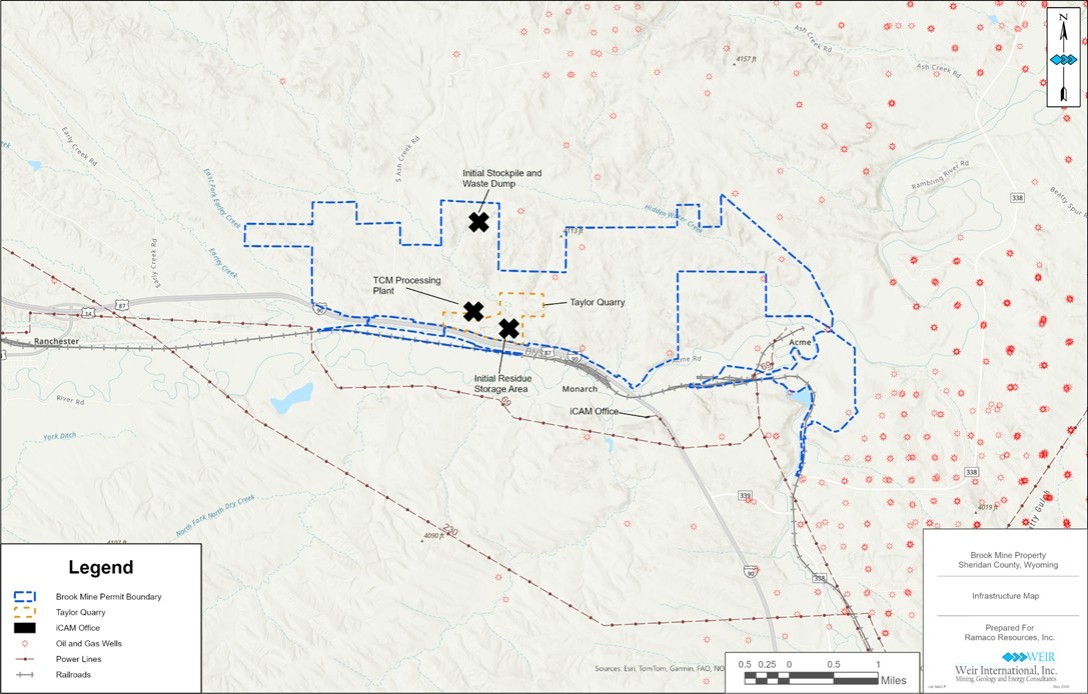
| |
July 24, 2026 | Page 125 |
| | |
Technical Report Summary | |
|
16.0 | Market Studies |
Ramaco developed a long-term pricing model for the Brook Mine’s TCM products based on western market prices as of December 31, 2025, consistent with Ramaco’s fiscal year-end. Prices reflect the structural bifurcation between Chinese domestic benchmark prices and ex-China western market prices that has developed as a result of Chinese export controls and supply chain fragmentation. Chinese domestic prices are not considered representative of the market accessible to a North American producer and have not been used in this study. No material contracts have been signed to develop the project.
Brook Mine anticipates production of seven revenue-generating separated rare earth and critical mineral oxides, also referred to as TCMs. The anticipated product form, annual production tonnage, prices used in the financial model, and revenue contribution for each are summarized in Table 16-1. Pricing used for the Resource pit shell in Section 11 was based on early 2025 pricing while updated pricing as of the end of 2025 is described within this section. Long-term pricing is held constant over the 40-year LOM and does not include the approximate $18.4 million annual average revenue generated from coal sales. Demand and pricing for each TCM product are discussed in detail in Sections 16.1 through 16.5.
Table 16-1TCM Product Pricing and Specifications
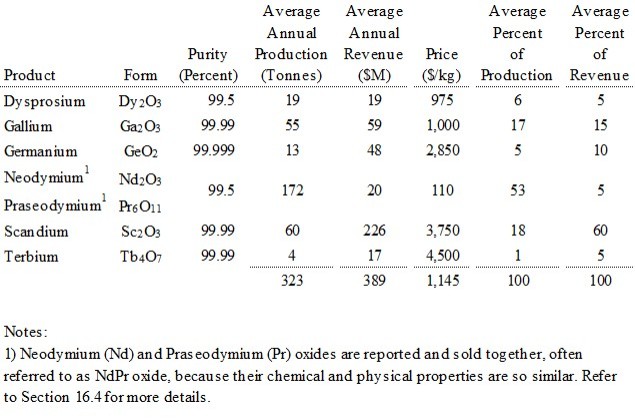
| |
July 24, 2026 | Page 126 |
| | |
Technical Report Summary | |
|
The average basket price for all revenue-generating products, weighted by percent of production, is $1,145 per kg of oxide equivalent.
TCM Pricing assumptions used in this study are supported by the following:
· | Published spot market prices on recognized western commodity price indices as of December 31, 2025, as detailed in Sections 16.1 through 16.5. |
· | Recent third-party independent market studies available in the public domain, as identified and cited in Sections 16.1 through 16.5 and listed in Section 24. |
Western prices are used rather than Chinese domestic benchmark prices, which are not representative of the market accessible to a North American producer. The divergence between Chinese domestic and western prices reflects structural supply chain fragmentation rather than temporary market conditions, and is expected to persist through the Brook Mine’s anticipated production horizon.
Thermal coal will be produced as part of the mining process for TCMs. It is expected to be sold primarily into the domestic thermal coal markets served by several existing mines in the area. Anticipated FOB Mine sales price is $16.53/tonne of coal. This is consistent with current and forecast pricing for coals of similar quality and based on PRB coal indices as published by McCloskey as of December 2025.
The QP relied on information supplied by the Registrant’s commercial and marketing personnel regarding product sales, customer demand, transportation logistics, and pricing assumptions. The QP reviewed the information for consistency with published market data, and industry practice and considers such reliance reasonable.
16.1 | Scandium |
16.1.1 | Scandium Demand and Supply |
There are currently no primary scandium mines in production globally. Scandium is produced almost exclusively as a byproduct of other metal refining operations, principally titanium dioxide pigment processing, nickel laterite high-pressure acid leaching (HPAL), and alumina refining, with active production concentrated in China, the Philippines, Canada and Russia (USGS).
| |
July 24, 2026 | Page 127 |
| | |
Technical Report Summary | |
|
Published market estimates commonly cite global scandium oxide consumption at 30 to 40 tonnes per year. However, Ramaco’s internal analysis indicates this figure materially understates actual demand because Bloom Energy’s solid oxide fuel cell (SOFC)-related consumption is systematically excluded from conventional trade statistics due to alternate import classification codes. When Bloom Energy’s consumption is properly accounted for, Ramaco estimates true global scandium oxide consumption at approximately 55 to 65 tonnes per year as of 2024 (Ramaco Internal, Bloom Energy).
The three principal demand sectors for scandium oxide are aluminum-scandium (Al-Sc) alloys for aerospace and defense applications, solid oxide fuel cells (SOFCs), and semiconductor electronics. Each is discussed below (Ernst & Young LLP, Ramaco Internal).
16.1.1.1 | Solid Oxide Fuel Cells |
Scandium-stabilized zirconia (ScSZ) is the preferred electrolyte material for solid oxide fuel cells, enabling operating temperatures of 700 to 800°C with superior ionic conductivity and extended stack service life relative to yttria-stabilized alternatives. Bloom Energy is the dominant global consumer of scandium oxide, using it as the electrolyte in its Energy Server SOFC systems.
Bloom Energy’s 10-K filing for fiscal year 2023 reports 268 MW of customer acceptances, equivalent to 2,682 units of its 100 kW module. Using the industry-standard loading of 13 to 15 kg of Sc₂O₃ per 100 kW module, as documented in peer-reviewed literature and consistent with commercial stack power density ratings of ≤150 mW/cm², Bloom’s consumption calculates to approximately 40 to 44 tonnes of Sc₂O₃ per year, inclusive of fabrication yield losses and spare stack requirements of approximately 10 percent (Bloom, Ramaco Internal, Phoung).
This single company therefore accounts for approximately 70 to 75 percent of estimated global scandium oxide consumption. Bloom Energy has provided guidance indicating significant growth in future SOFC demand, with Ramaco’s internal analysis projecting Bloom’s consumption growing at a 15 percent CAGR to approximately 98 tonnes per year by 2030, based on publicly disclosed capacity expansion plans. Rest-of-world SOFC demand is estimated at 12 to 15 tonnes per year currently, growing at a 3 percent CAGR at least (Ramaco Internal).
| |
July 24, 2026 | Page 128 |
| | |
Technical Report Summary | |
|
16.1.1.2 | Aerospace and Defense - Aluminum-Scandium Alloys |
The addition of small quantities of scandium (typically 0.1 to 0.5 percent by weight) to aluminum produces alloys with substantially improved mechanical properties, including tensile strength increases of 30 to 100 percent, significantly enhanced fatigue resistance, improved weldability, and superior resistance to corrosion and thermal stress. These properties are highly valued in commercial aviation, defense aerospace, additive manufacturing, and hypersonic applications (Ernst & Young LLP).
Boeing’s Commercial Market Outlook 2025-2044 forecasts demand for approximately 44,000 new commercial aircraft over the forecast period. The Airbus Global Market Forecast 2025-2044 similarly projects the global passenger and freighter fleet nearly doubling from approximately 24,700 aircraft at end-2024 to approximately 49,200 by 2044, requiring approximately 43,400 new deliveries. At a 0.5 percent Al-Sc alloy incorporation rate applied to lightweighting programs, Ramaco’s internal analysis estimates annual commercial aviation demand of 400-750 tonnes per year of scandium oxide by the mid-2030s, consistent with the Ernst & Young (2022) demand trajectory (Boeing, Airbus, Ramaco Internal Airlines, Ernst & Yount LLP).
The Ernst & Young (2022) study projects aerospace and defense sector scandium demand growing from approximately 2 tonnes per year at study inception to 245 tonnes per year over a 20-year period, based on progressive adoption of Al-Sc alloys across airframe structures.
Defense demand is an emerging near-term driver. The United States Defense Logistics Agency’s SBIR Topic DLA242-003 explicitly calls for scaling Al-Sc supply chains for missiles, aircraft, space launch vehicles, and other weapon systems, a strong signal that the Department of Defense anticipates domestic scandium supply and is prepared to fund qualification programs. NioCorp Developments Ltd. has entered agreements with United States defense primes to supply qualified Al-Sc alloy components under the Defense Production Act, further substantiating near-term defense sector pull (NioCorp).
Ramaco’s internal analysis estimates current United States DoD scandium consumption at approximately 2 to 5 tonnes per year, growing to a range of 7 to 15 tonnes per year by 2030 driven by additive manufactured Al-Sc components across Navy airframes and submarines, hypersonic and missile skin applications, and F-35 and B-21 block upgrade programs (Ramaco Internal).
| |
July 24, 2026 | Page 129 |
| | |
Technical Report Summary | |
|
16.1.1.3 | Scandium Supply Constraints and Western Market Access |
In April 2025, China imposed export controls on scandium under MOFCOM/GAC Announcement No. 18/2025, classifying it as a dual-use military material and requiring case-by-case export licensing for all forms including metal, oxide, alloys, and compounds. China controls approximately 60 percent of global scandium supply, with over 90 percent of total supply (including Russia) coming from jurisdictions that are either subject to export restrictions or considered strategically unreliable by western governments (Ramaco Internal, USGS).
Ramaco’s internal supply analysis estimates total committed western supply expansions through 2027, including Rio Tinto’s ramp at Sorel-Tracy, Quebec to approximately 12 tonnes per year, could bring total global nameplate capacity to only approximately 120 tonnes per year by 2027. Against Ramaco’s projected global demand of 60 tonnes per year over the life of mine, this leaves some margin for new aerospace and Al-Sc adoption even in a conservative demand scenario, and significantly underserves SOFC demand growth (Ramaco Internal).
Development-stage western projects that could contribute supply beyond 2027 include Sunrise Energy Metals’ Syerston Project in New South Wales, Australia (approximately 60 tonnes per year, feasibility study Q3 2025, earliest production approximately 2028), NioCorp’s Elk Creek Project in Nebraska (approximately 55 tonnes per year, feasibility stage), and Scandium Canada’s Crater Lake Project in Quebec (approximately 40-50 tonnes per year, PEA completed 2022, updated Mineral Resource April 2025). (Scandium Canada, Niocorp, Sunrise Energy).
As of the report date, western scandium supply is acutely constrained and no near-term resolution is apparent. Brook Mine’s anticipated scandium oxide production of approximately 60 tonnes per year would represent a material and strategically significant contribution to western supply at a time when demand from SOFC, aerospace, and defense applications is growing rapidly and Chinese supply access has been formally restricted.
The EY (2022) market analysis projects unconstrained total global scandium oxide demand reaching 463 tonnes per year by 2030 and 1,970 tonnes per year by 2040 under the most likely scenario, across aerospace and defense, automotive, solid oxide fuel cells, and offshore wind turbine sectors. This latent demand substantially exceeds currently available supply, confirming that market growth is supply-constrained rather than demand-constrained over the near to medium term (Ernst & Young LLP).
| |
July 24, 2026 | Page 130 |
| | |
Technical Report Summary | |
|
However, given that global scandium supply is projected at only approximately 120 tonnes per year by 2027 even with committed western expansions, actual realized demand is expected to remain materially below EY’s unconstrained forecast in the near term. Under a supply-constrained scenario, total global scandium oxide demand is projected to grow from approximately 55 to 65 tonnes per year in 2024 to approximately 127 tonnes per year by 2030, at a compound annual growth rate of approximately 12 percent, driven principally by SOFC capacity expansion and progressive adoption of Al-Sc alloys in aerospace and defense.
The global Supply and Demand forecast for Scandium Oxide is presented in Table 16-2.
Table 16-2Scandium Oxide: Global Long-Term Supply and Demand Forecast
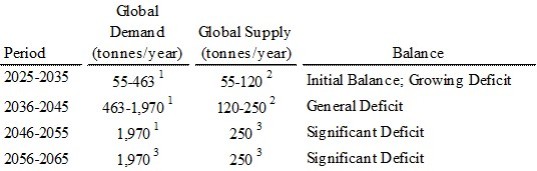
Notes:
1. | EY (2022) projects unconstrained global scandium oxide demand reaching 463 t/yr by 2030 and 1,970 t/yr by 2040 across aerospace and defense, automotive, solid oxide fuel cells, and offshore wind turbine sectors. Current global consumption is estimated at 55 to 65 t/yr, reflecting supply constraints rather than demand limitations. Latent demand substantially exceeds available supply across all major end-use sectors. As new primary supply sources including Brook Mine come online through the forecast period, realized demand is expected to progressively approach the EY market potential trajectory. (EY, Scandium Market Analysis, February 2022; Ramaco internal demand analysis, September 2025) |
2. | Current global scandium oxide production is estimated at 55 t/yr. Committed western supply expansions including Rio Tinto’s ramp at Sorel-Tracy, Quebec to approximately 12 t/yr could bring total global nameplate capacity to approximately 120 t/yr by 2027. Western supply expansion beyond 2027 is speculative given no large-scale primary scandium projects have reached construction decision as of the report date. The 250 t/yr figure for 2036 to 2045 represents a conservative estimate assuming advancement of Sunrise Energy Metals’ Syerston Project and NioCorp’s Elk Creek Project. (USGS Mineral Commodity Summaries 2025; Ramaco internal supply analysis, September 2025) |
3. | Beyond 2040, demand is held flat at the EY 2040 forecast level of 1,970 t/yr as no credible long-term forecast is available. |
| |
July 24, 2026 | Page 131 |
| | |
Technical Report Summary | |
|
16.1.2 | Scandium Pricing |
There is no established public exchange or index for scandium oxide pricing equivalent to those available for base metals or other rare earth elements. Prices are determined through bilateral negotiation and are sensitive to purity, quantity, and the terms of supply agreements. Published market data and government procurement records provide the principal basis for price estimation.
Historical scandium oxide prices (99.99 percent purity) ranged from approximately $3,800 to $5,000 per kilogram from 2013 to 2020, as reported in successive USGS Mineral Commodity Summaries. Published market analysis for 2024 indicates prices in the range of $3,000 to $4,500 per kilogram for 99.99 percent purity material, reflecting the constrained supply environment and the absence of large-scale western production (Phoung, USGS 2017, 24chemical).
The most significant publicly documented western market transaction is the United States Defense Logistics Agency’s procurement of scandium oxide from Rio Tinto’s Canadian operations, under a contract valued at up to $40 million for approximately 6.4 metric tonnes over five years, implying a contract price of approximately $6,250 per kilogram. This transaction represents the clearest available evidence of western government procurement pricing for high-purity scandium oxide and establishes a meaningful upper bound for the western market (Reuters).
A scandium oxide price of $3,750 per kilogram has been used in this study, representing the midpoint of the 2024 published market range for 99.99 percent purity material and a 40 percent discount to the DLA government procurement price. This price is considered conservative relative to observable western market conditions as of the report date, particularly given the supply disruption resulting from China’s April 2025 export controls, which post-date the original project economics but were implemented prior to the report date and are expected to exert sustained upward pressure on western prices through the project’s anticipated production horizon.
All prices are stated in United States dollars per kilogram of scandium oxide (Sc₂O₃) at 99.99 percent purity, consistent with the product specification anticipated from the Brook Mine processing flowsheet.
| |
July 24, 2026 | Page 132 |
| | |
Technical Report Summary | |
|
16.2 | Gallium |
16.2.1 | Gallium Demand and Supply |
Gallium is recovered almost exclusively as a byproduct of processing bauxite ore for alumina production and, to a lesser extent, from zinc smelting residues. There is no primary gallium mine anywhere in the world. China accounts for 99 percent of worldwide primary low-purity gallium production, with a 2024 estimated output of approximately 750,000 kilograms (750 tonnes) against a total global primary production capacity of approximately 1,100 tonnes per year. The remaining primary producers outside China are Japan, the Republic of Korea, and Russia, whose combined output totals approximately 12,000 kilograms per year. The United States has not recovered domestic primary gallium since 1987 and is 100 percent import-reliant for its gallium supply, as reported by the USGS.
World high-purity refined gallium production in 2024 was estimated at approximately 320 tonnes, unchanged from 2023, against a total refined capacity of approximately 340 tonnes per year. The principal producers of high-purity refined gallium are China, Canada (5N Plus), Japan, Slovakia, and the United States (one refiner in New York recovering and refining material from imported crude and new scrap).
In December 2024, China banned all exports of gallium to the United States, escalating controls first imposed in August 2023. Prior to the full ban, China’s 2023 export licensing requirement had already caused United States gallium metal imports to decrease and depleted stocks held outside China. USGS economic modeling estimates that a complete restriction of China’s net gallium exports could reduce United States GDP by approximately $3.1 billion, with losses concentrated in the semiconductor device manufacturing industry, which would account for more than 40 percent of the net impact. When combined with a simultaneous germanium restriction, the estimated GDP impact reaches $3.4 billion (USGS, Nassar).
16.2.1.1 | Semiconductor and Power Electronics Demand |
Gallium’s most significant end use is as the feedstock for compound semiconductor applications, primarily gallium nitride (GaN) and gallium arsenide (GaAs), which together account for approximately 83 percent of United States gallium consumption. Integrated circuits (ICs) accounted for 79 percent of domestic gallium consumption in 2024, with optoelectronic devices accounting for 20 percent and research and development 1 percent. Uses of ICs included defense applications, high-performance computers, and telecommunications
| |
July 24, 2026 | Page 133 |
| | |
Technical Report Summary | |
|
equipment. In many defense-related applications, GaAs- and GaN-based ICs are used because of their unique properties, and no effective substitutes exist for GaAs and GaN in these applications (USGS).
GaN devices offer materially higher efficiency than silicon-based alternatives, enabling 50 to 80 percent lower switching losses at high switching frequencies and approximately 50 percent smaller device form factors. These properties make GaN the preferred technology for EV onboard chargers, 5G base station power amplifiers, AI data center power distribution, defense radar and electronic warfare systems, and satellite communications (Thunder Said Energy).
The global GaN semiconductor device market was valued at approximately $3.06 billion in 2024 and is projected to reach $12.47 billion by 2030, a compound annual growth rate of approximately 27 percent driven by EV powertrains, 5G infrastructure deployment, and defense electronics modernization. The United States GaN semiconductor device market is projected to grow at a comparable 26.6 percent CAGR from 2024 to 2030 (Grand View Research).
Most gallium consumed in compound semiconductor manufacturing does not reach device fabs directly as metal. Instead, it is converted by a small number of specialty chemical companies into metalorganic precursors, trimethylgallium (TMGa) and triethylgallium (TEGa), which are the critical inputs for metal-organic chemical vapor deposition (MOCVD) epitaxial growth processes. The principal western precursor producers supplying these materials to United States and allied semiconductor fabs include Merck Electronics (EMD Electronics in the United States), Entegris, and Air Liquide. These precursor producers represent the primary commercial interface between upstream gallium supply and the semiconductor device supply chain (Ramaco Internal Gallium).
Total global gallium demand is projected to grow at a 4 to 7 percent CAGR through 2030, with a high scenario of 8 to 11 percent, driven principally by GaN power electronics growth in EV charging and industrial applications, RF semiconductor demand for 5G and defense, and AI data center power conversion infrastructure (Mordor).
16.2.1.2 | Market Bifurcation and Brook Mine’s Strategic Position |
The global gallium market is structurally bifurcated into two distinct segments with different customers, pricing dynamics, and commercial requirements. Crude gallium, typically 2N to 4N purity, serves commodity alloying, metallurgical, and upgrading markets dominated by
| |
July 24, 2026 | Page 134 |
| | |
Technical Report Summary | |
|
Chinese producers, characterized by thin margins and limited pricing power. High-purity electronic gallium, 6N to 7N+ purity, serves compound semiconductor applications, where stringent impurity requirements, long qualification cycles of 9 to 24 months, and supply chain traceability requirements create structurally higher margins and durable customer relationships. Once qualified, suppliers tend to remain embedded due to high switching costs (Ramaco Internal Gallium).
The ex-China addressable market for high-purity gallium is estimated at 190 to 330 tonnes per year across all product tiers, growing at approximately 6 to 7 percent CAGR. Western announced supply projects targeting this market include Alcoa of Australia (up to 100 tonnes per year), Atlantic Alumina (ATALCO) in Louisiana (up to 50 tonnes per year), Korea Zinc’s Crucible project in Tennessee (approximately 54 tonnes per year), and METLEN in Greece (50 tonnes per year target). Almost all of these operations are structured around low- to mid-purity byproduct recovery from alumina and zinc operations and are not oriented toward electronic-grade semiconductor supply chains.
The Brook Mine’s anticipated production of approximately 55 tonnes per year of gallium oxide equivalent positions it as a potentially significant contributor to western non-Chinese gallium supply at a time of acute strategic need.
The Supply and Demand forecast for Gallium Oxide is presented in Table 16-3.
Table 16-3Gallium Oxide: Global Long-Term Supply and Demand Forecast
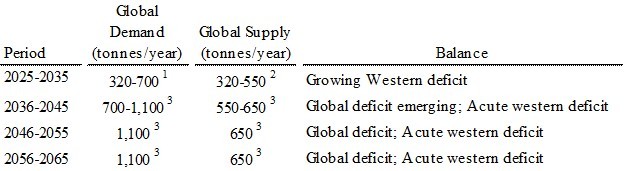
Notes:
1. | Global refined gallium demand estimated at approximately 320 t/yr in 2024. Demand is expected to grow significantly through the forecast period, driven by two distinct vectors: continued growth in commodity gallium applications at 4 to 7 percent CAGR (Mordor Intelligence, 2025), and accelerating demand for high-purity electronic-grade gallium driven by GaN semiconductor devices. The global GaN semiconductor device market is projected to grow at approximately 27 percent CAGR from $3.06 billion in 2024 to $12.47 billion by 2030, driven by EV powertrains, 5G infrastructure, AI data center power distribution, and defense electronics (all of which require high-purity gallium feedstock with no effective |
| |
July 24, 2026 | Page 135 |
| | |
Technical Report Summary | |
|
substitute). The ex-China western market for high-purity gallium is estimated at 190 to 330 t/yr currently, growing at approximately 6 to 7 percent CAGR as GaN penetration accelerates. Total global gallium demand is projected to reach approximately 700 t/yr by 2035 and 1,100 t/yr by 2045. China’s December 2024 ban on gallium exports to the United States has structurally severed western access to approximately 99 percent of primary global production, accelerating the urgency of western supply development. (USGS Mineral Commodity Summaries 2025; Grand View Research, GaN Semiconductor Devices Market Report, 2024; Mordor Intelligence, Gallium Market Report, 2025; Ramaco internal gallium market analysis, February 2026)
2. | Global refined gallium production capacity estimated at approximately 340 t/yr in 2024, concentrated almost entirely in China, which accounts for approximately 99 percent of primary low-purity production. Total global supply capacity is projected to grow to approximately 550 t/yr by 2035 as announced western projects including ATALCO in Louisiana, Alcoa of Australia, Korea Zinc’s Crucible project in Tennessee, and METLEN in Greece come online, supplemented by continued Chinese capacity expansion. However, virtually all announced western projects are oriented toward crude and mid-purity byproduct material not suited to electronic-grade semiconductor supply chains, meaning the global supply increase does not address the acute western deficit in high-purity electronic-grade gallium. Western non-Chinese supply of electronic-grade material remains insufficient to meet western semiconductor demand through the forecast period. (USGS Mineral Commodity Summaries 2025; Ramaco internal gallium market analysis, February 2026; respective company public announcements) |
3. | Held flat at latest available forecast horizon. No credible published forecast extends beyond this point. The acute western deficit in high-purity electronic-grade gallium is expected to persist structurally given the concentration of primary gallium production in China and the qualification timelines of 9 to 24 months required for electronic-grade supply chain entry. |
16.2.2 | Gallium Pricing |
Gallium pricing is bifurcated between Chinese domestic benchmark prices and western market prices, a divergence that accelerated sharply following China’s August 2023 export controls and the December 2024 ban on United States shipments. Chinese domestic primary low-purity (4N) gallium metal prices averaged approximately $380 per kilogram in mid-2024, rising to approximately $420 per kilogram by October 2024 as western stocks depleted. The average unit value of United States imports of gallium was approximately $500 per kilogram in 2024 (USGS).
Western market prices for gallium are materially higher than Chinese domestic benchmarks, reflecting structural scarcity, supply chain security premiums, and the absence of reliable non-Chinese primary production. For 4N gallium metal, western prices are approximately $1,450 per kilogram, with high purity device-grade lots for precursor applications commanding $2,500 to $3,500 per kilogram. As of the report date, the western market premium for 4N gallium metal was over 3x the Chinese FOB price, reflecting the structural supply fragmentation
| |
July 24, 2026 | Page 136 |
| | |
Technical Report Summary | |
|
created by China’s export controls and the demonstrated willingness of western buyers to pay substantial premiums for non-Chinese sourced material (Fastmarkets).
There is no established western market index for gallium oxide (Ga₂O₃). For modeling purposes, a long-term gallium oxide price of $1,000 per kilogram has been used, reflecting an estimate of the western market price.
For context, the Fastmarkets western gallium metal index price was approximately $1,450 per kilogram as of end of year 2025, representing a western market premium of approximately 3.6x relative to the Chinese FOB gallium metal price of approximately $400 per kilogram over the same period. Applying the same 3.6x western premium to the Chinese domestic gallium oxide price of approximately $285 per kilogram, implies a western gallium oxide price of approximately $1,026 per kilogram (Shanghai Metals Market, Fastmarkets).
Alternatively, applying an estimated oxide-to-metal conversion cost of approximately $100 per kilogram and the stoichiometric conversion ratio of 1.344 kg Ga₂O₃ per kg Ga metal, the implied western gallium oxide price at year end 2025 would therefore be approximately $1,000 per kilogram.
These two methods were used as the basis for the long-term price assumption of $1,000 per kilogram. This represents a conservative western market price assumption when taking into account the following additional considerations:
· | The structural and growing deficit in western non-Chinese gallium supply, which is expected to persist through the project’s production horizon given the absence of meaningful primary western production capacity; |
· | The December 2024 ban on Chinese gallium exports to the United States, which has materially severed the dominant supply relationship for United States semiconductor manufacturers; |
· | The projected growth of the global GaN semiconductor device market at a CAGR of approximately 27 percent through 2030, driving sustained demand growth for high-purity gallium; and |
· | The observed trajectory of western gallium prices, and anticipated premiums thereof, which have increased substantially since China’s August 2023 export controls and are expected to continue rising as demand growth outpaces western supply development. |
| |
July 24, 2026 | Page 137 |
| | |
Technical Report Summary | |
|
The $1,000 per kilogram assumption is therefore considered a reasonable long-term price for planning purposes at the Initial Assessment stage, subject to revision as the project advances to pre-feasibility study.
All prices are stated in United States dollars per kilogram of gallium oxide (Ga₂O₃) at 4N (99.99 percent) purity, consistent with the product specification of the hydrometallurgical flowsheet assumed in this study.
16.3 | Germanium |
16.3.1 | Germanium Demand and Supply |
Germanium is a metalloid recovered almost exclusively as a byproduct of zinc smelting and coal fly ash processing. There is no primary germanium mine in production anywhere in the world. China is the dominant global producer, accounting for approximately 80 to 82 percent of refined global output, with major production concentrated at Yunnan Chihong Zinc and Germanium Co. Ltd. and Yunnan Lincang Xinyuan Germanium Industry Co. Ltd. Outside China, meaningful production is limited to Teck Resources at its Trail metallurgical complex in British Columbia (approximately 11 percent of global supply), Umicore in Belgium (refining from imported concentrates), and PPM Pure Metals in Germany. The United States has no primary domestic germanium production. Germanium-containing zinc concentrates are produced at a mine in Alaska and exported to Canada for processing, while a second United States operation in Tennessee that also produced germanium-bearing zinc concentrates has been suspended since November 2023 (USGS Germanium, BNN).
Global germanium consumption is estimated at approximately 220 tonnes of metal (or 317 tonnes as germanium oxide) per year, with demand concentrated in four principal end-use sectors: fiber optics, infrared optics, semiconductor applications and solar cells, and radiation detectors. In the United States, these end uses rank in the same order of importance (USGS Germanium).
16.3.1.1 | Fiber Optics |
Fiber optics is the largest single end use for germanium globally, accounting for approximately 35 percent of total consumption. Germanium dioxide (GeO₂) and germanium tetrachloride (GeCl₄) are consumed as dopants during the manufacture of fiber optic glass, increasing the refractive index of the silica core and enabling the low-loss light transmission essential to data
| |
July 24, 2026 | Page 138 |
| | |
Technical Report Summary | |
|
networking and telecommunications infrastructure. A facility in Oklahoma produces germanium tetrachloride for United States fiber optic manufacturers from imported and recycled germanium. Demand from this sector is structurally linked to global data traffic growth and fiber optic network buildout, including 5G infrastructure and data center interconnects.
16.3.1.2 | Infrared Optics and Defense |
Germanium metal is the preferred material for infrared optical lenses, windows, and components due to its high refractive index and transparency across the 8 to 14 micron thermal infrared waveband. These properties make germanium irreplaceable in thermal imaging systems, night vision equipment, forward-looking infrared (FLIR) systems, and targeting optics used across military and aerospace platforms. In June 2025, the United States Department of Defense awarded contracts of approximately $200 million to develop AI-enhanced defense technologies including infrared and thermal imaging systems, driving further near-term demand for germanium optical components. In April 2024, the DoD awarded $14.4 million under the Defense Production Act Investment Program to expand germanium wafer manufacturing in St. George, Utah, specifically to increase domestic supply chain resilience (USGS Germanium, Polaris).
Infrared optics accounts for approximately 30 percent of global germanium consumption and the global germanium lens market is estimated to have been valued at approximately $350 million in 2023 and is projected to reach $560 million by 2032 (Astute Analytica).
16.3.1.3 | Semiconductors and Solar |
Germanium wafers serve as substrates for high-efficiency multijunction solar cells used in space applications, where their lattice structure enables multiple photovoltaic junctions to be grown epitaxially, achieving efficiencies well above those achievable with silicon. A facility in St. George, Utah produces germanium wafers predominantly for this application from imported and recycled germanium. Germanium compounds are also consumed in the production of germane gas used in certain semiconductor and solar cell manufacturing processes. In many of these applications, particularly defense-critical and space-grade uses, no effective substitute for germanium has been identified.
| |
July 24, 2026 | Page 139 |
| | |
Technical Report Summary | |
|
16.3.1.4 | Supply Constraints and China Export Controls |
In August 2023, China implemented an export licensing program for germanium, requiring all exports to carry licensed end-use commitments. China’s reported exports of germanium metal for the year through August 2024 decreased by 55 percent to 16,700 kilograms compared with the same period in 2023. In December 2024, China banned all exports of germanium to the United States entirely, an action that post-dates but is consistent with the supply risk context of this study. Prior to the ban, more than half of United States germanium imports were sourced directly or indirectly from China, with the remainder from Belgium, Canada, and Germany (USGS Germanium).
USGS economic modeling estimates that a complete restriction of China’s germanium exports could reduce United States GDP by approximately $0.4 billion in isolation, and $3.4 billion when combined with a simultaneous gallium restriction, with losses concentrated in semiconductor device manufacturing (Nassar).
Germanium applications, from fiber optics, infrared defense optics, to space solar cells, are infrastructure and national security end uses with multi-year procurement cycles where deferred purchases are not a practical response to supply disruption. This inelasticity of demand, combined with the structural concentration of supply in China, makes western primary germanium supply a strategic priority for United States and allied governments (Skillings).
Global germanium demand is forecast to grow at a CAGR of approximately 3.5 to 4.8 percent through 2030, driven by fiber optic network expansion, defense infrared optics modernization, and continued space solar cell demand (Astute, Ramaco Internal).
Brook Mine’s anticipated average germanium oxide production of approximately 13 tonnes per year would represent a meaningful contribution to western ex-China supply, which outside of Teck’s Trail operation and Umicore’s Belgian refinery has no established large-scale sources.
The global Supply and Demand forecast for Germanium Oxide is presented in Table 16-4.
| |
July 24, 2026 | Page 140 |
| | |
Technical Report Summary | |
|
Table 16-4Germanium Oxide: Global Long-Term Supply and Demand Forecast
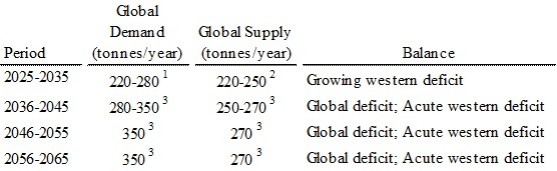
Notes:
1. | Global germanium consumption estimated at approximately 220 t/yr in 2024, growing at 3.5 to 4.8 percent CAGR through 2030 driven by fiber optic network expansion, defense infrared optics modernization, and space solar cell demand, reaching approximately 280 t/yr by 2030. Demand is projected to continue growing modestly through 2045 as fiber optic infrastructure buildout extends globally and defense infrared applications expand, reaching approximately 350 t/yr. China’s December 2024 export ban to the United States has created an acute western supply deficit irrespective of global conditions. (USGS Mineral Commodity Summaries 2025; Astute Analytica, Global Germanium Market Report, August 2025; Ramaco internal demand analysis, September 2025) |
2. | Global germanium supply estimated at approximately 220 t/yr in 2024, with China accounting for approximately 80 to 82 percent of refined output. Non-Chinese production is limited to Teck Resources at its Trail metallurgical complex in British Columbia and Umicore in Belgium. Total global supply expected to grow modestly to approximately 250 to 270 t/yr by the mid-2030s as byproduct recovery from zinc smelting expands incrementally. China’s December 2024 export ban on germanium to the United States has created an acute western supply deficit despite broadly balanced global conditions. (USGS Mineral Commodity Summaries 2025; Nassar et al., USGS Open-File Report 2024-1057) |
3. | Held flat at latest available forecast horizon. No credible published forecast extends beyond this point. The acute western deficit is expected to persist structurally given China’s dominance of germanium refining and the absence of credible large-scale non-Chinese primary germanium projects. |
16.3.2 | Germanium Pricing |
Germanium pricing is well documented through European market benchmarks reported by Argus Media. Average European prices for germanium metal (minimum 99.999 percent purity) rose from approximately $1,550 per kilogram in January 2024 to approximately $2,950 per kilogram by September 2024, representing a 90 percent increase over nine months as China’s export licensing controls depleted stocks held outside China. The 2024 annual average price for germanium metal was approximately $2,100 per kilogram, and the annual average price for germanium dioxide was approximately $1,400 per kilogram (USGS, Argus).
| |
July 24, 2026 | Page 141 |
| | |
Technical Report Summary | |
|
A germanium oxide price of $2,850 per kilogram has been used for modeling purposes in this study, reflecting a 7 percent discount to the Fastmarkets western index price of $3,080 per kilogram for germanium oxide as of the report date, and consistent with the western germanium metal price of approximately $2,830 per kilogram at year-end 2025. The modeled price represents a conservative western market assumption relative to the price trajectory observed through 2024 and into 2025, and reflects the structural supply scarcity created by China’s export controls (Fastmarkets).
All prices are stated in United States dollars per kilogram of germanium oxide (GeO₂) at 99.999 percent purity unless otherwise stated, consistent with the product specification of the hydrometallurgical flowsheet assumed in this study.
16.4 | Neodymium and Praseodymium |
16.4.1 | Neodymium and Praseodymium Demand and Supply |
Neodymium and praseodymium are light rare earth elements typically produced together as a combined oxide (NdPr oxide) and are the primary magnetic rare earth inputs for neodymium-iron-boron (NdFeB) permanent magnets, the strongest commercially available permanent magnets. NdFeB magnets are integral to electric vehicle traction motors, direct-drive wind turbine generators, industrial motors, robotics, defense systems, and consumer electronics. Over 90 percent of all electric vehicles produced today use permanent magnet traction motors containing NdFeB magnets (US DOE 2023).
Global mine production of rare earth oxides was estimated at approximately 390,000 tonnes of REO equivalent in 2024, with China accounting for approximately 270,000 tonnes, approximately 69 percent of world production. However, China’s dominance is substantially more concentrated in the downstream separation, metallization, and magnet manufacturing stages, where it holds more than 85 percent of worldwide NdFeB magnet production capacity. The United States produced an estimated 45,000 tonnes of REO in mineral concentrates in 2024, almost entirely from MP Materials’ Mountain Pass mine in California, which is the only active large-scale rare earth mining operation in the country (USGS 2025).
The United States remained heavily import-reliant for rare earth compounds and metals in 2024, with approximately 70 percent of rare earth compound and metal imports sourced from China over the 2020 to 2023 period. Significant quantities of rare earths are also imported as
| |
July 24, 2026 | Page 142 |
| | |
Technical Report Summary | |
|
permanent magnets embedded in finished goods, which are not captured in raw material import statistics.
16.4.1.1 | Electric Vehicle Demand |
EV traction motors are the dominant and fastest-growing driver of NdPr demand. Each EV traction motor contains approximately 1 to 3 kilograms of NdPr oxide, depending on motor design and vehicle class. Global EV sales exceeded 10 million units in 2022 and have continued to grow strongly, with IEA forecasts projecting sales of approximately 22 million EVs in 2025 and approximately 34 million by 2030 (IEA 2024).
Over 90 percent of EV traction motors currently use NdFeB permanent magnet designs, and while some manufacturers have explored motor designs with reduced or eliminated rare earth content, the performance advantages of NdFeB motors, higher power density, smaller size, and greater efficiency, means that NdFeB dominates the EV traction motor market and is expected to remain the preferred technology through the project’s production horizon.
16.4.1.2 | Wind Energy Demand |
Offshore wind turbines represent a second major and structurally growing demand driver. Direct-drive wind turbine generators use NdFeB permanent magnets in their nacelles, with each offshore turbine requiring 200 to 600 kilograms of rare earth elements, of which NdPr constitutes approximately 20 to 25 percent. Approximately 30 percent of all new wind turbines currently installed use direct-drive or hybrid permanent magnet designs. The IEA projects wind electricity generation to reach 7,900 TWh by 2030 under its Announced Pledges Scenario, with offshore wind growing at a CAGR exceeding 20 percent through 2030. Applying a 30 percent permanent magnet penetration rate and an average NdPr content of 232 kg per MW to projected new annual wind capacity additions of approximately 150 to 200 GW per year by 2030, wind energy applications alone are estimated to require approximately 10,000 to 14,000 tonnes of NdPr oxide per year by 2030, representing a material and growing component of total global NdPr demand (IEA 2024, US DOE 2023, Science Direct, October 2024).
16.4.1.3 | Defense Demand |
NdFeB magnets are critical to a broad range of defense applications including precision-guided munitions, radar and sonar systems, unmanned aerial vehicles, electric drive systems for naval vessels, and robotics. The United States government has designated NdPr oxide as a material
| |
July 24, 2026 | Page 143 |
| | |
Technical Report Summary | |
|
warranting strategic stockpile acquisitions, with USGS noting that FY2024 and FY2025 potential government acquisitions included NdPr oxide and NdFeB magnet block (USGS 2025).
16.4.1.4 | Global Demand Outlook |
Ramaco’s internal demand analysis, drawing on the United States Department of Energy’s rare earth permanent magnet supply chain analysis and IEA Announced Pledges Scenario demand projections, models global NdPr oxide demand at approximately 90,000 tonnes REO by 2030, based on global NdFeB magnet demand growing to approximately 81,000 tonnes by 2030 (equivalent to approximately 90,000 tonnes NdPr REO using a 30 wt percent REO content in magnets and a 75/25 Nd/Pr split). This represents a compound annual growth rate of approximately 5.1 percent from the 2024 baseline of approximately 66,750 tonnes NdPr REO (Ramaco Internal, IEA Announced Pledges, Project Blue).
Adamas Intelligence forecasts that global annual demand for NdPr oxide will exceed global annual production by upwards of 16,000 tonnes by 2030, equivalent to the material needed for approximately 20 million EV traction motors, with the supply gap widening thereafter unless substantial new non-Chinese production comes online (Adamas).
Western NdPr demand, defined as consumption across allied regions in EV, industrial motor, wind, and defense applications, is estimated at approximately 10,000 to 12,000 tonnes per year of separated oxide, with defense-related demand estimated at an additional 400 to 500 tonnes per year. Brook Mine’s anticipated NdPr oxide production of approximately 172 tonnes per year would represent a modest but meaningful contribution to western allied supply at a time when non-Chinese separation and processing capacity remains severely limited (Ramaco Internal).
The global Supply and Demand forecast for NdPr Oxide is presented in Table 16-5.
| |
July 24, 2026 | Page 144 |
| | |
Technical Report Summary | |
|
Table 16-5NdPr Oxide: Global Long-Term Supply and Demand Forecast
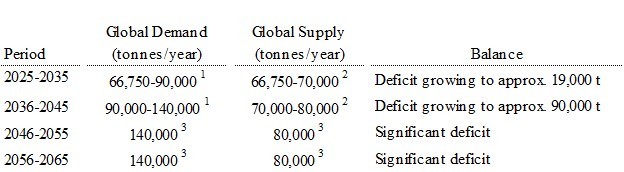
Notes:
1. | Global NdPr oxide demand estimated at approximately 66,750 t/yr in 2024, growing at approximately 5.1 percent CAGR to approximately 90,000 t/yr by 2030, driven principally by EV traction motors, direct-drive offshore wind turbine generators, defense applications, and industrial motors and robotics. Adamas Intelligence forecasts demand growing at a 7.5 percent CAGR from 2023 to 2040, with global NdFeB magnet demand increasing five-fold by 2040. The 2036 to 2045 demand range of 90,000 to 140,000 t/yr reflects continued growth at a moderating CAGR as EV and wind markets mature. Demand held flat at 140,000 t/yr beyond 2045 as no credible long-term forecast is available. (Ramaco internal demand analysis, September 2025; United States DOE Rare Earth Permanent Magnets Supply Chain Deep-Dive, December 2024; IEA Announced Pledges Scenario; Adamas Intelligence, Rare Earth Magnet Market Outlook to 2040, 2023) |
2. | Global NdPr supply estimated at approximately 66,750 t/yr in 2024, growing slowly as non-Chinese projects add incremental capacity. Adamas Intelligence forecasts global NdPr undersupply of 19,000 t/yr by 2030 and 90,000 t/yr by 2040, absent significant new non-Chinese production. China controls approximately 92 percent of refined NdPr supply. Supply held flat beyond 2040 at a conservative estimate of 80,000 t/yr reflecting limited non-Chinese expansion prospects. (USGS Mineral Commodity Summaries 2025; Adamas Intelligence, Rare Earth Magnet Market Outlook to 2040, 2023; IEA, Rare Earth Elements: Pathways to Secure and Diversified Supply Chains, 2026) |
3. | Held flat at latest available forecast horizon. No credible published forecast extends beyond this point. |
16.4.2 | Neodymium and Praseodymium Pricing |
NdPr oxide pricing is well documented through western market indices. The USGS MCS 2025 reports an average neodymium oxide price of $56 per kilogram for 2024 (99.5 percent minimum purity, sourced from Argus Media Group), reflecting a period of Chinese domestic oversupply and price suppression. The 2024 price represented a significant decline from the 2022 peak of $134 per kilogram and the 2023 average of $78 per kilogram (USGS, Argus).
The structural divergence between Chinese domestic prices and western market prices is most clearly evidenced by the United States Department of Defense’s July 2025 agreement with MP Materials, which established a 10-year price floor of $110 per kilogram for NdPr products. At
| |
July 24, 2026 | Page 145 |
| | |
Technical Report Summary | |
|
the time of announcement, this floor was approximately double the then-current Chinese-based market price of approximately $51 per kilogram realized by MP Materials in 2024, reflecting the DoD’s assessment that Chinese domestic prices are not representative of the cost of building and sustaining a viable western rare earth supply chain (MP Materials).
A NdPr oxide price of $110 per kilogram has been used for modeling purposes in this study. This price is consistent with the DoD-established price floor for western NdPr supply and represents an 11 percent discount to the Fastmarkets western index price of $124 per kilogram as of the report date. It is noted that the Fastmarkets western NdPr oxide price was approximately $97 per kilogram at year-end 2025, and that prices have been volatile due to ongoing Chinese export control measures. The $110 per kilogram assumption is considered appropriate for an Initial Assessment given its alignment with the United States government’s stated long-term price support level for domestic NdPr production (Fastmarkets NdPr, MP Materials).
All prices are stated in United States dollars per kilogram of NdPr oxide at 99.5 percent minimum purity unless otherwise stated, consistent with the product specification assumed in this study.
16.5 | Dysprosium and Terbium |
16.5.1 | Dysprosium and Terbium Demand and Supply |
Dysprosium and terbium are heavy rare earth elements (HREEs) added in small but critical quantities to neodymium-iron-boron (NdFeB) permanent magnets to maintain coercivity (resistance to demagnetization) at elevated operating temperatures. Without these additions, NdFeB magnets lose performance or fail in the high-temperature environments of EV traction motors, wind turbine generators, and defense and aerospace systems. Dysprosium and terbium are complementary additives from the same supply sources; terbium is more effective per unit weight but is significantly scarcer and more expensive, so the two are used in combination depending on application requirements. Both are added at approximately 1 to 5 percent by weight in high-performance NdFeB magnets (IEA, Rare Earth Elements).
Demand for magnet rare earths, including dysprosium and terbium alongside neodymium and praseodymium, has doubled since 2015 and is projected to increase by more than 30 percent by 2030, driven by accelerating EV adoption, offshore wind deployment, industrial motor electrification, robotics, and defense system modernization.
| |
July 24, 2026 | Page 146 |
| | |
Technical Report Summary | |
|
16.5.1.1 | Role in EV and Wind Applications |
High-performance NdFeB magnets for EV traction motors and direct-drive wind turbine generators require dysprosium and terbium additions to maintain coercivity at the operating temperatures encountered in these applications. Each NdFeB magnet typically contains 4 to 8 percent dysprosium and terbium by weight in high-temperature motor applications. Global battery electric vehicle production of approximately 13.6 million units in 2023 consumed an estimated 100 to 120 tonnes of dysprosium for motor applications alone. Projected EV production of 40 to 50 million units annually by 2030 would require 200 to 450 tonnes of dysprosium per year for motor applications alone (IEA, World Energy Outlook).
16.5.1.2 | Supply Concentration and China’s Dominance |
Dysprosium and terbium are geologically distinct from light rare earths such as NdPr. They are found in commercially viable concentrations almost exclusively in ionic clay deposits, which are geographically concentrated in southern China and Myanmar. China controls over 90 percent of global dysprosium and terbium production, not only through mining but through its near-monopoly on separation and refining capacity, which represents the true bottleneck in the HREE supply chain (Benchmark).
A large share of China’s heavy rare earth feedstock originates from ionic clay deposits in Myanmar’s Kachin State, which are estimated to supply approximately 70 percent of China’s HREE feedstock. These operations are frequently disrupted by conflict between Myanmar’s military and the Kachin Independence Army, creating a secondary source of price volatility that compounds the geopolitical concentration risk. In early 2025, Chinese imports of heavy rare earths from Myanmar declined by approximately 50 percent due to armed group activity, contributing to price spikes for dysprosium and terbium (Rare Earth Exchanges, Rare Earth Mining).
On April 4, 2025, China introduced export controls on seven heavy rare earth elements including dysprosium, terbium, samarium, gadolinium, lutetium, scandium, and yttrium, as well as all related compounds, metals, and NdFeB magnets containing these elements. Export volumes fell sharply in April and May 2025, with many automakers in the United States, Europe, and elsewhere forced to cut production line utilization rates or temporarily suspend manufacturing due to magnet shortages. While export licenses were eventually granted and volumes partially recovered, prices for dysprosium and terbium in importing countries remained materially elevated.
| |
July 24, 2026 | Page 147 |
| | |
Technical Report Summary | |
|
According to Benchmark Mineral Intelligence, the West will still rely on China for approximately 91 percent of its heavy rare earth needs by 2030, down only marginally from approximately 99 percent in 2024. HREE refining is expected to increase globally by approximately 2029, but costs outside China remain 5 to 7 times higher than Chinese production costs, creating a structural barrier to rapid supply diversification (Benchmark).
Adamas Intelligence forecasts that global undersupply of dysprosium and terbium oxides will rise to 1,800 tonnes and 450 tonnes per year respectively by 2040, amounts roughly equal to total global production of each oxide today, absent significant new non-Chinese production capacity (Adamas as cited in mining.com).
CRU forecasts a global deficit of approximately 2,920 tonnes in the combined dysprosium and terbium oxide supply/demand balance by 2035.
16.5.1.3 | Western Supply Pipeline |
Outside China, credible near-term sources of separated heavy rare earth production are extremely limited. Lynas Rare Earths in Australia has become the first company outside China to produce commercially separated heavy rare earths, though its Mount Weld deposit is light-REE dominant and HREE output remains marginal relative to global demand. Other projects remain pre-production. Iluka Resources is constructing a refinery at Eneabba in Western Australia with capacity to process up to 750 tonnes per year of heavy rare earths, targeted for commissioning in 2027. By 2035, existing and announced capacities outside China are expected to cover only approximately half of mining requirements, a quarter of refining needs, and less than a fifth of magnet demand (IEA Rare Earth Elements).
The Brook Mine’s anticipated dysprosium oxide production of approximately 19 tonnes per year and terbium oxide production of approximately 4 tonnes per year are modest in the context of global demand but represent meaningful contributions to western allied supply at a time when non-Chinese separation capacity is structurally inadequate relative to demand.
Western dysprosium demand is projected at approximately 1,020 tonnes per year and western terbium demand at approximately 180 tonnes per year, for a combined western HREE demand of approximately 1,200 tonnes per year by the project’s anticipated production horizon (Ramaco Internal).
| |
July 24, 2026 | Page 148 |
| | |
Technical Report Summary | |
|
The global Supply and Demand forecast for Dysprosium Oxide is presented in Table 16-6 and the global Supply and Demand forecast for Terbium Oxide is presented in Table 16-7.
Table 16-6Dysprosium Oxide: Global Long-Term Supply and Demand Forecast
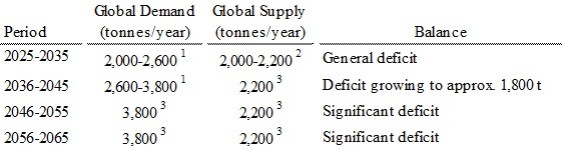
Notes:
1. | Global dysprosium demand growing with NdFeB magnet demand at approximately 7.5 percent CAGR from 2023 to 2040, driven by high-performance EV traction motors and direct-drive wind turbine generators requiring dysprosium additions to maintain coercivity at elevated operating temperatures. Global battery electric vehicle production of approximately 13.6 million units in 2023 consumed an estimated 100 to 120 t of dysprosium for motor applications. Projected EV production of 40 to 50 million units annually by 2030 would require 200 to 450 t/yr of dysprosium for motor applications alone. The 2036 to 2045 demand range reflects continued growth at a moderating rate as EV and wind markets mature. Demand held flat beyond 2045 as no credible long-term forecast is available. (IEA, World Energy Outlook 2024; Adamas Intelligence, Rare Earth Magnet Market Outlook to 2040, 2023; Discovery Alert, “Heavy Rare Earth Shortages,” November 2025) |
2. | Global dysprosium production almost entirely from Chinese ionic clay processing, with Myanmar’s Kachin State deposits supplying approximately 70 percent of China’s HREE feedstock. China controls over 90 percent of global dysprosium production through mining and near-monopoly refining capacity. Non-Chinese production remains limited to marginal output from Lynas Rare Earths and other sources. Supply growth expected to be negligible beyond current levels through the forecast period given absence of credible non-Chinese expansion projects. (Benchmark Mineral Intelligence, as cited in US News, November 2025; USGS Mineral Commodity Summaries 2025) |
3. | Held flat at latest available forecast horizon. No credible published forecast extends beyond this point. Adamas Intelligence forecasts dysprosium undersupply of 1,800 t/yr by 2040. (Adamas Intelligence, Rare Earth Magnet Market Outlook to 2040, 2023) |
| |
July 24, 2026 | Page 149 |
| | |
Technical Report Summary | |
|
Table 16-7Terbium Oxide: Global Long-Term Supply and Demand Forecast
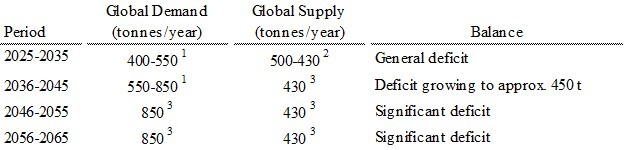
Notes:
1. | Global terbium demand growing in tandem with dysprosium as a complementary NdFeB magnet performance additive, at approximately 7.5 percent CAGR from 2023 to 2040. Terbium is more effective per unit weight than dysprosium but is significantly scarcer, constraining its use relative to theoretical demand. CRU forecasts a combined dysprosium and terbium oxide deficit of approximately 2,920 t/yr by 2035. The 2036 to 2045 demand range reflects continued growth at a moderating rate. Demand held flat beyond 2045 as no credible long-term forecast is available. (Adamas Intelligence, Rare Earth Magnet Market Outlook to 2040, 2023; CRU, as cited in US News, November 2025) |
2. | Global terbium production almost entirely from Chinese ionic clay processing, co-produced with dysprosium from the same deposits. Current global production estimated at approximately 400 to 450 t/yr. Non-Chinese production negligible. Supply growth constrained by geological concentration and Chinese dominance of processing. (USGS Mineral Commodity Summaries 2025; Benchmark Mineral Intelligence, as cited in US News, November 2025) |
3. | Held flat at latest available forecast horizon. No credible published forecast extends beyond this point. Adamas Intelligence forecasts terbium undersupply of 450 t/yr by 2040. (Adamas Intelligence, Rare Earth Magnet Market Outlook to 2040, 2023) |
16.5.2 | Dysprosium and Terbium Pricing |
Dysprosium and terbium pricing is documented through Argus Media and Fastmarkets western market indices. Both elements exhibit extreme price sensitivity to Chinese export policy, Myanmar supply disruptions, and western procurement behavior, with price swings of 50 to 100 percent or more occurring within single years in response to supply events.
USGS MCS 2025 reports the average dysprosium oxide price at approximately $260 per kilogram for 2024 (99.5 percent minimum purity, sourced from Argus Media Group, Argus Non-Ferrous Markets), representing a decline from the 2022 peak of approximately $382 per kilogram. Terbium oxide averaged approximately $810 per kilogram in 2024, down from the 2022 peak of approximately $2,051 per kilogram. These declines reflected a period of Chinese domestic oversupply and price suppression, which reversed sharply following China’s April 2025 export controls (USGS).
| |
July 24, 2026 | Page 150 |
| | |
Technical Report Summary | |
|
Following China’s April 2025 export controls, western prices for dysprosium and terbium rose substantially. The Fastmarkets western index price for dysprosium oxide was approximately $1,180 per kilogram as of the report date, and approximately $1,120 per kilogram at year-end 2025. The Fastmarkets western index price for terbium oxide was approximately $5,030 per kilogram as of the report date, and approximately $4,850 per kilogram at year-end 2025 (Fastmarkets).
A dysprosium oxide price of $975 per kilogram has been used for modeling purposes in this study, representing a 17 percent discount to the Fastmarkets western index price of $1,180 per kilogram as of the report date. A terbium oxide price of $4,500 per kilogram has been used for modeling purposes in this study, representing an 11 percent discount to the Fastmarkets western index price of $5,030 per kilogram as of the report date. Both modeled prices represent conservative western market assumptions. The current western premium for dysprosium and terbium relative to Chinese domestic prices is approximately 4.5x to 4.7x, reflecting the structural supply fragmentation created by China’s export controls and the absence of viable alternative western sources.
All prices are stated in United States dollars per kilogram of oxide at 99.5 percent minimum purity for dysprosium oxide (Dy₂O₃) and 99.99 percent minimum purity for terbium oxide (Tb₄O₇), consistent with the product specifications assumed in this study.
| |
July 24, 2026 | Page 151 |
| | |
Technical Report Summary | |
|
17.0 | Environmental Studies, Permitting, and Plans, Negotiations, or Agreements with Local Individuals or Groups |
Ramaco was issued Permit No. 841-T1 (Mining Permit) on July 7, 2020 by the LQD of the WDEQ for surface coal mining in Sheridan County, Wyoming. The Mining Permit consists of 4,541 acres.
The Mining Permit does not specifically identify mining rights of non-coal material, however, as the TCM resource is inseparable from the coal mining production process, per OSM regulation 30 CFR 700.5, a separate mining permit for the TCM resource is not required for non-coal mining activity. However, a revision will be required to account for the CMO processing and tailings facilities. The revision will require a detailed engineering design and environmental study, including an updated reclamation plan, additional surety bond sized to cover full reclamation, long-term tailings closure, and water treatment, if needed.
A WYPDES permit is required for any point-source discharge from the process plant, tailings underdrains, stormwater contact areas, or pit dewatering. Ramaco was issued WYPDES Industrial Stormwater Authorization No. WYR001608 (issued June 1, 2023, effective May 1, 2024, expiring May 31, 2028), with required semi-annual benchmark sampling for total suspended solids and total recoverable aluminum and annual benchmark reporting to WDEQ.
Additionally, the Air Quality Division of the Wyoming Department of Environmental Quality issued Air Quality Permit P0025939 on July 20, 2020, for the planned Brook Mine, as described in Wyoming Permit No. 841-T1.
The planned Brook Mine has an MSHA ID# of 4801799.
17.1 | Environmental Studies |
In support of the WDEQ LQD Permit to Mine application for the Brook Mine, Ramaco Resources commissioned WWC Engineering to conduct an extensive program of baseline studies and impact assessments that collectively characterize the pre-mining environment of the permit and adjacent areas. These investigations form the technical foundation underpinning the LOM Plan and provide the environmental baseline relied upon for purposes of this TRS.
| |
July 24, 2026 | Page 152 |
| | |
Technical Report Summary | |
|
The baseline studies and impact statements include the following:
· | A land-use inventory documenting current and historic land uses, land ownership, surface improvements, and oil-and-gas wells within and surrounding the Permit Area; |
· | A history and cultural-resources review summarizing nineteenth- and twentieth-century mining and settlement of the area, with archaeological and paleontological resources determined not applicable |
· | A climatology baseline of regional precipitation, temperature, wind, and evaporation regimes; |
· | A topography, geology, and overburden assessment, incorporating geologic mapping, stratigraphic cross-sections, geologic-hazards screening, and an overburden-quality sampling and characterization program used to confirm the absence of acid- or toxic-forming strata; |
· | A hydrology baseline of nearly 1,900 pages addressing pre-mining surface-water and groundwater conditions, surface-water and groundwater monitoring networks, stream-channel geomorphology, water rights, and aquifer pump-test results; |
· | A soil resources assessment, including soil mapping, characterization, salvage-depth determinations, and a prime-farmland evaluation; |
· | A vegetation inventory quantifying community types, production, cover, and species composition for use in establishing reclamation success standards; |
· | A wildlife baseline covering big game, raptors, migratory birds of high federal interest, greater sage-grouse leks, and threatened-and-endangered species, together with the impact analysis and mitigation framework subsequently codified in the Wildlife Monitoring Plan and the Raptor/MBHFI Mitigation Plan; |
· | A wetlands delineation conducted in accordance with United States Army Corps of Engineers methodology; |
· | An alluvial valley floor (AVF) investigation evaluating the Tongue River, Goose Creek, and tributary drainages for AVF characteristics and the potential for material damage from mining. |
Together with the probable hydrologic-consequences determination, the operational surface-water, groundwater, and alluvial monitoring programs, and the impact-mitigation plans set forth in the Mine Plan, these baseline studies represent a comprehensive, regulator-reviewed environmental characterization of the Brook Mine property that support the environmental-studies, permitting, and social-license disclosure information provided in accordance with Item 601(b)(96)(iii)(B)(17) of Regulation S-K 1300.
| |
July 24, 2026 | Page 153 |
| | |
Technical Report Summary | |
|
17.1.1 | Groundwater Inventory and Baseline Quality |
Ramaco conducted pre-mine surveys to inventory water use and to determine the extent and purpose of ground water usage in areas that could be affected within ½ mile of the mine permit boundary. Field teams made door-to-door visits to these potentially affected residents to gather information by way of completing questionnaire forms regarding water supply source(s), extent of reliance, purpose of reliance (domestic, agricultural, etc.), depth of well(s), character of springs, and other relevant data as available. The teams measured water level depths in wells where possible and agreeable by owners and obtained surveyed locations accordingly. The detailed results of the surveys are included in the site’s WDEQ permit application for the Brook Mine.
Pursuant to WDEQ regulations, Ramaco is in the process of drilling numerous ground water monitoring wells to the Wall Seam, in order to conduct water monitoring necessary to be able to revise the Mining Permit in the future to allow mining down to the Masters Seam.
17.1.2 | Surface Water Baseline Quality, Quantity, and Runoff Analysis |
Baseline surface water monitoring for flow and quality parameters was conducted at strategic, WDEQ approved locations, as applicable, over a period of twelve months for the permit area, weather permitting. During mining and through the final release of the permit, the four monitoring stations selected for the site will be monitored in accordance with the approved surface water monitoring plans, as per the mine permit. Data collected during this period will be compared with the pre-mining baseline data to determine if and how the operation is affecting surface water systems.
A surface water runoff analysis was performed in the watersheds associated with the mine permit area to evaluate the potential impact of proposed operations on flooding and streamflow alteration. Peak discharges were calculated for the “pre-mining”, “during-mining”, and post-mining” conditions and were compared. This analysis and results are included in the mine permit and show that there will be no increase in peak discharge during mining or post mining for the permit area. Original laboratory data sheets for surface and ground water baseline monitoring are included in the mine permit.
Based on analyses of overburden samples reported in the mine permit, neither acid mine drainage nor dissolved metals will pose any significant problems at the site as almost all analyses show levels below WDEQ thresholds. During mine operations, overburden samples
| |
July 24, 2026 | Page 154 |
| | |
Technical Report Summary | |
|
will be taken and analyzed for each 40-acre sampling unit. Should any strata be considered unsuitable based upon the permit criteria, overburden stripping and backfilling operations will be scheduled so that the identified unsuitable strata are; 1) not placed in the uppermost four feet (rooting zone) of the final backfill thickness, 2) not within six feet of the spoil surface beneath ephemeral stream channels, and 3) not within 10 feet of the spoil surface beneath permanent impoundments or major channels and associated 100-year floodplains.
17.1.3 | Probable Hydrologic Consequences |
Probable Hydrogeologic Consequences (PHCs) were evaluated for the permit area. The planned Brook Mine is expected to have an extremely small effect on surface water quality in the Tongue River and other major streams adjacent to the permit boundary of the Brook Mine. As such, no adverse effect on the designated water uses related to the major streams adjacent to the permit boundary is expected.
The overlying strata contains no significant aquifers other than, perhaps, the coal seams. The majority of private wells are completed in geologic structures below the coal seams proposed to be mined, and any impacts to domestic users are expected to be low. There is no anticipated impact to water rights downstream of the permit boundary.
Baseline monitoring has not indicated any interactions between surface and ground water. Ongoing and expedient reclamation will ensure that the surface water hydrologic balance and flow characteristics are returned to resemble pre-mining conditions.
Postmining monitoring will confirm the mitigation of impacts once mining and reclamation have concluded. In addition, surface water rights that are disturbed or affected by the mining operations of the planned Brook Mine will have an alternate water source of similar quantity and quality provided until such time that the original water right’s functionality is restored. The PHC studies and results are included in the mine permit.
17.1.4 | United States Army Corps of Engineers |
The United States Army Corps of Engineers (USACE) determined that Slater Creek and adjacent wetlands are the only Waters of the United States within the planned Brook Mine as defined at 33 CFR Part 328.3(a). Therefore, these are the only areas that will require USACE notification prior to disturbance. However, that delineation work was completed before the U.S Supreme Court decision in Sackett v. EPA, 598 U.S. 651 (2023), which significantly narrowed
| |
July 24, 2026 | Page 155 |
| | |
Technical Report Summary | |
|
the scope of federally jurisdictional wetlands under the Clean Water Act. Accordingly, the original determination may be overly inclusive.
Impacts to the delineated wetlands will fall within two categories; 1) some wetlands will be physically removed or disturbed by mining activities, and 2) other wetlands potentially impacted by reducing or eliminating their contributing drainage areas for a temporary time period. Once mining is completed in these areas, the drainage areas will be restored and flow to the wetlands will resume. In such cases, mitigation will consist of flow restoration only with no specific wetland construction required.
17.2 | Refuse Disposal and Water Management |
17.2.1 | Refuse Disposal |
There will be no need for coal refuse disposal at the site since the coal will be sold as a direct shipped thermal coal product. Current plans included dry stacking of tailings. The Brook Mine is not anticipated to utilize the heap leaching process.
17.2.2 | Water Monitoring and Management |
In order to determine the impact of existing and proposed operations on the hydrologic balance, surface water samples are collected at least bi-monthly from four surface water monitoring stations which were established in September 2013. No specific water treatment facilities other than sediment control are required or planned for the Brook Mine, which is consistent with other PRB mines. However, several other PRB mines capture equipment wash down water and water used for other industrial/maintenance uses at the mines and treat that water before it is discharged.
Surface water management for the permitted mining area generally involves a combination of structures such as; 1) sediment ditches, 2) temporary sedimentation ponds, 3) permanent and temporary diversion ditches, 4) corrugated metal pipe (CMP) placement for drainages that cross access roads or haul roads, and 5) drainage diversion ditches and collections for excess spoil disposal areas. Detailed designs for all drainage and sediment control structures are included in the Brook Mine’s permit.
Discharges from these structures will be monitored in accordance with the approved plans. Sediment structures will be cleaned or enlarged if the total suspended solids exceed effluent
| |
July 24, 2026 | Page 156 |
| | |
Technical Report Summary | |
|
limitations. All discharges will flow through sediment control structures. The pond discharges will be monitored in accordance with approved plans and treated to meet effluent limitations, if needed.
Within twenty-four hours of a one-year frequency, twenty-four hour storm event or greater, a permit-wide inspection and report of the drainage systems will be completed and submitted to the WDEQ, as applicable. The inspection and subsequent report will note any damages or deficiencies in the drainage system so that repairs can be implemented immediately as well as if any sediment structure is at or near its clean out capacity (60 percent). A rain gauge, located at the iCAM office, is used to monitor precipitation events. This rain gauge is monitored daily and reported monthly to WDEQ.
Construction of the baseline groundwater monitoring network began in the third quarter of 2013 and was completed early in the fourth quarter 2013. The groundwater monitoring network consists of nine Carney Seam wells, 10 Masters Seam wells, eight alluvium wells, one underburden well, and one well perforated in both the Masters and Carney coal seams. No monitoring wells were completed in the overburden or interburden as no water was found in these units during drilling operations. Samples are taken quarterly from these monitoring wells.
Water samples are sent to a qualified laboratory and analyzed for the following parameters: flow, pH, total acidity, total alkalinity, total iron, total manganese, total sulfates, total suspended solids, and total dissolved solids or specific conductance at 25°C. The samples collected during and after mining will be compared with each other, and with the data collected during the baseline surface water study and used to determine the impact the mining operation has on the water in the receiving streams.
A quality assurance and quality control program for the water samples will entail duplicate samples (approximately 10 percent), sample preservation blanks (approximately 10 percent). All water monitoring programs are currently active.
17.3 | Bonding and Asset Retirement Obligations |
A total bond amount of approximately $1.47 million, posted by Ramaco and in effect as of 12/31/2025, is based on the mine closure reclamation liability cost estimate prepared in early 2025. Bond estimates utilize the WDEQ bond matrix that determines the rate per acre based upon land activity. This rate per acre is simply applied to the permit site’s acreage to obtain the bond requirement. An annual inspection by the WDEQ on August 19, 2025, however,
| |
July 24, 2026 | Page 157 |
| | |
Technical Report Summary | |
|
resulted in a reduction in the current reclamation liability to $1.25 million due to decreased costs from Guideline 12, as well as lower costs associated with the coal storage demolition. Therefore, Ramaco’s bond amount for the Brook Mine is greater than Wyoming state requirements.
The current Asset Retirement Obligations (ARO) estimate as of October 2025 was $240,475. Ramaco plans to prepare an updated estimate for the LOM Plan, including the TCM process plant and waste management once designs have been completed.
17.4 | Local Stakeholders |
As indicated in Section 13.4.2, Ramaco had 10 employees at the iCAM facility as of the end of 2025 and currently employs 12 personnel in Sheridan County, Wyoming and is projected to have maximum employment of approximately 190 personnel at full production. The complex creates substantial economic value with its third-party service and supply providers, utilities and through payment of taxes and fees to local, state and federal governmental agencies.
17.5 | Mine Closure Plans |
Upon mine closure, areas will be backfilled and reclaimed to a near Approximate Original Contour (AOC) in accordance with permit requirements. A preliminary conceptual closure cost of $100 million has been estimated based on benchmark projects of similar scale and commodity in the region and is accurate to within -30 percent/+50 percent. This estimate will need to be refined through future engineering studies and site-specific baseline work. Regrading and backfilling activities are required to commence within 180 days after the mining operations are complete.
The primary pre-mining land use for the Brook Mine is agriculture land and the approved post-mining land use for the Brook Mine permit is agriculture land. No land within the permit area has been known to be used for prime farmland.
Reclamation of the mined surface areas will follow coal and TCM extraction in accordance with plans included in the current WDEQ Land Quality Permit. The land will be graded to blend with existing topographic features. Drainage systems will be reestablished. Some internally drained areas (playas) will be created to replace those existing in the pre-mine landscape. Contoured surfaces will be dressed with topsoil and planted to a variety of grasses, forbs, and shrubs.
| |
July 24, 2026 | Page 158 |
| | |
Technical Report Summary | |
|
Upon completion of mining operations and regrading, topsoil will be redistributed over the disturbed areas. After topsoil has been replaced, soil analyses will be performed to validate quality of the topsoil. All regraded and topsoiled areas will be revegetated as soon as practical to establish quick vegetative cover to minimize erosion. Runoff from the regraded areas will be routed through properly constructed and maintained sediment structures that are designed to retain runoff long enough for the suspended solids to settle.
Temporary erosion control vegetative cover will be established as contemporaneously as practical, with backfilling and grading, until a permanent vegetative cover can be established.
Prudent handling and mixing of zones of concern to meet WDEQ/LQD Guidelines will eliminate postmining contamination problems and aid reclamation efforts. For these reasons, Ramaco believes that overburden analyte exceedances will not pose a significant problem to meet WDEQ/LQD reclamation standards.
17.6 | Environmental Compliance, Permitting, and Local Individuals or Groups Issues |
The Brook Mine Permit No. 841-T1 is currently approved to mine coal and up to 16-2/3 percent by weight of other minerals with a combination of surface and highwall mining. The Brook Mine also has an approved WDEQ/AQD permit in support of the mining operation. Ramaco has not been cited for any violations of its permit requirements.
Vertically, the current mining permit includes the Monarch, and Carney seams. The current mining permit does not include the Masters Seam, or seams below it. However, given the existing exploration data in the Masters Seam and lower seams within the Brook Mine, this report includes coal and TCMs at those elevations, regardless of their inclusion in the existing mining permit. Ramaco is in the process of drilling groundwater monitoring wells to the Wall Seam, which will allow revising the permit to include mining down to the Masters Seam.
In order to account for the mine plan proposed in this TRS, a revision to the permit is likely to be required to revise the permitted method of mining from trench/HWM to surface mining and to allow surface mining from the Masters Seam down to the Lower 7 Seam. Ramaco will also need to increase the size of the crushing/grinding equipment needed to size the coal that will be sold to a third party, and to size the material that will report to the TCM process plant. The reclamation plan will also need to be modified to account for the increased volumes of material
| |
July 24, 2026 | Page 159 |
| | |
Technical Report Summary | |
|
moved. In addition, Ramaco will need to revise the existing air permit accordingly and a permit(s) through the State Engineers Office (SEO) may need to be obtained.
For the TCM process plant, additional Wyoming regulatory and/or county zoning approvals will be required. In particular, Ramaco will likely need to obtain permits from other regulatory programs before constructing or operating facilities used to chemically concentrate or process critical minerals commercially. These may include, but are not limited to:
· | Industrial Siting Permit from the Wyoming Industrial Siting Council if the process plant meets the applicable construction cost or facility thresholds, which is likely. Ramaco is in the process of identifying engineering firms to assist with this permit. |
· | Air Quality Permit from the WDEQ/AQD for emissions associated with any processing activities. |
· | Water Quality Permit from the WDEQ/WQD if the processing activities involve wastewater discharge, process water management, or construction of facilities requiring water pollution control permits. |
WEIR is not aware of any current notice of violation, cessation order, bond forfeiture proceeding, consent decree, or unresolved environmental enforcement matter affecting the property; however, WEIR has not performed an independent environmental compliance audit, and any extension of operations beyond the existing surface coal mining scope to incorporate critical-mineral processing or tailings storage will require new or amended air, water, solid-waste, and (depending on uranium and thorium content of feedstocks) Wyoming radiogenic-materials authorizations that are not within the existing compliance perimeter.
WEIR is also not aware of any active organized community-group opposition, public-interest litigation, or formal protest filed against the existing permit as of the date of this TRS.
| |
July 24, 2026 | Page 160 |
| | |
Technical Report Summary | |
|
18.0 | Capital and Operating Costs |
The estimated initial capital cost for the project is $579 million, which includes the proposed process plant, site infrastructure, and mine development. Total mine and TCM process plant operating costs at full production (including coal mining and selling costs), are estimated at approximately $87.70 per metric tonne of mill feed.
Capital and operating cost estimates were developed by Fluor and reviewed by the QP. The QP considers the estimates reasonable for the level of study and has adopted them for purposes of this TRS.
18.1 | Capital Expenditures |
18.1.1 | Estimate Methodology |
Process design criteria were developed based on preliminary testwork and process simulation of the Brook Mine flowsheet. A mass balance was generated to support sizing and pricing for the mechanical equipment list (MEL).
The mechanical equipment list was priced using a combination of budgetary vendor quotes, Fluor’s In-house cost database and Industry-standard factoring methods.
The priced MEL formed the basis of the capital cost estimate. For additional scope elements including site preparation and improvements, plant roads, site infrastructure, power supply and distribution, plant utilities, and water systems - costs were estimated using percentage-based benchmarks derived from Fluor’s database for similar plant types.
18.1.2 | General Assumptions and Qualifications |
The following assumptions and qualifications were used in determining the capital expense estimate.
· | The cost estimate is in United States dollars |
· | The estimate was based on a typical contracting strategy of EPCM directly managing subcontractors by the typical discipline/trade scope |
· | The project execution is based on a greenfield project |
| |
July 24, 2026 | Page 161 |
| | |
Technical Report Summary | |
|
· | The primary estimating procedure for developing process scope and costs is by “factoring” on the plant capacity costs |
· | No demolition scope is included in the estimate |
· | The estimate does not include any work associated with removal of contaminated materials and hazardous waste. This applies to handling, removal, disposal, and remediation of asbestos, lead paint, galvanizing fluids, contaminated soils, or disposing of process fluids |
18.1.3 | General Exclusions |
General exclusions in the capital cost estimates include the following:
· | Sunk costs |
· | Fluctuation of currency exchange rates |
· | Force majeure, labor strikes and other business interruption risks |
· | Unknown site conditions and scope changes |
Ramaco provided the capital costs for mine development, the pilot plant, and site preparation for the filtered residue placement as shown in Table 18-1 and Table 18-2. Expansion of the residue storage facility is captured in sustaining capital costs. Mining is conducted with leased equipment, similar to other Ramaco mining operations and is included in mine operating costs.
Table 18-1Mine Capital Cost Estimate Summary
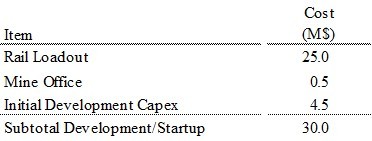
Initial capital for the pilot plant and residue storage site preparation for the first three years was estimated to be $16M.
Total estimated initial capital expenditures for development of the Brook Mine are $579 million, with a summary of the capital expenditures by cost area provided in Table 18-2 as follows:
| |
July 24, 2026 | Page 162 |
| | |
Technical Report Summary | |
|
Table 18-2Total Initial Capital Cost Estimate Summary
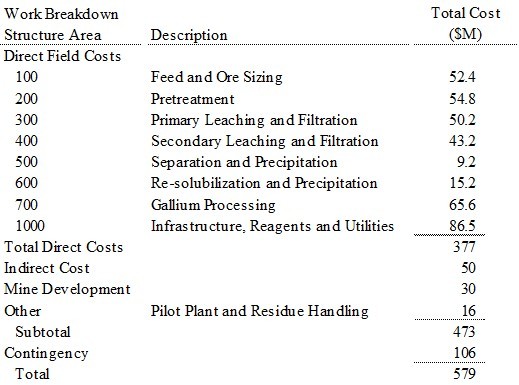
18.1.4 | Conclusions |
The capital cost estimate is $579 million including contingency of $106 million for the process plant scope. The contingency cost is estimated at 25 percent of process plant direct and indirect costs. The total capital cost estimate has an accuracy range of -30 percent to +50 percent.
18.2 | Operating Costs |
The estimated total operating costs at full operation average $87.70 per tonne of TCM mill feed. Costs by category are summarized in Table 18-3 as follows:
Table 18-3Typical Annual Operating Costs
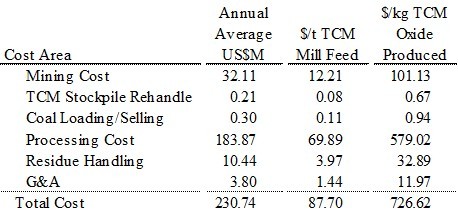
| |
July 24, 2026 | Page 163 |
| | |
Technical Report Summary | |
|
18.2.1 | Basis of Estimate |
Mine operating costs were estimated by Ramaco’s mining group and based on mining cost inputs for similar coal operations. Mining costs also include a royalty of $0.10 per ton of coal sold relative to the SWCC royalty agreement.
The process plant operating cost estimate includes processing areas from mill feed through to product handling. The estimate includes four primary cost categories:
· | Labor |
· | Utilities - Electricity, Raw Water, and Natural Gas |
· | Reagents and Consumables |
· | Maintenance Supplies |
Process operating costs are noted below in Table 18-4.
Table 18-4TCM Process Plant Annual Operating Costs
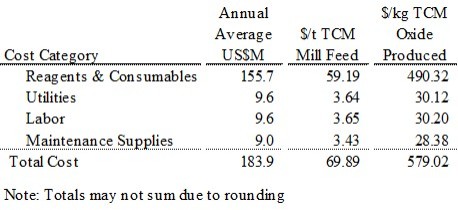
Reagents and consumables, the largest component of the processing costs, were estimated using unit consumption rates and delivered unit costs. Consumption rates were derived from metallurgical testwork, mass balance, and design assumptions. Delivered unit costs were supported by supplier discussions and internal benchmarks.
Labor estimates for the plant were based on plant operating 24/7 with four 12-hour shift rotations. Non-shift labor is based on a 40-hour work week. Staffing levels were benchmarked against similar-scale operations. Labor rates were sourced from the United States Bureau of Labor Statistics (OEWS) for Wyoming.
| |
July 24, 2026 | Page 164 |
| | |
Technical Report Summary | |
|
Power consumption was estimated from the electrical loads, factoring in equipment run times and required power. A grid power rate was provided by Ramaco. Maintenance supplies were estimated as a percentage of the total direct installed cost for the process plant. General and administrative costs were estimated from the total estimated site headcount of 190 personnel (mine, process, and general and administration) and using an actual $/person rate from existing Ramaco operating mines.
18.2.2 | General Exclusions |
The following items are excluded from the process plant operating cost estimate:
· | Sustaining capital |
· | Insurance |
· | Import duties and taxes |
· | Inflation |
18.2.3 | Direct Labor Costs |
The cost for mine and general administrative labor is accounted for in the general and administrative costs. Labor rates were sourced from the United States Bureau of Labor Statistics (OEWS) for Wyoming in May of 2024 and then adjusted for inflation using information to March of 2025 levels. The total compensation was calculated using the United States Bureau of Labor and Statistics, Mountain Census Region total compensation multiplier.
18.2.4 | Cost Estimation Risk |
Capital and operating costs are estimated to an accuracy of -30 to +50 percent, with a contingency of 25 percent. These estimates meet the accuracy and contingency requirements for an Initial Assessment.
| |
July 24, 2026 | Page 165 |
| | |
Technical Report Summary | |
|
19.0 | Economic Analysis |
19.1 | Methodology |
A preliminary cash flow model was prepared to assess the reasonable prospects of economic extraction for the planned Brook Mine.
The QP relied on certain information supplied by the Registrant’s finance personnel regarding taxes, royalties, and depreciation in the financial model. The QP reviewed the information for consistency with industry practice and considers such reliance reasonable.
19.1.1 | Modeling Framework |
The financial model is a Discounted Cash Flow (DCF) model developed on an annual basis over a 40-year LOM. Before and after-tax discounted Net Present Value (NPV) and Internal Rate of Return (IRR) are estimated with integration of the following inputs:
· | Mill feed schedule developed from the LOM Mine Plan |
· | Process recoveries and product specifications |
· | Capital cost estimates |
· | Operating cost estimates |
· | Taxes, royalties, and depreciation |
· | Commodity price forecasts from marketing studies |
The model is constructed in real terms (constant dollars) unless otherwise stated, and excludes financing costs.
19.2 | Financial Model Parameters |
19.2.1 | Cut-Off Grade |
A Net Smelter Return (NSR) cut-off grade approach is used for the Brook Mine due to its polymetallic nature. The NSR approach converts all payable metals into a single dollar value per tonne ($/t). This is outlined in detail in Sections 11 and 13.
| |
July 24, 2026 | Page 166 |
| | |
Technical Report Summary | |
|
19.2.2 | Metallurgical Recoveries and Product Quality |
Metallurgical recoveries were based on eight months of bench scale test results conducted on the flowsheet. Specifically, the pre-feed treatment and multi-stage leaching unit operations. Recovery assumptions were made through the back end of purification, separation and finishing based on benchmarks from similar commercial operating plants. Product samples for testing were not produced at this phase of the project, so no penalty charges were included in the model. Once product samples are generated at pilot phase, potential penalties will be assessed.
19.2.3 | Commodity Prices |
Seven TCM products for the Brook Mine are expected to have reasonable prospects of economic extraction. All other rare earth and critical minerals were excluded from the financial model. Pricing used for the Resource pit shell in Section 11 was based on early 2025 pricing while updated pricing as of the end of 2025 is used in the financial model as described in Section16. Pricing used for financial modeling is shown in Table 19-1.
Table 19-1Commodity Prices and Recoveries
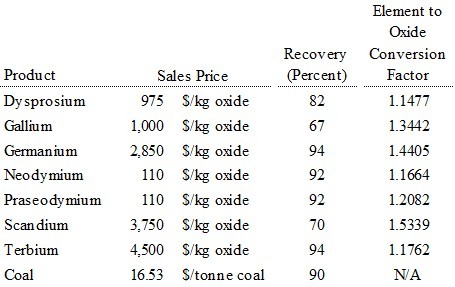
19.2.4 | Mineral Resource and Mine Plan |
The LOM Plan was based on the revenue factor 0.68 pit shell and includes annual tonnes of mine waste, annual tonnes and grade for mill feed and stockpile movements. The annual process plant mill feed throughput was constrained to 2.6 million dry tonnes per year.
| |
July 24, 2026 | Page 167 |
| | |
Technical Report Summary | |
|
The LOM Plan contains 100 percent Inferred Resources upon which this economic analysis is based.
19.2.5 | Operating Costs |
Operating cost estimates have been developed on a LOM Plan basis for mining, processing, dry stack residue hauling and placement, and general & administrative costs. They are reported on a unit basis in $/tonne mined and processed and total annual costs. The basis for development of operating cost estimates is outlined in detail in Section 18.
19.2.6 | Capital Costs |
Pre-production capital allocation occurs over an assumed 30-month execution duration. Detailed execution plans will be created in future stages of the project. More information on the basis of the capital cost estimate is contained in Section 18.
Sustaining capital for mining and process plant dry stack residue liner placement are included in the model.
19.2.7 | Taxes and Royalties |
No state income taxes apply in Wyoming. The SWCC coal royalty of $0.10 per clean ton of coal is included in mine operating costs in the financial model. The following taxes were assumed in the model:
· | Section 45X Advanced Manufacturing Production Tax Credit is an incentive designed to boost domestic production of critical minerals essential for clean energy, advanced electronics, and defense applications. It is intended to encourage United States-based extraction, processing, and recycling of critical minerals to strengthen supply chains and reduce reliance on imports. The credit amount is 10 percent of production costs, including depreciation, for eligible critical minerals. |
· | Wyoming severance tax for the coal portion is 6 percent of gross coal revenue |
· | Sheridan County ad valorem tax is 4 percent of gross coal revenue |
· | Total TCM extractive related taxes are 4 percent of gross TCM revenues |
· | Federal corporate tax, applied after state taxes and after payback period is 21 percent of total revenue. |
| |
July 24, 2026 | Page 168 |
| | |
Technical Report Summary | |
|
Taxes and royalties included in Section 11 as part of the pit optimization were based on initial assumptions. Over the course of 2025, Ramaco has revised their assumptions around TCM extractive taxes, as the TCMs have not historically been specifically referenced in the Wyoming extractive tax regulations, it was assumed in the financial modeling that some level of collaboration with the State is anticipated. Therefore, a total of 4% for TCM extractive related taxes has been included in the financial model.
19.2.8 | Depreciation |
Depreciation is included in the model and calculated based on actual units of production output (UOP) relative to the total estimated recoverable units of TCMs.
19.2.9 | Others |
The model excludes project financing costs. No inflation is included in the model. The costs and long-term pricing are held constant over the LOM Plan.
19.3 | Economic Analysis |
The assessment of reasonable prospects of economic extraction is supported by the positive NPV on an after-tax basis. A summary of key metrics from the financial model is provided in Table 19-2, with the annual detail of cash flows provided in Table 19-3.
Table 19-2Financial Model Key Metric Summary
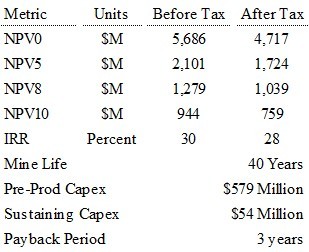
| |
July 24, 2026 | Page 169 |
| | |
Technical Report Summary | |
|
Table 19-3Cash Flow Model
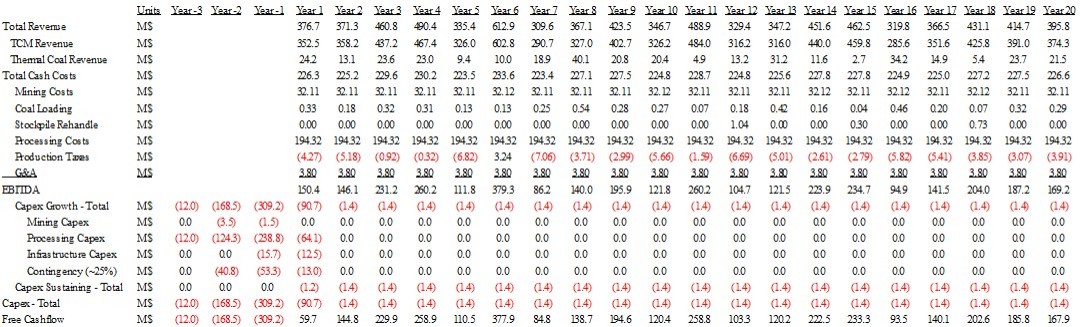
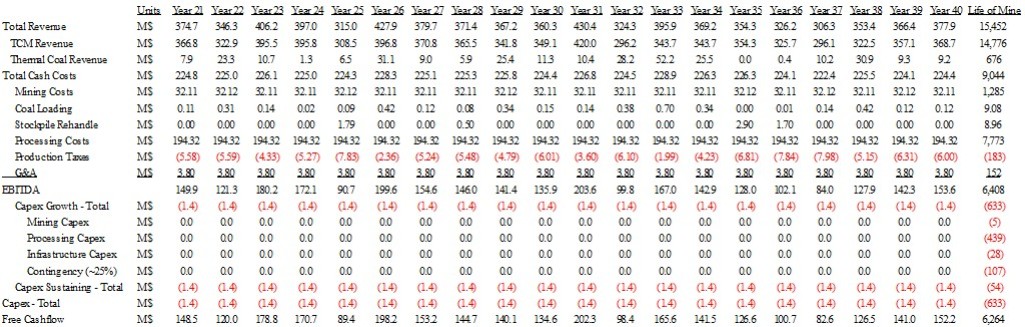
| |
July 24, 2026 | Page 170 |
| | |
Technical Report Summary | |
|
19.3.1 | Sensitivities |
A sensitivity analysis was undertaken to examine the influence of changes to assumptions for metal prices, capital costs, and operating costs. The sensitivity analysis range (+/- 20 percent) was designed to capture the bounds of reasonable variability for each element analyzed.
The sensitivity of After-Tax NPV at an 8.0 percent discount rate as well as sensitivity of the After-Tax IRR are provided on Figures 19-1 and 19-2, respectively. The economic analysis is most sensitive to Sales Price and least sensitive to Capital Cost.
Figure 19-1After-Tax NPV Sensitivity
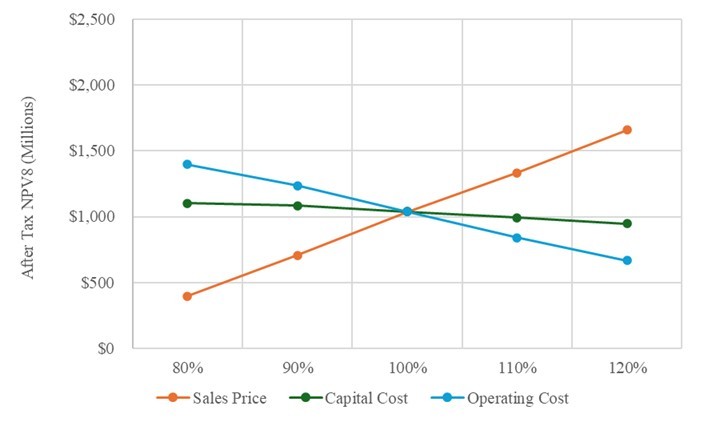
| |
July 24, 2026 | Page 171 |
| | |
Technical Report Summary | |
|
Figure 19-2After-Tax IRR Sensitivity
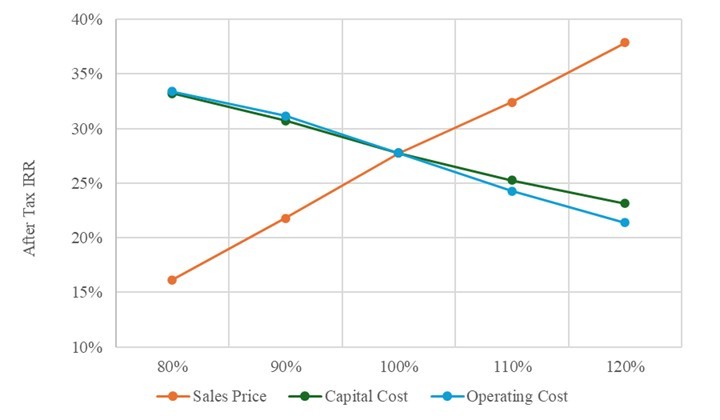
19.4 | Cautionary Statement |
This economic analysis is based on an Initial Assessment that cannot be used as the basis for disclosure of Mineral Reserves. Unlike Mineral Reserves, Mineral Resources do not have demonstrated economic viability. The results are based entirely (i.e. 100 percent) on Inferred Mineral Resources, which are considered too speculative geologically to have the economic considerations applied to them that would enable them to be categorized as Mineral Reserves. There is no demonstrated economic potential of the project if the Inferred Mineral Resources are excluded from the economic analysis. Future studies, including a Preliminary Feasibility Study based on Measured and Indicated Mineral Resources, would be required to establish Mineral Reserves.
| |
July 24, 2026 | Page 172 |
| | |
Technical Report Summary | |
|
20.0 | Adjacent Properties |
There is no relevant information included in this TRS concerning properties adjacent to the Brook Mine.
[The remainder of this page is intentionally left blank]
| |
July 24, 2026 | Page 173 |
| | |
Technical Report Summary | |
|
21.0 | Other Relevant Data and Information |
The Mineral Resource estimate disclosed in this TRS corresponds to the database cutoff date of June 30, 2025. During the period between the database cutoff and the report issue date, additional exploration data including drillhole sampling, and geological logging were conducted by Ramaco resulting in approximately 1,000 additional assays being collected with approximately 750 of these containing a Scandium assay. A portion of this subsequent information has been reviewed by the QPs on a preliminary basis; however, full validation, statistical reconciliation, and integration of the complete subsequent dataset into the resource model have not yet been completed as of the issue date of this report.
The QPs have considered whether the post-cutoff data, once fully validated and incorporated, could reasonably be expected to result in a material change to the Mineral Resource estimate disclosed herein. Because the Mineral Resource is reported exclusively in the Inferred category, the estimate already reflects the lower level of geological and grade continuity confidence appropriate to that classification, and the tonnage and grade ranges disclosed accommodate the limited drill density and inherent uncertainty associated with Inferred Resources. The preliminary review of the subsequent data indicates that the results are broadly consistent with the geological model, mineralization controls, and grade on which the current estimate is based, and the QPs have not identified any subsequent results that, individually or in aggregate, would be expected to alter the conclusions reached in this report.
While the QPs cannot definitively quantify the impact of the subsequent data until full validation and re-estimation work is completed, based on the preliminary review performed to date, no information has come to the attention of the QPs that would suggest a material change to the Mineral Resource estimate, the supporting geological interpretation, or any other disclosure contained in this TRS. A material change to the Mineral Resource estimate due to the subsequent data is not expected. The QPs confirm that the Mineral Resource estimate, the technical disclosures, and the conclusions presented in this report remain appropriate and supported by the data available as of the database cutoff date, and that this report has been prepared in accordance with the requirements of Regulation S-K 1300 (17 CFR § 229.1302) and the definitions and disclosure standards of Subpart 229.1300.
| |
July 24, 2026 | Page 174 |
| | |
Technical Report Summary | |
|
22.0 | Interpretations and Conclusions |
22.1 | Summary of Interpretations and Conclusions |
The Brook Mine hosts seven primary coal seams - the Dietz 1, Dietz 2, Dietz 3, Monarch, Upper Carney, Lower Carney, and Masters, plus seven unnamed seams below the Masters - together with adjacent carbonaceous claystone, clay, shale, and siltstone intervals that host the TCM mineralization described in this TRS. The coal seams are flat-lying, generally dipping to the southeast at one to four degrees. TCM mineralization is predominantly concentrated within five feet above and below the coal seam contacts, consistent with the depositional and hydrothermal enrichment mechanisms described in Section 6.
The geologic database consists of 615 drill holes in the database, of which 128 carry ICP-MS CMO assay data and comprising 5,903 individual sample analyses and drilled on a regular grid with approximate 1,000-foot spacing. Utilizing the geologic database, WEIR constructed a 50-foot × 50-foot × 0.5-foot block model using Datamine MineScape® software with Inverse Distance Squared grade interpolation and a ±2,800-foot lateral and ±5-foot vertical search ellipsoid. Block model validation against post-cutoff assay data (including a new drill hole approximately 250 feet from the nearest modeled samples) confirms that the model predicts TCM grade spikes at consistent elevations and of similar magnitude to measured values, supporting the interpreted grade continuity of the mineralization.
Based on the foregoing geological work, WEIR concludes that the interpreted stratigraphic framework is sufficiently continuous to support disclosure of Inferred Mineral Resources for both coal and TCMs in accordance with the definitions in Regulation S-K 1300. Although coal is an important associated commodity, WEIR’s interpretation is that the primary value of the Brook Mine lies in the critical minerals hosted immediately adjacent to the coal measures, specifically Scandium, Gallium, Germanium, Dysprosium, Neodymium, Praseodymium, and Terbium. The Inferred classification reflects a sample spacing wider than what WEIR considers necessary for an Indicated classification and the early stage of project definition consistent with an Initial Assessment; no portion of the TCM or coal tonnage has been classified as Measured or Indicated.
Ramaco controls sufficient mineral rights and associated surface access to support the Mineral Resources and the proposed mining operations described in this TRS. Specifically, Ramaco owns 93 percent of the mineral rights and controls the remaining 7 percent associated with the Brook Mine Mineral Resource estimate described in this TRS. Ramaco also owns 40 percent
| |
July 24, 2026 | Page 175 |
| | |
Technical Report Summary | |
|
of the surface rights associated with the Brook Mine Mineral Resource, with the balance controlled via agreements and leases. Areas where rights are limited, uncertain, or restricted have been removed from the resource estimate as appropriate: the Laya coal lease area is excluded because the lease does not expressly grant CMO extraction rights, and a portion of the Padlock property is excluded due to a restriction on surface mining.
Subject to the permit revisions and additional approvals discussed in Sections 3 and 17, the currently controlled land and mineral interests are considered adequate for the Initial Assessment mine plan and related project infrastructure. The active WDEQ/LQD surface coal mining permit (Permit No. 841-T1, 4,541 acres, issued July 7, 2020) provides a regulatory foundation for mining operations, however, a major permit revision will be required to authorize truck-and-shovel extraction of TCM-bearing material, extend mining depth to the Masters Seam and below, and accommodate the proposed processing and tailings facilities. Ramaco has not been cited for any violations of its existing permit requirements.
The Brook Mine is favorably situated with respect to infrastructure. The BNSF Railroad runs along the southern boundary of the permit area, providing rail access for thermal coal dispatch. Interstate 90 and US Highway 87 provide all-season highway access directly to the property. Electrical power is supplied by MDU; existing service is currently being upgraded for the pilot processing facility, with further expansion required for commercial operations. On-site wells supply potable and industrial water, with process makeup water estimated at approximately 0.6 tonnes per tonne of mill feed. The city of Sheridan, Wyoming (2025 population approximately 20,000) is located seven miles south of the property and provides access to labor, services, and supply chains. At full production, the Brook Mine and process plant will require approximately 190 personnel total with 70 in mining operations, 100 in mineral processing, and 20 in general and administrative functions. The staffing level is considered achievable given proximity to regional mining and industrial workforce centers.
Existing and planned infrastructure appears sufficient to support the proposed conventional truck-and-shovel surface mining operation and the planned hydrometallurgical process plant at a conceptual level. Thermal coal recovered in conjunction with TCM mining is expected to be sold as a ROM thermal product into local or regional markets, providing a practical and revenue-generating outlet for coal seam material that must be excavated to access the TCM-bearing horizons.
Metallurgical testwork completed to date indicates that the TCMs can be recovered using a multi-stage hydrometallurgical flowsheet supported by established unit operations widely used
| |
July 24, 2026 | Page 176 |
| | |
Technical Report Summary | |
|
in the mining industry. The conceptual flowsheet, developed through bench-scale testing at Hazen (eight months of testing through December 2025), process engineering by Fluor, and pilot plant engineering oversight by Hatch comprises: (1) feed handling and comminution using mineral sizers and an open-circuit ball mill to a target P80 of 200 µm; (2) pretreatment to enhance leach kinetics; (3) primary and secondary multi-stage leaching and filtration; (4) impurity removal via pH-adjustment precipitation and ion exchange; (5) rare earth separation via SX; and (6) parallel gallium and germanium circuits using established SX chemistry (Kelex 100 for Ga). Estimated TCM processing recoveries applied in the resource and economic models are: Dy₂O₃ 82%, Ga₂O₃ 67%, GeO₂ 94%, Nd₂O₃ 92%, Pr₆O₁₁ 92%, Sc₂O₃ 70%, and Tb₄O₇ 94%. The designed plant throughput is 2.6 million ROM tonnes per annum, with estimated installed power of 9.3 MW and process water makeup of approximately 0.6 tonnes per tonne of mill feed. Filtered (dry-stack) tailings management is planned; heap leaching is not proposed.
Results from the geometallurgical testwork program indicate a carbochlorination flowsheet may offer significant benefits to the hydrometallurgical process with solvent extraction to produce separated mixed rare earth oxides. Commercial carbochlorination is a high-temperature industrial process using carbon (coke, coal) to convert metal oxides (like rare earths, alumina, and titanium ores) into volatile chlorides and water-soluble metal chlorides. In the case of the Brook Mine, valuable volatilized critical minerals such as gallium, germanium, aluminum, and silica. This flowsheet may offer a more efficient extraction of valuable metals with simpler flows than traditional methods by recycling chlorine in the process. Carbochlorination is the dominant flowsheet used to produce titanium. In addition to an expanded suite of products versus a solvent extraction process, other potential benefits include ability to use Brook Mine mineralized coal as a reagent. In this process, recovery of rare earths and critical minerals from the coal may be possible. Rare earths could be solubilized by water in a carbochlorination flowsheet rather than more harsh reagents necessary in hydrometallurgical solvent extraction flowsheet.
Testwork to date has supported the conceptual flowsheet and process assumptions used in this Initial Assessment; however, additional bench-scale variability testing across all mineralized domains, optimization of reagent selection and dosing, extended pilot-plant campaigns, and product qualification testing are warranted to refine recoveries, reagent consumption rates, product specifications, and the design basis for future flowsheet updates. The expected TCM products are saleable critical mineral oxide products, and project value is dependent on continued demonstration of product quality, specification compliance, and market acceptance.
| |
July 24, 2026 | Page 177 |
| | |
Technical Report Summary | |
|
The Initial Assessment indicates that the Brook Mine can be evaluated on the basis of a conventional open-pit mining method using standard truck-and-shovel practices, with coal, TCM-bearing materials, and waste mined selectively in accordance with the conceptual LOM mine plan. The conceptual LOM plan, based on the revenue-factor 0.68 pit shell, covers 40 years of full-scale production, moving approximately 1.09 billion tonnes of total material at an average rate of approximately 27.2 Mtpa, delivering a steady-state TCM plant feed of approximately 2.63 Mtpa. Over the 40-year LOM Plan, approximately 293 million tonnes of TCM resources are mined, of which approximately 105.2 million tonnes is delivered to the process plant as plant feed; the balance is stockpiled as higher-grade (HG, ~10.8 Mt closing balance) and lower-grade (LG, ~177 Mt closing balance) material in mined-out pit areas for potential future processing. Within the LOM Plan footprint, approximately 45.4 million tonnes of in-situ coal resource is present, of which approximately 40.8 million tonnes is recovered as saleable ROM thermal coal product over the 40-year schedule, applying a 90 percent coal mining recovery factor consistent with PRB truck-and-shovel industry norms. The LOM Plan strip ratio averages approximately 2.2:1 on a combined waste-to- (coal + TCM product) basis. LOM Plan average metal head grades delivered to the process plant are approximately: Nd 48.3 g/t, Ga 23.4 g/t, Sc 21.1 g/t, Pr 12.3 g/t, Dy 7.5 g/t, Ge 3.6 g/t, and Tb 1.3 g/t.
Capital and operating cost estimates used in this TRS are conceptual and appropriate to an Initial Assessment stage. Total initial capital expenditure is estimated at $579 million, including $106 million of contingency (representing 25 percent of process plant direct and indirect costs), with an overall cost accuracy range of -30 percent to +50 percent. Pre-production capital is allocated over an assumed 30-month execution period. Life-of-mine total operating costs are estimated at approximately $87.70 per metric tonne of mill feed, incorporating mining, processing, dry-stack residue handling, and general and administrative costs as well as coal mining. The financial model is a constant-dollar DCF model structured on an annual basis over the 40-year LOM, excluding project financing costs. Applicable taxes include the Section 45X Advanced Manufacturing Production Tax Credit (applied as a 10 percent credit based on TCM mining and processing costs), Wyoming coal severance tax (6 percent of gross coal revenue), Sheridan County ad valorem tax (4 percent of gross coal revenue), TCM extractive taxes (4 percent of gross TCM revenue), and federal corporate income tax (21 percent). No state income tax applies in Wyoming; no TCM royalties are modeled, coal royalties have been modeled. The economic analysis presented in this TRS yields a positive after-tax NPV of $1,039 million at an 8 percent discount rate and an IRR of 28 percent showing robust project economics. This Initial Assessment is preliminary in nature, includes only Inferred Mineral Resources, and demonstrates reasonable prospects for
| |
July 24, 2026 | Page 178 |
| | |
Technical Report Summary | |
|
economic extraction of those Mineral Resources. There is no demonstrated economic potential of the project if the Inferred Mineral Resources are excluded from the economic analysis.
Overall, the QPs conclude that the Brook Mine warrants continued advancement through additional drilling, geologic refinement, metallurgical optimization, engineering, hydrologic and geotechnical studies, market development, and permitting work. The current work supports continued delineation and technical evaluation of both the TCM and coal mineralization and provides a reasonable conceptual basis for the Initial Assessment presented in this TRS. The geological, metallurgical, and economic results are consistent with a project meriting progression to the PFS level, at which point updated resource models, improved engineering designs, and additional metallurgical variability data are expected to reduce the material uncertainties identified herein. However, all Mineral Resources remain classified as Inferred, no Mineral Reserves have been estimated for the Brook Mine, and the findings of this Initial Assessment should not be construed as demonstrating economic viability.
22.2 | Significant Risks and Uncertainties |
Risk, as defined for this study, is a hazard, condition, or event related to geology and Mineral Resources, mine operations and mineral processing, environmental and waste management issues, health and safety, marketing information, cost estimation, and the assumptions used in the economic analysis and general business issues that when taken individually, or in combination, have an adverse impact on Ramaco’s development of the Brook Mine. Risks can disrupt mine construction or operations, adversely affect mineral production and productivity, and result in increased operating cost and/or increased capital expenditures.
The Brook Mine is subject to risks and uncertainties typical of an early-stage mining project and additional risks associated with the unique nature of the TCM mineralization and proposed recovery process. Because the Initial Assessment is based entirely on Inferred Mineral Resources, the project is subject to a high degree of geological, technical, permitting, market, and execution risk. The principal risks are summarized in Table 22-1, as follows:
Table 22-1Brook Mine Risk Assessment Summary
Risk Area | | Summary of Risk or Uncertainty | | Potential Effect |
|---|---|---|---|---|
Geologic continuity and resource confidence | | The current resource estimate is based on Inferred Mineral Resources and on an early-stage understanding of TCM continuity, faulting, seam correlations, and grade distribution. | | Future drilling and modeling may materially change tonnage, grade, continuity, pit limits, and mine plans. |
| |
July 24, 2026 | Page 179 |
| | |
Technical Report Summary | |
|
Risk Area | | Summary of Risk or Uncertainty | | Potential Effect |
Sampling and QA/QC limitations | | Portions of the assay database rely on laboratory-internal QA/QC, and some supporting laboratory documentation and legacy records remain incomplete. | | Additional verification may affect confidence in portions of the dataset and limit any future upgrade of resource classification until resolved. Unrecognized sampling and lab biases may be present that could impact the economic results. |
Metallurgical performance | | Metallurgical testing is preliminary and may not fully represent all mineralized domains, operating conditions, or full-scale performance. | | Actual recoveries, reagent consumption, throughput, or product quality may differ from assumptions used in the Initial Assessment. |
Process design and scale-up | | The proposed TCM process plant and flowsheet remain conceptual and have not yet been demonstrated at commercial scale. | | Capital costs, operating costs, recoveries, reliability, and schedule may differ materially from current assumptions. |
Permitting and regulatory approvals | | The existing permit is for coal mining and will require revision to include deeper seams, TCM extraction, processing facilities, and tailings-related infrastructure. | | Project development could be delayed, modified, or constrained by permitting requirements, environmental studies, bonding, and agency approvals. |
Hydrogeologic and geotechnical conditions | | Additional data are required to support deeper mining, final pit design, groundwater management, and associated reclamation planning. | | Mine design, dewatering requirements, slope design, sequencing, and costs may change as further studies are completed. |
Property, rights, and encumbrances | | Certain lease areas and surface-restricted areas are excluded, and other encumbrances and third-party rights exist across portions of the property. | | Mine layout, access, or extraction sequence may be constrained and some mineralized areas may remain unavailable for development. |
Commodity prices and marketability | | Project economics are sensitive to assumptions for TCM pricing, market acceptance, and the realization of product specifications. | | Lower prices or reduced marketability could materially reduce or eliminate reasonable prospects for economic extraction. |
Staffing requirements | | Availability of experienced labor may be limited in Sheridan and the surrounding areas. | | Slower than anticipated hiring rates, or increased training requirements may slow productivity of initial operations. Effective recruiting, competitive compensation, and training programs will be needed. |
Capital, operating cost, and productivity assumptions | | The Initial Assessment relies on conceptual cost estimates and assumed mining and plant performance. | | Adverse changes in costs, productivity, inflation, or scheduling could materially affect project outcomes. |
Tax credits and legal framework | | Economic assumptions include consideration of currently available incentives and current regulatory conditions and their continuation. | | Changes in tax policy, incentives, mining law, environmental law, or other regulations could materially affect project value and development timing. |
In the opinion of the authors of this study, none of the identified risks and uncertainties individually prevent continued advancement of the Brook Mine at the Initial Assessment level. However, taken collectively, they are material to the future development of the project and reinforce the appropriateness of the current Inferred resource classification and the preliminary
| |
July 24, 2026 | Page 180 |
| | |
Technical Report Summary | |
|
nature of the economic analysis. Advancement of the Brook Mine will require additional technical work to reduce these uncertainties prior to any future study intended to support higher-confidence Mineral Resources or any declaration of Mineral Reserves.
| |
July 24, 2026 | Page 181 |
| | |
Technical Report Summary | |
|
23.0 | Recommendations |
Based on the interpretations and conclusions presented in Section 22, it is recommended that Ramaco continue to advance the Brook Mine through a focused program of additional drilling, geological modeling, metallurgical testing, mine planning, geotechnical and hydrogeological work, environmental studies, and permitting support. The recommended work is intended to reduce the principal uncertainties identified in this TRS, improve confidence in the TCM and coal Mineral Resource estimates, support refinement of the conceptual mine and process designs, and provide the technical basis for a future study at a higher level of confidence. The recommendations below are consistent with the current status of the Brook Mine as an Initial Assessment based solely on Inferred Mineral Resources.
23.1 | Recommended Work Program |
The next phase of work should be directed toward those activities most likely to improve geological confidence, reduce technical risk, and support refinement of the economic assumptions used in this Initial Assessment. The highest priorities are confirmation of structural and seam continuity, expansion and modernization of the QA/QC program, additional representative metallurgical and variability testing, refinement of mine and process design inputs, and advancement of permitting and environmental baseline work for the revised mine and process configuration. A listing of the relevant work areas, objective of studies, and relative priority are provided in Table 23-1 as follows:
Table 23-1Recommended Work Program Summary
Work Area |
| Recommended Scope |
| Objective |
| Priority |
|---|---|---|---|---|---|---|
Geology and resource delineation |
| Complete additional infill drilling, including the currently planned fence drilling, with emphasis on structural interpretation, seam correlations, and areas of lower sample density. |
| Improve confidence in seam and TCM continuity, refine fault interpretation, and support potential future Mineral Resource confidence classification upgrades. |
| High |
Sampling, QA/QC, and data management |
| Implement a fully externalized QA/QC program that includes blind certified reference materials, blanks, and duplicates inserted by Ramaco; resolve outstanding laboratory documentation items; continue database validation and audit trails. |
| Increase confidence in assay accuracy and precision and remove limitations currently preventing consideration of higher-confidence classifications. |
| High |
Geostatistics and estimation methodology |
| Use the planned closer-spaced drilling to complete geostatistical analyses, drill spacing studies, and estimation sensitivity reviews for the principal TCM domains and coal seams. |
| Support a more rigorous basis for future Mineral Resource confidence classification and estimation methodology selection. |
| High |
Metallurgical and variability testing |
| Expand bench-scale testing to include variability with samples across representative seams, lithologies, and grade ranges; confirm recoveries, reagent consumption, deleterious element response, and downstream product specifications. |
| Reduce uncertainty in process performance and support refinement of the process flowsheet and economic assumptions. |
| High |
| |
July 24, 2026 | Page 182 |
| | |
Technical Report Summary | |
|
Work Area |
| Recommended Scope |
| Objective |
| Priority |
Process design and scale-up |
| Advance the conceptual process design through additional engineering, mass balance refinement, equipment sizing, and design criteria development for major process areas and tailings-related infrastructure. |
| Improve confidence in capital and operating cost estimates and support permitting of the processing facilities. |
| High |
Carbochlorination | | Develop and execute a geometallurgical test program utilizing a carbochlorination process flowsheet. | | Determine metallurgical response of TCM feed material under various operating conditions and determine the ability to recover additional TCMs from coal, and produce higher quality final products. | | High |
Mine planning |
| Refine pit designs, sequencing, production schedules, haulage assumptions, and integration of coal and TCM extraction strategies using updated geology and engineering inputs. |
| Improve mine plan realism and support future economic and environmental studies. |
| High |
Hydrogeology and geotechnical studies |
| Continue groundwater monitoring, deeper seam hydrogeologic characterization, slope design studies, and supporting geotechnical assessments for final pit and facilities planning. |
| Reduce uncertainty related to dewatering, pit slope design, mining below currently permitted horizons, and reclamation planning. |
| High |
Environmental and permitting |
| Advance baseline studies and permit-support work required to revise the existing mine permit for deeper seams, TCM extraction, processing facilities, water management infrastructure, and tailings-related facilities. |
| Support timely permitting and identify potential design or scheduling constraints at an earlier stage. |
| High |
Infrastructure and site layout |
| Refine water, power, access, tailings, refuse, and plant site infrastructure layouts in conjunction with process and mine planning updates. |
| Improve constructability, permitting readiness, and cost estimate reliability. |
| Medium |
Logistics study |
| Study required material receiving/transfer/storage and associated loading and unloading requirements with potential and/or confirmed origin of reagent supply and turnaround times at the origin and Sheridan. |
| Support more accurate design criteria and improved confidence in the process plant design and cost estimate. |
| Medium |
Markets and economic analysis |
| Update product pricing assumptions, marketability assessments, operating and capital cost estimates, and economic sensitivities as additional technical information becomes available. |
| Confirm whether reasonable prospects for economic extraction continue to be supported under updated assumptions. |
| Medium |
This work should be undertaken as an integrated program rather than as isolated technical tasks. Geological drilling, QA/QC improvements, and geostatistical analysis should proceed in parallel with metallurgical variability testing so that updated resource models, mine plans, and process assumptions can be developed on a consistent basis. Hydrogeologic, geotechnical, environmental, and permitting studies should likewise advance in coordination with mine and process design to ensure that future engineering reflects realistic permitting and operating constraints.
These recommendations are intended to reduce the material risks and uncertainties identified and to improve the technical basis for future decision-making. They should not be interpreted as demonstrating economic viability or supporting declaration of Mineral Reserves at this stage as that requires the application of modifying factors to Measured and Indicated Mineral Resources in at least a Preliminary Feasibility Study.
| |
July 24, 2026 | Page 183 |
| | |
Technical Report Summary | |
|
23.2 | Implementation Considerations and Study Advancement |
Planned work scopes, contractors, timing, and internal procurement assumptions are likely to change as the project evolves. However, Ramaco maintains an internal budget to progress the Brook Mine through the Preliminary Feasibility Study phase where economic viability can be demonstrated and Mineral Reserves declared. A summary of this budget and the key work streams is provided in Table 23-2, as follows:
Table 23-2Continued Study Budget
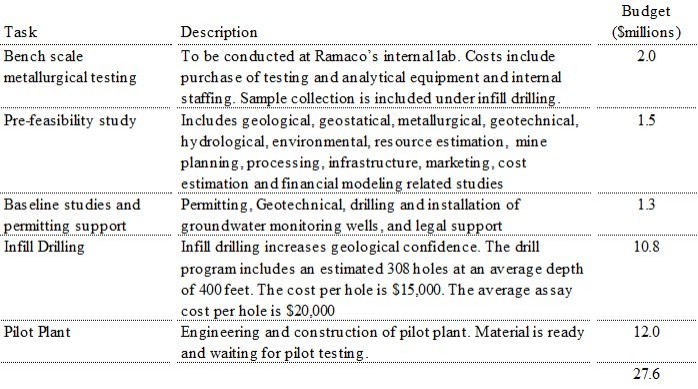
| |
July 24, 2026 | Page 184 |
| | |
Technical Report Summary | |
|
24.0 | References |
References used in preparation of this TRS are listed below. Where applicable, references are grouped by category for ease of review.
Published Technical Literature
Finkelman, R.B., 1993. Trace and Minor Elements in Coal, in Engel, M.H. and Macko, S.A. (eds.), Organic Geochemistry: Principles and Applications, Topics in Geobiology, Volume 11. Boston, MA: Springer US, pp. 593-607.
Ketris, M.P., and Yudovich, Ya.E., 2009. Estimations of Clarkes for Carbonaceous Biolithes: World Averages for Trace Element Contents in Black Shales and Coals, International Journal of Coal Geology, Volume 78, Issue 2, pp. 135-148.
Seredin, V.V., and Dai, S., 2012. Coal Deposits as Potential Alternative Sources for Lanthanides and Yttrium, International Journal of Coal Geology, Volume 94, pp. 67-93.
Yang, J., Montross, S.N., Britton, J., Stuckman, M., Lopano, C.L., and Verba, C., 2023. A Geo-Data Science Method for Assessing Unconventional Rare-Earth Element Resources in Sedimentary Systems, Natural Resources Research, Volume 32, Issue 3.
Montross, S., Verba, C., Falla, S., and Bauer, J., 2021. Towards a Geo-Data Science Method for Assessing Rare-Earth Element and Critical Mineral Occurrences in Coal and Other Sedimentary Systems. National Energy Technology Laboratory (NETL), United States Department of Energy, July 22, 2021.
Project-Specific Technical and Engineering Reports
Fluor Enterprises, Inc., 2025. Brook Mine Preliminary Economic Assessment. Prepared for Ramaco Resources, Inc.
Golder Associates, Inc., 2012. Ramaco Mineral Property, Sheridan, Wyoming - Interim Report, March 9, 2012.
John T. Boyd Company, 1979. Potentially Strip Mineable Coal Reserves Contained on the Sheridan-Wyoming Coal Company Property, November 20, 1979.
Ramaco Resources, Inc., 2025. Brook Mine Sampling Process - Internal Sampling, Chain-of-Custody, and Submittal Procedures.
Ramaco Resources, Inc., 2026. 2026 Drilling and Groundwater Monitoring Program, dated April 9, 2026.
| |
July 24, 2026 | Page 185 |
| | |
Technical Report Summary | |
|
Ramaco Resources, Inc., 2025. Estimated Long-Term Reclamation Costs - Brook Mine, revised January 2026.
Ramaco Resources, Inc., 2025. Brook Mine Mining Costs Estimate, prepared by C. Blanchard.
Ramaco Resources, Inc., 2025. Brook Mine Marketing Support and Product Pricing Memorandum, including Fluor PEA Pricing assumptions.
SGS North America, Inc., 2025-2026. Brook Mine ICP-MS, ICP-OES, and Sodium-Peroxide Fusion Assay Reports and QA/QC Certificates. Prepared for Ramaco Resources, Inc.
Hazen Research, Inc., 2024-2025. Metallurgical Test Work Reports - Brook Mine Critical Mineral Oxide Process Development. Prepared for Ramaco Resources, Inc.
Wyoming DEQ Permit Application - WWC Engineering Baseline Studies and Mine Plan
WWC Engineering, 2014-2024. Permit to Mine Application, Permit No. 841-T1, Brook Mine - Volume I (Property Rights), Volume IA, and Volume II (Exhibits). Prepared for Ramaco Resources, Inc.; on file with the Wyoming Department of Environmental Quality, Land Quality Division (WDEQ/LQD).
WWC Engineering. Mine Plan, Brook Mine, Permit No. 841-T1.
WWC Engineering. Reclamation Plan, Brook Mine, Permit No. 841-T1.
WWC Engineering. Permit Application baseline studies (Appendices D1-D11)
BKS Environmental Associates, Inc., 2013. Baseline Vegetation Assessment, Brook Mine, Sheridan County, Wyoming. Gillette, Wyoming.
Permits and Authorizations
Wyoming Department of Environmental Quality, Land Quality Division, 2020. Permit No. 841-T1, Brook Mine, issued July 7, 2020.
Wyoming Department of Environmental Quality, Air Quality Division, 2020. Air Quality Permit No. P0025939, Brook Mine, issued July 20, 2020.
Wyoming Department of Environmental Quality, Water Quality Division, 2024. Wyoming Pollutant Discharge Elimination System (WYPDES) Industrial Stormwater Authorization No. WYR001608, Letter of Authorization (LOA BM-eff), effective May 1, 2024.
United States Mine Safety and Health Administration (MSHA). Mine ID No. 4801799, Brook Mine.
| |
July 24, 2026 | Page 186 |
| | |
Technical Report Summary | |
|
Property Control - Leases, Deeds, and Conveyances
Sheridan-Wyoming Coal Company. Mineral Deed to Ramaco Resources, Inc., dated August 17, 2011.
Padlock Ranch Company. Surface Use and Mineral Lease Agreement with Ramaco Resources, Inc., dated September 1, 2016 (and related “no-mine zone” exhibit).
William J. Laya Trust, Joyce J. Laya Trust, and Thomas C. Laya. Coal Mining Lease with Ramaco Resources, Inc., dated November 16, 2012, as amended by First Amendment to Coal Mining Lease.
Taylor Investments, LLC. Warranty Deed and Surface Use Agreement to Ramaco Resources, Inc., dated September 17, 2025 (Document No. 2025-802173, Sheridan County, Wyoming).
Sheridan County Conservation District. Recorded Easement, Document No. 2017-735980.
Ramaco Resources, Inc. Area of Control Rights Map (2024) and Property Control Database, Brook Mine.
Regulatory and Statutory Authority
United States Securities and Exchange Commission, 2018. Modernization of Property Disclosures for Mining Registrants, Final Rule, Release Nos. 33-10570; 34-84509; File No. S7-10-16, October 31, 2018. Available at https://www.sec.gov/rules/final/2018/33-10570.pdf.
17 Code of Federal Regulations (CFR) § 229.601(b)(96) and §§ 229.1300-229.1305 (Subpart 229.1300 - Disclosure by Registrants Engaged in Mining Operations).
Surface Mining Control and Reclamation Act of 1977 (SMCRA), Public Law 95-87, as amended.
Wyoming Environmental Quality Act, Wyo. Stat. Ann. § 35-11-101 et seq.
Wyoming Department of Environmental Quality, Land Quality Division, 2012. Rules and Regulations for Coal Permitting, Chapter 2.
Wyoming Department of Environmental Quality, Land Quality Division, 1996. Guideline No. 1 - Soils and Overburden.
Wyoming Department of Environmental Quality, Land Quality Division, 2012. Guideline No. 2 - Vegetation.
| |
July 24, 2026 | Page 187 |
| | |
Technical Report Summary | |
|
Public Data Sources, Standards, and Websites
United States Geological Survey, 2022. 2022 Final List of Critical Minerals (Federal Register, Volume 87, No. 37, February 24, 2022). https://www.usgs.gov/news/national-news-release/us-geological-survey-releases-2022-list-critical-minerals.
United States Geological Survey. 7.5-Minute Topographic Quadrangle Maps - Acme, Hultz Draw, Monarch, and Sheridan, Wyoming.
United States Geological Survey. The 3D Elevation Program (3DEP) Digital Elevation Data. https://www.usgs.gov/3d-elevation-program.
Western Regional Climate Center (WRCC). Sheridan-Area Climate Stations - Precipitation, Temperature, Wind, and Evaporation Records. https://wrcc.dri.edu/.
ASTM International. ASTM D5084, Standard Test Methods for Measurement of Hydraulic Conductivity of Saturated Porous Materials Using a Flexible Wall Permeameter.
ASTM International. Applicable ASTM standards for coal sampling, sample preparation, and analytical procedures referenced by NETL, SGS, Hazen, and the University of North Dakota laboratories.
Marketing
United States Geological Survey Mineral Commodity Summaries 2025 Data Release (ver. 2.0, April 2025)
Ramaco internal supply analysis, September 2025.
Bloom Energy Corporation Form 10-K for Fiscal Year ended December 31, 2023.
Ernst & Young LLP, “Scandium Market Analysis,” prepared for Imperial Mining Group Ltd., February 2022, as reproduced in Imperial Mining Group Ltd. Technical Report, Section 19, 2022.
Phoung et al., “Exploring global supply and demand of scandium oxide in 2030”, Journal of Cleaner Production, 2023
Ramaco Internal Analysis on Scandium Demand by Commercial Airlines, December 2025.
Boeing Commercial Market Outlook 2025- 2044, from website.
Airbus Global Market Forecast 2025- 2044, from website.
NioCorp Developments Ltd., public investor communications, 2025.
DLA SBIR Topic DLA242-003.
| |
July 24, 2026 | Page 188 |
| | |
Technical Report Summary | |
|
Scandium Canada Corporate Presentation, January 2026.
Sunrise Energy Metals ASX announcements, 2025.
USGS Mineral Commodity Summaries 2017- 2021.
24chemicalresearch.com, “Scandium Oxide Market Global Outlook and Forecast 2025- 2032,” 2024
Reuters, “US Agency Wants to Buy Scandium Oxide from Rio Tinto for Defence Stockpile,” September 2025.
Nassar, Shojaeddini, Alonso, Jaskula, and Tolcin, “Quantifying Potential Effects of China’s Gallium and Germanium Export Restrictions on the United States Economy,” USGS Open-File Report 2024-1057
Thunder Said Energy, “Gallium Nitride: GaN Mentality,” March 2026.
Grand View Research, GaN Semiconductor Devices Market Report, 2024.
Ramaco Internal Gallium Market Analysis, February 2026.
Mordor Intelligence, Gallium Market Report, 2025; Ramaco internal demand analysis, September 2025
Fastmarkets Western Gallium Metal Index, September 2025.
Shanghai Metals Market, September 2025, Asian Metal, September 2025.
Fastmarkets Western Gallium Metal Index, December 2025.
USGS Mineral Commodity Summaries 2025, Germanium.
BNN Bloomberg, December 2024.
Polaris Market Research, Germanium Market Report, 2025.
Astute Analytica, Global Germanium Market Report, August 2025.
Skillings Mining Review, February 2026.
Ramaco Internal Germanium Demand Analysis, September 2025 drawing on CRU via CSIRO.
Argus Media Group, Argus Non-Ferrous Markets.
Fastmarkets Western Germanium Index, September 2025 and December 2025.
United States Department of Energy, Critical Materials Assessment, 2023.
International Energy Agency, World Energy Outlook 2024.
Ramaco Internal Demand Analysis, September 2025, drawing on United States DOE Rare Earth Permanent Magnets Supply Chain Deep-Dive, December 2024.
| |
July 24, 2026 | Page 189 |
| | |
Technical Report Summary | |
|
IEA Announced Pledges Scenario.
Project Blue, 2024 NdPr baseline.
Adamas Intelligence, Rare Earth Magnet Market Outlook to 2040, as cited in Mkango Resources Ltd., Rare Earths Overview, 2024.
MP Materials Corp., press release, July 10, 2025; Center on Global Energy Policy, Columbia University, July 2025.
Fastmarkets western NdPr oxide index, September 2025 and December 2025.
Rare Earth Elements: Pathways to Secure and Diversified Supply Chains, 2026.
World Energy Outlook 2024; Discovery Alert, “Heavy Rare Earth Shortages,” November 2025.
Benchmark Mineral Intelligence, as cited in US News, November 2025.
Rare Earth Exchanges, July 2025.
Rare Earth Mining, March 2026.
IEA, “With New Export Controls on Critical Minerals, Supply Concentration Risks Become Reality,” May 2025; ORF America, January 2026.
Adamas Intelligence, Rare Earth Magnet Market Outlook to 2040, 2023, as cited in Mining.com, May 2023.
CRU, as cited in US News, November 2025.
IEA, Rare Earth Elements: Pathways to Secure and Diversified Supply Chains, 2026.
USGS Mineral Commodity Summaries 2025, Rare Earths, citing Argus Media Group, Argus Non-Ferrous Markets.
Fastmarkets western dysprosium and terbium oxide indices, September 2025 and December 2025
Rare Earth Permanent Magnets for the Green Energy Transition, ScienceDirect, October 2024.
| |
July 24, 2026 | Page 190 |
| | |
Technical Report Summary | |
|
25.0 | Reliance on Information Provided by the Registrant |
In preparing its findings and conclusions regarding modifying factors in this report, WEIR QPs and Mr. Woloschuk fully relied upon data, written reports and statements provided by the Registrant.
The Registrant provided, and the QPs fully relied upon, information summarized in Table 25-1 as follows:
Table 25-1Information Relied Upon from Registrant
Category | | Information | | Report Section |
Legal | | Mineral rights, surface rights, property agreements, encumbrances on the properties, royalties, depreciation, and government taxes or credits reflected in various economic assumptions. | | 3, 13, 15, 17, & 19 |
Economic | | Macroeconomic data including corporate tax rates and discount rates | | 18 & 19 |
Marketing | | Marketing information regarding the target commodities that will be produced by the Brook Mine (specifications on product quality, form of product to be sold, long-term market price) | | 16, 18, & 19 |
Environmental | | Permitting requirements and status | | 3 & 17 |
Governmental | | Section 45X tax credit applicability and duration; State/Local severance and ad valorem taxes | | 18 & 19 |
The QPs consider it reasonable to rely upon the Registrant for the above information, based on the QPs’ past and ongoing interactions with the subject-matter experts in these areas employed or engaged by the Registrant, as well as the Registrant’s considerable experience in mining.
Further, the QPs have taken all appropriate steps, in their professional opinion, to ensure that the above information provided by the Registrant is accurate in all material respects and have no reason to believe that any material facts have been withheld or misstated.
| |
July 24, 2026 | Page 191 |

Executive Towers West I
1431 Opus Place, Suite 210
Downers Grove, Illinois 60515