Exhibit 99.1
: RKTO © 2026 Rocket One, Inc. Advancing Ultra- Efficient Compute for AI. An AI semiconductor infrastructure company building nanomagnetic and spintronic computing for ultra-low- power AI, resilient edge, defense, and space. Investor Overview — 2026
: RKTO © 2026 Rocket One, Inc. Safe Harbor Statement 2 This presentation contains "forward-looking statements" within the meaning of the safe harbor provisions of the Private Securities Litigation Reform Act of 1995 and other federal securities laws. Forward-looking statements include, but are not limited to, statements regarding Rocket One Inc.'s business strategy, technology platform, licensed intellectual property, research and development activities, market opportunities, potential applications in space, satellite, semiconductor, artificial intelligence, defense, and related sectors, potential strategic relationships, expected milestones, financing plans, future operations, and other statements that are not historical facts. Forward-looking statements are generally identified by words such as "could," "believe," "anticipate," "intend," "estimate," "expect,""may," "continue," "predict," "plan," "target," "potential," "seek," "should," "would," and similar expressions. These statements are based on current expectations, assumptions, estimates, and projections of Rocket One's management and are not guarantees of future performance. Forward-looking statements involve known and unknown risks, uncertainties, and other factors that could cause actual results, performance, achievements, or developments to differ materially from those expressed or implied by such statements. Important factors that could cause actual results to differ materially include, but are not limited to: Rocket One's ability to execute its strategic repositioning; the early-stage nature of its technology and business plans; risks related to licensed technology and intellectual property; technical, engineering, testing, manufacturing, commercialization, and regulatory risks; the development of markets for space-based, satellite, defense, semiconductor, artificial intelligence, and related technologies; competition; customer, partner, supplier, and financing risks; changes in economic, market, regulatory, geopolitical, and industry conditions; and the other risks and uncertainties described in Rocket One's filings with the Securities and Exchange Commission, including filings made under its former name, Hoth Therapeutics, Inc. Forward-looking statements should not be relied upon as predictions of future events. Rocket One cannot assure you that the events, results, or circumstances reflected in these statements will be achieved or occur. You are cautioned not to place undue reliance on forward-looking statements, which speak only as of the date of this presentation. Except as required by law, Rocket One undertakes no obligation to update or revise any forward- looking statements, whether as a result of new information, future events, or otherwise.
: RKTO © 2026 Rocket One, Inc. Our Mission 3 Rocket One is building the technology infrastructure for AI, autonomous defense, and the orbital economy. We develop and advance three complementary platforms: nanomagnetic AI compute, radiation-tolerant spintronic memory, and autonomous swarm defense, through exclusive licensed IP, strategic acquisitions, and a capital-efficient public- company structure. Our goal is to bring value to shareholders and help build the foundations for systems that depend on next-generation compute.
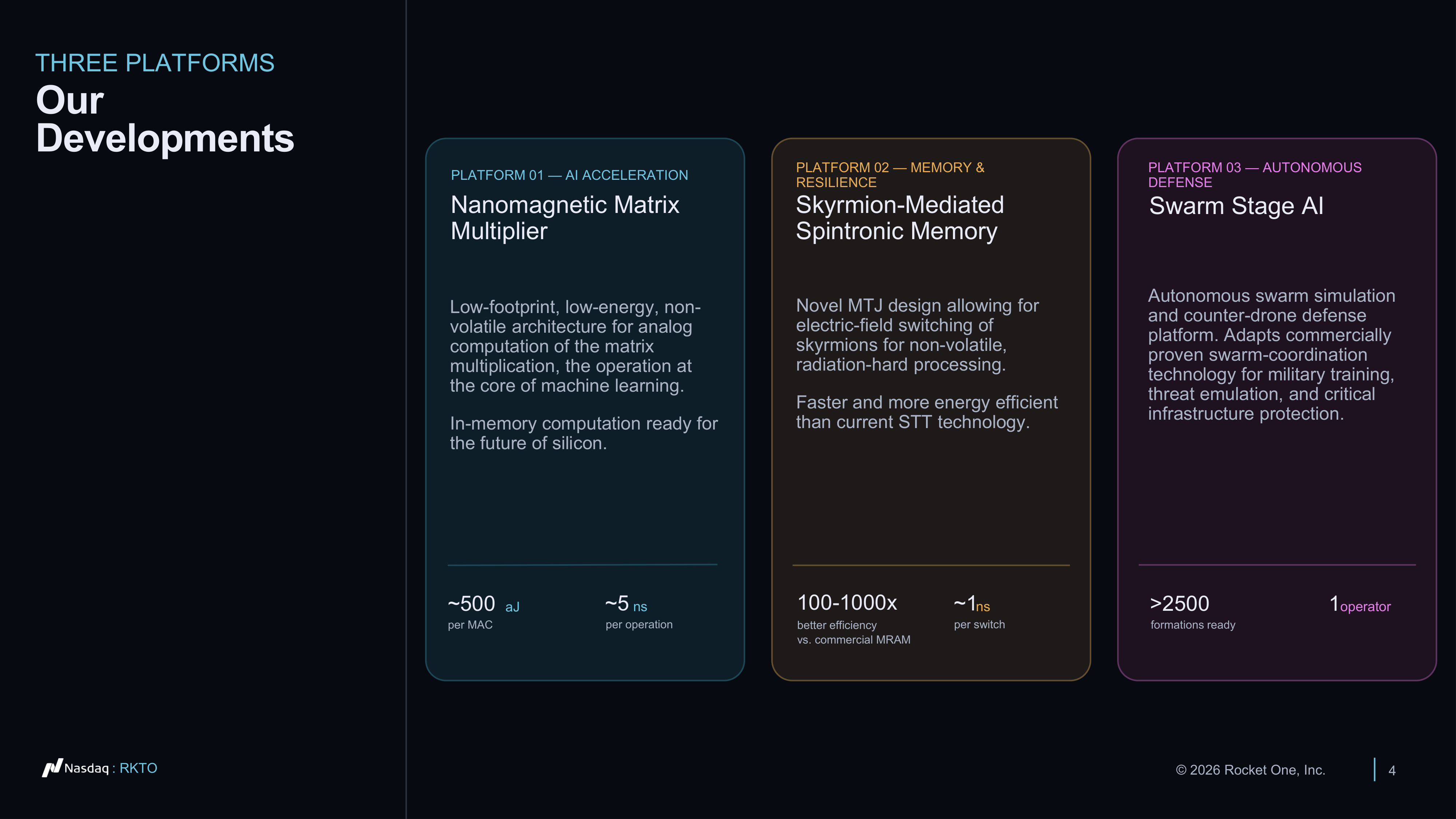
: RKTO © 2026 Rocket One, Inc. Our Developments THREE PLATFORMS 4 PLATFORM 01 — AI ACCELERATION PLATFORM 02 — MEMORY & RESILIENCE PLATFORM 03 — AUTONOMOUS DEFENSE Nanomagnetic Matrix Multiplier Skyrmion-Mediated Spintronic Memory Swarm Stage AI Low-footprint, low-energy, non- volatile architecture for analog computation of the matrix multiplication, the operation at the core of machine learning. In-memory computation ready for the future of silicon. Novel MTJ design allowing for electric-field switching of skyrmions for non-volatile, radiation-hard processing. Faster and more energy efficient than current STT technology. Autonomous swarm simulation and counter-drone defense platform. Adapts commercially proven swarm-coordination technology for military training, threat emulation, and critical infrastructure protection. ~5 100-1000x ~1 >2500 ns ns ~500 aJ per MAC per operation better efficiency vs. commercial MRAM per switch 1operator formations ready
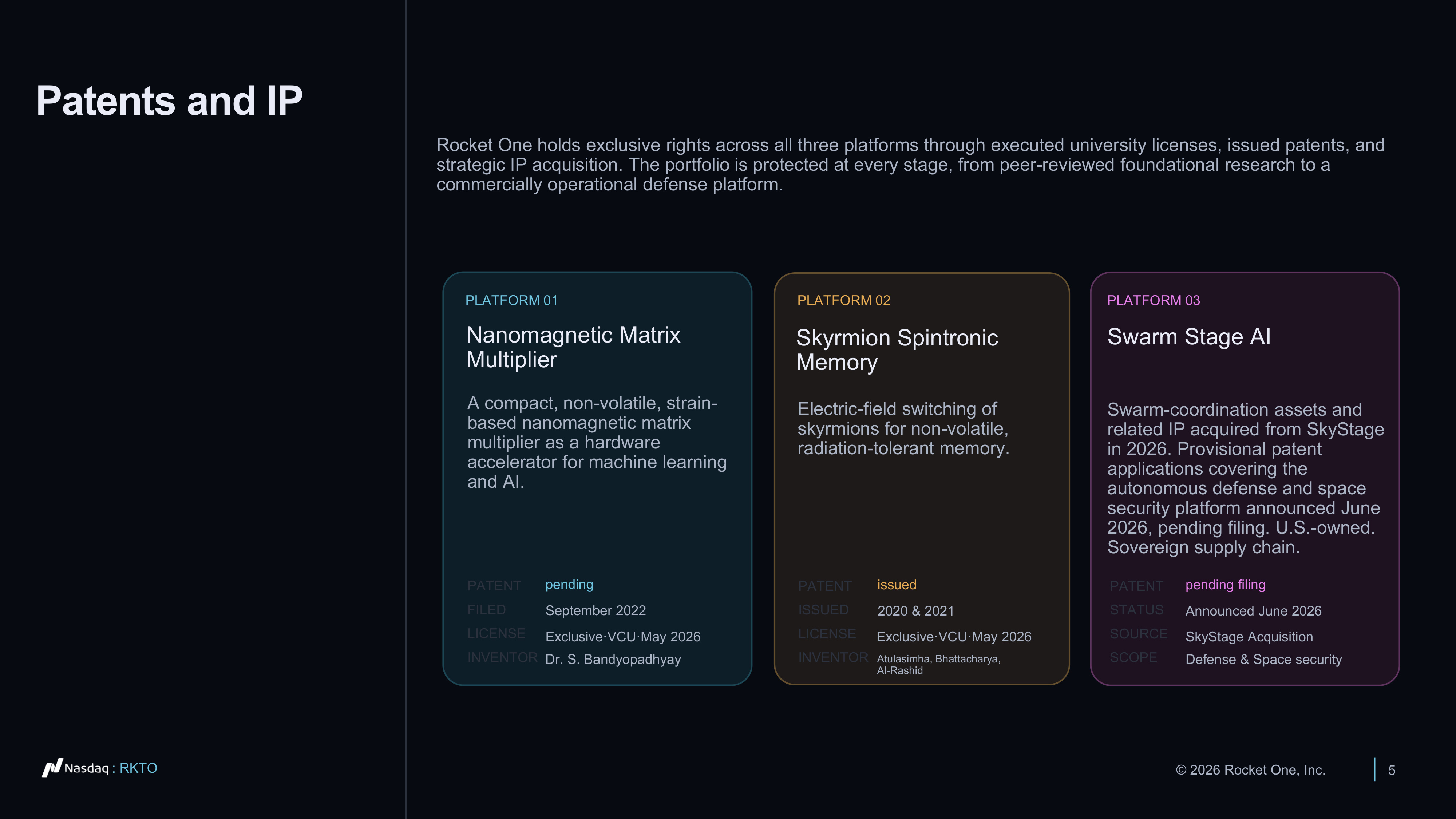
: RKTO © 2026 Rocket One, Inc. 5 Patents and IP Nanomagnetic Matrix Multiplier Skyrmion Spintronic Memory Swarm Stage AI A compact, non-volatile, strain- based nanomagnetic matrix multiplier as a hardware accelerator for machine learning and AI. Electric-field switching of skyrmions for non-volatile, radiation-tolerant memory. Swarm-coordination assets and related IP acquired from SkyStage in 2026. Provisional patent applications covering the autonomous defense and space security platform announced June 2026, pending filing. U.S.-owned. Sovereign supply chain. PLATFORM 01 PLATFORM 02 PLATFORM 03 PATENT FILED LICENSE INVENTOR PATENT ISSUED LICENSE INVENTOR PATENT STATUS SOURCE SCOPE Rocket One holds exclusive rights across all three platforms through executed university licenses, issued patents, and strategic IP acquisition. The portfolio is protected at every stage, from peer-reviewed foundational research to a commercially operational defense platform. pending issued pending filing September 2022 2020 & 2021 Announced June 2026 Exclusive·VCU·May 2026 Exclusive·VCU·May 2026 SkyStage Acquisition Dr. S. Bandyopadhyay Atulasimha, Bhattacharya, Al-Rashid Defense & Space security
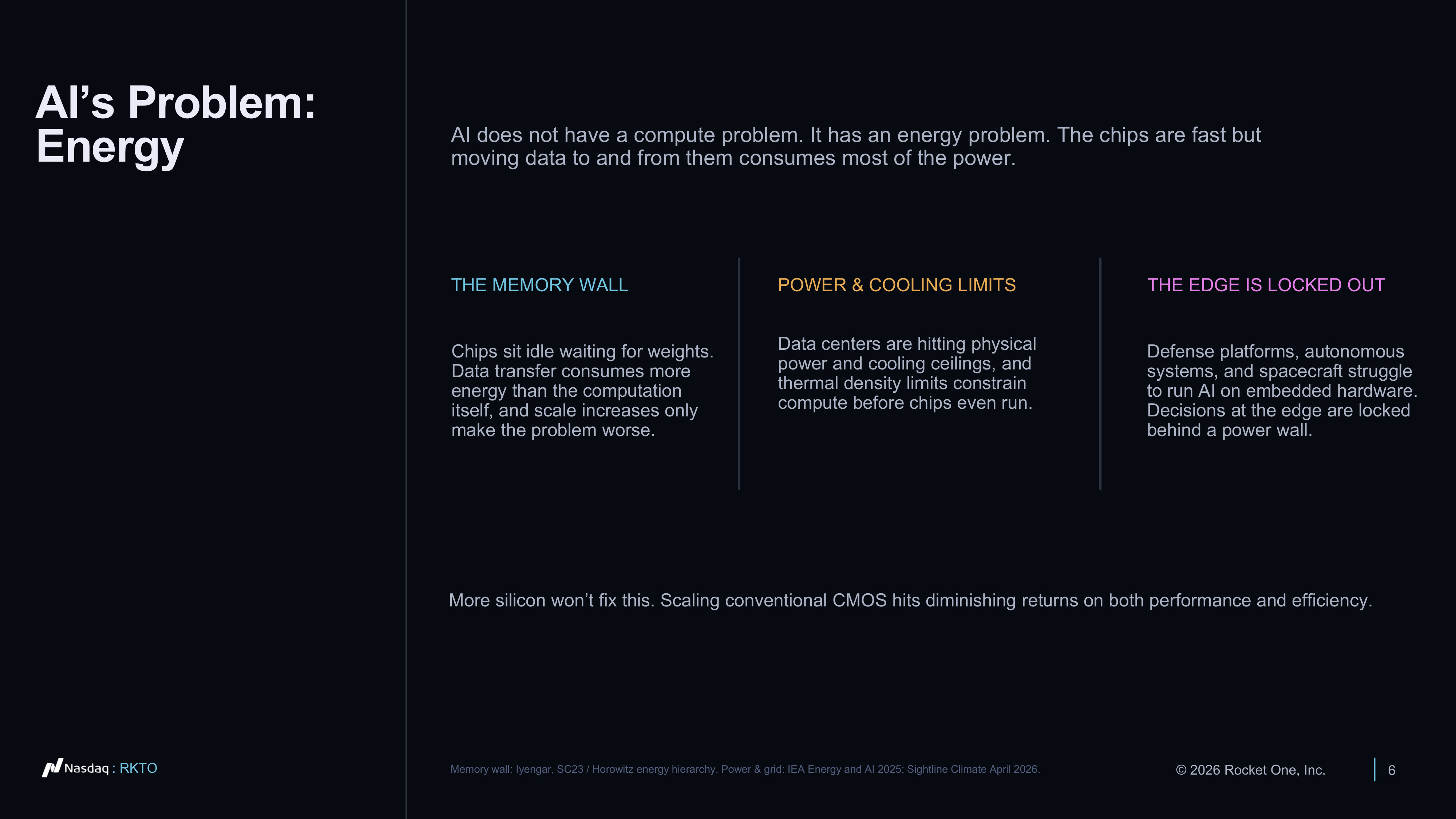
: RKTO © 2026 Rocket One, Inc. 6 AI's Problem: Energy AI does not have a compute problem. It has an energy problem. The chips are fast but moving data to and from them consumes most of the power. THE MEMORY WALL POWER & COOLING LIMITS THE EDGE IS LOCKED OUT More silicon won't fix this. Scaling conventional CMOS hits diminishing returns on both performance and efficiency. Chips sit idle waiting for weights. Data transfer consumes more energy than the computation itself, and scale increases only make the problem worse. Data centers are hitting physical power and cooling ceilings, and thermal density limits constrain compute before chips even run. Defense platforms, autonomous systems, and spacecraft struggle to run AI on embedded hardware. Decisions at the edge are locked behind a power wall. Memory wall: Iyengar, SC23 / Horowitz energy hierarchy. Power & grid: IEA Energy and AI 2025; Sightline Climate April 2026.
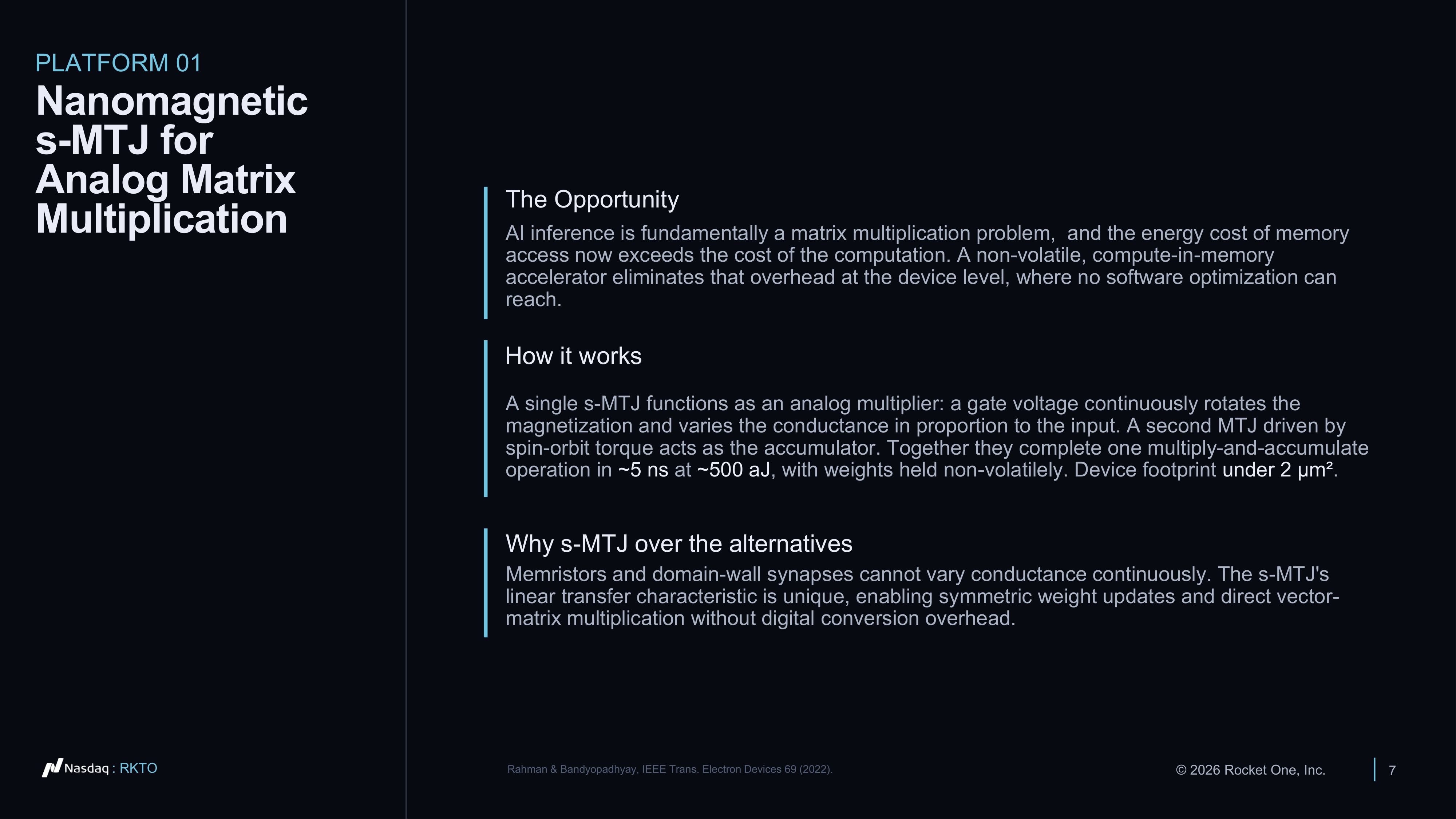
: RKTO © 2026 Rocket One, Inc. Nanomagnetic s-MTJ for Analog Matrix Multiplication PLATFORM 01 7 AI inference is fundamentally a matrix multiplication problem, and the energy cost of memory access now exceeds the cost of the computation. A non-volatile, compute-in-memory accelerator eliminates that overhead at the device level, where no software optimization can reach. The Opportunity A single s-MTJ functions as an analog multiplier: a gate voltage continuously rotates the magnetization and varies the conductance in proportion to the input. A second MTJ driven by spin-orbit torque acts as the accumulator. Together they complete one multiply-and-accumulate operation in ~5 ns at ~500 aJ, with weights held non-volatilely. Device footprint under 2 μm². How it works Memristors and domain-wall synapses cannot vary conductance continuously. The s-MTJ's linear transfer characteristic is unique, enabling symmetric weight updates and direct vector- matrix multiplication without digital conversion overhead. Why s-MTJ over the alternatives Rahman & Bandyopadhyay, IEEE Trans. Electron Devices 69 (2022).
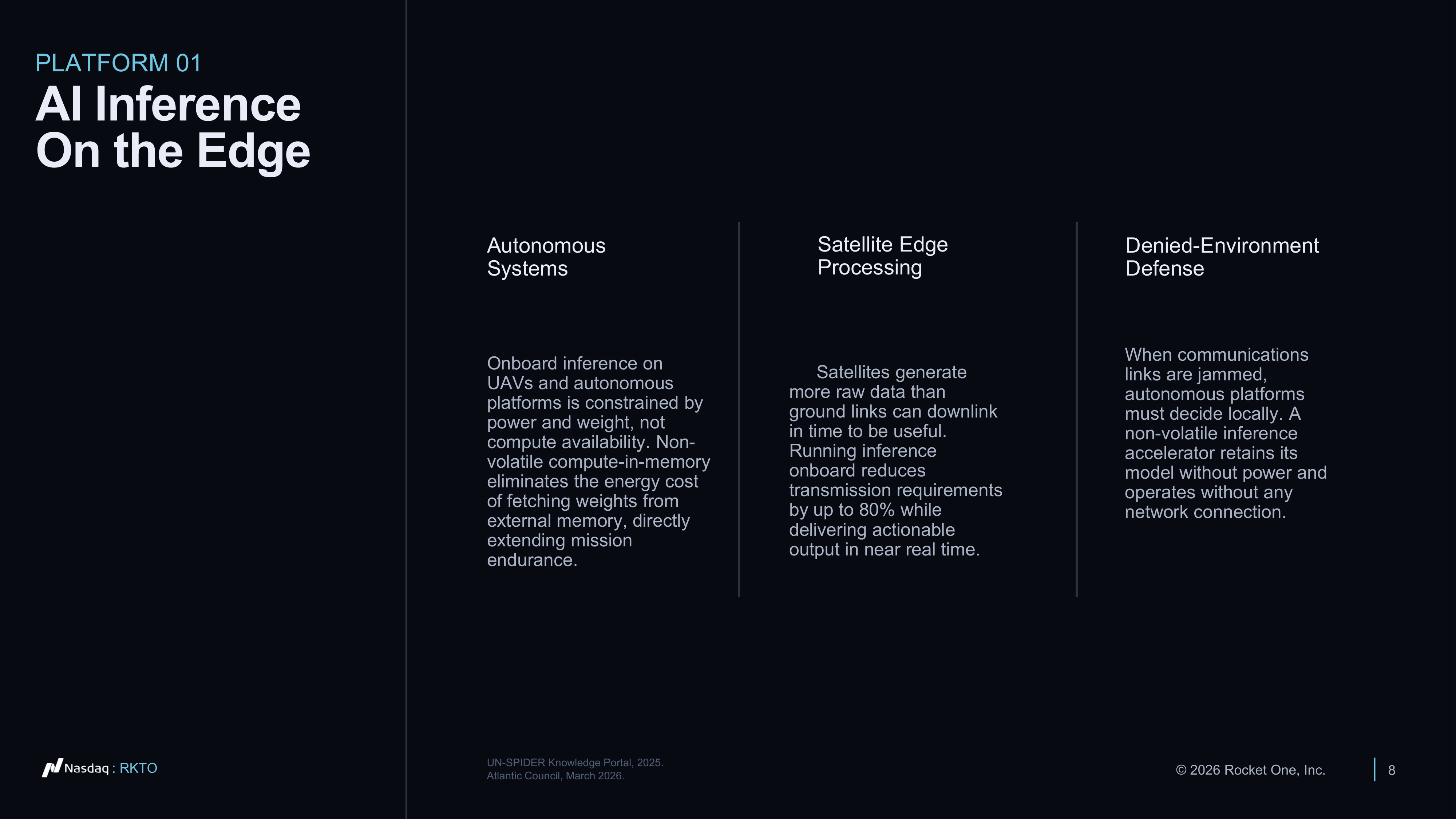
: RKTO © 2026 Rocket One, Inc. 8 PLATFORM 01 AI Inference On the Edge Autonomous Systems Satellite Edge Processing Denied-Environment Defense Onboard inference on UAVs and autonomous platforms is constrained by power and weight, not compute availability. Non- volatile compute-in-memory eliminates the energy cost of fetching weights from external memory, directly extending mission endurance. Satellites generate more raw data than ground links can downlink in time to be useful. Running inference onboard reduces transmission requirements by up to 80% while delivering actionable output in near real time. When communications links are jammed, autonomous platforms must decide locally. A non-volatile inference accelerator retains its model without power and operates without any network connection. UN-SPIDER Knowledge Portal, 2025. Atlantic Council, March 2026.
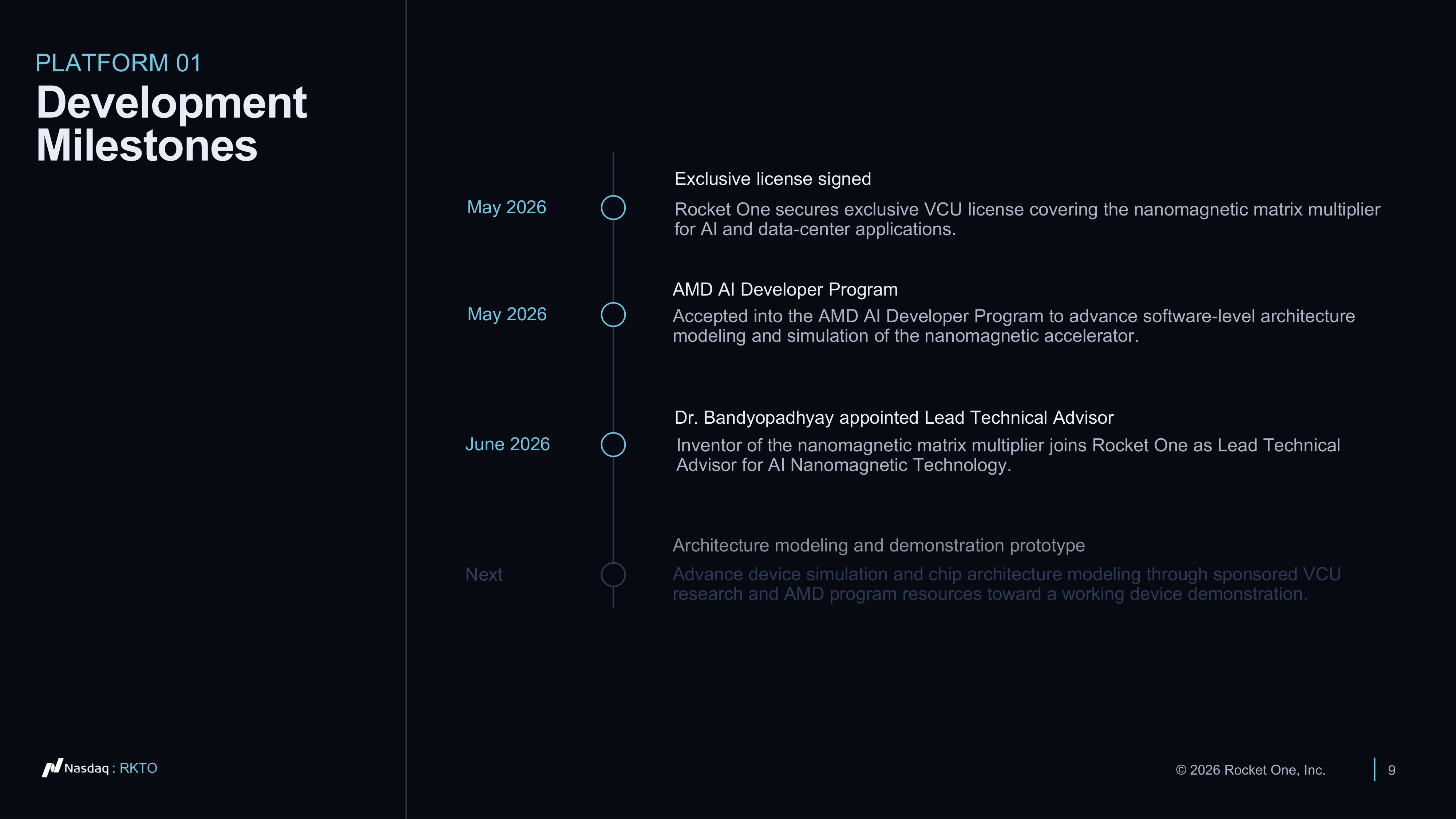
: RKTO © 2026 Rocket One, Inc. 9 PLATFORM 01 Development Milestones May 2026 May 2026 June 2026 Next Exclusive license signed AMD AI Developer Program Dr. Bandyopadhyay appointed Lead Technical Advisor Architecture modeling and demonstration prototype Rocket One secures exclusive VCU license covering the nanomagnetic matrix multiplier for AI and data-center applications. Accepted into the AMD AI Developer Program to advance software-level architecture modeling and simulation of the nanomagnetic accelerator. Inventor of the nanomagnetic matrix multiplier joins Rocket One as Lead Technical Advisor for AI Nanomagnetic Technology. Advance device simulation and chip architecture modeling through sponsored VCU research and AMD program resources toward a working device demonstration.
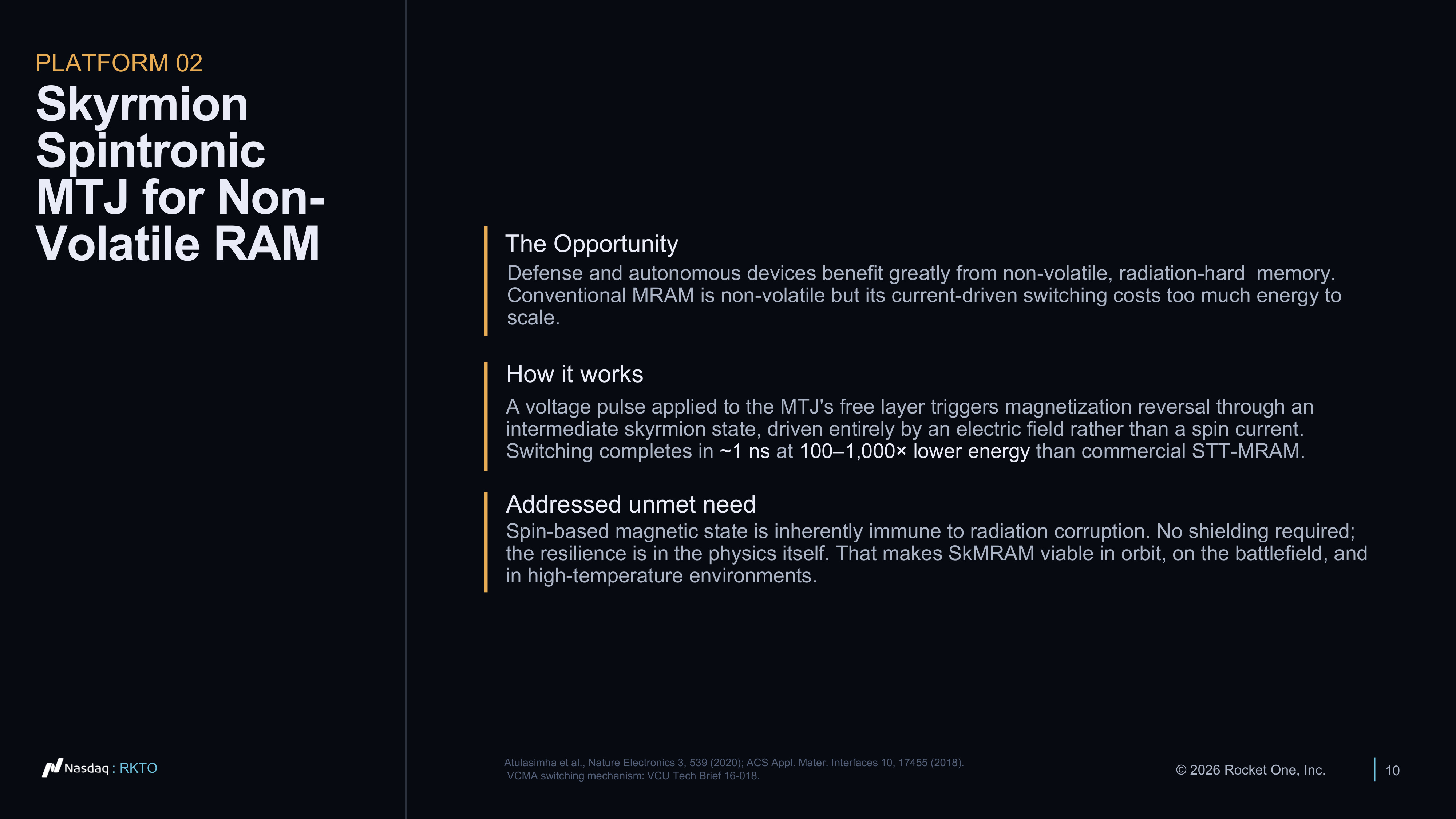
: RKTO © 2026 Rocket One, Inc. Skyrmion Spintronic MTJ for Non- Volatile RAM PLATFORM 02 10 Defense and autonomous devices benefit greatly from non-volatile, radiation-hard memory. Conventional MRAM is non-volatile but its current-driven switching costs too much energy to scale. The Opportunity A voltage pulse applied to the MTJ's free layer triggers magnetization reversal through an intermediate skyrmion state, driven entirely by an electric field rather than a spin current. Switching completes in ~1 ns at 100–1,000× lower energy than commercial STT-MRAM. How it works Spin-based magnetic state is inherently immune to radiation corruption. No shielding required; the resilience is in the physics itself. That makes SkMRAM viable in orbit, on the battlefield, and in high-temperature environments. Addressed unmet need Atulasimha et al., Nature Electronics 3, 539 (2020); ACS Appl. Mater. Interfaces 10, 17455 (2018). VCMA switching mechanism: VCU Tech Brief 16-018.
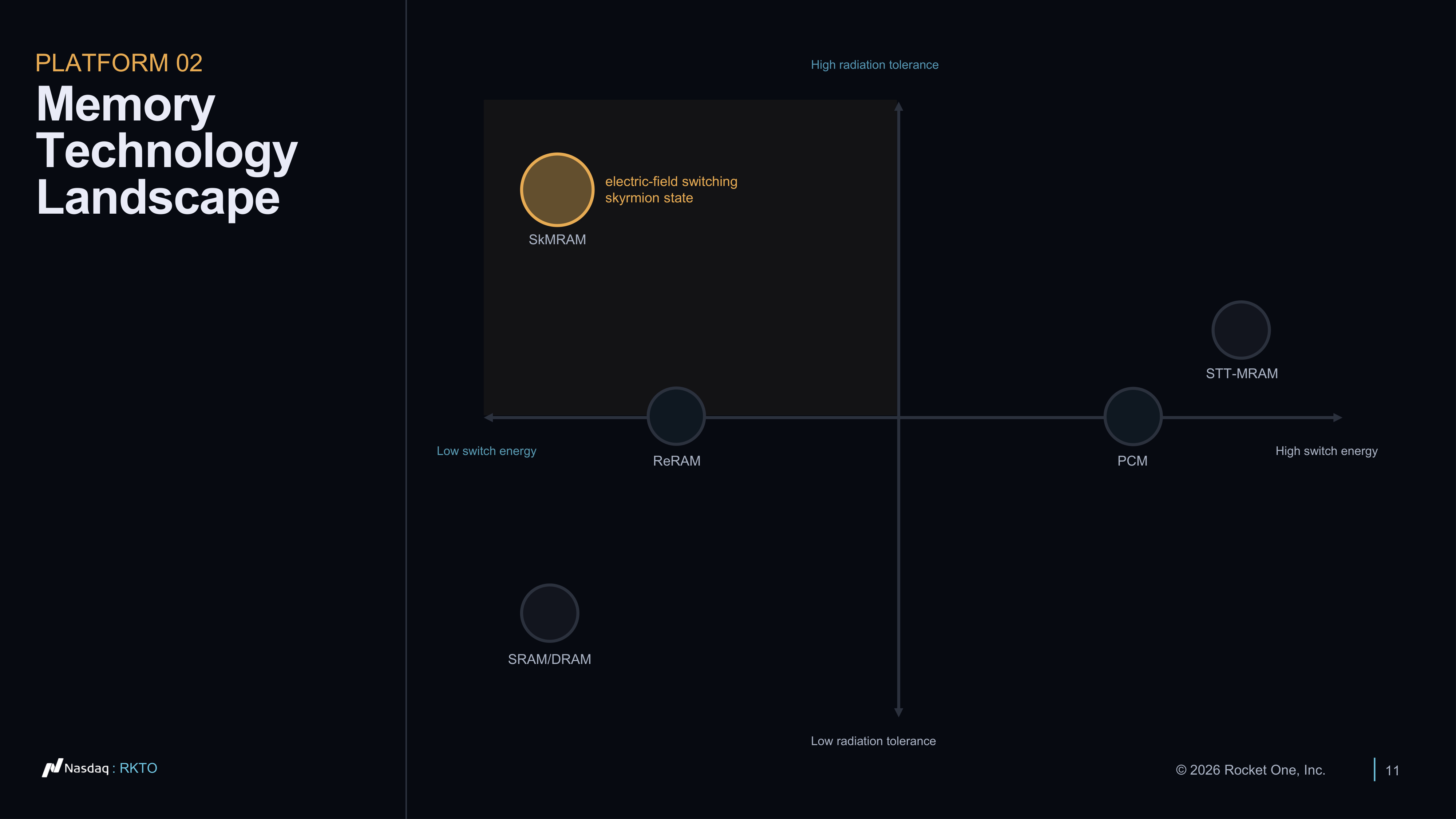
: RKTO © 2026 Rocket One, Inc. Memory Technology Landscape PLATFORM 02 11 High switch energy Low switch energy High radiation tolerance Low radiation tolerance SRAM/DRAM ReRAM STT-MRAM PCM SkMRAM electric-field switching skyrmion state
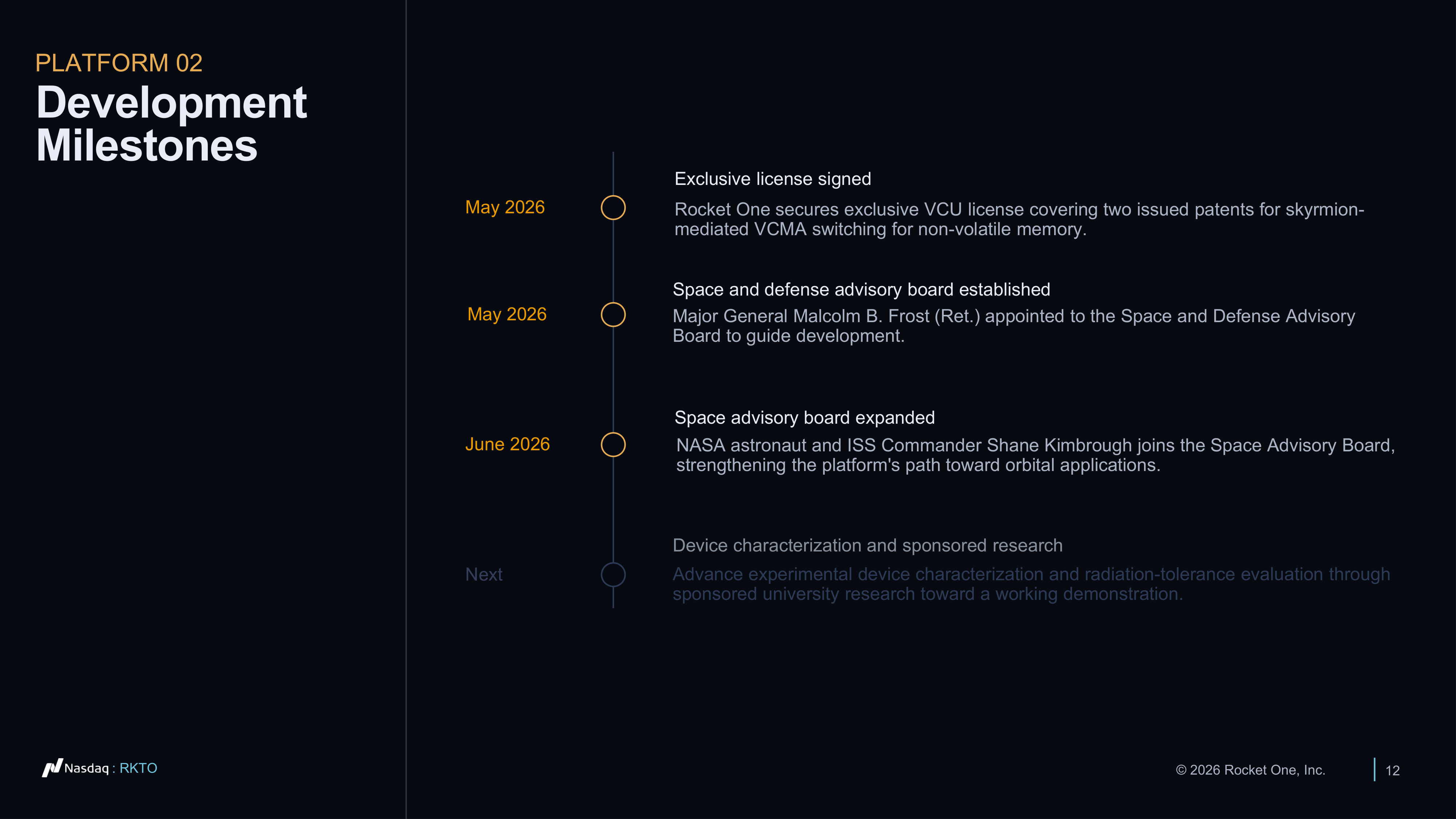
: RKTO © 2026 Rocket One, Inc. Development Milestones PLATFORM 02 12 May 2026 May 2026 June 2026 Next Exclusive license signed Space and defense advisory board established Space advisory board expanded Device characterization and sponsored research Rocket One secures exclusive VCU license covering two issued patents for skyrmion- mediated VCMA switching for non-volatile memory. Major General Malcolm B. Frost (Ret.) appointed to the Space and Defense Advisory Board to guide development. NASA astronaut and ISS Commander Shane Kimbrough joins the Space Advisory Board, strengthening the platform's path toward orbital applications. Advance experimental device characterization and radiation-tolerance evaluation through sponsored university research toward a working demonstration.
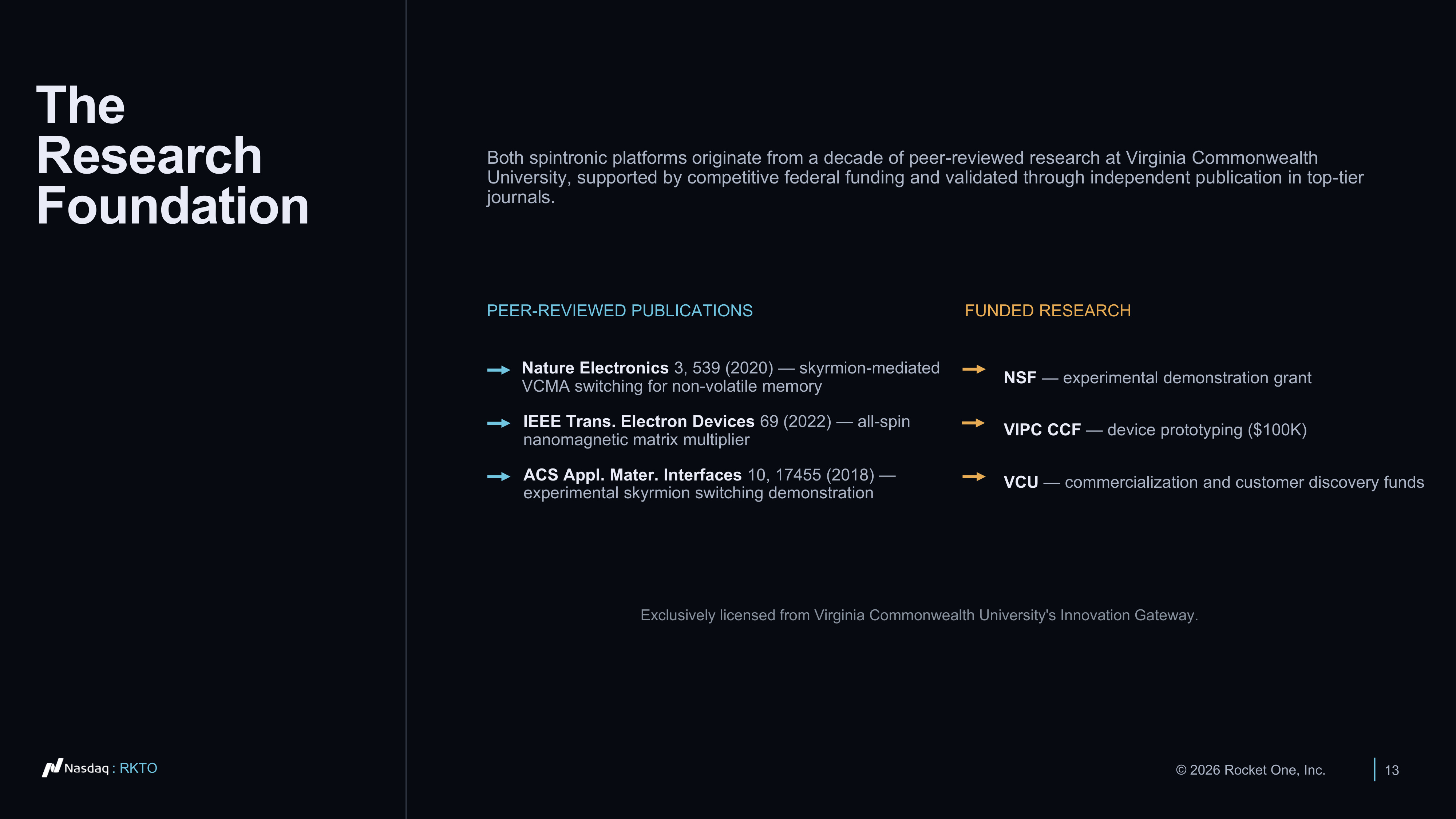
: RKTO © 2026 Rocket One, Inc. 13 The Research Foundation Both spintronic platforms originate from a decade of peer-reviewed research at Virginia Commonwealth University, supported by competitive federal funding and validated through independent publication in top-tier journals. PEER-REVIEWED PUBLICATIONS FUNDED RESEARCH Nature Electronics 3, 539 (2020) — skyrmion-mediated VCMA switching for non-volatile memory NSF — experimental demonstration grant VIPC CCF — device prototyping ($100K) VCU — commercialization and customer discovery funds Exclusively licensed from Virginia Commonwealth University's Innovation Gateway. IEEE Trans. Electron Devices 69 (2022) — all-spin nanomagnetic matrix multiplier ACS Appl. Mater. Interfaces 10, 17455 (2018) — experimental skyrmion switching demonstration
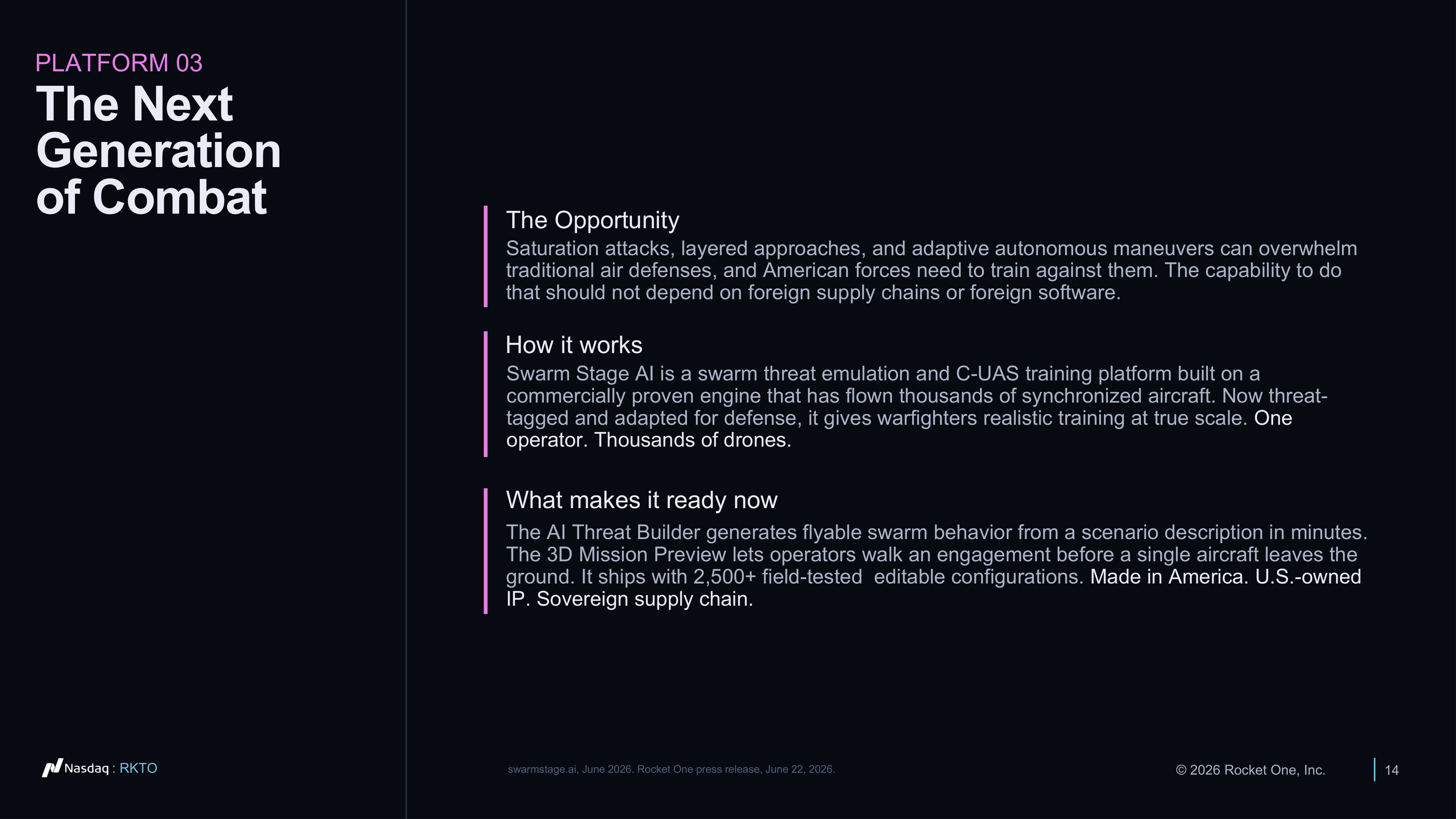
: RKTO © 2026 Rocket One, Inc. 14 PLATFORM 03 The Next Generation of Combat Saturation attacks, layered approaches, and adaptive autonomous maneuvers can overwhelm traditional air defenses, and American forces need to train against them. The capability to do that should not depend on foreign supply chains or foreign software. The Opportunity Swarm Stage AI is a swarm threat emulation and C-UAS training platform built on a commercially proven engine that has flown thousands of synchronized aircraft. Now threat- tagged and adapted for defense, it gives warfighters realistic training at true scale. One operator. Thousands of drones. How it works The AI Threat Builder generates flyable swarm behavior from a scenario description in minutes. The 3D Mission Preview lets operators walk an engagement before a single aircraft leaves the ground. It ships with 2,500+ field-tested editable configurations. Made in America. U.S.-owned IP. Sovereign supply chain. What makes it ready now swarmstage.ai, June 2026. Rocket One press release, June 22, 2026.
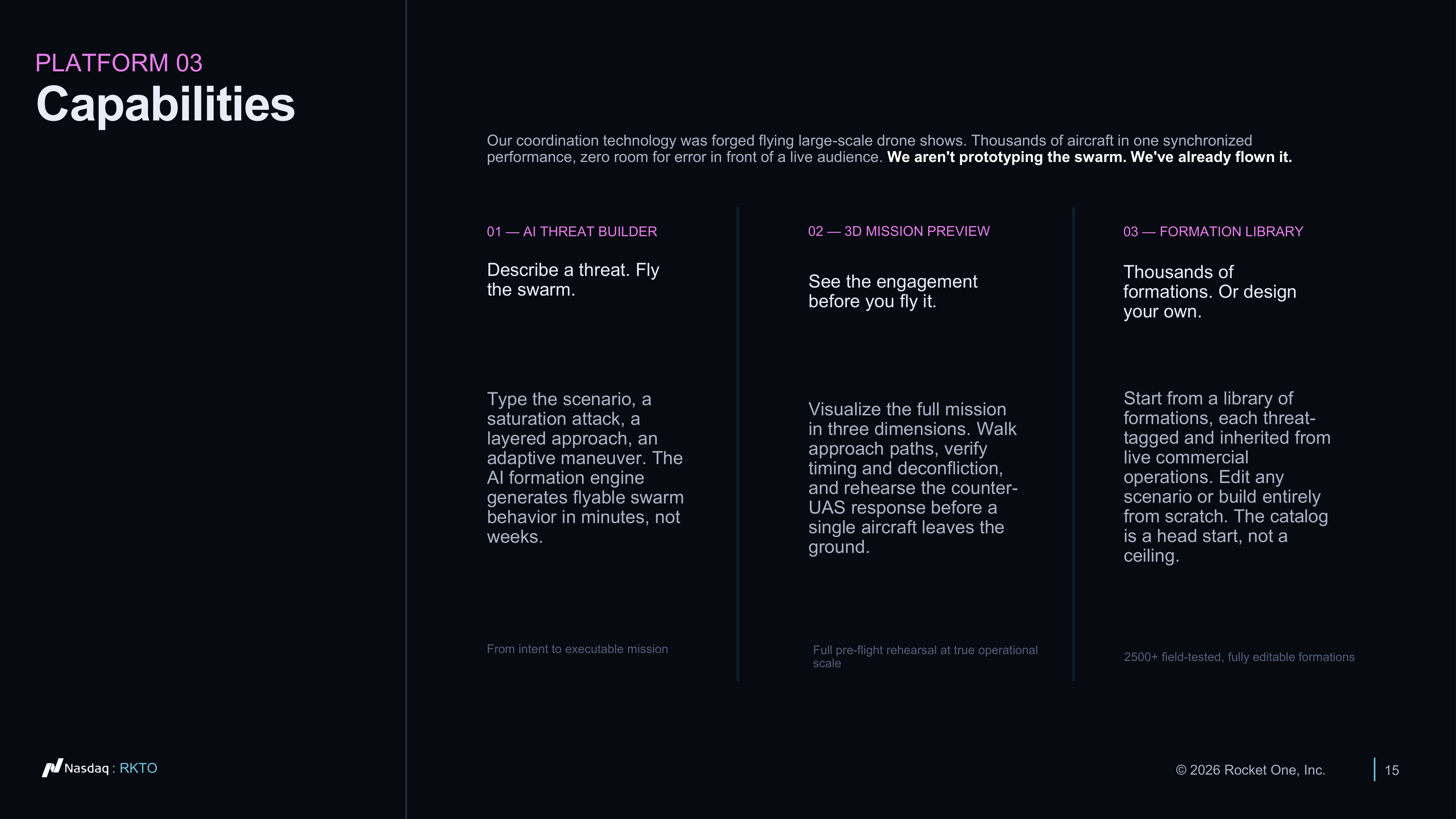
: RKTO © 2026 Rocket One, Inc. 15 PLATFORM 03 Capabilities Our coordination technology was forged flying large-scale drone shows. Thousands of aircraft in one synchronized performance, zero room for error in front of a live audience. We aren't prototyping the swarm. We've already flown it. 01 — AI THREAT BUILDER 02 — 3D MISSION PREVIEW 03 — FORMATION LIBRARY Describe a threat. Fly the swarm. See the engagement before you fly it. Thousands of formations. Or design your own. Type the scenario, a saturation attack, a layered approach, an adaptive maneuver. The AI formation engine generates flyable swarm behavior in minutes, not weeks. Visualize the full mission in three dimensions. Walk approach paths, verify timing and deconfliction, and rehearse the counter- UAS response before a single aircraft leaves the ground. Start from a library of formations, each threat- tagged and inherited from live commercial operations. Edit any scenario or build entirely from scratch. The catalog is a head start, not a ceiling. From intent to executable mission Full pre-flight rehearsal at true operational scale 2500+ field-tested, fully editable formations
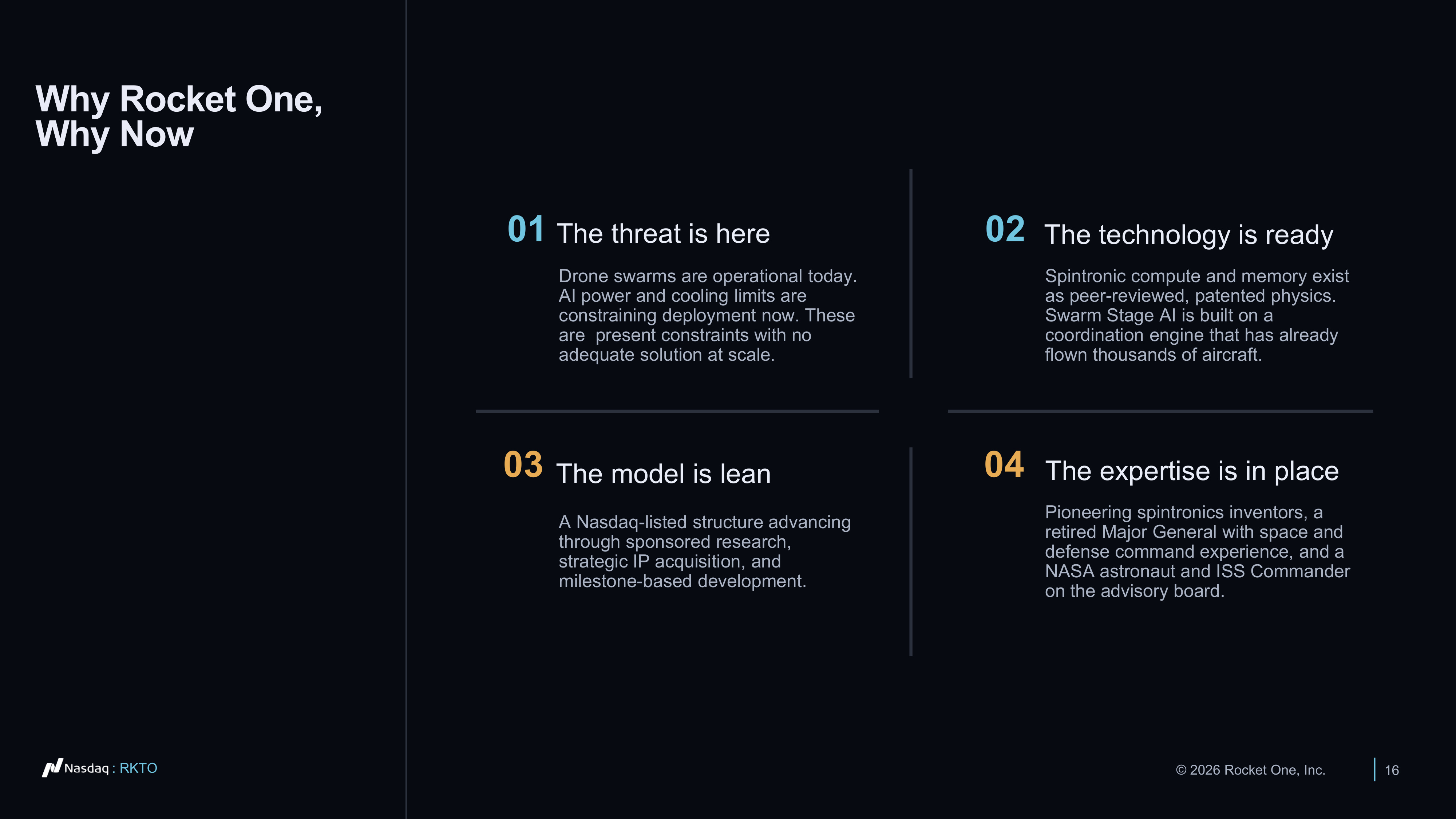
: RKTO © 2026 Rocket One, Inc. 16 Why Rocket One, Why Now 01 02 03 04 The threat is here The technology is ready The model is lean The expertise is in place Drone swarms are operational today. AI power and cooling limits are constraining deployment now. These are present constraints with no adequate solution at scale. Spintronic compute and memory exist as peer-reviewed, patented physics. Swarm Stage AI is built on a coordination engine that has already flown thousands of aircraft. A Nasdaq-listed structure advancing through sponsored research, strategic IP acquisition, and milestone-based development. Pioneering spintronics inventors, a retired Major General with space and defense command experience, and a NASA astronaut and ISS Commander on the advisory board.
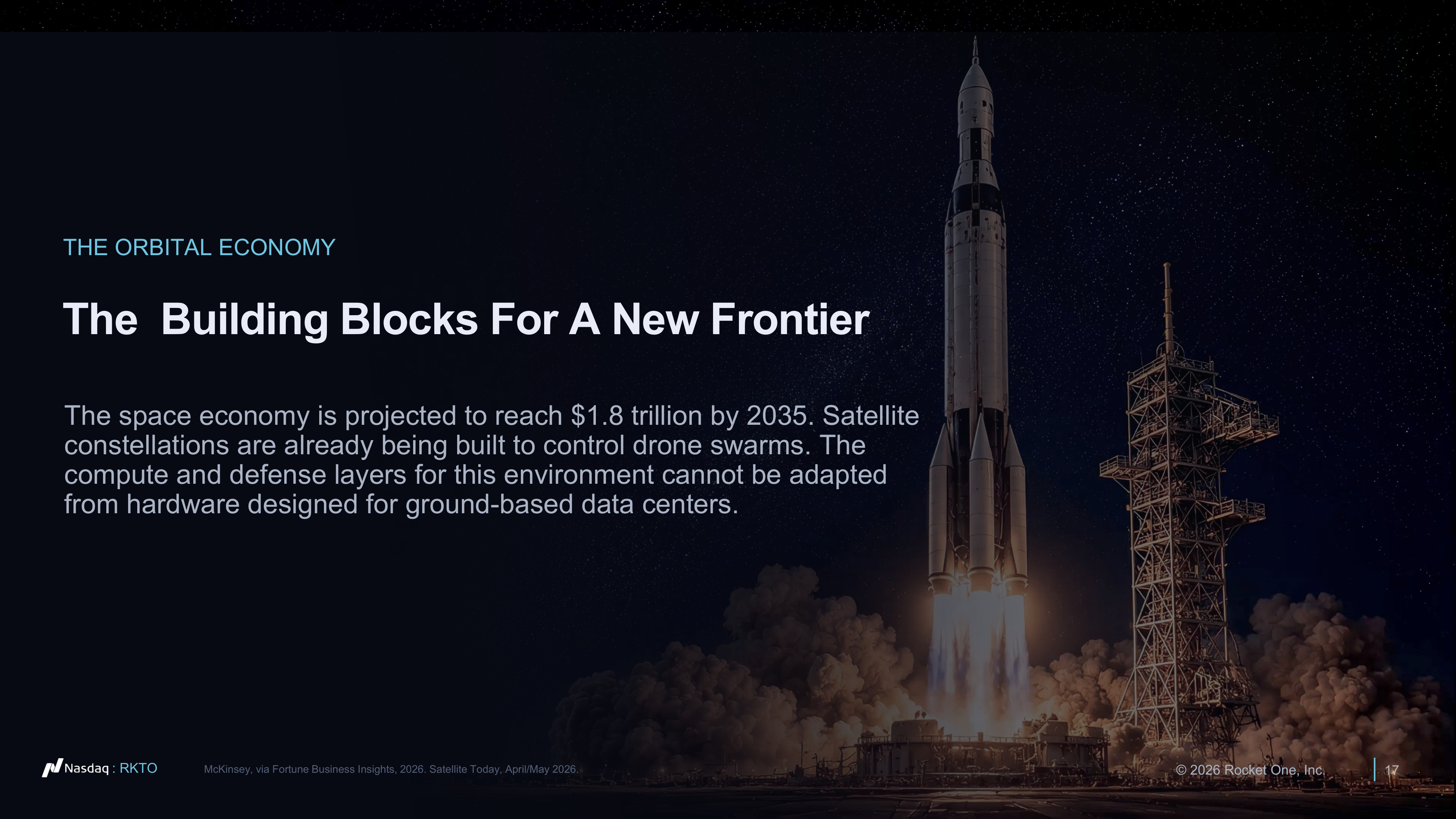
: RKTO © 2026 Rocket One, Inc. 17 THE ORBITAL ECONOMY The Building Blocks For A New Frontier The space economy is projected to reach $1.8 trillion by 2035. Satellite constellations are already being built to control drone swarms. The compute and defense layers for this environment cannot be adapted from hardware designed for ground-based data centers. McKinsey, via Fortune Business Insights, 2026. Satellite Today, April/May 2026. : RKTO © 2026 Rocket One, Inc.
: RKTO © 2026 Rocket One, Inc. 18 Technology Advisory Board Supriyo Bandyopadhyay Supriyo Bandyopadhyay is the Commonwealth Professor of Electrical and Computer Engineering at Virginia Commonwealth University (VCU) where he directs the Quantum Device Laboratory. Prof. Bandyopadhyay has received many awards such as Virginia's Outstanding Scientist from Virginia's Governor Terence R. McAuliffe in 2016; Distinguished Alumnus award from his alma mater the Indian Institute of Technology, Kharagpur, India in 2016; the Distinguished Scholarship Award from VCU in 2012; and the University Award of Excellence in 2017. His department gave him the Lifetime Achievement Award. His earlier employer, University of Nebraska-Lincoln, conferred on him the College of Engineering Research Award (1998), the College of Engineering Service Award (2000) and the Interdisciplinary Research Award (2001) given jointly by the College of Engineering, the College of Science, and the Institute for Agricultural and Natural Resources. In 2018, he received the State Council of Higher Education for Virginia Outstanding Faculty Award which is the highest award for educators in private and public universities in the State of Virginia. In 2020 Dr. Bandyopadhyay received the "Pioneer in Nanotechnology" award from the Institute of Electrical and Electronics Engineers (IEEE). Prof. Bandyopadhyay has authored and co-authored over 400 research publications and presented over 150 invited talks and colloquia across six continents. Prof. Bandyopadhyay is a Fellow of the Institute of Electrical and Electronics Engineers, the American Physical Society, the Electrochemical Society, the Institute of Physics (UK) and the American Association for the Advancement of Science.
: RKTO © 2026 Rocket One, Inc. 19 Technology Advisory Board R. Shane Kimbrough, Colonel, US Army (Retired) NASA Astronaut Malcom Frost, Major General, US Army (Retired) Shane Kimbrough was selected by NASA in 2004. He completed his first spaceflight in 2008 on the Space Shuttle Endeavour STS-126 mission, where he spent almost 16 days on the mission to expand the crew living quarters to accommodate a six- member crew on the International Space Station (ISS). He performed two spacewalks during this mission. On his second spaceflight, Kimbrough launched to the ISS on the Russian Soyuz MS-02 spacecraft from the Baikonur Cosmodrome in Kazakhstan. This mission lasted 173 days as part of Expeditions 49/50, where he was the Commander of the ISS. Kimbrough performed four spacewalks and numerous science and maintenance activities during this mission. He most recently served as commander of the NASA/SpaceX Crew-2 Dragon spacecraft, which launched from the Kennedy Space Center in Florida. With this flight, Kimbrough became the 4th person ever to fly on 3 different spacecraft. Once on the ISS, Kimbrough served as Flight Engineer of Expedition 65/66. He performed three spacewalks during the 199-day mission. Kimbrough now has a total of 388 days in space placing him in the top 10 on the list for total time in space for all US Astronauts. He has a total of 9 spacewalks and over 59 hours outside of the orbiting laboratory, which places him among the top American spacewalkers. Major General Malcolm B. Frost (Ret) has over 38 years of leadership experience in both the U.S. Army and business. In the Army, he served as a career Infantryman, commanding and leading soldiers at every level from Lieutenant to 2- star General. Throughout his military career he provided large-scale strategic and operational leadership and oversight of units across the globe - successfully leading the evolution of soldier training programs in peace and war. Malcolm led the Army's Holistic Health and Fitness revolution from 2017-19 and was responsible for developing the first new physical fitness test for the Army in 40 years. He also led the Army's initial entry training enterprise that annually transformed 130K civilians into soldiers and as the Army's Director of Public Affairs, developed and led all strategic communications plans, roll-outs, and national media relations initiatives for the Army. He deployed to combat several times in a variety of leadership and command positions in Bosnia-Hercegovina, Iraq, and Afghanistan between 1995-2011.
: RKTO © 2026 Rocket One, Inc. 20 Investment Highlights A defensible IP position Physics conventional silicon cannot replicate Three converging tailwinds Built to reach milestones without a factory Two issued US patents, two exclusive VCU licenses, and swarm-coordination IP acquired from SkyStage. The core technology is protected at the patent level before commercialization begins. Spintronic compute and memory operate on electron spin rather than charge. Spin- based state is non-volatile and radiation-tolerant by physics, and capable of analog computation that charge-based architectures cannot perform. AI infrastructure is hitting hard power and cooling limits. Autonomous defense systems are an active procurement priority. The orbital economy is scaling rapidly. Each platform in the portfolio addresses one of these directly. Rocket One advances through sponsored university research, strategic IP acquisition, and partnership-based development. Early-stage proof-of-concept milestones are achievable through university research infrastructure and commercial foundry partnerships.
: RKTO © 2026 Rocket One, Inc. 21 Thank you. For investor questions, stockholder resources, and public-company communications, contact Rocket One Investor Relations. Investor relations Websites rocketone.space swarmstage.ai investorrelations@rocketone.space