
Exhibit 99.85
ANNUAL INFORMATION FORM
FOR THE FINANCIAL YEAR ENDED DECEMBER 31, 2025
June 10, 2026
TABLE OF CONTENTS
| GENERAL MATTERS | 3 |
| CORPORATE STRUCTURE | 8 |
| GENERAL DEVELOPMENT OF THE BUSINESS | 10 |
| DESCRIPTION OF THE BUSINESS | 14 |
| RISK FACTORS | 20 |
| DIVIDENDS AND DISTRIBUTIONS | 37 |
| DESCRIPTION OF CAPITAL STRUCTURE | 37 |
| MARKET FOR SECURITIES | 40 |
| PRIOR SALES | 40 |
| ESCROWED SECURITIES AND SECURITIES SUBJECT TO CONTRACTUAL RESTRICTION ON TRANSFER | 41 |
| DIRECTORS AND OFFICERS | 41 |
| CONFLICTS OF INTEREST | 45 |
| PROMOTERS | 45 |
| LEGAL PROCEEDINGS AND REGULATORY ACTIONS | 45 |
| INTERESTS OF MANAGEMENT AND OTHERS IN MATERIAL TRANSACTIONS | 48 |
| TRANSFER AGENT AND REGISTRAR | 49 |
| MATERIAL CONTRACTS | 49 |
| INTERESTS OF EXPERTS | 49 |
| ADDITIONAL INFORMATION | 50 |
| SCHEDULE “A” – SUMMARY OF Cerro Prieto TECHNICAL REPORT | a-1 |
| SCHEDULE “B” – SUMMARY OF SAN FRANCISCO TECHNICAL REPORT | b-1 |
- 2 -
GENERAL MATTERS
In this annual information form (the “Annual Information Form” or “AIF”), unless the context otherwise requires, the “Company” or “Goldgroup” refers to Goldgroup Mining Inc. and its subsidiaries. Unless otherwise indicated, information in the Annual Information Form is provided as of June 10, 2026.
This Annual Information Form should be read in conjunction with the Company’s consolidated financial statements and management’s discussion and analysis for the year ended December 31, 2025. The financial statements and management’s discussion and analysis are available under the Company’s profile on SEDAR+ at www.sedarplus.ca.
Cautionary Statement on Forward-Looking Statements
This Annual Information Form contains “forward-looking information” (within the meaning of applicable Canadian securities law), particularly in respect of Goldgroup’s plans and expectations around its mineral projects and the completion and merits of the proposed Arrangement (as defined herein), as well as other matters, including but not limited to, statements regarding work programs and business objectives; capital and general expenditures; perceived merit of properties; exploration results; budgets; permitting or other timelines; strategic plans; expectations generally about the Company’s business plans; use of available funds; market price of precious and base metals; treatment under governmental regulatory regimes; mineral resource estimates; or other statements that are not statements of historical fact. Forward-looking statements may also relate to future financial conditions, results of operations, plans, objectives, performance or business developments. Any statements that express or involve discussions with respect to predictions, expectations, beliefs, plans, projections, objectives, assumptions or future events or performance (often, but not always, using words or phrases such as “expects”, “is expected”, “anticipates”, “plans”, “projects”, “estimates”, “assumes”, “intends”, “strategy”, “goals”, “objectives”, “potential” or variations thereof or stating that certain actions, events or results “may”, “could”, “would”, “might” or “will” be taken, occur or be achieved, or the negative of any of these terms and similar expressions) are not statements of historical fact and may be forward-looking statements.
Forward-looking statements are based on certain assumptions and estimates made by management in light of the experience and perception of historical trends, current conditions, expected future developments, and other factors that management believes are appropriate and reasonable in the circumstances, but there can be no assurance that such assumptions and estimates will prove to be correct. These assumptions include, but are not limited to the Company being able to successfully complete the Arrangement, integrate the operations of Gold Resource (as defined herein) into its current business and complete the NYSE American Listing (as defined herein); the Company being able to generate cash flow from operations and obtain necessary financing on acceptable terms; prices for precious and base metals will remain similar to historic prices; exchange rates will remain similar to historic exchange rates; general economic, financial market, regulatory and political conditions in which the Company operates will remain the same; the Company being able to compete with others in the mining industry; the Company being able to manage anticipated and unanticipated costs; the Company having stable operating expenses; the Company being able to maintain internal controls over financial reporting and disclosure and procedures; timely receipt of any required regulatory approvals; the Company being able to obtain qualified staff and equipment in a timely and cost efficient manner; the Company being able to conduct operations in a safe, efficient and effective manner; government regulation of the Company’s activities will remain the same; and the Company being able to successfully build or sustain partnerships and relationships in the mining industry.
Forward-looking statements are subject to a variety of known and unknown risks, uncertainties and other factors that could cause actual events or results to materially differ from those reflected in the forward-looking statements, including, but not limited to:
| · | uncertainties and risks relating to the development of Goldgroup’s projects, including the potential for unexpected costs, problems and delays during construction, development and mine-start up; |
- 3 -
| · | uncertainties inherent in the estimation of mineral resources and precious metal recoveries; |
| · | uncertainties concerning future economical production at the Company’s properties; |
| · | uncertainties around the success of exploration activities; |
| · | uncertainties related to current global economic conditions; |
| · | fluctuations in precious and base metal prices; |
| · | uncertainties related to the availability of future financing; |
| · | potential difficulties and ongoing legal disputes with joint venture partners; |
| · | risks that Goldgroup’s title to its property could be challenged; |
| · | political and country risk; |
| · | risks associated with Goldgroup being subject to government regulation; |
| · | risks associated with having adequate surface rights for operations; |
| · | environmental risks and other hazards; |
| · | Goldgroup’s need to attract and retain qualified personnel; |
| · | risks associated with operating hazards at the Company’s mineral projects that can lead to injuries and death; |
| · | risks related to the integration of businesses and assets acquired by Goldgroup; |
| · | risks related to the Company’s operations in Mexico; |
| · | the Company’s dependence on Mexican legal counsel, consultants and contractors; |
| · | uncertainties related to the competitiveness of the mining industry; |
| · | risk associated with theft; |
| · | risk of water shortages and risks associated with competition for water; |
| · | uninsured risks and inadequate insurance coverage; |
| · | risks associated with current and potential new legal proceedings; |
| · | going concern risks; |
| · | risks associated with community relations; |
| · | outside contractor risks; |
| · | risks related to archaeological sites; |
- 4 -
| · | foreign currency risks; |
| · | risks associated with security and human rights; |
| · | risks related to the need for reclamation activities on Goldgroup’s properties; |
| · | risks related to global economic and political instability, including wars and imposition of tariffs; |
| · | uncertainty around payment of dividends; |
| · | risks related to the speculative nature of an investment in the Company; |
| · | uncertainty around the Company’s ability to raise additional financing; |
| · | risks associated with potential conflicts of interest; |
| · | risks related to changes in tax regulations and their impact on the Company; |
| · | risks related to internal controls; |
| · | uncertainties relating to enforcement of legal rights; |
| · | the Company’s dependence on information technology systems; |
| · | volatility in the global economy; |
| · | negative impacts of global tariffs; |
| · | risks related to the Company’s proposed Arrangement; |
| · | the possibility that the Arrangement Agreement (as defined herein) may be terminated and that the Company may have to pay a termination fee; |
| · | uncertainty around whether all conditions precedent to the Arrangement will be satisfied; |
| · | costs of the Arrangement; |
| · | the possibility that the market price of the Company’s common shares (the “Common Shares”) may decline; |
| · | changes in the market value of the Common Shares and its impact on the Arrangement; and |
| · | the possibility that the Company’s shareholders may exercise dissent rights. |
The foregoing list of risk factors is not exhaustive and there are additional risks and uncertainties that may cause the Company’s actual results, performance or developments to differ materially from those expressed or implied by the forward-looking statements. Readers are cautioned not to be place undue reliance on forward-looking statements and should carefully consider the risks set out under the heading “Risk Factors” and those contained in the Company’s management’s discussion and analysis for the year ended December 31, 2025. The Company undertakes no obligation to revise or update any forward-looking statement except as required by law.
- 5 -
Scientific and Technical Information
The scientific and technical information relating to the Cerro Prieto mine (the “Cerro Prieto Mine”, “Cerro Prieto Project” or “Cerro Prieto”) set forth in this AIF has been derived from or is based on the technical report titled “Cerro Prieto Project, Heap Leach Project Magdalena de Kino, State of Sonora, Mexico” with an effective date of April 4, 2025 and prepared by José Antonio Olmedo MSc, P. Eng. Geo, QP, SME Registered Member, Cristian Garcia, P. Eng., QP, Registered at Engineers and Geoscientists of British Columbia and Rodrigo R Carneiro MSc, QP, SME Registered Member (the “Cerro Prieto Technical Report”).
Attached as Schedule “A” to this Annual Information Form is the summary contained in the Cerro Prieto Technical Report. The Cerro Prieto Technical Report is incorporated by reference into this AIF and should be consulted for details beyond those summarized, compiled or extracted herein. The Cerro Prieto Technical Report was filed on SEDAR+ on November 6, 2025 and is accessible under the Company’s profile at www.sedarplus.ca.
The scientific and technical information relating to the San Francisco mine (the “San Francisco Mine” or “San Francisco Project”) set forth in this AIF has been derived from or is based on the technical report titled “NI 43-101 Technical Report for the San Francisco Project, Sonora, Mexico” with an effective date of April 30, 2026, report date of May 1, 2026 and prepared by William J. Lewis, B.Sc., P.Geo., Richard M. Gowans, P.Eng. and Tudorel Ciuculescu, B.Sc., M.Sc., P.Geo. (the “San Francisco Technical Report”).
Attached as Schedule “B” to this Annual Information Form is the summary contained in the San Francisco Technical Report. The San FranciscoTechnical Report is incorporated by reference into this AIF and should be consulted for details beyond those summarized, compiled or extracted herein. The San Francisco Technical Report was filed on SEDAR+ on May 8, 2026 and is accessible under the Company’s profile at www.sedarplus.ca.
Compliance with NI 43-101
As required by National Instrument 43-101 – Standards of Disclosure for Mineral Projects (“NI 43-101”), Goldgroup has filed the Cerro Prieto Technical Report and San Francisco Technical Report (together, the “Technical Reports”) under the Company’s profile on SEDAR+ detailing the technical information related to its material mineral properties. Unless otherwise indicated, Goldgroup has prepared the technical information in this AIF based on the Technical Reports, which readers are encouraged to read in their entirety. The technical information in this AIF is subject to the assumptions and qualifications contained in the Technical Reports.
Unless otherwise indicated, Craig Gibson, Ph.D., CPG, a “qualified person” within the meaning of NI 43-101, has reviewed and is responsible for the technical information contained in this Annual Information Form that is not derived from the Cerro Prieto Technical Report or the San Francisco Technical Report. Mr. Gibson is “independent” of the Company within the meaning of NI 43-101.
Classification of Mineral Reserves and Mineral Resources
In this Annual Information Form and as required by NI 43-101, the definitions of proven and probable mineral reserves and measured, indicated and inferred mineral resources are those used by Canadian provincial securities regulatory authorities and conform to the definitions utilized by the Canadian Institute of Mining, Metallurgy and Petroleum (“CIM”) in the “CIM Definition Standards on Mineral Resources and Mineral Reserves”.
- 6 -
Cautionary Note to U.S. Investors Concerning Estimates of Mineral Reserves and Mineral Resources
The Mineral Resource and Mineral Reserve estimates contained in this annual information form have been prepared in accordance with the requirements of Canadian securities laws, which differ from the requirements of United States securities laws and uses terms that are not recognized by the United States Securities and Exchange Commission (“SEC”). The terms “Mineral Reserve”, “Proven Mineral Reserve” and “Probable Mineral Reserve” are Canadian mining terms as defined in accordance with the CIM – Definition Standards adopted by CIM Council on May 10, 2014 (the “CIM Definition Standards”), which were incorporated by reference in the Canadian Securities Administrators’ NI 43-101 These definitions differ from the definitions in SEC Industry Guide 7 (“SEC Industry Guide 7”) under United States securities laws. Under SEC Industry Guide 7 standards, a “final” or “bankable” feasibility study is required to report reserves or cash flow analysis to designate reserves and the primary environmental analysis or report must be filed with the appropriate governmental authority.
In addition, the terms “Mineral Resource”, “Measured Mineral Resource”, “Indicated Mineral Resource” and “Inferred Mineral Resource” are defined in and required to be disclosed by NI 43-101; however, these terms are not defined terms under SEC Industry Guide 7 and are normally not permitted to be used in reports and registration statements filed with the SEC. United States investors are cautioned not to assume that any part or all of mineral deposits in these categories will ever be converted into reserves. “Inferred Mineral Resources” have a great amount of uncertainty as to their existence and their economic and legal feasibility.
A significant amount of exploration must be completed to determine whether an Inferred Mineral Resource may be upgraded to a higher category. Under Canadian regulations, estimates of Inferred Mineral Resources may not form the basis of feasibility or pre-feasibility studies, except in rare cases. United States investors are cautioned not to assume that all or any part of an Inferred Mineral Resource exists or is economically or legally mineable. Disclosure of “contained ounces” in a resource is permitted disclosure under Canadian regulations if such disclosure includes the grade or quality and the quantity for each category of Mineral Resource and Mineral Reserve; however, the SEC normally only permits issuers to report mineralization that does not constitute “reserves” by SEC standards as in place tonnage and grade without reference to unit measures.
Accordingly, information contained in this AIF containing descriptions of our mineral deposits may not be comparable to similar information made public by United States companies subject to the reporting and disclosure requirements under the United States federal securities laws and the rules and regulations thereunder.
Currency Presentation and Exchange Rate Information
This AIF contains references to United States dollars and Canadian dollars. All dollar amounts referenced, unless otherwise indicated, are expressed in United States dollars (“$” or “US$”). Certain information in this annual information form is presented in Canadian dollars (“Canadian dollars” or “C$”).
The following table sets forth, for each period indicated, the high and low exchange rates, the average exchange rate, and the exchange rate at the end of the period, based on the rate of exchange of one U.S. dollar in exchange for Canadian dollars published by the Bank of Canada.
| 2025* | 2024* | 2023* | ||||||||||
| High | C$ | 1.4603 | C$ | 1.4416 | C$ | 1.3875 | ||||||
| Low | C$ | 1.3558 | C$ | 1.3316 | C$ | 1.3128 | ||||||
| Average (*) | C$ | 1.3978 | C$ | 1.3698 | C$ | 1.3497 | ||||||
| Closing | C$ | 1.3706 | C$ | 1.4389 | C$ | 1.3226 |
* Calculated as an average of the daily noon rates for each period.
On June 10, 2026, the closing exchange rate for Canadian dollars in terms of the United States dollar, as quoted by the Bank of Canada, was US$1.00 = C$1.3723. The Canadian dollar/U.S. dollar exchange rate has varied significantly over the last several years and investors are cautioned not to assume that the exchange rates presented here are necessarily indicative of future exchange rates. See “Risk Factors – Risks Related to the Company’s Business – Foreign currency risks”.
- 7 -
CORPORATE STRUCTURE
Name, Address and Incorporation
The Company was formed under the name “Acabit Exploration Inc.” pursuant to the Companies Act (Québec) on November 9, 1989. The Company changed its name to “Western Pacific Mining Exploration Inc.” in 1996, to “Sierra Minerals Inc.” in 2002 and to “Goldgroup Mining Inc” in 2010. On July 28, 2011, the Company continued under the Business Corporations Act (Québec) to the Business Corporations Act (British Columbia).
The Common Shares of the Company are listed for trading on the TSX Venture Exchange (the “TSXV”) under the trading symbol “GGA” and on the OTCQX® Best Market under the symbol “GGAZF”. The Company is a reporting issuer in Alberta, British Columbia, Ontario, and Québec. The principal regulator of the Company is the British Columbia Securities Commission.
The head office of the Company is located at 1111 Melville Street, Suite 410, Vancouver, British Columbia, V6E 3V6, and its registered and records office is located at Bentall 5, 550 Burrard Street, Suite 2501, Vancouver, British Columbia, V6C 2B5.
Intercorporate Relationships
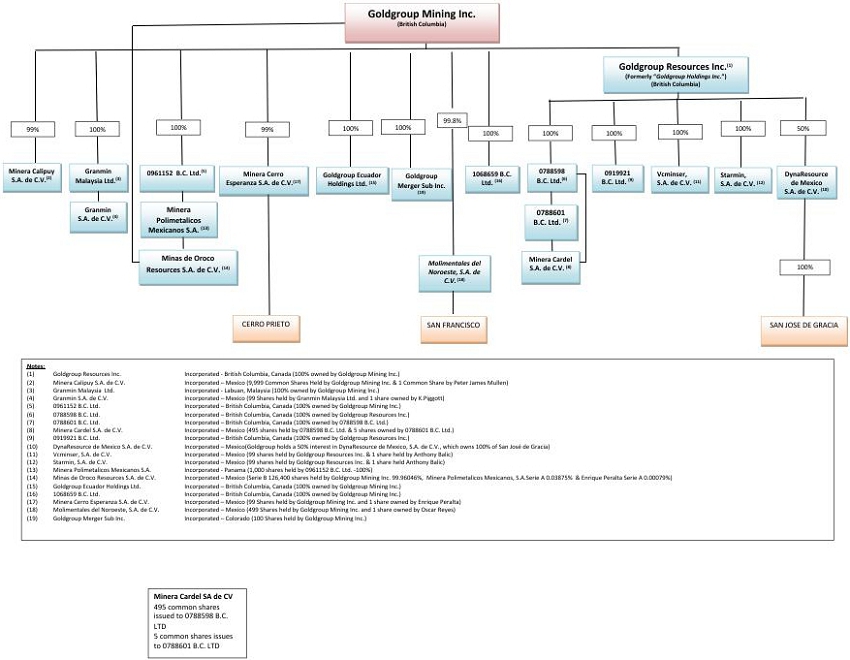
The below chart sets out Goldgroup’s intercorporate relationships among the Company and its subsidiaries, including jurisdictions of incorporation and the percentage of votes attached to all voting securities of the subsidiary beneficially owned, or controlled or directed, directly or indirectly by the Company.
- 8 -
- 9 -
GENERAL DEVELOPMENT OF THE BUSINESS
Overview
Goldgroup focuses on the acquisition, exploration and development of advanced stage precious metals (primarily gold and silver) bearing mineral properties in the Americas. The Company’s current gold and silver exploration, development and production activities are conducted in Mexico, where the Company operates its 100% owned Cerro Prieto Mine in Sonora and is in the process of recommissioning the San Francisco Mine in Sonora.
Three Year History
Financial Year Ended December 31, 2023
| · | In Q4 2021, the Company began operations in the new Puma zone identified at the Cerro Prieto Mine, which is classified as an exploration and evaluation property and all related revenue and production costs are capitalized which accounts for the minimal revenue and cost of sales in the statement of loss and comprehensive loss in fiscal 2022. In the later quarters of 2023, more production has come from the Cerro Prieto pit and therefore more revenue and cost of sales has been recorded than in comparative periods. The Company fully mined out the Puma zone in Q4 2023. |
| · | During the financial year ended December 31, 2023, the Company closed a non-brokered private placement for aggregate gross proceeds of C$570,000. The private placement closed on January 14, 2023, pursuant to which the Company issued 5.7 million Common Shares at a price of C$0.10 per share. |
| · | On July 7, 2023, the Company announced the settlement of a loan obtained from Accendo Banco S.A., Multiple Banking Institution, in 2020 and subsequently acquired by Minera Cerro Esperanza S.A de C.V. (“MER”), a wholly owned subsidiary of Calu Opportunity Fund LP (“Calu”). Calu is a shareholder and investor in the Company. On July 28, 2023, the Company settled the outstanding loan balance, which had a face value of US$2.16 million, through the issuance of 29,052,000 Common Shares at a price of C$0.10 per share. The conversion of the loan was approved by shareholders at the Company’s shareholder meeting held on June 28, 2023. |
| · | On October, 3, 2023, the Company appointed Ralph Shearing as the Company’s CEO effective October 1, 2023 and Anthony Balic, the previous Interim CEO, would continue as the Company’s CFO. |
| · | On October 17, 2023, the Company announced that it had exercised its option to purchase all of the issued and outstanding common shares of MER, which owned the Company’s previously held Cerro Prieto mining concessions at the time. The Company elected to settle the full option price of US$1.85 million through the issuance of 25,067,500 Common Shares to Calu, the owner of MER and material shareholder of the Company. As a result of the transaction, Calu owned, directly or indirectly, 55,297,000 Common Shares, representing approximately 66.83% of the Company’s issued and outstanding share capital. |
Financial Year Ended December 31, 2024
| · | In Q1 2024, the Company began operating from the Cerro Prieto pit and the Esperanza extension, which transitioned from an exploration and evaluation asset to a mineral property. In Q4 2024, the Company shared metallurgical testing results for its Esperanza and Nueva Esperanza zones at Cerro Prieto, which confirmed that higher gold recoveries were achievable through the addition of cost-effective crushing equipment, reduction in the size of crushed rock deposited on the leads pads and an increase in the irrigation fluid’s sodium cyanide concentration. The Company subsequently made progress towards doubling the mine’s production by installing a primary crusher, overhauling the secondary crusher, expanding pumping and irrigation capacity and expanding and improving the gold recovery plant. |
- 10 -
| · | During the financial year ended December 31, 2024, the Company closed two non-brokered private placements for aggregate gross proceeds of C$950,000 and a convertible debt financing in the amount of US$100,000. The private placements closed on September 26, 2024 and November 18, 2024. The Company issued 15.5 million units at a price of C$0.05 and 3,181,818 units at a price of C$0.055, respectively. Each unit consisted of one Common Shares and one Common Share purchase warrant, with each warrant entitling the holder thereof to purchase one Common Share at a price of C$0.10 per share until September 26, 2026 and November 18, 2026, respectively. The warrants include an accelerated expiry provision allowing the Company to accelerate their expiry to 30 days if the closing price of the Common Shares is $0.15 or higher for a period of ten consecutive trading days. |
| · | Effective at market open on February 20, 2024, the Common Shares were listed for trading on the TSXV following its delisting from the Toronto Stock Exchange on February 16, 2024. |
| · | On August 14, 2024, the Company announced that it entered into an agreement to acquire a loan facility (the “Loan Facility”) from a group of creditors, pursuant to which various advances were made to Minera Apolo, S.A. de C.V. (“Apolo”). Apolo was the 100-per-cent owner of a fully permitted gold project located 140 kilometres east of the capital of Zacatecas in the state of Zacatecas, Mexico (the “Pinos Project”). The outstanding amount under the Loan Facility was approximately US$2.7 million and was secured against the assets and shares of Apolo. Upon completion of the acquisition of the Loan Facility, the Company’s goal was to start enforcement actions and settlement discussions with the ultimate goal being the acquisition of Apolo as settlement for the Loan Facility. In consideration for the acquisition of the Loan Facility, the Company proposed to issue 50 million Common Shares, pay cash consideration in the amount of $500,000 and pay US$1.5 million in contingent consideration, which would only become due upon the completion of certain criteria. The Company subsequently acquired Apolo in January 2025. See “General Development of the Business – Three Year History – Financial Year Ended December 31, 2025” below. |
Financial Year Ended December 31, 2025
| · | In Q1 2025, the Company announced that it was conducting a high impact exploration program at Cerro Prieto. The program comprised approximately 6,000 metres of diamond core drilling, an induced polarization geophysical survey and surface trenching. In Q4 2025, the Company successfully installed a second crushing circuit at Cerro Prieto, which doubled crushing capacity to over 4,500 tonnes per day and more than doubled mine production. |
| · | During the financial year ended December 31, 2025, the Company closed five non-brokered private placements for aggregate gross proceeds of C$42.3 million. It also accelerated the expiry of outstanding warrants that were originally issued in 2024, which led to warrant exercises for additional gross proceeds of approximately C$1.9 million as announced in news releases on January 10, 2025 and February 6, 2025. The private placements were comprised of the following: |
| o | On January 21, 2025, the Company issued 35 million units at a price of C$0.10 per unit for aggregate gross proceeds of C$3.5 million. Each unit consisted of one Common Share and one-half of one Common Share purchase warrant, with each full warrant entitling the holder thereof to acquire one Common Share at a price of C$0.15 per Common Share until January 21, 2027. The Company paid finder’s fees in the amount of C$202,560 and issued 2,025,600 finder’s warrants to a finder in connection with the offering with the finder’s warrants having the same terms and conditions as the warrants issued under the offering. |
- 11 -
| o | On March 17, 2025, the Company issued 23,333,334 units at a price of C$0.30 per unit for aggregate gross proceeds of approximately C$7 million as part of a first tranche. Each unit consisted of one Common Share and one-half Common Share warrant, with each full warrant being exercisable to purchase one Common Share at a price of C$0.45 until March 17, 2027. The Company issued 900,000 finder’s units to a finder in connection with the private placement. Each finder’s unit consisted of one Common Share and one-half Common Share purchase warrant, with each full warrant being exercisable to purchase one Common Share at a price of C$0.45 until March 17, 2027. Subsequently on March 28, 2025, the Company closed the second tranche by issuing a further 2,583,330 units for aggregate gross proceeds of C$774,999. |
| o | On May 8, 2025, the Company issued 27,272,727 units at a price of C$0.55 per unit for aggregate gross proceeds of C$15 million. Each unit comprised one Common Share and one-half of a Common Share purchase warrant with each whole warrant entitling the holder thereof to acquire one common share at a price of C$0.75 per Common Share until November 7, 2026. The Company paid cash fees of C$4,514 and issued 631,794 finder’s units to finders in connection with the private placement. Each finder’s unit consisted of one Common Share and one-half Common Share purchase warrant, with each full warrant being exercisable to purchase one Common Share at a price of C$0.75 until November 7, 2026. |
| o | On August 5, 2025, the Company issued 15 million units at a price of C$0.80 per unit for aggregate gross proceeds of C$12 million. Each unit comprised one Common Share and one Common Share purchase warrant with each warrant entitling the holder thereof to acquire one Common Share at a price of C$1.10 per Common Share until August 5, 2027. The Company issued 1,086,187 finder’s units to finders in connection with the private placement. Each finder’s unit consisted of one Common Share and one Common Share purchase warrant, with each warrant being exercisable to purchase one Common Share at a price of C$1.10 until August 5, 2027. |
| o | On September 12, 2025, the Company issued 4,848,485 units of the Company at a price of C$0.825 per unit for aggregate gross proceeds of C$4 million. Each unit comprised one Common Share and one Common Share purchase warrant with each warrant entitling the holder thereof to acquire one Common Share at a price of C$1.05 per Common Share until September 12, 2027. The Company paid cash fees of C$182,505, issued 201,718 finders’ warrants and 78,013 finder’s units to finders in connection with the private placement. Each finder’s unit consisted of one Common Share and one Common Share purchase warrant, with each warrant being exercisable to purchase one Common Share at a price of C$1.05 until September 12, 2027. |
| · | Effective as of July 28, 2025, the Common Shares commenced trading on the OTCQX® Best Market under the symbol “GGAZF”. |
| · | The Company acquired a 100% interest in the Pinos Project located in the highly productive Zacatecas gold and silver mining belt through the previously announced proposed acquisition of Apolo. The Company subsequently disposed of its interest in the Pinos Project during the financial year ended December 31, 2025. See “General Development of the Business – Three Year History – Subsequent to Financial Year Ended December 31, 2025”. |
| · | On December 23, 2025, the Company acquired all of the issued and outstanding Series “A” shares in the fixed capital and all the issued and outstanding Series “B” shares in the variable capital (collectively the “Molimentales Shares”) of Molimentales del Noroeste, S.A. de C.V.’s (“Molimentales”) through a Concurso Mercantil process (restructuring proceeding equivalent to Chapter 11 in the United States). The Company has received approval from the Second District Court for Commercial Bankruptcy Matters (the “Mexican Court”) to the plan of arrangement (the “Molimentales Plan of Arrangement”) the Company filed with the Mexican Court under the Concurso Mercantil process. |
- 12 -
As part of the acquisition, the Company acquired 60.24% of the debts owed to certain major creditors (the “Major Creditors”) as recognized by the Mexican Court for $8,971,000 of which $1,417,000 remains to be paid. Under the terms of the Molimentales Plan of Arrangement, the Company has agreed to pay $2,566,000 in three equal installments in December 2026, 2027 and 2028 to the remaining creditors holding 39.76% of the recognized debt in addition to all outstanding mining concession fees (including penalties and interest), taxes, fees owed to the National Water Commission, supplier debts and certain expenses related to the Concurso proceedings currently estimated at approximately $8,026,000. Some of the payments described above are facilitated through the Company acquiring the Molimentales Shares by paying the owners of the Molimentales Shares MXN$100,000 and capitalizing Molimentales with MXN$99,900,000 for a total of MXN$100,000,000. The Company determined that the acquisition met the definition of an asset acquisition.
Subsequent to Financial Year Ended December 31, 2025
| · | On January 26, 2026, the Company announced that it had entered into an arrangement agreement (the “Arrangement Agreement”) with Gold Resource Corporation (“Gold Resource”) and Goldgroup Merger Sub Inc. (“Goldgroup Merger Sub”), a wholly owned subsidiary of Goldgroup, pursuant to which the Company agreed to acquire all of the issued and outstanding shares of Gold Resource’s common stock (the “Gold Resource Shares”) pursuant to a plan of arrangement (the “Arrangement”) under Part 9, Division of the Business Corporations Act (British Columbia). On May 15, 2026, the parties entered into an amendment to the Arrangement Agreement (the “Amendment”). |
The proposed transaction will occur by way of a reverse triangular merger, in which Goldgroup Merger Sub will merge with and into Gold Resource under Colorado law, with Gold Resource surviving and continuing as a wholly owned subsidiary of Goldgroup (the “Merger”). Upon completion of the Arrangement and Merger, Gold Resource stockholders are expected to own approximately 40% of the combined company on a fully diluted in-the-money basis with Goldgroup’s current shareholders holding the remaining approximately 60% interest.
Pursuant to the Arrangement, immediately prior to the effective time of the Merger (the “Effective Time”), Goldgroup will consolidate all of the issued and outstanding Common Shares (the “Consolidation”) at a ratio to be determined jointly by Goldgroup and Gold Resource, and approved by the TSXV, prior to the closing of Merger (the “Consolidation Ratio”). The Consolidation is being undertaken by Goldgroup prior to the closing of the Merger in order to meet the listing requirements of the NYSE American LLC (the “NYSE American”) and to facilitate the listing of the Common Shares on the NYSE American (the “NYSE American Listing”). The Consolidation is subject to, among other things, approval by Goldgroup shareholders of the adoption of amended and restated articles of Goldgroup at the meeting of Goldgroup shareholders to approve the Arrangement and the approval of the TSXV.
Pursuant to the Arrangement Agreement and subsequent Amendment, each outstanding Gold Resource Share will be transferred to Goldgroup in exchange for 1.4476 Common Shares (which shall automatically be adjusted to a number of Common Shares for each Gold Resource Share equal to the quotient obtained by dividing 1.4476 by the Consolidation Ratio) (the “Exchange Ratio”) at the Effective Time (the “Merger Consideration”). Any shareholder of Gold Resource, who would otherwise be entitled to receive a fraction of a Common Share pursuant to the Merger (after taking into account all the Gold Resource Shares held immediately prior to the Effective Time by such holder) will have its holdings of Common Shares rounded up to the nearest whole share.
For additional information on the proposed Arrangement and Merger, as well as related risks and uncertainties, see “Description of the Business – Proposed Arrangement” and “Risk Factors – Risks Related to the Proposed Arrangement”.
- 13 -
| · | On February 27, 2026, the Company announced that it had completed the sale of Apolo, which owned all of the issued and outstanding shares of Minera Catanava, S.A. de C.V. (“MC”). Apolo and MC collectively held a 100% interest in the Pinos Project. The Company agreed to sell the shares in consideration of the payment to Goldgroup of US$5,000,000 in stages, with US$2,450,000 deposit payable on signing, US$550,000 to be paid on closing and US$2,000,000 to be secured by a promissory note and paid on or before the date that is six months from the date of closing. |
DESCRIPTION OF THE BUSINESS
General
Goldgroup is a Canadian-based precious metals producer focused on the acquisition, exploration and development of advanced stage precious metals (primarily gold and silver) bearing mineral properties in the Americas. Goldgroup’s current gold and silver production, exploration and development related activities are conducted in Mexico. Goldgroup owns a property portfolio that includes a 100% interest in the operating Cerro Prieto Project in Sonora, Mexico, and recently acquired Molimentales, whose primary asset is the San Francisco Project also located in Sonora, Mexico. The Common Shares are listed for trading on the TSXV under the symbol “GGA” and on the OTCQX® Best Market under the symbol “GGAZF”.
Mineral Projects
Cerro Prieto Project
The Cerro Prieto Project is one of the Company’s two material mineral projects. It is an open pit heap leach gold mine located in Sonora, Mexico. Goldgroup, through its 100% owned subsidiary, Minas de Oroco S.A. de C.V., commenced mining operations at Cerro Prieto in 2013. Cerro Prieto is located 52 kilometers from the regional center of Magdalena de Kino (population 40,000) and 150 kilometers northeast of the city of Hermosillo. At the mine gold is produced in doré and then shipped to a refiner in Mexico for final refining prior to being sold. Cerro Prieto is subject to a 2% net smelter royalty payable upon production.
The Cerro Prieto Project is subject of a NI 43-101 technical report titled “Cerro Prieto Project, Heap Leach Project, Magdalena de Kino, State of Sonora, Mexico” with an effective date of April 4, 2025, and prepared by José Antonio Olmedo MSc, P. Eng. Geo, QP, SME Registered Member, Cristian Garcia, P. Eng., QP, Registered at Engineers and Geoscientists of British Columbia, and Rodrigo R Carneiro MSc, QP, SME Registered Member. The Cerro Prieto Technical Report provides an independent assessment of the mineral resources estimates of the Esperanzas Deposit within the Cerro Prieto Project, which includes the La Esperanza and Nueva Esperanza contiguous zones.
Attached as Schedule “A” to this AIF is the summary contained in the Cerro Prieto Technical Report. The entire Cerro Prieto Technical Report is incorporated by reference into this AIF. For readers to fully understand the technical information relating to the Cerro Prieto Project in this AIF, they should read the Cerro Prieto Technical Report in its entirety, including all qualifications, assumptions and exclusions that relate to the information set out in this AIF that qualifies the technical information contained in the Cerro Prieto Technical Report. The Cerro Prieto Technical Report is intended to be read as a whole, and sections should not be read or relied upon out of context. The technical information in this AIF is subject to the assumptions and qualifications contained in the Cerro Prieto Technical Report. A copy of the Cerro Prieto Technical Report is available for review under the Company’s SEDAR+ profile at www.sedarplus.ca.
San Francisco Project
The San Francisco Project is one of the Company’s two material properties. The San Francisco Project is a large-scale, formerly producing open pit gold mine. It encompasses 13 concessions totaling 33,667 hectares plus 13,284 hectares of regional concessions in the north central portion of the state of Sonora, Mexico, approximately 150 kilometers north of the state capital, Hermosillo. The operation is comprised of two previously producing open pits (San Francisco and La Chicharra), together with heap leach processing facilities and associated infrastructure located close to the San Francisco pit.
- 14 -
The San Francisco Project is historically one of the significant gold producers in Sonora and has existing infrastructure and potential for future exploration, development, expansion and production. Securing control of this asset is aligned with Goldgroup’s vision of becoming a leading Mexican-focused mining company with operational expertise and a strong commitment to responsible mining practices. The acquisition of the San Francisco Project remains subject to Goldgroup satisfying certain conditions, including receiving final approval of the TSXV.
The San Francisco Project is subject of a NI 43-101 technical report titled “NI 43-101 Technical Report for the San Francisco Project, Sonora, Mexico” with an effective date of April 30, 2026, report date of May 1, 2026 and prepared by William J. Lewis, B.Sc., P.Geo., Richard M. Gowans, P.Eng. and Tudorel Ciuculescu, B.Sc., M.Sc., P.Geo.
Attached as Schedule “B” to this AIF is the summary contained in the San Francisco Technical Report. The entire San Francisco Technical Report is incorporated by reference into this AIF. For readers to fully understand the technical information relating to the San Francisco Project in this AIF, they should read the San Francisco Technical Report in its entirety, including all qualifications, assumptions and exclusions that relate to the information set out in this AIF that qualifies the technical information contained in the San Francisco Technical Report. The San Francisco Technical Report is intended to be read as a whole, and sections should not be read or relied upon out of context. The technical information in this AIF is subject to the assumptions and qualifications contained in the San Francisco Technical Report. A copy of the San Francisco Technical Report is available for review under the Company’s SEDAR+ profile at www.sedarplus.ca.
Proposed Arrangement
On January 26, 2026, the Company announced that it had entered into the Arrangement Agreement with Gold Resource and Goldgroup Merger Sub, a wholly owned subsidiary of Goldgroup, pursuant to which the Company agreed to acquire all of the issued and outstanding Gold Resource Shares pursuant to a Arrangement under Part 9, Division of the Business Corporations Act (British Columbia) (the “Transaction”).
About Gold Resource
Gold Resource is a gold and silver producer, developer, and explorer with its operations centered on the Don David Gold Mine in Oaxaca, Mexico. Under the direction of the board and senior leadership team, Gold Resource’s focus is to unlock the potential of its existing infrastructure and land position surrounding the mine in Oaxaca, Mexico and to develop the Back Forty Project in Michigan, USA.
Transaction Details
Pursuant to the Arrangement Agreement, each outstanding Gold Resource Share will be transferred to Goldgroup in exchange for 1.4476 Common Shares (which shall automatically be adjusted to a number of Common Shares for each Gold Resource Share equal to the quotient obtained by dividing 1.4476 by the Consolidation Ratio) at the Effective Time. Any shareholder of Gold Resource, who would otherwise be entitled to receive a fraction of one a Common Share pursuant to the Merger (after taking into account all the Gold Resource Shares held immediately prior to the Effective Time by such holder) will have its holdings of Common Shares rounded up to the nearest whole share.
Pursuant to the Arrangement and subsequent Amendment, immediately prior to the Effective Time, Goldgroup will complete the Consolidation at the Consolidation Ratio. The Consolidation is being undertaken by Goldgroup prior to the closing of the Merger in order to meet the listing requirements of the NYSE American and to facilitate the NYSE American Listing. The Consolidation is subject to, among other things, approval by Goldgroup shareholders of the adoption of amended and restated articles of Goldgroup at the meeting of Goldgroup shareholders to approve the Arrangement and the approval of the TSXV.
- 15 -
Based on the closing prices of the Gold Resource Shares and Common Shares on January 23, 2026, the Exchange Ratio represents a value of US$2.25 per Gold Resource Share, reflecting a 39% premium to Gold Resource’s closing price on January 23, 2026. The Transaction values Gold Resource Shares at approximately US$372 million on a fully diluted in-the-money basis and based on the value of Common Shares on January 23, 2026.
The proposed Transaction will occur by way of a reverse triangular merger, in which Goldgroup Merger Sub will merge with and into Gold Resource under Colorado law, with Gold Resource surviving and continuing as the surviving company as a wholly owned subsidiary of Goldgroup. Upon completion of the Arrangement and Merger, Gold Resource stockholders are expected to own approximately 40% of the combined company on a fully diluted in-the-money basis with Goldgroup’s current shareholders holding the remaining approximately 60% interest.
At the Effective Time, all outstanding Gold Resource stock options (“GORO Options”), deferred share units (“GORO DSUs”), and restricted share units (“GORO RSUs”) will be assumed by Goldgroup and converted into equivalent awards for Common Shares, adjusted by the Exchange Ratio (other than GORO Options held by residents of Canada, which will be deemed to be vested to the fullest extent and exchanged for options exercisable for Common Shares (the “Replacement Options”), as adjusted by the Exchange Ratio). Vested GORO DSUs and GORO RSUs subject to delayed settlement may be paid out if terminated at closing. Performance share units (“GORO PSUs” and, together with the GORO Options, GORO DSUs and GORO RSUs, the “GORO Awards”) of Gold Resource will convert into time-vested GORO RSUs based on performance through the Effective Time, as determined by Gold Resource’s board of directors and as adjusted by the Exchange Ratio. All assumed and converted GORO Awards and any Replacement Options will generally be subject to the same terms and conditions as were applicable to the corresponding GORO Award prior to the assumption and conversion or exchange of the award by Goldgroup.
The Transaction was unanimously approved by the boards of directors of Goldgroup and Gold Resource and was negotiated at arm’s length. No finder’s fees or commissions are payable by either party in connection with the Transaction. The Arrangement is subject to customary closing conditions (including approval by the shareholders of each of Goldgroup and Gold Resource, approval of the Supreme Court of British Columbia in respect of the Arrangement and approval of the TSXV. Gold Resource received unconditional approval from the Mexican National Antitrust Commission (Comisión Nacional Antimonopolio) in respect of the Merger on April 27, 2026.
Pursuant to the Arrangement Agreement, Goldgroup, in consultation with Gold Resource, will determine prior to closing the composition of the management team to be implemented following completion of the Merger. Goldgroup and Gold Resource currently anticipate that the executive officers of Gold Resource immediately prior to the Effective Time will become the executive officers of the combined company. However, the composition of the executive officers of the combined company is not a condition to the closing of the Merger, and there can be no assurance that the anticipated management structure will be implemented as currently expected.
Transaction Highlights
The Transaction represents a transformational milestone in Goldgroup’s evolution and is expected to position the combined company as a leading, Mexico-focused junior precious metals producer.
- 16 -
Key anticipated benefits include:
| · | Enhanced and Complementary Asset Portfolio: The combined company’s assets will include Gold Resource’s producing Don David Gold Mine in Oaxaca, Mexico and the advanced-stage Back Forty Project in Michigan, USA, and Goldgroup’s Cerro Prieto Mine and recently acquired San Francisco Mine, a past producer with restart potential, creating a robust portfolio of producing assets with significant exploration and growth potential. Both the Cerro Prieto and San Francisco mines are located in Sonoro State, Mexico. |
| · | Creation of a Multi-Mine Producer: An asset portfolio with multiple mines reduces the reliance on any one mine’s operation and could enhance cash generation of the combined company through increased production. |
| · | Creation of a Mexico-Focused Junior Producer: The combination creates a larger, more diversified mining company with a strong focus on Mexico, one of the leading venues for mineral potential and production, with an extensive history of mining. |
| · | Revitalization of a Silver-Focused Vehicle: Pro forma revenues are expected to be predominantly silver, driven by production at the Don David Gold Mine benefiting from a strong silver price momentum. |
| · | Synergy Potential: Expected operational, general and administrative synergies from combining operations and leveraging shared expertise and infrastructure. |
| · | Strengthened Financial Position: The combined entity is expected to have a stronger balance sheet and increased financial flexibility to fund growth projects and exploration initiatives. |
| · | Increased Market Presence and Shareholder Value: The larger scale and enhanced profile of the combined company are expected to attract a broader institutional investor base and drive long-term value for all shareholders. |
Risks and Uncertainties
The proposed Arrangement is subject to a number of risks and uncertainties, which can have an adverse impact on the Company’s business and results of operations, including those discussed under the heading “Risk Factors” in the Company’s management information circular dated May 29, 2026 (the “Information Circular”). See also “Risk Factors – Risks Related to the Proposed Arrangement” below.
Specialized Skill and Knowledge
Successful exploration, development and operation of the Company’s projects will require access to personnel in a wide variety of disciplines, including geoscientists, engineers, drillers, managers, project managers, accounting, financial and administrative staff, and others. Since the project locations are in jurisdictions familiar with resource extraction, management believes that the Company’s access to the skills and experience needed for success is sufficient.
Cyclicality and Seasonality
The cyclicality of the business reflects the global supply and demand outlook for gold and silver, which in turn is influenced by diverse factors, U.S. currency valuations, derivatives market activity, interest rate and inflation forecasts, and other factors discussed further in the “Risk Factors” section of this Annual Information Form. Seasonality does not have a pronounced impact on the Company’s business, as its properties operate year-round and are not subject to any significant maintenance shut-downs or weather-related seasonality.
- 17 -
Competitive Conditions
The precious metals exploration and mining industry is extremely competitive, and the Company competes with other mining companies for precious metals properties, for joint venture partners and opportunities and for the acquisition of investments in other mining companies.
Environmental Protection
The current and future operations of the Company, including development activities on its properties, are subject to laws and regulations and best practice principles governing exploration, development, waste disposal, greenhouse gas emissions, protection and remediation of environment, reclamation, hazardous substances and other matters. Compliance with such laws and regulations increases the costs of and delays planning, designing, drilling and developing the Company’s properties. The Company plans to diligently attempt to apply technically proven and economically feasible measures to advance protection of the environment throughout the exploration and development process. Current costs associated with compliance are considered normal.
Foreign Operations and Emerging Market Considerations
The Company’s operations are carried out in Mexico, which is considered to be an emerging market, and as such, the Company’s operations may be affected by possible political or economic instability and government regulations relating to the mining industry and foreign investors therein. Mineral exploration and mining activities may be affected in varying degrees by government regulations with respect to restrictions on production, price controls, export controls, income taxes, expropriation of property, maintenance of property, environmental legislation, land use, land claims of local people, water use and property safety. The effect of these factors on the Company cannot be accurately predicted. See also “Risk Factors – Risk Related to the Company’s Business” for more information about the risk and uncertainties concerning the Company’s foreign operations.
Corporate Structure Controls
The risks of the corporate structure of the Company and its subsidiaries are risks that are typical and inherent for issuers who have material assets and property interests held indirectly through foreign subsidiaries and located in foreign jurisdictions. As a result, the Company’s business and operations are exposed to various levels of political, economic and other risks and uncertainties associated with operating in a foreign jurisdiction such as difference in laws, business cultures and practices, banking systems and internal control over financial reporting.
Such risks are mitigated by the use of local experts (legal, accounting, tax and directors), by maintaining local bank accounts with “as needed cash balances” with accredited banking institutions and exercising controls over the use of cash, performing regular reviews of the consolidated books and records at the Company’s head office and frequent personal inspection and visits to the offices and project location of the foreign subsidiaries by the Company’s key management on a regular basis.
Board Oversight
The Company has implemented a system of corporate governance, internal controls over financial matters, and disclosure controls and procedures that apply to the Company and its subsidiaries, which are overseen by the Board and implemented by senior management.
While the exploration operations of each of the Company’s Mexican subsidiaries are managed locally, the Board is responsible for the overall stewardship of the Company and, as such, supervises the management of the business and affairs of the Company and each of its subsidiaries. More specifically, the Board is responsible for reviewing the strategic business plans and corporate objectives, and approving acquisitions, dispositions, investments, capital expenditures, and other transactions and matters that are material to the Company including those of its subsidiaries.
- 18 -
The Board has effective oversight of the Company’s assets, including the Company’s bank accounts. The Company has put in place senior management in Mexico, and members of the Company’s executive management are directors of the subsidiaries.
Executive management of the Company meets with the Board at least on a quarterly basis and generally more frequently on an informal basis to discuss any relevant or key topics in Mexico as they relate to operations, and with respect to potential merger and acquisition transactions and corporate opportunities. Key topics include social and environmental licenses, and government influence at the federal, state, and municipal levels. The Company holds minimal cash in Mexican bank accounts and funds the Mexican operations from Canada on a monthly basis.
Board and Management Experience
Key members of the Company’s management team and Board have extensive experience running foreign business operations, including operations in Mexico and other Latin American countries.
Ralph Shearing, the Chief Executive Officer of the Company, was previously Chief Executive Officer and President of public junior mining and exploration companies, primarily with Luca Mining Corp., which has mineral operations in Mexico.
Anthony Balic, the Chief Financial Officer, Corporate Secretary and Director of the Company, was previously Senior Manager at Deloitte LLP in Vancouver, where he specialized in assurance and advisory for mining companies prior to joining the Company.
Corry J. Silbernagel, a Director of the Company, was previously Chief Financial Officer of Cabo Drilling Corp., which had multiple mineral operations in Latin America.
Roberto Guzmán, a Director of the Company, obtained a Master’s Degree in Finance from the Universidad Tecnológica de Mexico in 1989. Mr. Guzmán has served as a finance manager for various public and private companies in Mexico and has over 26 years of experience in the financial sector, primarily in Mexico.
Certain members of the Company’s senior management team are either fluent in both written and spoken Spanish or have a working understanding of the language.
Internal Control Over Financial Reporting
The Company maintains internal control over financial reporting with respect to its Mexican operations by taking various measures. Differences in banking systems and controls between Mexico and Canada are addressed by having controls over cash in both locations; particularly over access to cash, cash disbursements, appropriate authorization levels, and performing and reviewing bank reconciliations on a monthly and quarterly basis. The CFO of the Company reviews and approves the financial statements of the Company on a monthly basis.
The Company maintains various cash and investment accounts with Mexican and Canadian banks under the direction of the CFO of the Company. Payments to Mexican and Canadian creditors are reviewed and approved by the CFO of the Company, who has the appropriate level of approval authority. All expenditures that are unbudgeted or outside the normal course of business are referred to the Company’s management in Canada for approval and/or payment where appropriate.
The difference in cultures and practices between the two countries is addressed by employing competent staff and consultants in both countries who are familiar with the local laws, business culture and standard practices, have local language proficiency, are experienced in working in the respective jurisdictions and dealing with the local government authorities, and have experience and knowledge of the local banking systems and treasury requirements. The Company documents and assesses the design of internal controls over financial reporting on an annual basis. Furthermore, key controls for the accounts in scope are tested across the Company on an annual basis. This process is undertaken by the CFO of the Company.
- 19 -
The Company has adopted formal policies and procedures for the evaluation of related party transactions, including, but not limited to, ensuring that in camera sessions are held at Board meeting with only independent directors present on an ad hoc basis; and establishing a process for independent vetting by the Audit Committee of any related party arrangements or transactions.
Legal Framework
The Mexican legal framework is based in a civil law system, and therefore the majority of legal principles are set out in written codes and laws. Written codes and laws are the main source for law, leaving case law and customs as a limited and secondary source of interpretation. This, as opposed to common law systems, provides a fairly stable legal environment, allowing citizens and corporations to have a clear understanding of their rights and obligations.
Notwithstanding the foregoing, certain matters may be subject to case law interpretations, which usually relate to a mining title owner’s ability to perform activities under the rights granted under its properties and assets, than to the good standing of its properties and assets. The following matters are the most common issues subject to judicial and administrative interpretation: (i) the presence of ethnic minorities in the territory covering a mining right, and the need for public hearings prior to the commencement of certain mining activities; and (ii) the presence of environmental areas of special interest, or those restricted from mining and the possibility to perform mining activities in overlapping areas. These matters have been widely considered under Mexican constitutional case law, setting a clear understanding of its scope and framework.
Permits and Approvals
The Company has experienced senior management, who have extensively dealt with permitting, licensing, and other regulatory approvals on a consistent basis in Mexico and are in continuous contact with government authorities to ensure all are in place in order to operate under Mexican laws. There are currently no restrictions or conditions imposed by the government on the Company, nor does the Company anticipate and restrictions or conditions to be imposed.
Employees
During the financial year ended December 31, 2025, Goldgroup employed 187 employees.
Social and Environmental Policies
The Company has adopted a Code of Business Conduct and Ethics that states that where possible, the Company will strive to prevent or otherwise minimize, mitigate and remediate any negative impact on the environment as a result of its operations. The Code of Business Conduct and Ethics also provides that the directors, officers and employees of the Company will do their best to accommodate the different cultures, lifestyles, heritage and preferences of the communities in which the Company operates in. The Company has also approved and adopted an Environmental and Safety Policy. Complete copies of the Company’s Code of Business Conduct and Ethics and the Environmental and Safety Policy can be viewed on the Company’s website located at https://goldgroupmining.com/investors/corporate-governance.
RISK FACTORS
Exploration, development and mining of metals involve numerous inherent risks. As such, the Company is subject to various financial, operational and political risks that could have a significant impact on its profitability and levels of operating cash flows. Such risk factors, some of which are discussed herein, could materially affect the value of the Company’s assets and future operating results of the Company.
- 20 -
An investment in the securities of the Company should be considered speculative due, generally, to the nature of the business in which the Company is engaged, the limited extent of the Company’s assets, the Company’s state of development and the degree of its reliance upon the expertise of management. Specifically, in evaluating an investment in any of its securities the following risk factors should be given special consideration:
Goldgroup’s expected operating costs and expenditures, economic returns and other projections from a mining project, which are contained in this AIF and in any technical reports or other studies prepared for or by Goldgroup, are based on assumed or estimated future metals prices, cut-off grades, operating costs, capital costs, and expenditures and other factors that each may prove to be inaccurate. Therefore, such studies and reports may prove to be unreliable.
For example, significant declines in market prices for base and precious metals or extended periods of inflation would have an adverse effect on any economic projections. In addition, any material reduction in estimates of mineralization or increases in capital costs and expenditures, or in Goldgroup’s ability to maintain a projected budget or renew a particular mining permit, could also have a material adverse effect on projected production schedules and economic returns, as well as on Goldgroup’s overall results of operations or financial condition.
There is also a risk that rising costs for labour and material could have an adverse impact on forecasted construction costs and that shortages of labour and material could have a negative impact on any mine development schedule.
Goldgroup’s operating costs are affected by the cost of commodities and goods such as steel, fuel, electrical power and supplies, including tires and reagents. Management of Goldgroup prepares its cost and production guidance and other forecasts based on its review of current and estimated future costs, and management assumes that the materials and supplies required for operations will be available for purchase. An increase in any of these costs, or a lack of availability of commodities and goods, may have an adverse impact on Goldgroup’s financial condition.
Risks Related to the Company’s Business
There are significant uncertainties and risks related to the development of Goldgroup’s projects
Goldgroup is subject to inherent uncertainties and risks related to the development and potential construction of its projects, the principal of which include:
| · | hiring of key personnel for construction and commissioning; |
| · | availability and timely delivery of critical equipment; |
| · | delays associated with contractors; |
| · | budget overruns due to changes in the cost of fuel, power, materials and supplies; |
| · | securing rights of passage for a water pipeline; and |
| · | potential opposition from non-governmental organizations, environmental groups or local groups which may delay or prevent activities. |
It is common in new mining operations to experience such unexpected costs, problems and delays during construction, development and mine start-up. In addition, delays in the commencement of mineral production often occur. Accordingly, there can be no assurance that our activities will result in profitable mining operations.
- 21 -
Calculations of mineral resources are estimates and are subject to uncertainty
The Company’s calculations of mineral resources are estimates and depend upon geological interpretation and statistical inferences drawn from drilling and sampling analysis, which may prove to be inaccurate. Actual recoveries of gold and silver from mineralized material may be lower than those indicated by test work. Any material changes in the quantity of mineralization, grade or stripping ratio, may affect the economic viability of the Company’s properties.
In addition, there can be no assurance that metal recoveries in small-scale laboratory tests will be duplicated in larger scale tests under on-site conditions or during production. Notwithstanding pilot plant tests for metallurgy and other factors, there remains the possibility that the ore may not react in commercial production in the same manner as it did in testing. Mining and metallurgy are inexact sciences and, accordingly, there always remains an element of risk that a mine may not prove to be commercially viable.
Until a deposit is actually mined and processed, the quantity of mineral resources and grades must be considered as estimates only. In addition, the quantity of mineral resources may vary depending on, among other things, metal prices, cut-off grades and operating costs. Any material change in quantity of mineral resources or grade may affect the economic viability of the Company’s mining projects.
There are no assurances of future economical production
There can be no assurances for future gold production at any of Goldgroup’s mineral project, which would be considered economical. The Company has concentrated on bringing improved efficiency into the operations to allow profitability at lower metal prices.
Exploration at the Company’s properties may not be successful
While historically the Cerro Prieto Mine has been economically productive, there can be no assurance that any new mineral resources, if any, can be identified or mined profitably at Cerro Prieto or at the newly acquired San Francisco Project. Ultimately, economic factors beyond the Company’s control may result in its mines being unable to operate at a profit.
General economic conditions may adversely affect our growth and profitability
Recent events in global financial markets have had a profound impact on the global economy. Many industries, including the precious and base metals mining industry, are impacted by these market conditions. Some of the key impacts of the current financial market turmoil include contraction in credit markets resulting in a widening of credit risk, devaluations and high volatility in global equity, commodity, foreign exchange and precious metal markets, and a lack of market liquidity. A continued or worsened slowdown in the financial markets or other economic conditions, including but not limited to, consumer spending, employment rates, business conditions, inflation, fuel and energy costs, consumer debt levels, lack of available credit, the state of the financial markets, interest rates, and tax rates may adversely affect Goldgroup’s growth and profitability.
Goldgroup will require additional capital to finance other acquisitions and current projects. If Goldgroup obtains further debt financing, it will be exposed to the risk of leverage and its operations could become subject to restrictive loan and lease covenants and undertakings. If Goldgroup obtains equity financing, existing shareholders may suffer dilution. There can be no assurance that Goldgroup would be successful in overcoming these risks or any other problems encountered in connection with such financings. The Company anticipates that further financing will be required for its projects to be successful.
Changes in the market price of gold, silver and other metals, which in the past have fluctuated widely, could negatively affect the profitability of the Company’s operations and financial condition
The commercial viability of the Company’s properties is dependent on, among other things, the market price of gold, silver and other base and precious metals. Depending on the price to be received for any minerals produced, the Company may determine that it is impractical to continue commercial production at its properties. A reduction in the market price of gold, silver and other base and precious metals may prevent the Company’s properties from being economically mined or result in the write-off of assets whose value is impaired as a result of low metals prices.
- 22 -
The market price of gold, silver and other base and precious metals is volatile and is impacted by numerous factors beyond the Company’s control, including, among others:
| · | international economic and political conditions; |
| · | expectations of inflation or deflation; |
| · | national currency exchange rates; |
| · | imposition of tariffs; |
| · | interest rates; |
| · | global or regional consumptive patterns; |
| · | speculative activities; |
| · | levels of supply and demand; |
| · | increased production due to new mine developments; |
| · | decreased production due to mine closures; |
| · | improved mining and production methods; |
| · | availability and costs of metal substitutes; |
| · | metal stock levels maintained by producers and others; and |
| · | inventory carrying costs. |
The effect of these factors on the price of precious and base metals cannot be accurately predicted and there can be no assurance that the market price of these metals will remain at current levels or that such prices will improve. A decrease in the market price of gold, silver and other precious metals could affect the Company’s ability to finance the exploration and development of its properties, which would have a material adverse effect on its business, financial condition, results of operations and prospects.
Goldgroup will need to raise additional capital
Goldgroup will need to raise additional capital to fund future property option payments, acquisitions or joint ventures. Additional capital may not be available, at such times or in amounts, as needed. Even if capital is available, it might be on adverse terms. There can be no assurance that unforeseen developments or circumstances will not alter Goldgroup’s requirements for capital. Any additional equity financing will be dilutive to Goldgroup’s shareholders. If access to sufficient capital is not available as and when needed, Goldgroup’s business may be impaired.
There can be no guarantee that Goldgroup’s title to its properties will not be challenged
Although Goldgroup has received or will receive title opinions for any properties in which it has a material interest, there is no guarantee that title to such properties will not be challenged or impugned. Goldgroup’s properties may be subject to prior unregistered agreements or transfers or native land claims and title may be affected by unidentified or unknown defects. Goldgroup has conducted as thorough an investigation as possible on the title of properties that it has acquired or will be acquiring to be certain that there are no other claims or agreements that could affect its title to the properties.
Goldgroup’s operations are subject to political and country risk
Goldgroup conducts, or will conduct, exploration, development and production activity in Mexico. These operations are potentially subject to a number of political, social, economic and other risks. Goldgroup is not able to quantify the impact of political, social, economic or other risks on its future financial position, including:
| · | cancellation or renegotiation of contracts; |
- 23 -
| · | changes in foreign laws or regulations; |
| · | changes in tax laws; |
| · | royalty and tax increases or claims by governmental entities; |
| · | retroactive tax or royalty claims; |
| · | expropriation or nationalization of property; |
| · | inflation of costs that is not compensated by a currency devaluation; |
| · | restrictions on the remittance of dividend and interest payments offshore; |
| · | environmental controls and permitting; |
| · | risks of loss due to civil strife, acts of war, guerrilla activities, insurrection and terrorism; and |
| · | other risks arising out of foreign sovereignty over the areas in which Goldgroup’s operations are conducted. |
Such risks could potentially arise in any country in which Goldgroup operates. Furthermore, in the event of a dispute arising from such activities, Goldgroup may be subject to the exclusive jurisdiction of courts outside Canada or may not be successful in subjecting persons to the jurisdiction of the courts in Canada, which could adversely affect the outcome of a dispute.
Goldgroup is subject to government regulation
Operations, development and exploration on Goldgroup’s properties are affected to varying degrees by political stability and government regulations relating to such matters as environmental protection, health, safety and labour, mining law reform, tax increases, maintenance of claims, tenure, and expropriation of property. There is no assurance that future changes in such regulations, if any, will not adversely affect Goldgroup’s operations. The activities of Goldgroup require licenses and permits from various governmental authorities. While Goldgroup currently has been granted the requisite licenses and permits to enable it to carry on its existing business and operations, there can be no assurance that Goldgroup will be able to obtain all the necessary licenses and permits which may be required to carry out exploration, development and mining operations for its projects.
Goldgroup may not have adequate land and/or surface rights
Goldgroup may require additional surface rights to exploit the resources on its properties. Goldgroup will require access to additional land beyond that currently owned, which will require negotiations with private landowners for the additional ownership and/or surface rights in order for Goldgroup to fully operate. Surface rights may also be regulated and restricted by applicable law. There is no assurance that Goldgroup will be able to obtain the required surface rights or negotiate successfully with private landowners to allow it to develop its properties and establish commercial mining operations on a timely basis.
Environmental risks and other hazards
All phases of a company’s mining operations are typically subject to environmental regulation in the various jurisdictions in which the Company operates. Environmental legislation in many countries is evolving and the trend has been toward stricter standards and enforcement, increased fines and penalties for non-compliance, more stringent environmental assessments of proposed projects and increasing responsibility for companies and their officers, directors and employees.
Compliance with environmental laws and regulations may require significant capital outlays on behalf of the Company and may cause material changes or delays in its intended activities. There can be no assurance that future changes in environmental regulations will not adversely affect Goldgroup’s business, and it is possible that future changes in these laws or regulations could have a significant adverse impact on some portion of Goldgroup’s business, causing Goldgroup to re-evaluate those activities at that time.
Mining involves various other types of risks and hazards, including industrial accidents; metallurgical and other processing problems; unusual or unexpected rock formations; structural cave-ins or slides; flooding; fires; metals losses; and periodic interruptions due to inclement or hazardous weather conditions.
- 24 -
These risks could result in damage to, or destruction of, mineral properties, production facilities or other properties, personal injury, death to contractors or employees, delays in mining, increased production costs, monetary losses and possible legal liability. Goldgroup may be subject to liability for clean-up work. Goldgroup currently carries insurance to protect against certain risks in such amounts as it considers adequate. Risks not insured include environmental pollution and mine flooding. Therefore, Goldgroup may suffer a material adverse impact on its business if it incurs losses related to any significant events that are not covered by its insurance policies.
Goldgroup depends on key management personnel and may not be able to attract and retain qualified personnel
Goldgroup is dependent on a number of key management personnel, including the services of certain key employees. Goldgroup’s ability to manage its operations, exploration and development activities, and hence its success, will depend in large part on the ability to retain current personnel and attract and retain new personnel, including management, technical and unskilled workforce. The loss of the services of one or more key management personnel could have a material adverse effect on Goldgroup’s ability to manage and expand its business.
Goldgroup may experience growth in its number of employees or contractors as a result of its growth strategy. This growth will place substantial demands on Goldgroup and its management. Goldgroup’s ability to recruit and assimilate new personnel will be critical to its performance. Goldgroup will be required to recruit additional personnel and to train, motivate and manage its employees and contractors. The international mining industry is very active and Goldgroup is facing increased competition for personnel in all disciplines and areas of operation, and there can be no assurance that it will be able to retain current personnel and attract and retain new personnel.
Goldgroup faces operating hazards and risks
Mining operations generally involve a high degree of risk, which even a combination of experience, knowledge and careful evaluation may not be able to overcome. Hazards such as unusual or unexpected formations and other conditions can occur. Operations in which the Company has a direct or indirect interest will be subject to all the hazards and risks normally incidental to exploration, development and production of precious and base metals, any of which could result in work stoppages, damage to or destruction of mines and other producing facilities, damage to life and property, environmental damage and possible legal liability for any or all damages. The Company may become subject to liability for pollution, cave-ins or hazards against which it cannot insure or against which it may elect not to insure. Any compensation for such liabilities may have a material, adverse effect on the Company’s financial position.
Goldgroup may experience problems integrating new acquisitions
The Company’s success at completing future acquisitions will depend on a number of factors, including, but not limited to, identifying acquisitions that fit its strategy, negotiating acceptable terms with the seller of the business or property to be acquired and obtaining approval from regulatory authorities in the jurisdictions of the business or property to be acquired. Any positive effect on the Company’s results from its acquisitions, will depend on a variety of factors, including, but not limited to, assimilating the operations of an acquired business or property in a timely and efficient manner, maintaining the Company’s financial and strategic focus while integrating the acquired business or property, implementing uniform standards, controls, procedures and policies at the acquired business, as appropriate, and to the extent that the Company makes an acquisition outside of markets in which it has previously operated, conducting and managing operations in a new operating environment.
- 25 -
The Company operates in Mexico and is subject to risks relating to foreign operations
The Company’s operations are currently conducted through subsidiaries principally in Mexico. As such, its operations are exposed to various levels of political, economic and other risks and uncertainties which could result in work stoppages, blockades of the Company’s mining operations and appropriation of assets. Some of the Company’s operations are located in areas where suspected Mexican drug cartels operate. Criminal activity and violence are well documented in Mexico and have increased over time in certain areas. These risks and uncertainties vary from region to region and include, but are not limited to: terrorism; hostage taking; local drug gang activities; military repression; expropriation and nationalization; extreme fluctuations in currency exchange rates; changes in royalty regimes, including the elimination of tax exemptions; underdeveloped industrial and economic infrastructure; unenforceability of judgements; prohibitions on restrictions for carrying out mining activities due to legal actions by Indigenous communities; high rates of inflation; labour unrest; the risks of war or civil unrest; renegotiation or nullification of existing concessions, licenses, permits and contracts; illegal mining; changes in taxation policies; restrictions on foreign exchange and repatriation; and changing political conditions arising from changes in government and otherwise, currency controls, import and export regulations and governmental regulations that favour or require the awarding of contracts to local contractors or require foreign contractors to employ citizens of, or purchase supplies from, a particular jurisdiction. Criminal activity such as kidnapping and extortion is a possible concern and may lead to a delay or suspension in operations, increased security and operational costs, and result in harm to our employees, contractors, visitors or community members, all of which could materially and adversely affect the Company’s operations, production and financial results. Local opposition to mine development projects could arise in Mexico and such opposition could be violent. If the Company were to experience resistance or unrest in connection with its Mexican operations, it could have a material adverse effect on its operations and profitability. To the extent that the Company acquires mineral properties in jurisdictions other than Mexico, it may be subject to similar and additional risks with respect to its operations in those jurisdictions. Mexico is currently subject to political instability, changes and uncertainties, which may cause changes to existing governmental regulations affecting mineral exploration and mining activities. Any changes in governmental laws, regulations, economic conditions or shifts in political attitudes or stability in Mexico are beyond the control of the Company and may adversely affect the Company’s business.
The Company is dependent on Mexican legal counsel, consultants and contractors
The Company’s mineral properties and its operations are carried out in Mexico. The banking system and controls, legal and regulatory requirements applicable to companies conducting mineral exploration activities, local business culture and practices in Mexico are different from those in Canada. Although some members of management and the Board have previous experience working and conducting business in Mexico, the officers and directors of the Company must rely, to a great extent, on the Company’s Mexican legal counsel and local consultants and contractors retained by the Company in order to keep abreast of material legal, regulatory and governmental developments as they pertain to and affect its business operations, and to assist the Company with its governmental relations. The Company also relies on the advice of local experts and professionals in connection with current and new regulations that develop in respect of banking, financing and tax matters in Mexico. Any developments or changes in such legal, regulatory or governmental requirements or in local business practices in Mexico are beyond the control of the Company and may adversely affect its business.
The mining industry is subject to intense competition
Significant competition exists for the acquisition of properties producing or capable of producing gold or other metals. Goldgroup may be at a competitive disadvantage in acquiring additional mining properties because it must compete with other individuals and companies, many of which have greater financial resources, operational experience and technical capabilities than Goldgroup. Goldgroup may also encounter increasing competition from other mining companies in its efforts to hire experienced mining professionals. Increased competition could adversely affect Goldgroup’s ability to attract necessary capital funding or acquire suitable producing properties or prospects for mineral exploration in the future.
- 26 -
Goldgroup may be subject to theft
The Company is required to store precious metals, including gold bars, in and around its operating mines prior to their transportation to a refinery. The value of precious metals makes them an attractive target for theft. Although the Company uses its best efforts to ensure that valuable assets are safely guarded and stored, there can be no assurance that such assets will not be the target of thefts in the future. Any theft of precious metals in the future could have a material adverse effect on Goldgroup’s business, financial condition and operations.
Goldgroup may be adversely affected by competition for water and by water shortages
Goldgroup’s future operations require water, and its projects are located in regions where water is scarce. While Goldgroup believes it holds or will obtain sufficient water rights to support its future operations, future developments could limit the amount of water available to Goldgroup. New water development projects, or climatic conditions such as extended drought, could adversely affect Goldgroup. There can be no guarantee that Goldgroup will be successful in obtaining sufficient water rights.
There are uninsured risks and inadequate insurance coverage
Goldgroup carries an industry standard level of insurance coverage based on its financial resources but does not carry insurance to protect against certain risks. Risks not insured against in each case include environmental pollution, earthquake damage, mine flooding, or other hazards against which mining exploration corporations cannot insure or against which it may elect not to insure because of high premium costs or other reasons. Failure to have insurance coverage for any one or more of such risks or hazards could have a material adverse effect on the Company’s business, financial condition and results of operations. Due to the age of the mobile equipment and plant equipment insurance coverage has not been purchased.
The mining industry is subject to significant risks that could result in damage to, or destruction of, mineral properties or producing facilities, personal injury or death, environmental damage, delays in mining and monetary losses and possible legal liability. Goldgroup’s policies of insurance may not provide sufficient coverage for losses related to these or other risks. Goldgroup’s insurance does not cover all risks that may result in loss or damage and may not be adequate to reimburse Goldgroup for all losses sustained. The occurrence of losses or damage not covered by insurance could have a material and adverse effect on Goldgroup’s cash flows, results of operation and financial condition.
Goldgroup is subject to current legal proceedings and may become subject to additional future legal proceedings
Goldgroup may become party to litigation or other adversary proceedings, with or without merit, in a number of jurisdictions. The cost of defending such claims may take away from management time and effort and if determined adversely to Goldgroup, may have a material and adverse effect on its cash flows, results of operation and financial condition. See “Legal Proceedings and Regulatory Actions”.
Goldgroup’s ability to continue as a going concern may become an issue
The Company has experienced recurring operating losses. The continuing operations of the Company are dependent upon its ability to arrange additional financing. These matters result in material uncertainties that may cast significant doubt on the Company’s ability to continue as a going concern. These consolidated financial statements do not include any adjustments that would be necessary if the going concern assumption were not appropriate. If the going concern basis was not appropriate for these consolidated financial statements, then adjustments would be necessary in the carrying value of assets and liabilities, the reported revenues and expenses, and the classifications used in the statement of financial position.
Recent global issues, including the political and economic conflicts, including wars and the imposition of tariffs, in other regions have adversely affected workplaces, economies, supply chains, and financial markets globally. It is not possible for the Company to predict the duration or magnitude of the adverse results of these issues and their effects on its business or results of operations this time.
- 27 -
Community relations and a license to operate are critical to Goldgroup’s operations
The Company’s relationship with the communities in which it operates are critical to ensure the future success of its existing operations and the construction and development of its projects. There is an increasing level of public concern worldwide relating to the perceived effect of mining activities on the environment and on communities impacted by such activities.
Certain non-governmental organizations (“NGOs”), some of which oppose globalization and resource development, are often vocal critics of the mining industry and its practices, including the use of cyanide and other hazardous substances in processing activities. Adverse publicity generated by such NGOs or others related to extractive industries generally, or Goldgroup’s operations specifically, could have an adverse effect on the Company’s reputation or financial condition and may impact its relationship with the communities in which it operates.
While Goldgroup is committed to operating in a socially responsible manner, there is no guarantee that its efforts in this respect will mitigate this potential risk. Goldgroup has implemented extensive community relations and security and safety initiatives to anticipate and manage social issues that may arise at its operations.
There are risks related to hiring outside contractors
The Company uses contractors for all mining related activities. Such operations are subject to a number of risks, including reduced control over the aspects of the operations that are the responsibility of the contractor, injury and death to workers, failure of the contractor to perform under its agreement with the Company, inability to replace the contractor if either party terminates the contract, interruption of operations in the event the contractor ceases operations due to insolvency or other unforeseen events, failure of the contractor to comply with applicable legal and regulatory requirements and the failure of the contractor to properly manage its workforce resulting in labour unrest or employment issues.
There are risks related to archaeological sites
Certain of Goldgroup’s projects and properties may be located on or near significant archaeological sites which could require Goldgroup to adjust its operations to minimize the impact on any such archaeological site. Goldgroup could potentially be found liable by applicable regulatory authorities if it were to damage any such archaeological sites.
Goldgroup is subject to foreign currency risks
Goldgroup’s operations in Mexico make it subject to foreign currency fluctuations. Goldgroup’s operating expenses are primarily incurred in Mexican pesos in Mexico and the fluctuation of the Canadian dollar in relation to the Mexican peso will consequently have an impact upon the profitability of Goldgroup and may also affect the value of Goldgroup’s assets and the amount of shareholders’ equity.
Goldgroup is subject to security and human rights issues
Civil disturbances and criminal activities such as trespass, illegal mining, theft and vandalism can cause disruptions at certain Goldgroup’s operations. Affected sites have taken measures to protect their employees, property and production facilities from these risks. Certain sites have engaged armed security personnel and cameras in sensitive areas, such as main entrances. The measures that have been implemented by the Company will not guarantee that such incidents will not continue to occur, and such incidents may halt or delay production, increase operating costs, result in harm to employees or trespassers, decrease operational efficiency, increase community tensions or result in criminal and/or civil liability for the Company or its employees and/or financial damages or penalties.
- 28 -
The manner in which the Company’s personnel respond to civil disturbances and criminal activities can give rise to additional risks where those responses are not conducted in a manner that is consistent with international standards relating to the use of force and respect for human rights. Goldgroup has implemented a number of significant measures and safeguards which are intended to ensure that its personnel understand and uphold these standards.
The implementation of these measures will not guarantee that the personnel will uphold these standards in every instance. The failure to conduct security operations in accordance with these standards can result in harm to employees or community members, increase community tensions, reputational harm to Goldgroup and its partners or result in criminal and/or civil liability for the Company or its employees and/or financial damages or penalties.
Land reclamation and mine closure requirements may be burdensome and costly
Land reclamation and mine closure requirements are generally imposed on mining companies, such as the Company’s, which require the Company, among other things, to minimize the effects of land disturbance. Such requirements may include controlling the discharge of potentially dangerous effluents from a site and restoring a site’s landscape to its pre-exploration form.
The actual costs of reclamation and mine closure are uncertain and planned expenditures may differ from the actual expenditures required. Therefore, the amount that the Company is required to spend could be materially higher than current estimates. Any additional amounts required to be spent on reclamation and mine closure may have a material adverse effect on the Company’s financial performance, financial position and results of operations and may cause the Company to alter the its operations.
Although the Company includes liabilities for estimated reclamation and mine closure costs in its financial statements, it may be necessary to spend more than what is projected to fund required reclamation and mine closure activities.
Risks Related to Ownership of Common Shares
Global financial conditions are volatile
Global financial conditions continue to be characterized as volatile. In recent years, global markets have been adversely impacted by various credit crises and significant fluctuations in fuel and energy costs and metals prices, including as a result of inflation rates, interest rates and significant fluctuations in commodity prices as a result of the ongoing military conflicts in the Middle East, the Russian invasion of Ukraine and the economic sanctions imposed on Russia in connection therewith. Many industries, including the mining industry, have been impacted by these market conditions. Global financial conditions remain subject to sudden and rapid destabilizations in response to international events, as government authorities may have limited resources to respond to future crises. A continued or worsened slowdown in the financial markets or other economic conditions, including but not limited to consumer spending, employment rates, business conditions, inflation, tariffs, supply chain disruptions, sovereign debt crises, fuel and energy costs, economic recession, consumer debt levels, lack of available credit, the state of the financial markets, interest rates and tax rates, may adversely affect the Company’s growth and profitability. Future crises may be precipitated by any number of causes, including natural disasters, geopolitical instability (such as the Russian invasion of Ukraine and the ongoing conflicts in the Middle East), changes to energy prices or sovereign defaults. If increased levels of volatility continue or in the event of a rapid destabilization of global economic conditions, it may result in a material adverse effect on commodity prices, demand for metals, the strength and confidence in the U.S. dollar, availability of credit, investor confidence, and general financial market liquidity, all of which may adversely affect the Company’s business and the market price of the Company’s securities.
- 29 -
The Company has not paid dividends
The Company has not paid dividends in the past and given the nature and stage of its development and does not anticipate paying dividends in the foreseeable future.
An investment in the Company is highly speculative
An investment in the Common Shares carries a high degree of risk and should be considered as a speculative investment. The Company has no history of earnings, limited cash reserves, a limited operating history, has not paid dividends, and is unlikely to pay dividends in the foreseeable future.
The Company may need to raise additional financing
The Company’s ability to secure any required financing to sustain operations will depend in part upon prevailing capital market conditions, commodity prices and business success. There can be no assurance that the Company will be successful in its efforts to secure any additional financing or additional financing on terms satisfactory to management. If additional financing is raised by issuance of additional Common Shares from treasury, control may change and shareholders may suffer dilution. If adequate funds are not available, or are not available on acceptable terms, the Company may be required to scale back its current business plan or cease operating.
General Business Risks
The Company’s directors and officers may be subject to conflicts of interest
Certain of the Company’s directors and officers are, and may continue to be, involved in the mineral exploration industry through their direct and indirect participation in corporations, partnerships or joint ventures which are potential competitors of the Company. Situations may arise in connection with potential acquisitions or opportunities where the other interests of these directors and officers may conflict with the Company’s interests. Directors and officers of the Company with conflicts of interest will be subject to and must follow the procedures set out in applicable corporate and securities legislation, regulations, rules and policies. Notwithstanding this, there may be corporate opportunities which the Company is not able to procure due to a conflict of interest of one or more of the Company’s directors or officers.
Changes in tax regulations may negatively impact the Company
The Company strives to run its business in as tax efficient a manner as possible. It is incorporated in Canada, has material subsidiaries incorporated under the laws of Mexico and holds assets in Mexico, and therefore may be subject to taxation in multiple jurisdictions. The tax systems in certain of the jurisdictions where the Company and its subsidiaries are incorporated and where the Company does business are complicated and subject to change. For this reason, the possibility of future negative effects on the results of the Company due to changes in tax regulations cannot be excluded. Repatriation of any future earnings to Canada from other jurisdictions may be subject to withholding taxes. The Company has no control over withholding tax rates.
Internal controls cannot provide absolute assurance with respect to the reliability of financial reporting and financial statement preparation
Internal controls over financial reporting are procedures designed to provide reasonable assurance that transactions are properly authorized, assets are safeguarded against unauthorized or improper use, and transactions are properly recorded and reported. A control system, no matter how well designed and operated, can provide only reasonable, not absolute, assurance with respect to the reliability of financial reporting and financial statement preparation.
- 30 -
There are uncertainties relating to enforcements of legal rights
The Company has material subsidiaries organized under the laws of Mexico. Given that the majority of its material assets are located outside of Canada, investors may have difficulty in effecting service of process within Canada and collecting from or enforcing against the Company, any judgments issued by the Canadian courts or Canadian securities regulatory authorities and predicated on the civil liability provisions of Canadian securities legislation or other laws of Canada. Similarly, in the event a dispute arises in connection with the Company’s foreign operations, the Company may be subject to the exclusive jurisdiction of foreign courts or may not be successful in subjecting foreign persons to the jurisdiction of courts in Canada.
The Company’s operations depend on information technology (“IT”) systems
Information systems and other technologies, including those related to the Company’s financial and operational management, and its technical and environmental data, are an integral part of the Company’s business activities. These IT systems could be subject to network disruptions caused by a variety of sources, including computer viruses, security breaches and cyberattacks, as well as disruptions resulting from incidents such as cable cuts, damage to physical plants, natural disasters, terrorism, fire, power loss, vandalism and theft. The Company’s operations also depend on the timely maintenance, upgrade and replacement of networks, equipment, IT systems and software, as well as pre-emptive expenses to mitigate the risks of failures. Any of these and other events could result in IT system failures, delays or increase in capital expenses. The failure of IT systems or a component of IT systems could, depending on the nature of any such failure, adversely impact the Company’s reputation and results of operations. Although to date the Company has not experienced any material losses relating to cyber-attacks or other information security breaches, there can be no assurance that the Company will not incur such losses in the future. The Company’s risk and exposure to these matters cannot be fully mitigated because of, among other things, the evolving nature of these threats. As a result, cyber security and the continued development and enhancement of controls, processes and practices designed to protect systems, computers, software, data and networks from attack, damage or unauthorized access remain a priority. As cyber threats continue to evolve, the Company may be required to expend additional resources to continue to modify or enhance protective measures or to investigate and remediate any security vulnerabilities.
Risks Related to General Economic Factors
The global economy is subject to volatility that may negatively impact the Company’s business
Economic uncertainty in many parts of the world has adversely affected businesses and industries in almost every sector in more significant and unpredictable ways than in more stable economic times. Prolonged depressed economic conditions and volatility in the worldwide economy may continue to adversely affect individuals and institutions investing in junior mineral exploration and development companies, which could negatively affect the Company’s business and prospects.
The Company maintains cash and cash equivalents in accounts with major banks, and the Company’s deposits at these institutions, may at times, exceed insured limits. Market conditions can impact the viability of these institutions. In the event of failure of any of the financial institutions where the Company maintains its cash and cash equivalents, there can be no assurance that the Company would be able to access uninsured funds in a timely manner or at all. Any inability to access or delay in accessing these funds could adversely affect the Company’s business and financial position.
The Company’s business and operations may be negatively impacted by global tariffs
On February 1, 2025, the United States’ Trump Administration issued executive orders imposing broad-based tariffs at the rate of 25% on all goods exported from Canada and Mexico into the United States, which were to come into effect on March 4, 2025, and were subsequently amended to allow for an exemption on U.S. tariffs for any products of Canada and Mexico that are CUSMA-compliant. The situation has continued to evolve rapidly since such time, including pursuant to a variety of administrative and judicial proceedings.
- 31 -
Amendments and modifications to tariffs have already been, and may continue to be, implemented on an irregular and ad-hoc basis, which makes the determination of the impact on the Company’s business difficult to predict. More broadly, these tariffs, and any changes to these tariffs or imposition of any new tariffs, taxes or import or export restrictions or prohibitions, could have a material adverse effect on the Canadian and Mexican economies, the Mexican mining industry and the Company’s business and operations. Furthermore, there is a risk that the tariffs imposed by the United States on other countries will trigger a broader global trade war, which could have a material adverse effect on the Canadian, Mexican and global economies, and by extension the Canadian mining industry and the Company.
Risks Related to the Proposed Arrangement
For a summary of the Company’s proposed Arrangement with Gold Resource, see “Description of the Business – Proposed Arrangement”. The following risk factors are not a definitive list of all risk factors associated with the Arrangement. Additional risks and uncertainties, including those currently unknown or considered immaterial by the Company, may also adversely affect the trading price of the Common Shares, the Gold Resource Shares and/or the business of the combined company following completion of the Arrangement. Readers are encouraged to consider the risk factors discussed in the Information Circular. If any of the risk factors materialize, the expectations, and the predictions based on them, may need to be re-evaluated. The risks associated with the Arrangement include:
The number of Common Shares that the Company will issue is based on a fixed Exchange Ratio, which will not be adjusted to reflect changes in the market value of the Common Shares or Gold Resource Shares prior to completion of the Transaction
As consideration for the Merger, each Gold Resource Share will be transferred to Goldgroup in exchange for 1.4476 Common Shares (which shall automatically be adjusted to a number of Common Shares for each Gold Resource Share equal to the quotient obtained by dividing 1.4476 by the Consolidation Ratio) at the Effective Time. Notwithstanding the foregoing, the Exchange Ratio is otherwise fixed and will not adjust upwards to compensate for changes in the price of Common Shares or Gold Resource Shares prior to the Effective Time. Share price changes may result from a variety of factors, including changes in the business, operations, or prospects of us or Gold Resource, market assessments of the likelihood that the transactions will be completed, the timing of the transactions, regulatory considerations, general market and economic conditions, and other factors.
Certain Goldgroup executive officers have interests in the Arrangement that are different from, or in addition to, those of the Company’s shareholders
Shareholders should be aware that certain executive officers may have financial or other interests that differ from or are in addition to those of other shareholders generally. These interests may include the payment of severance or bonuses. The Board was aware of these interests and considered them, among other things, in evaluating and approving the Arrangement Agreement. See “Interests of Management and Others in Material Transactions”.
The Arrangement and Merger are subject to multiple closing conditions, some or all of which may not be satisfied or completed on a timely basis, if at all. Failure to complete the Arrangement and Merger in a timely manner or at all could have adverse effects on the Company
The obligations of the parties to consummate the Arrangement and Merger are subject to a number of conditions, including, among others, approval of the Merger by Gold Resource’s shareholders, approval of the Arrangement by Goldgroup’s shareholders, the absence of any legal prohibition to the completion of the Merger and the Arrangement, and certain regulatory approvals, which make the completion and timing of the completion of the Arrangement and Merger uncertain. Failure to satisfy one or more of these conditions, some of which are beyond the control of the parties, could delay or prevent the Arrangement and Merger from being completed.
- 32 -
If the Arrangement and Merger are not completed, the Company’s ongoing business, financial condition, operating results, and stock price may be materially adversely affected. Without realizing any of the benefits of having completed the Transaction, the Company may be subject to a number of risks, including, but not limited to, the following:
| · | the market price of Common Shares could decline to the extent that the current market price reflects a market assumption that the Arrangement and Merger will be completed; |
| · | the Company may be required to pay a termination fee to Gold Resource under certain circumstances; |
| · | if the Transaction is terminated, there is no assurance that the Company will be able to secure a comparable or more favorable alternative transaction; |
| · | management time and resources devoted to the Transaction, including matters relating to integration planning, may divert attention from other strategic priorities or operational needs; |
| · | the announcement or failure of the Transaction may trigger negative reactions from the financial markets, customers, suppliers, contractors or employees, potentially impacting operations or relationships; and |
| · | the Company will be required to pay incurred costs relating to the Transaction, such as legal, accounting, financial advisory and printing fees, whether or not the Arrangement and Merger are completed. |
In addition, a failure to complete the Arrangement and Merger could result in litigation related to the termination or enforcement of the Arrangement Agreement, which could be costly and disruptive. The materialization of any of these risks could adversely impact the Company’s ongoing business, financial condition, operating results and stock price. Similarly, delays in the completion of the Arrangement and Merger could, among other things, result in additional transaction costs, loss of revenue or other negative effects associated with uncertainty about completion of the Transaction.
The Company may waive one or more of the conditions to the Arrangement and Merger without shareholder approval
The Company may determine to waive, in whole or in part, one or more of the conditions to its obligations to complete the Arrangement and Merger to the extent permitted by applicable laws. The Company will evaluate the materiality of any such waiver and its effect on its shareholders in light of the facts and circumstances at the time. In some cases, if the Board determines that such a waiver is warranted but that such waiver or its effect on its shareholders is not sufficiently material to warrant solicitation of proxies, the Company has the discretion to complete the Arrangement and Merger without seeking additional shareholder approval. Any determination whether to waive any condition to the Arrangement and Merger or as to solicit shareholder approval as a result of a waiver will be made by the Company at the time of such waiver based on the facts and circumstances as they exist at that time.
The Company will incur significant non-recurring costs related to the Transaction
The Company expects to incur significant non-recurring costs in connection with the Arrangement and Merger. Certain non-recurring costs will be incurred regardless of whether the Arrangement and Merger are consummated. These include, but are not limited to, fees paid to legal, financial and accounting advisors, filing fees and printing costs.
- 33 -
The Arrangement and Merger are conditioned upon certain regulatory approvals, which, if delayed, not granted or granted with unacceptable conditions, could prevent, substantially delay or impair completion of the Transaction, result in additional expenditures of money and resources or reduce the anticipated benefits of the Arrangement and Merger
These closing conditions to the Arrangement and Merger include, among others, the receipt of all required regulatory, court, and stock exchange approvals, including the TSXV. The parties received unconditional approval from the Mexican National Antitrust Commission in respect of the Merger on April 27, 2026. The terms and conditions of any regulatory approvals, consents, or clearances that are granted may impose requirements, limitations, or costs or place restrictions on the conduct of the combined company’s business following the completion of the Merger. In addition, Goldgroup and Gold Resource have agreed to use commercially reasonable efforts, subject to certain qualifiers, to obtain required regulatory approvals, consents, and clearances and therefore may be required to comply with certain conditions, terms, obligations, or restrictions imposed by applicable governmental authorities on our respective businesses. There can be no assurance that such conditions, terms, obligations, or restrictions will not have the effect of delaying the completion of the Arrangement and Merger, imposing additional material costs on either party, or materially limiting the revenue, or otherwise adversely affecting the performance of, the combined company following the completion of the Transaction.
The Arrangement Agreement contains provisions that limit the Company’s ability to pursue alternatives to the Transaction and could discourage a potential competing acquiror from making a favorable alternative transaction proposal.
The Arrangement Agreement contains certain provisions that restrict the Company’s ability to initiate, encourage, seek or solicit, knowingly facilitate or, subject to certain exceptions, engage in discussions or negotiations with respect to, or approve or recommend, an acquisition proposal. These provisions could discourage potential third-party acquirers or merger partners from considering or proposing an alternative transaction involving all or a significant portion of the Company, even if they were prepared to pay consideration with a higher per share value than the value proposed to be received or realized in the Merger, or might otherwise result in a potential third-party acquirer proposing to pay a lower price to the Company’s shareholders than they might otherwise have proposed to pay because of the added expense of the termination fee that may become payable in certain circumstances.
The Arrangement Agreement contains termination rights
The Arrangement Agreement includes mutual termination rights for both parties. It also provides that the Company may be required to pay a US$5.0 million termination fee to Gold Resource under certain circumstances, including if the Board changes its recommendation to shareholders to vote in favor of the Arrangement or approves a superior proposal. The existence of this fee may discourage competing proposals and could result in additional financial obligations for the Company if the Arrangement and Merger are not completed.
There is a risk of business disruption and loss of key personnel during the pendency of the Transaction
The announcement and pendency of the Transaction may adversely impact relationships with customers, suppliers, contractors and employees. The Company may experience disruption in operations or the departure of key personnel, which could impair its performance prior to or after the Transaction. Accordingly, no assurance can be given that the Company will be able to retain key employees to the same extent that it has been able to in the past. Under the terms of the Arrangement Agreement, each party is subject to certain restrictions on the conduct of business prior to completing the Transaction, which may adversely affect the ability to pursue certain business opportunities that arise prior to the closing of the Transaction or to execute certain business strategies. Such limitations could adversely affect the Company’s businesses and operations prior to the completion of the Transaction. Each of the risks described herein may be exacerbated by delays or other adverse developments with respect to the completion of the Transaction.
- 34 -
The opinion of the Company’s financial advisor will not reflect changes in circumstances between the signing of the Arrangement Agreement and the completion of the Arrangement and Merger
The Company received an opinion from its financial advisor, Fort Capital Partners, in connection with the signing of the Arrangement Agreement on January 25, 2026. The Company has not obtained any updated opinion from Fort Capital Partners as of the date of this AIF. The opinion was based on information available at the time it was delivered. Changes in the Company’s or Gold Resource’s operations or prospects, as well as market or economic conditions, could materially affect their respective values by the time the Arrangement and Merger are completed. The opinion speaks only as of its date and does not reflect any development after that time, including those that may occur prior to the completion of the Transaction. Because the Company does not currently anticipate asking Fort Capital Partners to update its opinion, the opinion will not address the fairness of the Transaction, from a financial point of view, at the time the Arrangement and Merger are completed.
Potential litigation against the parties in relation to the Arrangement and Merger could result in substantial costs, an injunction preventing the completion of the Arrangement and Merger, and/or a judgment resulting in the payment of damages
Securities class action lawsuits and derivative lawsuits are often brought against public companies that have entered into merger agreements. Even if such a lawsuit is unsuccessful, defending against these claims can result in substantial costs. An adverse judgment could result in monetary damages, which could have a negative impact on our liquidity and financial condition. These lawsuits could prevent or delay the completion of the Arrangement and Merger. The Company may also incur additional costs, including expenses related to the indemnification of our directors and officers. There is no assurance that Goldgroup will prevail in any such litigation.
Existing shareholders will have a significantly reduced ownership and voting interest in Goldgroup after the Arrangement and Merger and will exercise less influence over the policies of Goldgroup following completion of the Transaction than they now have
Upon completion of the Arrangement and Merger, each Gold Resource shareholder and each Goldgroup shareholder will become a shareholder of Goldgroup with a percentage ownership of Goldgroup that is smaller than such holder’s current percentage ownership of Gold Resource or Goldgroup, respectively, immediately prior to the completion of the Transaction. Following completion of the Merger and the Arrangement, Gold Resource’s current shareholders are expected to own approximately 40% of Goldgroup on a fully diluted in-the-money basis and current Goldgroup shareholders are expected to own approximately 60%. The exact equity stake of Gold Resource shareholders and Goldgroup shareholders in Goldgroup immediately following the Arrangement and Merger will depend on the number of Gold Resource Shares and Common Shares issued and outstanding immediately prior to the completion of the Arrangement and Merger. In addition, the Board immediately following the Merger is expected to be comprised of three directors selected by Gold Resource and three directors selected by Goldgroup. Accordingly, Gold Resource shareholders and Goldgroup shareholders will have less influence on the management and policies of Goldgroup than they now have on the management and policies of each respective company, as applicable.
While the parties anticipate that the executive management team of Gold Resource immediately prior to the Effective Time will become the executive officers of the combined company, it is not a condition to the closing of the Arrangement and Merger
Under the Arrangement Agreement, Goldgroup, in consultation with Gold Resource, will determine the composition of the management team to be implemented following completion of the Arrangement prior to the closing of the Merger. However, while Goldgroup and Gold Resource currently anticipate that the executive management team of Gold Resource immediately prior to the Effective Time will become the executive officers of the combined company, there can be no assurance that the anticipated management structure will be implemented as currently expected. The composition of the executive officers of the combined company is not a condition to the closing of the Arrangement and Merger.
- 35 -
The Internal Revenue Service (“IRS”) may not agree with the conclusion that Goldgroup should be treated as a foreign corporation for U.S. federal income tax purposes following the Transaction
Although Goldgroup is incorporated in Canada, the IRS may assert that it should be treated as a U.S. corporation (and, therefore, a U.S. tax resident) for U.S. federal income tax purposes pursuant to Section 7874 of the Code. A corporation is generally considered a tax resident in the jurisdiction of its organization or incorporation for U.S. federal income tax purposes. Because Goldgroup is a Canadian incorporated entity, it would generally be classified as a foreign corporation (and, therefore, a non-U.S. tax resident) under these rules. Section 7874 provides an exception pursuant to which a foreign incorporated entity may, in certain circumstances, be treated as a U.S. corporation for U.S. federal income tax purposes.
Under Section 7874, Goldgroup would be treated as a foreign corporation for U.S. federal income tax purposes if the former shareholders of Gold Resource own (within the meaning of Section 7874) less than 80% (by both vote and value) of Common Shares by reason of holding shares in Gold Resource (the “ownership test”). Gold Resource’s shareholders are expected to own less than 80% (by both vote and value) of Common Shares after the Arrangement and Merger by reason of their ownership of Gold Resource Shares. As a result, under current law, Goldgroup is expected to be treated as a foreign corporation for U.S. federal income tax purposes. However, there can be no assurance that there will not exist in the future a subsequent change in the facts or in law, which might cause Goldgroup to be treated as a domestic corporation for U.S. federal income tax purposes, including with retroactive effect.
Further, there is limited guidance regarding the application of Section 7874 of the Code, including with respect to the provisions regarding the application of the ownership test. Therefore, there can be no assurance that the IRS will agree with the position that the ownership test is satisfied.
Section 7874 of the Code could limit Gold Resource’s and its U.S. affiliates’ ability to utilize certain U.S. tax attributes to offset certain U.S. taxable income, if any, generated by certain specified transactions for a period of time following the transaction
Following the acquisition of a U.S. corporation by a foreign corporation, Section 7874 of the Code may limit the ability of the acquired U.S. corporation and its U.S. affiliates to utilize certain U.S. tax attributes (such as net operating losses) to offset U.S. taxable income resulting from certain transactions. Based on the limited guidance available, Gold Resource currently expects that following the Transaction, this limitation will not apply. However, there can be no assurance that the IRS will agree with this position.
The Merger is expected to result in an ownership change for Gold Resource under Section 382 of the Code, potentially limiting the use of certain of Gold Resource’s tax attributes in future years
Under Section 382 of the Code, if a corporation undergoes an “ownership change,” the corporation’s ability to use its pre-change tax attributes (such as net operating losses) to offset its post-change income and taxes may be limited. In general, an “ownership change” occurs if there is a cumulative change in ownership by “5-percent shareholders” that exceeds 50 percentage points over a rolling three-year period. The Merger is expected to result in an ownership change under Section 382 of the Code for Gold Resource, potentially limiting the use of Gold Resource’s tax attributes in future taxable years for U.S. federal income tax purposes. These limitations may affect the timing of when these tax attributes can be used which, in turn, may impact the timing of when cash is used to pay the taxes of Gold Resource and have a negative impact on Gold Resource’s financial position and results of operations. In addition, Gold Resource’s ability to use its tax attributes will be dependent on its ability to generate taxable income.
The Company’s shareholders may exercise dissent rights
Registered shareholders have the right to exercise dissent rights under applicable law and demand payment equal to the fair value of their Common Shares in cash. If dissent rights are exercised in respect of a significant number of Common Shares, a substantial cash payment may be required to be made to such shareholders, which could have an adverse effect on the Company’s financial condition and cash resources. It is also a condition precedent in favour of Gold Resource that dissent rights shall not have been exercised in respect of 5% or more of the Company’s outstanding Common Shares.
- 36 -
DIVIDENDS AND DISTRIBUTIONS
Although the Company’s board of directors (the “Board” or “Board of Directors”) is permitted to declare dividends on the Common Shares from time to time out of available funds, it is the current policy of the Board to reinvest any profits in the development and advancement of the Company’s business. No dividends have been declared on the Common Shares in the three most recently completed financial years.
DESCRIPTION OF CAPITAL STRUCTURE
Common Shares
The Company is authorized to issue an unlimited number of Common Shares. As at June 10, 2026 the Company had 301,731,568 Common Shares issued and outstanding.
The holders of the Common Shares (the “Shareholders”) are entitled to dividends if, as and when declared by the Board, to one vote per share at meetings of common shareholders and, upon liquidation, to receive such assets as are distributable to the holders of the Common Shares. Shareholders are also entitled to receive notice of, attend and vote at any meeting of the shareholders of the Company. Each Common Share carries one vote per share. Shareholders are entitled to receive on a pro-rata basis such dividends as the Board from time to time may declare, out of funds legally available. In the event of a liquidation, dissolution or winding up of the Company, or other distribution of its assets, Shareholders have the right to receive on a pro-rata basis all of the assets of the Company remaining after payment of all of the Company’s liabilities. No pre-emptive, redemption, sinking fund or conversion rights are attached to the Common Shares, and the Common Shares, when fully paid, will not be liable to further call or assessment. No other class of shares may be created without the approval of the holders of the Common Shares.
Warrants
The Company may issue share purchase warrants (“Warrants”) from time to time entitling the holder thereof to purchase Common Shares. As of the date of this Annual Information Form, the Company has 36,667,196 Warrants outstanding with exercise prices ranging from $0.15 to $1.10 and having expiry dates between November 7, 2026, and September 12, 2027.
Options
The Company may grant incentive stock options (“Options”) from time to time issued in accordance with the Company’s stock option plan (the “Stock Option Plan”). The Company adopted the Stock Option Plan in August 2021, as amended in February 2024. A summary of the material terms of the Stock Option Plan is set out below.
As of the date of this Annual Information Form, the Company has 4,762,500 Options outstanding with an exercise price of $0.04 expiring on October 31, 2028.
Summary of the Stock Option Plan
The Stock Option Plan is a 10% rolling stock option plan under which the maximum issuance of Options cannot exceed 10% of the issued and outstanding Common Shares of the Company from time to time. As a result, should the Company issue additional Common Shares in the future, the number of Common Shares issuable under the Stock Option Plan will increase accordingly. The Stock Option Plan is considered an “evergreen” plan, since the Common Shares covered by Options which have been exercised are available for subsequent grants under the Stock Option Plan and the number of Options available to grant increases as the number of issued and outstanding Common Shares of the Company increases.
Employees, independent contractors, officers, directors (subject to limitations) and consultants of the Company or any of its subsidiaries (each, an “Eligible Participant”) are eligible to participate in the Stock Option Plan, which is intended to continue to achieve a number of objectives through the grant of Options including: attracting, retaining and motivating qualified directors, employees and consultants; and aligning the interests of directors, employees and consultants with those of the shareholders.
- 37 -
The Stock Option Plan provides that:
| 1. | Plan Maximum - The maximum number of Common Shares reserved for issuance by the Company pursuant to the Stock Option Plan, plus any other security-based compensation arrangements (involving an issuance of Common Shares from treasury) shall not exceed 10% of the issued and outstanding Common Shares from time to time (on a non-diluted basis). |
| 2. | Insider participation limit (aggregate) - The number of securities issuable to insiders, at any time, under the Stock Option Plan, plus any other security-based compensation arrangements, cannot exceed 10% of issued and outstanding securities of the Company. |
| 3. | Insider participation limit (one-year) - The number of securities issued to insiders, within any one-year period, under the Stock Option Plan, plus any other security-based compensation arrangements, cannot exceed 10% of issued and outstanding securities of the Company. |
| 4. | Maximum issuable to one person - The number of Common Shares reserved for issuance pursuant to the Stock Option Plan (together with those Common Shares which may be issued pursuant to any other security-based compensation agreement of the Company or options for services granted by the Company) to any one person cannot exceed 5% of the Common Shares outstanding on a non-diluted basis on the date of grant. |
| 5. | Exercise Price - The Stock Option Plan provides that the exercise price is determined by the Company’s compensation committee (the “Compensation Committee”) when the Option is granted and, in any event, may not be less than the closing price of the Common Shares on the stock exchange on which such Common Shares are listed, on the last market trading day prior to the date of the grant of the Option. |
| 6. | Vesting - The Stock Option Plan provides that the Compensation Committee may, at its discretion, provide for Options to vest at one time (including, if they deem necessary, at the time of grant) or from time-to-time periodically or otherwise, in such number of Common Shares or percentage of Common Shares as the Compensation Committee determines. |
| 7. | Term - The maximum term for any Option issued pursuant to the Stock Option Plan will be ten years, provided that in the circumstance where the end of the term of an Option falls within, or within ten business days after the end of, a “black out” or similar period imposed under any insider trading policy or similar policy of the Company (but not, for greater certainty, a restrictive period resulting from the Company or its insiders being the subject of a cease trade order of a securities regulatory authority), the end of the term of such Option shall be the tenth business day after the earlier of the end of such black out period or, provided the blackout period has ended, the scheduled expiry date. |
| 8. | Cessation - The Stock Option Plan provides that, in the event a holder of Options (an “Optionholder”) is terminated for cause, all Options granted to such individual will expire immediately and be of no further force or effect. The treatment of Options upon other termination events is as follows: |
| · | if an Optionholder ceases to be a director, employee or consultant of Goldgroup (or one of Goldgroup’s subsidiaries) by reason of death, the Options then vested will be exercisable for a maximum period of twelve months; and |
- 38 -
| · | if an Optionholder ceases to be a director, employee or consultant of Goldgroup (or one of Goldgroup’s subsidiaries), other than because of termination for cause or termination by reason of death, only those Options vested at the date of such cessation will be exercisable for a maximum period of 60 days. |
| 9. | Assignability - The Stock Option Plan provides that the Options are non-transferable and non-assignable, unless by will or operation of law. |
| 10. | Amendments (Board of Directors) - The Stock Option Plan provides that, subject to the approval of the TSXV, the Board of Directors shall have the power to amend, suspend or terminate the Stock Option Plan or any Option granted thereunder, from time to time without shareholder approval, including changes of a clerical or grammatical nature, changes regarding the persons eligible to participate in the Plan and changes regarding the vesting of the Options provided that (i) such amendment, suspension or termination is in accordance with applicable laws and the rules of the TSXV; and (ii) no such amendment, suspension or termination shall be made that would materially adversely affect the existing rights of the Optionholder. |
| 11. | Amendments (Shareholders) - The Board of Directors shall obtain shareholder approval for amendments: |
| · | to the maximum number Common Shares that may be reserved for issuance upon exercise of Options granted pursuant to the Stock Option Plan; |
| · | that would reduce the exercise price of an outstanding Option held by an insider; |
| · | that would extend the term of any Option granted under the Stock Option Plan beyond the expiry date of the Option if such extension would benefit an insider of the Company; |
| · | that result in cancellation and re-issue of Options; and |
| · | which would permit Options to be granted under the Plan to be transferable or assignable other than for normal estate settlement purposes. |
| 12. | Financial Assistance - The Stock Option Plan does not provide the option for any financial assistance being made available by the Company to the optionholder to facilitate the exercise of any Options granted thereunder. |
| 13. | Cashless Exercise - The Stock Option Plan includes a cashless exercise feature in the event of a Change of Control (as defined in the Stock Option Plan), which allows holders of Options to surrender vested Options that have not been exercised, to the Company, in consideration for a payment in Common Shares or cash (at the option of the holder and subject to the approval of the Board of Directors), equal to the difference between (i) the fair market value of the common chares underlying the surrendered Options and (ii) the aggregate exercise price for the Common Shares pursuant to the surrendered Options. |
| 14. | Withholding - The Stock Option Plan also provides that the Company may withhold from any amount payable to an optionholder, in such manner as in its discretion determines necessary, such amount as it reasonably believes is necessary to enable the Company to comply with the applicable legal requirements relating to the withholding of tax or any other required deductions with respect to Options. |
- 39 -
MARKET FOR SECURITIES
Trading Price and Volume
During the financial year ended December 31, 2025, the Common Shares were listed for trading on the TSXV under the trading symbol “GGA” and on the OTCQX® Best Market under the symbol “GGAZF”. The below chart sets out the high and low trading prices, and volume of Common Shares traded, on the TSXV for the most recently completed financial year.
| Period | High ($) | Low ($) | Volume | |||||||||
| January 2025 | 0.30 | 0.16 | 4,704,667 | |||||||||
| February 2025 | 0.57 | 0.17 | 6,960,427 | |||||||||
| March 2025 | 0.77 | 0.385 | 7,443,516 | |||||||||
| April 2025 | 1.1 | 0.67 | 6,951,441 | |||||||||
| May 2025 | 1.11 | 0.86 | 6,161,930 | |||||||||
| June 2025 | 1.02 | 0.80 | 7,115,498 | |||||||||
| July 2025 | 1.18 | 0.95 | 2,281,616 | |||||||||
| August 2025 | 1.18 | 0.97 | 3,453,198 | |||||||||
| September 2025 | 1.15 | 0.92 | 3,918,267 | |||||||||
| October 2025 | 1.34 | 0.88 | 6,852,348 | |||||||||
| November 2025 | 1.34 | 1.06 | 4,284,108 | |||||||||
| December 2025 | 1.56 | 1.04 | 6,463,760 | |||||||||
PRIOR SALES
The table below sets forth the number, exercise price and date of issuance of outstanding securities of the Company issued during the most recently completed year ended December 31, 2025, other than the Common Shares, which are listed for trading on the TSXV.
| Class | Date of Issuance | Number | Exercise Price | |||||||
| Warrants(1) | Jan 21, 2025 | 17,500,000 | $ | 0.15 | ||||||
| Finder’s Warrants(1) | Jan 21, 2025 | 2,025,600 | $ | 0.15 | ||||||
| Warrants(1) | Mar 17, 2025 | 11,666,667 | $ | 0.45 | ||||||
| Finder’s Warrants(1) | Mar 17, 2025 | 450,000 | $ | 0.45 | ||||||
| Warrants(1) | Mar 28, 2025 | 1,291,665 | $ | 0.45 | ||||||
| Warrants(1) | May 8, 2025 | 13,636,364 | $ | 0.75 | ||||||
| Finder’s Warrants(1) | May 8, 2025 | 315,897 | $ | 0.75 | ||||||
| Warrants(1) | Aug 5, 2025 | 15,000,000 | $ | 1.10 | ||||||
| Finder’s Warrants(1) | Aug 5, 2025 | 1,086,187 | $ | 1.10 | ||||||
| Warrants(1) | Sep 12, 2025 | 4,848,485 | $ | 1.05 | ||||||
| Finder’s Warrants(1) | Sep 12, 2025 | 1,287,905 | $ | 1.05 | ||||||
Note:
| (1) | Issued in connection with closing of private placement of units. See “General Development of the Business – Three Year History - Financial Year Ended December 31, 2025”. |
- 40 -
ESCROWED
SECURITIES AND SECURITIES
SUBJECT TO CONTRACTUAL RESTRICTION ON TRANSFER
To the knowledge of the Company, there are no securities of the Company that are in escrow or subject to contractual restrictions on transfer.
DIRECTORS AND OFFICERS
Name, Occupation and Security Holding
The following table sets forth for each of the directors and officers of the Company, their name, province/state and country of residence; their principal occupations or employment; a brief biographical description; the date on which they became directors of the Company; their independence; their memberships with the applicable committees of the Company.
The four committees of the Company are: (i) the Audit Committee (“AC”), (ii) the Compensation Committee (“CC”), (iii) the Governance & Nominating Committee (“GNC”), and (iv) the Special Committee (“SC”).
| Name
of Director/Officer |
Common
Shares Beneficially Owned, Directly or Indirectly, or Controlled or Directed (1)(2) |
Number
of Convertible Securities Held (1) |
| Ralph Shearing – Chief Executive Officer | ||
|
British Columbia, Canada Officer since Oct 2023
|
Nil | 937,500 Options |
| Mr. Shearing is an experienced and accomplished exploration and mining executive holding a designation of Professional Geologist registered in Alberta (APEGA). Since 1987 he has held senior executive positions of CEO and/or President with public junior mining and exploration companies, primarily with Luca Mining Corp., a company he founded in 1986 and successfully guided through the exploration and initial development phase of the Tahuehueto mine located in northwestern Durango México. Mr. Shearing’s primary occupation for the preceding five years has been with Luca Mining Corp. and with the Company. | ||
| Anthony Balic – Chief Financial Officer, Corporate Secretary and Director | ||
|
British Columbia, Canada Officer since Sep 2016 Director since Dec 2020 Non-Independent Member of the Board
|
Nil | 900,000 Options |
| Mr. Balic is currently the Chief Financial Officer and the Corporate Secretary of the Company. Mr. Balic was previously the Director of Finance of Goldgroup from May 1, 2015 to September 1, 2016 where he managed the entire finance and accounting function of the Company. Mr. Balic is the President of Katuni Capital Corp. which provides accounting services to publicly traded companies. Mr. Balic also held the position of Senior Manager at Deloitte LLP. in Vancouver, where he specialized in assurance and advisory for mining companies prior to joining the Company. His primary occupation for the preceding five years has been with the Company. | ||
- 41 -
| Name of Director/Officer |
Common Shares Beneficially Owned, Directly or Indirectly, or Controlled or Directed (1)(2) |
Number of Convertible Securities Held (1) |
| Corry J. Silbernagel – Director | ||
|
British Columbia, Canada Director since May 2010 Independent Member of the Board Chair & Member of GNC Chair & Member of AC Member of CC Member of SC |
344,091 | 900,000 Options |
| Mr. Silbernagel is Partner of a Vancouver-based private debt and equity fund, which has been his primary occupation for the preceding five years. Formerly he was a Director of Universal Uranium Ltd., and a Director and Senior Officer of Toro Resources Corp. Prior to this, he was CFO of Cabo Drilling Corp., one of Canada’s largest exploration drilling services companies following his role as a management and financial consultant and corporate advisor in strategy, finance, business development and marketing. He holds a Master of Business Administration from INSEAD in France and a Bachelor’s degree in Applied Science in Civil Engineering from the University of British Columbia. | ||
| Blair Jordan – Director | ||
|
British Columbia, Canada Director sinc: Dec 2020 Independent Member of the Board Member of AC Chair and Member of CC Member of GNC Chair and Member of SC |
Nil | 900,000 Options |
| Mr. Jordan is currently the Chief Executive Officer of HighMont Advisors Inc., a boutique corporate finance and strategy advisory firm with specific expertise in the industrial, cleantech, technology, transportation, mining, cannabis and biotech/pharma sectors, which has been his primary occupation for the preceding five years. He was the CEO of 180 Life Sciences Corp. from March 2024 to September 2025, and the CFO of HeyBryan Media Inc. from October 2019 to November 2020. Previously, Mr. Jordan was Vice President, Corporate Development, and later CFO and Interim CEO, of Ascent Industries Corp. (January 2018 to April 2019), and Managing Director, Investment Banking at Echelon Wealth Partners Inc. (February 2012 to December 2017). | ||
| Roberto Guzman – Director | ||
|
British Columbia, Canada Director since Jan 2024 Independent Member of the Board Member of AC Member of CC Member of GNC Member of SC |
Nil | Nil |
Mr. Guzmán obtained a Master’s Degree in Finance from the Universidad Tecnológica de Mexico in 1989 and has more than 26 years of experience in the Financial Sector, primarily in Mexico. Initially working as finance manager for several Mexican publicly traded companies, such as Finamex S.A. de C.V., Bursamex S.A. de C.V and Invermexico S.A. de C.V., as well as other private Mexican financial companies, including Unión de Crédito Metropolitana S.A. de C.V., Soluciones Integral S.A. de C.V., and FOVISSTE. Mr. Guzmán’s primary occupation for the preceding five years has been to act as a director for various companies, including Luca Mining Corp. from 2018 to 2024.
| ||
Notes:
| (1) | The number of Common Shares beneficially owned, controlled or directed, directly or indirectly, by the above directors and officers is based on information furnished by the directors and officers themselves or from the insider reports available at www.sedi.ca. |
| (2) | As of June 10, 2026, the current directors of the Company, four (4) in the aggregate, beneficially owned, controlled or directed, directly or indirectly, an aggregate of 344,091 Common Shares (excluding Options) or approximately 0.11% of the Common Shares issued and outstanding. |
- 42 -
Board Committees
The Board has three standing committees: the Audit Committee, the Governance & Nominating Committee and the Compensation Committee. In addition, the Company created the Special Committee to review and evaluate possible strategic business transactions and other potential strategic alternatives for the Company, including the proposed Arrangement.
The Audit Committee is comprised of Corry J. Silbernagel (Chair), Roberto Guzman and Blair Jordan. All three Audit Committee members are independent within the meaning of National Instrument 52-110 – Audit Committees. The Audit Committee receives and reviews the financial statements of the Company and makes recommendations thereon to the Board prior to their approval by the full Board. The Audit Committee communicates directly with the Company’s external auditors to discuss audit and related matters whenever appropriate. The Audit Committee is governed by the Audit Committee Charter, a full copy of which is available on the Company’s website at https://goldgroupmining.com/investors/corporate-governance.
The Governance & Nominating Committee is comprised of Corry J. Silbernagel (Chair), Roberto Guzman and Blair Jordan. The Governance and Nominating Committee believes good corporate governance is a process used to oversee the management of the business affairs of the Company, in the best interests of the Company. The process and structure define the division of power between and establish mechanisms for achieving accountability by the Board of Directors and senior management. In addition, the Governance & Nominating Committee, in consultation with the Chairman of the Board and the Chief Executive Officer, annually or as required, recruit and identify individuals qualified to become new Board members and recommend to the Board new director nominees for each annual meeting of shareholders. The Governance & Nominating Committee is governed by the Governance & Nominating Committee Charter, a full copy of which is available on the Company’s website at https://goldgroupmining.com/investors/corporate-governance.
The Compensation Committee is comprised of Blair Jordan (Chair), Corry J. Silbernagel and Roberto Guzman. The Compensation Committee assists the Board in fulfilling its responsibility to shareholders, potential shareholders and the investment community by reviewing and providing recommendations to the Board regarding compensation of the Company’s executive officers, employees and directors, succession plans for executive officers, and the Company’s overall compensation and benefits policies, plans and programs. It is responsible for establishing, administering and evaluating the compensation philosophy based on criteria including the Company’s performance for the accomplishment of long-term strategic objectives. The Compensation Committee oversees the Company’s incentive plans, i.e. the Stock Option Plan. The Compensation Committee is governed by the Compensation Committee Charter, a full copy of which is available on the Company’s website at https://goldgroupmining.com/investors/corporate-governance.
The Special Committee is comprised of Blair Jordan (Chair), Corry J. Silbernagel and Roberto Guzman. The Special Committee was formed on April 4, 2025 and is responsible for overseeing the proposed Arrangement and making recommendations relating to the transaction to the Board of Directors.
Cease Trade Orders, Bankruptcies and Penalties or Sanctions
Except as disclosed herein, to the knowledge of the Company, no director or executive officer of the Company:
| (a) | is, as at the date of this Annual Information Form, or was within 10 years before the date of this Annual Information Form, a director, chief executive officer or chief financial officer of any company (including the Company), that: |
| (i) | was subject to an order that was issued while the director or executive officer was acting in the capacity as director, chief executive officer or chief financial officer, or |
- 43 -
| (ii) | was subject to an order that was issued after the director or executive officer ceased to be a director, chief executive officer or chief financial officer and which resulted from an event that occurred while that person was acting in the capacity as director, chief executive officer or chief financial officer. |
| (b) | For the purposes of subsection (a), “order” means: |
| (i) | a cease trade order; |
| (ii) | an order similar to a cease trade order; or |
| (iii) | an order that denied the relevant company access to any exemption under securities legislation, |
that was in effect for more than 30 consecutive days.
Except as disclosed herein, to the knowledge of the Company, no director or executive officer of the Company, or a shareholder holding a sufficient number of securities of the Company to affect materially the control of the Company:
| (a) | is, as at the date of this Annual Information Form, or has been within the 10 years before the date of this Annual Information Form, a director or executive officer of any company (including the Company) that, while that person was acting in that capacity, or within a year of that person ceasing to act in that capacity, became bankrupt, made a proposal under any legislation relating to bankruptcy or insolvency or was subject to or instituted any proceedings, arrangement or compromise with creditors or had a receiver, receiver manager or trustee appointed to hold its assets; has, within the 10 years before the date of this Annual Information Form, become bankrupt, made a proposal under any legislation relating to bankruptcy or insolvency, or become subject to or instituted any proceedings, arrangement or compromise with creditors, or had a receiver, receiver manager or trustee appointed to hold the assets of the director, executive officer or shareholder; or |
| (b) | has, within the 10 years before the date of the Annual Information Form, become bankrupt, made a proposal under any legislation relating to bankruptcy or insolvency, or become subject to or instituted any proceedings, arrangement or compromise with creditors, or had a receiver, receiver manager or trustee appointed to hold the assets of the director, executive officer or shareholder. |
To the Company’s knowledge, no director or executive officer of the Company, or a shareholder holding a sufficient number of securities of the Company to affect materially the control of the Company has been subject to:
| (a) | any penalties or sanctions imposed by a court relating to securities legislation or by a securities regulatory authority or has entered into a settlement agreement with a securities regulatory authority; or |
| (b) | any other penalties or sanctions imposed by a court or regulatory body that would likely be considered important to a reasonable investor in making an investment decision. |
Mr. Blair Jordan was Interim CEO, CFO, and a director of Ascent Industries Corp. (“Ascent”) when, on March 1, 2019, the Supreme Court of British Columbia issued an order granting Ascent’s application for creditor protection under the Companies’ Creditors Arrangement Act (Canada) (“CCAA”). The order also extended protection to Agrima Botanicals Corp., Bloom Holdings Ltd., Bloom Meadows Corp., Pinecone Products Ltd., Agrima Scientific Corp. and West Fork Holdings NV Inc. These proceedings did not include or impact the operations and activities of Ascent’s other subsidiaries, including operations in Oregon, Nevada, and Denmark. The aforementioned companies sought creditor protection to address near term liquidity issues, which were in large part caused by the ongoing suspension of their licenses by Health Canada which were negatively impacting their ability to complete a strategic alternatives process in sufficient time to address its short term liquidity issues. In the circumstances, the board of directors of Ascent determined that a CCAA proceeding was the most prudent and effective way to carry on business and maximize value for Ascent’s stakeholders. While under CCAA protection, Ascent continued its day-to-day operations and, on April 5, 2019, completed the sale of its Canadian assets and certain related liabilities for approximately $41.5m. On April 26, 2019, Mr. Jordan resigned as an officer and director of Ascent.
- 44 -
On April 30, 2021, the Ontario Securities Commission appointed PriceWaterhouseCoopers Inc. (“PwC”) as receiver over all the assets and undertaking of Bridging Finance Inc., to whom Mjardin Group Inc. (“Mjardin”) owed over $160 million. As a result, on April 30, 2021, Mjardin announced a review of strategic alternatives available to the Company due to liquidity issues given the amount of debt on its balance sheet, including a sales and investment solicitation process (“SISP”) relating to its assets. On May 26, 2021, given his background in cannabis and capital markets, Mr. Jordan agreed to act as a director and member of the Special Committee of the directors of Mjardin in connection with a proposed restructuring of Mjardin’s balance sheet, and turnaround of operations. From the date of his appointment as a director, Mjardin worked towards a restructuring of its balance sheet, which included a wide ranging SISP of both its Canadian and US assets, and the development of two turnaround plans. However, notwithstanding the work undertaken towards the restructuring and turnaround, PwC, as receiver, determined to place Mjardin into receivership on March 23, 2022. Mr. Jordan resigned as a director and officer before the Order of the Superior Court of Ontario was issued.
CONFLICTS OF INTEREST
The directors are required by law to act honestly and in good faith with a view to the best interests of the Company and to disclose any interests that they may have in any project or opportunity of the Company. If a conflict of interest arises at a meeting of the Board, any director in a conflict will disclose his interest and abstain from voting on such matter.
To the best of the Company’s knowledge, and other than disclosed herein, there are no known existing or potential conflicts of interest among the Company, its promoters, directors and officers or other members of management of the Company or of any proposed promoter, director, officer or other member of management as a result of their outside business interests, except that certain of the directors and officers serve as directors and officers of other companies, and therefore it is possible that a conflict may arise between their duties to the Company and their duties as a director or officer of such other companies. All related party transactions during each reporting period are detailed in the Company’s Management Discussion & Analysis for the financial year ended December 31, 2025.
PROMOTERS
The Company does not currently have any promoters, nor has it had any promoters during the past two most recently completed financial years.
LEGAL PROCEEDINGS AND REGULATORY ACTIONS
Goldgroup may become party to litigation or other adversary proceedings, with or without merit, in a number of jurisdictions. The cost of defending such claims may take away from management time and effort and if determined adversely to Goldgroup, may have a material and adverse effect on its cash flows, results of operation and financial condition.
DynaResource Legal Dispute
Goldgroup is party to an ongoing legal dispute in respect of a gold exploration project, the San José de Gracia (the “SJG Project”). The SJG Project is located in the northeast portion of Sinaloa State, Mexico, approximately 120 kilometres northeast of the coastal city of Los Mochis, straddling the Chihuahua border. The property consists of 34 mineral concessions covering approximately 69,000 hectares with no outstanding royalty or other applicable interests.
- 45 -
The Company held an interest in DynaResource de Mexico, S.A. de C.V. (“DynaMexico”), which owns 100% of the SJG Project located in the state of Sinaloa, Mexico. The other owner of DynaMexico is DynaMexico’s parent company, DynaResource, Inc. (“DynaUSA”, together with DynaMexico, “DynaResource”), who provides management and accounting services based on 2.5% of the cash expenditures incurred by DynaMexico.
As a result of the Company qualifying to earn its 50% equity interest in DynaMexico on March 14, 2011, the board of directors of DynaMexico was to be expanded to five members with DynaUSA and the Company each appointing two members and mutually agreeing on one additional member.
On January 22, 2013 Goldgroup announced that it had moved to dismiss a lawsuit filed against it and others in Dallas County District Court by DynaResource. DynaResource alleged, among other things, that the Company wrongfully used and disseminated confidential information and data belonging to DynaResource, and materially misrepresented Goldgroup’s ownership interest in the SJG Project. Goldgroup maintained that it properly disclosed its interest in the SJG Project, had not materially misrepresented it, and has not improperly used any DynaResource confidential information. On March 7, 2014 DynaResource dropped its lawsuit against the Company.
On October 28, 2013 the Company announced that it filed a legal action before the appropriate authorities in Mexico concerning activities undertaken by Mr. Koy Wilber Diepholz, shareholder, President and Chairman of the Board of Directors of DynaMexico and Chairman, Chief Executive Officer and Treasurer of DynaUSA. The purpose of the legal action case was to investigate whether illegal acts were committed by Mr. Diepholz, in his role as CEO of DynaMexico, for his own benefit and for the benefit of DynaUSA.
On March 10, 2014 the Company filed for arbitration in Denver, Colorado, against DynaUSA to protect its interests pursuant to the Earn-In/Option Agreement dated September 1, 2006 between DynaResource and Goldgroup (the “DynaResource Agreement”).
On June 29, 2015 a Mazatlán Judge denied DynaMexico the request for an “amparo”, which is, by Mexican law, an appeal to the injunction obtained by Goldgroup against DynaMexico regarding 300 new shares of DynaMexico issued in favor of DynaUSA. The issuance of the DynaMexico shares to DynaUSA diluted Goldgroup’s ownership interest (from 50% to 20%) in DynaMexico with DynaUSA purporting to be an owner of 80% of DynaMexico.
During the year ended December 31, 2015, management concluded that due to the ongoing legal disputes the Company no longer had a significant influence over DynaMexico and therefore discontinued treating the investment as an investment in associate.
During the year ended December 31, 2016 the Company received favorable results from the conclusion of the arbitration between the Company and DynaResource. The results and award (the “Award”) were issued by the American Arbitration Association – International Centre for Dispute Resolution on August 24, 2016. This Award is final, binding and could be enforced in court.
The arbitrator concluded that DynaUSA failed to fulfill its obligations under the DynaResource Agreement. The Award, in summary, clarifies several doubts arising from misleading news releases issued by DynaUSA. The Award confirmed the following:
| · | The DynaResource Agreement between the parties was in full force and effect; |
| · | The expenditures made by DynaUSA without the approval of the joint management committee had to be reimbursed to DynaMexico since Goldgroup did not participate in those decisions; |
| · | A detailed accountability assessment by DynaUSA had to be completed for Goldgroup for the last 5 years when DynaUSA excluded Goldgroup from the management of DynaMexico and delivered to Goldgroup within 20 days of the issuance of the Award; |
- 46 -
| · | The use of the Power of Attorney of Mr. Diepholz did not provide authorization for Mr. Diepholz to circumvent the management committee’s power to approve and oversee expenditures; |
| · | DynaUSA acted in bad faith and breached the terms of the DynaResource Agreement; |
| · | Certain amounts had to be reimbursed to Goldgroup, which included fees paid and payable in the Mexico City case related to the current dispute; |
| · | A fifth director had to be jointly appointed in DynaMexico and the names of prospective candidates exchanged by the parties, no later than 10 calendar days from the date of the Award; and |
| · | The deliberate dilution by DynaUSA of Goldgroup’s equity interest in DynaMexico was illegal. |
The Company complied with all requirements set out in the Award but received no payment or required documentation from DynaUSA or DynaMexico.
On August 24, 2017, a Federal Amparo judge in the state of Veracruz, Mexico, dismissed the Company’s Amparo challenge. Goldgroup’s position in response to the USD $48 million claim remained the same, that Goldgroup was never notified of the purported court case, and does not recognize any of the claims mentioned therein and is of the belief that such claims are entirely without merit. The Company pursued the case to the Mexican Supreme Court level to get the judgement overturned.
Following the arbitration, DynaUSA filed documents in an attempt to convince the court to vacate the Award. In February 2018, the Company received the recommendation of the magistrate judge in Denver, who recommended that the Company’s application to confirm the arbitration award be denied. The Company filed an objection to request the presiding judge to reject the recommendation and confirm the arbitration award.
On May 9, 2019, the Company received a final judgment in the United States District Court for the District of Colorado confirming the Company’s awards from arbitration. The order denied DynaResource’s motion to vacate the Award and rejected the recommendation of the magistrate Judge, who had agreed with DynaResource that the arbitration award should be thrown out.
The court’s order confirmed all of the relief outlined in the Award, including DynaUSA having to pay the Company $404,000 in costs and attorney fees; pay the Company $86,000 in separate fees and expenses; and pay DynaMexico $1,045,000 for various legal and other expenses that DynaUSA improperly caused DynaMexico to incur.
On March 25, 2020, the United States District Court for the District of Colorado denied DynaResource’s motion to alter or amend the final judgement and denied DynaResource’s motion for a stay of judgment pending appeal and to waive or reduce supersedeas bond and ordered DynaResource to post a supersedeas bond in the amount of $1,107,000 to be granted a stay, within 21 days of the order. On April 10, 2020, DynaResource appealed the May 9, 2019 order and final judgement.
On July 24, 2020, the United States District Court for the District of Colorado granted DynaResource a stay on the monetary awards upon posting of a $1,111,000 bond before July 28, 2020, but denied DynaResource’s request to stay the non-monetary awards of the judgement. This bond was posted and therefore the monetary awards were stayed pending the outcome of DynaResource’s appeal of the arbitration award. The appeal was fully briefed, and the Tenth Circuit Court of Appeals in Denver, Colorado, heard argument on the appeal on March 9, 2021.
On April 16, 2021, the Tenth Circuit Court of Appeals (the “Circuit Court”) affirmed the May 9, 2019 order and judgment from United States District Court for the District of Colorado, which confirmed the arbitration award that the Company received on August 14, 2016 pursuant to an arbitration held in Denver, Colorado, commencing in March 2014. The Company received the $1,111,000 appeal bond funds from DynaUSA, which it recorded in other expenses on the statement of loss and comprehensive loss.
- 47 -
The Circuit Court rejected the appeal lodged by Texas-based DynaUSA and DynaMexico to vacate the arbitral award, which had found that DynaUSA had improperly diluted the Company’s interest in the SJG Project, which Goldgroup had earned into pursuant to the DynaResource Agreement.
On December 6, 2019 the 11th Federal Circuit Collegiate Court in México denied Goldgroup’s Amparo regarding the USD $48 million claim and on February 20, 2020 a Mexico City court issued a judgement in favour of DynaMexico. The Company will continue to pursue all legal avenues in Mexico to achieve a favorable resolution to the dispute. On August 28, 2020, DynaMexico sought recognition of the judgment under the Texas Uniform Foreign-Country Money Judgment Recognition Act. This lawsuit was dismissed by the Court for want of jurisdiction on November 30, 2020. DynaMexico filed a motion for new trial on December 30, 2020. The motion for a new trial was overruled by operation of law on February 15, 2021.
On February 23, 2022, Goldgroup filed another motion for contempt against DynaResource, asserting that DynaResource had not fully complied with the Court’s September 3, 2021 order or with the non-monetary relief mandated by the Court’s May 9, 2019 final judgment. That motion was fully briefed as of March 18, 2022, and is awaiting the Court’s ruling.
On December 4, 2020, DynaMexico filed another claim seeking recognition of the judgment under the Texas Uniform Foreign-County Money Judgment Recognition Act. The Company has filed a Special Appearance, Motion to Dismiss for Improper Venue, and Motion for Non-Recognition in response. A hearing was held on the Special Appearance and Motion to Dismiss for Improper Venue on February 8, 2021 and on May 12, 2021, the 134th Judicial District Court, as a District Court of the State of Texas, ruled it is not required to recognize DynaMexico’s foreign judgment from the country of Mexico. DynaUSA has appealed this decision and the appeal was fully briefed and oral arguments were held on April 20, 2022. On May 2, 2023, the court of appeals dismissed DynaUSA’s appeal.
On March 6, 2023, the Company announced that its subsidiary, Goldgroup Resources Inc. (“Goldgroup Resources”), filed a Request for Arbitration on February 17, 2023 with the International Centre for Settlement of Investment Disputes against the United Mexican States. The treatment and inaction by the Mexican courts have resulted in a judicial expropriation of Goldgroup Resources’ investment in DynaMexico and a denial of justice in breach of Mexico’s obligations under NAFTA. On February 7, 2024, Goldgroup Resources filed its Memorial on the Merits related to the NAFTA claim and received Mexico’s Counter Memorial on the Merits and Memorial on Jurisdiction on June 19, 2024. On December 12, 2024, the Company and Goldgroup Resources filed their Reply on the Merits and Counter Memorial on Jurisdiction and received Mexico’s Rejoinder on the Merits and Reply on Jurisdiction on April 28, 2025. On June 11, 2025, Goldgroup Resources filed its Rejoinder on Jurisdiction. On August 15, 2025, Goldgroup Resources and Mexico filed their respective Comments on the Non-Disputing Party Submissions filed by Canada and the United States of America pursuant to NAFTA Article 1128. On September 23, 2025, Goldgroup Resources’ damages experts filed a Supplemental Report on Quantum, and Goldgroup Resources received the Supplemental Report on Quantum of Mexico’s damages experts on November 18, 2025. Goldgroup Resources is seeking monetary damages as a result of Mexico’s breaches of NAFTA, as well as declarations from the arbitral tribunal to counter any potentially detrimental consequences stemming from the continued existence of the $48 million judgment issued by the Mexican courts in favour of DynaMexico.
INTERESTS OF MANAGEMENT AND OTHERS IN MATERIAL TRANSACTIONS
Other than as described below, in the three most recently completed financial years and the current financial year, no director, officer, insider or associate or affiliate of any director, officer or insider of the Company had or is expected to have any material interest, direct or indirect in any transactions with the Company that materially affected or would materially affect the Company.
- 48 -
Certain members of the Company’s management and Board of Directors have an interest in the completion of the Arrangement as they are entitled to receive certain payments following closing in accordance with the terms of their executive consulting agreements. Mr. Ralph Shearing, the Company’s CEO, will be entitled to receive an amount equal to his annual fee, which amounts to C$159,000, if he is terminated, other than for just cause, within the first 12 months of his executive consulting agreement following a change of control. If Mr. Shearing is terminated after the first twelve months of the executive consulting agreement, other than for just cause, following a change of control, Mr. Shearing will be entitled to receive an amount equal to 1.5 times his annual fee, which amounts to C$238,500. At the sole option of the Company, 60% of the payment can be made through the issuance of Common Shares, or upon written request by Mr. Shearing and as approved by the Company, any amount in excess of 60% can also be paid through the issuance of Common Shares. In addition, any Options held by Mr. Shearing will immediately vest in the case of a change of control. Mr. Anthony Balic, a member of the Board and the Company’s CFO and Corporate Secretary, will be entitled receive a one-time bonus of C$75,000 upon the closing of the Arrangement.
TRANSFER AGENT AND REGISTRAR
The Company’s transfer agent and registrar is Computershare Investor Services Inc. in Vancouver, British Columbia.
MATERIAL CONTRACTS
The Company is not a party to any material contracts entered into within the most recently completed financial year, or before the most recently completed financial year, but that are still in effect, other than those contracts entered into in the ordinary course of business.
Subsequent to December 31, 2025, the Company entered into the Arrangement Agreement with Gold Resource and Goldgroup Merger Sub, as amended by the Amendment, each of which is available under the Company’s profile on SEDAR+ at www.sedarplus.ca. See “Description of the Business – Proposed Arrangement”.
INTERESTS OF EXPERTS
The following persons or companies whose profession or business gives authority to a statement made by the person or company are named in this Annual Information Form as having prepared or certified a part of that document or a report of valuation described in this Annual Information Form:
| 1. | The Company’s annual financial statements for the year ended December 31, 2025 have been audited by Davidson & Company LLP, who are independent in accordance with the rules of professional conduct of the Institute of Chartered Accountants of British Columbia. Davidson & Company LLP were appointed auditors of the Company on November 7, 2014; |
| 2. | The Cerro Prieto Technical Report was authored by José Antonio Olmedo MSc, P. Eng. Geo, QP, SME Registered Member, Cristian Garcia, P. Eng., QP, Registered at Engineers and Geoscientists of British Columbia and Rodrigo R Carneiro MSc, QP, SME Registered Member; |
| 3. | The San Francisco Technical Report was authored by William J. Lewis, B.Sc., P.Geo., Richard M. Gowans, P.Eng. and Tudorel Ciuculescu, B.Sc., M.Sc., P.Geo.; and |
| 4. | Mr. Craig Gibson, Ph.D., CPG, is responsible for certain information of a scientific or technical nature relating to the Company’s properties in this Annual Information Form that is not derived from the Cerro Prieto Technical Report or the San Francisco Technical Report. |
Based on information provided by the relevant persons named above, none of such persons or companies, or their associates or affiliates, have received or will receive direct or indirect interests in the property of the Company or have any beneficial ownership, direct or indirect, in the securities of the Company.
- 49 -
ADDITIONAL INFORMATION
Financial information about the Company is contained in its comparative financial statements and Management’s Discussion & Analysis for the financial years ended December 31, 2025 and 2024, and additional information relating to the Company is available on SEDAR+, under the Company’s profile, at www.sedarplus.ca.
Additional information, including particulars of directors’ and officers’ remuneration and indebtedness, principal holders of the Company’s securities and securities authorized for issuance under equity compensation plans, where applicable, is contained in the information circular prepared in respect of the Company’s most recent annual general meeting.
- 50 -
SCHEDULE “A” – SUMMARY OF Cerro Prieto TECHNICAL REPORT
Information of a scientific or technical nature in respect of the Cerro Prieto Project in this Schedule “A” is derived from portions of the Cerro Prieto Technical Report. For the purposes of this Schedule “A”, capitalized terms not otherwise defined herein have the meanings given to those terms in the Cerro Prieto Technical Report.
For readers to fully understand the technical information relating to the Cerro Prieto Project in this Annual Information Form, they should read the Cerro Prieto Technical Report (available on SEDAR+ at www.sedarplus.ca under the Company’s profile) in its entirety, including all qualifications, assumptions and exclusions that relate to the technical information set out in this Annual Information Form. The Cerro Prieto Technical Report is intended to be read as a whole, and sections should not be read or relied upon out of context. The technical information in the Cerro Prieto Technical Report is subject to the assumptions and qualifications contained in the report.
1.0 SUMMARY
Minas Oroco Resources S.A de C.V., (Oroco) a wholly subsidiary of Goldgroup Mining Inc. (Goldgroup or the Company) and holds the Cerro Prieto Project located 50 kilometers southeast of the town of Magdalena de Kino, State of Sonora, in northwestern Mexico.
Goldgroup Mining Inc., requested that José Antonio Olmedo MSc, P. Eng. Geo, QP, SME Registered Member, Cristian Garcia, P. Eng., QP, Registered at Engineers and Geoscientists of British Columbia and Rodrigo R Carneiro MSc, QP, SME Registered Member independent consultants to prepare a technical report with results in accordance with NI 43-101 from updated mineral resources based on new and historical drilling data, updated metallurgical results and costs based on the current operation.
1.1 Location, Access and Climate
Rodrigo R Carneiro MSc, QP, SME Registered Member independent consultants is responsible for the preparation of this section. The Cerro Prieto Project is located in Cucurpe, Municipality of Sonora State in northwestern Mexico, approximately 240 km northwest of the capital city of Hermosillo and approximately 160 km south of Tucson, Arizona.
The Cerro Prieto mining property is located 50 kilometers southeast of the town of Magdalena de Kino, state of Sonora, in northwestern Mexico. The project is contained within six concessions. The San Francisco concession of 10 hectares hosts the workings of the old Cerro Prieto Mine. Access to the property is along a paved two-lane highway southeast from Magdalena de Kino for 40 kilometers, and then by a secondary gravel road, which often follows local arroyos (dry riverbeds), for an additional 12 kilometers north from the highway.
The region is part of the northwest portion of the Sierra Madre Occidental, and within this the Sierras y Valles Parallelos which were produced by regional normal block faulting. The host rocks are a series of interbedded siltstones and sandstones (arenites), overlain by basalt flows and rhyolite/dacite pyroclastics, cut by andesite dykes, all Tertiary age. Sediments dip moderately (30o to 45o) to the northwest.
The mineralized zone is contained in a major north trending, near vertical shear zone up to 65 meters wide which cuts all units from Jurassic to Lower Tertiary in age. Within this shear zone are a series of major veins near the edges of the zone, secondary veins, stringers zones, breccia zones and silicification which, with the veins, forms a mineralized system from 15 to 65 meters thick.
The area is typically arid to semi-arid, with daytime temperatures ranging from extremes of 50°C in the summer to 20°C in the winter, although nights can reach as low as –5°C. Rainfall is in the form of thunderstorms during the late summer months, with some short periods of a gentler cold rain in the winter. Thunderstorms may produce flash floods in the arroyos and creeks and may cause washouts of the local roads and trails. The Company, in conjunction with the ranch owner, has a program of regular maintenance of the roads.
| A-1 |
Topography in the area is rugged, and consists of a series of block faulted, low angle dipping sedimentary layers capped by relatively impermeable volcanic flows and pyroclastics. This produces a series of sharp ridges that rise abruptly to a height of 200 to 300 meters above local canyon floors and arroyos. The maximum local elevation is approximately mean 1200 meters above sea level (masl).
Electrical power is present in Magdalena de Kino, and in fact a power line runs down the paved road and along the off-road access to within five kilometers of the Project. It continues through the village of Cucurpe, which lies approximately five kilometers southeast of the access road from the highway.
The town of Magdalena de Kino and the surrounding region has a population of approximately 40,000 people. There is a large labor force, and several people were in fact trained for the exploration programs. Land surveyors are available in Hermosillo, and mining personnel and equipment, as well as exploration equipment and supplies, can be found in the Hermosillo-Magdalena de Kino region. The village of Cucurpe lies approximately 17.5 km by road to the southeast and could supply a small labor force.
1.2 Terms of Reference and Purpose of this Technical Report
This Technical Report is an independent estimation of Mineral Resources updated on 4 April 2025 and prepared by Cristian Garcia, P. Eng., QP, Registered at Engineers and Geoscientists of British Columbia and Rodrigo R Carneiro MSc, QP, Registered Member of SME Member on the Esperanzas Deposit included inside the Cerro Prieto Mine, located in the State of Sonora, Municipality of Cucurpe, Mexico, approximately 150 km Northeast of Hermosillo.
The Cerro Prieto Project is an open-pit mining development in progress owned and operated by Minas de Oroco Resources, S.A. de C.V. (Oroco), a wholly owned subsidiary of Goldgroup Mining, Inc., a Canadian mining company listed on the TSX Venture Exchange under the symbol GGA and on OTC under the symbol GGAZF.
This Technical Report provides independent assessment of the Mineral Resources Estimates of the Esperanzas Deposit, which includes the La Esperanza and Nueva Esperanza contiguous areas shown in Figure 1 below.
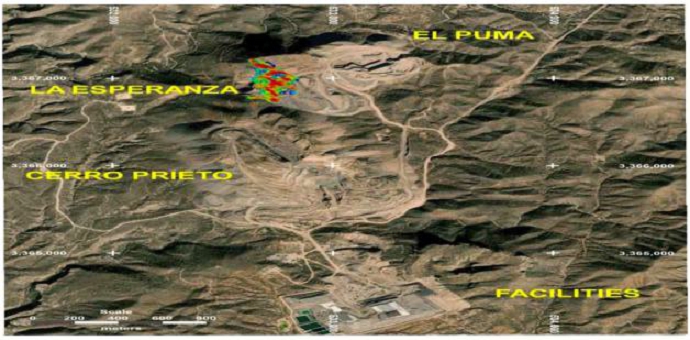
Figure 1 - Aerial Photograph Showing Estimated Block Model Mineral Resources of the Esperanzas Deposit.
| A-2 |
The quality of information, conclusions, and estimates contained herein are consistent with the level of effort involved in the QPs services, based on (i) information available at the time of preparation, (ii) data supplied by outside sources, and (iii) the assumptions, conditions, and qualifications outlined in this Technical Report.
Mineral Resources are reported in accordance with the Canadian Institute of Mining, Metallurgy and Petroleum (CIM) Definition Standards for Mineral Resources and Mineral Reserves (May 19, 2014) and the CIM Estimation of Mineral Resources and Mineral Reserves Best Practice Guidelines (November 29, 2019). Unless otherwise stated, the metric system has been used throughout the Technical Report.
The mineral resource estimate reported herein is a reasonable representation of the Mineral Resources as found in the Esperanzas Deposit at the current level of drilling and sampling.
1.3 Land Status
Rodrigo R Carneiro MSc, QP, SME Registered Member independent consultants is responsible for the preparation of this section. Oroco owns 100% of the 6,980 hectares of mining concessions and has been in production since 2013. Oroco has produced over 120,000 ounces of gold over 11 years up to March 31, 2024. Current annual production is approximately 11,500 ounces of gold.
1.4 Geology and Mineralization
José Antonio Olmedo MSc, P. Eng. Geo, QP, Registered Member of SME is responsible for the preparation of this section.
1.4.1 Regional and Local Geology
| · | The Magdalena de Kino–Cucurpe region transitions from a Jurassic shallow magmatic arc to a Cretaceous marine embayment. |
| · | The area includes sedimentary and volcanic sequences from the Jurassic to Cretaceous periods, which have been weakly metamorphosed by tectonic and volcanic activity. |
| · | The Cerro Prieto Project is situated atop Tertiary marine and volcanic rocks, including conglomerates, arenites, and volcanic flows (andesite, basalt, rhyolite). |
| · | The local geology includes the Baucarit Formation, intrusive tonalites from the Cretaceous age, and andesitic to rhyolitic volcanic rocks that exhibit hydrothermal alteration. |
1.4.2 Mineralization at Esperanzas Deposit
Mineralization at Esperanzas Deposit is restricted to geological structures displaying approximately 345° Az in the primary structure and 313° Az in the secondary structure. The main structure extends about 700 meters in length and has a semi-vertical dip, while the dip of the secondary structure ranges from 65° SW in its northern section to approximately 50° SW in its southern portion.
In addition to these two prominent veins, the shear zone includes subsidiary zones of mineralization, such as disseminations, veins, and stringers, allowing for a wide range of low-grade mineralization. As a result, Oroco implemented an open-pit mining method to extract maximum-scale gold values.
Oroco’s drilling campaign at Esperanzas Deposit confirmed that the mineralization comprises quartz veins, chalcedonic quartz veinlets, micro veinlets, amorphous silica, black calcite, manganese lenses, and argillic alteration.
Geological model interpretation encompasses fault zones, imbricated thrusts, and extensional wedges. No significant thrust faults have been observed in the ongoing open-pit operation.
| A-3 |
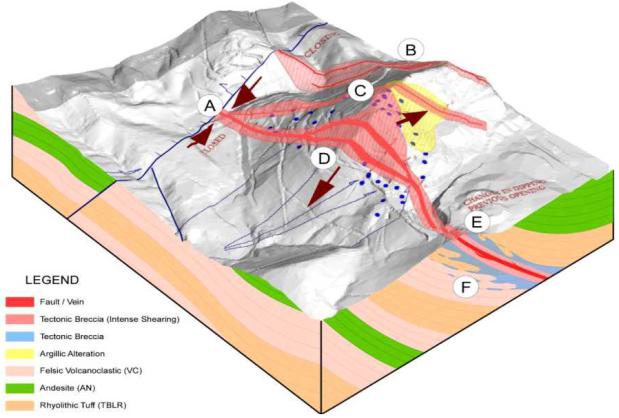
Figure 2 - Geological Interpretation of the Esperanzas Deposit. A) Fault Core Compression; B) Puma Imbricated Thrust – Ramp; C) Nueva Esperanza Imbricated Thrust-Fault; D) Esperanza Tensile Opening in Trans-Tensional Wedge (Soft Boundary); E) Fault Core Compression and Riedels; F) Splay Fracturing along Compression Edges. Source: JAO, 2025.
1.4.3 Exploration Targets
1.4.3.1 Reyna Deposit
| · | Lithology: Tertiary volcaniclastic breccias and Baucarit Formation rocks. |
| · | Structures: Multiple shear zones and veins (e.g., Puma-type). |
| · | Alteration: Silicification, argillic alteration, and oxidation with manganese and iron oxides. |
| · | Mineralization: Gold anomalies (0.25 to 25.27 g/t) in shear zones with supergene enrichment and leached sulfides. |
1.4.3.2 Cata and Coatí Deposits
| · | Lithology: sequences of shale and sandstone, clastic limestone, Late Jurassic Cucurpe Formation. |
| · | Structures include NW-SE normal faults, folds, and foliation. |
| · | Mineralization: Gold anomalies (Cata: 0.2–18.83 g/t; Coatí: 0.2–6.65 g/t) are associated with milky quartz, quartz druses, and oxidized sulfides. |
| · | Alteration includes silicification, oxidation, argillic alteration, and weak carbonatization. |
| A-4 |
1.4.3.3 Cascabel Deposit
| · | Structure: Breccia-type vein-fault system (N30–45°W, dipping northeast). |
| · | Host Rocks: Shale–sandstone units. |
| · | Mineralization includes milky and crystalline quartz, MnO₂, iron oxides, oxidized sulfides, and pervasive silicification. |
| · | Surface Sampling: |
| o | Gold: 0.18 - 1.66 g/t |
| o | Silver: 0 -18.13 g/t |
| o | Lead: 0.20 - 6.77% |
| o | Zinc: 0.12 - 1.82% |
| · | The structure measures 8 to 10 meters in width and extends 40 to 50 meters in length. |
1.5 Deposit Types
José Antonio Olmedo MSc, P. Eng. Geo, QP, Registered Member of SME is responsible for the preparation of this section.
1.5.1 Deposit Type at Cerro Prieto
| · | The Cerro Prieto Project, which includes the Esperanzas Deposit which is classified as a low to intermediate-sulfidation epithermal silver-gold system. |
| · | The types of deposits are common in northeastern Sonora, with nearby analogs including: |
| o | Santa Elena (First Majestic Silver) |
| o | Cerro Caliche (Sonoro Gold) |
| o | Las Chispas (Silvercrest Mines) |
| o | Mercedes (Equinox Gold) |
| · | Other similar systems are found in Chihuahua, such as: |
| o | Dolores (Pan American Silver) |
| o | Pinos Altos (Agnico-Eagle Mine |
1.5.2 Geological and Mineralizing Conditions
| · | These deposits occur in felsic volcanic complexes under extensional or strike-slip tectonic regimes. |
| · | Hydrothermal brines combine with local groundwater, resulting in episodic mineral deposition in: |
| o | Veins |
| o | Stockworks |
| o | Breccias |
| · | Depth and temperature range: |
| o | Form near-surface (200–600 m), sometimes up to 1 km deep |
| o | Temperatures between 150°C and 300°C |
1.5.3 Mineralization Characteristics
| · | Gold and silver precipitate due to: |
| o | Changes in pressure |
| o | pH fluctuations |
| o | Fluid dynamics |
| · | Alteration is strongest near major veins and includes: |
| o | Silicification (most prominent) |
| o | Sericite-illite-kaolinite mineral assemblages |
| A-5 |
1.5.4 Exploration Insights and Recommendations
| · | Geological evidence from the Esperanzas Deposit supports classifying it as a low-sulfidation epithermal deposit. |
| · | Diagrams from Hedenquist (1994 and 2000) were utilized to validate the conceptual model. |
| · | Key economic control: The range of the boiling zone, affected by fluid temperature, groundwater mixing, flow rate, and system duration. |
| · | Recommendation: Conduct spectrographic and petrographic studies in future explorations to enhance understanding of the deposit. |
1.6 Exploration
José Antonio Olmedo MSc, P. Eng. Geo, QP, Registered Member of SME is responsible for the preparation of this section.
1.6.1 Historical Exploration
| · | Cerro Prieto Mine was developed based on a 2013 NI 43-101 report detailing 8.2 million tonnes of measured and indicated resources. |
| · | Mining occurred in the Centro, Unión, South Pit, and later in the Puma Zone (2019–2023). |
| · | These resources were fully exploited by mid-2023. |
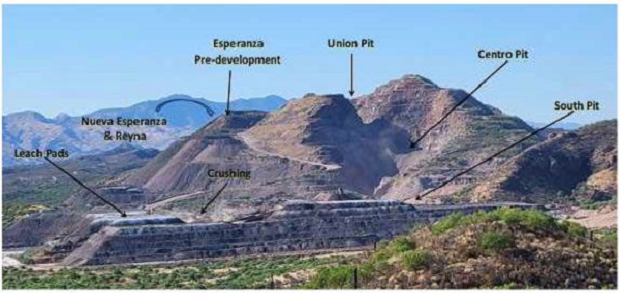
Figure 3 - Cerro Prieto Historical Mining Zones. Source: Oroco, 2025.
1.6.2 Esperanzas Deposit Exploration (2023–2024)
| · | The exploration adhered to industry standards, including mapping, sampling, geophysics (IP and resistivity), and drilling. | |
| · | Used NAD27 UTM Zone 12N as the coordinate system. | |
| · | Surface Sampling: 1,265 samples were used for mineral resource estimation (Section 14). | |
| · | Drilling Campaigns (2023): |
| o | Conducted in March, May, July, and September 2023. | |
| o | Total drilling: 4,285 meters. | |
| o | Included diamond drill holes (DDH), trench sampling, and modeling via Leapfrog 3D. |
| · | Production Status: Open-pit mining at Esperanzas Deposit began in February 2024 and continued through April 2025. |
| A-6 |
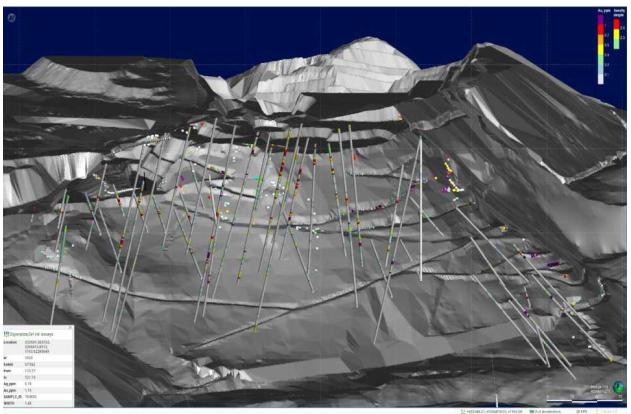
Figure 4 - Esperanzas’ Leapfrog 3D Scene Section Showing Drill Holes and Surface Samples: Source: JAO, 2025.
| A-7 |
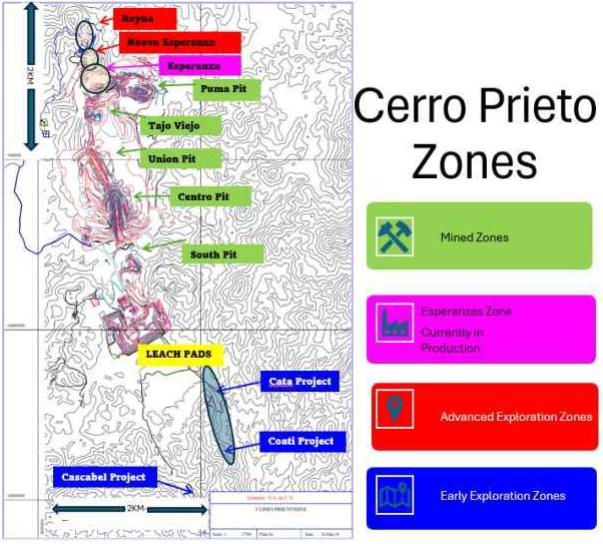
Figure 5 - Cerro Prieto Mineralized Zones. Source: Oroco, 2025.
1.6.3 Exploration Targets
1.6.3.1 Reyna Deposit
| · | Situated north of the Esperanza zone. |
| · | Exposed to over 90 meters through trenching. |
| · | Chip samples indicate significant gold grades. |
| · | Further drilling is planned to confirm economic viability. |
1.6.3.2 Cata, Coatí, Cascabel Deposits
| · | Located as far as 1.7 km south of the heap leach pad. |
| · | Identify target extensions of the Cerro Prieto Shear Zone and its parallel structures. |
| · | Surface sampling was conducted; however, the results come from an uncertified mine lab, and independent lab verification is still pending. |
| · | QA/QC protocols will be applied in upcoming campaigns. |
| A-8 |
1.6.4 2025 Exploration Program
| · | Announced by Goldgroup Mining Inc. on March 26, 2025. |
| · | Scope: |
| o | ~6,000 meters of diamond drilling. |
| o | Induced polarization surveys. |
| o | Surface trenching. |
| · | Targets: |
| o | Expansion of Nueva Esperanza and Reyna Deposits. |
| o | Reactivating the potential of the South Pit through a small pit pushback. |
| o | New zones have been discovered 1 km south along the Cerro Prieto Shear. |
1.6.5 2025 Exploration Budget
| · | Outlined in Table. |
| · | The Qualified Person (JAO) endorses the 2025 exploration program as a sound strategy to evaluate the mine’s remaining economic potential. |
Table 1 - 2025 Exploration Budget
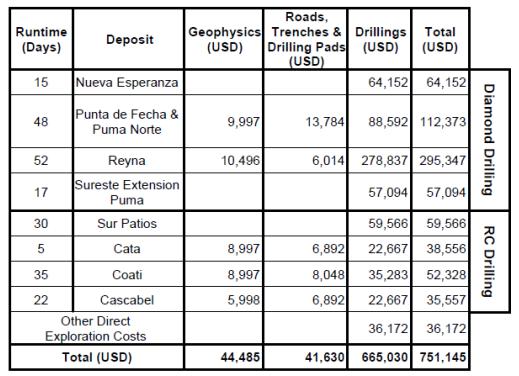
1.7 Drilling
1.7.1 Drilling Methodology
| · | Oroco employed diamond drilling, with vertical and inclined holes arranged according to sectional layouts spaced 25 meters apart. |
| · | Preparation for the drill site included access roads, pads (8x8 m), and sumps, using Caterpillar D9 tractors. |
| · | Drill paths were measured using high-precision tools (Reflex or ReflexGyro). |
| · | Water for drilling was sourced from two 30,000 m³ modular ponds lined with geomembrane. |
| A-9 |
1.7.2 Drill Core Logging
José Antonio Olmedo MSc, P. Eng. Geo, QP, Registered Member of SME is responsible for the preparation of this section. Drill core logging includes Daily logs documented hole ID, coordinates, elevation, azimuth, angle, dates, contractor, lithology, mineralogy, texture, grain size, alteration, faults, core recovery, low recovery zones, and assay results.
1.7.3 Drill Core Recovery and Quality
| · | Cores reconstructed and verified for depth at the site. |
| · | Core recovery = (Core length ÷ Drill run length) × 100. |
| · | RQD (Rock Quality Designation) is calculated as the percentage of core pieces greater than 100 mm. |
| · | Overall core recovery exceeds 71% across 334 mineralized intercepts, which is considered moderate and acceptable for sheared zones. |
| · | No negative correlation was found between core recovery and gold grade. |
1.7.4 Drill Survey
A total of 127 drill hole survey data values were used to establish the 3D orientation model for mineral resource estimation.
1.7.4.1 Drilling Highlights (2023)
Significant gold intercepts consist of:
| · | DDH CP362: 19.70m at 1.03 g/t Au; 20.98m at 1.02 g/t Au. |
| · | DDH CP374: 13.20m at 2.05 g/t Au; 1.55m at 4.78 g/t Au. |
| · | DDH CP367: 24.96m at 0.69 g/t Au; 17.97m at1.13 g/t Au. |
| · | DDH CP371: 11.67m at 1.16 g/t Au. |
| · | DDH CP384 to CP406: Up to 43.89m at 0.43 g/t Au and 13.20m at 1.33 g/t Au |
1.8 Sampling Preparation, Analysis, and Security
José Antonio Olmedo MSc, P. Eng. Geo, QP, Registered Member of SME is responsible for the preparation of this section.
1.8.1 Introduction
| · | This section details Oroco’s 2023 sampling methodologies and analytical procedures employed to support mineral resource estimation. |
| · | Due to suspended field operations, the author could not validate Oroco’s protocols in person. |
1.8.2 Sample Preparation and Analytical Methods
| · | Core samples were split, and half of the cores were retained, and half of the cores were sent for analysis. |
| · | Primary preparation and analysis were conducted at Oroco’s non-certified Cerro Prieto laboratory, with selected high-grade samples sent to ALS Chemex for fire assay. |
| · | Cerro Prieto’s methods emulate ALS’s Prep-31 Code which specified crushing to 70% below 2mm and pulverizing to 85% below 200 mesh. |
| · | The primary method employed was fire assay with atomic absorption finish on 30g samples. |
| · | Cautionary Statement: The Cerro Prieto lab (CoP) is not ISO-certified and lacks formal QA/QC systems, which raises serious concerns about the reliability of its analytical database. |
| A-10 |
1.8.3 Quality Assurance and Quality Control (QA/QC)
Oroco lacks a comprehensive QA/QC program, contrary to CIM 2018 guidelines. José Antonio Olmedo MSc, P. Eng. Geo, QP, SME Registered Member (JAO) recommends including control samples (blanks, standards, duplicates) for all analyses.
1.8.3.1 Analytical Check with ALS
| · | 268 pulp samples (approximately 5% of the database) and 41 standards/blanks were re-analyzed at ALS (ISO/IEC 17025:2017 accredited). |
| · | ALS methods utilized include Au-AA23 (fire assay) and ME-ICP41 (aqua regia for 32+ elements). |
| · | Correlation analysis between Cerro Prieto (CoP) and ALS results yielded R² = 0.786, indicating moderate agreement. See Figure 6 shown below. |
| · | Critical Issue: No retained duplicates, coarse rejects, or pulp rejects are available from Oroco, which severely limits reanalysis and audit capabilities. |
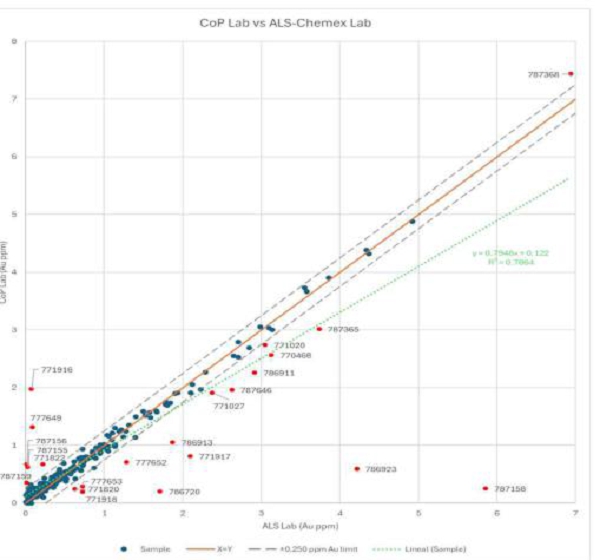
Figure 6 - Dispersion Graph. The graph compares samples analysed at Cerro Prieto (CoP) and ALS labs. CoP prepared and tested the samples, while the rejects were sent to ALS for verification. Source: JAO, 2025.
A determination coefficient of 0.786 (dotted green line) indicates a moderate correlation between the results of both labs. Red dots represent samples with a ±0.250 ppm difference, possibly signalling instrumentation issues at one of the labs.
| A-11 |
For quality control of the ALS Chemex geochemistry lab, blanks and standards were randomly inserted for every 15 samples, and duplicates were excluded from the sample stream.
| · | Blanks (17) were used but were assigned zero value without lab testing, risking bias. |
| · | Standards (22) from ROCKLABS showed acceptable performance overall: |
| o | OxL159: Mostly within limits. |
| o | OxG141: Some below lower limits, but within tolerances. |
| o | OxC152: Within defined QA limits. |
| · | Duplicates were not submitted to ALS. JAO recommends submitting at least one duplicate for every 15 samples in future programs. |
| · | Opinion on ALS QA/QC, despite the absence of duplicates, the analysis of ALS Lab analytical results for blanks and standards was precise and accurate within acceptable limits. |
1.8.4 Sample Security
Core transport and sample delivery were handled only by authorized personnel using Oroco’s vehicles.
1.8.4.1 Adequacy of Results
| · | José Antonio Olmedo MSc, P. Eng. Geo, QP, SME Registered Member (JAO) expresses significant concern regarding the validity of assay data due to: |
| o | Extensive reliance (95%) on the non-certified Cerro Prieto lab (CoP) database. |
| o | Lack of thorough QA/QC procedures. |
| · | Recommendation: conduct re-assay using ISO-certified laboratories and implement a comprehensive QA/QC program following CIM best practices. |
1.9 Data Verification
José Antonio Olmedo MSc, P. Eng. Geo, QP, Registered Member of SME is responsible for the preparation of this section.
1.9.1 Field Visit
José Antonio Olmedo MSc, P. Eng. Geo, QP, SME Registered Member (JAO) conducted an on-site field visit from May 28 to 31, 2024.
| · | The main activities included: |
| o | Reviewing Oroco’s protocols regarding geology, sampling, QA/QC, drilling, bulk density, logging, and database verification. |
| o | Visiting exploration targets, old mine workings, leach pad, mill plant, lab, and core shack. |
| · | Most of the information reviewed was historical, since JAO was not present during active drilling campaigns. |
| · | Key personnel consulted included Omar Tadeo Nevarez (Chief of Exploration) and Rafael Alexandri (Director). |
Observations:
| · | Topographic inconsistencies in northern Esperanzas led to a new topographic survey that was completed and delivered on June 4, 2024. |
| · | No collar monuments were found to validate the locations of the drill holes platforms were removed after drilling. |
| · | Geological logging for certain holes (e.g., CP205 and CP412) corresponds with JAO’s observations. |
| · | No physical core evidence of mineralized intervals was found; only photos of wet cores were available. |
| · | The remaining core material was divided for analysis and metallurgical testing, leaving no duplicates or rejects for third-party QA. |
| A-12 |
Database and Lab Review:
| · | Oroco’s drillhole database, which includes 3,955 drill holes and 1,231 surface samples, was reviewed. |
| · | ALS Chemex assay certificates for 268 check samples were received on April 24, 2025. |
1.9.2 Statement of Confidence
| · | The use of a non-certified lab, the lack of retained mineralized core material, and the absence of sample rejects or pulps limit verification and introduce uncertainty in the assay data. |
| · | These limitations were considered in the mineral resource estimation for the Esperanzas Deposit. |
1.10 Mineral Resource Estimation
José Antonio Olmedo MSc, P. Eng. Geo, QP, Registered Member of SME is responsible for the preparation of this section.
1.10.1 Introduction
| · | Project: Open-pit gold project in Sonora, Mexico; part of the Cerro Prieto mining property owned by Oroco (Goldgroup subsidiary). |
| · | Data used: 51 drill holes, 3,955 core samples, and 1,231 surface samples. |
| · | Effective date: April 4, 2025. |
| · | Methodology complies with CIM (2014) definitions and 2019 best practices. |
1.10.2 Exploration Database Analysis
| · | Verified datasets include collars, surveys, lithology, assays, and density. |
| · | Issues: |
| o | 95% of assay data from Oroco’s non-certified lab. |
| o | Lack of QA/QC program undermines confidence in assay precision. |
| · | Assays and lithological data were spot verified; missing certificate values were confirmed with logs. |
1.10.3 Geological Model
| · | Gold mineralization is controlled by two structural trends at 345° and 313° azimuths. |
| · | Modeled as 3D domains using Leapfrog Geo with a 0.1 ppm Au cut-off. |
| · | Hard boundaries are established to limit grade interpolation. |
| A-13 |
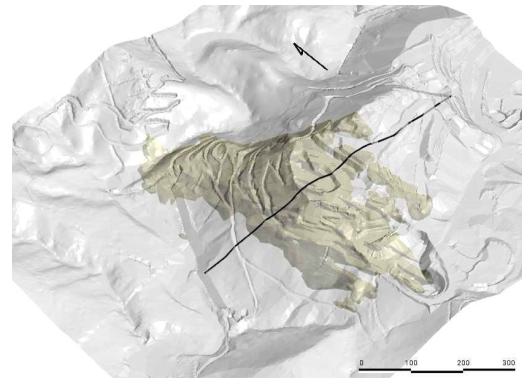
Figure 7 -This shows a 3D orthographic view of the Esperanza digital terrain and underlying domain models. The black line indicates the section depicted in Figure 7. Source: JAO 2025.
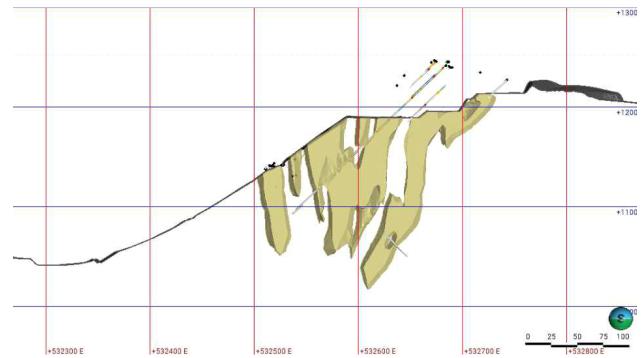
Figure 8 - This section displays the current topographic profile, drill holes, and domain solid; the section’s location is indicated in Figure - 9. Source: JAO 2025.
| A-14 |
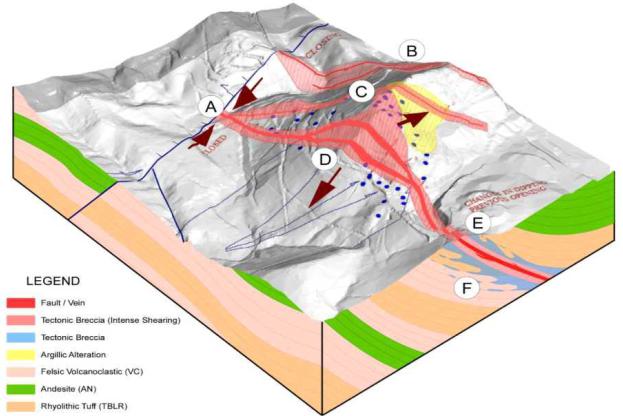
Figure 9 - Geological Interpretation of the Esperanzas Deposit. A) Fault Core Compression; B) Puma Imbricated Thrust – Ramp; C) Nueva Esperanza Imbricated Thrust-Fault; D) Esperanza Tensile Opening in Trans-Tensional Wedge (Soft Boundary); E) Fault Core Compression and Riedels; F) Splay Fracturing along Compression Edges. Source: JAO 2025.
1.10.4 Assay Capping & Compositing
| · | The capping threshold is set at 2 ppm Au, based on statistical outlier analysis. |
| · | Composites: 2-meter intervals chosen as optimal, minimizing variance and preserving the integrity of gold grade distribution. |
1.10.5 Density
| · | A 3D density model created using 102 measurements from 40 drill holes. |
| · | Minimum density: 2.09005 g/cm³ applies when interpolation is not feasible. |
| · | All blocks in the model were assigned interpolated or fallback densities. |
| A-15 |
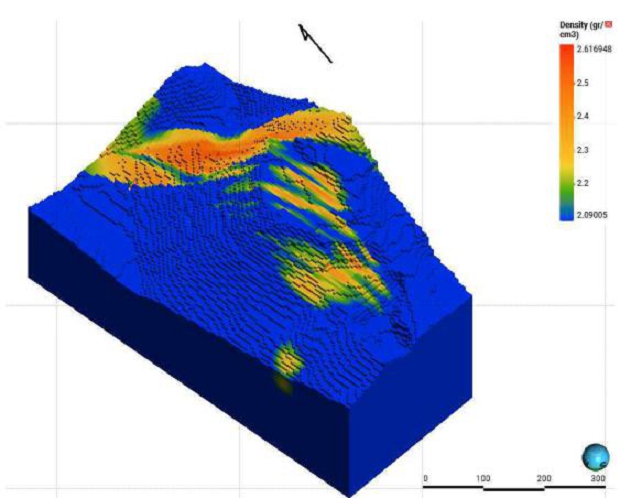
Figure 10 - The block model is evaluated against the 3D density model. The density values (in g/cm³) are displayed on the color scale. Source: JAO 2025.
1.10.6 Variography
| · | Experimental variograms generated using capped 2m composite data. |
| · | Variogram modeled with exponential and spheroidal structures. |
| · | Applied to Ordinary Kriging (OK) estimator. |
1.10.7 Block Model & Estimation
| · | Model details: |
| o | Dimensions: 5x5x5 m. |
| o | Blocks: ~1 million. |
| o | Estimators: OK used for MRE; IDW³ used for validation. |
| · | Block attributes include Au, density, classification, and drill/sample counts. |
| A-16 |
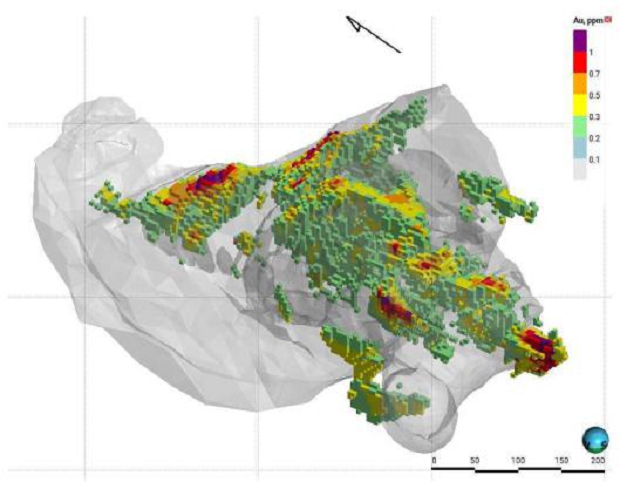
Figure 11 - The final interpolated Au block model is enclosed within the 3D density model (gray body). Source: JAO 2025.
1.10.8 Model Validation
| · | Visual validation: Strong match between block grades and composites. |
| · | Global bias: No significant deviation from composite mean grades. |
| · | Swath plots: Confirmed spatial consistency between estimators (OK vs IDW³). |
| A-17 |
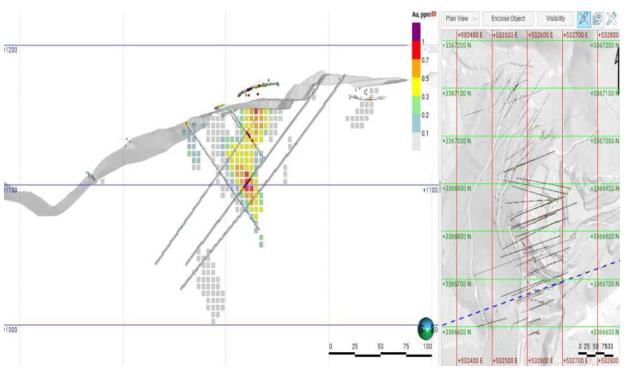
Figure 12 - Section view (left) and plan view (right) at the Esperanzas Deposit (drill holes display 2-meter composite samples; the Au ppm color scale applies to both the block model and drill holes). Source: JAO 2025.
In the Esperanzas Block Model, the quality of the resource grades closely matches the average grades of the composite drill holes, as illustrated in Figure 13. and analyzed with Python. This is essential for building confidence in estimating mineral resources.
| A-18 |
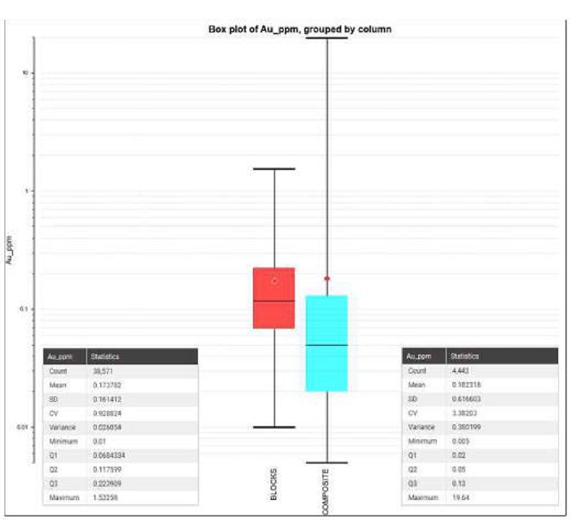
Figure 13 - Box plots comparing the statistical values of block values and drill composites. Source: JAO 2025.
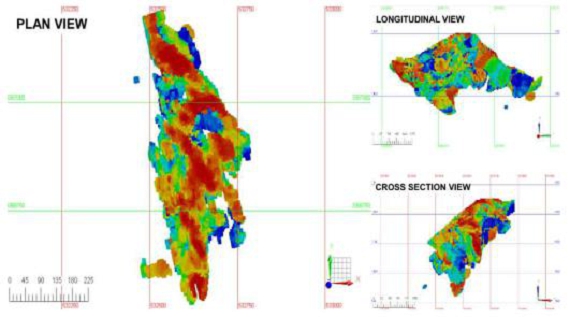
Figure 14 - Block Models: Plan View, Longitudinal View (Looking East), and Cross-Section View (Looking North). Source JAO 2025.
| A-19 |
1.10.9 Resource Classification
| · | Measured: ≤25m from sample, ≥1 drill hole, >5 samples. |
| · | Indicated: 25–40m from sample, ≥1 drill hole, >5 samples. |
| · | Inferred: >40m from sample, same other conditions. |
| · | Classification based on CIM Definition Standards (2014) guidelines. |
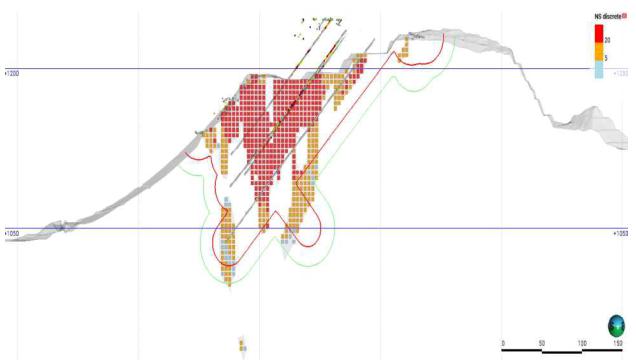
Figure 15 - The sample section shows the Esperanzas block model, indicating the number of samples used to evaluate each block (cyan 1 to 5, orange >5 to 20, and red more than 20 samples). Red and green outlines indicate the distance to samples (red = 25 m, green >25 and ≤ 40 m). The gray shadow behind the block model indicates the mineralized domain limit. Source: JAO, 2025.
1.10.10 Mineral Resource Statement
The Mineral Resources mentioned herein were estimated by J José Antonio Olmedo MSc, P. Eng. Geo, QP, SME Registered Member (JAO), as defined by the Canadian Institute of Mining (CIM) Standards on Mineral Resources and Reserves, Definitions and Guidelines from the CIM Standing Committee on Reserve Definitions (2014).
Drilling and further exploration may impact mineral resources, potentially altering future resource estimates. Subsequent assessments of mining, environmental, processing, licensing, financial, social, economic, and other factors may also impact mineral resources. Mineral resources are distinct from mineral reserves and have not proven economic viability. Table 2 summarizes mineral resources for various cutoff grades, while Table 2 displays Inferred Resources separately.
As the Cerro Prieto mine is currently in production, JAO is presenting the Mineral Resource Estimate for various cutoff values. Oroco can either continue with the existing operations or explore potential changes.
Table 2 - Estimates of the Esperanzas Deposit’ Inferred Mineral Resources Using Oroco’s Assays Database. Source: JAO 2025.
| A-20 |
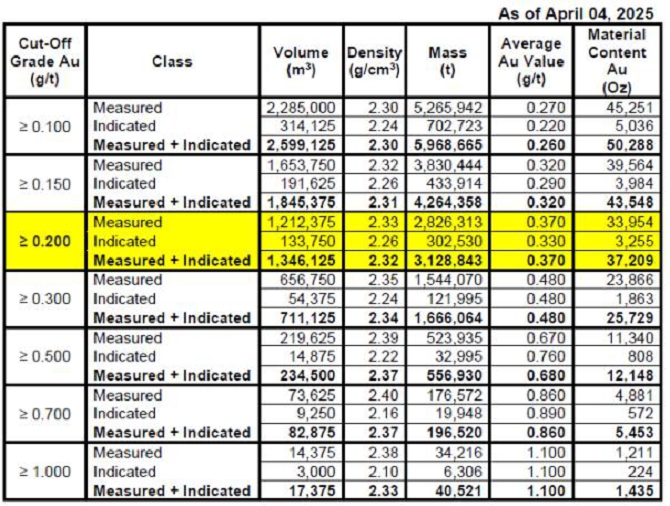
Table 3 - Estimates of the Esperanzas Deposit’ Inferred Mineral Resources using Oroco’s assays database. Source: JAO 2025.
As of April 04, 2025
| Cut-off Au Grade (g/t) | Volume (m3) |
Density (g/cm3) |
Mass (t) | Average Au Value (g/t) |
Material Au Content (Oz) |
|||||||||||||||
| ≥ 0.100 | 133,500 | 2.16 | 288,421 | 0.240 | 2,214 | |||||||||||||||
| ≥ 0.150 | 84,500 | 2.17 | 183,783 | 0.300 | 1,798 | |||||||||||||||
| ≥ 0.200 | 60,750 | 2.17 | 131,536 | 0.360 | 1,504 | |||||||||||||||
| ≥ 0.300 | 29,500 | 2.13 | 62,958 | 0.480 | 968 | |||||||||||||||
| ≥ 0.500 | 8,000 | 2.10 | 16,767 | 0.810 | 438 | |||||||||||||||
| ≥ 0.700 | 5,625 | 2.09 | 11,772 | 0.900 | 342 | |||||||||||||||
| ≥ 1.000 | 2,250 | 2.09 | 4,706 | 1.090 | 165 | |||||||||||||||
| Observation: Differences may occur in total due to rounding | ||||||||||||||||||||
| A-21 |
Oroco notified the Qualified Person that the current operational cut-off grade for the Esperanzas deposit is 0.20 g/t Au. This value represents the economic limit used in the ongoing open-pit mining operation. The cut-off grade reflects current mining and processing practices and was determined by considering the actual mining method, metallurgical recovery, operating costs, metal prices, and the overall economic performance of the operation. The cut-off grade was calculated using the following general formula:
| Cut-off (g/t) = | Total Cost (US$/t) | x | (Conversion Factor) |
| Gold Price (US$/oz) x Recovery (%) |
Where:
Total Cost (US$/t) = 11.76
| § | Crushing Plant: (US $/t) = 2.59 |
| § | Heap Leach (US/t) = 2.88 |
| § | ADR Plant (US $/t) = 1.56 |
| § | Indirect Costs (US $/t) = 1.27 |
| § | Administration Costs (US $/t) = 1.12 |
| § | Average Mining Cost (US/t) = 2.29 |
Gold Price (US $/Oz) = 2,400 Recovery (%) = 72
Overall Slope Angles = 44°
Calculation:
| Au Cut-off (g/t) = | 11.71 (US$/t) | x | (31.1035) = 0.2117 g/t |
| 2,400 (US$/oz) x 71 (%) |
The cut-off grade was rounded up to 0.2 g/t Au. JAO has reviewed the cut-off grade calculation and confirms that the assumptions are consistent with industry practice and are considered appropriate for the current scale and configuration of the open-pit operation. The cut-off grade, therefore, provides a reasonable basis for defining material with reasonable prospects for eventual economic extraction.
José Antonio Olmedo MSc, P. Eng. Geo, QP, SME Registered Member (JAO) stated that the Inferred Mineral Resources for the Esperanzas Deposit, above the cut-off gold grade of 0.2 Au g/t within the mineralized domain, amount to 131,536 tonnes at a gold grade of 0.36 g/t.
Notes: JAO’s methodology utilized the Canadian Institute of Mining (CIM) Definition Standards for Mineral Resources and Mineral Reserves, published by the CIM MRMR Committee on May 19, 2014, along with the CIM Estimation of Mineral Resources and Mineral Reserves: Best Practice Guidelines, published by the CIM MRMR Committee on November 29, 2019.
| · | Errors in the totals result from rounding. |
| · | The Mineral Resource was modelled using a licensed copy of Seequent’s Leapfrog Geo® software and the EDGE extension. |
| · | Only gold (Au) values are considered here. The metallurgical-qualified person for Oroco will determine whether Silver (Ag) values should be included; if so, the author will immediately consider them in the final Mineral Resource Statement. |
| · | The author developed a new structural model for shearing and lateral displacement. |
| · | A 3D grade-shell interpolation was matched with the structural model to increase confidence and accuracy. |
| · | An external dilution factor was not considered during this resource estimation. Internal dilution within 5 m x 5 m x 5 m has been included in this estimation. |
| · | This estimate assumes 100% mining recovery. |
| · | Quantities and grades in a mineral resource estimate are rounded to an appropriate number of significant figures to reflect their approximations. |
| · | Mineral resources are not mineral reserves as they have not yet demonstrated economic viability. |
| · | All data used to elaborate on this report was provided to Oroco in separate files. |
| A-22 |
1.10.11 Mineral Resource Statement (Base Case at 0.2 g/t Au cutoff)
| · | Measured & Indicated: 3.13 million tonnes @ 0.370 g/t Au. |
| · | Inferred: 131,536 tonnes @ 0.360 g/t Au. |
| · | Software used: Leapfrog Geo & EDGE (Seequent) |
Note: Only gold was modeled. Silver inclusion awaits metallurgical review. No external dilution or mining recovery factor applied.
1.10.12 Sensitivity Analysis
| · | The cutoff grade sensitivity was evaluated (see Figure 16 below). The resource is responsive to the Au cut-off variation. |
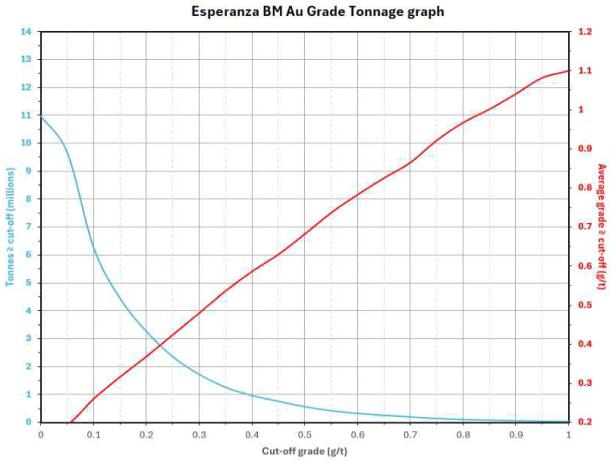
Figure 16 - Esperanzas Block Model Au Grade and Tonnage Graph. Sensitivity of the Esperanzas Deposit Mineral Resource Estimate to variations in the Au cutoff grade. Source: JAO 2025.
1.10.13 Constraints Affecting MRE
| · | Primary risks: |
| o | Non-certified lab usage. |
| o | Absence of QA/QC. |
| o | Data gaps, geological continuity uncertainty. |
| · | No known environmental, permitting, legal, or political risks reported. |
| A-23 |
1.10.14 Conclusions
| · | The MRE is robust, supported by geological understanding and standard modeling software. |
| · | Future exploration and QA/QC improvements may enhance data reliability and classification confidence. |
1.10.15 Recommendations
| · | Establish collar markers and enhance core storage facilities. |
| · | Implement a thorough QA/QC program according to CIM standards. |
| · | Utilize certified labs and keep coarse/pulp rejects. |
| · | Submit about 5% of rejections to an independent umpire lab. |
| · | Enhance topographic resolution (≤50 cm/pixel). |
| · | Perform geotechnical and open-pit optimization studies. |
| · | Continue exploring satellite targets: Reyna, Cata, Coatí, Cascabel, Zona Sur, and Socorro. |
1.11 Mining Method
Cristian Garcia, P. Eng., QP, Registered at Engineers and Geoscientists of British Columbia this section of the technical report. The Cerro Prieto project is an operating hard-rock open pit mine in the State of Sonora, Mexico. Ore production to the crushing plant has a planned maximum capacity of 4,200 tpd (1,643 kt/y). The mine’s production schedule was developed to fill the crushing plant and maximize the project’s return on investment (ROI).
The total material mining rate is tied to equipment productivity and fluctuates by period. The total material mining rate varies with equipment productivity and changes over time, reaching a peak of 370,000 tonnes per month. The mine operates continuously, 7 days per week, with two 12-hour shifts each day, employing two local mining contractors.
1.11.1 Esperanzas Deposit Pit Optimization
Cristian Garcia, P. Eng., QP, Registered at Engineers and Geoscientists of British Columbia utilized the GEOVIA Whittle™ software for developing the pit optimization of the Esperanzas Deposit. The optimization and mining schedule included blocks classified as Measured, Indicated, and Inferred resources. Mining dilution was not considered during optimization, as dilution was already accounted for during the construction of the resource model. The main parameters for this optimization are detailed in the table below, with economic assumptions agreed upon by the parent company. Table 4. It shows the technical economical parameters of the pit optimization.
| A-24 |
Table 4 - Technical Parameters of the Esperanzas Deposit Pit Optimization
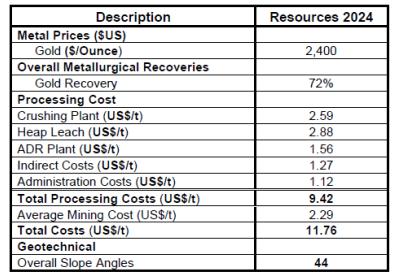
1.11.2 Mine Design for the Esperanzas Deposit
The mine design incorporated typical parameters for a conventional truck and shovel operation, along with geotechnical recommendations from the Cerro Prieto operations team. The resulting mine design criteria is presented in Table 5 below:
Table 5 - Mine Design for the Esperanzas Deposit
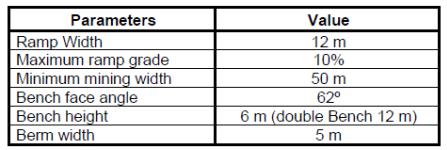
The Whittle shell used for the design included a total of 3.5 million tonnes of material, including 1.65 million tons of economic ore and 1.9 million tonnes of waste, resulting in a strip ratio of 1.15 waste to ore (W:O). Applying the mine design criteria, the ultimate pit design was designed as a single final pit with no intermediate phases. This single-phase design contains 3.7 million tonnes of material, including 1.52 million tonnes of ore and 2.18 million tonnes of waste. This provides for a strip ratio of 1.43 (W:O).
| A-25 |
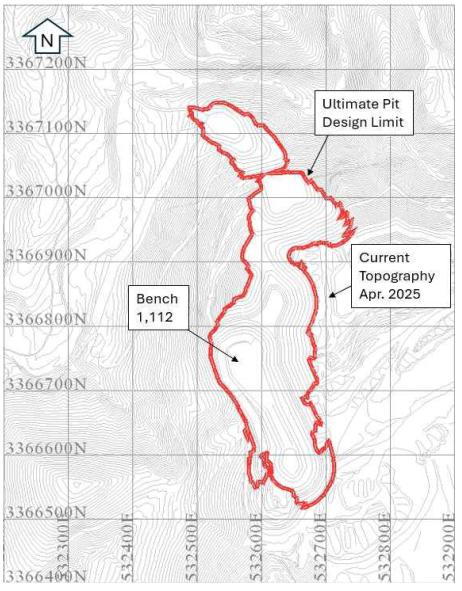
Figure 17 - Mine Design for the Esperanzas Deposit
Moving from Whittle shell to detailed design shell resulted in a loss in total contained ore of 80 thousand tonnes. The decrease in ore and increase in waste is due to the addition of ramps and berms and the removal of non-operational areas at the bottom of the Whittle shells. A summary of the detailed pit shell is shown in the table below.
Table 6 - Summary of the Detailed Esperanzas Deposit Pit Shell

A monthly production plan was established from this single mining phase, using a fixed cut-off grade of 0.2 g/t (cut-off grade optimization was not considered). An opportunity has been identified to bring forward a pocket of high-grade ore from a small pit north of the deposit. It should be evaluated to determine the economic impact. The table below shows the monthly production plan.
| A-26 |
Table 7 - Opportunity to Bring Forward a Pocket of High-Grade Ore from a Small Pit North of the Esperanzas Deposit. Period April 2025 Through April 2026.
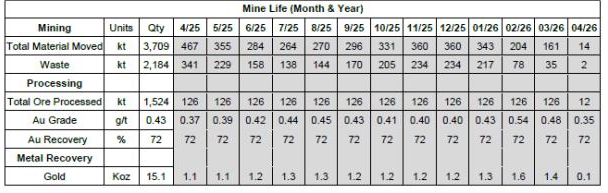
The Esperanzas Deposit mine production plan including tonnages of material (ore and waste) and gold grade to be mined in 13 months are depicted in the following figure.
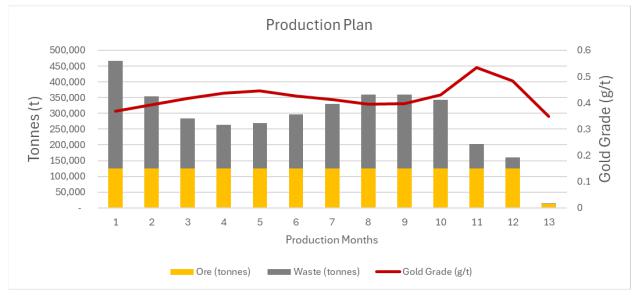
Figure 18 - Production Schedule for the Esperanzas Deposit
1.12 Metallurgical Test Work
Rodrigo R Carneiro MSc, QP, SME Registered Member prepared this section of the Technical Report. A metallurgical study was conducted on two composite samples of the Esperanzas Deposit which is included inside the Cerro Prieto Mine. The personnel of Cerro Prieto Mine prepared two composite representing the mineral resources included in the Esperanzas Project.
Rodrigo R Carneiro MSc, QP, SME Registered Member specified a metallurgical study which was conducted at Laboratorio Tecnológico de Metalurgia (LTM) S.A de C.V which Mexico.
| A-27 |
The metallurgical test work conducted on two composite samples of the Esperanzas Deposit included cyanide agitated bottle roll testing and locked cycle column leach testing on the composite samples identified as Esperanza Composite and Nueva Esperanza Composite.
1.12.1 Metallurgical Test Work Conducted in a Certified Commercial Laboratory
On May 2024, the personnel of Minas de Oro Resources, S.A de C.V prepared two composites representing the mineral resources of the Esperanzas Deposit and identified as Esperanza and Nueva Esperanza Composites. The composites were prepared using 1/4 diameter of HQ drill core reject samples for conducting a metallurgical study specified by an independent metallurgical consultant Rodrigo R Carneiro MSc, QP, SME Registered Member, which included:
| · | Sample preparation and head screen assays (Au, Ag & Cu) at two crush sizes of P80 of 5/8” and P80 of 3/8”, |
| · | Agitated cyanide bottle roll testing on each composite crushed to 100% minus 10 Mesh for 72 hours, |
| · | Locked cycle column testing on each composite at two crush sizes of P80 of 5/8” and P80 of 3/8”. |
In June 2024, a metallurgical study on the Esperanza Composite and Nueva Esperanza Composite representing the mineral resource of the Esperanzas Deposit started and the results achieved in the cyanide bottle roll tests and locked cycle column leach tests on the Esperanza and Nueva Esperanza Composites are included in the following table.
Table 8 - Cyanide Boll Roll Leach Testing on the Esperanza Composites
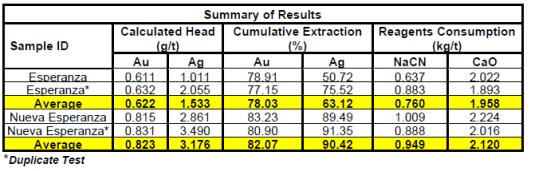
The following comments relate to the summary of results obtained on the cyanide bottle roll leach testing conducted on the Esperanza Composite samples at a particle size of 100% minus 10 Mesh.
| · | Average gold, silver and copper extractions of 78.03%, 63.12 and 4.79% respectively were obtained after 72 hours of retention time. |
| · | Average NaCN and CaO consumptions were 0.760 kg/t and 1.958 kg/t respectively. NaCN and CaO consumptions can be considered in the medium range for an agitated leach testing at a particle size of 100% minus 10 Mesh. |
| · | Average gold, silver and copper calculated head of 0.622 g/t, 1.533 g/t and 50.10 g/t respectively were obtained on the Esperanza Composite. |
The following comments relate to the summary of results obtained on the cyanide bottle roll leach testing conducted on the Nueva Esperanza Composite samples at a particle size of 100% minus 10 Mesh.
| · | Average gold, silver and copper extractions of 82.07%, 90.42 and 7.72% respectively were obtained after 72 hours of retention time. |
| · | Average NaCN and CaO consumptions were 0.949 kg/t and 2.120 kg/t respectively, NaCN and CaO consumptions can be considered in the medium range for an agitated leach at a particle size of 100% minus 10 Mesh. |
| · | Average gold, silver and copper calculated head of 0.823 g/t, 3.176 g/t and 66.42 g/t respectively were obtained on the Esperanza Composite. |
| A-28 |
Four (4) locked cycle column tests were conducted on the Esperanza Composite at the crush sizes of P80 of 5/8” and P80 of 3/8” using two sodium cyanide concentrations of 300 ppm and 600 ppm for 78 days of leach followed by 4 days of wash cycle and 2 days of drain cycle. The study was conducted at LTM which is a commercial ISO certified metallurgical & analytical laboratory. The results obtained are depicted in Figure 19 and Figure 20 below.
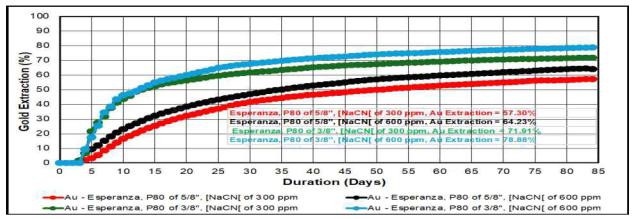
Figure 19 - Gold Extraction on the Esperanza Composite
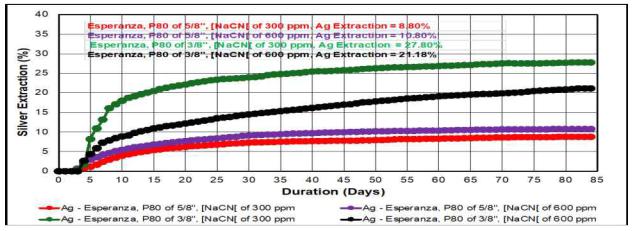
Figure 20 - Silver Extraction on the Esperanza Composite
The following comments relate to the column tests conducted on the Esperanza Composite at crush sizes of P80 of 5/8” and P80 of 3/8” using sodium cyanide concentrations in the feed solution of 300 ppm and 600 ppm.
| · | The results obtained showed that the crush size of P80 of 3/8” and sodium cyanide concentration of 600 ppm did impact gold extraction reported gold extraction of 78.88%. |
| · | The crush size of P80 of 3/8” and using 600 ppm of sodium cyanide achieved additional incremental of gold extraction of 14.65% versus the crush size of P80 of 5/8” and using 600 ppm of sodium cyanide. |
| · | Crush size of P80 of 3/8” reported higher silver extraction versus the crush size of 5/8” and it seems that the sodium cyanide concentrations of 300 ppm and 600 ppm did not have a significant impact upon silver extraction. |
| A-29 |
Two (2) locked cycle column tests were conducted on the Nueva Esperanza Composite at the crush sizes of P80 of 5/8” and P80 of 3/8” at a sodium cyanide concentration of 600 ppm for 78 days of leach followed by 4 days of wash cycle and 2 days of drain cycle at LTM which is an independent commercial ISO certified metallurgical laboratory, and the results obtained are depicted in Figures 21 and 22 below.
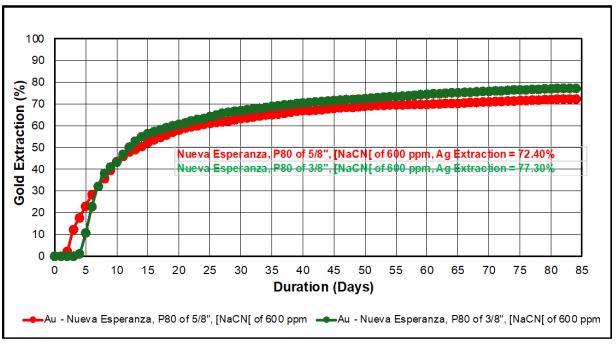
Figure 21 - Gold Extraction on the Nueva Esperanza Composite
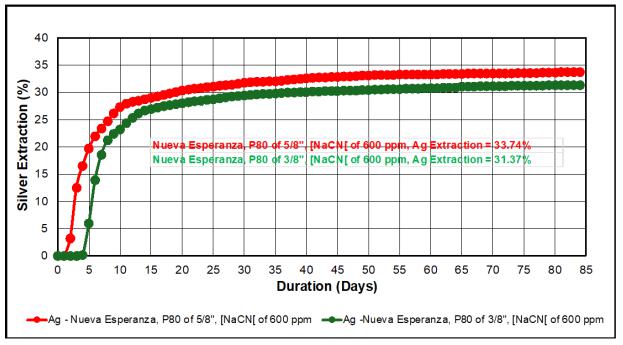
Figure 22 - Silver Extraction on the Nueva Esperanza Composite
| A-30 |
The following comments relate to the column tests conducted on the Nueva Esperanza Composite at two crush sizes of P80 of 5/8” and P80 of 3/8”.
| · | The crush sizes of P80 of 5/8” and P80 of 3/8” achieved gold extraction of 72.40% and 77.30% respectively. The additional incremental of gold extraction of 4.65% obtained at the crush size of P80 of 3/8” should justify crushing the sample to a finer crush size. |
| · | Crush sizes of P80 of 5/8” and P80 of 3/8” did not have a significant impact upon silver extraction. |
| · | There was not enough sample weight to conduct two column tests using sodium cyanide concentration of 300 ppm. |
1.13 Adjacent Properties
José Antonio Olmedo MSc, P. Eng. Geo, QP, SME Registered Member prepared the information included in this section of the Technical Report.
1.13.1 Nearby Projects to Cerro Prieto Project:
| · | Cerro Caliche Project, Sonoro Gold Corp. Located at approximately 2 km east from the Cerro Prieto Project. |
| · | Mercedes Mine Project, Bear Creek Mining Corp. Located at approximately 10 km southwest from the Cerro Prieto Project. |
| · | Santa Gertrudis Project, Agnico-Eagle Mines Ltd. Located at approximately 20 km north from the Cerro Prieto Project. |
1.13.2 Cerro Caliche Project Overview (Sonoro Gold Corp.)
| · | Acquired: September 2018. |
| · | Area: 1,400 hectares. |
| · | Mineralization: Low-sulfidation epithermal veins, NW-trending, near-surface Au-Ag quartz veins often associated with rhyolitic dikes. |
| · | On March 24, 2023, Sonoro Gold Corp., published a NI 43-101 Technical Report, Mineral Resource Estimate for the Cerro Caliche Project and reported: |
| o | Indicated: 19.9 Mt at 0.44 g/t Au and 3.5 g/t Ag including approximately 280,000 oz Au and 2.24 Moz Ag |
| o | Inferred: 10.5 Mt @ 0.42 g/t Au and 4.0 g/t Ag including approximately140,000 oz Au and 1.345 Moz Ag |
| · | On October 10, 2023, Sonoro Gold Corp., published a NI 43-101 Technical Report for Preliminary Economic Assessment (PEA) and reported: |
| o | Mine Life: 9 years (heap leach, open pit). |
| o | Production Rate: 4,000 tpd (initial), increasing to 12,000 tpd. |
| o | Gold Recovery: 72%. |
| o | After-Tax NPV (5%): USD 47.7 million. |
| o | After-Tax IRR: 45%. |
| o | Initial Capex: USD 15.5 million. |
| o | AISC: USD $1,395 per gold equivalent oz. |
| o | Payback Period: ~2.9 years. |
1.13.3 Cautionary Note
| · | José Antonio Olmedo MSc, P. Eng. Geo, QP, SME Registered Member has not verified the Cerro Caliche data. |
| · | Proximity does not imply similar mineralization at the Esperanzas (Cerro Prieto Project). |
| A-31 |
1.14 Capital and Operating Costs
Rodrigo R Carneiro MSc, QP, SME Registered Member (RRC) an independent consultant prepared the information included in this section of the Technical Report using the information provided by Company personneland RRC verified the information received associated to Operation Capital and Operation Costs.
1.14.1 Capital Costs
The capital budget prepared by Company personnel for investment from April 2025 to April 2026 is USD 2,764,585 for installing a vibrating screen in the existing crushing circuit, install a second crushing circuit to achieve a crush size of P80 of 3/8”, acquisition of loading equipment, acquisition of light vehicles, new core shack, acquisition of computers, plotter and printer, new concrete slab for metallurgy, investment in the chemical plant and yards, equipment for the chemical laboratory, computer equipment for medical and HR services, contingency and back up equipment. Details of the Budget Capital for the Esperanzas Deposit is included in Section 21.1. Table 9 summarizes the Budget Capital Costs.
Table 9 -Budget Capital Costs from April 2025 through April 2026
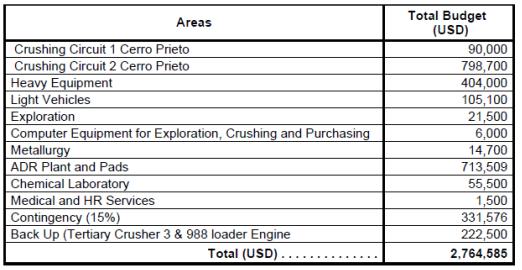
1.14.2 Operating Costs
Company personnel provided the budget operating costs per from April 2025 through April 2026. Details of the Budget Operating Costs per Area are included in Section 21.2. Table 10 depicts a summary of the Budget Operating Costs per Operation Areas.
| A-32 |
Table 10 - Estimated Operating Costs from April 2025 through April 2026
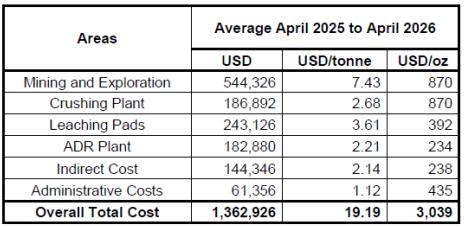
1.15 Other Relevant Data and Information
José Antonio Olmedo MSc, P. Eng. Geo, QP, SME Registered Member prepared the information included in this section of the Technical Report.
| · | Goldgroup Mining Inc. issued a cautionary statement on a press release dated April 17, 2024, regarding its decision to put the Cerro Prieto Mine into production without completing a feasibility study. |
| · | Key Points: |
| o | No feasibility study or independent technical report confirming the mine’s economic or technical viability was conducted before production began. |
| o | Consequently, there is: |
i. Increased risk and uncertainty about future economic outcomes.
ii. Greater technical risk of failure than decisions based on completed feasibility studies.
1.16 Interpretation and Conclusions
José Antonio Olmedo MSc, P. Eng. Geo, QP, SME Registered Member prepared the information included in this section of the Technical Report.
1.16.1 Geology and Mineralization
| · | The Esperanzas Deposit is located within a Tertiary volcanic sequence (felsic volcanoclastic, andesitic-basaltic flows, rhyolite/dacite tuffs). |
| · | Mineralization is structurally controlled: |
| o | Primary vein (Az 345°): approximately 700 m long, semi-vertical. |
| o | Secondary vein (Az 313°): dips 50–65° to the southwest. |
| · | Mineralization consists of quartz veins, chalcedony, amorphous silica, black calcite, and manganese within a low-sulfidation epithermal system. |
1.16.2 Exploration and Drilling
| · | Protocols adhered to industry standards, including mapping, geochemical and geophysical surveys, and chip sampling. |
| · | Drilling was completed prior to JAO’s site visit, so the drilling performance could not be verified. |
| · | Adjacent exploration targets (Reyna, Cata, Coatí, Cascabel) exhibit significant Au anomalies ranging from 0.18 to 25.27 g/t. |
| A-33 |
1.16.3 Mineral Resource Estimation
| · | This analysis is based on 51 drill holes, 3,955 core samples, and 1,231 surface samples. |
| · | The estimation methodology follows CIM 2014 definitions and the best practice guidelines from 2019. |
| · | Modeled using Leapfrog Geo and EDGE software; only gold values are included at this stage. |
| · | Assumes: |
| o | 100% mining recovery. |
| o | No external dilution. |
| o | Internal dilution is included (5x5x5 m blocks). |
1.16.4 Database Concern
| · | About 95% of assays originate from the non-certified Cerro Prieto lab, which lacks a formal QA/QC program, highlighting a critical data integrity issue. |
| · | Recommendation: Reassess samples using certified laboratories and implement comprehensive QA/QC procedures. |
1.16.5 Forward-Looking Caution
| · | Goldgroup moved Cerro Prieto into production without conducting a pre-feasibility or feasibility study. |
| · | This raises: |
| o | Higher risk of technical failure. |
| o | Greater economic uncertainty. |
| · | Decisions were made without verifying the economic or technical viability of reserves and resources. |
1.17 Recommendations
1.17.1 Data and Infrastructure Improvements
José Antonio Olmedo MSc, P. Eng. Geo, QP, SME Registered Member (JAO) prepared this section of the Technical Report to support Oroco’s current exploration and development plans and has provided the following technical recommendations to enhance the Cerro Prieto Project.
| · | Install markers at all drilling locations. |
| · | Enhance the project database and data management system. |
| · | Obtain a high-resolution topographic survey (at least 50 cm/pixel). |
| · | Reconstruct the core storage facility, including the ceiling, walls, and security features. |
| · | Retain half of the core from mineralized intervals. |
| · | Organize coarse and pulp rejects separately from both local and ALS rejects. |
Laboratory and QA/QC Enhancements
| · | Choose a certified and accredited lab to analyze all gold-bearing samples. |
| · | Implement QA/QC procedures following CIM Best Practice Guidelines. |
| · | Submit pulp or coarse reject duplicates in place of field duplicates. |
| · | Send at least 5% of rejections to an independent umpire lab, excluding ALS or local labs, to monitor assay reliability and implement any necessary corrective actions. |
| A-34 |
Exploration and Mining Studies
| · | Systematically measure and document specific gravity (SG) during future drilling. |
| · | Conduct open-pit optimization studies to more accurately estimate mineable resources. |
| · | Conduct geotechnical studies to ensure the stability of mine slopes and operations. |
Target Area Development
| · | Explore additional high-potential zones: |
| o | Reyna, Cascabel, Cata, Coatí, Zona Sur, Punta Flecha-Puma Norte, and Sureste Extensión Puma. |
Budget and Planning
JAO supports the proposed 2025 exploration program designed to assess the economic viability of the Cerro Prieto mineralize zones. The following table summarized the 2025 Exploration Budget.
Table 11 - 2025 Exploration Budget
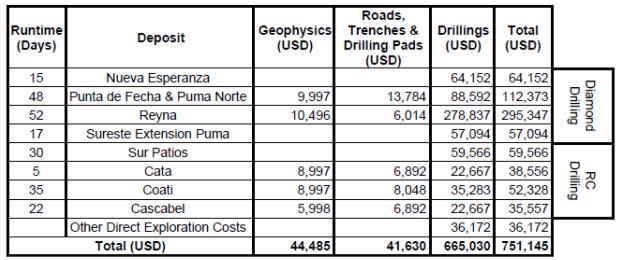
1.17.2 Heap Leaching Process Optimization
Rodrigo R Carneiro MSc, QP, SME Registered Member based on the results obtained on the metallurgical study conducted on the composite samples (Esperanza and Nueva Esperanza) evaluated under locked cycle cyanide column testing and assuming the composites evaluated represent the mineral resources of the Esperanzas Deposit provides the following recommendations which should be considered for maximize the gold recovery under heap leaching process:
| · | Before heap leaching process, the sample should be stage crushed to 80% passing through a 3/8” sieve to maximize the gold recovery. |
| · | The sodium cyanide concentration of barren feed solution should be kept at 600 ppm at a pH in the range from 10.5 to 11.0 units. |
| A-35 |
SCHEDULE “B” – SUMMARY OF SAN FRANCISCO TECHNICAL REPORT
Information of a scientific or technical nature in respect of the San Francisco Project in this Schedule “B” is derived from portions of the San Francisco Technical Report. For the purposes of this Schedule “B”, capitalized terms not otherwise defined herein have the meanings given to those terms in the San Francisco Technical Report.
For readers to fully understand the technical information relating to the San Francisco Project in this Annual Information Form, they should read the San Francisco Technical Report (available on SEDAR+ at www.sedarplus.ca under the Company’s profile) in its entirety, including all qualifications, assumptions and exclusions that relate to the technical information set out in this Annual Information Form. The San Francisco Technical Report is intended to be read as a whole, and sections should not be read or relied upon out of context. The technical information in the San Francisco Technical Report is subject to the assumptions and qualifications contained in the report.
1. SUMMARY
1.1 Introduction
Micon International Limited (Micon) has been retained by Goldgroup Mining Inc. (Goldgroup) to prepare an updated Mineral Resource Estimate (MRE) for the San Francisco Project (San Francisco Project or the Project) located in the State of Sonora, Mexico. Goldgroup has also requested that Micon compile and disclose the results of the updated MRE in a National Instrument 43-101 (NI 43-101) Standards of Disclosure for Mineral Projects Technical Report.
Neither Micon nor its QPs have had, does have, nor have previously had any material interest in Goldgroup or related entities. The relationship with Goldgroup and related entities is solely a professional association between the client and the independent consultant. This report is prepared in return for fees based upon agreed commercial rates and the payment of these fees is in no way contingent on the results of this report.
This report includes technical information which requires subsequent calculations or estimates to derive sub-totals, totals and weighted averages. Such calculations or estimations inherently involve a degree of rounding and consequently introduce a margin of error. Where these occur, neither Micon nor its QPs consider them to be material.
The conclusions and recommendations in this report reflect the authors’ best independent judgment in light of the information available to them at the time of writing. The authors and Micon reserve the right, but will not be obliged, to revise this report and conclusions if additional information becomes known to them subsequent to the date of this report. Use of this report acknowledges acceptance of the foregoing conditions.
This report is intended to be used by Goldgroup subject to the terms and conditions of its agreement with Micon. That agreement permits Goldgroup to file this report as a Technical Report with the Canadian Securities Administrators pursuant to provincial securities legislation or with the SEC in the United States. Except for the purposes legislated under provincial securities laws, any other use of this report, by any third party, is at that party’s sole risk.
The descriptions of geology, mineralization and exploration used in this report are taken from reports prepared by various organizations and companies or their contracted consultants, as well as from various government and academic publications. The conclusions of this report are based in part on data available in published and unpublished reports supplied by the companies which have conducted exploration on the property, and information supplied by Goldgroup. The information provided to Goldgroup was supplied by reputable companies. Micon’s QPs have no reason to doubt its validity and has used the information where it has been verified through its own review and discussions.
| B-1 |
Micon is pleased to acknowledge the helpful cooperation of Goldgroup management and consulting field staff, all of whom have made any and all data requested available and have responded openly and helpfully to all questions, queries and requests for material.
1.2 Property Description, Location and Ownership
The San Francisco property is situated in the north central portion of the state of Sonora, Mexico, approximately 150 kilometres (km) north of the state capital, Hermosillo. In this Technical Report, the term San Francisco Project refers to the area within the exploitation or mining concessions controlled by Molimentales del Noroeste S.A. de C.V, (Molimentales) while the term San Francisco property (the property) refers to the entire land package (mineral exploitation and exploration concessions).
Molimentales is a 100% owned subsidiary of Goldgroup subject to final TSX Venture Exchange (TSXV) approval.
The San Francisco Project is comprised of two previously mined open pits (San Francisco and La Chicharra), together with heap leach processing facilities and associated infrastructure located close to the San Francisco pit. The San Francisco Project leach pads are no longer producing, no mining is being conducted, and the Project is on care and maintenance.
1.2.1 Goldgroup Acquisition
1.2.1.1 Goldgroup Description of Acquisition Terms of Molimentales
Subject to the final approval of the TSX Venture Exchange (the “TSXV”), Goldgroup Mining Inc. (“Goldgroup or the Company”) has acquired all of the issued and outstanding Series “A” shares in the fixed capital and all the issued and outstanding Series “B” shares in the variable capital (collectively the “Molimentales Shares”) of Molimentales del Noroeste, S.A. de C.V. (“Molimentales”) through a Concurso Mercantil process (restructuring proceeding equivalent to Chapter 11 in the United States). Goldgroup received approval from the Second District Court for Commercial Bankruptcy Matters (the “Mexican Court”) to the plan of arrangement (the “Plan of Arrangement”) the Company filed with the Mexican Court under the Concurso Mercantil process. The judgement issued by the Mexican Court in favour of Goldgroup’s Plan of Arrangement completes the bankruptcy and restructuring of Molimentales. Molimentales’ primary asset is the formerly producing San Francisco Mine and mineral concessions, located in Sonora State, Mexico.
Goldgroup filed a proposal under the Concurso Mercantil process to acquire Molimentales under the Plan of Arrangement with the liquidator (the “Liquidator”) appointed by the Mexican Court to oversee Molimentales’ bankruptcy proceedings. The Plan of Arrangement was approved by over 50% of the recognized creditors of Molimentales as required under Mexican law, recommended by the Liquidator and subsequently filed with the Mexican Court for approval. The Mexican Court approved the Plan of Arrangement by judgement issued effective December 23rd, 2025. The acquisition of Molimentales will be subject to Goldgroup satisfying all the conditions of the Concurso, including paying all creditors under the Plan of Arrangement, all outstanding taxes and concession fees due to the Mexican government, as well as receiving final approval from the TSXV. With the Plan of Arrangement and together with the settlement of outstanding liabilities owed to the Mexican Government in order to maintain the San Francisco Mine in good standing, transfer of ownership of Molimentales and the San Francisco Mine and its associated assets, including mining concessions, processing plants, and all related infrastructure, to Goldgroup, will occur free and clear of all liens and liabilities. except for a 1% NSR on each of the following mining concessions: San Francisco, Patricia, Norma, La Pima, Dulce, and San Judas, and a 2% net smelter return (“NSR”) royalty on gold produced from the San Francisco Mine and surrounding mining concessions.
Prior to the filing of the Plan of Arrangement, Goldgroup acquired 60.24% of the debts owed to certain major creditors (the “Major Creditors”) as recognized by the Mexican Court for US$ 8,971,000 of which US$ 7,554,000 has been paid to date and the balance of US$ 1,417,000 will be paid to complete the acquisition. Under the terms of the Plan of Arrangement Goldgroup has agreed to pay US$ 2,566,098 in three equal instalments of US$ 855,366 each in December 2026, 2027 and 2028 to the remaining creditors holding 39.76% of the recognized debt in addition to all outstanding mining concession fees (including penalties and interest), taxes, fees owed to the National Water Commission, and certain expenses related to the Concurso proceedings all currently estimated at MX$ 140M (approximately US$ 8.0M). Some of the payments described above are facilitated through Goldgroup acquiring the Molimentales Shares by paying the owners of the Molimentales Shares MX$ 100,000 and capitalizing Molimentales with MX$ 99.9M for a total of MX$ 100M.
| B-2 |
1.2.1.2. Net Smelter Return Royalties
The following describes the renegotiated terms for the 1% NSR formerly held by Sandstorm, now held by Royal Gold.
The Company’s San Francisco mining Project has the following obligations owed to SA Targeted Investing Corp., a subsidiary of Royal Gold Inc. (“Royal Gold”):
(i) Gold Delivery: Commencing 5 business days after restart of operations, and every month thereafter, Molimentales shall deliver 75 gold ounces per month for 20 months.
(ii) Net Smelter Royalty: the Company will pay to Royal Gold a 1% NSR on each of the following mining concessions: San Francisco, Patricia, Norma, La Pima, Dulce, and San Judas. The NSR will commence once the Gold Delivery obligation is complete.
1.2.2 Mexican Mining Law
When the Mexican mining law was amended in 2006, all mineral concessions granted by the Dirección General de Minas (DGM) became simple mining concessions and there was no longer a distinction between mineral exploration or exploitation concessions. A second change to the mining law resulted in all mining concessions being granted for a period of 50 years, provided that the concessions remained in good standing. As part of the second change, all former exploration concessions which were previously granted for a period of 6 years became eligible for the 50-year term.
On May 08, 2023, an amendment to the Mining Law was published in which, among other modifications, the 50-year term of mining concessions was reduced to a 30-year term renewable for two additional 25-year terms. This validity applies only to new concessions granted after the amendment, so the term of current mining concessions shall not be reduced. This amendment was challenged before the Supreme Court, and, if declared unconstitutional, the term of mining concessions shall remain as previously referred.
For any concession to remain valid, the bi-annual fees must be paid, and a report has to be filed during the month of May of each year which covers the work conducted during the preceding year. Concessions are extendable, provided that the application is made within the last two years and no later than one year prior to the expiry of the initial term. To obtain such extension, the bi-annual fee and work requirements must be in good standing, and necessary permits to conduct mining activities must be held. The bi-annual fee paid to the Mexican government for mining concessions of the San Francisco Project in 2025 amounted to approximately US$ 553,777 dollars; this amount is expected to increase slightly during 2026 to US$ 641,510.
All mineral concessions must have their boundaries orientated astronomically north-south and east-west and the lengths of the sides must be one hundred metres or multiples thereof, except where these conditions cannot be satisfied because they border on other mineral concessions. The locations of the concessions are determined on the basis of a fixed point on the land, called the starting point, which is either linked to the perimeter of the concession or located thereupon. Prior to being granted a concession, the company must present a topographic survey to the DGM within 60 days of staking. Once this is completed the DGM will usually grant the concession.
1.3 Accessibility, Climate, Physiography, Local Resources and Infrastructure
The Project is located in the Arizona-Sonora Desert in the northern portion of the Mexican state of Sonora, 2 km west of the town of Estación Llano (Estación), approximately 150 km north of Hermosillo and 120 km south of the United States/Mexico border city of Nogales along Highway 15 (Pan American highway). The closest accommodations are in Santa Ana, a small city located 21 km to the north on Highway 15.
| B-3 |
The climate at the Project site ranges from semi-arid to arid. The average ambient temperature is 21°C, with minimum and maximum temperatures of -5ºC and 50ºC, respectively. The average annual rainfall for the area is 330 mm with an upper extreme of 880 mm. The desert vegetation surrounding the San Francisco mine is composed of low-lying scrub, thickets and various types of cacti, with the vegetation type classified as Sarrocaulus Thicket.
Physiographically, the San Francisco property is situated within the southern Basin and Range Province, characterized by elongate, northwest-trending ranges separated by wide alluvial valleys. The San Francisco mine is located in a relatively flat area of the desert with the elevations ranging between 700 and 750 m above sea level.
1.4 History
After conducting exploration on the Project between 1983 and 1992, Compania Fresnillo S.A. de C.V. (Fresnillo) sold the property in 1992 to Geomaque Explorations Ltd. (Geomaque). After conducting further exploration, Geomaque decided to bring the Project into production in 1995. Due to economic conditions, mining ceased and the operation entered into the leach-only mode in November, 2000. In May, 2002, the last gold pour was conducted; the plant was mothballed, and clean-up activities at the mine site began.
In 2003, Geomaque sought and received shareholder approval to amalgamate the corporation under a new Canadian company, Defiance Mining Corporation (Defiance). On November 24, 2003, Defiance sold its Mexican subsidiaries (Geomaque de Mexico and Mina San Francisco), which held the San Francisco gold mine, to the Astiazaran family of Sonora and their private company.
Since June, 2006, the Astiazaran family and their company Desarrollos Prodesa S.A. de C.V. have been extracting sand and gravel intermittently from both the waste dumps and the original leach pads for use in highway construction and other construction projects.
Timmins Gold Corp. (Timmins) acquired an option to earn an interest in the property in early 2005, whereupon it conducted a review of the available data and started a reverse circulation drilling program in August and September, 2005. This was followed by a second drilling program comprised of both reverse circulation and diamond drilling in 2006, based on the results of the 2005 drilling program.
From 2007 to 2009, concurrent with the completion of a feasibility study to re-start mining operations, Timmins conducted in-fill and confirmation drilling on the San Francisco and La Chicharra deposits. Commercial production commenced in 2010. Between 2010 and June 2013, Timmins completed an intensive reverse circulation and core drilling program in and around the two open pits, which further delineated the mineralization along strike and down dip. The mineralization remains open, particularly to the southeast of the San Francisco pit and in newly identified zones to the north, where additional in-fill drilling is required to better define the continuity and grade.
In 2017, Timmins changed its name to Alio Gold Inc. (Alio). In 2019, Magna acquired the San Francisco mine from Alio. Magna completed its acquisition of the San Francisco Project from Alio on May 6, 2020.
On March 3, 2023, Magna together with its direct and indirect subsidiaries, announced that it had filed a Notice of Intention to Make a Proposal (the "NOI") under the Bankruptcy and Insolvency Act (Canada) which will provide creditor protection while Magna restructured its affairs. KSV Restructuring Inc. was appointed as proposal trustee under the NOI to monitor Magna's operations and restructuring. The effect of the NOI is an initial and immediate stay of proceedings in favour of Magna Gold for 30 days, which stay can be extended by court order.
In coordination with the NOI, Magna's indirect subsidiary, Molimentales filed an application for restructuring (solicitud de concurso mercantil en fase de concurso) and provisional creditor protection (medidas cautelares) (the Insolvency Application) before the Second District Court for Insolvency Matters located in Mexico City, Mexico (Juzgado Segundo de Distrito en Materia de Concursos Mercantiles con Residencia en la Ciudad de México y Jurisdicción en toda la República Mexicana; the "Concurso Court") under the Mercantile Insolvency Act (Ley de Concursos Mercantiles). Molimentales is the owner and operator of the Company's San Francisco Mine. The initial ruling in connection with the Insolvency Application was issued by the Concurso Court on March 3, 2023 and certain pre-emptive protections were granted in favour of Molimentales including, inter alia, a suspension of all enforcement proceedings against the assets or rights of Molimentales.
| B-4 |
As a result of the bankruptcy, the TSX Venture Exchange (TSXV) advised Magna that the trading of Magna's common shares would be transferred to the NEX Board of the TSXV effective at the opening of the market on March 8, 2023.
In the proceedings of bankruptcy 8/2023, filed by Molimentales del Noroeste, Sociedad Anonima de Capital Variable, on April 5, 2024, a judgment was issued declaring the merchant Molimentales del Noroeste, Sociedad Anonima de Capital Variable, to be outright bankrupt.
Effective Dec 24, 2024, Magna Gold Corp. was delisted from the NEX for failure to maintain exchange requirements; however, its shares had been suspended prior to delisting.
As of December, 2025, no mining is being conducted at the San Francisco mine and previous care and maintenance activities resulted in a complete safe shut down of the heap leach activities.
1.5 Geological Setting and Mineralization
The San Francisco Project is a gold occurrence with trace to small amounts of other metallic minerals. The gold occurs in granitic gneiss and the deposit contains principally free gold and occasionally electrum. The mineralogy, the possibility of associated tourmaline, the style of mineralization and fluid inclusion studies suggest that the San Francisco deposits may be of mesothermal origin.
The San Francisco deposits are roughly tabular with multiple phases of gold mineralization. The deposits strike 60º to 65º west, dip to the northeast, range in thickness from 4 to 50 metres (m), extend over 1,500 m along strike and are open ended. Another deposit, the La Chicharra zone, was mined by Geomaque, as a separate pit.
1.6 Exploration and Drilling Programs
As Goldgroup, has just acquired Molimentales there has been no recent exploration or drilling programs conducted as of the date of this Technical Report.
1.7 Metallurgical Testwork
The San Francisco Project has been periodically in production since 2010. When operating, the Project recovered gold from the mineralization mined from the San Francisco and La Chicharra deposits by using conventional crushing and heap leach technologies. Mineralized material was crushed using two crushing and screen circuits, with a combined crushing operating capacity of 22,000 t/d.
Testwork programs have been completed by a number of independent laboratories as well as on-site when the Project was operating. The samples used for the tests are considered by the QP to be representative of the different types of mineralization found at the San Francisco and La Chicharra mineral deposits. The testwork completed to date and operating experience between 2010 to 2020 have not highlighted any deleterious elements or minerals that would have a material negative effect on economic extraction.
The results from on-site historical metallurgical testwork programs undertaken between 2015 and 2017 compared reasonably well with the average gold extraction achieved when operating, which was approximately 65%. However, column leach testwork completed at an independent laboratory in 2012 suggested potentially higher gold leach extractions of above 70% for both San Francisco and La Chicharra mineralization, respectively.
| B-5 |
1.8 2026 Mineral Resource Estimate
1.8.1 General Information
The resource estimate for this report is partly based on revising the previous work completed by Magna and Micon for the 2020 Mineral Resource Estimate and completing a new Mineral Resource Estimate for the North Pit area based upon drilling completed by Magna. The Mineral Resource Estimates reported for the San Francisco and La Chicharra deposits are supported by Magna block models and have been depleted to reflect the mining completed by Magna before the mine closure. The resources reported in the North Pit are supported by a 2026 block model developed by Micon. The resource estimate is compliant with the current CIM standards and definitions as specified by NI 43-101 and supersedes all previous mineral resource estimates for the San Francisco Project. The effective date of the current mineral resource estimate is April 30, 2026.
Since the previous 2022 report on the San Francisco Project, drilling campaigns in 2020, 2021, and 2022 resulted in 206 additional drill holes totalling 27,269 m added to the drill hole database. The drilling was focused primarily in the northern and eastern parts of San Francisco deposit.
The 2020 mineral resource estimate for the San Francisco and La Chicharra pits used a gold price of US$ 1,500. The current 2026 mineral resource estimate is based on the 2020 block model and uses an adjusted gold price of US$ 3,500 per ounce for the San Francisco and La Chicharra mineral resource estimates. For the North Pit a gold price of US $3,500 was used, while the costs were maintained the same as for San Francisco and La Chicharra.
The resource block models are based on 5 m by 5 m by 6 m high blocks. The coordinate limits of the previous model were retained for this current work. The topography was updated to reflect the mined surface as of November 17, 2022. The undisturbed pre-mining topographic surfaces are also available in the model.
Mineralized lenses were manually interpreted, based on the data available in the database. These were used to constrain the gold grade estimation and assign density values.
1.8.2 Database
The database of the San Francisco and La Chicharra deposits consists of 4,862 drill holes with 457,328 sample intervals, mostly 1.5 m in length, of a total database of 719,247 m of drilling for the entire property, including exploration drilling outside the San Francisco and La Chicharra pits. The current database includes 285 new holes drilled from 2020 to 2022, for a total of 33,596.5 m of drilling.
Approximately 12% of the sampling intervals are greater than or equal to 2 m length, about 85% of the intervals are between 1.5 and 2.0 m in length, and about 3% are less than 1.5 m in length. In the case of duplicate samples, the original sample was used in the database.
1.8.3 Capping
High-grade outlier assays were capped at different gold grades, according to the domains within the San Francisco and La Chicharra pits.
For the North Pit deposit, assays were capped at 4 g/t Au for mineralization domains and 0.7g/t Au for wall rock. Capping was applied on 7 samples in the mineralization domains and three samples in the wall rock.
1.8.4 Compositing
The assay database was composited to 3-m regular down-hole lengths, which is half the block height of 6 m. Assays were length-weighted for each composite. The relatively short composite length was chosen to unsmooth the resultant block grade distribution and provide a better match between the interpolated block grades and the underlying assay data.
| B-6 |
1.8.5 Specific Gravity
A total of 68 specific gravity determinations were made, covering all rock domains. Results range from a high of 2.84 g/cm3 to a low of 2.61 g/cm3, with an arithmetic mean of 2.76 g/cm3.
1.8.6 Grade Interpolation
At San Francisco and La Chicharra, all blocks in the model were interpolated using the Ordinary Kriging method. The parameters were derived from the variographic analysis and applied to the different domains and zones accordingly.
For the resource estimate in the San Francisco deposit, the interpolation process was relaxed to allow multiple domains to inform blocks on each interpolation run, because the remaining resources are predominantly gabbro (Rock Code 11).
For North Pit, block grades were estimated using the Inverse Distance cubed (ID3) method, in a single pass. In mineralization domains, with relatively thin, vein geometry, a spherical search with 120 m radius was used for sample selection. A minimum of two samples and maximum of 12 samples were used to inform a block, with a maximum of two samples per hole. In the surrounding wall rock domain, grade was estimated the ID3 estimation method, using a search ellipse with radii of 120 m by 120 m by 30 m, oriented along the dip of the mineralization (dip 18°, dip azimuth 25°, pitch 100°). A sample search strategy with minimum of two samples and maximum of 12 samples was used to inform a block, with a maximum of two samples per hole.
1.8.7 Classification
Mineralized zones in the San Francisco Project have been classified as a mineral resource according to the CIM definitions. The mineralized zones display good geologic continuity, as demonstrated by the drill results.
The categorization criteria applied to the San Francisco and La Chicharra deposits resource estimates are as follows:
| · | Blocks within 20 m of a sample are considered measured, based upon a pass finding 3 drill holes with a maximum of 2 samples per hole. |
| · | Blocks between 20 m and 40 m from a sample are considered indicated, based upon a pass finding 2 drill holes with a maximum of 2 samples per hole. |
| · | Any blocks further than 40 m from a sample are considered inferred. |
For the North Pit, blocks in areas with a drill hole spacing of 50 m or less were considered for classification into Indicated category. Estimated blocks within 25 m from a drillhole and informed by at least two drill holes were initially selected, then a wireframe was manually modelled to retain contiguous patches of blocks where the conditions were met. The blocks retained inside the classification wireframe were classified in the Indicated category. The remaining estimated blocks were classified in the Inferred category.
1.8.8 Resource Pit Optimization and Economic Parameters
For the 2020 Magna block models, pit optimization studies were run in order to estimate the resources. The gold price used for estimating 2020 mineral resources was US$ 1,500 per ounce. This procedure was used to satisfy the criterion that resources must have reasonable prospects of eventual economic extraction. For the San Francisco and La Chicharra pit areas the 2026 update comprised reviewing the models and material mined up to the point Molimentales ceased operations and it was decided to modify the 2020 parameters by adjusting costs with inflation, and change the gold price to US $3,500/oz. An updated open pit resource shell was generated and used for mineral resource reporting. Micon’s QPs recommend that Goldgroup updates the San Francisco and La Chicharra models to incorporate the latest geological information available.
| B-7 |
The parameters used in the pit optimization are summarized in Table 1.1. The input operating parameters were derived from actual operating costs incurred during the San Francisco Project’s production period and escalated to 2026 US dollars using standard inflation indices.
Pit bench heights were set at 6 m (the block height used in the model), and slope angles were based on average overall slope angle of 50° and a minimum operating width of 20 m.
For the North Pit deposit, a pit optimization exercise was conducted, using a gold price of US$ 3,500 per ounce. This procedure was used to satisfy the criterion that resources must have reasonable prospects of eventual economic extraction. The parameters used in the pit optimization are summarized in Table 1.2. The costs inputs used were based on operating costs from 2020, but adjusted US dollar to 2026 inflationary indices Same pit slope parameters as used for the San Francisco pit were assumed for the North Pit.
Table 1.1
Pit Optimization Parameters* for the April 30, 2026, Mineral Resource Estimate for the San Francisco and La Chicharra Deposits
| Area | Costs | ||
| San Francisco Model | Description | Units | Amount |
| Waste mining cost OP | US$/t | 2.69 | |
| Ore mining cost OP | US$/t | 2.69 | |
| Process cost | US$/t | 5.1 | |
| G & A cost | US$/t | 1.0 | |
| Gold price | US$/oz | 3,500 | |
| Rock Densities and Recoveries | |||
| Name/code | Density | Recovery % | |
| Diorite (2) | 2.72 | 54.50 | |
| Gneiss (4) | 2.75 | 71.10 | |
| Granite (5) | 2.76 | 76.00 | |
| Schist (6) | 2.75 | 74.40 | |
| Lamprophyre Dike (8) | 2.76 | 54.50 | |
| Pegmatite (10) | 2.85 | 74.40 | |
| Gabbro (11) | 2.81 | 63.80 | |
| Conglomerate (12) | 2.00 | 64.50 | |
| General Recovery | 64.00 | ||
| La Chicharra Model | Costs | ||
| Description | Units | Amount | |
| Waste mining cost | US$/t | 2.69 | |
| Ore mining cost | US$/t | 2.69 | |
| Process cost | US$/t | 5.1 | |
| G & A cost | US$/t | 1.0 | |
| Gold price | US$/oz | 3,500 | |
| Rock Densities and Recoveries | |||
| Name/code | Density | Recovery % | |
| All Rock (100-500) | 2.9 | 78.00 | |
| General Recovery | 78.00 | ||
*Pit optimization parameters for metal prices and costs have been updated from those used in the August, 2020 Technical Report.
| B-8 |
Table 1.2
Pit Optimization Parameters for the April 30, 2026, Mineral Resource Estimate for the North Pit Deposit
| Area | Costs | ||
| North Pit Model | Description | Units | Amount |
| Waste mining cost OP | US$/t | 2.69 | |
| Ore mining cost OP | US$/t | 2.69 | |
| Process cost | US$/t | 5.1 | |
| G & A cost | US$/t | 1.0 | |
| Gold price | US$/oz | 3,500 | |
| Rock Densities and Recoveries | |||
| Name/code | Density | Recovery % | |
| Diorite | 2.72 | 54.50 | |
| Gneiss | 2.75 | 71.10 | |
| Granite | 2.76 | 76.00 | |
| Schist | 2.75 | 74.40 | |
| Lamprophyre Dike | 2.76 | 54.50 | |
| Pegmatite | 2.85 | 74.40 | |
| Gabbro | 2.81 | 63.80 | |
| Conglomerate | 2.00 | 64.50 | |
| General Recovery | 67.00 | ||
As can be seen from Table 1.1, not only do the various rock codes have a different density, but the metallurgical recovery varies with the rock code as well.
1.8.9 April 30, 2026 Mineral Resource Estimate Statement
The Mineral Resource Estimates which have an effective date of April 30, 2026 are presented in Table 1.3.
| B-9 |
Table 1.3
Mineral Resource Estimate for the San Francisco Project as of April 30, 2026
| Area | Cut-off (Au g/t) | Category | K tonnes | Au (g/t) | Gold (K oz) | |||||||||||||
| San Francisco Mine OP | 0.09 | Measured | 41,024 | 0.38 | 498.9 | |||||||||||||
| Indicated | 38,299 | 0.37 | 456.8 | |||||||||||||||
| Measured and Indicated | 79,323 | 0.37 | 955.7 | |||||||||||||||
| Inferred | 7,464 | 0.39 | 93.3 | |||||||||||||||
| La Chicharra Mine OP | 0.07 | Measured | 7,241 | 0.36 | 82.8 | |||||||||||||
| Indicated | 13,892 | 0.32 | 143.8 | |||||||||||||||
| Measured and Indicated | 21,132 | 0.33 | 226.6 | |||||||||||||||
| Inferred | 1,040 | 0.37 | 12.4 | |||||||||||||||
| North Pit Mine OP | 0.08 | Measured | ||||||||||||||||
| Indicated | 4,630 | 0.30 | 44.3 | |||||||||||||||
| Measured and Indicated | 4,630 | 0.30 | 44.3 | |||||||||||||||
| Inferred | 8,764 | 0.26 | 72.7 | |||||||||||||||
| Total Resources | Measured | 48,265 | 0.37 | 581.7 | ||||||||||||||
| Indicated | 56,821 | 0.35 | 644.9 | |||||||||||||||
| Measured and Indicated | 105,086 | 0.36 | 1,226.6 | |||||||||||||||
| Inferred | 17,268 | 0.32 | 178.4 | |||||||||||||||
Notes:
| 1. | The effective date of this MRE is April 30, 2026. |
| 2. | Messrs. William Lewis, P.Geo. and Tudorel Ciuculescu, P.Geo. from Micon International Limited are the Qualified Persons (QPs) responsible for this MRE. |
| 3. | The MRE has been classified in the Measured, Indicated, and Inferred categories. |
| 4. | The calculated gold break-even cut-off grade is 0.12 g/t Au for San Francisco Mine, 0.10 g/t Au for La Chicharra Mine, and 0.12 g/t Au for North Pit Mine. Marginal cut-off grade is 0.09 g/t Au for San Francisco Mine, 0.07 g/t Au for La Chicharra Mine, and 0.08 g/t Au for North Pit Mine. |
| 5. | The mineral resources are constrained by resource shells based on the break-even cut-off grade and reported at the marginal cut-off grade. |
| 6. | The SG values vary between 2.0 g/cm3 and 2.85 g/cm3 depending on lithology. |
| 7. | The MRE used economic assumptions for open pit mining. The following economic parameters were used for generating cut-off grades: for San Francisco and La Chicharra a gold price of US$3,500/oz, recovery from 54.5% to 74.4% (64% average recovery), open pit mining cost of US$2.69/t, processing costs of US$5.1/t, general and administration cost of US$1.0/t; for North Pit a gold price of US$3,500/oz, recovery from 54.5% to 73% (67% average recovery), open pit mining cost of US$2.69/t, processing costs of US$5.1/t, general and administration cost of US$1.0/t. |
| 8. | The open pits used average slope angles of 50° and royalty of 1.5%. |
| 9. | The block models are orthogonal and have a parent block size of 5 m x 5 m x 6 m. |
| 10. | The mineral resources described above have been prepared in accordance with the current Canadian Institute of Mining, Metallurgy and Petroleum Standards and Practices. |
| 11. | Numbers have been rounded to the nearest thousand tonnes and nearest hundred ounces. Differences may occur in totals due to rounding. |
| 12. | Mineral Resources are not Mineral Reserves as they do not have demonstrated economic viability. The quantity and grade of reported Inferred Mineral Resources are uncertain in nature and there has been insufficient exploration; however, it is reasonably expected that a significant portion of Inferred Mineral Resources could be upgraded into Indicated Mineral Resources with further exploration. |
| 13. | Micon’s QPs have not identified any environmental, permitting, legal, title, taxation, socio-economic, marketing or political issues which would adversely affect the mineral resources estimated above. |
1.9 San Francisco Project Potential Mineralization
Target
Scattered exploration drilling east of the San Francisco Pit, in what has been termed the El LIano exploration target area, has indicated that the mineralization identified and mined in the pit could potentially continue to the east towards Mexican State Highway 15 (Pan American Highway) which links Hermosillo to Nogales in the American Mexican border.
| B-10 |
While the drilling at this time is too widely spaced to infer continuity between the individual mineralized intersections identified in the drill holes, the general intersections are similar to those mined in the San Francisco Pit and generally lie in the easterly strike direction of mineralization located in the San Francisco Pit. Therefore, Micon’s QPs believe that the El Llano exploration target area has the potential to host a mineralized zone similar to that found in the San Francisco Pit.
Table 1.4 summarizes Micon’s QP estimated range for the potential mineralization in the El Llano exploration target area.
Table 1.4
Summary of the Estimated Range for the Potential Mineralization in the El Llano Exploration Target Area
| Area | Potential Mineral Target Range* | |||||||||||
| Lower Target Range | Higher Target Range | |||||||||||
| Tonnage (Mt) | Grade (Au g/t) | Ounces Gold (x 1000) | Tonnage (Mt) | Grade (Au g/t) | Ounces Gold (x 1,000) | |||||||
| El Llano Exploration Target Area | 40 | 0.61 | 788 | 78 | 0.38 | 960 | ||||||
*Notes:
| 1. | The estimated potential is based upon the widespread drilling in the El Llano Exploration Target Area east of the existing San Francisco Pit which could host the eastern extension of the mineralization found in the pit. |
| 2. | The potential quantity and grade are conceptual in nature, and there has been insufficient exploration to define a mineral resource and that it is uncertain if further exploration will result in the target being delineated as a mineral resource. |
1.10 Conclusions and Recommendations
1.10.1 Conclusions
Goldgroup is in the process of acquiring Molimentales which holds the mining concessions for the San Francisco Project. While a large amount of mineralization has been extracted from the San Francisco and La Chicharra pits since mining first began at the site, it still contains economic mineralization as well as the potential to discover further mineralization nearly equal to that already extracted. Micon’s QPs recommend that Goldgroup proceeds with a thorough review of the information within the Project database and an exploration program to further define the extent of the remaining mineralization at the San Francisco Project once it has completed acquisition.
1.10.2 Risks and Opportunities
Table 1.5 identifies some of the significant internal risks, potential impacts and possible risk mitigation measures that could affect the economic outcome of the Project. This excludes the external risks that apply to all mining projects (e.g., changes in metal prices, exchange rates, availability of investment capital, change in government regulations, etc.). Significant opportunities that could improve the economics, timing and permitting of the Project are also identified in this table. Further information and evaluation are required before these opportunities can be included in the project economics.
| B-11 |
Table 1.5
Risks and Opportunities at the San Francisco Project
| Risk | Potential Impact | Possible Risk Mitigation |
| Mineral Resources Compositing of Assays for Entire Drill Hole | Potential of smearing grade and effect interpretation of mineralized zones on the edges of wire framed mineralized bodies. | Change to conducting assay compositing only within mineralization wireframe intercepts as this may lead to higher average grades and improve the interpretation results for the San Francisco and La Chicharra pits. |
| Mineral Resource Continuity | Widely spaced drilling in some areas which need further infill drilling in expansion or inferred areas. | Continue infill drilling to upgrade a larger proportion of the inferred mineral resources to indicated and measured resources. |
| Proximity to the Town of Estación Llano | Possibility that the portions of the population does not accept the continuation of the mining project | Maintain a pro-active and transparent strategy to identify all stakeholders and maintain a communication plan. The main stakeholders have been identified, and their needs/concerns understood. Continue to organize information sessions, publish information on the mining project, and meet with host communities. |
| Difficulty in attracting experienced professionals | Maintenance of the Project to attract and retain experienced professionals | The early search for professionals will help identify and attract critical people. It may be necessary to provide accommodation for key people (not included in project costs). |
| Some of the samples in the North pit area lack duplicate assay repeatability | Potential for a portion of the North Pit resources to be overestimated or underestimated with respect to the grade. | The use of screen metallic assays on some material is recommended, as well as conducting some mineralogical studies in order to understand why some of the samples exhibit poor repeatability. |
| Opportunities | Explanation | Potential Benefit |
| Mineral Resource Interpretation | Current wireframes may inflate or deflate the extent of the mineralization. | Change interpretation practices from an extruded flat polygonal model to full 3D wireframes to better define the mineralization. |
| Historical core and sample availability | There is the potential to relog existing drill core to incorporate additional geological information into the existing database. | Relogging of core allows for increased information added to the database and further defines the extent of the mineralization. Historical pulps and rejects allow for potential re-assaying and confirmation of historical work. |
| Surface mapping and sampling programs | Potential to identify additional zones or deposits of mineralization. | Adding to the overall mineral potential of the Project and potentially adds exploration and economic value to the Project. |
| Surface definition diamond drilling | Potential to upgrade inferred resources to the indicated category | Adding indicated resources increases the economic value of the mining Project. |
| Surface exploration drilling | Potential to identify additional inferred resources | Adding inferred resources increases the economic value of the mining Project. |
1.10.3 Exploration Budget
To assess the nature of the additional mineralization at the San Francisco Project, Goldgroup will undertake a drilling program in the area identified as the North Pit. In order to develop this pit which will be on the northeast side of the main San Francisco pit portions of the original infrastructure will need to be removed such as the Truck maintenance shop, office facilities and potentially even a portion of the ADR Plant 1. To assess the economic nature of the North Pit further, Goldgroup has designed a reverse circulation drill program comprised of both infill and exploration holes at specific sites in and around potential location of the North Pit. Goldgroup plans to upgrade a portion of the indicated mineral resources to the measured resources category and to further confirm the mineralized bodies within Phases 9A and 9B of current mine plan of the San Francisco pit. The program is based on the previous drilling information obtained by Alio and Magna. The 2026 drill program consists of a total of 10,000 m of RC drilling and 10,000 m of core drilling.
| B-12 |
Table 1.6 summarizes the estimated budget for the 2026 infill and exploration drilling programs located in the projected area of the North Pit at the San Francisco Project.
Table 1.6
Estimated Budget for the 2026 Infill and Exploration Drilling Program at the San Francisco Mine
| Description | Unit | No. Units | Unit Cost US $ | Total Cost US $ | ||||||||||
| Geology and Exploration | ||||||||||||||
| Project Management | Month | 6 | 6,000 | 36,000 | ||||||||||
| Exploration Management SF Mine | Month | 6 | 4,500 | 27,000 | ||||||||||
| Geologist (Salaries and Consulting Fees) | Month | 6 | 7,500 | 45,000 | ||||||||||
| Field Hands | Month | 6 | 11,000 | 66,000 | ||||||||||
| Camp, Foods and Accommodation | Month | 6 | 2,500 | 15,000 | ||||||||||
| Exploration Supplies (bags, duplicates, CRMs, core boxes, etc.) | Lump | 2 | 5,000 | 10,000 | ||||||||||
| Reverse Circulation Drilling * | metre | 10,000 | 70 | 700,000 | ||||||||||
| Core Drilling | metre | 10,000 | 120 | 1,200,000 | ||||||||||
| Equipment for core cutting | Rent or Purchase | |||||||||||||
| Assaying for Gold (External, Prep and Assay) | Samples | 17,333 | 35 | 606,667 | ||||||||||
| Engineering and Feasibility (Micon) | Consultants | 1 | 50,000 | 50,000 | ||||||||||
| Metallurgical Tests North Pit | Consultants | 1 | 50,000 | 50,000 | ||||||||||
| Drafting, Reporting, Reproduction, Maps | Lump | 1 | 2,500 | 2,500 | ||||||||||
| Software Leapfrog | Year | 1 | 25,000 | 25,000 | ||||||||||
| ArcGis PRO Licence | Year | 2 | 1,000 | 2,000 | ||||||||||
| Vehicle Renting | Four | 3 | 2,400 | 7,200 | ||||||||||
| Gasoline and Maintenance | Lump | 3 | 2,400 | 7,200 | ||||||||||
| Travel Expenses | - | |||||||||||||
| Safety Equipment | Lump | 12 | 100 | 1,200 | ||||||||||
| Social Security and Labour Related Taxes | Estimated | 10 | % | 147,000 | 14,700 | |||||||||
| Total Exploration and Administration | 2,865,467 | |||||||||||||
Note: *The unit cost of the RC drilling varies from $56 to $78 dollars per metre, included transportation, additives, rent of a gyro or reflex survey tool, etc., in agreement with three quotations.
Table from Micon International Limited.
Micon’s QPs have reviewed the exploration budgets for the area of the North Pit and the currents pits at the San Francisco Project and recommends that Goldgroup proceed with the budget, subject to funding and other operational changes that may arise.
Given the prospective nature of the property, it is the opinion of Micon’s QPs, that the San Francisco Project and surrounding property merits further exploration with the objective of identifying additional mineralized zones with the potential to extend Project life.
| B-13 |
1.10.4 Further Recommendations
Micon agrees with the general direction of Goldgroup’s exploration and development program for the property and makes the following additional recommendations:
| 1. | Goldgroup will need to improve the mineralization wireframes for San Francisco and La Chicharra Pits from being a series of extruded flat polygons to full 3D wireframes which would better define the mineralization boundaries. This will also increase the accuracy of the block modelling interpretation as further drill holes are added to the models since current modelling programs are unable to use the existing format. |
| 2. | Goldgroup needs to conduct the assay compositing for both San Francisco and La Chicharra within the mineralization wireframe intercepts, instead of compositing the entire hole from collar to toe; this will potentially lead to higher average grades within the mineralization wireframes and improve the interpolation results. |
| 3. | Goldgroup should continue the practice of ongoing column leach testwork on-site, using samples that represent future planned mining areas and potential new mineral resources identified during exploration. The data gleaned from this work will improve the understanding of the various mineralization types and help optimize the recovery of gold. This testwork should be completed on material from the area of the North Pit prior to undertaking a mineral resource for this area. |
| 4. | Goldgroup should plan an extensive exploration campaign on the San Francisco Project to identify potential secondary sources of mineralization which can be added to the mineral inventory of the Project. |
| B-14 |