Exhibit 99.83
NOTICE OF MEETING AND
MANAGEMENT INFORMATION CIRCULAR
For the
ANNUAL GENERAL AND SPECIAL MEETING
OF THE SHAREHOLDERS OF
GOLDGROUP MINING INC.
TO BE HELD ON
THURSDAY, JULY 2, 2026
Dated as of:
May 29, 2026

NOTICE OF ANNUAL GENERAL AND
SPECIAL MEETING OF SHAREHOLDERS
NOTICE IS HEREBY GIVEN that an annual general and special meeting of the shareholders (the “Meeting”) of Goldgroup Mining Inc. (the “Company” or “Goldgroup”) will be held at Suite 2501, 550 Burrard Street, Vancouver, British Columbia, V6C 2B5, Canada on Thursday, July 2, 2026 at 9:30 a.m. (PDT), for the following purposes:
| 1. | to receive the audited consolidated financial statements of the Company for the financial years ended December 31, 2024, and December 31, 2025, together with the report of the auditors thereon; |
| 2. | to elect the directors of the Company for the ensuing year; |
| 3. | to appoint Davidson & Company LLP as the auditors of the Company and to authorize the directors to fix the auditors’ remuneration; |
| 4. | to consider and, if thought fit, pass an ordinary resolution to approve the Company’s Omnibus Equity Incentive Plan, the full text of which is included as Appendix “J” in the Company’s accompanying management information circular (the “Information Circular”); |
| 5. | to consider and, if thought fit, pass a special resolution to adopt new Articles for the Company, as more particularly described in the accompanying Information Circular (the “Articles Resolution”); |
| 6. | to consider and, if thought fit, pass, with or without variation, a special resolution (the “Arrangement Resolution”), the full text of which is included as Appendix “A” to the accompanying Information Circular, approving the plan of arrangement and merger (the “Plan of Arrangement”) under Division 5 of Part 9 of the Business Corporations Act (British Columbia), the full text of which is included as Appendix “B” to the accompanying Information Circular, involving the Company, Goldgroup Merger Sub Inc. and Gold Resource Corporation (“Gold Resource”); and |
| 7. | to transact such other business as may properly be brought before the Meeting or any adjournment thereof. |
Specific details of the matters proposed to be put before the Meeting are set forth in the Information Circular. Please read the Information Circular carefully before you vote on the matters being transacted at the Meeting.
Accompanying Documents
This notice is accompanied by the Information Circular, a form of proxy for registered shareholders or a voting instruction form for non-registered shareholders, and, for those registered shareholders who so requested, a copy of the audited consolidated financial statements and management’s discussion and analysis (“MD&A”) of the Company for the financial year ended December 31, 2025. Shareholders may request to receive copies of the Company’s annual and/or interim financial statements and MD&A on the form of proxy or voting instruction form. The audited consolidated financial statements and MD&A of the Company for the financial year ended December 31, 2025 will be sent to those shareholders who have previously requested to receive them. Otherwise, they are available upon request to the Company or they can be found on SEDAR+ at www.sedarplus.ca or on the Company’s website at www.goldgroupmining.com.
Plan of Arrangement
It is a condition to the implementation of the Plan of Arrangement that the Arrangement Resolution be approved at the Meeting. In addition, the Articles Resolution must be approved to allow the Company and Gold Resource to determine the ratio of the Consolidation following the Meeting and prior to the Effective Date, which ratio will also be subject to approval by the TSXV. Therefore, in order for the Plan of Arrangement to proceed as proposed, the Articles Resolution and the Arrangement Resolution must be approved by the affirmative vote of at least two-thirds (2/3) of the votes cast by shareholders present in person or represented by proxy and entitled to vote at the Meeting. Each shareholder is entitled to one vote for each Common Share held by such holder as of the close of business on the Record Date (as hereinafter defined).
| The
Board of Directors unanimously recommends that shareholders vote FOR the Articles Resolution and FOR the Arrangement Resolution. |
Dissent Rights
The dissent rights of the shareholders are described in the Information Circular under the heading “The Arrangement – Dissent Rights” and are attached to the accompanying Information Circular as Appendix “I”. Shareholders should carefully read the section of the Information Circular entitled “The Arrangement – Dissent Rights” and consult with their advisors if they wish to exercise dissent rights, as any failure to fully comply with the dissent procedures described therein and the orders of the Supreme Court of British Columbia in respect of the Plan of Arrangement, may result in a loss of dissent rights.
Record Date
The board of directors of the Company has by resolution fixed the close of business on May 29, 2026 (the “Record Date”) as the record date, being the date for the determination of the holders of Common Shares entitled to receive notice of and to vote at the Meeting and any adjournment thereof. Goldgroup shareholders are requested to complete and return the enclosed form of proxy to ensure that your Common Shares will be represented at the Meeting, whether or not you are personally able to attend. If you have questions, you may contact the Company’s Chief Financial Officer and Corporate Secretary, Anthony Balic, by telephone at 604-682-1943 or by email at abalic@goldgroupmining.com.
Registered Shareholders
Registered Shareholders who are unable to attend the Meeting are requested to complete, date, sign and return the enclosed form of proxy and deposit it with the Company’s transfer agent by 9:30 a.m. (PDT) on Monday, June 29, 2026, or no later than 48 hours (excluding Saturdays, Sundays and holidays) before the time of any adjourned Meeting so that as large a representation as possible may be had at the Meeting.
Non-Registered Shareholders
Non-Registered Shareholders of the Company who have received this notice and accompanying materials through a broker, a financial institution, a participant, a trustee or administrator of a self-administered retirement savings plan, retirement income fund, education savings plan or other similar self-administered savings or investment plan registered under the Income Tax Act (Canada), or a nominee of any of the foregoing that holds your security on your behalf (the “Intermediary”), are required to complete and return the materials in accordance with the instructions provided by the Intermediary.
DATED at Vancouver, British Columbia, this 29th day of May, 2026.
(Signed) Ralph Shearing
Chief Executive Officer
TABLE OF CONTENTS
| Page | |
| INFORMATION CONTAINED IN THIS INFORMATION CIRCULAR | 1 |
| CAUTIONARY NOTE REGARDING FORWARD-LOOKING STATEMENTS | 1 |
| GLOSSARY OF DEFINED TERMS | 3 |
| GENERAL INFORMATION CONCERNING THE MEETING | 12 |
| Time, Date and Place | 12 |
| DOCUMENTS INCORPORATED BY REFERENCE | 12 |
| GENERAL PROXY INFORMATION | 12 |
| Persons Making the Solicitation | 12 |
| Voting of Proxies | 12 |
| Exercise of Discretion | 13 |
| Registered Holders | 13 |
| Non-Registered Shareholders | 13 |
| REVOCABILITY OF PROXIES | 14 |
| INTEREST OF CERTAIN PERSONS IN MATTERS TO BE ACTED UPON | 15 |
| RECORD DATE | 15 |
| VOTING SECURITIES AND PRINCIPAL HOLDERS OF VOTING SECURITIES | 16 |
| ELECTION OF DIRECTORS | 16 |
| Majority Voting for Directors | 17 |
| Advance Notice Article | 17 |
| Nominees | 17 |
| Cease Trade Orders, Bankruptcies, Penalties or Sanctions | 19 |
| AUDIT COMMITTEE | 21 |
| Audit Committee Charter | 21 |
| Composition of the Audit Committee and Relevant Education and Experience | 21 |
- i -
| Audit Committee Oversight | 22 | |
| Reliance on Certain Exemptions | 22 | |
| Pre-Approval Policies and Procedures | 23 | |
| External Auditor Service Fees | 23 | |
| Exemption | 23 | |
| EXECUTIVE COMPENSATION | 23 | |
| Table of Compensation Excluding Compensation Securities | 24 | |
| External Management Companies | 24 | |
| Stock Options and Other Compensation Securities | 25 | |
| Exercise of Compensation Securities | 26 | |
| Stock Option Plan | 26 | |
| Employment, Consulting and Management Agreements | 29 | |
| Oversight and Description of NEO and Director Compensation | 30 | |
| Pension Disclosure | 34 | |
| SECURITIES AUTHORIZED FOR ISSUANCE UNDER EQUITY COMPENSATION PLANS | 34 | |
| INDEBTEDNESS OF DIRECTORS AND OFFICERS | 35 | |
| INTERESTS OF INFORMED PERSONS IN MATERIAL TRANSACTIONS | 35 | |
| STATEMENT OF CORPORATE GOVERNANCE PRACTICES | 36 | |
| PARTICULARS TO BE ACTED UPON | 39 | |
| 1. | Financial Statements and Auditor Report Thereon | 39 |
| 2. | Election of Directors | 39 |
| 3. | Appointment and Remuneration of Auditor | 40 |
| 4. | Approval of Omnibus Plan Resolution | 40 |
| 5. | Approval of Articles Resolution | 48 |
| 6. | Approval of Arrangement Resolution | 51 |
- ii -
| 7. | Other Matters | 52 |
| INFORMATION CONCERNING THE PARTIES TO THE ARRANGEMENT | 52 | |
| Information Concerning the Company | 52 | |
| Information Concerning Gold Resource | 52 | |
| Information Concerning Merger Sub | 52 | |
| THE ARRANGEMENT | 53 | |
| Summary of the Arrangement | 53 | |
| Questions and Answers About the Arrangement | 56 | |
| Background of the Arrangement | 57 | |
| Recommendation of the Board and its Reasons for the Arrangement | 63 | |
| Fort Capital Fairness Opinion | 66 | |
| Voting Agreements | 73 | |
| Regulatory Approvals | 73 | |
| Accounting Treatment of the Arrangement | 74 | |
| Dissent Rights | 74 | |
| Listing of Common Shares on the NYSE American | 77 | |
| RISK FACTORS | 77 | |
| Risks Related to the Arrangement and Merger | 78 | |
| Risks Related to Gold Resource | 83 | |
| Risks Related to Goldgroup | 83 | |
| THE ARRANGEMENT AGREEMENT | 96 | |
| Structure of the Merger and the Arrangement | 96 | |
| Consolidation of Common Shares | 97 | |
| Merger Consideration | 97 | |
| Treatment of Gold Resource Awards | 97 | |
- iii -
| Governing Documents Following the Merger | 98 |
| Procedures for Exchange of Gold Resource Shares for Common Shares | 98 |
| Representations and Warranties | 99 |
| Material Adverse Effect | 100 |
| Covenants | 101 |
| Board Recommendations and Shareholder Meetings | 104 |
| No Solicitation | 105 |
| Regulatory Approvals | 107 |
| Litigation | 107 |
| Indemnification | 107 |
| Officers and Directors upon Completion of the Arrangement and Merger | 107 |
| Conditions to the Merger and the Arrangement | 110 |
| Termination | 111 |
| Expenses | 113 |
| Amendment and Waiver | 113 |
| Governing Law | 113 |
| Injunctive Relief | 113 |
| ADDITIONAL INFORMATION | 114 |
| REGISTRAR AND TRANSFER AGENT | 114 |
| APPROVAL AND SIGNATURE | 114 |
| APPENDIX “A” – ARRANGEMENT RESOLUTION | A-1 |
| APPENDIX “B” – PLAN OF ARRANGEMENT | B-1 |
| APPENDIX “C” – INFORMATION CONCERNING THE COMPANY | C-1 |
| APPENDIX “D” – INFORMATION CONCERNING GOLD RESOURCE | D-1 |
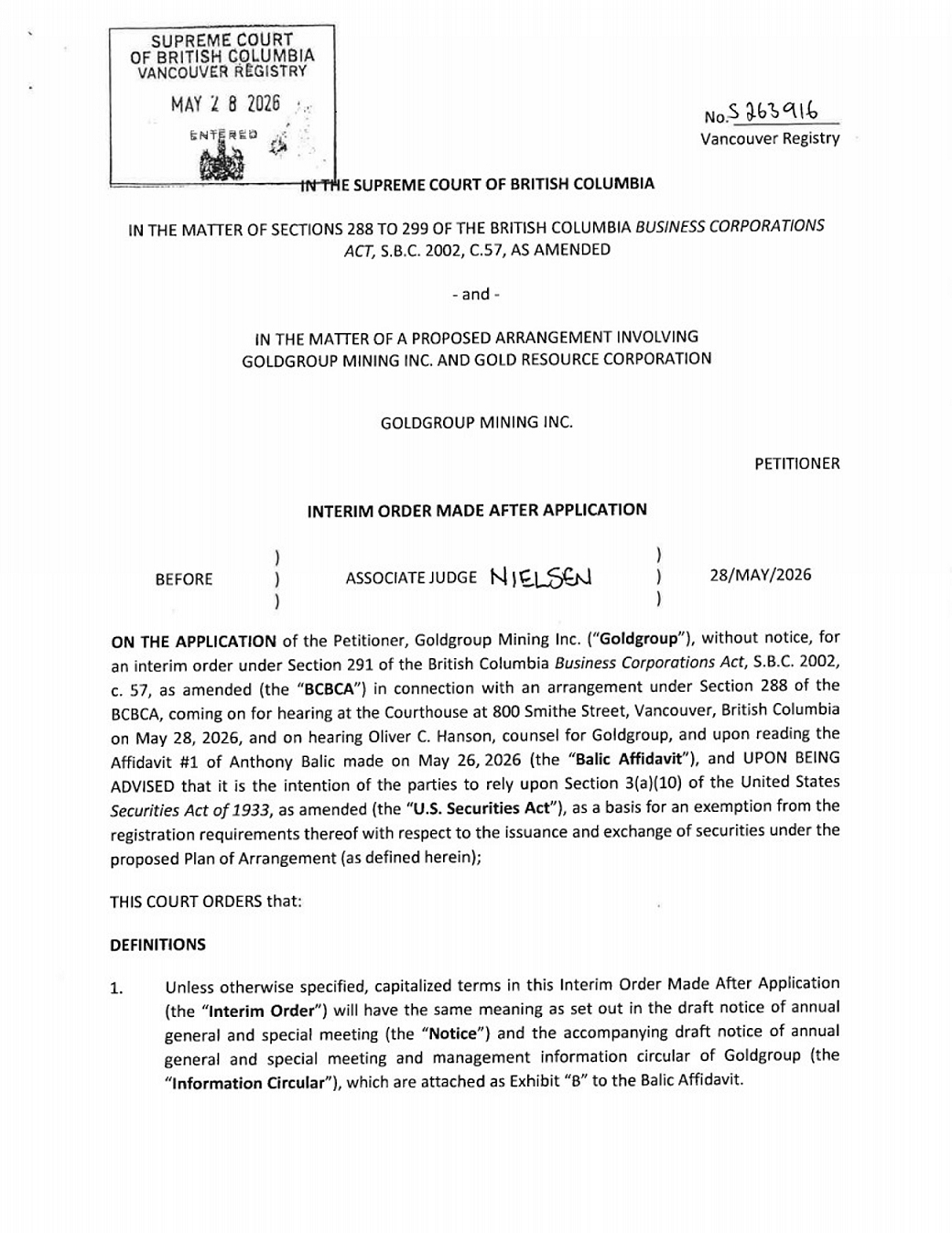
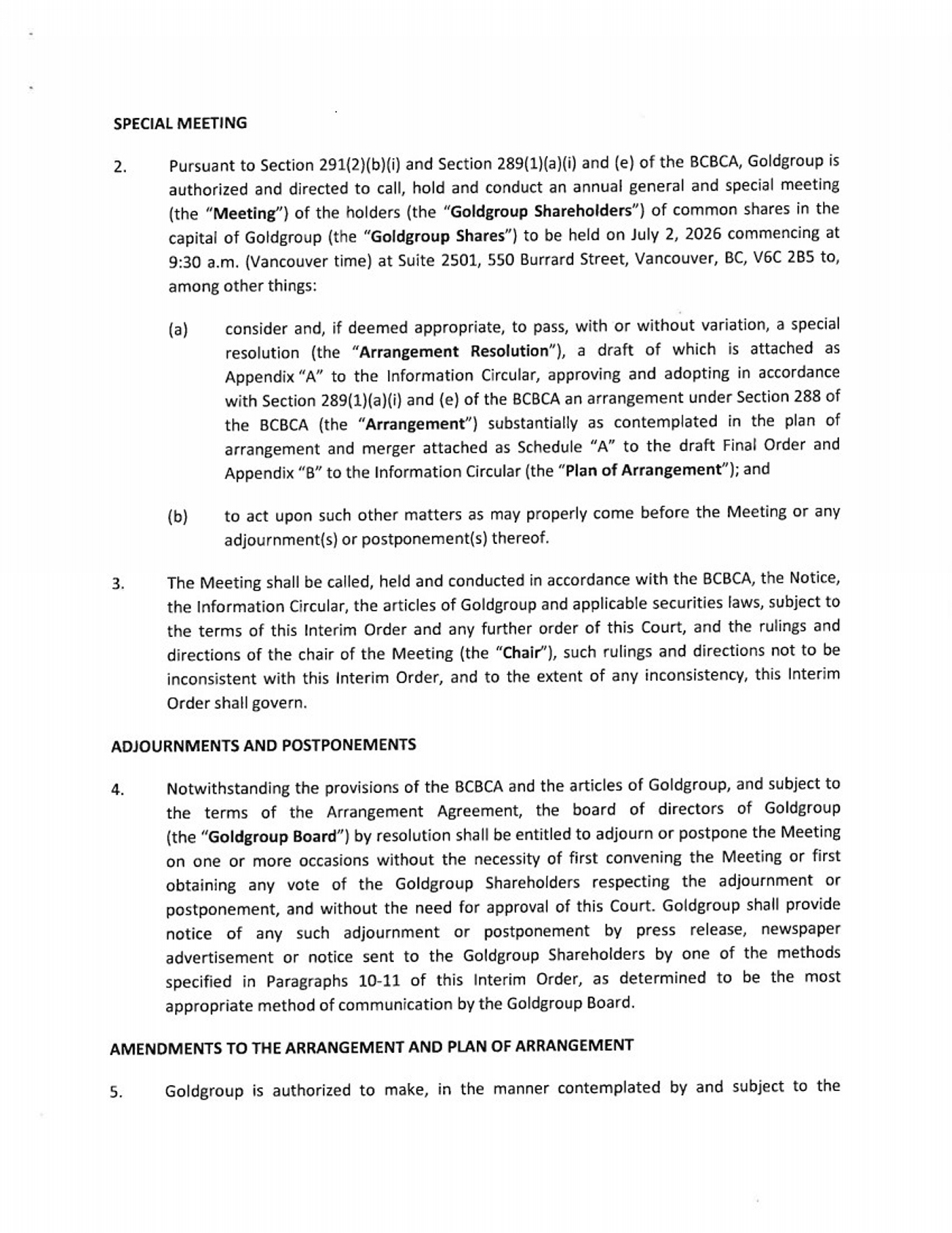
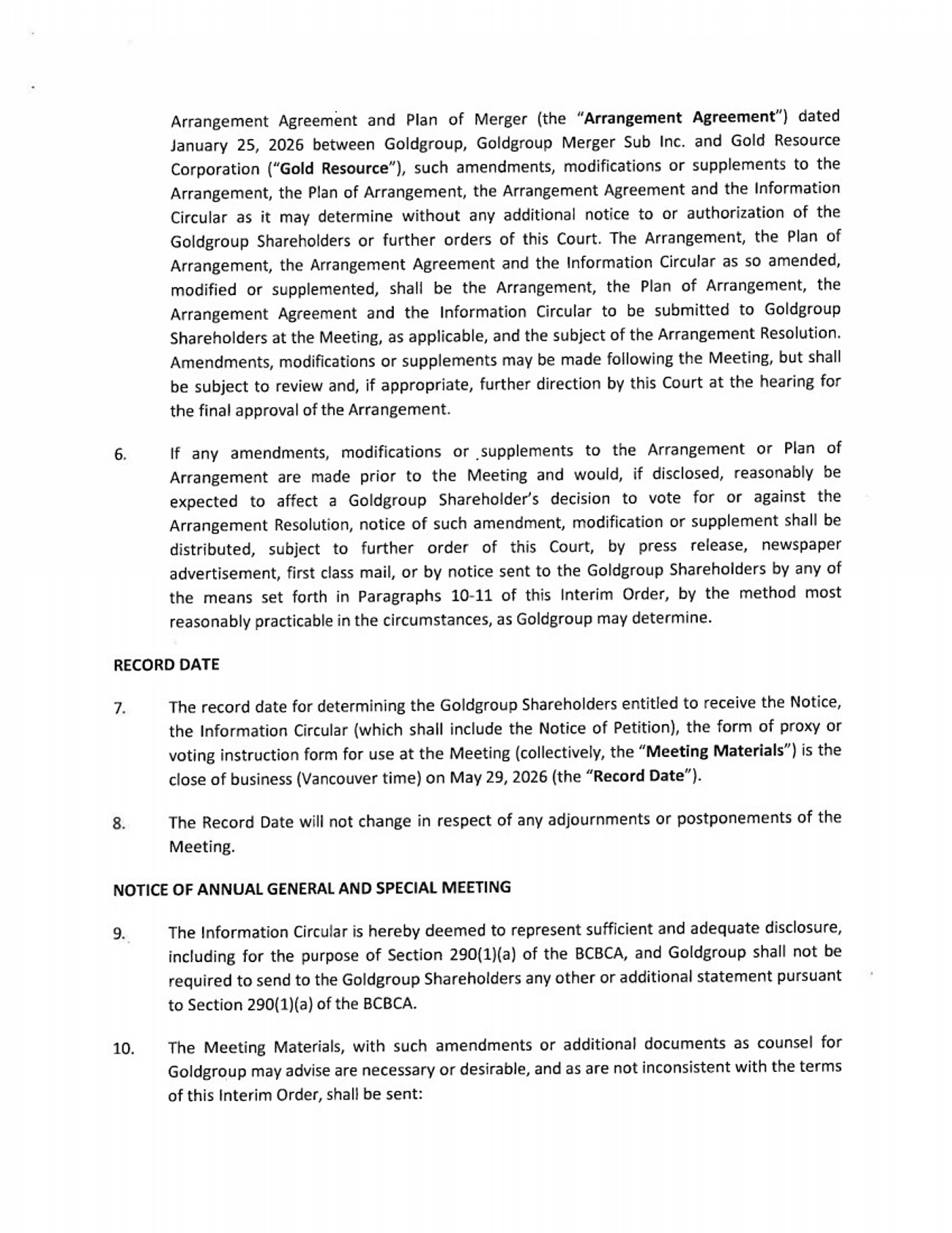
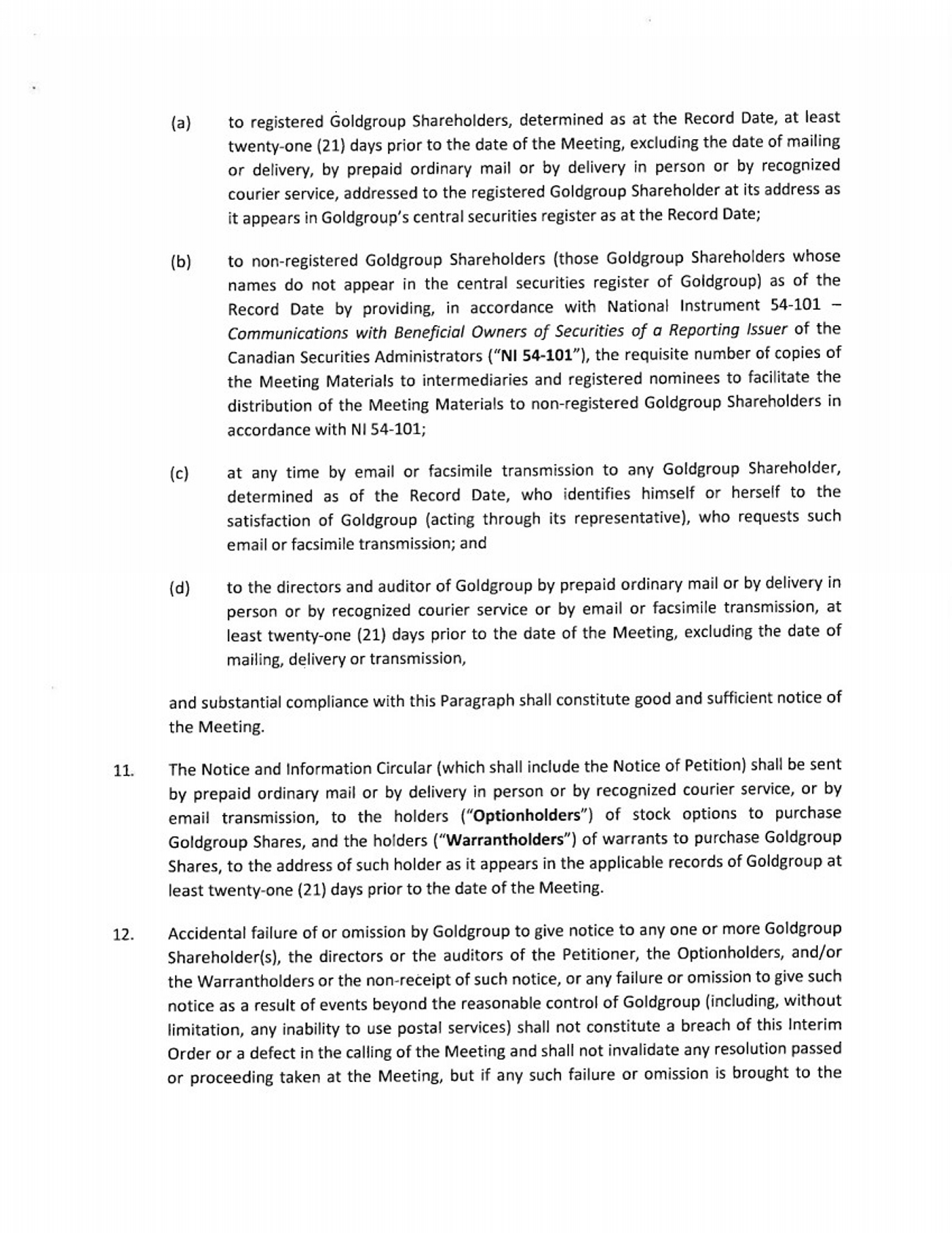
| APPENDIX “E” – INTERIM ORDER | E-1 |
- iv -
| APPENDIX “F” – NOTICE OF HEARING OF PETITION | F-1 |
| APPENDIX “G” – FAIRNESS OPINION | G-1 |
| APPENDIX “H” – UNAUDITED PRO FORMA CONDENSED COMBINED FINANCIAL STATEMENTS | H-1 |
| APPENDIX “I” – DISSENT PROVISIONS OF THE BUSINESS CORPORATIONS ACT (BRITISH COLUMBIA) | I-1 |
| APPENDIX “J” – OMNIBUS PLAN | J-1 |
| APPENDIX “K” – AUDIT COMMITTEE CHARTER | K-1 |
| APPENDIX “L” – NEW ARTICLES | L-1 |
- v -
INFORMATION CONTAINED IN THIS INFORMATION CIRCULAR
The information contained in this Information Circular, unless otherwise indicated, is given as of May 29, 2026.
No person has been authorized to give any information or to make any representation in connection with the matters being considered herein other than those contained in this Information Circular and, if given or made, such information or representation should be considered or relied upon as not having been authorized.
This Information Circular does not constitute an offer to sell, or a solicitation of an offer to acquire, any securities, or the solicitation of a proxy, by any person in any jurisdiction in which such an offer or solicitation is not authorized, or in which the person making such offer or solicitation is not qualified to do so, or to any person to whom it is unlawful to make such an offer of proxy solicitation. Neither the delivery of this Information Circular nor any distribution of securities referred to herein will, under any circumstances, create any implication that there has been no change in the information set forth herein since the date of this Information Circular.
Information contained in this Information Circular should not be construed as legal, tax or financial advice, and shareholders are urged to consult their own professional advisors in connection with the matters considered in this Information Circular.
The Arrangement has not been approved or disapproved by any securities regulatory authority, nor has any securities regulatory authority passed upon the fairness or merits of the Arrangement or upon the accuracy or adequacy of the information contained in this Information Circular and any representation to the contrary is unlawful.
CAUTIONARY NOTE REGARDING FORWARD-LOOKING STATEMENTS
This Information Circular and the documents incorporated into this Information Circular by reference contain “forward-looking statements” within the meaning of the U.S. Private Securities Litigation Reform Act of 1995 and “forward-looking information” within the meaning of the applicable Canadian securities legislation (forward-looking information and forward-looking statements being collectively hereinafter referred to as “forward-looking statements”) that are based on expectations, estimates and projections as at the date of this Information Circular or the dates of the documents incorporated herein by reference, as applicable. These forward-looking statements include but are not limited to statements and information concerning the Arrangement; the timing for the implementation of the Arrangement and the potential benefits of the Arrangement; the likelihood of the Arrangement being completed; steps of the Arrangement; statements relating to the business and future activities of, and developments related to, the Company and Gold Resource after the date of this Information Circular and prior to the Effective Time and of the Company, Gold Resource and the Resulting Issuer after the Effective Time; receipt of shareholder approval, Court approval, or TSXV approval of the Arrangement; market position, and future financial or operating performance of the Company and the Resulting Issuer; the potential listing of the Company’s Common Shares on the NYSE American; and, other events or conditions of the Company or Gold Resource that may occur in the future.
Any statements that involve discussions with respect to predictions, expectations, beliefs, plans, projections, objectives, assumptions or future events or performance (often but not always using phrases such as “expects”, or “does not expect”, “is expected”, “anticipates” or “does not anticipate”, “plans”, “budget”, “scheduled”, “forecasts”, “estimates”, “believes” or “intends” or variations of such words and phrases or stating that certain actions, events or results “may” or “could”, “would”, “might”, or “will” be taken to occur or be achieved) are not statements of historical fact and may be forward-looking statements and are intended to identify forward-looking statements.
- 1 -
These forward-looking statements are based on the beliefs of the Company’s management, as well as on assumptions, which such management believes to be reasonable based on information currently available at the time such statements were made. However, there can be no assurance that the forward-looking statements will prove to be accurate. Such assumptions and factors include, among other things, the satisfaction of the terms and conditions of the Arrangement, including the approval of the Arrangement and fairness by the Court, and the receipt of the required approvals and consents of any Governmental Authority.
By their nature, forward-looking statements are based on assumptions and involve known and unknown risks, uncertainties and other factors which may cause the actual results, performance or achievements of the Company, Gold Resource or the Resulting Issuer to be materially different from any future results, performance or achievements expressed or implied by the forward-looking statements. Forward-looking statements are subject to a variety of risks, uncertainties and other factors which could cause actual events or results to differ from those expressed or implied by the forward-looking statements, including, without limitation: (i) the possibility that the Company’s shareholders may not approve the Arrangement or that Gold Resource shareholders may not approve the Merger; (ii) the risk that one or more conditions to closing the Arrangement, including the required regulatory approvals, may not be satisfied or waived in a timely manner, or at all; (iii) uncertainties regarding the timing of the Arrangement, including the risk that it may be delayed or may not occur at all; (iv) the occurrence of events giving rise to the right of one or both parties to terminate the Arrangement Agreement, including under circumstances that might require payment of a termination fee; (v) the effects of the announcement or pendency of the Arrangement on the Company’s business operations, including its relationship with employees, contractors, clients, suppliers, and competitors; (vi) possible negative effects of the announcement of the Arrangement, or developments related thereto, on the market price of Common Shares and on the Company’s financial performance; (vii) potential legal proceedings or regulatory challenges related to the Arrangement; (viii) the risk of disruption to the Company’s ongoing operations due to the proposed Arrangement; (ix) the impact of evolving market dynamics, economic conditions, and industry competition on the Company’s business; (x) changes in applicable laws, regulations or accounting standards; (xi) material reductions in the Company’s liquidity or a limitation on its access to capital markets; (xii) potential adverse effects from operational disruptions; (xiii) uncertainties relating to the geoeconomic environment, including interest rates and inflation; (xiv) the risk factors detailed in this Information Circular under “Risk Factors”, and (xv) other risk factors as may be detailed from time to time in the Company’s continuous disclosure materials, copies of which are available under the Company’s profile on SEDAR+ at www.sedarplus.ca.
The foregoing list of risk factors is not exhaustive of the factors that may affect forward-looking statements of the Company and Gold Resource. Forward-looking statements are statements about the future and are inherently uncertain. Actual results could differ materially from those projected in the forward-looking statements as a result of the matters set out or incorporated by reference in this Information Circular generally and certain economic and business factors, some of which may be beyond the control of the Company and Gold Resource. Some of the important risks and uncertainties that could affect forward-looking statements are described further under the heading “Risk Factors”. The Company and Gold Resource do not intend, and do not assume any obligation, to update any forward-looking statements, other than as required by applicable law. For all of these reasons, shareholders should not place undue reliance on forward-looking statements.
- 2 -
GLOSSARY OF DEFINED TERMS
The following terms used in the Information Circular have the meanings set forth below.
| “Acquisition Proposal” | has the meaning ascribed to such term under the heading “The Arrangement Agreement – No Solicitation”; |
| “Amendment” | means the amendment to the Arrangement Agreement dated May 15, 2026 and entered into by the Company, Gold Resource and Merger Sub; |
| “Annual Report” | means Annual Report on Form 10-K, as amended, for the fiscal year ended December 31, 2025 of Gold Resource, as filed on SEDAR+ on March 18, 2026 and April 30, 2026; |
| “Arrangement” | means the arrangement of the Company under the provisions of Part 9, Division 5 of the BCBCA on the terms and subject to the conditions set out in the Plan of Arrangement, subject to any amendments or variations thereto made in accordance with the terms of the Arrangement Agreement or the Plan of Arrangement or made at the direction of the Court in the Final Order (with the prior written consent of both the Company and Gold Resource, each acting reasonably); |
| “Arrangement Agreement” | means the arrangement agreement and plan of merger among the Company, Gold Resource and Merger Sub dated January 25, 2026, as amended by the Amendment; |
| “Arrangement Resolution” | means the special resolution of Goldgroup’s shareholders approving the Plan of Arrangement, which is to be considered at the Meeting, substantially in the form as attached to this Information Circular as Appendix “A”; |
| “Articles Resolution” | means the special resolution of Goldgroup’s shareholders approving the adoption of the New Articles, which is to be considered at the Meeting, substantially in the form as listed under “Particulars to be Acted Upon – 5. Approval of Articles Resolution”; |
| “Ascent” | means Ascent Industries Corp.; |
| “ATB Cormark” | means ATB Cormark Capital Markets (formerly known as Cormark Securities Inc.) |
| “Audit Committee” | means the audit committee of the Board; |
| “Awards” | has the meaning ascribed to such term in the Omnibus Plan; |
| “Back Forty” | means Gold Resource’s Back Forty Project in Michigan, USA; |
| “BCBCA” | means the Business Corporations Act (British Columbia) and the regulations made thereunder, as may be amended from time to time; |
| “BCSC” | means the British Columbia Securities Commission; |
- 3 -
| “Board” or “Board of Directors” | means the board of directors of the Company; |
| “business day” | means any day that is not a Saturday, a Sunday or a statutory or civic holiday in Vancouver, British Columbia; |
| “Canadian Securities Laws” | means the Securities Act and all other applicable Canadian provincial and territorial securities Laws; |
| “Cassels” | means Cassels Brock & Blackwell LLP, Canadian counsel to Gold Resource; |
| “Cash Equivalent” | has the meaning ascribed to such term in the Omnibus Plan; |
| “Cause” | has the meaning ascribed to such term in the Omnibus Plan; |
| “CEO” | means chief executive officer; |
| “Cerro Prieto Project”, “Cerro Prieto Mine” or “Cerro Prieto” | means the Company’s Cerro Prieto mine located in Sonoro State, Mexico; |
| “CFO” | means chief financial officer; |
| “Change of Control” | has the meaning ascribed to such term in the Omnibus Plan; |
| “Change of Recommendation” | has the meaning ascribed to such term under the heading “The Arrangement Agreement – No Solicitation”; |
| “CIRO” | means Canadian Investment Regulatory Organization; |
| “Code” | means the United States Internal Revenue Code of 1986, as amended, and all regulations and guidance promulgated thereunder; |
| “Colorado Act” | means the Colorado Corporations and Associations Act and the regulations made thereunder, as now in effect and as they may be promulgated or amended from time to time; |
| “Common Shares” | means common shares without par value in the capital of the Company; |
| “Company” or “Goldgroup” | means Goldgroup Mining Inc.; |
| “Computershare” | means Computershare Investor Services Inc.; |
| “Consolidation” | means the consolidation of all of the issued and outstanding Common Shares at the Consolidation Ratio; |
| “Consolidation Ratio” | means the ratio to be determined jointly by the Company and Gold Resource, and approved by the TSXV, prior to the Effective Date; |
- 4 -
| “Consultant” | has the meaning ascribed to such term in the Omnibus Plan; |
| “Court” | means Supreme Court of British Columbia; |
| “Cozen” | means Cozen O’Connor LLP, counsel to the Company; |
| “Davis Graham” | means Davis Graham & Stubbs LLP, US counsel to Gold Resource; |
| “DDGM” | means Gold Resource’s Don David Gold Mine in Oaxaca, Mexico; |
| “Depositary” | means Computershare in its capacity as depositary under the Plan of Arrangement; |
| “Dissent Procedures” | has the meaning ascribed to such term under the heading “The Arrangement – Dissent Rights”; |
| “Dissent Rights” | means the right of Registered Shareholders to exercise a right of dissent under the BCBCA in strict compliance with the Dissent Procedures; |
| “Dissent Shares” | means the Common Shares held by Dissenting Shareholders in respect of which such Dissenting Shareholders have validly exercised his, her or its Dissent Rights and delivered a Notice of Dissent; |
| “Dissenting Shareholder” | means a Registered Shareholder who exercises Dissent Rights in respect of the Plan of Arrangement in strict compliance with the BCBCA, as modified or supplemented by the Interim Order or any other order(s) of the Court and who has not withdrawn or has been deemed to have withdrawn such exercise of such Dissent Rights; |
| “Dividend Equivalents” | has the meaning ascribed to such term in the Omnibus Plan; |
| “DSU” | means a deferred share unit, as granted and more particularly described in the Omnibus Plan; |
| “DynaMexico” | means DynaResource de Mexico, S.A. de C.V.; |
| “DynaResource” | means DynaUSA and DynaMexico; |
| “DynaUSA” | means DynaResource, Inc.; |
| “Effective Date” | means the date the Arrangement becomes effective under the BCBCA and the Merger becomes effective under the Colorado Act, or such other date as may be agreed to by the Company and Gold Resource; |
| “Effective Time” | means the effective time of the Merger; |
| “Eligible Participant” | has the meaning ascribed to such term in the Omnibus Plan; |
| “Exchange Agent” | means Computershare Investor Services Inc.; |
- 5 -
| “Exchange Ratio” | means 1.4476 Common Shares for each Gold Resource Share, which will automatically be adjusted to a number of Resulting Issuer Shares for each Gold Resource Share equal to the quotient obtained by dividing 1.4476 by the Consolidation Ratio, following consummation of the Consolidation, and subject to adjustment pursuant to Section 2.17 of the Arrangement Agreement; |
| “Fairness Opinion” | means the fairness opinion dated January 25, 2026 provided by Fort Capital to the Special Committee in respect of the proposed Plan of Arrangement, a full copy of which is attached as Appendix “G” to this Information Circular; |
| “Final Order” | means the final order of the Court approving the Arrangement, in form and substance acceptable to the Company and Gold Resource, each acting reasonably, after a hearing upon the procedural and substantive fairness of the terms and conditions of the Arrangement, as such order may be affirmed, amended, modified, supplemented or varied by the Court (with the consent of both the Company and Gold Resource, each acting reasonably) at any time prior to the Effective Date or, if appealed, as affirmed or amended (provided that any such amendment, modification, supplement or variation is acceptable to both the Company and Gold Resource, each acting reasonably) on appeal unless such appeal is withdrawn, abandoned or denied; |
| “Fort Capital” | means Fort Capital Partners; |
| “Goldgroup Voting Agreements” | means the voting and support agreements entered into by each of the directors, officers, and certain shareholders of Goldgroup with Gold Resource; |
| “Gold Resource” | means Gold Resource Corporation; |
| “Gold Resource Awards” | means, collectively, Gold Resource Options, Gold Resource DSUs, Gold Resource PSUs and Gold Resource RSUs; |
| “Gold Resource Board” | means the board of directors of Gold Resource; |
| “Gold Resource DSU” | means a deferred share unit of Gold Resource; |
| “Gold Resource Option” | means a stock option of Gold Resource; |
| “Gold Resource PSU” | means a performance share unit of Gold Resource; |
| “Gold Resource RSU” | means a restricted share unit of Gold Resource; |
| “Gold Resource Share” | means the common stock, par value US$0.001, of Gold Resource; |
| “Gold Resource Voting Agreements” | means the voting and support agreements entered into by each of the directors and officers of Gold Resource with the Company; |
- 6 -
| “Governmental Authority” | means any multinational, federal, provincial, territorial, state, regional, municipal, local, foreign or other government or governmental body and any division, agent, official, agency, commission, board or authority of any government, governmental body, quasi-governmental or private body (including the TSXV and the NYSE American or any other stock exchange) exercising any statutory, regulatory, expropriation or taxing authority under the authority of any of the foregoing and any domestic, foreign or international judicial, quasi-judicial or administrative court, tribunal, commission, board, panel or arbitrator acting under the authority of any of the foregoing; |
| “HSR Act” | means the Hart-Scott-Rodino Antitrust Improvements Act of 1976, as amended; |
| “IASB” | means the International Accounting Standards Board; |
| “IFRS” | means the International Financial Reporting Standards developed by the IASB; |
| “Incentive Stock Options” | has the meaning ascribed to such term in the Omnibus Plan; |
| “Information Circular” | means the Notice of Meeting and this management information circular of the Company, including all appendices attached hereto, provided to the Company’s shareholders in connection with the Meeting; |
| “Interim Order” | means the interim order of the Court to be issued following the application therefor submitted to the Court as contemplated by the Arrangement Agreement, after being informed of the intention to rely upon the exemption from registration under Section 3(a)(10) of the U.S. Securities Act with respect to the Resulting Issuer Shares and Replacement Options issued pursuant to the Arrangement, in form and substance acceptable to the Company and Gold Resource, each acting reasonably, providing for, among other things, the calling and holding of the Meeting, as such order may be affirmed, amended, modified, supplemented or varied by the Court with the consent of both the Company and Gold Resource, each acting reasonably, a copy of which is attached as Appendix “E” to this Information Circular; |
| “Intermediary” | means a broker, investment firm, clearing house and other similar entities that own securities on behalf of Non-Registered Shareholders; |
| “Investor Relations Services Providers” | has the meaning ascribed to such term in TSXV Policy 4.4; |
| “IRS” | means the Internal Revenue Service of the United States of America; |
| “IT” | means information technology; |
| “Magna” | means Magna Gold Corp.; |
- 7 -
| “McMillan” | means McMillan LLP, independent legal counsel to the Special Committee; |
| “Meeting” | means the annual general and special meeting of Goldgroup shareholders to be held on July 2, 2026 and any adjournment(s) or postponement(s) thereof, held in order to, among other things, consider and, if thought fit, approve the Plan of Arrangement in accordance with the Interim Order; |
| “Merger” | means the proposed reverse triangular merger, in which Merger Sub will merge with and into Gold Resource under Colorado law, with Gold Resource surviving and continuing as the surviving company as a wholly owned subsidiary of Goldgroup; |
| “Merger Consideration” | means 1.4476 Common Shares (which will automatically be adjusted to a number of Common Shares for each Gold Resource Share equal to the quotient obtained by dividing 1.4476 by the Consolidation Ratio) to be issued by Goldgroup in exchange for the transfer of each outstanding Gold Resource Share to Goldgroup at the Effective Time; |
| “Merger Sub” | means Goldgroup Merger Sub Inc., a Colorado corporation and wholly owned subsidiary of Goldgroup; |
| “Mjardin” | means Mjardin Group Inc.; |
| “Molimentales” | means Molimentales del Noroeste, S.A. de C.V.; |
| “NAFTA” | means the North American Free Trade Agreement, which was replaced by the Canada–United States–Mexico Agreement, or CUSMA, effective as of July 1, 2020; |
| “NEO” | means named executive officer; |
| “New Articles” | means the Company’s proposed new articles, which are summarized under “Particulars to be Acted Upon – 5. Approval of Articles Resolution”; |
| “NGO” | means non-governmental organization; |
| “NI 43-101” | means National Instrument 43-101 – Standards of Disclosure for Mineral Projects; |
| “NI 51-102” | means National Instrument 51-102 – Continuous Disclosure Obligations; |
| “NI 52-110” | means National Instrument 52-110 – Audit Committees; |
| “NI 54-101” | means National Instrument 54-101 – Communication with Beneficial Owners of Securities of a Reporting Issuer; |
| “Notice of Dissent” | has the meaning ascribed to such term under the heading “The Arrangement – Dissent Rights”; |
- 8 -
| “Notice of Meeting” | means the Company’s notice of meeting issued in connection with the Meeting; |
| “Notice Shares” | has the meaning ascribed to such term under the heading “The Arrangement – Dissent Rights”; |
| “Nominee” | means each of Corry J. Silbernagel, Anthony Balic, Blair Jordan and Roberto Guzman to be nominated for election as directors of the Company; |
| “Non-Registered Shareholders” | means a shareholder of the Company who is not a Registered Shareholder; |
| “NYSE American” | means the NYSE American LLC; |
| “NYSE American Listing” | means the proposed listing of the Resulting Issuer Shares on the NYSE American following completion of the Arrangement and Merger; |
| “Omnibus Plan” | means the omnibus equity incentive plan, which the Company will table for shareholder approval at the Meeting and is summarized under “Particulars to be Acted Upon – 4. Approval of Omnibus Plan Resolution”, and a full copy of which is attached as Appendix “J” to this Information Circular; |
| “Omnibus Plan Resolution” | means the ordinary resolution of Goldgroup’s shareholders approving the Omnibus Plan, which is to be considered at the Meeting, substantially in the form as listed under “Particulars to be Acted Upon – 4. Approval of Omnibus Plan Resolution”; |
| “Option” | means an incentive stock option of the Company entitling the holder thereof to acquire one (1) Common Share pursuant to the Stock Option Plan or Omnibus Plan, as applicable; |
| “Optionholder” | means a holder of Options; |
| “Option Price” | has the meaning ascribed to such term in the Omnibus Plan; |
| “OTC” | means OTCQX® Best Market; |
| “Outside Date” | has the meaning ascribed to such term under the heading “The Arrangement Agreement – Material Adverse Effect”; |
| “Performance Criteria” | has the meaning ascribed to such term in the Omnibus Plan; |
| “Pinos Project” | means the Company’s former Pinos gold project in Mexico; |
| “Plan of Arrangement” | means the amended and restated plan of arrangement and merger substantially in the form as attached to this Information Circular as Appendix “B”, as amended, modified or supplemented from time to time in accordance with Article 6 of the Plan of Arrangement or at the direction of the Court in the Final Order, with the consent of the Company and Gold Resource, each acting reasonably; |
- 9 -
| “Preliminary LOI” | means the non-binding letter of intent between the Company and Gold Resource executed on January 24, 2025; |
| “PSU” | means a performance share unit, as granted and more particularly described the Omnibus Plan; |
| “PwC” | means PriceWaterhouseCoopers Inc.; |
| “Record Date” | means May 29, 2026 in respect of the Meeting; |
| “Registered Shareholder” | means a shareholder of the Company who holds Common Shares in its own name; |
| “Replacement Options” | means Options, which will be issued to holders of Gold Resource Options, who are residents of Canada, in exchange for Gold Resource Options, which will be deemed to be vested to the fullest extent at the Effective Time, as adjusted by the Exchange Ratio; |
| “Response Period” | has the meaning ascribed to such term under the heading “The Arrangement Agreement – No Solicitation”; |
| “Resulting Issuer” | means Goldgroup following completion of the Transaction; |
| “Resulting Issuer Shares” | means the common shares without par value in the capital of the Resulting Issuer; |
| “RSU” | means a restricted share unit, as granted and more particularly described in the Omnibus Plan; |
| “San Francisco Mine”, “San Francisco Project” or “San Francisco” | means the Company’s San Francisco mine located in Sonoro State, Mexico; |
| “SEC” | means the United States Securities and Exchange Commission; |
| “Securities Act” | means the Securities Act (British Columbia) and the regulations made thereunder; |
| “Securities Laws” | means the Canadian Securities Laws and U.S. Securities Laws and all applicable stock exchange rules and listing standards; |
| “SEDAR+” | means the system for the transmission of documents known as the System for Electronic Data Analysis and Retrieval +, as outlined in National Instrument 13-103 – System for Electronic Data Analysis and Retrieval +, which can be accessed online at www.sedarplus.ca; |
| “Share Compensation Arrangement” | has the meaning ascribed to such term in the Omnibus Plan; |
- 10 -
| “SJG Project” | means the San José de Gracia project located in the State of Sinaloa, Mexico; |
| “Special Committee” | means the Company’s special committee comprised entirely of independent directors to consider, review and evaluate possible strategic business transactions and other potential strategic alternatives for Goldgroup, including the potential business combination with Gold Resource; |
| “Stock Option Plan” | means the Company’s stock option plan adopted in June 2021, as amended in February 2024, which the Company wishes to replace with the Omnibus Plan; |
| “Subsidiaries” | has the meaning ascribed to such term in the Omnibus Plan; |
| “Superior Proposal” | has the meaning ascribed to such term under the heading “The Arrangement Agreement – No Solicitation”; |
| “surviving company” | means Gold Resource following the completion of the Merger and Arrangement, as a wholly owned subsidiary of Goldgroup; |
| “Termination of Service” | has the meaning ascribed to such term in the Omnibus Plan; |
| “Total Direct Compensation” | means the Company’s two basic components of executive compensation consisting of a fixed salary and performance-based variable incentive compensation; |
| “Transaction” | means all of the transactions contemplated by the Arrangement Agreement, including the Merger, the Arrangement, and the Consolidation; |
| “TSX” | means the Toronto Stock Exchange; |
| “TSXV” | means the TSX Venture Exchange; |
| “TSXV Policy 4.4” | means TSXV Policy 4.4 – Security Based Compensation; |
| “U.S. Participant” | has the meaning ascribed to such term in the Omnibus Plan; |
| “U.S. Securities Act” | means the United States Securities Act of 1933, as amended, and the rules and regulations promulgated thereunder; |
| “U.S. Securities Laws” | means all applicable securities legislation in the United States, including the U.S. Securities Act, the U.S. Securities Exchange Act of 1934, as amended, and the rules and regulations promulgated thereunder, including judicial and administrative interpretations thereof, and the securities laws of the states of the United States; |
| “Vested Options” | has the meaning ascribed to such term in the Omnibus Plan; |
| “Voting Agreements” | means the Goldgroup Voting Agreements and the Gold Resource Voting Agreements; and |
| “Voting Deadline” | means June 29, 2026, the deadline for returning a completed proxy or voting instruction in respect of the Meeting. |
- 11 -
GENERAL INFORMATION CONCERNING THE MEETING
Time, Date and Place
This Information Circular is furnished in connection with the solicitation of proxies by or on behalf of the management of Goldgroup for use at the Meeting to be held on Thursday, July 2, 2026, at 9:30 a.m. (PDT), or any adjournment thereof, at Suite 2501, 550 Burrard Street, Vancouver, British Columbia, V6C 2B5, Canada for the purposes set out in the accompanying Notice of Meeting.
The information contained in this Information Circular is given as of May 29, 2026. Unless otherwise indicated, all references to “$”, “US$” or “dollars” in this Information Circular mean United States dollars. References to “C$” in this Information Circular mean Canadian dollars.
DOCUMENTS INCORPORATED BY REFERENCE
Information with respect to Gold Resource has been incorporated by reference in this Information Circular from documents filed with the securities commissions or similar regulatory authorities in Alberta, British Columbia, Nova Scotia, Ontario and Saskatchewan. Copies of the documents incorporated herein by reference may be obtained on request without charge from Gold Resource at info@grc-usa.com or by mail at 7887 East Belleview Avenue, Suite 1100, Denver, Colorado 80111 and are also available electronically under Gold Resource’s profile on SEDAR+ at www.sedarplus.ca.
The following document filed by Gold Resource with the securities commissions or similar regulatory authorities in Alberta, British Columbia, Nova Scotia, Ontario and Saskatchewan is specifically incorporated by reference into, and forms an integral part of, this Information Circular:
| · | Annual Report on Form 10-K, as amended, for the fiscal year ended December 31, 2025 (the “Annual Report”) as filed on SEDAR+ on March 18, 2026 and April 30, 2026. |
GENERAL PROXY INFORMATION
Persons Making the Solicitation
Goldgroup’s management is using this Information Circular to solicit proxies from shareholders for use at the Meeting. The solicitation of proxies will be primarily by mail, but Goldgroup’s directors, officers and regular employees may also solicit proxies personally or by telephone. Goldgroup will bear all costs of the solicitation. Goldgroup has arranged for Intermediaries to forward the Meeting materials to beneficial owners of Common Shares held of record by those Intermediaries, and Goldgroup may reimburse the Intermediaries for their reasonable fees and disbursements in that regard.
Voting of Proxies
The Common Shares represented by the accompanying form of proxy will be voted at the Meeting, and, where a choice is specified in respect of any matter to be acted upon, will be voted or withheld from voting in accordance with the specification made. In the absence of such a specification, the person designated in the form of proxy will vote in favour of all matters to be acted on at the Meeting.
Registered Shareholders are requested to date, sign and return the form of proxy for use at the Meeting if they are unable to attend the Meeting personally. To be effective, forms of proxy must be received by the Company’s registrar and transfer agent, Computershare Investor Services Inc., no later than 48 hours (excluding Saturdays, Sundays and holidays) before the time of the Meeting by 9:30 a.m. (Vancouver time), on Monday, June 29, 2026 or any adjournment thereof at which the proxy is to be used.
- 12 -
A Registered Shareholder must return the properly completed proxy to Computershare as follows:
| 1. | By mail or personal delivery to Computershare Investor Services Inc., 320 Bay Street, 14th Floor, Toronto, ON M5H 4A6, Canada, Attention: Proxy Department; |
| 2. | By telephone by calling 1-866-732-VOTE (8683) (toll free within Canada or the U.S.) or 312-588-4291 (direct - international) from a touch tone telephone and referring to your control number provided on the form of proxy delivered to you; or |
| 3. | Over the internet by going to www.investorvote.com and following the online voting instructions given to you and referring to your control number provided on the form of proxy delivered to you. |
The form of proxy confers discretionary authority upon the persons named therein with respect to amendments or variations to the matters set forth in the Notice of Meeting, or all other business or matters that may properly come before the Meeting. At the date hereof, management of the Company knows of no such amendments, variations or other business or matters to come before the Meeting.
Exercise of Discretion
The persons named in the enclosed form of proxy will vote the Common Shares in respect of which they are appointed in accordance with the direction of the shareholders appointing them. In the absence of such direction, such Common Shares will be voted in the discretion of the persons named in the proxy. The enclosed proxy confers discretionary authority upon the persons named therein with respect to amendments or variations to matters identified in the Notice of Meeting and with respect to other matters which may properly come before the Meeting. At the time of printing of this Information Circular, management knows of no such amendments, variations or other matters to come before the Meeting. However, if any other matters which are not now known to management should properly come before the Meeting, the proxy will be voted on such matters in accordance with the best judgment of the named proxies.
Registered Holders
Only shareholders registered as shareholders in the Company’s shareholder registry maintained by the Company’s registrar and transfer agent or duly appointed proxyholders (except as discussed below under “Non-Registered Shareholders”) will be recognized to make motions or vote at the Meeting.
Non-Registered Shareholders
Many shareholders are “non-registered” shareholders because the Common Shares they own are not registered in their names but are instead registered in the name of the brokerage firm, bank or trust company or other Intermediary through which they purchased the Common Shares. More particularly, a person is a Non-Registered Shareholder in respect of Common Shares, which are held on behalf of that person and which are registered either: (a) in the name of an Intermediary that the Non-Registered Holder deals with in respect of the shares (Intermediaries include, among others, banks, trust companies, securities dealers or brokers and trustees or administrators of self-administered RRSPs, RRIFs, RESPs and similar plans); or (b) in the name of a clearing agency (such as CDS & Co., the registration name for CDS Clearing and Depository Services Inc., which acts as nominee for many Canadian brokerage firms) of which the Intermediary is a participant.
- 13 -
Pursuant to NI 54-101, the Company is distributing copies of proxy-related materials in connection with this Meeting (including this Information Circular) indirectly to Non-Registered Holders. The Company is not relying on the notice-and-access delivery procedures outlined in NI 54-101 to distribute copies of proxy-related materials in connection with the Meeting. Intermediaries that receive the proxy-related materials are required to forward the proxy-related materials to Non-Registered Holders unless a Non-Registered Holder has waived the right to receive them. Intermediaries often use service companies to forward the proxy-related materials to the Non-Registered Holders.
There are two kinds of Non-Registered Holders: (a) those who object to their name being made known to the issuers of securities which they own (called “OBOs”, for Objecting Beneficial Owners) and (b) those who do not object to the issuers of the securities they own knowing who they are (called “NOBOs”, for Non-Objecting Beneficial Owners).
The Company will pay for Intermediaries to deliver to OBOs (who have not otherwise waived their right to receive proxy-related materials) copies of the proxy-related materials.
Generally, Non-Registered Holders who have not waived the right to receive proxy-related materials (including OBOs who have made the necessary arrangements with their Intermediary for the payment of delivery and receipt of such proxy-related materials) will be sent a voting instruction form which must be completed, signed and returned by the Non-Registered Holder in accordance with the Intermediary’s directions on the voting instruction form. In some cases, such Non-Registered Holders will instead be given a proxy which has already been signed by the Intermediary (typically by a facsimile, stamped signature) which is restricted as to the number of Common Shares beneficially owned by the Non-Registered Holder but which is not otherwise completed. This form of proxy does not need to be signed by the Non-Registered Holder, but, to be used at the Meeting, needs to be properly completed and deposited with Computershare.
The purpose of these procedures is to permit Non-Registered Holders to direct the voting of the Common Shares that they beneficially own. Should a Non-Registered Holder wish to attend and vote at the Meeting in person (or have another person attend and vote on behalf of the Non-Registered Holder), the Non-Registered Holder should insert the Non-Registered Holder’s (or such other person’s) name in the blank space provided or, in the case of a voting instruction form, follow the corresponding instructions on the form. Non-Registered Holders should carefully follow the instructions of their Intermediaries and their service companies, including instructions regarding when and where the voting instruction form or proxy form is to be delivered.
Shareholders with questions respecting the voting of shares held through a stockbroker or other Intermediary should contact that stockbroker or other Intermediary for assistance.
REVOCABILITY OF PROXIES
The persons named in the proxy are directors and officers of the Company. You have the right to appoint a nominee of your choice, who need not be a shareholder, to attend and act on your behalf at the Meeting.
A shareholder desiring to appoint a nominee to represent him or her at the Meeting may do so either by inserting the name of such person or company in the blank space provided in the form of proxy and striking out the names of the management nominees or by duly completing another proper form of proxy and, in either case, depositing the completed proxy before the specified time as provided below.
In addition to revocation in any other manner permitted by law, a Registered Shareholder who has given a proxy may revoke it: (a) by attending the Meeting and voting the Registered Shareholder’s Common Shares, (b) by fully executing another proxy bearing a later date and duly depositing the same before the specified time, or (c) by executing a valid notice of revocation (where a new proxy is not also filed).
- 14 -
A later dated proxy or notice of revocation must be executed by the Registered Shareholder or the Registered Shareholder’s authorized attorney in writing, or, if the Registered Shareholder is a corporation, under its corporate seal by an officer or attorney duly authorized, and delivered by mail (via postage paid return envelope) at Computershare Investor Services Inc., attention: Proxy Department, 320 Bay Street, 14th Floor, Toronto, ON M5H 4A6, Canada or to the head office of the Company located at Suite 410, 1111 Melville Street, Vancouver, British Columbia, V6E 3V6, Canada
A later dated proxy must be received before 9:30 a.m. (PDT) on June 29, 2026, or if the Meeting is adjourned, the day that is two business days before any reconvening thereof at which the proxy is to be used, or to the Chair of the Meeting on the day of the Meeting or any reconvening thereof, or in any other manner provided by law. Only Registered Shareholders have the right to revoke a proxy. Non-Registered Shareholders who wish to change their vote must, in sufficient time in advance of the Meeting, arrange for their Intermediaries to change the vote and, if necessary, revoke their proxy. A revocation of proxy will not affect a matter on which a vote is taken before the revocation.
INTEREST OF CERTAIN PERSONS IN MATTERS TO BE ACTED UPON
Except as disclosed in this Information Circular, management of the Company is not aware of any material interest of any person that has been a director or executive officer of the Company since the beginning of the last financial year of the Company, any proposed nominee for election as a director, or any associate or affiliate of any of the foregoing, in any matter to be acted on at the Meeting.
Certain members of the Company’s management and Board of Directors have an interest in the approval of the Arrangement Resolution as they are entitled to receive certain payments upon the completion of the Arrangement in accordance with the terms of their executive consulting agreements. Mr. Ralph Shearing, the Company’s CEO, will be entitled to receive an amount equal to his annual fee, which amounts to C$159,000, if he is terminated, other than for just cause, within 12 months following a “change of control” (as defined in Mr. Shearing’s executive consulting agreement, which definition is set out under the heading “Employment, Consulting and Management Agreements” in this Information Circular). If Mr. Shearing is terminated, other than for just cause, following 12 months of a change of control, Mr. Shearing will be entitled to receive an amount equal to 1.5 times his annual fee, which amounts to C$238,500. At the sole option of the Company, 60% of the payment can be made through the issuance of Common Shares, or upon written request by Mr. Shearing and as approved by the Company, any amount in excess of 60% can also be paid through the issuance of Common Shares. In addition, any Options held by Mr. Shearing will immediately vest in the case of a change of control. Mr. Anthony Balic, a member of the Board and the Company’s CFO and Corporate Secretary, will be entitled to receive a one-time bonus of C$75,000 upon the closing of the Arrangement. See also “Employment, Consulting and Management Agreements”.
In addition, Company will seek approval of the Omnibus Plan at the Meeting, which will replace the Company’s current Stock Option Plan. Directors and executive officers of the Company may participate in the Omnibus Plan. Accordingly, the Company’s directors and officers have an interest in the approval of the Omnibus Plan Resolution.
RECORD DATE
The Record Date for determining persons entitled to receive notice of and vote at the Meeting is May 29, 2026. Only persons who were Registered Shareholders as of the close of business on May 29, 2026 are entitled to vote at the Meeting, or any adjournment or postponement thereof, in the manner and subject to the procedures described in this Information Circular. A quorum for the Meeting shall be two persons who are, or who represent by proxy, shareholders who, in the aggregate, hold at least 5% of the issued shares entitled to be voted at the Meeting.
- 15 -
VOTING SECURITIES AND PRINCIPAL HOLDERS OF VOTING SECURITIES
The Company’s authorized capital consists of an unlimited number of Common Shares without par value. The Common Shares were listed for trading on the TSX until February 2024, when the listing was transitioned to the TSXV under the symbol “GGA”.
As at the date hereof, the Company has issued and outstanding 301,529,908 fully paid and non-assessable Common Shares, each share carrying the right to one vote. The Company has no other classes of voting securities and does not have any classes of restricted securities.
To the knowledge of the directors and executive officers of the Company, as of the date of this Information Circular, the persons that beneficially own, directly or indirectly, voting securities carrying 10% or more of the voting rights attached to the Common Shares are as follows:
| Name | Number of Shares Owned | Percentage of Outstanding Shares(1) | ||||||
| Calu Opportunity Fund LP | 55,297,000 | 18.34 | % | |||||
Note:
| (1) | Based on 301,529,908 Common Shares outstanding as of the date of this Information Circular. |
ELECTION OF DIRECTORS
There are currently four directors on the Company’s Board of Directors, all of whom are standing for re-election as directors of the Company at the Meeting.
However, if the Arrangement Resolution is approved at the Meeting and the Plan of Arrangement is successfully completed, the Board will be reconstituted in accordance with the terms of the Arrangement Agreement. Please see “The Arrangement Agreement – Officers and Directors upon Completion of the Arrangement and Merger” for information on the proposed composition of the Board of Directors following completion of the Arrangement.
Management does not contemplate that any of the current nominees will be unable to serve as a director. However, if a nominee should be unable to so serve for any reason prior to the Meeting, the persons named in the enclosed form of proxy reserve the right to vote for another nominee in their discretion. Unless a director’s office is earlier vacated in accordance with the Business Corporations Act (British Columbia) and the Articles of the Company, each director elected holds office until the next annual meeting or until his successor is appointed.
At the Meeting, the Company will ask shareholders to vote for the election of the four nominees proposed by the Company as directors. Each holder of Common Shares will be entitled to cast its votes for, or withhold its votes from, the election of each director. The persons named in the form of proxy as proxyholders intend to vote for the election of all nominees whose names are set forth in this Information Circular, unless instructed otherwise.
- 16 -
Majority Voting for Directors
As part of its ongoing review of corporate governance practices, the Company requires, in an uncontested election of directors, any nominee for election as a director who receives a greater number of votes “withheld” than votes “for” to tender his or her resignation to the Chair of the Board of Directors promptly following the Meeting. The Corporate Governance and Nominating Committee will consider the offer of resignation and make a recommendation to the Board of Directors on whether to accept it. In considering whether to recommend acceptance of the resignation, the Corporate Governance and Nominating Committee will consider all factors deemed relevant by members of such Committee. The Corporate Governance and Nominating Committee will be expected to recommend acceptance of the resignation except in situations where the consideration would warrant the applicable director continuing to serve on the Board of Directors. The Board of Directors will make its final decision and announce it in a news release within 90 days following the Meeting. A director who tenders his resignation pursuant to this policy will not participate in any meeting of the Board of Directors or the Corporate Governance and Nominating Committee at which the resignation is considered.
Advance Notice Article
The Board of Directors has adopted an advance notice article, which has been ratified by shareholders. The advance notice by-law sets forth procedures for any shareholder who intends to nominate any person for election as a director of the Company other than pursuant to shareholder rights instilled within the Company’s governing statute or through a shareholder proposal. The advance notice by-law stipulates a deadline by which a shareholder must notify the Company of its intention to nominate directors and also sets out the information that a shareholder must provide regarding each director nominee and the nominating shareholder in order for the requirements of the advance notice by-law to be met. These requirements are intended to provide all shareholders with the opportunity to evaluate and review the proposed candidates and vote in an informed and timely manner regarding such nominees. As of the date of this Information Circular, the Company has not received any director nominations in accordance with the requirements of the advance notice articles.
Nominees
The following table sets forth certain information relating to each of the persons nominated for election as directors of the Company at the Meeting. The four committees of the board are: (i) Audit Committee (AC), (ii) Compensation Committee (CC), (iii) Governance and Nominating Committee (GNC), and (iv) Special Committee (SC).
- 17 -
The table also sets forth each nominees’ current equity ownership consisting of Common Shares beneficially owned, directly or indirectly, or controlled or directed, and options credited to, each nominee. For additional information regarding compensation, options, equity ownership, and current directorships, please refer to the Statement of Executive Compensation, Statement of Corporate Governance Practices and Other Directorships.
| Name of Director/Officer | Common
Shares Beneficially Owned, Directly or Indirectly, or Controlled or Directed (1)(2) |
Number
of Convertible Securities Held (1) |
| Corry J. Silbernagel | ||
British Columbia, Canada Director since: May 2010 Independent Member of the Board Chair & Member of GNC Chair & Member of AC Member of CC Member of SC |
344,091 | 900,000 Stock Options |
| Principal Occupation for the Past Five Years: Mr. Silbernagel is Partner of a Vancouver-based private debt and equity fund. Formerly he was a Director of Universal Uranium Ltd., and a Director and Senior Officer of Toro Resources Corp. Prior to this, he was CFO of Cabo Drilling Corp., one of Canada’s largest exploration drilling services companies following his role as a management and financial consultant and corporate advisor in strategy, finance, business development and marketing. He holds a Master of Business Administration from INSEAD in France and a Bachelor’s degree in Applied Science in Civil Engineering from the University of British Columbia. | ||
| Number of Stock Options Granted | Exercise Price | Expiry | |
| 900,000 | C$0.04 | October 31, 2028 |
| Anthony Balic | ||
British Columbia, Canada Director since: December 2020 Non-Independent Member of the Board
|
Nil | 900,000 Stock Options |
| Principal Occupation for the Past Five Years: Mr. Balic is currently the Chief Financial Officer and the Corporate Secretary of the Company. Mr. Balic was previously the Director of Finance of Goldgroup from May 1, 2015 to September 1, 2016 where he managed the entire finance and accounting function of the Company. Mr. Balic is the President of Katuni Capital Corp. which provides accounting services to publicly traded companies. Mr. Balic also held the position of Senior Manager at Deloitte LLP. in Vancouver, where he specialized in assurance and advisory for mining companies prior to joining the Company. | ||
| Number of Stock Options Granted | Exercise Price | Expiry | |
| 900,000 | C$0.04 | October 31, 2028 |
| Blair Jordan | ||
British Columbia, Canada Director since: December 2020 Independent Member of the Board Member of AC Chair and Member of CC Member of GNC Chair and Member of SC |
Nil | 900,000 Stock Options |
Principal Occupation for the Past Five Years: Mr. Jordan is currently the Chief Executive Officer of HighMont Advisors Inc., a boutique corporate finance and strategy advisory firm with specific expertise in the industrial, cleantech, technology, transportation, mining, cannabis and biotech/pharma sectors. He was the CFO of HeyBryan Media Inc. from October 2019 to November 2020. Previously, Mr. Jordan was Vice President, Corporate Development, and later CFO and Interim CEO, of Ascent Industries Corp. (January 2018 to April 2019), and Managing Director, Investment Banking at Echelon Wealth Partners Inc. (February 2012 to December 2017).
| ||
| Number of Stock Options Granted | Exercise Price | Expiry | |
| 900,000 | C$0.04 | October 31, 2028 |
- 18 -
| Name of Director/Officer | Common
Shares Beneficially Owned, Directly or Indirectly, or Controlled or Directed (1)(2) |
Number
of Convertible Securities Held (1) |
| Roberto Guzman | ||
British Columbia, Canada Director since January 2024 Independent Member of the Board Member of AC Member of CC Member of GNC Member of SC |
Nil | Nil |
Mr. Guzmán obtained a master’s degree in Finance from the Universidad Tecnológica de Mexico in 1989 and has more than 26 years of experience in the Financial Sector, primarily in Mexico. Initially working as finance manager for several Mexican publicly traded companies, such as Finamex S.A. de C.V., Bursamex S.A. de C.V and Invermexico S.A. de C.V., as well as other private Mexican financial companies, including Unión de Crédito Metropolitana S.A. de C.V., Soluciones Integral S.A. de C.V., and FOVISSTE. Mr. Guzmán also was a director of Luca Mining Corp. from 2018 to 2024.
| ||
| Number of Stock Options Granted | Exercise Price | Expiry | |
| Nil | N/A | N/A |
Notes:
| (1) | The number of Common Shares beneficially owned, controlled or directed, directly or indirectly, by the above directors and officers is based on information furnished by the directors and officers themselves or from the insider reports available at www.sedi.ca. |
| (2) | As of May 29, 2026, the current directors of the Company, four (4) in the aggregate, beneficially owned, controlled or directed, directly or indirectly, an aggregate of 444,091 Common Shares (excluding stock options granted) or approximately 0.14% of the Common Shares issued and outstanding. The Board of Directors met one (1) time in 2024 and one (1) time in 2025 and all members attended the meetings. |
| (3) | The Audit Committee shall meet four times annually, or more frequently as circumstances dictate. The Audit Committee is comprised of Corry J. Silbernagel (Chair), Roberto Guzman and Blair Jordan. Mr. Roberto Guzman was appointed to the Audit Committee on January 16, 2024, upon his appointment to the Board of Directors in place of Mr. Javier Montaño. The Audit Committee met four (4) times in 2024 and four (4) times in 2025 and all members attended the meetings. |
| (4) | The Compensation Committee will meet as often as the Chair shall determine to be necessary or appropriate. The Compensation Committee is comprised of Blair Jordan (Chair), Corry J. Silbernagel and Roberto Guzman. Mr. Roberto Guzman was appointed to the Compensation Committee on January 16, 2024, upon his appointment to the Board of Directors in place of Mr. Javier Montaño. The Compensation Committee did not meet in 2024 and 2025 and all matters were addressed through resolutions. |
| (5) | The Governance and Nominating Committee will meet as often as the Chair shall determine to be necessary or appropriate. The Governance and Nominating Committee is comprised of Corry J. Silbernagel (Chair), Roberto Guzman and Blair Jordan. Mr. Roberto Guzman was appointed to the Governance and Nominating Committee on January 16, 2024, upon his appointment to the Board of Directors in place of Mr. Javier Montaño. The Governance and Nominating Committee did not meet in 2024 and 2025 and all matters were addressed through resolutions. |
| (6) | The Special Committee was created to review and evaluate possible strategic business transactions and other potential strategic alternatives for the Company, including the Arrangement. The Special Committee is comprised of Blair Jordan (Chair), Corry J. Silbernagel and Roberto Guzman. The Special Committee met 21 times in 2025 following its formation on April 4, 2025. Mr. Jordan attended 20 meetings, Mr. Silbernagel attended 20 meetings and Mr. Guzman attended 18 meetings. |
Cease Trade Orders, Bankruptcies, Penalties or Sanctions
Except as disclosed below, to the knowledge of the Company, based on information provided by the nominees for election as directors of the Company, no such nominee:
| (a) | is, as at the date of this Information Circular, or was within 10 years before the date of this Information Circular, a director, chief executive officer or chief financial officer of any company (including the Company), that: |
- 19 -
| (i) | was subject to an order that was issued while the director or executive officer was acting in the capacity as director, chief executive officer or chief financial officer, or |
| (ii) | was subject to an order that was issued after the director or executive officer ceased to be a director, chief executive officer or chief financial officer and which resulted from an event that occurred while that person was acting in the capacity as director, chief executive officer or chief financial officer. |
| (b) | For the purposes of subsection (a), “order” means: |
| (i) | a cease trade order; |
| (ii) | an order similar to a cease trade order; or |
| (iii) | an order that denied the relevant company access to any exemption under securities legislation, |
that was in effect for more than 30 consecutive days.
Except as disclosed below, to the knowledge of the Company, based on information provided by the nominees for election as directors of the Company, no such nominee:
| (a) | is, as at the date of this Information Circular, or has been within the 10 years before the date of this Information Circular, a director or executive officer of any company (including the Company) that, while that person was acting in that capacity, or within a year of that person ceasing to act in that capacity, became bankrupt, made a proposal under any legislation relating to bankruptcy or insolvency or was subject to or instituted any proceedings, arrangement or compromise with creditors or had a receiver, receiver manager or trustee appointed to hold its assets; has, within the 10 years before the date of this Information Circular, become bankrupt, made a proposal under any legislation relating to bankruptcy or insolvency, or become subject to or instituted any proceedings, arrangement or compromise with creditors, or had a receiver, receiver manager or trustee appointed to hold the assets of the director, executive officer or shareholder; |
| (b) | has been subject to any penalties or sanctions imposed by a court relating to securities legislation or by a securities regulatory authority or has entered into a settlement agreement with a securities regulatory authority; or |
| (c) | has been subject to any other penalties or sanctions imposed by a court or regulatory body that would likely be considered important to a reasonable investor in making an investment decision. |
Mr. Blair Jordan was Interim CEO, CFO, and a director of Ascent when, on Friday, March 1, 2019, the Supreme Court of British Columbia issued an order granting Ascent’s application for creditor protection under the Companies’ Creditors Arrangement Act (Canada) (the “CCAA”). The order also extends protection to Agrima Botanicals Corp., Bloom Holdings Ltd., Bloom Meadows Corp., Pinecone Products Ltd., Agrima Scientific Corp. and West Fork Holdings NV Inc. These proceedings did not include or impact the operations and activities of Ascent’s other subsidiaries, including operations in Oregon, Nevada, and Denmark. The aforementioned companies sought creditor protection to address near term liquidity issues, which were in large part caused by the ongoing suspension of their licenses by Health Canada which were negatively impacting their ability to complete a strategic alternatives process in sufficient time to address its short-term liquidity issues. In the circumstances, the board of directors of Ascent determined that a CCAA proceeding was the most prudent and effective way to carry on business and maximize value for Ascent’s stakeholders. While under CCAA protection, Ascent continued its day-to-day operations and, on April 5, 2019, completed the sale of its Canadian assets and certain related liabilities for approximately $41.5 million. On April 26, 2019, Mr. Jordan resigned as an officer and director of Ascent.
- 20 -
On April 30, 2021, the Ontario Securities Commission appointed PwC as receiver over all the assets and undertaking of Bridging Finance Inc., to whom Mjardin owed over $160 million. As a result, on April 30, 2021, Mjardin announced a review of strategic alternatives available to it due to liquidity issues given the amount of debt on its balance sheet, including a sales and investment solicitation process (SISP) relating to its assets. On May 26, 2021, given his background in cannabis and capital markets, Mr. Jordan agreed to act as a director and member of the Special Committee of the directors of Mjardin in connection with a proposed restructuring of the company’s balance sheet, and turnaround of operations. From the date of his appointment as a director, Mjardin worked vigorously towards a restructuring of its balance sheet, which included a wide ranging SISP of both its Canadian and US assets, and the development of two turnaround plans. However, notwithstanding the work undertaken towards the restructuring and turnaround, PwC, as receiver, determined to place Mjardin into receivership on March 23, 2022. Mr. Jordan resigned as a director and officer immediately prior to the Order of the Superior Court of Ontario in that regard.
On June 6, 2024, Minas Metals Corp., a company where Mr. Jordan is a director, was subject to a cease trade order for failure to file unaudited interim financial statements, management’s discussion and analysis and related CEO and CFO certifications. The cease trade order was lifted on June 25, 2024 when all the required filings were completed.
AUDIT COMMITTEE
Audit Committee Charter
The complete text of the Company’s audit committee charter is attached as Appendix “K” to this Information Circular.
Composition of the Audit Committee and Relevant Education and Experience
The following sets forth information relating to the Company’s Audit Committee during fiscal 2025 and 2024:
| Audit
Committee Member |
Relevant Education and Experience (1) (2) |
Corry J. Silbernagel Independent Member of the Board of Directors
Financially Literate |
Mr. Silbernagel became a director of Goldgroup in May 2010 and was a Director of Pre-RTO Goldgroup in 2006. Mr. Silbernagel is a partner of a Vancouver-based private equity fund. Prior, Mr. Silbernagel was CFO of Cabo Drilling Corp., one of Canada’s largest exploration drilling services companies following his role as a management and financial consultant and corporate advisor in strategy, finance, business development and marketing. As a professional engineer, Mr. Silbernagel has managed large-scale projects in excess of $100 million in the mining and oil and gas industry for companies such as Suncor Energy and TransAlta Energy. Mr. Silbernagel holds a Master of Business Administration from INSEAD in Fontainbleau, France and a bachelor’s degree in applied science in Civil Engineering from the University of British Columbia. |
- 21 -
| Audit
Committee Member |
Relevant Education and Experience (1) (2) |
Blair Jordan Independent Member of the Board of Directors
Financially Literate |
Mr. Jordan is currently the Chief Executive Officer of HighMont Advisors Inc., a boutique corporate finance and strategy advisory firm with specific expertise in the industrial, cleantech, mining, technology, transportation, cannabis and biotech/pharma sectors. He was the CFO of HeyBryan Media Inc. from October 2019 to November 2020. Previously, Mr. Jordan was Vice President, Corporate Development, and later CFO and Interim CEO, of Ascent Industries Corp. (January 2018 to April 2019), and Managing Director, Investment Banking at Echelon Wealth Partners Inc. (February 2012 to December 17, 2020). |
Roberto Guzman (3) Independent Member of the Board of Directors
Financially Literate |
Mr. Guzmán obtained a master’s degree in Finance from the Universidad Tecnológica de Mexico in 1989 and has more than 26 years of experience in the Financial Sector, primarily in Mexico. Initially working as finance manager for several Mexican publicly traded companies, such as Finamex S.A. de C.V., Bursamex S.A. de C.V and Invermexico S.A. de C.V., as well as other private Mexican financial companies, including Unión de Crédito Metropolitana S.A. de C.V., Soluciones Integral S.A. de C.V., and FOVISSTE. Mr. Guzmán also was a director of Luca Mining Corp. from 2018 to 2024. |
Notes:
| (1) | A member of an audit committee is independent if the member has no direct or indirect material relationship with the Company, which could, in the view of the Board of Directors, reasonably interfere with the exercise of a member’s independent judgment. |
| (2) | An individual is financially literate if he has the ability to read and understand a set of financial statements that present a breadth of complexity of accounting issues that are generally comparable to the breadth and complexity of the issues that can reasonably be expected to be raised by the Company’s financial statements. |
| (3) | Mr. Roberto Guzman was appointed to the Audit Committee on January 16, 2024, upon the resignation of Mr. Javier Montaño from the Board of Directors. |
Audit Committee Oversight
At no time since the commencement of the Company’s two most recently completed financial years was a recommendation of the Audit Committee to nominate or compensate an external auditor not adopted by the Board of Directors.
Reliance on Certain Exemptions
Since the commencement of the Company’s two most recently completed financial years, the Company has not relied on:
| (a) | The exemption in section 2.4 of NI 52-110 (De Minimis Non-Audit Services); |
| (b) | The exemption in subsection 6.1.1(4) of NI 52-110 (Circumstance Affecting the Business or Operations of the Venture Issuer); |
| (c) | The exemption in subsection 6.1.1(5) of NI 52-110 (Events Outside Control of Member); |
| (d) | The exemption in subsection 6.1.1(6) of NI 52-110 (Death, Disability or Resignation of Audit Committee Member); or |
| (e) | An exemption from NI 52-110, in whole or in part, granted under Part 8 (Exemptions). |
- 22 -
Pre-Approval Policies and Procedures
The Audit Committee has adopted specific policies and procedures for the engagement of non-audit services as set out in the Company’s Audit Committee Charter, a copy of which is attached as Appendix “K” to this Information Circular. Pursuant to the Audit Committee Charter, the Audit Committee has to approve in advance any retainer of the external auditors to perform any non-audit services for the Company in accordance with applicable requirements. The Audit Committee may delegate pre-approval authority to a member of the Audit Committee. The decisions of any member of the Audit Committee to whom this authority has been delegated must be presented to the full Audit Committee at its next scheduled meeting. Approval by the Audit Committee of a non-audit service to be performed by the external auditor of the Company will be disclosed in periodic reports as required by applicable requirements. See the Audit Committee Charter attached as Appendix “K” to this Information Circular.
External Auditor Service Fees
Davidson & Company LLP has acted as the auditor of the Company since November 7, 2014. The following table sets out the fees billed by Davidson & Company LLP for each of the last two most recently completed financial years:
| Financial Year Ending | Audit Fees(1) | Audit Related Fees(2) | Tax Fees(3) | All Other Fees(4) | |||||||||
| Dec 31, 2024 | C$187,000 | nil | nil | nil | |||||||||
| Dec 31, 2025 | C$399,000 | C$120,000 | nil | nil |
Notes:
| (1) | Fees for audit services. |
| (2) | Fees charged for assurance and related services that are reasonably related to the performance of an audit, and not included under “Audit Fees”. |
| (3) | Fees charged for tax compliance, tax advice and tax planning services. |
| (4) | Fees for services other than those disclosed in the other columns. |
Exemption
The Company is relying on the exemption in section 6.1 of NI 52-110 (Venture Issuers) as it relates to Part 5 of NI 52-110 (Reporting Obligations).
EXECUTIVE COMPENSATION
This section of the Information Circular explains how the Company’s executive compensation program is designed and operated with respect to the Company’s NEOs defined as follows:
| (a) | each individual who, in respect of the Company, during any part of the most recently completed financial year, served as CEO, including an individual performing functions similar to a CEO; |
| (b) | each individual who, in respect of the Company, during any part of the most recently completed financial year, served as CFO, including an individual performing functions similar to a chief financial officer; |
| (c) | in respect of the Company and its subsidiaries, the most highly compensated executive officer other than the individuals identified in paragraphs (a) and (b) at the end of the most recently completed financial year whose total compensation was more than C$150,000 for that financial year; and |
- 23 -
| (d) | each individual who would be a NEO under paragraph (c) but for the fact that the individual was not an executive officer of the company, and was not acting in a similar capacity, at the end of that financial year. |
The Company’s NEOs currently are Ralph Shearing (CEO) and Anthony Balic (CFO and Corporate Secretary).
Table of Compensation Excluding Compensation Securities
The following table discloses all compensation paid to NEOs and directors for the two most recently completed financial years, other than compensation securities, which are discussed below under “Stock Options and Other Compensation Securities”. All amounts noted below are in US Dollars.
| Compensation Excluding Compensation Securities | ||||||||||||||||||||||||||||
| Name and Position | Year | Salary, Consulting Fee, Retainer or Commission(1) ($) | Bonus ($) | Committee or Meeting Fees ($) | Value of Perquisites ($) | Value of all Other Compensation ($) | Total Compensation ($) | |||||||||||||||||||||
| Ralph Shearing(2) | 2025 | 113,796 | nil | nil | nil | nil | 113,796 | |||||||||||||||||||||
| CEO | 2024 | 116,102 | nil | nil | nil | nil | 116,102 | |||||||||||||||||||||
| Anthony B. Balic(2)(3) | 2025 | 126,679 | nil | nil | nil | nil | 126,679 | |||||||||||||||||||||
| CFO, Corporate Secretary & Director | 2024 | 129,245 | nil | nil | nil | 193,868 | 323,113 | |||||||||||||||||||||
| Corry J. Silbernagel | 2025 | nil | nil | 47,376 | nil | nil | 47,376 | |||||||||||||||||||||
| Director | 2024 | nil | nil | 37,375 | nil | nil | 37,375 | |||||||||||||||||||||
| L. Blair Jordan | 2025 | nil | nil | 36,208 | nil | nil | 36,208 | |||||||||||||||||||||
| Director | 2024 | nil | nil | 29,283 | nil | nil | 29,283 | |||||||||||||||||||||
| Roberto Guzman(4) | 2025 | nil | nil | 39,252 | nil | nil | 39,252 | |||||||||||||||||||||
| Director | 2024 | nil | nil | 28,047 | nil | nil | 28,047 | |||||||||||||||||||||
Notes:
| (1) | This figure includes the US dollar value of cash and non-cash base salary each NEO and director earned (accrued) during the financial year. |
| (2) | Mr. Balic was paid C$265,000 in 2024 for the change of control that occurred in 2023 per his management contract. |
| (3) | In 2024, Mr. Balic was paid C$177,000 for his role as CFO and Corporate Secretary and $nil for his role as a member of the Board of Directors. In 2025, Mr. Balic was paid C$177,000 for his role as CFO and Corporate Secretary and $nil for his role as a member of the Board of Directors. |
| (4) | Mr. Guzman joined the Board of Directors in January 2024. |
External Management Companies
On October 1, 2023, the Company entered into an executive consulting agreement with Ralph Shearing and CMB Investments Ltd., a company that is wholly owned and controlled by Mr. Shearing, pursuant to which Mr. Shearing provides CEO services to the Company as a consultant. Pursuant to the consulting agreement, the Company pays Mr. Shearing a consulting fee of C$159,000 per annum paid in monthly installments. See also “Employment, Consulting and Management Agreements” below.
- 24 -
On January 15, 2026, the Company entered into an executive consulting agreement with Anthony Balic and Katuni Capital Corp., a company controlled by Mr. Balic, pursuant to which Mr. Balic provides CFO services to the Company as a consultant. Pursuant to the agreement, the Company pays Mr. Balic a consulting fee of C$225,000 plus GST per annum paid in monthly installments, which was increased from a consulting fee in the amount of C$177,000 plus GST per annum. The increase in the consulting fee was paid retroactive to June 1, 2025. See also “Employment, Consulting and Management Agreements” below.
Stock Options and Other Compensation Securities
The following table discloses all compensation securities granted or issued to each NEO and director by the Company or any of its subsidiaries in the financial year ended December 31, 2025 for services provided or to be provided, directly or indirectly, to the Company or any of its subsidiaries:
| Compensation Securities | ||||||||||||||||
| Name
and Position | Type
of Compensation Security | Number
of Compensation Securities, Number of Underlying Securities and Percentage of Class | Date
of Issue or Grant | Issue,
Conversion or Exercise Price ($) | Closing
Price of Security or Underlying Security on Date of Grant ($) | Closing
Price of Security of Underlying Security at Year End ($) | Expiry
Date | |||||||||
| Ralph
Shearing(1) CEO | nil | nil | nil | nil | nil | nil | nil | |||||||||
| Anthony
B. Balic(2) CFO, Corporate Secretary & Director | nil | nil | nil | nil | nil | nil | nil | |||||||||
| Corry
J. Silbernagel(3) Director | nil | nil | nil | nil | nil | nil | nil | |||||||||
L. Blair Jordan(4) Director | nil | nil | nil | nil | nil | nil | nil | |||||||||
Roberto Guzman(5) Director | nil | nil | nil | nil | nil | nil | nil | |||||||||
Notes:
| (1) | As at December 31, 2025, Mr. Shearing held directly and indirectly through CMB Investments Ltd. a total of 937,500 stock options, which are exercisable at C$0.04 per share until expiry on October 31, 2028. |
| (2) | As at December 31, 2025, Mr. Balic held 900,000 stock options, which are exercisable at C$0.04 per share until expiry on October 31, 2028. |
| (3) | As at December 31, 2025, Mr. Silbernagel held 900,000 stock options, which are exercisable at C$0.04 per share until expiry on October 31, 2028. |
| (4) | As at December 31, 2025, Mr. Jordan held 900,000 stock options, which are exercisable at C$0.04 per share until expiry on October 31, 2028. |
| (5) | As at December 31, 2025, Mr. Guzman held no stock options. |
- 25 -
Exercise of Compensation Securities
During the financial year ended December 31, 2025, the following NEOs and directors exercised compensation securities:
| Exercise of Compensation Securities by Directors and NEOs | ||||||||||||||||||||||||
| Name and Position | Type of Compensation Security | Number of Underlying Securities Exercised | Exercise Price per Security ($) | Date of Exercise | Closing Price per Security on Date of Exercise ($) | Difference between Exercise Price and Closing Price on Date of Exercise ($) | Total Value on Exercise Date ($) | |||||||||||||||||
| Ralph Shearing CEO | Options(1) | 562,500 Common Shares | 0.04 | Feb 6, 2025 | 0.255 | 0.215 | 120,937.50 | |||||||||||||||||
Note:
| (1) | The Options were exercised through CMB Investments Ltd. |
Stock Option Plan
Stock Option Granting Process
Grants of stock options are typically made annually or, for new employees, at the next quarterly meeting of the Board of Directors after the commencement of employment.
The CEO makes recommendations to the Compensation Committee regarding individual employee stock option awards for all recipients. In other circumstances, the Compensation Committee makes its own recommendations to the Board of Directors. The CEO does not engage in discussions with the Compensation Committee regarding his own stock option grants.
The Compensation Committee typically reviews the appropriateness of the stock option grant recommendations from the CEO for all eligible employees and accepts or adjusts these recommendations. The Compensation Committee is responsible for approving all individual stock option grants, including grants that are awarded outside the annual compensation deliberation process for such things as promotions or new hires.
The Compensation Committee is also responsible for recommending to the Board of Directors for its approval any stock option grants for executive officers. The Compensation Committee typically approves or recommends compensation awards, including stock option grants, which are not contingent on the number, term or current value of other outstanding compensation previously awarded to the individual.
Summary of the Stock Option Plan
The Company adopted the Stock Option Plan in August 2021 with the approval of shareholders, which was amended to comply with TSXV policies in connection with the Company’s transition from the TSX to the TSXV in February 2024. A summary of the material terms of the Stock Option Plan is set out below.
- 26 -
The Company wishes to replace the Stock Option Plan with the Omnibus Plan. Accordingly, at the Meeting, shareholders will be asked to pass an ordinary resolution to approve the Omnibus Plan. A summary of the material terms of the Omnibus Plan is provided under “Particulars to Be Acted Upon – 4. Approval of Omnibus Plan Resolution”. A full copy of the Omnibus Plan is attached as Appendix “J” to this Information Circular.
The Stock Option Plan is a 10% rolling stock option plan under which the maximum issuance of Options cannot exceed 10% of the issued and outstanding Common Shares from time to time. As a result, should the Company issue additional Common Shares in the future, the number of Common Shares issuable under the Stock Option Plan will increase accordingly. The Stock Option Plan is considered an “evergreen” plan, since the Common Shares covered by Options which have been exercised shall be available for subsequent grants under the Stock Option Plan and the number of Options available to grant increases as the number of issued and outstanding Common Shares increases.
As of the date hereof, the Company has 301,529,908 issued and outstanding Common Shares, meaning that, pursuant to the terms of the Stock Option Plan, 30,152,991 Common Shares may be reserved for issuance pursuant to the exercise of Options granted. As of the date hereof, 4,762,500 Options are outstanding under the Stock Option Plan, representing 1.58% of the current total number of issued and outstanding Common Shares. An aggregate of 25,390,491 Options remain available for grant under the Stock Option Plan, representing 8.42% of the current total number of issued and outstanding Common Shares (such Options are hereinafter referred to as the “unallocated” Options).
The Stock Option Plan does not include an automatic expiration date. Pursuant to TSXV policies and for so long as the Stock Option Plan stays active, all unallocated Options, rights or other entitlements available under the Stock Option Plan must be approved annually by the majority of disinterested shareholders of the Company, which approval is being sought at the Meeting.
Employees, independent contractors, officers, directors (subject to limitations) and consultants of the Company or any of its subsidiaries are eligible to participate in the Stock Option Plan, which is intended to continue to achieve a number of objectives through the grant of Options including:
| 1. | attracting, retaining and motivating qualified directors, employees and consultants; and |
| 2. | aligning the interests of directors, employees and consultants with those of the shareholders. |
The Stock Option Plan provides that:
| 1. | Plan Maximum - The maximum number of Common Shares reserved for issuance by the Company pursuant to the Stock Option Plan, plus any other security-based compensation arrangements (involving an issuance of shares from treasury) shall not exceed 10% of the issued and outstanding Common Shares from time to time (on a non-diluted basis). |
| 2. | Insider participation limit (aggregate) - The number of securities issuable to insiders, at any time, under the Stock Option Plan, plus any other security-based compensation arrangements, cannot exceed 10% of issued and outstanding securities of the Company. |
| 3. | Insider participation limit (one-year) - The number of securities issued to insiders, within any one-year period, under the Stock Option Plan, plus any other security-based compensation arrangements, cannot exceed 10% of issued and outstanding securities of the Company. |
| 4. | Maximum issuable to one person - The number of Common Shares reserved for issuance pursuant to the Stock Option Plan (together with those Common Shares which may be issued pursuant to any other security-based compensation agreement of the Company or options for services granted by the Company) to any one person cannot exceed 5% of the Common Shares outstanding on a non-diluted basis on the date of grant. |
| 5. | Exercise Price - The Stock Option Plan provides that the exercise price is determined by the Compensation Committee when the Option is granted and, in any event, may not be less than the closing price of the Common Shares on the stock exchange on which such Common Shares are listed, on the last market trading day prior to the date of the grant of the Option. |
- 27 -
| 6. | Vesting - The Stock Option Plan provides that the Compensation Committee may, at its discretion, provide for Options to vest at one time (including, if they deem necessary, at the time of grant) or from time-to-time periodically or otherwise, in such number of Common Shares or percentage of Common Shares as the Compensation Committee determines. |
| 7. | Term - The maximum term for any Option issued pursuant to the Stock Option Plan will be ten years, provided that in the circumstance where the end of the term of an Option falls within, or within ten business days after the end of, a “black out” or similar period imposed under any insider trading policy or similar policy of the Company (but not, for greater certainty, a restrictive period resulting from the Company or its insiders being the subject of a cease trade order of a securities regulatory authority), the end of the term of such Option shall be the tenth business day after the earlier of the end of such black out period or, provided the blackout period has ended, the scheduled expiry date. |
| 8. | Cessation - The Stock Option Plan provides that, in the event an Optionholder is terminated for cause, all Options granted to such individual will expire immediately and be of no further force or effect. The treatment of Options upon other termination events is as follows: |
| · | if an Optionholder ceases to be a director, employee or consultant of Goldgroup (or one of Goldgroup’s subsidiaries) by reason of death, the Options then vested will be exercisable for a maximum period of twelve months; and |
| · | if an Optionholder ceases to be a director, employee or consultant of Goldgroup (or one of Goldgroup’s subsidiaries), other than because of termination for cause or termination by reason of death, only those Options vested at the date of such cessation will be exercisable for a maximum period of 60 days. |
| 9. | Assignability - The Stock Option Plan provides that the Options are non-transferable and non-assignable, unless by will or operation of law. |
| 10. | Amendments (Board of Directors) - The Stock Option Plan provides that, subject to the approval of the TSXV, the Board of Directors shall have the power to amend, suspend or terminate the Stock Option Plan or any Option granted thereunder, from time to time without shareholder approval, including changes of a clerical or grammatical nature, changes regarding the persons eligible to participate in the Stock Option Plan and changes regarding the vesting of the Options provided that (i) such amendment, suspension or termination is in accordance with applicable laws and the rules of the TSXV; and (ii) no such amendment, suspension or termination shall be made that would materially adversely affect the existing rights of the Optionholder. |
| 11. | Amendments (Shareholders) - The Board of Directors shall obtain shareholder approval for amendments: |
| · | to the maximum number Common Shares that may be reserved for issuance upon exercise of Options granted pursuant to the Stock Option Plan; |
| · | that would reduce the exercise price of an outstanding Option held by an insider; |
| · | that would extend the term of any Option granted under the Stock Option Plan beyond the expiry date of the Option if such extension would benefit an insider of the Company; |
| · | that result in cancellation and re-issue of Options; and |
| · | which would permit Options to be granted under the Stock Option Plan to be transferable or assignable other than for normal estate settlement purposes. |
- 28 -
| 12. | Financial Assistance - The Stock Option Plan does not provide the option for any financial assistance being made available by the Company to the Optionholder in order to facilitate the exercise of any Options granted thereunder. |
| 13. | Cashless Exercise - The Stock Option Plan includes a cashless exercise feature in the event of a Change of Control (as defined in the Stock Option Plan) which allows holders of Options to surrender vested Options that have not been exercised, to the Company, in consideration for a payment in Common Shares or cash (at the option of the holder and subject to the approval of the Board of Directors), equal to the difference between (i) the fair market value of the Common Shares underlying the surrendered Options and (ii) the aggregate exercise price for the Common Shares pursuant to the surrendered Options. |
| 14. | Withholding - The Stock Option Plan also provides that the Company may withhold from any amount payable to an Optionholder, in such manner as in its discretion determines necessary, such amount as it reasonably believes is necessary to enable the Company to comply with the applicable legal requirements relating to the withholding of tax or any other required deductions with respect to Options. |
Employment, Consulting and Management Agreements
In February 2022, the Company entered into an agreement with Anthony Balic setting forth the terms and conditions of his employment as Chief Financial Officer, which was in effect for part of the financial year ended December 31, 2025. The agreement provided for a base salary in the amount of C$177,000, bonus payments and reimbursement of expenses, and included, among other things, customary provisions regarding confidentiality and non-competition. The agreement with Mr. Balic provided that the agreement could be terminated upon three months notice by the Company or immediately for cause. If his employment was to be terminated without cause, Mr. Balic would be entitled to a severance payment of 50% of the incentive bonus due to him. Under the agreement with Mr. Balic, upon a “change of control” (as defined below), the Company would pay Mr. Balic an amount equal to 1.5 times his annualized salary. The agreement was replaced in January 2026.
On January 15, 2026, the Company entered into an executive consulting agreement with Anthony Balic and Katuni Capital Corp., a company controlled by Mr. Balic, pursuant to which Mr. Balic continues to provide CFO services to the Company as a consultant. Pursuant to the new agreement, Mr. Balic receives a consulting fee in the amount of C$225,000 plus GST per annum paid in monthly installments, which was paid retroactive to June 1, 2025, and an increased entitlement in the event of termination without cause from three (3) to six (6) months’ equal to Mr. Balic’s annual fee. Mr. Balic will also be entitled to a one-time bonus in the amount of C$75,000 upon the closing of the Plan of Arrangement. The agreement does not provide for any payment upon a change of control of the Company or similar event.
Effective October 2023, the Company entered into an executive consulting agreement (the “Consulting Agreement”) with CMB Investments Ltd. (“CMB”) and Ralph Shearing setting forth the terms and conditions of the consulting services to be provided by CMB and, Ralph Shearing as Chief Executive Officer. The agreement provides for a base salary, bonus payments and reimbursement of expenses. The agreement with Mr. Shearing provides that the agreement can be terminated upon three months notice by the Company or immediately for cause. If his employment is terminated without cause, Mr. Shearing will be entitled to a severance payment of 100% of the incentive bonus due to him.
- 29 -
Pursuant to the agreement, Mr. Shearing will be entitled to receive an amount equal to his annual fee, which amounts to C$159,000, if he is terminated, other than for just cause, within the first 12 months of the Consulting Agreement following a “change of control”. If Mr. Shearing is terminated after the first 12 months of the Consulting Agreement, other than for just cause, following a change of control, Mr. Shearing will be entitled to receive an amount equal to 1.5 times his annual fee, which amounts to C$238,500. At the sole option of the Company, 60% of the payment can be made through the issuance of Common Shares, or upon written request by Mr. Shearing and as approved by the Company, any amount in excess of 60% can also be paid through the issuance of Common Shares. The Common Shares will be issued at a price calculated using a 20-day VWAP as of the date of first public announcement of the change of control, subject to regulatory approval and if required, the Company having received shareholder approval for such payment at the next annual or special general meeting of the Company. In addition, any Options held by Mr. Shearing will immediately vest in the case of a change of control. See also “Interest of Certain Persons in Matters to be Acted Upon”.
“change of control” means a transaction or series of transactions whereby directly or indirectly the occurrence of any one or more of the following events:
| (a) | any person or combination of persons obtains a sufficient number of securities of the Company to affect materially the control of the Company; for the purposes of the agreement, a person or combination of persons holding shares or other securities in excess of the number which, directly or following conversion thereof, would entitle the holders thereof to cast 51% or more of the votes attaching to all shares of the Company which may be cast to elect directors of the Company, will be deemed to be in a position to affect materially the control of the Company; or |
| (b) | the Company will: (A) consolidate or merge with or into, (B) amalgamate with, or (C) enter into a statutory arrangement with, any other person (other than an affiliate of the Company) and, in connection therewith, all or part of the outstanding voting shares will be changed in any way, reclassified or converted into, exchanged or otherwise acquired for shares or other securities of the Company or any other person or for cash or any other property; |
| (c) | any other person (other than an affiliate of the Company) will: (A) consolidate or merge with or into, (B) amalgamate with, or (C) enter into a statutory arrangement with, the Company, and, in connection therewith, all or part of the outstanding voting shares will be changed in any way, reclassified or converted into, exchanged or otherwise acquired for shares or other securities of the Company or any other person or for cash or any other property; or |
| (d) | there occurs a change in the composition of the Board, which occurs at a single meeting of the shareholders of the Company, or a succession of meetings of the shareholders of the Company occurring within two months of each other, whereby such individuals who were members of the Board immediately prior to such meeting or succession of meetings cease to constitute a majority of the Board, as constituted immediately subsequent to such meeting or meetings approving of such change. |
Oversight and Description of NEO and Director Compensation
Compensation Discussion and Analysis
The objectives of the Company’s executive compensation program are:
| · | to reward individual contributions in light of the Company’s performance; |
| · | to be competitive with the companies with whom the Company competes for talent; |
- 30 -
| · | to align the interests of the executives with the interests of the shareholders; and |
| · | to attract and retain executives who could help the Company achieve its objectives. |
The two basic components of executive compensation have been a fixed salary and performance-based variable incentive compensation which is comprised of stock option grants. The allocation of Total Direct Compensation value to these different compensation elements is not based on a formula, but rather is intended to reflect market practices as well as the Compensation Committee’s discretionary assessment of an executive officer’s past contribution and ability to contribute to future short and long-term business results.
The Compensation Committee assists the Board of Directors in fulfilling its responsibility to shareholders, potential shareholders and the investment community by reviewing and providing recommendations to the Board of Directors regarding compensation of the Company’s executive officers, employees and directors, succession plans for executive officers, and the Company’s overall compensation and benefits policies, plans and programs.
The Compensation Committee is responsible for establishing, administering and evaluating the compensation philosophy based on criteria, including the Company’s performance for the accomplishment of long-term strategic objectives. The Compensation Committee oversees the Company plans, i.e. the current Stock Option Plan and the anticipated Omnibus Plan. In the determination of compensation for the executive management and directors, the Compensation Committee may utilize any or all of the following: compensation surveys, peer comparison, analysis, compensation consultants and any other reference or means deemed appropriate. All of the members of the Compensation Committee have experience setting compensation for executives in companies of similar size to the Company.
In the course of its deliberations, the Compensation Committee considered the implications of the risks associated with adopting the compensation program currently in place. The Compensation Committee does not believe that the compensation program adopted by the Company creates a material risk that the NEOs or any employee would be encouraged to take inappropriate or excessive risks and no such risks have been detected to date. The Compensation Committee will continue to include this consideration in its deliberations and believes that it and the Board of Directors would detect actions of management or employees of the Company that constitute or would lead to inappropriate or excessive risks.
The Company does not have a policy that would prohibit the NEOs or directors from purchasing financial instruments that are designed or would have the effect of hedging the value of equity securities granted to or held by these individuals.
Executive Compensation-Related Fees
During the year ended December 31, 2025, there were no fees paid to consultants or advisors with respect to executive compensation.
Base Salary
Base salary is the fixed portion of Total Direct Compensation and was designed to provide income certainty and to attract and retain executives. Base salaries for NEOs are reviewed annually. During the 2025 fiscal year, there were no increases to executive compensation. On January 14, 2026, the Company increased the annual base salary of the Company’s Chief Financial Officer and Corporate Secretary, Anthony Balic, to C$225,000 retroactive to June 1, 2025. Please see “Employment, Consulting and Management Agreements”.
- 31 -
Long-term Incentives
Long-term incentive compensation is provided through the granting of stock options. This incentive arrangement is typically designed to motivate executives to achieve longer-term sustainable business results, align their interests with those of the shareholders and to attract and retain executives.
Participants benefit only if the market value of the Company’s Common Shares at the time of stock option exercise is greater than the exercise price of the stock options at the time of grant. In most instances to date, the vesting period and term of the option has been established by the Board of Directors in relation to the circumstances surrounding each grant.
For the 2025 fiscal year, the Compensation Committee reviewed all compensation to be awarded to the NEOs.
The Compensation Committee believed it was important to follow appropriate governance practices in carrying out its responsibilities with respect to the development and administration of executive compensation and benefit programs. Governance practices followed by the Compensation Committee included holding in-camera sessions without management present and, when necessary, obtaining advice from external consultants.
The Role of Management
For the 2025 fiscal year, management had direct involvement in and knowledge of the business goals, strategies, experiences and performance of the Company. As a result, management played an important role in the compensation decision-making process. The CEO may also provide a self-assessment of his own individual performance objectives and/or results achieved, if requested by the Compensation Committee. No such requests were made by the Compensation Committee during 2025.
Performance Assessment
Rather than strictly applying formulas and weightings to forward-looking performance objectives, which may lead to unintended consequences for compensation purposes, the Compensation Committee exercises its discretion and uses sound judgment in making compensation determinations. For this reason, the Compensation Committee does not measure performance using any pre-set formulas in determining compensation awards for NEOs. The Compensation Committee’s assessment of the overall business performance of the Company, including corporate performance against both quantitative and qualitative objectives and, where appropriate, relative performance against peers, provides the context for individual executive officer evaluations for all direct compensation awards.
Corporate Performance
In the future the Compensation Committee will review the results achieved by the Company and discuss them with management on an annual basis. For the purposes of Total Direct Compensation deliberations, the Compensation Committee will then consider the results achieved by the Company to provide general context for the Compensation Committee’s review of individual performance by the NEOs.
Individual Performance
During the 2025 fiscal year, the compensation for the CEO and CFO was fixed. Compensation of the Company’s CEO and CFO is disclosed under the heading “Table of Compensation Excluding Compensation Securities”.
- 32 -
Internal Equity and Retention Value
Executive officers pay relative to other executives’ internal equity is generally considered in establishing compensation levels. The difference between one executive officer’s compensation and that of the other NEOs reflects, in part, the difference in their relative responsibilities. The CEO’s responsibility for the management and oversight of the enterprise is greater than each of the executive officers’ respective business areas. The Compensation Committee also considers the retentive potential of its compensation decisions. Retention of the NEOs is generally critical to business continuity and succession planning.
Previously Awarded Compensation
The Compensation Committee approved or recommended compensation awards which were not contingent on the number, term or current value of other outstanding compensation previously awarded to the individual. The Compensation Committee believed that reducing or limiting current stock option grants or other forms of compensation because of prior gains realized by an executive officer would unfairly penalize the officer and reduce the motivation for continued high achievement. Similarly, the Compensation Committee did not purposely increase long-term incentive award values in a given year to offset less-than-expected returns from previous grants. During the annual Total Direct Compensation deliberations, the Compensation Committee was provided with summaries of the history of each executive officer’s previously awarded Total Direct Compensation. These summaries help the Compensation Committee to track changes in an executive officer’s Total Direct Compensation from year to year and to remain aware of the historical compensation for each individual.
Material Factors Necessary to Understand Director Compensation
The Company has adopted a compensation scheme for non-executive directors that pay cash amounts. Below is a description of the directors’ compensation fees for the year ended December 31, 2025.
A cash retainer is paid quarterly effective after the Company’s annual general meeting. Directors are also reimbursed for their Board-related expenses incurred on the Company’s behalf. The cash retainer (in US Dollars) is comprised of the following:
| (a) | an annual fee of $15,600; |
| (b) | an additional annual retainer fee of $3,900 for each committee of which he is a member, other than the Audit Committee, and an additional annual retainer fee of $5,850 for being a member of the audit committee; |
| (c) | the Chair of each committee receives an annual retainer fee of $3,250 in addition to its $3,900 committee fee, except for the Chair of the Audit Committee who receives an annual retainer fee of $4,875 in addition to its $5,850 committee fee; and |
| (d) | the Lead Director receives an annual fee of $12,000. Currently, the Company does not have a Lead Director. |
On January 12, 2026, the Company increased the fees payable to directors retroactively to July 1, 2025. The changes in fees (in US Dollars) are comprised of the following:
| (a) | an annual fee of $31,200; |
- 33 -
| (b) | an annual retainer of $11,700 for each member of the Audit Committee, provided that the Chair of the Audit Committee shall receive an additional annual retainer of $9,750; and |
| (c) | an annual retainer of $7,800 for each member of any other committee of the Board (other than the Audit Committee), provided that the Chair of such committee shall receive an additional annual retainer of $6,500. |
The Company formed the Special Committee to review and evaluate possible strategic business transactions and other potential strategic alternatives for the Company, including the Arrangement. It was formed on April 4, 2025 and each committee member received an initial fee of $10,000 in connection with its services.
Other Compensation
Executive officers may receive other benefits that the Company believes are reasonable and consistent with its overall executive compensation program. These benefits, which are based on competitive market practices, support the attraction and retention of executive officers. Benefits consist of extended medical and dental coverage, the level of which is consistent with industry practice and limited executive perquisites. Any non-policy perquisites are outlined in the discussion following the Summary Compensation Table.
Pension Disclosure
The Company does not provide a pension to any NEO or director.
SECURITIES AUTHORIZED FOR ISSUANCE
UNDER EQUITY COMPENSATION PLANS
The Company adopted a Stock Option Plan to permit the Company to grant incentive stock options up to 10% of the issued and outstanding Common Shares to its directors, officers, employees and consultants of the Company or its subsidiaries. For more information regarding the Stock Option Plan, see “Statement of Executive Compensation – Stock Option Plan” above. Other than the Stock Option Plan, the Company currently has no other compensation plans.
The Company wishes to replace the Stock Option Plan with the Omnibus Plan. Accordingly, at the Meeting, shareholders will be asked to pass an ordinary resolution to approve the Omnibus Plan. A summary of the material terms of the Omnibus Plan is provided under “Particulars to Be Acted Upon – 4. Approval of Omnibus Plan Resolution”. A full copy of the Omnibus Plan is attached as Appendix “J” to this Information Circular.
- 34 -
The following table sets out information required with respect to compensation plans, pursuant to which equity securities of the Company were authorized for issuance as at the financial year ended December 31, 2025:
| Plan Category | Number of securities to be issued upon exercise of outstanding options, warrants and rights | Weighted average exercise price of outstanding options, warrants and rights | Total number of securities remaining available for future issuance (unallocated) | |||||
| Equity compensation plans previously approved by securityholders | 6,287,500 | $0.04 | 22,963,562 | |||||
| Equity compensation plans not previously approved by security holders | N/A | N/A | N/A | |||||
| Total | 6,287,500 | $0.04 | 22,963,562 |
Notes:
| (1) | Number of outstanding Options, which have been granted pursuant to the Stock Option Plan. |
| (2) | Pursuant to the Stock Option Plan, the aggregate number of Common Shares reserved for issuance is a maximum of 10% of the issued and outstanding Common Shares as at the date of grant. As at December 31, 2025, the Company had 292,510,620 Common Shares issued and outstanding. |
INDEBTEDNESS OF DIRECTORS AND OFFICERS
No person who is, or at any time during the most recently completed financial year was, a director or executive officer of the Company, no proposed nominee for election as a director, nor any associate of such director, executive officer or nominee (i) is or has been indebted to the Company or its subsidiaries since the beginning of the Company’s most recently completed financial year, or (ii) has or had indebtedness to another entity since the beginning of the Company’s most recently completed financial year that has been or was the subject of a guarantee, support agreement, letter of credit or other similar arrangement or understanding provided by the Company or any of its subsidiaries.
INTERESTS OF INFORMED PERSONS IN MATERIAL TRANSACTIONS
For the purposes of this Information Circular, “informed person” means:
| (a) | a director or executive officer of the Company; |
| (b) | a director or executive officer of a person or company that is itself an informed person or subsidiary of the Company; |
| (c) | any person or company who beneficially owns, or controls or directors, directly or indirectly, voting securities of the Company, or a combination of both, carrying more than 10% of the voting rights attached to all outstanding voting securities of the Company, other than voting securities held by the person or company as underwriter in the course of a distribution; and |
| (d) | the Company if it has purchased, redeemed or otherwise acquired any of its own securities, for so long as it holds any of its securities. |
Other than as disclosed herein or in the Company’s financial statements, no informed person of the Company, any proposed director, or any of their associates or affiliates, has any material interest, direct or indirect, in any transaction since the commencement of the Company’s most recently completed financial year or in any proposed transaction which has materially affected or would materially affect the Company or any of its subsidiaries. See “Interest of Certain Persons in Matters to be Acted Upon”.
All related party transactions for the financial years ended December 31, 2025 and 2024 are detailed in the Company’s Management Discussion & Analysis for the years ended December 31, 2025 and 2024 available on SEDAR+ at www.sedarplus.ca (or promptly upon request from the Company as described herein). Please note that transactions are translated at applicable average exchange rates, except for monetary assets and liabilities, which are translated at the appropriate period end exchange rates. Accordingly, while balance continuity can be reconciled in the original currency, differences will arise due to translation in the amounts reported in United States dollars.
- 35 -
STATEMENT OF CORPORATE GOVERNANCE PRACTICES
The Board of Directors of the Company, as a whole, is responsible for reviewing the overall governance principles of the Company and is responsible for any governance issues that may arise. National Instrument 58-101 – Disclosure of Corporate Governance Practices requires each reporting issuer to disclose its corporate governance practices on an annual basis. The following describes the Company’s corporate governance practices.
| Corporate Governance Disclosure Requirement | Comments |
| 1. Board of Directors | |
| Disclose how the Board facilitates its exercise of independent supervision over management, including (i) the identity of directors that are independent, and (ii) the identity of directors who are not independent, and the basis for that determination. | As of the date of this Information Circular, the independent directors of the Company are Corry J. Silbernagel, Roberto Guzman, and Blair Jordan. Anthony Balic is not independent as he is currently the Company’s Chief Financial Officer and Corporate Secretary.
The Board of Directors has adopted a written mandate. The members of the Board of Directors have the duty to supervise the management of the business and affairs of the Company. The Board of Directors, directly and through its committees (and if and when appointed, the Chair of the Board of Directors), provides direction to senior management, generally through the Chief Executive Officer, to pursue the best interests of the Company. The text of the Board of Directors’ Mandate can be found on the Company’s website at https://www.goldgroupmining.com/investors/corporate-governance. |
| 2. Directorship | |
| If a director is presently a director of any other issuer that is a reporting issuer (or the equivalent) in a jurisdiction or a foreign jurisdiction, identify both the director and the other issuer. | Please see “Other Directorships” below.
|
| 3. Orientation and Continuing Education | |
| Describe what steps, if any, the Board takes to orient new Board members and describe any measures the Board takes to provide continuing education for directors. | New directors are provided with details of the Company’s organizational structure, the structure of the Board of Directors, compliance requirements for directors, corporate policies and by-laws and technical reports. They also meet with the directors and senior management of the Company to learn the functions and activities of the Company. On an ongoing basis, presentations are made to the Board of Directors on various aspects of the Company’s operations. Directors can also access internal financial information, management, technical experts and consultants.
As a part of the continuing education of the directors, correspondence with the Company’s legal counsel facilitates the directors to remain up-to-date with developments in relevant corporate and securities’ law matters. New directors are provided with key documents including the Code of Business Conduct and Ethics, Board and Committee Mandates and Charters, Insider Trading Policy and Continuous disclosure policies. As well, the directors meet with Management to discuss and better understand the business and from time to time visit the Company’s properties. Board of Directors members are encouraged to communicate with Management and auditors, to keep themselves current with industry trends and development, and to attend related industry seminars. Members of the Board of Directors have full access to the Company’s records. Directors attend conferences and seminars relevant to their particular expertise. |
- 36 -
| Corporate Governance Disclosure Requirement | Comments |
| 4. Ethical Business Conduct | |
Describe what steps, if any, the Board takes to encourage and promote a culture of ethical business conduct.
|
The Company has adopted a written Code of Business Conduct and Ethics for its directors, officers and employees. A copy of the Code of Business Conduct and Ethics may be obtained by written request to the Company’s offices located at Suite 410, 1111 Melville Street, Vancouver, BC, V6E 3V6, Canada or can be viewed on the Company’s website at
https://www.goldgroupmining.com/investors/corporate-governance and www.sedarplus.ca.
The Company has also adopted a Whistleblower Policy, which allows its directors, officers and employees who feel that a violation of the Code has occurred, or who have concerns regarding financial statements disclosure issues, accounting, or internal controls, to report such violations or concerns on a confidential and anonymous basis. The Board of Directors has also adopted a disclosure policy that covers the accurate and timely communication of all material information. This policy is reviewed on a regular basis.
Management and employees may report breaches in the Code confidentially and anonymously to an independent third party through the Company’s whistleblower hotline or via the Whistleblower Security Link on the Company’s website site located at
https://www.goldgroupmining.com/investors/corporate-governance |
| 5. Nomination of Directors | |
Disclose what steps, if any, are taken to identify new candidates for Board nominations, including (i) who identifies new candidates, and (ii) the process of identifying new candidates.
|
The Governance and Nominating Committee is responsible for proposing new nominees to the Board of Directors. The Candidate may be identified by management, through the retention of advisors or other referral sources. This committee is also responsible for identifying required competencies and characteristics of potential directors. In order to ensure an objective nomination process, the Board of Directors ensures that the Governance and Nominating Committee maintains a majority of independent directors. |
- 37 -
| Corporate Governance Disclosure Requirement | Comments |
| 6. Compensation | |
Disclose what steps, if any, are taken to determine compensation for the directors and CEO, including (i) who determines the compensation, and (ii) the process of determining compensation.
|
The Compensation Committee reviews directors’ and senior officers’ compensation annually and makes recommendations to the Board of Directors and executive management. Two members of the Compensation Committee are independent. In assessing compensation, the Compensation Committee reviews the compensation of comparable companies or comparable size and stage of development in the mineral resources industry. The Compensation Committee monitors and makes recommendations to the Board of Directors in respect of the performance of senior management and approves their compensation. The Compensation Committee determines an appropriate compensation reflecting the need to provide incentive and compensation for the time and effort expended by the directors and executive officers while taking into account the financial and other resources of the Company. |
| 7. Other Board Committees | |
| If the Board has standing committees other than the audit, compensation and nominating committees, identify the committees and describe their function. | There are no other committees. |
| 8. Assessments | |
Disclose what steps, if any, that the Board takes to satisfy itself that the Board, its committees, and its individual Directors are performing effectively.
|
The Board of Directors annually, and at such other times as it deems appropriate, will review the performance and effectiveness of the Board of Directors, the Directors and its committees to determine whether changes in size, personnel or responsibilities are warranted. To assist in its review, the Board of Directors will conduct informal discussions of its Directors, to assess whether there are areas of improvement. As part of the assessments, the Board of Directors or an individual committee may review its respective mandate or charter and conduct reviews of applicable corporate policies. |
- 38 -
Other Directorships
Certain directors of the Company are also presently directors of other issuers that are reporting issuers (or the equivalent) in Canada or elsewhere. With respect to these interlocking board memberships, it is the Board of Directors’ view that the mining community at the highest levels is closely connected and that in order for the Company’s directors to maintain these connections, which are in the best interests of the Company, directors of the Company should be permitted to serve on other boards of directors, including in some cases, the same board of directors. The current Board of Directors is satisfied that it has a system for dealing with conflicts of interest if any were to arise. In addition to their positions with the Company, the following current directors also served as directors of the following reporting issuers or reporting issuer equivalent(s):
| Name of Director | Reporting Issuer(s) or Equivalent(s) |
| Anthony Balic | Lions Bay Capital Inc. Fidelity Minerals Corp. |
| Blair Jordan | Standard Uranium Ltd. Timeless Capital Corp. |
| Corry J. Silbernagel | Imagin Medical Inc. |
Attendance of Directors at Board and Committee Meetings
Please refer to “Election of Directors” as to Board of Directors meetings and committee meeting attendance.
PARTICULARS TO BE ACTED UPON
To the knowledge of the Board of Directors the only matters to be brought before the Meeting are those matters set forth in the Notice of Meeting:
| 1. | Financial Statements and Auditor Report Thereon |
The Board of Directors approved the audited consolidated financial statements of the Company and the auditor’s report thereon for each of the financial years ended December 31, 2025 and 2024, all of which will be presented at the Meeting and can be found on SEDAR+ at www.sedarplus.ca or on the Company’s website at www.goldgroupmining.com. No approval or other action needs to be taken at the Meeting in respect of these documents.
| 2. | Election of Directors |
The Company has proposed that Corry J. Silbernagel, Anthony Balic, Blair Jordan and Roberto Guzman be nominated for election as directors of the Company. Please refer to “Election of Directors”, “Statement of Executive Compensation”, “Statement of Corporate Governance Practices” and “Other Directorships” above for more information regarding each Nominee.
The Board of Directors recommends that shareholders vote in favour of each Nominee. Unless otherwise directed, the management designee named in the enclosed proxy will vote in favour of an ordinary resolution electing each Nominee to hold office until the next annual general meeting of the shareholders or until their successors are elected or appointed.
However, if the Arrangement Resolution is approved at the Meeting and the Plan of Arrangement is successfully completed, the Board will be reconstituted in accordance with the terms of the Plan of Arrangement. Please see “The Arrangement Agreement – Officers and Directors upon Completion of the Arrangement and Merger” for information on the proposed composition of the Board of Directors following completion of the Arrangement.
- 39 -
| 3. | Appointment and Remuneration of Auditor |
Shareholders will be asked to approve the re-appointment of Davidson & Company LLP, Chartered Accountants, as the auditor of the Company to hold office until the next annual general meeting of the shareholders at remuneration to be fixed by the Board of Directors. Davidson & Company LLP, has served as the Company’s auditor since November 7, 2014.
Unless otherwise directed, the management designee named in the enclosed proxy will vote for the appointment of Davidson & Company LLP, Chartered Accountants, of Vancouver, British Columbia, as the Company’s auditor to hold office until the next annual general meeting of the shareholders, at a remuneration to be fixed by the directors.
| 4. | Approval of Omnibus Plan Resolution |
At the Meeting, shareholders will be asked to consider and, if deemed advisable, to approve, with or without variation, the Omnibus Plan Resolution approving the Company’s Omnibus Plan, a “rolling up to 10% and fixed up to 10%” equity incentive plan (as such term is defined in TSXV Policy 4.4). The information below should be read in conjunction with the Omnibus Plan. A copy of the Omnibus Plan is attached to this Information Circular as Appendix “J”.
In June 2021, the Company adopted the Company’s current Stock Option Plan, which allows the Company to grant Options to executive officers, directors, employees and consultants of the Company equal to up to 10% of the issued and outstanding Common Shares. In February 2024, the Company amended the Stock Option Plan to align it with new provisions of TSXV Policy 4.4. On May 29, 2026, the Board adopted the Omnibus Plan, which remains subject to approval by the TSXV and the Company’s shareholders at the Meeting. A summary of the Omnibus Plan is set out below. If approved at the Meeting and accepted by the TSXV, the Omnibus Plan will replace the Company’s current Stock Option Plan on completion of the Arrangement.
Summary of Omnibus Plan
The following is a summary of the key provisions of the Omnibus Plan. The following summary is qualified in all respects by the full text of the Omnibus Plan, a copy of which is attached hereto as Appendix “J”. All terms used but not defined in this section have the meaning ascribed thereto in the Omnibus Plan.
Purpose
The purpose of the Omnibus Plan is to, among other things, increase the interest in the Company’s welfare of those Eligible Participants who share responsibility for the management, growth and protection of the business of the Company, and provide a means through which the Company may attract and retain able persons to enter into and remain in its employment or service.
Plan Administration
The Omnibus Plan will be administered by the Board. The Board may delegate such administration to a standing committee of directors, while day-to-day administration may be delegated to such officers, managers, committee or any other person to which the Board delegates the authority to perform such functions. The Board has full authority to interpret and construe any provision of the Omnibus Plan. All actions taken and all interpretations and determinations made by the Board will be conclusive and binding on the Eligible Participants and the Company.
- 40 -
Maximum Number of Common Shares Available for Awards
Subject to adjustment as provided for under the Omnibus Plan, and as may be approved by the TSXV and the shareholders from time to time, the maximum number of Common Shares issuable at any time pursuant to outstanding Awards under the Omnibus Plan shall be equal to the following:
| · | 10% of the outstanding Common Shares pursuant to Options, measured as of the date of any Option grant; and |
| · | a fixed number of Common Shares equal to 10% of the outstanding Common Shares at the effective date of the Omnibus Plan, pursuant to all share compensation arrangements of the Company other than grants of Options. |
The Omnibus Plan includes an “evergreen” feature with respect to the grant of Options. The Common Shares covered by Options which have been settled, exercised or terminated shall be available for subsequent grants under the Omnibus Plan and the number of Options available to grant increases as the number of issued and outstanding Common Shares increases. If Awards are cancelled, surrendered, settled for cash, or terminated without being redeemed, the underlying Common Shares will again become available to be granted.
Description of Awards and Eligibility
| Feature | Options | DSUs | RSUs | PSUs |
| Description | Each Option entitles a holder to purchase a Common Share at the Option Price, subject to the provisions of the Omnibus Plan. | Each DSU provides the holder with a right to receive a Common Share or the Cash Equivalent or a combination thereof, following Termination of Service. | Each RSU provides the holder with a right to receive, upon settlement, a Common Share or the Cash Equivalent or a combination thereof, subject to any vesting conditions as the Board may determine at the time of grant. | Each PSU provides the holder with a right to receive, upon settlement, a Common Share or the Cash Equivalent or a combination thereof, subject to vesting conditions and Performance Criteria as the Board may determine at the time of grant. |
| Eligible Participant |
Any director, officer, employee or Consultant of the Company or any of its Subsidiaries.
Incentive Stock Options are available only for U.S. Participants who are employees of the Company, or a “parent corporation” or “subsidiary corporation” (within the meaning of the United States Internal Revenue Code of 1986, as amended) |
Any director of the Company. | Any director, officer, employee or Consultant of the Company or any of its Subsidiaries. | Any director, officer, employee or Consultant of the Company or any of its Subsidiaries. |
- 41 -
| Exercise Price |
The Option Price shall be set by the Board when each Option is granted, and cannot be less than the Fair Market Value.
Incentive Stock Options issued to certain 10% shareholders must have an exercise price at least equal to 110% of the Fair Market Value on the date of grant. |
N/A | N/A | N/A |
| Term/Expiry |
Determined by the Board at the time of grant, subject to a maximum of 10 years from the grant date (except where the expiration date would occur during a blackout period, in which case the expiration date will be extended to the 10th business day following the end of the blackout period).
Incentive Stock Options cannot have a term in excess of 10 years from the grant date, or 5 years for Incentive Stock Options issued to certain 10% shareholders) |
Duration of directorship (i.e., can only be redeemed when ceasing to be a director) (subject to blackout extension). | Determined by the Board but in all cases shall be no later than the 31st of December of the third calendar year following the calendar year in which the performance of service for which the RSU is granted occurred. | Determined by the Board but in all cases shall be no later than the 31st of December of the third calendar year following the calendar year in which the performance of service for which the PSU is granted occurred. |
- 42 -
| Vesting, Exercise or Redemption |
Vest over a period of time, with or without conditions, as established by the Board, subject to the terms and conditions prescribed in the Omnibus Plan and any applicable rules of any relevant stock exchange.
While the Common Shares are listed for trading on the TSXV, any Options granted to Investor Relations Service Providers must vest in stages over a period of not less than 12 months.
|
Cannot be redeemed until the Participant’s Termination of Service. While the Common Shares are listed for trading on the TSXV, no DSU may vest before the date that is one year following the date that the DSU is granted or issued, provided that the redemption may be accelerated in the case of death, Change of Control, take-over bid, reverse take-over, or other similar transaction.
|
Vest over a period of time, with or without conditions, as established by the Board, however, while the Common Shares are listed for trading on the TSXV, no RSU may vest before the date that is one year following the date that the RSU is granted or issued, provided that this requirement may be accelerated in the case of death, termination of employment or service, Change of Control, take-over bid, reverse take-over, or other similar transaction.
Vesting must occur no later than the 15th of December of the calendar year which commences three years after the calendar year in which the performance of services for which the RSU is granted occurred. |
Vesting conditions will be based on continuing employment (or other service relationship) and/or achievement of Performance Criteria, however, while the Common Shares are listed for trading on the TSXV, no PSU may vest before the date that is one year following the date that the PSU is granted or issued, provided that this requirement may be accelerated in the case of death, termination of employment or service, Change of Control, take-over bid, reverse take-over, or other similar transaction.
Vesting must occur no later than the 15th of December of the calendar year which commences three years after the calendar year in which the performance of services for which the PSU is granted occurred. |
- 43 -
| Termination of Employment or Service – Default Provisions |
Permanent Disability or Retirement: Any unvested Option shall terminate and become void immediately. Vested Options cease to be exercisable on the earlier of 90 days following the termination date and the expiry date of the Option, after which the Option will expire.
Death: Any unvested Option shall terminate and become void immediately. Vested Options cease to be exercisable on the earlier of 12 months following the Participant’s death and the expiry date of the Option, after which the Option will expire.
Not for Cause: Any unvested Option shall terminate and become void immediately. Unless otherwise determined by the Board, in its discretion, vested Options cease to be exercisable on the earlier of 90 days following the termination date and the expiry date of the Option, after which the Option will expire. All vested Options must expire within 12 months following the date that the Participant ceases to be an Eligible Participant.
Resignation: Any unvested Option shall terminate and become void immediately. Unless otherwise determined by the Board, in its discretion, vested Options cease to be exercisable until the earlier of 30 days following the termination date and the expiry date of the Option, after which the Option will expire. All vested Options must expire within 12 months following the date that the Participant ceases to be an Eligible Participant.
For Cause: All Options (whether vested or unvested) will immediately terminate and will not be exercisable as of the termination date.
All of the foregoing are subject in each case to, and may be modified by, the terms of the applicable grant agreement. |
N/A |
For Cause and Resignation: All unvested RSUs shall be forfeited and cancelled and all rights to Common Shares and/or the Cash Equivalent shall be forfeited and cancelled. No payment shall be received in lieu of cancelled RSUs.
Other than for Cause or Death: All unvested RSUs shall be terminated and no payment shall be received in lieu of cancelled RSUs.
All of the foregoing are subject in each case to, and may be modified by, the terms of the applicable grant agreement. |
For Cause and Resignation: All unvested PSUs shall be forfeited and cancelled and all rights to Common Shares and/or the Cash Equivalent shall be forfeited and cancelled. No payment shall be received in lieu of cancelled PSUs.
Other than for Cause or Death: All unvested RSUs shall be terminated and no payment shall be received in lieu of cancelled PSUs.
All of the foregoing are subject in each case to, and may be modified by, the terms of the applicable grant agreement. |
- 44 -
Dividend Equivalents
Dividend Equivalents may, as determined by the Board in its discretion, be awarded in respect of DSUs, unvested RSUs, and unvested PSUs in a Participant’s Account on the same basis as cash dividends declared and paid on Common Shares as if the Participant was a shareholder of record of Common Shares on the relevant record date. However, to the extent that Dividend Equivalents entitle Participants to receive additional DSUs, RSUs and PSUs, as applicable, the maximum aggregate number of Common Shares that might possibly be issued to satisfy this obligation must be included in the grant limits in the Omnibus Plan, and if the Company does not have a sufficient number of Common Shares available under the Omnibus Plan to satisfy its obligations in respect of such Dividend Equivalents, it shall make payments in cash.
In the event that the Participant’s applicable RSUs or PSUs do not vest, all Dividend Equivalents, if any, associated with such RSUs or PSUs will be forfeited by the Participant and returned to the Company’s account.
Other Stock Based Awards
Subject to applicable stock exchange rules, the Board may grant equity-based or equity-related awards not otherwise described in the table above in such amounts and subject to such terms and conditions consistent with the Omnibus Plan as the Board may determine.
Participation Limits
The Omnibus Plan provides the following limitations on grants:
| Insider Participation Limits | The total number of Common Shares (i) issued to insiders within any one-year period, and (ii) issuable to insiders at any time, pursuant to the Omnibus Plan and all other share compensation arrangements, shall not exceed 10% of the outstanding Common Shares, calculated at the date any share compensation is granted to any insider (in the case of (i)) or at any point in time (in the case of (ii)). |
| Maximum Issuable to One Person | The aggregate number of Awards granted to any one Person (and companies wholly-owned by that Person) in any 12-month period shall not exceed 5% of the Common Shares then outstanding, calculated on the date an Award is granted to the Person. |
| Maximum Issuable to Consultants | The aggregate number of Awards granted to any one Consultant in any 12-month period shall not exceed 2% of Common Shares then outstanding, calculated at the date an Award is granted to the Consultant. |
| Maximum Issuable to Investor Relations Service Providers | Investor Relations Service Providers may only be granted Options under the Omnibus Plan, and the aggregate number of Options granted to all Investor Relations Service Providers shall not exceed 2% of the number of Common Shares then outstanding within any one-year period, calculated at the date an Option is granted to any such Person. Investor Relations Service Providers may not be granted a Cashless Exercise Right. |
| Limitation on Incentive Stock Options | The aggregate number of shares that may be issued under Incentive Stock Options shall not exceed 30,152,991 Common Shares. |
- 45 -
Change of Control
Other than in respect of certain DSUs as described below, in the event of a potential Change of Control, the Board shall have the power, in its discretion, unless otherwise provided in an applicable grant agreement, to modify the terms of the Omnibus Plan and/or the Awards to assist the Participants to tender into a take-over bid or to participate in any other transaction leading to a Change of Control. The Board’s power includes the discretion to take whatever actions it deems necessary or appropriate with respect to outstanding Awards, including, but not limited to: (a) to provide for full or partial accelerated vesting of any Award or portion thereof, either immediately prior to such Change of Control or on such terms and conditions following the Change of Control (such as a termination without Cause) as the Board determines in its sole and absolute discretion; (b) to provide for the assumption of such Awards or portions thereof or the substitution of such Awards or portions thereof with similar awards of the surviving or acquiring company or parent thereof, in a manner designed to comply with Section 409A of the Code (for U.S. Participants); (c) to provide for the settlement in cash or property and cancellation of any Award or portions thereof immediately prior to such Change of Control, which settlement may, in a manner designed to comply with Code Section 409A for U.S. Participants), be subject to any escrow, earn-out or other contingent or deferred payment arrangement that is contemplated by such Change of Control; and (d) take any other actions as the Board deems necessary or advisable in connection with such Change of Control transaction; provided, however, that in the event the surviving or acquiring company does not assume the outstanding Awards or portions thereof or substitute similar stock awards for those outstanding under the Omnibus Plan as of the Change of Control, then (i) the vesting and exercisability, if applicable, of all Awards or portions thereof shall be accelerated in full immediately prior to such Change of Control, with all Performance Criteria deemed achieved based on performance measured through the date of the Change of Control, and (ii) such outstanding Awards or portions thereof shall terminate and/or be payable upon the occurrence of the Change of Control (or such other date as may be required to maintain compliance with Section 409A of the Tax Act). The Board may take different actions with respect to different Participants under the Omnibus Plan, different Awards under the Omnibus Plan, and different portions of Awards granted under the Omnibus Plan.
The foregoing shall not apply with respect to any DSUs held by a Participant where such DSUs are governed under paragraph 6801(d) of the regulations under the Tax Act or any successor to such provision.
Assignment
Each Award is personal to the participant and is not assignable or transferable, other than by will or by the laws of succession of the domicile of the deceased Participant.
Amendment or Discontinuance
The Board may amend or revise the terms of the Omnibus Plan or discontinue the Omnibus Plan at any time.
The Board may, subject to receipt of requisite shareholder approval, including disinterested shareholder approval, and regulatory approvals (including any applicable TSXV approval), make the following amendments to the Omnibus Plan:
| · | amend the definition of an Eligible Participant; |
| · | increase the maximum number of Common Shares issuable (either as a fixed number or fixed percentage of the outstanding Common Shares), except in the event of an adjustment pursuant to the Omnibus Plan; |
| · | increase the maximum number of Common Shares that may be (A) issuable to insiders at any time, or (B) issued to insiders under the Omnibus Plan and any other proposed or established share compensation arrangement in a one-year period, except in case of an adjustment pursuant to the Omnibus Plan; |
| · | amend the method for determining the Option Price; |
| · | extend the maximum term of any Award; |
- 46 -
| · | amend the expiry and termination provisions applicable to an Award; and |
| · | amend the amendment provisions of the Omnibus Plan. |
The Board may, without shareholder approval, subject to receipt of any requisite regulatory approval (including any applicable TSX approval), where required, in its sole discretion, make all other amendments to the Omnibus Plan, any applicable award letter or Award granted under the Omnibus Plan including, without limitation:
| · | amendments of a housekeeping nature, including to (i) clarify an existing provision; (ii) correct or supplement any provision that is inconsistent with any other provision; (iii) comply with applicable law or the requirements of the Stock Exchange or any other regulatory body; or (iv) correct any grammatical or typographical errors in the Omnibus Plan; and |
| · | amendments regarding the administration of the Omnibus Plan. |
Board Recommendation
The Board has reviewed the Omnibus Plan and concluded that the Omnibus Plan is fair and reasonable to the shareholders and in the best interests of the Company. The Board and management of the Company recommend that shareholders vote in favour the Omnibus Plan Resolution. In support of its recommendation to the shareholders to vote in favour the Omnibus Plan Resolution, the Board and management of the Company considered that the Omnibus Plan is an efficient and effective plan to provide the Company with a share-related mechanism to (a) advance the interests of the Company by enhancing the ability of the Company to attract, motivate and retain employees, officers, directors, and consultants, (b) reward such persons for their sustained contributions, and to (c) encourage such persons to take into account the long-term corporate performance of the Company.
The Board believes that the passing of the Omnibus Plan Resolution is in the best interests of the Company. The Board recommends that shareholders of the Company vote in favour of the Omnibus Plan Resolution.
Omnibus Plan Resolution
The Omnibus Plan is considered a “rolling up to 10% and fixed up to 10%” plan as defined in TSXV Policy 4.4. In accordance with TSXV policies, the Company must seek shareholder approval on adoption of the Omnibus Plan. As of the date of this Information Circular, the Omnibus Plan has been conditionally approved by the TSXV in accordance with TSXV Policy 4.4. The Omnibus Plan remains subject to the final approval of the TSXV.
Accordingly, at the Meeting, the shareholders will be asked to consider and, if deemed appropriate, to pass, with or without variation, an ordinary resolution approving the Omnibus Plan in substantially the following form:
“BE IT RESOLVED, as an ordinary resolution, that:
| 1. | The proposed omnibus equity incentive plan, a copy of which is appended to the Company’s notice of meeting and management information circular dated May 29, 2026 (the “Omnibus Plan”) be and is hereby adopted, authorized and approved by the shareholders of the Company; |
| 2. | The Company be authorized to grant awards under the Omnibus Plan in accordance with the terms and conditions thereof; |
- 47 -
| 3. | The Company’s Board of Directors (the “Board”) be authorized to administer the Omnibus Plan in accordance with its terms and conditions; |
| 4. | The Board be and is hereby authorized to make such amendments to the Omnibus Plan from time to time, as may be required by the TSX Venture Exchange or other applicable regulatory authorities, or as may be considered appropriate by the Board, provided always that such amendments be subject to the approval of the TSX Venture Exchange or other applicable regulatory authorities, and in certain cases, in accordance with the terms of the Omnibus Plan, the approval of the shareholders; |
| 5. | Notwithstanding the passing of the foregoing resolution, the Board may, without further notice or approval of the shareholders of the Company, revoke this resolution, in whole or in part, at any time prior to the Omnibus Plan becoming effective; and |
| 6. | Any one director or officer of the Company be and is hereby authorized and directed, for and on behalf of the Company, to finalize, sign or deliver all documents, to enter into any agreements and to do and perform all acts and things as such individual, in his or her discretion, deems necessary or advisable in order to give effect to the intent of this resolution and the matters authorized hereby, including compliance with all securities laws and regulations and the rules and requirements of the TSX Venture Exchange (or such other stock exchange on which the Company’s securities may be listed from time to time), such determination to be conclusively evidenced by the finalizing, signing or delivery of such document or agreement or the performing of such act or thing.” |
Unless otherwise instructed, the persons named in the enclosed form of proxy intend to vote in favour of the Omnibus Plan Resolution. In order for the Omnibus Plan Resolution to pass, approval by at least a simple majority of the Common Shares voted in respect thereof at the Meeting is required.
| 5. | Approval of Articles Resolution |
The current articles of the Company were adopted in 2011 (the “Current Articles”) and have not been modernized to reflect updates in corporate law and general practice. It is expedient and in the best interest of the Company that a new form of articles be adopted to govern the Company. The Board wishes to replace the Current Articles with the New Articles to provide the Company with modernized articles that provide greater flexibility to the Board in carrying out the business of the Company.
A copy of the proposed New Articles of the Company is attached as Appendix “L” to this Information Circular.
Comparison of Current Articles to New Articles
The New Articles are similar to Goldgroup’s current articles with the exception of a few changes. Among others, the New Articles:
| · | permit the authorized share structure of the Company to be altered by directors’ resolutions rather than a special resolution of shareholders as is required under the Current Articles. This includes, but is not limited to: |
| o | alterations such as creating additional classes or series of shares; |
| o | increasing, reducing or eliminating the maximum number of shares that Goldgroup is authorized to issue out of any class or series of shares, or establishing a maximum number of shares that Goldgroup is authorized to issue out of any class or series of shares for which no maximum is established; |
- 48 -
| o | altering the identifying name of any of its shares; and |
| o | subdividing or consolidating all or any of its unissued, or fully paid issued, shares; |
| · | change the quorum for shareholders’ meetings from any number of shareholders, who in the aggregate hold at least 5% of the issued and outstanding Common Shares, to two shareholders entitled to vote at the meeting, present in person or represented by proxy; |
| · | permit the directors to designate a person to act as the chair of a shareholder meeting if the chair of the board is absent or unwilling to act as chair of the meeting; |
| · | remove provisions that allow a director to appoint an alternate director to act in his or her place at meetings of the directors or committees of the directors, at which the appointor is not present; |
| · | revise the quorum necessary for the transaction of the business of directors to a majority of the number of directors in office or such greater percentage of the number of directors as the directors may determine from time to time; and |
| · | update the provisions relating to mandatory indemnification of current and former directors and officers and specify that indemnification rights will inure to the benefit of each heir, executor and administrator of such indemnified person. |
Consolidation
Pursuant to the Arrangement, Goldgroup will consolidate all of the issued and outstanding Common Shares at the Consolidation Ratio, which ratio will be determined jointly by the Company and Gold Resource, and approved by the TSXV, prior to the Effective Date. The Consolidation is being undertaken by Goldgroup prior to the closing of the Merger in order to meet the listing requirements of the NYSE American and to facilitate the NYSE American Listing.
The Current Articles require a special resolution of the shareholders for consolidations. As noted above, the New Articles, if adopted, will permit the Company by resolution of the board of directors to subdivide or consolidate all or any of its unissued, or fully paid issued, shares.
As a result, the Consolidation is subject to, among other things, approval by Goldgroup shareholders of the Articles Resolution and the approval of the TSXV. In addition, the Consolidation is subject to compliance with the requirements of the TSXV, including, if applicable, shareholder approval.
Reasons for the Consolidation
The Board believes that it is in the best interests of the Company and its shareholders to complete the Consolidation to allow the Company to meet the minimum share price requirements to list on the NYSE American. The NYSE American currently requires a minimum share price of US$4.00 per share. If approved and completed, the Consolidation is expected to create additional investor interest from the United States and other jurisdictions, improve trade liquidity and investor confidence, and potentially result in less volatility in the price of the Common Shares. A higher post-Consolidation price of the Common Shares could also help generate interest in the Company among certain investors. In particular, a higher anticipated Common Share price may meet investing criteria for certain institutional investors and investment funds that may be prevented under their investing guidelines from otherwise investing in the Common Shares at current prices.
- 49 -
Many North American mineral and metal production and development companies are listed on the NYSE American, and the Company believes that such U.S.-listed companies generally have better access to U.S. institutional and retail investors and have better overall trading liquidity compared to the Company today. The Company also believes that any potential listing of the Common Shares on the NYSE American will increase the visibility of the Company’s strategic position within the U.S. relative to other publicly traded mineral and metal companies. The Board believes that the Consolidation Ratio will give the Company enough flexibility to facilitate the NYSE American Listing following closing of the Arrangement.
Effects of the Consolidation
Should the Articles Resolution be approved by the shareholders, and the Consolidation be accepted by the TSXV and implemented by the Board, shareholders who hold share certificates will be required to exchange their share certificates representing pre-Consolidation Common Shares for new share certificates representing post-Consolidation Common Shares.
In the event that the Board determines to implement the Consolidation, it is expected that Computershare will send a letter of transmittal to each registered shareholder, who holds their Common Shares through share certificates, as soon as practicable after the implementation of the Consolidation. The letter of transmittal will contain instructions on how shareholders can surrender their share certificates representing pre-Consolidation Common Shares to Computershare. Computershare will forward to each such shareholder, who has submitted its share certificates representing pre-Consolidation Common Shares, along with such other documents as Computershare may require, a new share certificate representing the number of post-Consolidation Common Shares to which such shareholder is entitled. No share certificates will be issued for fractional Common Shares. Non-registered shareholders holding their Common Shares through an Intermediary should note that such Intermediary may have different procedures for processing the Consolidation than the procedures that will be used by the Company for registered shareholders. If you hold your Common Shares with an Intermediary and if you have questions in this regard, you are encouraged to contact them directly.
Board Recommendation
The Board believes that the passing of the Articles Resolution is in the best interests of the Company. The Board recommends that shareholders of the Company vote in favour of the Articles Resolution.
Articles Resolution
In order to be effective, the Articles Resolution must be approved by a special resolution of shareholders. The approval of a special resolution requires the affirmative vote of a two-thirds (2/3) majority of the votes cast by those shareholders of the Company who vote in person or by proxy at the Meeting in respect of such resolution.
At the Meeting, shareholders will be asked to consider, and if thought fit, to approve the Articles Resolution in the following form:
“BE IT RESOLVED, as a special resolution, that:
| 1. | The existing Articles of the Company be cancelled and the new form of Articles, made available to shareholders for review before and at the Meeting, be adopted as the Articles of the Company in substitution of, and to the exclusion of, the existing Articles; |
- 50 -
| 2. | Any one director or officer of the Company, signing alone, be authorized to execute and deliver all such documents and instruments, including the new form of Articles, and to do such further acts, as may be necessary to give full effect to these resolutions or as may be required to carry out the full intent and meaning thereof; |
| 3. | Despite the foregoing authorization, the board of directors of the Company may, at its discretion, revoke this resolution at any time before giving effect to the adoption of the new form of Articles and determine not to proceed with the replacement of the Company’s Articles without further approval of the shareholders; and |
| 4. | Pursuant to section 259(6) of the Business Corporations Act (British Columbia) the special resolution altering the Articles of the Company will not take effect until this resolution is received for deposit at the Company’s records office.” |
Unless otherwise instructed, the persons named in the enclosed form of proxy intend to vote IN FAVOUR of the Articles Resolution. In order for the Articles Resolution to pass, approval by at least two-thirds (2/3) of the Common Shares voted in respect thereof at the Meeting is required.
| 6. | Approval of Arrangement Resolution |
At the Meeting, shareholders will be asked to consider and, if deemed appropriate, to pass a special resolution approving the Arrangement Resolution, the full text of which is attached as Appendix “A” to this Information Circular. For detailed information concerning the proposed Arrangement and Merger, see “Information Concerning the Parties to the Arrangement”, “The Arrangement” and “The Arrangement Agreement” below.
Reasons for the Arrangement
The Board believes that it is in the best interests of the Company and its shareholders to complete the Arrangement and Merger as set out in the Plan of Arrangement, a copy of which is attached as Appendix “B” to this Information Circular. For a detailed discussion concerning the background and reasons for the Arrangement and Merger, see “The Arrangement – Background of the Arrangement” and “The Arrangement – Recommendation of the Board and its Reasons for the Arrangement”.
Board Recommendation
The Board believes that the passing of the Arrangement Resolution is in the best interests of the Company. The Board recommends that shareholders of the Company vote in favour of the Arrangement Resolution.
For a detailed discussion concerning the Board’s considerations and recommendation, see “The Arrangement – Recommendation of the Board and its Reasons for the Arrangement”.
Arrangement Resolution
In order to be effective, the Company’s articles require that the Arrangement Resolution be approved by a special resolution of shareholders. The approval of a special resolution requires the affirmative vote of a two-thirds (2/3) majority of the votes cast by those shareholders of the Company who vote in person or by proxy at the Meeting in respect of such resolution.
- 51 -
At the Meeting, shareholders will be asked to consider, and if thought fit, to approve the Arrangement Resolution, the full text of which is attached as Appendix “A” to this Information Circular.
Unless otherwise instructed, the persons named in the enclosed form of proxy intend to vote in favour of the Arrangement Resolution. In order for the Arrangement Resolution to pass, approval by at least two-thirds (2/3) of the Common Shares voted in respect thereof at the Meeting is required.
| 7. | Other Matters |
It is not known if any other matters will come before the Meeting other than set forth above and in the Notice of Meeting, but if such should occur, the persons named in the proxy intend to vote on any poll, on such matters in accordance with their best judgment, exercising discretionary authority with respect to amendments or variations of matters identified in the Notice of Meeting and other matters which may properly come before the Meeting or any adjournment or postponement thereof.
INFORMATION CONCERNING THE PARTIES TO THE ARRANGEMENT
Information Concerning the Company
Goldgroup is a Canadian-based mining company with two gold mine properties in Mexico. The Company has a 100% interest in the producing Cerro Prieto heap-leach gold mine located in the State of Sonora of Mexico and, subject to final approval from the TSXV, has recently acquired Molimentales, which owns the concessions comprising the formerly producing San Francisco gold mine, also located in the State of Sonora, Mexico.
Goldgroup’s Common Shares are listed on the TSXV under the symbol “GGA” and quoted on the OTC under the symbol “GGAZF.” Its head office is located at Suite 410, 1111 Melville Street, Vancouver, British Columbia, V6E 3V6, Canada, its registered and records office is located at Suite 2501, 550 Burrard Street, Vancouver, British Columbia, V6C 2B5, Canada and its telephone number is (604) 306-6867.
For additional information regarding the Company, see “Appendix “C” – Information Concerning the Company”, which is attached to this Information Circular.
Information Concerning Gold Resource
Gold Resource is a gold and silver producer, developer, and explorer with operations centered on the Don David Gold Mine in Oaxaca, Mexico. Under the direction of an experienced board and senior leadership team, Gold Resource’s focus is to unlock the significant upside potential of its existing infrastructure and large land position surrounding DDGM and to develop the Back Forty Project in Michigan, USA.
The Gold Resource Shares are listed on the NYSE American under the symbol “GORO.” Its principal executive offices are located at 7887 East Belleview Avenue, Suite 1100, Denver, Colorado 80111, and its telephone number is (303) 320-7708.
For information regarding Gold Resource, see “Appendix “D” – Information Concerning Gold Resource”, which is attached to this Information Circular.
Information Concerning Merger Sub
Merger Sub, a Colorado corporation, is a wholly owned subsidiary of Goldgroup that was formed solely for the purpose of facilitating the Merger. At the Effective Time, Merger Sub will merge with and into Gold Resource, with Gold Resource continuing as the surviving company and a wholly owned subsidiary of Goldgroup.
- 52 -
Merger Sub’s principal executive offices are located at Suite 410, 1111 Melville Street, Vancouver, British Columbia, V6E 3V6, Canada and its telephone number is (604) 306-6867.
THE ARRANGEMENT
Summary of the Arrangement
This summary section highlights selected information and does not include all the details that may be important to you. You should read the entire Information Circular carefully, including the appendices, for a more complete understanding of the Arrangement and the Arrangement Resolution to be voted on at the Meeting.
The Arrangement and Merger
The Company entered into the Arrangement Agreement, dated January 25, 2026, by and among the Company, Gold Resource and Merger Sub, pursuant to which Merger Sub will merge with and into Gold Resource, with Gold Resource surviving as a wholly owned subsidiary of Goldgroup. On May 15, 2026, the parties entered into the Amendment. The Amendment provides, among other things, that in connection with and to facilitate the NYSE American Listing, the Consolidation Ratio will be determined jointly by the Company and Gold Resource, and approved by the TSXV, prior to the closing of the Merger, and that the Exchange Ratio will also be automatically adjusted proportionately to correspond to the final Consolidation Ratio. Pursuant to the Amendment, the form of plan of arrangement and merger attached as Schedule A to the Arrangement Agreement was also amended and restated to reflect the foregoing.
The Merger will occur by way of a reverse triangular merger, in which Merger Sub will merge with and into Gold Resource under Colorado law and a plan of arrangement pursuant to Part 9, Division 5 of the BCBCA, with Gold Resource surviving as a wholly owned subsidiary of Goldgroup (referred to in this Information Circular as the “surviving company”). Former shareholders of Gold Resource are expected to own approximately 40% of the Resulting Issuer following the completion of the Merger and the Arrangement on a fully diluted in-the-money basis with Goldgroup’s current shareholders holding the remaining approximately 60% interest. The Arrangement Agreement includes customary representations, warranties, and covenants of the parties, as well as conditions to closing and termination rights. It also provides for potential termination fees under certain circumstances.
Consolidation of Common Shares
Pursuant to the Arrangement, Goldgroup will consolidate all of the issued and outstanding Common Shares at the Consolidation Ratio, which ratio will be determined jointly by the Company and Gold Resource, and approved by the TSXV, prior to the Effective Date. The Consolidation is being undertaken by Goldgroup prior to the closing of the Merger in order to meet the listing requirements of the NYSE American and to facilitate the NYSE American Listing. The Consolidation is subject to, among other things, approval by Goldgroup shareholders of the Articles Resolution and the approval of the TSXV. TSXV approval of the Consolidation is subject to compliance with TSXV requirements, including, if applicable, shareholder approval. See “Particulars to be Acted Upon – 5. Approval of Articles Resolution” and “The Arrangement Agreement – Consolidation of Common Shares”.
- 53 -
Consideration for Gold Resource Shares
Pursuant to the Arrangement Agreement, each outstanding Gold Resource Share will be transferred to Goldgroup in exchange for 1.4476 Common Shares (as adjusted by the proposed Consolidation) at the Effective Time. Any Gold Resource shareholder who would otherwise be entitled to receive a fraction of a Common Share pursuant to the Merger (after taking into account all the Gold Resource Shares held immediately prior to the Effective Time by such holder) shall have its holdings of Common Shares rounded up to the nearest whole share.
Treatment of Gold Resource Awards
At the Effective Time, all outstanding Gold Resource Options, Gold Resource DSUs, and Gold Resource RSUs will be assumed by Goldgroup and converted into equivalent awards for Common Shares, adjusted by the Exchange Ratio (other than Gold Resource Options held by residents of Canada, which will be deemed to be vested to the fullest extent and exchanged for Replacement Options, as adjusted by the Exchange Ratio). Vested Gold Resource DSUs and Gold Resource RSUs subject to delayed settlement may be paid out if terminated at closing. Gold Resource PSUs will convert into time-vested Gold Resource RSUs based on performance through the Effective Time, as determined by the Gold Resource Board and as adjusted by the Exchange Ratio. All assumed and converted awards and any Replacement Options will generally be subject to the same terms and conditions as were applicable to the corresponding Gold Resource Award prior to the assumption and conversion or exchange of the award by Goldgroup.
Officers and Directors upon Completion of the Arrangement and Merger
In accordance with the Arrangement Agreement, the board of directors of the Resulting Issuer will be comprised of five directors, of which three directors are to be selected by Goldgroup and two directors are to be selected by Gold Resource.
Additionally, pursuant to the Arrangement Agreement, Goldgroup, in consultation with Gold Resource, will determine prior to closing the composition of the management team to be implemented following completion of the Arrangement. Goldgroup and Gold Resource currently anticipate that the executive officers of Gold Resource immediately prior to the Effective Time will become the executive officers of the Resulting Issuer. However, the composition of the executive officers of the Resulting Issuer is not a condition to the closing of the Merger, and there can be no assurance that the anticipated management structure will be implemented as currently expected. See “The Arrangement Agreement – Officers and Directors upon Completion of the Arrangement and Merger”.
Recommendation of the Board and its Reasons for the Arrangement
The Board has unanimously (i) determined that the Arrangement is advisable, fair to and in the best interests of the Company and its shareholders; (ii) approved and declared advisable the Arrangement Agreement and the transactions contemplated thereby, including the Merger and Arrangement; and (iii) resolved to recommend, and does recommend, that shareholders vote in favour of the Arrangement Resolution.
In making its unanimous determination to approve the Arrangement Agreement and recommend that the Company’s shareholders vote in favour of the Arrangement Resolution, the Board considered a range of factors, including, but not limited to, the following:
| · | The strategic rationale for the Arrangement, including that the Arrangement will diversify the Company’s asset portfolio (potentially leading to significantly enhanced cash generation of the Resulting Issuer through increased production) and that the Resulting Issuer is expected to have a stronger balance sheet and increased financial flexibility to fund growth projects and exploration initiatives. |
- 54 -
| · | The Fairness Opinion received from Fort Capital, the Company’s independent financial advisor, which concluded that, as of the date of such opinion, and subject to the assumptions and limitations described therein, the Exchange Ratio being offered by Goldgroup pursuant to the Arrangement is fair, from a financial point of view, to the Goldgroup shareholders. |
| · | The arm’s-length nature of the negotiation process, including that Gold Resource is an unrelated third party. |
| · | The Board’s belief that the Arrangement presented the most favorable alternative reasonably available, taking into account its review of strategic options. |
| · | For a more detailed discussion of the rationale of the Board and supporting materials, including the Fairness Opinion and related analysis, please see the section titled “The Arrangement – Recommendation of the Board and its Reasons for the Arrangement” and “The Arrangement – Fort Capital Fairness Opinion”. |
Interests of Goldgroup’s Directors and Officers in the Arrangement
In evaluating the Arrangement, the Company’s shareholders should be aware that certain Goldgroup directors and executive officers may have interests in the Arrangement that are different from, or in addition to, those of the shareholders generally. The Board was aware of these interests and considered them, among other matters, in evaluating and approving the Arrangement Agreement and the transactions contemplated thereby, including the Merger, and in recommending that the Arrangement Resolution be approved by the Company’s shareholders. For additional details, see “Interest of Certain Persons in Matters to be Acted Upon”.
Fort Capital Fairness Opinion
The Board received the Fairness Opinion from its independent financial advisor, Fort Capital, stating that, as of such date, the Exchange Ratio being offered by Goldgroup pursuant to the Arrangement is fair, from a financial point of view, to the Goldgroup shareholders. For a summary of the Fairness Opinion, see “The Arrangement – Fort Capital Fairness Opinion”. The full text of the Fairness Opinion is also attached as Appendix “G” to this Information Circular.
Voting Agreements
Contemporaneously with the execution of the Arrangement Agreement, (i) each of the directors and officers of Gold Resource entered into a Gold Resource Voting Agreement with Goldgroup, and (ii) each of the directors, officers, and certain shareholders of Goldgroup entered into a Goldgroup Voting Agreement with Gold Resource. Pursuant to the Gold Resource Voting Agreements, among other things, such Gold Resource shareholders agreed to vote in favour of the Merger, not to transfer their Gold Resource Shares (or any securities convertible into Gold Resource Shares) other than in support of the Merger, and not to solicit or negotiate any alternative acquisition proposal in respect of Gold Resource. Pursuant to the Goldgroup Voting Agreements, among other things, such Goldgroup shareholders agreed to vote in favour of the Arrangement, not to transfer their Common Shares (or any securities convertible into Common Shares) other than in support of the Arrangement, and not to solicit or negotiate any alternative acquisition proposal in respect of Goldgroup. For additional details, see “The Arrangement – Voting Agreements”.
- 55 -
Accounting Treatment of the Merger
The Merger will be accounted for as a business combination in accordance with IFRS 3 Business Combinations, with Goldgroup identified as the accounting acquirer in accordance with the IFRS developed by the IASB. For additional information, see “The Arrangement – Accounting Treatment of the Merger”.
Regulatory Approvals
Under the Arrangement Agreement, the parties have agreed to use commercially reasonable efforts to obtain all regulatory clearances necessary to complete the Arrangement and Merger as promptly as practicable.
The completion of the Arrangement and Merger is subject to approval of the TSXV and the Court. Gold Resource received unconditional approval from the Mexican National Antitrust Commission in respect of the Merger on April 27, 2026. The parties are currently not aware of any other material federal, state, or foreign regulatory approvals required to complete the Arrangement and Merger. See “The Arrangement – Regulatory Approvals”.
Dissent Rights
In accordance with the BCBCA, shareholders will have dissent and appraisal rights in respect of the Arrangement Resolution. See “The Arrangement – Dissent Rights”.
Listing of Common Shares on the NYSE American
As soon as practicable, Goldgroup will apply to list the Common Shares on the NYSE American, which listing will be completed following the closing of the Merger. The NYSE American Listing will be subject to Goldgroup fulfilling all the listing requirements of the NYSE American. See “The Arrangement – Listing of Common Shares on the NYSE American”.
Risk Factors
In considering the Arrangement and Merger, Goldgroup shareholders are encouraged to read and carefully consider all the information contained in this Information Circular when deciding how to vote in respect of the Arrangement Resolution. In particular, shareholders should carefully consider the risk factors described under “Risk Factors” in this Information Circular.
Questions and Answers About the Arrangement
The information provided in the “question and answer” format below is for your convenience only and is merely a summary of the information contained in this Information Circular. You should read this entire Information Circular carefully.
What is an Arrangement?
An arrangement is a court-approved statutory procedure under Canadian corporate law that allows companies to carry out certain significant corporate transactions upon receiving shareholder and court approval that then become binding on all other equityholders by operation of law. The Arrangement that is being proposed by Goldgroup, a corporation existing under the BCBCA, will, among other things, provide for the completion of the Arrangement and Merger and issuance by Goldgroup of the Merger Consideration and assumption by Goldgroup of the Gold Resource Awards.
- 56 -
Why does the Arrangement require Court approval?
The Arrangement requires approval by the Court under Division 5 of Part 9 of the BCBCA. Prior to the mailing of this proxy statement, Goldgroup obtained the Interim Order providing for the calling and holding of the Meeting, certain dissent rights available to Goldgroup shareholders, and other procedural matters. A copy of the Interim Order is attached as Appendix “E” to this Information Circular.
Subject to the approval of the Arrangement Resolution at the Meeting, Goldgroup intends to make an application to the Court for the Final Order approving the Arrangement.
What if the Court does not grant the Final Order?
The receipt of the Final Order of the Court is a condition to the completion of the Arrangement and Merger. If the Final Order is not obtained, the Arrangement and Merger will not be completed, even if all other approvals are obtained.
The Court has broad discretion under the BCBCA when making orders with respect to the Arrangement. The Court will consider, among other things, the fairness and reasonableness of the Arrangement, both from a substantive and a procedural point of view. The Court may approve the Arrangement, either as proposed or as amended, on the terms presented or substantially on those terms. Depending upon the nature of any required amendments, Goldgroup or Gold Resource may determine not to proceed with the Arrangement.
May I attend the application for the Final Order?
Yes, anyone can attend the application for the Final Order. The application for the Final Order is expected to take place at the courthouse of the Court at 800 Smithe Street, Vancouver, British Columbia at 9:45 a.m. (Vancouver time) on July 6, 2026 or as soon thereafter as counsel may be heard, or at any other date and time and by any other method as the Court may direct. A copy of the Notice of Hearing of Petition is attached as Appendix “F” to this Information Circular. The Notice of Hearing of Petition constitutes notice of the Court hearing of the application for the Final Order and is the only notice of the Court hearing.
May I appear or be represented and present evidence or arguments before the Court prior to the hearing of the Final Order?
Any interested party who wishes to appear or be represented and to present evidence or arguments at that hearing of the application for the Final Order must file and serve a Response to Petition by no later than 4:00 p.m. (Vancouver time) on July 2, 2026, along with any affidavits or other documents required, all as set out in the Interim Order and the Notice of Hearing of Petition, the text of which are set out in Appendix “E” and Appendix “F” attached to this Information Circular, respectively, and satisfy any other requirements of the Court. Such persons should consult with their legal advisors as to the necessary requirements. In the event that the hearing is adjourned, then, subject to further order of the Court, only those persons having previously filed and served a Response to Petition will be given notice of the adjournment.
Background of the Arrangement
The Arrangement Agreement is the result of arm’s length negotiations between representatives of Goldgroup and Gold Resource and their respective advisors. The following is a summary description of the background, including meetings and deliberations, leading up to the announcement of the transaction.
Goldgroup is a junior resource issuer, whose Common Shares are listed for trading on the TSXV. Over the past couple of years, Goldgroup underwent a significant reorganization with changes to its management, directors and projects. As a junior resource issuer seeking to grow and develop a larger resource-based business, Goldgroup can either grow organically through the systematic exploration, development and mining of its properties, or through accretive acquisitions. Goldgroup’s management and Board of Directors regularly review and consider various strategic alternatives available to Goldgroup. Goldgroup has several advisors, including Francisco Javier Reyes de la Campa, who served as a director of Goldgroup from 2013 through his resignation in January 2024. In light of his prior role, significant history with Goldgroup and experience in the Mexican resource industry, Goldgroup engaged Mr. Reyes as an advisor for the purpose of seeking new projects, negotiating acquisitions and obtaining Mexican regulatory approvals for the same, as well as assisting in the evaluation and negotiation of a potential transactions with property owners and other resource issuers.
- 57 -
In February 2024, ATB Cormark contacted Mr. Reyes to apprise him of ATB Cormark’s engagement in connection with Gold Resource’s evaluation of strategic alternatives. Mr. Reyes is involved with several Mexican mining/exploration issuers, and ATB Cormark’s approach was presumably focused on whether there were any opportunities for Gold Resource to transact with companies associated with Mr. Reyes. Goldgroup subsequently learned that Gold Resource entered into a non-disclosure agreement with at least one company associated with Mr. Reyes around this time. Although that other company apparently undertook some due diligence of Gold Resource, it declined to pursue a transaction.
Nevertheless, there were several meetings and ongoing discussions between Mr. Reyes and representatives of ATB Cormark, who eventually brought Mr. Allen Palmiere, Gold Resource’s Chief Executive Officer, into the conversation.
In August 2024, Goldgroup became aware that Magna, the owner of the San Francisco Mine, was in bankruptcy proceedings and there could be an opportunity to acquire Magna’s wholly owned Mexican subsidiary Molimentales, which owned the rights to the formerly producing San Francisco Mine, located in Sonora, Mexico. Goldgroup subsequently decided to pursue the potential acquisition of Molimentales, which was then subject to restructuring proceedings in Mexico.
In September 2024, Mr. Reyes met with Mr. Palmiere, at the Precious Metals Summit at Beaver Creek, Colorado and initiated a discussion regarding a potential transaction between Goldgroup and Gold Resource.
During the initial discussions, Mr. Palmiere and Mr. Reyes discussed that each company’s ultimate goal was to become a mid-tier mining producer, which led to discussions on whether a combination of the two relatively similar stage companies could more easily result in the achievement of that goal. Each company had one producing mine and additional exploration projects, and the conversations centered around what an issuer resulting from the merger or combination of the two entities would look like and perform in terms of management, ability to increase production from the existing mines, the increased stature and attractiveness of the Resulting Issuer from an investor’s standpoint and consequently the enhanced ability to access equity capital.
Following the Beaver Creek discussions, Mr. Reyes brought the potential transaction to the attention of Goldgroup’s management.
On October 23, 2024, Gold Resource issued a press release announcing its third quarter results and providing a liquidity update expressing that Gold Resource had a serious liquidity concern. There followed a negative reaction in the market. This event prompted additional urgency on Gold Resource’s part to consider and advance a potential transaction.
- 58 -
Goldgroup and Gold Resource executed a mutual non-disclosure agreement on November 11, 2024 and shared access to their respective data rooms. There were several meetings in November of 2024 to gauge potential interest in the possibility of a strategic transaction between Gold Resource and Goldgroup.
On December 2, 2024, Goldgroup submitted to Mr. Palmiere a draft Preliminary LOI. Under the terms of the Preliminary LOI, Goldgroup proposed to acquire all the outstanding shares of Gold Resource by way of a plan of arrangement, with the Gold Resource shareholders holding approximately 55% of the outstanding Resulting Issuer Shares and the Goldgroup shareholders holding the approximately 45% balance. The Preliminary LOI also contemplated that the parties would jointly raise an additional $5.0 million in equity capital to advance the operations of the Resulting Issuer.
Throughout January 2025, Mr. Palmiere and Mr. Reyes held several phone discussions regarding a potential transaction. Each company also continued evaluating the other’s technical due diligence information.
The Board of Directors was first informed of the potential business combination on January 24, 2025, when Goldgroup management submitted the Preliminary LOI. The Preliminary LOI, which was non-binding with an exclusivity period that expired in February 2025, was executed on January 24, 2025.
On January 24, 2025, Goldgroup contacted Fort Capital regarding the potential business combination, and Fort Capital was formally engaged as the Company’s financial advisor on February 3, 2025.
On April 4, 2025, Goldgroup established the Special Committee comprised entirely of independent directors to consider, review and evaluate possible strategic business transactions and other potential strategic alternatives for Goldgroup, including the potential business combination with Gold Resource.
The Special Committee met regularly with management from its establishment in April 2025 through August 2025 to discuss the potential business combination with Gold Resource, including updates on due diligence and the results of management’s negotiations.
In February 2025, Goldgroup informed Gold Resource that it planned to raise equity financing to support its operations. During the course of February and March, Goldgroup focused its efforts on that equity financing and discussions on a potential transaction were limited. Goldgroup announced a private placement at the beginning of March 2025, which closed at the end of the month, resulting in approximately C$7.8 million in gross proceeds.
Progress on the transaction was suspended multiple times throughout 2025 largely due to delays in Goldgroup’s potential acquisition of Molimentales, as Gold Resource had made it clear to management of Goldgroup that Goldgroup’s proposed acquisition of Molimentales and the San Francisco Mine would be a critical component of any potential combination with Gold Resource. Discussions were limited as the acquisition of Molimentales was very uncertain.
While diligence activities progressed regarding a potential transaction, the parties’ respective legal teams also began work on definitive agreements. On March 11, 2025, Gold Resource’s legal counsel distributed an initial draft of the Arrangement Agreement to Goldgroup and its legal counsel, Cozen.
Gold Resource and Goldgroup, primarily represented by their respective Chief Executive Officers, Mr. Palmiere and Mr. Ralph Shearing, maintained contact during this time, including meetings in Toronto in early March 2025. The Special Committee received informal updates regarding the potential transaction, although given the uncertainty regarding the timing of Goldgroup’s proposed acquisition of Molimentales, the timing and terms of any potential combination remained uncertain.
- 59 -
In April 2025, Goldgroup announced a further equity financing which closed in May, resulting in approximately C$15 million in gross proceeds.
On April 28, 2025, the Special Committee met with representatives of Fort Capital to discuss the role of the committee and the role of Fort Capital as it related to the preparation of the Fairness Opinion. That same day, the Special Committee also met with representatives of Cozen to discuss the role of the committee and were provided with a general overview and update with respect to the potential transaction, including the status of the due diligence process.
Following completion of Goldgroup’s equity financings, discussions of a business combination continued. During the course of these conversations, which occurred in April and May 2025, Mr. Palmiere noted two significant gating items to proceeding with any potential combination. First was Goldgroup’s inclusion on the “defaulting issuers list” by the BCSC due to a failure to satisfy its continuous disclosure obligations, namely, the fact it had not filed a current technical report prepared in accordance with NI 43-101 with respect to its Cerro Prieto Project. That default status would need to be remedied prior to any transaction proceeding. Second, Goldgroup would need to finalize the acquisition of Molimentales and the San Francisco Mine prior to any agreement with regard to the parties’ relative economic values and corresponding exchange ratio.
On May 12, 2025, Cozen sent a revised draft of the Arrangement Agreement to Gold Resource’s counsel, Davis Graham and Cassels. There were a variety of areas of negotiation, including (i) the size of the termination fee for each of the parties, (ii) the circumstances in which the termination fee would be payable, (iii) whether securing the NYSE American Listing for the Resulting Issuer would be a condition to closing, (iv) whether securing revised employment agreements with the continuing management team would be a condition to closing, (v) the terms of the non-solicitation covenants applicable to both parties, (vi) the terms of the limitations applicable to each party’s operations under the interim covenants, and (vii) the scope of the representations and warranties made by both parties.
Revised drafts of the Arrangement Agreement were exchanged between the parties’ respective legal counsel during the final weeks of May 2025. The principal open items in the Arrangement Agreement included the exchange ratio, the amount of the parties’ respective termination fees, and Goldgroup’s request that the go-forward management team enter into new executive employment agreements. Representatives of the parties spoke multiple times during this period, including in person in Toronto on May 29, 2025.
On June 6, 2025, the Special Committee received an update from management and representatives of Cozen regarding the status of the potential transaction, including due diligence matters, the status of the updated Cerro Prieto technical report, and certain open items in the Arrangement Agreement being negotiated by management.
On June 10, 2025, Cozen sent a revised draft of the Arrangement Agreement to Davis Graham and Cassels. The two gating items – the remediation of Goldgroup’s default status with the BCSC and Goldgroup’s proposed acquisition of Molimentales – remained outstanding.
On June 13, 2025, the Special Committee met to receive updates from management and its advisors, including representatives of Cozen as to the status of the potential transaction.
By mid-June 2025, it became clear that the proposed acquisition of Molimentales and the San Francisco Mine would take longer than Goldgroup anticipated, with closing not likely to occur for at least a further two months and potentially longer. Since the acquisition of Molimentales and the San Francisco Mine was a necessary condition for the establishment of an exchange ratio and the completion of a transaction, the delay on the acquisition of San Francisco caused the parties to largely suspend discussions regarding a transaction during the summer of 2025.
- 60 -
Goldgroup focused its efforts during this time on another separate property acquisition, announcing the acquisition of the Pinos Project in Mexico on July 3, 2025, which Goldgroup had previously announced. It also completed a further equity private placement, ultimately closing a private placement of common shares and warrants on August 5, 2025 with gross proceeds of C$12 million.
Goldgroup continued to work diligently on the acquisition of Molimentales and the San Francisco Mine, working with its Canadian and Mexican counsel to acquire certain creditors of Molimentales’ rights and seek approval of a possible Molimentales restructuring plan from the Mexican courts having jurisdiction over the matter. Goldgroup kept Mr. Palmiere apprised of its progress.
On August 21, 2025, Goldgroup announced a further equity financing which closed on September 12, 2025, resulting in approximately C$4 million in gross proceeds.
On September 18, 2025, Goldgroup announced that it had acquired approximately 52.7% of the creditors’ rights in the Molimentales restructuring proceeding. Goldgroup noted that the ownership of the creditors’ rights positioned it to file a plan of arrangement seeking approval of Molimentales’ remaining creditors and the court appointed liquidator under the restructuring procedure. If successful, the plan of arrangement would allow Goldgroup to obtain ownership of Molimentales and the San Francisco Mine.
With the announcement of progress on the proposed acquisition of Molimentales and the San Francisco Mine, Mr. Palmiere re-initiated conversations with Goldgroup regarding the possibility of a transaction between the parties. Negotiations continued during September and October 2025 and given the relative equity values of the two companies at that time, Goldgroup proposed that the exchange ratio be set to result in the Goldgroup shareholders owning approximately 65% of the Resulting Issuer Shares, with the Gold Resource shareholders holding the remaining 35%. No agreement was reached on the exchange ratio.
Goldgroup was advised that representatives of ATB Cormark had met with the Board of Directors of Gold Resource and its counsel Davis Graham on November 4, 2025 to discuss the potential transaction, including the relative valuations of the two companies.
On November 5, 2025, Davis Graham sent a revised draft of the Arrangement Agreement to Cozen. The draft was also sent to the Special Committee.
On November 6, 2025, Goldgroup filed an updated technical report on the Cerro Prieto Project. It was expected that the filing of that report would remedy the default status of Goldgroup with the BCSC and remove a gating item to the consummation of a transaction.
The Special Committee met on an almost weekly basis between mid-July to late November to receive regular updates from management and Cozen on various aspects of the potential transaction.
Around this time, it became apparent that the filing of the updated Cerro Prieto technical report would not be sufficient to remedy Goldgroup’s default status because the BCSC had now noted that Goldgroup remained in default by virtue of having failed to file an updated technical report for the Pinos Project, which it acquired in July 2025. The parties met with their respective legal counsel on December 16, 2025 to discuss the path toward clearance of Goldgroup’s default status. It was noted that Goldgroup expected to enter into an agreement to sell the Pinos Project in the near term which, if consummated, was expected to result in the lifting of Goldgroup’s default status.
- 61 -
Throughout December 2025, the parties and their respective legal counsels finalized due diligence activities and negotiated the draft Arrangement Agreement. On December 22, 2025, the Board of Directors executed consent resolutions formally ratifying the creation of the Special Committee.
On December 24, 2025, Goldgroup announced that, subject to final approval of the TSXV, it had acquired the outstanding shares of Molimentales. Conditional approval of the TSXV was already in hand with the satisfaction of certain customary conditions expected in the near term. With the announcement of the acquisition of Molimentales, and the San Francisco Mine, the most significant gating item to a potential combination had been addressed.
The remaining gating item to a potential combination remained the default status of Goldgroup with the BCSC. On December 30, 2025, the Special Committee met with management and Fort Capital to review the terms of the proposed sale of the Pinos Project. Following the conclusion of the Fort Capital presentation, the Special Committee and management discussed the merits of the proposed transaction and resolved to recommend the sale of the Pinos Project to the Board of Directors for approval.
On December 31, 2025, Goldgroup announced the entry into an agreement for the sale of the Pinos Project which, it was hoped, would allow for the prompt remediation of Goldgroup’s default status. Mr. Palmiere and Mr. Reyes, together with legal counsels to the parties, met on January 5, 2026 to discuss the anticipated timing of resolution of Goldgroup’s default status.
On January 5, 2026, the Special Committee retained McMillan as independent legal counsel to the Special Committee.
On January 7, 2026, the Special Committee met with McMillan to discuss and review the key questions for Special Committee consideration, the Fairness Opinion being prepared by Fort Capital, the deal protection and break fee provisions as negotiated by management, the need to ensure appropriate insurance coverage is in place, due diligence matters and the status of Goldgroup being on the defaulting issuers list of the BCSC.
On January 16, 2026 the Special Committee met, along with members of management and representatives from Fort Capital, Cozen and McMillan. The Special Committee received updates from Cozen, including an update with respect to tax analysis and U.S. securities law matters, a presentation from Fort Capital, including its analytical framework, approach to fairness, considerations, analysis and process.
The parties met again by phone on January 19, 2026. They discussed the potential exchange ratio and relative values of the companies. At that meeting, an exchange ratio that would result in Goldgroup’s shareholders holding approximately 65% of the Resulting Issuer Shares and with Gold Resource’s shareholders holding the remaining 35% of the Resulting Issuer Shares was again proposed by Goldgroup.
Throughout the week of January 19, 2026, there were multiple discussions regarding the proposed exchange ratio. Conversations were also held between representatives of ATB Cormark and representatives of Fort Capital. By the end of the week, an exchange ratio resulting in Goldgroup shareholders holding approximately 60% and Gold Resource’s shareholders holding the remaining 40% of the Resulting Issuer Shares had been agreed in principle.
Davis Graham circulated a revised Arrangement Agreement on January 23, 2026 and the respective legal counsels exchanged multiple drafts and finalized all remaining points over the weekend. One item that remained outstanding was the remediation of Goldgroup’s default status with the BCSC. While a path toward removal of the default status had been identified, the BCSC had not yet removed the default. The parties agreed to modify the Arrangement Agreement to include a termination right in favour of Gold Resource if Goldgroup was unable to remove the default status by February 24, 2026.
- 62 -
The Arrangement Agreement, disclosure letters and ancillary documents were all in substantially final form by the afternoon of January 25, 2026, when Goldgroup’s Special Committee met, together with management and representatives from McMillan, Cozen and Fort Capital, to consider approval of the transaction. Representatives of Fort Capital reviewed with the Special Committee its financial analyses of the proposed transaction at the exchange ratio of 1.4476 Common Shares for every one share of Gold Resource common stock (adjusted to 0.3619 Common Shares for each share of Gold Resource common stock following consummation of the planned four-for-one share consolidation to be completed by Goldgroup prior to closing). Following discussion, Fort Capital rendered its oral opinion to the Special Committee, which was subsequently confirmed by delivery of a written opinion, dated effective January 25, 2026, to the effect that, as of such date and based upon and subject to the factors, assumptions, qualifications and any limitations set forth in its written opinion, the Exchange Ratio being offered by the Company pursuant to the Arrangement is fair, from a financial point of view, to the Goldgroup shareholders. See the section entitled “Fort Capital Fairness Opinion” for more information. For a full copy of the Fairness Opinion, see “Appendix “G” – Fairness Opinion” attached to this Information Circular.
Later in the afternoon of January 25, 2026, Goldgroup’s Board of Directors met, with representatives from Cozen in attendance, and was advised that the Special Committee unanimously recommended that the Board of Directors approve the proposed transaction with Gold Resource. In considering whether to approve the proposed transaction, the Board of Directors considered the presentation of Fort Capital and its verbal opinion, the terms of the Arrangement Agreement, including the voting support agreements to be executed by each of the directors and officers of Goldgroup, input from management and legal counsel over the course of the prior week and the unanimous recommendation of the Special Committee. The Board of Directors resolved unanimously to approve the proposed transaction on the terms as set out in the Arrangement Agreement and to authorize the execution and delivery thereof.
On the evening of January 25, 2026, Gold Resource and Goldgroup executed the Arrangement Agreement. At the same time, each director and officer of Gold Resource delivered executed voting agreements to Goldgroup and each director and officer of Goldgroup, as well as certain shareholders of Goldgroup, delivered executed voting support agreements to Gold Resource.
Gold Resource and Goldgroup each issued press releases on January 26, 2026, prior to market opening on the NYSE American and TSXV, respectively, announcing entry into the Arrangement Agreement.
On May 15, 2026, the Company, Gold Resource and Merger Sub entered into the Amendment, which provides, among other things, that in connection with and to facilitate the NYSE American Listing, the Consolidation Ratio will be determined jointly by Goldgroup and the Company, and approved by the TSXV, prior to the closing of the Merger, and that the Exchange Ratio will also be adjusted proportionately to correspond to the new Consolidation Ratio.
Recommendation of the Board and its Reasons for the Arrangement
At its meeting on January 25, 2026, the Special Committee unanimously voted in favour of recommending the approval of the Arrangement Agreement. Subsequently on the same day, the Board of Directors also unanimously approved the Arrangement Agreement and the transactions contemplated thereby. The Board unanimously recommends that shareholders vote IN FAVOUR of the Arrangement Resolutions at the Meeting.
- 63 -
The Board considered many factors in determining to recommend the approval of the Arrangement Agreement and the transactions contemplated thereby, including the Merger. In arriving at its determination, the Board consulted with the Special Committee, its senior management, legal advisors, financial advisors, including Fort Capital, accounting advisors, and other advisors. The Board reviewed a significant amount of information, considered a number of factors, and concluded, in its business judgment, that the transactions contemplated by the Arrangement Agreement are likely to result in significant strategic and financial benefits to the Company and its shareholders, including the following:
| · | the creation of a complementary asset portfolio consisting of multiple producing mines with significant exploration and growth potential; |
| · | the benefits of reduced reliance on any single mine’s operations as a result of the creation of a multi-mine producer; |
| · | the creation of a larger, Mexico-focused junior producer benefiting from strong silver price momentum; |
| · | the benefits of a combined entity with a stronger balance sheet and increased financial flexibility to fund growth projects and exploration initiatives; |
| · | the Resulting Issuer’s enhanced scale, which may attract significant institutional investor interest; |
| · | the enhanced capital markets profile and liquidity that would be available to the Company’s shareholders as a result of the combination; |
| · | the Fairness Opinion received from the Company’s independent financial advisor, Fort Capital, concluded that, as of the date of such opinion, and subject to the assumptions and limitations described therein, the Exchange Ratio being offered by the Company pursuant to the Arrangement is fair, from a financial points of view, to the Company’s shareholders; |
| · | the arm’s-length nature of the negotiation process, including that Gold Resource is an unrelated third party; and |
| · | the Board’s belief that the Arrangement presented the most favorable alternative reasonably available, taking into account its review of strategic options. |
These beliefs are based in part on the following factors considered by the Board:
| · | the anticipated market capitalization, strong balance sheet, free cash flow, liquidity, and capital structure of Gold Resource; |
| · | the expected operational, general and administrative synergies from combining operations and leveraging shared expertise and infrastructure; |
| · | the relationships and experience of parties associated with both companies in Mexico, which provide significant value in garnering government support and negotiating with local communities, and which have been a key driver of the Transactions; |
| · | the value represented by the expected increased cash flow of Gold Resource; |
- 64 -
| · | the fact that the Transactions are subject to the approval by the Company’s and Gold Resource’s respective shareholders; |
| · | the fact that the Arrangement Agreement permits the Board, subject to certain conditions and the payment of the termination fee, to accept third party offers that would provide greater value to its shareholders than the proposed transaction; |
| · | that, subject to certain limited exceptions, Gold Resource is prohibited from soliciting, participating in any discussions or negotiations with respect to, providing any information to any third party regarding, or entering into any agreement providing for the acquisition of Gold Resource; |
| · | that Gold Resource must pay a termination fee of $5.0 million if the Arrangement Agreement is terminated under certain circumstances specified therein. See also “The Arrangement Agreement – Termination”. |
| · | the financial statements of Gold Resource available under Gold Resource’s SEDAR+ profile on www.sedarplus.ca; |
| · | the current and prospective economic environment in the mining industry, including the potential for further consolidation; |
| · | the current and prospective economic environment and increasing competitive burdens and constraints facing the Company; and |
| · | the financial analyses reviewed and considered by the Board as set out in the Fairness Opinion. See also “The Arrangement – Fort Capital Fairness Opinion”. |
In the course of its deliberations, the Board also considered a variety of potential issues and risks related to the Arrangement and Merger, including the following:
| · | the fixed Exchange Ratio will not adjust to compensate for changes in the price of Common Shares or Gold Resource Shares prior to the Effective Time, and the terms of the Arrangement Agreement do not include termination rights triggered by a decrease in the value of Gold Resource relative to the Company’s value; |
| · | the risks arising from provisions in the Arrangement Agreement relating to the potential payment of a $5.0 million termination fee by the Company under certain circumstances specified in the Arrangement Agreement; |
| · | the fact that, subject to certain exceptions, the Company is prohibited from soliciting, participating in any discussions or negotiations with respect to, providing any information to any third party regarding, or entering into any agreement providing for the acquisition of Goldgroup; |
| · | the restrictions on the conduct of the Company’s business prior to the completion of the transactions, which could delay or prevent the Company from undertaking some business opportunities that may arise pending completion of the Arrangement; |
| · | the adverse impact that business uncertainty pending the Effective Time of the Transactions could have on Goldgroup’s and Gold Resource’s ability to attract, retain, and motivate key personnel until the effective time of the Arrangement; |
- 65 -
| · | the fact that the Company has incurred and will continue to incur significant transaction costs and expenses in connection with the proposed Transactions, regardless of whether the Arrangement and Merger are consummated; |
| · | the risk that the forecasted results in the unaudited pro forma condensed combined financial information will not be obtained; |
| · | the risk that the Arrangement and Merger may not be consummated despite the Company’s efforts or that consummation may be unduly delayed and the potential resulting disruptions to the Company’s businesses and relationships; |
| · | the possibility that the anticipated cost savings and synergies and other benefits sought to be obtained from the Arrangement might not be achieved in the time frame contemplated or at all, or the other numerous risks and uncertainties that could adversely affect Gold Resource’s operating results; |
| · | the risk that changes in law or regulation could adversely impact the expected benefits of the transactions to the Company and its shareholders; |
| · | Goldgroup’s default status with the BCSC and the uncertainty as to when and how that default will be resolved; and |
| · | the risks of the type and nature described under the sections entitled “Risk Factors” and “Cautionary Note Regarding Forward-Looking Statements.” |
After considering the foregoing anticipated benefits and potential risks, the Board unanimously concluded, in its business judgment, that the anticipated benefits relating to the Arrangement Agreement and the Transactions contemplated thereby, including the Merger, substantially outweighed the potential risks.
The foregoing discussion of the information and factors considered by the Board is not exhaustive but is intended to reflect the material factors considered by the Board in its consideration of the Transactions. In view of the complexity, and the large number of the factors considered, the Board, both individually and collectively, did not find it practicable to and did not attempt to quantify or assign any relative or specific weight to the various factors. Rather, the Board based its recommendation on the totality of the information presented to and considered by it. In addition, individual members of the Board may have given different weights to different factors.
The foregoing discussion of the information and factors considered by the Company Board is forward-looking in nature. This information should be read in light of the factors described under the section entitled “Cautionary Note Regarding Forward-Looking Statements.”
Fort Capital Fairness Opinion
Fort Capital issued its Fairness Opinion dated January 25, 2026 in connection with the proposed Arrangement, which concluded that, as of the date of such opinion, and subject to the assumptions and limitations described therein, the Exchange Ratio being offered by Goldgroup is fair, from a financial point of view, to the Goldgroup shareholders. The following is a summary of the Fairness Opinion, which is qualified in its entirety by reference to the full text of such opinion, which is attached as Appendix “G” to this Information Circular. Fort Capital believes that its analyses must be considered as a whole, and that selecting portions of the analyses or the factors considered by Fort Capital, without considering all factors and analyses together, could create a misleading view of the process underlying the Fairness Opinion. The preparation of the Fairness Opinion is a complex process and is not necessarily susceptible to partial analysis or summary description. Any attempt to do so could lead to undue emphasis on any particular factor or analysis. The Company’s shareholders are urged to read the opinion carefully in its entirety.
- 66 -
Background and Engagement of Fort Capital
Fort Capital was formally engaged as the Company’s financial advisor on February 3, 2025 pursuant to an engagement letter to provide various advisory services in connection with the Arrangement, including, among other things, an opinion as to the fairness, from a financial point of view, to Goldgroup of the Exchange Ratio being offered by Goldgroup pursuant to the Arrangement. Fort Capital met with the Special Committee on a number of occasions, and on January 25, 2026, the Special Committee requested that Fort Capital provide a fairness opinion, which Fort Capital issued that day and prior to the execution of the Arrangement Agreement on January 25, 2026.
The Special Committee has not instructed Fort Capital to prepare, and Fort Capital has not prepared, a formal valuation or appraisal of Goldgroup, Gold Resource or any of its respective securities or assets, and the Fairness Opinion should not be construed as such. The Fairness Opinion is not, and should not be construed as, advice as to the price at which the securities of Goldgroup or Gold Resource may trade at any time. Fort Capital has, however, conducted such analyses as they considered necessary in the circumstances to prepare and deliver the Fairness Opinion. While the Fairness Opinion has been prepared in accordance with the Disclosure Standards for Formal Valuations and Fairness Opinions of CIRO, Fort Capital is not a member of CIRO and CIRO has not been involved in the preparation or review of the Fairness Opinion.
Credentials and Independence of Fort Capital
Fort Capital is an independent investment banking firm which provides financial advisory services to corporations, business owners, and investors. Members of Fort Capital are professionals that have been financial advisors in a significant number of transactions involving public and private companies in North America and have experience in preparing fairness opinions and valuations. The opinions expressed in the Fairness Opinion are the opinions of Fort Capital, and the form and content thereof has been approved for release by Fort Capital.
Neither Fort Capital, nor any of its affiliates, is an insider, associate, or affiliate (as those terms are defined in the Securities Act (Ontario) of Goldgroup, Gold Resource, or any of their respective associates or affiliates (collectively, the “Interested Parties”). Fort Capital has not acted as an advisor to Goldgroup or any Interested Party in connection with any matter, other than acting as advisor to the Special Committee as described in the Fairness Opinion.
Other than its engagement by the Special Committee on behalf of Goldgroup, Fort Capital was not engaged to provide any financial advisory services nor have they participated in any financings involving the Interested Parties within the past two years.
Fort Capital does not have a financial interest in the completion of the Arrangement and the fees paid to Fort Capital in connection with its engagement do not give Fort Capital any financial incentive in respect of the conclusion reached in the Fairness Opinion or in the outcome of the Arrangement. There are no understandings, agreements, or commitments between Fort Capital and any of the Interested Parties with respect to any future financial advisory or investment banking business. As of the date of the Fairness Opinion, Fort Capital was of the view that they had no relationship with Interested Parties that would reasonably represent a conflict with its independence status as defined under Part 6 of Multilateral Instrument 61-101 – Protection of Minority Security Holders in Special Transactions.
- 67 -
Scope of Review
In preparing the Fairness Opinion, Fort Capital, among other things, reviewed, considered, and relied upon, without attempting to verify independently the completeness or accuracy thereof, the following:
| (a) | a draft of the Arrangement Agreement as of January 23, 2026, including select supporting schedules thereto; |
| (b) | a draft Plan of Arrangement and Merger between the Company and Gold Resource dated December 19, 2025; |
| (c) | the Technical Report (S-K 1300) titled “S-K 1300 Technical Report Summary on the Don David Gold Mine Project, Oaxaca, Mexico”, dated March 5, 2025, with an effective date of December 31, 2024; |
| (d) | the Technical Report (S-K 1300) titled “S-K 1300 Technical Report Summary on the Back Forty Mine Project, Michigan, USA”, dated October 26, 2023, with an effective date of September 20, 2023; |
| (e) | the Technical Report (NI 43-101) titled “NI 43-101 F1 Technical Report Pre-Feasibility Study for the San Francisco Gold Project, Sonora, Mexico”, dated August 28, 2020, with an effective date of August 8, 2020; |
| (f) | the Technical Report (NI 43-101) titled “Cerro Prieto Project, Heap Leach Project, Magdalena de Kino, State of Sonora, Mexico”, published on November 6, 2025, with an effective date of April 4, 2025; |
| (g) | the consolidated annual financial statements of the Company and Gold Resource for the years ended December 31, 2018, 2019, 2020, 2021, 2022, 2023, and 2024, together with the notes thereto and the auditor’s reports thereon; |
| (h) | the management’s discussion and analysis of the results of operations and financial condition for the years ended December 31, 2018, 2019, 2020, 2021, 2022, 2023, and 2024; |
| (i) | the interim financial statements and associated management’s discussion and analysis documents for the periods ending September 30, 2024, March 31, 2025, June 30, 2025, and September 30, 2025; |
| (j) | certain internal financial, operational, corporate and other information with respect to the Company and Gold Resource, including management forecasts for the DDGM, Back Forty, Cerro Prieto, and San Francisco projects; |
| (k) | the gold purchase agreements between Gold Resource and Osisko Bermuda Ltd. and Aquila Resources Inc. (a subsidiary of Gold Resource) and subsequent amendments dated November 8, 2017, and December 7, 2021; |
| (l) | the silver purchase agreements between Gold Resource and Orion TitheCo Limited and Aquila Resources Inc. (a subsidiary of Gold Resource) and subsequent amendments dated September 30, 2016, November 17, 2016, March 31, 2017, and December 7, 2021; |
- 68 -
| (m) | certain publicly available information relating to the business, operations, financial condition, and trading history of the Company and Gold Resource as well as other selected public companies that Fort Capital considered relevant; |
| (n) | various research publications prepared by industry and equity research analysts regarding selected entities Fort Capital considered relevant; |
| (o) | representations contained in separate certificates dated as of January 25, 2026 addressed to Fort Capital from senior officers of the Company as to the completeness, accuracy, and fair presentation of the information upon which the Fairness Opinion is based; |
| (p) | discussions with senior management of the Company with respect to the information referred to above and other issues deemed relevant; and |
| (q) | such other information, investigations, analyses, and discussion as Fort Capital considered necessary or appropriate in the circumstances. |
Fort Capital has not, to the best of their knowledge, been denied access by Goldgroup to any information that they requested.
Summary of Financial Analysis and Approach to Fairness
In support of the Fairness Opinion, Fort Capital performed certain financial analyses on the Company and Gold Resource to determine an indicative value per share range, based on methodologies and assumptions that they considered appropriate in the circumstances for the purposes of providing the Fairness Opinion.
Fort Capital reviewed certain financial forecast models on Cerro Prieto, San Francisco, DDGM, and Back Forty provided by management of the Company as prepared by management of the Company and Gold Resource (collectively the “Asset Financial Models”). The Asset Financial Models include, among other things, assumptions, estimates, and projections regarding production levels, capital costs, operating costs, taxes, and mine life, which management of Goldgroup has represented to Fort Capital were reasonably prepared on bases reflecting the best then currently available assumptions, estimates and judgments of management and were not, as of the date they were prepared, in the reasonable belief of management, misleading in any respect.
Fort Capital reviewed the Asset Financial Models for overall consistency and tested for reasonableness, as well as adjusting the Asset Financial Models to reflect consensus (considering both the average and median) equity research estimates for future commodity prices rather than the estimates for future commodity prices provided by management of the Company. The aforementioned adjustments were made to ensure that the forecasts for commodity prices are comparable with the methodology used for the forecasts of commodity prices used by equity research analysts in calculating the net asset values that are utilized in the precedent transaction and comparable trading analysis described below. Fort Capital also adjusted the Asset Financial Models to reflect a current valuation date and made other minor adjustments to cash flow timing and discounting of cash flows (the “Asset Opinion Models”). The adjustments to the Asset Financial Models formed the basis for the forecast used in the analysis described below.
Net Asset Value Analysis
Fort Capital performed a net asset value (“NAV”) analysis by calculating the estimated net present value as at the date of the Fairness Opinion, of Cerro Prieto and San Francisco using the Asset Opinion Models and discount rates that reflect each asset’s risk profile relative to discount rates commonly used by precious metal equity research analysts in calculating NAV, specifically: 5% for producing assets and 8% for permitted development assets. The sum of the assessment of value for Cerro Prieto and San Francisco represents the assessment of the mining asset value (the “Goldgroup Mining Gross Asset Value”).
- 69 -
Fort Capital applied a partial year factor of 93.9% to 2026 estimated cash flows across all assets, reflecting the January 23, 2026 valuation date.
An implied per Common Share NAV for Goldgroup (the “Goldgroup Opinion Model NAVPS”) was calculated by adjusting the Goldgroup Mining Gross Asset Value by: (i) the present value of the after-tax free cash flows of corporate expenses; (ii) the Company’s cash, cash equivalents, and marketable securities; and (iii) the total cash to be received by the Company from the exercise of in-the-money options, and then dividing by Goldgroup’s fully diluted in-the-money Common Shares outstanding. Fort Capital also conducted sensitivity analysis to the Goldgroup Opinion Model NAVPS based on commodity price forecast, discount rate, operating costs, capital costs, and the first year of production for San Francisco.
Fort Capital also performed an NAV analysis on Gold Resource by calculating the estimated net present value as at the date hereof, of DDGM and Back Forty (after reflecting the gold and silver stream structure) using the Asset Opinion Models and a discount reflecting the risk profile for each respective asset. The sum of the assessment of value for DDGM and Back Forty represents the assessment of the mining asset value (the “Gold Resource Mining Gross Asset Value”).
An implied per Gold Resource Share NAV for Gold Resource (the “Gold Resource Opinion Model NAVPS”) was calculated by adjusting the Gold Resource Mining Gross Asset Value by: (i) the present value of the after-tax free cash flows of corporate expenses; (ii) the Company’s cash, cash equivalents, and marketable securities; and (iii) the total cash to be received by the Company from the exercise of in-the-money options, and then dividing by Gold Resource’s fully diluted in-the-money Gold Resource Shares outstanding. Fort Capital also conducted sensitivity analysis to the Gold Resource Opinion Model NAVPS based on commodity price forecast, discount rate, operating costs, and capital costs for each asset.
Comparable Company Trading Approach
Fort Capital compared public market trading statistics of Goldgroup and Gold Resource to corresponding data from selected producing precious metals companies that they considered relevant (the “Selected Comparable Companies”). The Selected Comparable Companies were:
| Andean Precious Metals Corp. | IMPACT Silver Corp. |
| Avino Silver & Gold Mines Ltd. | Integra Resources Corp. |
| Cerrado Gold Inc. | Luca Mining Corp. |
| Fortitude Gold Corporation | Minera Alamos Inc. |
| GoGold Resources Inc. | Santacruz Silver Mining Ltd. |
| Guanajuato Silver Company Ltd. | Sierra Madre Gold and Silver Ltd. |
| Heliostar Metals Ltd. | Soma Gold Corp. |
| i-80 Gold Corp. |
- 70 -
Fort Capital selected a range of price / NAV (“P / NAV”), enterprise value (“EV”) to 2026 forecast EBITDA (“EV / 2026E EBITDA”) and EV / 2027 forecast EBITDA (“EV / 2027E EBITDA”) multiples, taking into account factors such as size, underlying asset quality, balance sheet strength, and stage of underlying assets. The range and median of multiples observed for the Selected Comparable Companies were:
| Low | High | Median | ||||||||||
| P / NAV | 0.33 | x | 1.97 | x | 0.69 | x | ||||||
| EV / 2026E EBITDA | 3.0 | x | 33.3 | x | 7.8 | x | ||||||
| EV / 2027E EBITDA | 3.8 | x | 23.8 | x | 8.7 | x | ||||||
The selected ranges developed under this approach were then applied to the Goldgroup Opinion Model NAVPS, 2026E EBITDA, and 2027E EBITDA (each from the Asset Opinion Models). Similarly, Fort Capital applied selected ranges to the Gold Resource Opinion Model NAVPS, 2026E EBITDA, and 2027E EBITDA.
Precedent Transaction Approach
The precedent transactions approach considers transactions multiples in the context of the publicly disclosed transactions for comparable companies or assets. Fort Capital reviewed precedent transactions announced over the last five years, of which twelve were deemed to be most relevant (the “Selected Precedent Transactions”). The Selected Precedent Transactions were:
| Announcement Date | Acquiror | Target |
| 19-Dec-2025 | Highlander Silver Corp. | Bear Creek Mining Corporation |
| 07-Aug-2025 | Minera Alamos Inc. | Pan Mine |
| 27-Jan-2025 | Discovery Silver Corp. | Porcupine Mine |
| 06-Dec-2024 | SSR Mining Inc. | Cripple Creek & Victor Mine |
| 27-Nov-2023 | Andean Precious Metals Corp. | Golden Queen Mining LLC |
| 29-Jun-2022 | Guanajuato Silver | Minera Mexicana El Rosario |
| 25-Oct-2021 | Calibre Mining Corp. | Fiore Gold Ltd. |
| 12-Mar-2021 | First Majestic Silver Corp. | Jerritt Canyon Mine |
| 05-Jan-2021 | Agnico Eagle Mines Limited | TMAC Resources Inc. |
| 27-Jul-2020 | St Barbara Ltd | Moose River Resources Inc. |
| 30-Mar-2020 | Argonaut Gold Inc. | Alio Gold Inc. |
| 25-Nov-2019 | Evolution Mining Limited | Red Lake Complex |
- 71 -
Fort Capital selected a range of P / NAV and EV / next twelve months EBITDA (“EV / NTM EBITDA”) multiples, taking into account factors such as size, diversification, underlying asset quality, stage of underlying assets and announcement date. The range and median of multiples observed for the Selected Precedent Transactions were:
| Low | High | Median | ||||||||||
| P / NAV | 0.19 | x | 0.97 | x | 0.50 | x | ||||||
| EV / NTM EBITDA | 0.4 | x | 3.5 | x | 2.1 | x | ||||||
The selected ranges developed under this approach were then applied to Goldgroup Opinion Model NAVPS and NTM EBITDA (each from the Asset Opinion Models). Similarly, Fort Capital applied selected ranges to the Gold Resource Opinion Model NAVPS and NTM EBITDA.
Fairness Considerations
Fort Capital’s assessment of the fairness, from a financial point of view, of the consideration to be received by shareholders pursuant to the Arrangement was based upon several quantitative and qualitative factors including, but not limited to:
| (a) | a comparison of the indicative value per share that Goldgroup is issuing relative to the indicative value of Gold Resource per share; |
| (b) | the Exchange Ratio, resulting in a pro forma ownership of approximately 60% Goldgroup shareholders and 40% Gold Resource shareholders on a partially diluted basis, and resultant ownership of Goldgroup by Goldgroup shareholders on a pro forma basis compared with the contribution analysis of each of Goldgroup and Gold Resource on multiple basis, including NAV, risk-adjusted NAV, EBITDA, production, and contained resources |
| (c) | other factors such as: |
| (i) | the historical trading prices of the shares of Goldgroup and Gold Resource; |
| (ii) | the trading liquidity and capital markets profile of the pro forma company; |
| (iii) | the accretion to Goldgroup shareholders to key metrics, including NAVPS and risk-adjusted NAVPS; and |
| (iv) | the overall strength of the pro forma company, including an evaluation of the pro forma production, free cash flow and balance sheet profiles. |
Conclusion
In forming its Fairness Opinion, Fort Capital placed primary emphasis on asset-level fundamental valuation analyses, including NAV, risk-adjusted NAV, and EBITDA contribution metrics, which Fort Capital considered to be more reliable indicators of intrinsic value given the significant market volatility prevailing at the time of the Fairness Opinion. Implied market price metrics were treated as secondary considerations.
- 72 -
Based upon and subject to the assumptions, limitations and additional information contained in the Fairness Opinion, and such other matters as Fort Capital considered relevant, Fort Capital is of the opinion that, as of the date of the Fairness Opinion, the Exchange Ratio being offered by the Company pursuant to the Arrangement is fair, from a financial point of view, to the Goldgroup shareholders.
Full Text of Fairness Opinion
For a full copy of the Fairness Opinion, see “Appendix “G” – Fairness Opinion” attached to this Information Circular.
Voting Agreements
Contemporaneously with the execution of the Arrangement Agreement, (i) each of the directors and officers of Gold Resource entered into a Gold Resource Voting Agreement with Goldgroup and (ii) each of the directors, officers, and certain shareholders of Goldgroup entered into a Goldgroup Voting Agreement with Gold Resource. Pursuant to the Gold Resource Voting Agreements, among other things, such Gold Resource shareholders agreed to vote in favour of the Merger, not to transfer their Gold Resource Shares (or any securities convertible into Gold Resource Shares) other than in support of the Merger, and not to solicit or negotiate any alternative acquisition proposal in respect of Gold Resource. Pursuant to the Goldgroup Voting Agreements, among other things, such Goldgroup shareholders agreed to vote in favour of the Arrangement, not to transfer their Common Shares (or any securities convertible into Common Shares) other than in support of the Arrangement, and not to solicit or negotiate any alternative acquisition proposal in respect of Goldgroup. The Voting Agreements do not preclude a director, in his or her capacity as such, from exercising his or her fiduciary duties and electing to terminate the Arrangement Agreement in the circumstances permitted in the Arrangement Agreement. The Voting Agreements terminate at the earlier of (i) the termination of the Arrangement Agreement in accordance with its terms, and (ii) the Effective Time.
Regulatory Approvals
Under the Arrangement Agreement, the parties have agreed to use commercially reasonable efforts to obtain all regulatory clearances necessary to complete the Merger and the Arrangement as promptly as reasonably practicable.
U.S. Regulatory Approvals
The Merger is not subject to required notification under the HSR Act. As a result, no filings or waiting period under the HSR Act are required.
Canadian Regulatory Approvals
As Goldgroup is listed on the TSXV, completion of the Arrangement is subject to the TSXV’s conditional acceptance of the Arrangement, including in respect of the listing of the Common Shares issuable pursuant to the Arrangement. On May 5, 2026, Goldgroup received conditional acceptance of the TSXV in respect of the Arrangement, including the listing of the Common Shares issuable pursuant to the Arrangement.
The Arrangement also requires approval by the Court under Part 9, Division 5 of the BCBCA. Prior to the mailing of this Information Circular, Goldgroup obtained the Interim Order providing for the calling and holding of the Meeting, certain dissent rights available to shareholders, and other procedural matters. A copy of the Interim Order is attached as Appendix “E” to this Information Circular.
- 73 -
Subject to the approval of the Arrangement by shareholders at the Meeting, Goldgroup intends to make an application to the Court for the Final Order approving the Arrangement. If the Final Order is not obtained, the Arrangement and the Merger will not be completed, even if all other approvals are obtained.
The Court has broad discretion under the BCBCA when making orders with respect to the Arrangement. The Court will consider, among other things, the fairness and reasonableness of the Arrangement, both from a substantive and a procedural point of view. The Court may approve the Arrangement, either as proposed or as amended, on the terms presented or substantially on those terms. Depending upon the nature of any required amendments, Goldgroup or the Company may determine not to proceed with the Arrangement.
The application for the Final Order is expected to take place at the courthouse of the Court at 800 Smithe Street, Vancouver, British Columbia at 9:45 a.m. (Vancouver time) on July 6, 2026, or as soon thereafter as counsel may be heard, or at any other date and time and by any other method as the Court may direct. A copy of the Notice of Hearing of Petition is attached as Appendix “F” to this Information Circular. The Notice of Hearing of Petition constitutes notice of the Court hearing of the application for the Final Order and is the only notice of the Court hearing.
Any interested party who wishes to appear or be represented and to present evidence or arguments at that hearing of the application for the Final Order must file and serve a Response to Petition by no later than 4:00 p.m. (Vancouver time) on July 2, 2026, along with any affidavits or other documents required, all as set out in the Interim Order and the Notice of Hearing of Petition, the text of which are set out in Appendix “E” and Appendix “F”, respectively, and satisfy any other requirements of the Court. Such persons should consult with their legal advisors as to the necessary requirements. In the event that the hearing is adjourned, then, subject to further order of the Court, only those persons having previously filed and served a Response to Petition will be given notice of the adjournment.
Mexican Regulatory Approvals
Under the Federal Law of Economic Competition (Ley Federal de Competencia Ecónomica) of Mexico, the Merger requires the approval of Mexico’s National Antimonopoly Commission, which must be obtained prior to the closing of the Merger. Such approval was applied for on March 4, 2026 and subsequently received on April 27, 2026.
Accounting Treatment of the Arrangement
The Merger will be accounted for as a business combination in accordance with IFRS 3 Business Combinations as issued by the IASB, with Goldgroup identified as the accounting acquirer. Goldgroup will measure the identifiable assets acquired and liabilities assumed of Gold Resource at their acquisition-date fair values, including identifiable intangible assets. Any excess of the consideration transferred over the fair value of the net identifiable assets acquired will be recognized as goodwill. Transaction costs associated with the Merger will be expensed as incurred.
Dissent Rights
The following is a summary of the provisions of the BCBCA relating to a shareholder’s dissent and appraisal rights in respect of the Arrangement Resolution. This summary is not a comprehensive statement of the procedures to be followed by a Dissenting Shareholder who seeks payment of the fair value of its Common Shares and is qualified in its entirety by reference to the full text of sections 237 to 247 of the BCBCA, the Interim Order and the Final Order (collectively, the “Dissent Procedures”).
- 74 -
The statutory provisions dealing with the right of dissent are technical and complex. Any Dissenting Shareholders should seek independent legal advice, as failure to comply strictly with the provisions of sections 237 to 247 of the BCBCA, which are attached to this Information Circular as Appendix “I”, the Interim Order and the Final Order, may result in the loss of all Dissent Rights.
The Interim Order expressly provides Registered Shareholders with the right to dissent with respect to the Arrangement Resolution. Each Dissenting Shareholder is entitled to be paid the fair value (determined as of the close of business on the day before the Effective Date of all but not less than all, of the shareholder’s Common Shares), provided that the shareholder duly dissents to the Arrangement Resolution and the Arrangement becomes effective.
In many cases, Common Shares beneficially owned by a Non-Registered Shareholder are registered either (a) in the name of an Intermediary that the Non-Registered Shareholder deals with in respect of such shares, such as, among others, banks, trust companies, securities brokers, trustees and other similar entities, or (b) in the name of a depositary, such as CDS & Co., of which the Intermediary is a participant. Accordingly, a Non-Registered Shareholder will not be entitled to exercise his, her or its rights of dissent directly (unless the Common Shares are re-registered in the Non-Registered Shareholder’s name).
With respect to Common Shares in connection to the Arrangement, pursuant to the Interim Order, a Registered Shareholder may exercise rights of dissent under Division 2 of Part 8 of the BCBCA, as modified by the Interim Order and the Final Order, provided that, notwithstanding section 242(2) of the BCBCA, the written objection to the Arrangement Resolution must be sent to Goldgroup Mining Inc., c/o Cozen O’Connor LLP, Bentall 5, 550 Burrard Street, Suite 2501, Vancouver, BC V6C 2B5, Attention: Lucy Schilling, by not later than 4:30 p.m. (PDT) on July 2, 2026, or two business days prior to any adjournment or postponement of the Meeting.
To exercise Dissent Rights, a shareholder must dissent with respect to all Common Shares of which it is the registered and beneficial owner. A Registered Shareholder who wishes to dissent must deliver written notice of dissent (a “Notice of Dissent”) to Goldgroup as set forth above and such Notice of Dissent must strictly comply with the requirements of section 242 of the BCBCA. Any failure by a shareholder to fully comply with the provisions of the BCBCA, the Interim Order and the Final Order, may result in the loss of that shareholder’s Dissent Rights. Non-Registered Shareholders who wish to exercise Dissent Rights must cause each Registered Shareholder holding its Common Shares to deliver the Notice of Dissent, or, alternatively, make arrangements to become a Registered Shareholder.
To exercise Dissent Rights, a Registered Shareholder must prepare a separate Notice of Dissent for himself, herself or itself, if dissenting on his, her or its own behalf, and for each other Non-Registered Shareholder who beneficially owns Common Shares registered in the shareholder’s name and on whose behalf the shareholder is dissenting; and must dissent with respect to all of the Common Shares registered in his, her or its name or if dissenting on behalf of a Non-Registered Shareholder, with respect to all of the Common Shares registered in his, her or its name and beneficially owned by the Non-Registered Shareholder on whose behalf the shareholder is dissenting. The Notice of Dissent must set out the number of Common Shares in respect of which the Dissent Rights are being exercised (the “Notice Shares”) and: (a) if such Common Shares constitute all of the Common Shares of which the shareholder is the registered and beneficial owner and the shareholder owns no other Common Shares beneficially, a statement to that effect; (b) if such Common Shares constitute all of the Common Shares of which the shareholder is both the registered and beneficial owner, but the shareholder owns additional Common Shares beneficially, a statement to that effect and the names of the Registered Shareholders, the number of Common Shares held by each such Registered Shareholder and a statement that written Notices of Dissent are being or have been sent with respect to such other Common Shares; or (c) if the Dissent Rights are being exercised by a Registered Shareholder who is not the beneficial owner of such Common Shares, a statement to that effect and the name of the Non-Registered Shareholder and a statement that the Registered Shareholder is dissenting with respect to all Common Shares of the Non-Registered Shareholder registered in such registered holder’s name.
- 75 -
If the Arrangement Resolution is approved by shareholders, and Goldgroup notifies a Registered Shareholder of Notice Shares of Goldgroup’s intention to act upon the Arrangement Resolution pursuant to section 243 of the BCBCA, in order to exercise Dissent Rights such shareholder must, within one month after Goldgroup gives such notice, send to Goldgroup a written notice that such shareholder requires the purchase of all of the Notice Shares in respect of which such shareholder has given a Notice of Dissent. Such written notice must be accompanied by the share certificate or certificates representing those Notice Shares (including a written statement prepared in accordance with section 244(1)(c) of the BCBCA if the dissent is being exercised by the shareholder on behalf of a Non-Registered Shareholder), whereupon, subject to the provisions of the BCBCA relating to the termination of Dissent Rights, the shareholder becomes a Dissenting Shareholder, and is bound to sell and Goldgroup is bound to purchase those Common Shares. Such Dissenting Shareholder may not vote, or exercise or assert any rights of a shareholder in respect of such Notice Shares, other than the rights set forth in Division 2 of Part 8 of the BCBCA, the Interim Order and the Final Order. A vote against the Arrangement Resolution, an abstention, or the execution of a proxy to vote against the Arrangement Resolution, does not constitute a Notice of Dissent.
Dissenting Shareholders who:
| (a) | ultimately are entitled to be paid fair value for their Common Shares, will be entitled to be paid the fair value of such Common Shares, and will not be entitled to any other payment or consideration, including any payment that would be payable under the Arrangement had such holders not exercised their Dissent Rights in respect of such Common Shares; or |
| (b) | ultimately are not entitled, for any reason, to be paid fair value for such Common Shares will be deemed to have participated in the Arrangement on the same basis as a non-dissenting shareholder of Common Shares; but in no case will Goldgroup be required to recognize such persons as holding Common Shares on or after the Effective Date. |
If a Dissenting Shareholder is ultimately entitled to be paid for its Dissent Shares, such Dissenting Shareholder may enter into an agreement for the fair value of such Dissent Shares. If such Dissenting Shareholder does not reach an agreement, such Dissenting Shareholder, or Goldgroup, may apply to the Court, and the Court may determine the payout value of the Dissent Shares and make consequential orders and give directions as the Court considers appropriate. There is no obligation on Goldgroup to make an application to the Court. The Dissenting Shareholder will be entitled to receive the fair value that the Common Shares had as of the close of business on the day before the Effective Date. After a determination of the fair value of the Dissent Shares, Goldgroup must then promptly pay that amount to the Dissenting Shareholder.
In no case will Goldgroup or any other person be required to recognize Dissenting Shareholders as shareholders after the Effective Time, and the names of such Dissenting Shareholders will be deleted as shareholders from the central securities register of the Company at the Effective Time.
In no circumstances will Goldgroup or any other person be required to recognize a person as a Dissenting Shareholder: (i) unless such person is the holder of the Common Shares in respect of which Dissent Rights are purported to be exercised immediately prior to the Effective Time; (ii) if such person has voted or instructed a proxy holder to vote such Notice Shares in favour of the Arrangement Resolution; or (iii) unless such person has strictly complied with the procedures for exercising Dissent Rights set out in Division 2 of Part 8 of the BCBCA, the Interim Order and the Final Order and does not withdraw such Notice of Dissent prior to the Effective Time.
- 76 -
Dissent Rights with respect to Notice Shares will terminate and cease to apply to the Dissenting Shareholder if, before full payment is made for the Notice Shares, the Arrangement in respect of which the Notice of Dissent was sent is abandoned or by its terms will not proceed, a court permanently enjoins or sets aside the corporate action approved by the Arrangement Resolution, or the Dissenting Shareholder withdraws the Notice of Dissent with Goldgroup’s written consent. If any of these events occur, Goldgroup must return the share certificates or DRS advices representing the Common Shares to the Dissenting Shareholder and the Dissenting Shareholder regains the ability to vote and exercise its rights as a shareholder.
If you dissent there can be no assurance that the amount you receive as fair value for your Common Shares will be more than or equal to the consideration under the Arrangement.
Each shareholder wishing to avail himself, herself or itself of the Dissent Rights should carefully consider and comply with the provisions of the Interim Order and sections 237 to 247 of the BCBCA, which are attached to this Information Circular as Appendix “E” and Appendix “I”, respectively, and seek his, her or its own legal advice.
The Arrangement Agreement provides that, unless otherwise waived, it is a condition to the obligations of Goldgroup and Gold Resource to complete the Arrangement that, on or before the Effective Date, holders of not more than an aggregate of 5% of the issued and outstanding Common Shares will have exercised Dissent Rights. If the number of outstanding Common Shares in respect of which Dissent Rights have been exercised exceeds 5%, the Arrangement will not proceed unless Gold Resource waives such condition.
The above is only a summary of the Dissent Procedures which are technical and complex. If you are a Registered Shareholder and wish to exercise your Dissent Rights, you should seek your own legal advice as failure to strictly comply with the Dissent Procedures, will result in the loss of your Dissent Rights.
Listing of Common Shares on the NYSE American
As soon as practicable, Goldgroup will apply to list the Common Shares on the NYSE American, which listing will be completed following the closing of the Arrangement and Merger. The NYSE American Listing will be subject to Goldgroup fulfilling all the listing requirements of the NYSE American.
RISK FACTORS
Shareholders should carefully consider the following risk factors in evaluating whether to vote to approve the Arrangement Resolution, which are qualified in their entirety by reference to, and must be read in conjunction with, the detailed information appearing elsewhere in this Information Circular and all. In addition to considering the risks outlined below, shareholders should also carefully consider the risks contained in the section entitled “Cautionary Note Regarding Forward-Looking Statements”, the risks described in the Company’s and Gold Resource’s historical financial statements and the related notes thereto. The risks and uncertainties described below are those that Goldgroup currently believes to be material, but they are not the only ones that the Company faces. If any of the following risks, or any other risks and uncertainties that the Company has not yet identified or that the Company currently consider not to be material, actually occur or become material risks, its business, prospects, financial condition, results of operations and cash flows and consequently the price of the Company’s securities could be materially and adversely affected.
- 77 -
Risks Related to the Arrangement and Merger
The number of Common Shares that Gold Resource shareholders will receive as Merger Consideration will be based on a fixed Exchange Ratio, which will not be adjusted to reflect changes in the market value of Common Shares or Gold Resource Shares prior to consummation of the Merger.
As consideration for the Merger, each Gold Resource Share will be transferred to Goldgroup in exchange for 1.4476 Common Shares (as adjusted by the proposed Consolidation) at the Effective Time. This fixed Exchange Ratio will not adjust to compensate for changes in the price of Gold Resource Shares or Common Shares prior to the Effective Time. Share price changes may result from a variety of factors, including changes in the business, operations, or prospects of Gold Resource or Goldgroup, market assessments of the likelihood that the transactions will be completed, the timing of the transactions, regulatory considerations, general market and economic conditions, and other factors. Shareholders are urged to obtain current market quotations for Gold Resource Shares and Common Shares.
Certain executive officers and directors of Gold Resource and Goldgroup have interests in the Arrangement and Merger that are different from, or in addition to, those of their shareholders.
In evaluating the Arrangement and Merger, shareholders should be aware that certain executive officers and directors may have financial or other interests that differ from or are in addition to those of other shareholders generally. These interests may include change of control and bonus payments. The Board was aware of these interests and considered them, among other things, in evaluating and approving the Arrangement Agreement and the Merger and in recommending that shareholders approve the Arrangement Resolution. See “Interest of Certain Persons in Matters to be Acted Upon”.
The Arrangement and Merger are subject to multiple closing conditions, some or all of which may not be satisfied or completed on a timely basis, if at all. Failure to complete the Arrangement and Merger in a timely manner or at all could have adverse effects on Goldgroup.
The obligations of the parties to consummate the Arrangement and Merger are subject to a number of conditions, including, among others, approval of the Merger by Goldgroup’s shareholders, approval of the Arrangement Resolution by Goldgroup’s shareholders, the absence of any legal prohibition to the completion of the Merger and the Arrangement, and certain regulatory approvals, which make the completion and timing of the completion of the Arrangement and Merger uncertain. See “The Arrangement Agreement – Conditions to the Merger and the Arrangement” and “The Arrangement Agreement – Closing of the Merger and the Arrangement” for a more detailed discussion regarding conditions to the closing of the Arrangement and Merger. Failure to satisfy one or more of these conditions, some of which are beyond the control of the parties, could delay or prevent the Arrangement and Merger from being completed.
If the Arrangement and Merger are not completed, the Company’s ongoing business, financial condition, operating results, and share price may be materially adversely affected. Without realizing any of the benefits of having completed the Transactions, the Company will be subject to a number of risks, including, but not limited to, the following:
| · | the market price of Common Shares could decline to the extent that the current market price reflects a market assumption that the Transactions will be completed; |
| · | the Company may be required to pay a termination fee to Gold Resource under certain circumstances. See “Risk Factors – The Arrangement Agreement contains termination rights and may require the Company to pay a termination fee”; |
- 78 -
| · | if the Arrangement is terminated, there is no assurance that the Company will be able to secure a comparable or more favorable alternative transaction; |
| · | management time and resources devoted to the Arrangement, including matters relating to integration planning, may divert attention from other strategic priorities or operational needs; |
| · | the announcement or failure of the Merger may trigger negative reactions from the financial markets, customers, suppliers or employees, potentially impacting operations or relationships; and |
| · | the Company will be required to pay incurred costs relating to the Arrangement, such as legal, accounting, financial advisory and printing fees, whether or not the Arrangement is completed. |
In addition, a failure to complete the Arrangement could result in litigation related to the termination or enforcement of the Arrangement Agreement, which could be costly and disruptive. The materialization of any of these risks could adversely impact the Company’s ongoing business, financial condition, operating results and stock price. Similarly, delays in the completion of the Arrangement could, among other things, result in additional transaction costs, loss of revenue or other negative effects associated with uncertainty about completion of the Arrangement.
The Company may waive one or more of the conditions to the Arrangement and Merger without resoliciting shareholder approval.
The Company may determine to waive, in whole or in part, one or more of the conditions to its obligations to complete the Arrangement and Merger to the extent permitted by applicable laws. The Company will evaluate the materiality of any such waiver and its effect on shareholders in light of the facts and circumstances at the time to determine whether any amendment of this Information Circular and re-solicitation of proxies is required or warranted. In some cases, if the Board determines that such a waiver is warranted but that such waiver or its effect on its shareholders is not sufficiently material to warrant re-solicitation of proxies, the Company has the discretion to complete the Arrangement and Merger without seeking further shareholder approval. Any determination whether to waive any condition to the Arrangement and Merger or as to re-soliciting shareholder approval or amending this Information Circular as a result of a waiver will be made by the Company at the time of such waiver based on the facts and circumstances as they exist at that time.
The Company will incur significant non-recurring costs related to the Arrangement and Merger.
The Company expects to incur significant non-recurring costs in connection with the Arrangement and Merger. Certain non-recurring costs will be incurred regardless of whether the Arrangement and Merger are consummated. These include, but are not limited to, fees paid to legal, financial and accounting advisors, and proxy solicitation firms, filing fees and printing costs.
The Arrangement and Merger are conditioned upon certain regulatory approvals, which, if delayed, not granted or granted with unacceptable conditions, could prevent, substantially delay or impair completion of the Arrangement and Merger, result in additional expenditures of money and resources or reduce the anticipated benefits of the Arrangement and Merger.
These closing conditions to the Arrangement and Merger include, among others, the receipt of all required regulatory, court, and stock exchange approvals (including the TSXV, the Mexican National Antitrust Commission, and the Court). The terms and conditions of any regulatory approvals, consents, or clearances that are granted may impose requirements, limitations, or costs or place restrictions on the conduct of the Resulting Issuer’s business following the completion of the Arrangement and Merger. In addition, the Company and Gold Resource have agreed to use commercially reasonable efforts, subject to certain qualifiers, to obtain required regulatory approvals, consents, and clearances and therefore may be required to comply with certain conditions, terms, obligations, or restrictions imposed by applicable governmental authorities on their respective businesses. There can be no assurance that such conditions, terms, obligations, or restrictions will not have the effect of delaying the completion of the Arrangement and Merger, imposing additional material costs on either party, or materially limiting the revenue, or otherwise adversely affecting the performance of, the Resulting Issuer following the completion of the Transactions. See “The Arrangement Agreement – Conditions to the Completion of the Merger and the Arrangement” for a discussion of the conditions to the completion of the transactions and “The Arrangement – Regulatory Approvals” for a discussion of required regulatory approvals.
- 79 -
The Arrangement Agreement contains provisions that limit the Company’s ability to pursue alternatives to the Arrangement and Merger and could discourage a potential competing acquiror from making a favorable alternative transaction proposal.
The Arrangement Agreement contains certain provisions that restrict the Company’s ability to initiate, encourage, seek or solicit, knowingly facilitate or, subject to certain exceptions, engage in discussions or negotiations with respect to, or approve or recommend, an Acquisition Proposal.
These provisions could discourage potential third-party acquirers or merger partners from considering or proposing an alternative transaction involving all or a significant portion of the Company, even if they were prepared to pay consideration with a higher per share value than the value proposed to be received or realized in the Merger, or might otherwise result in a potential third-party acquirer proposing to pay a lower price to shareholders than they might otherwise have proposed to pay because of the added expense of the termination fee that may become payable in certain circumstances.
The Arrangement Agreement contains termination rights and may require the Company to pay a termination fee.
The Arrangement Agreement includes mutual termination rights for both parties. It also provides that the Company may be required to pay a $5.0 million termination fee to Gold Resource under certain circumstances, including if the Board changes its recommendation to shareholders to vote in favour of the Arrangement Resolution or approves a Superior Proposal. The existence of this fee may discourage competing proposals and could result in additional financial obligations for the Company if the Arrangement and Merger are not completed. See “The Arrangement Agreement – Termination.”
There is a risk of business disruption and loss of key personnel during the pendency of the Arrangement and Merger.
The announcement and pendency of the Arrangement and Merger may adversely impact relationships with customers, suppliers, contractors and employees. The Company may experience disruption in operations or the departure of key personnel, which could impair its performance prior to or after completion of the Transactions. Accordingly, no assurance can be given that the Company will be able to retain key employees to the same extent that it has been able to in the past.
Under the terms of the Arrangement Agreement, each party is subject to certain restrictions on the conduct of business prior to completing the Transactions, which may adversely affect the ability to pursue certain business opportunities that arise prior to the closing of the Transactions or to execute certain business strategies. Such limitations could adversely affect the Company’s business and operations prior to the completion of the Arrangement and Merger. See “The Arrangement Agreement – Covenant – Conduct of Business.” Each of the risks described herein may be exacerbated by delays or other adverse developments with respect to the completion of the Arrangement and Merger.
- 80 -
The Fairness Opinion of Fort Capital will not reflect changes in circumstances between the signing of the Arrangement Agreement and the completion of the Arrangement and Merger.
The Special Committee received the Fairness Opinion from Fort Capital in connection with the signing of the Arrangement Agreement. The Company has not obtained any updated opinion from Fort Capital as of the date of this Information Circular. Fort Capital’s opinion was based on information available at the time it was delivered. Changes in the Company’s operations or prospects, as well as market or economic conditions, could materially affect the Company’s or Gold Resource’s value by the time the Transactions are completed. The Fairness Opinion speaks only as of its date and does not reflect any development after that time, including those that may occur prior to the completion of the Transactions. Because the Company currently does not anticipate asking Fort Capital to update its opinion, the Fairness Opinion will not address the fairness of the Exchange Ratio, from a financial point of view, at the time the Arrangement and Merger are completed. The Board’s recommendation that its shareholders vote IN FAVOUR of the Arrangement Resolution, however, is made as of the date of this Information Circular.
For a description of the Fairness Opinion that the Company received from Fort Capital, see “The Arrangement – Fort Capital Fairness Opinion.” A copy of the Fairness Opinion is also attached as Appendix “G” to this Information Circular.
Potential litigation against the parties in relation to the Transactions could result in substantial costs, an injunction preventing the completion of the Transactions, and/or a judgment resulting in the payment of damages.
Securities class action lawsuits and derivative lawsuits are often brought against public companies that have entered into merger agreements. Even if such a lawsuit is unsuccessful, defending against these claims can result in substantial costs. An adverse judgment could result in monetary damages, which could have a negative impact on the Company’s liquidity and financial condition. These lawsuits could prevent or delay the completion of the Arrangement and Merger. The Company may also incur additional costs, including expenses related to the indemnification of its directors and officers. There is no assurance that the Company will prevail in any such litigation.
Existing shareholders will have a significantly reduced ownership and voting interest in Goldgroup after the Arrangement and Merger and will exercise less influence over the policies of Goldgroup following completion of the Transactions than they now have.
Upon completion of the Arrangement and Merger, each Gold Resource shareholder and each Goldgroup shareholder will become a shareholder of Goldgroup with a percentage ownership of Goldgroup that is smaller than such holder’s current percentage ownership of Gold Resource or Goldgroup, respectively, immediately prior to the completion of the Transaction. Following completion of the Merger and the Arrangement, Gold Resource’s current shareholders are expected to own approximately 40% of Goldgroup on a fully diluted in-the-money basis and current Goldgroup shareholders are expected to own approximately 60%. The exact equity stake of Gold Resource shareholders and Goldgroup shareholders in Goldgroup immediately following the Arrangement and Merger will depend on the number of Gold Resource Shares and Common Shares issued and outstanding immediately prior to the completion of the Arrangement and Merger. In addition, the Board immediately following the Merger is expected to be comprised of two directors selected by Gold Resource and three directors selected by Goldgroup. Accordingly, Gold Resource shareholders and Goldgroup shareholders will have less influence on the management and policies of Goldgroup than they now have on the management and policies of each respective company, as applicable.
- 81 -
The unaudited pro forma condensed combined financial information included in this Information Circular is presented for illustrative purposes only and does not represent the actual financial position or results of operations of the Company following the completion of the Merger.
The unaudited pro forma condensed combined financial statements contained in this Information Circular are presented for illustrative purposes only, contain a variety of adjustments, assumptions and preliminary estimates and do not represent the actual financial position or results of operations of the Company or Gold Resource prior to the completion of the Arrangement and Merger or that of the Resulting Issuer following completion of the Arrangement and Merger. The Company’s future results may differ, possibly materially, from the unaudited pro forma combined financial information presented in this proxy statement. See Appendix “H” attached to this Information Circular for a copy of the unaudited pro forma condensed combined financial statements.
While the parties anticipate that the executive management team of Gold Resource immediately prior to the Effective Time will become the executive officers of the Resulting Issuer, it is not a condition to the closing of the Arrangement and Merger.
Under the Arrangement Agreement, Goldgroup, in consultation with Gold Resource, will determine the composition of the management team to be implemented following completion of the Arrangement prior to the closing of the Merger. However, while Goldgroup and Gold Resource currently anticipate that the executive management team of Gold Resource immediately prior to the Effective Time will become the executive officers of the Resulting Issuer, there can be no assurance that the anticipated management structure will be implemented as currently expected. The composition of the executive officers of the Resulting Issuer is not a condition to the closing of the Merger.
The IRS may not agree with the conclusion that Goldgroup should be treated as a foreign corporation for U.S. federal income tax purposes following the Transactions.
Although Goldgroup is incorporated in Canada, the IRS may assert that it should be treated as a U.S. corporation (and, therefore, a U.S. tax resident) for U.S. federal income tax purposes pursuant to Section 7874 of the Code. A corporation is generally considered a tax resident in the jurisdiction of its organization or incorporation for U.S. federal income tax purposes. Because Goldgroup is a Canadian incorporated entity, it would generally be classified as a foreign corporation (and, therefore, a non-U.S. tax resident) under these rules. Section 7874 provides an exception pursuant to which a foreign incorporated entity may, in certain circumstances, be treated as a U.S. corporation for U.S. federal income tax purposes.
Under Section 7874, Goldgroup would be treated as a foreign corporation for U.S. federal income tax purposes if the former shareholders of Gold Resource own (within the meaning of Section 7874) less than 80% (by both vote and value) of Common Shares by reason of holding shares in Gold Resource (the “ownership test”). Gold Resource’s shareholders are expected to own less than 80% (by both vote and value) of Common Shares after the Arrangement and Merger by reason of their ownership of Gold Resource Shares. As a result, under current law, Goldgroup is expected to be treated as a foreign corporation for U.S. federal income tax purposes. However, there can be no assurance that there will not exist in the future a subsequent change in the facts or in law, which might cause Goldgroup to be treated as a domestic corporation for U.S. federal income tax purposes, including with retroactive effect.
- 82 -
Further, there is limited guidance regarding the application of Section 7874 of the Code, including with respect to the provisions regarding the application of the ownership test. Therefore, there can be no assurance that the IRS will agree with the position that the ownership test is satisfied.
Section 7874 of the Code could limit Gold Resource’s and its U.S. affiliates’ ability to utilize certain U.S. tax attributes to offset certain U.S. taxable income, if any, generated by certain specified transactions for a period of time following the transaction.
Following the acquisition of a U.S. corporation by a foreign corporation, Section 7874 of the Code may limit the ability of the acquired U.S. corporation and its U.S. affiliates to utilize certain U.S. tax attributes (such as net operating losses) to offset U.S. taxable income resulting from certain transactions. Based on the limited guidance available, Gold Resource currently expects that following the Transactions, this limitation will not apply. However, there can be no assurance that the IRS will agree with this position.
The Merger is expected to result in an ownership change for Gold Resource under Section 382 of the Code, potentially limiting the use of certain of Gold Resource’s tax attributes in future years.
Under Section 382 of the Code, if a corporation undergoes an “ownership change,” the corporation’s ability to use its pre-change tax attributes (such as net operating losses) to offset its post-change income and taxes may be limited. In general, an “ownership change” occurs if there is a cumulative change in ownership by “5-percent shareholders” that exceeds 50 percentage points over a rolling three-year period. The Merger is expected to result in an ownership change under Section 382 of the Code for Gold Resource, potentially limiting the use of Gold Resource’s tax attributes in future taxable years for U.S. federal income tax purposes. These limitations may affect the timing of when these tax attributes can be used which, in turn, may impact the timing of when cash is used to pay the taxes of Gold Resource and have a negative impact on Gold Resource’s financial position and results of operations. In addition, Gold Resource’s ability to use its tax attributes will be dependent on its ability to generate taxable income.
Risks Related to Gold Resource
You should read and consider the risk factors specific to Gold Resource’s business and operations. These risks are described in “Item 1A. Risk Factors” of Gold Resource’s Annual Report, which is incorporated by reference into this Information Circular.
Risks Related to Goldgroup
Exploration, development and mining of metals involve numerous inherent risks. As such, Goldgroup is subject to various financial, operational and political risks that could have a significant impact on its profitability and levels of operating cash flows. Such risk factors, some of which are discussed herein, could materially affect the value of Goldgroup’s assets and future operating results of Goldgroup, including the value of the Common Shares.
Financial and Operational Risks
There is no guarantee that Goldgroup will enter into profitable agreements and earn a profit from operations.
Goldgroup’s expected operating costs and expenditures, economic returns and other projections from a mining project, which are contained in any technical reports or other studies prepared for or by Goldgroup, are based on assumed or estimated future metals prices, cut-off grades, operating costs, capital costs, and expenditures and other factors that each may prove to be inaccurate. Therefore, such studies and reports may prove to be unreliable.
- 83 -
For example, significant declines in market prices for base and precious metals or extended periods of inflation would have an adverse effect on any economic projections. In addition, any material reduction in estimates of mineralization or increases in capital costs and expenditures, or in Goldgroup’s ability to maintain a projected budget or renew a particular mining permit, could also have a material adverse effect on projected production schedules and economic returns, as well as on Goldgroup’s overall results of operations or financial condition.
There is also a risk that rising costs for labor and material could have an adverse impact on forecasted construction costs and that shortages of labor and material could have a negative impact on any mine development schedule.
Goldgroup’s operating costs are affected by the cost of commodities and goods such as steel, fuel, electrical power and supplies, including tires and reagents. Management of Goldgroup prepares its cost and production guidance and other forecasts based on its review of current and estimated future costs, and management assumes that the materials and supplies required for operations will be available for purchase. An increase in any of these costs, or a lack of availability of commodities and goods, may have an adverse impact on Goldgroup’s financial condition.
There are significant uncertainties and risks related to the development of Goldgroup’s projects.
Goldgroup is subject to inherent uncertainties and risks related to the development and potential construction of its projects, the principal of which include:
| · | hiring of key personnel for construction and commissioning; |
| · | availability and timely delivery of critical equipment; |
| · | delays associated with contractors; |
| · | budget overruns due to changes in the cost of fuel, power, materials and supplies; and |
| · | potential opposition from non-governmental organizations, environmental groups or local groups which may delay or prevent activities. |
It is common in new mining operations to experience such unexpected costs, problems and delays during construction, development and mine start-up. In addition, delays in the commencement of mineral production often occur. Accordingly, there can be no assurance that Goldgroup’s activities will result in profitable mining operations.
Calculations of mineral resources are estimates and are subject to uncertainty.
Goldgroup’s calculations of mineral resources are estimates and depend upon geological interpretation and statistical inferences drawn from drilling and sampling analysis, which may prove to be inaccurate. Actual recoveries of gold from mineralized material may be lower than those indicated by test work. Any material changes in the quantity of mineralization, grade or stripping ratio, may affect the economic viability of Goldgroup’s properties.
- 84 -
In addition, there can be no assurance that metal recoveries in small-scale laboratory tests will be duplicated in larger scale tests under on-site conditions or during production. Notwithstanding pilot plant tests for metallurgy and other factors, there remains the possibility that the ore may not react in commercial production in the same manner as it did in testing. Mining and metallurgy are inexact sciences and, accordingly, there always remains an element of risk that a mine may not prove to be commercially viable.
Until a deposit is actually mined and processed, the quantity of mineral resources and grades must be considered as estimates only. In addition, the quantity of mineral resources may vary depending on, among other things, metal prices, cut-off grades and operating costs. Any material change in quantity of mineral resources or grade may affect the economic viability of Goldgroup’s mining projects.
There are no assurances of future economical production.
There can be no assurances for future gold production at any of Goldgroup’s mineral projects, which would be considered economical. Goldgroup has concentrated on bringing improved efficiency into the operations to allow profitability at lower metal prices.
Exploration at Goldgroup’s projects may not be successful.
There can be no assurance that any mineral resources can be identified or mined profitably on any of Goldgroup’s properties in the future. Ultimately, economic factors beyond Goldgroup’s control may result in its mines being unable to operate at a profit.
General economic conditions may adversely affect Goldgroup’s growth and profitability.
Recent events in global financial markets have had a profound impact on the global economy. Many industries, including the precious and base metals mining industry, are impacted by these market conditions. Some of the key impacts of the current financial market turmoil include contraction in credit markets resulting in a widening of credit risk, devaluations and high volatility in global equity, commodity, foreign exchange and precious metal markets, and a lack of market liquidity. A continued or worsened slowdown in the financial markets or other economic conditions, including, but not limited to, consumer spending, employment rates, business conditions, inflation, fuel and energy costs, consumer debt levels, lack of available credit, the state of the financial markets, interest rates, and tax rates may adversely affect Goldgroup’s growth and profitability.
Goldgroup will require additional capital to finance other acquisitions and current projects. If Goldgroup obtains debt financing, it will be exposed to the risk of leverage and its operations could become subject to restrictive loan and lease covenants and undertakings. If Goldgroup obtains equity financing, existing shareholders may suffer dilution. There can be no assurance that Goldgroup would be successful in overcoming these risks or any other problems encountered in connection with such financings. Goldgroup anticipates that further financing will be required for its projects to be successful.
Changes in the market price of gold and other metals, which in the past have fluctuated widely, could negatively affect the profitability of Goldgroup’s operations and financial condition.
The commercial viability of Goldgroup’s properties is dependent on, among other things, the market price of gold and other base and precious metals. Depending on the price to be received for any minerals produced, Goldgroup may determine that it is impractical to continue commercial production at its properties. A reduction in the market price of gold and other base and precious metals may prevent Goldgroup’s properties from being economically mined or result in the write-off of assets whose value is impaired as a result of low metals prices.
- 85 -
The market price of gold and other base and precious metals is volatile and is impacted by numerous factors beyond Goldgroup’s control, including, among others:
| · | international economic and political conditions; |
| · | expectations of inflation or deflation; |
| · | national currency exchange rates; |
| · | the imposition of tariffs; |
| · | international economic and political conditions; |
| · | interest rates; |
| · | global or regional consumptive patterns; |
| · | speculative activities; |
| · | levels of supply and demand; |
| · | increased production due to new mine developments; |
| · | decreased production due to mine closures; |
| · | improved mining and production methods; |
| · | availability and costs of metal substitutes; |
| · | metal stock levels maintained by producers and others; and |
| · | inventory carrying costs. |
The effect of these factors on the price of precious and base metals cannot be accurately predicted, and there can be no assurance that the market price of these metals will remain at current levels or that such prices will improve. A decrease in the market price of gold and other base and precious metals could affect Goldgroup’s ability to finance the exploration and development of its properties, which would have a material adverse effect on its business, financial condition, results of operations and prospects.
Goldgroup will need to raise additional capital.
Goldgroup will need to raise additional capital to fund future property option payments, acquisitions or joint ventures. Additional capital may not be available, at such times or in amounts, as needed. Even if capital is available, it might be on adverse terms. There can be no assurance that unforeseen developments or circumstances will not alter Goldgroup’s requirements for capital. Any additional equity financing will be dilutive to Goldgroup’s shareholders. If access to sufficient capital is not available as and when needed, Goldgroup’s business may be impaired.
- 86 -
There can be no guarantee that Goldgroup’s title to its properties will not be challenged.
Although Goldgroup has received or will receive title opinions for any properties in which it has a material interest, there is no guarantee that title to such properties will not be challenged or impugned. Goldgroup’s properties may be subject to prior unregistered agreements or transfers or native land claims, and title may be affected by unidentified or unknown defects. Goldgroup has conducted as thorough an investigation as possible on the title of properties that it has acquired or will be acquiring to be certain that there are no other claims or agreements that could affect its title to the properties.
Goldgroup’s operations are subject to political and country risk.
Goldgroup conducts, or will conduct, exploration, development and production activity in Mexico. These operations are potentially subject to a number of political, social, economic and other risks. Goldgroup is not able to quantify the impact of political, social, economic or other risks on its future financial position, including:
| · | the cancellation or renegotiation of contracts; |
| · | changes in foreign laws or regulations; |
| · | changes in tax laws; |
| · | royalty and tax increases or claims by governmental entities; |
| · | retroactive tax or royalty claims; |
| · | the expropriation or nationalization of property; |
| · | inflation of costs that is not compensated by a currency devaluation; |
| · | restrictions on the remittance of dividend and interest payments offshore; |
| · | environmental controls and permitting; |
| · | risks of loss due to civil strife, acts of war, guerrilla activities, insurrection and terrorism; and |
| · | other risks arising out of foreign sovereignty over the areas in which Goldgroup’s operations are conducted. |
Such risks could potentially arise in any country in which Goldgroup operates. Furthermore, in the event of a dispute arising from such activities, Goldgroup may be subject to the exclusive jurisdiction of courts outside North America or may not be successful in subjecting persons to the jurisdiction of the courts in North America, which could adversely affect the outcome of a dispute.
Goldgroup is subject to government regulation.
Operations, development and exploration on Goldgroup’s properties are affected to varying degrees by political stability and government regulations relating to such matters as environmental protection, health, safety and labor, mining law reform, tax increases, maintenance of claims, tenure, and expropriation of property. There is no assurance that future changes in such regulations, if any, will not adversely affect Goldgroup’s operations. The activities of Goldgroup require licenses and permits from various governmental authorities. While Goldgroup currently believes that it has been granted the requisite licenses and permits to enable it to carry on its existing business and operations, there can be no assurance that Goldgroup will be able to obtain all the necessary licenses and permits which may be required to carry out exploration, development and mining operations for its projects.
- 87 -
Goldgroup may not have adequate land and/or surface rights.
Goldgroup may require additional surface rights to exploit the resources on its properties. Goldgroup will require access to additional land beyond that currently owned, which will require negotiations with private landowners for the additional ownership and/or surface rights in order for Goldgroup to fully operate. Surface rights may also be regulated and restricted by applicable law. There is no assurance that Goldgroup will be able to obtain the required surface rights or negotiate successfully with private landowners to allow it to develop its properties and establish commercial mining operations on a timely basis.
Goldgroup is subject to environmental risks and other hazards.
All phases of a company’s mining operations are typically subject to environmental regulation in the various jurisdictions in which a company operates. Environmental legislation in many countries is evolving, and the trend has been toward stricter standards and enforcement, increased fines and penalties for non-compliance, more stringent environmental assessments of proposed projects and increasing responsibility for companies and their officers, directors and employees.
Compliance with environmental laws and regulations may require significant capital outlays on behalf of Goldgroup and may cause material changes or delays in its intended activities. There can be no assurance that future changes in environmental regulations will not adversely affect Goldgroup’s business, and it is possible that future changes in these laws or regulations could have a significant adverse impact on some portion of Goldgroup’s business, causing Goldgroup to re-evaluate those activities at that time.
Mining involves various other types of risks and hazards, including industrial accidents; metallurgical and other processing problems; unusual or unexpected rock formations; structural cave-ins or slides; flooding; fires; metals losses; and periodic interruptions due to inclement or hazardous weather conditions.
These risks could result in damage to, or destruction of, mineral properties, production facilities or other properties, personal injury, death to contractors or employees, delays in mining, increased production costs, monetary losses and possible legal liability. Goldgroup may be subject to liability for clean-up work. Goldgroup currently carries insurance to protect against certain risks in such amounts as it considers adequate. Risks not insured include environmental pollution and mine flooding. Therefore, Goldgroup may suffer a material adverse impact on its business if it incurs losses related to any significant events that are not covered by its insurance policies.
Goldgroup depends on key management personnel and may not be able to attract and retain qualified personnel.
Goldgroup is dependent on a number of key management personnel, including the services of certain key employees. Goldgroup’s ability to manage its operations, exploration and development activities, and hence its success, will depend in large part on the ability to retain current personnel and attract and retain new personnel, including management, technical and unskilled workforce. The loss of the services of one or more key management personnel could have a material adverse effect on Goldgroup’s ability to manage and expand its business.
- 88 -
Goldgroup may experience growth in its number of employees or contractors as a result of its growth strategy. This growth will place substantial demands on Goldgroup and its management. Goldgroup’s ability to recruit and assimilate new personnel will be critical to its performance. Goldgroup will be required to recruit additional personnel and to train, motivate and manage its employees and contractors. The international mining industry is very active, and Goldgroup is facing increased competition for personnel in all disciplines and areas of operation, and there can be no assurance that it will be able to retain current personnel and attract and retain new personnel.
Goldgroup faces operating hazards and risks relating to its properties.
Mining operations generally involve a high degree of risk, which even a combination of experience, knowledge and careful evaluation may not be able to overcome. Hazards such as unusual or unexpected formations and other conditions can occur. Operations in which Goldgroup has a direct or indirect interest will be subject to all the hazards and risks normally incidental to exploration, development and production of precious and base metals, any of which could result in work stoppages, damage to or destruction of mines and other producing facilities, damage to life and property, environmental damage and possible legal liability for any or all damages. Goldgroup may become subject to liability for pollution, cave-ins or hazards against which it cannot insure or against which it may elect not to insure. Any compensation for such liabilities may have a material, adverse effect on Goldgroup’s financial position.
Goldgroup’s directors and officers may have conflicts of interest.
Certain of the directors and officers of Goldgroup also serve as directors and/or officers of other companies involved in natural resource exploration and development, and consequently there exists the possibility for such directors and officers to be in a position of conflict.
Goldgroup may experience problems integrating new acquisitions.
Goldgroup’s success at completing future acquisitions will depend on a number of factors, including, but not limited to, identifying acquisitions that fit its strategy, negotiating acceptable terms with the seller of the business or property to be acquired and obtaining approval from regulatory authorities in the jurisdictions of the business or property to be acquired. Any positive effect on Goldgroup’s results from its acquisitions will depend on a variety of factors, including, but not limited to, assimilating the operations of an acquired business or property in a timely and efficient manner, maintaining financial and strategic focus while integrating the acquired business or property, implementing uniform standards, controls, procedures and policies at the acquired business, as appropriate, and to the extent that Goldgroup makes an acquisition outside of markets in which it has previously operated, conducting and managing operations in a new operating environment.
The mining industry is subject to intense competition.
Significant competition exists for the acquisition of properties producing or capable of producing gold or other metals. Goldgroup may be at a competitive disadvantage in acquiring additional mining properties because it must compete with other individuals and companies, many of which have greater financial resources, operational experience and technical capabilities than does Goldgroup. Goldgroup may also encounter increasing competition from other mining companies in its efforts to hire experienced mining professionals. Increased competition could adversely affect Goldgroup’s ability to attract necessary capital funding or acquire suitable producing properties or prospects for mineral exploration in the future.
- 89 -
Goldgroup may be subject to theft.
Goldgroup is required to store precious metals, including gold bars, in and around its operating mines prior to their transportation to a refinery. The value of precious metals makes them an attractive target for theft. Although Goldgroup uses reasonable efforts to ensure that valuable assets are safely guarded and stored, there can be no assurance that such assets will not be the target of thefts in the future. Any theft of precious metals in the future could have a material adverse effect on Goldgroup’s business, financial condition and operations.
Goldgroup may be adversely affected by competition for water and by water shortages.
Goldgroup’s future operations require water, and its projects are located in regions where water is scarce. While Goldgroup believes it holds or will obtain sufficient water rights to support its future operations, future developments could limit the amount of water available to Goldgroup. New water development projects, or climatic conditions such as extended drought, could adversely affect Goldgroup. There can be no guarantee that Goldgroup will be successful in obtaining sufficient water rights.
There are uninsured risks and inadequate insurance coverage.
Goldgroup carries an industry standard level of insurance coverage based on its financial resources but does not carry insurance to protect against certain risks. Risks not insured against in each case include environmental pollution, earthquake damage, mine flooding, or other hazards against which mining exploration corporations cannot insure or against which it may elect not to insure because of high premium costs or other reasons. Failure to have insurance coverage for any one or more of such risks or hazards could have a material adverse effect on Goldgroup’s business, financial condition and results of operations. Due to the age of the mobile equipment and plant equipment, insurance coverage for such equipment has not been purchased.
The mining industry is subject to significant risks that could result in damage to, or destruction of, mineral properties or producing facilities, personal injury or death, environmental damage, delays in mining and monetary losses and possible legal liability. Goldgroup’s policies of insurance may not provide sufficient coverage for losses related to these or other risks. Goldgroup’s insurance does not cover all risks that may result in loss or damage and may not be adequate to reimburse Goldgroup for all losses sustained. The occurrence of losses or damage not covered by insurance could have a material and adverse effect on Goldgroup’s cash flows, results of operation and financial condition.
Goldgroup is subject to current legal proceedings and may become subject to additional future legal proceedings.
Goldgroup may become party to litigation or other adversary proceedings, with or without merit, in a number of jurisdictions. The cost of defending such claims may take away from management time and effort and if determined adversely to Goldgroup, may have a material and adverse effect on its cash flows, results of operation and financial condition. See also “Legal Proceedings” in Appendix “C” – Information Concerning the Company.
Goldgroup ability to continue as a going concern may become an issue.
Goldgroup has experienced recurring operating losses, has an accumulated deficit and a working capital deficiency. Working capital is defined as current assets less current liabilities and provides a measure of the Company’s ability to settle liabilities that are due within one year with assets that are also expected to be converted into cash within one year. The continuing operations of the Company are dependent upon its ability to arrange additional financing and resolving current legal disputes. These matters result in material uncertainties that may cast doubt on Goldgroup’s ability to continue as a going concern. These consolidated financial statements do not include any adjustments that would be necessary if the going concern assumption were not appropriate. If the going concern basis was not appropriate for these consolidated financial statements, then adjustments would be necessary in the carrying value of assets and liabilities, the reported revenues and expenses, and the classifications used in the statement of financial position.
- 90 -
Recent global issues, including political and economic conflicts, wars and the imposition of tariffs, in other regions have adversely affected workplaces, economies, supply chains, and financial markets globally. It is not possible for Goldgroup to predict the duration or magnitude of the adverse results of these issues and their effects on its business or results of operations this time.
Community relations and a license to operate are critical to Goldgroup’s operations.
Goldgroup’s relationship with the communities in which it operates are critical to ensure the future success of its existing operations and the construction and development of its projects. There is an increasing level of public concern worldwide relating to the perceived effect of mining activities on the environment and on communities impacted by such activities.
Certain NGOs some of which oppose globalization and resource development, are often vocal critics of the mining industry and its practices, including the use of cyanide and other hazardous substances in processing activities. Adverse publicity generated by such NGOs or others related to extractive industries generally, or Goldgroup’s operations specifically, could have an adverse effect on Goldgroup’s reputation or financial condition and may impact its relationship with the communities in which it operates.
While Goldgroup is committed to operating in a socially responsible manner, there is no guarantee that its efforts in this respect will mitigate this potential risk. Goldgroup has implemented extensive community relations and security and safety initiatives to anticipate and manage social issues that may arise at its operations.
There are risks relating to hiring outside contractors.
Goldgroup uses contractors for all mining-related activities. Such operations are subject to a number of risks, including reduced control over the aspects of the operations that are the responsibility of the contractor, injury and death to workers, failure of the contractor to perform under its agreement with Goldgroup, inability to replace the contractor if either party terminates the contract, interruption of operations in the event the contractor ceases operations due to insolvency or other unforeseen events, failure of the contractor to comply with applicable legal and regulatory requirements and the failure of the contractor to properly manage its workforce, resulting in labor unrest or employment issues.
There are risks related to archaeological sites.
Certain of Goldgroup’s projects and properties may be located on or near significant archaeological sites which could require Goldgroup to adjust its operations to minimize the impact on any such archaeological site. Goldgroup could potentially be found liable by applicable regulatory authorities if it were to damage any such archaeological sites.
Goldgroup is subject to foreign currency risks.
Goldgroup’s operations in Mexico make it subject to foreign currency fluctuations. Goldgroup’s operating expenses are primarily incurred in Mexican pesos in Mexico, and the fluctuation of the Canadian dollar in relation to the Mexican peso will consequently have an impact upon the profitability of Goldgroup and may also affect the value of Goldgroup’s assets and the amount of shareholders’ equity.
- 91 -
Goldgroup is subject to security issues.
Civil disturbances and criminal activities such as trespass, illegal mining, theft and vandalism can cause disruptions at certain of Goldgroup’s operations. Affected sites have taken measures to protect their employees, property and production facilities from these risks. Certain sites have engaged armed security personnel and cameras in sensitive areas, such as main entrances. The measures that have been implemented by Goldgroup will not guarantee that such incidents will not continue to occur, and such incidents may halt or delay production, increase operating costs, result in harm to employees or trespassers, decrease operational efficiency, increase community tensions or result in criminal and/or civil liability for Goldgroup or its employees and/or financial damages or penalties.
The manner in which Goldgroup’s personnel respond to civil disturbances and criminal activities can give rise to additional risks where those responses are not conducted in a manner that is consistent with international standards relating to the use of force and respect for human rights. Goldgroup has implemented a number of significant measures and safeguards which are intended to ensure that its personnel understand and uphold these standards.
The implementation of these measures will not guarantee that personnel will uphold these standards in every instance. The failure to conduct security operations in accordance with these standards can result in harm to employees or community members, increase community tensions, reputational harm to Goldgroup and its partners or result in criminal and/or civil liability for Goldgroup or its employees and/or financial damages or penalties.
Land reclamation and mine closure requirements may be burdensome and costly.
Land reclamation and mine closure requirements are generally imposed on mining companies, such as Goldgroup, which require Goldgroup, among other things, to minimize the effects of land disturbance. Such requirements may include controlling the discharge of potentially dangerous effluents from a site and restoring a site’s landscape to its pre-exploration form.
The actual costs of reclamation and mine closure are uncertain and planned expenditures may differ from the actual expenditures required. Therefore, the amount that Goldgroup is required to spend could be materially higher than current estimates. Any additional amounts required to be spent on reclamation and mine closure may have a material adverse effect on Goldgroup’s financial performance, financial position and results of operations and may cause Goldgroup to alter its operations.
Although Goldgroup includes liabilities for estimated reclamation and mine closure costs in its financial statements, it may be necessary to spend more than what is projected to fund required reclamation and mine closure activities.
- 92 -
Risks Related to Common Shares
Global financial conditions are volatile.
Global financial conditions continue to be characterized as volatile. In recent years, global markets have been adversely impacted by various credit crises and significant fluctuations in fuel and energy costs and metals prices, including as a result of inflation rates, interest rates and significant fluctuations in commodity prices as a result of the ongoing military conflicts in the Middle East, the Russian invasion of Ukraine and the economic sanctions imposed on Russia in connection therewith. Many industries, including the mining industry, have been impacted by these market conditions. Global financial conditions remain subject to sudden and rapid destabilizations in response to international events, as government authorities may have limited resources to respond to future crises. A continued or worsened slowdown in the financial markets or other economic conditions, including but not limited to consumer spending, employment rates, business conditions, inflation, tariffs, supply chain disruptions, sovereign debt crises, fuel and energy costs, economic recession, consumer debt levels, lack of available credit, the state of the financial markets, interest rates and tax rates, may adversely affect Goldgroup’s growth and profitability. Future crises may be precipitated by any number of causes, including natural disasters, geopolitical instability (such as the Russian invasion of Ukraine and the ongoing conflicts in the Middle East), changes to energy prices or sovereign defaults. If increased levels of volatility continue or in the event of a rapid destabilization of global economic conditions, it may result in a material adverse effect on commodity prices, demand for metals, the strength and confidence in the U.S. dollar, availability of credit, investor confidence, and general financial market liquidity, all of which may adversely affect Goldgroup’s business and the market price of its securities, including the Common Shares.
Goldgroup has not paid dividends.
Goldgroup has not paid dividends in the past and given the nature and stage of its development, does not anticipate paying dividends in the foreseeable future.
An investment in Goldgroup is highly speculative.
An investment in the Common Shares carries a high degree of risk and should be considered as a speculative investment. Goldgroup has no history of earnings, limited cash reserves, a limited operating history, has not paid dividends, and is unlikely to pay dividends in the foreseeable future.
Goldgroup may need to raise additional financing.
Goldgroup’s ability to secure any required financing to sustain operations will depend in part upon prevailing capital market conditions, commodity prices and business success. There can be no assurance that Goldgroup will be successful in its efforts to secure any additional financing or additional financing on terms satisfactory to management. If additional financing is raised by issuance of additional Common Shares from treasury, control may change and shareholders may suffer dilution. If adequate funds are not available, or are not available on acceptable terms, Goldgroup may be required to scale back its current business plan or cease operating.
Business Risks
Goldgroup’s directors and officers may be subject to conflicts of interest.
Certain of Goldgroup’s directors and officers are, and may continue to be, involved in the mineral exploration industry through their direct and indirect participation in corporations, partnerships or joint ventures which are potential competitors of Goldgroup. Situations may arise in connection with potential acquisitions or opportunities where the other interests of these directors and officers may conflict with Goldgroup’s interests. Directors and officers with conflicts of interest will be subject to and must follow the procedures set out in applicable corporate and securities legislation, regulations, rules and policies. Notwithstanding this, there may be corporate opportunities which Goldgroup is not able to procure due to a conflict of interest of one or more of its directors or officers.
- 93 -
Changes in tax regulations may negatively impact Goldgroup.
Goldgroup strives to run its business in as tax efficient a manner as possible. It is incorporated in Canada, has material subsidiaries incorporated under the laws of Mexico and holds assets in Mexico, and therefore may be subject to taxation in multiple jurisdictions. The tax systems in certain of the jurisdictions where Goldgroup and its subsidiaries are incorporated and where Goldgroup does business are complicated and subject to change. For this reason, the possibility of future negative effects on the results of Goldgroup due to changes in tax regulations cannot be excluded. Repatriation of any future earnings to Canada from other jurisdictions may be subject to withholding taxes. Goldgroup has no control over withholding tax rates.
Internal controls cannot provide absolute assurance with respect to the reliability of financial reporting and financial statement preparation.
Internal controls over financial reporting are procedures designed to provide reasonable assurance that transactions are properly authorized, assets are safeguarded against unauthorized or improper use, and transactions are properly recorded and reported. A control system, no matter how well designed and operated, can provide only reasonable, not absolute, assurance with respect to the reliability of financial reporting and financial statement preparation.
Goldgroup’s operations are located in Mexico.
Goldgroup’s mineral properties and its operations are carried out in Mexico. The banking system and controls, legal and regulatory requirements applicable to companies conducting mineral exploration activities, local business culture and practices in Mexico are different from those in Canada. Although some members of management and the Goldgroup Board have previous experience working and conducting business in Mexico, the officers and directors of Goldgroup must rely, to a great extent, on Mexican legal counsel and local consultants and contractors retained by Goldgroup in order to keep abreast of material legal, regulatory and governmental developments as they pertain to and affect its business operations, and to assist Goldgroup with its governmental relations. Goldgroup also relies on the advice of local experts and professionals in connection with current and new regulations that develop in respect of banking, financing and tax matters in Mexico. Any developments or changes in such legal, regulatory or governmental requirements or in local business practices in Mexico are beyond Goldgroup’s control and may adversely affect its business.
There are uncertainties relating to enforcements of legal rights.
Goldgroup has material subsidiaries organized under the laws of Mexico. Given that the majority of its material assets are located outside of Canada, investors may have difficulty in effecting service of process within Canada or the United States and collecting from or enforcing against Goldgroup, any judgments issued by the Canadian or American courts or Canadian or American securities regulatory authorities and predicated on the civil liability provisions of Canadian or American securities legislation or other laws of Canada or the United States. Similarly, in the event a dispute arises in connection with Goldgroup’s foreign operations, Goldgroup may be subject to the exclusive jurisdiction of foreign courts or may not be successful in subjecting foreign persons to the jurisdiction of courts in Canada or the United States.
- 94 -
Goldgroup’s operations depend on IT systems.
Information systems and other technologies, including those related to Goldgroup’s financial and operational management, and its technical and environmental data, are an integral part of Goldgroup’s business activities. These IT systems could be subject to network disruptions caused by a variety of sources, including computer viruses, security breaches and cyberattacks, as well as disruptions resulting from incidents such as cable cuts, damage to physical plants, natural disasters, terrorism, fire, power loss, vandalism and theft. Goldgroup’s operations also depend on the timely maintenance, upgrade and replacement of networks, equipment, IT systems and software, as well as pre-emptive expenses to mitigate the risks of failures. Any of these and other events could result in IT system failures, delays or increase in capital expenses. The failure of IT systems or a component of IT systems could, depending on the nature of any such failure, adversely impact Goldgroup’s reputation and results of operations. Although to date Goldgroup has not experienced any material losses relating to cyber-attacks or other information security breaches, there can be no assurance that it will not incur such losses in the future. Goldgroup’s risk and exposure to these matters cannot be fully mitigated because of, among other things, the evolving nature of these threats. As a result, cyber security and the continued development and enhancement of controls, processes and practices designed to protect systems, computers, software, data and networks from attack, damage or unauthorized access remain a priority. As cyber threats continue to evolve, Goldgroup may be required to expend additional resources to continue to modify or enhance protective measures or to investigate and remediate any security vulnerabilities.
General Economic Risks
The global economy is subject to volatility that may negatively impact Goldgroup’s business.
Economic uncertainty in many parts of the world has adversely affected businesses and industries in almost every sector in more significant and unpredictable ways than in more stable economic times. Prolonged depressed economic conditions and volatility in the worldwide economy may continue to adversely affect individuals and institutions investing in junior mineral exploration and development companies, which could negatively affect Goldgroup’s business and prospects.
Goldgroup maintains cash and cash equivalents in accounts with major banks, and Goldgroup’s deposits at these institutions, may at times, exceed insured limits. Market conditions can impact the viability of these institutions. In the event of failure of any of the financial institutions where Goldgroup maintains its cash and cash equivalents, there can be no assurance that Goldgroup would be able to access uninsured funds in a timely manner or at all. Any inability to access or delay in accessing these funds could adversely affect Goldgroup’s business and financial position.
Goldgroup’s business and operations may be negatively impacted by global tariffs.
On February 1, 2025, the United States imposed broad-based tariffs at the rate of 25% on all goods exported from Canada and Mexico into the United States, which were to come into effect on March 4, 2025, and were subsequently amended to allow for an exemption on U.S. tariffs for any products of Canada and Mexico that are CUSMA-compliant. The situation has continued to evolve rapidly since such time, including pursuant to a variety of administrative and judicial proceedings.
Amendments and modifications to tariffs have already been, and may continue to be, implemented on an irregular and ad-hoc basis, which makes the determination of the impact on Goldgroup’s business difficult to predict. More broadly, these tariffs, and any changes to these tariffs or imposition of any new tariffs, taxes or import or export restrictions or prohibitions, could have a material adverse effect on the Canadian and Mexican economies, the Mexican mining industry and Goldgroup’s business and operations. Furthermore, there is a risk that the tariffs imposed by the United States on other countries will trigger a broader global trade war, which could have a material adverse effect on the Canadian, Mexican and global economies, and by extension the Canadian mining industry and Goldgroup.
- 95 -
THE ARRANGEMENT AGREEMENT
The following is a summary of certain material terms of the Arrangement Agreement and is qualified in its entirety by reference to the complete text of the Arrangement Agreement, a copy of which can be found under the Company’s profile on SEDAR+ at www.sedarplus.ca. Shareholders are urged to carefully read and consider the full text of the Arrangement Agreement and this Information Circular, including the appendices attached hereto.
Except for its status as the contractual document that establishes and governs the legal relations among the parties with respect to the Merger and Arrangement, Goldgroup does not intend for the Arrangement Agreement to be a source of factual, business, or operational information about the parties to the Arrangement Agreement. The Arrangement Agreement contains representations and warranties of the parties as of specific dates and may have been used for purposes of allocating risk between the parties rather than establishing matters as facts. Those representations and warranties are qualified in several important respects, which shareholders should consider as they read them in the Arrangement Agreement. The representations and warranties are qualified in their entirety by certain information that Gold Resource has filed with the SEC or that Goldgroup has filed with applicable Canadian securities regulatory authorities prior to the date of the Arrangement Agreement, as well as by confidential disclosure letters that Gold Resource and Goldgroup delivered to each other in connection with the execution of the Arrangement Agreement, and are qualified by contractual standards of materiality that may differ from what shareholders consider to be material. Information concerning the subject matter of the representations and warranties may have changed since the date of the Arrangement Agreement and new information qualifying a representation or warranty may have been included in this Information Circular. For the foregoing reasons, shareholders should not rely on the representations and warranties contained in the Arrangement Agreement as statements of factual information.
Structure of the Merger and the Arrangement
Goldgroup, Gold Resource and Merger Sub entered into the Arrangement Agreement dated January 25, 2026, as amended on May 15, 2026, pursuant to which Merger Sub will merge with and into Gold Resource, with Gold Resource surviving as a wholly owned subsidiary of Goldgroup, and pursuant to which Goldgroup will complete a plan of arrangement under the BCBCA. On May 15, 2026, the Company, Gold Resource and Merger Sub entered into the Amendment. The Amendment provides, among other things, that in connection with and to facilitate the NYSE American Listing, the Consolidation Ratio will be determined jointly by Goldgroup and Gold Resource, and approved by the TSXV, prior to closing of the Merger, and that the Exchange Ratio will also be automatically adjusted proportionately to correspond to the final Consolidation Ratio. Pursuant to the Amendment, the form of plan of arrangement and merger attached as Schedule “A” to the Arrangement Agreement was also amended and restated to reflect the foregoing. The Consolidation is being undertaken by Goldgroup prior to the closing of the Arrangement and Merger in order to meet the listing requirements of the NYSE American and to facilitate the NYSE American Listing. The Consolidation is subject to, among other things, approval by Goldgroup shareholders of the Articles Resolution and approval of the TSXV. The terms and conditions of the Merger and the Arrangement are set out in the Arrangement Agreement and the Plan of Arrangement appended thereto, a copy of which is attached to this Information Circular as Appendix “B”. Shareholders are encouraged to read the Arrangement Agreement in its entirety, as it is the primary legal document governing the Merger and the Arrangement and related transactions.
The Merger and the Arrangement will occur by way of a reverse triangular merger, in which Merger Sub will merge with and into Gold Resource under Colorado law and a plan of arrangement pursuant to Part 9, Division 5 of the BCBCA, with Gold Resource surviving as a wholly owned subsidiary of Goldgroup. Upon completion of the Merger, Gold Resource’s current shareholders are expected to own approximately 40% of the Resulting Issuer on a fully diluted in-the-money basis with Goldgroup’s current shareholders holding the remaining approximately 60% interest.
- 96 -
Consolidation of Common Shares
Pursuant to the Arrangement, immediately prior to the Effective Time, Goldgroup will consolidate all of the issued and outstanding Common Shares at the Consolidation Ratio, which ratio will be determined jointly by the Company and Gold Resource, and approved by the TSXV, prior to the closing of the Arrangement and Merger.
The Consolidation is being undertaken by Goldgroup prior to the closing of the Merger in order to meet the listing requirements of the NYSE American and to facilitate the NYSE American Listing. The Consolidation is subject to, among other things, approval by Goldgroup shareholders of the Articles Resolution and the approval of the TSXV. TSXV approval of the Consolidation is subject to compliance with TSXV requirements, including, if applicable, shareholder approval.
See “Particulars to be Acted Upon – 5. Approval of Articles Resolution” and “The Arrangement Agreement – Consolidation of Common Shares”.
The Consolidation will result in a reduction of the number of outstanding Common Shares. As further discussed below under “Merger Consideration” the Exchange Ratio will be automatically adjusted following consummation of the Consolidation prior to the Effective Time. For greater certainty, the Consolidation has been factored into the Exchange Ratio and the Common Shares to be issued pursuant to the Arrangement, and the Consolidation will not constitute an Exchange Ratio Adjustment Event (as defined in the Arrangement Agreement).
Merger Consideration
Pursuant to the Arrangement Agreement, each outstanding Gold Resource Share will be transferred to Goldgroup in exchange for 1.4476 Common Shares (which will automatically be adjusted to a number of Common Shares for each Gold Resource Share equal to the quotient obtained by dividing 1.4476 by the Consolidation Ratio) at the Effective Time. Any Gold Resource shareholder who would otherwise be entitled to receive a fraction of a Common Share pursuant to the Merger (after taking into account all the Gold Resource Shares held immediately prior to the Effective Time by such holder) shall have its holdings of Goldgroup Shares rounded up to the nearest whole share. No cash consideration will be paid in lieu of fractional Common Shares.
Treatment of Gold Resource Awards
Gold Resource Awards that are outstanding immediately prior to the Effective Time will be treated in accordance with the Arrangement Agreement, the Plan of Arrangement and the applicable Gold Resource equity incentive plan.
At the Effective Time, all outstanding Gold Resource Options, Gold Resource DSUs, and Gold Resource RSUs will be assumed by Goldgroup and converted into equivalent awards for Common Shares, adjusted by the Exchange Ratio (other than Gold Resource Options held by residents of Canada, which will be deemed to be vested to the fullest extent and exchanged for Replacement Options, as adjusted by the Exchange Ratio). Vested Gold Resource DSUs and Gold Resource RSUs subject to delayed settlement may be paid out if terminated at closing. Gold Resource PSUs will convert into time-vested Gold Resource RSUs based on performance through the Effective Time, as determined by the Gold Resource Board and as adjusted by the Exchange Ratio. All assumed and converted awards and any Replacement Options will generally be subject to the same terms and conditions as were applicable to the corresponding Gold Resource Award prior to the assumption and conversion or exchange of the award by Goldgroup.
- 97 -
Governing Documents Following the Merger
The articles of incorporation and bylaws of the surviving company will be the articles of incorporation and bylaws of Merger Sub, respectively, as in effect immediately prior to the Effective Time, which are included as exhibits to the Arrangement Agreement, a copy of which can be found under the Company’s profile on SEDAR+ at www.sedarplus.ca.
Procedures for Exchange of Gold Resource Shares for Common Shares
Prior to the Effective Time, Gold Resource will appoint Computershare Investor Services Inc. to act as Exchange Agent for the payment and delivery of the Merger Consideration.
At or prior to the Effective Time, Goldgroup will deposit with the Exchange Agent, for the benefit of the holders of certificates of Gold Resource Shares, for exchange through the Exchange Agent, certificates representing the Common Shares to be issued as Merger Consideration (or if uncertificated Common Shares will be issued, Goldgroup shall make appropriate alternative arrangements).
Promptly, and in any event within four business days after the Effective Time, the Exchange Agent will mail to each holder of record of a certificate for Gold Resource Shares and each holder of record of non-certificated outstanding Gold Resource Shares, which are referred to in this Information Circular as “book-entry shares,” a letter of transmittal, and instructions for effecting the surrender of those certificates or book-entry shares in exchange for certificates representing the appropriate number of Common Shares as provided by the Arrangement Agreement.
Upon surrender of a duly executed letter of transmittal and a certificate or a book-entry share representing a Gold Resource Share, the holder of such certificate or book-entry share will be entitled to receive such number of Common Shares equal to the product of the Exchange Ratio multiplied by the number of Gold Resource Shares represented by such certificate or book-entry share. No interest will be paid or accrued on any amount payable upon surrender of certificates or book-entry shares representing Gold Resource Shares. Goldgroup and the Exchange Agent will be entitled to deduct and withhold from any amount payable as Merger Consideration to Gold Resource shareholders such amounts as required with respect to making any payment for taxes, and such amounts withheld will be treated as having been paid to such shareholder.
After the Effective Time, Gold Resource stock transfer books will be closed and there will be no further registration of transfers on its stock transfer books. If, after the Effective Time, certificates or book-entry shares representing Gold Resource Shares are presented to Goldgroup or the Exchange Agent, they will be canceled and exchanged as provided above. If a certificate representing Gold Resource Shares has been lost, stolen, or destroyed, the Exchange Agent will issue to such shareholder the consideration described above in respect of the Gold Resource Shares represented by such certificate only upon such shareholder (i) submitting a letter of transmittal completed to the best of such shareholder’s ability, (ii) making an affidavit regarding the loss, theft, or destruction, and (iii) if required by Goldgroup and the Exchange Agent, posting a bond in such reasonable and customary amount as Goldgroup may reasonably direct as indemnity against any claim that may be made against Goldgroup or the Exchange Agent in respect of the certificate alleged to have been lost, stolen, or destroyed.
Any portion of the Merger Consideration deposited with the Exchange Agent that has not been transferred to the holders of certificates or of book-entry representing Gold Resource Shares as of the day that is six years less one day from the Effective Date will cease to represent a claim or interest of any kind or nature against Gold Resource, Goldgroup or the Exchange Agent. Upon written request from the Company, the Exchange Agent will return such unclaimed Merger Consideration to Goldgroup, and former holders of Gold Resource Shares will thereafter only look to Goldgroup for payment of the Merger Consideration without any interest thereon.
- 98 -
Representations and Warranties
The Arrangement Agreement contains customary and, in some cases reciprocal, representations and warranties by Goldgroup, Gold Resource and Merger Sub. Many of the representations and warranties are subject to qualifications regarding materiality or the occurrence of a “material adverse effect,” such that a breach or inaccuracy will only be considered to exist if the relevant matter is material to, or reasonably expected to have a material adverse effect on, the applicable party. See “Material Adverse Effect” below. Certain representations and warranties are also qualified by knowledge standards, which limit breaches to matters within the actual knowledge of specified officers. The representations and warranties made by Gold Resource are also subject to and qualified by certain information included in its filings made with the SEC and the representations and warranties made by Goldgroup are also subject to and qualified by certain information included in Goldgroup’s filings on SEDAR+. Each of the representations and warranties is further qualified by the information disclosed in the disclosure schedules delivered by the Company and Gold Resource.
The representations and warranties made by Goldgroup and Merger Sub to Gold Resource, and from Gold Resource to Goldgroup and Merger Sub, relate to the following subject matters, among other things:
| · | corporate organization and similar corporate matters of Gold Resource and its subsidiaries, including the qualification to do business under applicable law, corporate standing and corporate power; |
| · | the authority to enter into the Arrangement Agreement and due execution and delivery of the Arrangement Agreement and the completion of the transactions contemplated thereby; |
| · | board of director approval of the transactions contemplated by the Arrangement Agreement and stockholder voting requirements in connection with such transactions; |
| · | the ownership of subsidiaries; |
| · | capital structure and share ownership; |
| · | the absence of conflicts or violations of organizational documents and other agreements or laws; |
| · | required consents and approvals by governmental entities; |
| · | documents filed with applicable federal securities regulation commissions, financial statements, and applicable securities exchange regulations; |
| · | internal controls and disclosure controls and procedures relating to financial reporting; |
| · | compliance with applicable securities laws, including technical disclosure requirements, securities exchange listing requirements, and other regulatory matters; |
| · | the absence of certain developments; |
| · | the absence of a material adverse effect; |
| · | the absence of certain legal proceedings; |
- 99 -
| · | financial advisor and transaction-related fees; |
| · | the absence of certain undisclosed liabilities; |
| · | material contracts, including the absence of violation or breach in any material respect of each such contract; |
| · | intellectual property; |
| · | insurance; |
| · | possession of material licenses and permits required by applicable laws; |
| · | title to assets; |
| · | indigenous claims and community relations, including relations with NGO and community groups; |
| · | operational and environmental matters; |
| · | labor and other employment matters, including benefit plans; |
| · | arrangements with securityholders; |
| · | diligence information; and |
| · | receipt of a fairness opinion. |
Under the Arrangement Agreement, Gold Resource and Goldgroup agreed that, except for the representations and warranties expressly contained in the Arrangement Agreement, each party does not make any other representation or warranty.
Survival of Representations and Warranties
The representations and warranties of Goldgroup, Gold Resource and Merger Sub contained in the Arrangement Agreement will terminate and expire immediately following the Effective Time (or, if the Arrangement Agreement is earlier terminated, at the time of such termination). Accordingly, no party will have any liability after the Effective Time for any breach of representation or warranty, except in the case of fraud.
Material Adverse Effect
Under the Arrangement Agreement, a “material adverse effect” means, with respect to the Company or Gold Resource, any result, fact, change, effect, event, circumstance, occurrence or development that:
| · | has had or would reasonably be expected to have a material adverse effect on the business, result of operations, capitalization, prospects, assets, liabilities (including contingent liabilities), obligations (whether absolute, accrued, conditional, or otherwise), or condition (financial or otherwise) of either the Company or Gold Resource and their respective subsidiaries, taken as a whole; |
| · | has had or would reasonably be expected to have a material adverse effect on the proposed business, result of operations, capitalization, prospects, assets, liabilities (including contingent liabilities), obligations (whether absolute, accrued, conditional, or otherwise), or condition (financial or otherwise) of either the Company or Gold Resource and their subsidiaries, taken as a whole, other than certain types of adverse changes, effects, events or occurrences, such as those resulting from or due to specified general market- or industry-wide events; or |
- 100 -
| · | materially impairs or delays, or would reasonably be expected to materially impair or delay, the performance by the Company and Gold Resource of their respective obligations under the Arrangement Agreement or impairs or delays, or would reasonably be expected to impair or delay, the ability of either the Company and Gold Resource to consummate the Arrangement by July 31, 2026 or such later date as may be agreed to in writing by the parties (the “Outside Date”). |
Covenants
Conduct of Business
Except as expressly permitted or required by the Arrangement Agreement, as set forth in the disclosure schedules delivered by the Company and Gold Resource, as required by applicable law or as agreed to in writing by the other party, the Company and Gold Resource have agreed that, from the date of the Arrangement Agreement until the earlier of the Effective Time and the termination of the Arrangement Agreement in accordance with its terms, each of the Company and Gold Resource, and their respective subsidiaries will conduct business in the ordinary course of business consistent in all material respects with past practice, comply with the terms of each of their material contracts and use commercially reasonable efforts to maintain and preserve intact their respective business organizations, assets, properties, rights, permits, goodwill, and business relationships, and keep available the services of its officers, employees and consultants of each of the Company and Gold Resource and their respective subsidiaries.
Each of the Company and Gold Resource will:
| · | use commercially reasonable efforts to retain the services of their and their respective subsidiaries’ existing employees and consultants until the Effective Time, and will promptly provide written notice to the other party of the resignation or termination of any of its key employees or consultants; |
| · | not make an application to amend, terminate, allow to expire or lapse or otherwise modify any of their permits or take any action or fail to take any action in which such action or failure to act would result in the material loss, expiration, or surrender of, or the loss of any material benefit under, or reasonably be expected to cause any governmental authority to institute proceedings for the suspension, revocation, or limitation of rights under, any material permit necessary to conduct its businesses as now being conducted; |
| · | duly and timely file all tax returns required to be filed between now and the Effective Time and timely withhold, collect, remit and pay all taxes which are to be withheld, collected, remitted or paid to the extent due and payable prior to the Effective Time, except for any taxes contested in good faith pursuant to applicable laws; |
| · | not (i) settle, compromise or agree to the entry of judgment with respect to any action, claim, or other proceeding relating to taxes (other than the payment, discharge, or satisfaction of liabilities reflected or reserved against in our respective financial statements), (ii) enter into any tax sharing, tax allocation, or tax indemnification agreement, (iii) make a request for a tax ruling to any governmental authority, or (iv) agree to any extension or waiver of the limitation period relating to any material tax claim or assessment or reassessment; |
| · | not, and will not cause or permit their respective subsidiaries to, settle or compromise any action, claim, or other proceeding (except in certain situations) brought by any present, former, or purported holder of our respective securities in connection with the transactions contemplated by the Arrangement Agreement; |
- 101 -
| · | not, and will not cause or permit our respective subsidiaries to, commence any litigation (except in certain situations); |
| · | not, and will not cause or permit their respective subsidiaries to, enter into, or renew any contract containing certain limitations or restrictive covenants or that would reasonably be expected to prevent or significantly impede or materially delay the completion of transactions contemplated by the Arrangement Agreement; |
| · | not, and will not cause or permit any of their respective subsidiaries to, take any action which would render, or which reasonably may be expected to render, any representation or warranty in the Arrangement Agreement untrue or inaccurate in any material respect; and |
| · | not, and will not cause or permit their respective subsidiaries to, agree, announce, resolve, authorize or commit to do any of the foregoing matters to which negative covenants pertain, as applicable. |
The Company and Gold Resource must immediately notify the other party orally and then promptly notify the other party in writing of (i) any material change as defined by applicable securities laws; (ii) any event, circumstance or development that has had or would reasonably be expected to have, individually or in the aggregate, a material adverse effect; (iii) any breach of the Arrangement Agreement; or (iv) any event occurring after the date of Arrangement Agreement that would render a representation or warranty inaccurate in a way that causes any condition in the closing condition regarding the accuracy of the applicable party’s representations and warranties as of the Effective Date to fail.
Additionally, the Company and Gold Resource will not, and will not permit any of their respective subsidiaries to, directly or indirectly:
| · | amend any organizational documents; |
| · | declare, set aside, make, or pay any dividend or other distribution with respect to any equity interests of the Company or Gold Resource, except for dividends paid by a wholly owned subsidiary or vice versa; |
| · | other than the proposed Consolidation, split, divide, consolidated, combine, or reclassify any securities; |
| · | issue, sell, pledge, dispose of, grant, transfer, or otherwise encumber any of our equity interests, or any securities convertible into, exchangeable or exercisable for, or evidencing the right to subscribe for, equity securities, including equity awards, other than the exercise of outstanding stock options or warrants or the settlement of outstanding DSUs, PSUs, and RSUs; |
| · | redeem, purchase, or otherwise require or subject to any lien any of our outstanding securities or securities convertible into any outstanding security; |
| · | amend the terms of any security; |
| · | adopt a plan of liquidation or pass any resolution providing for the liquidation or dissolution; |
| · | reorganize, amalgamate, or merge with any other person; |
| · | reduce the stated capital of our shares; |
| · | create any subsidiary or enter into any contracts or other arrangement regarding the control or management of operations, or the appointment of governing bodies or enter into any joint venture or similar agreement, arrangement, or relationship; |
- 102 -
| · | make any changes to financial accounting policies, methods, principles, or practices except as required by law or applicable accounting principles or standards; or |
| · | enter into, modify, or terminate any contract with respect to the foregoing. |
Lastly, neither the Company nor Gold Resource will, and neither the Company nor Gold Resource will cause or permit our respective subsidiaries to, directly or indirectly, except in connection with the Arrangement Agreement:
| · | sell, pledge, dispose of, lease, license, or encumber or otherwise transfer any assets or properties, other than sales of inventory in the ordinary course or the disposition of assets having a value of less than $100,000 in the aggregate; |
| · | acquire or agree to acquire any person, property, or asset, or make an investment in any other person, other than the acquisition of assets, equipment, and supplies in the ordinary course that do not exceed 115% of the amounts budgeted for such acquisitions in the budgets provided by each party to the other; |
| · | incur any capital expenditure or enter into any agreement obligating future capital expenditures involving payments in excess of 115% of the amounts budgeted for such capital expenditures in the budgets provided by each party to the other; |
| · | incur any indebtedness or issue any debt securities or assume, guarantee, or endorse, or otherwise as an accommodation become responsible for (whether directly, contingently, or otherwise), the obligations of any other person, or make any loans or advances (other than intercompany loans or advances); |
| · | pre-pay, discharge or satisfy any claim, liability, or obligation in an aggregate amount greater than $100,000, other than, in the ordinary course of business, the amounts budgeted for such liabilities in the budgets provided by each party to the other; |
| · | engage in any new business, enterprise, or other activity that is inconsistent with our existing businesses as they generally have been carried on, or planned or proposed to be carried on, prior to the date of the Arrangement Agreement; |
| · | enter into or terminate any interest rate, currency, equity or commodity swaps, hedges, derivatives, forward sales contracts, or other financial instruments; |
| · | terminate, fail to renew, cancel, waive, release, grant, or transfer any rights of material value; |
| · | enter into any lease or sublease of real property, or modify, amend or exercise any right to renew any lease or sublease of real property or acquire any interest in real property; |
| · | except as otherwise permitted, enter into, terminate, cancel, extend, renew, waive, release, assign, amend, or otherwise change any material contract; |
| · | grant to any officer, director, employee, or independent contractor whose annual salary or payment exceeds $100,000, an increase in compensation in any form; |
| · | take any action with respect to the grant, acceleration or increase of any severance, change of control, retirement, retention, or termination pay or amend any existing arrangement relating to the foregoing; |
| · | enter into or modify any employment or consulting agreement with any officer or director; |
- 103 -
| · | increase the coverage, contributions, funding requirements, or benefits available under any employee benefits plan or create any new employee benefits plan; |
| · | make any material determination under any employee benefits plan that is not in the ordinary course of business; |
| · | amend any equity-based compensation plan, or adopt or make any contribution to or any award under any compensation or other similar plan, agreement, trust, fund, or arrangement for the benefit of current or former directors or senior officers; |
| · | take any action to accelerate the time of payment of any compensation or benefits, amend or waive any performance or vesting criteria, or accelerate vesting under the any equity-based compensation plan; |
| · | establish, adopt, enter into, amend, or terminate any collective bargaining agreement; |
| · | terminate the employment or consulting arrangement of any senior management, except for cause; |
| · | increase any benefits payable under its current severance or termination pay policies; |
| · | make any loan to any officer, director, employee, or consultant, other than advancement of expenses in the ordinary course of business; or |
| · | authorize any of the foregoing, or enter into or modify any contract to do any of the foregoing. |
In addition, Gold Resource has agreed to use commercially reasonable efforts to cause the current insurance (or re-insurance) policies maintained by them and their subsidiaries not to be cancelled, terminated, amended, or modified, and to prevent any of the coverage thereunder from lapsing without a suitable alternative being in place, with certain exceptions.
Board Recommendations and Shareholder Meetings
The Gold Resource Board has unanimously adopted resolutions approving the Arrangement Agreement, recommending that its shareholders vote to approve the Arrangement Agreement and the transactions contemplated thereby (including the Merger) and directing that the Merger be submitted to a vote of its shareholders. The Board also has unanimously approved the Arrangement Agreement and recommends that its shareholders vote in favour of the Arrangement Resolution. In furtherance thereof and subject to the requirements of applicable law, the Company and Gold Resource have agreed to take all lawful action to convene a meeting of their respective shareholders for these purposes as soon as practicable and, in any event, not later than 45 days after the Interim Order is issued.
Under the Arrangement Agreement, subject to the exceptions set forth below, the Board and the Gold Resource Board have agreed to recommend that their respective shareholders vote in favour of the approval of the Merger, in the case of Gold Resource shareholders, and in favour of Arrangement Resolution, in the case of Goldgroup. The Arrangement Agreement further provides that either board of directors may withdraw or modify its recommendation if, prior to the meeting of its shareholders, such board determines in good faith, after consultation with its outside legal and financial advisors, that the failure to take the relevant action would be reasonably likely to be inconsistent with its fiduciary duties to its shareholders under applicable law.
- 104 -
No Solicitation
The Arrangement Agreement contains detailed provisions restricting both the Company and Gold Resource from soliciting alternative acquisition proposals (an “Acquisition Proposal”). These non-solicitation provisions are generally reciprocal and apply equally to both parties. The following is a summary of the key terms.
Pursuant to the Arrangement Agreement, each of the Company and Gold Resource has agreed that, except as described below, until the earlier of the Effective Time or the termination of the Arrangement Agreement, it will not, and will cause its subsidiaries and representatives not to, directly or indirectly:
| · | make, initiate, solicit, knowingly encourage or knowingly facilitate any inquiry or the making of any proposal that constitutes or could reasonably be expected to lead to an Acquisition Proposal; |
| · | participate in any discussions or negotiations with, furnish information to, or otherwise cooperate with, any person regarding an Acquisition Proposal; |
| · | make or propose publicly to make a Change of Recommendation; or |
| · | accept, recommend, or enter into any agreement in respect of an Acquisition Proposal (other than an acceptable confidentiality agreement). |
Each party has also agreed to immediately cease any existing discussions with third parties regarding potential Acquisition Proposals and to request the return or destruction of any confidential information previously provided to such parties.
For purposes of the Arrangement Agreement, an “Acquisition Proposal” (as applied to either party) means any offer, proposal, or inquiry from any person (other than the other party to the Arrangement Agreement or its affiliates) relating to (i) any direct or indirect acquisition of shares (or securities convertible into shares) representing 20% or more of the outstanding shares of such party (assuming, if applicable, the conversion of such securities convertible into shares of such party); (ii) any plan of arrangement, amalgamation, merger, share exchange, consolidation, recapitalization, or other business combination involving such party; (iii) any direct or indirect acquisition of assets or subsidiary interests that represent 20% or more of the consolidated assets or consolidated revenue of such party; (iv) inquiry, expression, or other indication of interest or offer to, public announcement of, or of any intention to do any of the following; (v) modification or proposed modification of any such proposal, inquiry, expression, or indication of interest; or (vi) any other transaction that would reasonably be expected to materially impede, prevent or delay the consummation of the Merger or the Arrangement.
A “Change of Recommendation” (as applied to either party) means any of the following: (i) the applicable board of directors fails to publicly recommend that its shareholders vote in favour of the transactions contemplated by the Arrangement Agreement; (ii) the party or its board of directors or a committee thereof withdraws, modifies, qualifies, or changes its recommendation in a manner adverse to the other party (it being understood that the party or its board of directors publicly taking no position or a neutral position with respect to an Acquisition Proposal for more than three business days after such proposal has been publicly announced is deemed to constitute such a withdrawal, modification, qualification or change); (iii) the board of directors of the party fails to reaffirm its recommendation by the earlier of three business days following a request from the other party and the applicable shareholder meeting; or (iv) the party or its board of directors or a committee thereof accepts, approves, endorses, or recommends any Acquisition Proposal, or publicly proposes to do so.
- 105 -
Notwithstanding the restrictions above, if either party receives a bona fide unsolicited written Acquisition Proposal after the date of the Arrangement Agreement and prior to obtaining shareholder approval that did not result from a breach of the non-solicitation provisions, such party may (i) furnish information to the person making such proposal pursuant to an acceptable confidentiality agreement (provided that such party contemporaneously provides to the other party a copy of such acceptable confidentiality agreement and any non-public information not previously provided); and (ii) engage in discussions or negotiations regarding such proposal; provided that, prior to taking either action, the receiving party’s board of directors determines in good faith, after consultation with its financial and legal advisors, that such proposal would, if consummated, reasonably be expected to constitute a Superior Proposal.
As used in the Arrangement Agreement, a “Superior Proposal” (as applied to either party) means a bona fide written Acquisition Proposal made after the date of the Arrangement Agreement that did not result from a breach of the non-solicitation covenants and which (i) is to acquire all of the outstanding shares not owned by the person making the proposal or all or substantially all of the assets of such party on a consolidated basis; (ii) the applicable board of directors has determined in good faith, after consultation with its financial and legal advisors, would result in a transaction that is in the best interests of such party and its stakeholders and is more favorable to shareholders from a financial point of view than the Arrangement (taking into account any proposed amendments by the other party); (iii) is made to all shareholders on the same terms and conditions, in the case of an Acquisition Proposal relating to the acquisition of all outstanding shares of such party; (iv) is not subject to any financing condition and adequate arrangements have been made to ensure the required funds will be available; (v) is not subject to any due diligence and /or access condition; (vi) the applicable board of directors has determined in good faith, after consultation with its financial and legal advisors, is reasonably capable of being completed without undue delay; and (vii) the party has financial resources to pay any applicable termination fee in accordance with the terms of the Arrangement Agreement.
Each party is required to notify the other party promptly (and in any event within 24 hours), orally and then in writing, of any Acquisition Proposal received, any inquiry that could reasonably be expected to lead to an Acquisition Proposal, or any request for non-public information in connection with a potential Acquisition Proposal. Such notice must include a copy of any written proposal, a description of its material terms and conditions, and the identity of the person making such proposal. Each party must promptly provide to the other party such other information concerning the Acquisition Proposal as the other party may reasonably request, including all material correspondence relating thereto, and keep the other party informed of the status and details of any such proposal, including any material changes or amendments.
If either party receives a Superior Proposal after the date of the Arrangement Agreement and prior to its shareholder meeting, such party’s board of directors may make a Change of Recommendation and/or enter into an acquisition agreement with respect to such Superior Proposal, but only if (i) such party has complied with its applicable non-solicitation provisions; (ii) such party has given written notice to the other party that its board of directors has determined that the proposal constitutes a Superior Proposal and that it intends to make a Change of Recommendation and/or enter into an acquisition agreement, together with a summary of the material terms of any proposed acquisition agreement and a copy of the proposed acquisition agreement and supporting materials; (iii) a period of five full business days (the “Response Period”) has elapsed from the later of the date the other party received the notice and the date that the other party received the proposed acquisition agreement and supporting materials; (iv) if during the Response Period the other party has proposed amendments to the Arrangement Agreement or the Arrangement, the receiving party’s board of directors has determined in good faith that the Acquisition Proposal remains a Superior Proposal and that failure to take such action would be inconsistent with its fiduciary duties under applicable law; (v) in the event such party intends to enter into an acquisition agreement, it concurrently terminates the Arrangement Agreement; and (vi) such party has paid its applicable termination fee.
During the Response Period, the other party has the right, but not the obligation, to propose amendments to the terms of the Arrangement Agreement and the Arrangement. The receiving party’s board of directors must review any such proposed amendments in good faith and determine whether they would result in the Acquisition Proposal ceasing to be a Superior Proposal. If so, the receiving party must accept the proposed amendments. If not, the receiving party may proceed with a Change of Recommendation and/or enter into an acquisition agreement for the Superior Proposal, subject to compliance with the foregoing conditions. Each successive modification of an Acquisition Proposal requires a new five-business-day Response Period.
- 106 -
Each party’s board of directors is required to reaffirm its recommendation in favour of the Merger or the Arrangement, as applicable, by news release promptly after determining that an Acquisition Proposal is not a Superior Proposal or that a prior Superior Proposal has ceased to be a Superior Proposal as a result of agreed amendments to the Arrangement Agreement. Each party has also agreed not to release any person from, or waive the terms of, any existing confidentiality or standstill agreement, and to enforce all such agreements. Nothing in the Arrangement Agreement prevents either party’s board of directors from making any disclosure to its shareholders if such board of directors determines in good faith that failure to do so would be inconsistent with its fiduciary duties or is otherwise required under applicable law.
Regulatory Approvals
Under the Arrangement Agreement, the parties have agreed to use commercially reasonable efforts to obtain all regulatory approvals, including the TSXV and the Court, necessary to complete the Merger and the Arrangement as promptly as practicable. The unconditional approval from the Mexican National Antitrust Commission in respect of the Merger was received on April 27, 2026.
Litigation
Pursuant to the Arrangement Agreement, until the earlier of the Effective Time or the termination of the Arrangement Agreement in accordance with its terms, the parties are obligated to give prompt written notice to each other of any claim, demand, notice, action, suit, arbitration, proceeding, audit, or investigation commenced or, to the applicable party’s knowledge, threatened against such party that relates to the Arrangement Agreement or the transactions contemplated thereby.
Indemnification
Pursuant to the Arrangement Agreement, Gold Resource will purchase customary “tail” policies of directors’ and officers’ liability insurance providing protection no less favorable in the aggregate to the protection provided by the policies maintained by Gold Resource and its subsidiaries which are in effect immediately prior to the Effective Date and providing protection in respect of claims arising from facts or events which occurred on or prior to the Effective Date and Goldgroup will, or will cause Gold Resource and its subsidiaries to, maintain such tail policies in effect without any reduction in scope or coverage for six years from the Effective Date; provided that the cost of such policy shall not exceed 300% of its current annual aggregate premium for policies currently maintained by Gold Resource and its subsidiaries. Goldgroup has also agreed to honor all rights to indemnification or exculpation existing in favour of present and former officers and directors of Gold Resource and its subsidiaries, which will survive the completion of the Arrangement and will continue in full force and effect for a period of not less than six years from the Effective Date.
Officers and Directors upon Completion of the Arrangement and Merger
Officers of the Resulting Issuer
Pursuant to the Arrangement Agreement, Goldgroup, in consultation with Gold Resource, will determine prior to closing the composition of the management team to be implemented following completion of the Merger. Goldgroup and Gold Resource currently anticipate that the executive officers of Gold Resource immediately prior to the Effective Time will become the executive officers of the Resulting Issuer. However, the composition of the executive officers of the Resulting Issuer is not a condition to the closing of the Merger, and there can be no assurance that the anticipated management structure will be implemented as currently expected. Biographical information about the executive officers of the Company may be found in Gold Resource’s Annual Report on Form 10-K for the fiscal year ended December 31, 2025, which is incorporated herein by reference.
- 107 -
Directors of the Resulting Issuer
In accordance with the Arrangement Agreement, the board of directors of the Resulting Issuer will be comprised of five directors, of which three directors are to be selected by Goldgroup and two directors are to be selected by Gold Resource.
Below are the names and biographies of Gold Resource’s anticipated selections as prospective directors of the Resulting Issuer:
| · | Ron Little, age 62, has been member of the Gold Resource Board since February 8, 2021 and currently serves as its Interim Chair. Biographical information about Mr. Little may be found in the Annual Report, which is incorporated herein by reference. The parties believe that Mr. Little’s experience as an engineer and skills developed as a Chief Executive Officer and/or director for several publicly traded mining companies provide him with the appropriate background in matters related to mine finance, development, operations, capital markets, acquisitions/dispositions, exploration and risk assessment and make him well-qualified to serve as a director of the combined company. |
| · | Lila Manassa Murphy, age 54, has been a member of the Gold Resource Board since January 1, 2021. Biographical information about Ms. Manassa Murphy may be found in the Annual Report, which is incorporated herein by reference. The parties believe that Ms. Manassa Murphy’s experience and skills, both as a capital markets executive officer and Chief Financial Officer focused on mining finance, acquisitions and dispositions, as well as her work as a public company director, provide her with a strong background in matters related to sustainability, finance, accounting, and risk assessment and make her well-qualified to serve as a director of the combined company. |
Below are the names and biographies of Goldgroup’s anticipated selections as prospective directors of the Resulting Issuer:
| · | Nicole Adshead-Bell, age 52, is President of Cupel Advisory Corp., a private company she founded focused on mining sector investments and advisory services. She most recently served as Managing Director and CEO of Beadell Resources Ltd., having transitioned from Independent Director in 2016 to CEO in 2018, until the company’s acquisition in March 2019. Her prior experience includes serving as Director of Mining Research at Sun Valley Gold LLC, a global precious metals investment fund, and as Managing Director, Investment Banking at Haywood Securities Inc. Dr. Adshead-Bell is a geologist with over 29 years of combined mining industry and capital markets experience spanning exploration, development, mining operations, investment research, investment banking, and corporate leadership. She also has more than three decades of cumulative public company board experience with precious and base metals companies listed in Canada, the United States, Australia, and United Kingdom, including exploration, development, producing, and royalty companies. Her broad experience has included participation across a wide range of board committee functions, including audit, compensation, nominating and governance, technical, and special committees. Dr. Adshead-Bell holds a Ph.D. in Structural and Economic Geology, a First Class Honours degree in Structural Geology, and B.Sc. in Geology and Archaeology, all from James Cook University. The parties believe that Dr. Adshead-Bell’s extensive mining and capital markets expertise, combined with her significant public company board and governance experience and technical geological background, qualify her to serve as a director of the combined company. |
- 108 -
| · | Luis Felipe Medina Aguirre, age 55, is an Environmental Engineer with more than 31 years of experience in the mining industry. Since 2023, he has been General Director of Minas de San Nicolás, S.A.P.I. de C.V. (a joint venture of Agnico Eagle Mines Limited and Teck Resources Limited). In February 2007, he joined Agnico Eagle Mines Limited as General Manager of the Pinos Altos Mine and in 2011 was promoted to Vice President of Mexico at Agnico Eagle Mines Limited . He has participated in the development of nine mines in Mexico from their exploration, feasibility, construction, operation, and closure stages, placing special emphasis on the areas of sustainability and community relations. In 2017, Mr. Medina Aguirre was recognized as one of the 10 best business leaders in Mexico by Great Place to Work. Among his positions in the mining industry in Mexico, he has been President of the Chihuahua Mining Cluster; Administrative Vice President of the Association of Mining Engineers, Metallurgists and Geologists of Mexico; President of the XXXI International Mining Convention; Treasurer of the Mining Cluster of Sonora; member of the board of directors of the Mining Chamber of Mexico and current President of the Sustainable Commission; and member of the Canadian Chamber of Commerce in Mexico and Nacional Financiera in the State of Chihuahua. Since 2024, Mr. Medina Aguirre has been the Chairman of the Mining Commission of the Canadian Chamber of Commerce. Since 2025, he has been a member of the Investment Promotion Committee of the State of Zacatecas, a designation granted by both the Federal and State Secretariats of Economy. Mr. Medina Aguirre is a graduate from the State University of Sonora in Mexico with a degree in Environmental Engineering and a graduate of the Harvard Business School General Management program. The parties believe that Mr. Medina Aguirre’s extensive experience in the mining industry, including in senior operational and leadership roles, combined with his engineering expertise and deep knowledge of the regulatory and business environment in Mexico, qualify him to serve as a director of the combined company. |
| · | Francisco Javier Reyes de la Campa, age 47, has co-founded various firms in finance, mining, oil and gas and agriculture and foods. His strategic leadership was crucial in the turnaround in 2020 of Luca Mining (“Luca”), a producing company with assets in Mexico. Luca was recently included in the 2025 TSX Venture 50TM list of top performing companies. He has also served as the Country Manager for Goldgroup since September 2021. Prior to joining Goldgroup, he served as President and CEO of Antares Capital Management (“Antares Capital”) and Private Equity CP (formerly Credipresto), two respected firms with over 15 years of experience in the natural resource and agro sector, particularly in Latin America. Additionally, he held the position of Chairman at Accendo Banco S.A. (“Accendo”) until September 2021 and was a founding director of Organto Foods Inc. in 2015. In September 2021, Mr. Reyes was Chairman and CEO of Accendo, when the Mexican National Banking and Securities Commission notified Accendo of the revocation of its authorization to organize and operate as a multiple banking institution due to Accendo falling below the regulatory minimum levels of liquidity coverage ratio of the institution and that Accendo was being placed in liquidation An alumnus of Harvard Business School, Mr. Reyes holds dual Bachelor’s degrees in Economics and Business Administration, as well as a Master’s degree in Finance from Instituto Tecnológico Autónomo de México. The parties believe that Mr. Reyes’ entrepreneurial background, financial expertise, and extensive experience in the natural resources sector in Latin America, together with his track record of strategic leadership in public companies, qualify him to serve as a director of the combined company. |
- 109 -
Conditions to the Merger and the Arrangement
The completion of the Merger and the Arrangement is subject to the satisfaction or waiver, in whole or in part (to the extent permitted by law) of a number of conditions as set forth in the Arrangement Agreement. These conditions are customary for a transaction of this nature and are summarized below.
Mutual Conditions (Applicable to All Parties)
| · | Approval by (i) Goldgroup shareholders at the Meeting in accordance with the Interim Order and applicable laws, and (ii) Gold Resource shareholders at its special meeting of shareholders. |
| · | The receipt of the Interim Order and the Final Order from the Court. |
| · | The receipt of all required regulatory and stock exchange approvals, including the TSXV. Gold Resource received unconditional approval from the Mexican National Antitrust Commission in respect of the Merger on April 27, 2026. |
| · | No law or proceeding prohibiting the transactions contemplated by the Arrangement Agreement. |
| · | Exemption from registration under Section 3(a)(10) of the Securities Act or, if applicable, effectiveness of a registration statement. |
Conditions to the Obligations of Goldgroup
| · | Gold Resource’s compliance with its covenants in all material respects. |
| · | The accuracy of Gold Resource’s representations and warranties as of the Effective Date (except where inaccuracies would not reasonably be expected to have a material adverse effect, other than certain fundamental representations which must be true and correct as of the Effective Date). |
| · | The absence of a Gold Resource material adverse effect. |
| · | The completion of actions by the Gold Resource Board regarding the assumption of existing Gold Resource Awards. |
| · | The receipt by Goldgroup of a certificate from a senior officer of Gold Resource certifying compliance with the above conditions. |
| · | The receipt of all necessary third-party consents, approvals, and notices. |
Conditions to the Obligations of Gold Resource
| · | Goldgroup’s compliance with its covenants in all material respects. |
| · | The accuracy of Goldgroup’s representations and warranties as of the Effective Date (except where inaccuracies would not reasonably be expected to have a material adverse effect, other than certain fundamental representations which must be true and correct as of the Effective Date). |
| · | The absence of a Goldgroup material adverse effect. |
| · | The completion of actions regarding the Gold Resource Awards to be assumed by Goldgroup. |
| · | Dissent rights not exercised by more than 5% of Goldgroup’s shareholders. |
- 110 -
| · | The receipt by Gold Resource of a certificate from a senior officer of Goldgroup certifying compliance with the above conditions. |
| · | Goldgroup’s deposit of the Merger Consideration with the Exchange Agent. |
The parties may waive certain of these conditions to the extent permitted under applicable law.
The parties expect to complete the Merger and the Arrangement after all of the conditions in the Arrangement Agreement are satisfied or waived. However, it is possible that factors outside of each party’s control could require them to complete the Merger and the Arrangement at a later time or not to complete them at all. Neither the Company nor Gold Resource can be certain when, or if, the conditions to the Merger and the Arrangement will be satisfied or waived, or that the Merger and the Arrangement will be completed.
Termination
Termination Events
The Arrangement Agreement may be terminated at any time prior to the Effective Time in the following ways:
| · | By mutual written agreement of the Company and Gold Resource. |
| · | By either the Company or Gold Resource if: |
| o | the Effective Time has not occurred by the Outside Date (except that the right to terminate is not available to the party whose failure to fulfill any of its obligations or breach of any of its representations has resulted in the failure of the Effective Time to occur by the Outside Date); |
| o | Gold Resource’s shareholders fail to approve the Merger; |
| o | Goldgroup’s shareholders fail to approve the Arrangement; or |
| o | any law prohibits the consummation of the Merger or the Arrangement. |
| · | By Gold Resource if: |
| o | Goldgroup makes a Change of Recommendation or enters into a definitive agreement relating to an Acquisition Proposal; |
| o | Goldgroup breaches its non-solicitation covenants in any material respect; |
| o | Goldgroup breaches its representations or covenants that would cause any of the closing conditions described under “Mutual Conditions (Applicable to All Parties)” or “Conditions to the Obligations of Gold Resource” above not to be satisfied; |
| o | the Gold Resource Board approves and authorizes it to enter into a transaction that constitutes a Superior Proposal, subject to compliance with the non-solicitation covenant; |
| o | a Goldgroup material adverse effect is occurring and cannot be cured prior to the Outside Date; or |
| o | Goldgroup’s default with the BCSC has not been removed prior to February 24, 2026. |
- 111 -
Although Goldgroup’s default with the BCSC was not removed prior to February 24, 2026, the default was subsequently removed on May 11, 2026.
| · | By Goldgroup if: |
| o | Gold Resource makes a Change of Recommendation or Gold Resource enters into a definitive agreement relating to an Acquisition Proposal; |
| o | Gold Resource breaches its non-solicitation covenants in any material respect; |
| o | Gold Resource breaches its representations or covenants that would cause any of the closing conditions described in “Mutual Conditions (Applicable to All Parties)” or “Conditions to the Obligations of Goldgroup” above not to be satisfied; |
| o | the Board approves and authorizes Goldgroup to enter into a binding written agreement for a Superior Proposal, subject to compliance with Goldgroup’s non-solicitation covenant; or |
| o | a Gold Resource material adverse effect is occurring and cannot be cured prior to the Outside Date. |
In the event of a termination as described above, the Arrangement Agreement will become void and of no effect except for certain sections of the Arrangement Agreement, including the payment of any applicable termination fees described below. Such termination shall not relieve any party to the Arrangement Agreement of any liability for intentional or willful breach of the Arrangement Agreement.
Termination Fees
Under the Arrangement Agreement, Gold Resource will be required to pay Goldgroup a termination fee of $5.0 million if the Arrangement Agreement is terminated:
| · | by Goldgroup if Gold Resource makes a Change of Recommendation or enters into a definitive agreement relating to an Acquisition Proposal; |
| · | by Goldgroup due to Gold Resource breaching its non-solicitation covenant in any material respect; |
| · | by either Gold Resource or Goldgroup because the Merger has not been completed (i) by the Outside Date, (ii) due to the failure of Gold Resource’s shareholders to approve the Merger, or (iii) as a result of Gold Resource breaching its representations or covenants in a way that causes a closing condition to fail, but only if, in each case, (A) a bona fide Acquisition Proposal has been made and not withdrawn at least five business days prior to the date of Gold Resource’s shareholder meeting, and (B) Gold Resource enters into a definitive agreement relating to an Acquisition Proposal within 12 months of the termination of the Arrangement Agreement and such Acquisition Proposal is later consummated (whether or not within 12 months after such termination), or an Acquisition Proposal is consummated within 12 months of the termination of the Arrangement Agreement, provided that, for purposes of the definition of the term “Acquisition Proposal,” references to “20%” shall be deemed to be references to “50%”; or |
| · | by Gold Resource if it enters into a transaction that constitutes a Superior Proposal, provided that Gold Resource has complied in all material respects with its non-solicitation covenants. |
- 112 -
Under the Arrangement Agreement, Goldgroup will be required to pay Gold Resource a termination fee of $5.0 million if the Arrangement Agreement is terminated:
| · | by Gold Resource if Goldgroup makes a Change of Recommendation or enters into a definitive agreement relating to an Acquisition Proposal; |
| · | by Gold Resource due to Goldgroup breaching its non-solicitation covenant in any material respect; |
| · | by either Gold Resource or Goldgroup because the Merger has not been completed (i) by the Outside Date, (ii) due to the failure of Goldgroup’s shareholders to approve the Arrangement or (iii) as a result of Goldgroup breaching its representations or covenants in a way that causes a closing condition to fail, but only if, in each case, (A) a bona fide Acquisition Proposal has been made and not withdrawn at least five business days prior to the date of the Meeting and (B) Goldgroup enters into a definitive agreement relating to an Acquisition Proposal within 12 months of the termination of the Arrangement Agreement and such Acquisition Proposal is later consummated (whether or not within 12 months after such termination), or an Acquisition Proposal is consummated within 12 months of the termination of the Arrangement Agreement, provided that, for purposes of the definition of the term “Acquisition Proposal,” references to “20%” shall be deemed to be references to “50%”; or |
| · | by Goldgroup because it enters into a transaction that constitutes a Superior Proposal, provided that it has complied in all material respects with its non-solicitation covenants. |
Expenses
Whether the transactions contemplated by the Arrangement Agreement are or are not consummated, all legal and accounting costs, fees and expenses incurred in connection with the Arrangement Agreement and the transactions thereunder will be paid by the party incurring such costs and expenses, subject to certain exceptions; provided that the filing fee payable to the Mexican National Antitrust Commission will be split equally between the Company and Gold Resource.
Amendment and Waiver
At any time prior to the Effective Time, the Arrangement Agreement may be amended by mutual agreement of the parties in writing at any time before or after receipt of shareholder approvals. No waiver by any party of any provision shall be effective unless explicitly set forth in writing and signed by the party so waiving.
Governing Law
The Arrangement Agreement is governed by and construed in accordance with the laws of the province of British Columbia and the laws of Canada applicable therein without giving effect to any choice or conflict of law provision or rule (whether of the province of British Columbia or any other jurisdiction) that would cause the application of the laws of any jurisdiction other than the province of British Columbia.
The Merger will be effected pursuant to the Colorado Act, and the Statement of Merger required to give effect to the Merger will be filed with the office of the Secretary of State of the State of Colorado in accordance with the relevant provisions of the Colorado Act.
Injunctive Relief
The Arrangement Agreement provides that each party is entitled to specific performance or injunctive relief to enforce the terms of the Arrangement Agreement, in addition to any other remedies available at law or in equity.
- 113 -
ADDITIONAL INFORMATION
Additional information relating to the Company is on the SEDAR+ website at www.sedarplus.ca under Goldgroup’s profile. Financial information is provided in the Company’s comparative annual financial statements and MD&A for its most recently completed financial year, copies of which were previously mailed to shareholders who requested them and are filed and available on SEDAR+ or which may be obtained by email to abalic@goldgroupmining.com. Shareholders may also request copies of the Company’s financial statements and MD&A by contacting the Chief Financial Officer and Corporate Secretary, Anthony Balic, at 604-682-1943.
REGISTRAR AND TRANSFER AGENT
The registrar and transfer agent of the Company is Computershare Investor Services Inc., 510 Burrard Street, 3rd Floor, Vancouver, British Columbia V6C 3B9.
APPROVAL AND SIGNATURE
The contents of this Information Circular and the sending of it to each shareholder entitled to receive notice of the Meeting, to each director of the Company, to the auditor of the Company, and to the appropriate regulatory agencies has been authorized, by the Board of Directors.
ON BEHALF OF THE BOARD OF DIRECTORS
(Signed) Ralph Shearing
Chief Executive Officer
- 114 -
APPENDIX “A” – ARRANGEMENT RESOLUTION
“BE IT RESOLVED AS A SPECIAL RESOLUTION THAT:
| A. | The arrangement (as it may be modified or amended, the “Arrangement”) under Section 288 of the Business Corporations Act (British Columbia) involving Gold Resource Corporation (“Gold Resource”), Goldgroup Mining Inc. (“Goldgroup”), Goldgroup Merger Sub Inc. (the “Purchaser Sub”) and the stockholders of the Company, all as more particularly described and set forth in the plan of arrangement (as it may be modified or amended, the “Plan of Arrangement”) attached as Appendix “B” to the management information circular of the Company dated May 29, 2026, is hereby authorized, approved and agreed to. |
| B. | The Arrangement Agreement and Plan of Merger dated as of January 25, 2026 between Gold Resource, Goldgroup and the Purchaser Sub, as it may be amended from time to time (the “Arrangement Agreement”), and the transactions contemplated therein, the actions of the directors of the Purchaser in approving the Arrangement and the Arrangement Agreement and the actions of the directors and officers of the Purchaser in executing and delivering the Arrangement Agreement and causing the performance by the Purchaser and the Purchaser Sub of their obligations thereunder are hereby confirmed, ratified, authorized and approved. |
| C. | Notwithstanding that this resolution has been passed (and the Arrangement approved and agreed to) by shareholders of Goldgroup and stockholders of Gold Resource or that the Arrangement has been approved by the Supreme Court of British Columbia, the directors of Goldgroup are hereby authorized and empowered without further approval of any shareholders of Goldgroup (i) to amend the Arrangement Agreement or the Plan of Arrangement to the extent permitted by the Arrangement Agreement or Plan of Arrangement and (ii) not to proceed with the Arrangement at any time prior to the Effective Time (as defined in the Arrangement Agreement). |
| D. | Any director or officer of Goldgroup is hereby authorized, empowered and instructed, acting for, in the name and on behalf of Goldgroup, to execute or cause to be executed, under the seal of Goldgroup or otherwise, and to deliver or to cause to be delivered, all such other documents and to do or to cause to be done all such other acts and things as in such person’s opinion may be necessary or desirable in order to carry out the intent of the foregoing paragraphs of these resolutions and the matters authorized thereby, such determination to be conclusively evidenced by the execution and delivery of such document or the doing of such act or thing. |
| A-1 |
APPENDIX “B” – PLAN OF ARRANGEMENT
[Please see attached]
B-1
AMENDED AND RESTATED PLAN OF ARRANGEMENT AND MERGER
IN THE MATTER OF AN ARRANGEMENT pursuant to Part 9, Division 5 of the Business Corporations Act (British Columbia), as amended, AND MERGER pursuant to Section 7-90-203 of the Colorado Corporations and Associations Act, as amended, among Goldgroup Mining Inc. (the “Purchaser”), Goldgroup Merger Sub Inc. (the “Purchaser Sub”), Gold Resource Corporation (the “Company”) and the holders from time to time entitled to receive Resulting Issuer Shares (as defined herein)
ARTICLE
1
INTERPRETATION
| 1.1 | In this Plan of Arrangement, any capitalized term used herein and not defined in this Section 1.1 will have the meaning ascribed thereto in the Arrangement Agreement. Unless the context otherwise requires, the following words and phrases used in this Plan of Arrangement will have the meanings hereinafter set out: |
“Arrangement” means the arrangement under Part 9, Division 5 of the BCBCA as described herein, subject to any amendments or supplements thereto made in accordance with the Arrangement Agreement and the provisions hereof or made at the direction of the Court in the Final Order.
“Arrangement Agreement” means the agreement made as of January 25, 2026, as amended, between the Purchaser, the Company and the Purchaser Sub, including all schedules annexed thereto, as may be amended, supplemented or otherwise modified from time to time in accordance with the terms thereof.
“Arrangement Resolution” means the special resolution to be considered and, if thought advisable, passed by the Purchaser Shareholders at the Purchaser Meeting to approve the Arrangement, to be substantially in the form of Schedule B to the Arrangement Agreement.
“Assumed Awards” means, collectively, the Assumed Options, Assumed DSUs, Assumed RSUs, and Assumed PSUs.
“Assumed DSUs” has the meaning ascribed thereto in Section 3.2(c)(viii).
“Assumed Options” has the meaning ascribed thereto in Section 3.2(c)(vi).
“Assumed PSUs” has the meaning ascribed thereto in Section 3.2(c)(ix).
“Assumed RSUs” has the meaning ascribed thereto in Section 3.2(c)(vii).
“B.C. Securities Act” means the Securities Act (British Columbia) and the rules, regulations and published policies made thereunder.
“BCBCA” means the Business Corporations Act (British Columbia) and the regulations made thereunder, as now in effect and as they may be promulgated or amended from time to time.
“Business Day” means a day other than a Saturday, a Sunday or any other day on which commercial banking institutions in Vancouver, British Columbia or Denver, Colorado are authorized or required by applicable Law to be closed.
B-2
“Canadian Resident” means a person that, immediately prior to the Effective Time, is a resident of Canada for the purposes of the Tax Act and any applicable income tax treaty or convention.
“CBCA” means the Colorado Business Corporation Act and the regulations made thereunder, as now in effect and as they may be promulgated or amended from time to time.
“CCAA” means the Colorado Corporations and Associations Act and the regulations made thereunder, as now in effect and as they may be promulgated or amended from time to time.
“Closing Certificate” means a certificate in the form attached hereto as Appendix A which, when signed by an authorized representative of each of the Parties, will constitute acknowledgement by the Parties that this Plan of Arrangement has been implemented to their respective satisfaction.
“Code” means the Internal Revenue Code of 1986, as amended.
“Company DSUs” means all deferred share units outstanding immediately prior to the Effective Time granted pursuant to or otherwise subject to the Company Equity Incentive Plan.
“Company Equity Incentive Plan” means the 2016 equity incentive plan of the Company, which allows for the issuance of up to 5,000,000 Company Shares in the form of incentive and non-qualified stock options, stock appreciation rights, Company DSUs, Company RSUs, stock grants, stock units, performance shares, Company PSUs, and performance cash.
“Company Meeting” means the meeting of the Company Stockholders, including any adjournment or postponement thereof, to be called and held in accordance with applicable Law for the purpose of considering and, if thought advisable, obtaining the Company Stockholder Approval, and for any other purpose as may be set out in the Company Proxy Statement.
“Company Option In-The-Money-Amount” means, in respect of a Company Option, the amount, if any, by which the total fair market value (determined immediately before the Effective Time) of the Company Shares that a holder is entitled to acquire on exercise of the Company Option immediately before the Effective Time exceeds the aggregate exercise price to acquire such Company Shares at that time.
“Company Option” means an option to acquire Company Shares outstanding immediately prior to the Effective Time granted pursuant to or otherwise subject to the Company Equity Incentive Plan.
“Company Proxy Statement” means the notice of meeting and accompanying proxy statement (including all schedules, appendices and exhibits thereto, and the information incorporated by reference therein) to be sent to the Company Stockholders in connection with the Company Meeting, including any amendments or supplements thereto.
“Company PSUs” means all performance share units outstanding immediately prior to the Effective Time granted pursuant to or otherwise subject to the Company Equity Incentive Plan.
“Company RSUs” means all restricted share units outstanding immediately prior to the Effective Time granted pursuant to or otherwise subject to the Company Equity Incentive Plan.
“Company Shares” means the shares of common stock, par value $0.001, in the capital of the Company.
B-3
“Company Stockholder Approval” means the approval by the Company Stockholders of the Arrangement Agreement, including the Merger and the Arrangement, in each case, in accordance with the CCAA, the CBCA, and the U.S. Securities Act.
“Company Stockholders” means the holders of the Company Shares, as the context requires, and “Company Stockholder” means any one of them.
“Consolidation” means the consolidation of all of the issued and outstanding Purchaser Shares at the Consolidation Ratio.
“Consolidation Ratio” means the ratio to be determined jointly by the Purchaser and the Company, and approved by the TSX Venture Exchange, prior to the Effective Date.
“Court” means the Supreme Court of British Columbia.
“Depositary” means Computershare Investor Services Inc., or any other trust company, bank or other financial institution agreed to in writing by the Company and the Purchaser for the purpose of, among other things, exchanging certificates or DRS Advice Statements representing Company Shares for Resulting Issuer Shares in connection with the Arrangement.
“Dissent Rights” has the meaning ascribed thereto in Section 5.1.
“Dissenting Shareholders” means the registered Purchaser Shareholders as at the record date of the Purchaser Meeting who have duly and validly exercised their Dissent Rights in strict compliance with the Dissent Procedures and whose Dissent Rights have not been withdrawn, been deemed to have been withdrawn or otherwise terminated.
“Dissent Procedures” means the procedures to be taken by a Dissenting Shareholder in accordance with Article 5 of this Plan of Arrangement.
“DRS Advice Statement” means a statement that evidences a direct registration system book-entry position on the share registers of the Purchaser or the Company, as applicable.
“Effective Date” means the date the Arrangement becomes effective under the BCBCA and the Merger becomes effective under the CCAA, or such other date as may be agreed to by the Company and the Purchaser, and the Company and the Purchaser will execute the Closing Certificate confirming the Effective Date.
“Effective Time” means: (i) with respect to the step described in Section 3.2(b) hereof, the time immediately before the Merger becomes effective under the CCAA or such other time on the Effective Date specified as the “Consolidation Effective Time” on the Closing Certificate; (ii) with respect to step described in Section 3.2(a) hereof, the time immediately before the Consolidation Effective Time; and (iii) with respect to all other circumstances, the time the Merger becomes effective under the CCAA or such other time on the Effective Date specified as the “Merger Effective Time” on the Closing Certificate.
“Eligible Holder” means a Canadian Resident (other than a Tax Exempt Person), or an Eligible Non-Resident.
“Eligible Non-Resident” means a Non-Resident Shareholder whose Company Shares are “taxable Canadian property” and not “treaty-protected property”, in each case as defined in the Tax Act.
B-4
“Exchange Ratio” means 1.4476 Purchaser Shares for each Company Share, which shall automatically be adjusted to a number of Resulting Issuer Shares for each Company Share equal to the quotient obtained by dividing 1.4476 by the Consolidation Ratio, following consummation of the Consolidation, and subject to adjustment pursuant to Section 2.17 of the Arrangement Agreement.
“Final Order” means the final order of the Court approving the Arrangement, in form and substance acceptable to the Company and the Purchaser, each acting reasonably, after a hearing upon the procedural and substantive fairness of the terms and conditions of the Arrangement, as such order may be affirmed, amended, modified, supplemented or varied by the Court (with the consent of both the Company and the Purchaser, each acting reasonably) at any time prior to the Effective Date or, if appealed, as affirmed or amended (provided that any such amendment, modification, supplement or variation is acceptable to both the Company and the Purchaser, each acting reasonably) on appeal unless such appeal is withdrawn, abandoned or denied.
“Interim Order” means the interim order of the Court to be issued following the application therefor submitted to the Court as contemplated by Section 2.2(b) of the Arrangement Agreement, after being informed of the intention to rely upon the exemption from registration under Section 3(a)(10) of the U.S. Securities Act with respect to the Resulting Issuer Shares and Replacement Options issued pursuant to the Arrangement, in form and substance acceptable to the Company and the Purchaser, each acting reasonably, providing for, among other things, the calling and holding of the Company Meeting, as such order may be affirmed, amended, modified, supplemented or varied by the Court with the consent of both the Company and the Purchaser, each acting reasonably.
“Laws” means all laws, statutes, codes, ordinances (including zoning), decrees, rules, regulations, by-laws, notices, judicial, arbitral, administrative, ministerial, departmental or regulatory judgments, injunctions, orders, decisions, settlements, writs, assessments, arbitration awards, rulings, determinations or awards, decrees or other requirements of any Governmental Authority having the force of law and any legal requirements arising under the common law or principles of law or equity and the term “applicable” with respect to such Laws and, in the context that refers to any person, means such Laws as are applicable at the relevant time or times to such person or its business, undertaking, property or securities and emanate from a Governmental Authority having jurisdiction over such person or its business, undertaking, property or securities.
“Liens” means any pledge, claim, lien, charge, option, hypothec, mortgage, security interest, restriction, adverse right, prior assignment, lease, sublease, royalty, levy, right to possession or any other encumbrance, easement, license, right of first refusal, covenant, voting trust or agreement, transfer restriction under any shareholder or similar agreement, right or restriction of any kind or nature whatsoever, whether contingent or absolute, direct or indirect, or any agreement, option, right or privilege (whether by Law, contract or otherwise) capable of becoming any of the foregoing.
“Merger” means the merger whereby the Purchaser Sub will merge with and into the Company, the separate corporate existence of the Purchaser Sub will cease, and the Company will continue its corporate existence under the CCAA as the surviving corporation in the Merger and a subsidiary of the Resulting Issuer.
“Name Change” has the meaning given such term in the Arrangement Agreement.
B-5
“Non-Resident” means a person that, immediately prior to the Effective Time, is not, and is not deemed to be, a resident of Canada for the purposes of the Tax Act and any applicable income tax treaty or convention.
“Non-Resident Shareholder” means a Company Stockholder that is a Non-Resident or a partnership of which a Non-Resident is a member.
“Parties” means the Purchaser, the Purchaser Sub and the Company and “Party” means any one of them.
“Person” includes an individual, sole proprietorship, corporation, body corporate, incorporated or unincorporated association, syndicate or organization, partnership, limited partnership, limited liability company, unlimited liability company, joint venture, joint stock company, trust, natural person in such person’s capacity as trustee, executor, administrator or other legal representative, a government or Governmental Authority or other entity, whether or not having legal status.
“Plan of Arrangement” means this Plan of Arrangement and Merger and any amendments or variations thereto made in accordance with this Plan of Arrangement and Merger or upon the direction of the Court in the Final Order with the consent of the Company and the Purchaser, each acting reasonably.
“Purchaser Board” means the board of directors of the Purchaser.
“Purchaser Shareholder” means a holder of one or more Purchaser Shares.
“Purchaser Meeting” means the annual general and special meeting of Purchaser Shareholders, including any adjournment or postponement thereof, to be called and held in accordance with the Interim Order for the purpose of considering and, if thought advisable, approving the Arrangement Resolution.
“Purchaser Shares” means the common shares without par value in the capital of the Purchaser.
“Registrar” means the registrar appointed under the BCBCA.
“Replacement Option” has the meaning ascribed thereto in Section 3.2(c)(v).
“Replacement Option In-The-Money Amount” means in respect of a Replacement Option the amount, if any, by which the total fair market value (determined immediately after the Effective Time) of the Resulting Issuer Shares that a holder is entitled to acquire on exercise of the Replacement Option at and from the Effective Time exceeds the aggregate exercise price to acquire such Resulting Issuer Shares.
“Resulting Issuer” means the Purchaser, following completion of the Transaction.
“Resulting Issuer Shares” means the common shares without par value in the capital of the Resulting Issuer.
“SEC” means the United States Securities and Exchange Commission.
“Section 85 Election” has the meaning ascribed thereto in Section 4.8.
“subsidiary” has the meaning given such term in the Arrangement Agreement.
B-6
“Surviving Corporation” means the Company after the Merger has been consummated.
“Tax Act” means the Income Tax Act (Canada), as amended, and the regulations promulgated thereunder, as amended.
“Tax Exempt Person” means a person who is exempt from tax under Part I of the Tax Act.
“Transaction” has the meaning given such term in the Arrangement Agreement.
“Transmittal Letter” means the letter of transmittal to be sent by the Purchaser and the Company to the Purchaser Shareholders and the Company Stockholders, respectively, for use in connection with the Arrangement and Merger, as applicable.
“U.S. Securities Act” means the United States Securities Act of 1933, as amended, and the rules and regulations promulgated thereunder.
| 1.2 | In this Plan of Arrangement, unless otherwise expressly stated or the context otherwise requires: |
| (a) | the division of this Plan of Arrangement into Articles and Sections and the further division thereof into subsections and the insertion of headings are for convenience of reference only and will not affect the construction or interpretation of this Plan of Arrangement. Unless otherwise indicated, any reference in this Plan of Arrangement to an Article, Section or subsection refers to the specified Article, Section or subsection to this Plan of Arrangement; |
| (b) | the terms “hereof”, “herein”, “hereunder” and similar expressions refer to this Plan of Arrangement and not to any particular section or other portion hereof and include any agreement or instrument supplementary or ancillary hereto and, unless otherwise indicated, a reference herein to a Section is to the appropriate Section of this Plan of Arrangement; |
| (c) | words importing the singular number only will include the plural and vice versa, words importing the use of any gender will include all genders and words importing Persons will include firms and corporations and vice versa; |
| (d) | if any date on which any action is required to be taken hereunder by any of the Parties is not a Business Day, such action will be required to be taken on the next succeeding day which is a Business Day; |
| (e) | time shall be of the essence in every matter or action contemplated hereunder; |
| (f) | the word “including” means “including, without limiting the generality of the foregoing”; |
| (g) | a reference to a statute is to that statute as now enacted or as the statute may from time to time be amended, re-enacted or replaced and includes any regulation, rule or policy made thereunder; and |
| (h) | all references to cash or currency in this Plan of Arrangement are to U.S. dollars unless otherwise indicated. |
B-7
ARTICLE
2
ARRANGEMENT AGREEMENT
| 2.1 | This Plan of Arrangement and Merger is made pursuant to and subject to the provisions of the Arrangement Agreement, except in respect of the sequence of the steps comprising the Arrangement and Merger, which shall occur in the order set forth herein. |
| 2.2 | This Plan of Arrangement and Merger will become effective as at the Effective Time and will be binding without any further authorization, act or formality on the part of the Court, the Registrar, the Purchaser, the Purchaser Sub, the Purchaser Shareholders, the Company and the Company Stockholders, from and after the Effective Time. |
| 2.3 | Other than as expressly provided for herein, no portion of this Plan of Arrangement and Merger shall take effect with any Party or Person until the Effective Time. |
ARTICLE
3
ARRANGEMENT AND MERGER
| 3.1 | Preliminary Steps to the Arrangement and Merger. Prior to the Effective Date: |
| (a) | the Company shall adopt any resolutions and take any actions which are necessary to effectuate the provisions of Section 3.2(c); and |
| (b) | the Purchaser shall take all actions as are necessary or desirable to implement the assumption of the Assumed Awards pursuant to Sections 3.2(c)(v), 3.2(c)(vii), 3.2(c)(viii) and 3.2(c)(ix). Without limiting the generality of the foregoing, the Purchaser shall reserve for issuance by the Resulting Issuer a number of authorized but unissued Resulting Issuer Shares for delivery upon exercise or settlement of the Assumed Awards and after the Effective Date shall, to the extent necessary, file with the SEC a registration statement on the appropriate form registering the number of Resulting Issuer Shares issuable under the Assumed Awards and shall use commercially reasonable efforts to have such registration statement declared effective as soon as practicable following such filing and maintain the effectiveness of such registration statement until the Assumed Awards have been exercised, settled, or cancelled. |
| 3.2 | Arrangement and Merger. On the Effective Date and at the Effective Time, subject to the provisions of this Plan of Arrangement, the following will occur and will be deemed to occur in the following sequence without any further authorization, act or formality: |
| (a) | each Purchaser Share held by a Dissenting Shareholder in respect of which Dissent Rights have been validly exercised, which Dissent Rights remain valid and have not been withdrawn or otherwise terminated immediately prior to the Effective Time, shall be, and shall be deemed to be, surrendered by the holder thereof, without any further act or formality on its part, free and clear of all Liens, to the Purchaser for cancellation, in consideration for a claim against the Purchaser in an amount determined and payable in accordance with Article 5, and upon such surrender the name of such holder will be removed from the register of holders of Purchaser Shares and such Purchaser Shares shall be recorded as cancelled; |
| (b) | the Purchaser shall complete the Consolidation. In the event that the Consolidation would otherwise result in the issuance of a fractional share, no fractional share shall be issued and any fractional share interest of 0.50 or higher will be rounded up to one whole share and any fractional share interest of 0.49 or lower will be cancelled; |
B-8
| (c) | pursuant to the Merger and in accordance with the CCAA: |
| (i) | (A) the Purchaser Sub will merge with and into the Company; (B) the separate corporate existence of the Purchaser Sub will cease; (C) the Company will continue its corporate existence as the Surviving Corporation and a subsidiary of the Resulting Issuer; (D) all property, rights, privileges, immunities, powers, franchises, licenses, and authority of the Company and the Purchaser Sub shall vest in the Surviving Corporation, and all debts, liabilities, obligations, restrictions, and duties of each of the Company and the Purchaser Sub shall become the debts, liabilities, obligations, restrictions, and duties of the Surviving Corporation; (E) the articles of incorporation of the Surviving Corporation shall be amended and restated so as to read in their entirety as set forth in Appendix B hereto and the name of the Surviving Corporation may be amended to such name as determined by the Purchaser Board or some other name acceptable to the Company, and, as so amended and restated, shall be the articles of incorporation of the Surviving Corporation until thereafter amended in accordance with the terms thereof and applicable law; (F) the by-laws of the Purchaser Sub as in effect immediately prior to the Effective Time shall be the by-laws of the Surviving Corporation, except that references to the Purchaser Sub’s name shall be replaced with references to the Surviving Corporation’s name until thereafter amended in accordance with the terms thereof, the articles of incorporation of the Surviving Corporation, and applicable law; (G) the directors of the Purchaser Sub immediately prior to the Effective Time shall be the directors of the Surviving Corporation at the Effective Time, until the earlier of their resignation or removal or until their respective successors are duly elected and qualified, as the case may be; and (H) the officers of the Purchaser Sub immediately prior to the Effective Time shall be the officers of the Surviving Corporation at the Effective Time, until the earlier of their resignation or removal or until their respective successors are duly elected or appointed and qualified, as the case may be; |
| (ii) | each issued and outstanding Company Share held by a Company Stockholder (other than any Company Shares held by the Resulting Issuer or the Company) will be deemed to have been transferred to, and acquired by the Resulting Issuer, without any act or formality on the part of the holder of such Company Share or the Resulting Issuer, free and clear of all Liens, claims and encumbrances, in exchange for such number of Resulting Issuer Shares equal to the product of: (A) the number of Company Shares multiplied by (B) the Exchange Ratio, provided that the aggregate number of Resulting Issuer Shares payable to any Company Stockholder, if calculated to include a fraction of a Resulting Issuer Share, will be rounded up to the nearest whole Resulting Issuer Share, and the name of each such Company Stockholder will be removed from the register of holders of Company Shares and added to the register of holders of Resulting Issuer Shares, and the Resulting Issuer will be recorded as the registered holder of such Company Shares so exchanged and will be deemed to be the legal and beneficial owner thereof; |
| (iii) | each share of common stock of the Purchaser Sub issued and outstanding will automatically be cancelled and retired and will cease to exist, and no consideration will be delivered in exchange therefor; |
B-9
| (iv) | each issued Company Share that is owned by the Resulting Issuer or the Company (as treasury stock or otherwise) or any of their respective direct or indirect wholly owned subsidiaries shall be converted into and become one newly issued, fully paid, and non-assessable share of common stock of the Surviving Corporation with the same rights, powers, and privileges as the shares so converted and shall constitute the only outstanding shares of capital stock of the Surviving Corporation; |
| (v) | each Company Option that is held by a resident of Canada, whether vested or unvested, shall be deemed to be vested to the fullest extent, will cease to represent an option or other right to acquire Company Shares and shall be exchanged for an option (a “Replacement Option”) to purchase from the Resulting Issuer the number of Resulting Issuer Shares (rounded down to the nearest whole number) equal to: (i) the Exchange Ratio, multiplied by (ii) the number of Company Shares subject to such Company Option immediately prior to the Effective Time, at an exercise price per Resulting Issuer Share (rounded up to the nearest whole cent) equal to (A) the exercise price per Company Share otherwise purchasable pursuant to such Company Option immediately prior to the Effective Time, divided by (B) the Exchange Ratio. Except as set out above, all terms and conditions of such Replacement Option, including conditions to and manner of exercising, will be the same as the Company Option so exchanged, and any document evidencing a Company Option shall thereafter evidence and be deemed to evidence such Replacement Option; provided that, it is intended that the provisions of subsection 7(1.4) of the Tax Act (and any corresponding provision of provincial tax legislation) shall apply to such exchange of a Company Option for a Replacement Option. Notwithstanding the foregoing, in the event that the Replacement Option In-The-Money Amount in respect of a Replacement Option exceeds the Company Option In-The-Money Amount in respect of the Company Option exchanged therefor, the exercise price per Resulting Issuer Share of such Replacement Option will be increased accordingly with effect at and from the Effective Time by the minimum amount necessary to ensure that the Replacement Option In-The-Money Amount in respect of the Replacement Option does not exceed the Company Option In-The-Money Amount in respect of the Company Option exchanged therefor; |
| (vi) | each remaining Company Option that is then outstanding shall automatically and without any required action on the part of the holder thereof be assumed by the Resulting Issuer in accordance with this Section 3.2(c)(vi) (each, an “Assumed Option”). Each Assumed Option shall continue to have and be subject to substantially the same terms and conditions as were applicable to such Assumed Option immediately prior to the Effective Time (other than terms that are rendered inoperative by reason of the Merger), except that each Assumed Option shall cover a number of Resulting Issuer Shares equal to the product of (i) the total number of Company Shares underlying such Company Option immediately prior to the Effective Time, multiplied by (ii) the Exchange Ratio (rounded down to the nearest whole share), and shall have an exercise price per share equal to (x) the exercise price per share of the Company Option immediately prior the Effective Time divided by (y) the Exchange Ratio (rounded up to the nearest penny); |
B-10
| (vii) | each Company RSU that is then outstanding shall automatically and without any required action on the part of the holder thereof be assumed by the Resulting Issuer in accordance with this Section 3.2(c)(vii) (each, an “Assumed RSU”). Each Assumed RSU shall cover a number of Resulting Issuer Shares equal to the product of (i) the total number of Company Shares covered by such Company RSU immediately prior to the Effective Time, multiplied by (ii) the Exchange Ratio (rounded down to the nearest whole share). Each Assumed RSU shall be subject to substantially the same vesting terms and conditions as applied to the Assumed RSU immediately prior to the Effective Time (adjusted for any right to accelerated vesting that may apply after the Effective Time under any Company equity plan, employment agreement, or Company severance plan that may be applicable), shall be settled at the same time and under the same terms and conditions as were in effect immediately prior the Effective Time, and shall continue to have and be subject to substantially the same other terms and conditions as were applicable to such Assumed RSU immediately before the Effective Time (other than terms that are rendered inoperative by reason of the Merger); |
| (viii) | each Company DSU that is then outstanding shall automatically and without any required action on the part of the holder thereof be assumed by the Resulting Issuer in accordance with this Section 3.2(c)(viii) (each, an “Assumed DSU”). Each Assumed DSU shall cover a number of Resulting Issuer Shares equal to the product of (i) the total number of Company Shares covered by such Company DSU immediately prior to the Effective Time, multiplied by (ii) the Exchange Ratio (rounded down to the nearest whole share). Each Assumed DSU shall be settled at the same time and under the same terms and conditions as were in effect immediately prior to the Effective Time, and shall continue to have and be subject to substantially the same other terms and conditions as were applicable to such Assumed RSU immediately before the Effective Time (other than terms that are rendered inoperative by reason of the Merger); |
| (ix) | each Company PSU that is then outstanding shall automatically and without any required action on the part of the holder thereof, be assumed by the Resulting Issuer in accordance with this Section 3.2(c)(ix) (each, an “Assumed PSU”). Each Assumed PSU shall be converted into a time-vested restricted stock unit covering a number of Resulting Issuer Shares equal to (i) the number of Company Shares eligible to vest under the Company PSU based on performance measured through the Effective Time calculated in accordance with the terms of the applicable governing documents (e.g., based on the attainment of the applicable performance metrics through the Effective Time), as determined by the board of directors of the Company or a committee thereof, multiplied by (ii) the Exchange Ratio (rounded down to the nearest whole share). Each Assumed PSU shall be subject to substantially the same time-vesting and settlement terms and conditions as applied to the Company PSU immediately before the Effective Time, adjusted for any right to accelerated vesting or settlement that may apply after the Effective Time under the Company PSU agreement, or under any Company equity plan, employment agreement, or Company severance plan that may be applicable, and shall continue to have and be subject to substantially the same other terms and conditions as were applicable to such Assumed PSU immediately before the Effective Time (other than terms that are rendered inoperative by reason of the Merger). |
| 3.3 | Inconsistencies with the CCAA. To the extent any of the provision of this Plan of Arrangement is deemed to be inconsistent with the CCAA or other applicable laws, this Plan of Arrangement shall be automatically adjusted to remove such inconsistency. |
B-11
| 3.4 | U.S. Securities Act Exemption. Notwithstanding any provision herein to the contrary, the Company, Purchaser Sub and the Purchaser each agree that this Plan of Arrangement will be carried out with the intention that all Resulting Issuer Shares and all Replacement Options issued pursuant to this Plan of Arrangement, whether in the United States, Canada or any other country, be issued or granted, as the case may be, and exchanged, in reliance on the exemption from the registration requirements of the U.S. Securities Act provided by Section 3(a)(10) thereof and applicable state securities Laws, and pursuant to the terms, conditions and procedures set forth in the Arrangement Agreement. |
ARTICLE
4
CERTIFICATES AND PAYMENTS
| 4.1 | The Purchaser will arrange to deposit the Resulting Issuer Shares with the Depositary to satisfy the consideration issuable and/or payable to the Company Stockholders and the Resulting Issuer Shares issuable to the Purchaser Shareholders pursuant to this Plan of Arrangement. |
| 4.2 | After the Effective Date: |
| (a) | certificates formerly representing the Purchaser Shares which are held by a Purchaser Shareholder will, except for Purchaser Shares held by Dissenting Shareholders, represent only the right to receive the Resulting Issuer Shares to which such Purchaser Shareholder is entitled pursuant to Section 3.2 in accordance with the terms of this Plan of Arrangement; and |
| (b) | certificates formerly representing the Company Shares which are held by a Company Stockholder will represent only the right to receive the Resulting Issuer Shares to which such Company Stockholder is entitled pursuant to Section 3.2 in accordance with the terms of this Plan of Arrangement. |
| 4.3 | No dividends or other distributions declared or made after the Effective Date with respect to the Resulting Issuer Shares with a record date after the Effective Date will be payable or paid to the holder of any unsurrendered certificate or certificates for: |
| (a) | the Purchaser Shares which, immediately prior to the Effective Date, represented outstanding Purchaser Shares and will not be payable or paid until the surrender of certificates for Purchaser Shares for exchange for the Resulting Issuer Shares issuable pursuant to Section 3.2 in accordance with the terms of this Plan of Arrangement; or |
| (b) | the Company Shares which, immediately prior to the Effective Date, represented outstanding Company Shares and will not be payable or paid until the surrender of certificates for Company Shares for exchange for the consideration issuable and/or payable therefor pursuant to Section 3.1 in accordance with the terms of this Plan of Arrangement. |
| 4.4 | As soon as reasonably practicable after the Effective Date (subject to Section 6.2), the Depositary will: |
| (a) | forward to each Purchaser Shareholder that submitted a duly completed Transmittal Letter to the Depositary, together with the certificate (if any) representing the Purchaser Shares held by such Purchaser Shareholder, the certificates or DRS Advice Statements representing the Resulting Issuer Shares issued to such Purchaser Shareholder pursuant to Section 3.2, which shares will be registered in such name or names and either (i) delivered to the address or addresses as such Purchaser Shareholder directed in their Transmittal Letter or (ii) made available for pick up at the offices of the Depositary in accordance with the instructions of the Purchaser Shareholder in the Transmittal Letter; and |
B-12
| (b) | forward to each Company Stockholder that submitted a duly completed Transmittal Letter to the Depositary, together with the certificate (if any) representing the Company Shares and held by such Company Stockholder, the certificates or DRS Advice Statements representing the Resulting Issuer Shares issued to such Company Stockholder pursuant to Section 3.2, which shares will be registered in such name or names and either (i) delivered to the address or addresses as such Company Stockholder directed in their Transmittal Letter or (ii) made available for pick up at the offices of the Depositary in accordance with the instructions of the Company Stockholder in the Transmittal Letter. |
| 4.5 | The Purchaser Shareholders and Company Stockholders that did not submit an effective Transmittal Letter prior to the Effective Date may take delivery of the Resulting Issuer Shares issuable to them by delivering the certificates representing the Purchaser Shares and Company Shares formerly held by them to the Depositary at the offices indicated in the Transmittal Letter. Such certificates must be accompanied by a duly completed Transmittal Letter, together with such other documents as the Depositary may require. Certificates or DRS Advice Statements representing the Resulting Issuer Shares issued to such Purchaser Shareholders and Company Stockholder pursuant to Section 3.2 will be registered in such name or names and delivered to the address or addresses as such Purchaser Shareholder or Company Stockholder directed in their Transmittal Letter or made available for pick up at the offices of the Depositary in accordance with the instructions of the Purchaser Shareholder or Company Stockholder in the Transmittal Letter, as soon as reasonably practicable after receipt by the Depositary of the required certificates and documents. |
| 4.6 | Any certificate which immediately prior to the Effective Date represented outstanding Purchaser Shares or Company Shares and which has not been surrendered, with all other instruments required by this Article 4, on or prior to the sixth anniversary of the Effective Date, will cease to represent any claim against or interest of any kind or nature in the Purchaser, the Resulting Issuer, the Company or the Depositary. |
| 4.7 | In the event any certificate, which immediately before the Effective Time represented one or more outstanding Purchaser Shares or Company Shares that was exchanged pursuant to Section 3.2, is lost, stolen or destroyed, upon the making of an affidavit of that fact by the Person claiming such certificate to be lost, stolen or destroyed, the Depositary will issue in exchange for such lost, stolen or destroyed certificate, the consideration to which such Person is entitled in respect of the Purchaser Shares or Company Shares represented by such lost, stolen, or destroyed certificate pursuant to Section 3.2 deliverable in accordance with such Person’s Transmittal Letter. When authorizing such issuances or payment in exchange for any lost, stolen or destroyed certificate, the Person to whom consideration is to be issued and/or paid will, as a condition precedent to the issuance and/or payment thereof, give a bond satisfactory to the Resulting Issuer and its transfer agent in such sum as the Resulting Issuer may direct or otherwise indemnify the Resulting Issuer in a manner satisfactory to it, against any claim that may be made against one or both of them with respect to the certificate alleged to have been lost, stolen or destroyed. |
B-13
| 4.8 | An Eligible Holder who is entitled to receive Resulting Issuer Shares under Section 3.2(c)(ii) shall be entitled to make a joint income tax election, pursuant to Section 85 of the Tax Act (and any analogous provision of provincial income tax law) (a “Section 85 Election”) with respect to the disposition of Company Shares under this Plan of Arrangement by providing two signed copies of the necessary joint election forms to an appointed representative, as directed by the Purchaser or the Resulting Issuer, within 60 days after the Effective Date, duly completed with the details of the Company Shares transferred and the applicable agreed amount for the purposes of such joint elections. The Resulting Issuer shall, within 30 days after receiving the completed joint election forms from an Eligible Holder, and subject to such joint election forms being correct and complete and in compliance with requirements imposed under the Tax Act (or any analogous provision of provincial income tax law), sign and return such forms to such Eligible Holder. Neither the Company, the Purchaser or Resulting Issuer nor any successor corporation shall be responsible for the proper completion and filing of any joint election form, and except for the obligation to sign and return the duly completed joint election forms which are received within 60 days of the Effective Date, for any taxes, interest or penalties arising as a result of the failure of an Eligible Holder to properly or timely complete and file such joint election forms in the form and manner prescribed by the Tax Act (or any applicable provincial legislation). In its sole discretion, the Resulting Issuer or any successor corporation may choose to sign and return a joint election form received by it from an Eligible Holder more than 60 days following the Effective Date, but will have no obligation to do so. |
| 4.9 | Subject to Section 4.8 and Section 4.10, upon receipt of a duly completed and executed Transmittal Letter, or other written confirmation from an Eligible Holder which has been delivered to the Resulting Issuer, in which such Eligible Holder has indicated that the Eligible Holder intends to make a Section 85 Election, the Resulting Issuer will promptly deliver a tax instruction letter, together with the relevant tax election forms (including the provincial tax election forms, if applicable) to the Eligible Holder. |
| 4.10 | The Resulting Issuer, in its sole discretion, may post to its website instructions for Eligible Holders wishing to make a Section 85 Election, and in such case, the Resulting Issuer will provide, in the Transmittal Letter, its website address where such instructions will be posted. Final instructions with respect to the mechanics for Eligible Holders to make a Section 85 Election will be included in the Company Proxy Statement. |
ARTICLE
5
DISSENT RIGHTS
| 5.1 | Rights of Dissent. |
Pursuant to the Interim Order, registered Purchaser Shareholders may exercise dissent rights with respect to the Company Shares held by such holders (“Dissent Rights”) in connection with the Arrangement pursuant to and in the manner set forth in Sections 242 and 247 of the BCBCA, as modified by the Interim Order and this Section 5.1; provided that notwithstanding Section 242 of the BCBCA, the written notice setting forth the objection of such registered Purchaser Shareholder to the Arrangement Resolution and exercise of Dissent Rights must be received by the Purchaser not later than 5:00 p.m. (Vancouver time) two (2) Business Days immediately preceding the date of the Purchaser Meeting (as it may be adjourned or postponed from time to time). Dissenting Shareholders who duly exercise their Dissent Rights and are:
| (a) | ultimately entitled to be paid fair value for such Purchaser Shares: (i) shall be deemed not to have participated in the transactions in Section 3.2 (other than Section 3.2(a)); (ii) will be entitled to be paid the fair value of such Purchaser Shares, which fair value, notwithstanding anything to the contrary in the BCBCA, shall be determined as of the close of business on the day before the Arrangement Resolution was adopted; and (iii) will not be entitled to any other payment or consideration, including any payment that would be payable under the Arrangement had such holders not exercised their Dissent Rights in respect of such Purchaser Shares; or |
B-14
| (b) | ultimately not entitled, for any reason, to be paid fair value for such Purchaser Shares, shall be deemed to have participated in the Arrangement on the same basis as a non-dissenting holder of Purchaser Shares. |
| 5.2 | Recognition of Dissenting Holders. |
| (a) | In no circumstances shall the Parties or any other Person be required to recognize a Person exercising Dissent Rights unless such Person is the registered holder of those Purchaser Shares in respect of which such rights are sought to be exercised. |
| (b) | For greater certainty, in no case shall the Parties or any other Person be required to recognize Dissenting Shareholders as holders of Purchaser Shares in respect of which Dissent Rights have been validly exercised, and the names of such Dissenting Holders shall be removed from the registers of holders of the Purchaser Shares in respect of which Dissent Rights have been validly exercised. |
| (c) | In addition to any other restrictions under the BCBCA, none of the following Persons shall be entitled to exercise Dissent Rights: (i) holders of Purchaser Options or Purchaser Warrants; (ii) Purchaser Shareholders who vote or have instructed a proxyholder to vote Purchaser Shares in favor of the Arrangement Resolution; and (iii) Purchaser Shareholders whose Purchaser Shares, in respect of which the Dissent Rights are exercised, were not yet issued at the time the Arrangement Resolution was adopted. |
ARTICLE
6
EFFECT OF THE ARRANGEMENT AND MERGER
| 6.1 | As at and from the Effective Time: |
| (a) | the Company will be a wholly owned subsidiary of the Resulting Issuer; |
| (b) | the rights of creditors against the property and interests of the Company will be unimpaired by the Merger; |
| (c) | the Company Stockholders will hold Resulting Issuer Shares in exchange for their Company Shares, as provided by the Merger; and |
| (d) | the Purchaser Shareholders will hold Resulting Issuer Shares in exchange for their Purchaser Shares, as provided by the Arrangement. |
| 6.2 | Notwithstanding any other provision of this Plan of Arrangement, the Resulting Issuer, the Depositary and any other Person on their behalf will be entitled to deduct and withhold from any amount payable to any Person hereunder (including any payment to Dissenting Shareholders, as applicable), such amounts as the Resulting Issuer or the Depositary or any other Person on behalf of any of the foregoing is or may be required to deduct and withhold with respect to such payment under the Tax Act, the Code, and the rules and regulations promulgated thereunder, or any provision of any federal, provincial, territorial, state, local or foreign Tax Law as counsel may advise is required to be so deducted and withheld by the Resulting Issuer, the Depositary and any Person on behalf of the foregoing as the case may be. For the purposes hereof, all such withheld amounts shall be treated as having been paid to the Person in respect of which such deduction and withholding was made on account of the obligation to make payment to such Person hereunder, provided that such deducted or withheld amounts are actually remitted to the appropriate Governmental Authority by or on behalf of the Resulting Issuer or the Depositary, as the case may be. To the extent necessary, the Resulting Issuer and the Depositary are hereby authorized to sell or otherwise dispose of such portion of the Resulting Issuer Shares to which any such Person may otherwise be entitled under the Arrangement or Merger as is necessary to provide sufficient funds to the Resulting Issuer, the Depositary and any Person on behalf of the foregoing, as the case may be, to enable it to comply with such deduction or withholding requirement, and the Resulting Issuer or the Depositary shall notify the holder thereof and remit the applicable portion of the net proceeds of such sale (after deduction of all fees, commissions or costs in respect of such sale) to the appropriate Governmental Authority and shall remit to such Person any unapplied balance of the net proceeds of such sale. Any sale will be made at prevailing market prices and none of the Resulting Issuer or the Depositary shall be under any obligation to obtain or indemnify any securityholder in respect of a particular price for the Resulting Issuer Shares so sold. |
B-15
| 6.3 | Any exchange or transfer of securities pursuant to this Plan of Arrangement shall be free and clear of any Liens, charges, security interests, encumbrances, mortgages, hypothecs, restrictions, adverse claims or other claims of third parties of any kind. |
| 6.4 | From and after the Effective Time: (i) this Plan of Arrangement shall take precedence and priority over any and all of the Purchaser Shares and the Company Shares issued prior to the Effective Time, (ii) the rights and obligations of the registered holders of the Purchaser Shares, the Company Shares, the Purchaser, the Company, the Depositary and any transfer agent or other depositary therefor in relation thereto, shall be solely as provided for in this Plan of Arrangement and (iii) all actions, causes of action, claims or proceedings (actual or contingent and whether or not previously asserted) based on or in any way relating to any of the Purchaser Shares and/or Company Shares shall be deemed to have been settled, compromised, released and determined without liability except as set forth herein. |
ARTICLE
7
AMENDMENTS
| 7.1 | The Purchaser and the Company reserve the right to amend, modify and/or supplement this Plan of Arrangement from time to time at any time prior to the Effective Date, provided that any such amendment, modification or supplement must be contained in a written document that is approved by each of the Purchaser and the Company and is filed with the Court. Subject to Section 7.3, if such amendment, modification or supplement is made following either the Purchaser Meeting or the Company Meeting, it will be approved by the Court and, if required by the Court, communicated to the Purchaser Shareholders and the Company Stockholders, and will become part of this Plan of Arrangement upon completion of all the conditions required in the Court approval. |
| 7.2 | Save and except as may be otherwise provided in the Interim Order, any amendment, modification or supplement to this Plan of Arrangement may be proposed by the Purchaser or the Company (provided that the other will have consented thereto) at any time prior to either the Purchaser Meeting or the Company Meeting with or without any other prior notice or communication to Purchaser Shareholders or the Company Stockholders, respectively, and if so proposed and accepted by the Purchaser Shareholders voting at the Purchaser Meeting, or the Company Stockholders voting at the Company Meeting, respectively, will become part of this Plan of Arrangement for all purposes. |
B-16
| 7.3 | Any amendment, modification or supplement to this Plan of Arrangement may be made by the Purchaser and the Company without approval of either the Purchaser Shareholders or the Company Stockholders provided that it concerns a matter which, in the reasonable opinion of the Purchaser and the Company, is of an administrative nature required to better give effect to the implementation of this Plan of Arrangement and is not materially adverse to the financial or economic interests of any of the Purchaser Shareholders or the Company Stockholders. |
ARTICLE
8
FURTHER ASSURANCES
| 8.1 | Notwithstanding that the transactions and events set out herein will occur and be deemed to occur in the order set out in this Plan of Arrangement without any further act or formality, each of the parties to the Arrangement Agreement will make, do and execute, or cause to be made, done and executed, all such further acts, deeds, agreements, transfers, assurances, instruments or documents as may reasonably be required by any of them in order further to document or evidence any of the transactions or events set out therein. |
B-17
Appendix A
to the Plan of Arrangement – Closing Certificate
| Re: | Arrangement Agreement dated as of January 25, 2026 between Goldgroup Mining Inc., Goldgroup Merger Sub Inc. and Gold Resource Corporation (the “Arrangement Agreement”) |
Defined terms used but not defined in this certificate shall have the meaning ascribed thereto in the Arrangement Agreement.
Each of the undersigned hereby confirms that the undersigned is satisfied that the conditions precedent to its respective obligations to complete the Plan of Arrangement and Merger in accordance with the Arrangement Agreement have been satisfied and that the Arrangement is completed as of _____________ (am/pm Vancouver local time) (the “Consolidation Effective Time”) with respect to the step described in Section 3.2(a) of the Plan of Arrangement and Merger and ____________ (am/pm Vancouver local time) (the “Merger Effective Time”) with respect to all other circumstances on ______________________________, 2026 (the “Effective Date”).
DATED this _______ day of __________, 2026.
| GOLDGROUP MINING INC. | |||
| By: | |||
| Name: | |||
| Title: | |||
| GOLDGROUP MERGER SUB INC. | |||
| By: | |||
| Name: | |||
| Title: | |||
| GOLD RESOURCE CORPORATION | |||
| By: | |||
| Name: | |||
| Title: | |||
B-18
Appendix B
to the Plan of Arrangement – Company Amended and Restated Articles of Incorporation
AMENDED AND RESTATED
ARTICLES OF INCORPORATION OF
GOLD RESOURCE CORPORATION
ARTICLE I
Name and Duration
The name of the corporation is Gold Resource Corporation (the “Corporation”). The period of duration of the Corporation shall be perpetual.
ARTICLE II
principal office; Registered agent
(a) Principal Office Address. The principal office of the Corporation in the State of Colorado is 7900 East Union Avenue, Suite 320, Denver, CO 80237.
(b) Registered Agent. The name and address of the Corporation’s registered agent in the State of Colorado is Cogency Global Inc., 600 17th Street, Suite 1450S, Denver, Colorado 80202. Cogency Global Inc. has consented to being the Corporation’s registered agent in the State of Colorado.
ARTICLE III
PURPOSE AND POWERS
The purpose for which this Corporation is organized is to transact any lawful business or businesses for which corporations may be incorporated pursuant to the Colorado Business Corporation Act. In furtherance of the foregoing purpose, this Corporation shall have and may exercise any and all of the powers now or hereafter conferred upon corporations incorporated pursuant to the Colorado Business Corporation Act.
ARTICLE IV
capital stock
The aggregate number of shares of all classes of capital stock that the Corporation shall have authority to issue is [●] shares of common stock, no par value. The holders the Corporation’s common stock shall have and possess all rights as shareholders of the Corporation, including such rights as may be granted elsewhere by these Articles of Incorporation.
B-19
The capital stock, after the amount of the subscription price has been paid in, shall not be subject to assessment to pay the debts of the Corporation.
Any stock of the Corporation may be issued for money, property, services rendered, labor done, cash advances for the Corporation, or for any other assets of value in accordance with the action of the Board of Directors, whose judgment as to value received in return therefor shall be conclusive and said stock, when issued, shall be fully paid and non-assessable.
ARTICLE V
AMENDMENT OF BYLAWS
In furtherance and not in limitation of the powers conferred by statute, the Board of Directors is expressly authorized to make, alter or repeal the Bylaws of the Corporation.
ARTICLE VI
INDEMNIFICATION OF DIRECTORS OFFICERS, EMPLOYEES, FIDUCIARIES AND AGENTS
The Corporation shall indemnify, to the fullest extent permitted by applicable law in effect from time to time, any person, and the estate and personal representative of any such person, against all liability and expense (including attorneys’ fees) incurred by reason of the fact that he or she is or was a director or officer of the Corporation or, while serving as a director or officer of the Corporation, he or she is or was serving at the request of the Corporation as a director, officer, partner, trustee, employee, fiduciary, or agent of, or in any similar managerial or fiduciary position of another domestic or foreign corporation or other individual or entity or of an employee benefit plan. The Corporation shall also indemnify any person who is serving or has served the Corporation as director, officer, employee, fiduciary, or agent, and that person’s estate and personal representative, to the extent and in the manner provided in any bylaw, resolution of the shareholders or directors, contract, or otherwise, so long as such provision is legally permissible. The foregoing right of indemnification shall not be exclusive of other rights to which he may be entitled under applicable state law.
B-20
ARTICLE VII
limitations of liability
A director of the Corporation shall not be personally liable to the Corporation or its shareholders for monetary damages for breach of fiduciary duty as a director; except that this provision shall not eliminate or limit the liability of a director to the Corporation or its shareholders for monetary damages otherwise existing for (i) any breach of the director’s duty of loyalty to the Corporation to or its shareholders; (ii) acts or omissions not in good faith or which involve intentional misconduct or a knowing violation of law; (iii) acts specified in Section 7-108-403 of the Colorado Business Corporation Act; or (iv) any transaction from which the director directly or indirectly derived any improper personal benefit. If the Colorado Business Corporation Act is hereafter amended to eliminate or limit further the liability of a director, then, in addition to the elimination and limitation of liability provided by the preceding sentence, the liability of each director shall be eliminated or limited to the fullest extent permitted by the Colorado Business Corporation Act as so amended. Any repeal or modification of this Article VII by the shareholders of the Corporation shall not adversely affect any right or protection of a director of the Corporation under this Article VII, as in effect immediately prior to the repeal or modification, with respect to any liability that would have accrued, but for this Article VII, prior to the repeal or modification.
B-21
APPENDIX “C” – INFORMATION CONCERNING THE COMPANY
All capitalized but undefined terms in this Appendix “C” – Information Concerning the Company have the meaning ascribed to such term in the accompanying Information Circular.
About Goldgroup
Goldgroup is a Canadian-based gold producer focused on the acquisition, exploration and development of advanced stage gold-bearing mineral properties in the Americas. Goldgroup’s current gold production, exploration and development related activities are conducted in Mexico. Goldgroup is listed on the TSXV under the symbol “GGA” and on the OTC under the symbol “GGAZF.”
Readers are cautioned that a qualified person, as defined in Subpart 1300 of Regulation S-K (“S-K 1300”), has not done sufficient work to classify the NI 43-101 mineral resource estimates as current S-K 1300-compliant mineral resource estimates. Accordingly, the Company is not treating the NI 43-101 mineral resource estimates for the Cerro Prieto Project and San Francisco Project as current estimates of mineral resources. Additional work will be required to disclose a S-K 1300-compliant mineral resource estimate.
Readers are also cautioned not to assume that any “measured mineral resources,” “indicated mineral resources” or “inferred mineral resources” that Goldgroup reports under NI 43-101 standards are or will be confirmed under S-K 1300 standards, or will be economically or legally mineable. Further, “inferred mineral resources” have a greater amount of uncertainty as to their existence and as to whether they can be mined economically or legally. Therefore, readers are also cautioned not to assume that all or any part of “inferred mineral resources” exist.
Scientific and Technical Information
The scientific and technical information relating to the Cerro Prieto Mine set forth herein has been derived from or is based on the technical report with an effective date of April 4, 2025 and titled “Cerro Prieto Project, Heap Leach Project Magdalena de Kino, State of Sonora, Mexico”, and prepared by José Antonio Olmedo MSc, P. Eng. Geo, QP, SME Registered Member, Cristian Garcia, P. Eng., QP, Registered at Engineers and Geoscientists of British Columbia and Rodrigo R. Carneiro MSc, QP, SME Registered Member.
The scientific and technical information relating to the San Francisco Mine set forth herein has been derived from or is based on the technical report dated May 1, 2026, with an effective date of April 30, 2026, and titled “NI 43-101 Technical Report for the San Francisco Project, Sonora, Mexico” and prepared by William J. Lewis, B.Sc., P.Geo., Richard M. Gowans, P.Eng. and Tudorel Ciuculescu, B.Sc., M.Sc., P.Geo.
Name, Address and Incorporation
The Company was formed under the name “Acabit Exploration Inc.” pursuant to the Companies Act (Québec) on November 9, 1989. It changed its name to “Western Pacific Mining Exploration Inc.” in 1996, to “Sierra Minerals Inc.” in 2002 and eventually to “Goldgroup Mining Inc.” in 2010. On July 28, 2011, the Company continued under the Business Corporations Act (Québec) to the Business Corporations Act (British Columbia).
The Company is a reporting issuer in Alberta, British Columbia, Ontario, and Québec. The principal regulator of the Company is the BCSC.
The head office of the Company is located at 1111 Melville Street, Suite 410, Vancouver, British Columbia, V6E 3V6, and its registered and records office is located at Bentall 5, 550 Burrard Street, Suite 2501, Vancouver, British Columbia, V6C 2B5.
| C-1 |
Intercorporate Relationships
The below chart sets out Goldgroup’s intercorporate relationships among Goldgroup and its subsidiaries, including jurisdictions of incorporation (or existence) and the percentage of votes attached to all voting securities of each subsidiary beneficially owned, or controlled or directed, directly or indirectly by Goldgroup.
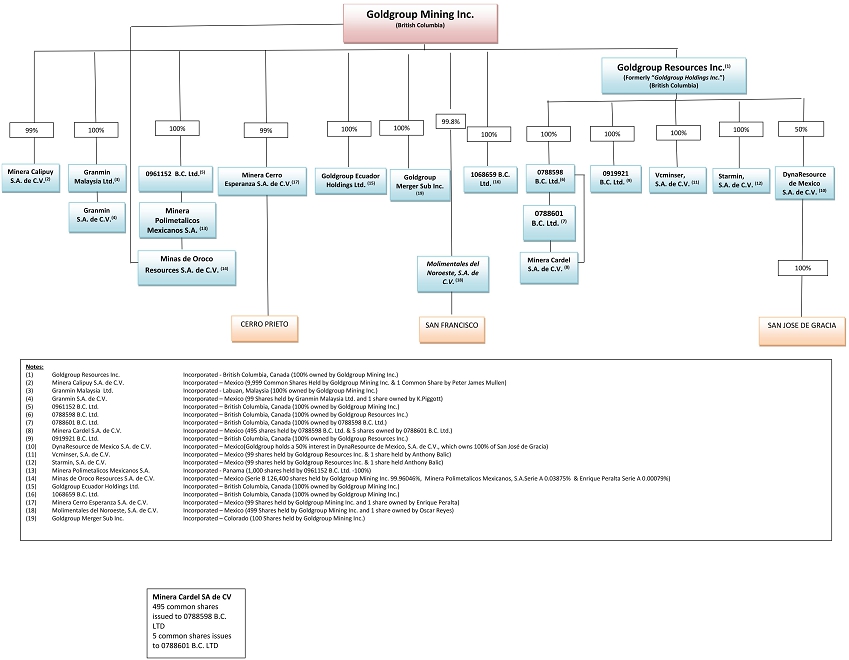
Business and Properties
Mineral Projects
Cerro Prieto Project
The Cerro Prieto Project is one of Goldgroup’s two material mineral projects. It is an open pit heap leach gold mine located in Sonora, Mexico. Goldgroup, through its 100% owned subsidiary, Minas de Oroco S.A. de C.V., commenced mining operations at Cerro Prieto in 2013. Cerro Prieto is located 52 kilometers from the regional center of Magdalena de Kino (population 40,000) and 150 kilometers northeast of the city of Hermosillo. At the mine gold is produced in doré and then shipped to a refiner in Mexico for final refining prior to being sold. Cerro Prieto is subject to a 2% net smelter royalty payable upon production.
| C-2 |
The Cerro Prieto Project is subject of a NI 43-101 technical report titled “Cerro Prieto Project, Heap Leach Project, Magdalena de Kino, State of Sonora, Mexico” with an effective date of April 4, 2025, and prepared by José Antonio Olmedo MSc, P. Eng. Geo, QP, SME Registered Member, Cristian Garcia, P. Eng., QP, Registered at Engineers and Geoscientists of British Columbia, and Rodrigo R Carneiro MSc, QP, SME Registered Member. The Cerro Prieto Technical Report provides an independent assessment of the mineral resources estimates of the Esperanzas Deposit within the Cerro Prieto Project, which includes the La Esperanza and Nueva Esperanza contiguous zones.
San Francisco Project
The San Francisco Project is one of Goldgroup’s two material properties. The San Francisco Project is a large-scale, formerly producing open pit gold mine. It encompasses 13 concessions totaling 33,667 hectares plus 13,284 hectares of regional concessions in the north central portion of the state of Sonora, Mexico, approximately 150 kilometers north of the state capital, Hermosillo. The operation is comprised of two previously producing open pits (San Francisco and La Chicharra), together with heap leach processing facilities and associated infrastructure located close to the San Francisco pit.
The San Francisco Project is historically one of the significant gold producers in Sonora and has existing infrastructure and potential for future exploration, development, expansion and production. Securing control of this asset is aligned with Goldgroup’s vision of becoming a leading Mexican-focused mining company with operational expertise and a strong commitment to responsible mining practices. Goldgroup has received conditional acceptance to the acquisition of Molimentales and the San Francisco Project and closing is subject to receipt of final TSXV approval.
The San Francisco Project is subject of a NI 43-101 technical report dated May 1, 2026, with an effective date of April 30, 2026, titled “NI 43-101 Technical Report for the San Francisco Project, Sonora, Mexico” and prepared by William J. Lewis, B.Sc., P.Geo., Richard M. Gowans, P.Eng. and Tudorel Ciuculescu, B.Sc., M.Sc., P.Geo.
Cyclicality and Seasonality
The cyclicality of the business reflects the global supply and demand outlook for gold, which in turn is influenced by diverse factors, U.S. currency valuations, derivatives market activity, interest rate and inflation forecasts, and other factors. Seasonality does not have a pronounced impact on Goldgroup’s business, as its properties operate year-round and are not subject to any significant maintenance shut-downs or weather-related seasonality.
Competitive Conditions
The precious metals exploration and mining industry is extremely competitive, and Goldgroup competes with other mining companies for precious metals properties, for joint venture partners and opportunities and for the acquisition of investments in other mining companies.
Environmental Protection
The current and future operations of Goldgroup, including development activities on its properties, are subject to laws and regulations and best practice principles governing exploration, development, waste disposal, greenhouse gas emissions, protection and remediation of environment, reclamation, hazardous substances and other matters. Compliance with such laws and regulations increases the costs of and delays planning, designing, drilling and developing Goldgroup’s properties. Goldgroup plans to diligently attempt to apply technically proven and economically feasible measures to advance protection of the environment throughout the exploration and development process. Current costs associated with compliance are considered normal.
| C-3 |
Foreign Operations
Goldgroup’s operations are carried out in Mexico, and its operations may be affected by possible political or economic instability and government regulations relating to the mining industry and foreign investors therein. Mineral exploration and mining activities may be affected in varying degrees by government regulations with respect to restrictions on production, price controls, export controls, income taxes, expropriation of property, maintenance of property, environmental legislation, land use, land claims of local people, water use and property safety. The effect of these factors on Goldgroup cannot be accurately predicted.
Employees
During the financial year ended December 31, 2025, Goldgroup employed 187 employees.
Social and Environmental Policies
Goldgroup has adopted a Code of Business Conduct and Ethics stating that Goldgroup will strive to prevent or otherwise minimize, mitigate and remediate any negative impact on the environment as a result of its operations. The Code of Business Conduct and Ethics also provides that the directors, officers and employees of Goldgroup will do their best to accommodate the different cultures, lifestyles, heritage and preferences of the communities in which Goldgroup operates. Goldgroup has also approved and adopted an Environmental and Safety Policy. Complete copies of Goldgroup’s Code of Business Conduct and Ethics and the Environmental and Safety Policy can be viewed on Goldgroup’s website located at https://goldgroupmining.com/investors/corporate-governance.
Legal Proceedings
Goldgroup may become party to litigation or other adversary proceedings, with or without merit, in a number of jurisdictions. The cost of defending such claims may take away from management time and effort and if determined adversely to Goldgroup, may have a material and adverse effect on its cash flows, results of operation and financial condition.
Goldgroup is party to an ongoing legal dispute with DynaResource in respect of the SJG Project. The SJG Project is located in the northeast portion of Sinaloa State, Mexico, approximately 120 kilometres northeast of the coastal city of Los Mochis, straddling the Chihuahua border. The property consists of 34 mineral concessions covering approximately 69,000 hectares with no outstanding royalty or other applicable interests.
Goldgroup held an interest in DynaMexico, which owns 100% of the SJG Project located in the state of Sinaloa, Mexico. The other owner of DynaMexico is DynaUSA, who provides management and accounting services based on 2.5% of the cash expenditures incurred by DynaMexico.
As a result of Goldgroup qualifying to earn its 50% equity interest in DynaMexico on March 14, 2011, the board of directors of DynaMexico was to be expanded to five members with DynaUSA and Goldgroup each appointing two members and mutually agreeing on one additional member.
| C-4 |
On January 22, 2013, Goldgroup announced that it had moved to dismiss a lawsuit filed against it and others in Dallas County District Court by DynaResource. DynaResource alleged, among other things, that Goldgroup wrongfully used and disseminated confidential information and data belonging to DynaResource, and materially misrepresented Goldgroup’s ownership interest in the SJG Project. Goldgroup maintained that it properly disclosed its interest in the SJG Project, had not materially misrepresented it, and has not improperly used any DynaResource confidential information. On March 7, 2014 DynaResource dropped its lawsuit against Goldgroup.
On October 28, 2013, Goldgroup announced that it filed a legal action before the appropriate authorities in Mexico concerning activities undertaken by Mr. Koy Wilber Diepholz, shareholder, President and Chairman of the Board of Directors of DynaMexico and Chairman, Chief Executive Officer and Treasurer of DynaUSA. The purpose of the legal action case was to investigate whether illegal acts were committed by Mr. Diepholz, in his role as CEO of DynaMexico, for his own benefit and for the benefit of DynaUSA.
On March 10, 2014, Goldgroup filed for arbitration in Denver, Colorado, against DynaUSA to protect its interests pursuant to the Earn-In/Option Agreement dated September 1, 2006 between DynaResource and Goldgroup (the “DynaResource Agreement”).
On June 29, 2015, a Mazatlán Judge denied DynaMexico the request for an “amparo,” which is, by Mexican law, an appeal to the injunction obtained by Goldgroup against DynaMexico regarding 300 new shares of DynaMexico issued in favour of DynaUSA. The issuance of the DynaMexico shares to DynaUSA diluted Goldgroup’s ownership interest (from 50% to 20%) in DynaMexico with DynaUSA purporting to be an owner of 80% of DynaMexico.
During the year ended December 31, 2015, management concluded that due to the ongoing legal disputes, Goldgroup no longer had a significant influence over DynaMexico and therefore discontinued treating the investment as an investment in associate.
During the year ended December 31, 2016, Goldgroup received favorable results from the conclusion of the arbitration between Goldgroup and DynaResource. The results and award (the “Award”) were issued by the American Arbitration Association – International Centre for Dispute Resolution on August 24, 2016. This Award is final, binding and could be enforced in court.
The arbitrator concluded that DynaUSA failed to fulfill its obligations under the DynaResource Agreement. The Award, in summary, clarifies several doubts arising from misleading news releases issued by DynaUSA. The Award confirmed the following:
| · | The DynaResource Agreement between the parties was in full force and effect; |
| · | The expenditures made by DynaUSA without the approval of the joint management committee had to be reimbursed to DynaMexico since Goldgroup did not participate in those decisions; |
| · | A detailed accountability assessment by DynaUSA had to be completed for Goldgroup for the last 5 years when DynaUSA excluded Goldgroup from the management of DynaMexico and delivered to Goldgroup within 20 days of the issuance of the Award; |
| · | The use of the Power of Attorney of Mr. Diepholz did not provide authorization for Mr. Diepholz to circumvent the management committee’s power to approve and oversee expenditures; |
| C-5 |
| · | DynaUSA acted in bad faith and breached the terms of the DynaResource Agreement; |
| · | Certain amounts had to be reimbursed to Goldgroup, which included fees paid and payable in the Mexico City case related to the current dispute; |
| · | A fifth director had to be jointly appointed in DynaMexico and the names of prospective candidates exchanged by the parties, no later than 10 calendar days from the date of the Award; and |
| · | The deliberate dilution by DynaUSA of Goldgroup’s equity interest in DynaMexico was illegal. |
Goldgroup complied with all requirements set out in the Award but received no payment or required documentation from DynaUSA or DynaMexico.
On August 24, 2017, a Federal Amparo judge in the state of Veracruz, Mexico, dismissed Goldgroup’s Amparo challenge. Goldgroup’s position in response to the $48 million claim remained the same, that Goldgroup was never notified of the purported court case, and does not recognize any of the claims mentioned therein and is of the belief that such claims are entirely without merit. Goldgroup pursued the case to the Mexican Supreme Court level to get the judgement overturned.
Following the arbitration, DynaUSA filed documents in an attempt to convince the court to vacate the Award. In February 2018, Goldgroup received the recommendation of the magistrate judge in Denver, who recommended that Goldgroup’s application to confirm the arbitration award be denied. Goldgroup filed an objection to request the presiding judge to reject the recommendation and confirm the arbitration award.
On May 9, 2019, Goldgroup received a final judgment in the United States District Court for the District of Colorado confirming Goldgroup’s awards from arbitration. The order denied DynaResource’s motion to vacate the Award and rejected the recommendation of the magistrate Judge, who had agreed with DynaResource that the arbitration award should be thrown out.
The court’s order confirmed all of the relief outlined in the Award, including DynaUSA having to pay Goldgroup $404,000 in costs and attorney fees; pay Goldgroup $86,000 in separate fees and expenses; and pay DynaMexico $1,045,000 for various legal and other expenses that DynaUSA improperly caused DynaMexico to incur.
On March 25, 2020, the United States District Court for the District of Colorado denied DynaResource’s motion to alter or amend the final judgement and denied DynaResource’s motion for a stay of judgment pending appeal and to waive or reduce supersedeas bond and ordered DynaResource to post a supersedeas bond in the amount of $1,107,000 to be granted a stay, within 21 days of the order. On April 10, 2020, DynaResource appealed the May 9, 2019 order and final judgement.
On July 24, 2020, the United States District Court for the District of Colorado granted DynaResource a stay on the monetary awards upon posting of a $1,111,000 bond before July 28, 2020, but denied DynaResource’s request to stay the non-monetary awards of the judgement. This bond was posted and therefore the monetary awards were stayed pending the outcome of DynaResource’s appeal of the arbitration award. The appeal was fully briefed, and the Tenth Circuit Court of Appeals in Denver, Colorado, heard argument on the appeal on March 9, 2021.
| C-6 |
On April 16, 2021, the Tenth Circuit Court of Appeals (the “Circuit Court”) affirmed the May 9, 2019 order and judgment from United States District Court for the District of Colorado, which confirmed the arbitration award that Goldgroup received on August 14, 2016 pursuant to an arbitration held in Denver, Colorado, commencing in March 2014. Goldgroup received the $1,111,000 appeal bond funds from DynaUSA, which it recorded in other expenses on the statement of loss and comprehensive loss.
The Circuit Court rejected the appeal lodged by Texas-based DynaUSA and DynaMexico to vacate the arbitral award, which had found that DynaUSA had improperly diluted Goldgroup’s interest in the SJG Project, which Goldgroup had earned into pursuant to the DynaResource Agreement.
On December 6, 2019, the 11th Federal Circuit Collegiate Court in México denied Goldgroup’s Amparo regarding the $48 million claim and on February 20, 2020, a Mexico City court issued a judgement in favour of DynaMexico. Goldgroup will continue to pursue all legal avenues in Mexico to achieve a favorable resolution to the dispute. On August 28, 2020, DynaMexico sought recognition of the judgment under the Texas Uniform Foreign-Country Money Judgment Recognition Act. This lawsuit was dismissed by the Court for want of jurisdiction on November 30, 2020. DynaMexico filed a motion for new trial on December 30, 2020. The motion for a new trial was overruled by operation of law on February 15, 2021.
On February 23, 2022, Goldgroup filed another motion for contempt against DynaResource, asserting that DynaResource had not fully complied with the Court’s September 3, 2021 order or with the non-monetary relief mandated by the Court’s May 9, 2019 final judgment. That motion was fully briefed as of March 18, 2022, and is awaiting the Court’s ruling.
On December 4, 2020, DynaMexico filed another claim seeking recognition of the judgment under the Texas Uniform Foreign-County Money Judgment Recognition Act. Goldgroup has filed a Special Appearance, Motion to Dismiss for Improper Venue, and Motion for Non-Recognition in response. A hearing was held on the Special Appearance and Motion to Dismiss for Improper Venue on February 8, 2021 and on May 12, 2021, the 134th Judicial District Court, as a District Court of the State of Texas, ruled it is not required to recognize DynaMexico’s foreign judgment from the country of Mexico. DynaUSA has appealed this decision and the appeal was fully briefed and oral arguments were held on April 20, 2022. On May 2, 2023, the court of appeals dismissed DynaUSA’s appeal.
On March 6, 2023, the Company announced that its subsidiary, Goldgroup Resources Inc. (“Goldgroup Resources”), filed a Request for Arbitration on February 17, 2023 with the International Centre for Settlement of Investment Disputes against the United Mexican States. The treatment and inaction by the Mexican courts have resulted in a judicial expropriation of Goldgroup Resources’ investment in DynaMexico and a denial of justice in breach of Mexico’s obligations under NAFTA. On February 7, 2024, Goldgroup Resources filed its Memorial on the Merits related to the NAFTA claim and received Mexico’s Counter Memorial on the Merits and Memorial on Jurisdiction on June 19, 2024. On December 12, 2024, the Company and Goldgroup Resources filed their Reply on the Merits and Counter Memorial on Jurisdiction and received Mexico’s Rejoinder on the Merits and Reply on Jurisdiction on April 28, 2025. On June 11, 2025, Goldgroup Resources filed its Rejoinder on Jurisdiction. On August 15, 2025, Goldgroup Resources and Mexico filed their respective Comments on the Non-Disputing Party Submissions filed by Canada and the United States of America pursuant to NAFTA Article 1128. On September 23, 2025, Goldgroup Resources’ damages experts filed a Supplemental Report on Quantum, and Goldgroup Resources received the Supplemental Report on Quantum of Mexico’s damages experts on November 18, 2025. Goldgroup Resources is seeking monetary damages as a result of Mexico’s breaches of NAFTA, as well as declarations from the arbitral tribunal to counter any potentially detrimental consequences stemming from the continued existence of the $48 million judgment issued by the Mexican courts in favour of DynaMexico.
| C-7 |
Goldgroup’s History for the Financial Years Ended December 31, 2024 and 2025
Financial Year Ended December 31, 2024
| · | In Q1 2024, the Company began operating from the Cerro Prieto pit and the Esperanza extension, which transitioned from an exploration and evaluation asset to a mineral property. In Q4 2024, the Company shared metallurgical testing results for its Esperanza and Nueva Esperanza zones at Cerro Prieto, which confirmed that higher gold recoveries were achievable through the addition of cost-effective crushing equipment, reduction in the size of crushed rock deposited on the leads pads and an increase in the irrigation fluid’s sodium cyanide concentration. The Company subsequently made progress towards doubling the mine’s production by installing a primary crusher, overhauling the secondary crusher, expanding pumping and irrigation capacity and expanding and improving the gold recovery plant. |
| · | During the financial year ended December 31, 2024, the Company closed two non-brokered private placements for aggregate gross proceeds of C$950,000 and a convertible debt financing in the amount of US$100,000. The private placements closed on September 26, 2024 and November 18, 2024. The Company issued 15.5 million units at a price of C$0.05 and 3,181,818 units at a price of C$0.055, respectively. Each unit consisted of one Common Shares and one Common Share purchase warrant, with each warrant entitling the holder thereof to purchase one Common Share at a price of C$0.10 per share until September 26, 2026 and November 18, 2026, respectively. The warrants include an accelerated expiry provision allowing the Company to accelerate their expiry to 30 days if the closing price of the Common Shares is $0.15 or higher for a period of ten consecutive trading days. |
| · | Effective at market open on February 20, 2024, the Common Shares were listed for trading on the TSXV following its delisting from the Toronto Stock Exchange on February 16, 2024. |
| · | On August 14, 2024, the Company announced that it entered into an agreement to acquire a loan facility (the “Loan Facility”) from a group of creditors, pursuant to which various advances were made to Minera Apolo, S.A. de C.V. (“Apolo”). Apolo was the 100-per-cent owner of the Pinos Project, a fully permitted gold project located 140 kilometres east of the capital of Zacatecas in the state of Zacatecas, Mexico. The outstanding amount under the Loan Facility was approximately US$2.7 million and was secured against the assets and shares of Apolo. Upon completion of the acquisition of the Loan Facility, the Company’s goal was to start enforcement actions and settlement discussions with the ultimate goal being the acquisition of Apolo as settlement for the Loan Facility. In consideration for the acquisition of the Loan Facility, the Company proposed to issue 50 million Common Shares, pay cash consideration in the amount of $500,000 and pay US$1.5 million in contingent consideration, which would only become due upon the completion of certain criteria. The Company subsequently acquired Apolo in January 2025. |
Financial Year Ended December 31, 2025
| · | In Q1 2025, the Company announced that it was conducting a high impact exploration program at Cerro Prieto. The program comprised approximately 6,000 metres of diamond core drilling, an induced polarization geophysical survey and surface trenching. In Q4 2025, the Company successfully installed a second crushing circuit at Cerro Prieto, which doubled crushing capacity to over 4,500 tonnes per day and more than doubled mine production. |
| C-8 |
| · | During the financial year ended December 31, 2025, the Company closed five non-brokered private placements for aggregate gross proceeds of C$42.3 million. It also accelerated the expiry of outstanding warrants that were originally issued in 2024, which led to warrant exercises for additional gross proceeds of approximately C$1.9 million as announced in news releases on January 10, 2025 and February 6, 2025. The private placements were comprised of the following: |
| o | On January 21, 2025, the Company issued 35 million units at a price of C$0.10 per unit for aggregate gross proceeds of C$3.5 million. Each unit consisted of one Common Share and one-half of one Common Share purchase warrant, with each full warrant entitling the holder thereof to acquire one Common Share at a price of C$0.15 per Common Share until January 21, 2027. The Company paid finder’s fees in the amount of C$202,560 and issued 2,025,600 finder’s warrants to a finder in connection with the offering with the finder’s warrants having the same terms and conditions as the warrants issued under the offering. |
| o | On March 17, 2025, the Company issued 23,333,334 units at a price of C$0.30 per unit for aggregate gross proceeds of approximately C$7 million as part of a first tranche. Each unit consisted of one Common Share and one-half Common Share warrant, with each full warrant being exercisable to purchase one Common Share at a price of C$0.45 until March 17, 2027. The Company issued 900,000 finder’s units to a finder in connection with the private placement. Each finder’s unit consisted of one Common Share and one-half Common Share purchase warrant, with each full warrant being exercisable to purchase one Common Share at a price of C$0.45 until March 17, 2027. Subsequently on March 28, 2025, the Company closed the second tranche by issuing a further 2,583,330 units for aggregate gross proceeds of C$774,999. |
| o | On May 7, 2025, the Company issued 27,272,727 units at a price of C$0.55 per unit for aggregate gross proceeds of C$15 million. Each unit comprised one Common Share and one-half of a Common Share purchase warrant with each whole warrant entitling the holder thereof to acquire one common share at a price of C$0.75 per Common Share until November 7, 2026. The Company paid cash fees of C$4,514 and issued 631,794 finder’s units to finders in connection with the private placement. Each finder’s unit consisted of one Common Share and one-half Common Share purchase warrant, with each full warrant being exercisable to purchase one Common Share at a price of C$0.75 until November 7, 2026. |
| o | On August 5, 2025, the Company issued 15 million units at a price of C$0.80 per unit for aggregate gross proceeds of C$12 million. Each unit comprised one Common Share and one Common Share purchase warrant with each warrant entitling the holder thereof to acquire one Common Share at a price of C$1.10 per Common Share until August 5, 2027. The Company issued 1,086,187 finder’s units to finders in connection with the private placement. Each finder’s unit consisted of one Common Share and one Common Share purchase warrant, with each warrant being exercisable to purchase one Common Share at a price of C$1.10 until August 5, 2027. |
| o | On September 12, 2025, the Company issued 4,848,485 units of the Company at a price of C$0.825 per unit for aggregate gross proceeds of C$4 million. Each unit comprised one Common Share and one Common Share purchase warrant with each warrant entitling the holder thereof to acquire one Common Share at a price of C$1.05 per Common Share until September 12, 2027. The Company paid cash fees of C$182,505, issued 201,718 finders’ warrants and 78,013 finder’s units to finders in connection with the private placement. Each finder’s unit consisted of one Common Share and one Common Share purchase warrant, with each warrant being exercisable to purchase one Common Share at a price of C$1.05 until September 12, 2027. |
| C-9 |
| · | Effective as of July 28, 2025, the Common Shares commenced trading on the OTCQX® Best Market under the symbol “GGAZF”. |
| · | The Company acquired a 100% interest in the Pinos Project located in the highly productive Zacatecas gold and silver mining belt through the previously announced proposed acquisition of Apolo. The Company subsequently disposed of its interest in the Pinos Project during the financial year ended December 31, 2025. See “Subsequent to Financial Year Ended December 31, 2025”. |
| · | On December 23, 2025, the Company acquired all of the issued and outstanding Series “A” shares in the fixed capital and all the issued and outstanding Series “B” shares in the variable capital (collectively the “Molimentales Shares”) of Molimentales through a Concurso Mercantil process (restructuring proceeding equivalent to Chapter 11 in the United States). The Company has received approval from the Second District Court for Commercial Bankruptcy Matters (the “Mexican Court”) to the plan of arrangement (the “Molimentales Plan of Arrangement”) the Company filed with the Mexican Court under the Concurso Mercantil process. |
As part of the acquisition, the Company acquired 60.24% of the debts owed to certain major creditors (the “Major Creditors”) as recognized by the Mexican Court for $8,971,000 of which $1,417,000 remains to be paid. Under the terms of the Molimentales Plan of Arrangement, the Company has agreed to pay $2,566,000 in three equal installments in December 2026, 2027 and 2028 to the remaining creditors holding 39.76% of the recognized debt in addition to all outstanding mining concession fees (including penalties and interest), taxes, fees owed to the National Water Commission, supplier debts and certain expenses related to the Concurso proceedings currently estimated at approximately $8,026,000. Some of the payments described above are facilitated through the Company acquiring the Molimentales Shares by paying the owners of the Molimentales Shares MXN$100,000 and capitalizing Molimentales with MXN$99,900,000 for a total of MXN$100,000,000. The Company determined that the acquisition met the definition of an asset acquisition.
Subsequent to Financial Year Ended December 31, 2025
| · | On January 26, 2026, the Company announced that it had entered into the Arrangement Agreement. For detailed information on the proposed Arrangement and Merger, see the Information Circular. |
| · | On February 27, 2026, the Company announced that it had completed the sale of Apolo, which owned all of the issued and outstanding shares of Minera Catanava, S.A. de C.V. (“MC”). Apolo and MC collectively held a 100% interest in the Pinos Project. The Company agreed to sell the shares in consideration of the payment to Goldgroup of US$5,000,000 in stages, with US$2,450,000 deposit payable on signing, US$550,000 to be paid on closing and US$2,000,000 to be secured by a promissory note and paid on or before the date that is six months from the date of closing. |
| C-10 |
APPENDIX “D” – INFORMATION CONCERNING GOLD RESOURCE
Please see “Part I” of Gold Resource’s Annual Report, which is incorporated by reference into this Information Circular.
| D-1 |
APPENDIX “E” – INTERIM ORDER
[Please see attached]
| E-1 |
|
|
|
|
|
|
|
|
|
|
| 7C =+(C (A=(6=C 7)C $6BC ,6&76<,<=(6&BC 7:C ',<&:(9$6&BC %(=@((6C =+,<C 6=(:,4C :'(;C $6'C =+( 6)7:4$=,76C,:&>0$:C =+(C -C$993,&$%0(C(&>:-=,(<C$@<C7:C67=.&(C7)C$:=.&0(<C$6'C$:=,&3(< 7)C=+(C71'*:7>9C=+/<C6=(:,5C:'(:C<+$22C*7?(:6 C "C C ! C C C C C C C C C C C C CC#C C C C ! CC C #C C ,*6$=>:(C7)C7>6<(2C)8:C(=,=/76(:C 0.?(:CC$6<76C BC=+(C7>:=C (*,<=;$:C -3,?(:CC$6<76- |
APPENDIX “F” – NOTICE OF HEARING OF PETITION
[Please see attached]
| F-1 |
No. S263916
Vancouver Registry
IN THE SUPREME COURT OF BRITISH COLUMBIA
IN THE MATTER OF SECTIONS 288 TO 299 OF THE BRITISH
COLUMBIA BUSINESS CORPORATIONS
ACT, S.B.C. 2002, C.57, AS AMENDED
- and -
IN THE MATTER OF A PROPOSED ARRANGEMENT INVOLVING
GOLDGROUP
MINING INC. AND GOLD RESOURCE CORPORATION
GOLDGROUP MINING INC.
PETITIONER
NOTICE OF PETITION
| TO: | The holders (the "Goldgroup Shareholders") of common shares (the "Goldgroup Shares") in the authorized capital of Goldgroup Mining inc. ("Goldgroup") |
| AND TO: | Gold Resource Corporation |
NOTICE IS HEREBY GIVEN that a Petition to the Court has been filed by Goldgroup in the Supreme Court of British Columbia for approval, pursuant to section 291 of the Business Corporations Act, S.B.C. 2002 c. 57 and amendments thereto, of an arrangement contemplated in the Arrangement Agreement dated January 25, 2026, and amended on May 15, 2026, involving Goldgroup, Goldgroup Merger Sub Inc. and Gold Resource Corporation (the "Arrangement").
NOTICE IS FURTHER GIVEN that by Order of the Supreme Court of British Columbia, dated May 28, 2026, the Court has given directions by means of an Interim Order (the "Interim Order") on the calling of an annual general and special meeting (the "Meeting") of the Goldgroup Shareholders for the purpose of, among other things, considering and voting upon the special resolution to approve the Arrangement.
NOTICE IS FURTHER GIVEN that if the Arrangement is approved at the Meeting, Goldgroup intends to apply to the Supreme Court of British Columbia for a final order (the "Final Order") approving the Arrangement and declaring it to be fair and reasonable, which application will be heard at the courthouse at 800 Smithe Street, in the City of Vancouver, in the Province of British Columbia, or as the Court may direct, on July 6, 2026 at 9:45 a.m. (Pacific Time) or so soon thereafter as counsel may be heard or at such other date and time as the Court may direct.
NOTICE IS FURTHER GIVEN that the Final Order approving the Arrangement will, if made, serve as the basis of an exemption from the registration requirements of the United States Securities Act of 1933, as amended, pursuant to Section 3(a)(10) thereof with respect to securities issued under the Arrangement.
F-2
IF YOU WISH TO BE HEARD AT THE HEARING OF THE APPLICATION FOR THE FINAL ORDER OR WISH TO BE NOTIFIED OF ANY FURTHER PROCEEDINGS, YOU MUST GIVE NOTICE OF YOUR INTENTION by filing a form entitled "Response to Petition" together with any evidence or materials which you intend to present to the Court at the Vancouver Registry of the Supreme Court of British Columbia and YOU MUST ALSO DELIVER a copy of the Response to Petition and any other evidence or materials to Goldgroup's address for delivery, which is set out below, on or before 4:00 p.m. (Pacific Time) on July 2, 2026.
YOU OR YOUR SOLICITOR may file the Response to Petition. You may obtain a form of Response to Petition at the Registry. The address of the Registry is 800 Smithe Street, Vancouver, British Columbia, V6Z 2E1.
IF YOU DO NOT FILE A RESPONSE TO PETITION AND ATTEND EITHER IN PERSON OR BY COUNSEL at the time of the hearing of the application for the Final Order, the Court may approve the Arrangement, as presented, or may approve it subject to such terms and conditions as the Court deems fit, all without further notice to you. If the Arrangement is approved, it will affect the rights of the Goldgroup Shareholders.
A copy of the Petition to the Court and the other documents that were filed in support of the Interim Order and will be filed in support of the Final Order will be provided to any Goldgroup Shareholder upon request in writing addressed to the solicitors of the Petitioner at the address for delivery set out below.
The Petitioner's address for delivery is:
Cozen O'Connor LLP
Bentall 5, 550 Burrard St
Suite 2501
Vancouver, BC V6C 2B5
Attn: Oliver C. Hanson
Email: ohanson@cozen.com
DATED this 28th day of May, 2026
| "Oliver C. Hanson" | |
| Counsel for the Petitioner, Goldgroup Mining Inc. | |
| Oliver C. Hanson |
F-3
APPENDIX “G” – FAIRNESS OPINION
[Please see attached]
| G-1 |
 | Fort Capital Partners 1010 – 510 Burrard Street Vancouver, BC V6C 3A8 |
January 25, 2026
The Special Committee of the Board of Directors
Goldgroup Mining Inc.
410 – 1111 Melville Street.
Vancouver, BC V6E 3V6
To the Members of the Special Committee:
Fort Capital Partners ("Fort Capital", "we" or "us") understands that Goldgroup Mining Inc. ("Goldgroup", or the "Company") and Goldgroup Merger Sub Inc., a Colorado corporation and wholly owned subsidiary of Goldgroup (“Merger Sub”) proposes to enter into an arrangement agreement and plan of merger to be dated January 25, 2026 (the "Arrangement Agreement") with Gold Resource Corporation ("Gold Resource"). The Arrangement Agreement provides that, among other things, the proposed transaction will occur by way of a reverse triangular merger in which Merger Sub will merge with and into Gold Resource under Colorado law, with Gold Resource surviving and continuing as the surviving company as a wholly owned subsidiary of Goldgroup (the “Merger”) and a plan of arrangement under the Business Corporations Act (British Columbia) (the “Arrangement”) pursuant to which, among other things, Goldgroup will acquire all of the issued and outstanding common shares (the "Gold Resource Shares") of Gold Resource (the "Transaction"). In accordance with the Arrangement Agreement, each holder of Gold Resource Shares will be entitled to receive, in exchange for each Gold Resource Share held by such holder, 1.4476 common shares of Goldgroup (each, a “Goldgroup Share”) (adjusted to 0.3619 Goldgroup Shares as a result of a four-for-one share consolidation to be completed by Goldgroup prior to closing) (the "Exchange Ratio").
The above description is summary in nature, and the specific terms and conditions of the Arrangement shall be set forth in the Arrangement Agreement.
A special committee (the "Special Committee") comprised of independent directors of the board of directors of Goldgroup (the "Board") was formed to, among other matters, provide a recommendation with respect to the Transaction to the Board as to whether the Board should enter into the Arrangement Agreement and recommend the Transaction to the holders Goldgroup Shares (the “Goldgroup Shareholders”).
Background and Engagement of Fort Capital
Fort Capital was formally engaged as the Company’s financial advisor on February 3, 2025 pursuant to an engagement letter (the "Engagement Agreement") to provide various advisory services in connection with the Transaction, including, among other things, an opinion as to the fairness, from a financial point of view, to Goldgroup of the Exchange Ratio being offered by Goldgroup pursuant to the Arrangement. Fort Capital met with the Special Committee on a number of occasions, and on January 25, 2026, the Special Committee requested that Fort Capital provide a fairness opinion, which we issued that day and prior to the execution of the Arrangement Agreement on January 25, 2026 (the "Opinion").
Page | 1
The terms of the Engagement Agreement provide that Fort Capital be paid a fixed fee upon delivery of the Opinion. There are no fees payable to Fort Capital under the Engagement Agreement that are contingent upon the conclusion reached by Fort Capital under the Opinion, or upon the successful completion of the Arrangement or any other transaction. In addition, Fort Capital is to be reimbursed for our reasonable out-of-pocket expenses and to be indemnified by Goldgroup in certain circumstances.
The Special Committee has not instructed Fort Capital to prepare, and Fort Capital has not prepared, a formal valuation or appraisal of Goldgroup, Gold Resource or any of its respective securities or assets, and the Opinion should not be construed as such. The Opinion is not, and should not be construed as, advice as to the price at which the securities of Goldgroup or Gold Resource may trade at any time. Fort Capital has, however, conducted such analyses as we considered necessary in the circumstances to prepare and deliver the Opinion. While the Opinion has been prepared in accordance with the Disclosure Standards for Formal Valuations and Fairness Opinions of the Canadian Investment Regulatory Organization ("CIRO"), Fort Capital is not a member of CIRO and CIRO has not been involved in the preparation or review of the Opinion.
Credentials and Independence of Fort Capital
Fort Capital is an independent investment banking firm which provides financial advisory services to corporations, business owners, and investors. Members of Fort Capital are professionals that have been financial advisors in a significant number of transactions involving public and private companies in North America and have experience in preparing fairness opinions and valuations. The opinions expressed herein are the opinions of Fort Capital, and the form and content hereof has been approved for release by Fort Capital.
Neither Fort Capital, nor any of our affiliates, is an insider, associate, or affiliate (as those terms are defined in the Securities Act (Ontario) of Goldgroup, Gold Resource, or any of their respective associates or affiliates (collectively, the "Interested Parties"). Fort Capital is not acting as an advisor to Goldgroup or any Interested Party in connection with any matter, other than acting as advisor to the Special Committee as described herein.
Other than our engagement by the Special Committee on behalf of Goldgroup pursuant to the Engagement Agreement, Fort Capital has not been engaged to provide any financial advisory services nor have we participated in any financings involving the Interested Parties within the past two years.
Fort Capital does not have a financial interest in the completion of the Arrangement and the fees paid to Fort Capital in connection with our engagement do not give Fort Capital any financial incentive in respect of the conclusion reached in the Opinion or in the outcome of the Arrangement. There are no understandings, agreements, or commitments between Fort Capital and any of the Interested Parties with respect to any future financial advisory or investment banking business. Fort Capital is of the view that we have no relationship with Interested Parties that would reasonably represent a conflict with its independence status as defined under part 6 of Multilateral Instrument 61-101 – Protection of Minority Security Holders in Special Transactions ("MI 61-101").
Page | 2
Scope of Review
In preparing the Opinion, Fort Capital has, among other things, reviewed, considered, and relied upon, without attempting to verify independently the completeness or accuracy thereof, the following:
| (a) | a draft of the Arrangement Agreement as of January 23, 2026, including select supporting schedules thereto; |
| (b) | a draft Plan of Arrangement and Merger between the Company and Gold Resource dated December 19, 2025; |
| (c) | the Technical Report (S-K 1300) titled “S-K 1300 Technical Report Summary on the Don David Gold Mine Project, Oaxaca, Mexico”, dated March 5, 2025, with an effective date of December 31, 2024; |
| (d) | the Technical Report (S-K 1300) titled “S-K 1300 Technical Report Summary on the Back Forty Mine Project, Michigan, USA”, dated October 26, 2023, with an effective date of September 20, 2023; |
| (e) | the Technical Report (NI 43-101) titled “NI 43-101 F1 Technical Report Pre-Feasibility Study for the San Francisco Gold Project, Sonora, Mexico”, dated August 28, 2020, with an effective date of August 8, 2020; |
| (f) | the Technical Report (NI 43-101) titled “Cerro Prieto Project, Heap Leach Project, Magdalena de Kino, State of Sonora, Mexico”, published on November 6, 2025, with an effective date of April 4, 2025; |
| (g) | the consolidated annual financial statements of the Company and Gold Resource for the years ended December 31, 2018, 2019, 2020, 2021, 2022, 2023, and 2024, together with the notes thereto and the auditor’s reports thereon; |
| (h) | the management’s discussion and analysis of the results of operations and financial condition for the years ended December 31, 2018, 2019, 2020, 2021, 2022, 2023, and 2024; |
| (i) | the interim financial statements and associated management’s discussion and analysis documents for the periods ending September 30, 2024, March 31, 2025, June 30, 2025, and September 30, 2025; |
| (j) | certain internal financial, operational, corporate and other information with respect to the Company and Gold Resource, including management forecasts for the Don David, Back Forty, Cerro Prieto, and San Francisco projects; |
| (k) | the gold purchase agreements between Gold Resource and Osisko Bermuda Ltd. and Aquila Resources Inc. (a subsidiary of Gold Resource) and subsequent amendments dated November 8, 2017, and December 7, 2021; |
| (l) | the silver purchase agreements between Gold Resource and Orion TitheCo Limited and Aquila Resources Inc. (a subsidiary of Gold Resource) and subsequent amendments dated September 30, 2016, November 17, 2016, March 31, 2017, and December 7, 2021; |
| (m) | certain publicly available information relating to the business, operations, financial condition, and trading history of the Company and Gold Resource as well as other selected public companies that Fort Capital considered relevant; |
Page | 3
| (n) | various research publications prepared by industry and equity research analysts regarding selected entities Fort Capital considered relevant; |
| (o) | representations contained in separate certificates dated as of January 25, 2026 addressed to Fort Capital from senior officers of the Company as to the completeness, accuracy, and fair presentation of the information upon which the Opinion is based; |
| (p) | discussions with senior management of the Company with respect to the information referred to above and other issues deemed relevant; and |
| (q) | such other information, investigations, analyses, and discussion as we considered necessary or appropriate in the circumstances. |
Fort Capital has not, to the best of our knowledge, been denied access by Goldgroup to any information we requested.
Prior Valuations
Two senior officers of Goldgroup have represented to Fort Capital that, to the best of their knowledge, there have been no prior valuations (as defined for the purposes of MI 61-101) of Goldgroup or any of its material assets or subsidiaries prepared within the past twenty-four (24) months.
Assumptions and Limitations
The Opinion is subject to the assumptions, explanations, and limitations set forth below.
Fort Capital has, subject to the exercise of our professional judgment, relied, without independent verification, upon the completeness, accuracy, and fair presentation of all of the financial and other information, data, advice, opinions, and representations we obtained from public sources, or that was provided to us by Goldgroup and its respective associates, affiliates, and advisors (collectively, the "Information"), and we have assumed that the Information did not contain any misstatement of a material fact or omit to state any material fact or any fact necessary to be stated therein to make that information not misleading. The Opinion is conditional upon the completeness, accuracy, and fair presentation of such Information. With respect to operating and financial projections provided to Fort Capital and used in the analysis supporting the Opinion, we have assumed that they have been reasonably prepared on bases reflecting the reasonable estimates and judgments of management of Goldgroup, at the time and in the circumstances in which the projection or forecast was prepared, as to the matters covered thereby, and in rendering the Opinion we express no view as to the reasonableness of such estimates or judgments or the assumptions on which they are based.
In preparing the Opinion, Fort Capital has assumed that the Arrangement will be consummated in accordance with the terms of the Arrangement Agreement without any additional waiver of, or amendment to, any term or condition that is in any way material to Fort Capital's analysis.
Page | 4
Senior management of Goldgroup have represented to Fort Capital in certificates delivered as of the date hereof that, among other things and to their knowledge: (a) they have no information or knowledge of any facts not contained in or referred to in the Information provided to Fort Capital by Goldgroup which would reasonably be expected to affect the Opinion; (b) with the exception of forecasts, projections, estimates, and budgets, the Information provided orally by, or in the presence of, an officer or employee of Goldgroup or in writing by Goldgroup or any of its subsidiaries or their respective agents to Fort Capital for the purposes of preparing the Opinion was, at the date the Information was provided to Fort Capital, or, in the case of historical Information, was, at the date of preparation, to the best of their knowledge, information and belief after due inquiry, complete, true, and correct in all material respects, and does not or, in the case of historical Information, did not, contain a misrepresentation; (c) since the dates on which the Information was provided to Fort Capital, except as disclosed in writing to Fort Capital, there has been no material change, financial or otherwise, in the financial condition, assets, liabilities (contingent or otherwise), business, operations, or prospects of Goldgroup, or any of its subsidiaries and no material change has occurred in the Information or any part thereof which would have or which would reasonably be expected to have a material effect on the Opinion; and (d) any portions of the Information provided to Fort Capital which constitute forecasts, projections, estimates, or budgets were reasonably prepared on bases reflecting the best then currently available assumptions, estimates, and judgments of management of Goldgroup and its subsidiaries and were not, as of the date they were prepared, in the reasonable belief of management of Goldgroup, misleading in any respect.
The Opinion is rendered on the basis of the securities markets, and economic, financial, and general business conditions prevailing as at the date hereof and the conditions and prospects, financial and otherwise, of Goldgroup and its subsidiaries and affiliates, as they were reflected in the Information. In our analyses and in preparing the Opinion, Fort Capital made numerous assumptions with respect to industry performance, general business and economic conditions, and other matters which we believe to be reasonable and appropriate in the exercise of our professional judgment, many of which are beyond the control of Fort Capital or any party involved in the Arrangement.
For the purposes of rendering the Opinion, Fort Capital has also assumed that: (a) the representations and warranties of each party to be contained in the Arrangement Agreement shall be true and correct in all material respects; (b) each party will perform all of the covenants and agreements required to be performed by it under the Arrangement Agreement; and (c) Goldgroup will be entitled to fully enforce its rights under the Arrangement Agreement.
The Opinion has been provided for the sole use and benefit of the Special Committee in connection with, and for the purpose of, its consideration of the Arrangement and making its recommendation to the Board with respect thereto, and may not be relied upon by any other person. The Opinion does not constitute a recommendation to any Shareholder as to how such Shareholder should vote or act with respect to the Arrangement. The Opinion is given as of the date hereof, and Fort Capital disclaims any undertaking or obligation to advise any person of any change in any fact or matter affecting the Opinion which may come or be brought to the attention of Fort Capital after the date hereof. Without limiting the foregoing, in the event that there is any material change in any fact or matter affecting the Opinion after the date hereof, Fort Capital reserves the right to change, modify, or withdraw the Opinion.
The Opinion does not address the relative merits of the Arrangement as compared to other business strategies or transactions that might be available with respect to Goldgroup or Goldgroup's underlying business decision to effect the Arrangement. Fort Capital was not requested to solicit, and did not solicit, interest from other parties with respect to an acquisition of, or other business combination transaction with, Goldgroup or any other alternative transaction. At the direction of the Special Committee, we have not been asked to, nor do we, offer any opinion as to the material terms (other than the Consideration) of the Arrangement Agreement or the structure of the Arrangement.
Page | 5
Fort Capital believes that our analyses must be considered as a whole, and that selecting portions of the analyses or the factors considered by us, without considering all factors and analyses together, could create a misleading view of the process underlying the Opinion. The preparation of an Opinion is a complex process and is not necessarily susceptible to partial analysis or summary description. Any attempt to do so could lead to undue emphasis on any particular factor or analysis.
Overview of Goldgroup
Note that the Company's functional currency is U.S. dollars and, unless otherwise noted, all figures referenced in this Opinion are in U.S. dollars. Figures in this Opinion may not tie due to rounding. Certain underlying analytical inputs, including those presented to the Special Committee, were expressed in Canadian dollars. For purposes of this Opinion, Canadian dollar amounts have been converted to U.S. dollars at an exchange rate of CAD/USD 1.373, reflecting the spot rate applied as of January 23, 2026, the valuation date used for market price references herein.
Goldgroup was incorporated in Québec under the Business Corporations Act (Québec) on July 28, 2011, and was subsequently continued under the Business Corporations Act (British Columbia). Goldgroup’s primary listing is on the TSX Venture Exchange (“TSX-V”), and its common shares trade under the symbol “GGA.” The Company is headquartered in Canada and conducts its operating activities primarily in Mexico.
The Company is a Canadian-based mining company focused on gold production and the acquisition, exploration and development of precious metal resource properties in Mexico. Goldgroup’s operating strategy is centered on advancing and optimizing its producing operations while pursuing growth opportunities through the evaluation of additional mineral assets and exploration upside in established mining jurisdictions. As with other mining issuers, Goldgroup’s results are influenced by factors such as commodity prices, operating performance, permitting and regulatory requirements, capital availability, and the successful execution of mine plans and expansion initiatives.
Goldgroup’s sole producing asset is its 100%-owned Cerro Prieto heap-leach gold mine in Sonora, Mexico (“Cerro Prieto”). Cerro Prieto has been in production since 2013 and has reported annual production of approximately 11,500 ounces of gold, with plans to expand operations. The Company continues to evaluate opportunities to enhance production and improve operating efficiencies, including initiatives that may support increased throughput, recovery, and mine life, subject to technical results, permitting, and financing.
In December 2025, Goldgroup secured ownership of the San Francisco gold mine (“San Francisco”) by acquiring 100% of Molimentales del Noroeste, S.A. de C.V. through a Mexican Concurso Mercantil restructuring process. San Francisco is a past-producing asset with near-term restart potential, located approximately 44 km from Cerro Prieto. San Francisco provides Goldgroup with an attractive platform to expand production and create value through district-scale exploration.
Page | 6
The chart below illustrates the trading price and volume of the Shares on the TSX-V over the last two years.
Figure 1 – Goldgroup Historical Share Trading Price and Volume
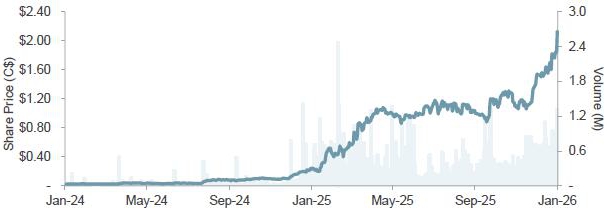
The closing price of the Shares on the TSX Venture on January 23, 2026 (the last trading day before the date of this Opinion) was C$2.13.
Overview of Gold Resource
Gold Resource was incorporated in 1998 and is headquartered in Denver, Colorado. Its common stock is listed on the NYSE American (“NYSEAM”) under the trading symbol “GORO”.
Gold Resource is a precious metals producer, developer, and explorer with operations centered on the Don David Gold Mine in Oaxaca, Mexico (“Don David”). The Company’s Mexican operating platform includes a large, consolidated land position surrounding Don David, where it continues to evaluate opportunities to enhance production, improve operating flexibility, and unlock additional value through near-mine exploration, resource expansion, and ongoing development work around existing infrastructure. The Company’s results and outlook may be affected by factors such as commodity prices, operating performance, regulatory and permitting requirements, community and social conditions, and access to capital.
In addition to Mexico, Gold Resource is advancing the Back Forty Project in Michigan, USA (“Back Forty”), a development-stage asset intended to provide longer-term growth optionality. In 2023, Gold Resource published an Initial Assessment, including an updated mine plan designed to address permitting challenges and support continued evaluation and advancement of the project.
Figure 2 – Gold Resource Historical Share Trading Price and Volume
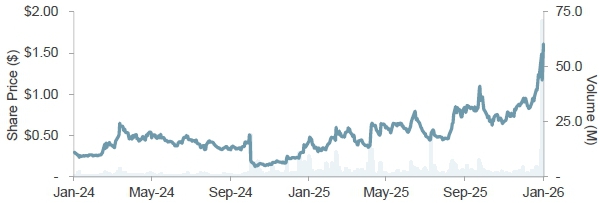
Page | 7
The closing price of the Shares on the NYSE American on January 23, 2026 (the last trading day before the date of this Opinion) was $1.61. Based on the implied consideration of approximately $2.25 per Gold Resource Share, this represents a premium of approximately 39.5% to Gold Resource's closing spot price, 45.6% to its 5-day volume-weighted average price of $1.54, 56.4% to its 20-day volume-weighted average price of $1.44, and 94.5% to its 90-day volume-weighted average price of $1.15.
Summary of Financial Analysis and Approach to Fairness
In support of the Opinion, Fort Capital performed certain financial analyses on the Company and Gold Resource to determine an indicative value per share range, based on methodologies and assumptions that we considered appropriate in the circumstances for the purposes of providing the Opinion.
Fort Capital reviewed certain financial forecast models on Cerro Prieto, San Francisco, Don David, and Back Forty provided by management of the Company as prepared by management of the Company and Gold Resource (collectively the “Asset Financial Models”). The Asset Financial Models include, among other things, assumptions, estimates, and projections regarding production levels, capital costs, operating costs, taxes, and mine life, which management of Goldgroup has represented to Fort Capital were reasonably prepared on bases reflecting the best then currently available assumptions, estimates and judgments of management and were not, as of the date they were prepared, in the reasonable belief of management, misleading in any respect.
Fort Capital reviewed the Asset Financial Models for overall consistency and tested for reasonableness, as well as adjusting the Asset Financial Models to reflect consensus (considering both the average and median) equity research estimates for future commodity prices rather than the estimates for future commodity prices provided by management of the Company. The aforementioned adjustments were made to ensure that the forecasts for commodity prices are comparable with the methodology used for the forecasts of commodity prices used by equity research analysts in calculating the net asset values that are utilized in the precedent transaction and comparable trading analysis described below. Fort Capital also adjusted the Asset Financial Models to reflect a current valuation date and made other minor adjustments to cash flow timing and discounting of cash flows (the “Asset Opinion Models”). The adjustments to the Asset Financial Models formed the basis for the forecast used in the analysis described below.
Net Asset Value Analysis
Fort Capital performed a net asset value ("NAV") analysis by calculating the estimated net present value as at the date hereof, of Cerro Prieto and San Francisco using the Asset Opinion Models and discount rates that reflect each asset’s risk profile relative to discount rates commonly used by precious metal equity research analysts in calculating NAV, specifically: 5% for producing assets and 8% for permitted development assets. The sum of our assessment of value for Cerro Prieto and San Francisco represents our assessment of the mining asset value (the "Goldgroup Mining Gross Asset Value").
Fort Capital applied a partial year factor of 93.9% to 2026 estimated cash flows across all assets, reflecting the January 23, 2026 valuation date.
Page | 8
An implied per Share NAV for Goldgroup (the "Goldgroup Opinion Model NAVPS") was calculated by adjusting the Goldgroup Mining Gross Asset Value by: (i) the present value of the after-tax free cash flows of corporate expenses; (ii) the Company's cash, cash equivalents, and marketable securities; and (iii) the total cash to be received by the Company from the exercise of in-the-money options, and then dividing by Goldgroup's fully diluted in-the-money Shares outstanding. Fort Capital also conducted sensitivity analysis to the Goldgroup Opinion Model NAVPS based on commodity price forecast, discount rate, operating costs, capital costs, and the first year of production for San Francisco.
Fort Capital also performed an NAV analysis on Gold Resource by calculating the estimated net present value as at the date hereof, of Don David and Back Forty (after reflecting the gold and silver stream structure) using the Asset Opinion Models and a discount reflecting the risk profile for each respective asset. The sum of our assessment of value for Don David and Back Forty represents our assessment of the mining asset value (the "Gold Resource Mining Gross Asset Value").
An implied per Share NAV for Gold Resource (the "Gold Resource Opinion Model NAVPS") was calculated by adjusting the Gold Resource Mining Gross Asset Value by: (i) the present value of the after-tax free cash flows of corporate expenses; (ii) the Company's cash, cash equivalents, and marketable securities; and (iii) the total cash to be received by the Company from the exercise of in-the-money options, and then dividing by Gold Resource's fully diluted in-the-money Shares outstanding. Fort Capital also conducted sensitivity analysis to the Gold Resource Opinion Model NAVPS based on commodity price forecast, discount rate, operating costs, and capital costs for each asset.
Comparable Company Trading Approach
Fort Capital compared public market trading statistics of Goldgroup and Gold Resource to corresponding data from selected producing precious metals companies that we considered relevant (the "Selected Comparable Companies"). The Selected Comparable Companies were:
| Andean Precious Metals Corp. | IMPACT Silver Corp. |
| Avino Silver & Gold Mines Ltd. | Integra Resources Corp. |
| Cerrado Gold Inc. | Luca Mining Corp. |
| Fortitude Gold Corporation | Minera Alamos Inc. |
| GoGold Resources Inc. | Santacruz Silver Mining Ltd. |
| Guanajuato Silver Company Ltd. | Sierra Madre Gold and Silver Ltd. |
| Heliostar Metals Ltd. | Soma Gold Corp. |
| i-80 Gold Corp. |
Fort Capital selected a range of price / NAV (“P / NAV”), enterprise value (“EV”) to 2026 forecast EBITDA (“EV / 2026E EBITDA”) and EV / 2027 forecast EBITDA (“EV / 2027E EBITDA”) multiples, taking into account factors such as size, underlying asset quality, balance sheet strength, and stage of underlying assets. The range and median of multiples observed for the Selected Comparable Companies were:
| Low | High | Median | ||||||||||
| P / NAV | 0.33 | x | 1.97 | x | 0.69 | x | ||||||
| EV / 2026E EBITDA | 3.0 | x | 33.3 | x | 7.8 | x | ||||||
| EV / 2027E EBITDA | 3.8 | x | 23.8 | x | 8.7 | x | ||||||
Page | 9
The selected ranges developed under this approach were then applied to the Goldgroup Opinion Model NAVPS, 2026E EBITDA, and 2027E EBITDA (each from the Asset Opinion Models). Similarly, Fort Capital applied selected ranges to the Gold Resource Opinion Model NAVPS, 2026E EBITDA, and 2027E EBITDA.
Precedent Transaction Approach
The precedent transactions approach considers transactions multiples in the context of the publicly disclosed transactions for comparable companies or assets. Fort Capital reviewed precedent transactions announced over the last five years, of which twelve were deemed to be most relevant (the "Selected Precedent Transactions"). The Selected Precedent Transactions were:
| Announcement Date | Acquiror | Target |
| 19-Dec-2025 | Highlander Silver Corp. | Bear Creek Mining Corporation |
| 07-Aug-2025 | Minera Alamos Inc. | Pan Mine |
| 27-Jan-2025 | Discovery Silver Corp. | Porcupine Mine |
| 06-Dec-2024 | SSR Mining Inc. | Cripple Creek & Victor Mine |
| 27-Nov-2023 | Andean Precious Metals Corp. | Golden Queen Mining LLC |
| 29-Jun-2022 | Guanajuato Silver | Minera Mexicana El Rosario |
| 25-Oct-2021 | Calibre Mining Corp. | Fiore Gold Ltd. |
| 12-Mar-2021 | First Majestic Silver Corp. | Jerritt Canyon Mine |
| 05-Jan-2021 | Agnico Eagle Mines Limited | TMAC Resources Inc. |
| 27-Jul-2020 | St Barbara Ltd | Moose River Resources Inc. |
| 30-Mar-2020 | Argonaut Gold Inc. | Alio Gold Inc. |
| 25-Nov-2019 | Evolution Mining Limited | Red Lake Complex |
Fort Capital selected a range of P / NAV and EV / next twelve months EBITDA (“EV / NTM EBITDA”) multiples, taking into account factors such as size, diversification, underlying asset quality, stage of underlying assets and announcement date. The range and median of multiples observed for the Selected Precedent Transactions were:
| Low | High | Median | ||||||||||
| P / NAV | 0.19 | x | 0.97 | x | 0.50 | x | ||||||
| EV / NTM EBITDA | 0.4 | x | 3.5 | x | 2.1 | x | ||||||
The selected ranges developed under this approach were then applied to Goldgroup Opinion Model NAVPS and NTM EBITDA (each from the Asset Opinion Models). Similarly, Fort Capital applied selected ranges to the Gold Resource Opinion Model NAVPS and NTM EBITDA.
Page | 10
Fairness Considerations
Fort Capital's assessment of the fairness, from a financial point of view, of the Consideration to be received by Shareholders pursuant to the Arrangement was based upon several quantitative and qualitative factors including, but not limited to:
| (a) | a comparison of the indicative value per share that Goldgroup is issuing relative to the indicative value of Gold Resource per share; |
| (b) | the exchange ratio of 1.4476 Goldgroup Shares per Gold Resource Share (0.3619 post-consolidation on a 4-for-1 basis), resulting in a pro forma ownership of approximately 60% Goldgroup Shareholders and 40% Gold Resource Shareholders on a partially diluted basis, and resultant ownership of Goldgroup by Goldgroup Shareholders on a pro forma basis compared with the contribution analysis of each of Goldgroup and Gold Resource on multiple basis, including NAV, risk-adjusted NAV, EBITDA, production, and contained resources |
| (c) | other factors such as: |
| (i) | the historical trading prices of the shares of Goldgroup and Gold Resource; |
| (ii) | the trading liquidity and capital markets profile of the pro forma company; |
| (iii) | the accretion to Goldgroup Shareholders to key metrics, including NAVPS and risk-adjusted NAVPS; and |
| (iv) | the overall strength of the pro forma company, including an evaluation of the pro forma production, free cash flow and balance sheet profiles. |
Conclusion
In forming this Opinion, Fort Capital placed primary emphasis on asset-level fundamental valuation analyses, including NAV, risk-adjusted NAV, and EBITDA contribution metrics, which Fort Capital considered to be more reliable indicators of intrinsic value given the significant market volatility prevailing at the time of this Opinion. Implied market price metrics were treated as secondary considerations.
Based upon and subject to the foregoing and such other matters as we considered relevant, Fort Capital is of the opinion that, as of the date hereof, the Exchange Ratio being offered by the Company pursuant to the Arrangement is fair, from a financial point of view, to the Goldgroup Shareholders.
Yours very truly,
/s/ FORT CAPITAL PARTNERS
FORT CAPITAL PARTNERS
Page | 11
APPENDIX “H” – UNAUDITED PRO FORMA CONDENSED COMBINED FINANCIAL STATEMENTS
[Please see attached]
| H-1 |
ANNEX E – UNAUDITED PRO FORMA COMBINED FINANCIAL STATEMENTS
Overview
The unaudited pro forma combined financial information of the Company and Goldgroup below is based on the separate historical financial statements of the Company and Goldgroup after giving effect to the Merger. The unaudited pro forma condensed combined financial information has been prepared in accordance with Article 11 of Regulation S-X and should be read in conjunction with the accompanying notes. The unaudited pro forma combined financial information should be read in conjunction with:
| · | the accompanying notes to the unaudited pro forma combined financial information; |
| · | the historical audited consolidated financial statements of the Company as of and for the fiscal year ended December 31, 2025 and the related notes, which are incorporated by reference into this proxy statement; and |
| · | the historical audited consolidated financial statements of Goldgroup as of and for the fiscal year ended December 31, 2025 and the related notes, which are included in Annex H to the proxy statement. |
Goldgroup and Gold Resource Unconditional Placement
Other than as disclosed in the Goldgroup 2025 financial statements, neither Goldgroup (also referred to herein is the “acquiror”) nor Gold Resource (also referred to herein as the “acquiree”) entered into, announced, or completed any equity private placement or similar financing that was unconditional and separate from the Merger during the relevant pro forma periods. The Merger Consideration consists solely of equity securities of Goldgroup issued in exchange for outstanding Company Shares pursuant to the Arrangement Agreement.
Accordingly, no adjustment related to an unconditional placement by Goldgroup or Gold Resources has been reflected in the unaudited pro forma combined financial information, as neither company completed any financing transactions independent of, or concurrent with, the Merger that would require pro forma presentation.
Preliminary Purchase Price Allocation
In accordance with IFRS Accounting Standards, Goldgroup will account for the Merger using the acquisition method of accounting for business combinations. Under this method of accounting, Goldgroup is considered the accounting acquirer and will record the assets acquired and liabilities assumed from the Company at their respective acquisition date fair values on the closing date of the Merger. Any excess of the fair value of consideration transferred over the fair value of net identifiable assets acquired will be recorded as goodwill.
In identifying Goldgroup as the acquiring entity for accounting purposes, management considered the terms of exchange of equity interests, the entity that is issuing the equity interests, the relative voting rights in the combined entity after the business combination, and the intended composition of the governing body and senior management of the combined entity. In assessing the size of each of the companies, management evaluated various metrics, including revenue, profit before taxation, total assets and market capitalization. Accordingly, consideration paid by Goldgroup to complete the Merger has been allocated to identifiable assets and liabilities of Gold Resource based on estimated fair values as of the closing date of the Merger.
Goldgroup’s management has made a preliminary allocation of the consideration transferred to the assets acquired and liabilities assumed based on the information available and management’s preliminary assessment of the fair value of tangible and intangible assets acquired and liabilities assumed. Until the proposed Merger is completed, Goldgroup and Gold Resource are limited in their ability to share certain information. Therefore, Goldgroup’s management has estimated the fair value of Gold Resource assets and liabilities based on reviews of Gold Resource’s SEC filings, preliminary valuation studies, discussions with Gold Resource’s management, and other due diligence procedures. Accordingly, the pro forma adjustments related to the allocation of Merger Consideration transferred are preliminary and have been presented solely for the purpose of providing the unaudited pro forma combined financial information. The final purchase price allocation will be based on the net tangible and intangible assets and liabilities of Gold Resource at the date of closing of the transaction, which could differ materially from the preliminary allocation. Goldgroup’s management expects to finalize the accounting for the business combination within one year from the closing date of the Merger in accordance with IFRS Accounting Standards 3 Business Combinations.
Basis of Unaudited Pro Forma Combined Financial Information
The unaudited pro forma combined financial information comprises the unaudited pro forma combined Statement of Financial Position as of December 31, 2025, and combined Statement of Operations for the year ended December 31, 2025, and notes to the unaudited pro forma combined financial information.
The unaudited pro forma combined Statement of Financial Position as of December 31, 2025 gives effect to the Merger as if the Merger had been completed on December 31, 2025 and combines the consolidated balance sheet of the Company as of December 31, 2025 with Goldgroup’s consolidated Statement of Financial Position as of December 31, 2025. The unaudited pro forma combined Statement of Operations for the fiscal year ended December 31, 2025 combines the historical results of the Company and Goldgroup, giving effect to the Merger as if the Merger had been consummated on January 1, 2025.
The historical consolidated financial statements of the Company included in these pro forma financial statements were prepared in accordance with the generally accepted accounting principles of the U.S. (“U.S. GAAP”). The unaudited pro forma combined financial information was derived from the Company’s audited consolidated financial statements for the fiscal year ended December 31, 2025, and has been converted from U.S. GAAP to IFRS Accounting Standards for purposes of these unaudited pro forma condensed combined financial statements. The historical consolidated financial statements of Goldgroup were prepared in accordance with IFRS Accounting Standards.
E-2
The unaudited pro forma combined financial information is being provided for information purposes only and does not claim to represent the combined company’s actual results of operations or financial condition had the proposed Merger occurred on the dates specified, nor do they project Goldgroup’s combined results of operations or financial condition for any future date or period. Actual results reported by the combined company in periods following the proposed Merger may differ significantly from the unaudited pro forma combined financial information due to various factors. The unaudited pro forma combined financial information does not include any adjustments by management. Further, the unaudited pro forma combined financial information does not account for the cost of any restructuring activities or synergies resulting from the proposed Merger, or any costs relating to the integration of Goldgroup and Gold Resource or other historical acquisitions that were undertaken by the combined company. The unaudited pro forma adjustments are based upon available information and certain assumptions that the Company’s management believes are reasonable. For further information, see the sections of the proxy statement of which this is annexed to entitled “Risk Factors” and “Cautionary Statement Regarding Forward-Looking Statements.”
The unaudited pro forma combined financial information has been prepared to reflect Goldgroup’s acquisition of all outstanding Company Shares. The unaudited pro forma combined Statement of Financial Position and unaudited pro forma combined Statement of Operations include the following pro forma transaction accounting adjustments:
| · | adjustments to the unaudited pro forma combined Statement of Financial Position that depict the accounting for the Merger required by IFRS Accounting Standards as issued by the IASB; and |
| · | adjustments to the unaudited pro forma combined Statement of Operations that depict the effects of the pro forma Statement of Financial Position adjustments, assuming those adjustments were made as of the beginning of the fiscal year presented. |
The unaudited pro forma adjustments are based upon available information and certain assumptions that the Company’s management believes are reasonable. The explanatory notes to the unaudited pro forma combined financial information do not include any Management’s Adjustments (as defined by Article 11 of Regulation S-X) and, accordingly, do not reflect any estimated synergies or dis-synergies of the proposed Merger or other adjustments that are dependent on management’s plans or assumptions.
E-3
Unaudited Pro Forma Combined Statement of Financial Position
as of December 31, 2025
(in thousands of U.S. dollars)
| Goldgroup Mining Inc. | Gold
(U.S. GAAP) | U.S.
GAAP to IFRS Adjustments | Notes | Gold
Resource Corporation (IFRS) | Transaction Adjustments | Notes | Pro
Forma Combined | |||||||||||||||||||||||
| (Note 4) | (Notes
2 and 4) | |||||||||||||||||||||||||||||
| Assets | ||||||||||||||||||||||||||||||
| Current Assets | ||||||||||||||||||||||||||||||
| Cash and Cash Equivalents | $ | 9,611 | $ | 25,011 | $ | - | $ | 25,011 | $ | - | $ | 34,622 | ||||||||||||||||||
| Accounts Receivable, Net | - | 13,253 | - | 13,253 | - | 13,253 | ||||||||||||||||||||||||
| Prepaid Expenses and Other Current Assets | 2,798 | 2,784 | - | 2,784 | - | 5,582 | ||||||||||||||||||||||||
| Assets Held for Sale | 5,423 | - | - | - | - | 5,423 | ||||||||||||||||||||||||
| Inventories, Net | 16,176 | 8,234 | - | 8,234 | 823 | 2(i) | 25,233 | |||||||||||||||||||||||
| Total Current Assets | 34,008 | 49,282 | - | 49,282 | 823 | 84,113 | ||||||||||||||||||||||||
| Receivables | 1,807 | - | - | - | - | 1,807 | ||||||||||||||||||||||||
| Property, Plant, And Mine Development, Net | 21,903 | 134,656 | 6,106 | 4d(i-ii) | 140,762 | 296,356 | 2(ii) | 459,021 | ||||||||||||||||||||||
| Mineral Property | 13,946 | - | - | - | - | 13,946 | ||||||||||||||||||||||||
| Other Non-Current Assets | - | 124 | - | 124 | - | 124 | ||||||||||||||||||||||||
| Total Assets | $ | 71,664 | $ | 184,062 | $ | 6,106 | $ | 190,168 | $ | 297,179 | $ | 559,011 | ||||||||||||||||||
| Liabilities | ||||||||||||||||||||||||||||||
| Current Liabilities | ||||||||||||||||||||||||||||||
| Accounts Payable and Accrued Liabilities | $ | 25,212 | $ | 14,403 | $ | - | $ | 14,403 | $ | 650 | 2(iii) | $ | 40,265 | |||||||||||||||||
| Warrant Liability | 45,992 | - | - | - | - | 45,992 | ||||||||||||||||||||||||
| Liabilities Held for Sale | 2,867 | - | - | - | - | 2,867 | ||||||||||||||||||||||||
| Royalty Payable, Current | 251 | 2,860 | - | 2,860 | - | 3,111 | ||||||||||||||||||||||||
| Gold and Silver Stream Agreements Liability, Current | - | - | 100,000 | 4d(iv) | 100,000 | - | 100,000 | |||||||||||||||||||||||
| Total Current Liabilities | 74,322 | 17,263 | 100,000 | 117,263 | 650 | 192,235 | ||||||||||||||||||||||||
| Gold and Silver Stream Agreements Liability, Long Term | - | 90,930 | (90,930 | ) | 4d(iv) | - | - | - | ||||||||||||||||||||||
| Decommissioning Obligations | 8,446 | 10,184 | (741 | ) | 4d(i) | 9,443 | - | 17,889 | ||||||||||||||||||||||
| Deferred Tax Liabilities, Net | - | 15,527 | 519 | 4d(i-ii) | 16,046 | 82,542 | 2(iv) | 98,588 | ||||||||||||||||||||||
| Royalty Payable, Long Term | 4,033 | - | - | - | - | 4,033 | ||||||||||||||||||||||||
| Contingent Consideration | - | 3,554 | - | 3,554 | - | 3,554 | ||||||||||||||||||||||||
| Other Non-Current Liability | 28 | 2,575 | - | 2,575 | - | 2,603 | ||||||||||||||||||||||||
| Total Liabilities | 86,829 | 140,033 | 8,848 | 148,881 | 83,192 | 318,902 | ||||||||||||||||||||||||
| Shareholders' Equity (Deficiency) | ||||||||||||||||||||||||||||||
| Share Capital | 198,909 | 138,620 | (97 | ) | 4d(iii) | 138,523 | 116,751 | 4(a) | 454,183 | |||||||||||||||||||||
| Reserves | 9,613 | - | - | - | - | 9,613 | ||||||||||||||||||||||||
| Accumulated Other Comprehensive Loss | - | (1,171 | ) | - | (1,171 | ) | 1,171 | 2(v) | - | |||||||||||||||||||||
| Accumulated Deficit | (226,992 | ) | (87,536 | ) | (2,645 | ) | 4d(i-iv) | (90,181 | ) | 90,181 | 2(v) | (226,992 | ) | |||||||||||||||||
| Contingent Share Consideration | 3,305 | - | - | - | - | 3,305 | ||||||||||||||||||||||||
| Treasury Stock | - | (5,884 | ) | - | (5,884 | ) | 5,884 | 2(v) | - | |||||||||||||||||||||
| Total Shareholders' Equity (Deficiency) | (15,165 | ) | 44,029 | (2,742 | ) | 41,287 | 213,987 | 240,109 | ||||||||||||||||||||||
| Total Liabilities & Shareholders' Equity (Deficiency) | $ | 71,664 | $ | 184,062 | $ | 6,106 | $ | 190,168 | $ | 297,179 | $ | 559,011 | ||||||||||||||||||
E-4
Unaudited Pro Forma Combined Statement of Operations
for the year ended December 31, 2025
(in thousands of U.S. dollars, except where indicated)
| Goldgroup Mining Inc. | Gold
Resource (U.S. GAAP) | U.S.
GAAP to IFRS Adjustments | Notes | Gold
Resource Corporation (IFRS) | Transaction Adjustments | Notes | Pro
Forma Combined | |||||||||||||||||||||||
| (Note 4) | (Note 2) | |||||||||||||||||||||||||||||
| Sales, Net | $ | 22,981 | $ | 99,759 | $ | - | $ | 99,759 | $ | - | $ | 122,740 | ||||||||||||||||||
| Production Costs | (16,997 | ) | (60,283 | ) | - | (60,283 | ) | (823 | ) | 2(i) | (78,103 | ) | ||||||||||||||||||
| Depreciation and Depletion Expense | (726 | ) | (11,197 | ) | - | (11,197 | ) | (5,876 | ) | 2(ii) | (17,799 | ) | ||||||||||||||||||
| Reclamation and Remediation Expense | - | (1,499 | ) | (1,343 | ) | 4d(i) | (2,842 | ) | - | (2,842 | ) | |||||||||||||||||||
| Mine Gross Profit (Loss) | 5,258 | 26,780 | (1,343 | ) | 25,437 | (6,699 | ) | 23,996 | ||||||||||||||||||||||
| General and Administrative Expenses | (4,985 | ) | (4,258 | ) | - | (4,258 | ) | (650 | ) | 2(iii) | (9,893 | ) | ||||||||||||||||||
| Mexico Exploration Expenses | (143 | ) | (1,857 | ) | 1,857 | 4d(ii) | - | - | (143 | ) | ||||||||||||||||||||
| Michigan Back Forty Project Expenses | - | (793 | ) | - | (793 | ) | - | (793 | ) | |||||||||||||||||||||
| Stock Based Compensation | (33 | ) | (1,147 | ) | 97 | 4d(iii) | (1,050 | ) | - | (1,083 | ) | |||||||||||||||||||
| Unrealized Derivative Gain (Loss) - Warrant Liability | (37,060 | ) | - | - | - | - | (37,060 | ) | ||||||||||||||||||||||
| Impairment of Pinos Project | (31,148 | ) | - | - | - | - | (31,148 | ) | ||||||||||||||||||||||
| Other Expense | (269 | ) | (21,775 | ) | (10,700 | ) | 4d(iv) | (32,475 | ) | - | (32,744 | ) | ||||||||||||||||||
| Loss Before Income Taxes | (68,380 | ) | (3,050 | ) | (10,089 | ) | (13,139 | ) | (7,349 | ) | (88,868 | ) | ||||||||||||||||||
| Income Tax Expense | - | (3,409 | ) | (56 | ) | 4d(i-iv) | (3,465 | ) | (4,773 | ) | 2(iv) | (8,238 | ) | |||||||||||||||||
| Net Loss | $ | (68,380 | ) | $ | (6,459 | ) | $ | (10,145 | ) | $ | (16,604 | ) | $ | (12,122 | ) | $ | (97,106 | ) | ||||||||||||
| Earnings per share | ||||||||||||||||||||||||||||||
| Basic & Diluted earnings per share (cents) | $ | (0.30 | ) | $ | (0.05 | ) | $ | (0.23 | ) | |||||||||||||||||||||
| Weighted Average Shares used in computation of earnings per share | ||||||||||||||||||||||||||||||
| Basic & Diluted (000’s) | 231,345 | 137,320 | 137,320 | 61,464 | 430,129 | |||||||||||||||||||||||||
E-5
1. Basis of Presentation
The unaudited pro forma combined financial information has been derived from the historical audited consolidated financial statements of Goldgroup and the historical audited consolidated financial statements of Gold Resource. The unaudited pro forma combined Statement of Financial Position is presented as of December 31, 2025, and gives effect to the Merger as if it had occurred on December 31, 2025. The unaudited pro forma combined Statement of Operations for the year ended December 31, 2025, gives effect to the Merger as if it had occurred on January 1, 2025, being the first day of Goldgroup’s last fiscal year. Goldgroup has prepared the unaudited pro forma combined financial information in accordance with Article 11 of Regulation S-X based on available information using assumptions that it believes are reasonable.
The unaudited pro forma combined financial information has been prepared in a manner consistent with the accounting policies and methods of computation applied in the Goldgroup annual financial statements included in the proxy statement, unless otherwise stated in the notes to the unaudited pro forma combined financial information.
The unaudited pro forma combined Statement of Financial Position and unaudited pro forma combined Statement of Operations include the following pro forma transaction accounting adjustments:
| · | adjustments to the unaudited pro forma combined Statement of Financial Position that depict the accounting for the Merger required by IFRS Accounting Standards as issued by the IASB; and |
| · | adjustments to the unaudited pro forma combined Statement of Operations that depict the effects of the pro forma Statement of Financial Position adjustments, assuming those adjustments were made as of the beginning of the fiscal year presented. |
The audited consolidated financial statements of Gold Resource are prepared in United States dollars in accordance with U.S. GAAP, while the audited consolidated financial statements of Goldgroup are prepared in United States dollars in accordance with IFRS accounting standards as issued by the IASB.
The acquisition method of accounting uses the fair value concepts defined in IFRS 13, Fair Value Measurement (“IFRS 13”). Fair value is defined in IFRS 13 as “the price that would be received to sell an asset or paid to transfer a liability in an orderly transaction between market participants at the measurement date.” Fair value measurements can be highly subjective, and it is possible that the application of reasonable judgment could develop different assumptions, resulting in a range of alternative estimates using the same facts and circumstances.
E-6
The allocation of the consideration is pending finalization of various estimates, inputs and analyses. Since this unaudited pro forma combined financial information has been prepared based on preliminary estimates of fair values attributable to the Merger, the actual amounts eventually recorded for the acquisition method of accounting, including identifiable intangibles and goodwill, may differ materially from the information presented.
The allocation of Goldgroup’s purchase price to acquire Gold Resource has been allocated to the assets acquired and liabilities assumed based upon management’s preliminary estimate of what their respective fair values would be as of the closing date of the Merger.
In addition, the unaudited pro forma combined Statement of Operations and unaudited pro forma combined Statement of Financial Position do not include any Management’s Adjustments and, accordingly, do not reflect any future planned cost saving initiatives, synergies, dis-synergies, restructuring activities, or other actions that may be taken following completion of the proposed Merger. Actual results reported by the combined company in periods following the proposed Merger may differ significantly from the unaudited pro forma combined financial information due to various factors. As such, the unaudited pro forma combined Statement of Operations and unaudited pro forma combined Statement of Financial Position may not be indicative of the future results of operations or financial position of the combined company.
2. Estimated consideration and preliminary purchase price allocation
Estimated consideration
Estimated consideration of approximately $255.3 million is based on the last closing price of the Goldgroup Shares traded on the TSXV on Monday, April 27, 2026 ($1.49 per share in Canadian Dollars), and the estimated number of Gold Resource common stock on issue as of March 16, 2026. The value of the purchase price consideration will change based on fluctuations in the share price of Goldgroup Shares and the amount of Gold Resource common stock on issue at the closing date of the Merger.
| Estimated number of Gold Resource common stock on issue (000’s) as of March 16, 2026 | 161,859 | |||
| Exchange ratio (per share of Gold Resource common stock) | 1.4476 | |||
| Estimated number of Goldgroup common shares to be issued (000’s) | 234,307 | |||
| Last closing price of Goldgroup common shares traded on the TSXV as of April 27, 2026 (CAD) | 1.4900 | |||
| CAD to USD Exchange rate used as of April 27, 2026 | 0.7312 | |||
| Subtotal of estimated consideration to be paid ($000’s) | $ | 255,274 | ||
| Fair value of Gold Resource equity rights to be replaced by Goldgroup common shares ($000’s) | 255,274 | |||
| Total estimated consideration to be paid | $ | - |
E-7
The purchase price is payable in equity and will depend on the market price of the Goldgroup Shares when the Merger is consummated. The estimated consideration of approximately $255.3 million based on the last closing price of Goldgroup common shares traded on the TSXV on Monday, April 27, 2026 is as compared to the market capitalization of Gold Resource of approximately $262.2 million as of Monday, April 27, 2026. The market price and trading volume of Goldgroup Shares on the TSXV may be volatile and may be affected by economic conditions beyond Goldgroup’s control. Accordingly, the final purchase price consideration could significantly differ from the amounts presented in the unaudited pro forma condensed combined financial information due to movements in Goldgroup’s common share price up to the closing date of the acquisition. A sensitivity analysis related to the fluctuation in Goldgroup’s share price was performed to assess the impact of a hypothetical change of 20% on the estimated purchase price consideration as of the closing date:
| Share Price $ | Purchase Price Consideration $’000 | ||||||||
| As presented | $ | 1.0895 | $ | 255,274 | |||||
| 20% share price increase | 1.3074 | 306,333 | |||||||
| 20% share price decrease | 0.8716 | 204,222 | |||||||
Preliminary purchase price allocation
Management has performed a preliminary valuation analysis of the fair market value of Gold Resource assets to be acquired and liabilities to be assumed. The following table summarizes the allocation of the preliminary purchase price as of December 31, 2025:
| $’000 | $’000 | |||||||
| Purchase Price | ||||||||
| Preliminary estimated consideration (equity based) | $ | 255,274 | ||||||
| Allocation | ||||||||
| Cash and Cash Equivalents | 25,011 | |||||||
| Accounts Receivable, Net | 13,253 | |||||||
| Prepaid Expenses and Other Current Assets | 2,784 | |||||||
| Inventories, Net | 9,057 | |||||||
| Property, Plant, And Mine Development, Net | 437,118 | |||||||
| Other Non-Current Assets | 124 | |||||||
| Estimated fair value of total assets acquired | 487,347 | |||||||
| Accounts Payable and Accrued Liabilities | (15,053 | ) | ||||||
| Royalty Payable, Current | (2,860 | ) | ||||||
| Gold and Silver Stream Agreements Liability, Current | (100,000 | ) | ||||||
| Decommissioning Obligations | (9,443 | ) | ||||||
| Deferred Tax Liabilities, Net | (98,588 | ) | ||||||
| Contingent Consideration | (3,554 | ) | ||||||
| Other Non-Current Liability | (2,575 | ) | ||||||
| Estimated fair value of total liabilities assumed | (232,073 | ) | ||||||
| Estimated fair value of net assets acquired | 255,274 | |||||||
| Goodwill | - | |||||||
Transaction Adjustments
Transaction adjustments include higher fair values for Inventories, Property, Plant, and Mine Development per preliminary valuation, along with additional depreciation and depletion from these fair value changes, transaction costs not reflected in the historical financial information and tax implications on the adjustments noted herein.
E-8
| i. | Inventory |
The adjustment steps up the pro forma Statement of Financial Position for Gold Resource’s Inventory by $0.82 million. The calculation of fair value is preliminary and subject to change. The pro forma Statement of Operations for the year ended December 31, 2025 is also adjusted to increase Production Costs by the same amount as the inventory that is expected to be sold within one year of the acquisition date.
| ii. | Property, Plant, And Mine Development, Net |
The adjustment steps up Gold Resources’ long-lived tangible assets Property, Plant, and Mine Development, Net at fair value based on the estimated purchase price allocation. The pro forma Statement of Operations is adjusted to reflect depreciation expense based on that estimated fair value. The preliminary purchase price allocation included recognition of Mineral Interest of $197.0 million, which is depleted using the Units of Production method based on total proven and probable resources. The expected useful lives of material assets Property, Plant, and Mine Development, Net acquired are provided below.
| Estimated Useful Life | ||||
| Mill facilities and related infrastructure | 8 | |||
| Machinery and equipment | 8 | |||
| Furniture, computer and office equipment | 5 | |||
| Light vehicles and other mobile equipment | 6 | |||
| Software licenses | 1 | |||
| Mineral Interest | UOP |
| iii. | Transaction Costs |
Represents the accrual of additional transaction costs incurred by Goldgroup subsequent to December 31, 2025. The pro forma Statement of Operations for the year ended December 31, 2025 is also adjusted to increase General and Administrative expenses. These costs will not affect the Company’s Statement of Operations beyond 12 months after the acquisition date.
| iv. | Tax implication of the transaction adjustments |
Deferred income taxes have been recognized based on the fair value adjustments to identifiable assets acquired and liabilities assumed of Gold Resource using the statutory tax rate on a jurisdictional basis. The $82.5 million increase in Deferred Tax Liabilities, Net reflects the preliminary estimate of deferred tax assets and liabilities recognized on the new book to tax basis differences of assets acquired and liabilities assumed.
The estimated income and mining tax expense impact $4.8 million has been recognized in the pro forma Statement of Operations. The estimated tax was based upon the statutory tax rates applicable on a jurisdictional basis.
E-9
| v. | Equity Elimination |
The adjustment represents the impact of consolidation that eliminates Gold Resources' historical equity components and issuance of new shares based on the exchange ratio covered in Estimated consideration.
Note:
The preliminary purchase price allocation has been used to prepare the transaction accounting adjustments in the unaudited pro forma combined Statement of Operations and unaudited pro forma combined Statement of Financial Position. Management has used information available as of the date of this proxy statement to determine the allocation of preliminary fair value estimates to the tangible and intangible assets acquired and liabilities assumed. Until the proposed Merger is completed, Goldgroup and Gold Resource are limited in their ability to share certain information. Therefore, management has estimated the fair value of Gold Resource assets and liabilities based on reviews of Gold Resource SEC filings, preliminary valuation studies, discussions with Gold Resource management, and other due diligence procedures. The assumptions and estimates used to determine the preliminary purchase price allocation and fair value adjustments are described in the notes accompanying the unaudited pro forma combined financial information.
The final purchase price allocation will be based on the fair value of net tangible and intangible assets and liabilities of Gold Resource at the date of completion. The final allocation is expected to be completed within one year from the closing date of the Merger in accordance with IFRS 3 Business Combinations and could differ materially from the preliminary allocation used in the transaction accounting adjustments.
The final allocation may include (1) changes in fair values of Property, Plant and Mine Development, net; (2) other changes to Assets and Liabilities; (3) changes to Mineral Interest; and (4) changes to Deferred Taxes.
3. Reclassification Adjustments
Certain reclassifications were made to the Gold Resource historical financial information to conform to the Goldgroup historical financial information presentation. These reclassifications did not have an effect on Total Assets, Total Liabilities, Total Equity (Deficiency), Mine Gross Profit (Loss), or Loss Before Income Taxes.
E-10
4. Accounting Adjustments to the Unaudited Pro Forma Combined Financial Information
All pro forma adjustments are based on our preliminary estimates and assumptions which are subject to change. The following adjustments have been included in the unaudited pro forma combined financial information for the year ended December 31, 2025:
(a) Recognition of assets acquired and liabilities assumed
Goldgroup’s management has performed a preliminary valuation analysis of the fair market value of Gold Resource’s assets to be acquired and liabilities to be assumed. Using the total consideration for the acquisition, Goldgroup’s management has estimated the allocations to such assets and liabilities. The following table summarizes the allocation of the preliminary purchase price as of December 31, 2025:
| $’000 | ||||
| Estimated fair value of total assets acquired | $ | 487,347 | ||
| Estimated fair value of total liabilities assumed | (232,073 | ) | ||
| Estimated fair value of net assets acquired | 255,274 | |||
| Goodwill | - | |||
| Preliminary estimated consideration (equity based) | $ | 255,274 | ||
| Elimination of Gold Resource's Share Capital | $ | (138,523 | ) | |
| Elimination of Gold Resource's other shareholders' equity (Accumulated deficit, Treasury stock and Accumulated Other comprehensive loss) | 97,236 | |||
| Issuance of Goldgroup Shares | ||||
| To holders of Gold Resource Corporation’s Stock | 255,274 | |||
| Total Transaction Adjustment | $ | 213,987 | ||
Refer to Note 2 for further details and disaggregation of the calculation of estimated consideration and preliminary purchase price allocation.
(b) Elimination of transactions and balances between Goldgroup and Gold Resource
None reported.
(c) Other adjustments related to the proposed Merger, not incorporated
| i. | Change-in-control provisions |
Management has not yet determined the impact of non-recurring post-combination expenses such as implementation costs, severance and other separation benefits in connection with the termination of certain employees of the combined entity. Employment agreements include both single-trigger and double-trigger provisions that require these benefits to be provided for upon a change in control and termination of employment.
E-11
(d) Accounting differences between U.S. GAAP and IFRS
The following accounting adjustments were recorded because of differences between U.S. GAAP and IFRS for Gold Resource:
Statement of Financial Position
| Gold
Resource | Gold
Resource | |||||||||||||||||||||||
| Corporation | Adjustments | Corporation | ||||||||||||||||||||||
| (U.S. GAAP) | 4d(i) | 4d(ii) | 4d(iii) | 4d(iv) | (IFRS) | |||||||||||||||||||
| Assets | ||||||||||||||||||||||||
| Current Assets | ||||||||||||||||||||||||
| Cash and Cash Equivalents | $ | 25,011 | $ | - | $ | - | $ | - | $ | - | $ | 25,011 | ||||||||||||
| Accounts Receivable, Net | 13,253 | - | - | - | - | 13,253 | ||||||||||||||||||
| Prepaid Expenses and Other Current Assets | 2,784 | - | - | - | - | 2,784 | ||||||||||||||||||
| Inventories, Net | 8,234 | - | - | - | - | 8,234 | ||||||||||||||||||
| Total Current Assets | 49,282 | - | - | - | - | 49,282 | ||||||||||||||||||
| Property, Plant, and Mine Development, Net | 134,656 | 2,290 | 3,816 | - | - | 140,762 | ||||||||||||||||||
| Other Non-Current Assets | 124 | - | - | - | - | 124 | ||||||||||||||||||
| Total Assets | $ | 184,062 | $ | 2,290 | $ | 3,816 | $ | - | $ | - | $ | 190,168 | ||||||||||||
| Liabilities | ||||||||||||||||||||||||
| Current Liabilities | ||||||||||||||||||||||||
| Accounts Payable and Accrued Liabilities | 14,403. | -. | -. | -. | -. | 14,403 | ||||||||||||||||||
| Royalty Payable, Current | 2,860 | - | - | - | - | 2,860 | ||||||||||||||||||
| Gold and Silver Stream Agreements Liability, Current | - | - | - | - | 100,000 | 100,000 | ||||||||||||||||||
| Total Current Liabilities | 17,263 | - | - | - | 100,000 | 117,263 | ||||||||||||||||||
| Gold and Silver Stream Agreements Liability, Long Term | 90,930 | - | - | - | (90,930 | ) | - | |||||||||||||||||
| Decommissioning Obligations | 10,184 | (741 | ) | - | - | - | 9,443 | |||||||||||||||||
| Deferred Tax Liabilities, Net | 15,527 | 195 | 324 | - | - | 16,046 | ||||||||||||||||||
| Contingent Consideration | 3,554 | - | - | - | - | 3,554 | ||||||||||||||||||
| Other Non-Current Liability | 2,575 | - | - | - | - | 2,575 | ||||||||||||||||||
| Total Liabilities | 140,033 | (546 | ) | 324 | - | 9,070 | 148,881 | |||||||||||||||||
| Shareholders' Equity (Deficiency) | ||||||||||||||||||||||||
| Share Capital | 138,620 | - | - | (97 | ) | - | 138,523 | |||||||||||||||||
| Accumulated Other Comprehensive Loss | (1,171 | ) | - | - | - | - | (1,171 | ) | ||||||||||||||||
| Accumulated Deficit | (87,536 | ) | 2,836 | 3,492 | 97 | (9,070 | ) | (90,181 | ) | |||||||||||||||
| Treasury Stock | (5,884 | ) | - | - | - | - | (5,884 | ) | ||||||||||||||||
| Total Shareholders' Equity (Deficiency) | 44,029 | 2,836 | 3,492 | - | (9,070 | ) | 41,287 | |||||||||||||||||
| Total Liabilities + Shareholders' Equity (Deficiency) | $ | 184,062 | $ | 2,290 | $ | 3,816 | $ | - | $ | - | $ | 190,168 | ||||||||||||
E-12
Statement of Operations
| Gold Resource | Gold Resource | |||||||||||||||||||||||
| Corporation | Adjustments | Corporation | ||||||||||||||||||||||
| (U.S. GAAP) | 4d(i) | 4d(ii) | 4d(iii) | 4d(iv) | (IFRS) | |||||||||||||||||||
| Sales, Net | $ | 99,759 | $ | - | $ | - | $ | - | $ | - | $ | 99,759 | ||||||||||||
| Production Costs | (60,283 | ) | - | - | - | - | (60,283 | ) | ||||||||||||||||
| Depreciation and Depletion Expense | (11,197 | ) | - | - | - | - | (11,197 | ) | ||||||||||||||||
| Reclamation and Remediation Expense | (1,499 | ) | (1,343 | ) | - | - | - | (2,842 | ) | |||||||||||||||
| Mine Gross Profit (Loss) | 26,780 | (1,343 | ) | - | - | - | 25,437 | |||||||||||||||||
| General and Administrative Expenses | (4,258 | ) | - | - | - | - | (4,258 | ) | ||||||||||||||||
| Mexico Exploration Expenses | (1,857 | ) | - | 1,857 | - | - | - | |||||||||||||||||
| Michigan Back Forty Project Expenses | (793 | ) | - | - | - | - | (793 | ) | ||||||||||||||||
| Stock Based Compensation | (1,147 | ) | - | - | 97 | - | (1,050 | ) | ||||||||||||||||
| Other Expense | (21,775 | ) | - | - | - | (10,700 | ) | (32,475 | ) | |||||||||||||||
| Loss Before Income Taxes | (3,050 | ) | (1,343 | ) | 1,857 | 97 | (10,700 | ) | (13,139 | ) | ||||||||||||||
| Income Tax Expense | (3,409 | ) | 102 | (158 | ) | - | - | (3,465 | ) | |||||||||||||||
| Net Loss | $ | (6,459 | ) | $ | (1,241 | ) | $ | 1,699 | $ | 97 | $ | (10,700 | ) | $ | (16,604 | ) | ||||||||
| i. | Asset retirement obligations |
Under U.S. GAAP, the Asset Retirement Obligation (ARO) is determined through a layered approach using a credit adjusted risk-free rate specific to the entity. Under IFRS, ARO is determined by computing the present value of the expected future liabilities, using a pre-tax rate that for the time period and is specific to the asset. The difference in measurement results in a different valuation of the corresponding asset and liability, their corresponding amortization and accretion expenses.
Upon conversion to IFRS, the Asset Retirement Obligation increased by $2.3 million net of accumulated depreciation of $2.9 million, the Decommissioning Obligations were decreased by $0.7 million, and the resulting increases in Amortization and Accretion expenses of $1.2 million and $0.1 million, respectively, were expensed in the fiscal year ended December 31, 2025.
These impacts also resulted in an estimated Income Tax Benefit of $0.1 million, and an increase in Deferred Tax Liabilities of $0.2 million. The remaining impact of this adjustment was recorded as adjustment to accumulated deficit as of December 31, 2025.
E-13
| ii. | Exploration costs |
Under U.S. GAAP, exploration and pre-development costs are generally expensed as incurred until technical feasibility and economic viability are clearly established. Under IFRS (IFRS 6), exploration costs are eligible for capitalization once the entity has the legal right to explore and mine, with capitalized costs subject to impairment but not amortized during the exploration phase.
Upon conversion to IFRS, $1.9 million (net of tax impact of $0.1 million) of exploration costs incurred at the Don David Gold Mine (Mexico) that were expensed under U.S. GAAP in the fiscal year ended December 31, 2025 are capitalized as Property, Plant, and Mine Development, Net and development costs, reducing exploration expense for the fiscal year ended December 31, 2025. In order to provide the prior period impact of this adjustment on the Statement of Financial Position, the exploration costs for the fiscal year ended December 31, 2024 of $1.9 million (net of tax impact of $0.1 million) is capitalized as Property, Plant, and Mine Development, Net and development costs, increasing non-current assets and reducing accumulated deficit for the fiscal year ended December 31, 2024. The impact also resulted in an increase in Deferred Tax Liabilities of $0.3 million for the fiscal year ended December 31, 2025.
| iii. | Stock Based Compensation |
Under IFRS 2, awards with graded vesting are required to be accounted for as separate vesting tranches, with each tranche treated as a separate award for expense attribution purposes. ASC 718 generally permits straight-line recognition of compensation cost over the requisite service period for awards with graded vesting. While the total grant date fair value recognized over the life of the awards is unchanged, the pattern and timing of expense recognition differ.
For the year ended December 31, 2025, stock based compensation expense of $0.1 million recognized under U.S. GAAP was reversed, with a corresponding adjustment to Share Capital, reflecting the lower expense required under IFRS for the period.
No differences were identified for performance stock units (PSUs) or deferred stock units (DSUs), as these awards are accounted for consistently under ASC 718 and IFRS 2.
E-16
| iv. | Gold and Silver Stream agreements |
In accordance with IFRS, the streaming agreements are analyzed under IFRS 9 – Financial Instruments and designated as financial liability at fair value through profit or loss (FVTPL). As a result, the liability is measured in its entirety at fair value, and there is no bifurcation and valuation of the embedded derivatives. This treatment differs significantly from U.S. GAAP, under which streaming arrangements are accounted for as deferred revenue (non-current liability), measured at fair value on initial recognition and subsequently accreted using a fixed market interest rate, with accretion recognized as interest expense.
As a result, $9.1 million of additional liability is recognized on the Statement of Financial Position of Gold Resource as at December 31, 2025, and $10.7 million of additional interest expense is recognized in the Statement of Operations for the fiscal year ended December 31, 2025. The offset of this adjustment is recognized in accumulated deficit on the Statement of Financial Position as at December 31, 2025.
5. Reconciliation of weighted average shares used in computation of earnings per share
For the year ended December 31, 2025, the total weighted average shares used in computation of earnings per share has been calculated as follows:
| Year ended December 31, 2025 | ||||
| (000’s) | ||||
| Weighted average number of Gold Resource common stock | 137,320 | |||
| Exchange ratio (per share of Gold Resource common stock) | 1.4476 | |||
| Additional Shares upon exchange of Gold Resource common stock | 61,464 | |||
| Subtotal (On conversion of Gold Resource common stock) (a) | 198,784 | |||
| Weighted average number of Goldgroup common shares (b) | 231,345 | |||
| Total weighted average shares used in computation of earnings per share (a + b) | 430,129 | |||
E-17
APPENDIX “I” – DISSENT PROVISIONS OF THE BUSINESS CORPORATIONS ACT (BRITISH COLUMBIA)
Division 2 – Dissent Proceedings
Definitions and application
| 237 | (1) In this Division: |
“dissenter” means a shareholder who, being entitled to do so, sends written notice of dissent when and as required by section 242;
“notice shares” means, in relation to a notice of dissent, the shares in respect of which dissent is being exercised under the notice of dissent;
“payout value” means,
| (a) | in the case of a dissent in respect of a resolution, the fair value that the notice shares had immediately before the passing of the resolution, |
| (b) | in the case of a dissent in respect of an arrangement approved by a court order made under section 291 (2) (c) that permits dissent, the fair value that the notice shares had immediately before the passing of the resolution adopting the arrangement, |
| (c) | in the case of a dissent in respect of a matter approved or authorized by any other court order that permits dissent, the fair value that the notice shares had at the time specified by the court order, or |
| (d) | in the case of a dissent in respect of a community contribution company, the value of the notice shares set out in the regulations, |
excluding any appreciation or depreciation in anticipation of the corporate action approved or authorized by the resolution or court order unless exclusion would be inequitable.
| (2) | This Division applies to any right of dissent exercisable by a shareholder except to the extent that |
| (a) | the court orders otherwise, or |
| (b) | in the case of a right of dissent authorized by a resolution referred to in section 238 (1)(g), the court orders otherwise or the resolution provides otherwise. |
Right to dissent
| 238 | (1) A shareholder of a company, whether or not the shareholder’s shares carry the right to vote, is entitled to dissent as follows: |
| (a) | under section 260, in respect of a resolution to alter the articles |
| (i) | to alter restrictions on the powers of the company or on the business the company is permitted to carry on, |
| I-1 |
| (ii) | without limiting subparagraph (i), in the case of a community contribution company, to alter any of the company’s community purposes within the meaning of section 51.91, or |
| (iii) | without limiting subparagraph (i), in the case of a benefit company, to alter the company’s benefit provision; |
| (b) | under section 272, in respect of a resolution to adopt an amalgamation agreement; |
| (c) | under section 287, in respect of a resolution to approve an amalgamation under Division 4 of Part 9; |
| (d) | in respect of a resolution to approve an arrangement, the terms of which arrangement permit dissent; |
| (e) | under section 301 (5), in respect of a resolution to authorize or ratify the sale, lease or other disposition of all or substantially all of the company’s undertaking; |
| (f) | under section 309, in respect of a resolution to authorize the continuation of the company into a jurisdiction other than British Columbia; |
| (g) | in respect of any other resolution, if dissent is authorized by the resolution; |
| (h) | in respect of any court order that permits dissent. |
(1.1) A shareholder of a company, whether or not the shareholder’s shares carry the right to vote, is entitled to dissent under section 51.995 (5) in respect of a resolution to alter its notice of articles to include or to delete the benefit statement.
(2) A shareholder wishing to dissent must
| (a) | prepare a separate notice of dissent under section 242 for |
| (i) | the shareholder, if the shareholder is dissenting on the shareholder’s own behalf, and |
| (ii) | each other person who beneficially owns shares registered in the shareholder’s name and on whose behalf the shareholder is dissenting, |
| (b) | identify in each notice of dissent, in accordance with section 242 (4), the person on whose behalf dissent is being exercised in that notice of dissent, and |
| (c) | dissent with respect to all of the shares, registered in the shareholder’s name, of which the person identified under paragraph (b) of this subsection is the beneficial owner. |
(3) Without limiting subsection (2), a person who wishes to have dissent exercised with respect to shares of which the person is the beneficial owner must
| (a) | dissent with respect to all of the shares, if any, of which the person is both the registered owner and the beneficial owner, and |
| I-2 |
| (b) | cause each shareholder who is a registered owner of any other shares of which the person is the beneficial owner to dissent with respect to all of those shares. |
Waiver of right to dissent
| 239 | (1) A shareholder may not waive generally a right to dissent but may, in writing, waive the right to dissent with respect to a particular corporate action. |
| (2) | A shareholder wishing to waive a right of dissent with respect to a particular corporate action must |
| (a) | provide to the company a separate waiver for |
| (i) | the shareholder, if the shareholder is providing a waiver on the shareholder’s own behalf, and |
| (ii) | each other person who beneficially owns shares registered in the shareholder’s name and on whose behalf the shareholder is providing a waiver, and |
| (b) | identify in each waiver the person on whose behalf the waiver is made. |
| (3) | If a shareholder waives a right of dissent with respect to a particular corporate action and indicates in the waiver that the right to dissent is being waived on the shareholder’s own behalf, the shareholder’s right to dissent with respect to the particular corporate action terminates in respect of the shares of which the shareholder is both the registered owner and the beneficial owner, and this Division ceases to apply to |
| (a) | the shareholder in respect of the shares of which the shareholder is both the registered owner and the beneficial owner, and |
| (b) | any other shareholders, who are registered owners of shares beneficially owned by the first mentioned shareholder, in respect of the shares that are beneficially owned by the first mentioned shareholder. |
| (4) | If a shareholder waives a right of dissent with respect to a particular corporate action and indicates in the waiver that the right to dissent is being waived on behalf of a specified person who beneficially owns shares registered in the name of the shareholder, the right of shareholders who are registered owners of shares beneficially owned by that specified person to dissent on behalf of that specified person with respect to the particular corporate action terminates and this Division ceases to apply to those shareholders in respect of the shares that are beneficially owned by that specified person. |
Notice of resolution
| 240 | (1) If a resolution in respect of which a shareholder is entitled to dissent is to be considered at a meeting of shareholders, the company must, at least the prescribed number of days before the date of the proposed meeting, send to each of its shareholders, whether or not their shares carry the right to vote, |
| (a) | a copy of the proposed resolution, and |
| I-3 |
| (b) | a notice of the meeting that specifies the date of the meeting, and contains a statement advising of the right to send a notice of dissent. |
| (2) | If a resolution in respect of which a shareholder is entitled to dissent is to be passed as a consent resolution of shareholders or as a resolution of directors and the earliest date on which that resolution can be passed is specified in the resolution or in the statement referred to in paragraph (b), the company may, at least 21 days before that specified date, send to each of its shareholders, whether or not their shares carry the right to vote, |
| (a) | a copy of the proposed resolution, and |
| (b) | a statement advising of the right to send a notice of dissent. |
| (3) | If a resolution in respect of which a shareholder is entitled to dissent was or is to be passed as a resolution of shareholders without the company complying with subsection (1) or (2), or was or is to be passed as a directors’ resolution without the company complying with subsection (2), the company must, before or within 14 days after the passing of the resolution, send to each of its shareholders who has not, on behalf of every person who beneficially owns shares registered in the name of the shareholder, consented to the resolution or voted in favour of the resolution, whether or not their shares carry the right to vote, |
| (a) | a copy of the resolution, |
| (b) | a statement advising of the right to send a notice of dissent, and |
| (c) | if the resolution has passed, notification of that fact and the date on which it was passed. |
| (4) | Nothing in subsection (1), (2) or (3) gives a shareholder a right to vote in a meeting at which, or on a resolution on which, the shareholder would not otherwise be entitled to vote. |
Notice of court orders
| 241 | If a court order provides for a right of dissent, the company must, not later than 14 days after the date on which the company receives a copy of the entered order, send to each shareholder who is entitled to exercise that right of dissent |
| (a) | a copy of the entered order, and |
| (b) | a statement advising of the right to send a notice of dissent. |
Notice of dissent
| 242 | (1) A shareholder intending to dissent in respect of a resolution referred to in section 238 (1) (a), (b), (c), (d), (e) or (f) or (1.1) must, |
| (a) | if the company has complied with section 240 (1) or (2), send written notice of dissent to the company at least 2 days before the date on which the resolution is to be passed or can be passed, as the case may be, |
| I-4 |
| (b) | if the company has complied with section 240 (3), send written notice of dissent to the company not more than 14 days after receiving the records referred to in that section, or |
| (c) | if the company has not complied with section 240 (1), (2) or (3), send written notice of dissent to the company not more than 14 days after the later of |
| (i) | the date on which the shareholder learns that the resolution was passed, and |
| (ii) | the date on which the shareholder learns that the shareholder is entitled to dissent. |
| (2) | A shareholder intending to dissent in respect of a resolution referred to in section 238 (1) (g) must send written notice of dissent to the company |
| (a) | on or before the date specified by the resolution or in the statement referred to in section 240 (2) (b) or (3) (b) as the last date by which notice of dissent must be sent, or |
| (b) | if the resolution or statement does not specify a date, in accordance with subsection (1) of this section. |
| (3) | A shareholder intending to dissent under section 238 (1) (h) in respect of a court order that permits dissent must send written notice of dissent to the company |
| (a) | within the number of days, specified by the court order, after the shareholder receives the records referred to in section 241, or |
| (b) | if the court order does not specify the number of days referred to in paragraph (a) of this subsection, within 14 days after the shareholder receives the records referred to in section 241. |
| (4) | A notice of dissent sent under this section must set out the number, and the class and series, if applicable, of the notice shares, and must set out whichever of the following is applicable: |
| (a) | if the notice shares constitute all of the shares of which the shareholder is both the registered owner and beneficial owner and the shareholder owns no other shares of the company as beneficial owner, a statement to that effect; |
| (b) | if the notice shares constitute all of the shares of which the shareholder is both the registered owner and beneficial owner but the shareholder owns other shares of the company as beneficial owner, a statement to that effect and |
| (i) | the names of the registered owners of those other shares, |
| (ii) | the number, and the class and series, if applicable, of those other shares that are held by each of those registered owners, and |
| I-5 |
| (iii) | a statement that notices of dissent are being, or have been, sent in respect of all of those other shares; |
| (c) | if dissent is being exercised by the shareholder on behalf of a beneficial owner who is not the dissenting shareholder, a statement to that effect and |
| (i) | the name and address of the beneficial owner, and |
| (ii) | a statement that the shareholder is dissenting in relation to all of the shares beneficially owned by the beneficial owner that are registered in the shareholder’s name. |
| (5) | The right of a shareholder to dissent on behalf of a beneficial owner of shares, including the shareholder, terminates and this Division ceases to apply to the shareholder in respect of that beneficial owner if subsections (1) to (4) of this section, as those subsections pertain to that beneficial owner, are not complied with. |
Notice of intention to proceed
| 243 | (1) A company that receives a notice of dissent under section 242 from a dissenter must, |
| (a) | if the company intends to act on the authority of the resolution or court order in respect of which the notice of dissent was sent, send a notice to the dissenter promptly after the later of |
| (i) | the date on which the company forms the intention to proceed, and |
| (ii) | the date on which the notice of dissent was received, or |
| (b) | if the company has acted on the authority of that resolution or court order, promptly send a notice to the dissenter. |
| (2) | A notice sent under subsection (1) (a) or (b) of this section must |
| (a) | be dated not earlier than the date on which the notice is sent, |
| (b) | state that the company intends to act, or has acted, as the case may be, on the authority of the resolution or court order, and |
| (c) | advise the dissenter of the manner in which dissent is to be completed under section 244. |
Completion of dissent
| 244 | (1) | A dissenter who receives a notice under section 243 must, if the dissenter wishes to proceed with the dissent, send to the company or its transfer agent for the notice shares, within one month after the date of the notice, |
| (a) | a written statement that the dissenter requires the company to purchase all of the notice shares, |
| (b) | the certificates, if any, representing the notice shares, and |
| I-6 |
| (c) | if section 242 (4) (c) applies, a written statement that complies with subsection (2) of this section. |
| (2) | The written statement referred to in subsection (1) (c) must |
| (a) | be signed by the beneficial owner on whose behalf dissent is being exercised, and |
| (b) | set out whether or not the beneficial owner is the beneficial owner of other shares of the company and, if so, set out |
| (i) | the names of the registered owners of those other shares, |
| (ii) | the number, and the class and series, if applicable, of those other shares that are held by each of those registered owners, and |
| (iii) | that dissent is being exercised in respect of all of those other shares. |
| (3) | After the dissenter has complied with subsection (1), |
| (a) | the dissenter is deemed to have sold to the company the notice shares, and |
| (b) | the company is deemed to have purchased those shares, and must comply with section 245, whether or not it is authorized to do so by, and despite any restriction in, its memorandum or articles. |
| (4) | Unless the court orders otherwise, if the dissenter fails to comply with subsection (1) of this section in relation to notice shares, the right of the dissenter to dissent with respect to those notice shares terminates and this Division, other than section 247, ceases to apply to the dissenter with respect to those notice shares. |
| (5) | Unless the court orders otherwise, if a person on whose behalf dissent is being exercised in relation to a particular corporate action fails to ensure that every shareholder who is a registered owner of any of the shares beneficially owned by that person complies with subsection (1) of this section, the right of shareholders who are registered owners of shares beneficially owned by that person to dissent on behalf of that person with respect to that corporate action terminates and this Division, other than section 247, ceases to apply to those shareholders in respect of the shares that are beneficially owned by that person. |
| (6) | A dissenter who has complied with subsection (1) of this section may not vote, or exercise or assert any rights of a shareholder, in respect of the notice shares, other than under this Division. |
Payment for notice shares
| 245 | (1) | A company and a dissenter who has complied with section 244 (1) may agree on the amount of the payout value of the notice shares and, in that event, the company must |
| (a) | promptly pay that amount to the dissenter, or |
| I-7 |
| (b) | if subsection (5) of this section applies, promptly send a notice to the dissenter that the company is unable lawfully to pay dissenters for their shares. |
| (2) | A dissenter who has not entered into an agreement with the company under subsection (1) or the company may apply to the court and the court may |
| (a) | determine the payout value of the notice shares of those dissenters who have not entered into an agreement with the company under subsection (1), or order that the payout value of those notice shares be established by arbitration or by reference to the registrar, or a referee, of the court, |
| (b) | join in the application each dissenter, other than a dissenter who has entered into an agreement with the company under subsection (1), who has complied with section 244 (1), and |
| (c) | make consequential orders and give directions it considers appropriate. |
| (3) | Promptly after a determination of the payout value for notice shares has been made under subsection (2) (a) of this section, the company must |
| (a) | pay to each dissenter who has complied with section 244 (1) in relation to those notice shares, other than a dissenter who has entered into an agreement with the company under subsection (1) of this section, the payout value applicable to that dissenter’s notice shares, or |
| (b) | if subsection (5) applies, promptly send a notice to the dissenter that the company is unable lawfully to pay dissenters for their shares. |
| (4) | If a dissenter receives a notice under subsection (1) (b) or (3) (b), |
| (a) | the dissenter may, within 30 days after receipt, withdraw the dissenter’s notice of dissent, in which case the company is deemed to consent to the withdrawal and this Division, other than section 247, ceases to apply to the dissenter with respect to the notice shares, or |
| (b) | if the dissenter does not withdraw the notice of dissent in accordance with paragraph (a) of this subsection, the dissenter retains a status as a claimant against the company, to be paid as soon as the company is lawfully able to do so or, in a liquidation, to be ranked subordinate to the rights of creditors of the company but in priority to its shareholders. |
| (5) | A company must not make a payment to a dissenter under this section if there are reasonable grounds for believing that |
| (a) | the company is insolvent, or |
| (b) | the payment would render the company insolvent. |
| I-8 |
Loss of right to dissent
| 246 | The right of a dissenter to dissent with respect to notice shares terminates and this Division, other than section 247, ceases to apply to the dissenter with respect to those notice shares, if before payment is made to the dissenter of the full amount of money to which the dissenter is entitled under section 245 in relation to those notice shares, any of the following events occur: |
| (a) | the corporate action approved or authorized, or to be approved or authorized, by the resolution or court order in respect of which the notice of dissent was sent is abandoned; |
| (b) | the resolution in respect of which the notice of dissent was sent does not pass; |
| (c) | the resolution in respect of which the notice of dissent was sent is revoked before the corporate action approved or authorized by that resolution is taken; |
| (d) | the notice of dissent was sent in respect of a resolution adopting an amalgamation agreement and the amalgamation is abandoned or, by the terms of the agreement, will not proceed; |
| (e) | the arrangement in respect of which the notice of dissent was sent is abandoned or by its terms will not proceed; |
| (f) | a court permanently enjoins or sets aside the corporate action approved or authorized by the resolution or court order in respect of which the notice of dissent was sent; |
| (g) | with respect to the notice shares, the dissenter consents to, or votes in favour of, the resolution in respect of which the notice of dissent was sent; |
| (h) | the notice of dissent is withdrawn with the written consent of the company; |
| (i) | the court determines that the dissenter is not entitled to dissent under this Division or that the dissenter is not entitled to dissent with respect to the notice shares under this Division. |
Shareholders entitled to return of shares and rights
| 247 | If, under section 244 (4) or (5), 245 (4) (a) or 246, this Division, other than this section, ceases to apply to a dissenter with respect to notice shares, |
| (a) | the company must return to the dissenter each of the applicable share certificates, if any, sent under section 244 (1) (b) or, if those share certificates are unavailable, replacements for those share certificates, |
| (b) | the dissenter regains any ability lost under section 244 (6) to vote, or exercise or assert any rights of a shareholder, in respect of the notice shares, and |
| (c) | the dissenter must return any money that the company paid to the dissenter in respect of the notice shares under, or in purported compliance with, this Division. |
I-9
APPENDIX “J” – OMNIBUS PLAN
[Please see attached]
J-1
GOLDGROUP MINING INC.
OMNIBUS INCENTIVE PLAN
Goldgroup Mining Inc. (the “Company”) hereby establishes an omnibus incentive plan for directors, officers, key employees and Consultants (as defined herein) of the Company and any of its Subsidiaries (as defined herein).
Article 1
INTERPRETATION
Section 1.1 Definitions.
Where used herein or in any amendments hereto or in any communication required or permitted to be given hereunder, the following terms shall have the following meanings, respectively, unless the context otherwise requires:
“Account” means an account maintained for each Participant on the books of the Company which will be credited with Awards in accordance with the terms of this Plan;
“Affiliate” has the meaning ascribed thereto in TSXV Policy 1.1;
“Annual Base Compensation” means an annual compensation amount payable to directors and officers, as established from time to time by the Board;
“Award” means any of an Option, DSU, RSU, PSU, or Other Share-Based Award granted to a Participant pursuant to the terms of this Plan;
“Black-Out Period” means a period of time when, pursuant to any policies of the Company (including the Company’s insider trading policy), securities of the Company may not be traded by certain Persons designated by the Company;
“Board” has the meaning ascribed thereto in Section 2.2(1);
“Business Day” means a day other than a Saturday, Sunday or statutory holiday, when banks are generally open for business in Toronto, Ontario or Vancouver, British Columbia for the transaction of banking business;
“Cash Equivalent” means the amount of money equal to the Market Value multiplied by the number of vested RSUs, DSUs or PSUs, as applicable, in the Participant’s Account, net of any applicable taxes in accordance with Section 10.2, on the RSU Settlement Date, the Filing Date or the PSU Settlement Date, as applicable;
“Cashless Exercise Right” has the meaning ascribed thereto in Section 3.6(3);
“Cause” has the meaning ascribed thereto in Section 8.2(1);
“Change of Control” means, unless the Board determines otherwise, the happening, in a single transaction or in a series of related transactions, of any of the following events:
| (i) | any transaction (other than a transaction described in clause (iii) below) pursuant to which any Person or group of Persons acting jointly or in concert acquires for the first time the direct or indirect beneficial ownership of securities of the Company representing 50% or more of the aggregate voting power of all of the Company’s then issued and outstanding securities entitled to vote in the election of directors of the Company, other than any such acquisition that occurs upon the exercise or settlement of options or other securities granted by the Company under any of the Company’s equity incentive plans; |
1
| (ii) | there is consummated an arrangement, amalgamation, merger, consolidation or similar transaction involving (directly or indirectly) the Company and, immediately after the consummation of such arrangement, amalgamation, merger, consolidation or similar transaction, the shareholders of the Company immediately prior thereto do not beneficially own, directly or indirectly, either (A) outstanding voting securities representing more than 50% of the combined outstanding voting power of the surviving or resulting entity in such arrangement, amalgamation, merger, consolidation or similar transaction or (B) more than 50% of the combined outstanding voting power of the parent of the surviving or resulting entity in such arrangement, amalgamation, merger, consolidation or similar transaction, in each case in substantially the same proportions as their beneficial ownership of the outstanding voting securities of the Company immediately prior to such transaction; |
| (iii) | the sale, lease, exchange, license or other disposition, in a single transaction or a series of related transactions, of assets, rights or properties of the Company or any of its Subsidiaries which have an aggregate book value greater than 50% of the book value of the assets, rights and properties of the Company and its Subsidiaries on a consolidated basis to any other person or entity, other than a disposition to a wholly-owned Subsidiary in the course of a reorganization of the assets of the Company and its wholly-owned Subsidiaries; |
| (iv) | the passing of a resolution by the Board or shareholders of the Company to substantially liquidate the assets of the Company or wind up the Company’s business or significantly rearrange its affairs in one or more transactions or series of transactions or the commencement of proceedings for such a liquidation, winding-up or re-arrangement (except where such re-arrangement is part of a bona fide reorganization of the Company in circumstances where the business of the Company is continued and the shareholdings remain substantially the same following the re-arrangement); |
| (v) | individuals who, on the Effective Date, are members of the Board (the “Incumbent Board”) cease for any reason to constitute at least a majority of the members of the Board; provided, however, that if the appointment or election (or nomination for election) of any new Board member was approved or recommended by a majority vote of the members of the Incumbent Board then still in office, such new member will, for purposes of this Plan, be considered as a member of the Incumbent Board; or |
| (vi) | the Board adopts a resolution to the effect that a Change of Control as defined herein has occurred or is imminent; |
| (vii) | provided that, notwithstanding the foregoing, for purposes of any Award that constitutes “deferred compensation” (within the meaning of Section 409A), to the extent that a Change of Control is a payment event for such Award, a transaction will not be deemed a Change of Control for Awards granted to any U.S. Participant unless the transaction constitutes a “change in the ownership of the corporation,” “change in effective control of the corporation” or “change in the ownership of a substantial portion of the assets of the corporation,” in each case within the meaning of U.S. Treasury Regulation 1.409A-3(i)(5); |
2
“Company” means Goldgroup Mining Inc., a corporation existing under the Business Corporations Act of British Columbia, as amended from time to time;
“Consultant” means, in relation to the Company, an individual (other than a director, officer or employee of the Company or of any of its Subsidiaries) or corporation that: (a) is engaged to provide on an ongoing bona fide basis, consulting, technical, management or other services to the Company or to any of its Subsidiaries, other than services provided in relation to a Distribution (as such term is defined in TSXV Policy 1.1); (b) provides the services under a written contract between the Company or any of its Subsidiaries and the individual or the corporation, as the case may be; and (c) in the reasonable opinion of the Company, spends or will spend a significant amount of time and attention on the affairs and business of the Company or of any of its Subsidiaries;
“Consulting Agreement” means, with respect to any Participant, any written consulting agreement between the Company or a Subsidiary and such Participant;
“Dividend Equivalent” means a cash credit equivalent in value to a dividend paid on a Share credited to a Participant’s Account;
“DSU” or “Deferred Share Unit” means a right awarded to a Participant to receive a payment in the form of Shares, Cash Equivalent or a combination thereof upon Termination of Service, as provided in Article 5 and subject to the terms and conditions of this Plan;
“DSU Agreement” means a document evidencing the grant of DSUs and the terms and conditions thereof;
“DSU Settlement Amount” means the amount of Shares, Cash Equivalent or combination thereof, calculated in accordance with Section 5.6, to be paid to settle a DSU Award after the Filing Date;
“Effective Date” means the effective date of this Plan as provided in Section 10.11;
“Eligibility Date” means the effective date on which a Participant becomes eligible to receive long-term disability benefits (provided that, for greater certainty, such effective date shall be confirmed in writing to the Company by the insurance company providing such long-term disability benefits);
“Eligible Participants” means any director, officer, employee or Consultant of the Company or any of its Subsidiaries, but for the purposes of Article 5, this definition shall be limited to directors of the Company;
“Employment Agreement” means, with respect to any Participant, any written employment agreement between the Company or a Subsidiary and such Participant;
“Exercise Notice” means a notice in writing signed by a Participant and stating the Participant’s intention to exercise a particular Award, if applicable;
3
“Fair Market Value” has the meaning set out in Section 3.3;
“Filing Date” has the meaning set out in Section 5.5(1), as applicable;
“GORO” means Gold Resource Corporation;
“Grant Agreement” means an agreement evidencing the grant to a Participant of an Award, including an Option Agreement, a DSU Agreement, an RSU Agreement, a PSU Agreement, and an Other Share-Based Award Agreement;
“Incentive Stock Option” or “ISO” means an Option that is granted to a U.S. Participant, as described in Section 3.8 that is intended to comply with the requirements of Section 422 of the U.S. Tax Code;
“Insider” has the meaning ascribed thereto in TSXV Policy 1.1;
“Market Value” means at any date when the market value of Shares is to be determined, (i) if the Shares are listed on a Stock Exchange, the volume weighted average trading price of the Shares on such Stock Exchange for the five trading days immediately preceding the relevant time as it relates to an Award, provided that it is not less than the “Discounted Market Price” (within the meaning of the policies of the TSX Venture Exchange), in which case it shall be the Discounted Market Price; or (ii) if the Shares are not listed on any stock exchange, the value as is determined solely by the Board, acting reasonably and in good faith consistent with the requirements under Section 409A, and such determination shall be conclusive and binding on all Persons;
“Non-Qualified Stock Option” means, with respect to a U.S. Participant, an Option that is not intended to comply with the requirements of Section 422 of the U.S. Tax Code;
“Option” means an option granted by the Company to a Participant entitling such Participant to acquire a designated number of Shares from treasury at the Option Price, but subject to the provisions hereof;
“Option Agreement” means a document evidencing the grant of Options and the terms and conditions thereof;
“Option Price” has the meaning ascribed thereto in Section 3.2;
“Option Term” has the meaning ascribed thereto in Section 3.4;
“Other Share-Based Award” means an award pursuant to Article 7;
“Other Share-Based Award Agreement” means a document evidencing the grant of an Other Share-Based Award and the terms and conditions thereof;
“Outstanding Issue” means the number of Shares that are issued and outstanding, on a non-diluted basis;
“Participants” means Eligible Participants that are granted Awards under this Plan;
4
“Performance Criteria” means specified criteria, other than the mere continuation of employment or the mere passage of time, the satisfaction of which is a condition for the grant, exercisability, vesting or full enjoyment of an Award;
“Performance Period” means the period determined by the Board at the time any Award is granted or at any time thereafter during which any vesting conditions (including Performance Criteria in respect of PSUs) specified by the Board with respect to such Award are to be measured;
“Person” means an individual, corporation, company, cooperative, partnership, trust, unincorporated association, entity with juridical personality or governmental authority or body, and pronouns which refer to a Person shall have a similarly extended meaning;
“Plan” means this Omnibus Incentive Plan, including any amendments or supplements hereto made after the Effective Date;
“Prior Plans” means the stock option plan of the Company and the 2016 incentive plan of GORO in effect immediately prior to the Effective Date;
“PSU” or “Performance Share Unit” means a right awarded to a Participant to receive a payment in the form of Shares, Cash Equivalent or a combination thereof as provided in Article 6 and subject to the terms and conditions of this Plan;
“PSU Agreement” means a document evidencing the grant of PSUs and the terms and conditions thereof;
“PSU Restricted Period” means the period determined by the Board pursuant to Section 6.3;
“PSU Settlement Date” has the meaning ascribed thereto in Section 6.5(1);
“PSU Vesting Determination Date” has the meaning ascribed thereto in Section 6.4;
“RSU Restricted Period” means the period determined by the Board pursuant to Section 4.3;
“RSU” or “Restricted Share Unit” means a right awarded to a Participant to receive a payment in the form of Shares, Cash Equivalent or a combination thereof as provided in Article 4 and subject to the terms and conditions of this Plan;
“RSU Agreement” means a document evidencing the grant of RSUs and the terms and conditions thereof;
“RSU Settlement Date” has the meaning ascribed thereto in Section 4.5(1);
“RSU Vesting Determination Date” has the meaning ascribed thereto in Section 4.4;
“Section 409A” means section 409A of the U.S. Tax Code and related Treasury regulations and guidance promulgated thereunder;
“Separation from Service” means a “separation from service” as defined for purposes of Section 409A;
5
“Shares” means the common shares in the share capital of the Company;
“Share Compensation Arrangement” means a stock option, stock option plan, deferred share unit, deferred share unit plan, restricted share unit, restricted share unit plan, employee stock purchase plan, long-term incentive plan or any other compensation or incentive mechanism involving the issuance or potential issuance of Shares to one or more employees, directors, officers, Insiders or Consultants, including a share purchase from treasury by an employee, director, officer, Insider or Consultant which is financially assisted by the Company or a Subsidiary by way of a loan, guarantee or otherwise provided, however, that any such arrangements that do not involve the issuance from treasury or potential issuance from treasury of Shares are not “Share Compensation Arrangements” for the purposes of this Plan;
“Stock Exchange” means the TSX Venture Exchange and if applicable, the NYSE American (or any other stock exchange on which the Shares are then listed and trading, if the Shares are not listed and trading on the TSX Venture Exchange or the NYSE American as designated by the Board from time to time);
“Subsidiary” means a corporation, company or partnership that is controlled, directly or indirectly, by the Company;
“Tax Act” means the Income Tax Act (Canada) and its regulations thereunder, as amended from time to time;
“Termination Date” means (i) in the event of a Participant’s resignation, the date on which such Participant ceases to be a director, officer, employee or Consultant of the Company or any of its Subsidiaries, and (ii) in the event of the termination of the Participant’s employment, or position as an officer of the Company or any of its Subsidiaries, or as a Consultant of the Company or any of its Subsidiaries, the effective date of the termination as specified in the notice of termination provided to the Participant by the Company or the Subsidiary, as the case may be, and, for greater certainty, without regard to any period of notice, pay in lieu of notice, or severance that may follow the Termination Date pursuant to the terms of the Participant’s employment or services agreement (if any), the applicable employment standards legislation or the common law (if applicable), and regardless of whether the Termination was lawful or unlawful, except as may otherwise be required to meet minimum standards prescribed by the applicable employment standards legislation;
“Termination of Service” means that a Participant has ceased to be an Eligible Participant, and for greater certainty, for those Eligible Participants who are not solely directors of the Company, the earliest date on which both of the following conditions are met: (i) the Participant has ceased to be employed by, or has ceased providing ongoing services as a Consultant to, the Company or any Subsidiary thereof for any reason whatsoever; and (ii) the Participant ceases to be a director of the Company or any of its Subsidiaries;
“TSXV Policy 1.1” means Policy 1.1 – Interpretation of the TSX Venture Exchange;
“TSXV Policy 4.4” means Policy 4.4 – Security Based Compensation of the TSX Venture Exchange;
6
“TSXV Share Limits” means: (i) the maximum number of Shares issuable to any one Participant under Awards in any 12-month period shall not exceed 5% of the Outstanding Issue (unless requisite disinterested shareholder approval has been obtained to exceed); (ii) the maximum number of Shares issuable to any one Consultant in any 12-month period shall not exceed 2% of the Outstanding Issue; and (iii) Investor Relations Service Providers (within the meaning of TSXV Policy 4.4) (A) may only be granted Options under an Award, (B) the maximum number of Shares issuable to all Investor Relations Service Providers under any Options awarded shall not exceed 2% of the Outstanding Issue in any 12-month period, in each case measured as of the date of grant of an Award, and (C) may not be granted a Cashless Exercise Right;
“United States” means the United States of America, its territories and possessions, any State of the United States and the District of Columbia;
“U.S. Exchange Act” means the United States Securities Exchange Act of 1934, as amended.
“U.S. Participant” means any Participant who, at any time during the period from the date an Award is granted to the date such award is exercised, redeemed, or otherwise paid to the Participant, is subject to income taxation in the United States on the income received for services provided to the Company or a Subsidiary and who is not otherwise exempt from United States income taxation under the relevant provisions of the U.S. Tax Code or the Canada-U.S. Income Tax Convention, as amended;
“U.S. Securities Act” means the United States Securities Act of 1933, as amended; and
“U.S. Tax Code” means the United States Internal Revenue Code of 1986, as amended.
Section 1.2 Interpretation.
| (1) | Whenever the Board is to exercise discretion or authority in the administration of the terms and conditions of this Plan, the term “discretion” or “authority” means the sole and absolute discretion of the Board. |
| (2) | The division of this Plan into Articles, Sections and other subdivisions and the insertion of headings are for convenient reference only and do not affect the interpretation of this Plan. |
| (3) | In this Plan, words importing the singular shall include the plural, and vice versa and words importing any gender include any other gender. |
| (4) | The words “including”, “includes” and “include” and any derivatives of such words mean “including (or includes or include) without limitation”. As used herein, the expressions “Article”, “Section” and other subdivision followed by a number, mean and refer to the specified Article, Section or other subdivision of this Plan, respectively. |
| (5) | Unless otherwise specified in a Participant’s Grant Agreement, all references to money amounts are to Canadian currency. |
| (6) | For purposes of this Plan, the legal representatives of a Participant shall only include the administrator, the executor or the liquidator of the Participant’s estate or will, or, in the event of the Participant’s disability or other incapacity, the Participant’s court-ordered guardian or other legal representative. |
7
| (7) | If any action may be taken within, or any right or obligation is to expire at the end of, a period of days under this Plan, then the first day of the period is not counted, but the day of its expiry is counted. |
Article 2
PURPOSE AND ADMINISTRATION OF THIS PLAN; GRANTING OF AWARDS
Section 2.1 Purpose of this Plan.
The purpose of this Plan is to permit the Company to grant Awards to Eligible Participants, subject to certain conditions as hereinafter set forth, for the following purposes:
| (a) | to increase the interest in the Company’s welfare of those Eligible Participants, who share responsibility for the management, growth and protection of the business of the Company or a Subsidiary; |
| (b) | to provide an incentive to such Eligible Participants to continue their services for the Company or a Subsidiary and to encourage such Eligible Participants whose skills, performance and loyalty to the objectives and interests of the Company or a Subsidiary are necessary or essential to its success, image, reputation or activities; |
| (c) | to reward Participants for their performance of services while working for the Company or a Subsidiary; and |
| (d) | to provide a means through which the Company or a Subsidiary may attract and retain able Persons to enter its employment or service. |
Section 2.2 Implementation and Administration of this Plan.
| (1) | This Plan shall be administered and interpreted by the board of directors of the Company (the “Board”) or, if the Board by resolution so decides, by a committee of directors appointed by the Board. If such committee is appointed for this purpose, all references to the “Board” herein will be deemed references to such committee. Nothing contained herein shall prevent the Board from adopting other or additional Share Compensation Arrangements or other compensation arrangements, subject to any required approval. Furthermore, any delegation to such committee may be revoked at any time at the Board’s discretion and any interpretation, administration, construction and application of this Plan by such committee may be superseded by a determination by the Board, which shall be final and binding on the Company, its Subsidiaries and all Eligible Participants. |
| (2) | Subject to Article 9 and any applicable rules of any Stock Exchange, the Board may, from time to time, as it may deem expedient, adopt, amend and rescind rules and regulations or vary the terms of this Plan and/or any Award hereunder for carrying out the provisions and purposes of this Plan and/or to address tax or other requirements of any applicable jurisdiction. |
| (3) | Subject to the provisions of this Plan, the Board is authorized, in its discretion, to make such determinations under, and such interpretations of, and take such steps and actions in connection with, the proper administration and operations of this Plan as it may deem necessary or advisable. The Board may delegate to officers or managers of the Company, or committees thereof, the authority, subject to such terms as the Board shall determine, to perform such functions, in whole or in part. Any such delegation by the Board may be revoked at any time at the Board’s discretion. The interpretation, administration, construction and application of this Plan and any provisions hereof made by the Board, or by any officer, manager, committee or any other Person to which the Board delegated authority to perform such functions, shall be final and binding on the Company, its Subsidiaries and all Eligible Participants. |
8
| (4) | No member of the Board or any Person acting pursuant to authority delegated by the Board hereunder shall be liable for any action or determination taken or made in good faith in the administration, interpretation, construction or application of this Plan or any Award granted hereunder. Members of the Board and any person acting at the direction or on behalf of the Board, shall, to the extent permitted by law, be fully indemnified and protected by the Company with respect to any such action or determination. |
| (5) | This Plan shall not in any way fetter, limit, obligate, restrict or constrain the Board with regard to the allotment or issuance of any Shares or any other securities in the capital of the Company. For greater certainty, the Company shall not by virtue of this Plan be in any way restricted from declaring and paying stock dividends, repurchasing Shares or varying or amending its share capital or corporate structure. |
| (6) | Grants of Awards, and transactions in or involving Awards, intended to be exempt under Rule 16b-3 under the U.S. Exchange Act, must be duly and timely authorized by the Board or a committee thereof consisting solely of two or more non-employee directors (as this requirement is applied under Rule 16b-3 promulgated under the U.S. Exchange Act). Awards granted to non-employee directors shall not be subject to the discretion of any officer or employee of the Company and shall be administered exclusively by the Board or a committee thereof consisting solely of independent directors. |
Section 2.3 Participation in this Plan.
| (1) | The Company makes no representation or warranty as to the future market value of the Shares or with respect to any income tax matters affecting any Participant resulting from the grant of an Award, the exercise of an Option or transactions in the Shares or otherwise in respect of participation under this Plan. Neither the Company, nor any of its directors, officers, employees, shareholders or agents shall be liable for anything done or omitted to be done by such Person or any other Person with respect to the price, time, quantity or other conditions and circumstances of the issuance of Shares hereunder, or in any other manner related to this Plan. For greater certainty, no amount will be paid to, or in respect of, a Participant under this Plan or pursuant to any other arrangement, and no additional Awards will be granted to such Participant to compensate for a downward fluctuation in the price of the Shares, nor will any other form of benefit be conferred upon, or in respect of, a Participant for such purpose. The Company and its Subsidiaries do not assume and shall not have responsibility for the income or other tax consequences resulting to any Participant and each Participant is advised to consult with such Participant’s own tax advisors. |
| (2) | Participants (and their legal representatives) shall have no legal or equitable right, claim or interest in any specific property or asset of the Company or any of its Subsidiaries. No asset of the Company or any of its Subsidiaries shall be held in any way as collateral security for the fulfillment of the obligations of the Company or any of its Subsidiaries under this Plan. Unless otherwise determined by the Board, this Plan shall be unfunded. To the extent any Participant or the Participant’s estate holds any rights by virtue of a grant of Awards under this Plan, such rights (unless otherwise determined by the Board) shall be no greater than the rights of an unsecured creditor of the Company. |
9
| (3) | Unless otherwise determined by the Board and subject to Policy 4.4 of the TSX Venture Exchange, the Company shall not offer financial assistance to any Participant in regard to the exercise of any Award granted under this Plan. |
| (4) | The Board may require that any Eligible Participant in this Plan provide certain representations, warranties and certifications to the Company to satisfy the requirements of applicable laws. |
| (5) | The Board may also require that any Eligible Participant in the Plan provide certain representations, warranties and certifications to the Company to satisfy the requirements of applicable laws, including, without limitation, exemptions from the registration requirements of the U.S. Securities Act, and applicable U.S. state securities laws. |
| (6) | In connection with an Award to be granted to any Eligible Participant, it shall be the responsibility of such person and the Company to confirm that such person is a bona fide Eligible Participant for the purposes of participation under this Plan. |
Section 2.4 Shares Subject to this Plan.
| (1) | Subject to adjustment pursuant to Article 9, the securities that may be acquired by Participants under this Plan shall consist of authorized but unissued Shares from treasury or, where applicable, Shares purchased in the secondary market by a trustee or administrative agent appointed by the Board. |
| (2) | The maximum number of Shares issuable at any time pursuant to outstanding Awards under this Plan shall be equal to the following: |
| (a) | 10% of the Outstanding Issue pursuant to Options, as measured as at the date of any Option grant; and |
| (b) | 30,152,991, being 10% of the Outstanding Issue measured as at the Effective Date, pursuant to all Share Compensation Arrangements, other than in connection with the grant of Options under this Plan. |
| (3) | No Award that can be settled in Shares issued from treasury may be granted if such grant would have the effect of causing the total number of Shares subject to such Award to exceed the above-noted maximum numbers of Shares reserved for issuance pursuant to the settlement of Awards. |
| (4) | To the extent that any Award is forfeited, terminates, expires or lapses instead of being exercised, or any Award is settled for cash, the Shares subject to such Awards will not be counted as Shares issued pursuant to Awards granted under this Plan and will be available for subsequent grants under this Plan. If the exercise price of any Option and/or the tax withholding obligations relating to any Option are satisfied by delivering Shares (either actually or through a signed document affirming the Participant's ownership and delivery of such Shares) or by the Company withholding Shares relating to such Award, the gross number of Shares subject to the Option shall nonetheless be deemed to have been issued under this Plan. If the tax withholding obligations relating to any Award (other than an Option) are satisfied by delivering Shares (either actually or through a signed document affirming the Participant's ownership and delivery of such Shares) or by the Company withholding Shares relating to such Award (other than an Option), the gross number of Shares subject to the Award after payment of the tax withholding obligations shall be deemed to have been issued under this Plan. In addition, this Plan includes an “evergreen” feature, pursuant to which the number of Options that may be granted under this Plan increases if the total number of issued and outstanding Shares increases. |
10
Section 2.5 Limits with Respect to other Share Compensation Arrangements, Insiders, Individual Limits, and Annual Grant Limits.
| (1) | The maximum number of Shares issuable pursuant to this Plan and any other Share Compensation Arrangement shall not exceed the limits set out in Section 2.4(2). |
| (2) | The maximum number of Shares issuable to Eligible Participants who are Insiders (as a group), at any time, under this Plan and any other Share Compensation Arrangement, shall not exceed 10% of the Outstanding Issue at any point in time. |
| (3) | The maximum number of Shares issuable to Eligible Participants who are Insiders (as a group), within any one-year period, under this Plan and any other Share Compensation Arrangement, shall not exceed 10% of the Outstanding Issue, calculated as at the date any Share Compensation is granted or issued to any Insider. |
| (4) | Subject to the policies of the Stock Exchange, any Shares issued or Awards granted pursuant to this Plan, or securities issued under any other Share Compensation Arrangement, prior to a Participant becoming an Insider, shall be included for the purposes of the limits set out in Section 2.5(2) and Section 2.5(3). |
| (5) | Subject to the policies of any Stock Exchange, in the event of the death of a Participant, the legal representative, liquidator, executor or administrator, as the case may be, of the estate of the Participant is not entitled to make a claim in respect of an Award granted to such Participant after the first anniversary of the death of such Participant. |
| (6) | The TSXV Share Limits shall apply to the Shares issued or issuable under any Award granted under this Plan and any other Share Compensation Arrangement, subject to the Shares being listed for trading on the TSX Venture Exchange. |
Section 2.6 Granting of Awards.
Any Award granted under this Plan shall be subject to the requirement that, if at any time the Company shall determine that the listing, registration or qualification of the Shares subject to such Award, if applicable, upon any Stock Exchange or under any law or regulation of any jurisdiction, or the consent or approval of any Stock Exchange or any governmental or regulatory body, is necessary as a condition of, or in connection with, the grant of such Awards or exercise of any Option or the issuance or purchase of Shares thereunder, if applicable, such Award may not be accepted or exercised in whole or in part unless such listing, registration, qualification, consent or approval shall have been effected or obtained on conditions acceptable to the Board. Nothing herein shall be deemed to require the Company to apply for or to obtain such listing, registration, qualification, consent or approval.
Section 2.7 TSX Venture Exchange Vesting Restrictions.
While the Shares are listed for trading on the TSX Venture Exchange:
| (a) | no Award (other than Options), may vest before the date that is one year following the date the Award is granted or issued, provided that this requirement may be accelerated for a Participant who dies or who ceases to be an Eligible Participant under the provisions hereof in connection with a Change of Control, take-over bid, reverse take-over or other similar transaction; and |
11
| (b) | any Options granted to any Investor Relations Service Provider (within the meaning of TSXV Policy 4.4) must vest in stages over a period of not less than 12 months, in accordance with the vesting restrictions set out in Section 4.4(c) of Policy 4.4 of the TSX Venture Exchange. |
Section 2.8 Relationship with the Prior Plans.
This Plan is intended to be the Company’s sole active equity incentive plan on and after the Effective Date. On the Effective Date, the Prior Plans shall be terminated and no new awards shall be issued under such Prior Plans, but all awards granted under the Prior Plans prior to the Effective Date shall remain outstanding in accordance with their terms and subject to the provisions of the Prior Plans.
Article 3
OPTIONS
Section 3.1 Nature of Options.
An Option is an option granted by the Company to a Participant entitling such Participant to acquire a designated number of Shares from treasury at the Option Price, but subject to the provisions hereof. For the avoidance of doubt, no Dividend Equivalents shall be granted in connection with an Option.
Section 3.2 Option Awards.
Subject to the provisions set forth in this Plan and any shareholder or regulatory approval which may be required, the Board shall, from time to time by resolution, in its discretion, (i) designate the Eligible Participants who may receive Options under this Plan, (ii) fix the number of Options, if any, to be granted to each Eligible Participant and the date or dates on which such Options shall be granted, (iii) determine the price per Share to be payable upon the exercise of each such Option (the “Option Price”) and the relevant vesting provisions (including Performance Criteria, if applicable) and the Option Term, the whole subject to the terms and conditions prescribed in this Plan or in any Option Agreement, and any applicable rules of any Stock Exchange.
Section 3.3 Option Price.
The Option Price for Shares that are the subject of any Option shall be determined and approved by the Board when such Option is granted, but shall not be less than the Market Value of such Shares at the time of the grant (the “Fair Market Value”).
Section 3.4 Option Term.
| (1) | The Board shall determine, at the time of granting the particular Option, the period during which the Option is exercisable, which shall not be more than ten years from the date the Option is granted (the “Option Term”). |
| (2) | Should the expiration date for an Option fall within a Black-Out Period, then except with respect to Incentive Stock Options, such expiration date shall be automatically extended without any further act or formality to that date which is the tenth Business Day after the end of the Black-Out Period, such tenth Business Day to be considered the expiration date for such Option for all purposes under this Plan. |
12
Section 3.5 Exercise of Options.
Prior to its expiration or earlier termination in accordance with this Plan, each Option shall be exercisable at such time or times and/or pursuant to the achievement of such Performance Criteria and/or other vesting conditions as the Board at the time of granting the particular Option, may determine in its discretion. For greater certainty, any exercise of Options by a Participant shall be made in accordance with any insider trading policies implemented by the Company.
Section 3.6 Method of Exercise and Payment of Purchase Price.
| (1) | Subject to the provisions of this Plan, an Option granted under this Plan shall be exercisable (from time to time as provided in Section 3.5) by the Participant (or by the liquidator, executor or administrator, as the case may be, of the estate of the Participant) by delivering a fully completed Exercise Notice to the Company at its head office as designated on the System for Electronic Document Analysis and Retrieval (SEDAR) to the attention of the Corporate Secretary of the Company (or the individual that the Corporate Secretary of the Company may from time to time designate) or give notice in such other manner as the Company may from time to time designate, which notice shall specify the number of Shares in respect of which the Option is being exercised and shall be accompanied by full payment, by cash, certified cheque, bank draft or any other form of payment deemed acceptable by the Board of the purchase price for the number of Shares specified therein and, if required by Section 10.2, the amount necessary to satisfy any taxes. |
| (2) | Upon exercise, the Company shall, as soon as practicable after such exercise but no later than ten Business Days following such exercise, forthwith cause the transfer agent and registrar of the Shares either to: |
| (a) | deliver to the Participant (or the liquidator, executor or administrator, as the case may be, of the estate of the Participant) a certificate in the name of the Participant representing in the aggregate such number of Shares as the Participant (or the liquidator, executor or administrator, as the case may be, of the estate of the Participant) shall have then paid for and as are specified in such Exercise Notice; or |
| (b) | in the case of Shares issued in uncertificated form, cause the issuance of the aggregate number of Shares as the Participant (or the liquidator, executor or administrator, as the case may be, of the estate of the Participant) shall have then paid for and as are specified in such Exercise Notice to be evidenced by a book position on the register of the shareholders of the Company to be maintained by the transfer agent and registrar of the Shares. |
| (3) | Subject to the rules and policies of any Stock Exchange (including the TSXV Share Limits, as applicable), the Board may, in its discretion and at any time, determine to grant a Participant the right, when entitled to exercise Options, to deal with such Options on a “cashless exercise” basis (the “Cashless Exercise Right”). The Board may determine in its discretion that such Cashless Exercise Right, if any, grants a Participant the right to exercise such Options by notice in writing to the Company and receive, without payment of any cash other than pursuant to Section 10.2, that number of Shares, disregarding fractions, that is equal to the quotient obtained by dividing: |
| (a) | the product of the number of Options being exercised multiplied by the difference between the Market Value on the day immediately prior to the exercise of the Cashless Exercise Right and the Option Price; and |
13
| (b) | the Market Value on the day immediately prior to the exercise of the Cashless Exercise Right; |
| (c) | provided, however, that with respect to Options exercised by U.S. Participants, Market Value shall be determined on the date of exercise. |
| (4) | In the event the Board grants and the Participant exercises Options pursuant to a Cashless Exercise Right: |
| (a) | the Company shall make an election pursuant to subsection 110(1.1) of the Tax Act; and |
| (b) | the number of Options exercised, and not the number of Shares issued by the Company pursuant to such Cashless Exercise Right shall be included in calculating the limitation in Sections 2.4 and 2.5 and the TSXV Share Limits, as applicable. |
Section 3.7 Option Agreements.
Options shall be evidenced by an Option Agreement, in such form not inconsistent with this Plan as the Board may from time to time determine. The Option Agreement may contain any such terms that the Company considers necessary in order that the Option will comply with any provisions respecting options in the income tax or other laws in force in any country or jurisdiction of which the Participant may from time to time be resident or citizen or the rules of any regulatory body having jurisdiction over the Company.
Section 3.8 Incentive Stock Options.
| (1) | ISOs are available only for U.S. Participants who are employees of the Company, or a “parent corporation” or “subsidiary corporation” (as such terms are defined in Section 424(e) and (f) of the U.S. Tax Code) (the “Related Company”), on the date the Option is granted. In addition, a Participant who holds an ISO must continue as an employee, except that upon termination of employment the Option will continue to be treated as an ISO for up to three months, after which the Option will no longer qualify as an ISO, except as provided in this Section 3.8(1). A Participant’s employment will be deemed to continue (a) during period of sick leave, military leave or other bona fide leave of absence, provided the leave of absence does not exceed three months in the aggregate, or the Participant’s return to employment is guaranteed by statute or contract or (b) following a transfer from one office of the Company (or of any Related Company) to another office of the Company (or a Related Company) or a transfer between the Corporation and any Related Company. If a termination of employment is due to death or permanent and total disability as defined in Sections 22(e)(3) and 422(c)(6) of the U.S. Tax Code, an Option may continue its ISO status for up to one year. Nothing in this Section 3.8(1) will be deemed to extend the original expiry date of an Option and the limitations set forth herein merely reflect the period during which an Option intended to be an ISO must be exercised (assuming it otherwise could be exercised during such period) in order to retain ISO tax treatment. If an ISO ceases to be an ISO by virtue of failure to timely exercise the Option as described in this Section 3.8(1), but the Option remains exercisable pursuant to its terms, the Option will be treated as a Non-Qualified Stock Option and the provisions set forth in this Plan or the Option Agreement will apply with respect to the period during which the Option may be exercised. An ISO will terminate and no longer be exercisable no later than the earlier of the term set by the Board and ten years after the applicable date of grant (or, five years after the applicable date of grant for ISOs granted in accordance with Section 3.8(3)). |
14
| (2) | Except as otherwise provided in Section 3.9, the Option Price of an Option will not be less than 100% of the Fair Market Value of a Share on the applicable date of grant. |
| (3) | A U.S. Participant who owns, or is deemed to own, pursuant to Section 424(e) of the U.S. Tax Code taking into account the constructive ownership rules set forth in Section 424(d) of the U.S. Tax Code, Shares possessing more than 10% of the total combined voting power of all classes of stock of the Company may not be granted an Option that is an ISO unless the Option Price is at least 110% of the Fair Market Value of the Shares as of the date of the grant (except as otherwise provided in Section 3.9) and the Option is not exercisable after the expiration of five years from the date of grant. |
| (4) | To the extent the aggregate Fair Market Value (determined as of the date of grant) of Shares with respect to which ISOs are exercisable for the first time by a U.S. Participant during any calendar year (under all plans of the Company and any Subsidiaries) exceeds US$100,000, the Options or portions thereof that exceed such limit (according to the order in which they were granted) shall be treated as Non-Qualified Stock Options, notwithstanding any contrary provision in the applicable Option Agreement. |
| (5) | Subject to any limitations in Section 2.4, the aggregate number of Shares reserved for issuance in respect of granted ISOs shall not exceed 30,152,991 Shares, and the terms and conditions of any ISOs granted to a U.S. Participant, including the eligible recipients of ISOs, shall be subject to the provisions of Section 422 of the U.S. Internal Revenue Code, and the terms, conditions, limitations and administrative procedures established by the Plan Administrator from time to time in accordance with this Plan. No ISOs may be granted more than ten (10) years after the earlier of (i) the date on which the Board adopts the most recent amendment and restatement of the Plan, or (ii) the date on which the shareholders of the Company approve such most recent amendment and restatement of the Plan. An ISO may be exercised during the Participant’s lifetime only by such Participant. An ISO may not be transferred, assigned, pledged, hypothecated or otherwise disposed of by the Participant, except by will or by the laws of descent and distribution. |
| (6) | Each person awarded an ISO under this Plan shall notify the Company in writing immediately after the date he or she makes a disposition or transfer of any Shares acquired pursuant to the exercise of such ISO if such disposition or transfer is made (a) within two years from the date of grant of such ISO or (b) within one year after the date such person acquired the Shares. Such notice shall specify the date of such disposition or other transfer and the amount realized, in cash, other property, assumption of indebtedness or other consideration, by the person in such disposition or other transfer. The Company may, if determined by the Plan Administrator and in accordance with procedures established by it, retain possession of any Shares acquired pursuant to the exercise of an ISO as agent for the applicable person until the end of the later of the periods described in (a) or (b) above, subject to complying with any instructions from such person as to the sale of such Shares. |
| (7) | In the event the Plan is not approved by the shareholders of the Company in accordance with the requirements of Section 422 of the U.S. Internal Revenue Code within twelve (12) months of the date of adoption of the Plan (or the date of any later restatement of the Plan that adds or changes ISO provisions requiring shareholder approval), Options otherwise designated as Incentive Stock Options will be Non-Qualified Stock Options. |
| (8) | Each Option Agreement with respect to an Option granted to a U.S. Participant shall specify whether the related Option is an ISO or a Non-Qualified Stock Option. If no such specification is made in an Option Agreement, the related Option will be a Non-Qualified Stock Option. |
15
Section 3.9 Substitute Options
Options may be issued in substitution for stock options previously granted by an entity that is acquired by or merged with the Company or a subsidiary thereof. In such event, the Board may designate an Option Price below the Fair Market Value of a Share on the date of grant (or below 110% of the Fair Market Value of a share on the date of grant, in the event of an Incentive Stock Option issued to a 10% owner), provided that the number of shares covered by the Option and the Option Price represent a proportional adjustment of the existing stock option, and, in the event of a U.S. Participant, such proportional adjustment has been done in a manner compliant with the U.S. Treasury Regulations issued under Section 409A or Section 422 (as applicable).
Article 4
RESTRICTED SHARE UNITS
Section 4.1 Nature of RSUs.
A “Restricted Share Unit” (or “RSU”) is an Award in the nature of a bonus for services rendered that, upon settlement, entitles the recipient Participant to acquire Shares as determined by the Board or to receive the Cash Equivalent or a combination thereof, as the case may be, pursuant and subject to such restrictions and conditions as the Board may determine at the time of grant, unless such RSU expires prior to being settled. Vesting conditions may, without limitation, be based on continuing employment (or other service relationship). Unless otherwise determined by the Board in its discretion, the Award of an RSU is considered a bonus for services rendered in the calendar year in which the Award is made or as an incentive for future services rendered to the Company or its Subsidiaries.
Section 4.2 RSU Awards.
| (1) | The Board shall, from time to time by resolution, in its discretion, (i) designate the Eligible Participants who may receive RSUs under this Plan, (ii) fix the number of RSUs, if any, to be granted to each Eligible Participant and the date or dates on which such RSUs shall be granted, (iii) determine the relevant conditions and vesting provisions (including the applicable Performance Period) and the RSU Restricted Period of such RSUs, (provided, however, that no such RSU Restricted Period shall exceed the three years referenced in Section 4.3), and (iv) any other terms and conditions applicable to the granted RSUs, which need not be identical and which, without limitation, may include non-competition provisions, subject to the terms and conditions prescribed in this Plan and in any RSU Agreement. |
| (2) | Subject to the vesting and other conditions and provisions in this Plan and in the RSU Agreement, each vested RSU awarded to a Participant shall entitle the Participant to receive one Share, the Cash Equivalent or a combination thereof upon confirmation by the Board that the vesting conditions have been met no later than the last day of the RSU Restricted Period. |
Section 4.3 RSU Restricted Period.
Subject to Section 2.7(a), the applicable restricted period in respect of a particular RSU shall be determined by the Board but in all cases shall end no later than the 31st of December of the third calendar year following the calendar year in which the performance of services for which such RSU is granted occurred (the “RSU Restricted Period”). All unvested RSUs shall be cancelled on the Termination Date (if applicable) or the RSU Vesting Determination Date (as such term is defined in Section 4.4) and, in any event, all unvested RSUs shall be cancelled no later than the last day of the RSU Restricted Period.
16
Section 4.4 RSU Vesting Determination Date.
The vesting determination date means the date on which the Board determines if the Performance Criteria and/or other vesting conditions with respect to an RSU have been met (the “RSU Vesting Determination Date”) and, as a result, establishes the number of RSUs that become vested, if any. For greater certainty, the RSU Vesting Determination Date must fall after the end of the Performance Period, if any, but no later than the 15th of December of the calendar year which commences three years after the calendar year in which the performance of services for which such RSU is granted occurred.
Section 4.5 Settlement of RSUs.
| (1) | Except as otherwise provided in the RSU Agreement, all of the vested RSUs covered by a particular grant shall be settled as soon as practicable and in any event within ten Business Days following their RSU Vesting Determination Date and no later than the end of the RSU Restricted Period (the “RSU Settlement Date”). |
| (2) | Settlement of RSUs shall take place promptly following the RSU Settlement Date, and shall take the form determined by the Board, in its discretion. Settlement of RSUs shall be subject to Section 10.2 and shall take place through: |
| (a) | in the case of settlement of RSUs for their Cash Equivalent, delivery of a cheque to the Participant representing the Cash Equivalent; |
| (b) | in the case of settlement of RSUs for Shares (which may include Shares purchased in the secondary market by a trustee or administrative agent appointed by the Board): |
| (i) | delivery to the Participant (or to the liquidator, executor or administrator, as the case may be, of the estate of the Participant) of a certificate in the name of the Participant representing in the aggregate such number of Shares as the Participant (or the liquidator, executor or administrator, as the case may be, of the estate of the Participant) shall be entitled to receive (unless the Participant intends to simultaneously dispose of any such Shares); or |
| (ii) | in the case of Shares issued in uncertificated form, issuance of the aggregate number of Shares as the Participant (or the liquidator, executor or administrator, as the case may be, of the estate of the Participant) shall be entitled to receive, to be evidenced by a book position on the register of the shareholders of the Company to be maintained by the transfer agent and registrar of the Shares; or |
| (c) | in the case of settlement of the RSUs for a combination of Shares and the Cash Equivalent, a combination of (a) and (b) above. |
| (3) | Notwithstanding the foregoing, for any U.S. Participant, unless otherwise provided by the RSU Agreement, the RSU Settlement Date and delivery of Shares, shall each occur no later than the 15th of March of the calendar year following the date on which all performance based vesting conditions, continued-service vesting conditions and any other vesting conditions that constitute a substantial risk of forfeiture have been satisfied, deemed satisfied or waived. |
17
Section 4.6 Determination of Amounts.
| (1) | For purposes of determining the Cash Equivalent of RSUs to be made pursuant to Section 4.5, such calculation will be made on the RSU Settlement Date based on the Market Value on the RSU Settlement Date multiplied by the number of vested RSUs in the Participant’s Account to settle in cash. |
| (2) | For the purposes of determining the number of Shares to be issued or delivered to a Participant upon settlement of RSUs pursuant to Section 4.5, such calculation will be made on the RSU Settlement Date based on the whole number of Shares equal to the whole number of vested RSUs then recorded in the Participant’s Account to settle in Shares. |
Section 4.7 RSU Agreements.
RSUs shall be evidenced by an RSU Agreement in such form not inconsistent with this Plan as the Board may from time to time determine. The RSU Agreement may contain any such terms that the Company considers necessary in order that the RSU will comply with any provisions respecting restricted share units in the income tax or other laws in force in any country or jurisdiction of which the Participant may from time to time be resident or citizen or the rules of any regulatory body having jurisdiction over the Company.
Section 4.8 Award of Dividend Equivalents.
Dividend Equivalents may, as determined by the Board in its discretion, be awarded in respect of unvested RSUs in a Participant’s Account on the same basis as cash dividends declared and paid on Shares as if the Participant was a shareholder of record of Shares on the relevant record date. However, to the extent that Dividend Equivalents awarded under this Section 4.8 entitle Participants to receive additional RSUs, the maximum aggregate number of Shares that might possibly be issued to satisfy this obligation must be included in the grant limits in Section 2.4(2)(b), clause (i) and (ii) of the defined term “TSXV Share Limits” and Sections 2.5(2) and (3), and if the Company does not have a sufficient number of Shares available under this Plan to satisfy its obligations in respect of such Dividend Equivalents it shall make payments in cash.
In the event that the Participant’s applicable RSUs do not vest, all Dividend Equivalents, if any, associated with such RSUs will be forfeited by the Participant and returned to the Company’s account.
Article 5
DEFERRED SHARE UNITS
Section 5.1 Nature of DSUs.
A “Deferred Share Unit” (or “DSU”) is an Award attributable to a Participant’s duties as a director of the Company and that, upon settlement, entitles the recipient Participant to receive such number of Shares (which may include Shares purchased in the secondary market by a trustee or administrative agent appointed by the Board) as determined by the Board, or to receive the Cash Equivalent or a combination thereof, as the case may be, and is payable after Termination of Service of the Participant.
18
Section 5.2 DSU Awards.
The Board shall, from time to time by resolution, in its discretion, (i) designate the Eligible Participants who may receive DSU Awards under this Plan, (ii) fix the number of DSU Awards to be granted to each Eligible Participant, and (iii) fix the date or dates on which such DSU Awards shall be granted, subject to the terms and conditions prescribed in this Plan and in any DSU Agreement. Each DSU awarded shall entitle the Participant to one Share, or the Cash Equivalent, or a combination thereof.
Section 5.3 Payment of Annual Base Compensation.
| (1) | Subject to the Board determining otherwise, each Participant may elect to receive in DSUs any portion or all of their Annual Base Compensation by completing and delivering a written election to the Company on or before the 5th day of November of the calendar year ending immediately before the calendar year with respect to which the election is made. Such election will be effective with respect to compensation payable for fiscal quarters beginning during the calendar year following the date of such election. Elections hereunder shall be irrevocable with respect to compensation earned during the period to which such election relates. |
| (2) | Further, where an individual becomes a Participant for the first time during a fiscal year, such individual may elect to defer Annual Base Compensation with respect to fiscal quarters of the Company commencing after the Company receives such individual’s written election, which election must be received by the Company no later than 30 days after the later of this Plan’s adoption or such individual’s appointment as a Participant. For greater certainty, new Participants will not be entitled to receive DSUs for any Annual Base Compensation earned pursuant to an election for the quarter in which they submit their first election to the Company or any previous quarter. |
| (3) | All DSUs granted with respect to Annual Base Compensation will be credited to the Participant’s Account when such Annual Base Compensation is payable (the “Grant Date”). |
| (4) | The Participant’s Account will be credited with the number of DSUs calculated to the nearest thousandths of a DSU, determined by dividing the dollar amount of compensation payable in DSUs on the Grant Date by the Market Value of the Shares. Fractional DSUs will not be issued and any fractional entitlements will be rounded down to the nearest whole number. |
Section 5.4 Additional Deferred Share Units.
In addition to DSUs granted pursuant to Section 5.3, the Board may award such number of DSUs to a Participant as the Board deems advisable to provide the Participant with appropriate equity-based compensation for the services they render to the Company or its Subsidiaries. The Board shall determine the date on which such DSUs may be granted and the date as of which such DSUs shall be credited to a Participant’s Account. An award of DSUs pursuant to this Section 5.4 shall be subject to a DSU Agreement evidencing the Award and the terms applicable thereto.
Section 5.5 Settlement of DSUs.
| (1) | A Participant may receive their Shares, or Cash Equivalent, or a combination thereof, to which such Participant is entitled upon Termination of Service, by filing a redemption notice on or before the 15th day of December of the first calendar year commencing after the date of the Participant’s Termination of Service. Notwithstanding the foregoing, if any Participant does not file such notice on or before that 15th day of December, the Participant will be deemed to have filed the redemption notice on the 15th day of December (the date of the filing or deemed filing of the redemption notice, the “Filing Date”). In all cases for each U.S. Participant, the U.S. Participant will be deemed to have filed the redemption notice on the date of their Separation from Service. |
19
| (2) | The Company will make payment of the DSU Settlement Amount as soon as reasonably possible following the Filing Date and in any event no later than the end of the first calendar year commencing after the Participant’s Termination of Service. In all cases for each U.S. Participant, the Company will make payment of the DSU Settlement Amount as soon as reasonably possible following the Filing Date and in any event no later than the later of December 31st of the year in which such U.S. Participant’s Termination of Service occurs and the date that is two and one-half (2 ½) months following the date of such Separation from Service, and the US Participant shall have no ability to influence, directly or indirectly, the calendar year in which redemption occurs. |
| (3) | In the event of the death of a Participant, the Company will, subject to Section 10.2, make payment of the DSU Settlement Amount within two months of the Participant’s death to or for the benefit of the legal representative of the deceased Participant. For the purposes of the calculation of the Settlement Amount, the Filing Date shall be the date of the Participant’s death. |
| (4) | Subject to Section 2.7(a) and the terms of the DSU Agreement, including the satisfaction or, at the discretion of the Board, waiver of any vesting conditions, settlement of DSUs shall take place promptly following the Filing Date, and take the form as determined by the Board, in its discretion. Settlement of DSUs shall be subject to Section 10.2 and shall take place through: |
| (a) | in the case of settlement of DSUs for their Cash Equivalent, delivery of a cheque to the Participant representing the Cash Equivalent; |
| (b) | in the case of settlement of DSUs for Shares: |
| (i) | delivery to the Participant (or the liquidator, executor or administrator, as the case may be, of the estate of the Participant) of a certificate in the name of the Participant representing in the aggregate such number of Shares as the Participant (or the liquidator, executor or administrator, as the case may be, of the estate of the Participant) shall be entitled to receive (unless the Participant intends to simultaneously dispose of any such Shares); or |
| (ii) | in the case of Shares issued in uncertificated form, issuance of the aggregate number of Shares as the Participant (or the liquidator, executor or administrator, as the case may be, of the estate of the Participant) shall be entitled to receive, to be evidenced by a book position on the register of the shareholders of the Company to be maintained by the transfer agent and registrar of the Shares; or |
| (c) | in the case of settlement of the DSUs for a combination of Shares and the Cash Equivalent, a combination of (a) and (b) above. |
Section 5.6 Determination of DSU Settlement Amount.
| (1) | For purposes of determining the Cash Equivalent of DSUs to be made pursuant to Section 5.5, such calculation will be made on the Filing Date based on the Market Value on the Filing Date multiplied by the number of vested DSUs in the Participant’s Account to settle in cash. |
20
| (2) | For the purposes of determining the number of Shares to be issued or delivered to a Participant upon settlement of DSUs pursuant to Section 5.5, such calculation will be made on the Filing Date based on the whole number of Shares equal to the whole number of vested DSUs then recorded in the Participant’s Account to settle in Shares. |
Section 5.7 DSU Agreements.
DSUs shall be evidenced by a DSU Agreement in such form not inconsistent with this Plan as the Board may from time to time determine. The DSU Agreement may contain any such terms that the Company considers necessary in order that the DSU will comply with any provisions respecting deferred share units in the income tax or other laws in force in any country or jurisdiction of which the Participant may from time to time be resident or citizen or the rules of any regulatory body having jurisdiction over the Company.
Section 5.8 Award of Dividend Equivalents.
Dividend Equivalents may, as determined by the Board in its discretion, be awarded in respect of DSUs in a Participant’s Account on the same basis as cash dividends declared and paid on Shares as if the Participant was a shareholder of record of Shares on the relevant record date. However, to the extent that Dividend Equivalents awarded under this Section 5.8 entitle Participants to receive additional DSUs, the maximum aggregate number of Shares that might possibly be issued to satisfy this obligation must be included in the grant limits in Section 2.4(2)(b), clause (i) and (ii) of the defined term “TSXV Share Limits” and Sections 2.5(2) and (3), and if the Company does not have a sufficient number of Shares available under this Plan to satisfy its obligations in respect of such Dividend Equivalents it shall make payments in cash.
Article 6
PERFORMANCE SHARE UNITS
Section 6.1 Nature of PSUs.
A “Performance Share Unit” (or “PSU”) is an Award in the nature of a bonus for services rendered that, upon settlement, entitles the recipient Participant to acquire Shares as determined by the Board or to receive the Cash Equivalent or a combination thereof, as the case may be, pursuant and subject to such restrictions and conditions as the Board may determine at the time of grant, unless such PSU expires prior to being settled. Vesting conditions will be based on continuing employment (or other service relationship) and/or achievement of Performance Criteria. Unless otherwise determined by the Board in its discretion, the Award of a PSU is considered a bonus for services rendered in the calendar year in which the Award is made or as an incentive for future services rendered to the Company or its Subsidiaries.
Section 6.2 PSU Awards.
| (1) | The Board shall, from time to time by resolution, in its discretion, (i) designate the Eligible Participants who may receive PSUs under this Plan, (ii) fix the number of PSUs, if any, to be granted to each Eligible Participant and the date or dates on which such PSUs shall be granted, (iii) determine the relevant conditions and vesting provisions (including the applicable Performance Period and Performance Criteria) and the PSU Restricted Period (provided, however, that no such PSU Restricted Period shall exceed the three years referenced in Section 6.3), and (iv) any other terms and conditions applicable to the granted PSUs, which need not be identical and which, without limitation, may include non-competition provisions, subject to the terms and conditions prescribed in this Plan and in any PSU Agreement. |
21
| (2) | Subject to the vesting and other conditions and provisions in this Plan and in the PSU Agreement, each vested PSU awarded to a Participant shall entitle the Participant to receive one Share, the Cash Equivalent or a combination thereof upon confirmation by the Board that the vesting conditions (including the Performance Criteria, if any) have been met no later than the last day of the Restricted Period. |
Section 6.3 Restricted Period.
Subject to Section 2.7(a), the applicable restricted period in respect of a particular PSU shall be determined by the Board but in all cases shall end no later than the 31st of December of the third calendar year following the calendar year in which the performance of services for which such PSU is granted occurred (the “PSU Restricted Period”). All unvested PSUs shall be cancelled on the Termination Date (if applicable) or PSU Vesting Determination Date (as such term is defined in Section 6.4) and, in any event, all unvested PSUs shall be cancelled no later than the last day of the Restricted Period.
Section 6.4 PSU Vesting Determination Date.
The vesting determination date means the date on which the Board determines if the Performance Criteria and/or other vesting conditions with respect to a PSU have been met (the “PSU Vesting Determination Date”) and, as a result, establishes the number of PSUs that become vested, if any. For greater certainty, the PSU Vesting Determination Date must fall after the end of the Performance Period, if any, but no later than the 15th of December of the calendar year which commences three years after the calendar year in which the performance of services for which such PSU is granted occurred.
Section 6.5 Settlement of PSUs.
| (1) | Except as otherwise provided in the PSU Agreement, all of the vested PSUs covered by a particular grant shall be settled as soon as practicable and in any event within ten Business Days following their PSU Vesting Determination Date and no later than the end of the PSU Restricted Period (the “PSU Settlement Date”). |
| (2) | Settlement of PSUs shall take place promptly following the PSU Settlement Date, and shall take the form determined by the Board, in its discretion. Settlement of PSUs shall be subject to Section 10.2 and shall take place through: |
| (a) | in the case of settlement of PSUs for their Cash Equivalent, delivery of a cheque to the Participant representing the Cash Equivalent; |
| (b) | in the case of settlement of PSUs for Shares (which may include Shares purchased in the secondary market by a trustee or administrative agent appointed by the Board): |
| (i) | delivery to the Participant (or to the liquidator, executor or administrator, as the case may be, of the estate of the Participant) of a certificate in the name of the Participant representing in the aggregate such number of Shares as the Participant (or the liquidator, executor or administrator, as the case may be, of the estate of the Participant) shall be entitled to receive (unless the Participant intends to simultaneously dispose of any such Shares); or |
22
| (ii) | in the case of Shares issued in uncertificated form, issuance of the aggregate number of Shares as the Participant (or the liquidator, executor or administrator, as the case may be, of the estate of the Participant) shall be entitled to receive, to be evidenced by a book position on the register of the shareholders of the Company to be maintained by the transfer agent and registrar of the Shares; or |
| (c) | in the case of settlement of the PSUs for a combination of Shares and the Cash Equivalent, a combination of (a) and (b) above. |
| (3) | Notwithstanding the foregoing, for any U.S. Participant, unless otherwise provided by the PSU Agreement, the PSU Settlement Date and delivery of Shares, shall each occur no later than the 15th of March of the calendar year following the date on which all performance based vesting conditions, continued-service vesting conditions and any other vesting conditions that constitute a substantial risk of forfeiture have been satisfied, deemed satisfied or waived. |
Section 6.6 Determination of Amounts.
| (1) | For purposes of determining the Cash Equivalent of PSUs to be made pursuant to Section 6.5, such calculation will be made on the PSU Settlement Date based on the Market Value on the PSU Settlement Date multiplied by the number of vested PSUs in the Participant’s Account to settle in cash. |
| (2) | For the purposes of determining the number of Shares to be issued or delivered to a Participant upon settlement of PSUs pursuant to Section 6.5, such calculation will be made on the PSU Settlement Date based on the whole number of Shares equal to the whole number of vested PSUs then recorded in the Participant’s Account to settle in Shares. |
Section 6.7 PSU Agreements.
PSUs shall be evidenced by a PSU Agreement in such form not inconsistent with this Plan as the Board may from time to time determine. The PSU Agreement may contain any such terms that the Company considers necessary in order that the PSU will comply with any provisions respecting performance share units in the income tax or other laws in force in any country or jurisdiction of which the Participant may from time to time be resident or citizen or the rules of any regulatory body having jurisdiction over the Company.
Section 6.8 Award of Dividend Equivalents.
Dividend Equivalents may, as determined by the Board in its discretion, be awarded in respect of unvested PSUs in a Participant’s Account on the same basis as cash dividends declared and paid on Shares as if the Participant was a shareholder of record of Shares on the relevant record date. However, to the extent that Dividend Equivalents awarded under this Section 6.8 entitle Participants to receive additional PSUs, the maximum aggregate number of Shares that might possibly be issued to satisfy this obligation must be included in the grant limits in Section 2.4(2)(b), clause (i) and (ii) of the defined term “TSXV Share Limits” and Sections 2.5(2) and (3), and if the Company does not have a sufficient number of Shares available under this Plan to satisfy its obligations in respect of such Dividend Equivalents it shall make payments in cash.
In the event that the Participant’s applicable PSUs do not vest, all Dividend Equivalents, if any, associated with such PSUs will be forfeited by the Participant and returned to the Company’s account.
23
Article 7
OTHER SHARE-BASED AWARDS
Subject to applicable rules and policies of any Stock Exchange (including, for greater certainty, any exchange or shareholder approval requirements), the Board may grant equity-based or equity-related awards not otherwise described herein in such amounts and subject to such terms and conditions consistent with the terms of this Plan as the Board shall determine. Without limiting the generality of the preceding sentence, each such Other Share-Based Award may (i) involve the transfer of actual Shares to Participants, either at the time of grant or thereafter, or payment in cash or otherwise of amounts based on the value of Shares, (ii) be subject to Performance Criteria and/or service-based conditions, (iii) be in the form of phantom stock or other awards denominated in, or with a value determined by reference to, a number of Shares that is specified at the time of the grant of such award, and/or (iv) be designed to comply with applicable laws of jurisdictions other than the United States or Canada. A Participant to whom Other Share-Based Awards are awarded shall have no rights as a shareholder with respect to the Shares represented by the Other Share-Based Awards unless and until Shares are actually delivered to the Participant in settlement thereof. All Other Share-Based Awards shall be evidenced by an Other Share-Based Award Agreement.
Article 8
GENERAL CONDITIONS
Section 8.1 General Conditions Applicable to Awards.
Each Award, as applicable, shall be subject to the following conditions:
| (1) | Vesting Period. Subject to Section 2.7, (a) each Award granted hereunder shall vest in accordance with the terms of the Grant Agreement entered into in respect of such Award, and (b) the Board has the right to accelerate the date upon which any Award becomes exercisable notwithstanding the vesting schedule set forth for such Award, regardless of any adverse or potentially adverse tax consequence resulting from such acceleration. Notwithstanding the foregoing, the Board may not accelerate the vesting of Options issued to Investor Relations Service Providers without prior Stock Exchange acceptance. |
| (2) | Employment. Notwithstanding any express or implied term of this Plan to the contrary, the granting of an Award pursuant to this Plan shall in no way be construed as a guarantee by the Company or a Subsidiary to the Participant of employment or another service relationship with the Company or a Subsidiary. The granting of an Award to a Participant shall not impose upon the Company or a Subsidiary any obligation to retain the Participant in its employ or service in any capacity. Nothing contained in this Plan or in any Award granted under this Plan shall interfere in any way with the rights of the Company or any of its Affiliates in connection with the employment, retention or termination of any such Participant. The loss of existing or potential profit in Shares underlying Awards granted under this Plan shall not constitute an element of damages in the event of termination of a Participant’s employment or service in any office or otherwise. |
| (3) | Grant of Awards. Eligibility to participate in this Plan does not confer upon any Eligible Participant any right to be granted Awards pursuant to this Plan. Granting Awards to any Eligible Participant does not confer upon any Eligible Participant the right to receive nor preclude such Eligible Participant from receiving any additional Awards at any time. The extent to which any Eligible Participant is entitled to be granted Awards pursuant to this Plan will be determined in the discretion of the Board. Participation in this Plan shall be entirely voluntary and any decision not to participate shall not affect an Eligible Participant’s relationship or employment with the Company or any Subsidiary. |
24
| (4) | Rights as a Shareholder. Neither the Participant nor such Participant’s personal representatives or legatees shall have any rights whatsoever as shareholder in respect of any Shares covered by such Participant’s Awards by reason of the grant of such Award until such Award has been duly exercised, as applicable, and settled and Shares have been issued in respect thereof. Subject to Section 4.8, Section 5.8 and Section 9.1, no adjustment shall be made for dividends or other rights for which the record date is prior to the date such Shares have been issued. |
| (5) | Conformity to Plan. In the event that an Award is granted, or a Grant Agreement is executed, which does not conform in all particulars with the provisions of this Plan, or purports to grant Awards on terms different from those set out in this Plan, the Award or the grant of such Award shall not be in any way void or invalidated, but the Award so granted will be adjusted to become, in all respects, in conformity with this Plan. |
| (6) | Non-Transferrable Awards. Each Award granted under this Plan is personal to the Participant and shall not be assignable or transferable by the Participant, whether voluntarily or by operation of law, except by will or by the laws of succession of the domicile of the deceased Participant. No Award granted hereunder shall be pledged, hypothecated, charged, transferred, assigned or otherwise encumbered or disposed of on pain of nullity. |
| (7) | Participant’s Entitlement. Except as otherwise provided in this Plan or unless the Board permits otherwise, upon any Subsidiary ceasing to be a Subsidiary, Awards previously granted under this Plan that, at the time of such change, are held by a Person who is a director, officer, employee or Consultant of such Subsidiary and not of the Company itself, whether or not then exercisable, shall automatically terminate on the date of such change. |
Section 8.2 General Conditions Applicable to Options.
Each Option shall be subject to the following conditions, unless otherwise set forth in a Participant’s Grant Agreement:
| (1) | Termination for Cause. Upon a Participant ceasing to be an Eligible Participant for Cause, any vested or unvested Option granted to such Participant shall terminate automatically and become void immediately. “Cause” shall have the meaning set forth in the Participant’s Employment Agreement or Consulting Agreement, as applicable, or if none (or if such term is not so defined), Cause shall include, among other things, gross misconduct, theft, fraud, breach of confidentiality or breach of the Company’s code of conduct and any other reason determined by the Company to be cause for termination. For the purposes of this Plan, the determination by the Company that the Participant was discharged for Cause shall be binding on the Participant. |
| (2) | Termination not for Cause. Upon a Participant ceasing to be an Eligible Participant as a result of such Participant’s employment or service relationship with the Company or a Subsidiary being terminated without Cause, (i) any unvested Option granted to such Participant shall terminate and become void immediately, and (ii) unless otherwise determined by the Board, in its discretion, any vested Option granted to such Participant will cease to be exercisable on the earlier of 90 days following the Termination Date and the expiry date of the Option set forth in the Grant Agreement, after which the Option will expire. Notwithstanding the foregoing, any vested Option must expire within a reasonable period, not exceeding 12 months, following the date the Participant ceases to be an Eligible Participant under this Plan. |
25
| (3) | Resignation. Upon a Participant ceasing to be an Eligible Participant as a result of such Participant’s resignation from the Company or a Subsidiary, (i) any unvested Option granted to such Participant shall terminate and become void immediately upon resignation, and (ii) unless otherwise determined by the Board, in its discretion, any vested Option granted to such Participant will cease to be exercisable on the earlier of 30 days following the Termination Date and the expiry date of the Option set forth in the Grant Agreement, after which the Option will expire. Notwithstanding the foregoing, any vested Option must expire within a reasonable period, not exceeding 12 months, following the date the Participant ceases to be an Eligible Participant under this Plan. |
| (4) | Permanent Disability/Retirement. Upon a Participant ceasing to be an Eligible Participant by reason of retirement (in accordance with any retirement policy implemented by the Company from time to time) or permanent disability, (i) any unvested Option granted to such Participant shall terminate and become void immediately, and (ii) any vested Option granted to such Participant will cease to be exercisable on the earlier of 90 days following the date of retirement or the date on which the Participant ceases such Participant’s employment or service relationship with the Company or any Subsidiary by reason of permanent disability and the expiry date of the Option set forth in the Grant Agreement, after which the Option will expire. |
| (5) | Death. Upon a Participant ceasing to be an Eligible Participant by reason of death, (i) any unvested Option granted to such Participant shall terminate and become void immediately, and (ii) any vested Option granted to such Participant will cease to be exercisable by the liquidator, executor or administrator, as the case may be, of the estate of the Participant on the earlier of 12 months following the Participant’s death and the expiry date of the Option set forth in the Grant Agreement, after which the Option will expire. |
Section 8.3 General Conditions Applicable to RSUs and PSUs.
Each RSU and PSU shall be subject to the following conditions, unless otherwise set forth in a Participant’s Grant Agreement:
| (1) | Termination for Cause and Resignation. Upon a Participant ceasing to be an Eligible Participant for Cause or as a result of such Participant’s resignation from the Company or a Subsidiary, all RSUs and PSUs credited to such Participant’s Account that have not vested shall be forfeited and cancelled, and the Participant’s rights to Shares or Cash Equivalent or a combination thereof that relate to such Participant’s unvested RSUs and PSUs shall be forfeited and cancelled on the Termination Date. The Participant shall not receive any payment in lieu of cancelled RSUs or PSUs that have not vested. |
| (2) | Death or Termination. Upon a Participant ceasing to be an Eligible Participant as a result of (i) death, (ii) retirement, (iii) Termination of Service for reasons other than for Cause, (iv) such Participant’s employment or service relationship with the Company or a Subsidiary being terminated by reason of injury or disability, or (v) becoming eligible to receive long-term disability benefits, all unvested RSUs and PSUs in the Participant’s Account as of such date relating to an RSU Restricted Period or PSU Restricted Period, as applicable, in progress shall be terminated, and the Participant shall not receive any payment in lieu of cancelled RSUs or PSUs. |
26
| (3) | General. For greater certainty, where a Participant’s employment or service relationship with the Company or a Subsidiary is terminated pursuant to Section 8.3(1) or Section 8.3(2) following the satisfaction of all vesting conditions in respect of particular RSUs or PSUs but before receipt of the corresponding distribution or payment in respect of such RSUs or PSUs, the Participant shall remain entitled to such distribution or payment. |
Article 9
ADJUSTMENTS AND AMENDMENTS
Section 9.1 Adjustment to Option Price or Number of Shares.
In the event of (i) any subdivision of the Shares into a greater number of Shares, (ii) any consolidation of the Shares into a lesser number of Shares, (iii) any reclassification, reorganization or other change affecting the Shares, (iv) any merger, amalgamation or consolidation of the Company with or into another corporation, or (v) any distribution to all holders of Shares or other securities in the capital of the Company, of cash, evidences of indebtedness or other assets of the Company (excluding an ordinary course dividend in cash or Shares, but including for greater certainty shares or equity interests in a Subsidiary or business unit of the Company or one of its Subsidiaries or cash proceeds of the disposition of such a Subsidiary or business unit) or any transaction or change having a similar effect, then the Board shall, in its discretion, subject to the required approval of any Stock Exchange, determine the appropriate adjustments or substitutions to be made in such circumstances in order to maintain the economic rights of the Participant in respect of any Award in connection with such occurrence or change, and to the Plan generally, including, without limitation:
| (a) | adjustments to the Option Price of such Award without any change in the total price applicable to the unexercised portion of the Award; |
| (b) | adjustments to the number of Shares to which the Participant is entitled upon exercise, vesting, or settlement of such Award; or |
| (c) | adjustments to the number or kind of Shares reserved for issuance pursuant to this Plan and to any of the related Share-based limitations or similar provisions of the Plan. |
Any adjustment made pursuant to this Section 9.1 shall be made in a manner that, in the good faith determination of the Board, will not likely result in the imposition of additional taxes or interest under Section 409A. With respect to any Award of an ISO, the Plan Administrator may make an adjustment that causes the Option to cease to qualify as an ISO without the consent of the affected Participant.
Section 9.2 Change of Control.
| (1) | In the event of a potential Change of Control, the Board shall have the power, in its discretion and subject to Section 9.3, unless otherwise provided in an applicable Grant Agreement, to modify the terms of this Plan and/or the Awards to assist the Participants to tender into a take-over bid or to participate in any other transaction leading to a Change of Control. The Board’s power includes the discretion to take whatever actions it deems necessary or appropriate with respect to outstanding Awards, including, but not limited to: (a) to provide for full or partial accelerated vesting of any Award or portion thereof, either immediately prior to such Change of Control or on such terms and conditions following the Change of Control (such as a termination without Cause) as the Board determines in its sole and absolute discretion; (b) to provide for the assumption of such Awards or portions thereof or the substitution of such Awards or portions thereof with similar awards of the surviving or acquiring company or parent thereof, in a manner designed to comply with Section 409A of the Code (for U.S. Participants); (c) to provide for the settlement in cash or property and cancellation of any Award or portions thereof immediately prior to such Change of Control, which settlement may, in a manner designed to comply with Code Section 409A for U.S. Participants), be subject to any escrow, earn-out or other contingent or deferred payment arrangement that is contemplated by such Change of Control; and (d) take any other actions as the Board deems necessary or advisable in connection with such Change of Control transaction; provided, however, that in the event the surviving or acquiring company does not assume the outstanding Awards or portions thereof or substitute similar stock awards for those outstanding under the Plan as of the Change of Control, then (i) the vesting and exercisability, if applicable, of all Awards or portions thereof shall be accelerated in full immediately prior to such Change of Control, with all Performance Criteria deemed achieved based on performance measured through the date of the Change of Control, and (ii) such outstanding Awards or portions thereof shall terminate and/or be payable upon the occurrence of the Change of Control (or such other date as may be required to maintain compliance with Section 409A of the Tax Act). The Board may take different actions with respect to different Participants under the Plan, different Awards under the Plan, and different portions of Awards granted under the Plan. |
27
| (2) | Notwithstanding any other provision of this Plan, this Section 9.2 shall not apply with respect to any DSUs held by a Participant where such DSUs are governed under paragraph 6801(d) of the regulations under the Tax Act or any successor to such provision. |
Section 9.3 Amendment or Discontinuance of this Plan.
| (1) | The Board may suspend or terminate this Plan at any time. Notwithstanding the foregoing, any suspension or termination of this Plan shall be such that this Plan continuously meets the requirements of paragraph 6801(d) of the regulations under the Tax Act or any successor to such provision. |
| (2) | The Board may from time to time, in its discretion and without approval of the shareholders of the Company, make the following types of amendments to this Plan or any Award, subject to any regulatory or Stock Exchange requirement at the time of such amendment: |
| (a) | amendments of a “housekeeping” nature, including any amendment that is necessary to (i) clarify an existing provision of this Plan, (ii) correct or supplement any provision of this Plan that is inconsistent with any other provision of this Plan, (iii) comply with applicable law or the requirements of the Stock Exchange or any other regulatory body, or (iv) correct any grammatical or typographical errors in this Plan; and |
| (b) | amendments regarding the administration of this Plan. |
| (3) | With approval of the shareholders of the Company (including disinterested shareholder approval, as applicable) and subject to any regulatory or Stock Exchange requirement at the time of such amendment, the Board may amend this Plan, including amendments to the provisions of this Plan that: |
28
| (a) | amend the definition of an Eligible Participant under this Plan; |
| (b) | increase the maximum number of Shares issuable under this Plan (either as a fixed number or fixed percentage of the Outstanding Issue), except in the event of an adjustment pursuant to Article 9; |
| (c) | increase the maximum number of Shares that may be (A) issuable to Insiders at any time, or (B) issued to Insiders under this Plan and any other proposed or established Share Compensation Arrangement in a one-year period, except in case of an adjustment pursuant to Article 9; |
| (d) | amend the method for determining the Option Price; |
| (e) | extend the maximum term of any Award; |
| (f) | amend the expiry and termination provisions applicable to an Award; and |
| (g) | amend the amendment provisions of this Plan. |
| (4) | Subject to the Shares being listed on the TSX Venture Exchange, any shareholder approval required under Section 9.3(3) for (a) any extension to the Option Term or decrease in the Option Price for Options granted to individuals who are Insiders at the time of the proposed amendment, or (b) any amendment that could result in the limits in Section 2.5(2), Section 2.5(3) and (i) of the TSXV Share Limits being exceeded, will require disinterested shareholder approval. |
| (5) | Notwithstanding the foregoing, any amendment of this Plan shall be such that this Plan continuously meets the requirements of paragraph 6801(d) of the regulations under the Tax Act or any successor to such provision and complies with relevant regulations, including TSXV Policy 4.4, as applicable. |
Section 9.4 TSX Venture Exchange Acceptance of Adjustments.
While the Shares are listed for trading on the TSX Venture Exchange, any adjustment, other than in connection with a subdivision of the Shares into a greater number of Shares pursuant to Section 9.1(i) or a consolidation of the Shares into a lesser number of Shares pursuant to Section 9.1(ii), to any Award pursuant to the provisions hereof is subject to the prior acceptance of the TSX Venture Exchange, including adjustments related to an amalgamation, merger, arrangement, reorganization, spin-off, dividend or recapitalization.
Article 10
MISCELLANEOUS
Section 10.1 Use of an Administrative Agent and Trustee.
The Board may, in its discretion, appoint from time to time one or more entities to act as administrative agent or trustee to administer the Awards granted under this Plan, including for the purposes of making secondary market purchases of Shares for delivery on settlement of an Award, if applicable, and to act as trustee to hold and administer the assets that may be held in respect of Awards granted under this Plan, the whole in accordance with the terms and conditions determined by the Board, in its discretion. The Company and the administrative agent will maintain records showing the number and type of Awards granted to each Participant under this Plan.
29
Section 10.2 Tax Withholding.
Notwithstanding any other provision of this Plan, all distributions, delivery of Shares or payments to a Participant (or the liquidator, executor or administrator, as the case may be, of the estate of the Participant) under this Plan shall be made net of such withholdings, including in respect of applicable taxes and source deductions, as the Company determines. If the event giving rise to the withholding obligation involves an issuance or delivery of Shares, then, the withholding may be satisfied in such manner as the Company determines, including by (a) having the Participant elect to have the appropriate number of such Shares sold by the Company, the Company’s transfer agent and registrar or any trustee appointed by the Company pursuant to Section 10.1, on behalf of and as agent for the Participant as soon as permissible and practicable, with the proceeds of such sale being delivered to the Company, which will in turn remit such amounts to the appropriate governmental authorities, or (b) any other mechanism as may be required or determined by the Company as appropriate.
Section 10.3 U.S. Tax Compliance
| (1) | The Board intends that, except as may be otherwise determined by the Board, any Awards under the Plan will be either exempt from, or satisfy the requirements of, Section 409A to avoid the imposition of any taxes, including additional income or penalty taxes, thereunder. If the Board determines that an Award, Grant Agreement, acceleration, adjustment to the terms of an Award, payment, distribution, deferral election, transaction or any other action or arrangement contemplated by the provisions of the Plan would, if undertaken, cause a Participant’s Award to violate Section 409A, unless the Board expressly determines otherwise, such Award, Grant Agreement, payment, acceleration, adjustment, distribution, deferral election, transaction or other action or arrangement shall not be undertaken and the related provisions of the Plan and/or Grant Agreement will be deemed modified or, if necessary, rescinded in order to comply with the requirements of Section 409A to the extent determined by the Board without the consent of or notice to the Participant. Notwithstanding the foregoing, neither the Company nor the Board shall have any obligation to take any action to prevent the assessment of any excise tax or penalty on any Participant under Section 409A. Although the Company intends that Awards under the Plan will be exempt from, or will comply with, the requirements of Section 409A, the Company does not warrant that any Award under the Plan will qualify for favorable tax treatment under Section 409A or any other provision of federal, state, local or foreign law. The Company shall not be liable to any Participant for any tax, interest or penalties the Participant might owe as a result of the grant, holding, vesting, exercise or payment of any Award under the Plan. |
| (2) | For purposes of interpreting and applying the provisions of any DSU or other Award to subject to Section 409A, the term “termination of employment,” “Termination of Service,” or similar phrase will be interpreted to mean a “separation from service,” as defined under Section 409A, provided, however, that with respect to an Award subject to the Tax Act, if the Tax Act requires a complete termination of the employment relationship to receive the intended tax treatment, then “termination of employment” or “Termination of Service” will be interpreted to only include a complete termination of the employment relationship. |
| (3) | If payment under any DSU or other Award subject to Section 409A is in connection with the U.S. Participant’s separation from service, and at the time of the separation from service the Participant is subject to the U.S. Tax Code and is considered a “specified employee” (within the meaning of Section 409A), then any payment that would otherwise be payable during the six-month period following the separation from service will be delayed until after the expiration of the six-month period, to the extent necessary to avoid taxes and penalties under Section 409A, provided that any amounts that would have been paid during the six-month period may be paid in a single lump sum on the first day of the seventh month following the separation from service. |
30
Section 10.4 Clawback
Notwithstanding any other provisions in this Plan, any Award which is subject to recovery under any law, government regulation or Stock Exchange listing requirement, will be subject to such deductions and clawback as may be required to be made pursuant to such law, government regulation or Stock Exchange listing requirement (or any policy adopted by the Company pursuant to any such law, government regulation or Stock Exchange listing requirement, including, without limitation, any policy adopted to comply with the requirements of the United States Dodd-Frank Wall Street Reform and Consumer Protection Act of 2010 and the rules and regulations of the United States Securities and Exchange Commission promulgated thereunder (including Rule 10D-1 under the U.S. Exchange Act), and the applicable listing rules of the NYSE American). Without limiting the generality of the foregoing, the Board may provide in any case that outstanding Awards (whether or not vested or exercisable) and the proceeds from the exercise or disposition of Awards or Shares acquired under Awards will be subject to forfeiture and disgorgement to the Company, with interest and other related earnings, if the Participant to whom the Award was granted violates (i) a non-competition, non-solicitation, confidentiality or other restrictive covenant by which such Participant is bound, or (ii) any policy adopted by the Company applicable to the Participant that provides for forfeiture or disgorgement with respect to incentive compensation that includes Awards under this Plan. In addition, the Board may require forfeiture and disgorgement to the Company of outstanding Awards and the proceeds from the exercise or disposition of Awards or Shares acquired under Awards, with interest and other related earnings, to the extent required by law or applicable Stock Exchange listing standards, including any related policy adopted by the Company. Each Participant, by accepting or being deemed to have accepted an Award under this Plan, agrees to be bound by any such clawback or recoupment policy, as it may be in effect from time to time, and to cooperate fully with the Board, and to cause any and all permitted transferees of the Participant to cooperate fully with the Board, to effectuate any forfeiture or disgorgement required hereunder. Neither the Board nor the Company nor any other person, other than the Participant and such Participant’s permitted transferees, if any, will be responsible for any adverse tax or other consequences to a Participant or such Participant’s permitted transferees, if any, that may arise in connection with this Section 10.3.
Section 10.5 Securities Law Compliance.
| (1) | This Plan (including any amendments to it), the terms of the grant of any Award under this Plan, the grant of any Award and exercise of any Option, and the Company’s obligation to sell and deliver Shares in respect of any Awards, shall be subject to all applicable federal, provincial, state and foreign laws, rules and regulations, the rules and regulations of applicable Stock Exchanges and to such approvals by any regulatory or governmental agency as may be required, as determined by the Company. The Company shall not be obliged by any provision of this Plan or the grant of any Award hereunder to issue, sell or deliver Shares in violation of such laws, rules and regulations or any condition of such approvals. |
| (2) | No Awards shall be granted in the United States and no Shares shall be issued in the United States pursuant to any such Awards unless such Shares are registered under the U.S. Securities Act and any applicable U.S. state securities laws or an exemption from such registration is available. Any certificate or instrument representing Awards granted in the United States or Shares issued in the United States pursuant to such Awards pursuant to an exemption from registration under the U.S. Securities Act and applicable U.S. state securities laws shall bear such legends restricting transfer under applicable United States federal and state securities laws as the Company deems appropriate. |
31
| (3) | No Awards shall be granted, and no Shares shall be issued, sold or delivered hereunder, where such grant, issue, sale or delivery would require registration of this Plan or of the Shares under the securities laws of any jurisdiction or the filing of any prospectus for the qualification of same thereunder, and any purported grant of any Award or purported issue or sale of Shares hereunder in violation of this provision shall be void. |
| (4) | The Company shall have no obligation to issue any Shares pursuant to this Plan unless upon official notice of issuance such Shares shall have been duly listed on a Stock Exchange. Shares issued, sold or delivered to Participants under this Plan may be subject to limitations on sale or resale under applicable securities laws. |
| (5) | If Shares cannot be issued to a Participant upon the exercise of an Option due to legal or regulatory restrictions, the obligation of the Company to issue such Shares shall terminate and any funds paid to the Company in connection with the exercise of such Option will be returned to the applicable Participant as soon as practicable. |
| (6) | It is the intent of the Company that the Awards and transactions permitted by the Awards be interpreted in a manner that, in the case of Participants who are or may be subject to Section 16 of the U.S. Exchange Act, qualify, to the maximum extent compatible with the express terms of the Award, for exemption from matching liability under Rule 16b-3 promulgated under the U.S. Exchange Act. Notwithstanding the foregoing, the Company shall have no liability to any Participant for Section 16 consequences of Awards or events under Awards if an Award or event does not so qualify. |
Section 10.6 Reorganization of the Company.
The existence of any Awards shall not affect in any way the right or power of the Company or its shareholders to make or authorize any adjustment, reclassification, recapitalization, reorganization or other change in the Company’s capital structure or its business, or any arrangement, amalgamation, combination, merger or consolidation involving the Company or to create or issue any bonds, debentures, shares or other securities of the Company or the rights and conditions attaching thereto or to affect the dissolution or liquidation of the Company or any sale or transfer of all or any part of its assets or business, or any other corporate act or proceeding, whether of a similar nature or otherwise.
Section 10.7 Quotation of Shares.
So long as the Shares are listed on one or more Stock Exchanges, the Company must apply to such Stock Exchange or Stock Exchanges for the listing or quotation, as applicable, of the Shares underlying the Awards granted under this Plan, however, the Company cannot guarantee that such Shares will be listed or quoted on any Stock Exchange.
Section 10.8 No Fractional Shares.
No fractional Shares shall be issued upon the exercise or vesting of any Award granted under this Plan and, accordingly, if a Participant would become entitled to a fractional Share upon the exercise or settlement of such Award, or from an adjustment permitted by the terms of this Plan, such Participant shall only have the right to purchase or receive, as the case may be, the next lowest whole number of Shares, and no payment or other adjustment will be made with respect to the fractional interest so disregarded.
32
Section 10.9 Governing Laws.
This Plan and all matters to which reference is made herein shall be governed by and interpreted in accordance with the laws of the Province of British Columbia and the laws of Canada applicable therein.
Section 10.10 Severability.
The invalidity or unenforceability of any provision of this Plan shall not affect the validity or enforceability of any other provision and any invalid or unenforceable provision shall be severed from this Plan.
Section 10.11 Effective Date of this Plan; Plan Termination.
This Plan was adopted by the Board on May 29, 2026 with the effective date of this Plan being May 29, 2026, subject to the approval of the shareholders of the Company. Unless sooner terminated pursuant to Section 9.3, the Plan shall terminate automatically on May 29, 2036, or if the Plan is again approved by shareholders, the date that is 10 years from the most recent approval of this Plan by the shareholders of the Company. Awards outstanding as of the date of Plan termination shall not be affected or impaired by the termination of this Plan.
33
APPENDIX “K” – AUDIT COMMITTEE CHARTER
[Please see attached]
K-1

AUDIT COMMITTEE CHARTER
| A. | Introduction and Purpose |
| 1. | The primary function of the Audit Committee of Goldgroup Mining Inc. (the “Committee”) is to oversee the accounting and financial reporting processes of the Company and the audits of the Company’s financial statements and to exercise the responsibilities and duties set forth below, including, but not limited to, assisting the Board in fulfilling its responsibilities in reviewing the following financial disclosures and internal controls over financial reporting; monitoring the system of internal control; monitoring the Company’s compliance with the binding requirement of any stock exchanges on which the securities of the Company are listed and all other applicable laws (collectively, the “Applicable Requirements”); selecting the external auditors for shareholder approval; reviewing the qualifications, independence and performance of the external auditor; reviewing the qualifications, independence and performance of the Company’s financial management; and identifying, evaluating and monitoring the management of the Company’s principal risks impacting financial reporting . The Committee also assists the Board with the oversight of the financial strategies and overall risk management. |
| 2. | The Committee is not responsible for: planning or conducting audits; certifying or determining the completeness or accuracy of the Company’s financial statements or that the financial statements are in accordance with generally accepted accounting principles or international financial reporting standards, as applicable; or guaranteeing the report of the Company’s external auditor. The fundamental responsibility for the Company’s financial statements and disclosure rests with management and the external auditor. |
| B. | Membership and Organization |
| 1. | Composition – The Committee shall consist of not less than three independent members of the Board. At the invitation of the Committee, members of the Company’s management and others may attend Committee meetings as the Committee considers necessary or desirable. |
| 2. | Appointment and Removal of Committee Members – Each member of the Committee shall be appointed by the Board on an annual basis and shall serve at the pleasure of the Board, or until the earlier of (a) the close of the next annual meeting of the Company’s shareholders at which the member’s term of office expires, (b) the death of the member, or (c) the resignation, disqualification or removal of the member from the Committee or from the Board. The Board may fill a vacancy in the membership of the Committee. |
| 3. | Independence – Each member of the Committee shall meet the independence and audit committee composition requirements of the Applicable Requirements. |
Page 1
| 4. | Financial Literacy – At the time his or her appointment to the Committee, each member of the Committee shall be financially literate and able to read and understand a set of financial statements, including a balance sheet, cash flow statement and income statement, that present a breadth and level of complexity of accounting issues that are generally comparable to the breadth and complexity of the issues that can reasonably be expected to be raised by the Company’s financial statements. |
| C. | Meetings |
| 1. | Meetings – The members of the Committee shall hold meetings as are required to carry out this mandate, and in any case no less than four meetings annually. The external auditors and non-Committee board members are entitled to receive notice of and attend and be heard at each Committee meeting. The Chair, any member of the Committee, the external auditors, the Chairman of the Board, the Chief Executive Officer or the Chief Financial Officer may call a meeting of the Committee by notifying the Company’s Corporate Secretary who will notify the members of the Committee. The Chair shall chair all Committee meetings that he or she attends, and in the absence of the Chair, the members of the Committee present may appoint a chair from their number of a meeting. |
| 2. | Quorum – A majority of the members of the Committee shall constitute a quorum. The affirmative vote of a majority of the members of the Committee participating in any meeting of the Committee is necessary for the adoption of any resolution of the Committee. |
| 3. | Access to Management and Outside Advisors – The Committee shall have unrestricted access to the Company’s management and employees and the books and records of the Company, and, from time to time may hold unscheduled or regularly scheduled meetings or portions of the regularly scheduled meetings with the external auditor, the Chief Financial Officer or the Chief Executive Officer The Committee shall have the authority to retain and terminate external legal counsel, consultants or other advisors to assist it in fulfilling its responsibilities and to set and pay the respective compensation for these advisors without consulting or obtaining the approval of the Board or any Company officer. |
| 4. | Funding – The company shall provide appropriate funding, as determined by the Committee, for: |
| a. | the payment of compensation to any external auditor engaged for the purpose of preparing or issuing an audit report or performing other audit, review or attest services of the Company; | |
| b. | payment for the services of any advisors retained by the Committee; and |
| c. | the ordinary administrative expenses of the Committee that are necessary or appropriate in carrying out its duties. |
| 5. | Meetings Without Management – The Committee shall hold unscheduled or regularly scheduled meetings, or portions of regularly scheduled meetings, at which only independent directors are present. |
Page 2
| D. | Functions and Responsibilities |
The Committee shall have the functions and responsibilities set out below as well as any other functions that are specifically delegated to the Committee by the Board and that the Board is authorized to delegate by applicable laws and regulations. In addition to these functions and responsibilities, the Committee shall perform the duties required of an audit committee by the Applicable Requirements.
| 1. | Financial Reports |
| a. | General – The Committee is responsible for overseeing the Company’s financial statements and financial disclosures. Management is responsible for the preparation, presentation and integrity of the Company’s financial statements and financial disclosures and for the appropriateness of the account principles and the reporting policies used by the Company. The external auditors are responsible for auditing the Company’s annual consolidated financial statements and for reviewing the Company’s unaudited interim financial statements. |
| b. | Review of Annual Financial Reports – The Committee shall review the annual consolidated audited financial statements of the Company, the external auditors’ report thereon, the related management’s discussion and analysis of the Company’s financial condition and results of operation (“MD&A”), and the financial disclosure in any earnings press release. After completing its review, if advisable, the Committee shall recommend for Board approval the annual financial statements, the related MD&A, and the earnings release. |
| c. | Review of Interim Financial Reports – The Committee shall review the interim consolidated financial statements of the Company, the external auditors’ review report thereon, the related MD&A, and the financial disclosure in any earnings press release as well as the release of significant new financial information. After completing its review, if advisable the Committee shall recommend for Board approval the interim financial statements, the related MD&A, and the earnings release. |
| d. | Review Considerations – In conducting its review of the annual financial statements or the interim financial statements, the Committee shall: |
| i. | meet with management, the external auditors to discuss the financial statements and MD&A; | |
| ii. | review the disclosures in the financial statements; | |
| iii. | review the audit report or review report prepared by the external auditors; |
| iv. | discuss with management, the external auditors and legal counsel, as requested, any pending or threatened litigation claims and assessments or other contingency that could have a material effect on the financial statements; |
| v. | review critical accounting and other significant estimates and judgements underlying the financial statements as presented by management; |
| vi. | review any material effects of regulatory accounting initiatives or off-balance sheet structures on the financial statements as presented by management; |
Page 3
| vii. | review critical accounting and other significant estimates and judgements underlying the financial statements as presented by management; |
| viii. | review the use of any non-GAAP financial measures, including “pro forma” or “adjusted” information; |
| ix. | review management’s report on the design and effectiveness of disclosure controls and procedures and internal controls over financial reporting; |
| x. | review results of the Company’s whistle blower program; |
| xi. | meet in private with external auditors and one or more senior executives; and |
| xii. | review any other matters related to the financial statements that are brought forward by the external auditors and amendment or which are required to be communicated to the Committee under accounting policies, auditing standards or Applicable Requirements. |
| xiii. | If the Company’s lists its securities on a stock exchange in a jurisdiction other than Canada the Audit Committee should review the equivalent applicable documentation and procedures. |
| xiv. | Maintain minutes of meetings and periodically report to the Board of Directors on significant results of the foregoing activities. |
| e. | Approval of Other Financial Disclosures – The Committee shall review and if advisable, approve and recommend for Board approval financial related disclosure in a prospectus or other securities officering documents, annual report, annual information form and managements information or proxy circular of the Company. |
The Committee will be satisfied that adequate procedures are in place of the review of the Company’s public disclosure of financial information extracted or derived from the financial statements and must periodically assess the adequacy of those procedures.
| 2. | Auditors |
| a. | General – The Committee shall be directly responsible for oversight of the work of the external auditors, including the external auditors work in preparing or issuing an audit report, performing other audit review, or attest services of any other related work. The external auditors shall report directly to the Committee and the Committee shall have authority to communicate directly with the Company’s external auditors. |
| b. | Appointment of Other Financial Disclosures – The Committee shall review and if advisable select and recommend to the Board the appointment of the external auditors. The Committee shall review and recommend for Board approval the compensation of the external auditors. |
| c. | Resolution of Disagreements – The Committee shall resolve any disagreements between management and the external auditors as to financial reporting matters brought to its attention. |
| d. | Discussions with External Auditor – At least annually, the Committee shall discuss with the external auditor such matters as are required by applicable auditing standards to be discussed by the external auditor with the audit committee, including the matters required to be discussed by Applicable Requirements and review with the external auditor any difficulties encountered in the course of the audit work or otherwise, any restrictions on the scope of activities or access to requested information, and any significant disagreements with management; receive from and review with the independent auditor any accounting adjustments that were noted or proposed by the auditor but that were “passed” (as immaterial or otherwise), any “management” or “internal control” letter or schedule of unadjusted differences issued, or proposed to be issued, by the auditor to the Company, or any other material written communication provided by the auditor to the Company’s management. |
Page 4
| e. | External Audit Plan – At least annually, the Committee shall review a summary of the external auditors/ annual audit plan. The Committee shall consider and review with the external auditors any material changes to the scope of the plan. |
| f. | Quarterly Review Report – The Committee shall review a report prepared by the external auditors in respect of each of the interim financial statements of the Company and any other material communication between the external auditor and management. |
| g. | Independence of External Auditors – At least annually, and before the external auditors issue their report on the annual financial statements, the Committee shall: obtain from the external auditors a formal written statement describing all relationships between the external auditors and the Company; discuss with the external auditors any disclosed relationships or services that may affect the objectivity and independence of the auditors; and obtain written confirmation from the external auditors that they are objective and independent within the meaning of the applicable Rules of Professional Conduct/Code of Ethics adopted by the provincial institute or order of chartered accountants to which it belongs and other Applicable Requirements. The Committee shall take appropriate action to oversee the independence of the external auditors. |
| h. | Evaluation and Rotation of Lead Partner – At least annually, the Committee shall review the qualifications and performance of the lead partner of the external auditors. The Committee shall obtain a report from the external auditors annually verifying that the lead partner of the external auditors has served in that capacity for no more than five fiscal years of the Company and that the engagement team collectively possesses the experience and competence to perform an appropriate audit. |
| i. | Hiring of Former Employees of External Auditor – The Committee shall review and approve the Company’s hiring policies regarding partners, employees and former partners and employees of the present and former external auditors of the Company. |
| j. | Requirements for Pre-Approval of Non-Audit Services – The Committee shall approve in advance any retainer of the external auditors to perform any non-audit service to the Company in accordance with Applicable Requirements, specifically relating to such non-audit services. The Committee may delegate preapproval authority to a member of that Committee. The decisions of any member of the Committee to whom this authority has been delegated must be presented to the full Committee at its next scheduled Committee meeting. Approval by the Committee of a non-audit service to be performed by the external auditor of the Company shall be disclosed in periodic reports as required by the Applicable Requirements. |
Page 5
| 3. | Internal Accounting and Disclosure Controls |
| a. | General – The Committee shall review the adequacy of the Company’s internal accounting and disclosure controls, its management information systems and its financial, auditing and accounting organizations and systems. |
| b. | Establishment, Review and Approval – the Committee shall require management to implement and maintain appropriate systems of internal control in accordance with applicable laws, regulations and guidance, including internal control over maintenance of records, financial reporting and disclosure and to review , evaluate and approve these procedures. At least annually, the Committee shall consider and review with management and the external auditors: |
| i. | the effectiveness of, or weaknesses or deficiencies in: the design or operating effectiveness of the Company’s internal controls the overall control environment for management business risks; and accounting, financial and disclosure controls (including without limitation, controls over financial reporting) non-financial controls, and legal and regulatory controls and the impact of any identified weaknesses in internal controls on management’s conclusions; |
| ii. | any significant changes in internal control over financial reporting that are disclosed, or considered for disclosure, including those in the Company’s periodic regulatory filings; | |
| iii. | any material issues raised by any inquiry or investigation by the Company’s regulators; |
| iv. | the Company’s fraud prevention and detection program, including deficiencies in internal controls that may impact the integrity of financial information, or may expose the Company to other significant internal or external fraud losses and the extent of those losses and any disciplinary action in respect of fraud taken against management or other employees who have a significant role in financial reporting; and |
| v. | any related significant issues and recommendations of the auditors together with management’s responses thereto, including the timetable for implementation of recommendations to correct weaknesses in internal controls over financial reporting and disclosure controls. |
| 4. | Compliance with Legal and Regulatory Requirements – The Committee shall receive and review regular reports from the Company’s General Counsel and other management members on: legal or compliance matters that may have a material impact on the Company; the effectiveness of the Company’s compliance policies; and any material communications received from regulators. The Committee shall review management’s evaluation of and representations relating to compliance with specific Applicable Requirements, and management’s plans to remediate any deficiencies identified. |
| 5. | Committee Whistleblower Procedures – The Committee shall establish or oversee the establishment of procedures for (a) the receipt, retention, and treatment of complaints received by the Company regarding accounting, internal accounting controls, or auditing matters; and (b) the confidential, anonymous submission by employees of the company of concerns regarding outside advisors, as necessary or appropriate, to investigate the matter and will work with management, external auditors, and the general counsel to reach a satisfactory conclusion. |
Page 6
| 6. | Compliance with Code of Business Conduct – The Committee shall: |
| a. | at least annually, review and assess the adequacy of and, if advisable, approve and recommend for Board approval, any amendments to the Company’s Code of Business Conduct; |
| b. | review and, if advisable, approve the Company’s processes for administering the Code of Business Conduct; |
| c. | review, on a regular basis, summaries of the usage of, and the matters being reported to, the whistle blower services; |
| d. | review with management the results of their assessment of the Company’s compliance with the Code of Business Conduct and their plans to remediate any deficiencies identified; and |
| e. | review and, if advisable, approve any waiver from a provision of the Code of Business Conduct requested by a member of the Board or senior management. |
| 7. | Committee Disclosure – The Committee shall prepare, review and approve any audit committee disclosures required by the Applicable Requirements in the Company’s disclosure documents. |
| 8. | Delegation – The Committee may, to the extent permissible by Applicable Requirements, designate a sub-committee to review any matter within this mandate as the Committee deems appropriate. |
| E. | Financial Instruments, Risk Assessment and Risk Management |
| 1. | Monitor – The Committee shall review and monitor the management of the principal financial risks that could materially impact the reporting of the Company. |
| 2. | Processes – the Committee shall review and monitor the processes in place for identifying principal financial risks and reporting them to the Board. |
| 3. | Assessment – the Committee shall review policies with respect to the management of capital and financial instrument risk management, including: |
| a. | Review and periodic approval of managements financial instrument risk philosophy and management policies; |
| b. | Review management reports of demonstrating compliance with risk management policies; and |
| c. | Discussing with management, at least annually, the Company`s major financial risk exposures and the steps management has taken to monitor, control and report such risks. |
Page 7
| F. | Reporting to the Board |
The Chair shall report to the Board, as required by Applicable Requirements or as deemed necessary by the Committee or as requested by the Board, on matters arising at Committee meetings and, where applicable, shall present the Committee`s recommendation to the Board for its approval.
| G. | General |
| 1. | Authority – The Committee shall, to the extent permissible by Applicable Requirements, have such additional authority as may be reasonably necessary or desirable, in the Committee’s discretion, to exercise its powers and fulfill its duties under this mandate. |
| 2. | Charter Review – The Committee shall review this Charter on an annual basis or more frequently, as required. Where appropriate, the Committee shall propose changes to this Charter to the Board. |
| H. | Performance Evaluation |
The Committee shall assess and report annually to the Board on the performance of the Committee by comparing the performance of the Committee against this Charter and the Committee’s goals and objectives for the year.
Reviewed by the Audit Committee on the 14th day of December, 2018
Approved by the Board of Directors on the 14th day of December, 2018
Page 8
APPENDIX “L” – NEW ARTICLES
[Please see attached]
L-1
Incorporation Number: C0916686
GOLDGROUP
MINING INC.
(the “Company”)
AMENDED AND RESTATED ARTICLES
Effective as of [●], 2026
TABLE OF CONTENTS
| 1. | INTERPRETATION | 1 | |||
| 1.1 | Definitions | 1 | |||
| 1.2 | Business Corporations Act and Interpretation Act Definitions Applicable | 1 | |||
| 1.3 | Conflicts Between Articles and the Business Corporations Act | 1 | |||
| 2. | SHARES AND SHARE CERTIFICATES | 1 | |||
| 2.1 | Authorized Share Structure | 1 | |||
| 2.2 | Form of Share Certificate | 2 | |||
| 2.3 | Shareholder Entitled to Share Certificate or Acknowledgement | 2 | |||
| 2.4 | Delivery by Mail | 2 | |||
| 2.5 | Replacement of Worn Out or Defaced Share Certificate or Acknowledgement | 2 | |||
| 2.6 | Replacement of Lost, Stolen or Destroyed Share Certificate or Acknowledgement | 2 | |||
| 2.7 | Splitting Share Certificates | 2 | |||
| 2.8 | Share Certificate Fee | 3 | |||
| 2.9 | Recognition of Trusts | 3 | |||
| 3. | ISSUE OF SHARES | 3 | |||
| 3.1 | Directors Authorized | 3 | |||
| 3.2 | Commissions and Discounts | 3 | |||
| 3.3 | Brokerage | 3 | |||
| 3.4 | Conditions of Issue | 3 | |||
| 3.5 | Share Purchase Warrants and Rights | 4 | |||
| 4. | SECURITIES REGISTERS | 4 | |||
| 4.1 | Central Securities Register | 4 | |||
| 4.2 | Closing Register | 4 | |||
| 5. | SHARE TRANSFERS | 4 | |||
| 5.1 | Registering Transfers | 4 | |||
| 5.2 | Transferor Remains Shareholder | 5 | |||
| 5.3 | Signing of Instrument of Transfer | 5 | |||
| 5.4 | Enquiry as to Title Not Required | 5 | |||
| 5.5 | Transfer Fee | 5 | |||
| 6. | TRANSMISSION OF SHARES | 5 | |||
| 6.1 | Legal Personal Representative Recognized on Death | 5 | |||
| 6.2 | Rights of Legal Personal Representative | 5 | |||
| 7. | PURCHASE OR REDEMPTION OF SHARES | 6 | |||
| 7.1 | Company Authorized to Purchase or Redeem Shares | 6 | |||
| 7.2 | Purchase or Redemption When Insolvent | 6 | |||
| 7.3 | Sale and Voting of Purchased Shares | 6 | |||
| 8. | BORROWING POWERS | 6 | |||
| 9. | ALTERATIONS | 7 | |||
| 9.1 | Alteration of Authorized Share Structure | 7 | |||
| 9.2 | Change of Name | 7 | |||
| 9.3 | Other Alterations | 7 | |||
| 10. | MEETINGS OF SHAREHOLDERS | 8 | |||
| 10.1 | Annual General Meetings | 8 | |||
| 10.2 | Resolution Instead of Annual General Meeting | 8 | |||
| 10.3 | Calling of Meetings of Shareholders | 8 | |||
| 10.4 | Location of Meeting | 8 | |||
| 10.5 | Notice for Meetings of Shareholders | 8 | |||
| 10.6 | Record Date for Notice | 8 | |||
| 10.7 | Record Date for Voting | 9 | |||
| 10.8 | Class Meetings and Series Meetings of Shareholders | 9 | |||
| 10.9 | Notice of Special Business at Meetings of Shareholders | 9 | |||
| 10.10 | Failure to Give Notice and Waiver of Notice | 9 | |||
| 11. | PROCEEDINGS AT MEETINGS OF SHAREHOLDERS | 9 | |||
| 11.1 | Special Business | 9 | |||
| 11.2 | Special Majority | 10 | |||
| 11.3 | Quorum | 10 | |||
| 11.4 | One Shareholder May Constitute Quorum | 10 | |||
| 11.5 | Other Persons May Attend | 11 | |||
| 11.6 | Requirement of Quorum | 11 | |||
| 11.7 | Lack of Quorum | 11 | |||
| 11.8 | Lack of Quorum at Succeeding Meeting | 11 | |||
| 11.9 | Chair | 11 | |||
| 11.10 | Selection of Alternate Chair | 11 | |||
| 11.11 | Adjournments | 12 | |||
| 11.12 | Notice of Adjourned Meeting | 12 | |||
| 11.13 | Decisions by Show of Hands or Poll | 12 | |||
| 11.14 | Declaration of Result | 12 | |||
| 11.15 | Motion Need Not be Seconded | 12 | |||
| 11.16 | Casting Vote | 12 | |||
| 11.17 | Manner of Taking Poll | 13 | |||
| 11.18 | Demand for Poll on Adjournment | 13 | |||
ii
| 11.19 | Chair Must Resolve Dispute | 13 | |||
| 11.20 | Casting of Votes | 13 | |||
| 11.21 | Demand for Poll | 13 | |||
| 11.22 | Demand for Poll Not to Prevent Continuance of Meeting | 13 | |||
| 11.23 | Retention of Ballots and Proxies | 13 | |||
| 12. | VOTES OF SHAREHOLDERS | 14 | |||
| 12.1 | Number of Votes by Shareholder or by Shares | 14 | |||
| 12.2 | Votes of Persons in Representative Capacity | 14 | |||
| 12.3 | Votes by Joint Holders | 14 | |||
| 12.4 | Legal Personal Representatives as Joint Shareholders | 14 | |||
| 12.5 | Representative of a Corporate Shareholder | 14 | |||
| 12.6 | Proxy Provisions Do Not Apply to All Companies | 15 | |||
| 12.7 | Appointment of Proxy Holders | 15 | |||
| 12.8 | Alternate Proxy Holders | 15 | |||
| 12.9 | Validity of Proxy Vote | 15 | |||
| 12.10 | Form of Proxy | 16 | |||
| 12.11 | Deposit of Proxy | 16 | |||
| 12.12 | Revocation of Proxy | 16 | |||
| 12.13 | Revocation of Proxy Must Be Signed | 17 | |||
| 12.14 | Production of Evidence of Authority to Vote | 17 | |||
| 13. | DIRECTORS | 17 | |||
| 13.1 | First Directors; Number of Directors | 17 | |||
| 13.2 | Change in Number of Directors | 18 | |||
| 13.3 | Directors’ Acts Valid Despite Vacancy | 18 | |||
| 13.4 | Qualifications of Directors | 18 | |||
| 13.5 | Remuneration of Directors | 18 | |||
| 13.6 | Reimbursement of Expenses of Directors | 18 | |||
| 13.7 | Special Remuneration for Directors | 18 | |||
| 13.8 | Gratuity, Pension or Allowance on Retirement of Director | 18 | |||
| 14. | ELECTION AND REMOVAL OF DIRECTORS | 19 | |||
| 14.1 | Election at Annual General Meeting | 19 | |||
| 14.2 | Consent to be a Director | 19 | |||
| 14.3 | Failure to Elect or Appoint Directors | 19 | |||
| 14.4 | Places of Retiring Directors Not Filled | 19 | |||
| 14.5 | Directors May Fill Casual Vacancies, | 20 | |||
| 14.6 | Remaining Directors Power to Act | 20 | |||
| 14.7 | Shareholders May Fill Vacancies | 20 | |||
| 14.8 | Additional Directors | 20 | |||
| 14.9 | Ceasing to be a Director | 20 | |||
| 14.10 | Removal of Director by Shareholders | 21 | |||
| 14.11 | Removal of Director by Directors | 21 | |||
| 15. | POWERS AND DUTIES OF DIRECTORS | 21 | |||
| 15.1 | Powers of Management | 21 | |||
iii
| 15.2 | Appointment of Attorney of Company | 21 | |||
| 16. | DISCLOSURE OF INTEREST OF DIRECTORS | 21 | |||
| 16.1 | Obligation to Account for Profits | 21 | |||
| 16.2 | Restrictions on Voting by Reason of Interest | 22 | |||
| 16.3 | Interested Director Counted in Quorum | 22 | |||
| 16.4 | Disclosure of Conflict of Interest or Property | 22 | |||
| 16.5 | Director Holding Other Office in the Company | 22 | |||
| 16.6 | No Disqualification | 22 | |||
| 16.7 | Professional Services by Director or Officer | 22 | |||
| 16.8 | Director or Officer in Other Corporations | 22 | |||
| 17. | PROCEEDINGS OF DIRECTORS | 23 | |||
| 17.1 | Meetings of Directors | 23 | |||
| 17.2 | Voting at Meetings | 23 | |||
| 17.3 | Chair of Meetings | 23 | |||
| 17.4 | Meetings by Telephone or Other Communications Medium | 23 | |||
| 17.5 | Calling of Meetings | 24 | |||
| 17.6 | Notice of Meetings, | 24 | |||
| 17.7 | When Notice Not Required | 24 | |||
| 17.8 | Meeting Valid Despite Failure to Give Notice | 24 | |||
| 17.9 | Waiver of Notice of Meetings | 24 | |||
| 17.10 | Quorum | 24 | |||
| 17.11 | Validity of Acts Where Appointment Defective | 24 | |||
| 17.12 | Consent Resolutions in Writing | 24 | |||
| 18. | EXECUTIVE AND OTHER COMMITTEES | 25 | |||
| 18.1 | Appointment and Powers of Executive Committee | 25 | |||
| 18.2 | Appointment and Powers of Other Committees | 25 | |||
| 18.3 | Obligations of Committees | 26 | |||
| 18.4 | Powers of Board | 26 | |||
| 18.5 | Committee Meetings | 26 | |||
| 19. | OFFICERS | 27 | |||
| 19.1 | Directors May Appoint Officers | 27 | |||
| 19.2 | Functions, Duties and Powers of Officers | 27 | |||
| 19.3 | Qualifications | 27 | |||
| 19.4 | Remuneration and Terms of Appointment | 27 | |||
| 20. | INDEMNIFICATION | 27 | |||
| 20.1 | Definitions | 27 | |||
| 20.2 | Mandatory Indemnification of Directors and Former Directors | 28 | |||
| 20.3 | Indemnification of Other Persons | 28 | |||
| 20.4 | Non-Compliance with Business Corporations Act | 28 | |||
| 20.5 | Company May Purchase Insurance | 28 | |||
| 20.6 | Heirs and Beneficiaries | 29 | |||
| 20.7 | Effect of Amendment | 29 | |||
iv
| 21. | DIVIDENDS | 29 | |||
| 21.1 | Payment of Dividends Subject to Special Rights | 29 | |||
| 21.2 | Declaration of Dividends | 29 | |||
| 21.3 | No Notice Required | 29 | |||
| 21.4 | Record Date | 29 | |||
| 21.5 | Manner of Paying Dividend | 29 | |||
| 21.6 | Settlement of Difficulties | 29 | |||
| 21.7 | When Dividend Payable | 30 | |||
| 21.8 | Dividends to be Paid in Accordance with Number of Shares | 30 | |||
| 21.9 | Receipt by Joint Shareholders | 30 | |||
| 21.10 | Dividend Bears No Interest | 30 | |||
| 21.11 | Fractional Dividends | 30 | |||
| 21.12 | Payment of Dividends | 30 | |||
| 21.13 | Capitalization of Surplus | 30 | |||
| 22. | DOCUMENTS, RECORDS AND REPORTS | 31 | |||
| 22.1 | Recording of Financial Affairs | 31 | |||
| 22.2 | Inspection of Accounting Records | 31 | |||
| 22.3 | Remuneration of Auditor | 31 | |||
| 23. | NOTICES | 31 | |||
| 23.1 | Method of Giving Notice | 31 | |||
| 23.2 | Deemed Receipt of Mailing | 32 | |||
| 23.3 | Certificate of Sending | 32 | |||
| 23.4 | Notice to Joint Shareholders | 32 | |||
| 23.5 | Notice to Trustees | 33 | |||
| 24. | SEAL | 33 | |||
| 24.1 | Who May Attest Seal | 33 | |||
| 24.2 | Sealing Copies | 33 | |||
| 24.3 | Mechanical Reproduction of Seal | 33 | |||
| 25. | PROHIBITIONS | 34 | |||
| 25.1 | Definitions | 34 | |||
| 25.2 | Application | 34 | |||
| 25.3 | Consent Required for Transfer of Shares or Designated Securities | 34 | |||
| 26. | ADVANCE NOTICE PROVISIONS | 34 | |||
| 26.1 | Nomination of Directors | 34 | |||
| 26.2 | Application | 38 | |||
v
GOLDGROUP
MINING INC.
(the “Company”)
| 1. | INTERPRETATION |
| 1.1 | Definitions |
In these Articles, unless the context otherwise requires:
| (1) | “board of directors”, “directors” and “board” mean the directors or sole director of the Company, as the case may be; |
| (2) | “Business Corporations Act” means the Business Corporations Act (British Columbia) from time to time in force and all amendments thereto and includes all regulations and amendments thereto made pursuant to that Act; |
| (3) | “Interpretation Act” means the Interpretation Act (British Columbia) from time to time in force and all amendments thereto and includes all regulations and amendments thereto made pursuant to that Act; |
| (4) | “legal personal representative” means the personal or other legal representative of a shareholder, and includes a trustee in bankruptcy of the shareholder; |
| (5) | “registered address” of a shareholder means that shareholder’s address as recorded in the central securities register; and |
| (6) | “seal” means the seal of the Company, if any. |
| 1.2 | Business Corporations Act and Interpretation Act Definitions Applicable |
The definitions in the Business Corporations Act and the definitions and rules of construction in the Interpretation Act, with the necessary changes, so far as applicable, and unless the context requires otherwise, apply to these Articles as if these Articles were an enactment. If there is a conflict between a definition in the Business Corporations Act and a definition or rule in the Interpretation Act relating to a term used in these Articles, the definition in the Business Corporations Act will prevail in relation to the use of the term in these Articles.
| 1.3 | Conflicts Between Articles and the Business Corporations Act |
If there is a conflict or inconsistency between these Articles and the Business Corporations Act, the Business Corporations Act will prevail.
| 2. | SHARES AND SHARE CERTIFICATES |
| 2.1 | Authorized Share Structure |
The authorized share structure of the Company consists of shares of the class or classes and series, if any, described in the Notice of Articles of the Company.
| 2.2 | Form of Share Certificate |
Each share certificate issued by the Company must comply with, and be signed as required by, the Business Corporations Act.
| 2.3 | Shareholder Entitled to Share Certificate or Acknowledgement |
Each shareholder is entitled, without charge, to (a) one share certificate representing the shares of each class or series of shares registered in the shareholder’s name or (b) a non-transferable written acknowledgement of the shareholder’s right to obtain such a share certificate, provided that in respect of a share held jointly by several persons, the Company is not bound to issue more than one share certificate or acknowledgement, and delivery of a share certificate or acknowledgement, for a share to one of several joint shareholders or to one of the shareholders’ duly authorized agents will be sufficient delivery to all.
| 2.4 | Delivery by Mail |
Any share certificate or non-transferable written acknowledgement of a shareholder’s right to obtain a share certificate may be sent to the shareholder by mail at the shareholder’s registered address and neither the Company nor any director, officer or agent of the Company is liable for any loss to the shareholder because the share certificate or acknowledgement is lost in the mail or stolen.
| 2.5 | Replacement of Worn Out or Defaced Share Certificate or Acknowledgement |
If the directors are satisfied that a share certificate or a non-transferable written acknowledgement of a shareholder’s right to obtain a share certificate is worn out or defaced, the directors must, on production to them of the share certificate or acknowledgement, as the case may be, and on such other terms, if any, the directors think fit:
| (1) | order the share certificate or acknowledgement, as the case may be, to be cancelled; and |
| (2) | issue a replacement share certificate or acknowledgement, as the case may be. |
| 2.6 | Replacement of Lost, Stolen or Destroyed Share Certificate or Acknowledgement |
If a share certificate or a non-transferable written acknowledgement of a shareholder’s right to obtain a share certificate is lost, stolen or destroyed, a replacement share certificate or acknowledgement, as the case may be, must be issued to the person entitled to that share certificate or acknowledgement, as the case may be, if the directors receive:
| (1) | proof satisfactory to the directors that the share certificate or acknowledgement is lost, stolen or destroyed; and |
| (2) | any indemnity the directors consider adequate. |
| 2.7 | Splitting Share Certificates |
If a shareholder surrenders a share certificate to the Company with a written request that the Company issue in the shareholder’s name two or more share certificates, each representing a specified number of shares and in the aggregate representing the same number of shares as the share certificate so surrendered, the Company must cancel the surrendered share certificate and issue replacement share certificates in accordance with that request.
2
| 2.8 | Share Certificate Fee |
There must be paid to the Company, in relation to the issue of any share certificate under Articles 2.5, 2.6 or 2.7, the amount, if any and which must not exceed the amount prescribed under the Business Corporations Act, determined by the directors.
| 2.9 | Recognition of Trusts |
Except as required by law or statute or these Articles, no person will be recognized by the Company as holding any share upon any trust, and the Company is not bound by or compelled in any way to recognize (even when having notice thereof) any equitable, contingent, future or partial interest in any share or fraction of a share or (except as by law or statute or these Articles provided or as ordered by a court of competent jurisdiction) any other rights in respect of any share except an absolute right to the entirety thereof in the shareholder.
| 3. | ISSUE OF SHARES |
| 3.1 | Directors Authorized |
Subject to the Business Corporations Act and rights of the holders of issued shares of the Company, the Company may issue, allot, sell or otherwise dispose of the unissued shares, and issued shares held by the Company, at the times, to the persons, including directors, in the manner, on the terms and conditions and for the issue prices (including any premium at which shares with par value may be issued) that the directors may determine. The issue price for a share with par value must be equal to or greater than the par value of the share.
| 3.2 | Commissions and Discounts |
The Company may at any time, pay a reasonable commission or allow a reasonable discount to any person in consideration of that person purchasing or agreeing to purchase shares of the Company from the Company or any other person or procuring or agreeing to procure purchasers for shares of the Company.
| 3.3 | Brokerage |
The Company may pay such brokerage fee or other consideration as may be lawful for or in connection with the sale or placement of its securities.
| 3.4 | Conditions of Issue |
Except as provided for by the Business Corporations Act, no share may be issued until it is fully paid. A share is fully paid when:
| (1) | consideration is provided to the Company for the issue of the share by one or more of the following: |
| (a) | past services performed for the Company; |
3
| (b) | property; |
| (c) | money; and |
| (2) | the value of the consideration received by the Company equals or exceeds the issue price set for the share under Article 3.1. |
| 3.5 | Share Purchase Warrants and Rights |
Subject to the Business Corporations Act, the Company may issue share purchase warrants, options and rights upon such terms and conditions as the directors determine, which share purchase warrants, options and rights may be issued alone or in conjunction with debentures, debenture stock, bonds, shares or any other securities issued or created by the Company from time to time.
| 4. | SECURITIES REGISTERS |
| 4.1 | Central Securities Register |
As required by and subject to the Business Corporations Act, the Company must maintain in British Columbia a central securities register. The directors may, subject to the Business Corporations Act, appoint an agent to maintain the central securities register. The directors may also appoint one or more agents, including the agent which keeps the central securities register, as transfer agent for its shares or any class or series of its shares, as the case may be, and the same or another agent as registrar for its shares or such class or series of its shares, as the case may be. The directors may terminate such appointment of any agent at any time and may appoint another agent in its place.
| 4.2 | Closing Register |
The Company must not at any time close its central securities register.
| 5. | SHARE TRANSFERS |
| 5.1 | Registering Transfers |
A transfer of a share of the Company must not be registered unless:
| (1) | a duly signed instrument of transfer in respect of the share has been received by the Company; |
| (2) | if a share certificate has been issued by the Company in respect of the share to be transferred, that share certificate has been surrendered to the Company; and |
| (3) | if a non-transferable written acknowledgement of the shareholder’s right to obtain a share certificate has been issued by the Company in respect of the share to be transferred, that acknowledgement has been surrendered to the Company. |
4
| 5.2 | Transferor Remains Shareholder |
Except to the extent that the Business Corporations Act otherwise provides, a transferor of shares is deemed to remain the holder of the shares until the name of the transferee is entered in a securities register of the Company in respect of the transfer.
| 5.3 | Signing of Instrument of Transfer |
If a shareholder, or his or her duly authorized attorney, signs an instrument of transfer in respect of shares registered in the name of the shareholder, the signed instrument of transfer constitutes a complete and sufficient authority to the Company and its directors, officers and agents to register the number of shares specified in the instrument of transfer or specified in any other manner, or, if no number is specified, all the shares represented by the share certificates or set out in the written acknowledgements deposited with the instrument of transfer:
| (1) | in the name of the person named as transferee in that instrument of transfer; or |
| (2) | if no person is named as transferee in that instrument of transfer, in the name of the person on whose behalf the instrument is deposited for the purpose of having the transfer registered. |
| 5.4 | Enquiry as to Title Not Required |
Neither the Company nor any director, officer or agent of the Company is bound to inquire into the title of the person named in the instrument of transfer as transferee or, if no person is named as transferee in the instrument of transfer, of the person on whose behalf the instrument is deposited for the purpose of having the transfer registered or is liable for any claim related to registering the transfer by the shareholder or by any intermediate owner or holder of the shares, of any interest in the shares, of any share certificate representing such shares or of any written acknowledgement of a right to obtain a share certificate for such shares.
| 5.5 | Transfer Fee |
There must be paid to the Company, in relation to the registration of any transfer, the amount, if any, determined by the directors.
| 6. | TRANSMISSION OF SHARES |
| 6.1 | Legal Personal Representative Recognized on Death |
In case of the death of a shareholder, the legal personal representative, or if the shareholder was a joint holder, the surviving joint holder, will be the only person recognized by the Company as having any title to the shareholder’s interest in the shares. Before recognizing a person as a legal personal representative, the directors may require proof of appointment by a court of competent jurisdiction, a grant of letters probate, letters of administration or such other evidence or documents as the directors consider appropriate.
| 6.2 | Rights of Legal Personal Representative |
The legal personal representative of a shareholder has the same rights, privileges and obligations that attach to the shares held by the shareholder, including the right to transfer the shares in accordance with these Articles, provided the documents required by the Business Corporations Act and the directors have been deposited with the Company.
5
| 7. | PURCHASE OR REDEMPTION OF SHARES |
| 7.1 | Company Authorized to Purchase or Redeem Shares |
Subject to Article 7.2, the special rights and restrictions attached to the shares of any class or series and the Business Corporations Act, the Company may, if authorized by the directors, purchase, redeem or otherwise acquire any of its shares at the price and upon the terms specified in such resolution.
| 7.2 | Purchase or Redemption When Insolvent |
The Company must not make a payment or provide any other consideration to purchase, redeem or otherwise acquire any of its shares if there are reasonable grounds for believing that:
| (1) | the Company is insolvent; or |
| (2) | making the payment or providing the consideration would render the Company insolvent. |
| 7.3 | Sale and Voting of Purchased Shares |
If the Company retains a share redeemed, purchased or otherwise acquired by it, the Company may sell, gift or otherwise dispose of the share, but, while such share is held by the Company, it:
| (1) | is not entitled to vote the share at a meeting of its shareholders; |
| (2) | must not pay a dividend in respect of the share; and |
| (3) | must not make any other distribution in respect of the share. |
| 8. | BORROWING POWERS |
The Company, if authorized by the directors, may:
| (1) | borrow money in the manner and amount, on the security, from the sources and on the terms and conditions that the directors consider appropriate; |
| (2) | issue bonds, debentures and other debt obligations either outright or as security for any liability or obligation of the Company or any other person and at such discounts or premiums and on such other terms as the directors consider appropriate; |
| (3) | guarantee the repayment of money by any other person or the performance of any obligation of any other person; and |
| (4) | mortgage, hypothecate, charge, whether by way of specific or floating charge, grant a security interest in, or give other security on, the whole or any part of the present and future assets and undertaking of the Company, including property that is movable or immovable, corporeal or incorporeal. |
6
| 9. | ALTERATIONS |
| 9.1 | Alteration of Authorized Share Structure |
| (1) | Subject to the Business Corporations Act, the Company may by resolution of the board of directors: |
| (a) | create one or more classes or series of shares or, if none of the shares of a class or series of shares are allotted or issued, eliminate that class or series of shares; |
| (b) | increase, reduce or eliminate the maximum number of shares that the Company is authorized to issue out of any class or series of shares or establish a maximum number of shares that the Company is authorized to issue out of any class or series of shares for which no maximum is established; |
| (c) | alter the identifying name of any of its shares; |
| (d) | subdivide or consolidate all or any of its unissued, or fully paid issued, shares; |
| (e) | if the Company is authorized to issue shares of a class of shares with par value: |
| (A) | decrease the par value of those shares; or |
| (B) | if none of the shares of that class of shares are allotted or issued, increase the par value of those shares; |
| (f) | change all or any of its unissued, or fully paid issued, shares with par value into shares without par value or any of its unissued shares without par value into shares with par value; or |
| (g) | subject to Article 2.1, otherwise alter its shares or authorized share structure when required or permitted to do so by the Business Corporations Act. |
| 9.2 | Change of Name |
The Company may by resolution of the board of directors authorize an alteration of its Notice of Articles in order to change its name or adopt or change any translation of that name.
| 9.3 | Other Alterations |
If the Business Corporations Act does not specify the type of resolution and these Articles do not specify another type of resolution, the Company may by ordinary resolution alter these Articles.
7
| 10. | MEETINGS OF SHAREHOLDERS |
| 10.1 | Annual General Meetings |
Unless an annual general meeting is deferred or waived in accordance with the Business Corporations Act, the Company must hold its first annual general meeting within 18 months after the date on which it was incorporated or otherwise recognized, and after that must hold an annual general meeting at least once in each calendar year and not more than 15 months after the last annual reference date at such time and place as may be determined by the directors.
| 10.2 | Resolution Instead of Annual General Meeting |
If all the shareholders who are entitled to vote at an annual general meeting consent by a unanimous resolution under the Business Corporations Act to all of the business that is required to be transacted at that annual general meeting, the annual general meeting is deemed to have been held on the date of the unanimous resolution. The shareholders must, in any unanimous resolution passed under this Article 10.2, select as the Company’s annual reference date a date that would be appropriate for the holding of the applicable annual general meeting.
| 10.3 | Calling of Meetings of Shareholders |
The directors may, whenever they think fit, call a meeting of shareholders.
| 10.4 | Location of Meeting |
A general meeting of the Company may be held anywhere in the world as determined by the directors.
| 10.5 | Notice for Meetings of Shareholders |
The Company must send notice of the date, time and location of any meeting of shareholders, in the manner provided in these Articles, or in such other manner, if any, as may be prescribed by ordinary resolution (whether previous notice of the resolution has been given or not), to each shareholder entitled to attend the meeting, to each director and to the auditor of the Company, unless these Articles otherwise provide, at least the following number of days before the meeting:
| (1) | if and for so long as the Company is a public company, 21 days; |
| (2) | otherwise, 10 days. |
| 10.6 | Record Date for Notice |
The directors may set a date as the record date for the purpose of determining shareholders entitled to notice of any meeting of shareholders. The record date must not precede the date on which the meeting is to be held by more than two months or, in the case of a general meeting requisitioned by shareholders under the Business Corporations Act, by more than four months. The record date must not precede the date on which the meeting is held by fewer than:
| (1) | if and for so long as the Company is a public company, 21 days; |
| (2) | otherwise, 10 days. |
8
If no record date is set, the record date is 5:00 p.m. on the day immediately preceding the first date on which the notice is sent or, if no notice is sent, the beginning of the meeting.
| 10.7 | Record Date for Voting |
The directors may set a date as the record date for the purpose of determining shareholders entitled to vote at any meeting of shareholders. The record date must not precede the date on which the meeting is to be held by more than two months or, in the case of a general meeting requisitioned by shareholders under the Business Corporations Act, by more than four months. If no record date is set, the record date is 5:00 p.m. on the day immediately preceding the first date on which the notice is sent or, if no notice is sent, the beginning of the meeting.
| 10.8 | Class Meetings and Series Meetings of Shareholders |
Subject to the provisions of the Business Corporations Act, unless specified otherwise in these Articles or in the special rights and restrictions attached to any class or series of shares, the provisions of these Articles relating to general meetings will apply, with the necessary changes and so far as they are applicable, to a class meeting or series meeting of shareholders holding a particular class or series of shares.
| 10.9 | Notice of Special Business at Meetings of Shareholders |
If a meeting of shareholders is to consider special business within the meaning of Article 11.1, the notice of meeting must:
| (1) | state the general nature of the special business; and |
| (2) | if the special business includes considering, approving, ratifying, adopting or authorizing any document or the signing of or giving of effect to any document, have attached to it a copy of the document or state that a copy of the document will be available for inspection by shareholders: |
| (a) | at the Company’s records office, or at such other reasonably accessible location in British Columbia as is specified in the notice; and |
| (b) | during statutory business hours on any one or more specified days before the day set for the holding of the meeting. |
| 10.10 | Failure to Give Notice and Waiver of Notice |
The accidental omission to send notice of any meeting of shareholders to, or the non-receipt of any notice by, any of the persons entitled to notice does not invalidate any proceedings at that meeting. Any person entitled to notice of a meeting of shareholders may, in writing or otherwise, waive or reduce the period of notice of such meeting.
| 11. | PROCEEDINGS AT MEETINGS OF SHAREHOLDERS |
| 11.1 | Special Business |
At a meeting of shareholders, the following business is special business:
| (1) | at a meeting of shareholders that is not an annual general meeting, all business is special business except business relating to the conduct of, or voting at, the meeting; |
9
| (2) | at an annual general meeting, all business is special business except for the following: |
| (a) | business relating to the conduct of, or voting at, the meeting; |
| (b) | consideration of any financial statements of the Company presented to the meeting; |
| (c) | consideration of any reports of the directors or auditor; |
| (d) | the setting or changing of the number of directors; |
| (e) | the election or appointment of directors; |
| (f) | the appointment of an auditor; |
| (g) | the setting of the remuneration of an auditor; |
| (h) | business arising out of a report of the directors not requiring the passing of a special resolution or an exceptional resolution; |
| (i) | any other business which, under these Articles or the Business Corporations Act, may be transacted at a meeting of shareholders without prior notice of the business being given to the shareholders. |
| 11.2 | Special Majority |
The majority of votes required for the Company to pass a special resolution at a meeting of shareholders is two-thirds of the votes cast on the resolution.
| 11.3 | Quorum |
Subject to the special rights and restrictions attached to the shares of any class or series of shares, the quorum for the transaction of business at a meeting of shareholders is two (2) shareholders entitled to vote at the meeting, present in person or represented by proxy.
| 11.4 | One Shareholder May Constitute Quorum |
If there is only one shareholder entitled to vote at a meeting of shareholders:
| (1) | the quorum is one person who is, or who represents by proxy, that shareholder, and |
| (2) | that shareholder, present in person or by proxy, may constitute the meeting. |
10
| 11.5 | Other Persons May Attend |
The directors, the president (if any), the chief executive officer (if any), the chief financial officer (if any), the chief operating officer (if any), the secretary (if any), the assistant secretary (if any), the auditor of the Company, the lawyers for the Company and any other persons invited by the directors are entitled to attend any meeting of shareholders, but if any of those persons does attend a meeting of shareholders, that person is not to be counted in the quorum and is not entitled to vote at the meeting unless that person is a shareholder or proxy holder entitled to vote at the meeting.
| 11.6 | Requirement of Quorum |
No business, other than the election of a chair of the meeting and the adjournment of the meeting, may be transacted at any meeting of shareholders unless a quorum of shareholders entitled to vote is present at the commencement of the meeting, but such quorum need not be present throughout the meeting.
| 11.7 | Lack of Quorum |
If, within one-half hour from the time set for the holding of a meeting of shareholders, a quorum is not present:
| (1) | in the case of a general meeting requisitioned by shareholders, the meeting is dissolved; and |
| (2) | in the case of any other meeting of shareholders, the meeting stands adjourned to the same day in the next week at the same time and place. |
| 11.8 | Lack of Quorum at Succeeding Meeting |
If, at the meeting to which the meeting referred to in Article 11.7(2) was adjourned, a quorum is not present within one-half hour from the time set for the holding of the meeting, the person or persons present and being, or representing by proxy, one or more shareholders entitled to attend and vote at the meeting constitute a quorum.
| 11.9 | Chair |
The following individual is entitled to preside as chair at a meeting of shareholders:
| (1) | the chair of the board, if any; |
| (2) | if the chair of the board is absent or unwilling to act as chair of the meeting, the president, if any; or |
| (3) | such other person designated by the directors. |
| 11.10 | Selection of Alternate Chair |
If, at any meeting of shareholders, the person appointed under section 11.9 above is not present within 15 minutes after the time set for holding the meeting, or if such person is unwilling to act as chair of the meeting, or if such person has advised the secretary, if any, or any director present at the meeting, that such person will not be present at the meeting, the directors present must choose: one of their number, a senior officer or counsel to the Company to chair the meeting or if the director, senior officer or counsel present declines to take the chair or if the directors fail to so choose or if no director, senior officer or counsel is present, the shareholders entitled to vote at the meeting who are present in person or by proxy may choose any person present at the meeting to chair the meeting.
11
| 11.11 | Adjournments |
The chair of a meeting of shareholders may, and if so directed by the meeting must, adjourn the meeting from time to time and from place to place, but no business may be transacted at any adjourned meeting other than the business left unfinished at the meeting from which the adjournment took place.
| 11.12 | Notice of Adjourned Meeting |
It is not necessary to give any notice of an adjourned meeting or of the business to be transacted at an adjourned meeting of shareholders except that, when a meeting is adjourned for thirty days or more, notice of the adjourned meeting must be given as in the case of the original meeting.
| 11.13 | Decisions by Show of Hands or Poll |
Every motion put to a vote at a meeting of shareholders will be decided on a show of hands unless a poll, before or on the declaration of the result of the vote by show of hands, is directed by the chair or demanded by at least one shareholder entitled to vote who is present in person or by proxy.
| 11.14 | Declaration of Result |
The chair of a meeting of shareholders must declare to the meeting the decision on every question in accordance with the result of the show of hands or the poll, as the case may be, and that decision must be entered in the minutes of the meeting. A declaration of the chair that a resolution is carried by the necessary majority or is defeated is, unless a poll is directed by the chair or demanded under Article 11.13, conclusive evidence without proof of the number or proportion of the votes recorded in favour of or against the resolution.
| 11.15 | Motion Need Not be Seconded |
No motion proposed at a meeting of shareholders need be seconded unless the chair of the meeting rules otherwise, and the chair of any meeting of shareholders is entitled to propose or second a motion.
| 11.16 | Casting Vote |
In case of an equality of votes, the chair of a meeting of shareholders does not, either on a show of hands or on a poll, have a second or casting vote in addition to the vote or votes to which the chair may be entitled as a shareholder.
12
| 11.17 | Manner of Taking Poll |
Subject to Article 11.18, if a poll is duly demanded at a meeting of shareholders:
| (1) | the poll must be taken: |
| (a) | at the meeting, or within seven days after the date of the meeting, as the chair of the meeting directs; and |
| (b) | in the manner, at the time and at the place that the chair of the meeting directs; |
| (2) | the result of the poll is deemed to be the decision of the meeting at which the poll is demanded; and |
| (3) | the demand for the poll may be withdrawn by the person who demanded it. |
| 11.18 | Demand for Poll on Adjournment |
A poll demanded at a meeting of shareholders on a question of adjournment must be taken immediately at the meeting.
| 11.19 | Chair Must Resolve Dispute |
In the case of any dispute as to the admission or rejection of a vote given on a poll, the chair of a meeting of the shareholders must determine the dispute, and his or her determination made in good faith is final and conclusive.
| 11.20 | Casting of Votes |
On a poll, a shareholder entitled to more than one vote need not cast all the votes in the same way.
| 11.21 | Demand for Poll |
No poll may be demanded in respect of the vote by which a chair of a meeting of shareholders is elected.
| 11.22 | Demand for Poll Not to Prevent Continuance of Meeting |
The demand for a poll at a meeting of shareholders does not, unless the chair of the meeting so rules, prevent the continuation of a meeting for the transaction of any business other than the question on which a poll has been demanded.
| 11.23 | Retention of Ballots and Proxies |
The Company must, for at least three months after a meeting of shareholders, keep each ballot cast on a poll and each proxy voted at the meeting, and during that period, make such ballots and proxies available for inspection during normal business hours by any shareholder or proxyholder entitled to vote at the meeting. At the end of such three month period, the Company may destroy such ballots and proxies.
13
| 12. | VOTES OF SHAREHOLDERS |
| 12.1 | Number of Votes by Shareholder or by Shares |
Subject to any special rights or restrictions attached to any shares and to the restrictions imposed on joint shareholders under Article 12.3:
| (1) | on a vote by show of hands, every person present who is a shareholder or proxy holder and entitled to vote on the matter has one vote; and |
| (2) | on a poll, every shareholder entitled to vote on the matter has one vote in respect of each share entitled to be voted on the matter and held by that shareholder and may exercise that vote either in person or by proxy. |
| 12.2 | Votes of Persons in Representative Capacity |
A person who is not a shareholder may vote at a meeting of shareholders, whether on a show of hands or on a poll, and may appoint a proxy holder to act at the meeting, if, before doing so, the person satisfies the chair of the meeting, or the directors, that the person is a legal personal representative for a shareholder who is entitled to vote at the meeting.
| 12.3 | Votes by Joint Holders |
If there are joint shareholders registered in respect of any share:
| (1) | any one of the joint shareholders may vote at any meeting of the shareholders, either personally or by proxy, in respect of the share as if that joint shareholder were solely entitled to it; or |
| (2) | if more than one of the joint shareholders is present at any meeting of the shareholders, personally or by proxy, and more than one of the joint shareholders votes in respect of that share, then only the vote of the joint shareholder present whose name stands first on the central securities register in respect of the share will be counted. |
| 12.4 | Legal Personal Representatives as Joint Shareholders |
Two or more legal personal representatives of a shareholder in whose sole name any share is registered are, for the purposes of Article 12.3, deemed to be joint shareholders.
| 12.5 | Representative of a Corporate Shareholder |
If a corporation, that is not a subsidiary of the Company, is a shareholder, that corporation may appoint a person to act as its representative at any meeting of the shareholders by written instrument, fax or any other method of transmitting legibly recorded messages and:
| (1) | for that purpose, the instrument appointing a representative must: |
| (a) | be received at the registered office of the Company or at any other place specified for the receipt of proxies, in the notice calling the meeting, at least the number of business days for the receipt of proxies specified in the notice, or if no number of days is specified in the notice, at least, two business days before the day set for the holding of the meeting; or |
14
| (b) | be provided, at the meeting, to the chair of the meeting or to a person designated by the chair of the meeting; |
| (2) | if a representative is appointed under this Article 12.5: |
| (a) | the representative is entitled to exercise in respect of and at that meeting the same rights on behalf of the corporation that the corporation could exercise if it were a shareholder who is an individual, including, without limitation, the right to appoint a proxy holder; and |
| (b) | the representative, if present at the meeting, is to be counted for the purpose of forming a quorum and is deemed to be a shareholder present in person at the meeting. |
| 12.6 | Proxy Provisions Do Not Apply to All Companies |
Article 12.9 does not apply to the Company if and for so long as it is a public company. Sections 12.7 to 12.16 apply to the Company only insofar as they are not inconsistent with any applicable securities legislation and any regulations and rules made and promulgated under such legislation and all administrative policy statements, blanket orders and rulings, notices and other administrative directions issued by securities commission or similar authorities appointed under that legislation.
| 12.7 | Appointment of Proxy Holders |
Every shareholder of the Company, including a corporation that is a shareholder but not a subsidiary of the Company, entitled to vote at a meeting of the shareholders of the Company may, by proxy, appoint one or more (but not more than five) proxy holders to attend and act at the meeting in the manner, to the extent and with the powers conferred by the instrument of proxy.
| 12.8 | Alternate Proxy Holders |
A shareholder may appoint one or more alternate proxy holders to act in the place of an absent proxy holder.
| 12.9 | Validity of Proxy Vote |
A vote given in accordance with the terms of a proxy is valid notwithstanding the death or incapacity of the shareholder giving the proxy and despite the revocation of the proxy or the revocation of the authority under which the proxy is given, unless notice in writing of that death, incapacity or revocation is received:
| (1) | at the registered office of the Company, at any time up to and including the last business day before the day set for the holding of the meeting or any adjourned meeting at which the proxy is to be used; or |
15
| (2) | at the meeting or any adjourned meeting, by the chair of the meeting or adjourned meeting, before any vote in respect of which the proxy has been given has been taken. |
| 12.10 | Form of Proxy |
A proxy, whether for a specified meeting or otherwise, must be either in the following form or in any other form designated by the directors, the scrutineer or the chair of the meeting:
[name of company]
(the “Company”)
The undersigned, being a shareholder of the Company, hereby appoints [name] or, failing that person, [name], as proxy holder for the undersigned to attend, act and vote for and on behalf of the undersigned at the meeting of shareholders of the Company to be held on [month, day, year] and at any adjournment of that meeting.
Number of shares in respect of which this proxy is given (if no number is specified, then this proxy is given in respect of all shares registered in the name of the undersigned): .
| Signed [month, day, year] | |
| [Signature of shareholder] | |
| [Name of shareholder- printed] |
| 12.11 | Deposit of Proxy |
A proxy for a meeting of shareholders must be by written instrument, fax or any other method of transmitting legibly messages and must:
| (1) | be received at the registered office of the Company or at any other place specified for the receipt of proxies, in the notice calling the meeting, at least the number of business days specified in the notice for the receipt of proxies, or if no number of days is specified, in the notice, at least two business days before the day set for the holding of the meeting; or |
| (2) | unless the notice provides otherwise, be deposited at the meeting, to the chair of the meeting or to a person designated by the chair of the meeting. |
A proxy may be sent to the Company by written instrument, fax or any other method of transmitting legibly recorded messages.
| 12.12 | Revocation of Proxy |
Subject to Article 12.13, every proxy may be revoked by an instrument in writing that is:
| (1) | received at the registered office of the Company at any time up to and including the last business day before the day set for the holding of the meeting at which the proxy is to be used; or |
16
| (2) | deposited with the chair of the meeting, at the meeting, before any vote in respect of which the proxy is to be used shall have been taken. |
| 12.13 | Revocation of Proxy Must Be Signed |
An instrument referred to in Article 12.13 must be signed as follows:
| (1) | if the shareholder for whom the proxy holder is appointed is an individual, the instrument must be signed by the shareholder or his or her legal personal representative; |
| (2) | if the shareholder for whom the proxy holder is appointed is a corporation, the instrument must be signed by the corporation or by a representative appointed for the corporation under Article 12.5. |
| 12.14 | Production of Evidence of Authority to Vote |
The chair of any meeting of shareholders may, but need not, inquire into the authority of any person to vote at the meeting and may, but need not, demand from that person production of evidence as to the existence of the authority to vote.
| 13. | DIRECTORS |
| 13.1 | First Directors; Number of Directors |
The first directors are the persons designated as directors of the Company in the Notice of Articles that applies to the Company when it is recognized under the Business Corporations Act. The number of directors, excluding additional directors appointed under Article 14.8, is set at:
| (1) | subject to paragraphs (2) and (3), the number of directors that is equal to the number of the Company’s first directors; |
| (2) | if the Company is a public company, the greater of three and the most recently set of: |
| (a) | the number of directors set by ordinary resolution (whether or not previous notice of the resolution was given); and |
| (b) | the number of directors set under Article 14.4; |
| (3) | if the Company is not a public company, the most recently set of: |
| (a) | the number of directors set by ordinary resolution (whether or not previous notice of the resolution was given); and |
| (b) | the number of directors set under Article 14.4. |
17
| 13.2 | Change in Number of Directors |
If the number of directors is set under Articles 13.1(2)(a) or 13.1(3)(a):
| (1) | the shareholders may elect or appoint the directors needed to fill any vacancies in the board of directors up to that number; |
| (2) | if the shareholders do not elect or appoint the directors needed to fill any vacancies in the board of directors up to that number contemporaneously with the setting of that number, then the directors may appoint, or the shareholders may elect or appoint, directors to fill those vacancies. |
| 13.3 | Directors’ Acts Valid Despite Vacancy |
An act or proceeding of the directors is not invalid merely because fewer than the number of directors set or otherwise required under these Articles is in office.
| 13.4 | Qualifications of Directors |
A director is not required to hold a share in the capital of the Company as qualification for his or her office but must be qualified as required by the Business Corporations Act to become, act or continue to act as a director.
| 13.5 | Remuneration of Directors |
The directors are entitled to the remuneration for acting as directors, if any, as the directors may from time to time determine. If the directors so decide, the remuneration of the directors, if any, will be determined by the shareholders. That remuneration may be in addition to any salary or other remuneration paid to any officer or employee of the Company as such, who is also a director.
| 13.6 | Reimbursement of Expenses of Directors |
The Company must reimburse each director for the reasonable expenses that he or she may incur in and about the business of the Company.
| 13.7 | Special Remuneration for Directors |
If any director performs any professional or other services for the Company that in the opinion of the directors are outside the ordinary duties of a director, or if any director is otherwise specially occupied in or about the Company’s business, he or she may be paid remuneration fixed by the directors, or, at the option of that director, fixed by ordinary resolution, and such remuneration may be either in addition to, or in substitution for, any other remuneration that he or she may be entitled to receive.
| 13.8 | Gratuity, Pension or Allowance on Retirement of Director |
Unless otherwise determined by ordinary resolution, the directors on behalf of the Company may pay a gratuity or pension or allowance on retirement to any director who has held any salaried office or place of profit with the Company or to his or her spouse or dependents and may make contributions to any fund and pay premiums for the purchase or provision of any such gratuity, pension or allowance.
18
| 14. | ELECTION AND REMOVAL OF DIRECTORS |
| 14.1 | Election at Annual General Meeting |
At every annual general meeting and in every unanimous resolution contemplated by Article 10.2:
| (1) | the shareholders entitled to vote at the annual general meeting for the election of directors must elect, or in the unanimous resolution appoint, a board of directors consisting of the number of directors for the time being set under these Articles; and |
| (2) | all the directors cease to hold office immediately before the election or appointment of directors under paragraph (1), but are eligible for re-election or re-appointment. |
| 14.2 | Consent to be a Director |
No election, appointment or designation of an individual as a director is valid unless:
| (1) | that individual consents to be a director in the manner provided for in the Business Corporations Act; |
| (2) | that individual is elected or appointed at a meeting at which the individual is present and the individual does not refuse, at the meeting, to be a director; or |
| (3) | with respect to first directors, the designation is otherwise valid under the Business Corporations Act. |
| 14.3 | Failure to Elect or Appoint Directors |
If:
| (1) | the Company fails to hold an annual general meeting, and all the shareholders who are entitled to vote at an annual general meeting fail to pass the unanimous resolution contemplated by Article 10.2, on or before the date by which the annual general meeting is required to be held under the Business Corporations Act; or |
| (2) | the shareholders fail, at the annual general meeting or in the unanimous resolution contemplated by Article 10.2, to elect or appoint any directors; |
then each director then in office continues to hold office until the earlier of:
| (3) | the date on which his or her successor is elected or appointed; and |
| (4) | the date on which he or she otherwise ceases to hold office under the Business Corporations Act or these Articles. |
| 14.4 | Places of Retiring Directors Not Filled |
If, at any meeting of shareholders at which there should be an election of directors, the places of any of the retiring directors are not filled by that election, those retiring directors who are not reelected and who are asked by the newly elected directors to continue in office will, if willing to do so, continue in office to complete the number of directors for the time being set pursuant to these Articles until further new directors are elected at a meeting of shareholders convened for that purpose. If any such election or continuance of directors does not result in the election or continuance of the number of directors for the time being set pursuant to these Articles, the number of directors of the Company is deemed to be set at the number of directors actually elected or continued in office.
19
| 14.5 | Directors May Fill Casual Vacancies, |
Any casual vacancy occurring in the board of directors may be filled by the directors.
| 14.6 | Remaining Directors Power to Act |
The directors may act notwithstanding any vacancy in the board of directors, but if the Company has fewer directors in office than the number set pursuant to these Articles as the quorum of directors, the directors may only act for the purpose of appointing directors up to that number or of summoning a meeting of shareholders for the purpose of filling any vacancies on the board of directors or, subject to the Business Corporations Act, for any other purpose.
| 14.7 | Shareholders May Fill Vacancies |
If the Company has no directors or fewer directors in office than the number set pursuant to these Articles as the quorum of directors, the shareholders may elect or appoint directors to fill any vacancies on the board of directors.
| 14.8 | Additional Directors |
Notwithstanding Articles 13.1 and 13.2, between annual general meetings or unanimous resolutions contemplated by Article 10.2, the directors may appoint one or more additional directors, but the number of additional directors appointed under this Article 14.8 must not at any time exceed:
| (1) | one-third of the number of first directors, if, at the time of the appointments, one or more of the first directors have not yet completed their first term of office; or |
| (2) | in any other case, one-third of the number of the current directors who were elected or appointed as directors other than under this Article 14.8. |
Any director so appointed ceases to hold office immediately before the next election or appointment of directors under Article 14.1(1), but is eligible for re-election or re-appointment.
| 14.9 | Ceasing to be a Director |
A director ceases to be a director when:
| (1) | the term of office of the director expires; |
| (2) | the director dies; |
| (3) | the director resigns as a director by notice in writing provided to the Company or a lawyer for the Company; or |
| (4) | the director is removed from office pursuant to Articles 14.10 or 14.11. |
20
| 14.10 | Removal of Director by Shareholders |
The Company may remove any director before the expiration of his or her term of office by special resolution. In that event, the shareholders may elect, or appoint by ordinary resolution, a director to fill the resulting vacancy. If the shareholders do not elect or appoint a director to fill the resulting vacancy contemporaneously with the removal, then the directors may appoint or the shareholders may elect, or appoint by ordinary resolution, a director to fill that vacancy.
| 14.11 | Removal of Director by Directors |
The directors may remove any director before the expiration of his or her term of office if the director is convicted of an indictable offence, or if the director ceased to be qualified to act as a director of a company and does not promptly resign, and the directors may appoint a director to fill the resulting vacancy.
| 15. | POWERS AND DUTIES OF DIRECTORS |
| 15.1 | Powers of Management |
The directors must, subject to the Business Corporations Act and these Articles, manage or supervise the management of the business and affairs of the Company and have the authority to exercise all such powers of the Company as are not, by the Business Corporations Act or by these Articles, required to be exercised by the shareholders of the Company.
| 15.2 | Appointment of Attorney of Company |
The directors may from time to time, by power of attorney or other instrument, under seal if so required by law, appoint any person to be the attorney of the Company for such purposes, and with such powers, authorities and discretions (not exceeding those vested in or exercisable by the directors under these Articles and excepting the power to fill vacancies in the board of directors, to remove a director, to change the membership of, or fill vacancies in, any committee of the directors, to appoint or remove officers appointed by the directors and to declare dividends) and for such period, and with such remuneration and subject to such conditions as the directors may think fit. Any such power of attorney may contain such provisions for the protection or convenience of persons dealing with such attorney as the directors think fit. Any such attorney may be authorized by the directors to sub-delegate all or any of the powers, authorities and discretions for the time being vested in him or her.
| 16. | DISCLOSURE OF INTEREST OF DIRECTORS |
| 16.1 | Obligation to Account for Profits |
A director or senior officer who holds a disclosable interest (as that term is used in the Business Corporations Act) in a contract or transaction into which the Company has entered or proposes to enter is liable to account to the Company for any profit that accrues to the director or senior officer under or as a result of the contract or transaction only if and to the extent provided in the Business Corporations Act.
21
| 16.2 | Restrictions on Voting by Reason of Interest |
A director who holds a disclosable interest in a contract or transaction into which the Company has entered or proposes to enter is not entitled to vote on any directors’ resolution to approve that contract or transaction, unless all the directors have a disclosable interest in that contract or transaction, in which case any or all of those directors may vote on such resolution.
| 16.3 | Interested Director Counted in Quorum |
A director who holds a disclosable interest in a contract or transaction into which the Company has entered or proposes to enter and who is present at the meeting of directors at which the contract or transaction is considered for approval may be counted in the quorum at the meeting whether or not the director votes on any or all of the resolutions considered at the meeting.
| 16.4 | Disclosure of Conflict of Interest or Property |
A director or senior officer who holds any office or possesses any property, right or interest that could result, directly or indirectly, in the creation of a duty or interest that materially conflicts with that individual’s duty or interest as a director or senior officer, must disclose the nature and extent of the conflict as required by the Business Corporations Act.
| 16.5 | Director Holding Other Office in the Company |
A director may hold any office or place of profit with the Company, other than the office of auditor of the Company, in addition to his or her office of director for the period and on the terms (as to remuneration or otherwise) that the directors may determine.
| 16.6 | No Disqualification |
No director or intended director is disqualified by his or her office from contracting with the Company either with regard to the holding of any office or place of profit the director holds with the Company or as vendor, purchaser or otherwise, and no contract or transaction entered into by or on behalf of the Company in which a director is in any way interested is liable to be voided for that reason.
| 16.7 | Professional Services by Director or Officer |
Subject to the Business Corporations Act, a director or officer, or any person in which a director or officer has an interest, may act in a professional capacity for the Company, except as auditor of the Company, and the director or officer or such person is entitled to remuneration for professional services as if that director or officer were not a director or officer.
| 16.8 | Director or Officer in Other Corporations |
A director or officer may be or become a director, officer or employee of, or otherwise interested in, any person in which the Company may be interested as a shareholder or otherwise, and, subject to the Business Corporations Act, the director or officer is not accountable to the Company for any remuneration or other benefits received by him or her as director, officer or employee of, or from his or her interest in, such other person.
22
| 17. | PROCEEDINGS OF DIRECTORS |
| 17.1 | Meetings of Directors |
The directors may meet together for the conduct of business, adjourn and otherwise regulate their meetings as the directors think fit, and meetings of the directors held at regular intervals may be held at the place, at the time and on the notice, if any, as the directors may from time to time determine.
| 17.2 | Voting at Meetings |
Questions arising at any meeting of directors are to be decided by a majority of votes and, in the case of an equality of votes, the chair of the board, if present at the meeting, does not have a second or casting vote.
| 17.3 | Chair of Meetings |
The following individual is entitled to preside as chair at a meeting of directors:
| (1) | the chair of the board, if any; |
| (2) | in the absence of the chair of the board, the president, if any, if the president is a director; or |
| (3) | any other director chosen by the directors if: |
| (a) | neither the chair of the board nor the president, if a director, is present at the meeting within 15 minutes after the time set for holding the meeting; |
| (b) | neither the chair of the board nor the president, if a director, is willing to chair the meeting; or |
| (c) | the chair of the board and the president, if a director, have advised the secretary, if any, or any other director, that the chair of the board and the president will not be present at the meeting. |
| 17.4 | Meetings by Telephone or Other Communications Medium |
A director may participate in a meeting of the directors or of any committee of the directors in person or by telephone if all directors participating in the meeting, whether in person or by telephone or other communications medium, are able to communicate with each other. A director may participate in a meeting of the directors or of any committee of the directors by a communications medium other than telephone if all directors participating in the meeting, whether in person or by telephone or other communications medium, are able to communicate with each other and if all directors who wish to participate in the meeting agree to such participation. A director who participates in a meeting in a manner contemplated by this Article 17.4 is deemed for all purposes of the Business Corporations Act and these Articles to be present at the meeting and to have agreed to participate in that manner.
23
| 17.5 | Calling of Meetings |
A director may, and the secretary or an assistant secretary of the Company, if any, on the request of a director must, call a meeting of the directors at any time.
| 17.6 | Notice of Meetings, |
Other than for meetings held at regular intervals as determined by the directors pursuant to Article 17.1, reasonable notice of each meeting of the directors, specifying the place, day and time of that meeting must be given to each of the directors by any method set out in Article 23.1 or orally or by telephone.
| 17.7 | When Notice Not Required |
It is not necessary to give notice of a meeting of the directors to a director if:
| (1) | the meeting is to be held immediately following a meeting of shareholders at which that director was elected or appointed, or is the meeting of the directors at which that director is appointed; or |
| (2) | the director has waived notice of the meeting. |
| 17.8 | Meeting Valid Despite Failure to Give Notice |
The accidental omission to give notice of any meeting of directors to, or the non-receipt of any notice by, any director does not invalidate any proceedings at that meeting.
| 17.9 | Waiver of Notice of Meetings |
Any director may send to the Company a document signed by him or her waiving notice of any past, present or future meeting or meetings of the directors and may at any time withdraw that waiver with respect to meetings held after that withdrawal. After sending a waiver with respect to all future meetings and until that waiver is withdrawn, no notice of any meeting of the directors need be given to that director and all meetings of the directors so held are deemed not to be improperly called or constituted by reason of notice not having been given to such director.
| 17.10 | Quorum |
The quorum necessary for the transaction of the business of the directors is a majority of the number of directors in office or such greater percentage of the number of directors as the directors may determine from time to time.
| 17.11 | Validity of Acts Where Appointment Defective |
Subject to the Business Corporations Act, an act of a director or officer is not invalid merely because of an irregularity in the election or appointment or a defect in the qualification of that director or officer.
| 17.12 | Consent Resolutions in Writing |
A resolution of the directors or of any committee of the directors may be passed without a meeting:
| (a) | in all cases, if each of the directors entitle to vote on the resolution consents to it in writing; or |
24
| (b) | in the case of a resolution to approve a contract or transaction in respect of which a director has disclosed that he or she has or may have a disclosable interest, if each of the other directors who are entitled to vote on the resolution consents to it in writing. |
A consent in writing under this Article 17 may be evidence by signed document, fax, email or any other method of transmitting legibly recorded messages. A consent in writing may be in two or more counterparts which together are deemed to constitute one entire document. A resolution of the directors or of any committee of the directors passed in accordance with this Article 17.12 is deemed to effective on the date stated in the consent in writing and is deemed to be a proceeding at a meeting of directors or of the committee of the directors and to be valid and effective as if it had been passed at a meeting of the directors or of the committee of the directors that satisfies all the requirements of the Business Corporations Act and all the requirements of these Articles relating to such meetings.
| 18. | EXECUTIVE AND OTHER COMMITTEES |
| 18.1 | Appointment and Powers of Executive Committee |
The directors may, by resolution, appoint an executive committee consisting of the director or directors that they consider appropriate, and this committee has, during the intervals between meetings of the board of directors, all of the directors’ powers, except:
| (1) | the power to fill vacancies in the board of directors; |
| (2) | the power to remove a director; |
| (3) | the power to change the membership of, or fill vacancies in, any committee of the directors; and |
| (4) | such other powers, if any, as may be set out in the resolution or any subsequent directors’ resolution. |
| 18.2 | Appointment and Powers of Other Committees |
The directors may, by resolution:
| (1) | appoint one or more committees (other than the executive committee) consisting of the director or directors that they consider appropriate; |
| (2) | delegate to a committee appointed under paragraph (1) any of the directors’ powers, except: |
| (a) | the power to fill vacancies in the board of directors; |
| (b) | the power to remove a director or appoint additional directors; |
| (c) | the power to set the number of directors; |
25
| (d) | the power to create a committee of directors, create or modify the terms of reference for a committee of the directors, or change the membership of, or fill vacancies in, any committee of the directors; and |
| (e) | the power to appoint or remove officers appointed by the directors; and |
| (3) | make any delegation referred to in paragraph (2) subject to the conditions set out in the resolution or any subsequent directors’ resolution. |
| 18.3 | Obligations of Committees |
Any committee appointed under Articles 18.1 or 18.2, in the exercise of the powers delegated to it, must:
| (1) | conform to any rules that may from time to time be imposed on it by the directors; and |
| (2) | report every act or thing done in exercise of those powers at such times as the directors may require. |
| 18.4 | Powers of Board |
The directors may, at any time, with respect to a committee appointed under Articles 18.1 or 18.2:
| (1) | revoke or alter the authority given to the committee, or override a decision made by the committee, except as to acts done before such revocation, alteration or overriding; |
| (2) | terminate the appointment of, or change the membership of, the committee; and |
| (3) | fill vacancies in the committee. |
| 18.5 | Committee Meetings |
Subject to Article 18.3(1) and unless the directors otherwise provide in the resolution appointing the committee or in any subsequent resolution, with respect to a committee appointed under Articles 18.1 or 18.2:
| (1) | the committee may meet and adjourn as it thinks proper; |
| (2) | the committee may elect a chair of its meetings but, if no chair of a meeting is elected, or if at a meeting the chair of the meeting is not present within 15 minutes after the time set for holding the meeting, the directors present who are members of the committee may choose one of their number to chair the meeting; |
| (3) | a majority of the members of the committee constitutes a quorum of the committee; and |
| (4) | questions arising at any meeting of the committee are determined by a majority of votes of the members present, and in case of an equality of votes, the chair of the meeting does not have a second or casting vote. |
26
| 19. | OFFICERS |
| 19.1 | Directors May Appoint Officers |
The directors may, from time to time, appoint such officers, if any, as the directors determine and the directors may, at any time, terminate any such appointment.
| 19.2 | Functions, Duties and Powers of Officers |
The directors may, for each officer:
| (1) | determine the functions and duties of the officer; |
| (2) | entrust to and confer on the officer any of the powers exercisable by the directors on such terms and conditions and with such restrictions as the directors think fit; and |
| (3) | revoke, withdraw, alter or vary all or any of the functions, duties and powers of the officer. |
| 19.3 | Qualifications |
No officer may be appointed unless that officer is qualified in accordance with the Business Corporations Act. One person may hold more than one position as an officer of the Company. Any person appointed as the chair of the board or as the managing director must be a director. Any other officer need not be a director.
| 19.4 | Remuneration and Terms of Appointment |
All appointments of officers are to be made on the terms and conditions and at the remuneration (whether by way of salary, fee, commission, participation in profits or otherwise) that the directors think fit and are subject to termination at the pleasure of the directors, and an officer may in addition to such remuneration be entitled to receive, after he or she ceases to hold such office or leaves the employment of the Company, a pension or gratuity.
| 20. | INDEMNIFICATION |
| 20.1 | Definitions |
In this Article 20:
| (1) | “eligible penalty” means a judgment, penalty or fine awarded or imposed in, or an amount paid in settlement of, an eligible proceeding; |
| (2) | “eligible proceeding” means a legal proceeding or investigative action, whether current, threatened, pending or completed, in which a director, former director, officer, or former officer of the Company (an “eligible party”) or any of the heirs and legal personal representatives of the eligible party, by reason of the eligible party being or having been a director, former director, officer or former officer of the Company: |
| (a) | is or may be joined as a party; or |
27
| (b) | is or may be liable for or in respect of a judgment, penalty or fine in, or expenses related to, the proceeding; |
| (3) | “expenses” has the meaning set out in the Business Corporations Act. |
| 20.2 | Mandatory Indemnification of Directors and Former Directors |
Subject to the Business Corporations Act, the Company shall, to the fullest extent permitted by law, indemnify a director, former director, officer or former officer of the Company and his or her heirs and legal personal representatives against all eligible penalties to which such person is or may be liable, and the Company may, after the final disposition of an eligible proceeding, pay the expenses actually and reasonably incurred by such person in respect of that proceeding. Subject to section 163 of the Business Corporations Act and subsection 162(2) of the Business Corporations Act, the Company shall pay, as they are incurred in advance of the final disposition of an eligible proceeding, the expenses actually and reasonably incurred by an eligible party in respect of that proceeding. The company must not make the payments referred to above unless the Company first receives from the eligible party a written undertaking that, if it is ultimately determined that the payment of expenses is prohibited by section 163 of the Business Corporations Act, the eligible party will repay the amounts advanced. The rights of indemnification and advancement of expenses contained in this Article shall not be exclusive of any other rights to indemnification or similar protection to which any eligible party may be entitled under any agreement, vote of shareholders or disinterested directors, insurance policy or otherwise. Each director and officer is deemed to have contracted with the Company on the terms of the indemnity contained in this Article 20.2.
| 20.3 | Indemnification of Other Persons |
Subject to any restrictions in the Business Corporations Act, the Company may indemnify any person.
| 20.4 | Non-Compliance with Business Corporations Act |
The failure of a director, former director, officer or former officer of the Company to comply with the Business Corporations Act or these Articles does not invalidate any indemnity to which he or she is entitled under this Part.
| 20.5 | Company May Purchase Insurance |
To the extent determined commercially reasonable by the directors of the Company, the Company may purchase and maintain director and officer insurance on terms and with the amount of coverage as may be determined commercially reasonable by the directors of the Company for the benefit of any person (or his or her heirs or legal personal representatives) who:
| (1) | is or was a director, officer, employee or agent of the Company; |
| (2) | is or was a director, officer, employee or agent of a corporation at a time when the corporation is or was an affiliate of the Company; |
| (3) | at the request of the Company, is or was a director, alternate director, officer, employee or agent of a corporation or of a partnership, trust, joint venture or other unincorporated entity; |
28
| (4) | at the request of the Company, holds or held a position equivalent to that of a director, alternate director or officer of a partnership, trust, joint venture or other unincorporated entity; against any liability incurred by him or her as such director, alternate director, officer, employee or agent or person who holds or held such equivalent position. |
| 20.6 | Heirs and Beneficiaries |
The rights created by this Article shall inure to the benefit of each eligible party and each heir, executor and administrator of such eligible party.
| 20.7 | Effect of Amendment |
Neither the amendment, modification nor repeal of this Article nor the adoption of any provision in these Articles inconsistent with this Article 20 shall adversely affect any right or protection of any eligible party with respect to any act or omission that occurred prior to the time of such amendment, modification, repeal or adoption.
| 21. | DIVIDENDS |
| 21.1 | Payment of Dividends Subject to Special Rights |
The provisions of this Article 21 are subject to Article 2.1 and to the rights, if any, of shareholders holding shares with special rights as to dividends.
| 21.2 | Declaration of Dividends |
Subject to the Business Corporations Act, the directors may from time to time declare and authorize payment of such dividends as the directors may deem advisable.
| 21.3 | No Notice Required |
The directors need not give notice to any shareholder of any declaration under Article 21.2.
| 21.4 | Record Date |
The directors may set a date as the record date for the purpose of determining shareholders entitled to receive payment of a dividend. The record date must not precede the date on which the dividend is to be paid by more than two months. If no record date is set, the record date is 5:00 p.m. on the date on which the directors pass the resolution declaring the dividend.
| 21.5 | Manner of Paying Dividend |
A resolution declaring a dividend may direct payment of the dividend wholly or partly by the distribution of specific assets or of fully paid shares or of bonds, debentures or other securities of the Company, or in any one or more of those ways.
| 21.6 | Settlement of Difficulties |
If any difficulty arises in regard to a distribution under Article 21.5, the directors may settle the difficulty as the directors deem advisable, and, in particular, may:
| (1) | set the value for distribution of specific assets; |
29
| (2) | determine that cash payments in substitution for all or any part of the specific assets to which any shareholders are entitled may be made to any shareholders on the basis of the value so fixed in order to adjust the rights of all parties; and |
| (3) | vest any such specific assets in trustees for the persons entitled to the dividend. |
| 21.7 | When Dividend Payable |
Any dividend may be made payable on such date as is fixed by the directors.
| 21.8 | Dividends to be Paid in Accordance with Number of Shares |
All dividends on shares of any class or series of shares must be declared and paid according to the number of such shares held.
| 21.9 | Receipt by Joint Shareholders |
If several persons are joint shareholders of any share, any one of such joint shareholders may give an effective receipt for any dividend, bonus or other money payable in respect of the share.
| 21.10 | Dividend Bears No Interest |
No dividend bears interest against the Company.
| 21.11 | Fractional Dividends |
If a dividend to which a shareholder is entitled includes a fraction of the smallest monetary unit of the currency of the dividend, that fraction may be disregarded in making payment of the dividend and that payment represents full payment of the dividend.
| 21.12 | Payment of Dividends |
Any dividend or other distribution payable in cash in respect of shares may be paid by cheque, made payable to the order of the person to whom it is sent, and mailed to the address of the shareholder, or in the case of joint shareholders, to the address of the joint shareholder who is first named on the central securities register, or to the person and to the address the shareholder or joint shareholders may direct in writing. The mailing of such cheque will, to the extent of the sum represented by the cheque (plus the amount of the tax required by law to be deducted), discharge all liability for the dividend unless such cheque is not paid on presentation or the amount of tax so deducted is not paid to the appropriate taxing authority.
| 21.13 | Capitalization of Surplus |
Notwithstanding anything contained in these Articles, the directors may from time to time capitalize any surplus of the Company and may from time to time issue, as fully paid, shares or any bonds, debentures or other securities of the Company as a dividend representing the surplus or any part of the surplus.
30
| 22. | DOCUMENTS, RECORDS AND REPORTS |
| 22.1 | Recording of Financial Affairs |
The directors must cause adequate accounting records to be kept to record properly the financial affairs and condition of the Company and to comply with the Business Corporations Act.
| 22.2 | Inspection of Accounting Records |
Unless the directors determine otherwise, or unless otherwise determined by ordinary resolution, no shareholder of the Company is entitled to inspect or obtain a copy of any accounting records of the Company.
| 22.3 | Remuneration of Auditor |
The directors may set the remuneration of the auditor of the Company.
| 23. | NOTICES |
| 23.1 | Method of Giving Notice |
Unless the Business Corporations Act or these Articles provides otherwise, a notice, statement, report or other record required or permitted by the Business Corporations Act or these Articles to be sent by or to a person may be sent by any one of the following methods:
| (1) | mail addressed to the person at the applicable address for that person as follows: |
| (a) | for a record mailed to a shareholder, the shareholder’s registered address; |
| (b) | for a record mailed to a director or officer, the prescribed address for mailing shown for the director or officer in the records kept by the Company or the mailing address provided by the recipient for the sending of that record or records of that class; |
| (c) | in any other case, the mailing address of the intended recipient; |
| (2) | delivery at the applicable address for that person as follows, addressed to the person: |
| (a) | for a record delivered to a shareholder, the shareholder’s registered address; |
| (b) | for a record delivered to a director or officer, the prescribed address for delivery shown for the director or officer in the records kept by the Company or the delivery address provided by the recipient for the sending of that record or records of that class; |
| (c) | in any other case, the delivery address of the intended recipient; |
31
| (3) | sending the record by fax to the fax number provided by the intended recipient for the sending of that record or records of that class; |
| (4) | sending the record by email to the email address provided by the intended recipient for the sending of that record or records of that class; |
| (5) | making the record available for public electronic access in accordance with the procedures referred to as ‘notice-and-access” under National Instrument 54-101 and National Instrument 51-102, as applicable, of the Canadian Securities Administrators, or in accordance with similar electronic delivery or access method permitted by applicable securities legislation from time-to-time; or |
| (6) | physical delivery to the intended recipient. |
| 23.2 | Deemed Receipt of Mailing |
A notice, statement, report or other record that is:
| (1) | mailed to a person by ordinary mail to the applicable address for that person referred to in Article 23.1 is deemed to be received by the person to whom it was mailed on the day, Saturdays, Sundays and holidays excepted, following the date of mailing; |
| (2) | faxed to a person to the fax number provided by that person referred to in Article 23.1 is deemed to be received by the person to whom it was faxed on the day it was faxed; |
| (3) | e-mailed to a person to the email address provided by that person referred to in Article 23.1 is deemed to be received by the person to whom it was e-mailed on the day it was e-mailed; or |
| (4) | made available for public electronic access in accordance with the procedures referred to as ‘notice-and-access” or similar delivery procedures referred to in Article 23.1(5) is deemed to be received by the person on the date it was made available for public electronic access. |
| 23.3 | Certificate of Sending |
A certificate signed by the secretary, if any, or other officer of the Company or of any other corporation acting in that behalf for the Company stating that a notice, statement, report or other record was addressed as required by Article 23.1, prepaid and mailed or otherwise sent as permitted by Article 23.1 is conclusive evidence of that fact.
| 23.4 | Notice to Joint Shareholders |
A notice, statement, report or other record may be provided by the Company to the joint shareholders of a share by providing the notice to the joint shareholder first named in the central securities register in respect of the share.
32
| 23.5 | Notice to Trustees |
A notice, statement, report or other record may be provided by the Company to the persons entitled to a share in consequence of the death, bankruptcy or incapacity of a shareholder by:
| (1) | mailing the record, addressed to such person: |
| (a) | by name, by the title of the legal personal representative of the deceased or incapacitated shareholder, by the title of trustee of the bankrupt shareholder or by any similar description; and |
| (b) | at the address, if any, supplied to the Company for that purpose by the persons claiming to be so entitled; or |
| (2) | if an address referred to in paragraph (1)(b) has not been supplied to the Company, by giving the notice in a manner in which it might have been given if the death, bankruptcy or incapacity had not occurred. |
| 24. | SEAL |
| 24.1 | Who May Attest Seal |
Except as provided in Articles 24.2 and 24.3, the Company’s seal, if any, must not be impressed on any record except when that impression is attested by the signatures of:
| (1) | any two directors; |
| (2) | any officer, together with any director; |
| (3) | if the Company only has one director, that director; or |
| (4) | any one or more directors or officers or persons as may be determined by the directors. |
| 24.2 | Sealing Copies |
For the purpose of certifying under seal a certificate of incumbency of the directors or officers of the Company or a true copy of any resolution or other document, despite Article 24.1, the impression of the seal may be attested by the signature of any director or officer or the signature of any other person as may be determined by the directors.
| 24.3 | Mechanical Reproduction of Seal |
The directors may authorize the seal to be impressed by third parties on share certificates or bonds, debentures or other securities of the Company as the directors may determine appropriate from time to time. To enable the seal to be impressed on any share certificates or bonds, debentures or other securities of the Company, whether in definitive or interim form, on which facsimiles of any of the signatures of the directors or officers of the Company are, in accordance with the Business Corporations Act or these Articles, printed or otherwise mechanically reproduced, there may be delivered to the person employed to engrave, lithograph or print such definitive or interim share certificates or bonds, debentures or other securities one or more unmounted dies reproducing the seal and the chair of the board or any senior officer together with the secretary, treasurer, secretary-treasurer, an assistant secretary, an assistant treasurer or an assistant secretary-treasurer may in writing authorize such person to cause the seal to be impressed on such definitive or interim share certificates or bonds, debentures or other securities by the use of such dies. Share certificates or bonds, debentures or other securities to which the seal has been so impressed are for all purposes deemed to be under and to bear the seal impressed on them.
33
| 25. | PROHIBITIONS |
| 25.1 | Definitions |
In this Article 25:
| (1) | “designated security” means: |
| (a) | a voting security of the Company; |
| (b) | a security of the Company that is not a debt security and that carries a residual right to participate in the earnings of the Company or, on the liquidation or winding up of the Company, in its assets; or |
| (c) | a security of the Company convertible, directly or indirectly, into a security described in paragraph (a) or (b); |
| (2) | “security” has the meaning assigned in the Securities Act (British Columbia); |
| (3) | “voting security” means a security of the Company that: |
| (a) | is not a debt security, and |
| (b) | carries a voting right either under all circumstances or under some circumstances that have occurred and are continuing. |
| 25.2 | Application |
Article 25.3 does not apply to the Company if and for so long as it is a public company.
| 25.3 | Consent Required for Transfer of Shares or Designated Securities |
No share or designated security may be sold, transferred or otherwise disposed of without the consent of the directors and the directors are not required to give any reason for refusing to consent to any such sale, transfer or other disposition.
| 26. | ADVANCE NOTICE PROVISIONS |
| 26.1 | Nomination of Directors |
| (1) | Nominations of persons for election to the Board may be made at any Annual Meeting of shareholders or at any Special Meeting of shareholders if one of the purposes for which the Special Meeting was called was the election of directors. In order to be eligible for election to the Board at any Annual Meeting or Special Meeting of shareholders, persons must be nominated in accordance with one of the following procedures: |
| (a) | by or at the direction of the Board or an authorized officer, including pursuant to a notice of meeting; |
34
| (b) | by or at the direction or request of one or more shareholders pursuant to a proposal made in accordance with the provisions of the Business Corporations Act (the “BCA”), or a requisition of the shareholders made in accordance with the provisions of the BCA; or |
| (c) | by any person (a “Nominating Shareholder”): (A) who, at the close of business on the date of the giving by the Nominating Shareholder of the notice provided for below in this Article 26.1 and at the close of business on the record date for notice of such meeting, is entered in the central securities register of the Company as a holder of one or more shares carrying the right to vote at such meeting or who beneficially owns shares that are entitled to be voted at such meeting; and (B) who complies with the notice procedures set forth below in this Article 26.1. |
| (2) | In addition to any other requirements under applicable laws, for a nomination to be made by a Nominating Shareholder, the Nominating Shareholder must give notice which is both timely (in accordance with paragraph (3) below) and in proper written form (in accordance with paragraph (4) below) to the secretary of the Company at the principal executive offices of the Company. |
| (3) | A Nominating Shareholder’s notice to the secretary of the Company will be deemed to be timely if: |
| (a) | in the case of an Annual Meeting of shareholders, such notice is made not less than 30 nor more than 65 days prior to the date of the Annual Meeting of Shareholders; provided, however, that in the event that the Annual Meeting of Shareholders is to be held on a date that is less than 50 days after the date (the “Notice Date”) on which the first public announcement of the date of the Annual Meeting is made, notice by the Nominating Shareholder is made not later than the close of business on the 10th day following the Notice Date; and |
| (b) | in the case of a Special Meeting (which is not also an Annual Meeting) of Shareholders called for the purpose of electing directors (whether or not called for other purposes), such notice is made not later than the close of business on the 15th day following the day on which the first public announcement of the date of the Special Meeting of Shareholders was made. Notwithstanding the foregoing, the Board may, in its sole discretion, waive any requirement of this paragraph (3). |
For greater certainty, the time periods for the giving of notice by a Nominating Shareholder as aforesaid shall, in all cases, be determined based on the original date of the applicable Annual Meeting or Special Meeting, and in no event shall any adjournment or postponement of an Annual Meeting or Special Meeting or the announcement thereof commence a new time period for the giving of such notice.
35
| (4) | A Nominating Shareholder’s notice to the secretary of the Company will be deemed to be in proper form if: |
| (a) | as to each person whom the Nominating Shareholder proposes to nominate for election as a director, such notice sets forth: (A) the name, age, business address and residential address of the person; (B) the principal occupation or employment of the person; (C) the class or series and number of shares in the capital of the Company which are controlled or which are owned beneficially or of record by the person as of the record date for the meeting of shareholders (if such date shall then have been made publicly available and shall have occurred) and as of the date of such notice; and (D) any other information relating to the person that would be required to be disclosed in a dissident’s proxy circular in connection with solicitations of proxies for election of directors pursuant to the BCA and Applicable Securities Laws (as defined in paragraph (7) below); and |
| (b) | as to the Nominating Shareholder giving the notice, such notice sets forth any proxy, contract, arrangement, understanding or relationship pursuant to which such Nominating Shareholder has a right to vote any shares of the Company and any other information relating to such Nominating Shareholder that would be required to be made in a dissident’s proxy circular in connection with solicitations of proxies for election of directors pursuant to the Business Corporations Act and Applicable Securities Laws (as defined in paragraph (7) below). |
| (5) | The Company may require any proposed nominee for election as a Director to furnish such additional information as may reasonably be requested by the Company to determine the eligibility of such proposed nominee to serve as an independent director of the Company or that could be material to a reasonable shareholder’s understanding of the independence, or lack thereof, of such proposed nominee. |
| (6) | No person shall be eligible for election as a director of the Company unless nominated in accordance with the provisions of this Article 26.1; provided, however, that nothing in this Article 26.1 shall be deemed to restrict or preclude discussion by a shareholder (as distinct from the nomination of directors) at an Annual Meeting or Special Meeting of any matter that is properly brought before such meeting pursuant to the provisions of the BCA or at the discretion of the Chairman of the meeting. The Chairman of the meeting shall have the power and duty to determine whether any nomination for election of a director was made in accordance with the procedures set forth in this Article 26.1 and, if any proposed nomination is not in compliance with such procedures, to declare such nomination defective and that it be disregarded. |
| (7) | For purposes of this Article 26: |
| (a) | “Annual Meeting” means any annual meeting of Shareholders; |
| (b) | “Applicable Securities Laws” means the applicable securities legislation of each relevant province and territory of Canada, as amended from time to time, the rules, regulations and forms made or promulgated under any such laws and the published national instruments, multilateral instruments, policies, bulletins and notices of the securities commission or similar securities regulatory authority of each province and territory of Canada; |
36
| (c) | “BCA” means the Business Corporations Act (British Columbia), as amended; |
| (d) | “Board” means the board of directors of the Company as constituted from time to time; |
| (e) | “Public Announcement” means disclosure in a press release reported by a national news service in Canada, or in a document publicly filed by the Company under its profile on the System of Electronic Document Analysis and Retrieval (SEDAR+) at www.sedarplus.ca; and |
| (f) | “Special Meeting” means any special meeting of Shareholders if one of the purposes for which such meeting is called is the election of directors. |
| (8) | Notwithstanding any other provision of this Article 26.1, notice given to the secretary of the Company pursuant to this Article 26.1 may only be given by personal delivery, facsimile transmission or by email (at such email address as may be stipulated from time to time by the secretary of the Company for purposes of this Article 26.1), and shall be deemed to have been given and made only at the time it is served by personal delivery to the secretary at the address of the principal executive offices of the Company, email (at the address as aforesaid) or sent by facsimile transmission (provided that receipt of confirmation of such transmission has been received); provided that if such delivery or electronic communication is made on a day which is a not a business day or later than 5:00 p.m. (Vancouver time) on a day which is a business day, then such delivery or electronic communication shall be deemed to have been made on the next following day that is a business day. |
| (9) | Notwithstanding the foregoing, the Board may, in its sole discretion, waive any requirement of this Article 26.1. |
37
| 26.2 | Application |
| (1) | Article 26.1 does not apply to the Company in the following circumstances: |
| (a) | if and for so long as the Company is not a public company; or |
| (b) | to the election or appointment of a director or directors in the circumstances set forth in Article 14.7. |
| (2) | Any director or officer of the Company is hereby authorized and directed for and in the name of and on behalf of the Company to execute or cause to be executed, whether under corporate seal of the Company or otherwise, and to deliver or make or cause to be delivered or made all such filings and documents, and to do or cause to be done all such acts and things, as in the opinion of such director or officer may be necessary or desirable in connection with the foregoing. |
38