
Exhibit 99.2
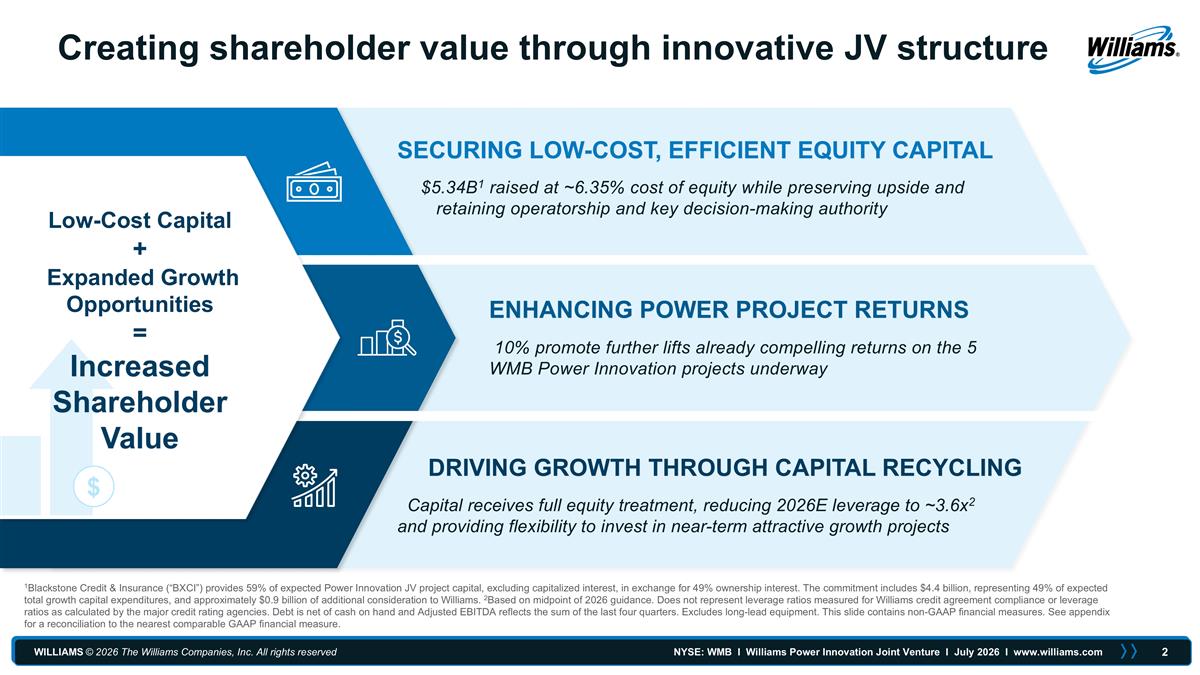
1Blackstone Credit & Insurance (“BXCI”) provides 59% of expected Power Innovation JV project capital, excluding capitalized interest, in exchange for 49% ownership interest. The commitment includes $4.4 billion, representing 49% of expected total growth capital expenditures, and approximately $0.9 billion of additional consideration to Williams. 2Based on midpoint of 2026 guidance. Does not represent leverage ratios measured for Williams credit agreement compliance or leverage ratios as calculated by the major credit rating agencies. Debt is net of cash on hand and Adjusted EBITDA reflects the sum of the last four quarters. Excludes long-lead equipment. This slide contains non-GAAP financial measures. See appendix for a reconciliation to the nearest comparable GAAP financial measure. Creating shareholder value through innovative JV structure ENHANCING POWER PROJECT RETURNS SECURING LOW-COST, EFFICIENT EQUITY CAPITAL DRIVING GROWTH THROUGH CAPITAL RECYCLING $5.34B1 raised at ~6.35% cost of equity while preserving upside and retaining operatorship and key decision-making authority 10% promote further lifts already compelling returns on the 5 WMB Power Innovation projects underway Capital receives full equity treatment, reducing 2026E leverage to ~3.6x2 and providing flexibility to invest in near-term attractive growth projects $ Low-Cost Capital + Expanded Growth Opportunities = Increased Shareholder Value
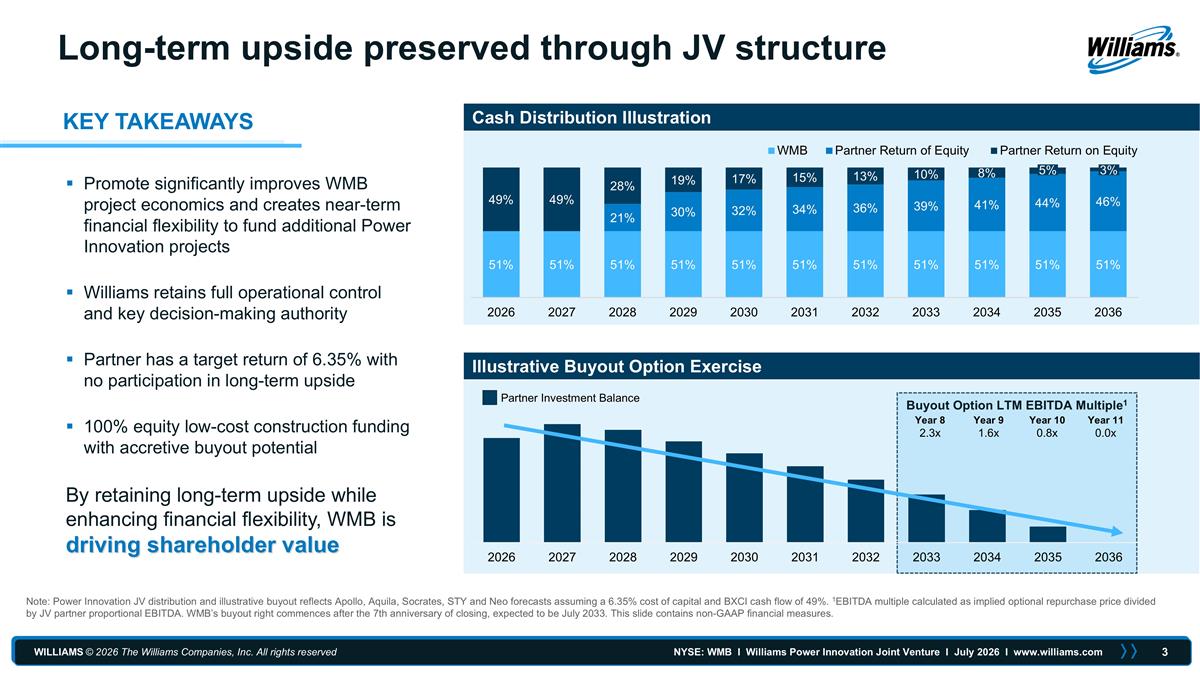
Cash Distribution Illustration Illustrative Buyout Option Exercise Promote significantly improves WMB project economics and creates near-term financial flexibility to fund additional Power Innovation projects Williams retains full operational control and key decision-making authority Partner has a target return of 6.35% with no participation in long-term upside 100% equity low-cost construction funding with accretive buyout potential By retaining long-term upside while enhancing financial flexibility, WMB is driving shareholder value Buyout Option LTM EBITDA Multiple1 Partner Investment Balance Year 8 Year 9 Year 10 Year 11 2.3x 1.6x 0.8x 0.0x Note: Power Innovation JV distribution and illustrative buyout reflects Apollo, Aquila, Socrates, STY and Neo forecasts assuming a 6.35% cost of capital and BXCI cash flow of 49%. 1EBITDA multiple calculated as implied optional repurchase price divided by JV partner proportional EBITDA. WMB’s buyout right commences after the 7th anniversary of closing, expected to be July 2033. This slide contains non-GAAP financial measures. Long-term upside preserved through JV structure 5% 3% KEY TAKEAWAYS
Forward-looking statements and Non-GAAP disclaimer
Forward-looking statements The reports, filings, and other public announcements of The Williams Companies, Inc. (Williams) may contain or incorporate by reference statements that do not directly or exclusively relate to historical facts. Such statements are “forward-looking statements” within the meaning of Section 27A of the Securities Act of 1933, as amended (Securities Act), and Section 21E of the Securities Exchange Act of 1934, as amended (Exchange Act). These forward-looking statements relate to anticipated financial performance, management’s plans and objectives for future operations, business prospects, outcomes of regulatory proceedings, market conditions, and other matters. We make these forward-looking statements in reliance on the safe harbor protections provided under the Private Securities Litigation Reform Act of 1995. All statements, other than statements of historical facts, included in this report that address activities, events, or developments that we expect, believe, or anticipate will exist or may occur in the future, are forward-looking statements. Forward-looking statements can be identified by various forms of words such as “anticipates,” “believes,” “seeks,” “could,” “may,” “should,” “continues,” “estimates,” “expects,” “forecasts,” “intends,” “might,” “goals,” “objectives,” “targets,” “planned,” “potential,” “projects,” “scheduled,” “will,” “assumes,” “guidance,” “outlook,” “in-service date,” or other similar expressions. These forward-looking statements are based on management’s beliefs and assumptions and on information currently available to management and include, among others, statements regarding: Levels of dividends to Williams’ stockholders; Future credit ratings of Williams and its affiliates; Amounts and nature of future capital expenditures; Expansion and growth of business and operations; Expected in-service dates for capital projects; Financial condition and liquidity; Business strategy; Cash flow from operations or results of operations; Rate case filings; Seasonality of certain business components; Natural gas, natural gas liquids, and crude oil prices, supply, and demand; Demand for services.
Forward-looking statements (continued) Forward-looking statements are based on numerous assumptions, uncertainties, and risks that could cause future events or results to be materially different from those stated or implied in this report. Many of the factors that will determine these results are beyond our ability to control or predict. Specific factors that could cause actual results to differ from results contemplated by the forward-looking statements include, among others, the following: Availability of supplies, market demand, and volatility of prices; Development and rate of adoption of alternative energy sources; The impact of existing and future laws and regulations, the regulatory environment, environmental matters, and litigation, as well as our ability and the ability of other energy companies with whom we conduct or seek to conduct business, to obtain necessary permits and approvals, and our ability to achieve favorable rate proceeding outcomes; Exposure to the credit risk of customers and counterparties; Our ability to acquire new businesses and assets and successfully integrate those operations and assets into existing businesses as well as successfully expand our facilities, and consummate asset sales on acceptable terms; The ability to successfully identify, evaluate, and timely execute on capital projects and investment opportunities; The strength and financial resources of our competitors and the effects of competition; The amount of cash distributions from and capital requirements of our investments and joint ventures in which we participate; The ability to effectively execute our financing plan; Increasing scrutiny and changing expectations from stakeholders with respect to environmental, social, and governance practices; The physical and financial risks associated with climate change; The impacts of operational and developmental hazards and unforeseen interruptions; The risks resulting from outbreaks or other public health crises; Risks associated with weather and natural phenomena, including climate conditions and physical damage to our facilities; Acts of terrorism, cybersecurity incidents, and related disruptions; Costs and funding obligations for defined benefit pension plans and other postretirement benefit plans; Changes in maintenance and construction costs, as well as our ability to obtain sufficient construction-related inputs, including skilled labor; Inflation, interest rates, tariffs on foreign-made materials and goods (including steel and steel pipes) necessary to our business, and general economic conditions (including future disruptions and volatility in the global credit markets and the impact of these events on customers and suppliers); Risks related to financing, including restrictions stemming from debt agreements, future changes in credit ratings as determined by nationally recognized credit rating agencies, and the availability and cost of capital;
Forward-looking statements (continued) The ability of the members of the Organization of Petroleum Exporting Countries and other oil exporting nations to agree to and maintain oil price and production controls and the impact on domestic production; Changes in the current geopolitical situation; Changes in U.S. governmental administration and policies; Whether we are able to pay current and expected levels of dividends; Additional risks described in our filings with the Securities and Exchange Commission (SEC). Given the uncertainties and risk factors that could cause our actual results to differ materially from those contained in any forward-looking statement, we caution investors not to unduly rely on our forward-looking statements. We disclaim any obligations to, and do not intend to, update the above list or announce publicly the result of any revisions to any of the forward-looking statements to reflect future events or developments. In addition to causing our actual results to differ, the factors listed above and referred to below may cause our intentions to change from those statements of intention set forth in this report. Such changes in our intentions may also cause our results to differ. We may change our intentions, at any time and without notice, based upon changes in such factors, our assumptions, or otherwise. Because forward-looking statements involve risks and uncertainties, we caution that there are important factors, in addition to those listed above, that may cause actual results to differ materially from those contained in the forward-looking statements. For a detailed discussion of those factors, see (a) Part I, Item IA. Risk Factors in our Annual Report on Form 10-K for the year ended December 31, 2025, as filed with the SEC on February 24, 2026, and (b) Part II, Item 1A. Risk Factors in subsequent Quarterly Reports on Form 10-Q.
Non-GAAP Disclaimer This news release and accompanying materials may include certain financial measures – adjusted EBITDA, adjusted income (“earnings”), adjusted earnings per share, available funds from operations and dividend coverage ratio – that are non-GAAP financial measures as defined under the rules of the SEC. Our segment performance measure, modified EBITDA, is defined as net income (loss) before income (loss) from discontinued operations, income tax expense, net interest expense, equity earnings from equity-method investments, other net investing income, impairments of equity investments and goodwill, depreciation and amortization expense, and accretion expense associated with asset retirement obligations for nonregulated operations. We also add our proportional ownership share (based on ownership interest) of modified EBITDA of equity-method investments, including our indirect share from interests owned by equity-method investees. Adjusted EBITDA further excludes items of income or loss that we characterize as unrepresentative of our ongoing operations. Such items are excluded from net income to determine adjusted income and adjusted earnings per share. Management believes this measure provides investors meaningful insight into results from ongoing operations. Available funds from operations (AFFO) is defined as cash flow from operations excluding the effect of changes in working capital and certain other changes in noncurrent assets and liabilities, reduced by preferred dividends and net distributions to noncontrolling interests. AFFO may be adjusted to exclude certain items that we characterize as unrepresentative of our ongoing operations. This news release is accompanied by a reconciliation of these non-GAAP financial measures to their nearest GAAP financial measures. Management uses these financial measures because they are accepted financial indicators used by investors to compare company performance. In addition, management believes that these measures provide investors an enhanced perspective of the operating performance of assets and the cash that the business is generating. Neither adjusted EBITDA, adjusted income, nor available funds from operations are intended to represent cash flows for the period, nor are they presented as an alternative to net income or cash flow from operations. They should not be considered in isolation or as substitutes for a measure of performance prepared in accordance with United States generally accepted accounting principles. The Company has not provided a reconciliation of projected net debt to projected total debt, the most comparable financial measure calculated in accordance with GAAP. The Company is unable to project total debt for any future period because total debt is dependent on the timing of cash receipts and disbursements that may not relate to the periods in which the operating activities occurred. The Company is unable to project these timing differences with any reasonable degree of accuracy and therefore cannot reasonably determine the timing and payment of credit facility borrowings or other components of total debt without unreasonable effort. Furthermore, the Company does not provide guidance with respect to its average realized price, among other items that impact reconciling items between certain of the projected total debt and projected net debt, as applicable. Natural gas prices are volatile and out of the Company’s control, and the timing of transactions and the distinction between cash on hand as compared to credit facility borrowings are too difficult to accurately predict. Therefore, the Company is unable to provide a reconciliation of projected net debt to projected total debt, without unreasonable effort.