Shareholder Report
Apr. 30, 2026
USD ($)
Holding
This report describes planned changes made to the Fund since the beginning of the reporting period.
What were the Fund costs for the last year?
(Based on a hypothetical $10,000 investment)
| Fund (Class) | Costs of a $10,000 investment | Costs paid as a percentage of a $10,000 investment |
| Pacific Capital Tax-Free Securities Fund (Class Y / PTXFX) |
$15 | 0.14% |
Management’s Discussion of Fund Performance
The Pacific Capital Tax-Free Securities Fund returned 6.27% (gross of fees) over the trailing one-year period, outperforming the Bloomberg Hawaii Municipal Bond Index’s 6.13% return. Market yields have increased recently due to geopolitical tensions and rising oil prices, alongside a shift in Federal Reserve rate expectations from cuts to increases to combat inflation, contributing to market volatility. Performance attribution shows that an overweight in longer maturities positively impacted returns, benefiting from a steeper municipal maturity curve and higher tax-equivalent yields, while underperformance was linked to a higher quality bias in Hawaii-based credit.
Fund Performance
The following is a comparison of the change in value of a $10,000 investment in Pacific Capital Tax-Free Securities Fund’s Class Y vs. the Bloomberg Municipal Bond Index and the Bloomberg Hawaii Municipal Bond Index.
Growth of $ 10,000
For the years April 30, 2016 through April 30, 2026
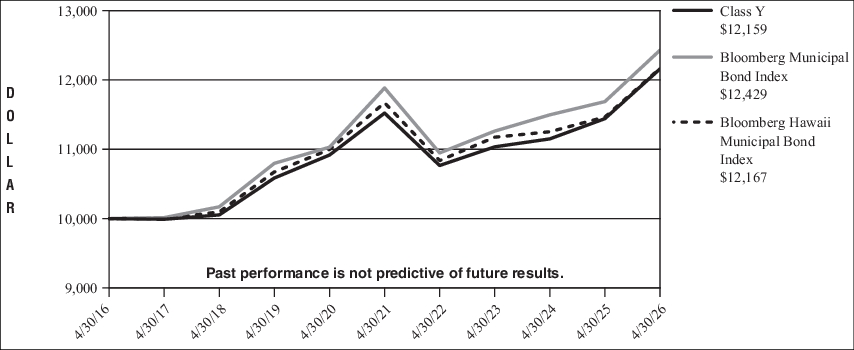
| Average Annual Total Returns | 1 Year | 5 Years | 10 Years |
| Class Y | 6.27% | 1.08% | 1.97% |
| Bloomberg Municipal Bond Index | 6.34% | 0.90% | 2.20% |
| Bloomberg Hawaii Municipal Bond Index | 6.13% | 0.84% | 1.98% |
Key Fund Statistics (as of April 30, 2026)
The following table outlines key Fund statistics that you should pay attention to.
| Fund net assets | $282,340,210 |
| Total number of portfolio holdings | 124 |
| Total advisory fee paid, net | $0 |
| Portfolio turnover rate as of the end of the reporting period | 36% |
Portfolio Holdings Summary Table (as of April 30, 2026)
The following table presents a summary by credit quality of the portfolio holdings of the Fund, as a percentage of net assets:
CREDIT QUALITY
| AAA | 5.5% |
| AA | 85.1% |
| A | 6.4% |
| BAA | 0.8% |
| Cash | 2.2% |
Credit quality ratings are primarily sourced from Moody’s but in the event that Moody’s has not assigned a rating, the Fund will use S&P or Fitch. If these ratings are in conflict, S&P will be used before Fitch. If none of the major rating agencies have assigned a rating, the Fund will assign a rating of NR (non-rated security). The ratings represent their (Moody’s, S&P, and Fitch) opinions as to the quality of the underlying securities in the Fund, and not the Fund itself. The ratings range from AAA (extremely strong capacity to meet financial commitment) to D (in default). Ratings are relative and subjective and are not absolute standards of quality. A pre-refunded bond (if any) is secured by an escrow fund of U.S. government obligations (i.e., Treasury securities) and assumes the superior credit rating of the government obligation. The ratings do not predict performance and are subject to change.
Credit quality ratings are primarily sourced from Moody’s but in the event that Moody’s has not assigned a rating, the Fund will use S&P or Fitch. If these ratings are in conflict, S&P will be used before Fitch. If none of the major rating agencies have assigned a rating, the Fund will assign a rating of NR (non-rated security). The ratings represent their (Moody’s, S&P, and Fitch) opinions as to the quality of the underlying securities in the Fund, and not the Fund itself. The ratings range from AAA (extremely strong capacity to meet financial commitment) to D (in default). Ratings are relative and subjective and are not absolute standards of quality. A pre-refunded bond (if any) is secured by an escrow fund of U.S. government obligations (i.e., Treasury securities) and assumes the superior credit rating of the government obligation. The ratings do not predict performance and are subject to change.
Material Fund Changes During the Period
On December 2, 2025, the Fund’s Board of Trustees approved the reorganization of the Pacific Capital Tax-Free Short Intermediate Securities Fund into the Fund (the “Reorganization”). The Reorganization took place after the close of business on March 20, 2026. Immediately prior to the Reorganization, the Pacific Capital Tax-Free Short Intermediate Securities Fund’s Class Y Shares outstanding were exchanged for the Class Y Shares of the Fund.
Changes in and Disagreements with Accountants
There were no changes in and/or disagreements with accountants.