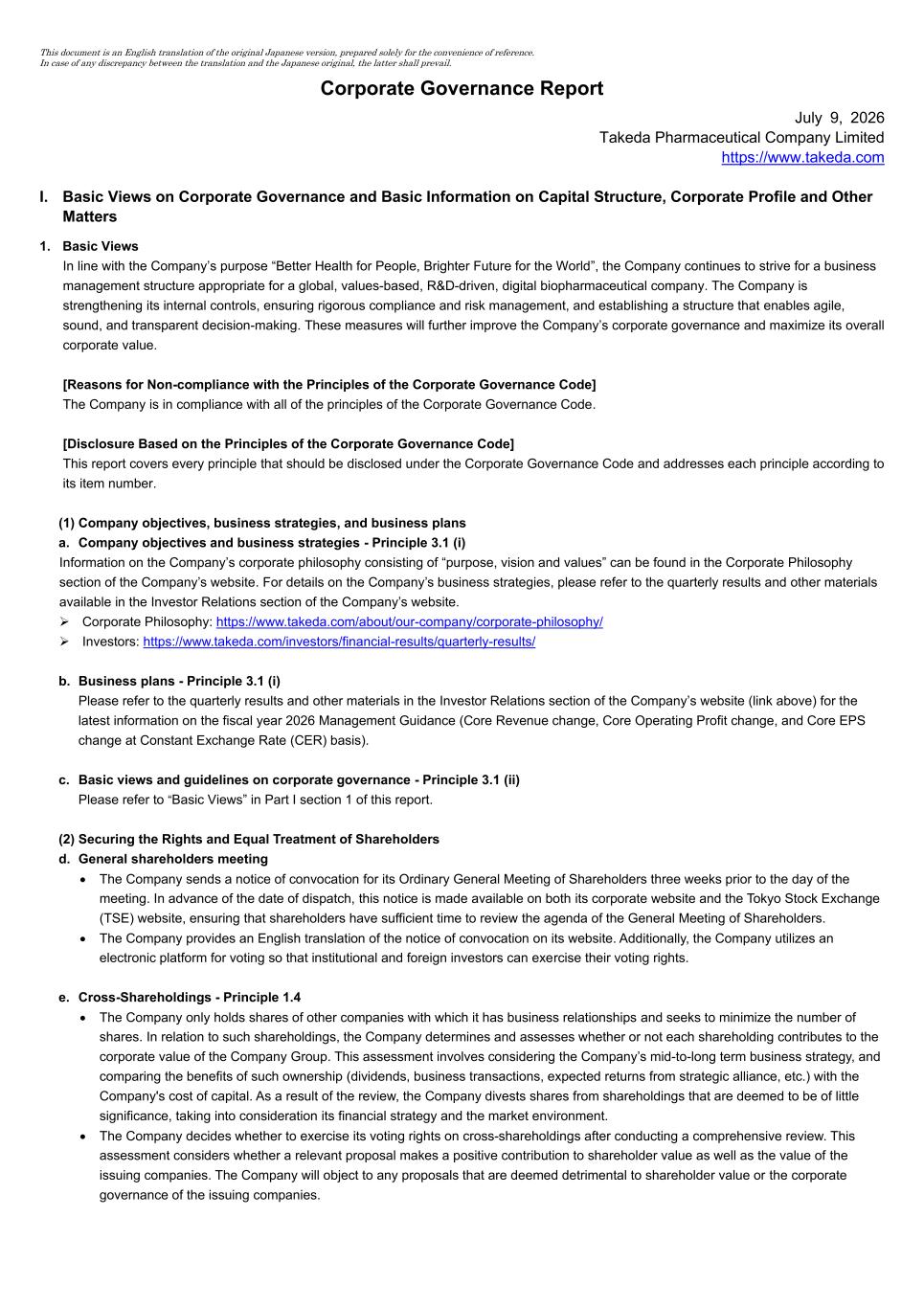
This document is an English translation of the original Japanese version, prepared solely for the convenience of reference. In case of any discrepancy between the translation and the Japanese original, the latter shall prevail. Corporate Governance Report July 9, 2026 Takeda Pharmaceutical Company Limited https://www.takeda.com I. Basic Views on Corporate Governance and Basic Information on Capital Structure, Corporate Profile and Other Matters 1. Basic Views In line with the Company’s purpose “Better Health for People, Brighter Future for the World”, the Company continues to strive for a business management structure appropriate for a global, values-based, R&D-driven, digital biopharmaceutical company. The Company is strengthening its internal controls, ensuring rigorous compliance and risk management, and establishing a structure that enables agile, sound, and transparent decision-making. These measures will further improve the Company’s corporate governance and maximize its overall corporate value. [Reasons for Non-compliance with the Principles of the Corporate Governance Code] The Company is in compliance with all of the principles of the Corporate Governance Code. [Disclosure Based on the Principles of the Corporate Governance Code] This report covers every principle that should be disclosed under the Corporate Governance Code and addresses each principle according to its item number. (1) Company objectives, business strategies, and business plans a. Company objectives and business strategies - Principle 3.1 (i) Information on the Company’s corporate philosophy consisting of “purpose, vision and values” can be found in the Corporate Philosophy section of the Company’s website. For details on the Company’s business strategies, please refer to the quarterly results and other materials available in the Investor Relations section of the Company’s website. ➢ Corporate Philosophy: https://www.takeda.com/about/our-company/corporate-philosophy/ ➢ Investors: https://www.takeda.com/investors/financial-results/quarterly-results/ b. Business plans - Principle 3.1 (i) Please refer to the quarterly results and other materials in the Investor Relations section of the Company’s website (link above) for the latest information on the fiscal year 2026 Management Guidance (Core Revenue change, Core Operating Profit change, and Core EPS change at Constant Exchange Rate (CER) basis). c. Basic views and guidelines on corporate governance - Principle 3.1 (ii) Please refer to “Basic Views” in Part I section 1 of this report. (2) Securing the Rights and Equal Treatment of Shareholders d. General shareholders meeting • The Company sends a notice of convocation for its Ordinary General Meeting of Shareholders three weeks prior to the day of the meeting. In advance of the date of dispatch, this notice is made available on both its corporate website and the Tokyo Stock Exchange (TSE) website, ensuring that shareholders have sufficient time to review the agenda of the General Meeting of Shareholders. • The Company provides an English translation of the notice of convocation on its website. Additionally, the Company utilizes an electronic platform for voting so that institutional and foreign investors can exercise their voting rights. e. Cross-Shareholdings - Principle 1.4 • The Company only holds shares of other companies with which it has business relationships and seeks to minimize the number of shares. In relation to such shareholdings, the Company determines and assesses whether or not each shareholding contributes to the corporate value of the Company Group. This assessment involves considering the Company’s mid-to-long term business strategy, and comparing the benefits of such ownership (dividends, business transactions, expected returns from strategic alliance, etc.) with the Company's cost of capital. As a result of the review, the Company divests shares from shareholdings that are deemed to be of little significance, taking into consideration its financial strategy and the market environment. • The Company decides whether to exercise its voting rights on cross-shareholdings after conducting a comprehensive review. This assessment considers whether a relevant proposal makes a positive contribution to shareholder value as well as the value of the issuing companies. The Company will object to any proposals that are deemed detrimental to shareholder value or the corporate governance of the issuing companies.
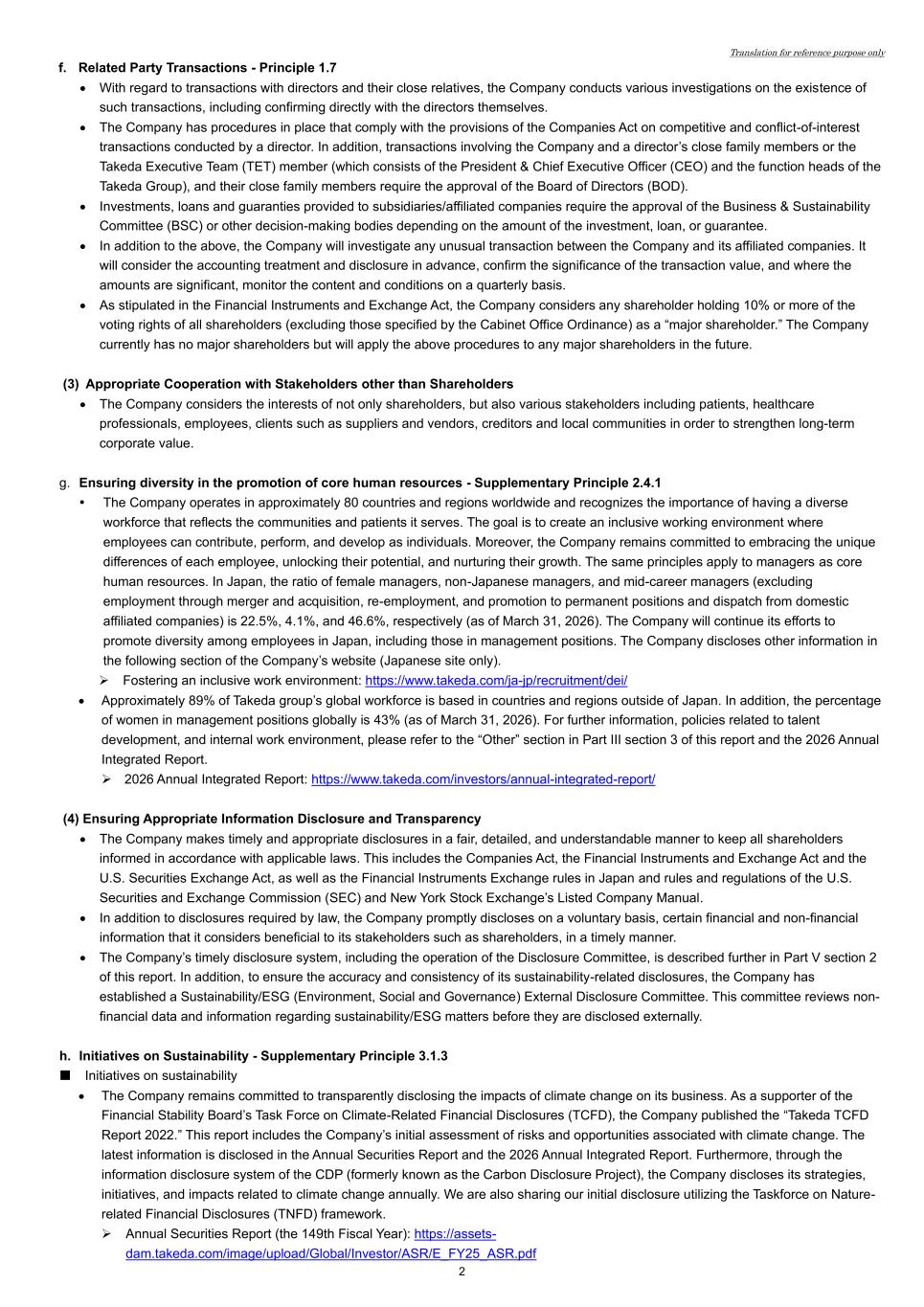
Translation for reference purpose only 2 f. Related Party Transactions - Principle 1.7 • With regard to transactions with directors and their close relatives, the Company conducts various investigations on the existence of such transactions, including confirming directly with the directors themselves. • The Company has procedures in place that comply with the provisions of the Companies Act on competitive and conflict-of-interest transactions conducted by a director. In addition, transactions involving the Company and a director’s close family members or the Takeda Executive Team (TET) member (which consists of the President & Chief Executive Officer (CEO) and the function heads of the Takeda Group), and their close family members require the approval of the Board of Directors (BOD). • Investments, loans and guaranties provided to subsidiaries/affiliated companies require the approval of the Business & Sustainability Committee (BSC) or other decision-making bodies depending on the amount of the investment, loan, or guarantee. • In addition to the above, the Company will investigate any unusual transaction between the Company and its affiliated companies. It will consider the accounting treatment and disclosure in advance, confirm the significance of the transaction value, and where the amounts are significant, monitor the content and conditions on a quarterly basis. • As stipulated in the Financial Instruments and Exchange Act, the Company considers any shareholder holding 10% or more of the voting rights of all shareholders (excluding those specified by the Cabinet Office Ordinance) as a “major shareholder.” The Company currently has no major shareholders but will apply the above procedures to any major shareholders in the future. (3) Appropriate Cooperation with Stakeholders other than Shareholders • The Company considers the interests of not only shareholders, but also various stakeholders including patients, healthcare professionals, employees, clients such as suppliers and vendors, creditors and local communities in order to strengthen long-term corporate value. g. Ensuring diversity in the promotion of core human resources - Supplementary Principle 2.4.1 The Company operates in approximately 80 countries and regions worldwide and recognizes the importance of having a diverse workforce that reflects the communities and patients it serves. The goal is to create an inclusive working environment where employees can contribute, perform, and develop as individuals. Moreover, the Company remains committed to embracing the unique differences of each employee, unlocking their potential, and nurturing their growth. The same principles apply to managers as core human resources. In Japan, the ratio of female managers, non-Japanese managers, and mid-career managers (excluding employment through merger and acquisition, re-employment, and promotion to permanent positions and dispatch from domestic affiliated companies) is 22.5%, 4.1%, and 46.6%, respectively (as of March 31, 2026). The Company will continue its efforts to promote diversity among employees in Japan, including those in management positions. The Company discloses other information in the following section of the Company’s website (Japanese site only). ➢ Fostering an inclusive work environment: https://www.takeda.com/ja-jp/recruitment/dei/ • Approximately 89% of Takeda group’s global workforce is based in countries and regions outside of Japan. In addition, the percentage of women in management positions globally is 43% (as of March 31, 2026). For further information, policies related to talent development, and internal work environment, please refer to the “Other” section in Part III section 3 of this report and the 2026 Annual Integrated Report. ➢ 2026 Annual Integrated Report: https://www.takeda.com/investors/annual-integrated-report/ (4) Ensuring Appropriate Information Disclosure and Transparency • The Company makes timely and appropriate disclosures in a fair, detailed, and understandable manner to keep all shareholders informed in accordance with applicable laws. This includes the Companies Act, the Financial Instruments and Exchange Act and the U.S. Securities Exchange Act, as well as the Financial Instruments Exchange rules in Japan and rules and regulations of the U.S. Securities and Exchange Commission (SEC) and New York Stock Exchange’s Listed Company Manual. • In addition to disclosures required by law, the Company promptly discloses on a voluntary basis, certain financial and non-financial information that it considers beneficial to its stakeholders such as shareholders, in a timely manner. • The Company’s timely disclosure system, including the operation of the Disclosure Committee, is described further in Part V section 2 of this report. In addition, to ensure the accuracy and consistency of its sustainability-related disclosures, the Company has established a Sustainability/ESG (Environment, Social and Governance) External Disclosure Committee. This committee reviews non- financial data and information regarding sustainability/ESG matters before they are disclosed externally. h. Initiatives on Sustainability - Supplementary Principle 3.1.3 ■ Initiatives on sustainability • The Company remains committed to transparently disclosing the impacts of climate change on its business. As a supporter of the Financial Stability Board’s Task Force on Climate-Related Financial Disclosures (TCFD), the Company published the “Takeda TCFD Report 2022.” This report includes the Company’s initial assessment of risks and opportunities associated with climate change. The latest information is disclosed in the Annual Securities Report and the 2026 Annual Integrated Report. Furthermore, through the information disclosure system of the CDP (formerly known as the Carbon Disclosure Project), the Company discloses its strategies, initiatives, and impacts related to climate change annually. We are also sharing our initial disclosure utilizing the Taskforce on Nature- related Financial Disclosures (TNFD) framework. ➢ Annual Securities Report (the 149th Fiscal Year): https://assets- dam.takeda.com/image/upload/Global/Investor/ASR/E_FY25_ASR.pdf
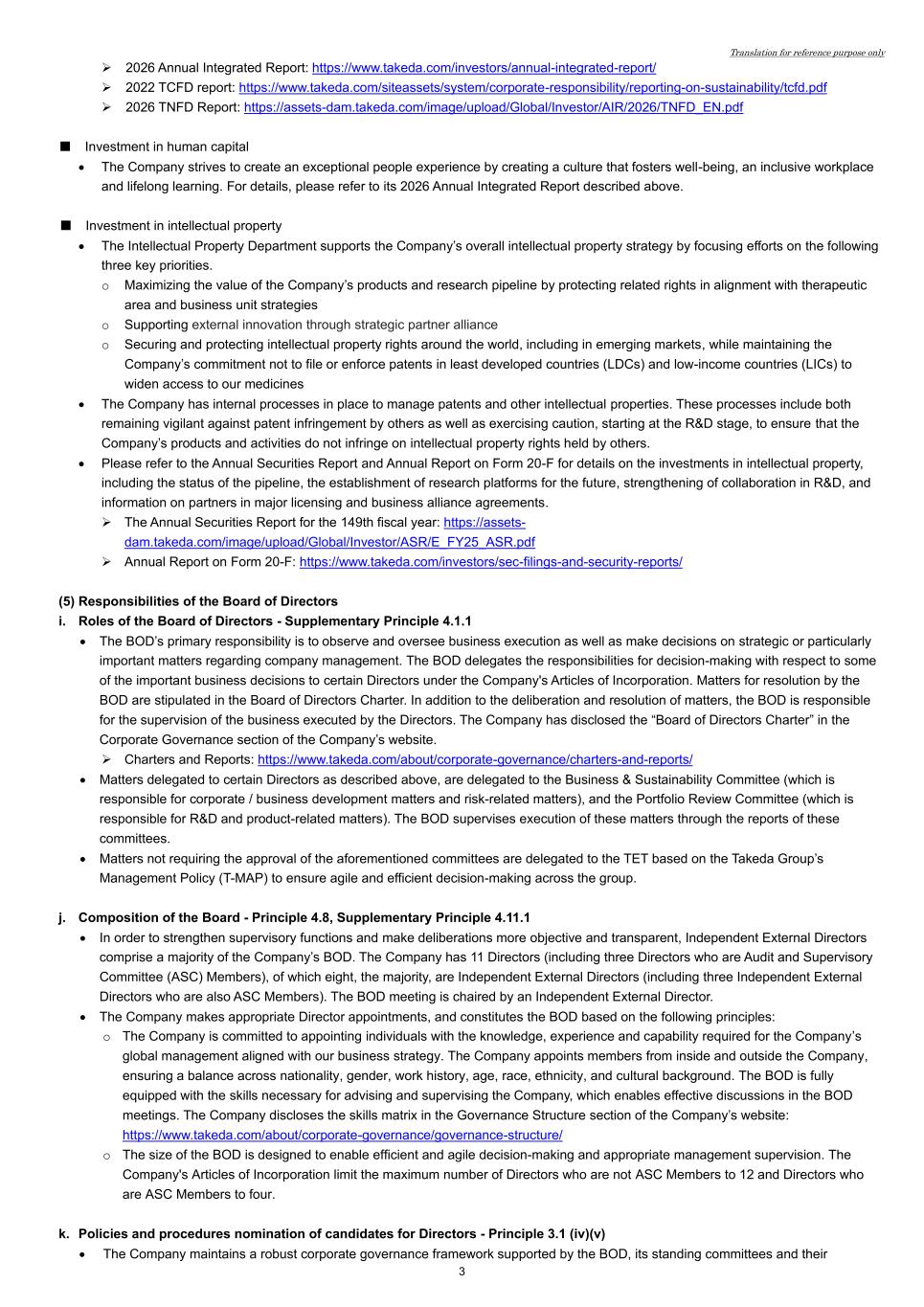
Translation for reference purpose only 3 ➢ 2026 Annual Integrated Report: https://www.takeda.com/investors/annual-integrated-report/ ➢ 2022 TCFD report: https://www.takeda.com/siteassets/system/corporate-responsibility/reporting-on-sustainability/tcfd.pdf ➢ 2026 TNFD Report: https://assets-dam.takeda.com/image/upload/Global/Investor/AIR/2026/TNFD_EN.pdf ■ Investment in human capital • The Company strives to create an exceptional people experience by creating a culture that fosters well-being, an inclusive workplace and lifelong learning. For details, please refer to its 2026 Annual Integrated Report described above. ■ Investment in intellectual property • The Intellectual Property Department supports the Company’s overall intellectual property strategy by focusing efforts on the following three key priorities. o Maximizing the value of the Company’s products and research pipeline by protecting related rights in alignment with therapeutic area and business unit strategies o Supporting external innovation through strategic partner alliance o Securing and protecting intellectual property rights around the world, including in emerging markets, while maintaining the Company’s commitment not to file or enforce patents in least developed countries (LDCs) and low-income countries (LICs) to widen access to our medicines • The Company has internal processes in place to manage patents and other intellectual properties. These processes include both remaining vigilant against patent infringement by others as well as exercising caution, starting at the R&D stage, to ensure that the Company’s products and activities do not infringe on intellectual property rights held by others. • Please refer to the Annual Securities Report and Annual Report on Form 20-F for details on the investments in intellectual property, including the status of the pipeline, the establishment of research platforms for the future, strengthening of collaboration in R&D, and information on partners in major licensing and business alliance agreements. ➢ The Annual Securities Report for the 149th fiscal year: https://assets- dam.takeda.com/image/upload/Global/Investor/ASR/E_FY25_ASR.pdf ➢ Annual Report on Form 20-F: https://www.takeda.com/investors/sec-filings-and-security-reports/ (5) Responsibilities of the Board of Directors i. Roles of the Board of Directors - Supplementary Principle 4.1.1 • The BOD’s primary responsibility is to observe and oversee business execution as well as make decisions on strategic or particularly important matters regarding company management. The BOD delegates the responsibilities for decision-making with respect to some of the important business decisions to certain Directors under the Company's Articles of Incorporation. Matters for resolution by the BOD are stipulated in the Board of Directors Charter. In addition to the deliberation and resolution of matters, the BOD is responsible for the supervision of the business executed by the Directors. The Company has disclosed the “Board of Directors Charter” in the Corporate Governance section of the Company’s website. ➢ Charters and Reports: https://www.takeda.com/about/corporate-governance/charters-and-reports/ • Matters delegated to certain Directors as described above, are delegated to the Business & Sustainability Committee (which is responsible for corporate / business development matters and risk-related matters), and the Portfolio Review Committee (which is responsible for R&D and product-related matters). The BOD supervises execution of these matters through the reports of these committees. • Matters not requiring the approval of the aforementioned committees are delegated to the TET based on the Takeda Group’s Management Policy (T-MAP) to ensure agile and efficient decision-making across the group. j. Composition of the Board - Principle 4.8, Supplementary Principle 4.11.1 • In order to strengthen supervisory functions and make deliberations more objective and transparent, Independent External Directors comprise a majority of the Company’s BOD. The Company has 11 Directors (including three Directors who are Audit and Supervisory Committee (ASC) Members), of which eight, the majority, are Independent External Directors (including three Independent External Directors who are also ASC Members). The BOD meeting is chaired by an Independent External Director. • The Company makes appropriate Director appointments, and constitutes the BOD based on the following principles: o The Company is committed to appointing individuals with the knowledge, experience and capability required for the Company’s global management aligned with our business strategy. The Company appoints members from inside and outside the Company, ensuring a balance across nationality, gender, work history, age, race, ethnicity, and cultural background. The BOD is fully equipped with the skills necessary for advising and supervising the Company, which enables effective discussions in the BOD meetings. The Company discloses the skills matrix in the Governance Structure section of the Company’s website: https://www.takeda.com/about/corporate-governance/governance-structure/ o The size of the BOD is designed to enable efficient and agile decision-making and appropriate management supervision. The Company's Articles of Incorporation limit the maximum number of Directors who are not ASC Members to 12 and Directors who are ASC Members to four. k. Policies and procedures nomination of candidates for Directors - Principle 3.1 (iv)(v) • The Company maintains a robust corporate governance framework supported by the BOD, its standing committees and their
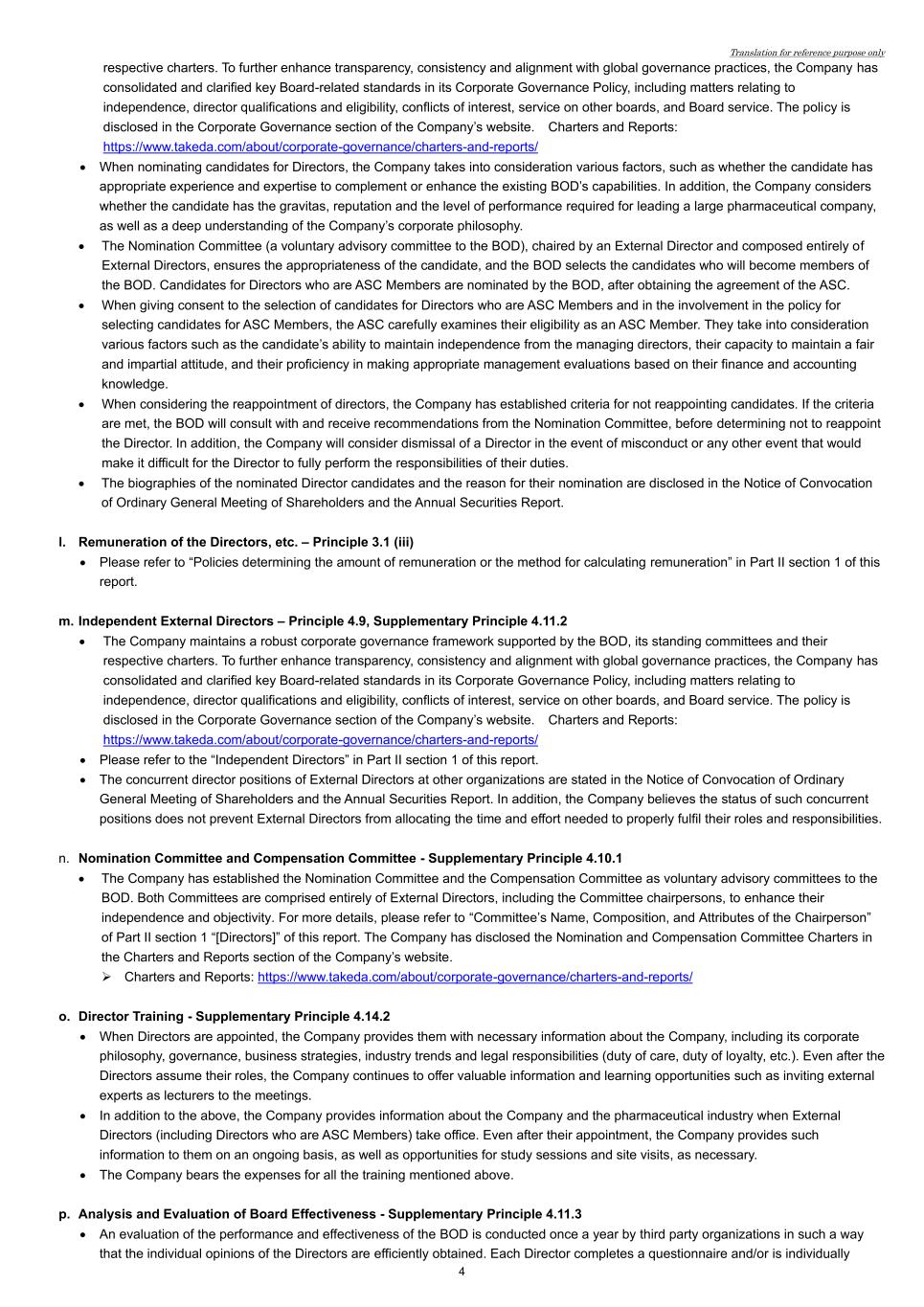
Translation for reference purpose only 4 respective charters. To further enhance transparency, consistency and alignment with global governance practices, the Company has consolidated and clarified key Board-related standards in its Corporate Governance Policy, including matters relating to independence, director qualifications and eligibility, conflicts of interest, service on other boards, and Board service. The policy is disclosed in the Corporate Governance section of the Company’s website. Charters and Reports: https://www.takeda.com/about/corporate-governance/charters-and-reports/ • When nominating candidates for Directors, the Company takes into consideration various factors, such as whether the candidate has appropriate experience and expertise to complement or enhance the existing BOD’s capabilities. In addition, the Company considers whether the candidate has the gravitas, reputation and the level of performance required for leading a large pharmaceutical company, as well as a deep understanding of the Company’s corporate philosophy. • The Nomination Committee (a voluntary advisory committee to the BOD), chaired by an External Director and composed entirely of External Directors, ensures the appropriateness of the candidate, and the BOD selects the candidates who will become members of the BOD. Candidates for Directors who are ASC Members are nominated by the BOD, after obtaining the agreement of the ASC. • When giving consent to the selection of candidates for Directors who are ASC Members and in the involvement in the policy for selecting candidates for ASC Members, the ASC carefully examines their eligibility as an ASC Member. They take into consideration various factors such as the candidate’s ability to maintain independence from the managing directors, their capacity to maintain a fair and impartial attitude, and their proficiency in making appropriate management evaluations based on their finance and accounting knowledge. • When considering the reappointment of directors, the Company has established criteria for not reappointing candidates. If the criteria are met, the BOD will consult with and receive recommendations from the Nomination Committee, before determining not to reappoint the Director. In addition, the Company will consider dismissal of a Director in the event of misconduct or any other event that would make it difficult for the Director to fully perform the responsibilities of their duties. • The biographies of the nominated Director candidates and the reason for their nomination are disclosed in the Notice of Convocation of Ordinary General Meeting of Shareholders and the Annual Securities Report. l. Remuneration of the Directors, etc. – Principle 3.1 (iii) • Please refer to “Policies determining the amount of remuneration or the method for calculating remuneration” in Part II section 1 of this report. m. Independent External Directors – Principle 4.9, Supplementary Principle 4.11.2 • The Company maintains a robust corporate governance framework supported by the BOD, its standing committees and their respective charters. To further enhance transparency, consistency and alignment with global governance practices, the Company has consolidated and clarified key Board-related standards in its Corporate Governance Policy, including matters relating to independence, director qualifications and eligibility, conflicts of interest, service on other boards, and Board service. The policy is disclosed in the Corporate Governance section of the Company’s website. Charters and Reports: https://www.takeda.com/about/corporate-governance/charters-and-reports/ • Please refer to the “Independent Directors” in Part II section 1 of this report. • The concurrent director positions of External Directors at other organizations are stated in the Notice of Convocation of Ordinary General Meeting of Shareholders and the Annual Securities Report. In addition, the Company believes the status of such concurrent positions does not prevent External Directors from allocating the time and effort needed to properly fulfil their roles and responsibilities. n. Nomination Committee and Compensation Committee - Supplementary Principle 4.10.1 • The Company has established the Nomination Committee and the Compensation Committee as voluntary advisory committees to the BOD. Both Committees are comprised entirely of External Directors, including the Committee chairpersons, to enhance their independence and objectivity. For more details, please refer to “Committee’s Name, Composition, and Attributes of the Chairperson” of Part II section 1 “[Directors]” of this report. The Company has disclosed the Nomination and Compensation Committee Charters in the Charters and Reports section of the Company’s website. ➢ Charters and Reports: https://www.takeda.com/about/corporate-governance/charters-and-reports/ o. Director Training - Supplementary Principle 4.14.2 • When Directors are appointed, the Company provides them with necessary information about the Company, including its corporate philosophy, governance, business strategies, industry trends and legal responsibilities (duty of care, duty of loyalty, etc.). Even after the Directors assume their roles, the Company continues to offer valuable information and learning opportunities such as inviting external experts as lecturers to the meetings. • In addition to the above, the Company provides information about the Company and the pharmaceutical industry when External Directors (including Directors who are ASC Members) take office. Even after their appointment, the Company provides such information to them on an ongoing basis, as well as opportunities for study sessions and site visits, as necessary. • The Company bears the expenses for all the training mentioned above. p. Analysis and Evaluation of Board Effectiveness - Supplementary Principle 4.11.3 • An evaluation of the performance and effectiveness of the BOD is conducted once a year by third party organizations in such a way that the individual opinions of the Directors are efficiently obtained. Each Director completes a questionnaire and/or is individually
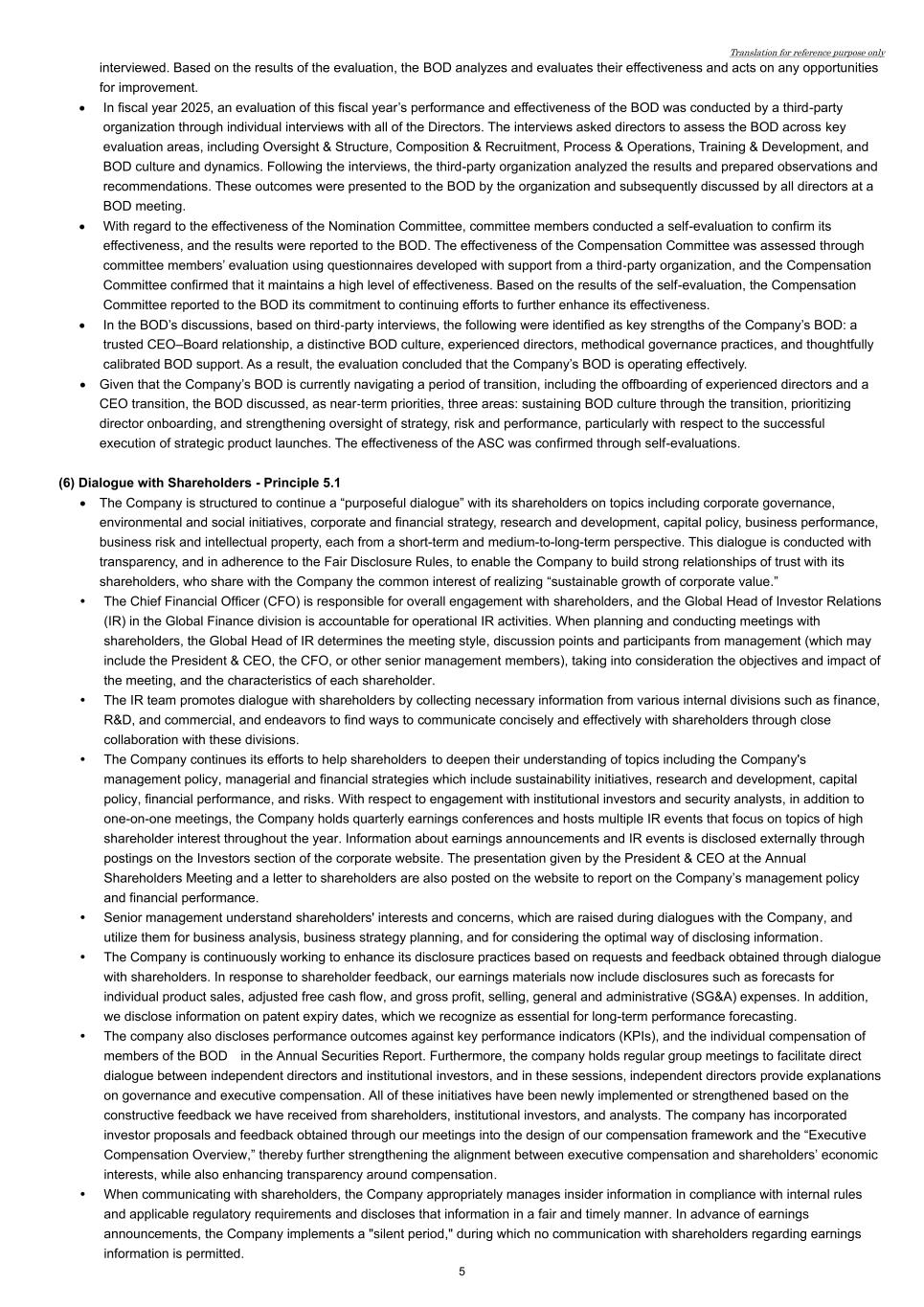
Translation for reference purpose only 5 interviewed. Based on the results of the evaluation, the BOD analyzes and evaluates their effectiveness and acts on any opportunities for improvement. • In fiscal year 2025, an evaluation of this fiscal year’s performance and effectiveness of the BOD was conducted by a third-party organization through individual interviews with all of the Directors. The interviews asked directors to assess the BOD across key evaluation areas, including Oversight & Structure, Composition & Recruitment, Process & Operations, Training & Development, and BOD culture and dynamics. Following the interviews, the third-party organization analyzed the results and prepared observations and recommendations. These outcomes were presented to the BOD by the organization and subsequently discussed by all directors at a BOD meeting. • With regard to the effectiveness of the Nomination Committee, committee members conducted a self-evaluation to confirm its effectiveness, and the results were reported to the BOD. The effectiveness of the Compensation Committee was assessed through committee members’ evaluation using questionnaires developed with support from a third-party organization, and the Compensation Committee confirmed that it maintains a high level of effectiveness. Based on the results of the self-evaluation, the Compensation Committee reported to the BOD its commitment to continuing efforts to further enhance its effectiveness. • In the BOD’s discussions, based on third-party interviews, the following were identified as key strengths of the Company’s BOD: a trusted CEO–Board relationship, a distinctive BOD culture, experienced directors, methodical governance practices, and thoughtfully calibrated BOD support. As a result, the evaluation concluded that the Company’s BOD is operating effectively. • Given that the Company’s BOD is currently navigating a period of transition, including the offboarding of experienced directors and a CEO transition, the BOD discussed, as near-term priorities, three areas: sustaining BOD culture through the transition, prioritizing director onboarding, and strengthening oversight of strategy, risk and performance, particularly with respect to the successful execution of strategic product launches. The effectiveness of the ASC was confirmed through self-evaluations. (6) Dialogue with Shareholders - Principle 5.1 • The Company is structured to continue a “purposeful dialogue” with its shareholders on topics including corporate governance, environmental and social initiatives, corporate and financial strategy, research and development, capital policy, business performance, business risk and intellectual property, each from a short-term and medium-to-long-term perspective. This dialogue is conducted with transparency, and in adherence to the Fair Disclosure Rules, to enable the Company to build strong relationships of trust with its shareholders, who share with the Company the common interest of realizing “sustainable growth of corporate value.” The Chief Financial Officer (CFO) is responsible for overall engagement with shareholders, and the Global Head of Investor Relations (IR) in the Global Finance division is accountable for operational IR activities. When planning and conducting meetings with shareholders, the Global Head of IR determines the meeting style, discussion points and participants from management (which may include the President & CEO, the CFO, or other senior management members), taking into consideration the objectives and impact of the meeting, and the characteristics of each shareholder. The IR team promotes dialogue with shareholders by collecting necessary information from various internal divisions such as finance, R&D, and commercial, and endeavors to find ways to communicate concisely and effectively with shareholders through close collaboration with these divisions. The Company continues its efforts to help shareholders to deepen their understanding of topics including the Company's management policy, managerial and financial strategies which include sustainability initiatives, research and development, capital policy, financial performance, and risks. With respect to engagement with institutional investors and security analysts, in addition to one-on-one meetings, the Company holds quarterly earnings conferences and hosts multiple IR events that focus on topics of high shareholder interest throughout the year. Information about earnings announcements and IR events is disclosed externally through postings on the Investors section of the corporate website. The presentation given by the President & CEO at the Annual Shareholders Meeting and a letter to shareholders are also posted on the website to report on the Company’s management policy and financial performance. Senior management understand shareholders' interests and concerns, which are raised during dialogues with the Company, and utilize them for business analysis, business strategy planning, and for considering the optimal way of disclosing information. The Company is continuously working to enhance its disclosure practices based on requests and feedback obtained through dialogue with shareholders. In response to shareholder feedback, our earnings materials now include disclosures such as forecasts for individual product sales, adjusted free cash flow, and gross profit, selling, general and administrative (SG&A) expenses. In addition, we disclose information on patent expiry dates, which we recognize as essential for long-term performance forecasting. The company also discloses performance outcomes against key performance indicators (KPIs), and the individual compensation of members of the BOD in the Annual Securities Report. Furthermore, the company holds regular group meetings to facilitate direct dialogue between independent directors and institutional investors, and in these sessions, independent directors provide explanations on governance and executive compensation. All of these initiatives have been newly implemented or strengthened based on the constructive feedback we have received from shareholders, institutional investors, and analysts. The company has incorporated investor proposals and feedback obtained through our meetings into the design of our compensation framework and the “Executive Compensation Overview,” thereby further strengthening the alignment between executive compensation and shareholders’ economic interests, while also enhancing transparency around compensation. When communicating with shareholders, the Company appropriately manages insider information in compliance with internal rules and applicable regulatory requirements and discloses that information in a fair and timely manner. In advance of earnings announcements, the Company implements a "silent period," during which no communication with shareholders regarding earnings information is permitted.
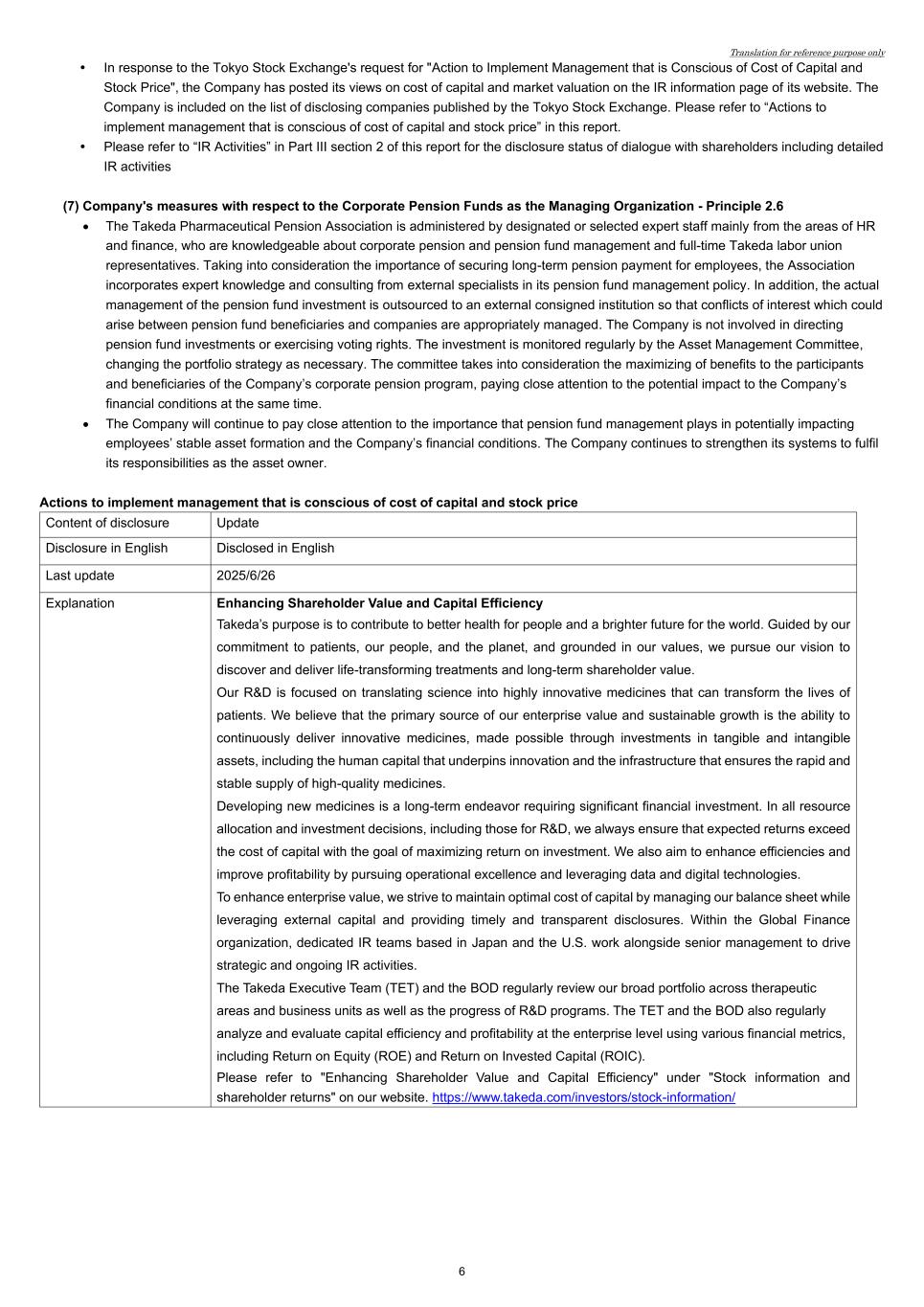
Translation for reference purpose only 6 In response to the Tokyo Stock Exchange's request for "Action to Implement Management that is Conscious of Cost of Capital and Stock Price", the Company has posted its views on cost of capital and market valuation on the IR information page of its website. The Company is included on the list of disclosing companies published by the Tokyo Stock Exchange. Please refer to “Actions to implement management that is conscious of cost of capital and stock price” in this report. Please refer to “IR Activities” in Part III section 2 of this report for the disclosure status of dialogue with shareholders including detailed IR activities (7) Company's measures with respect to the Corporate Pension Funds as the Managing Organization - Principle 2.6 • The Takeda Pharmaceutical Pension Association is administered by designated or selected expert staff mainly from the areas of HR and finance, who are knowledgeable about corporate pension and pension fund management and full-time Takeda labor union representatives. Taking into consideration the importance of securing long-term pension payment for employees, the Association incorporates expert knowledge and consulting from external specialists in its pension fund management policy. In addition, the actual management of the pension fund investment is outsourced to an external consigned institution so that conflicts of interest which could arise between pension fund beneficiaries and companies are appropriately managed. The Company is not involved in directing pension fund investments or exercising voting rights. The investment is monitored regularly by the Asset Management Committee, changing the portfolio strategy as necessary. The committee takes into consideration the maximizing of benefits to the participants and beneficiaries of the Company’s corporate pension program, paying close attention to the potential impact to the Company’s financial conditions at the same time. • The Company will continue to pay close attention to the importance that pension fund management plays in potentially impacting employees’ stable asset formation and the Company’s financial conditions. The Company continues to strengthen its systems to fulfil its responsibilities as the asset owner. Actions to implement management that is conscious of cost of capital and stock price Content of disclosure Update Disclosure in English Disclosed in English Last update 2025/6/26 Explanation Enhancing Shareholder Value and Capital Efficiency Takeda’s purpose is to contribute to better health for people and a brighter future for the world. Guided by our commitment to patients, our people, and the planet, and grounded in our values, we pursue our vision to discover and deliver life-transforming treatments and long-term shareholder value. Our R&D is focused on translating science into highly innovative medicines that can transform the lives of patients. We believe that the primary source of our enterprise value and sustainable growth is the ability to continuously deliver innovative medicines, made possible through investments in tangible and intangible assets, including the human capital that underpins innovation and the infrastructure that ensures the rapid and stable supply of high-quality medicines. Developing new medicines is a long-term endeavor requiring significant financial investment. In all resource allocation and investment decisions, including those for R&D, we always ensure that expected returns exceed the cost of capital with the goal of maximizing return on investment. We also aim to enhance efficiencies and improve profitability by pursuing operational excellence and leveraging data and digital technologies. To enhance enterprise value, we strive to maintain optimal cost of capital by managing our balance sheet while leveraging external capital and providing timely and transparent disclosures. Within the Global Finance organization, dedicated IR teams based in Japan and the U.S. work alongside senior management to drive strategic and ongoing IR activities. The Takeda Executive Team (TET) and the BOD regularly review our broad portfolio across therapeutic areas and business units as well as the progress of R&D programs. The TET and the BOD also regularly analyze and evaluate capital efficiency and profitability at the enterprise level using various financial metrics, including Return on Equity (ROE) and Return on Invested Capital (ROIC). Please refer to "Enhancing Shareholder Value and Capital Efficiency" under "Stock information and shareholder returns" on our website. https://www.takeda.com/investors/stock-information/
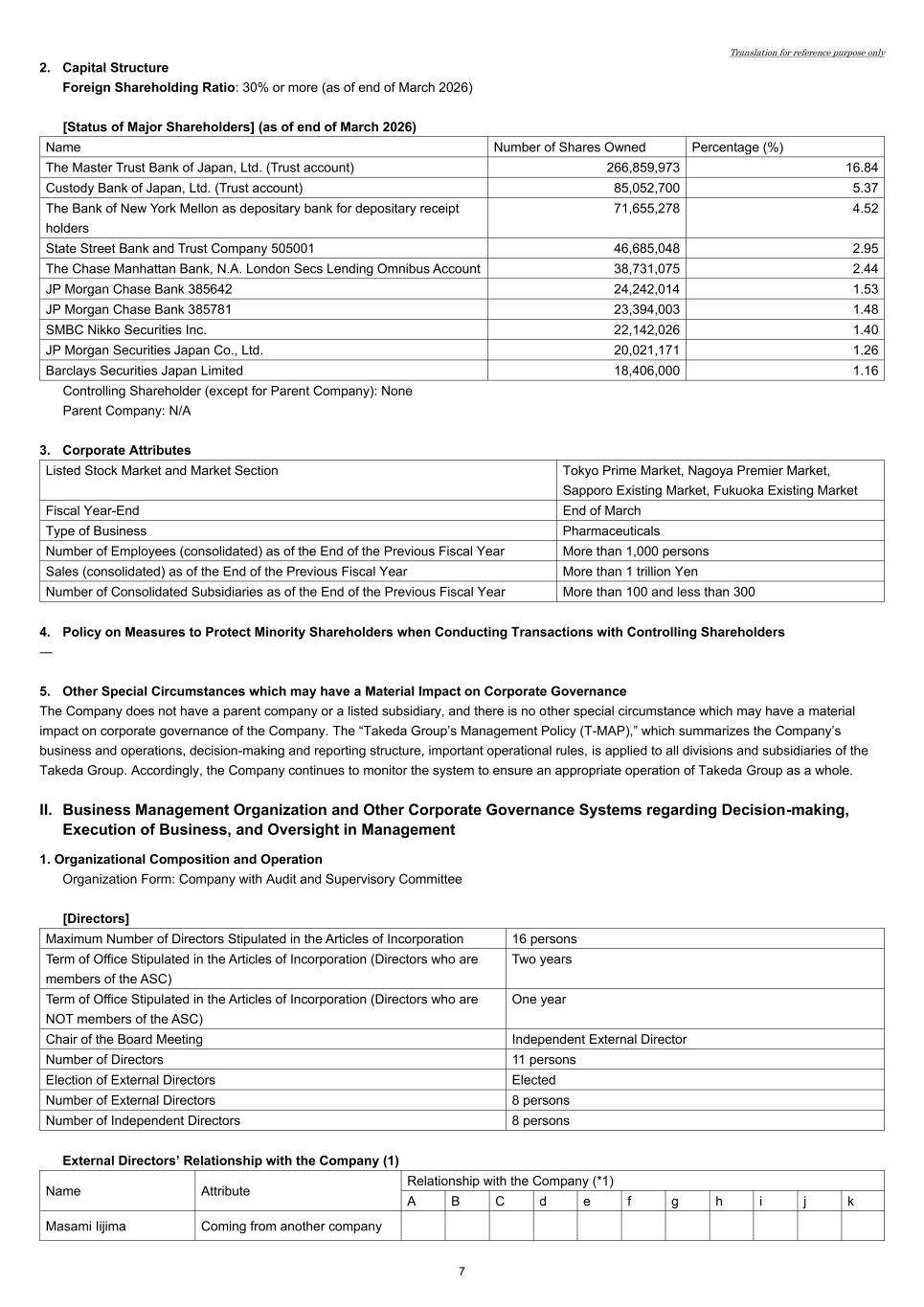
Translation for reference purpose only 7 2. Capital Structure Foreign Shareholding Ratio: 30% or more (as of end of March 2026) [Status of Major Shareholders] (as of end of March 2026) Name Number of Shares Owned Percentage (%) The Master Trust Bank of Japan, Ltd. (Trust account) 266,859,973 16.84 Custody Bank of Japan, Ltd. (Trust account) 85,052,700 5.37 The Bank of New York Mellon as depositary bank for depositary receipt holders 71,655,278 4.52 State Street Bank and Trust Company 505001 46,685,048 2.95 The Chase Manhattan Bank, N.A. London Secs Lending Omnibus Account 38,731,075 2.44 JP Morgan Chase Bank 385642 24,242,014 1.53 JP Morgan Chase Bank 385781 23,394,003 1.48 SMBC Nikko Securities Inc. 22,142,026 1.40 JP Morgan Securities Japan Co., Ltd. 20,021,171 1.26 Barclays Securities Japan Limited 18,406,000 1.16 Controlling Shareholder (except for Parent Company): None Parent Company: N/A 3. Corporate Attributes Listed Stock Market and Market Section Tokyo Prime Market, Nagoya Premier Market, Sapporo Existing Market, Fukuoka Existing Market Fiscal Year-End End of March Type of Business Pharmaceuticals Number of Employees (consolidated) as of the End of the Previous Fiscal Year More than 1,000 persons Sales (consolidated) as of the End of the Previous Fiscal Year More than 1 trillion Yen Number of Consolidated Subsidiaries as of the End of the Previous Fiscal Year More than 100 and less than 300 4. Policy on Measures to Protect Minority Shareholders when Conducting Transactions with Controlling Shareholders ― 5. Other Special Circumstances which may have a Material Impact on Corporate Governance The Company does not have a parent company or a listed subsidiary, and there is no other special circumstance which may have a material impact on corporate governance of the Company. The “Takeda Group’s Management Policy (T-MAP),” which summarizes the Company’s business and operations, decision-making and reporting structure, important operational rules, is applied to all divisions and subsidiaries of the Takeda Group. Accordingly, the Company continues to monitor the system to ensure an appropriate operation of Takeda Group as a whole. II. Business Management Organization and Other Corporate Governance Systems regarding Decision-making, Execution of Business, and Oversight in Management 1. Organizational Composition and Operation Organization Form: Company with Audit and Supervisory Committee [Directors] Maximum Number of Directors Stipulated in the Articles of Incorporation 16 persons Term of Office Stipulated in the Articles of Incorporation (Directors who are members of the ASC) Two years Term of Office Stipulated in the Articles of Incorporation (Directors who are NOT members of the ASC) One year Chair of the Board Meeting Independent External Director Number of Directors 11 persons Election of External Directors Elected Number of External Directors 8 persons Number of Independent Directors 8 persons External Directors’ Relationship with the Company (1) Name Attribute Relationship with the Company (*1) A B C d e f g h i j k Masami Iijima Coming from another company
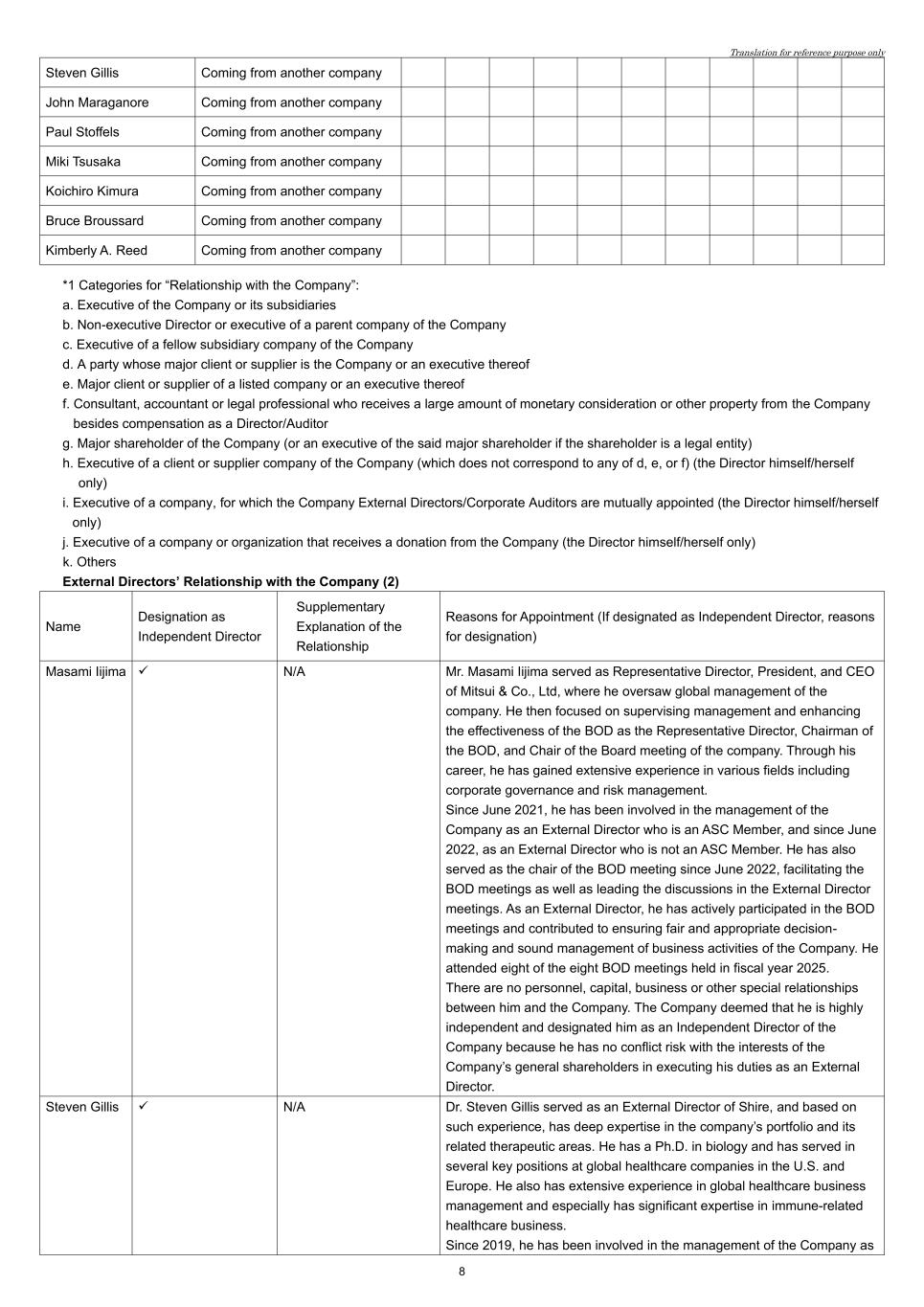
Translation for reference purpose only 8 Steven Gillis Coming from another company John Maraganore Coming from another company Paul Stoffels Coming from another company Miki Tsusaka Coming from another company Koichiro Kimura Coming from another company Bruce Broussard Coming from another company Kimberly A. Reed Coming from another company *1 Categories for “Relationship with the Company”: a. Executive of the Company or its subsidiaries b. Non-executive Director or executive of a parent company of the Company c. Executive of a fellow subsidiary company of the Company d. A party whose major client or supplier is the Company or an executive thereof e. Major client or supplier of a listed company or an executive thereof f. Consultant, accountant or legal professional who receives a large amount of monetary consideration or other property from the Company besides compensation as a Director/Auditor g. Major shareholder of the Company (or an executive of the said major shareholder if the shareholder is a legal entity) h. Executive of a client or supplier company of the Company (which does not correspond to any of d, e, or f) (the Director himself/herself only) i. Executive of a company, for which the Company External Directors/Corporate Auditors are mutually appointed (the Director himself/herself only) j. Executive of a company or organization that receives a donation from the Company (the Director himself/herself only) k. Others External Directors’ Relationship with the Company (2) Name Designation as Independent Director Supplementary Explanation of the Relationship Reasons for Appointment (If designated as Independent Director, reasons for designation) Masami Iijima ✓ N/A Mr. Masami Iijima served as Representative Director, President, and CEO of Mitsui & Co., Ltd, where he oversaw global management of the company. He then focused on supervising management and enhancing the effectiveness of the BOD as the Representative Director, Chairman of the BOD, and Chair of the Board meeting of the company. Through his career, he has gained extensive experience in various fields including corporate governance and risk management. Since June 2021, he has been involved in the management of the Company as an External Director who is an ASC Member, and since June 2022, as an External Director who is not an ASC Member. He has also served as the chair of the BOD meeting since June 2022, facilitating the BOD meetings as well as leading the discussions in the External Director meetings. As an External Director, he has actively participated in the BOD meetings and contributed to ensuring fair and appropriate decision- making and sound management of business activities of the Company. He attended eight of the eight BOD meetings held in fiscal year 2025. There are no personnel, capital, business or other special relationships between him and the Company. The Company deemed that he is highly independent and designated him as an Independent Director of the Company because he has no conflict risk with the interests of the Company’s general shareholders in executing his duties as an External Director. Steven Gillis ✓ N/A Dr. Steven Gillis served as an External Director of Shire, and based on such experience, has deep expertise in the company’s portfolio and its related therapeutic areas. He has a Ph.D. in biology and has served in several key positions at global healthcare companies in the U.S. and Europe. He also has extensive experience in global healthcare business management and especially has significant expertise in immune-related healthcare business. Since 2019, he has been involved in the management of the Company as
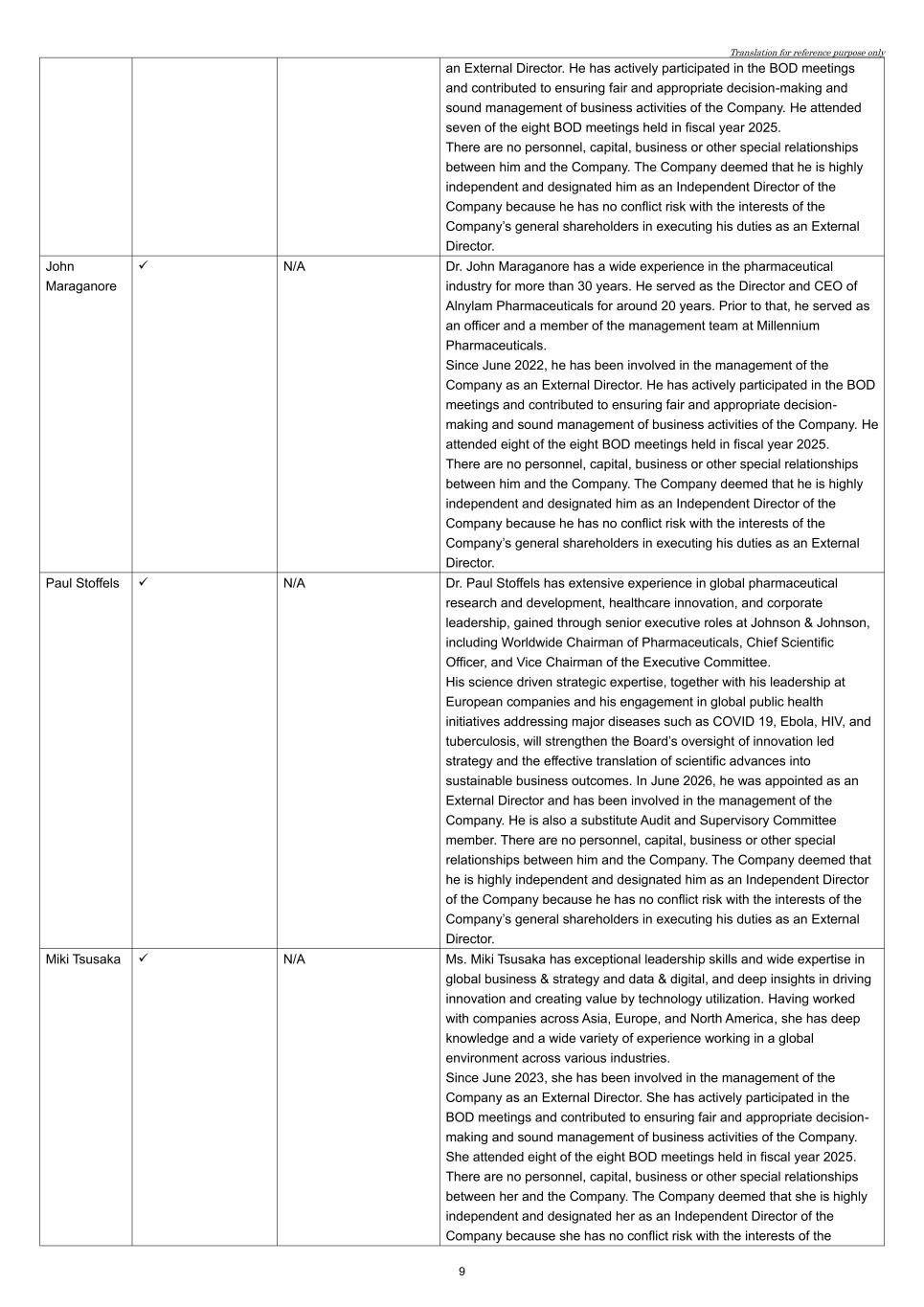
Translation for reference purpose only 9 an External Director. He has actively participated in the BOD meetings and contributed to ensuring fair and appropriate decision-making and sound management of business activities of the Company. He attended seven of the eight BOD meetings held in fiscal year 2025. There are no personnel, capital, business or other special relationships between him and the Company. The Company deemed that he is highly independent and designated him as an Independent Director of the Company because he has no conflict risk with the interests of the Company’s general shareholders in executing his duties as an External Director. John Maraganore ✓ N/A Dr. John Maraganore has a wide experience in the pharmaceutical industry for more than 30 years. He served as the Director and CEO of Alnylam Pharmaceuticals for around 20 years. Prior to that, he served as an officer and a member of the management team at Millennium Pharmaceuticals. Since June 2022, he has been involved in the management of the Company as an External Director. He has actively participated in the BOD meetings and contributed to ensuring fair and appropriate decision- making and sound management of business activities of the Company. He attended eight of the eight BOD meetings held in fiscal year 2025. There are no personnel, capital, business or other special relationships between him and the Company. The Company deemed that he is highly independent and designated him as an Independent Director of the Company because he has no conflict risk with the interests of the Company’s general shareholders in executing his duties as an External Director. Paul Stoffels ✓ N/A Dr. Paul Stoffels has extensive experience in global pharmaceutical research and development, healthcare innovation, and corporate leadership, gained through senior executive roles at Johnson & Johnson, including Worldwide Chairman of Pharmaceuticals, Chief Scientific Officer, and Vice Chairman of the Executive Committee. His science driven strategic expertise, together with his leadership at European companies and his engagement in global public health initiatives addressing major diseases such as COVID 19, Ebola, HIV, and tuberculosis, will strengthen the Board’s oversight of innovation led strategy and the effective translation of scientific advances into sustainable business outcomes. In June 2026, he was appointed as an External Director and has been involved in the management of the Company. He is also a substitute Audit and Supervisory Committee member. There are no personnel, capital, business or other special relationships between him and the Company. The Company deemed that he is highly independent and designated him as an Independent Director of the Company because he has no conflict risk with the interests of the Company’s general shareholders in executing his duties as an External Director. Miki Tsusaka ✓ N/A Ms. Miki Tsusaka has exceptional leadership skills and wide expertise in global business & strategy and data & digital, and deep insights in driving innovation and creating value by technology utilization. Having worked with companies across Asia, Europe, and North America, she has deep knowledge and a wide variety of experience working in a global environment across various industries. Since June 2023, she has been involved in the management of the Company as an External Director. She has actively participated in the BOD meetings and contributed to ensuring fair and appropriate decision- making and sound management of business activities of the Company. She attended eight of the eight BOD meetings held in fiscal year 2025. There are no personnel, capital, business or other special relationships between her and the Company. The Company deemed that she is highly independent and designated her as an Independent Director of the Company because she has no conflict risk with the interests of the
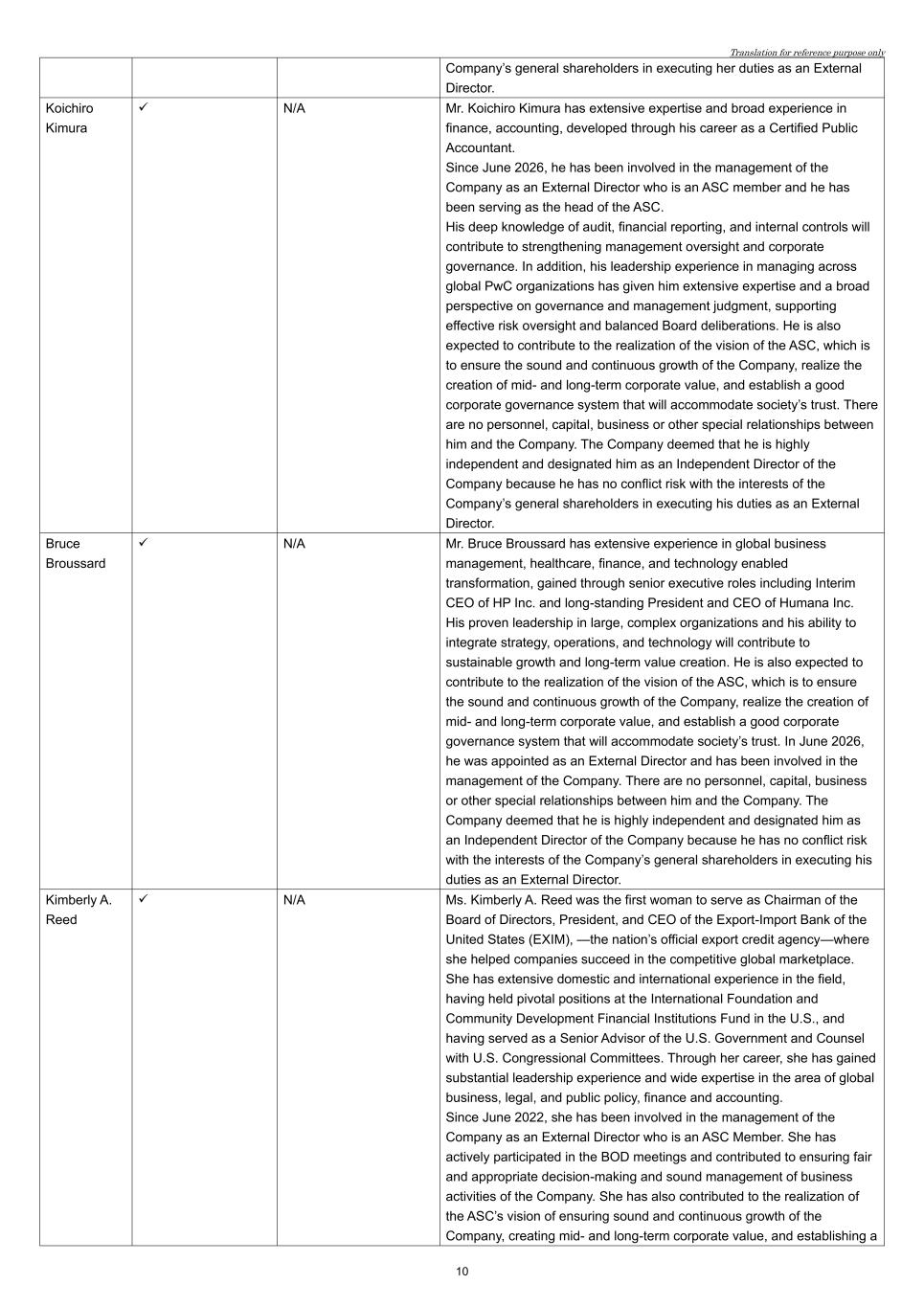
Translation for reference purpose only 10 Company’s general shareholders in executing her duties as an External Director. Koichiro Kimura ✓ N/A Mr. Koichiro Kimura has extensive expertise and broad experience in finance, accounting, developed through his career as a Certified Public Accountant. Since June 2026, he has been involved in the management of the Company as an External Director who is an ASC member and he has been serving as the head of the ASC. His deep knowledge of audit, financial reporting, and internal controls will contribute to strengthening management oversight and corporate governance. In addition, his leadership experience in managing across global PwC organizations has given him extensive expertise and a broad perspective on governance and management judgment, supporting effective risk oversight and balanced Board deliberations. He is also expected to contribute to the realization of the vision of the ASC, which is to ensure the sound and continuous growth of the Company, realize the creation of mid- and long-term corporate value, and establish a good corporate governance system that will accommodate society’s trust. There are no personnel, capital, business or other special relationships between him and the Company. The Company deemed that he is highly independent and designated him as an Independent Director of the Company because he has no conflict risk with the interests of the Company’s general shareholders in executing his duties as an External Director. Bruce Broussard ✓ N/A Mr. Bruce Broussard has extensive experience in global business management, healthcare, finance, and technology enabled transformation, gained through senior executive roles including Interim CEO of HP Inc. and long-standing President and CEO of Humana Inc. His proven leadership in large, complex organizations and his ability to integrate strategy, operations, and technology will contribute to sustainable growth and long-term value creation. He is also expected to contribute to the realization of the vision of the ASC, which is to ensure the sound and continuous growth of the Company, realize the creation of mid- and long-term corporate value, and establish a good corporate governance system that will accommodate society’s trust. In June 2026, he was appointed as an External Director and has been involved in the management of the Company. There are no personnel, capital, business or other special relationships between him and the Company. The Company deemed that he is highly independent and designated him as an Independent Director of the Company because he has no conflict risk with the interests of the Company’s general shareholders in executing his duties as an External Director. Kimberly A. Reed ✓ N/A Ms. Kimberly A. Reed was the first woman to serve as Chairman of the Board of Directors, President, and CEO of the Export-Import Bank of the United States (EXIM), —the nation’s official export credit agency—where she helped companies succeed in the competitive global marketplace. She has extensive domestic and international experience in the field, having held pivotal positions at the International Foundation and Community Development Financial Institutions Fund in the U.S., and having served as a Senior Advisor of the U.S. Government and Counsel with U.S. Congressional Committees. Through her career, she has gained substantial leadership experience and wide expertise in the area of global business, legal, and public policy, finance and accounting. Since June 2022, she has been involved in the management of the Company as an External Director who is an ASC Member. She has actively participated in the BOD meetings and contributed to ensuring fair and appropriate decision-making and sound management of business activities of the Company. She has also contributed to the realization of the ASC’s vision of ensuring sound and continuous growth of the Company, creating mid- and long-term corporate value, and establishing a
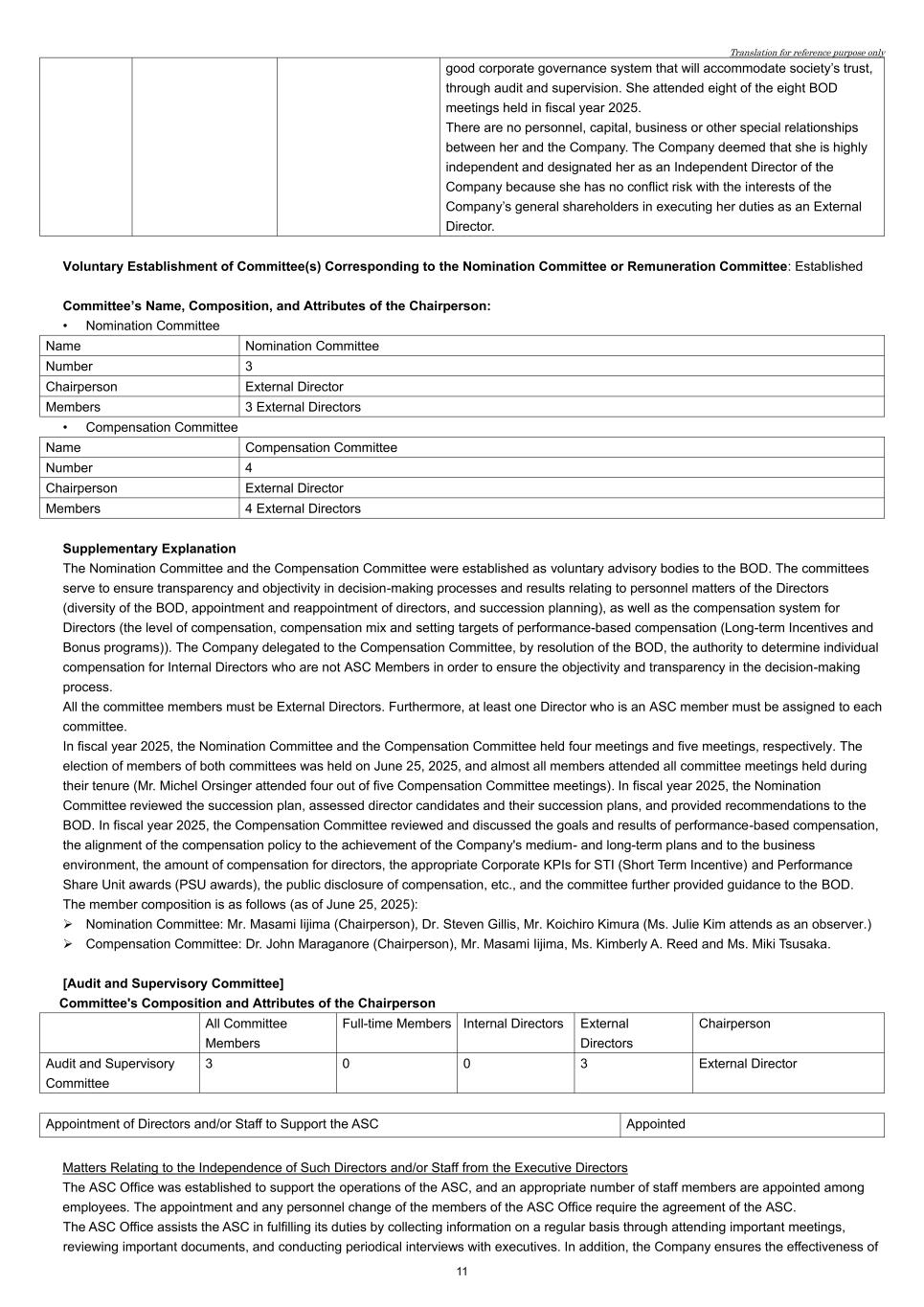
Translation for reference purpose only 11 good corporate governance system that will accommodate society’s trust, through audit and supervision. She attended eight of the eight BOD meetings held in fiscal year 2025. There are no personnel, capital, business or other special relationships between her and the Company. The Company deemed that she is highly independent and designated her as an Independent Director of the Company because she has no conflict risk with the interests of the Company’s general shareholders in executing her duties as an External Director. Voluntary Establishment of Committee(s) Corresponding to the Nomination Committee or Remuneration Committee: Established Committee’s Name, Composition, and Attributes of the Chairperson: • Nomination Committee Name Nomination Committee Number 3 Chairperson External Director Members 3 External Directors • Compensation Committee Name Compensation Committee Number 4 Chairperson External Director Members 4 External Directors Supplementary Explanation The Nomination Committee and the Compensation Committee were established as voluntary advisory bodies to the BOD. The committees serve to ensure transparency and objectivity in decision-making processes and results relating to personnel matters of the Directors (diversity of the BOD, appointment and reappointment of directors, and succession planning), as well as the compensation system for Directors (the level of compensation, compensation mix and setting targets of performance-based compensation (Long-term Incentives and Bonus programs)). The Company delegated to the Compensation Committee, by resolution of the BOD, the authority to determine individual compensation for Internal Directors who are not ASC Members in order to ensure the objectivity and transparency in the decision-making process. All the committee members must be External Directors. Furthermore, at least one Director who is an ASC member must be assigned to each committee. In fiscal year 2025, the Nomination Committee and the Compensation Committee held four meetings and five meetings, respectively. The election of members of both committees was held on June 25, 2025, and almost all members attended all committee meetings held during their tenure (Mr. Michel Orsinger attended four out of five Compensation Committee meetings). In fiscal year 2025, the Nomination Committee reviewed the succession plan, assessed director candidates and their succession plans, and provided recommendations to the BOD. In fiscal year 2025, the Compensation Committee reviewed and discussed the goals and results of performance-based compensation, the alignment of the compensation policy to the achievement of the Company's medium- and long-term plans and to the business environment, the amount of compensation for directors, the appropriate Corporate KPIs for STI (Short Term Incentive) and Performance Share Unit awards (PSU awards), the public disclosure of compensation, etc., and the committee further provided guidance to the BOD. The member composition is as follows (as of June 25, 2025): ➢ Nomination Committee: Mr. Masami Iijima (Chairperson), Dr. Steven Gillis, Mr. Koichiro Kimura (Ms. Julie Kim attends as an observer.) ➢ Compensation Committee: Dr. John Maraganore (Chairperson), Mr. Masami Iijima, Ms. Kimberly A. Reed and Ms. Miki Tsusaka. [Audit and Supervisory Committee] Committee's Composition and Attributes of the Chairperson All Committee Members Full-time Members Internal Directors External Directors Chairperson Audit and Supervisory Committee 3 0 0 3 External Director Appointment of Directors and/or Staff to Support the ASC Appointed Matters Relating to the Independence of Such Directors and/or Staff from the Executive Directors The ASC Office was established to support the operations of the ASC, and an appropriate number of staff members are appointed among employees. The appointment and any personnel change of the members of the ASC Office require the agreement of the ASC. The ASC Office assists the ASC in fulfilling its duties by collecting information on a regular basis through attending important meetings, reviewing important documents, and conducting periodical interviews with executives. In addition, the Company ensures the effectiveness of
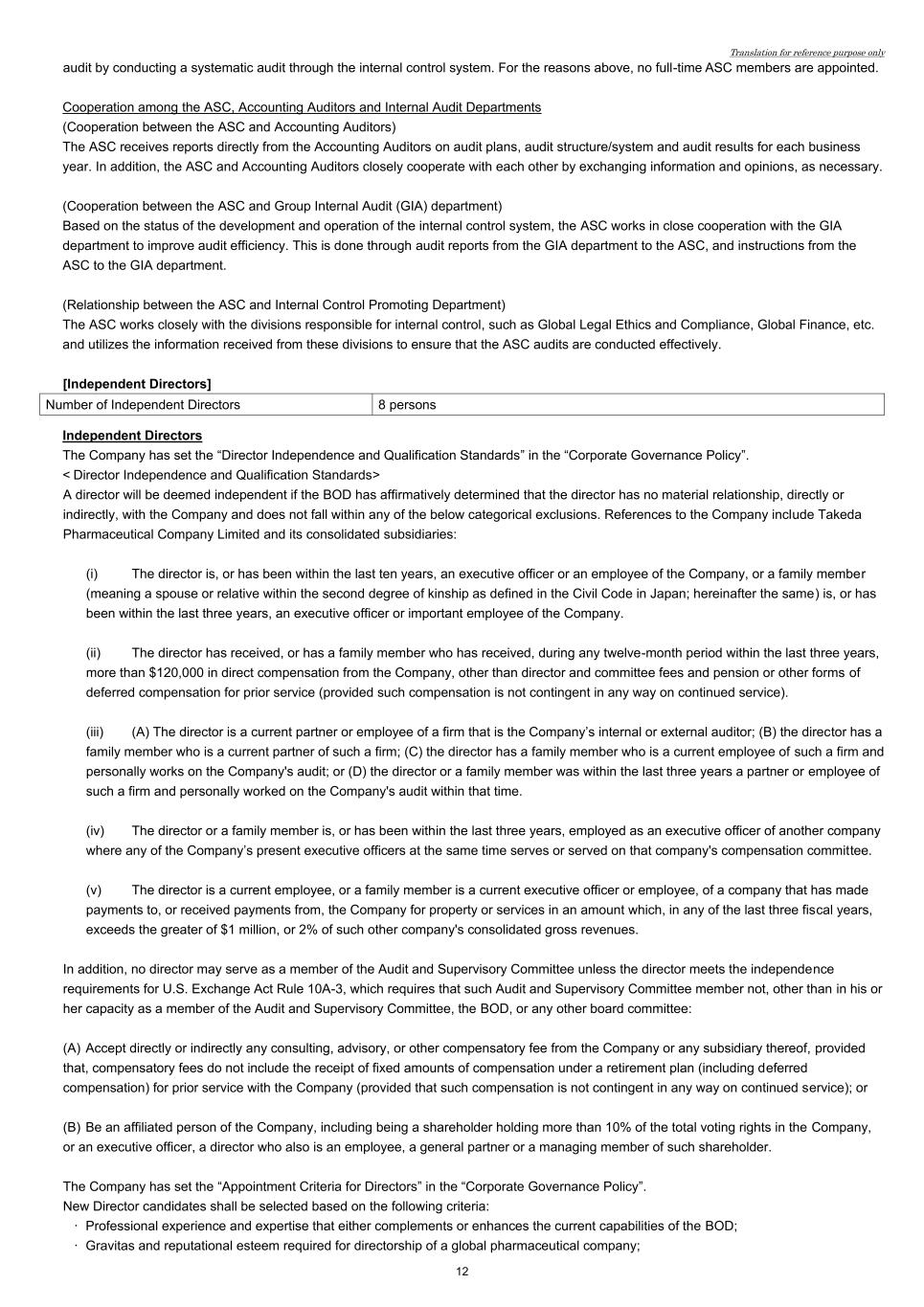
Translation for reference purpose only 12 audit by conducting a systematic audit through the internal control system. For the reasons above, no full-time ASC members are appointed. Cooperation among the ASC, Accounting Auditors and Internal Audit Departments (Cooperation between the ASC and Accounting Auditors) The ASC receives reports directly from the Accounting Auditors on audit plans, audit structure/system and audit results for each business year. In addition, the ASC and Accounting Auditors closely cooperate with each other by exchanging information and opinions, as necessary. (Cooperation between the ASC and Group Internal Audit (GIA) department) Based on the status of the development and operation of the internal control system, the ASC works in close cooperation with the GIA department to improve audit efficiency. This is done through audit reports from the GIA department to the ASC, and instructions from the ASC to the GIA department. (Relationship between the ASC and Internal Control Promoting Department) The ASC works closely with the divisions responsible for internal control, such as Global Legal Ethics and Compliance, Global Finance, etc. and utilizes the information received from these divisions to ensure that the ASC audits are conducted effectively. [Independent Directors] Number of Independent Directors 8 persons Independent Directors The Company has set the “Director Independence and Qualification Standards” in the “Corporate Governance Policy”. < Director Independence and Qualification Standards> A director will be deemed independent if the BOD has affirmatively determined that the director has no material relationship, directly or indirectly, with the Company and does not fall within any of the below categorical exclusions. References to the Company include Takeda Pharmaceutical Company Limited and its consolidated subsidiaries: (i) The director is, or has been within the last ten years, an executive officer or an employee of the Company, or a family member (meaning a spouse or relative within the second degree of kinship as defined in the Civil Code in Japan; hereinafter the same) is, or has been within the last three years, an executive officer or important employee of the Company. (ii) The director has received, or has a family member who has received, during any twelve-month period within the last three years, more than $120,000 in direct compensation from the Company, other than director and committee fees and pension or other forms of deferred compensation for prior service (provided such compensation is not contingent in any way on continued service). (iii) (A) The director is a current partner or employee of a firm that is the Company’s internal or external auditor; (B) the director has a family member who is a current partner of such a firm; (C) the director has a family member who is a current employee of such a firm and personally works on the Company's audit; or (D) the director or a family member was within the last three years a partner or employee of such a firm and personally worked on the Company's audit within that time. (iv) The director or a family member is, or has been within the last three years, employed as an executive officer of another company where any of the Company’s present executive officers at the same time serves or served on that company's compensation committee. (v) The director is a current employee, or a family member is a current executive officer or employee, of a company that has made payments to, or received payments from, the Company for property or services in an amount which, in any of the last three fiscal years, exceeds the greater of $1 million, or 2% of such other company's consolidated gross revenues. In addition, no director may serve as a member of the Audit and Supervisory Committee unless the director meets the independence requirements for U.S. Exchange Act Rule 10A-3, which requires that such Audit and Supervisory Committee member not, other than in his or her capacity as a member of the Audit and Supervisory Committee, the BOD, or any other board committee: (A) Accept directly or indirectly any consulting, advisory, or other compensatory fee from the Company or any subsidiary thereof, provided that, compensatory fees do not include the receipt of fixed amounts of compensation under a retirement plan (including deferred compensation) for prior service with the Company (provided that such compensation is not contingent in any way on continued service); or (B) Be an affiliated person of the Company, including being a shareholder holding more than 10% of the total voting rights in the Company, or an executive officer, a director who also is an employee, a general partner or a managing member of such shareholder. The Company has set the “Appointment Criteria for Directors” in the “Corporate Governance Policy”. New Director candidates shall be selected based on the following criteria: • Professional experience and expertise that either complements or enhances the current capabilities of the BOD; • Gravitas and reputational esteem required for directorship of a global pharmaceutical company;
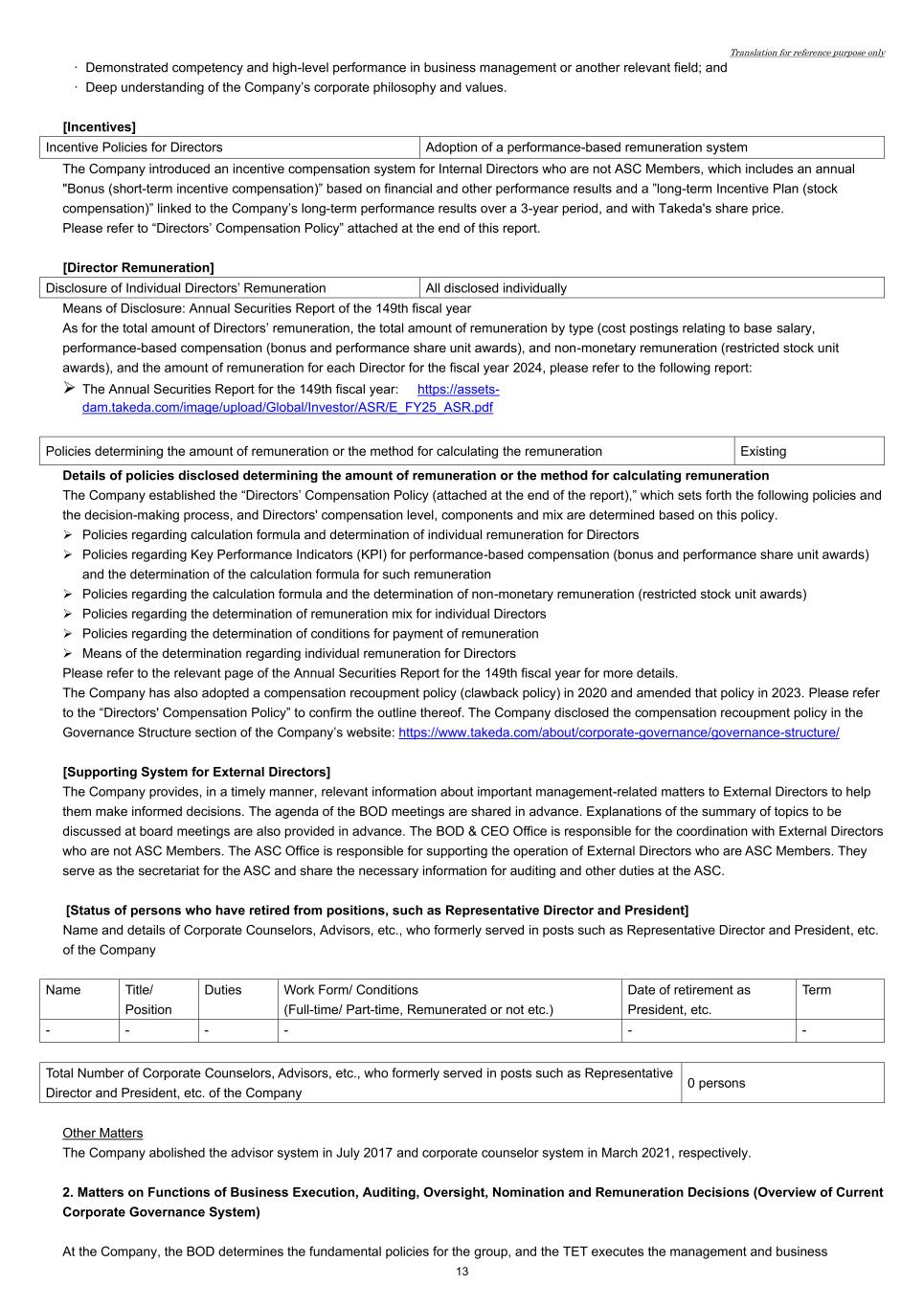
Translation for reference purpose only 13 • Demonstrated competency and high-level performance in business management or another relevant field; and • Deep understanding of the Company’s corporate philosophy and values. [Incentives] Incentive Policies for Directors Adoption of a performance-based remuneration system The Company introduced an incentive compensation system for Internal Directors who are not ASC Members, which includes an annual "Bonus (short-term incentive compensation)” based on financial and other performance results and a ”long-term Incentive Plan (stock compensation)” linked to the Company’s long-term performance results over a 3-year period, and with Takeda's share price. Please refer to “Directors’ Compensation Policy” attached at the end of this report. [Director Remuneration] Disclosure of Individual Directors’ Remuneration All disclosed individually Means of Disclosure: Annual Securities Report of the 149th fiscal year As for the total amount of Directors’ remuneration, the total amount of remuneration by type (cost postings relating to base salary, performance-based compensation (bonus and performance share unit awards), and non-monetary remuneration (restricted stock unit awards), and the amount of remuneration for each Director for the fiscal year 2024, please refer to the following report: ➢ The Annual Securities Report for the 149th fiscal year: https://assets- dam.takeda.com/image/upload/Global/Investor/ASR/E_FY25_ASR.pdf Policies determining the amount of remuneration or the method for calculating the remuneration Existing Details of policies disclosed determining the amount of remuneration or the method for calculating remuneration The Company established the “Directors’ Compensation Policy (attached at the end of the report),” which sets forth the following policies and the decision-making process, and Directors' compensation level, components and mix are determined based on this policy. ➢ Policies regarding calculation formula and determination of individual remuneration for Directors ➢ Policies regarding Key Performance Indicators (KPI) for performance-based compensation (bonus and performance share unit awards) and the determination of the calculation formula for such remuneration ➢ Policies regarding the calculation formula and the determination of non-monetary remuneration (restricted stock unit awards) ➢ Policies regarding the determination of remuneration mix for individual Directors ➢ Policies regarding the determination of conditions for payment of remuneration ➢ Means of the determination regarding individual remuneration for Directors Please refer to the relevant page of the Annual Securities Report for the 149th fiscal year for more details. The Company has also adopted a compensation recoupment policy (clawback policy) in 2020 and amended that policy in 2023. Please refer to the “Directors' Compensation Policy” to confirm the outline thereof. The Company disclosed the compensation recoupment policy in the Governance Structure section of the Company’s website: https://www.takeda.com/about/corporate-governance/governance-structure/ [Supporting System for External Directors] The Company provides, in a timely manner, relevant information about important management-related matters to External Directors to help them make informed decisions. The agenda of the BOD meetings are shared in advance. Explanations of the summary of topics to be discussed at board meetings are also provided in advance. The BOD & CEO Office is responsible for the coordination with External Directors who are not ASC Members. The ASC Office is responsible for supporting the operation of External Directors who are ASC Members. They serve as the secretariat for the ASC and share the necessary information for auditing and other duties at the ASC. [Status of persons who have retired from positions, such as Representative Director and President] Name and details of Corporate Counselors, Advisors, etc., who formerly served in posts such as Representative Director and President, etc. of the Company Name Title/ Position Duties Work Form/ Conditions (Full-time/ Part-time, Remunerated or not etc.) Date of retirement as President, etc. Term - - - - - - Total Number of Corporate Counselors, Advisors, etc., who formerly served in posts such as Representative Director and President, etc. of the Company 0 persons Other Matters The Company abolished the advisor system in July 2017 and corporate counselor system in March 2021, respectively. 2. Matters on Functions of Business Execution, Auditing, Oversight, Nomination and Remuneration Decisions (Overview of Current Corporate Governance System) At the Company, the BOD determines the fundamental policies for the group, and the TET executes the management and business
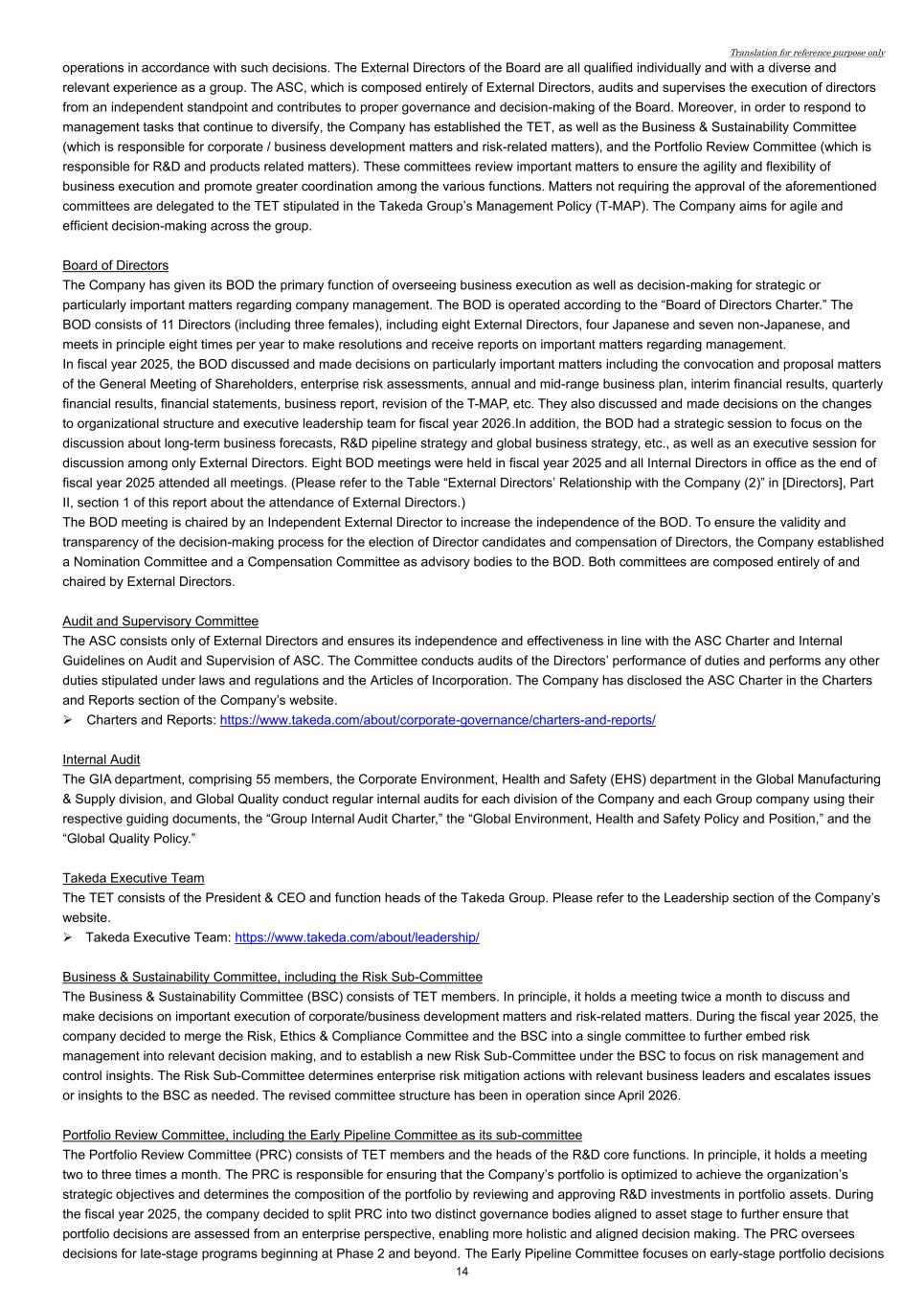
Translation for reference purpose only 14 operations in accordance with such decisions. The External Directors of the Board are all qualified individually and with a diverse and relevant experience as a group. The ASC, which is composed entirely of External Directors, audits and supervises the execution of directors from an independent standpoint and contributes to proper governance and decision-making of the Board. Moreover, in order to respond to management tasks that continue to diversify, the Company has established the TET, as well as the Business & Sustainability Committee (which is responsible for corporate / business development matters and risk-related matters), and the Portfolio Review Committee (which is responsible for R&D and products related matters). These committees review important matters to ensure the agility and flexibility of business execution and promote greater coordination among the various functions. Matters not requiring the approval of the aforementioned committees are delegated to the TET stipulated in the Takeda Group’s Management Policy (T-MAP). The Company aims for agile and efficient decision-making across the group. Board of Directors The Company has given its BOD the primary function of overseeing business execution as well as decision-making for strategic or particularly important matters regarding company management. The BOD is operated according to the “Board of Directors Charter.” The BOD consists of 11 Directors (including three females), including eight External Directors, four Japanese and seven non-Japanese, and meets in principle eight times per year to make resolutions and receive reports on important matters regarding management. In fiscal year 2025, the BOD discussed and made decisions on particularly important matters including the convocation and proposal matters of the General Meeting of Shareholders, enterprise risk assessments, annual and mid-range business plan, interim financial results, quarterly financial results, financial statements, business report, revision of the T-MAP, etc. They also discussed and made decisions on the changes to organizational structure and executive leadership team for fiscal year 2026.In addition, the BOD had a strategic session to focus on the discussion about long-term business forecasts, R&D pipeline strategy and global business strategy, etc., as well as an executive session for discussion among only External Directors. Eight BOD meetings were held in fiscal year 2025 and all Internal Directors in office as the end of fiscal year 2025 attended all meetings. (Please refer to the Table “External Directors’ Relationship with the Company (2)” in [Directors], Part II, section 1 of this report about the attendance of External Directors.) The BOD meeting is chaired by an Independent External Director to increase the independence of the BOD. To ensure the validity and transparency of the decision-making process for the election of Director candidates and compensation of Directors, the Company established a Nomination Committee and a Compensation Committee as advisory bodies to the BOD. Both committees are composed entirely of and chaired by External Directors. Audit and Supervisory Committee The ASC consists only of External Directors and ensures its independence and effectiveness in line with the ASC Charter and Internal Guidelines on Audit and Supervision of ASC. The Committee conducts audits of the Directors’ performance of duties and performs any other duties stipulated under laws and regulations and the Articles of Incorporation. The Company has disclosed the ASC Charter in the Charters and Reports section of the Company’s website. ➢ Charters and Reports: https://www.takeda.com/about/corporate-governance/charters-and-reports/ Internal Audit The GIA department, comprising 55 members, the Corporate Environment, Health and Safety (EHS) department in the Global Manufacturing & Supply division, and Global Quality conduct regular internal audits for each division of the Company and each Group company using their respective guiding documents, the “Group Internal Audit Charter,” the “Global Environment, Health and Safety Policy and Position,” and the “Global Quality Policy.” Takeda Executive Team The TET consists of the President & CEO and function heads of the Takeda Group. Please refer to the Leadership section of the Company’s website. ➢ Takeda Executive Team: https://www.takeda.com/about/leadership/ Business & Sustainability Committee, including the Risk Sub-Committee The Business & Sustainability Committee (BSC) consists of TET members. In principle, it holds a meeting twice a month to discuss and make decisions on important execution of corporate/business development matters and risk-related matters. During the fiscal year 2025, the company decided to merge the Risk, Ethics & Compliance Committee and the BSC into a single committee to further embed risk management into relevant decision making, and to establish a new Risk Sub-Committee under the BSC to focus on risk management and control insights. The Risk Sub-Committee determines enterprise risk mitigation actions with relevant business leaders and escalates issues or insights to the BSC as needed. The revised committee structure has been in operation since April 2026. Portfolio Review Committee, including the Early Pipeline Committee as its sub-committee The Portfolio Review Committee (PRC) consists of TET members and the heads of the R&D core functions. In principle, it holds a meeting two to three times a month. The PRC is responsible for ensuring that the Company’s portfolio is optimized to achieve the organization’s strategic objectives and determines the composition of the portfolio by reviewing and approving R&D investments in portfolio assets. During the fiscal year 2025, the company decided to split PRC into two distinct governance bodies aligned to asset stage to further ensure that portfolio decisions are assessed from an enterprise perspective, enabling more holistic and aligned decision making. The PRC oversees decisions for late-stage programs beginning at Phase 2 and beyond. The Early Pipeline Committee focuses on early-stage portfolio decisions
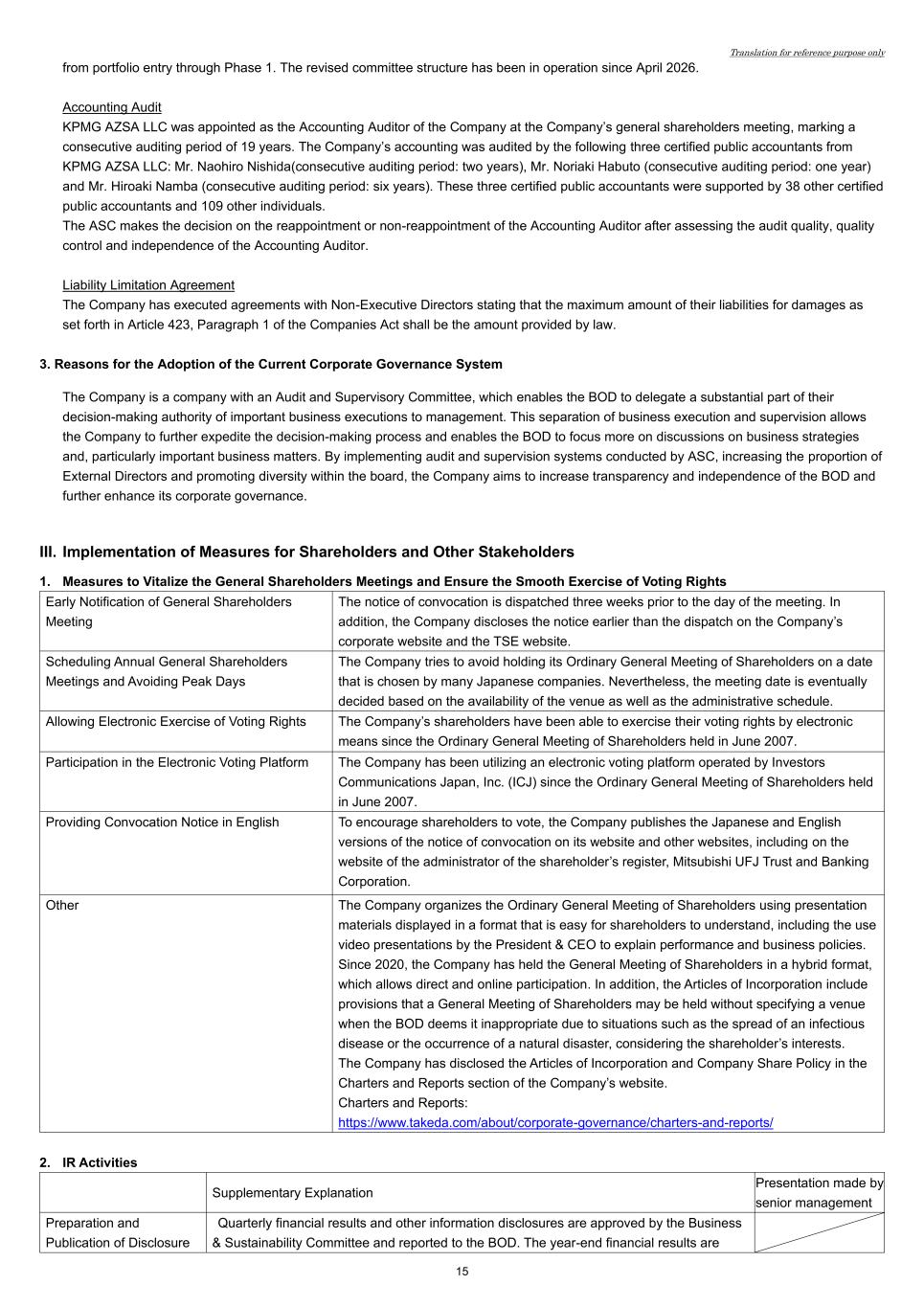
Translation for reference purpose only 15 from portfolio entry through Phase 1. The revised committee structure has been in operation since April 2026. Accounting Audit KPMG AZSA LLC was appointed as the Accounting Auditor of the Company at the Company’s general shareholders meeting, marking a consecutive auditing period of 19 years. The Company’s accounting was audited by the following three certified public accountants from KPMG AZSA LLC: Mr. Naohiro Nishida(consecutive auditing period: two years), Mr. Noriaki Habuto (consecutive auditing period: one year) and Mr. Hiroaki Namba (consecutive auditing period: six years). These three certified public accountants were supported by 38 other certified public accountants and 109 other individuals. The ASC makes the decision on the reappointment or non-reappointment of the Accounting Auditor after assessing the audit quality, quality control and independence of the Accounting Auditor. Liability Limitation Agreement The Company has executed agreements with Non-Executive Directors stating that the maximum amount of their liabilities for damages as set forth in Article 423, Paragraph 1 of the Companies Act shall be the amount provided by law. 3. Reasons for the Adoption of the Current Corporate Governance System The Company is a company with an Audit and Supervisory Committee, which enables the BOD to delegate a substantial part of their decision-making authority of important business executions to management. This separation of business execution and supervision allows the Company to further expedite the decision-making process and enables the BOD to focus more on discussions on business strategies and, particularly important business matters. By implementing audit and supervision systems conducted by ASC, increasing the proportion of External Directors and promoting diversity within the board, the Company aims to increase transparency and independence of the BOD and further enhance its corporate governance. III. Implementation of Measures for Shareholders and Other Stakeholders 1. Measures to Vitalize the General Shareholders Meetings and Ensure the Smooth Exercise of Voting Rights Early Notification of General Shareholders Meeting The notice of convocation is dispatched three weeks prior to the day of the meeting. In addition, the Company discloses the notice earlier than the dispatch on the Company’s corporate website and the TSE website. Scheduling Annual General Shareholders Meetings and Avoiding Peak Days The Company tries to avoid holding its Ordinary General Meeting of Shareholders on a date that is chosen by many Japanese companies. Nevertheless, the meeting date is eventually decided based on the availability of the venue as well as the administrative schedule. Allowing Electronic Exercise of Voting Rights The Company’s shareholders have been able to exercise their voting rights by electronic means since the Ordinary General Meeting of Shareholders held in June 2007. Participation in the Electronic Voting Platform The Company has been utilizing an electronic voting platform operated by Investors Communications Japan, Inc. (ICJ) since the Ordinary General Meeting of Shareholders held in June 2007. Providing Convocation Notice in English To encourage shareholders to vote, the Company publishes the Japanese and English versions of the notice of convocation on its website and other websites, including on the website of the administrator of the shareholder’s register, Mitsubishi UFJ Trust and Banking Corporation. Other The Company organizes the Ordinary General Meeting of Shareholders using presentation materials displayed in a format that is easy for shareholders to understand, including the use video presentations by the President & CEO to explain performance and business policies. Since 2020, the Company has held the General Meeting of Shareholders in a hybrid format, which allows direct and online participation. In addition, the Articles of Incorporation include provisions that a General Meeting of Shareholders may be held without specifying a venue when the BOD deems it inappropriate due to situations such as the spread of an infectious disease or the occurrence of a natural disaster, considering the shareholder’s interests. The Company has disclosed the Articles of Incorporation and Company Share Policy in the Charters and Reports section of the Company’s website. Charters and Reports: https://www.takeda.com/about/corporate-governance/charters-and-reports/ 2. IR Activities Supplementary Explanation Presentation made by senior management Preparation and Publication of Disclosure Quarterly financial results and other information disclosures are approved by the Business & Sustainability Committee and reported to the BOD. The year-end financial results are
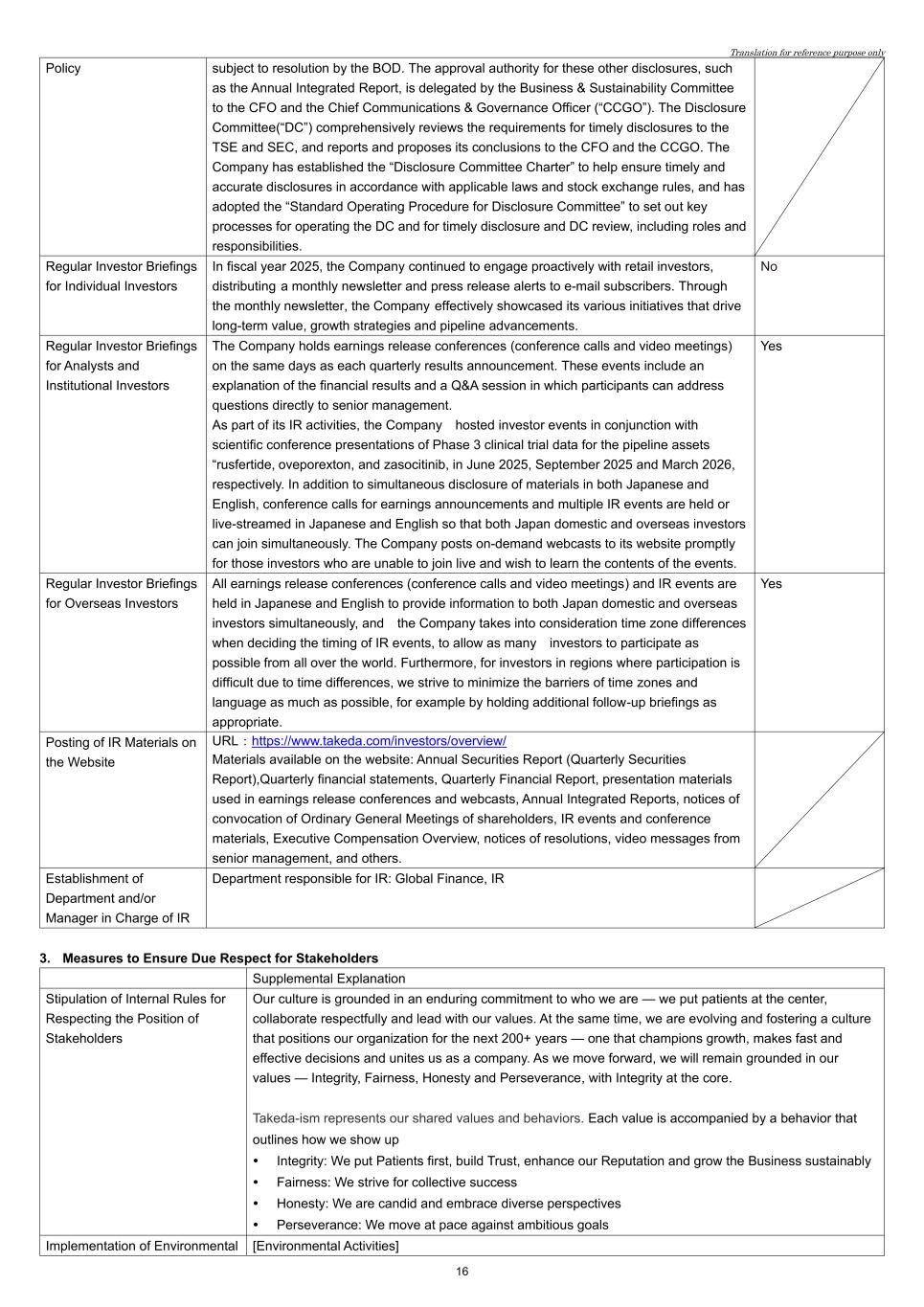
Translation for reference purpose only 16 Policy subject to resolution by the BOD. The approval authority for these other disclosures, such as the Annual Integrated Report, is delegated by the Business & Sustainability Committee to the CFO and the Chief Communications & Governance Officer (“CCGO”). The Disclosure Committee(“DC”) comprehensively reviews the requirements for timely disclosures to the TSE and SEC, and reports and proposes its conclusions to the CFO and the CCGO. The Company has established the “Disclosure Committee Charter” to help ensure timely and accurate disclosures in accordance with applicable laws and stock exchange rules, and has adopted the “Standard Operating Procedure for Disclosure Committee” to set out key processes for operating the DC and for timely disclosure and DC review, including roles and responsibilities. Regular Investor Briefings for Individual Investors In fiscal year 2025, the Company continued to engage proactively with retail investors, distributing a monthly newsletter and press release alerts to e-mail subscribers. Through the monthly newsletter, the Company effectively showcased its various initiatives that drive long-term value, growth strategies and pipeline advancements. No Regular Investor Briefings for Analysts and Institutional Investors The Company holds earnings release conferences (conference calls and video meetings) on the same days as each quarterly results announcement. These events include an explanation of the financial results and a Q&A session in which participants can address questions directly to senior management. As part of its IR activities, the Company hosted investor events in conjunction with scientific conference presentations of Phase 3 clinical trial data for the pipeline assets “rusfertide, oveporexton, and zasocitinib, in June 2025, September 2025 and March 2026, respectively. In addition to simultaneous disclosure of materials in both Japanese and English, conference calls for earnings announcements and multiple IR events are held or live-streamed in Japanese and English so that both Japan domestic and overseas investors can join simultaneously. The Company posts on-demand webcasts to its website promptly for those investors who are unable to join live and wish to learn the contents of the events. Yes Regular Investor Briefings for Overseas Investors All earnings release conferences (conference calls and video meetings) and IR events are held in Japanese and English to provide information to both Japan domestic and overseas investors simultaneously, and the Company takes into consideration time zone differences when deciding the timing of IR events, to allow as many investors to participate as possible from all over the world. Furthermore, for investors in regions where participation is difficult due to time differences, we strive to minimize the barriers of time zones and language as much as possible, for example by holding additional follow-up briefings as appropriate. Yes Posting of IR Materials on the Website URL:https://www.takeda.com/investors/overview/ 1TU1T Materials available on the website: Annual Securities Report (Quarterly Securities Report),Quarterly financial statements, Quarterly Financial Report, presentation materials used in earnings release conferences and webcasts, Annual Integrated Reports, notices of convocation of Ordinary General Meetings of shareholders, IR events and conference materials, Executive Compensation Overview, notices of resolutions, video messages from senior management, and others. Establishment of Department and/or Manager in Charge of IR Department responsible for IR: Global Finance, IR 3. Measures to Ensure Due Respect for Stakeholders Supplemental Explanation Stipulation of Internal Rules for Respecting the Position of Stakeholders Our culture is grounded in an enduring commitment to who we are — we put patients at the center, collaborate respectfully and lead with our values. At the same time, we are evolving and fostering a culture that positions our organization for the next 200+ years — one that champions growth, makes fast and effective decisions and unites us as a company. As we move forward, we will remain grounded in our values — Integrity, Fairness, Honesty and Perseverance, with Integrity at the core. Takeda-ism represents our shared values and behaviors. Each value is accompanied by a behavior that outlines how we show up Integrity: We put Patients first, build Trust, enhance our Reputation and grow the Business sustainably Fairness: We strive for collective success Honesty: We are candid and embrace diverse perspectives Perseverance: We move at pace against ambitious goals Implementation of Environmental [Environmental Activities]
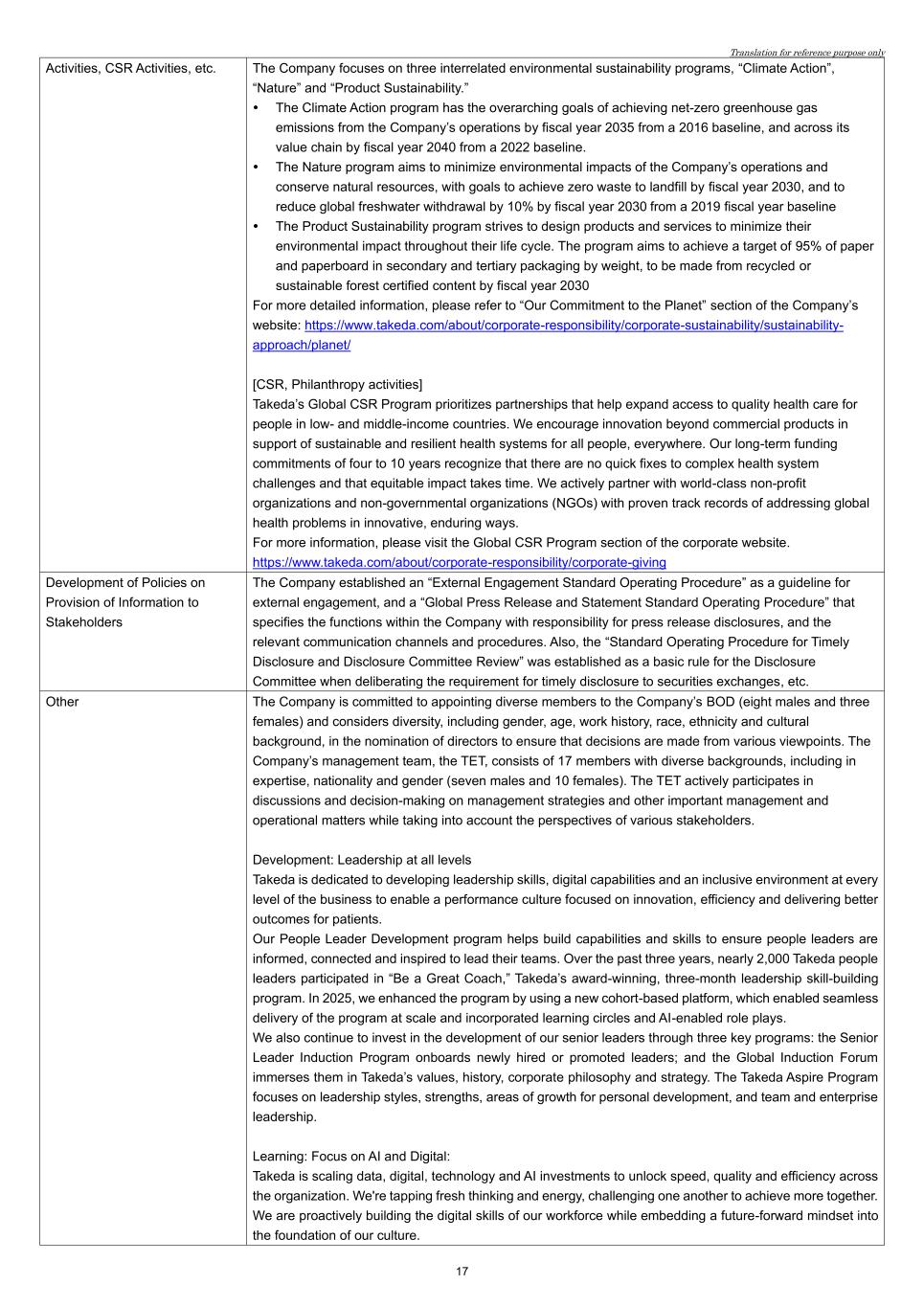
Translation for reference purpose only 17 Activities, CSR Activities, etc. The Company focuses on three interrelated environmental sustainability programs, “Climate Action”, “Nature” and “Product Sustainability.” The Climate Action program has the overarching goals of achieving net-zero greenhouse gas emissions from the Company’s operations by fiscal year 2035 from a 2016 baseline, and across its value chain by fiscal year 2040 from a 2022 baseline. The Nature program aims to minimize environmental impacts of the Company’s operations and conserve natural resources, with goals to achieve zero waste to landfill by fiscal year 2030, and to reduce global freshwater withdrawal by 10% by fiscal year 2030 from a 2019 fiscal year baseline The Product Sustainability program strives to design products and services to minimize their environmental impact throughout their life cycle. The program aims to achieve a target of 95% of paper and paperboard in secondary and tertiary packaging by weight, to be made from recycled or sustainable forest certified content by fiscal year 2030 For more detailed information, please refer to “Our Commitment to the Planet” section of the Company’s website: https://www.takeda.com/about/corporate-responsibility/corporate-sustainability/sustainability- approach/planet/ [CSR, Philanthropy activities] Takeda’s Global CSR Program prioritizes partnerships that help expand access to quality health care for people in low- and middle-income countries. We encourage innovation beyond commercial products in support of sustainable and resilient health systems for all people, everywhere. Our long-term funding commitments of four to 10 years recognize that there are no quick fixes to complex health system challenges and that equitable impact takes time. We actively partner with world-class non-profit organizations and non-governmental organizations (NGOs) with proven track records of addressing global health problems in innovative, enduring ways. For more information, please visit the Global CSR Program section of the corporate website. https://www.takeda.com/about/corporate-responsibility/corporate-giving Development of Policies on Provision of Information to Stakeholders The Company established an “External Engagement Standard Operating Procedure” as a guideline for external engagement, and a “Global Press Release and Statement Standard Operating Procedure” that specifies the functions within the Company with responsibility for press release disclosures, and the relevant communication channels and procedures. Also, the “Standard Operating Procedure for Timely Disclosure and Disclosure Committee Review” was established as a basic rule for the Disclosure Committee when deliberating the requirement for timely disclosure to securities exchanges, etc. Other The Company is committed to appointing diverse members to the Company’s BOD (eight males and three females) and considers diversity, including gender, age, work history, race, ethnicity and cultural background, in the nomination of directors to ensure that decisions are made from various viewpoints. The Company’s management team, the TET, consists of 17 members with diverse backgrounds, including in expertise, nationality and gender (seven males and 10 females). The TET actively participates in discussions and decision-making on management strategies and other important management and operational matters while taking into account the perspectives of various stakeholders. Development: Leadership at all levels Takeda is dedicated to developing leadership skills, digital capabilities and an inclusive environment at every level of the business to enable a performance culture focused on innovation, efficiency and delivering better outcomes for patients. Our People Leader Development program helps build capabilities and skills to ensure people leaders are informed, connected and inspired to lead their teams. Over the past three years, nearly 2,000 Takeda people leaders participated in “Be a Great Coach,” Takeda’s award-winning, three-month leadership skill-building program. In 2025, we enhanced the program by using a new cohort-based platform, which enabled seamless delivery of the program at scale and incorporated learning circles and AI-enabled role plays. We also continue to invest in the development of our senior leaders through three key programs: the Senior Leader Induction Program onboards newly hired or promoted leaders; and the Global Induction Forum immerses them in Takeda’s values, history, corporate philosophy and strategy. The Takeda Aspire Program focuses on leadership styles, strengths, areas of growth for personal development, and team and enterprise leadership. Learning: Focus on AI and Digital: Takeda is scaling data, digital, technology and AI investments to unlock speed, quality and efficiency across the organization. We're tapping fresh thinking and energy, challenging one another to achieve more together. We are proactively building the digital skills of our workforce while embedding a future-forward mindset into the foundation of our culture.
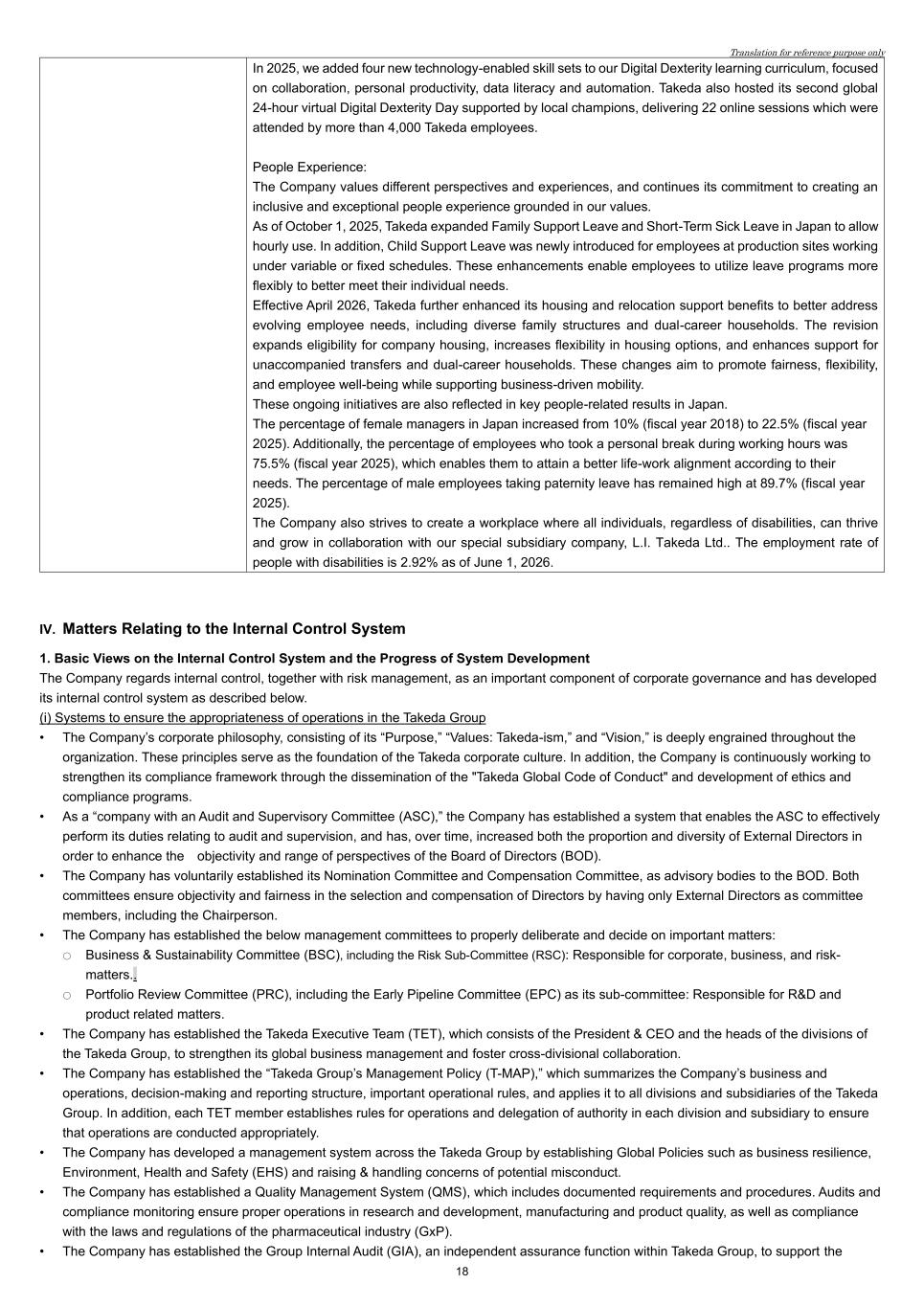
Translation for reference purpose only 18 In 2025, we added four new technology-enabled skill sets to our Digital Dexterity learning curriculum, focused on collaboration, personal productivity, data literacy and automation. Takeda also hosted its second global 24-hour virtual Digital Dexterity Day supported by local champions, delivering 22 online sessions which were attended by more than 4,000 Takeda employees. People Experience: The Company values different perspectives and experiences, and continues its commitment to creating an inclusive and exceptional people experience grounded in our values. As of October 1, 2025, Takeda expanded Family Support Leave and Short-Term Sick Leave in Japan to allow hourly use. In addition, Child Support Leave was newly introduced for employees at production sites working under variable or fixed schedules. These enhancements enable employees to utilize leave programs more flexibly to better meet their individual needs. Effective April 2026, Takeda further enhanced its housing and relocation support benefits to better address evolving employee needs, including diverse family structures and dual-career households. The revision expands eligibility for company housing, increases flexibility in housing options, and enhances support for unaccompanied transfers and dual-career households. These changes aim to promote fairness, flexibility, and employee well-being while supporting business-driven mobility. These ongoing initiatives are also reflected in key people-related results in Japan. The percentage of female managers in Japan increased from 10% (fiscal year 2018) to 22.5% (fiscal year 2025). Additionally, the percentage of employees who took a personal break during working hours was 75.5% (fiscal year 2025), which enables them to attain a better life-work alignment according to their needs. The percentage of male employees taking paternity leave has remained high at 89.7% (fiscal year 2025). The Company also strives to create a workplace where all individuals, regardless of disabilities, can thrive and grow in collaboration with our special subsidiary company, L.I. Takeda Ltd.. The employment rate of people with disabilities is 2.92% as of June 1, 2026. IV. Matters Relating to the Internal Control System 1. Basic Views on the Internal Control System and the Progress of System Development The Company regards internal control, together with risk management, as an important component of corporate governance and has developed its internal control system as described below. (i) Systems to ensure the appropriateness of operations in the Takeda Group • The Company’s corporate philosophy, consisting of its “Purpose,” “Values: Takeda-ism,” and “Vision,” is deeply engrained throughout the organization. These principles serve as the foundation of the Takeda corporate culture. In addition, the Company is continuously working to strengthen its compliance framework through the dissemination of the "Takeda Global Code of Conduct" and development of ethics and compliance programs. • As a “company with an Audit and Supervisory Committee (ASC),” the Company has established a system that enables the ASC to effectively perform its duties relating to audit and supervision, and has, over time, increased both the proportion and diversity of External Directors in order to enhance the objectivity and range of perspectives of the Board of Directors (BOD). • The Company has voluntarily established its Nomination Committee and Compensation Committee, as advisory bodies to the BOD. Both committees ensure objectivity and fairness in the selection and compensation of Directors by having only External Directors as committee members, including the Chairperson. • The Company has established the below management committees to properly deliberate and decide on important matters: ○ Business & Sustainability Committee (BSC), including the Risk Sub-Committee (RSC): Responsible for corporate, business, and risk- matters.. ○ Portfolio Review Committee (PRC), including the Early Pipeline Committee (EPC) as its sub-committee: Responsible for R&D and product related matters. • The Company has established the Takeda Executive Team (TET), which consists of the President & CEO and the heads of the divisions of the Takeda Group, to strengthen its global business management and foster cross-divisional collaboration. • The Company has established the “Takeda Group’s Management Policy (T-MAP),” which summarizes the Company’s business and operations, decision-making and reporting structure, important operational rules, and applies it to all divisions and subsidiaries of the Takeda Group. In addition, each TET member establishes rules for operations and delegation of authority in each division and subsidiary to ensure that operations are conducted appropriately. • The Company has developed a management system across the Takeda Group by establishing Global Policies such as business resilience, Environment, Health and Safety (EHS) and raising & handling concerns of potential misconduct. • The Company has established a Quality Management System (QMS), which includes documented requirements and procedures. Audits and compliance monitoring ensure proper operations in research and development, manufacturing and product quality, as well as compliance with the laws and regulations of the pharmaceutical industry (GxP). • The Company has established the Group Internal Audit (GIA), an independent assurance function within Takeda Group, to support the
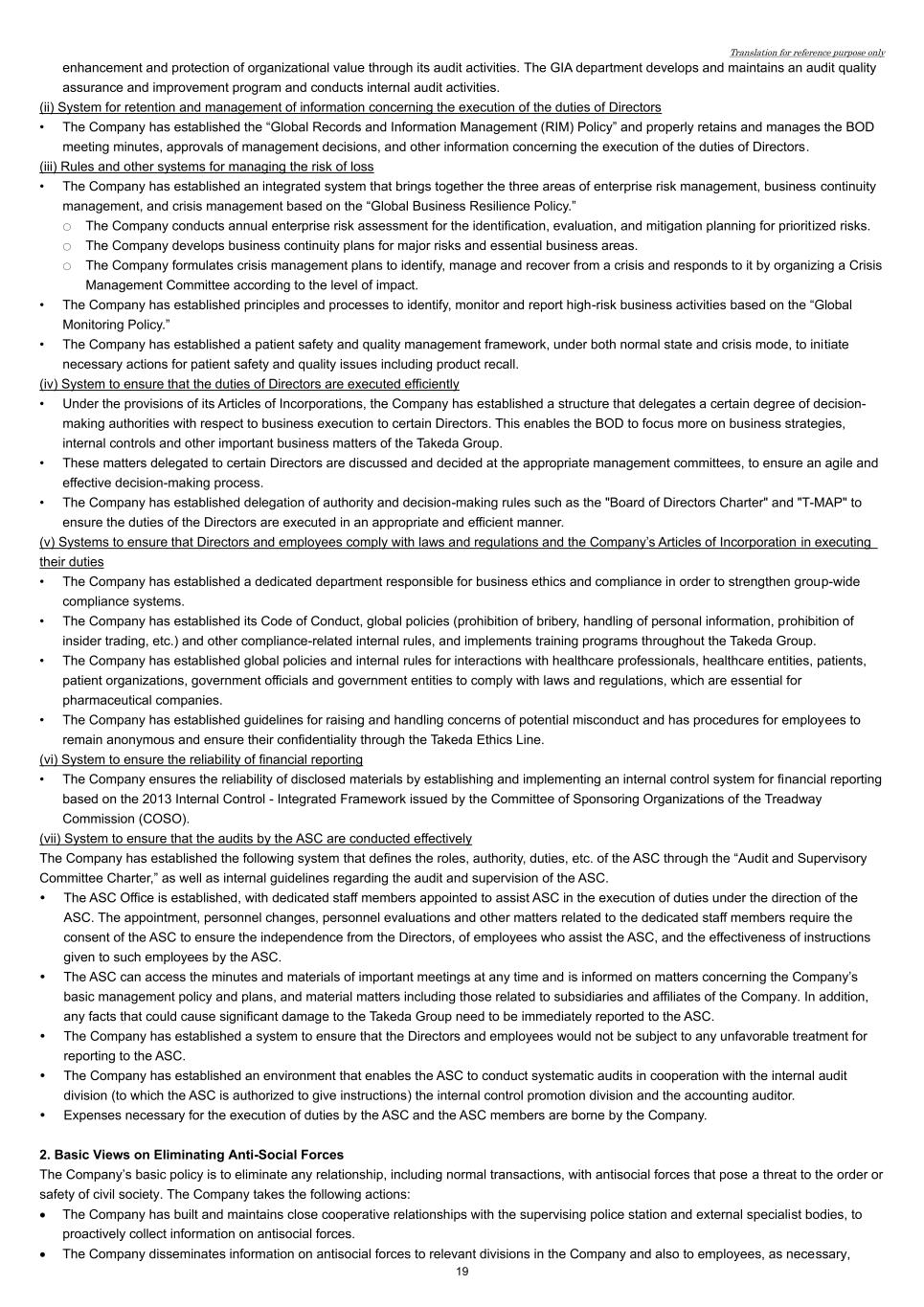
Translation for reference purpose only 19 enhancement and protection of organizational value through its audit activities. The GIA department develops and maintains an audit quality assurance and improvement program and conducts internal audit activities. (ii) System for retention and management of information concerning the execution of the duties of Directors • The Company has established the “Global Records and Information Management (RIM) Policy” and properly retains and manages the BOD meeting minutes, approvals of management decisions, and other information concerning the execution of the duties of Directors. (iii) Rules and other systems for managing the risk of loss • The Company has established an integrated system that brings together the three areas of enterprise risk management, business continuity management, and crisis management based on the “Global Business Resilience Policy.” ○ The Company conducts annual enterprise risk assessment for the identification, evaluation, and mitigation planning for prioritized risks. ○ The Company develops business continuity plans for major risks and essential business areas. ○ The Company formulates crisis management plans to identify, manage and recover from a crisis and responds to it by organizing a Crisis Management Committee according to the level of impact. • The Company has established principles and processes to identify, monitor and report high-risk business activities based on the “Global Monitoring Policy.” • The Company has established a patient safety and quality management framework, under both normal state and crisis mode, to initiate necessary actions for patient safety and quality issues including product recall. (iv) System to ensure that the duties of Directors are executed efficiently • Under the provisions of its Articles of Incorporations, the Company has established a structure that delegates a certain degree of decision- making authorities with respect to business execution to certain Directors. This enables the BOD to focus more on business strategies, internal controls and other important business matters of the Takeda Group. • These matters delegated to certain Directors are discussed and decided at the appropriate management committees, to ensure an agile and effective decision-making process. • The Company has established delegation of authority and decision-making rules such as the "Board of Directors Charter" and "T-MAP" to ensure the duties of the Directors are executed in an appropriate and efficient manner. (v) Systems to ensure that Directors and employees comply with laws and regulations and the Company’s Articles of Incorporation in executing their duties • The Company has established a dedicated department responsible for business ethics and compliance in order to strengthen group-wide compliance systems. • The Company has established its Code of Conduct, global policies (prohibition of bribery, handling of personal information, prohibition of insider trading, etc.) and other compliance-related internal rules, and implements training programs throughout the Takeda Group. • The Company has established global policies and internal rules for interactions with healthcare professionals, healthcare entities, patients, patient organizations, government officials and government entities to comply with laws and regulations, which are essential for pharmaceutical companies. • The Company has established guidelines for raising and handling concerns of potential misconduct and has procedures for employees to remain anonymous and ensure their confidentiality through the Takeda Ethics Line. (vi) System to ensure the reliability of financial reporting • The Company ensures the reliability of disclosed materials by establishing and implementing an internal control system for financial reporting based on the 2013 Internal Control - Integrated Framework issued by the Committee of Sponsoring Organizations of the Treadway Commission (COSO). (vii) System to ensure that the audits by the ASC are conducted effectively The Company has established the following system that defines the roles, authority, duties, etc. of the ASC through the “Audit and Supervisory Committee Charter,” as well as internal guidelines regarding the audit and supervision of the ASC. The ASC Office is established, with dedicated staff members appointed to assist ASC in the execution of duties under the direction of the ASC. The appointment, personnel changes, personnel evaluations and other matters related to the dedicated staff members require the consent of the ASC to ensure the independence from the Directors, of employees who assist the ASC, and the effectiveness of instructions given to such employees by the ASC. The ASC can access the minutes and materials of important meetings at any time and is informed on matters concerning the Company’s basic management policy and plans, and material matters including those related to subsidiaries and affiliates of the Company. In addition, any facts that could cause significant damage to the Takeda Group need to be immediately reported to the ASC. The Company has established a system to ensure that the Directors and employees would not be subject to any unfavorable treatment for reporting to the ASC. The Company has established an environment that enables the ASC to conduct systematic audits in cooperation with the internal audit division (to which the ASC is authorized to give instructions) the internal control promotion division and the accounting auditor. Expenses necessary for the execution of duties by the ASC and the ASC members are borne by the Company. 2. Basic Views on Eliminating Anti-Social Forces The Company’s basic policy is to eliminate any relationship, including normal transactions, with antisocial forces that pose a threat to the order or safety of civil society. The Company takes the following actions: • The Company has built and maintains close cooperative relationships with the supervising police station and external specialist bodies, to proactively collect information on antisocial forces. • The Company disseminates information on antisocial forces to relevant divisions in the Company and also to employees, as necessary,
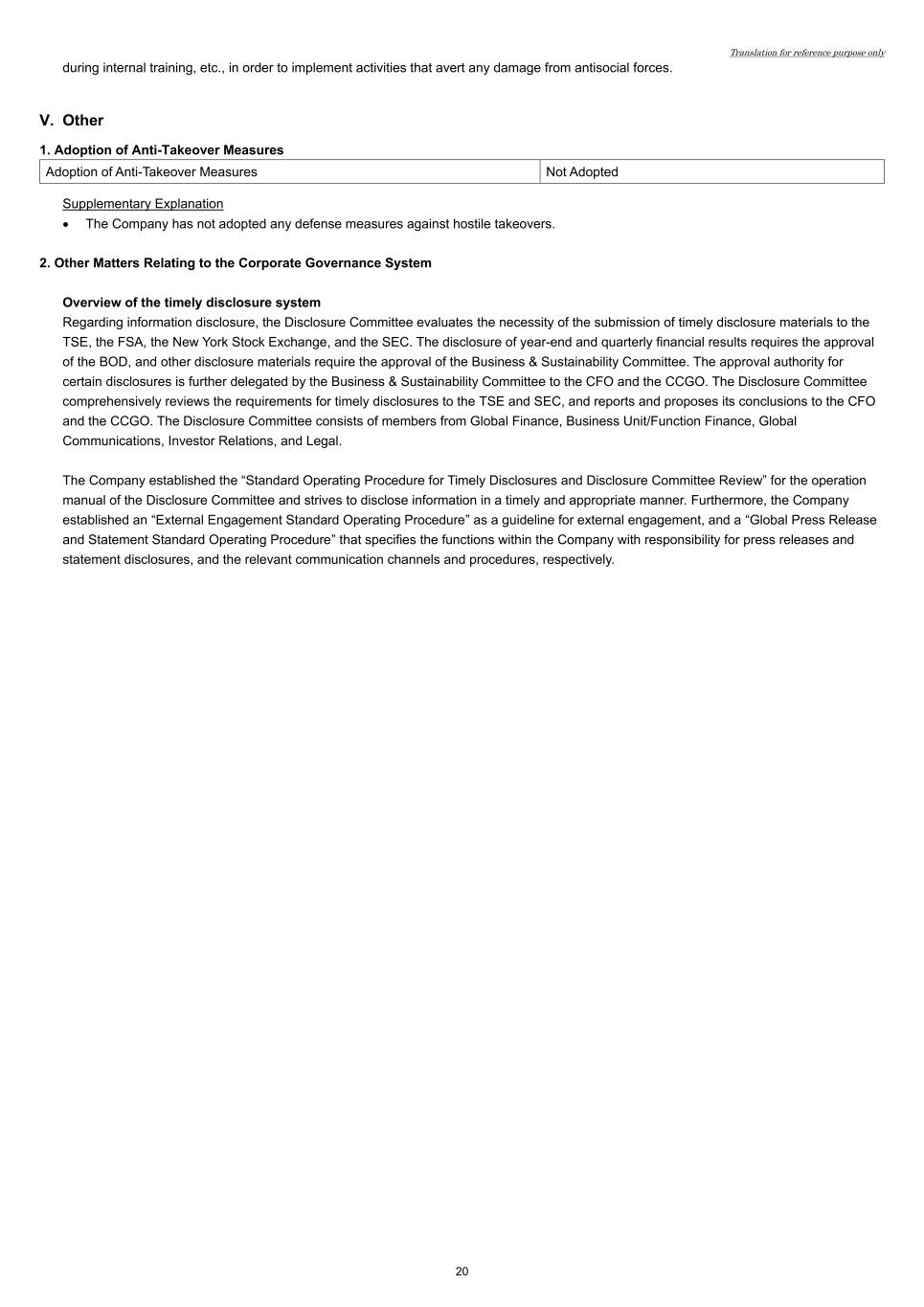
Translation for reference purpose only 20 during internal training, etc., in order to implement activities that avert any damage from antisocial forces. V. Other 1. Adoption of Anti-Takeover Measures Adoption of Anti-Takeover Measures Not Adopted Supplementary Explanation • The Company has not adopted any defense measures against hostile takeovers. 2. Other Matters Relating to the Corporate Governance System Overview of the timely disclosure system Regarding information disclosure, the Disclosure Committee evaluates the necessity of the submission of timely disclosure materials to the TSE, the FSA, the New York Stock Exchange, and the SEC. The disclosure of year-end and quarterly financial results requires the approval of the BOD, and other disclosure materials require the approval of the Business & Sustainability Committee. The approval authority for certain disclosures is further delegated by the Business & Sustainability Committee to the CFO and the CCGO. The Disclosure Committee comprehensively reviews the requirements for timely disclosures to the TSE and SEC, and reports and proposes its conclusions to the CFO and the CCGO. The Disclosure Committee consists of members from Global Finance, Business Unit/Function Finance, Global Communications, Investor Relations, and Legal. The Company established the “Standard Operating Procedure for Timely Disclosures and Disclosure Committee Review” for the operation manual of the Disclosure Committee and strives to disclose information in a timely and appropriate manner. Furthermore, the Company established an “External Engagement Standard Operating Procedure” as a guideline for external engagement, and a “Global Press Release and Statement Standard Operating Procedure” that specifies the functions within the Company with responsibility for press releases and statement disclosures, and the relevant communication channels and procedures, respectively.
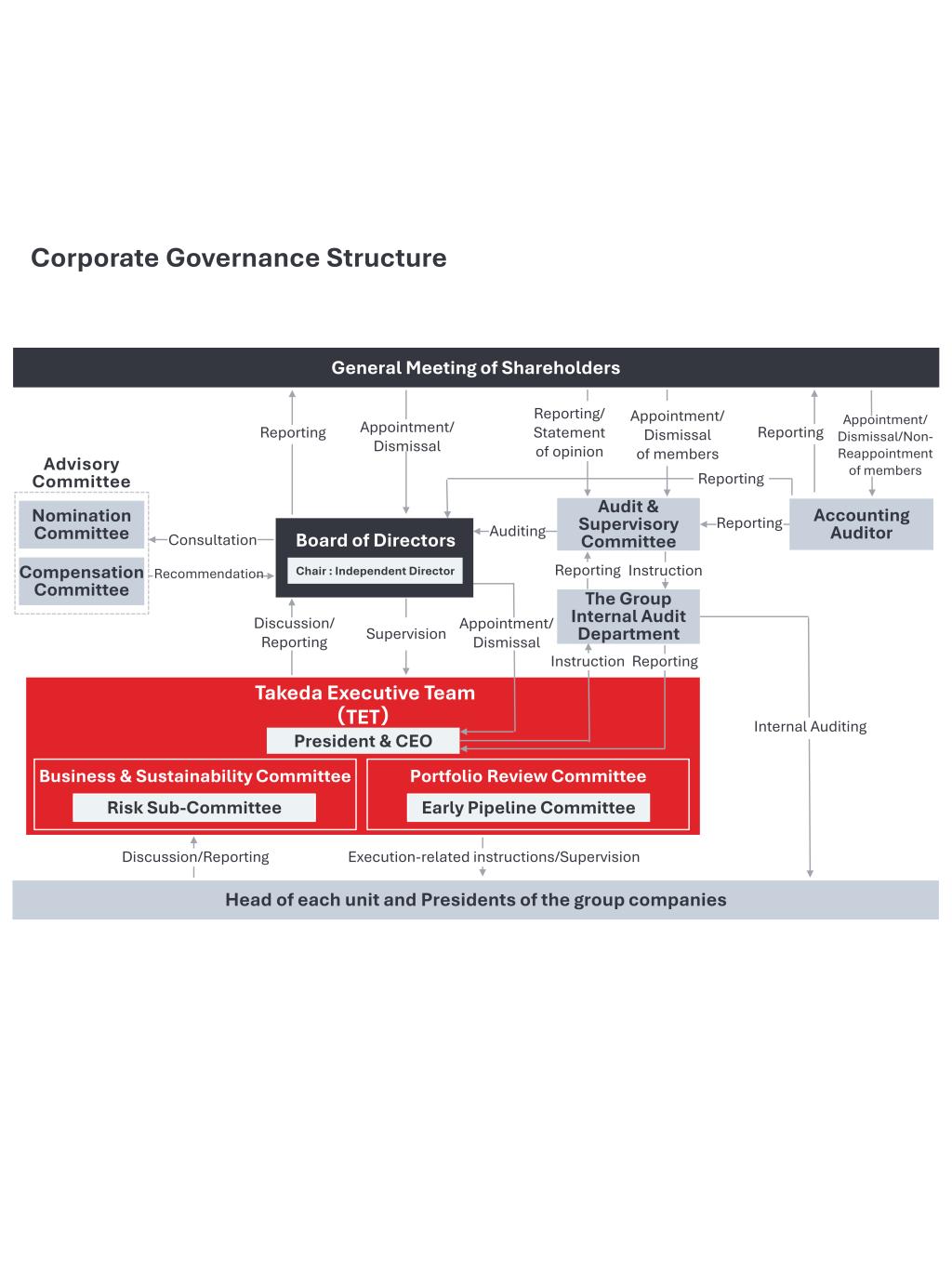
Nomination Committee Compensation Committee Advisory Committee Business & Sustainability Committee Portfolio Review Committee Takeda Executive Team (TET) President & CEO Board of Directors Chair : Independent Director Audit & Supervisory Committee Accounting Auditor The Group Internal Audit Department Appointment/ Dismissal Reporting Auditing Reporting Appointment/ Dismissal/Non- Reappointment of members Reporting Consultation Execution-related instructions/Supervision Internal Auditing Reporting ReportingInstruction Instruction Risk Sub-Committee Early Pipeline Committee Head of each unit and Presidents of the group companies General Meeting of Shareholders Discussion/Reporting Discussion/ Reporting Supervision Appointment/ Dismissal Recommendation Reporting Reporting/ Statement of opinion Appointment/ Dismissal of members Corporate Governance Structure
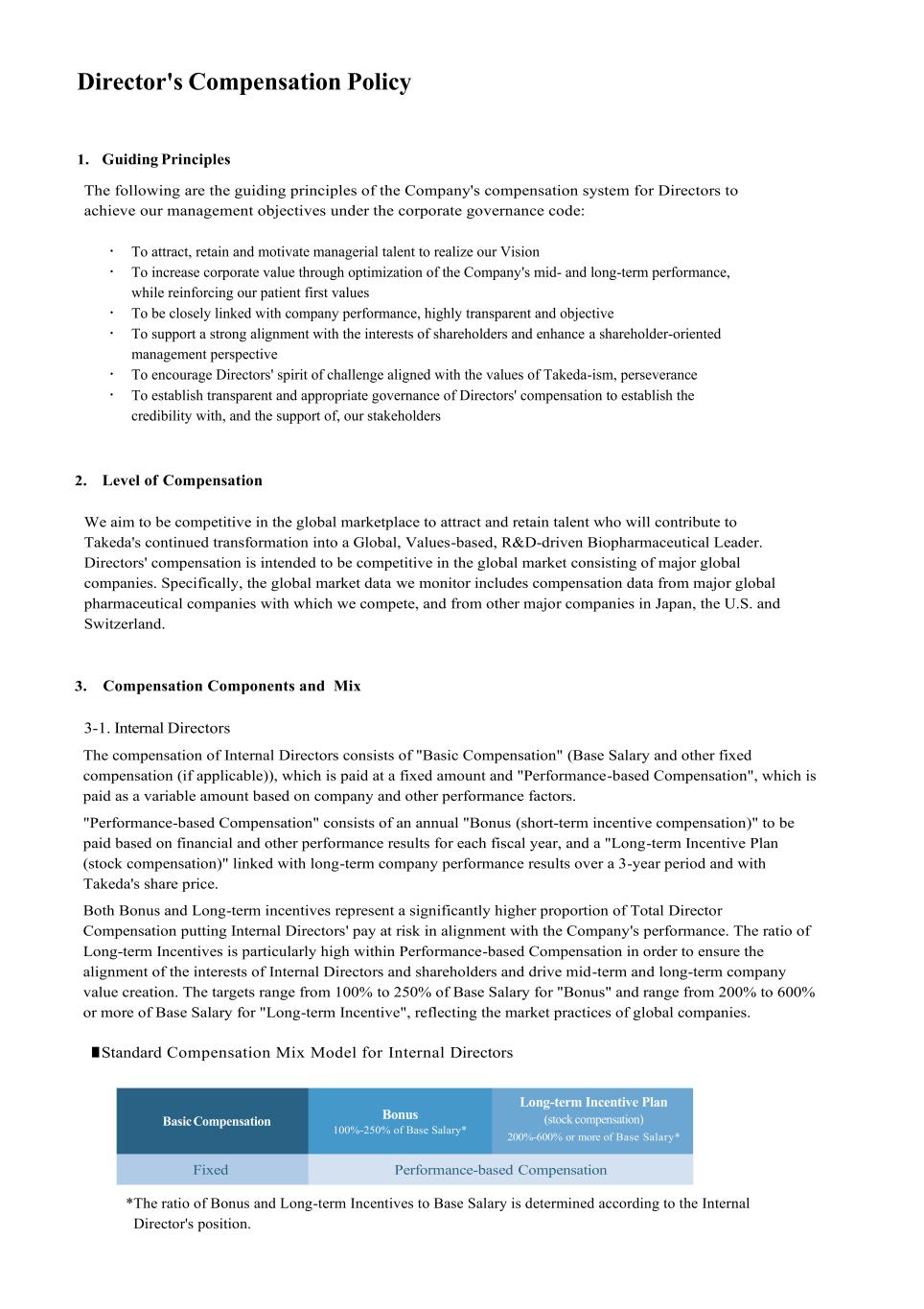
Director's Compensation Policy 1. Guiding Principles The following are the guiding principles of the Company's compensation system for Directors to achieve our management objectives under the corporate governance code: To attract, retain and motivate managerial talent to realize our Vision To increase corporate value through optimization of the Company's mid- and long-term performance, while reinforcing our patient first values To be closely linked with company performance, highly transparent and objective To support a strong alignment with the interests of shareholders and enhance a shareholder-oriented management perspective To encourage Directors' spirit of challenge aligned with the values of Takeda-ism, perseverance To establish transparent and appropriate governance of Directors' compensation to establish the credibility with, and the support of, our stakeholders 2. Level of Compensation We aim to be competitive in the global marketplace to attract and retain talent who will contribute to Takeda's continued transformation into a Global, Values-based, R&D-driven Biopharmaceutical Leader. Directors' compensation is intended to be competitive in the global market consisting of major global companies. Specifically, the global market data we monitor includes compensation data from major global pharmaceutical companies with which we compete, and from other major companies in Japan, the U.S. and Switzerland. 3. Compensation Components and Mix 3-1. Internal Directors The compensation of Internal Directors consists of "Basic Compensation" (Base Salary and other fixed compensation (if applicable)), which is paid at a fixed amount and "Performance-based Compensation", which is paid as a variable amount based on company and other performance factors. "Performance-based Compensation" consists of an annual "Bonus (short-term incentive compensation)" to be paid based on financial and other performance results for each fiscal year, and a "Long-term Incentive Plan (stock compensation)" linked with long-term company performance results over a 3-year period and with Takeda's share price. Both Bonus and Long-term incentives represent a significantly higher proportion of Total Director Compensation putting Internal Directors' pay at risk in alignment with the Company's performance. The ratio of Long-term Incentives is particularly high within Performance-based Compensation in order to ensure the alignment of the interests of Internal Directors and shareholders and drive mid-term and long-term company value creation. The targets range from 100% to 250% of Base Salary for "Bonus" and range from 200% to 600% or more of Base Salary for "Long-term Incentive", reflecting the market practices of global companies. ■ Standard Compensation Mix Model for Internal Directors Fixed Performance-based Compensation *The ratio of Bonus and Long-term Incentives to Base Salary is determined according to the Internal Director's position. Bonus 100%-250% of Base Salary* Basic Compensation Long-term Incentive Plan (stock compensation) 200%-600% or more of Base Salary*
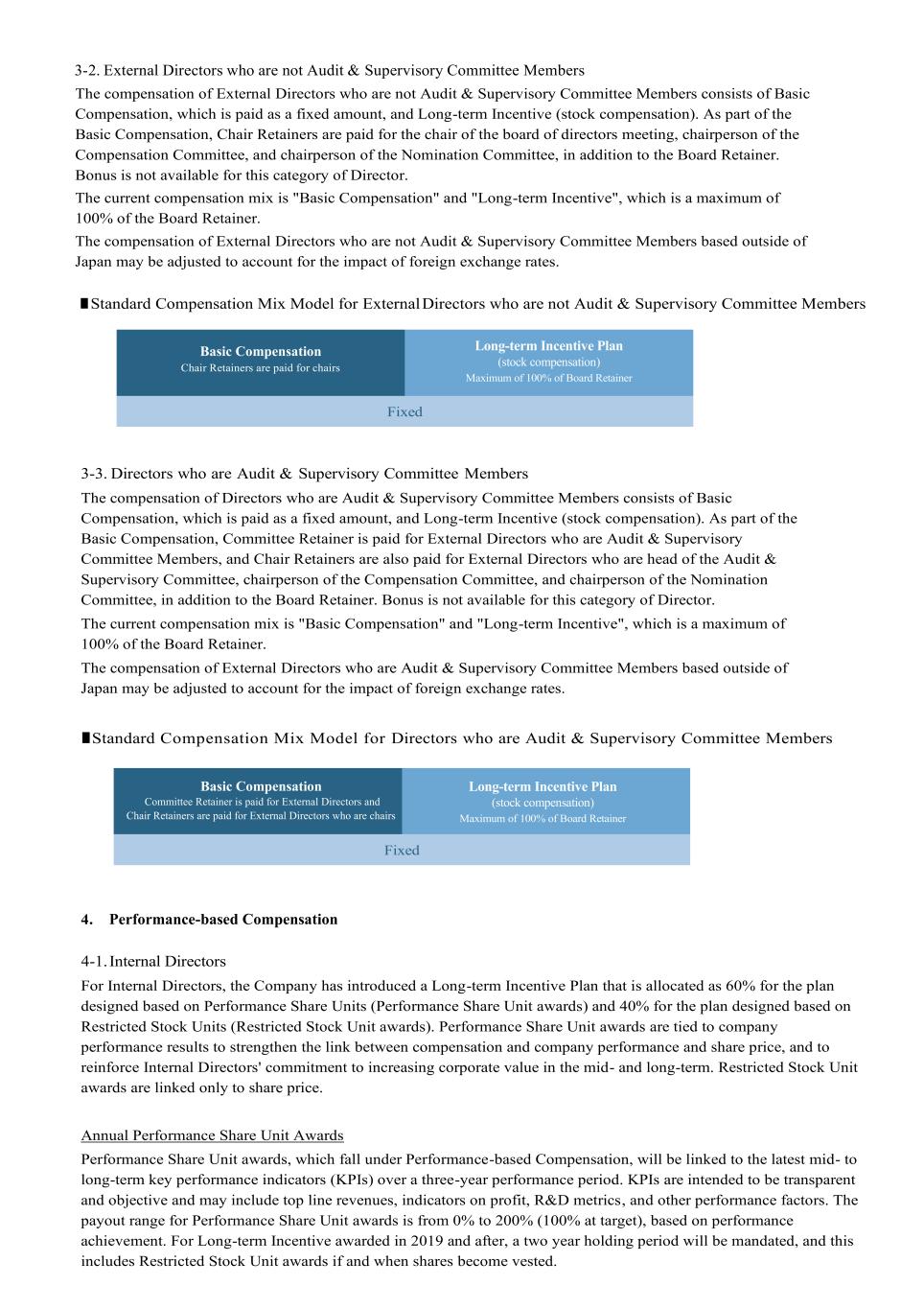
3-2. External Directors who are not Audit & Supervisory Committee Members The compensation of External Directors who are not Audit & Supervisory Committee Members consists of Basic Compensation, which is paid as a fixed amount, and Long-term Incentive (stock compensation). As part of the Basic Compensation, Chair Retainers are paid for the chair of the board of directors meeting, chairperson of the Compensation Committee, and chairperson of the Nomination Committee, in addition to the Board Retainer. Bonus is not available for this category of Director. The current compensation mix is "Basic Compensation" and "Long-term Incentive", which is a maximum of 100% of the Board Retainer. The compensation of External Directors who are not Audit & Supervisory Committee Members based outside of Japan may be adjusted to account for the impact of foreign exchange rates. ■ Standard Compensation Mix Model for External Directors who are not Audit & Supervisory Committee Members Fixed 3-3. Directors who are Audit & Supervisory Committee Members The compensation of Directors who are Audit & Supervisory Committee Members consists of Basic Compensation, which is paid as a fixed amount, and Long-term Incentive (stock compensation). As part of the Basic Compensation, Committee Retainer is paid for External Directors who are Audit & Supervisory Committee Members, and Chair Retainers are also paid for External Directors who are head of the Audit & Supervisory Committee, chairperson of the Compensation Committee, and chairperson of the Nomination Committee, in addition to the Board Retainer. Bonus is not available for this category of Director. The current compensation mix is "Basic Compensation" and "Long-term Incentive", which is a maximum of 100% of the Board Retainer. The compensation of External Directors who are Audit & Supervisory Committee Members based outside of Japan may be adjusted to account for the impact of foreign exchange rates. ■ Standard Compensation Mix Model for Directors who are Audit & Supervisory Committee Members Fixed 4. Performance-based Compensation 4-1. Internal Directors For Internal Directors, the Company has introduced a Long-term Incentive Plan that is allocated as 60% for the plan designed based on Performance Share Units (Performance Share Unit awards) and 40% for the plan designed based on Restricted Stock Units (Restricted Stock Unit awards). Performance Share Unit awards are tied to company performance results to strengthen the link between compensation and company performance and share price, and to reinforce Internal Directors' commitment to increasing corporate value in the mid- and long-term. Restricted Stock Unit awards are linked only to share price. Annual Performance Share Unit Awards Performance Share Unit awards, which fall under Performance-based Compensation, will be linked to the latest mid- to long-term key performance indicators (KPIs) over a three-year performance period. KPIs are intended to be transparent and objective and may include top line revenues, indicators on profit, R&D metrics, and other performance factors. The payout range for Performance Share Unit awards is from 0% to 200% (100% at target), based on performance achievement. For Long-term Incentive awarded in 2019 and after, a two year holding period will be mandated, and this includes Restricted Stock Unit awards if and when shares become vested. Basic Compensation Chair Retainers are paid for chairs Long-term Incentive Plan (stock compensation) Maximum of 100% of Board Retainer Basic Compensation Committee Retainer is paid for External Directors and Chair Retainers are paid for External Directors who are chairs Long-term Incentive Plan (stock compensation) Maximum of 100% of Board Retainer
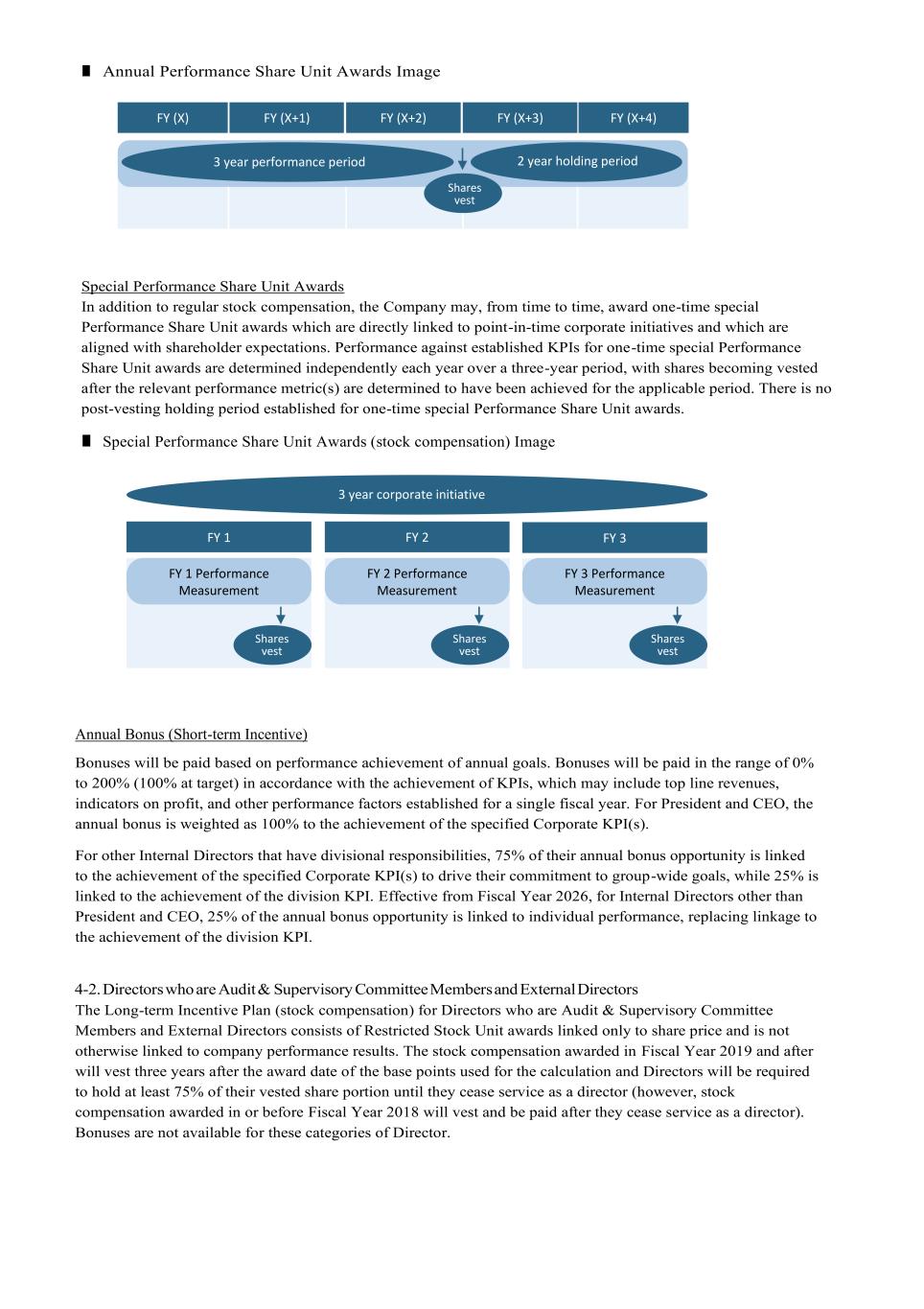
■ Annual Performance Share Unit Awards Image Special Performance Share Unit Awards In addition to regular stock compensation, the Company may, from time to time, award one-time special Performance Share Unit awards which are directly linked to point-in-time corporate initiatives and which are aligned with shareholder expectations. Performance against established KPIs for one-time special Performance Share Unit awards are determined independently each year over a three-year period, with shares becoming vested after the relevant performance metric(s) are determined to have been achieved for the applicable period. There is no post-vesting holding period established for one-time special Performance Share Unit awards. ■ Special Performance Share Unit Awards (stock compensation) Image Annual Bonus (Short-term Incentive) Bonuses will be paid based on performance achievement of annual goals. Bonuses will be paid in the range of 0% to 200% (100% at target) in accordance with the achievement of KPIs, which may include top line revenues, indicators on profit, and other performance factors established for a single fiscal year. For President and CEO, the annual bonus is weighted as 100% to the achievement of the specified Corporate KPI(s). For other Internal Directors that have divisional responsibilities, 75% of their annual bonus opportunity is linked to the achievement of the specified Corporate KPI(s) to drive their commitment to group-wide goals, while 25% is linked to the achievement of the division KPI. Effective from Fiscal Year 2026, for Internal Directors other than President and CEO, 25% of the annual bonus opportunity is linked to individual performance, replacing linkage to the achievement of the division KPI. 4-2. Directors who are Audit & Supervisory Committee Members and External Directors The Long-term Incentive Plan (stock compensation) for Directors who are Audit & Supervisory Committee Members and External Directors consists of Restricted Stock Unit awards linked only to share price and is not otherwise linked to company performance results. The stock compensation awarded in Fiscal Year 2019 and after will vest three years after the award date of the base points used for the calculation and Directors will be required to hold at least 75% of their vested share portion until they cease service as a director (however, stock compensation awarded in or before Fiscal Year 2018 will vest and be paid after they cease service as a director). Bonuses are not available for these categories of Director. 3 year performance period 2 year holding period Shares vest FY (X) FY (X+3) FY (X+2) FY (X+1) FY (X+4) 3 year corporate initiative FY 1 FY 3 FY 2 FY 1 Performance Measurement FY 2 Performance Measurement FY 3 Performance Measurement Shares vest Shares vest Shares vest
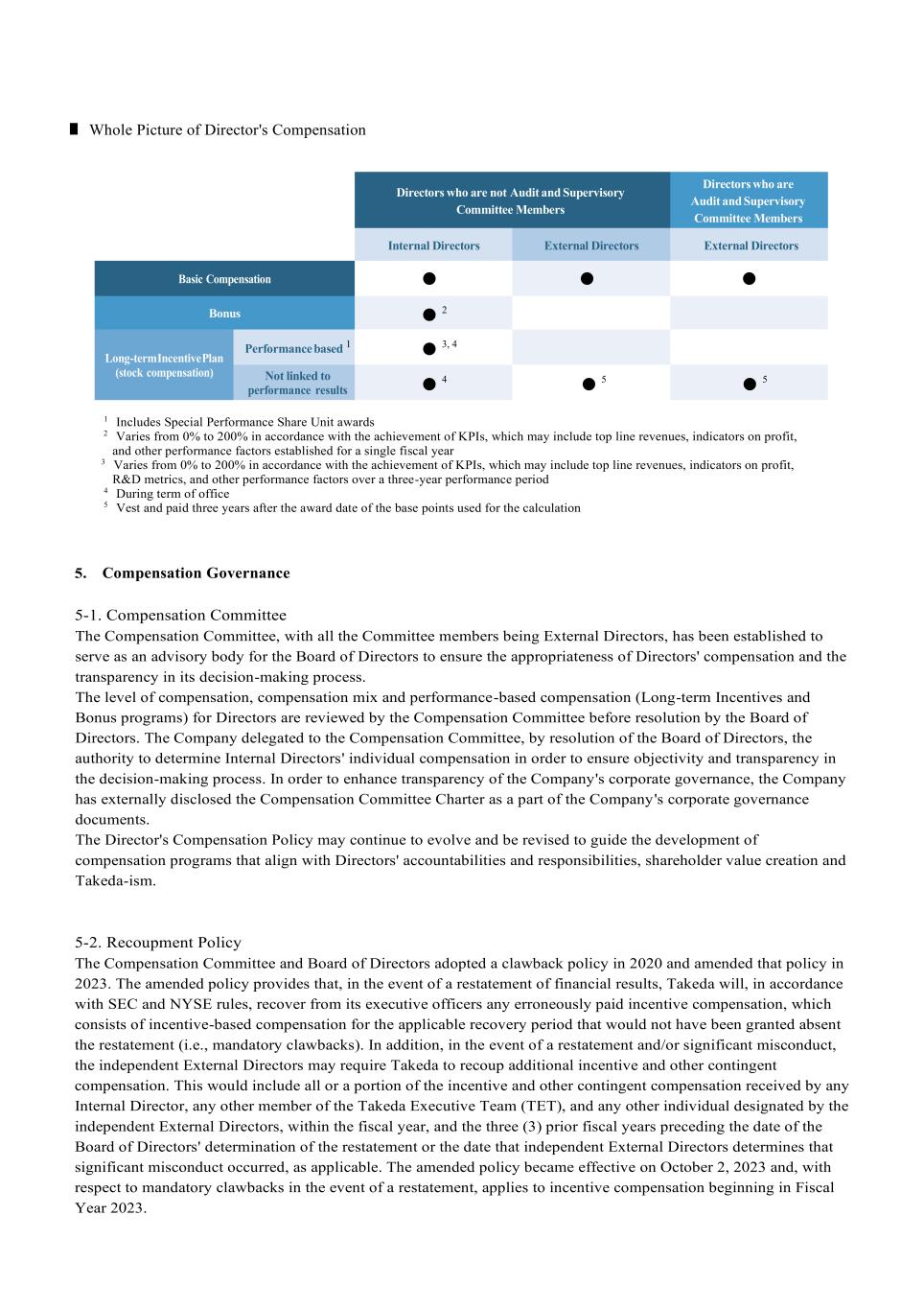
■ Whole Picture of Director's Compensation 1 Includes Special Performance Share Unit awards 2 Varies from 0% to 200% in accordance with the achievement of KPIs, which may include top line revenues, indicators on profit, and other performance factors established for a single fiscal year 3 Varies from 0% to 200% in accordance with the achievement of KPIs, which may include top line revenues, indicators on profit, R&D metrics, and other performance factors over a three-year performance period 4 During term of office 5 Vest and paid three years after the award date of the base points used for the calculation 5. Compensation Governance 5-1. Compensation Committee The Compensation Committee, with all the Committee members being External Directors, has been established to serve as an advisory body for the Board of Directors to ensure the appropriateness of Directors' compensation and the transparency in its decision-making process. The level of compensation, compensation mix and performance-based compensation (Long-term Incentives and Bonus programs) for Directors are reviewed by the Compensation Committee before resolution by the Board of Directors. The Company delegated to the Compensation Committee, by resolution of the Board of Directors, the authority to determine Internal Directors' individual compensation in order to ensure objectivity and transparency in the decision-making process. In order to enhance transparency of the Company's corporate governance, the Company has externally disclosed the Compensation Committee Charter as a part of the Company's corporate governance documents. The Director's Compensation Policy may continue to evolve and be revised to guide the development of compensation programs that align with Directors' accountabilities and responsibilities, shareholder value creation and Takeda-ism. 5-2. Recoupment Policy The Compensation Committee and Board of Directors adopted a clawback policy in 2020 and amended that policy in 2023. The amended policy provides that, in the event of a restatement of financial results, Takeda will, in accordance with SEC and NYSE rules, recover from its executive officers any erroneously paid incentive compensation, which consists of incentive-based compensation for the applicable recovery period that would not have been granted absent the restatement (i.e., mandatory clawbacks). In addition, in the event of a restatement and/or significant misconduct, the independent External Directors may require Takeda to recoup additional incentive and other contingent compensation. This would include all or a portion of the incentive and other contingent compensation received by any Internal Director, any other member of the Takeda Executive Team (TET), and any other individual designated by the independent External Directors, within the fiscal year, and the three (3) prior fiscal years preceding the date of the Board of Directors' determination of the restatement or the date that independent External Directors determines that significant misconduct occurred, as applicable. The amended policy became effective on October 2, 2023 and, with respect to mandatory clawbacks in the event of a restatement, applies to incentive compensation beginning in Fiscal Year 2023. Directors who are not Audit and Supervisory Committee Members Directors who are Audit and Supervisory Committee Members Internal Directors External Directors External Directors Basic Compensation Bonus 2 Long-term Incentive Plan (stock compensation) Performance based 1 3, 4 Not linked to performance results 4 5 5