
Exhibit 99.3
DEFI TECHNOLOGIES INC.
NOTICE OF ANNUAL GENERAL AND SPECIAL
MEETING OF COMMON SHAREHOLDERS
You are invited to the 2026 annual general and special meeting (the “Meeting”) of common shareholders (the “Shareholders”) of DeFi Technologies Inc. (the “Corporation”).
| When: | Monday, June 29, 2026 at 10:00 a.m. (Toronto time) |
| Where: | Virtual Meeting |
The purpose of the Meeting is as follows:
| 1. | Financial Statements. Receive and consider the audited consolidated financial statements as at and for the fiscal year ended December 31, 2025; |
| 2. | Number of Directors. To set the number of directors to be elected at the Meeting at six (6); |
| 3. | Elect Directors. Consider and elect the directors for the ensuing year; |
| 4. | Auditor Appointment. Appoint HDCPA Professional Corporation as auditor of the Corporation; |
| 5. | Share Consolidation. Consider and, if deemed advisable, to pass, with or without variation, a special resolution to authorize the directors of the Corporation to effect, in their sole and complete discretion if they deem it appropriate and without any further approval from the shareholders of the Corporation, a share consolidation, whereby the Corporation’s issued and outstanding share capital would be altered by consolidating all its common shares on the basis of up to every twelve (12) of such common shares being consolidated into one (1) common share, with such consolidation to occur at some time as determined by the Board of Directors before the next annual general meeting of shareholders (the “Share Consolidation”); |
| 6. | Amendment to By-Law No. 1. Consider and, if deemed advisable, to pass with or without variation, an ordinary resolution confirming the amendment of the Corporation’s By-Law No. 1 removing the residency requirement for directors of the Corporation (the “By-Law Amendment”); |
| 7. | Advance Notice By-Law No. 2. Consider and, if deemed advisable, to pass with or without variation, an ordinary resolution confirming the adoption of the Corporation’s By-Law No. 2 providing for advance notice requirements for the nomination of directors of the Corporation (the “Advance Notice By-Law”); and |
| 8. | Other Business. Consider other business as may properly come before the Meeting or any postponement(s) or adjournment(s) thereof. |
1
The details of all matters proposed to be put before the Shareholders at the Meeting are set forth in the management information circular (the “Circular”), under “Matters to be Considered”, accompanying this Notice of Meeting. At the Meeting, Shareholders will be asked to approve each of the foregoing items.
The board of directors of the Corporation unanimously recommends that the Shareholders vote FOR each of the fixing of the number of directors of the Corporation six (6), the appointment of HDCPA Professional Corporation as auditor of the Corporation, the election of the directors of the Corporation for the ensuing year, the Share Consolidation, the confirmation of the By-Law Amendment and the Advance Notice By-Law.
Each common share of the Corporation (a “Common Share”) will entitle the holder thereof to one (1) vote at the Meeting.
The directors of the Corporation have fixed the close of business on May 19, 2026 as the record date, being the date for the determination of the registered Shareholders entitled to notice and to vote at the Meeting and any adjournments(s) or postponement(s) thereof.
The Corporation is holding the Meeting as a completely virtual meeting, which will be conducted via live webcast, where all shareholders regardless of geographic location and equity ownership will have an equal opportunity to participate at the Meeting and engage with directors of the Corporation and management as well as other shareholders. Shareholders will not be able to attend the Meeting in person. Registered shareholders and duly appointed proxyholders will be able to attend, participate and vote at the Meeting online at https://meetings.lumiconnect.com/400-468-404-350. Beneficial shareholders (being shareholders who hold their shares through a broker, investment dealer, bank, trust company, custodian, nominee or other intermediary) who have not duly appointed themselves as proxyholder will be able to attend as a guest and view the webcast but not be able to participate or vote at the Meeting.
As a shareholder of the Corporation, it is very important that you read the Circular and other Meeting materials carefully. They contain important information with respect to voting your Common Shares and attending and participating at the Meeting.
A shareholder who wishes to appoint a person other than the management nominees identified on the form of proxy or voting instruction form, to represent him, her or it at the Meeting may do so by inserting such person’s name in the blank space provided in the form of proxy or voting instruction form and following the instructions for submitting such form of proxy or voting instruction form. This must be completed prior to registering such proxyholder, which is an additional step to be completed once you have submitted your form of proxy or voting instruction form. If you wish that a person other than the management nominees identified on the form of proxy or voting instruction form attend and participate at the Meeting as your proxy and vote your shares, including if you are a nonregistered shareholder and wish to appoint yourself as proxyholder to attend, participate and vote at the Meeting, you MUST register such proxyholder after having submitted your form of proxy or voting instruction form identifying such proxyholder. Failure to register the proxyholder will result in the proxyholder not receiving a Username to participate in the Meeting. Without a Username, proxyholders will not be able to attend, participate or vote at the Meeting. To register a proxyholder, shareholders MUST send an email to appointee@odysseytrust.com and provide Odyssey Trust Company (“Odyssey”) with their proxyholder’s contact information, amount of shares appointed, name in which the shares are registered if they are a registered shareholder, or name of broker where the shares are held if a beneficial shareholder, so that Odyssey may provide the proxyholder with a Username via email.
2
Electronic copies of the Meeting materials may be obtained at https://defi.tech/investor- relations or under the Corporation’s profile on www.sedarplus.ca.
The Corporation has elected to use the notice-and-access rules (“Notice and Access”) under National Instrument 54-101 – Communication with Beneficial Owners of Securities of a Reporting Issuer and National Instrument 51-102 – Continuous Disclosure Obligations for distribution of the Circular, this Notice of Meeting, the form of proxy and the voting instruction form (collectively, the “Meeting Materials”) to holders of Common Shares. Notice and Access is a set of rules that allows issuers to post electronic versions of its proxy-related materials on SEDAR+ and on one additional website, rather than mailing paper copies to shareholders.
Shareholders may obtain paper copies of the Meeting Materials by contacting the Corporation’s transfer agent, Odyssey Trust Company, at 1-587-885-0960 and 1-888-290- 1175 (toll-free) from outside of North America. A request for paper copies should be received by Odyssey by June 18, 2026 in order to allow sufficient time for the shareholder to receive the paper copy and return the proxy by its due date.
Proxies are being solicited by management of the Corporation. A form of proxy for the Meeting accompanies this notice (the “Proxy”). Shareholders who are entitled to vote at the Meeting may vote by proxy or, vote online at the Meeting. Shareholders who are unable to attend the Meeting are requested to complete, execute and deliver the enclosed Proxy to the Corporation’s registrar and transfer agent, Odyssey Trust Company, 1100-67 Yonge Street, Toronto ON M5E 1J8 by no later than 10:00 a.m. (Toronto time) on June 25, 2026, or if the Meeting is adjourned or postponed, by no later than 48 hours prior to the time of such reconvened meeting (excluding Saturdays, Sundays and holidays). The Chairman of the Meeting may waive or extend the time limit for the deposit of Proxies. Beneficial owners of Common Shares registered in the name of a broker, custodian, nominee or other intermediary should follow the instructions provided by their broker, custodian, nominee or other intermediary in order to vote their Common Shares.
Registered holders of the potash stream preferred shares of the Corporation are hereby provided with notice of, and are entitled to attend, the Meeting and be heard at such Meeting.
DATED at Toronto, Ontario as of the 20th day of May, 2026
| BY ORDER OF THE BOARD OF DIRECTORS | |
| (signed) “Johan Wattenström” | |
| Chief Executive Officer and | |
| Executive Chairman |
3
DEFI TECHNOLOGIES INC.
MANAGEMENT INFORMATION CIRCULAR
May 20, 2026
FOR THE ANNUAL GENERAL AND SPECIAL MEETING OF SHAREHOLDERS TO BE HELD ON JUNE 29, 2026
INFORMATION REGARDING CONDUCT OF MEETING
Solicitation of Proxies
This management information circular (“Circular”) is furnished in connection with the solicitation by the management of DeFi Technologies Inc. (the “Corporation” or “DeFi Technologies”) of proxies to be used at the annual general and special meeting (the “Meeting”) of holders of common shares of the Corporation to be held virtually on June 29, 2026 at 10:00 (a) m. and at any postponement(s) or adjournment(s) thereof for the purposes set forth in the accompanying notice of meeting (“Notice of Meeting”). References in this Circular to the “Meeting” include references to any postponement(s) or adjournment(s) thereof. It is expected that the solicitation will be primarily by mail but proxies may also be solicited through other means by employees, consultants and agents of the Corporation. The cost of solicitation by management will be borne by the Corporation.
The Corporation is sending proxy-related materials to holders (the “Shareholders”) of common shares (the “Common Shares”) using the notice-and-access rules (“Notice and Access”) under National Instrument 54-101 – Communication with Beneficial Owners of Securities of a Reporting Issuer and National Instrument 51-102 – Continuous Disclosure Obligations. Notice and Access is a set of rules for reducing the volume of materials that must be physically mailed to Shareholders by posting the circular and additional materials online. Shareholders will still receive a hard copy of the Notice of Meeting and form of proxy or voting instruction form, as the case may be, and may choose to receive a hard copy of this Circular (collectively, the “Meeting Materials”). Details are included in the Notice of Meeting. The Meeting Materials are available online at https://defi.tech/investor-relations and under the Corporation’s profile on SEDAR+ at www.sedarplus.ca. Shareholders are reminded to review the Meeting Materials before voting.
The board of directors of the Corporation (the “Board”) has by resolution fixed the close of business on May 19, 2026 as the record date for the meeting (the “Record Date”) being the date for the determination of the registered Shareholders entitled to notice of and to vote at the Meeting and any postponement(s) or adjournment(s) thereof. The Board has by resolution fixed 10:00 a.m. (Toronto time) on June 25, 2026, or 48 hours (excluding Saturdays, Sundays and holidays) before any postponement(s) or adjournment(s) of the Meeting, as the time by which proxies to be used or acted upon at the Meeting or any adjournment(s) thereof shall be deposited with the Corporation’s transfer agent, Odyssey Trust Company (“Odyssey”). The proxy cut-off time may be waived or extended by the Board or a person authorized by the Board in its sole discretion without notice.
The Corporation shall make a list of all persons who are registered holders of Common Shares on the Record Date and the number of Common Shares registered in the name of each person on that date. Each Shareholder is entitled to one (1) vote on each matter to be acted on at the Meeting for each Common Share registered in his or her name as it appears on the list.
4
These materials are being sent to both registered and non-registered owners of Common Shares. If you are a non-registered owner, and the Corporation or its agent has sent these materials directly to you, your name and address and information about your holdings of securities have been obtained in accordance with the applicable securities regulatory requirements from the Intermediary (as defined below) holding on your behalf. By choosing to send these materials to you directly, the Corporation (and not the Intermediary holding on your behalf) has assumed responsibility for (i) delivering these materials to you, and (ii) executing your proper voting instructions. Please return your voting instructions as specified in the request for voting instructions.
Unless otherwise stated, the information contained in this Circular is as of May 20, 2026. All dollar amount references in this Circular, unless otherwise indicated, are expressed in Canadian dollars.
Electronic copies of the Meeting materials may be obtained under the Corporation’s profile on www.sedarplus.ca.
Voting at the Meeting
Registered shareholders may vote at the Meeting by completing a ballot online during the Meeting, as further described below. See “How do I attend and participate at the Meeting?”.
Beneficial shareholders who have not duly appointed themselves as proxyholder will not be able to attend, participate or vote at the Meeting. This is because the Corporation and its transfer agent do not have a record of the beneficial shareholders of the Corporation, and, as a result, will have no knowledge of your shareholdings or entitlement to vote, unless you appoint yourself as proxyholder. If you are a beneficial shareholder and wish to vote at the Meeting, you have to appoint yourself as proxyholder, by inserting your own name in the space provided on the voting instruction form sent to you and must follow all of the applicable instructions provided by your intermediary. See “Appointment of a Third Party as Proxy” and “How do I attend and participate at the Meeting?”.
Appointment of a Third Party as Proxy
The following applies to shareholders who wish to appoint a person (a “third party proxyholder”) other than the management nominees set forth in the form of proxy or voting instruction form as proxyholder, including beneficial shareholders who wish to appoint themselves as proxyholder to attend, participate or vote at the Meeting.
Shareholders who wish to appoint a third party proxyholder to attend, participate or vote at the Meeting as their proxy and vote their Shares MUST submit their proxy or voting instruction form (as applicable) appointing such third party proxyholder AND register the third party proxyholder, as described below. Registering your proxyholder is an additional step to be completed AFTER you have submitted your proxy or voting instruction form. Failure to register the proxyholder will result in the proxyholder not receiving a Username to attend, participate or vote at the Meeting.
| ● | Step 1: Submit your proxy or voting instruction form: To appoint a third party proxyholder, insert such person’s name in the blank space provided in the form of proxy or voting instruction form (if permitted) and follow the instructions for submitting such form of proxy or voting instruction form. This must be completed prior to registering such proxyholder, which is an additional step to be completed once you have submitted your form of proxy or voting instruction form. If you are a beneficial shareholder located in the United States, you must also provide Odyssey with a duly completed legal proxy if you wish to attend, participate or vote at the Meeting or, if permitted, appoint a third party as your proxyholder. See below under this section for additional details. |
5
| ● | Step 2: Register your proxyholder: To register a proxyholder, shareholders MUST send an email to appointee@odysseytrust.com by 10:00 a.m. (Toronto time) on June 25, 2026 and provide Odyssey with the required proxyholder contact information, amount of shares appointed, name in which the shares are registered if they are a registered shareholder, or name of broker where the shares are held if a beneficial shareholder, so that Odyssey may provide the proxyholder with a Username via email. Without a Username, proxyholders will not be able to attend, participate or vote at the Meeting. |
If you are a beneficial shareholder and wish to attend, participate or vote at the Meeting, you have to insert your own name in the space provided on the voting instruction form sent to you by your intermediary, follow all of the applicable instructions provided by your intermediary AND register yourself as your proxyholder, as described above. By doing so, you are instructing your intermediary to appoint you as proxyholder. It is important that you comply with the signature and return instructions provided by your intermediary. Please also see further instructions below under the heading “How do I attend and participate at the Meeting?”.
Legal Proxy – US Beneficial Shareholders
If you are a beneficial shareholder located in the United States and wish to attend, participate or vote at the Meeting or, if permitted, appoint a third party as your proxyholder, in addition to the steps described above and below under “How do I attend and participate at the Meeting?”, you must obtain a valid legal proxy from your intermediary. Follow the instructions from your intermediary included with the legal proxy form and the voting information form sent to you, or contact your intermediary to request a legal proxy form or a legal proxy if you have not received one. After obtaining a valid legal proxy from your intermediary, you must then submit such legal proxy to Odyssey. Requests for registration from beneficial shareholders located in the United States that wish to attend, participate or vote at the Meeting or, if permitted, appoint a third party as their proxyholder must be sent by e-mail to appointee@odysseytrust.com and received by 10:00 a.m. (Toronto time) on June 25, 2026.
How do I attend and participate at the Meeting?
The Corporation is holding the Meeting as a completely virtual meeting, which will be conducted via live webcast. Shareholders will not be able to attend the Meeting in person. In order to attend, participate or vote at the Meeting (including for voting and asking questions at the Meeting), shareholders must have a valid Username.
Registered shareholders and duly appointed proxyholders will be able to attend, participate and vote at the Meeting online at https://meetings.lumiconnect.com/400-468-404-350. Such persons may then enter the Meeting by clicking “I have a login” and entering a Username and Password before the start of the Meeting:
| ● | Registered shareholders: The control number located on the form of proxy is the Username. The Password to the Meeting is “defi2026” (case sensitive). If as a registered shareholder you are using your control number to login to the Meeting and you have previously voted, you do not need to vote again when the polls open. By voting at the meeting, you will revoke your previous voting instructions received prior to voting cutoff. |
| ● | Duly appointed proxyholders: Odyssey will provide the proxyholder with a Username by e-mail after the voting deadline has passed. The Password to the Meeting is “defi2026” (case sensitive). Only registered shareholders and duly appointed proxyholders will be entitled to attend, participate and vote at the Meeting. Beneficial shareholders who have not duly appointed themselves as proxyholder will (not be able to attend, participate or vote at the Meeting). Shareholders who wish to appoint a third party proxyholder to represent them at the Meeting (including beneficial shareholders who wish to appoint themselves as proxyholder to attend, participate or vote at the Meeting) MUST submit their duly completed proxy or voting instruction form AND register the proxyholder. See “Appointment of a Third Party as Proxy”. |
6
Interest of Persons in Matters to be Acted Upon
No director or executive officer of the Corporation, nor any person who had held such a position since the beginning of the last completed financial year end of the Corporation, no nominee director nor any respective associates or affiliates of the foregoing persons has any material interest, direct or indirect, by way of beneficial ownership of securities or otherwise in any matter to be acted upon at the Meeting other than the election of directors.
Voting Securities and Principal Holder Thereof
The authorized capital of the Corporation consists of an unlimited number of Common Shares and 20,000,000 non-voting potash stream preferred shares. As of the Record Date, the Corporation had 387,895,989 Common Shares issued and outstanding. Each Common Share will entitle the holder thereof to one (1) vote at the Meeting.
To the knowledge of the directors and officers of the Corporation, as at the Record Date, no person beneficially owns, directly or indirectly, or exercises control or direction over securities carrying more than 10% of the voting rights attached to the Common Shares.
DIRECTOR AND EXECUTIVE COMPENSATION
Compensation Discussion and Analysis
Named Executive Officers
For the financial year ended December 31, 2025, the objectives of the Corporation’s compensation strategy were to ensure that compensation for its Named Executive Officers (as defined herein) is sufficiently attractive to recruit, retain and motivate high performing individuals to assist the Corporation in achieving its goals. The Corporation also ensures that compensation is fair, balanced and linked to the performance of the Corporation and the individual Named Executive Officer.
Compensation for the Named Executive Officers is composed primarily of three components: base fees, performance bonuses and the granting of stock options (“Options”), deferred share units (“DSUs”), restricted share units (“RSUs”) and/or performance share units (“PSUs”, and together with Options, DSUs and RSUs, “Awards”) under the Corporation’s share incentive plan (the “Share Incentive Plan”). In establishing the levels of monthly base fees, the award of Awards and performance bonuses, the Corporation takes into consideration individual performance, responsibilities, length of service and previous grants of Awards. Performance is discussed by the Compensation, Nomination and Governance Committee (the “CNG Committee”) in light of achievement of the Corporation’s strategic objective of growth and the enhancement of Shareholder value through increases in the trading price of its Common Shares. The Corporation established in 2025 an additional performance bonus plan in the form of trading return bonus policy specifically for the performance of DeFi Alpha, which permits awards of up to (a) 25% of trading returns at the discretion of the Chief Executive Officer and (b) in excess of 25% if approved by the CNG Committee (the “DeFi Alpha Bonus Policy”).
The CNG Committee recommends and approves the monthly base fees, performance bonus, Awards to be granted to the Named Executive Officers to the Board for approval. The CNG Committee and the Board does not have a pre-determined compensation plan, but rather reviews informally the performance of the Named Executive Officers when determining compensation levels. Factors considered include: the long-term interests of the Corporation and its Shareholders, the financial and operating performance of the Corporation and each Named Executive Officers individual performance, contribution towards meeting corporate objectives, responsibilities and length of service;
7
however, these factors were informally discussed and there are no formal pre-determined goals or formal measures. In late 2024, the CNG Committee retained Mercer to conduct a review of the Corporation’s compensation plan (see Compensation Discussion and Analysis – Compensation Consultant), and intends to incorporate the Mercer’s findings into its compensation practices going forward.
Directors
Compensation of directors of the Corporation is determined on a case-by-case basis with reference to the role that each director provides to the Corporation. Directors may receive cash bonuses and in addition, are entitled to participate in the Corporation’s Share Incentive Plan, which is designed to give each option holder an interest in preserving and maximizing Shareholder value. Such grants are determined by an informal assessment of an individual’s current and expected role within the Corporation, level of responsibilities and the importance of his/her position and contribution to the Corporation.
Officers who also act as directors of the Corporation do not receive any additional compensation for services rendered in their capacity as directors.
Risks Associated with Compensation
Given the rapid growth of the Corporation compared with the relatively small number of personnel with the Corporation and its subsidiaries, the CNG Committee continuously considers the implications of the risks associated with the Corporations compensation policies. Areas of risk that the CNG Committee has identified include (a) incentive to take excessive risk as a result of the DeFi Alpha Bonus Policy, (b) the reliance of the Corporation on equity compensation and (c) limitations of the Corporation’s Share Incentive Plan and flight risk for the Named Executive Officers as a result of the increase in the Corporation’s share price. The Corporation mitigates such risks by, respectively, (a) mandating that DeFi Alpha only engage in low-risk trades in compliance with existing risk policies and requiring any bonuses above 25% of trading returns to be approved by the CNG Committee, and (b) continuously monitoring existing holding of and proposed equity grants to Named Executive Officers and utilizing cash compensation as the Corporation’s liquidity position improves. The CNG Committee has not identified any practices that could encourage an NEO or individual at a principal business unit or division to take inappropriate or excessive risks or risks that are reasonably likely to have a material adverse effect on the company.
Financial Instruments
The Corporation does not currently have a policy that restricts directors or NEOs from purchasing financial instruments, including, for greater certainty, prepaid variable forward contracts, equity swaps, collars, or units of exchange funds that are designed to hedge or offset a decrease in market value of equity. However, to the knowledge of the Corporation as of the date hereof, no director or NEO of the Corporation has participated in the purchase of such financial instruments.
Performance Graph
The following graph compares the yearly percentage change in the cumulative total shareholder return for C$100 invested in Common Shares on the S&P/TSX Composite Index for the period of January 31, 2021 (the month on which the Common Shares were listed on the Cboe Canada (formerly NEO Exchange Inc. (“Cboe Canada”)) to December 31, 2025, assuming the reinvestment of any dividends.
8
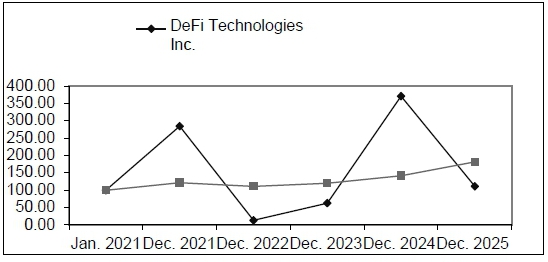
The Common Shares were listed on the Cboe Canada in January 2021. Since listing on the Cboe Canada, the Corporation has expanded its management team to account for the growth of its business to sustain its operations in Europe and Canada as well as attracting new talent to develop its decentralized finance business. The value of the Common Shares have also corresponded to the fluctuations in the digital asset market over the past few years. In fiscal 2024, the digital asset market experienced an increase in asset values compared with traditional equities, which corresponded to an increase in the financial performance of the Corporation. Furthermore, the Corporation made significant progress in acquiring and forming profitable business units during this period, including the accretive acquisition of Reflexivity Research and Stillman Digital and formation of DeFi Alpha. Given that the Corporation has Awards as a large component of Named Executive Officer compensation, total compensation to Named Executive Officers during this period has largely followed the trend of the Corporation’s share price.
Compensation Consultant
Mercer (Canada) Limited (“Mercer”) was retained in late 2024 to assist the CNG Committee in executive compensation benchmarking. Mercer reviewed the Corporation’s executive compensation against a peer group of 15 companies based on the following criteria: (a) publicly-traded company, (b) headquartered in North America and (c) within either the digital-asset technology or asset management industry. The peer group companies included in the review were Bitfarms Ltd., Hut8 Corp., Bit Digital, Inc., MoneyLion Inc., Exodus Movement, Inc., HIVE Digital Technologies Ltd., WonderFi Technologies Inc., Digihost Technology Inc., Investview, Inc., Wellfield Technologies Inc., Galaxy Digital Holdings Ltd., Virtus Investment Partners, Inc., WisdomTree, Inc., BrightSphere Investment Group Inc., Senvest Capital Inc. and Westwood Holdings Group, Inc. Additionally, Mercer was retained by the CNG Committee to review the Corporation’s short and long-term incentive plans.
The table below sets out the aggregate fees billed by Mercer for their services related to determining compensation for the Corporation’s directors and Named Executive Officers for each of the two most recently completed financial years:
| Financial Year | Fees Billed | |||
| 2025 | N/A | |||
| 2024 | $ | 123,320.29 | ||
9
NEO Summary Compensation Table
The following table summarizes the compensation paid during the three most recently completed financial years to the individuals carrying out the roles of the Chief Executive Officer (“CEO”) and Chief Financial Officer (“CFO”) of the Corporation and the three most highly compensated executive officers of the Corporation (together with the CEO and CFO, the “Named Executive Officers” or “NEOs”).
| Non-equity incentive plan compensation ($) | |||||||||||||||||||||||||||||
| Name and Principal Position | Year Ended | Salary ($)(1) | Share
Awards ($)(2) | Option
Awards ($)(3) | Annual incentive plans(4) | Long-term incentive plans | Pension
value ($)(5) | All
other compensation ($)(6) | Total compensation ($) | ||||||||||||||||||||
| Johan Wattenström (8) | 2025 | 1,402,868 | 914,089 | Nil | Nil | Nil | Nil | Nil | 2,316,957 | ||||||||||||||||||||
| CEO and Co- Founder of Valour and | 2024 | 560,088 | 1,185,000 | Nil | 37,324,811 | Nil | Nil | Nil | 39,069,899 | ||||||||||||||||||||
| Executive Chairman | 2023 | 234,318 | 101,520 | Nil | Nil | Nil | Nil | Nil | 335,838 | ||||||||||||||||||||
| Olivier Roussy Newton(6) (7) | 2025 | 972,888 | Nil | Nil | Nil | Nil | Nil | Nil | 972,888 | ||||||||||||||||||||
| Former Chief Executive Officer and | 2024 | 1,012,878 | Nil | 1,938,503 | Nil | Nil | Nil | Nil | 2,951,381 | ||||||||||||||||||||
| Executive Chairman | 2023 | 961,968 | Nil | 362,351 | Nil | Nil | Nil | Nil | 1,324,319 | ||||||||||||||||||||
| Paul Bozoki (9) | 2025 | 309,952 | 197,948 | 277,483 | Nil | Nil | Nil | Nil | 785,383 | ||||||||||||||||||||
| Chief Financial | 2024 | Nil | Nil | Nil | Nil | Nil | Nil | Nil | Nil | ||||||||||||||||||||
| Officer | 2023 | Nil | Nil | Nil | Nil | Nil | Nil | Nil | Nil | ||||||||||||||||||||
| Ryan Ptolemy(12) | 2025 | 30,000 | Nil | Nil | Nil | Nil | Nil | Nil | 30,000 | ||||||||||||||||||||
| Former Chief | 2024 | 120,000 | 478,322 | Nil | Nil | Nil | Nil | Nil | 598,322 | ||||||||||||||||||||
| Financial Officer | 2023 | 120,000 | 102,861 | Nil | 50,000 | Nil | Nil | Nil | 222,861 | ||||||||||||||||||||
| Andrew Forson(13) | 2025 | 465,023 | Nil | 814,318 | Nil | Nil | Nil | Nil | 1,269,175 | ||||||||||||||||||||
| President | 2024 | Nil | Nil | Nil | Nil | Nil | Nil | Nil | Nil | ||||||||||||||||||||
| 2023 | Nil | Nil | Nil | Nil | Nil | Nil | Nil | Nil | |||||||||||||||||||||
| Russell Starr(10) | 2025 | 105,000 | Nil | Nil | Nil | Nil | Nil | Nil | 105,000 | ||||||||||||||||||||
| Capital Markets Consultant and Former | 2024 | 240,000 | 674,341 | Nil | Nil | Nil | Nil | Nil | 914,341 | ||||||||||||||||||||
| Chief Executive Officer and Executive Chairman | 2023 | 50,000 | Nil | Nil | Nil | Nil | Nil | Nil | 50,000 | ||||||||||||||||||||
| Kenny Choi(11) | 2025 | 650,000 | (14) | 197,948 | Nil | Nil | (15) | Nil | Nil | Nil | 847,948 | ||||||||||||||||||
| Former Corporate | 2024 | 240,000 | (14) | 478,322 | Nil | Nil | Nil | Nil | Nil | 718,322 | |||||||||||||||||||
| Secretary | 2023 | 120,000 | 102,861 | Nil | Nil | Nil | Nil | Nil | 222,861 | ||||||||||||||||||||
Notes:
| 1. | Compensation has been paid as consulting fees under the independent contractor agreement with the Named Executive Officer as described under the heading “Executive Compensation – Termination of Employment, Change in Responsibilities and Employment Contracts” of this Circular. |
10
| 2. | Share-based awards comprise of DSUs. Value is based on the fair value of the award on the grant date. |
| 3. | The value ascribed to option grants represents non-cash consideration and has been estimated using the Black-Sholes Models as at the date of grant, as follows: expected dividend yield — April 9, 2021 - 0%; expected volatility — 145.2%; risk-free interest rate — 0.95%; and expected life — 5 years, May 18, 2021 - 0%; expected volatility — 145.6%; risk-free interest rate — 0.95%; and expected life — 5 years, August 13, 2021 - 0%; expected volatility — 143.7%; risk-free interest rate — 0.84%; and expected life — 5 years,. This is consistent with the accounting values used in the Corporation’s financial statements, November 23, 2023 – 0%; expected volatility - 151.7%; risk-free interest rate – 3.83% and expect life – 5 years, December 4, 2023 – 0%; expected volatility – 151.9%; risk-free interest rate – 3.54% and expected life – 5 years. The Corporation selected the Black-Scholes model given its prevalence of use in North America. |
| 4. | Compensation paid in the form of discretionary performance based bonuses. |
| 5. | The Corporation does not maintain a pension plan, nor does it provide the Named Executive Officers with any pension benefits. |
| 6. | Other benefits did not exceed the lesser of $50,000 and 10% of the total annual compensation for the Named Executive Officer. |
| 7. | Mr. Roussy Newton was appointed as Chief Executive Officer on October 6, 2022 and elected as Executive Chairman on June 20, 2023, replacing Mr. Starr in both roles. Mr. Roussy Newton is also compensated as a Director of Valour Inc., a wholly-owned subsidiary of the Corporation (“Valour”). Mr. Roussy Newton resigned as Chief Executive Officer and Executive Chairman on November 14, 2025. |
| 8. | Mr. Wattenström resigned as Chief Operating Officer of the Corporation on October 6, 2022. Mr. Wattenström remains an employee of Valour. Mr. Wattenström was appointed Chief Executive Officer November 11, 2025. |
| 9. | Mr. Bozoki was appointed as Chief Financial Officer January 6, 2025. |
| 10. | Mr. Russell Starr stepped down from his role as executive chairman and chief executive officer on June 20, 2023. |
| 11. | Mr. Choi resigned as Corporate Secretary on February 9, 2026 |
| 12. | Mr. Ptolemy resigned as Chief Financial Officer January 6, 2025. |
| 13. | Mr. Forson was appointed as President on April 8, 2025. |
| 14. | While compensation has been paid to Mr. Choi for these years at the amounts listed, the Corporation disputes the validity of the 2024 and 2025 amendments to the independent contractor agreement with Mr. Choi that resulted in this increased compensation. |
| 15. | Mr. Choi disputes this amount, and is claiming an entitlement to a discretionary performance based bonus of $1,000,000. The Corporation denies that Mr. Choi is entitled to this discretionary performance based bonus. |
11
Incentive Plan Awards
The following table provides information regarding the incentive plan awards for each Named Executive Officer outstanding as of December 31, 2025.
Outstanding Share-Based Awards and Option-Based Awards
| Option-Based Awards | Share-Based Awards | |||||||||||||||||||||||||
| Name | Number of securities underlying unexercised options (#) | Option exercise price ($) | Option expiration date | Value of unexercised in-the-money
options ($) (1)(2) | Number of shares or units of shares that have not vested (#) | Market or payout value of share awards
that have not vested ($)(3) | Market or payout value of vested share-based awards not paid out or distributed ($) | |||||||||||||||||||
| Johan
Wattenström(4) Chief Executive Officer and Executive Chairman | Nil | Nil | Nil | Nil | 4,000,000 | 4,240,000 | Nil | |||||||||||||||||||
| Olivier
Roussy Newton(5) Former Chief Executive Officer and Executive Chairman | 500,000 4,500,000 | 500,000 options at $0.29 4,500,000 options at $0.45 | November 24, 2028 December 4, 2028 | 3,130,000 | Nil | Nil | Nil | |||||||||||||||||||
| Russell
Starr(6) Capital Markets Consultant and Former Chief Executive Officer and Executive Chairman | Nil | Nil | Nil | Nil | Nil | Nil | Nil | |||||||||||||||||||
| Ryan
Ptolemy(7) Former Chief Financial Officer | Nil | Nil | Nil | Nil | 437,500 | 463,750 | Nil | |||||||||||||||||||
| Paul
Bozoki(8) Chief Financial Officer | 100,000 | 100,000 options at $4.59 | January 6, 2023 | Nil | 318,750 | 337,875 | Nil | |||||||||||||||||||
| Andrew
Forson President | 200,608 | 100,000 options at $4.52 100,608 options at $4.97 | January 28, 2030 May 26, 2030 | Nil | Nil | Nil | Nil | |||||||||||||||||||
| Kenny
Choi(9) Former Corporate Secretary | 300,000 1,000,000 | 300,000 options at $1.58 1,000,000 options at $1.22 | April 9, 2026 May 18, 2026 | Nil | 218,750 | 231,875 | 1,240,200 | |||||||||||||||||||
Notes:
| 1. | Based on the closing market price of $0.66 of the Common Shares on December 31, 2025 and subtracting the exercise price of the options. |
| 2. | These options have not been, and may never be, exercised and actual gains, if any, on exercise will depend on the value of the Common Shares on the date of exercise. |
12
| 3. | Share-based awards comprise of DSUs. Value is based on the fair value of the award on the grant date. |
| 4. | Mr. Wattenström resigned as Chief Operating Officer of the Corporation on October 6, 2022. Mr. Wattenström remains an employee of Valour. Mr. Wattenström was appointed Chief Executive Officer and Executive Chairman on November 11, 2025. |
| 5. | Mr. Roussy Newton was appointed as Chief Executive Officer on October 6, 2022 and elected as Executive Chairman on June 20, 2023, replacing Mr. Starr in both roles. Mr. Roussy Newton resigned as Chief Executive Officer on November 14, 2025. |
| 6. | Mr. Russell Starr stepped down from his role as Executive Chairman and Chief Executive Officer on June 20, 2023 and remains as head of capital markets. |
| 7. | Mr. Ptolemy resigned as Chief Financial Officer January 6, 2025. |
| 8. | Mr. Bozoki was appointed as Chief Financial Officer on January 6, 2025. |
| 9. | Mr. Choi’s employment with the Corporation ceased on March 6, 2026. |
Value on Pay-Out or Vesting of Incentive Plan Awards
The following table sets out the value of share-based awards that vested in the fiscal year ended December 31, 2025, for each Named Executive Officers.
| Name | Option-based
awards – Value vested during 2025 fiscal year ($) | Share-based
awards – Value vested during the 2025 fiscal year ($) | Non-equity
incentive plan compensation – Value earned during the 2025 fiscal year ($) | |||||||||
| Johan
Wattenström Chief Executive Officer and Executive Chairman | Nil | Nil | Nil | |||||||||
| Olivier
Roussy Newton Former Chief Executive Officer and Executive Chairman | Nil | Nil | Nil | |||||||||
| Ryan
Ptolemy (1) Former Chief Financial Officer | Nil | Nil | Nil | |||||||||
| Paul
Bozoki Chief Financial Officer | 277,483 | 33,125 | Nil | |||||||||
| Russell
Starr Capital Markets Consultant and Former Chief Executive Officer and Executive Chairman | Nil | Nil | Nil | |||||||||
| Andrew
Forson President | 582,571 | Nil | Nil | |||||||||
| Kenny
Choi(2) Former Corporate Secretary | Nil | 33,125 | Nil | |||||||||
| (1) | Ryan Ptolemy resigned on January 6, 2025. |
| (2) | Kenny Choi resigned on February 9, 2026. |
13
Employment, Consulting and Management Agreements
The following describes the respective consulting and employment agreements entered into by the Corporation and its NEOs as at December 31, 2025.
| Name | Termination Notice Period | Monthly Fees | Severance on Termination | Severance on Change of Control(1) | ||||||
| Johan
Wattenström Chief Executive Officer and Executive Chairman | 30 days | USD | 250,000 | 12 months | Nil | |||||
| Olivier
Roussy Newton(2) Former Chief Executive Officer and Executive Chairman | 30 days | CHF | 25,000 | 12 months | 36 months base fees plus aggregate cash bonuses paid in the 36 months prior to the Change of Control. | |||||
| Paul
Bozoki Chief Financial Officer | 30 days | US$ | 25,000 | 6 months’ fees | 24 months base fees plus aggregate cash bonuses paid in the 24 months prior to the Change of Control. | |||||
| Russell
Starr Capital Markets Consultant and Former Chief Executive Officer and Executive Chairman | 30 days | C$ | 20,000 | 3 months’ fees | Nil | |||||
| Andrew
Forson President | 30 days | CHF | 30,000 | 3 months’ fees | Nil | |||||
| Kenny
Choi(3) Corporate Secretary | 30 days | C$ | 54,167 | 6 months’ fees(4) | 24 months base fees plus aggregate cash bonuses paid in the 24 months prior to the Change of Control. | |||||
Notes:
| (1) | Severance upon a change of control becomes payable In the event of a Change of Control of the Corporation and within one year following the date of the Change of Control the Corporation or the officer elects to terminate the agreement. |
| (2) | Mr. Roussy Newton resigned as Chief Executive Officer on November 14, 2025. |
| (3) | Mr. Choi’s resigned on February 9, 2026. |
| (4) | Mr. Choi disputes this amount, and is claiming an entitlement to 12 months’ fees as severance on termination. The Corporation disputes the validity of the 2024 and 2025 amendments to the independent contractor agreement with Mr. Choi, and denies that Mr. Choi is entitled to the claimed amounts. |
For the purpose of the agreements set forth above, “Change of Control” shall be defined as (1) the acquisition, directly or indirectly, by any person (person being defined as an individual, a corporation, a partnership, an unincorporated association or organization, a trust, a government or department or agency thereof and the heirs, executors, administrators or other legal representatives of an individual and an associate or affiliate of any thereof as such terms are defined in the Business Corporations Act (Ontario)) or group of persons acting jointly or in concert, as such terms are defined in the Securities Act, Ontario of: (A) shares or rights or options to acquire shares of the Corporation or securities which are convertible into shares of the Corporation or any combination thereof such that after the completion of such acquisition such person would be entitled to exercise 25% (or 50% in the case of Mr. Newton’s consulting agreement) or more of the votes entitled to be cast at a meeting of the shareholders of the Corporation; (B) shares or rights or options to acquire shares, or their equivalent, of any material subsidiary of the Corporation or securities which are convertible into shares of the material subsidiary or any combination thereof such that ,after the completion of such acquisition such person would be entitled to exercise 25% (or 50% in the case of Mr. Newton’s consulting agreement) or more of the votes entitled to be cast a meeting of the shareholders of the material subsidiary; or (C) more than 25% (or 50% in the case of Mr. Newton’s consulting agreement) of the material assets of the Corporation, including the acquisition of more than 25% (or 50% in the case of Mr. Newton’s consulting agreement) of the material assets of any material subsidiary of the Corporation; or (2) as a result of or in connection with: (A) a contested election of directors; or (B) a consolidation, merger, amalgamation, arrangement or other reorganization or acquisitions involving the Corporation or any of its Affiliates and another corporation or other entity, the nominees named in the most recent management information circular of the Corporation for election to the Corporation’s board of directors do not constitute a majority of the Corporation’s board of directors.
14
Summary of Termination Payments
The estimated incremental payments, payables and benefits that might be paid to the Named Executive Officers pursuant to the above noted agreements in the event of termination without cause or after a Change of Control (assuming such termination or Change of Control is effective as of the Record Date) are detailed below:
| Named Executive Officer | Termination
not for Cause ($) | Value of Unvested Options ($) upon termination not for cause | Termination
on a Change of Control ($) | Value
of Unvested Options Vested ($) upon Change in Control | ||||||||||||
| Johan Wattenström | ||||||||||||||||
| Salary and Quantified Benefits | US$ | 3,000,000 | Nil | Nil | Nil | |||||||||||
| Bonus | Nil | Nil | Nil | Nil | ||||||||||||
| Total | US$ | 3,000,000 | Nil | Nil | Nil | |||||||||||
| Olivier Roussy Newton | ||||||||||||||||
| Salary and Quantified Benefits | $ | 1,012,878 | Nil | $ | 3,038,634 | Nil | ||||||||||
| Bonus | Nil | Nil | Nil | Nil | ||||||||||||
| Total | $ | 1,012,878 | Nil | $ | 3,038,634 | Nil | ||||||||||
| Paul Bozoki | ||||||||||||||||
| Salary and Quantified Benefits | US$ | 150,000 | Nil | US$ | 600,000 | Nil | ||||||||||
| Bonus | Nil | Nil | Nil | Nil | ||||||||||||
| Total | US$ | 150,000 | Nil | US$ | 600,000 | Nil | ||||||||||
| Russell Starr | ||||||||||||||||
| Salary and Quantified Benefits | $ | 60,000 | Nil | Nil | Nil | |||||||||||
| Bonus | Nil | Nil | Nil | Nil | ||||||||||||
| Total | $ | 60,000 | Nil | Nil | Nil | |||||||||||
| Andrew Forson | ||||||||||||||||
| Salary and Quantified Benefits | CHF | 90,000 | Nil | Nil | Nil | |||||||||||
| Bonus | Nil | Nil | Nil | Nil | ||||||||||||
| Total | CHF | 90,000 | Nil | Nil | Nil | |||||||||||
| Kenny Choi | ||||||||||||||||
| Salary and Quantified Benefits | $ | 60,000 | (2) | Nil | $ | 120,000 | (2) | Nil | ||||||||
| Bonus | Nil | Nil | Nil | Nil | ||||||||||||
| Total | $ | 60,000 | Nil | $ | 120,000 | Nil | ||||||||||
Notes:
| (3) | Severance upon a change of control becomes payable in the event of a Change of Control of the Corporation and within one year following the date of the Change of Control the Corporation or the officer elects to terminate the agreement. |
| (4) | Mr. Choi disputes this amount, and is claiming an entitlement to $650,000. The Corporation disputes the validity of the 2024 and 2025 amendments to the independent contractor agreement with Mr. Choi upon which this claim is based, and denies that Mr. Choi is entitled to the claimed amounts. |
15
Other Arrangements
Other than as disclosed below or elsewhere in this Circular, none of the officers or directors of the Corporation have compensation arrangements pursuant to any other arrangement or in lieu of any standard compensation arrangement.
Indebtedness of Directors and Executive Officers
As at the date of this Circular and during the financial year ended December 31, 2025, no director or executive officer of the Corporation (and each of their associates and/or affiliates) was indebted, including under any securities purchase or other program, to (i) the Corporation or its subsidiaries, or (ii) any other entity which is, or was at any time during the financial year ended December 31, 2025, the subject of a guarantee, support agreement, letter of credit or other similar arrangement or understanding provided by the Corporation or its subsidiaries.
Directors’ and Officers’ Insurance and Indemnification
The Corporation maintains insurance for the benefit of its directors and officers against liability in their respective capacities as directors and officers. The Corporation has purchased, in respect of its directors and officers, an aggregate of US$10,000,000 in Side A/B/C coverage and additional US$5 million of Side A only coverage. The approximate amount of premiums paid by the Corporation in 2025 in respect of such insurance was US$670,000.
Interest of Informed Persons in Material Transactions
No informed person (as such term is defined under applicable securities laws) of the Corporation or nominee (and each of their associates or affiliates) has had any direct or indirect material interest in any transaction involving the Corporation since January 1, 2025 or in any proposed transaction which has materially affected or would materially affect the Corporation or its subsidiaries other than as may be disclosed herein.
Director Compensation
Compensation of directors for the financial year ended December 31, 2025 was determined on a case- by- case basis with reference to the role that each director provided to the Corporation. Executive officers who also act as directors of the Corporation do not receive any additional compensation for services rendered in their capacity as directors. The following information details compensation paid in the recently completed financial year.
16
Director Summary Compensation Table
The following table provides information regarding the compensation awarded to each director during the year ended December 31, 2025, other than any NEOs who are also directors, whose compensation was included above.
| Name | Fees
earned ($) | Share
awards ($) | Option
awards ($) | Non-equity
incentive plan compensation ($) | Pension value ($)(1) | All
other compensation ($) | Total ($) | |||||||||||||||||||||
| Krisztian
Toth(2) Former Director | Nil | Nil | Nil | Nil | Nil | Nil | Nil | |||||||||||||||||||||
| Mikael
Tandetnik Director | 26,250 | 26,250 | Nil | Nil | Nil | Nil | 52,500 | |||||||||||||||||||||
| Stefan
Hascoet(4) Former Director | 26,250 | 26,250 | Nil | Nil | Nil | Nil | 52,500 | |||||||||||||||||||||
| Silvia
Andriotto(3) Director | 10,000 | 10,000 | Nil | Nil | Nil | Nil | 20,000 | |||||||||||||||||||||
| Chase
Ergen(7) Director | 10,000 | 10,000 | Nil | Nil | Nil | Nil | 20,000 | |||||||||||||||||||||
| Suzanne
Ennis(5) Former Director | Nil | Nil | Nil | Nil | Nil | Nil | Nil | |||||||||||||||||||||
| Andrew
Forson(6) Director | Nil | Nil | Nil | Nil | Nil | Nil | Nil | |||||||||||||||||||||
| Per
Von Rosen(3) Director | 10,000 | 10,000 | Nil | Nil | Nil | Nil | 20,000 | |||||||||||||||||||||
| TOTALS | 82,500 | 82,500 | Nil | Nil | Nil | Nil | 165,000 | |||||||||||||||||||||
| 1. | The Corporation does not maintain a pension plan nor does it provide the Named Executive Officers with any pension benefits. |
| 2. | Mr. Toth resigned as a director on March 3, 2025. |
| 3. | Elected as a director on June 30, 2025. |
| 4. | On December 22, 2025, the Corporation announced the resignation of Stefan Hascoet from the board or directors of the Corporation. |
| 5. | Ms. Ennis’ term expired as a director on June 30, 2025. |
| 6. | On July 31, 2024, the Corporation announced the appointment of Andrew Forson to the board of directors of the Corporation. On April 8, 2025, Mr. Forsen was appointed as President of the Corporation. |
| 7. | Appointed as director on March 3, 2025. |
Incentive Plan Awards
The following table provides information regarding the incentive plan awards for each director outstanding as of December 31, 2025, other than any NEOs who are also directors, whose compensation was included above.
17
Outstanding Share-Based Awards and Option-Based Awards
| Option-Based Awards | Share-Based Awards | |||||||||||||||||||||||||||
| Name | Number of securities underlying unexercised options (#) | Option
exercise price ($) | Option expiration date | Value
of unexercised in-the-money options ($)(1) (2) | Number of shares or units of shares that have not vested (#) | Market or payout value of share awards that have not vested ($)(3) | Market or payout value of vested share-based awards not paid out or distributed | |||||||||||||||||||||
| Krisztian Toth | Nil | Nil | Nil | Nil | Nil | Nil | Nil | |||||||||||||||||||||
| Mikael Tandetnik | Nil | Nil | Nil | Nil | Nil | Nil | Nil | |||||||||||||||||||||
| Stefan Hascoet | Nil | Nil | Nil | Nil | Nil | Nil | Nil | |||||||||||||||||||||
| Silvia Andriotto(6) | Nil | Nil | Nil | Nil | Nil | Nil | Nil | |||||||||||||||||||||
| Chase Ergen | Nil | Nil | Nil | Nil | Nil | Nil | Nil | |||||||||||||||||||||
| Suzanne Ennis(4) | Nil | Nil | Nil | Nil | Nil | Nil | Nil | |||||||||||||||||||||
| Andrew Forson(5) | Nil | Nil | Nil | Nil | Nil | Nil | Nil | |||||||||||||||||||||
| Per von Rosen(6) | Nil | Nil | Nil | Nil | Nil | Nil | Nil | |||||||||||||||||||||
Notes:,
| (1) | Based on the closing market price of $0.66 of the Common Shares on December 31 , 2025 and subtracting the exercise price of the options. |
| (2) | These options have not been, and may never be, exercised and actual gains, if any, on exercise will depend on the value of the Common Shares on the date of exercise. |
| (3) | Share-based awards comprise of DSUs. Value is based on the fair value of the award on the grant date. |
| (4) | Ms. Ennis’ term expired on June 30, 2025. |
| (5) | On April 8, 2025, Mr. Forson was appointed as President of the Corporation and Chief Growth Officer of Valour. |
| (6) | Appointed as director on June 30, 2025. |
Value on Pay-Out or Vesting of Incentive Plan Awards
The following table sets out, for each director, other than any NEOs who are also directors, the value of share-based awards that vested in the fiscal year ended December 31, 2025.
| Name | Option-based
awards – Value vested during 2025 fiscal year ($) |
Share-based
awards – Value vested during the 2025 fiscal year ($) |
Non-equity incentive plan compensation – Value earned during the 2025 fiscal year ($) | |||||||||
| Krisztian Toth | Nil | Nil | Nil | |||||||||
| Mikael Tandetnik | Nil | 26,250 | Nil | |||||||||
| Stefan Hascoet | Nil | 25,260 | Nil | |||||||||
| Silvia Andriotto | Nil | 10,000 | Nil | |||||||||
| Chase Ergen | Nil | 10,000 | Nil | |||||||||
| Suzanne Ennis | Nil | Nil | Nil | |||||||||
| Andrew Forson | Nil | Nil | Nil | |||||||||
18
Share Incentive Plan
The Corporation believes that granting equity incentives to officers, directors, consultants and employees encourages retention and more closely aligns the interests of such key personnel with the interests of shareholders while at the same time not drawing on the limited cash resources of the Corporation.
The Corporation’s Share Incentive Plan, which was approved by Shareholders at the Corporation’s annual and special meeting held on June 30, 2025, replaced the Corporation’s stock option plan (the “Legacy Option Plan”) and DSU plan (the “Legacy DSU Plan”).
The Share Incentive Plan provides eligible participants (“Participants”) with compensation opportunities that encourage ownership of Common Shares, enhance the ability to attract, retain and motivate the executive officers and other key management and incentivize them to increase the long term growth and equity value of the Corporation in alignment with the interests of Shareholders. The Share Incentive Plan allows the Board or the CNG Committee to grant long-term incentives to Directors, officers, employees, eligible contractors and others consistent with the provisions of the Share Incentive Plan. Awards granted under the Share Incentive Plan may consist of Options, RSUs, DSUs and PSUs. Each Award is subject to the terms and conditions set forth in the Share Incentive Plan and to those other terms and conditions specified by the Board or the CNG Committee. The following is a summary of the terms of the proposed Share Incentive Plan, which is qualified in its entirety by the provisions of the Share Incentive Plan.
Shares Subject to the Share Incentive Plan
Up to 15% of the Common Shares issued and outstanding from time to time (including shares issued under any other security based compensation arrangement of the Corporation) may be issued pursuant to Awards under the Share Incentive Plan (including any Options issued under the Legacy Option Plan and DSUs issued under the Legacy DSU Plan).
No Participant will be granted awards in any single calendar year with respect to more than 5% of the issued and outstanding Common Shares. If, and to the extent, Awards granted under the Share Incentive Plan: (i) are exercised; or (ii) are terminated, expire, are canceled or are forfeited, Common Shares subject to such Awards will again be available for grant under the Share Incentive Plan. In addition, if and to the extent an Award is settled for cash, the Common Shares subject to the Award will again be available for grant under the Share Incentive Plan.
In the event of any recapitalization, reorganization, arrangement, amalgamation, stock split or consolidation, stock dividend or other similar event or transaction, substitutions or adjustments will be made by the Board or the CNG Committee to: (i) the aggregate number, class and/or issuer of the securities reserved for issuance under the Share Incentive Plan; (ii) the number, class and/or issuer of securities subject to outstanding Awards; and (iii) the exercise price of outstanding Options in a manner that reflects equitably the effects of such event or transaction, and such substitution or adjustment shall be subject to Cboe Canada’s consent for so long as the Common Shares or any of the securities of the Corporation are listed on Cboe Canada.
Awards under the Share Incentive Plan are non-assignable and non-transferable, whether voluntarily or by operation of law, except by will or by the laws of succession of the domicile of the deceased Participant.
Amendments
The Board may amend, alter or discontinue the Share Incentive Plan or amend the terms of any Award agreement, provided that (1) no such amendment, modification, change, suspension or termination of the Share Incentive Plan or any Share Incentive Plan Award may materially impair any rights of a Participant or materially increase any obligations of a Participant under the Share Incentive Plan without the consent of the Participant, unless the Board determines such adjustment is required or desirable in order to comply with any applicable securities laws or stock exchange requirements, and (2) Shareholder approval is required to: (i) reduce the exercise price or purchase price of Awards under the Share Incentive Plan; (ii) extend the term under an Award; (iii) permit Awards to be transferable or assignable by Participants, other than by will or by the laws of descent and distribution; (iv) remove or increase the participation limits as they apply to insiders; (v) increase the maximum number of securities issuable, either as a fixed number or a fixed percentage of the outstanding capital represented by such securities; and (vi) amend an amending provision within the Share Incentive Plan.
19
The Board or the CNG Committee may, without Shareholder approval, amend the Share Incentive Plan with respect to (i) amendments of a “housekeeping nature”; (ii) changes to the vesting or exercise provisions of the Share Incentive Plan or any Award; (iii) changes to the provisions of the Share Incentive Plan relating to the expiration of Awards prior to their respective expiration dates upon the occurrence of certain specified events; or (iv) the cancellation of an Award.
Termination of Service
Unless provided otherwise in the Award agreement, if a Participant’s service with the Corporation or any of the Corporation’s affiliates terminates due to resignation, (A) the right to exercise any Option that is exercisable at the time of resignation, will terminate on the date that is 90 days following the earlier of (i) the date of resignation; and (ii) the Option’s original expiration date, and (B) any unvested DSU, RSU or PSU held by such Participant will terminate effective as of the date of resignation, and all rights to receive payment thereunder will be forfeited, subject to with respect to PSUs, the Board shall determine the extent of satisfaction of the performance criteria in determining the number of PSUs that shall be eligible for vesting and exercise. Unless provided otherwise in the Award agreement, if a Participant’s service with the Corporation or any of the Corporation’s affiliates terminates due to death or total disability, (A) the right to exercise an Option will terminate on the earlier of one year following such termination and the Option’s original expiration date, provided that all Options that will not vest within 12 months following the date of such Participant’s death shall immediately and automatically terminate, and (B) any DSUs, RSUs or PSUs will vest on the date of such death or total disability and will settle in accordance with the Share Incentive Plan, subject to with respect to PSUs, the Board shall determine the extent of satisfaction of the performance criteria in determining the number of PSUs that shall be eligible for vesting and exercise. If a Participant’s relationship with the Corporation or any of the Corporation’s affiliates terminates for cause, any Award (whether vested or unvested) not already exercised will automatically expire and terminate as of the date of such termination. If a Participant is prevented, by order or similar decision of the Ontario Securities Commission or other regulatory authority having jurisdiction over the Corporation or its affairs, from holding a particular Award, then each such Award held by the Participant shall terminate and shall therefore cease to be exercisable upon the making of such order or similar decision. If a Participants’ service with the Corporation or any of the Corporation’s affiliates terminates due to termination without cause or retirement, (A) the right to exercise any Option that is exercisable at the time of resignation, will terminate on the date that is 90 days following the earlier of (i) the date of resignation; and (ii) the Option’s original expiration date, and (B) any unvested DSU, RSU or PSU held by such Participant will terminate effective as of the date of such termination, and all rights to receive payment thereunder will be forfeited.
Change in Control
In the event of a change of control of the Corporation (a “Change of Control”), and unless otherwise provided in an Award agreement or a written employment contract between the Corporation and a Participant, the Board may provide that: (i) the successor corporation or entity will assume each Award or replace it with a substitute Award on terms substantially similar to the existing Award; (ii) the Awards will be surrendered for a cash payment made by the successor corporation or entity equal to the fair market value thereof; or (iii) any combination of the foregoing will occur, provided that the replacement of any Option with a substitute Option shall, at all times, comply with the provisions of subsection 7(1.4) of the Income Tax Act (Canada).
If in connection with or within 12 months following a change of control, and unless otherwise provided in an Award agreement or a written employment contract between the Corporation and a Participant, a Participant’s service, consulting relationship, or employment with the Corporation, an affiliate or the continuing entity is terminated without cause, or the Participant resigns from his or her employment as a result of certain events set forth in the Share Incentive Plan, then all Awards then held by such Participant (and, if applicable, the time during which such Awards may be exercised) will immediately vest. In the event that an Award is subject to vesting upon the attainment of performance criteria, then the number of Options, DSUs, RSUs or PSUs that shall immediately vest will be determined by multiplying the number of Awards subject to such vesting criteria by the pro rata performance criteria achieved by the termination date.
20
Options
The exercise price of any Option granted under the Share Incentive Plan will be the closing price of the Common Shares on the Cboe Canada on the trading day immediately preceding the date on which the Option is granted. The Board or the CNG Committee will be entitled to determine the Option term for each Option; provided, however, that the exercise period of any Option may not exceed five years from the date of grant. Vesting for each Option is also determined by the Board or the CNG Committee.
If approved by the Board, in lieu of paying the exercise price for the Common Shares to be issued pursuant to such exercise, the Option holder may elect to acquire the number of Common Shares determined by subtracting the exercise price from the fair market value of the Common Shares on the date of exercise, multiplying the difference by the number of Common Shares in respect of which the Option was otherwise being exercised and then dividing that product by such fair market value of the Common Shares.
RSUs
Each RSU represents the right to receive from the Corporation, after fulfilment of any applicable conditions specified by the Board or the CNG Committee, a payment from the Corporation (i) if settlement is made in cash, in an amount equal to the fair market value (determined at the time of distribution) of one Common Share per each RSU being settled or (ii) if settlement is being made in Common Shares, on the basis of one Common Share per each RSU being settled. Prior to settlement, an RSU will carry no voting or dividend rights or other rights associated with share ownership. Unless otherwise specified in the Award agreement, an RSU award may be settled in Common Shares, cash or in any combination of both; however, the determination to settle an RSU in whole or in part in cash, Common Shares, or any combination of both may be made by the Board or the CNG Committee, in its sole discretion. The Board or the CNG Committee is also entitled to determine the vesting and any conditions for RSUs, provided that such conditions are not inconsistent with the Share Incentive Plan and any RSU granted under the Share Incentive Plan must be settled on or before December 15th of the third calendar year following the calendar year in which the RSU is granted.
DSUs
Each DSU provides for the right to receive from the Corporation, on a deferred payment basis, a Common Share or the cash equivalent of a Common Share in an amount equal to the fair market value (determined at the applicable date) on the terms contained in the Share Incentive Plan. The amount will not be paid out until the earlier of the death, retirement, or loss of office or employment of the recipient with the Corporation or any of its affiliates, thereby providing an ongoing equity stake throughout the recipient’s period of service. Unless otherwise specified in the Award agreement, a DSU award may be settled in Common Shares, cash, or in any combination of both, however, a determination to settle a DSU in whole or in part in cash will be made by the Board or the CNG Committee, in its sole discretion.
PSUs
Each PSU represents a right to receive from the Corporation, after fulfillment of any applicable conditions specified by the Board or the CNG Committee (including achievement of certain performance criteria), a payment from the Corporation (i) if settlement is made in cash, in an amount equal to the fair market value (at the time of the distribution) of one Common Share per each PSU being settled multiplied by the payout factor, or (ii) if settlement is made in Common Shares, on the basis of one Common Share per each PSU being settled multiplied by the payout factor. Prior to settlement, a PSU will carry no voting or dividend rights or other rights associated with share ownership.
21
Unless otherwise specified in the Award agreement, a PSU award may be settled in Common Shares, cash, or in any combination of both, however, a determination to settle a PSU in whole or in part in Common Shares, cash, or in any combination of both, will be made by the Board or the CNG Committee, in its sole discretion. The Board or the CNG Committee will also be entitled to determine the performance period, vesting and any performance criteria for PSUs, provided such terms and conditions are not inconsistent with the Share Incentive Plan.
Pursuant to Section 10.13 – Security Based Compensation of the Cboe Canada Exchange Listing Manual, the Corporation is required to obtain the approval of its Shareholders to any stock option plan that is a “evergreen” plan every three years at the Corporation’s annual meeting of Shareholders. The Share Incentive Plan was last approved by Shareholders at the annual and special meeting of Shareholders held on June 30, 2025.
As of the date hereof, there is an aggregate of 18,492,217 Options, 1,844,333 RSUs, 8,228,692 DSUs and 200,000 PSUs outstanding under the Share Incentive Plan, which represents approximately 7.4% of the outstanding Common Shares.
Legacy Option Plan
The Legacy Option Plan was used by the Corporation prior to the adoption of the Share Incentive Plan to advance the interests of the Corporation by encouraging employees, officers and consultants to have equity participation in the Corporation through the acquisition of Common Shares. The following is a summary of the terms of the proposed Legacy Option Plan, which is qualified in its entirety by the provisions of the Legacy Option Plan.
The terms and conditions of each Option granted under the Legacy Option Plan were determined by the Board or the CNG Committee. Options were priced in the context of the market and in compliance with applicable securities laws and Cboe Canada Exchange guidelines. Consequently, the exercise price for any Option shall not be lower than the market price of the underlying Common Shares at the time of grant. Vesting terms will be determined at the discretion of the Board or the CNG Committee. The Board or the CNG Committee also determined the term of Options granted under the Legacy Option Plan, provided that no Option shall be outstanding for a period greater than five years. The Board or the CNG Committee also have complete discretion to set the terms of any vesting schedule of each Option granted.
The Legacy Option Plan provides for amendment procedures that specify the kind of amendments to the Legacy Option Plan that will require Shareholder approval. The Board or the CNG Committee retains the flexibility to make certain changes to the Legacy Option Plan without Shareholder approval, including such amendments as required to make appropriate adjustments to outstanding Options in the event of certain corporate transactions, the addition of provisions requiring forfeiture of options in certain circumstances, specifying practices with respect to applicable tax withholdings and changes to enhance clarity or correct ambiguous provisions.
The Legacy Option Plan provides that holders of Options who are restricted from trading in securities of the Corporation during periodic black-out periods imposed by the Corporation shall be entitled to exercise a Option that was set to expire during a black-out period imposed by the Corporation until the day that is five business days following the expiry of the black-out period.
Directors, officers, employees and certain consultants were eligible to receive Options under the Legacy Option Plan. Upon the termination of an optionholder’s engagement with the Corporation, the cancellation or early vesting of any Option shall be in the discretion of the Board. In general, the Corporation expects that Options will be cancelled 90 days following an optionholder’s termination from the Corporation. Options granted under the Legacy Option Plan shall not be assignable. The Corporation will not provide financial assistance to any optionholder to facilitate the exercise of Options under the Legacy Option Plan.
22
As of the date hereof, there is an aggregate of 18,492,217 Options remain outstanding under the Legacy Option Plan, which represents approximately 4.7% of the outstanding Common Shares.
Legacy DSU Plan
Prior to the adoption of the Share Incentive Plan, the Corporation had a standalone Legacy DSU Plan to facilitate the granting of DSUs to officers, directors, consultants and employees.
The Board administered Legacy DSU Plan, designated from time to time those directors, officers, employees, and consultants of the Corporation to whom DSUs were granted and determines the number of shares covered by such DSUs. DSUs were granted by the Corporation pursuant to recommendations by the CNG Committee and approval of the Board.
The following is a summary of the principal terms of the Legacy DSU Plan, which is qualified in its entirety by the provisions of the Legacy DSU Plan:
| ● | Eligible participants of the Legacy DSU Plan included any director, officer, employee or consultant of the Corporation; |
| ● | The Board fixed the vesting terms it deems appropriate when granting DSUs; |
| ● | Under the Legacy audit, the DSUs are to be redeemed and paid out by the Corporation within 60 days of when a participant ceases to be a directors, officer, employee or consultant of the Corporation without further action or payment on the part of the holder of the DSU. For each DSU, the Corporation will deliver a payment of one Common Shares. |
| ● | DSUs granted under the Legacy DSU Plan may not be assigned or transferred except to certain permitted assigns; and |
| ● | Subject to any regulatory or Cboe Canada approval, the Board may from time to time amend or revise the terms and conditions of the Legacy DSU Plan. |
As of the date hereof, there is an aggregate of 8,228,692 DSUs outstanding under the Legacy DSU Plan, which represents approximately 2.1% of the outstanding Common Shares.
Outstanding Awards
The table below sets out the outstanding Awards under the Share Incentive Plan, Legacy Option Plan and Legacy DSU Plan as of the Record Date.
| Number of securities to be issued upon exercise of outstanding options, warrants and rights | Weighted-average exercise price of outstanding options, warrants and rights | Number of securities remaining available under equity compensation plans (excluding securities reflected in column (a)) | |||||||
| Plan Category | (a) | (b) | (c) | ||||||
| Equity compensation plans approved by security holders | 28,733,989 | $ | 1.54 | 10,052,485 | |||||
| Equity compensation plans not approved by security holders | N/A | N/A | N/A | ||||||
| TOTAL | 28,733,989 | $ | 1.54 | 10,052,485 | |||||
Corporate Governance Policies
Management of the Corporation and the Board recognize the importance of corporate governance in effectively managing the Corporation, protecting employees and Shareholders, and enhancing
23
Shareholder value.
The Board fulfills its mandate directly and through its Audit Committee and its CNG Committee and other ad hoc committees at regularly scheduled meetings or as required. The directors are kept informed regarding the Corporation’s operations at regular meetings and through reports and discussions with management on matters within their particular areas of expertise. Frequency of meetings may be increased and the nature of the agenda items may be changed depending upon the state of the Corporation’s affairs and in light of opportunities or risks that the Corporation faces.
The Corporation believes that its corporate governance practices are in compliance with applicable Canadian requirements. The Corporation is committed to monitoring governance developments to ensure its practices remain current and appropriate.
The following table shows the director attendance records for 2025:
| Director | Board | Audit Committee | CNG Committee | |||||||||
| Olivier Roussy Newton(4) | 5 of 5 | N/A | 1 of 1 | |||||||||
| Mikael Tandetnik(1) | 5 of 5 | 4 of 4 | 1 of 1 | |||||||||
| Stefan Hascoet(1) (5) | 5 of 5 | 4 of 4 | 1 of 1 | |||||||||
| Suzanne Ennis(1) (6) | 2 of 5 | 2 of 4 | N/A | |||||||||
| Andrew Forson(2) | 2 of 2 | N/A | N/A | |||||||||
| Chase Ergen(1)(3) | 5 of 5 | 2 of 4 | N/A | |||||||||
| Krisztian Toth(3) | N/A | N/A | N/A | |||||||||
| Silvia Andriotto(1) (6) | 3 of 5 | N/A | N/A | |||||||||
| Per Von Rosen (6) | 3 of 5 | N/A | N/A | |||||||||
| Johan Wattenström (4) | N/A | N/A | N/A | |||||||||
| Jonathan Dimitry(1) (7) | N/A | N/A | N/A | |||||||||
Notes:
| (1) | Independent director |
| (2) | Mr. Forson was appointed as a director on July 31, 2024 and resigned on June 30, 2025. |
| (3) | Mr. Toth resigned on March 3, 2025 and was replaced by Chase Ergen. |
| (4) | Mr. Roussy resigned on November 14, 2025 and was replaced by Johan Wattenstrom. |
| (5) | Mr. Hascoet resigned on December 22, 2025 |
| (6) | Suzanne Ennis resigned on June 30, 2025 and was replaced with Silvia Andriotto and Per Von Rosen. |
| (7) | Jonathan Dimitry was appointed as a director on March 24, 2026. |
Board of Directors
Pursuant to National Instrument 58-101 – Corporate Governance, a director is independent if the director has no direct or indirect relationship with the issuer which could, in the view of the issuer’s board of directors, be reasonably expected to interfere with the exercise of a member’s independent judgment. Certain directors are deemed to have a material relationship with the issuer by virtue of their position or relationship with the Corporation. The Board is currently comprised of six (6) members, four (4) of which are independent. Mr. Per von Rosen is non-independent as he is a consultant of Valour. Mr. Wattenström is non-independent as he is the Chief Executive Officer and Executive Chairman of the Corporation. In assessing whether a director is independent for these purposes, the circumstances of each director have been examined in relation to a number of factors. The independent directors may meet separately from the non-independent directors, as determined necessary from time to time, in order to facilitate open and candid discussion among the independent directors.
24
Other Public Corporation Directorships
To the best of the Corporation’s knowledge and based on publicly available information, as of the date hereof, the directors of the Corporation hold directorship positions with the following reporting issuers:
| Director | Reporting Issuer | |
| Johan Wattenström | None | |
| Mikael Tandetnik | None | |
| Silvia Andriotto | None | |
| Per Von Rosen | None | |
| Jonathan Dimitry | None | |
| Chase Ergen (Charles Edward) | None |
Board Mandate
The duties and responsibilities of the Board are to supervise the management of the business and affairs of the Corporation, and to act with a view towards the best interests of the Corporation. In discharging its mandate, the Board is responsible for the oversight and review of:
| ● | the strategic planning process of the Corporation; |
| ● | identifying the principal risks of the Corporation’s business and ensuring the implementation of appropriate systems to manage these risks; |
| ● | succession planning, including appointing, training and monitoring senior management; |
| ● | a communications policy for the Corporation to facilitate communications with investors and other interested parties; and |
| ● | the integrity of the Corporation’s internal control and management information systems. |
The Board discharges its responsibilities directly and through its committees, currently consisting of the Audit Committee and the Compensation, Nomination and Governance Committee.
Orientation and Continuing Education
Generally, the CNG Committee is responsible for ensuring that new directors are provided with an orientation and education program, which will include written information about the duties and obligations of directors, the business and operations of the Corporation, documents from recent board meetings, and opportunities for meetings and discussion with senior management and other directors. Directors are expected to attend all meetings of the board and are also expected to prepare thoroughly in advance of each meeting in order to actively participate in the deliberations and decisions.
The Board recognizes the importance of initial and ongoing director education and the need for each director to take personal responsibility for this process. The Board notes that it has benefited from the experience and knowledge of individual members of the Board in respect of the evolving governance regime and principles. The Board ensures that all directors are apprised of changes in the Corporation’s operations and business. All Board members are provided with copies of periodic reports on the business and operations of the Corporation.
25
Nomination of Directors
The Board is largely responsible for identifying new candidates for nomination to the Board. The process by which candidates are identified is through recommendations presented to the Board, which establishes and discusses qualifications based on corporate law and regulatory requirements as well as education and experience related to the business of the Corporation.
Compensation
The CNG Committee is responsible for recommending to the Board the compensation of the directors and Chief Executive Officer of the Corporation. The process for determining executive compensation is relatively informal, in view of the size and stage of the Corporation and its operations. The Corporation does not maintain specific performance goals or use benchmarks in determining the compensation of executive officers. Upon the recommendation of the CNG Committee, the Board may at its discretion award either a cash bonus or stock options for high achievement or for accomplishments that the Board deems as worthy of recognition.
The CNG Committee reviews and discusses proposals received by the Chief Executive Officer of the Corporation regarding the compensation of management and the directors. Please refer to the section “Compensation and Corporate Governance Committee”.
Position Description
The Corporation has not developed a formal position description for the Chief Executive Officer, Chairman of the Board and chair of each Board committee. The Board assists in defining the role of the Chief Executive Officer, Chairman of the Board and chair of each Board committee through its regular meetings. The responsibilities of the Chief Executive Officer, Chairman of the Board and chair of each Board committee are well-known by the Board and the Chief Executive Officer due to their extensive experience and knowledge in the industry and based on customary practice.
Board Assessments
The Board and its individual directors are assessed on an informal basis continually as to their effectiveness and contribution. The Chair of the Board encourages discussion amongst the Board as to evaluation of the effectiveness of the Board as a whole and of each individual director. All directors are free to make suggestions for improvement of the practice of the Board at any time and are encouraged to do so.
Ethical Business Conduct
The Board has adopted a Code of Business Conduct and Ethics (the “Code”) for its directors, officers and employees. The CNG Committee has responsibility for monitoring compliance with the Code by ensuring all directors, officers and employees receive and become thoroughly familiar with the Code and acknowledge their support and understanding of the Code. Any non-compliance with the Code is to be reported to the Chair of the Audit Committee and the Corporate Secretary. In addition, the Board conducts regular audits to test compliance with the Code.
The Board takes steps to ensure that directors, officers and employees exercise independent judgment in considering transactions and agreements in respect of which a director, officer or employee of the Corporation has a material interest, which include ensuring that directors, officers and employees are thoroughly familiar with the Code and, in particular, the rules concerning reporting conflicts of interest and obtaining direction from the Corporation’s Directors and the Chairman and CEO regarding any potential conflicts of interest.
26
The Board encourages and promotes an overall culture of ethical business conduct by promoting compliance with applicable laws, rules and regulations in all jurisdictions in which the Corporation conducts business; providing guidance to directors, officers and employees to help them recognize and deal with ethical issues; promoting a culture of open communication, honesty and accountability; and ensuring awareness of disciplinary action for violations of ethical business conduct.
A copy of the Code and other corporate governance policies may be found on the Corporation’s website at https://defi.tech/investor-relations#corporate-governance.
Defined Term Limits and Board Renewal
The Corporation has not adopted director term limits or other mechanisms of Board renewal as their imposition would unduly limit the pool of potential directors available to the Corporation and risk losing directors who have been able to, over time, develop an insight in the Corporation and its operations.
Majority Voting Policy
The Corporation has adopted a Majority Voting Policy to provide a meaningful way for the Corporation’s shareholders to hold individual directors accountable and to require the Corporation to closely examine directors that do not have the support of a majority of Shareholders who vote at the Meeting. The policy provides that forms of proxy for the election of directors will permit a Shareholder to vote in favour of, or to withhold from voting, separately for each director nominee and that where a director nominee has more votes withheld than are voted in favour of him or her, the nominee will be considered not to have received the support of the shareholders, even though duly elected as a matter of corporate law. Pursuant to the policy, such a nominee will forthwith submit his or her resignation to the Board, such resignation to be effective on acceptance by the Board. The Board will then establish an advisory committee (the “Committee”) to which it shall refer the resignation for consideration within a 90 day period. In such circumstances, the Committee will make a recommendation to the Board as to the director’s suitability to serve as a director after reviewing, among other things, the results of the voting for the nominee and the Board will consider such recommendation. Any director subject to the Majority Voting Policy will not be a member of the Committee or participate in any Board level discussion where his or her resignation is being considered. Absent exceptional circumstances the Committee and the Board will accept the resignation of the nominee director. Once the Board has made a final decision regarding the resignation, the Corporation will publicly disclose the Board’s decision regarding the resignation, including the reasons for not accepting the resignation, if applicable. If the resignation is accepted, the Board may leave the vacancy unfilled or appoint a new director to fill the vacancy.
This policy does not apply where an election involves a proxy battle (i.e., where proxy material is circulated in support of one or more nominees who are not part of the director nominees supported by the management of the Corporation).
Advance Notice By-Law
On May 14, 2026, the Board adopted an advance notice by-law relating to the advance nomination of directors of the Corporation (the “Advance Notice By-Law”). The full text of the Advance Notice By- Law is attached hereto as Schedule “B”.
Among other things, the Advance Notice By-Law requires that any Shareholder wishing to nominate a candidate for election as a director at an annual meeting of Shareholders (or at a special meeting at which directors will be elected) must provide advance notice thereof to the Corporation not less than 30 days prior to the meeting date (or 40 days where the Corporation uses notice-and-access to send proxy-related materials to Shareholders in connection with the meeting); provided, however, that if the meeting is to be held less than 50 days after the date on which first public announcement of the meeting date is made, then the required notice may be given not later than the close of business on the 10th day following announcement in the case of an annual meeting or the 15th day following announcement in the case of a special meeting.
The by-law also specifies the information and accompanying documentation that a nominating Shareholder must provide with respect to itself and the nominee candidate in order for the nomination notice to be effective. No person nominated by a Shareholder will be eligible for election as a director of the Corporation unless nominated in accordance with the Advance Notice By-Law.
The Board reserves discretion to waive any requirement of the advance notice by-law.
27
Audit Committee
The purposes of the Audit Committee are to assist the Board’s oversight of: the integrity of the Corporation’s financial statements; the Corporation’s compliance with legal and regulatory requirements; the qualifications and independence of the Corporation’s independent auditors; and the performance of the independent auditors and the Corporation’s internal audit function.
Please see Schedule “A” for the text of the Audit Committee Charter.
Composition of the Audit Committee
The Corporation’s Audit Committee is comprised of three (3) directors, Jonathan Dimitry (Chair), Chase Ergen and Mikael Tandetnik. Each member of the Audit Committee is considered to be financially literate and considered independent, as such term is defined in NI 52-110.
Relevant Education and Experience
Please see page 30 for the biographies of each member of the Audit Committee.
Audit Committee Oversight
At no time since the commencement of the Corporation’s most recently completed financial year has there been a recommendation of the Audit Committee to nominate or compensate an external auditor which was not adopted by the Board.
Reliance on Certain Exemptions
At no time since the commencement of the Corporation’s most recently completed financial year has the Corporation relied on either (a) an exemption in section 2.4 of NI 52-110; or (b) an exemption from NI 52- 110, in whole or in part, granted under Part 8 (Exemptions) of NI 52-110.
Pre-Approval Policies and Procedures
The Audit Committee has not adopted specific policies and procedures for the engagement of non- audit services.
External Auditor Service Fees
HDCPA Professional Corporation (“HDCPA”) are the current external auditors of the Corporation and were first appointed on December 20, 2023. The aggregate fees billed and estimated to be billed by the external auditors for the last two (2) fiscal years is set out in the table below. “Audit Fees” includes fees for audit services including the audit services completed for the Corporation’s subsidiaries. “Audit Related Fees” includes fees for assurance and related services by the Corporation’s external auditor that are reasonably related to the performance of the audit or review of the Corporation’s financial statements and not reported under Audit Fees including the review of interim filings and travel related expenses for the annual audit. “Tax Fees” includes fees for professional services rendered by the external auditor for tax compliance, tax advice, and tax planning. “All Other Fees” includes all fees billed by the external auditors for services not covered in the other three categories.
| Year | Audit Fees ($) | Audit Related Fees | Tax Fees ($) | All Other Fees | ||||||||||||
| 2025 | 778,660 | Nil | Nil | Nil | ||||||||||||
| 2024 | 524,342 | Nil | 21,000 | Nil | ||||||||||||
28
Compensation, Nomination and Governance Committee
The CNG Committee is comprised of Mr. Mikael Tandetnik and Ms. Silvia Andriotto. Mr. Tandetnik, and Ms. Silvia Andriotto, who serves as Chair of the CNG Committee. Both are independent directors. Please see page 30 for the biographies of each member of the CNG Committee.
The CNG Committee’s responsibilities are twofold: (a) compensation and (b) nomination and corporate governance.
First, with respect to compensation, the CNG Committee’s responsibility include (i) discharging the Board’s responsibilities relating to the compensation of the Corporation’s executive officers, (ii) administering the Corporation’s incentive compensation and equity-based plans, and (iii) assisting the Board with respect to management succession and development. In carrying out its duties with respect to compensation, the CNG Committee reviews and makes recommendations to the Board on an annual basis regarding (A) company-wide compensation programs and practices, (B) all aspects of the remuneration of the Corporation’s executive officers and directors, and (C) equity-based plans and any material amendments thereto (including increases in the number of securities available for grant as options or otherwise thereunder).
The primary function of the CNG Committee with respect to nomination and governance matters is to exercise the responsibilities and duties set forth below, including but not limited to: (i) advising the Board on corporate governance in general, (ii) identifying candidates to act as directors of the Corporation, (iii) recommending to the Board qualified candidates to nominate as a director of the Corporation for consideration by the shareholders of the Corporation at the next annual meeting of shareholders, (iv) overseeing and assessing the functioning of the Board and the committees of the Board, and (v) developing and recommending to the Board, and overseeing the implementation and assessment of, effective corporate governance principles.
MATTERS TO BE CONSIDERED
Financial Statements
The financial statements for the fiscal year ended December 31, 2025 will be presented to Shareholders for review at the Meeting. No vote by the Shareholders is required with respect to this matter.
Fixing the Number of Directors and Authorizing the Board to Set the Number of Directors
In accordance with section 125(3) of the Business Corporations Act (Ontario), the Corporation may by special resolution set the number of directors for the ensuing year and to authorize the directors to determine the number of directors. It is proposed that the number of directors for the ensuing year to be set at six (6). At the Meeting, the Shareholders will be asked to consider and, if deemed advisable, to approve the following special resolution:
“BE IT RESOLVED AS A SPECIAL RESOLUTION THAT:
| 1. | The Corporation hereby sets the number of directors of the Corporation at six (6); and |
| 2. | The board of directors of the Corporation is hereby authorized to determine the number of directors of the Corporation by resolution of the directors.” |
To be effective, the special resolution in respect of setting the number of directors at six (6) and authorizing the Board to determine the number of directors must be approved by the affirmative vote of not less than two-thirds (2/3) of the votes cast by Shareholders present at the Meeting or represented by proxy at the Meeting.
The persons named in the accompanying proxy intend to vote the shares represented by any such proxy FOR the approval of the special resolution setting the number of directors for the ensuing year to be six (6) and to authorize the Board to determine the number of directors of the Corporation, unless the shareholder has specified in a proxy that his, her or its shares are to be voted against the resolution.
29
Election of Directors
The Board currently consists of six (6) directors. The Corporation has nominated six (6) persons (the “Nominees”) for election as a director at the Meeting. At the Meeting, Shareholders will be asked to elect each individual Nominee as a director. All directors so elected will hold office until the end of the next annual general meeting of shareholders of the Corporation or until their successors are elected or appointed, unless their office is vacated earlier in accordance with the by-laws of the Corporation or with the provisions of the Business Corporations Act (Ontario).
The following table provides the names of the Nominees and information concerning such Nominees. The persons in the enclosed form of proxy intend to vote for the election of the Nominees. Management does not contemplate that any of the Nominees will be unable to serve as a director.
Information in the table below regarding the number of Common Shares of the Corporation beneficially owned, directly or indirectly, or over which control or direction is exercised by the Nominees is based upon information furnished by the respective Nominee and is as at the Record Date.
| Name and Municipality of Residence | Principal Occupation for the previous five years | Director Since | Number of Common Shares Beneficially Owned or Over which Control is Exercised(1) | |||||
| Johan Wattenström Monte Carlo, Monaco(3) | Chief Executive Officer of the Corporation Co-Founder of Valour Inc. | November 17, 2025 | 5,683,619 | |||||
| Mikael Tandetnik(2) (3)
Geneva, Switzerland | Founder of Ariane Group SA | June 20, 2023 | 1,016,666 | |||||
| Chase Ergen (Charles Edward)(2)
Vaud, Switzerland | Security Specialist Nagravision SA | March 3, 2025 | 0 | |||||
| Per Von Rosen Stockholm, Sweden | Project Manager at FNZ Group | June 30, 2025 | 3,174 | |||||
| Silvia Andriotto(3) Monaco | Director at JTC Group | June 30, 2025 | 3,174 | |||||
| Jonathan Dimitry(2) Monaco | Founder of BlueCarbon | March 24, 2026 | 70,000 | |||||
Notes:
| (1) | The Corporation has relied exclusively on the respective Nominee for this information. |
| (2) | Member of the Audit Committee |
| (3) | Member of the Compensation, Nomination and Governance Committee. |
Biographical information for each of the nominated directors are set out below:
Mr. Johan Wattenström is a seasoned entrepreneur and executive with nearly two decades of experience at the intersection of digital assets, trading, and financial infrastructure. He co-founded Valour, DeFi’s European ETP platform, and has been instrumental in shaping the Corporation’s product strategy, trading architecture, and global exchange relationships since inception. Prior to DeFi Technologies, Mr. Wattenström founded and served as CEO of XBT Provider, the issuer of the world’s first Bitcoin ETP, which quickly surpassed $1 billion in assets under management and became one of Europe’s most relied-upon regulated on-ramps to crypto before its acquisition by CoinShares. His work establishing secure, exchange-listed Bitcoin exposure set the template for how institutions first entered digital assets and remains a foundational milestone for the industry today. Mr. Wattenström also previously founded Nortide Capital, a global digital-asset trading and market-making firm, which provides liquidity and structured solutions to some of the world’s largest exchanges and token issuers. His combined experience across product structuring, market-making, and institutional trading uniquely positions him to lead DeFi Technologies into its next phase of growth.
Mr. Mikael Tandetnik is a seasoned wealth manager and CEO with a strong background in finance. He embarked on his career as a Salesperson for equity and structured products at BNP Paribas, gaining valuable experience in the field. Subsequently, he transitioned to various brokerage firms, honing his expertise in investment management. After founding LS Advisor in Paris and driven by his passion for the cryptocurrency industry, Mr. Tandetnik established Ariane Group SA in Geneva, a wealth management companies specializing in catering to cryptocurrency clients and investments. He played a pivotal role in numerous fundraising initiatives for both listed and unlisted private crypto companies, demonstrating his deep involvement in the crypto space. Mr. Tandetnik’s academic qualifications include a Bachelor’s degree in Business from the Ecole Supérieure de Gestion et Finance (ESGF) in France and a Master’s degree from ESLSCA, where he specialized in Trading and Options.
30
Mr. Chase Ergen is a visionary entrepreneur and a leading figure in the decentralized finance space. As the son of Charlie Ergen, founder of Dish Network, a subsidiary of Echostar (NASDAQ: SATS), Chase has leveraged his firsthand experience, entrepreneurial roots, and forward-thinking mindset to drive innovation across satellite technology, information and communications technology (ICT), and cross-sector enterprises. With 20 years of experience in the satellite and 5G telecommunications ecosystem, along with deep relationships in U.S. institutional finance. A former Bitcoin miner, Chase was an early adopter in the cryptocurrency space, gaining firsthand experience with blockchain technology and decentralized finance long before they became mainstream. Mr. Ergen attended the University of British Columbia.
Mr. Per von Rosen is an accomplished financial markets professional with over two decades of experience across equity, FX and fixed income trading, portfolio management, and regulatory project leadership. Most recently, Mr. von Rosen served as a Project Manager at FNZ Group in Stockholm, implementing a Swedish subsidiary of the German bank, European Bank for Financial Services. Prior to that, Mr. von Rosen spent 11 years at Swedbank, contributing to business development, but also managing Swedbank’s liquidity portfolio (€8-9 billion AUM at the time). Mr. von Rosen’s earlier roles span proprietary and institutional trading at Nordea, Erik Penser Bank, and the Swedish National Pension Fund 1 (€55 billion AUM at that time). Mr. von Rosen holds an MSc in Radiation Physics from Uppsala University, where he also studied economics and art history.
Mrs. Silvia Andriotto is an accomplished business lawyer with a strong track record in corporate finance, wealth management, and business strategy. Ms. Andriotto has held senior roles in both corporate and entrepreneurial environments, advising firms on innovation strategy, governance, and financial structuring. Ms. Andriotto has worked for over a decade for the world’s largest corporate service providers, including Vistra Group and JTC Group. Ms. Andriotto is also the co-author of the best-selling business book Business Future, which explores innovation trends and strategic foresight in the evolving economic landscape. Ms. Andriotto holds a Master’s degree in Technology and Law from the prestigious University of California, Berkeley, where she specialized in the intersection of emerging technologies, regulatory frameworks, and digital innovation.
Mr. Jonathan Dimitry is a seasoned financial professional and technology company founder, investor and advisor with over two decades of experience spanning investment banking, principal investing, derivatives trading, large-scale funds management and technology company building. Mr. Dimitry started his career at Goldman Sachs in Investment Banking and then joined its Principal Investments division where he undertook complex equity and credit investments for Goldman Sachs’ proprietary risk capital across multiple asset classes. He later served as a proprietary trader and pre-IPO shareholder at Glencore International AG, where he managed significant macro and oil derivatives exposures and led the Arabian Gulf oil products business. Mr Dimitry is the Founder and Partner of BlueCarbon, a private investment company that focuses on undertaking transformative transactions to build category defining technology companies. He has played a pivotal role in building three technology company unicorns in the past 8 years including Prima Assicurazioni, a machine learning and artificial intelligence focused insurance technology company which secured over EUR 100 million in financing from Blackstone and Goldman Sachs, RIMAC Bugatti, where he conceived the idea for RIMAC to acquire Bugatti, and is an investor and adviser to SuperOrdinary, a software driven social commerce platform. Mr Dimitry focuses predominantly on the application of artificial intelligence and shaping the strategic direction of BlueCarbon’s portfolio companies and continues to deploy his expertise in cross-asset allocation, complex deal structuring, management and risk oversight. Mr. Dimitry holds a Bachelor of Commerce in Finance with distinction and a Bachelor of Laws from the University of New South Wales in Sydney, as well as Series 3 accreditation with the National Futures Association.
Mr. Dimitry was appointed to the Board of DeFi and is the new independent Chair of the Audit Committee of DeFi. The appointment of Mr Dimitry as Audit Committee Chair forms part of DeFi Technologies’ broader governance and leadership initiatives implemented over the past year to support the Corporation’s growth strategy and regulatory compliance objectives. As Chair of the Audit Committee, he will oversee the integrity of the Corporation’s financial statements, the effectiveness of internal controls, and the relationship with DeFi Technologies’ external auditors, including oversight of key audit-related processes and timelines. The Board believes that Mr Dimitry’s background in risk oversight and structured decision-making will further strengthen the Audit Committee’s ability to support the Corporation’s reporting, disclosure, and compliance obligations.
Unless authority to do so is withheld, the persons named in the accompanying proxy intend to vote for the election of each of the Nominees. If prior to the Meeting any of such Nominees is unable to or unwilling to serve, the persons named in the accompanying form of proxy will vote for another nominee or nominees in their discretion if additional nominations are made at the Meeting. Each Nominee elected will hold office until his successor is elected at the next annual meeting of the Corporation, or any postponement(s) or adjournment(s) thereof, or until his successor is elected or appointed.
No proposed director is to be elected under any arrangement or understanding between the proposed director and any other person or corporation, except the directors and executive officers of the Corporation acting solely in such capacity.
31
The Board of Directors recommends that Shareholders vote in favour of electing each of the directors as set forth above. PROXIES RECEIVED IN FAVOUR OF MANAGEMENT WILL BE VOTED FOR THE ELECTION OF EACH DIRECTOR.
Cease Trade Orders or Bankruptcies
Other than as disclosed herein, no director or executive officer of the Corporation is, or within ten years prior to the date hereof has been, a director, chief executive officer or chief financial officer of any company (including the Corporation) that, (i) was subject to a cease trade order, an order similar to a cease trade order or an order that denied the relevant company access to any exemption under securities legislation, that was in effect for a period of more than 30 consecutive days, that was issued while the director or executive officer was acting in the capacity as director, chief executive officer or chief financial officer; or (ii) was subject to a cease trade order, an order similar to a cease trade order or an order that denied the relevant company access to any exemption under securities legislation, that was in effect for a period of more than 30 consecutive days, that was issued after the director or executive officer ceased to be a director, chief executive officer or chief financial officer and which resulted from an event that occurred while that person was acting in the capacity as director, chief executive officer or chief financial officer.
On March 18, 2024, BTQ Technologies Corp. applied for a management cease trade order (an “MCTO”) under National Policy 12-203 Management Cease Trade Orders (“NP 12-203”) due to the delayed filing of its consolidated financial statements for the year ended December 31, 2023. The MCTO was lifted on June 4, 2024, after the filing of the Corporation’s outstanding financial statements and associated materials. Mr. Olivier Roussy Newton was a director and the Chief Executive Officer of BTQ Technologies Corp. at the time of the MCTO.
On March 31, 2026, the Corporation announced having applied for a MCTO under NP 12-203 due to delay in filing annual financial statements, management’s discussion and analysis, and related CEO and CFO certifications for the year ended December 31, 2025. On April 1, 2026, the Corporation announced the MCTO was granted.
No director or executive officer of the Corporation is or has been, within the ten years before the date of this Circular, a director or executive officer of any company (including the Corporation) that, while that person was acting in that capacity, or within a year of that person ceasing to act in that capacity, became bankrupt, made a proposal under any legislation relating to bankruptcy or insolvency, or become subject to or instituted any proceedings, arrangement or compromise with creditors, or had a receiver, receiver manager or trustee appointed to hold the assets of the proposed director.
No director or executive officer has, within the ten years before the date of this Circular, become bankrupt, made a proposal under any legislation relating to bankruptcy or insolvency or become subject to or instituted any proceedings, arrangement or compromise with creditors, or had a receiver, receiver manager or trustee appointed to hold the assets of the director or executive officer.
No proposed director has been subject to (i) any penalties or sanctions imposed by a court relating to securities legislation or by a securities regulatory authority or has entered into a settlement agreement with a securities regulatory authority; or (ii) any other penalties or sanctions imposed by a court or regulatory body that would likely be considered important to a reasonable shareholder in deciding whether to vote for a proposed director.
Appointment of Auditors
On December 20, 2023, the board of directors of the Corporation first appointed HDCPA Professional Corporation (“HDCPA”) as auditors of the Corporation following the resignation of BF Borgers CPA PC as auditors of the Corporation. At the Meeting, Shareholders will be asked to re-appoint HDCPA as auditors of the Corporation until the close of the next annual meeting of and to authorize the directors to fix their remuneration.
32
PROXIES RECEIVED IN FAVOUR OF MANAGEMENT WILL BE VOTED FOR THE APPROVAL OF THE APPOINTMENT OF HDCPA AS THE CORPORATION’S AUDITORS AND AUTHORIZING THE BOARD OF DIRECTORS TO FIX THEIR REMUNERATION, UNLESS THE SHAREHOLDER HAS SPECIFIED IN THE PROXY THAT HIS OR HER COMMON SHARES ARE TO BE VOTED AGAINST SUCH A RESOLUTION.
Approval of Share Consolidation or Reverse Stock Split
At the Meeting, Shareholders will be asked to approve the amendment of the Articles of the Corporation (the “Articles”) to effect a share consolidation (or reverse stock split) of the Corporation’s issued and outstanding Common Shares (the “Share Consolidation”) at a Share Consolidation ratio of up to twelve (12) Common Shares being consolidated into one (1) Common Share (1:12). The Share Consolidation will be effected, if at all, after obtaining Board and regulatory approval.
The Board believes that a limit of Share Consolidation ratios will provide it with the flexibility to implement the Share Consolidation in a manner designed to optimize the anticipated benefits of the Share Consolidation to the Corporation and its Shareholders. In determining which precise Share Consolidation ratio within the limit ratios to implement, if any, following the receipt of Shareholder approval, the Board may consider, among other things, factors such as:
| ● | the historical trading prices and trading volumes of the Common Shares; |
| ● | the then prevailing trading price and trading volume of the Common Shares and the anticipated impact of the Share Consolidation on the trading of the Common Shares; |
| ● | threshold prices of brokerage houses or institutional investors that could impact their ability to invest or recommend investments in the Common Shares; |
| ● | minimum listing requirements of Nasdaq and Cboe Canada; and |
| ● | prevailing general market and economic conditions and outlook for the trading of the Common Shares. |
Approval for the Share Consolidation is being sought from the Shareholders at the Meeting. Notwithstanding this approval, the Board will retain the authority, in its discretion, to determine not to proceed with the Share Consolidation without further approval or action by or prior notice to Shareholders. The Board would exercise this right if it determined that the Share Consolidation was no longer in the best interests of the Corporation and its Shareholders. If the Share Consolidation is not implemented within one year after the Shareholder approval, the Share Consolidation will be considered to have been revoked and the Board will be required to again obtain Shareholder approval if it wishes to implement a share consolidation in the future.
Reasons for the Share Consolidation or Reverse Stock Split
The primary reason for the Share Consolidation is that the Board believes that a higher share price may help generate investor interest in the Corporation, help the Corporation regain and maintain compliance with the applicable stock exchange requirements, and attract and retain qualified employees and other service providers. The Board believes that institutional investors and investment funds are generally reluctant to invest in lower priced shares. Accordingly, the Board concluded that reducing the number of outstanding common shares of the Corporation might be desirable in order to attempt to support a higher share price per share based on the Corporation’s current market capitalization. In addition, the Board considered that the Corporation’s common shares may not appeal to brokerage firms that are reluctant to recommend lower priced securities to their clients. Investors may also be dissuaded from purchasing lower priced shares because the brokerage commissions, as a percentage of the total transaction, tend to be higher for such shares. Moreover, the analysts at many brokerage firms do not monitor the trading activity or otherwise provide research coverage of lower priced shares.
33
NASDAQ Listing
Our Common Shares are quoted on The Nasdaq Capital Market under the symbol “DEFT.” One of the requirements for continued listing on The Nasdaq Capital Market pursuant to Nasdaq Listing Rule 5550(a)(2) is maintenance of a minimum closing bid price of $1.00 per share (the “Minimum Bid Price Requirement”).
On May 13, 2026, the closing market price per share of the Common Shares was US$0.69, as reported by The Nasdaq Capital Market. On March 5, 2026, the Corporation received a written notification from The Nasdaq Stock Market LLC (“Nasdaq”) notifying the Corporation that it had failed to comply with the Minimum Bid Price Requirement because the bid price for the Common Shares over a period of 30 consecutive business days prior to such date had closed below the minimum US$1.00 per share requirement. In accordance with Nasdaq Listing Rule 5810(c)(3)(A), the Corporation was provided with an initial period of 180 calendar days, or until September 1, 2026 (the “Compliance Period”), to regain compliance with the Minimum Bid Price Requirement of US$1.00 per share. To regain compliance, the closing bid price of the Corporation’s common shares must be at least $1.00 per share for a minimum of ten (10) consecutive business days (though Nasdaq staff may, in their discretion, extend this to generally up to twenty (20) consecutive business days). If at any time during the Compliance Period, the closing bid price per share of the Corporation’s common shares is at least US$1.00 for a minimum of ten (10) consecutive business days, Nasdaq will provide the Corporation with written confirmation of compliance and the matter will be closed.
There can be no assurance that the Corporation will be able to regain compliance with the Minimum Bid Price Requirement or will otherwise be in compliance with other applicable Nasdaq listing rules. If the Corporation fails to satisfy Nasdaq’s continued listing requirements, such as the corporate governance requirements or the Minimum Bid Price Requirement, Nasdaq may take steps to delist its shares. Such a delisting would likely have a negative effect on the price of the Corporation’s shares and would impair the shareholders’ ability to sell or purchase the Corporation’s shares. In the event of a delisting, the Corporation can provide no assurance that any action taken by it to restore compliance with listing requirements would allow it shares to become listed again, stabilize the market price or improve the liquidity of the Corporation’s shares, prevent its shares from dropping below Nasdaq’s Minimum Bid Price Requirement or prevent future non-compliance with Nasdaq’s listing requirements.
In the event that the Corporation regains compliance with the Minimum Bid Price Requirement as a result of its shares having a closing bid price of at least US$1.00 per share for at least ten (10) consecutive business days without requiring a Share Consolidation, the Board will likely not implement a Share Consolidation. However, if the Corporation does not regain compliance within the allotted compliance period, including any extension thereto, Nasdaq will provide notice that its Common Shares will be subject to delisting.
The Corporation intends to monitor the closing bid price for the Common Shares and will consider available options to resolve any potential noncompliance with the Minimum Bid Price Requirement, as may be necessary, so to avoid delisting, including the Share Consolidation.
The Board has considered the potential harm to the Corporation and its shareholders should Nasdaq delist the Common Shares from the Nasdaq Capital Market. Delisting the Common Shares could adversely affect the liquidity of the Common Shares because the U.S. alternatives, such as the OTC QX, OTC QB and the “pink sheets,” are generally considered to be less efficient markets. An investor likely would find it less convenient to sell, or to obtain accurate quotations in seeking to buy the Corporation’s Common Shares on an over-the-counter market. Many investors likely would not buy or sell the Corporation’s Common Shares due to difficulty in accessing over-the-counter markets, policies preventing them from trading in securities not listed on a national exchange or other reasons. The Board believes that a Share Consolidation is a potentially effective means to regain and maintain compliance with the rules of the Nasdaq Capital Market and to avoid, or at least mitigate, the likely adverse consequences of the Common Shares being delisted from the Nasdaq Capital Market by producing the immediate effect of increasing the bid price of the Corporation’s Common Shares. However, there can be no assurance that the Corporation will be able to regain or maintain compliance with the Minimum Bid Price Requirement or will otherwise be in compliance with other applicable Nasdaq listing rules.
34
Effects of Share Consolidation
General
If the Share Consolidation is implemented, its principal effect will be to proportionately decrease the number of issued and outstanding Common Shares by a factor equal to the Share Consolidation ratio. At the close of business on May 13, 2026, the closing price of the Common Shares on the Nasdaq Capital Market was US$0.69 per Common Share, and there were 387,895,989 Common Shares issued and outstanding. Based on the number of Common Shares issued and outstanding on May 13, 2026, immediately following the completion of the Share Consolidation, the following table contains approximate information relating to our Common Shares if the Share Consolidation is implemented at a ratio of 1-for-12, based on share information as of the close of business on May 13, 2026:
| Common Shares Issued and Outstanding | |||
| As of May 13, 2026 | 387,895,989 | ||
| 1-for-12 Share Consolidation | 32,324,665 | ||
Notes:
| (1) | These estimates do not reflect the potential impact of rounding down for fractional shares that may result from the Share Consolidation. |
| (2) | The Corporation has an unlimited number of authorized Common Shares, and the Share Consolidation will have no impact upon the authorized number of Common Shares. |
The Corporation does not expect the Share Consolidation itself will have any economic effect on holders of Common Shares or securities convertible into or exercisable to acquire Common Shares, except to the extent the Share Consolidation will result in fractional Common Shares as described below.
The Corporation’s Common Shares will continue to be listed on the Nasdaq Capital Market under the symbol “DEFT”. However, the post-Share Consolidation Common Shares will be considered a substituted listing with new CUSIP and ISIN numbers.
Voting rights and other rights of the holders of Common Shares prior to the implementation of the Share Consolidation will not be affected by the Share Consolidation, other than as a result of the creation and handling of fractional Common Shares as described below. For example, a holder of 2% of the voting power attached to the outstanding Common Shares immediately prior to the implementation of the Share Consolidation will generally continue to hold 2% of the voting power attached to the Common Shares immediately after the implementation of the Share Consolidation. The number of registered Shareholders should not be affected by the Share Consolidation.
The Share Consolidation may result in some Shareholders owning “odd lots” of fewer than 100 Common Shares. Odd lot Common Shares may be more difficult to sell and increase transaction costs. The Board believes, however, that these potential effects are outweighed by the anticipated benefits of the Share Consolidation.
Effect on Stock Options and Warrants
Where required, the exercise or conversion price and/or the number of the Common Shares issuable under any of the Corporation’s outstanding stock options or warrants will be proportionately adjusted upon the implementation of the Share Consolidation.
Effect on Beneficial Shareholders
Beneficial Shareholders holding Common Shares through an Intermediary (such as a securities broker, dealer, bank or financial institution) should be aware that the Intermediary may have different procedures for processing the Share Consolidation than those that will be implemented for registered Shareholders. If Shareholders hold their Common Shares through an Intermediary, and they have questions in this regard, they are encouraged to contact their applicable Intermediary.
35
Effect on Registered Shareholders
If the Share Consolidation is approved by Shareholders and subsequently implemented, those registered Shareholders who will hold at least one new post-Share Consolidation Common Share will be required to exchange their share certificates representing old pre-Share Consolidation Common Shares for new share certificates representing new post-Share Consolidation Common Shares.
Registered Shareholders will have received with their Notice-and-Access notification a letter of transmittal. Each registered Shareholder who has been issued a share certificate must complete and sign a letter. Letters of transmittal will not be processed until after the Share Consolidation takes effect. The letter of transmittal contains instructions on how to surrender to the transfer agent the share certificate(s) representing the registered Shareholder’s old pre-Share Consolidation Common Shares. The transfer agent will send to each registered Shareholder who follows the instructions provided in the letter of transmittal a new share certificate to which the registered Shareholder is entitled, rounded up or down to the nearest whole number.
Until surrendered to the transfer agent, each share certificate representing old pre-Share Consolidation Common Shares will be deemed for all purposes to represent the number of new post-Share Consolidation Common Shares to which the registered Shareholder is entitled as a result of the Share Consolidation. Until registered Shareholders have returned their properly completed and duly executed letter of transmittal and surrendered their old share certificate(s), registered Shareholders will not be entitled to receive any distributions, if any, that may be declared and payable to holders of record following the Share Consolidation.
Any registered Shareholder whose old share certificate(s) have been lost, destroyed or stolen will be entitled to a replacement share certificate only after complying with the requirements that the Corporation and its transfer agent customarily apply in connection with lost, stolen or destroyed certificates.
The method chosen for delivery of share certificates and letters of transmittal to the Corporation’s transfer agent is the responsibility of the registered Shareholder and neither the Corporation nor its transfer agent will have any liability in respect of share certificates and/or letters of transmittal which are not actually received by the transfer agent.
REGISTERED SHAREHOLDERS WHO HAVE BEEN ISSUED A SHARE CERTIFICATE WILL NEED TO SUBMIT ANY SHARE CERTIFICATE TO THE CORPORATION’S TRANSFER AGENT WITH THE LETTER OF TRANSMITTAL. ONCE THE SHARE CONSOLIDATION HAS BEEN IMPLEMENTED, REGISTERED SHAREHOLDERS WILL RECEIVE REPLACEMENT CERTIFICATES.
Registered Shareholders who hold Common Shares in book-entry form do not need to take any action to receive post-Share Consolidation Common Shares in registered book-entry form. These Shareholders will have their pre-Share Consolidation Common Shares exchanged automatically and a transaction statement will be mailed to them upon exchange indicating the number of post-Share Consolidation Common Shares owned by such Shareholders.
No Fractional Shares
No fractional Common Shares will be issued as a result of the Share Consolidation. Where the Share Consolidation would result in a Shareholder being entitled to receive a fractional share, the fractional Common Share resulting from the Share Consolidation will be rounded down to the next whole number and such fractional Common Share will be deemed to have been tendered by the Shareholder immediately following the Share Consolidation to the Corporation for cancellation for no consideration.
In all other respects, the post-Share Consolidation Common Shares will have the same attributes as the pre-Share Consolidation Common Shares.
36
No Dissent Rights
Shareholders are not entitled to exercise any statutory dissent or appraisal rights with respect to the proposed Share Consolidation.
Accounting Consequences
If the Share Consolidation is implemented, net income or loss per Common Share, and other per Common Share amounts, will be increased because there will be fewer Common Shares issued and outstanding. In future financial statements, net income or loss per Common Share and other per Common Share amounts for periods ending before the Share Consolidation took effect would be recast to give retroactive effect to the Share Consolidation.
Certain Risks Associated with the Share Consolidation
The Board expects that a Share Consolidation of the Common Shares will increase the market price of the common shares. However, the effect of a share consolidation upon the market price of the Common Shares cannot be predicted with any certainty, and the history of similar share consolidations for companies in like circumstances is varied. It is possible that the per share price of the Common Shares after the Share Consolidation will not rise in proportion to the reduction in the number of common shares outstanding resulting from the Share Consolidation. The market price of the Common Shares may vary based on other factors which are unrelated to the number of shares outstanding, including the Corporation’s future performance. Notwithstanding the foregoing, the Board believes that the proposed Share Consolidation, when implemented within the proposed exchange ratio range, will result in the market price of the Common Shares rising. There can be no assurance that the Share Consolidation will result in a per share price that will attract institutional investors and brokers or will increase the Corporation’s ability to attract and retain employees and other service providers. The market price of the Corporation’s common shares will also be based on the Corporation’s performance and other factors, some of which are unrelated to the number of shares outstanding. If the Share Consolidation is effected and the market price of the Corporation’s Common Shares declines, the percentage decline as an absolute number and as a percentage of the Corporation’s overall market capitalization may be greater than would occur in the absence of the Share Consolidation. In many cases, both the total market capitalization of a corporation and the market price of a share of such corporation’s common shares following a share consolidation are lower than they were before the share consolidation. Furthermore, the liquidity of the Corporation’s Common Shares could be adversely affected by the reduced number of shares that would be outstanding after the Share Consolidation.
The Share Consolidation may result in some Shareholders owning “odd lots” of fewer than 100 Common Shares on a post-Share Consolidation basis. Odd lot Common Shares may be more difficult to sell, or may attract greater transaction costs per Common Share to sell, and brokerage commissions and other costs of transactions in odd lots may be higher than the costs of transactions in “round lots” of even multiples of 100 Common Shares. If the Share Consolidation results in a substantial number of Shareholders holding an odd lot, it could adversely affect the liquidity of the Common Shares.
Certain Canadian Federal Income Tax Considerations
The following is a summary of certain Canadian federal income tax considerations applicable to Shareholders in respect of the Share Consolidation. This summary is generally applicable to a beneficial owner of Common Shares who, for purposes of the Tax Act and at all relevant times, holds the Common Shares as capital property, deals at arm’s length with the Corporation and is not affiliated with the Corporation (a “Holder”). Generally, Common Shares will be considered capital property to a Holder provided the Holder does not hold the Common Shares in the course of carrying on a business of trading or dealing in securities and has not acquired them in one or more transactions considered to be an adventure or concern in the nature of trade..
This summary is based on the current provisions of the Income Tax Act (Canada) (the “Tax Act”) and the published administrative policies and assessing practices of the Canada Revenue Agency (the “CRA”) publicly available prior to the date hereof. This summary also takes into account all specific proposals to amend the Tax Act publicly announced by or on behalf of the Minister of Finance (Canada) prior to the date hereof (the “Tax Proposals”) and assumes that all Tax Proposals will be enacted in the form proposed. However, there can be no assurance that the Tax Proposals will be enacted in their current form or at all. Except for the Tax Proposals, this summary does not take into account or anticipate any changes in law or any changes in the administrative policies or assessing practices of the CRA, whether by legislative, regulatory, administrative or judicial decision or action, nor does it take into account or consider any provincial, territorial or foreign tax considerations, which may differ significantly from the Canadian federal income tax considerations described herein.
37
This summary is not applicable to a Shareholder: (i) that is a “financial institution” for the purposes of the “mark-to-market” rules contained in the Tax Act; (ii) that is a “specified financial institution”; (iii) an interest in which would be a “tax shelter investment”; (iv) that makes or has made a “functional currency” reporting election under the Tax Act to determine its Canadian tax results in a currency other than Canadian currency; (v) that is exempt from tax under Part I of the Tax Act; (vi) that enters into a “derivative forward agreement” or “synthetic disposition arrangement” in respect of Common Shares; (vii) who acquired Common Shares under or in connection with the Corporation’s Share Incentive Plan or any other equity based compensation arrangement; (viii) that is a “foreign affiliate” of a taxpayer resident in Canada or in respect of which the Corporation will be a “foreign affiliate” at any time after the Share Consolidation; or (ix) that receives dividends on its Common Shares under or as part of a “dividend rental arrangement” (all such terms as defined in the Tax Act). Any such Shareholders should consult its own tax advisor with respect to the Share Consolidation.
This summary does not discuss the Canadian income tax consequences of the Share Consolidation to holders of warrants, stock options, restricted stock units or other equity incentive awards granted by the Corporation.
This summary is of a general nature only and is not intended to constitute, nor should it be construed to constitute, legal or tax advice to any particular shareholder. Shareholders are advised to consult their own tax advisors regarding the consequences to them of the Share Consolidation, taking into account their own particular circumstances and any applicable foreign, provincial or territorial legislation.
Residents of Canada
The following portion of the summary is generally applicable to a Holder that, at all relevant times for purposes of the Tax Act, is or is deemed to be resident in Canada (a “Canadian Holder”).
Canadian Holders that might not otherwise be considered to hold their Common Shares as capital property may, in certain circumstances, be entitled to have their Common Shares and all other “Canadian securities” (as defined in the Tax Act) owned in the year of the election and in all subsequent taxation years be deemed to be capital property by making the irrevocable election permitted by subsection 39(4) of the Tax Act. Canadian Holders should consult their own tax advisors regarding the availability and advisability of making this election in their particular circumstances.
Share Consolidation
A Canadian Holder will not realize a capital gain or a capital loss as a result of the Share Consolidation. Immediately after the Share Consolidation, but before the cancellation of any fractional shares, the aggregate adjusted cost base to a Canadian Holder of all of its Common Shares (including any fractional share resulting from the Share Consolidation) will be equal to the aggregate adjusted cost base to such Canadian Holder of its Common Shares immediately prior to the Share Consolidation.
Cancellation of Fractional Shares
A Canadian Holder whose fractional share is canceled without consideration immediately after the Share Consolidation will be considered to have disposed of such fractional share at the time of such cancellation and will realize a capital loss equal to the adjusted cost base to such Canadian Holder of such fractional share.
Non-Residents of Canada
The following portion of the summary is generally applicable to a Holder that, at all relevant times for purposes of the Tax Act, is neither resident nor deemed to be resident in Canada (including as a consequence of an applicable income tax treaty or convention) and does not use or hold, and is not deemed to use or hold, Common Shares in, or in the course of, carrying on a business in Canada (a “Non-Resident Holder”). Special rules which are not discussed in this summary may apply to a Non- Resident Holder that is an insurer carrying on business in Canada and elsewhere. Such Non-Resident Holders should consult their own tax advisors.
38
This portion of the summary assumes that the Common Shares will not be “taxable Canadian property” (as defined in the Tax Act) of the Non-Resident Holder at any relevant time. Provided the Common Shares are listed on a “designated stock exchange”, as defined in the Tax Act (which currently includes Nasdaq and Cboe Canada), at the relevant time, the Common Shares generally will not constitute taxable Canadian property of a Non-Resident Holder at that time, unless at any time during the 60 month period immediately preceding that time the following two conditions are met concurrently: (i) one or any combination of (a) the Non-Resident Holder, (b) persons with whom the Non-Resident Holder did not deal at arm’s length, and (c) partnerships in which the Non-Resident Holder or a person described in (b) holds a membership interest directly or indirectly through one or more partnerships owned 25% or more of the issued shares of any class or series of shares of the Corporation; and (ii) more than 50% of the fair market value of the Common Shares was derived directly or indirectly from one or any combination of (a) real or immovable property situated in Canada, (b) “Canadian resource property” (as defined in the Tax Act), (c) “timber resource property” (as defined in the Tax Act), or (d) an option in respect of, an interest in, or for civil law rights in, property described in any of (a) through (c), whether or not such property exists. Notwithstanding the foregoing, a Common Share may otherwise be deemed to be taxable Canadian property to a Non-Resident Holder for purposes of the Tax Act in certain limited circumstances. Non-Resident Holders whose Common Shares may be considered taxable Canadian property should consult their own tax advisors.
Share Consolidation and Cancellation of Fractional Shares
No withholding tax will apply under the Tax Act to a Non-Resident Holder as a result of the Share Consolidation or the cancellation of fractional shares for no consideration immediately thereafter. Generally, there are no other Canadian taxes on income (including taxable capital gains) payable by a Non-Resident Holder under the Tax Act as a consequence of the Share Consolidation or the cancellation of fractional shares for no consideration immediately thereafter.
Certain Material Federal U.S. Income Tax Consequences
The following is a summary of certain material U.S. federal income tax consequences relating to the participation of a U.S. Shareholder (as defined below) in the Share Consolidation. The following discussion is based upon the current provisions of the Internal Revenue Code of 1986, as amended (the “IRC”), treasury regulations promulgated under the IRC, Internal Revenue Service (“IRS”) rulings and pronouncements, and judicial decisions now in effect, all of which are subject to change at any time by legislative, judicial or administrative action. Any such changes may be applied retroactively.
For purposes of this discussion, a “U.S. Shareholder” is a beneficial owner of Common Shares that, for U.S. federal income tax purposes, is or is treated as (i) an individual who is a citizen or resident of the United States; (ii) a corporation (or any other entity or arrangement treated as a corporation) created or organized under the laws of the United States, any state thereof, or the District of Columbia; (iii) an estate, the income of which is subject to U.S. federal income tax regardless of its source; or (iv) a trust if (1) its administration is subject to the primary supervision of a court within the United States and all of its substantial decisions are subject to the control of one or more “United States persons” (within the meaning of Section 7701(a)(30) of the IRC), or (2) it has a valid election in effect under applicable U.S. Treasury regulations to be treated as a U.S. person.
We have not sought and will not seek any rulings from the IRS or opinions from counsel with respect to the U.S. federal income tax consequences discussed below. The discussion below does not in any way bind the IRS or the courts or in any way constitute an assurance that the U.S. federal income tax consequences discussed herein will be accepted by the IRS or the courts.
The tax treatment of a U.S. Shareholder may vary depending on such U.S. Shareholder’s particular situation or status. This discussion is limited to U.S. Shareholders who hold their Common Shares as capital assets and it does not address aspects of U.S. federal income taxation that may be relevant to U.S. Shareholders who are subject to special treatment under U.S. federal income tax laws, such as dealers in securities, financial institutions, insurance companies, tax-exempt entities, persons holding Common Shares as part of a hedge, straddle or other risk reduction transaction, and persons that are subject to loss disallowance rules with respect to their Common Shares. In addition, the discussion does not consider the effect of any applicable non-U.S., state, local or other tax laws, estate or gift tax considerations, or the alternative minimum tax.
39
Consequences to U.S. Shareholders Who Receive Common Shares in the Share Consolidation
We intend to treat the exchange of new Common Shares for existing Common Shares in the Share Consolidation as a recapitalization under Section 368(a)(1)(E) of the IRC. Assuming the Share Consolidation qualifies as a “recapitalization” pursuant to Section 368(a)(1)(E) of the IRC, a U.S. Shareholder who receives new Common Shares in exchange for the U.S. Shareholder’s existing Common Shares should not recognize taxable gain or loss as a result of the Share Consolidation, should have a tax basis in its Common Shares received in the Share Consolidation equal to its tax basis in its existing Common Shares, and should include its holding period in its existing Common Shares in its holding period for the new Common Shares received in the Share Consolidation.
THE PRECEDING DISCUSSION IS INTENDED ONLY AS A SUMMARY OF CERTAIN U.S. FEDERAL INCOME TAX CONSEQUENCES OF THE SHARE CONSOLIDATION AND DOES NOT PURPORT TO BE A COMPLETE ANALYSIS OR DISCUSSION OF ALL POTENTIAL TAX EFFECTS RELEVANT THERETO. U.S. SHAREHOLDERS SHOULD CONSULT THEIR OWN TAX ADVISORS AS TO THE PARTICULAR TAX CONSEQUENCES TO THEM OF THE SHARE CONSOLIDATION, INCLUDING THE APPLICABILITY AND EFFECT OF ANY U.S. STATE OR LOCAL OR NON-U.S. TAX LAWS AND OF CHANGES IN APPLICABLE TAX LAWS.
Text of Special Resolution and Recommendation
At the Meeting, Shareholders will be asked to consider, and if deemed advisable, approve the following special resolution to authorize the Share Consolidation:
“BE IT RESOLVED AS A SPECIAL RESOLUTION THAT:
| 1. | Pursuant to Section 168(1)(h) of the Business Corporations Act (Ontario) (the “OBCA”), the Articles (the “Articles”) of DeFi Technologies Inc. (the “Corporation”) be amended to change the number of issued and outstanding Common Shares of the Corporation (the “Common Shares”) on the basis of a consolidation ratio to be selected by the board of directors of the Corporation in its sole discretion, provided that the ratio may not exceed every twelve (12) Common Shares being consolidated into one (1) Common Share (the “Share Consolidation”); |
| 2. | Any fractional shares of the Corporation arising from the Share Consolidation be rounded down to the nearest whole share of the Corporation; |
| 3. | The amendment to the Articles to give effect to the Share Consolidation shall become effective at a date in the future to be determined by the directors, but in any event not later than one year after the date on which this resolution is approved; |
| 4. | Notwithstanding that this resolution has been passed by the shareholders of the Corporation, the directors of the Corporation are hereby authorized to and empowered, in their sole discretion, to revoke this resolution without further notice to or approval of the holders of the Corporation’s Common Shares, at any time if such revocation is considered necessary or desirable by the directors; and |
| 5. | Any one director or officer of the Corporation be and is hereby authorized and directed, for and on behalf of the Corporation, to execute, or cause to be executed, whether under corporate seal of the Corporation or otherwise, and to deliver or file, or cause to be delivered or filed, as the case may be, all applications, declarations, documents and instruments and to do all such other acts and things as he or she may determine necessary or advisable to give effect to this resolution.” |
40
In accordance with the Corporation’s Articles and the OBCA, in order to pass the special resolutions, at least two-thirds of the votes cast at the Meeting must be voted in favor of the resolution. If the Shareholders pass the resolution, the Share Consolidation will take effect on a date to be coordinated with Nasdaq and Cboe Canada and announced in advance by the Corporation. The Share Consolidation is subject to the approval of Cboe Canada.
The Board recommends that Shareholders vote “FOR” the special resolution authorizing the amendment of the Articles to implement the Share Consolidation. Unless instructed otherwise, the named proxyholders intend to vote “FOR” the special resolution authorizing the amendment of the Articles to implement the Share Consolidation.
Confirmation of the By-Law Amendment
Ther OBCA previously required at least 25% of an OBCA corporation to be resident Canadians, or if the corporation had less than four directors, at least one director to be a resident Canadian (collectively, the “Residency Requirement”). As of July 5, 2021, the OBCA was amended to, among other things, remove the Residency Requirement (the “OBCA Amendment”). By-Law No. 1 of the Corporation was enacted prior to the date of the OBCA Amendment and as such included the Residency Requirement under Section 3.02 thereof to align with OBCA as it then was.
On September 26, 2025, so as to align with the current provisions of the OBCA, the Board adopted an amendment to By-Law No. 1 of the Corporation removing the Residency Requirement by replacing Section 3.02 with the following (the “By-Law Amendment”):
“3.02 Qualification
No person shall be qualified for election as a director if he is less than 18 years of age; if he is of unsound mind and has been so found by a court in Canada or elsewhere; if he is not an individual; or if he has the status of a bankrupt. A director need not be a shareholder. If the Corporation is or becomes an offering corporation within the meaning of the Act, at least one- third of the directors of the Corporation shall not be officers or employees of the Corporation or any of its affiliates. In exercising his powers and discharging his duties each director must (a) act honestly and in good faith with a view to the best interests of the Corporation and (b) exercise the care, diligence and skill that a reasonably prudent person would exercise in comparable circumstances.”
The By-Law Amendment became effective upon its approval by the Board. Pursuant to the provisions of the OBCA, the Shareholders must confirm the By-Law Amendment at the Meeting. If the Shareholders do not approve the ordinary resolution confirming the adoption of the By-Law Amendment, it will no longer be valid.
Accordingly, at the Meeting, Shareholders will be asked to consider and, if deemed appropriate, to adopt an ordinary resolution, subject to amendments, variations or additions as may be approved at the Meeting, confirming the adoption of the By-Law Amendment (the “By-Law Amendment Resolution”). The By-Law Amendment Resolution must be passed by a simple majority (50% plus one) of votes cast by Shareholders at the Meeting.
Text of the By-Law Amendment Resolution
At the Meeting, Shareholders will be asked to consider, and if deemed advisable, approve the following special resolution to confirm the By-Law Amendment:
“BE IT RESOLVED AS AN ORDINARY RESOLUTION THAT:
| 1. | The amendment of By-Law No. 1 of DeFi Technologies Inc. (the “Corporation”) deleting Section 3.02 thereof and replacing it with the following: |
41
“3.02 Qualification
No person shall be qualified for election as a director if he is less than 18 years of age; if he is of unsound mind and has been so found by a court in Canada or elsewhere; if he is not an individual; or if he has the status of a bankrupt. A director need not be a shareholder. If the Corporation is or becomes an offering corporation within the meaning of the Act, at least one-third of the directors of the Corporation shall not be officers or employees of the Corporation or any of its affiliates. In exercising his powers and discharging his duties each director must (a) act honestly and in good faith with a view to the best interests of the Corporation and (b) exercise the care, diligence and skill that a reasonably prudent person would exercise in comparable circumstances.”
be and is hereby confirmed.
| 2. | Any one director or officer of the Corporation be and is hereby authorized and directed, for and on behalf of the Corporation, to execute, or cause to be executed, whether under corporate seal of the Corporation or otherwise, and to deliver or file, or cause to be delivered or filed, as the case may be, all applications, declarations, documents and instruments and to do all such other acts and things as he or she may determine necessary or advisable to give effect to this resolution.” |
The Board recommends that Shareholders vote “FOR” the By-Law Amendment Resolution. Unless instructed otherwise, the named proxyholders intend to vote “FOR” the By-Law Amendment Resolution.
Confirmation of the Advance Notice By-Law
On May 14, 2026, the Board adopted the Advance Notice By-Law.
The following is a summary only of the principal provisions of the Advance Notice By-Law and is qualified in full by the text of the Advance Notice By-Law attached hereto as Schedule “B”.
The Advance Notice By-Law establishes a framework for advance notice of director nominations by Shareholders of the Corporation. Among other things, the Advance Notice By-Law fixes deadlines by which Shareholders must submit a notice of director nominations to the Corporation prior to any annual, special or annual and special meeting of Shareholders where directors are to be elected and sets out the information that a shareholder must include in such notice. The Advance Notice By-Law does not interfere with the ability of shareholders to requisition a meeting or to nominate directors by way of a shareholder proposal in accordance with the OBCA.
To be timely, a Shareholder must give valid notice to the Corporation:
| (i) | in the case of an annual meeting of Shareholders, not less than 30 days before the date of such meeting; provided, however, that in the event that the annual meeting of Shareholders is to be held on a date that is less than 50 days after the date on which the first public announcement (the “Notice Date”) of the date of the annual meeting was made by the Corporation, notice by the nominating Shareholder must be made not later than the close of business on the 10th day after the Notice Date; |
| (ii) | in the case of a special meeting that is not also an annual meeting of Shareholders called for the purpose of electing directors (whether or not called for other purposes), not later than the close of business on the fifteenth (15th) day following the day on which the first public announcement of the date of the special meeting of Shareholders was made by the Corporation; and |
| (iii) | in either instance where the Corporation uses “notice-and-access” (as defined in National Instrument 54-101 – Communications with Beneficial Owners of Securities of a Reporting Issuer) to send proxy-related materials to Shareholders in connection with an annual meeting, notice must be received not less than 40 days before the date of the meeting. |
The Advance Notice By-Law authorizes the Chair of the meeting to determine whether a nomination was made in accordance with the procedures set forth in the Advance Notice By-Law and, if any proposed nomination is not in compliance with the Advance Notice By-Law, to declare that such defective nomination shall be disregarded. The Board may, in its sole discretion, waive any requirement of the Advance Notice By-Law.
42
The Board believes that the Advance Notice By-Law sets out a clear and transparent process for all Shareholders who intend to nominate directors at a Shareholders’ meeting, by providing a reasonable timeframe for Shareholders to notify the Corporation of their intention and by requiring Shareholders to disclose information concerning the proposed nominees as is mandated by applicable securities laws. The Board will be able to evaluate the proposed nominees’ qualifications and suitability as directors and respond as appropriate in the best interests of the Corporation, and Shareholders will be able to make a well informed voting decision about director nominees. The Advance Notice By-Law is also intended to facilitate an orderly and efficient meeting process.
The Advance Notice By-Law became effective upon its approval by the Board. Pursuant to the provisions of the OBCA, the Shareholders must confirm the Advance Notice By-Law at the Meeting. If the Shareholders do not approve the ordinary resolution confirming the adoption of the Advance Notice By-Law, it will no longer be valid.
Accordingly, at the Meeting, Shareholders will be asked to consider and, if deemed appropriate, to adopt an ordinary resolution, subject to amendments, variations or additions as may be approved at the Meeting, confirming the adoption of the Advance Notice By-Law (the “Advance Notice By-Law Resolution”). The Advance Notice By-Law Resolution must be passed by a simple majority (50% plus one) of votes cast by Shareholders at the Meeting.
Text of the Advance Notice By-Law Resolution
At the Meeting, Shareholders will be asked to consider, and if deemed advisable, approve the following special resolution to confirm the Advance Notice By-Law:
“BE IT RESOLVED AS AN ORDINARY RESOLUTION THAT:
| 1. | By-Law No. 2 of DeFi Technologies Inc. (the “Corporation”) providing for advance notice requirements for the nomination of directors of the Corporation, in the form adopted by the Board on May 14, 2026, be and is hereby confirmed without amendment as a by-law of the Corporation; and |
| 2. | Any one director or officer of the Corporation be and is hereby authorized and directed, for and on behalf of the Corporation, to execute, or cause to be executed, whether under corporate seal of the Corporation or otherwise, and to deliver or file, or cause to be delivered or filed, as the case may be, all applications, declarations, documents and instruments and to do all such other acts and things as he or she may determine necessary or advisable to give effect to this resolution.” |
The Board recommends that Shareholders vote “FOR” the Advance Notice By-Law Resolution. Unless instructed otherwise, the named proxyholders intend to vote “FOR” the Advance Notice By-Law Resolution.
Additional Information
Additional information relating to the Corporation may be found under the profile of the Corporation on SEDAR+ at www.sedarplus.ca. Additional financial information is provided in the Corporation’s audited financial statements and related management’s discussion and analysis for the financial year ended December 31, 2025, which can be found at or under the profile of the Corporation on SEDAR+. Shareholders may also request these documents by emailing philippe@defi.tech or by telephone at (416) 861-2262.
Board of Directors Approval
The contents of this Circular and the sending thereof to the Shareholders of the Corporation have been approved by the Board.
43
| BY ORDER OF THE BOARD OF DIRECTORS | |
| (signed) “Johan Wattenström” | |
| Chief Executive Officer and Executive Chairman | |
| Toronto, Ontario May 20, 2026 |
44
SCHEDULE “A”
DEFI TECHNOLOGIES INC. AUDIT COMMITTEE CHARTER
(Adopted and approved on March 30, 2026)
Mandate
The primary function of the audit committee (the “Committee”) is to assist the board of directors in fulfilling its financial oversight responsibilities by reviewing the financial reports and other financial information provided by the Company to regulatory authorities and shareholders, the Company’s systems of internal controls regarding finance and accounting and the Company’s auditing, accounting and financial reporting processes. Consistent with this function, the Committee will encourage continuous improvement of, and should foster adherence to, the Company’s policies, procedures and practices at all levels. The Committee’s primary duties and responsibilities are to (i) serve as an independent and objective party to monitor the Company’s financial reporting and internal control system and review the Company’s financial statements; (ii) review and appraise the performance of the Company’s external auditors; and (iii) provide an open avenue of communication among the Company’s auditors, financial and senior management and the board of directors.
Composition
The Committee shall be comprised of three directors as determined by the board of directors, all of whom shall meet any independence requirements of National Instrument 52-110 – Audit Committees of the Canadian Securities Administrators (“NI 52-110”), any exchange upon which securities of the Company are traded, or any governmental or regulatory body exercising authority over the Company, and the more rigorous independence rules for members of the Audit Committee issued by the Securities and Exchange Commission (the “SEC”),1 subject in each case to applicable transition provisions or exceptions.
At least one member of the Committee must be an “audit committee financial expert” as defined under applicable SEC rules. All members of the Committee shall be financially literate. For the purposes of this Charter, the definition of “financially literate” is the ability to read and understand a set of fundamental financial statements, including a company’s balance sheet, income statement and cash flow statement, that present a breadth and level of complexity of accounting issues that are generally comparable to the breadth and complexity of the issues that can reasonably be expected to be raised by the Company’s financial statements.
Committee members may be removed from the Committee, with or without cause, by the Board. Unless a Chair is elected by the full board of directors, the members of the Committee may designate a Chair by a majority vote of the full Committee membership.
Meetings and Authority
The Committee shall meet at least four times annually, or more frequently as circumstances dictate. As part of its job to foster open communication, the Committee will meet periodically, and at least annually, with the Chief Financial Officer and the external auditors in separate sessions.
The Committee may retain any independent counsel, experts or advisors that the Committee believes to be necessary or appropriate. The Company must provide for appropriate funding, as determined by the Committee, for payment of compensation to any advisors employed by the Committee and for payment of ordinary administrative expenses of the Committee that are necessary or appropriate in carrying out its duties.
Responsibilities and Duties
To fulfil its responsibilities and duties, the Committee shall:
Documents/Reports Review
| (a) | Review and update this Charter annually. |
| 1 | As required by Nasdaq Listing Rule 5605(c)(2)(A). |
45
| (b) | Review the Company’s financial statements, management discussion and analysis (“MD&A”) and any annual and interim earnings, press releases before the Company publicly discloses this information and any reports or other financial information (including quarterly financial statements), which are submitted to any governmental body, or to the public, including any certification, report, opinion or review rendered by the external auditors. |
External Auditors
| (a) | Review annually the performance of the external auditors who shall be ultimately accountable to the board of directors and the Committee as representatives of the shareholders of the Company. |
| (b) | Obtain annually a formal written statement of the external auditors setting forth all relationships between the external auditors and the Company, consistent with Independence Standards Board Standard 1. |
| (c) | Review and discuss with the external auditors any disclosed relationships or services that may impact the objectivity and independence of the external auditors. |
| (d) | Take or recommend that the full board of directors take appropriate action to oversee the independence of the external auditors. |
| (e) | Select and, where applicable, replace the external auditors nominated annually for shareholder approval. |
| (f) | At each meeting, consult with the external auditors, without the presence of management, about the quality of the Company’s accounting principles, internal controls and the completeness and accuracy of the Company’s financial statements. |
| (g) | Review and approve the Company’s hiring policies regarding partners, employees and former partners and employees of the present and former external auditors of the Company. |
| (h) | Review with management and the external auditors the audit plan for the year- end financial statements and intended template for such statements. |
| (i) | Review and pre-approve all audit and audit-related services and the fees and other compensation related thereto, and any non-audit services, provided by the Company’s external auditors. The pre-approval requirement is waived with respect to the provision of non-audit services if: |
| (i) | the aggregate amount of all such non-audit services provided to the Company constitutes not more than 5% of the total amount of revenues paid by the Company to its external auditors during the fiscal year in which the non-audit services are provided; |
46
| (ii) | such services were not recognized by the Company at the time of the engagement to be non-audit services; and |
| (iii) | such services are promptly brought to the attention of the Committee by the Company and approved prior to the completion of the audit by the Committee or by one or more members of the Committee who are members of the board of directors to whom authority to grant such approvals has been delegated by the Committee. |
Provided the pre-approval of the non-audit services is presented to the Committee’s first scheduled meeting following such approval such authority may be delegated by the Committee to one or more independent members of the Committee.
Financial Reporting Processes
| (a) | In consultation with the external auditors, review with management the integrity of the Company’s financial reporting process, both internal and external. |
| (b) | Consider the external auditor’s judgments about the quality and appropriateness of the Company’s accounting principles as applied in its financial reporting. |
| (c) | Consider and approve, if appropriate, changes to the Company’s auditing and accounting principles and practices as suggested by the external auditors and management. |
| (d) | Review significant judgments made by management in the preparation of the financial statements and the view of the external auditors as to appropriateness of such judgments. |
| (e) | Following completion of the annual audit, review separately with management and the external auditors any significant difficulties encountered during the course of the audit, including any restrictions on the scope of work or access to required information. |
| (f) | Review any significant disagreement among management and the external auditors in connection with the preparation of the financial statements. |
| (g) | Review with the external auditors and management the extent to which changes and improvements in financial or accounting practices have been implemented. |
| (h) | Review any complaints or concerns about any questionable accounting, internal accounting controls or auditing matters. |
| (i) | Review certification process. |
| (j) | Establish a procedure for the confidential, anonymous submission by employees of the Company of concerns regarding questionable accounting, internal accounting controls or auditing matters. |
Other
Review any related party transactions.
47
SCHEDULE “B”
BY-LAW NO. 2
A By-Law relating to advance notice requirements for nominations of directors of
DEFI TECHNOLOGIES INC.
BE IT ENACTED AND IT IS HEREBY ENACTED as a By-Law of Defi Technologies Inc.
(hereinafter called the “Corporation”) as follows:
ARTICLE I
Definitions
Section 1.01 Definitions.
In this By-Law, unless context otherwise requires:
| (a) | “Act” means the Business Corporations Act (Ontario), as amended from time to time. |
| (b) | “Affiliate” when used to indicate a relationship with a specific person, shall mean a person that directly, or indirectly through one or more intermediaries, controls or is controlled by, or is under common control with, such specified person. For purpose of this definition: (a) “control”, as used with respect to any person, means the possession, directly or indirectly, of the power to direct or cause the direction of the management or policies of such person, whether through the ownership of voting securities, by agreement or otherwise, and (b) “controlled by” or under “common control with” have correlative meanings. |
| (c) | “Applicable Securities Laws” means the applicable securities legislation of each relevant province and territory of Canada, as amended from time to time, the rules, regulations and forms made or promulgated under any such legislation and the published national instruments, multilateral instruments, policies, bulletins and notices of the securities commissions and similar regulatory authorities of each province and territory of Canada. |
| (d) | “Articles” means the original or restated articles of incorporation or articles of amendment, amalgamation, continuance, arrangement, reorganization or revival of the Corporation. |
| (e) | “Associate” has the meaning given to it in the Act. |
| (f) | “Board” means the board of directors of the Corporation. |
| (g) | “Close of Business” means 5:00 p.m. (Toronto time) on a business day in Toronto, Ontario. |
| (h) | “Corporation” means DeFi Technologies Inc. |
48
| (i) | “Meeting Notice Date” means the date on which the first notice to the shareholders or first Public Announcement of the date of the meeting of shareholders was issued by the Corporation. |
| (j) | “meeting of shareholders” means an annual, an annual and special meeting or a special meeting (which is not an annual and special meeting) of shareholders. |
| (k) | “Nominating Shareholder” has the meaning given to it in Section 2.01(c). |
| (l) | “Nomination Notice” has the meaning given to it in Section 2.03. |
| (m) | “person” means any individual or entity. |
| (n) | “Proposed Nominee” has the meaning given to it in Section 2.04(a). |
| (o) | “Public Announcement” means disclosure in (a) a press release reported in a national news service in Canada, or (b) a document publicly filed by the Corporation or its transfer agent and registrar under the Corporation’s profile on SEDAR+. |
| (p) | “SEDAR+” means the System for Electronic Document Analysis and Retrieval+ at https://www.sedarplus.ca. |
| (q) | “special meeting” includes a meeting of any class or classes of shareholders, and a special meeting of all shareholders entitled to vote at an annual meeting of shareholders. |
ARTICLE II
Advance Notice of Nomination of Directors
Section 2.01 Nomination Procedures. Subject to the Act, Applicable Securities Laws and the Articles, only those individuals nominated in accordance with the procedures set out in this ARTICLE II shall be eligible for the election to the Board. Nominations of persons for election to the Board may only be made at any annual meeting of shareholders, or at a special meeting of shareholders called if one of the purposes for which the special meeting was called was the election of directors, as follows:
| (a) | by or at the direction of the Board, including pursuant to a notice of meeting; |
| (b) | by or at the direction or request of one or more shareholders pursuant to a proposal made in accordance with the provisions of the Act, or a requisition of shareholders meeting by one or more shareholders made in accordance with the Act; or |
| (c) | by any person (a “Nominating Shareholder”) who: |
| (i) | at the Close of Business on the date of giving the Nomination Notice set out in Section 2.03, and on the record date for determining shareholders entitled to vote at such meeting, is entered in the securities register of the Corporation as a holder of one or more shares carrying the right to vote at such meeting or who beneficially owns shares that are entitled to be voted at such meeting and provides evidence of such beneficial ownership to the Corporation; and |
49
| (ii) | complies with the notice procedures set forth in this ARTICLE II. |
Section 2.02 Exclusive Means. For the avoidance of doubt, the procedures set forth in this ARTICLE II shall be the exclusive means for any person to bring nominations for election to the Board at or in connection with any annual meeting of shareholders or special meeting of shareholders.
Section 2.03 Timely Notice. A Nominating Shareholder must give written notice of its director nomination, the contents of such notice are set out in this ARTICLE II (such notice, a “Nomination Notice”), to the board of directors of the Corporation even if such matter is already the subject of a notice to the shareholders or a Public Announcement. The Nomination Notice must be received by the Corporation:
| (a) | in the case of an annual meeting of shareholders, not less than 30 days before the date of such meeting; provided that, if (i) an annual meeting is called for a date that is less than 50 days after the Meeting Notice Date, notice by the Nominating Shareholder shall be made not less than the Close of Business on the 10th day after the Meeting Notice Date; and |
| (b) | in the case of a special meeting (which is not also an annual meeting) of shareholders called for the purpose of electing directors (whether or not also called for the purpose of conducting other business), not later than the Close of Business on the 15th day after the Meeting Notice Date, |
provided that in either instance where the Corporation uses “notice-and-access” (as defined in National Instrument 54-101 – Communications with Beneficial Owners of Securities of a Reporting Issuer) to send proxy-related materials to shareholders in connection with an annual meeting, notice must be received not less than 40 days before the date of the meeting.
In the event of an adjournment or postponement of an annual meeting or special meeting of shareholders or any announcement thereof, a new time period shall commence for the giving of a timely notice under this Section 2.03.
Section 2.04 Nomination Notice Information. To be in proper written form, a Nomination Notice must comply with this ARTICLE II and must disclose or include, as applicable:
| (a) | as to each person whom the Nominating Shareholder proposes to nominate for election as a director (each a “Proposed Nominee”): |
| (i) | the name, age and business and residential address of the Proposed Nominee; |
| (ii) | a statement indicating whether the Proposed Nominee is a “resident Canadian” as defined in the Act; |
| (iii) | the principal occupation, business or employment of the Proposed Nominee, both at present and within the five years preceding the notice; |
50
| (iv) | the number of securities of each class of securities of the Corporation beneficially owned, or controlled or directed, directly or indirectly, by the Proposed Nominee, as of the record date for the meeting (if such date shall then have been made publicly available and shall have occurred) and as of the date of such Nomination Notice; |
| (v) | a description of any relationship, agreement, arrangement or understanding (including financial, compensatory or indemnity related or otherwise) between the Nominating Shareholder and the Proposed Nominee, or any Affiliates or Associates of, or any person acting jointly or in concert with the Nominating Shareholder or the Proposed Nominee, in connection with the Proposed Nominee’s nomination and election as a director; |
| (vi) | whether the Proposed Nominee is a party to any existing or proposed relationship, agreement, arrangement or understanding with any competitor of the Corporation or its Affiliates or any other third party which may give rise to a real or perceived conflict of interest between the interests of the Corporation and the interests of the Corporation and the interests of the Proposed Nominee; |
| (vii) | a duly completed personal information form in respect of the Proposed Nominee in the form prescribed from time to time by the principal stock exchange on which the securities of the Corporation are then listed for trading; and |
| (viii) | any other information relating to the Proposed Nominee that would be required to be disclosed in a dissident proxy circular or other filings required to be made in connection with the solicitation of proxies for the election of directors pursuant to the Act or Applicable Securities Laws; |
| (b) | as to each Nominating Shareholder: |
| (i) | the name, business and, if applicable, residential address of such Nominating Shareholder; |
| (ii) | the number of securities of each class of securities of the Corporation beneficially owned, or controlled or directed, directly or indirectly, by such Nominating Shareholder or any other person with whom such Nominating Shareholder is acting jointly or in concert (and, for each such person, any options or other rights to acquire shares in the capital of the Corporation, any derivatives or other securities, instruments or arrangements for which the value or delivery, payment or settlement obligations are derived from, referenced to or based on any such shares, and any hedging transactions, short positions and borrowing or lending arrangements relating to such shares) with respect to the Corporation or any of its securities, as of the record date for the meeting (if such date shall then have been made publicly available and shall have occurred) and as of the date of such Nomination Notice; |
| (iii) | the interests in, or rights or obligations associated with, any agreement, arrangement or understanding, the purpose or effect of which may be to alter, directly or indirectly, such Nominating Shareholder’s economic interest in a security of the Corporation or such Nominating Shareholder’s economic exposure to the Corporation; |
51
| (iv) | full particulars regarding any proxy, contract, arrangement, agreement, understanding or relationship pursuant to which such Nominating Shareholder, or any of its Affiliates or Associates, or any person acting jointly or in concert with such person, has any interests, rights or obligations relating to the voting of any securities of the Corporation or the nomination of directors to the Board; |
| (v) | a representation and proof that the Nominating Shareholder is a holder of record of securities of the Corporation, or a beneficial owner, entitled to vote at such meeting and intends to appear in person or by proxy at the meeting to propose such nomination; |
| (vi) | a representation as to whether such Nominating Shareholder intends to deliver an information circular and form of proxy to any shareholder of the Corporation in connection with the election of directors or otherwise solicit proxies of votes from shareholders of the Corporation in support of such nomination; and |
| (vii) | any other information relating to such Nominating Shareholder that would be required to be disclosed in a dissident information circular or other filings required to be made in connection with the solicitation of proxies for the election of directors pursuant to the Act or Applicable Securities Laws; and |
| (c) | a written consent duly signed by each Proposed Nominee to being named as a nominee for election to the Board and to serve as a director of the Corporation, if elected. |
Reference to “Nominating Shareholder” in this Section 2.04 shall be deemed to refer to each shareholder that nominates or seeks to nominate a person for election as a director in the case of a nomination proposal where more than one shareholder is involved in making the nomination proposal.
Section 2.05 Additional Information. The Corporation may require any Proposed Nominee to furnish such other information, including completion of a director’s questionnaire, as may be reasonably required by the Corporation to determine whether the Proposed Nominee would be considered “independent” under the relevant standards contemplated by Applicable Securities Laws or any stock exchange rules that may be applicable to the Corporation in the same manner as such standards are applicable to the Corporation’s other directors.
Section 2.06 Compliance. In addition to the provisions of this ARTICLE II, a Nominating Shareholder and any Proposed Nominee shall also comply with all of the applicable requirements of the Act, Applicable Securities Laws and applicable stock exchange rules regarding the matters set forth in this ARTICLE II.
Section 2.07 Currency of Notice. All information to be provided in a Nomination Notice shall be provided as of the date of such Nomination Notice. To be considered timely and in proper form, a Nomination Notice shall be promptly updated and supplemented, if necessary, by the Nominating Shareholder so that the information provided or required to be provided in such Nomination Notice shall be true and correct as of the record date for the meeting.
52
Section 2.08 Delivery of Notice. Notwithstanding any other provision of this By-law, a Nominating Shareholder shall deliver the Nomination Notice to the Corporation’s registered office. A Nomination Notice shall be delivered by personal delivery, nationally recognized overnight courier (with all fees prepaid), facsimile or email of a PDF document (with confirmation of transmission) or certified or registered mail (in each case, return receipt requested, postage prepaid).
Section 2.09 Power of the Chair. The chair of any meeting of shareholders of the Corporation shall have the power to determine whether a nomination was made in accordance with the provisions of this ARTICLE II and, if any proposed nomination is not in compliance with this ARTICLE II, to declare that such defective nomination shall not be disregarded.
ARTICLE III
Waiver
Section 3.01 The Board may, in its sole discretion, waive any requirement in this By-law.
ARTICLE IV
Effective Date
This By-Law shall come into force upon receipt of approval of the Shareholders.
MADE by resolution of the Board on the of , 2026.
| Authorized Signatory |
CONFIRMED by ordinary resolution of the Shareholders on the of , 2026.
| Authorized Signatory |
53