NASDAQ: VTGN PALISADE-4 Phase 3 Public Speaking Challenge Trial of Fasedienol Topline Results Tuesday, June 30, 2026 8:30 a.m. EST
This presentation contains forward-looking statements within the meaning of the federal securities laws. These statements include, without limitation, statements regarding Vistagen's interpretation of the PALISADE-4 clinical data and additional analyses; the potential significance of findings observed in patients with very severe social anxiety disorder and across the broader PALISADE clinical development program; anticipated discussions with the U.S. Food and Drug Administration (FDA) and the potential regulatory path for fasedienol; the timing and potential significance of topline results from the randomized portion of the Repeat Dose Study; the potential clinical development of fasedienol, itruvone, refisolone and Vistagen's other pherine product candidates; the continued favorable safety and tolerability data of fasedienol observed to date; Vistagen's ability to maintain financial discipline and execute its strategic objectives; and Vistagen's expectation that its existing cash, cash equivalents and marketable securities will be sufficient to fund operations into 2027. These forward-looking statements involve known and unknown risks, uncertainties and assumptions that are difficult to predict and are based on management's current expectations and beliefs. Forward-looking statements are not guarantees of future performance and are subject to risks that could cause actual results to differ materially from those expressed or implied. Words such as "anticipate," "believe," "continue," "could," "expect," "intend," "may," "plan," "potential," "seek," "will," "would," and similar expressions are intended to identify forward-looking statements, although not all forward-looking statements contain these identifying words. Among the factors that could cause actual results to differ materially are the interpretation of clinical trial data, including post hoc and pooled analyses; the outcome of discussions with FDA and other regulatory authorities; the results of ongoing and future analyses and clinical studies, including the Repeat Dose Study; the possibility that additional data may not support future regulatory or development strategies; Vistagen's ability to obtain additional financing or strategic collaborations if needed; risks associated with the development, manufacture, regulatory review and commercialization of pharmaceutical product candidates; dependence on third parties; intellectual property risks; market conditions; and other risks described in the "Risk Factors" section of Vistagen's Annual Report on Form 10-K for the fiscal year ended March 31, 2026, and in Vistagen's subsequent filings with the U.S. Securities and Exchange Commission. Certain clinical data for fasedienol in this presentation are based on separate studies and include pooled data from our PALISADE program. Differences exist between clinical trial design and patient populations, and caution should be exercised when pooling data across trials as pooled data is inherently limited and such data may not be directly comparable. Investors are cautioned not to place undue reliance on these forward-looking statements, which speak only as of the date of this presentation. Except as required by law, Vistagen undertakes no obligation to update or revise any forward-looking statements to reflect subsequent events or circumstances. Forward Looking Statements
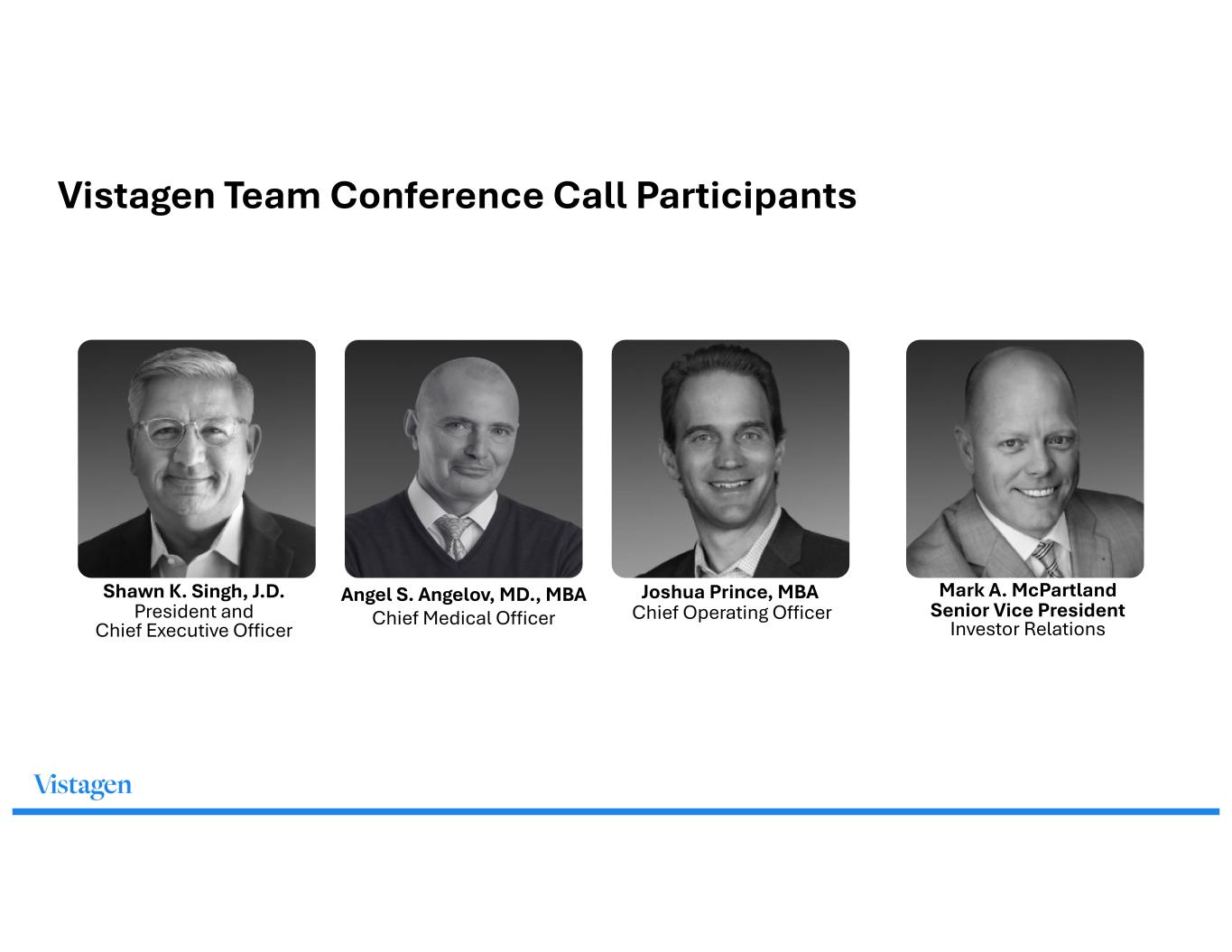
Vistagen Team Conference Call Participants Shawn K. Singh, J.D. President and Chief Executive Officer Joshua Prince, MBA Chief Operating Officer Mark A. McPartland Senior Vice President Investor Relations Angel S. Angelov, MD., MBA Chief Medical Officer
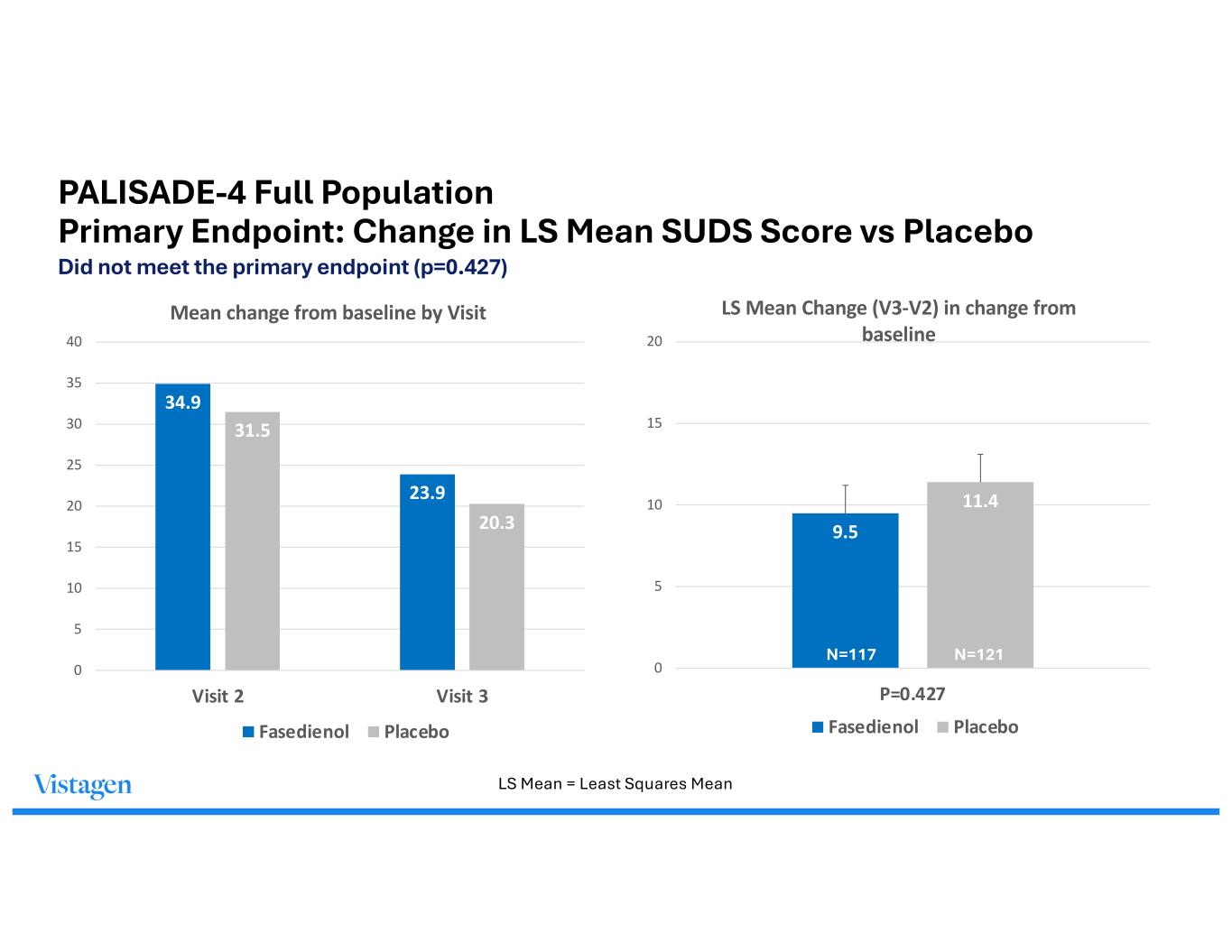
PALISADE-4 Full Population Primary Endpoint: Change in LS Mean SUDS Score vs Placebo Did not meet the primary endpoint (p=0.427) N=71 N=70 N=61 N=132 N=199 34.9 23.9 31.5 20.3 0 5 10 15 20 25 30 35 40 Visit 2 Visit 3 Mean change from baseline by Visit Fasedienol Placebo 9.5 11.4 0 5 10 15 20 P=0.427 LS Mean Change (V3-V2) in change from baseline Fasedienol Placebo LS Mean = Least Squares Mean N=117 N=121
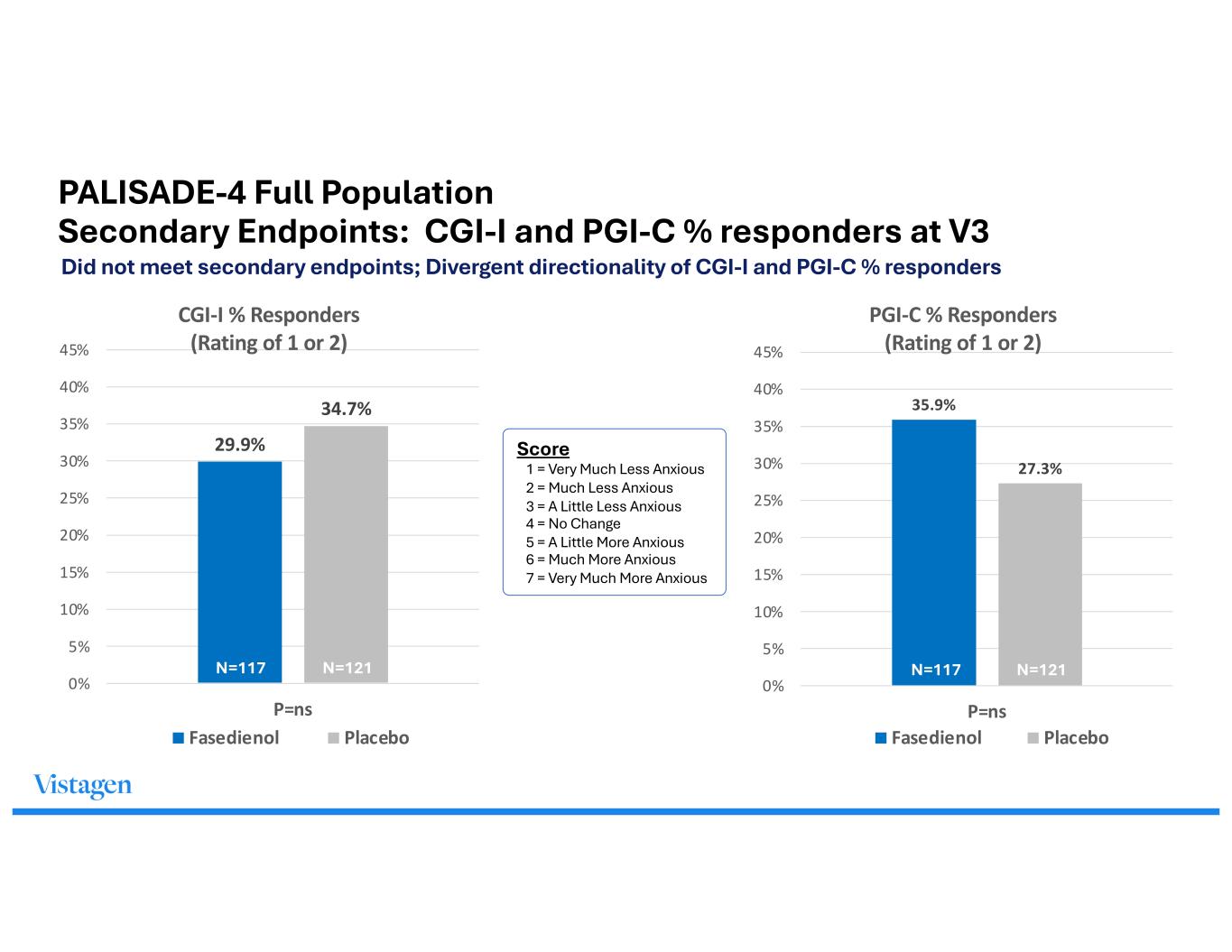
29.9% 34.7% 0% 5% 10% 15% 20% 25% 30% 35% 40% 45% P=ns CGI-I % Responders (Rating of 1 or 2) Fasedienol Placebo PALISADE-4 Full Population Secondary Endpoints: CGI-I and PGI-C % responders at V3 Did not meet secondary endpoints; Divergent directionality of CGI-I and PGI-C % responders N=117 N=121 Score 1 = Very Much Less Anxious 2 = Much Less Anxious 3 = A Little Less Anxious 4 = No Change 5 = A Little More Anxious 6 = Much More Anxious 7 = Very Much More Anxious 35.9% 27.3% 0% 5% 10% 15% 20% 25% 30% 35% 40% 45% P=ns PGI-C % Responders (Rating of 1 or 2) Fasedienol Placebo N=117 N=121
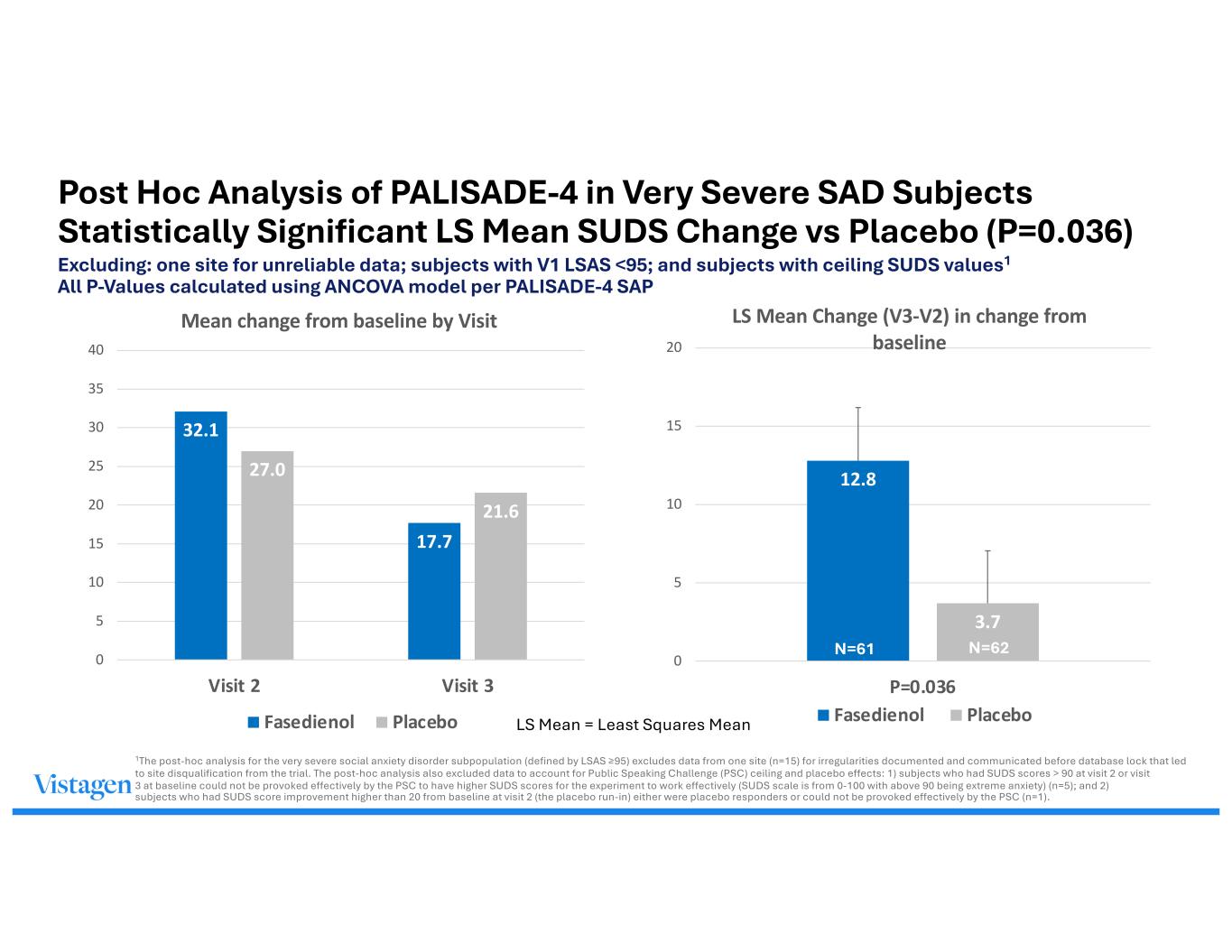
Post Hoc Analysis of PALISADE-4 in Very Severe SAD Subjects Statistically Significant LS Mean SUDS Change vs Placebo (P=0.036) Excluding: one site for unreliable data; subjects with V1 LSAS <95; and subjects with ceiling SUDS values1 All P-Values calculated using ANCOVA model per PALISADE-4 SAP 32.1 17.7 27.0 21.6 0 5 10 15 20 25 30 35 40 Visit 2 Visit 3 Mean change from baseline by Visit Fasedienol Placebo 12.8 3.7 0 5 10 15 20 P=0.036 LS Mean Change (V3-V2) in change from baseline Fasedienol PlaceboLS Mean = Least Squares Mean N=61 N=62 1The post-hoc analysis for the very severe social anxiety disorder subpopulation (defined by LSAS ≥95) excludes data from one site (n=15) for irregularities documented and communicated before database lock that led to site disqualification from the trial. The post-hoc analysis also excluded data to account for Public Speaking Challenge (PSC) ceiling and placebo effects: 1) subjects who had SUDS scores > 90 at visit 2 or visit 3 at baseline could not be provoked effectively by the PSC to have higher SUDS scores for the experiment to work effectively (SUDS scale is from 0-100 with above 90 being extreme anxiety) (n=5); and 2) subjects who had SUDS score improvement higher than 20 from baseline at visit 2 (the placebo run-in) either were placebo responders or could not be provoked effectively by the PSC (n=1).
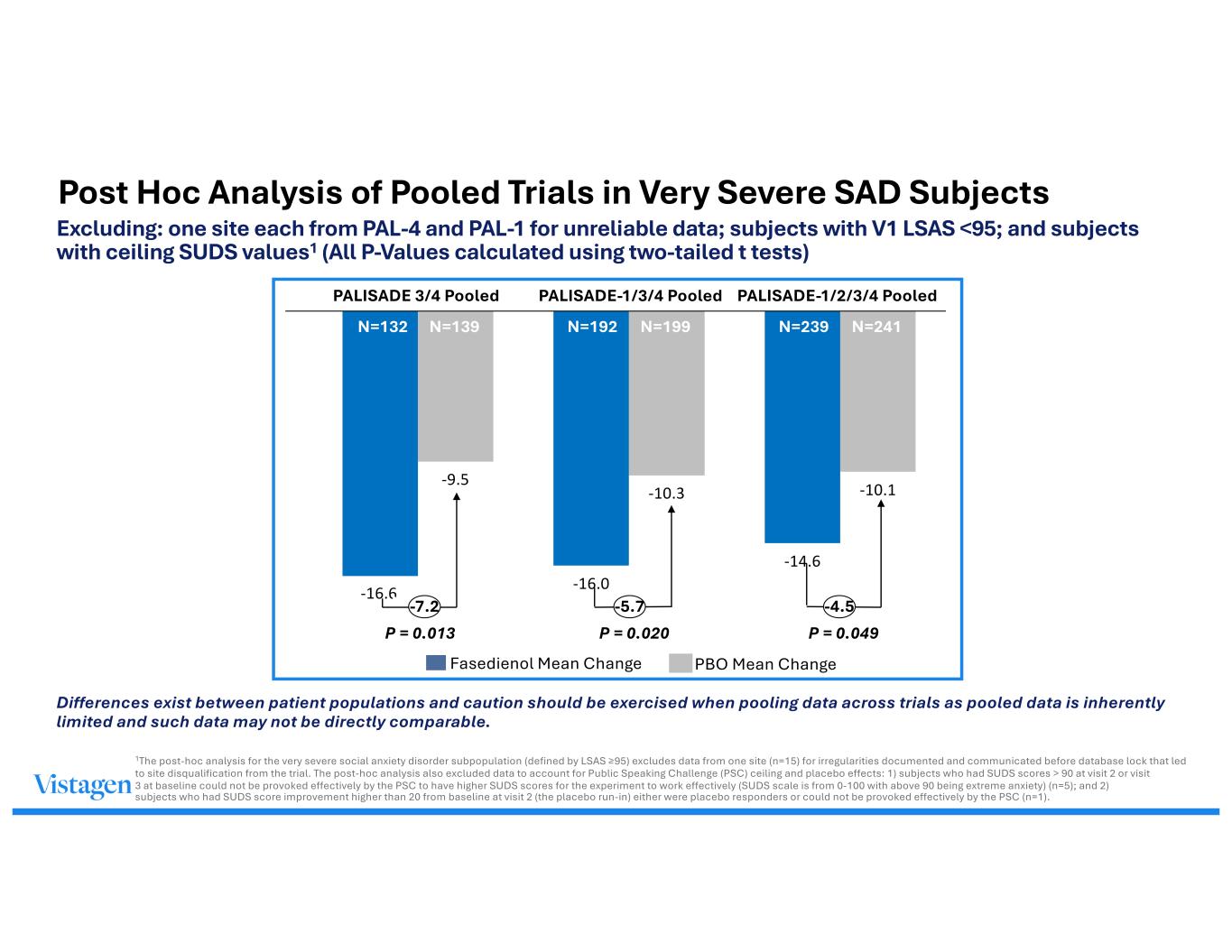
Post Hoc Analysis of Pooled Trials in Very Severe SAD Subjects Excluding: one site each from PAL-4 and PAL-1 for unreliable data; subjects with V1 LSAS <95; and subjects with ceiling SUDS values1 (All P-Values calculated using two-tailed t tests) N= 70 N= 71-16.6 -16.0 -14.6 -9.5 -10.3 -10.1 PALISADE-1/3/4 PooledPALISADE 3/4 Pooled Fasedienol Mean Change PBO Mean Change -4.5 PALISADE-1/2/3/4 Pooled N= 70 -5.7N= 70 N=132 N=139 N=192 N=199 N=239 N=241 P = 0.020 P = 0.049 -7.2 P = 0.013 Differences exist between patient populations and caution should be exercised when pooling data across trials as pooled data is inherently limited and such data may not be directly comparable. 1The post-hoc analysis for the very severe social anxiety disorder subpopulation (defined by LSAS ≥95) excludes data from one site (n=15) for irregularities documented and communicated before database lock that led to site disqualification from the trial. The post-hoc analysis also excluded data to account for Public Speaking Challenge (PSC) ceiling and placebo effects: 1) subjects who had SUDS scores > 90 at visit 2 or visit 3 at baseline could not be provoked effectively by the PSC to have higher SUDS scores for the experiment to work effectively (SUDS scale is from 0-100 with above 90 being extreme anxiety) (n=5); and 2) subjects who had SUDS score improvement higher than 20 from baseline at visit 2 (the placebo run-in) either were placebo responders or could not be provoked effectively by the PSC (n=1).

Thank you! Contact Us Investor Relations: IR@vistagen.com Media Relations: Media@vistagen.com NASDAQ: VTGN